judge
Judge — March 1937
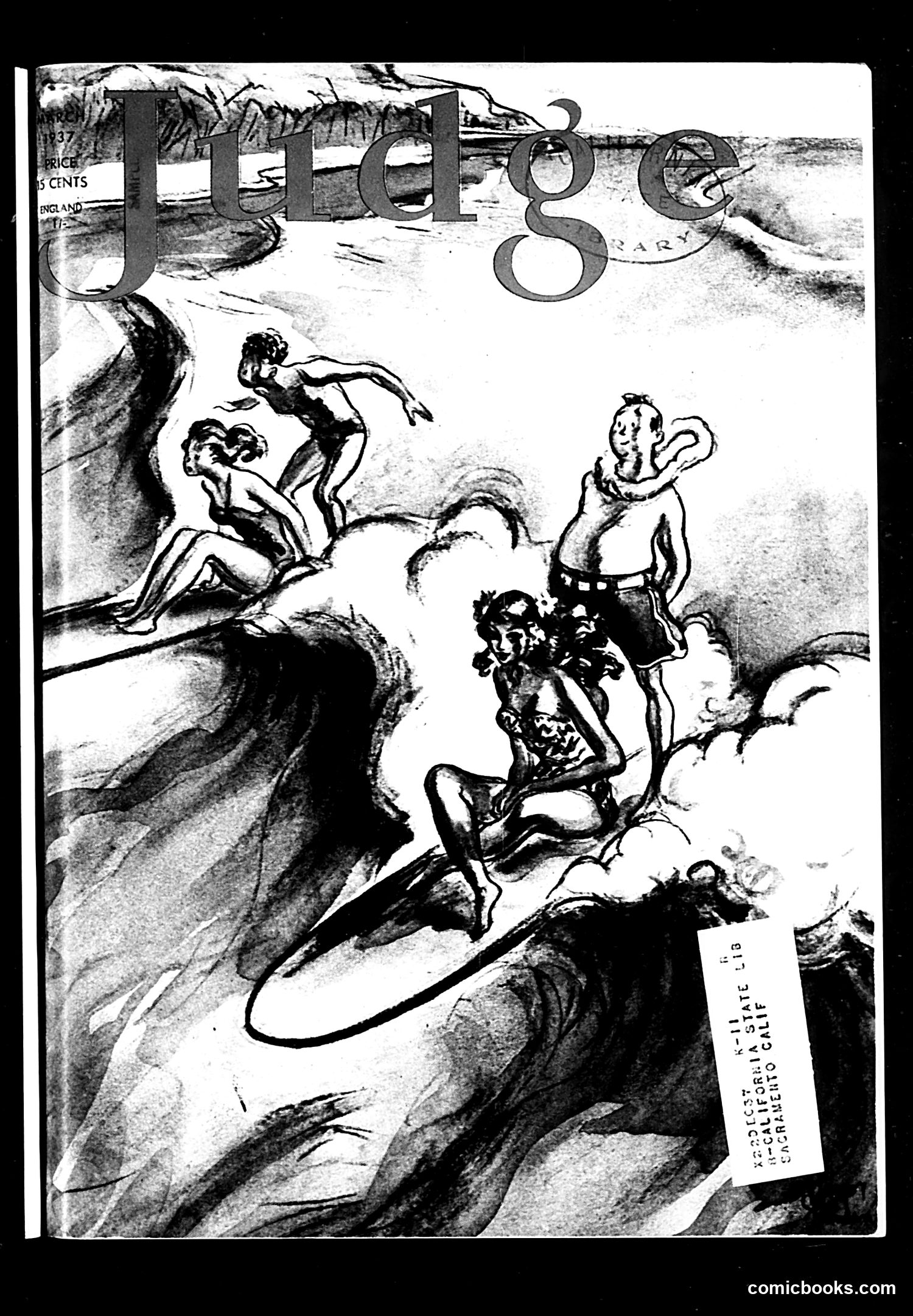
Judge Magazine Cartoon Analysis This appears to be a cover illustration from *Judge* magazine depicting a beach or seaside scene with multiple figures in swimming attire engaged in various activities on rocky terrain. The large decorative text reading "Judge" dominates the upper portion. The cartoon likely satirizes leisure activities or beach culture of the era in which it was published. Without clearer identifying features, specific caricatures, or readable contextual text visible in this reproduction, I cannot definitively identify which political figures or social issues are being referenced. The sketchy art style and composition suggest social commentary on contemporary behavior, but the specific satirical point remains unclear from this image alone.
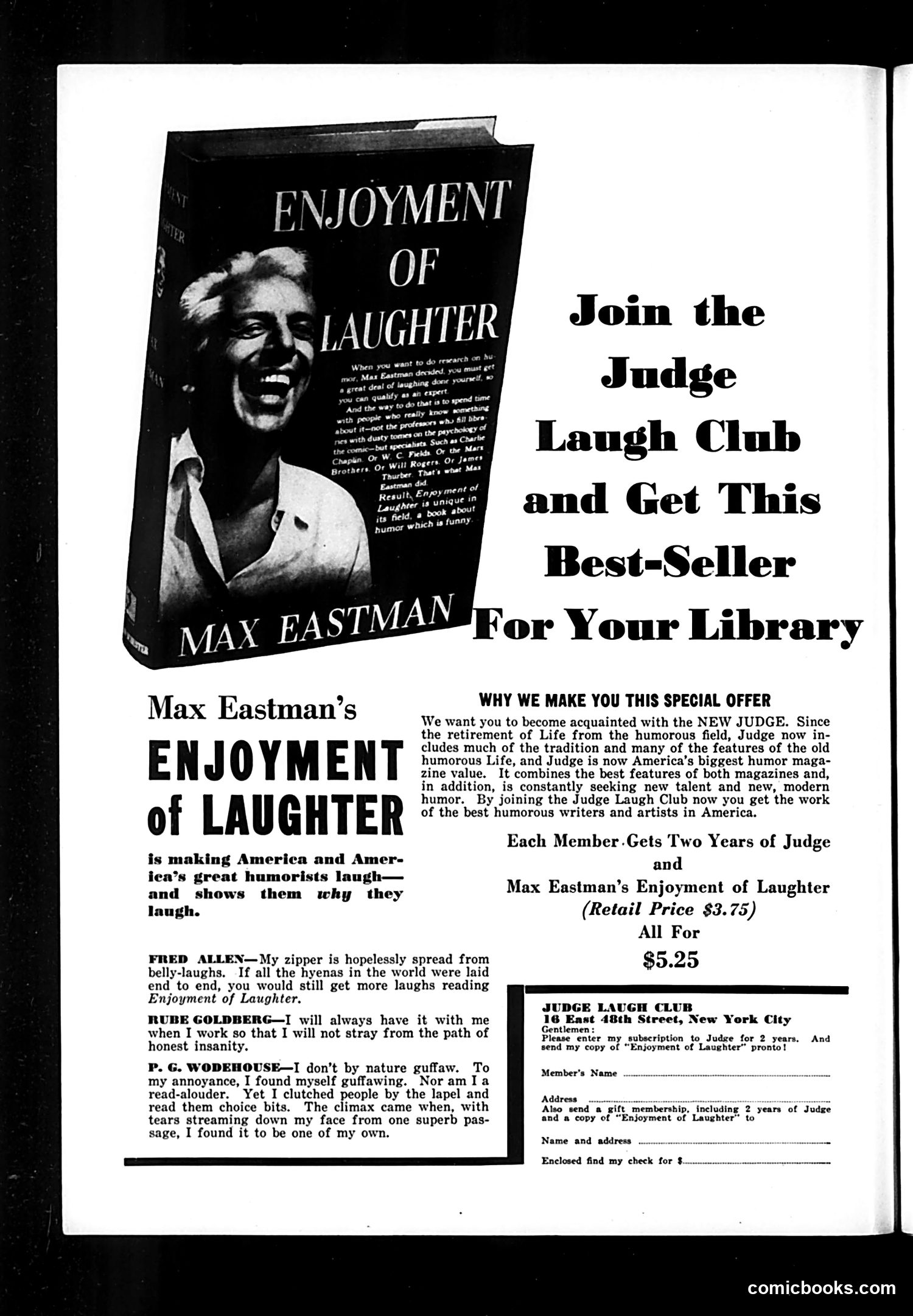
Analysis This page is primarily advertising, not editorial content or satire. It promotes Max Eastman's book "Enjoyment of Laughter" and solicits memberships to the Judge Laugh Club. The advertisement features testimonials from prominent humorists (Fred Allen, Rube Goldberg, P.G. Wodehouse) endorsing the book's insights into why people laugh. The pitch emphasizes that Judge magazine—described as "America's biggest humor magazine"—now offers members a two-year subscription plus Eastman's book for $5.25 (retail $3.75 combined). This appears to be a membership drive capitalizing on the book's popularity and Judge's editorial authority on humor. The content is commercial rather than satirical, aimed at building the magazine's subscriber base during what was likely the mid-20th century.
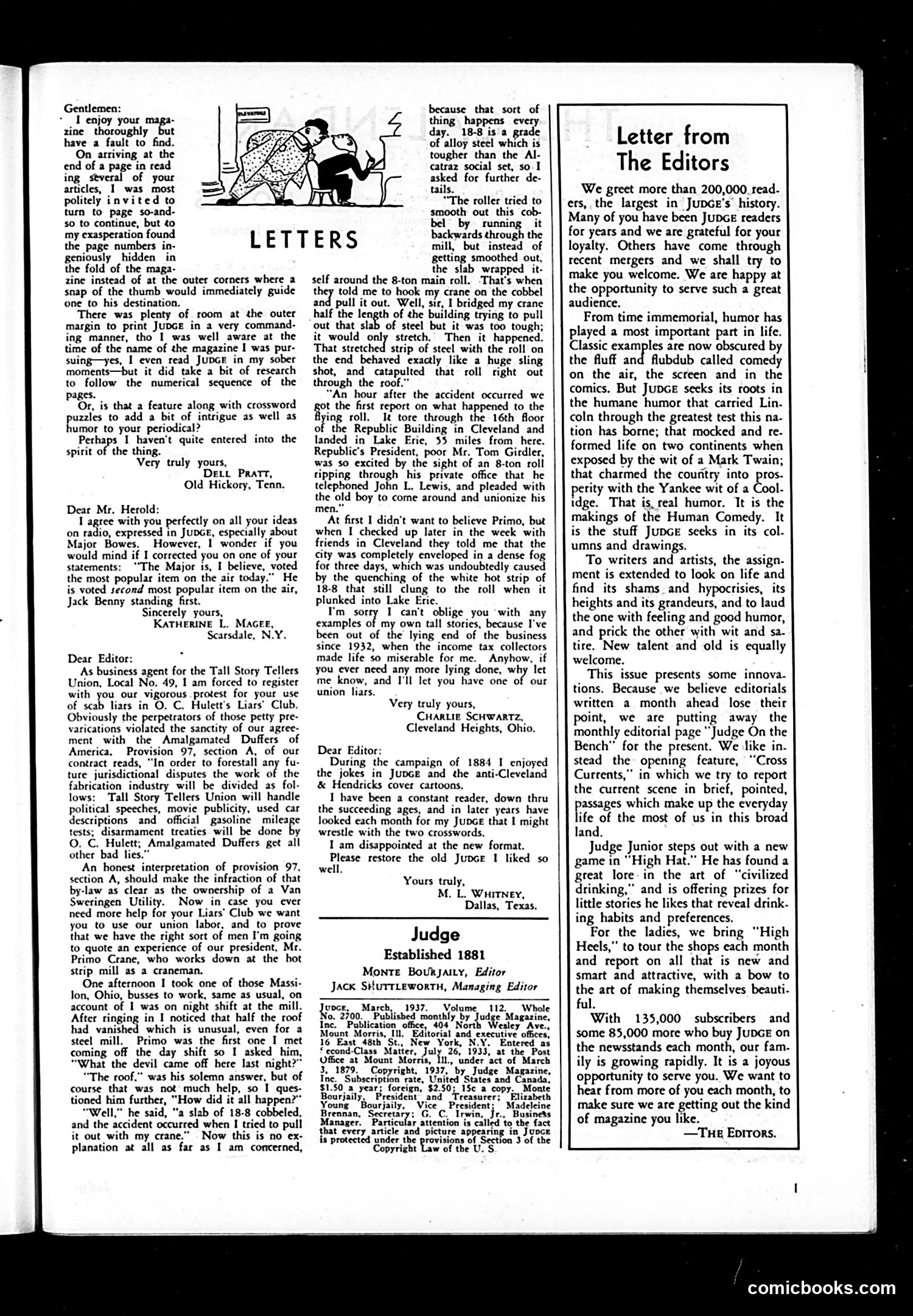
Analysis of Judge Magazine Cartoon The main cartoon depicts a man being crushed or flattened by a large roll of steel, with sound effects suggesting impact. According to the accompanying letter from "Old Hickory, Iowa," this illustrates an industrial accident involving sheet metal at a mill. The letter describes a coil of 18.8-gauge steel alloy that escaped control during processing at a mill, striking a worker and causing serious injury. The narrative details the metal "catapulted" through the roof after hitting the injured man. This appears to be satirical commentary on industrial workplace safety hazards during what seems to be the early 20th century manufacturing era—a period marked by frequent, often-fatal factory accidents with minimal worker protections or regulations. The cartoon uses dark humor to highlight the brutal realities of industrial labor.
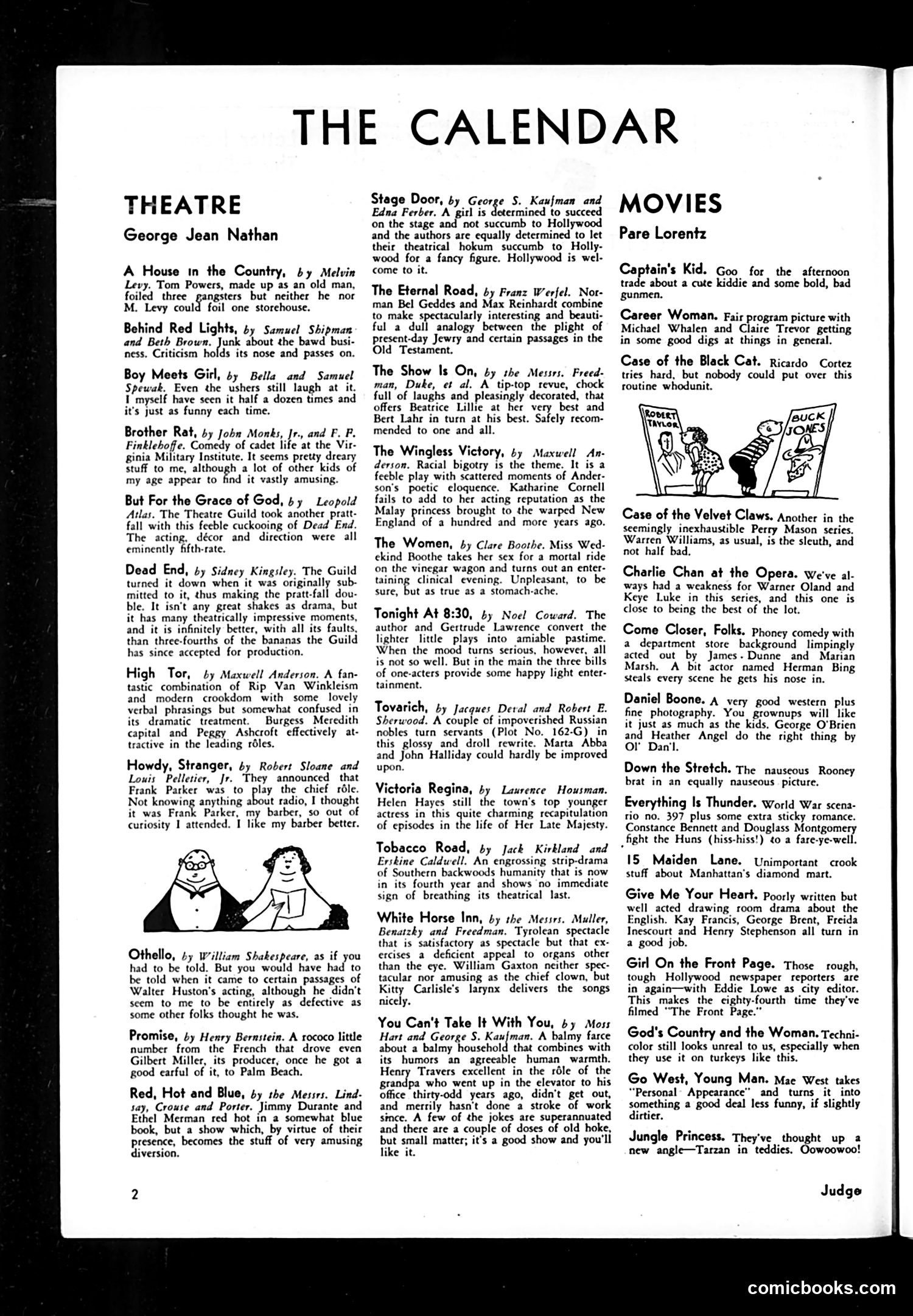
"The Calendar" Page Analysis This page from Judge magazine presents theater and movie reviews rather than political satire. The content includes critiques of Broadway plays (like Shakespeare's *Othello* and *Promise*) and Hollywood films (ranging from *Captain's Kid* to *Jungle Princess*). Two small cartoon illustrations appear: one showing two rotund figures in what appears to be a humorous domestic scene, and another depicting a woman reading while a man gestures—likely illustrating comedic situations referenced in the reviews. The reviews themselves use satirical commentary typical of Judge's style, offering witty critiques of performances and plots. Rather than political commentary, the satire targets theatrical and cinematic quality, performers' abilities, and plot devices—standard entertainment criticism of the era.
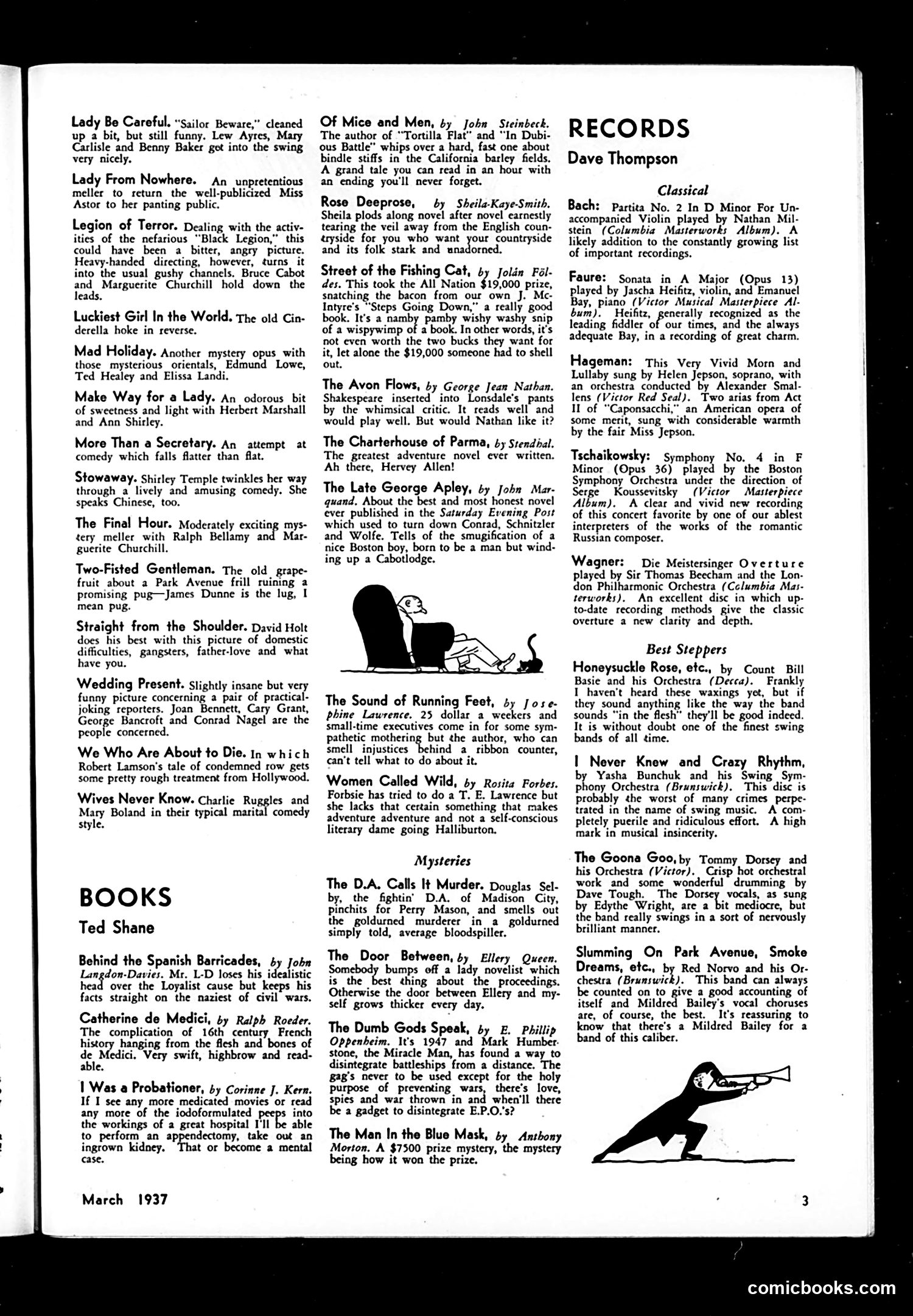
Analysis of Judge Magazine, March 1937 This page is primarily a book and music review section rather than political satire. It contains critical reviews of contemporary novels, mysteries, and classical music recordings by critics including Dave Thompson. The page includes two small cartoon illustrations: one showing a figure in a chair with what appears to be a cat or small animal, and another at the bottom right depicting a stylized figure in a dynamic pose. However, these illustrations lack sufficient detail or context in the image to identify specific caricatures or political references. The content focuses on entertainment criticism—discussing works by authors like John Steinbeck and George Jean Nathan—reflecting Judge's role as a general-interest satirical magazine covering culture and entertainment alongside political commentary. Without clearer cartoon imagery or accompanying political headlines, the satirical intent of these illustrations remains unclear.
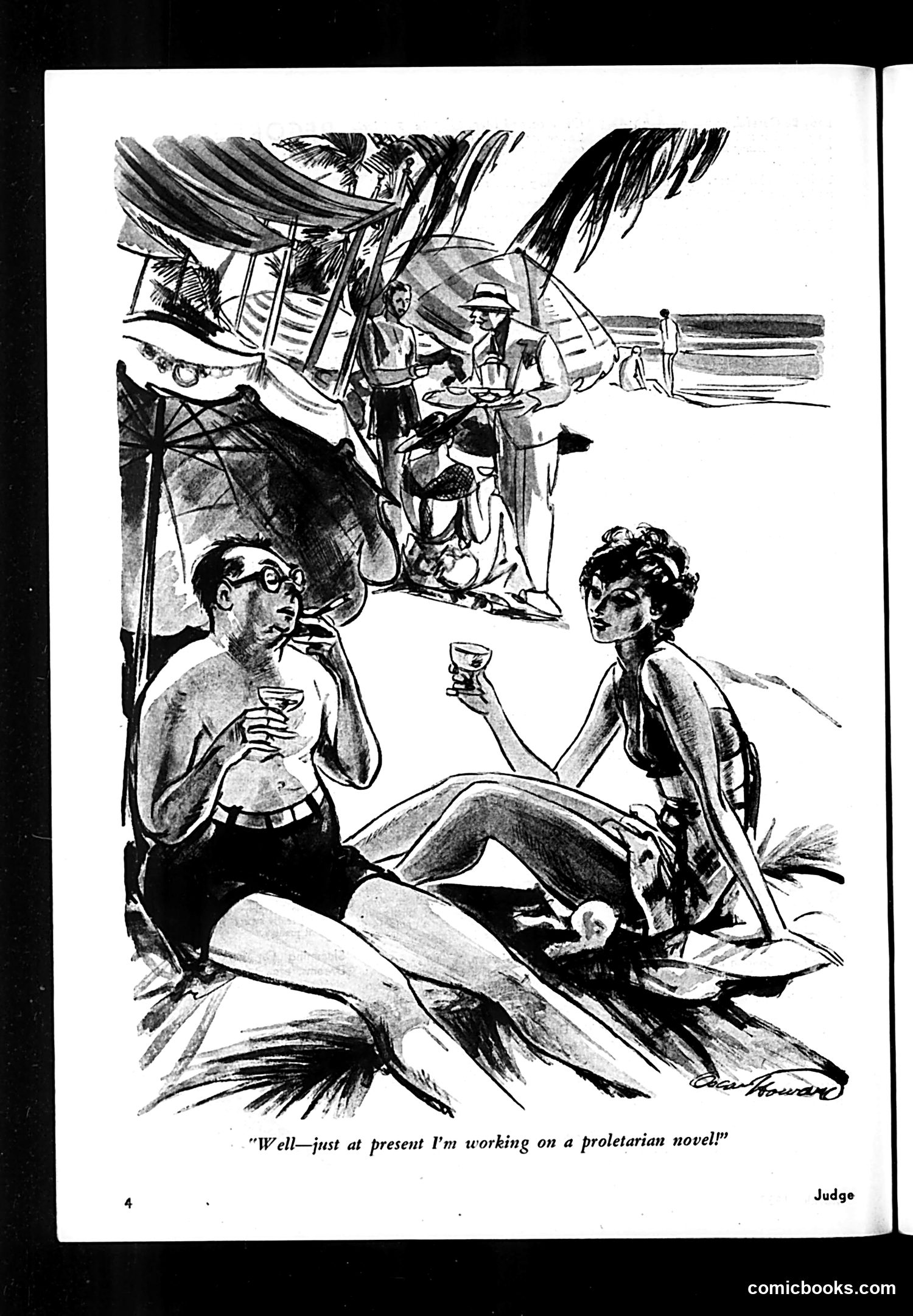
Analysis of Judge Magazine Cartoon This cartoon satirizes intellectual pretension during what appears to be the interwar period. Two sunbathers at a tropical beach are having drinks when one claims to be "working on a proletarian novel." The humor targets writers who adopted radical, working-class literary themes while enjoying leisurely, bourgeois lifestyles—lounging in paradise rather than actually experiencing proletarian life. The contrast between the speaker's claim of writing about the working class and his obvious wealth and leisure exemplifies hypocrisy common among intellectuals of that era. The tropical resort setting with servants in the background reinforces this irony. "Judge" magazine frequently mocked such pretension among the cultural elite who romanticized socialism while maintaining comfortable, privileged existences.
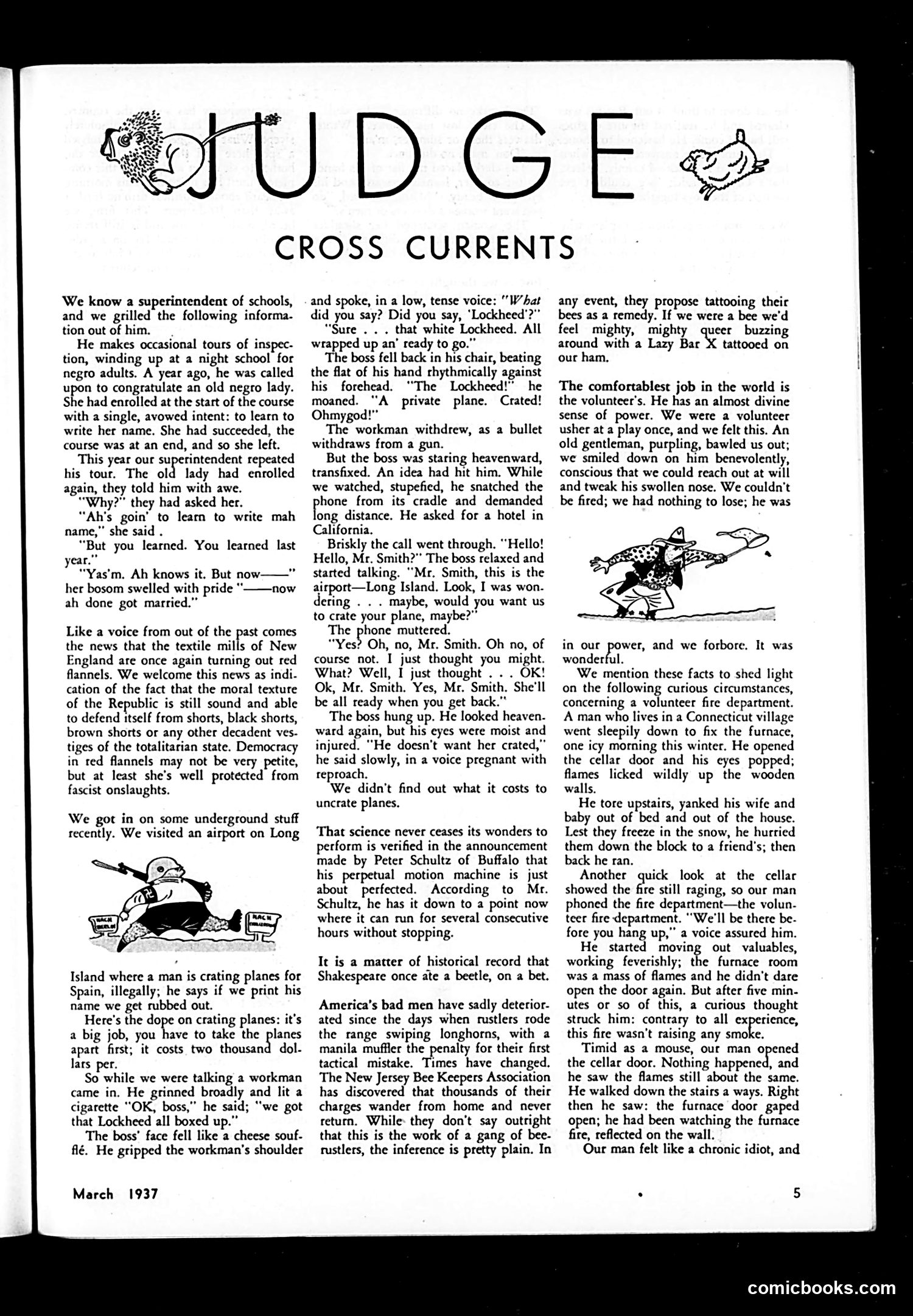
Judge Magazine "Cross Currents" - March 1937 This satirical column discusses several contemporary issues through anecdotes: 1. School segregation: A superintendent's tour of a "negro school" is criticized implicitly through the narrative's matter-of-fact tone about racial divisions in education. 2. Aviation/Lockheed plane incident: A humorous story about a workman's encounter with a boss and a plane called "Lockheed," likely referencing the growing aviation industry and class tensions between management and workers. 3. Perpetual motion machine: A satirical jab at Peter Schultz of Buffalo's claims about a perpetual motion device—mocking pseudoscientific claims popular during the Depression era. 4. Labor issues: References to bee-keeping as a remedy and New Jersey Bee Keepers Association discovering charges on beekeepers suggest labor organizing and worker grievances of the 1930s. The overall tone mocks bureaucratic absurdity and dubious claims of the era.
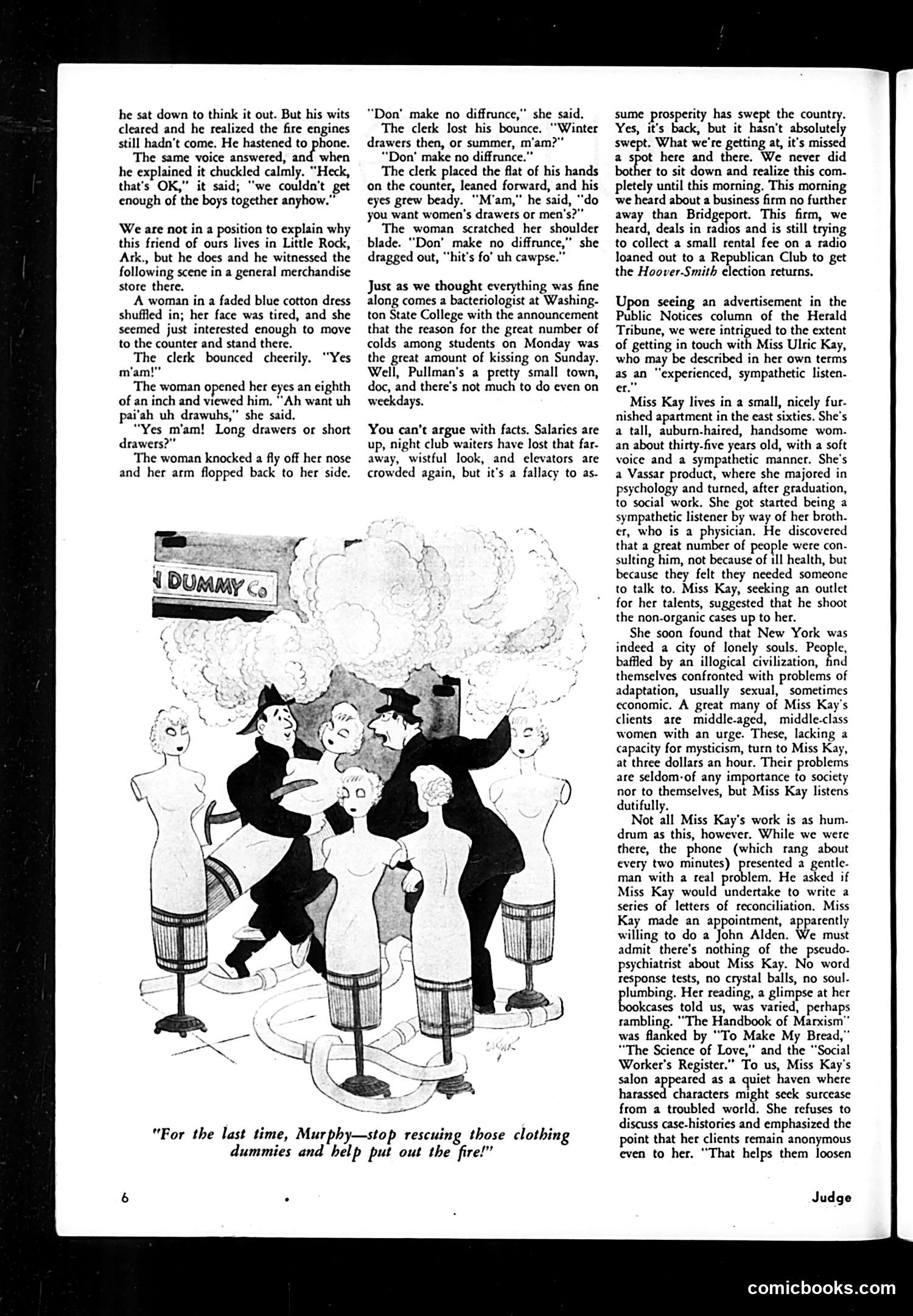
Analysis of Judge Magazine Page This page satirizes the New York social services sector, specifically critiquing "Miss Kay," a sympathetic listener who runs a salon addressing clients' emotional and personal problems. The text describes her practice as quasi-therapeutic work—helping middle-class, middle-aged women with relationship issues for three dollars per hour. The cartoon illustrates the absurdity: suited men frantically rescue clothed department store mannequins from a fire labeled "DUMMY CO." The visual pun equates Miss Kay's clients with dummies—suggesting her counsel is directed at superficial or intellectually empty people seeking validation rather than genuine psychiatric help. The satire mocks both the clients and the pseudo-psychological counseling trend itself as frivolous urban pretension.
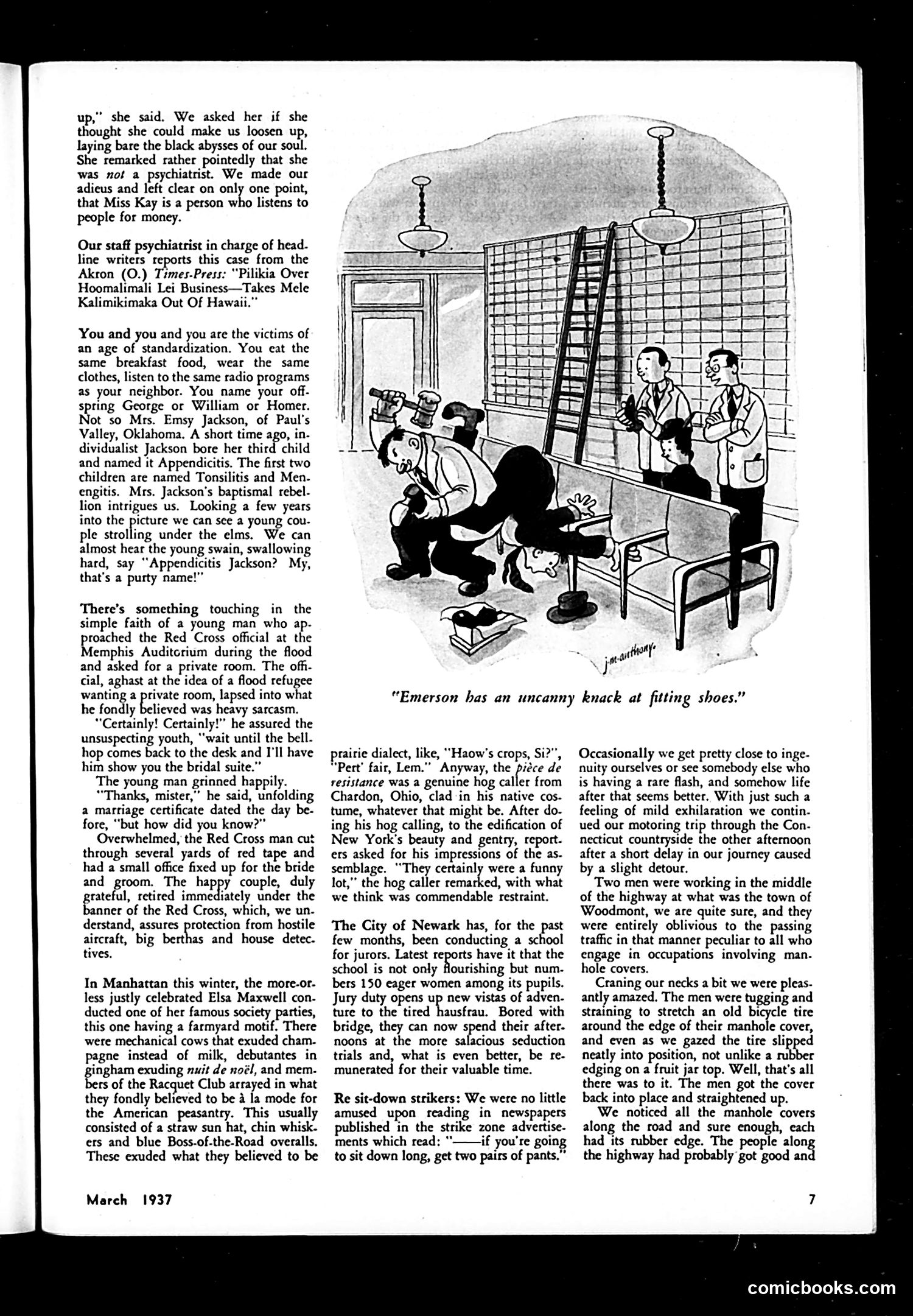
Analysis of Judge Magazine Page (March 1937) The main cartoon depicts men in suits examining shoes, captioned "Emerson has an uncanny knack at fitting shoes." This appears to be workplace satire about a shoe-fitting expert or salesman. The surrounding text discusses various social observations from 1937: standardization of American life (identical breakfasts, clothes, radio programs), a Red Cross official's heavy sarcasm during Memphis flood relief, and a Newark school conducting sit-down strikes among its female students. The page satirizes mid-Depression era social conformity and labor unrest. References to "sit-down strikers" and mentions of "pants" suggest commentary on contemporary labor disputes. The tone is gently mocking of American mass culture and workplace absurdities rather than sharply political. Without clearer context, the specific "Emerson" reference remains unclear.
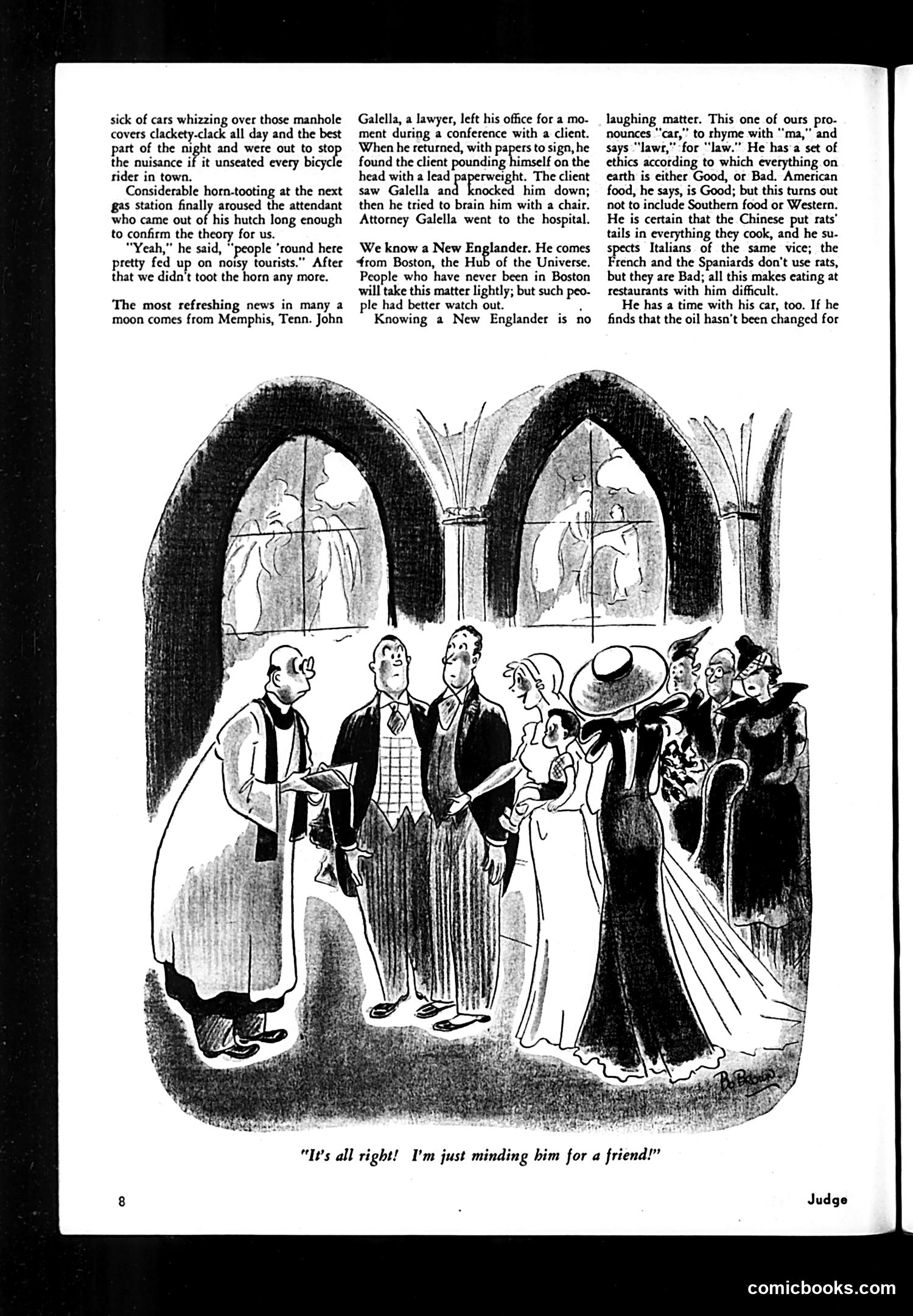
Cartoon Analysis This is a single-panel cartoon from Judge magazine depicting a scene inside a church or cathedral (indicated by the Gothic arches). A woman in an elegant dress is introducing a disheveled, poorly-dressed man to other well-dressed parishioners, with the caption: "It's all right! I'm just minding him for a friend!" The satire: The joke plays on class distinctions and social embarrassment. The woman is attempting to excuse the man's obviously unsuitable appearance and presence among the church's respectable attendees by claiming temporary responsibility—implying she's merely "babysitting" him rather than that he actually belongs in such refined company. The humor derives from the awkwardness of bringing an underdressed person into an exclusive social setting, and the woman's somewhat defensive explanation that reveals her awareness of the social impropriety. It satirizes both class consciousness and the sometimes absurd social conventions of the era that Judge's readers would have recognized.
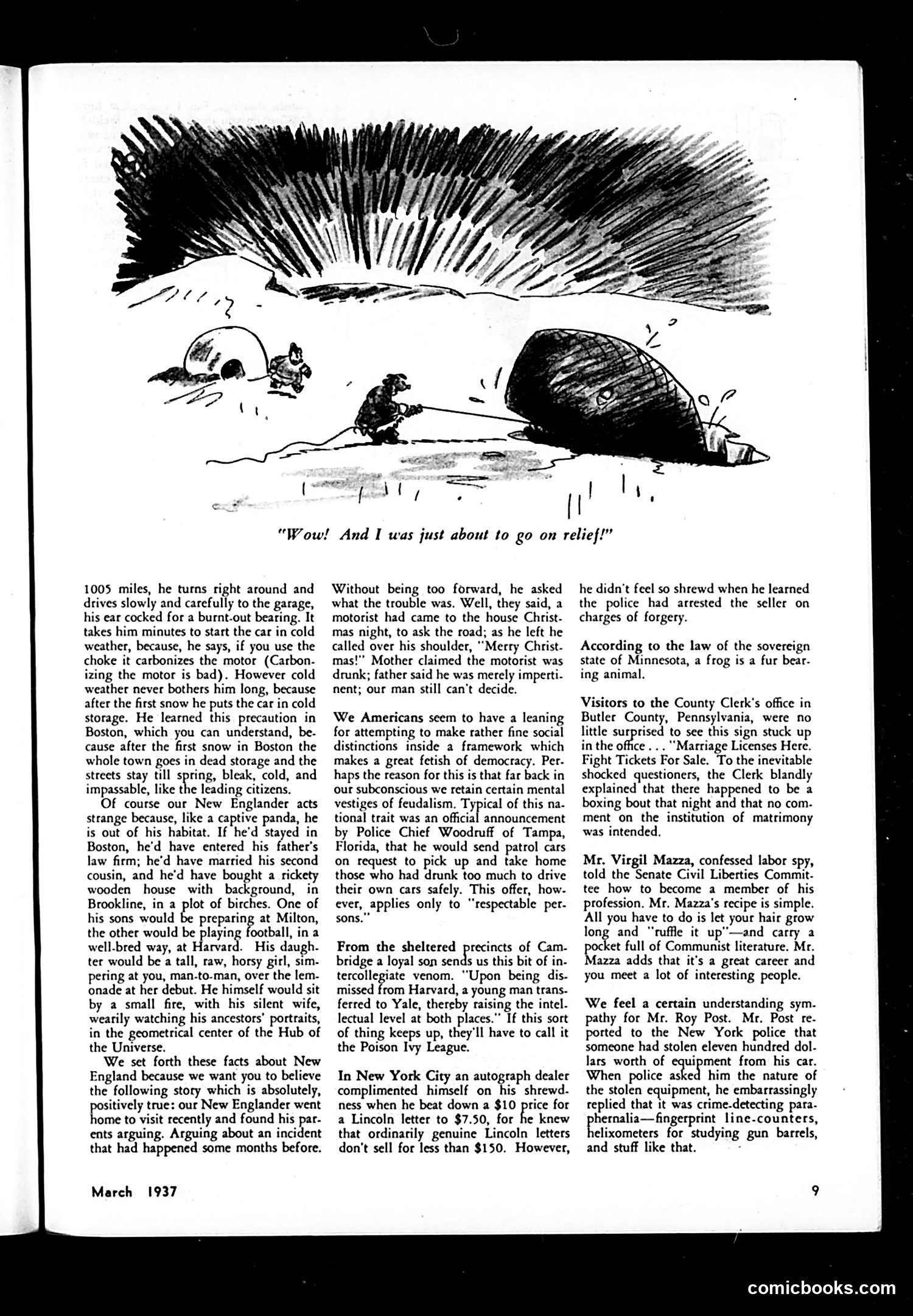
Cartoon Analysis: Judge Magazine, March 1937 The Main Cartoon depicts a small figure being pulled by an enormous beetle or insect, with the caption "Wow! And I was just about to go on relief!" The joke references the Great Depression context (1937). The figure expects hardship and government relief assistance, but instead gets absurdly yanked away by this creature—suggesting life's unpredictable interruptions supersede even unemployment worries. It's dark Depression-era humor. The Surrounding Text consists of satirical anecdotes mocking American social pretensions: - A New England family argues for months over whether a holiday visitor was merely "impertinent" versus "drunk"—conflating class distinctions with sobriety judgments - Tampa police offer drunk-driving assistance only to "respectable persons"—highlighting hypocritical class-based "democracy" - A Yale/Harvard rivalry joke about intellectual levels - An autograph dealer conned into buying a forged Lincoln letter The overall theme critiques how Americans maintain feudal-style class consciousness while professing democratic values—a pointed 1930s social observation.
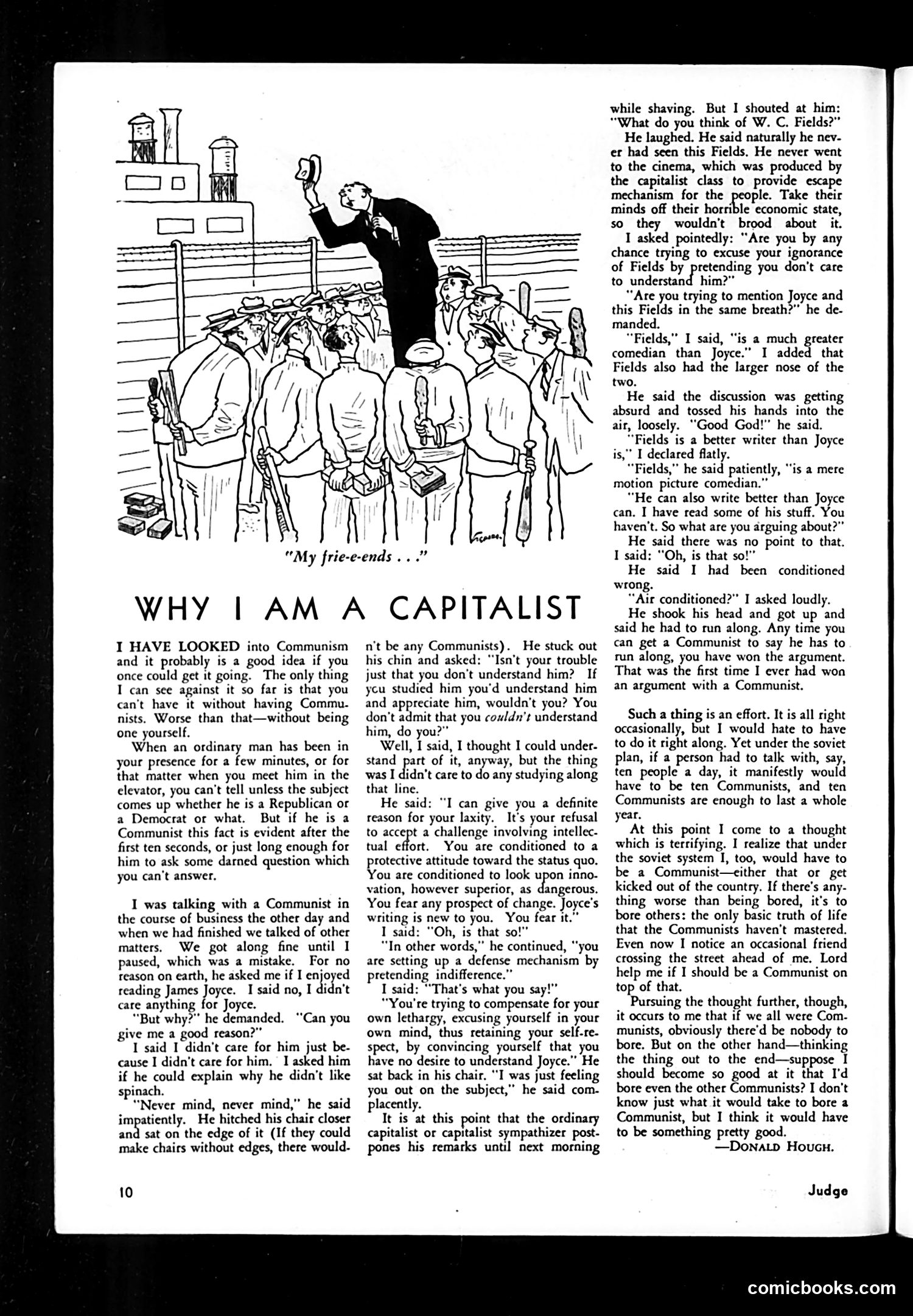
What This Page Means This is a satirical essay by Donald Hough mocking Communist ideology and arguing for capitalism—presented as humor in Judge magazine. The cartoon shows a Communist speaker addressing a crowd with missionary zeal. The essay describes the author's encounter with an aggressive Communist acquaintance who interrogates him about not liking James Joyce, insisting his disinterest stems from capitalist conditioning and fear of intellectual challenge. The satire's point: Communists are portrayed as obnoxiously dogmatic, using pseudo-intellectual arguments to browbeat ordinary people. They demand constant ideological justification while refusing to engage honestly. The author's punchline—turning the Communist's own logic against him by questioning his ignorance of comedian W.C. Fields—exposes the hypocrisy and exhausting pedantry of Communist discourse. The essay argues capitalism, despite its flaws, is preferable to communism because it allows people to simply *exist* without constant ideological performance.
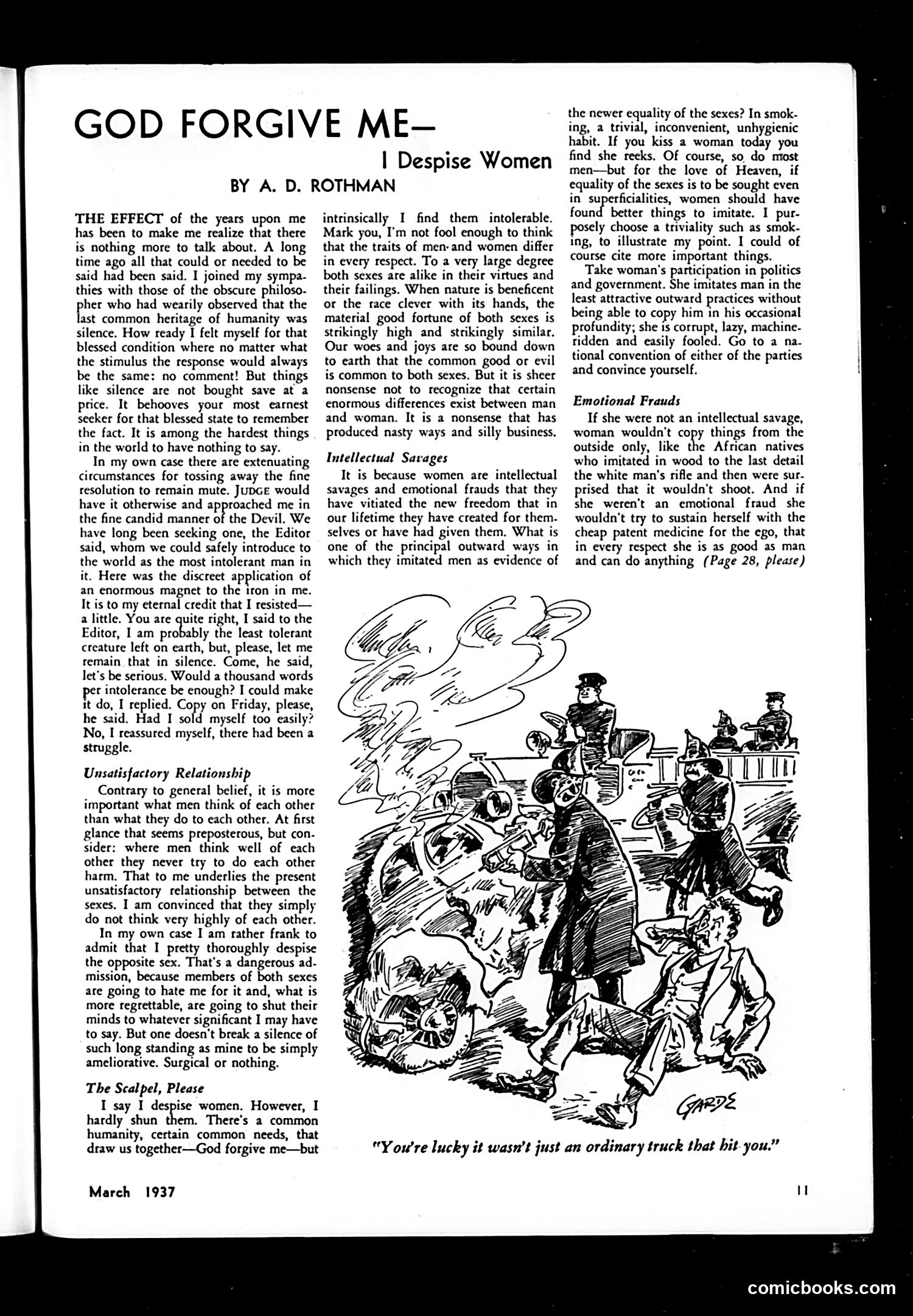
Analysis of "God Forgive Me—I Despise Women" (Judge, March 1937) The Text A.D. Rothman's essay presents a deliberately provocative argument: he claims to "despise" women while acknowledging their shared humanity. His central complaint is that women, granted new social freedoms in the 1930s, have misused them by imitating men superficially (smoking, for instance) rather than developing genuine intellectual or moral equality. He characterizes women as "intellectual savages and emotional frauds" who've squandered opportunities for authentic liberation. The Cartoon The illustration shows a chaotic traffic accident—vehicles colliding, figures tumbling—with the caption: "You're lucky it wasn't just an ordinary truck that hit you." The visual joke likely satirizes reckless or incompetent driving, possibly implying commentary on women drivers (a common 1930s trope) or simply illustrating one consequence of poor judgment. Context The piece reflects 1930s gender anxieties: women had recently gained voting rights and greater workplace presence, prompting backlash from conservative voices. Rothman's essay exemplifies how some male commentators framed women's liberation as shallow mimicry rather than substantive progress—a rhetorical strategy dismissing feminist advancement.
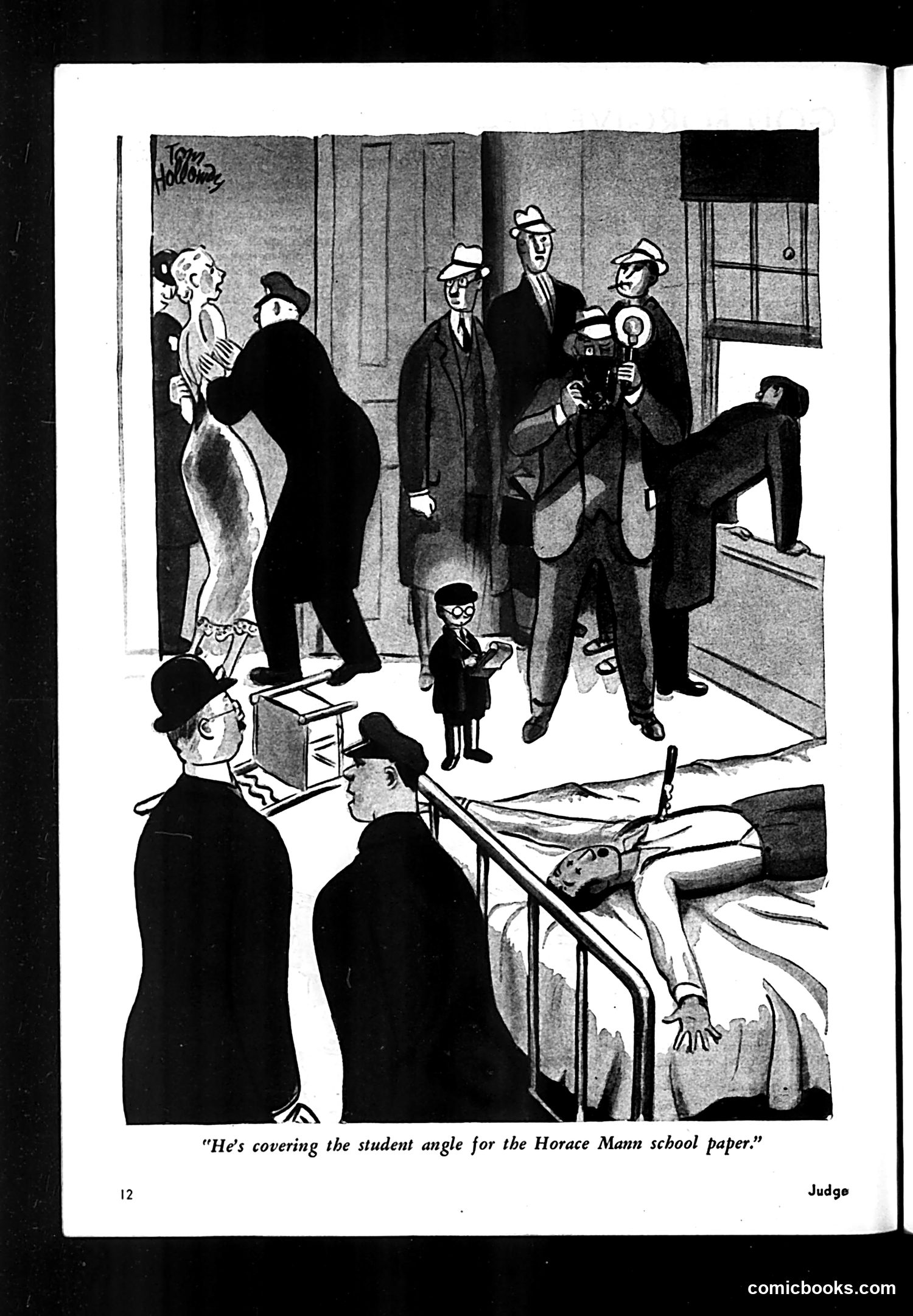
Cartoon Analysis This Judge magazine cartoon satirizes a newspaper reporter's overzealous coverage of a minor incident. The scene shows a chaotic bedroom where a young student appears to be in bed, surrounded by multiple adult men in suits and hats—apparently journalists and photographers documenting the scene intensely. The humor lies in the caption's deadpan explanation: the reporter is merely "covering the student angle for the Horace Mann school paper." The visual disproportion between the minor nature of a school paper story and the excessive media presence suggests satire of sensationalist journalism and reporters blowing trivial school events into major productions. Horace Mann was a prestigious preparatory school, making the contrast between elite institutional dignity and tabloid-style coverage sharper.
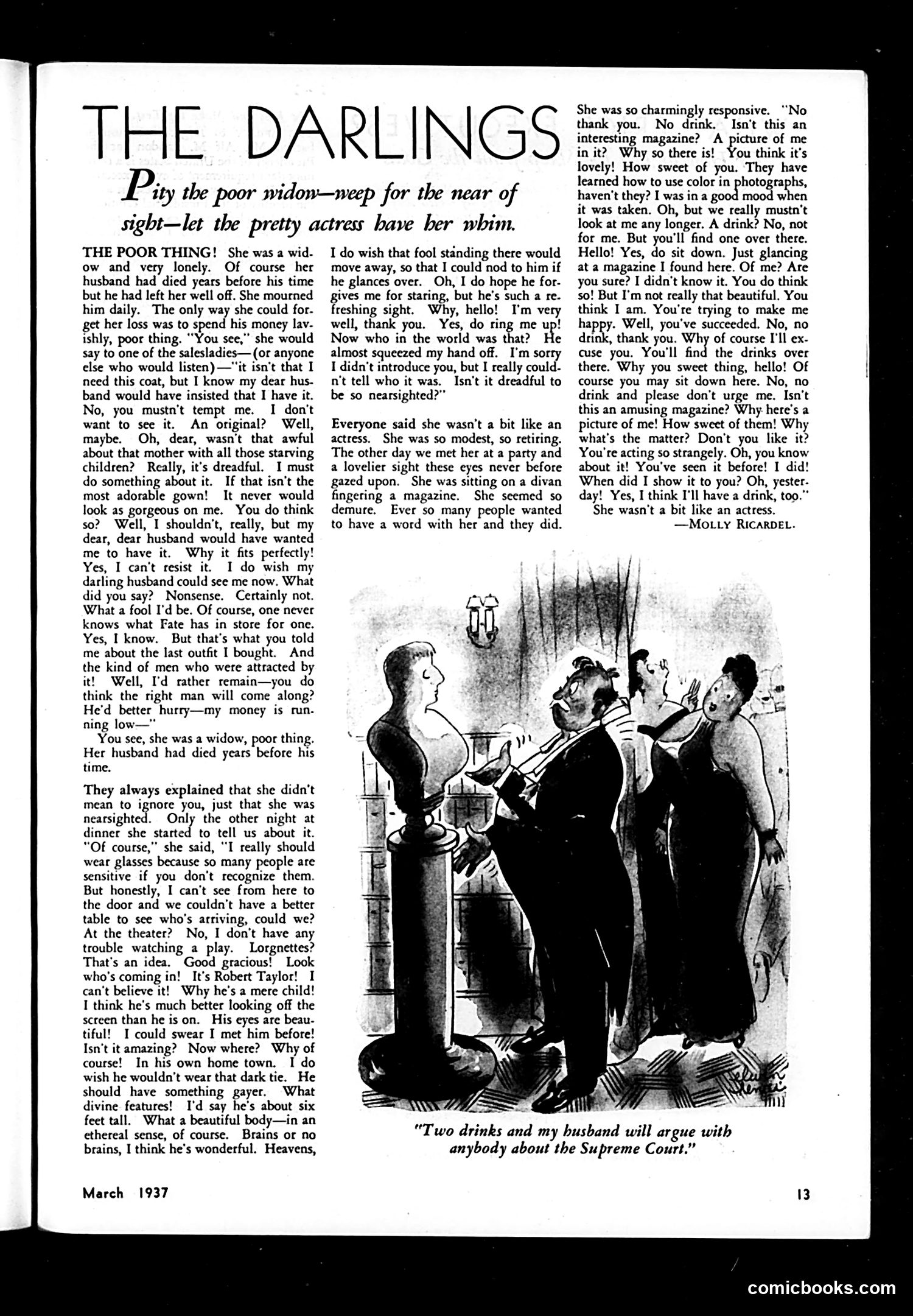
"The Darlings" - Judge Magazine, March 1937 This satirical story mocks a wealthy widow's self-centered hypocrisy. The unnamed protagonist claims her deceased husband would have wanted her to spend lavishly on clothes, yet she simultaneously feigns concern for starving children—using poverty as conversational garnish while shopping. The accompanying cartoon ridicules her claimed nearsightedness, which conveniently allows her to ignore people she doesn't recognize while strategically "noticing" celebrities like Robert Taylor (a 1930s film star). She demonstrates obvious interest in attractive men while maintaining an air of innocent innocence ("I really should wear glasses"). The satire targets performative charity and selective attention in wealthy society—the widow performs concern for others' suffering while indulging herself, and uses "nearsightedness" as a socially acceptable excuse for rudeness toward ordinary people. The final caption, attributed to Molly Ricardel, notes she "wasn't a bit like an actress"—yet her entire behavior is theatrical performance.
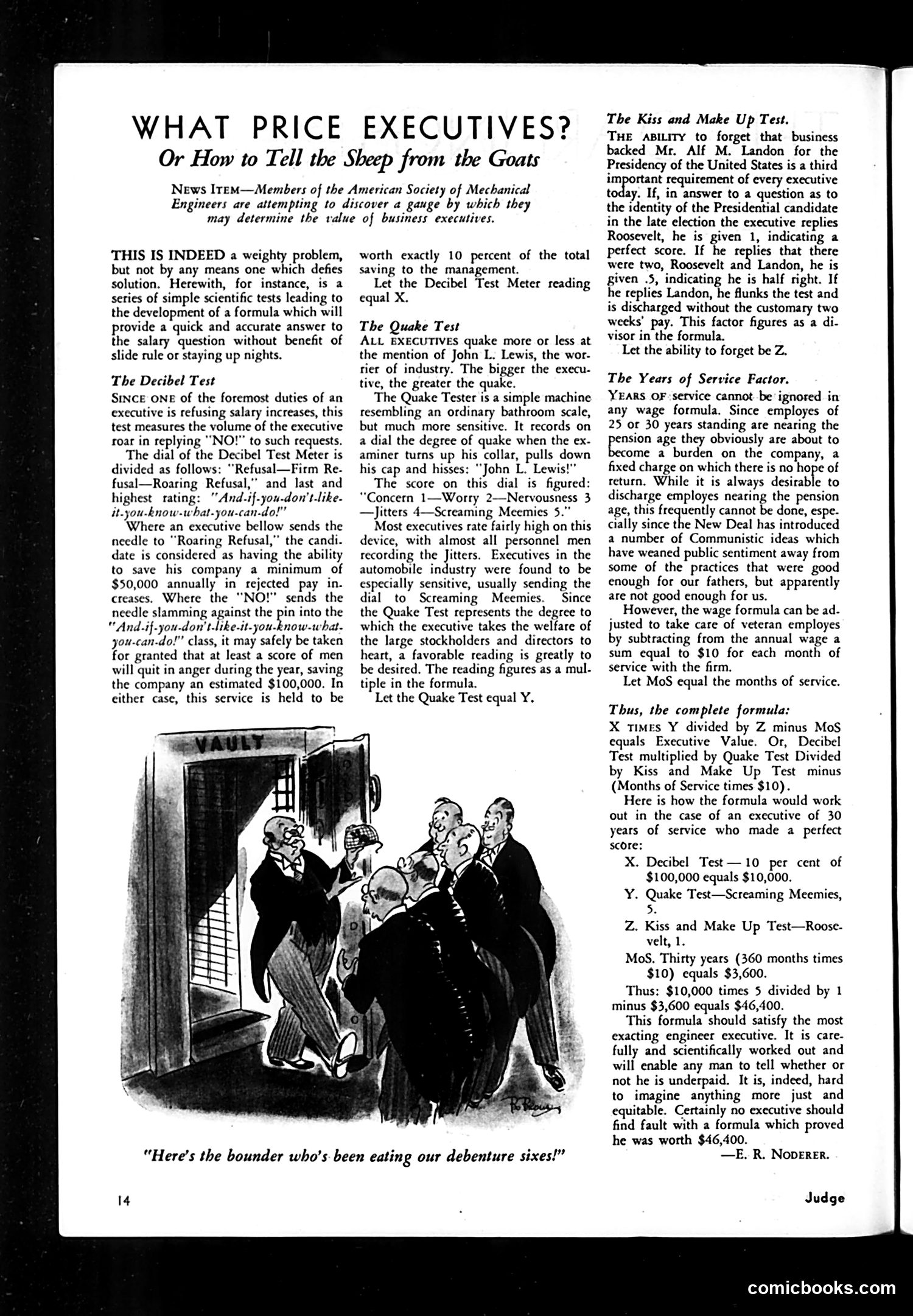
Analysis of "What Price Executives?" This satirical piece mocks the American Society of Mechanical Engineers' attempt to scientifically quantify executive worth through absurd "tests." The Tests: - Decibel Test: Measures how loudly executives refuse salary increases—the louder the refusal, the more "valuable" they are (savings employees money by denying raises) - Quake Test: Gauges executives' nervousness about labor leader John L. Lewis, implying fearful executives protect stockholders better - Kiss and Make Up Test: Tests whether executives have forgotten that business supported Republican Alf Landon in the recent (1936) presidential election against FDR. Those who acknowledge both candidates score .5; those who only remember Landon are fired The Satire's Point: The article ridicules executives by exposing their actual priorities—denying workers' wages, fearing unions, and displaying partisan business loyalty—while pretending these are objective measures of competence. The cartoon shows executives as foolish, self-serving figures concerned only with protecting their own interests and stockholder profits, not genuine business acumen.
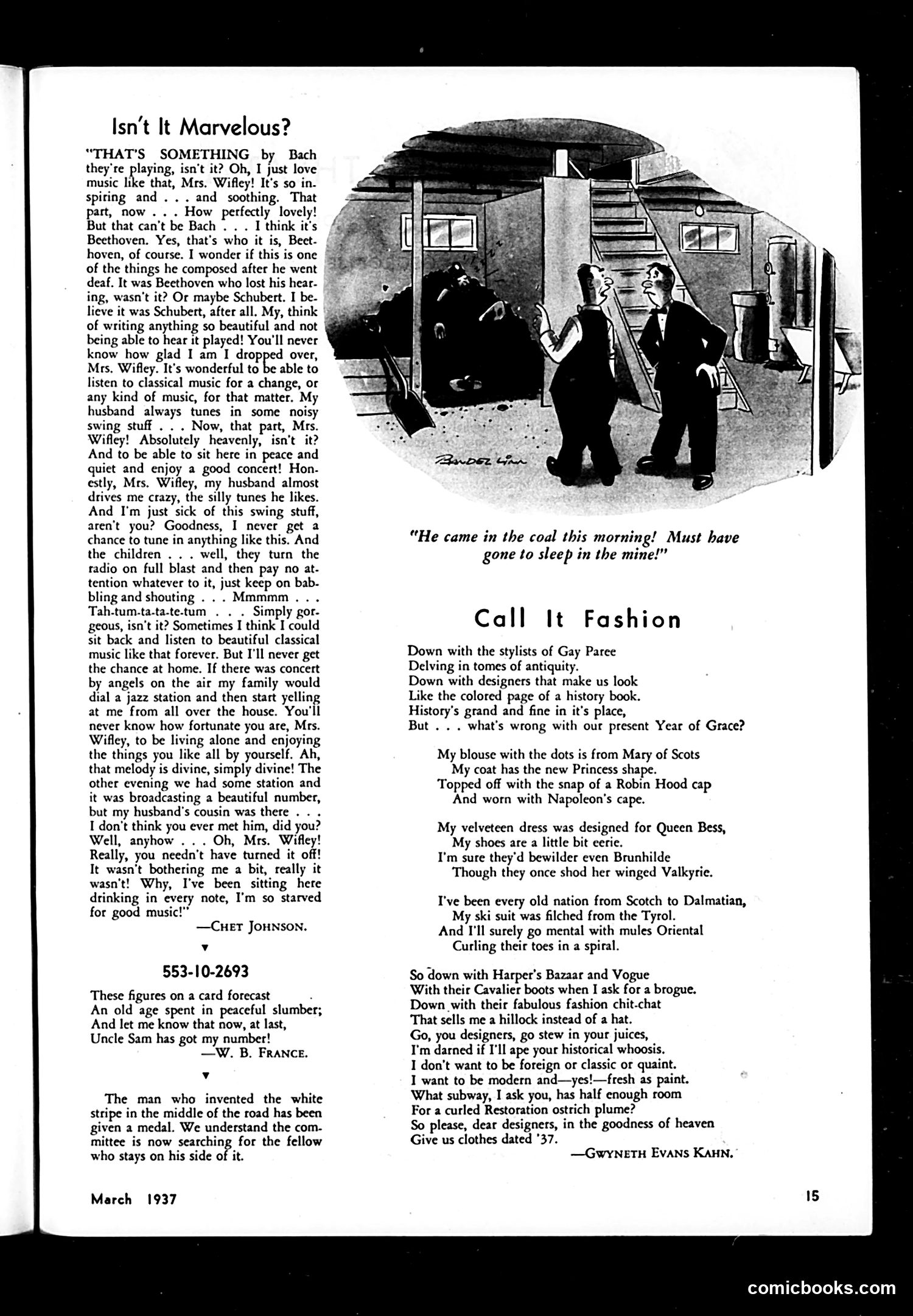
Judge Magazine, March 1937: Content Analysis The main cartoon depicts two women listening to classical music on radio. The accompanying monologue satirizes pretentious, distracted listening—the speaker confuses Bach with Beethoven and Schubert, offers contradictory praise ("absolutely heavenly" while humming "Tah-tum-ta-ta-te-tum"), and envies her friend's solitude from family noise and "swing stuff." The satire targets 1930s middle-class affectation: people who claim to appreciate high culture but demonstrate shallow, scattered attention. The speaker's inability to identify composers and simultaneous self-congratulation about preferring classical music over jazz reflects period class anxieties about taste and sophistication. "Call It Fashion" below mocks 1930s designers' obsession with historical costume references—combining Mary Queen of Scots, Napoleon, Queen Bess, and Valkyrie imagery into contemporary dress. The poem satirizes fashion magazines (*Harper's Bazaar*, *Vogue*) for selling impractical, historically derivative styles as modern sophistication. Both pieces critique 1930s cultural pretension and commercial manipulation of middle-class aspirations.
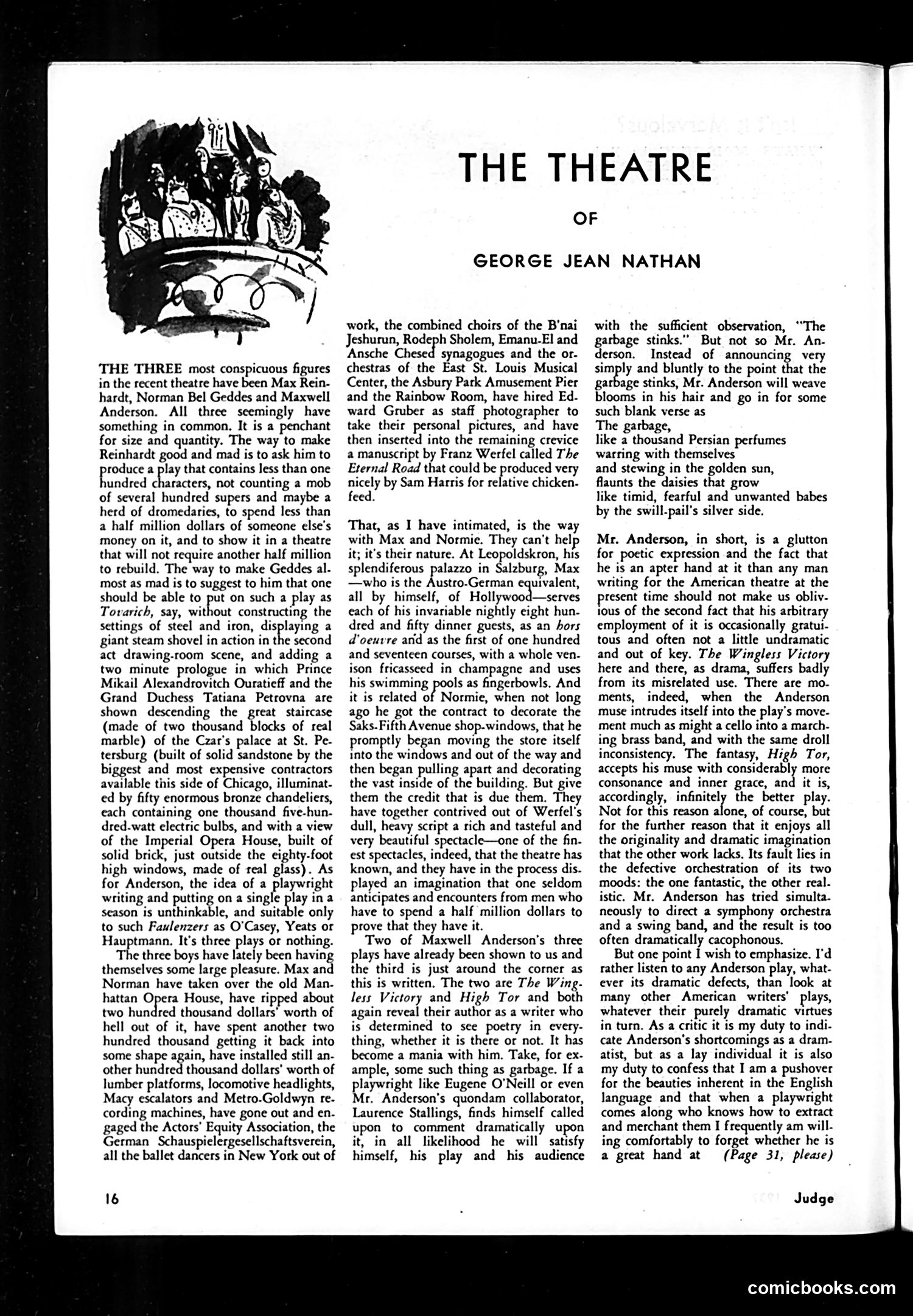
"The Theatre of George Jean Nathan" This is a theater criticism column by prominent drama critic George Jean Nathan, not a political cartoon. The page discusses three major theatrical figures of the era: Max Reinhardt (Austrian theater director), Norman Bel Geddes (set designer), and Maxwell Anderson (playwright). Nathan satirizes their shared obsession with excessive scale and extravagance. He mocks Reinhardt's demand for hundreds of performers and massive budgets, Geddes's elaborate set designs (describing absurdly ornate reconstructions), and Anderson's insistence on producing multiple plays annually. The tone is witty mockery of their grandiosity—Nathan suggests these men cannot help but approach theater with maximum spectacle and expense, whether producing plays or even decorating department store windows. The satire critiques artistic excess and ego in 1930s American theater, contrasting these figures with more economical playwrights like O'Casey and Yeats.
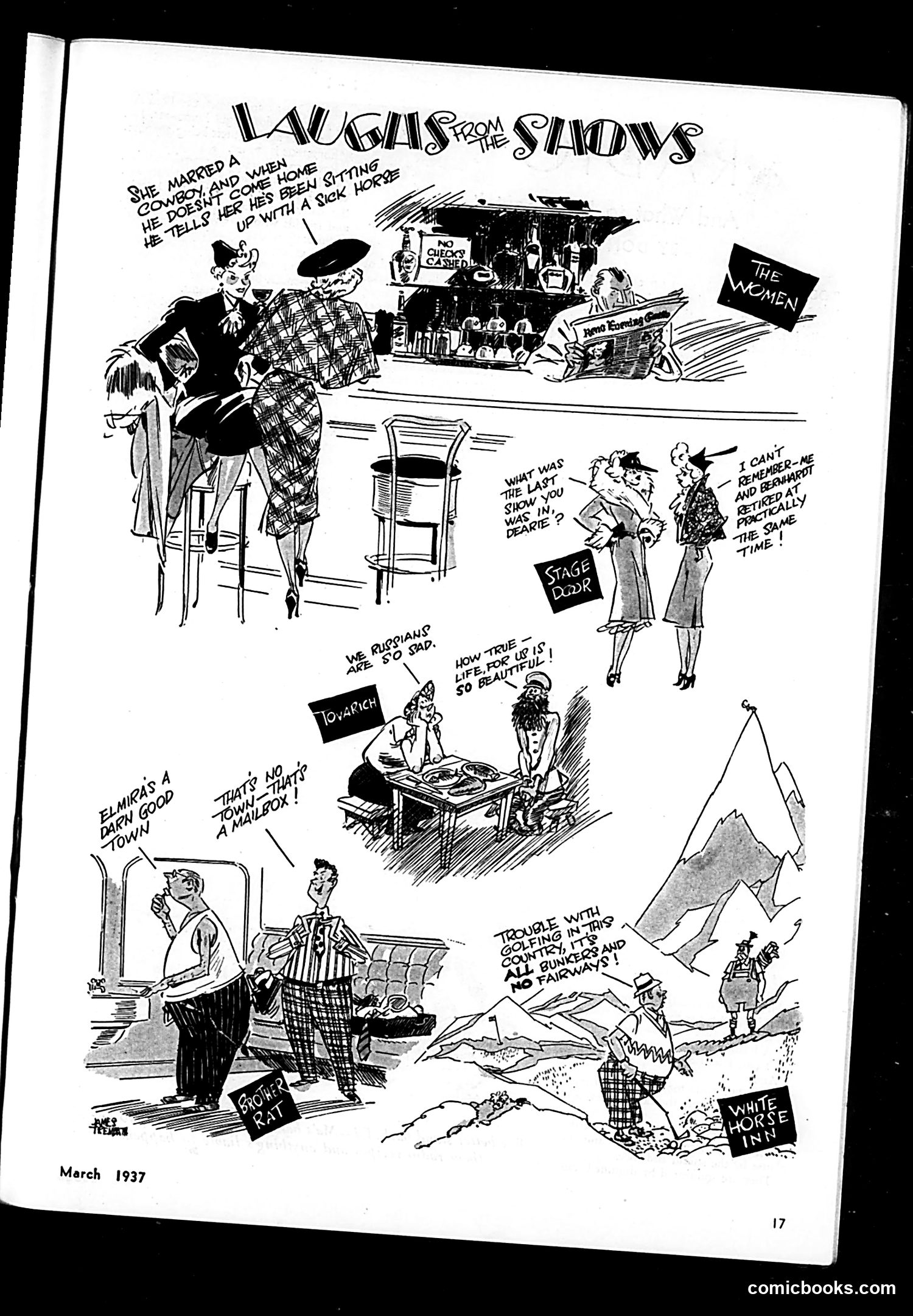
"Laughs from the Shows" — March 1937 This is a satirical cartoon page mocking Broadway and theatrical productions of the era. The sketches depict various backstage and performance scenarios with exaggerated characters and dialogue. Key references visible include: - A cowboy/Western show ("She married a cowboy and when he wasn't home sitting...up with a sick horse") - A show called "The Women" (likely referencing the 1936 Clare Boothe Luce play) - Stage-door interactions and theatrical gossip - References to financial troubles ("Toyatch," "Sh'a Rat," "White Horse Inn") - Commentary on actors' complaints about roles and show business hardships The humor satirizes theatrical pretension, the gap between glamorous stage personas and financial reality, and the petty complaints of performers. This reflects 1930s theatrical culture during the Depression era.
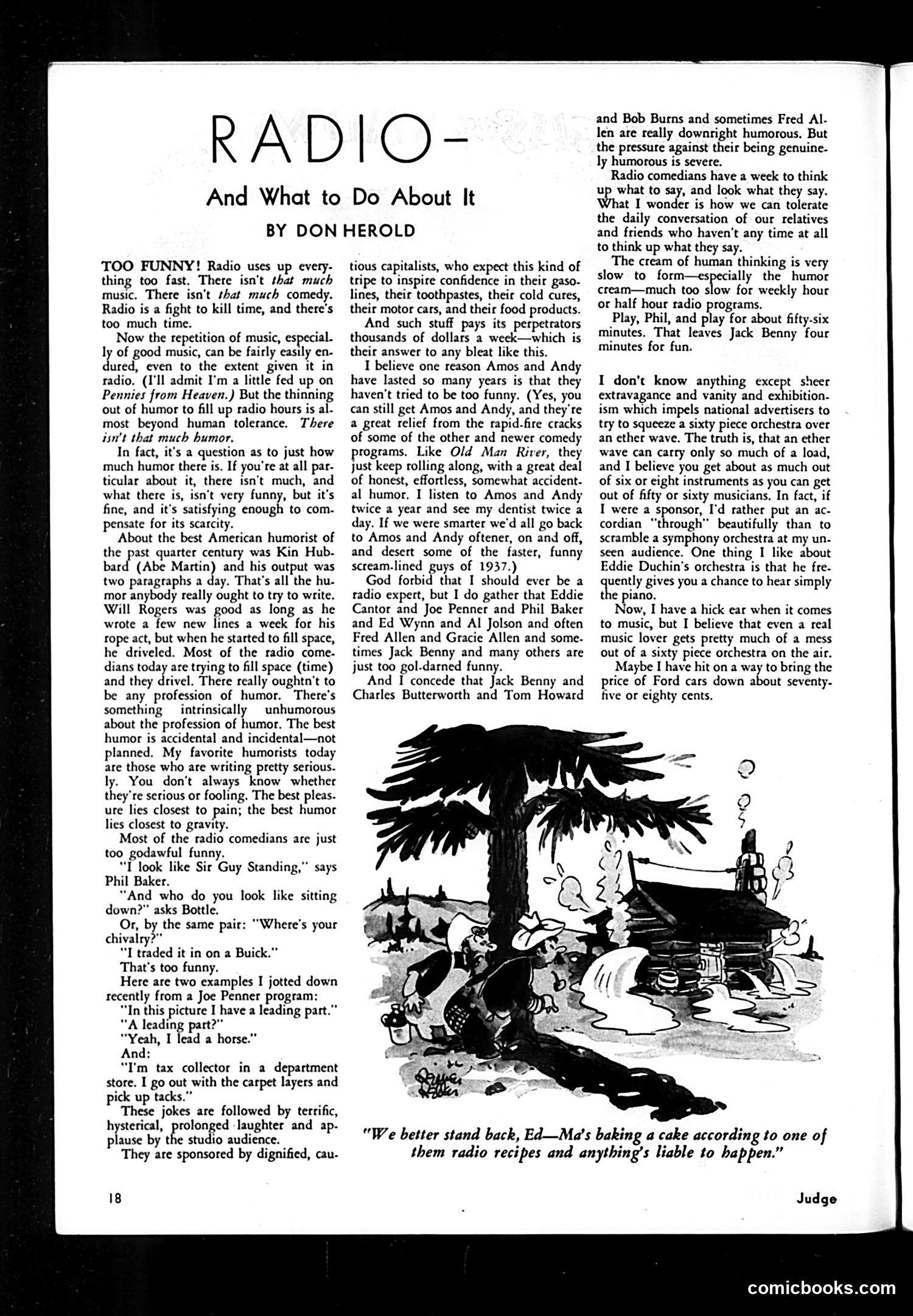
Analysis for Modern Readers This 1937 *Judge* magazine article by Don Herold critiques radio comedy's oversaturation. Herold argues radio uses up humor too quickly, forcing comedians to "drivel" by filling endless airtime—a fundamental structural problem. He praises Amos and Andy for understated humor and criticizes comedians like Joe Penner, Phil Baker, Ed Wynn, and Eddie Cantor for being "too godawful funny"—their rapid-fire, forced jokes followed by canned studio laughter feel inauthentic. Herold distinguishes between accidental humor (genuine) and professional humor (inherently false). The cartoon illustrates the chaos: a mishap during a radio recipe segment, exemplifying how live broadcasting's unpredictability creates humor accidentally rather than by design. Herold's complaint reflects early radio's growing pains: sponsors demanding comedic content to sell products, yet quality humor cannot be mass-produced. The irony is that expensive comedians making thousands weekly produce inferior comedy to historically great humorists like Kin Hubbard, who wrote only two paragraphs daily.
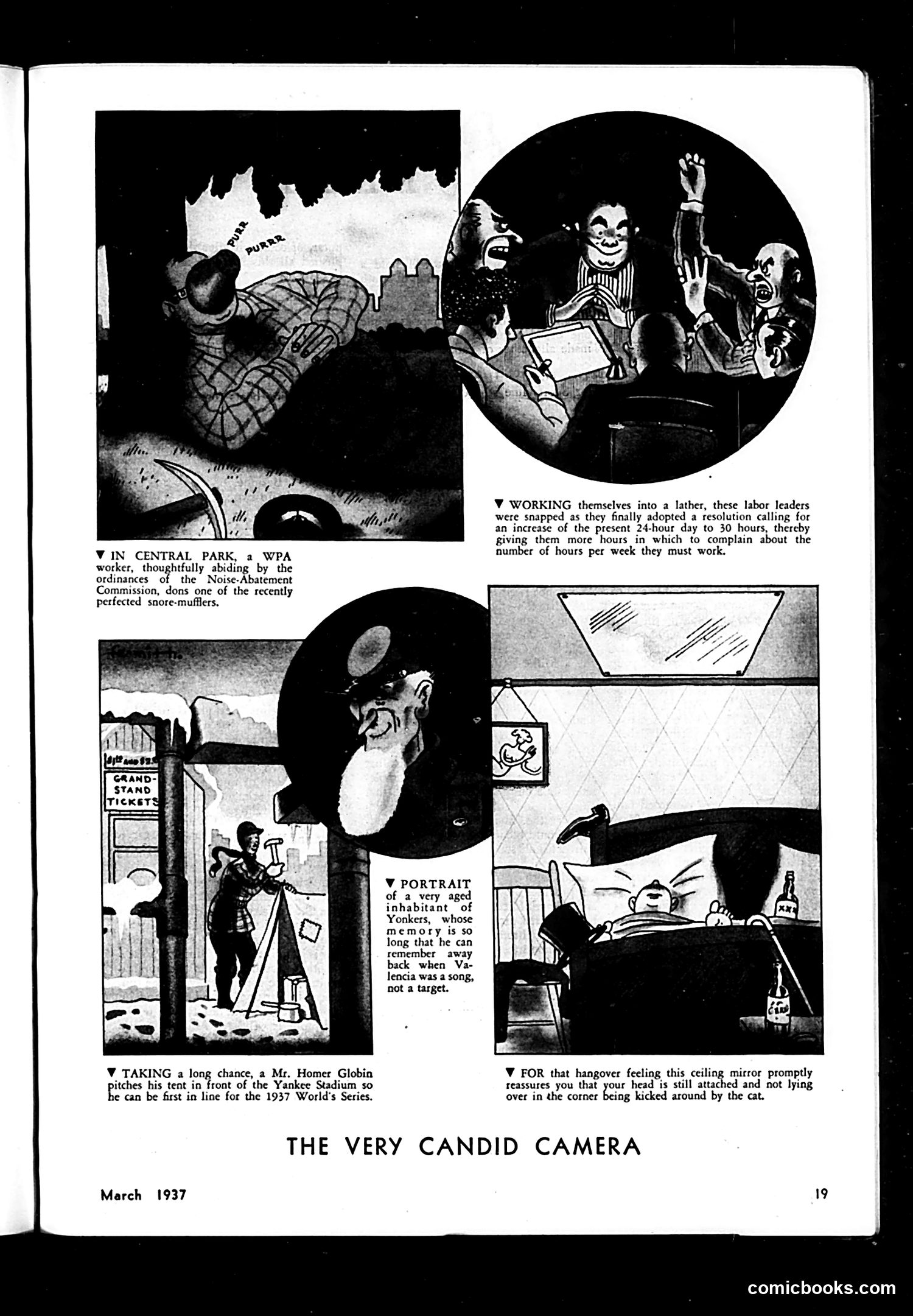
"The Very Candid Camera" - March 1937 This page from *Judge* magazine presents satirical vignettes mocking contemporary issues through exaggerated cartoon humor: Top left: A WPA worker wearing a "snore-muffler" in Central Park—satirizing both the Depression-era Works Progress Administration and the city's noise-abatement regulations as absurdly overreaching. Middle left: A man camping at Yankee Stadium for World Series tickets, poking fun at sports enthusiasm and willingness to camp out for events. Bottom left: An elderly Yonkers resident so old he remembers "Valencia" as a song rather than a target (likely referencing Valencia as a bombing target during the Spanish Civil War, suggesting his memory predates recent events). Top right: Labor leaders adopting a resolution requesting a 30-hour day—cynical satire suggesting labor organizers complain endlessly about working hours regardless of actual conditions. Bottom right: A hangover-recovery mirror joke about a disheveled man confirming his head is still attached after a night of drinking. The cartoons collectively mock WPA bureaucracy, sports obsession, aging, labor activism, and excess.
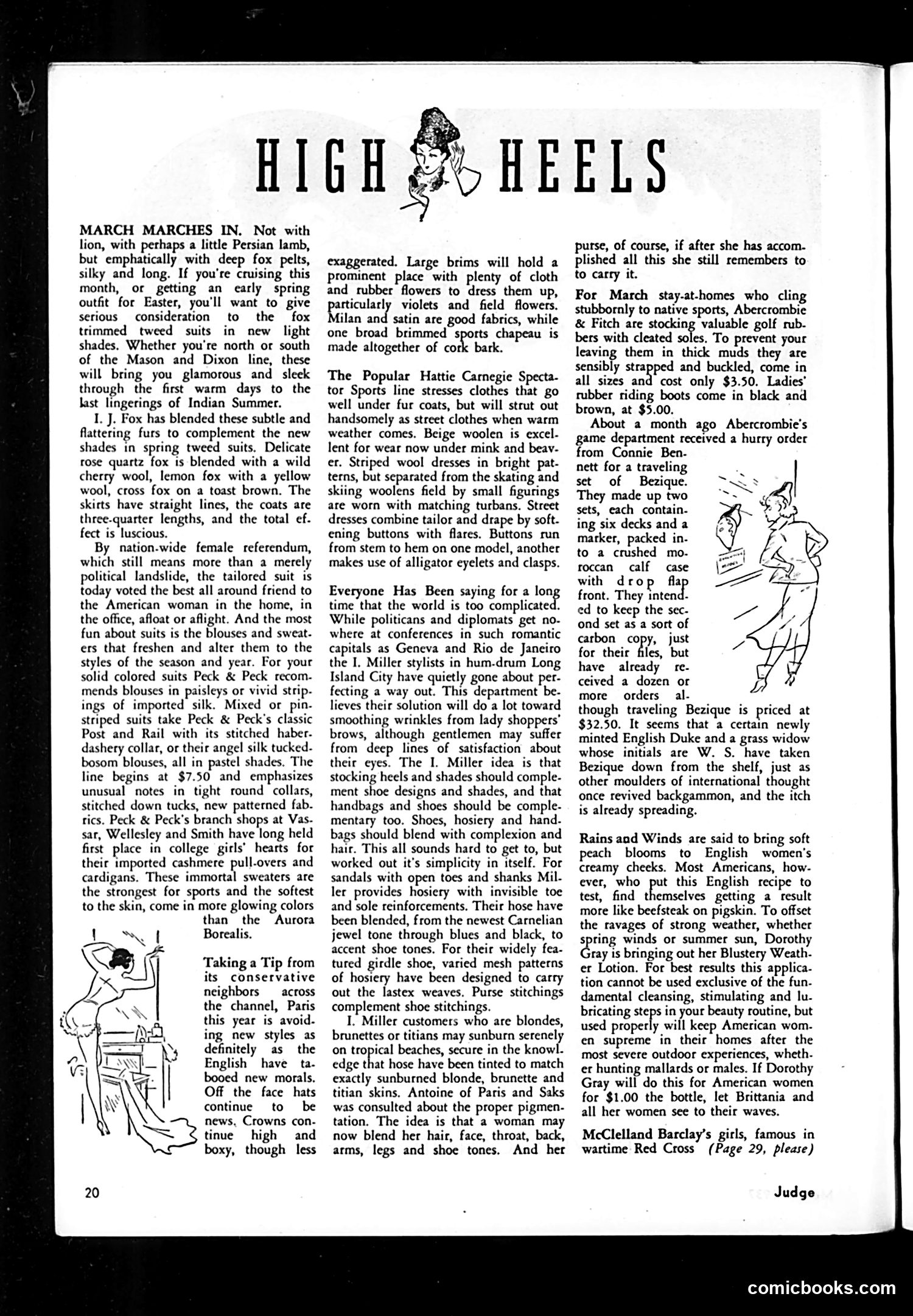
"High Heels" - Fashion Column Analysis This is primarily a fashion advice column, not political satire. The page features three illustrated vignettes showing women modeling clothing and accessories, accompanying text about spring fashions. The "satire" is gentle social commentary rather than pointed political critique: 1. Opening section mocks the pretentious nature of high fashion by suggesting March "marches in" with luxury furs (fox pelts, Persian lamb) — treating seasonal fashion changes with mock-serious tone. 2. Mid-page joke about Paris and English fashion conservatism — Paris avoids "new styles" while England has "tabooed new morals," a light jab at post-WWI social rigidity in both countries. 3. Closing section contains gentle humor about shoe/stocking coordination solving world complexity better than diplomats at Geneva and Rio de Janeiro — a whimsical contrast between fashion practicality and international politics' futility. The illustrations show typical 1920s-30s women in various outfits. This is essentially lifestyle journalism with light satirical seasoning, typical of Judge magazine's fashion coverage.
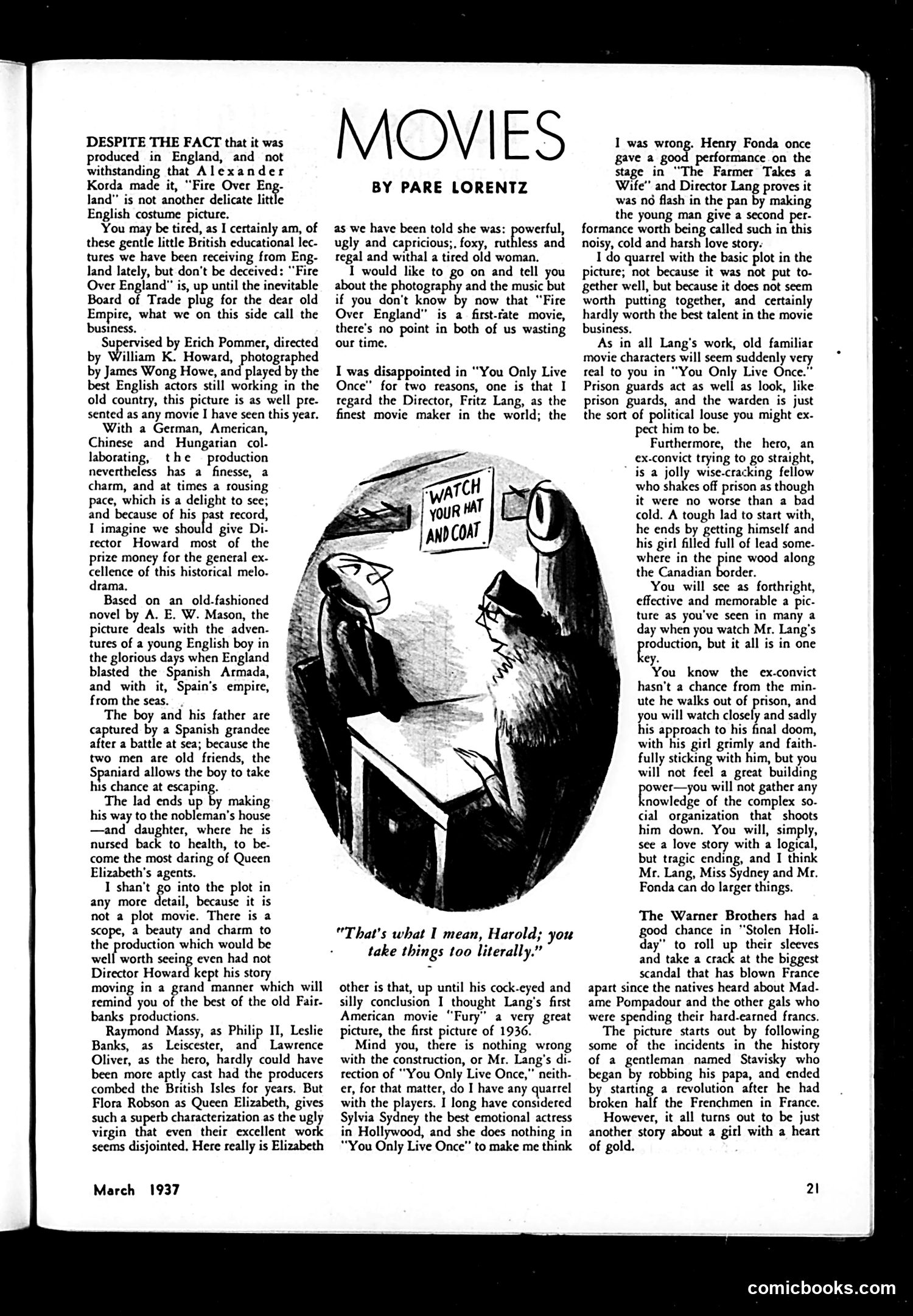
Explanation for Modern Readers This page contains two film reviews by Pare Lorentz from *Judge* magazine (March 1937). The cartoon depicts a coat-check attendant and patron—a visual joke accompanying the reviews rather than political satire. "Fire Over England": Lorentz praises this British historical film about the Spanish Armada era, despite his fatigue with British "educational lectures." He credits its success to talented direction and international crew collaboration, and particularly lauds Flora Robson's performance as Queen Elizabeth I. "You Only Live Once": Lorentz expresses disappointment in Fritz Lang's American directorial debut, though he respects Lang as "the finest movie maker in the world." He praises the cast (Sylvia Sydney, Henry Fonda) and Lang's direction but criticizes the film's "cock-eyed and silly conclusion," contrasting it unfavorably with Lang's 1936 film "Fury." The cartoon's caption—"That's what I mean, Harold; you take things too literally"—appears unrelated to the reviews themselves, functioning as generic magazine humor.
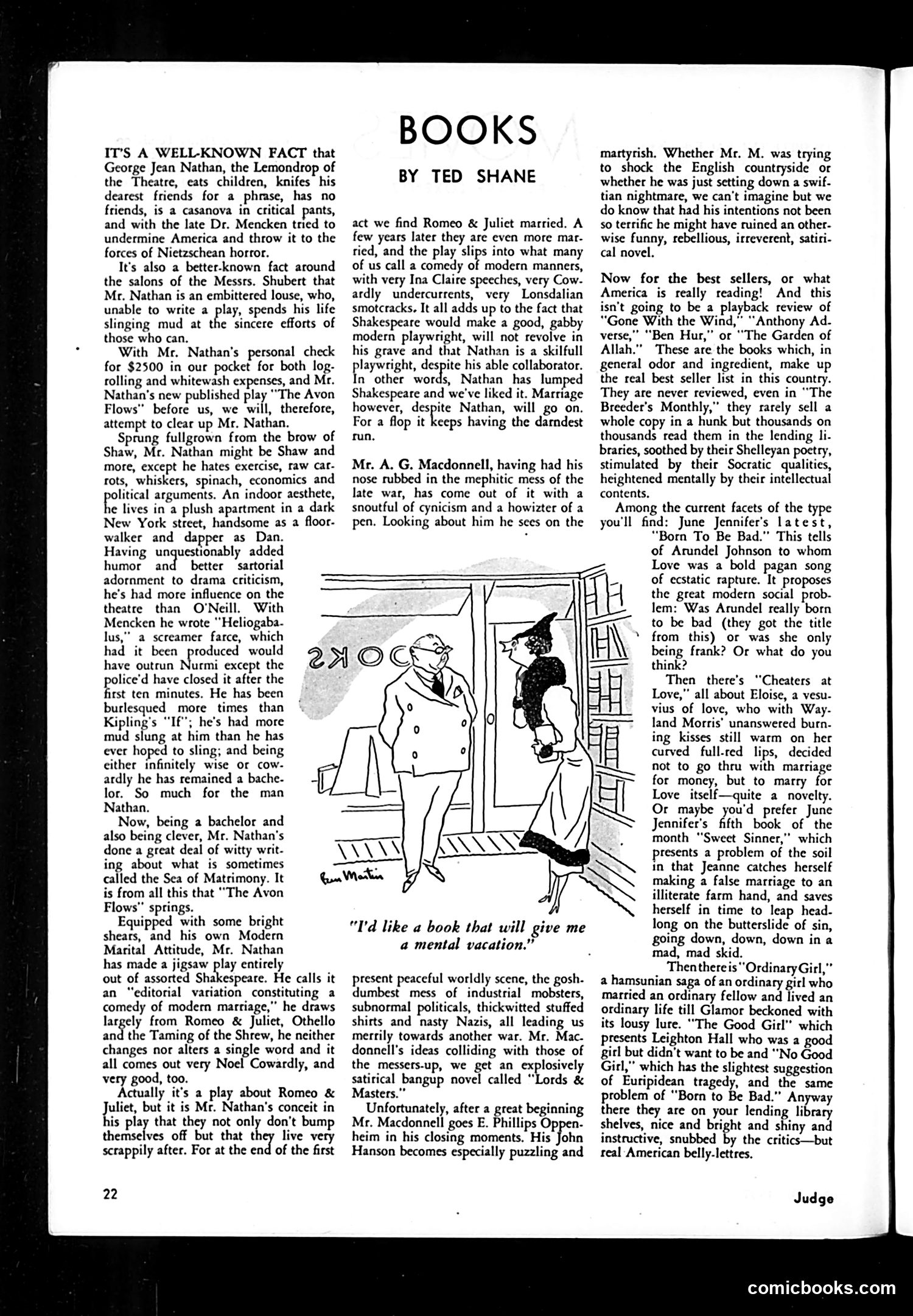
Analysis for Modern Readers This is a book review column by Ted Shane in Judge magazine satirizing theater critic George Jean Nathan. The opening paragraph is intentionally hyperbolic—claiming Nathan "eats children" and "knifes his dearest friends"—establishing this as mock-serious satire. The piece reviews Nathan's play "The Avon Flows," which ingeniously reconstructs Shakespeare scenes (primarily Romeo & Juliet) with modern marriage comedy dialogue. The satire praises Nathan for this literary collage while slyly mocking his aesthetic pretensions and bachelor lifestyle. The cartoon depicts Nathan (identifiable by context) requesting "a book that will give me a mental vacation"—a joke about his own jaded, intellectual cynicism. The column also reviews works by A.G. Macdonnell, a war veteran whose cynical pen criticizes postwar political incompetence and industrial corruption. The review celebrates his satirical bite while suggesting impending war (likely written in the 1930s, given Nazi references). Overall: sophisticated literary insider satire targeting Nathan's pretensions while praising his actual theatrical cleverness.
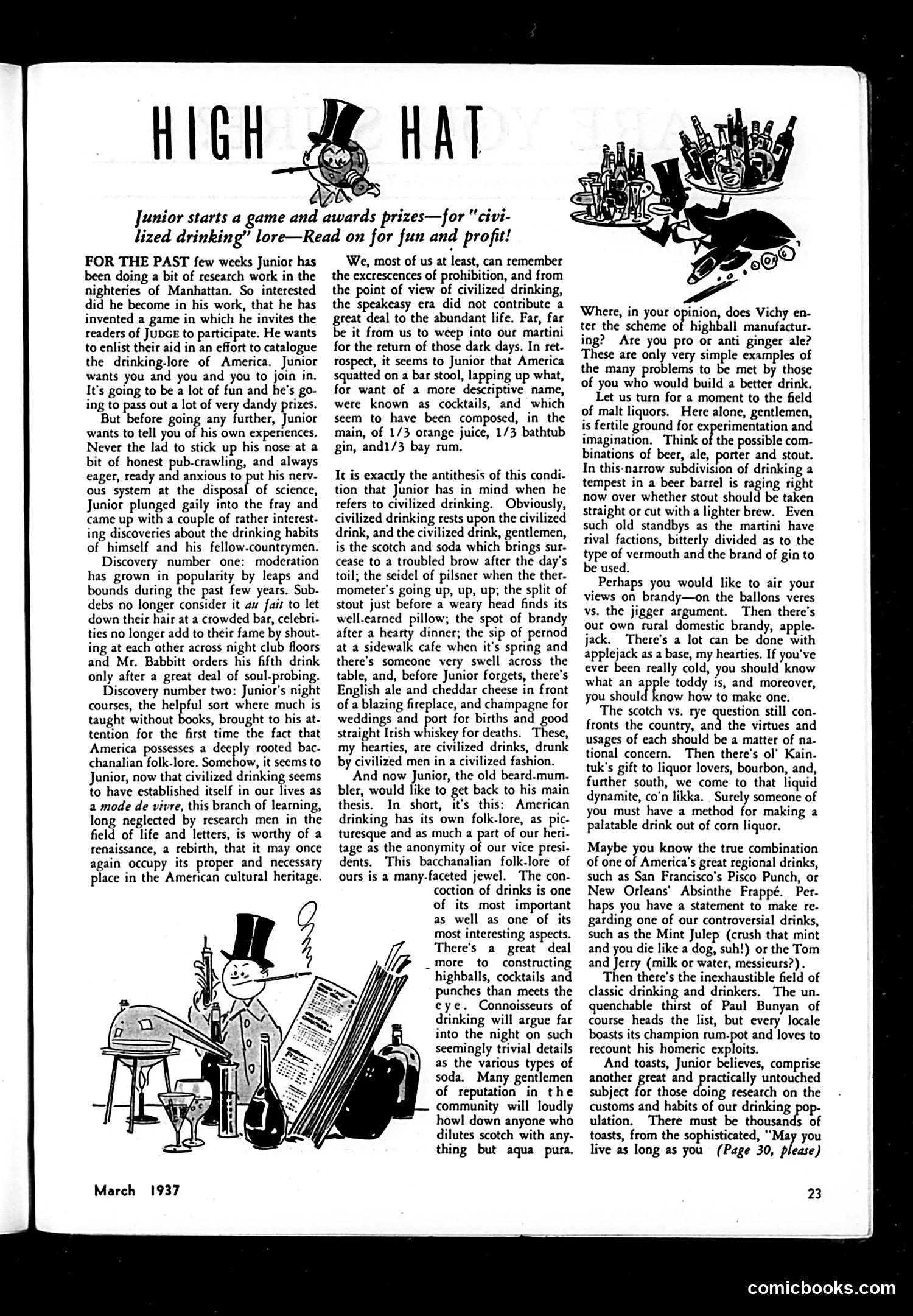
"High Hat": Judge Magazine's Post-Prohibition Drinking Guide (March 1937) This satirical article by "Junior" mocks America's newfound pretension about "civilized drinking" following Prohibition's repeal (1933). The piece contrasts the chaotic speakeasy era—where crude bathtub gin cocktails dominated—with supposedly refined post-Prohibition practices: scotch and soda, pilsner beer, brandy, Irish whiskey, and champagne consumed by "gentlemen." The satire targets middle-class Americans' aspirations to sophistication. Junior announces a game awarding prizes for drinking "lore," positioning himself as an anthropologist studying American bacchanalian folk culture. The cartoons show jovial drinkers surrounded by bottles, reinforcing the ironic celebration of drinking as cultured behavior. The article's tongue-in-cheek tone suggests Judge viewed this cultural reinvention skeptically—Americans simply replacing one form of excess with the pretense of refinement.
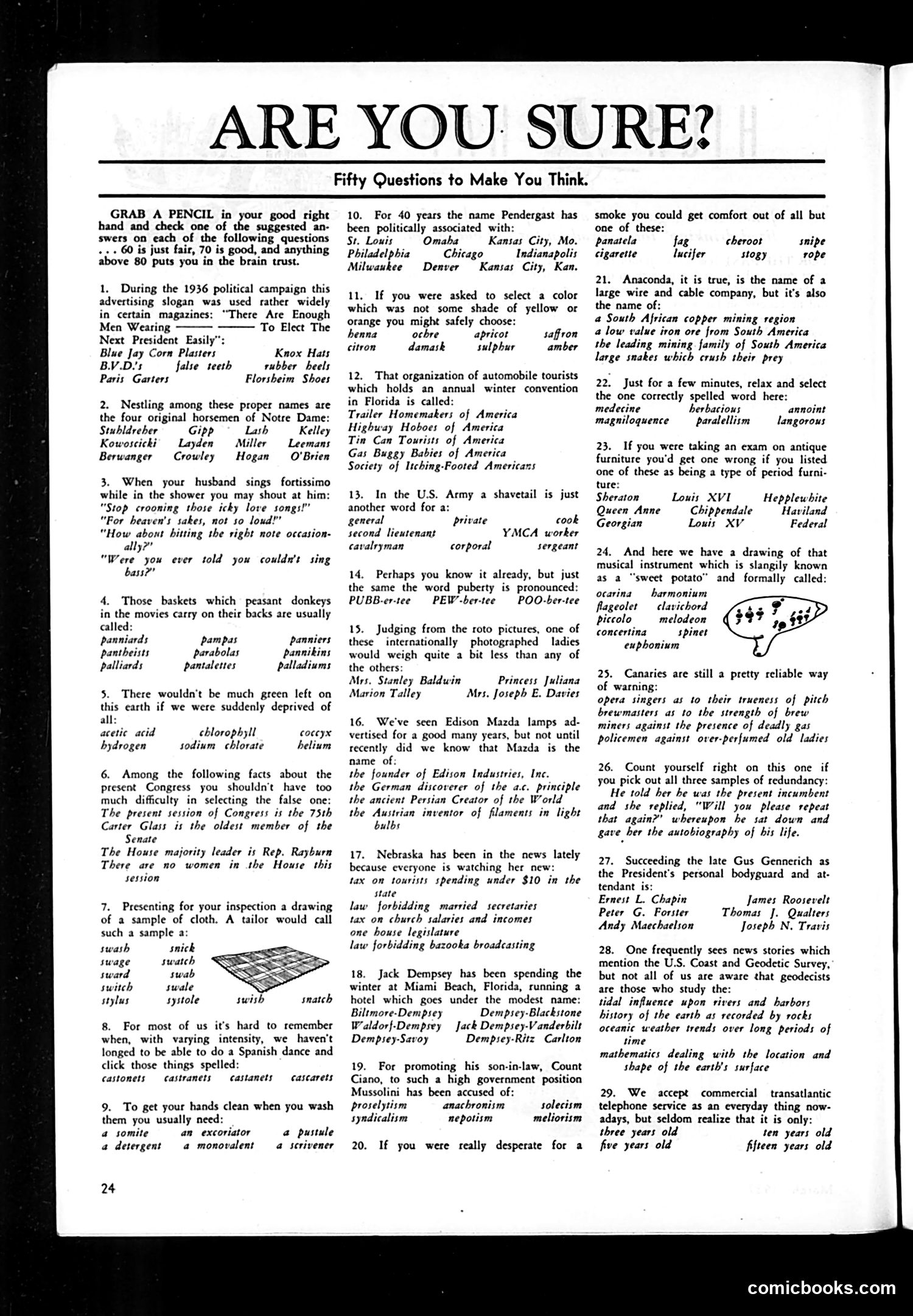
"Are You Sure?" - Judge Magazine Quiz Page This page presents a trivia quiz titled "Fifty Questions to Make You Think," typical of Judge magazine's satirical approach to testing readers' knowledge. The quiz spans diverse topics reflecting 1930s American culture: political campaigns (question 1 references 1936 election slogans), Notre Dame football's "Four Horsemen" (question 2), vocabulary and pronunciation (questions 3, 14), and current events like Tom Pendergast's political machine in Kansas City (question 10). The humor operates on multiple levels—some questions test genuine knowledge while others contain trick answers or absurdist options ("pantheists" for donkey baskets). References to contemporary figures like Princess Juliana and Mrs. Joseph E. Davies anchor questions in recognizable 1930s moments. Scoring instructions ("60 is just fair, 70 is good") mock intellectual pretension. The satire suggests that Americans were simultaneously invested in and befuddled by pop culture trivia, celebrity gossip, and current events—a gentle jab at the magazine's educated readership.
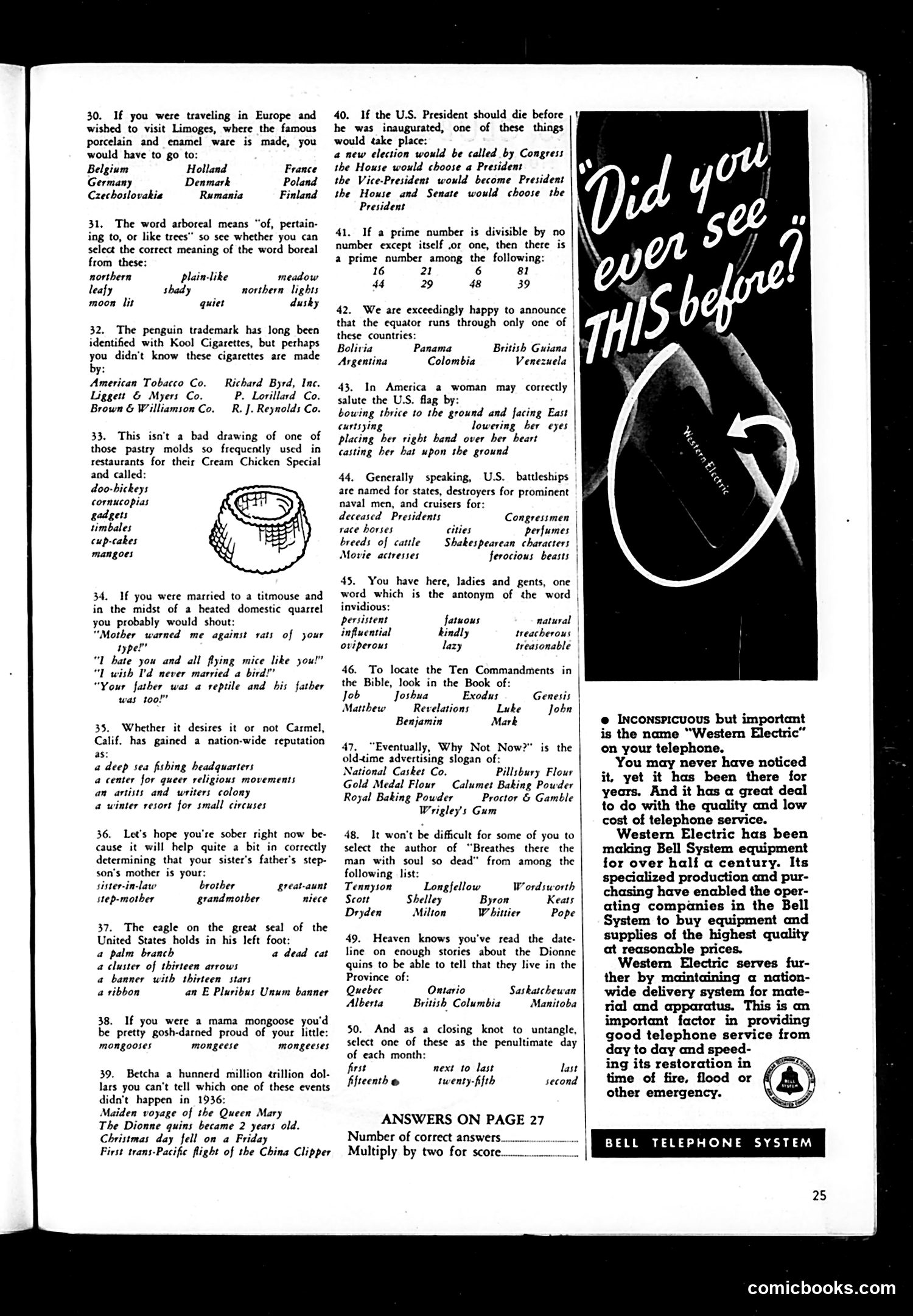
Analysis of Judge Magazine Page Content This page is primarily a trivia quiz with no visible political cartoons. It contains 50 multiple-choice questions on general knowledge—geography (Limoges, Canadian provinces), vocabulary, corporate trivia (Kool Cigarettes manufacturer), U.S. civics (presidential succession, battleship naming), and Bible knowledge. The only notable satirical element is Question 34, which jokes about marrying a "titmouse" (a small bird species)—the humor relies on the word "titmouse" sounding absurd for a spouse, playing on literal versus common understanding. The right side features a Bell Telephone System advertisement emphasizing equipment quality and reliability during emergencies—typical corporate messaging from this era. The page reflects mid-1930s American culture: corporate brand recognition, civics education emphasis, and advertising integration into entertainment content. No specific political figures or events are referenced or caricatured.
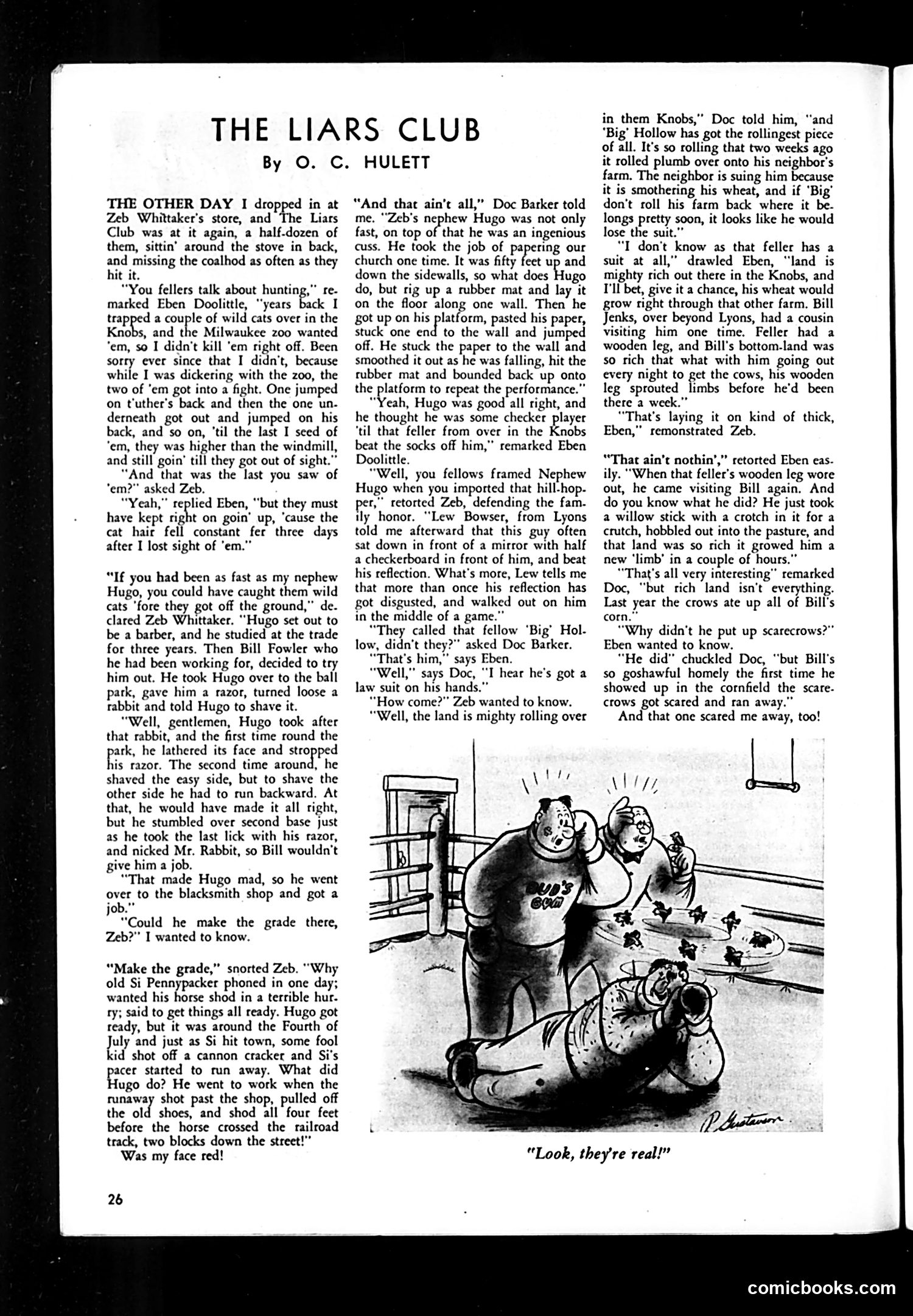
"The Liars Club" - Explanation for Modern Readers This is a humorous short story by O.C. Hulett featuring a group of rural men gathered around a stove, competing to tell increasingly absurd tall tales. The "Liars Club" is a social institution where exaggeration is the entertainment. The cartoon illustrates the escalating nonsense: stories about wild cats fighting so violently they rise above a windmill, a barber named Hugo shaving a running rabbit, and—in the climactic tale—Hugo shoeing a galloping horse in seconds. The final anecdote tops them all: a checkers player so skilled he defeats his own mirror reflection, which eventually walks away in disgust. The satire mocks small-town culture and masculine boasting, where storytellers try to outdo each other with increasingly implausible claims. There are no political figures—just rural Americana stereotypes ("nephew Hugo," "Zeb Whittaker," "Si Pennypacker") embodying the tall-tale tradition. The humor relies on the audience recognizing these stories as obvious fabrications, making the tellers' deadpan delivery the joke itself.
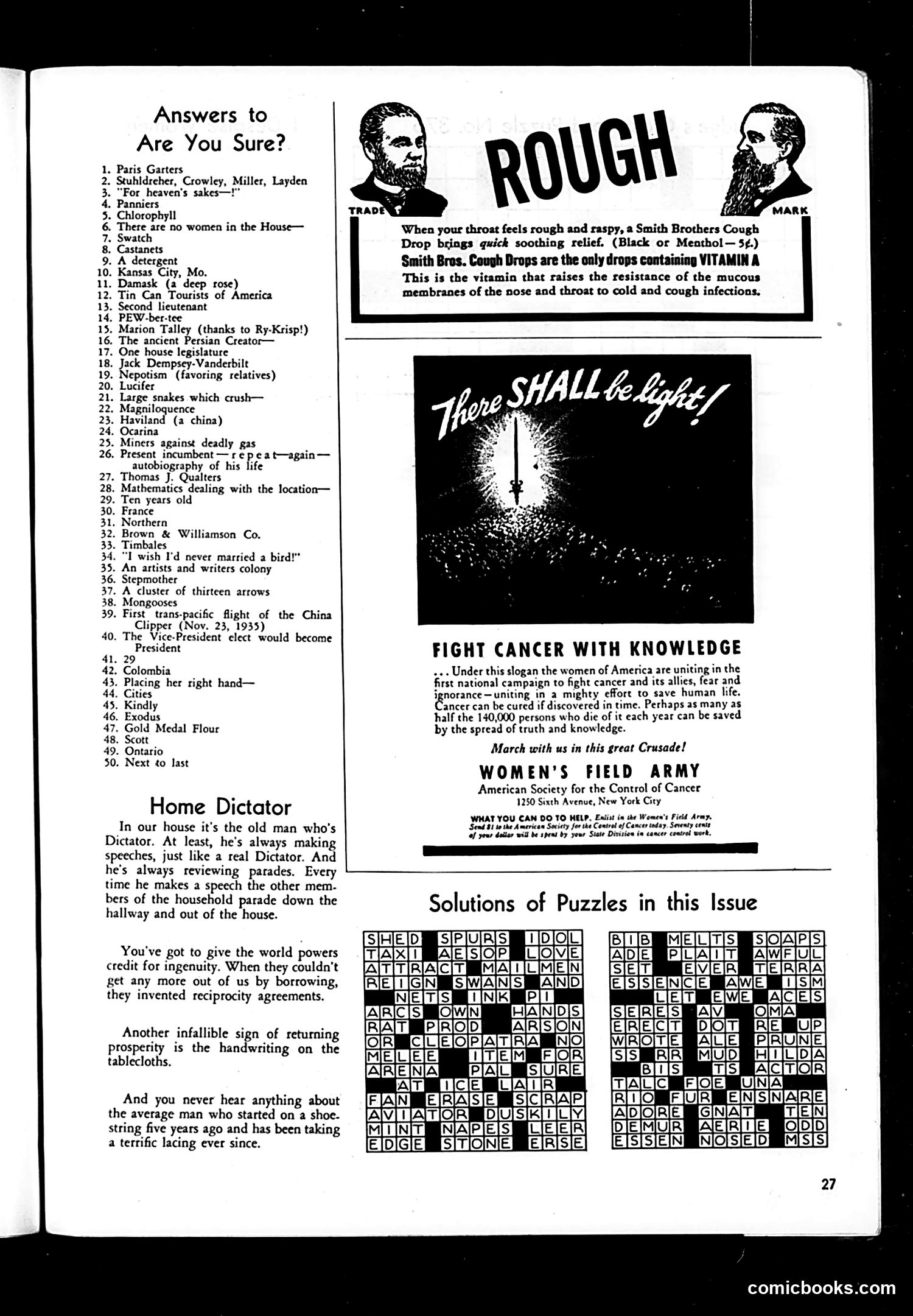
Analysis of Judge Magazine Page This page is primarily puzzle solutions and advertisements rather than political satire. The visible content includes: 1. Answer key to a crossword puzzle ("Are You Sure?"), listing 50 solutions ranging from Paris Garters to "Next to last." 2. Three advertisements: - Smith Brothers Cough Drops (emphasizing Vitamin A) - A cancer awareness campaign for the "Women's Field Army" by the American Society for the Control of Cancer - Various product endorsements 3. Humorous filler text with light social commentary ("Home Dictator," observations about reciprocity agreements and prosperity). The only satirical element is the brief "Home Dictator" column, which jokes that the father of a household acts like an authoritarian ruler, making speeches and "reviewing parades" while family members flee. This is gentle domestic humor rather than political satire. The page appears to be from mid-1930s Judge, reflecting period concerns about cancer awareness and consumer products.
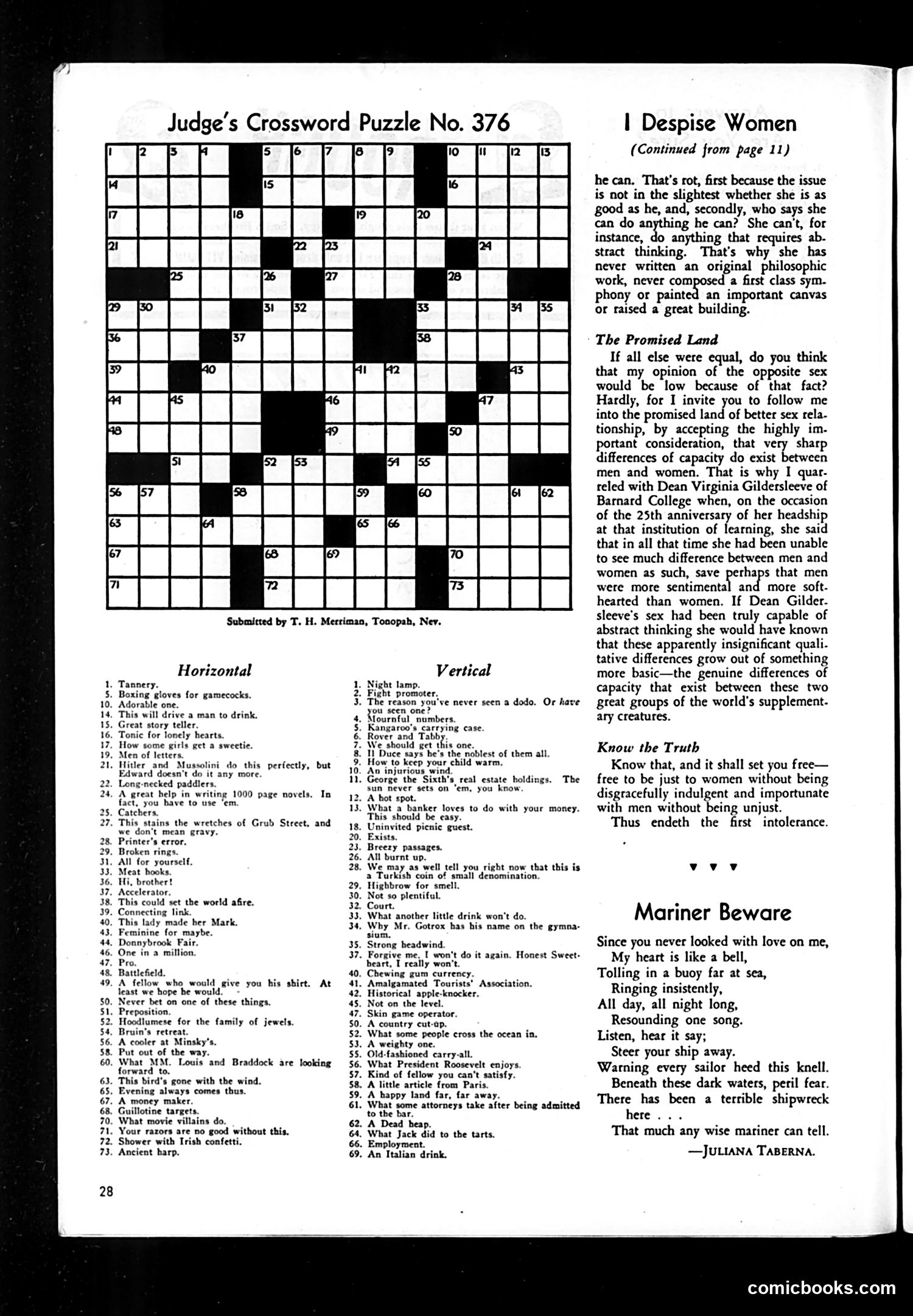
Analysis of Judge Magazine Page 376 This page contains Judge's Crossword Puzzle No. 376—a standard word puzzle feature, not a political cartoon. The puzzle uses clever, topical clues reflecting 1930s-40s American culture and concerns. Notable clue references include: - Hitler and Mussolini (clue 19)—contemporary fascist leaders - Edward (clue 19)—likely Edward VIII, who abdicated in 1936 - King George the Sixth's real estate (vertical clue 11)—referencing post-abdication British monarchy - President Roosevelt (vertical clue 56)—FDR - Various entertainment/celebrity references (Minsky's burlesque theater, boxing figures Louis and Braddock) The adjacent article, "I Despise Women," argues women lack capacity for abstract thinking and haven't produced great philosophical or artistic works—a deeply misogynistic period perspective Judge apparently published for debate. The page serves primarily as entertainment/puzzle content rather than satire, though the clues reflect contemporary political figures and events.
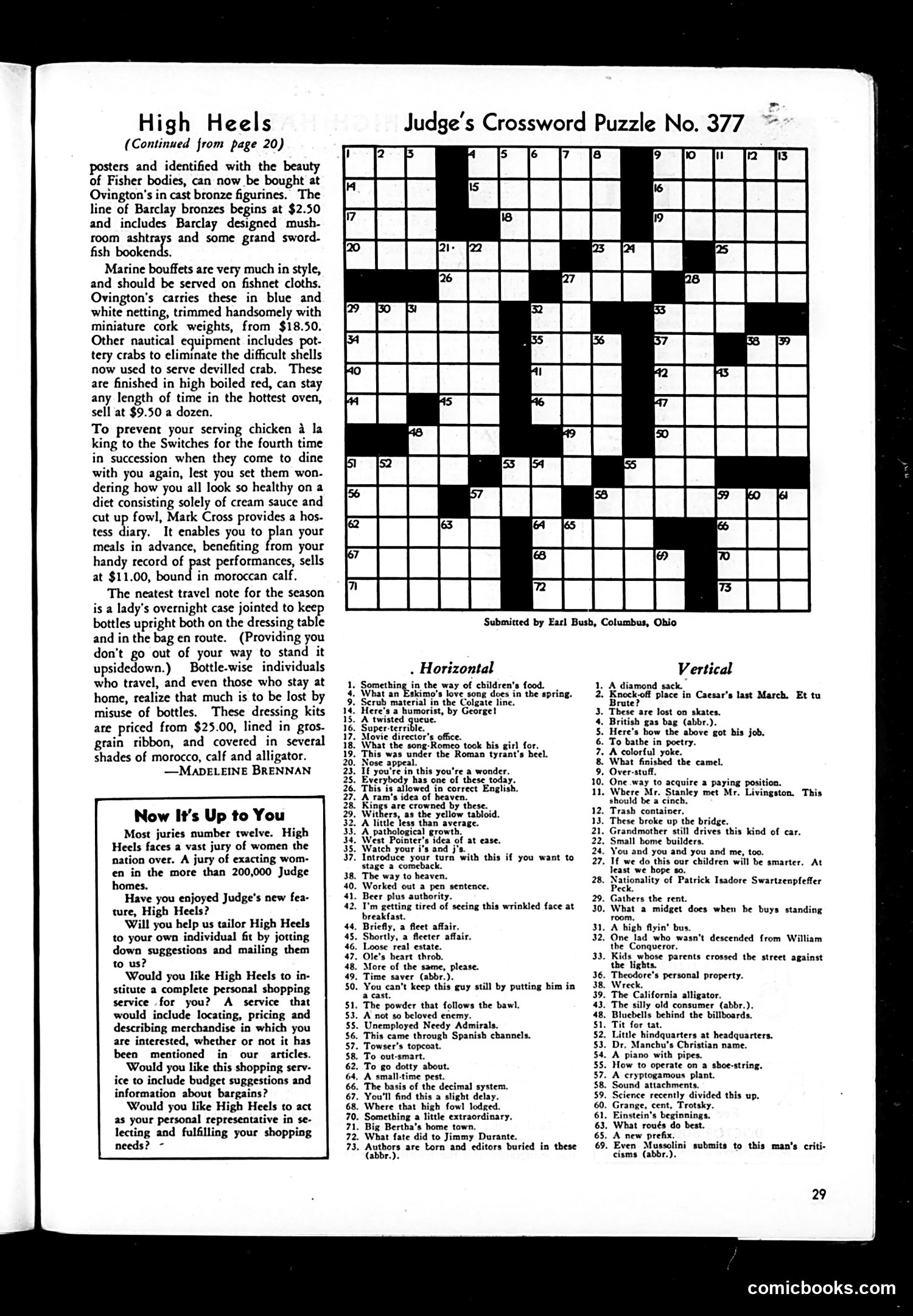
Judge Magazine Page Analysis This page consists primarily of advertising and reader engagement content, not political satire. The main feature is "High Heels," a lifestyle/shopping column by Madeleine Brennan discussing upscale home furnishings and accessories (Fisher bronze figurines, marine buffets, hostess diaries, luxury travel cases) sold at retailers like Ovington's and Mark Cross. The writing targets affluent female readers with disposable income. Below is a reader survey ("Now It's Up to You") asking Judge's female audience whether they want the magazine to expand "High Heels" into a personal shopping service—indicating Judge was testing a new revenue model during what appears to be the 1920s-1930s. The page concludes with Judge's Crossword Puzzle No. 377, a standard puzzle feature unrelated to satire or political commentary. This is essentially a commercial/administrative page rather than satirical content.
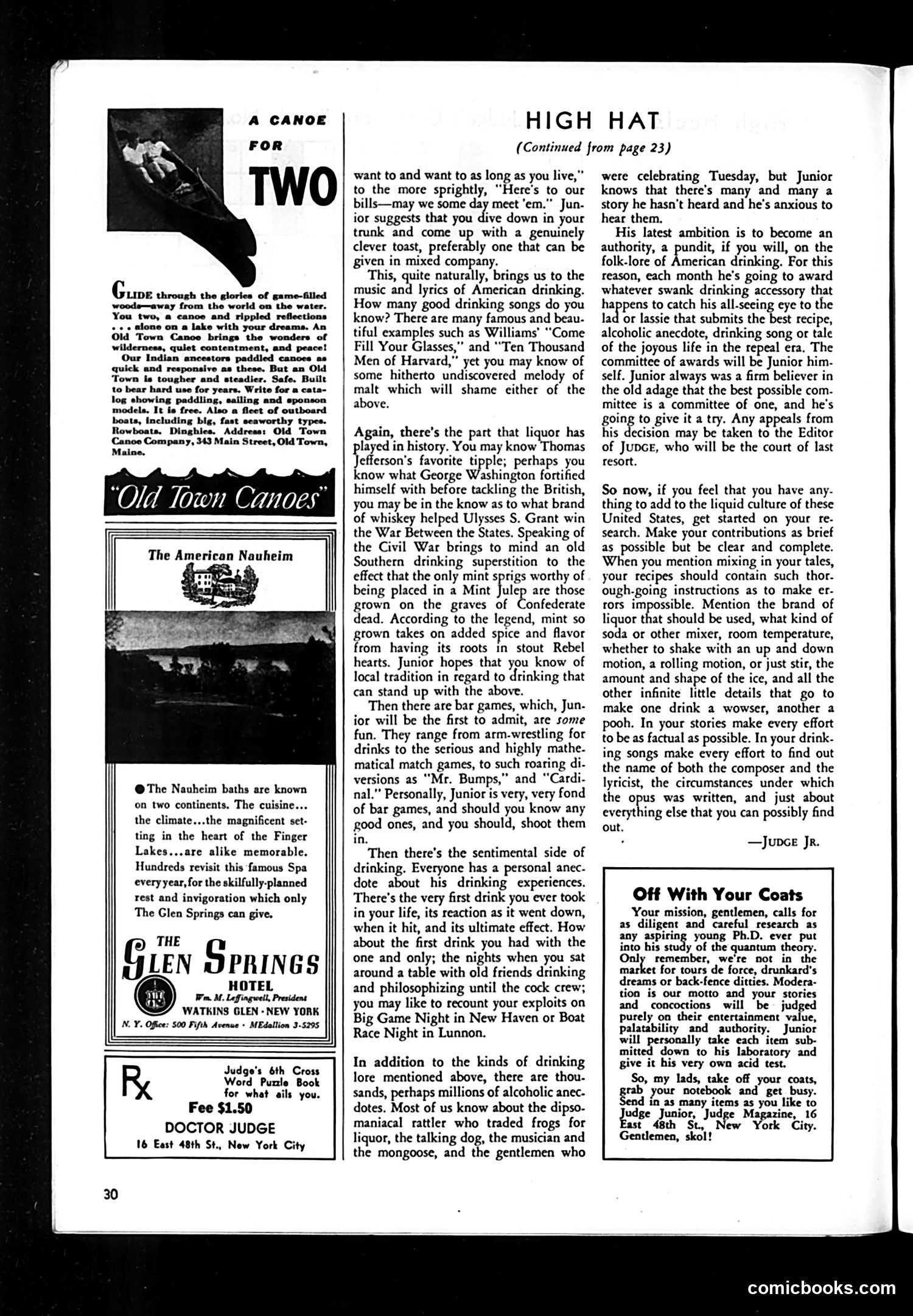
Analysis of This Judge Magazine Page This page is primarily advertising and editorial content rather than political satire. The layout features: Advertisements: - Old Town Canoes (romantic leisure product) - The American Nauheim hotel (spa resort) - Glen Springs Hotel (Finger Lakes resort) - Doctor Judge's crossword puzzle book Main Editorial Content: The "High Hat" column continues from page 23, discussing American drinking culture and traditions. Written by "Judge Jr.," it humorously catalogs drinking-related Americana: famous toasts, drinking songs, historical anecdotes (Jefferson, Washington, Grant), Southern mint julep superstitions, bar games ("Mr. Bumps," "Cardinal"), and personal drinking memories. Context for Modern Readers: This reflects 1920s-30s attitudes toward alcohol—pre-Prohibition repeal or during its later years—treating drinking as a genteel, cultured, historical American activity worthy of serious documentation. The tone is nostalgic and celebratory rather than cautionary, presenting drinking lore as respectable folklore. The page contains no political cartoons or caricatures—it's entertainment and lifestyle content typical of Judge magazine's general-interest approach.
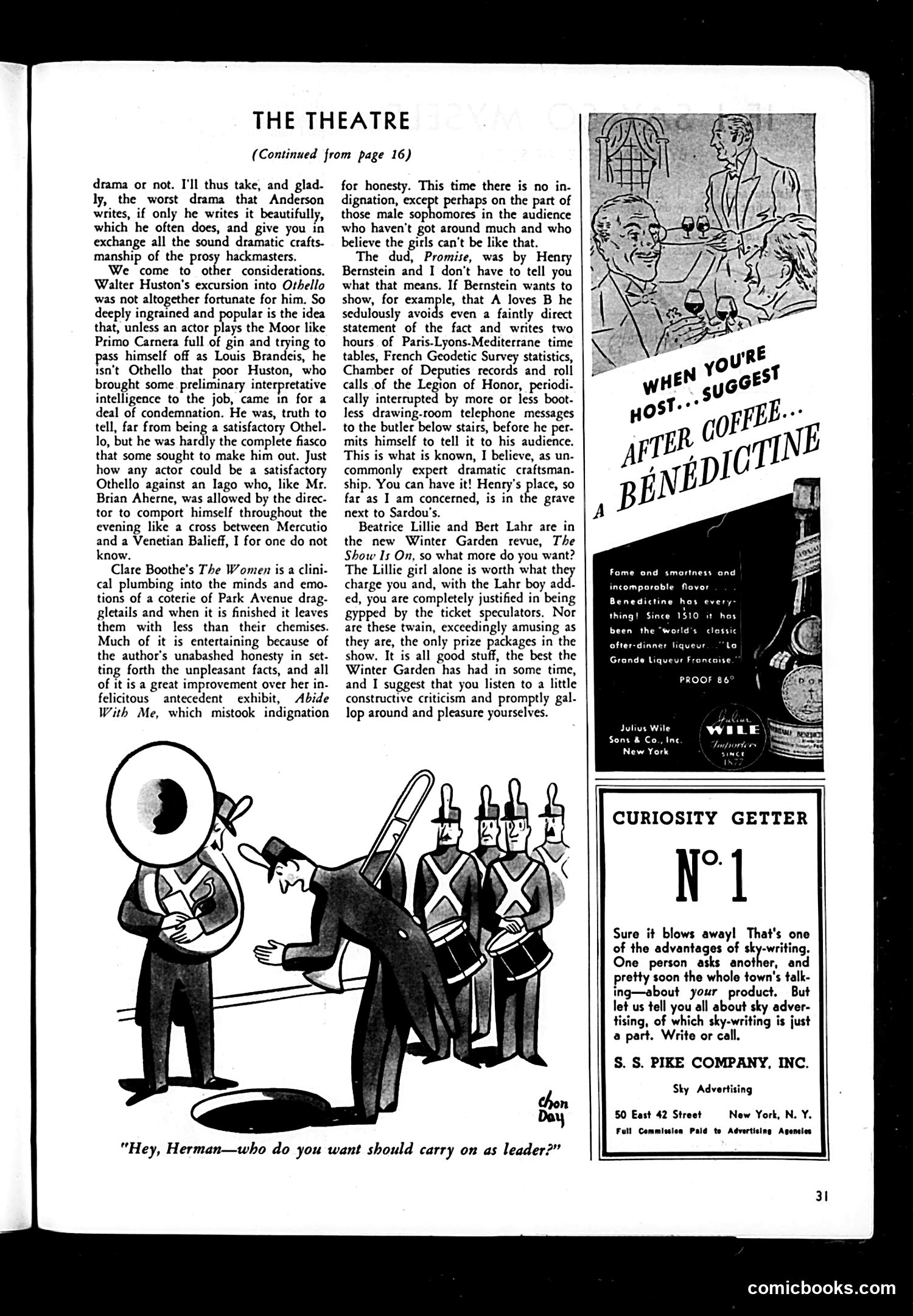
Political Cartoon Analysis The large cartoon by Cesare depicts a humorous scenario about leadership succession. A man in formal dress holds a megaphone while addressing four uniformed soldiers or officials behind him. The caption—"Hey, Herman—who do you want should carry on as leader?"—jokes about delegating authority to subordinates, suggesting the absurdity of asking underlings to choose their own superior. This likely satirizes either corporate or political management practices of the era, mocking the notion that those in lower ranks should determine leadership rather than having it imposed from above. The page itself is primarily a theater review column discussing productions featuring Walter Huston, Clare Boothe, and Beatrice Lillie, alongside period advertisements for Benedictine liqueur and sky-writing advertising services. The cartoon serves as a brief humorous interlude within theater criticism.
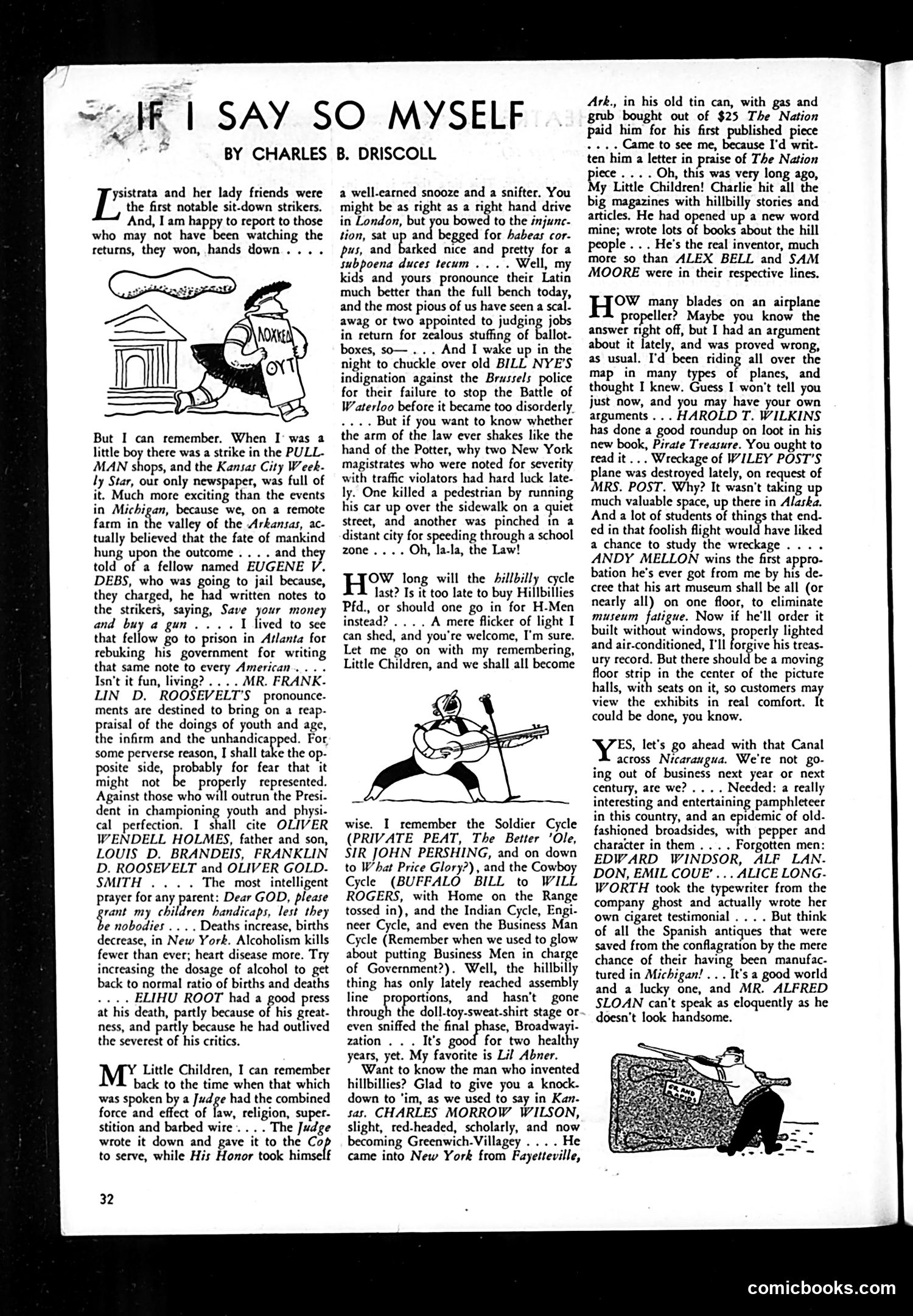
Analysis of Judge Magazine Page This is a personal essay by Charles B. Driscoll reflecting nostalgically on American social and legal history. The cartoon illustrations appear to accompany anecdotes rather than serve as primary satire. Key references: - Lysistrata: Ancient Greek play about women's strike (sex strike) - Eugene V. Debs: Socialist labor leader imprisoned for opposing WWI - FDR's pronouncements: Driscoll sarcastically anticipates Roosevelt will spark reassessment of youth/age/ability issues - Oliver Wendell Holmes (Sr. & Jr.), Brandeis, FDR, Oliver Goldsmith: Examples of accomplished people who overcame handicaps - Bill Nye: 19th-century humorist who critiqued Waterloo's disorder - Hillbilly/Soldier/Cowboy cycles: References to popular entertainment trends and literary cycles (Private Peat, "The Better 'Ole," Pershing references) The piece critiques judicial corruption (judges appointed for ballot-stuffing), legal pretension, and social hypocrisy, while celebrating historical figures who defied limitations. The overall tone is cranky, nostalgic commentary rather than pointed political satire.
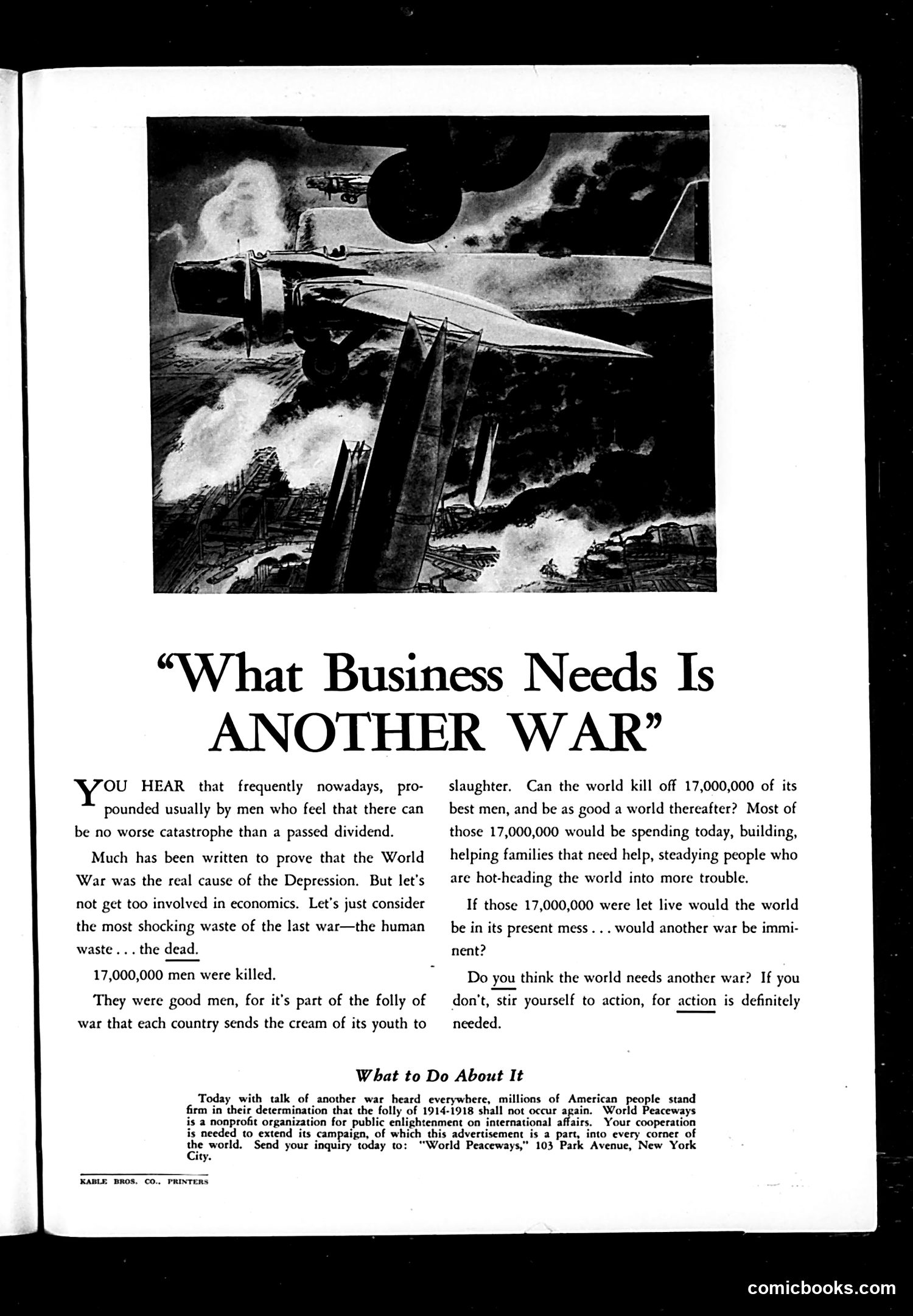
Analysis This is an anti-war advertisement (not a cartoon) from *Judge* magazine, likely from the 1930s. It's propaganda by World Peaceways, a peace advocacy organization. The dramatic illustration shows warplanes attacking industrial targets with explosions—visualizing war's destruction. The text sardonically presents a cynical argument: some businessmen claim "what business needs is another war" to escape economic depression. The ad then refutes this by appealing to emotion: 17 million men died in WWI (1914-1918). Those dead workers and consumers would today be spending money, building infrastructure, and supporting families—boosting the economy far better than war ever could. The closing questions challenge readers: does the world actually *need* another war? If not, act to prevent it. This reflects 1930s American isolationism and pacifism, when many believed WWI's carnage was pointless and another global conflict was being promoted by profiteers indifferent to human cost.
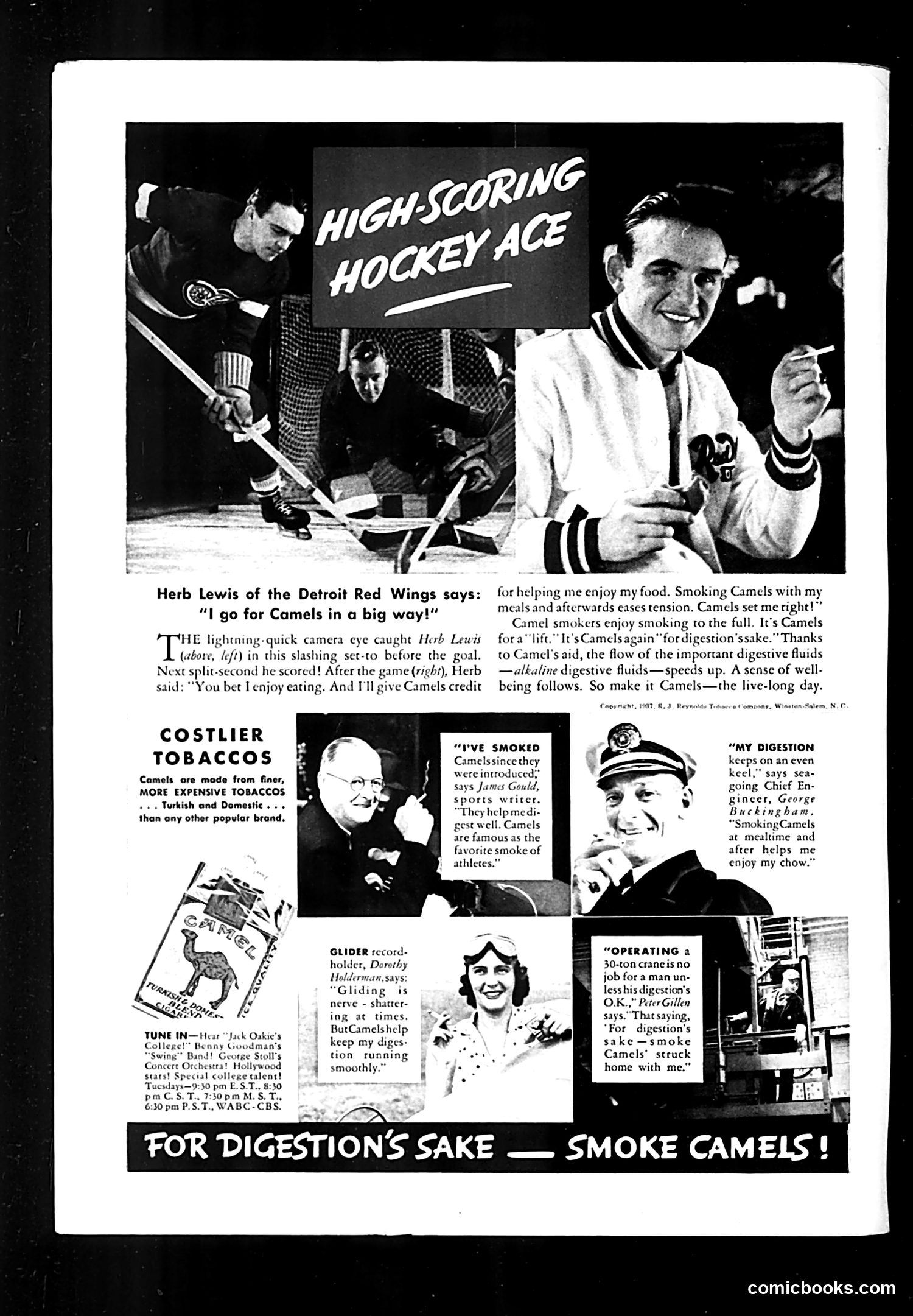
Analysis: Camel Cigarette Advertisement This is a cigarette advertisement, not satire or political commentary. It features Herb Lewis of the Detroit Red Wings hockey team endorsing Camel cigarettes. The page presents testimonials from various professionals—a hockey player, sports writer, glider pilot, crane operator, and naval engineer—claiming that smoking Camels aids digestion and promotes well-being. This reflects the now-discredited mid-20th-century marketing practice of attributing health benefits to cigarettes. For modern readers, the most striking element is the advertisement's brazen health claims. Today we know smoking damages digestion and health generally. The page exemplifies how tobacco companies once freely marketed cigarettes using false medical endorsements and athlete/professional testimonials to build credibility—tactics now prohibited by law. The "Costlier Tobaccos" claim attempts to justify premium pricing through quality messaging, a familiar advertising strategy.

I can see this is a page from Judge magazine, but the image is extremely dark and difficult to read clearly. While I can make out that there is content on the page—including what appears to be some faint text and possibly cartoon illustrations—I cannot reliably discern the specific figures, captions, or satirical content with sufficient clarity to provide accurate historical context. To properly explain the political or social satire for a modern reader, I would need a higher-contrast or clearer version of this image. I can confirm this appears to be from Judge's digital archive (based on the comicbooks.com attribution), but I cannot responsibly identify specific people, references, or jokes without being able to read the material clearly.