judge
Judge — April 1937
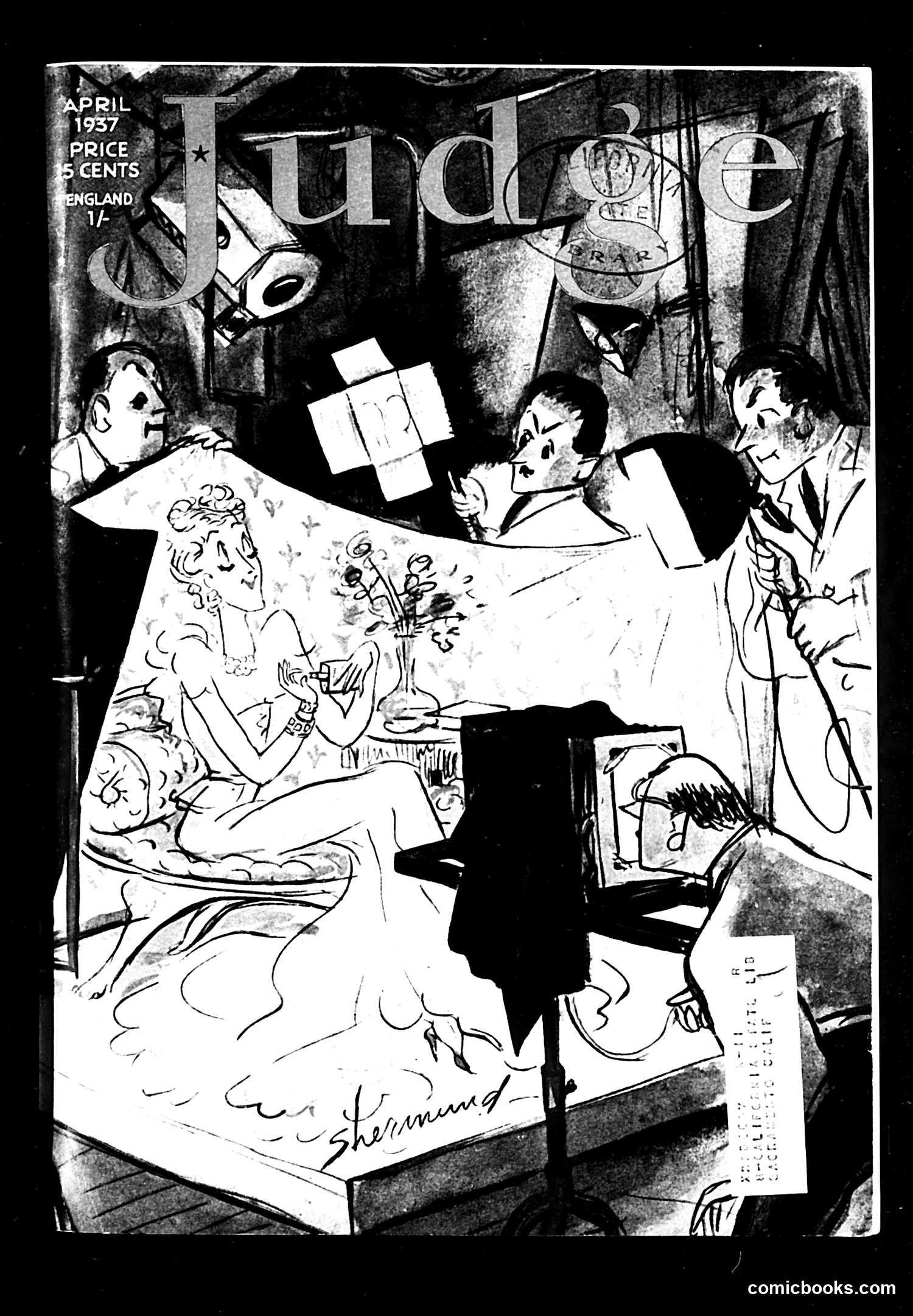
Judge Magazine Cover Analysis - April 1937 This cover satirizes the art world, likely referencing debates over modern art during the 1930s. The central figure appears to be an artist or art patron displaying an abstract or cubist work to well-dressed gentlemen (possibly art critics or collectors). The exaggerated facial expressions and body language suggest mockery of pretentious art appreciation. The signature reads "Sherwood," identifying the cartoonist. The joke targets the gap between avant-garde artistic movements and conventional taste—portraying serious-faced men examining what appears to be nonsensical or intentionally obscure art, implying the emperor's-new-clothes phenomenon where people praise incomprehensible art to appear sophisticated. This reflects 1930s American skepticism toward modernism, which many viewed as European affectation disconnected from American values.
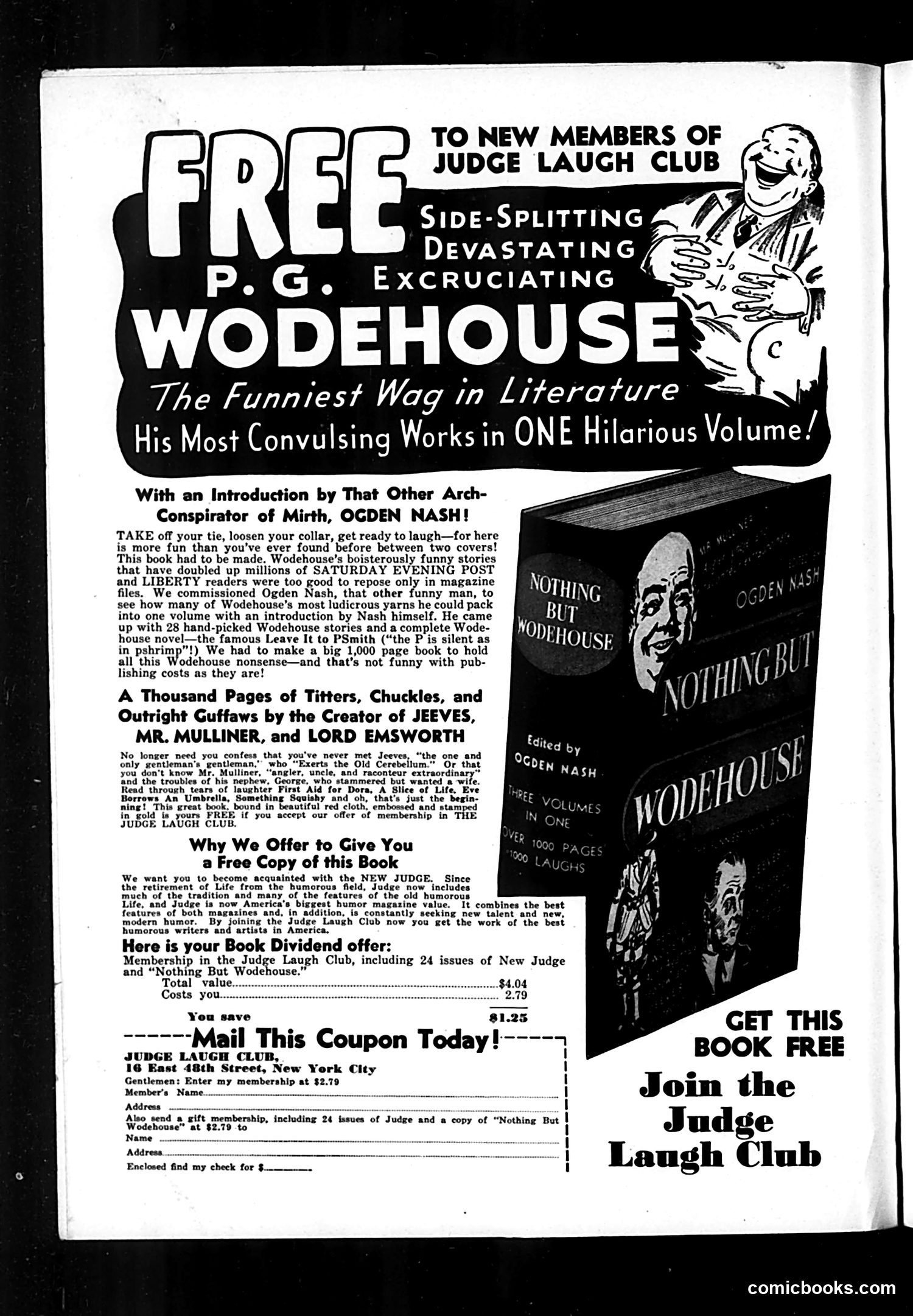
Analysis This page is primarily advertising rather than editorial content. It promotes a free book offer to new members of the Judge Laugh Club—a subscription service bundling 24 issues of Judge magazine plus P.G. Wodehouse's "Nothing But Wodehouse," a compilation of his humorous writings. The advertisement describes Wodehouse as "The Funniest Wag in Literature" and mentions Ogden Nash (a contemporary humorist) wrote an introduction. The copy emphasizes that Judge magazine—already popular with Saturday Evening Post and Liberty readers—now includes works by celebrated humorists and comic writers. The offer itself (membership for $8.79 including 24 magazine issues and the Wodehouse book) is the advertisement's main point, not political or social satire.
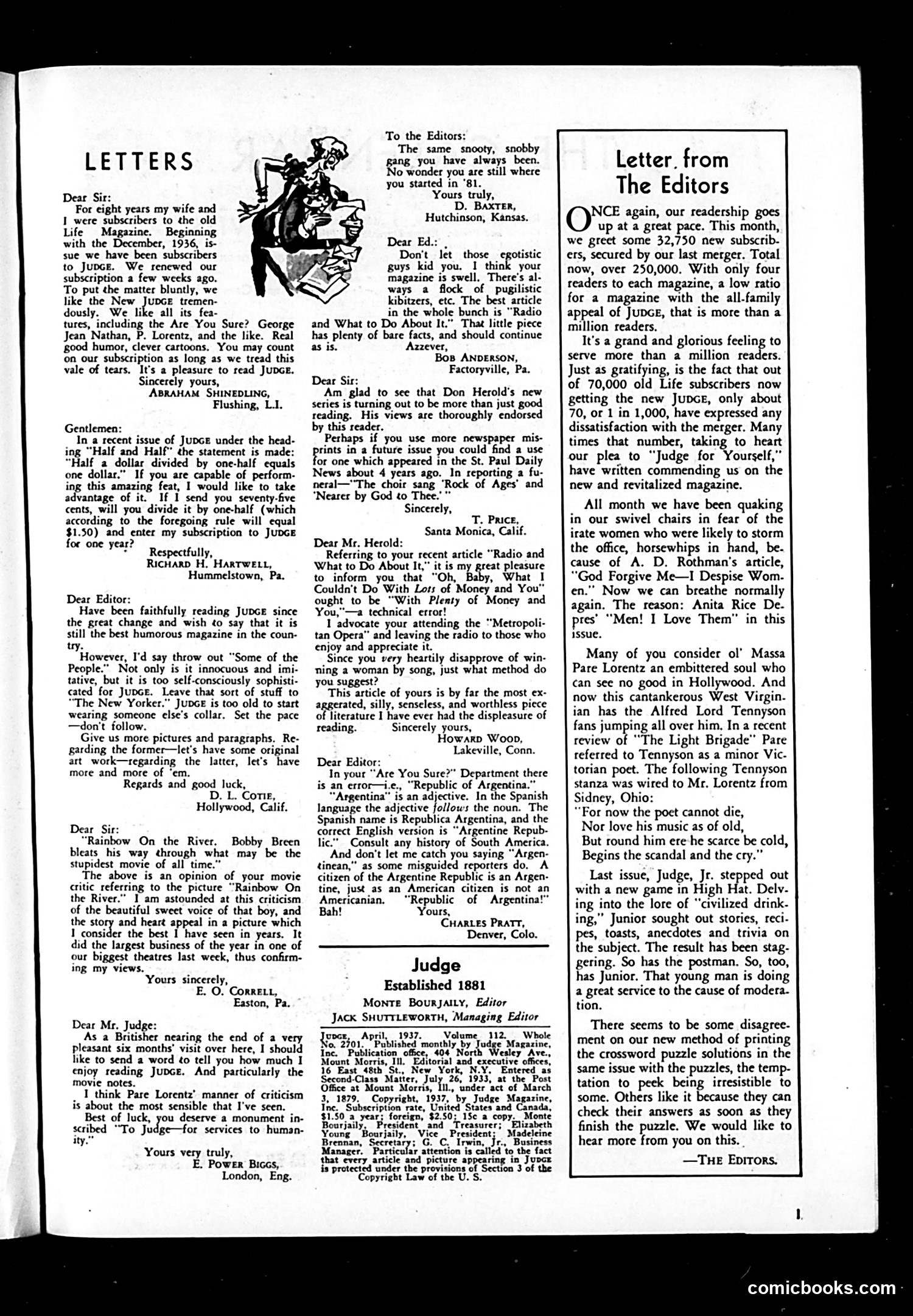
Analysis of Judge Magazine Page This page consists primarily of reader letters to the editor rather than political cartoons. The letters discuss Judge magazine itself—praising its humor, cartoons, and content quality while offering suggestions for improvement. One letter from Howard Wood critiques Judge's "Radio and What to Do About It" article, suggesting the magazine attend a "Metropolitan Opera" broadcast instead of radio programs, implying radio entertainment is inferior to classical arts. Another letter from Charles Pratt corrects a geographical error, noting "Republic of Argentina" is the proper English term, not "Argentine Republic." The small illustration at the top appears decorative rather than satirical. The page reflects Judge's editorial relationship with its readership during the 1930s.
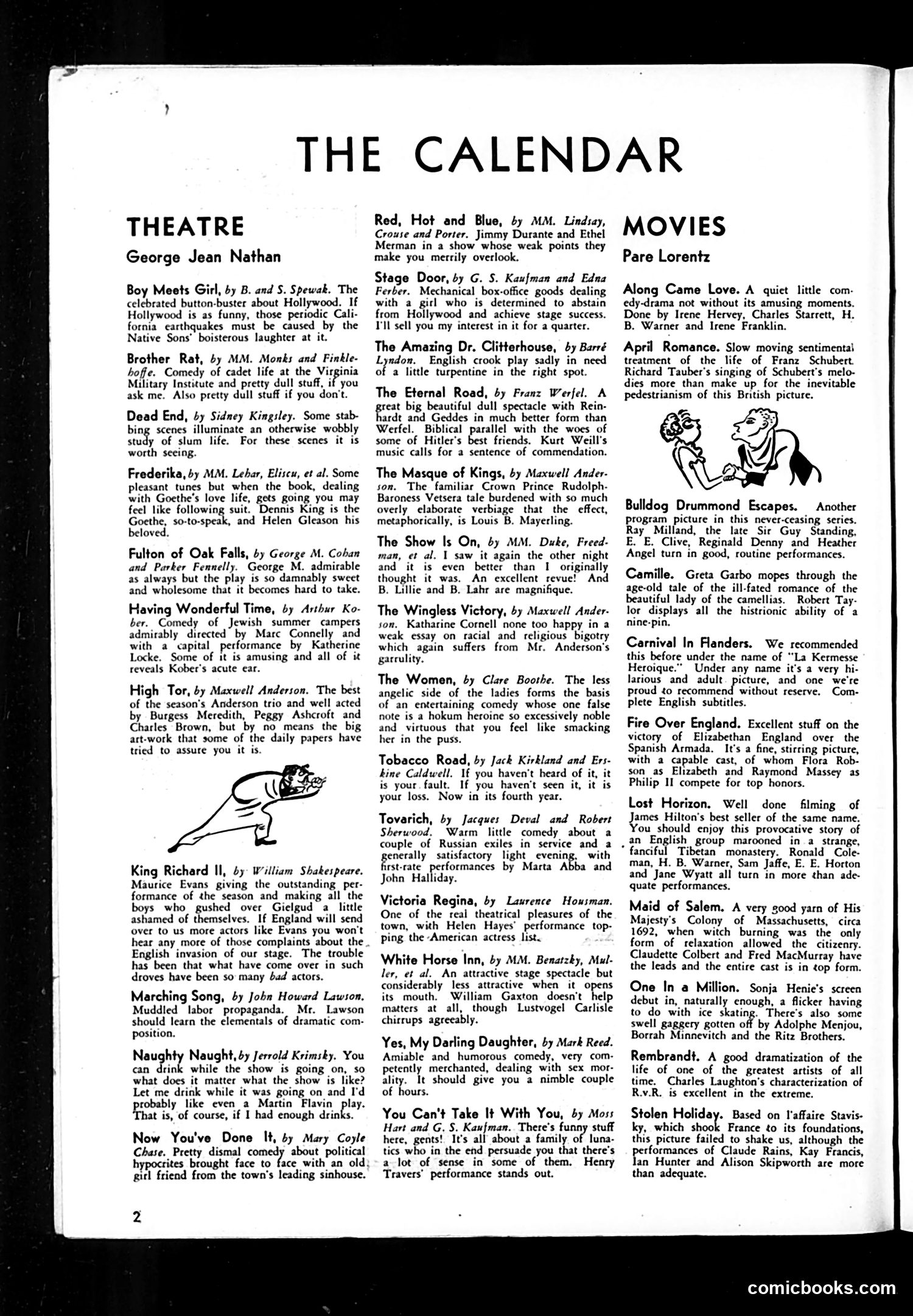
Analysis of "The Calendar" Page This page is primarily theater and movie reviews rather than political satire. It contains critical assessments of Broadway plays (left column) and films (right column), with brief plot summaries and performance evaluations. The only illustration shows two cartoon figures in casual conversation—likely representing typical theatergoers or critics discussing a show. This appears decorative rather than satirical. The reviews discuss contemporary productions with performers' names (George Jean Nathan reviewing theater, Pare Lorentz reviewing movies). The tone is lighthearted, evaluating entertainment quality rather than making political points. No clear political satire or social commentary is evident on this particular page. It functions as entertainment criticism and promotion typical of Judge magazine's cultural coverage.
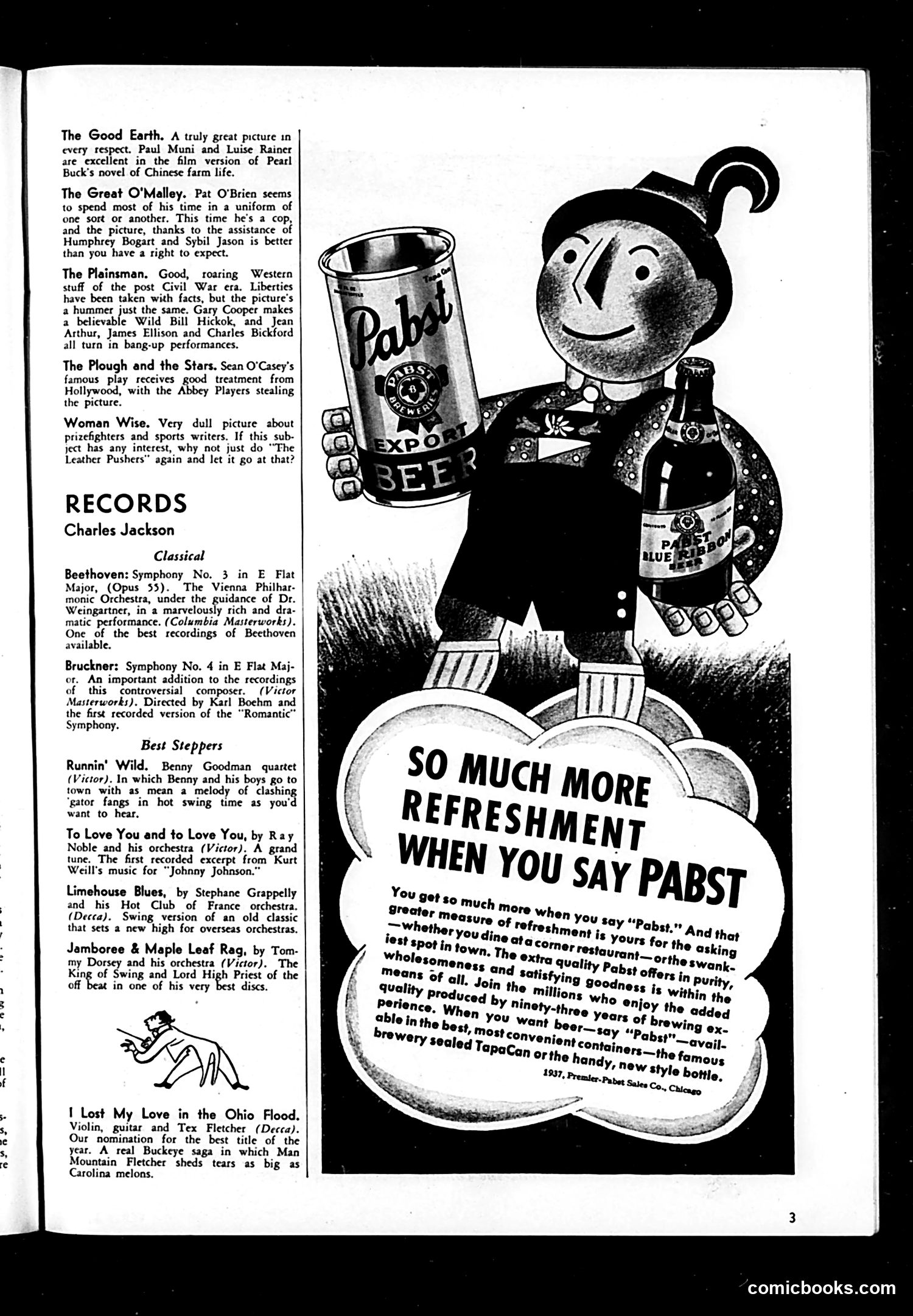
Analysis This page is primarily a Pabst Blue Ribbon beer advertisement rather than political satire. The large illustration depicts an anthropomorphic beer bottle character holding a Pabst mug and bottle, styled as a jovial, rotund figure. The accompanying text emphasizes product quality and purity, claiming Pabst offers "so much more refreshment" due to its 93-year brewing heritage and quality standards. The left column contains unrelated content: film and music reviews (classical recordings by Beethoven and Bruckner, jazz records including Benny Goodman). There is no apparent political cartoon or satire on this page. It's a straightforward commercial advertisement mixed with entertainment reviews, typical of Judge magazine's revenue model during this era (dated 1937 based on the footer).
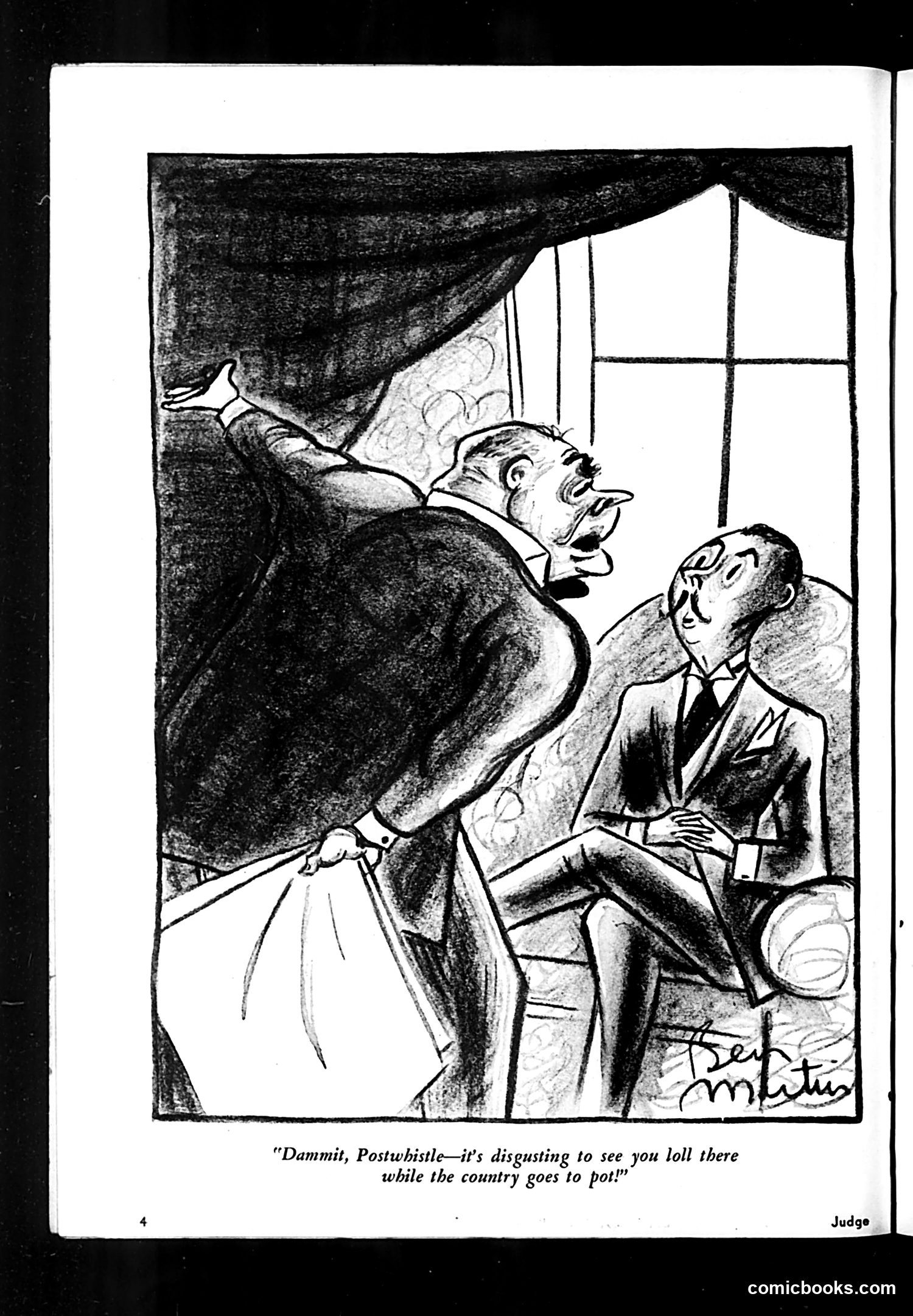
Cartoon Analysis This single-panel cartoon depicts two men in an office setting. The figure on the left, drawn with exaggerated features and labeled "Postwhistle," reclines leisurely while the smaller man on the right expresses outrage. The caption reads: "Dammit, Postwhistle—it's disgusting to see you loll there while the country goes to pot!" The satire targets government negligence during a national crisis. Postwhistle appears to represent a public official or bureaucrat shirking his duties while the nation suffers. The cartoon criticizes the indifference of those in power to serious national problems. Without knowing the specific historical context or which political figure "Postwhistle" references, the broader point is clear: the cartoonist condemns governmental inaction and apathy during turbulent times. The artist's signature appears in the lower right.
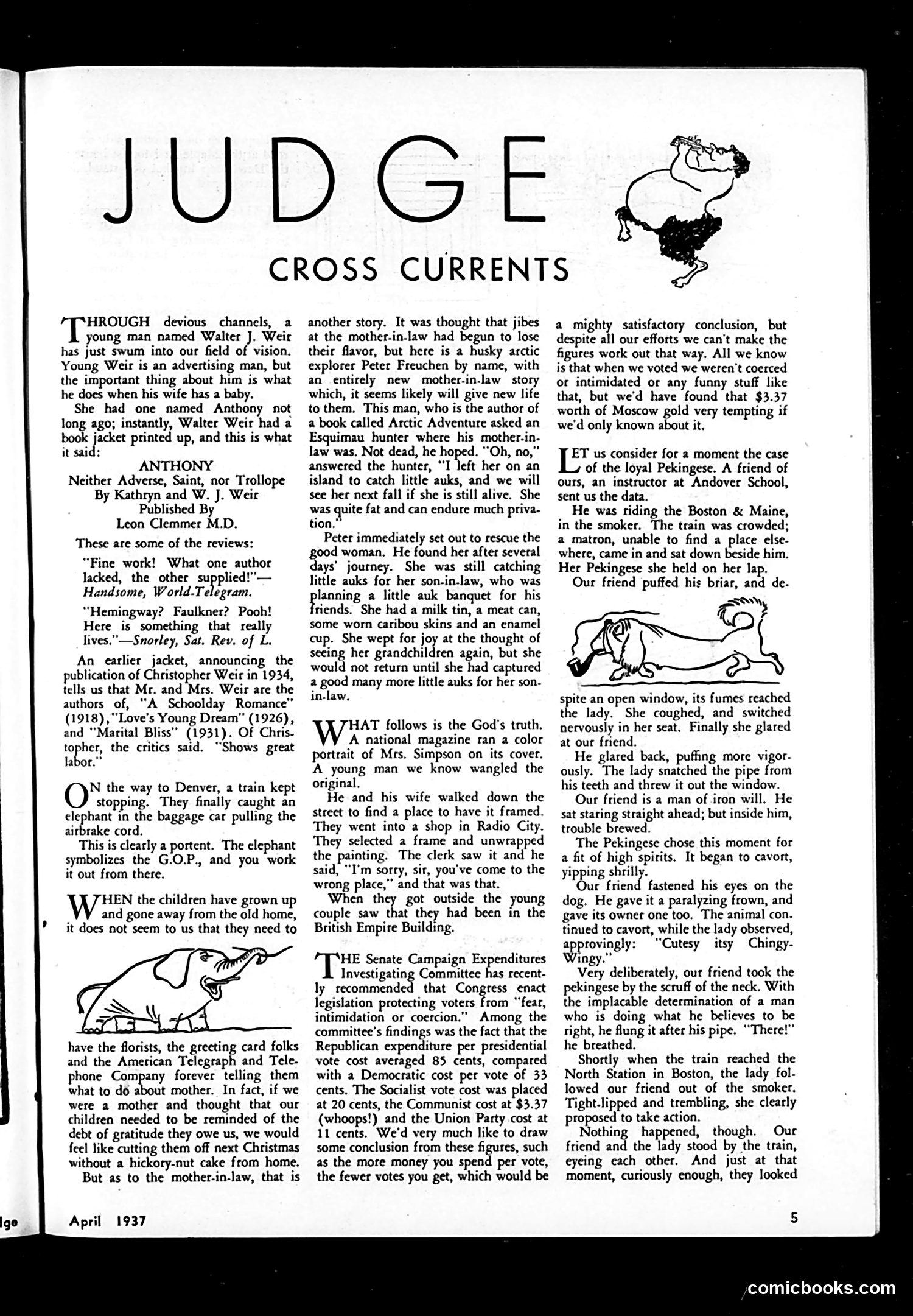
Judge Magazine, April 1937: "Cross Currents" This page contains a humorous essay by Anthony Weir about his young son Walter's adventures and observations. The text includes several satirical anecdotes about everyday American life, including: - A story about an arctic explorer named Peter Freuchen and his mother-in-law - Commentary on spending habits and Moscow gold - A Senate Campaign Expenditures investigating committee report criticizing political spending across parties (Republican, Democratic, Socialist, and Union Party candidates all criticized for excessive costs per vote) The small illustrations of animals (an elephant, dogs, a sleeping elephant) appear to be decorative rather than satirical political commentary. The overall tone mocks American domestic life, political inefficiency, and spending habits through gentle humor rather than sharp satire.
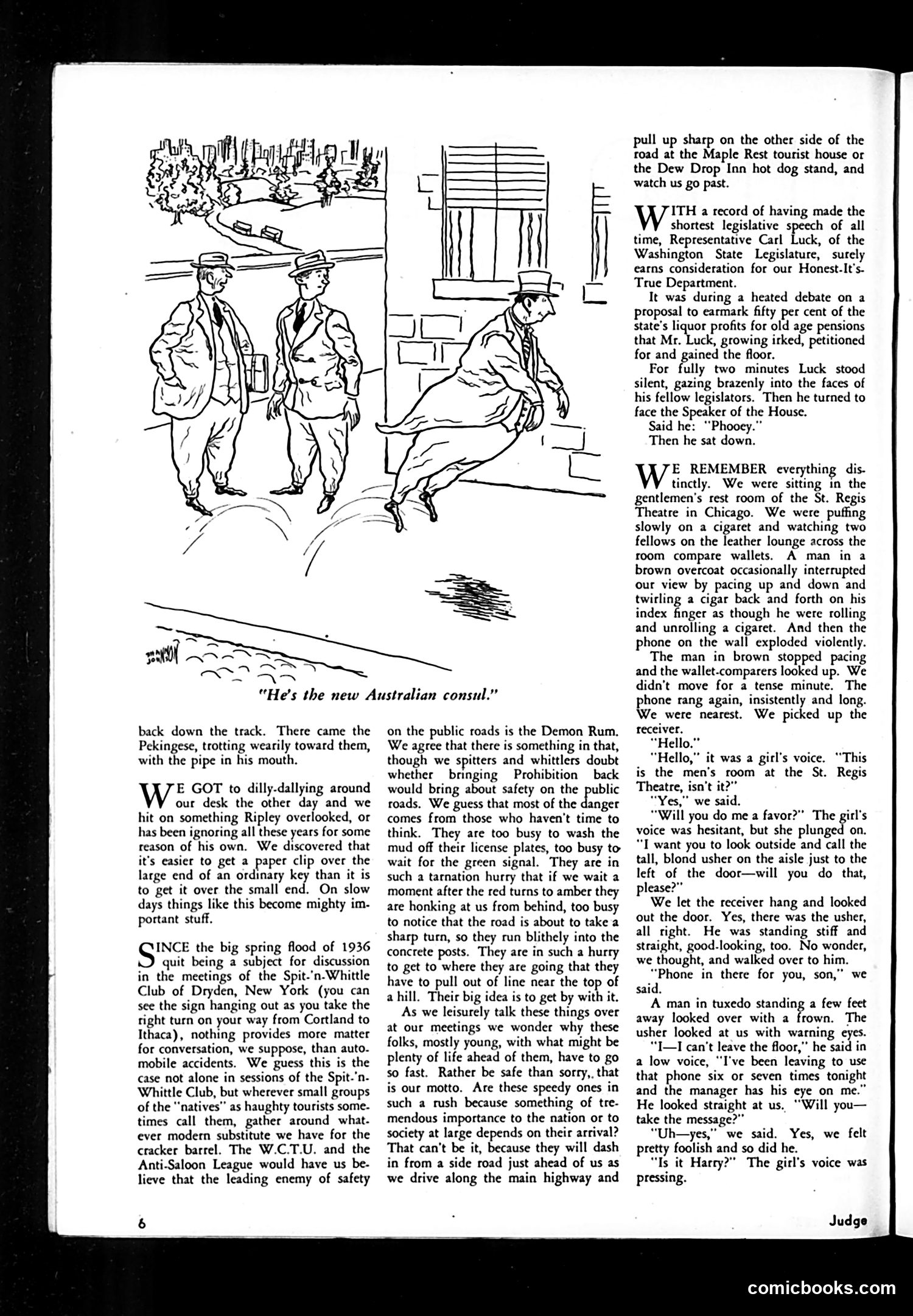
Political Cartoon Analysis: "He's the new Australian consul" The cartoon depicts two men in suits encountering a kangaroo on a city street, with one man remarking "He's the new Australian consul." The Satire: This is a joke about diplomatic appointments, suggesting someone (presumably an actual Australian consul appointee of the era) is incompetent or unsuitable for the role—by humorously implying a kangaroo would be equally qualified. It's a dismissive commentary on either the specific appointment or Australian diplomacy generally. Context: Without identifying the specific consul referenced, the satire relies on stereotyping Australians through their most recognizable animal export. The joke assumes readers would find the substitution absurd yet somehow fitting—a common satirical technique questioning official competence or political favoritism in diplomatic postings.
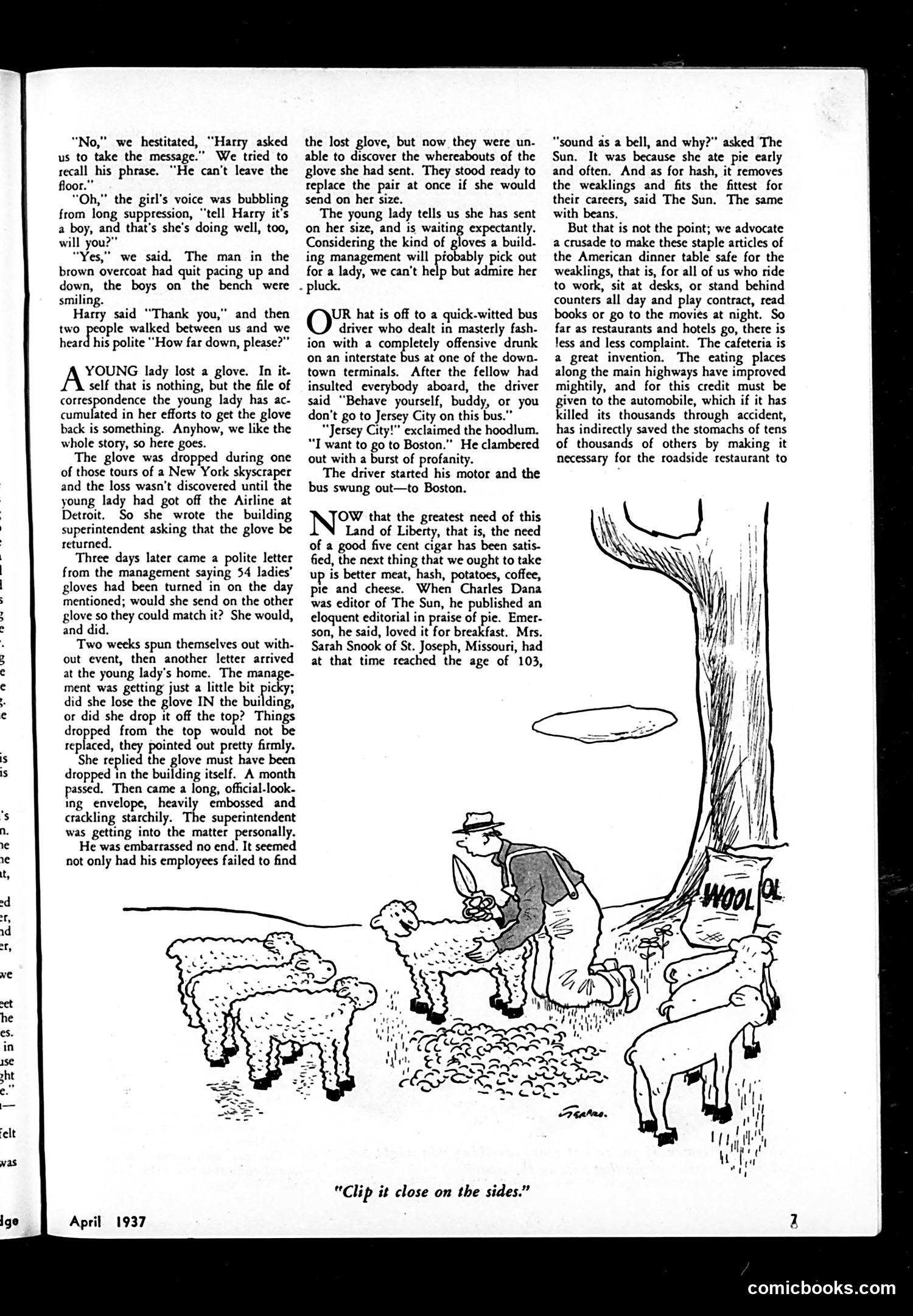
Judge Magazine, April 1937 - Page Analysis The page contains two distinct pieces: Top section: A humorous narrative about a young woman who lost a glove during a New York skyscraper visit. The story satirizes bureaucratic inefficiency—the airline, building management, and various authorities all struggle to locate or replace the lost item, creating absurd correspondence and delays. Bottom cartoon: Shows a man shearing sheep while addressing them to "Clip it close on the sides." The joke appears to target wool production or possibly labor practices, likely referencing economic or agricultural concerns of 1937 Depression-era America. Both pieces use gentle, domestic humor typical of Judge's satirical approach—mocking everyday frustrations and institutional red tape rather than attacking specific political figures. The overall tone is light social commentary.
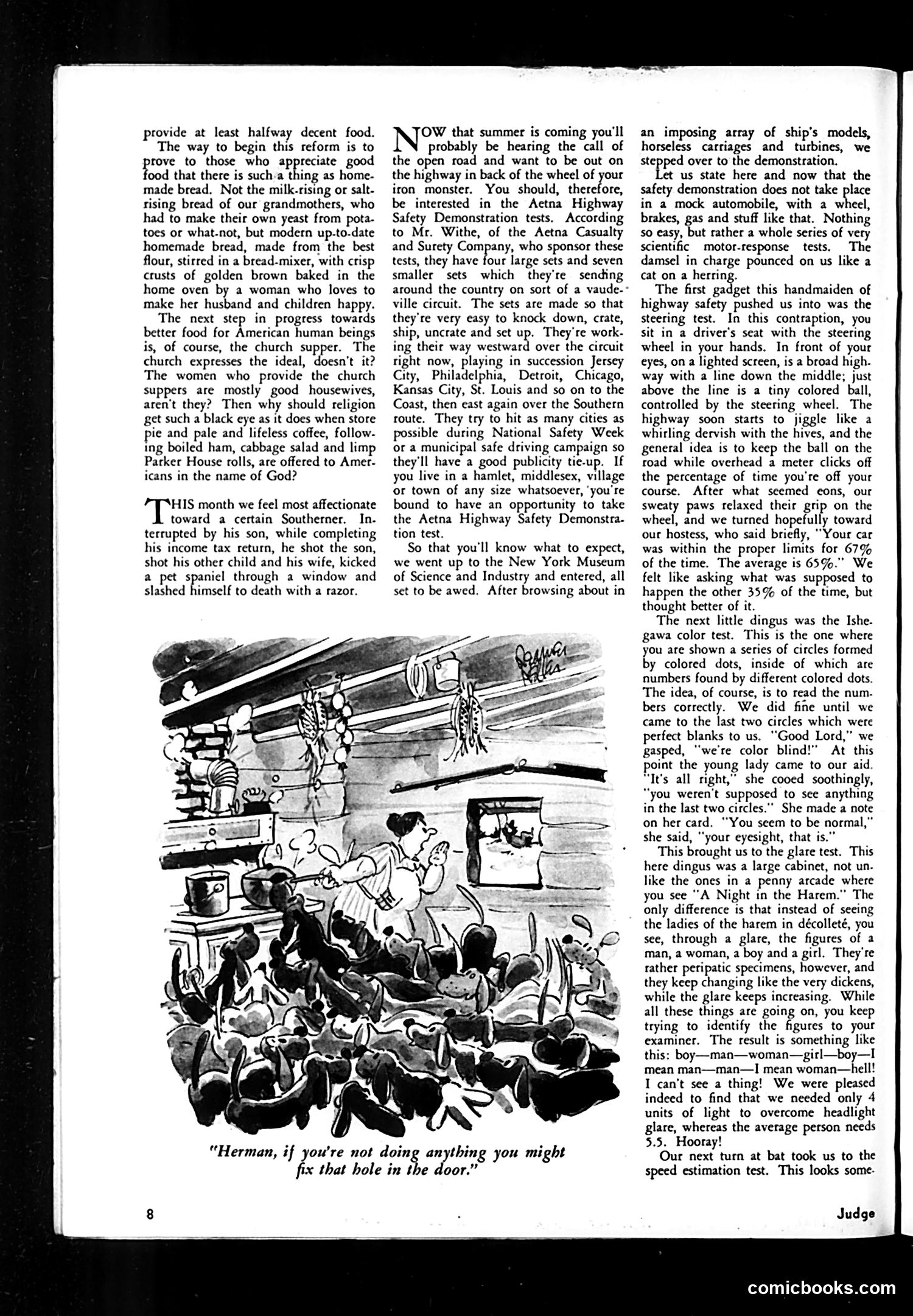
Analysis The main cartoon depicts a domestic scene where a man sits at a table doing paperwork (income tax return) while his wife speaks to him. The caption reads: "Herman, if you're not doing anything you might fix that hole in the door." The satire: This is dark humor playing on a recent news story referenced in the text—a Southern man who, when interrupted by his son while doing taxes, shot his son, shot his wife, shot his other child, kicked the family dog, and killed himself. Judge's joke is cruelly ironic: the cartoon shows an ordinary marital moment (a wife asking her husband to fix something) while the text recounts an extreme case of domestic violence triggered by exactly such an interruption. The humor relies on the reader knowing the tragic news story, making the juxtaposition between mundane domestic annoyance and catastrophic violence darkly comedic—reflecting Judge magazine's typically acerbic, sometimes callous satirical style. The page's other content discusses church suppers and highway safety demonstrations, unrelated to the cartoon's dark joke.
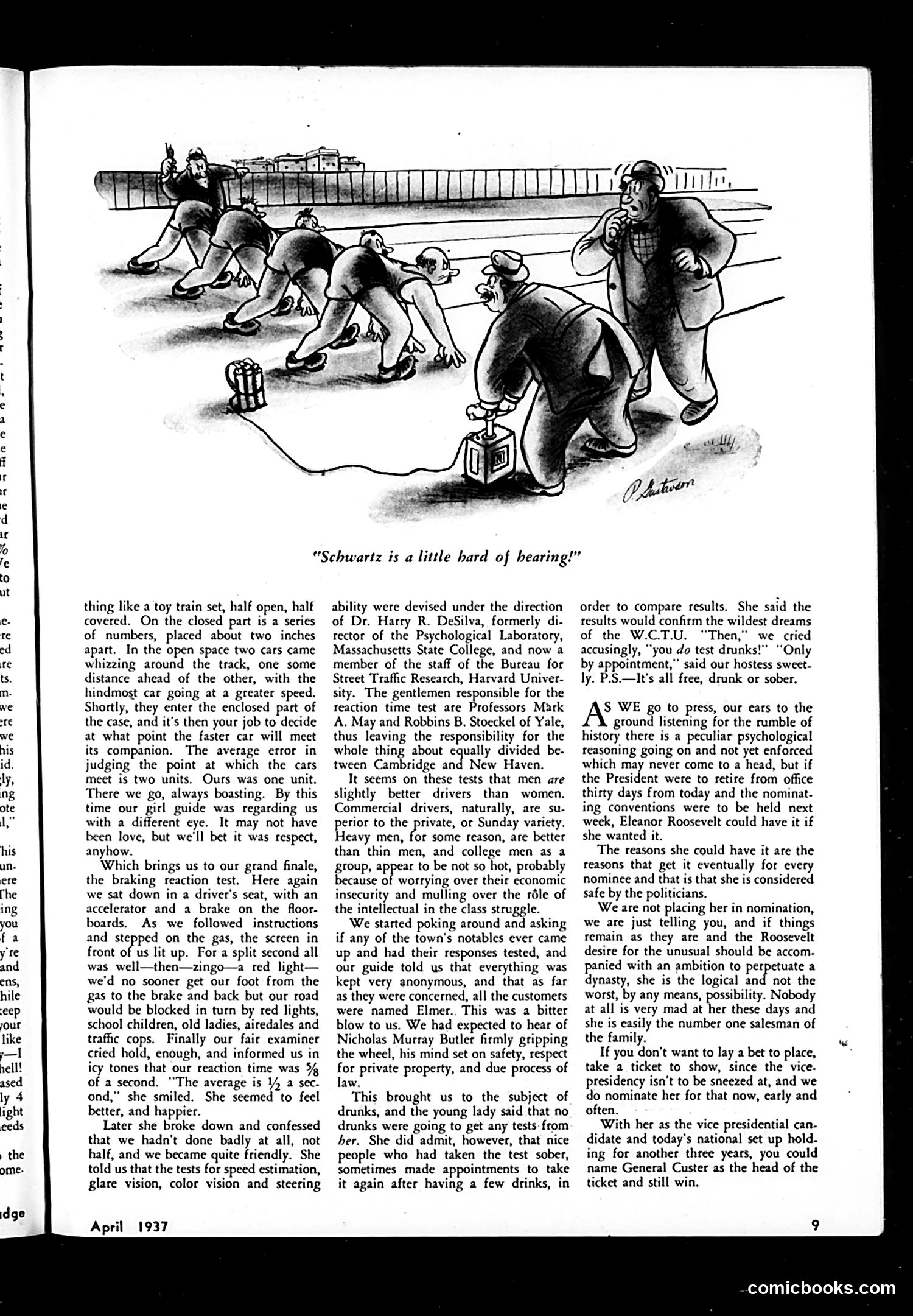
"Schwartz is a Little Hard of Hearing" This cartoon satirizes driving tests and automobile safety research being conducted at universities (Harvard and Yale are mentioned in the accompanying text). The image shows a man in a suit appearing to direct or coach a line of men in crouched positions—likely depicting a "reaction time test" where drivers' response speeds are measured. The caption's joke is unclear from the image alone, but the article discusses various driving ability tests (reaction time, vision, steering) developed by psychologists to measure driver competency. The accompanying text humorously describes the author's experience taking these tests and notes that results show men drive slightly better than women, and that college men surprisingly perform poorly—attributed to worrying about economic insecurity and their intellectual role in society. The satire targets both the pseudo-scientific nature of early automotive psychology research and broader social anxieties of 1937.
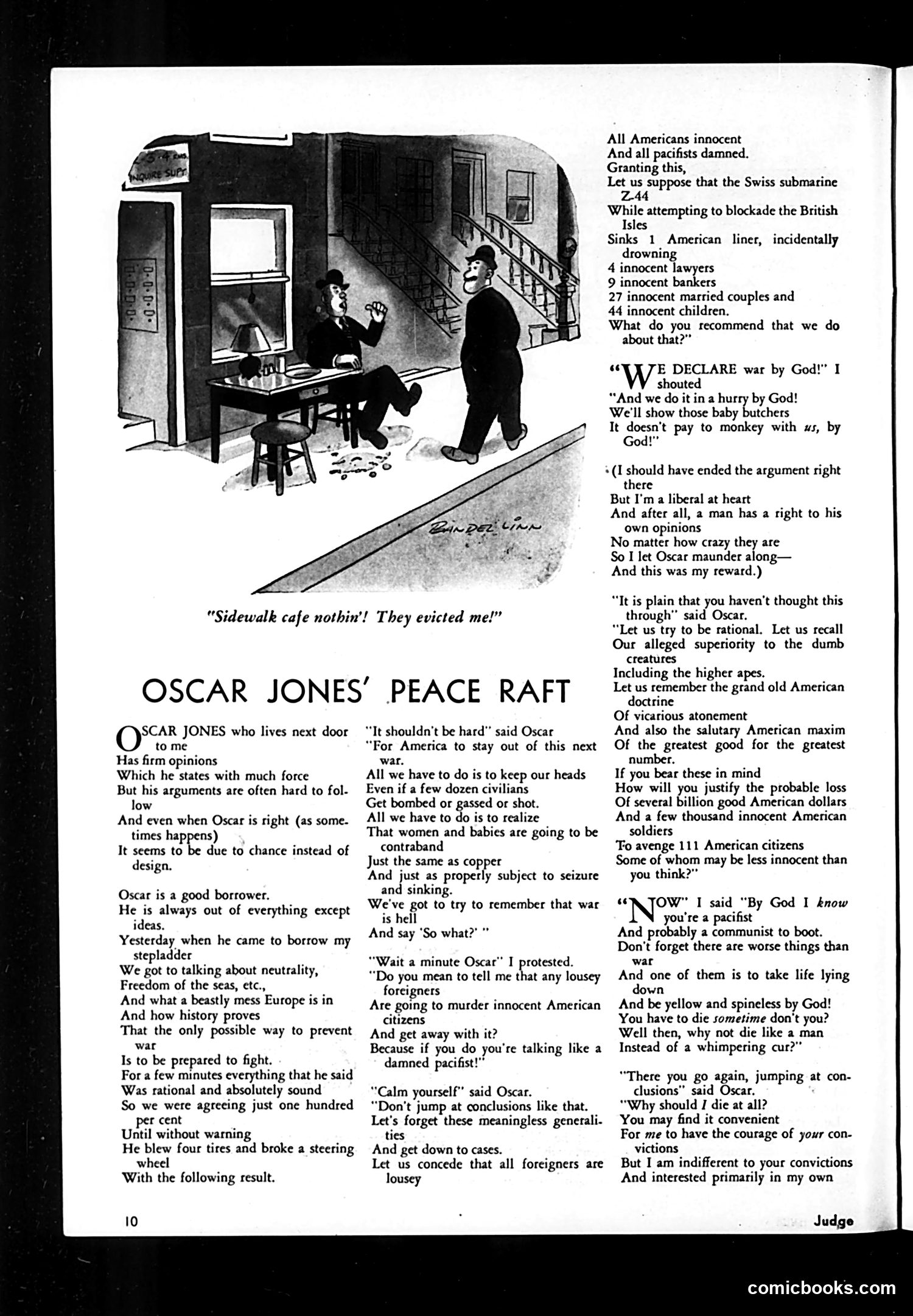
Oscar Jones' Peace Raft: A WWI-Era Neutrality Debate This satirical piece depicts a heated argument between two neighbors about American intervention in World War I. Oscar Jones argues for strict neutrality and rational cost-benefit analysis—accepting civilian casualties as unfortunate but necessary to avoid war's expense. His unnamed neighbor responds emotionally, equating pacifism with cowardice and communism, demanding America fight to avenge innocent deaths. The satire targets both positions: Oscar's cold logic that reduces human tragedy to accountancy, and the narrator's patriotic fervor that conflates non-intervention with spinelessness. The cartoon's opening image of eviction humorously undermines Oscar's lofty philosophical stance, suggesting his arguments—however logically constructed—stem from impractical idealism disconnected from real consequences. The piece reflects early-1920s American debate over isolationism versus interventionism, with Judge magazine likely skeptical of both extremes.
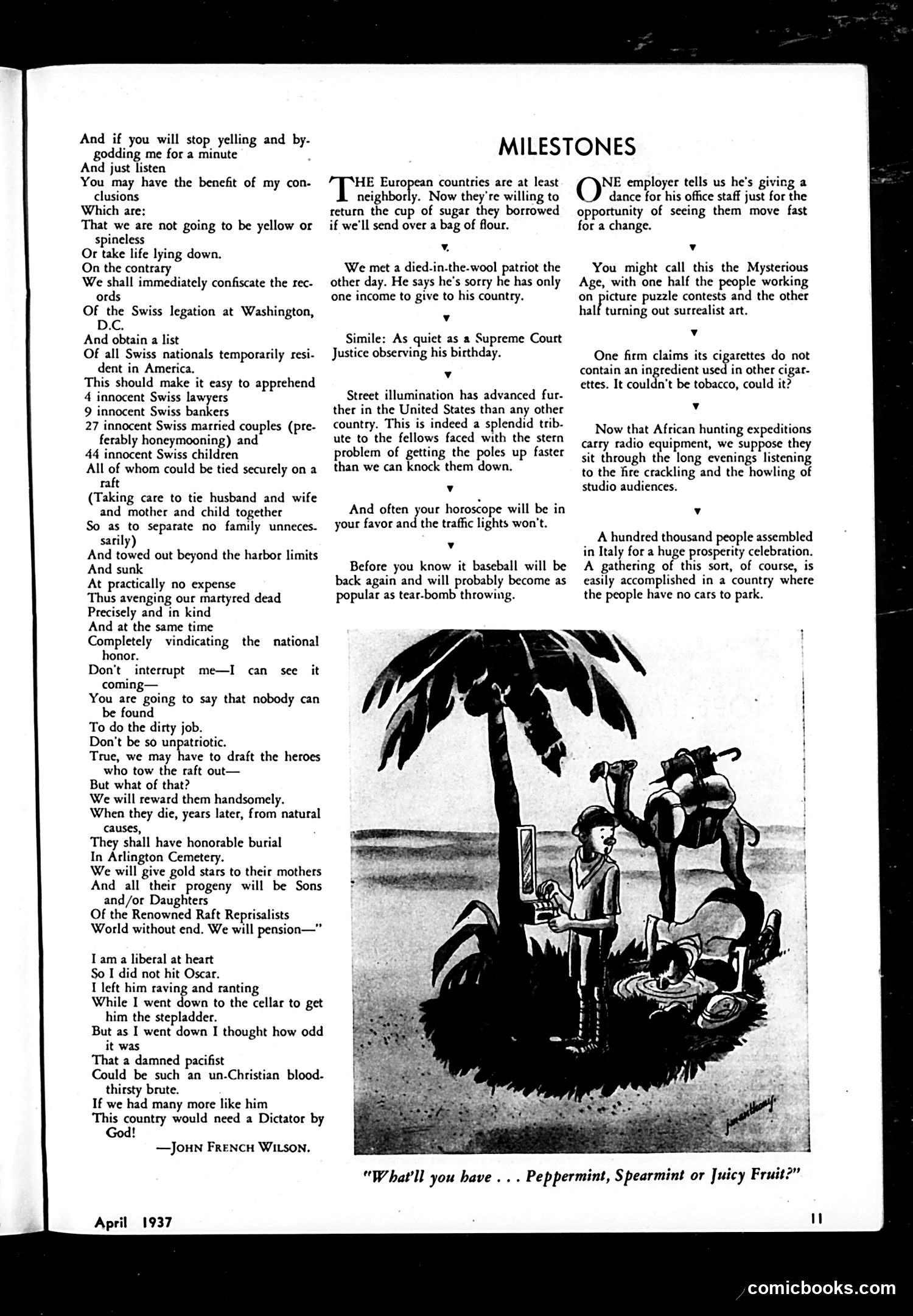
Analysis: Judge Magazine, April 1937 This page contains satirical commentary on contemporary American politics and society during the Depression era. The Main Piece (by John French Wilson): A scathing satire of jingoistic war rhetoric. The narrator mockingly proposes rounding up Swiss nationals and drowning them as "retaliation," then sarcastically celebrates this as patriotic honor—complete with Arlington Cemetery burials and pensions for executioners. The joke exposes the absurd bloodlust and collective punishment logic underlying nationalist fervor, particularly relevant in 1937 as fascism rose globally. The Cartoon: Shows people under a palm tree with radio equipment listening to broadcasts—likely satirizing how modern technology allows people to artificially recreate "authentic" experiences (African safari sounds via radio), mocking manufactured entertainment culture. The "Milestones" Section: Brief satirical observations on contemporary life—European economic cooperation, patriotic sacrifice, street lighting, baseball's popularity rivaling tear-gas weapons, workplace dances, surrealist art trends, and Italian Fascist rallies (the "prosperity celebration" reference, given 1937 context). The overall tone is antifascist and anti-war, criticizing both American jingoism and international authoritarianism.
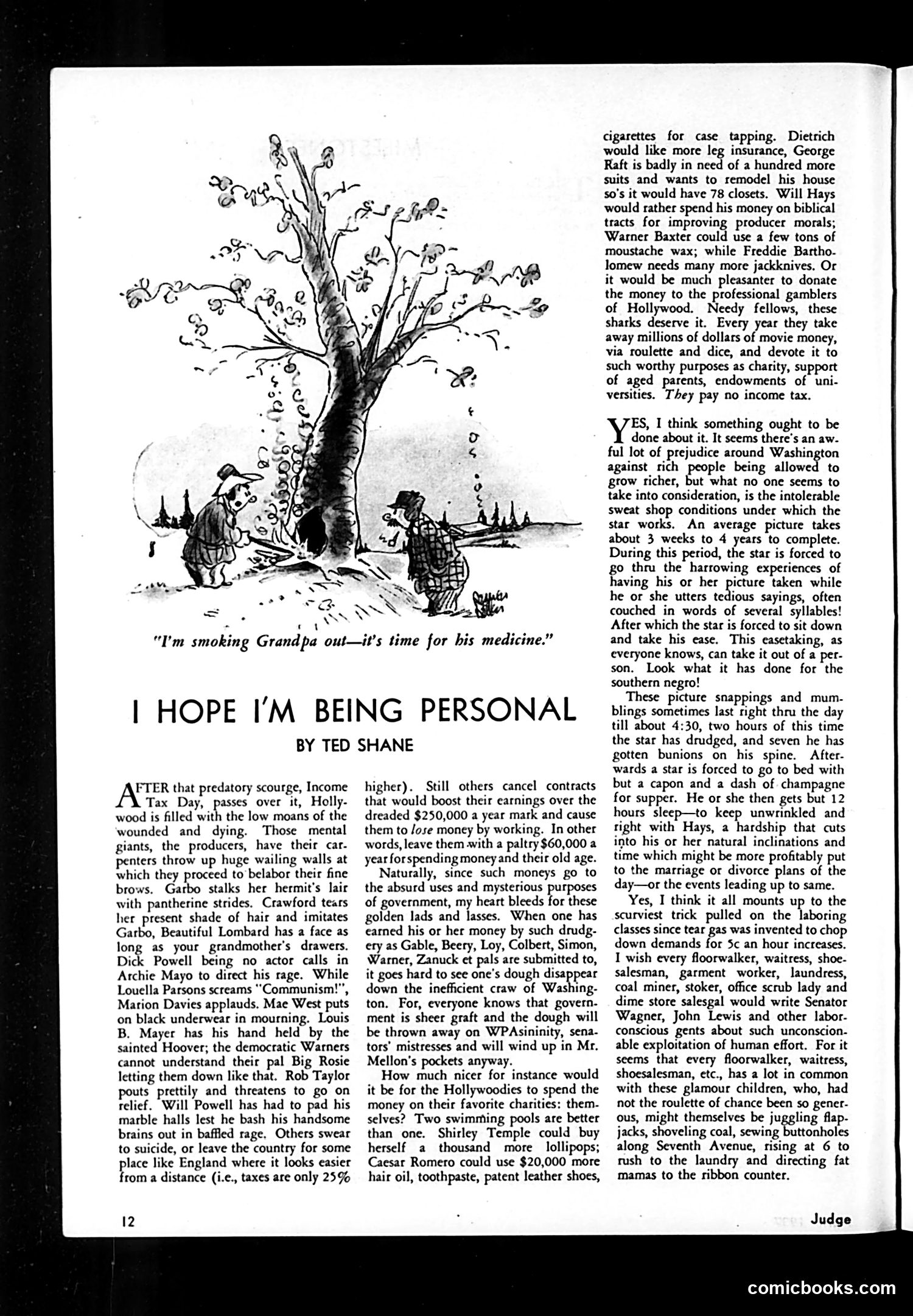
"I Hope I'm Being Personal" - Judge Magazine Satire This is Ted Shane's satirical article mocking Hollywood stars' complaints about income taxes. The accompanying cartoon shows someone "smoking Grandpa out—it's time for his medicine," likely depicting forced removal of wealth through taxation. Shane savagely ridicules major 1930s film stars (Garbo, Crawford, Lombard, Powell, Mae West, Marion Davies, etc.) for their theatrical anguish over losing money to taxes. He itemizes their absurd "hardships"—being reduced to merely $60,000 annually for spending money, needing more swimming pools, leg insurance, or moustache wax. The satire's point: these enormously wealthy entertainers, who endure minimal actual labor (posing for photographs), claim unbearable conditions while ordinary workers face genuine exploitation. Shane sarcastically suggests they'd prefer donating money to themselves or "professional gamblers of Hollywood" rather than government programs like the WPA (New Deal employment initiative). The piece attacks both star entitlement and Depression-era wealth inequality.
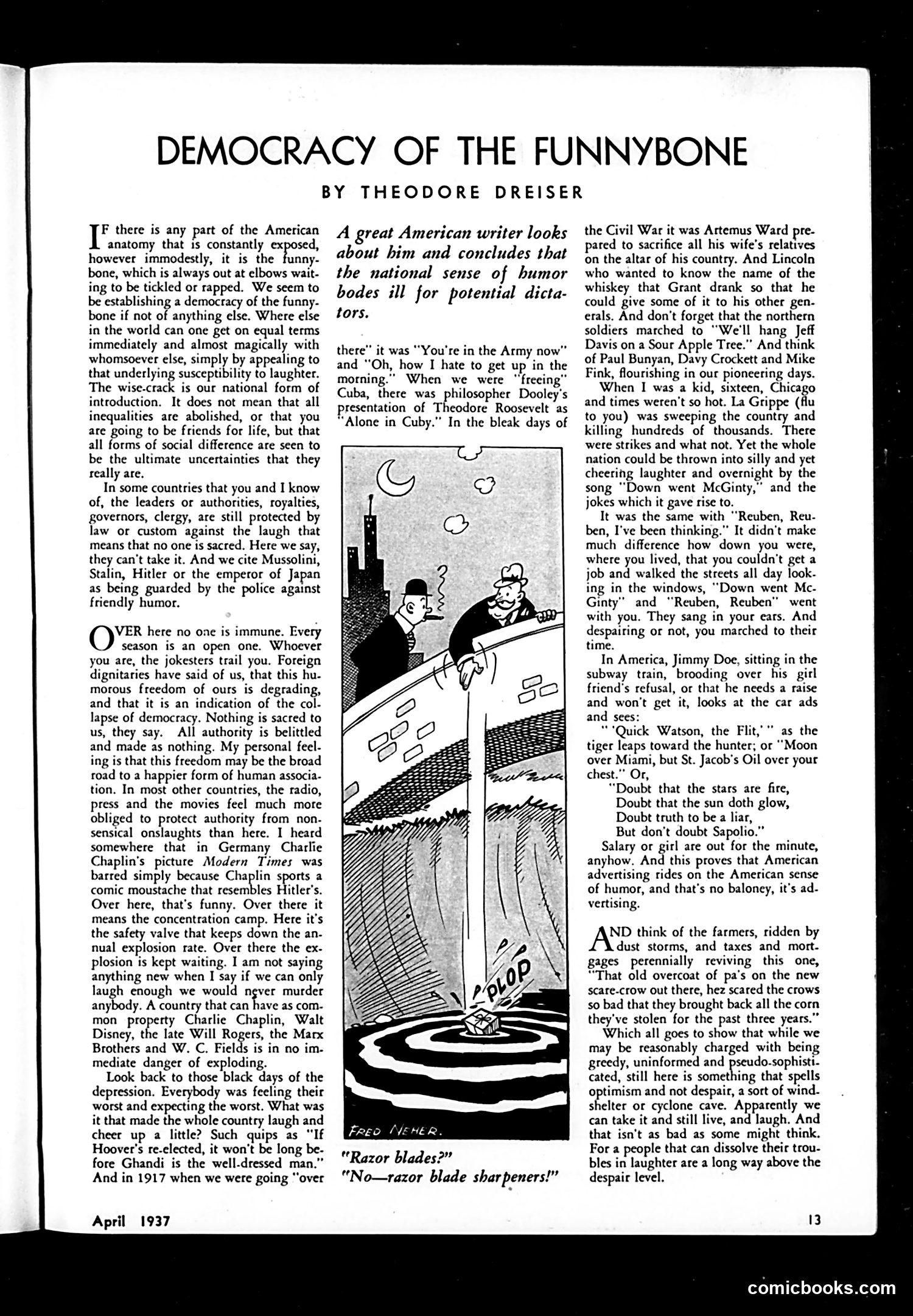
"Democracy of the Funnybone" — A 1937 Defense of American Humor Theodore Dreiser's essay argues that American humor—particularly jokes mocking authority—serves as a democratic safety valve preventing tyranny. The accompanying cartoon depicts two figures (labeled "Fred" and "Heber") discussing razor blade sharpeners, exemplifying how ordinary Americans freely mock even mundane commercial matters. Dreiser contrasts America favorably with authoritarian regimes: Germany banned Chaplin's *Modern Times* because his mustache resembled Hitler's, while America celebrates Chaplin freely. He cites historical examples—Civil War jokes about Lincoln, Spanish-American War satire about Theodore Roosevelt—to show that American irreverence toward leaders strengthens democracy. The essay's core argument: nations permitting satirical ridicule of authority remain stable; those suppressing laughter (Nazi Germany, Stalin's USSR, Imperial Japan) breed resentment leading to explosions. Laughter itself becomes prophylactic against violent revolution. This 1937 publication appears prescient about fascism's intolerance for dissent, positioning American mockery as patriotic rather than degrading.
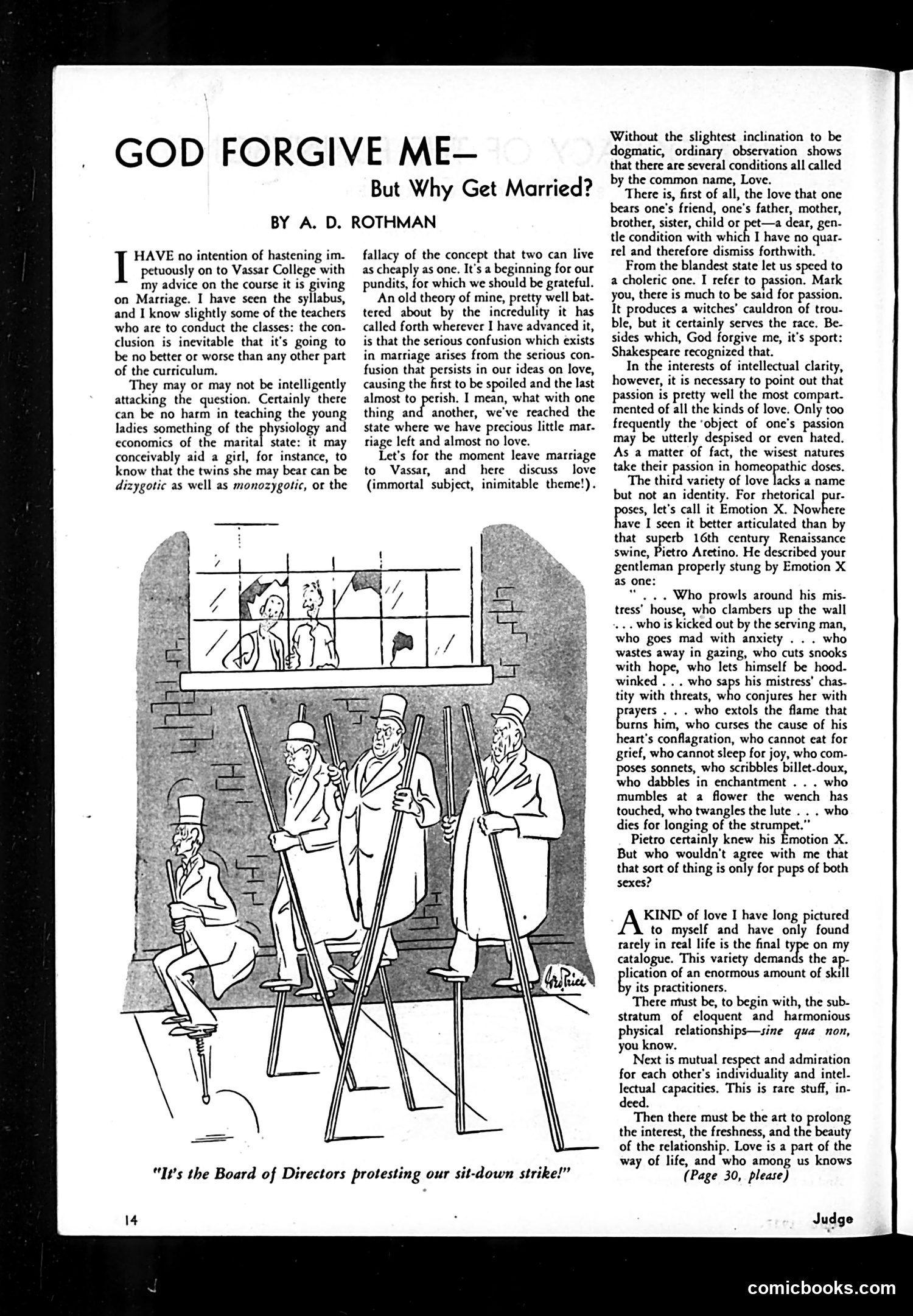
Analysis of "God Forgive Me—But Why Get Married?" This is a satirical essay by A.D. Rothman accompanying a cartoon about labor unrest. The cartoon depicts workers at a sit-down strike outside a factory or workplace, with the caption "It's the Board of Directors protesting our sit-down strike!"—a joke inverting who protests whom during labor disputes, which were common in 1930s America. Rothman's essay uses marriage as a vehicle to discuss love philosophically, distinguishing between familial affection, passion, and what he calls "Emotion X"—an obsessive, irrational romantic infatuation. He quotes 16th-century writer Pietro Aretino to illustrate this tortured emotional state (pining, sleeplessness, sonnets, enchantment). The satire mocks both romantic idealization and Vassar College's new marriage curriculum. Rothman argues that confusion about love causes marital problems—a commentary on modern relationships and courtship practices of the era. The piece advocates for intellectual clarity about romance versus practical marriage considerations.
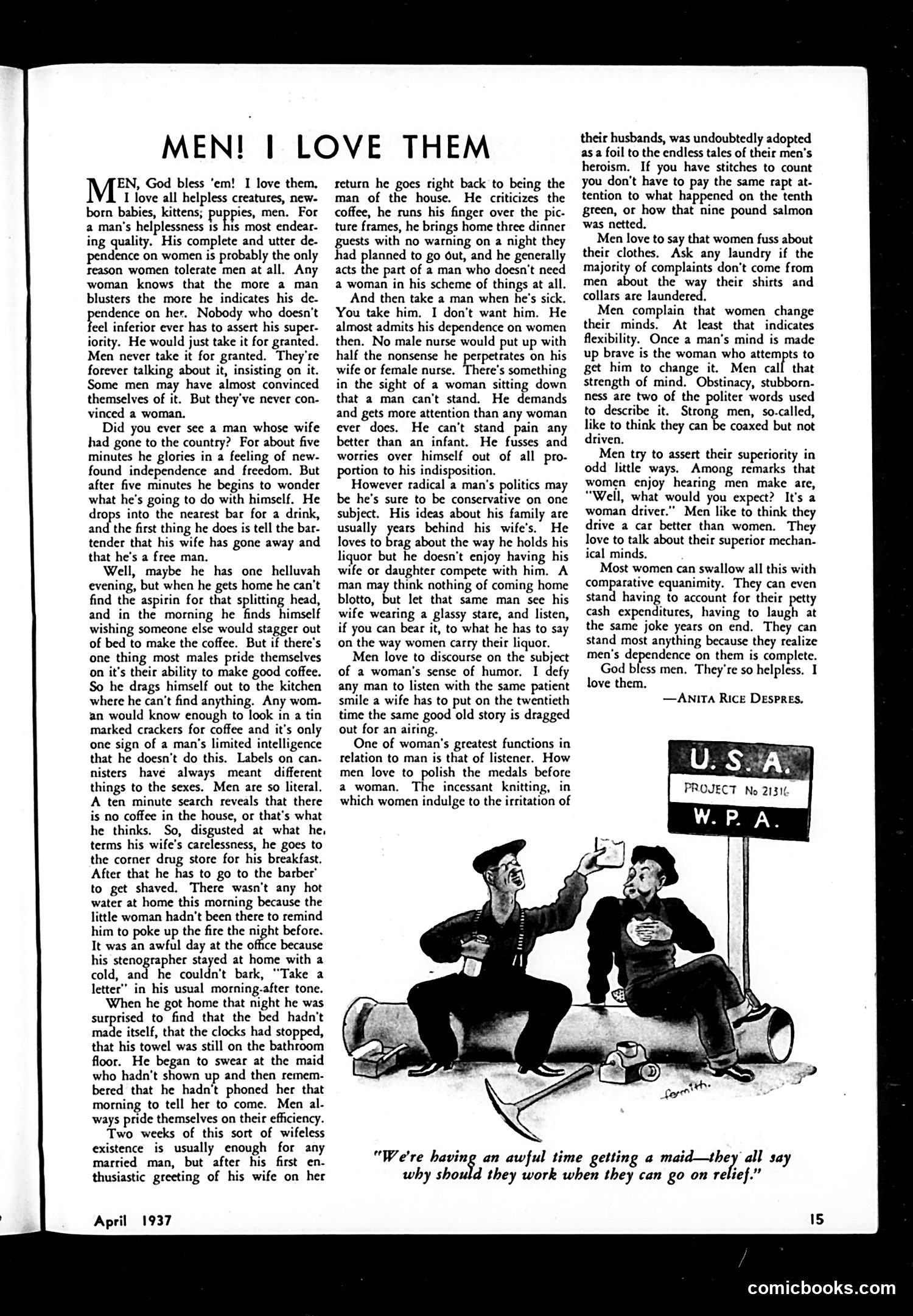
Analysis of "Men! I Love Them" This article by Anita Rice Despres is a humorous essay satirizing men's dependence on women while they simultaneously boast of their independence and superiority. The Central Joke: Men claim to be self-sufficient and superior, yet they collapse into helplessness when their wives are absent—unable to find coffee (despite labeled canisters), make hot water, or locate basic household items. The satire exposes the contradiction between men's blustering self-importance and their actual reliance on women's domestic labor. Key Targets: - Men's literal-mindedness and inefficiency at household tasks - Their compulsive need to assert dominance while depending on women - Their dramatic helplessness when sick, demanding excessive attention - Their hypocrisy: criticizing wives' work while being incapable themselves The Political Context: Published in April 1937, this reflects Depression-era anxieties about gender roles and women's domestic expectations. The essay advocates that women recognize their actual power and stop tolerating men's pretense. The Cartoon: Two soldiers discussing staffing shortages, illustrating the broader cultural moment of WPA employment programs.
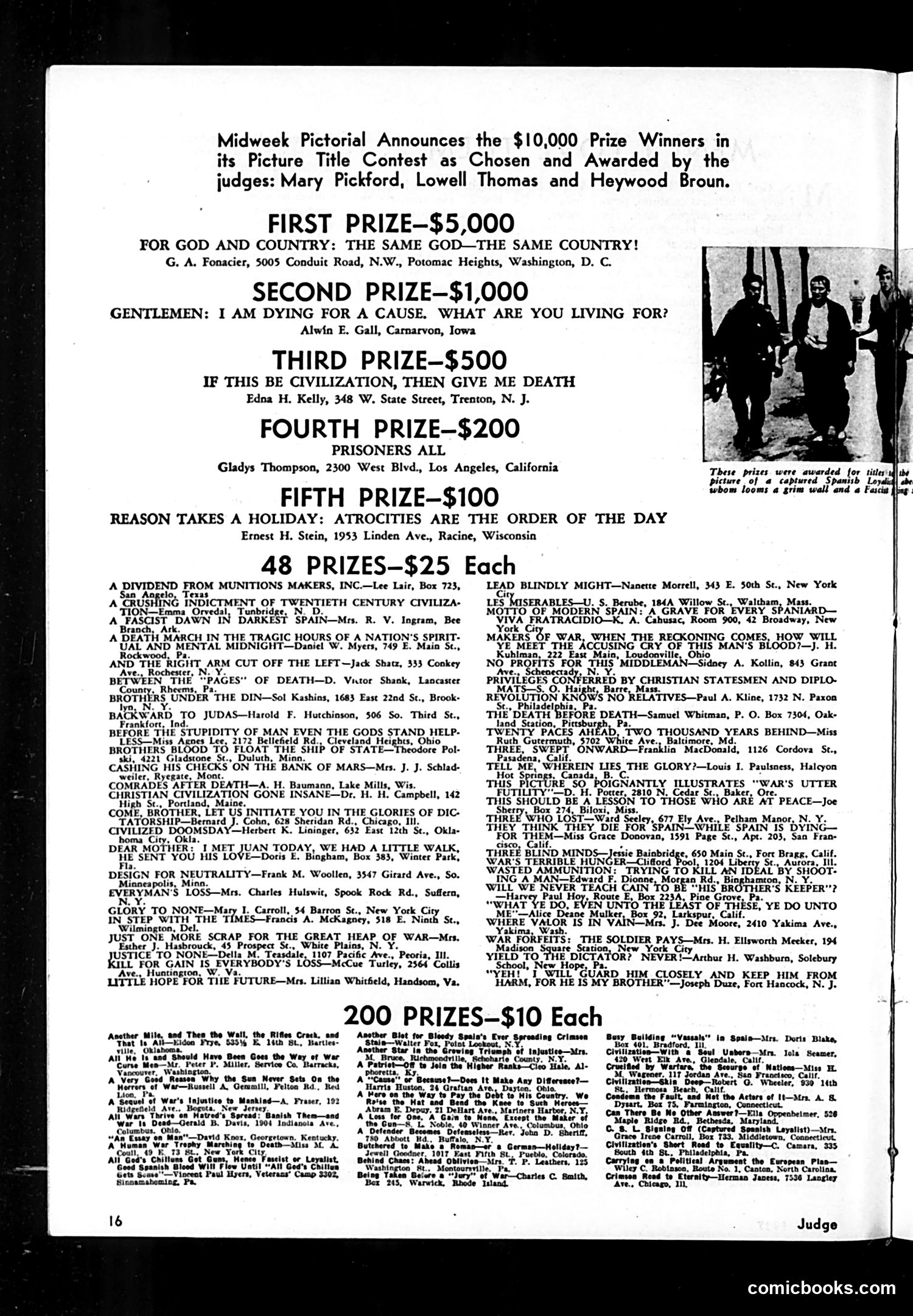
Judge Magazine Prize Contest Page This page announces winners of a $10,000 picture-title contest judged by celebrities Mary Pickford, Lowell Thomas, and Heywood Broun. The winning titles are captions for photographs (not shown here). The contest reflects World War I-era American anxieties. Prize-winning titles reveal the contest's propagandistic purpose—they emphasize patriotic sacrifice ("For God and Country"), moral outrage at enemy conduct ("Atrocities Are the Order of the Day"), and critique of war profiteering ("A Dividend from Munitions Makers"). References to Spain appear multiple times, likely referencing Spanish Civil War atrocities or Spanish involvement in WWI debates. Many titles invoke religious/moral language ("Prisoners All," "Christian Civilization Gone Insane"), suggesting contemporary debates about Christian nations engaging in industrial warfare. The remaining 48 and 200 prizes show similarly themed submissions, all emphasizing war's brutality and moral dimensions rather than celebrating military glory.
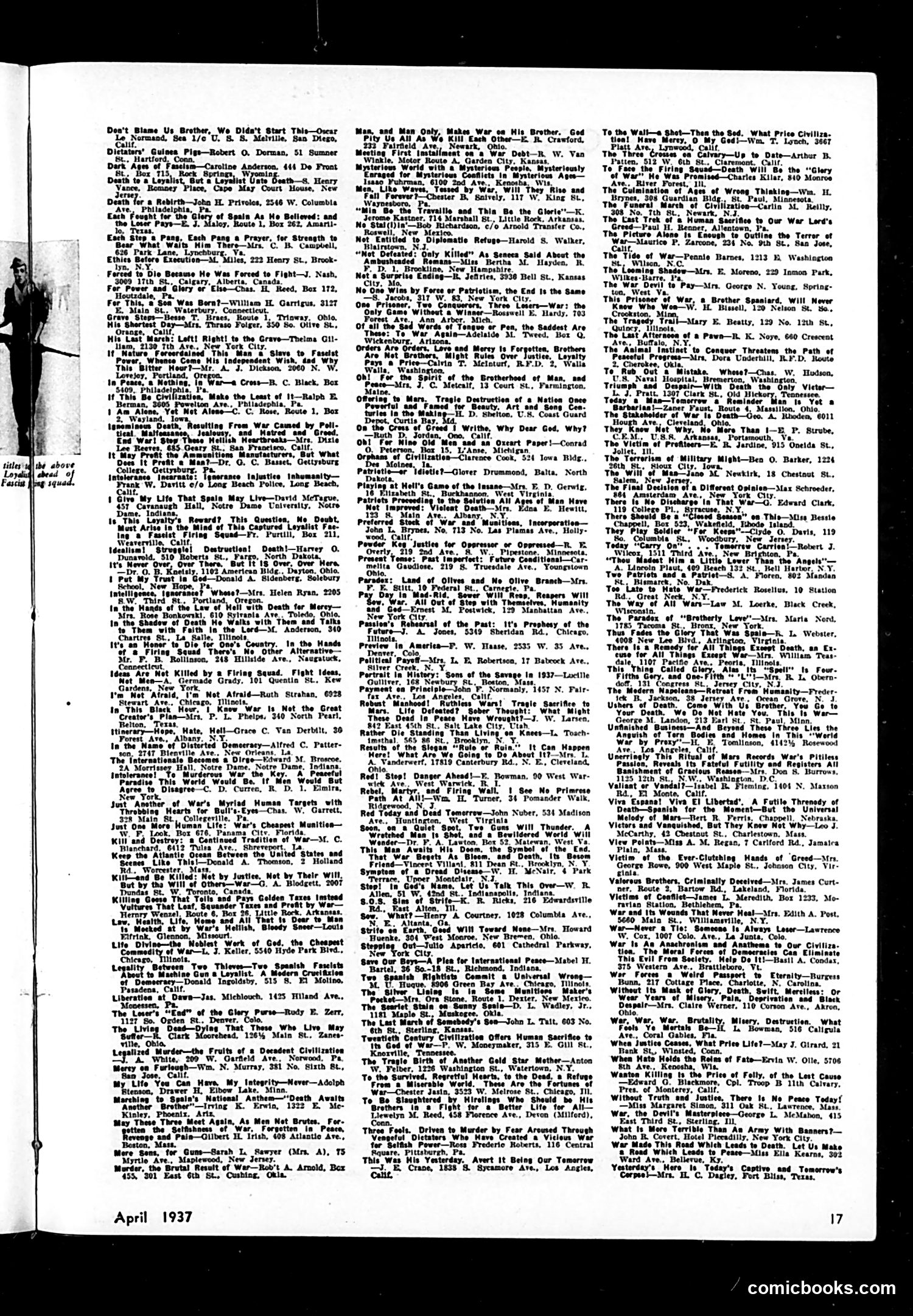
Judge Magazine, April 1937: War Cartoons This page lists titles and artist credits for political cartoons on the theme of war and its horrors—appearing during a period of rising international tensions (Spanish Civil War, Japanese expansion, Fascism). The cartoon titles reveal 1930s anxieties: "Don't Blame Us, Brother, We Didn't Start The—," "Dictators' Guinea Pigs," "Death to a Loyalist," and "Ignominious Death, Resulting From War Caused by Political Greed" suggest anti-war satire opposing militarism and authoritarian aggression. References to "captured loyalists" and firing squads likely allude to the Spanish Civil War (1936-39), where fascists fought elected republicans. The repeated theme of innocent deaths, particularly civilians caught in war's machinery, critiques how ordinary people suffer for leaders' ambitions. Judge used these cartoons to editorially oppose the era's growing fascist and militarist movements while warning American readers about war's human cost.
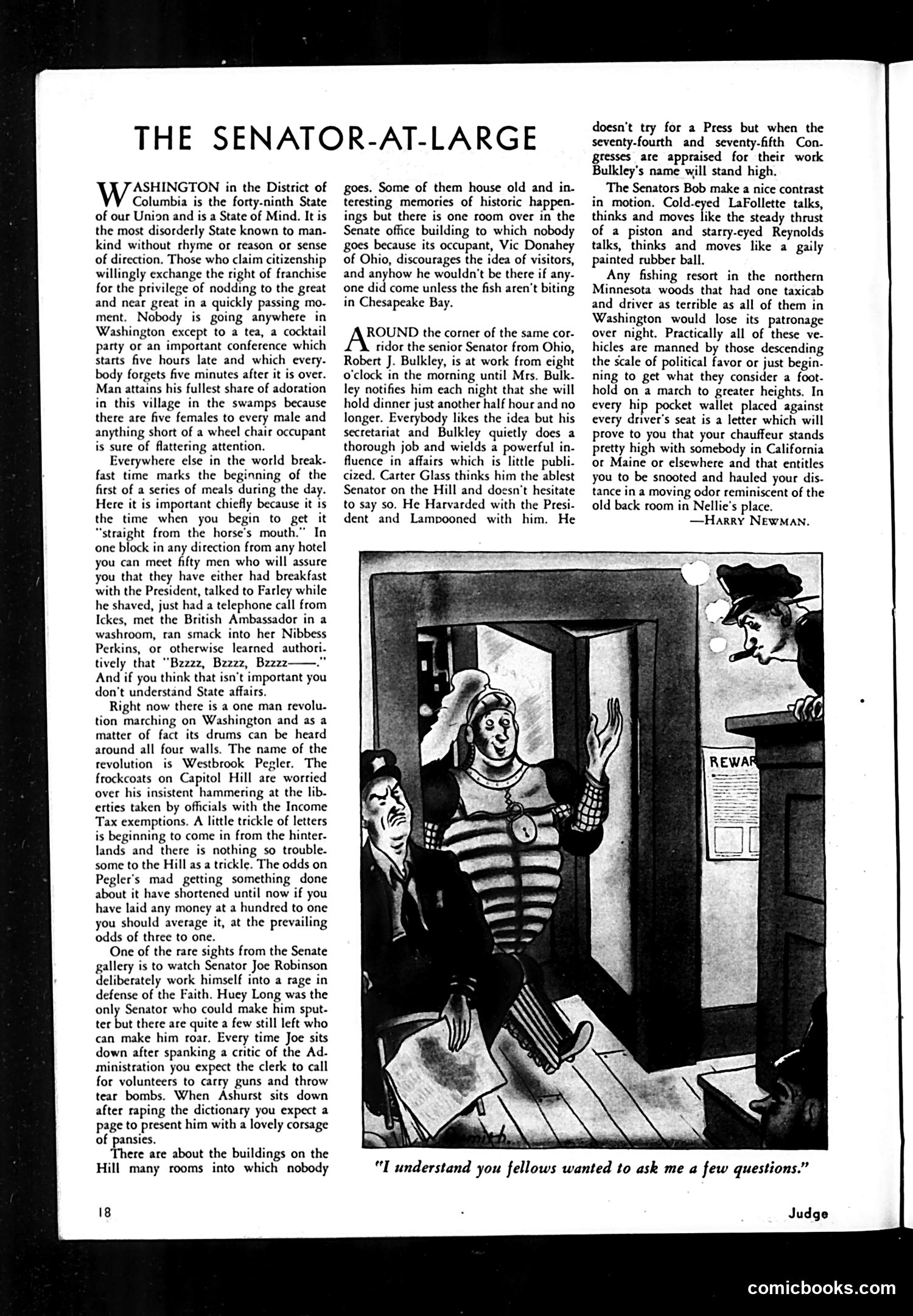
Analysis of "The Senator-at-Large" This is a satirical essay by Harry Newman about Washington D.C. politics, accompanied by a cartoon showing what appears to be a space alien or creature in a striped suit being interrogated, with the caption "I understand you fellows wanted to ask me a few questions." The article mocks Washington's social hierarchy and gossip culture—describing how officials trade on breakfast-table claims of proximity to power ("talked to Farley while he shaved," met "the British Ambassador"). It satirizes the city's obsession with insider access and rumor over substance. The piece highlights journalist Westbrook Pegler's crusade against income tax exemptions for officials, suggesting his criticism is gaining traction. It praises Senator Robert Bulkley of Ohio as quietly effective, and depicts Senator Joe Robinson as emotionally volatile in defending the Roosevelt administration. The cartoon's meaning is unclear—the alien may represent an outsider confronting Washington's absurdities, or perhaps ridicule of some contemporary political figure treated as alien to normal society. The context doesn't explicitly explain it.
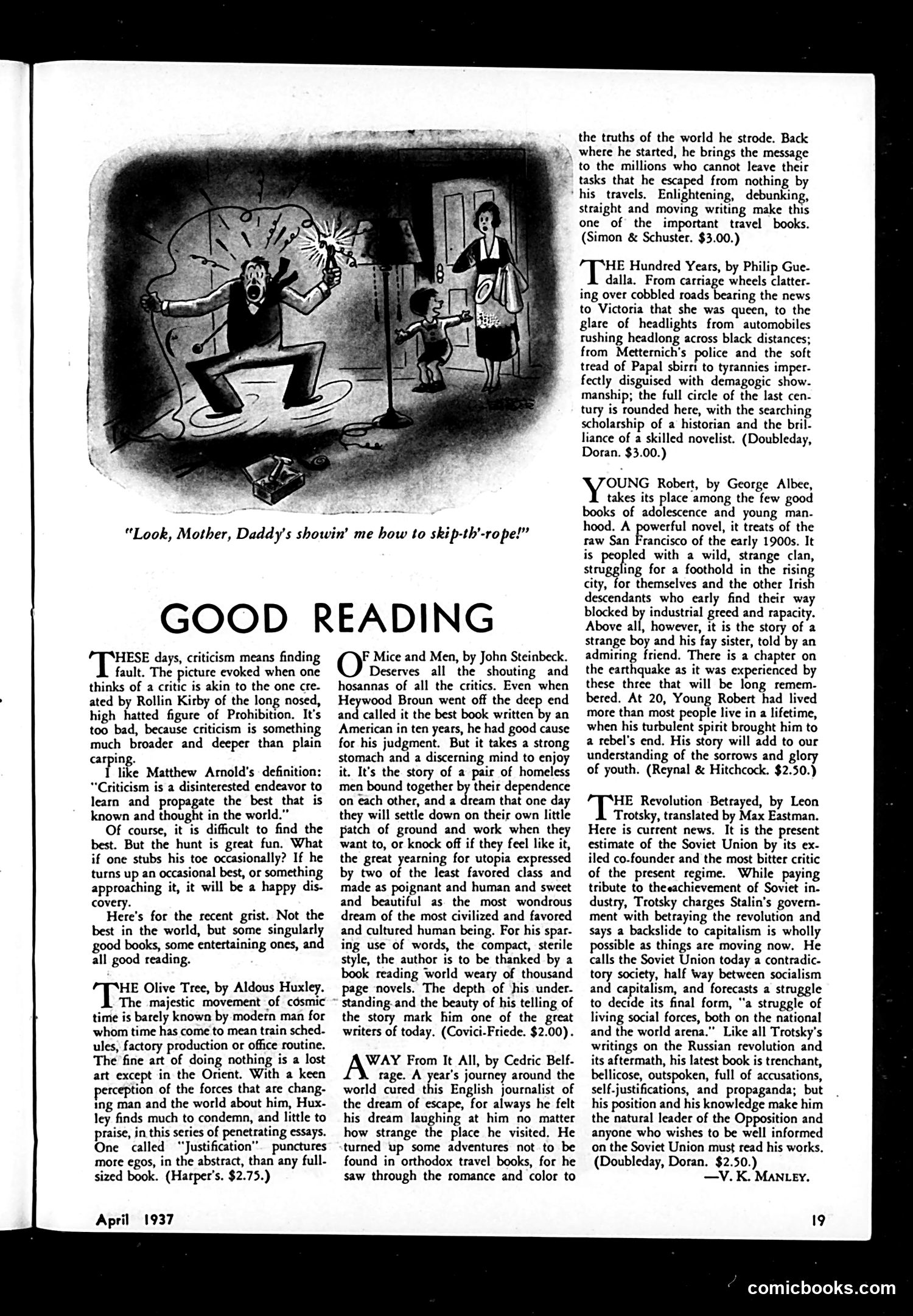
Analysis of Judge Magazine Page, April 1937 The Cartoon The single illustration shows a child watching his father jump rope while saying "Look, Mother, Daddy's showin' me how to skip-th'-rope!" The humor is visual irony: the father appears to be frantically jumping with explosive energy, suggesting adult anxieties rather than innocent play. This likely satirizes Depression-era adults' nervous energy and stressed state—the father's frantic movements contrast absurdly with the calm children's game he's supposedly demonstrating. "Good Reading" Section This is a book review column discussing five recent publications (1937). The introductory essay distinguishes between shallow "fault-finding" criticism and Matthew Arnold's definition of criticism as seeking "the best that is known and thought." The reviews discuss: - Huxley's essay collection criticizing modern life - Steinbeck's *Of Mice and Men* (praised for emotional depth despite dark subject matter) - Works on travel, history, and Russian politics The section emphasizes that good books need not be lengthy or cheerful—they should be truthful and well-crafted.
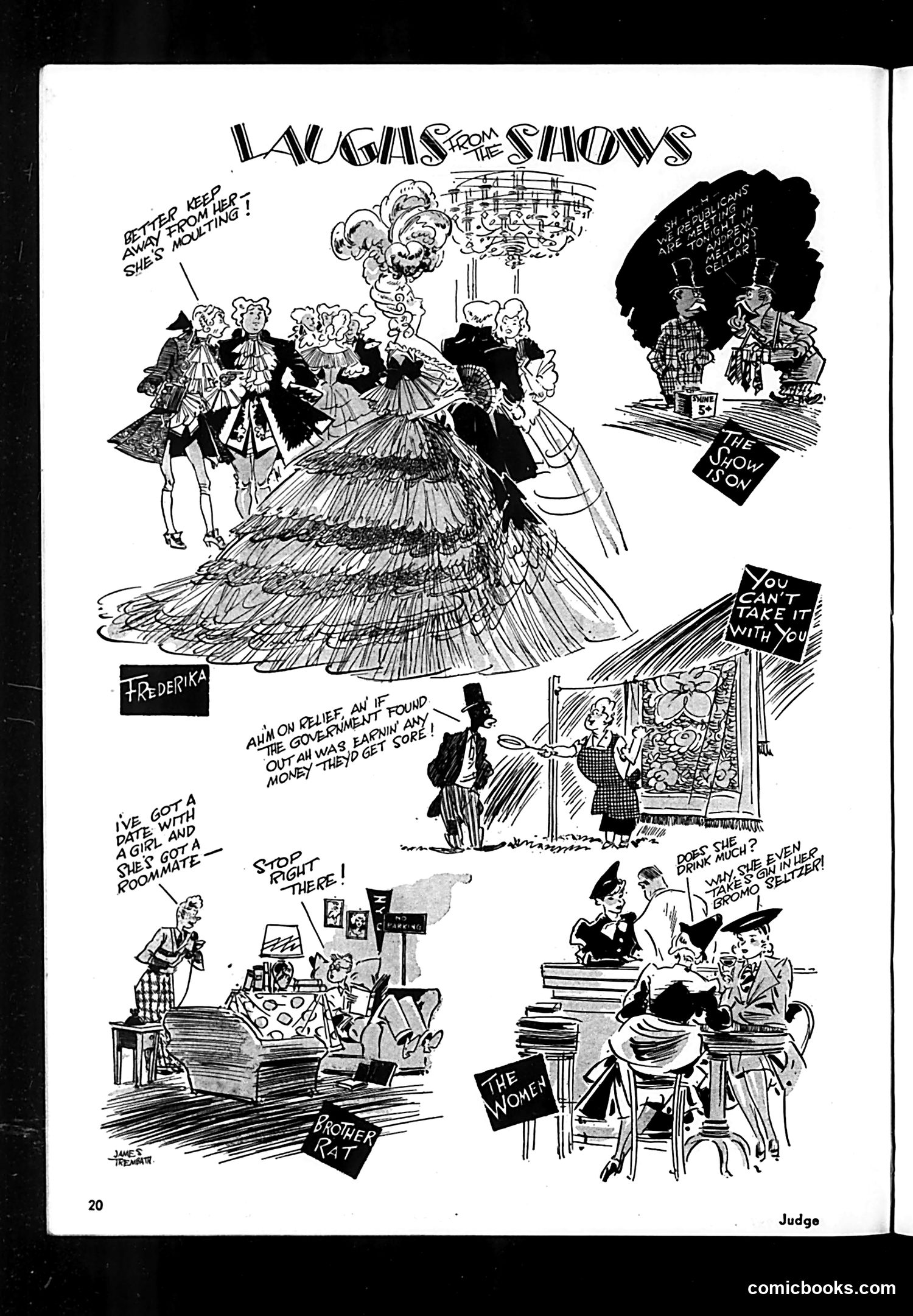
"Laughs from the Shows" This page collects satirical cartoons about theatrical performances and dating culture, likely from the 1930s-40s. The title "Laughs from the Shows" indicates these mock various stage productions. The central large illustration shows a woman in an elaborate, voluminous gown—possibly satirizing extravagant theatrical costume design or "Frederica," a named character. Smaller panels below depict various social scenarios: dating mishaps ("I've got a date with a girl...she's got a roommate"), economic hardship ("All on relief...can't even find out...they'd get sore"), and gender politics ("The Women," "Brother Rat"). The cartoons appear to lampoon both theatrical excess and Depression-era social anxieties around dating, poverty, and changing gender roles—using humor to comment on contemporary struggles and entertainment industry spectacle.
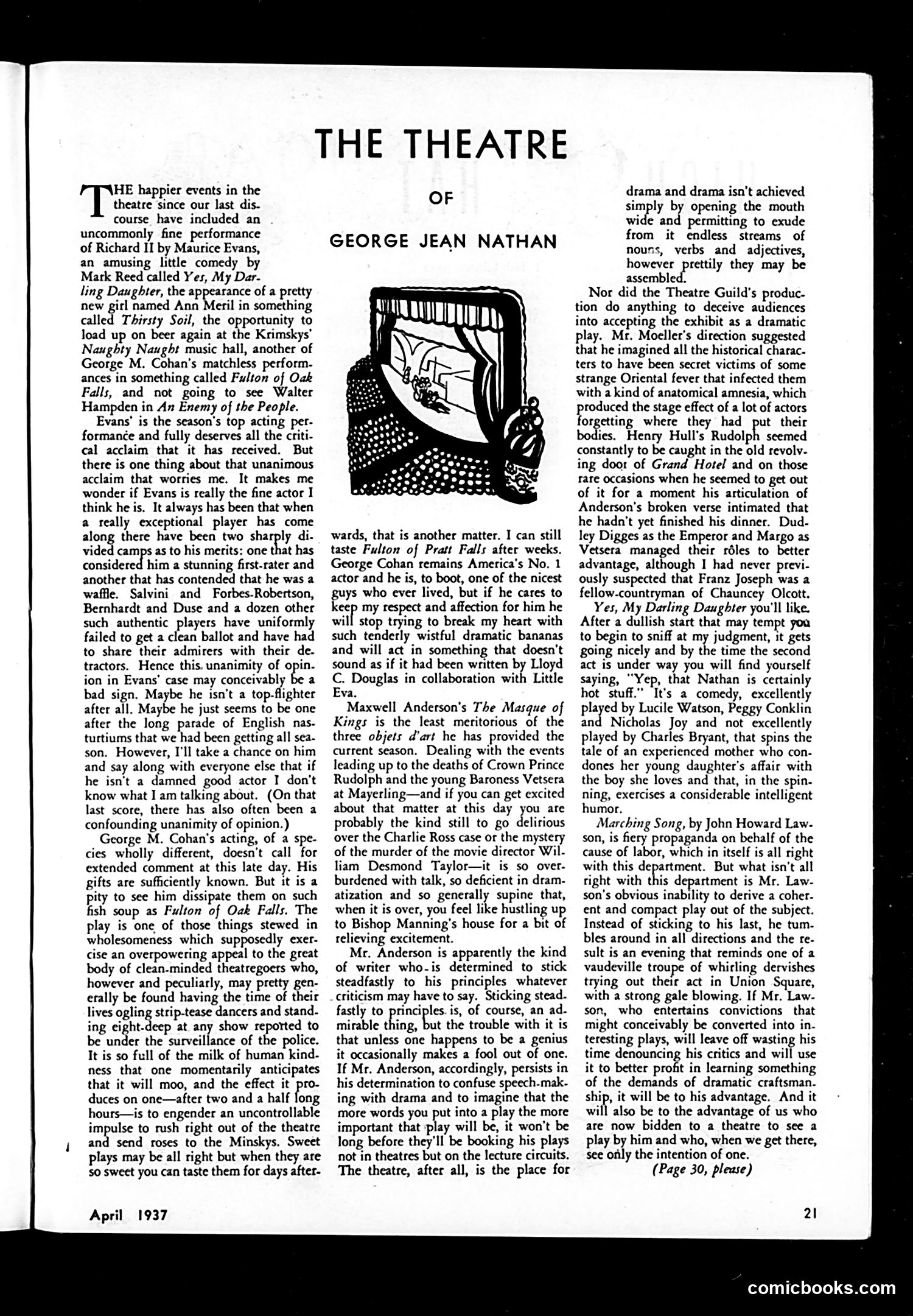
Analysis of This Judge Magazine Theatre Column This is a theatre review column by George Jean Nathan, Judge's drama critic. The small illustration shows a theatre audience member viewing a stage through binoculars. Nathan discusses 1937 Broadway productions, offering mixed praise: Maurice Evans's *Richard II* receives genuine acclaim; Mark Reed's *Yes, My Darling Daughter* is "amusing"; George M. Cohan performs brilliantly in *Fulton of Oak Falls*, but Nathan finds the play itself saccharine and tedious—so wholesome it's cloying. The satire targets mass audience taste: Nathan sarcastically notes that "wholesome" theatre appeals to the same people who flock to burlesque shows and strip clubs under police surveillance, exposing the hypocrisy of ostensibly respectable theatre-goers. Nathan's broader point: unanimous critical acclaim should be suspect. Great actors historically divided opinion; unanimous praise suggests Evans may be merely competent rather than exceptional. This reflects Nathan's role as an acerbic, contrarian critic—skeptical of both sentimental drama and uncritical popular enthusiasm.
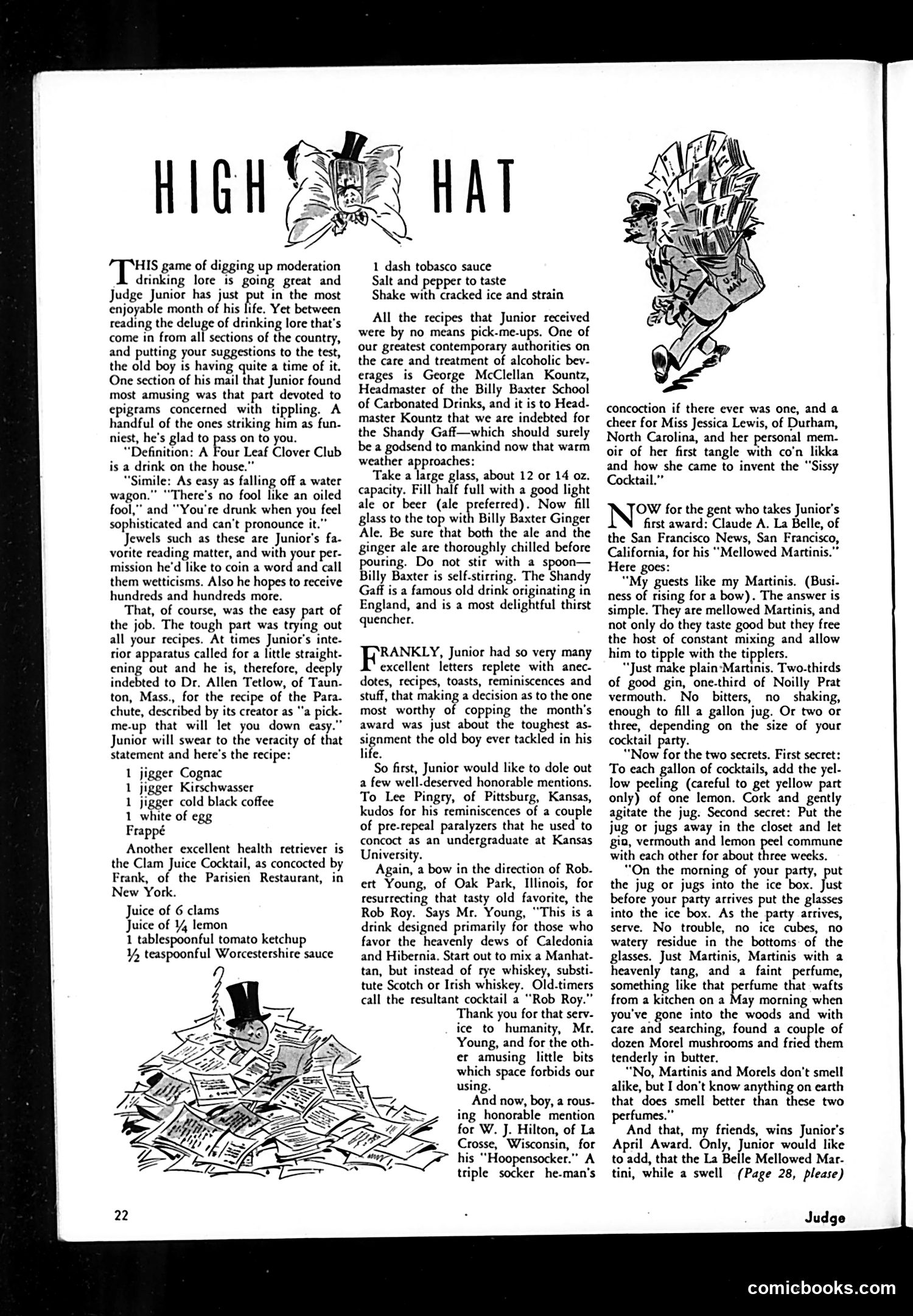
"High Hat" - Judge Magazine Drinking Lore Feature This is a humor article celebrating cocktail recipes and drinking anecdotes submitted by readers during Prohibition's aftermath. Judge's "Junior" (the magazine's fictional editor-persona) solicits and judges homemade drink recipes and witty drinking sayings—what he coins "wetticisms." The page features actual cocktail recipes from notable sources: George McClellan Kountz (head of a ginger ale company promoting his product), and Frank from a New York restaurant. It also honors reader contributions like Lee Pingry's Kansas University memories and Robert Young's "Rob Roy" cocktail revival. The cartoons show a celebratory top-hat figure amid money and a towering stack of submitted letters, visualizing the deluge of reader participation. The satire is gentle—poking fun at post-Prohibition enthusiasm for publicizing alcohol consumption while celebrating American's rediscovered cocktail culture.
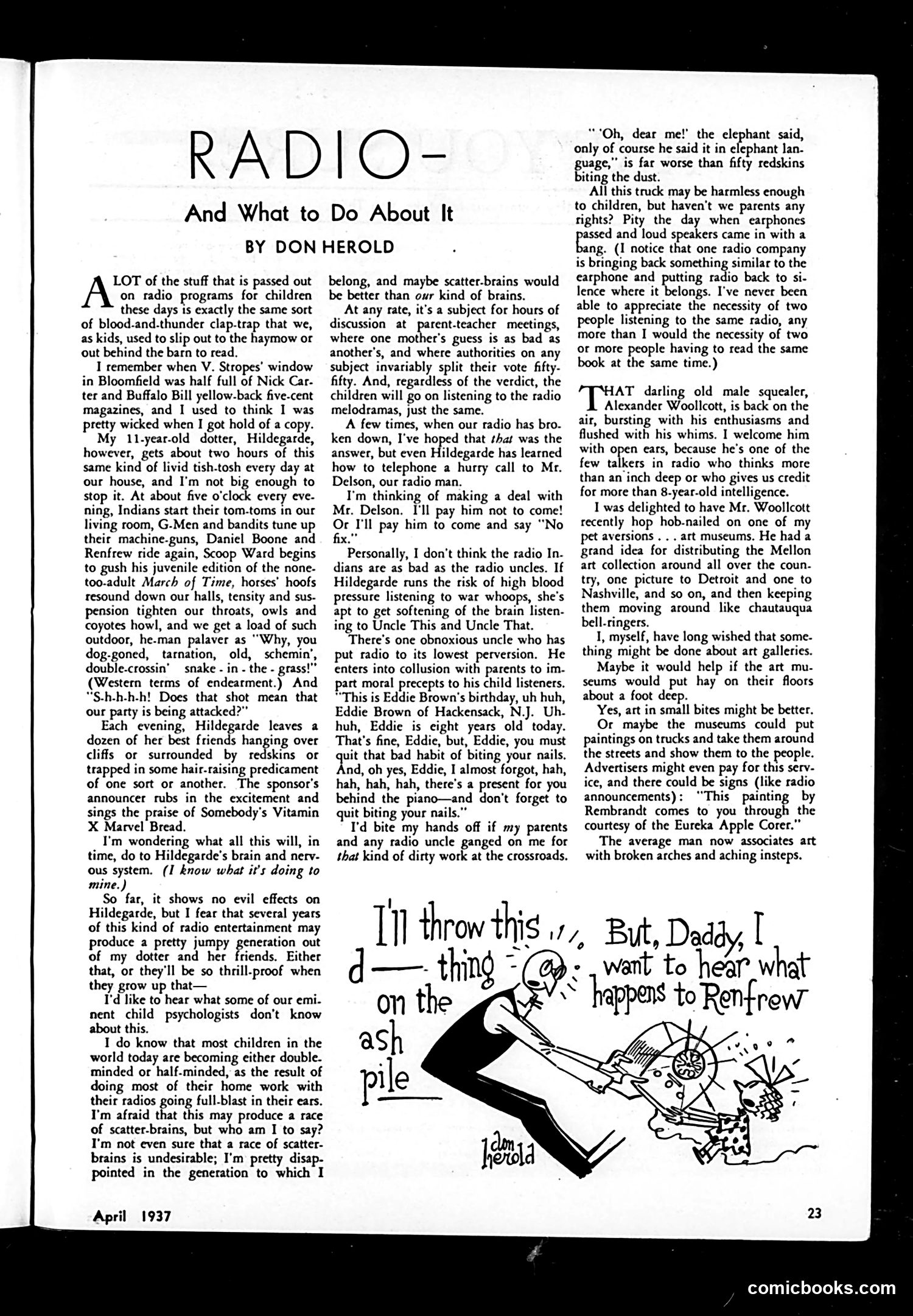
"Radio—And What to Do About It" by Don Herold (April 1937) This satirical article criticizes children's radio programming of the 1930s. Herold compares contemporary radio melodramas—featuring Indians, G-Men, bandits, and adventure serials like "Renfrew" and "March of Time"—to the lurid dime novels (Nick Carter, Buffalo Bill) he read as a boy. The author worries these programs overstimulate children like his daughter Hildegarde, leaving cliffhangers that disrupt her concentration on homework. He expresses concern about creating a "jumpy generation" of "scatter-brains," while sarcastically acknowledging he can't stop the trend. The cartoon depicts a frustrated father wanting to throw his radio away to prevent his child from hearing these shows' chaotic sound effects and narratives. Herold's critique reflects 1930s parental anxiety about new mass media and its effects on youth development—concerns that persist today regarding screens and content.
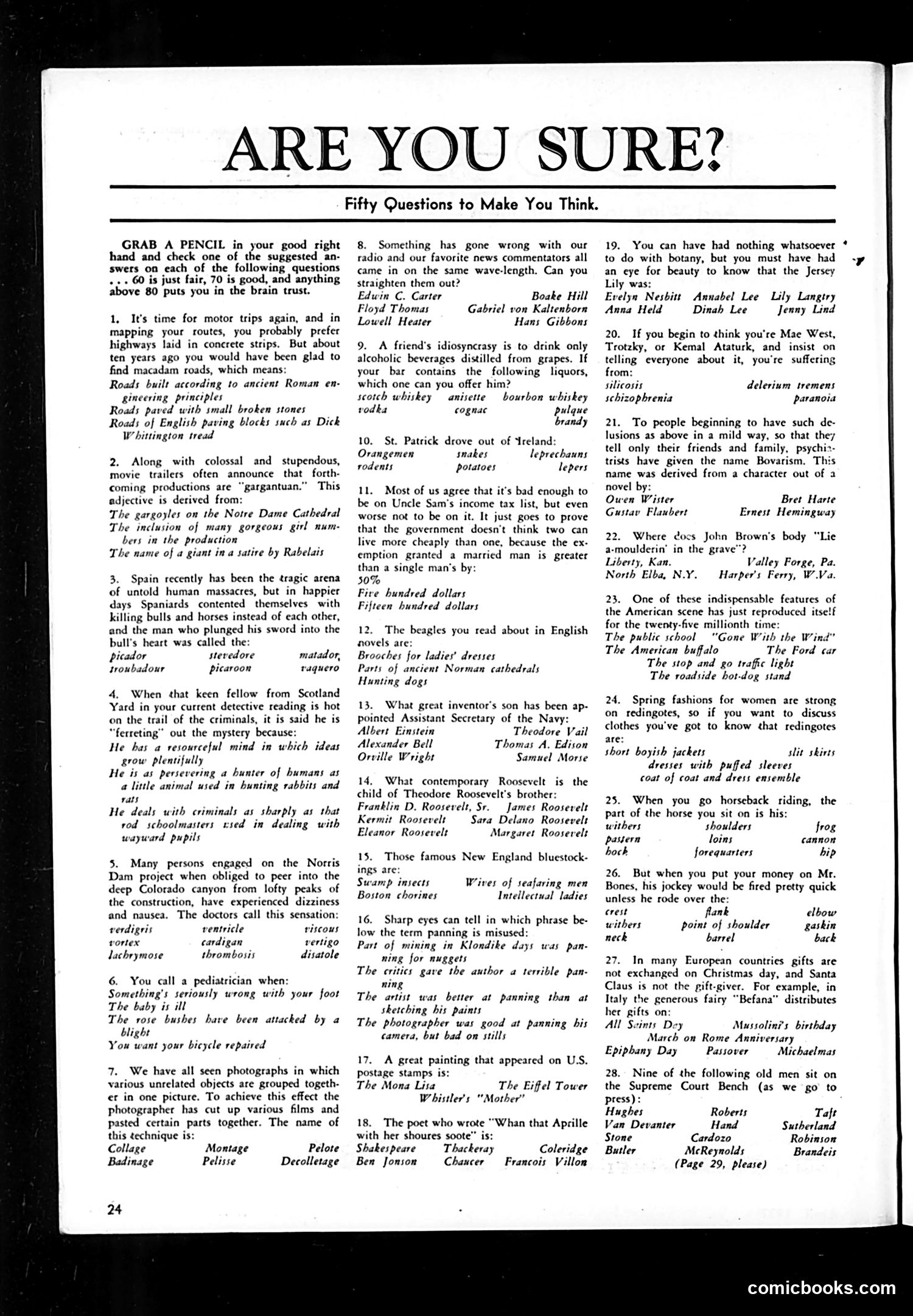
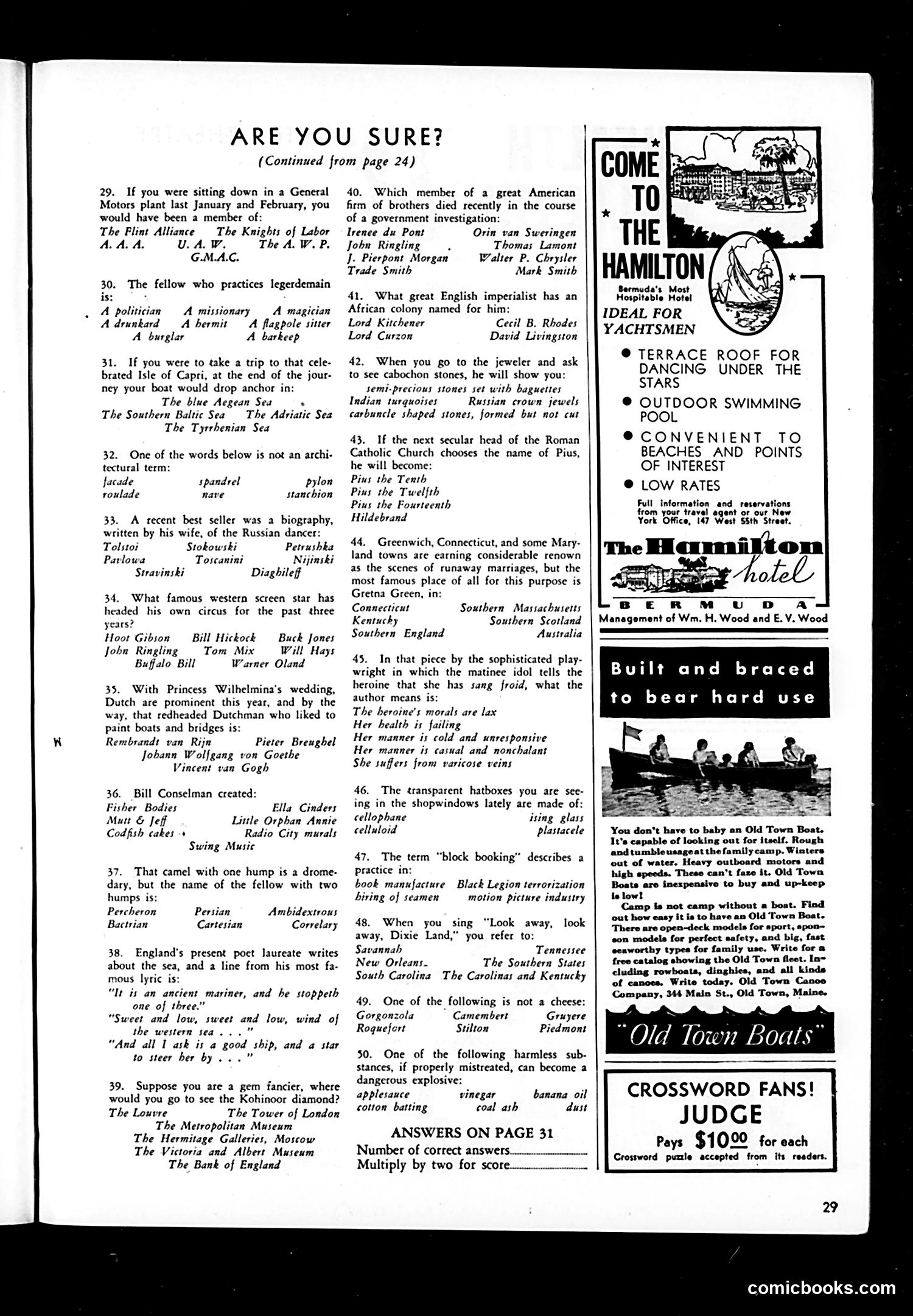
"Are You Sure?" - A Trivia Quiz Page This page is a trivia quiz called "Are You Sure? Fifty Questions to Make You Think," published in Judge, a satirical magazine. Rather than political cartoons, it's a brain-teaser test with lighthearted general knowledge questions about etymology, literature, history, and vocabulary. The quiz spans diverse topics: macadam roads, Rabelais's "Gargantuan," Spanish bullfighting terminology ("matador"), detective work ("ferret"), and radio commentators (question 8). Question 10 references the Irish cultural legend of St. Patrick. The scoring system (60 fair, 70 good, 80+ "brain trust") is humorously self-congratulatory. No specific political figures are caricatured here. The content reflects post-Depression American culture — references to the Norris Dam project, income tax debates, and contemporary radio personalities suggest 1930s-1940s context. This is entertainment for educated middle-class readers rather than political satire.
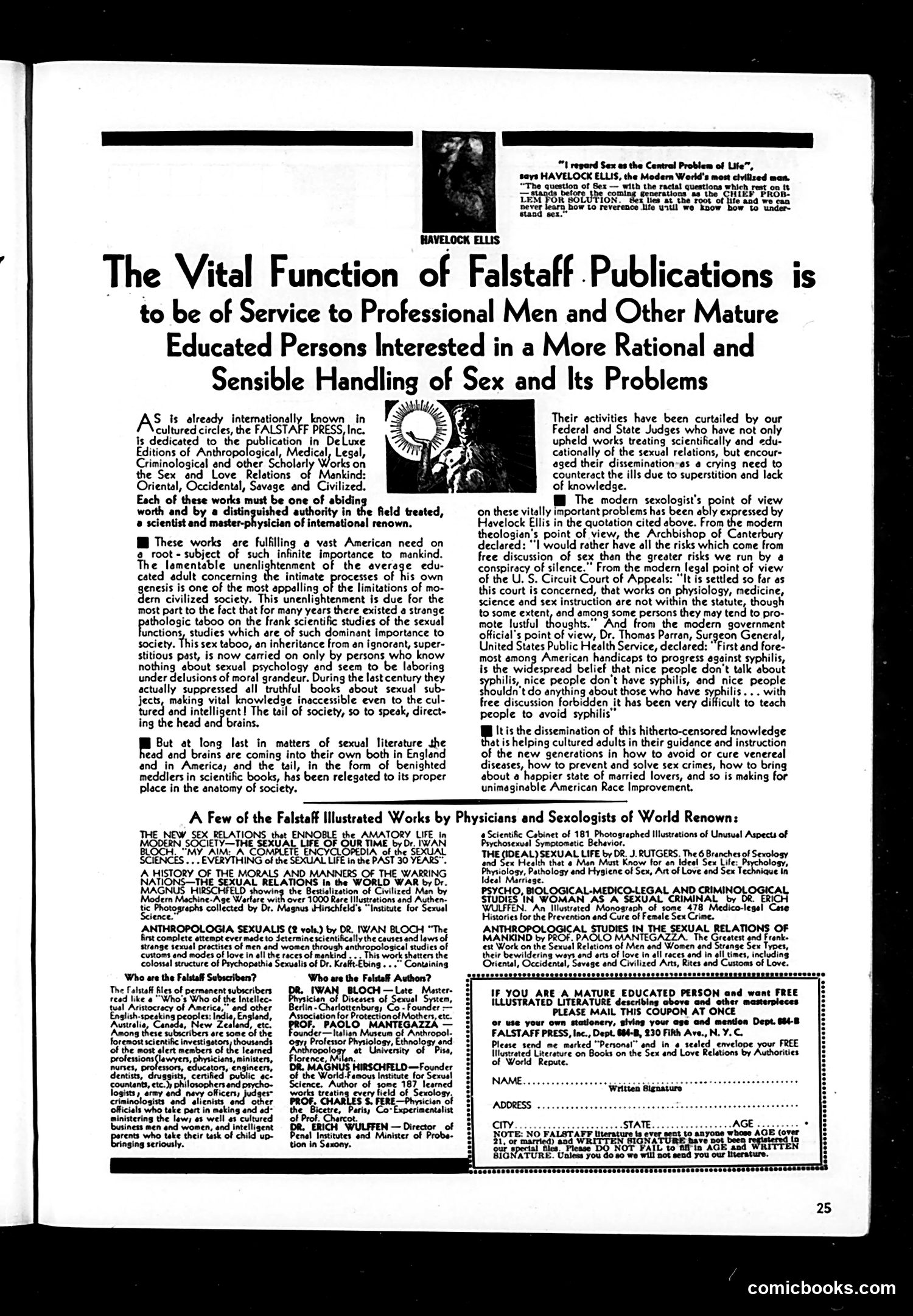
Falstaff Publications Advertisement This is a full-page advertisement for Falstaff Press, a publisher of sexual education materials. The page quotes sexologist Havelock Ellis (whose photograph appears at top) to establish intellectual credibility for publishing frank discussions of sex. The ad argues that scientific sex education serves "professional men and other mature educated persons" and opposes outdated Victorian prudishness—described as "the tail...directing the head and brains" of society. It cites support from modern authorities: theologians, judges, and the U.S. Surgeon General, all endorsing sex education as necessary public health. The advertisement's core argument: shame and ignorance about sex cause social harm (syphilis, sexual crime, unhappy marriages), while rational scientific discussion prevents these problems. A coupon invites readers to request illustrated literature. This reflects 1920s-30s progressive reform movements that challenged Victorian sexual repression through pseudo-scientific authority, though modern readers should note the era's problematic racial and eugenic assumptions underlying some sexology.
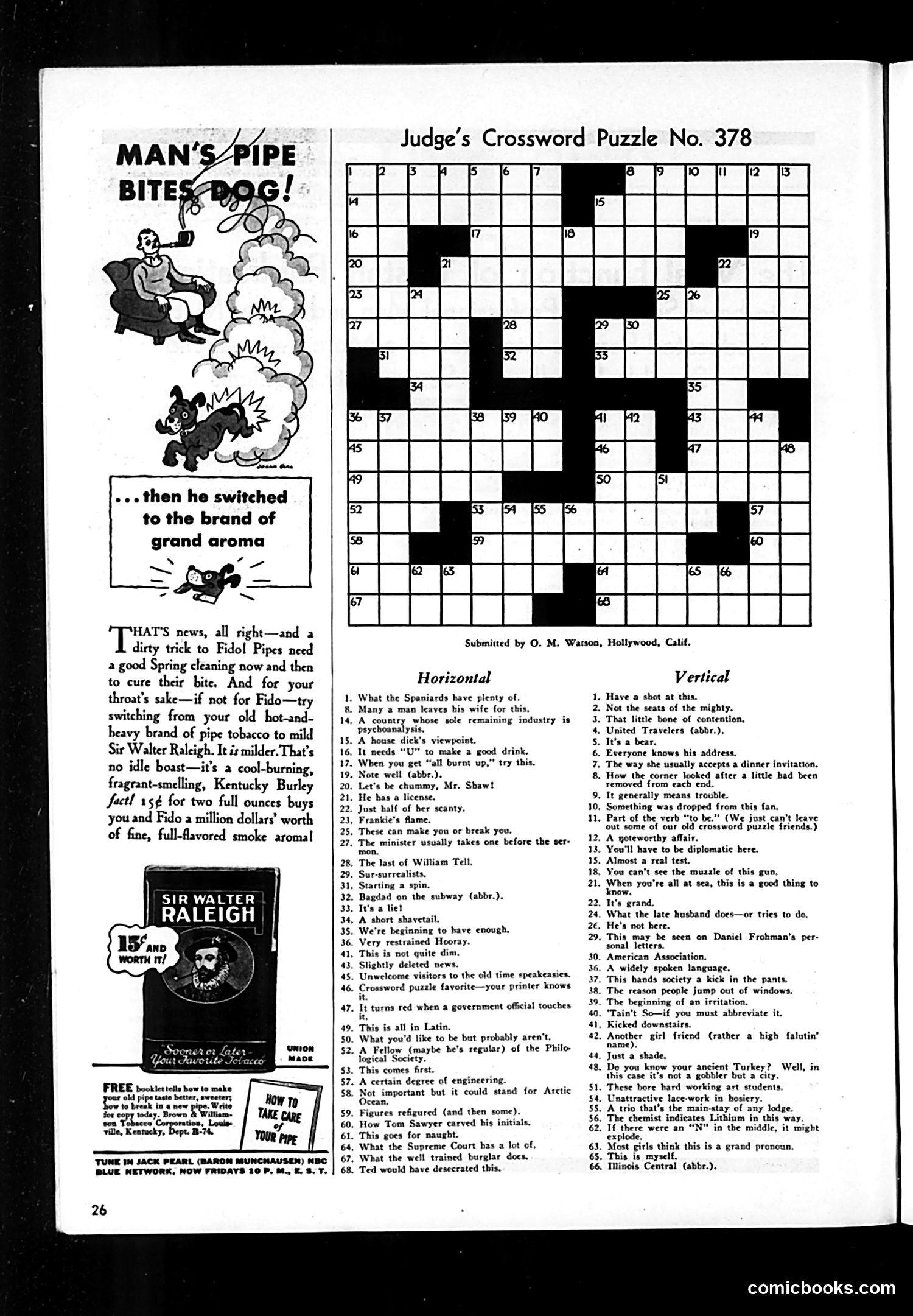
Judge Magazine Crossword Puzzle No. 378 This page is primarily a crossword puzzle with minimal satirical content. The dominant feature is a Fido Pipes tobacco advertisement disguised as a humorous cartoon narrative: a man's pipe bites his dog, so he switches to "Sir Walter Raleigh" brand tobacco, which allegedly solves the problem. The cartoon's "joke" relies on a period advertising convention—attributing magical properties to consumer products to solve absurd domestic problems. The implication is that switching tobacco brands will somehow make a pipe less likely to bite animals, which is obviously nonsensical even by 1930s standards. The crossword itself appears to be standard puzzle fare with contemporary references (Frankie's Flame, Daniel Frohman) rather than sharp political satire. The page functions primarily as advertising disguised as editorial content—a common Judge magazine strategy.
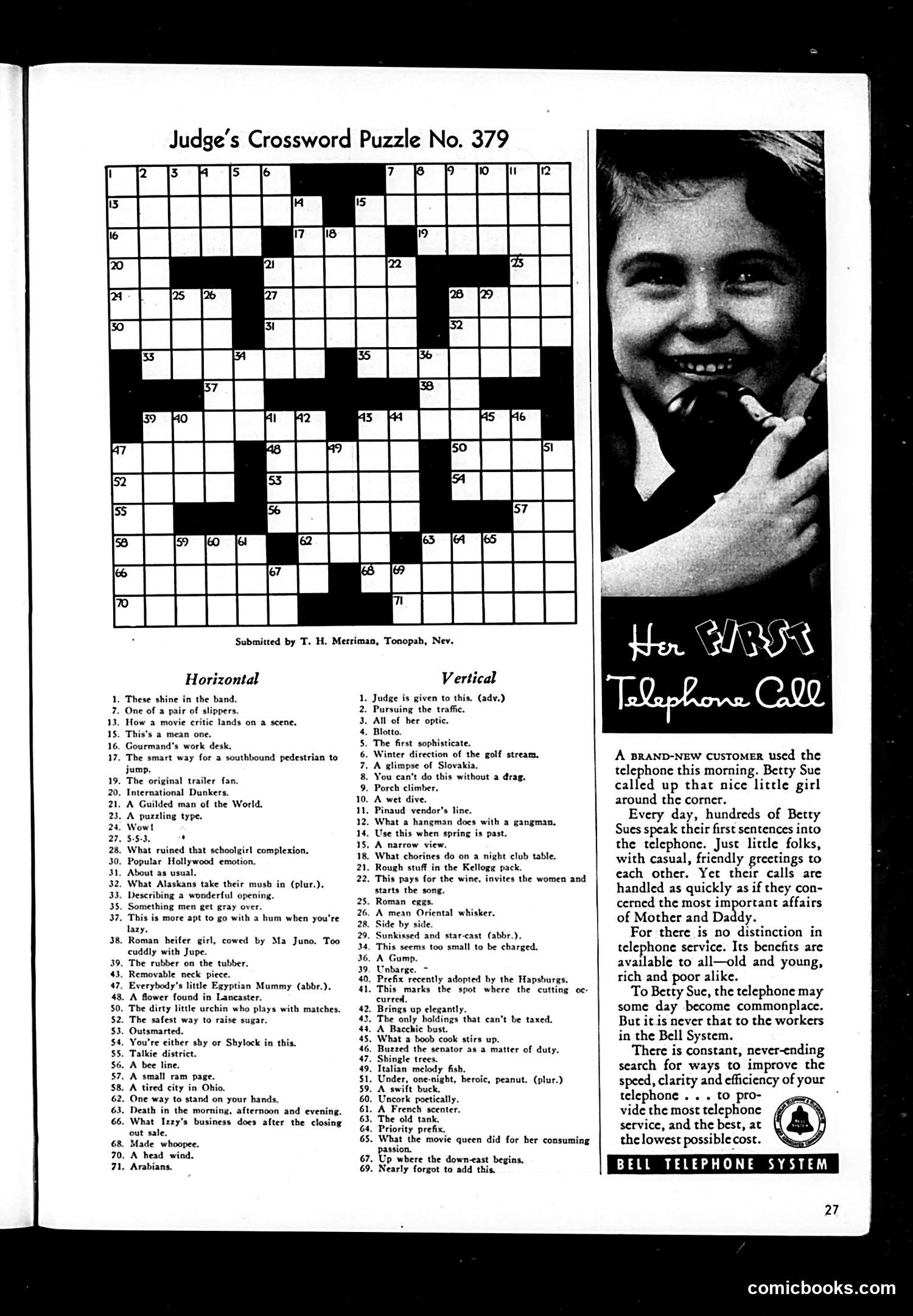
Explanation for Modern Readers This page contains a standard crossword puzzle submission and a Bell Telephone System advertisement, not political satire. The advertisement depicts a young girl ("Betty Sue") making her first telephone call to a neighbor—a touching moment presented as unremarkable yet precious. The copy emphasizes that telephone service treats all calls equally, whether from a child or adult, rich or poor. This promotes the Bell System's reliability and democratic accessibility during an era when telephones were becoming household staples but still somewhat novel. The message reflects 1930s-40s corporate messaging: Bell presents itself as essential infrastructure serving all Americans equally, while subtly positioning the company as committed to constant improvement and affordable service. The emotional appeal to childhood innocence and family connection was typical advertising strategy of the period, designed to build customer loyalty and positive brand perception for a near-monopoly utility. The crossword puzzle appears submitted by a Tonopah, Nevada resident—likely a reader contribution, standard Judge magazine content.
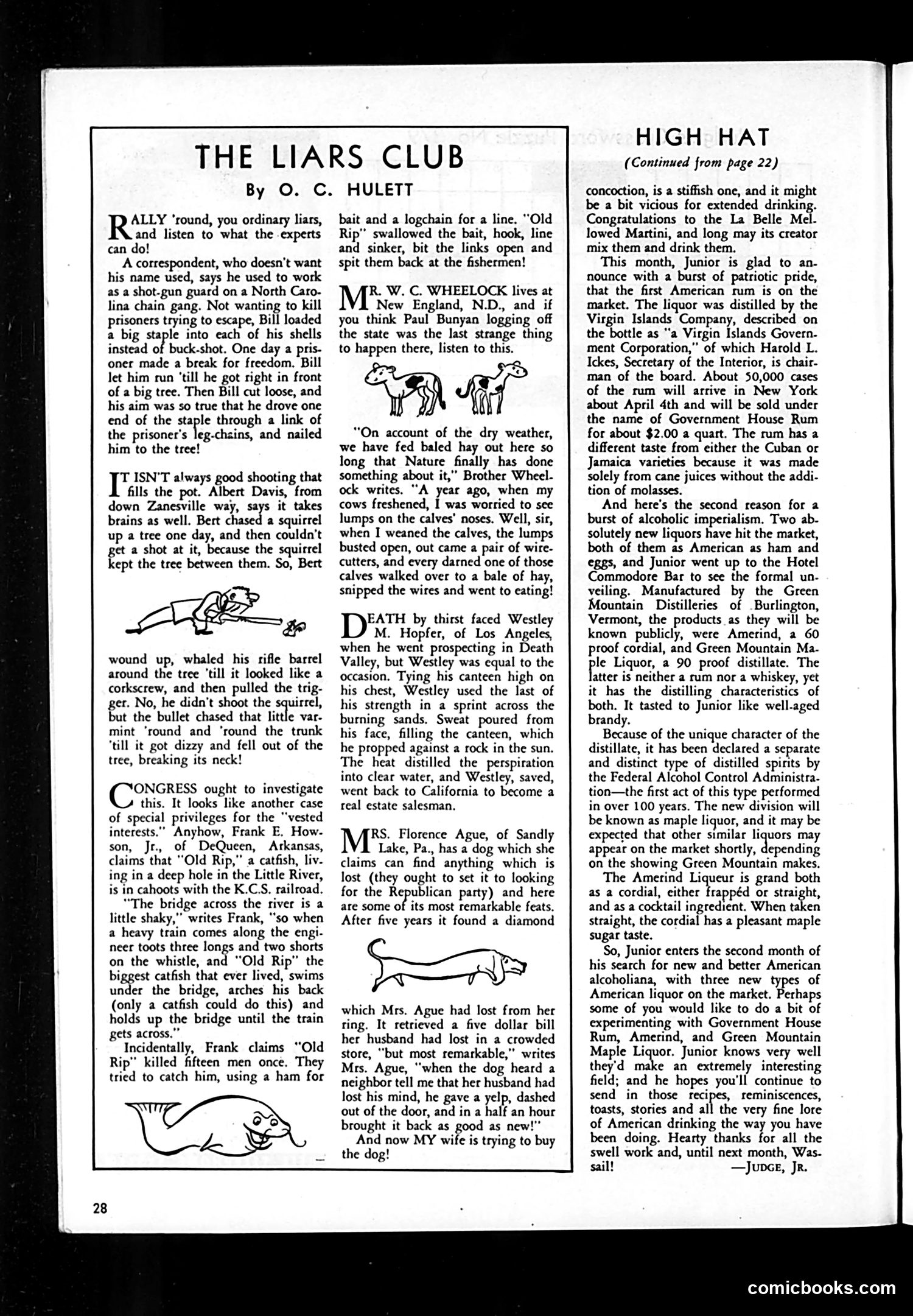
"The Liars Club" — A Tall Tales Humor Column This is a humorous column presenting exaggerated, impossible stories submitted by readers — a "Liars Club" competition. Each anecdote becomes increasingly absurd: - A prison guard shoots a staple through a convict's leg-chains, nailing him to a tree - A hunter makes a bullet spiral around a tree trunk, dizzy-ing a squirrel to death - A giant catfish ("Old Rip") holds up a railroad bridge during trains - Cows fed hay so long develop wire-cutters in their noses to open bales - A prospector in Death Valley sweats enough into a canteen to drink - A dog finds lost items after five years The humor relies on tall-tale tradition — deliberately impossible narratives presented as fact. The "Congress ought to investigate" section satirizes government concern with trivial matters. This reflects early-20th-century American folklore entertainment, where exaggeration and absurdist humor about frontier life entertained readers. The accompanying crude illustrations emphasize the comic, fictional nature.
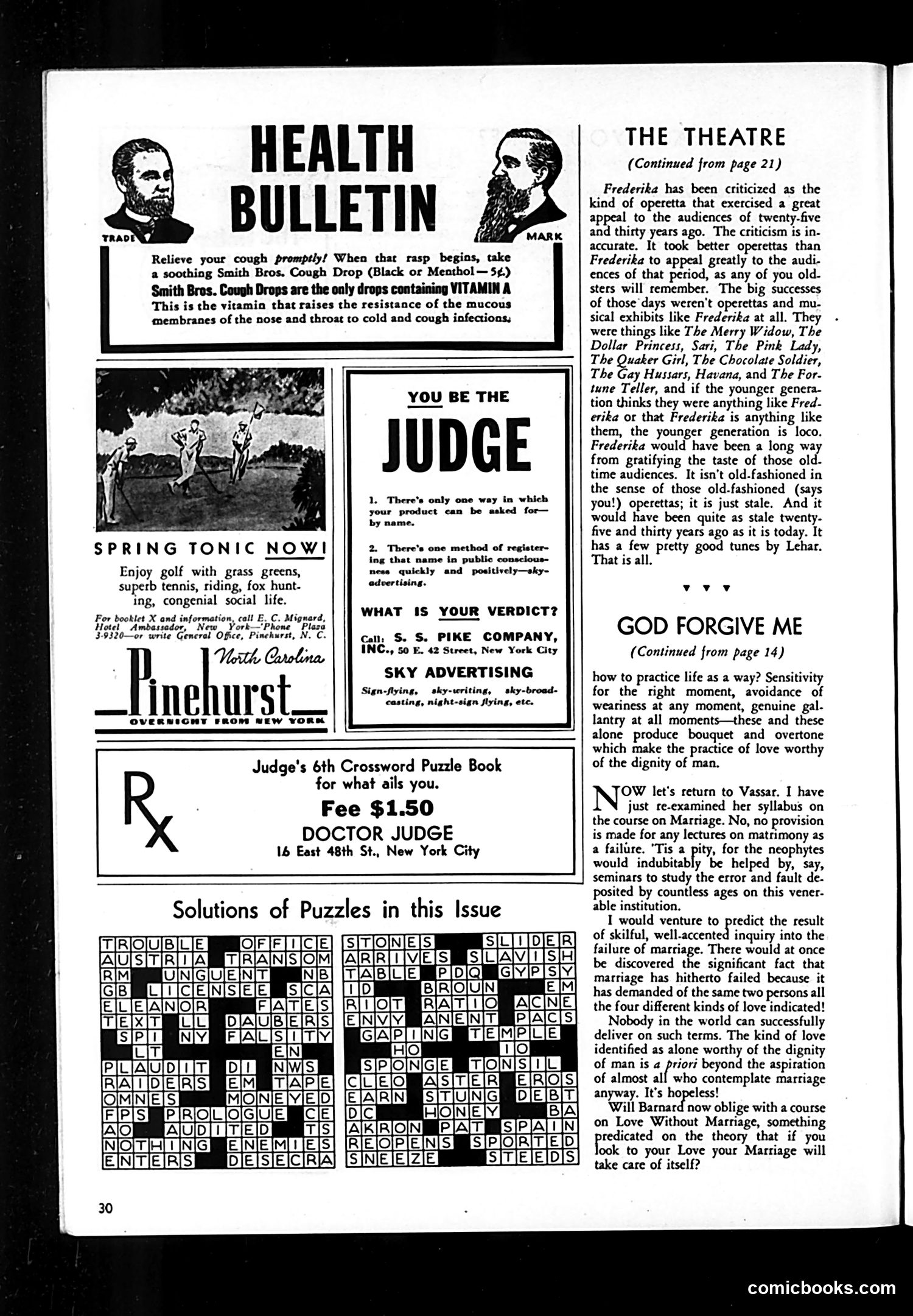
Judge Magazine Page Analysis This page is primarily advertising and filler content rather than political satire. The main elements are: Advertisements: Smith Bros. Cough Drops (claiming Vitamin A benefits), Pinchurst golf resort in North Carolina, S.S. Pike Company product judging, and Doctor Judge's crossword puzzle book. Editorial Content: A theater review criticizing the operetta *Frederika*, arguing it's merely "stale" rather than genuinely old-fashioned, unlike successful operettas from 20-30 years prior (*The Merry Widow*, *The Pink Lady*, etc.). The reviewer suggests modern audiences wrongly perceive it as period entertainment. Column: "God Forgive Me" (continued from earlier) discusses marriage philosophy, arguing that successful marriage requires an impossible combination of four different types of love simultaneously—a satirical critique of romantic expectations. A crossword puzzle solution grid appears at bottom. The page lacks significant political commentary or identifiable caricatures—it's a typical magazine filler page mixing advertisements with lighter cultural commentary.
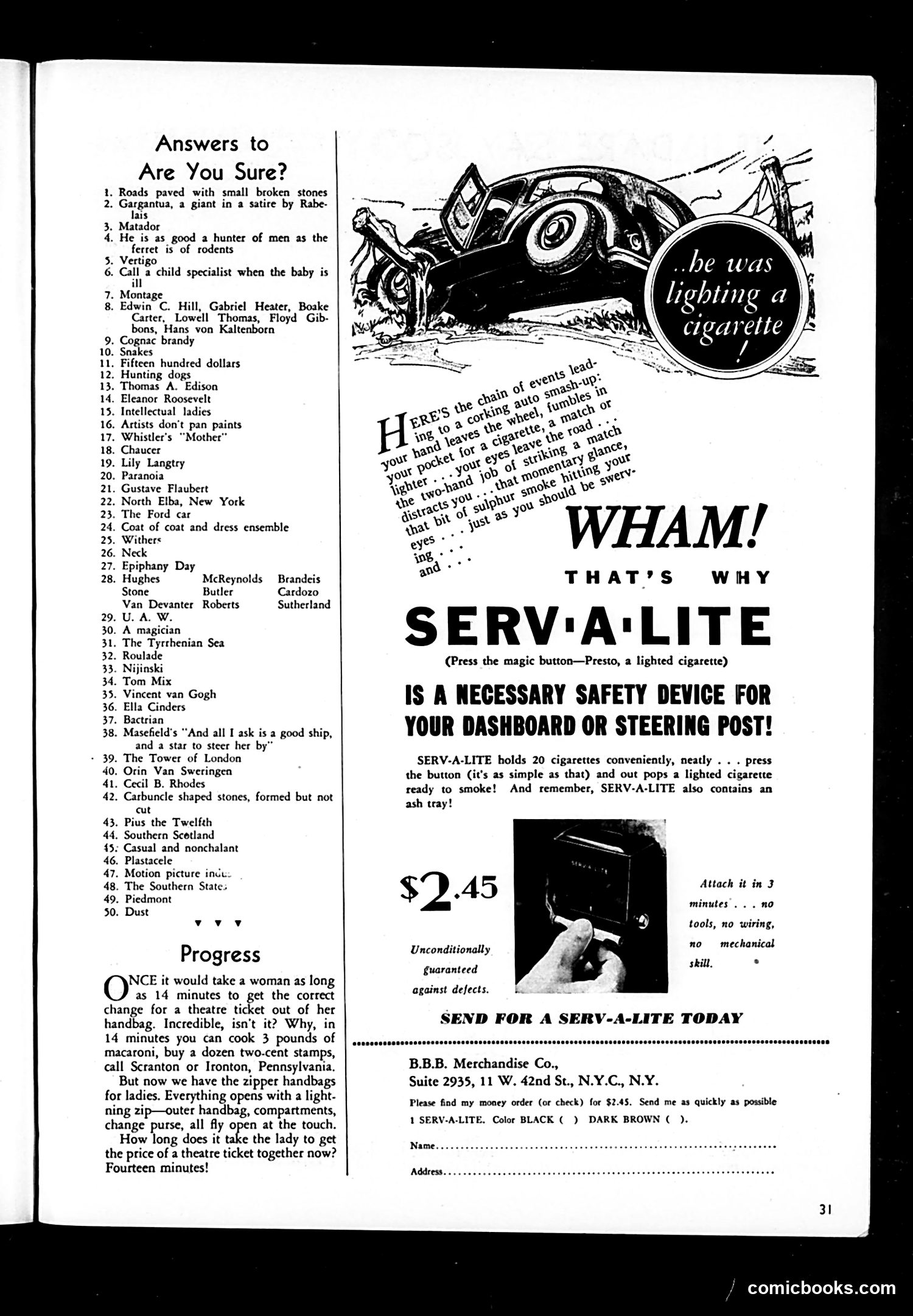
Analysis of Judge Magazine Page This page combines a quiz-answer section with period advertising and social commentary. The "Are You Sure?" Quiz Answers reference obscure cultural and historical knowledge—classical literature (Rabelais), famous radio commentators (Lowell Thomas, Boake Carter), art (Whistler), and notable figures (Eleanor Roosevelt, Van Gogh). It's typical trivia content for educated magazine readers. The "Progress" section satirizes women's supposedly improved efficiency. It jokes that despite zipper handbags supposedly saving time, women still take 14 minutes to locate their theatre ticket money—the same as before. The humor relies on the period stereotype of women being disorganized. The SERV-A-LITE Advertisement pitches a dashboard cigarette lighter holding 20 cigarettes, presented as a "safety device." This reflects 1930s-40s car culture and casual attitudes toward smoking while driving. The ad's absurdity—calling a cigarette dispenser a "safety device"—is unintentionally darkly comic by modern standards, revealing period attitudes toward automotive safety and tobacco use.
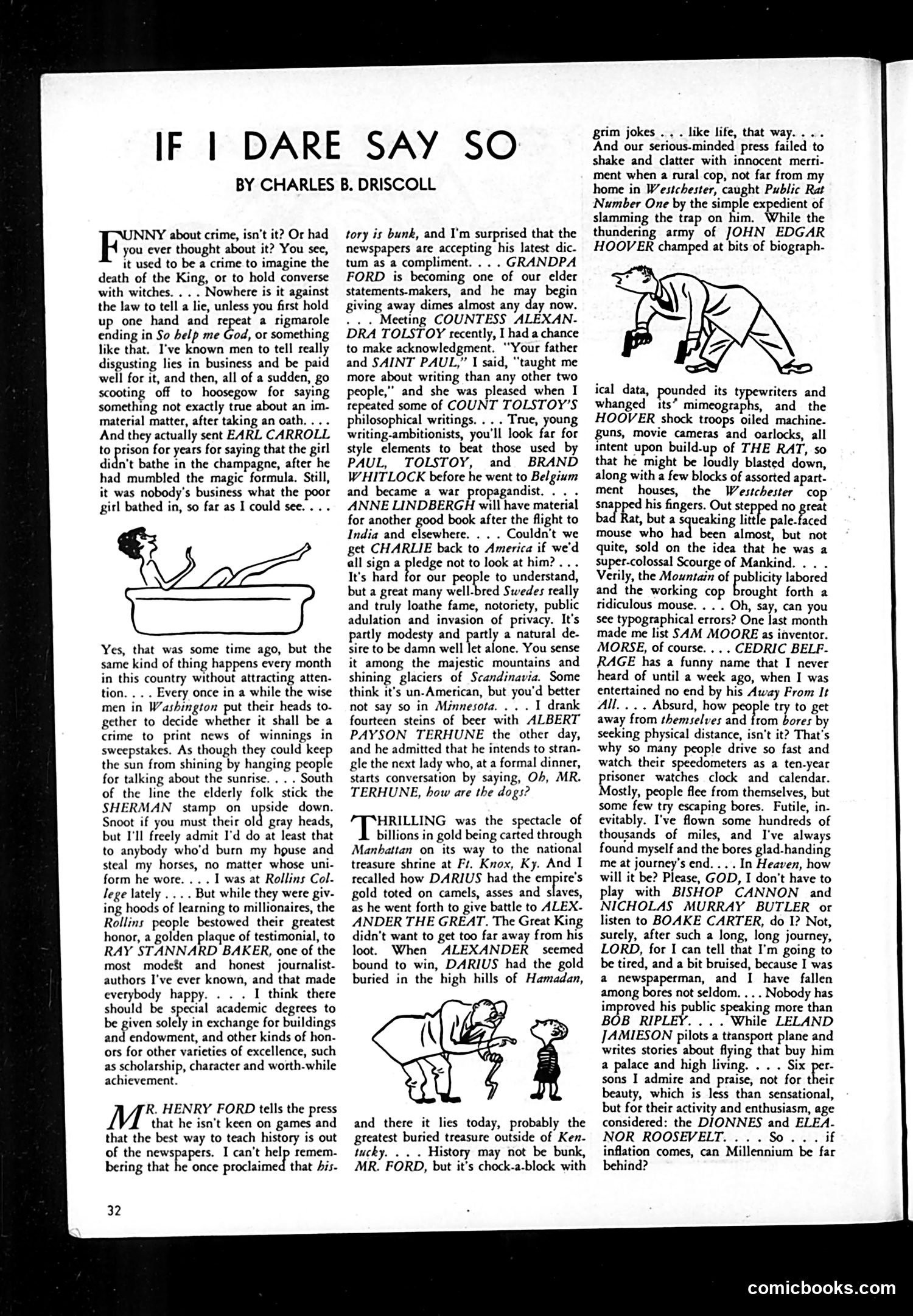
Analysis for Modern Readers This is Charles B. Driscoll's satirical essay "If I Dare Say So" from *Judge* magazine, critiquing arbitrary American laws and social hypocrisy. Main Points: The piece mocks the selective enforcement of laws—lying is legal unless under oath; Earl Carroll went to prison for claiming a girl didn't bathe in champagne (a famous 1920s scandal), yet businessmen lie with impunity. Washington debates criminalizing sweepstakes news coverage while unable to stop gossip. Named References: - Henry Ford: Recently called history "bunk"; now newspapers treat his dismissal of games/newspapers as wisdom - Countess Alexandra Tolstoy: Mentioned alongside Tolstoy and Saint Paul as writing influences - Anne Lindbergh: Will profit from her India flight as book material - "Charlie" (Lindbergh): Swedish-descended, values privacy—the essay defends this against American celebrity culture The Satire: America's arbitrary moral standards, particularly regarding speech and privacy, expose fundamental inconsistency between law and practice.
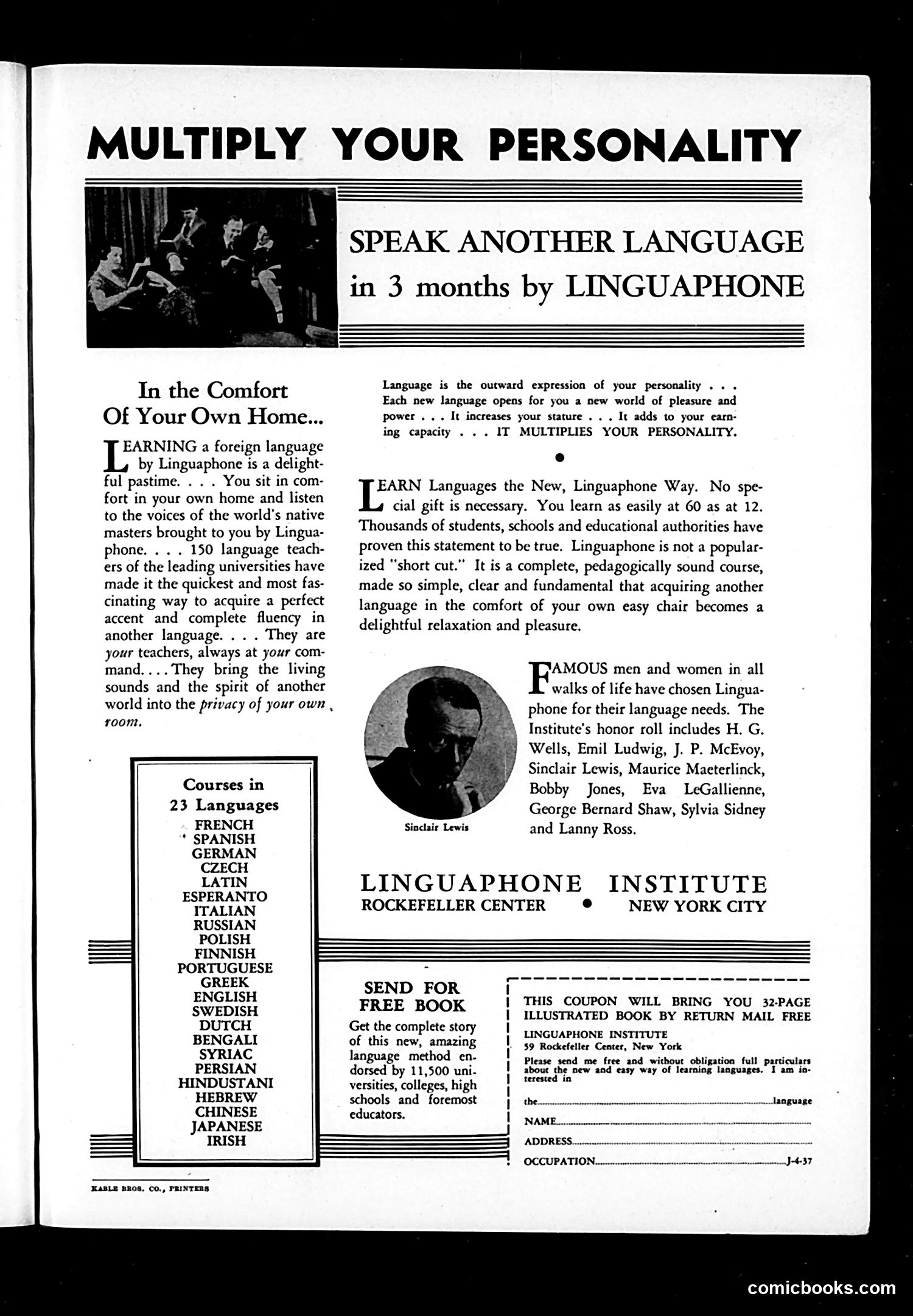
Analysis This page is not satire or a cartoon—it's a straightforward advertisement for Linguaphone, a language-learning program. The Linguaphone Institute marketed their correspondence courses through prestigious endorsements and lifestyle messaging. The ad features Sinclair Lewis, the famous American novelist, as a celebrity endorsement. The text claims notable figures including H.G. Wells, George Bernard Shaw, and others used Linguaphone. The "satire" lies in the marketing copy itself: the grandiose claim that learning languages "multiplies your personality" and the promise of fluency in 3 months from an easy chair represents the kind of exaggerated advertising common in early-to-mid 20th century magazines. The appeal to comfort, ease, and self-improvement—staples of consumer advertising—may strike modern readers as humorous in their earnestness. The page lists 23 languages available, from French to Irish, positioning Linguaphone as comprehensive and cosmopolitan for the home learner of the era.
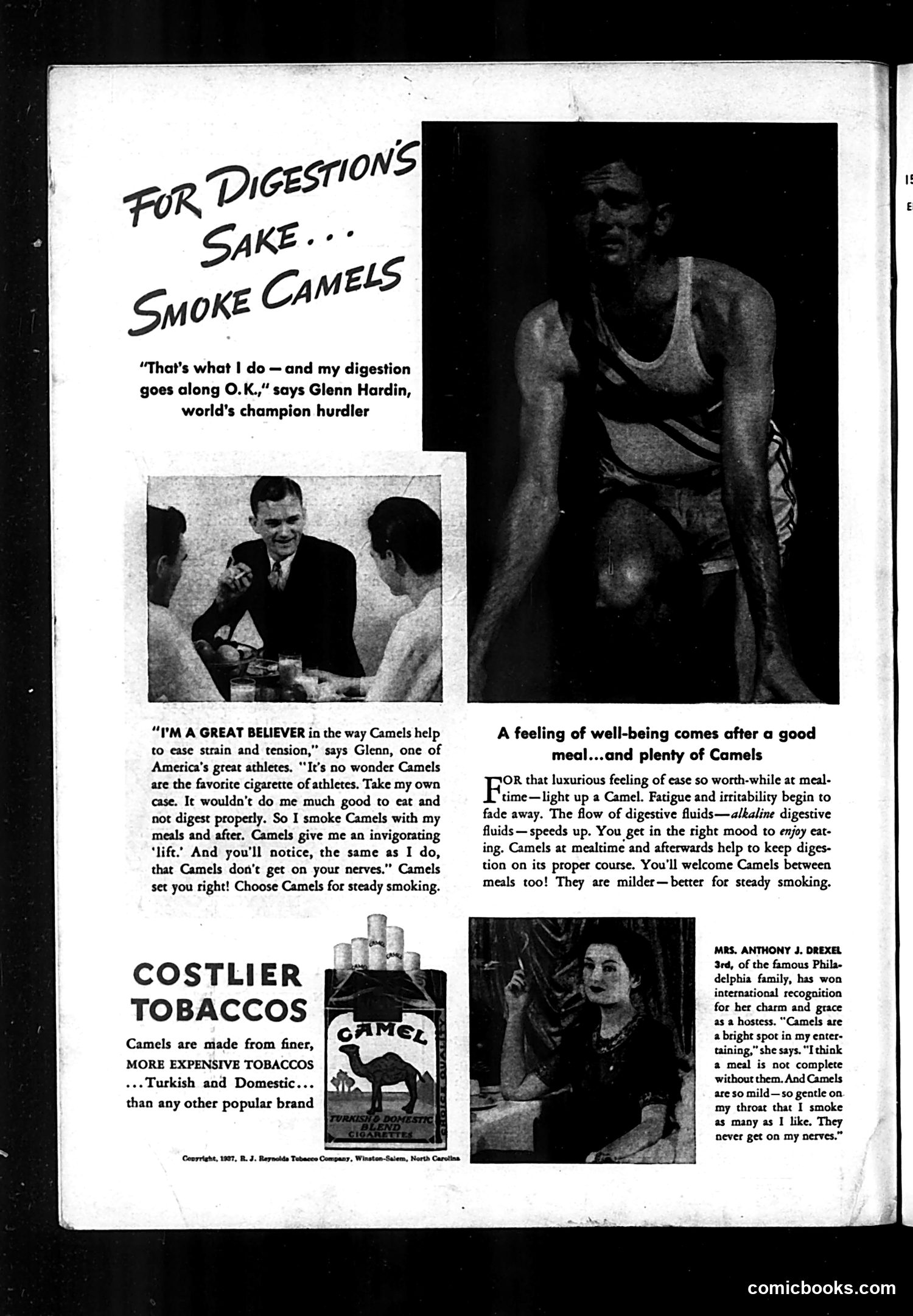
Analysis This is not a satirical cartoon but a Camel cigarette advertisement disguised as editorial content in *Judge* magazine. The page features testimonials from celebrity endorsers—Glenn Hardin (world's champion hurdler) and Mrs. Anthony J. Drexel (Philadelphia socialite)—making health claims that would be shocking today. They claim smoking Camels aids digestion, reduces fatigue, and helps the body process food by increasing "alkaline digestive fluids." For modern readers, the key context: This represents the pre-1950s tobacco industry, when cigarette companies routinely made unsubstantiated medical claims and used athletic/social figures to legitimize smoking. The advertisement explicitly links cigarettes to physical performance and digestive health—claims later proven false and now illegal. The irony for contemporary audiences is profound: what *Judge* presented as factual endorsement is now recognized as predatory marketing exploiting scientific ignorance.