judge
Judge — May 1937
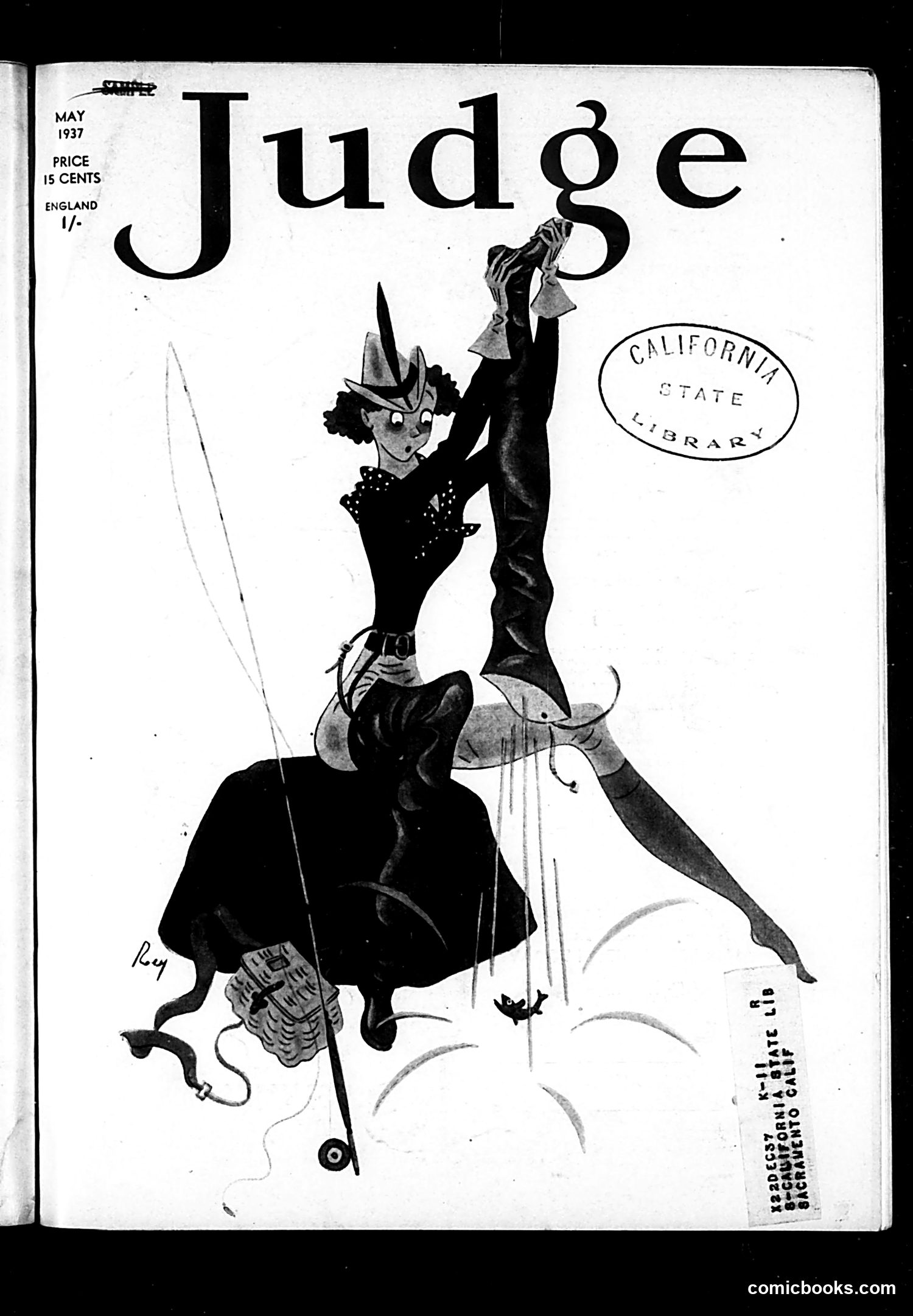
Judge Magazine Cover - May 1937 This is the cover of Judge, a satirical magazine from May 1937, priced at 15 cents in England (1 shilling). The illustration, signed "Roy," depicts a stylized figure in fashionable 1930s attire—wearing a decorative hat and elegant black outfit—standing atop what appears to be a fishing rod or pole, holding up a large fish or catch triumphantly. The exact satire is unclear without additional context, but the imagery likely comments on either a contemporary social trend, fashion absurdity, or a political figure of the era. The exaggerated pose and theatrical costume suggest mockery of vanity or pretension. The "Judge" masthead confirms this is satirical commentary typical of the magazine's humorous approach to 1930s American society and politics.
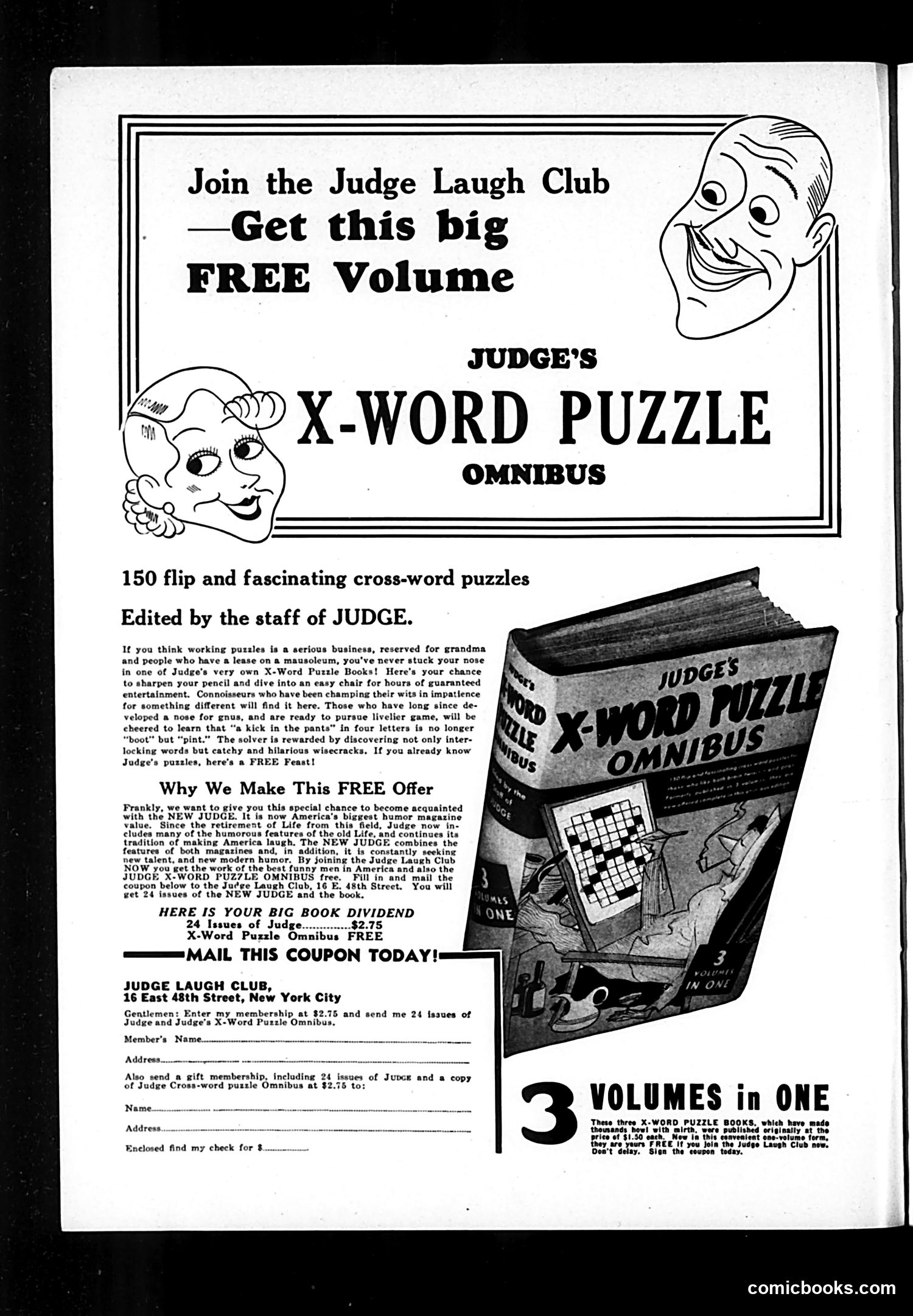
Analysis This is primarily advertising content, not political satire. The page promotes Judge magazine's "Laugh Club" membership and a free X-Word Puzzle Omnibus book containing 150 crossword puzzles. The two cartoon faces shown are generic smiling character mascots—not identifiable political figures. They appear designed simply to convey humor and friendliness to attract subscribers. The text emphasizes that Judge was "America's biggest humor magazine" and that puzzle-solving was considered serious intellectual recreation for the era. The offer—24 issues of Judge plus a free puzzle book for $2.75—represents a Depression-era or pre-WWII marketing promotion targeting middle-class readers seeking affordable home entertainment. There is no identifiable political commentary or satire on this particular page.
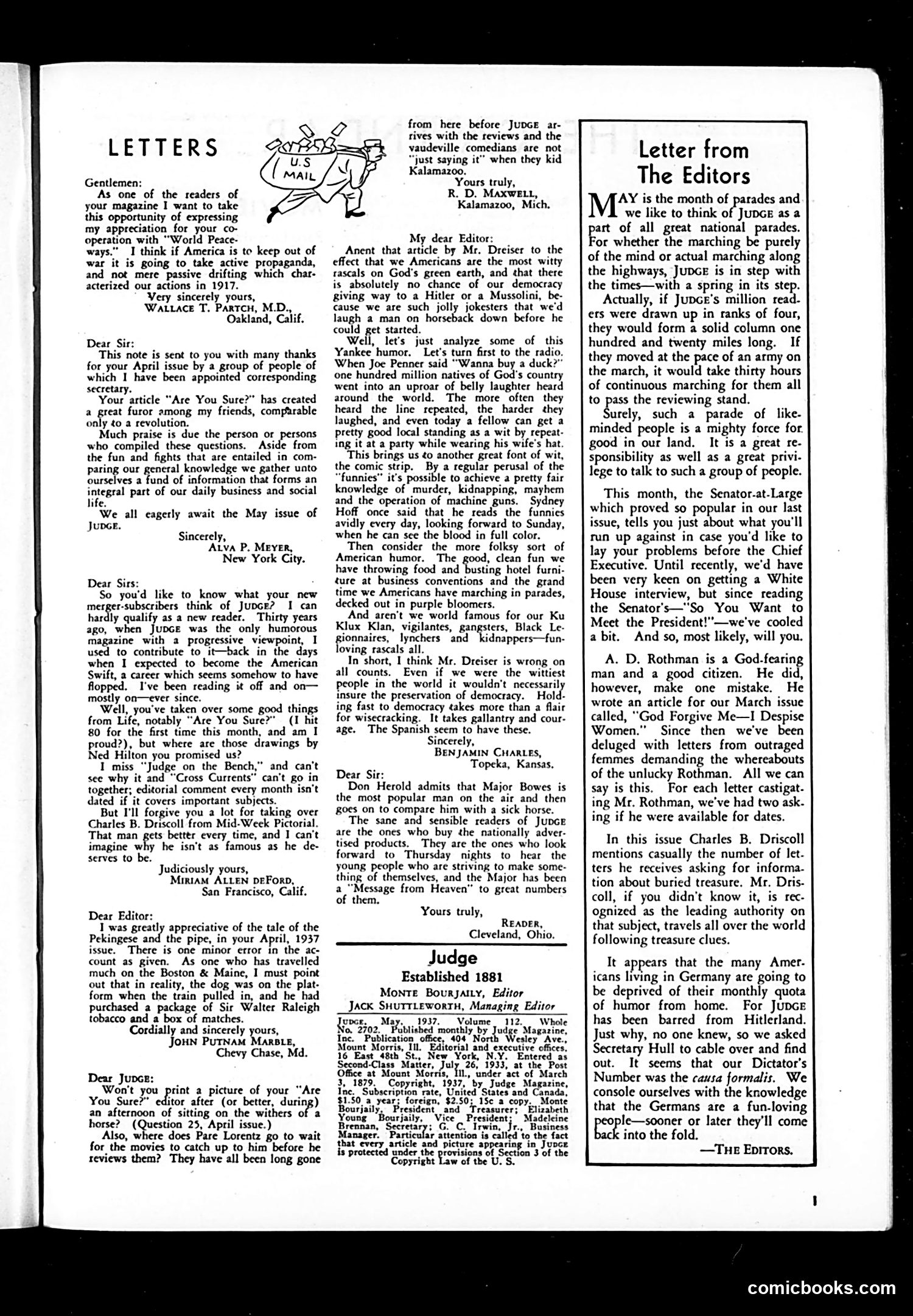
Political Commentary on American Democracy (Judge, May 1937) This letters page features readers debating whether Americans are "wiry" enough to defend democracy against fascism and authoritarianism. One correspondent analyzes humor's role in society, arguing that comic strips and vaudeville provide important social commentary—noting that regular exposure to jokes about crime and misbehavior helps people understand vice in full color. The editors respond to complaints about a previous article on A.D. Rothman, clarifying his availability for dating while reassuring readers that Judge magazine provides essential humor to counterbalance the grim political climate. The overall concern reflects 1937 anxieties about whether American democratic society possessed sufficient moral and intellectual resilience against rising fascist and communist threats abroad.
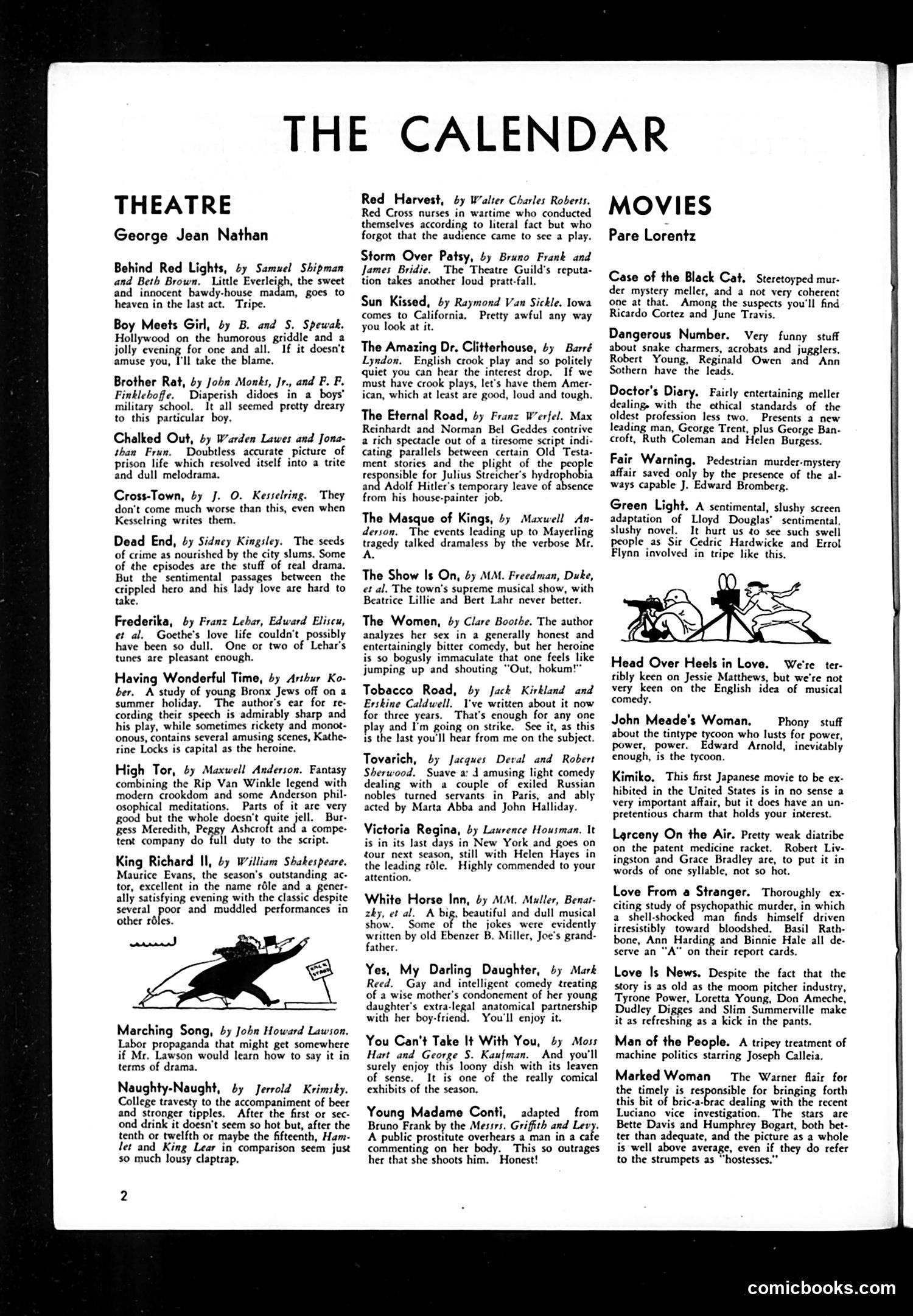
Analysis of Judge Magazine Page This page is primarily entertainment content and reviews, not political satire. It features two sections: THEATRE reviews of contemporary plays, including works by Samuel Shipman, Raymond Van Sickle, and others—typical early 20th-century Broadway fare. MOVIES reviews of silent films and early talkies, including "Pare Lorentz" productions. The small cartoon at bottom left appears to show a figure with a suitcase labeled "JUDGE," possibly self-referential to the magazine itself, though its specific meaning is unclear without additional context. This is primarily a entertainment/culture page rather than political commentary—Judge functioned as both satirical magazine and general-interest publication covering theater and cinema for educated readers of the era.
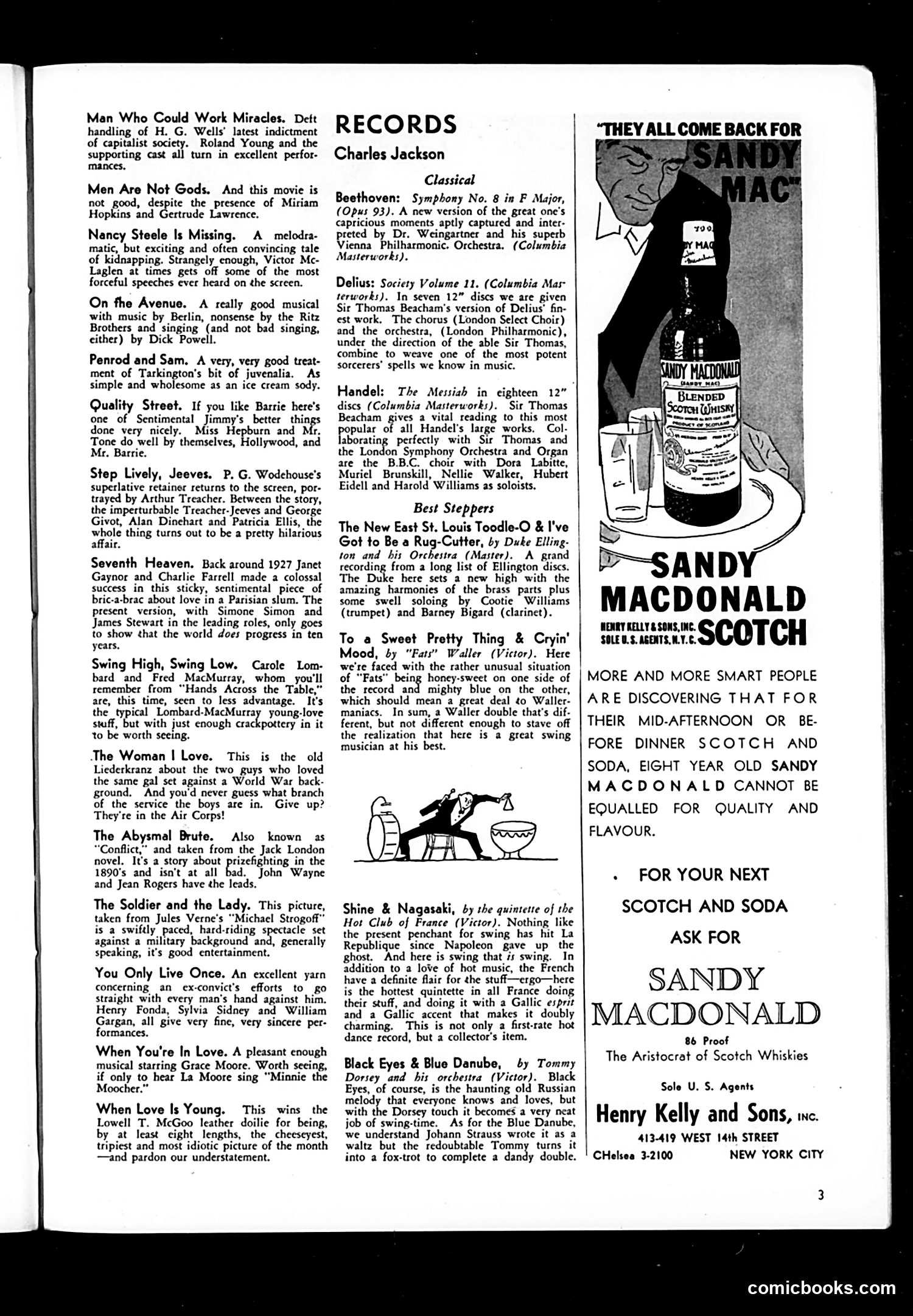
Judge Magazine Page Analysis This page is primarily advertising and record reviews, not political satire. The dominant content is a large advertisement for Sandy Macdonald Scotch whisky, featuring a bottle and glass with the slogan "They All Come Back For Sandy Macdonald." The left column contains Charles Jackson's record reviews discussing classical music (Beethoven, Delius, Handel) and jazz recordings (Duke Ellington, Fats Waller, Tommy Dorsey). These are straightforward critical assessments. The small illustration accompanying the reviews appears to be a generic musical scene—a pianist or musician at an instrument—rather than political commentary. This page reflects Judge's evolution toward lighter entertainment content and advertising revenue during the 1930s, moving away from its earlier satirical focus.
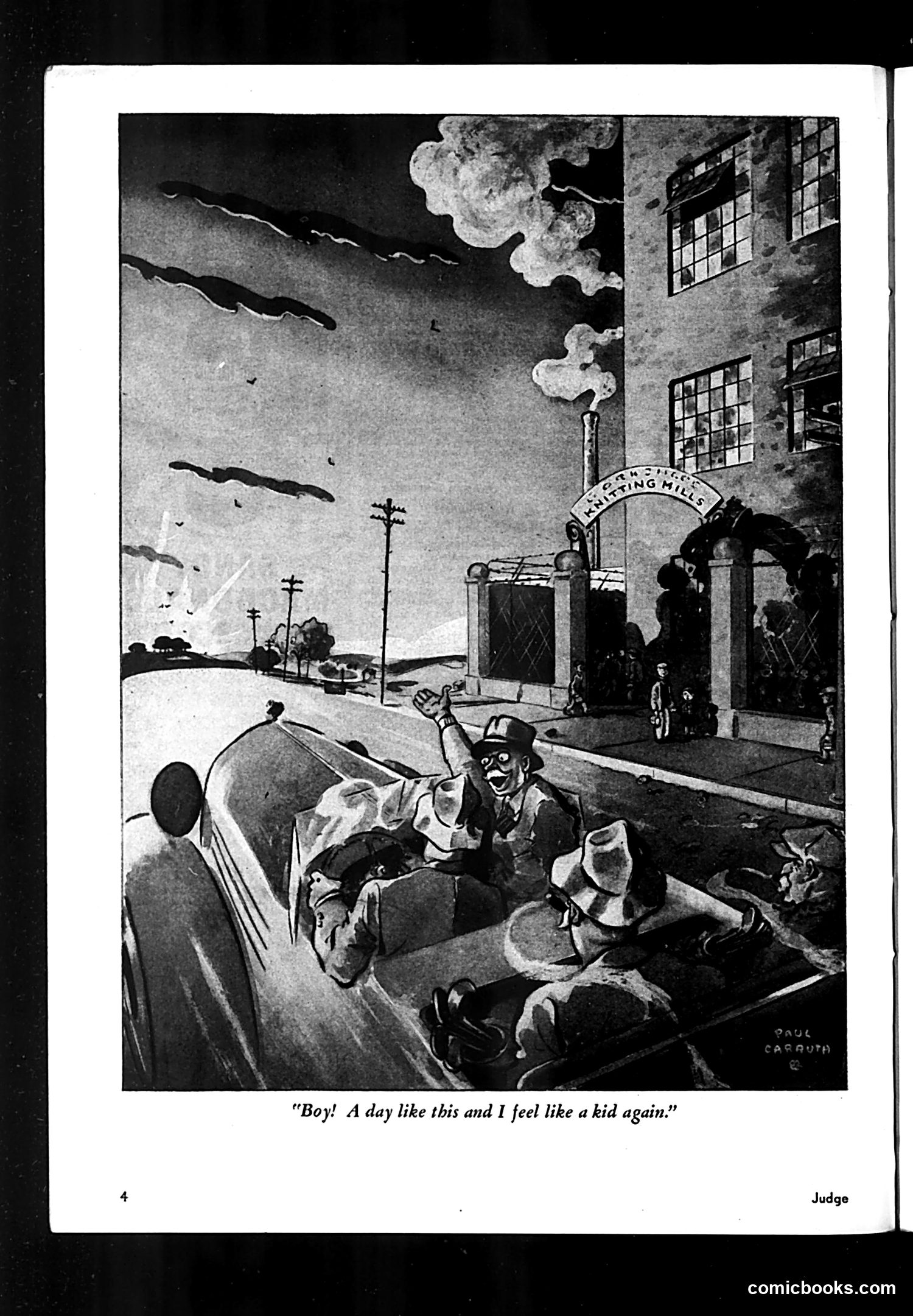
Analysis This illustration depicts a man in a car experiencing childlike joy during what appears to be a joyride. The caption—"Boy! A day like this and I feel like a kid again!"—suggests the cartoon celebrates the rejuvenating effects of automotive pleasure and freedom. The setting includes an industrial mill building (labeled "printing mill"), utility poles, and crosses on the horizon, establishing an ordinary American landscape. The figure's exuberant gesture and the car's open-air design emphasize the liberating sensation of driving. This likely satirizes the cultural phenomenon of automobiles as symbols of American freedom, leisure, and escape from industrial/urban routine in the early 20th century. The joke plays on how driving temporarily restores youthful vitality to an older man, reflecting broader American enthusiasm for motorization and modern consumer goods.
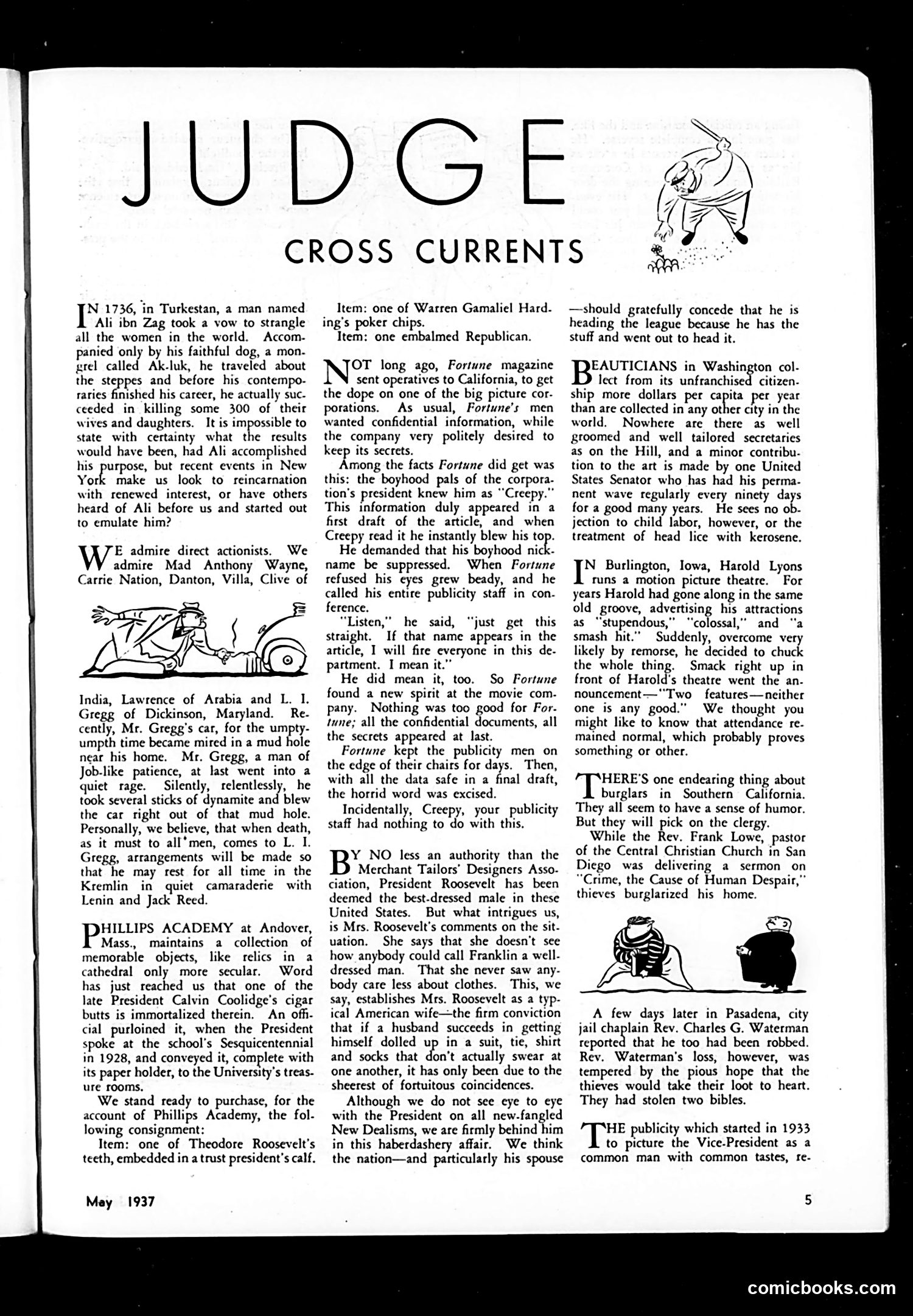
Judge Magazine "Cross Currents" - May 1937 This page contains multiple satirical gossip items targeting 1930s public figures and institutions. The text mocks: Fortune Magazine's corporate espionage: A "Creepy" executive was embarrassed when Fortune revealed he knew about confidential business matters. The satire criticizes corporate secrecy-breaking journalism. Mrs. Franklin Roosevelt's fashion commentary: The piece notes her claim that President Roosevelt is well-dressed, sarcastically implying she's being diplomatic rather than honest—a jab at both the First Lady and the President's appearance. Clergy theft: A San Diego church pastor's home was robbed, with ironic commentary on burglars targeting "the clergy" alongside other victims. Phillips Academy: A humorous item about acquiring Theodore Roosevelt's teeth as a relic. The cartoons (small illustrations visible) appear to accompany these gossipy items with visual humor. Overall, this represents Judge's typical satirical approach to lampooning politics, society, and public figures.
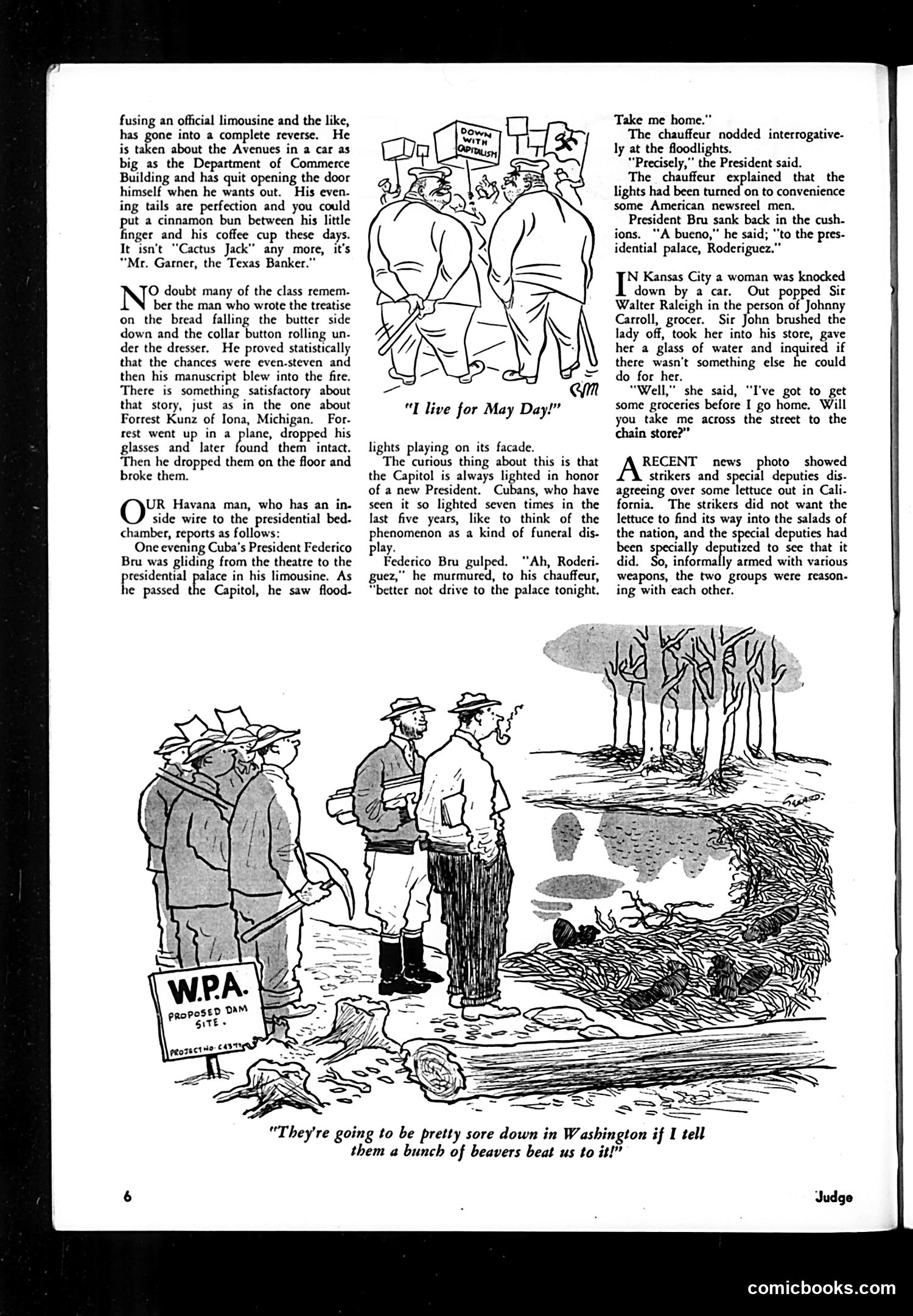
Political Satire Analysis This Judge magazine page contains two distinct pieces of political satire from the New Deal era. Top cartoon: Shows two large figures labeled "I live for May Day," satirizing communist sympathizers or labor radicals. The context suggests mockery of May Day celebrations and leftist politics. Bottom cartoon: Depicts WPA (Works Progress Administration) officials at a "proposed dam site." One man threatens to tell Washington "a bunch of beavers beat us to it!"—mocking the WPA's infrastructure projects by comparing government workers unfavorably to beavers' engineering abilities. This ridicules the effectiveness and competence of Roosevelt's New Deal programs, a common conservative critique. Both cartoons reflect Judge's skeptical, often hostile stance toward 1930s New Deal policies and communist/labor movements.
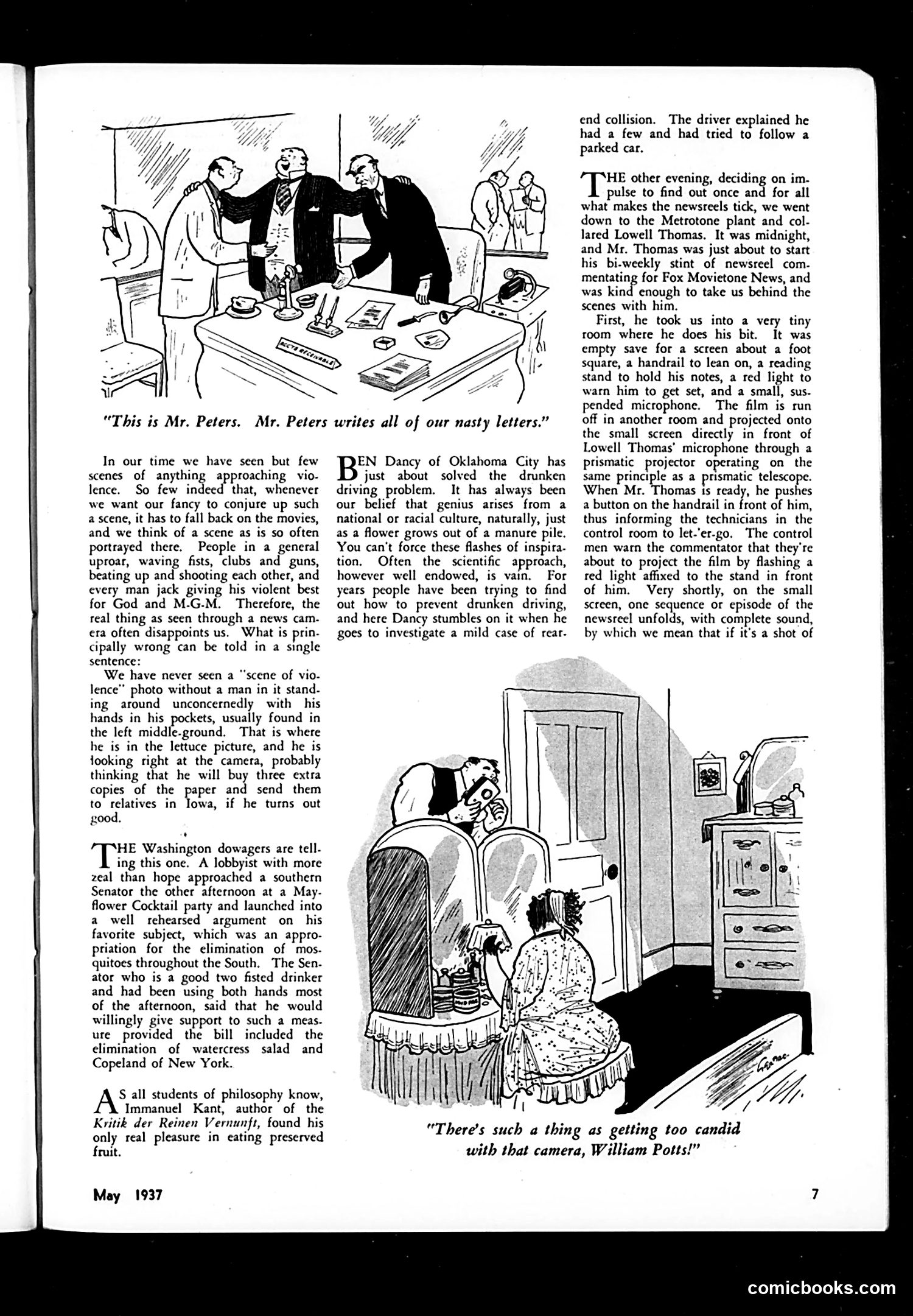
Analysis of Judge Magazine Page, May 1937 This page contains satirical anecdotes about American life rather than political cartoons. The top illustration shows a newsroom scene introducing "Mr. Peters," who writes complaint letters—a joke about the proliferation of reader mail. The main story discusses Ben Dancy of Oklahoma City solving "the drunken driving problem" through unconventional scientific methods, satirizing both amateur inventors and genuine social concerns about drunk driving (a growing 1930s issue). The bottom cartoon depicts someone filming with an early camera, captioning "There's such a thing as getting too candid with that camera, William Potts!" This mocks the era's new amateur filmmaking technology and overzealous home cinematographers. The page satirizes ordinary Americans' obsessions: complaint-writing, homespun problem-solving, and the novelty of accessible cameras.
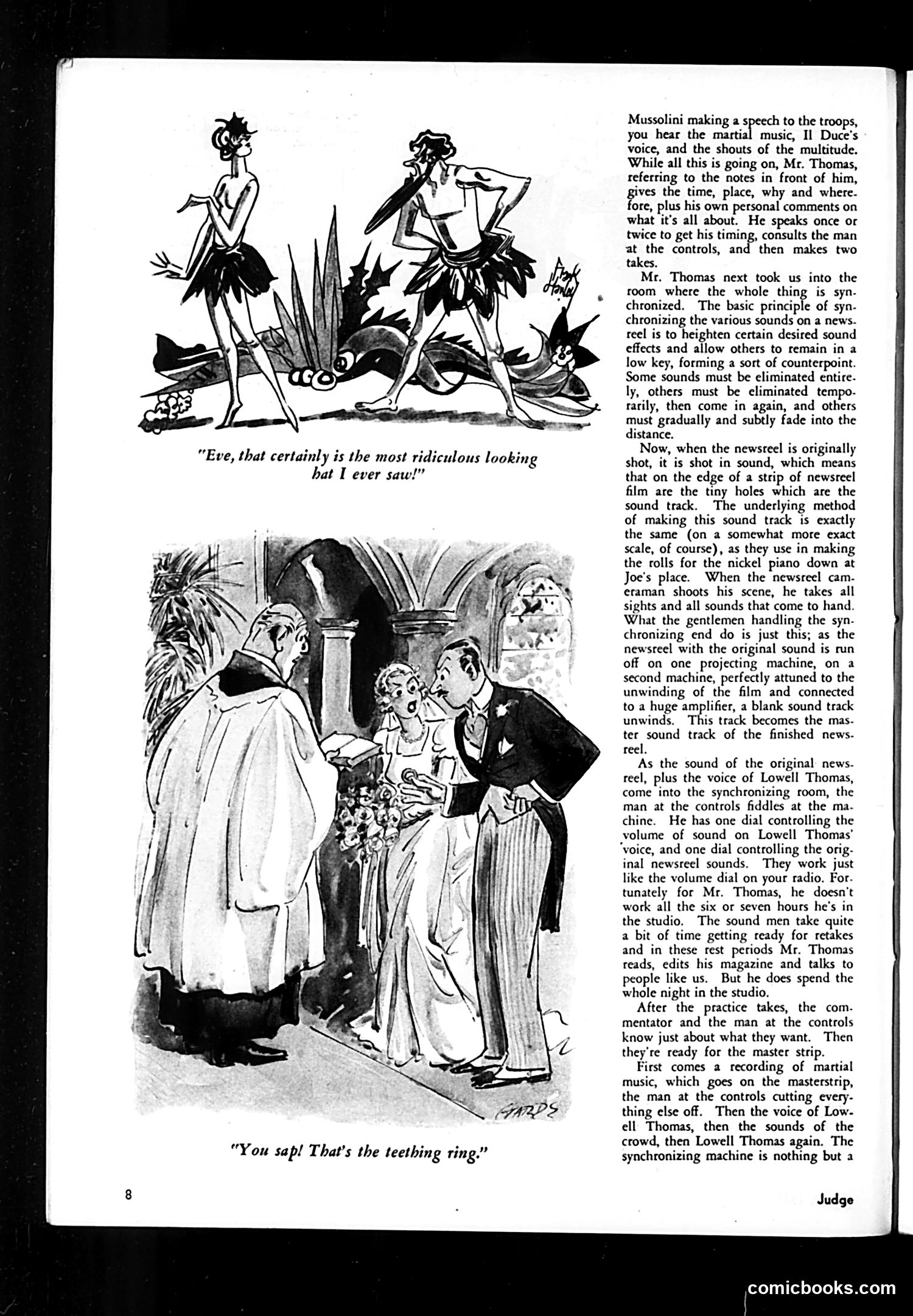
Judge Magazine Page Explanation This page describes newsreel production techniques, specifically how sound is synchronized to film footage. The top cartoon depicts two figures in what appears to be a comedic domestic scene (caption: "Eve, that certainly is the most ridiculous looking hat I ever saw!"). The lower cartoon shows priests or religious figures with the caption "You sap! That's the teething ring." The main article discusses Lowell Thomas, a famous radio commentator and newsreel narrator, explaining how he records voiceovers for newsreels featuring Mussolini's speeches. It details the technical process: multiple sound elements (martial music, Thomas's voice, crowd noise) are synchronized on a blank sound track using dials and controls, similar to player piano technology. The process involves recording, editing, mixing different audio layers, and creating a "master strip" for the finished newsreel. This appears to be an educational piece about emerging sound film technology, circa the early 1930s.
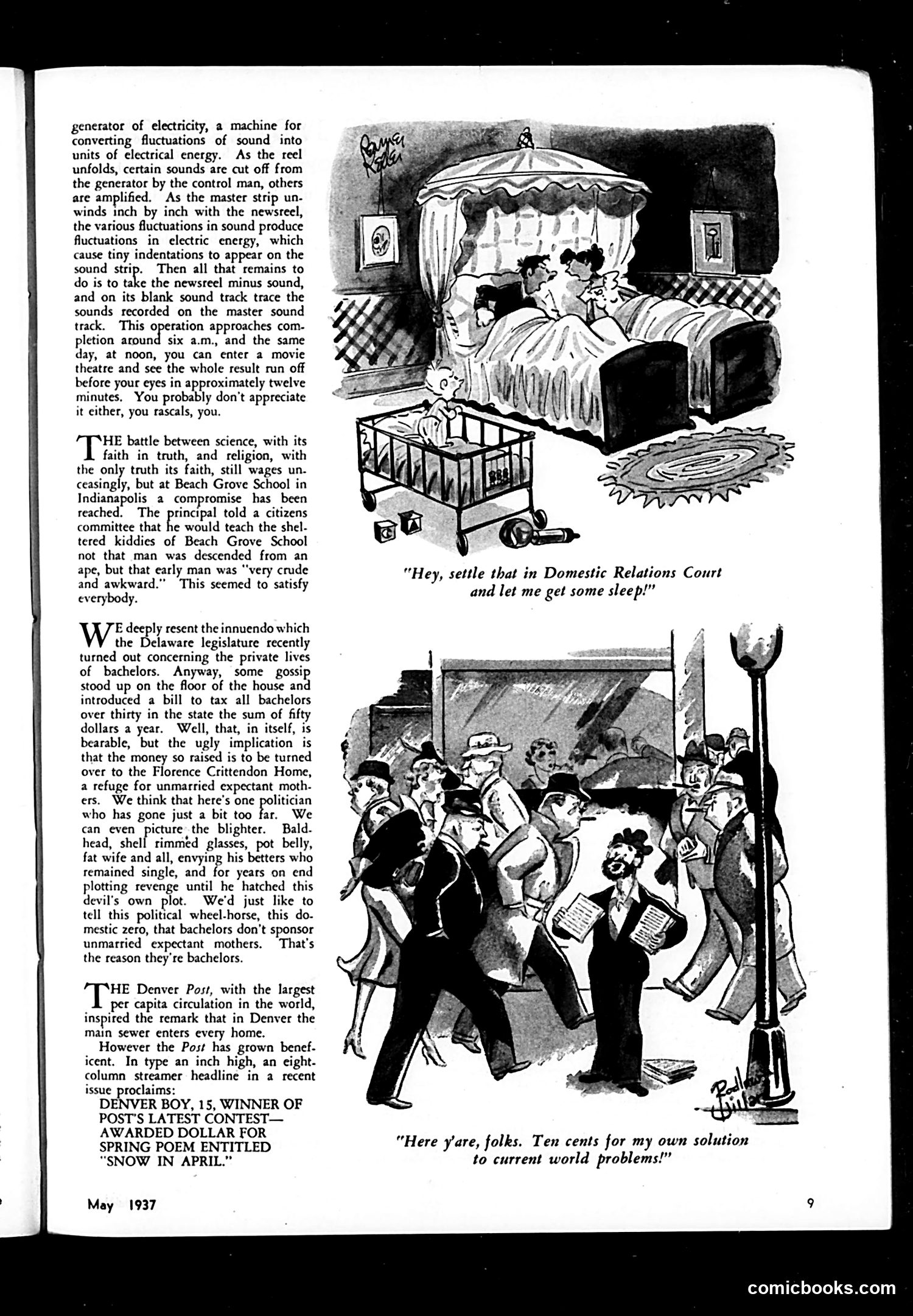
Judge Magazine, May 1937 - Page Analysis This page contains three satirical pieces: Top cartoon: Depicts a couple arguing in bed while a baby cries nearby. The joke mocks marital disputes by suggesting they take their argument to "Domestic Relations Court"—implying divorce/separation litigation is so common it should happen in court rather than at home. Middle section: Critiques a Delaware legislature bill proposing a $50 annual tax on unmarried men over 30, with revenue going to the Florence Crittenden Home (a shelter for unwed mothers). The author sarcastically notes the bill implies bachelors cause such pregnancies, when in fact "bachelors don't sponsor unmarried expectant mothers"—the satire being that single men aren't responsible. Bottom cartoon: Shows a street vendor selling his "solutions to current world problems" for ten cents, likely satirizing Depression-era charlatans or politicians offering cheap fixes to serious economic/social crises. The page also includes a paragraph about sound recording technology advancement in newsreels—presented matter-of-factly amid the satire.
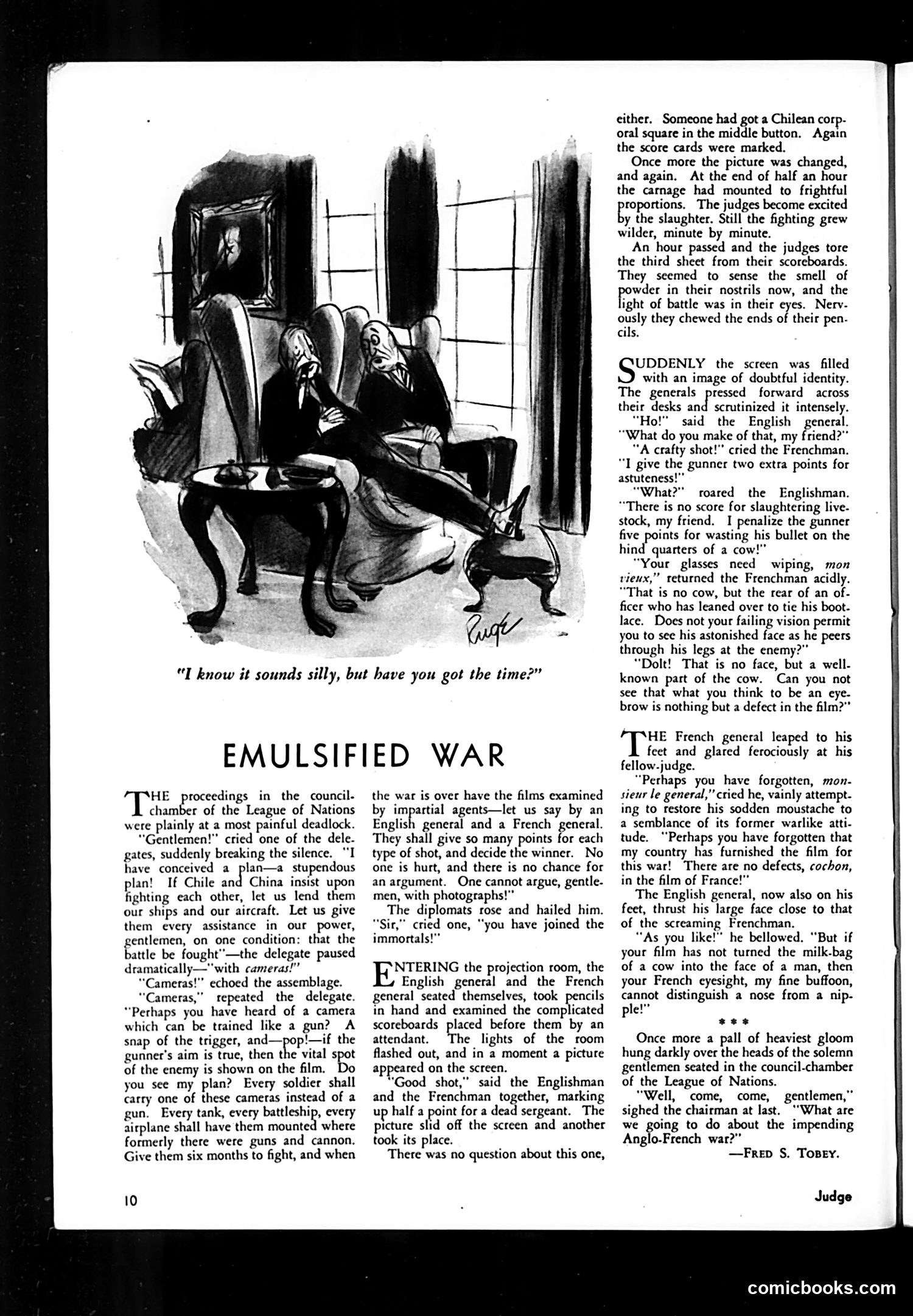
"Emulsified War": League of Nations Satire This story satirizes the League of Nations' ineffectual response to international conflicts. The setup: delegates propose replacing actual warfare between Chile and China with a "camera war"—soldiers photograph each other instead of fighting, then judges score the "shots" from film footage. The satire deepens when English and French judges review the footage. They become emotionally invested, cheering kills and arguing over scoring. A critical moment: they debate whether an image shows a dead officer or a cow's rear end—revealing that photographs are ambiguous, subjective, and unreliable as objective evidence. The joke: the League hoped film evidence could settle disputes "scientifically" without argument. Instead, judges squabble identically to how nations quarrel. The satire mocks both the League's naive faith in objective documentation and the deeper truth that international disputes stem from conflicting interests, not lack of evidence. Author: Fred S. Tobey
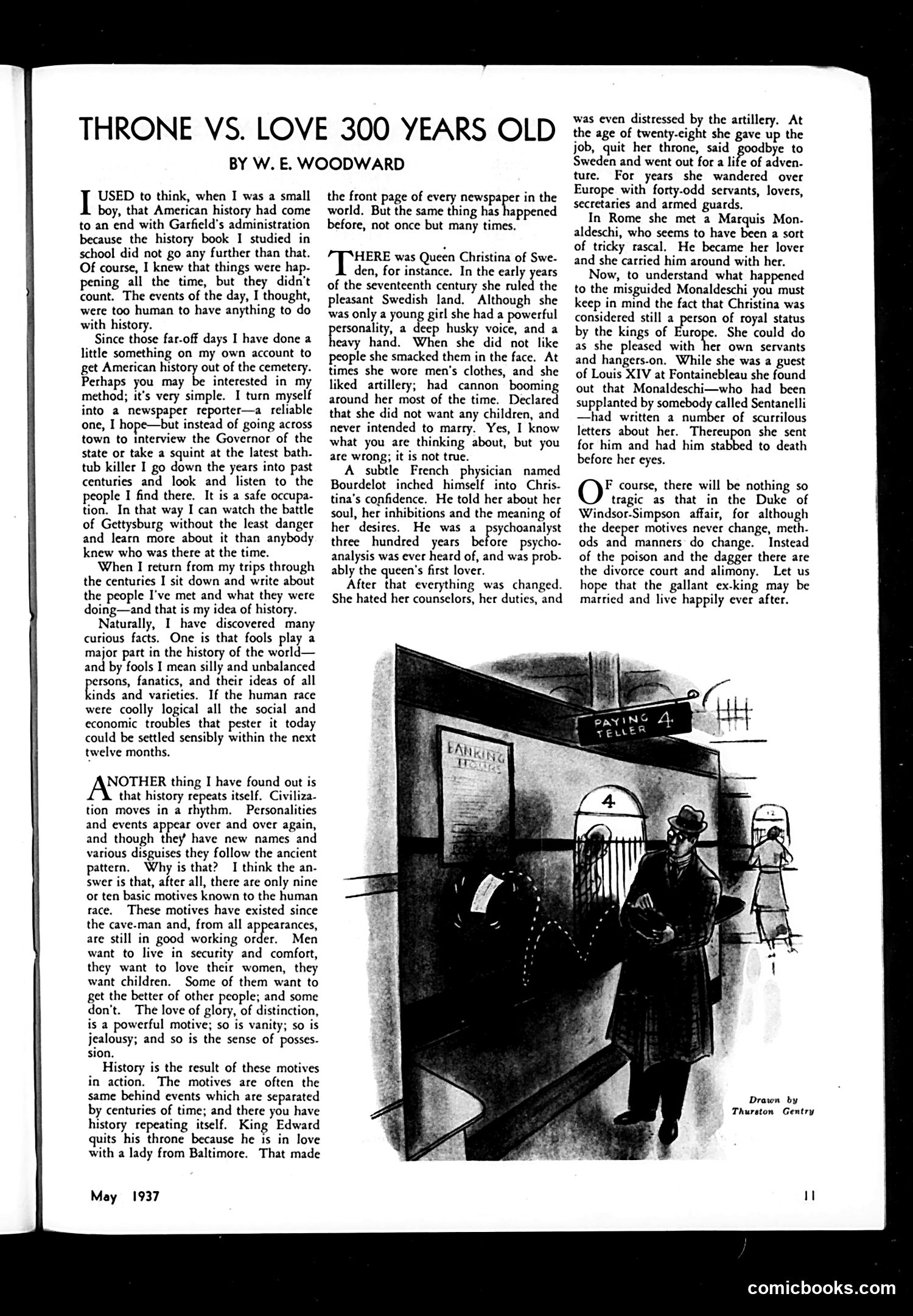
"Throne vs. Love 300 Years Old" - Explanation for Modern Readers This article by W.E. Woodward uses historical parallels to comment on the 1937 abdication crisis of King Edward VIII, who gave up the British throne to marry American divorcée Wallis Simpson (the "lady from Baltimore" referenced). Woodward argues that history repeats itself because human motives remain constant. His example: Queen Christina of Sweden (17th century) similarly abandoned duty for personal desire—she renounced her throne, abandoning her role as ruler for her own life choices. The cartoon (drawn by Thurston Gentry) appears to show a domestic/financial scene, possibly satirizing the practical consequences of romantic decisions or marital disputes. The satire's point: Edward VIII's dramatic choice wasn't unprecedented or shocking—it reflects timeless human conflict between duty and passion that recurs throughout history. By framing it historically, Woodwood suggests the scandal was predictable human behavior, not unique tragedy. This was published in *Judge*, a satirical magazine, positioning the abdication as fodder for social commentary rather than reverence.
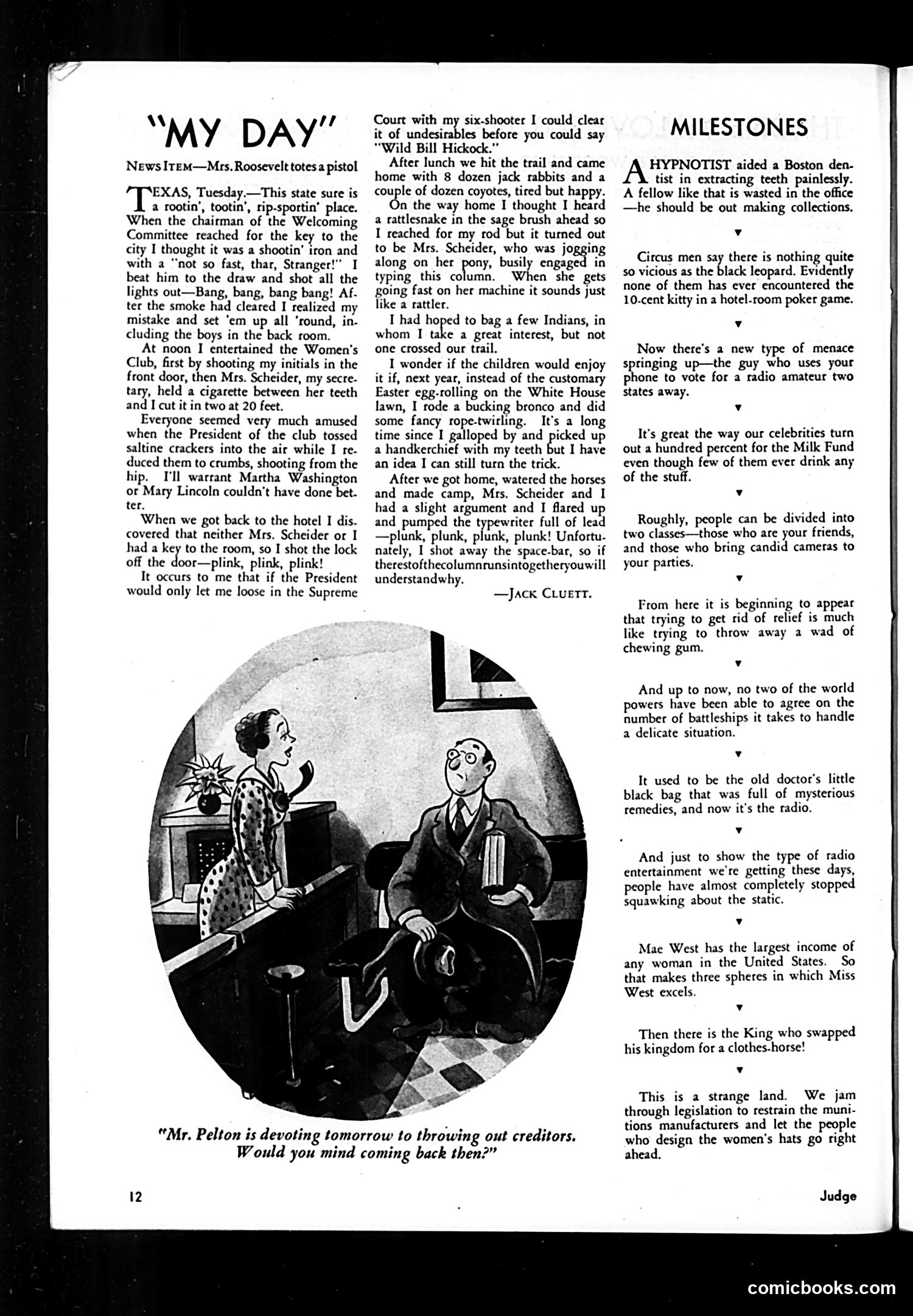
"My Day" - Judge Magazine Satire This page satirizes Eleanor Roosevelt, wife of President Franklin D. Roosevelt, through a fictionalized "news item" that she carries a pistol. Jack Cluett's humorous column imagines Mrs. Roosevelt as a trigger-happy cowgirl during a Texas visit, shooting indiscriminately at door locks, crackers, and typewriter keys while conducting official duties. The satire mocks both Roosevelt's actual activism and the public's fascination with her unconventional behavior for a First Lady. The joke relies on the contrast between her dignified role and the absurd Wild West gunslinger persona. The accompanying cartoon shows a woman (presumably Roosevelt) holding a gun, speaking to a man about evicting creditors. The "Milestones" section offers brief satirical observations on contemporary society—hypnotists, radio, celebrity charity work, and politics—typical of Judge's biting social commentary.
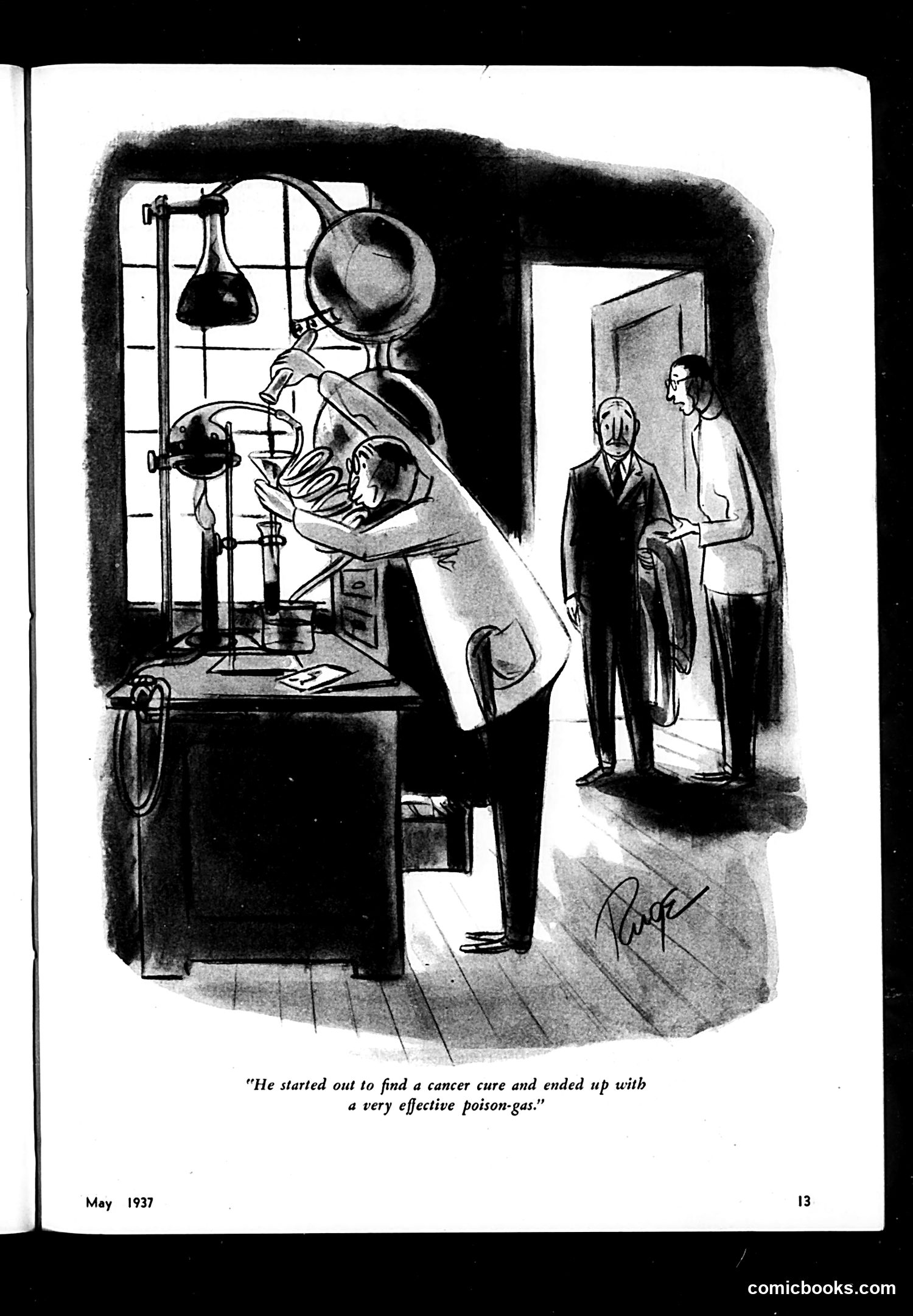
This single-panel cartoon from *Judge* magazine (May 1937) satirizes scientific research gone awry. The image shows a laboratory scientist demonstrating his work to two visitors (apparently officials or investors). The caption's dark humor suggests that the researcher's well-intentioned medical ambition—finding a cancer cure—has accidentally or ironically produced poison gas instead. The satire likely reflects 1937 anxieties about scientific misuse during the pre-WWII era, when chemical weapons and poison gas were recognized threats. The cartoon mocks both the unpredictability of research and the potential for scientific breakthroughs to be weaponized or perverted toward destructive ends. The visitors' reactions suggest dismay at this unintended consequence of the laboratory work.
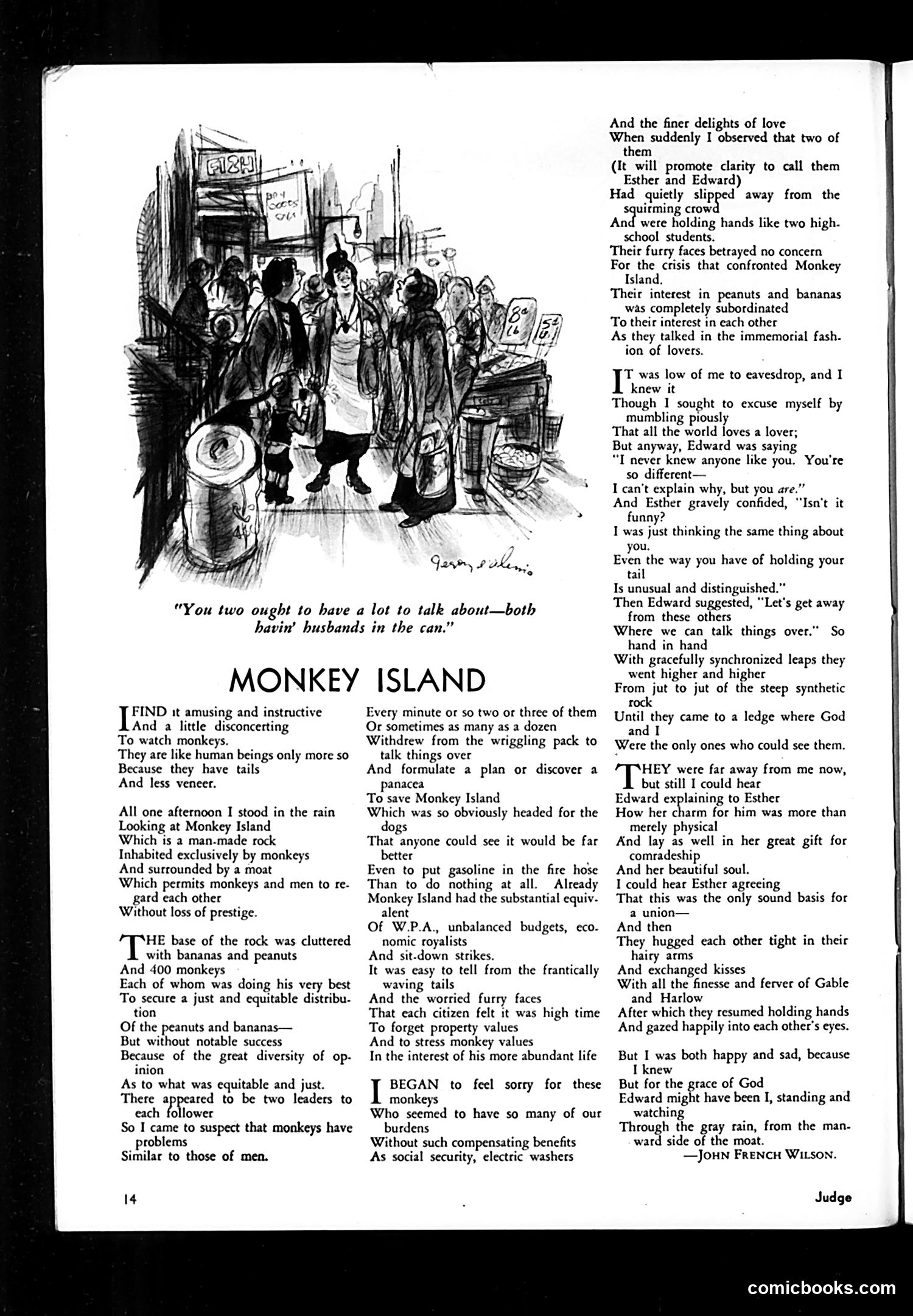
"Monkey Island" Analysis This satirical piece by John French Wilson uses monkeys on an artificial island to lampoon Depression-era America. The monkeys struggle with resource distribution ("peanuts and bananas"), mirroring actual economic crises. The text references W.P.A. (Works Progress Administration), unbalanced budgets, economic royalists, and sit-down strikes—all real 1930s concerns. The satire's point: humans and monkeys are essentially identical in their problems and social structures. However, the story pivots when two monkeys (Esther and Edward) fall in love, transcending material concerns. This romanticizes human capacity for emotional connection above economic struggle—a counterpoint to the competitive materialism depicted earlier. The opening cartoon's caption about "husbands in the can" (jail) suggests commentary on wives of imprisoned men, likely referencing crime or Depression-era desperation. The overall message critiques both societal disorder and offers sentiment that love redeems human experience.
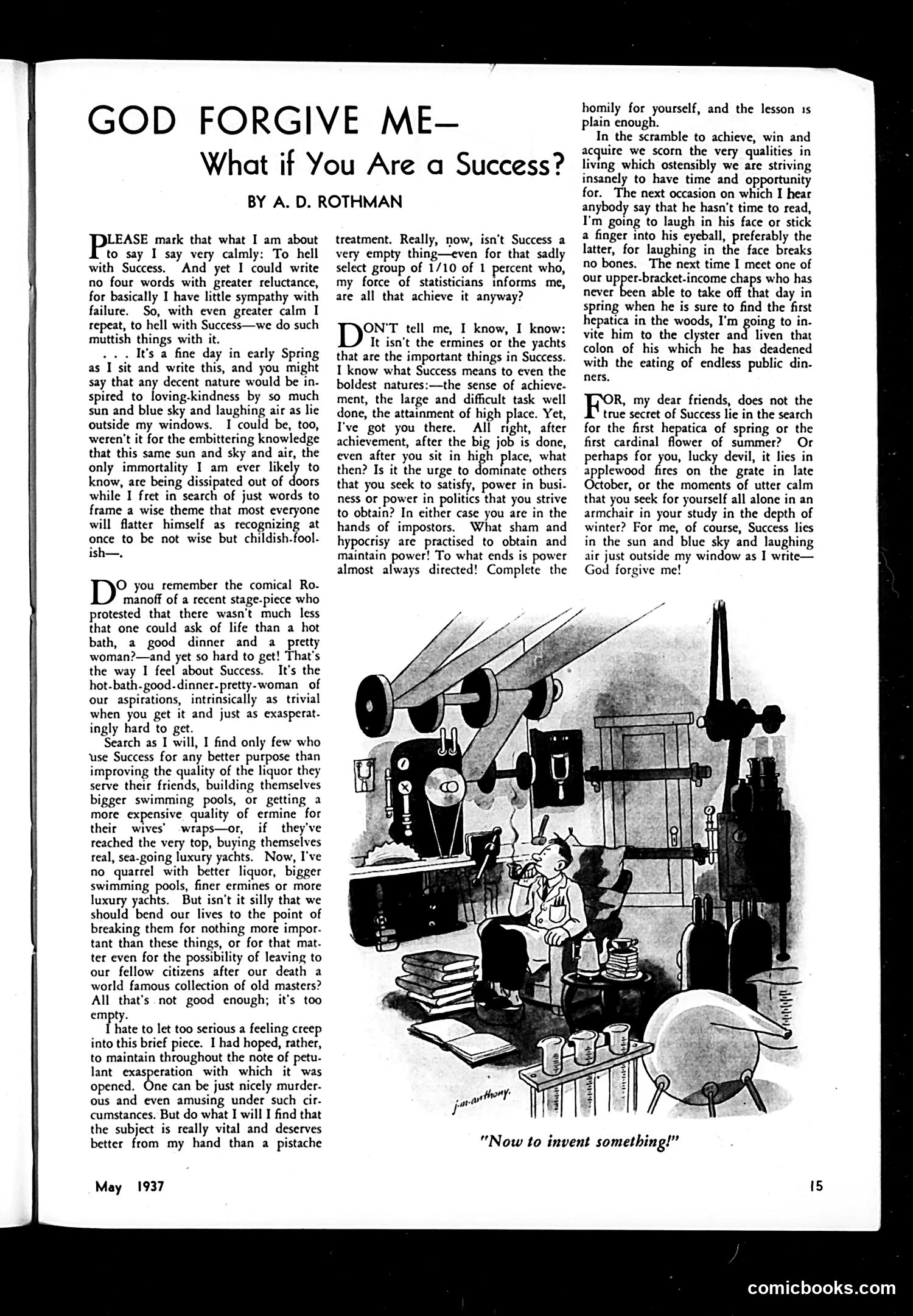
Analysis of "God Forgive Me—What if You Are a Success?" This satirical essay by A.D. Rothman critiques the emptiness of American success during the Depression era (May 1937). Rothman argues that despite society's obsession with achievement, successful people squander their accomplishments on trivial luxuries: better liquor, swimming pools, furs, and yachts. The accompanying cartoon shows a cluttered study with telescopes and scientific equipment, captioned "Now to invent something!"—suggesting that even intellectual or creative ambition becomes corrupted by materialist goals. Rothman's central point: Success itself is morally hollow. Whether pursuing personal comfort or political power, the successful practice "sham and hypocrisy" while sacrificing the very qualities that make life meaningful. The irony is biting—we destroy ourselves achieving things that, once obtained, prove meaningless. This reflects 1930s disillusionment with capitalist values during economic hardship.
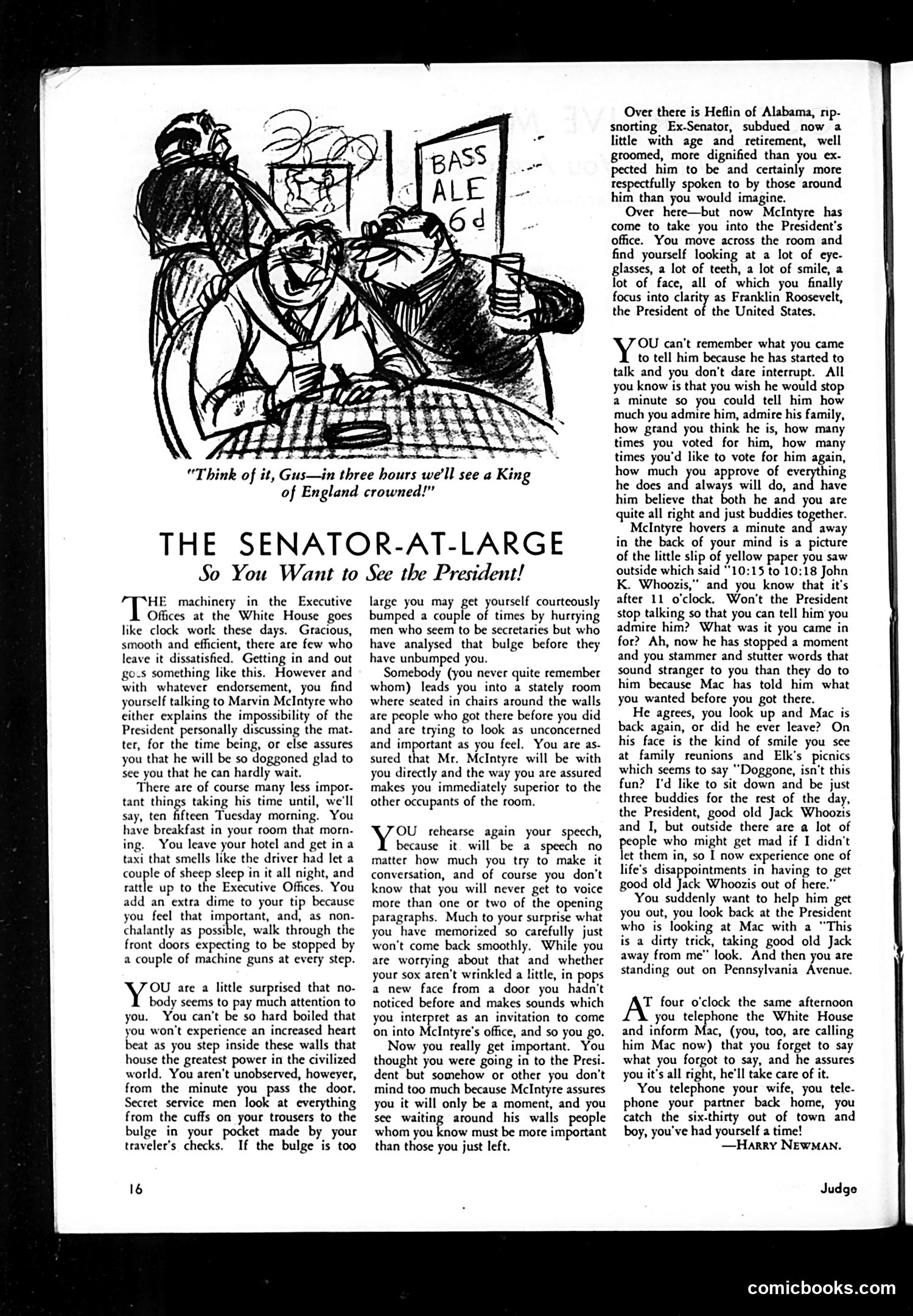
"The Senator-at-Large: So You Want to See the President!" This Harry Newman satirical piece mocks the byzantine bureaucracy of visiting Franklin D. Roosevelt's White House. The cartoon depicts common people hoping for a presidential audience, with a "Brass Ale" sign suggesting casual camaraderie among waiting visitors. The satire follows a visitor's journey: arriving at the Executive Offices, being screened by Secret Service (who even inspect your clothing for weapons), waiting in antechambers with other supplicants, rehearsing your speech uselessly, and ultimately being deflected to Marvin McIntyre (Roosevelt's appointments secretary) rather than meeting FDR directly. The humor lies in the deflating reality—the elaborate security, the manufactured importance, the hierarchy of waiting rooms, and the ultimate disappointment of never actually reaching the President. The reference to "Heflin of Alabama" (Ex-Senator) emphasizes that even prominent figures wait, powerless. It's a critique of presidential inaccessibility wrapped in gentle mockery of American civic aspiration.
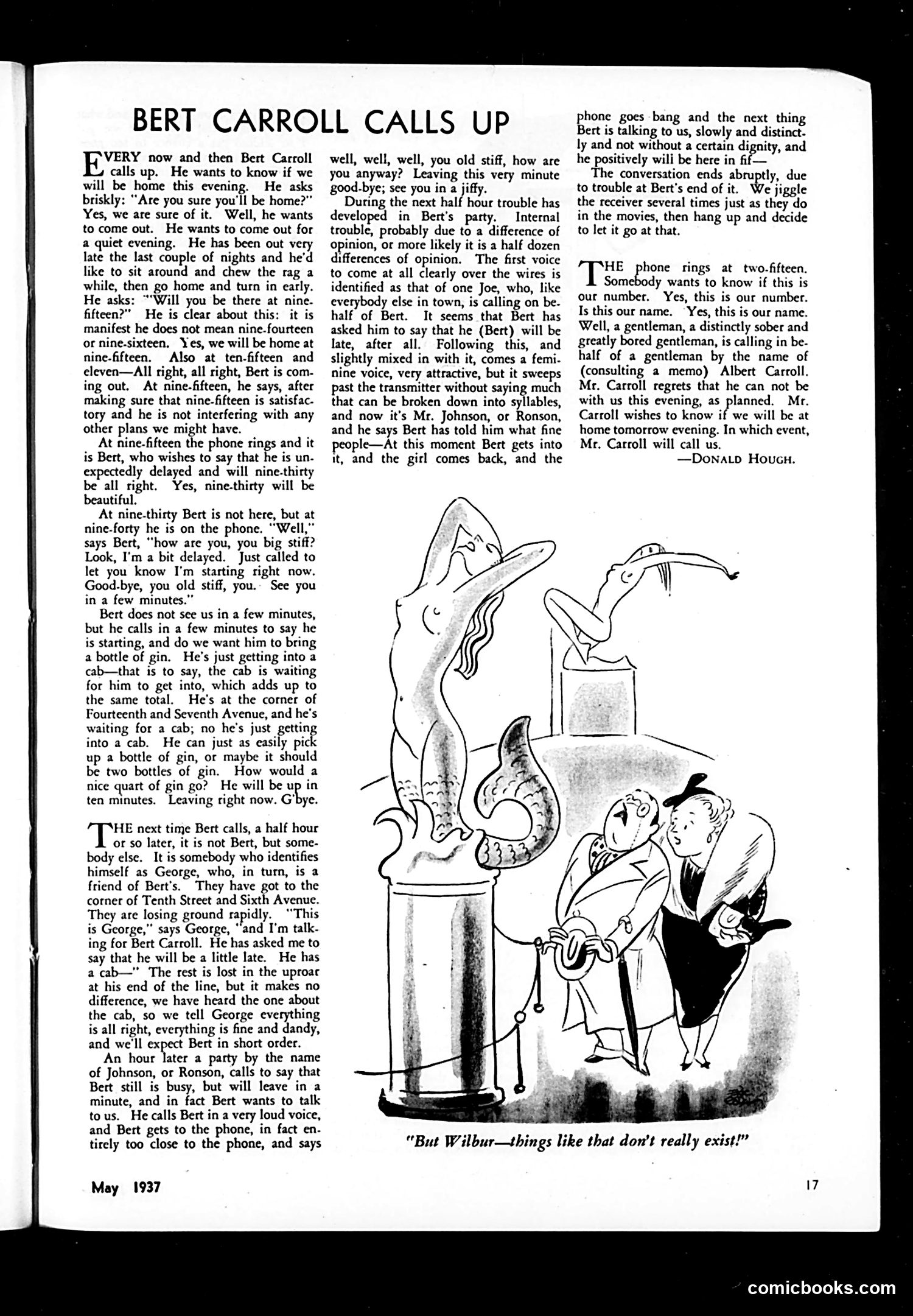
"Bert Carroll Calls Up" — May 1937 This is a humorous short story satirizing the chronic lateness and constant phone calls of a social acquaintance named Bert Carroll. The joke centers on the modern annoyance of someone repeatedly calling to say he's "on his way" but never arriving. The narrative catalogs Bert's pattern: he insists on exact arrival times (9:15, not 9:14), then calls repeatedly with delays—each time claiming he's "just getting into a cab" at increasingly distant locations (Fourteenth and Seventh Avenue, then Tenth and Sixth). Friends relay messages; voices grow confused; excuses multiply about bottles of gin to bring. The accompanying cartoon shows two exasperated men staring at a grotesque telephone apparatus, with the caption "But Wilbur—things like that don't really exist!" — suggesting Bert is so unreliable he seems imaginary. The satire targets the pre-automobile social custom of casual evening visiting and the new telephone technology's role in enabling endless last-minute rescheduling—a relatable frustration for 1937 readers.
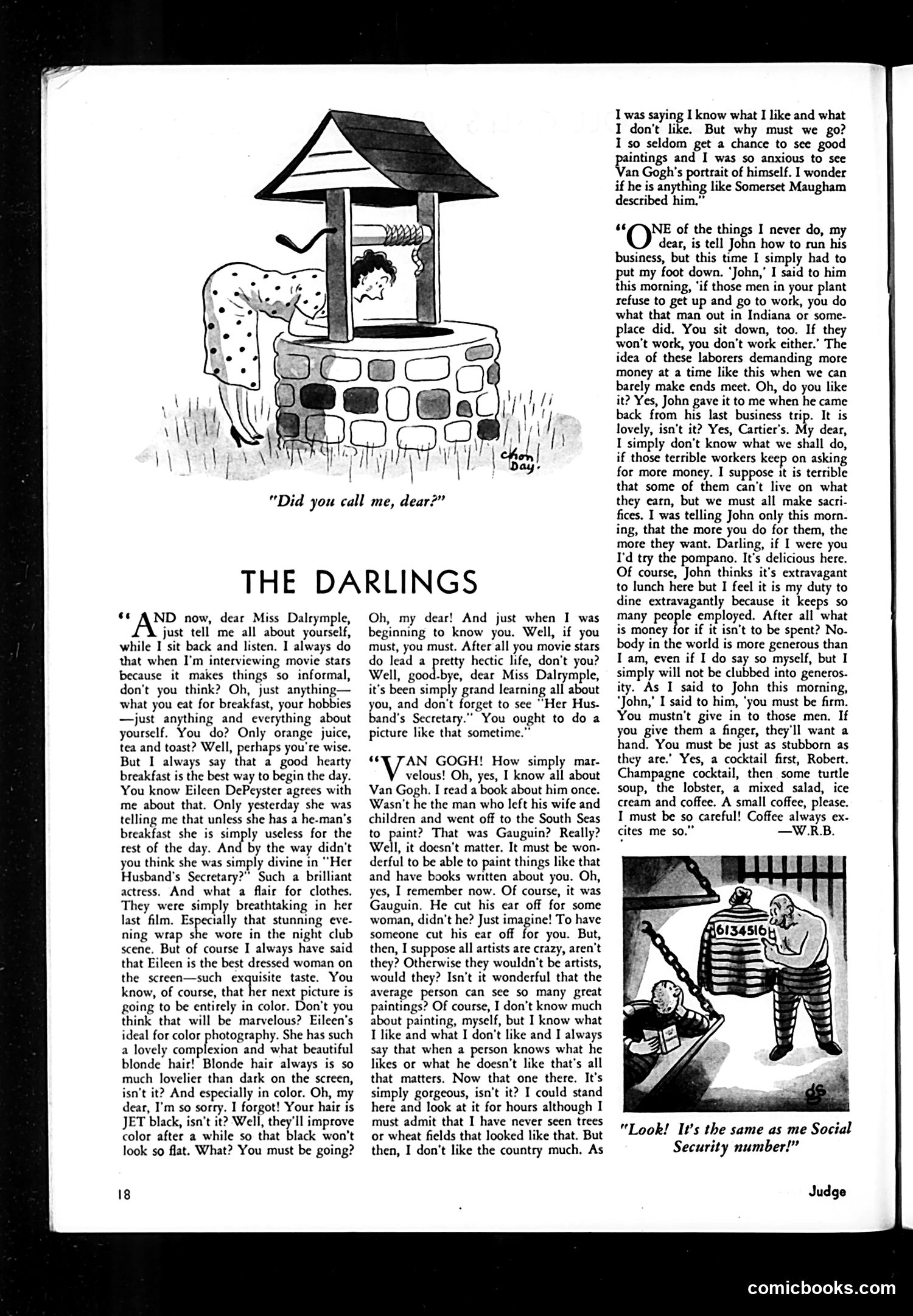
"The Darlings" - Judge Magazine Satire This page satirizes the vapid superficiality of upper-class socialites and cultural pretenders in the 1920s-30s era. The cartoon shows a woman at a well calling to someone, captioned "Did you call me, dear?"—a visual pun about shallow communication. The main text mocks an unnamed interviewer (likely a gossip columnist) conducting a mindless interview with actress "Miss Dalrymple." The interviewer dominates the conversation, name-drops other actresses like Eileen DePeyster, discusses trivial matters (breakfast, clothes, hair color), and makes an insulting comment about the actress's "jet black" hair being unflattering on film. The satire exposes how these interactions are performative rather than genuine. The secondary section ridicules cultural pretense by showing someone discussing Van Gogh and Gauguin while confusing the artists' biographies and admitting complete ignorance about art and nature. The final section hints at dismissing labor disputes. The satire targets wealthy society's superficiality, the entertainment industry's vapidity, and pseudo-intellectual posturing about high culture.
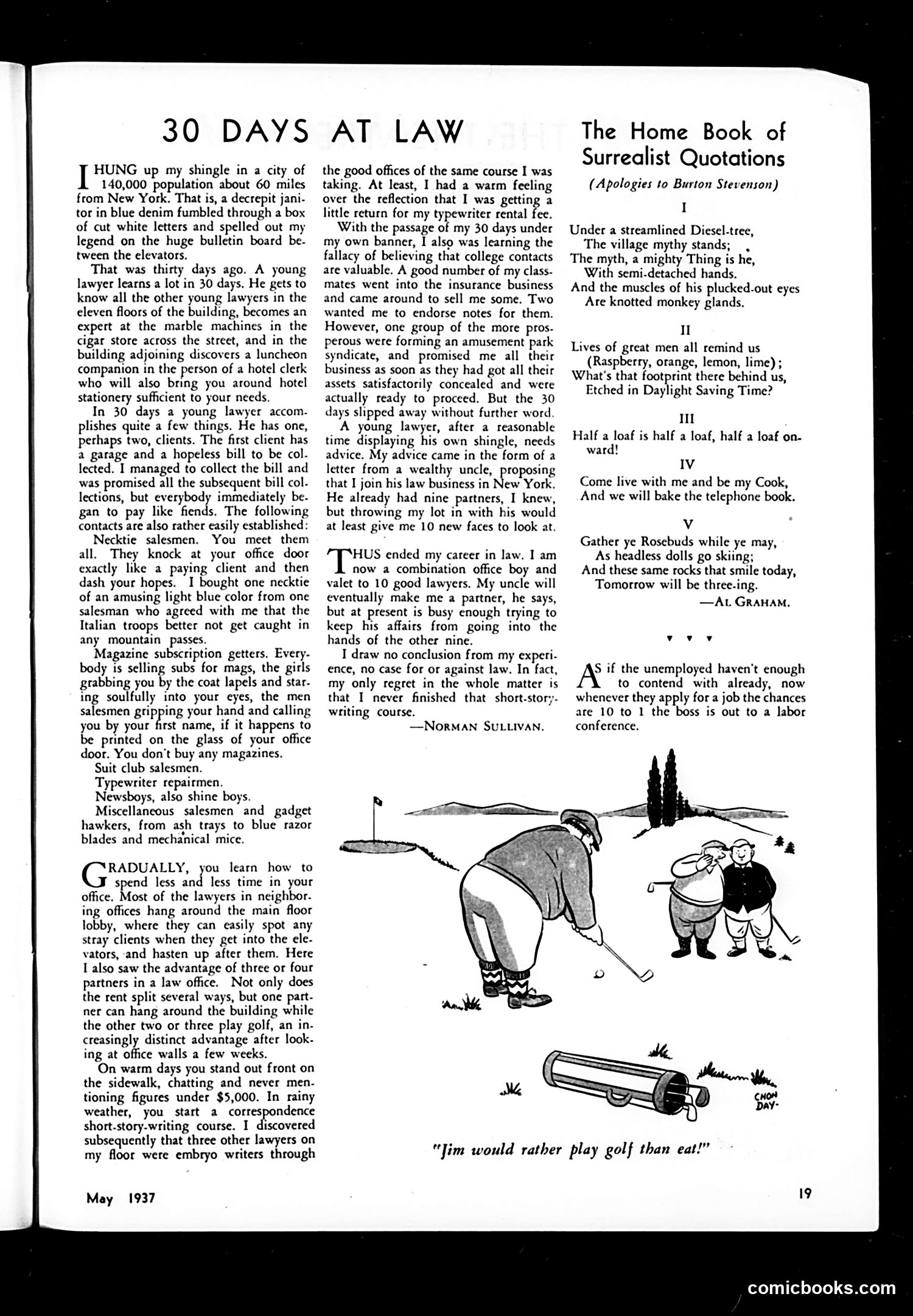
"30 Days at Law" - Satirical Commentary on Starting a Legal Career This article by Norman Sullivan satirizes the reality of opening a law practice versus expectations. The author humorously describes his first month as a newly independent lawyer in a mid-sized city, revealing the gap between professional ambition and actual experience. The piece mocks how young lawyers actually spend their time: networking in building lobbies, playing golf, avoiding empty offices, and entertaining various salesmen (necktie vendors, magazine subscription hawkers, typewriter repairmen). The cartoon reinforces this—a lawyer bends over a golf ball while two small figures watch, captioned "Jim would rather play golf than eat!" Sullivan highlights the false value of college connections; classmates either want to sell him insurance, borrow money, or promise future business that never materializes. After thirty days, his only real accomplishment was collecting one bill. The accompanying quotations mock legal pretension and celebrate leisure over work, fitting *Judge* magazine's satirical tradition mocking professional ambition during the Depression era.
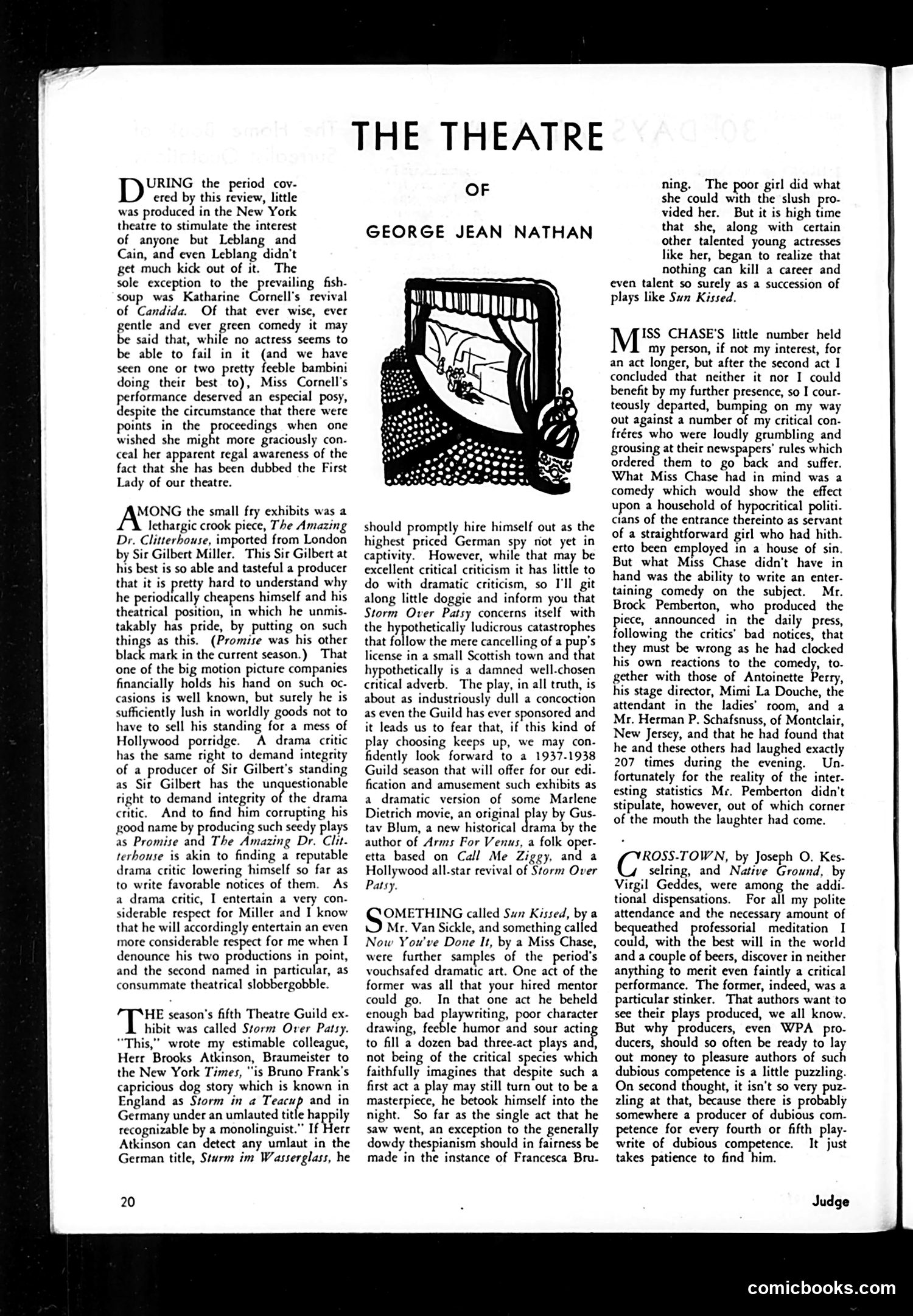
Explanation for Modern Readers This is a theater review column by George Jean Nathan critiquing 1930s Broadway productions. The small cartoon shows a woman's face in a window—likely illustrating one of the plays discussed. Nathan dismisses most current theater as uninspired ("fish-soup"), praising only Katharine Cornell's *Candida*, though he notes her excessive awareness of her status as "First Lady of our theatre." He attacks producer Sir Gilbert Miller for compromising his reputation by producing mediocre plays like *The Amazing Dr. Clitterhouse*, comparing this to a drama critic writing favorable reviews of bad work—both betray professional integrity. He mocks the Theatre Guild's *Storm Over Patsy* as absurdly dull, complaining that if the Guild continues choosing such poor material, future seasons will feature even worse offerings (like film adaptations or folk operettas). The references to Leblang and Cain appear to be in-jokes about theater figures or ticket brokers of that era—unclear to modern readers without additional context.
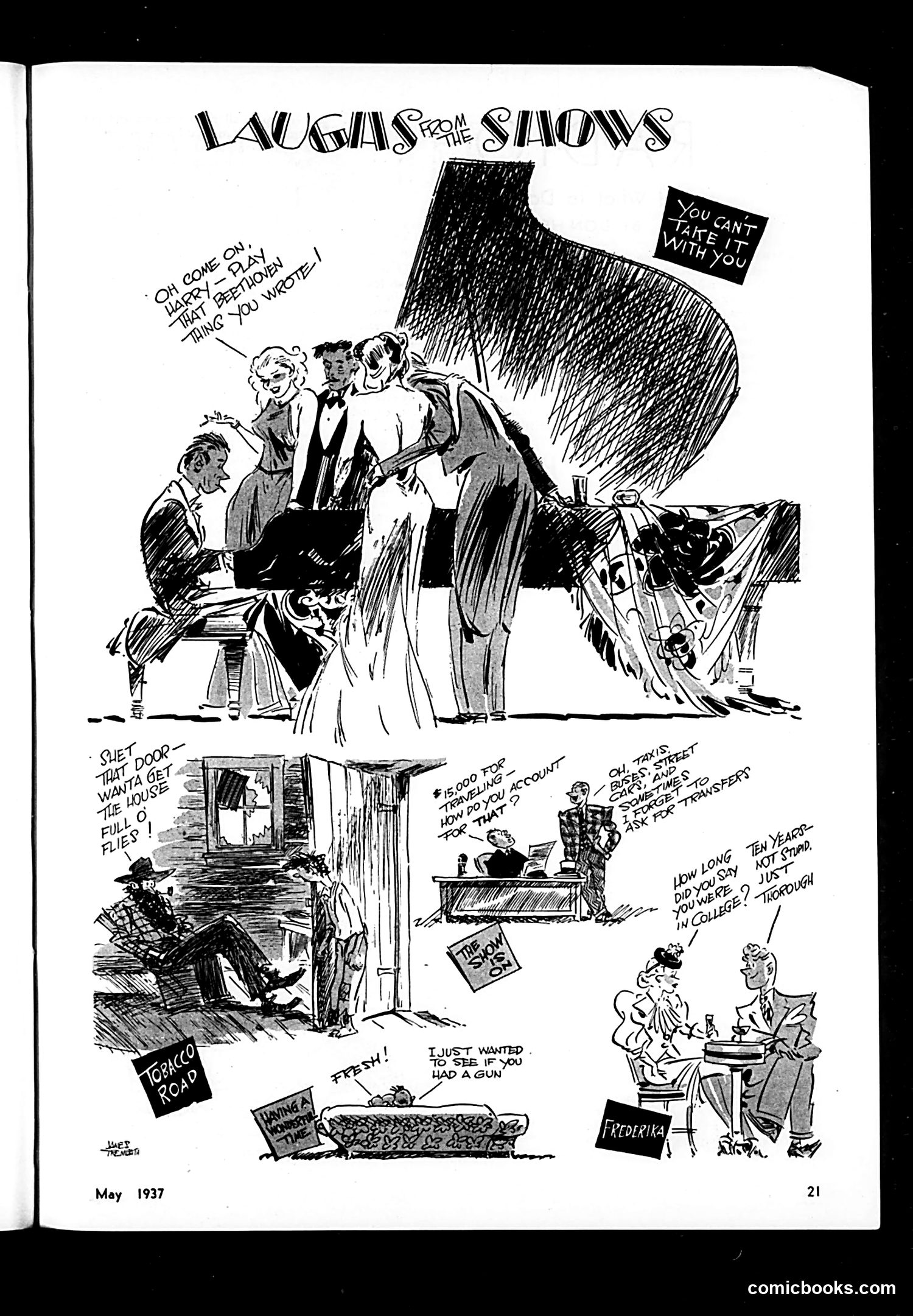
"Laughs from the Shadows" - May 1937 This page contains several satirical comic vignettes about financial and social hardship during the Great Depression era. The panels mock various desperate situations: someone wanting to door-to-door sell "flies" (suggesting absurd desperation), a banker dismissing loan requests, and someone asking about a "ten-year" college plan while "broke." The large shadow looming over the characters represents economic hardship and uncertainty casting darkness over everyday life. The title's pun—"laughs from the shadows"—suggests finding humor in grim circumstances, characteristic of Depression-era satirical humor in Judge magazine. The cartoons critique both individual desperation and institutional indifference (represented by the banker), reflecting 1937's continuing economic struggles before America's full recovery.
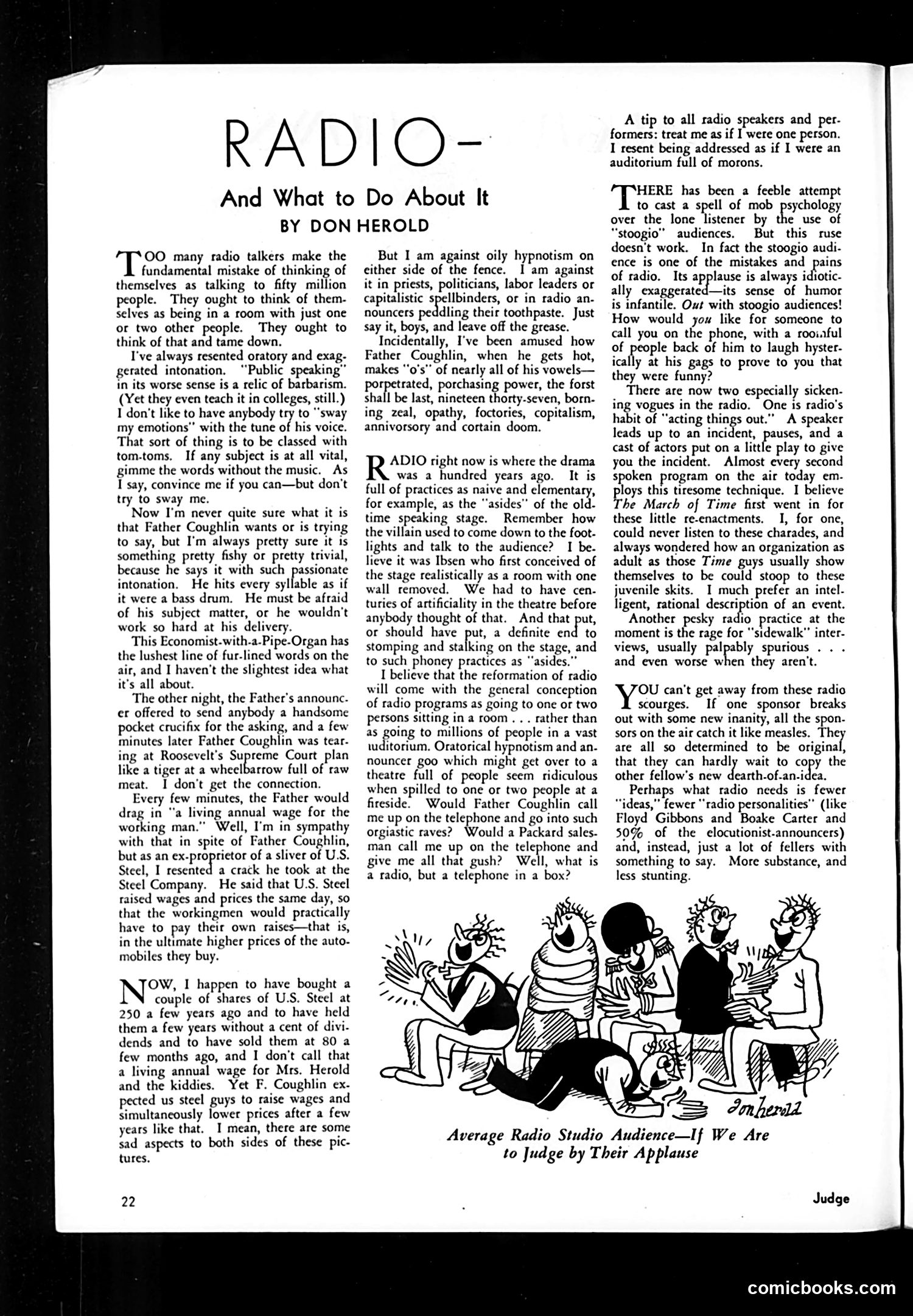
Political Satire Analysis: "Radio—And What to Do About It" Don Herold's essay criticizes radio performers' theatrical delivery styles, focusing primarily on Father Charles Coughlin, a controversial Catholic priest and radio personality known for fiery speeches against Roosevelt's policies. Herold's main complaint: radio talkers use exaggerated intonation and emotional manipulation rather than clear argument. He mocks Coughlin's distinctive vowel pronunciations ("o's") and passionate delivery, suggesting theatrical excess masks weak reasoning. Herold also criticizes his contradictory positions—promoting workers' wages while attacking U.S. Steel. The cartoon below depicts a studio audience of exaggerated, wildly enthusiastic listeners applauding wildly, labeled "Average Radio Studio Audience—If We Are to Judge by Their Applause." This satirizes how radio audiences (or "canned applause") artificially amplify performers' appeal through manufactured enthusiasm. Herold advocates for plain speech without "oily hypnotism," whether from priests, politicians, or advertisers—reflecting broader 1930s skepticism toward propaganda and emotional manipulation in mass media.
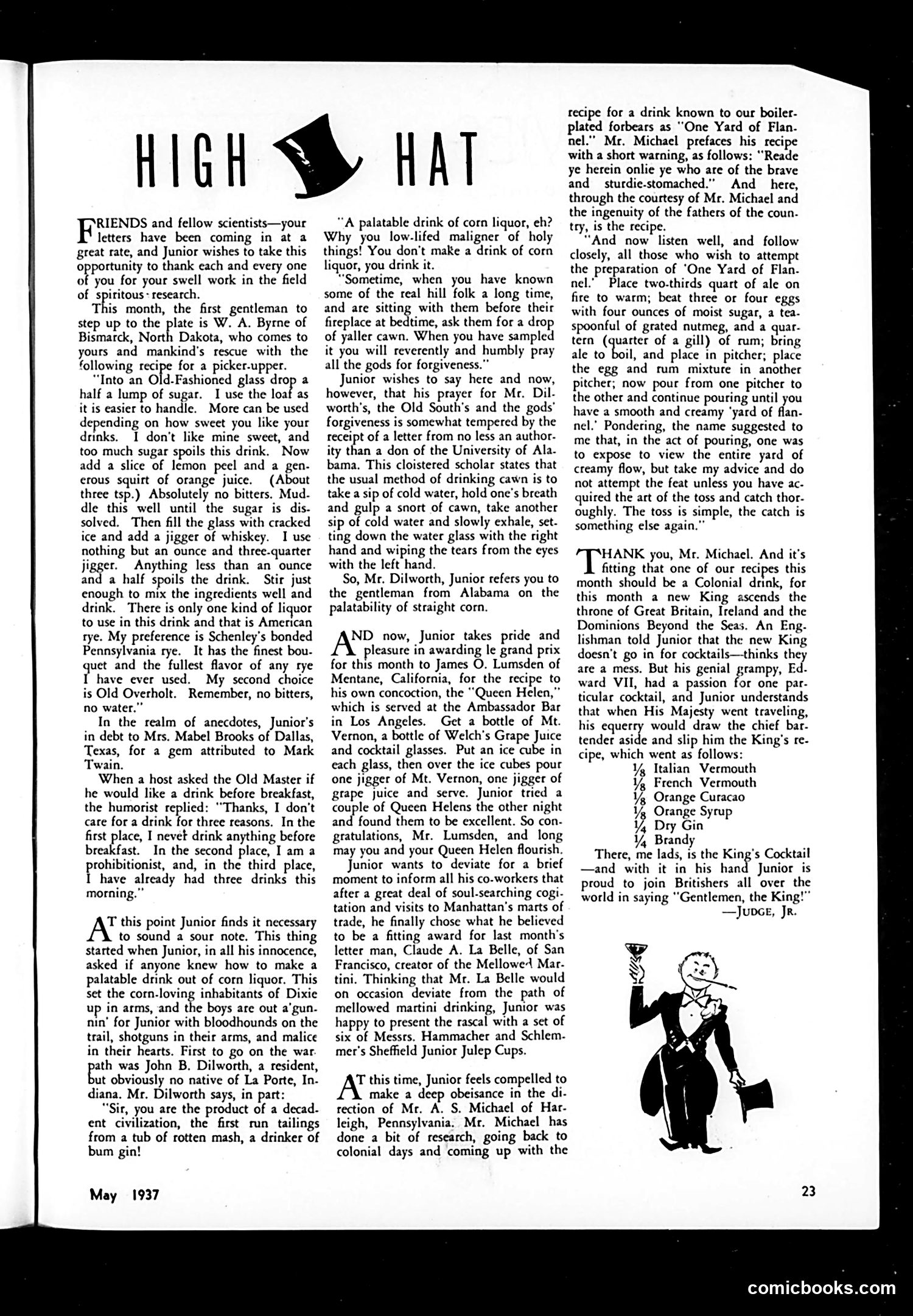
"High Hat" - Judge Magazine, May 1937 This page is a humorous column about cocktail recipes and drinking culture during Prohibition's aftermath. "Junior" (the column's persona) solicits reader recipes and anecdotes about spirits. The satire targets regional American attitudes toward alcohol. When Junior innocently asks how to make a palatable corn liquor drink, Southern readers react furiously—a John B. Dilworth from Indiana denounces him as a "product of decadent civilization" for suggesting corn liquor should be mixed rather than drunk straight. An Alabama university professor then pedantically explains the "correct" method: sipping water, holding one's breath, gulping corn liquor, then exhaling with tears. The joke satirizes both snobbish cocktail culture (the refined rye whiskey recipe) and Southern defensiveness about their moonshine traditions. The cartoon illustration shows a well-dressed gentleman in top hat—embodying the "high hat" sophistication the column ironically adopts while poking fun at drinking pretensions across America.
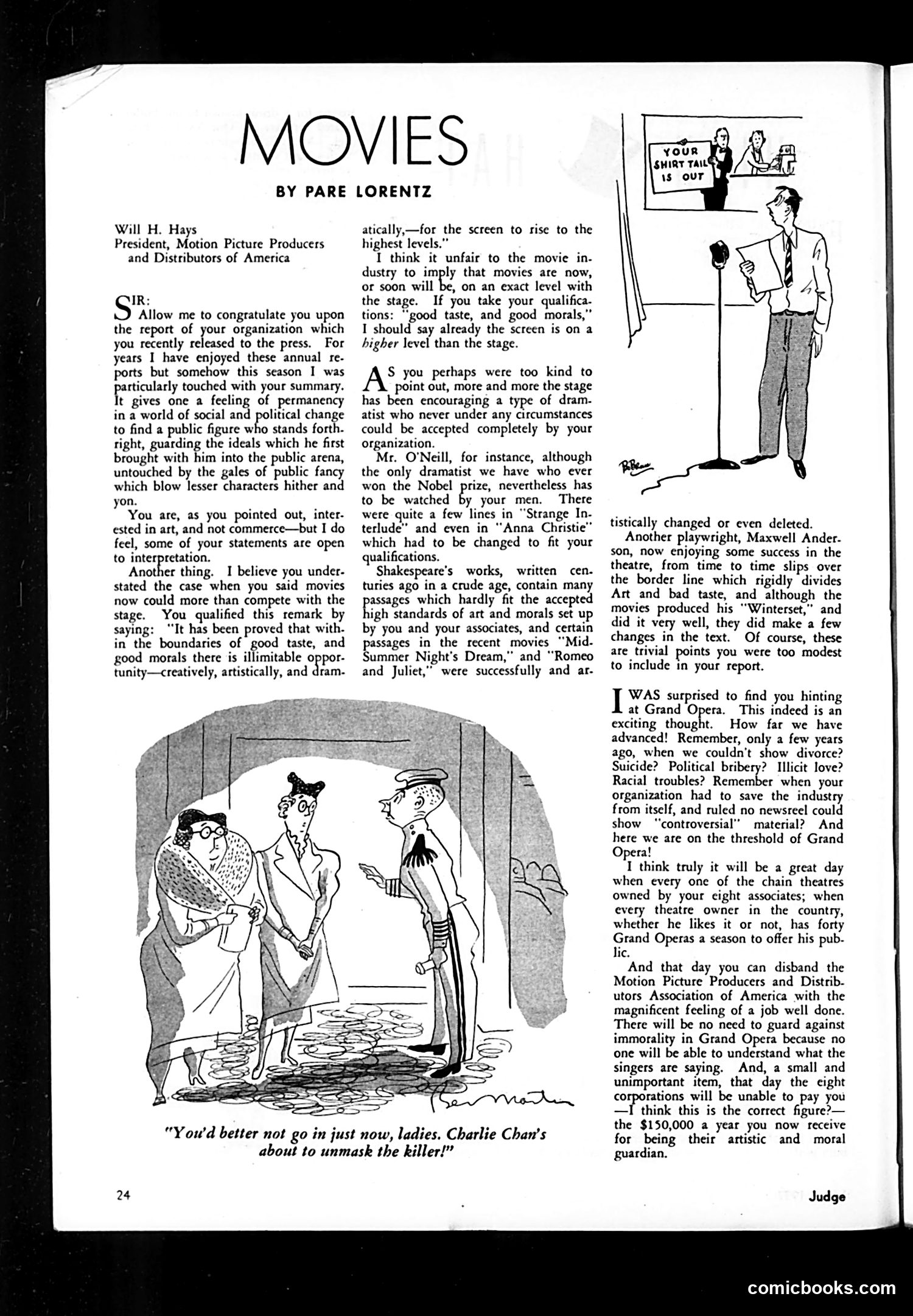
"Movies" by Pare Lorentz — Judge Magazine This article satirizes Will H. Hays, president of the Motion Picture Producers and Distributors of America (the Hays Office), which enforced strict moral censorship in Hollywood. Lorentz praises Hays's annual report with heavy irony, highlighting contradictions in his claims. While Hays argued movies now equal or exceed theater in quality within "good taste" boundaries, Lorentz points out that stage plays—including works by Nobel Prize-winner Eugene O'Neill and Shakespeare—contain content Hays's organization would never permit onscreen. References to O'Neill's "Strange Interlude" and "Anna Christie," along with film adaptations of "Midsummer Night's Dream" and "Romeo and Juliet," show how the Hays Office censored even classics. The cartoon shows three figures discovering a body, warning: "You'd better not go in just now, ladies. Charlie Chan's about to unmask the killer!"—mocking how the Hays Office policed movie content like a moral censor. Lorentz's conclusion—sarcastically suggesting Grand Opera could be programmed in theaters once Hays's work is complete—underscores the absurdity of such stringent censorship.
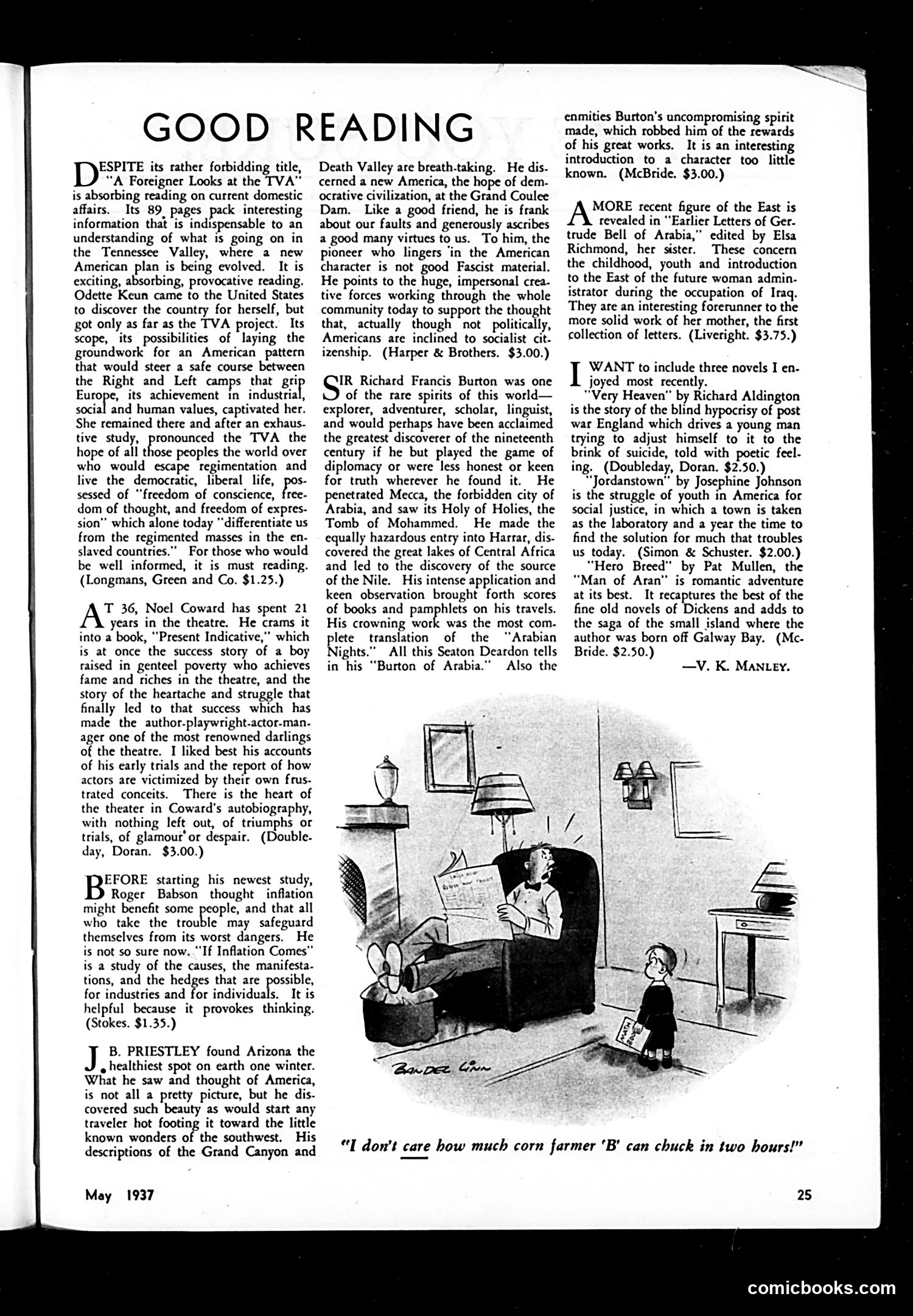
Analysis of Judge Magazine Page (May 1937) This is a book review page titled "Good Reading," featuring brief critical notices of recent publications. The single cartoon depicts a domestic scene: a woman sits reading while a man stands nearby, with the caption: "I don't care how much corn farmer 'B' can chuck in two hours!" The joke's context: This references New Deal agricultural policies, likely the Agricultural Adjustment Act, which controlled farm production through acreage reduction and quotas. "Farmer B" appears to reference government productivity standards or comparison schemes. The humor lies in the wife's indifference to competitive agricultural efficiency—she's absorbed in her book rather than impressed by her husband's (or someone's) farming prowess. It's gentle domestic satire mocking the era's obsession with measuring and comparing productivity, even in farming. The reviews themselves discuss serious 1930s concerns: the TVA (Tennessee Valley Authority), inflation economics, and American character—reflecting Depression-era intellectual discourse about democracy versus authoritarianism.
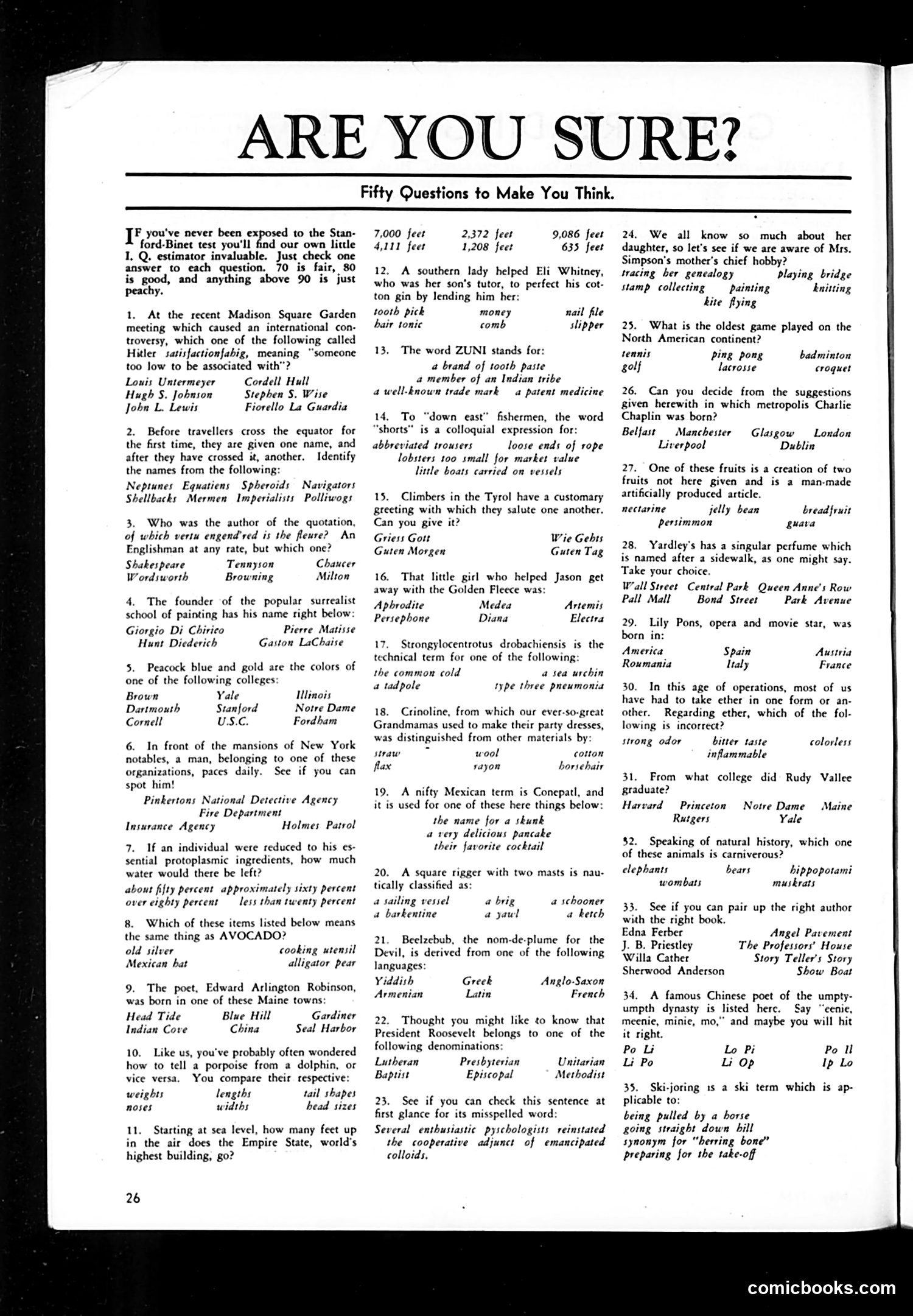
"Are You Sure?" - A 1930s Intelligence Quiz This page presents a trivia quiz titled "Fifty Questions to Make You Think," presented as an IQ estimator referencing the Stanford-Binet test. The questions span history, literature, science, geography, and culture—reflecting intellectual pretensions of the era. Context for modern readers: The quiz appears designed as satirical social commentary. Questions range from obscure (medieval poetry, scientific nomenclature) to practical (maritime terminology), suggesting that "intelligence" is culturally constructed and class-bound. References to contemporary figures like Cordell Hull and Hugh S. Johnson anchor it to the 1930s political moment. The satire likely mocks the period's obsession with IQ testing and intellectual gatekeeping—positioning arbitrary knowledge as "smartness." The scoring system (70=fair, 80=good, 90+=excellent) parodies pseudoscientific measurement of human capability, a common target of Judge magazine's humor. This represents mid-century American magazines using trivia as gentle social satire.
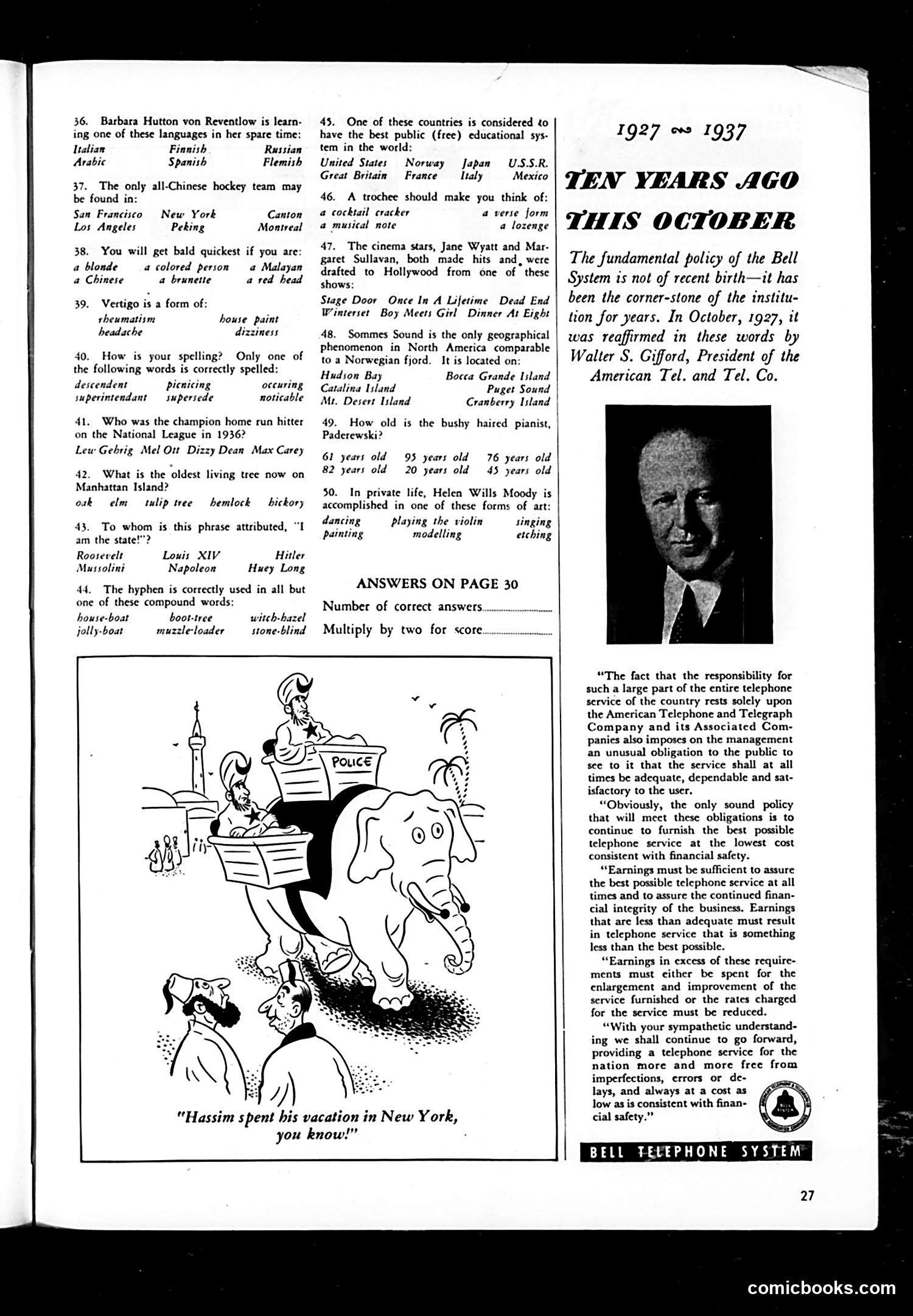
Cartoon Analysis: "Hassim spent his vacation in New York, you know!" This cartoon satirizes wealthy international tourists and their exotic travel experiences. The image depicts an elephant carrying what appears to be Middle Eastern or South Asian figures (suggested by the style of dress and the name "Hassim") riding through New York City streets past police vehicles. The humor lies in the incongruity: a tourist bringing the trappings of their foreign homeland—literally an elephant—into Manhattan's urban landscape, treating the American city as just another exotic destination to explore with their own cultural elements intact. The joke suggests the absurdity of ultra-wealthy international travelers who remain so insulated by wealth and privilege that they experience foreign cities through their own cultural bubble rather than engaging with local environments. This reflects 1920s-30s attitudes toward wealthy foreign visitors and their perceived cultural detachment.
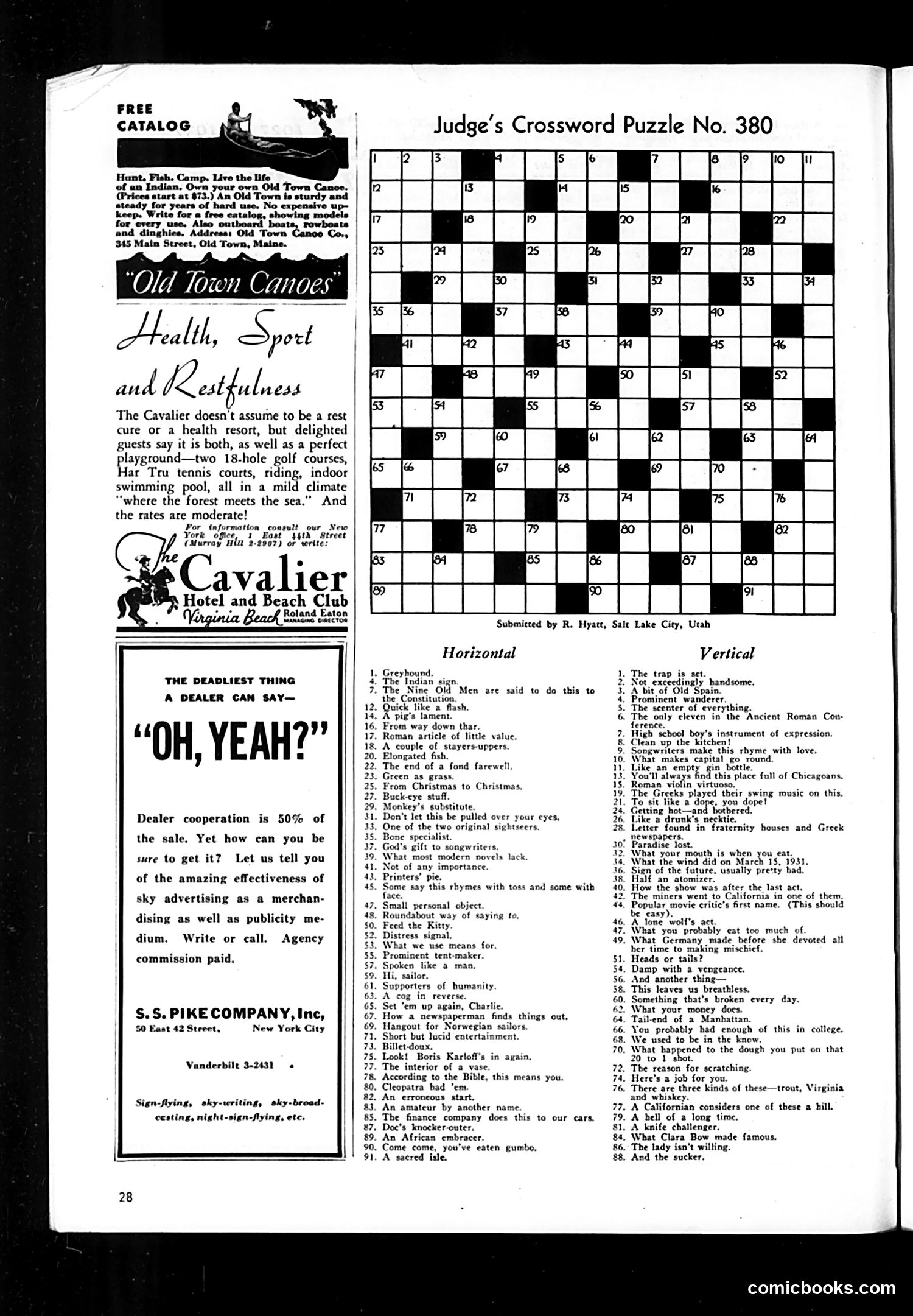
Judge's Crossword Puzzle No. 380 This page is primarily a crossword puzzle with advertisements, not a political cartoon. The puzzle itself contains general wordplay and riddles typical of 1930s-era crosswords—puns, definitions, and cultural references. However, one clue stands out historically: "The Nine Old Men are said to do this to the Constitution" (Horizontal 3). This references the U.S. Supreme Court justices who were striking down New Deal legislation during Franklin D. Roosevelt's presidency (early-to-mid 1930s). The answer is likely "TWIST" or similar. This was a major political controversy of the era, with FDR famously attempting to pack the court. The advertisements promote Old Town Canoes, the Cavalier Hotel and Beach Club in Virginia Beach, and S.S. Pike Company's sky-writing services—typical leisure and commercial advertising for a satirical magazine aimed at middle and upper-class readers.
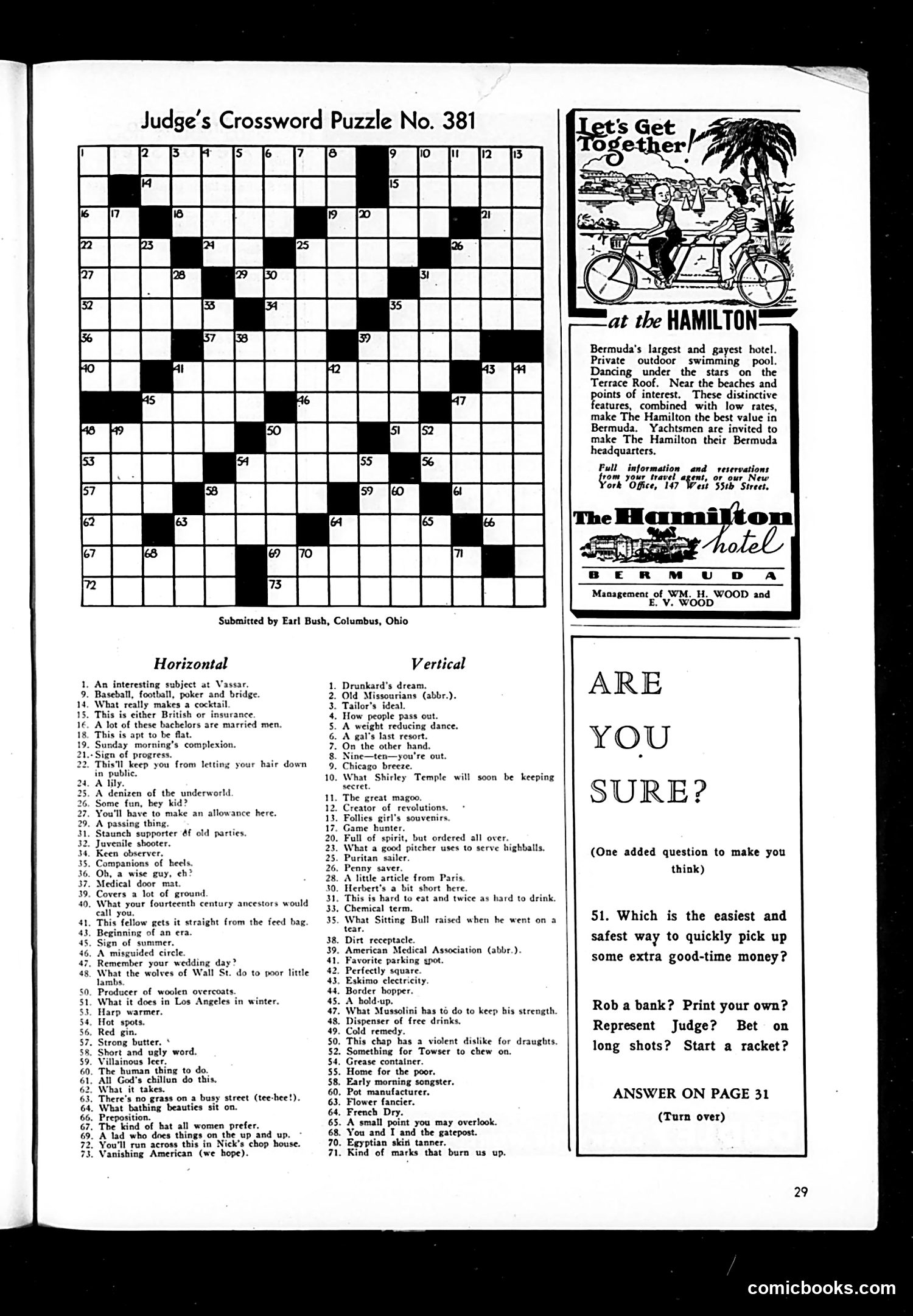
Judge Magazine Crossword Puzzle No. 381 This page is primarily a crossword puzzle with clues, not a political cartoon. The puzzle itself contains no satirical imagery or political commentary. However, the advertising sidebar for The Hamilton Hotel in Bermuda is notable: it promotes luxury tourism ("Bermuda's largest and gayest hotel," "Dancing under the stars," "low rates") to wealthy Americans during what appears to be the 1930s-40s era. The puzzles' clues reference contemporary cultural touchstones—Vassar, cocktails, Shirley Temple, Mussolini, and references to Wall Street "lambs" and underworld figures—reflecting Jazz Age and Depression-era concerns. The final box titled "ARE YOU SURE?" poses rhetorical questions about "quick good-time money" (robbery, counterfeiting, gambling), which appears to be light social commentary on economic desperation, though without accompanying imagery, its satirical intent is unclear.
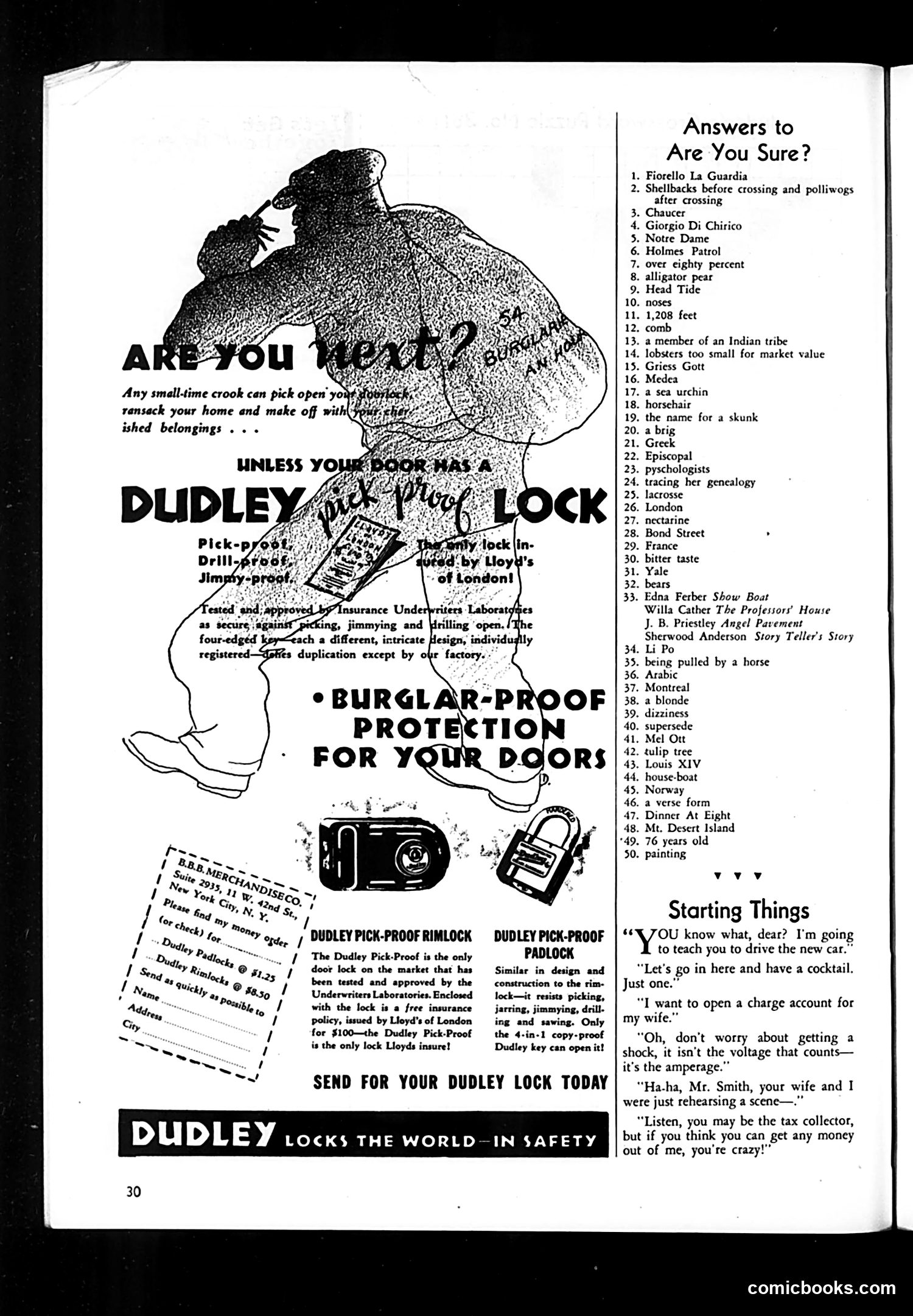
Analysis: Dudley Lock Advertisement & Quiz Answers Page This page contains primarily advertising and quiz answers, not political satire. The main content is a Dudley Lock advertisement promoting burglar-proof door locks. The cartoon illustration shows a caricatured burglar attempting to break into a home, emphasizing the need for security. The ad promotes the "Dudley Pick-Proof" lock as tested by Underwriters Laboratories and insured by Lloyd's of London—marketing security as a consumer product for homeowners concerned about theft. The right column lists answers to a previous quiz ("Are You Sure?"), covering diverse topics: Fiorello La Guardia (NYC mayor), literary references (Chaucer, Willa Cather), and miscellaneous facts. Below that, "Starting Things" presents brief comedic vignettes about marital dynamics and social situations—common light humor for the era. Context for modern readers: This reflects 1930s-40s consumer culture and home security anxiety, plus typical domestic comedy based on marriage stereotypes and class-conscious social situations.
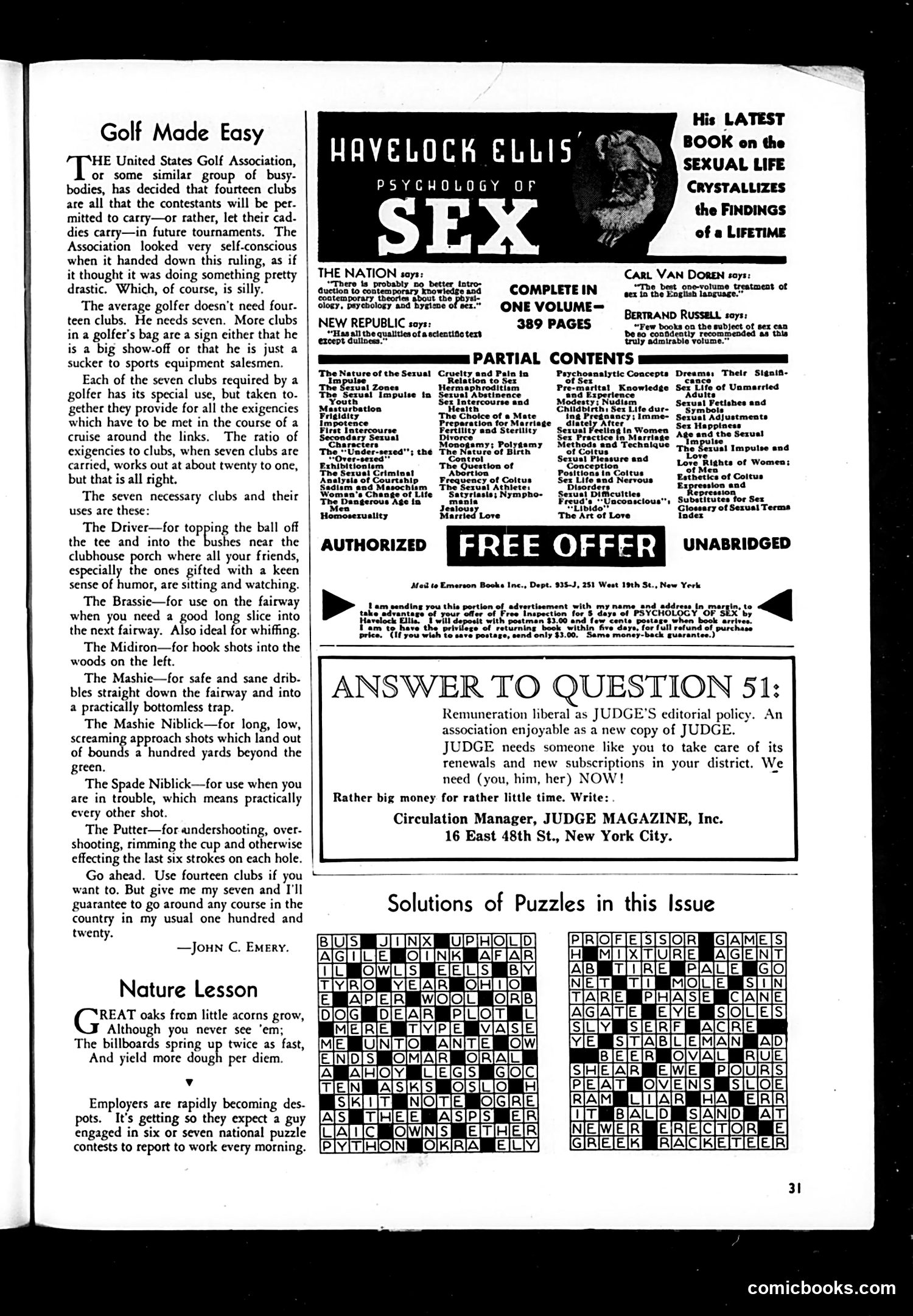
"Golf Made Easy" and Related Content This page is primarily advertising and humor columns, not political satire. "Golf Made Easy" by John C. Emery is a comedic essay mocking golf's pretensions. It satirizes the U.S. Golf Association's recent ruling limiting players to 14 clubs, calling the restriction absurd. Emery argues golfers need only 7 clubs, then humorously describes how each club fails its intended purpose (the Driver tops balls into bushes, the Brassie produces slices, etc.). The satire targets both golf's complexity and equipment salesmen who exploit golfers' vanity. "Nature Lesson" is a short poem contrasting mighty oaks grown from acorns with billboards that multiply faster and more profitably—likely criticizing urban commercialization and advertising's rapid spread. The remaining content consists of a Havelock Ellis book advertisement (on sexual psychology), puzzle solutions, and a Judge magazine circulation pitch. These are standard magazine filler, not satirical commentary.
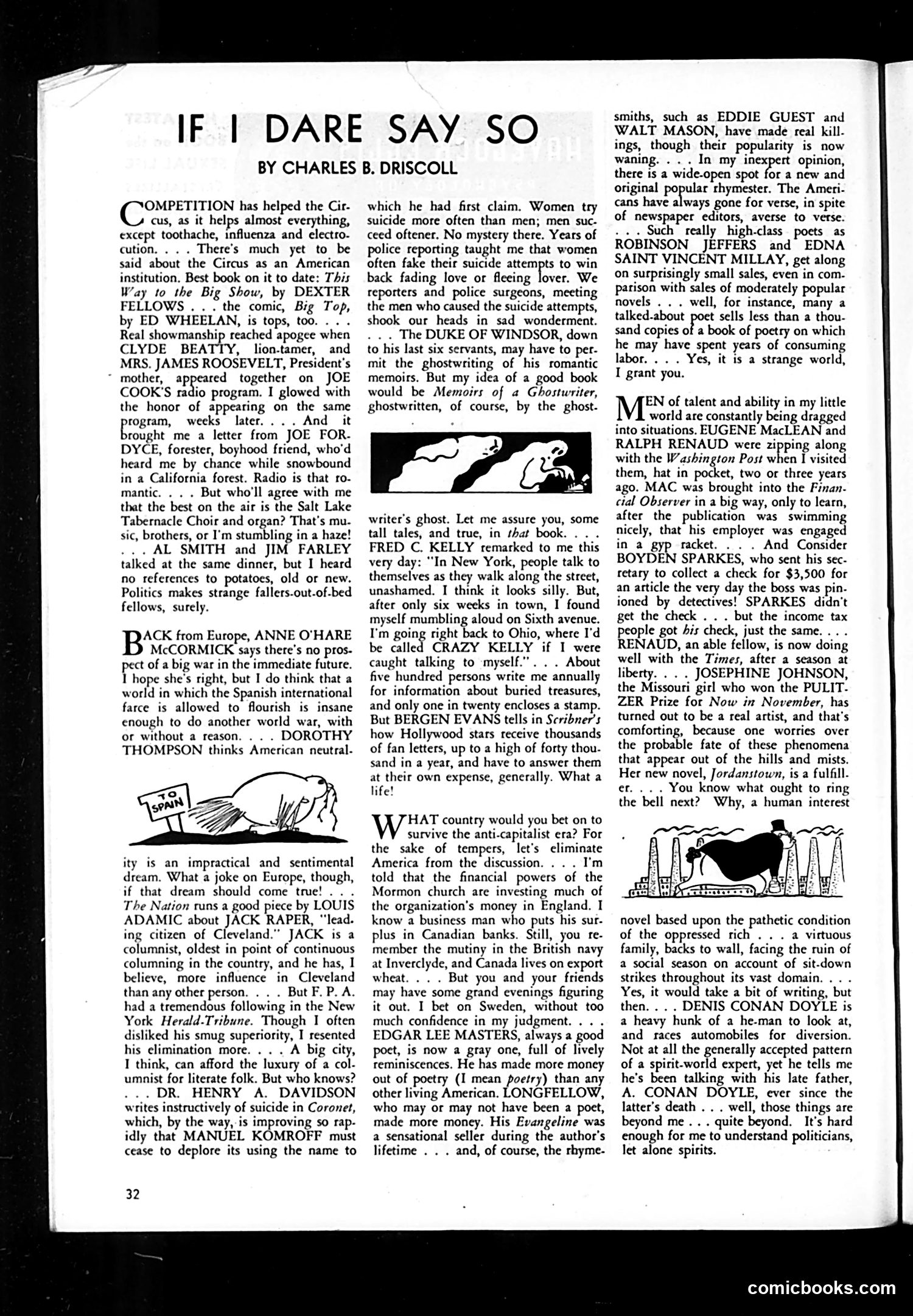
Analysis of Judge Magazine Page This is a column of commentary and light satire by Charles B. Driscoll touching on various cultural figures and topics. The two small cartoons (showing a sleeping figure and what appears to be city buildings) are minor illustrations rather than the page's focus. Key References: The column discusses American entertainment and public figures: circus performer Clyde Beatty, radio personality Joe Cook, and the Salt Lake Tabernacle Choir. It mentions political figures Al Smith and Jim Farley dining together, noting their shared meal despite political differences ("strange fallers-out-of-bed fellows"). Social Commentary: Driscoll addresses women's suicide attempts (noting they're often faked to win back lovers), the Duke of Windsor's financial decline requiring ghostwritten memoirs, and American neutrality regarding Spanish Civil War tensions. He praises Cleveland columnist Jack Raper and laments the elimination of F.P.A.'s column in the Herald-Tribune. The tone is conversational and whimsical rather than sharply satirical—Driscoll muses on radio's appeal, New York pedestrians talking to themselves, and fan mail to Hollywood stars, suggesting gentle observation of American life rather than biting political critique.
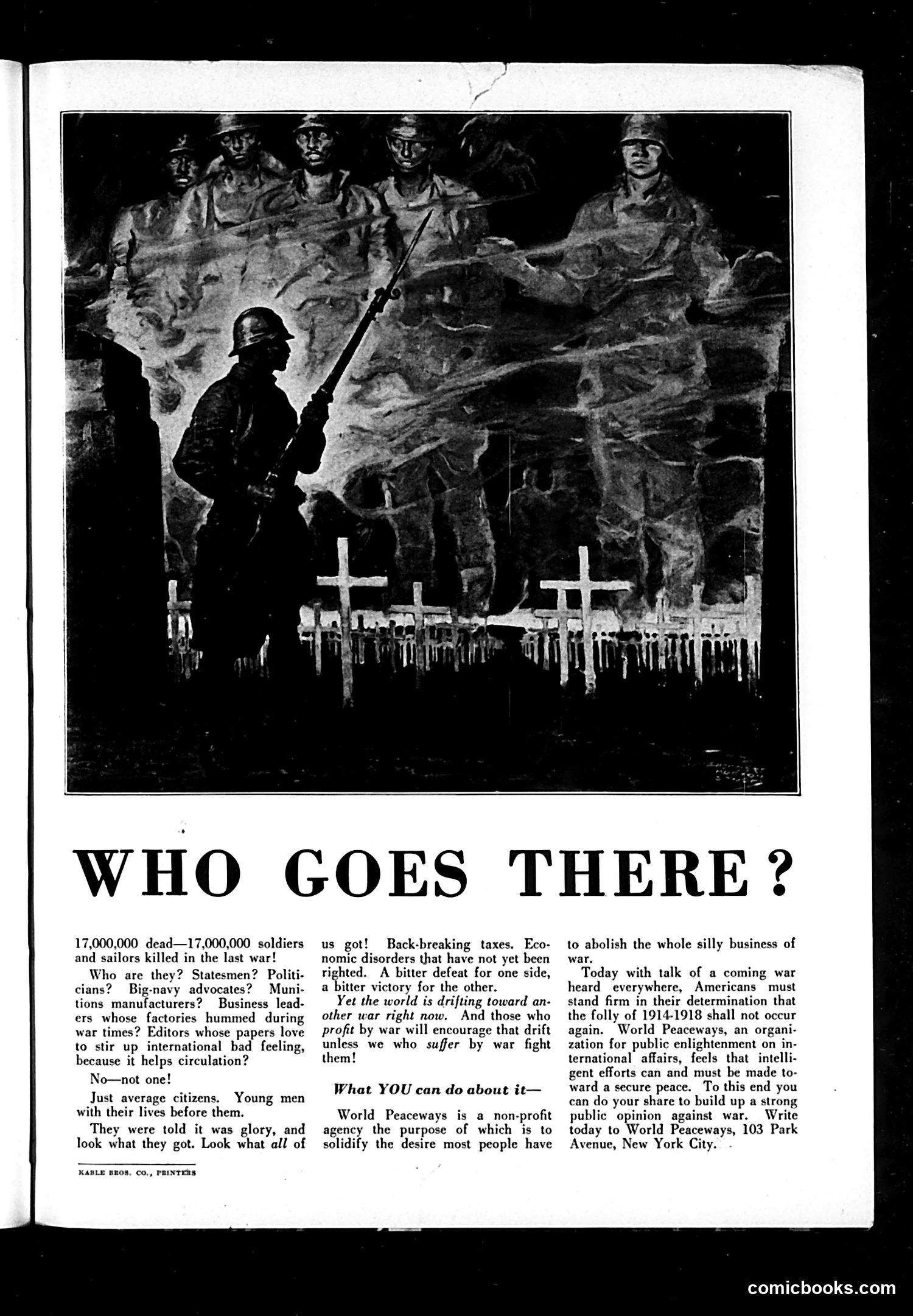
Analysis for Modern Readers This is an anti-war advertisement disguised as editorial content, likely from the 1920s-30s interwar period. The illustration depicts a soldier standing among countless white crosses (graves) while military figures loom above—representing how ordinary citizens, not decision-makers, bore the costs of World War I. The text's central argument: 17 million soldiers died while politicians, munitions manufacturers, and warmongering editors who profited from conflict remained safe. The piece attacks the narrative that war is glorious, contrasting it with actual suffering—economic hardship, taxes, and societal division. "World Peaceways" (the organization being promoted) advocates for pacifism and international cooperation to prevent another war. The specific reference to "1914-1918" and concerns about "a coming war" suggests this was published when European tensions were rising again, likely the 1930s as fascism emerged. The satire's target: those who profit from war while sacrificing nothing.
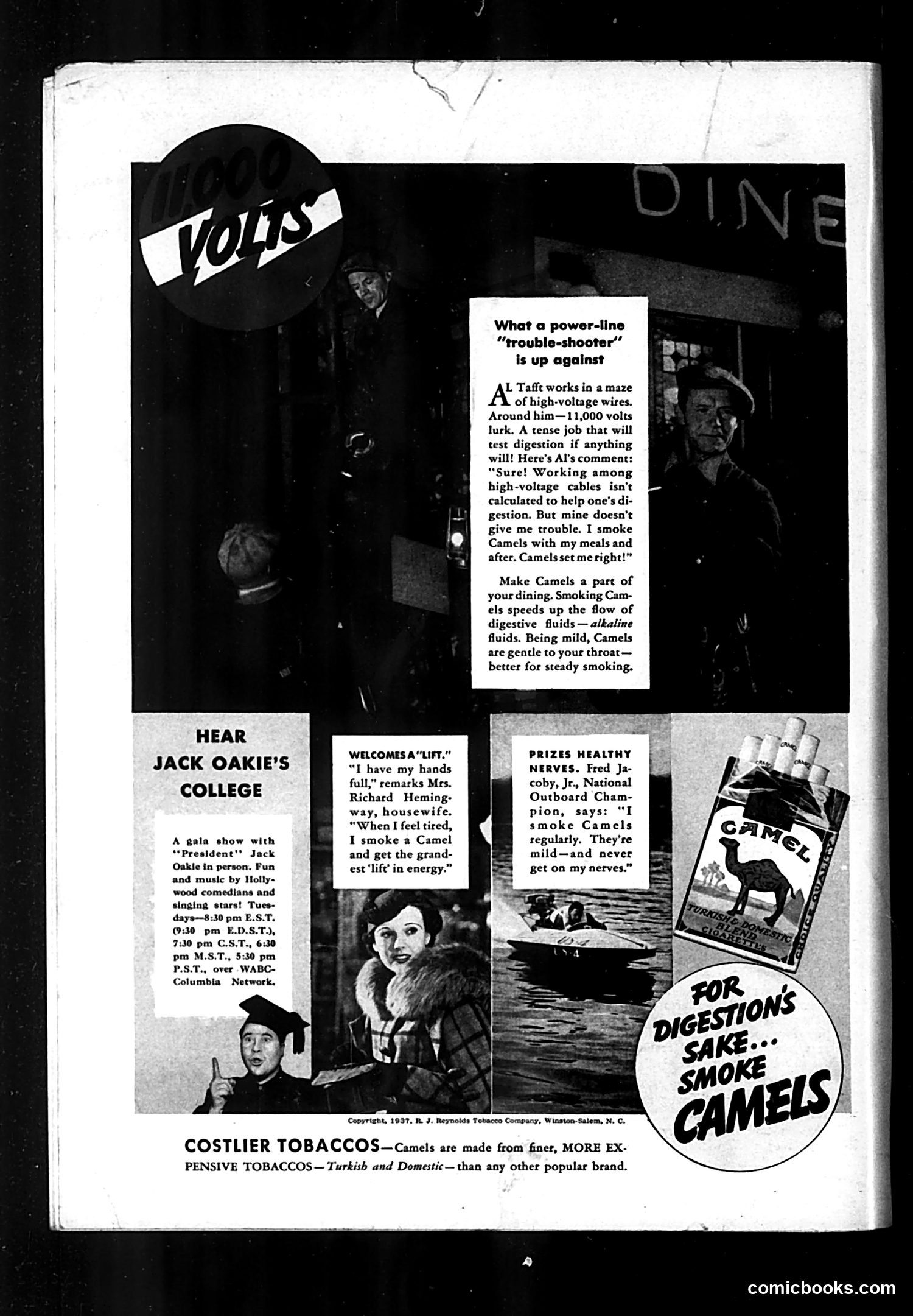
Analysis This page is primarily a Camel cigarette advertisement disguised as editorial content, dated 1937. The layout features testimonials from various professionals—a power-line worker (Al Tafft), a housewife (Mrs. Richard Hemingway), and a boat racer (Fred Jacoby Jr.)—each claiming Camels improve digestion, provide energy, and calm nerves. The ad uses pseudo-scientific language ("alkaline fluids," "digestive fluids") to suggest smoking aids digestion. A sidebar advertises "Jack Oakie's College," a radio variety show hosted by comedian Jack Oakie. For modern readers: This represents pre-regulation tobacco marketing when health claims were unsubstantiated and advertising freely linked smoking to physical benefits. The testimonials from "ordinary" workers and athletes were common persuasion tactics. The digestive health angle seems absurd today but was a standard advertising claim in the 1930s before tobacco's dangers were publicly acknowledged.

I can see this is a page from *Judge* magazine, but the image is almost entirely black with minimal visible content. The only clearly legible text is the "comicbooks.com" watermark at the bottom right corner. Without being able to discern actual cartoon artwork, caricatures, figures, or readable text from the OCR, I cannot reliably identify what political or social satire this page contains, what figures are depicted, or what the joke or point of the cartoon is meant to be. To provide accurate analysis as requested, I would need a clearer, higher-contrast scan of this page that shows the actual illustrations and readable text clearly.