judge
Judge — June 1937
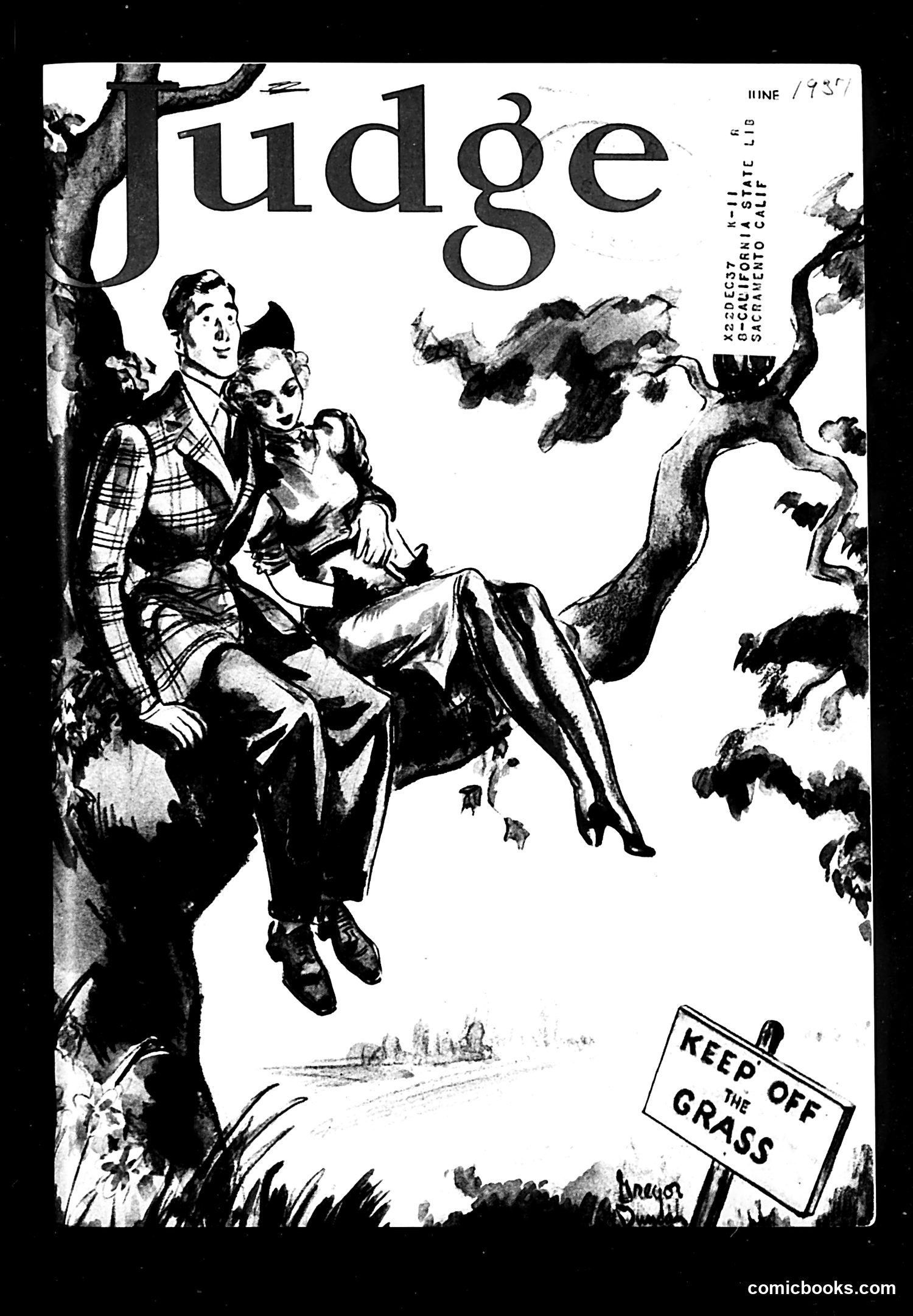
Judge Magazine Cover Analysis This appears to be a vintage Judge magazine cover featuring a romantic illustration of a couple sitting on a tree branch. The man wears a plaid suit while the woman reclines in his arms, displaying her legs prominently—a somewhat risqué pose for the era. The satire likely critiques public displays of affection or improper behavior in parks, emphasized by the "KEEP OFF THE GRASS" sign at bottom. The couple's oblivious intimacy while literally breaking park rules suggests commentary on social propriety and courtship norms. The archival stamp indicates this is from the Bancroft Library collection. Without knowing the specific publication date, the style suggests early-to-mid 20th century. The humor relies on the tension between societal rules and romantic impulse.
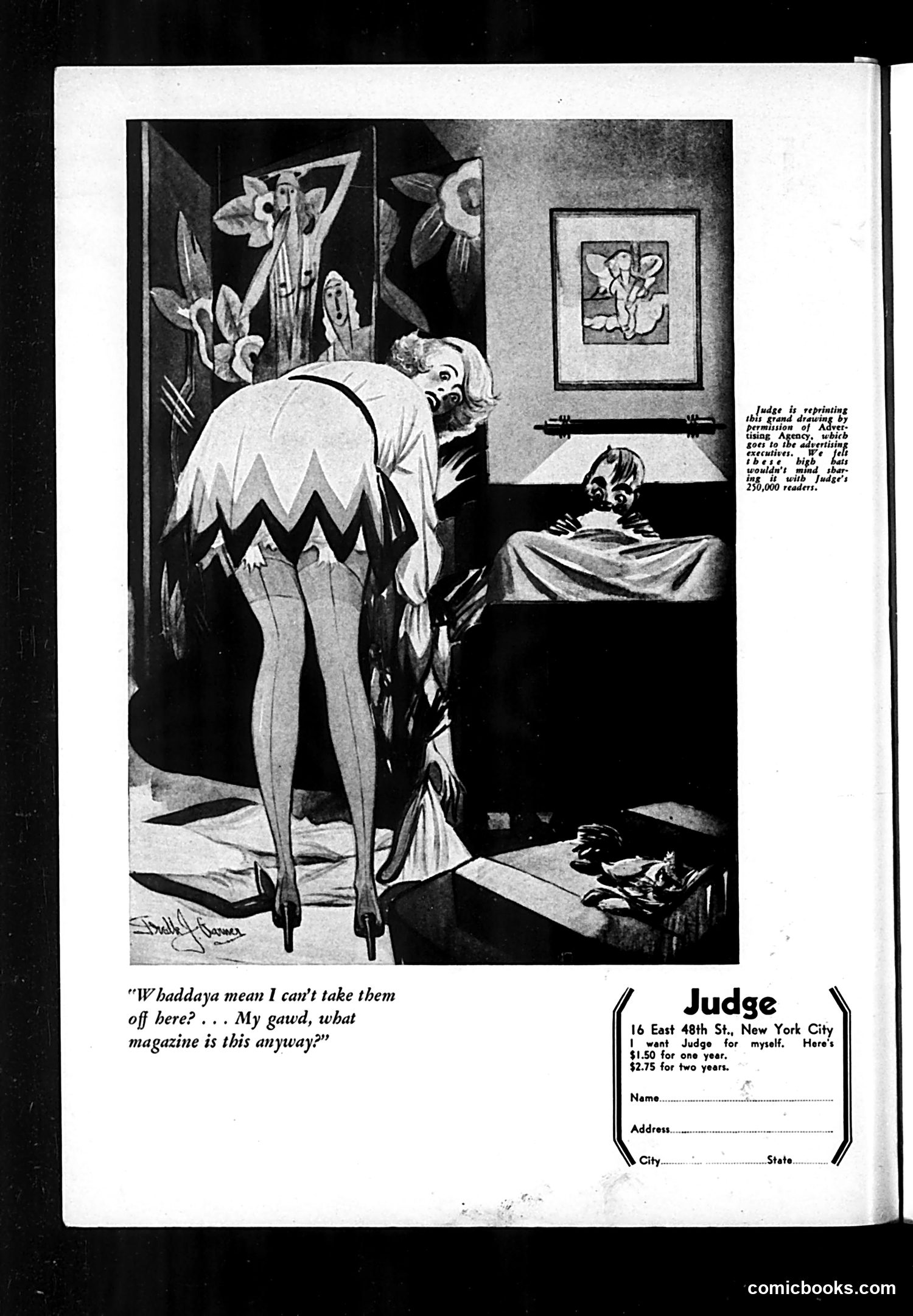
Analysis of Judge Magazine Page This page contains a single cartoon with accompanying subscription advertisement. The illustration depicts a woman with exaggerated features examining artwork in what appears to be a gallery or studio setting. Her dialogue—"W'baddaya mean I can't take them off here? . . . My gawd, what magazine is this anyway?"—suggests satire about artistic standards or magazine content. The cartoon's target remains unclear without additional context. It may satirize either public attitudes toward modern/abstract art (the stylized paintings visible on walls), or conversely, Judge magazine's own editorial policies. The woman's shock and the emphasis on "what magazine" suggests irony about the publication's actual content versus its perceived identity. The page includes a standard subscription form for Judge magazine at 16 East 48th Street, New York City.
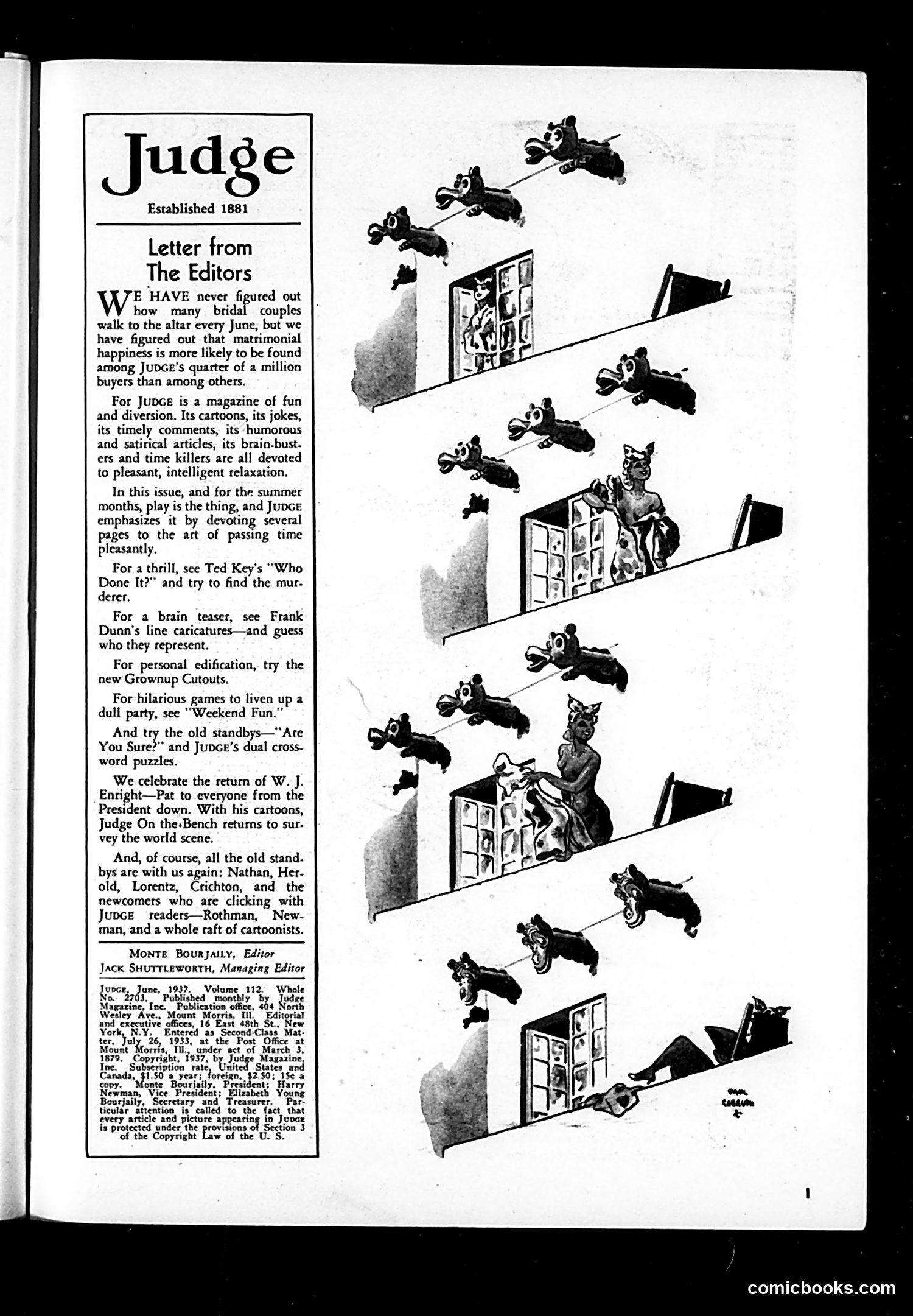
Judge Magazine Cartoon Analysis This page from Judge (June 1917) features a satirical cartoon depicting witches flying on broomsticks emerging from windows of what appear to be buildings or structures. The cartoon likely comments on the chaos or disruption of social order during World War I or the summer season (the editor's letter mentions "play is the thing" for summer months). The repeated witches-on-broomsticks motif suggests pandemonium or supernatural mischief—a common metaphor for social upheaval. Without clearer identifying labels visible in the image, the specific targets remain unclear, though the imagery suggests criticism of some contemporary social disturbance or widespread problematic behavior among a particular group during this 1917 period.
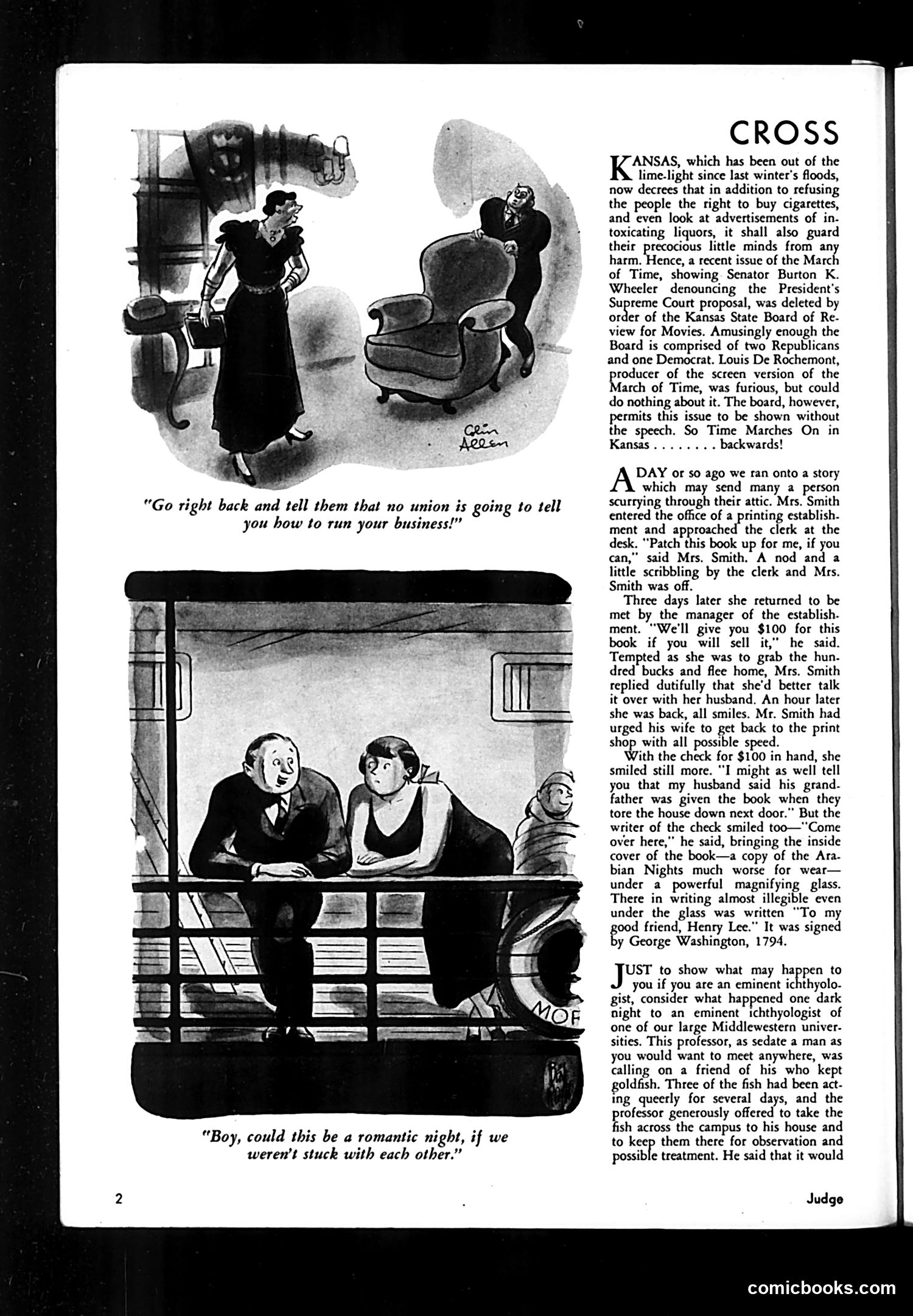
Analysis: Judge Magazine Page - "Cross" Top Cartoon: Satirizes Kansas's censorship board, which banned a *March of Time* newsreel featuring Senator Burton Wheeler criticizing President Roosevelt's Supreme Court proposal. The cartoon mocks the board's heavy-handed suppression of political speech, depicting a figure being told unions won't dictate business—ironically, while censors dictate what citizens can see. Bottom Cartoon: Shows a couple stuck together in a train window, captioned "Boy, could this be a romantic night, if we weren't stuck with each other." This appears to be unrelated social humor about forced proximity. Story Section: Anecdotes about book censorship and an ichthyologist's misadventure with goldfish. Overall, the page addresses Depression-era concerns about government and institutional overreach in controlling information and behavior.
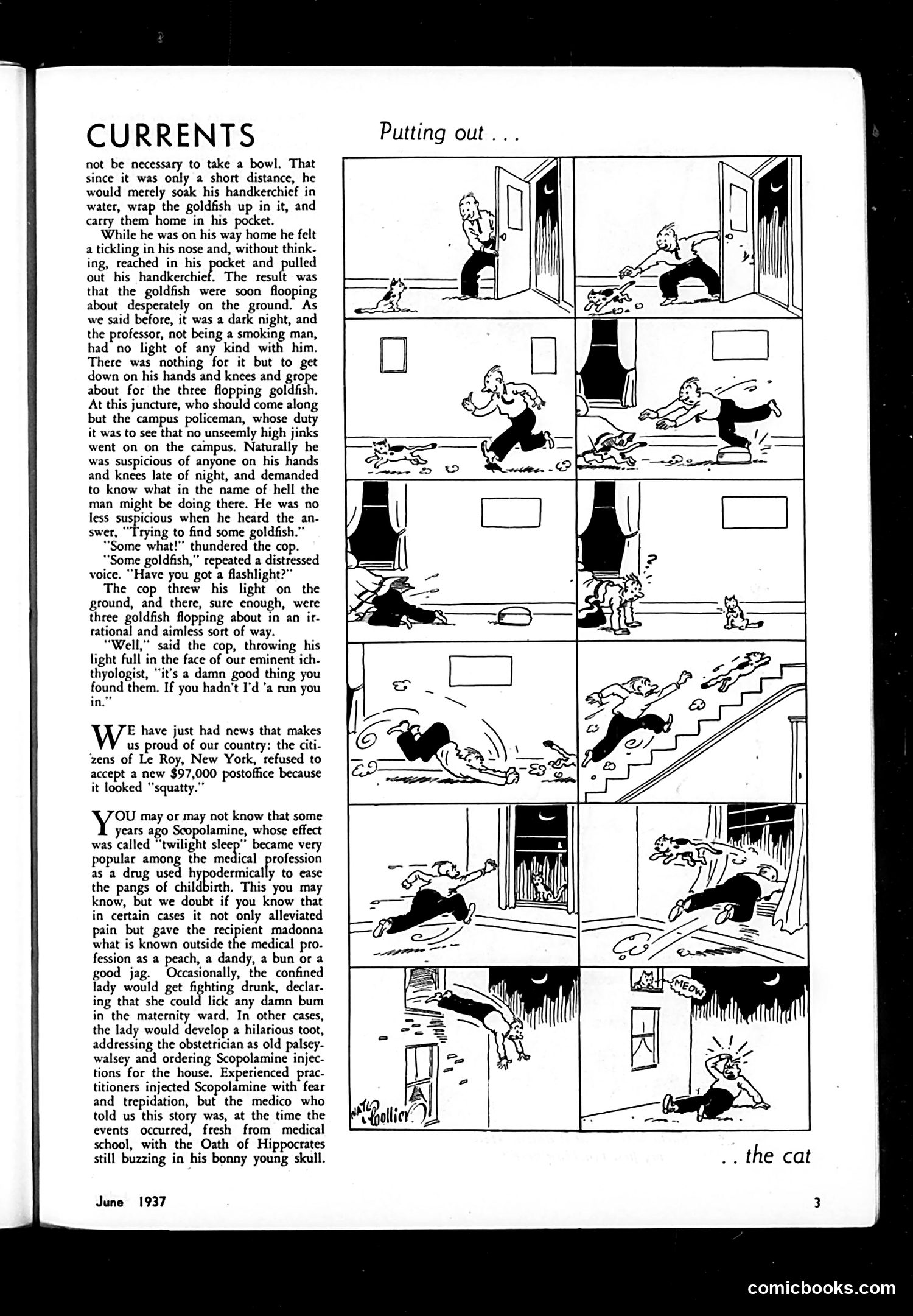
Analysis of Judge Magazine Page (June 1937) This page contains two distinct pieces: "Currents" (left column): A humorous anecdote about a professor carrying a goldfish home at night. A campus policeman, suspicious of the professor's furtive behavior, confronts him. When the professor explains he's retrieving goldfish, the skeptical cop finds three fish flopping on the ground—validating the unlikely story. The humor derives from the absurdity of the situation and the cop's relief at discovering something so mundane and ridiculous. "Putting out...the cat" (right): A sequential comic strip showing someone repeatedly attempting to remove a cat from their home, with the cat repeatedly returning inside. The visual gag escalates through increasingly chaotic scenes. Both pieces employ slapstick humor typical of 1930s popular comedy, with no apparent political satire or social commentary.
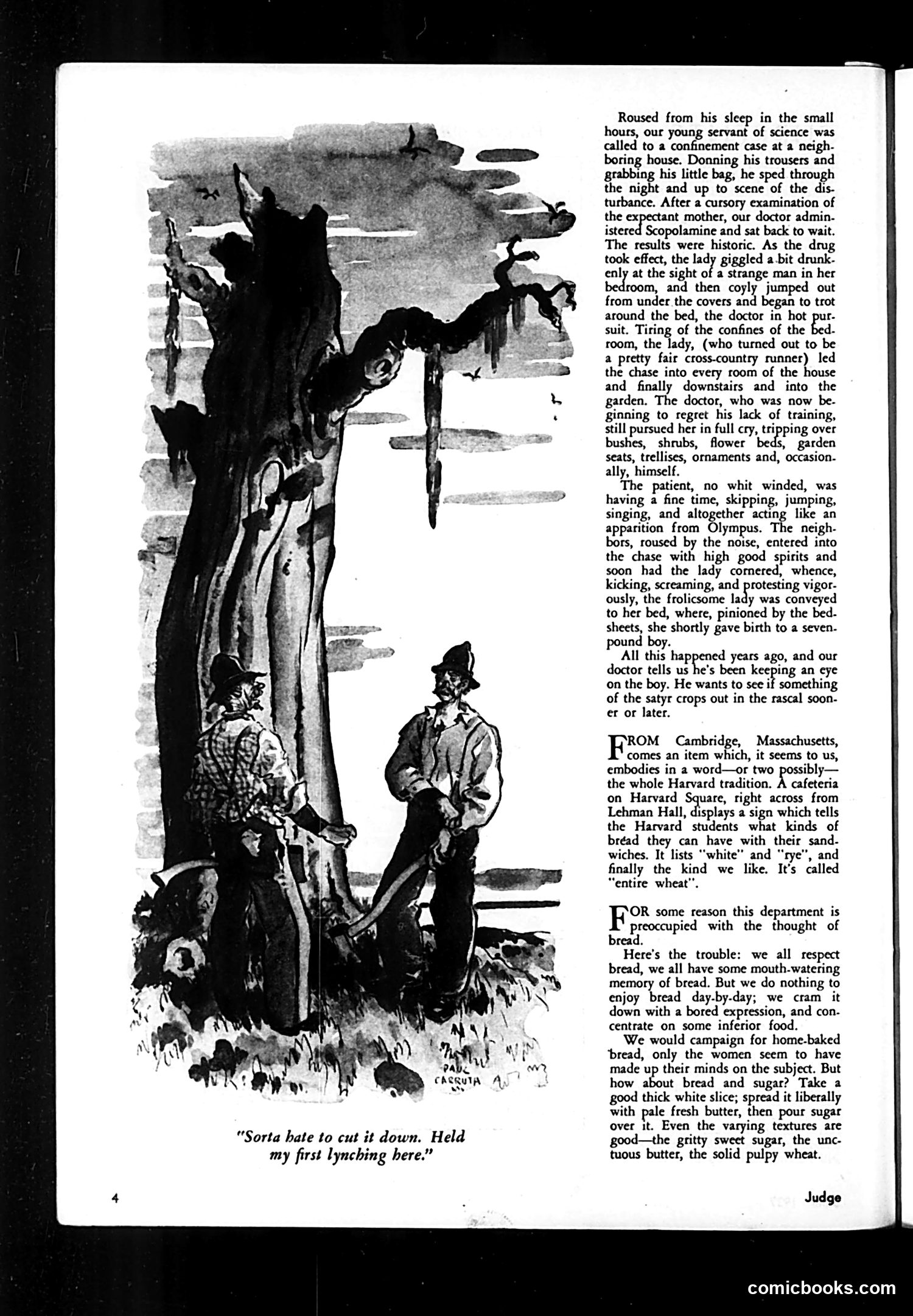
Analysis of Judge Magazine Page This page contains two unrelated pieces: Left illustration: A satirical cartoon captioned "Sorta hate to cut it down. Held my first lynching here." The image depicts a tree with two figures—apparently a man and woman—standing beside it. The caption references lynching, suggesting dark satire about American racial violence. The figure appears to be nostalgically recalling a lynching as though it were a casual, unremarkable event, satirizing the casual brutality and normalization of racial murder in certain American regions during this era. Right text: An article mocking Harvard University's concern with bread quality in their cafeteria. It's light social satire about elite academic institutions' obsession with seemingly trivial matters while ignoring larger issues. The piece humorously catalogs different bread types available to Harvard students. The page juxtaposes serious social critique (racial violence) with trivial institutional humor.
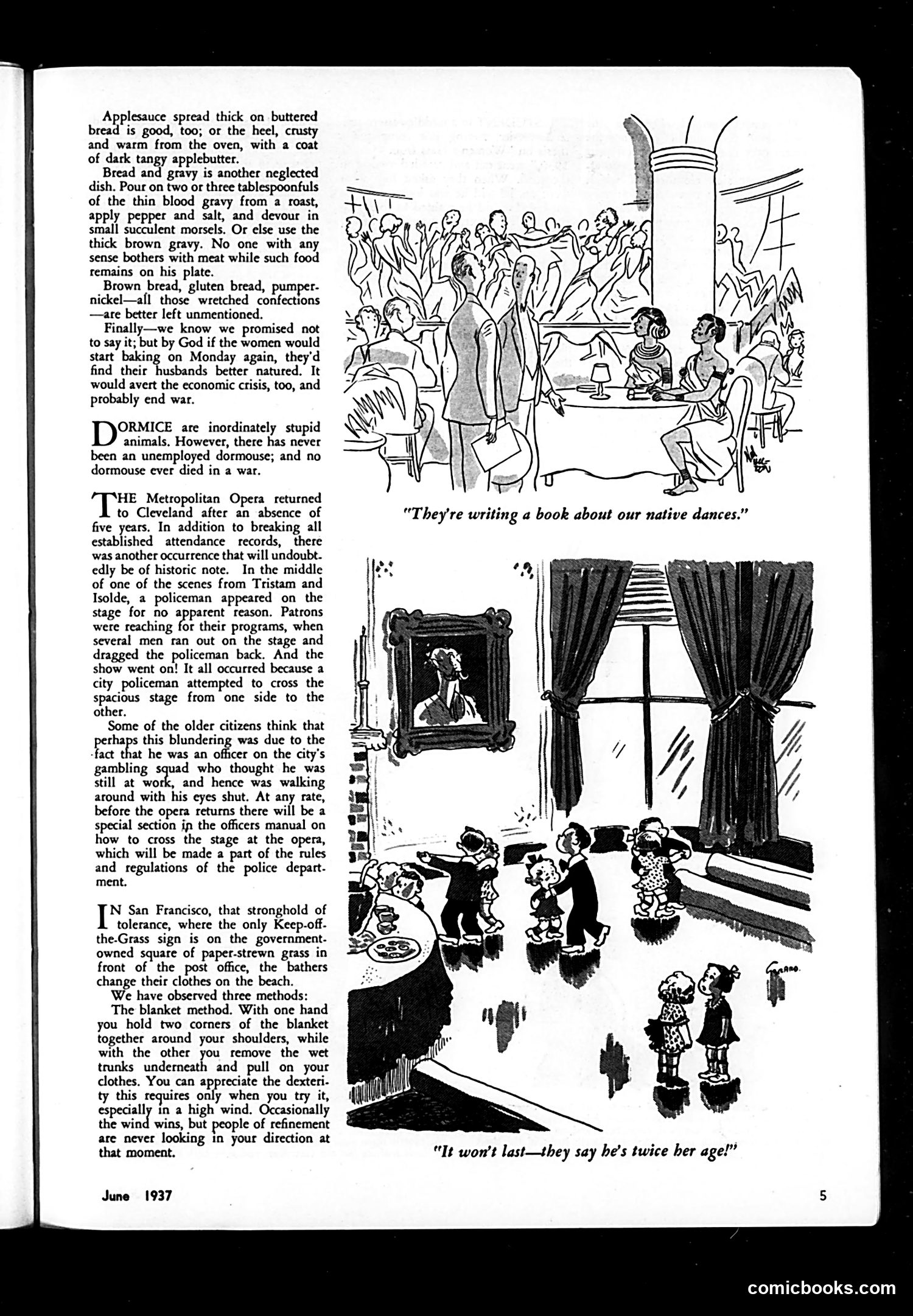
Judge Magazine, June 1937 - Page Analysis This page contains two unrelated cartoons and prose commentary typical of Judge's satirical format. The top cartoon depicts a crowded gathering where someone remarks, "They're writing a book about our native dances." The satire appears to target intellectual or academic interest in American folk culture—suggesting such scholarly attention to everyday activities is pretentious or amusing. The bottom cartoon shows children indoors during what appears to be rain, with the caption "It won't last—they say he's twice her age!" This likely satirizes divorce or relationship gossip, making light of failed marriages by joking that an age-gap relationship is doomed. The surrounding prose passages offer humorous domestic advice about cooking and clothes-changing methods in San Francisco, maintaining Judge's typical blend of social commentary and household humor.
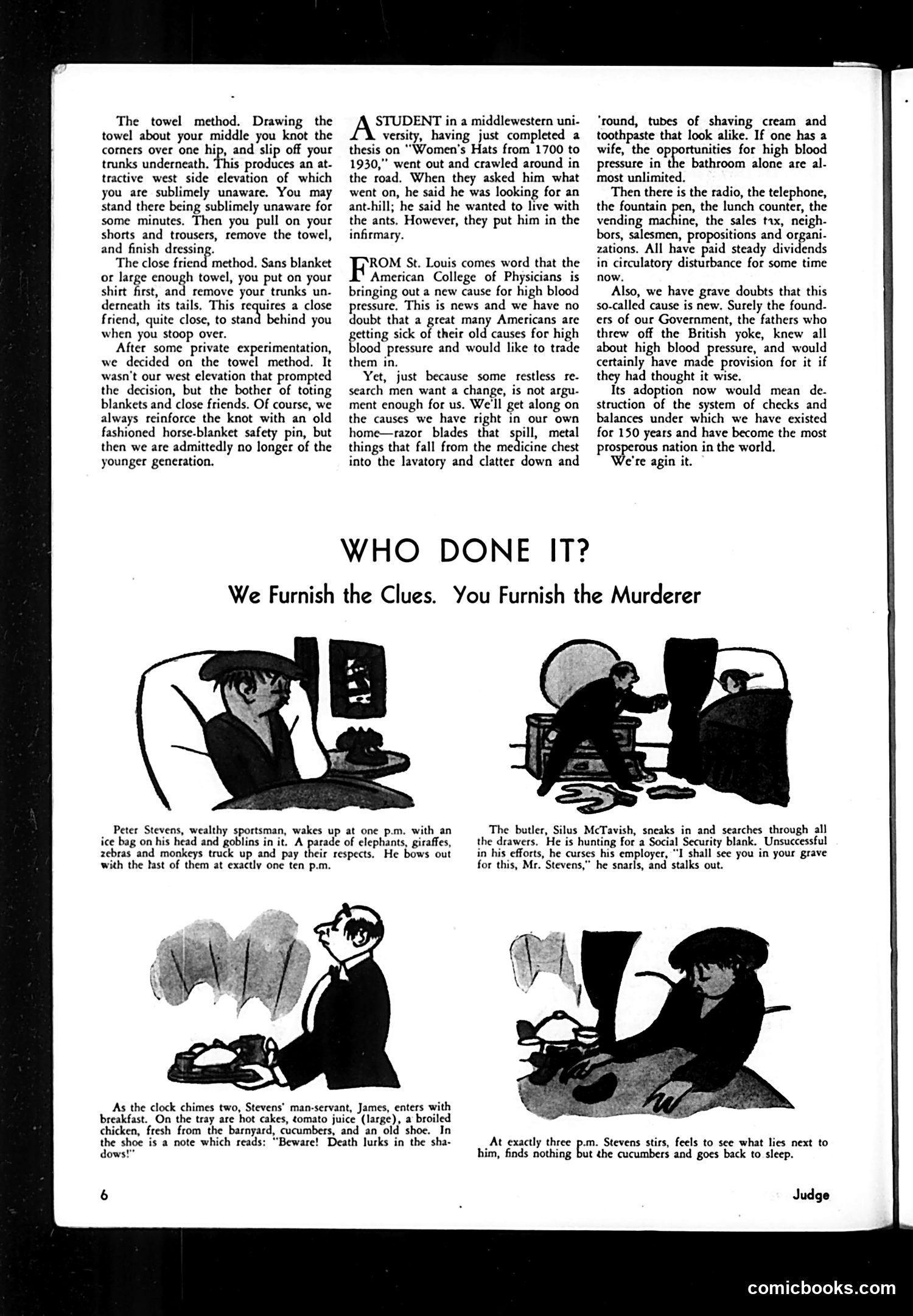
"Who Done It?" Murder Mystery Story Page This page presents a serialized murder mystery titled "Who Done It?" with the tagline "We Furnish the Clues. You Furnish the Murderer"—inviting readers to solve the crime themselves. The story involves Peter Stevens, a wealthy sportsman who wakes with an ice bag on his head, then mysteriously dies by 10 p.m. His butler, Silas McTavish, searches unsuccessfully for a Social Security blank. Stevens's servant James delivers fresh provisions including a suspicious shoe with a note reading "Beware! Death lurks in the shadows!" At 3 p.m., Stevens checks what's beside him, finding only cucumbers. The satirical point appears to be poking fun at contemporary murder mysteries and their often absurd, contrived plot mechanics popular in 1930s-40s entertainment.
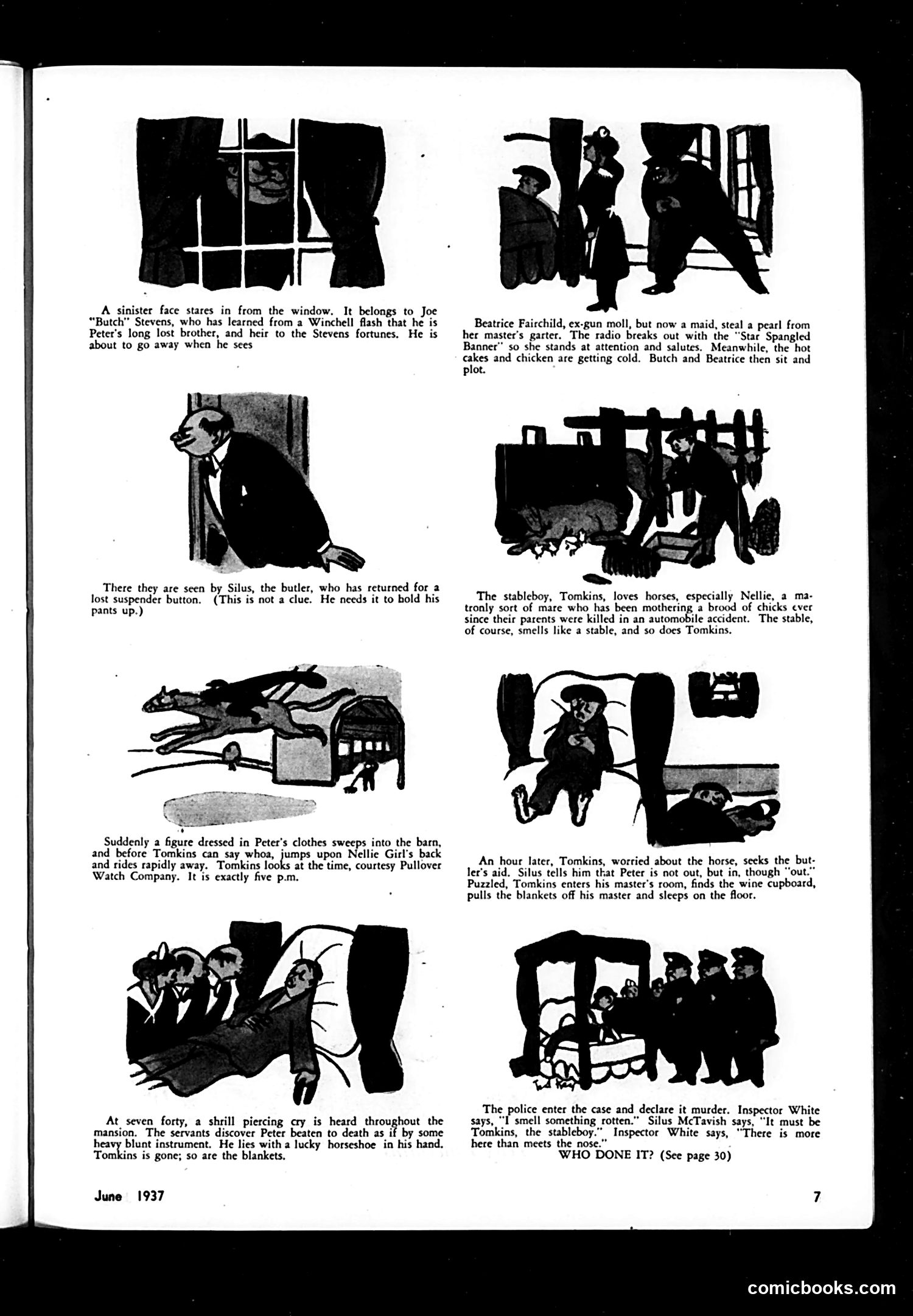
Analysis This page is not political satire—it's a mystery story told through sequential illustrations, similar to a comic strip or illustrated pulp fiction. The narrative (June 1937) follows a murder investigation centered on character "Peter," whose sinister face appears in a window. Key plot points depicted include: a stolen pearl, servants discovering Peter's body in a barn, a stableboy named Tomkins finding Peter's body in his master's room, and police arriving to declare it murder. Inspector White notes something "rotten" at the crime scene. The illustrations are noir-style silhouettes typical of 1930s mystery entertainment. This appears to be serialized fiction rather than editorial commentary—a "WHO DONE IT?" concluding on page 30, as noted at bottom.
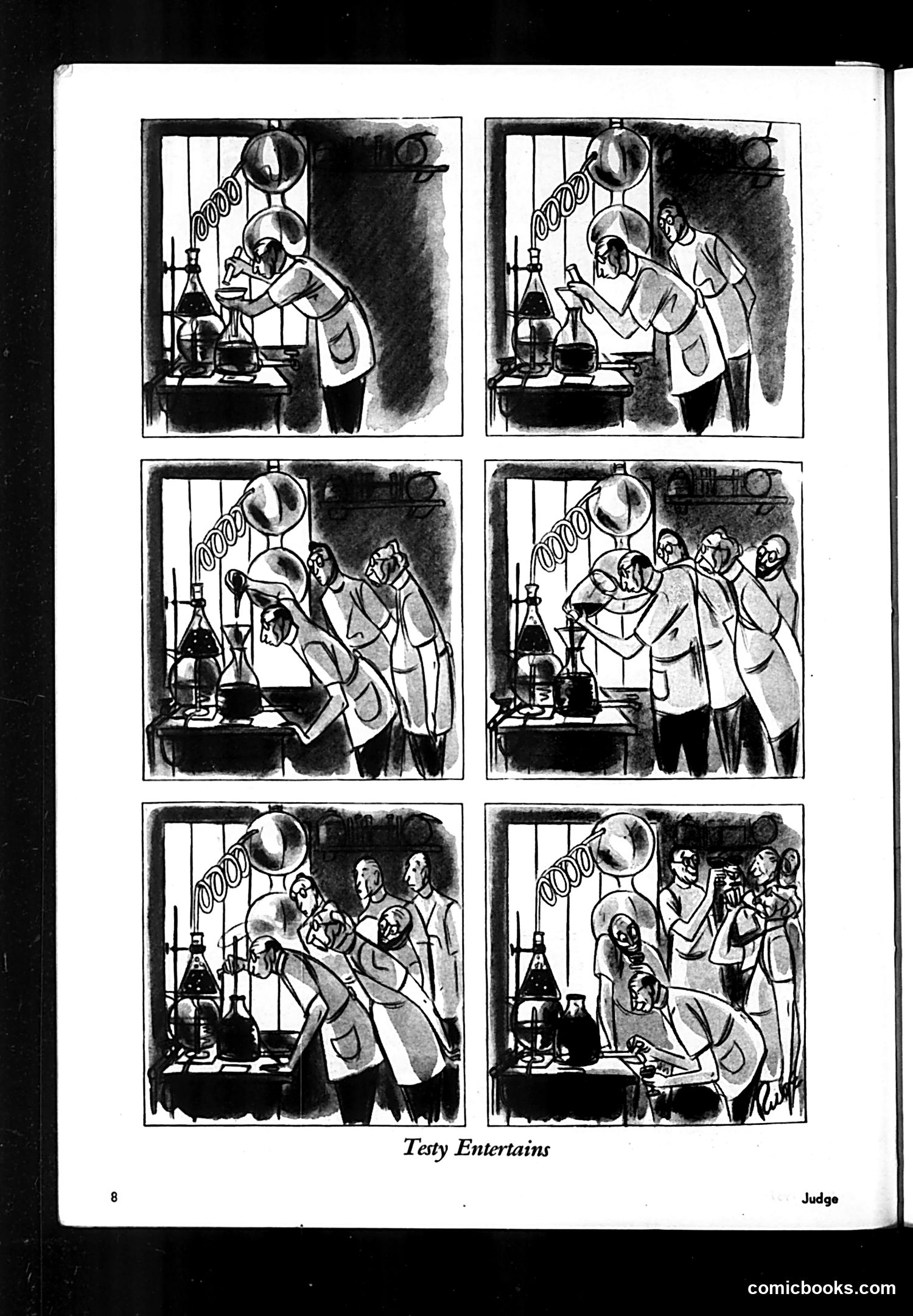
"Testy Entertains" This six-panel comic strip depicts a laboratory scientist (labeled "Testy") conducting experiments for an increasingly large audience. Beginning alone at his workbench with suspended spheres and chemical apparatus, more observers gradually crowd in—growing from one colleague to a full room of onlookers by the final panel. The satire appears to mock the human tendency toward spectacle and showmanship in scientific demonstration. What starts as serious experimental work becomes entertainment as the audience swells, suggesting scientists may perform for crowds rather than pursue pure research. The growing chaos and crowding implies the corrupting influence of public attention on scientific integrity. The exact historical context remains unclear without additional publication date information.
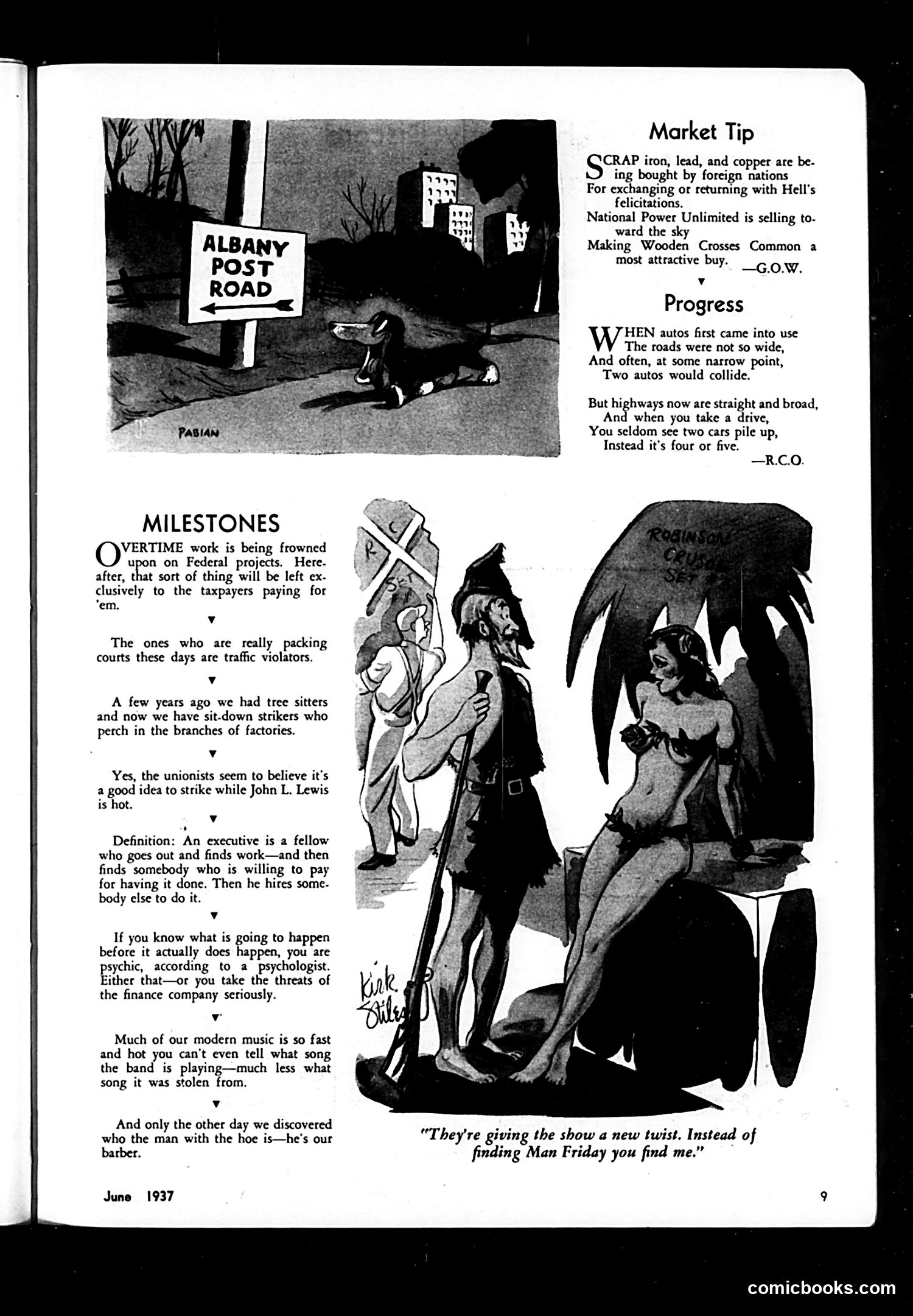
Judge Magazine, June 1937 - Page Analysis This satirical page contains multiple commentary pieces typical of Judge's format: "Albany Post Road" cartoon: A dachshund lies dead on a rural road—dark humor about traffic accidents and reckless driving, a growing concern in 1930s America. "Market Tip": Bitter commentary on war preparation. References to foreign nations buying scrap metal, "wooden crosses" (coffins for soldiers), and profiteering suggest anxiety about looming global conflict pre-WWII. "Progress": Ironic poem about highway improvement—notes that despite better roads, multi-car pileups have increased from two cars to "four or five," mocking the unintended consequences of "progress." "Milestones": A series of cynical observations on 1930s America: overtime restrictions on New Deal projects, sit-down strikes (referring to factory occupations), labor leader John L. Lewis, corporate hierarchy, and modern music. References "Man Friday" (from *Robinson Crusoe*) in the final cartoon about role reversal—unclear without seeing the illustration. The overall tone reflects Depression-era skepticism toward institutions and social change.
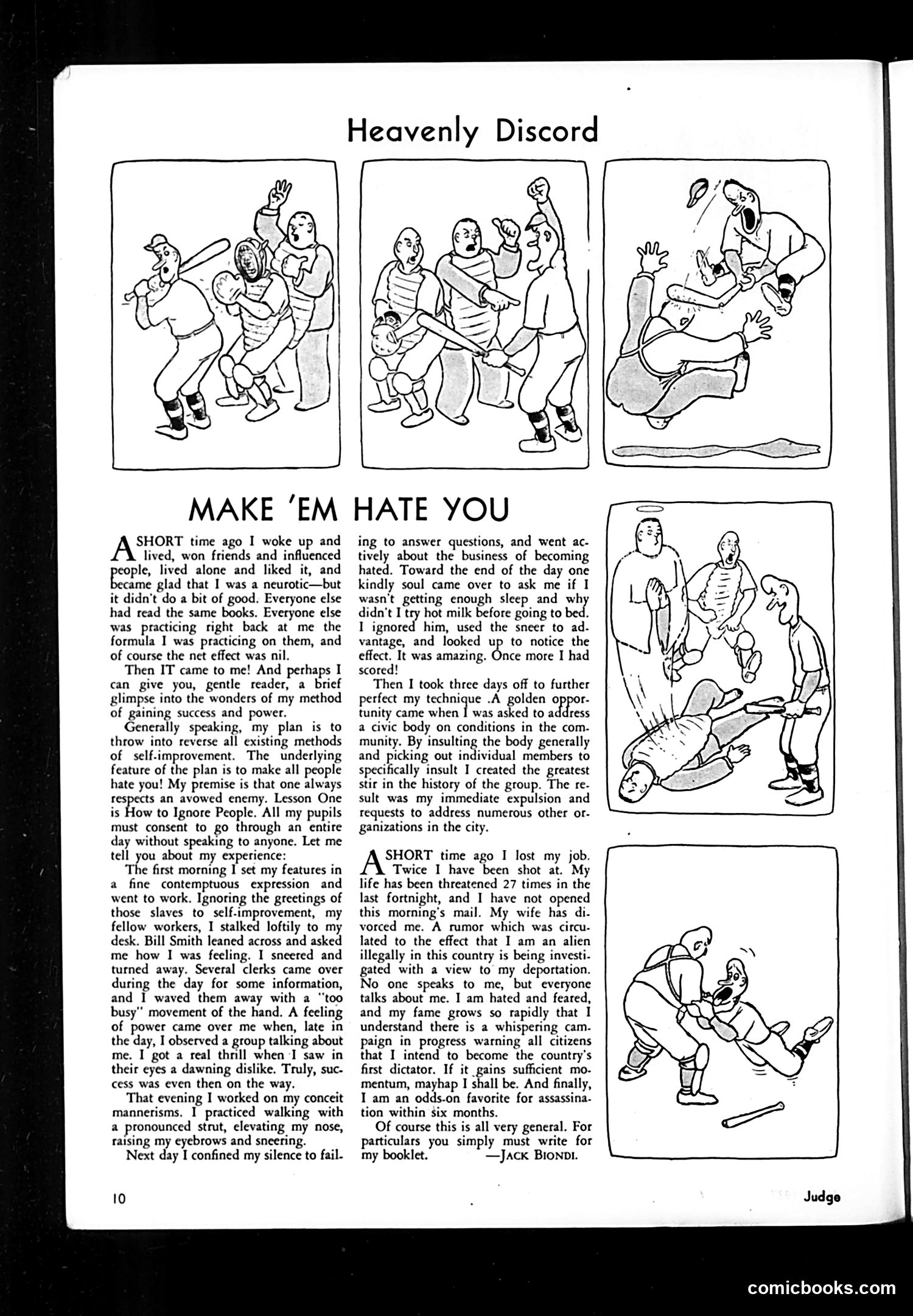
"Make 'Em Hate You" - Judge Magazine Satire This is a satirical self-help parody by Jack Biondi mocking the 1920s-30s craze of self-improvement books (like Dale Carnegie's *How to Win Friends and Influence People*, published 1936). The narrator describes a "success method" that inverts conventional wisdom: instead of being likeable, he deliberately becomes rude, contemptuous, and insulting. The joke is that his anti-social behavior *does* work—but catastrophically. He gains notoriety rather than respect: he's fired, shot at, threatened 27 times, divorced, and faces deportation rumors. Yet he considers this a triumph, even offering a booklet to teach his "technique." The cartoons show his escalating obnoxiousness—ignoring coworkers, insulting civic groups, and generally being despicable—with people's reactions ranging from confusion to anger. The satire targets the absurdity of self-help culture and its often-contradictory promises, suggesting that following *any* rigid formula, even the opposite of traditional advice, produces ridiculous results. It's social commentary disguised as comedy.
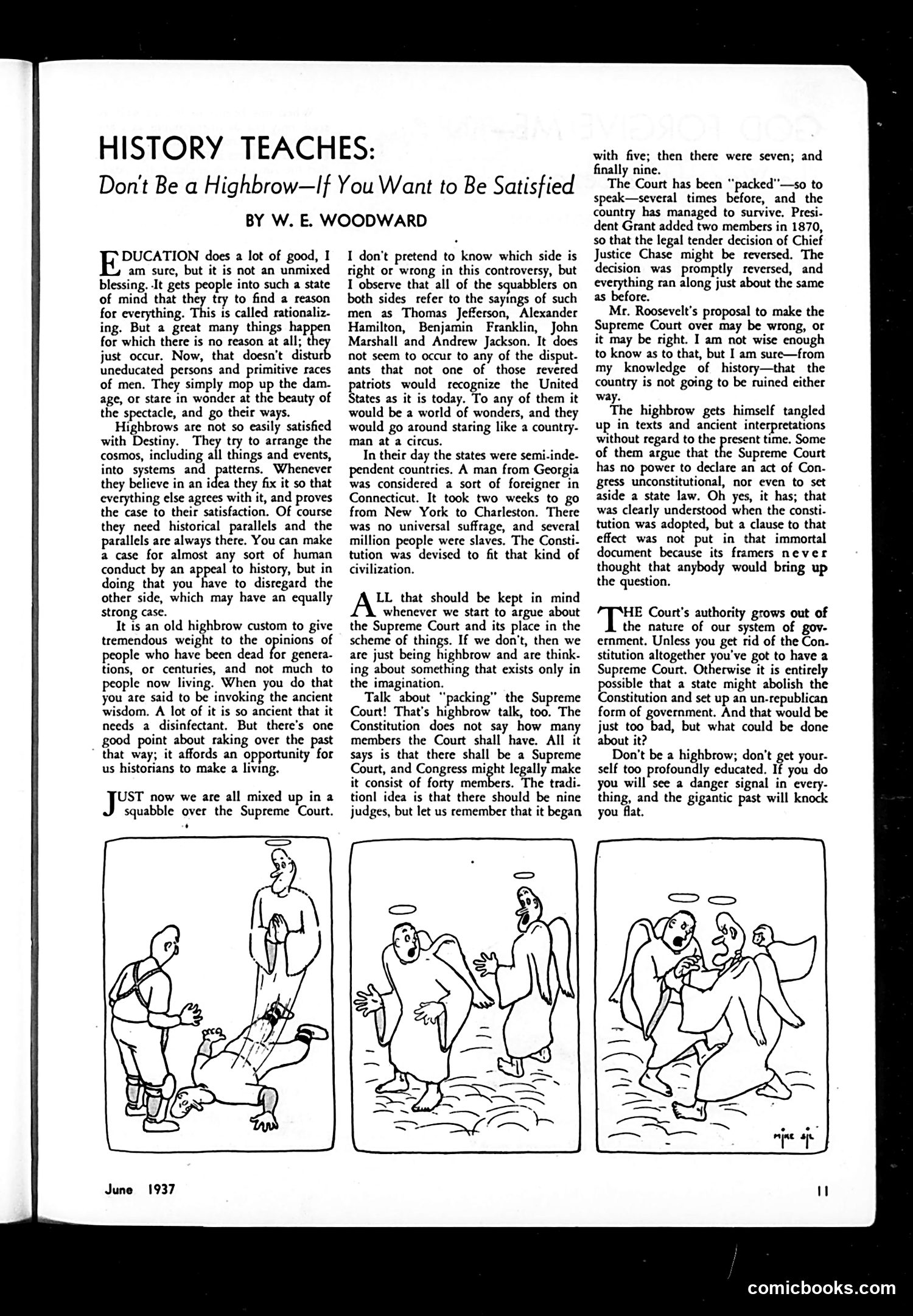
Satirical Commentary on the Supreme Court "Packing" Controversy (1937) This piece by W.E. Woodward critiques intellectuals debating Franklin D. Roosevelt's proposal to expand the Supreme Court by adding justices. The article argues that "highbrows" invoke the Founding Fathers (Jefferson, Hamilton, Franklin, Marshall, Jackson) as authority, yet those men wouldn't recognize the modern nation—it was vastly different in their era (semi-independent states, no universal suffrage, slavery). Woodward's point: the Constitution's framers designed it for their time; citing them as precedent for current disputes is intellectually dishonest. The Court's size has changed before (five to nine members; Grant added two in 1870 to reverse a decision). The three cartoons—showing figures tangled, struggling, or engaged in chaos—illustrate the absurdity of this "squabble" over the Court. Woodward suggests both sides are being pretentiously academic rather than pragmatic about whether Roosevelt's proposal is actually good policy.
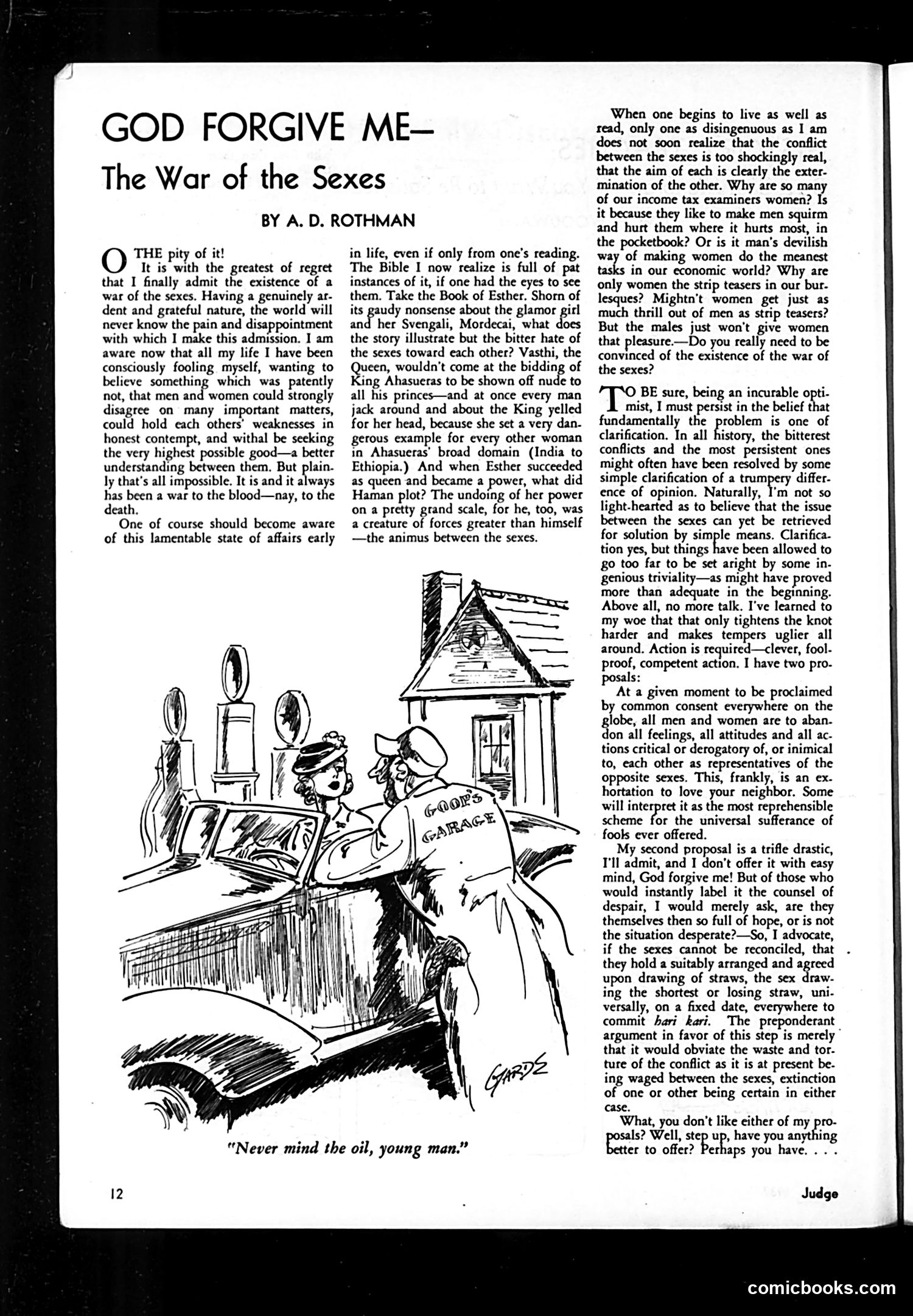
Explanation for Modern Readers This 1920s-era satirical article by A.D. Rothman uses bitter humor to critique gender relations. The author claims men and women are engaged in literal warfare, citing examples like female income tax examiners deliberately targeting men's wallets, and burlesque performers being exclusively female—suggesting men refuse women equal opportunity to exploit them sexually. The accompanying cartoon shows a couple in a car; the woman says "Never mind the oil, young man"—implying she's indifferent to mechanical concerns, stereotyping female ignorance. Rothman's "solutions" are sarcastic: he proposes either mass abandonment of all gender-based criticism (impossible), or alternatively, that couples draw straws to determine which sex must commit "hara-kiri" (suicide). The satire mocks the futility of gender conflict and suggests the divide is too deep for remedy—a bleak commentary typical of post-WWI disillusionment about human nature and gender relations.
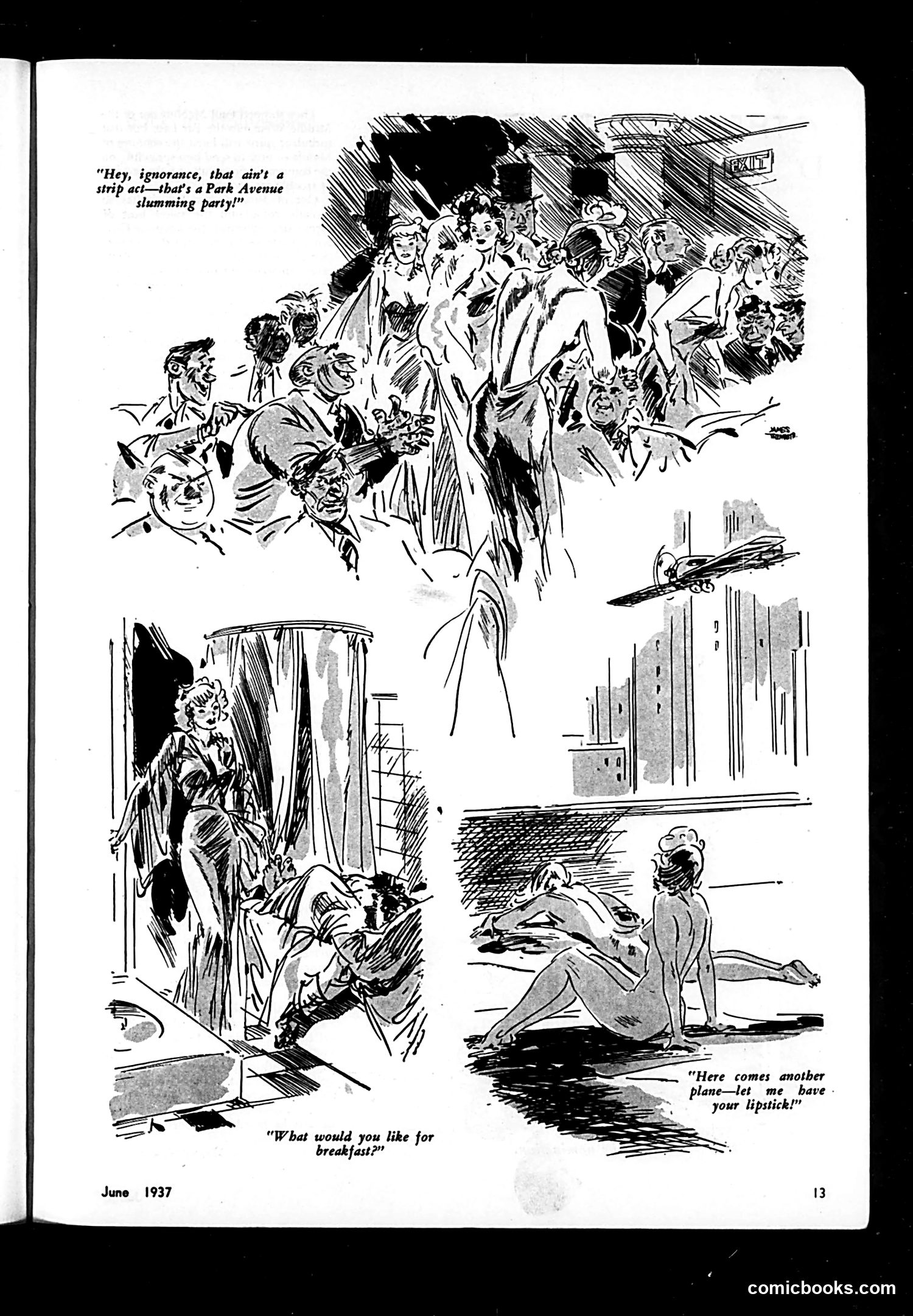
Judge Magazine, June 1937 - Page Analysis This page contains three unrelated satirical sketches typical of Judge's format: 1. Top panel: Mocks "Park Avenue slumming"—wealthy New Yorkers visiting lower-class entertainment venues as a novelty. The figure labeled "ignorance" suggests the absurdity of this tourist behavior. 2. Middle panel: Shows a woman asking a man "What would you like for breakfast?"—domestic humor playing on marital dynamics and gender roles of the era. 3. Bottom panel: Two women on a beach, one saying "Here comes another plane—let me have your lipstick!" This appears to satirize either aviation tourism or female vanity/competition—women primping to impress pilots. The sketches reflect 1930s preoccupations: class tourism, traditional marriage roles, and the novelty of aircraft. The humor relies on social observation and mild sexual innuendo typical of the magazine's sophisticated audience.
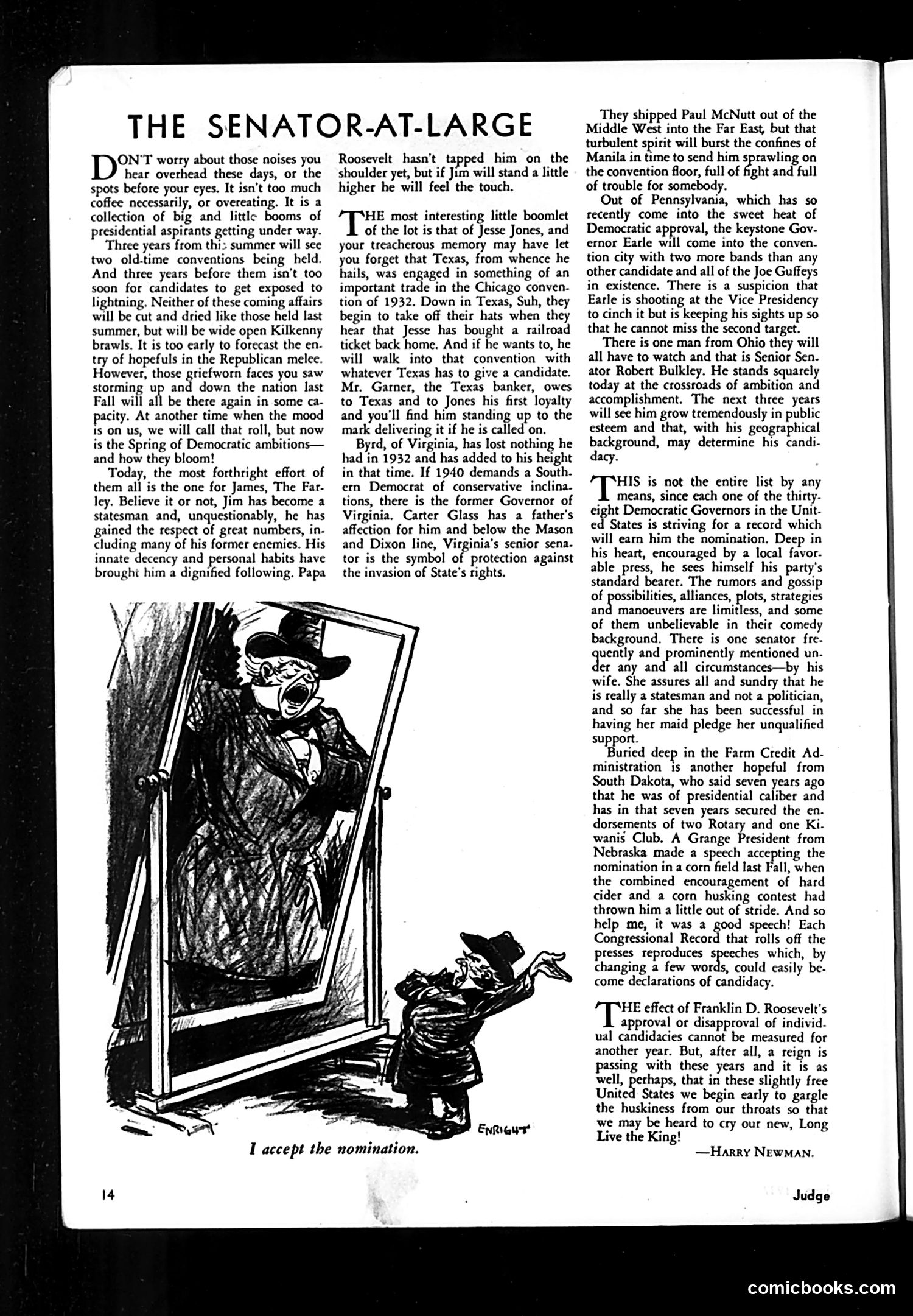
"The Senator-at-Large" - Judge Magazine Political Analysis This article discusses potential Democratic presidential candidates for 1940, written before Franklin D. Roosevelt declared his unprecedented third-term bid. The Cartoon: depicts a figure accepting a nomination through a mirror or window—satirizing the absurdity of early self-promotion among ambitious politicians. Key Candidates Discussed: - James Farley (Roosevelt's Postmaster General): positioned as FDR's likely successor, awaiting the president's endorsement - Jesse Jones (Texas banker): backed by Texas's political machine, similar to John Garner's 1932 support - Harry Byrd (Virginia senator): conservative Southern Democrat option - Paul McNutt (currently in Philippines): described as ambitious troublemaker - Governor Earle (Pennsylvania): running with strong organizational support, possibly aiming for Vice President - Robert Bulkley (Ohio senator): at a career crossroads The Satire: The piece mocks the frantic, early jockeying for position among Democratic hopefuls, comparing convention competition to "Kilkenny brawls." The author (Harry Newman) suggests these candidates don't yet know whether Roosevelt will seek reelection—making their efforts premature and somewhat ridiculous.
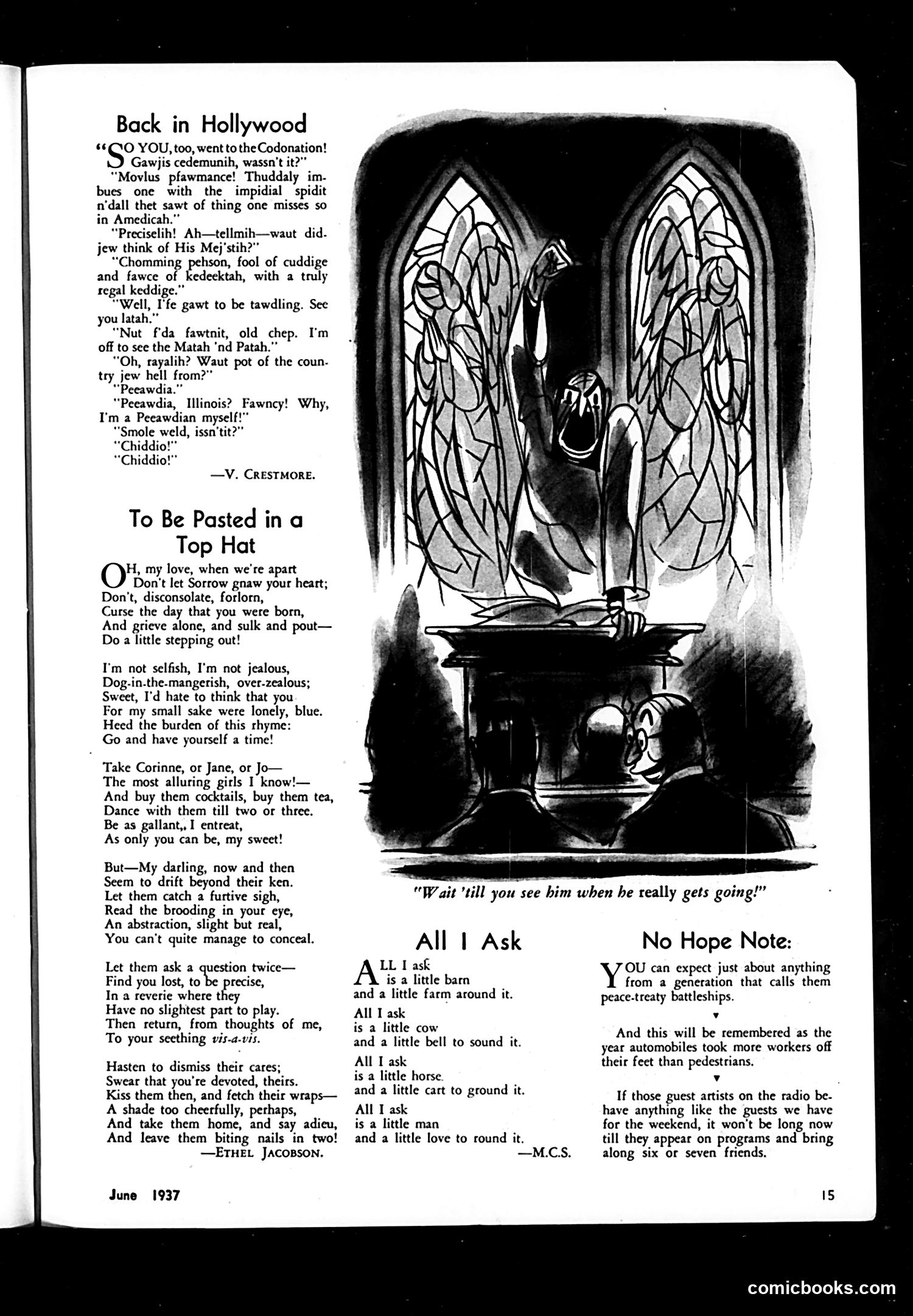
"Back in Hollywood" - Judge Magazine, June 1937 This page satirizes 1930s Hollywood pretension and British affectation. The top section mocks wealthy Americans who attended the coronation of King George VI (May 1937), returning home with exaggerated pseudo-British accents and affected speech patterns. Characters discuss "His Majesty" while butchering pronunciation ("Majestih," "Peeawdia"), and absurdly discover they're both from the same small Illinois town—deflating their cosmopolitan pretenses with the punchline "Small world, isn't it?" The cartoon itself (showing a figure at a gothic window) illustrates accompanying poems about infidelity and romantic entanglement, using theatrical imagery common to Judge's social commentary. Lower sections contain unrelated humorous verses and brief satirical notes about American culture—radio guests, automobiles, and farm life—typical of the magazine's miscellaneous humor format. The overall thrust: mocking Hollywood's shallow social climbing and Americans' desperate mimicry of British sophistication.
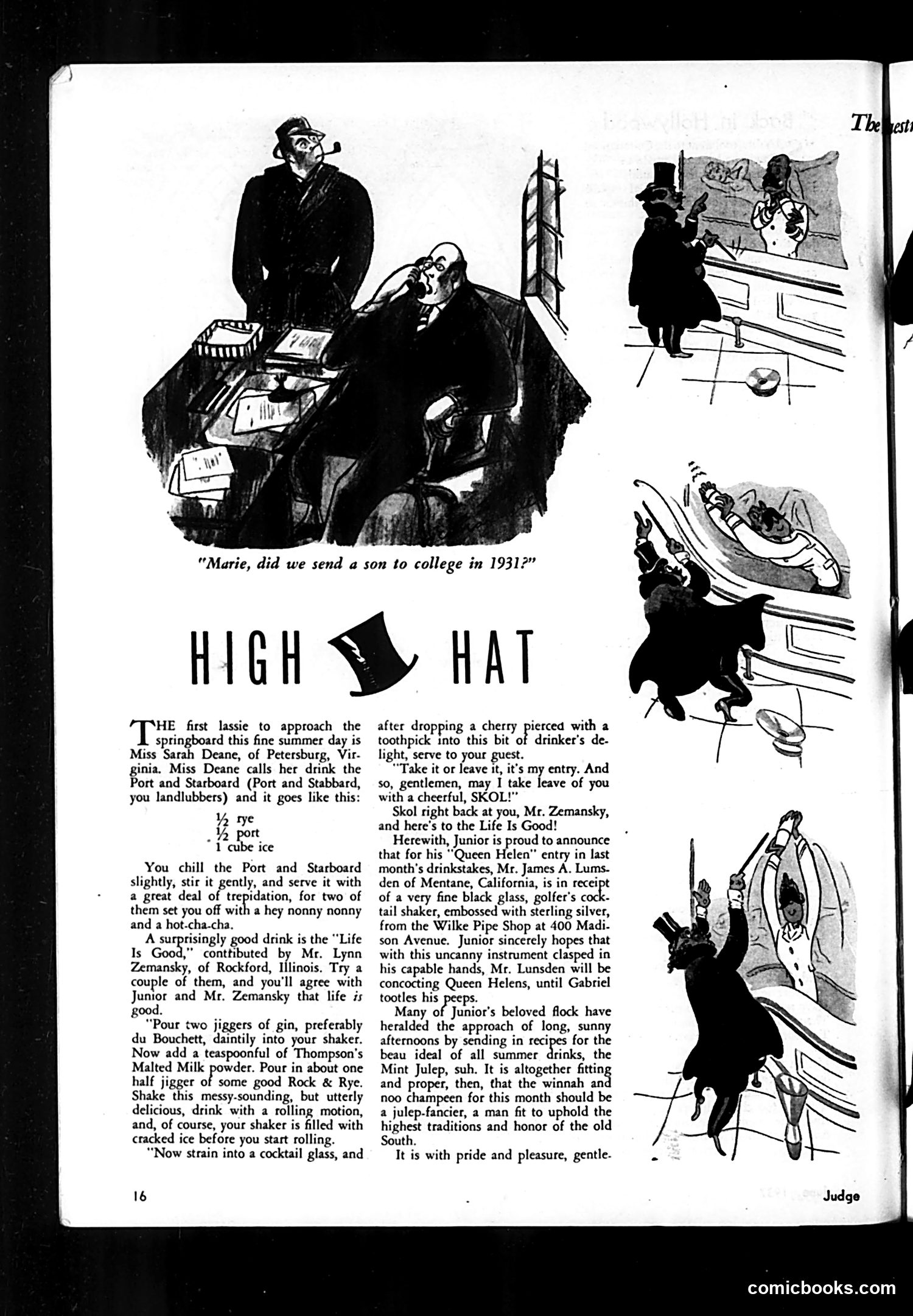
Explanation for Modern Readers This is a humor/cocktail recipe column from Judge magazine, not primarily political satire. The main cartoon shows a man at a desk covered with bills, with his standing companion asking "Marie, did we send a son to college in 1931?"—a joke about financial hardship during the Great Depression. The humor lies in the implied expense of college tuition. The bulk of the page features "High Hat," a cocktail advice column showcasing summer drink recipes contributed by readers. The satire is social rather than political: it gently mocks cocktail culture and Prohibition-era drinking (Prohibition ended in 1933), presenting elaborate, sometimes absurd drink recipes with tongue-in-cheek commentary. References like "SKOL" and "the old South" reflect period attitudes. The illustrations on the right show people enjoying drinks and leisure activities—aspirational content for Depression-era readers.
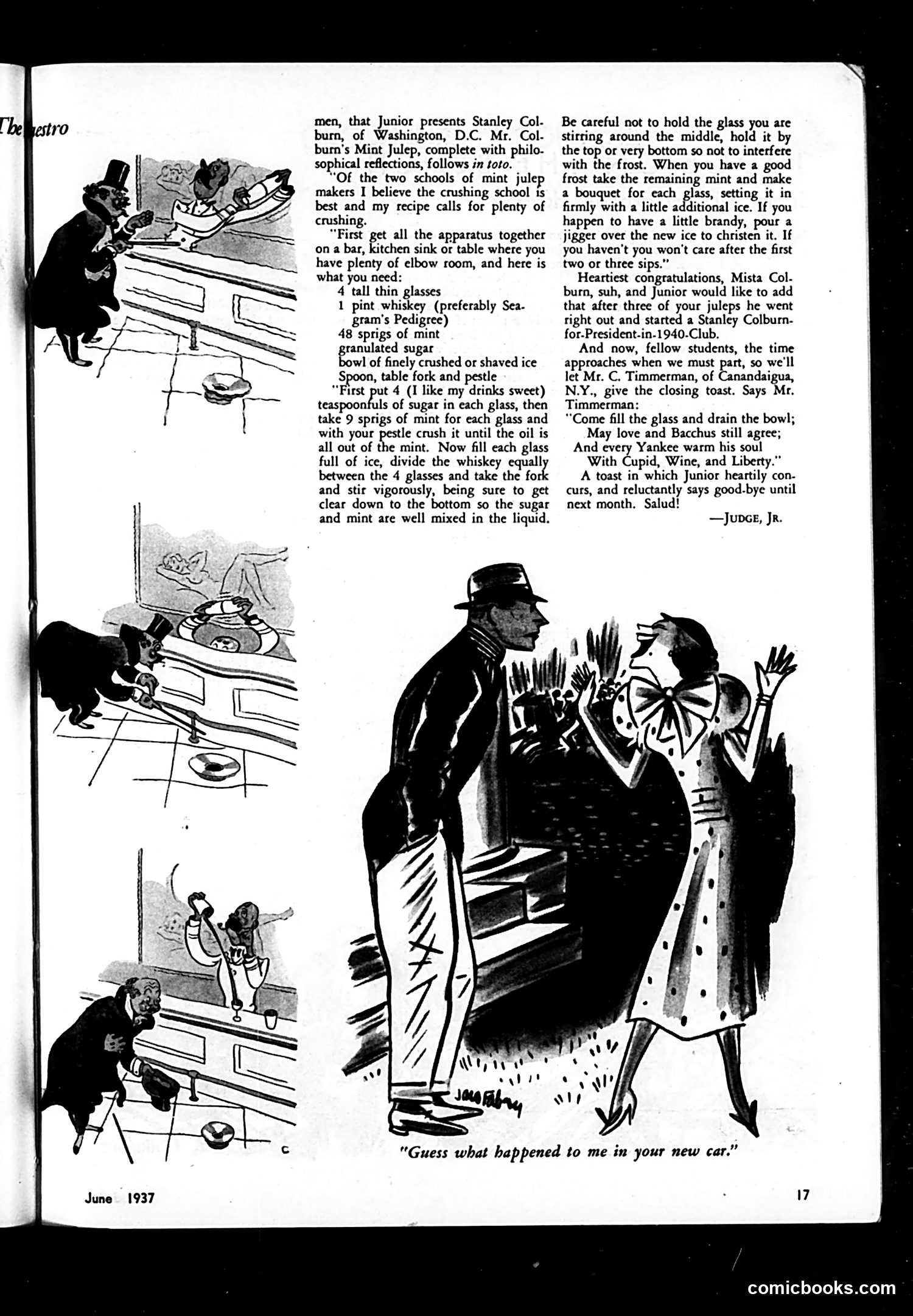
Analysis of Judge Magazine Page, June 1937 This page contains two distinct elements: Main Content: A detailed recipe for Mint Julep presented as advice from "Stanley Colburn of Washington, D.C." The piece is humorous because it treats an alcoholic drink recipe with elaborate, quasi-scientific ceremony—listing precise apparatus, measurements, and technique (like the "crushing school" of julep-making). The humor culminates when the author notes that after three juleps, Colburn started a "Stanley Colburn-for-President-in-1940-Club," satirizing how alcohol impairs judgment. Bottom Cartoon: Shows a man in a car with a woman gesturing dramatically, saying "Guess what happened to me in your new car." The joke appears to be about the woman's disheveled appearance—her hat askew, clothing disarranged—implying some mishap or mischief occurred during a car ride, likely poking fun at dating customs or automobile adventures of the 1930s. Both items reflect Judge's satirical approach: gentle mockery of contemporary social behavior and leisured activities.
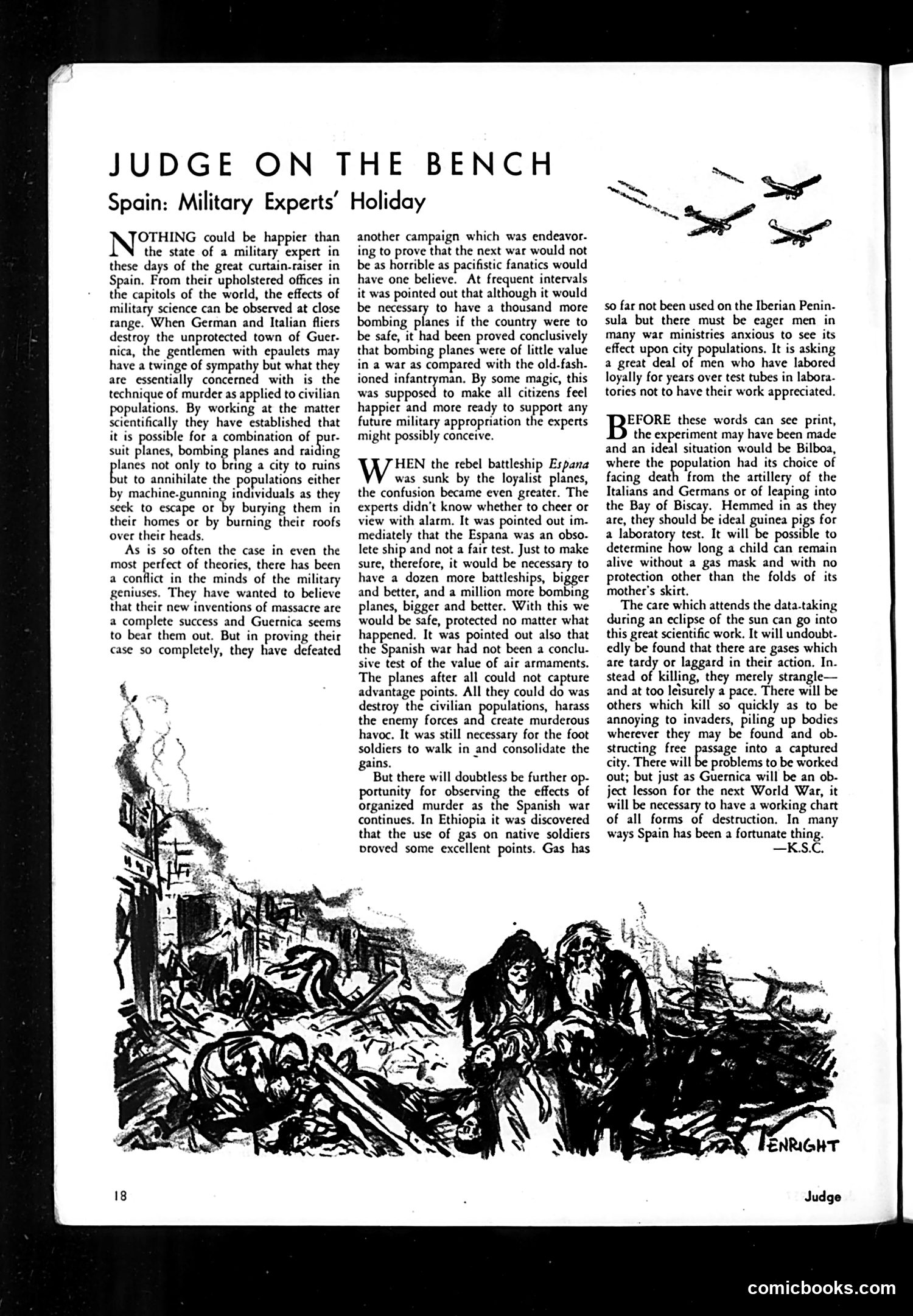
Analysis for Modern Readers This article satirizes military strategists who treat the Spanish Civil War as a laboratory for testing weapons and tactics rather than a humanitarian tragedy. The piece critiques how military experts observe the bombing of Guernica and sinking of the battleship *Espana* with clinical detachment, using these real events to justify larger military budgets. The satire targets the logical contradictions in defense arguments: experts simultaneously claimed bombing planes were ineffective in warfare yet demanded thousands more for "safety." The article particularly condemns how military establishments view civilian casualties as valuable test data—suggesting weapons developers eagerly await opportunities to test chemical weapons on civilian populations in cities like Bilboa. The accompanying illustration depicts destruction and suffering, contrasting with the dispassionate analysis above. The piece exposes how war becomes abstracted into theoretical "problems to be worked out" by distant officials, divorcing military strategy from human cost.
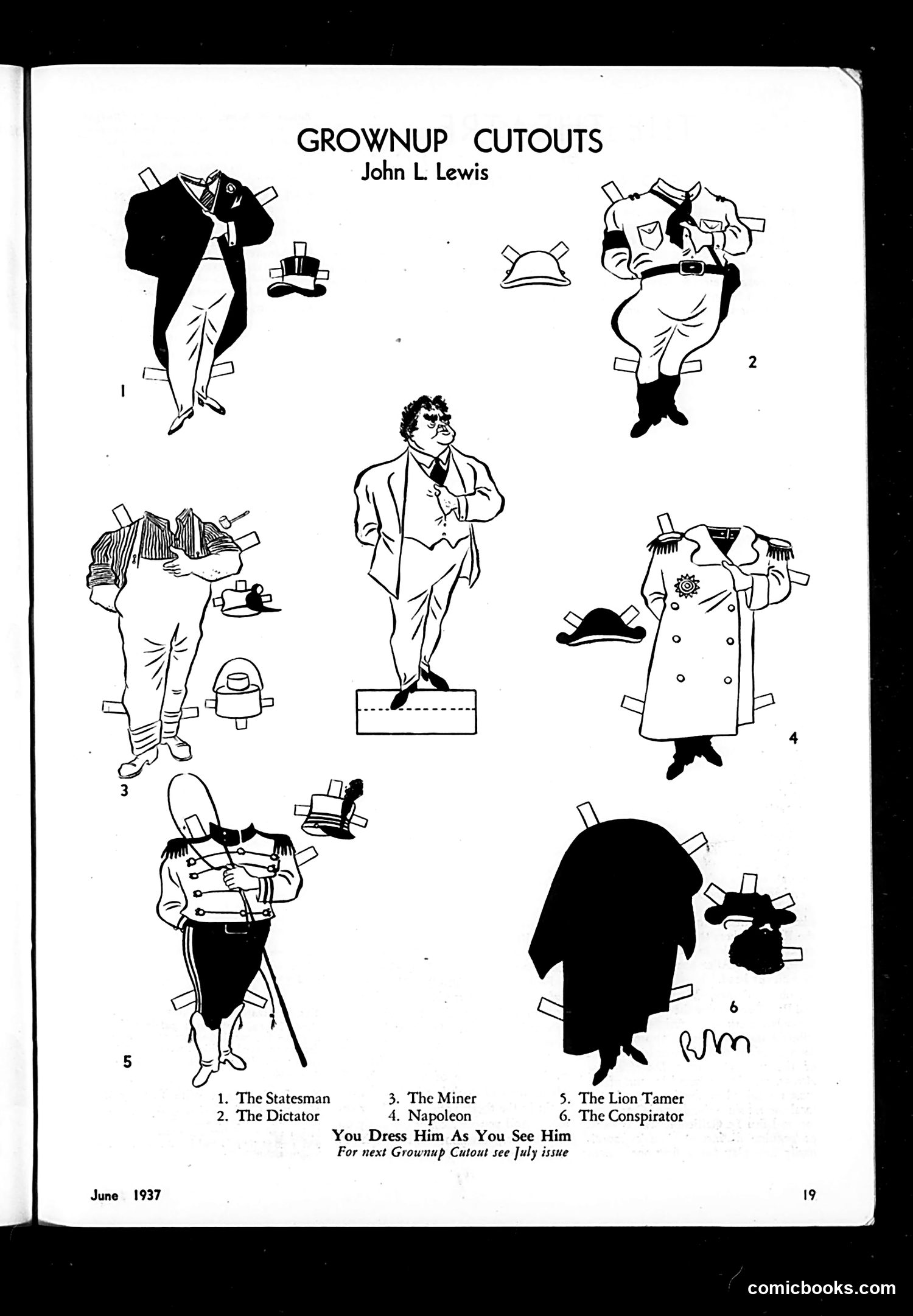
Political Satire: John L. Lewis Paper Dolls (June 1937) This page presents paper doll cutouts of John L. Lewis, the powerful labor leader who headed the Congress of Industrial Organizations (CIO). The satire mocks Lewis by presenting him in six contrasting personas—suggesting his image was malleable depending on one's perspective. The titles reflect contemporary debates about Lewis: "The Statesman" and "The Dictator" present opposing views of his leadership style. "The Miner" references his coal-mining background. "Napoleon" and "Lion Tamer" suggest grandiose ambitions, while "The Conspirator" implies secretive maneuvering. The tagline "You Dress Him As You See Him" indicates the cartoon's central joke: Lewis's public image was so contested and changeable that different groups perceived him entirely differently. By 1937, Lewis was a highly polarizing figure in labor politics, making him ideal material for *Judge* magazine's satirical humor targeting American political figures.
Theater Criticism Analysis This is a theater review column by George Jean Nathan, a prominent American drama critic. The page contains no cartoons—it's a written critique of the 1936-37 Broadway season. Nathan argues against the critical theory that season-opening and closing plays are inherently poor. He praises the American playwrights Robert Turney, Maxwell Anderson, and Paul Green for contributing serious merit to theater that year. He criticizes several Shakespeare productions, including John Gielgud's *Hamlet* (calling it a "drag"), Leslie Howard's *Hamlet*, and Paul Robeson's *Othello*—noting their directors and stars failed the material. He singles out Maurice Evans and a production of *King Richard II* as exceptions. Nathan dismisses other contemporary playwrights like Moss Hart and George Kaufman as producing mere "light pastime" rather than serious drama. The review concludes with recommendations for various theatrical productions and future seasons.
Analysis of This Judge Magazine Page This page is primarily a movie review column by Pare Lorentz, not a political cartoon. It contains brief, snappy critiques of 1937 films (like "Gold Diggers of 1937," "Night Must Fall," "You Only Live Once"), written in the magazine's characteristic acerbic style. The main essay argues that Hollywood's problems stem partly from its location in Southern California rather than its artistic choices. Lorentz suggests producers make films for "small towns, forts and arsenals"—rural audiences—so they're safe from New York critics' more sophisticated tastes. He notes this may reflect a real divide between unsophisticated Midwestern/Southern audiences and cosmopolitan Eastern viewers. The satire is cultural rather than strictly political: it mocks both Hollywood's pandering to perceived audience simplicity and California's provincialism. The piece reflects 1930s tensions between coastal elites and Middle America—a recurring theme in American media criticism.
What This Page Means This is a humorous essay by Don Herold satirizing both classical music snobs and radio programming. Herold admits he's musically ignorant but suspects that pretentious "highbrow" music commentators on radio are frauds who use jargon to intimidate ordinary listeners. He contrasts this with Deems Taylor, a respected music broadcaster and composer whom he genuinely trusts to explain music without condescension. The piece critiques radio itself: stations waste airtime with pompous musical programming when listeners could enjoy simpler pleasures. Herold also mocks America's three time zones as outdated—radio and aviation have unified the country, yet scheduling remains fragmented. The right column lists contemporary radio programs and personalities (Eddie Cantor, Fred Astaire, etc.), contextualizing what 1930s audiences actually heard. Overall, it's gentle satire targeting both cultural elitism and broadcasting inefficiency.
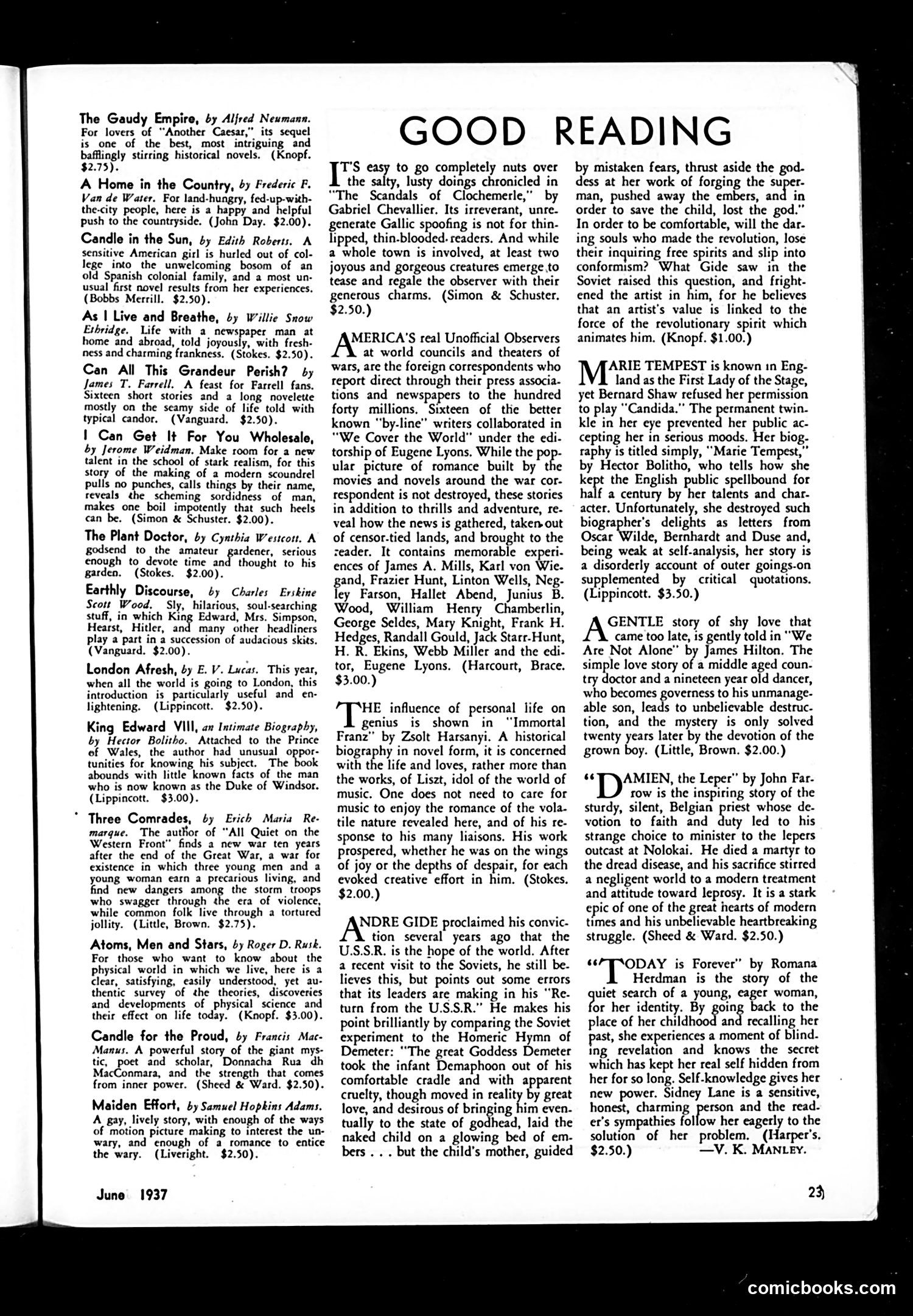
This page is primarily a book review section titled "Good Reading," not a political cartoon. It contains brief reviews of contemporary novels and non-fiction from June 1937. The only political content appears in reviews mentioning historical figures: references to King Edward VIII/Duke of Windsor (relevant to the 1936 abdication crisis), Hitler, and Mrs. Simpson. These appear in reviews of books like "Earthly Discourse" (which includes satirical skits featuring these figures) and an intimate biography of Edward VIII. The page reflects 1937 American literary culture—novels about European fascism ("Three Comrades" by Remarque), romantic comedies, and gardening guides. There is no prominent political cartoon visible. The "satire" is limited to the books being *reviewed* rather than the page itself functioning as satire.
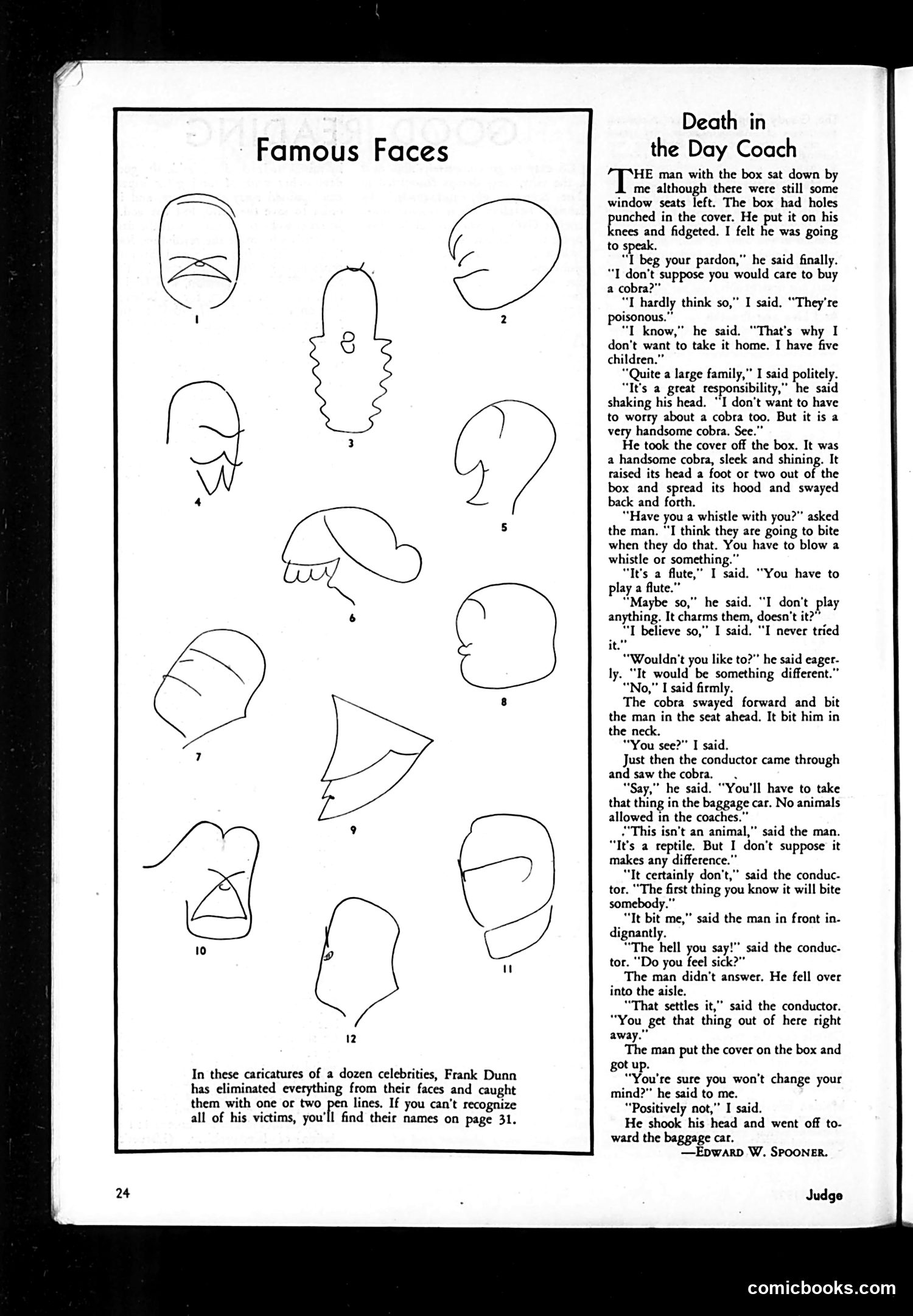
Analysis of This Judge Magazine Page This page contains two unrelated items: Left Side - "Famous Faces": A caricature exercise by artist Frank Dunn showing twelve simplified line-drawn faces of unnamed celebrities. The caption explains Dunn removed all facial features except essential lines to create minimalist portraits. Readers were apparently expected to identify these "victims" (the humorous term for caricatured subjects), with answers provided elsewhere in the magazine (page 31). This was a common reader-participation feature in humor magazines of this era. Right Side - "Death in the Day Coach": A humorous short story by Edward W. Spooner about an absurd encounter on a train. A man attempts to sell the narrator a cobra, claiming he has five children and doesn't want the dangerous pet at home. When the cobra escapes and bites a passenger, the conductor simply orders the man to move it to the baggage car—treating the snake bite as a bureaucratic inconvenience rather than a medical emergency. The satire mocks bureaucratic indifference and the absurdity of casual danger.
"Weekend Fun" Content Analysis This page is primarily instructional/entertainment content, not political satire. It presents parlor games for suburban weekend guests, written humorously by Charles Jackson. The content describes five party games: 1. "Who Am I?" — guests wear names of famous people and ask yes/no questions 2. "Whodunnit" — a charades-like game where witnesses describe a tableau 3. "Letter-Go" — a word-game invented by cartoonist C.D. Russell 4. Cold poker hands — a gambling variation The satire is social, not political: the author gently mocks suburban leisure culture and "weak-willed weekenders" dragging out dusty badminton sets and croquet mallets. The tone is affectionate mockery of middle-class entertaining conventions. The adjacent Bell Telephone advertisement is unrelated corporate messaging about telephone service infrastructure—standard advertising content for the era. There are no identifiable political figures, caricatures, or references requiring historical context beyond understanding 1930s-40s suburban entertainment culture.
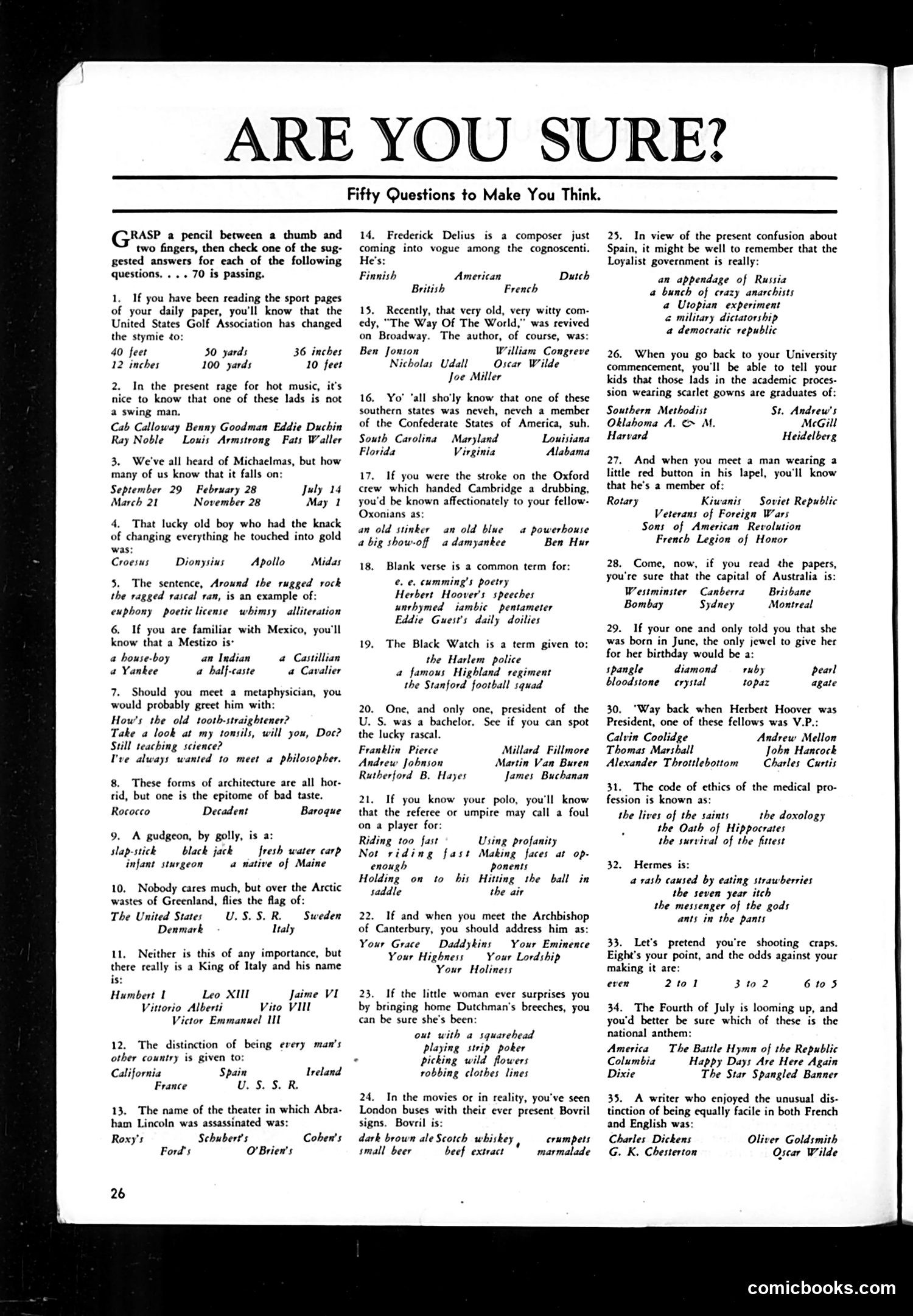
This is a trivia quiz page titled "ARE YOU SURE? Fifty Questions to Make You Think." It's a general knowledge test spanning sports, music, literature, history, and culture—not a political cartoon. The quiz appears designed to challenge educated readers on facts from the 1930s-40s era (based on references to swing musicians like Cab Calloway and Benny Goodman, and contemporary political figures). Questions range from golf rules and architecture to identifying U.S. presidents and literary references. The satire is implicit rather than explicit: by presenting an array of obscure trivia, the page mocks pretentious "cultured" readers who might claim comprehensive knowledge across disparate fields. The subtitle "to Make You Think" suggests self-improvement, yet many questions test trivia unlikely to reflect actual intelligence—a gentle jab at the era's fascination with intellectual posturing through factual recall.
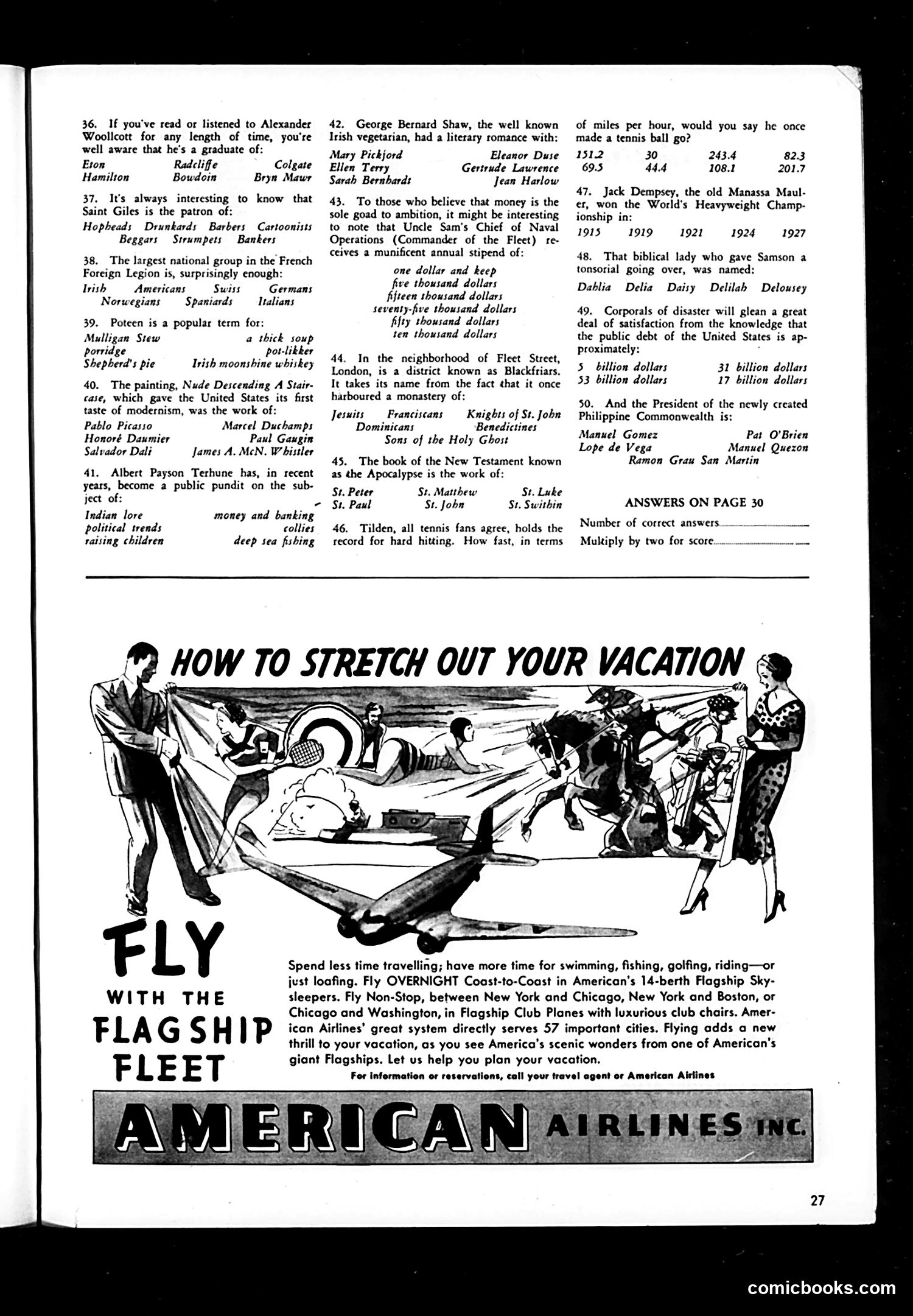
Analysis for Modern Readers This page contains a trivia quiz (questions 36-50) testing knowledge of 1930s-40s cultural figures and events, plus an American Airlines advertisement. The quiz references: - Alexander Woollcott: A prominent theater critic and wit of the era - George Bernard Shaw: Irish playwright with a famous romance with actress Ellen Terry - Jack Dempsey: Boxing champion who won the heavyweight title in 1919 - Tilden: Tennis player Bill Tilden, known for powerful serves - The Philippine Commonwealth: Recently granted independence/autonomy by the U.S. (Manuel Quezon was its president) The advertisement below promotes air travel as leisure—a novel luxury at the time. It emphasizes overnight "Flagship" flights as time-savers for vacations, depicting recreational activities (swimming, golf, fishing) that flying enabled by reducing travel time. This reflects 1930s-40s optimism about commercial aviation as transformative technology for middle-class Americans. The satire, if any, is mild—mainly testing whether educated readers recognize contemporary celebrities and recent historical events.
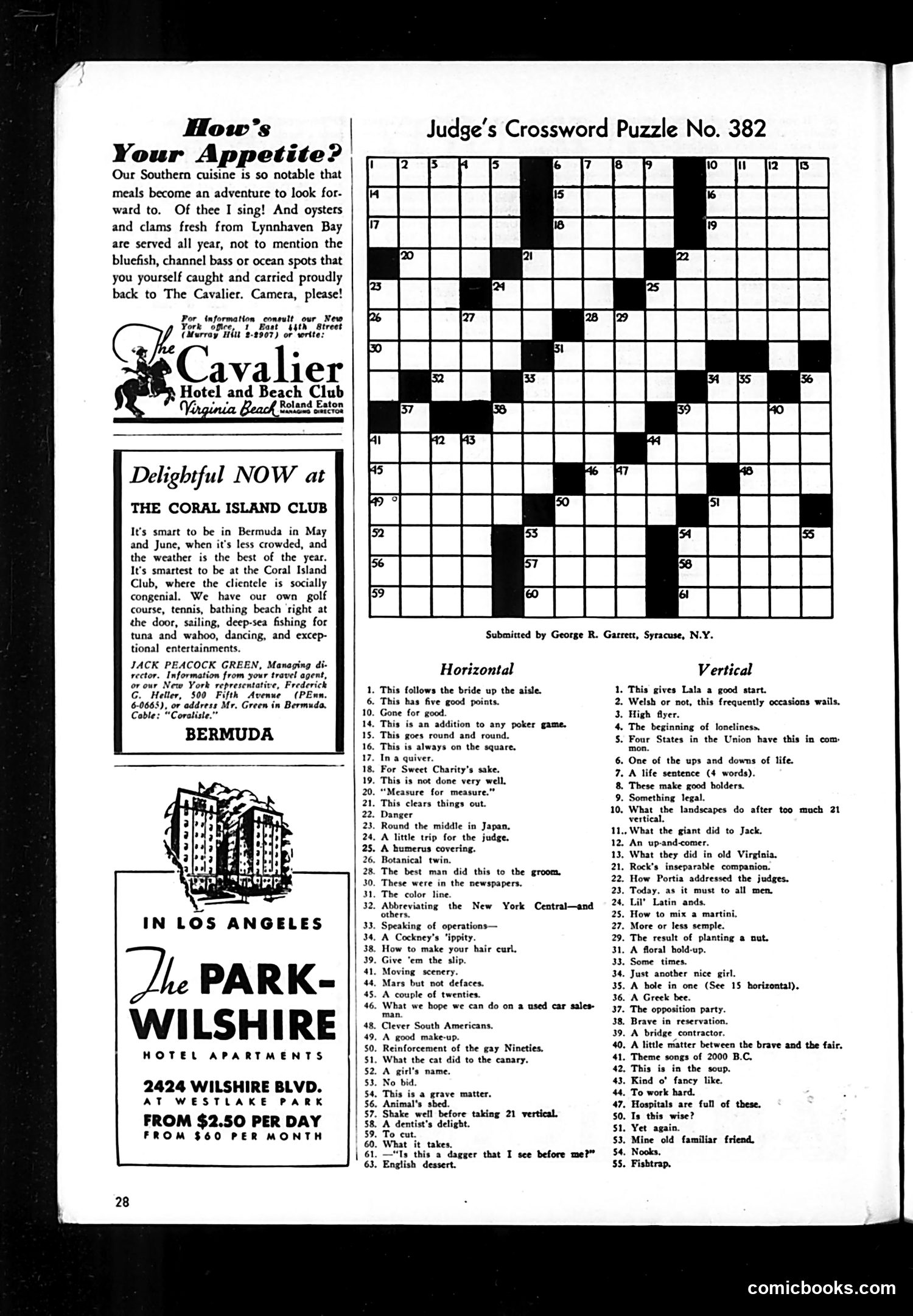
Judge Magazine Page Analysis This page is primarily advertising and a crossword puzzle, not political satire. It contains: Advertisements for upscale vacation destinations (The Cavalier Hotel in Virginia Beach, Coral Island Club in Bermuda, and Park-Wilshire Hotel Apartments in Los Angeles), emphasizing leisure activities like fishing, golf, and dining—targeting affluent readers during what appears to be the 1930s-40s era. Judge's Crossword Puzzle No. 382, a standard word puzzle with literary and cultural references typical of the period (references to Shakespeare's "Measure for Measure," Portia from "The Merchant of Venice," martinis, and various wordplay clues). The opening article "How's Your Appetite?" promotes Southern cuisine and fresh seafood from Lynnhaven Bay at The Cavalier resort. There is no political cartoon visible on this page. The content reflects Judge magazine's general editorial focus on humor, leisure, and lifestyle for middle-to-upper-class American readers.
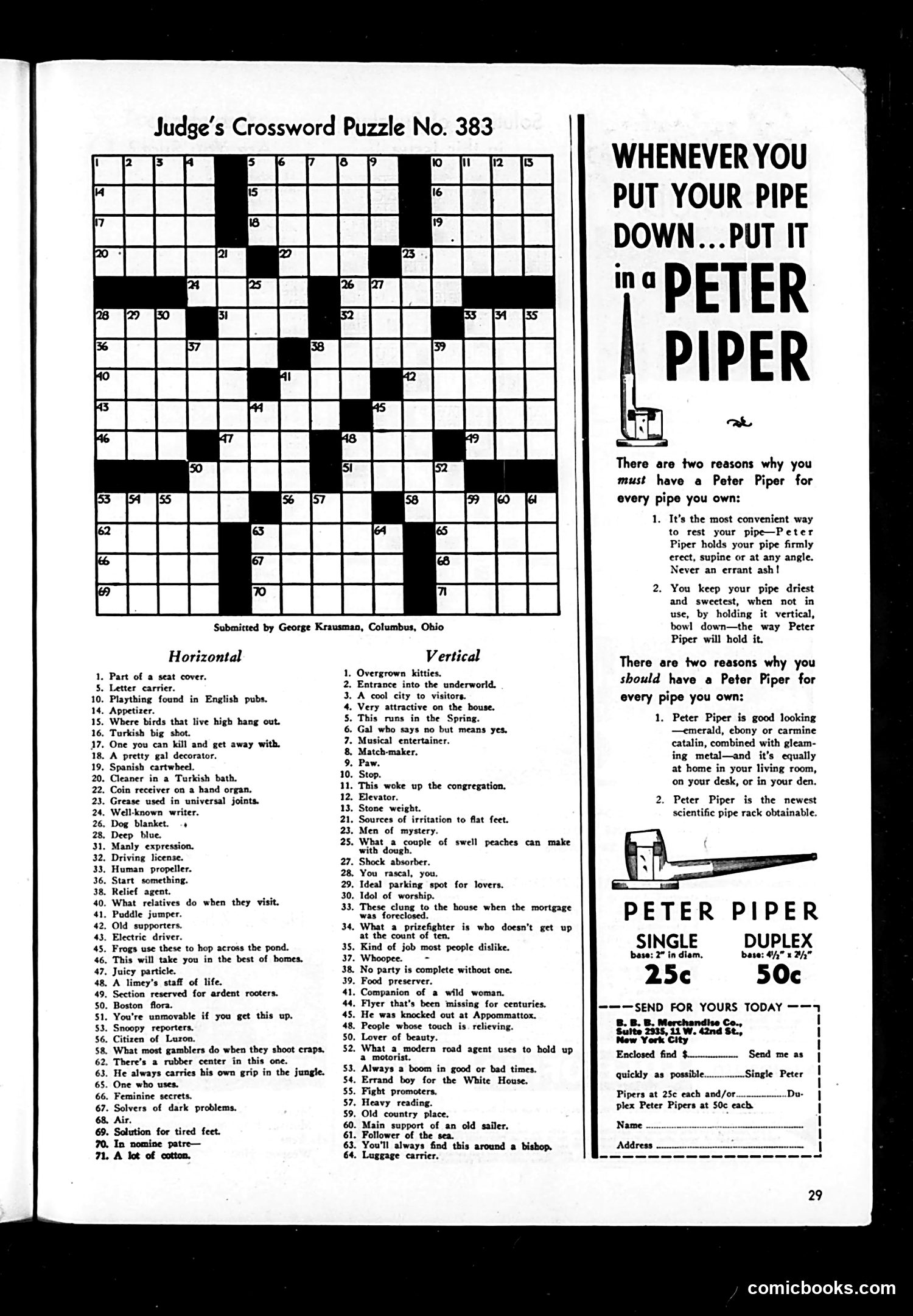
Analysis for Modern Readers This page is primarily a crossword puzzle with an advertisement, not a political cartoon. The crossword (No. 383) is a standard word puzzle submitted by George Krausman of Columbus, Ohio, with typical clues mixing wordplay, current events, and cultural references of the era. The advertisement promotes the Peter Piper pipe rack—a decorative stand for holding tobacco pipes. The pitch emphasizes two practical benefits: (1) it holds pipes vertically to prevent ash scatter and keep them dry, and (2) it's aesthetically pleasing, available in attractive materials like catalin and metal. The ad reflects early-to-mid 20th-century pipe smoking as a widespread male habit. The product costs 25¢ (single) or 50¢ (duplex) and could be ordered by mail. The name cleverly references the nursery rhyme "Peter Piper picked a peck of pickled peppers." This is product advertising, not satire or social commentary.
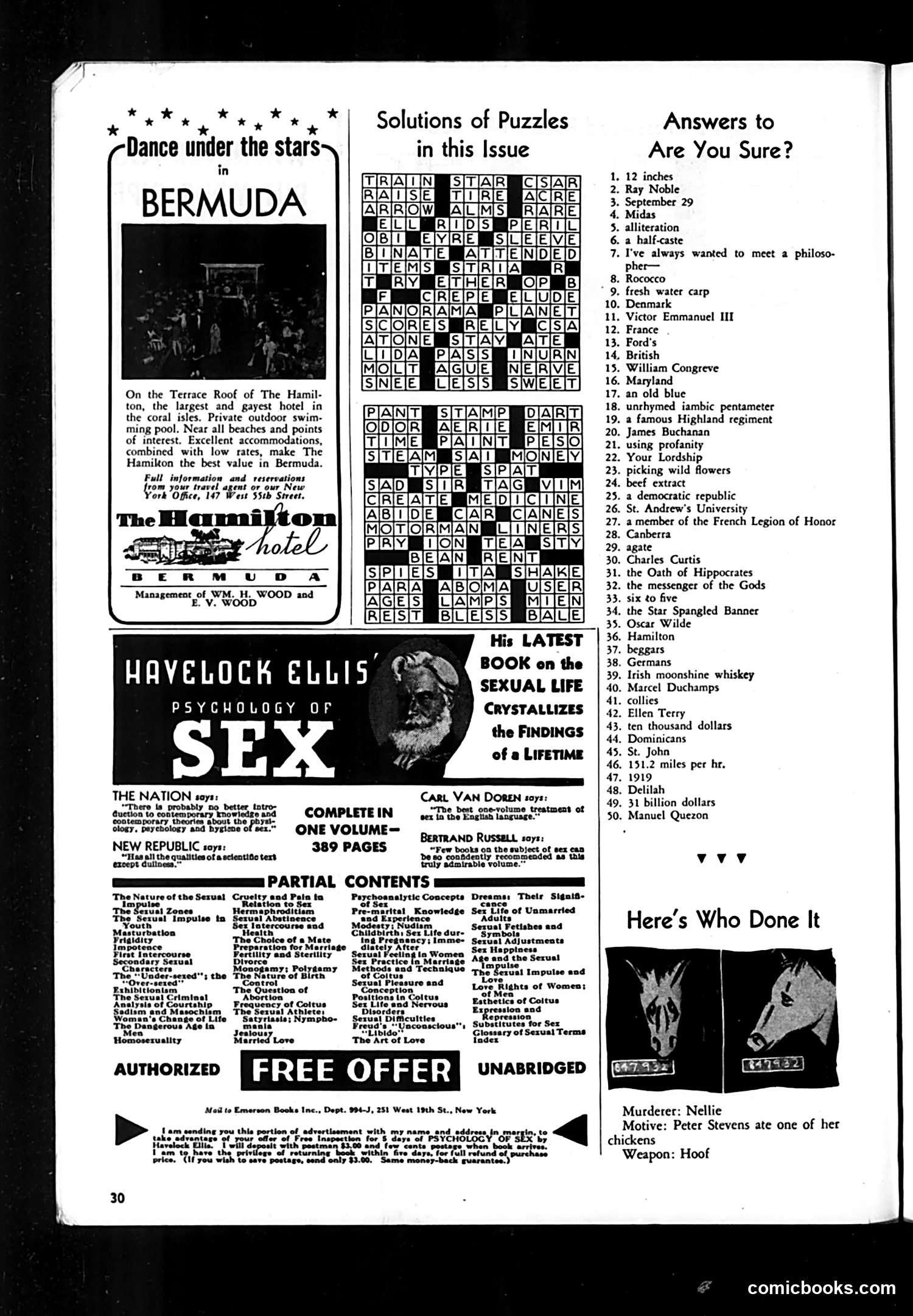
This page is primarily advertising and puzzle solutions, not political satire. The main content includes: Advertisements: The Hamilton Hotel in Bermuda (tourism), Havelock Ellis's "Psychology of Sex" (a serious 1897 sex education text), and a mystery game called "Here's Who Done It." Puzzle Solutions: Standard crossword-style answers to riddles from earlier in the magazine. The "Who Done It" section: A lighthearted murder mystery where "Nellie" kills "Peter Stevens" by hitting him with a hoof because he ate one of her chickens. This is humorous domestic absurdism rather than political commentary. There is no discernible political cartoon or satire on this page. It represents typical *Judge* magazine filler content from the 1920s-30s era—a mix of advertisements, games, and trivia designed to occupy space and generate revenue between actual satirical content.
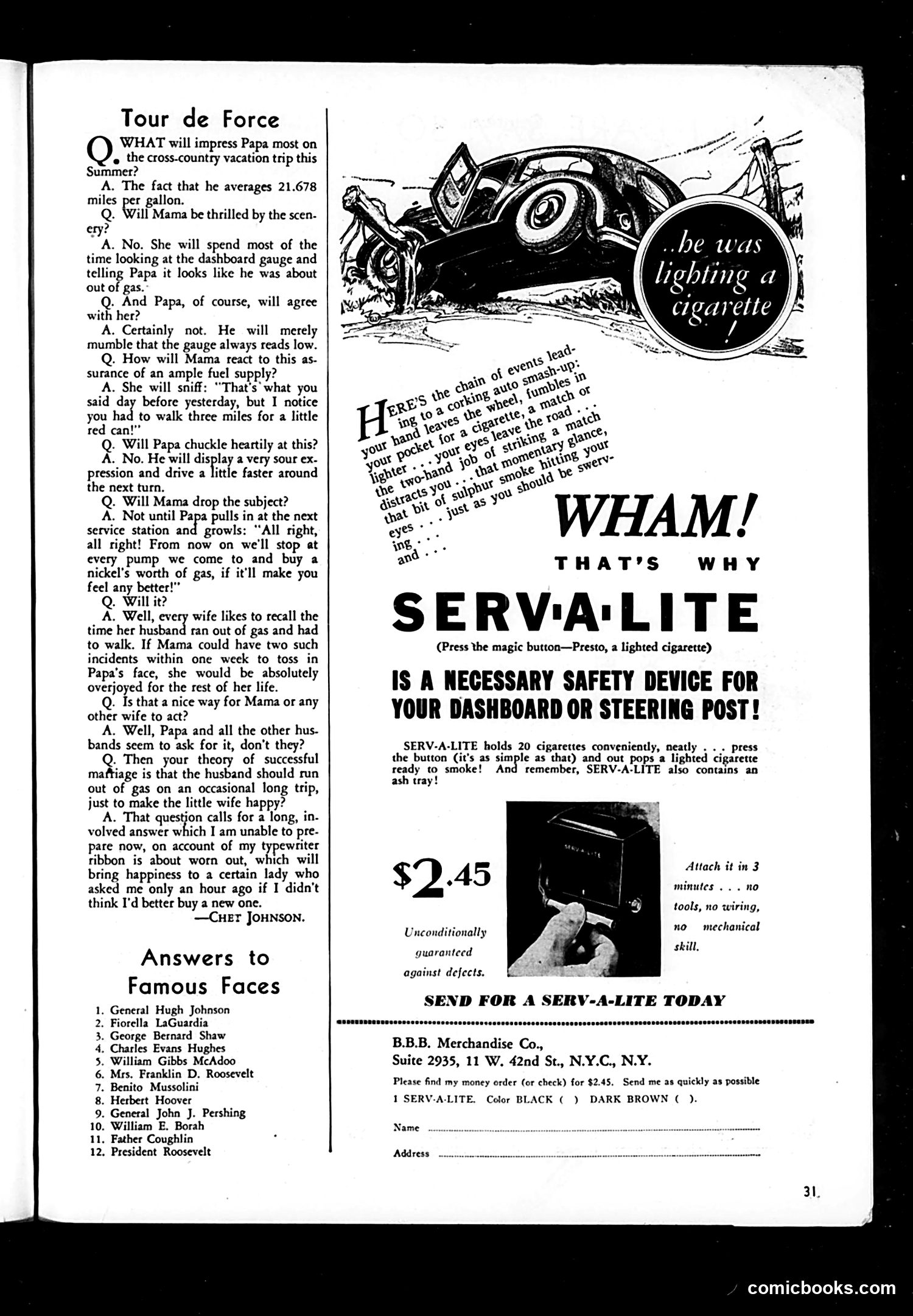
"Tour de Force" - A Marital Comedy from Judge Magazine This page contains a humorous Q&A column by Chet Johnson satirizing typical husband-wife dynamics during 1930s automobile road trips. The joke centers on a recurring marital conflict: wives obsessively monitoring the fuel gauge while husbands deny running low on gas, culminating in the husband having to walk for gas. The satire suggests wives enjoy recalling this humiliation and would relish it happening repeatedly. The accompanying Serv-A-Lite advertisement (a cigarette lighter/holder device) appears darkly ironic given the column's context—promoting a dashboard-mounted gadget that requires the driver to light cigarettes while operating the vehicle, potentially increasing accident risk. This juxtaposition may itself be satirical commentary on automobile safety priorities of the era. The page also lists "Answers to Famous Faces," identifying contemporary political figures like FDR, Mussolini, and Father Coughlin.
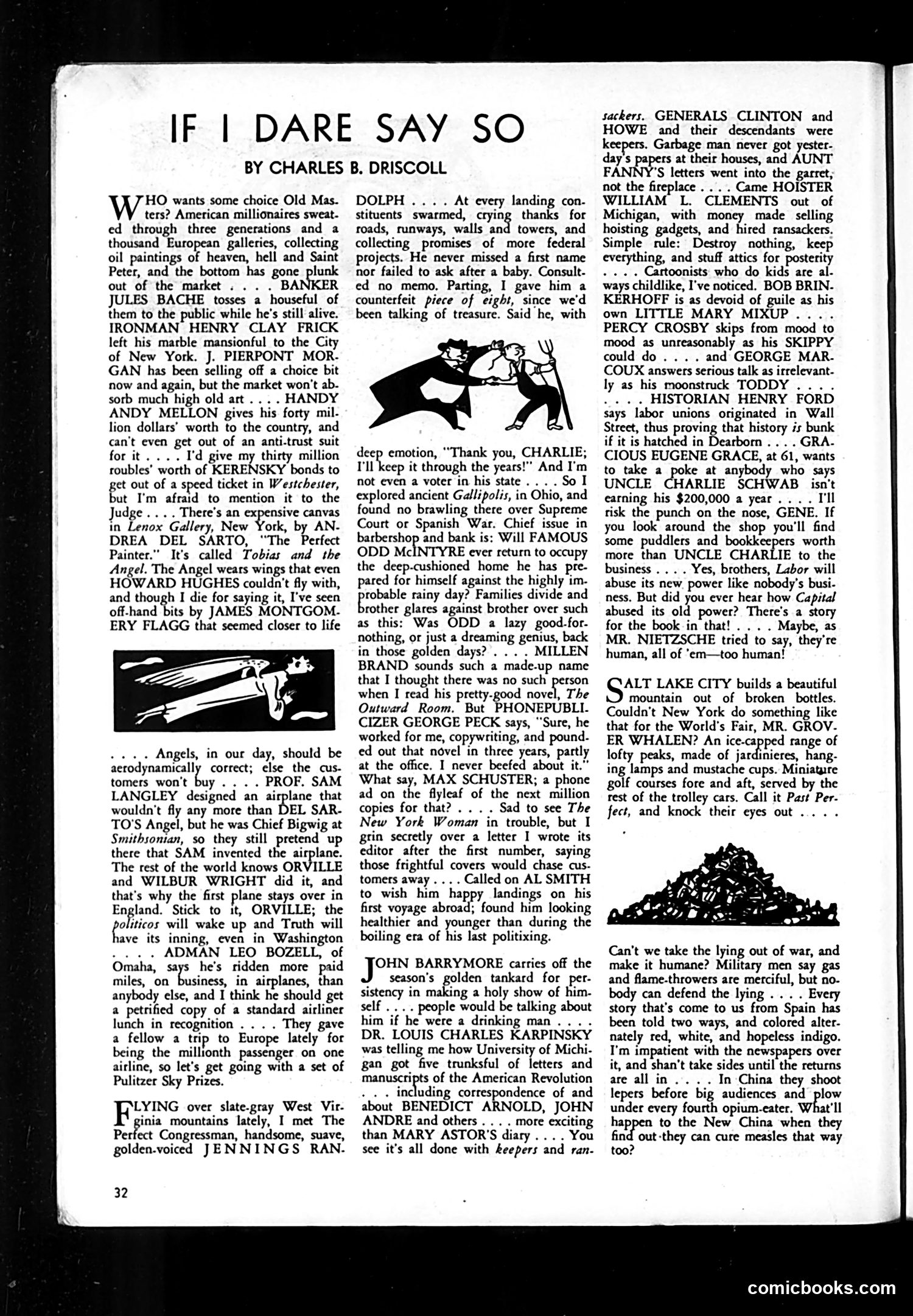
Analysis of "If I Dare Say So" by Charles B. Driscoll This is a gossipy society column satirizing wealthy American industrialists and celebrities of the era. The main cartoon shows two figures in an exaggerated physical altercation, illustrating the column's irreverent tone. Key targets include: Art collectors: Banker Jules Bache and J.P. Morgan are mocked for their massive art holdings, while Andrew Mellon is praised (yet still can't escape legal troubles). Aviation: Driscoll ridicules Samuel Langley's failed airplane while crediting the Wright Brothers, whose plane remains in England—a jab at American neglect of its own achievements. Politics: Congressman Jennings Randolph is portrayed as the perfectly polished politician who remembers constituents' names and delivers promises of federal projects, yet reveals himself as opportunistic when accepting a counterfeit coin. The column's humor relies on insider knowledge of 1920s-30s wealth, art world gossip, and political theater—assuming readers recognize these figures and care about their social standing and minor scandals.
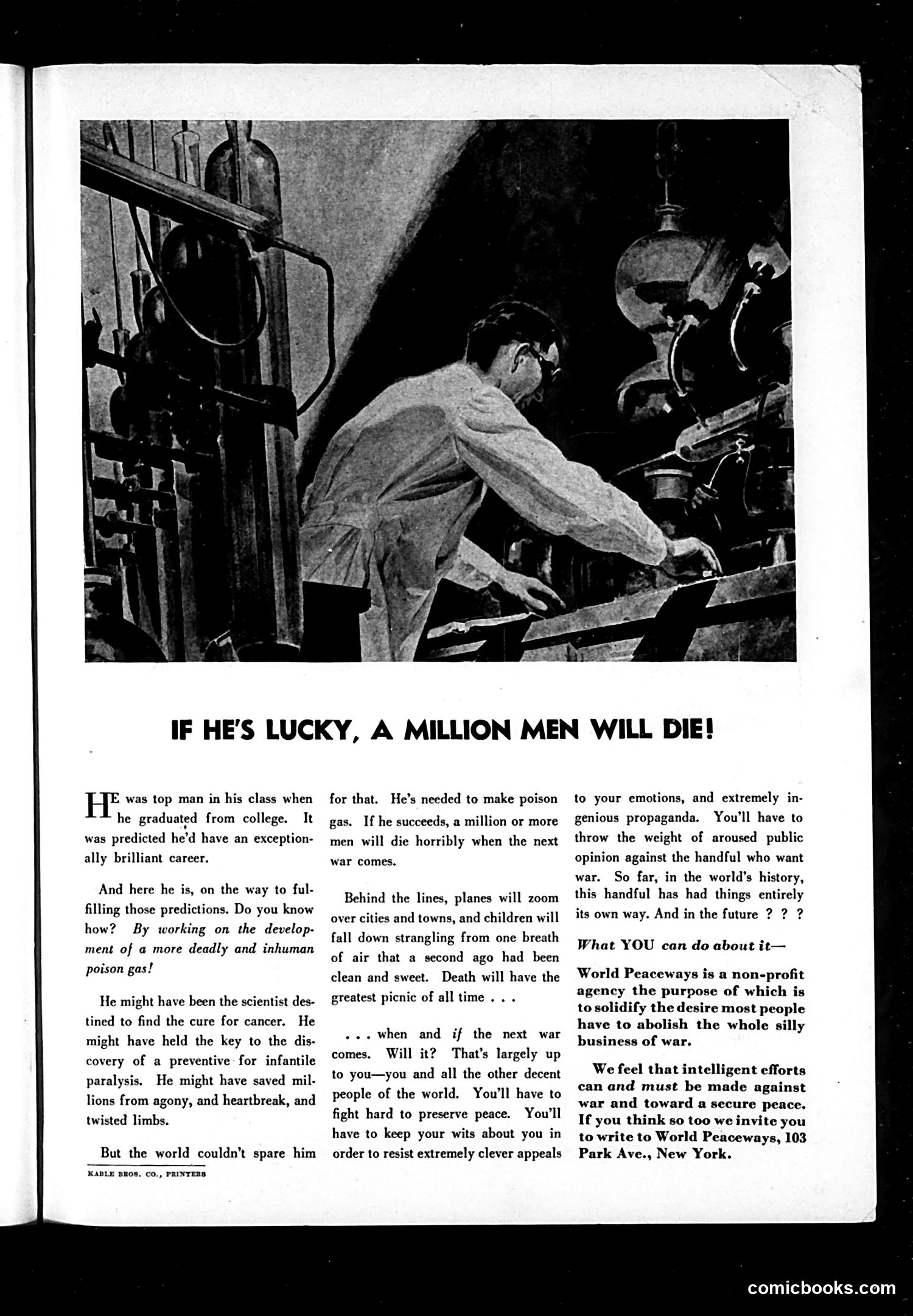
Analysis This anti-war propaganda piece from Judge magazine depicts a brilliant young scientist now developing poison gas for military use—a tragic waste of potential that could have cured diseases instead. The image shows him working on weapons in an industrial setting. The satire critiques how World War II-era militarism conscripted scientific talent toward destruction. The article argues that if this scientist succeeds, "a million or more men will die horribly" in the next war through chemical weapons attacks on civilian populations. The piece uses dark irony to condemn both the scientist's complicity and broader society's acceptance of war preparation. It concludes with a call-to-action for World Peaceways, a peace advocacy organization, urging readers to resist pro-war propaganda and fight for peace. This reflects 1930s-40s American pacifist sentiment and specific anxieties about chemical warfare and aerial bombing.
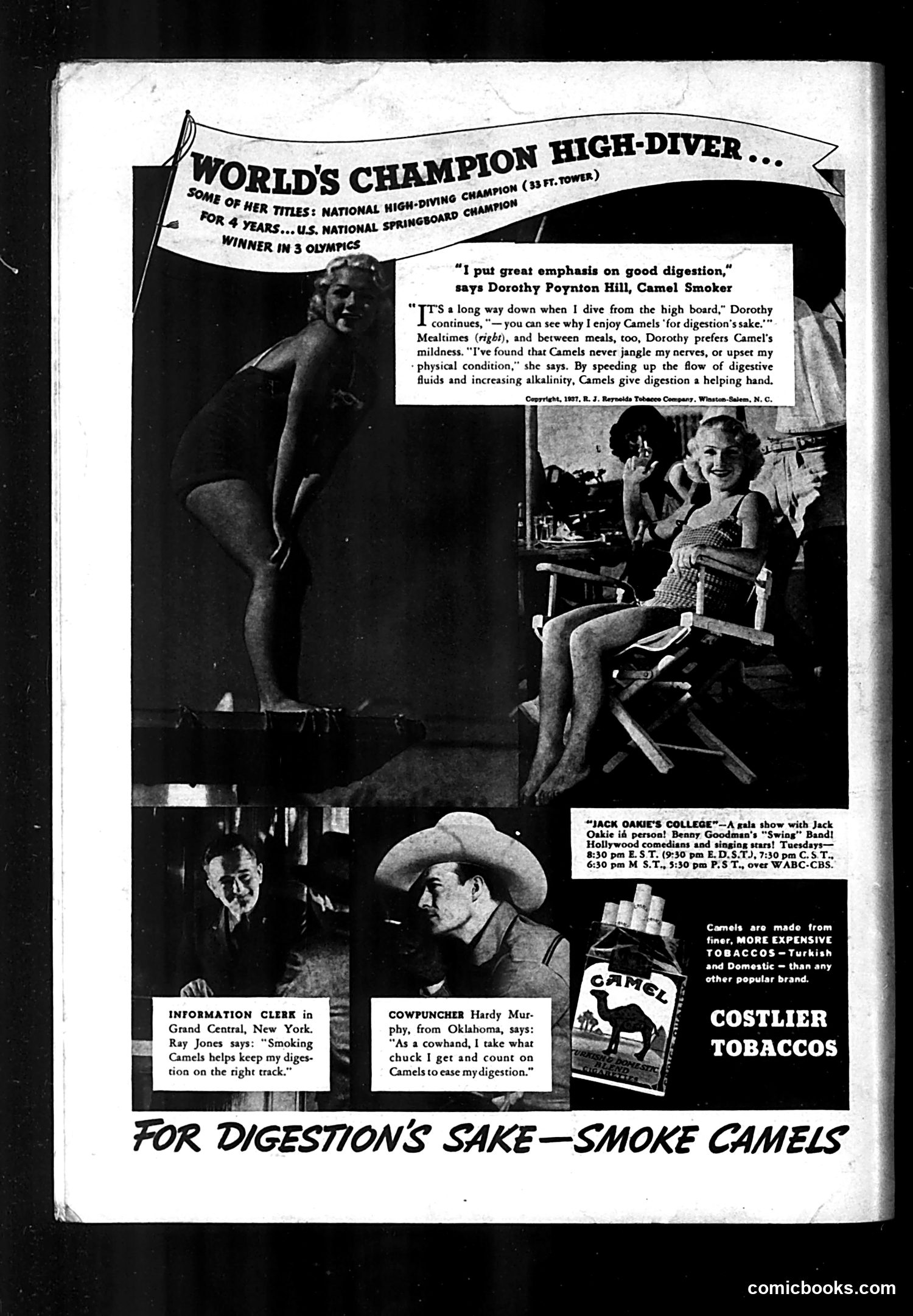
Analysis This is a Camel cigarette advertisement, not satire or political commentary. The page features Dorothy Poynton Hill, an Olympic diving champion (identified by her titles: national high-diving champion, 4-year national springboard champion, 3-time Olympic winner). The ad's core claim—presented as her testimonial—is that Camel cigarettes aid digestion by "speeding up the flow of digestive fluids and increasing alkalinity." This reflects 1930s-era tobacco marketing that made health claims (now recognized as false advertising). The page also includes endorsements from other figures: an information clerk and a cowpuncher, all claiming Camels help their digestion. A separate box advertises "Jack Oakie's College," a radio variety show. For modern readers: This exemplifies pre-FDA regulation advertising where cigarettes were openly marketed with medical benefits. The digestive aid claim was entirely fabricated marketing designed to appeal to consumers' health concerns.

I can see this is a page from *Judge* magazine (as indicated by the comicbooks.com watermark), but the image is almost entirely black with minimal visible content. A white vertical stripe appears on the left edge, possibly a page binding or scanning artifact. The OCR text contains only a URL identifier and provides no readable content from the actual page. Without being able to discern any cartoon illustrations, text, caricatures, or political references in the image itself, I cannot identify the figures, social commentary, or satirical intent. The page may be a title page, advertising section, or the image quality/contrast has rendered the content illegible. To provide accurate historical analysis, a clearer or higher-contrast image would be necessary.