judge
Judge — July 1937
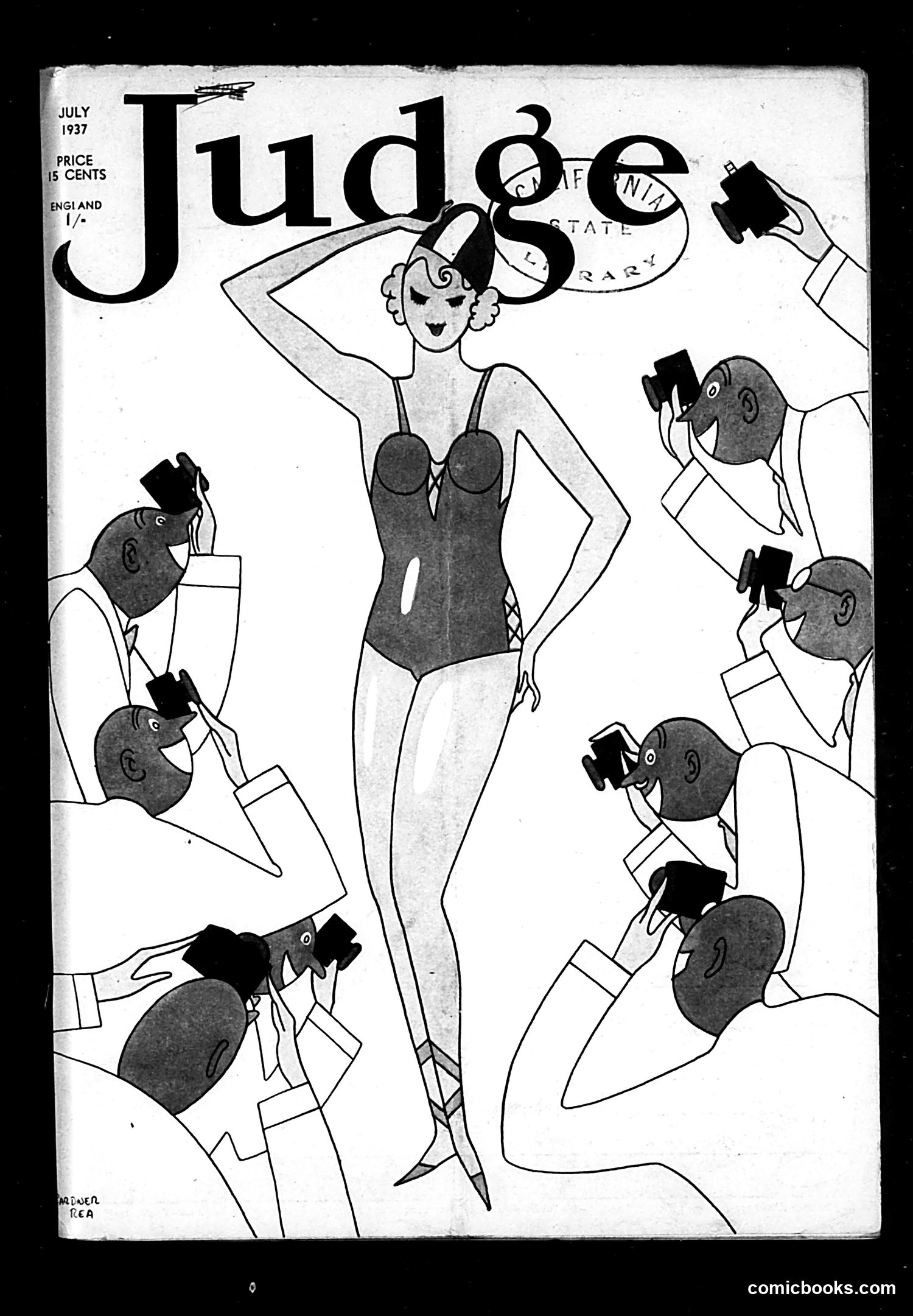
Judge Magazine Cover Analysis (July 1937) This cover depicts a woman in a swimsuit surrounded by men holding cameras and flashbulbs—a satirical commentary on celebrity photography and media attention. The exaggerated caricatures of the photographers, with their prominent features and eager poses, mock the invasive nature of press coverage during this era. The satire likely targets the intense media scrutiny of Hollywood starlets and public figures in the 1930s, when tabloid journalism and celebrity culture were rapidly expanding. The woman's confident pose contrasts with the frenzied activity around her, suggesting commentary on either the absurdity of such attention or the commodification of female celebrity. Without identifying the specific woman depicted, the cartoon critiques press culture and the spectacle surrounding entertainers of that period.
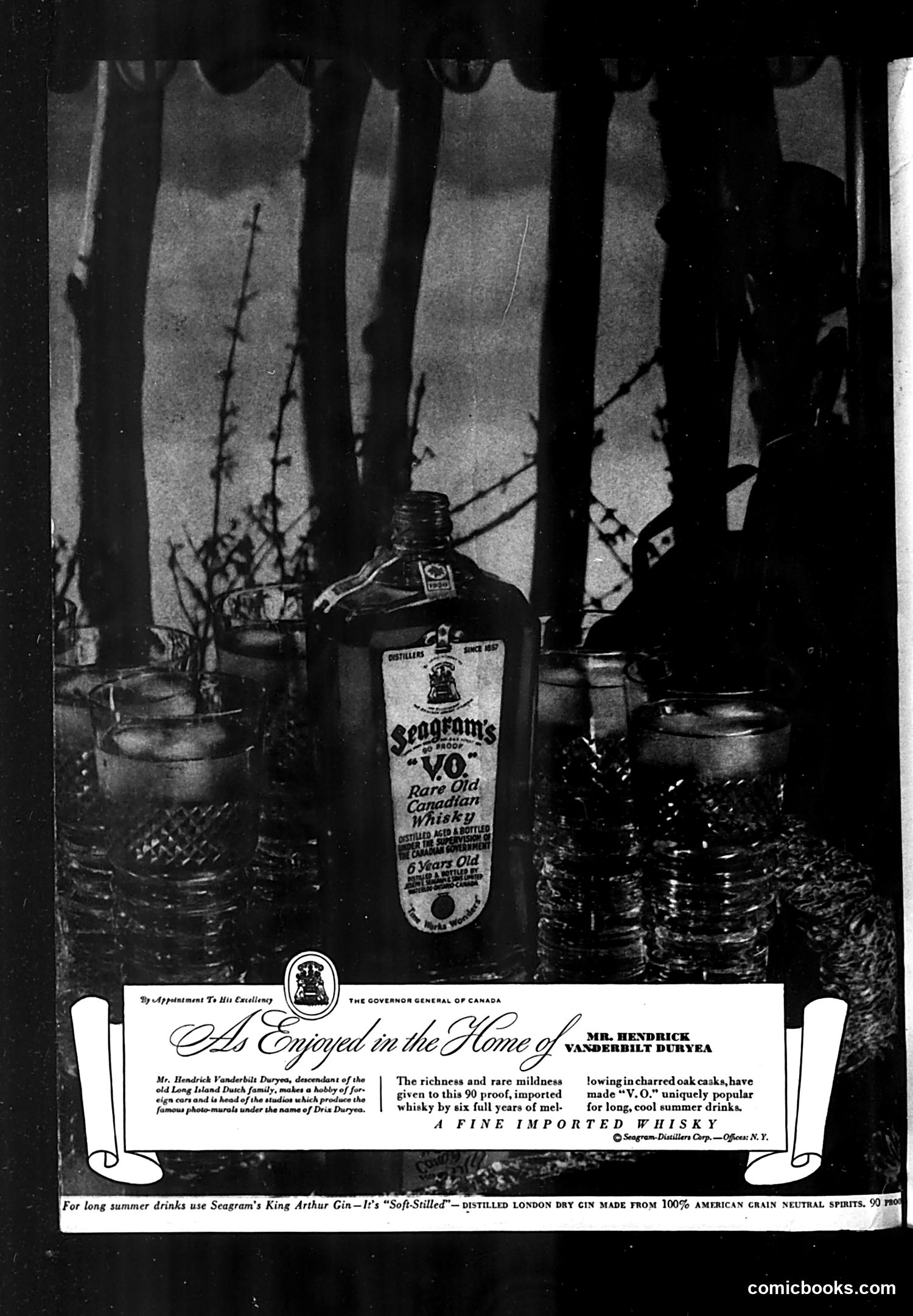
Analysis This page is primarily advertising rather than political satire. It features an endorsement advertisement for Seagram's "V.O." Canadian whisky, presented as "As Enjoyed in the Home of Mr. Hendrick Vanderbilt Duryea." The ad uses social prestige marketing common to the era—invoking a prominent wealthy family name (Vanderbilt Duryea) to suggest the product's exclusivity and quality. The advertisement emphasizes the whisky's "richness and rare mildness" achieved through aging in charred oak casks. At the bottom, there's a secondary advertisement for Seagram's King Arthur Gin marketed for summer consumption. The image shows the whisky bottle surrounded by glasses with ice and garnishes. This reflects pre-Prohibition or post-Prohibition era advertising (likely 1930s-40s based on style), when luxury alcohol brands used celebrity endorsements and aspirational lifestyle marketing to reach consumers.
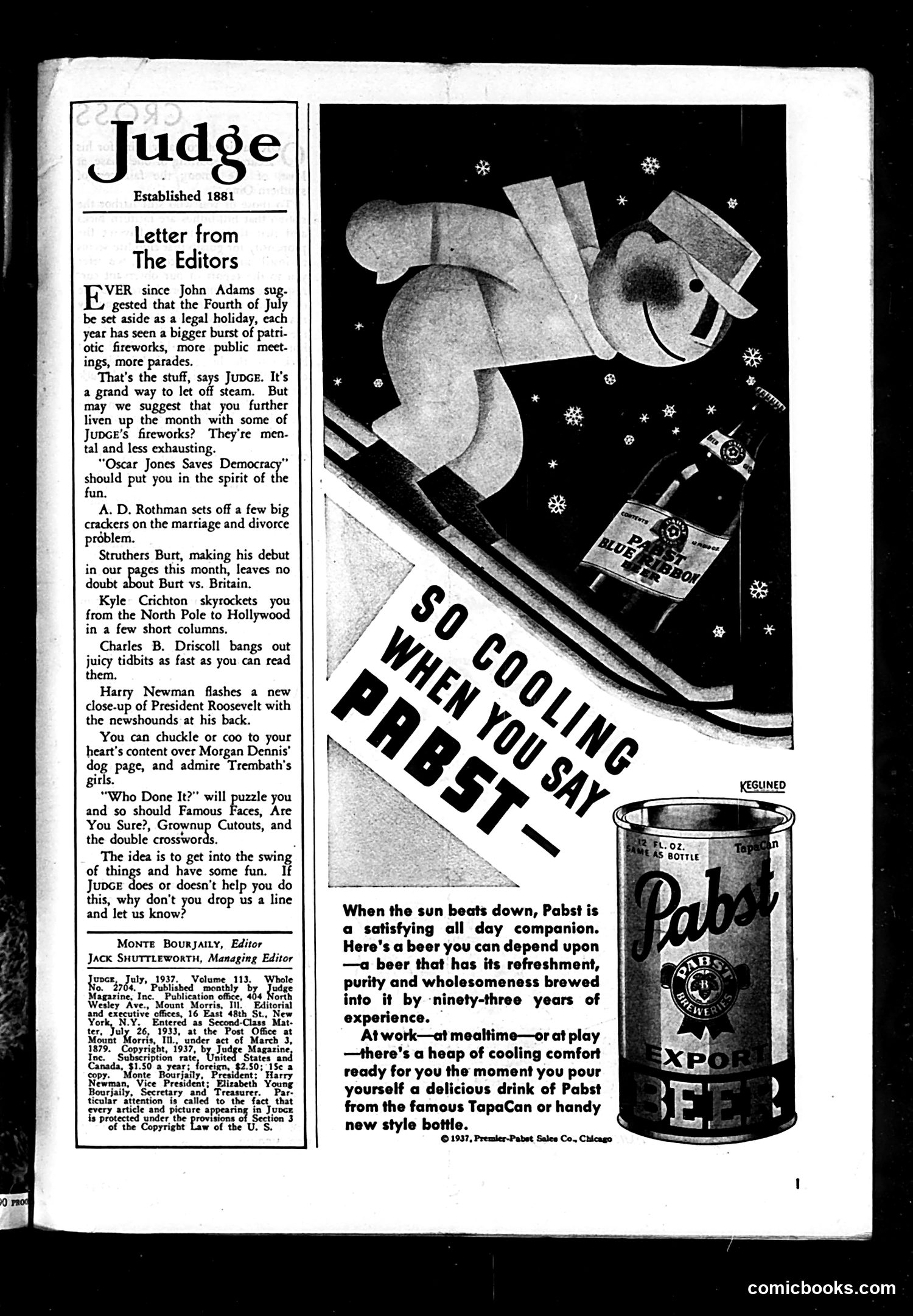
Analysis This page is primarily a Pabst beer advertisement rather than political satire. The main image shows a cartoon Santa Claus figure skiing down a snowy slope with a Pabst beer bottle, captioned "SO COOLING WHEN YOU SAY 'PABST!'" The left column contains "Letter from The Editors," which previews Judge magazine's upcoming content, including pieces by various writers about topics like President Roosevelt, marriage/divorce issues, and Hollywood. The advertisement's humor relies on seasonal timing and the incongruity of Santa promoting beer as a "cooling comfort" drink. The messaging emphasizes Pabst's 93 years of brewing experience and its availability in a new "TopsCan" bottle style. This represents typical 1930s advertising strategy: using humor and celebrity/character association to market products.
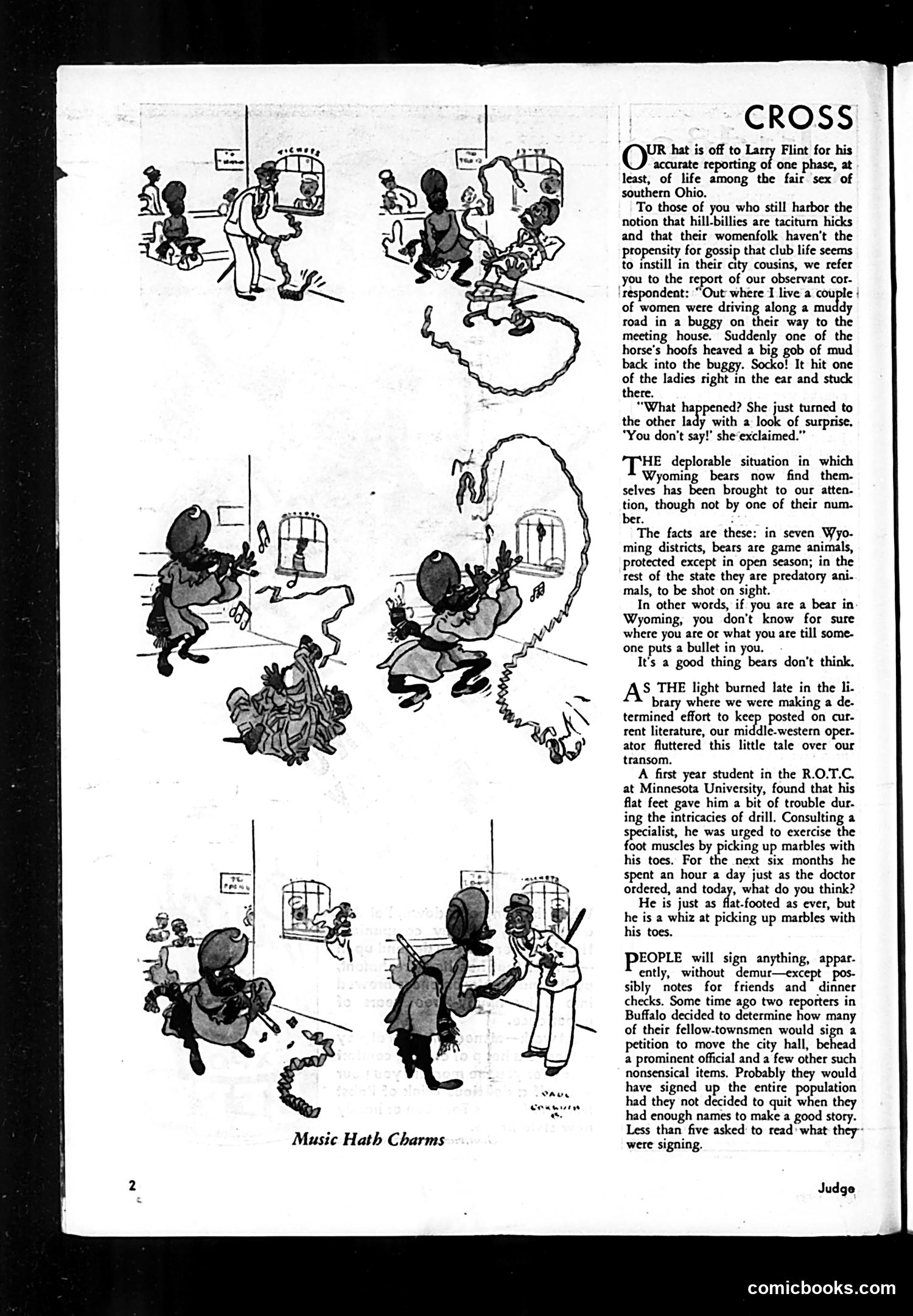
"Cross" Page Analysis This page contains editorial commentary and cartoon vignettes titled "Music Hath Charms" rather than a single political cartoon. The "Cross" column discusses three unrelated social observations: Wyoming's bear problem (bears shot on sight, creating danger for residents), a Minnesota R.O.T.C. student with flat feet who exercises by picking up marbles with his toes, and Buffalo residents who apparently signed a petition to move city hall without reading what they were signing. The accompanying cartoons illustrate these anecdotes with humor—showing the bear incident, the marble-picking exercise, and people mindlessly signing documents. The satire targets gullibility and absurd situations in American life rather than specific political figures. The overall tone is lighthearted, mocking human foolishness and bureaucratic absurdity rather than partisan politics.
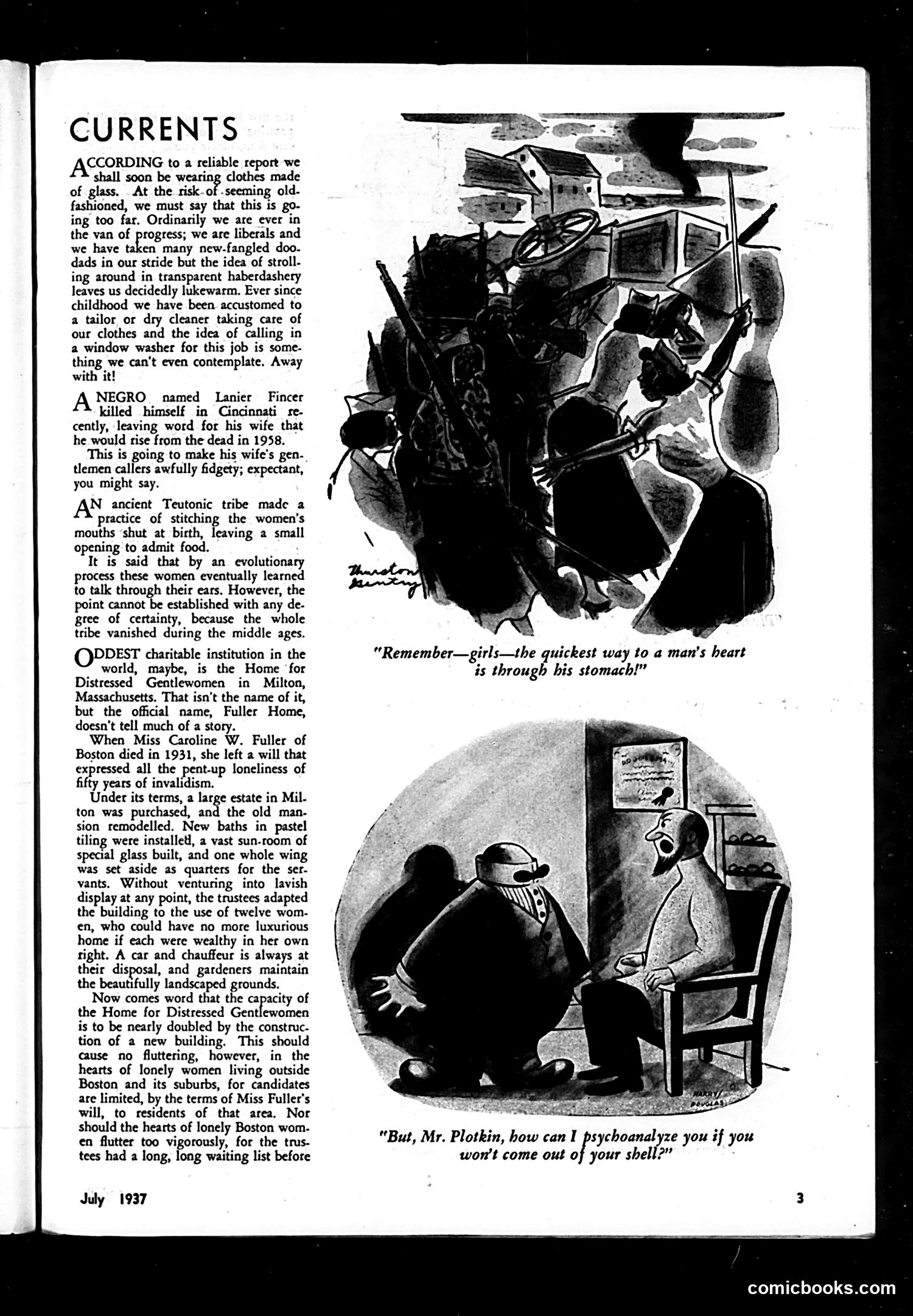
Judge Magazine Page Analysis (July 1937) This page contains a "Currents" column of short satirical items plus two cartoon illustrations. The top cartoon depicts a car crash with the caption "Remember—girls—the quickest way to a man's heart is through his stomach!" This appears to satirize both dating advice clichés and dangerous driving. The bottom cartoon shows a man reluctant to leave his chair, captioned "But, Mr. Plotkin, how can I psychoanalyze you if you won't come out of your shelf?" This mocks both psychoanalysis (then a fashionable but suspect practice) and a man's laziness. The "Currents" column includes brief items on glass clothing, a suicide note, ancient tribal practices, and a Boston charitable home for distressed gentlewomen—miscellaneous social commentary typical of the magazine's satirical approach.
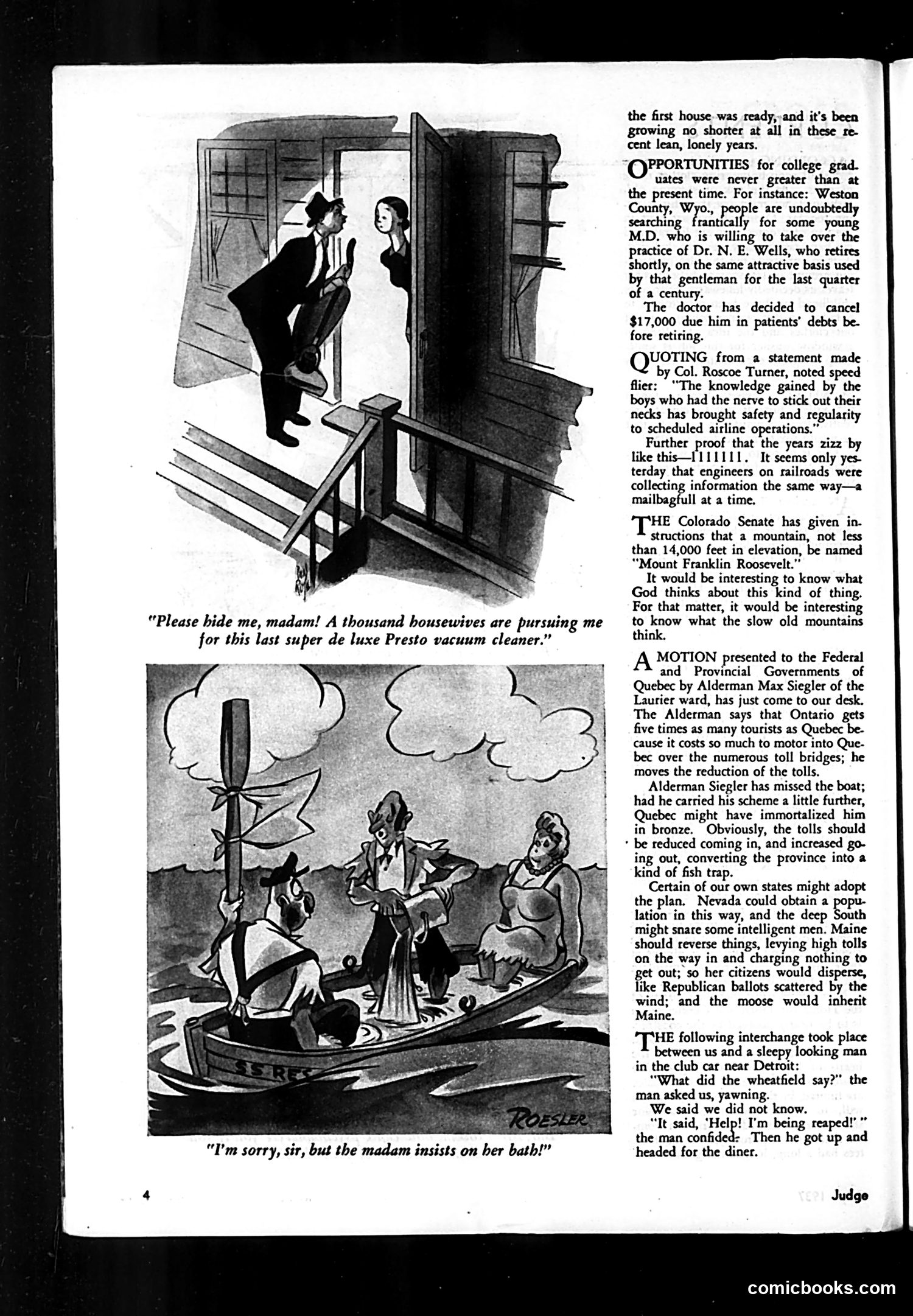
Analysis of Judge Magazine Page This page contains two cartoons and satirical commentary from an early 20th-century American humor magazine. Top cartoon: A man in formal dress hides from a woman, with caption "Please hide me, madam! A thousand housewives are pursuing me for this last super de luxe Presto vacuum cleaner." This satirizes the commercial craze for a popular new vacuum cleaner model—suggesting it's so desirable that even one remaining unit creates a frenzied mob of housewives. Bottom cartoon: Shows people in a boat amid clouds, captioned "I'm sorry, sir, but the madam insists on her bath!" This appears to mock wealthy travelers' excessive demands for luxury amenities during leisure activities. The right column contains miscellaneous satirical commentary on contemporary topics: doctor shortages, aviation safety, and a humorous anecdote about a sleepy man mishearing "wheatfield" as "Help! I'm being reaped!"
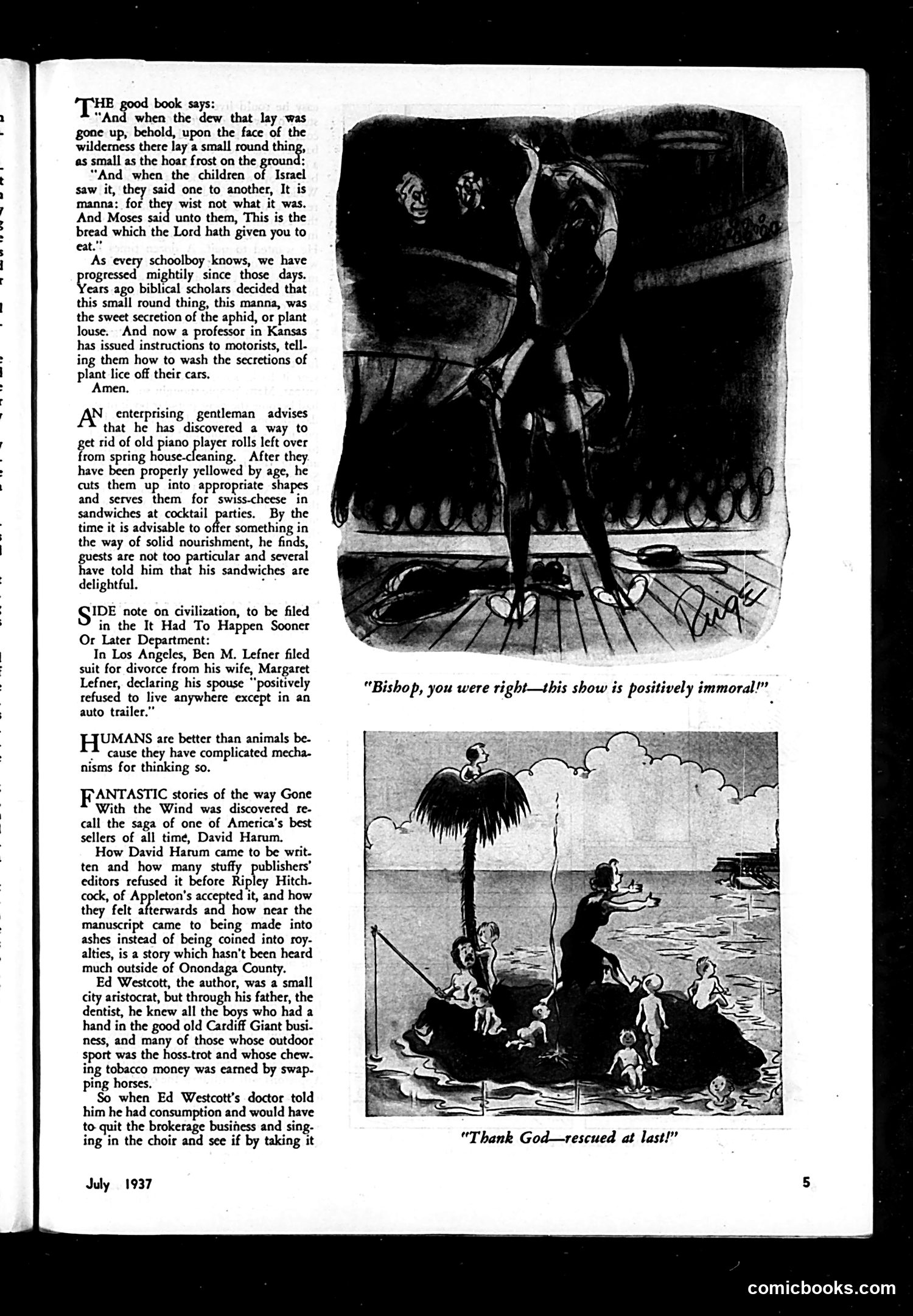
Analysis of Judge Magazine Page (July 1937) This page contains three separate pieces of satirical content: 1. Top illustration: Shows what appears to be a theatrical or musical performance scene with the caption "Bishop, you were right—this show is positively immoral!" The satire likely mocks either censorious religious figures or heated cultural debates about entertainment standards in the 1930s. 2. Bottom illustration: Depicts a rescue scene with the caption "Thank God—rescued at last!" The context is unclear from the image alone, though it may reference a contemporary news event or satirize sensationalized rescue narratives. 3. Text sections: Include humorous anecdotes about manna identification, piano player disposal tips, and the publication history of "Gone with the Wind." These mock pseudoscientific claims and publishing industry tribulations of the era. The overall tone is light satirical humor rather than hard political commentary.
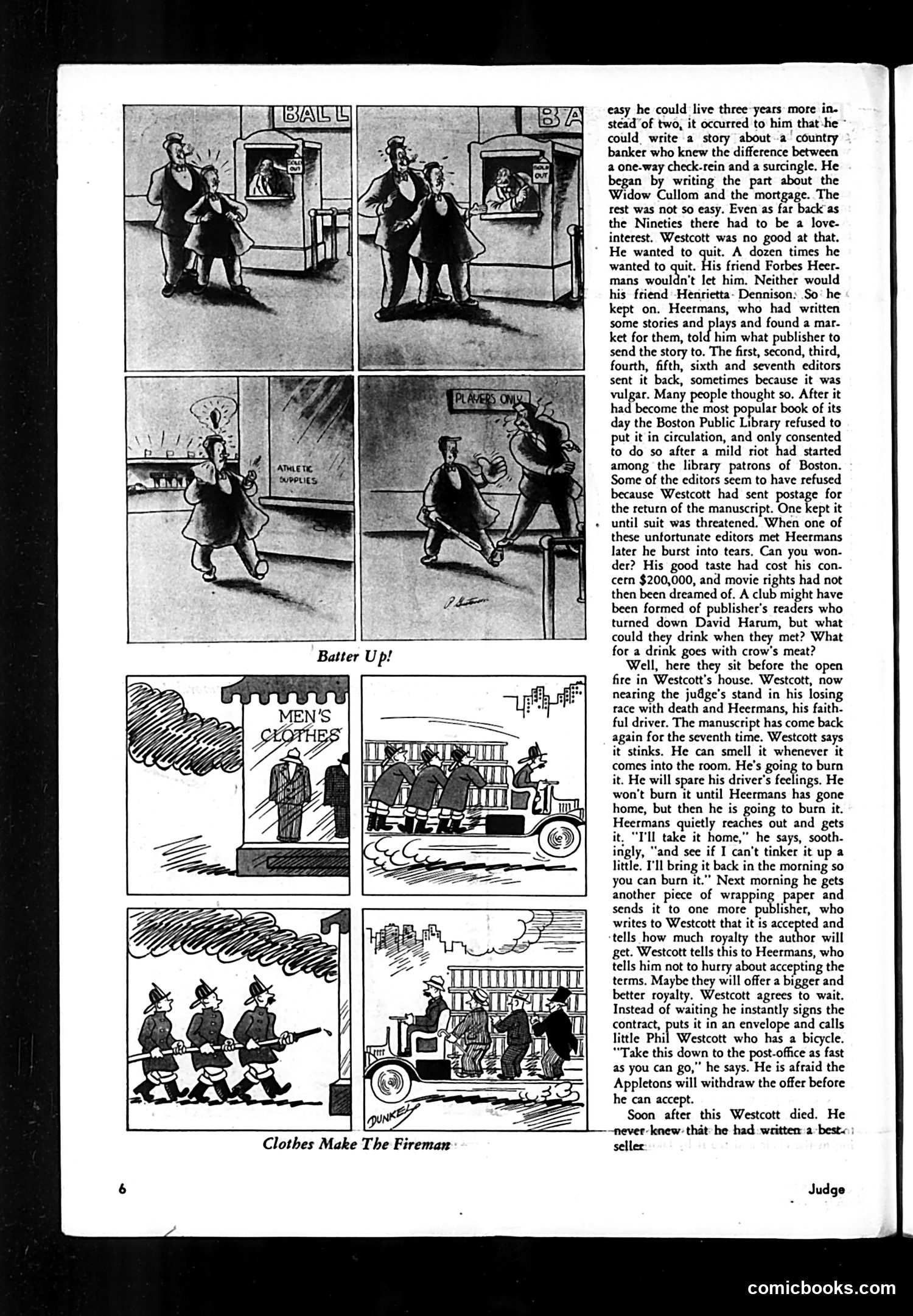
Analysis of "Batter Up!" and "Clothes Make The Fireman" This page contains two sequential comic strips satirizing American publishing and commercial life, likely from the 1920s-30s based on style. "Batter Up!" follows a struggling writer named Westcott whose manuscript gets rejected repeatedly by seven editors. The satire mocks the publishing industry's indifference—editors lose or ignore his work, one publisher demands payment for return postage. Eventually Westcott's house catches fire; his loyal friend Heermans retrieves the manuscript from the flames. The irony: after this dramatic rescue, a publisher finally accepts it, though Westcott dies before learning of his success. The cartoon satirizes how commercial success requires luck or tragedy rather than merit. "Clothes Make The Fireman" (bottom) appears to show firefighters or emergency workers, likely making a visual pun about uniforms conferring authority or identity—though the specific narrative is unclear from this page fragment.
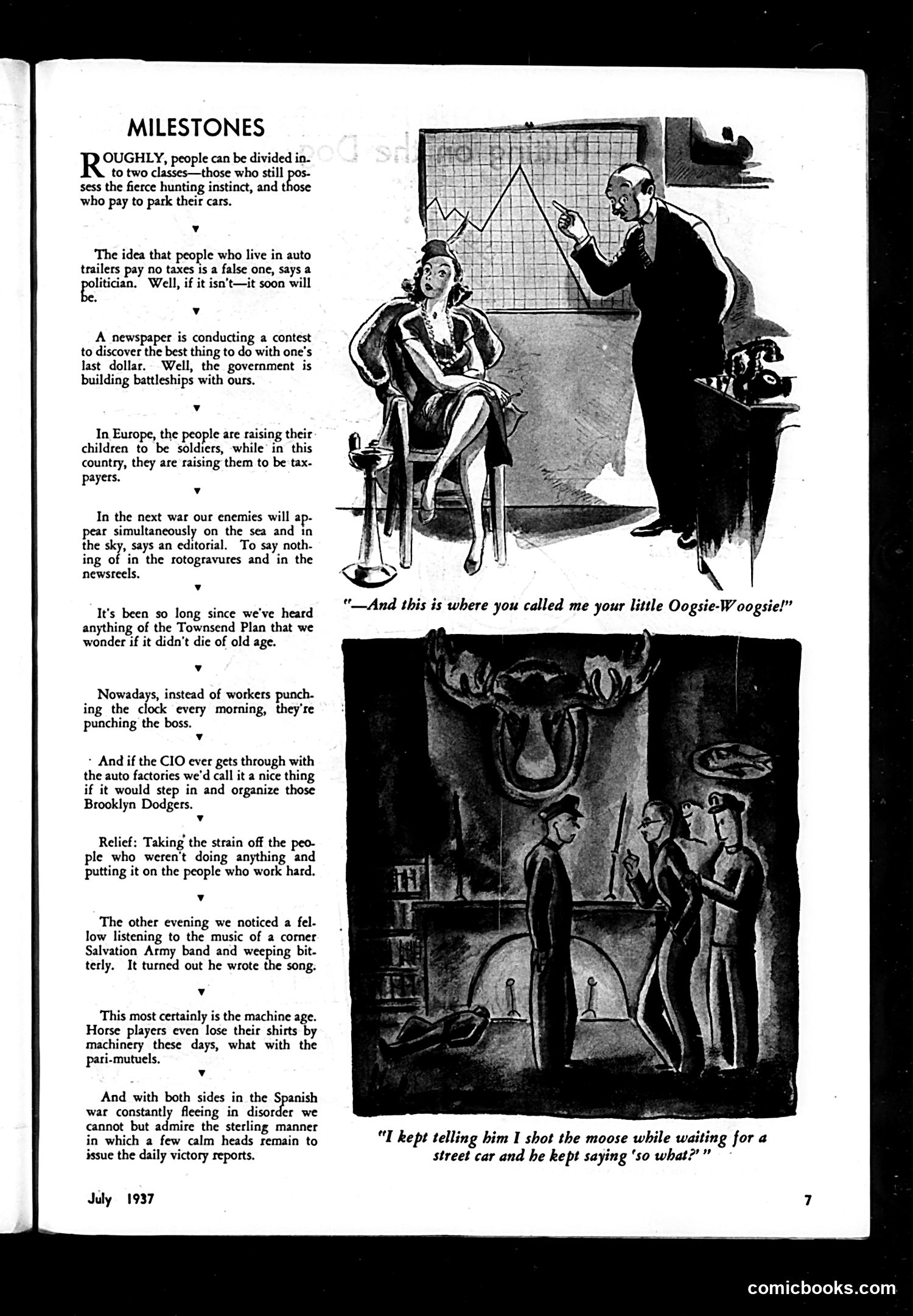
"Milestones" Satire - Judge Magazine, July 1937 This page collects brief satirical observations on contemporary issues. The top cartoon shows a man pointing at an economic chart while a woman sits nearby, captioned "And this is where you called me your little Oogie-Woogie!" - likely satirizing how economic depression has affected romantic relationships or domestic situations. The bottom cartoon depicts what appears to be a Salvation Army scene with the caption about shooting a moose while waiting for a streetcar - absurdist humor mocking tall tales or exaggeration. The "Milestones" section itself critiques 1937 concerns: auto trailers evading taxes, government spending on battleships, European militarization versus American taxation, potential warfare, the failed Townsend Plan (elderly pension proposal), labor unrest, and the Spanish Civil War's chaotic reporting. The satire targets political hypocrisy and economic inequality of Depression-era America.
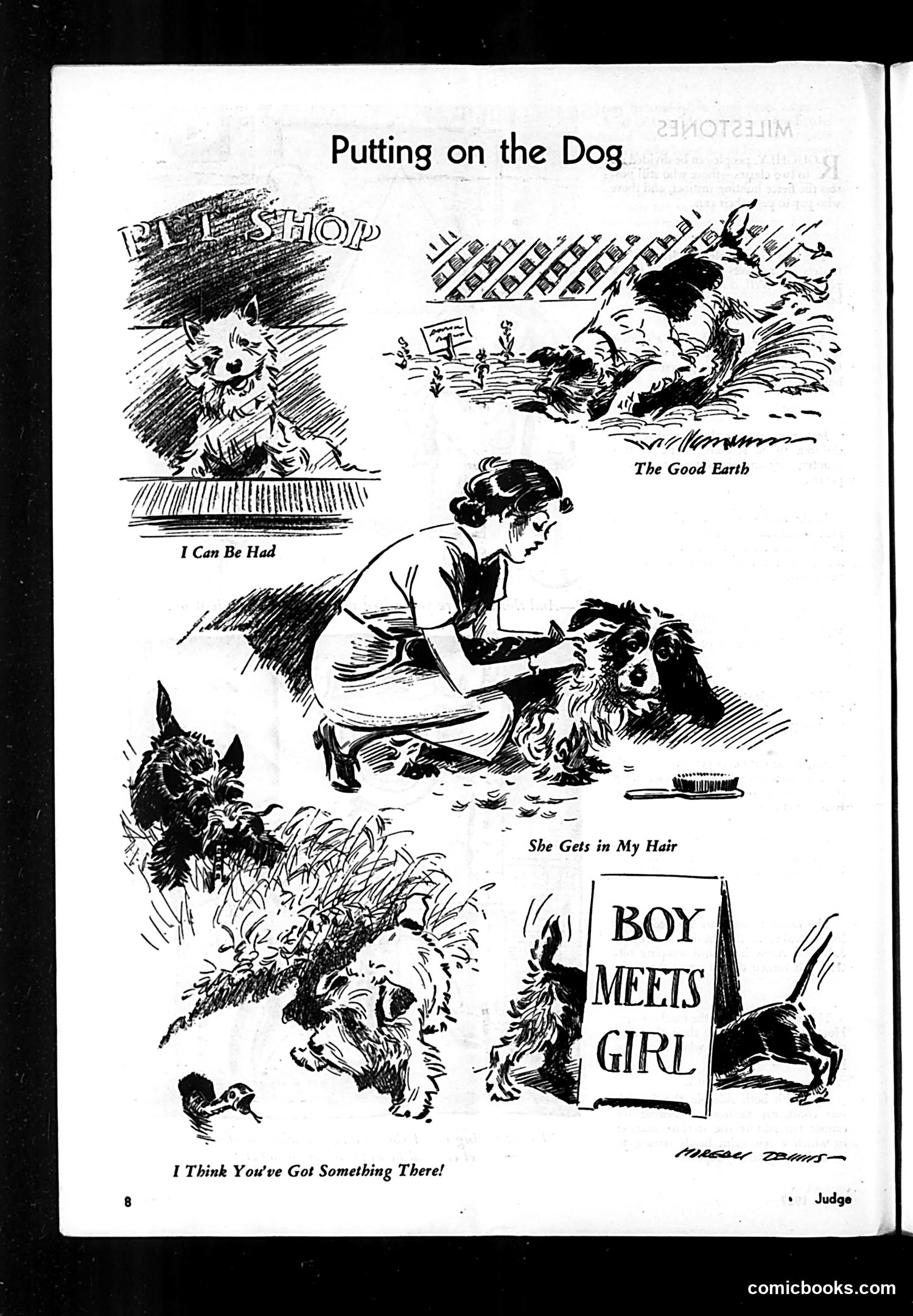
"Putting on the Dog" This page presents a series of humorous illustrations about dog grooming and pet care, using the idiom "putting on the dog" (meaning to dress up or show off). The cartoons depict: - A dog at a pet shop ("I Can Be Had") - A child getting dirty with a dog ("The Good Earth") - A woman grooming a dog's fur ("She Gets in My Hair") - Dogs meeting near a "Boy Meets Girl" sign The humor relies on visual puns and double meanings—treating dog care activities as if they were human social situations. The final panel's "I Think You've Got Something There!" suggests the dogs have mud or dirt on them, playing on the messy reality of pet ownership versus the idealized notion of "putting on" a well-groomed appearance. This is straightforward domestic humor without political satire, typical of Judge's lighter entertainment content.
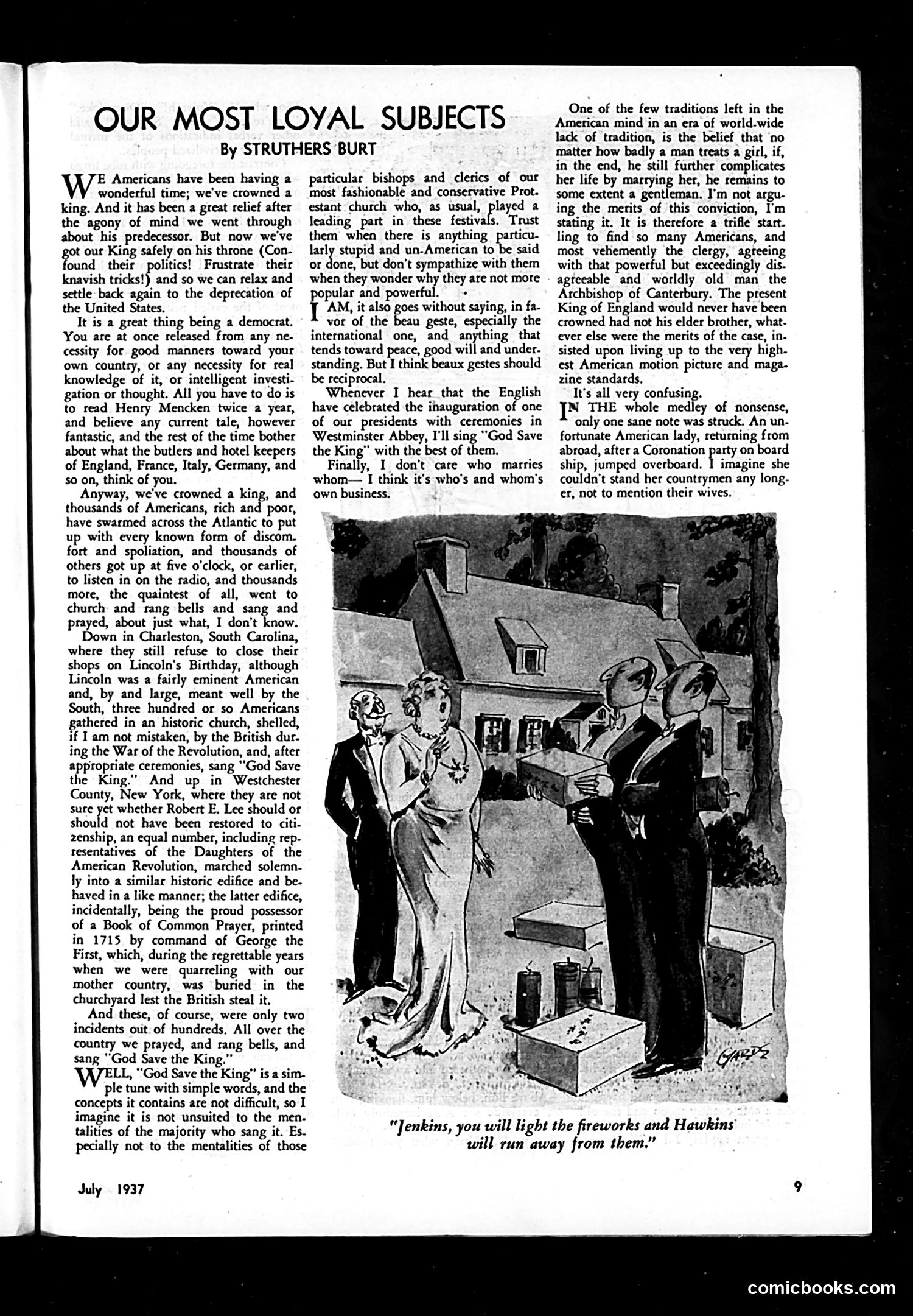
Analysis of Judge Magazine, July 1937 The Article's Satire: Struthers Burt's essay mocks Americans who participated in elaborate ceremonies celebrating the British coronation (likely Edward VIII's abdication crisis and George VI's coronation in 1937). Burt sarcastically criticizes the hypocrisy of patriotic Americans—including Daughters of the American Revolution—traveling to England or holding ceremonial services while routinely denigrating their own country. He notes with contempt that Charleston refused to honor Lincoln's birthday yet gathered to sing "God Save the King," and that New Yorkers questioned Robert E. Lee's citizenship while reverencing British traditions. The Cartoon: The accompanying illustration shows what appears to be a woman in formal dress nervously clutching a man's arm as they encounter what seem to be officials or authorities (the "Jenkins" and "Hawkins" referenced). The caption suggests anxious anticipation of fireworks—a visual pun on explosive social consequences. The Point: Burt argues such gestures are meaningless unless reciprocal, ultimately suggesting these Americans are absurdly obsequious toward Britain while neglecting their own nation's dignity.
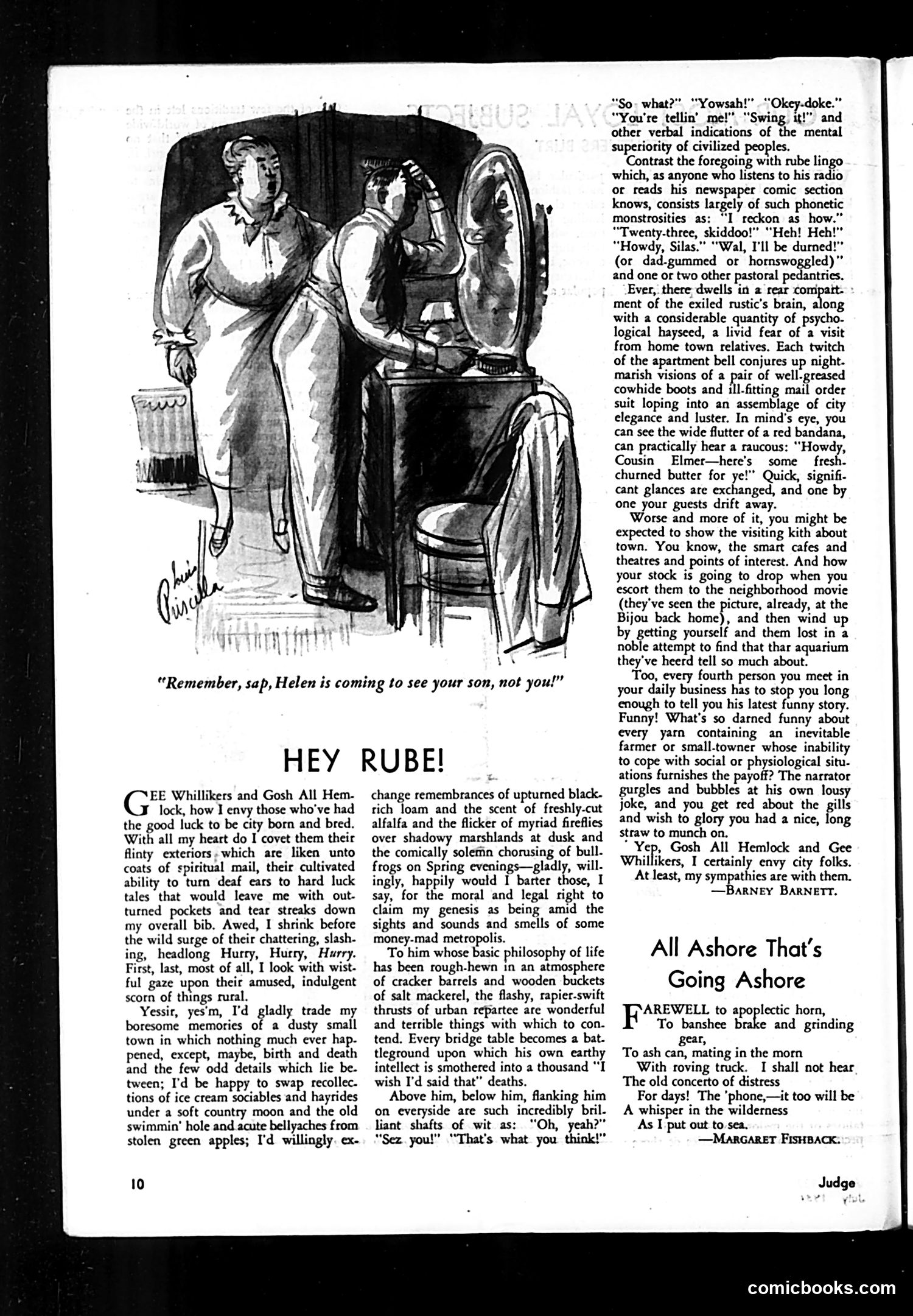
"Hey Rube!" - A City-Dweller's Anxiety About Rural Relatives This humorous essay, illustrated with a sketch of a visitor meeting a nervous host, satirizes the social embarrassment urban dwellers experience when rural relatives visit. The piece contrasts "city wit"—rapid-fire slang like "Oh yeah?" and "That's what you think!"—with rural speech patterns ("I reckon," "Howdy Silas," "dad-gummed"). The author, writing from a small-town perspective, ironically claims to admire city sophistication while revealing the real fear: that visiting country relatives will embarrass him before his urban friends through their unsophisticated manners, appearance (greased boots, mail-order suits, red bandanas), and behavior. The cartoon caption ("Remember, sap, Helen is coming to see your son, not you!") drives home the point—the protagonist's anxiety about impression-management is self-centered; guests care about the younger generation, not his social standing. This reflects 1920s-30s anxieties about rural-urban cultural divisions in America.
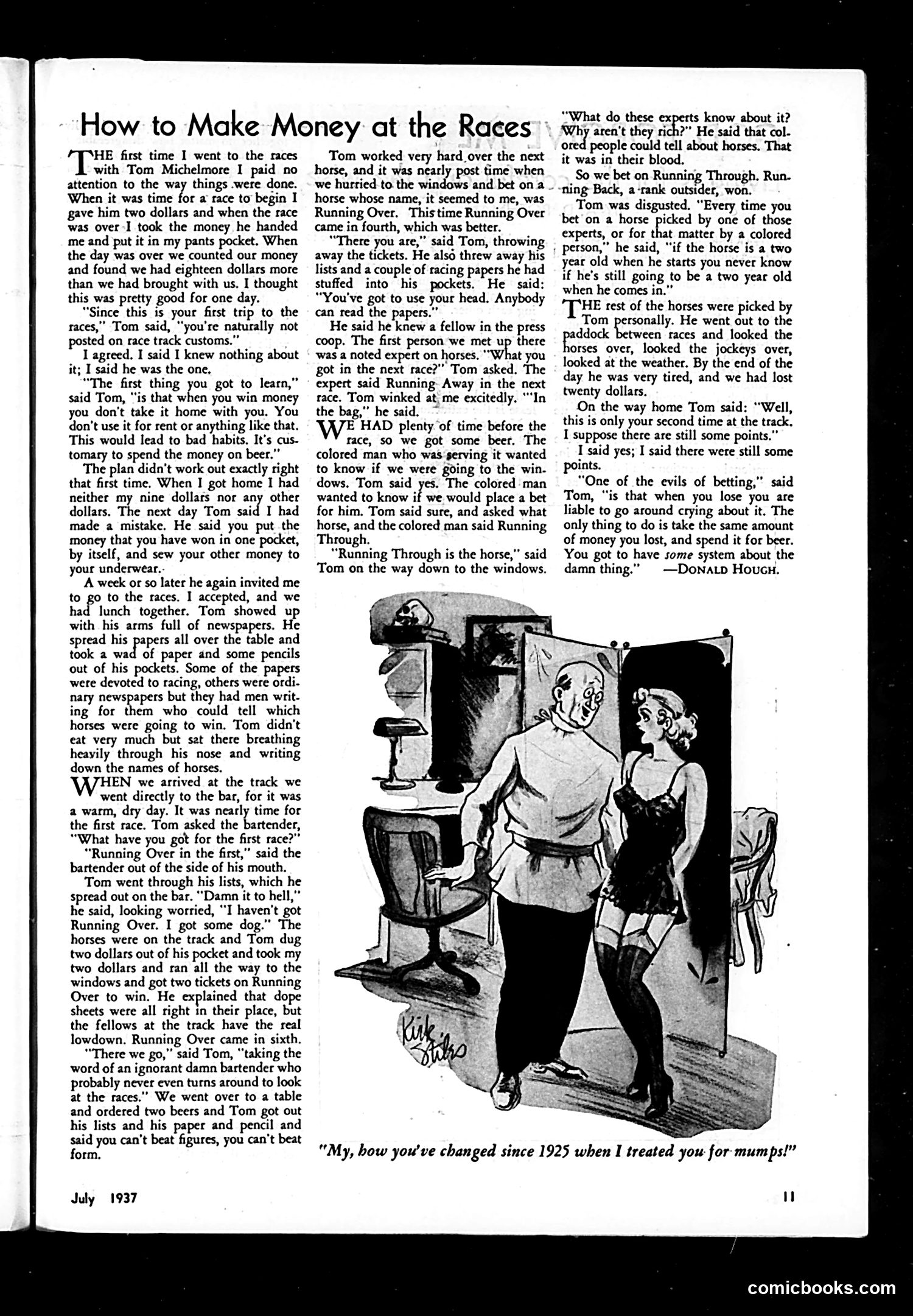
Explanation for Modern Readers This 1937 Judge magazine article satirizes amateur horse racing gamblers and their various "systems" for winning. The narrator accompanies his friend Tom to the racetrack. Tom employs contradictory strategies—first consulting racing "dope sheets" and expert predictions, then dismissing them as useless and relying instead on bartender tips or "inside" information from track insiders. Each approach fails spectacularly (horses finishing sixth, fourth, etc.). The satire targets the delusional confidence of casual bettors who constantly shift methods while losing money, convinced each new approach is foolproof. Tom's behavior—obsessively analyzing papers, breathing heavily while researching, discarding systems on whims—portrays the compulsive irrationality underlying gambling addiction. The accompanying cartoon (captioned about treating someone for "mumps" in 1925) appears to be a separate joke about physical transformation or aging. The piece mocks the universal gambler's self-deception: that luck can be systematized through research, expertise, or insider knowledge.
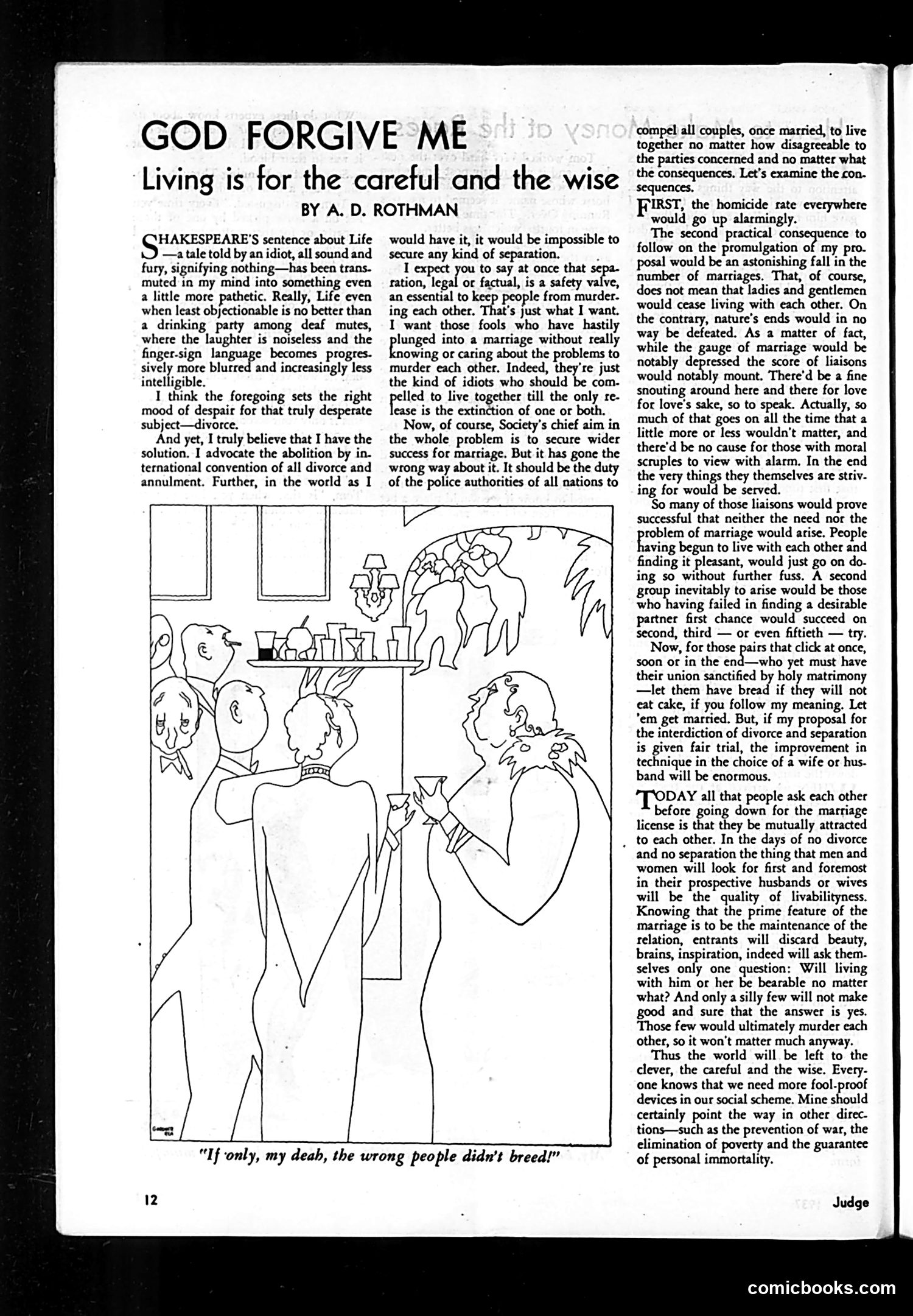
Analysis of "God Forgive Me" by A.D. Rothman This is a satirical essay proposing the abolition of divorce by international law—a deliberately absurd argument meant to critique both marriage and social hypocrisy. The Argument: Rothman proposes that if divorce were impossible, couples would be forced to live together regardless of compatibility, resulting in higher homicide rates. This would discourage hasty marriages, he claims, pushing people toward unmarried cohabitation instead—which he suggests already happens anyway and produces the same social outcomes. The Satire's Point: By following his "logic" to its dark conclusions (murder rates rising, moral pretense exposed), Rothman reveals the hypocrisy of those defending indissoluble marriage: they claim it protects morality while ignoring that people live together without marriage already. The cartoon caption—"If only, my deah, the wrong people didn't breed!"—reinforces the satirist's misanthropic view that the real problem isn't divorce law, but human foolishness itself. Historical Context: This reflects 1920s-30s debates over divorce liberalization, when conservative voices opposed making separation easier, while reformers championed personal freedom in marriage.
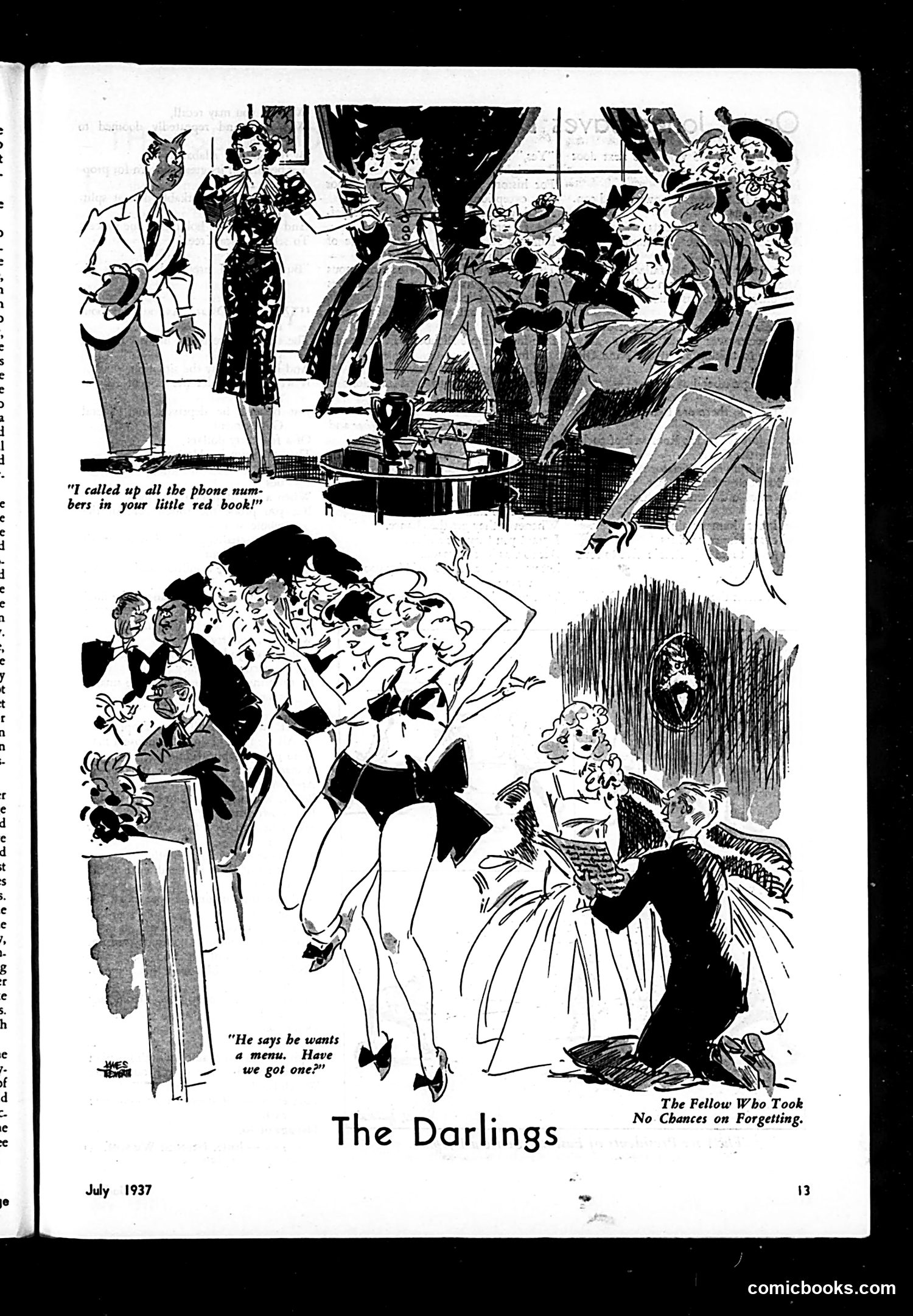
"The Darlings" - July 1937 This two-panel cartoon satirizes upper-class social life during the Depression era. The top panel shows a woman boasting about calling all the numbers in a man's "little red book"—a reference to a romantic contact list, suggesting infidelity or philandering. The bottom panel depicts an awkward dinner party where a guest asks for a menu, implying the hosts are too poor or unprepared to provide proper service—likely a dig at wealthy people's pretensions during economic hardship. The humor targets both gender dynamics (the woman's jealousy/aggression) and class contradictions (the wealthy struggling to maintain appearances). The cartoonish style and exaggerated expressions are typical of Judge magazine's satirical approach to contemporary social situations.
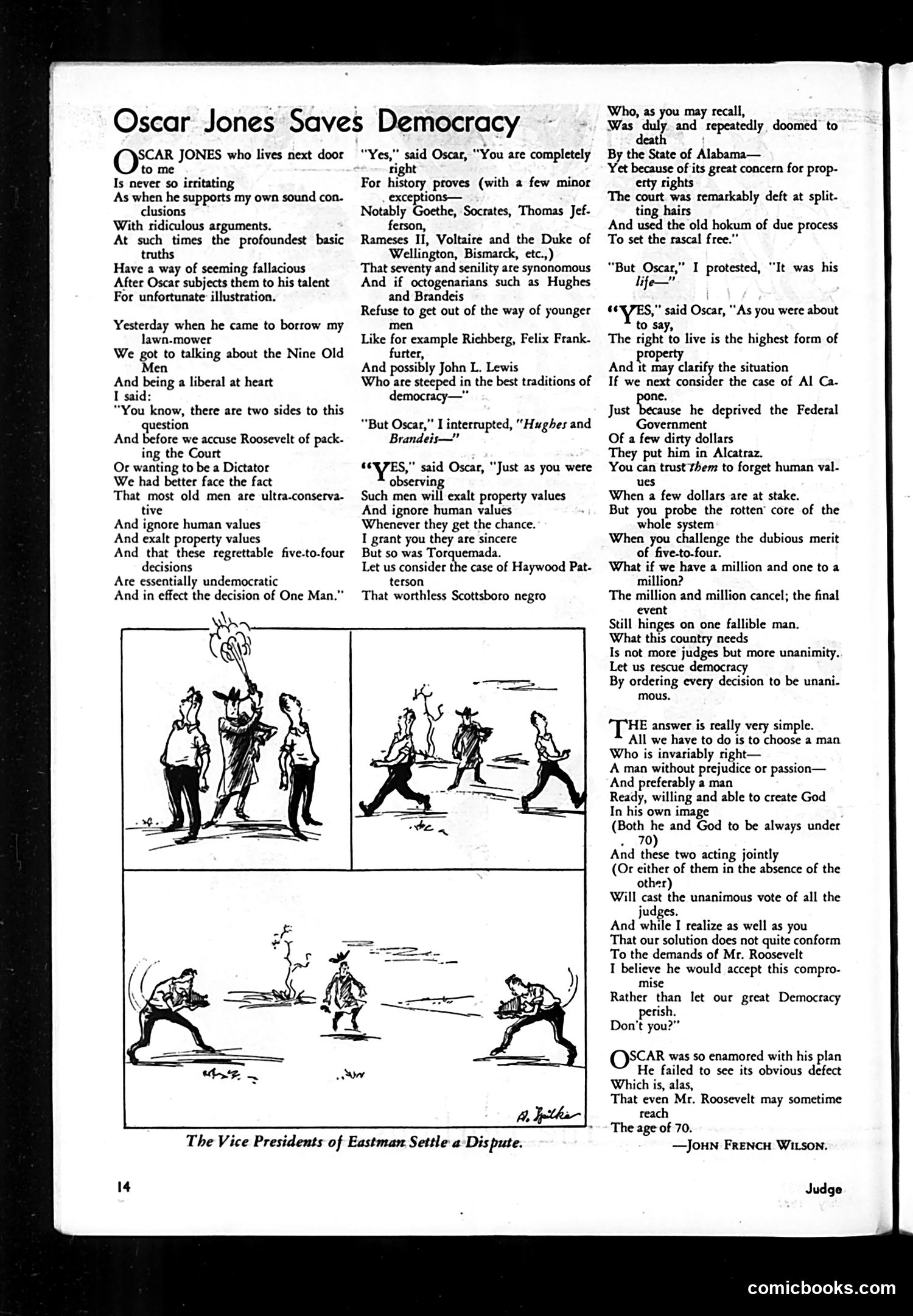
"Oscar Jones Saves Democracy" This satirical piece from Judge magazine mocks the debate over FDR's 1937 court-packing scheme. The narrator (a liberal) correctly criticizes the Supreme Court's "Nine Old Men" for blocking progressive legislation through narrow 5-4 decisions. His neighbor Oscar agrees but then absurdly "proves" the point by citing examples like Al Capone and Haywood Patterson, conflating unrelated cases. Oscar's "solution" becomes increasingly ridiculous: replace the five-justice majority with one infallible man (preferably under 70) who embodies perfect judgment and divine wisdom. The cartoons illustrate this escalating absurdity. The satire cuts both ways—it mocks the court's conservatism while simultaneously exposing how Roosevelt's critics (and defenders) could rationalize dangerous concentrations of power. By taking Oscar's logic to its logical extreme, author John French Wilson suggests that both sides of this constitutional debate risk abandoning democratic principles.
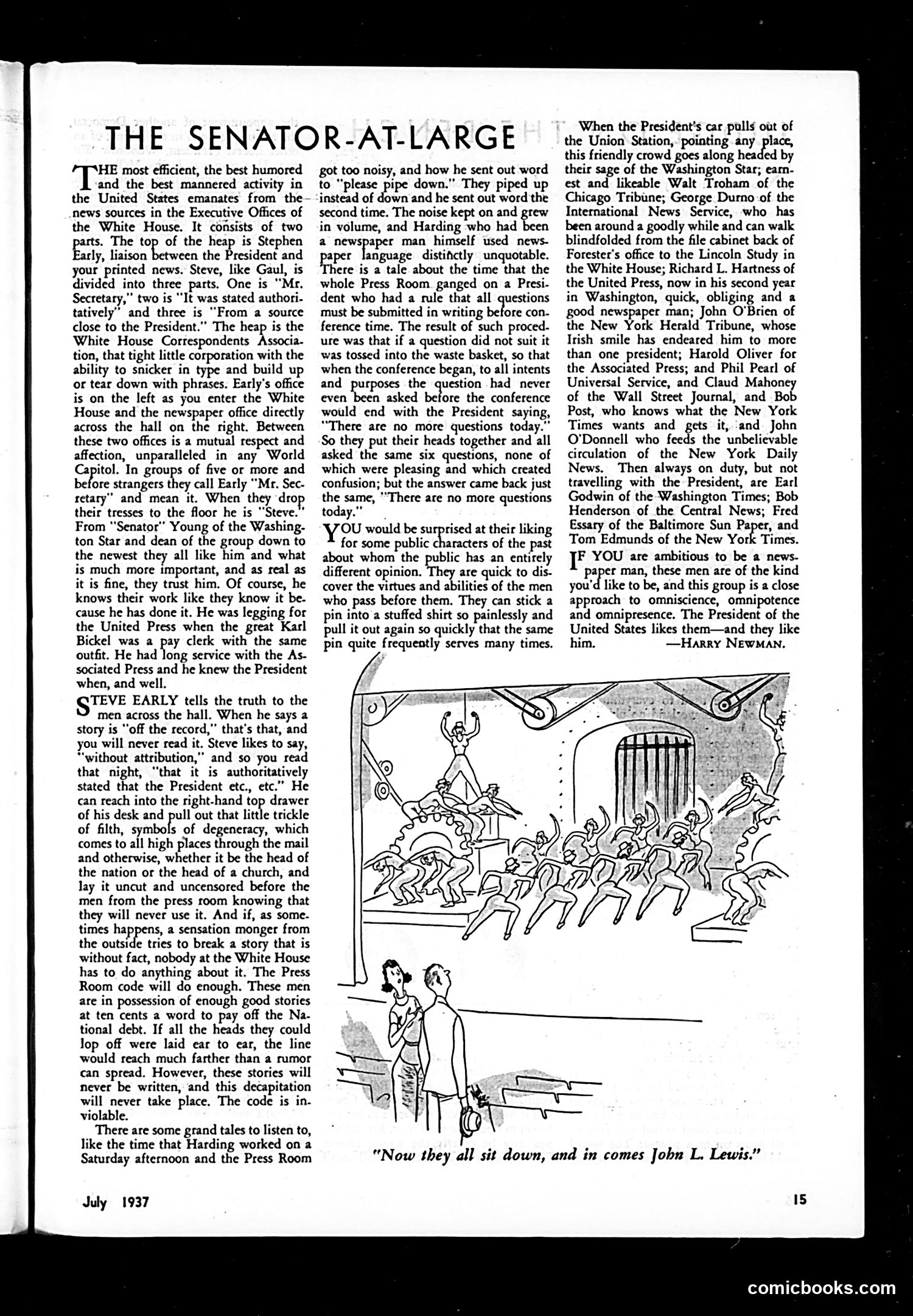
"The Senator-at-Large": White House Press Relations, 1937 This article celebrates Stephen Early, President Franklin D. Roosevelt's press secretary, as a skilled intermediary between the White House and newspaper correspondents. The text praises Early's integrity: he honors "off the record" statements and uses careful language ("without attribution") to convey official positions while protecting sources. The cartoon illustrates the Press Room code of honor—an unwritten agreement where journalists possess damaging stories about politicians but voluntarily suppress them. The article notes that press secretaries can even share disreputable material ("filth, symbols of degeneracy") confident reporters won't publish it. The anecdote about President Harding shows mutual respect: when reporters ignored his request for quiet, Harding responded with "newspaper language distictly unquotable"—implying even presidents acknowledged the press's informal power. This reflects 1937's symbiotic relationship between government and press: journalists gained access and information; officials received favorable coverage and discretionary silence about embarrassing facts.
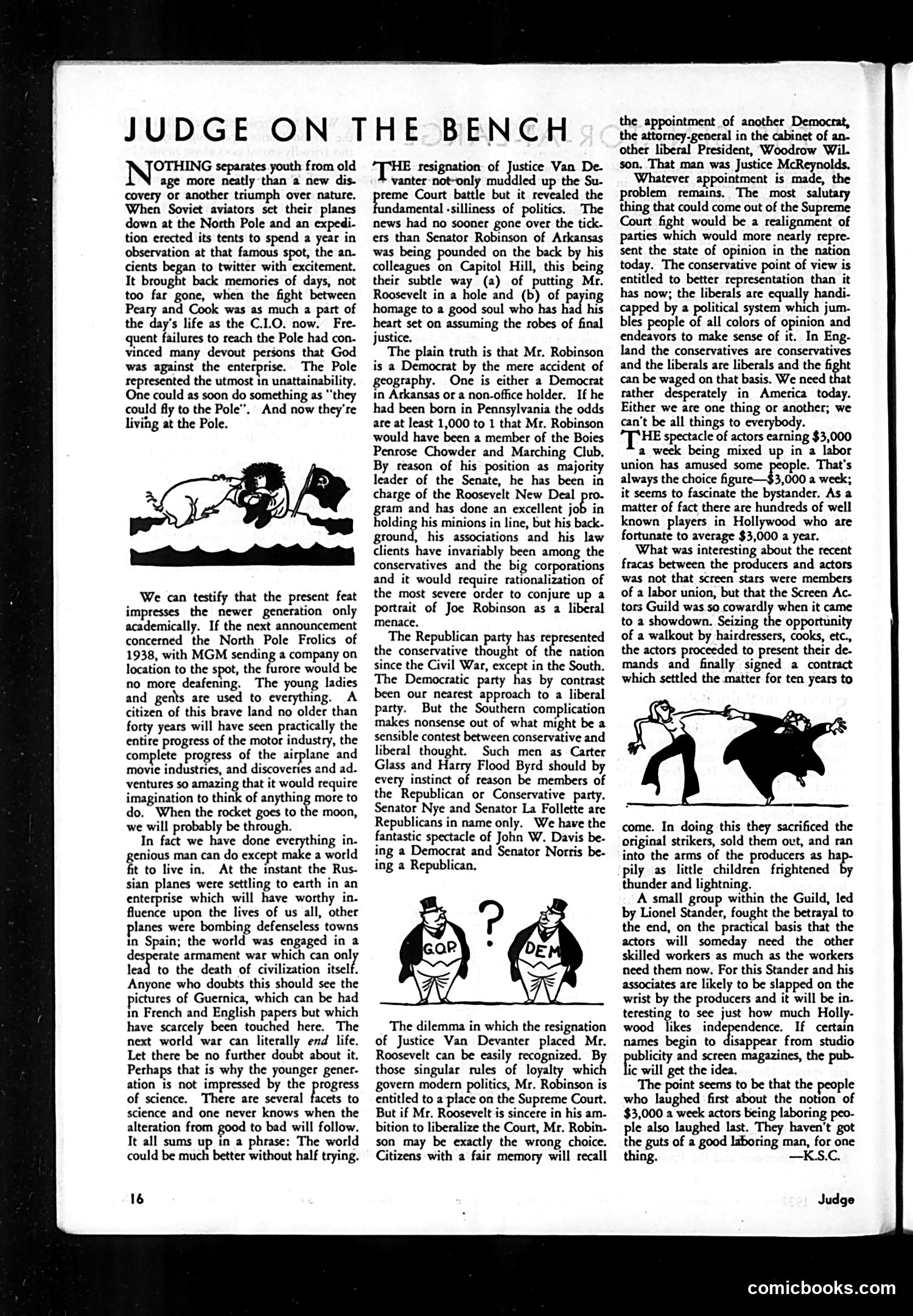
Political Commentary: Judge Magazine on Justice Van Devanter's Resignation This editorial page discusses Justice Van Devanter's Supreme Court resignation during Franklin D. Roosevelt's presidency. The text argues that Senator Joseph Robinson of Arkansas—tapped to potentially replace him—is a Democrat "by mere accident of geography" rather than genuine liberal conviction. Robinson's actual associations were with conservatives and corporations, making his appointment politically complicated. The cartoon figures (labeled "GOP" and "DEM") illustrate the dilemma: both parties faced awkward choices regarding the Court seat. The article critiques how politicians cynically exploited the vacancy—colleagues "pounding on Robinson's back" both to support him and subtly embarrass Roosevelt. The broader page also discusses scientific progress (Soviet Arctic expeditions, aviation) contrasted with humanity's failure to create a peaceful world, condemning contemporary bombing in Spain and the arms race. The satire suggests civilization advances technologically while remaining morally primitive.
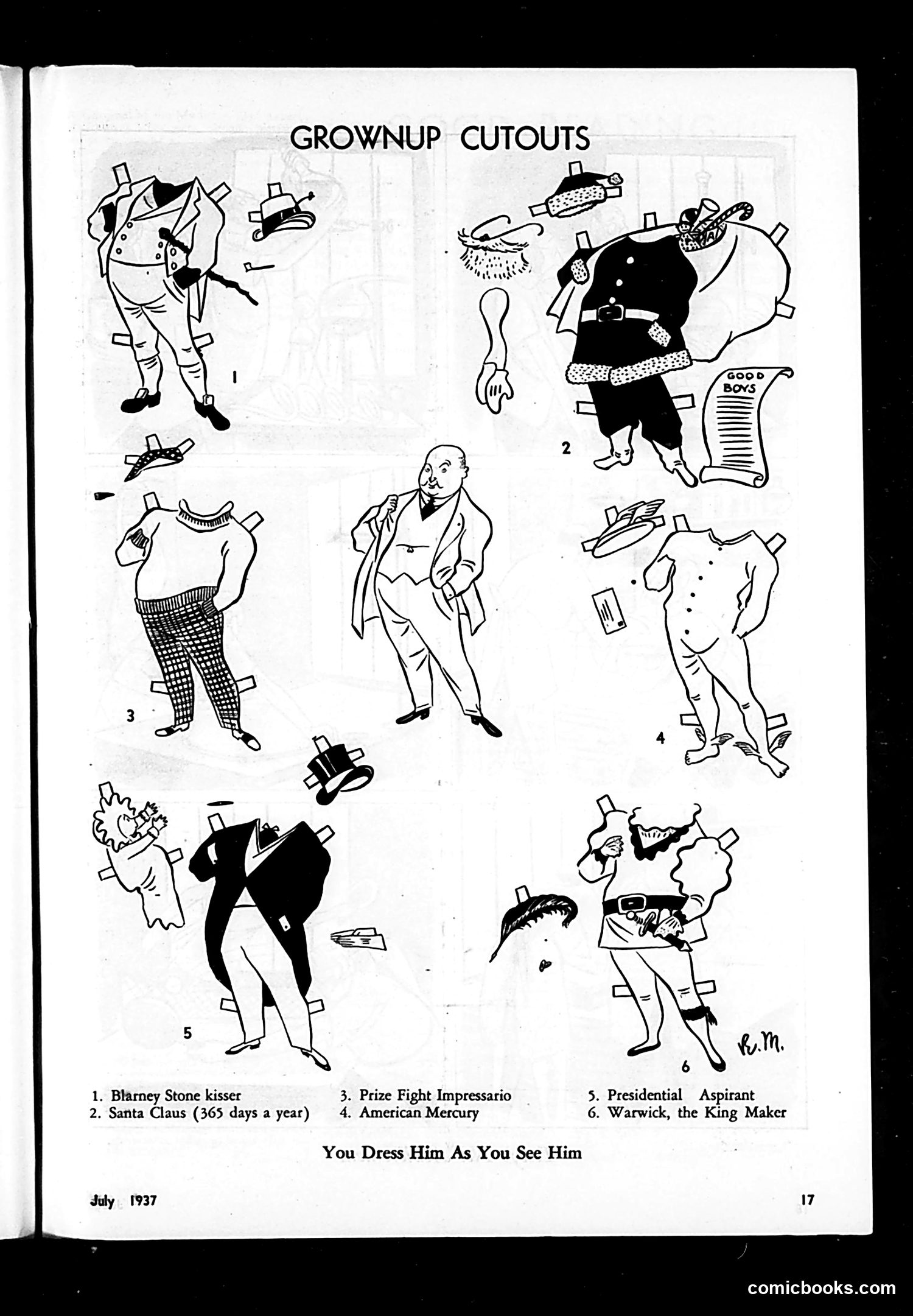
Grownup Cutouts - July 1937 This page presents paper dolls for adults—satirical character cutouts with interchangeable clothing representing stereotypical figures of the era. Each figure represents a social or political type: 1. Blarney Stone kisser - Irish stereotype 2. Santa Claus (365 days a year) - perpetually jolly figure 3. Prize Fight Impresario - boxing promoter 4. American Mercury - likely referencing the magazine or its editor 5. Presidential Aspirant - political candidate 6. Warwick, the King Maker - historical reference to the medieval English nobleman who manipulated royal succession, implying modern political kingmakers The tagline "You Dress Him As You See Him" suggests the satire: readers can construct these recognizable types by mixing and matching clothing, implying these are interchangeable social archetypes rather than genuine individuals. It's commentary on how people perform social roles rather than possess authentic character.
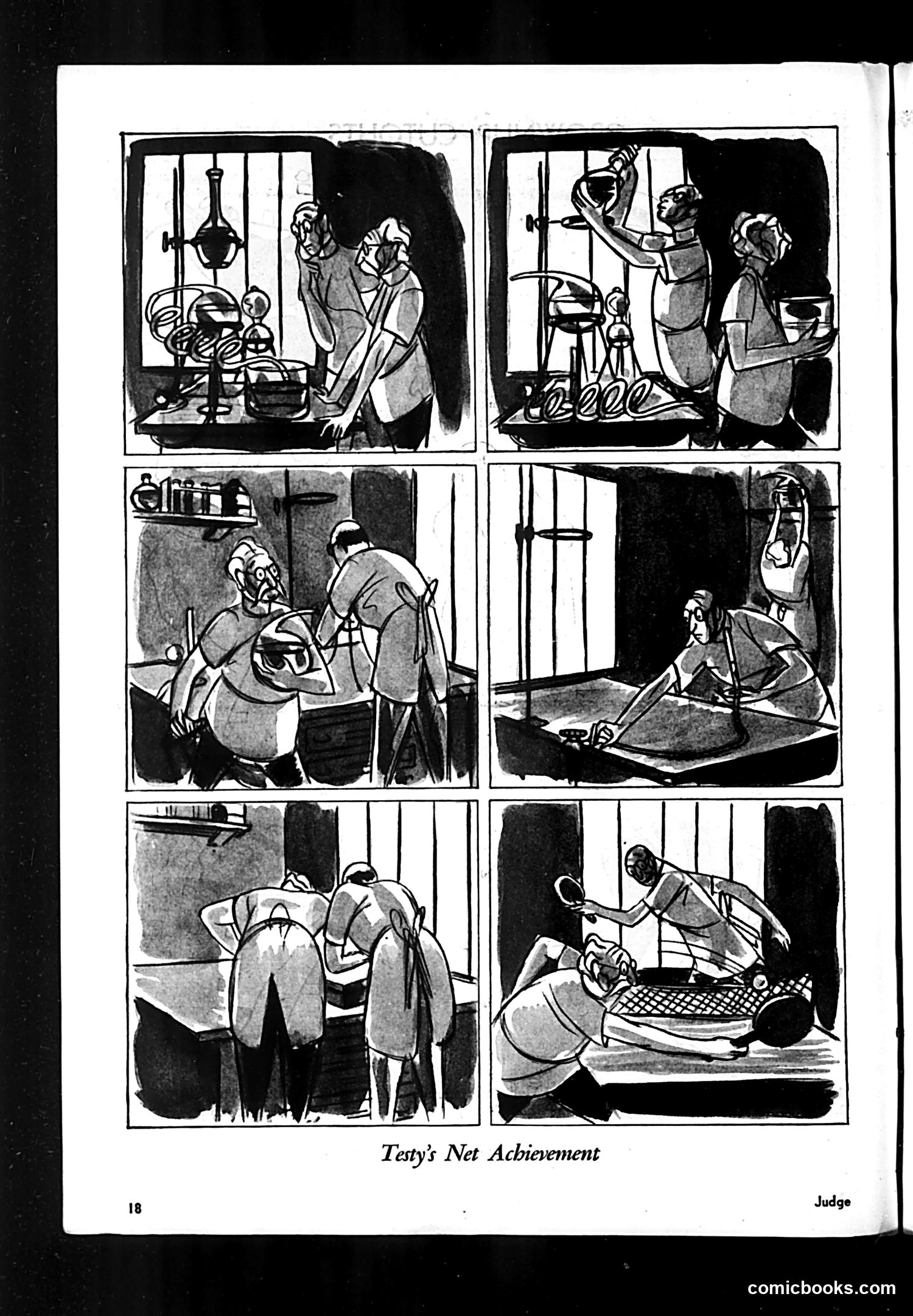
"Testy's Net Achievement" This six-panel comic from *Judge* magazine satirizes someone named "Testy" (likely a character or public figure) engaging in various domestic and social activities. The title "Net Achievement" suggests ironic commentary on accomplishments or lack thereof. The panels show characters in what appears to be a kitchen or laboratory setting with hanging apparatus, followed by scenes of physical altercation, medical examination, and domestic chaos—culminating in what looks like fishing or net-related activity. Without clearer identification of "Testy" or the specific historical context, the exact satirical target remains unclear. The comic appears to mock either incompetence, domestic disorder, or perhaps a specific contemporary figure's failed endeavors, but the specific reference escapes modern recognition.
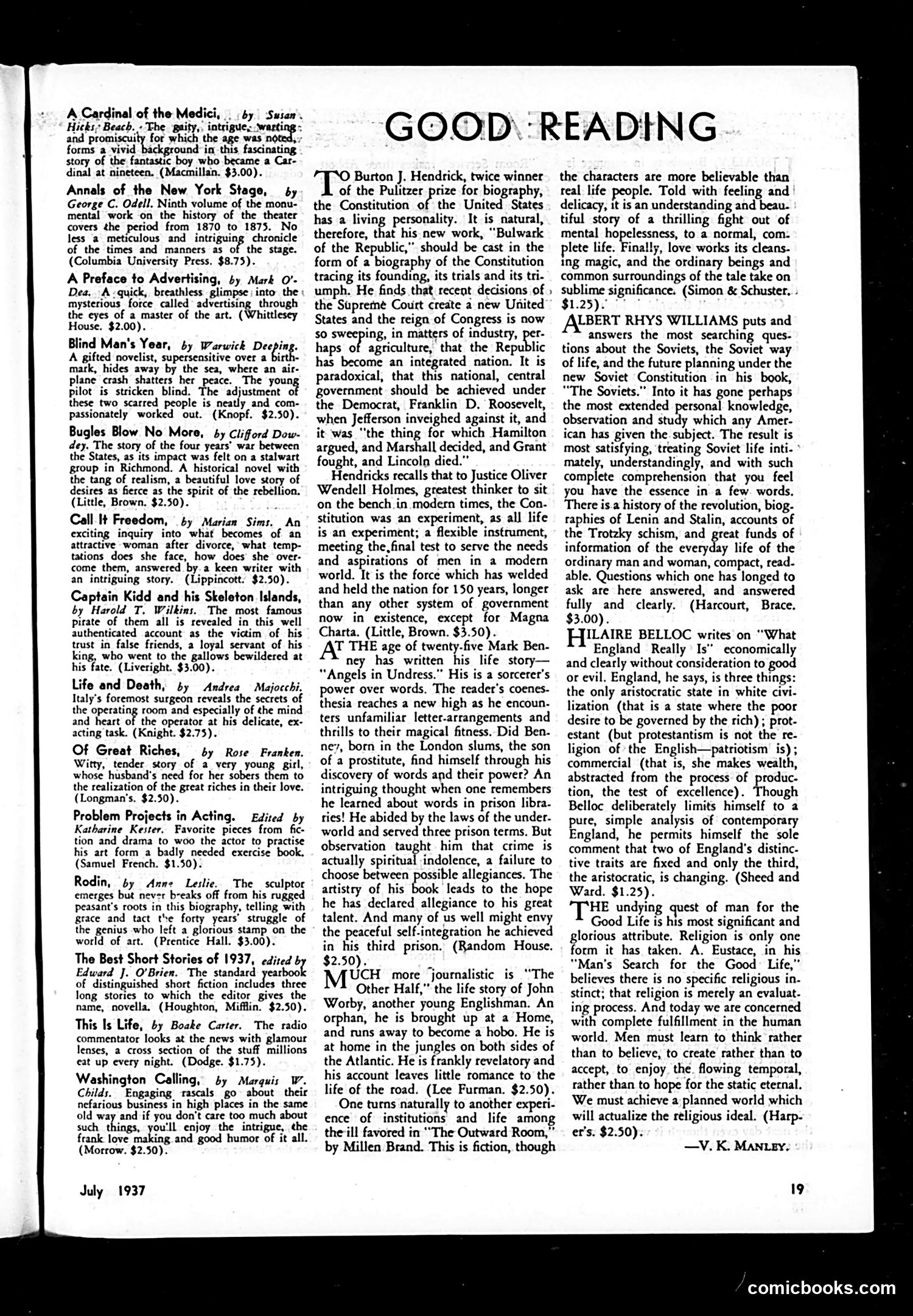
This page is primarily a book review section from Judge magazine (July 1937), not a political cartoon. The "GOOD READING" column presents brief reviews of contemporary novels and non-fiction works, including titles about the American Constitution, theater history, advertising, and various fictional narratives. The only substantive political-social reference appears in Burton J. Hendrick's review of "Bulwark of the Republic," which discusses the Constitution as a "living personality" shaped by historical events and Supreme Court decisions—emphasizing how the document evolved through crises like Jefferson's conflicts with Congress and the Civil War. Albert Rhys Williams's review of a book about the Soviet Union reflects 1930s American intellectual interest in communist ideology, presenting it as a serious subject for analysis rather than outright dismissal. Otherwise, the page reflects typical 1930s literary interests: historical fiction, romance, and biographical works about artists and public figures. No cartoons are visible.
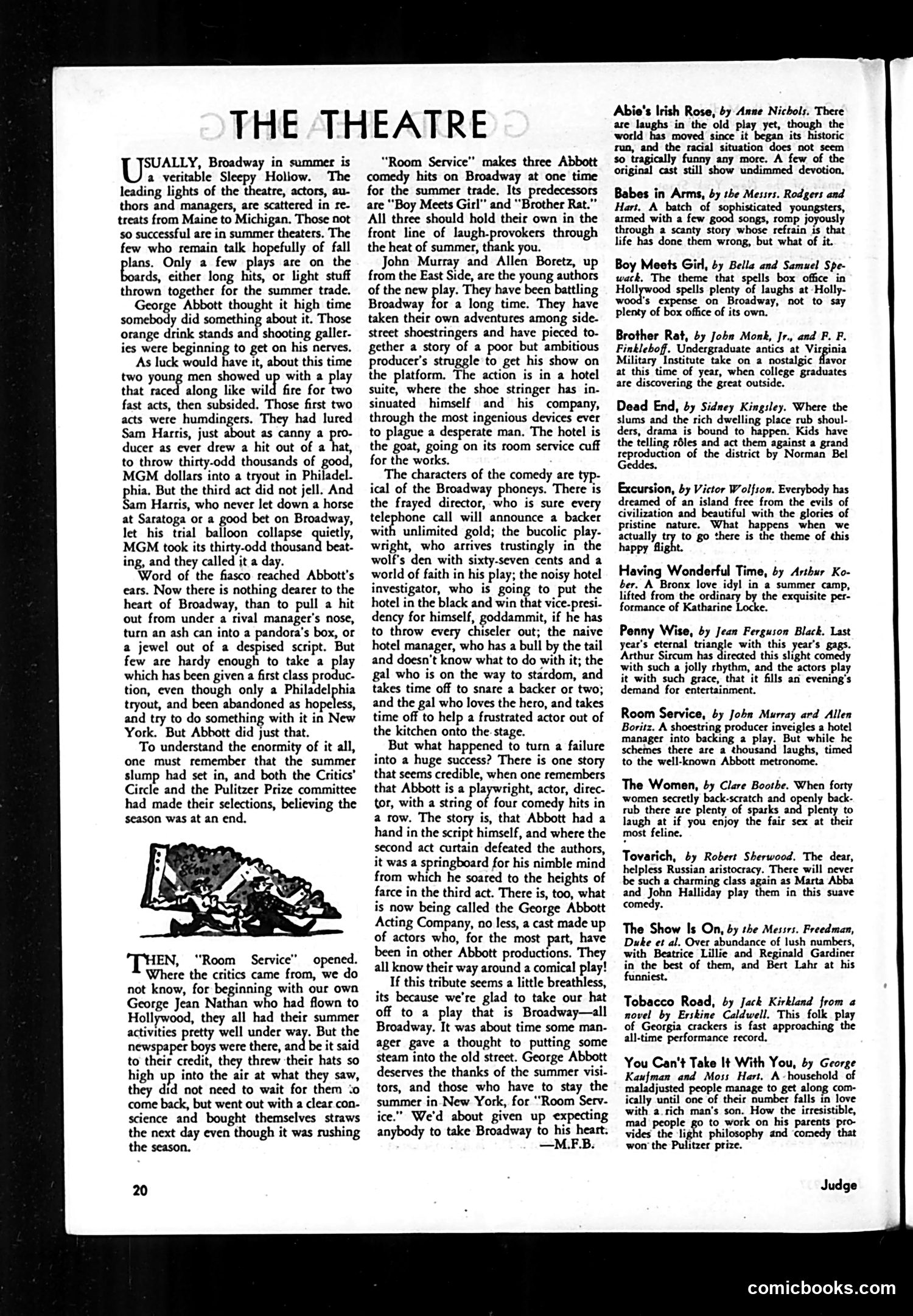
"The Theatre" Page Analysis This is a theater review column in *Judge* magazine focused on Broadway productions. The main illustrated element appears to be a small cartoon showing theatrical props or stage debris. The text discusses George Abbott's success reviving "Room Service," a play that had failed in a Philadelphia tryout but became a hit on Broadway. The reviewer praises Abbott's audacity in attempting to salvage a rejected script when most producers would abandon it. The column also reviews other current Broadway shows like "Boy Meets Girl," "Brother Rat," "Dead End," and "Penny Wise." The tone is witty and gossipy, typical of Broadway commentary of this era. The satire is gentle—poking fun at Broadway's summer slowdown, the fickleness of theater producers, and the stereotypical characters found in comedies (the desperate director, naive playwright, etc.). There's no political content; this is purely entertainment industry commentary celebrating Abbott's theatrical acumen during what was typically a slow season.
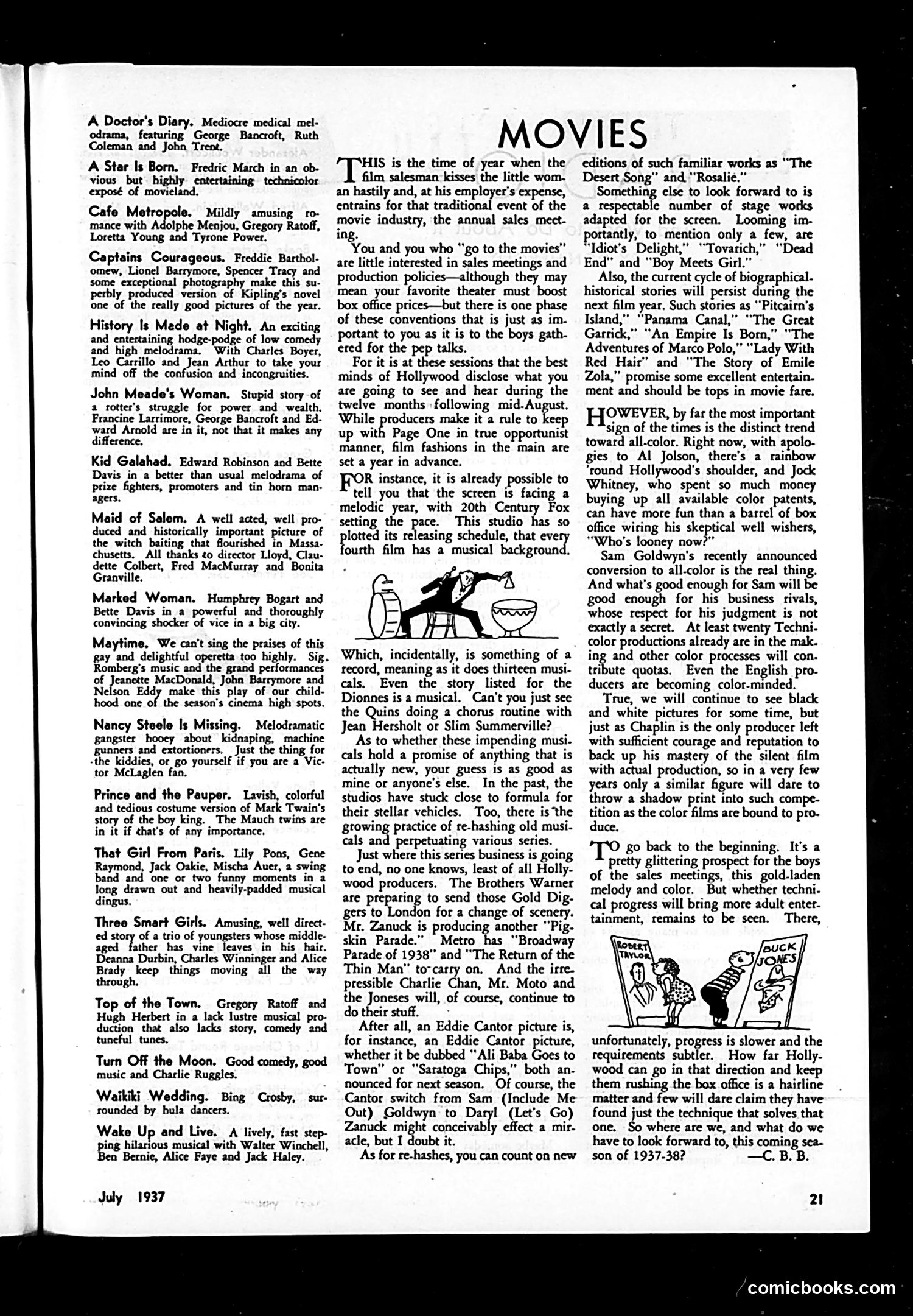
Analysis of Judge Magazine Movie Column (July 1937) This page is primarily a movie review column with minimal political content. The text discusses upcoming films and industry trends rather than satire. The small cartoon at bottom right appears to show film industry figures in a casual dispute—likely satirizing Hollywood's competitive nature or business practices, though specific individuals aren't clearly identifiable from the image. The column's main point concerns Technicolor's expansion: the reviewer notes that multiple studios are adopting color film production (mentioning 20th Century Fox's schedule), and predicts this will continue. The satire is gentle—expressing skepticism that color alone ensures quality, and joking that producers like Sam Goldwyn may oversell the technique's importance. The broader commentary suggests 1937 Hollywood's shift toward color as a marketing gimmick, with the reviewer maintaining that good storytelling matters more than technical novelty. The casual tone reflects typical trade publication commentary on industry business decisions rather than sharp political satire.
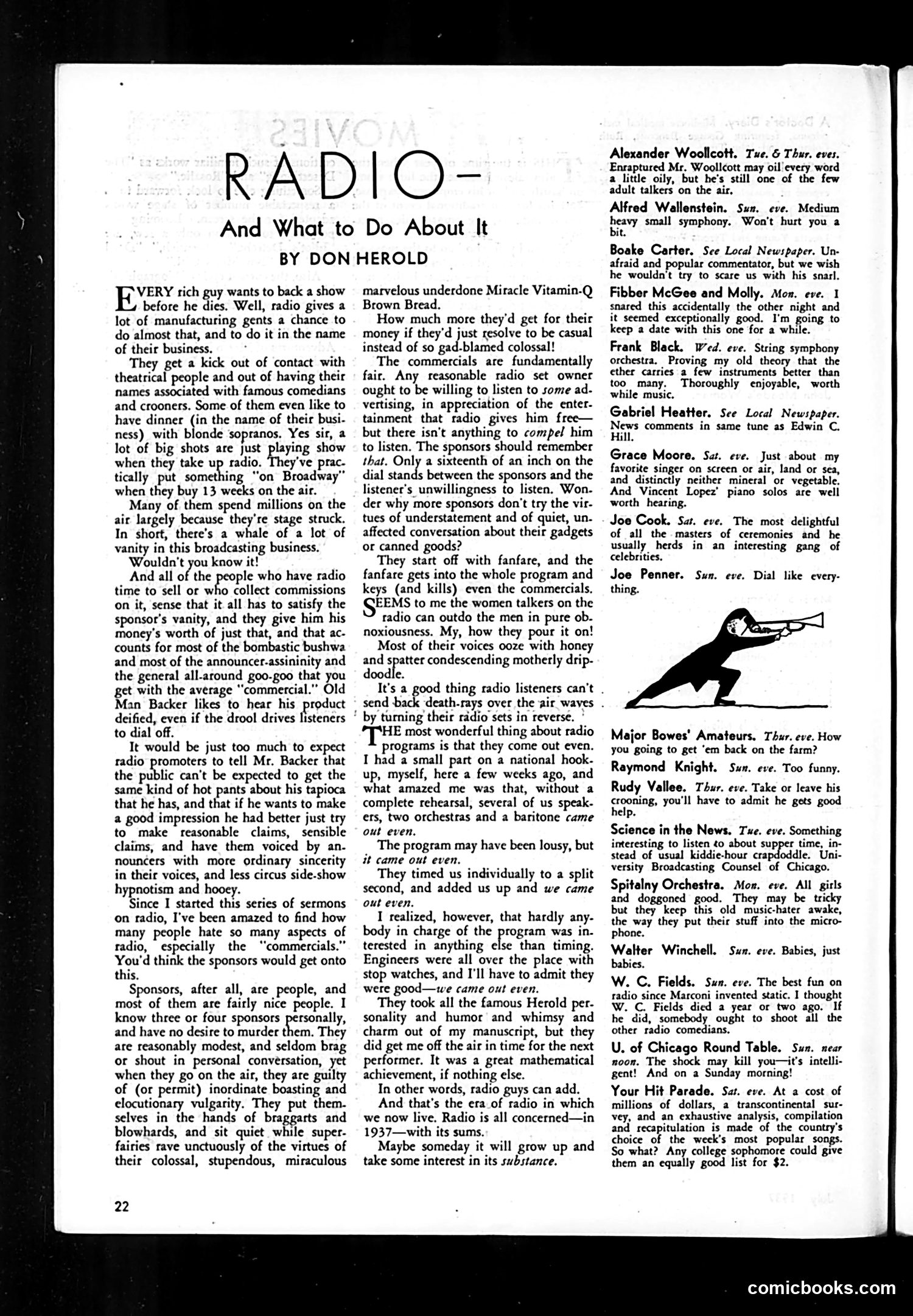
Analysis of "Radio—And What to Do About It" by Don Herold This is a satirical essay criticizing radio advertising practices in 1937. Herold targets wealthy business sponsors who fund radio shows primarily for vanity—seeking prestige by associating their names with entertainers and comedians rather than genuine marketing interest. The satire's core complaint: sponsors hire bombastic announcers and theatrical promoters who flatter their egos, resulting in absurdly overblown commercials ("colossal, stupendous, miraculous") that alienate listeners. Herold argues sponsors are actually modest people in person, yet permit vulgar, exaggerated advertising on air that drives people to change stations. He proposes a simple solution: reasonable, understated claims voiced with sincerity rather than "circus side-show hypnotism." He also mocks female radio personalities for their condescending, honey-dripped delivery ("drip-doodle"). The small cartoon shows a figure diving or falling—likely illustrating the "dial off" concept: listeners literally tuning away from annoying commercials.
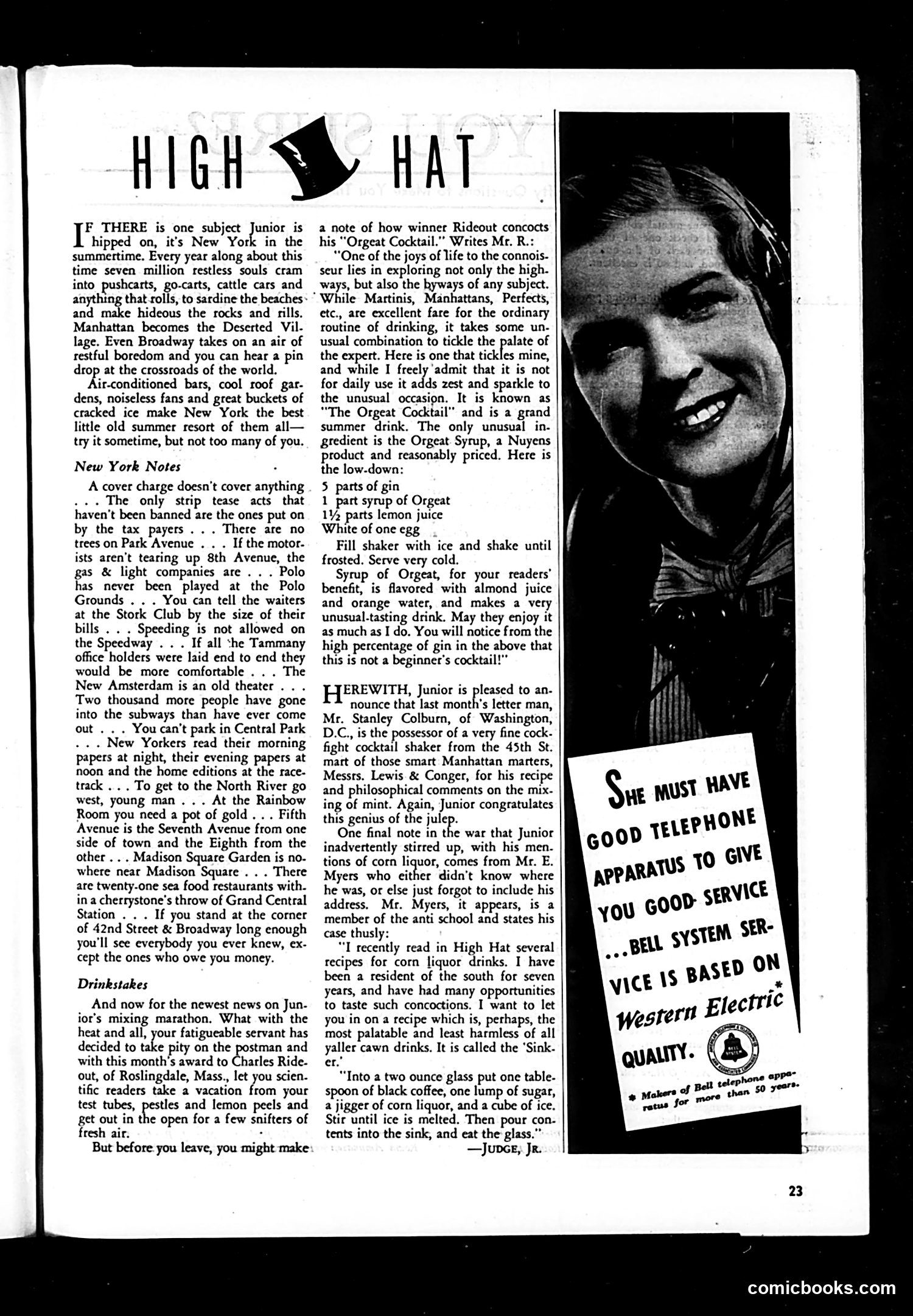
High Hat: New York Summer Satire This "High Hat" column satirizes New York City summer life through a series of mordant one-liners about Manhattan's contradictions and absurdities. The piece mocks tourist culture, civic infrastructure failures, and social pretension—New Yorkers read papers at the "wrong" times, the Polo Grounds never host polo, Tammany Hall politicians are corrupt, and you'll eventually see everyone at 42nd and Broadway except those who owe you money. The column also features "Drinkstakes," a humorous cocktail recipe contest. This month's winner, Charles Rideout of Massachusetts, submits an "Orgeat Cocktail"—a gin-heavy drink with almond-flavored syrup, lemon juice, and egg white. The satirical framing treats this as serious mixology expertise, typical of Judge's witty approach to leisure culture during Prohibition's waning years (this appears pre-1933). The accompanying Bell System telephone advertisement uses unrelated imagery.
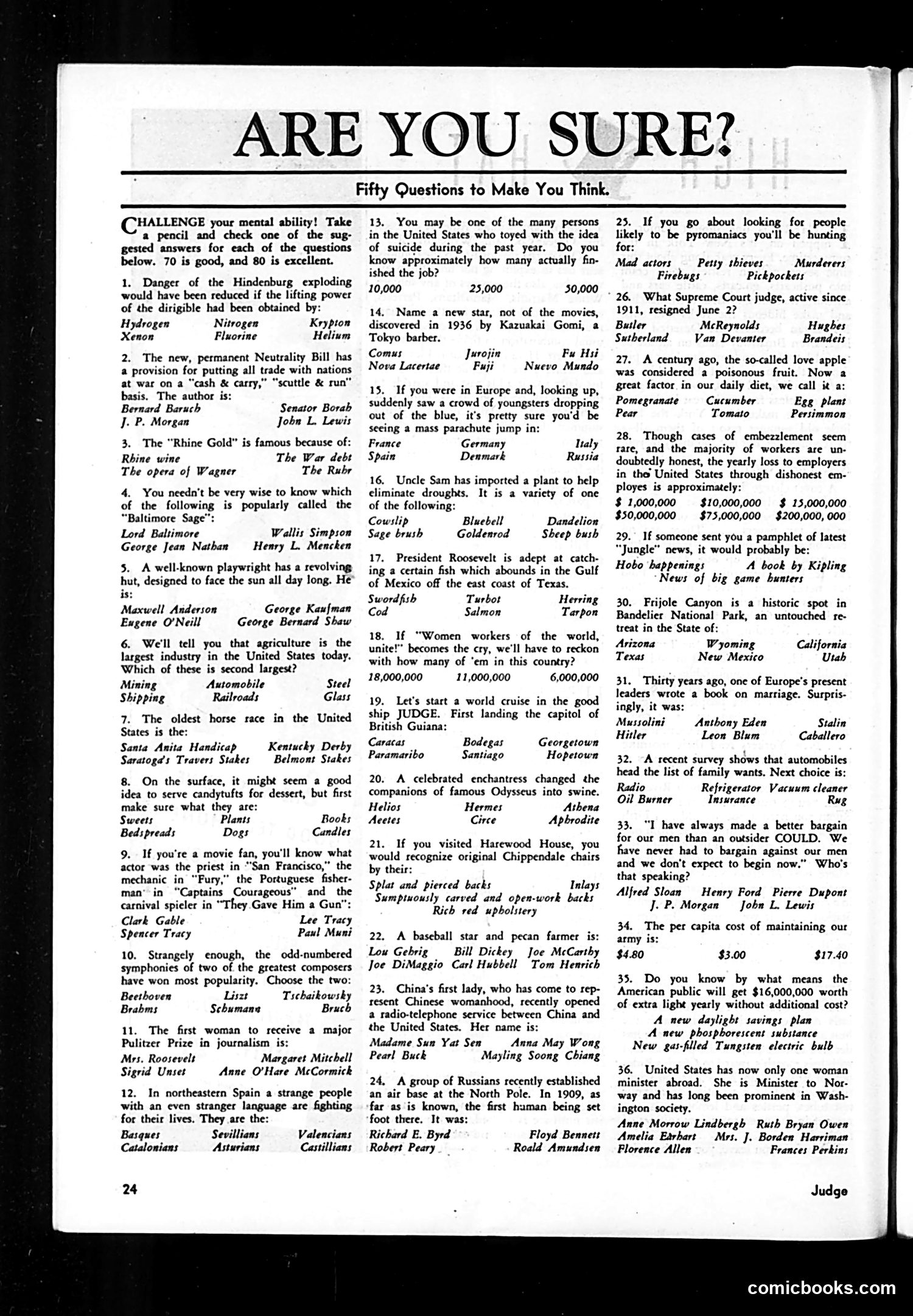
Analysis of "Are You Sure?" Page from Judge Magazine This page is a trivia quiz rather than a political cartoon. It's a "fifty questions" mental challenge titled "Are You Sure?" typical of Judge magazine's entertainment content. The questions reference 1930s contemporary figures and events: FDR's fishing hobby, the Hindenburg disaster, the Spanish Civil War (Basque fighters), neutrality legislation, and Depression-era concerns like suicide statistics. Questions about entertainers (Clark Gable, Spencer Tracy) and cultural figures (George Jean Nathan, Margaret Mitchell) reflect popular celebrity culture of the era. The satire is subtle—the quiz itself mocks reader pretensions to knowledge while touching on serious topics (suicide rates, labor unrest, war) with the light tone Judge typically employed. The juxtaposition of frivolous trivia (candytufts as a dessert) with grave subjects (question 13 on suicide) exemplifies the magazine's irreverent approach to current affairs.
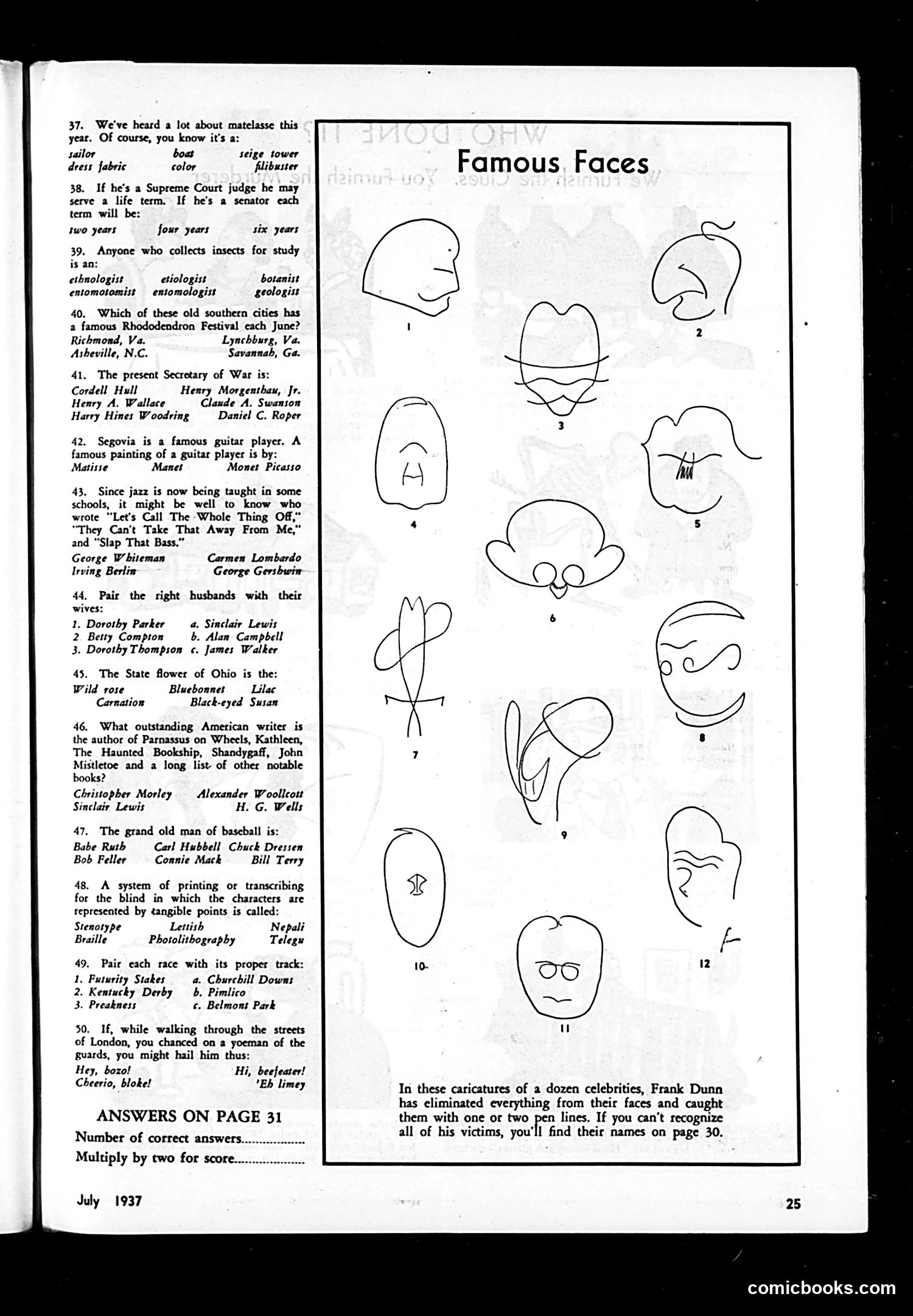
"Famous Faces" — July 1937 Judge Magazine This page combines a trivia quiz with a celebrity caricature challenge. The left side presents general knowledge questions covering 1937 topics: fabric terminology, Supreme Court terms, entomology, Southern cities, the Secretary of War (Harry Hines Woodring), famous artists (Picasso, Matisse), songwriters (Irving Berlin, George Gershwin), literary figures (Christopher Morley), and baseball legends (Babe Ruth, Connie Mack). The right side features minimalist line-drawn caricatures by Frank Dunn of "a dozen celebrities." The accompanying text explains Dunn stripped away all detail except one or two pen lines, challenging readers to identify the famous faces. The names appear on page 30 (not visible here). This reflects 1937 popular culture: readers were expected to recognize entertainment figures, politicians, and cultural icons through extreme simplification—a game testing both knowledge and visual wit typical of Judge's sophisticated humor.
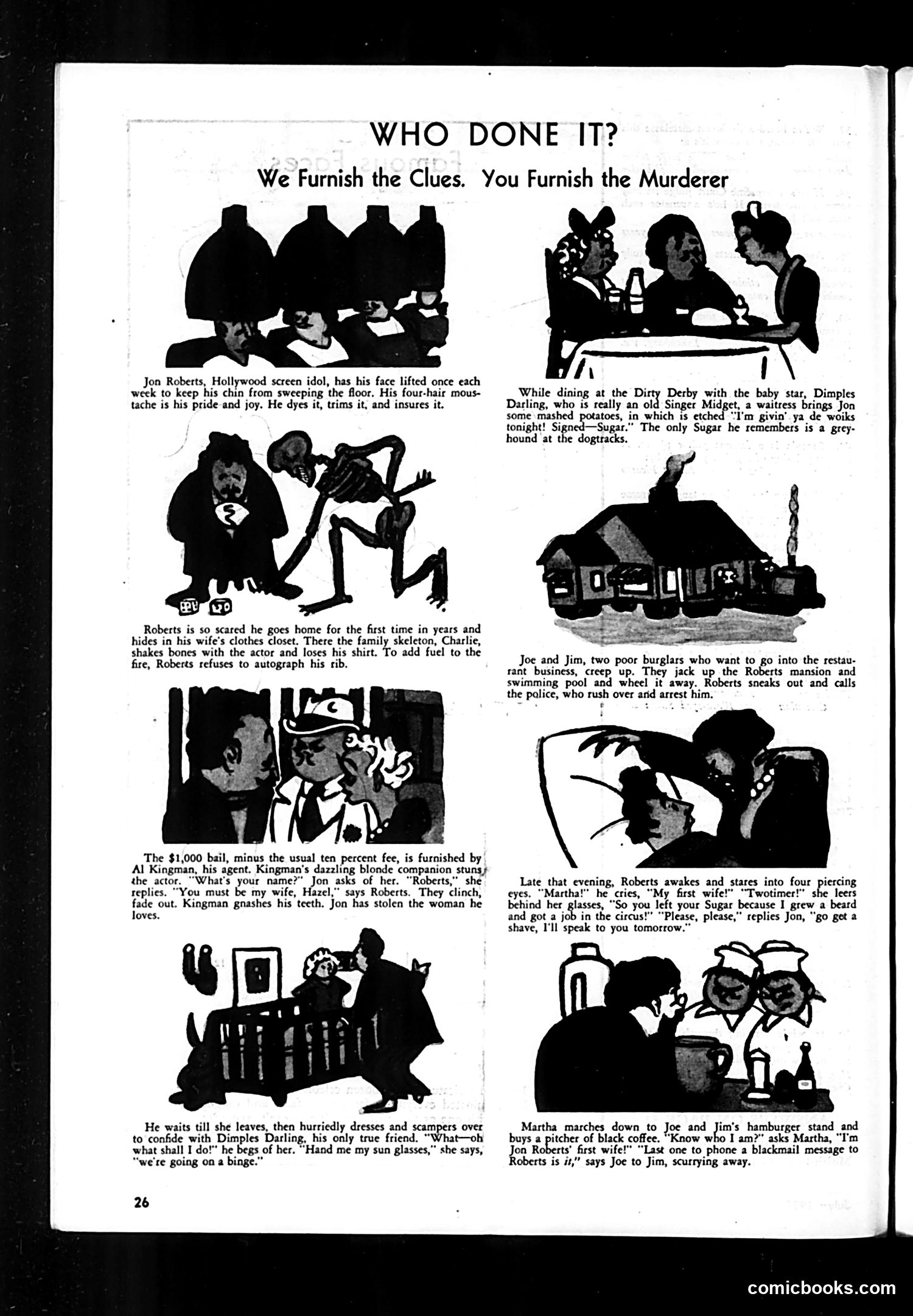
"Who Done It?" — A Judge Magazine Mystery Parody This page presents a serialized mystery plot as satirical entertainment. It lampoons Hollywood actor Jon Roberts through a convoluted, absurdist narrative involving mistaken identities, marital chaos, and criminal bumbling. The satire targets: - Vanity culture: Roberts obsessively maintains his appearance (weekly face-lifts, dyed mustache, insured facial hair), mocking Hollywood's superficiality. - Hollywood moral chaos: The plot involves infidelity, skeleton-in-the-closet family secrets, and romantic confusion—suggesting the film industry's moral disorder. - Class comedy: Poor burglars and circus performers populate the narrative alongside wealthy actors, emphasizing social pretension. The "you furnish the murderer" premise invites readers to solve who actually commits a crime amid the escalating absurdity. The humor relies on slapstick situations (stealing an entire mansion), exaggerated character types, and the sheer implausibility of the plot—typical of Judge's satirical approach to celebrity culture and American life.
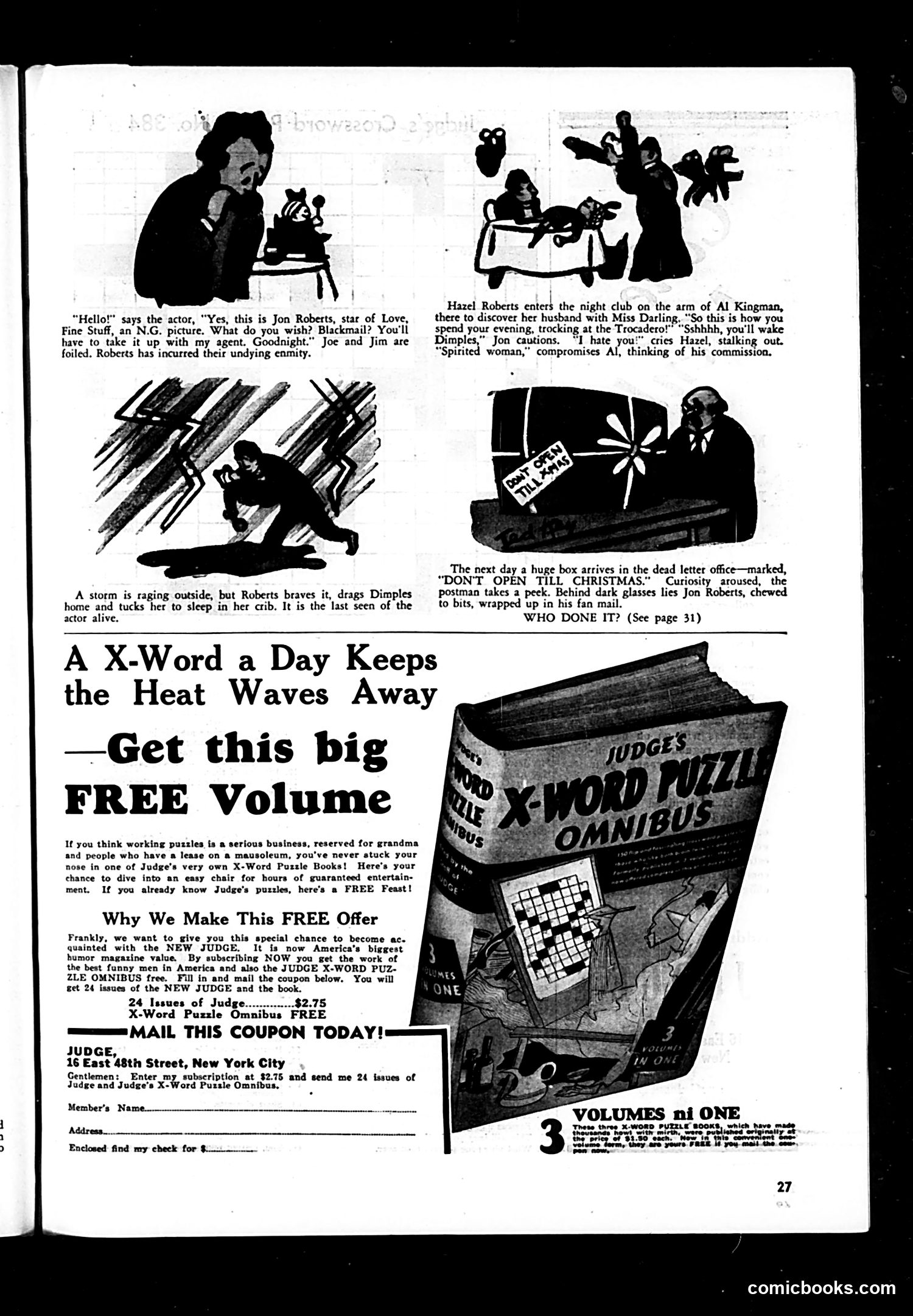
Analysis of Judge Magazine Page This page contains a murder mystery comic strip (top half) and an advertisement (bottom half). The strip depicts actor Jon Roberts being blackmailed by two men (Joe and Jim) over an unspecified scandal. Roberts refuses to pay. Later, his wife Hazel discovers him at a nightclub with another woman (Miss Darling), leading to marital conflict. The next day, Roberts arrives at the dead letter office in a box marked "Don't Open Till Christmas"—murdered and mutilated, wrapped in fan mail. The strip ends as a "whodunit" puzzle, directing readers to page 31 for the solution. The bottom half advertises Judge magazine itself, offering a free X-Word Puzzle Omnibus book to new subscribers. The pitch emphasizes Judge as "America's biggest humor magazine value" and appeals to readers seeking entertainment and mental stimulation during hot summer weather. This represents typical Judge content: satirical narrative fiction combined with self-promotional advertising for the magazine.
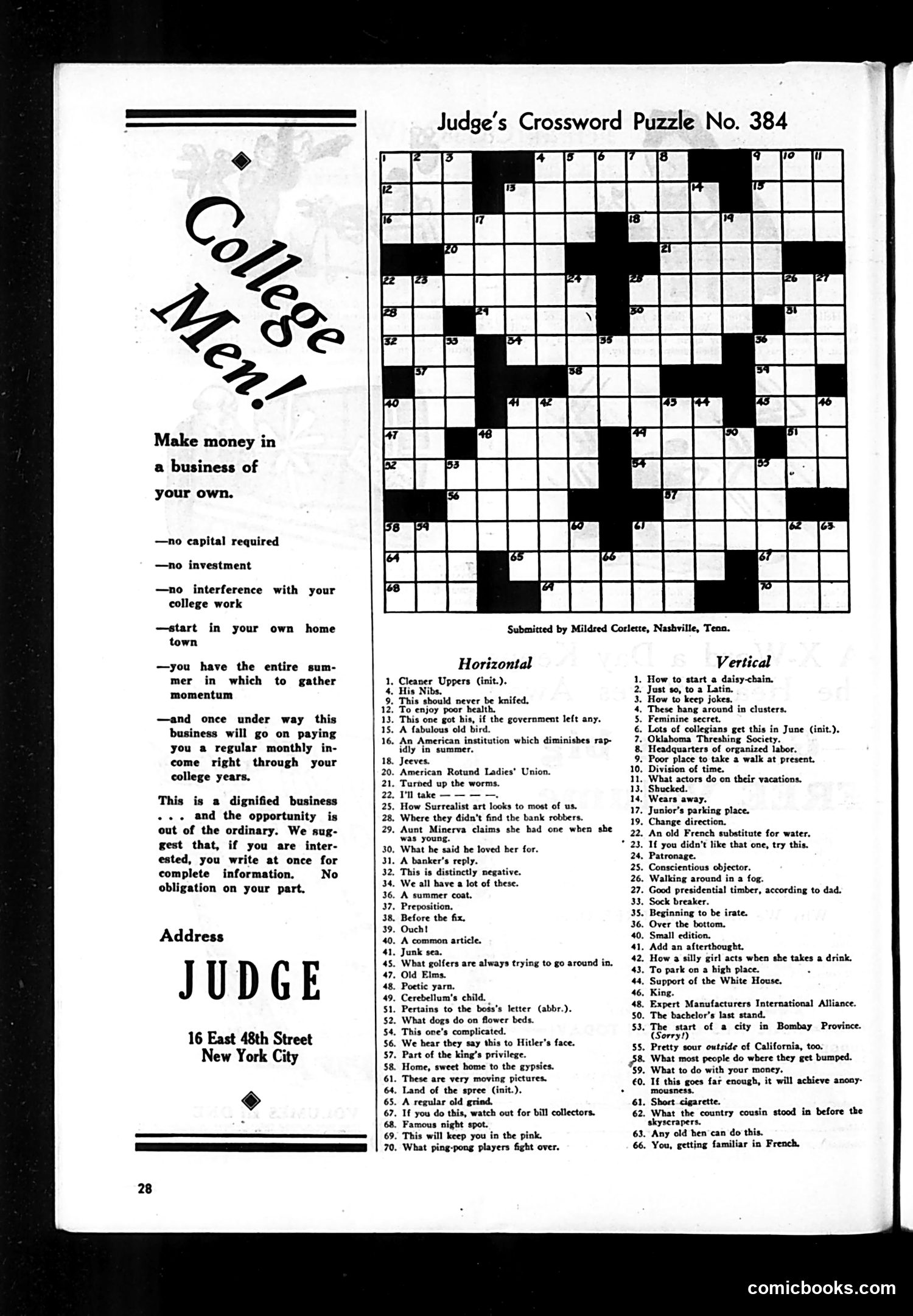
Judge Magazine Page Analysis This page is primarily advertising and a crossword puzzle, not political satire. The left side features a recruitment advertisement for Judge magazine itself, soliciting subscription agents. It promises college students a profitable summer business requiring no capital, investment, or interference with studies—essentially a magazine sales job they could operate from home. The right side is a standard crossword puzzle (No. 384) submitted by a Nashville reader. The clues are typical crossword wordplay with light humor: puns, riddles, and cultural references of the era (1930s-40s, based on style). Examples include "His Nibs" (a character), references to Jeeves (fictional butler), Oklahoma Threshing Society, and dated slang. No political figures or satire are present—this is routine magazine filler content aimed at readers seeking leisure activities and potential income opportunities during the Depression or wartime era.
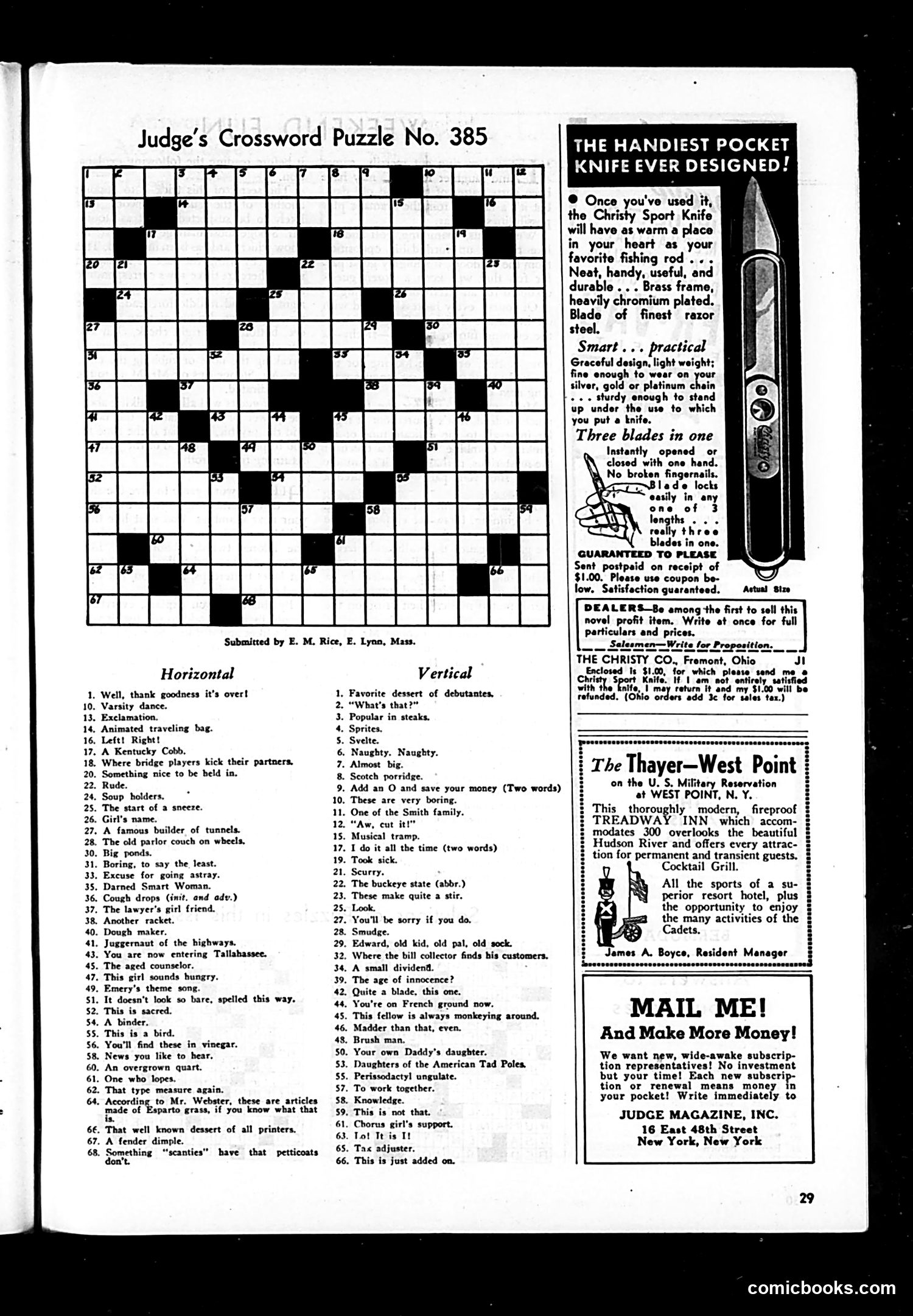
Judge Magazine Page 385: Content Analysis This page is primarily a crossword puzzle with accompanying advertisements—not a political cartoon. The puzzle itself contains no satirical content; it's a standard word game with clues submitted by E. M. Rice of E. Lynn, Massachusetts. The clues reference everyday 1930s-40s topics (bridge players, parlor couches, Kentucky Cobb, Tallahassee), offering no particular political or social commentary. The advertisements include: - A Christy Sport Knife promotion (pocket knife with three blades) - The Thayer-West Point hotel at the U.S. Military Academy - A "Mail Me!" subscription pitch from Judge Magazine None of these ads contain satire or hidden meanings—they're straightforward commercial pitches typical of the era. The page represents filler content common in magazines, designed to entertain readers while generating revenue through advertising.
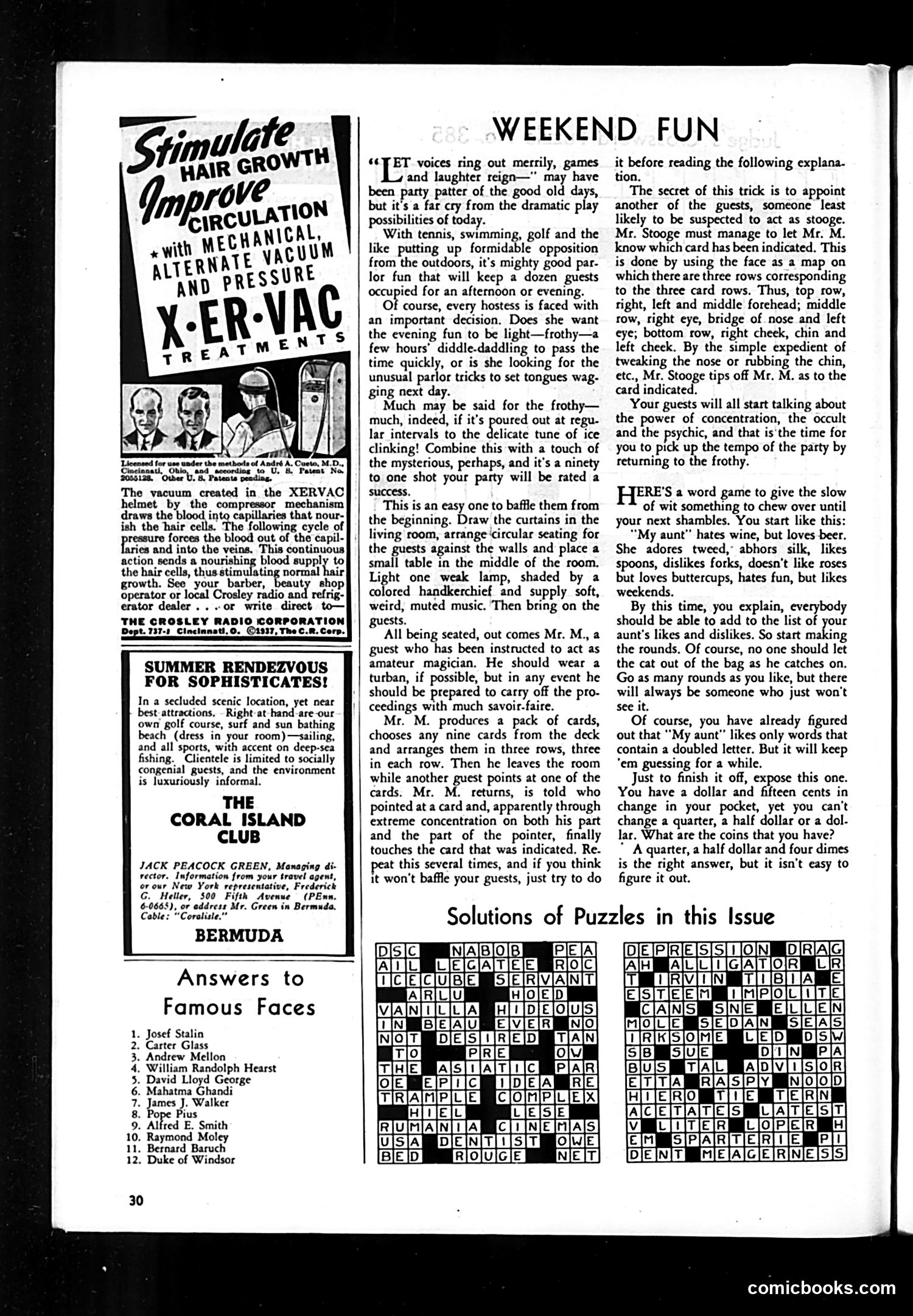
"Weekend Fun" Party Tricks Article This page is primarily an entertainment feature from *Judge* magazine, not political satire. The main content is "Weekend Fun," which offers parlor game suggestions for sophisticated house parties of the era. The article describes two tricks: one involving a mysterious card-reading "magician" (Mr. M.) who wears a turban, and another word-guessing game. The tricks rely on hidden confederates among guests to signal answers—a classic parlor entertainment of the 1930s. The surrounding advertisements (X-ER-VAC hair treatment, Coral Island Club resort in Bermuda) and the "Answers to Famous Faces" puzzle reflect upper-class leisure activities. The content assumes a readership hosting cocktail parties with hired help and servants—reflecting Depression-era aspirational lifestyle marketing aimed at the wealthy.
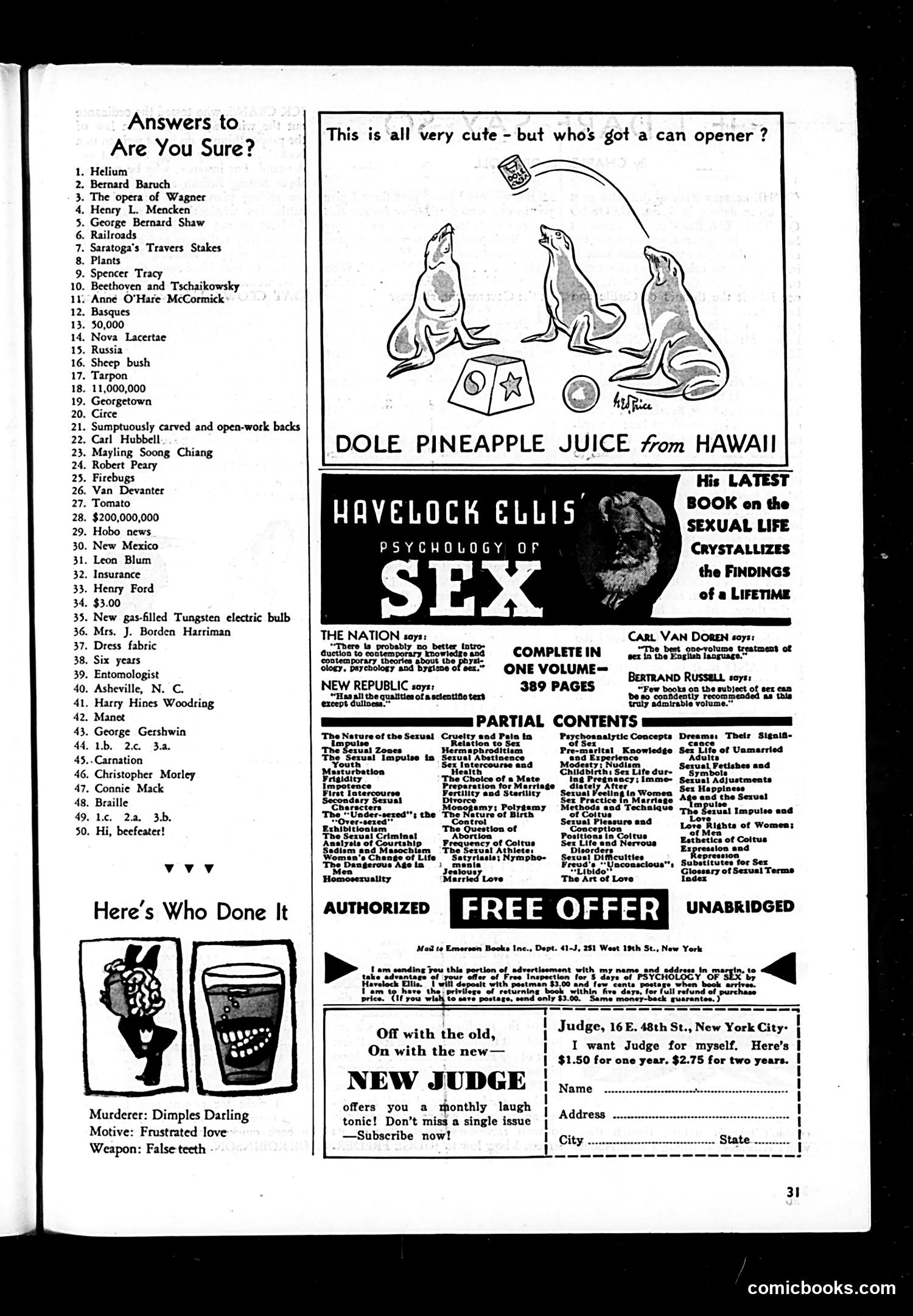
Explanation for Modern Readers This page is primarily advertising and subscription material rather than editorial content. The main visual cartoon shows three seals attempting to open a can—a visual pun on the phrase "who's got a can opener?" promoting Dole Pineapple Juice from Hawaii. Below that is a prominent advertisement for Havelock Ellis's "Psychology of Sex," a comprehensive scientific book on human sexuality. Ellis was a pioneering sexologist whose work was considered groundbreaking but also somewhat controversial for its frank discussion of sexual matters. The page also includes: - Answer key to a trivia quiz ("Are You Sure?") - A humorous crime scenario ("Here's Who Done It") - Subscription offers for Judge magazine itself and competing publication New Judge The overall tone reflects 1930s-era American humor and publishing—mixing intellectual content (sexology, classical references) with light comedy and consumerist advertising. Nothing here carries overt political satire; it's essentially a magazine back page mixing editorial answers with paid advertisements.
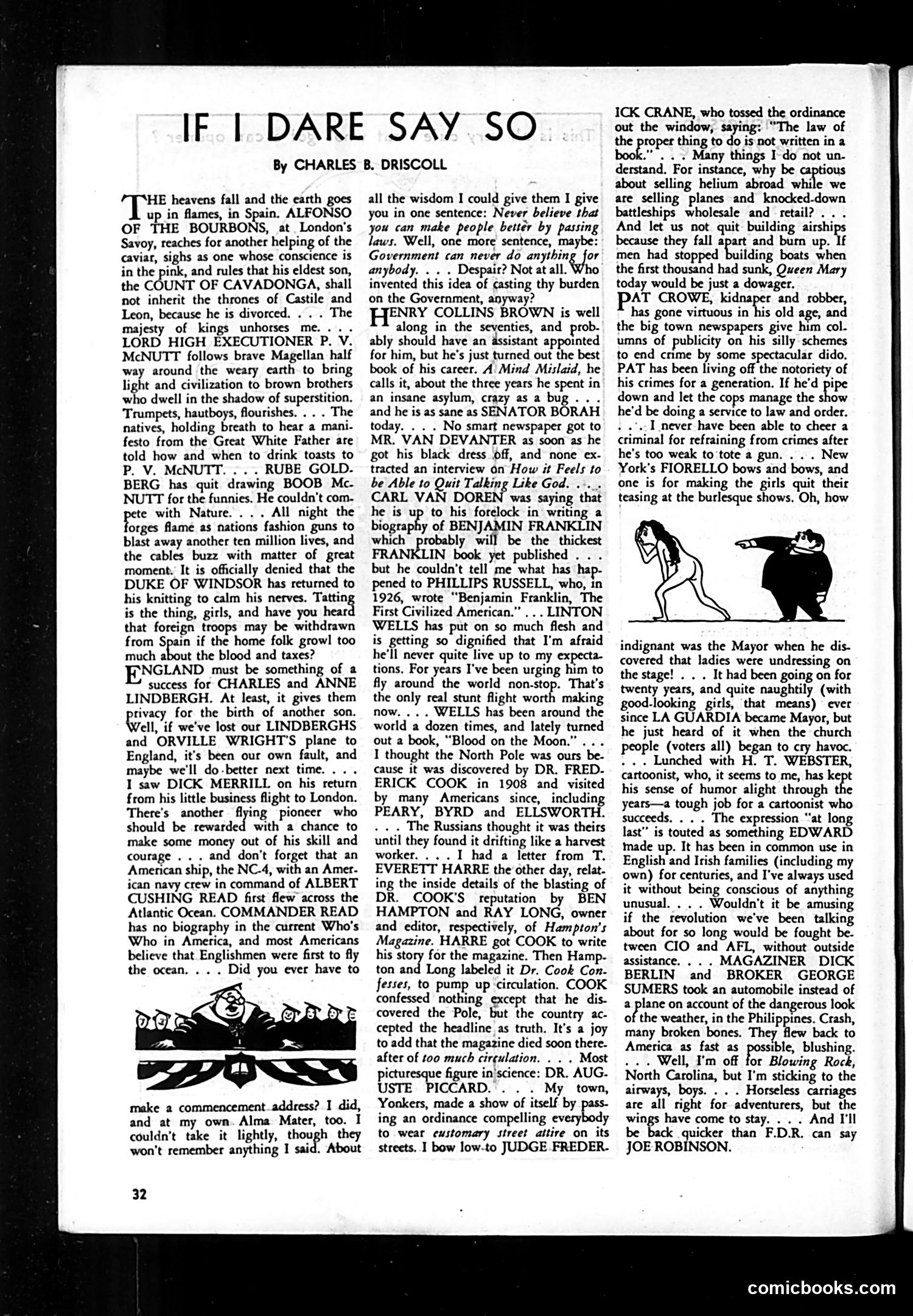
"If I Dare Say So" - Judge Magazine Satire Analysis This column by Charles B. Driscoll is a gossip-style commentary on public figures and current events, employing satirical jibes at notable personalities of the era (appears to be 1930s based on references). Key targets include: - King Alfonso XIII of Spain - mocked for dining luxuriously while Spain faces turmoil, and for denying his divorced son inheritance - P.V. McNutt - satirized as a self-important administrator bringing "civilization" to colonized peoples with grandiose ceremonies - Charles and Anne Lindbergh - praised for finding privacy in England (likely referencing their move there amid American publicity) - Aviation history - Driscoll corrects the record that Americans (Commander Albert Cushing Read on the NC-4) flew the Atlantic first, not the English The satire's point: Driscoll mocks political hypocrisy, imperial arrogance, media sensationalism, and society's misplaced priorities while celebrating genuine achievement and common sense. The tone is irreverent commentary typical of Judge's satirical tradition.
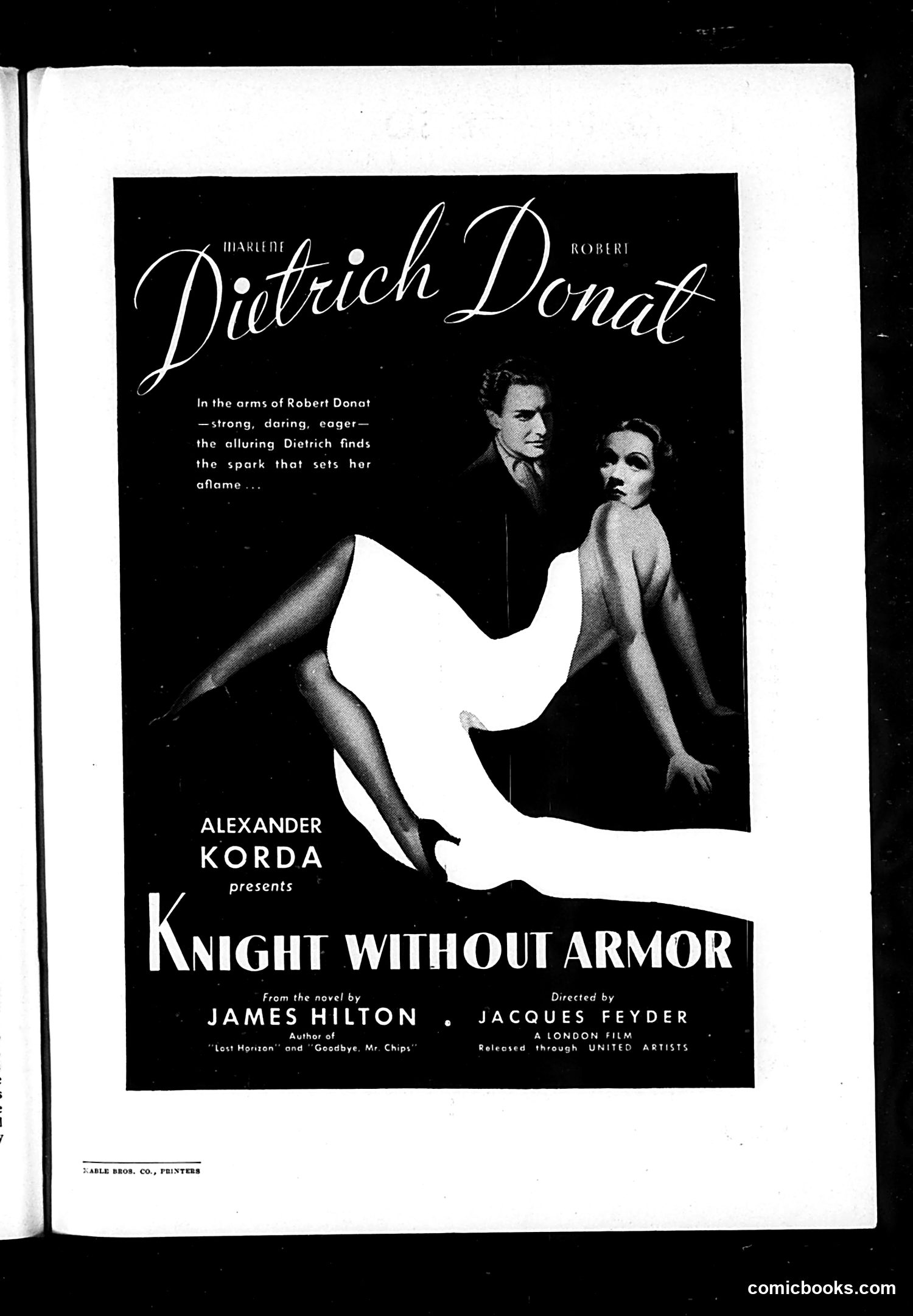
This is a film advertisement, not a political cartoon. It promotes "Knight Without Armor," a 1937 London film starring Marlene Dietrich and Robert Donat, directed by Jacques Feyder and presented by producer Alexander Korda. The ad uses classic Hollywood glamour marketing: it emphasizes the romantic chemistry between the two stars, with suggestive copy ("the spark that sets her aflame") and dramatic photography of Dietrich in an elegant white gown. The tagline highlights Donat's masculine qualities ("strong, daring, eager") to appeal to audiences. The film is adapted from James Hilton's novel (author of "Lost Horizon" and "Goodbye, Mr. Chips"). This appears in Judge magazine likely because it was a major entertainment advertisement of the era, representing the kind of sophisticated European cinema that sophisticated American magazine readers would find appealing.
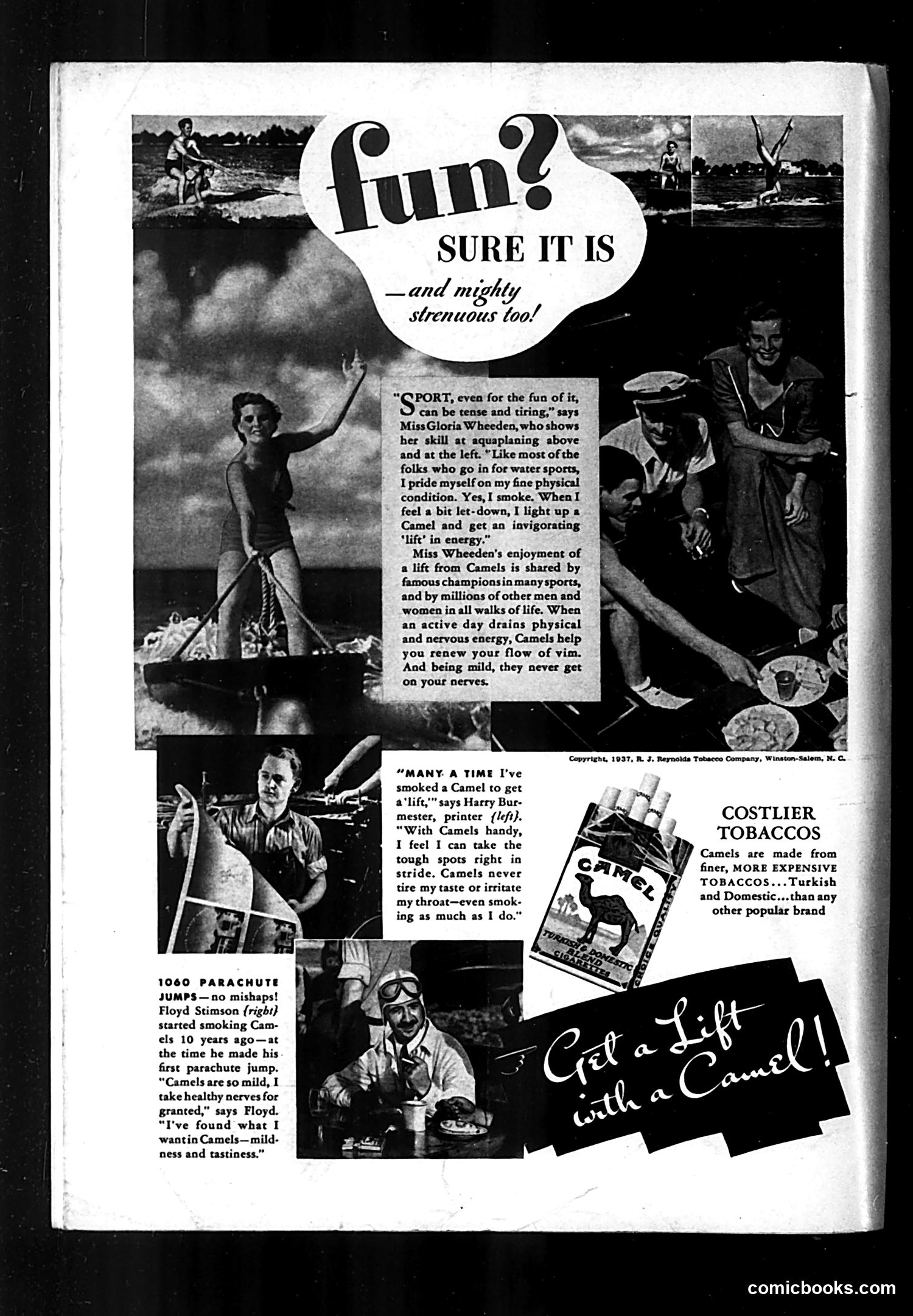
Analysis: Camel Cigarettes Advertisement This is not satire or a political cartoon—it's a straightforward cigarette advertisement for Camel brand tobacco, circa 1937 (copyright visible). The page features testimonials from real people engaged in physically strenuous activities: Gloria Wheeden (aquaplaning/water skiing), Harry Burmester (printer), and Floyd Stimson (parachutist with 1,060 jumps). Each claims smoking Camels provides an energizing "lift" without tiring the taste or irritating the throat. The advertisement's core message: Camels are "mild" cigarettes made from "finer, MORE EXPENSIVE TOBACCOS" that support—rather than hinder—athletic performance and physical endurance. The tagline "Get a Lift with a Camel" directly associates smoking with renewed vigor. Modern context: This reflects pre-health-warning tobacco marketing, when cigarette companies explicitly claimed health and performance benefits. Such claims are now illegal and scientifically discredited.

I cannot reliably analyze this page's content. The image is almost entirely black with only a white margin visible on the left edge and a "comicbooks.com" watermark at the bottom. While the OCR text indicates this is from *Judge* magazine, no cartoon panels, illustrations, text, captions, or other visual content are legible enough to identify figures, political references, or satirical points. This appears to be either a scanning/digitization error, an extremely dark photograph, or a blank/nearly blank page from the original publication. To provide accurate historical analysis as requested, a clearer image would be necessary.