judge
Judge — August 1937
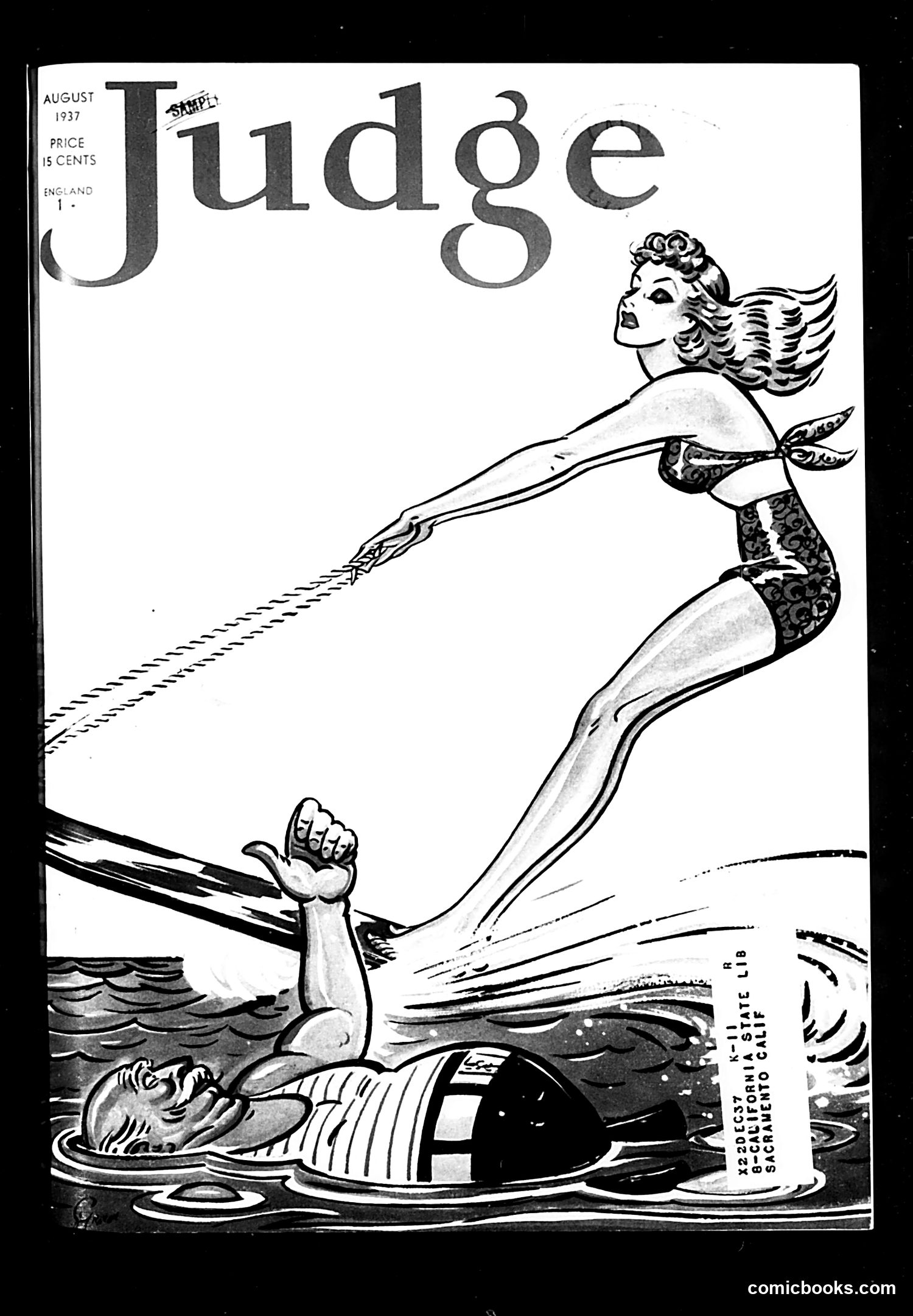
Judge Magazine Cover Analysis - August 1937 This cover depicts a woman in a bathing suit pulling a rope attached to a drowning man in the water below. The imagery appears to be a satirical commentary on rescue or intervention, likely political in nature given Judge's satirical focus. The specific political reference is unclear without additional context from the magazine's contents. However, the 1937 date suggests it may relate to contemporary events—possibly Depression-era politics, international conflicts, or American domestic policy debates of that period. The drowning figure could represent a political faction, nation, or ideology, with the woman symbolizing American policy or a political figure intervening (or failing to intervene) appropriately. Without the accompanying article text, the precise target of satire cannot be definitively determined.
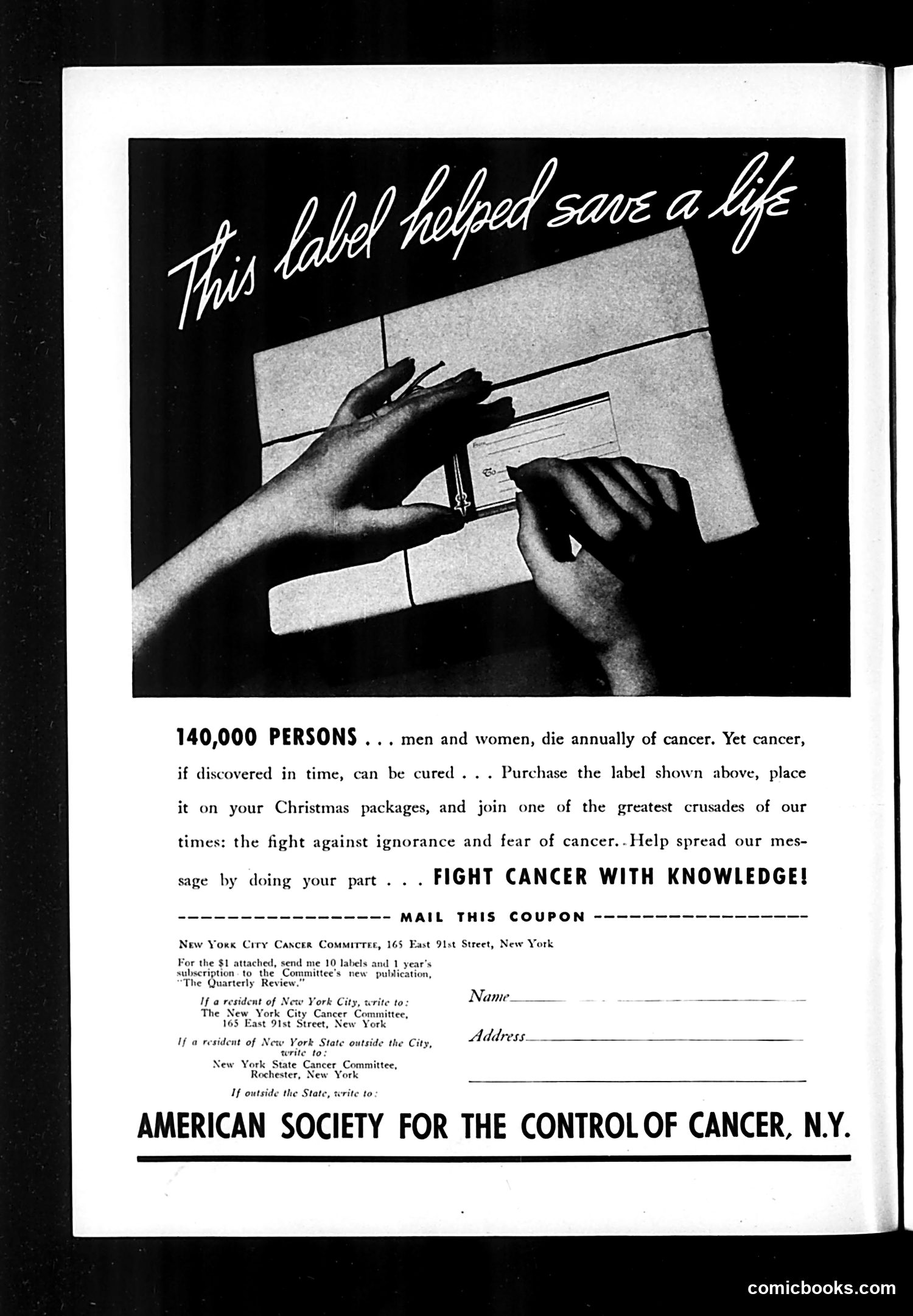
Analysis This is primarily a public service advertisement, not satire or political cartoon. The American Society for the Control of Cancer (now the American Cancer Society) ran this campaign to promote cancer awareness and fundraising. The image shows hands applying a label to a wrapped package, visualizing the campaign's core message: purchasers should buy special labels ($1) to attach to Christmas gifts. This fundraising mechanism simultaneously spread cancer awareness and education. The headline "This label helped save a life" emphasizes early detection's importance—a revolutionary message for the era, when cancer was often discussed in whispers. The statistics cite 140,000 annual cancer deaths, positioning knowledge as the antidote to "ignorance and fear." This represents mid-20th century health activism through consumer participation.
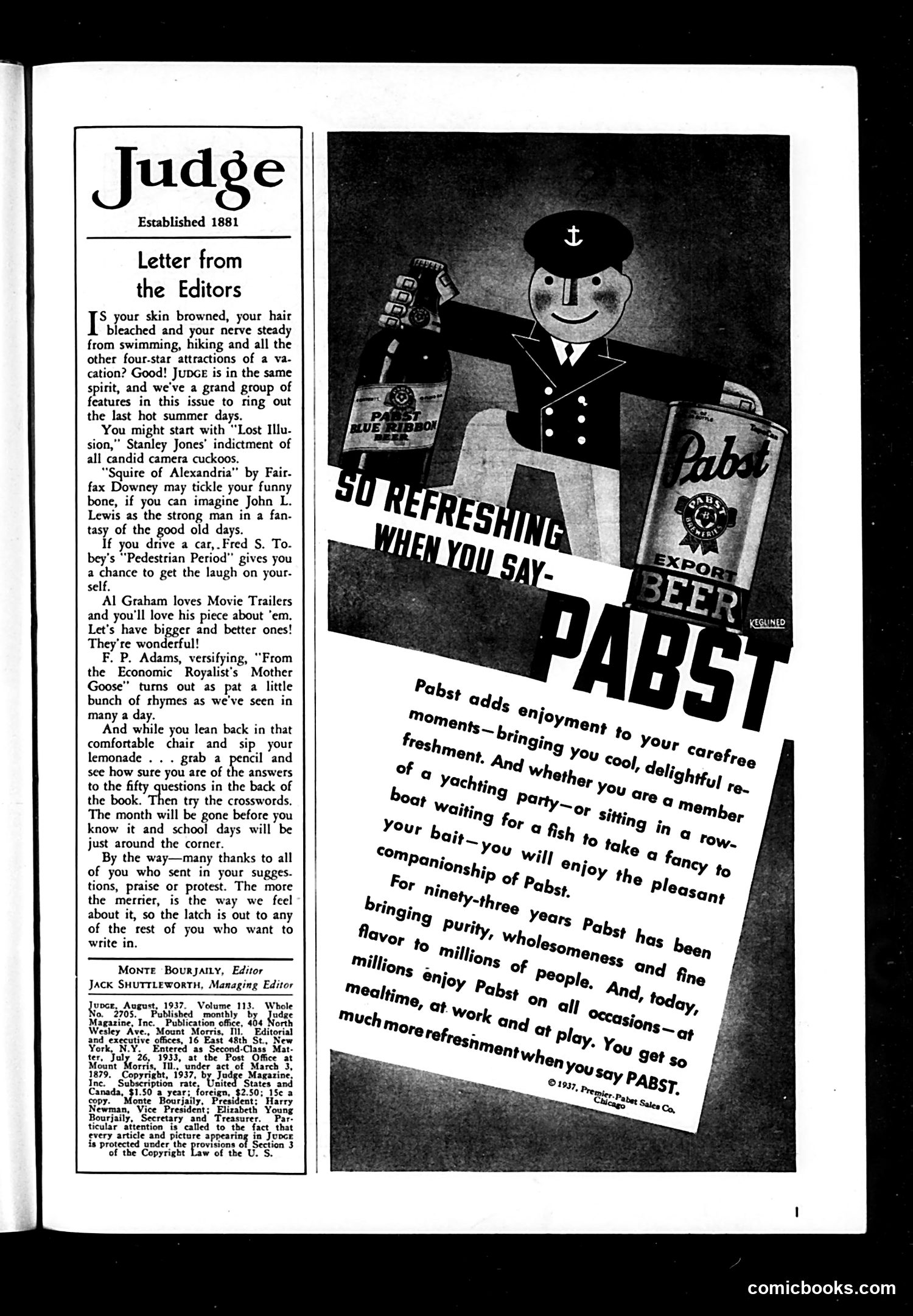
Pabst Beer Advertisement This page is primarily a Pabst beer advertisement, not satirical content. The right side features a cheerful, anthropomorphized sailor character promoting Pabst Export Beer. The illustration shows him holding beer bottles with text reading "So Refreshing When You Say—PABST." The advertisement emphasizes Pabst's 93-year history, claiming it brings "purity, wholesomeness and fine flavor" to social occasions—whether at work, play, or leisure activities like boating and fishing. The left side contains Judge magazine's standard "Letter from the Editors," discussing summer activities and various entertainment features (movies, radio shows, crosswords), which is typical editorial content rather than satire.
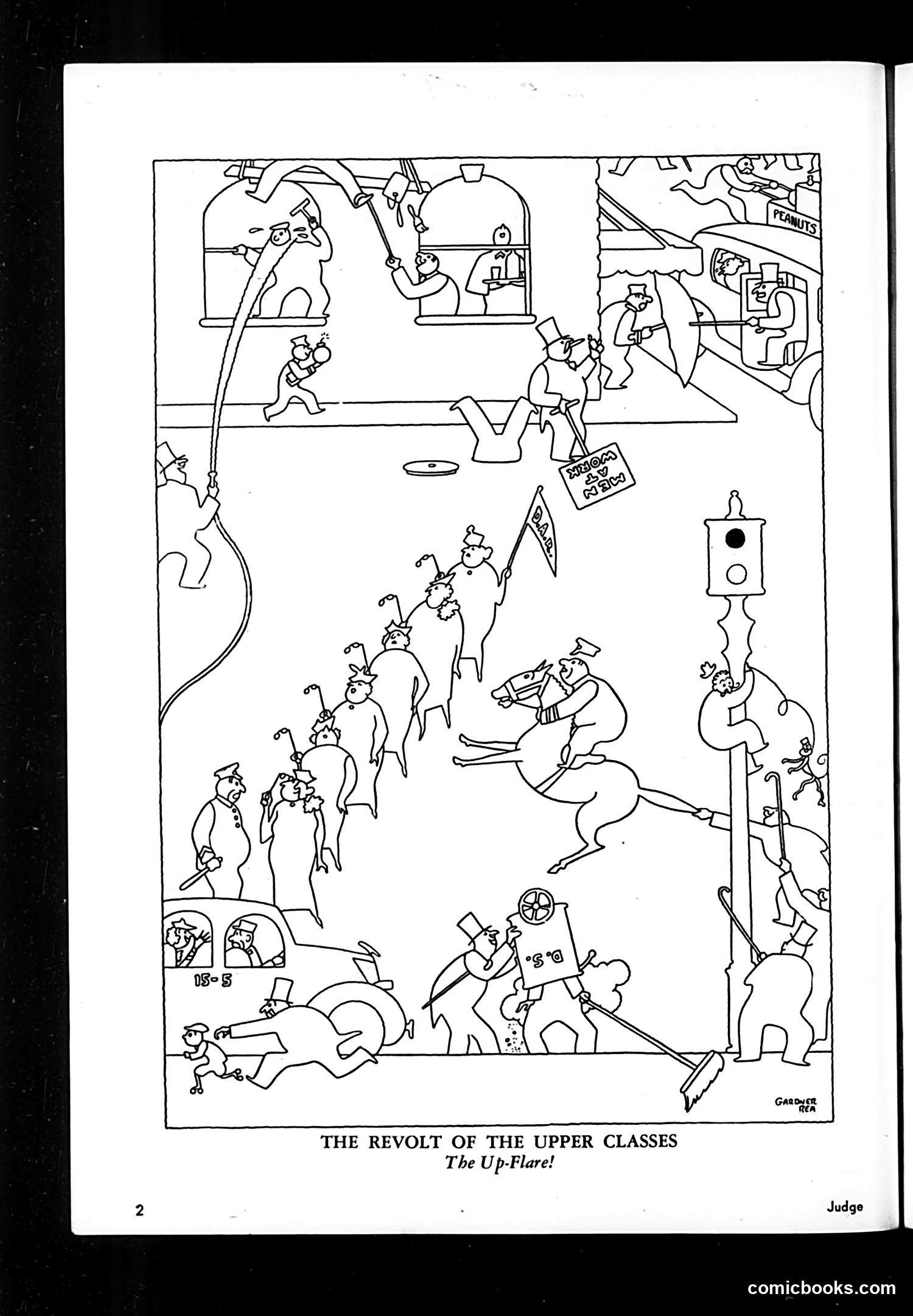
"The Revolt of the Upper Classes: The Up-Flare!" This Judge cartoon satirizes class conflict and social upheaval, likely from the early 20th century. The title's pun "Up-Flare" suggests an uprising or explosion among the wealthy elite ("upper classes"). The illustration depicts chaos in what appears to be an upscale urban setting: well-dressed figures with top hats flee, fight, and climb buildings while ordinary people (some appearing to be workers or revolutionaries) swarm through the streets below, some carrying flags or weapons. The juxtaposition suggests satirical commentary on fears of revolution or class warfare—mocking either the upper classes' paranoia about their safety or the actual threat of organized labor movements and socialist agitation popular in this era. The cartoon's humor lies in depicting the privileged literally driven upward by social unrest.
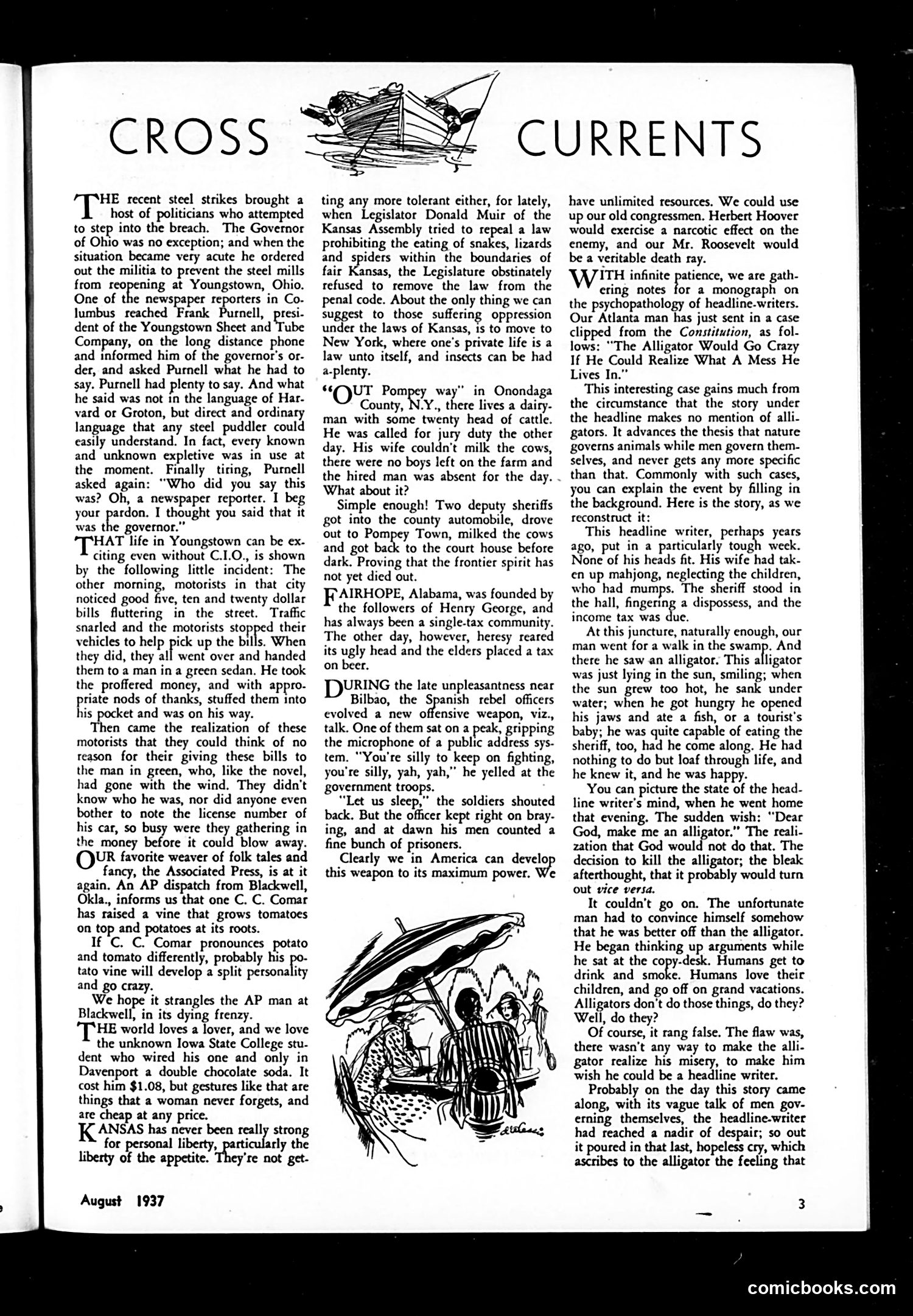
Cross Currents Column - August 1937 This page contains a satirical column rather than a political cartoon. The "Cross Currents" column critiques various contemporary issues through anecdotes: 1. Steel strikes and Ohio politics: Mocks Governor Martin Davey's handling of labor unrest at Youngstown Sheet and Tube Company, suggesting his response was inadequate. 2. Kansas anti-snake law: Ridicules a Kansas Assembly law prohibiting eating snakes, lizards, and spiders—satirizing legislative overreach into private life. 3. The alligator story: A humorous account of a Florida headline writer who, after witnessing an alligator in a swamp, becomes obsessed with writing an alligator story, eventually descending into despair over the animal's indifference to human drama. The column uses these anecdotes to satirize government ineffectiveness, absurd legislation, and the desperation of journalists seeking sensational stories.
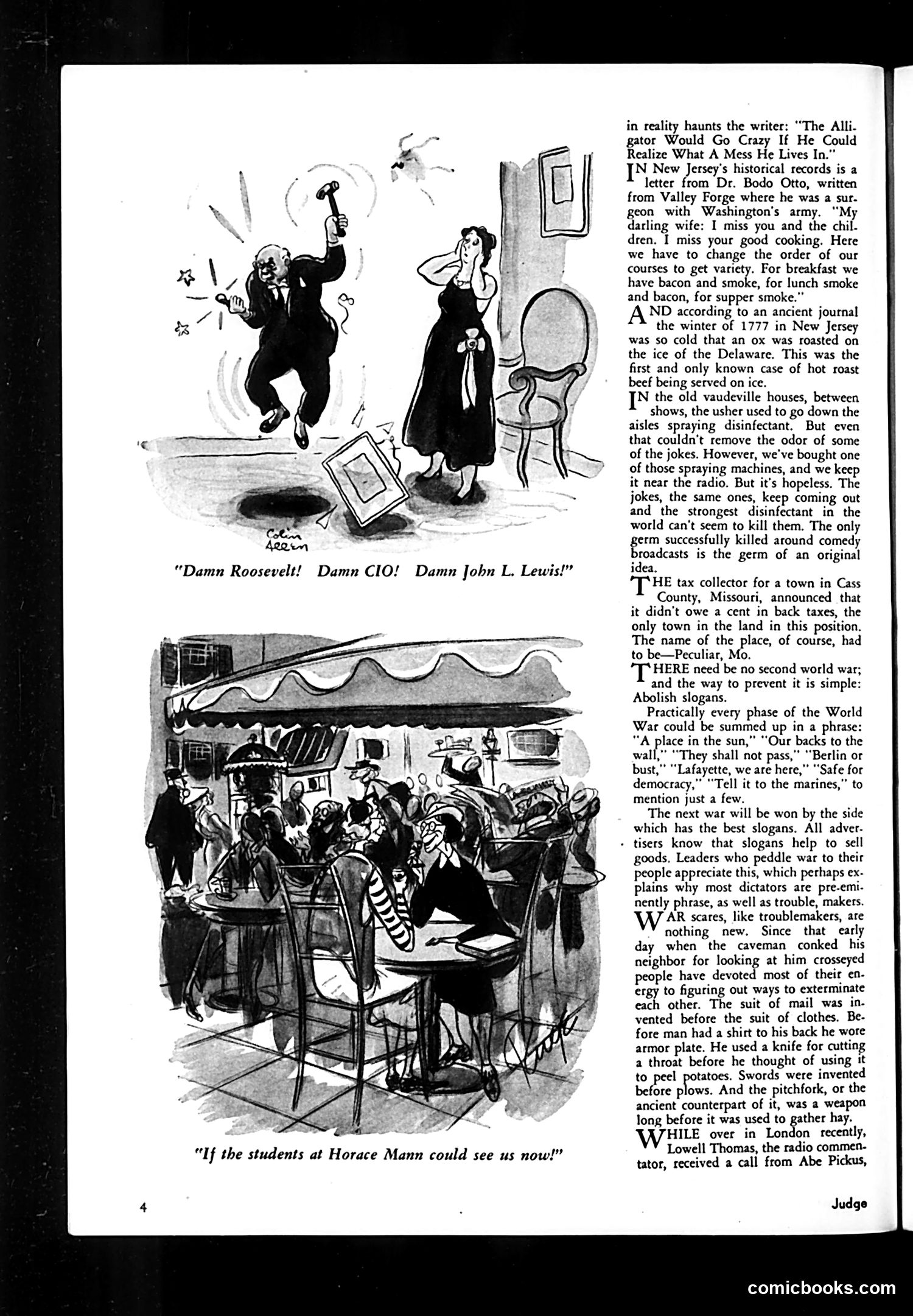
Analysis of Judge Magazine Page The top cartoon depicts a man frantically swinging a hammer while a woman covers her ears, captioned "Damn Roosevelt! Damn CIO! Damn John L. Lewis!" This satirizes labor tensions of the 1930s-40s, mocking someone driven to fury by President Franklin D. Roosevelt's pro-labor policies, the Congress of Industrial Organizations (CIO), and labor leader John L. Lewis—all associated with union organizing that disrupted traditional management power. The lower cartoon shows a crowded wartime scene with the caption "If the students at Horace Mann could see us now!" This appears to reference WWII-era social disruption, sarcastically suggesting that pre-war civilian life at the prestigious Horace Mann School contrasts sharply with current wartime chaos and crowding. Both cartoons use exaggeration and irony to comment on contemporary anxieties about labor activism and wartime upheaval.
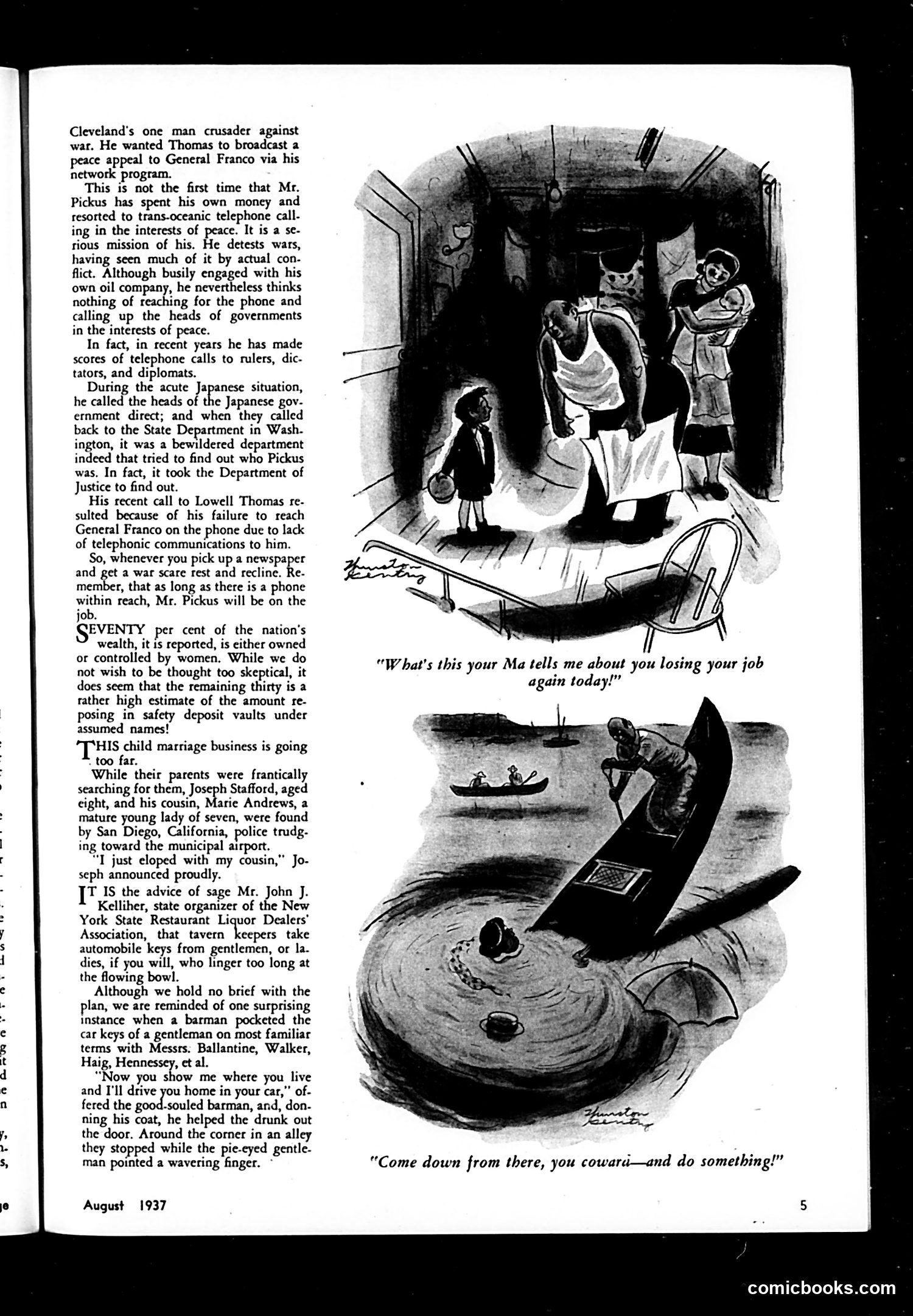
Analysis of Judge Magazine Page (August 1937) The page contains two cartoons satirizing social issues of the Depression era: Top cartoon: Shows a woman confronting a man about job loss, captioned "What's this your Ma tells me about you losing your job again today!" This satirizes widespread unemployment and men's difficulty maintaining steady work during the economic crisis. Bottom cartoon: Depicts a figure in a rowboat telling someone on a cliff to "Come down from here, you coward—and do something!" This appears to reference suicide, likely commenting on the desperation some faced during the Depression. The accompanying text discusses Cleveland businessman Pickus's peace advocacy efforts and includes an anecdote about a tavern keeper helping a drunk man. The cartoons illustrate the period's economic hardship and its psychological toll on American families.
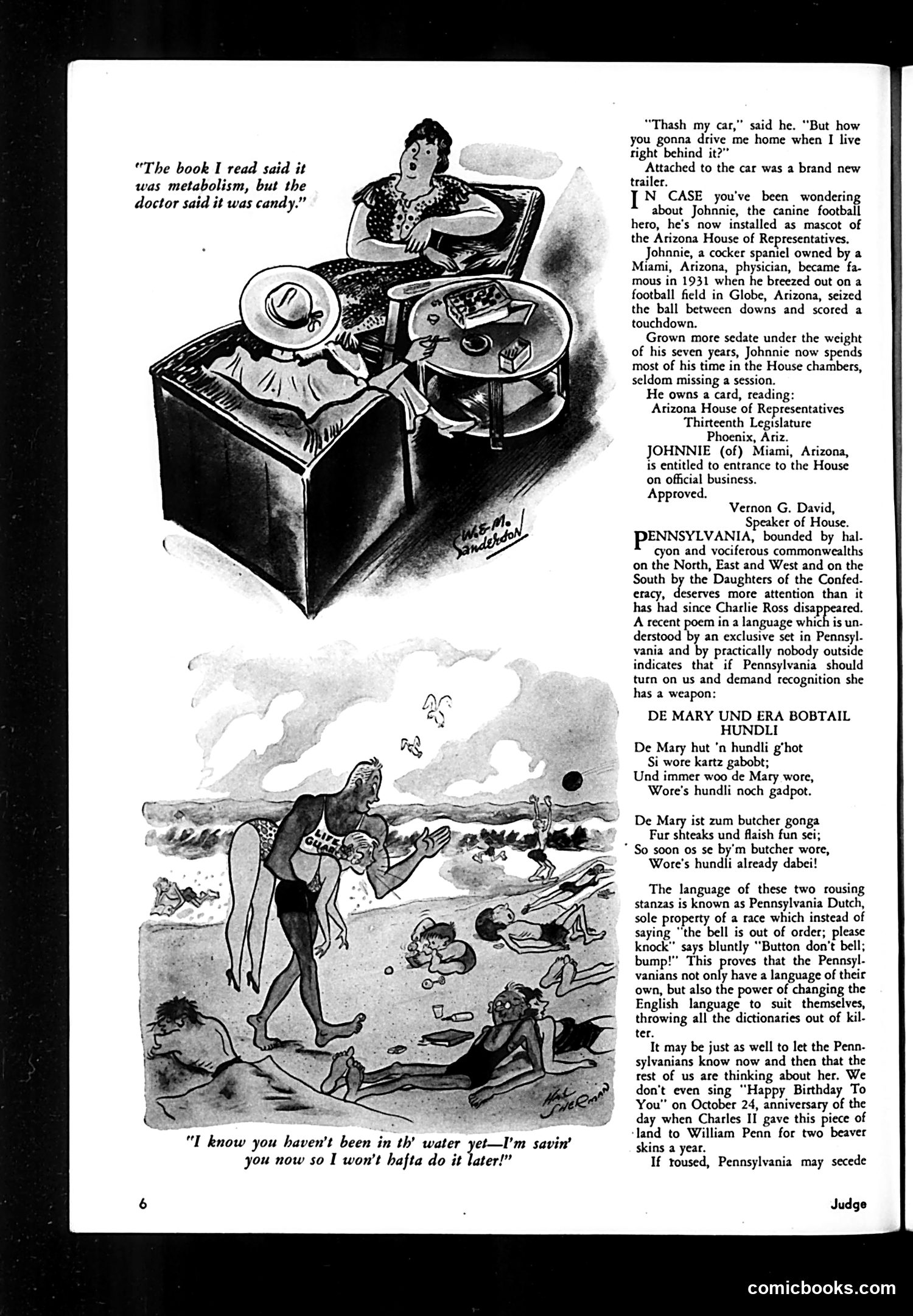
Judge Magazine Page Analysis This page contains two cartoons and cultural commentary from Judge magazine. The top cartoon depicts a woman in a car with a confused male driver, satirizing the newly licensed female motorist—a social novelty in the early 20th century. The woman's quote about the book and doctor referencing candy suggests confusion or unreliability as a driver, playing on contemporary stereotypes about women drivers. The bottom cartoon illustrates Pennsylvania Dutch culture, accompanying an article about the Pennsylvania Dutch language and their distinctive dialect. The beach scene appears to satirize cultural practices or social customs of this Pennsylvania community. The page also includes a biographical note about Johnnie, a cocker spaniel mascot of the Arizona House of Representatives—an unusual honor for a dog who famously scored a touchdown in 1931.
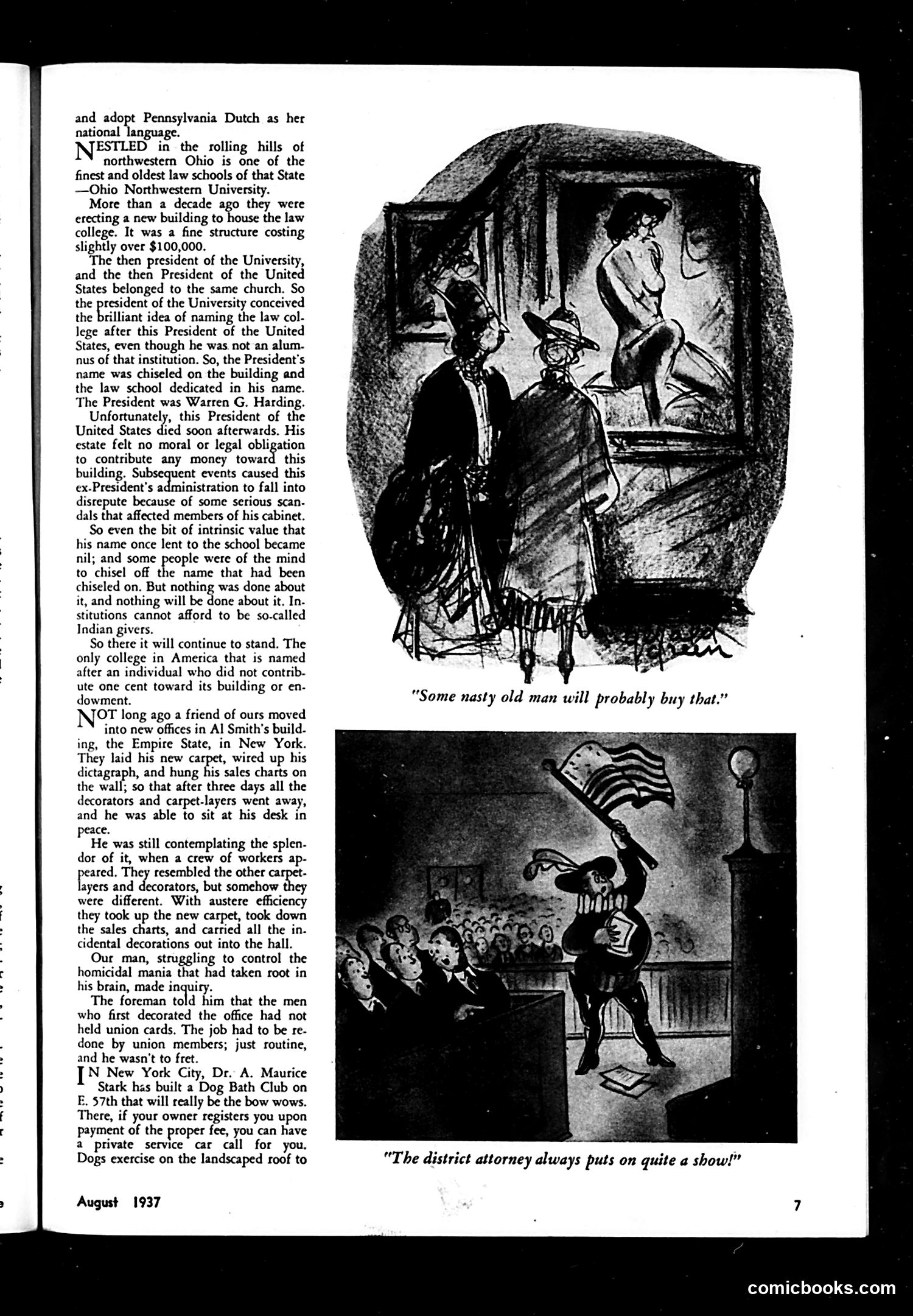
Analysis of Judge Magazine Page, August 1937 This page contains two satirical cartoons commenting on 1930s American life and labor relations. The top cartoon depicts an antique dealer or shop owner showing a customer an old, worn item, with the caption "Some nasty old man will probably buy that." The satire appears to mock both wealthy collectors of worthless antiques and the salesmanship tactics used to move merchandise. The bottom cartoon, captioned "The district attorney always puts on quite a show!" shows what appears to be a theatrical court scene with an American flag, suggesting satire about prosecutorial grandstanding or performative justice—implying district attorneys prioritize public spectacle over genuine legal process. Both cartoons reflect 1930s skepticism toward institutions and commercialism, typical of Judge magazine's satirical approach to contemporary social issues.
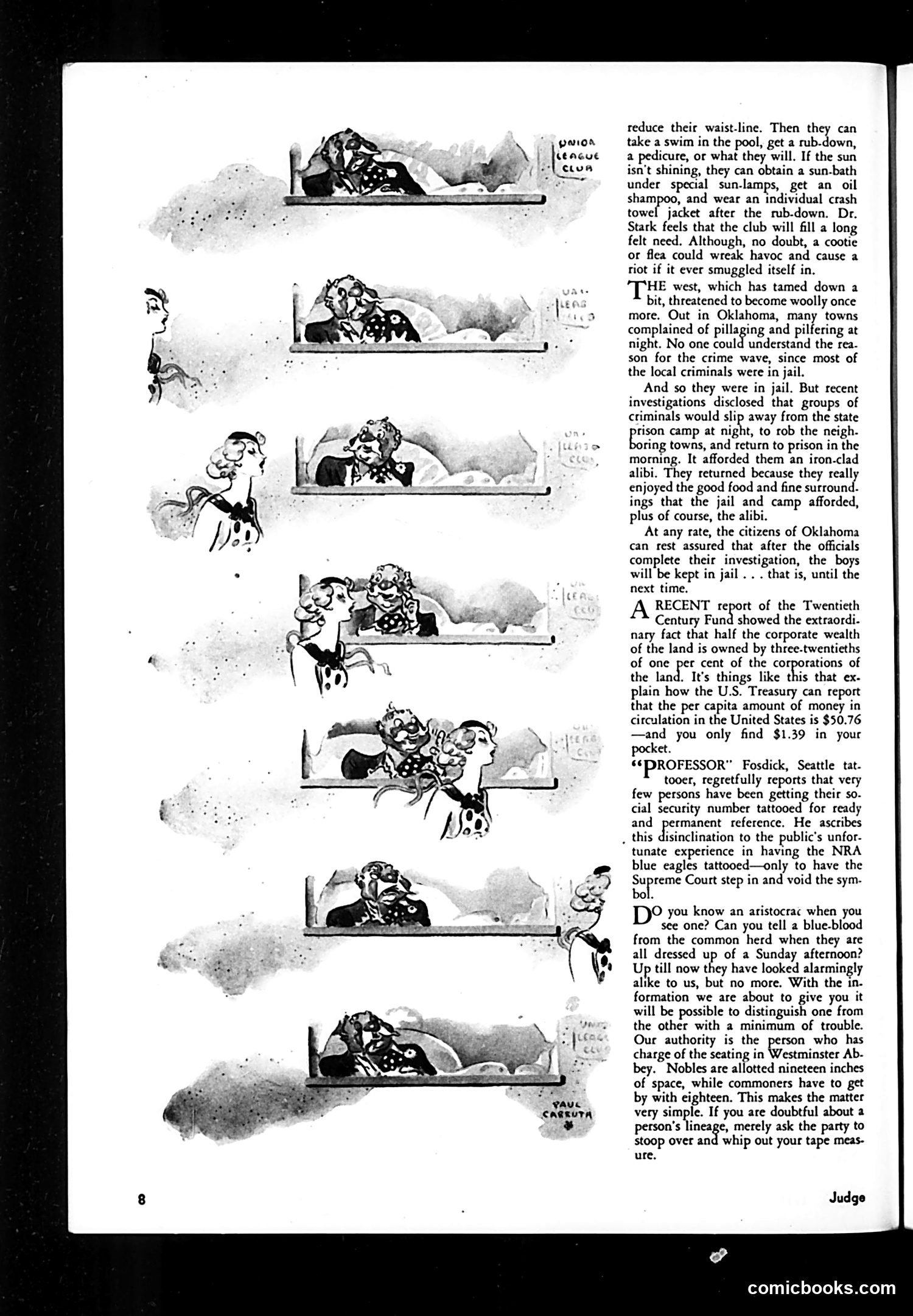
Analysis The left side contains a visual comic strip (credited to Paul Kearney) showing progressive crowding of people in bed—beginning with one couple and ending with many figures squeezed together. This illustrates a space-saving or overcrowding joke, likely mocking apartment living or resource scarcity. The text covers several satirical items: 1. A health club promoting luxury amenities (pools, sun-lamps, massages)—social commentary on leisure spending. 2. Oklahoma crime wave: A darkly comic piece about criminals escaping from a prison camp at night to rob neighboring towns, then returning to enjoy the jail's superior food and amenities. The satire targets both criminal absurdity and possibly Depression-era prison conditions being better than outside poverty. 3. Wealth inequality: References a Twentieth Century Fund report showing extreme corporate wealth concentration, contrasting the nation's reported per-capita circulation ($50.76) against ordinary people's actual cash ($1.39)—mocking economic statistics' disconnect from reality. 4. Social Security tattoos and NRA: Notes reluctance to tattoo social security numbers, attributed to public distrust following the NRA symbol being voided by the Supreme Court. 5. Class distinction: Humorously proposes measuring Westminster Abbey seating (19 inches for nobles, 18 for commoners) as a method to identify aristocrats—satirizing class pretension.
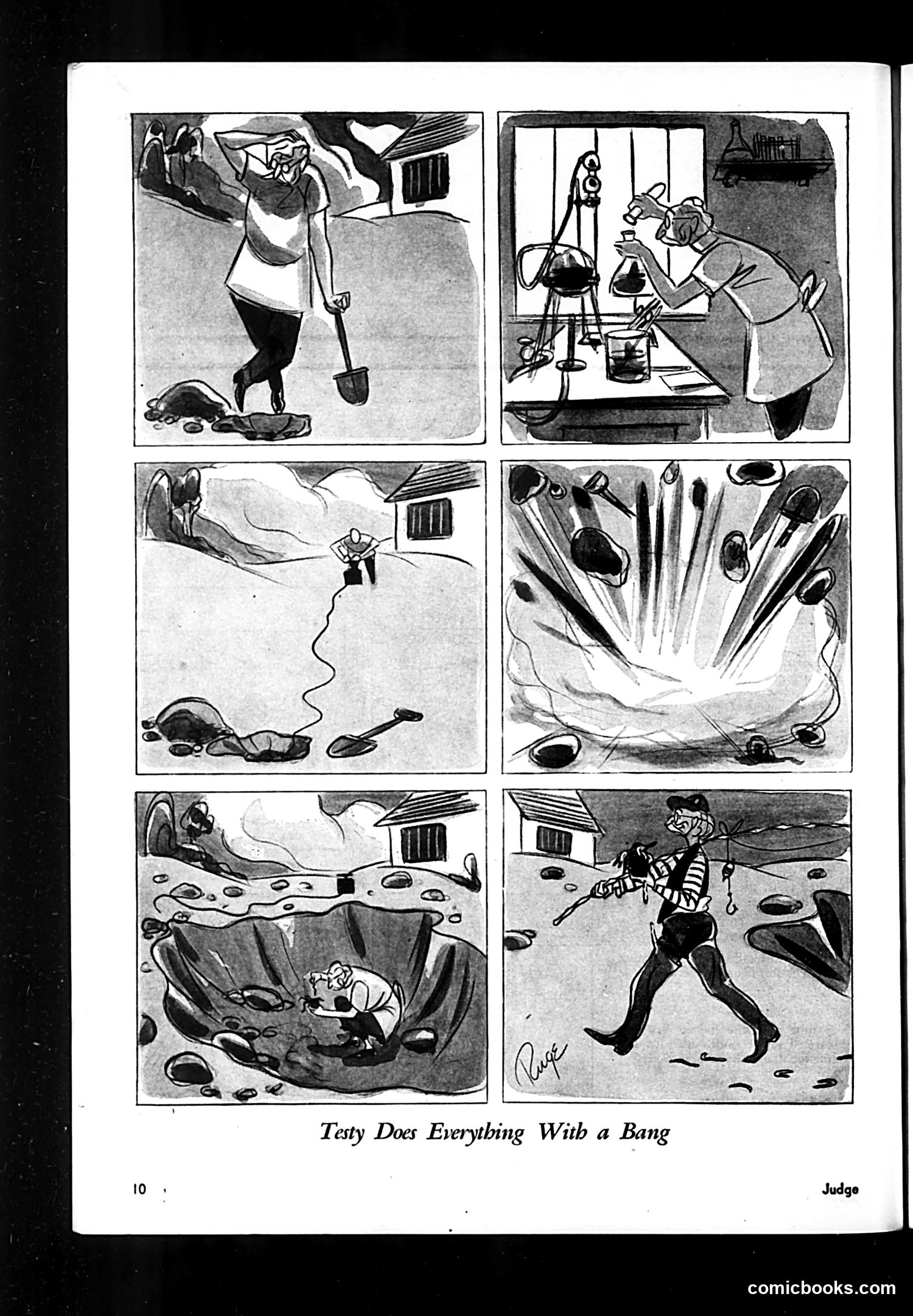
Analysis This is a six-panel comic strip titled "Testy Does Everything With a Bang." The humor derives from a character named Testy who approaches mundane tasks with exaggerated, explosive violence: 1. Panel 1: Testy digs with a shovel using explosive force 2. Panel 2: He conducts a chemistry experiment with dramatic explosions 3. Panel 3: His thoughts manifest as chaotic, explosive imagery 4. Panel 4: Tools and objects explode outward violently 5. Panel 5: He creates a crater or pit with explosive digging 6. Panel 6: He appears to be running or fleeing from the chaos The satire mocks temperamental or irritable people who tackle ordinary activities with unnecessary aggression and drama. "Testy" (meaning irritable or quarrelsome) is the character's personality trait, visualized literally through destructive, explosive behavior. The joke is that this personality type turns simple tasks into catastrophic events.
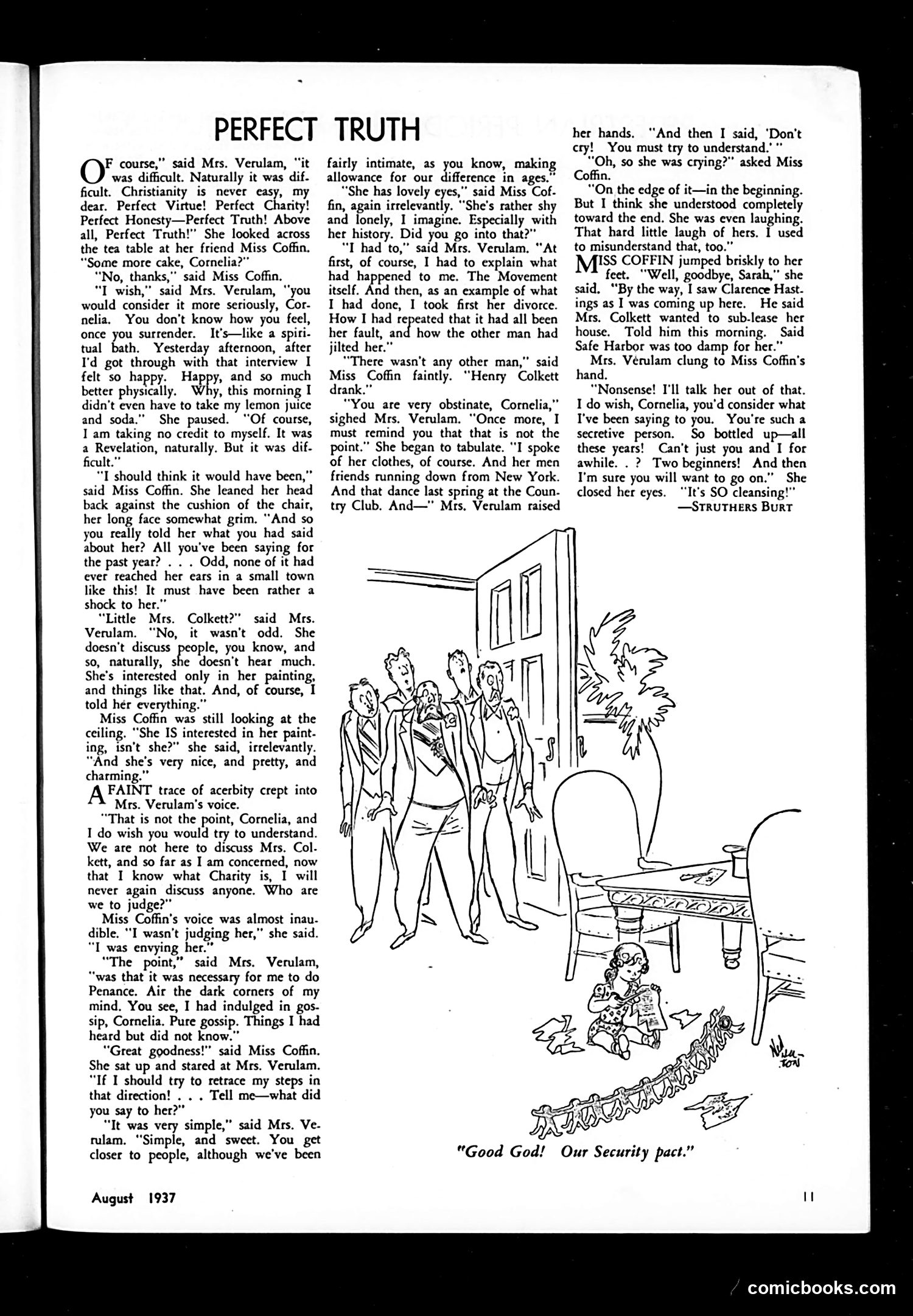
Analysis of "Perfect Truth" This satirical short story mocks self-righteous hypocrisy disguised as religious virtue. Mrs. Verulam represents a common social type: the sanctimonious gossip who convinces herself that spreading rumors and invading others' privacy is actually *charitable penance*. The humor lies in the contradiction: Mrs. Verulam claims to have achieved "Perfect Truth" and "Perfect Charity" through Christianity, yet she's actually engaged in vicious gossip about her neighbor Mrs. Colkett—fabricating details (a supposed affair and divorce) that are demonstrably false (Miss Coffin reveals the real issue was her husband's alcoholism). Miss Coffin serves as the moral counterpoint, quietly pointing out Mrs. Verulam's self-deception with devastating understatement ("I was envying her" about the virtuous Mrs. Colkett). The cartoon below shows people reacting with alarm to what appears to be a security threat, likely commenting on contemporary 1937 anxieties about social disorder or invasion of privacy—echoing the story's theme about breaches of personal boundaries. The satire targets middle-class moral self-delusion and how religious language enables cruelty.
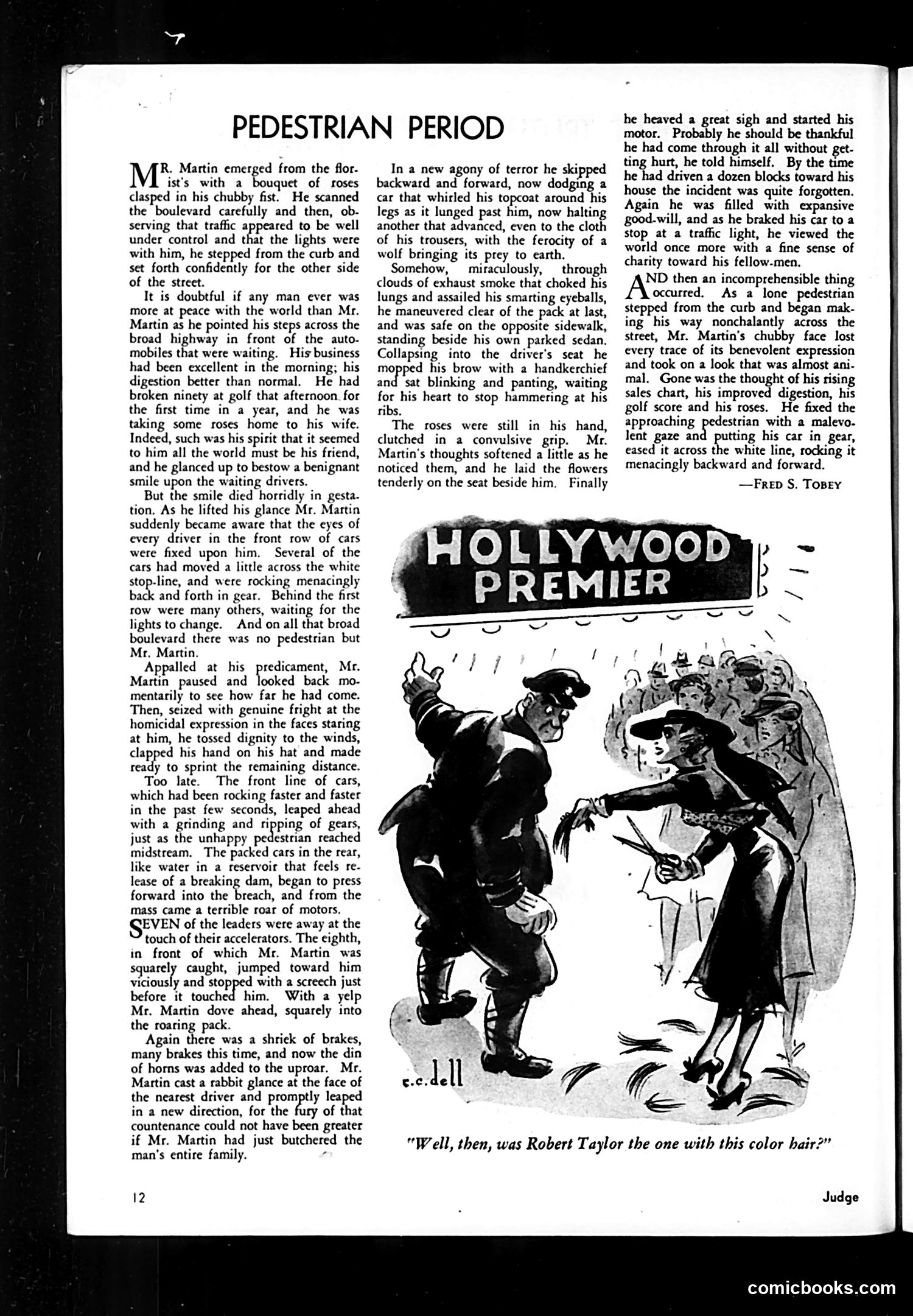
"Pedestrian Period" - Satire on Urban Traffic Chaos This story satirizes the dangerous intersection of pedestrians and automobiles in 1920s American cities. Mr. Martin, content after a good day (golf, business success), naively crosses a street with a bouquet of roses, only to encounter aggressive drivers who treat him as an obstacle to be eliminated. The satire's point: drivers show murderous hostility toward pedestrians, revving engines menacingly and charging forward with apparent intent to kill. The contrast between Martin's peaceful mood and the drivers' "homicidal expression" highlights how automobiles—then still relatively new—had created a new urban hazard. The gasoline-powered "pack" hunts him like predators. The accompanying cartoon by E.C. Doll (below) reinforces this: a chaotic Hollywood premiere scene with a woman asking "Was Robert Taylor the one with this color hair?"—likely mocking the confusion of celebrities amid crowds. The overall message: modern traffic has made streets dangerously unpredictable for pedestrians.
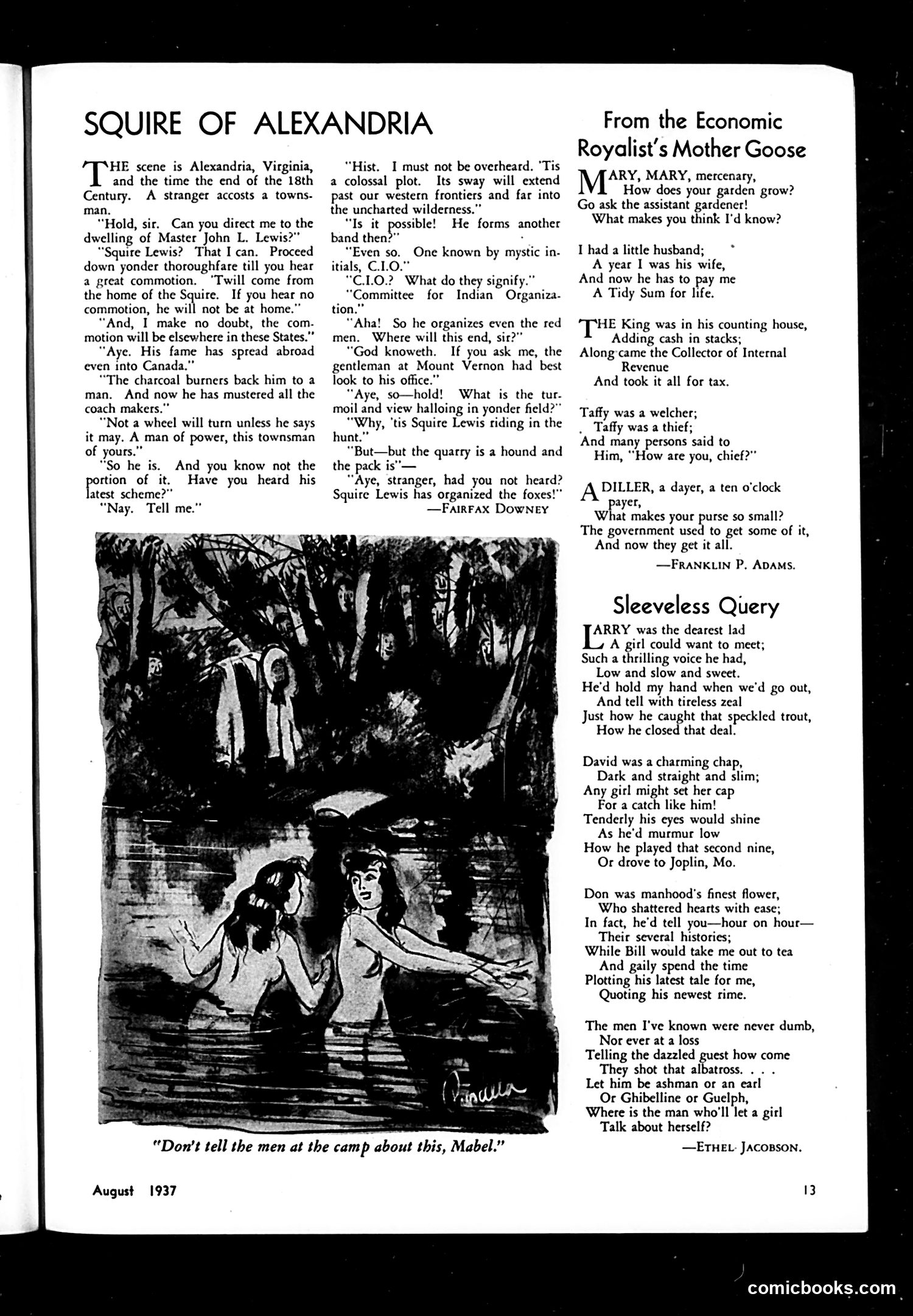
Analysis of Judge Magazine Page (August 1937) "Squire of Alexandria" This satirical story mocks John L. Lewis, the powerful labor leader of the CIO (Congress of Industrial Organizations). Set in 18th-century Virginia, it presents Lewis as an autocratic figure controlling charcoal burners, coach makers, and even organizing Native Americans—exaggerating his actual influence over workers and unions. The joke: Lewis wields such dominance that even foxes are "organized" by him. This reflects contemporary anxiety about Lewis's growing union power and his ambitions to expand the CIO's reach, presented here as comically megalomaniacal. "Economic Royalist's Mother Goose" & Other Verses These parody nursery rhymes mock wealthy figures and New Deal taxation policies. References include: - Complaints about government taxes ("now they get it all") - "Economic Royalists"—FDR's term for wealthy businessmen opposing his policies The verses use satirical humor to critique progressive taxation and labor disputes from a conservative perspective. "Sleeveless Query" A poem humorously complaining that men monopolize conversation, never letting women speak about themselves—a gender-relations joke unrelated to political content.
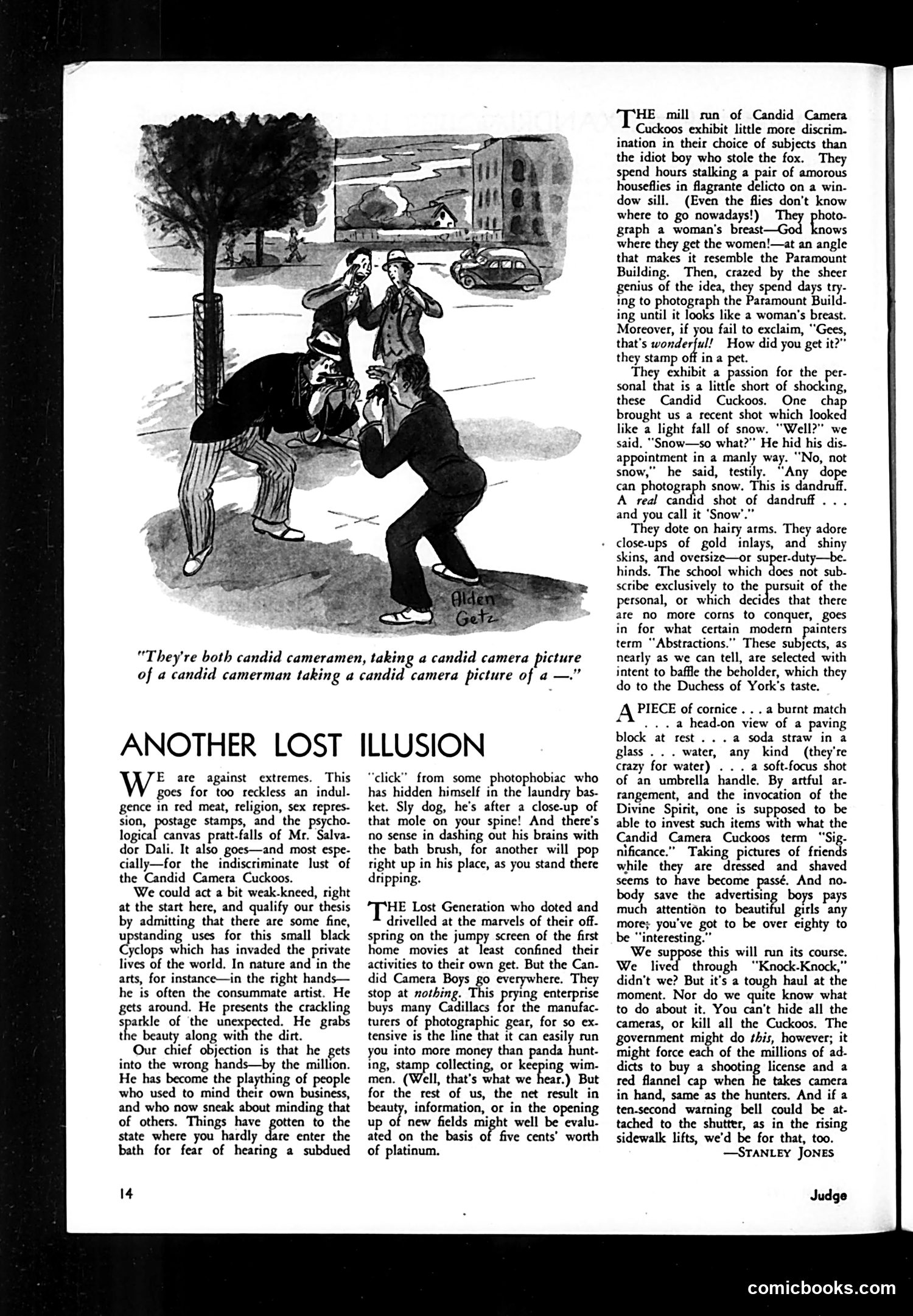
"Another Lost Illusion": Candid Camera Satire This article satirizes the 1950s craze for candid photography—particularly the "Candid Camera" fad that made hidden snapshot photography a hobby and commercial enterprise. The cartoon depicts the obsessive recursion: photographers photographing photographers photographing photographers. The author argues candid camera enthusiasts lack artistic discrimination, spending hours capturing trivial subjects (flies mating, dandruff, gold dental inlays) or deliberately unflattering angles of women's bodies. The satire mocks their obsession with the *personal* and mundane, their indignation when shots aren't praised as "wonderful," and their worship of subjects modern painters call "Abstractions"—abstract or meaningless images. The core complaint: ordinary people with cameras now invade privacy everywhere, sneaking into bathrooms and dressing rooms, treating photography as compulsive documentation of the banal rather than genuine art. The "lost illusion" appears to be that photography could democratize artistic vision—instead it merely democratized voyeurism.
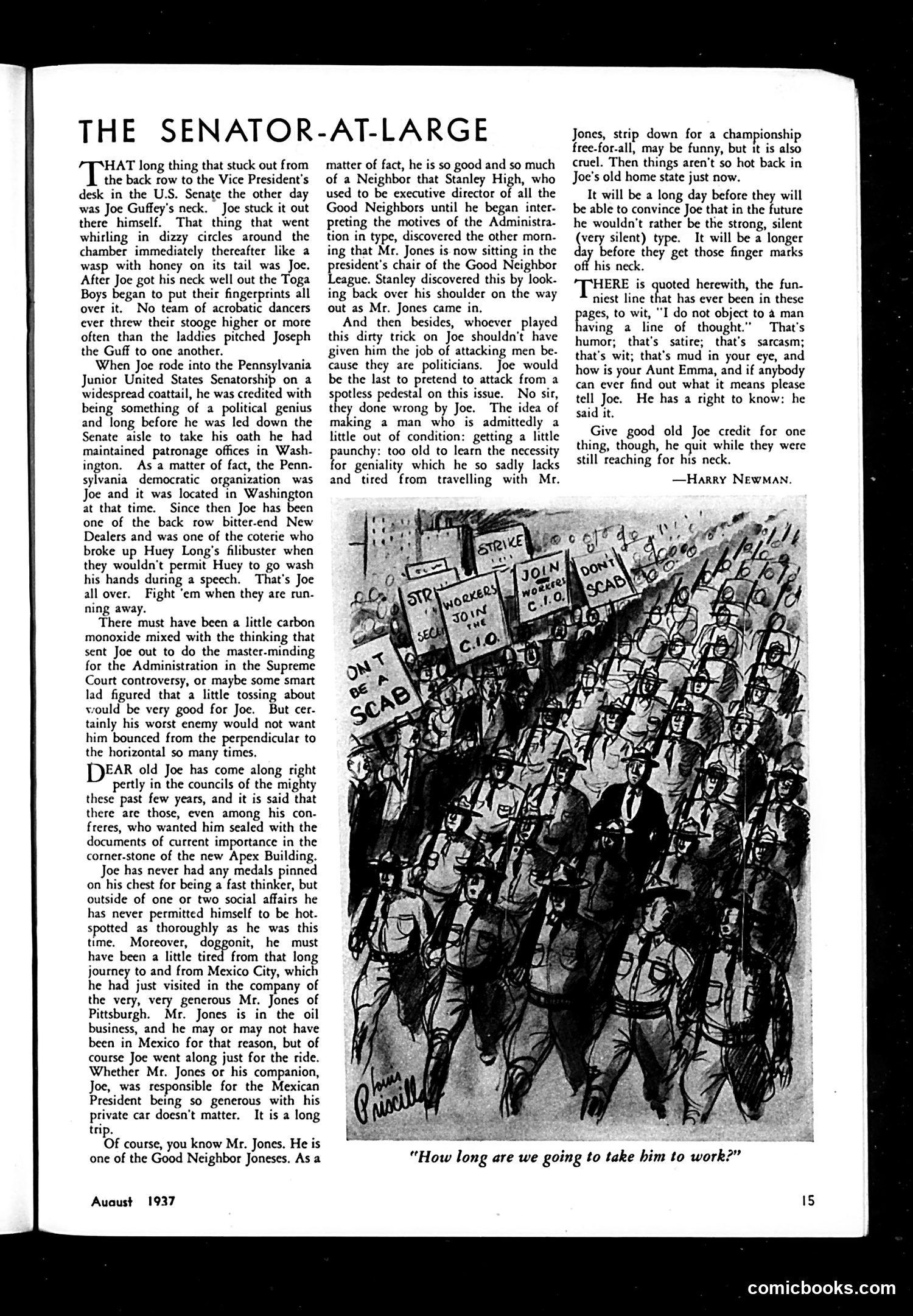
"The Senator-at-Large" - Judge, August 1937 This article satirizes Senator Joseph Guffey of Pennsylvania, a New Deal Democrat. The cartoon depicts a massive labor strike or protest march. The text mocks Guffey's political naiveté after he was assigned to attack politicians in the Supreme Court controversy (likely regarding FDR's court-packing plan). The satire notes Guffey lacks credibility as a critic of politicians since he's "admittedly a little out of condition," lazy, and prone to poor judgment. The piece also ridicules Guffey's recent trip to Mexico City with Jesse Jones (an oil businessman, "Good Neighbor" philanthropist—likely referencing FDR's Good Neighbor Policy). The author implies Guffey was merely tagging along for leisure while appearing to conduct business. The cartoon's meaning is unclear from the image alone—it shows strikers with signs mentioning the CIO and working conditions, but its specific connection to Guffey isn't immediately apparent from the visible text on this page.
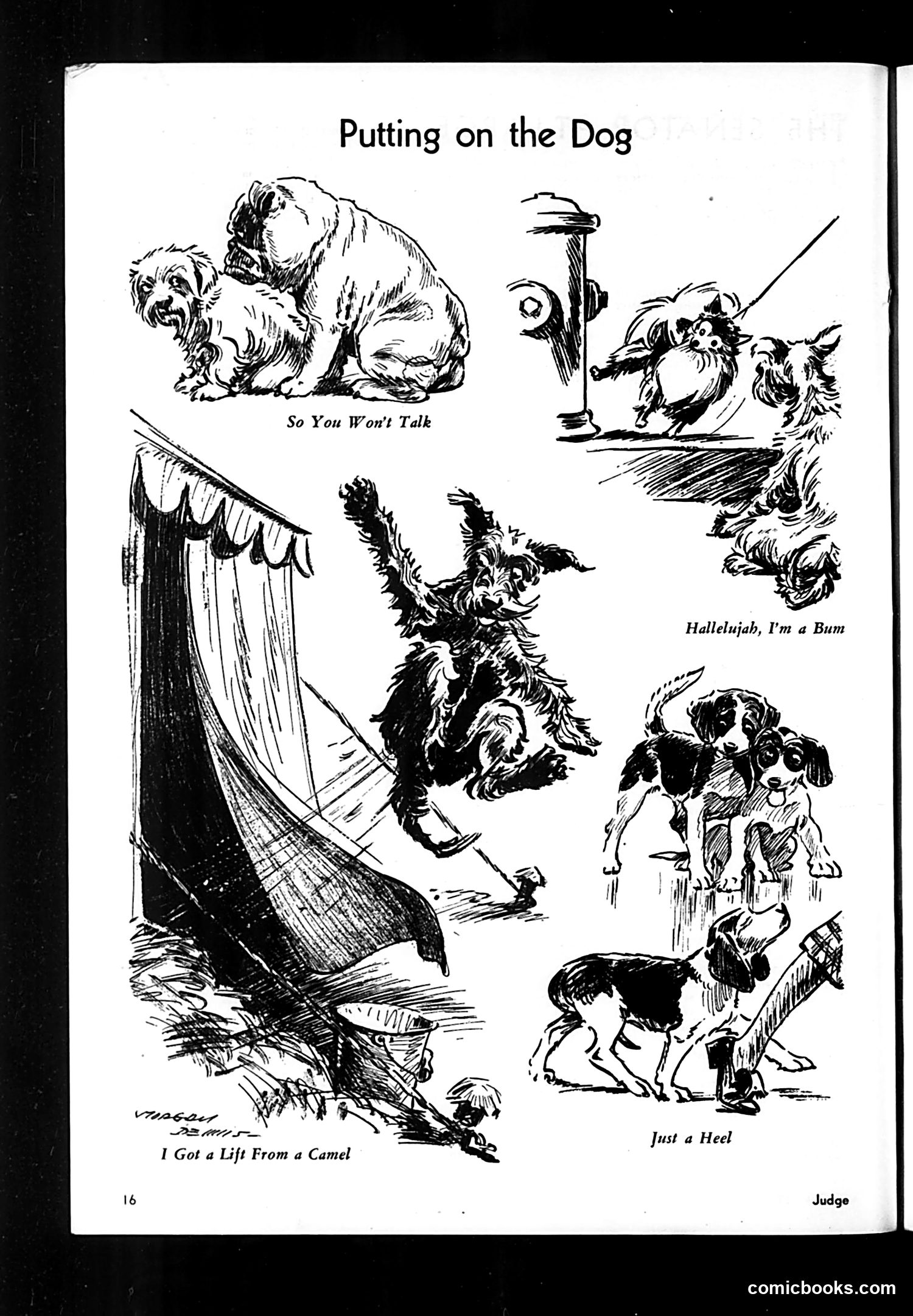
"Putting on the Dog" - Judge Magazine This page presents four humorous sketches about dogs and human behavior, using dogs as vehicles for social commentary: 1. "So You Won't Talk" - A large dog sitting next to a small terrier, suggesting forced silence or intimidation. 2. "I Got a Lift From a Camel" - A dog in what appears to be a suspended bag or net, humorously depicting an unlikely transportation scenario. 3. "Hallelujah, I'm a Bum" - Multiple small dogs in energetic poses, likely referencing the popular song and satirizing carefree behavior. 4. "Just a Heel" - Dogs gathered together, with the caption suggesting social climbing or pretentiousness (a "heel" being slang for an untrustworthy person). The phrase "putting on the dog" means to act superior or show off, making these sketches clever visual puns about canine behavior reflecting human social pretensions.
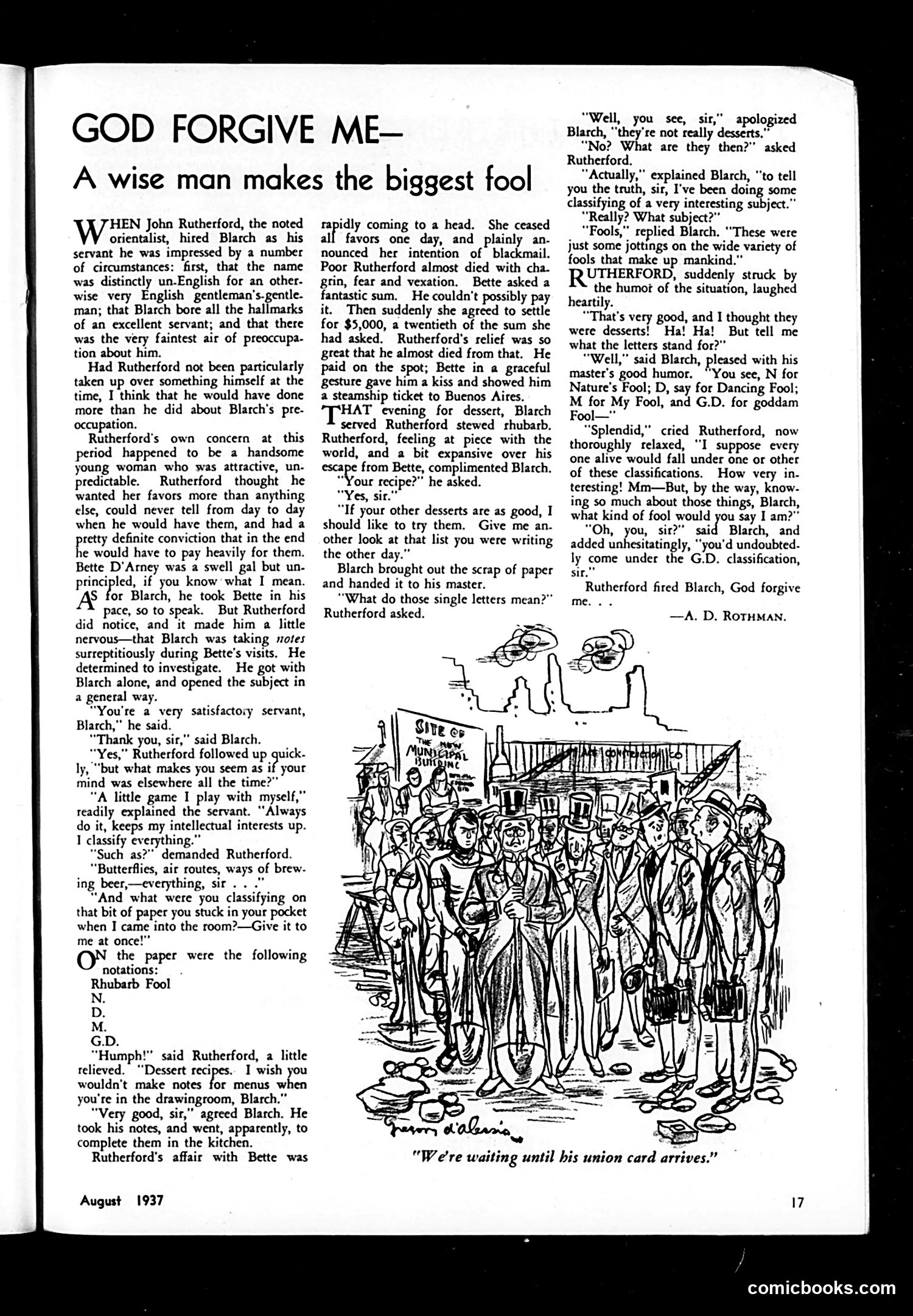
Analysis of "God Forgive Me—A Wise Man Makes the Biggest Fool" This story-based humor piece satirizes human foolishness through a servant's classification system. The narrative follows Rutherford, a gentleman scholar, who suspects his servant Blarch is taking notes about his affair with the unprincipled Bette D'Arney. When confronted, Blarch reveals he classifies everything as an intellectual hobby. His notebook contains abbreviations: "Rhubarb Fool," "N.," "D.," "M.," and "G.D."—which Rutherford assumes are dessert recipes. However, the punchline reveals they actually label varieties of human foolishness. The satire targets Rutherford's own blindness: he's so preoccupied with his illicit affair that he fails to recognize the servant's obvious commentary on his behavior. The final revelation—that Rutherford himself is among Blarch's catalogued "fools"—delivers the moral that the title promises: even intelligent men become fools when consumed by passion or self-interest. The accompanying crowd illustration appears unrelated to the main narrative, likely accompanying a separate advertisement or article.
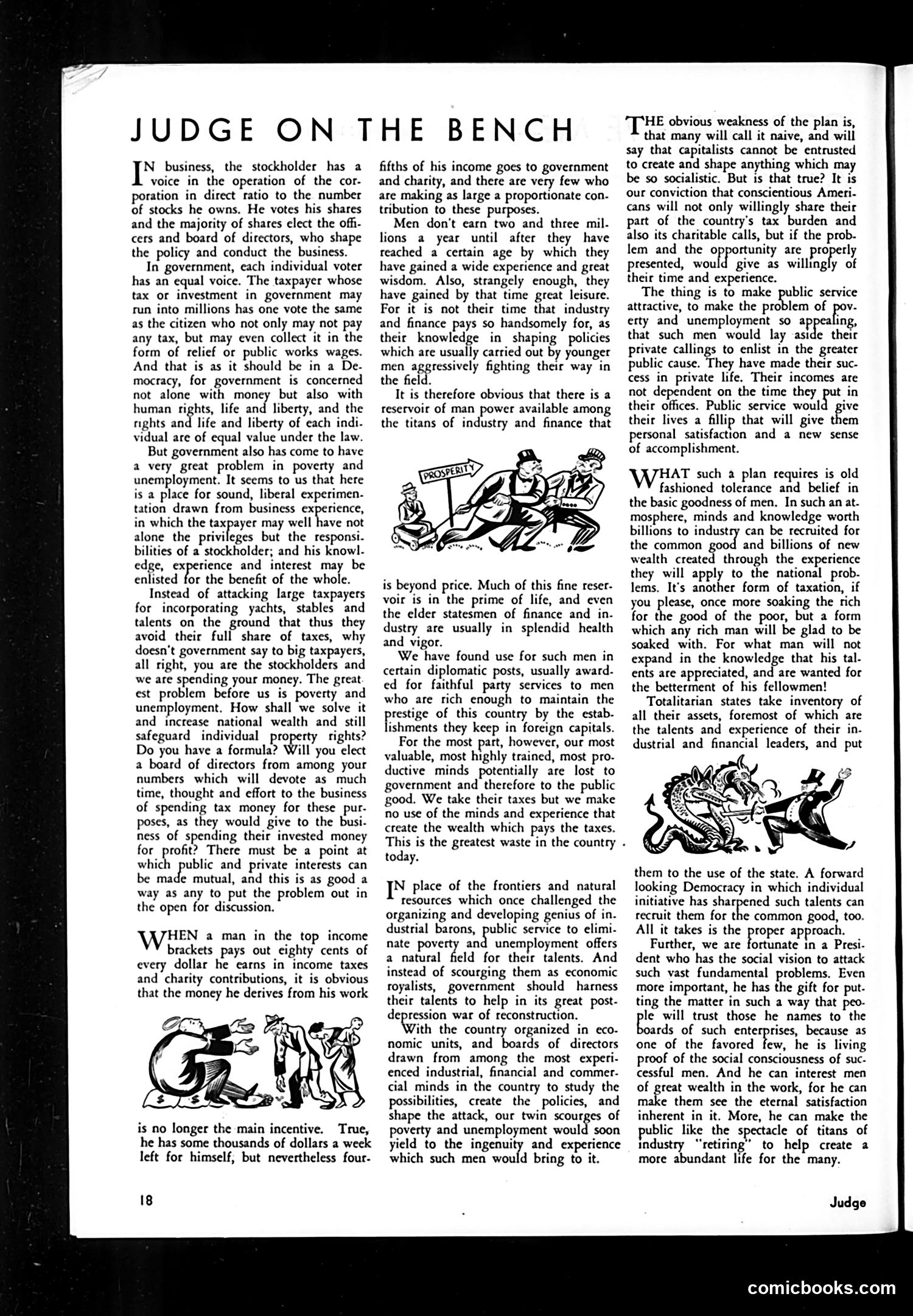
"Judge on the Bench": A Depression-Era Argument for Wealthy Involvement in Government This editorial cartoon/article argues that wealthy taxpayers should serve on government boards to solve poverty and unemployment—much like stockholders oversee corporations. The piece compares democratic governance to business management, noting that while stockholders have voting power proportional to their investment, taxpayers (even millionaires) have only one vote regardless of their tax burden. The satire's central point: wealthy men in their later years possess valuable experience and leisure time currently wasted on diplomatic posts awarded for party loyalty. Rather than attacking high earners through taxes, government should recruit them as unpaid advisors to tackle economic problems using business expertise. The cartoons show figures being pushed/struggling with poverty (appearing to represent the unemployed masses), illustrating the crisis the proposal claims wealthy experts could solve. The piece reflects Depression-era debates about whether capitalist expertise could remedy economic failure without socialist intervention.
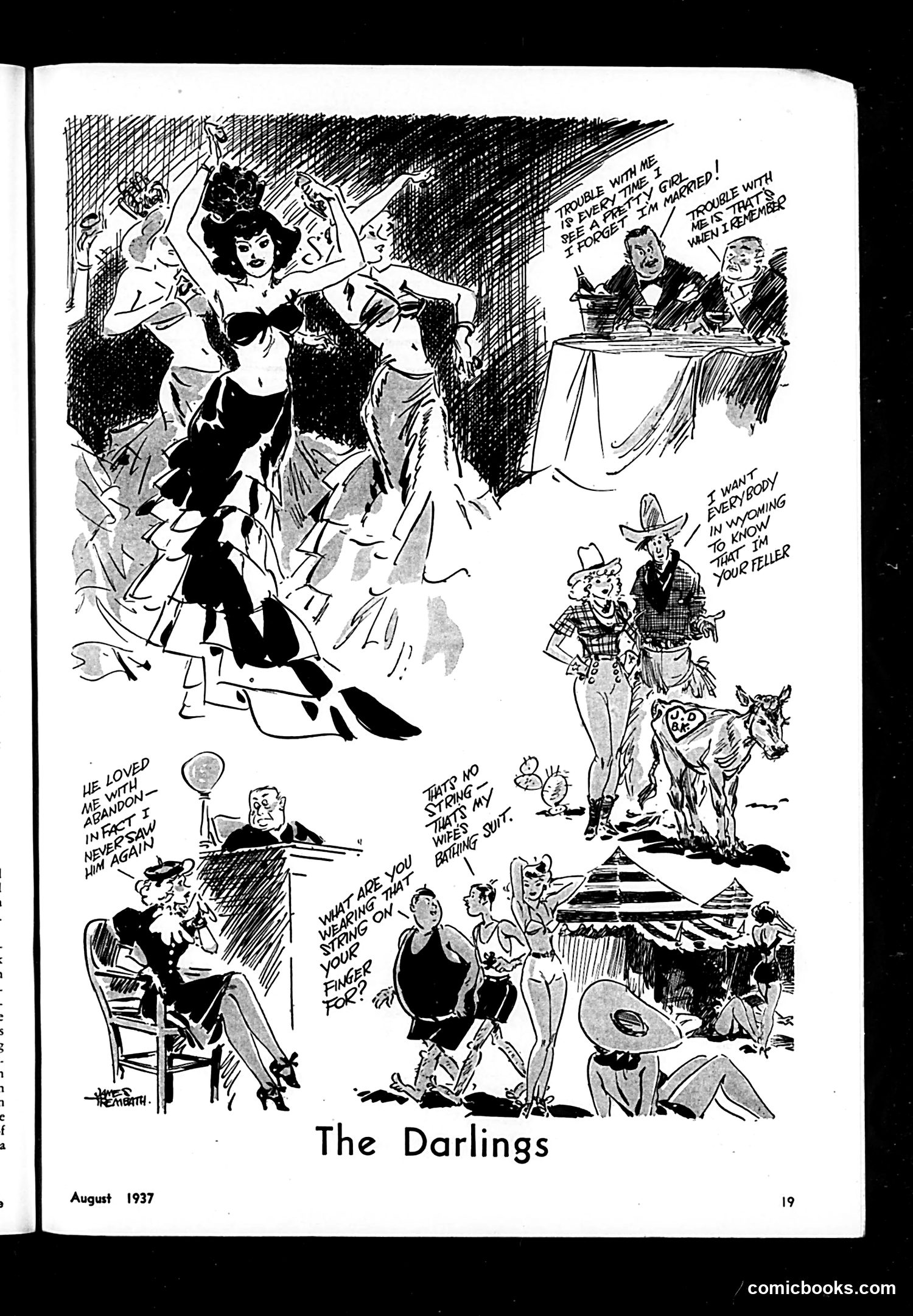
"The Darlings" - Judge Magazine, August 1937 This multi-panel satirical comic depicts various relationship scenarios. The central image shows a woman performing at what appears to be a nightclub or theatrical venue, while suited men at a table make comments about "trouble" and "George." The surrounding panels show domestic disputes and romantic complications: a man at a desk saying he "loved her with abandon" but "never saw him again"; a couple with packhorses in what appears to be a desert or frontier setting; and other couples in conflict. The humor appears to target the instability of romantic relationships and marriages during the 1930s—the title "The Darlings" suggesting couples who start affectionately but end in discord. The variety of settings (nightclub, home, frontier) implies relationship troubles cross all social classes and circumstances. The tone suggests satirizing the era's romantic idealism against practical reality.
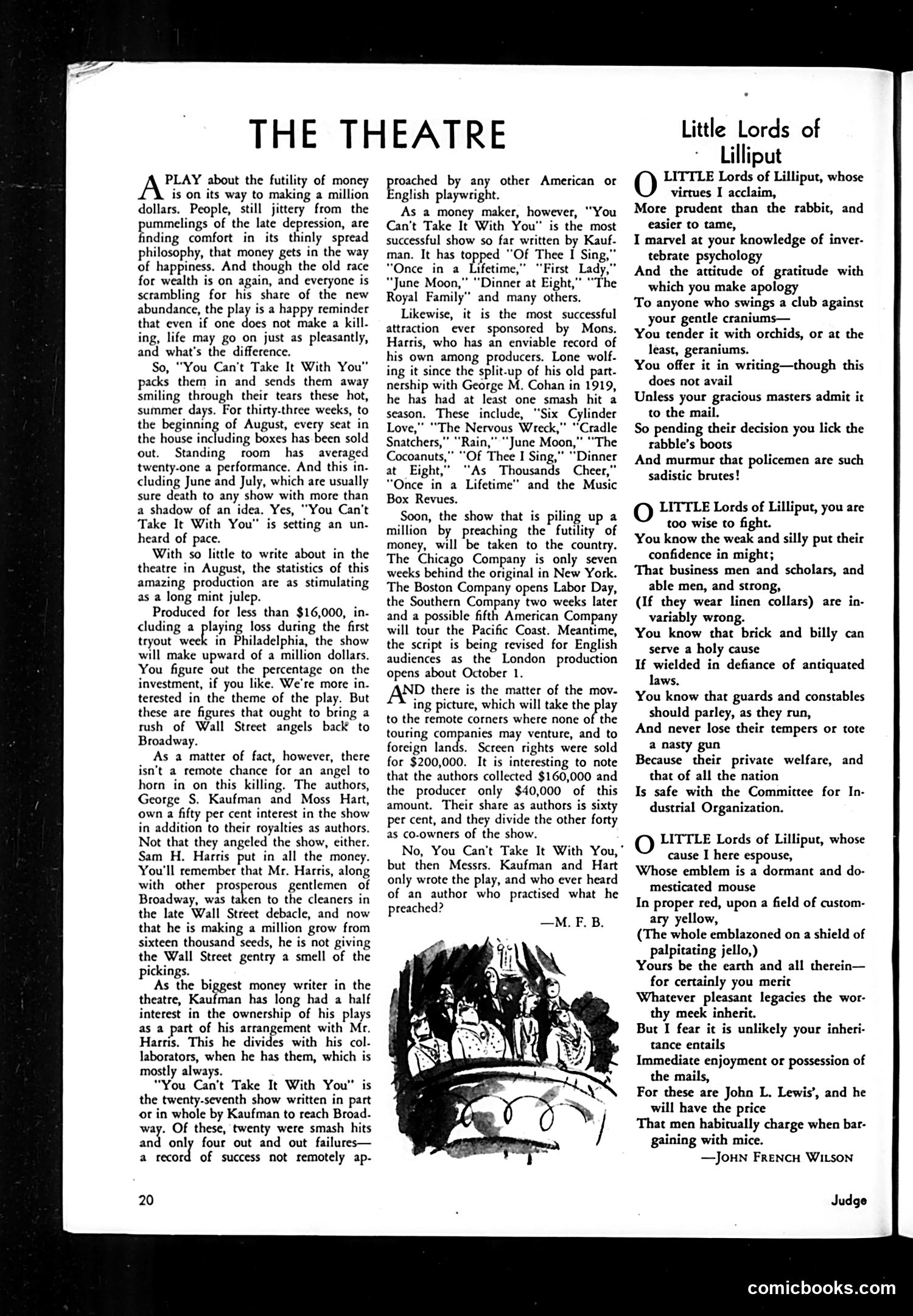
Explanation for Modern Readers This is primarily a theatre review column, not a political cartoon. The page discusses "You Can't Take It With You," a hugely successful Broadway play by George S. Kaufman and Moss Hart. The ironic central point: a play preaching that money doesn't bring happiness is making enormous profits ($1 million from a $16,000 investment). This appeals to Depression-era audiences still anxious about wealth, yet creates paradoxical financial success for its creators. The review details the financial arrangement—authors Kaufman and Hart own 50% plus royalties; producer Sam H. Harris owns 50% and keeps profits private. The satire is implicit: those preaching against money-seeking are themselves profiting handsomely. The right-hand column contains unrelated verse titled "Little Lords of Lilliput"—likely satirizing social pretensions—but the image quality makes its specific targets unclear. The page reflects 1930s post-Depression theatre culture and the public appetite for escapist, philosophically comforting entertainment.
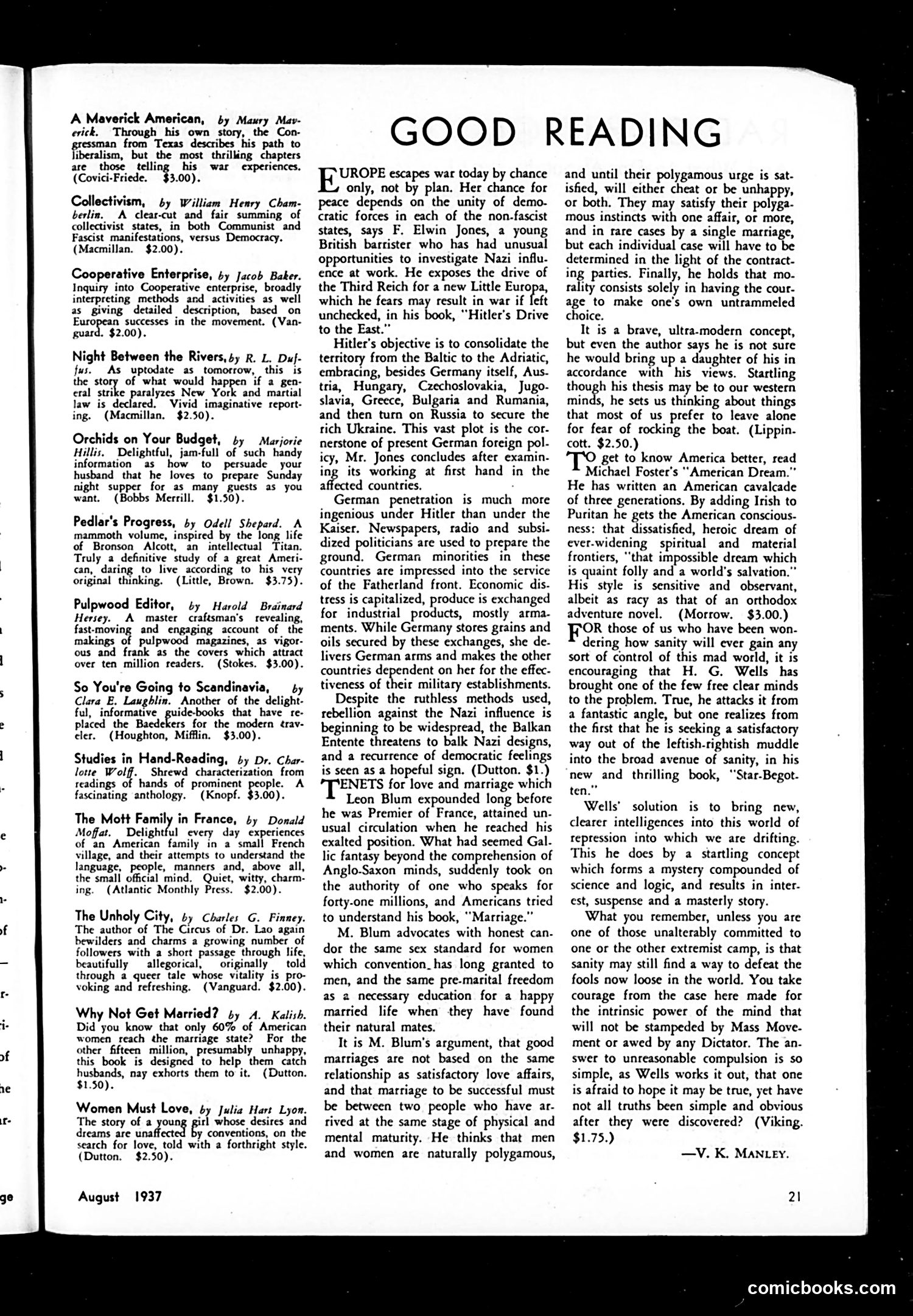
Good Reading: August 1937 This is a book review column from Judge magazine. The page contains no cartoons—it's a "Good Reading" section reviewing contemporary books, mostly non-fiction about politics and social issues. The reviews focus heavily on anti-Nazi and anti-Fascist themes, reflecting August 1937 concerns. F. Elwin Jones's "Hitler's Drive to the East" warns of Nazi expansion plans across Eastern Europe. William Henry Chamberlin's "Collectivism" compares Communist and Fascist systems unfavorably to democracy. Other titles address labor movements, cooperative enterprise, and social reform. The column also reviews lighter fare—travel guides, etiquette books, and romantic fiction—but the political urgency is clear. This was published as Hitler's ambitions were becoming undeniable to American readers, before U.S. entry into World War II.
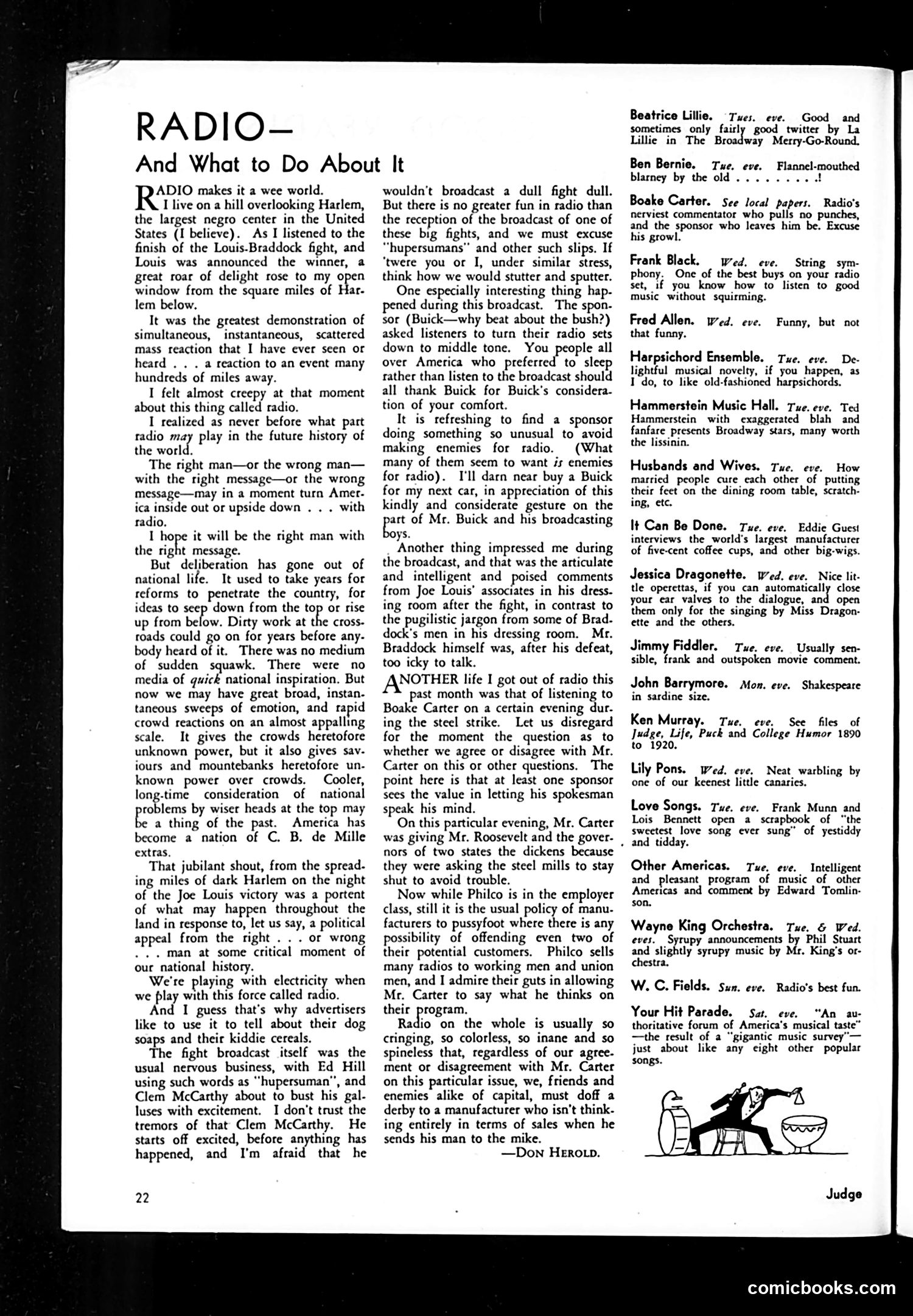
Analysis of This Judge Magazine Page This page is primarily a serious essay by Don Herold on radio's social and political power, not a political cartoon. The small cartoon at the bottom appears to be decorative filler. Main Content: Herold discusses the Louis-Braddock boxing match broadcast and its impact on Harlem listeners, using this as a meditation on radio's unprecedented ability to create instantaneous mass reactions across America. He expresses both wonder and concern about this new medium's power. Key Points: - Radio enables rapid emotional mobilization of crowds—potentially dangerous if manipulated by "the right man or the wrong man" - He praises Buick for asking listeners to lower volume, showing corporate responsibility - He notes how radio commentary can be sensationalized (criticizing announcers' hyperbole) - He contrasts this with Joe Louis's articulate associates in the dressing room Historical Context: This likely dates to the 1930s Louis-Braddock era. Herold's anxiety about radio's power to bypass deliberate thought and sway mass opinion reflects genuine contemporary concerns about propaganda and fascism emerging in Europe. The essay is thoughtful social criticism rather than satire—addressing real anxieties about mass media's democratic implications.
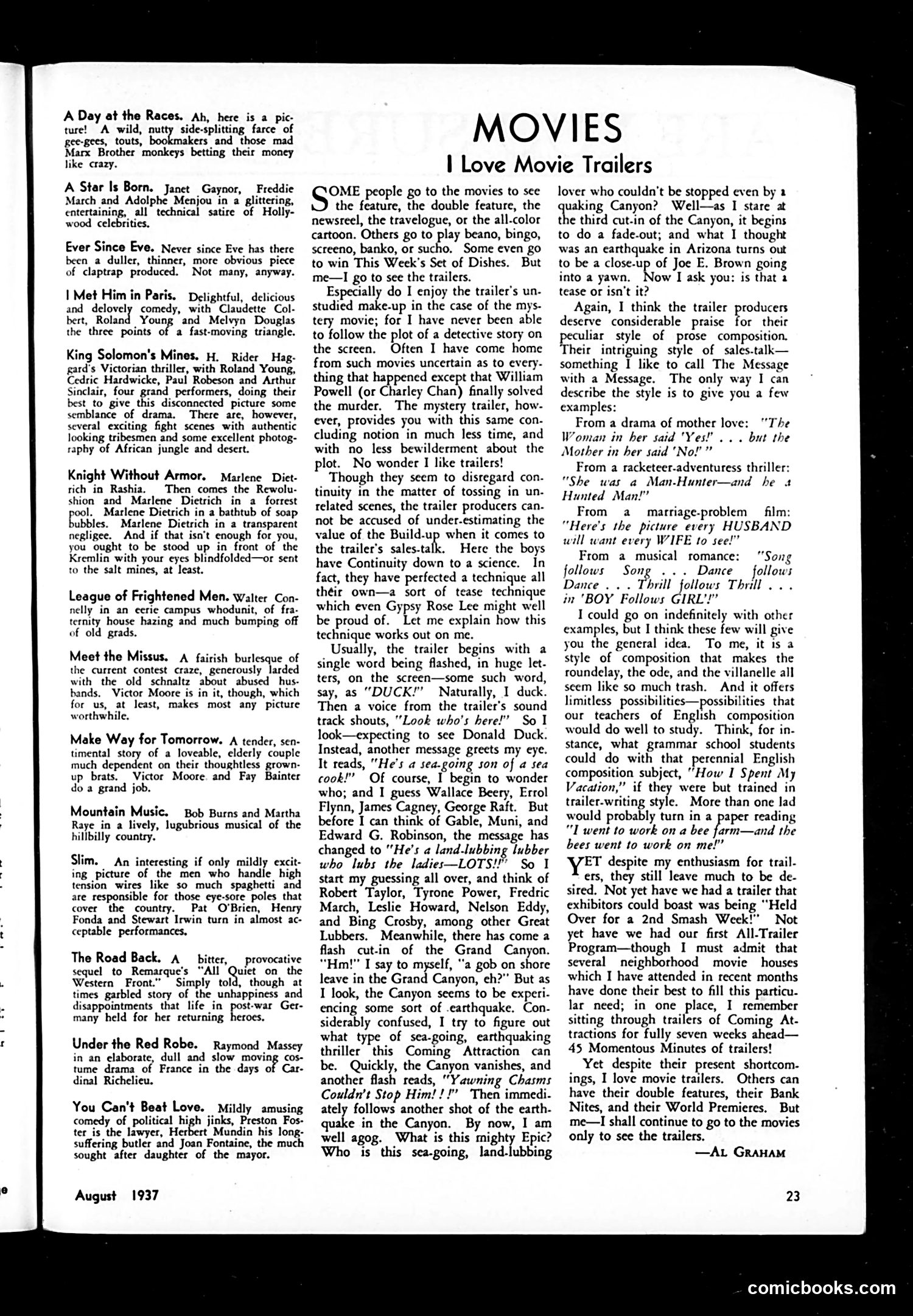
"I Love Movie Trailers" - August 1937 This page is a film review column from Judge magazine, not a political cartoon. The main article critiques movie trailers—the preview clips shown before features—which the author finds more enjoyable than actual mystery films. The reviewer humorously explains that they cannot follow detective movie plots, citing William Powell and Charlie Chan films as examples. They prefer trailers because trailers provide plot clarity in condensed form, unlike the full movies themselves. The column then reviews various 1937 films, offering brief comedic assessments: praising Marx Brothers' "A Day at the Races," criticizing "Ever Since Eve" as dull, and noting Marlene Dietrich's costume changes in "Knight Without Armor." Other reviewed films include "Make Way for Tomorrow" and "King Solomon's Mines." The humor derives from insider Hollywood knowledge and sardonic commentary on contemporary cinema rather than political satire.
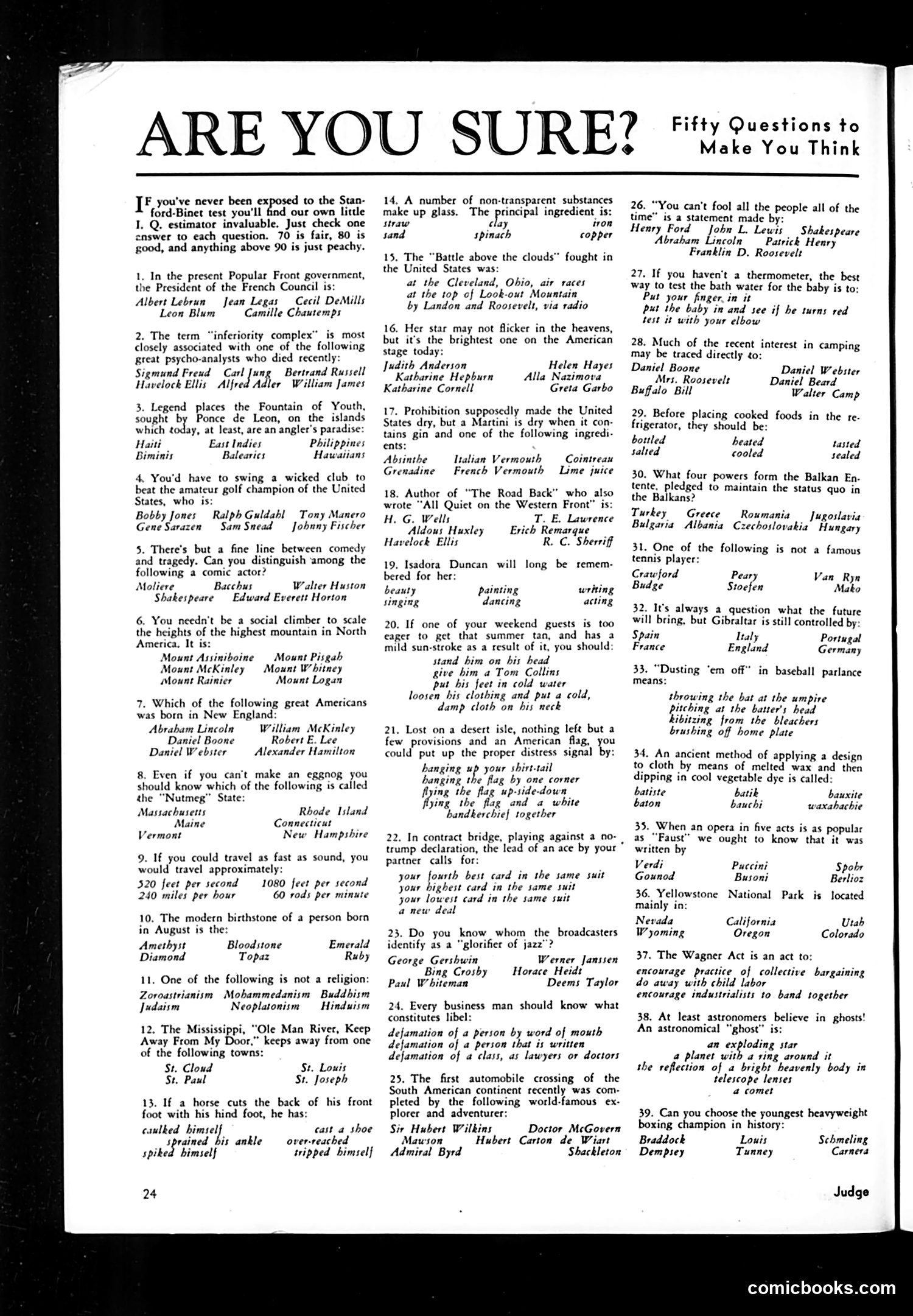
Analysis of "Are You Sure?" Judge Magazine Quiz Page This page presents a satirical IQ test disguised as a serious self-assessment tool. The "Stanford-Binet" reference (a real intelligence test) lends false authority to what is actually a topical trivia quiz mocking contemporary events and figures of the 1930s. The satire targets people who overestimate their knowledge: answering these questions requires familiarity with current events (French politics, the "Popular Front"), recent deaths (Freud, Adler), and celebrity gossip rather than genuine intelligence. Key references include: - Question 1: The French Popular Front government (mid-1930s) - Question 2: Deaths of famous psychoanalysts - Question 15: Appears to mock FDR's 1936 campaign opponent Alf Landon - Question 16: Theatrical celebrities The humor lies in Judge's ironic critique: readers scoring high would merely prove they follow tabloids and politics closely—not that they're intelligent. It's satire of American celebrity culture and self-deception about what constitutes real knowledge.
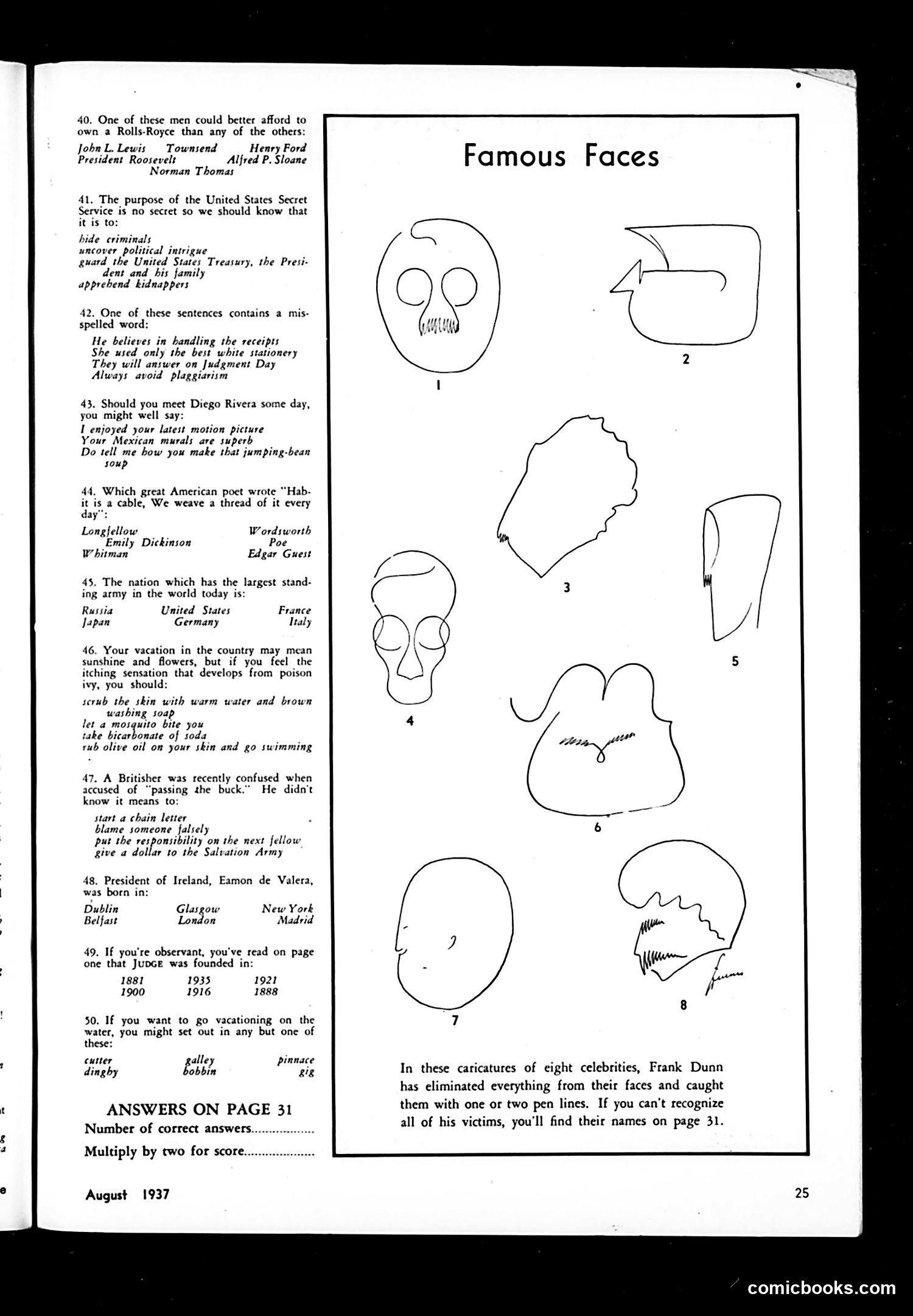
Famous Faces Caricature Game, Judge Magazine, August 1937 This page presents a quiz game where cartoonist Frank Dunn has created extreme minimalist caricatures of eight celebrities, reduced to just one or two pen lines each. Readers are challenged to identify the famous faces from these highly abstracted drawings. The accompanying trivia questions (40-50) test general knowledge about 1930s America: figures like John L. Lewis (labor leader), Henry Ford (industrialist), President Roosevelt, and Diego Rivera (Mexican muralist); historical facts about the Secret Service and Ireland's president Eamon de Valera; and literary references to American poets. The game's humor lies in the contrast between the famous subjects and Dunn's radical simplification—the caricatures are so stripped down that recognition becomes genuinely difficult, transforming celebrity recognition into an actual puzzle rather than easy identification. This reflects Judge's sophisticated audience, expected to know these contemporary public figures.
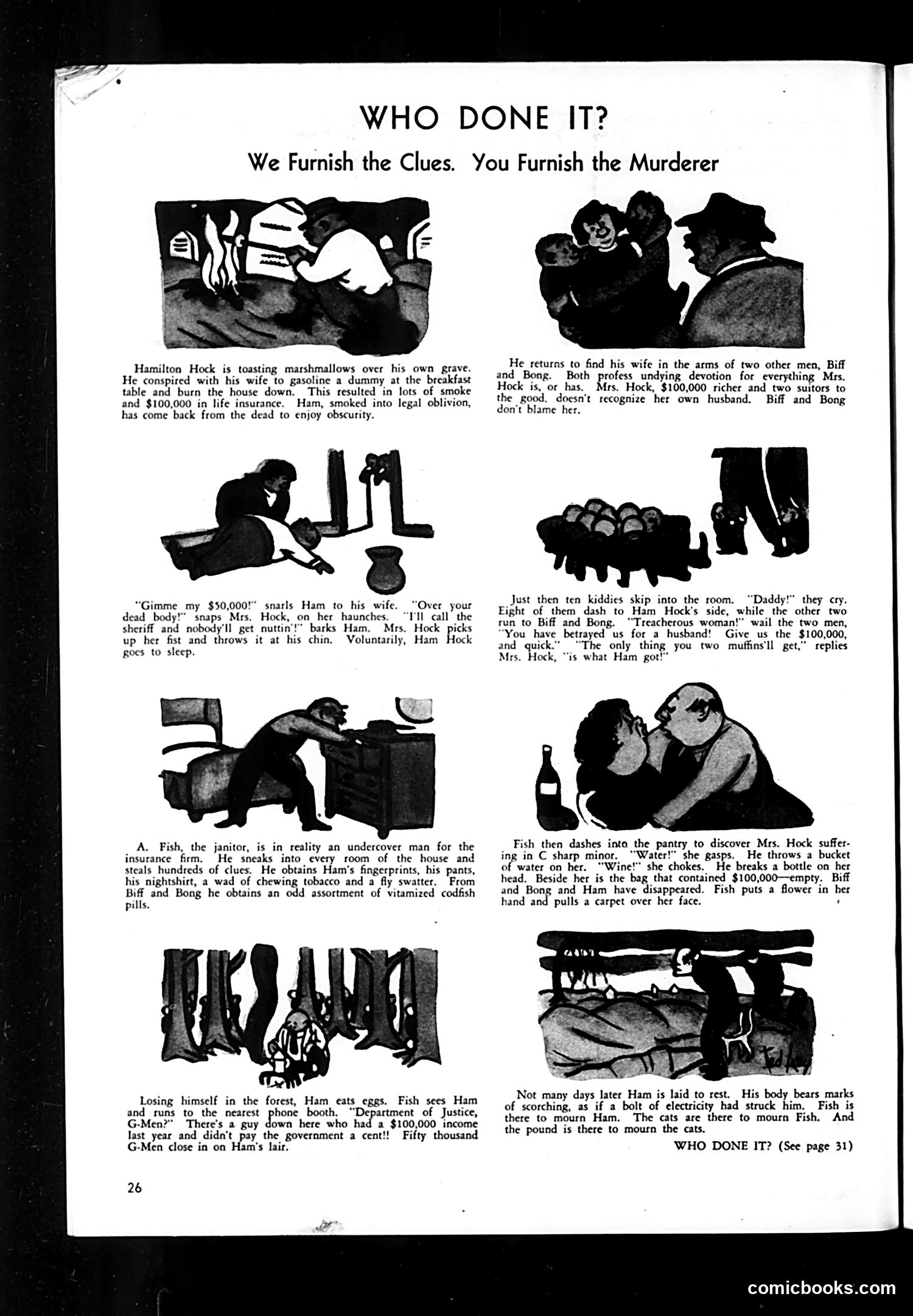
Analysis for Modern Readers This is a satirical crime/mystery comic strip from Judge magazine that parodies detective stories and insurance fraud schemes. The narrative follows Hamilton Hock, who fakes his death by burning a dummy to collect $100,000 life insurance—a common 1920s-30s fraud scheme that fascinated the public. The satire unfolds through escalating absurdity: Hock's wife refuses to share the money; an insurance investigator (A. Fish) becomes involved; Hock's infidelities and tax evasion emerge; his wife takes multiple lovers; their children appear mysteriously; and the situation devolves into slapstick chaos with everyone vanishing or dying. The page's title—"We Furnish the Clues. You Furnish the Murderer"—mocks detective fiction conventions by suggesting the audience must determine who actually killed whom among this morally corrupt cast. It satirizes both insurance fraud and sensationalist crime narratives popular in period media, treating serious criminal behavior as darkly comedic farce.
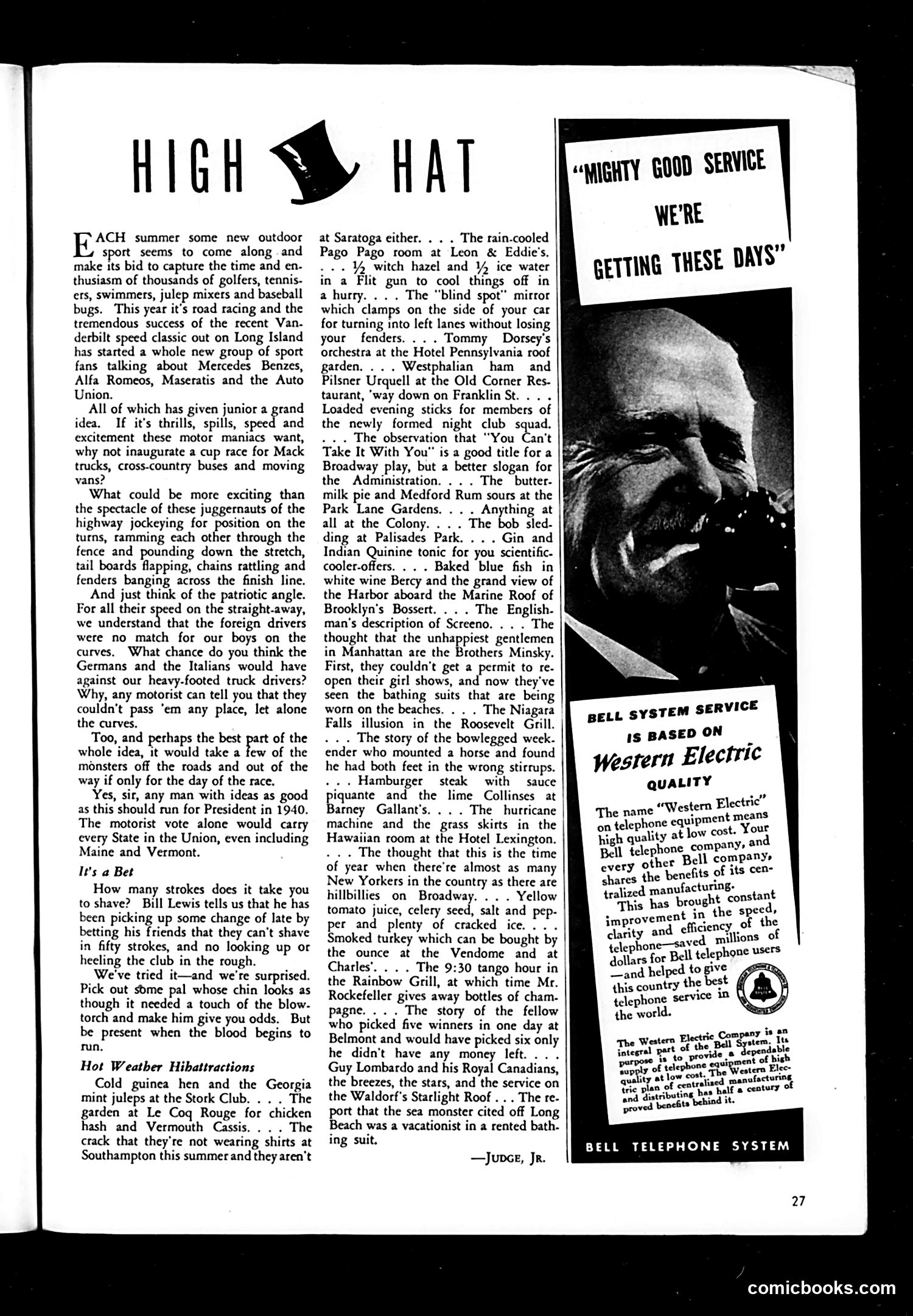
"High Hat" Analysis This page from *Judge* contains satirical commentary on 1930s leisure and social trends, rather than a political cartoon per se. The main article mocks the recent Vanderbilt Speed Trials (a famous auto racing event on Long Island) and the wealthy enthusiasts obsessed with luxury foreign sports cars. The satire proposes an absurdist alternative: a cross-country race featuring Mack trucks, buses, and moving vans—vehicles driven by ordinary working people. The joke operates on multiple levels: it ridicules the pretentiousness of motorcar-racing elites while suggesting working-class "truck drivers" would outperform foreign (German and Italian) competitors on curves, appealing to American pride. The final quip—that such a race would remove traffic hazards—is sardonic social commentary about congestion. The surrounding sections collect trendy Manhattan nightspots and summer activities, maintaining *Judge*'s typical focus on upper-class leisure culture and its absurdities. The right pages contain advertisements for Bell Telephone Service.
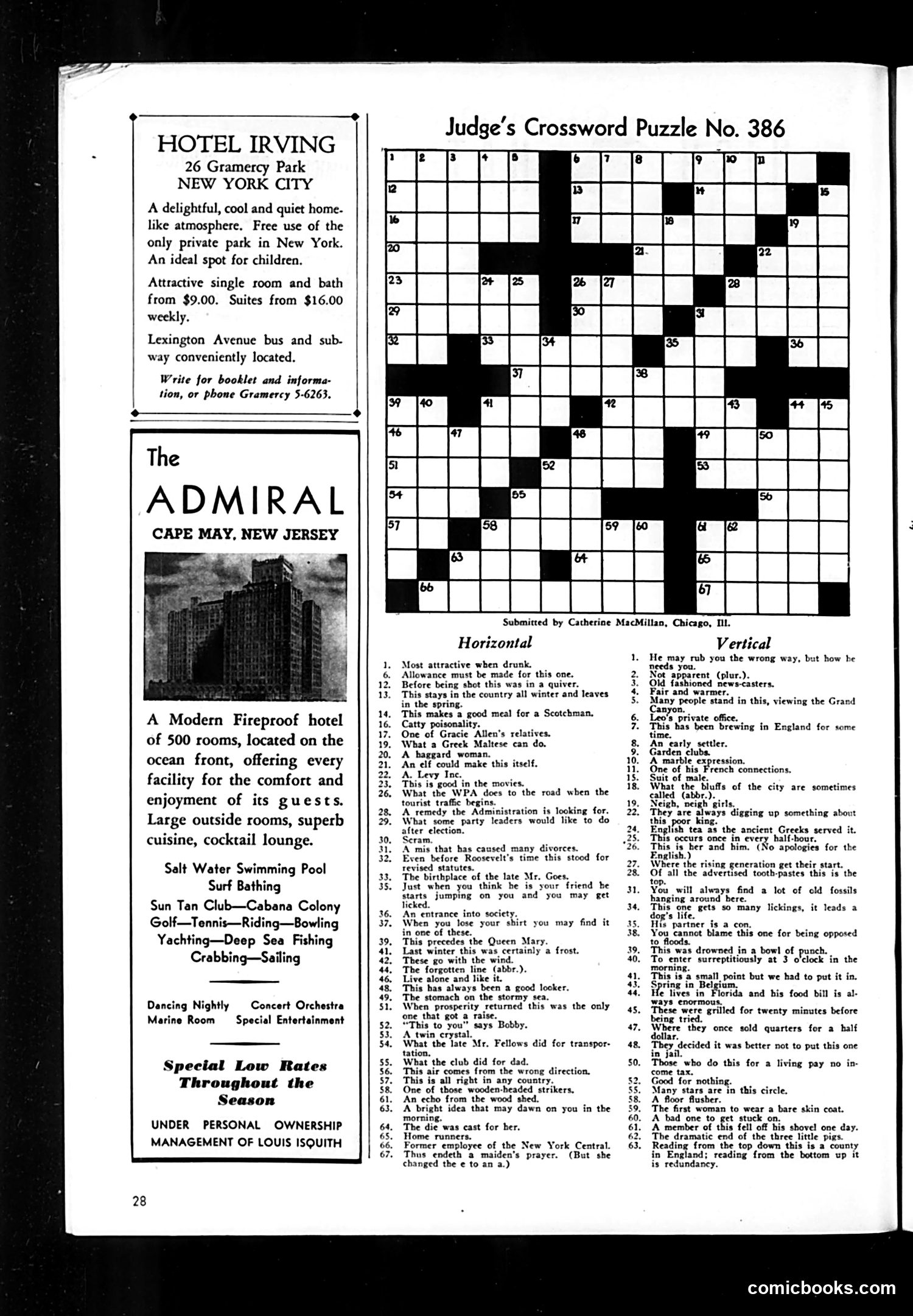
Judge's Crossword Puzzle No. 386 This page is primarily advertising and a crossword puzzle, not political satire. It contains two hotel advertisements (Hotel Irving in Manhattan and The Admiral in Cape May, New Jersey) and a Judge crossword puzzle submitted by Catherine MacMillan of Chicago. The puzzle itself contains topical clues referencing 1930s American life: references to Gracie Allen (radio comedian), Roosevelt, the Queen Mary (ocean liner), WPA (New Deal program), and contemporary slang. Clues include wordplay about politics ("What some party leaders would like to do after election"), economics ("When prosperity returned this was the only one that got a raise"), and social commentary typical of Judge magazine's humor. This represents the magazine's typical format mixing advertisements with entertainment content rather than editorial cartooning.
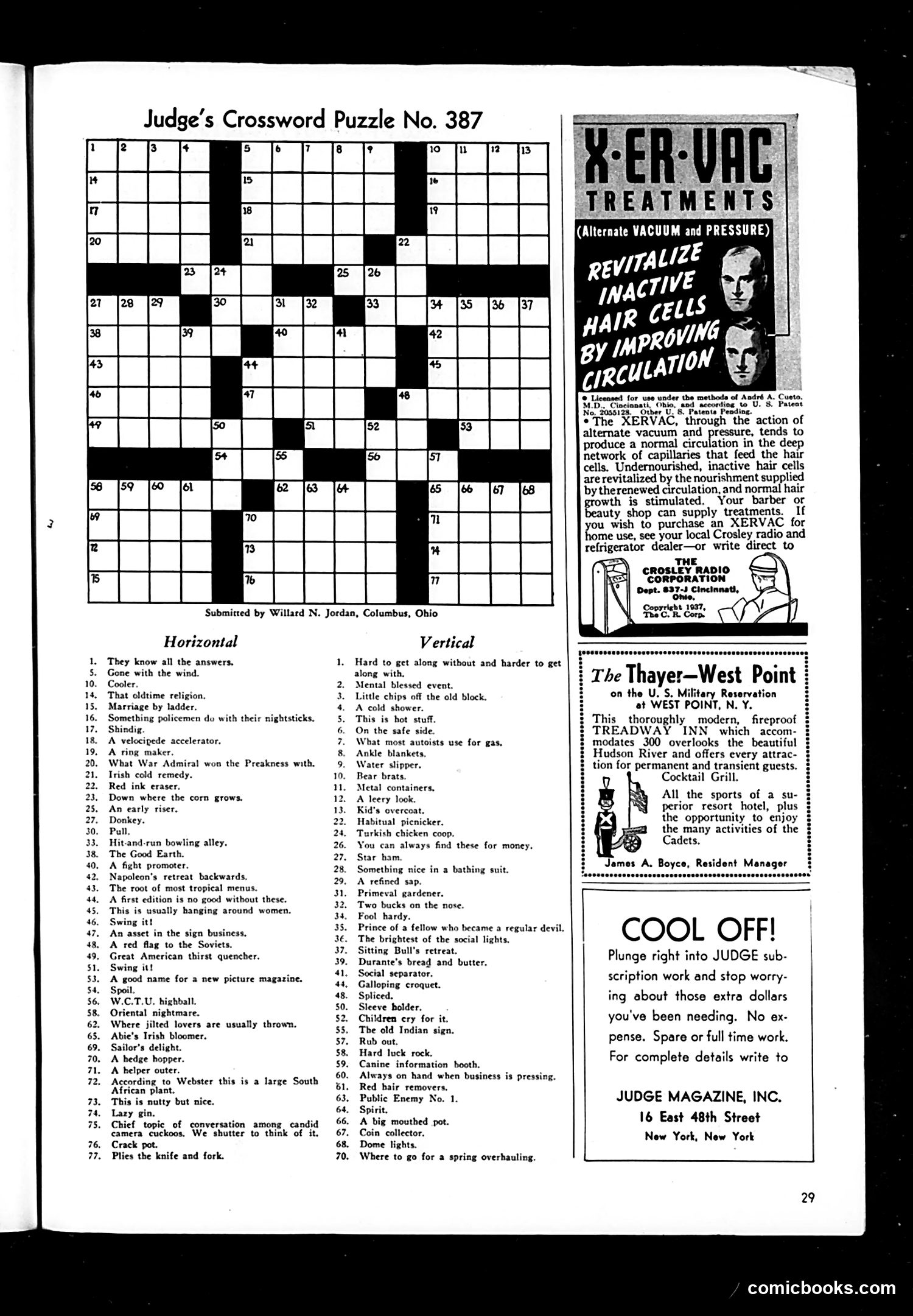
Judge's Crossword Puzzle No. 387 This page is primarily a crossword puzzle with accompanying advertisements. The puzzle itself contains no political satire or cartoon content—it's a standard word game with clues submitted by Willard N. Jordan of Columbus, Ohio. The clues reflect 1930s-40s American culture and idiom: references to "War Admiral" (a racehorse), "the Preakness" (horse racing), prohibition-era humor ("W.C.T.U. highball"), and contemporary figures like Durante. The surrounding advertisements—for X-ER-VAC hair treatments, the Thayer-West Point hotel, and Judge magazine subscriptions—represent typical period commercial content. There is no satirical cartoon or political commentary visible on this page. It functions as a puzzle and advertising vehicle rather than a vehicle for social or political satire.
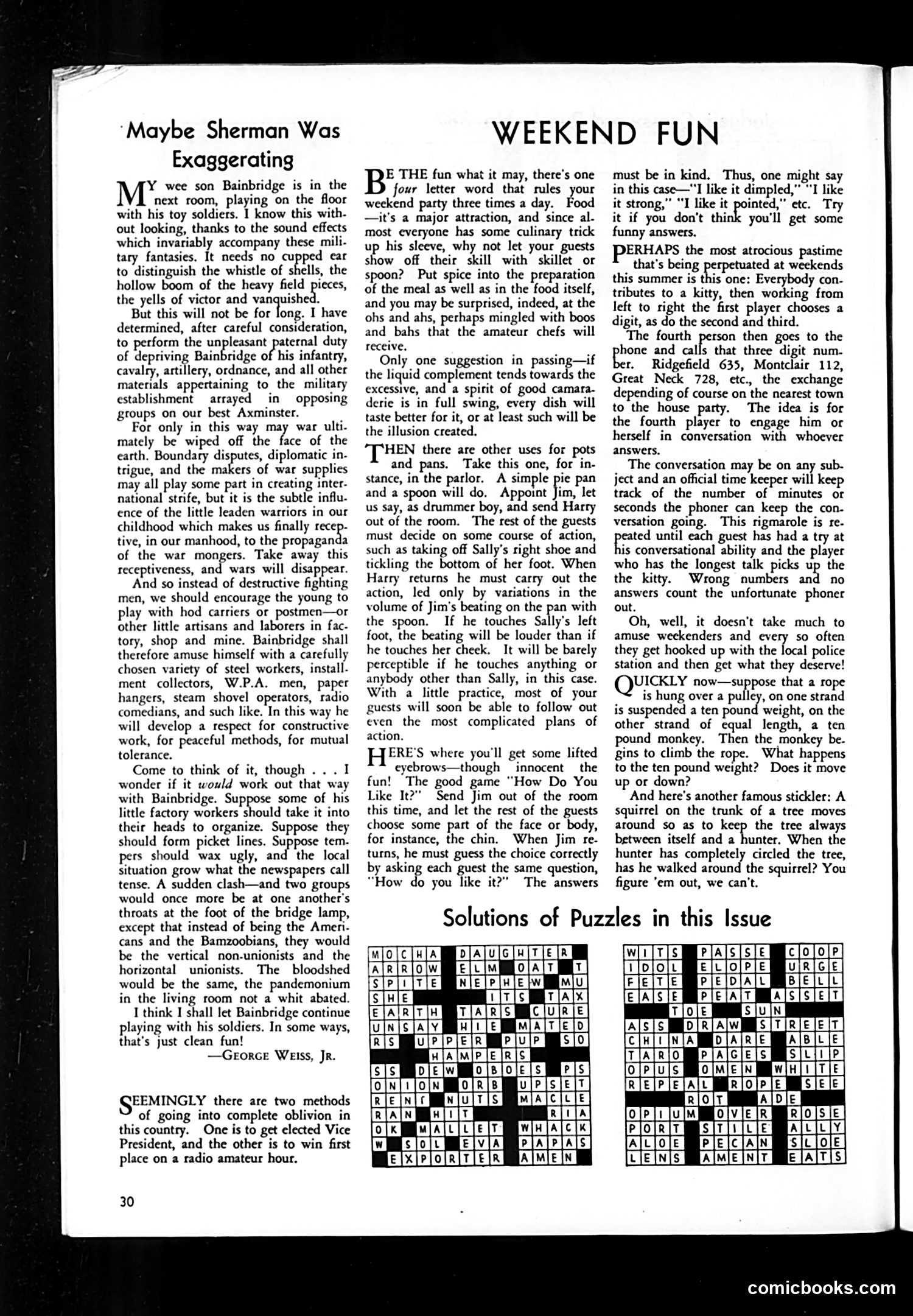
"Weekend Fun" – Judge Magazine Page Analysis This page contains two distinct pieces: Left Column ("Maybe Sherman Was Exaggerating"): A satirical essay by George Weiss Jr. critiquing pacifism through irony. The author proposes removing toy soldiers from his son's play to prevent militarism, then sardonically realizes that replacing them with toy factory workers would merely recreate labor disputes and violence—suggesting that human conflict stems from nature, not toy choice. The title references General Sherman's Civil War quote about war's horrors, implying the author skeptically views attempts to eliminate warfare through such trivial measures. Right Column ("Weekend Fun"): Practical weekend entertainment advice covering party food preparation and parlor games (like a guessing game using a pie pan and spoon). This is lighthearted lifestyle content, not political satire. Historical Context: The WPA reference dates this to the 1930s Depression era. The piece satirizes contemporary pacifist ideology prevalent between WWI and WWII, suggesting human conflict is inevitable regardless of childhood influences—a pessimistic counterargument to progressive social engineering theories.
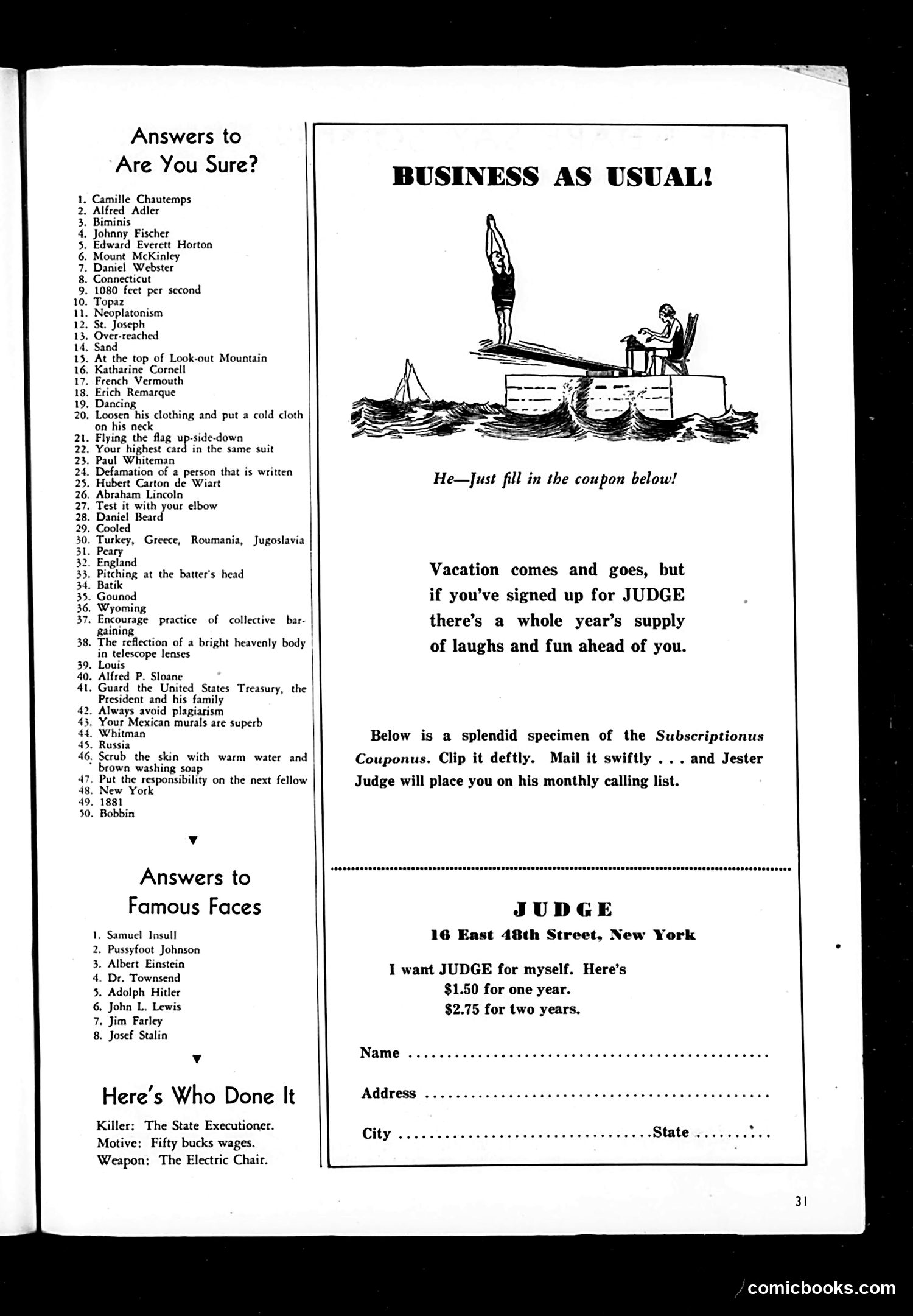
This page is primarily advertising and administrative content from *Judge* magazine, not a satirical cartoon. The main feature is a subscription coupon for the magazine itself, styled as "Business as Usual"—showing two figures on a platform (one diving, one seated at a desk), a humorous visual metaphor for leisure versus work. The page includes answer keys to quiz features: "Are You Sure?" (a trivia quiz with answers ranging from historical figures like Abraham Lincoln to contemporary references like Hitler and Stalin), "Famous Faces" (identifying public figures), and "Here's Who Done It" (identifying a criminal case, solved by "The State Executioner" using "The Electric Chair"—a reference to capital punishment). The subscription pitch emphasizes *Judge* offers "a whole year's supply of laughs and fun." Pricing: $1.50 for one year, $2.75 for two years. This page appears designed to drive subscriptions while showcasing the magazine's content variety.
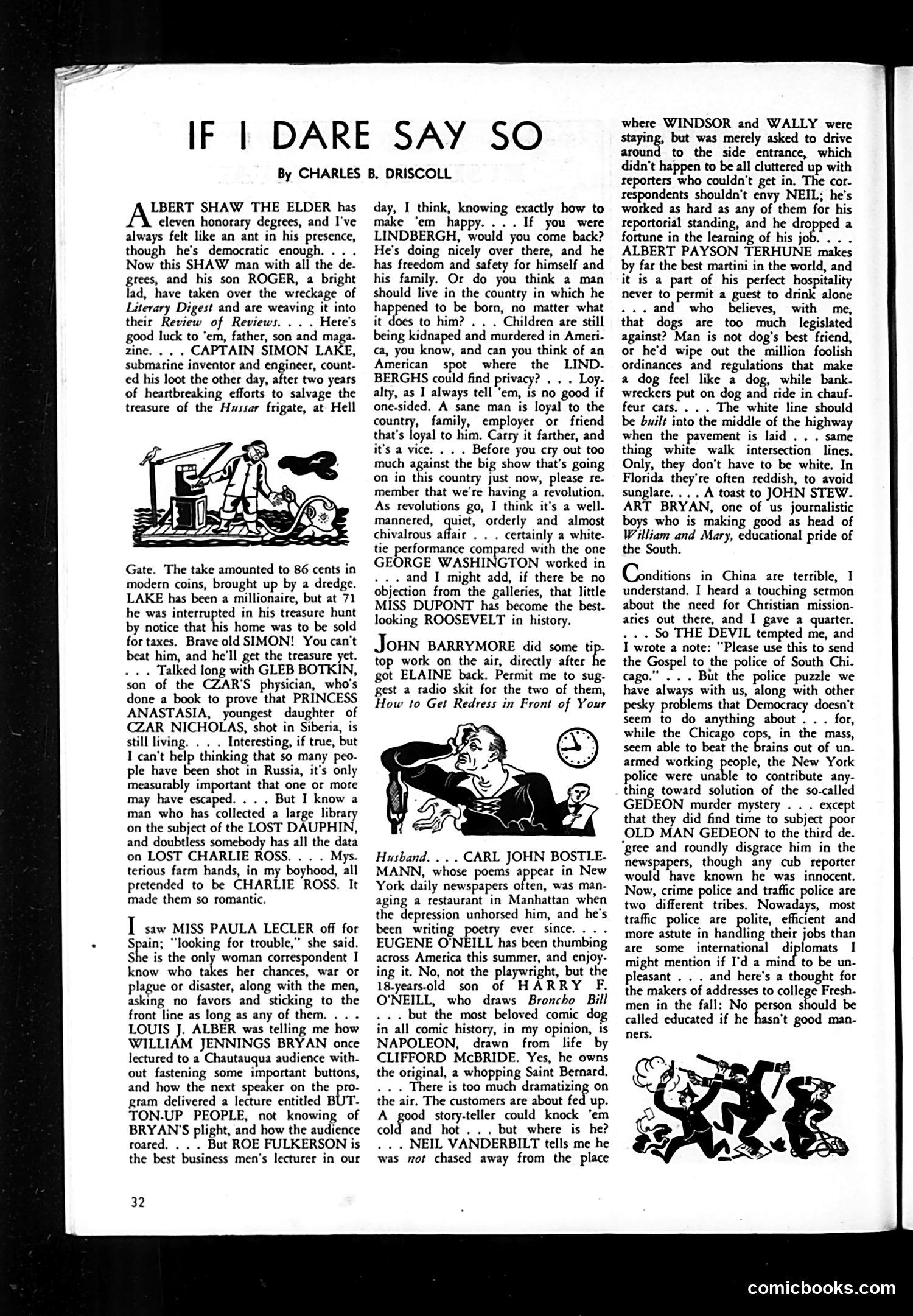
Political Commentary in Judge Magazine This page is Charles B. Driscoll's gossip-style column mixing celebrity anecdotes with social commentary. Key references include: Celebrity items: Albert Shaw (editor), William Jennings Bryan, John Barrymore, and Charles Lindbergh—the latter sparking debate about whether expatriates should return home despite safety concerns abroad. Historical references: Allusions to the Russian Imperial family (Czar Nicholas, Princess Anastasia) and "Lost Dauphin" mysteries reflect fascination with vanished royalty. Political undertone: Driscoll frames current American events as "a revolution... well-mannered, quiet, orderly" compared to Washington's era—likely referencing 1930s social upheaval (New Deal era). Social critique: Commentary on kidnappings, police ineffectiveness, and whether loyalty should be reciprocal—suggesting frustration with American institutions' failures. The small cartoons appear humorous but are difficult to parse without clearer detail. Overall, the column reflects upper-class, somewhat cynical 1930s American perspectives on celebrity, loyalty, and national character.
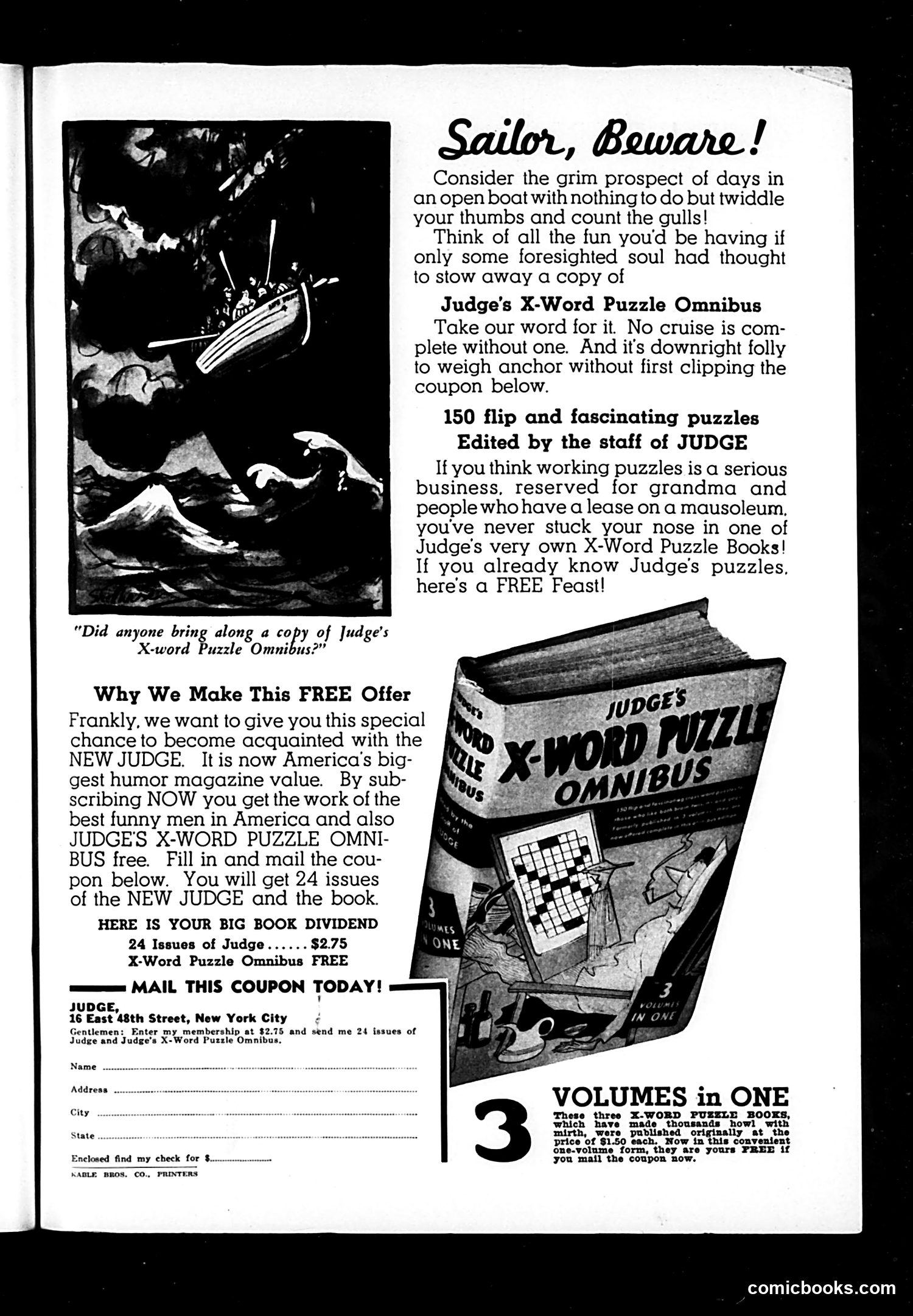
Analysis This is primarily a magazine advertisement, not a political cartoon. It promotes Judge magazine's subscription offer and an associated X-Word Puzzle Omnibus book. The single illustration shows sailors in a small boat looking bored—the visual joke supporting the ad's premise: a cruise without puzzles to occupy idle time is tedious. The caption plays on this: "Did anyone bring along a copy of Judge's X-Word Puzzle Omnibus?" The satire is gentle and commercial rather than political. Judge positions itself as America's "biggest humor magazine" and uses self-deprecating humor about puzzle-solving (calling it "serious business, reserved for grandma"). The real pitch: subscribing to Judge ($2.75) gets you 24 issues *plus* the puzzle book free. This reflects the 1930s-era magazine subscription model and the contemporary crossword puzzle craze—puzzles were a major entertainment during the Depression era.
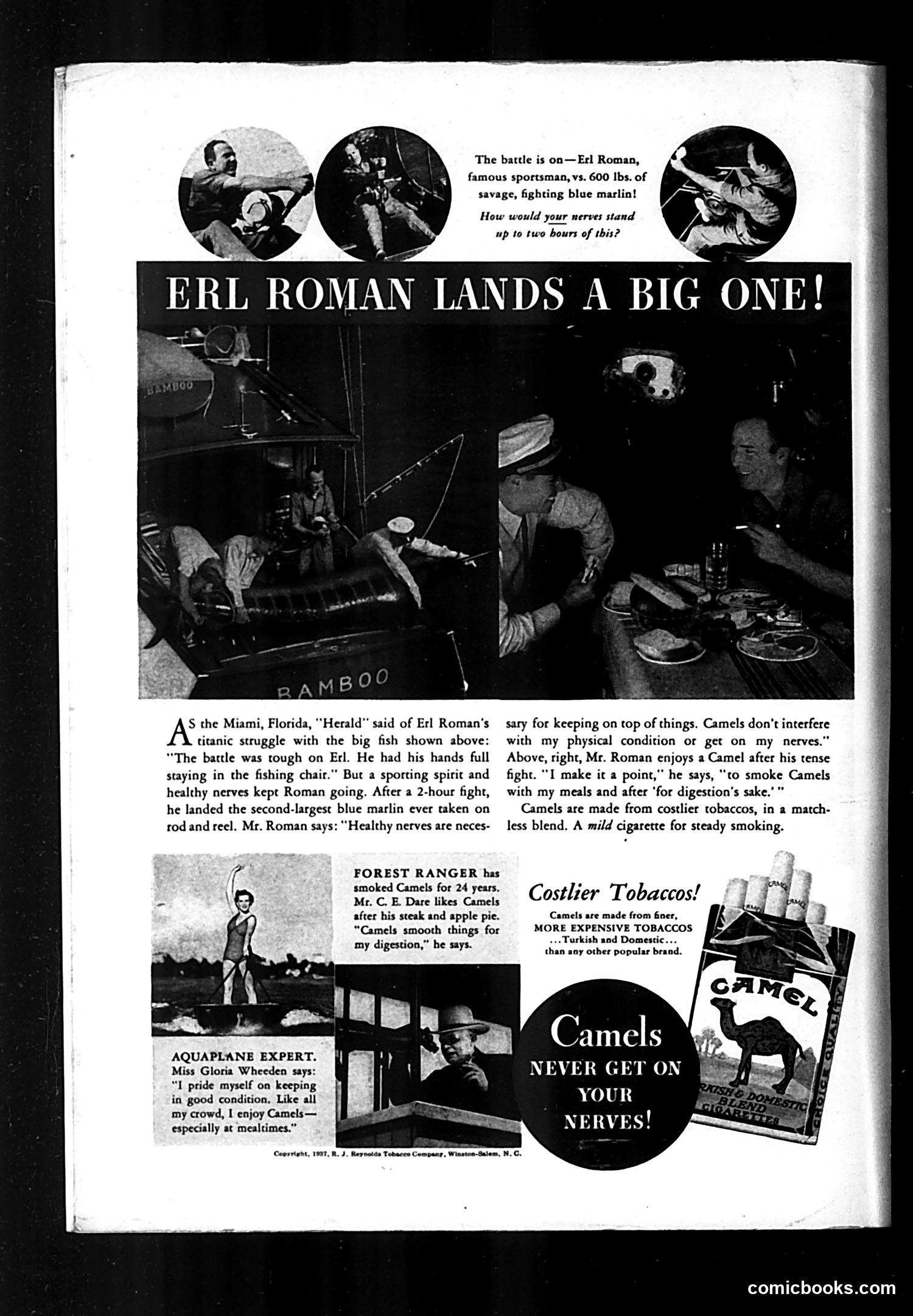
Camel Cigarettes Advertisement Disguised as Editorial Content This is primarily a Camel cigarettes advertisement from 1931, disguised as a sports feature in Judge magazine. The page uses Erl Roman, a famous sportsman, to promote smoking by claiming cigarettes don't harm "nerves" or physical condition. The ad features Roman's 2-hour battle landing a 600-pound blue marlin, arguing this feat required "healthy nerves." It then shows Roman smoking a Camel afterward, with testimonials from a forest ranger, aquaplane expert, and others claiming Camels aid digestion and don't interfere with athletic performance. The satire or humor, if any, is subtle—the page essentially exploits a real athlete's accomplishment to make dubious health claims about tobacco. The "Never Get on Your Nerves" slogan was Camel's marketing strategy to counter growing concerns about smoking's effects. This represents how cigarette companies once used athlete endorsements and pseudoscientific claims to market their products.

I'm unable to reliably read the content in this image. The page appears to be almost entirely black or very dark, with only a white margin visible on the left side and a "comicbooks.com" watermark at the bottom. While this is identified as a page from *Judge* magazine, the actual cartoon(s), illustrations, or text content that would normally be visible are not legible in this reproduction. To properly analyze the political satire, caricatures, and historical references, I would need a clearer, higher-contrast version of the page where the artwork and OCR'd text are actually visible.