judge
Judge — September 1937
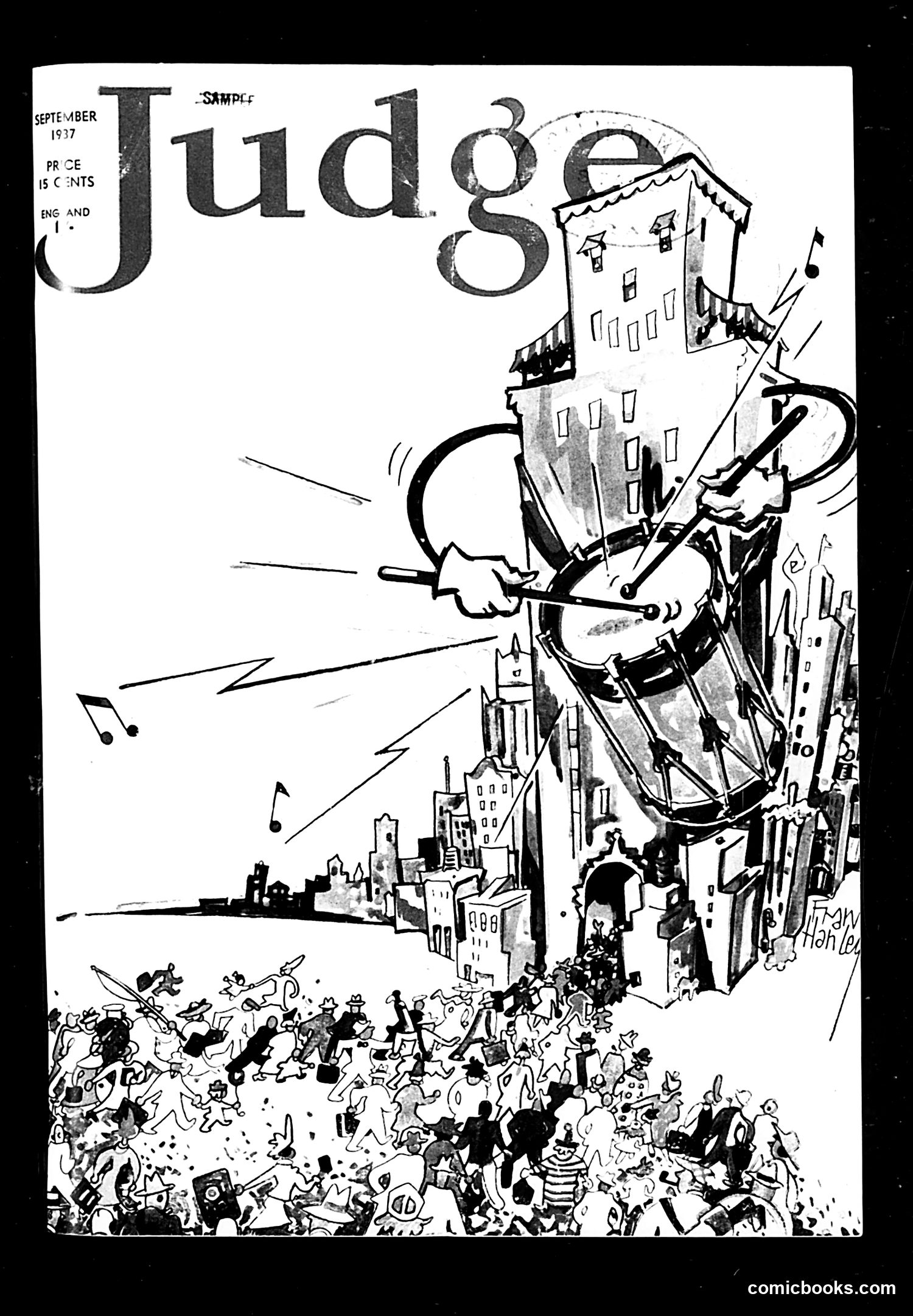
Judge Magazine Cover Analysis - September 1917 This cover depicts a giant figure playing bagpipes atop a tall building, serenading a crowd of people below in a city street. The giant appears to be a caricatured Scottish figure (suggested by the bagpipes and likely the attire). Given the September 1917 date, this likely references World War I and Scottish involvement. The "Judge" publication was American, and the image appears to satirize either Scottish military contributions or possibly immigration/Scottish cultural presence in America during the war period. The chaotic crowd below and the commanding musical performance suggest commentary on public response to war messaging or military recruiting. However, without clearer identifying details or text, the specific satirical target remains somewhat unclear.
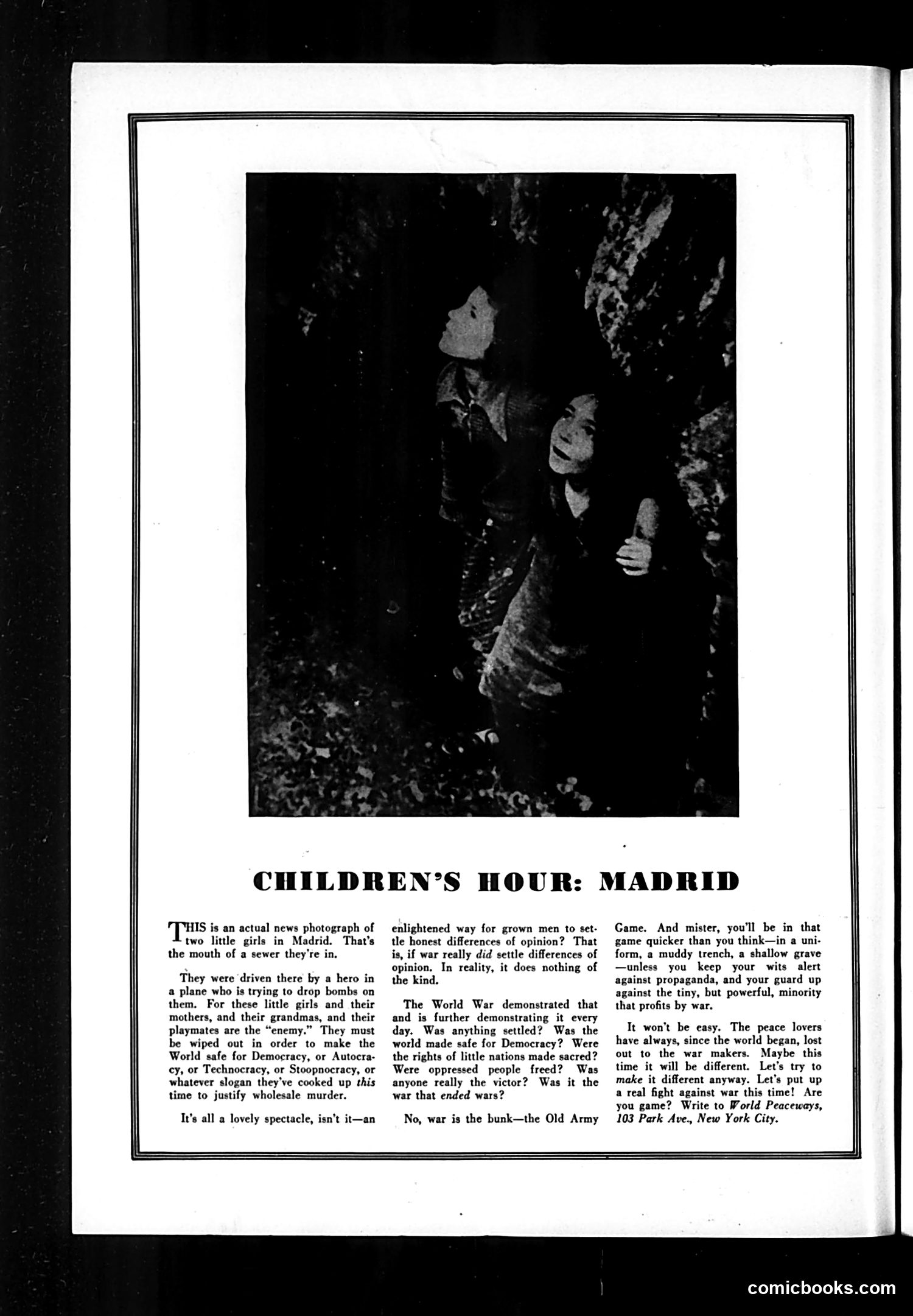
Analysis: "Children's Hour: Madrid" This is a satirical editorial photograph (not a cartoon) criticizing war's impact on children. The image shows young children in what appears to be a sewer or underground shelter in Madrid, likely during the Spanish Civil War (1936-1939). The text sarcastically asks whether war truly settles ideological differences, arguing it doesn't—it merely justifies wholesale murder. The author challenges readers to reconsider anti-war arguments, specifically addressing "peace lovers" and inviting them to submit alternative solutions to World Peaceways magazine. The satire targets those who defend war as necessary, using the visual evidence of Madrid's children in shelters as irrefutable counter-argument: war's reality is children hiding underground, not noble resolution of disputes.
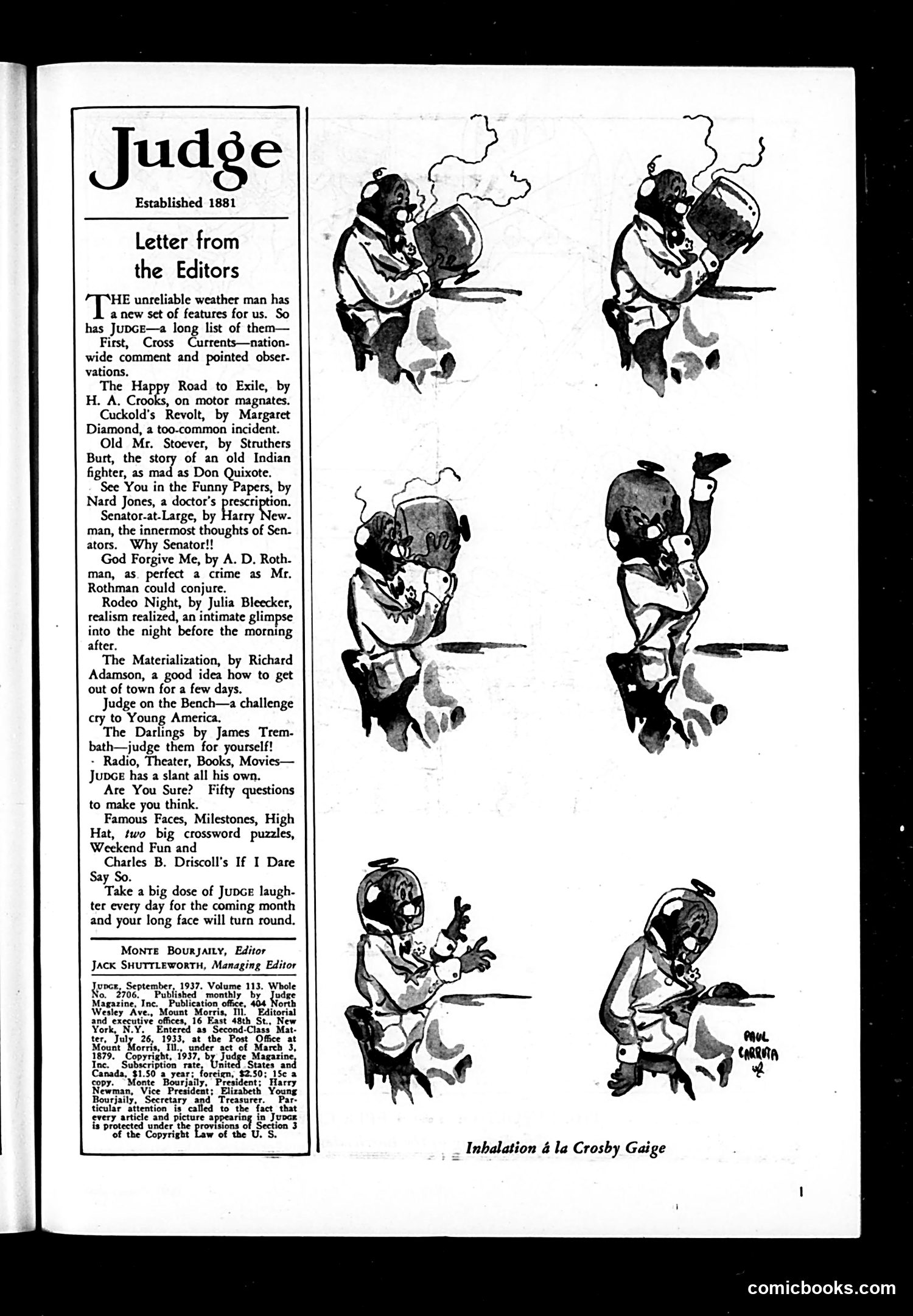
Judge Magazine Cartoon Analysis This page from Judge (September 1937) features a series of six cartoon panels titled "Inhalation à la Crosby Gaige," satirizing Crosby Gaige, a prominent New York restaurateur and food critic of the era. The cartoons depict a rotund figure in various comedic poses, apparently inhaling or consuming food with exaggerated enthusiasm. The satire targets Gaige's well-known reputation for lavish eating and his considerable girth. The title's French phrasing ("inhalation in the manner of Crosby Gaige") suggests mocking his pretensions to sophisticated dining culture while caricaturing his voracious appetite. The humor relies on visual exaggeration of body shape and eating behavior—standard comic fare of the 1930s—to ridicule a recognizable public figure known for food indulgence.
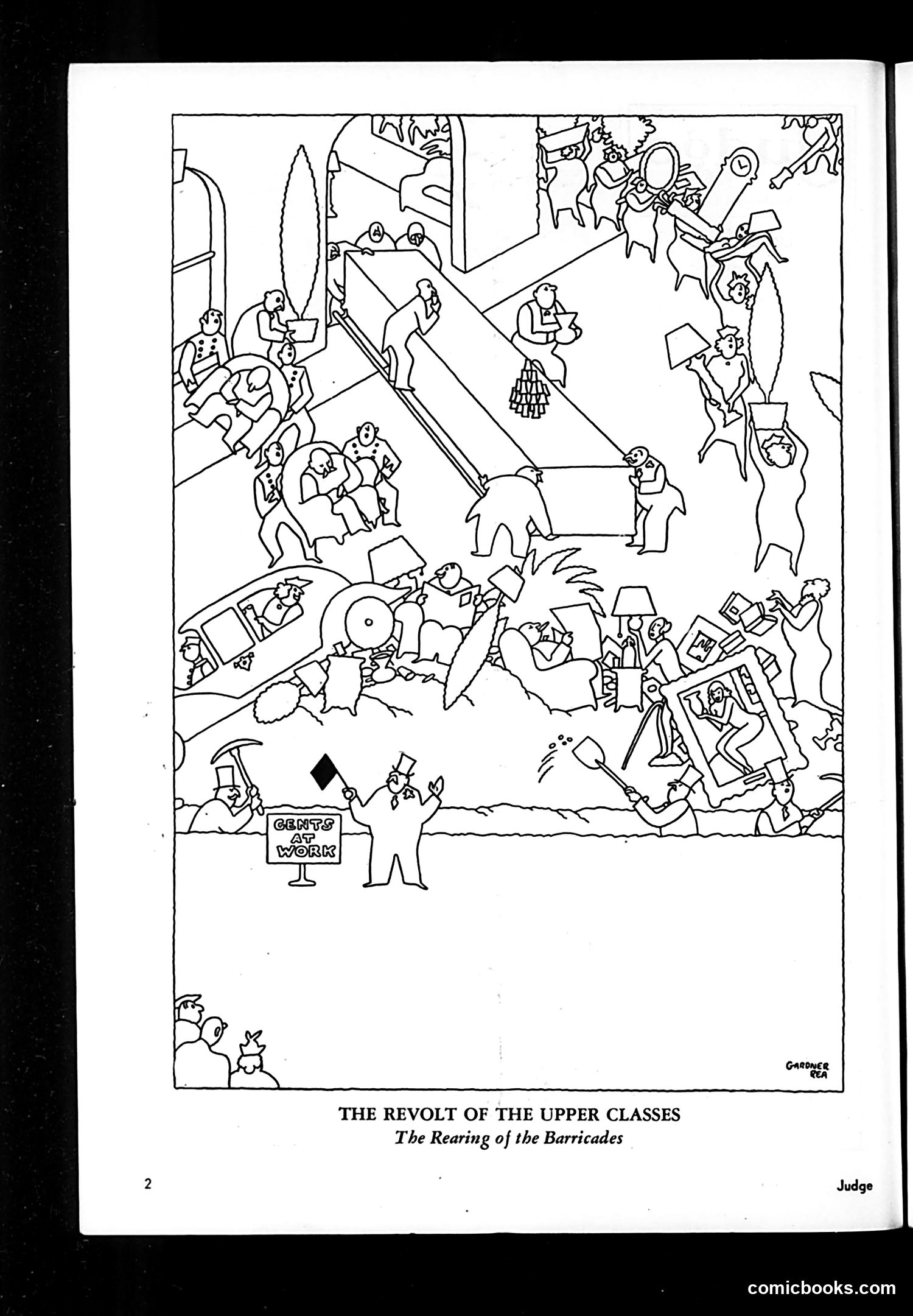
"The Revolt of the Upper Classes: The Rearing of the Barricades" This Judge magazine cartoon satirizes wealthy elites constructing barricades, apparently in response to some perceived threat. The title suggests irony—traditionally, barricades are associated with working-class revolts, not upper-class ones. The scene depicts chaos among well-dressed figures building fortifications above ground level, with a conductor or ringmaster figure at the center holding a diamond, labeled "CENTS AT WORK" (text partially unclear). The elaborate, comedic architecture suggests the absurdity of the upper classes attempting defensive measures. Without specific dating context, the cartoon likely comments on class anxiety during a period of labor unrest or social upheaval, mocking wealthy fears by inverting the typical revolutionary narrative—positioning the rich as the ones "revolting" or panicking rather than organizing workers.
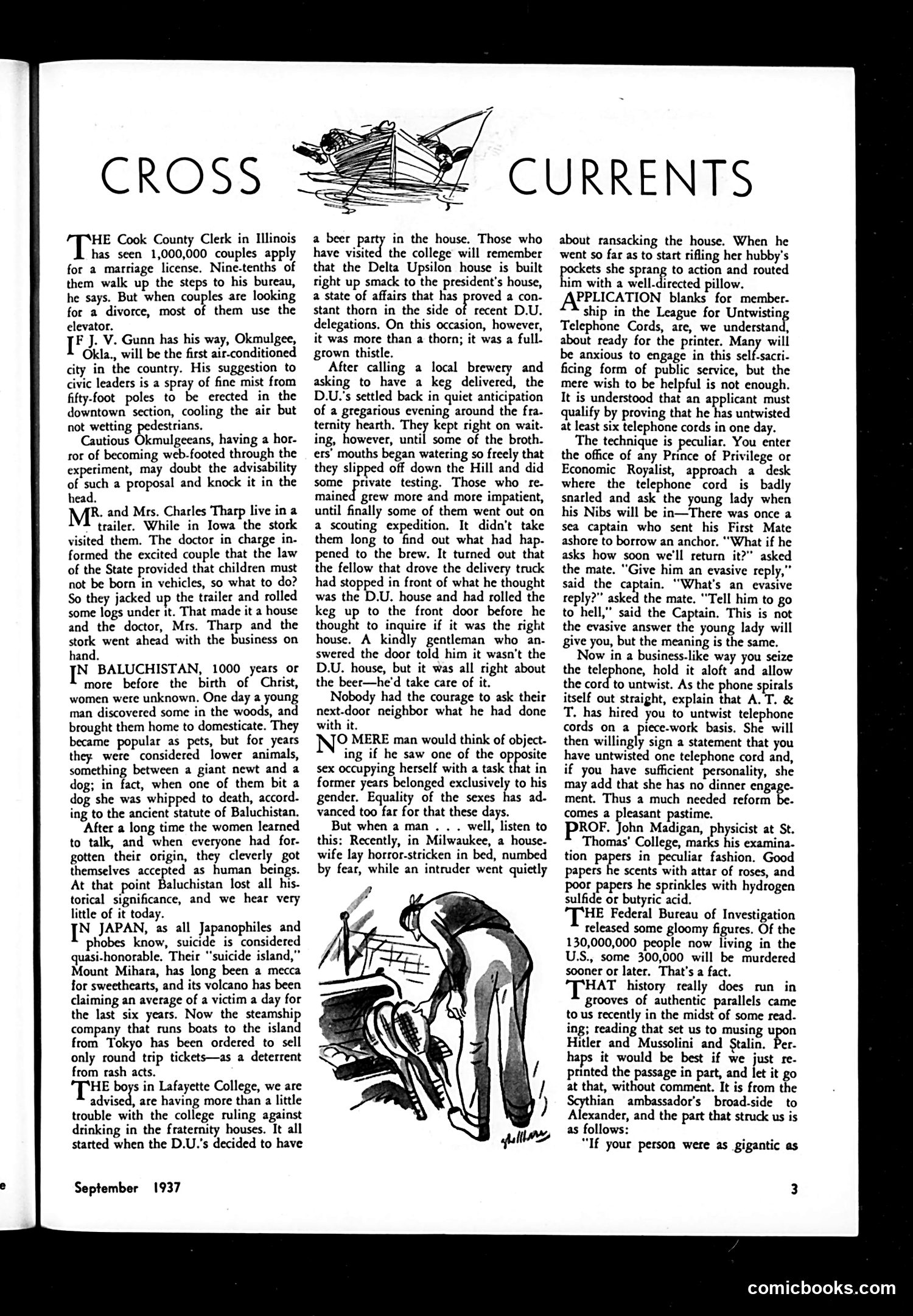
Cross Currents - September 1937 This page contains multiple brief satirical anecdotes rather than a single cartoon. The illustration shows a person on a motorcycle/scooter being thrown or falling dramatically. The humor targets various social situations: Cook County marriage license seekers using elevators to avoid walking past the clerk's office; a proposal to erect fine mesh poles to keep pedestrians out of downtown Chicago; and college fraternity pranks at what appears to be a Delta Upsilon house involving beer deliveries. Other items mock outdated attitudes toward women (referencing "Baluchistan" and treatment of women as "lower animals"), Japanese militarism and suicide culture, and conclude with statistics about FBI crime figures and a reference to historical dictators Hitler, Mussolini, and Stalin. The satire is broadly social commentary typical of 1930s American humor magazines.
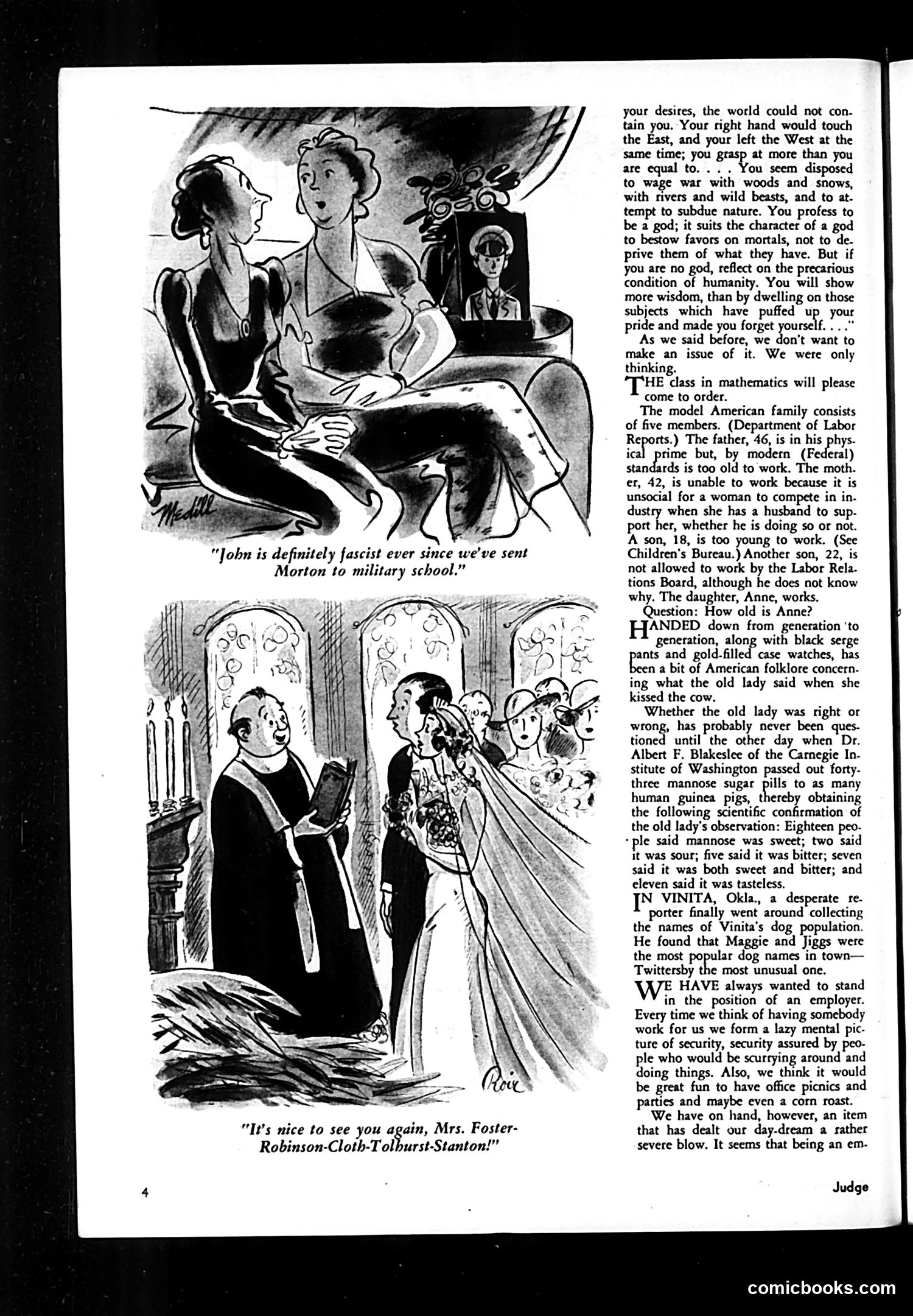
Analysis of Judge Magazine Page This page contains two cartoons satirizing American social attitudes circa the 1930s-40s. Top cartoon: A couple discusses their son John's fascination with fascism after attending military school. The satire criticizes how military education might indoctrinate youth with authoritarian ideologies—a concern during the rise of fascism in Europe. Bottom cartoon: A man greets a woman with an extremely long, hyphenated name ("Mrs. Foster-Robinson-Cloth-Tolhurst-Stanton"), satirizing the social pretension of upper-class women who retained multiple surnames through marriages. The joke mocks excessive name-dropping and status-consciousness. The accompanying text discusses labor statistics and a humorous survey of dog names in Vinita, Oklahoma. The overall page reflects 1930s-40s American anxieties about fascism, class affectation, and social change.
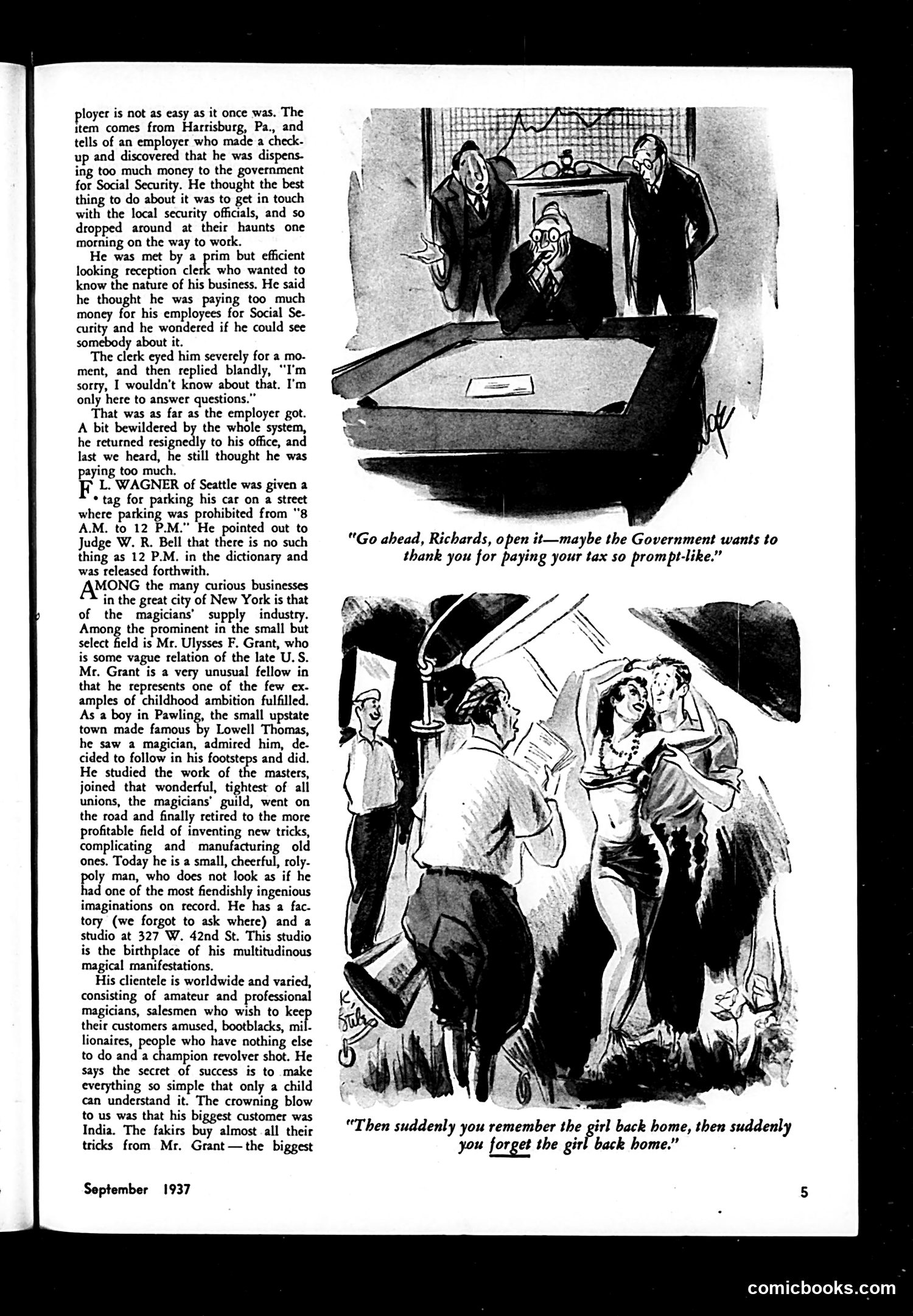
Judge Magazine - September 1937 Top Cartoon: A tax official confronts a citizen named Richards about unpaid taxes. The joke satirizes government inefficiency—the official sarcastically thanks Richards for paying "prompt-like," implying taxpayers are dragging their feet on obligations. Bottom Cartoon: Shows a magician performing a trick involving a girl, with the caption "Then suddenly you remember the girl back home, then suddenly you forget the girl back home." This appears to satirize the distraction and sleight-of-hand tricks magicians use—or metaphorically, how easily people's attention and loyalty shift. The page also includes text about Ulysses F. Grant, a magician and inventor of magic tricks whose studio was in New York City, establishing context for the magic-related cartoon.
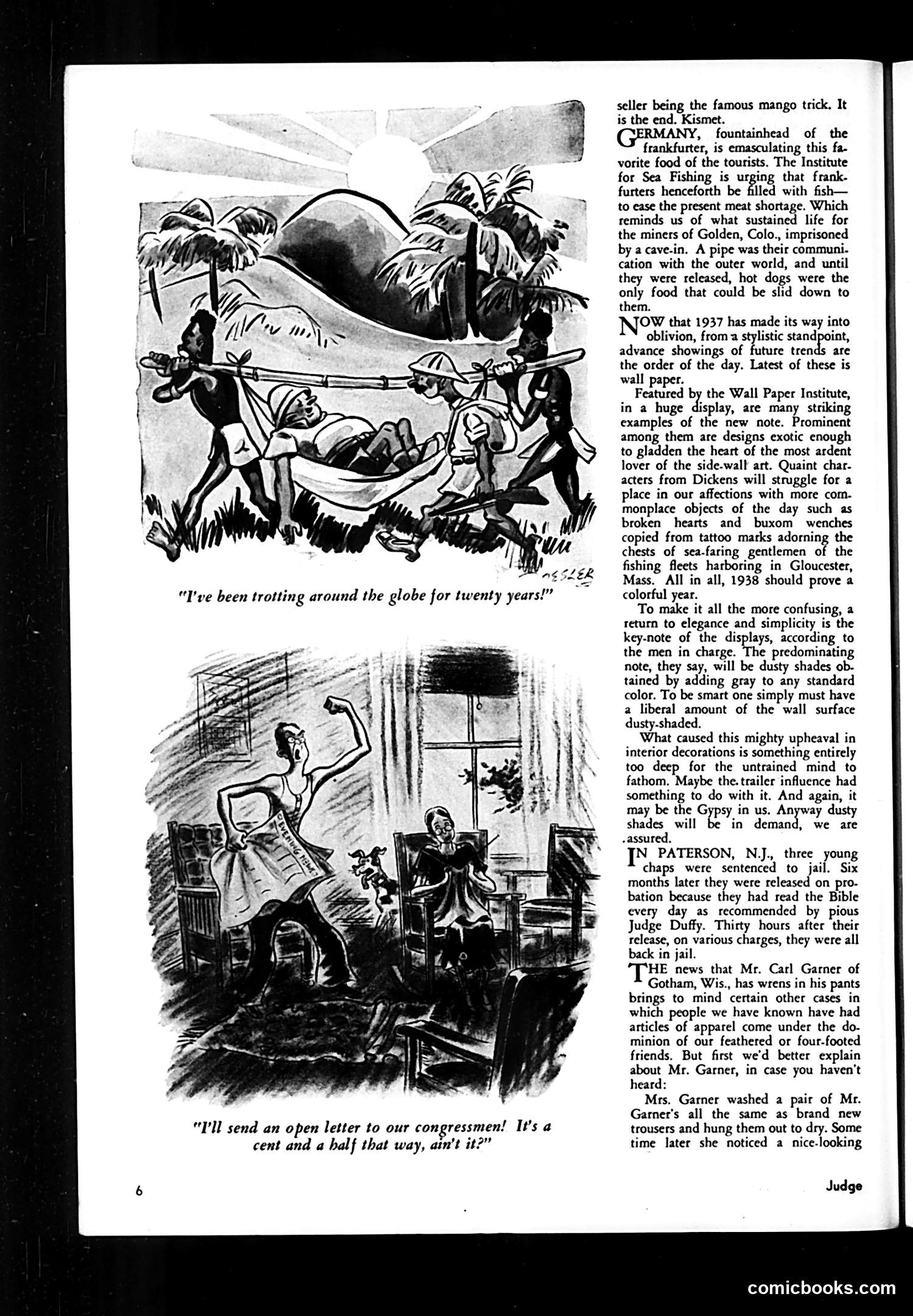
Judge Magazine Page Analysis This page contains two satirical cartoons and accompanying text commentary typical of Judge magazine's style. Top cartoon: Shows figures around a globe, with the caption "I've been trolling around the globe for twenty years!" The satire appears to mock world travelers or adventurers who boast of extensive journeys. Bottom cartoon: Depicts someone writing to a congressman, captioned "I'll send an open letter to our congressman! It's a cent and a half that way, ain't it?" This satirizes the common practice of citizens complaining to elected officials, likely mocking both the effectiveness and cost-consciousness of such complaints. The accompanying text discusses various social topics including wallpaper trends for 1938, decorating fashions, and oddly-specific local news items (sentencing in Paterson, N.J., and wrens in Gotham, Wisconsin). The overall tone is humorous and somewhat cynical about American society and politics.
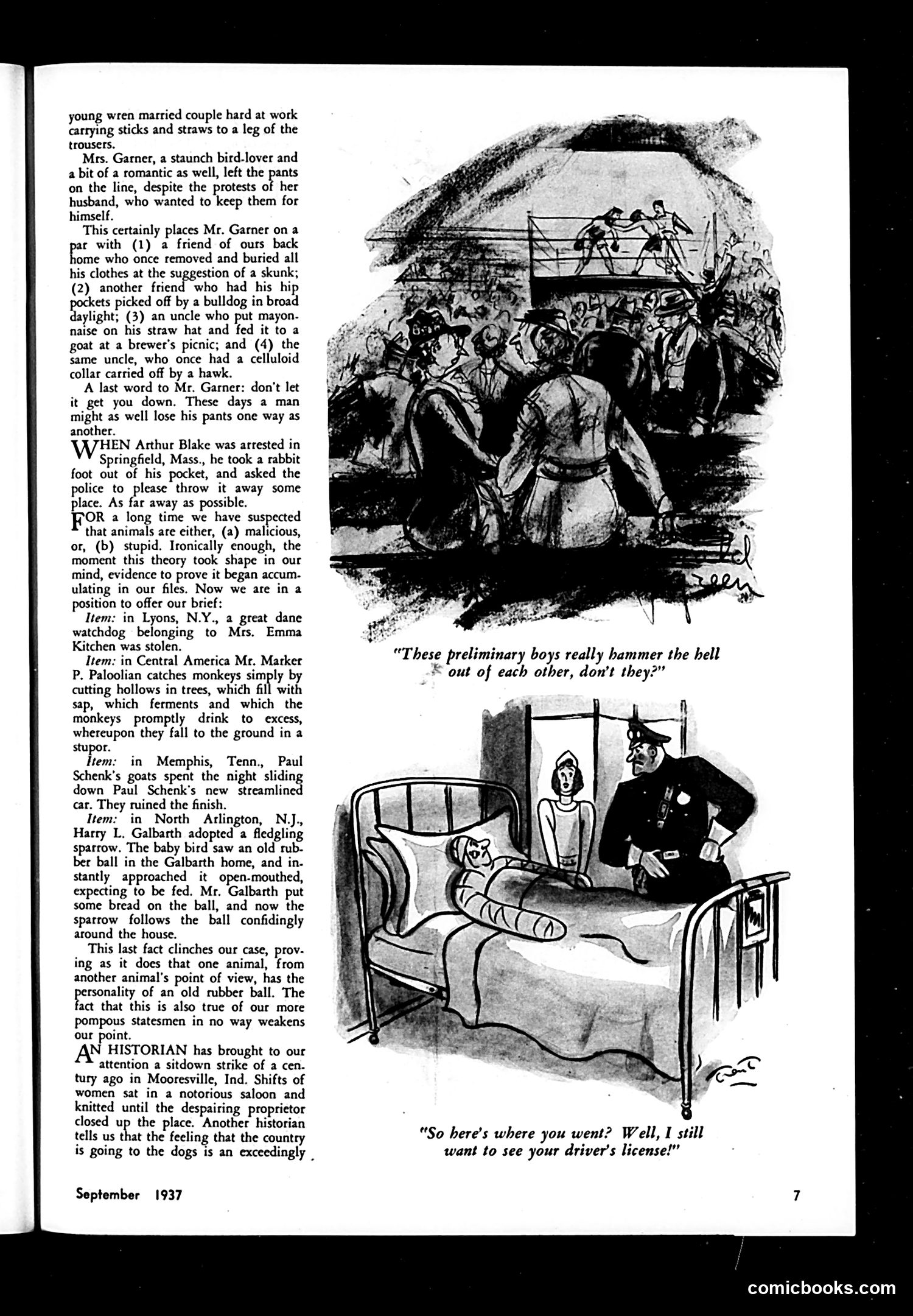
Analysis of Judge Magazine Page, September 1937 This page contains two cartoon jokes and a humorous column of anecdotes about animal incidents. Top cartoon: Shows rowdy boys fighting, captioned "These preliminary boys really hammer the bell out of each other, don't they?" The humor appears to play on the phrase "ring the bell" versus literally "hammering," satirizing rough youth behavior. Bottom cartoon: Depicts a police officer in bed with a woman, captioned "So here's where you went? Well, I still want to see your driver's license!" This mocks law enforcement corruption or hypocrisy—a cop ignoring a woman's presence to demand documentation, implying he's more concerned with procedure than the compromising situation. The column above recounts various incidents where animals have caused chaos—dogs, monkeys, goats—illustrating themes about animal behavior and human response to unexpected situations.
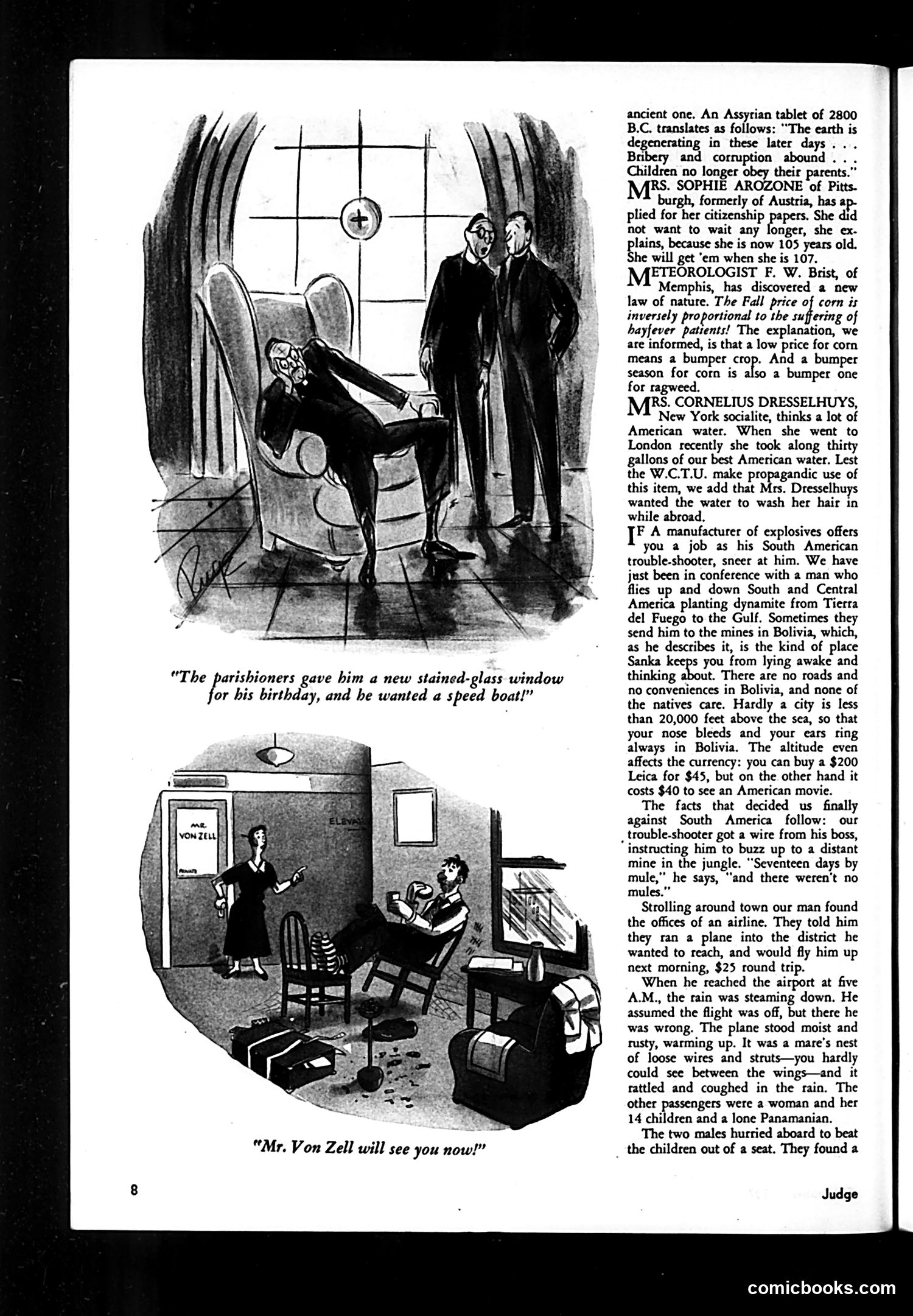
Judge Magazine Page Analysis This page contains two cartoon vignettes and a humorous anecdote section typical of Judge magazine's satirical format. Top cartoon: "The parishioners gave him a new stained-glass window for his birthday, and he wanted a speed boat!" depicts a clergyman receiving an unwanted religious gift, satirizing the gap between donors' intentions and recipients' desires—likely mocking both religious hypocrisy and materialism. Bottom cartoon: "Mr. Von Zell will see you now!" shows a crowded, shabby office, appearing to satirize bureaucratic inefficiency or corporate dysfunction (Von Zell's identity is unclear from the image alone). Text section: A series of brief anecdotes mocking social pretension: a 105-year-old Austrian woman seeking citizenship, a meteorologist's dubious "discovery," a socialite importing American water to London, and an extended joke about a dynamite engineer's disastrous South American job—all targeting American upper-class affectation and naiveté about foreign conditions. The overall tone ridicules contemporary American social absurdities and class pretension.
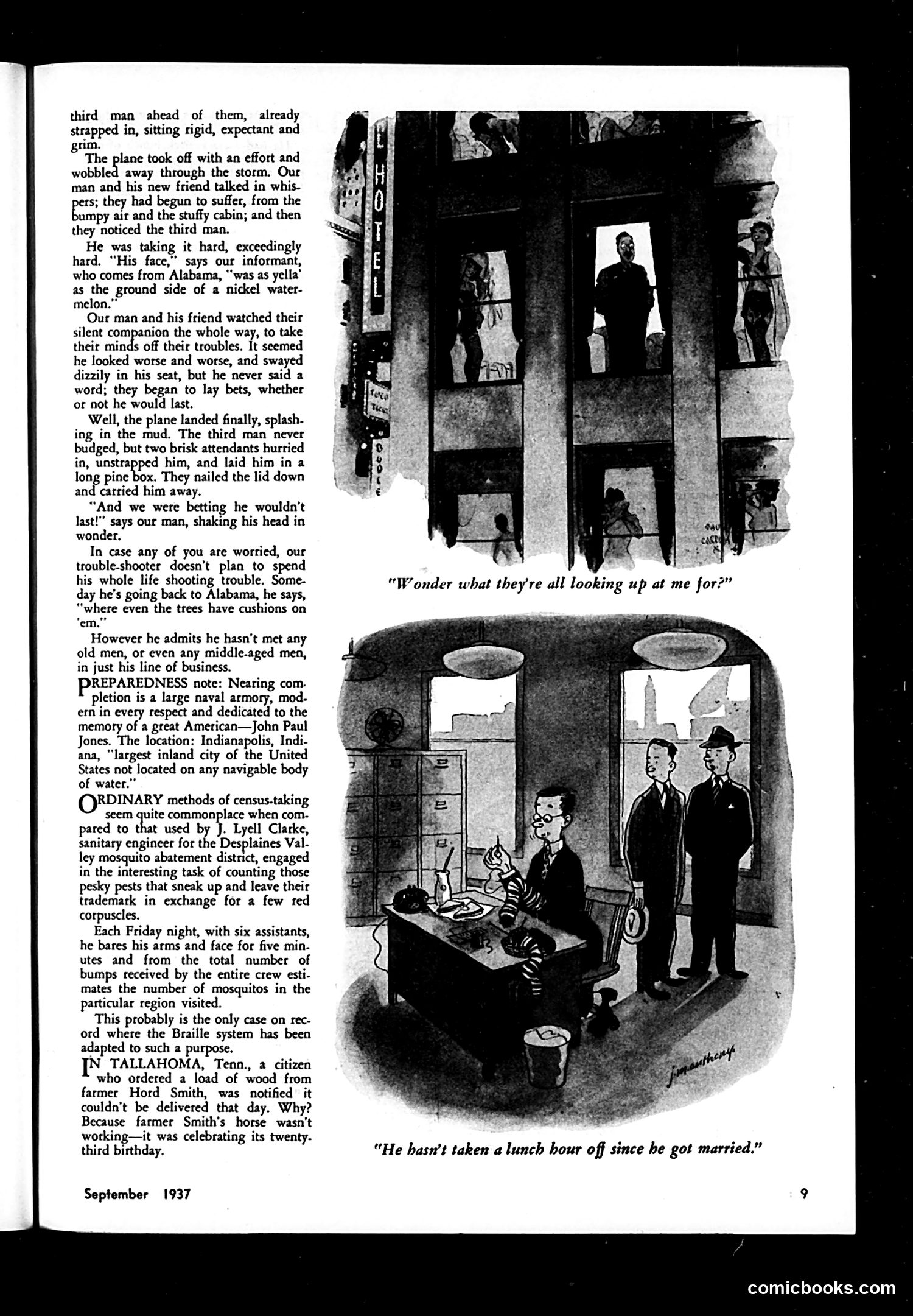
Judge Magazine, September 1937 - Page Analysis This page contains two distinct pieces of satirical content: Main Story (with photograph): A humorous anecdote about an airplane passenger from Alabama who becomes extremely airsick during a flight. The joke's dark punchline reveals the man dies mid-flight and is placed in a coffin upon landing. The satire mocks both air travel's discomforts in the 1930s and the storyteller's casual Alabama dialect. Bottom Cartoon: Depicts a married man eating at a desk while two businessmen observe him. The caption "He hasn't taken a lunch hour off since he got married" satirizes the stereotype that marriage domesticates men, making them dutiful rather than carefree. The joke suggests married life keeps him chained to responsibility. Sidebar Notes: Include brief items about naval preparedness (Indianapolis armory) and an unusual mosquito census method using human test subjects—absurdist humor about unconventional pest control. The overall tone reflects 1930s American satirical humor: colloquial, sometimes crude, focused on social conformity and domestic life.
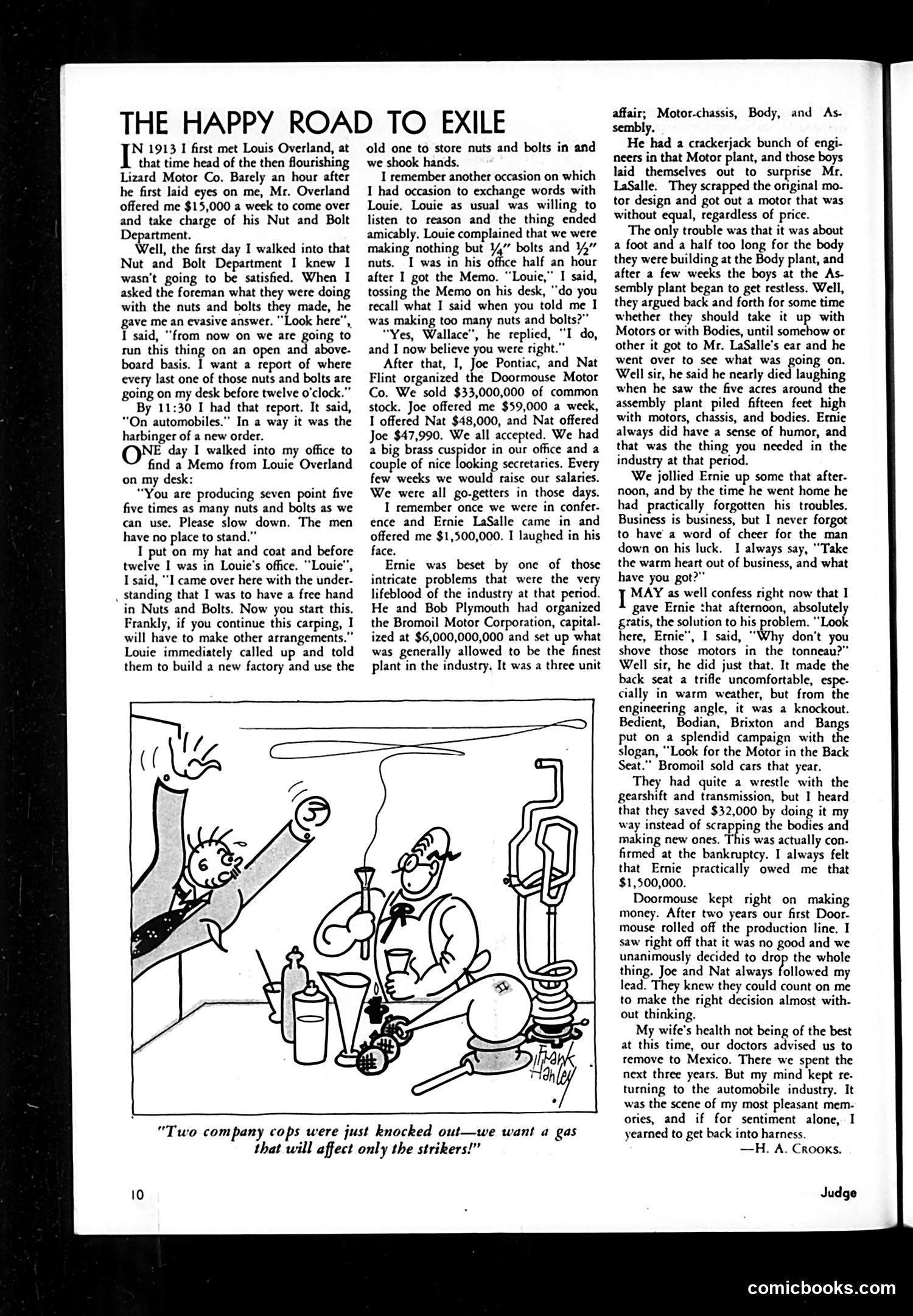
"The Happy Road to Exile": Political Satire on Early Automotive Industry This is a satirical first-person narrative by H.A. Crooks about the chaotic early automobile industry (circa 1913). The unnamed narrator describes working at "Lizard Motor Co." under Louis Overland, then co-founding the absurdly capitalized "Doormouse Motor Co." with Joe Pontiac and Nat Flint—likely caricatures of real automotive figures. The satire mocks the era's rampant speculation, inflated salaries, and mismanagement: executives constantly raise their own pay while producing nothing practical. The embedded cartoon shows labor unrest, with strikers being attacked—a reference to actual violent industrial conflicts of the period. The "happy road to exile" suggests this unsustainable excess inevitably leads to financial ruin and departure (the narrator later mentions moving to Mexico for health reasons). The story ridicules both the industry's grandiose capitalism and its fundamental dysfunction, where engineering problems go unresolved while executives focus on money and status symbols.
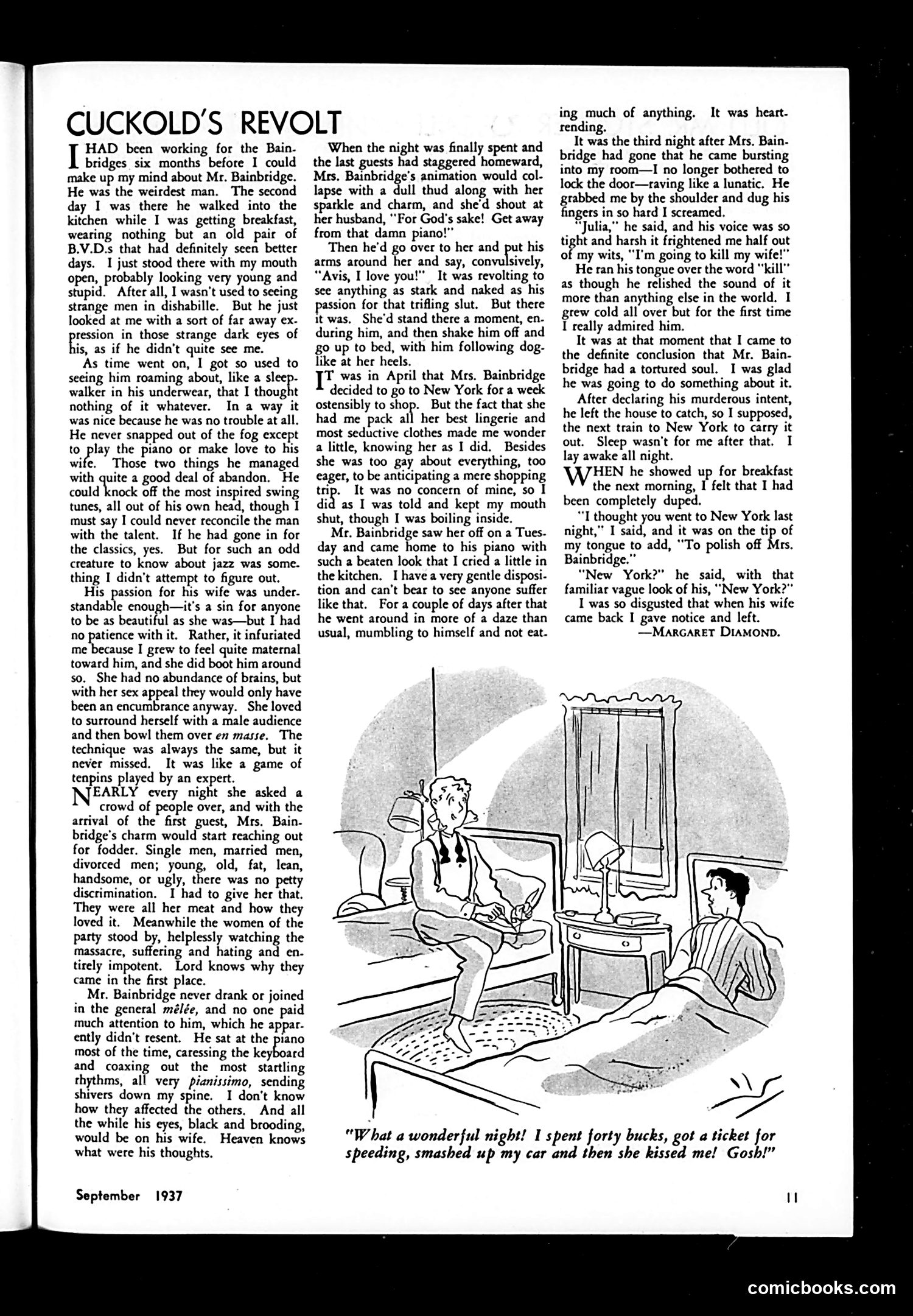
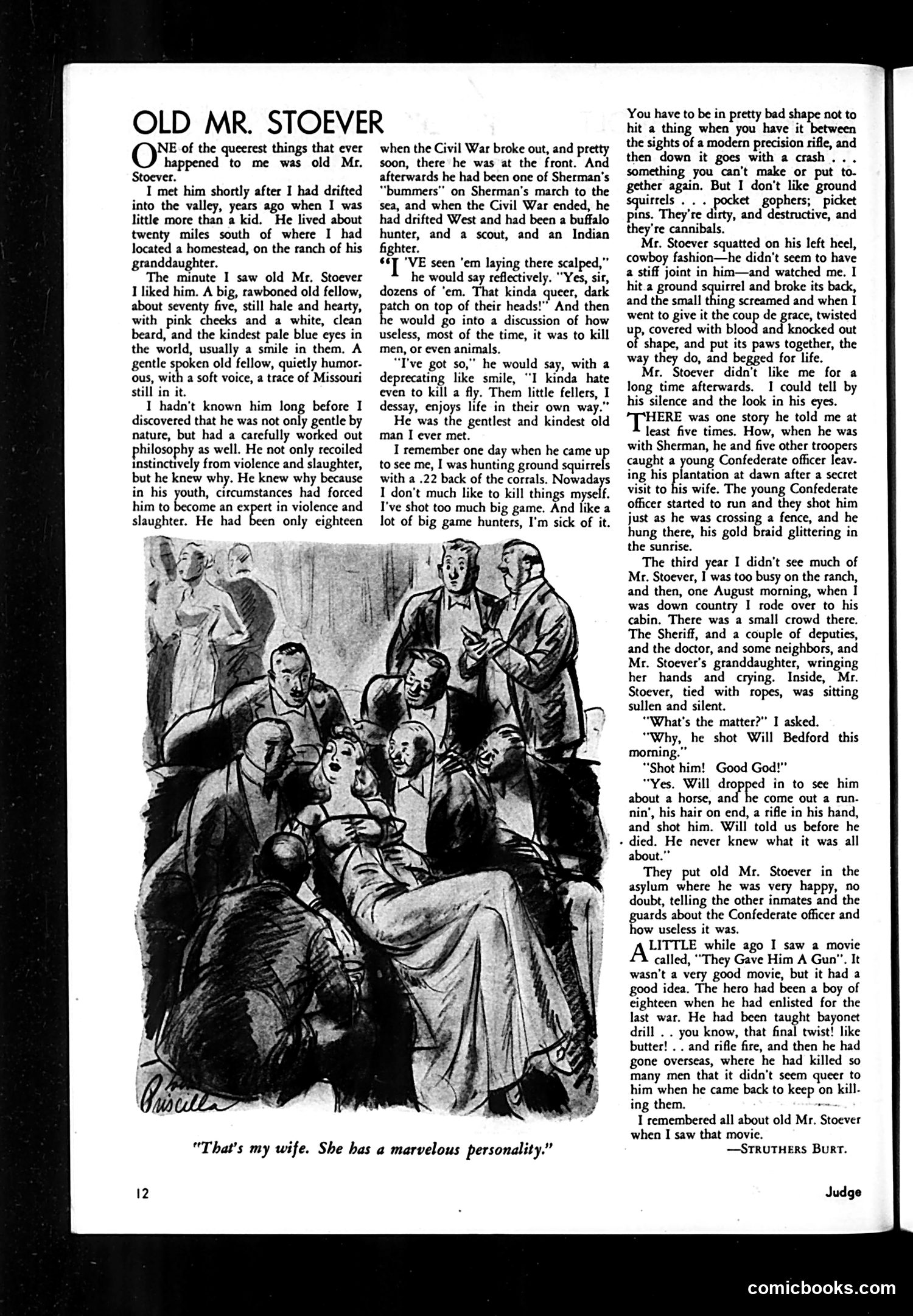
"Old Mr. Stoever" Analysis This is a short story (not a political cartoon) about a morally transformed Civil War veteran. The narrator describes meeting an elderly Mr. Stoever—a former Union soldier who participated in Sherman's destructive march to the sea and later worked as a buffalo hunter and Indian fighter—who has become a pacifist haunted by violence. The story illustrates Stoever's transformation: he now abhors killing anything, even insects, and repeatedly recounts a traumatic memory of shooting a Confederate officer. When the narrator casually kills a ground squirrel, Stoever's disapproval is silent but unmistakable. The narrative ends mysteriously with authorities arriving at Stoever's cabin and finding him bound and silent, suggesting he may have committed an act related to his past or principles—though the text cuts off before explaining. The piece appears to explore themes of war's psychological toll and redemption through pacifism, likely resonating with post-Civil War American readers.
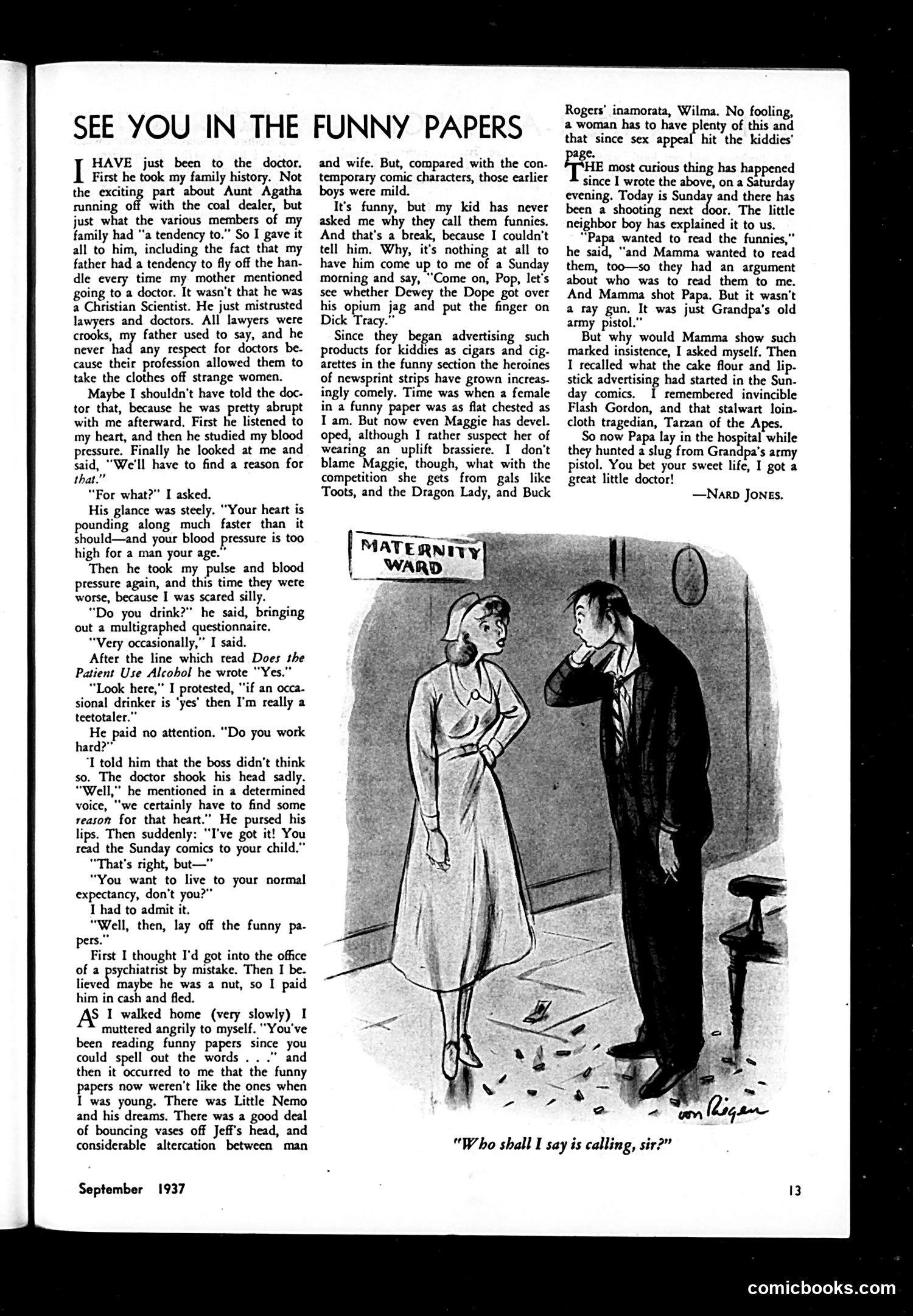
Analysis of "See You in the Funny Papers" This satirical article by Nard Jones critiques the evolution of comic strips from wholesome entertainment to increasingly adult-oriented content. The author visits a doctor who, humorously, blames his elevated blood pressure on reading Sunday comics to his child. The piece references actual 1930s comic strips: *Little Nemo* (early, imaginative comics), *Mutt and Jeff* (slapstick humor), *Dick Tracy* (crime drama with drug references), *Maggie* (from *Bringing Up Father*), and *Buck Rogers* with his love interest Wilma—all depicted as becoming sexualized or morally questionable. The satire targets two concerns: advertisers promoting cigars and cigarettes in children's comics, and the increasingly voluptuous female characters designed to appeal to adult readers rather than children. The cartoon (showing a maternity ward visitor) suggests unintended consequences of this adult-oriented content. Jones's broader complaint: comics have abandoned innocent fantasy for sensationalism, transforming children's entertainment into something unsuitable for young audiences.
"The Senator-at-Large": Political Satire on Congressional Vanity This page satirizes U.S. Senators' private thoughts while sitting in the chamber. Judge magazine presents each senator's unguarded inner monologue—revealing vain, distracted, or frivolous preoccupations rather than serious legislative concerns. The humor relies on contrasting senators' public gravitas with petty private thoughts: Vice President Garner's self-congratulation, senators obsessing over appearance (shoes, medals, cuffs), romantic distractions, physical complaints, or simple boredom. A few entries hint at deeper political positions (Wagner's reference to Germany; Pittman's combativeness), but most reduce powerful politicians to ordinary, self-absorbed people. The satire's point: senators aren't the dignified statesmen they appear to be. It's a cynical commentary on whether America's legislative body genuinely serves the public interest or is populated by ego-driven individuals preoccupied with re-election, personal comfort, and trivial concerns.
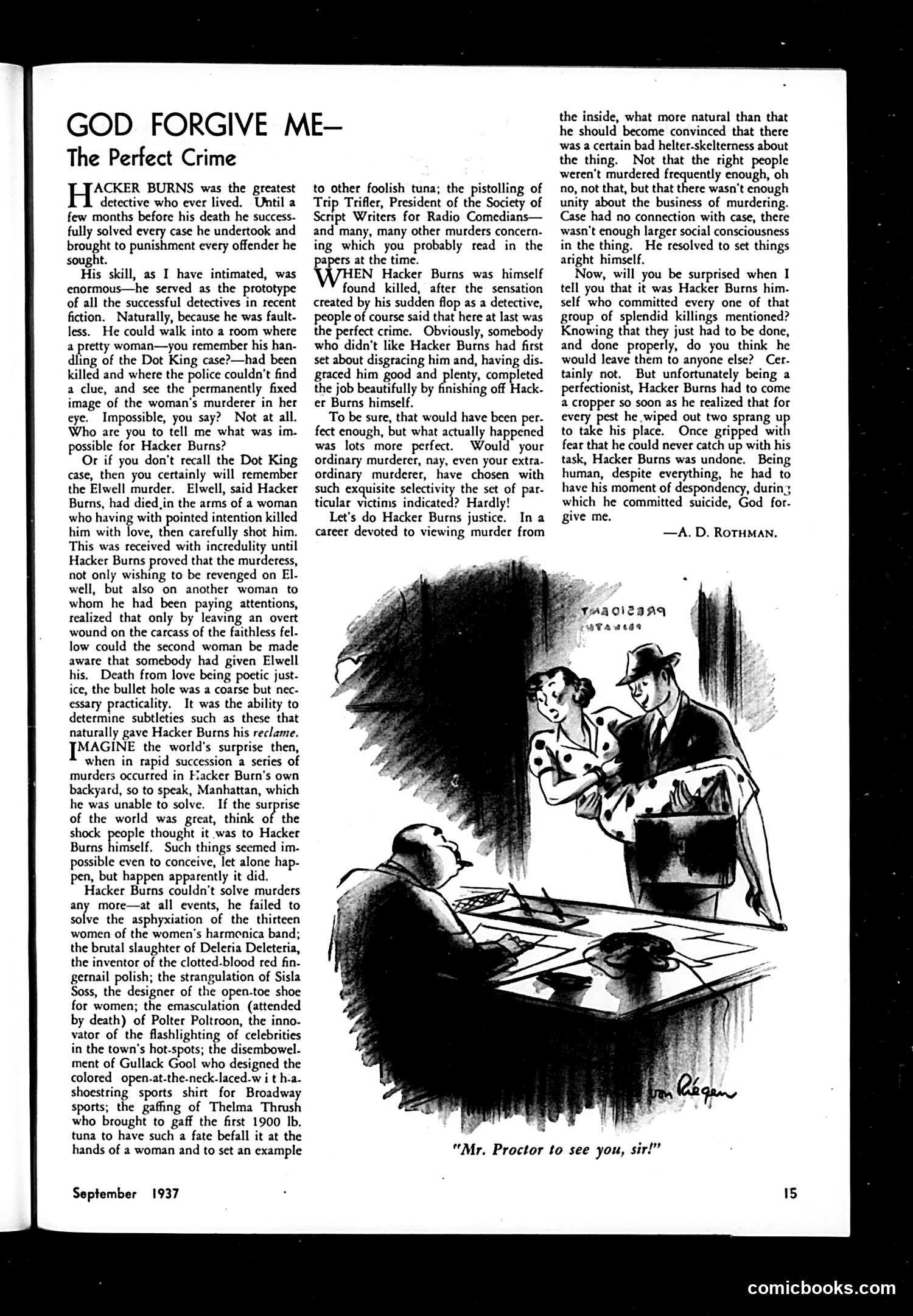
"God Forgive Me—The Perfect Crime" This is a mystery story (not a political cartoon) by A.D. Rothman, published September 1937. The narrative is a satirical parody of detective fiction, specifically mocking the "great detective" archetype popularized by Sherlock Holmes stories. The setup: Hacker Burns, a famous fictional detective who solved every case flawlessly, suddenly cannot solve a series of murders in Manhattan. The victims are absurdly specific parodies of 1930s cultural figures and innovations—inventors of nail polish, open-toe shoes, and celebrity photography; a radio comedy writer; etc. The joke: Burns himself is then murdered. The narrator suggests this *is* the "perfect crime" because the killer deliberately selected victims to humiliate Burns professionally before killing him. The satire mocks both detective fiction conventions and the trivial celebrity culture of 1930s New York. The accompanying illustration shows men meeting with someone, captioned "Mr. Proctor to see you, sir!"—likely depicting a scene from the narrative.
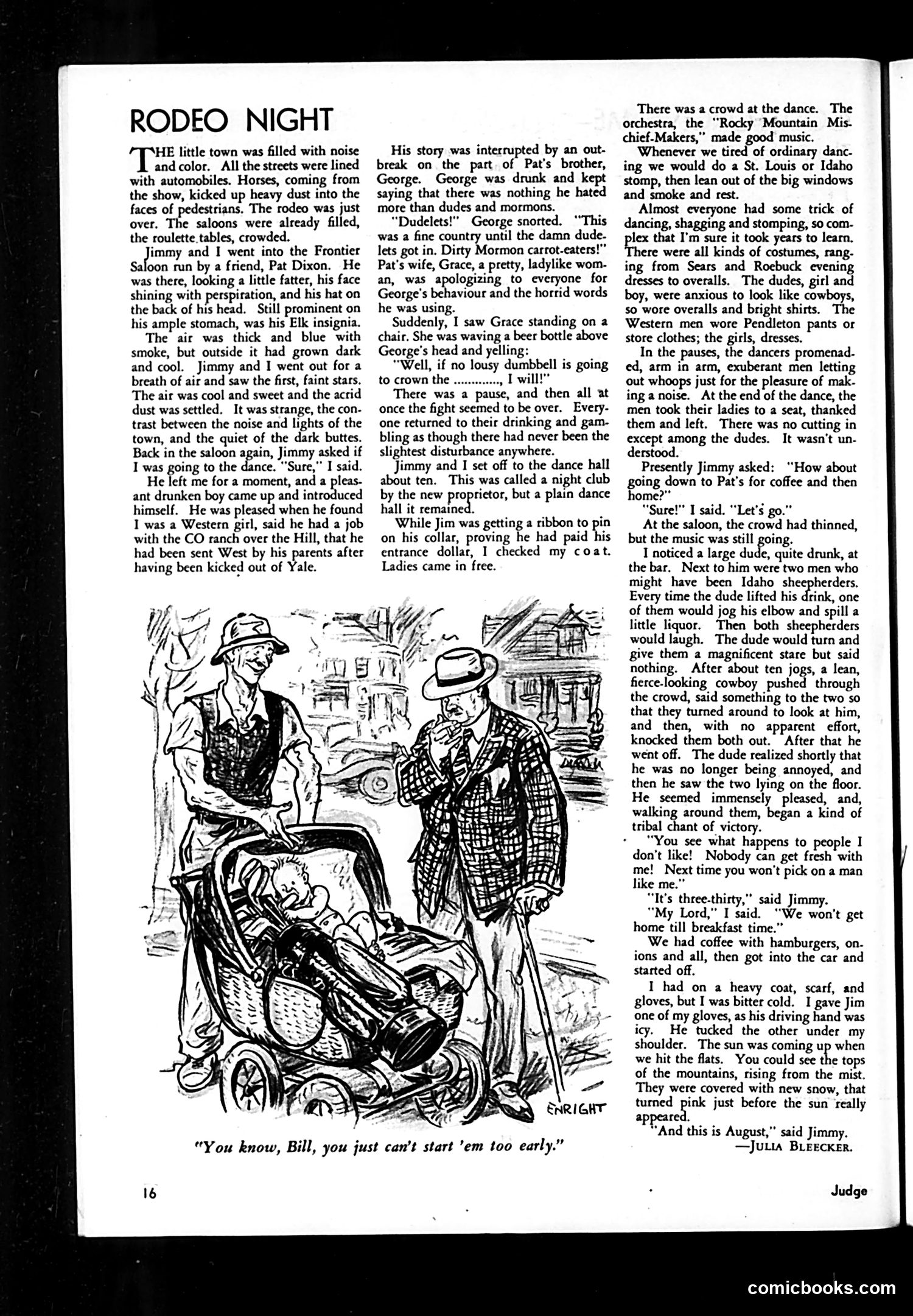
"Rodeo Night" - Judge Magazine Commentary This is a humorous short story with satirical social observation rather than a political cartoon. The narrative contrasts Eastern dudes (wealthy, inexperienced outsiders) with authentic Western life in a small rodeo town. Key satirical elements: The story mocks Eastern pretension: a Yale dropout works at a ranch "after having been kicked out," attempting to adopt Western identity. Meanwhile, genuine Western men wear practical store clothes while "dudes" comically wear store-bought cowboy outfits to look authentic. The illustration shows a drunk man being restrained by cowboys—likely depicting the story's brawl between Pat's brother George (ranting against "dudelets" and Mormons) and others. Social commentary: Judge contrasts authentic frontier culture with commercialized, performative Westernism. The "night club" disguising itself as a simple dance hall reflects 1920s modernization. The casual violence and heavy drinking are presented as standard frontier behavior, while Eastern visitors awkwardly attempt to participate. The tone is gently mocking of both the crude frontier society and the pretentious outsiders trying to join it.
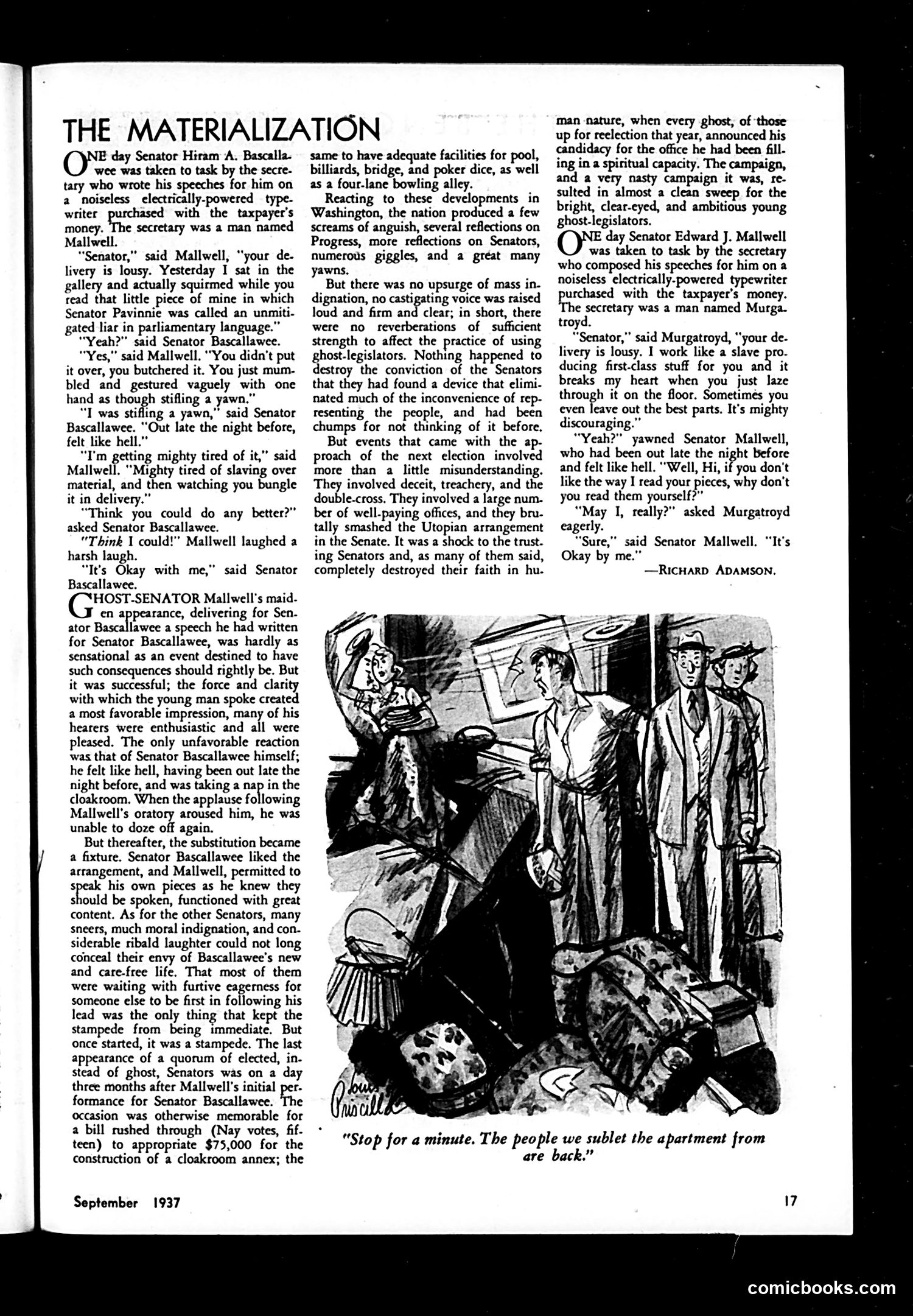
"The Materialization" - Judge Magazine Satire (September 1937) This satirical story mocks Congressional laziness and the erosion of democratic representation. Senator Bascallawee employs Mallwell, a speechwriter, to compose his legislative remarks—a practice already suggesting diminished senatorial effort. When Mallwell delivers one of his own speeches in the Senate, it's so effective that Bascallawee realizes he can simply nap while his secretary speaks for him in Congress. This arrangement spreads rapidly among senators, who recognize they can avoid actual legislative work. The ultimate indictment: Congress votes to expand the cloakroom to accommodate leisure activities (pool, billiards, poker, bowling) since senators no longer need offices for actual work. The cartoon depicts a senator sleeping while his "ghost" performs his duties—visualizing the story's central joke: elected representatives have become mere phantoms, replaced by unseen functionaries. Judge uses this absurdist scenario to satirize Congressional absenteeism and the disconnect between representatives and the people they supposedly serve.
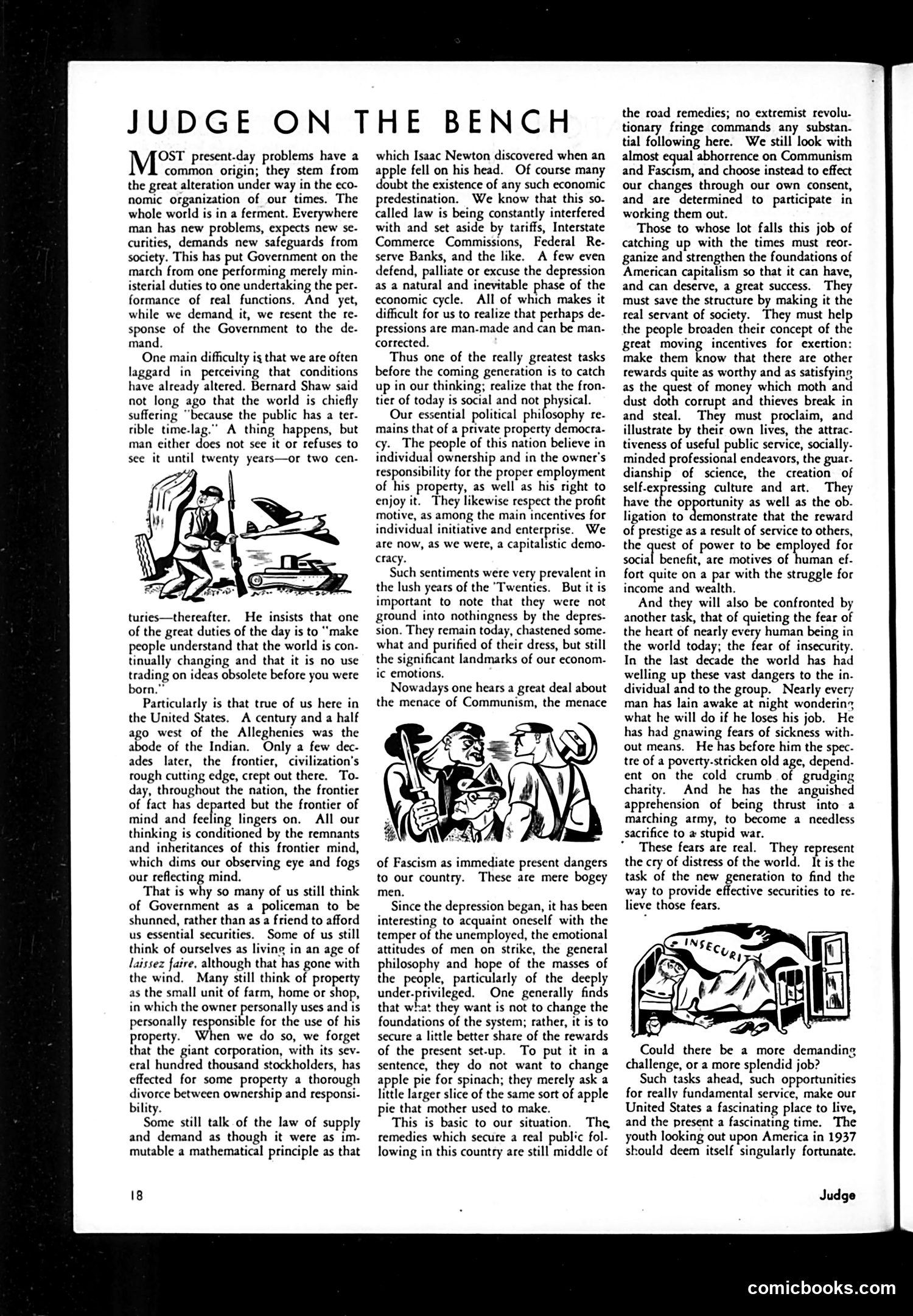
Judge Magazine Analysis: "Judge on the Bench" This is an editorial essay rather than a cartoon page, though it includes two small illustrations of distressed figures. The piece argues that Americans suffer from "time-lag"—we cling to outdated 19th-century frontier ideology unsuited to modern industrial society. The author criticizes several anachronistic beliefs: viewing government as merely a "policeman" rather than a necessary social institution; accepting laissez-faire economics despite interference by tariffs and Federal Reserve Banks; and treating the Depression as inevitable rather than man-made. The essay warns against both Communism and Fascism as "immediate present dangers," advocating instead reformed capitalism with stronger social safety nets and corporate responsibility. The illustrations depict poverty and unemployment—visual evidence supporting the argument that old ideologies cannot address modern economic suffering. Published during the Depression (context suggests late 1930s), this reflects New Deal-era debates about government's proper role.
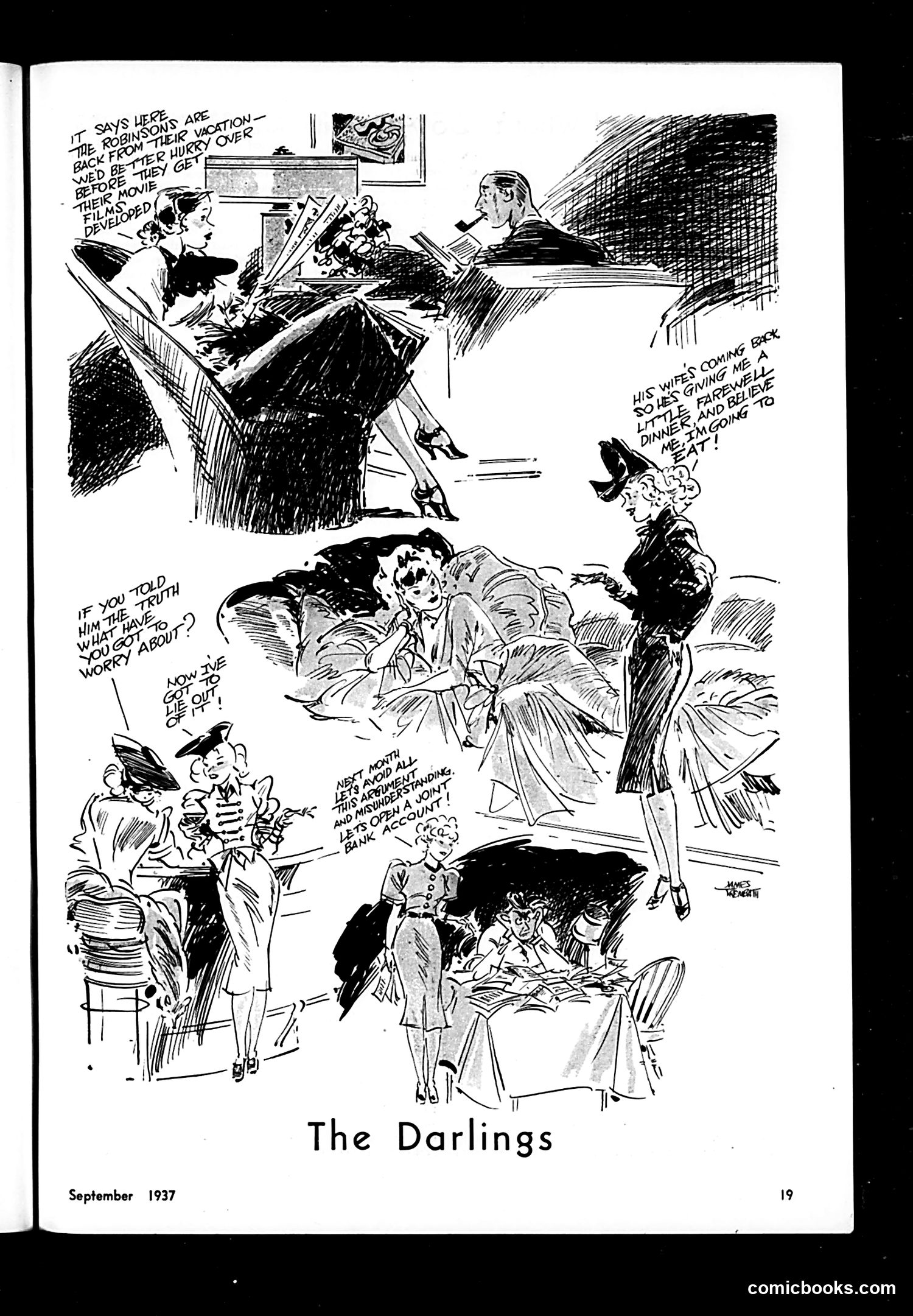
"The Darlings" - September 1937 This is a domestic humor cartoon satirizing upper-middle-class family life. The multiple vignettes show a wife managing household chaos while her husband remains oblivious or unconcerned. Key scenes depict: - A couple at dinner where the wife mentions his shirts need repair - A woman in bed surrounded by children and household disorder - A husband announcing dinner plans while the wife deals with domestic crisis - Various scenes of marital miscommunication about responsibilities The satire targets the disconnect between husbands' expectations of domestic comfort and wives' actual labor managing households, children, and domestic crises. The title "The Darlings" uses irony—these relationships involve friction rather than affection. This reflects 1937 anxieties about gender roles and marriage, presenting the wife as perpetually stressed while her spouse remains detached from household realities.
"Radio—And What to Do About It" from Judge Magazine This satirical piece critiques radio broadcasters' obsessive commitment to their shows, even while hospitalized. The main target appears to be "Gabby Weaselwords," a cross-country radio commentator (a fictional caricature of verbose radio personalities of the era). The satire imagines a hypothetical scenario where Weaselwords is brutally attacked by a listener, yet insists on continuing his broadcast from a stretcher, with the radio station arranging microphone placement over his body as he's carried to the hospital. The joke reflects early-1930s frustration with radio's invasive presence in hospitals and homes, and with broadcasters' narcissistic disregard for their own health or their audience's comfort. Originally meant to entertain bedridden listeners, radio has instead become an annoyance that prevents hospitalized patients from resting. The author (R.C. O'Brien) argues broadcasters should face physical exams like civil servants, satirizing their self-importance through the absurd image of continuing commentary on penguins and poodles even while dying.
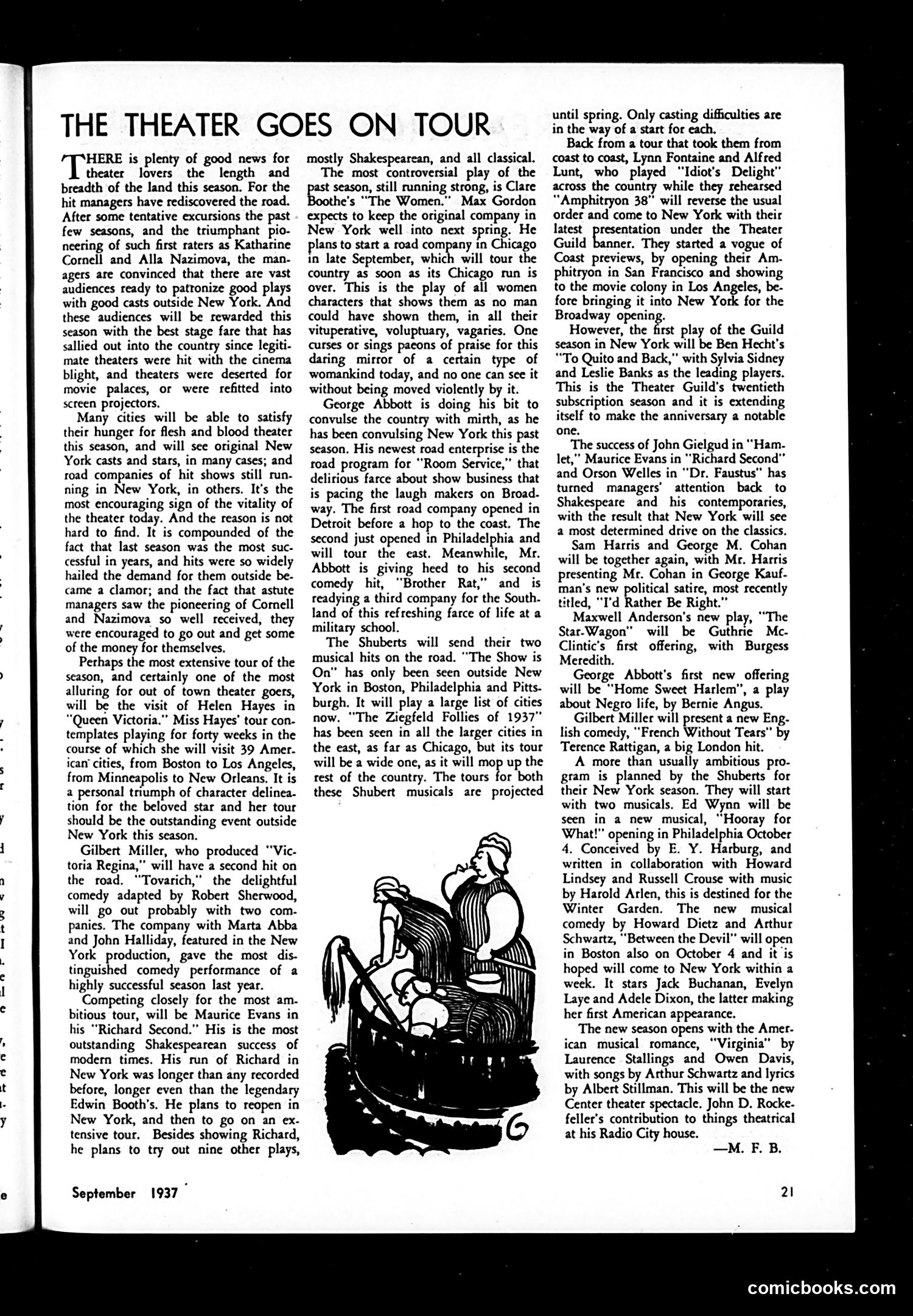
Analysis of "The Theater Goes On Tour" This is primarily a theater industry article from September 1937 *Judge* magazine, celebrating Broadway's renewed investment in touring productions across America. The illustrated cartoon—showing a rotund theatrical figure in period costume seated in a chair—appears to be decorative rather than satirical commentary. The article's "satire" is gentle and celebratory: it mocks the theater industry's previous abandonment of touring, noting that Depression-era managers had deserted regional audiences for profitable movie palaces. The piece celebrates actresses like Helen Hayes and Katherine Cornell for pioneering renewed interest in national tours, presenting this as a triumph of live performance over cinema. The text mentions Clare Booth's "The Women"—described as a controversial play featuring "all women characters"—and notes George Abbott's farce "Room Service." The article champions quality theater's vitality, implying that commercial success and audience demand have restored faith in Broadway's ability to serve the entire nation, not just New York.
"Good Reading" - Judge Magazine Book Reviews This page is a book review section from Judge magazine, featuring critical assessments of contemporary publications. The reviews cover diverse subjects: John Erskine's historical novel about fifteenth-century poet François Villon; Samuel Goldwyn's biography; and notably, Dr. Thomas Parran's "Shadow on the Land," a public health treatise about syphilis. The syphilis review is particularly significant—Parran was the U.S. Surgeon General conducting an anti-venereal disease campaign. The reviewer praises this educational effort, contrasting America's approach with Scandinavian countries' success through openness and education. The review reflects 1930s attitudes: syphilis was previously "unmentionable," and the government's decision to publicly address it represented progressive public health policy. Other reviews discuss political fiction addressing fascism and communism—reflecting interwar anxieties about totalitarianism spreading to America. This is essentially a literary/cultural section with no visible political cartoons.
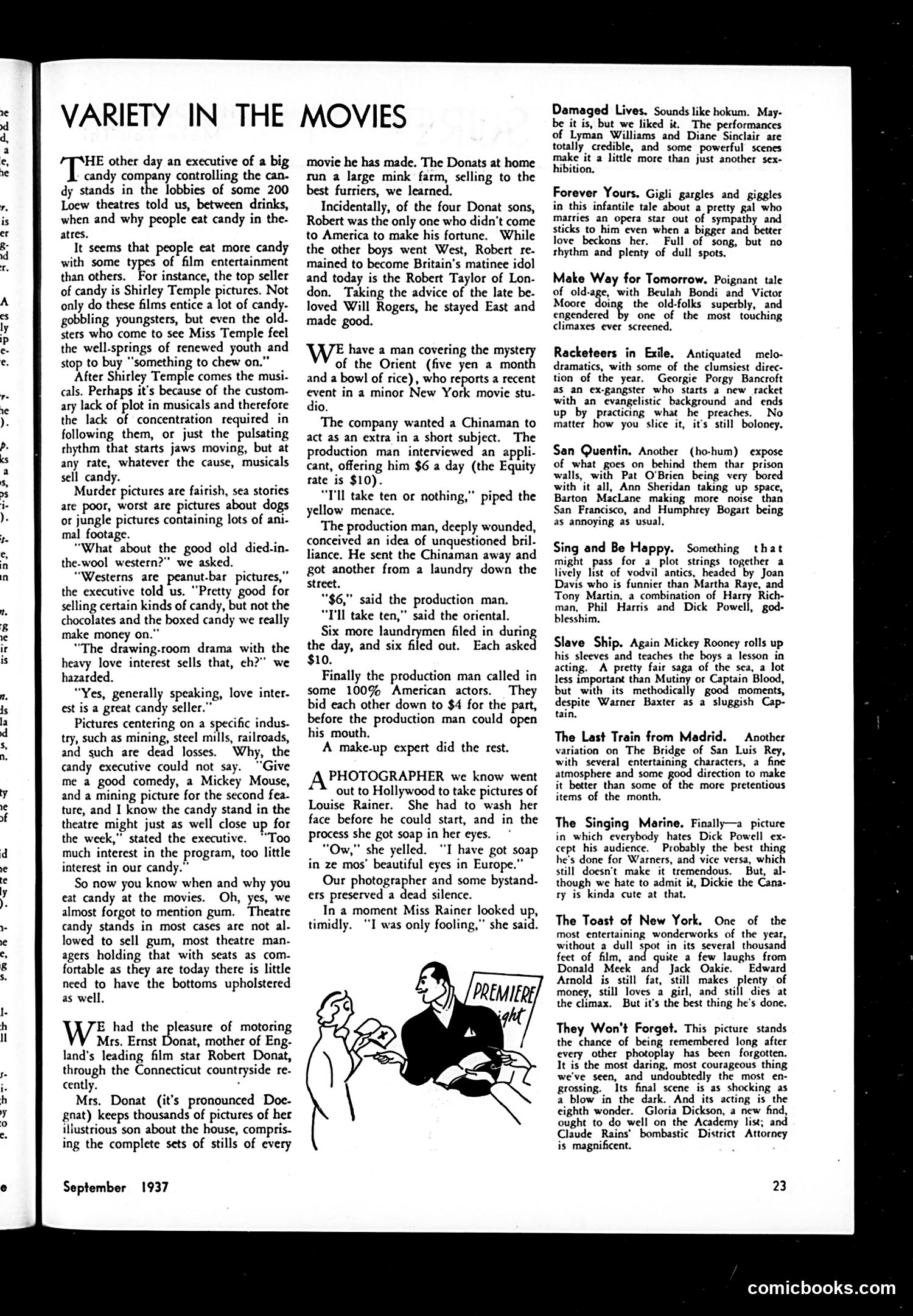
"Variety in the Movies" — Judge, September 1937 This article satirizes Hollywood's cynical approach to filmmaking by reporting that candy sales—not artistic merit—drive production decisions. A candy company executive reveals that "Shirley Temple pictures" top sales because audiences mindlessly consume candy during entertainment requiring no concentration. Musicals, comedies, and Mickey Mouse cartoons sell well; serious films (mining pictures, dog stories, dramas) kill candy profits because viewers actually pay attention. The accompanying anecdote mocks racial discrimination in hiring: a production manager tries undercutting a Chinese extra's wage demand ($6 vs. the $10 union rate). When the man refuses, the manager cynically hires Chinese laborers from a laundry at the same lowball rate, exploiting both their desperation and ethnic stereotypes (the dehumanizing phrase "yellow menace"). Together, these pieces critique 1930s Hollywood as mercenary and exploitative—prioritizing profit over quality or fair labor practices.
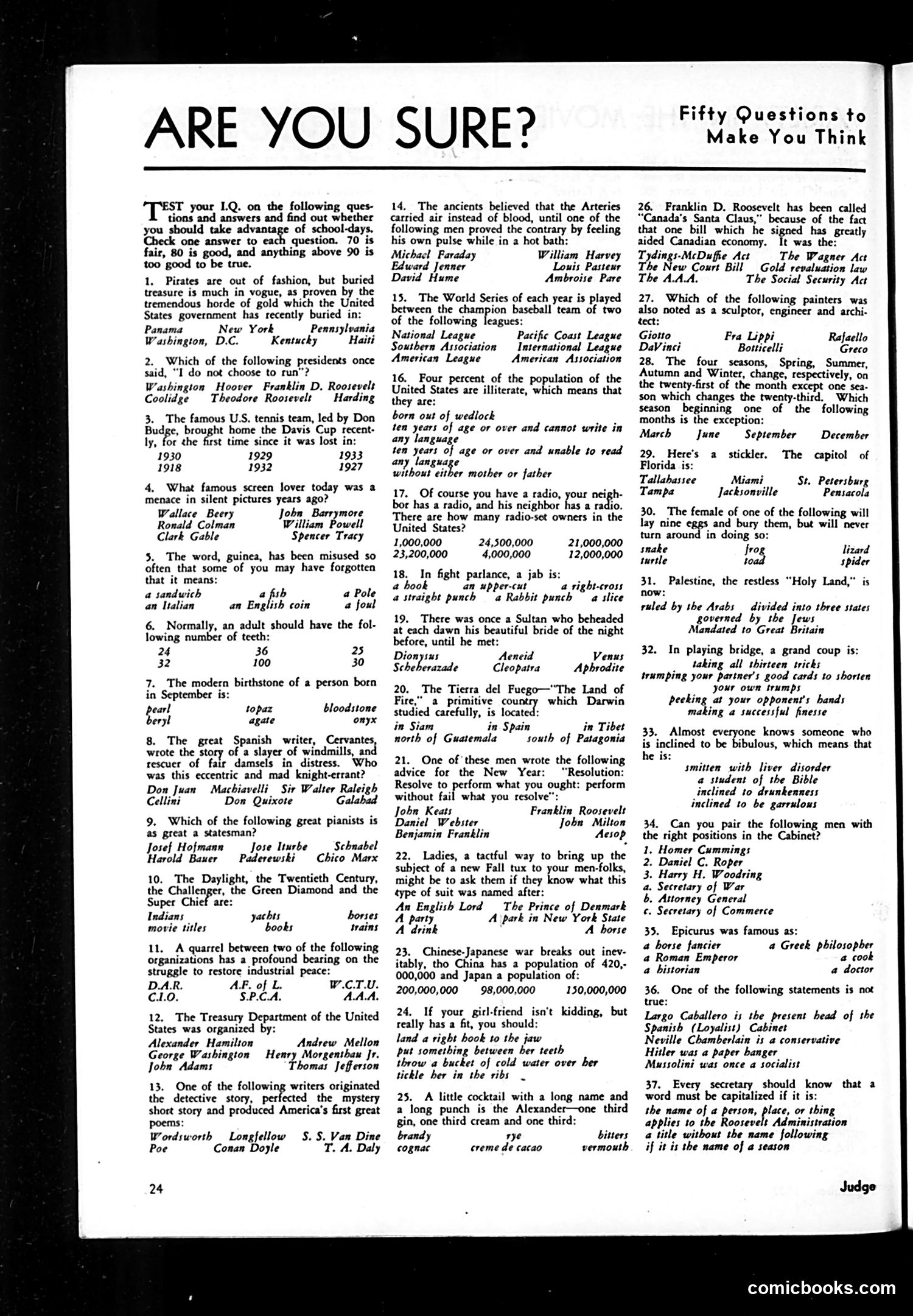
Analysis of "Are You Sure?" Quiz Page This is a trivia quiz—not a political cartoon—designed to test readers' general knowledge across history, science, literature, and current events. The page includes 19 multiple-choice questions covering topics like: - U.S. government (Fort Knox gold storage, presidential quotes) - Sports (Davis Cup tennis, World Series baseball) - Literature (Cervantes, Poe, detective fiction) - Science (anatomy, illiteracy definitions) - Popular culture (screen actors, famous trains) The framing joke is that readers should score 70+ to justify their education; anything above 90 is "too good to be true"—a jab at know-it-alls. Questions reference contemporary 1930s-40s concerns (Fort Knox, labor disputes, radio ownership statistics) and assume a educated, middle-class readership familiar with classical literature and current affairs. This is typical *Judge* magazine content: lighthearted intellectual entertainment rather than political satire.
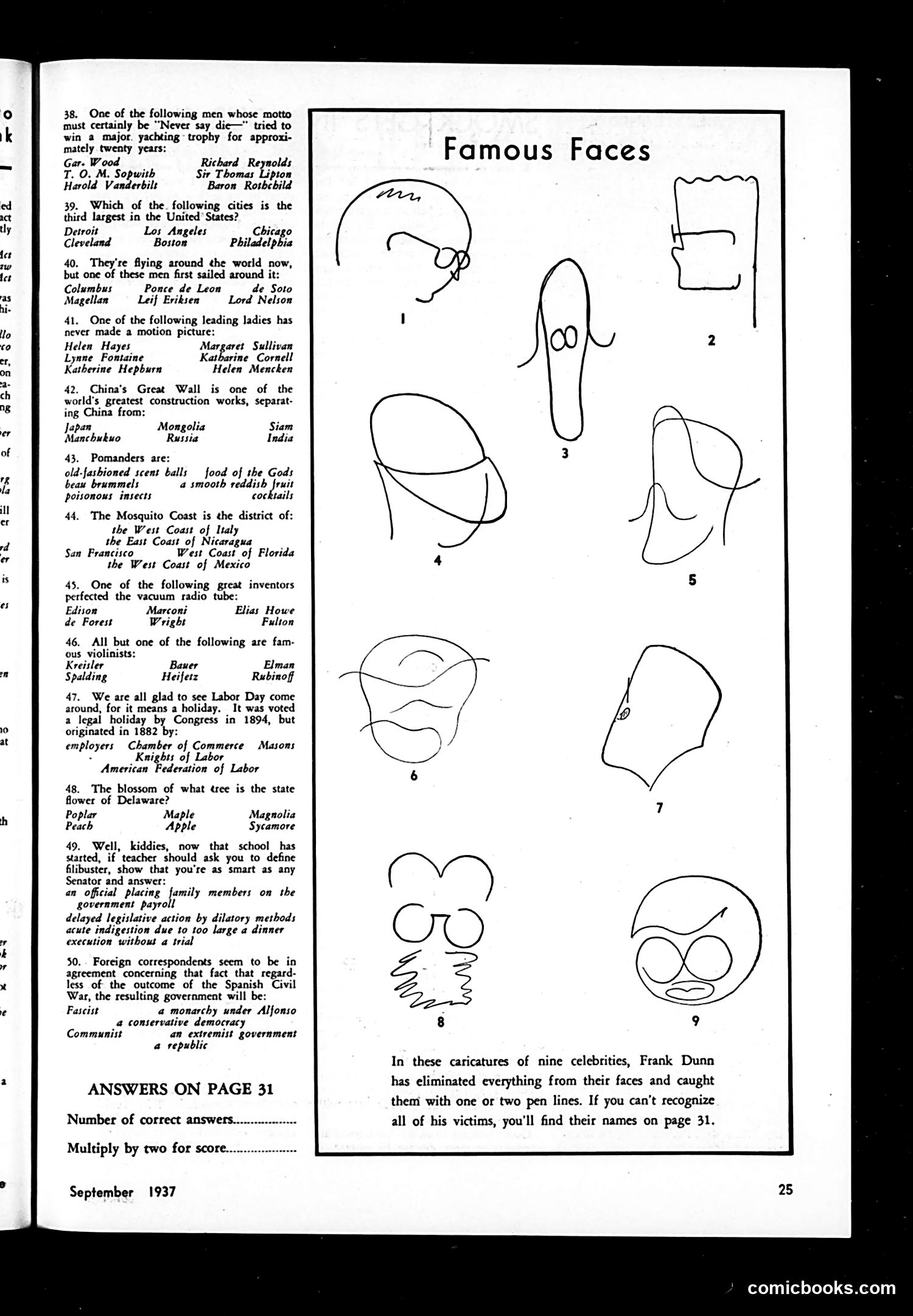
Famous Faces Cartoon Analysis This page from *Judge* (September 1937) combines a trivia quiz with a minimalist caricature game by artist Frank Dunn. The nine line-drawn "Famous Faces" use exaggerated single features—prominent noses, chins, ears, or facial shapes—to represent celebrities of the era, challenging readers to identify them. The accompanying trivia quiz tests general knowledge on geography, history, inventors, and current events (notably question 50 about the Spanish Civil War's outcome, a topical 1937 concern). The humor lies in the quiz's difficulty and the implicit claim that educated readers should know these answers. The caricature game satirizes celebrity culture by reducing famous personalities to their most distinctive physical traits, suggesting that celebrity recognition depends on superficial features rather than talent or accomplishment. Readers must consult page 31 for answers, encouraging continued engagement with the magazine.
Analysis of Judge Magazine Page This page contains satirical commentary typical of 1920s-30s American humor. "MILESTONES" section comprises brief, cynical observations on contemporary life: taxation without representation benefits, parking shortages, modern statues in magazines rather than parks, destructive cocktail parties, insomnia as a neighbor trait, Broadway economics, and failed romantic gestures in trailers. The humor targets modern American anxieties—economic instability, urban congestion, and social decline. "SMOCK GETS IN YOUR EYES" is a comedic dialogue mocking a fashion industry trend where dress designers use copyrighted song titles/lyrics to market fabrics. A customer calls seeking a dress she heard someone whistling, unable to identify it except by melody. The satire ridicules both consumer confusion and fashion industry absurdity—the notion that clothes are now marketed like sheet music, reducing women's fashion choices to vague musical references rather than practical descriptions. "SPEAKING OF HATES" lists writerly pet peeves: pencil bookmarks, door-slamming, affected reading techniques, pretentious literary affectations. It targets both readers and writers' affected behaviors.
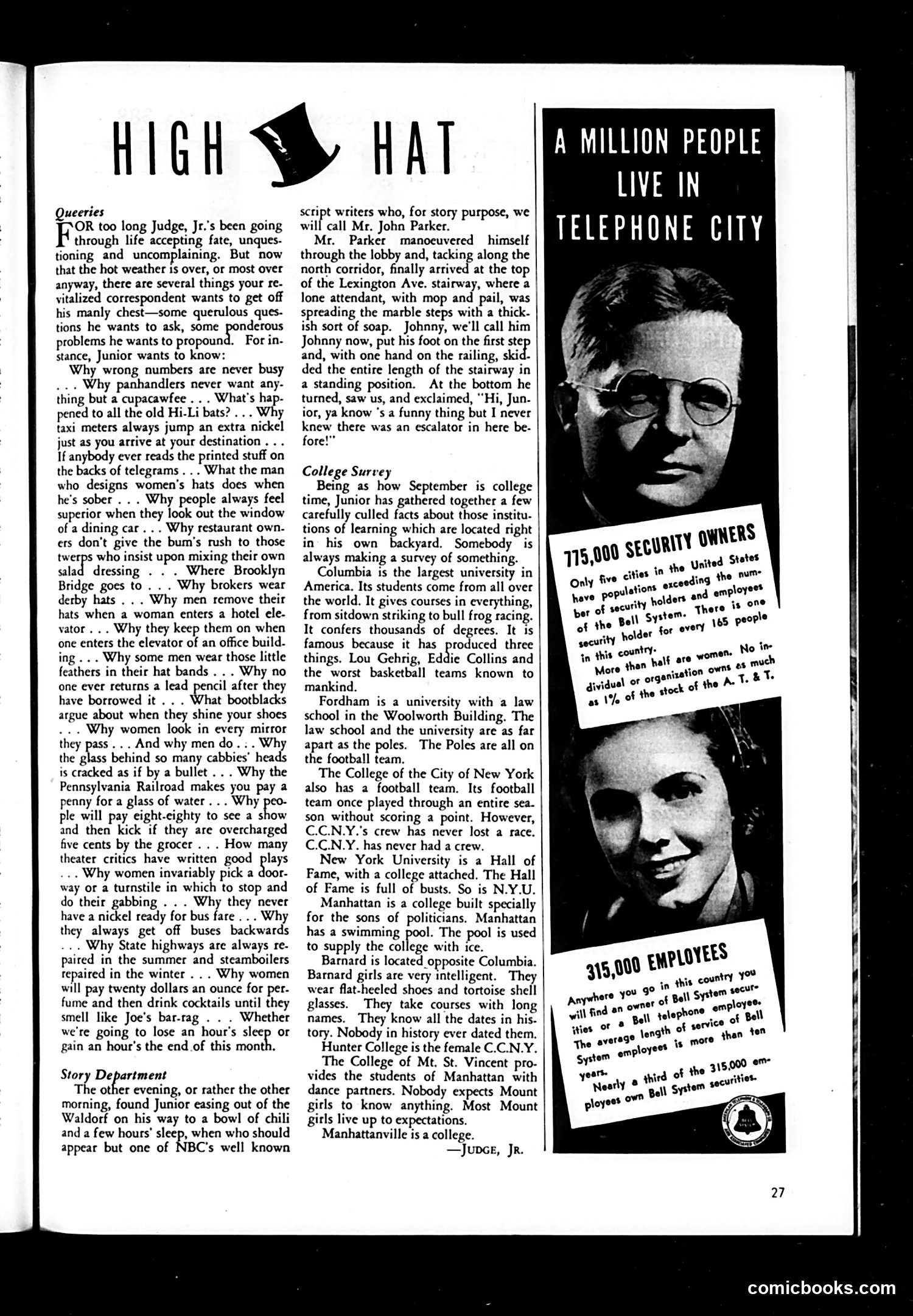
Analysis of Judge Magazine Page This page from *Judge* magazine contains two distinct elements: "High Hat" Column: A humorous list of absurd rhetorical questions about everyday annoyances—why taxi meters jump extra nickels, why people behave oddly with hats, why women look in mirrors. The satire mocks societal quirks and minor frustrations through exaggerated bewilderment. "Story Department": A comedic anecdote about "Mr. John Parker," an NBC scriptwriter who slides down a soap-covered staircase at the Waldorf Hotel and jokes that he didn't know there was an "escalator" there. The joke relies on the escalator being a relatively new technology (1920s-30s), making his ignorance absurd and humorous. Advertisements: Three Bell Telephone System ads promote employment statistics and security ownership, representing the era's corporate advertising. The overall tone is light, urbane satire targeting upper-middle-class Manhattan life, contemporary technology, and human behavioral peculiarities—typical of *Judge*'s satirical approach during this period.
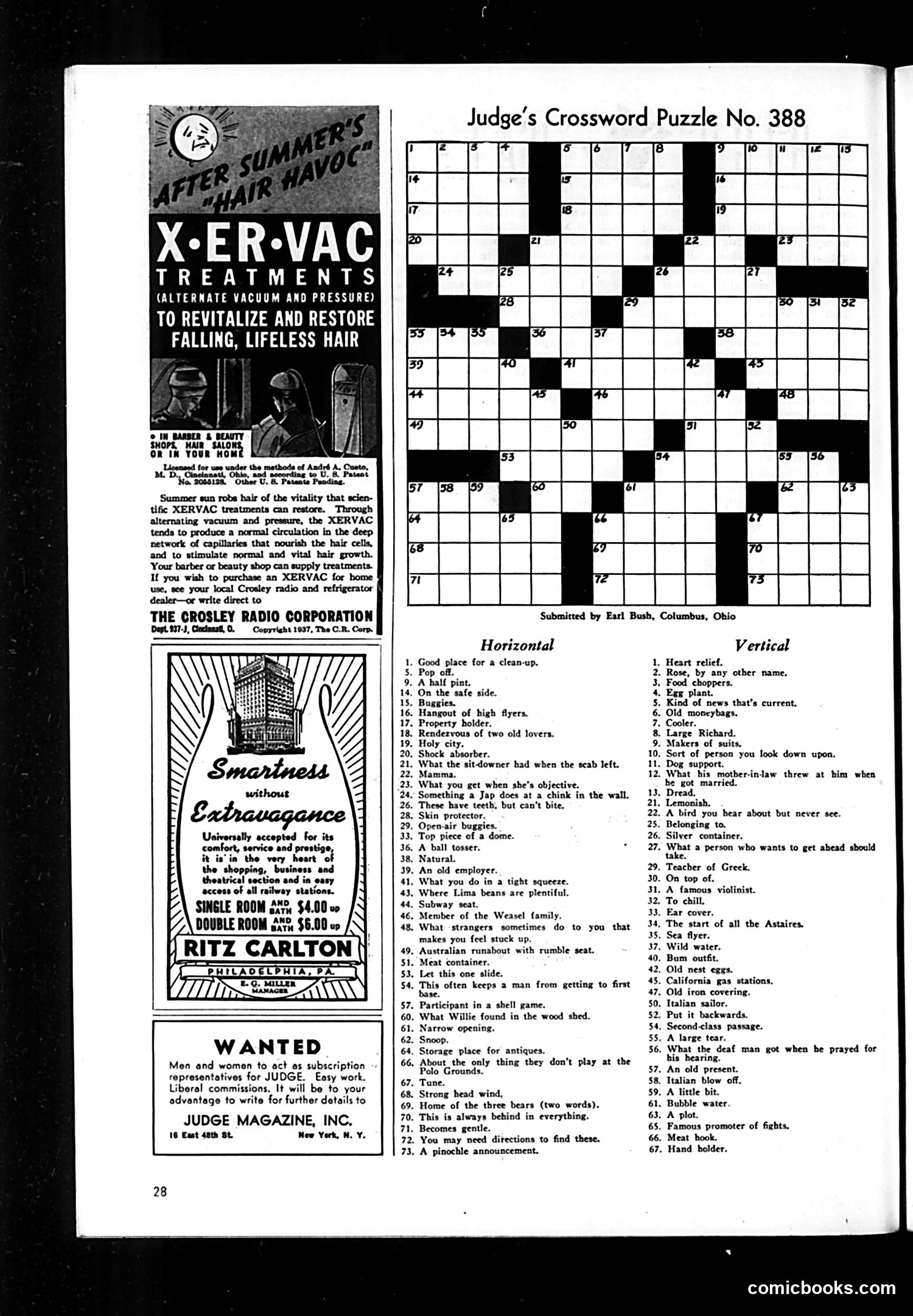
Judge Magazine Page Analysis This page is primarily advertising and puzzle content, not political satire. It features: Main Advertisement: X-ER-VAC hair treatments, promoted by the Crosley Radio Corporation. The ad claims the device uses "alternating vacuum and pressure" to restore hair vitality lost to summer sun—a typical 1937 health/beauty product pitch with pseudo-scientific language. Secondary Ads: The Ritz Carlton hotel and Judge Magazine seeking subscription representatives. Primary Content: Judge's Crossword Puzzle No. 388, submitted by Earl Bush of Columbus, Ohio. The clues are typical Depression-era wordplay—references to sit-downers (labor strikers), Lima beans, polo, and contemporary slang. Notable: The puzzle's casual references to "sit-downers" (workers engaging in sit-down strikes, popular in the 1930s) and "Japs" reflect historical attitudes of the period without satirical intent—they're simply puzzle answers reflecting contemporary events and language. This is a standard magazine puzzle page with vintage advertising, not a vehicle for political commentary.
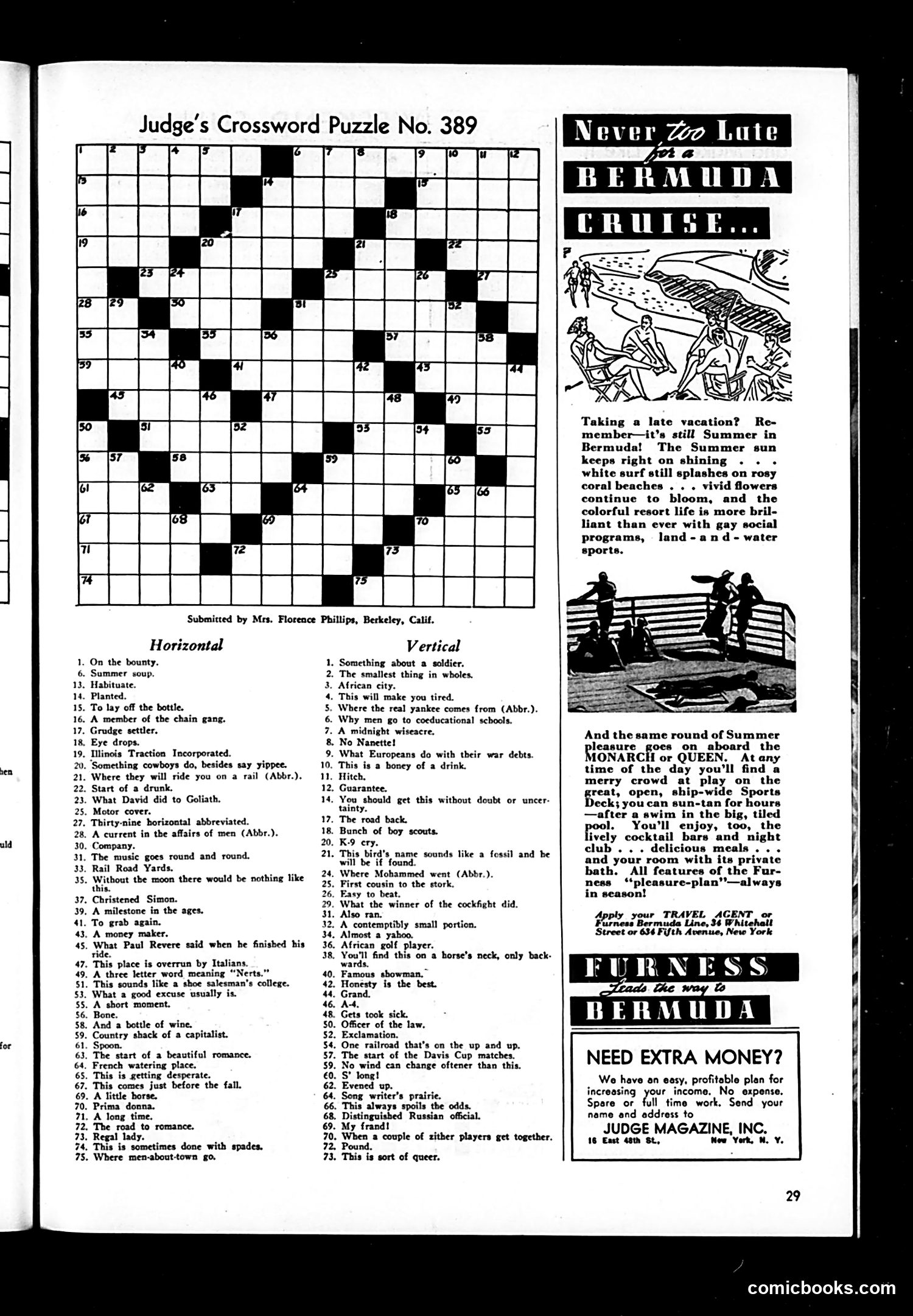
This page is primarily a crossword puzzle (#389) submitted by a reader, with advertising rather than political satire or cartoons. The main content consists of clues for a standard crossword puzzle. The clues reference 1920s-era American culture and slang—references to Prohibition ("To lay off the bottle"), silent films ("Paul Revere"), and contemporary figures like "Famous showman" (likely referring to someone like P.T. Barnum or a contemporary vaudeville personality). On the right side is an advertisement for Bermuda cruises aboard the Furness Line's ships *Monarch* and *Queen*, promoting summer vacations with sports, dining, and leisure activities. Below that is a small "Help Wanted" ad for *Judge Magazine* itself, seeking people to solicit subscriptions for commission. There are no political cartoons visible on this page—it's essentially a puzzle and advertising content typical of magazine filler from this era.
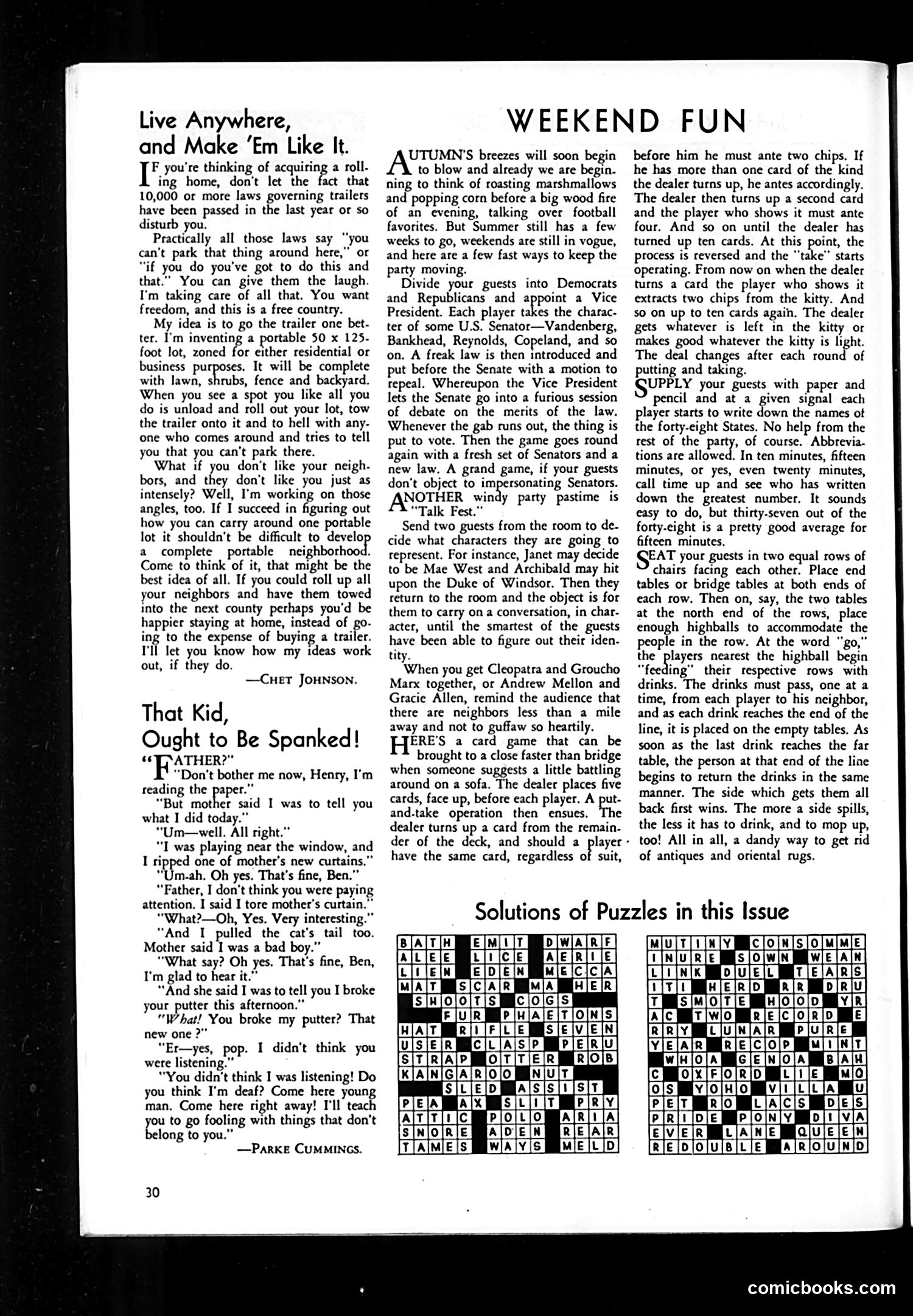
Analysis for Modern Readers This page contains three distinct pieces from Judge magazine: "Live Anywhere, and Make 'Em Like It" (by Chet Johnson) satirizes post-war trailer-home culture and zoning laws. The author proposes an absurd solution: a portable residential lot you can tow anywhere, eventually expanding to portable neighborhoods so you could relocate bothersome neighbors. The satire mocks both the proliferation of restrictive trailer regulations and Americans' desire for unrestricted mobility and freedom from community constraints. "That Kid, Ought to Be Spanked!" (by Parker Cummings) depicts a father so absorbed in reading the newspaper that he fails to listen to his son's confession of increasingly serious misbehavior—tearing curtains, pulling the cat's tail, breaking the father's golf putter. The joke exposes parental inattention and the irony that the father only becomes engaged when his *own* property is damaged. "Weekend Fun" offers party games, including one mocking Senate debates by having guests impersonate U.S. Senators debating absurd laws—referencing real senators like Vandenberg and Bankhead. This satirizes Congress as theater focused on endless talking rather than substantive legislation.
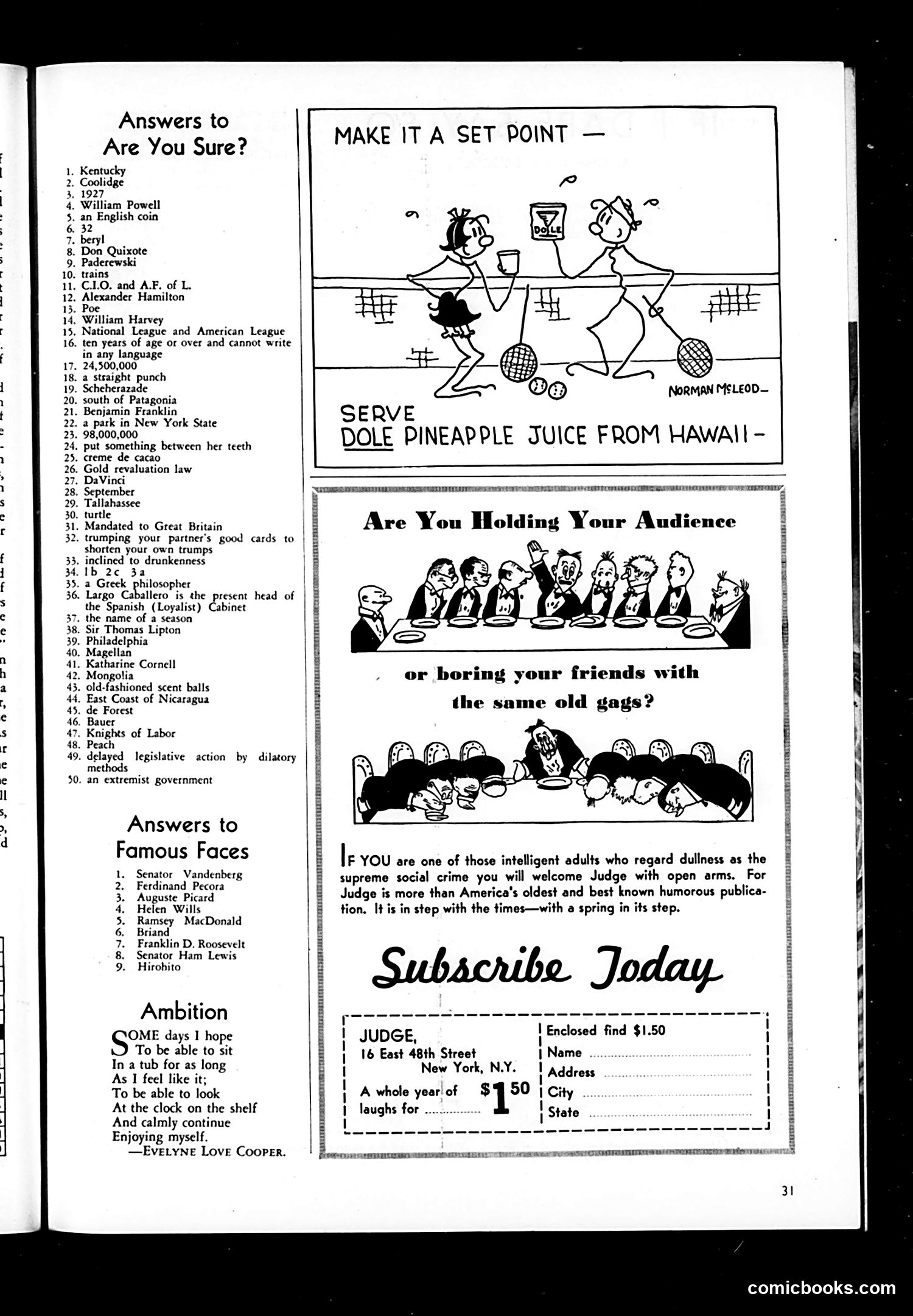
Explanation of Judge Magazine Page Content This page combines a trivia quiz ("Are You Sure?"), advertisement, and subscription pitch for Judge magazine. The cartoon "Make It a Set Point" depicts a tennis match where one player serves "Dole Pineapple Juice from Hawaii"—a straightforward product advertisement disguised as sports humor. The joke plays on "set point" (tennis terminology) while promoting Hawaiian pineapple juice, likely referencing 1920s-30s efforts to market Hawaiian agricultural products to mainland Americans. The lower section advertises Judge itself, contrasting two scenarios: a sophisticated dinner party versus boring friends repeating stale jokes. The copy claims Judge prevents dullness—positioning the magazine as essential entertainment for "intelligent adults." The subscription offer ($1.50 yearly) emphasizes Judge's status as "America's oldest and best known humorous publication" that stays "in step with the times." The page is primarily advertising-focused, with the trivia quiz serving as filler content typical of period magazines.
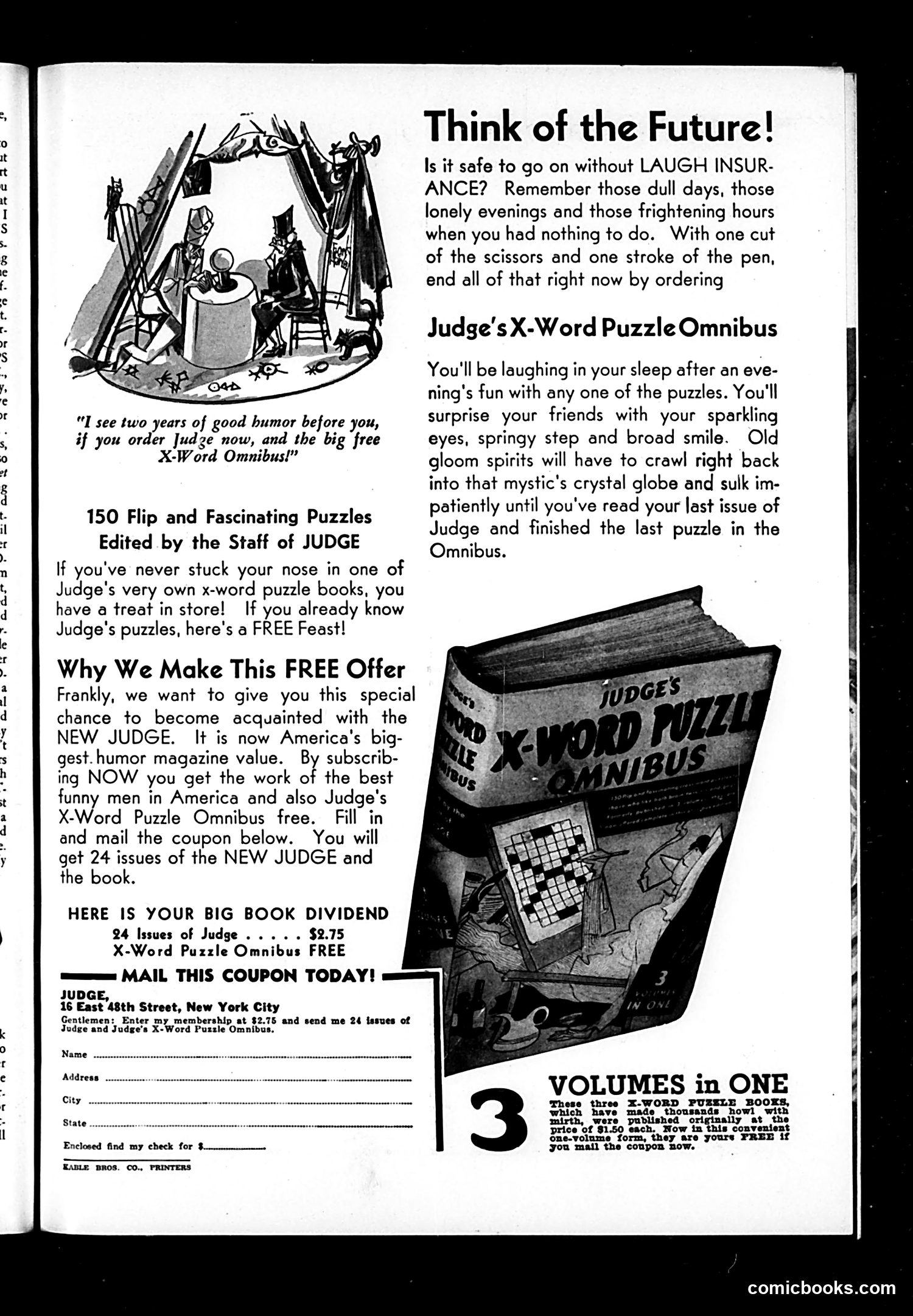
Analysis This is primarily advertising copy, not satirical content. Judge magazine is promoting a subscription offer (24 issues for $2.75) bundled with a free "X-Word Puzzle Omnibus" book. The page uses humorous, tongue-in-cheek language typical of vintage advertising—particularly the concept of "LAUGH INSURANCE" as protection against boredom and loneliness. The small cartoon at top left depicts figures around a fortune teller's crystal ball, visualizing the "gloom spirits" metaphorically referenced in the text. The appeal targets readers seeking entertainment during leisure time (dull evenings, nothing to do), positioning Judge as both a humor magazine and a source of puzzle diversions. The "Why We Make This FREE Offer" section emphasizes Judge's status as "America's biggest humor magazine value," suggesting competitive positioning in the magazine market. No specific political figures or satirical targets are identified on this page—it's a straightforward (if colorfully written) subscription promotion typical of mid-20th century magazine advertising.
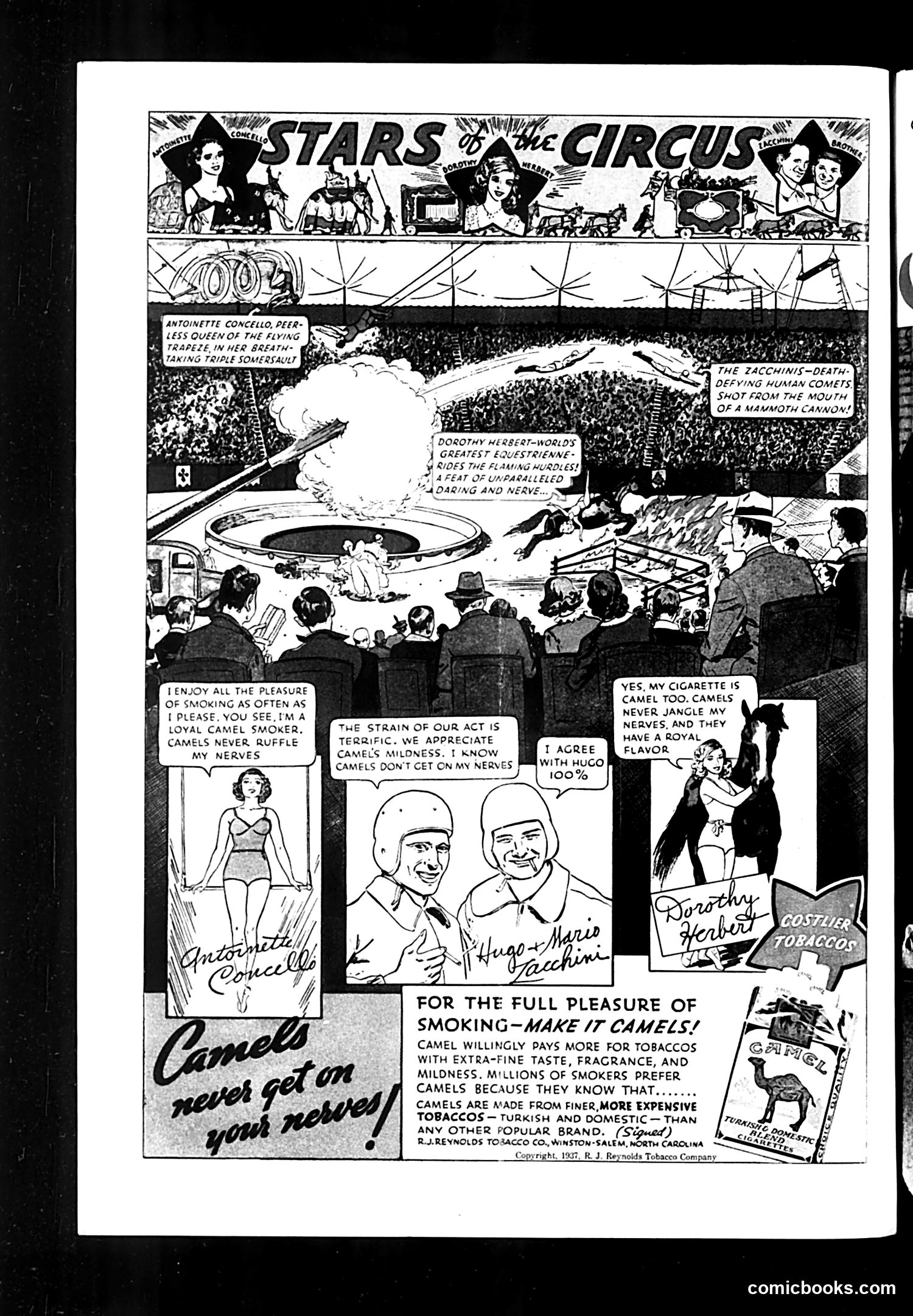
"Stars of the Circus" — Camel Cigarettes Advertisement This is a 1937 Camel cigarettes advertisement masquerading as entertainment content. The top depicts circus performers (Antoinette Concello on flying trapeze, the Zacchinis as human cannonballs, Dorothy Herbert as an equestrienne) performing dangerous stunts before crowds. The bottom section features testimonials from circus performers claiming Camels "never ruffle my nerves" despite their stressful work. This exploits the performers' names and images to suggest cigarettes provide calming benefits—a common advertising tactic before health warnings were mandated. The irony: the ad uses death-defying acrobats to sell cigarettes, implying smoking aids performance and nerve control. The copy emphasizes "finer, more expensive tobaccos" to justify premium pricing. This represents pre-regulation tobacco marketing that directly targeted specific professions and made health/performance claims now prohibited by law.