judge
Judge — October 1937
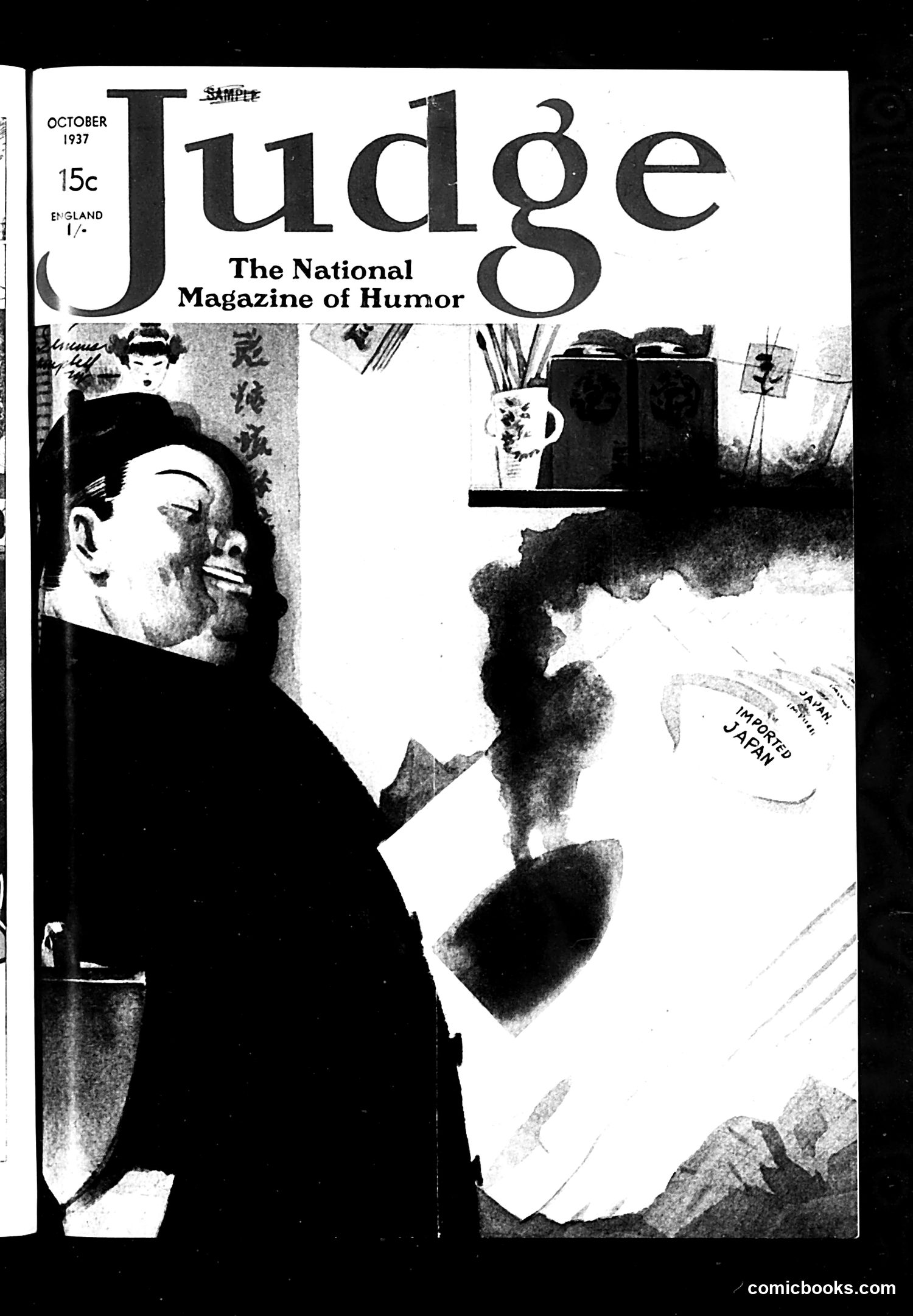
Analysis of Judge Magazine Cover, October 1937 This cover depicts a man in formal attire examining what appears to be a map labeled "IMPORTED JAPAN." The satirical point likely concerns Japan's imperial expansion in the 1930s—a major international concern by 1937, when Japan was actively invading China. The figure appears to be an American businessman or politician scrutinizing Japanese imports or territorial ambitions. The humor works on multiple levels: the man's exaggerated facial expression suggests bemusement or concern, while the "imported" label suggests Japan's goods flooding American markets during this period. This reflects Depression-era anxieties about foreign competition and Japan's aggressive militarism simultaneously. The cartoon mocks American commercial or diplomatic engagement with an increasingly militaristic Japan.
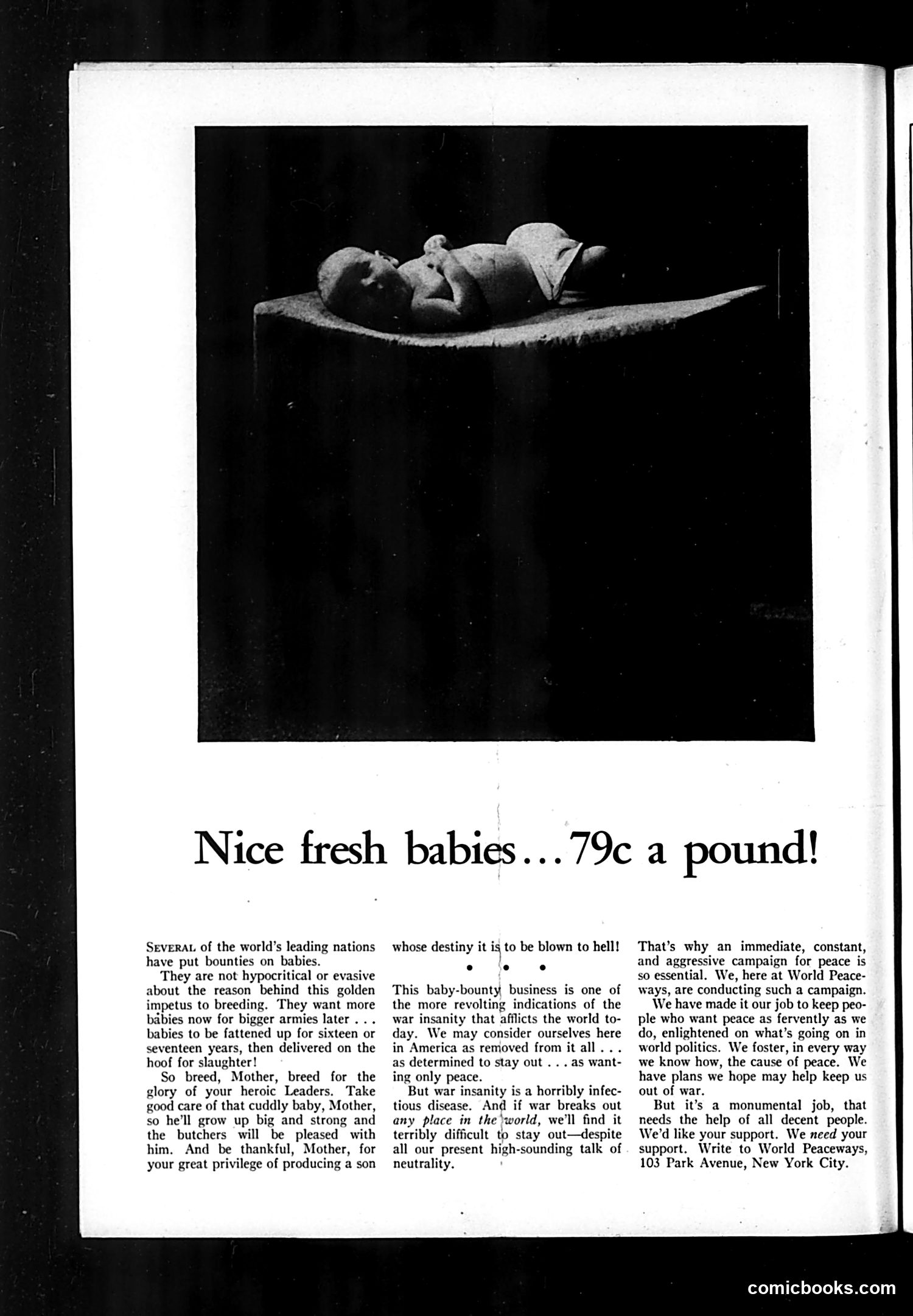
Satire on War and Infant Mortality This is anti-war propaganda from Judge magazine, likely from World War I or the interwar period. The grotesque image shows dead babies on a scale, priced at 79 cents per pound—a darkly satirical commentary on nations that offered "bounties on babies" to encourage population growth for military purposes. The accompanying text criticizes world leaders for breeding soldiers destined for slaughter, sarcastically praising mothers for producing cannon fodder. It argues this cycle demonstrates the insanity of war and calls for peace activism through "World Peaceways," a peace advocacy organization (address provided). The satire equates militaristic nationalism with treating human lives as commercial commodities, condemning both war and the propaganda encouraging large families to sustain armies.
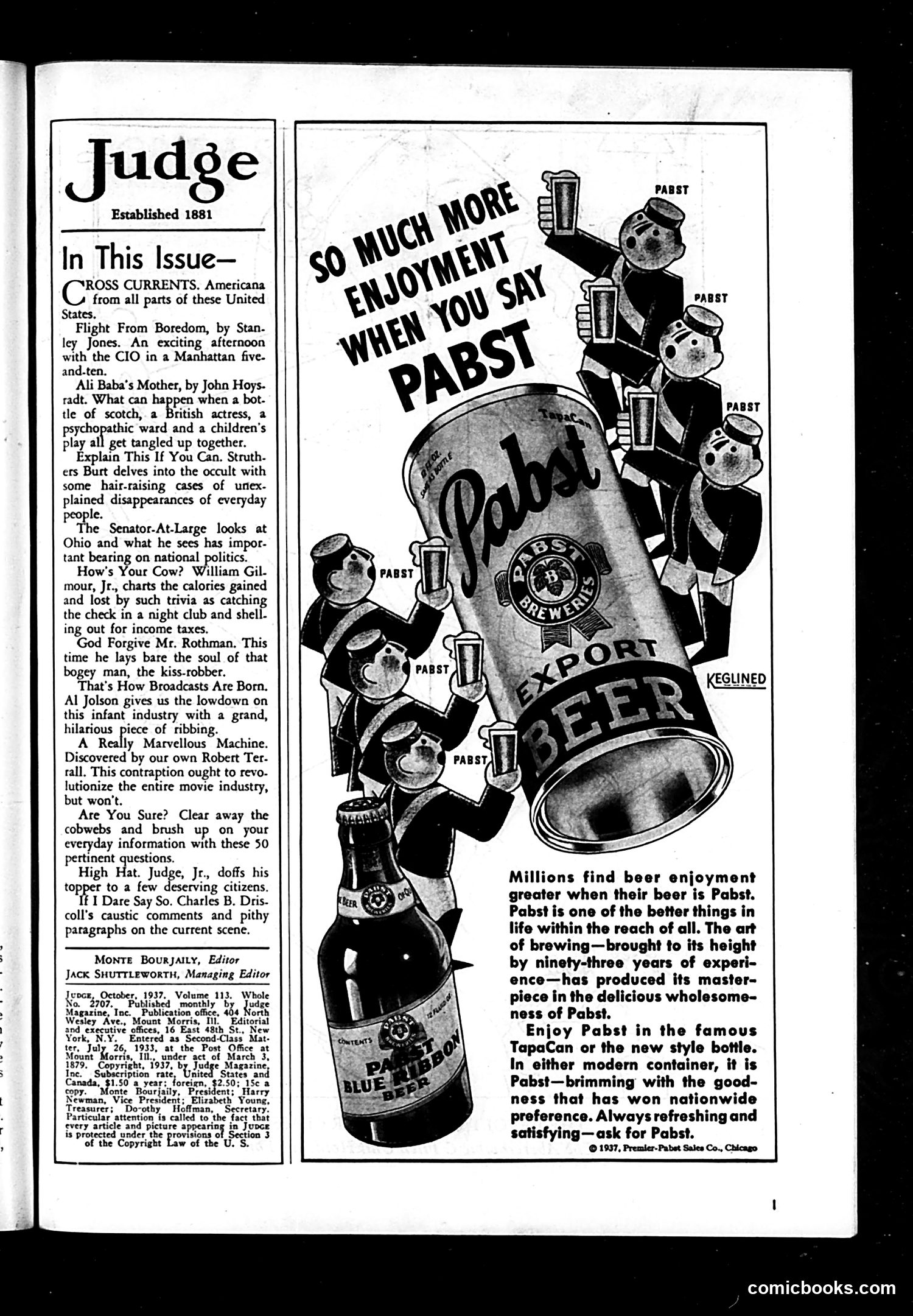
Analysis This page is primarily a Pabst beer advertisement rather than political satire. The large right-side ad depicts anthropomorphic beer mugs with human faces cheerfully holding Pabst bottles, with the slogan "SO MUCH MORE ENJOYMENT WHEN YOU SAY PABST." The left column contains Judge magazine's table of contents listing various articles and satirical pieces for that issue (October 1917). The articles reference typical Judge content: social commentary ("Cross Currents"), celebrity gossip, and humor columns. Historical context: This 1917 advertisement predates Prohibition (1920-1933), when such beer ads were still legal and common in American magazines. The cheerful, cartoonish style was typical advertising of the era. The page demonstrates how early-20th-century magazines mixed editorial content with advertising.
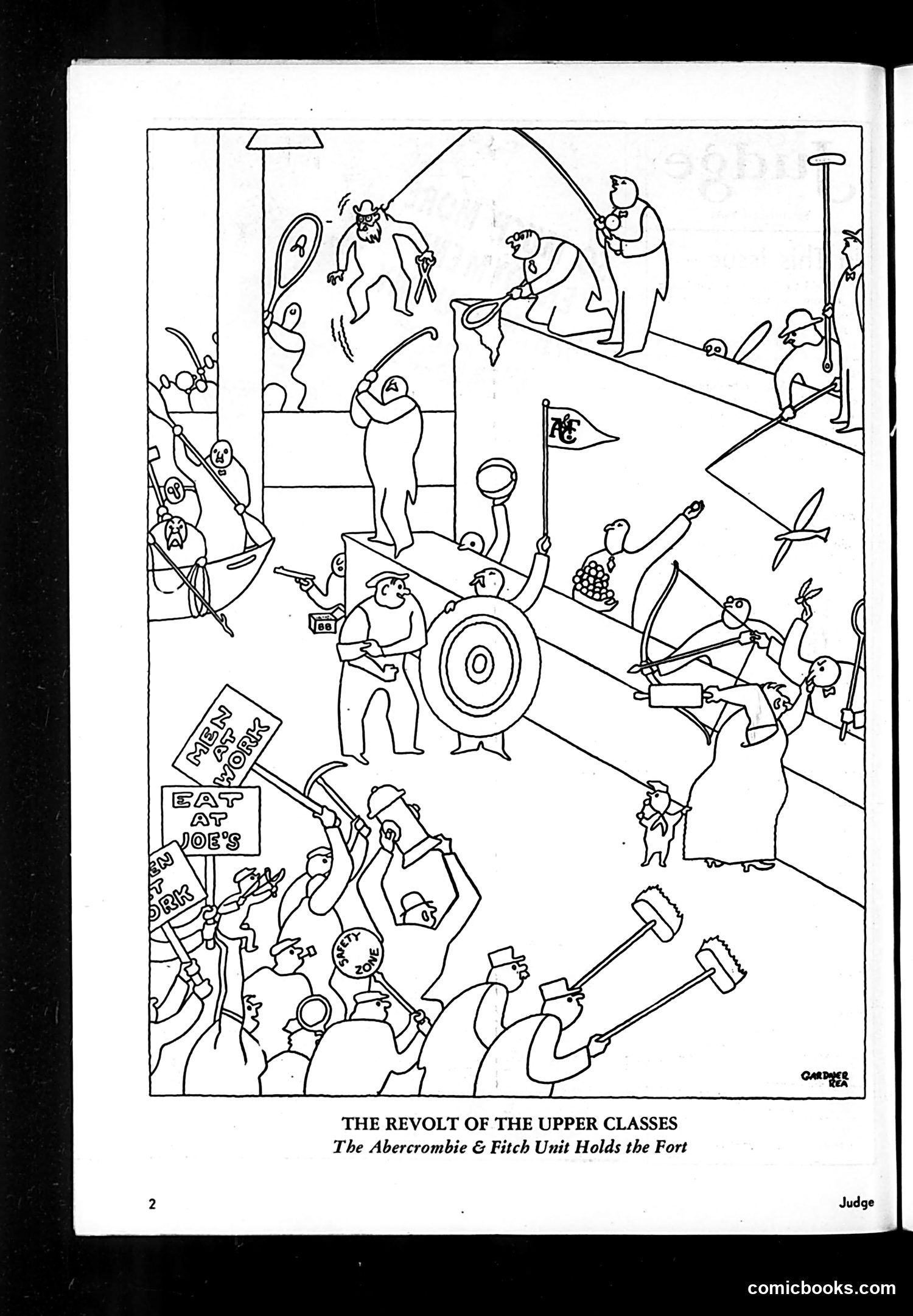
Analysis This is a satirical cartoon titled "The Revolt of the Upper Classes: The Abercrombie & Fitch Unit Holds the Fort." The cartoon depicts wealthy, well-dressed figures engaged in chaotic rebellion or conflict, apparently barricaded in some kind of fortress or stronghold. The satire appears to mock the upper classes—specifically referencing Abercrombie & Fitch, a luxury retailer—by portraying them as comically militant and defensive. The imagery suggests social unrest or class conflict, with the wealthy depicted as organized yet absurd in their "revolt." The specifics of what historical event this references are unclear without additional context, but Judge magazine frequently satirized wealth inequality and class tensions in early-to-mid 20th-century America. The humor seems to lie in the incongruity of privileged people portrayed as rebels.
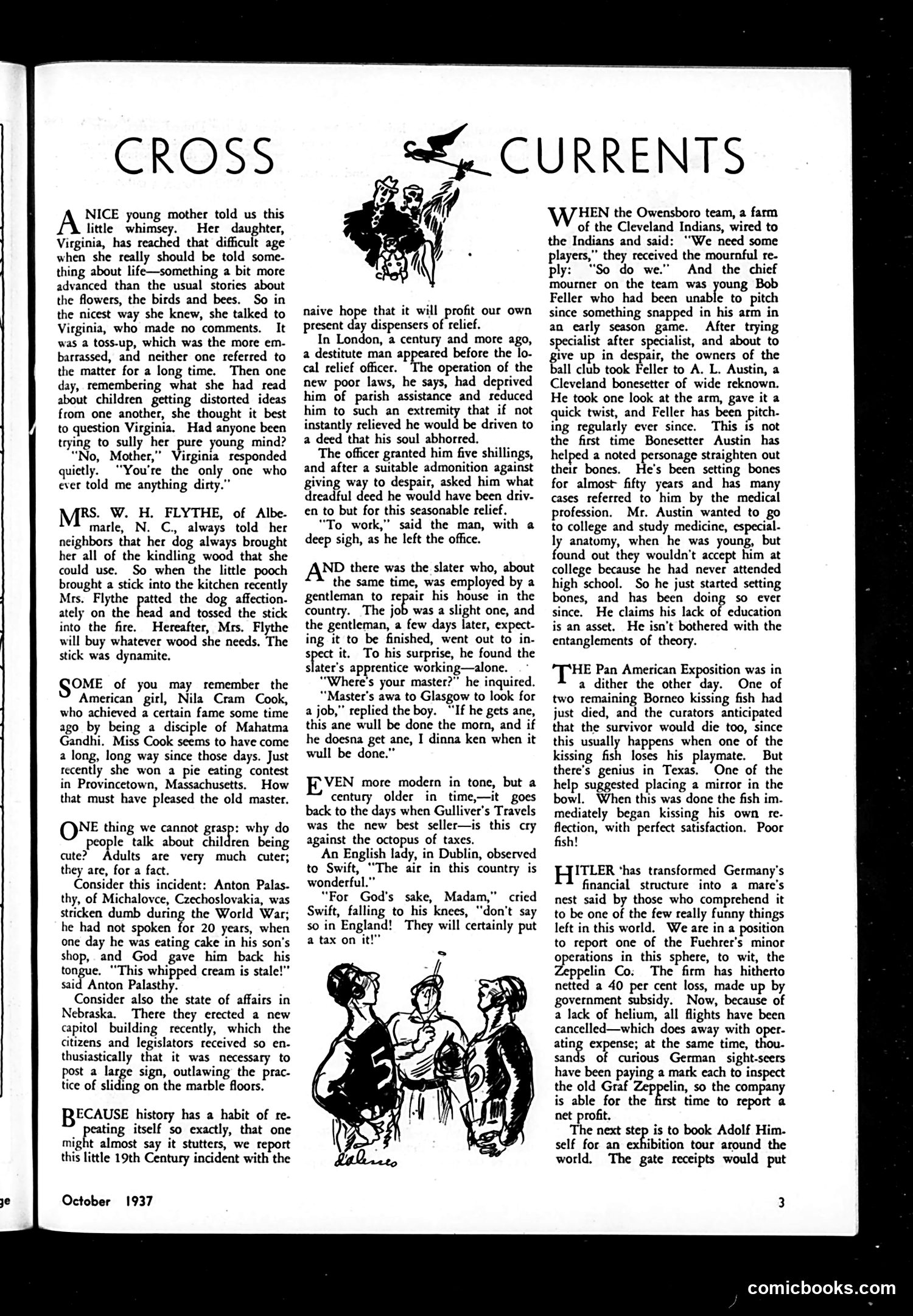
Analysis of Judge Magazine Page (October 1937) This page contains two unrelated articles under the "Cross Currents" header rather than political cartoons. The left column features anecdotes about kindness to animals and people, including stories about a woman who told her daughter that dogs teach morality, and Mrs. W.H. Flythe who fed a stray dog. The right column discusses contemporary issues: Bob Feller's baseball injury, the Pan American Exposition's kissing fish exhibit in Texas, and—most significantly—criticism of Hitler's financial restructuring of Germany. The author notes the Nazi regime's losses due to lack of helium for Zeppelin operations and suggests booking Adolf Hitler for a world exhibition tour as a solution. The Hitler reference reflects pre-WWII American satirical skepticism toward Nazi Germany's economic policies and leadership.
Analysis of Judge Magazine Page This page contains several satirical pieces rather than a single cartoon. The top illustration shows a demonic figure with wings seated in a chair—likely representing negative forces or corruption—though the specific reference is unclear from the visible text. The articles mock various 1930s New Deal initiatives and political figures: - "Rum Stuff" satirizes President Roosevelt's Virgin Islands rum project, suggesting government overreach into private business - "Slip Knot" jokes about marital dissolution and property division - References to Secretary Ickes and a New Orleans editor indicate criticism of New Deal administrators The satire targets government inefficiency, political patronage, and what Judge's conservative editors viewed as wasteful federal spending during the Depression era. The tone is lighthearted mockery of bureaucratic absurdity rather than serious political critique.
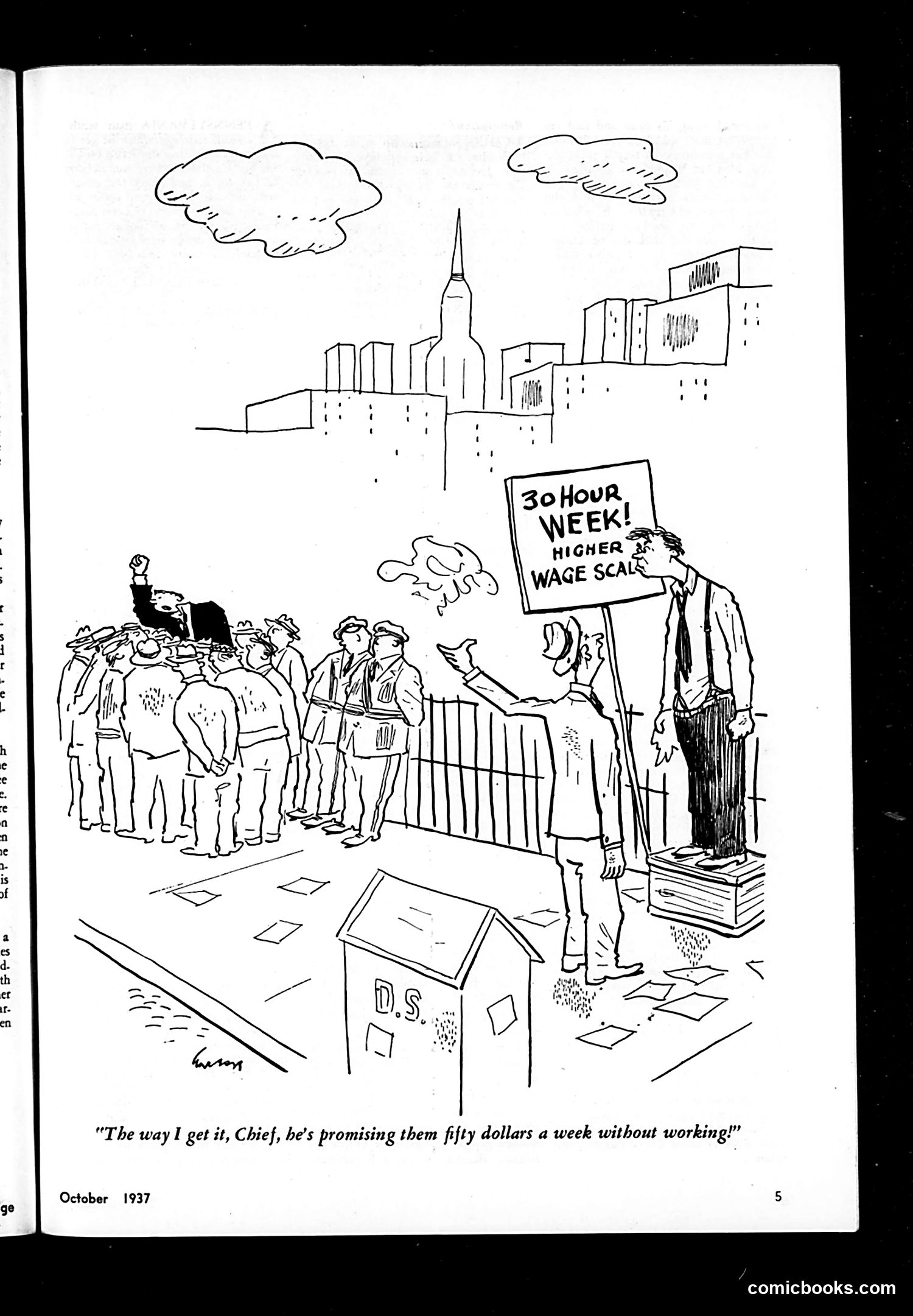
Political Cartoon Analysis: October 1937 This cartoon satirizes a political promise of a "30-hour week" with "higher wage scale." A speaker holds the sign while addressing a crowd of workers behind a barrier near what appears to be a government building (marked "D.S.," possibly Department Services). The caption reveals the satire: a police chief dismisses the promise as unrealistic, claiming the speaker is "promising them fifty dollars a week without working." The cartoon mocks labor-reform proposals circulating in the 1930s Depression era—suggesting such promises are impossibly generous or fraudulent. It reflects skepticism toward New Deal-era labor initiatives and questions whether reduced working hours with maintained wages could realistically be delivered. The cartoon criticizes both the politician making the promise and implies workers are gullible for believing it.
Judge Magazine Page Analysis This page contains humor columns and anecdotes rather than political cartoons. The content includes: "Renovations" — a humorous section mocking excuses couples use to justify marital problems (sleeping on platforms, filing divorce suits over sauerkraut and asparagus). "Broody Business" — a comedic tale about a hen that laid a double-yolk egg, which broke, leading to the hen's death from overproduction. "Bloody Business" — brief anecdotes about stock investors and a political candidate who became engaged to four women simultaneously. "The Art of Making Friends" — a philosophical essay contrasting primitive weapons with modern civilization. "Football" — a commentary praising football as beautiful sport, with game-day observations. The page functions as a satirical humor magazine typical of early-20th-century Judge, mixing social commentary with lighthearted domestic jokes and observations about American life. No specific political figures or events appear identifiable on this particular page.
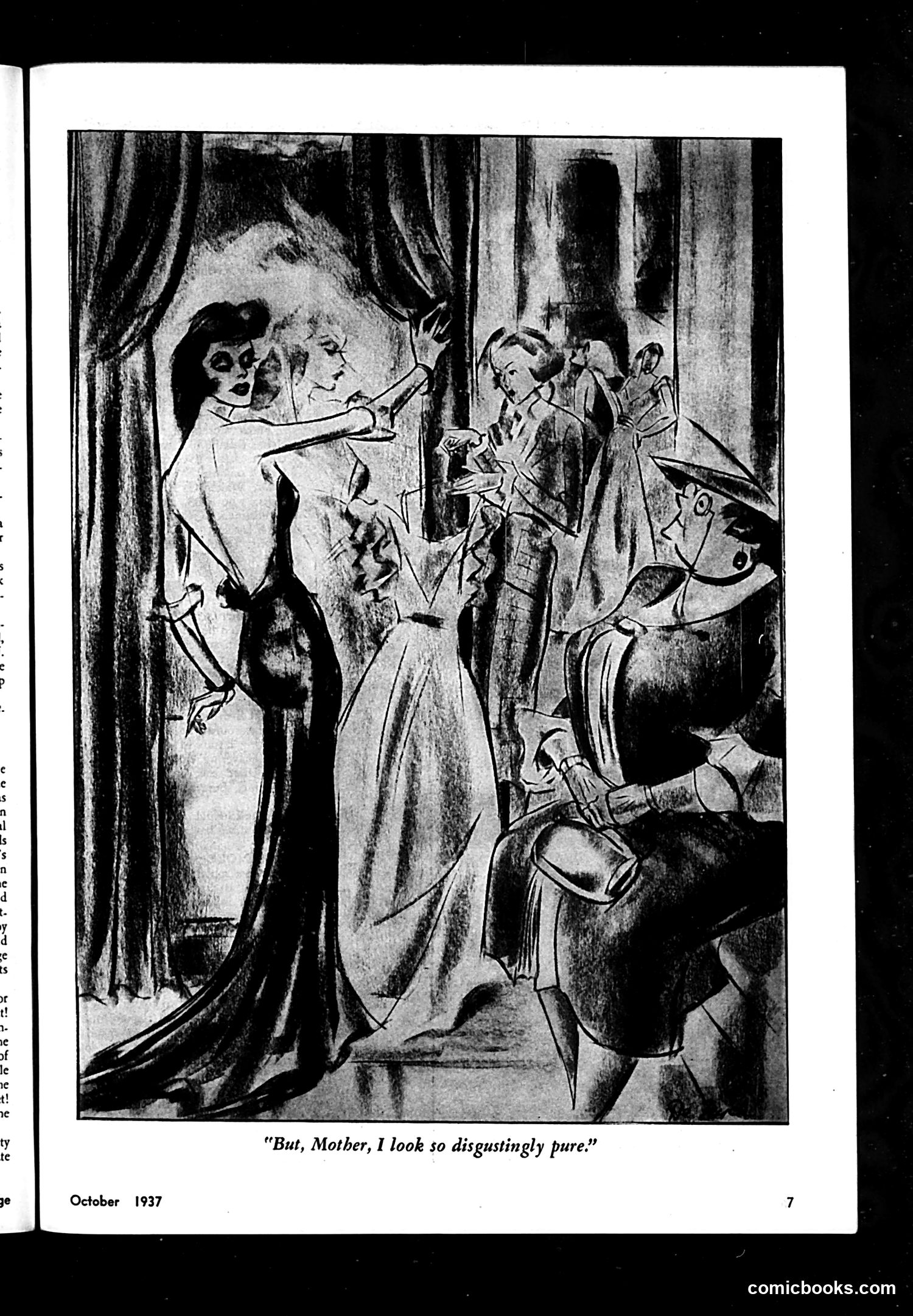
Cartoon Analysis: "But, Mother, I look so disgustingly pure" This October 1937 cartoon satirizes excessive prudishness or artificial morality. A young woman in an elegant gown addresses her mother while surrounded by what appears to be military or formally-dressed figures. The caption's ironic tone—claiming to look "disgustingly pure"—suggests the cartoon mocks exaggerated displays of virtue or propriety, particularly among the wealthy or socially prominent. The specific historical context remains unclear without additional information, though the formal military dress and the emphasis on artificial purity suggest possible commentary on pre-war social pretension or hypocrisy. The satirical point appears to be that outward appearances of virtue can be deliberately manufactured and unconvincing, a common Judge magazine theme targeting upper-class affectation.
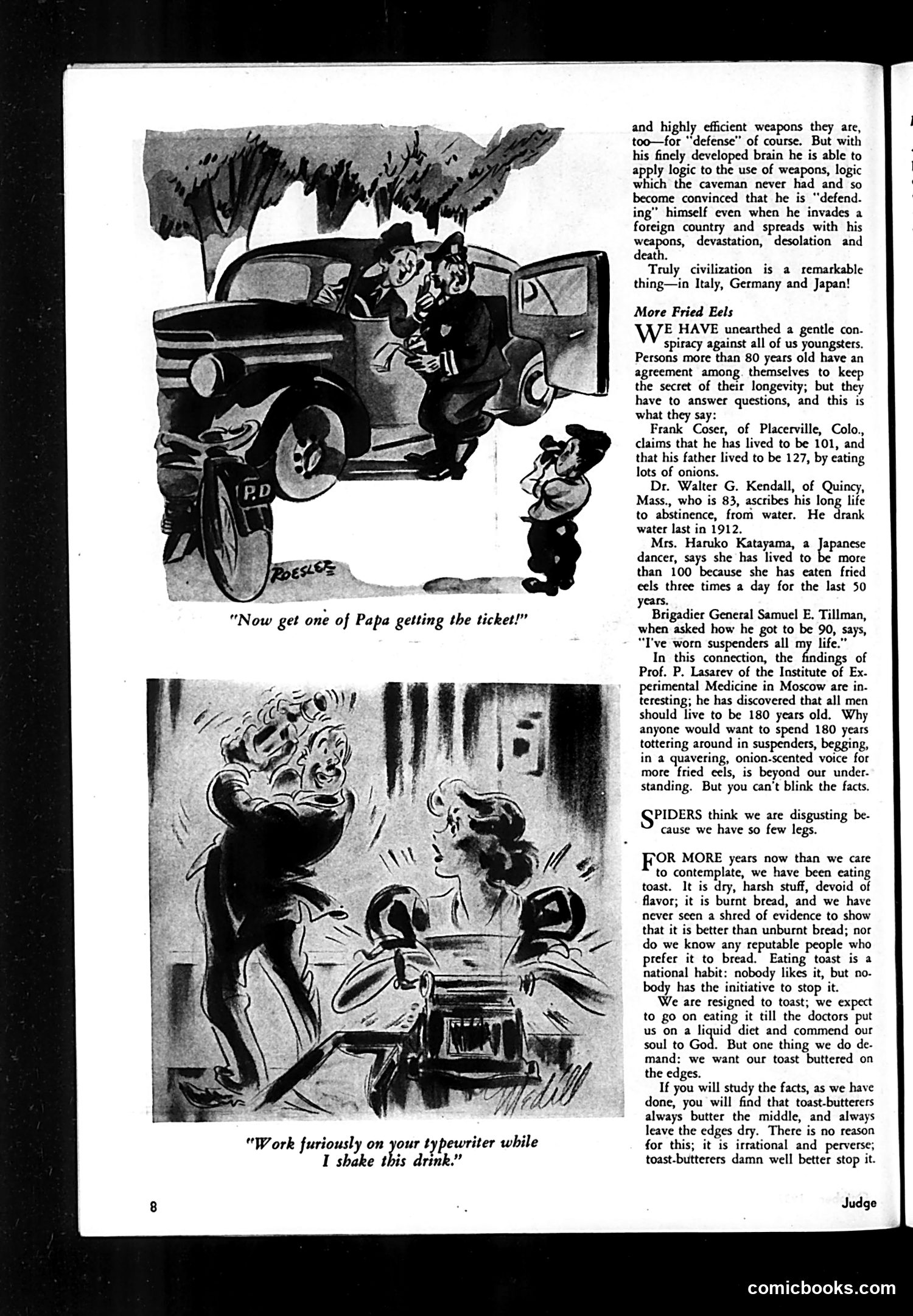
Political Cartoon Analysis: Judge Magazine Page This page contains three satirical pieces from Judge magazine (likely 1930s-40s, given references to Italy, Germany, and Japan as threats). Top cartoon: Satirizes fascist nations' justification of military aggression as "defense." The figure being chased (likely representing a civilian or smaller nation) illustrates how authoritarian regimes use sophisticated rhetoric to disguise invasive warfare, contrasting their "civilized" weapons with caveman-like logic. "More Fried Eels" section: Humorously debunks longevity claims. It mocks elderly people's contradictory secrets to long life (onions, water abstinence, fried eels, suspenders) while referencing a Soviet scientist's claim that humans should live 180 years—then sardonically questions why anyone would want to. Bottom cartoon and toast essay: Absurdist humor complaining that toast-buttering servants always butter the middle instead of edges. This appears to be pure comedic filler, mocking minor domestic frustrations. The page blends political satire with lighthearted humor typical of Judge's satirical approach.
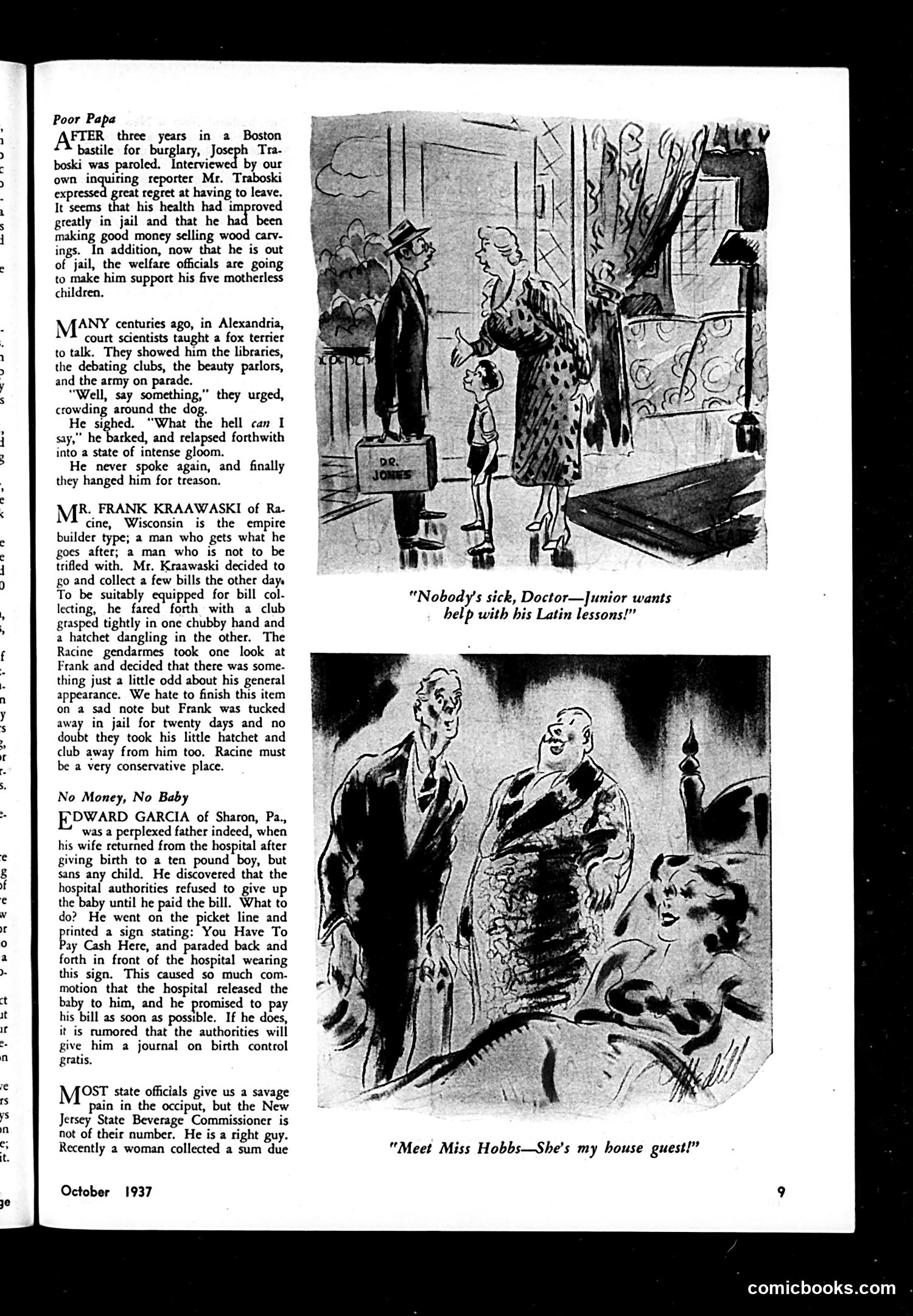
Judge Magazine, October 1937: Satirical Anecdotes This page presents humorous social commentary through brief anecdotes rather than political cartoons. The pieces mock bureaucratic absurdity and human folly: "Poor Papa" satirizes the paradox of incarceration: a burglar thrives in jail (better health, income from woodcarvings) but faces hardship upon release when forced to support five children—suggesting the prison system is more humane than poverty. The Alexandria fable is a cynical commentary on education and intellectualism: exposing a dog to culture produces only despair and cynicism, ending in execution for "treason"—mocking how education can corrupt innocence. The Krawaski anecdote ridicules overzealous debt collection: a man armed with club and hatchet is jailed for attempting to collect bills, satirizing both aggressive business practices and small-town law enforcement. "No Money, No Baby" criticizes hospital profiteering: a hospital withholds a newborn until payment is made, forcing the father to picket. This attacks healthcare commercialism and lack of compassion. The cartoons accompanying these stories use exaggerated character drawing typical of 1930s satirical illustration.
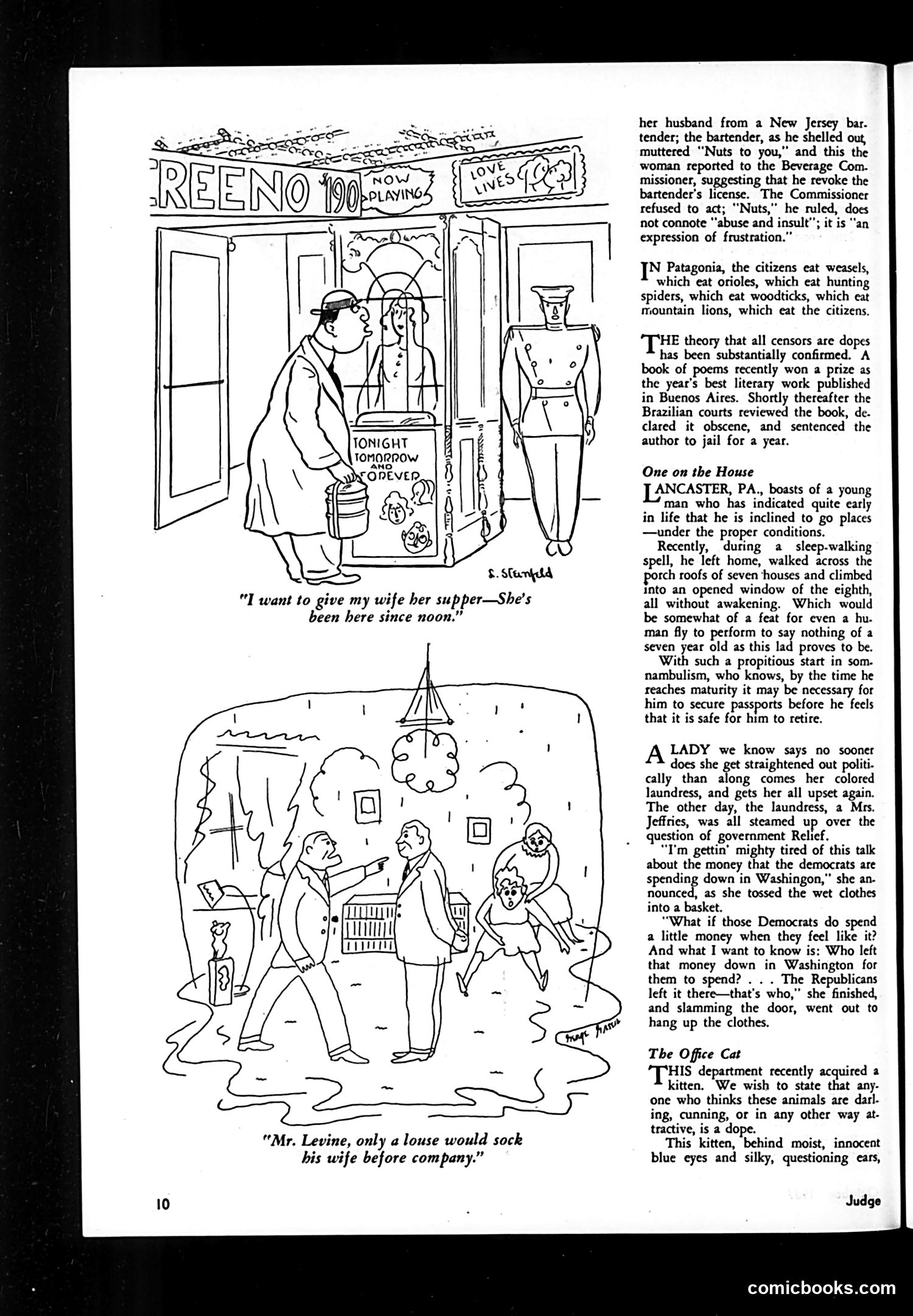
Judge Magazine Page Analysis This page contains three cartoons and several humorous anecdotes satirizing social issues of the era (appears to be 1930s based on references to government relief and New Deal politics). Top cartoon: A man at a speakeasy door wants to give his wife supper, but she's been waiting since noon—satirizing Prohibition-era speakeasies and their lack of service. Bottom cartoon: "Mr. Levine" appears ready to hit his wife in front of company, mocking domestic violence attitudes and class pretense. Text stories mock: - Government bureaucracy (a bartender saying "Nuts" isn't ruled abuse) - Literary censorship in South America - A sleepwalking child's impossible feats - A Black laundress's sharp political commentary about Democratic vs. Republican spending - Cats as overrated pets The laundress anecdote is particularly notable: presenting her as politically astute while maintaining a patronizing tone typical of the era. The humor relies on period prejudices and casual attitudes toward domestic violence now considered offensive.
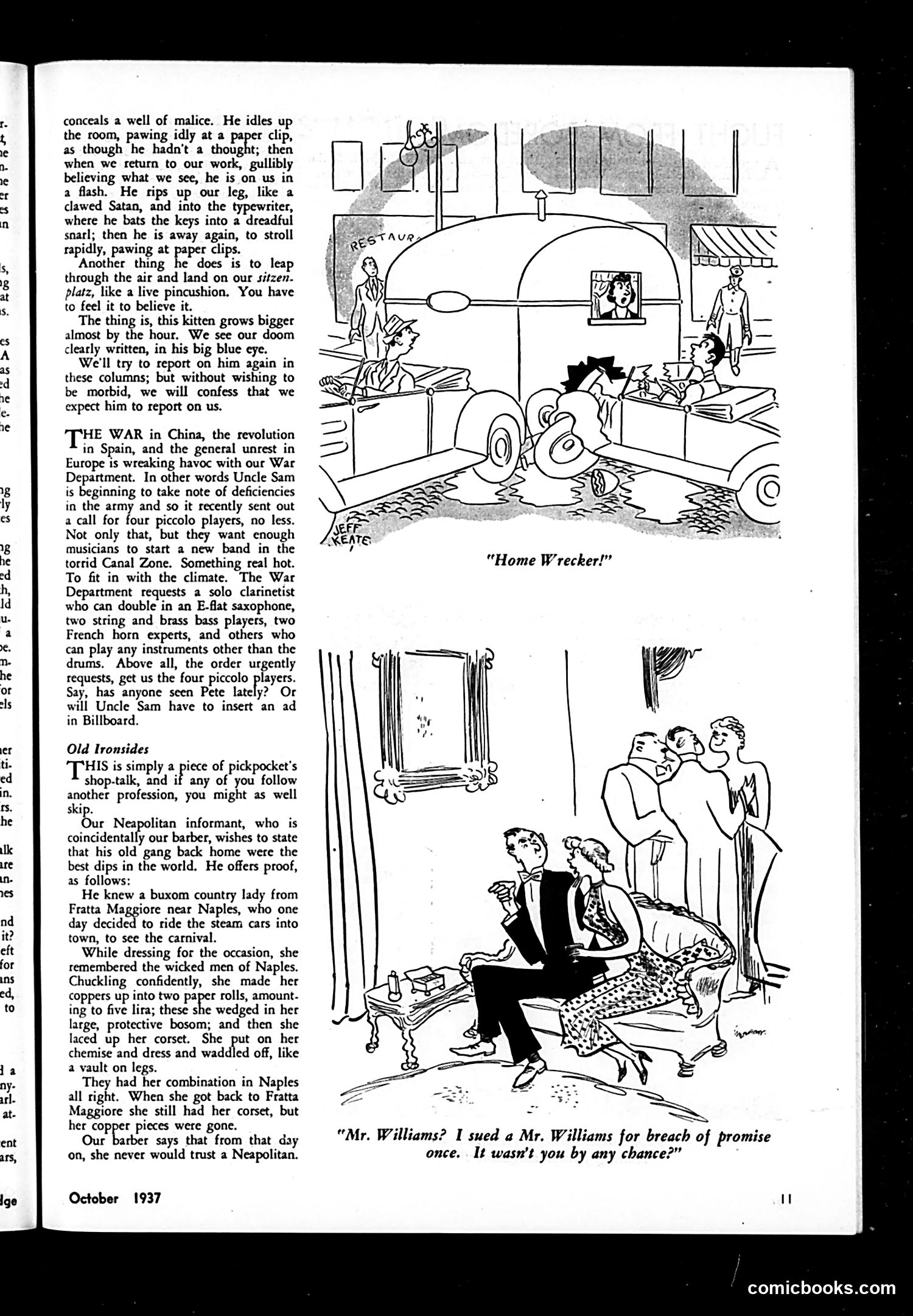
Judge Magazine, October 1937 — Page Analysis This page contains two separate satirical pieces: "Home Wrecker!" (top cartoon): A chaotic domestic scene shows a destructive kitten causing mayhem in an office/home, destroying typewriter keys and papers. The accompanying text humorously personifies the kitten as a malevolent creature with calculated destructiveness, comparing it to "clawed Satan." This is lighthearted domestic satire about pet mischief. Military Band Recruitment Satire: The text mocks the War Department's desperate recruitment of musicians—specifically four piccolo players—to staff a new military band in the Panama Canal Zone. The satire emphasizes the absurdity of the specific, esoteric musical requirements amid broader geopolitical tensions (China, Spain, European unrest). The reference to "Pete" and Billboard advertising suggests the musicians are nowhere to be found. "Old Ironsides" Section: A humorous anecdote about Neapolitan pickpockets, relayed by the magazine's barber-informant, concluding with a woman's stolen coins despite protective measures—playing on stereotypes about Italian criminal skill. The page reflects pre-WWII American concerns and uses ethnic humor typical of 1937 publications.
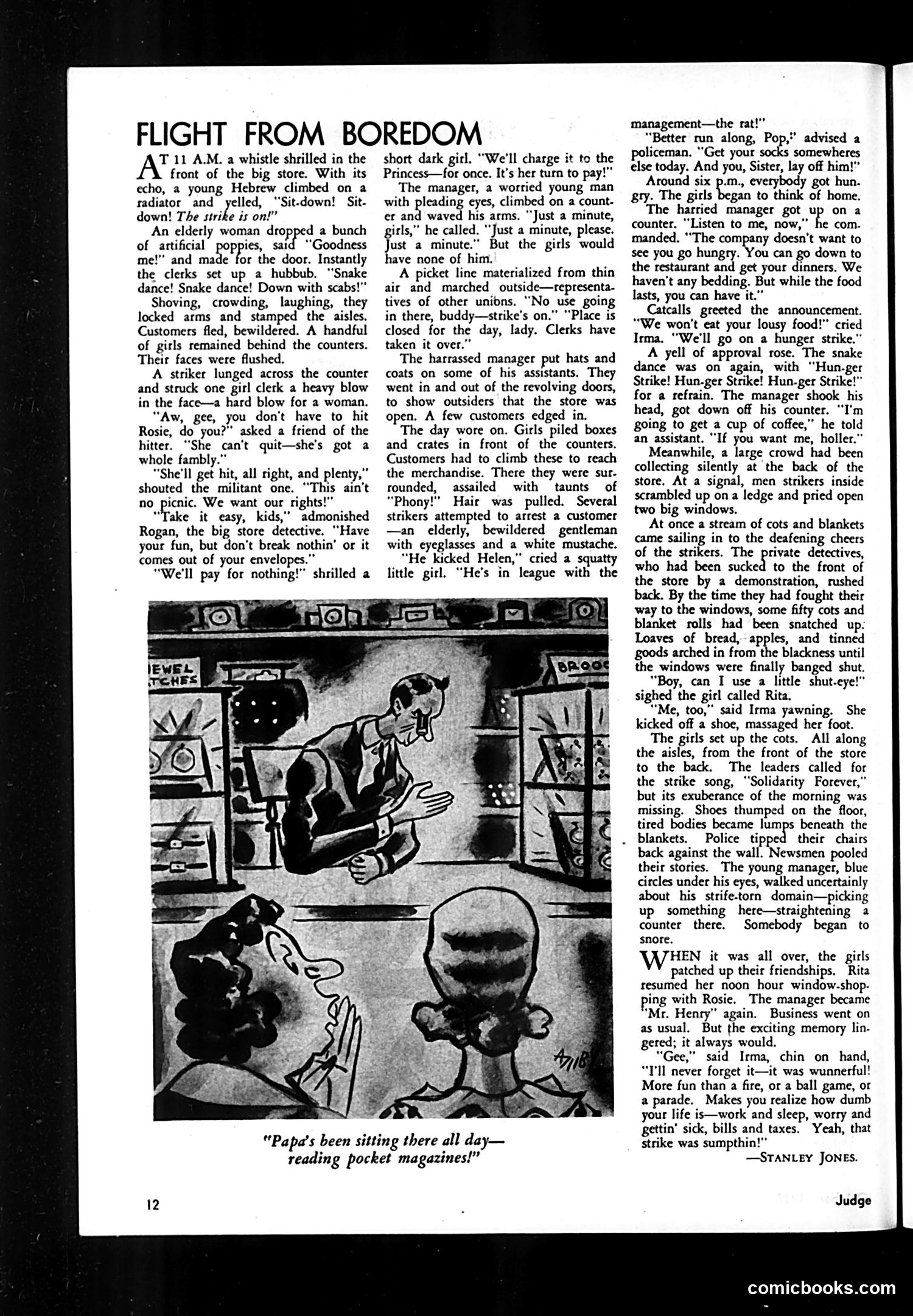
"Flight from Boredom" - Satirical Commentary on a Department Store Strike This story satirizes a sit-down strike at a department store, likely referencing the labor activism of the 1930s. The narrative portrays striking clerks—mostly young women—as frivolous and disruptive rather than earnest workers fighting for rights. The satire's point: strikers are depicted as enjoying the *excitement* of rebellion more than pursuing legitimate grievances. They assault customers, refuse food, and treat the strike as entertainment ("more fun than a fire, or a ball game"). The title "Flight from Boredom" suggests their real motivation is escape from tedious work, not justice. The story mocks their rhetoric ("We want our rights!") while showing chaotic, sometimes violent behavior. The manager appears sympathetic and reasonable, while strikers seem immature and self-destructive. The final image shows outside unionists smuggling in supplies—depicting labor solidarity as conspiratorial rather than noble. Judge's conservative perspective dismisses worker activism as juvenile theatrics masquerading as principle.
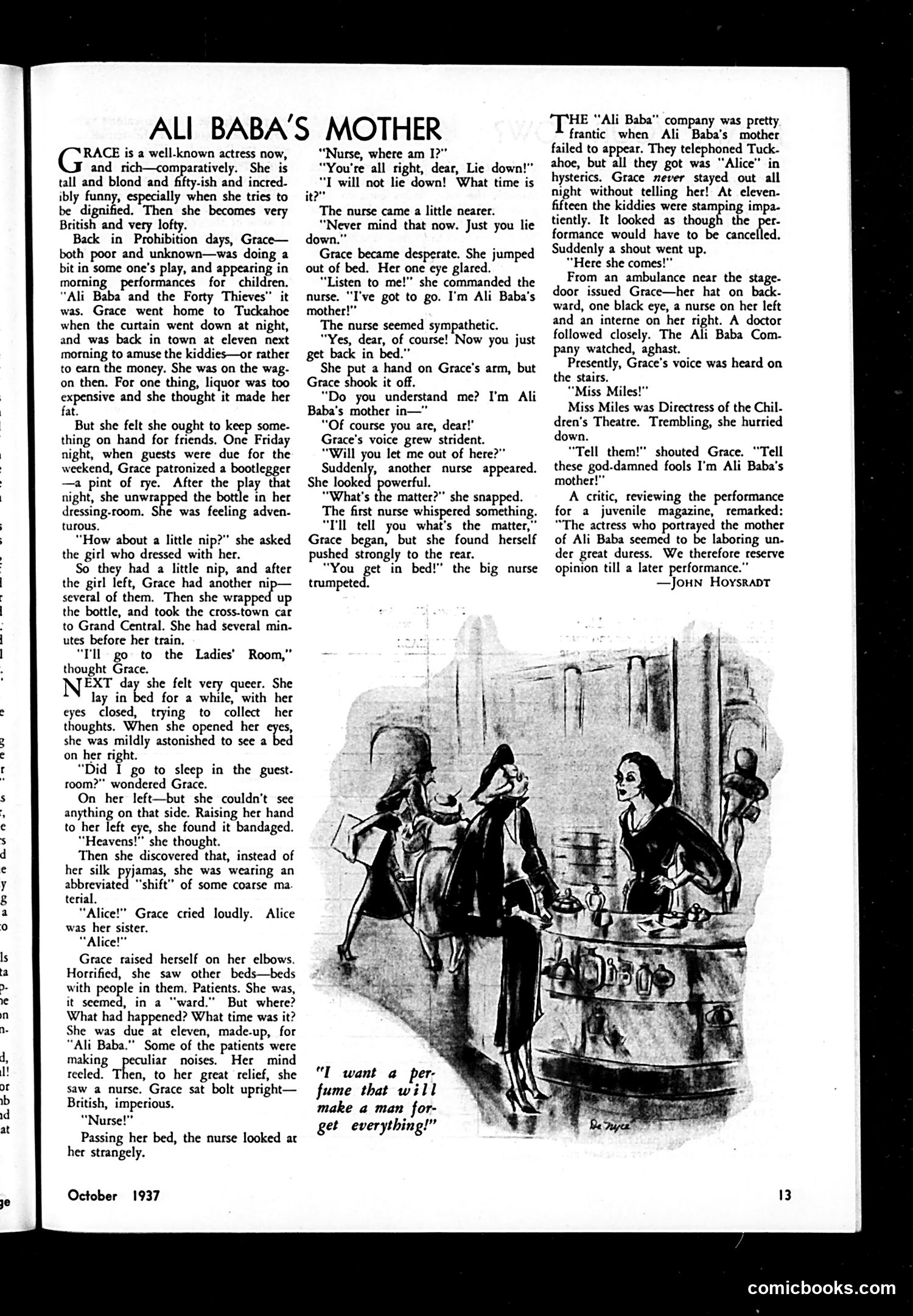
"Ali Baba's Mother" - Judge, October 1937 This is a humorous short story about actress Grace, not a political cartoon. The narrative satirizes both Prohibition-era hypocrisy and theatrical vanity. The Plot: Grace, a struggling actress during Prohibition, buys bootleg liquor she normally avoided. After drinking it backstage before a children's performance of "Ali Baba and the Forty Thieves," she wakes in a hospital ward wearing a patient's shift, with one eye bandaged. Disoriented and imperious in her "British" manner, she insists she must leave to perform, repeatedly claiming "I'm Ali Baba's mother!" The nurses assume she's delirious. The Satire: The joke operates on multiple levels—mocking actors' self-importance, the absurdity of Prohibition (respectable people buying illegal alcohol), and Grace's snobbish pretense masking her working-class desperation. Her dignified outrage at being treated as a psychiatric patient, while clearly having suffered an accident from drinking, undercuts her pretensions. The illustration shows Grace in the hospital ward, demanding attention from the nurses.
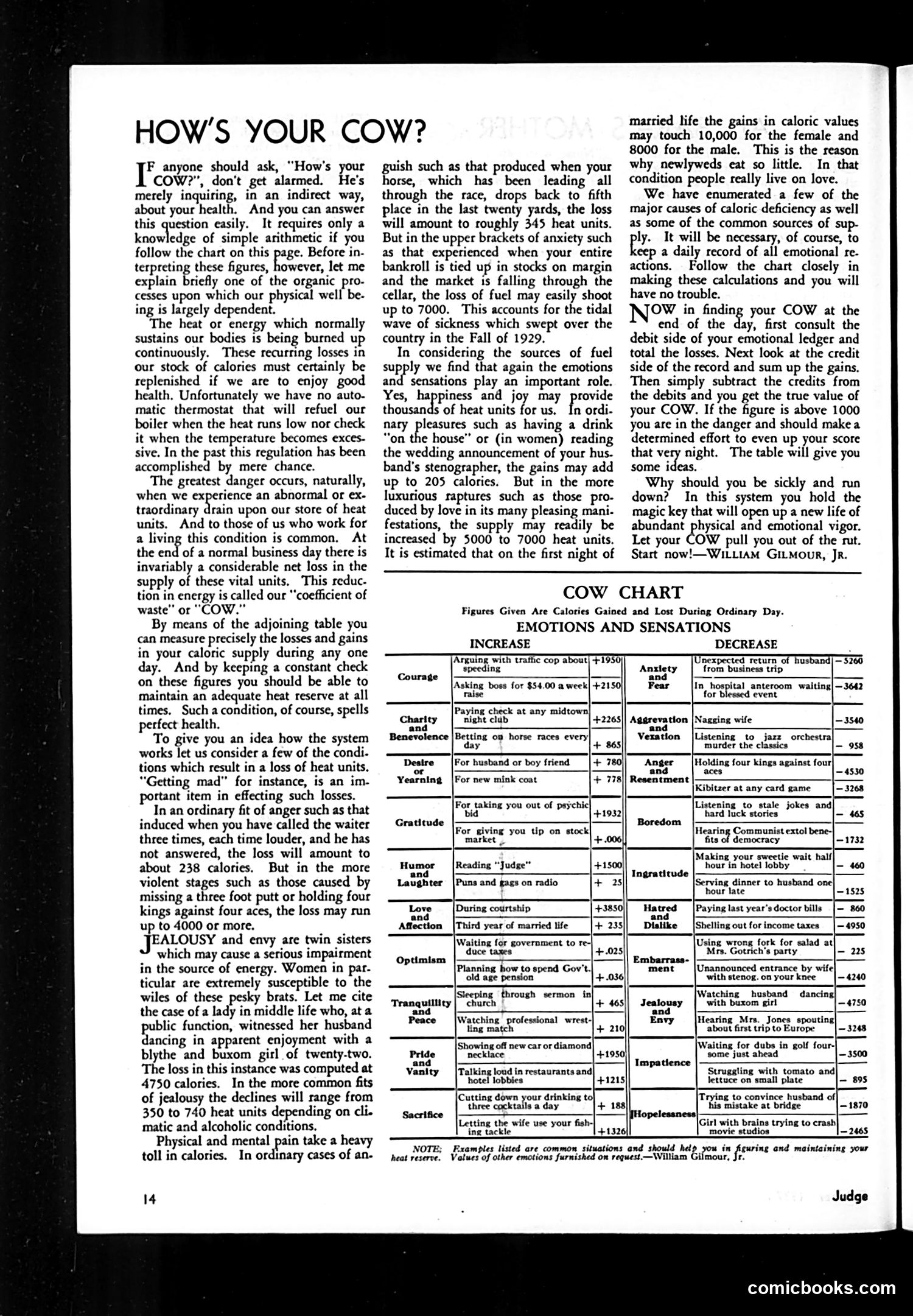
"How's Your Cow?" — Judge Magazine Satire This page presents a humorous pseudo-scientific article equating emotional states with caloric expenditure. "COW" stands for "Coefficient of Waste"—the heat energy lost through emotional turbulence. The satire mocks both 1920s diet faddism and Americans' obsession with quantifying health through charts and measurements. The detailed "Cow Chart" cataloging emotional gains/losses (jealousy costs 4,750 calories; "Hearing Mrs. Jones spouting about her trip to Europe" costs 3,248 calories) ridicules the era's earnest self-improvement literature. A key reference: the article mentions the "Fall of 1929," alluding to the recent stock market crash that devastated Americans emotionally and financially. The joke suggests that financial anxiety—not actual physical exertion—depletes one's vital energy. The article's tone—deadpan, technical, pseudo-authoritative—amplifies the absurdity: Judge is satirizing how Americans used pseudoscientific reasoning to explain both health problems and emotional distress during economically turbulent times.
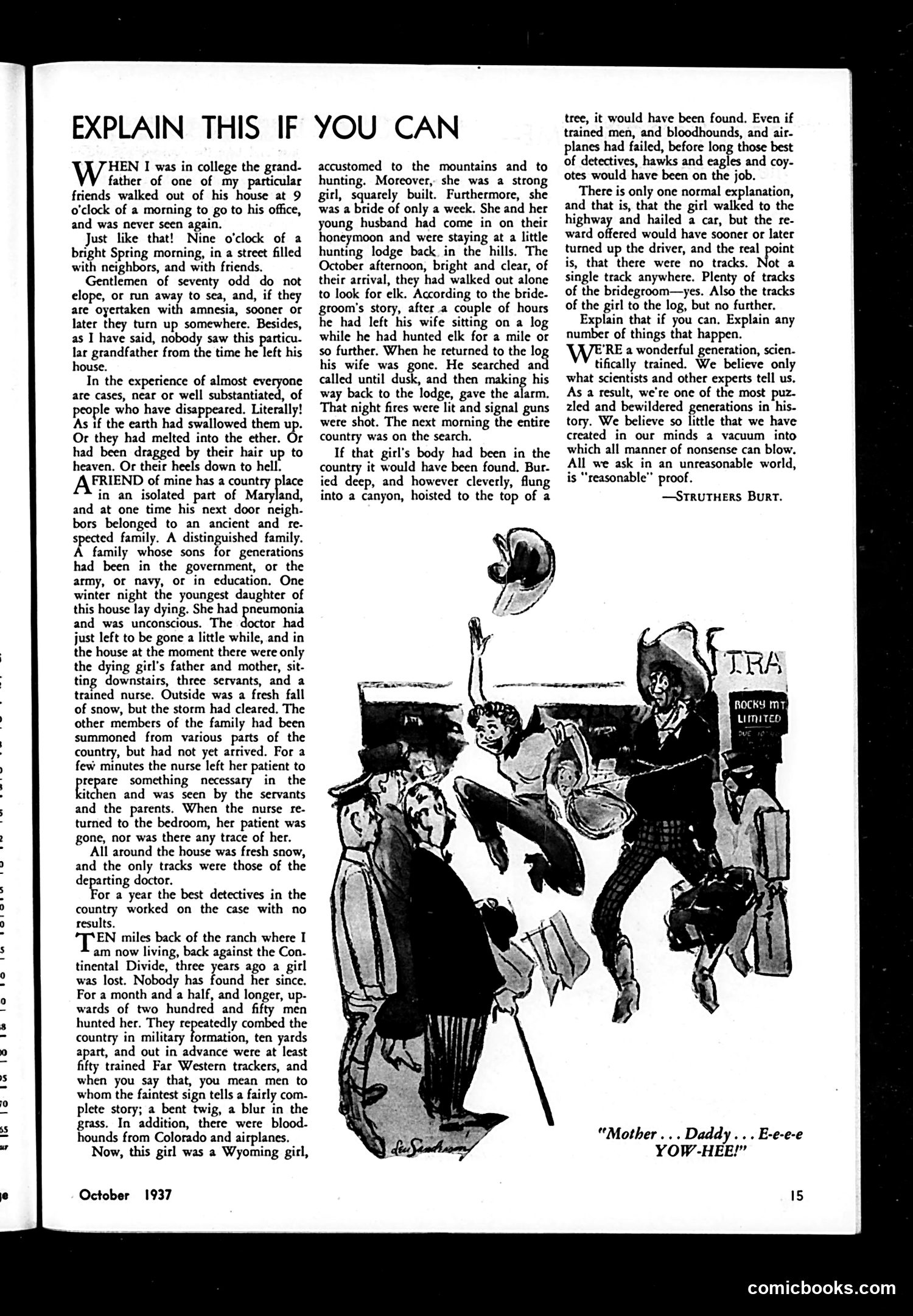
"Explain This If You Can" — October 1937 This page presents a mystery essay by Struthers Burt about inexplicable disappearances. The accompanying cartoon illustrates the Wyoming honeymoon case described in the text: a young bride vanished while elk-hunting with her new husband, despite 250+ men, trained trackers, bloodhounds, and airplanes searching for months. The satirical point targets the limits of modern detection and rational explanation. Burt catalogs three cases—a grandfather vanishing from a crowded street, a dying girl disappearing from a guarded bedroom, and this bride from open countryside—each defying logical investigation. The cartoon's chaotic scene of frantic rescue efforts emphasizes the futility: despite unprecedented resources and expertise, some disappearances remain completely unexplained. The satire critiques 1930s confidence in progress and scientific capability, suggesting that reality contains mysteries beyond human comprehension or competence.
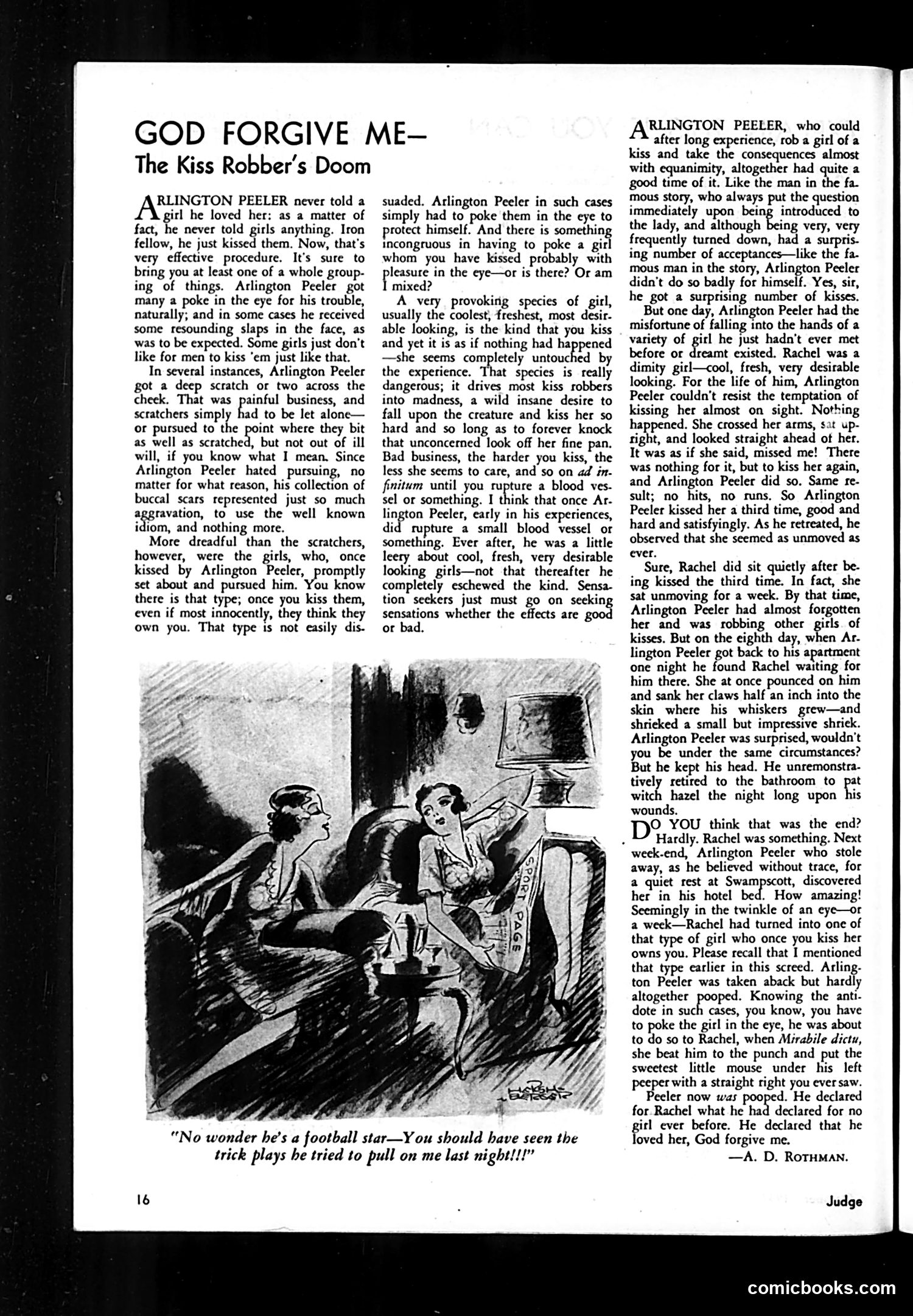
"God Forgive Me—The Kiss Robber's Doom" This is a humorous short story (not a political cartoon) about Arlington Peeler, a serial kisser who steals kisses from women without permission. The narrative catalogs the consequences: some girls scratch or slap him; others become possessive after being kissed; still others remain coldly indifferent. The plot climaxes when Peeler encounters Rachel, a particularly unresponsive woman whose emotional detachment drives him to repeatedly kiss her harder, seeking a reaction. He eventually discovers her in his hotel bed—she has become obsessed with him, scratching his face. The accompanying illustration shows two figures in an intimate moment, likely depicting a key scene. The satire targets: male sexual entitlement and the assumption that unwanted physical affection is harmless or charming. Rachel's revenge—her violent response and subsequent obsessive pursuit—ironically mirrors Peeler's own invasive behavior, suggesting consequences for treating women as conquest objects rather than people with agency. The story's dark humor suggests this was meant as social commentary on contemporary attitudes toward consent.
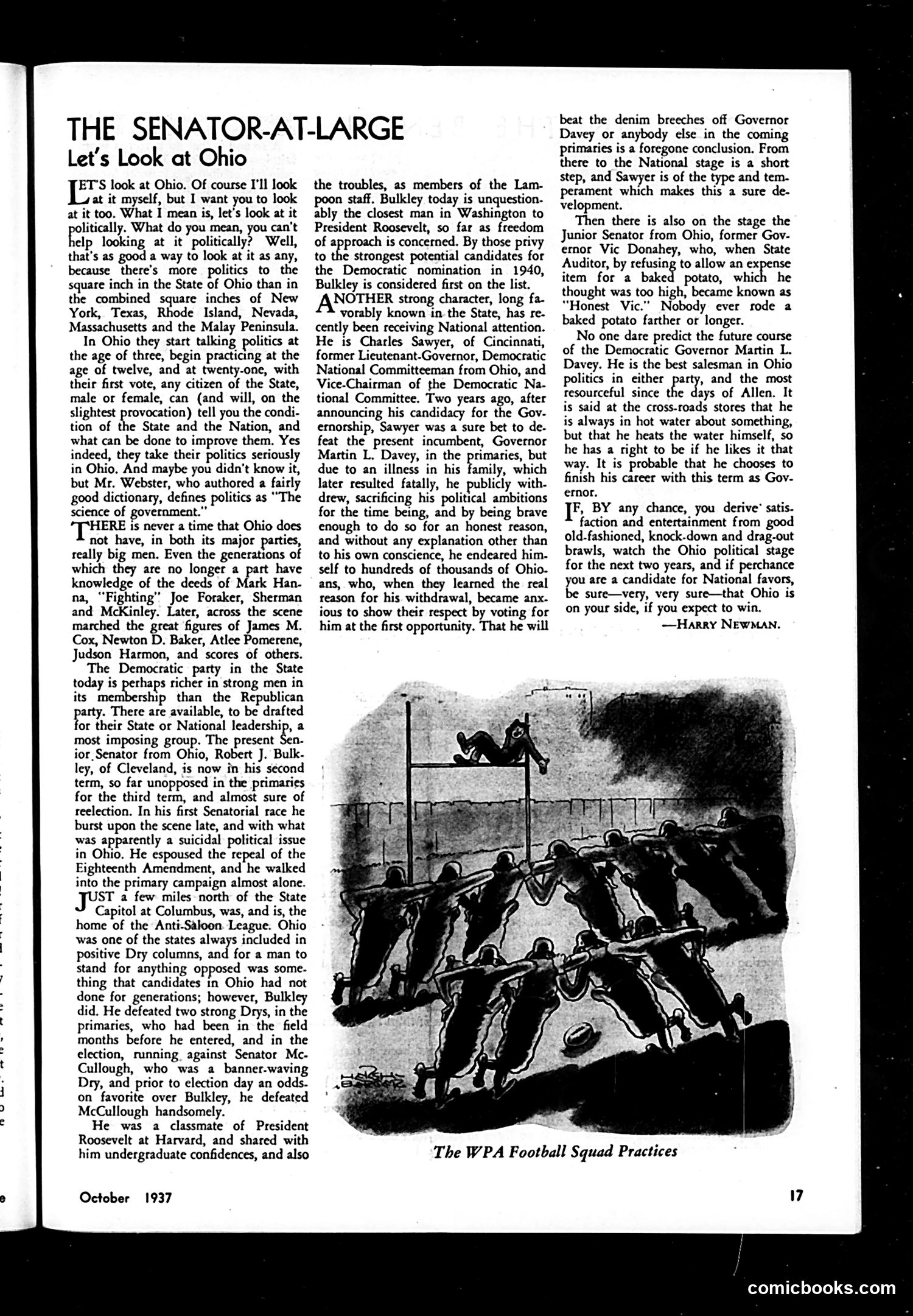
"The Senator-at-Large: Let's Look at Ohio" — Judge Magazine, October 1937 This article by Harry Newman analyzes Ohio's political prominence and its potential 1940 presidential candidates. The piece profiles two Democrats: Senator Robert J. Bulkley (Cleveland), currently in his second term and considered closest to President Roosevelt. Notably, Bulkley won his first race by championing repeal of Prohibition—politically risky in Ohio, home of the Anti-Saloon League, where "Dry" candidates had dominated for generations. Charles Sawyer (Cincinnati), former Lt. Governor and Democratic National Committeeman, who appeared poised for gubernatorial victory before family illness derailed his campaign. The accompanying WPA illustration depicts workers in physical labor, reflecting 1930s New Deal imagery—contextually relevant to a 1937 publication discussing Democratic politics under Roosevelt. The piece argues Ohio's Democratic Party contains exceptional leadership material, positioning these figures as potential national contenders.
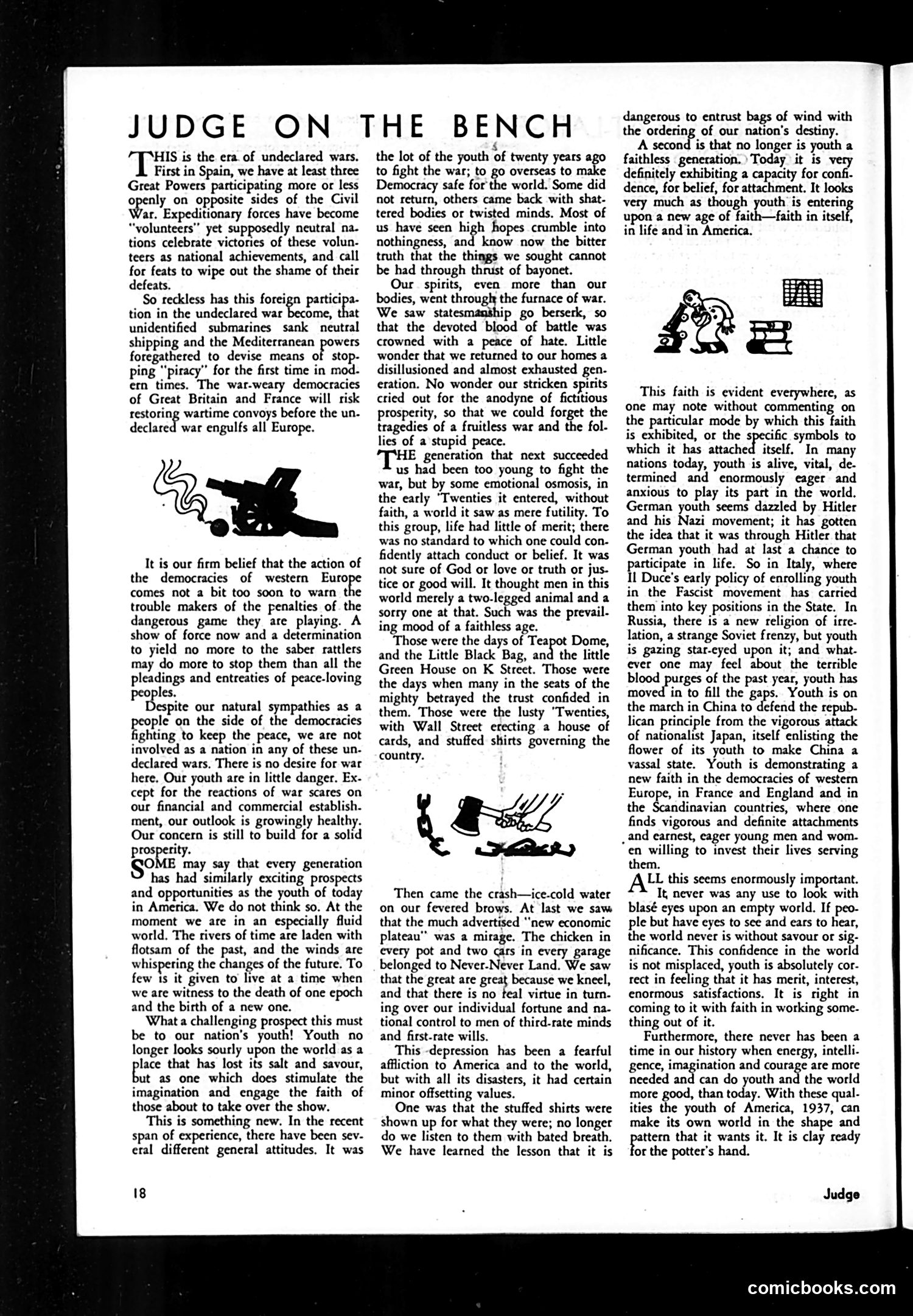
"Judge on the Bench" (1937) This editorial column addresses the Spanish Civil War and its implications for American youth and democracy. The text references "undeclared wars" in Spain, where Nazi Germany, Fascist Italy, and the Soviet Union covertly supported opposing sides while officially maintaining neutrality. The cartoons illustrate generational disillusionment: one shows a figure being struck down (likely representing the WWI generation's shattered idealism), another depicts destruction and chaos (the 1920s "Lost Generation's" spiritual emptiness). The editorial argues that current American youth, unlike their predecessors, possess genuine faith in democracy and purpose. It contrasts the post-WWI generation's cynicism with 1930s youth's renewed commitment to democratic ideals—evident in their engagement with anti-Nazi movements globally. The "Judge" perspective warns Western democracies to confront fascism forcefully, while celebrating American youth's revitalized faith in democratic values as America's greatest asset.
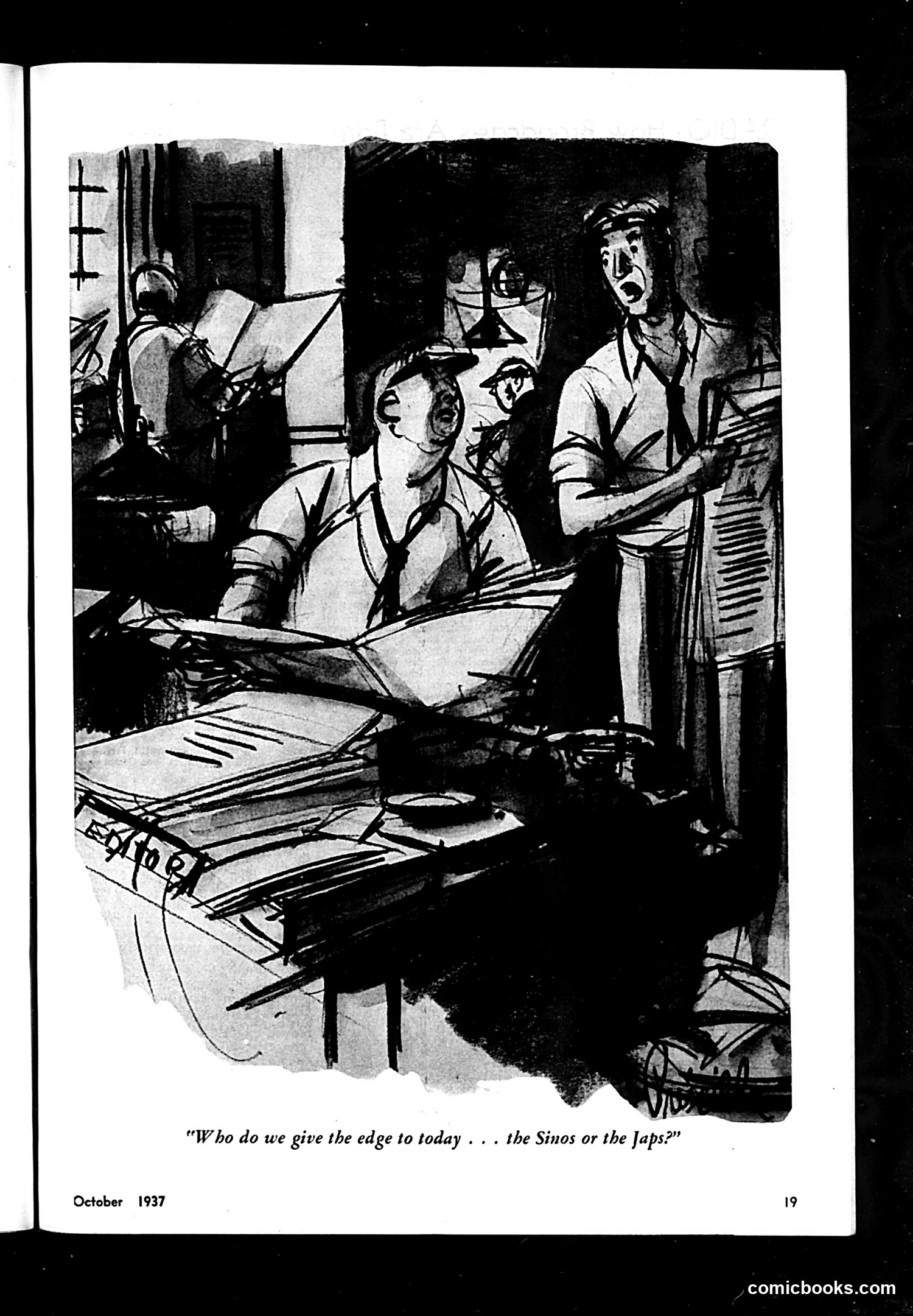
Political Cartoon Analysis: October 1937 This cartoon depicts what appears to be a wartime military or political strategy meeting. Several uniformed figures are gathered around a table examining maps or documents. The caption asks: "Who do we give the edge to today... the Sinos or the Japis?" This references the Second Sino-Japanese War (1937-1945). The terms "Sinos" and "Japis" are period slang for Chinese and Japanese forces respectively. The cartoon satirizes deliberation over which combatant to support or favor, likely reflecting American uncertainty about foreign policy in Asia as Japan invaded China. The setting suggests military strategists or political decision-makers weighing which side held tactical advantage, capturing the geopolitical debate of October 1937 when international observers watched the conflict unfold.
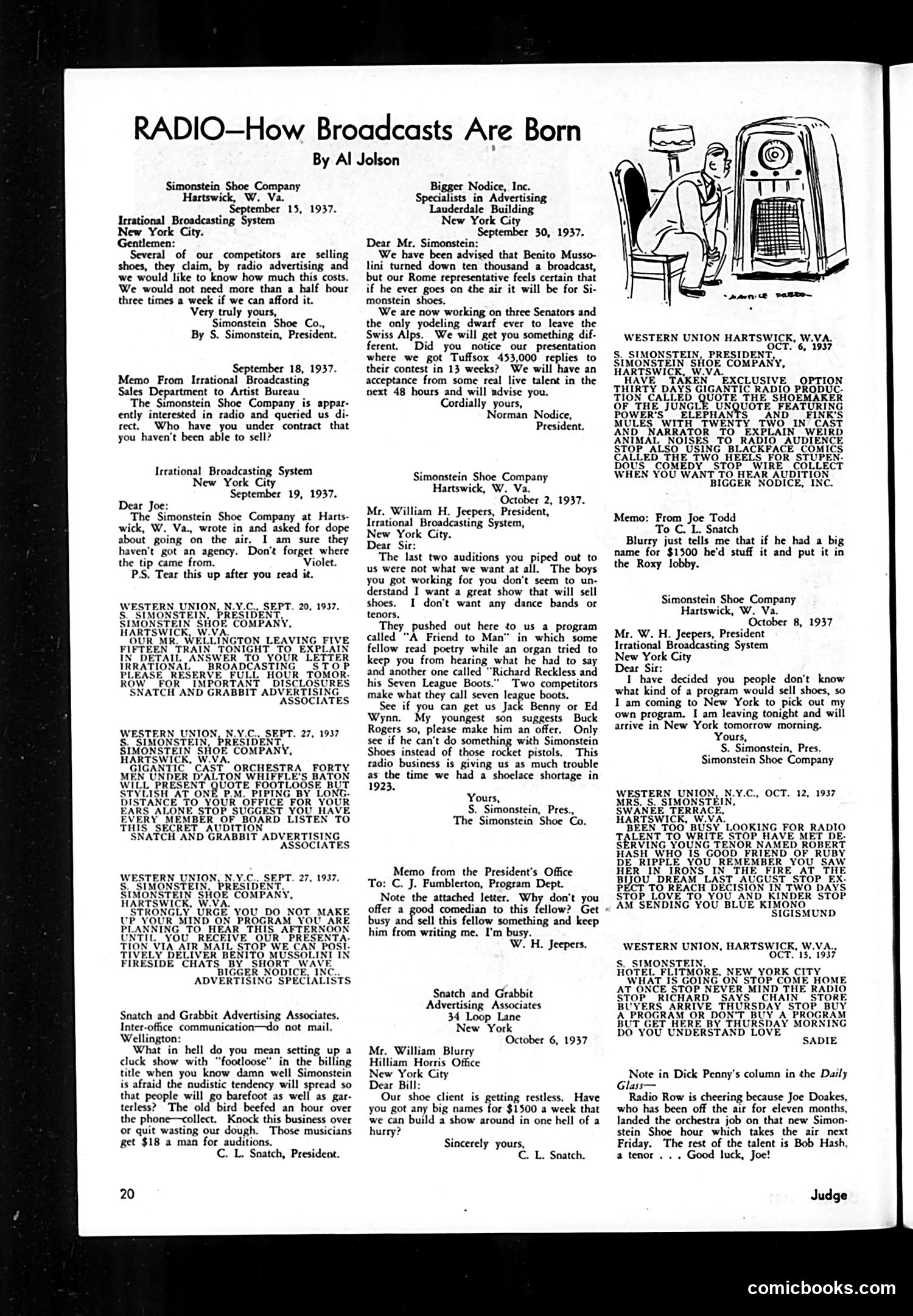
"Radio—How Broadcasts Are Born" (Judge, 1937) This satirical article by Al Jolson mocks the emerging radio advertising industry through fictional correspondence between a small shoe company (Simonstein) and various broadcasting/advertising agencies competing for their business. The satire targets advertising executives' desperation and incompetence: agencies make wild promises (securing Mussolini for endorsements), propose terrible programming ("A Friend to Man"—poetry readings), waste client money on failed auditions, and scheme internally to hide costs. The Simonstein owner wants popular talent (Jack Benny, Ed Wynn) but keeps receiving bizarre offerings (yodeling dwarfs, seven-league-boots programs). The cartoon on the right shows a radio broadcaster at work. The humor lies in exposing radio advertising as chaotic, dishonest, and fundamentally disconnected from actually selling products—a new medium where agencies bluffed their way through by inventing elaborate schemes while delivering poor results. It reflects 1930s skepticism about advertising's legitimacy and competence.
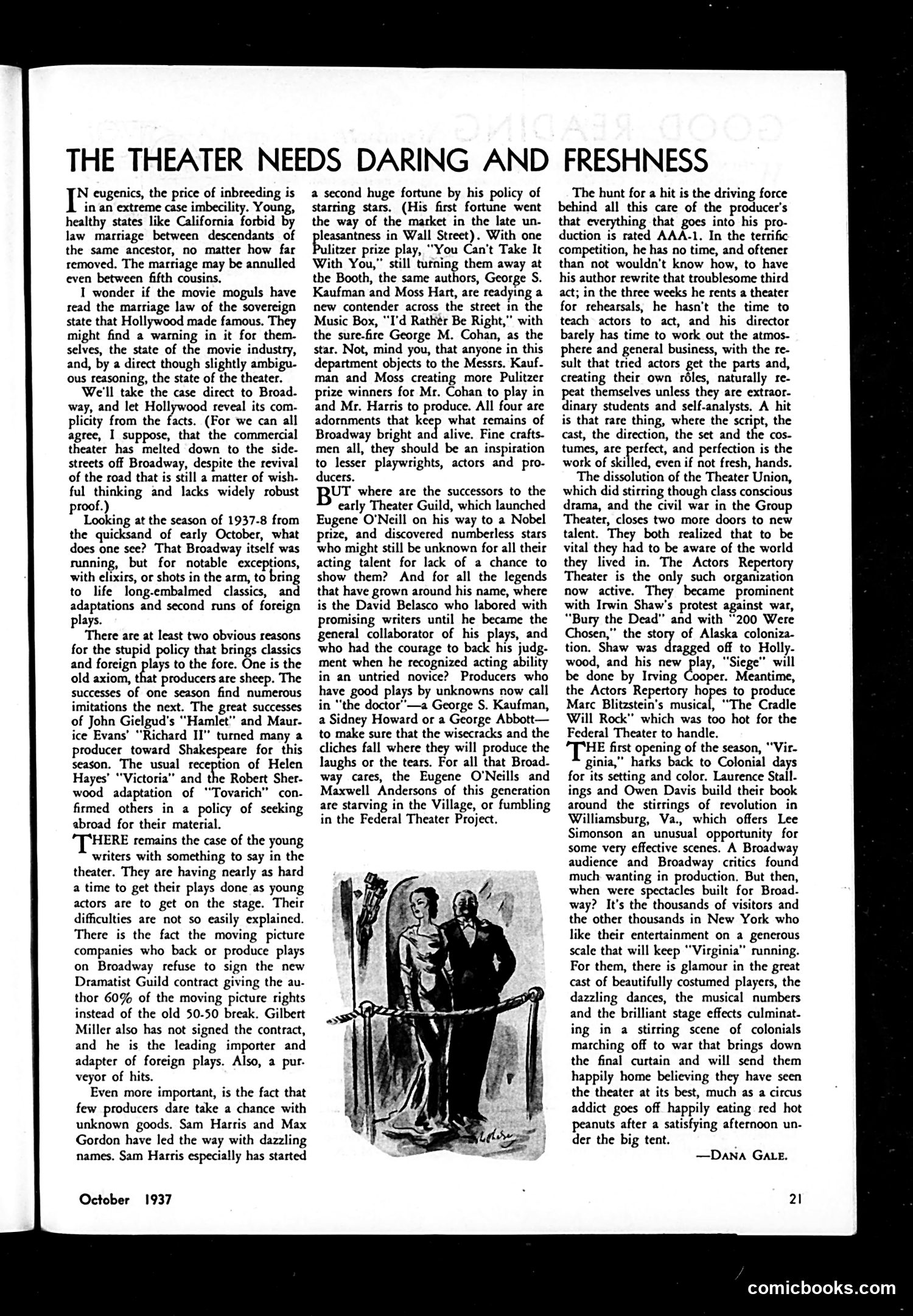
Analysis of "The Theater Needs Daring and Freshness" This is a theatrical criticism essay (not a cartoon) by Dana Gale in Judge's October 1937 issue. The piece argues Broadway has become creatively stagnant, using an eugenics metaphor to critique theatrical "inbreeding." Gale identifies the problem: producers slavishly imitate successful formulas rather than backing new writers. She cites Sam Harris's strategy of "starring stars" (casting established names) and the popularity of revivals like John Gielgud's *Hamlet* and Maurice Evans' *Richard II* as symptoms of cowardice. Key grievances: - Movie studios won't sign new Dramatist Guild contracts (refusing fair profit-sharing) - Producers fear unknown playwrights - Foreign plays and classics dominate over original American work - The theater has retreated from Broadway proper to side streets Gale advocates for risk-taking with fresh talent, contrasting timid producers with the bold Early Theater Guild, which launched Eugene O'Neill. The embedded photograph shows what appears to be actors in costume, likely from a contemporary production.
"Good Reading" - Judge Magazine Book Reviews This page is a book review column from Judge magazine, featuring critical assessments of contemporary publications. The cartoon at top-left appears to show a domestic scene, likely illustrating one of the reviewed books. The reviews discuss 1930s-era works on serious topics: Carl Crow's "400 Million Customers" (about China trade amid Japanese invasion), Walter Lippmann's "The Good Society" (critiquing totalitarianism and advocating free markets), Zora Neale Hurston's "Their Eyes Were Watching God" (a novel about women's autonomy), and other works examining social issues like medical ethics and radio advertising fraud. The column's tone is earnest and civic-minded, positioning these books as important guides for informed citizenship during turbulent times—suggesting Judge's readership valued serious literature addressing contemporary economic and political concerns.
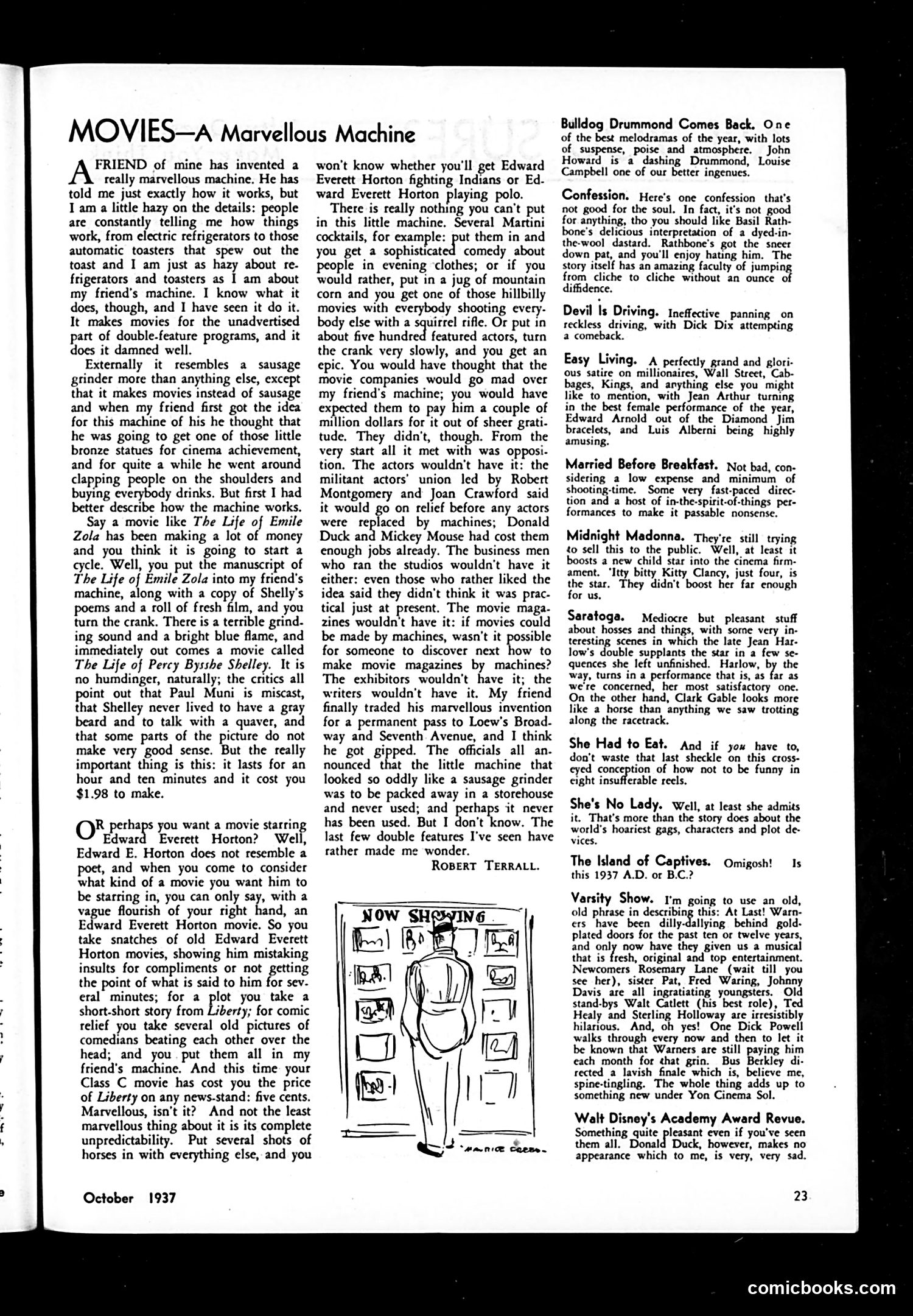
Analysis of "Movies—A Marvellous Machine" This is a satirical essay by Robert Terrell lampooning 1937 Hollywood's formulaic filmmaking. The "machine" is a metaphorical device critiquing how studios mass-produce mediocre films by recycling plot elements, stock footage, and contract actors. Terrell specifically mocks: - The studio system's cynicism: Films are cheaply assembled from existing material rather than genuinely created - Predictable casting: Edward Everett Horton (a real comedic actor) appearing in indistinguishable roles - Quality indifference: The machine produces unwatchable results ("no humdinger") yet studios profit anyway - Actor resistance: Union opposition to this dehumanizing assembly-line approach The satire references contemporary hits like *The Life of Emile Zola* to show how success spawns cheap imitations. The cartoon on the page depicts a simplified figure representing the standardized output. This reflects genuine 1930s industry tensions: actors feared obsolescence, unions fought mechanization, and critics despaired at formulaic "B-movies" flooding double features.
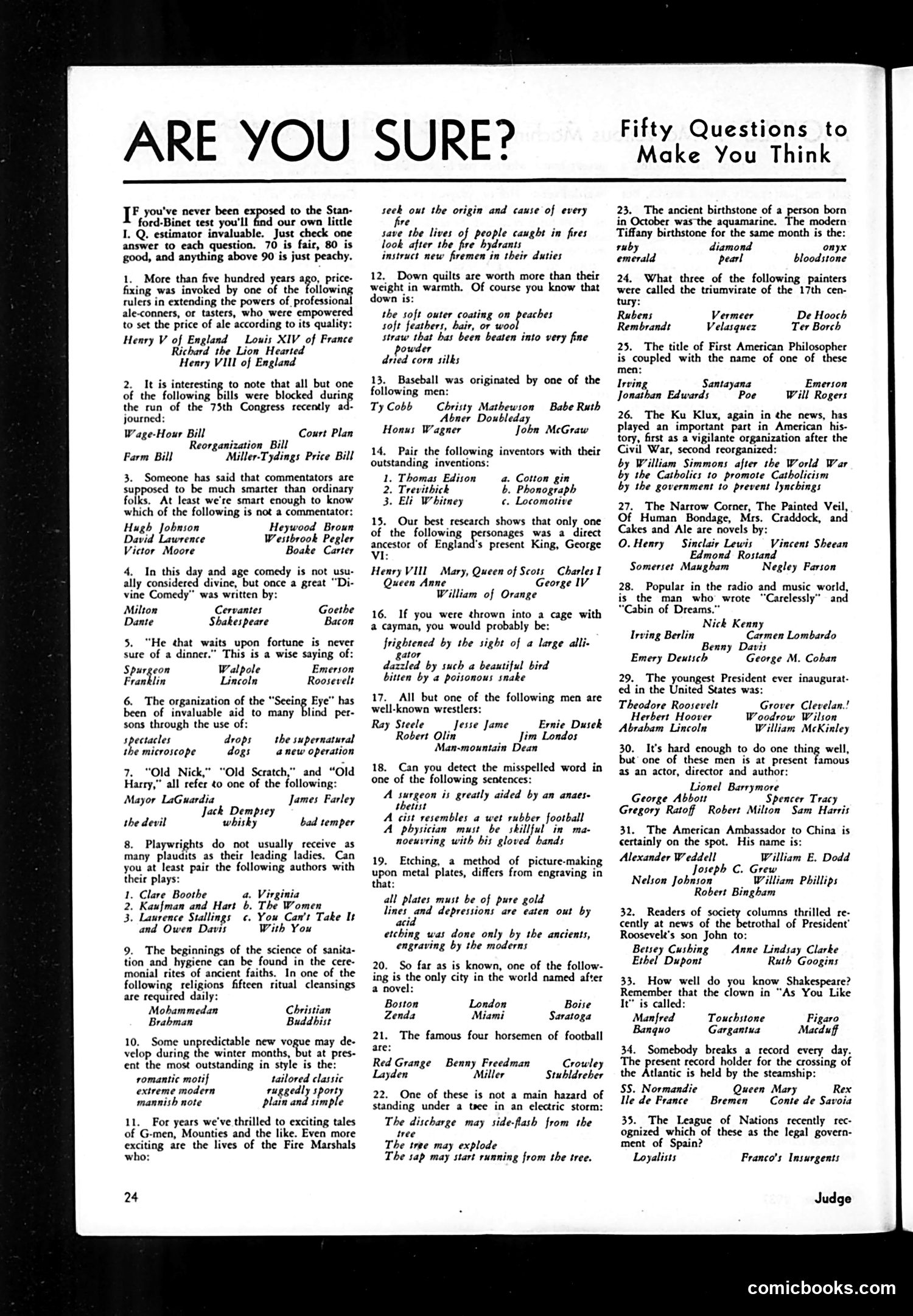
"Are You Sure?" - Judge Magazine IQ Quiz This page presents a tongue-in-cheek "intelligence test" disguised as a trivia quiz, typical of Judge magazine's satirical approach. The humor lies in mixing genuinely difficult historical/literary questions with absurdly easy ones, mocking the then-popular Stanford-Binet IQ tests and their cultural prestige. The questions reference contemporary 1930s figures and events: New Deal commentators (Hugh Johnson, Heywood Broun), recent Congressional legislation (the 75th Congress), and popular entertainers. References to "Fire Marshals," price-fixing rulers, and "G-men" anchor the quiz in Depression-era concerns. The satire targets middle-class pretensions about intellectual sophistication—the scoring system (70=fair, 80=good, 90+=excellent) promises readers they'll likely feel intelligent answering it, while the eccentric question selection subtly mocks how arbitrary "smartness" can seem.
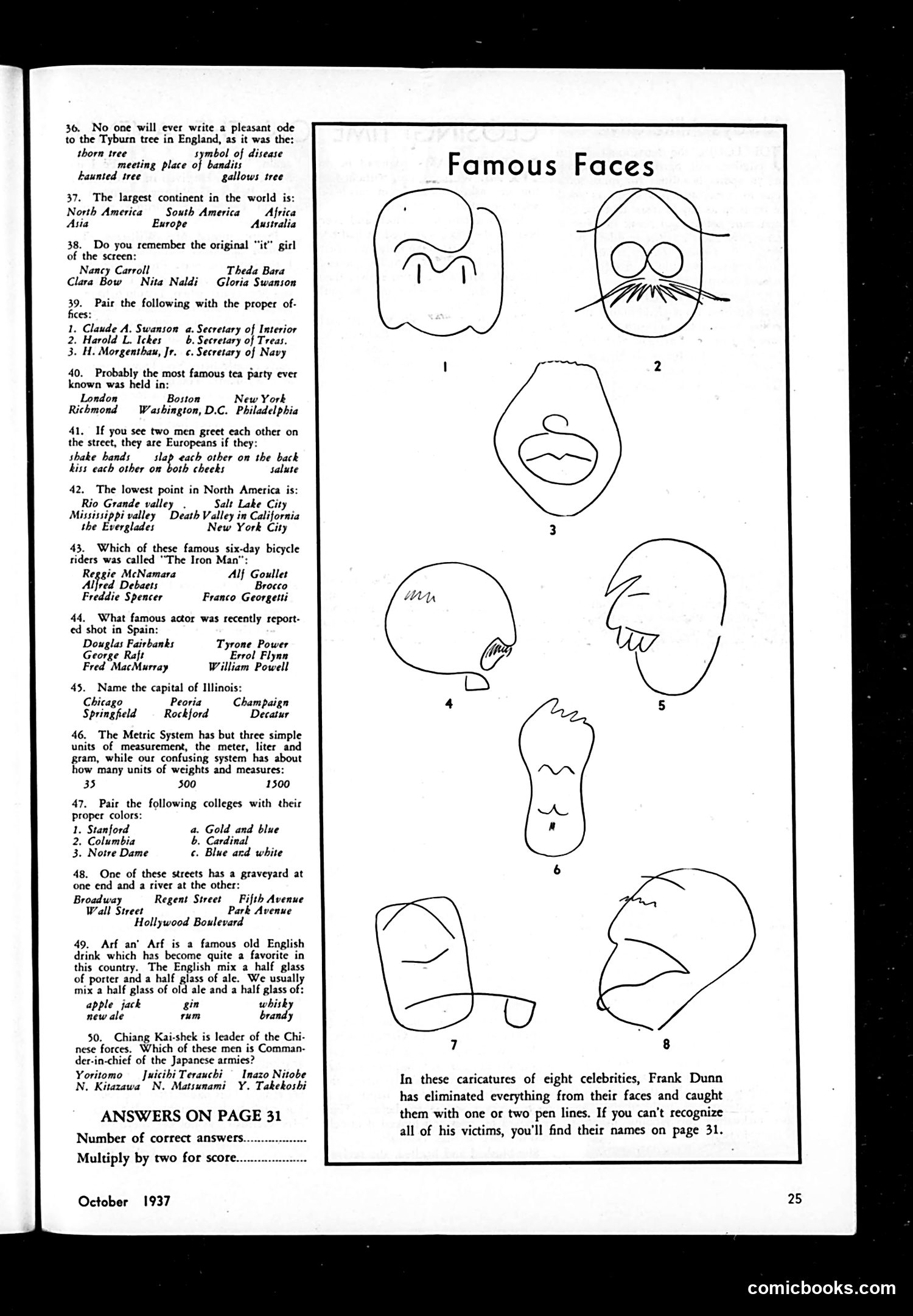
"Famous Faces" Quiz Page from Judge Magazine, October 1937 This page combines a trivia quiz with a celebrity caricature challenge. The left column presents general knowledge questions on topics ranging from history (the Tyburn tree gallows) to geography (lowest point in North America) to contemporary 1930s culture (the "it girl" Clara Bow, six-day bicycle racing, the Spanish Civil War). The main feature is Frank Dunn's minimalist caricature exercise: eight crude line-drawing portraits of unnamed 1937 celebrities. Readers are challenged to identify them using only one or two pen strokes per face. The puzzle tests whether distinctive facial features—eyebrows, lips, nose shape—are recognizable enough for identification, even stripped of all detail. This reflects Judge's typical blend of education and entertainment: readers could test both their general knowledge and their ability to recognize famous faces of the era. The answers appear on page 31 (not shown).
"Always Alliterative" and "Closing Time on the Avenue" This page contains two distinct pieces from Judge magazine: "Always Alliterative" (left column) is a humorous essay by Parke Cummings about Joe Louis, the Black heavyweight boxer, proposing alliterative nicknames for him. The piece catalogs existing epithets like "Brown Bomber" and "Dark Destroyer," then suggests an alphabetical list of alternatives (African Annihilator, Black Batterer, etc.). It's lighthearted wordplay, though the racial descriptors throughout reflect 1930s-era casual racism in sports journalism—using color-based nicknames as standard practice. "Closing Time on the Avenue" (right column, by Edith Orr) is a short story about a weary travel agent, Mr. Williams, who encounters a middle-aged woman seeking a refund or assistance. She claims he sold her a ticket years earlier and gave her advice. The narrative explores his conflicted feelings—remembering a woman named "Silsbee" rather than "Garnish"—and ends ambiguously with her youth restored and him uncertain of her true identity.
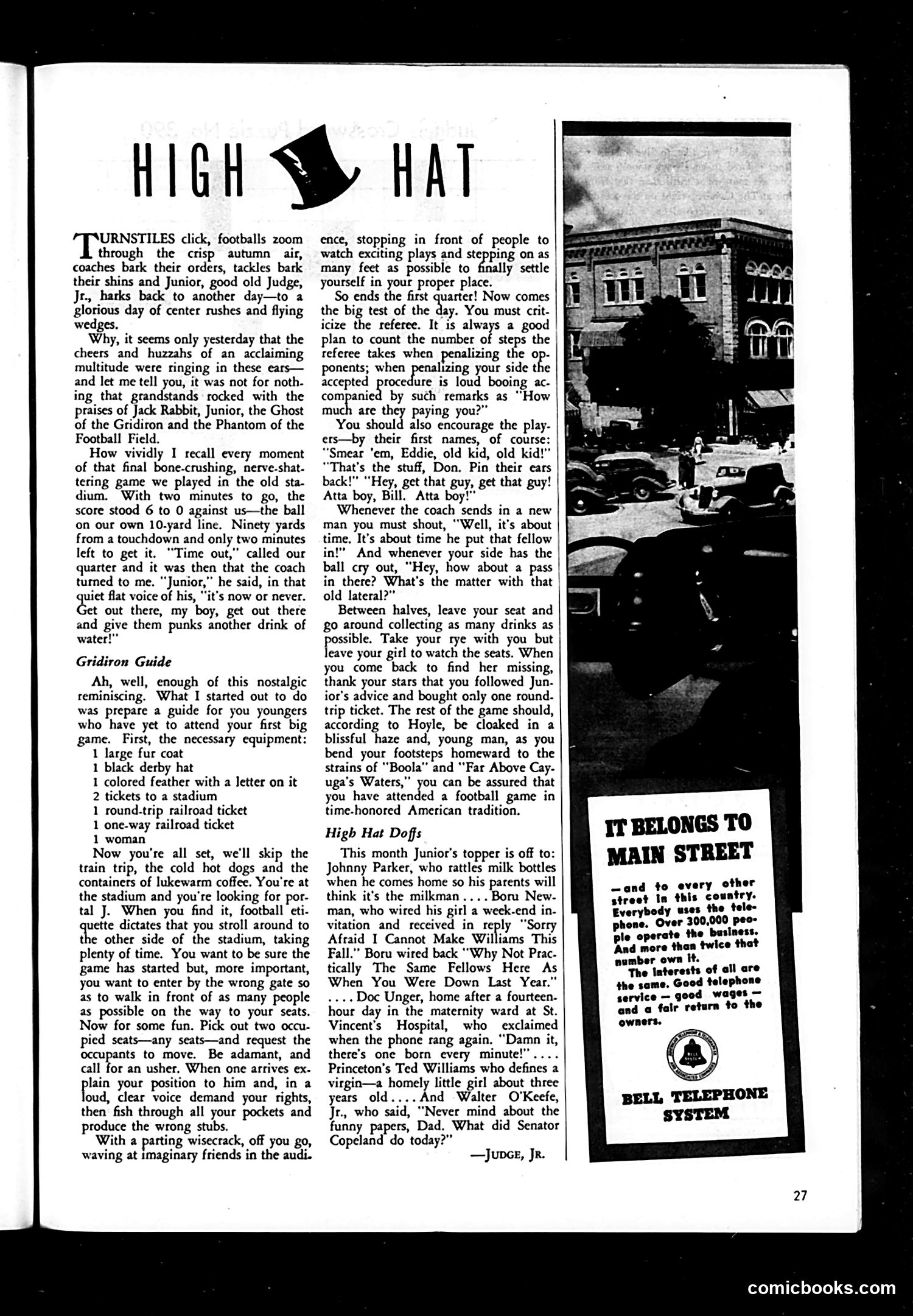
"High Hat" - A Football Game Etiquette Satire This article satirizes nouveau riche behavior at college football games. The narrator nostalgically recalls his own playing days, then offers mock "guidance" on attending games—advice that's actually instructions for being a thoroughly obnoxious spectator. The satire targets social climbers: wearing a "large fur coat" and "black derby hat" signals pretension; arriving late to be seen entering; deliberately sitting in wrong seats to disturb others; heckling referees with absurd accusations; loudly addressing players by first names as if familiar; and leaving one's date unattended while collecting drinks—then buying her only a one-way ticket home. The humor lies in presenting this boorish conduct as sophisticated etiquette. The "Gridiron Guide" exposes how some attendees treated football games as opportunities for status display rather than genuine fandom, mocking American social aspiration during what appears to be the 1920s-1930s.
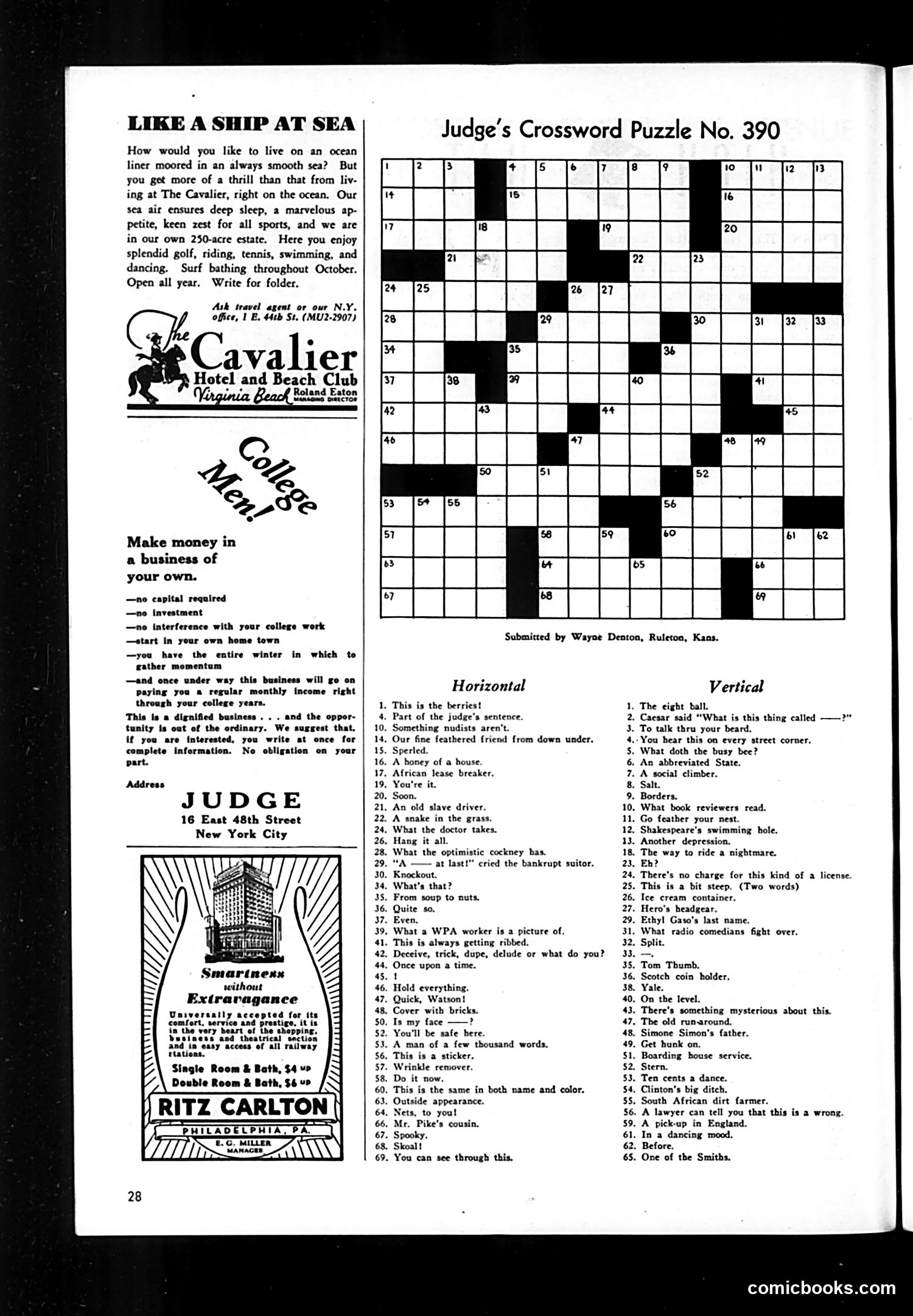
Judge Magazine Page Analysis This page is primarily advertising and a crossword puzzle, not political satire. The main content includes: - The Cavalier Hotel advertisement (top left): promoting a Virginia Beach resort as a luxury destination with ocean views, sports facilities, and year-round amenities - College Mail business opportunity ad: recruiting college students to run a mail-order business during winter breaks for supplemental income - Ritz Carlton hotel advertisement (bottom left): Philadelphia lodging - Judge's Crossword Puzzle No. 390 (center/right): a standard word puzzle with clues referencing contemporary 1930s-40s culture (WPA workers, radio comedians, social references) The clues themselves contain mild period humor—references to "nudists," "slave drivers," "bankrupts"—reflecting common joke topics of the era, but there is no coherent political cartoon or satirical message on this page. It's a typical magazine layout mixing advertisements with entertainment content.
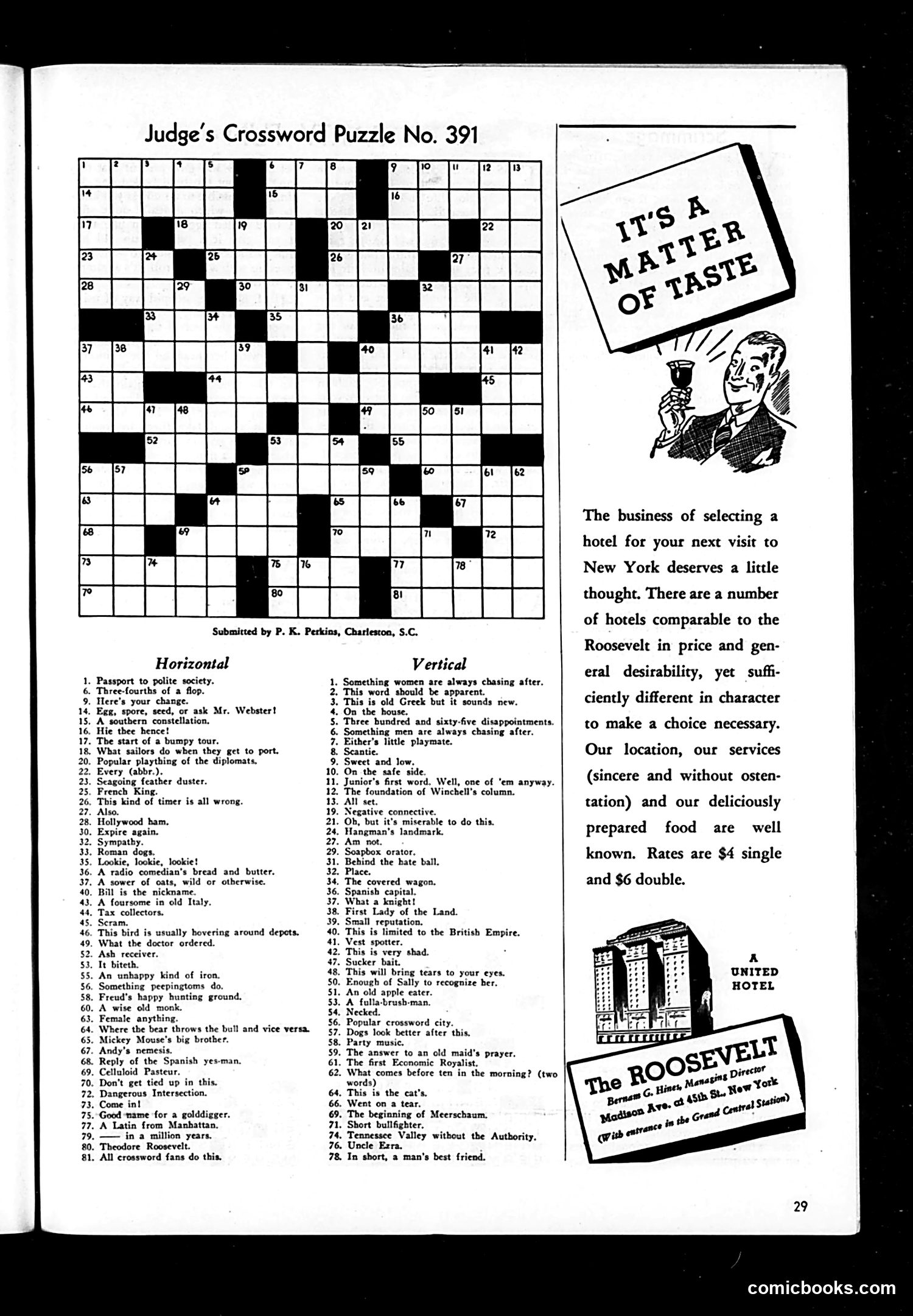
Judge's Crossword Puzzle No. 391 This page is primarily a crossword puzzle with clues submitted to Judge magazine. The puzzle itself contains no satire or political cartoon—it's a straightforward word game. The page includes hotel advertisements alongside the puzzle. "The Roosevelt" hotel advertisement emphasizes its comparable quality to other prestigious New York hotels while highlighting its affordable rates ($4-$6). The "United Hotel" also advertises nearby. These ads appear designed to appeal to Judge's middle to upper-class readership. The crossword clues themselves are playful and contemporary to 1930s-era readers, referencing popular culture figures (Mickey Mouse, Theodore Roosevelt), current slang, and everyday concepts. References to "radio comedian," "Spanish yes-man," and "Economic Royalist" ground the puzzle in its specific historical moment, but the puzzle serves primarily as entertainment rather than satire.
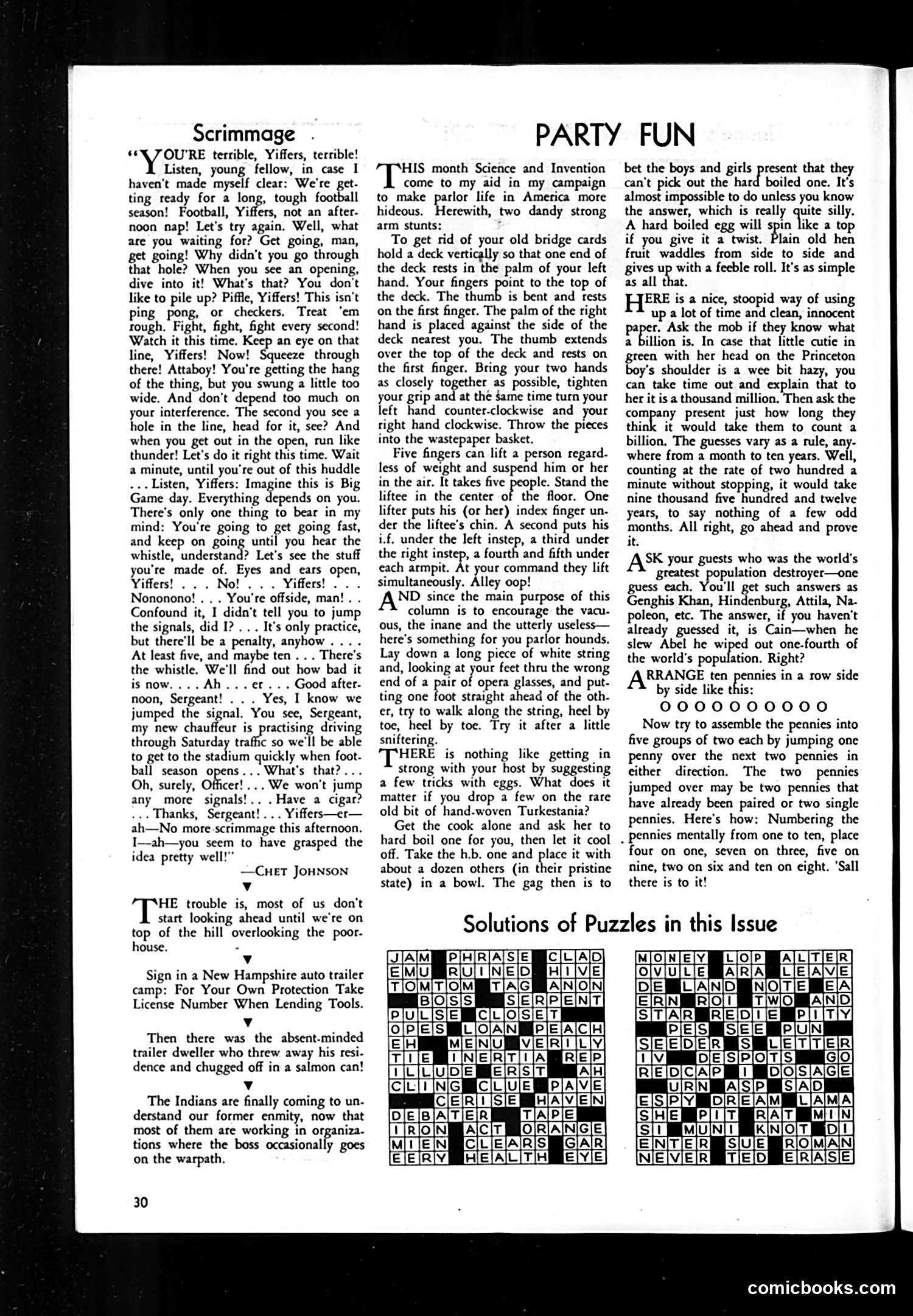
Analysis of This Judge Magazine Page This page contains two distinct pieces of satire: "Scrimmage" (Main Cartoon) A football coach relentlessly berates his player "Yiffers" during practice. The satire shifts midway: after the coach lectures about football discipline, he's caught by a police officer driving recklessly through town. The joke is that the coach—who demands strict rule-following from his players—casually violates traffic laws himself, then tries to bribe the officer with a cigar. It's satirizing hypocrisy and double standards: authority figures who demand discipline from subordinates while ignoring rules themselves. "Party Fun" Section Light party tricks and social humor, including: - A bridge card trick - A parlor stunt using five people to lift someone - Brief jokes about modern life (auto trailers, "Indians" working under bosses) The page also includes puzzle solutions unrelated to the satire. Context for modern readers: This reflects 1920s-30s attitudes toward traffic enforcement as amusing rather than serious, and casual bribery as comedic. The "Indians" reference reflects the era's outdated terminology and attitudes toward Native Americans.
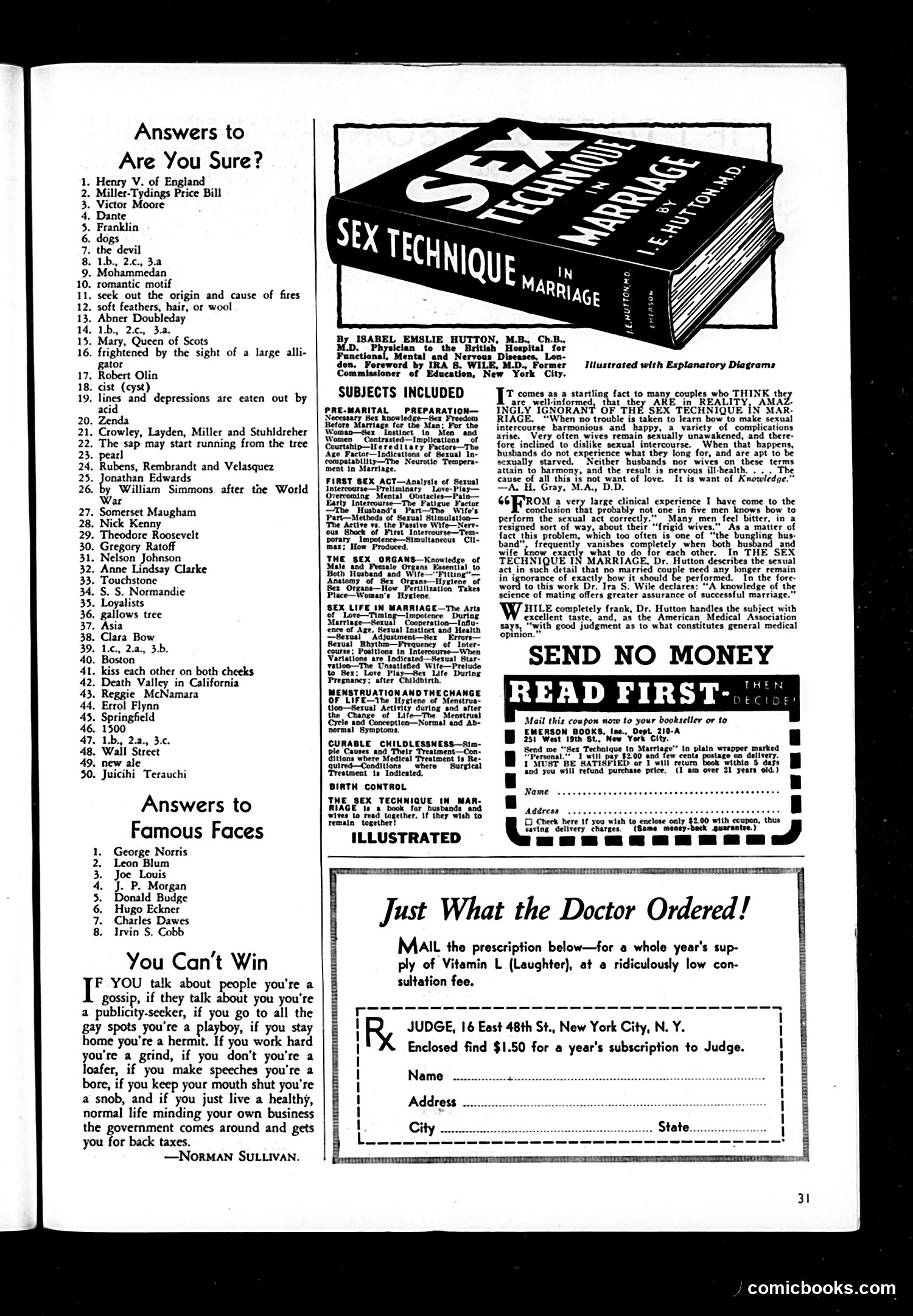
Page Analysis: Judge Magazine Advertisement & Quiz Answers This page is primarily advertising and quiz answers rather than political satire. It features: Quiz Content: Answer keys to two quiz sections—"Are You Sure?" (general knowledge questions) and "Famous Faces" (identifying public figures like Joe Louis, J.P. Morgan, and Irvin S. Cobb). Main Advertisement: A prominent ad for *Sex Technique in Marriage*, a medical guide by Dr. Isabel Emslie Hutton. The book promises to educate married couples on sexual compatibility, reproductive health, and marital intimacy—presented as serious medical instruction with "explanatory diagrams." Secondary Content: A humorous quote by Norman Sullivan ("You Can't Win") satirizing life's contradictions—damned if you do, damned if you don't—culminating in a joke about government tax audits. Context for Modern Readers: The sex manual advertisement reflects mid-20th-century frank discussion of marital sexuality as medical/educational rather than taboo, marketed through mainstream magazines like Judge.
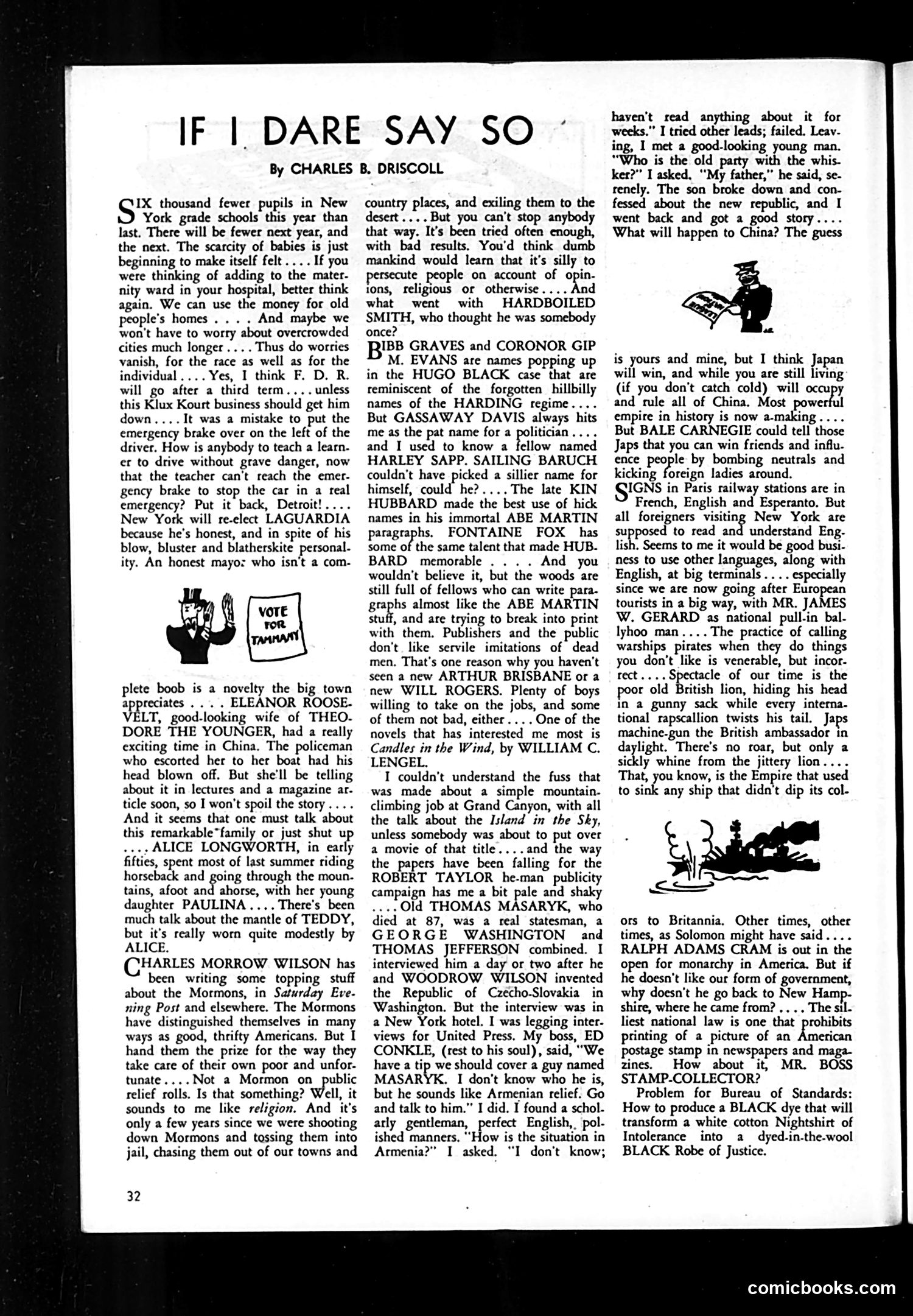
"If I Dare Say So" by Charles B. Driscoll - Judge Magazine This is a miscellaneous opinion column rather than a political cartoon. Driscoll offers brief social commentary on contemporary American issues: Key topics referenced: - Declining New York school enrollment (demographic trends) - FDR potentially seeking a third presidential term - NYC Mayor LaGuardia's re-election chances - Eleanor Roosevelt's recent dangerous visit to China during Japanese conflict - Mormon community self-sufficiency and historical persecution - Colorful rural names appearing in the Hugo Black Supreme Court confirmation case (Black was nominated in 1937) - Kin Hubbard and Fontaine Fox as exemplary humorist-columnists whose imitators fail The satire's point: Driscoll uses casual, witty observations to critique American society—from political ambition to religious tolerance to journalistic mediocrity. The humor relies on readers recognizing contemporary figures and scandals. The column exemplifies Judge's style: irreverent commentary on politics, culture, and personalities from a conservative perspective.
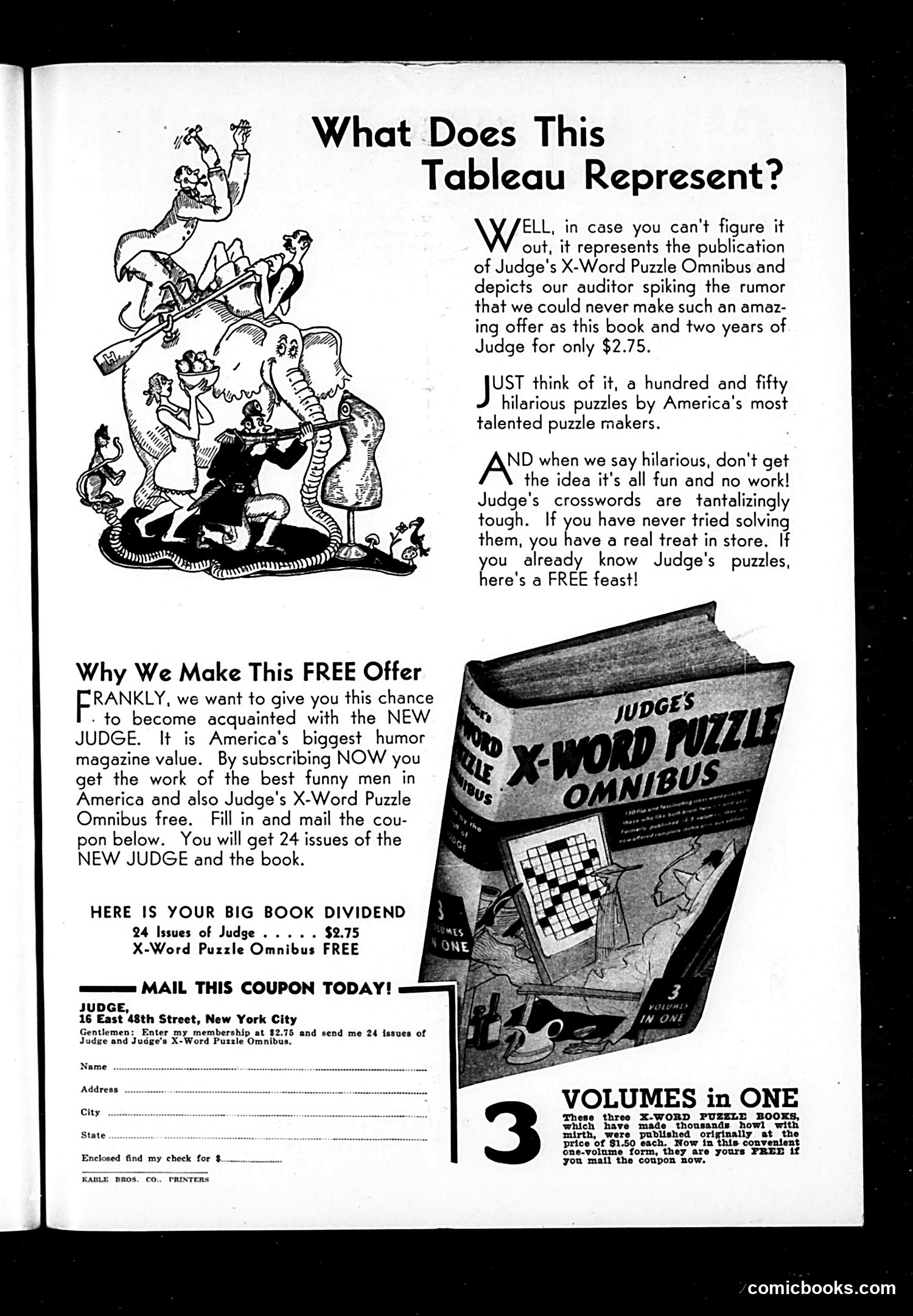
Analysis: Judge Magazine Advertisement Page This is primarily a subscription advertisement, not a political cartoon. The tableau depicts an editorial cartoon showing Judge magazine's staff celebrating the successful launch of their X-Word Puzzle Omnibus—a collection of 150 crossword puzzles. The joke centers on an "auditor" (shown spiking a rumor) who doubted Judge could offer such an ambitious deal: a hardcover puzzle book plus 24 magazine issues for $2.75. The cartoon humorously depicts this skepticism being proven wrong. The advertisement emphasizes that Judge crosswords are "tantalizingly tough" (not mere entertainment), positioning the magazine as offering serious intellectual value alongside humor. The promotional strategy—offering free puzzle books with subscriptions—was designed to attract new readers to "the NEW JUDGE" during what appears to be a rebranding or relaunching period. This reflects 1930s magazine economics: print publications competed by bundling premium content at low prices to build circulation.
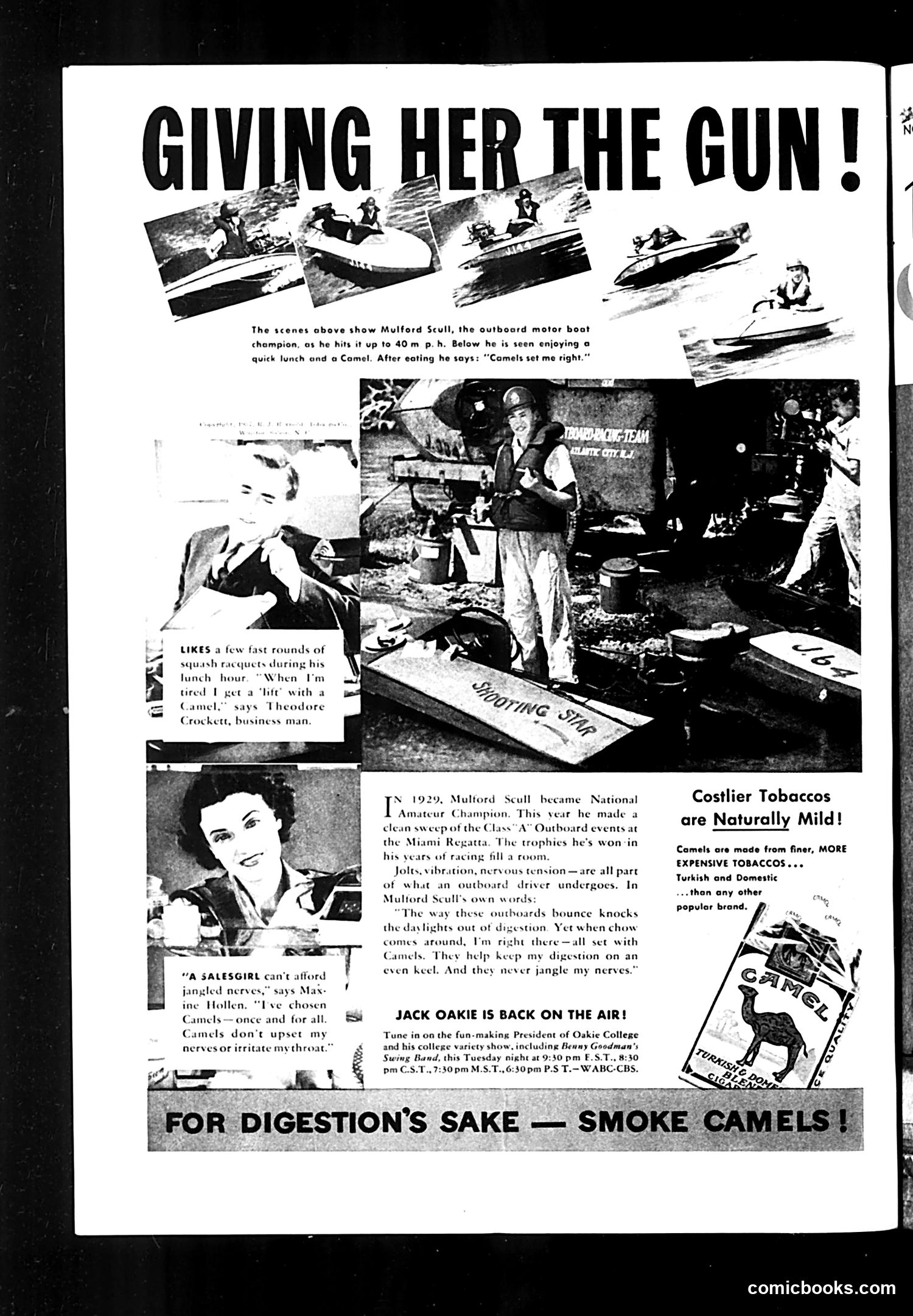
"Giving Her the Gun!" - Camel Cigarette Advertisement (circa 1930s) This is a cigarette advertisement disguised as lifestyle journalism. It features Mulford Scull, a real outboard motorboat racing champion, endorsing Camels cigarettes. The "joke" in the title refers to giving a woman throttle control of a speedboat. The ad presents testimonials from three people—Scull, businessman Theodore Crockett, and salesgirl Maxine Hollen—all claiming Camels aid digestion and calm nerves during stressful activities (racing, squash, sales work). This reflects 1930s tobacco marketing that made unsubstantiated health claims, positioning cigarettes as medicinal aids. The accompanying advertisement for Jack Oakie's radio show provides additional celebrity endorsement. The page exploits the era's acceptance of tobacco marketing and celebrity testimonials before modern regulations restricted such claims.