judge
Judge — November 1937
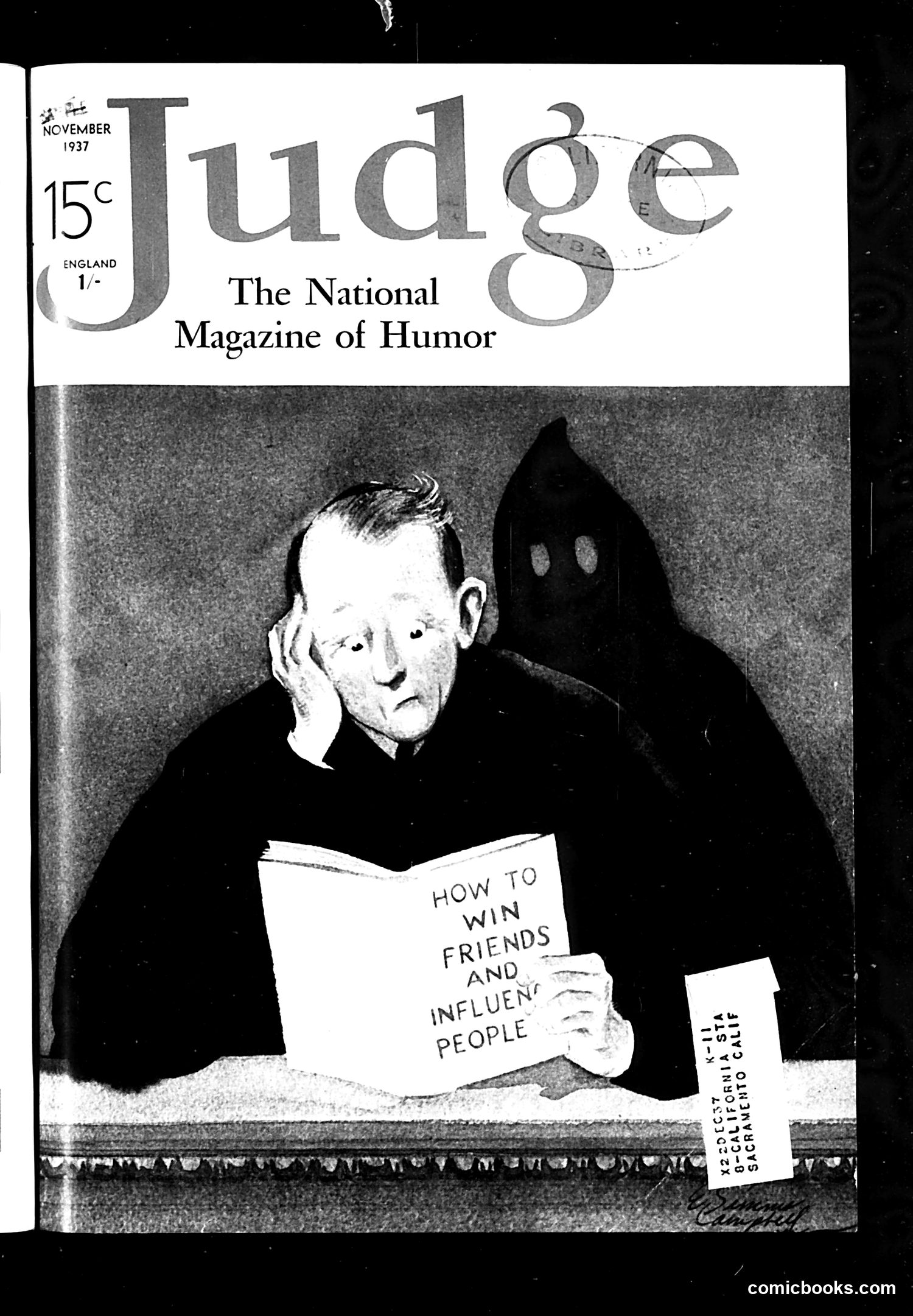
Judge Magazine Cover Analysis (November 1937) This cover satirizes self-help culture and social anxiety. A worried man reads "How to Win Friends and Influence People"—likely Dale Carnegie's bestselling 1936 book—while a menacing dark figure looms behind him, suggesting his fears won't be solved by such guides. The humor targets: 1. Self-help book mania: The proliferation of pop-psychology guides promising social success 2. Modern anxiety: The implication that readers remain anxious despite following advice 3. The sinister shadow: Possibly representing Depression-era economic or political dread that no etiquette manual can address The cover mocks the era's optimistic belief that personal improvement books could solve deeper societal or personal problems.
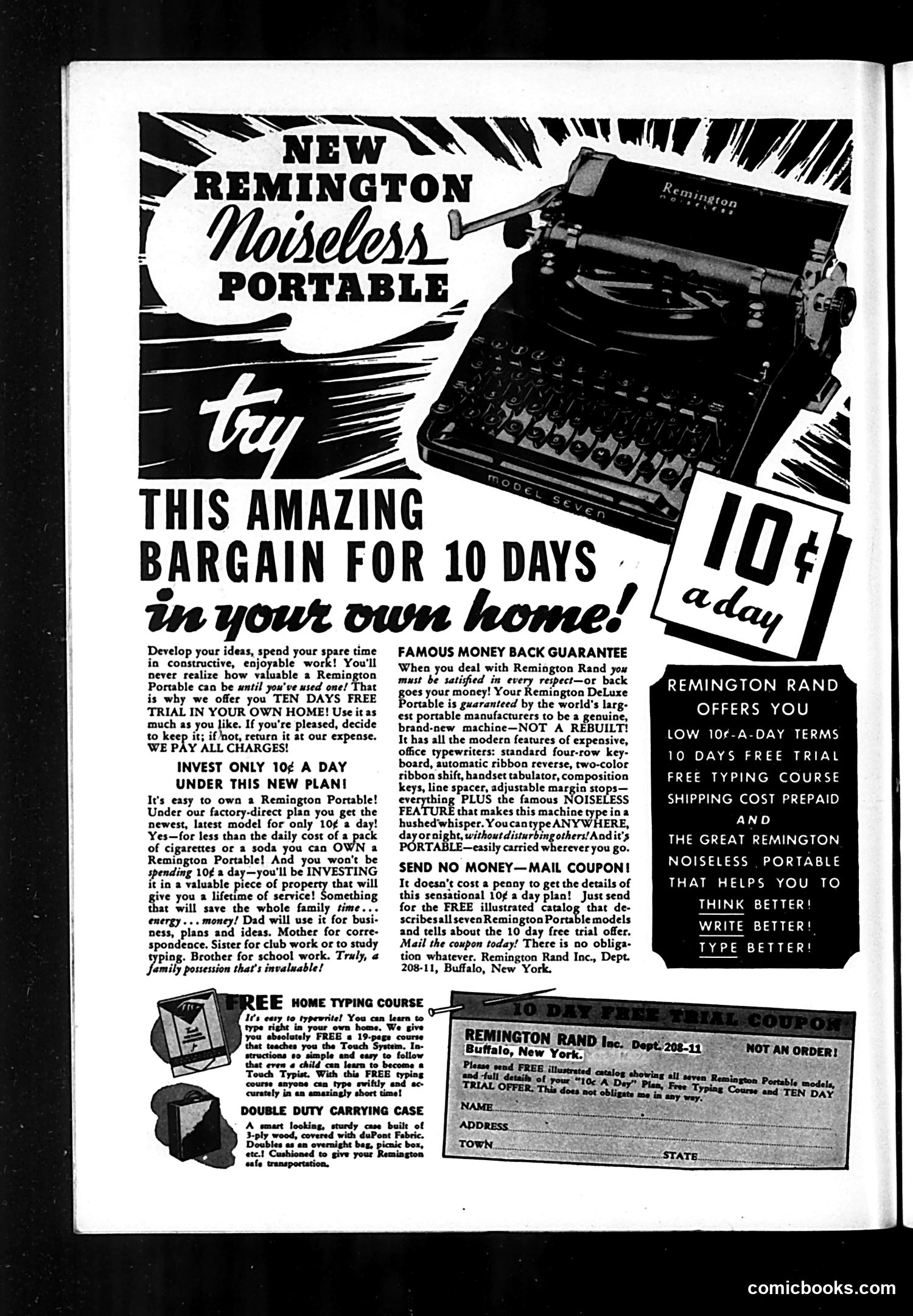
Analysis This page is primarily an advertisement, not political satire. It promotes the Remington Noiseless Portable typewriter through a direct-mail campaign. The ad targets home users by emphasizing affordability—10¢ per day for a 10-day free trial—and portability. Key selling points include the "noiseless" feature and a money-back guarantee. The copy appeals to multiple demographics: writers developing ideas, students, typists, and families. The included coupon offers a free typing course and illustrated catalog. Remington Rand positions this as an investment in "a lifetime of service," leveraging the typewriter's cultural importance during this era. The "Double Duty Carrying Case" accessory and emphasis on transportation suggest typewriters were increasingly mobile tools for modern workers. No political cartoon content is present on this page.
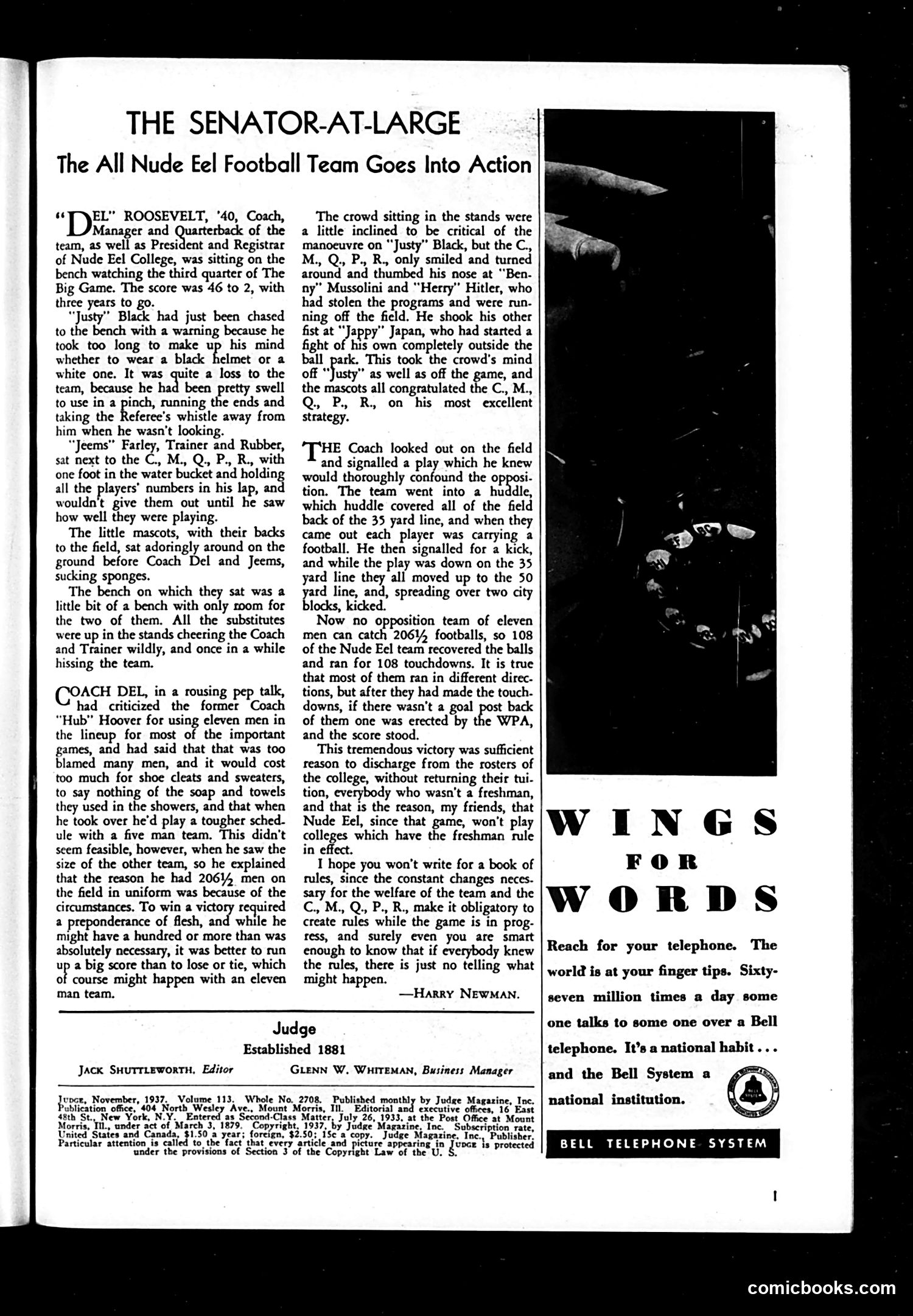
Analysis of Judge Magazine Page (November 1937) This page contains a humorous fictional article titled "The All Nude Eel Football Team Goes Into Action," describing an absurdist college football game at "Nude Eel College." The satire mocks serious sports commentary by treating ridiculous premises (naked players, mascots named after dictators) with deadpan seriousness. The article references contemporary figures: "Benny" Mussolini and "Herry" Hitler appear as stolen program mascots, reflecting 1937 anxieties about fascism. The joke likely satirizes American indifference to international threats—even at sporting events, fascist leaders are treated as minor annoyances rather than serious concerns. The accompanying Bell Telephone advertisement is unrelated to the satire. The piece exemplifies Judge's blend of absurdist humor with subtle political commentary during the pre-WWII era.
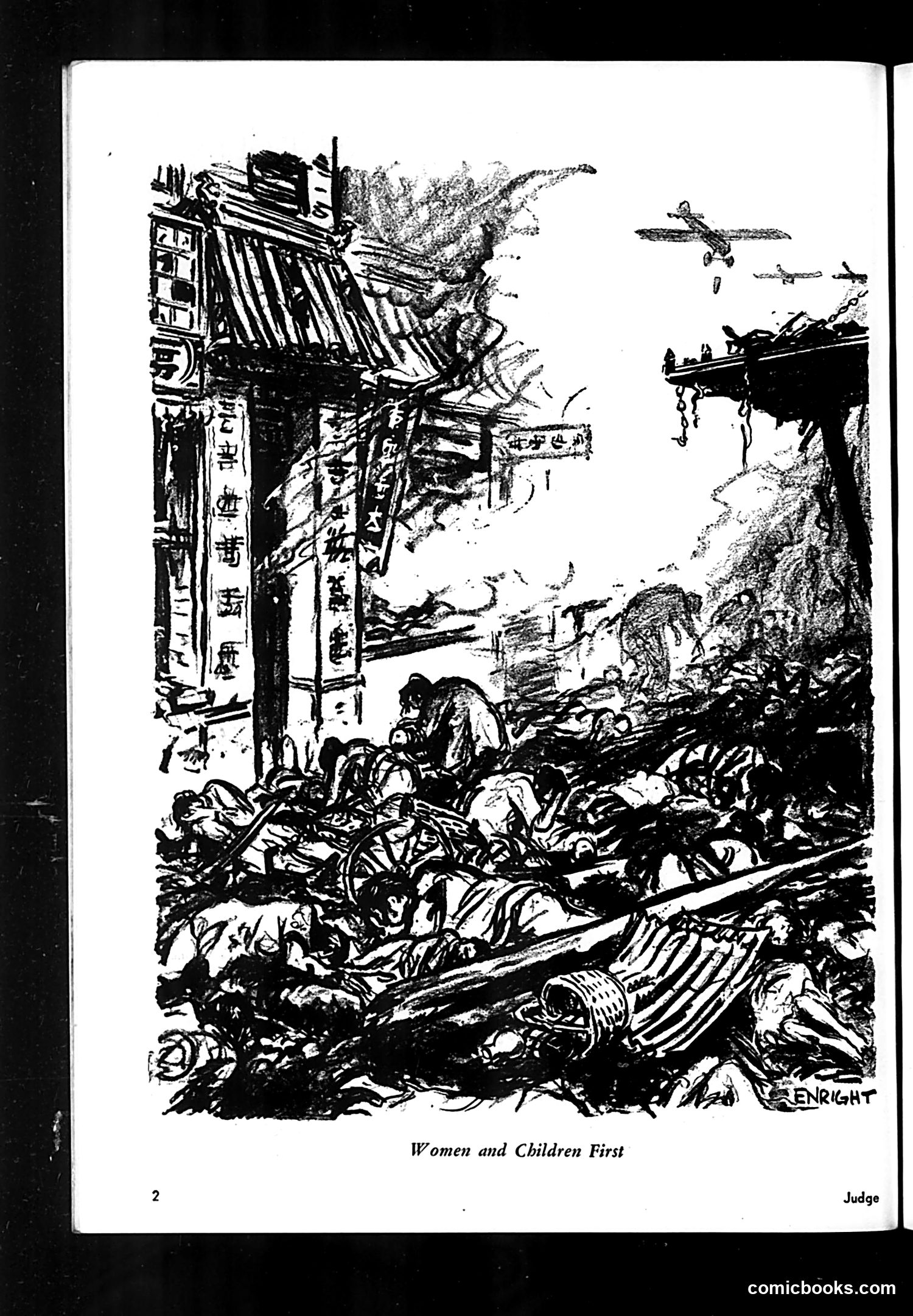
"Women and Children First" This political cartoon depicts the destruction of an Asian (likely Chinese or Japanese) temple or pagoda, with bodies and casualties scattered in the foreground. Military aircraft appear overhead, suggesting aerial bombardment. The caption "Women and Children First" is darkly ironic—invoking the maritime disaster protocol—while the image shows indiscriminate civilian casualties including what appear to be women and children. The cartoon critiques military aggression against Asian populations, likely referencing early-20th-century warfare or imperial conflict. The artist (signed "Penright") uses bitter satire: the phrase typically associated with protecting civilians instead highlights their victimization. This appears designed to condemn either Japanese militarism, American/Western military intervention, or both, depending on *Judge* magazine's editorial stance at the time.
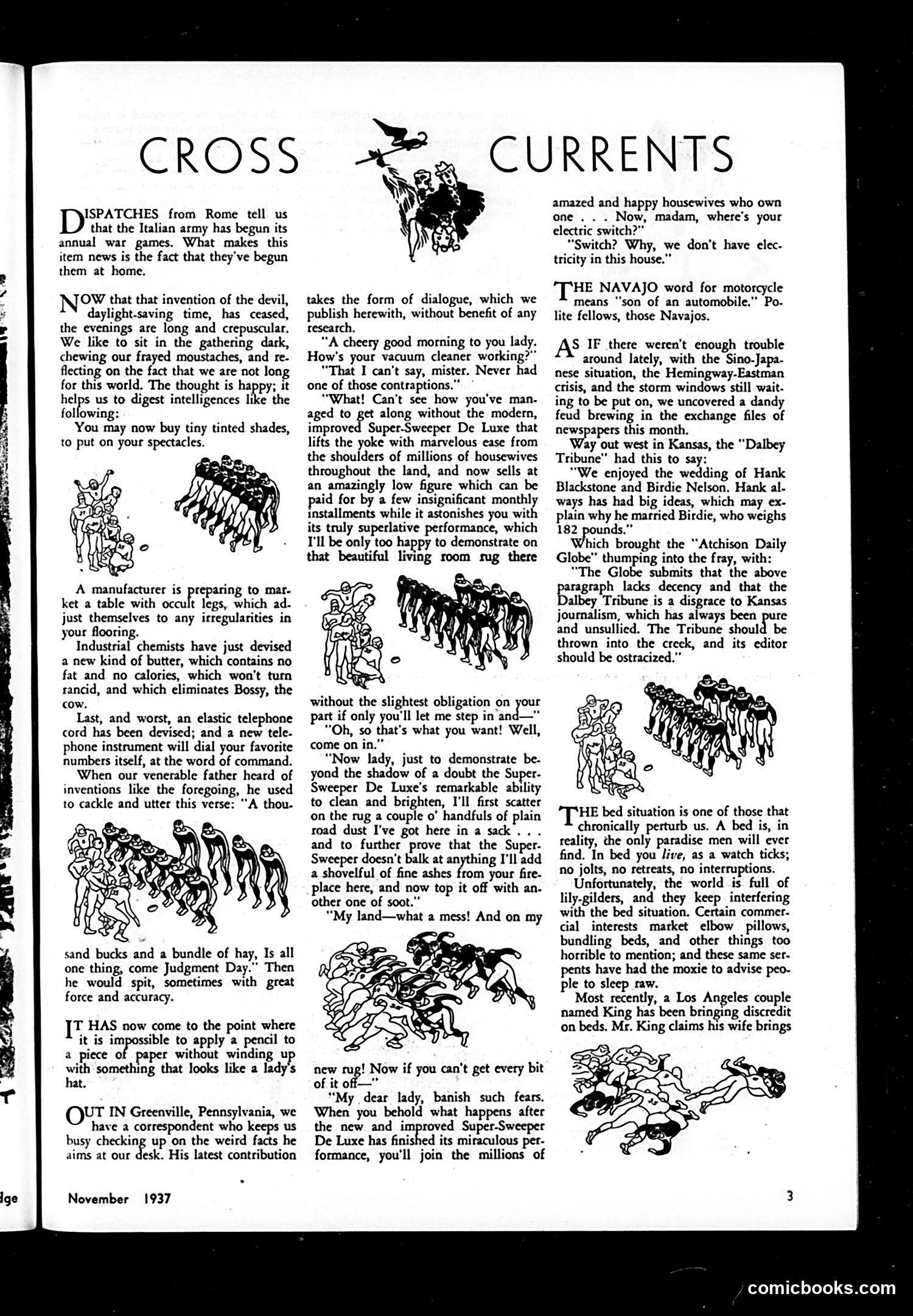
Cross Currents (November 1937) This satirical column features miscellaneous social commentary typical of Judge magazine. The content includes: Main topics: - Italian army war games (dispatch from Rome) - Daylight-saving time ending - A dialogue about vacuum cleaners, seemingly advertising the "Super-Sweeper De Luxe" - Complaints about modern inventions: elastic telephone cords, low-calorie butter - Critiques of Kansas journalism (the Atchison Daily Globe and Dalby Tribune) - A humorous piece about bed situations and commercial interests in sleep products - A reference to a Los Angeles couple (King) having marital disputes over beds The accompanying cartoons appear to show domestic scenes with people and animals. The satire targets consumer culture, domestic life, and minor journalistic controversies rather than major political figures.
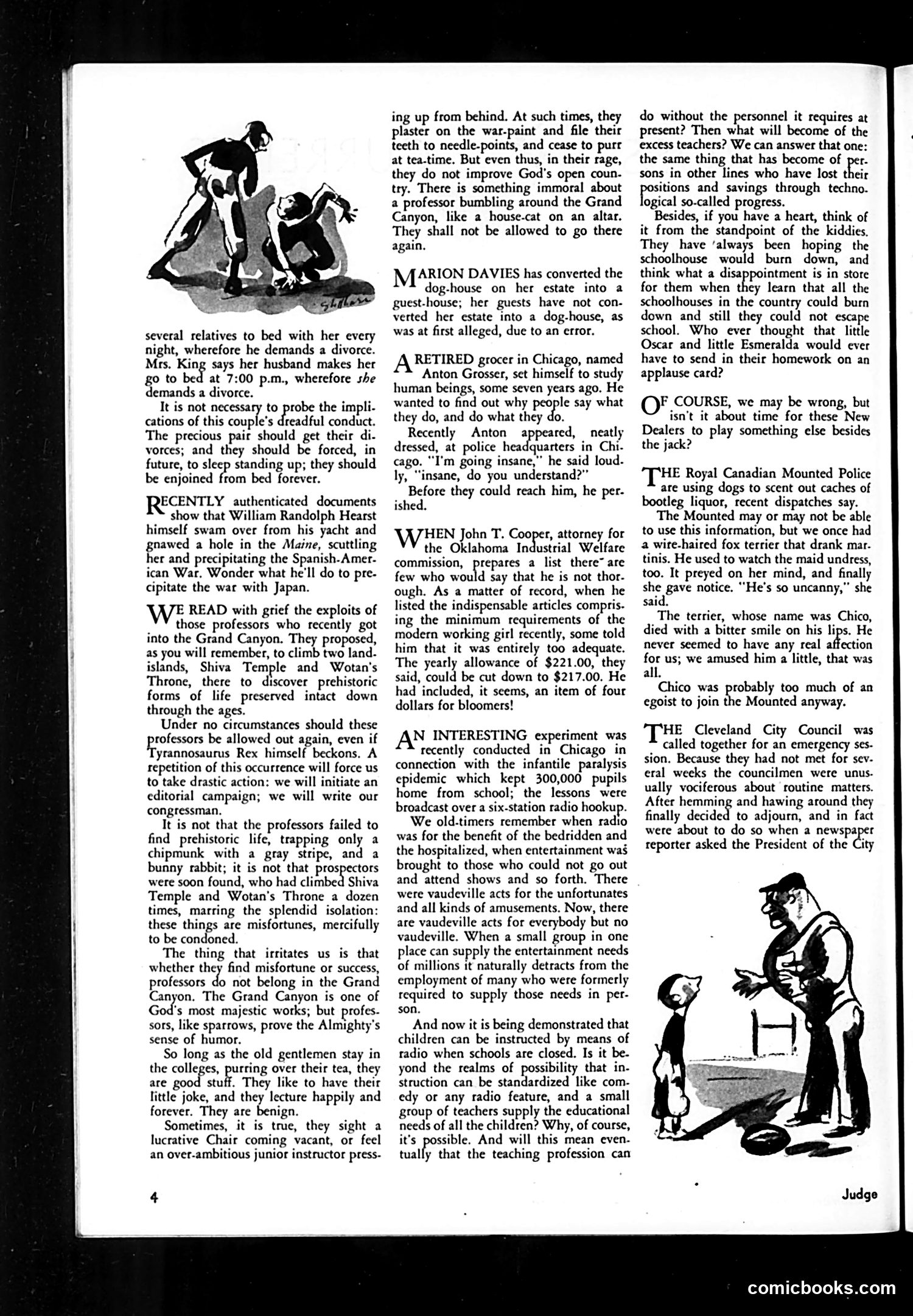
Analysis of Judge Magazine Page This page contains several brief satirical pieces rather than a single cartoon. The illustrations depict: 1. Top left: A domestic scene showing what appears to be a woman confronting a man, likely illustrating the piece about Marion Davies converting a dog-house into guest quarters—satirizing wealthy celebrities' extravagant lifestyle choices. 2. Bottom right: A figure reading a newspaper, accompanying text about the Cleveland City Council and radio education during school closures—mocking bureaucratic decision-making. The satire targets: excessive wealth and poor judgment among the famous (Davies), the absurdity of overcomplicated bureaucratic solutions to simple problems, and institutional failings. The tone is light, focusing on social foibles and professional incompetence rather than serious political critique. Without specific dates visible, the exact historical moment remains unclear.
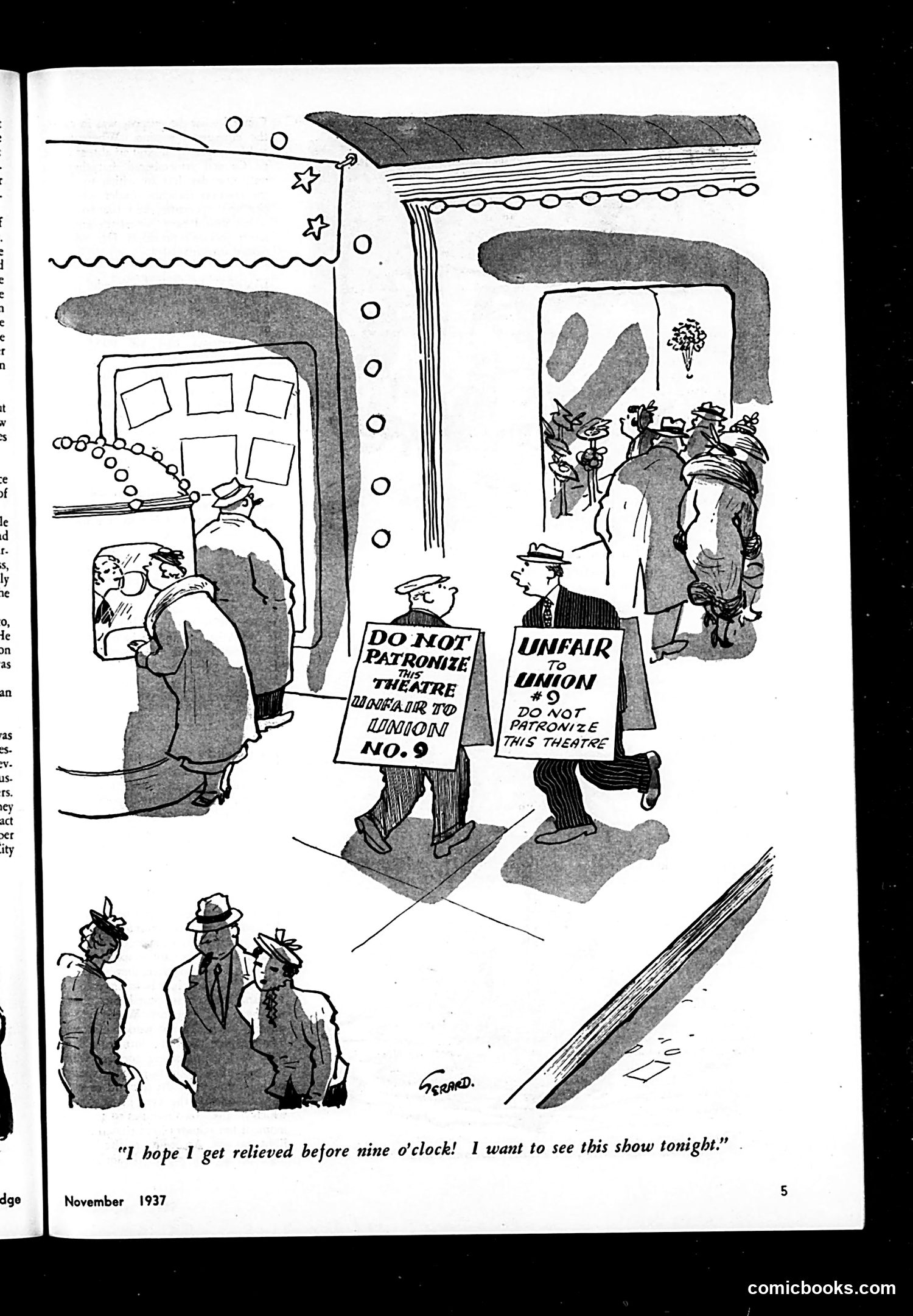
Political Cartoon Analysis: November 1937 This cartoon depicts a theater labor dispute, likely involving union picketing. Two picketers hold signs reading "DO NOT PATRONIZE THIS THEATRE" and "UNFAIR TO UNION" with "DO NOT PATRONIZE THIS THEATRE" beneath. The humor targets a theatergoer expressing anxiety about the picket line—hoping to be "relieved before nine o'clock" so they can still attend the show that night, seemingly indifferent to the workers' grievances. The cartoon satirizes middle-class entertainment priorities over labor concerns. The casual dismissal of union action and the speaker's sole focus on not missing their evening entertainment exemplifies how ordinary patrons ignored labor disputes affecting service workers. This reflects 1937's active union organizing period in American entertainment industries.
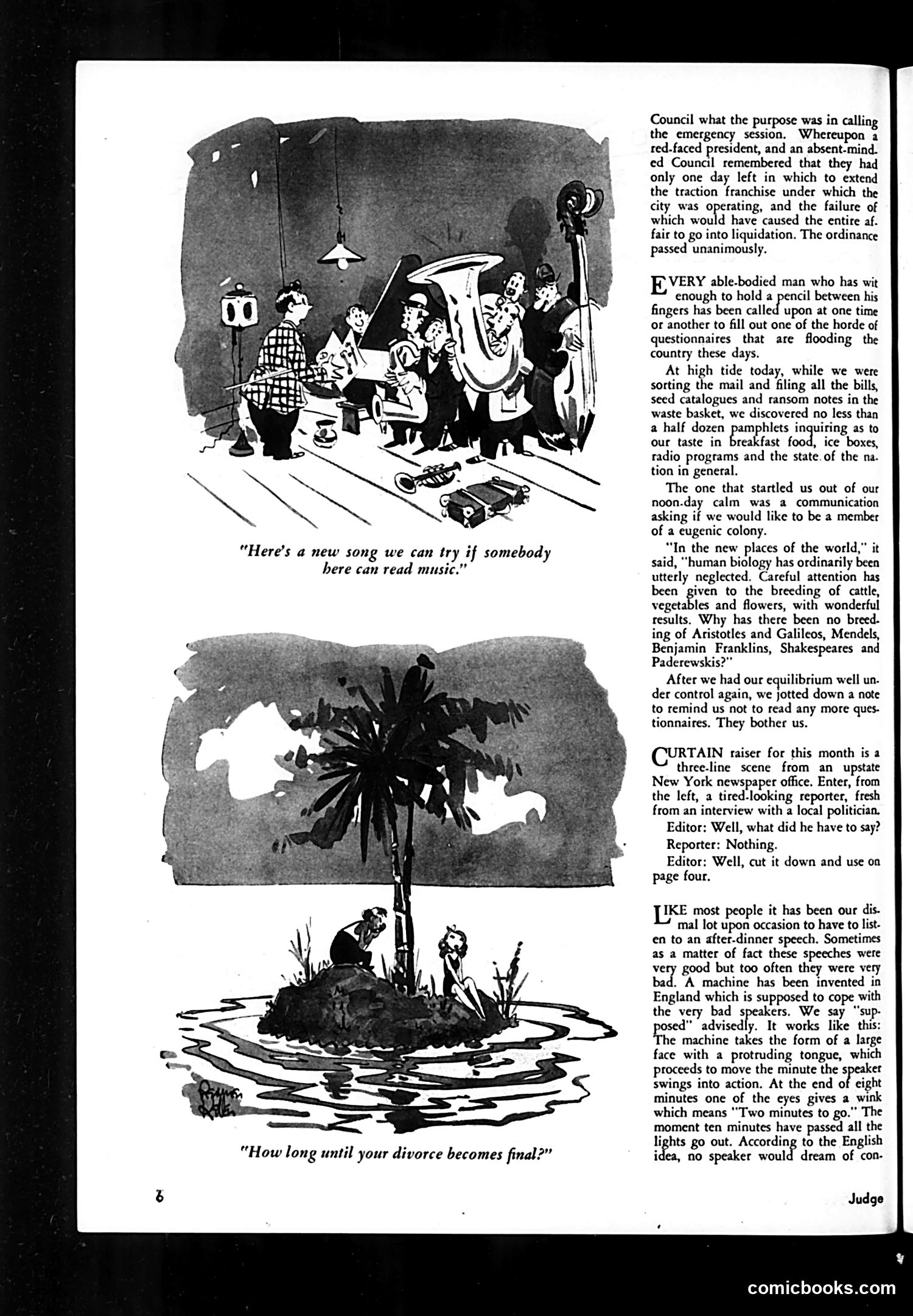
Analysis of Judge Magazine Page This page contains two cartoons satirizing American social absurdities of the era. The top cartoon mocks the prevalence of questionnaires flooding the country. A group of people gather around a large tuba, attempting to read music for a new song—the joke being that even musical instruction has become subject to questionnaire culture. The bottom cartoon depicts a tree growing from a pool, captioned "How long until your divorce becomes final?"—satirizing the era's divorce proceedings and their emotional toll. The accompanying text discusses questionnaire fatigue, eugenics colony proposals, newspaper editorial absurdities, and after-dinner speech tedium. A British machine invention is mentioned that supposedly interrupts bad speakers by moving a tongue mechanism. Together, these pieces critique bureaucratic excess, social pseudo-science trends, and institutional inefficiency in contemporary American life.
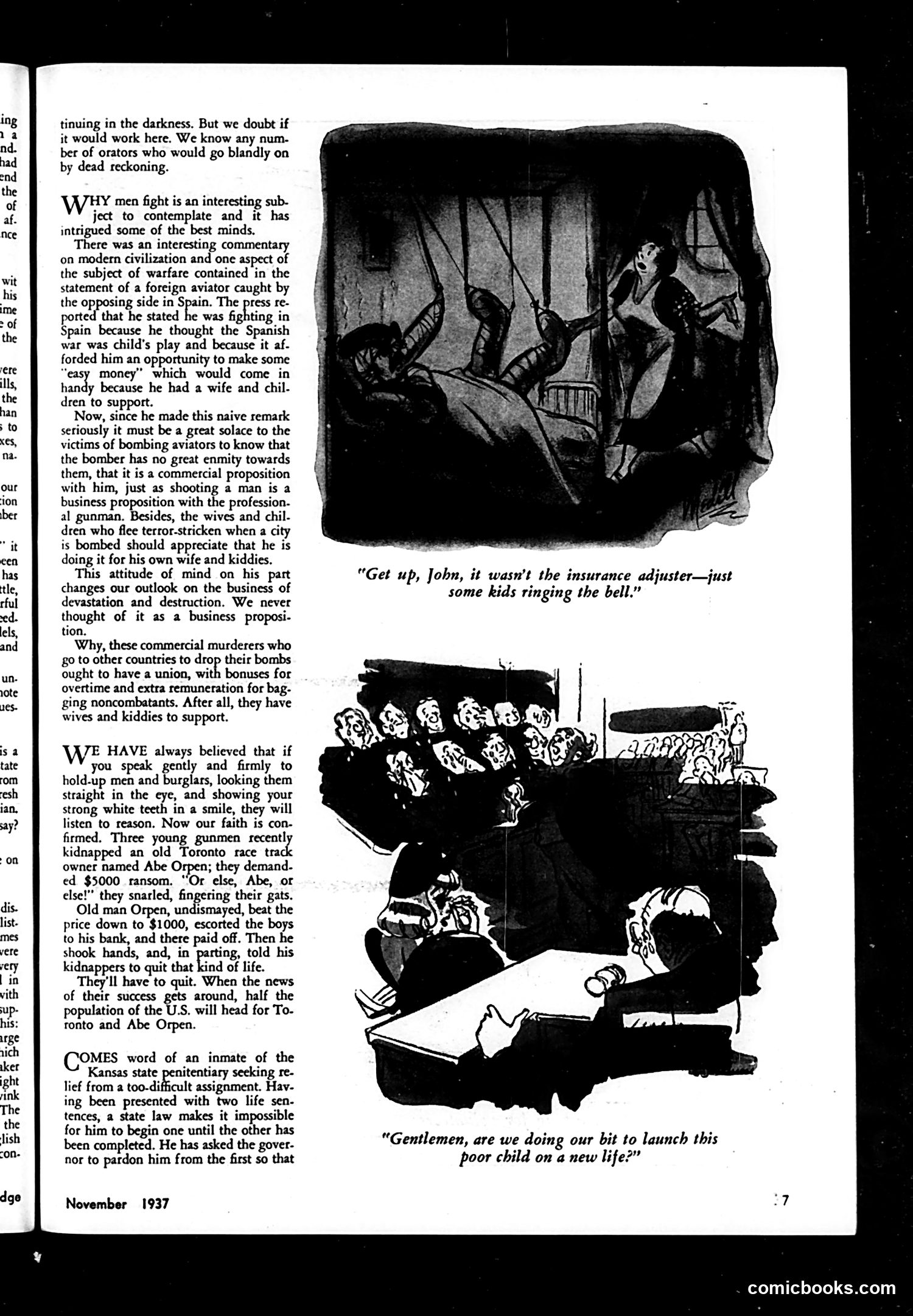
Analysis of Judge Magazine Page, November 1937 This page contains two satirical cartoons critiquing wartime profiteering and callousness toward human suffering. The upper cartoon mocks an insurance adjuster's indifference to bombing casualties—he dismisses children ringing a doorbell as mere "insurance adjuster" business rather than victims needing help. The lower cartoon depicts wealthy businessmen discussing launching "this poor child on a new life," suggesting cynical exploitation of orphans or war refugees for profit rather than genuine charity. The accompanying text criticizes "commercial murderers"—arms dealers and bombers who treat warfare as business. It argues they should unionize for hazard pay, sarcastically suggesting bombing civilians is morally equivalent to any other profession. The overall message: war profiteers show no humanity toward victims, viewing devastation purely as financial opportunity.
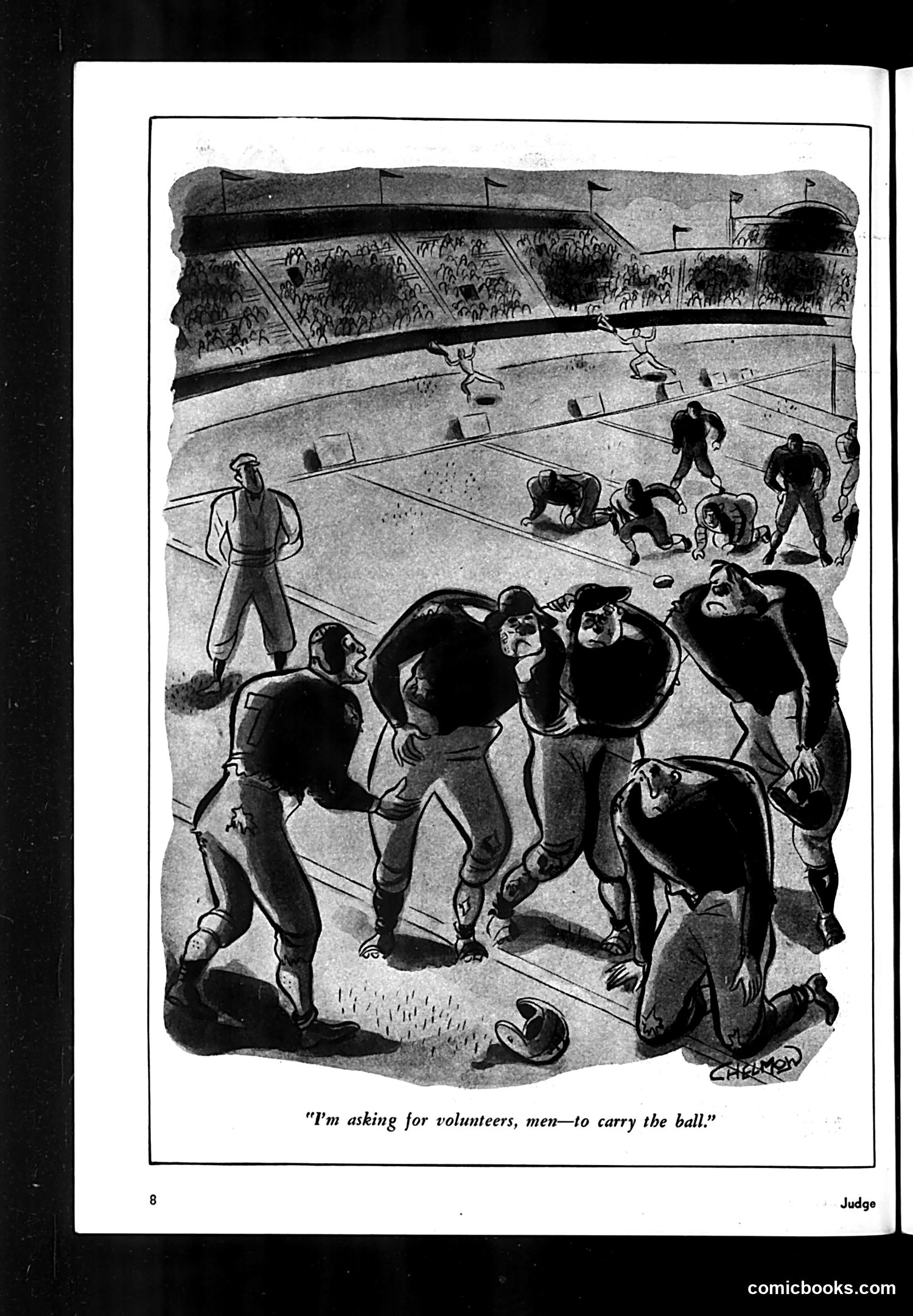
Political Cartoon Analysis This Judge magazine cartoon depicts a coach (left, standing) addressing his football team in a stadium, asking for volunteers "to carry the ball." The humor lies in a double meaning: while literally requesting players willing to take possession during the game, the phrase "carry the ball" was a common idiom meaning to take responsibility for an initiative or cause. The cartoon appears to satirize leadership or civic duty—likely commenting on reluctance among men to take on responsibility or risk, whether in sports, military service, or public affairs. The players' hesitation to volunteer suggests unwillingness to shoulder burden or responsibility when called upon. Without the publication date visible, the specific historical reference remains unclear, though the style suggests early-to-mid 20th century.
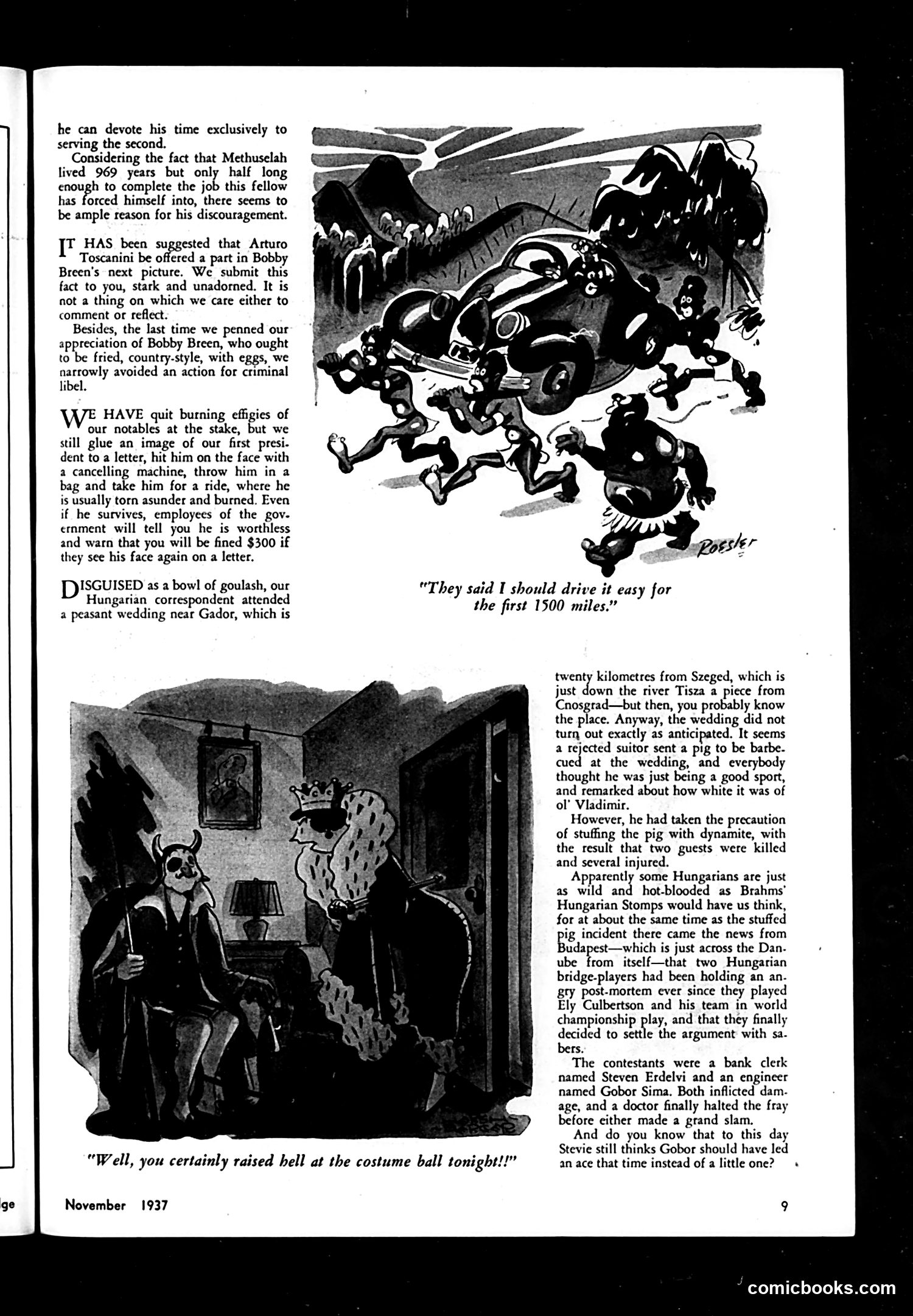
Judge Magazine, November 1937: Page Analysis This page contains two distinct satirical pieces: Top cartoon: Mocks a new driver given advice to "drive it easy for the first 1500 miles." The exaggerated chaos—with the car surrounded by fleeing figures—suggests the driver is recklessly dangerous despite (or because of) this cautionary instruction. It's a joke about incompetent motorists. Bottom section: A humorous travelogue by Judge's "Hungarian correspondent" describing a peasant wedding near Budapest that went catastrophically wrong. A rejected suitor sabotaged the celebration by dynamiting a pig intended as food, killing two guests. The piece then pivots to an anecdote about two Hungarian bridge players who became so heated debating a card game against Ely Culbertson's championship team that they settled their argument with swords—a satirical commentary on Hungarian temperament and the intensity of competitive bridge culture in the 1930s. The humor relies on exaggeration and ethnic stereotyping common to the era's satire.
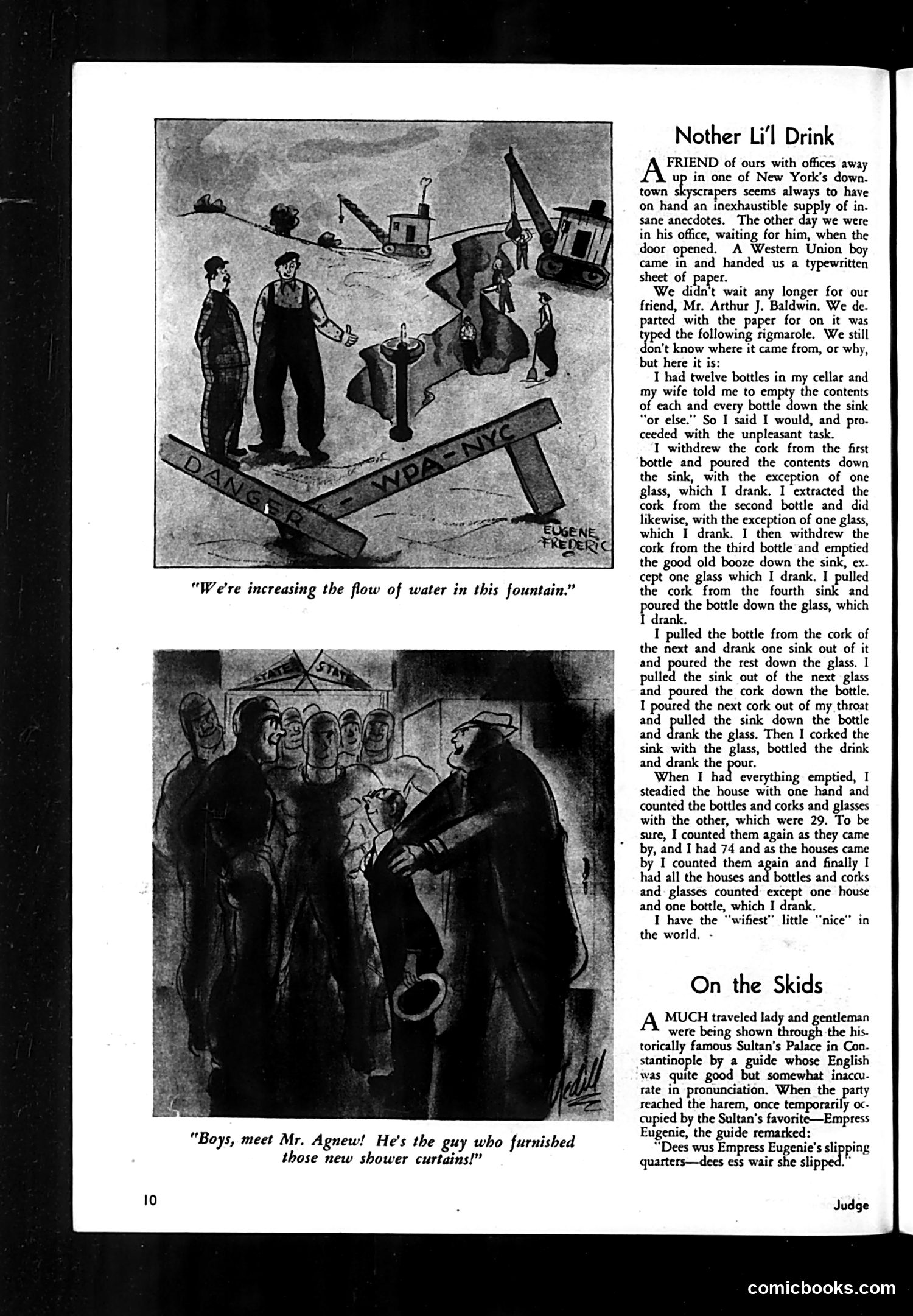
"Nother Li'l Drink" and "On the Skids" "Nother Li'l Drink": This humorous anecdote satirizes Prohibition-era drinking. A man claims his wife demanded he empty twelve bottles of alcohol down the sink "or else." The joke lies in the deliberately scrambled narrative—as he drinks, his account becomes increasingly incoherent, with bottles, glasses, sinks, and corks mixed up syntactically. The deteriorating prose mimics drunkenness itself, ending with the narrator unable to count correctly (claiming 29 items but then 74). The humor targets both excessive drinking and the absurdity of Prohibition enforcement (wives policing husbands' alcohol). "On the Skids": A crude joke about mispronunciation. A tour guide at Constantinople's Sultan's Palace, showing visitors Empress Eugenie's former quarters in the harem, says she "slipped" there—appearing to reference a sexual scandal or indiscretion. The humor depends on the guide's broken English making "slipping quarters" sound like a euphemism for illicit activity. It relies on period stereotypes about foreign guides and suggests gossip about historical figures.
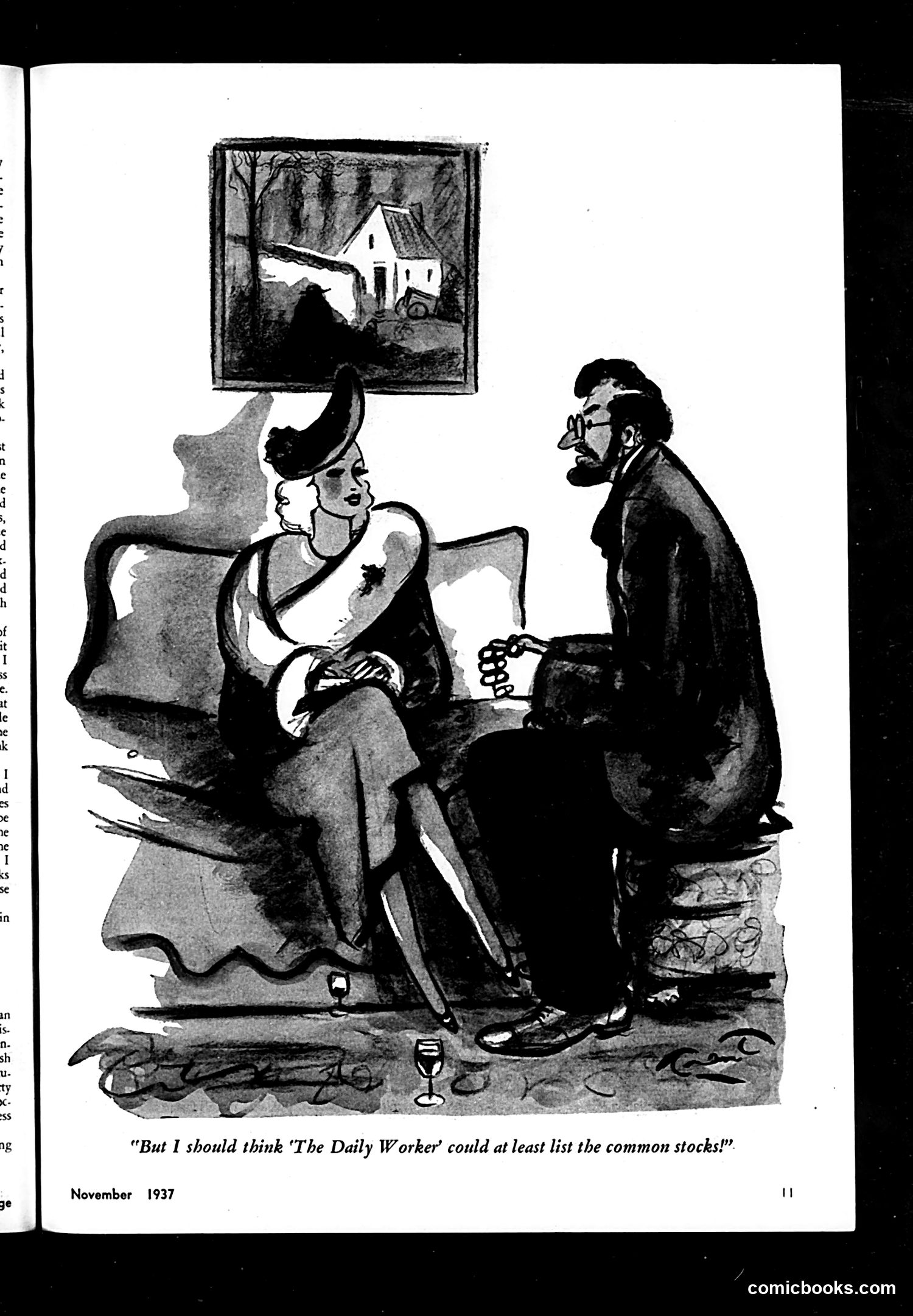
Cartoon Analysis This November 1937 Judge cartoon satirizes *The Daily Worker*, the Communist Party USA's newspaper. The scene shows a well-dressed couple—appearing to represent the wealthy or upper class—relaxing in a living room. The man, sitting casually, complains that even a communist publication should at least list stock market information. The satire targets perceived hypocrisy: communists publicly opposed capitalism and stock markets, yet the cartoon suggests that even they might privately want financial data for personal investment. It's also mocking the couple themselves—despite their apparent wealth and leisure, they read communist material. This reflects 1930s anxieties about communist influence in America and stereotypes about communists as hypocritical or infiltrating respectable society.
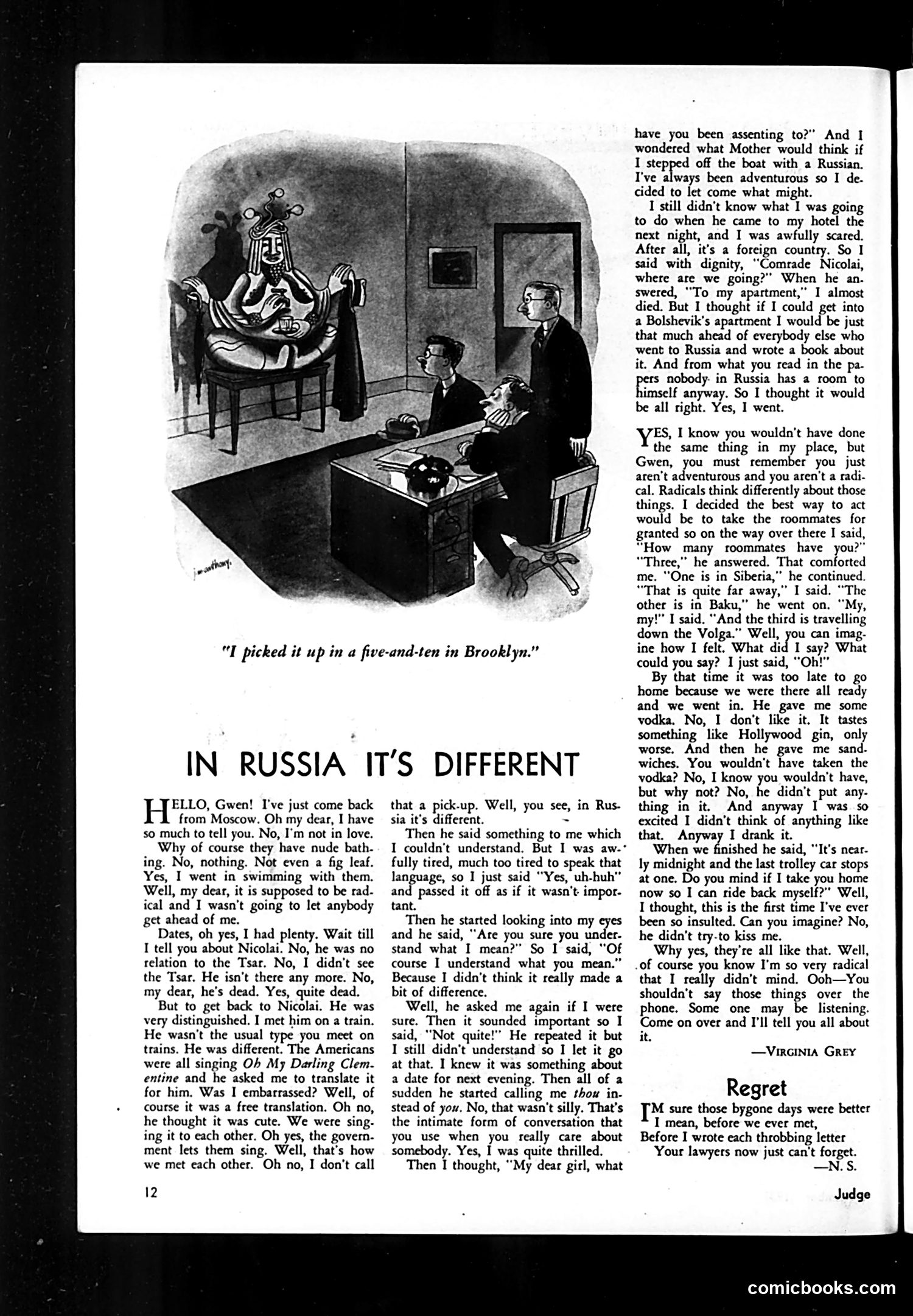
Analysis: "In Russia It's Different" This satirical story mocks American women who romanticize Soviet Russia as exotic and radical. The cartoon depicts a flirtatious encounter between a naive American woman and a Soviet man named Nicolai on a train. The satire targets several things: the woman's performative radicalism (she agrees to things she doesn't understand to seem adventurous), her obliviousness to Soviet reality, and the absurdity of her rationalizations. When Nicolai mentions his roommates are in Siberia, Baku, and traveling down the Volga—implying she'll be alone with him—she misses the implication entirely, reasoning that since Russians have no privacy anyway, it doesn't matter. The caption "I picked it up in a five-and-ten in Brooklyn" suggests the icon visible in the cartoon (possibly an Orthodox religious image) represents cheap, superficial engagement with Russian culture. The piece satirizes 1920s-30s American fascination with the USSR among progressives, portraying it as shallow tourism mixed with dangerous naiveté.
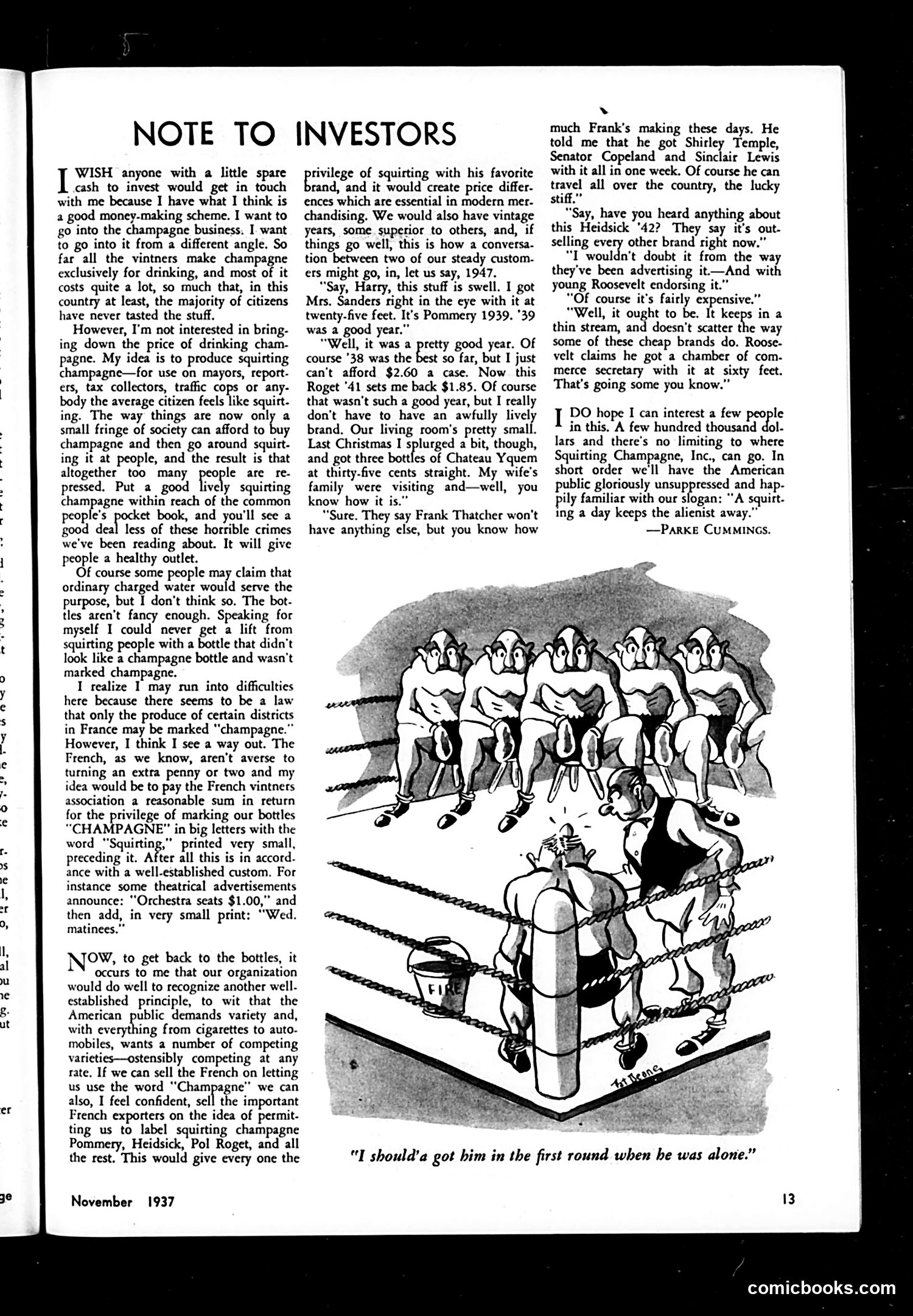
"Note to Investors" Satire (November 1937) This is a humorous business proposal by author Parke Cummings satirizing both champagne marketing and American consumer culture during the Depression era. The scheme: mass-produce cheap "squirting champagne" for ordinary citizens to spray on public officials (mayors, reporters, tax collectors, traffic cops)—positioning it as a therapeutic outlet for societal frustration and repression. The satire operates on multiple levels: it mocks French champagne monopolies and their snobbish branding; American advertising deception (hiding true prices in fine print); competitive product differentiation based on artificial "vintage" distinctions; and consumer status-anxiety about branded goods. The accompanying cartoon shows common people gleefully using squirt bottles against a fire hydrant labeled "FIRE," suggesting the democratization of what was previously an elite privilege. The caption ("I should've got him in the first round when he was alone") implies targeting authority figures. The piece satirizes how capitalism creates artificial scarcity and prestige around mundane products, while channeling working-class resentment into commercial consumption rather than genuine social change.
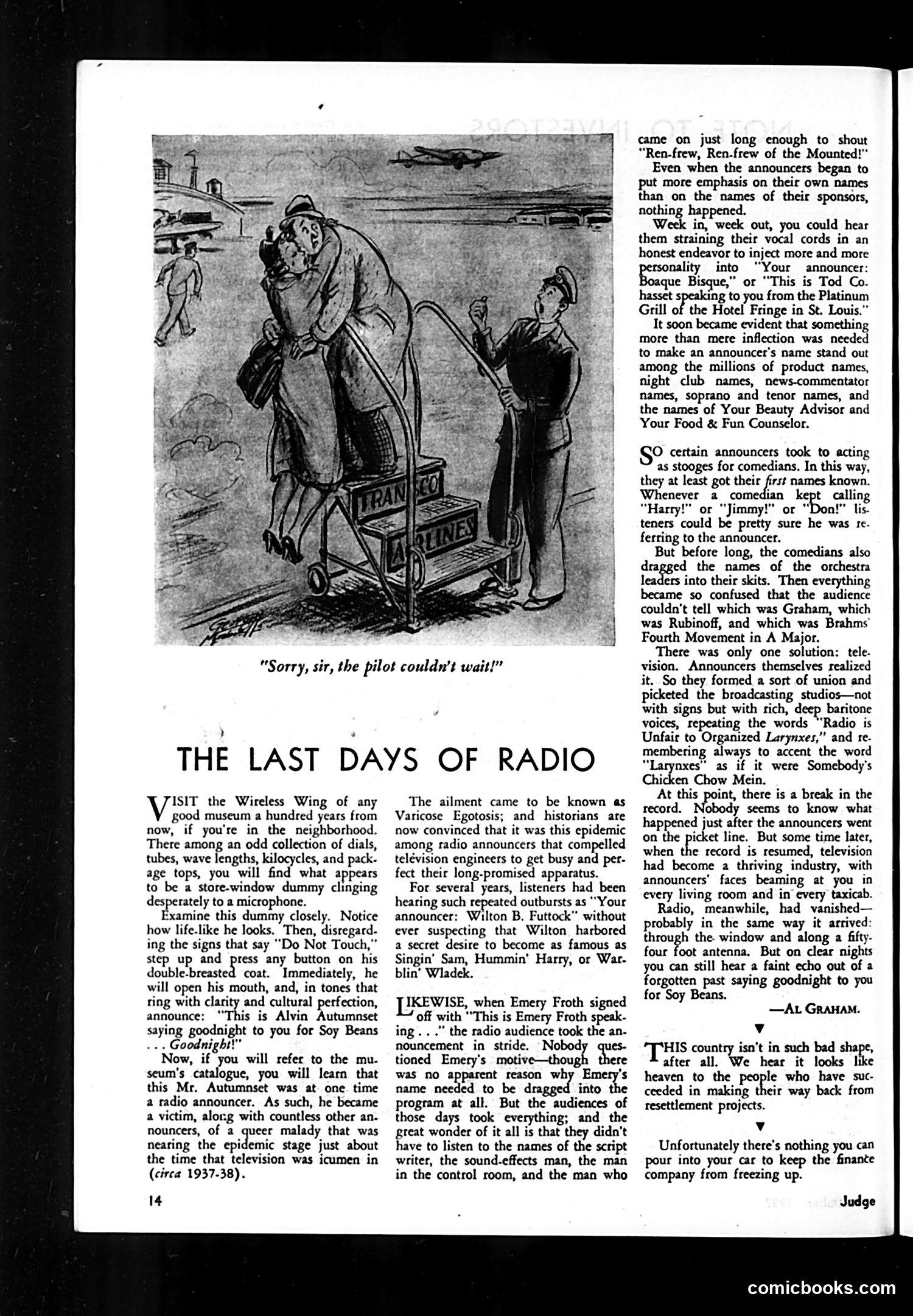
"The Last Days of Radio" — Judge Magazine Satire This article satirizes radio announcers' obsessive self-promotion during the late 1930s. The cartoon depicts an announcer so absorbed in speaking into a microphone that he ignores an airplane pilot—illustrating how announcers prioritized their own names over all else. The text describes "Varicose Egotosis," a fictional epidemic where radio announcers became increasingly desperate to make their names famous, constantly emphasizing their identities ("This is Alvin Autumnset...") over sponsors or content. The satire escalates: announcers became stooges for comedians, orchestra leaders' names got dragged into skits, and confusion reigned. The author argues this egotism directly prompted television's development—engineers needed a visual medium where announcers' faces, not just voices, could satisfy their vanity. The joke concludes that announcers even picketed broadcasting studios demanding better treatment for their "Organized Larynxes." This mocks both radio culture's personality-driven format and the medium's eventual obsolescence.
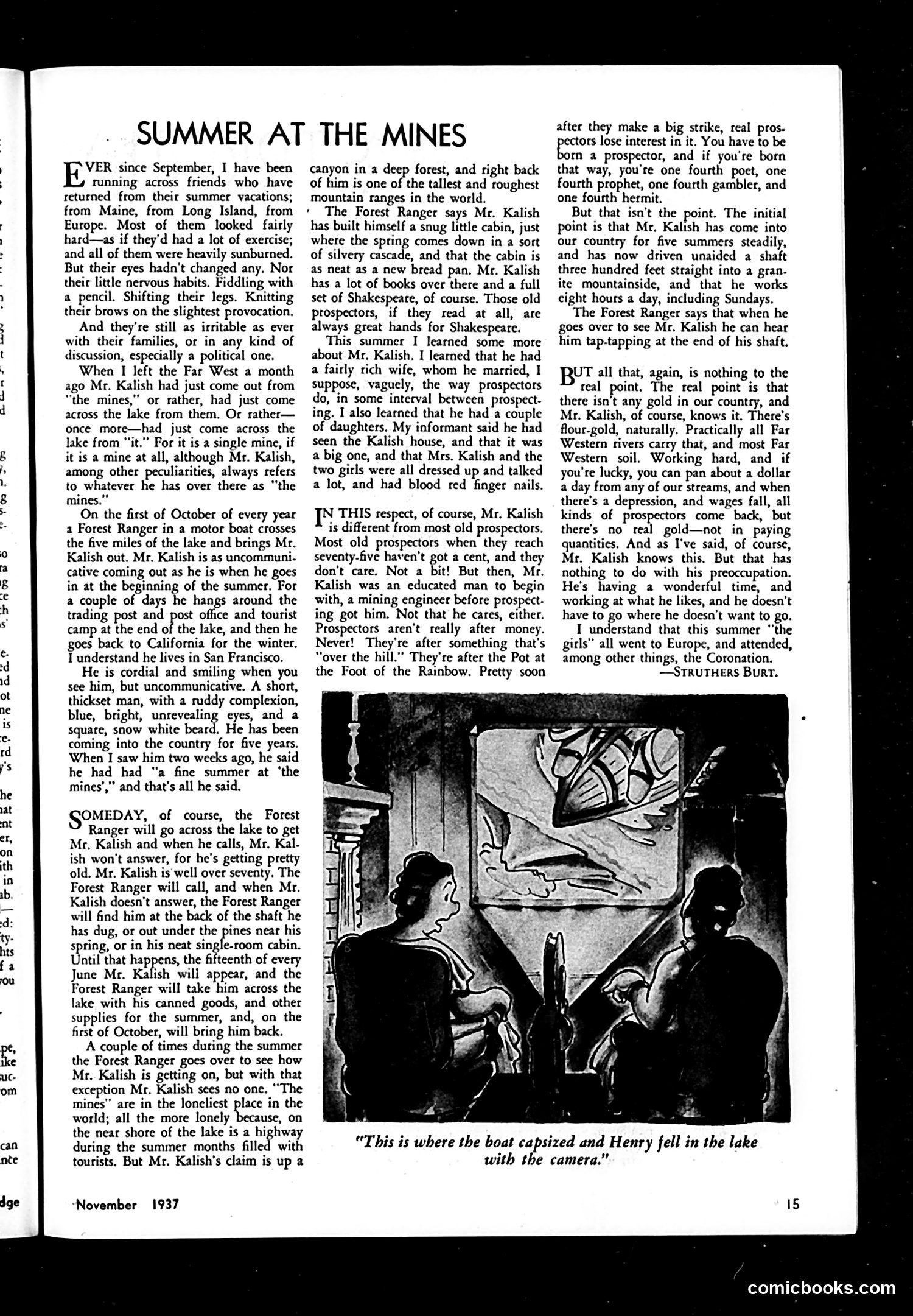
"Summer at the Mines" - Judge Magazine, November 1937 This is a literary sketch rather than political satire. It portrays Mr. Kalish, an elderly prospector who spends summers alone in an isolated mountain mining claim, accessible only by Forest Ranger escort across a remote lake. The piece humorously characterizes Kalish as an eccentric loner—taciturn, educated (owns complete Shakespeare), living in austere solitude despite having a wealthy wife and daughters in San Francisco. The narrative suggests his annual ritual of isolation represents either obsessive prospecting or deliberate escape from civilization. The accompanying illustration depicts what appears to be a boating accident at the mine location. The humor derives from Kalish's mysterious reclusiveness and the contrast between his refined tastes (Shakespeare) and his harsh, solitary lifestyle in the wilderness. It's a portrait of American individualism and the lure of frontier isolation.
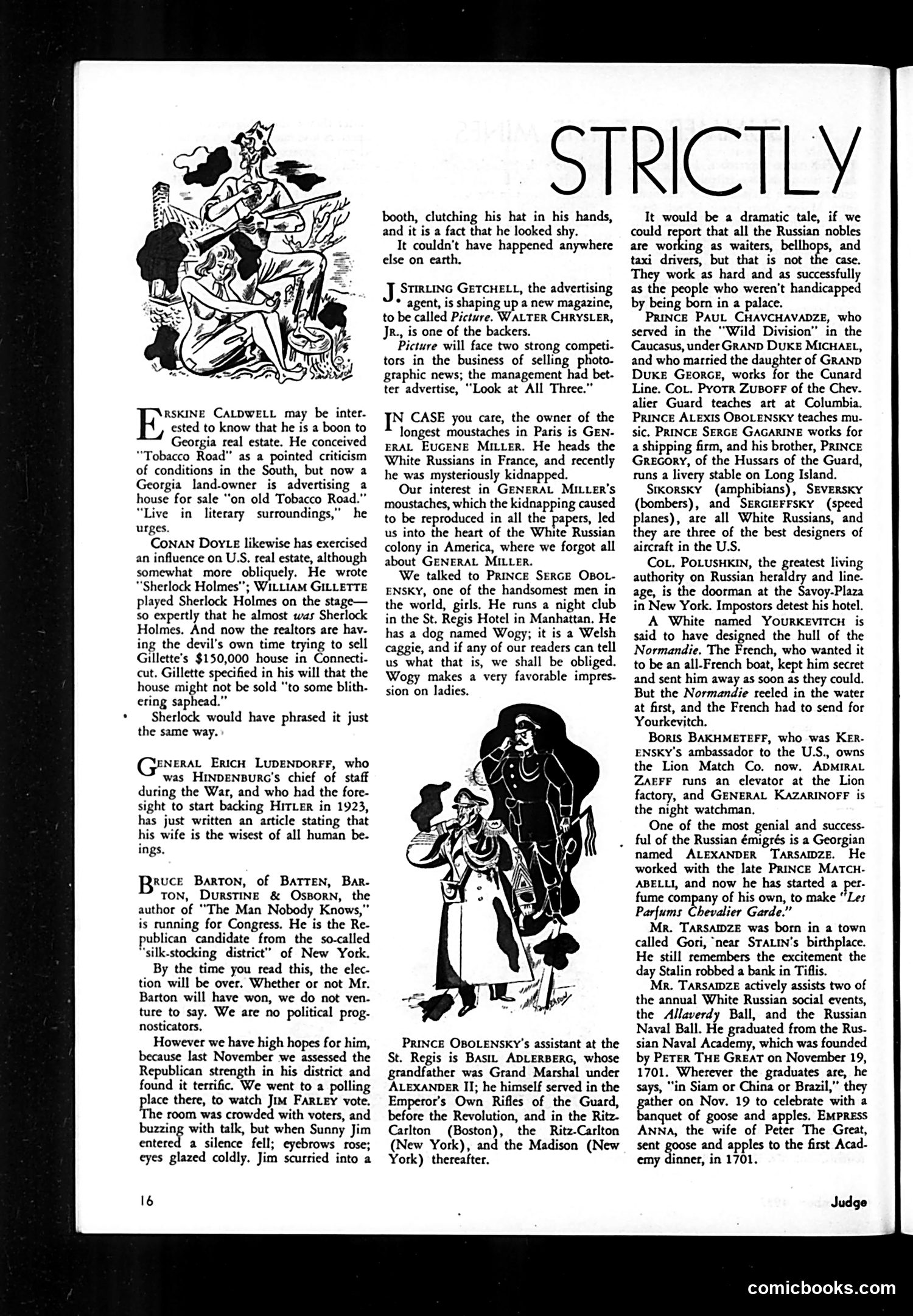
This "Strictly" gossip column from Judge magazine contains several satirical observations about American society and notable figures: The main targets are: - Real estate exploitation of literary references (selling "Tobacco Road" property; William Gillette's Connecticut mansion remain unsold despite actor's fame as Sherlock Holmes) - General Erich Ludendorff, Nazi sympathizer who backed Hitler from 1923, now praising his wife - Bruce Barton, advertising executive and Republican congressional candidate from New York's wealthy "silk-stocking district," contrasted with Jim Farley (Democratic political operative), whose mere entrance silenced a polling place - Russian émigrés working in New York hotels and nightclubs—former nobles now employed as waiters and staff, undercutting any "dramatic" narrative of fallen aristocracy The humor satirizes American materialism (cashing in on literary fame), political hypocrisy, and the ironic reality that displaced Russian aristocrats work as successfully as ordinary Americans—without the supposed advantages of noble birth. The column mocks pretense across class, nationality, and political lines.
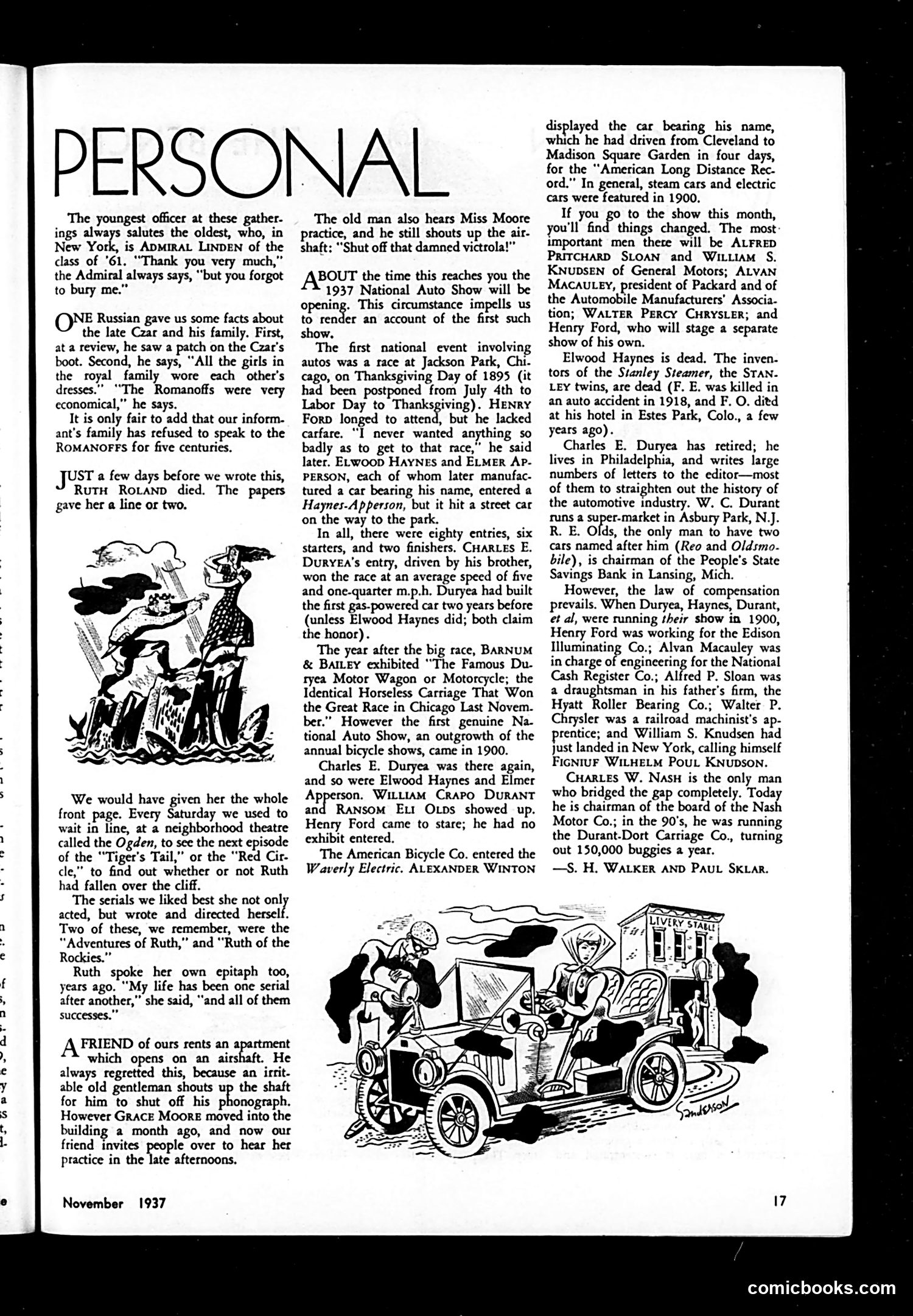
Understanding This 1937 Judge Magazine Page This is a "Personal" gossip/anecdote column mixing social commentary with automobile history. Key elements: The cartoons show early automobiles in comedic situations—one depicts a crowded early car, the other shows people startled by a vehicle, reflecting the novelty of automobiles circa 1900. Main content: The column recounts the 1895 Chicago auto race—the first major American automotive event—highlighting how Henry Ford couldn't afford carfare to attend, while Charles Duryea won at 5.25 mph. It notes competing claims about who invented the first gasoline-powered car (Duryea vs. Haynes). The satire: By 1937, automobiles were ubiquitous and industrial giants dominated (General Motors, Ford). The contrast between the humble 1895 race and the 1937 National Auto Show's corporate powers satirizes how quickly the fledgling industry became dominated by big business and wealthy industrialists. The Grace Moore anecdote uses her opera-singer celebrity to joke about annoying neighbors—irrelevant to automotive content but typical of the column's mixed-bag approach.
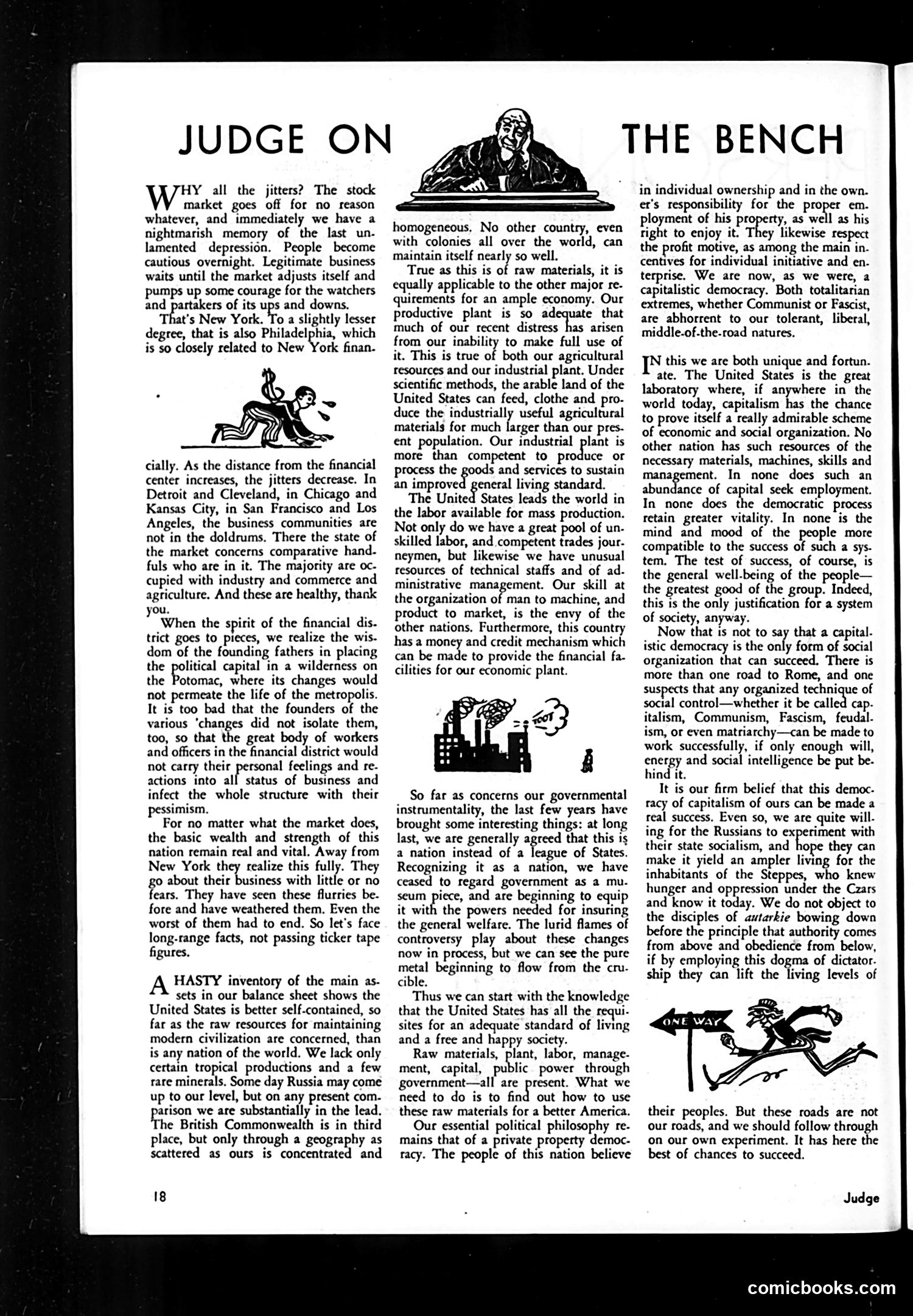
Analysis of "Judge On The Bench" This is a pro-capitalist editorial responding to stock market jitters and economic anxiety, likely from the 1930s era (post-1929 Crash). The author argues Americans shouldn't panic about market fluctuations because the nation's real wealth is fundamentally sound. The key points: (1) Financial district anxiety doesn't reflect conditions in productive regions (Detroit, Chicago, San Francisco), where industry, commerce, and agriculture remain healthy; (2) The U.S. possesses unmatched natural resources, industrial capacity, and labor; (3) Wisdom of the Founding Fathers in placing the capital away from Wall Street—so financial panic shouldn't infect national governance. The message is essentially: ignore ticker-tape pessimism and trust America's underlying economic strength. The satirical target appears to be nervous New York financiers whose emotional volatility disproportionately influences public confidence, despite the nation's genuine productive capacity remaining intact.
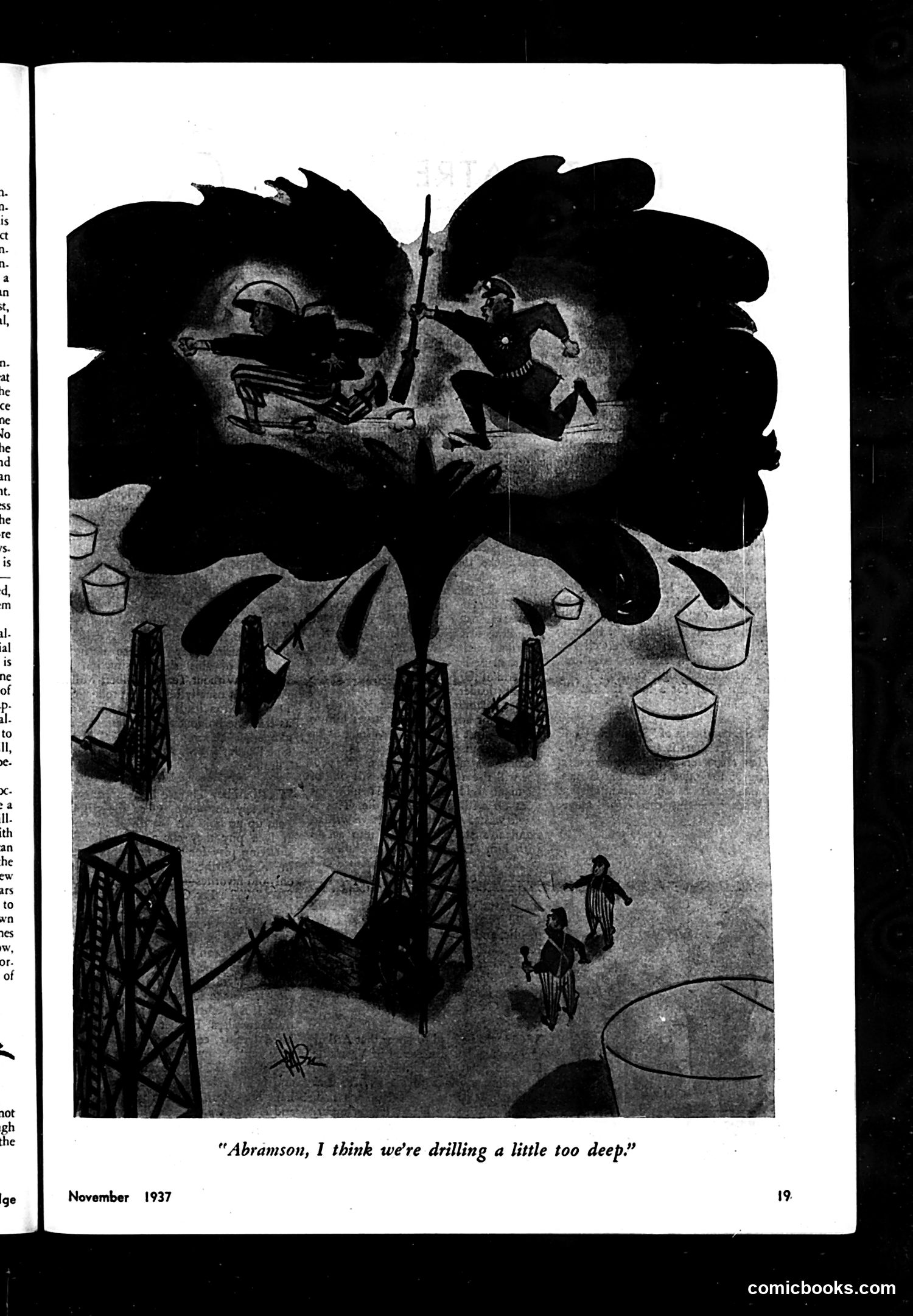
Political Cartoon Analysis This November 1937 cartoon satirizes oil industry overreach during the Great Depression era. The silhouetted figures in the upper portion appear to represent wealthy oil magnates or corporate executives, their enlarged heads suggesting greed or inflated egos. Below, workers operate oil derricks in an industrial landscape, with buckets scattered about—likely symbolizing modest resources or meager wages. The caption's warning—"I think we're drilling a little too deep"—suggests corporate exploitation is unsustainable and dangerous. The "Abramson" reference is unclear without additional context, but the cartoon critiques how oil companies extracted wealth from workers and natural resources without regard for consequences. This reflects 1937 anxieties about corporate power, labor exploitation, and environmental or economic recklessness during the Depression.
"The Theatre" - Judge Magazine Drama Review This is a theater criticism column reviewing Broadway productions. The critic discusses three shows: 1. "Star Wagon" by Maxwell Anderson—a comedy about a man who imagines revisiting his past to undo his marriage and career choices, only to realize he wouldn't change anything. The piece satirizes middle-class regret and nostalgia. 2. "Susan and God" starring Gertrude Lawrence—mocks a shallow woman who uses fashionable religion (the Oxford Movement) as social performance rather than genuine faith, until she discovers authentic purpose through family responsibility. 3. "To Quito and Back" by Ben Hecht—critiques an intellectual writer who can handle fiction brilliantly but fails at real-world choices, ultimately dying pointlessly in revolution. The critic suggests this tragic waste would've been better handled by a poet. The illustrations (two small theatrical sketches) are decorative. The column's tone is sophisticated theater criticism for educated readers interested in Broadway's intellectual and moral content.
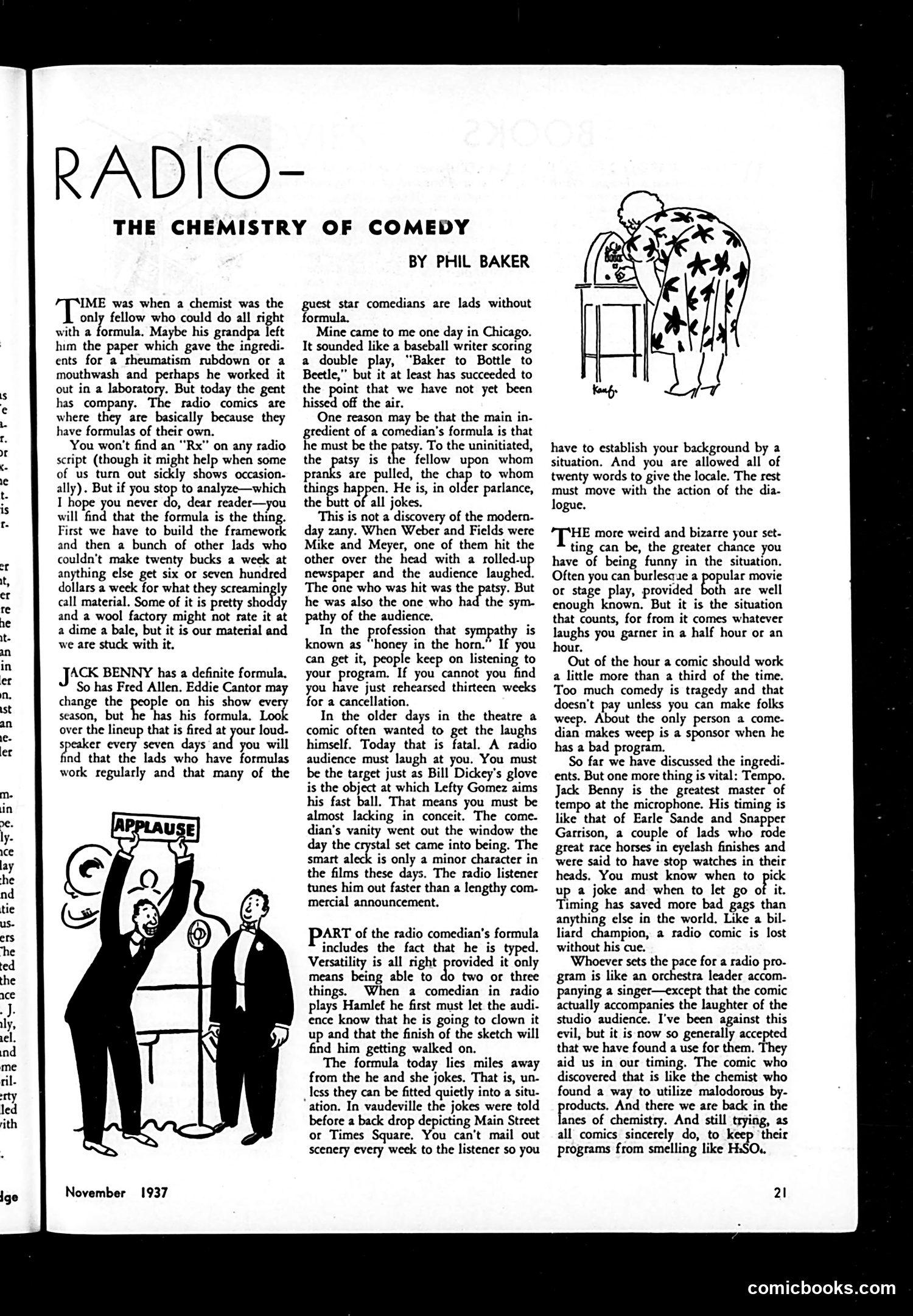
"The Chemistry of Comedy" by Phil Baker (November 1937) This article analyzes radio comedy formulas of the 1930s. Baker, himself a radio comedian, explains that successful radio comics—Jack Benny, Fred Allen, Eddie Cantor—succeed because they follow consistent formulas, unlike unsuccessful guest stars. The key formula element: the comedian must be the "patsy" (the butt of jokes) to win audience sympathy, what professionals call "honey in the horn." Baker references vaudeville precedent: Weber and Fields, where one character gets hit but gains audience sympathy. Unlike stage comedy where comics sought laughs for themselves, radio requires the performer to be the *target*—the audience laughs *at* them. The accompanying cartoons (showing an "Applause" sign and a radio setup) humorously illustrate this dynamic. Baker argues modern radio comedy abandons old "he and she jokes" for situation-based humor, since radio lacks visual scenery. Timing and versatility matter less than establishing character through dialogue and situation.
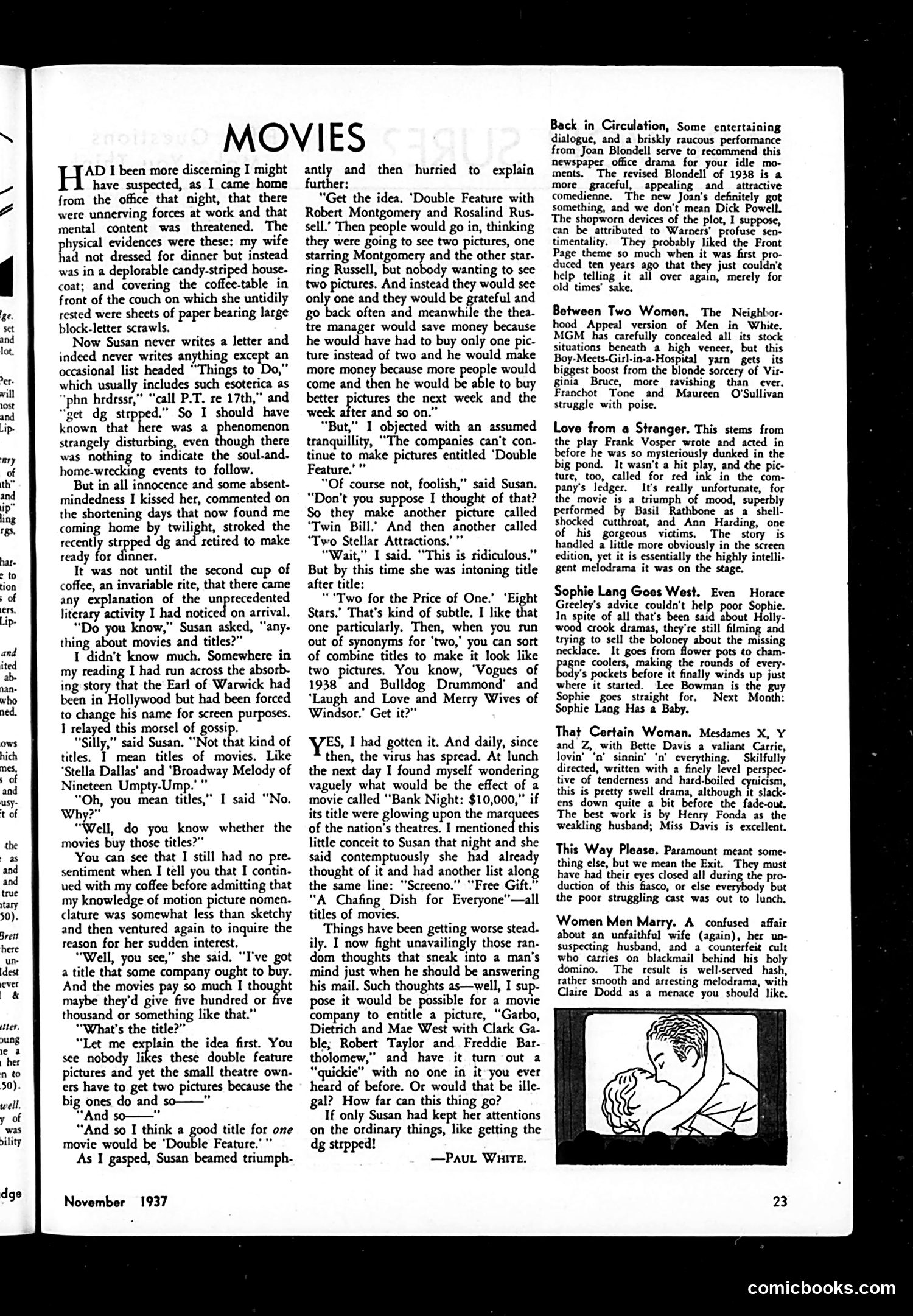
"Movies" by Paul White — November 1937 This satirical piece mocks Hollywood's marketing schemes during the Depression era. The narrator's wife Susan has conceived a scheme to solve the "double feature" problem: theaters were forced to show two films to compete with larger cinemas, but audiences resented it. Her "brilliant" solution is to market a single film under deceptive titles like "Double Feature," "Twin Bill," or "Two Stellar Attractions"—tricking patrons into thinking they're getting two movies. The satire targets both studio executives' cynicism and consumers' gullibility. By pretending a single picture is actually two, studios could save production costs while charging full admission. The joke exposes how Hollywood manipulates audiences through false advertising and creative titling—a practice the author suggests is already endemic to the industry. The cartoon ridicules post-Depression-era economic desperation masquerading as entertainment innovation.
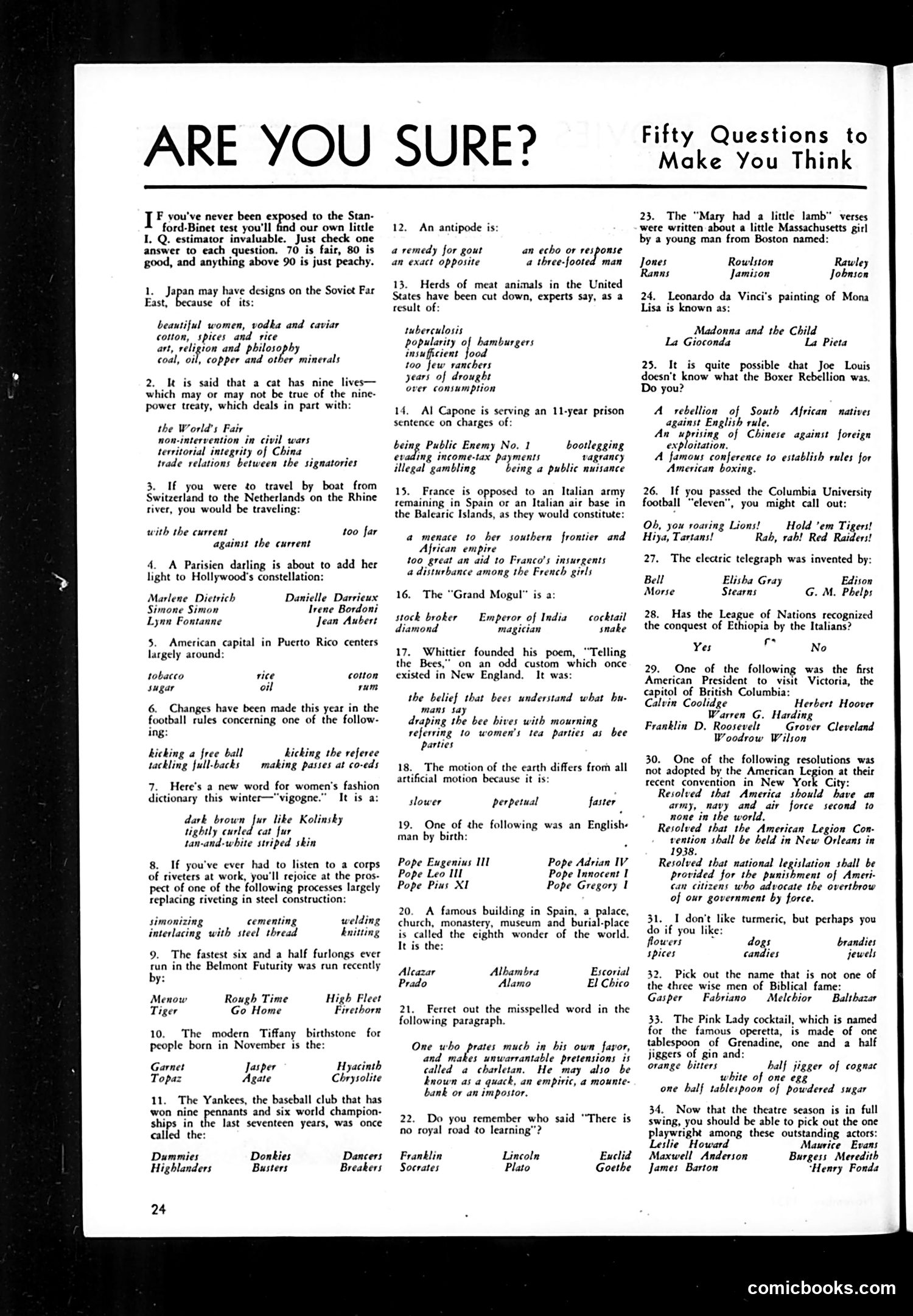
"Are You Sure?" - A 1930s Intelligence Test This page presents a mock "Stanford-Binet test" — a reference to the real IQ testing system gaining popularity in the 1930s. Judge magazine satirizes contemporary knowledge by presenting fifty trivia questions spanning politics, sports, entertainment, and culture. The satire targets educated readers' assumptions about their own intelligence. Questions range from serious (Al Capone's charges, French-Italian tensions in Spain) to absurd (whether a cat's nine lives parallel the Nine-Power Treaty), mixing genuine current events with nonsense. The scoring system (70 fair, 80 good, 90+ "peachy") mocks the era's faith in quantifying intelligence. References include Hollywood stars, the Yankees, recent football rule changes, and contemporary fashion—anchoring the test firmly in 1930s America. The joke invites readers to test themselves while suggesting that "intelligence" testing itself is somewhat ridiculous.
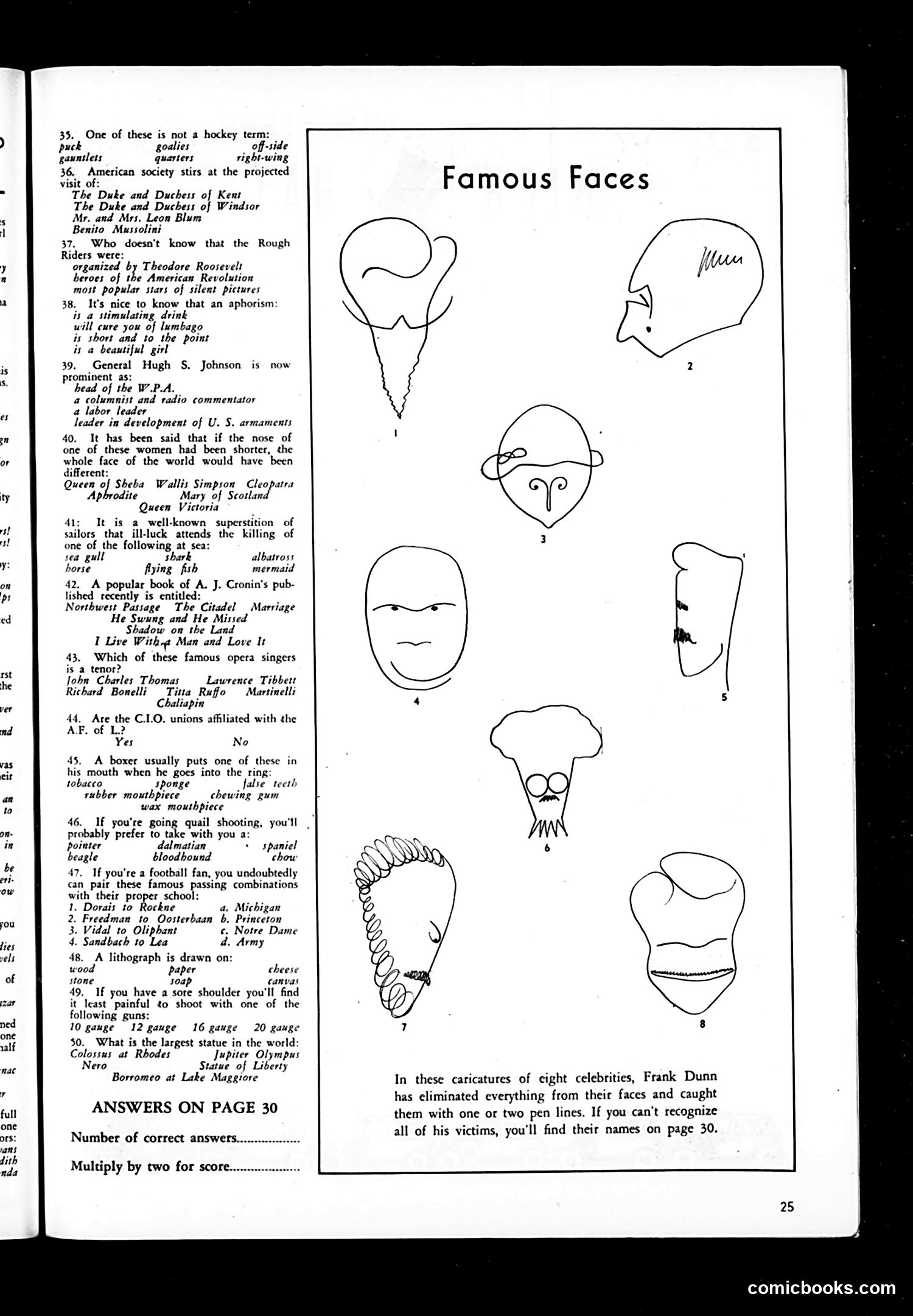
Famous Faces Caricature Quiz This page from *Judge* magazine presents a trivia quiz alongside a celebrity caricature challenge. The left side contains 16 multiple-choice questions testing readers' knowledge of contemporary (1930s) American culture—politics, sports, entertainment, and general facts. The right side features Frank Dunn's minimalist caricatures: eight simplified pen-line drawings of famous people, numbered 1-8. Readers are challenged to identify these celebrities from just essential facial features. The caption notes that answers appear on page 30. This combines two popular magazine features: the trivia quiz (testing readers' cultural literacy) and the caricature game (testing visual recognition). The minimalist artistic approach—reducing famous faces to their most distinctive features—was a sophisticated drawing technique that demonstrated both the artist's skill and readers' familiarity with public figures of the era.
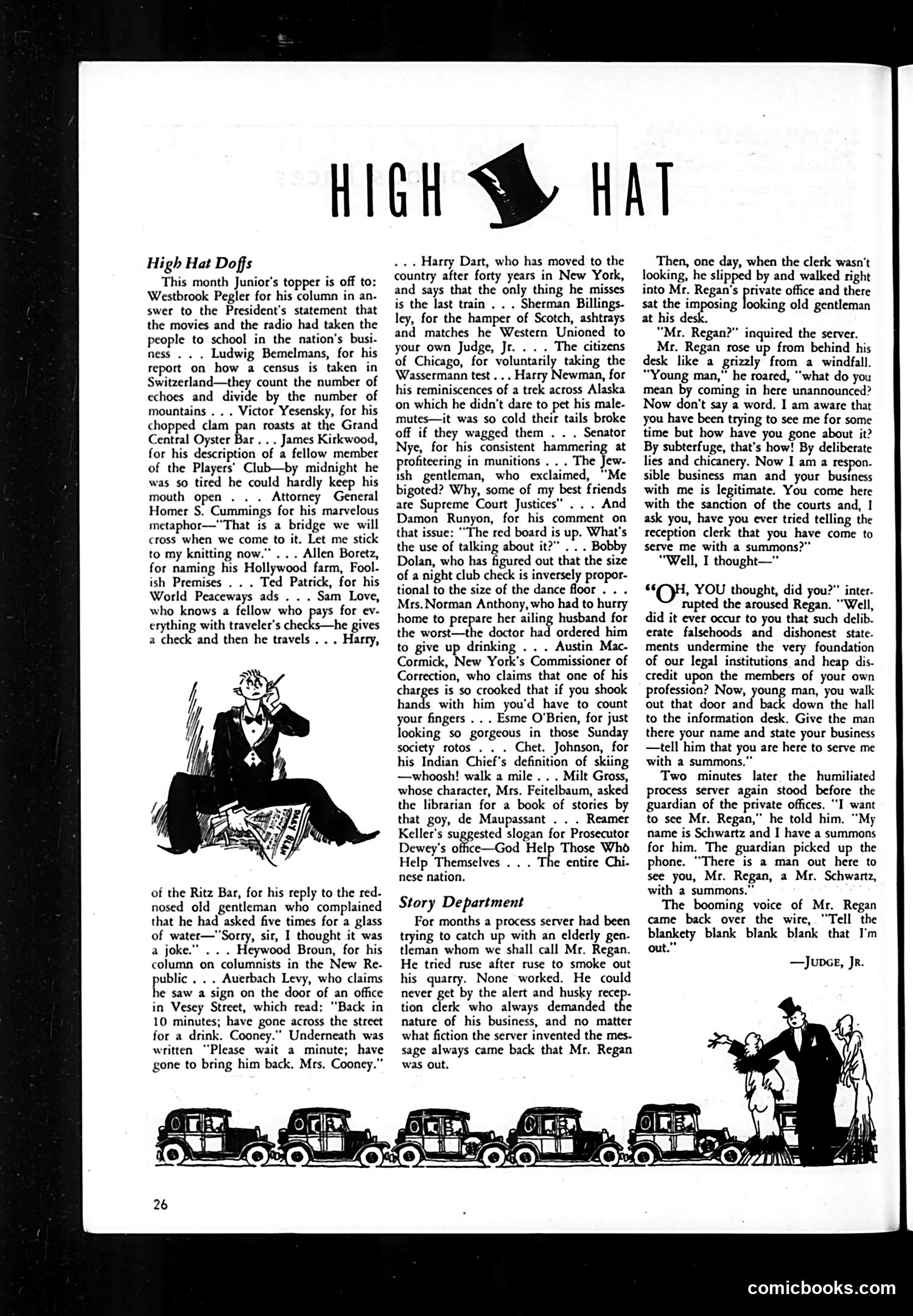
HIGH HAT DOFFS This page presents Judge magazine's monthly "High Hat Doffs"—a satirical tribute column saluting public figures, entertainers, and personalities of the era for amusing or noteworthy acts. The references span 1930s-40s American culture: Westbrook Pegler (newspaper columnist), Heywood Broun (literary critic), Attorney General Homer Cummings, and Senator Nye (likely referring to isolationist Gerald Nye). There are jokes about Prohibition-era drinking, a Wassermann test (syphilis screening), and stereotypical humor about Jewish and Chinese characters typical of that period. The "Story Department" below begins a humorous narrative about a process server attempting to serve an elderly gentleman named Mr. Regan with legal papers, foiled by an protective receptionist. The cartoons show era-appropriate illustrations of gentlemen in formal dress and a row of toy cars, supporting the lighthearted tone.
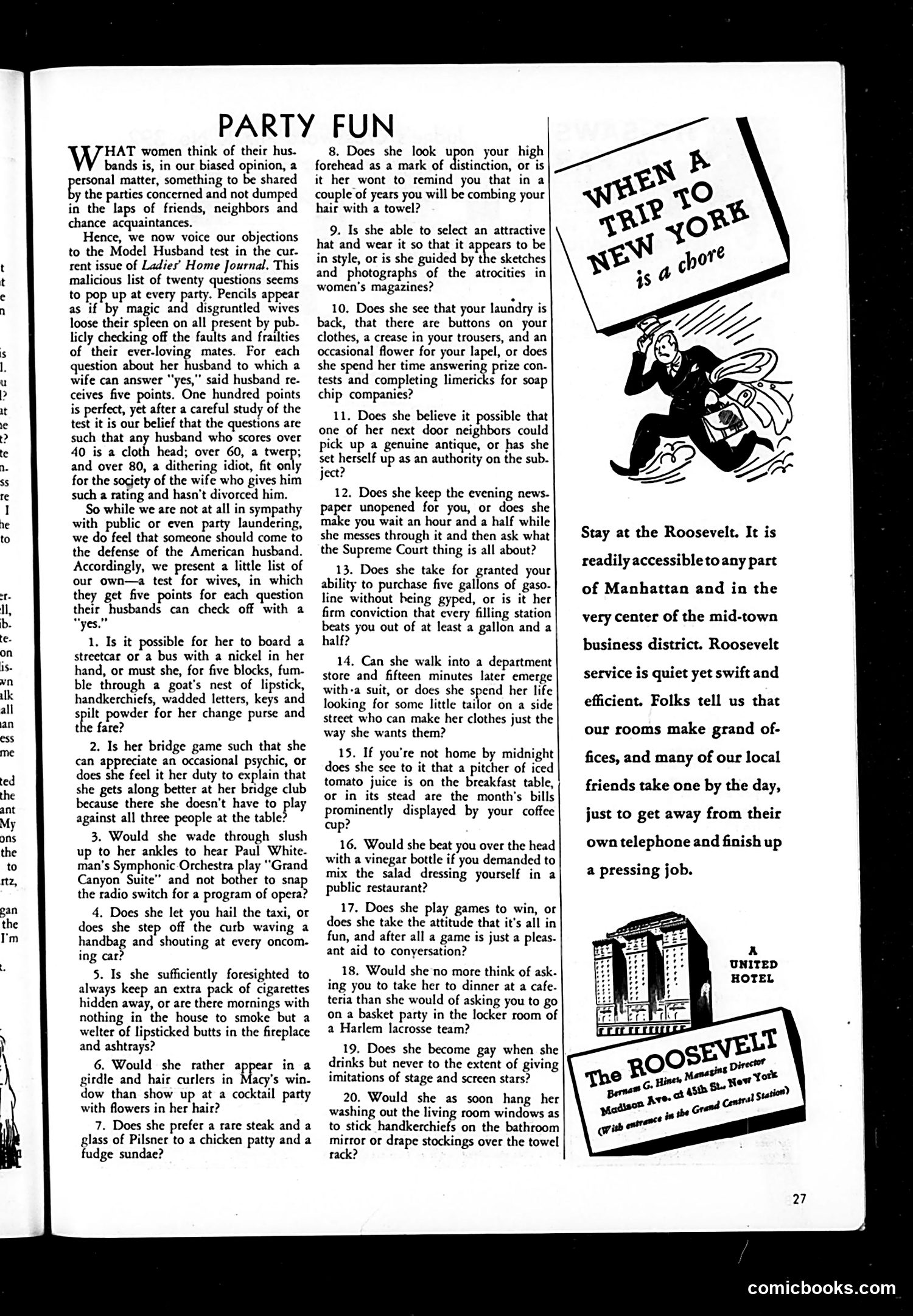
"Party Fun" - A Husband's Rebuttal Test This page presents Judge magazine's satirical response to a popular "Model Husband" quiz from *Ladies' Home Journal*. The editorial criticizes wives for publicly testing and criticizing their husbands at social gatherings, arguing this "party laundering" is unfair. In retaliation, Judge offers a 20-question "test for wives," scoring husbands' complaints about female behavior. The questions mock stereotypical wife behaviors: disorganization, poor bridge skills, fashion obsession, inability to hail taxis, forgetfulness about cigarettes and laundry, vanity about husbands' appearance, and domestic inefficiency. The satire cuts both ways—while defending husbands from public scrutiny, it simultaneously reinforces 1930s gender stereotypes about women's incompetence at practical tasks and social grace. The Roosevelt Hotel advertisement at right is unrelated commercial content.
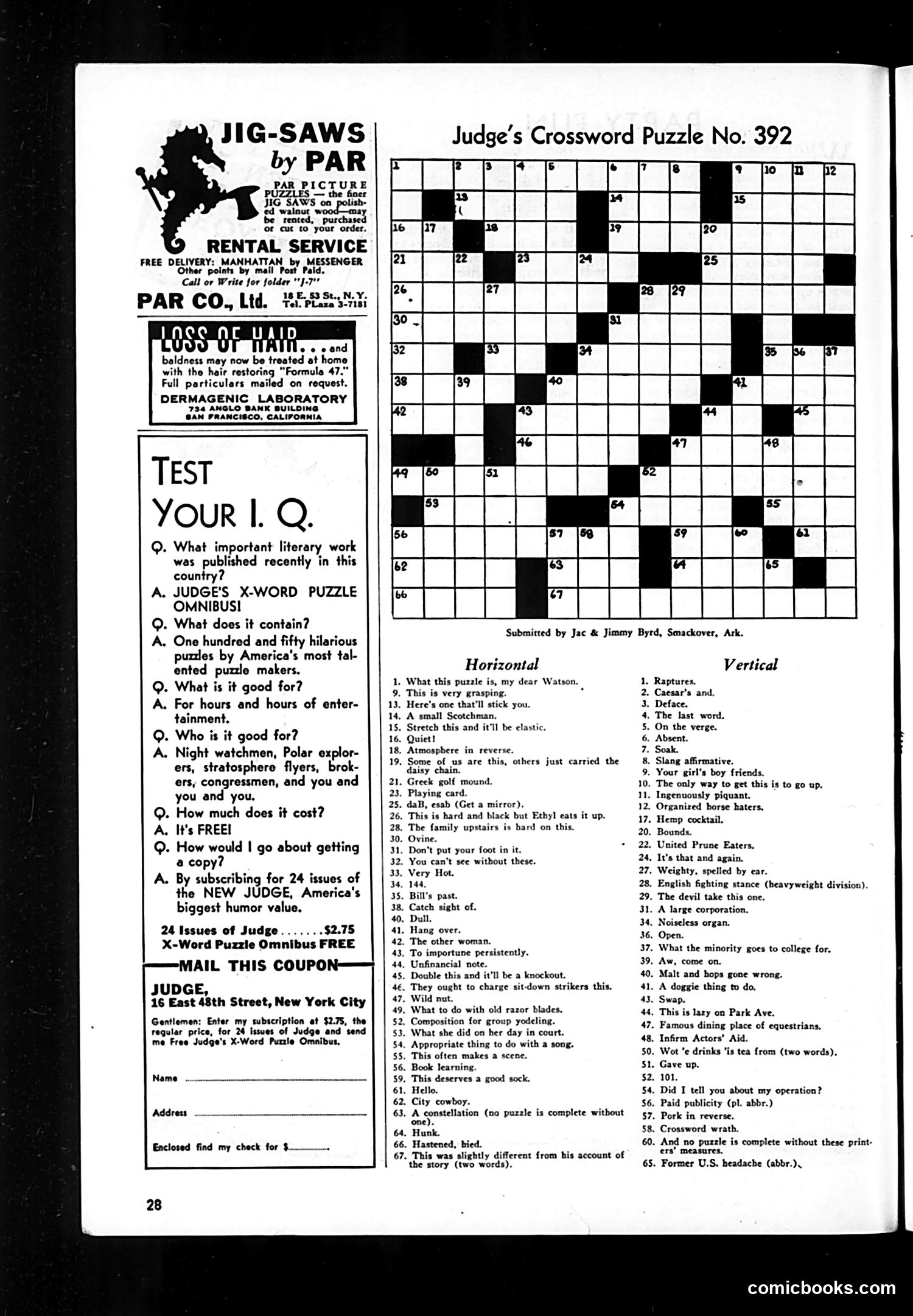
Judge Magazine Page Analysis This page is primarily advertising and a crossword puzzle, not political satire. It contains: 1. Ads for jig-saw puzzles (PAR CO.), hair restoration ("Formula 47"), and a subscription offer for Judge magazine's "X-Word Puzzle Omnibus" 2. A mock "IQ test" that humorously answers "What important literary work was published recently?" with "Judge's X-Word Puzzle Omnibus"—self-promotional satire of the magazine itself 3. Crossword Puzzle No. 392, submitted by readers from Arkansas The page's humor is self-referential and light: Judge magazine jokes about its own crossword puzzles being worthy of intellectual attention, appeals to diverse readers (night watchmen, congressmen, explorers), and offers a free puzzle book with subscription. This reflects Judge's identity as a humor publication selling entertainment during what appears to be the Depression era (the "it's FREE!" emphasis suggests economic hard times).
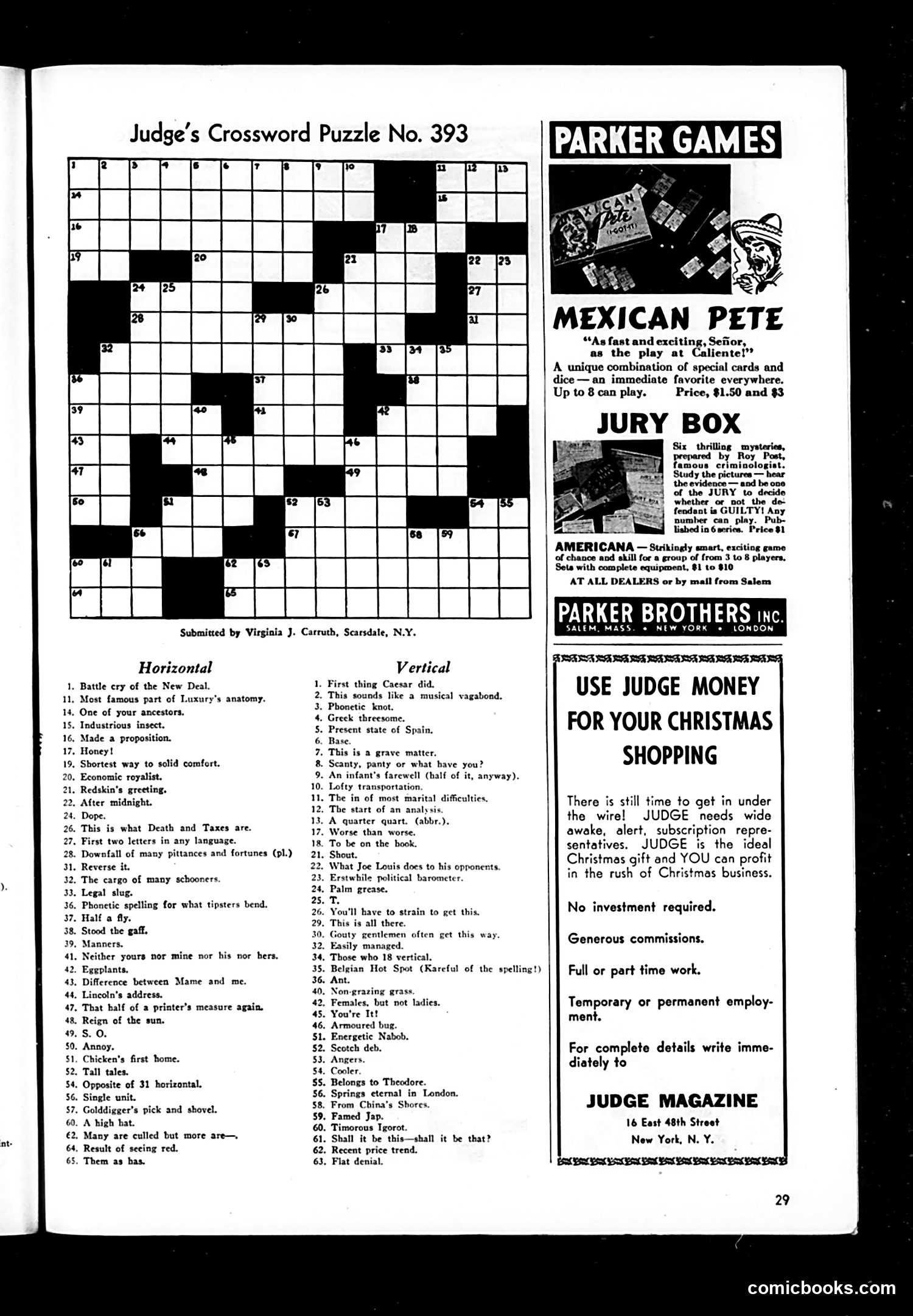
Judge Magazine Page 393 Analysis This page is primarily a crossword puzzle with accompanying advertisements—not a political cartoon. The puzzle itself contains satirical clues referencing 1930s American culture and politics. Notable clues reflect the era's concerns: "Battle cry of the New Deal" (horizontal 1), "Economic royalist" (horizontal 6), and "Joe Louis does to his opponents" (vertical 22, referencing the famous boxer). References to "Caliente" (a Mexican gambling resort) and "Theodore" (likely Theodore Roosevelt) anchor the puzzle in contemporary topics. The surrounding advertisements promote Parker Brothers games ("Mexican Pete," "Jury Box," "Americana") and a recruitment pitch for Judge magazine subscription representatives, emphasizing "no investment required" and "generous commissions"—typical Depression-era employment appeals. The puzzle reflects Judge's satirical approach by embedding topical humor within wordplay rather than through illustrated cartoons, making it accessible to readers while commenting on New Deal politics and popular culture.
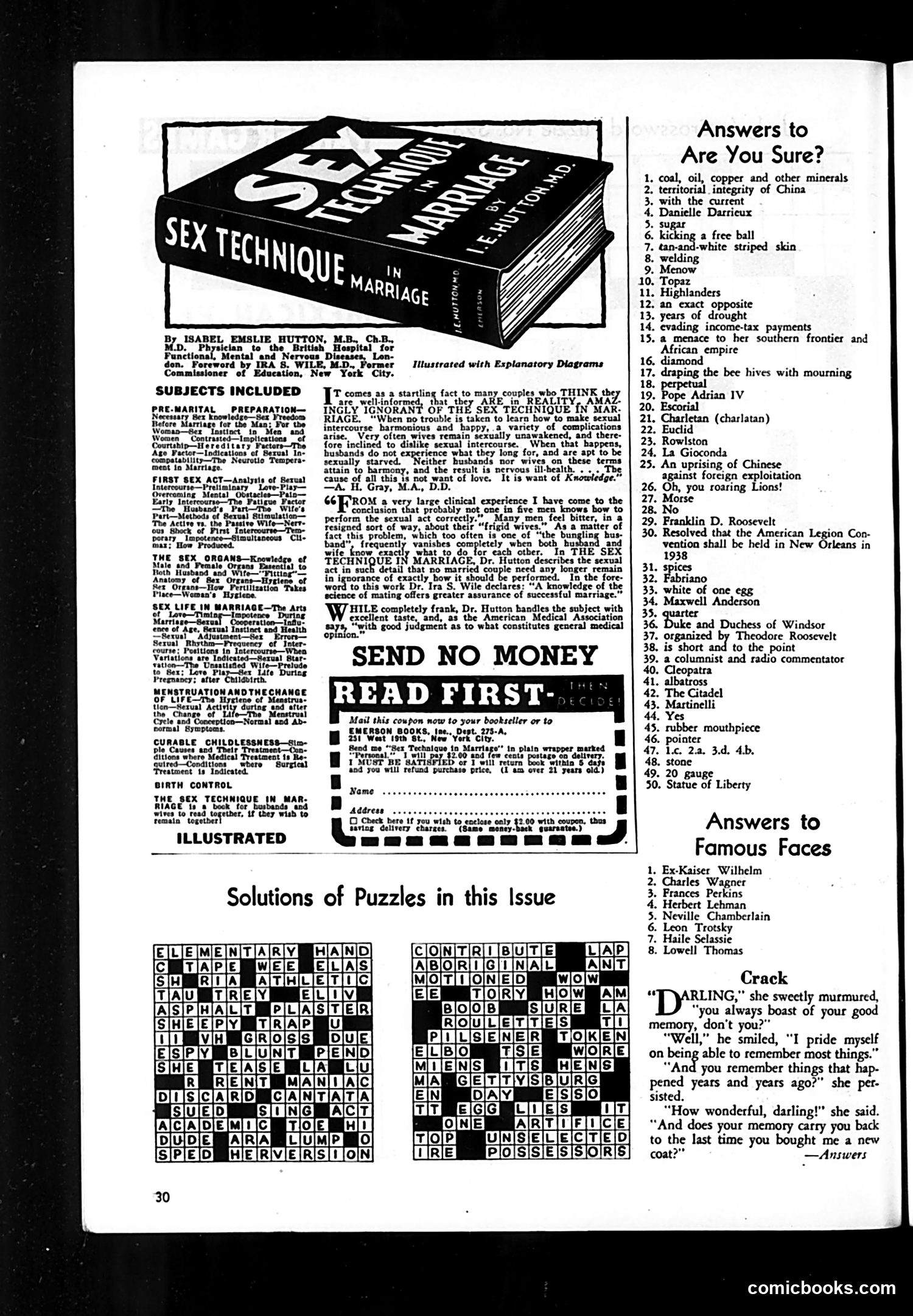
Content Analysis This page is primarily a book advertisement for "Sex Technique in Marriage" by Dr. Isabel Emslie Hutton, a physician. The ad emphasizes the book's frank, educational approach to marital sexual relations—a notable topic for the era (appears to be 1930s-40s based on style). The advertisement targets couples by framing sexual ignorance as a widespread problem causing marital discord and "nervous ill-health." It includes testimonials from medical authorities claiming most men don't know proper "technique" and that many wives remain "sexually unawakened." The satire/context: This reflects early 20th-century anxieties about modernizing marriage through scientific/medical knowledge. The frank discussion of sexual mechanics was considered progressive but also somewhat risqué for mainstream publication—hence the cautious framing as "medical" and "educational." The page also contains puzzle solutions and answer keys unrelated to the advertisement. For modern readers: This represents a transitional moment when explicit sexual education began entering popular discourse under medical authority.
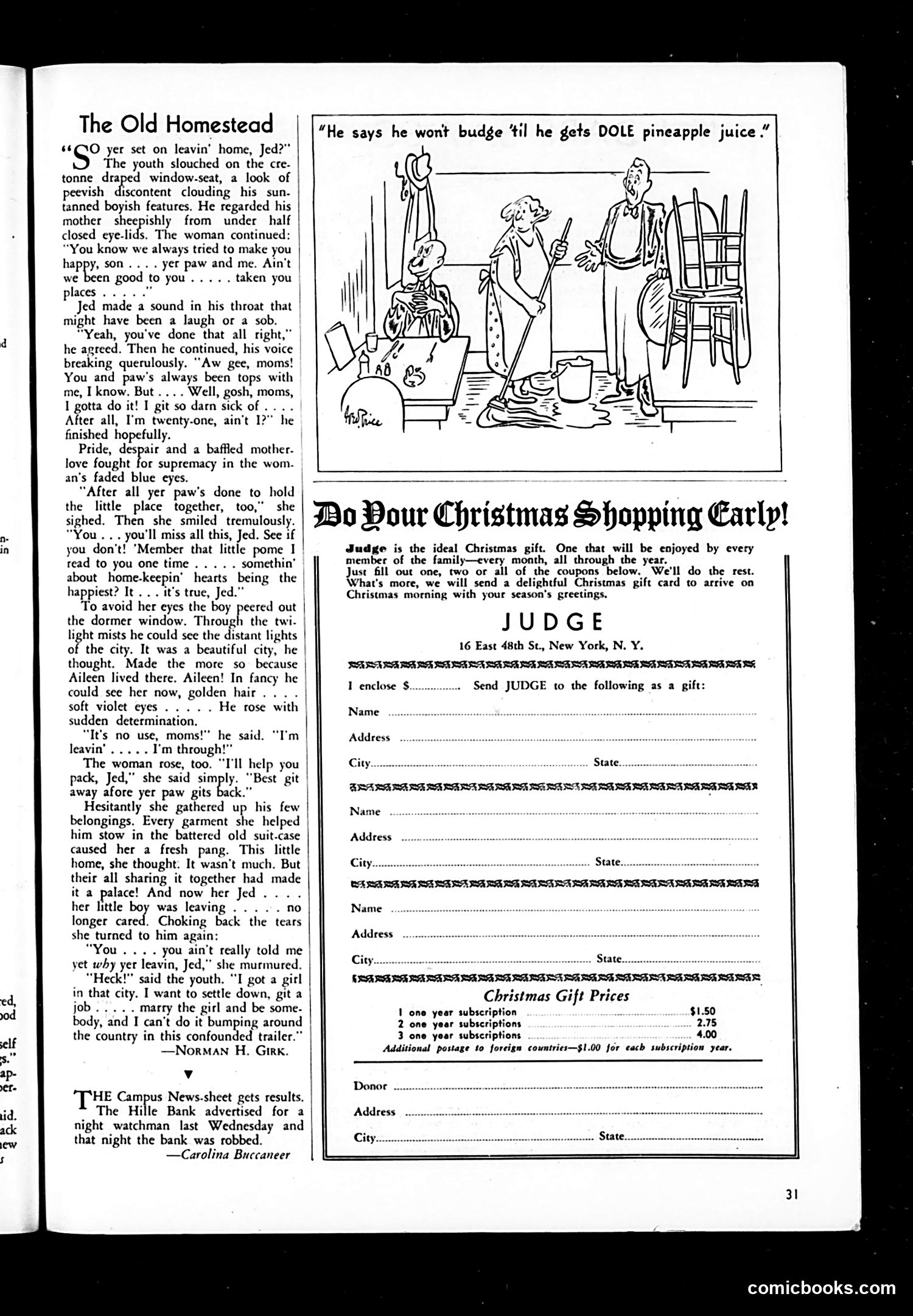
Analysis for Modern Readers This page contains two distinct elements: "The Old Homestead" Story: A sentimental narrative about a young man (Jed) leaving his rural family farm for the city, drawn by romantic aspirations and urban opportunity. The mother's emotional farewell represents a common early-20th-century American anxiety about rural depopulation and generational departure from agricultural life. The dialogue captures period dialect and values—duty to family versus personal ambition. The Cartoon (top right): Shows a domestic scene where a man refuses to move until obtaining "DOLE pineapple juice"—likely satirizing consumerism or specific brand loyalty as a humorous domestic complaint. "Do Your Christmas Shopping Early!": An advertisement for *Judge* magazine subscriptions as gifts, offering various pricing tiers ($1.50-$4.00). The page reflects 1920s-era concerns about urbanization, family bonds, and emerging consumer culture, wrapped in genteel sentimentality typical of the period's popular magazines.
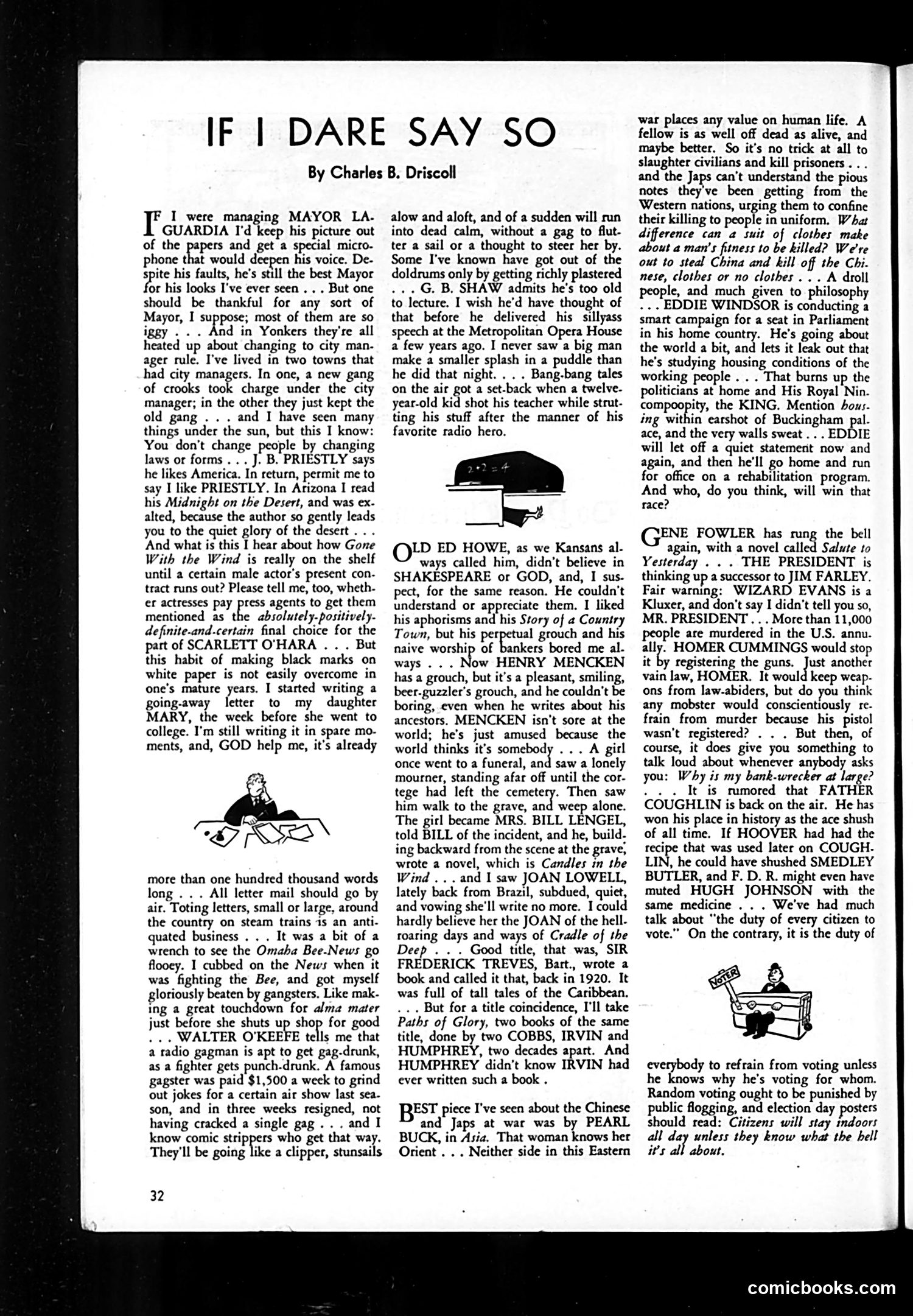
Analysis of Judge Magazine Page This is a satirical essay column by Charles B. Driscoll titled "If I Dare Say So," featuring gossip and commentary on public figures and social trends of the era. Key references: - Mayor LaGuardia: New York's famously short-statured but effective mayor, mocked for his appearance but acknowledged as competent - Gone with the Wind: The Hollywood film is apparently held up pending resolution of an actor's contract dispute - Scarlett O'Hara casting: The famous role's assignment was apparently uncertain or contested - Radio and entertainment industry: Criticisms of gagwriters, comic performers, and air-show humor writers who suffer creative burnout ("gag-drunk") - G.B. Shaw: The playwright gave an unsuccessful lecture at the Metropolitan Opera House - Ed Howe and H.L. Mencken: Regional American writers/philosophers discussed as examples of different personality types—the humorless grouch versus the amused cynic The tone is gossipy, urbane commentary on celebrity, media, and intellectual life. The cartoons (small illustrations visible) appear to be minor decorative elements rather than the main satirical content.
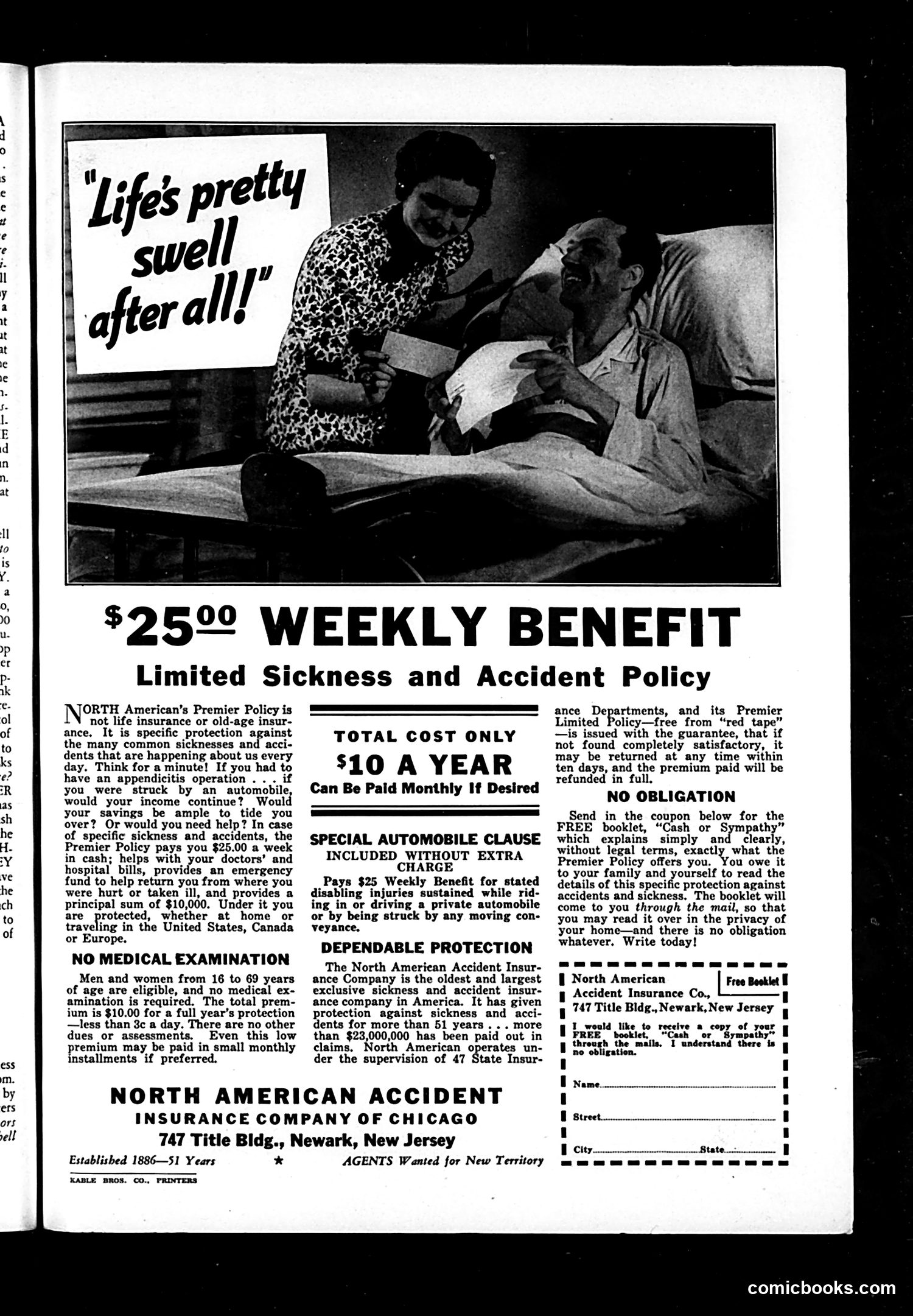
Analysis: North American Accident Insurance Advertisement This page is primarily a full-page insurance advertisement, not political satire. It promotes the North American Accident Insurance Company's "Premier Policy" offering $25 weekly benefits for sickness and accidents. The illustration shows a domestic scene: a woman attending to an injured or ill man in bed, with the caption "Life's pretty swell after all!" The image presents insurance as a solution to financial hardship from medical emergencies—suggesting that with this policy, families can weather illness without financial devastation. The ad emphasizes affordability ($10/year, no medical exam required, ages 16-69 eligible) and reliability (51 years in business, $23 million in claims paid). It targets working-class Americans anxious about medical costs and lost income from accidents. There is no political cartoon or satire here—this is a straightforward commercial pitch from the Depression or post-Depression era, when accident insurance was a significant consumer concern and purchasing decision.

Analysis of This Camel Cigarettes Advertisement This is not satire or political commentary—it's a straightforward cigarette advertisement disguised as editorial content, a common advertising practice of the era. The page features testimonials from celebrities and professionals (Helen Hicks, Sir Hubert Wilkins, Joselyn Libby, a ship's engineer) endorsing Camels as "the largest-selling cigarette in America." The appeal is to quality: Camels contain "costlier tobaccos"—Turkish and domestic blends—justifying their premium price. The framing device ("A question asked by many people") creates false authority, suggesting this answers widespread consumer curiosity rather than serving as paid promotion. Also advertised: the "New Camel Caravan," a radio variety show featuring Jack Oakie and Benny Goodman, representing Camel's broader brand marketing strategy. By modern standards, this represents pre-regulation tobacco advertising targeting specific demographics (professionals, athletes, women) without any health warnings—entirely legal then but prohibited today.