judge
Judge — December 1937
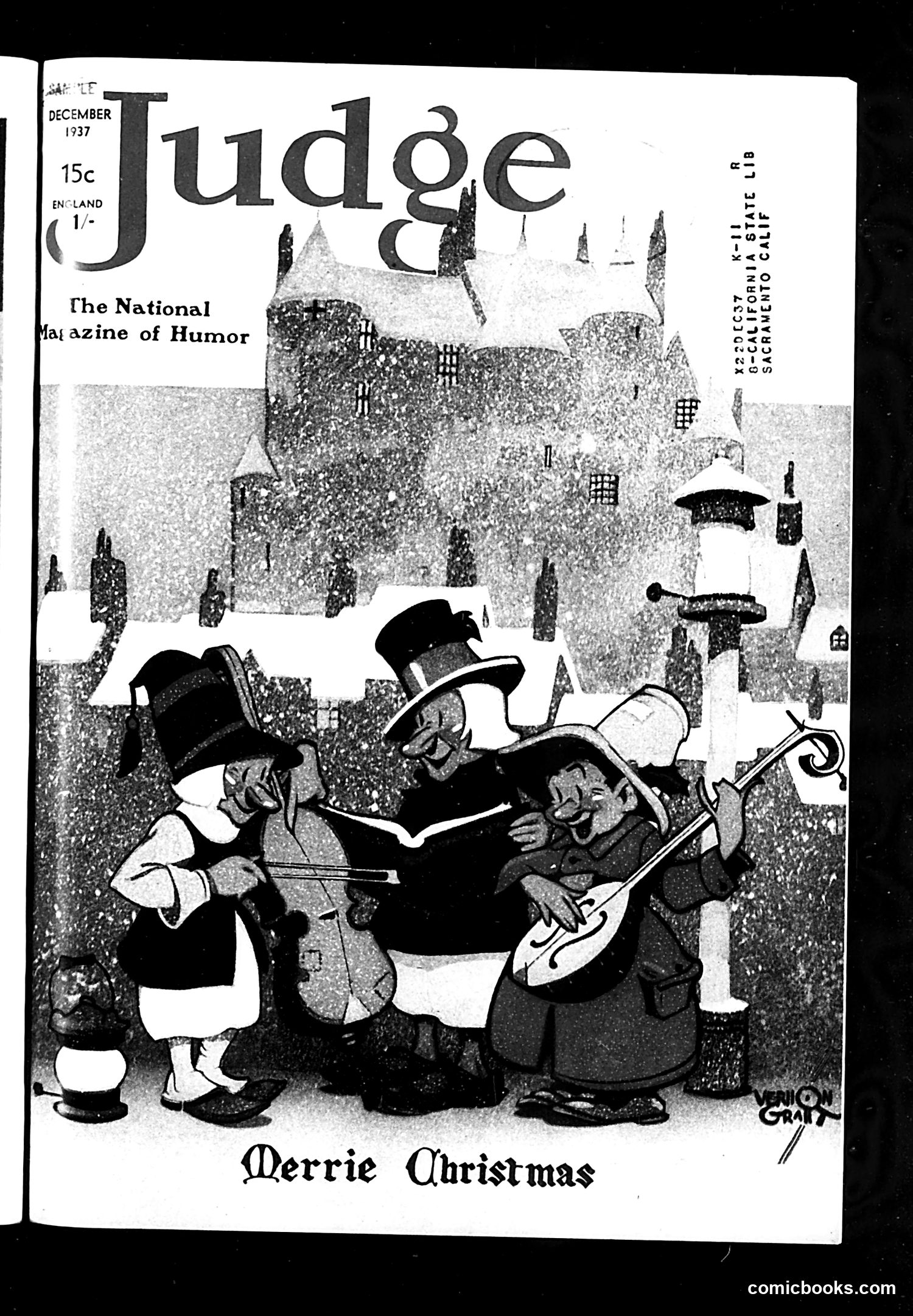
Judge Magazine Cover, December 1937 This is a Christmas-themed cover from Judge, "The National Magazine of Humor." The illustration shows four carolers in winter dress performing music outside a Gothic castle in a snowy landscape. Three figures play instruments (violin, cello, and what appears to be a lute or similar stringed instrument) while a fourth listens or participates. The "Merrie Christmas" caption and festive caroling scene suggest straightforward holiday humor rather than political satire. The exaggerated medieval/fairy-tale castle setting and the caricatured carolers' expressions appear designed for gentle, seasonal amusement—typical of Judge's satirical but family-friendly content from this era. No specific political figures or events are clearly referenced on this cover.
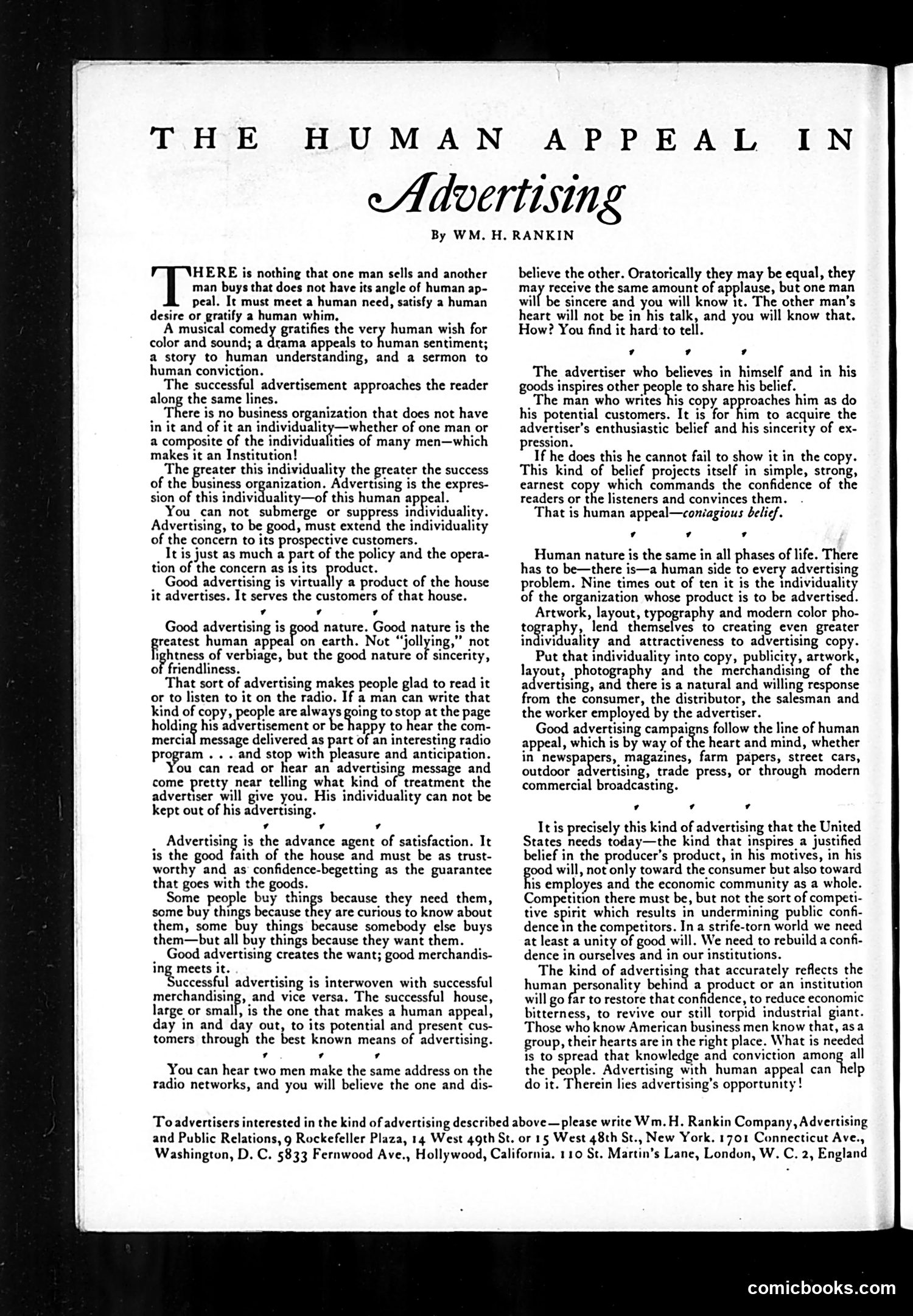
Content Analysis This page is not a cartoon or satire—it's a straightforward advertisement for W.M. H. Rankin Company's advertising and public relations services. The article argues that effective advertising must appeal to human nature and individuality. Rankin advocates for "contagious belief"—sincere, personality-driven marketing that builds consumer confidence. He emphasizes that good advertising should reflect the human character behind a product, and that the United States needs advertising rooted in genuine belief rather than "competitive spirit which results in undermining public confidence." The piece reads as earnest business philosophy about post-industrial American marketing strategy, with no satirical intent or political commentary. It's essentially a professional manifesto for mid-20th century advertising practice.
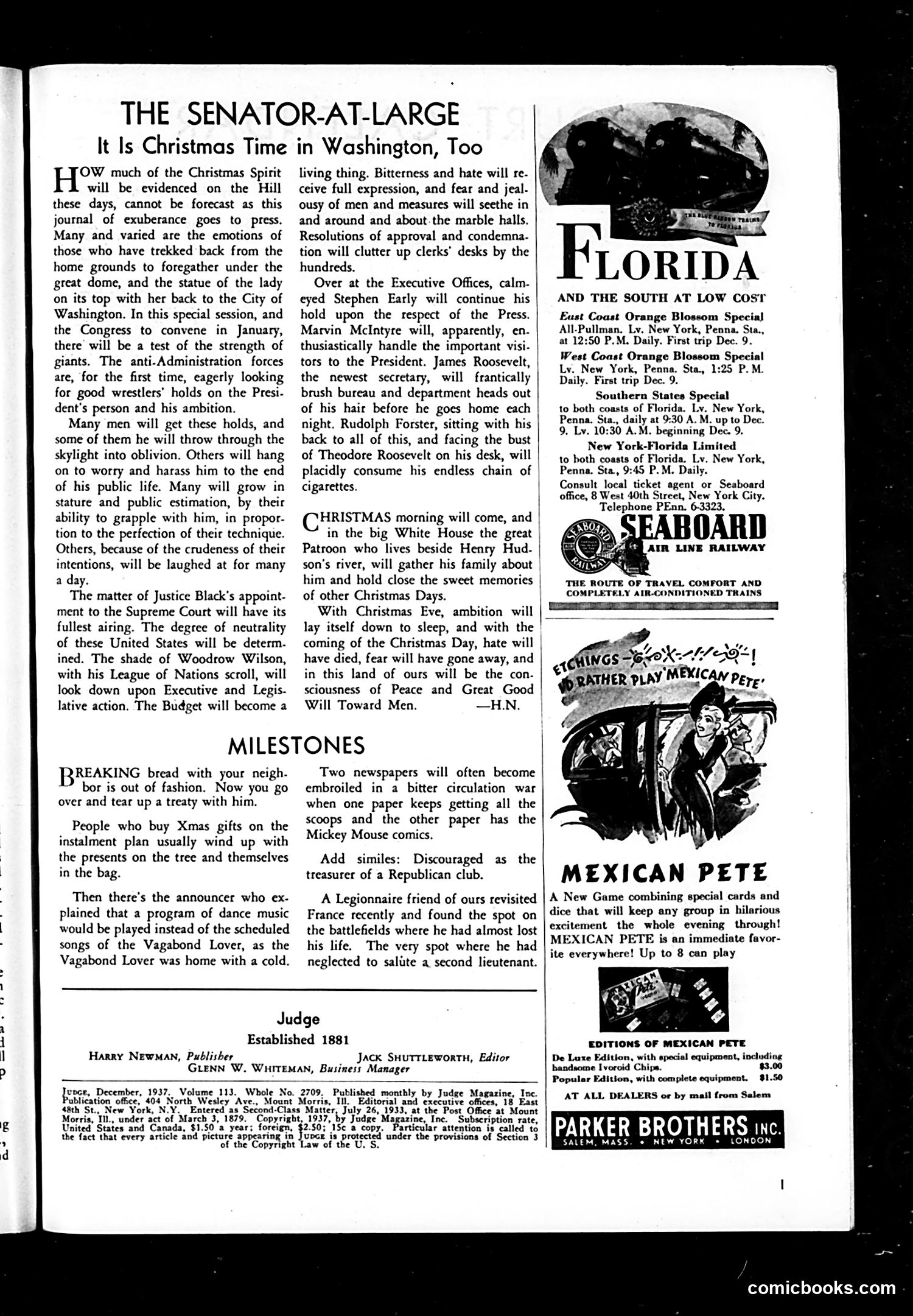
Analysis of Judge Magazine Page This page is primarily editorial and advertising content rather than political cartoons. The main article, "The Senator-at-Large: It Is Christmas Time in Washington, Too," discusses Christmas spirit in Washington D.C. during what appears to be a Congressional session, mentioning the appointment of Justice Black to the Supreme Court and commentary on various government officials. The only substantive cartoon is "Mexican Pete," advertised as a new game combining special cards and dice. It depicts a stereotypical Mexican character and appears to be a commercial advertisement rather than political satire. The rest of the page contains travel advertisements (Seaboard railroad, Florida tourism) and publishing information. Without a visible date, the specific political context remains unclear.
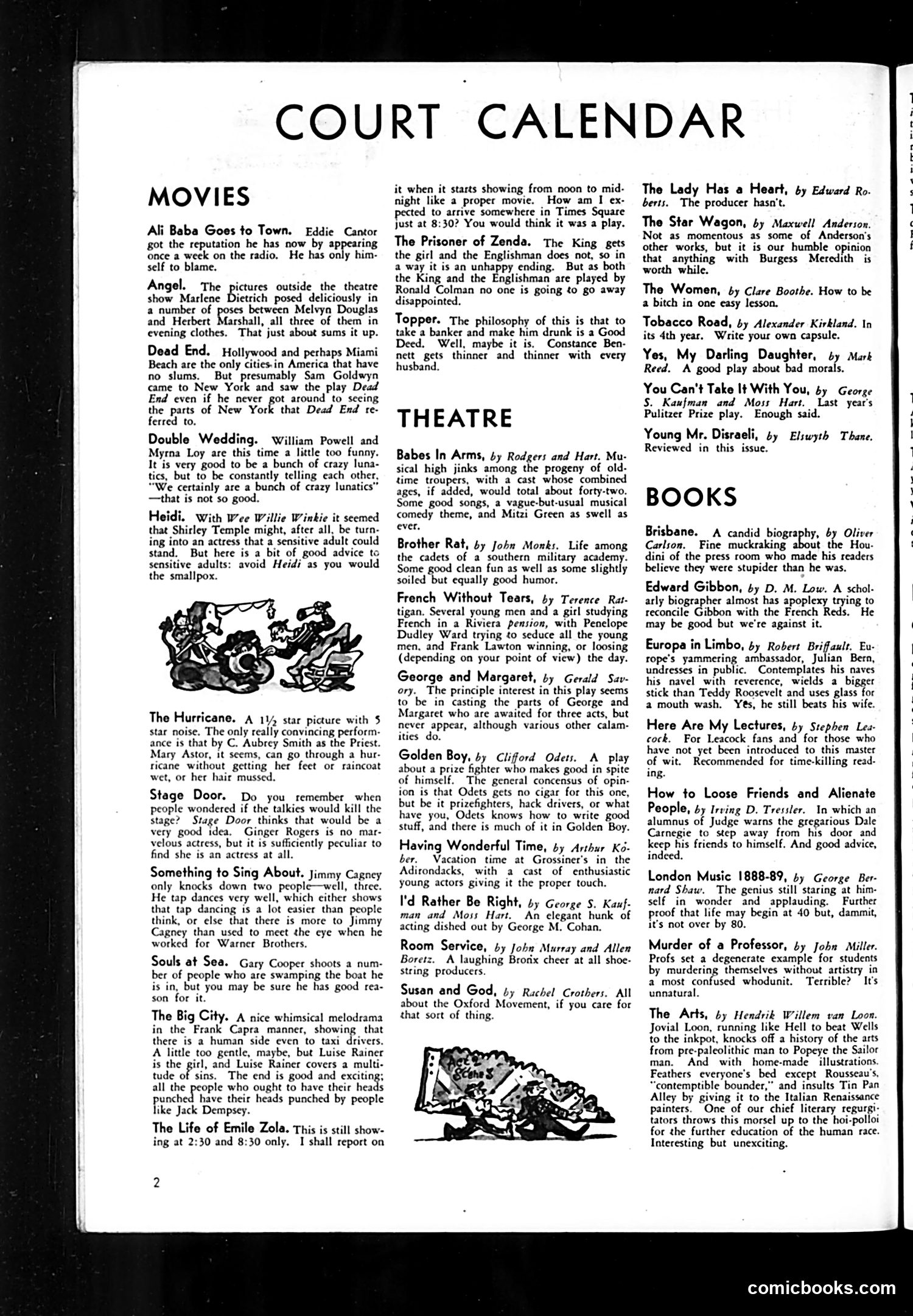
Court Calendar Page Analysis This page is primarily a entertainment and culture review section, not political satire. It contains reviews of movies, theatre productions, and books, typical of Judge magazine's lighter content. The visible cartoon illustration at the bottom appears to show a reclining or fallen figure in a sketchy style, but without clearer context from the surrounding text, its specific meaning is unclear. The reviews themselves offer period-appropriate critiques—praising performances, commenting on plot quality, and offering reading recommendations. References to actors like Eddie Cantor and William Powell ground this in early-to-mid 20th century entertainment. This is essentially a cultural entertainment guide rather than political commentary, representing Judge's broader editorial range beyond satire.
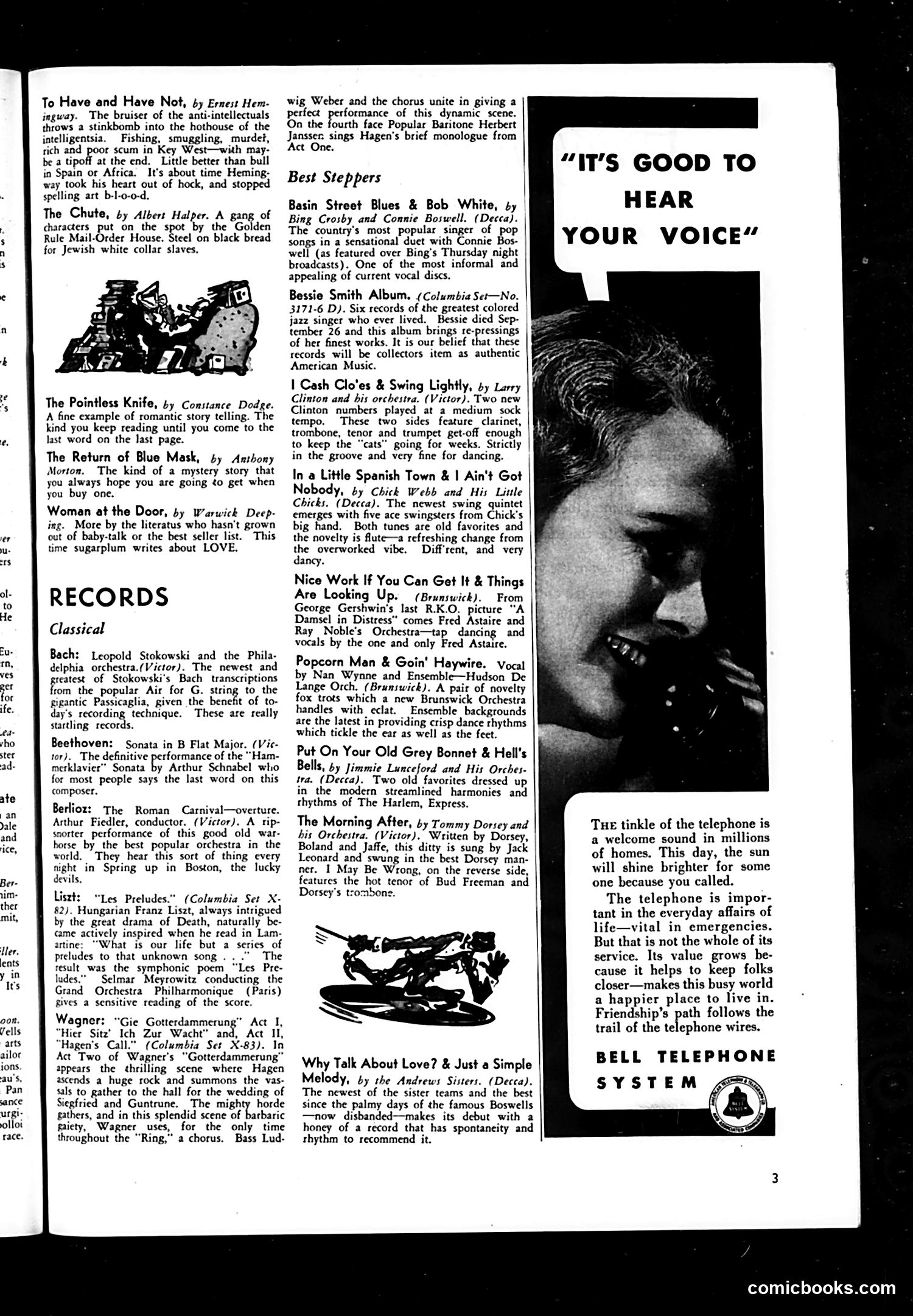
Page Analysis This page is primarily record reviews and advertisements rather than political satire or cartoons. The content includes classical and popular music reviews (Bach, Beethoven, Wagner, and contemporary jazz/swing recordings). There are two small illustrations: one showing a couple dancing or embracing, and another depicting someone reclining. The largest element is a Bell Telephone System advertisement with the slogan "It's Good to Hear Your Voice," emphasizing the telephone's role in maintaining relationships and handling emergencies. The ad uses sentimental messaging typical of 1930s-40s corporate advertising, positioning the telephone as essential to modern life and friendship. No political satire or recognizable caricatures are present on this page. The content reflects Judge magazine's shift toward entertainment and advertising rather than political commentary.
Content Analysis This page is primarily an advertisement, not satirical content. It's a 1937 insurance marketing piece from Union Central Life Insurance Company promoting their "Family-needs Forecast" service. The ad targets fathers by emphasizing their responsibility for their family's financial security after death. It lists "seven separate needs" a widow and children would face, positioning life insurance as the solution. The small coupon section at bottom includes company officers' names and a mail-in form. No political cartoon or satire is present. This is straightforward 1930s-era insurance marketing that appeals to masculine duty and family protection—typical advertising strategy from that era before modern consumer protection regulations. The "Judge" magazine apparently carried substantial paid advertising alongside its satirical content.
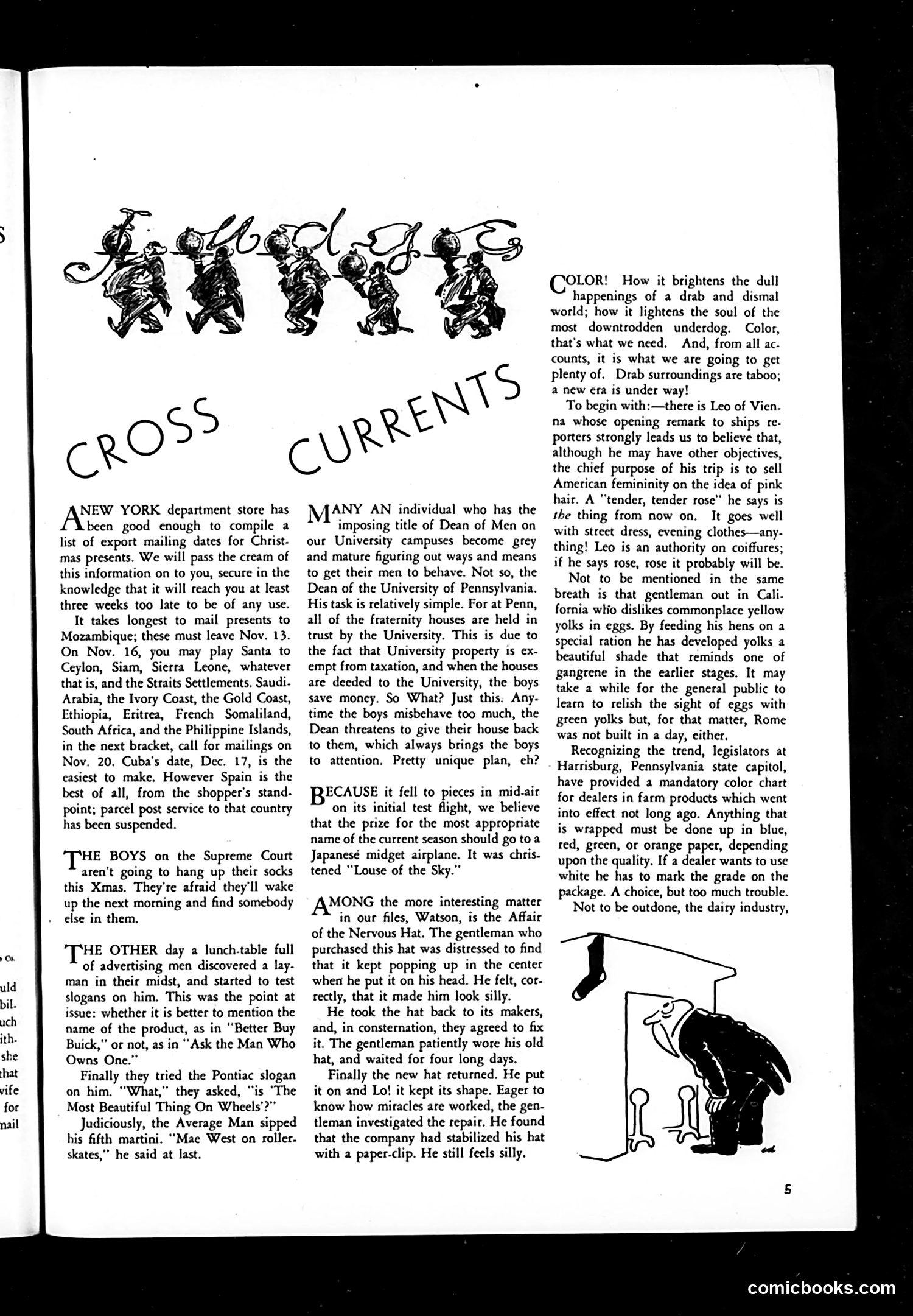
"Cross Currents" - Judge Magazine Page This page contains three brief satirical items about American life, plus advertisements disguised as editorial content. The main humor targets include: 1. University of Pennsylvania fraternity houses: The Dean threatens to reclaim university-owned fraternity properties if boys misbehave—satirizing administrative control and student behavior. 2. A "Nervous Hat" anecdote: A gentleman's hat keeps popping up in the center when worn. The manufacturer attempts fixes but ultimately stabilizes it with a paper clip—absurdist humor about poor product design. 3. Car slogans: The piece mocks competing automobile advertising claims ("Better Buy Buick" vs. "Ask the Man Who Owns One" vs. "The Most Beautiful Thing On Wheels"), suggesting advertising absurdity. The cartoon at top depicts caricatured figures, though their specific identities are unclear from context alone.
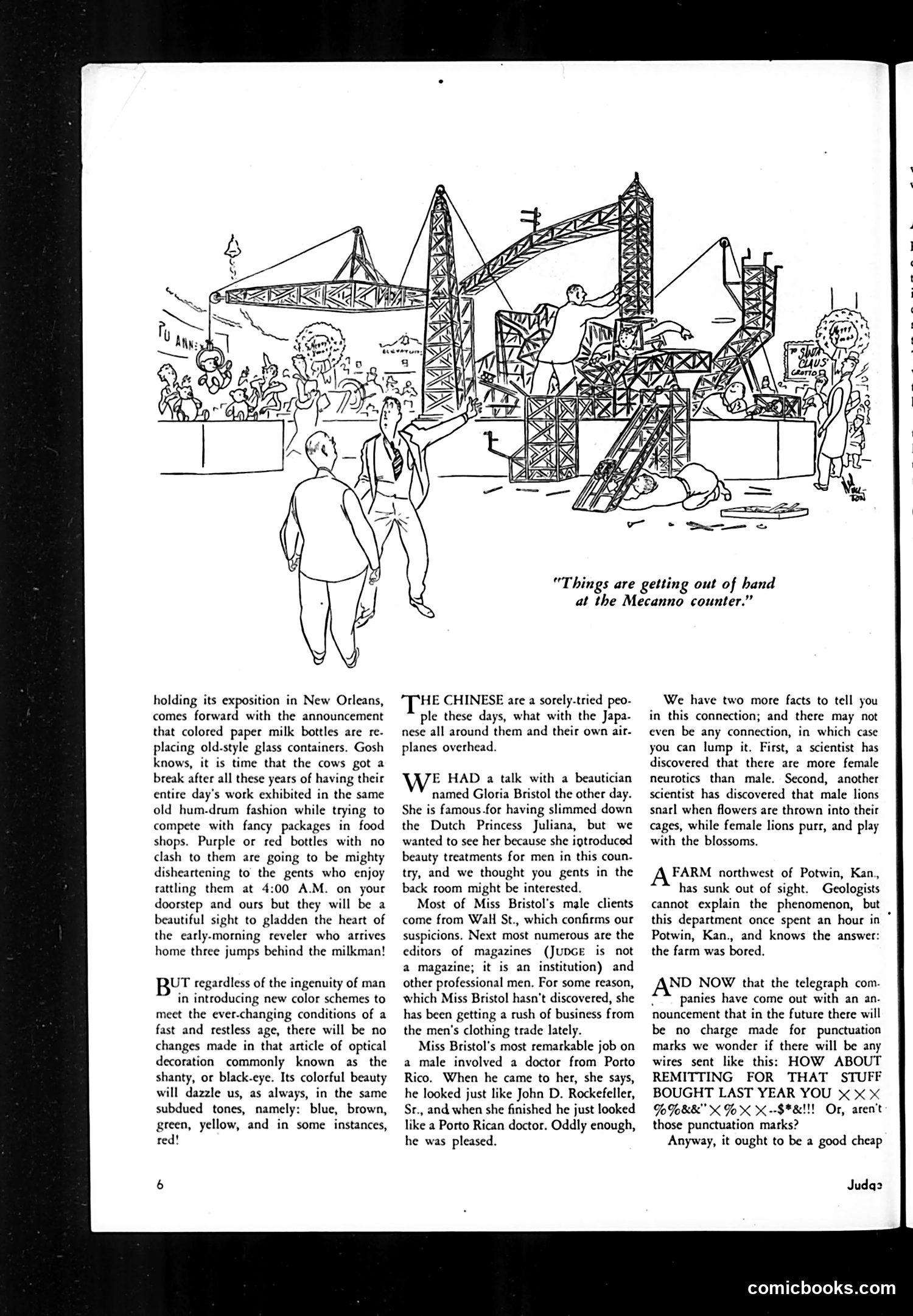
Analysis The main cartoon depicts an elaborate construction site or exposition with steel framework and crowds. The caption reads: "Things are getting out of hand at the Mecanno counter." What this means: Mecanno was a popular construction toy system (metal girders, pulleys, etc.). The joke is that a toy display or counter has spiraled into actual, massive industrial construction—the toy has "gotten out of hand" and become real-scale infrastructure. This is visual satire on consumerism or childhood play run amok. The article text below discusses various social topics: Chinese immigration concerns, a beautician named Gloria Bristol, male neurosis (more females than males), and a boring farm near Potwin, Kansas. The final section jokes about punctuation marks in correspondence. Context: This appears to be typical Judge magazine content mixing visual satire with gossipy commentary on contemporary American social trends and absurdities.
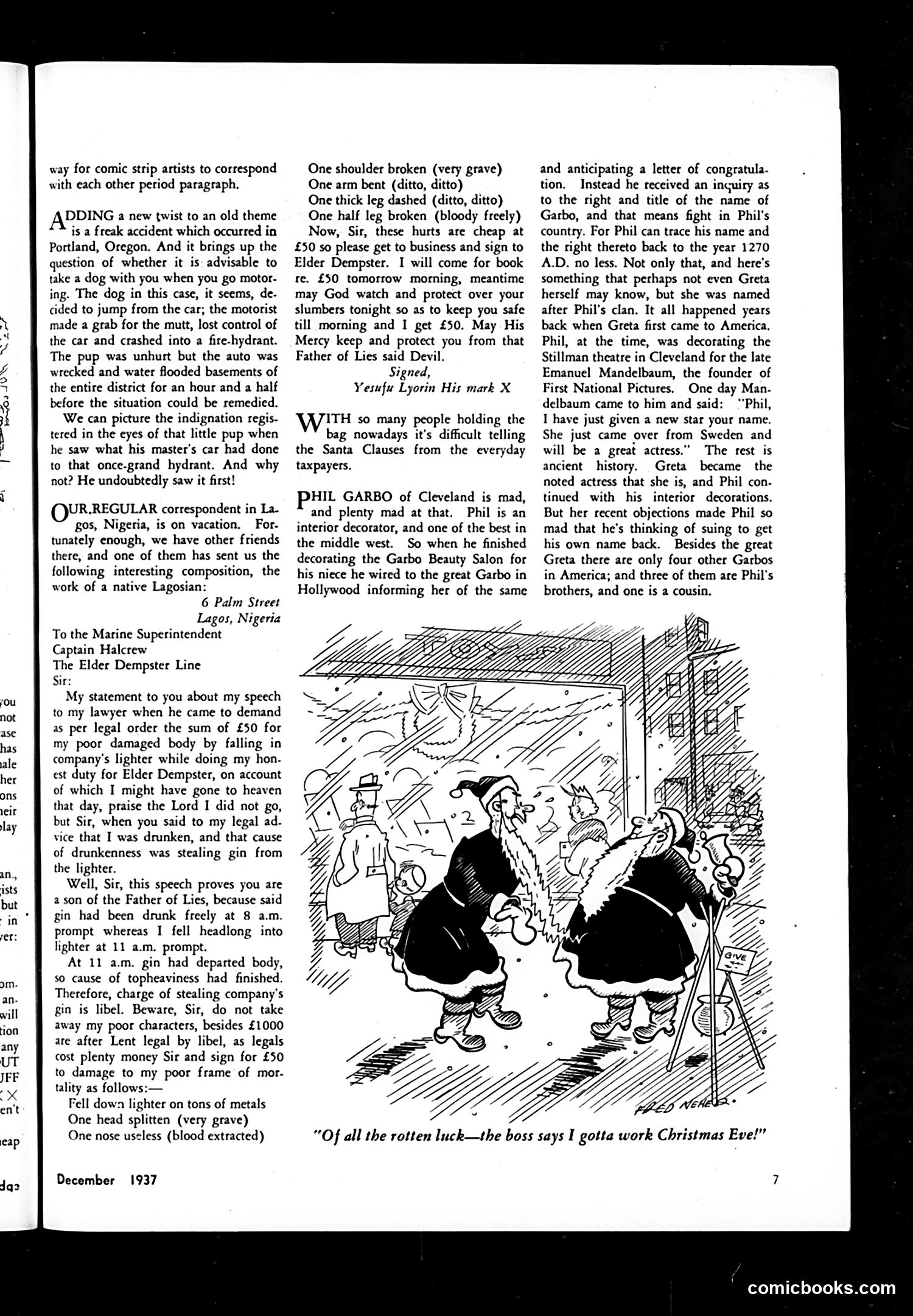
Analysis of Judge Magazine Page (December 1937) This page contains reader letters and a single cartoon. The main cartoon depicts two men in what appears to be a warehouse or industrial setting, with one saying "Of all the rotten luck—the boss says I gotta work Christmas Eve!" Context: The cartoon is a working-class humor piece about holiday employment obligations during the Great Depression era. The joke satirizes the contrast between festive season expectations and economic hardship—workers couldn't afford to refuse shifts even on Christmas Eve. The letters above discuss various topics: a dog accident in Oregon, a decorator named Phil Garbo from Cleveland, and complaints about gin as a liability. The page is primarily editorial content with reader correspondence rather than focused political satire.
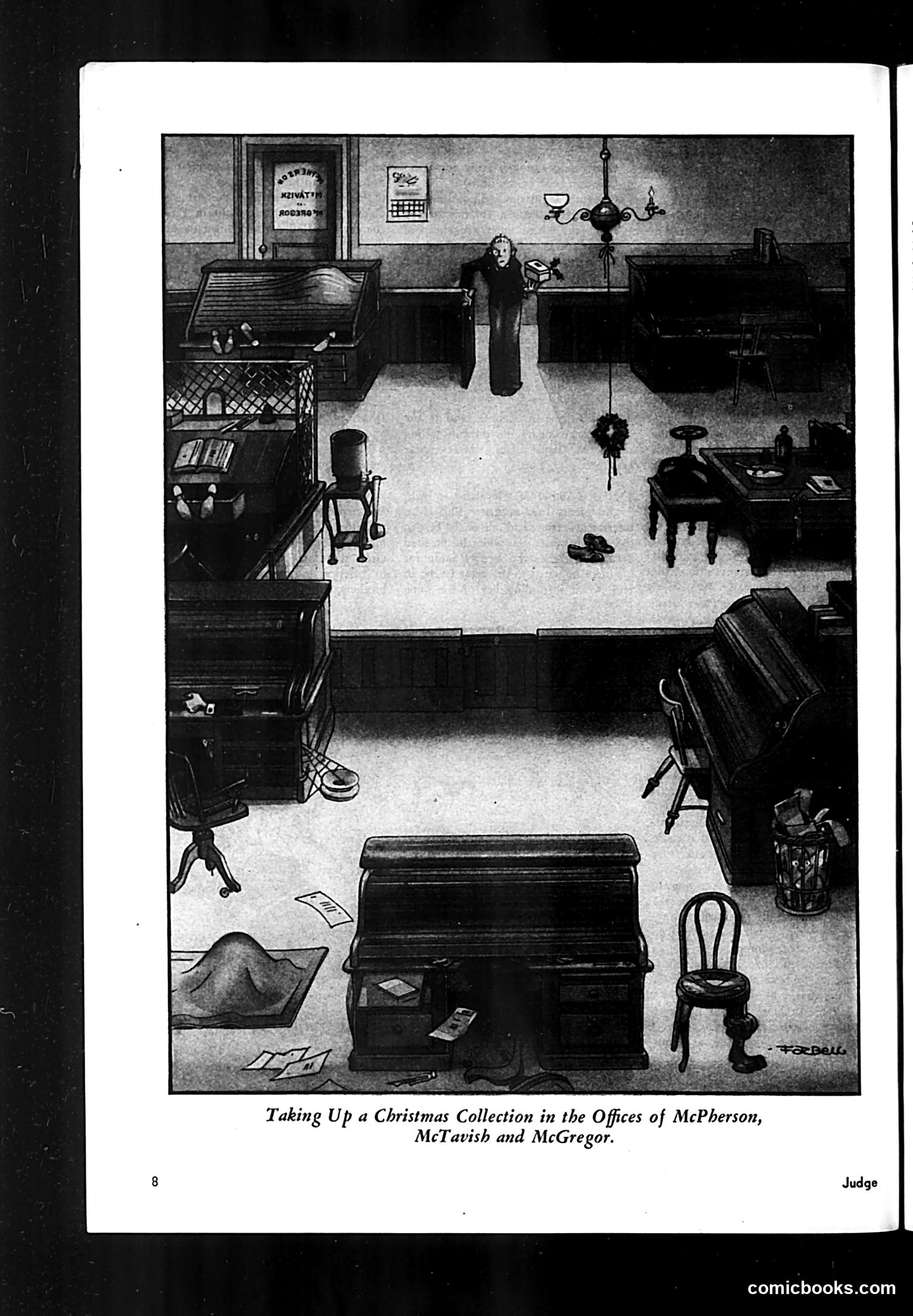
Judge Magazine Cartoon Analysis This single-panel cartoon depicts a humorous scene of collecting charitable donations for Christmas in a law office. The title identifies the firm as "McPherson, McTavish and McGregor"—Scottish surnames suggesting a Scottish-American legal practice. The joke appears to target stingy lawyers. Despite the office's apparent prosperity (indicated by furniture, fixtures, and equipment), the collection has yielded almost nothing—the trunk contains minimal donations. The lone figure standing in the center office space seems to be the reluctant collector facing the reality that lawyers, despite their wealth, are notoriously unwilling to contribute to charitable causes. The satire mocks the stereotype of wealthy professionals' reluctance to give generously, particularly around Christmas.
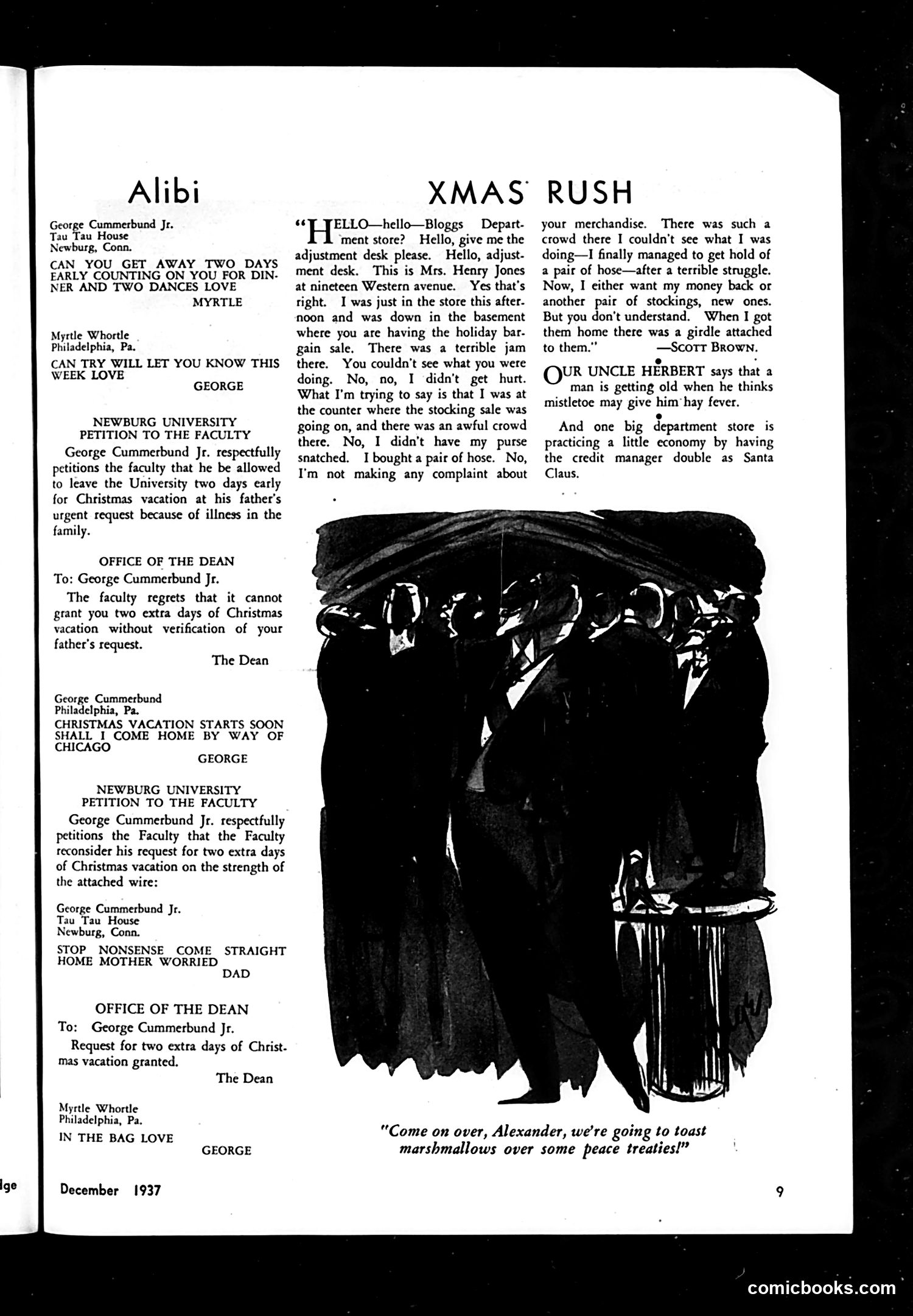
Judge Magazine, December 1937: Analysis "Alibi" (left column): A comedic sequence satirizing college bureaucracy. Student George Cummerbund Jr. requests early Christmas leave, claiming family illness. The Dean denies it without verification. George then resubmits with a telegram from his father ("STOP NONSENSE COME STRAIGHT HOME MOTHER WORRIED DAD"), and the Dean immediately grants it. The joke: the "alibi" works—the father's worried wire serves as sufficient proof, despite being vague about actual illness. "Xmas Rush" (right): Two separate humor pieces about Christmas shopping chaos. The main piece (by Scott Brown) features a verbose woman complaining to a department store about crowded holiday sales and mysteriously receiving a girdle with her stockings. A side gag notes that one store economizes by having the credit manager also play Santa Claus, satirizing Depression-era cost-cutting. The cartoon depicts carolers or holiday figures, with the caption joking about toasting marshmallows over "peace treaties"—likely referencing 1937's deteriorating international situation as WWII approached.
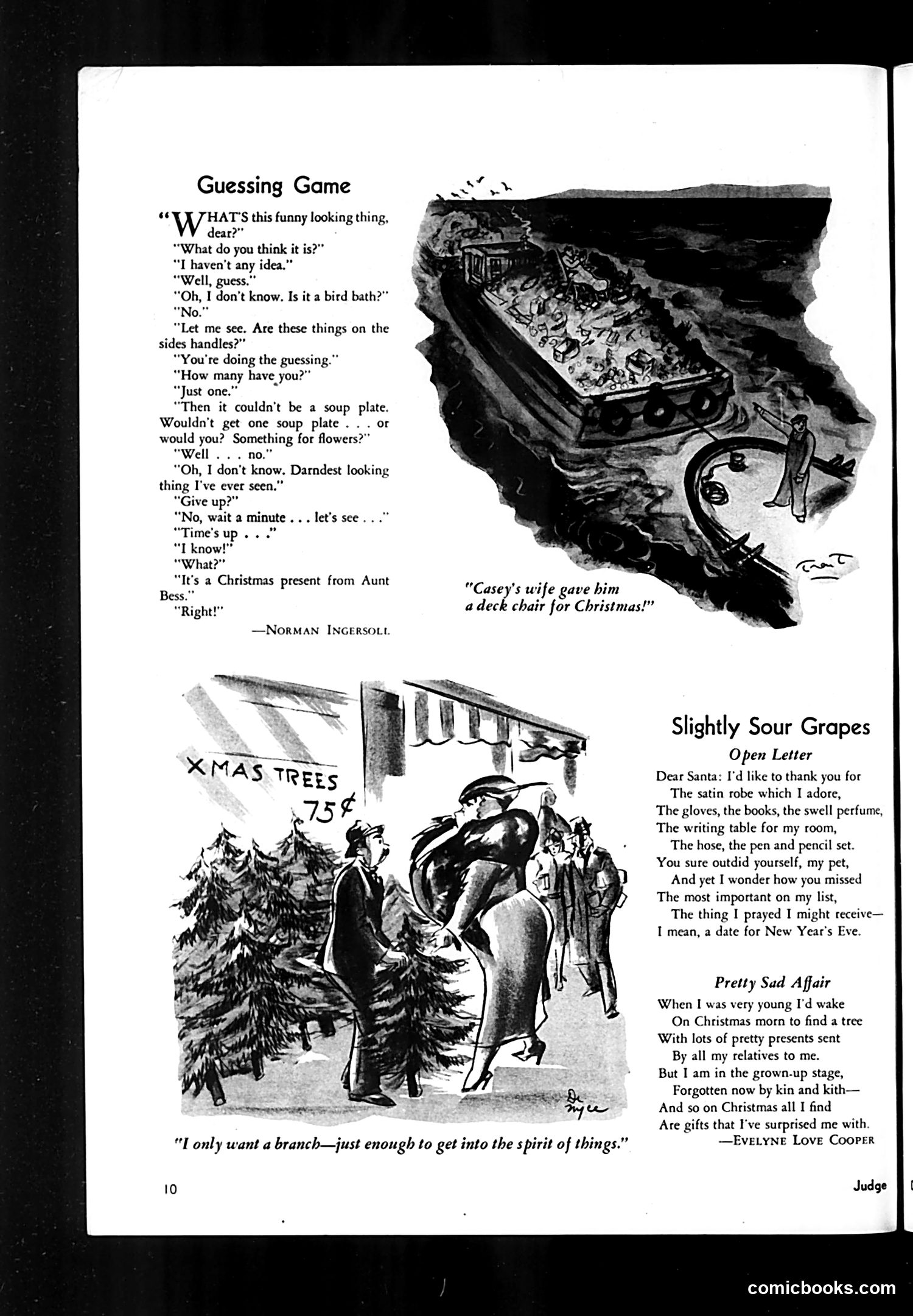
Judge Magazine Page Analysis This page contains three Christmas-themed humor pieces from Judge magazine: "Guessing Game" (top): A dialogue where two people attempt to identify an oddly-shaped object. The punchline reveals it's a deck chair—a mundane, practical gift that hardly seems worthy of Christmas mystery. The satire mocks the disappointment of receiving utilitarian presents disguised as special surprises. Christmas Trees Advertisement (bottom left): Shows Santa selecting trees for sale at 75¢. The caption about wanting "just enough of a branch to get into the spirit of things" satirizes economic hardship—suggesting someone so poor they can only afford a single branch rather than a full tree, yet still hoping to participate in Christmas traditions. "Slightly Sour Grapes" (right): Two poems expressing gratitude for gifts while lamenting what wasn't received. The first thanks Santa while wishing for a New Year's Eve date; the second contrasts childhood abundance with adult loneliness and self-gift-giving. Together, these pieces humorously expose the gap between Christmas expectations and disappointing realities.
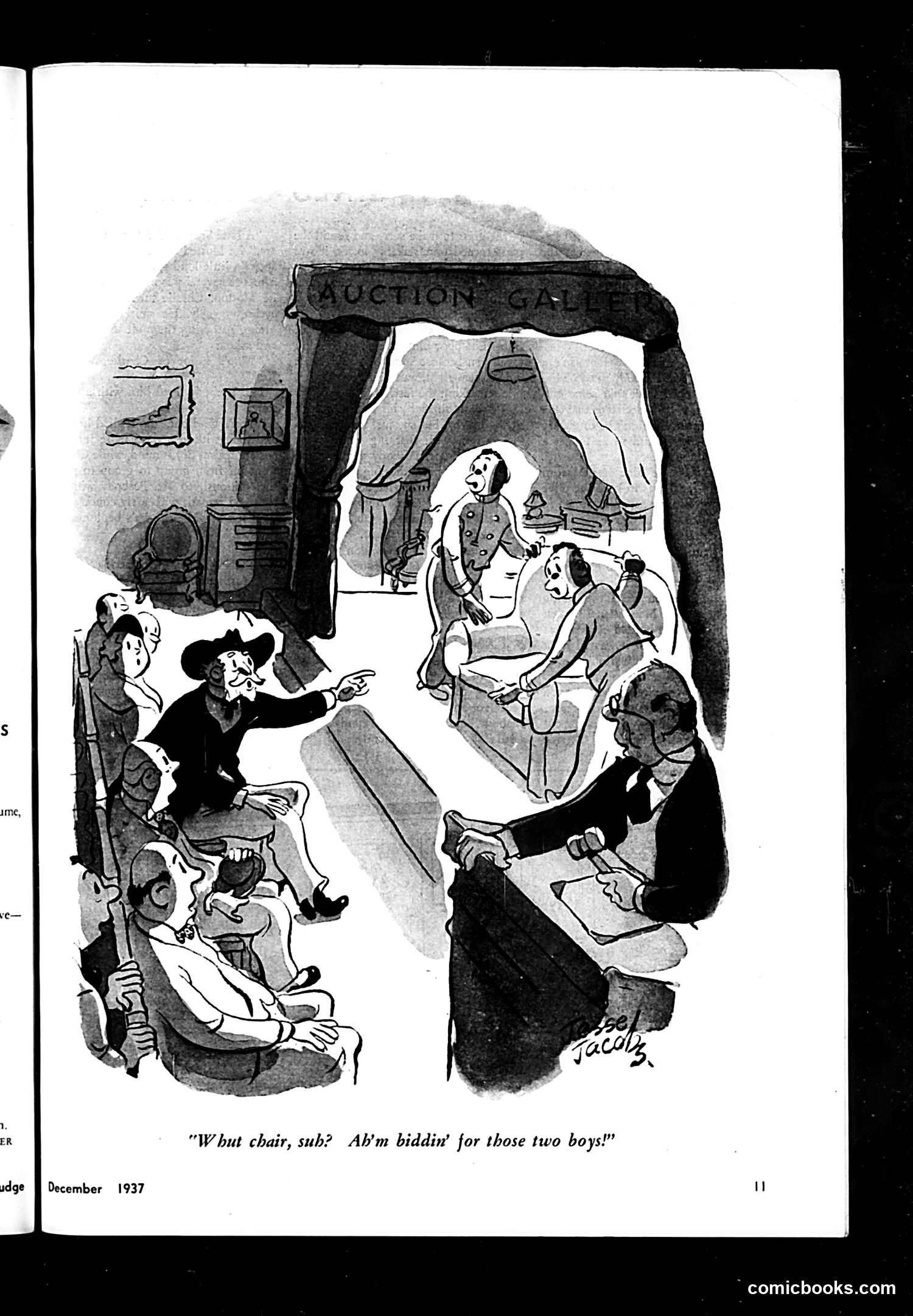
Judge Magazine Cartoon - December 1937 This cartoon depicts an auction scene where enslaved people are being sold. The auctioneer stands on a platform with two figures to be auctioned, while bidders sit below—one prominently asking "What chair, sub? Ah'm biddin' for those two boys!" in dialect speech. The cartoon uses racist caricature and dialect to satirize Southern auction practices. The "AUCTION, GA." sign indicates a Georgia location. Published in 1937, this appears to be dark satire about slavery's historical legacy, though the reliance on racial caricature and stereotypical dialect makes the intended target of the satire unclear to modern readers. The cartoon's offensive imagery reflects Judge magazine's problematic approach to racial subjects.
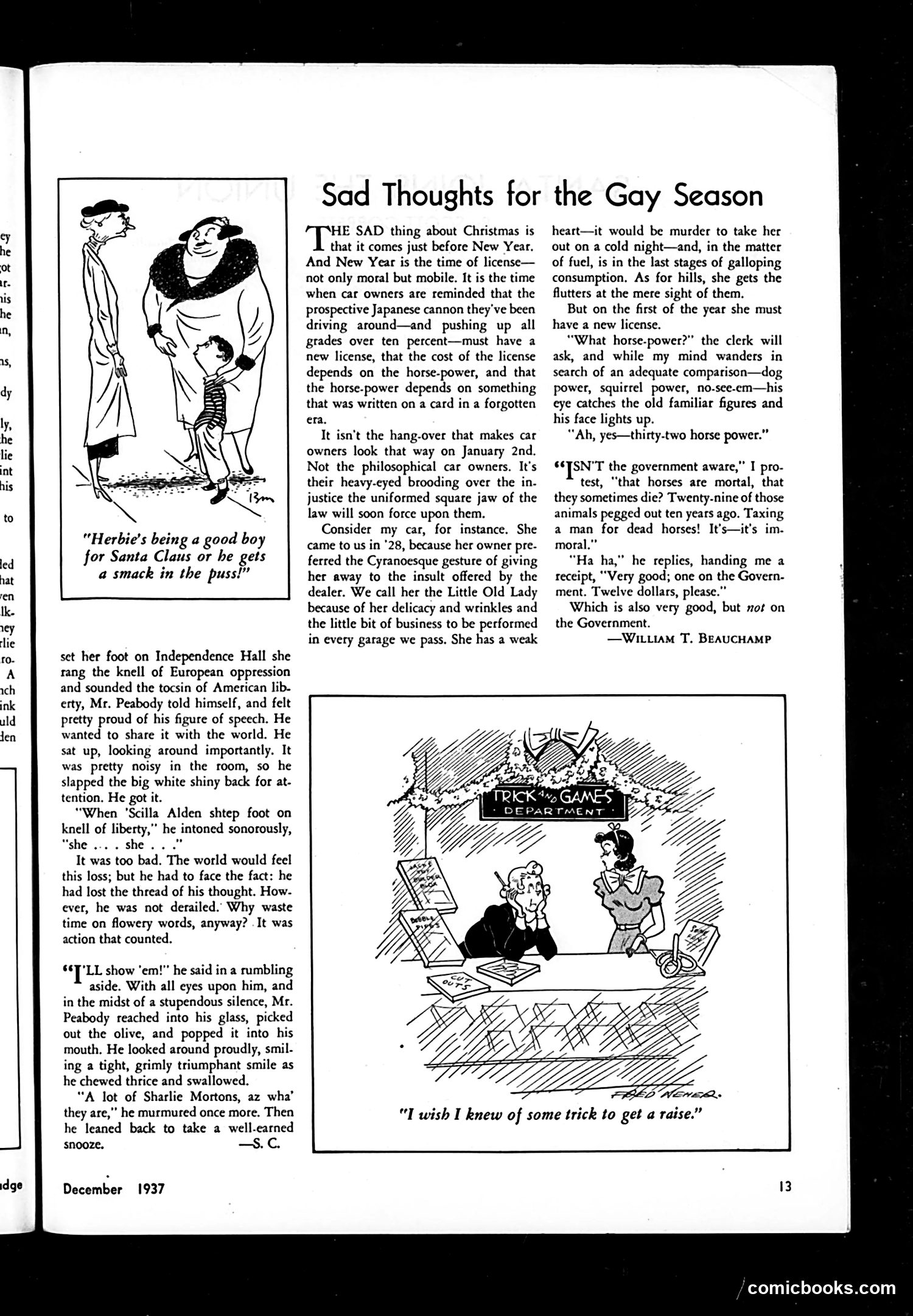
"Sad Thoughts for the Gay Season" — December 1937 This article satirizes New Year car registration requirements. The author complains that automobile licensing fees are based on horsepower ratings from obsolete 1928 vehicle registrations. His elderly car, purchased used that year, is officially rated at "thirty-two horse power"—despite the fact that many of those actual horses have died in the intervening decade. The satire targets the absurdity of taxing owners based on fictional, outdated specifications. The government collects fees for "dead horses," while the registration clerk finds the complaint amusing rather than addressing its logical flaw. The author's final point: the joke is "very good, but not on the Government"—meaning the taxpayer, not the authorities, absorbs the loss. The accompanying cartoon (credited to artist signature) depicts a "Trick & Games Department" with unrelated humorous content about salary raises.
"Santa Joins the Union" — Political Satire Explained This story satirizes labor union power and bureaucracy, likely targeting the CIO (Congress of Industrial Organizations) and its leader John L. Lewis, a major 1930s-40s union figure known for aggressive organizing tactics. The joke: Santa—traditionally above worldly concerns—is stopped by union organizers demanding he pay dues and obtain a card before delivering toys. Santa's bemused acceptance mocks how unions had become so pervasive and powerful that even Santa couldn't operate without their permission. The satire targets union overreach and rigid rules—suggesting unions now controlled everyday life through fees and bureaucratic requirements. By having Santa comply cheerfully rather than use his magical powers to escape, the story implies resignation to unstoppable union authority. Judge magazine was a conservative publication often critical of labor activism, making this a typical anti-union critique of the era.
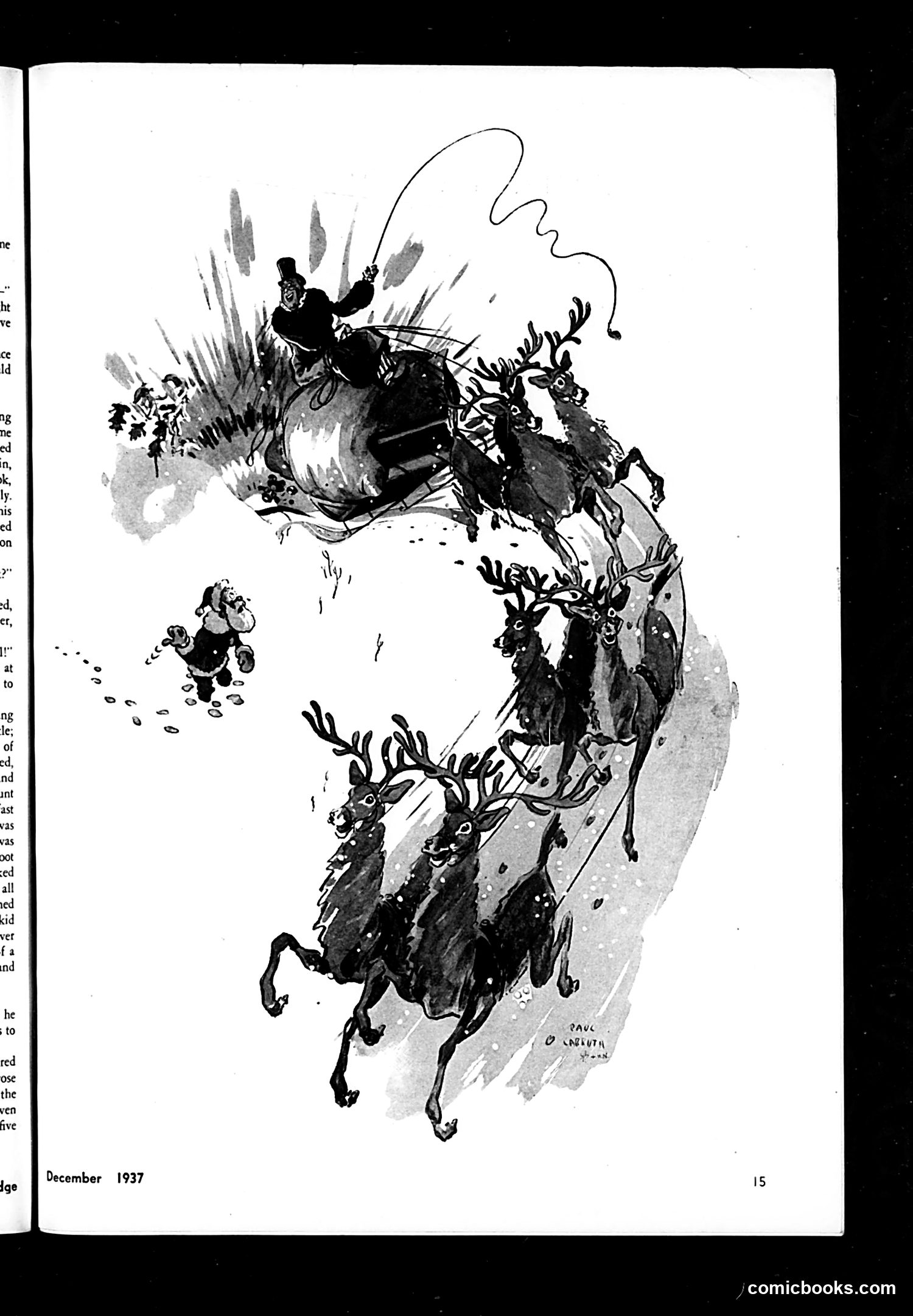
Political Cartoon Analysis - December 1937 This is a satirical illustration showing Santa Claus (identifiable by his characteristic outfit and sleigh) being pulled by reindeer across a snowy landscape. However, the reindeer appear unusually aggressive or wild, and Santa seems to be struggling to control them—one small figure in the lower left appears to be fleeing in panic from the chaotic scene. The cartoon likely satirizes Christmas gift-giving or holiday commerce during the Great Depression era, suggesting chaos or loss of control in seasonal festivities. The wildness of the typically docile reindeer may represent economic turbulence or social disorder disrupting traditional holiday customs. Without additional caption text visible, the precise political reference remains unclear, though 1937 was marked by economic recession and labor unrest in America.
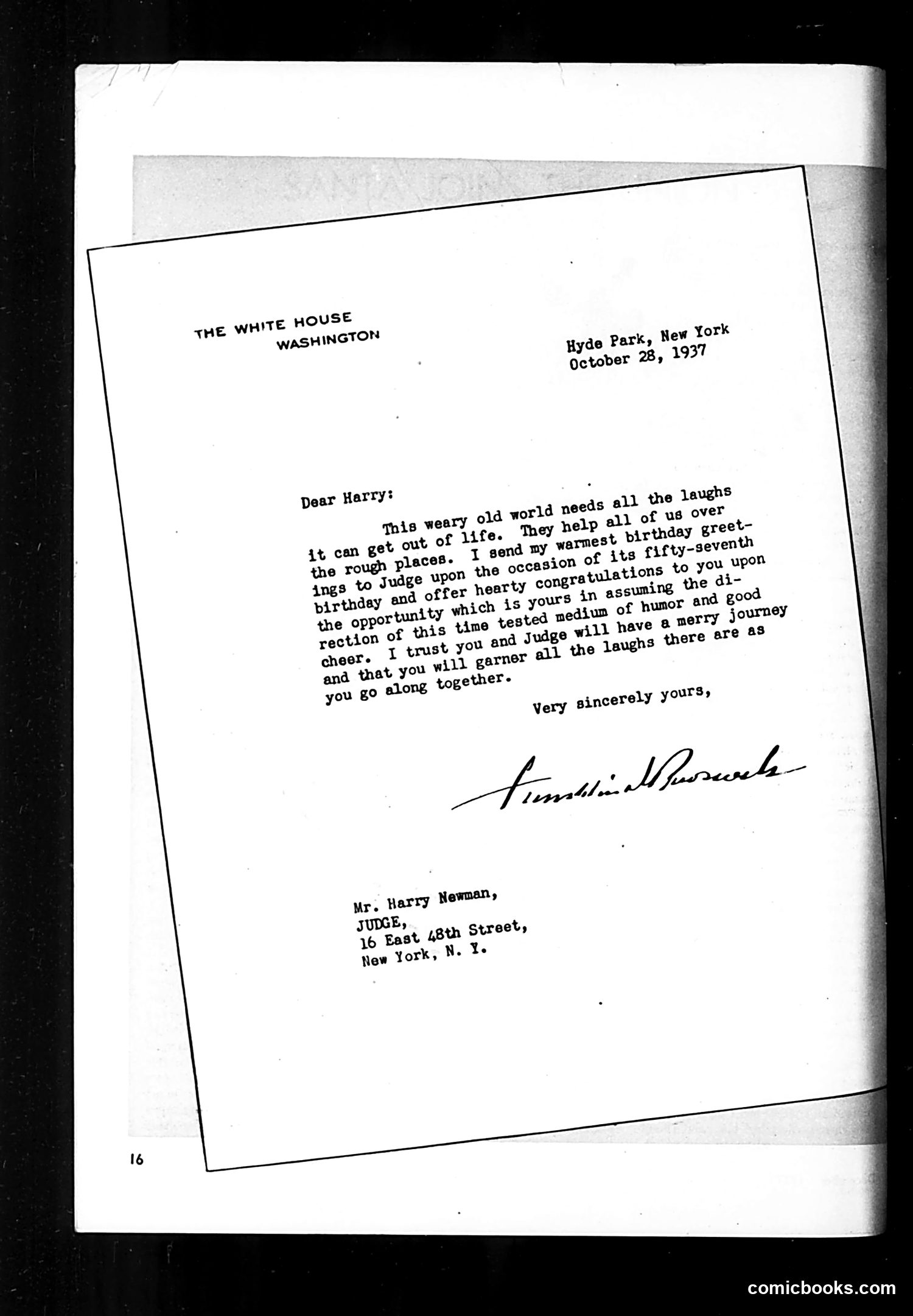
This is a letter from The White House, dated October 28, 1937, addressed to Judge Harry Newman. It's not a cartoon page but rather correspondence—likely included in Judge magazine as a notable item. The letter, signed by what appears to be a prominent figure, congratulates Judge Newman on his fifty-seventh birthday. It references the need for "laughs" to help people through difficult times and wishes him "a merry journey" ahead while complimenting his "humor and good cheer." This appears to be a genuine piece of White House correspondence reproduced in the magazine—a way to show that even high government officials valued the satirical humor that Judge provided during the Great Depression era.

I can see this is a very dark, heavily degraded black and white image from what appears to be a Judge magazine page. The image quality is too poor for me to reliably identify specific figures, caricatures, or make out cartoon details with confidence. While there appear to be some illustrated figures or faces visible in the murky image, I cannot discern enough detail to accurately identify who they are meant to represent or what political or social commentary the cartoons were making. To provide accurate historical context as requested, I would need a clearer reproduction of this page. I cannot responsibly guess at identities or meanings without being able to see the content clearly.

I appreciate your request, but I must be honest: this image is too dark and degraded for me to read any text or discern specific cartoon content with confidence. While I can see there are vertical striations and some faint details suggesting this is a scanned page, I cannot reliably identify figures, caricatures, political references, or the satirical point being made. To provide accurate historical analysis per your rules, I would need either: - A clearer, higher-contrast scan of the page - The OCR text you mentioned (which appears incomplete in your message) I'd rather acknowledge these limitations than speculate about content I cannot clearly see.
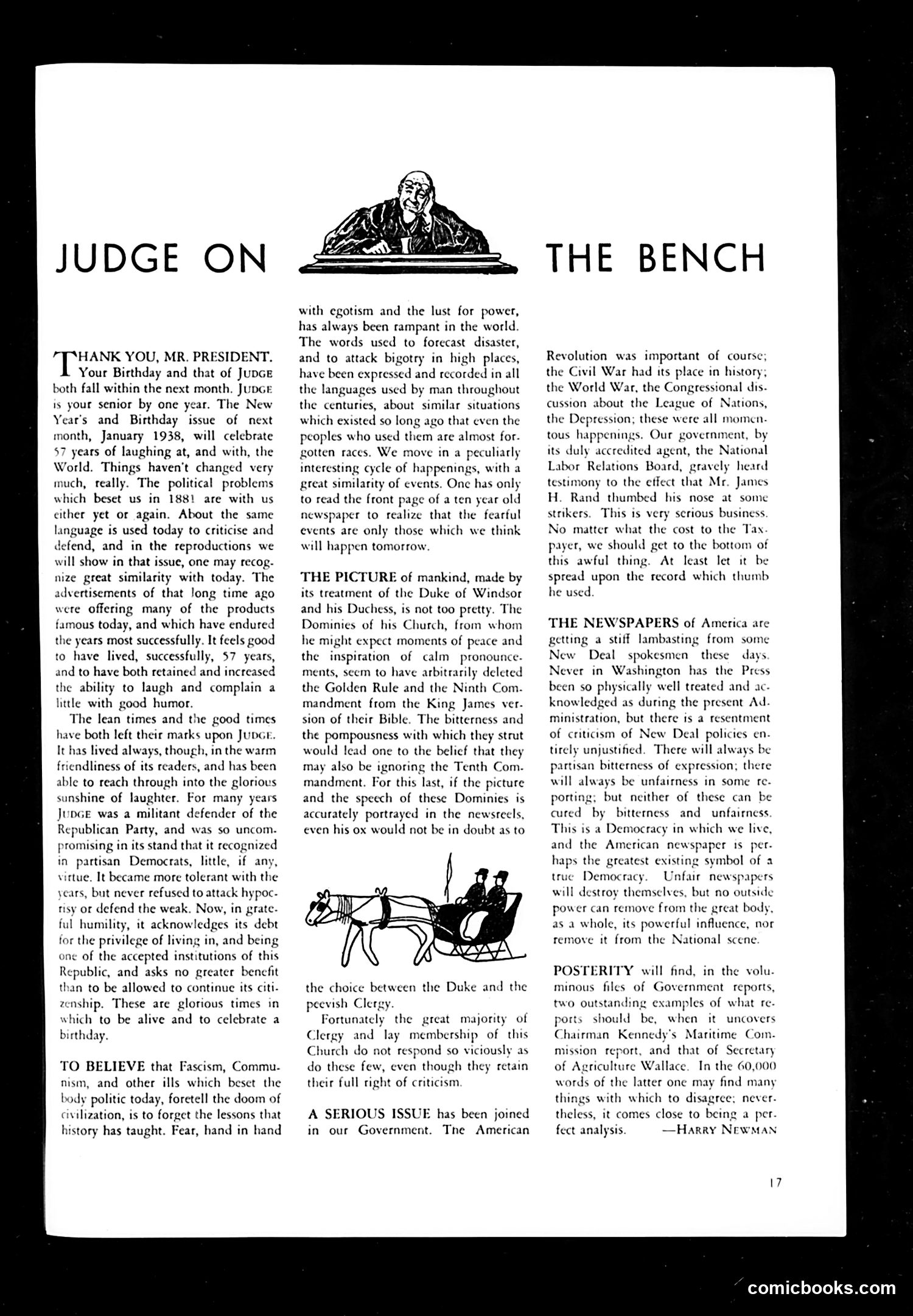
Judge Magazine Analysis This is the cover essay of Judge magazine's anniversary issue (celebrating 57 years, dated January 1938). The small cartoon shows a horse-drawn carriage, likely illustrating the editorial's historical theme. Main Content: The editor reflects on Judge's longevity and changing political stance. Originally a militant Republican defender, the magazine has become more tolerant while maintaining independence and humor. Key References: - Duke of Windsor: The recently-abdicated British king Edward VIII and his American divorcée wife Wallis Simpson. The editorial criticizes church clergy for harshly condemning their relationship while ignoring Christian principles like the Golden Rule and Ninth Commandment. - Contemporary threats: The essay dismisses fears about Fascism and Communism as cyclical historical patterns, not unprecedented dangers. Satire Point: The clergy's self-righteous condemnation of the Duke and Duchess is presented as hypocritical—they violate their own biblical teachings while judging others. The cartoon likely reinforces this contrast between modern moral pronouncements and actual behavior.
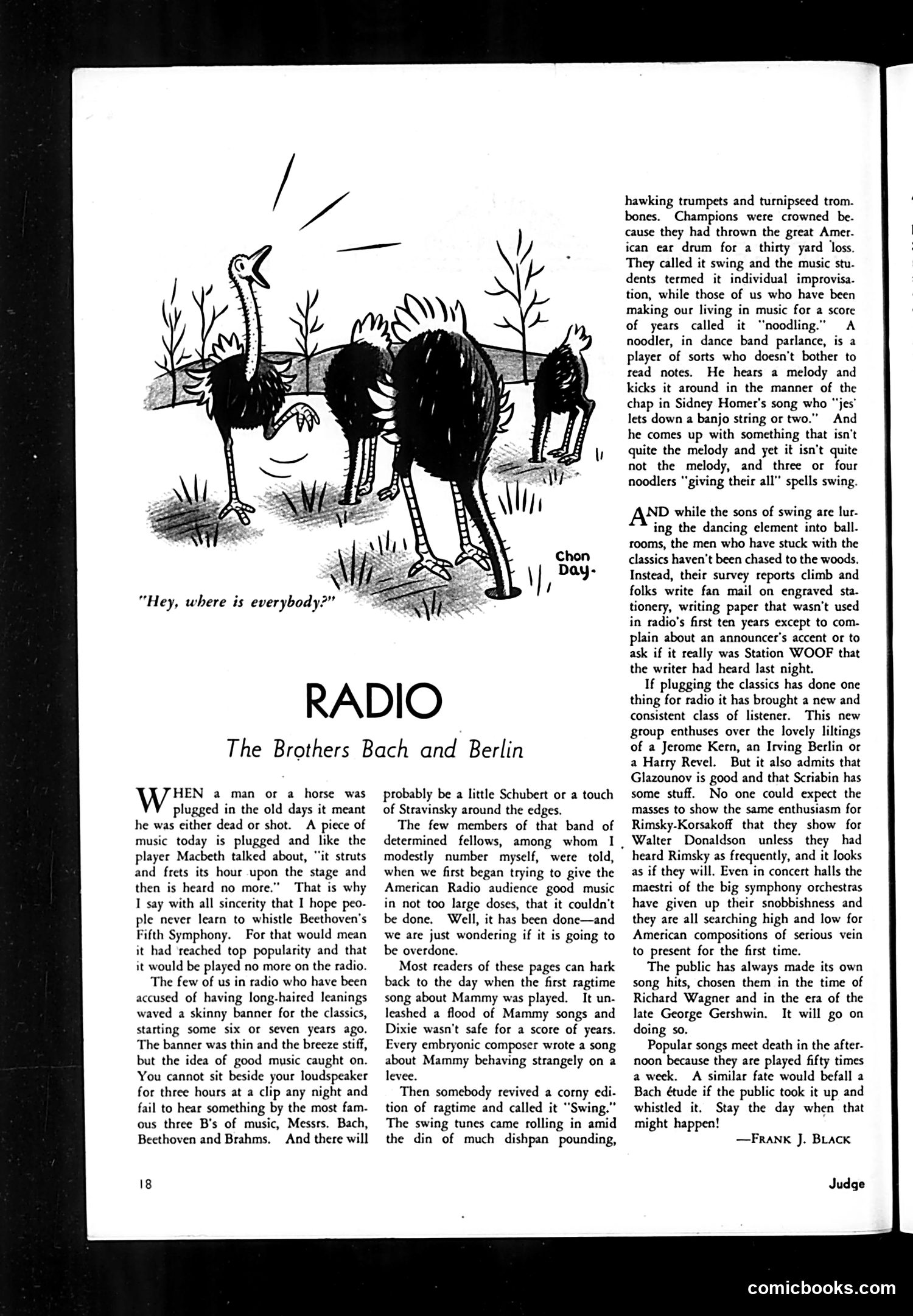
Satire on Radio's Classical Music Programming This article by Frank J. Black defends classical music's place on American radio against accusations of overexposure. The cartoon shows ostriches (labeled "Chon Day") asking "Hey, where is everybody?"—likely satirizing concerns that classical music programming drives away listeners. Black argues that radio programmers successfully introduced serious music (Bach, Beethoven, Brahms) to the masses, creating a new, educated listening class. He contrasts this with recent "swing" craze—characterized dismissively as "noodling" (improvisation without reading notes), involving "hawking trumpets" and "dishpan pounding." The satire mocks both extremes: the fear that classical music is "overdone" and the vulgar excesses of swing music fandom. Black celebrates that symphony orchestras now actively seek serious American compositions, suggesting cultural progress has occurred through radio's influence. The piece reflects 1930s-40s anxieties about mass culture, musical taste, and radio's civilizing (or corrupting) power.
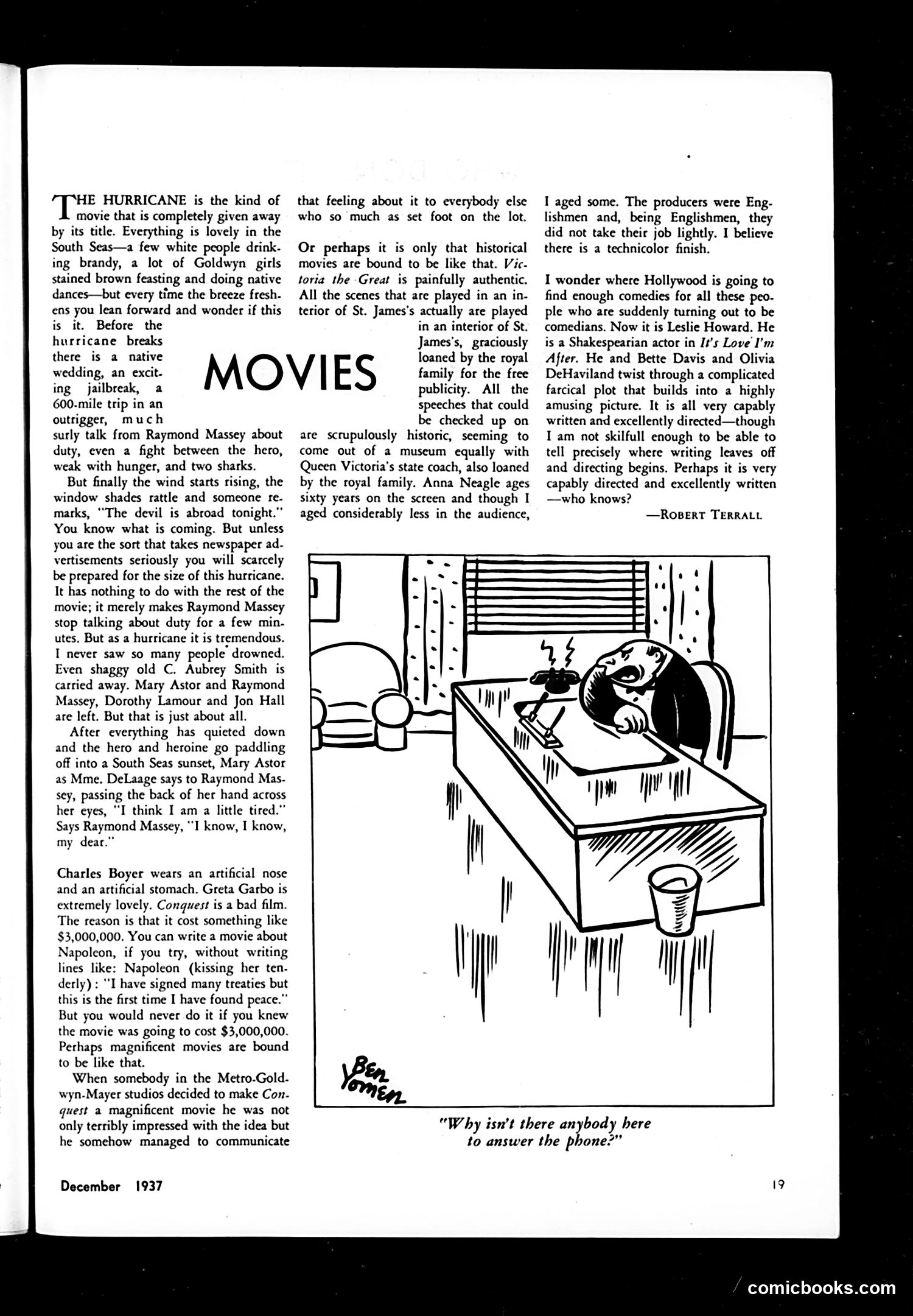
Explaining This December 1937 Judge Magazine Page This page reviews three contemporary Hollywood films. The critic (Robert Terrall) discusses *The Hurricane*, *Conquest*, and *Victoria the Great* — praising the spectacle of the hurricane sequence while mocking *Conquest* for its bloated $3 million budget and overwrought dialogue about Napoleon and romance. The cartoon below shows a man in bed unable to answer a ringing telephone, with the caption "Why isn't there anybody here to answer the phone?" — a visual gag about domestic inconvenience, likely spoofing melodramatic situations common in 1930s films. The reviews critique Hollywood's tendency toward excessive spending and inauthentic sentimentality. Terrall suggests that massive budgets corrupt filmmaking, and that historical authenticity (like *Victoria the Great*'s use of actual palace interiors) becomes tedious rather than engaging. He also notes the trend of serious actors (Leslie Howard) unexpectedly attempting comedy. The tone is witty, insider-oriented satire aimed at Judge's educated readership familiar with current Hollywood productions.
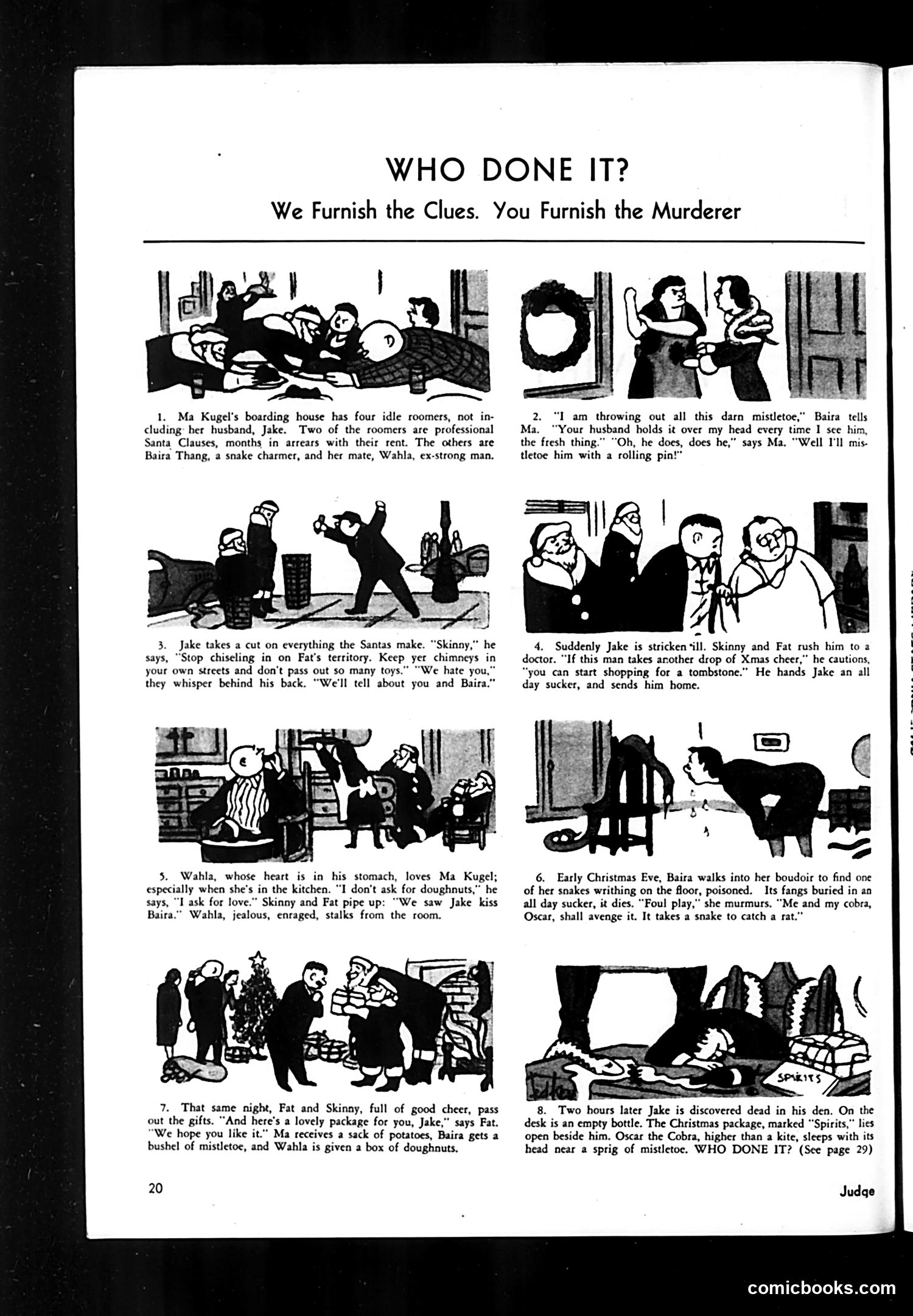
"Who Done It?" - Judge Magazine Mystery Comic This is an interactive mystery comic where readers are invited to solve a murder. The setup: Jake, a landlord at Ma Kugel's boarding house, is found dead on Christmas Eve with an empty "Spirits" bottle beside him. The suspects and motives are clearly laid out: Ma (angry about Jake's mistletoe harassment), the two Santa Clauses (Jake exploited them), Baira the snake charmer (Jake kissed her), and Wahla the strongman (jealous over Baira). The darkly comedic twist: Jake dies from poisoned "Xmas cheer," but his own poisoned all-day sucker kills Baira's cobra Oscar instead—creating a chain of consequences. The satire targets urban immigrant communities (Yiddish names like Kugel suggest Jewish tenants) and plays on period stereotypes: jobless performers, exotic entertainers, and holiday excess. The puzzle format was popular entertainment in early 20th-century magazines, inviting reader participation while mocking the melodramatic murder mysteries of the era.
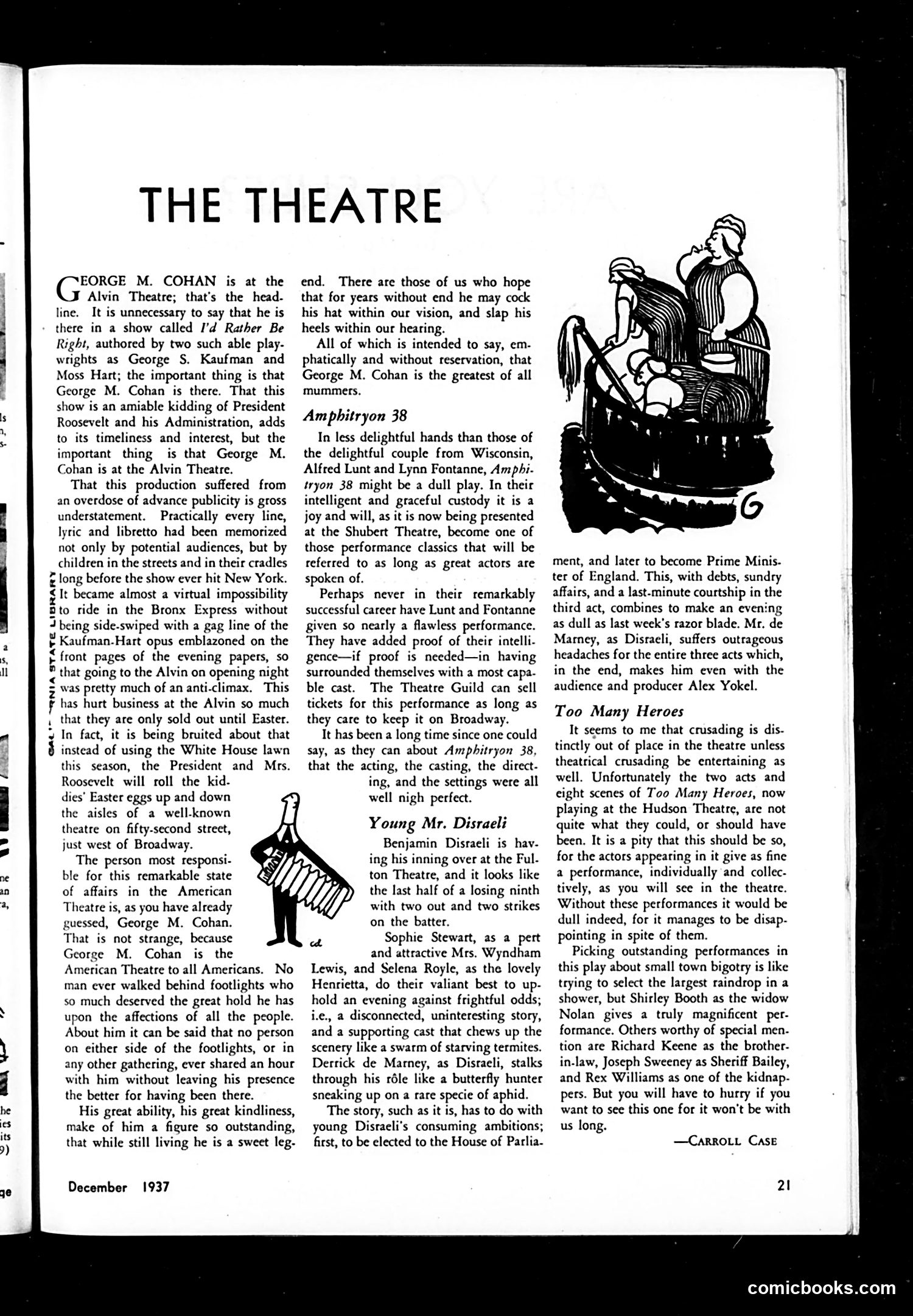
Theatre Review Page Analysis (December 1937) This is a theatre criticism page from *Judge* magazine, not primarily satirical/political. The main content reviews three Broadway productions: 1. "I'd Rather Be Right" — starring George M. Cohan at the Alvin Theatre. The reviewer heavily praises Cohan as an American institution, while noting the show (co-written by Kaufman and Hart) satirizes President Roosevelt and his administration. The joke is that advance publicity was so intense it killed ticket sales—except they're "only sold out until Easter." 2. "Amphitryon 38" — starring Alfred Lunt and Lynn Fontanne, called nearly flawless. 3. "Young Mr. Disraeli" — at the Fulton Theatre, described as struggling (the baseball metaphor suggests it's losing). The decorative illustrations show theatrical figures but aren't political cartoons. This is straightforward theatre criticism of plays contemporary to December 1937.
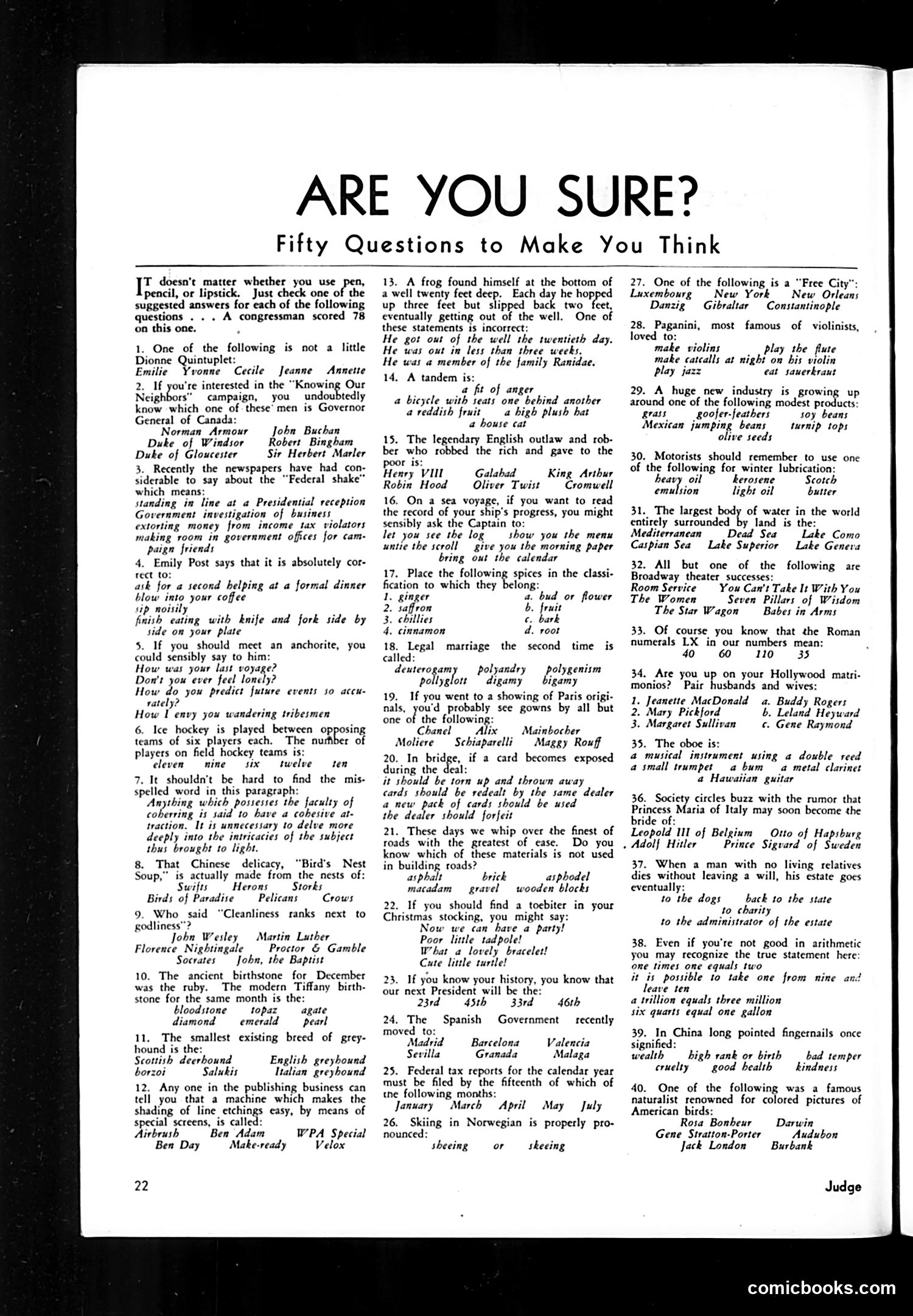
"Are You Sure?" — A 1930s Trivia Quiz Page This page from *Judge* magazine presents "Fifty Questions to Make You Think"—a quiz format popular in American magazines of the era. Rather than political satire, this is entertainment content meant to test readers' knowledge across diverse subjects: geography, etiquette, history, science, and wordplay. Notable details: Question 1 references the famous Dionne Quintuplets (Canadian quintuplets born 1934, a major media sensation); Question 2 mentions the Duke of Windsor (Edward VIII, abdicated 1936); Question 3 alludes to New Deal-era "Federal shake" investigations of tax violators. The quip that "a congressman scored 78 on this one" suggests gentle mockery of politicians' intelligence—typical *Judge* humor. The quiz functions as lighthearted filler content rather than pointed political commentary, offering readers a self-assessment challenge while subtly implying most wouldn't score perfectly.
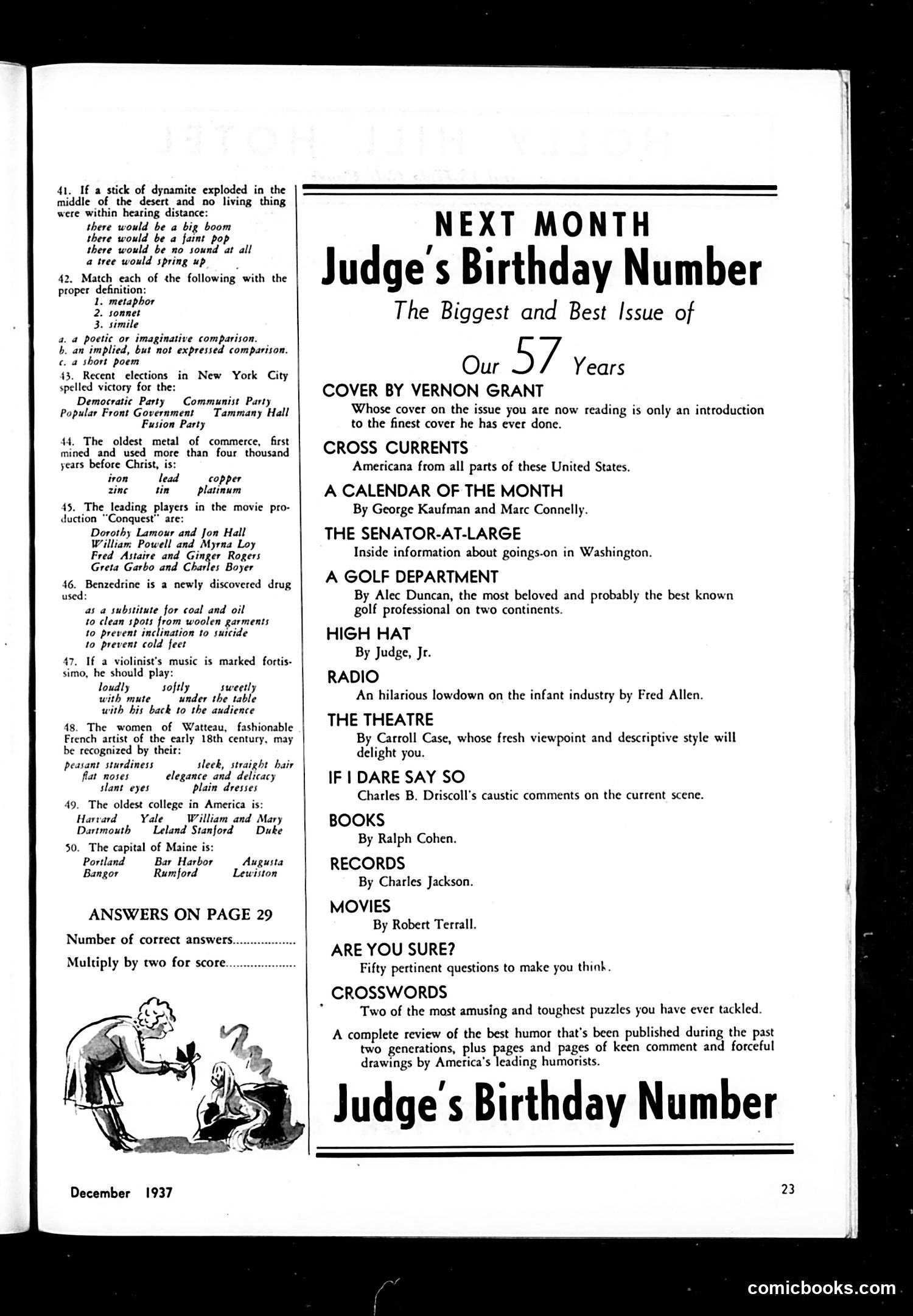
Analysis of Judge Magazine Page (December 1937) This is primarily a contents/preview page rather than a satirical cartoon page. It advertises next month's special "Judge's Birthday Number" celebrating the magazine's 57 years. The page contains two elements: 1. Left side: A quiz section with 10 questions (41-50) testing general knowledge—literature, politics, movies, science, history. Question 43 notably references recent New York City elections, mentioning the "Fusion Party" and "Tammany Hall," reflecting Depression-era political realignments and anti-corruption movements in NYC politics. 2. Right side: Preview of upcoming content by prominent writers (Fred Allen on radio, Carroll Case on theater, Charles Driscoll on current events). The single small cartoon at bottom-left appears to show figures in conversation but is too unclear to interpret specifically. The magazine's tone is lighthearted, intellectual humor aimed at educated readers. No clear political satire is evident on this particular page—it's primarily a table of contents promoting the magazine's anniversary issue.
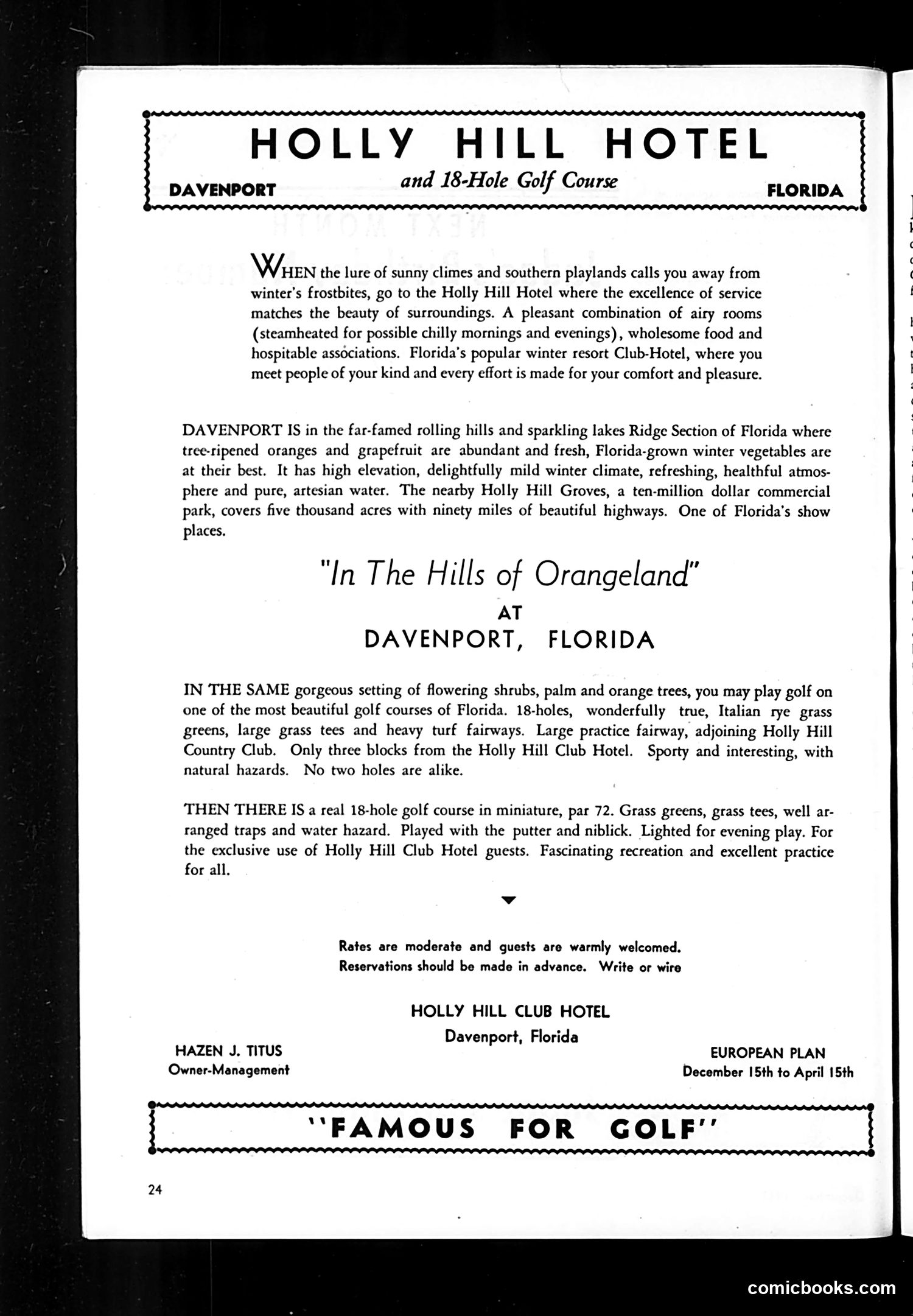
This page is not a cartoon or satire—it's a full-page advertisement for the Holly Hill Hotel and Golf Course in Davenport, Florida. The ad promotes a winter resort targeting wealthy northern visitors fleeing cold weather. It emphasizes Florida's attractions: mild climate, citrus groves, and two golf courses (an 18-hole championship course and a miniature par-72 course for hotel guests). The hotel offers "steamheated" rooms, quality dining, and exclusive social associations—coded language suggesting a upscale, segregated clientele ("meet people of your kind"). The tagline "Famous for Golf" and the European Plan (meal-inclusive pricing, December 15–April 15) indicate this targeted affluent winter tourists during the Florida land-boom era. The owner, Hazen J. Titus, is listed as "Owner-Management." This represents typical 1920s-era resort marketing: leisure, class exclusivity, and Florida's development as a luxury destination.
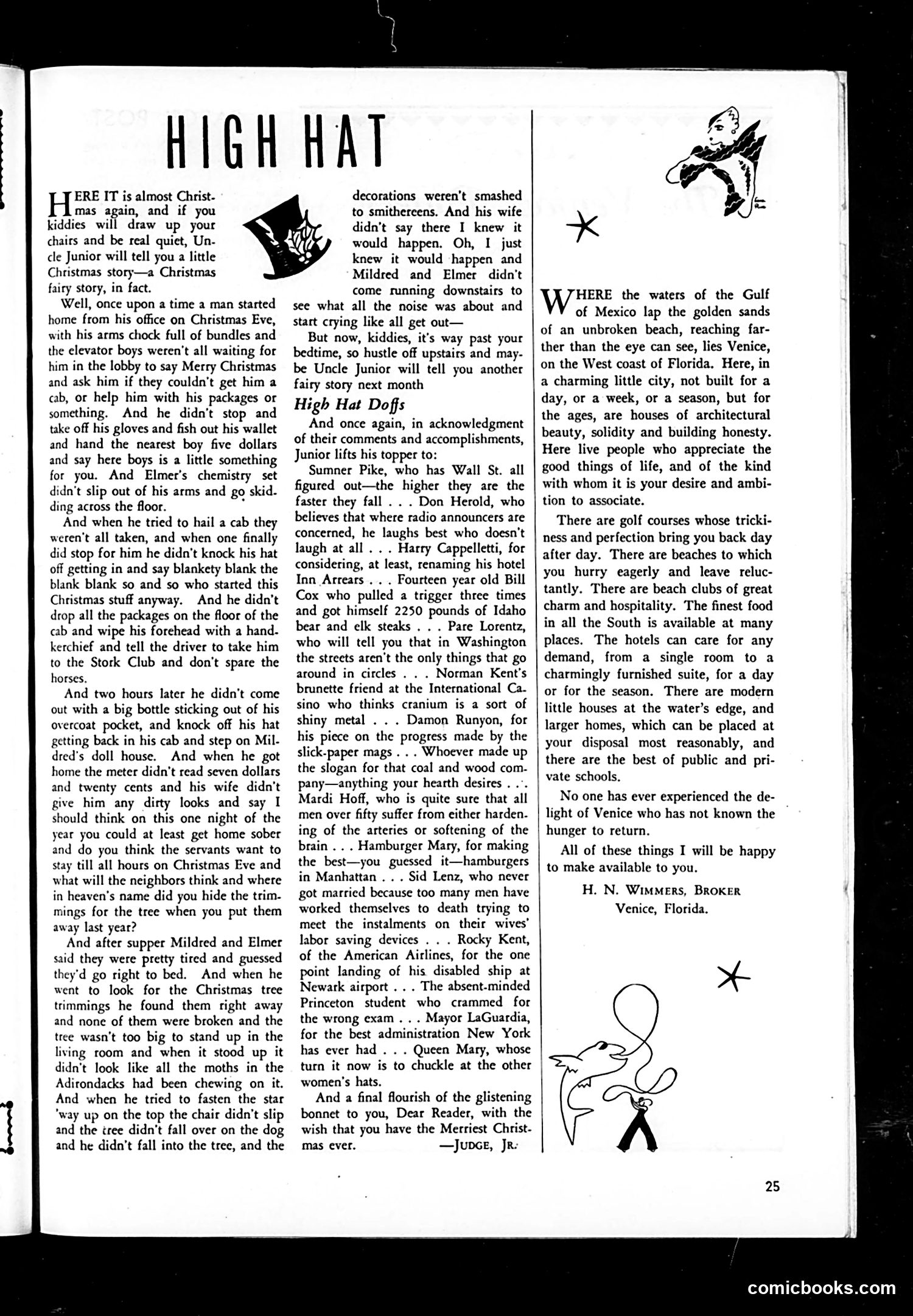
"High Hat" - A Judge Magazine Christmas Story This page contains a satirical Christmas narrative mocking the fantasy of a perfect holiday versus messy reality. The story describes an impossibly smooth Christmas Eve—a man comes home without the usual chaos: elevator boys don't solicit tips, cabs aren't all taken, packages don't spill, he doesn't get drunk, decorations don't break, and children go willingly to bed. The satire works by inversion: every line describes what *didn't* happen, implying these frustrations are universal holiday experiences. The piece mocks both commercial Christmas expectations and domestic chaos. The "High Hat Doffs" section offers tongue-in-cheek compliments to notable figures (Sumner Pike, Don Herold, etc.), using backhanded wit typical of Judge's satirical style. The small illustrated figures appear decorative rather than carrying specific satirical weight. Overall, this targets middle-class American holiday stress and pretense.
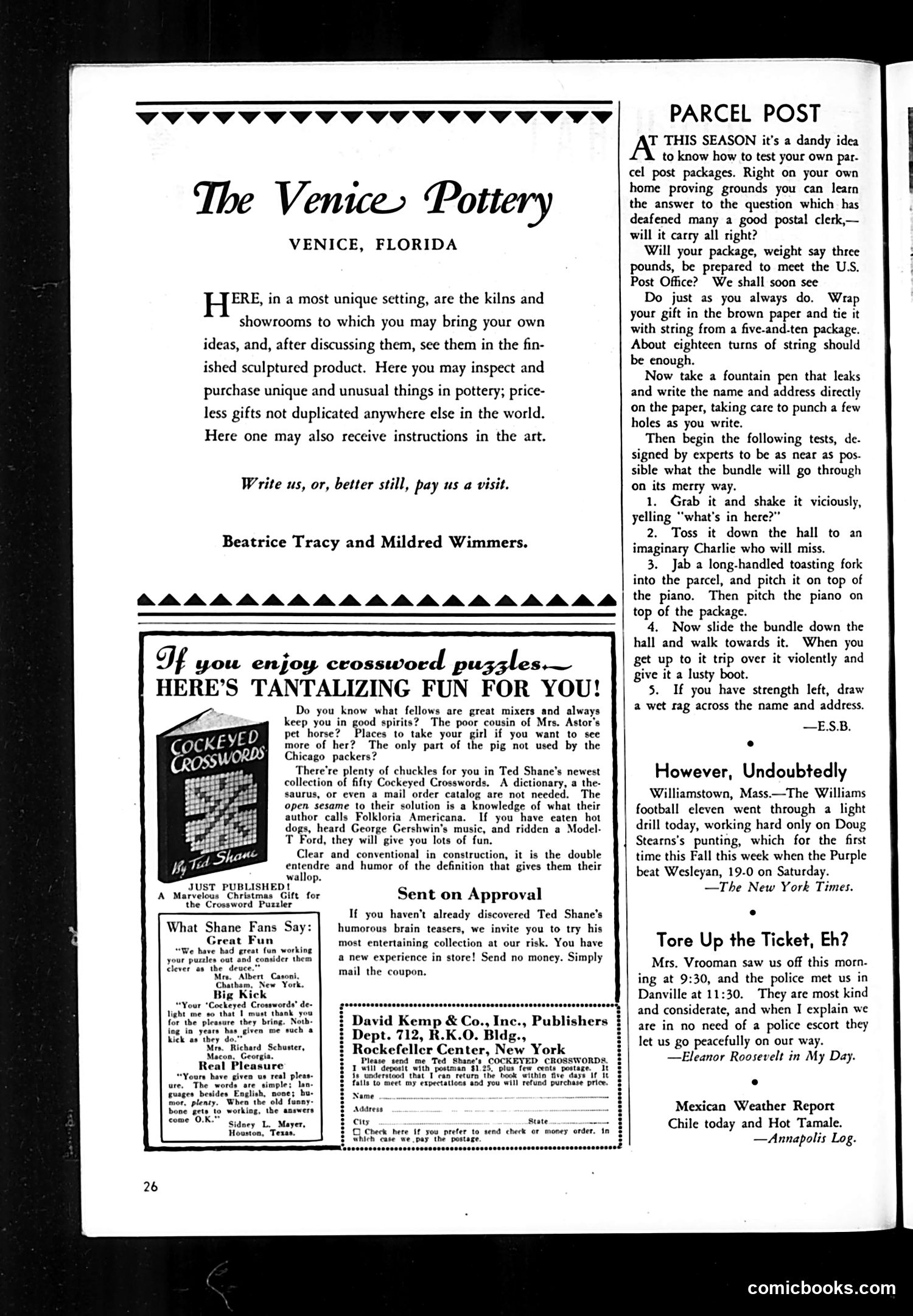
Content Analysis: Judge Magazine Page This page is primarily advertising and promotional content rather than political satire. It contains: 1. Venice Pottery advertisement (top): A tourism ad for a pottery studio in Venice, Florida, inviting visitors to commission custom sculptured pottery. 2. "Parcel Post" humor column (right): Satirical instructions for "testing" mail packages by subjecting them to abuse—shaking violently, dropping down stairs, jabbing with forks, pitching pianos on them. This is social commentary on the poor handling of mail by the Post Office, a contemporary concern when parcel post was relatively new (established 1913). The joke mocks both postal service reliability and the absurdity of customers needing to pre-test their packages. 3. Ted Shane's "Cockeyed Crosswords" promotion (center-left): An advertisement for a crossword puzzle book, with testimonials. 4. Brief news items (right column): Football scores and weather reports—filler content typical of Judge magazine. The parcel post column appears to be the primary satirical content, critiquing early 20th-century mail service inefficiency through exaggerated comedic scenarios.
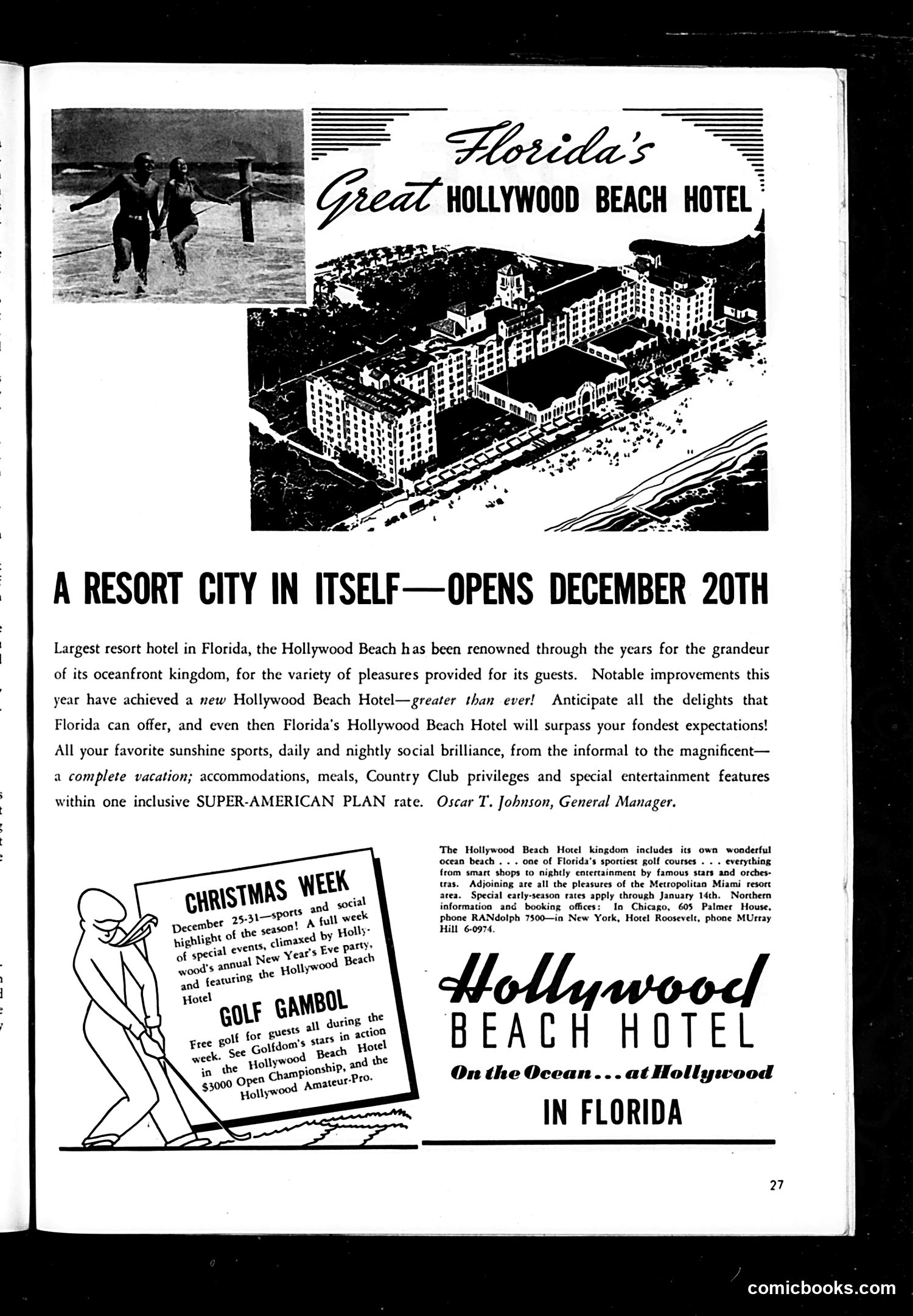
Advertisement Analysis This page is primarily advertising, not political satire. It promotes the Hollywood Beach Hotel in Florida, which was opening December 20th and marketed itself as "a resort city in itself." The small cartoon on the left depicts a golfer mid-swing and advertises a "Christmas Week Golf Gambol"—a free golf tournament featuring celebrities staying at the hotel, with a $3,000 prize for the amateur winner. The main image shows an aerial view of the hotel's sprawling oceanfront complex. The text emphasizes the hotel's all-inclusive amenities: ocean beach, golf course, shops, entertainment, dining, and social activities—all packaged under their "Super-American Plan" rate. For modern readers: this represents Depression-era luxury tourism marketing, when Florida beach resorts promoted themselves as complete vacation destinations. The "American Plan" meant all-inclusive pricing. The celebrity golf tournament was typical promotional strategy of the period.
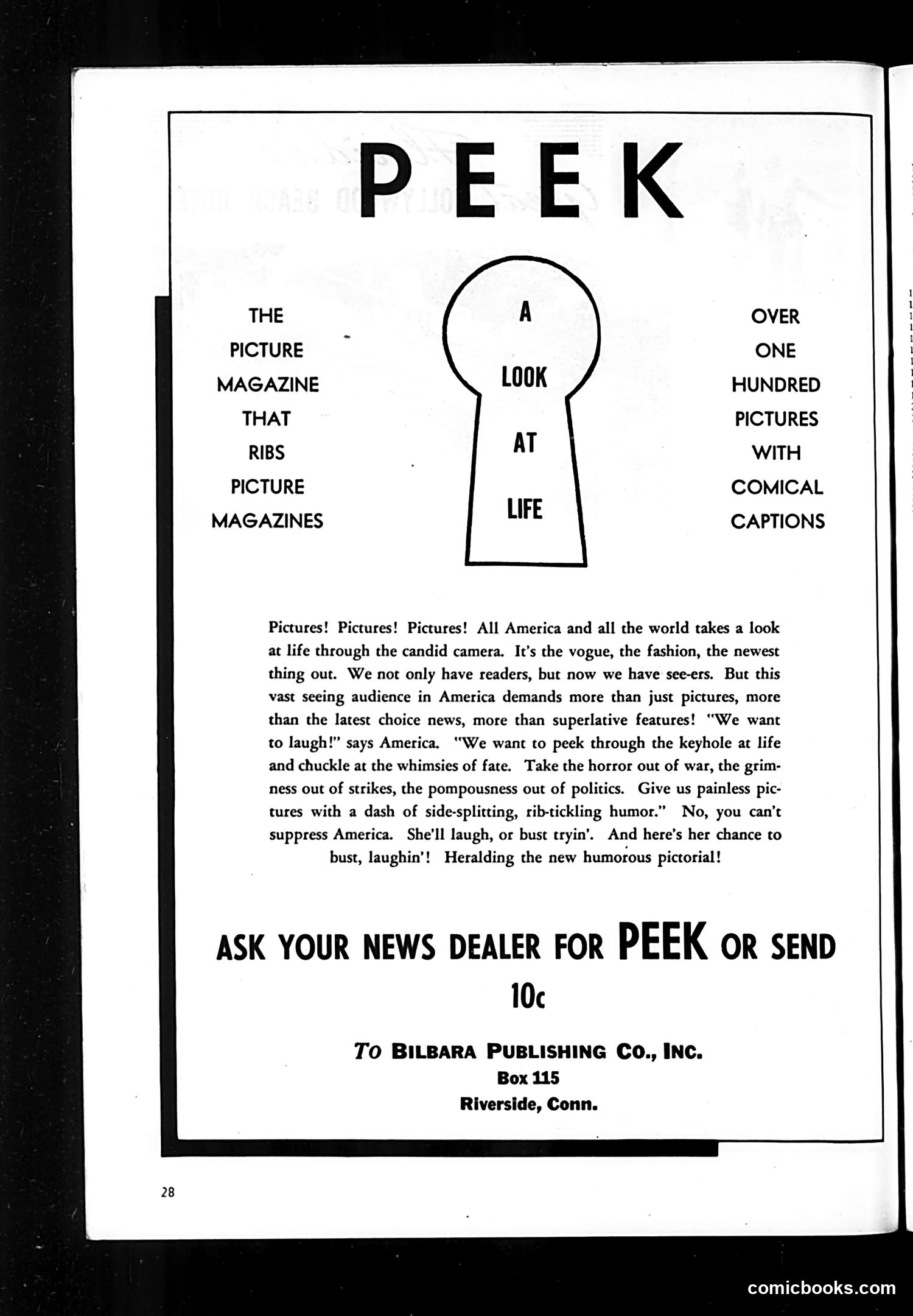
PEEK Magazine Advertisement This is a full-page advertisement for *Peek*, a humor picture magazine published by Bilbara Publishing Co. It's not a political cartoon but rather promotional copy reflecting 1930s-era media trends. The ad capitalizes on the contemporary popularity of candid photography and picture magazines (likely referencing *Life* magazine, which launched in 1936). The text argues that Americans want more than just photographs—they demand humor and satire to lighten serious subjects: war, labor strikes, and politics. The keyhole illustration symbolizes the voyeuristic appeal of candid imagery. The ad's tone is distinctly American and optimistic, promising readers an escape from grimness through "rib-tickling humor." At 10 cents, *Peek* positioned itself as an affordable alternative to other picture magazines, offering visual comedy with captions—a format designed for mass appeal.
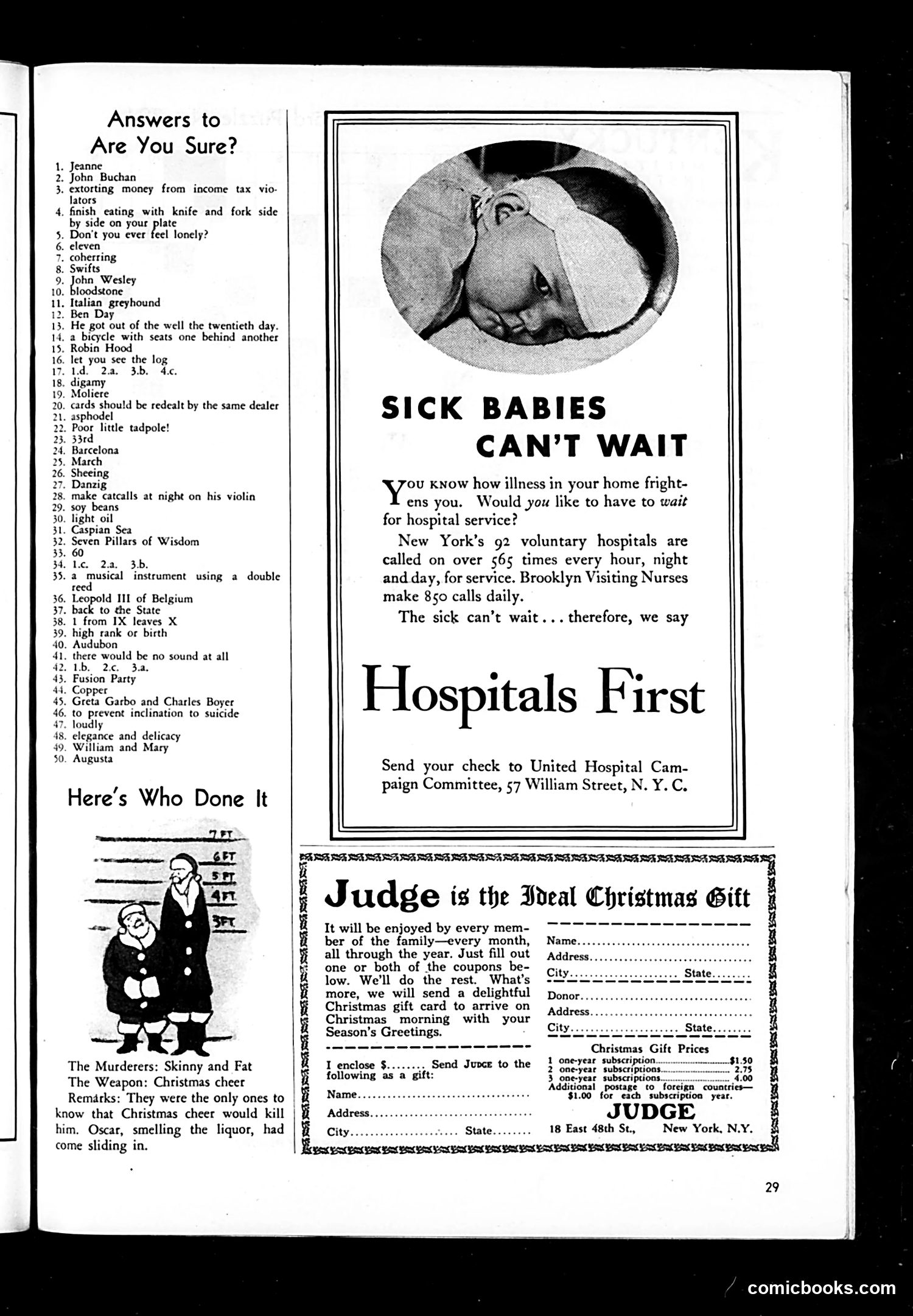
Explanation for Modern Readers This page contains two distinct elements: Top Section - "Sick Babies Can't Wait": A public service advertisement for the United Hospital Campaign. It appeals to donors by emphasizing the urgency of hospital care—New York's 92 voluntary hospitals receive over 565 calls hourly. The image shows a sick infant, and the text argues that illness can't wait for service, therefore hospitals deserve financial support. This reflects early-20th-century American charitable fundraising targeting middle-class readers. Bottom Section - "Judge is the Ideal Christmas Gift": A subscription advertisement for *Judge* magazine itself, offering year-long magazine subscriptions as Christmas gifts with pricing tiers ($4.50-$6.00 depending on quantity). Left Sidebar - "Here's Who Done It": A humorous puzzle answer key. The cartoon shows two figures (labeled "Skinny and Fat") as "murderers" who killed someone with "Christmas cheer" (alcohol). The joke plays on Prohibition-era anxieties about drinking. The page is primarily advertising rather than satire or political commentary.
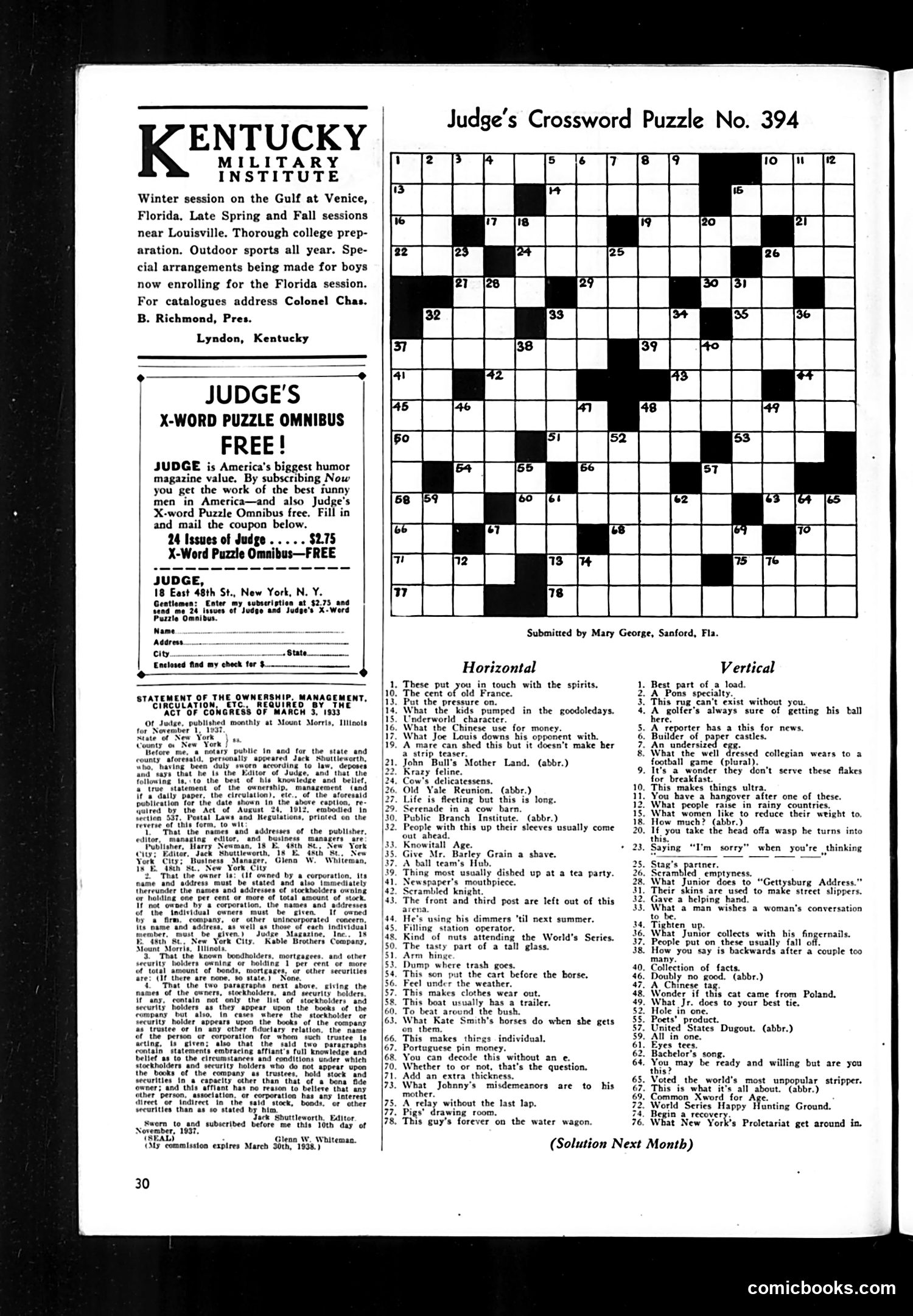
Judge Magazine Page No. 394 Analysis This page is primarily advertisements and administrative content, not political satire. The main elements are: 1. Kentucky Military Institute ad - recruiting students for winter/spring/fall sessions in Florida and Kentucky 2. Judge Magazine subscription offer - promoting subscriptions at $2.75 for 24 issues, with a free crossword puzzle omnibus 3. Legal ownership statement - required disclosure listing Jack Shuttleworth as editor, Judge Magazine Inc. as publisher (located in NYC), and Kable Brothers Company (Mount Morris, Illinois) as stockholder 4. Crossword puzzle No. 394 - submitted by Mary George of Sanford, Florida The only content of substantive interest is the ownership disclosure, which shows Judge's corporate structure in 1937. No cartoons, political figures, or satirical commentary appear on this page. It's a typical interior page mixing ads with required legal filings and entertainment content.
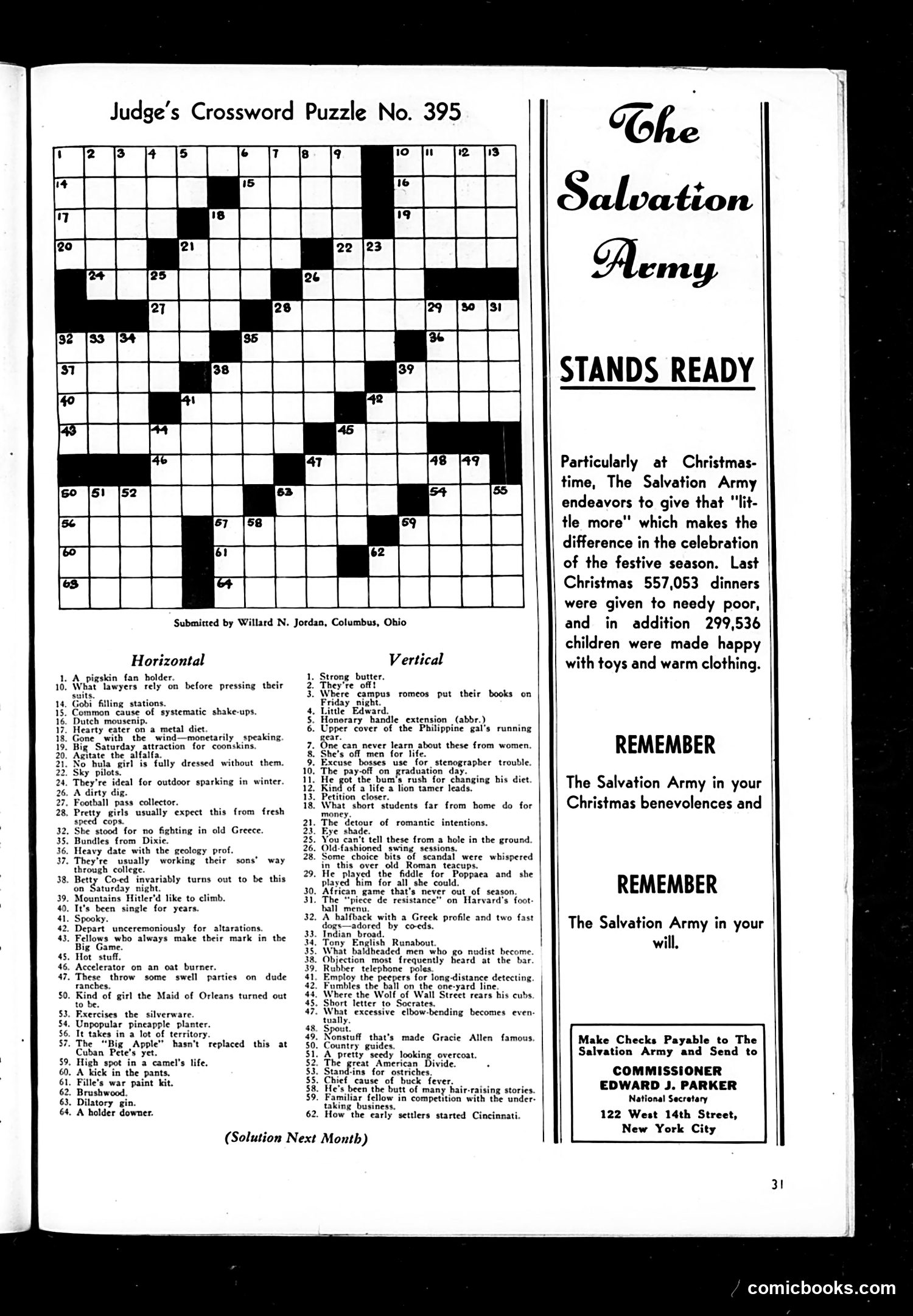
Judge Magazine Page Analysis This page contains a crossword puzzle (#395) submitted by a Columbus, Ohio reader, accompanied by advertisements for the Salvation Army. The crossword itself is a typical feature of Judge magazine—a sophisticated puzzle using contemporary slang and cultural references from the era (likely 1930s based on references like "Bundles from Dixie," "Cuban Pete," and "the Wolf of Wall Street"). The clues are humorous wordplay typical of the magazine's audience: educated, urban readers familiar with current events, popular culture, and social commentary. The puzzle isn't satirical itself but rather entertainment for Judge's readership. The Salvation Army advertisements on the right are the page's substantive content—earnest public service messaging, not satire. They highlight Christmas charitable work (557,053 dinners distributed in the previous year) and solicit donations. This page demonstrates Judge's dual purpose: offering sophisticated humor and entertainment while also serving as a vehicle for institutional advertising and social messaging.
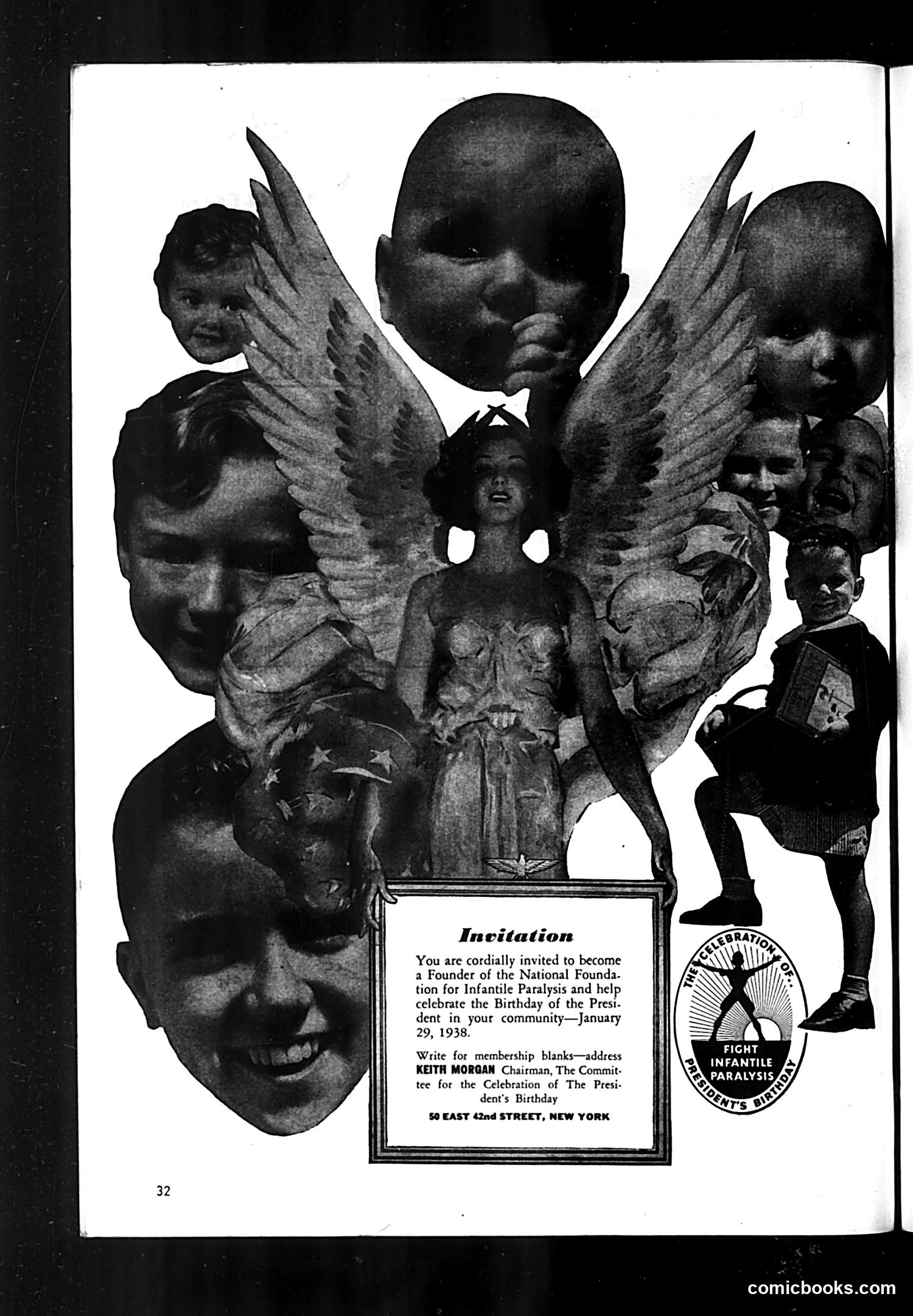
Historical Context This is a 1938 invitation advertisement for the National Foundation for Infantile Paralysis (polio), timed to President Franklin D. Roosevelt's birthday on January 29. The surreal composite imagery features multiple child faces and angelic winged figures arranged around a central maternal/allegorical figure—likely representing Protection or Hope. This symbolism emphasizes children as vulnerable victims of polio requiring protection. The appeal leveraged FDR's own paralysis from polio (contracted in 1921) as moral authority. The "Birthday Balls" celebrating his birthday became the foundation's major fundraising mechanism. The call to become "Founders" made giving feel like civic duty. For modern readers: this predates the Salk vaccine (1955). Polio was a genuine public health terror; this emotional appeal to patriotism and childhood welfare was standard 1930s fundraising strategy.
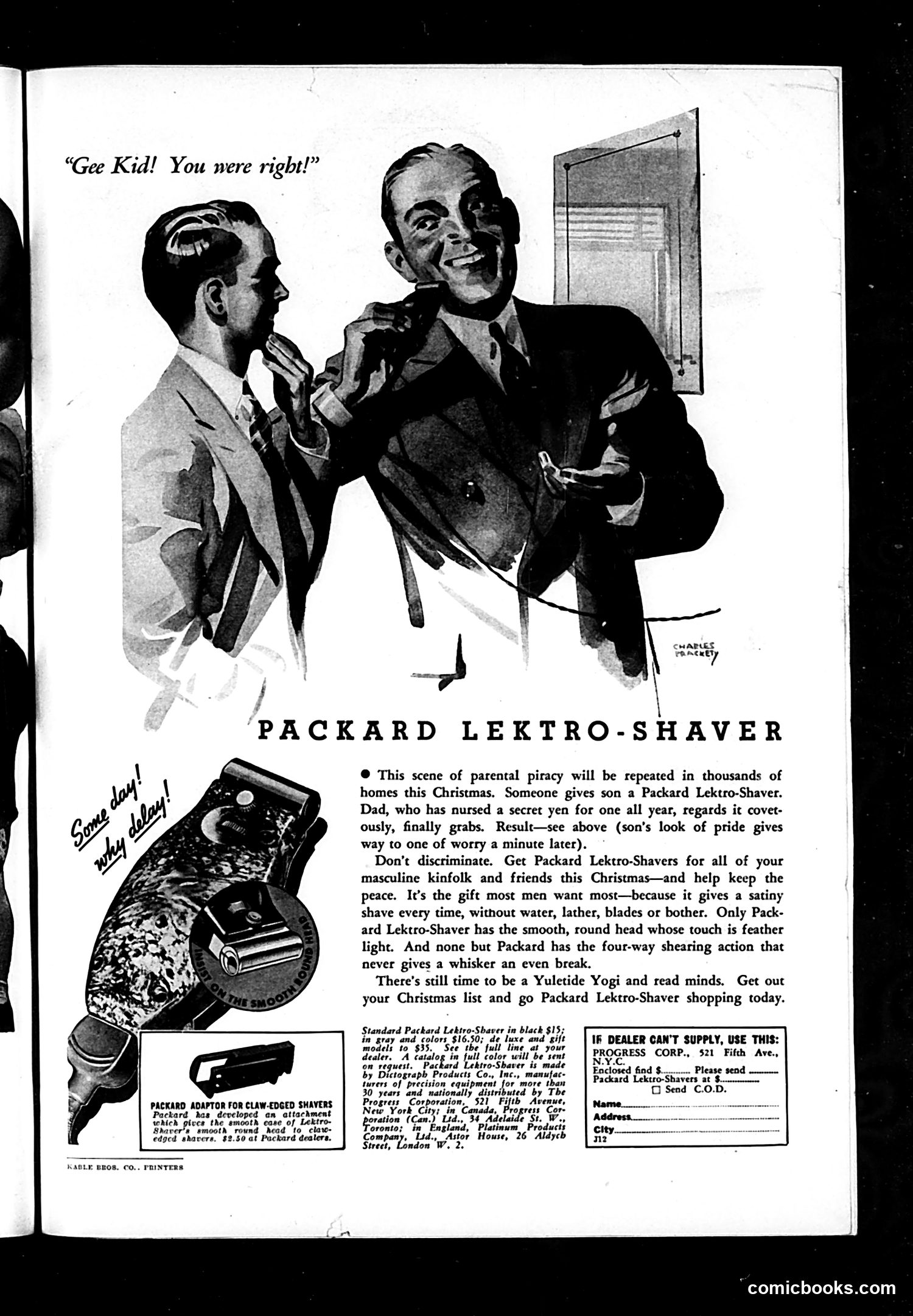
Analysis: Packard Lektro-Shaver Advertisement This is primarily a Christmas advertisement for an electric razor, not political satire. The cartoon illustrates a domestic humor scenario: a father covets his son's new Packard Lektro-Shaver gift and secretly takes it, prompting the son's rueful comment "Gee Kid! You were right!"—presumably the boy had predicted this outcome. The ad's satire is gentle and commercial: it humorously depicts a relatable family conflict to sell the product. The text explicitly frames this as "parental piracy" happening in "thousands of homes," using the scenario to argue that buying Packard shavers for all male relatives prevents jealousy and conflict. The humor targets parental selfishness and gift-grabbing rather than politics. It's designed to make the reader laugh while motivating holiday purchases—a sales tactic rather than social commentary.
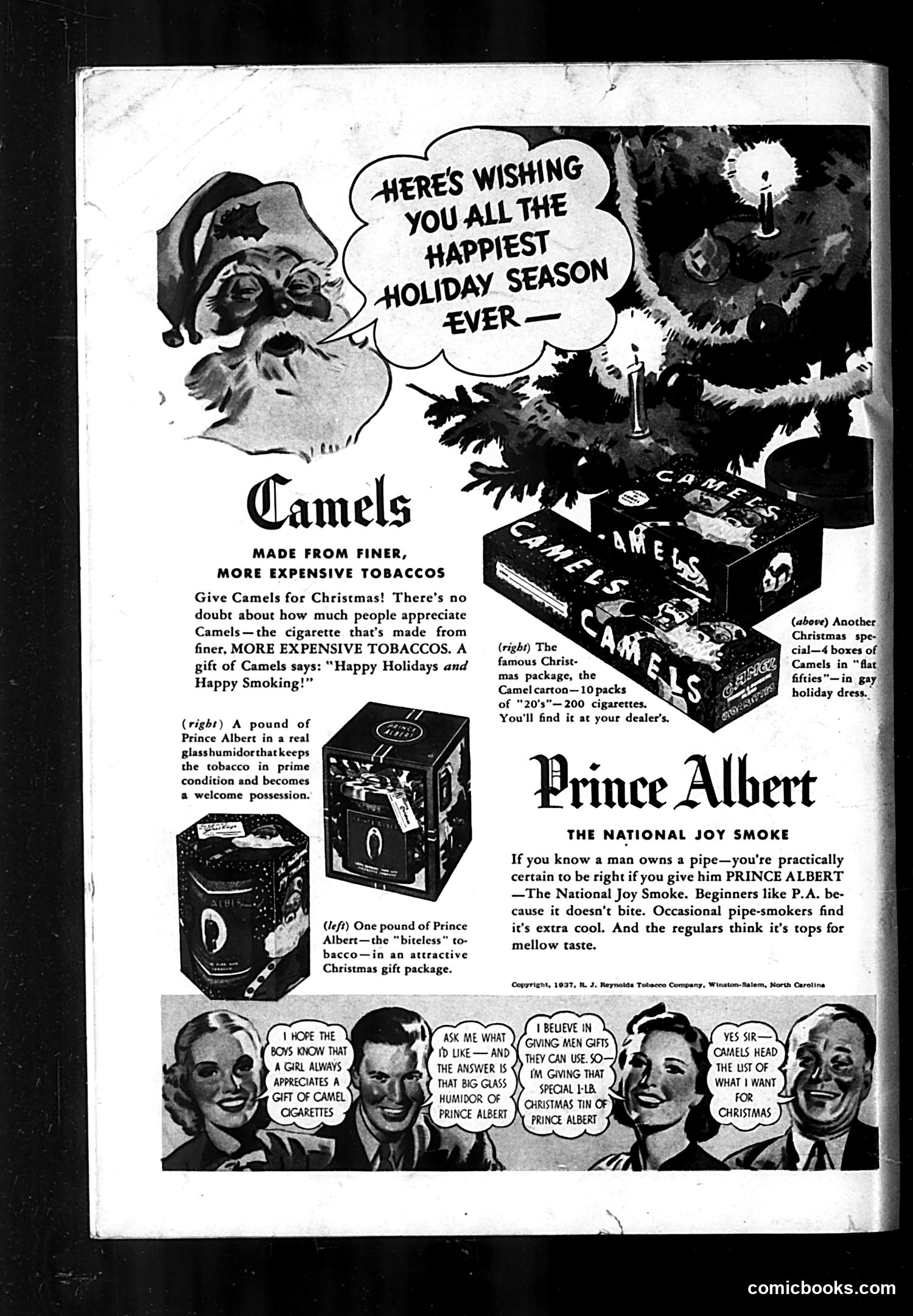
Analysis This page is primarily advertising, not satire or political commentary. It promotes two tobacco products—Camels cigarettes and Prince Albert pipe tobacco—as Christmas gifts. The top features Santa Claus endorsing Camels with a holiday message. Below are product images and descriptions emphasizing quality ("finer, MORE EXPENSIVE TOBACCOS") and attractive packaging. The bottom section shows six people in conversational speech bubbles discussing gift-giving, with testimonials about Prince Albert's appeal to different smokers (beginners, occasional users, regulars). One woman mentions giving Camels; others praise Prince Albert's lack of bite and cool taste. For modern readers, the striking element is that this represents normalized tobacco marketing to the general public, including as holiday gifts. The casual, cheerful presentation of cigarettes and pipe tobacco as desirable presents reflects 1937 advertising standards before widespread awareness of smoking's health dangers. The gendered appeal (gifts "girls" give, gifts for "men") also reflects period marketing conventions.

I can see this is a page from *Judge* magazine, but the image is too dark and degraded for me to reliably make out specific cartoon content, figures, or captions. The OCR text provided only shows "comicbooks.com," which appears to be a watermark rather than actual page content. To accurately explain the satire, political references, and jokes to a modern reader—following your accuracy-first requirement—I would need a clearer image where I can discern the cartoon illustrations, character depictions, labels, and accompanying text. Without being able to read these elements confidently, I cannot responsibly identify specific figures or explain the satirical point. If you could provide a higher-contrast or clearer version of this page, I'd be happy to analyze it properly.