judge
Judge — January 1938
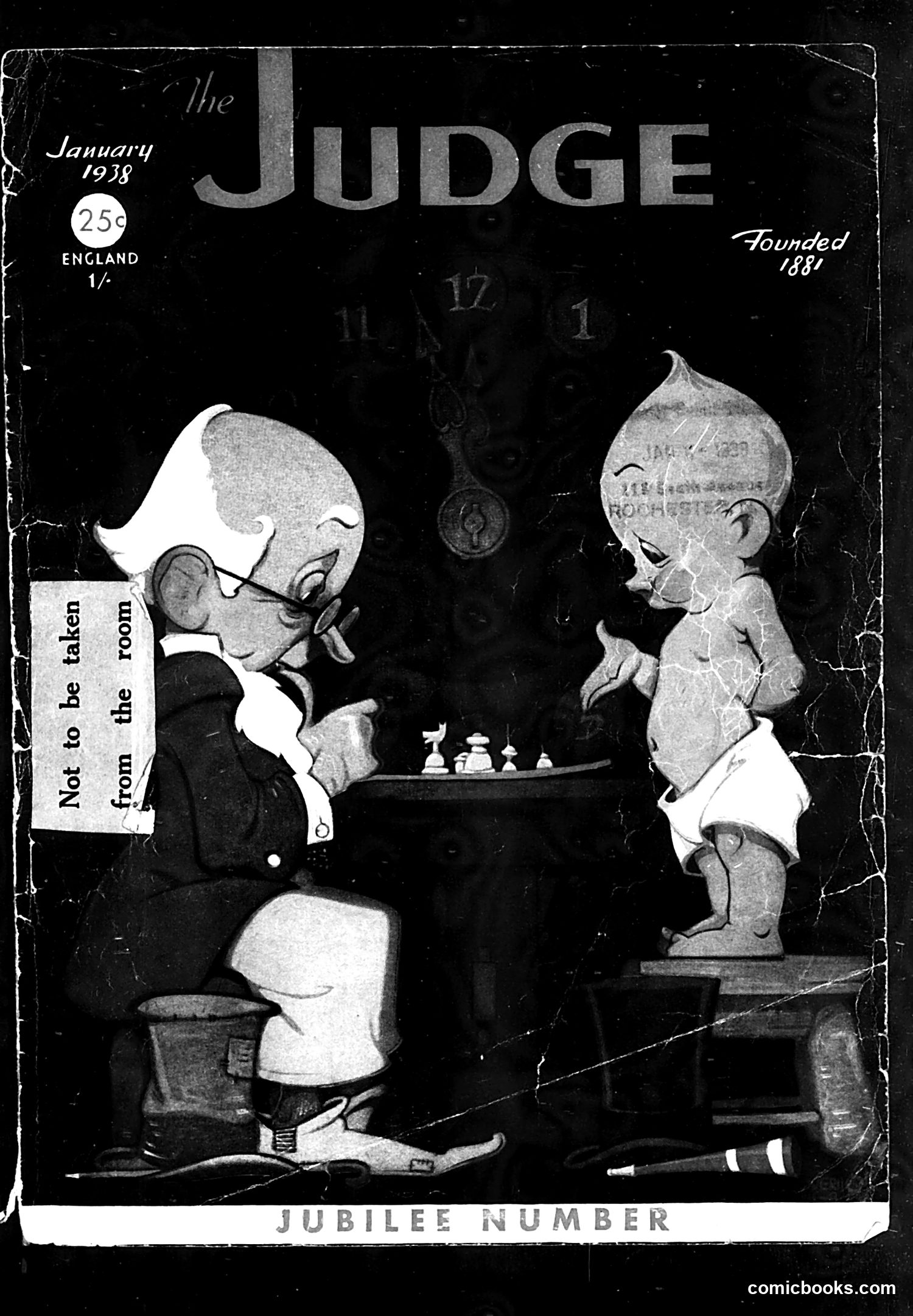
Judge Magazine, January 1938 Analysis This is a "Jubilee Number" cover featuring two caricatured figures playing chess. The left figure wears a suit and has exaggerated features; the right figure appears bald with distinctive characteristics. The caption "Not to be taken from the room" suggests this is a reference to something restricted or controlled. The chess game symbolizes strategic political maneuvering during a tense period. Given the January 1938 date, this likely comments on international politics of that era—possibly referencing diplomatic tensions or negotiations between world leaders. The chess metaphor indicates the cartoonist views political dealings as calculated games. However, without clearer identification of the specific figures or events, the precise political target remains uncertain. The satire appears to criticize how political leaders engage in strategic posturing during international crises.
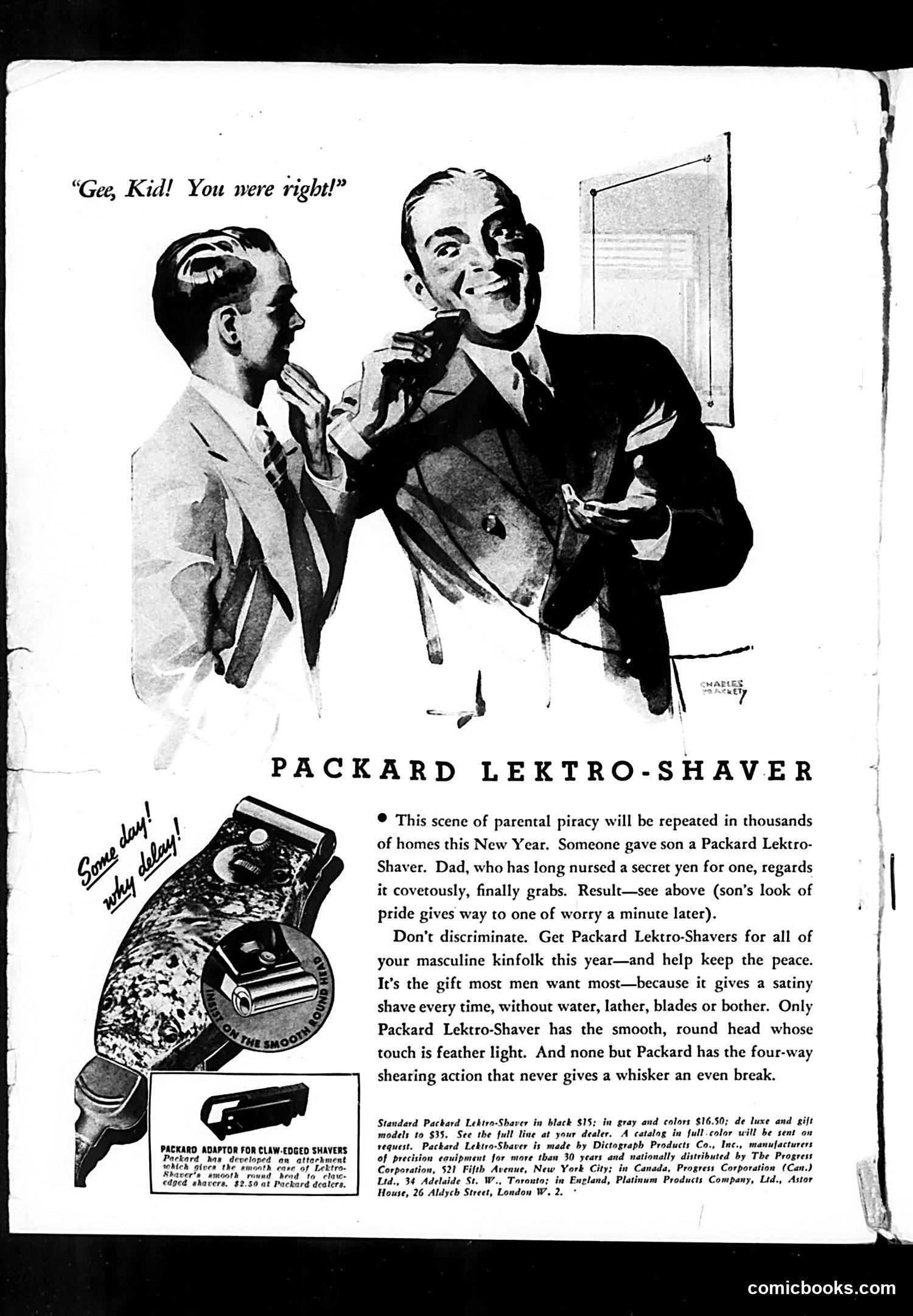
Packard Lektro-Shaver Advertisement This is primarily a commercial advertisement, not political satire. It depicts a father and son in a humorous domestic scene where the father has secretly taken his son's new Packard Lektro-Shaver electric razor—a New Year's gift. The caption "Gee, Kid! You were right!" suggests the father, coveting the product, has finally experienced its superior shave. The humor appeals to masculine pride and domestic rivalry rather than social commentary. The ad emphasizes the razor's features: no water, lather, or blades needed, and a "four-way shearing action." The accompanying text frames gift-giving as conflict prevention ("help keep the peace"), positioning the electric shaver as the ideal masculine gift to prevent exactly this scenario of paternal jealousy.
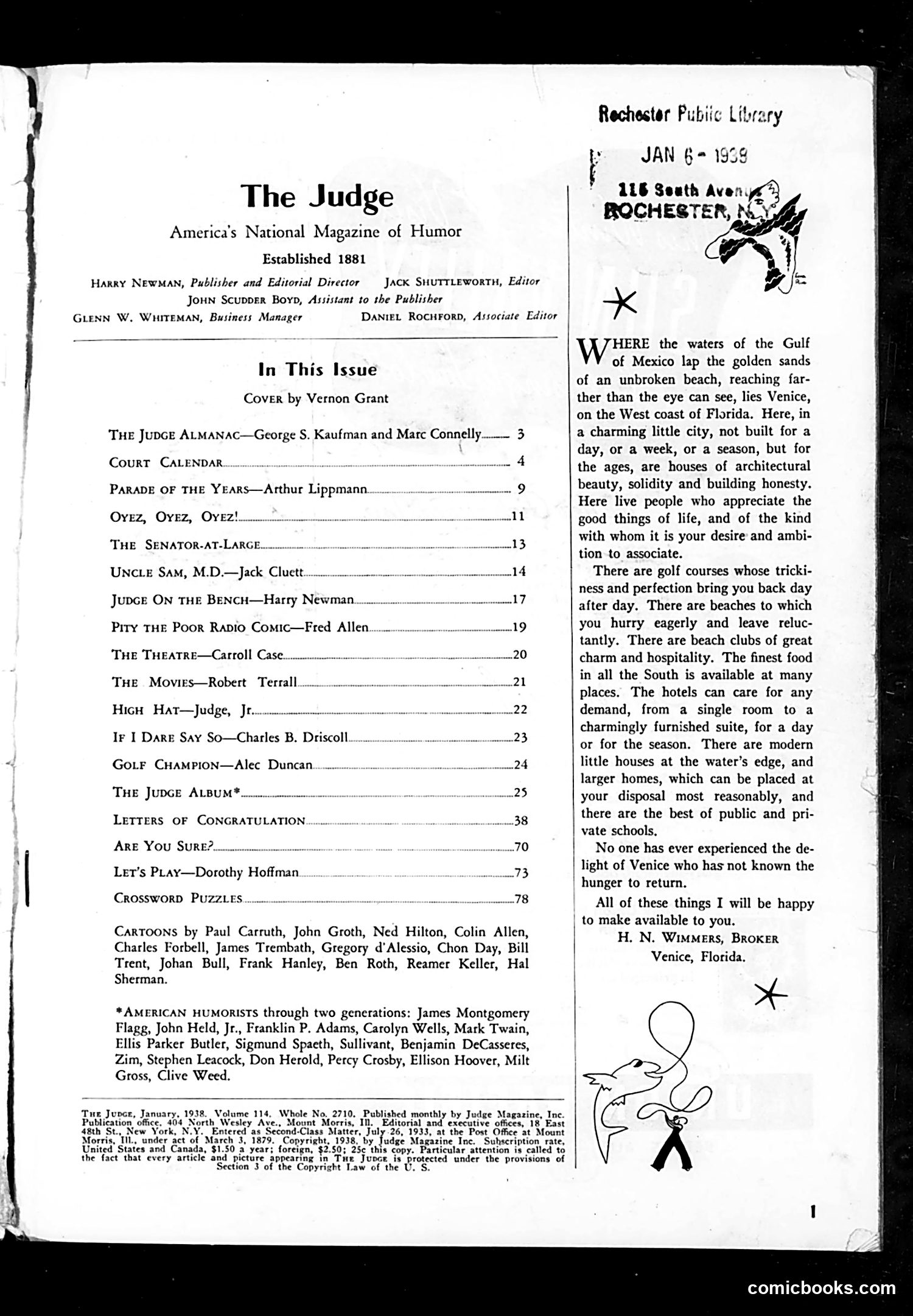
Analysis of Judge Magazine Page (January 1938) This is a table of contents and cover page for Judge magazine's January 1938 issue. The right side features promotional text about Venice, Florida, written by H. N. Wimmers, a broker—essentially advertising the coastal resort town's attractions (golf, beaches, hotels, schools). The cartoons visible are minimal and decorative rather than political. One shows a stylized figure with a balloon; another depicts a simplified character. These appear to be generic illustrations rather than satirical commentary on specific political figures or events. The content listing suggests this issue focuses on humor columns, theatrical reviews, and light satire typical of Judge's format—social commentary through comedy rather than pointed political cartoons. Without clearer identifying details in the illustrations, specific satirical targets remain unclear.
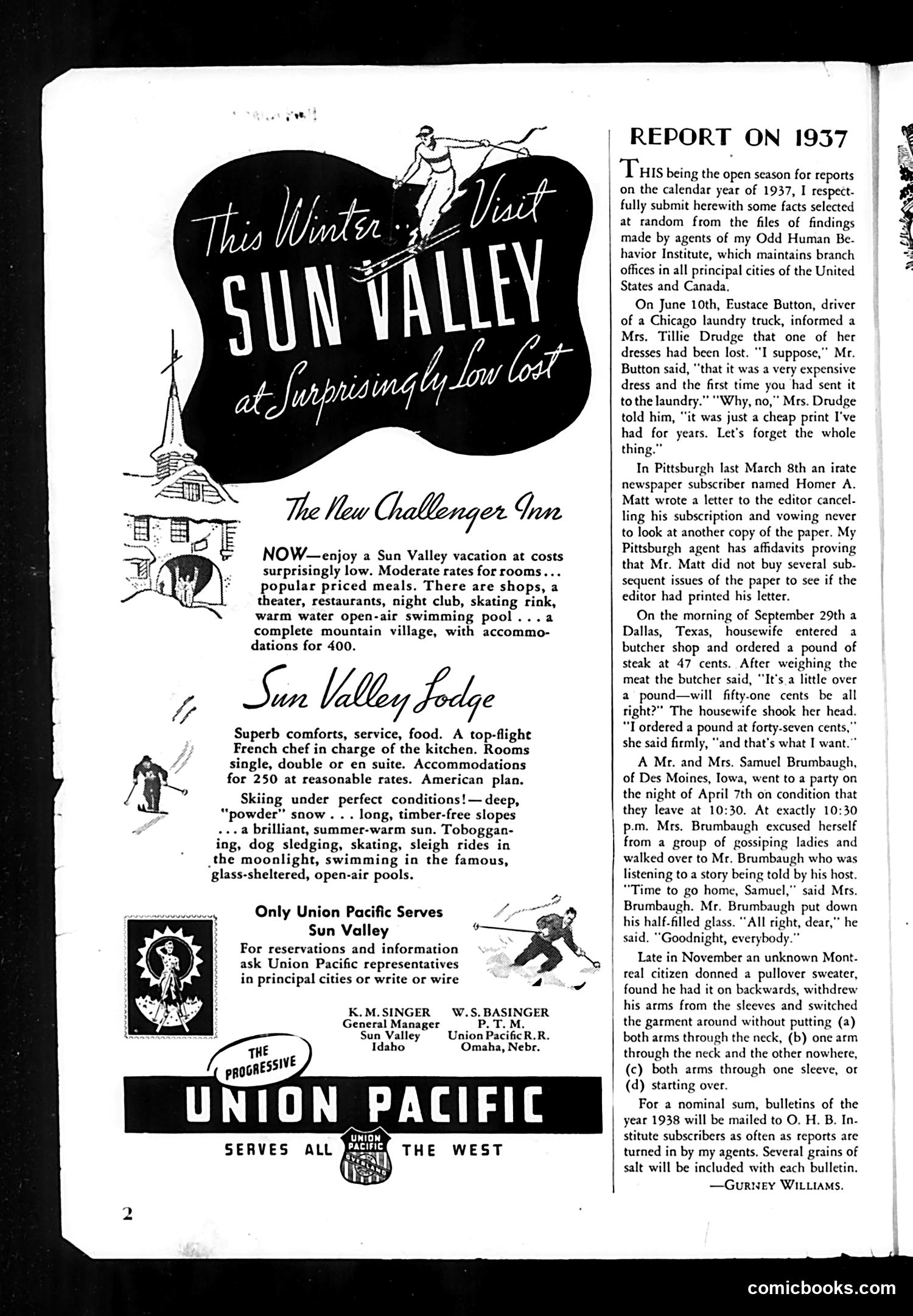
Analysis This page is primarily advertising, not satire or political content. The left side features Union Pacific Railroad advertisements promoting Sun Valley, Idaho as a winter vacation destination, highlighting the newly opened Challenger Inn and Sun Valley Lodge with skiing, pools, and dining. The right side contains "Report on 1937," a column by Gurney Williams describing anecdotes from the Odd Human Behavior Institute's files—a collection of amusing everyday incidents (lost laundry, newspaper complaints, meat-weighing disputes, etc.). These are humorous human-interest stories rather than political satire. The page reflects 1930s consumer culture and leisure travel promotion rather than commentary on current events or political figures.
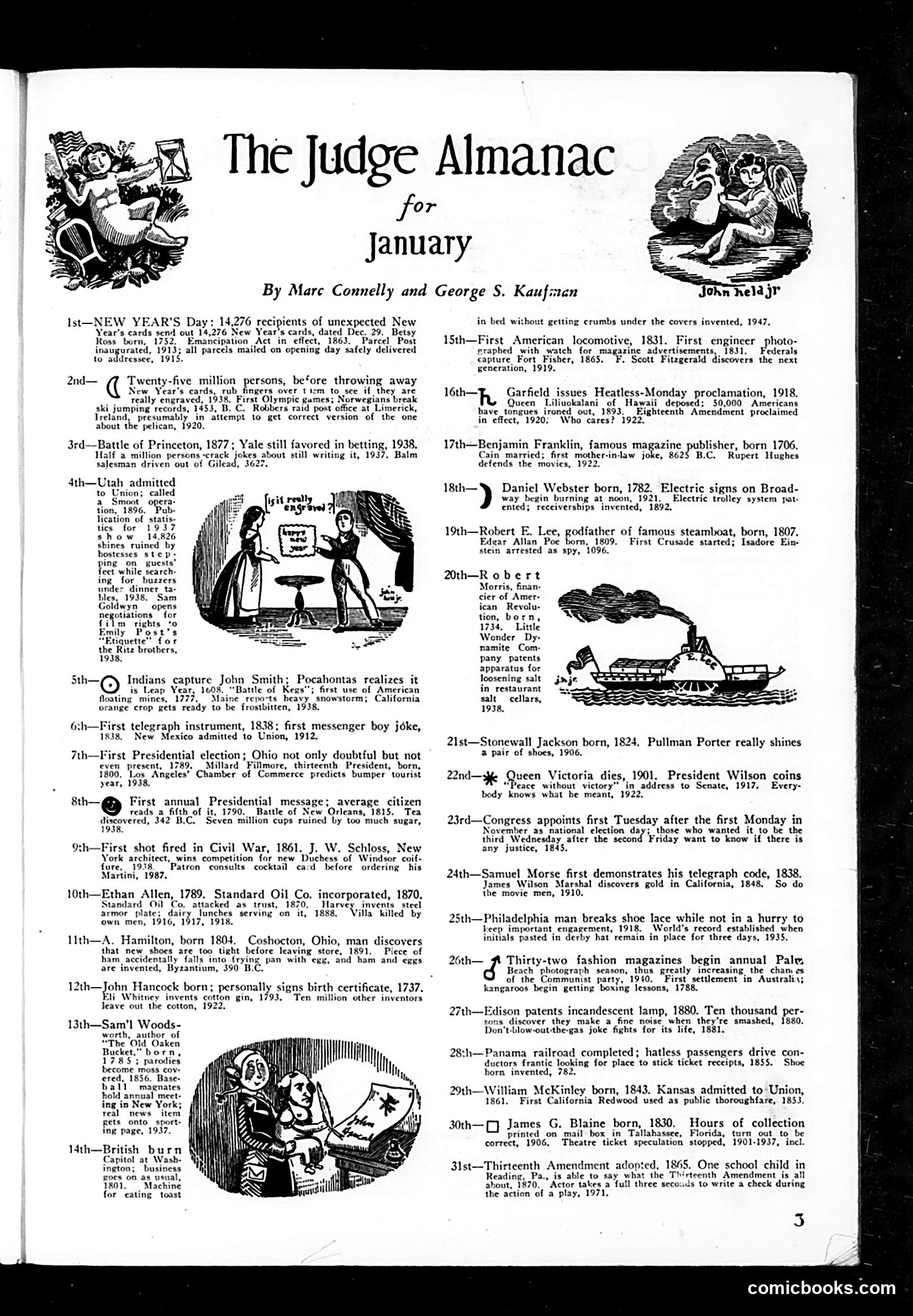
The Judge Almanac for January This page is primarily an almanac of historical events and notable births for January dates, rather than political satire. However, it includes three illustrative cartoons: 1. Entry 4: Shows a couple at a dining table with the woman complaining about her husband's behavior—appears to be domestic humor about marital disputes. 2. Entry 13: Features "The Old Oaken Bucket" reference, depicting what appears to be a nostalgic scene, likely mocking sentimentality about the past. 3. Entry 14: Illustrates a British burn victim, accompanying text about a fire at Washington's Capitol. The cartoons function as visual accompaniment to the historical entries rather than standalone political commentary. The overall page serves Judge's dual purpose as both a satirical magazine and practical almanac for readers.
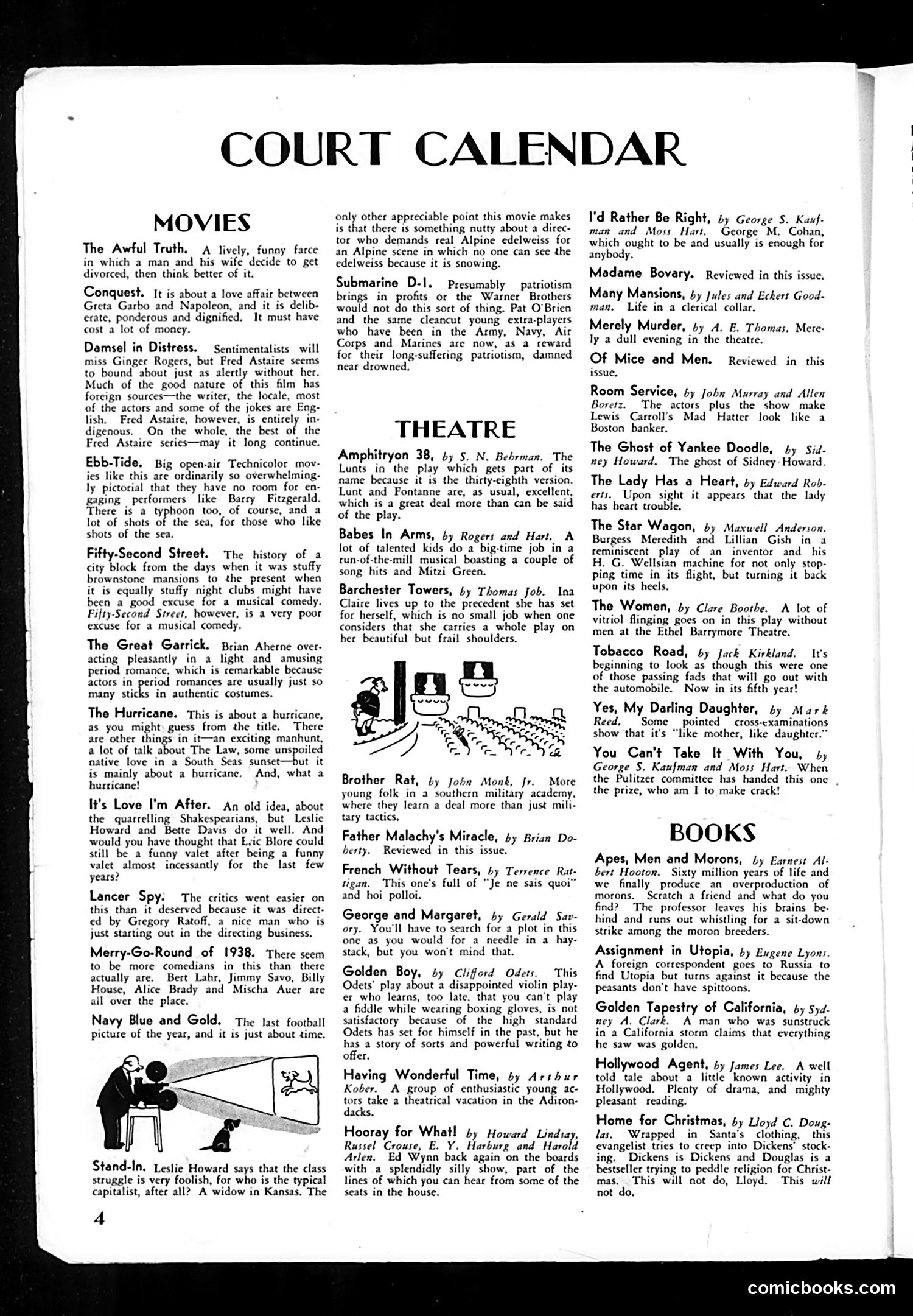
Court Calendar Page Analysis This is primarily a reviews and listings page rather than a satirical cartoon section. It contains capsule reviews of current movies and theatrical productions, with brief plot summaries and critical commentary. The small illustrations appear to be generic theatrical/entertainment imagery rather than political satire—including what looks like a top-hatted figure (standard vaudeville iconography) and comedic theater scenes. The reviews themselves offer mild social commentary through their subject matter (military academies, Southern romance, patriotic themes), but this reflects entertainment preferences of the era rather than pointed political satire. This page demonstrates Judge's broader function as a general-interest magazine covering culture and entertainment, not exclusively political humor.
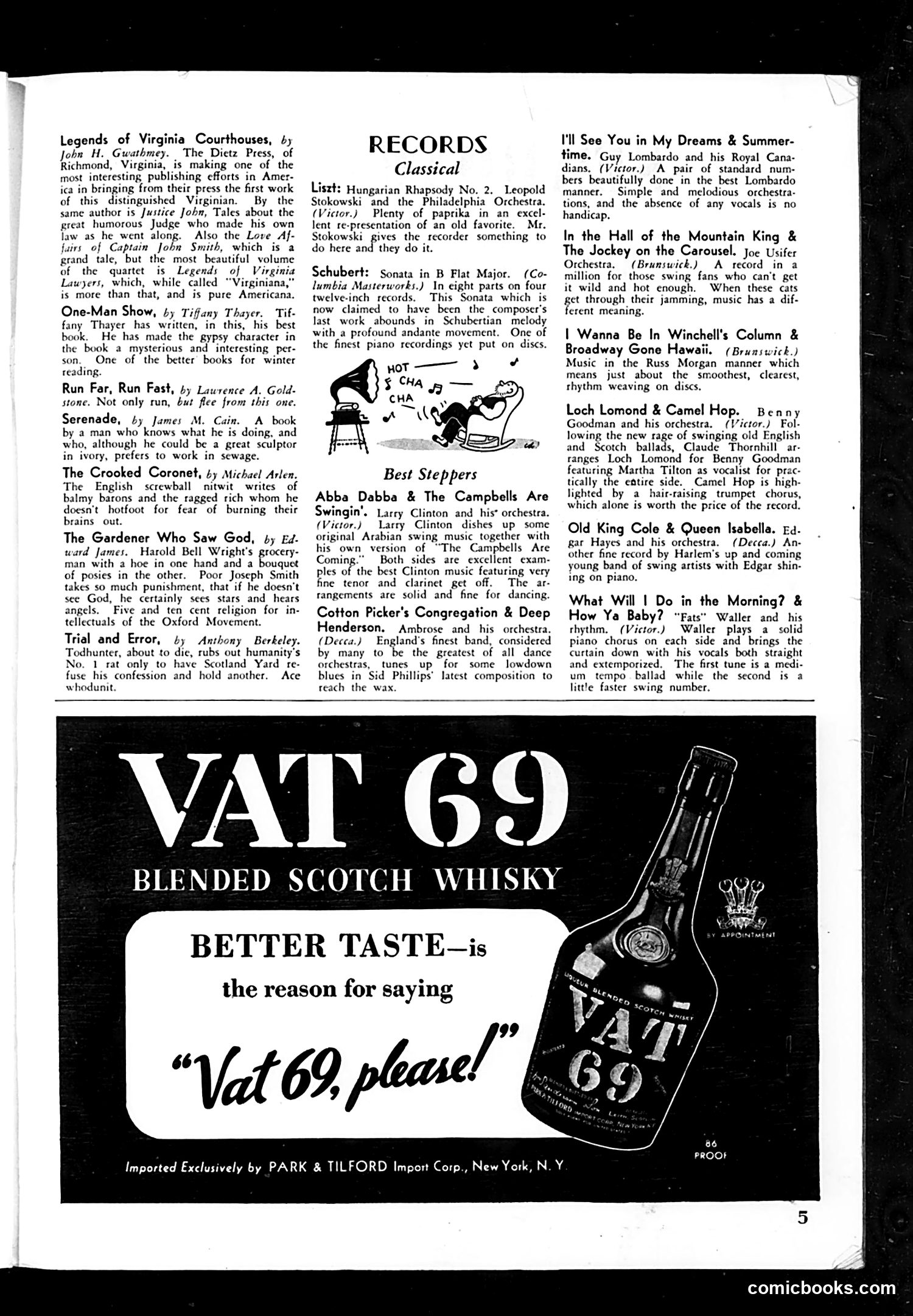
Analysis This page is primarily advertising and record reviews, not political satire. The upper half contains classical music record reviews from what appears to be a 1930s-era Judge magazine. The reviews discuss various orchestral recordings and popular songs of the period. The dominant content is a full-page advertisement for VAT 69 Blended Scotch Whisky at the bottom. The ad features a bottle illustration and the slogan "BETTER TASTE—is the reason for saying 'Vat 69, please!'" This is a straightforward commercial advertisement with no satirical content. The page demonstrates how Judge magazine mixed editorial content with advertising revenue. There is no political cartoon or social satire evident on this particular page.
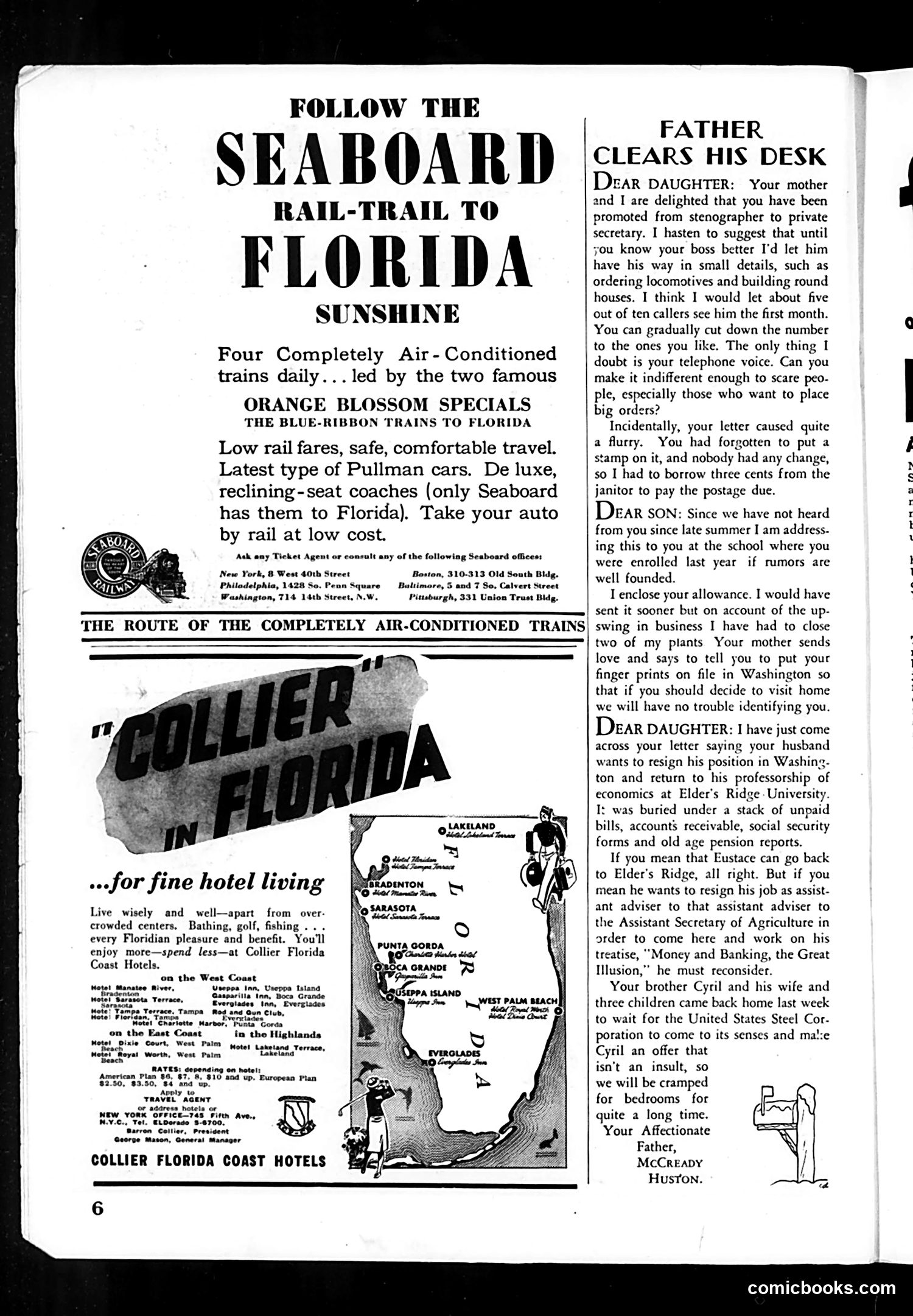
Analysis of Judge Magazine Page This page is primarily advertising and advice column content, not political satire. The left side features railroad and hotel advertisements promoting travel to Florida via the Seaboard Air Line Railway, highlighting air-conditioned trains and beachfront hotels—typical 1930s-40s leisure marketing. The right side contains "Father Clears His Desk," an advice column where a father responds to three family letters. The humor is gentle domestic satire: he gently chides his daughter about a postal error, discusses his son's educational plans, and addresses his other son's potential career resignation from government service. The column uses period-typical anxieties about employment, education, and family propriety for mild comedic effect. Overall, this is a social humor and commercial page rather than political commentary.
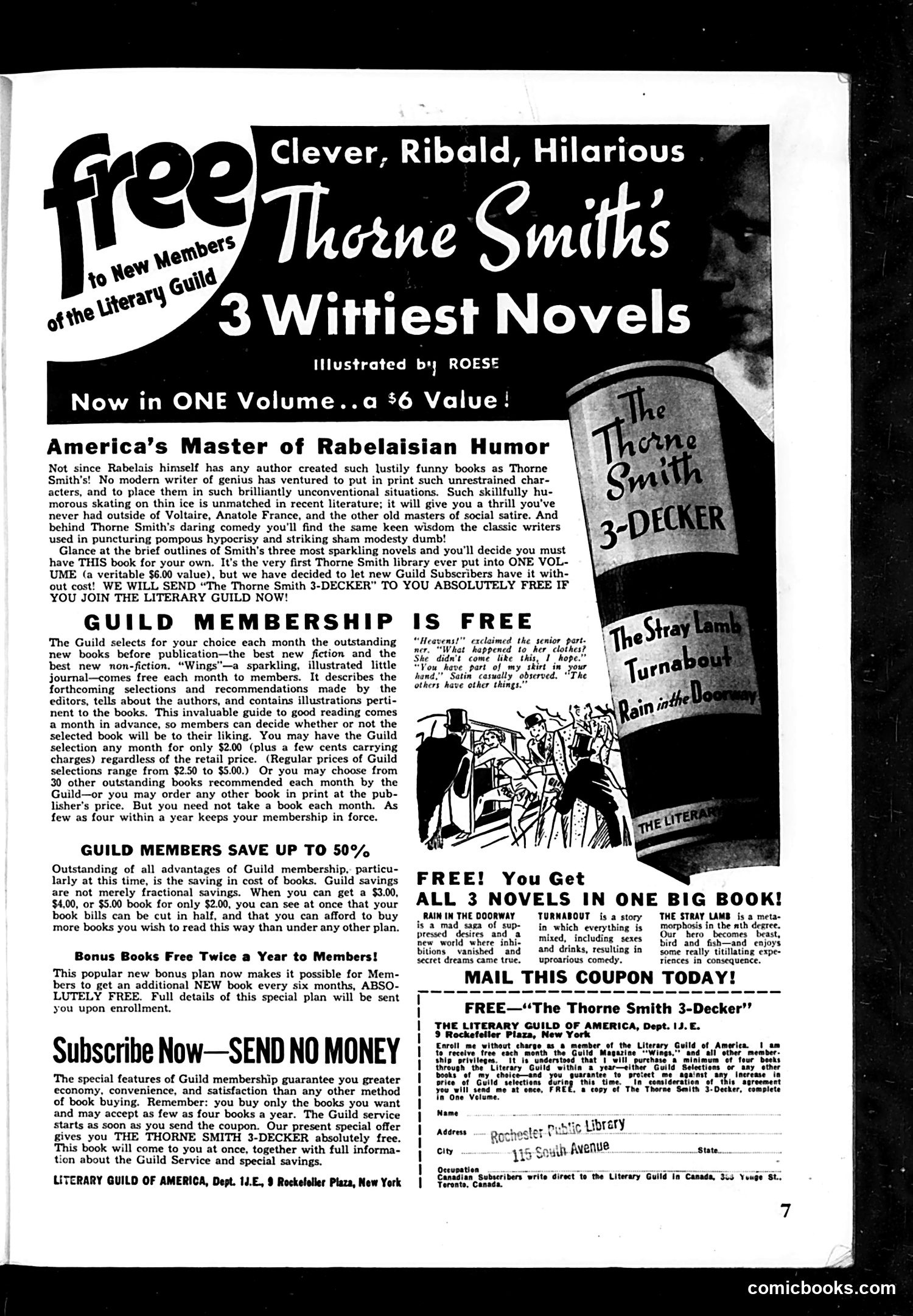
This page is primarily an advertisement for the Literary Guild of America, promoting a membership offer for Thorne Smith's "3 Wittiest Novels" in a single volume. The ad emphasizes Smith as "America's Master of Rabelaisian Humor," highlighting his reputation for writing bawdy, unconventional fiction with lusty funny characters. The advertisement focuses on membership benefits rather than satire: free enrollment, savings up to 50% on book purchases, and bonus free books twice yearly. The copy stresses that members buy only books they want at discounted prices. There are no political cartoons or satirical illustrations on this page—it's purely commercial content designed to recruit new Guild subscribers by offering the Thorne Smith collection as an incentive.
This is primarily advertising, not satire or editorial cartoon. The page is a 1937 life insurance advertisement by Union Central Life Insurance Company. The "SEVEN VITAL NEEDS" headline refers to financial provisions every father should make for his family in case of death—including income replacement, children's education, and widow's support. The text targets anxious fathers by suggesting they lack the knowledge to properly plan for their families' financial security. Union Central pitches its new "Family-needs Forecast" service, claiming expertise based on "several million fatherless families" studied over 70+ years. There is no cartoon visible on this page—only typography, text blocks, and a tear-out coupon. The emotional appeal ("how well your life insurance would meet your family's inescapable needs") uses mild fear-based marketing typical of Depression-era insurance advertising, emphasizing that most fathers don't understand their responsibilities.
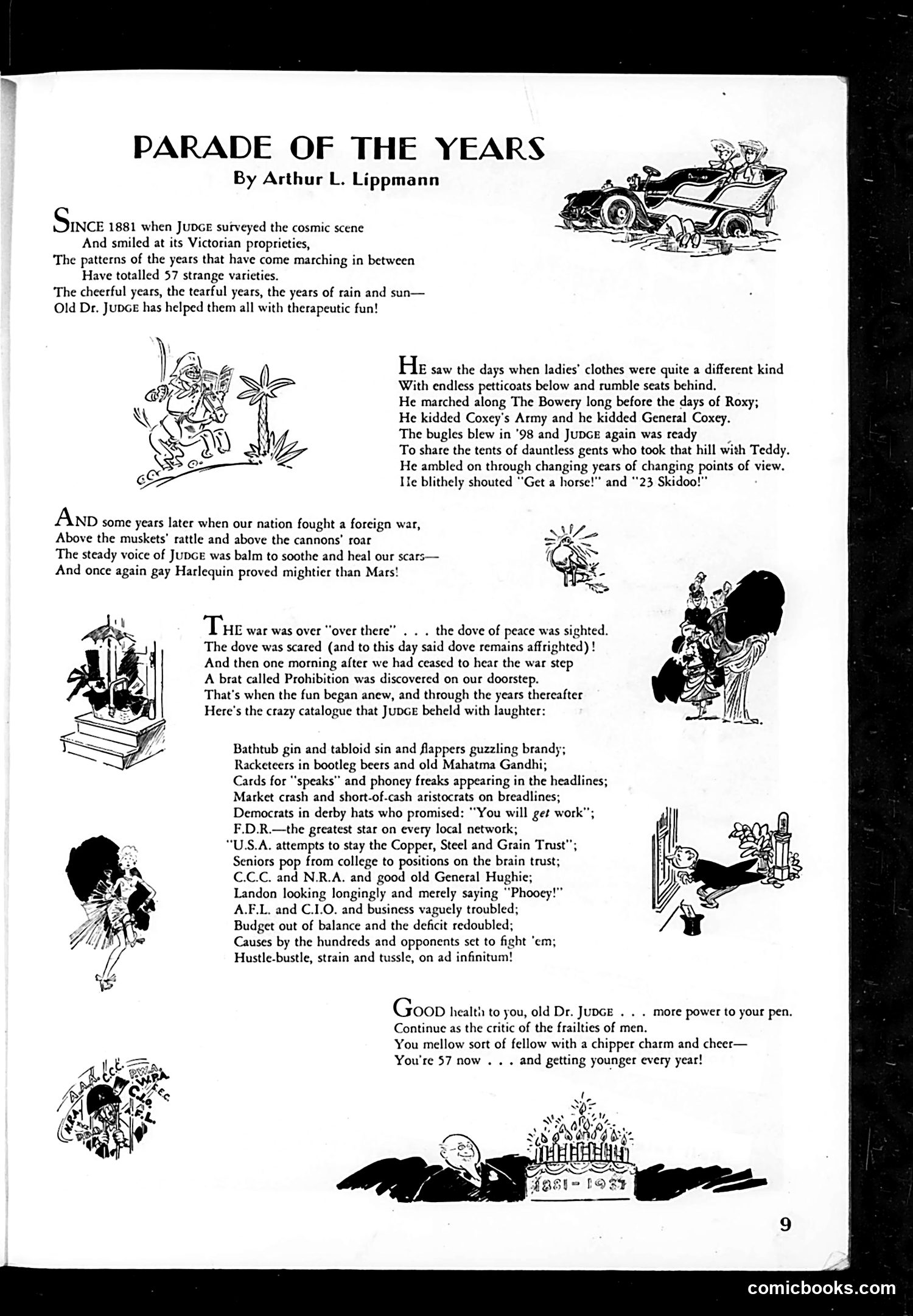
"Parade of the Years" - Judge Magazine Satire This celebratory piece marks Judge magazine's 57th anniversary (since 1881). The text presents a nostalgic survey of American history through Judge's satirical lens, highlighting targets of ridicule: Historical references include: Coxey's Army (1894 protest march), the Spanish-American War ("that hill with Teddy"—Rough Riders), WWI, Prohibition, the 1920s (flappers, speakeasies/"speaks"), the stock market crash, and the Great Depression. 1930s New Deal programs receive particular attention: F.D.R., the C.C.C. (Civilian Conservation Corps), N.R.A. (National Recovery Administration), and the "brain trust" of young college-educated advisors. Political figures mocked: Alf Landon (Republican 1936 presidential candidate saying "Phooey"), references to labor unions (A.F.L., C.I.O.), and "General Hughie" (likely General Hugh Johnson, NRA administrator). The satire suggests Judge views these Depression-era interventions with skeptical humor—treating them as fodder for comedic criticism rather than serious policy assessment.

Analysis This is a Bell Telephone System advertisement, not satirical content. The page promotes telephone service expansion with the tagline "MORE SERVICE FOR MORE PEOPLE." The visual shows a rotary telephone dial with letter-number combinations (GHI, DEF, ABC, JKL, MNO) visible—the standard mapping system used on mid-20th century phones. The advertisement's three key claims are: 1. More Bell telephones exist than ever before 2. More people can talk with you; you can talk with more people 3. Bell telephone service provides greater value This appears to be corporate messaging from the Bell Telephone System's golden age (likely 1930s-1950s), emphasizing the company's expansion and improved connectivity as consumer benefits. It reflects the era when telephone availability was still a growing service, not yet universal.
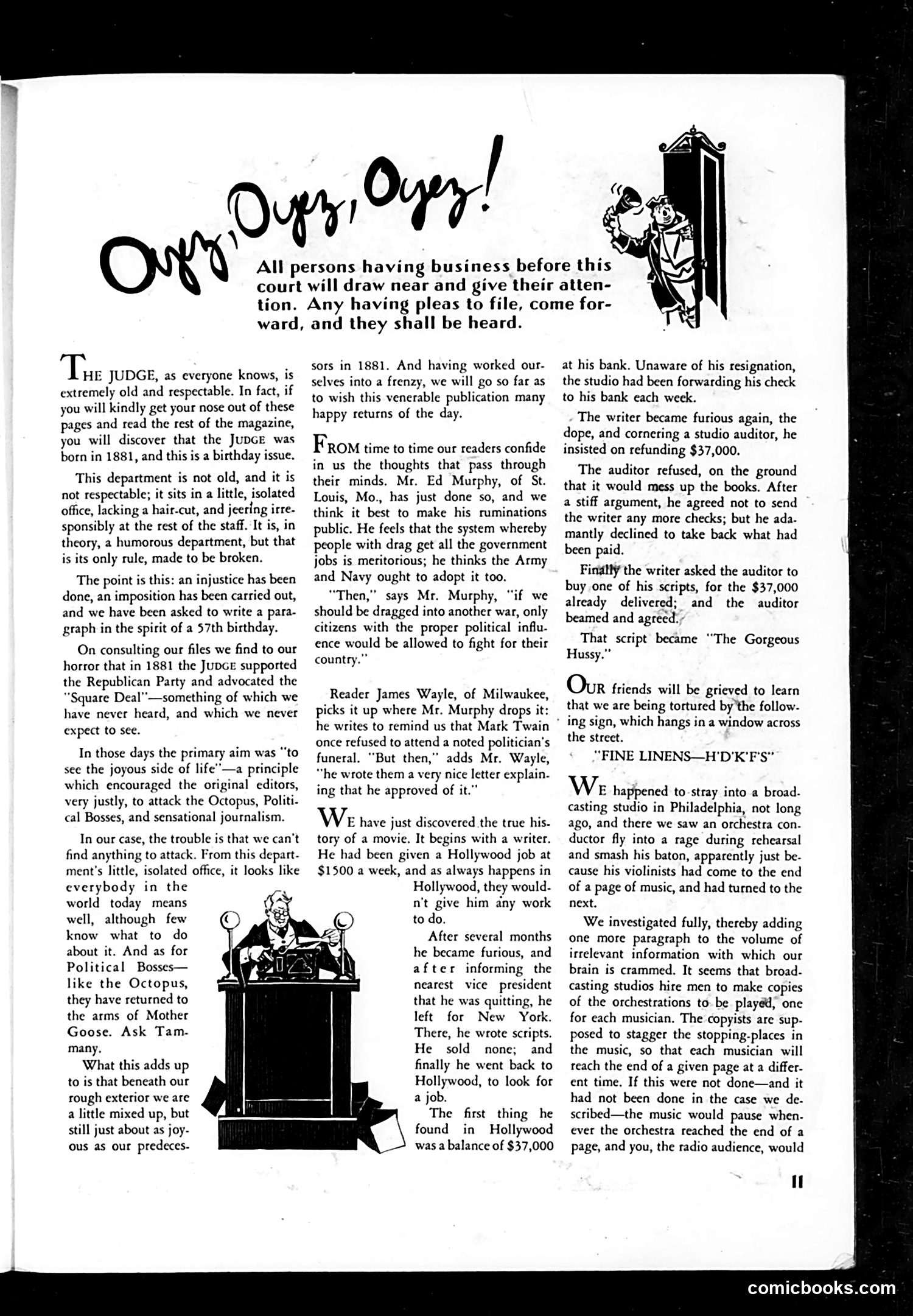
Explanation for Modern Readers This page celebrates Judge magazine's 57th birthday (founded 1881). The masthead cartoon depicts a court crier announcing business, a visual pun on the magazine's name. The main text is self-reflective satire: Judge acknowledges that in 1881 it attacked clear villains—political machines ("the Octopus"), corrupt bosses, and sensational journalism. Today (the 1930s), the writer claims these evils have mysteriously vanished, leaving the humor department with nothing to satirize. This is ironic social commentary: the author is obliquely suggesting that corruption still exists but has become so normalized that people no longer recognize it. The reader submissions that follow mock political favoritism and bureaucratic absurdity. The Hollywood anecdote about a writer accidentally paid $37,000 for months of non-work satirizes both Hollywood's chaos and the auditor's refusal to correct obvious errors—illustrating institutional dysfunction masquerading as procedure. The overall effect is gentle, nostalgic mockery of the magazine's own aging idealism.
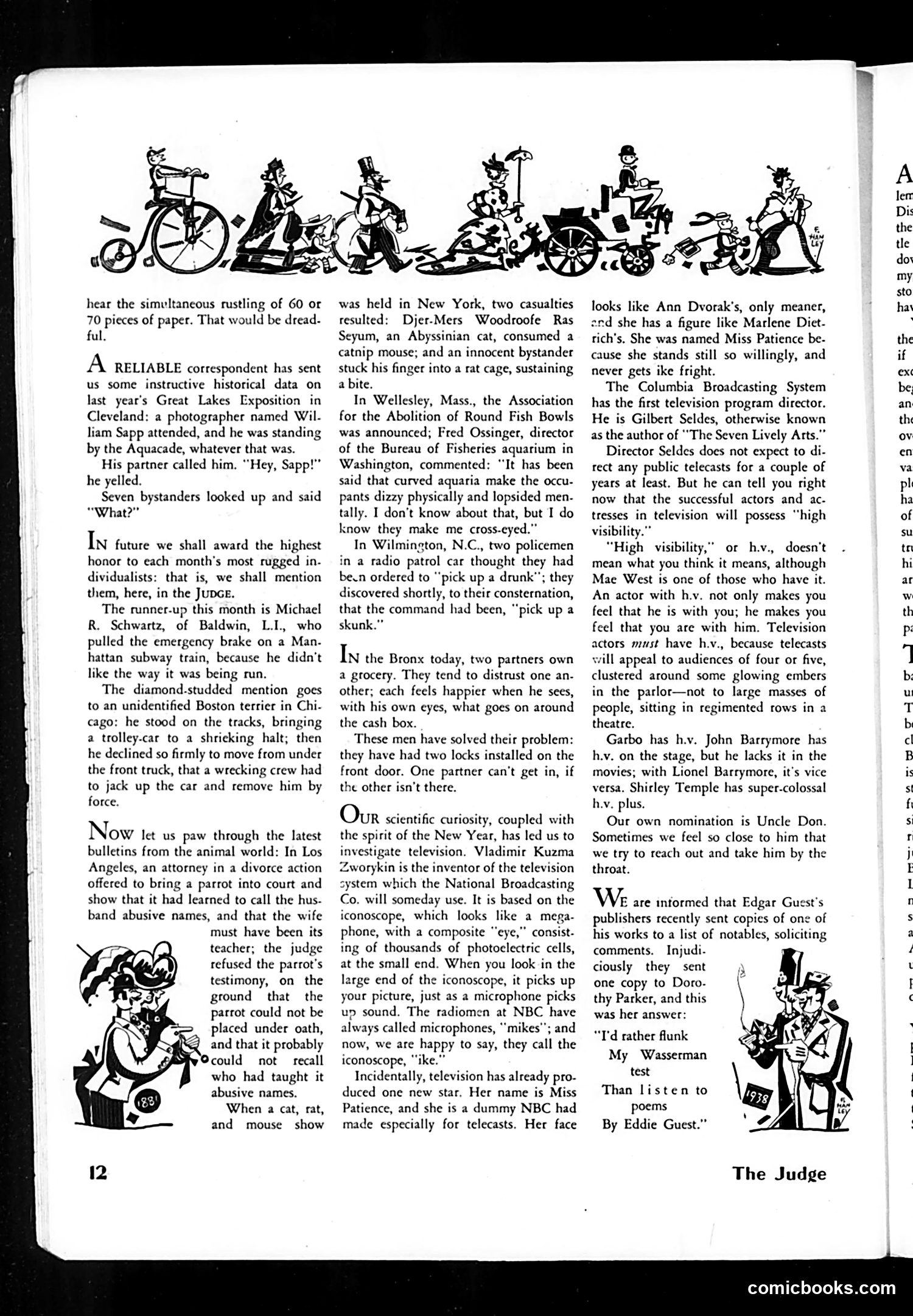
Analysis of Judge Magazine Page This page from Judge magazine presents humorous anecdotal observations about American life and emerging technology, circa late 1930s. The Main Satirical Content: The page mocks various human quirks and absurdities through anecdotes. Examples include a photographer named Sapp whose name caused confusion at a public gathering, and a subway rider who pulled the emergency brake simply because he disliked how the train was being operated—both presented as examples of "rugged individualists." The Animals Section ridicules legal and social absurdities: a divorce lawyer attempting to use a parrot's learned insults as testimony (rejected by the judge as inadmissible), and two grocery partners solving their mutual distrust by installing two door locks neither can operate alone. The Television Segment explains Vladimir Zworykin's new iconoscope technology to Judge's readers while making puns ("ike" for iconoscope, playing on "Mike" for microphone). The reference to "Miss Patience"—a dummy NBC created for television broadcasts—gently satirizes the new medium's artificial nature. The overall tone is lighthearted social commentary on modern American life.
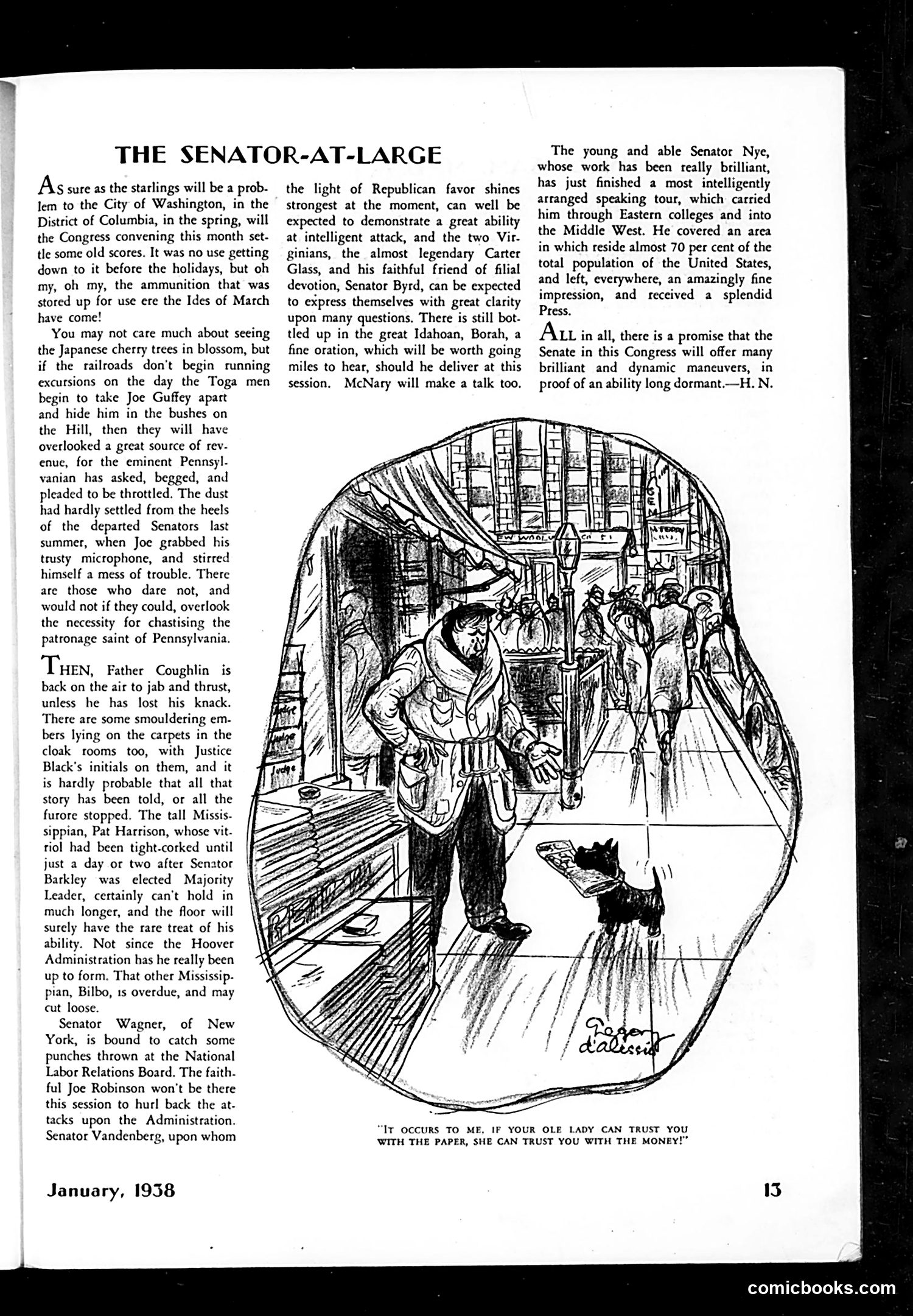
"The Senator-at-Large" (Judge, January 1938) This political commentary previews Congressional conflicts following the 1937 recess. The article anticipates heated Senate debates, naming specific senators expected to attack Administration policies and each other. Key figures mentioned include Pennsylvania's Joe Guffey (vulnerable to criticism), Father Coughlin (a radio priest-activist), Justice Black (apparently controversial), Mississippi's Pat Harrison and Theodore Bilbo (poised to attack), and New York's Senator Wagner (likely to criticize the National Labor Relations Board). The article praises younger senators like Gerald Nye for their speaking tours and intellectual vigor. It notes Joe Robinson's absence—he was a key Administration defender who died in 1937. The cartoon (bottom) depicts a congressional corridor scene with the caption about trusting someone with newspapers versus money—likely satirizing corruption or misplaced faith in politicians. The overall tone is gossip-tinged political theater, treating Senate infighting as entertainment while tracking power shifts and policy disputes in the Roosevelt era.
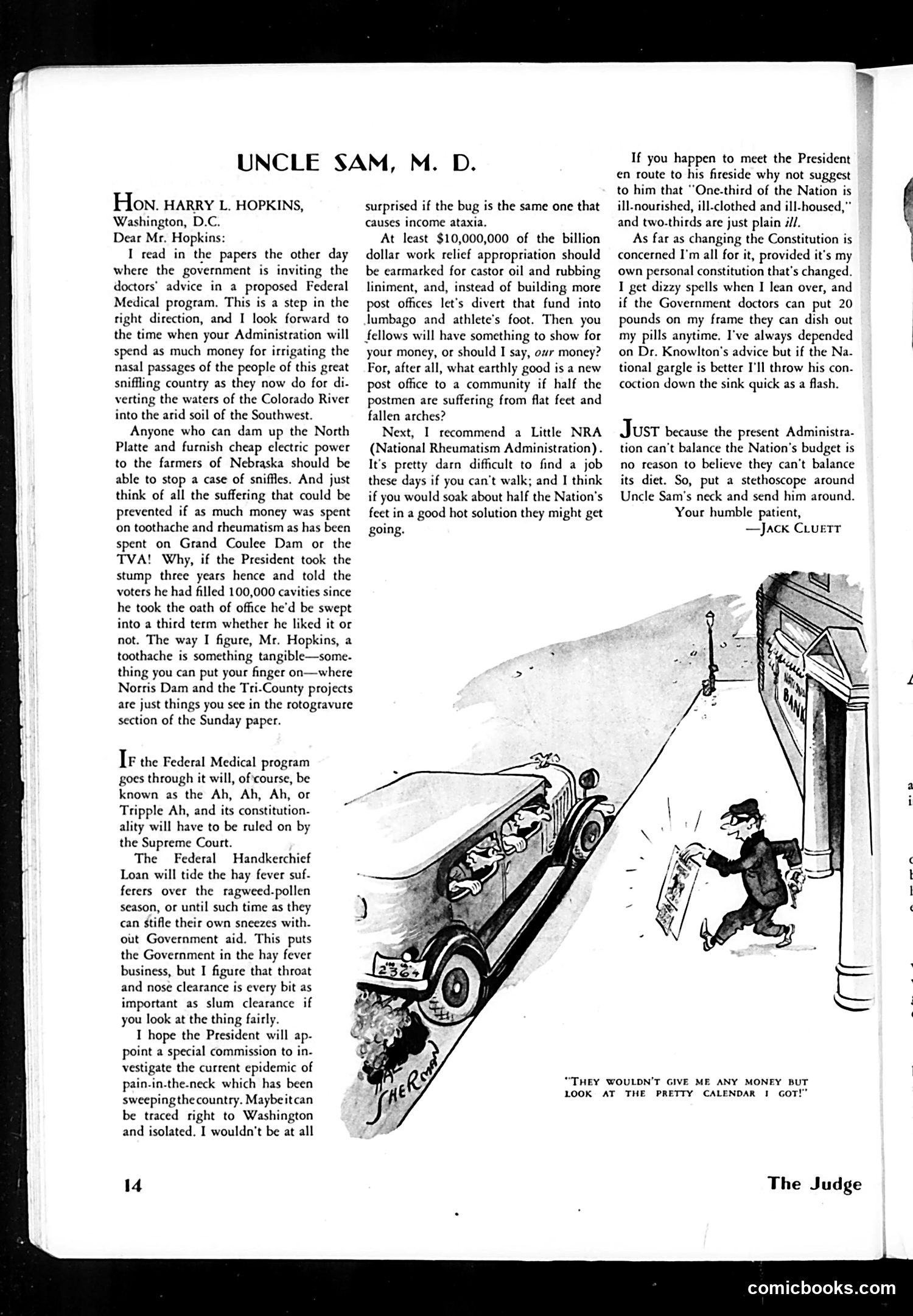
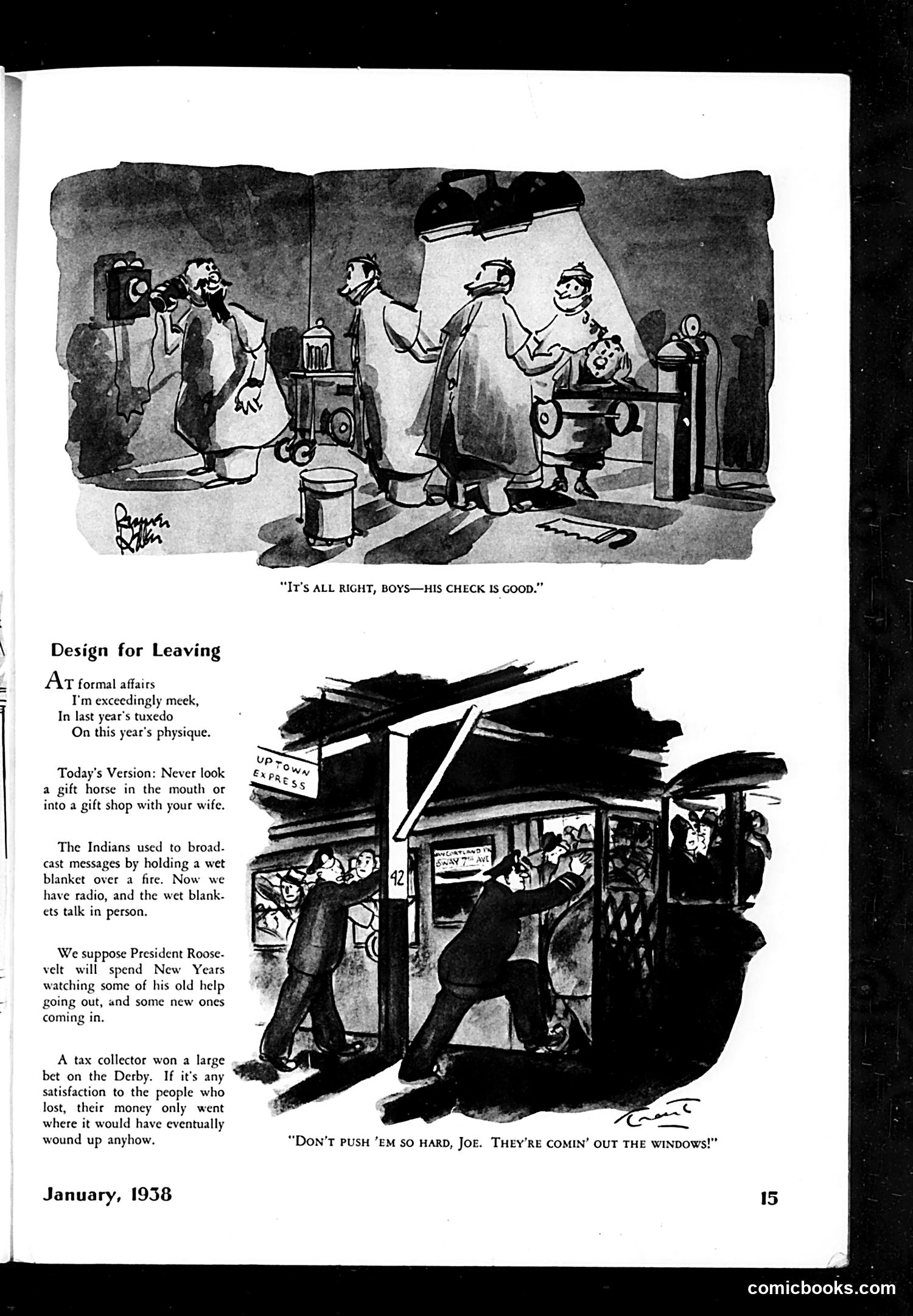
Judge Magazine, January 1938: Political Satire Top Cartoon: A medical inspection scene where officials declare "his check is good." This appears to satirize government bureaucratic approval processes, possibly referencing New Deal programs or relief agencies that required eligibility verification during the Great Depression. "Design for Leaving" Section: A satirical humor column mixing social commentary with jokes about: - Wearing old formal wear ("last year's tuxedo / on this year's physique")—Depression-era economic struggle - Roosevelt administration turnover ("old help going out, and some new ones coming in")—reflecting cabinet changes - A comment about tax collectors and betting on horse races Bottom Cartoon: Depicts an overcrowded "Uptown Express" bus with passengers literally exiting through windows because the vehicle is dangerously overstuffed. This likely criticizes public transportation inadequacy or overcrowding during 1930s urban conditions, with "Joe" (possibly a transit official or driver) being told to stop forcing people in. Both cartoons reflect Depression-era public frustrations with government services, economic hardship, and civic infrastructure failures.
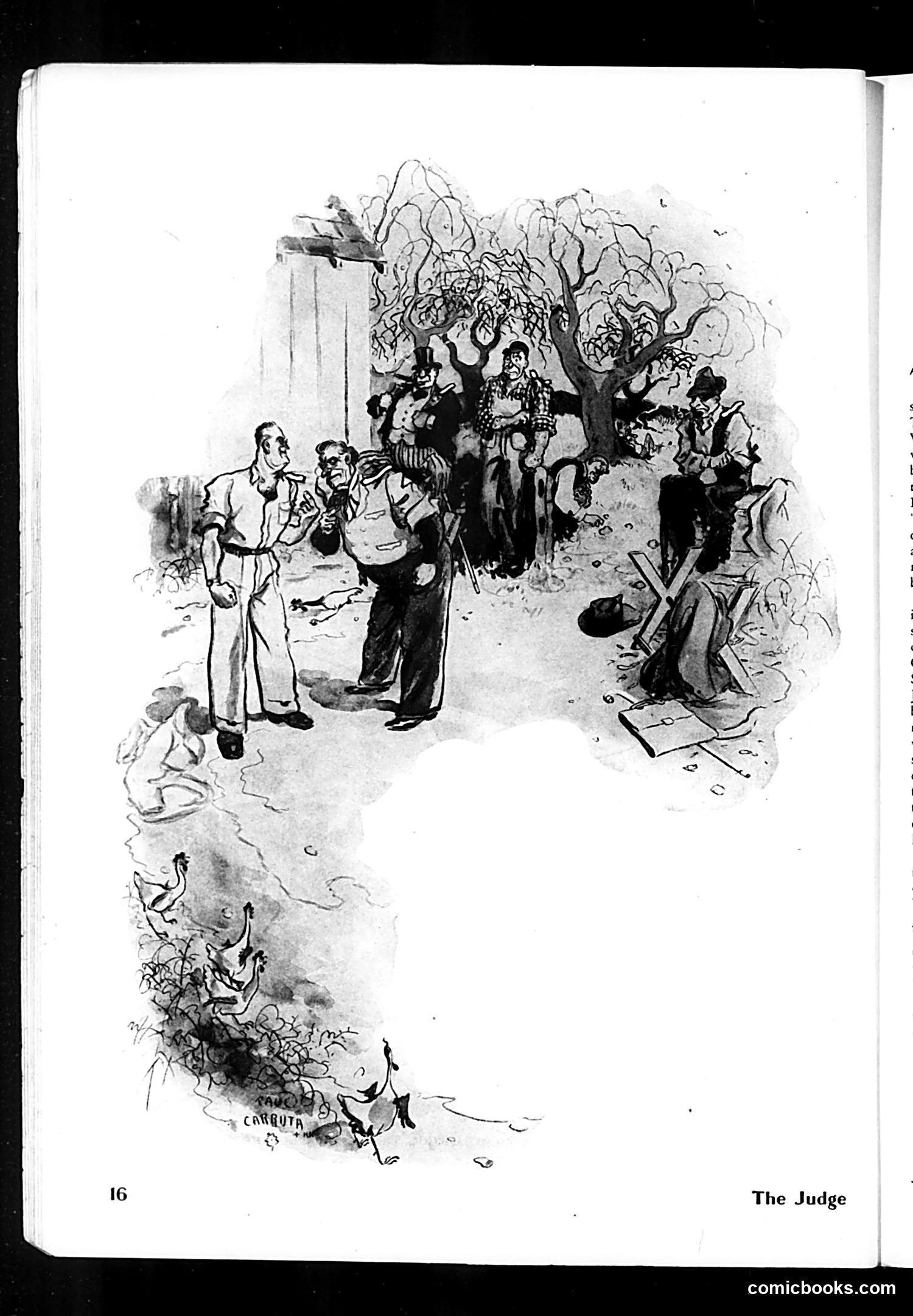
Explanation for Modern Readers This is a satirical cartoon from *Judge* magazine depicting a social or political scene. The illustration shows well-dressed gentlemen gathered around a gnarled tree in what appears to be a public space. At the bottom, there's a label reading "CARUTH" (likely a proper name or place reference). The cartoon appears to critique or mock a gathering of authority figures or politicians. The twisted, dying tree suggests decay or corruption, a common metaphor in political satire. The formal dress and body language suggest these are prominent social figures engaged in dubious activity. Without additional context about the specific publication date or political moment, the exact target remains unclear, though the imagery suggests commentary on institutional corruption or failed leadership.
"Judge on the Bench" (January 1938) This nostalgic editorial contrasts 1881 (Judge magazine's founding) with 1938. The piece laments how Judge began as a gentlemen's publication focused on satire for its own sake, but has become increasingly concerned with commercial survival. The text catalogs 1881's scandals and absurdities—Irish politician Parnell's imprisonment, Grant's potential ambassadorship, Queen Victoria criticized for speaking Italian, wealthy industrialists like Vanderbilt spending extravagantly on art—to illustrate a simpler era of genteel social criticism. The implicit argument: modern times (1938) have grown more serious and material, forcing the magazine to abandon pure satirical idealism. The small illustrations of a kerosene lamp and stove emphasize this theme of nostalgic contrast between innocent past and complicated present. This reflects Judge's actual struggle during the Depression, when satirical magazines faced financial pressure and changing readership demands.
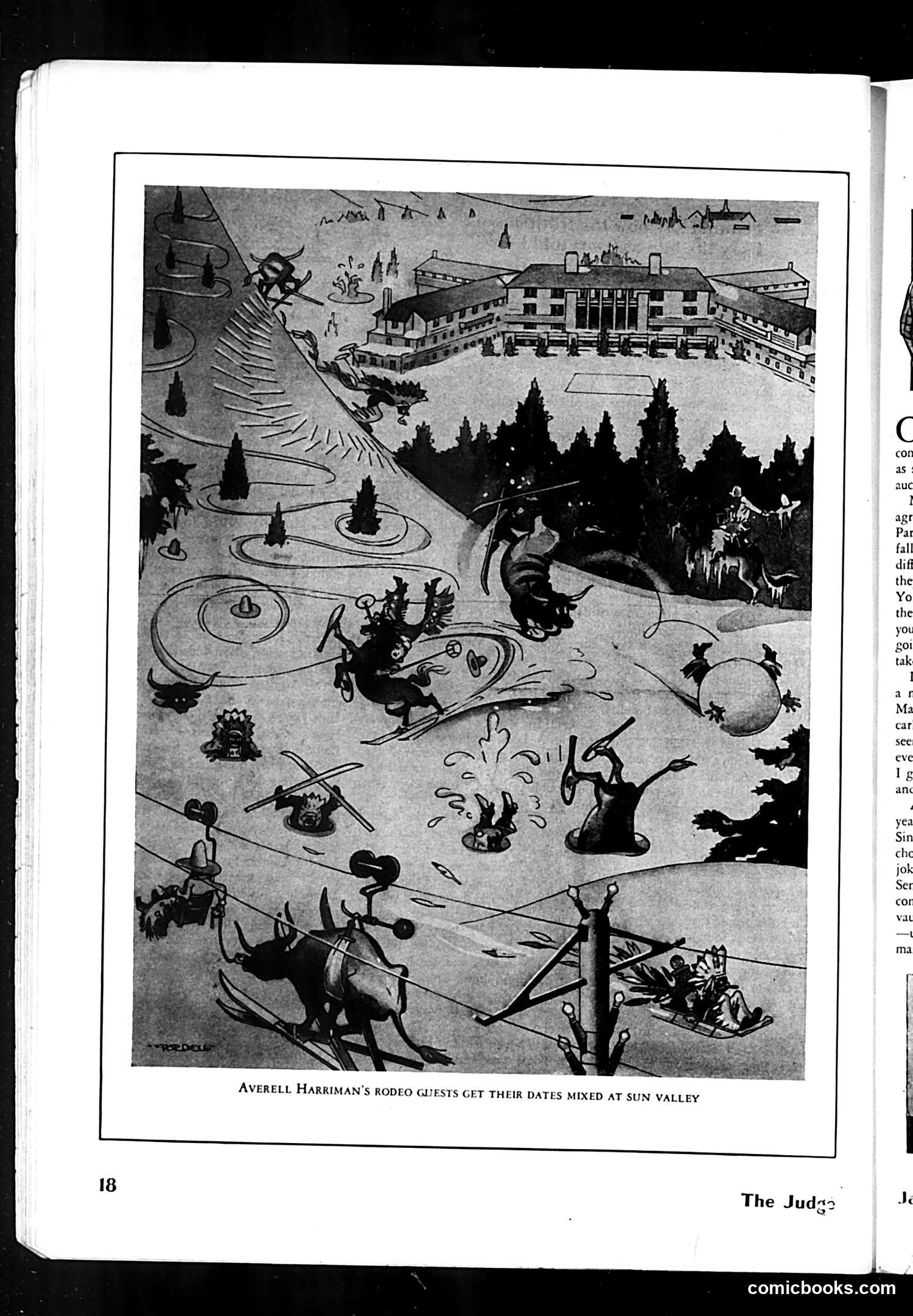
"Averell Harriman's Rodeo Guests Get Their Dates Mixed at Sun Valley" This is a satirical illustration mocking a social mix-up at Sun Valley, a prestigious Idaho resort. The caption references Averell Harriman, a wealthy railroad magnate and political figure who owned the resort. The cartoon depicts rodeo guests (shown in cowboy attire) in chaotic scenes—people on horses, skiing, and engaging in various activities—suggesting confusion about what activities were planned or scheduled ("dates mixed"). The juxtaposition of formal lodge architecture with wild, disorderly behavior satirizes the clash between high-society pretensions and rustic rodeo culture. The humor targets Harriman's elite social circles and the absurdity of mixing refined resort guests with rough frontier entertainment.
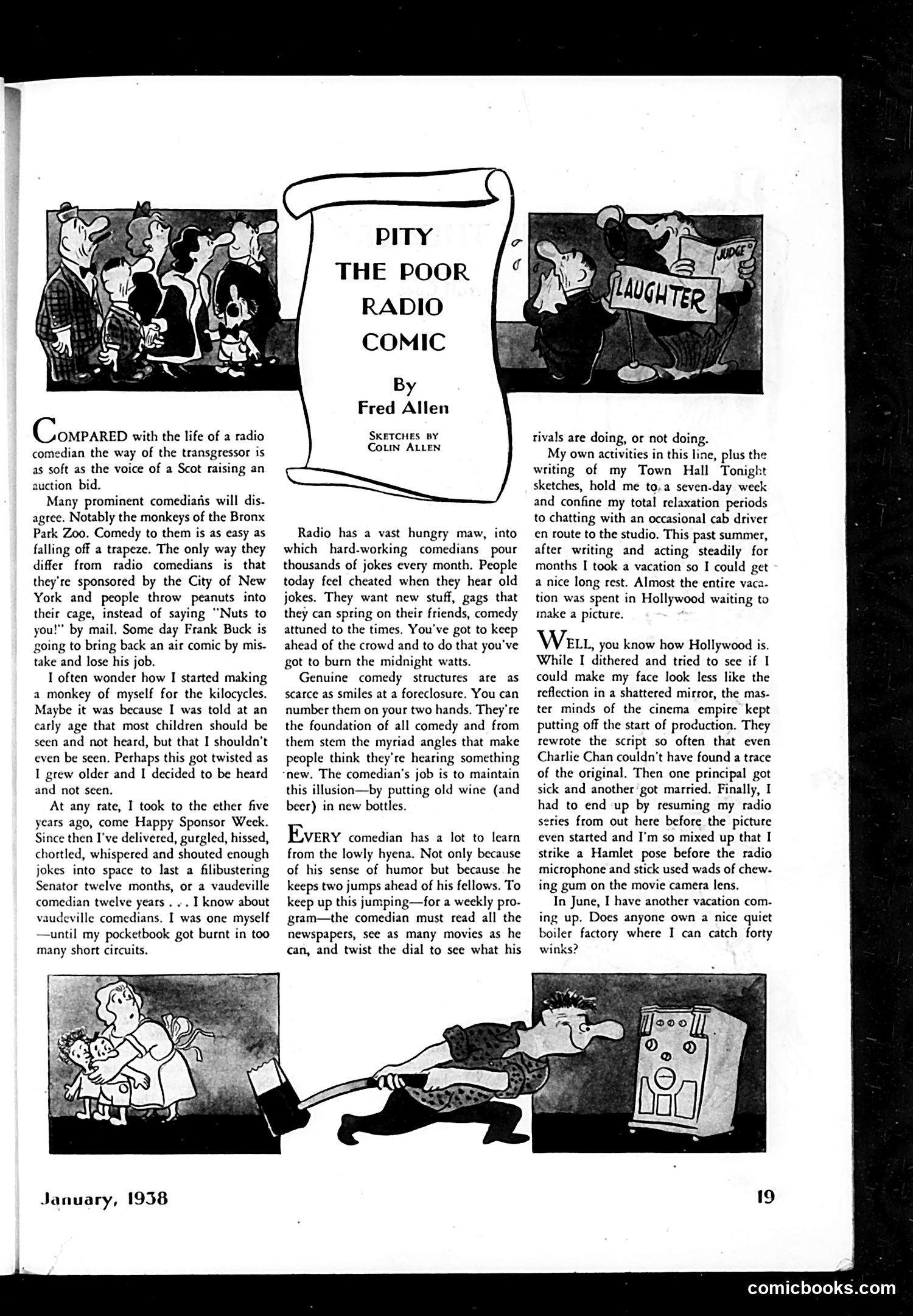
"Pity the Poor Radio Comic" by Fred Allen (January 1938) This is a humorous essay by Fred Allen, a prominent radio comedian, comparing his grueling profession to other occupations. Allen satirizes the relentless demands of radio comedy: comedians must generate thousands of new jokes monthly because audiences reject recycled material, unlike zoo monkeys (a jab at less-demanding performers) or vaudeville acts. The piece compares radio work to foreclosure—comedy "structures" are scarce. Allen references his own "Town Hall Tonight" program, describing a seven-day work week where relaxation means chatting with cab drivers to the studio. He recounts a recent Hollywood vacation spent waiting for a film that kept getting rewritten and delayed (likely referencing studio production chaos of the era). The accompanying cartoons visually reinforce the joke: a man being literally stretched between entertainment demands—pulled toward both audience expectations and broadcasting equipment—illustrating the impossible tension comedians face balancing creative quality with industrial production demands.
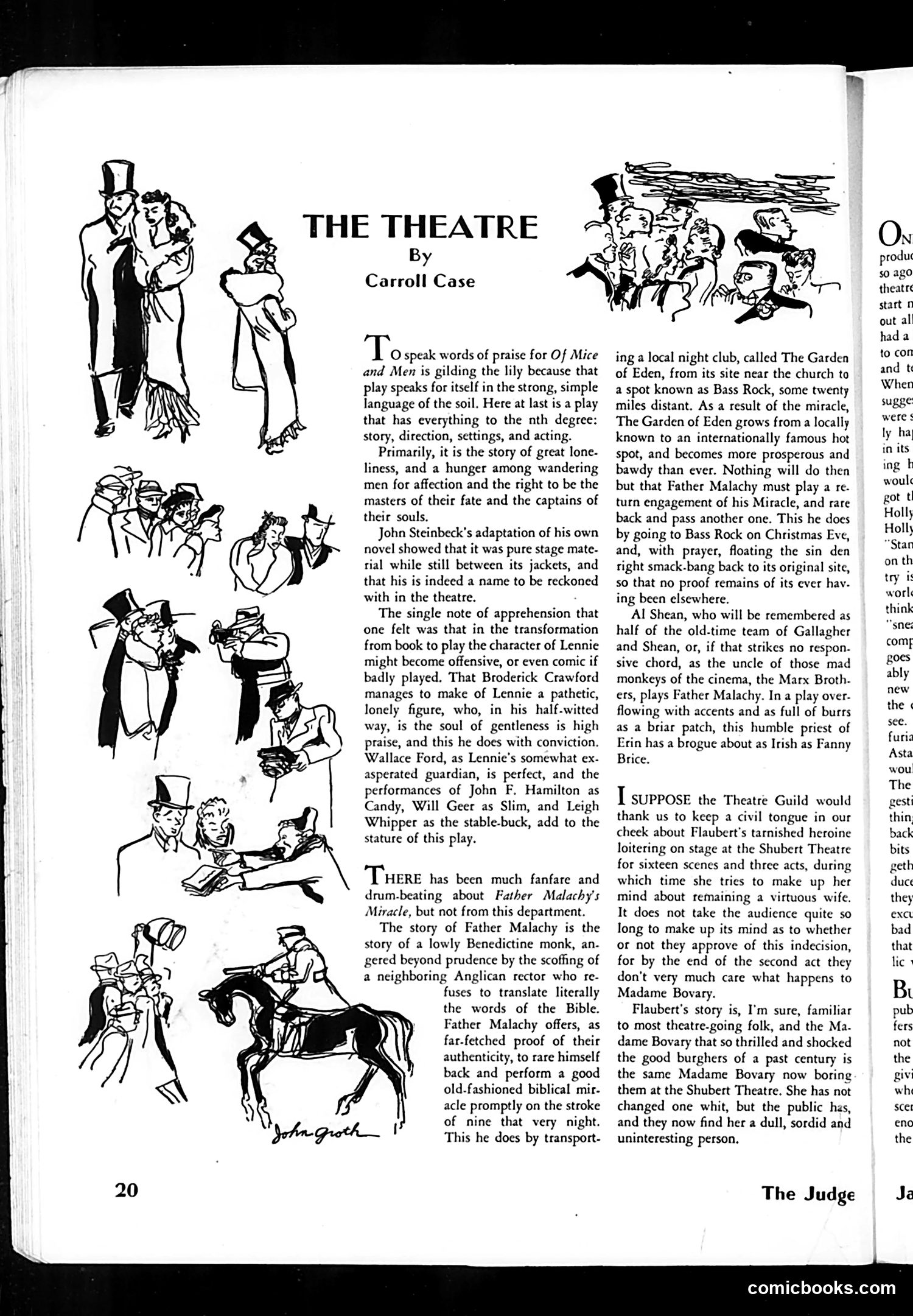
Analysis of This Judge Magazine Theater Page This is a theater review column by Carroll Case discussing three Broadway productions: Of Mice and Men: Case praises John Steinbeck's stage adaptation, particularly Broderick Crawford's sensitive portrayal of Lennie, the mentally disabled character. The concern was that Lennie could become "offensive or even comic if badly played"—a valid worry for 1937, when such characters were often played for laughs. Father Malachy's Miracle: Case is dismissive of this play about a priest who miraculously transports a nightclub. He notes Al Shean (of the vaudeville team Gallagher and Shean, and uncle of the Marx Brothers) plays the priest but delivers an unconvincing Irish accent—even "Fanny Brice" could do better. This is gentle mockery of weak casting. Madame Bovary: Case criticizes the Shubert Theatre production as tedious, suggesting modern audiences have moved beyond the novel's shock value and find the protagonist's indecision boring rather than compelling. The left-side sketches illustrate theatrical scenes, typical Judge decoration.
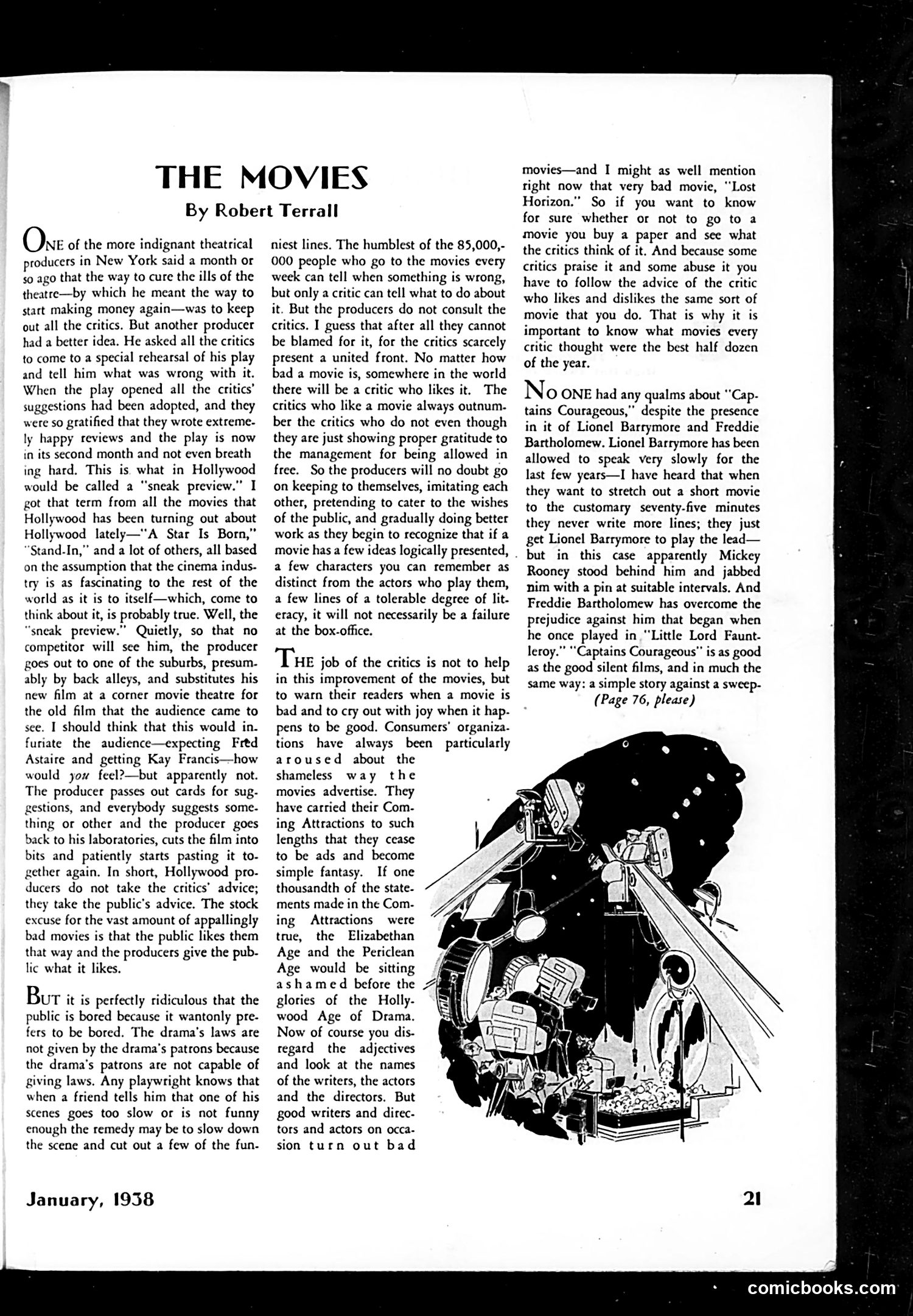
"The Movies" by Robert Terrall (January 1938) This essay criticizes Hollywood's dismissal of film critics in favor of audience preferences. Terrall argues that producers conduct "sneak previews"—secretly substituting new films for advertised ones in suburban theaters, then soliciting public feedback to reshape their work. He contends this is backwards: while average moviegoers can *sense* something is wrong with a film, only critics can articulate *why* and suggest solutions. The accompanying illustration depicts a movie projector, symbolizing the film industry's mechanical churning out of content. Terrall's central point: Hollywood excuses bad films by claiming "the public likes them that way," but audiences actually prefer quality. Producers should respect critics' expertise rather than hide from their judgment. The piece reflects 1938 Hollywood's tension between artistic merit and commercial calculation—a debate still relevant today.
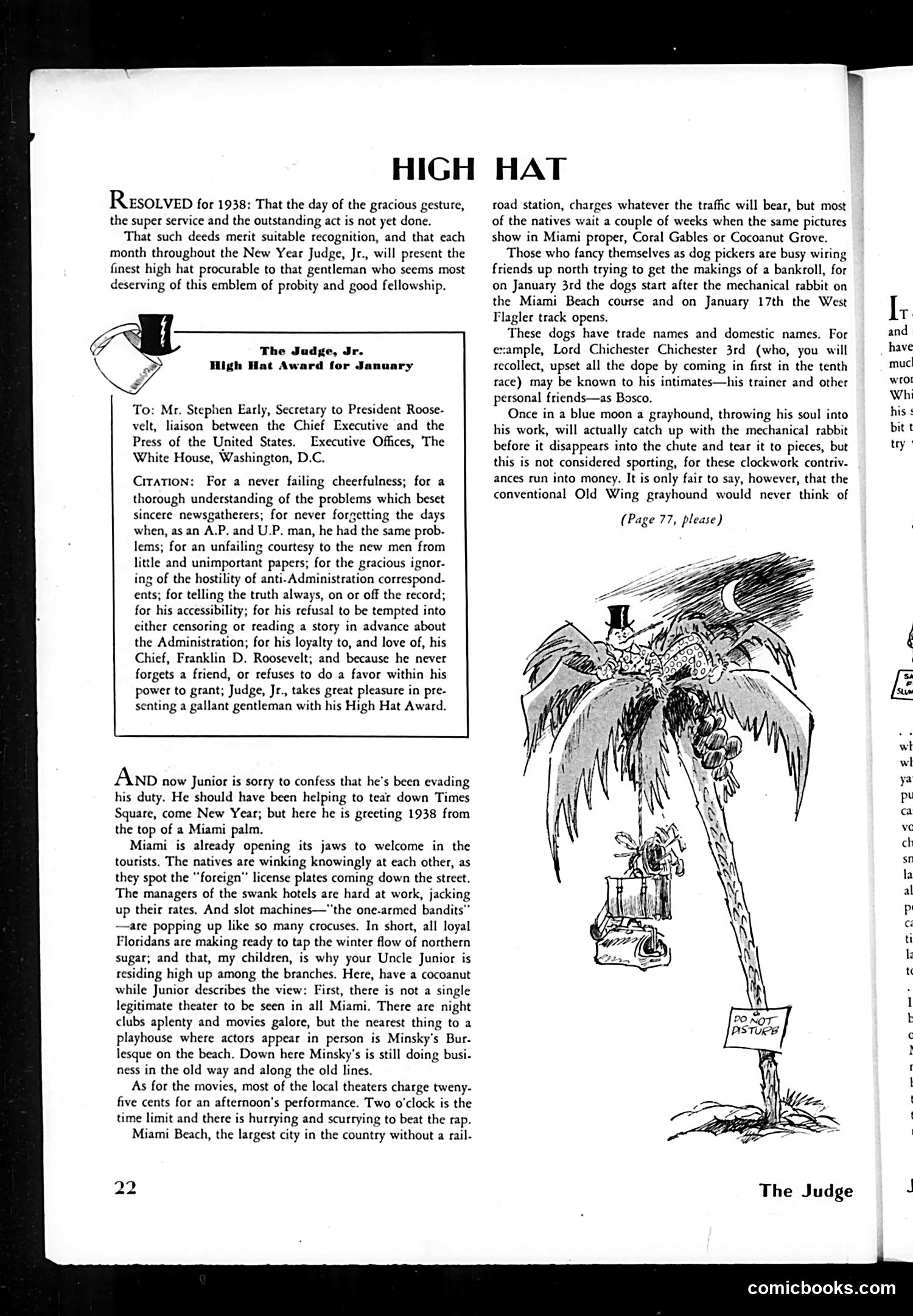
"High Hat" - Judge Magazine, January 1938 This page presents Judge's new monthly "High Hat Award" recognizing acts of public service. The January 1938 recipient is Stephen Early, President Roosevelt's press secretary, praised for his accessibility to journalists, fair treatment of reporters from small papers, and loyalty to FDR. The cartoon below mocks Miami Beach as a tourist trap. The satirist (identified as "Junior") describes the city's commercialism: inflated hotel rates, slot machines proliferating like weeds, theaters charging admission just to beat closing time, and the prevalence of Minsky's Burlesque rather than legitimate theater. The imagery shows a vulture (representing Miami's predatory tourism industry) perched over tourists and their luggage—a clear visual metaphor for the city "picking clean" visitors' wallets. The satire targets Miami's shameless exploitation of wealthy northern tourists during the Depression-era winter season.
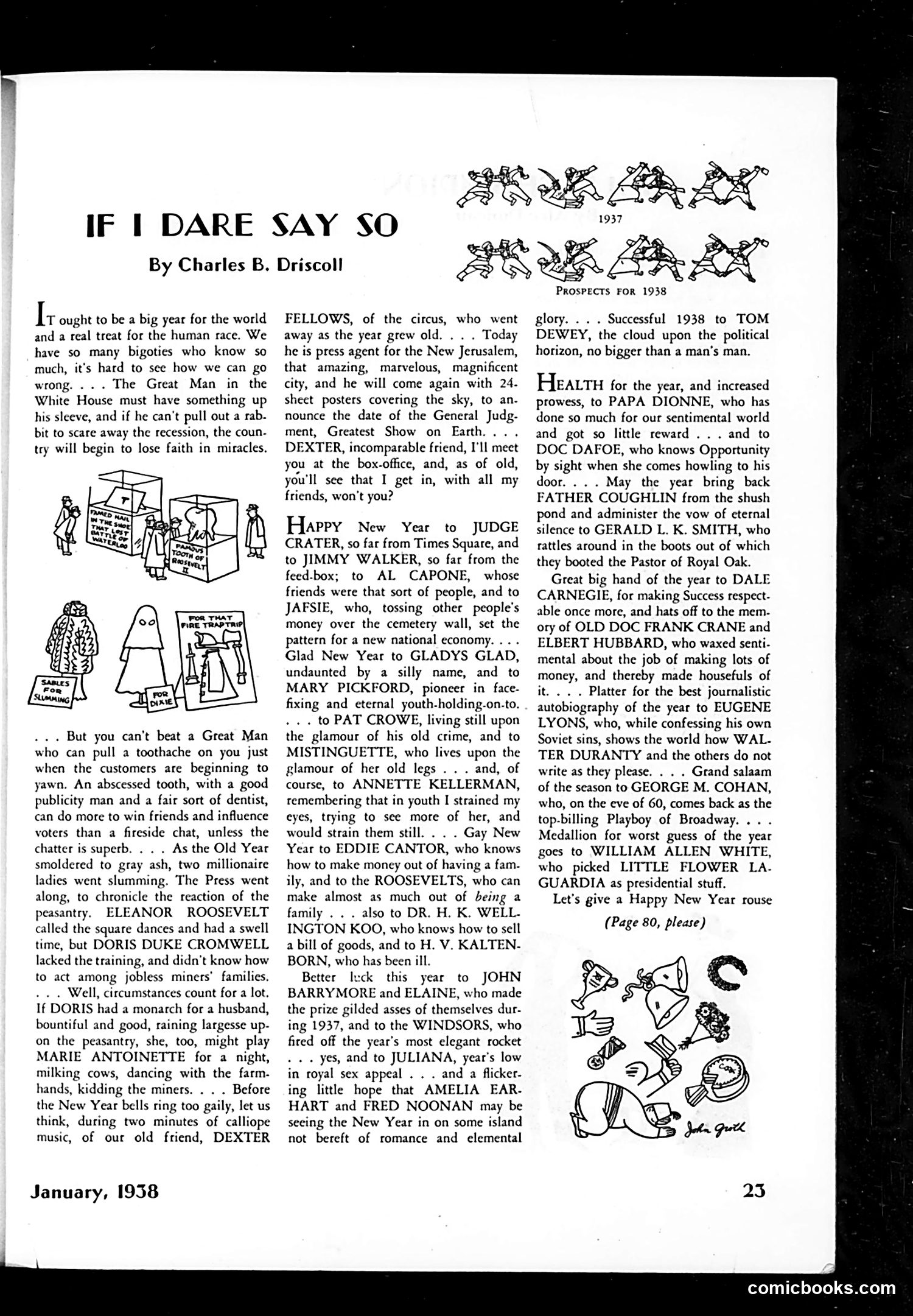
"If I Dare Say So" — Judge Magazine, January 1938 This is Charles B. Driscoll's satirical New Year's column offering mock wishes to celebrities and public figures. The piece uses irony and backhanded compliments to critique 1937's notable scandals and personalities. Key references: - Eleanor Roosevelt vs. Doris Duke Cromwell: Contrasts the First Lady's authentic connection with common people against Duke's awkward attempt at "slumming," suggesting inherited wealth doesn't translate to genuine compassion. - Judge Crater, Jimmy Walker, Al Capone: References to famous criminals and corrupt politicians, sarcastically wishing them well while implying their notoriety. - The Windsors: Edward VIII and Wallis Simpson, recently abdicated amid scandal; Driscoll calls their relationship "elegant rocket" (likely referring to their tumultuous affair). - Amelia Earhart and Fred Noonan: Missing aviators; Driscoll ironically hopes they're alive on an island. - Tom Dewey: Rising political figure criticized as merely a "cloud" (minor threat) to Roosevelt's Democratic dominance. The column exemplifies Judge's sophisticated, gossipy political humor targeting 1930s high society and public figures.
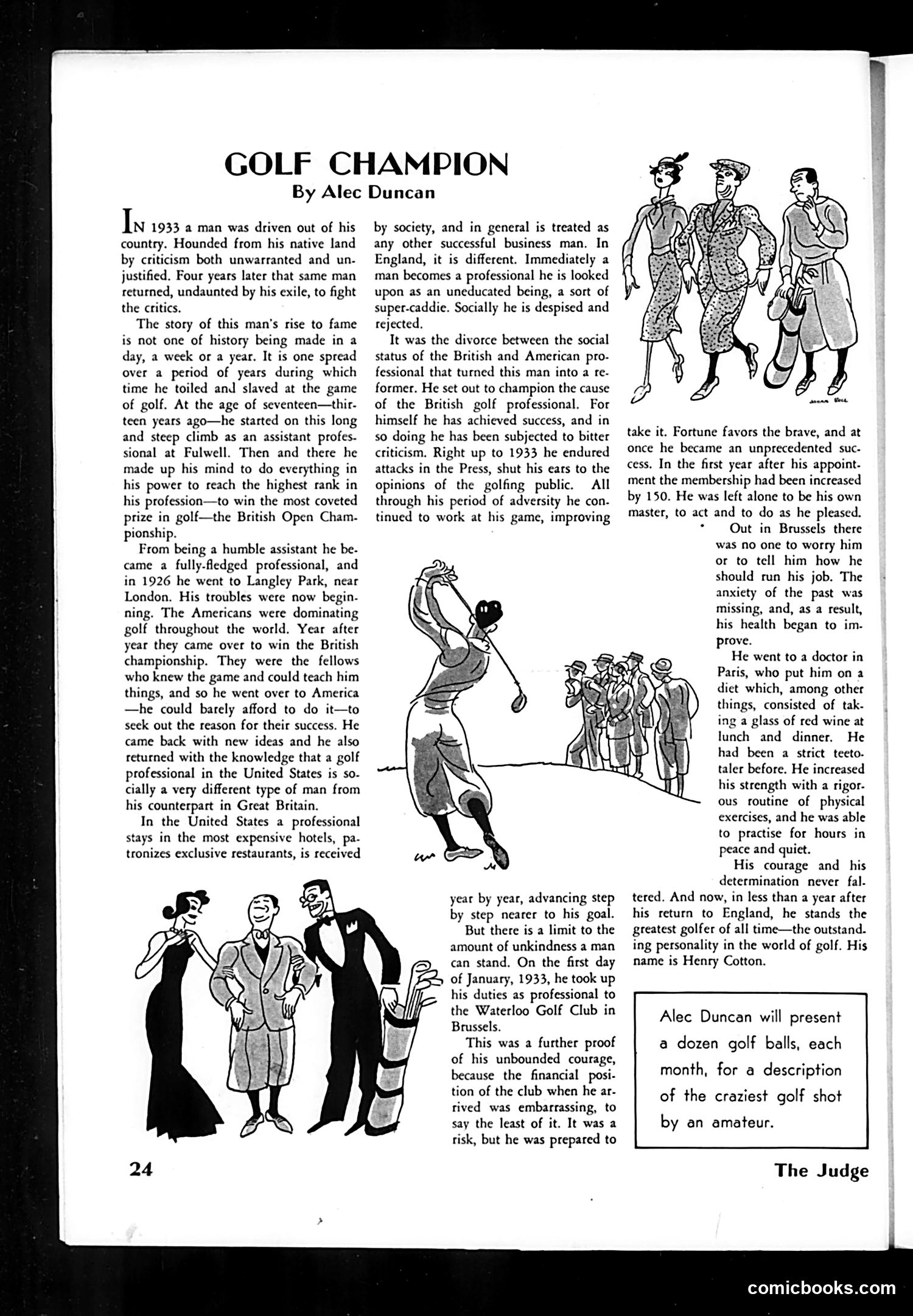
"Golf Champion" Analysis This article celebrates Henry Cotton, a British professional golfer who left England in 1933 after facing social prejudice and press criticism, then triumphantly returned to win the British Open Championship. The satire targets class snobbery in British society. The core point: in America, professional golfers were treated as respectable businessmen and received by society; in Britain, they were viewed as uneducated servants ("super-caddies") and socially rejected. Cotton's real achievement wasn't just golfing skill—it was challenging this entrenched class system that demeaned working professionals. The cartoon illustrations (showing fashionable social gatherings and formal settings) reinforce the contrast between how professionals were treated socially in different countries. The article frames Cotton's determination and ultimate success as a victory against both sporting rivals and British social prejudice, making him a reformer as much as an athlete.
The Judge Album Title Page (January 1938) This is a decorative title page for "The Judge Album 1881-1938," marking the publication's 57-year history. Rather than containing specific political cartoons or satire, it's an ornamental cover featuring classical allegorical imagery—a robed female figure (likely representing Justice or Liberty) surrounded by cherubs, floral garlands, and decorative objects including books and urns. The elaborate border design reflects Judge magazine's sophisticated visual style during this era. Published in January 1938, this commemorates the magazine's long run as America's premier satirical publication. The page itself serves as a retrospective marker rather than delivering specific contemporary political commentary—it's essentially a celebratory frontispiece acknowledging Judge's cultural significance and longevity in American journalism.
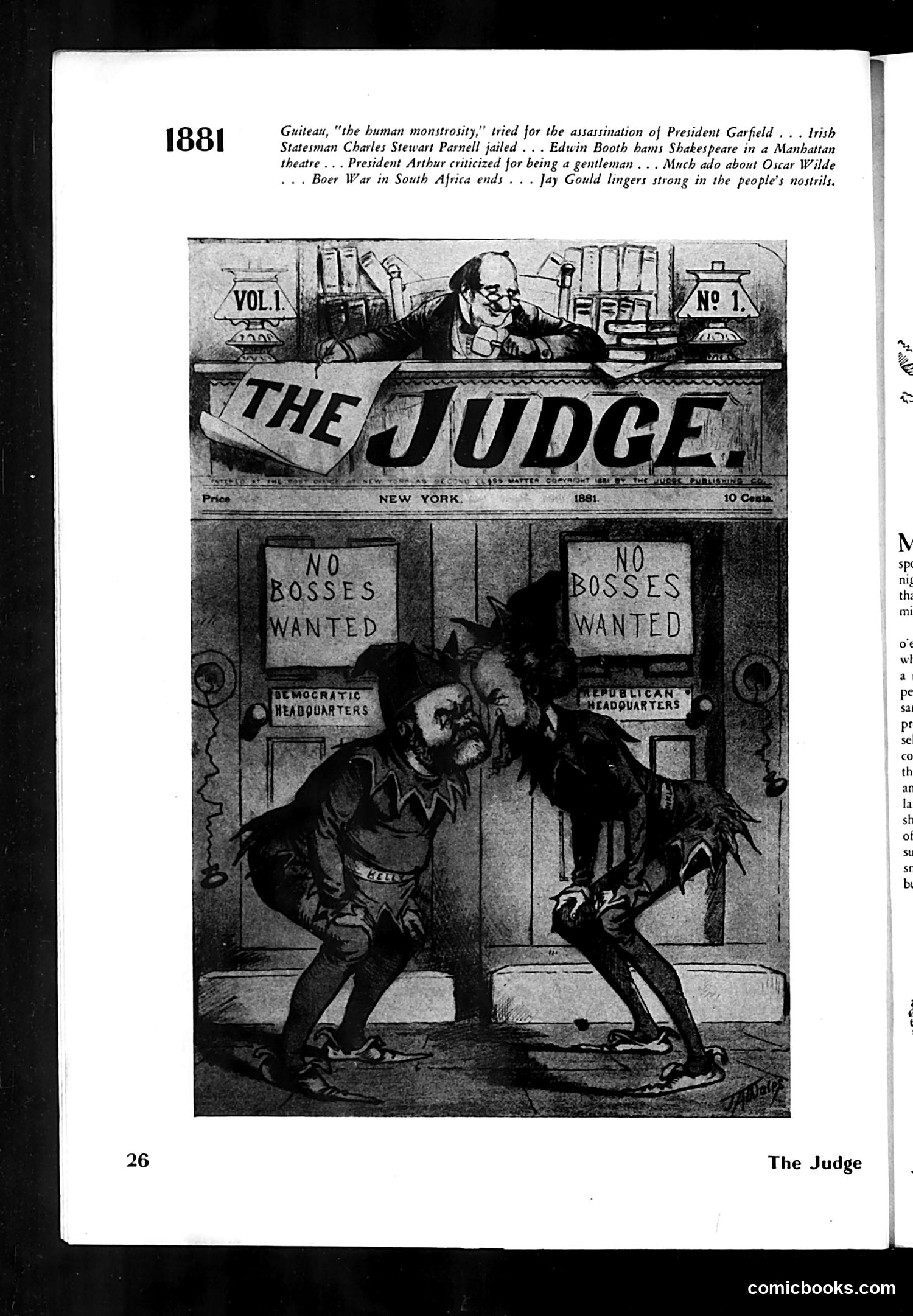
Explanation of "The Judge" Cartoon (1881) This editorial cartoon satirizes American political parties as unable to find qualified leadership. Two grotesque figures—representing Democrats and Republicans—stand before party headquarters marked "NO BOSSES WANTED," yet both appear desperate and animalistic, suggesting they cannot function without corrupt party leadership. The context: 1881 was turbulent politically. President Garfield's assassination by Charles Guiteau (referenced in the header as "the human monstrosity") had just occurred, and James Garfield's successor, Chester Arthur, faced criticism for being "a gentleman"—implying he lacked the ruthless pragmatism politicians supposedly needed. The joke: Despite parties' stated rejection of "bosses" (corrupt machine politicians), the caricatures suggest American politics inherently requires such figures. Without them, politicians are lost, animalistic, and incompetent. The satire targets both parties' hypocrisy about reform while depending on corrupt leadership structures.
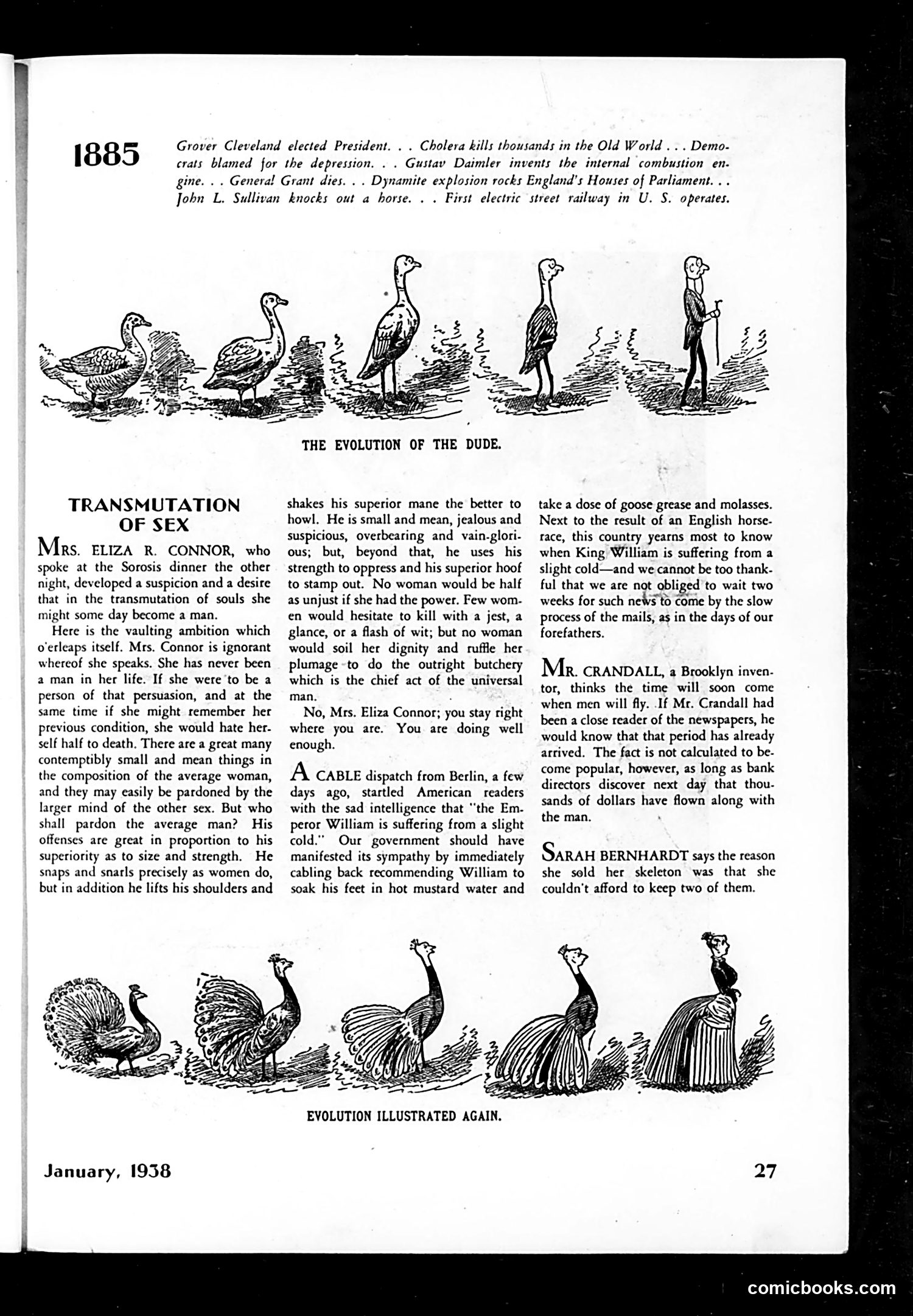
Explanation for Modern Readers This 1885 *Judge* magazine page contains satirical commentary on contemporary issues: "Transmutation of Sex": Mocks Mrs. Eliza R. Connor, who spoke at a women's dinner expressing a desire to become a man. The author argues against this wish, claiming men possess the same petty flaws as women but with added physical aggression and abuse of power—making manhood undesirable. "Evolution of the Dude": Two parallel illustration sequences satirize the "dude" (a fashionable, affected man), showing his transformation into increasingly absurd poses, likely commenting on vanity and artificial masculinity. Emperor William's Cold: Satirizes American press obsession with trivial European news—specifically the German Emperor catching a cold—suggesting readers are more interested in royal gossip than substantive information. Sarah Bernhardt joke: A quip about the famous actress selling her skeleton, implying she's so thin she could sell her bones. The page reflects 1880s anxieties about gender roles, masculine vanity, and media sensationalism.
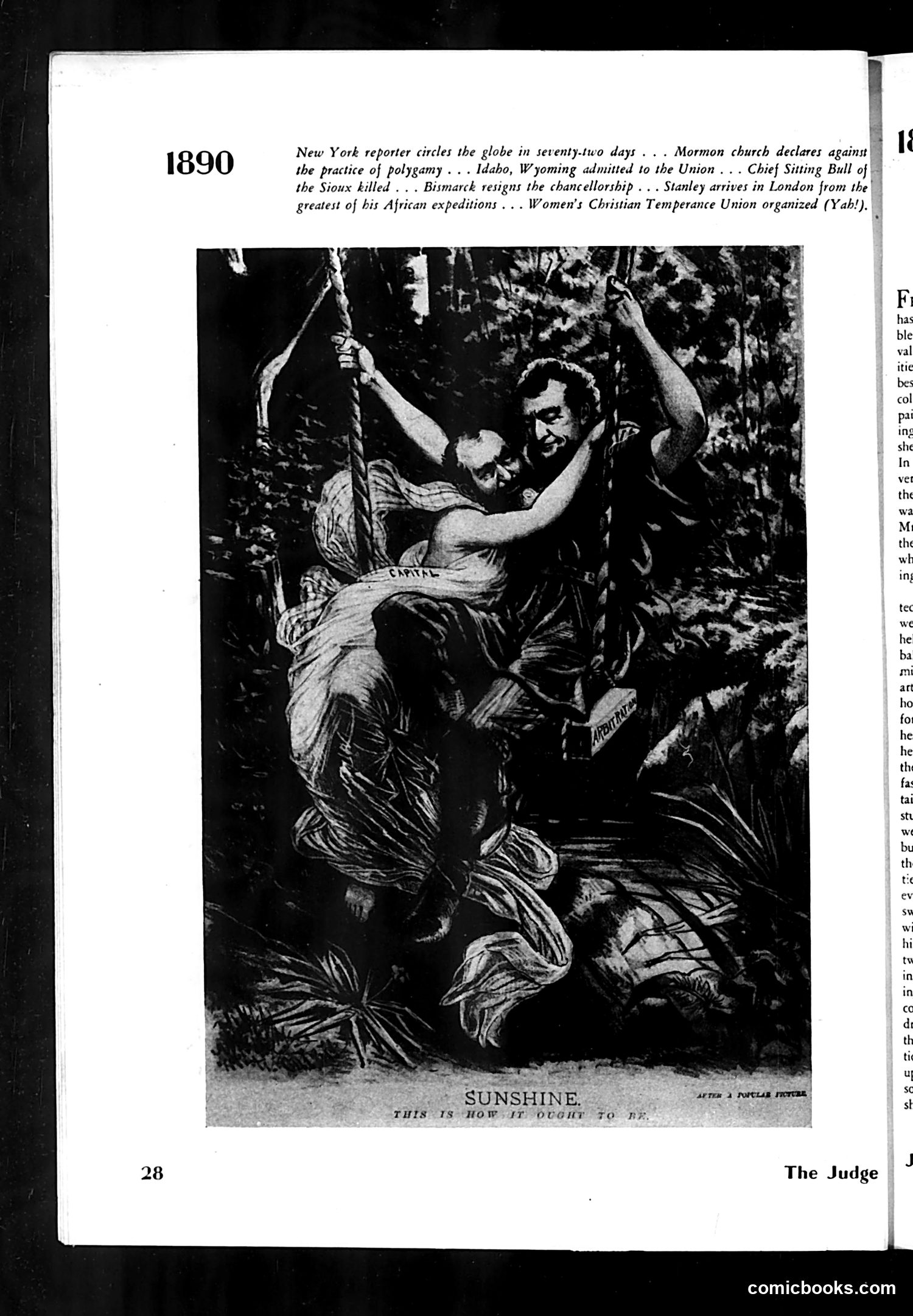
1890 Cartoon Analysis This engraving titled "SUNSHINE" depicts a colonial-era scene of exploitation. The image shows a European man (likely representing colonialism or an explorer like Stanley, mentioned in the text) embracing or restraining a woman in tropical dress amid jungle vegetation. The satire targets imperialist practices and the romanticization of colonialism. The caption "THIS IS HOW IT OUGHT TO BE" is ironic—*Judge* magazine is mocking the era's celebration of European conquest and racial dominance in Africa and other colonized regions. The juxtaposition with news of Stanley's return from African expeditions suggests criticism of how Western media glorified colonial adventures while ignoring exploitation and violence. The image represents the cynical reality behind the era's "civilizing mission" rhetoric—revealing domination masked as progress.
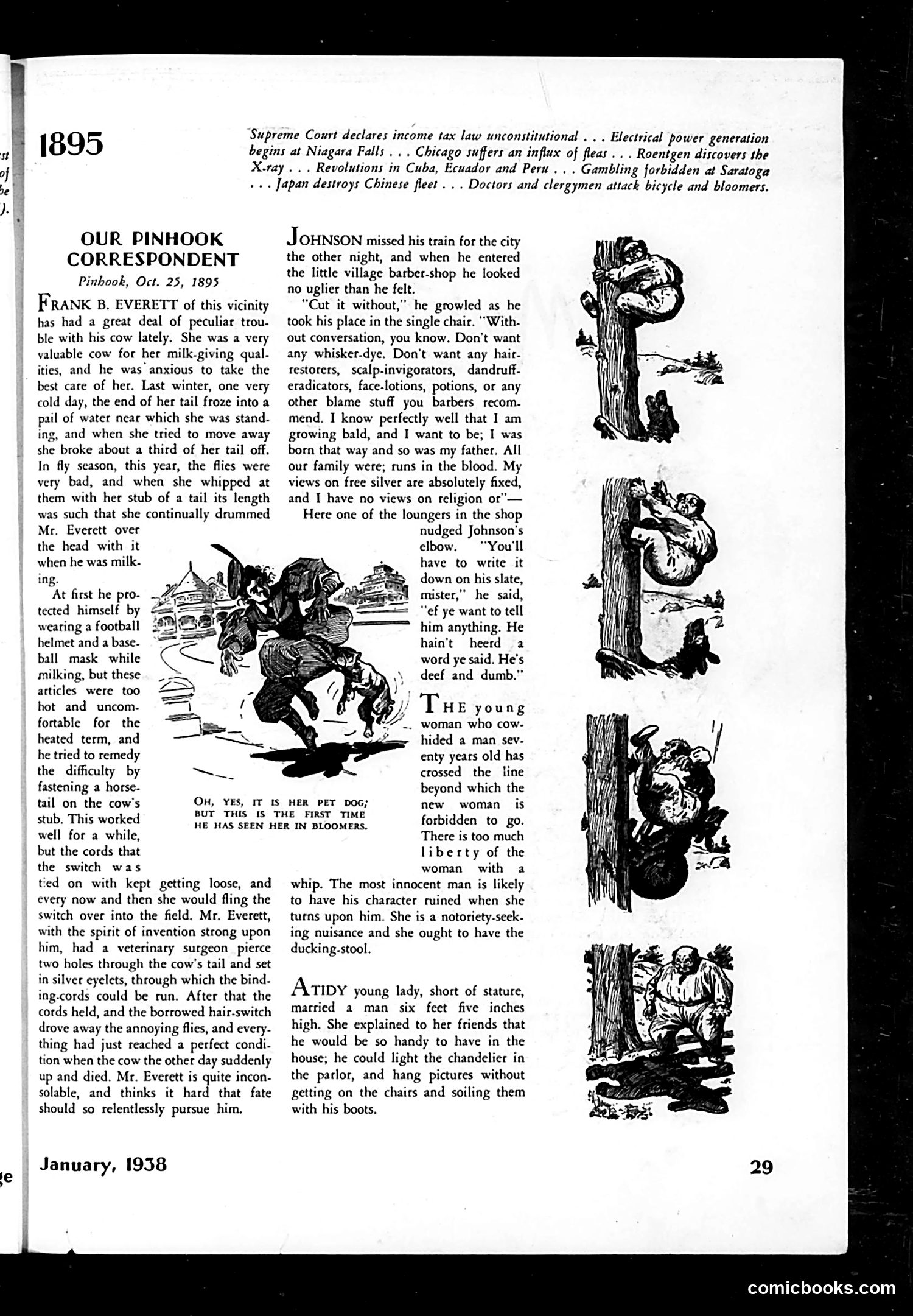
Explanation for Modern Readers This 1895 Judge magazine page contains three satirical pieces reflecting fin-de-siècle anxieties: "Our Pinhook Correspondent" is a humorous rural anecdote about a farmer's cow whose frozen, broken tail becomes a nuisance—solved through elaborate veterinary engineering that ultimately fails when the cow dies anyway. It's gentle small-town humor about futile effort. The barber-shop cartoon mocks a deaf customer who demands silence while the barber tries to converse. The joke relies on period attitudes toward disability as comedic fodder. The "New Woman" commentary attacks women's expanding freedoms (specifically bloomers—the practical pants-like garments worn by cyclists and active women). The brief anecdotes ridicule women's independence: one woman whipping a man faces moral condemnation; another "short" woman marrying a tall man is laughed at for practical self-interest. The header explicitly condemns women's liberty, reflecting conservative backlash against 1890s feminism and women's athletic/social emancipation.
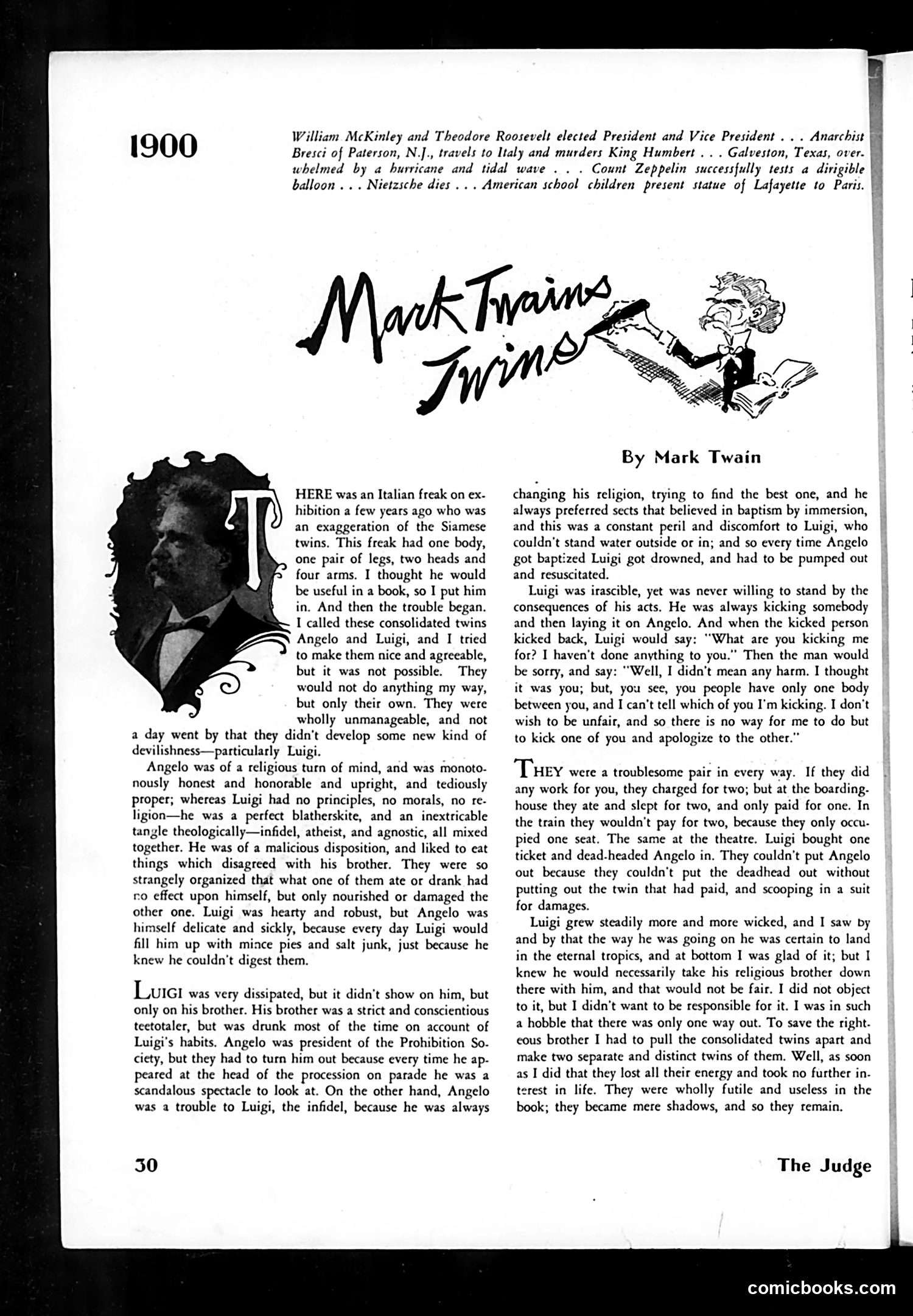
Mark Twain's "Twins" (1900): A Political Allegory This is Mark Twain's short story about conjoined twins Angelo and Luigi—a thinly veiled political allegory for the 1900 election year events listed at the page's top. The satire: Angelo represents respectable, religious America (honest, abstemious, morally upright), while Luigi embodies anarchism and lawlessness (irreligious, dissipated, destructive). They share one body—America itself—so Luigi's destructive actions harm Angelo despite his virtue. Historical context: The 1900 headline references anarchist Bresci murdering Italy's King Humbert, evoking fears of anarchist violence in America. Twain uses the conjoined-twins metaphor to explore how anarchists and responsible citizens inhabit the same nation, yet their incompatible values create constant conflict and suffering for the moral majority. The joke's dark edge: no matter how virtuous Angelo is, he cannot escape the consequences of sharing a body with Luigi—just as America cannot escape the threat posed by anarchist elements within it.
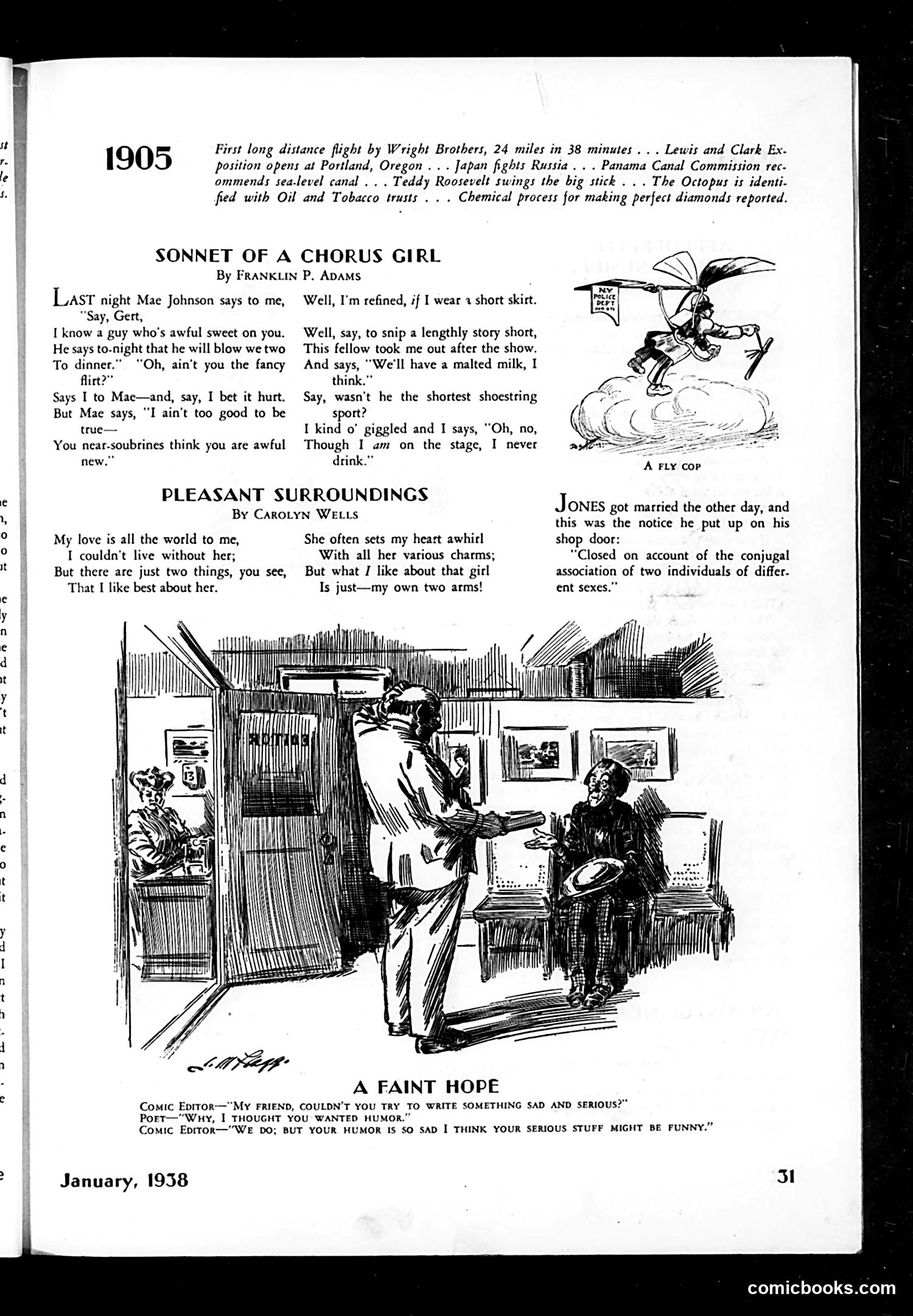
Judge Magazine, January 1938 This page contains three humorous pieces reflecting 1930s social attitudes: "Sonnet of a Chorus Girl" satirizes the stereotypical chorus girl as calculating and materialistic. The speaker claims refinement ("I'm refined") while wearing a short skirt—a contradiction highlighting the era's moral judgments about women performers. The joke: a man takes her out but only buys her a malted milk, making him a cheapskate ("shortest shoestring sport"). "Pleasant Surroundings" uses romantic language to deliver a punchline about male possessiveness—the poet loves his girlfriend mainly because he gets to hold her in his arms. "A Faint Hope" is a meta-joke where the Comic Editor critiques a Poet's work, saying his humor is so depressing it might work better as serious writing. It's self-referential commentary on editorial standards. The page header references 1905 inventions (Wright Brothers flight) and President Theodore Roosevelt, though these serve as context rather than content for the satirical pieces shown.
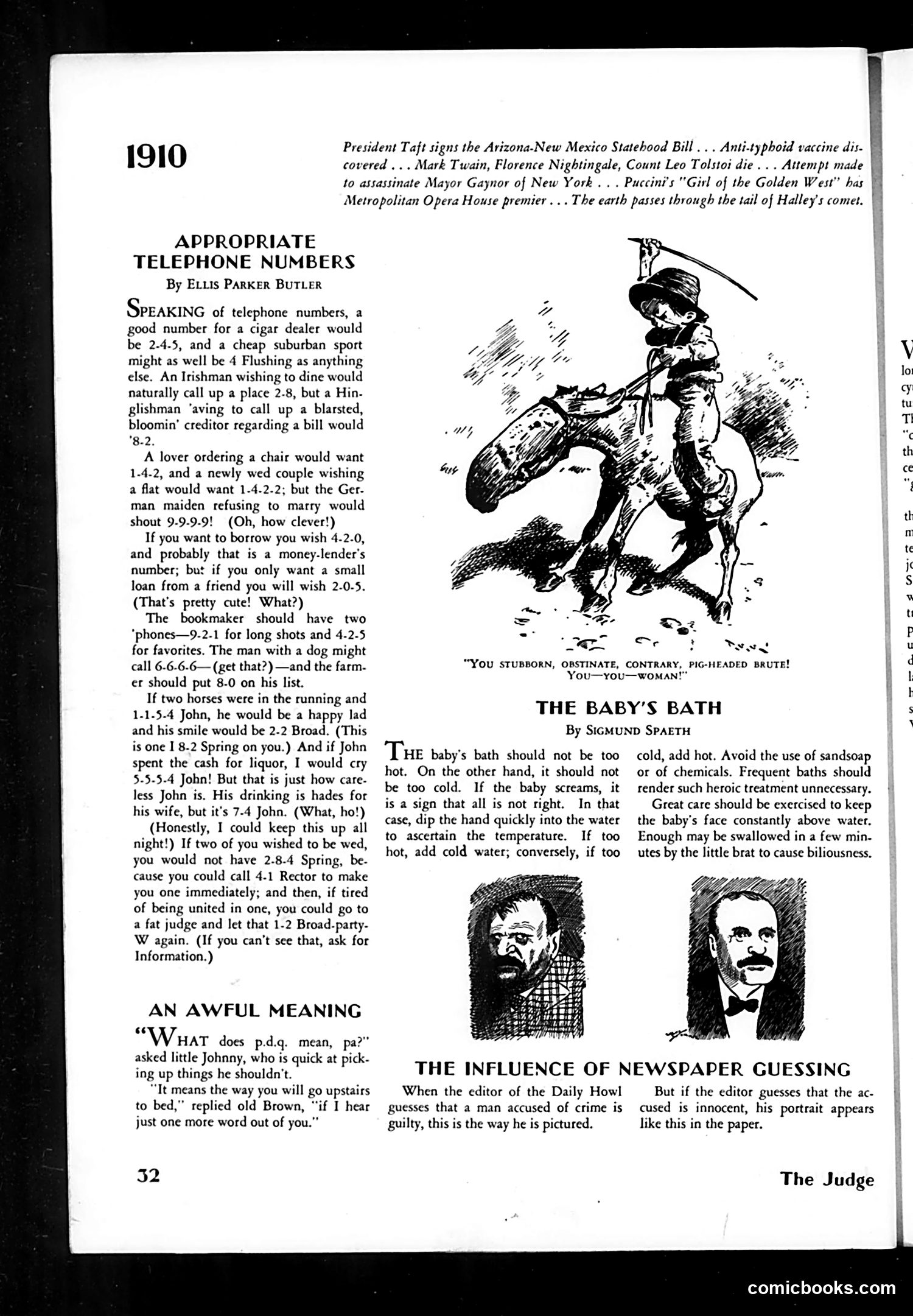
Judge Magazine, 1910: Page Analysis This page contains three satirical pieces typical of Judge's humor: "Appropriate Telephone Numbers" is a pun-based article by Ellis Parker Butler that jokes about matching phone numbers to occupations/situations. The humor relies on 1910s telephone exchanges (like "Flushing," "Spring," "Rector") that sound like relevant words—a cigar dealer gets "2-4-5," an Irishman wanting dinner calls "2-8" (ate), a creditor-dodging Englishman calls "8-2" (owe too). It's nonsense wordplay exploiting period phone numbers. The cartoon shows a man on horseback being scolded by a woman—satirizing gender conflict and the "nagging woman" trope common in early 1900s humor. "The Baby's Bath" and "The Influence of Newspaper Guessing" are brief pieces: one offers practical (if sarcastic) baby care advice; the other mocks how newspapers' guilt/innocence "guesses" influence public perception through portraiture—suggesting media bias shapes opinion regardless of facts. The page reflects 1910 attitudes: casual ethnic stereotyping (the "Irishman," "Englishman"), domestic conflict humor, and early media criticism.
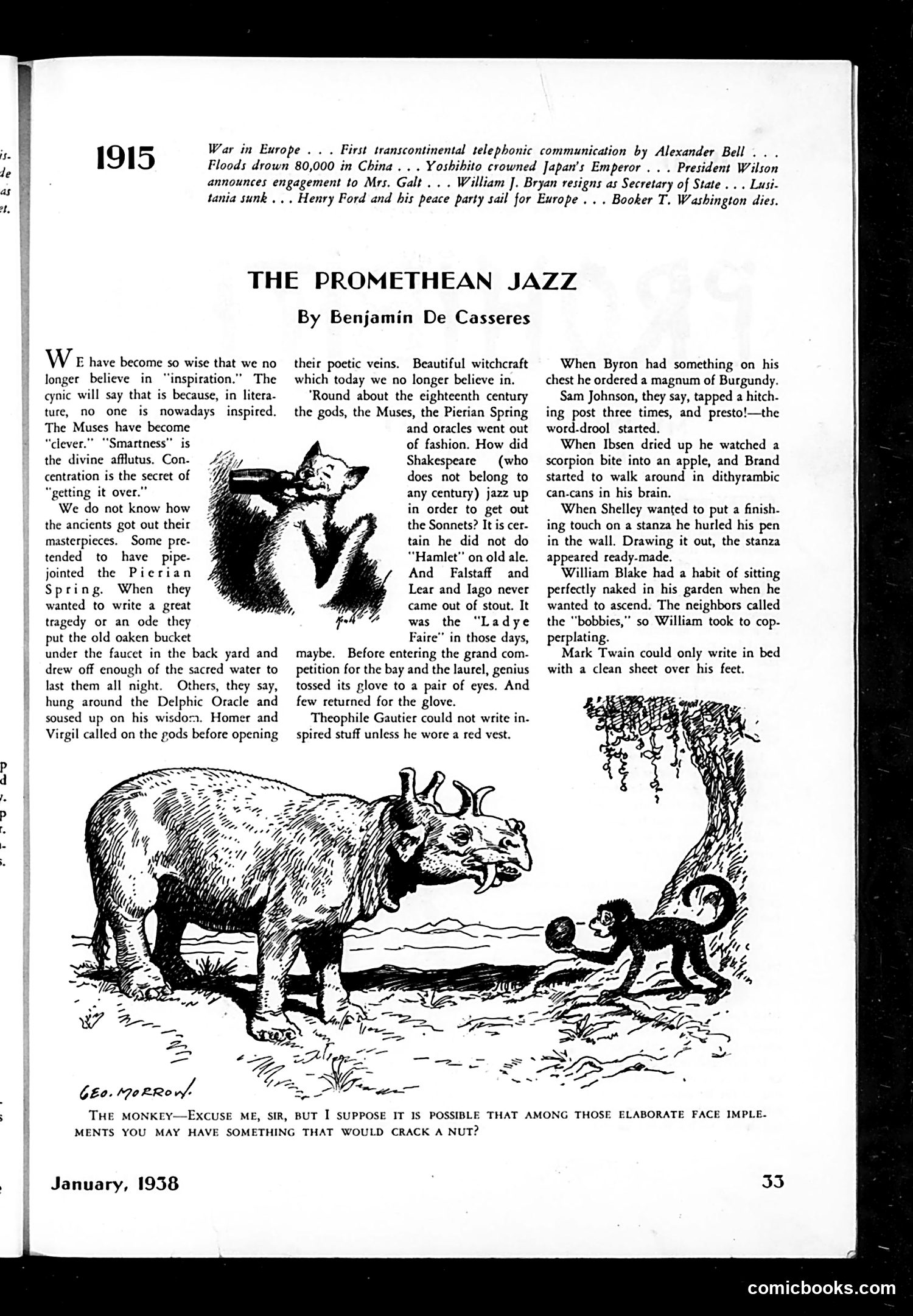
"The Promethean Jazz" - Judge Magazine, January 1938 This essay by Benjamin De Casseres satirizes modern artistic inspiration by contrasting classical and Romantic-era writers' eccentric creative rituals with contemporary "smartness" and cynicism. The Point: Casseres argues that ancient poets believed in divine inspiration from the Muses, while 18th-19th century geniuses (Shakespeare, Byron, Shelley, Mark Twain) relied on idiosyncratic personal habits—drinking, rituals, nakedness, specific writing conditions—to access creativity. The title "Promethean Jazz" suggests modern writers have lost this magical, fire-stealing inspiration entirely, replacing it with mere technical "concentration." The Cartoon Below: A monkey confronts a rhinoceros, asking if among its "elaborate face implements" it might have something to "crack a nut"—a visual pun mocking overcomplication. This likely reinforces the essay's theme: modern sophistication obscures rather than enables genuine creativity. Context: Published in 1938 during the Great Depression, this reflects intellectual anxiety about artistic decline in a rationalized, cynical age.
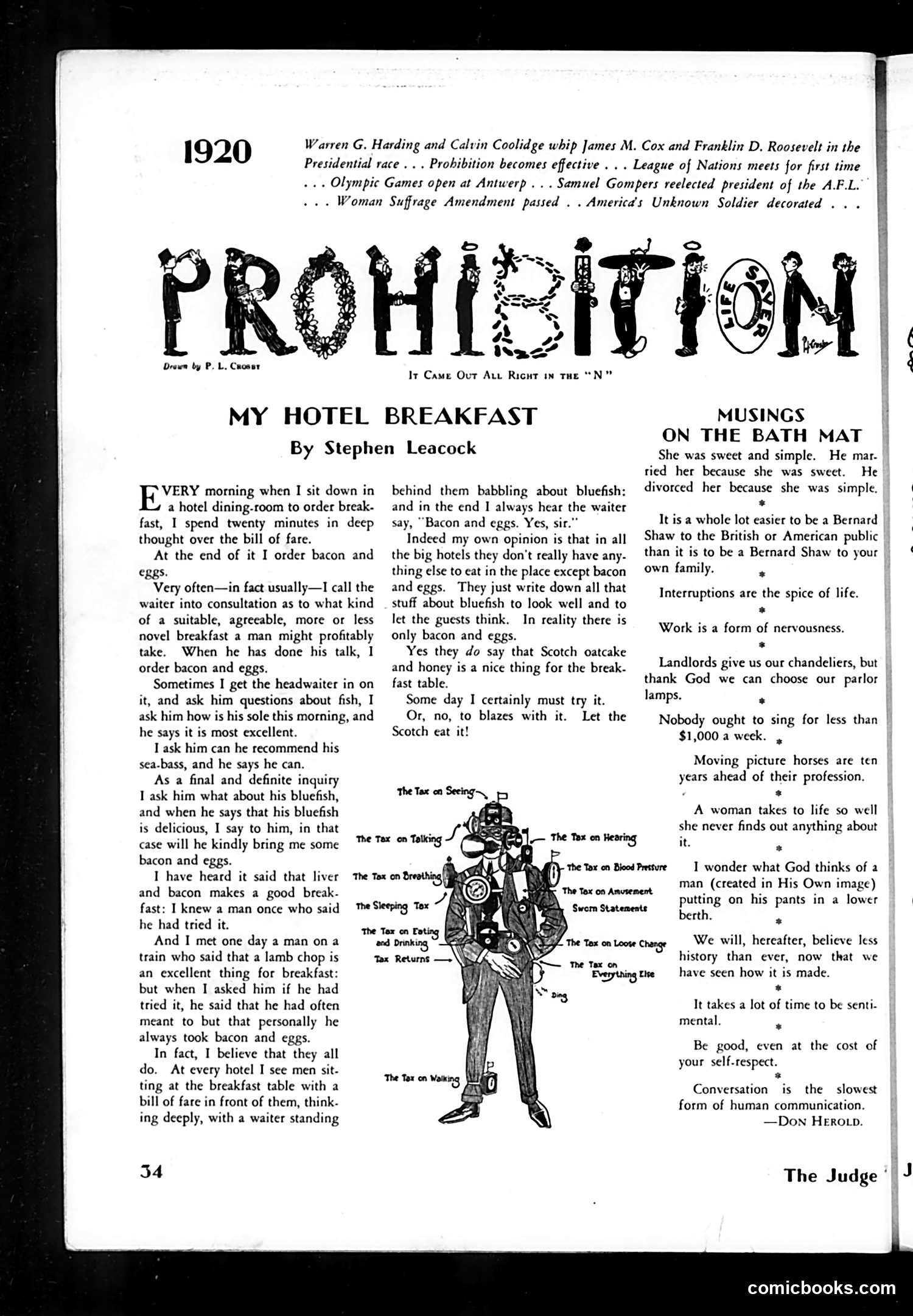
"Prohibition" (1920) - Judge Magazine Analysis This page satirizes Prohibition's implementation in America. The elaborate decorative title spells "PROHIBITION" with figures engaged in various drinking activities—the central joke being that despite the constitutional amendment banning alcohol (which "came out all right in the 'N'"), Americans will continue drinking regardless. The header references major 1920 events: Harding defeating Cox/Roosevelt in the presidential race, the League of Nations' first meeting, and the Woman Suffrage Amendment's passage—establishing the historical moment when Prohibition became federal law. The page's content—mundane essays about hotel breakfasts and aphorisms—contrasts sharply with the cartoon's message: while Prohibition represents serious governmental intervention, ordinary American life continues unchanged. The humor lies in this disconnect between grand legal proclamations and the persistence of human behavior they cannot control.
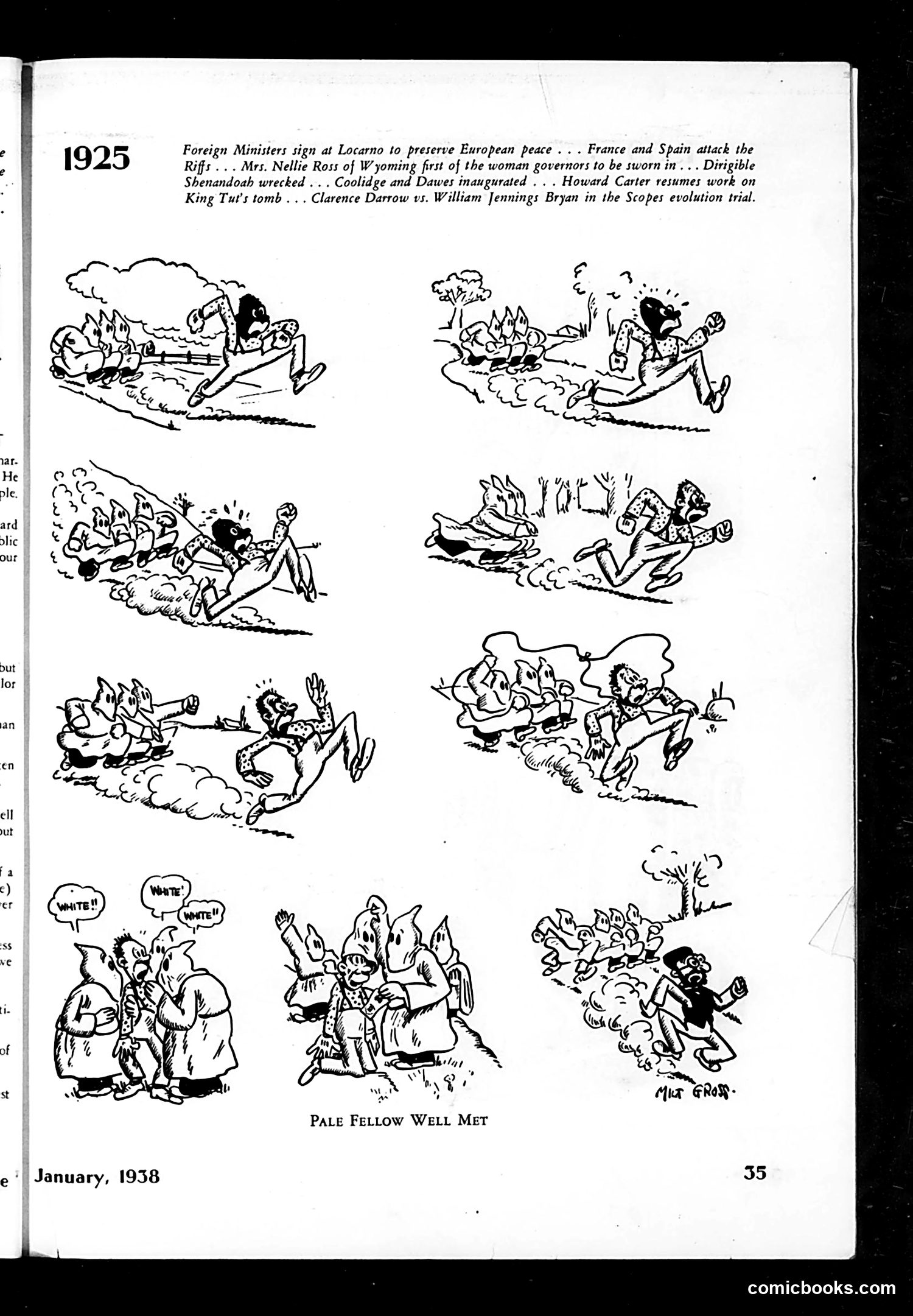
"Pale Fellow Well Met" - Judge Magazine, January 1938 This page satirizes the chaotic state of 1925 international and domestic affairs. The sequential cartoons depict figures (appearing to represent diplomats or political leaders) repeatedly falling into fire or conflict—illustrating the instability despite the Locarno Treaty's attempt to preserve European peace. The headline references major 1925 events: France and Spain's military campaign against Moroccan Riffs rebels, Nellie Ross becoming Wyoming's first woman governor, the Shenandoah dirigible disaster, Coolidge and Dawes' inauguration, King Tutankhamun's tomb excavation, and the famous Scopes "Monkey Trial" pitting Clarence Darrow against William Jennings Bryan over evolution teaching. The "Pale Fellow Well Met" caption suggests ironic camaraderie among these troubled figures—they're all stumbling through the same turbulent year together, their troubles making them unlikely companions in chaos.
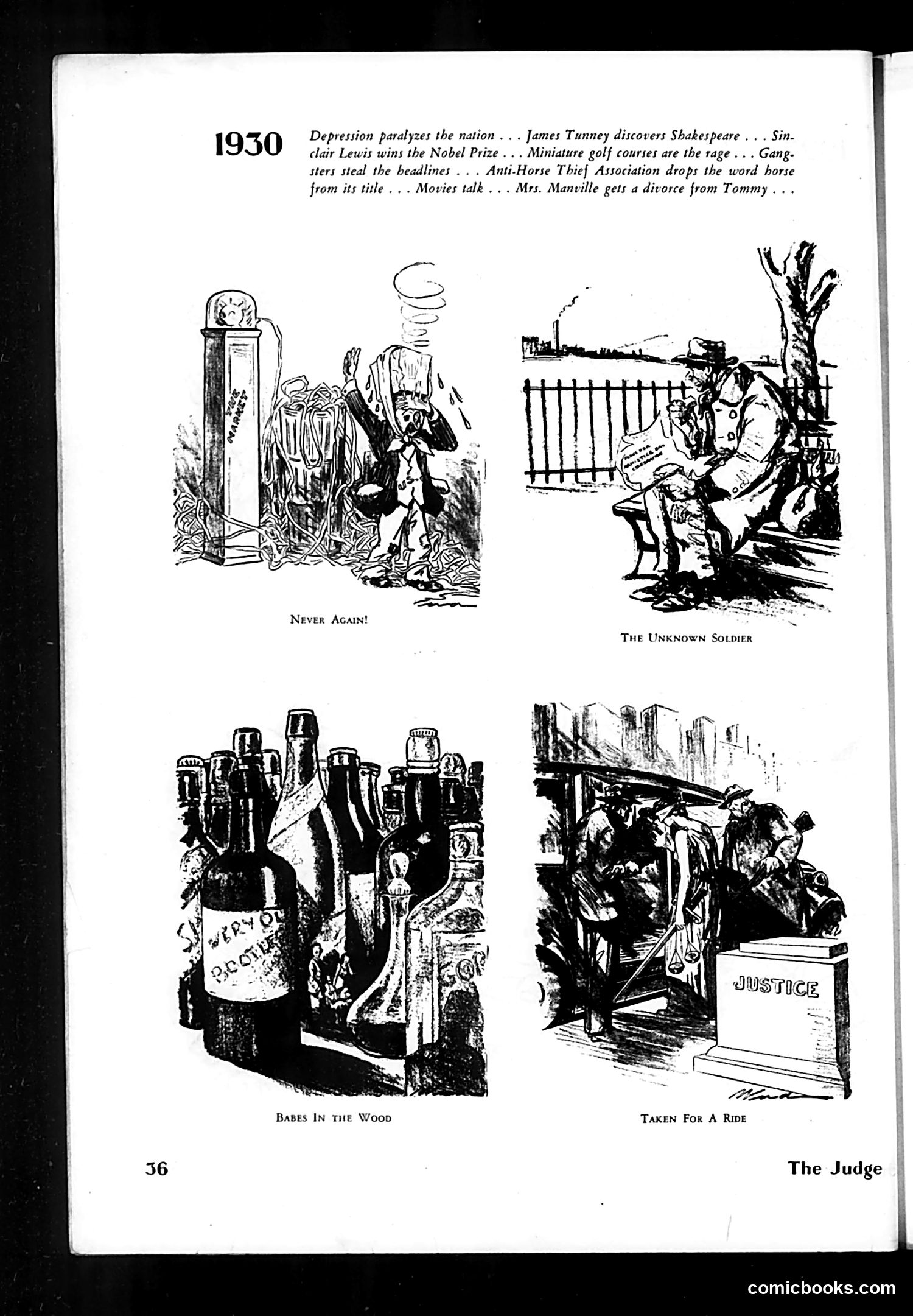
This 1930 Judge magazine page presents four political cartoons commenting on contemporary issues: "Never Again!" appears to reference post-WWI sentiment, showing a soldier at a grave monument. "The Unknown Soldier" depicts a vagrant or unemployed man—likely commenting on Depression-era poverty and forgotten veterans. "Babes in the Wood" uses alcohol bottles (labeled "Prohibition") as a visual pun, satirizing bootlegging and organized crime during Prohibition. "Taken for a Ride" references the gangster practice of murdering enemies by taking them for car rides, shown here before a "Justice" podium—mocking how criminals evaded prosecution. The page's header references 1930 events: the economic Depression, Sinclair Lewis's Nobel Prize, miniature golf's popularity, and gangsters dominating headlines. Overall, these cartoons critique crime, poverty, failed Prohibition policy, and judicial ineffectiveness during America's economic and social crisis.
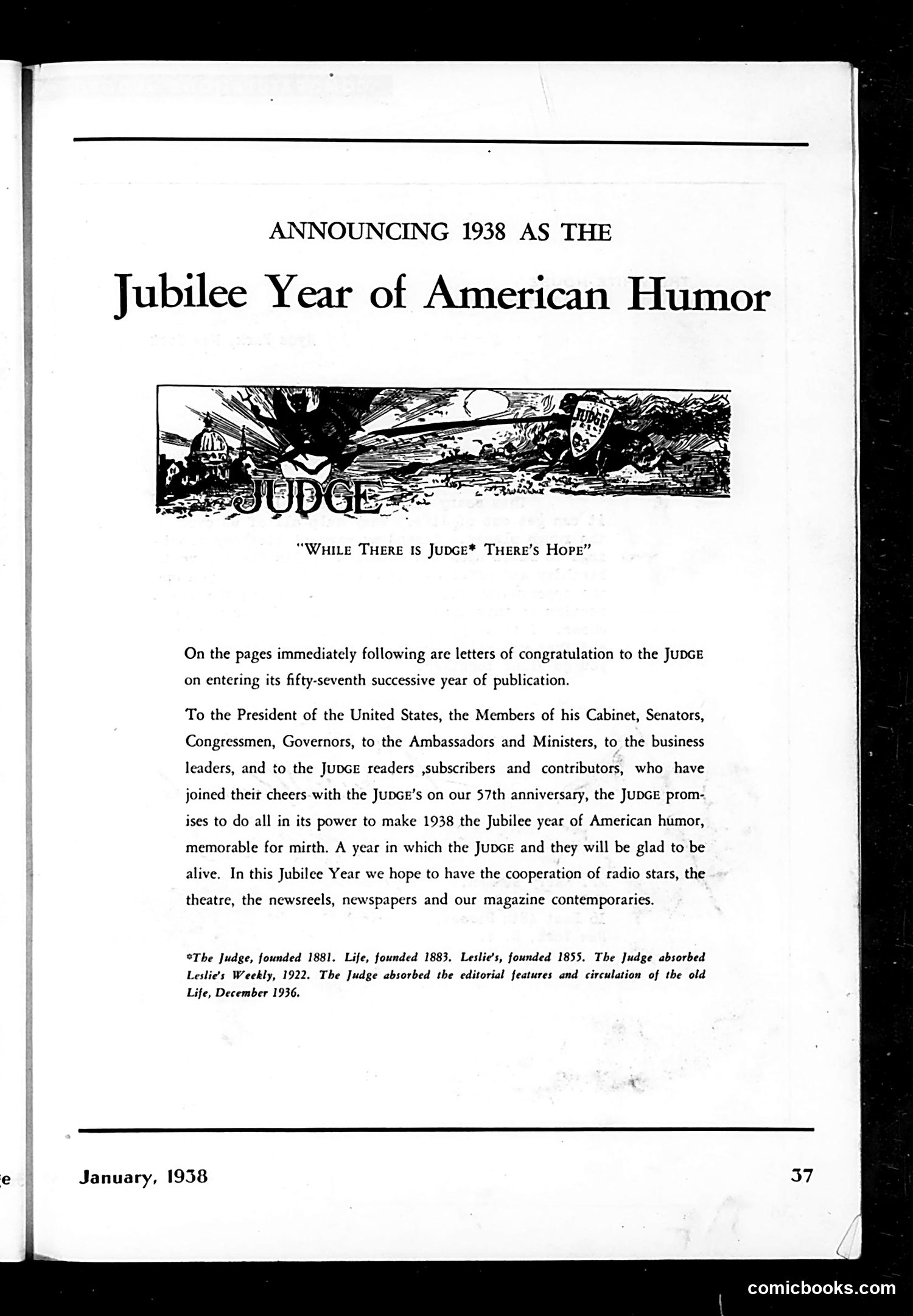
Judge Magazine's 57th Anniversary Announcement (1938) This is a title page announcing Judge magazine's "Jubilee Year of American Humor" for 1938, marking its 57th year of publication. The page contains no political cartoon—it's primarily an announcement and celebratory statement. The key content is Judge's promise to make 1938 memorable for American humor and satire, soliciting cooperation from radio, theater, newsreels, and newspapers. The tagline—"While There is Judge, There's Hope"—expresses the magazine's self-importance as a voice of humor during what was likely the uncertain pre-WWII era. The footnote reveals Judge's corporate history: it absorbed Leslie's Weekly (1922) and Life magazine's editorial content and circulation (1936), establishing Judge as a consolidating force in American satirical publishing.
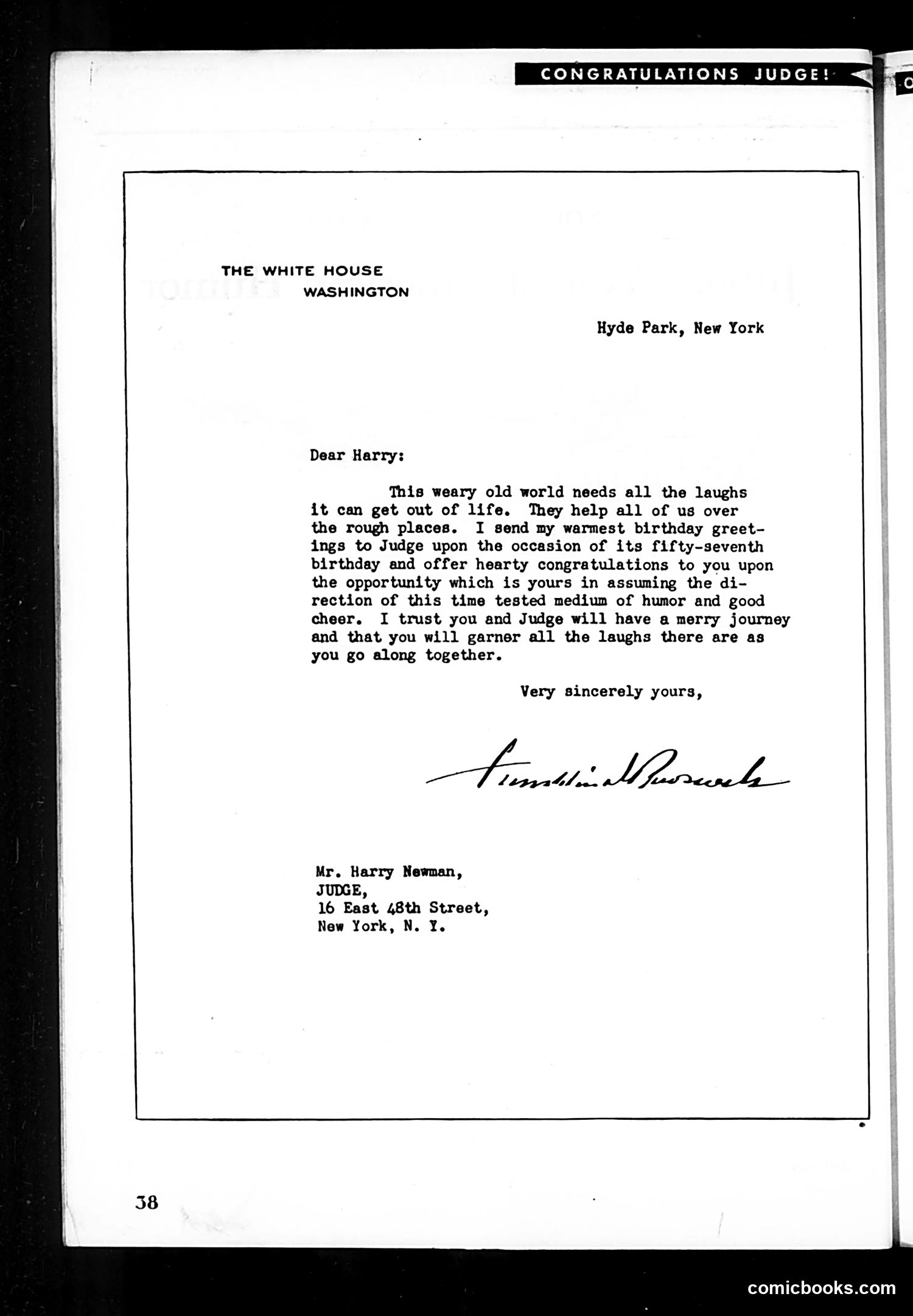
Analysis This is a congratulatory letter from Hyde Park, New York (Franklin D. Roosevelt's estate) to Judge magazine on its 57th birthday. The signature appears to be Roosevelt's, though the OCR renders it unclearly. The letter celebrates Judge's role as a humor publication during difficult times, emphasizing that laughter helps people "over the rough places"—likely referencing the Great Depression and/or WWII era anxieties. Roosevelt congratulates Harry Newman on assuming editorial direction of the magazine. The content is not satirical itself but rather a formal commendation from a sitting president (or his estate), lending prestige to Judge's mission of providing satirical social commentary and humor. This demonstrates Judge's cultural standing as an influential American satirical publication worthy of presidential acknowledgment during a challenging historical period.
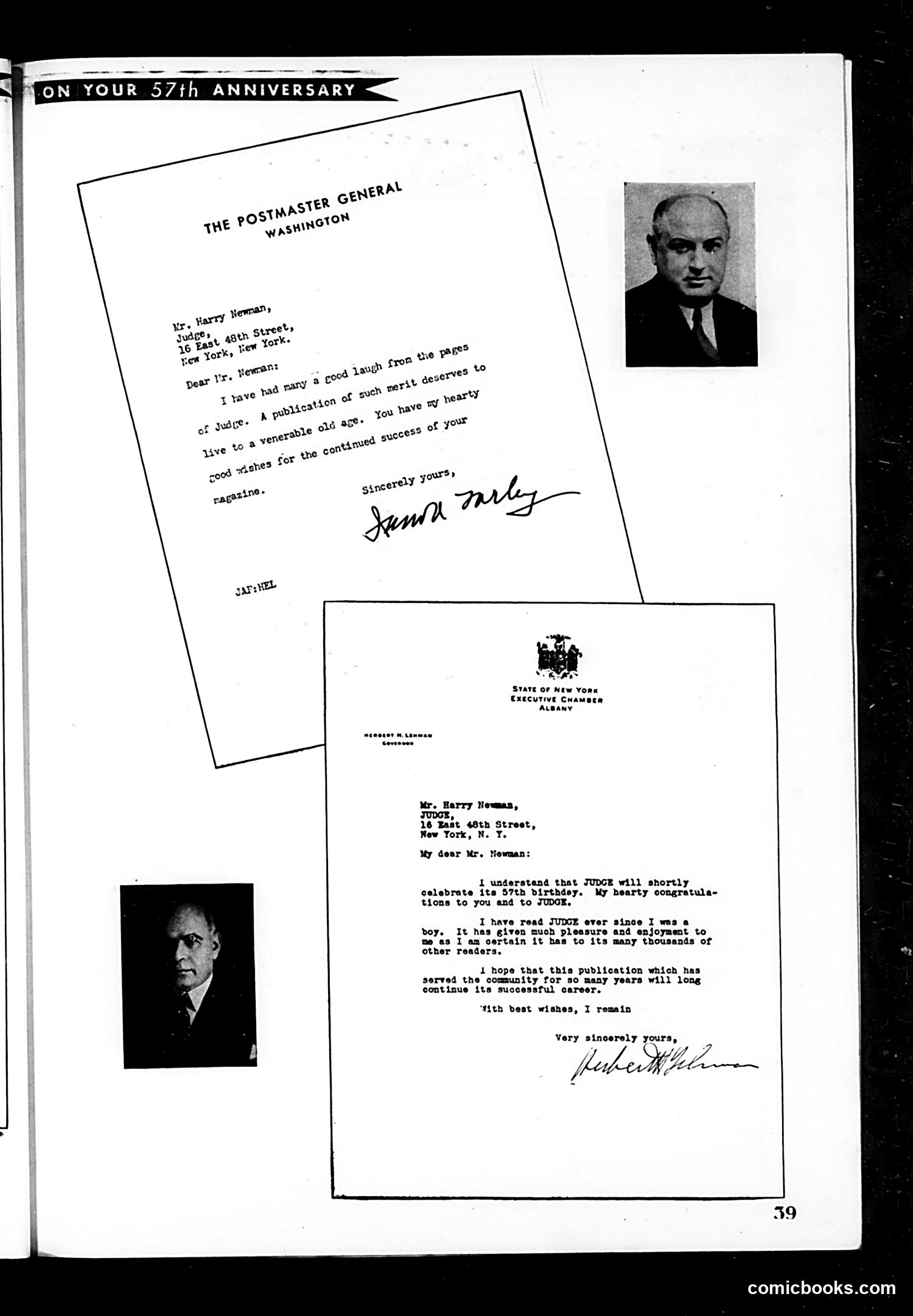
Analysis This page celebrates Judge magazine's 57th anniversary with congratulatory letters from prominent figures. The top letter is from Frank Sully, the U.S. Postmaster General, offering official congratulations to Harry Newman (the magazine's publisher or a key figure). The bottom letter is from Herbert H. Lehman, Governor of New York, similarly praising Judge's long service to the community. Rather than containing satire or political cartoons, this is a commemorative page featuring dignified testimonials from government officials. The portraits accompany their signatures, lending gravitas to the celebration. For modern readers: Judge was a major American humor and satire magazine (founded 1881), comparable to today's The Onion. That a state governor and federal postmaster would publicly celebrate its anniversary underscores the publication's cultural significance and mainstream respectability—unusual for a satirical outlet by today's standards. The page documents institutional recognition of Judge's influence.
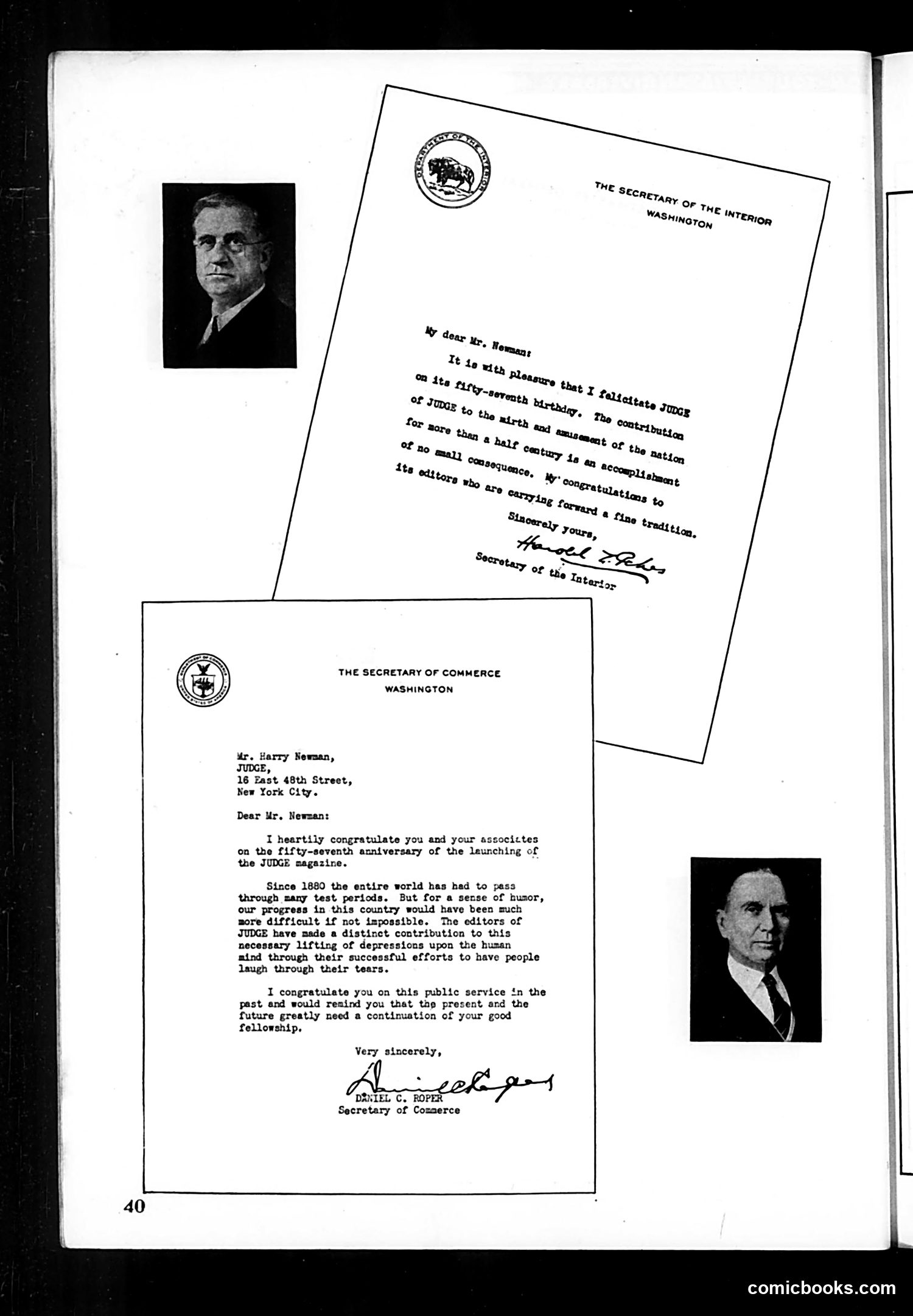
Page 40: Judge Magazine Anniversary Tributes This page contains official congratulatory letters to *Judge* magazine on its 57th anniversary (the magazine launched in 1880, making this circa 1937). The Content: Two formal letters from U.S. government officials—the Secretary of the Interior and Secretary of Commerce (Daniel C. Roper)—praising *Judge*'s role in American culture. Both emphasize the magazine's contribution during difficult economic times by providing humor that helped people "laugh through their tears." Historical Context: This appears to be from the Great Depression era, when *Judge* (a rival to *Puck* magazine) was celebrated as providing necessary comic relief during national hardship. The officials' emphasis on humor's therapeutic value during "test periods" reflects the Depression-era belief that satire and laughter were vital to public morale. What We'd Miss Today: The implicit government endorsement of satirical humor as essential infrastructure—a notably different stance than modern political divisions over comedy's role in public discourse.
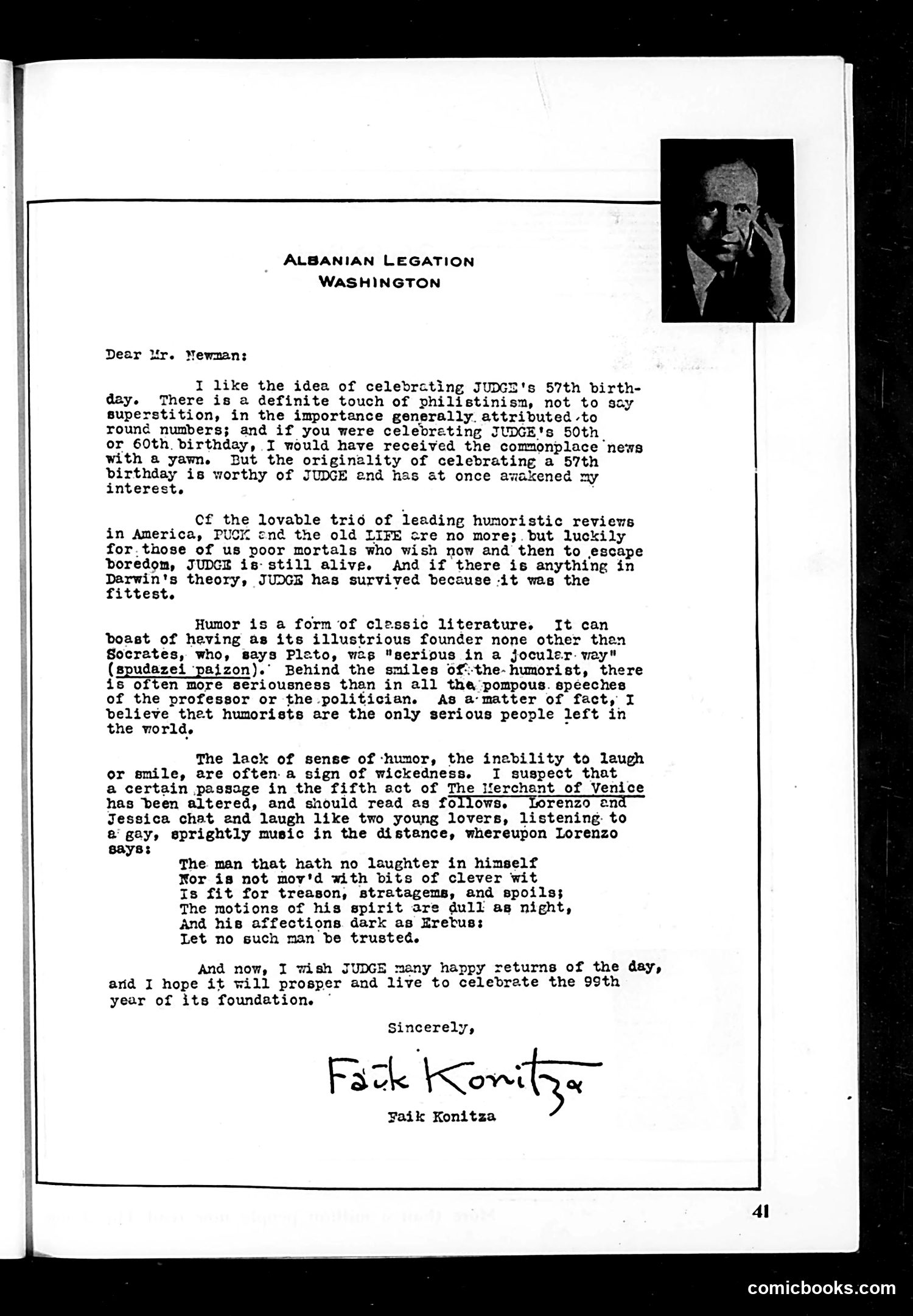
Analysis of Judge Magazine Page This is a letter of congratulations from Faik Konitza (identified as representing the Albanian Legation in Washington) to the editor of *Judge* magazine on its 57th birthday. Key context for modern readers: The letter references three competing American humor magazines: *Puck*, *Life*, and *Judge*—all now defunct. Konitza notes that *Puck* and old *Life* have ceased publication, but *Judge* survives, which he attributes to its fitness (Darwinian reference). The satire's point: Konitza praises *Judge* for celebrating an odd number (57) rather than a round one (50 or 60)—calling this "original" rather than following convention. This is gentle mockery of the magazine's contrarian sensibility. Philosophical digression: The letter quotes Plato on Socrates being "serious in a jocular way," then argues that humor writers are "the only serious people left in the world"—a common defense of satire as legitimate social commentary. The *Merchant of Venice* quote about men without laughter being untrustworthy reinforces this idea: wit and humor signal moral character.
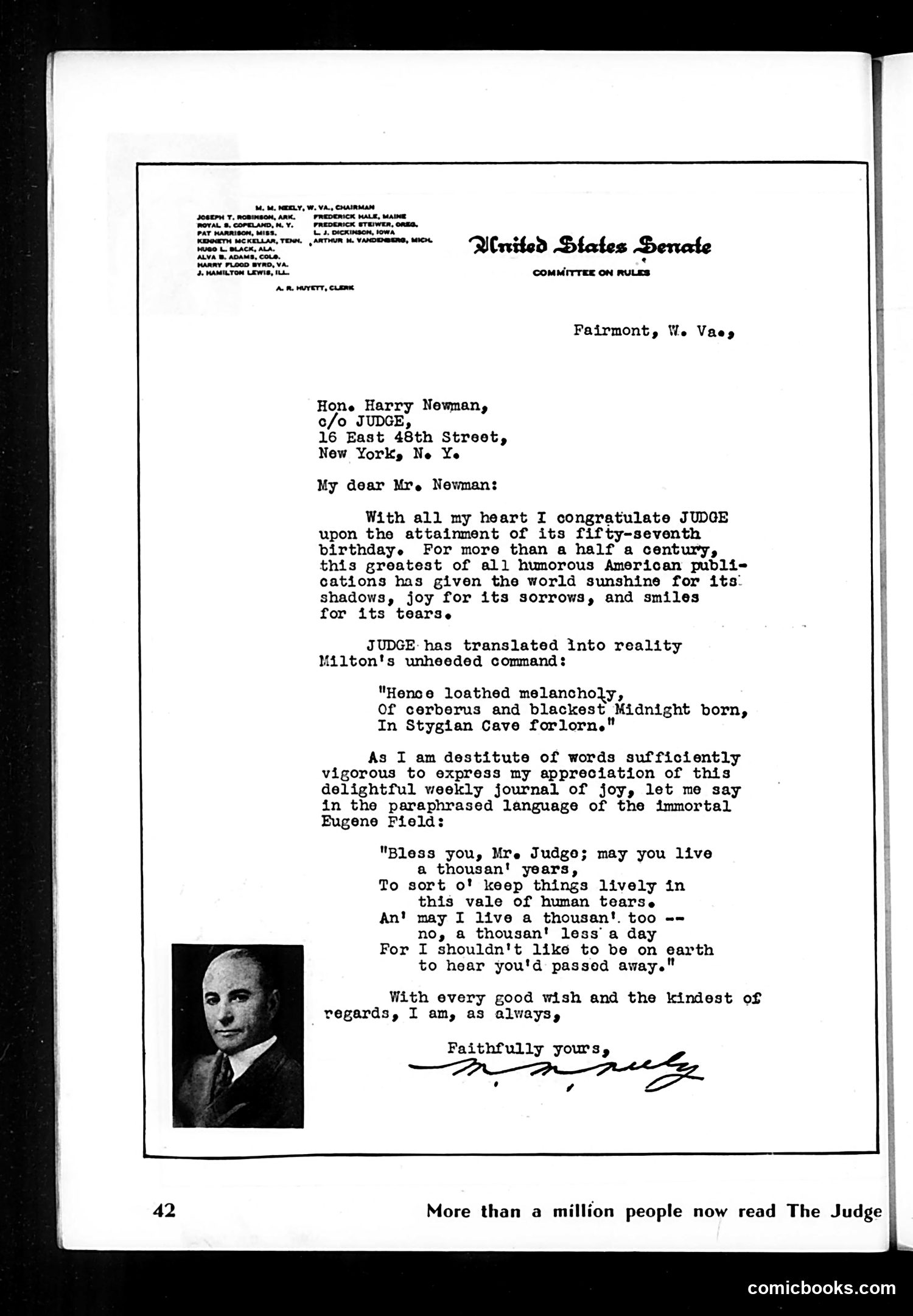
Analysis This is not a cartoon but a congratulatory letter to *Judge* magazine on its 57th birthday, written by what appears to be a U.S. Senator (based on the Senate Committee on Rules letterhead at top). The sender praises *Judge* as "the greatest of all humorous American publications," crediting it with providing "sunshine for its shadows, joy for its sorrows." He quotes Milton's *Paradise Lost* and then paraphrases poet Eugene Field's benediction, wishing the magazine long life while humorously saying he'd prefer to die a thousand days *before* it does—so he won't have to witness its demise. The tone is earnest flattery typical of early 20th-century formal correspondence. The letter demonstrates *Judge's* cultural prestige: a sitting Senator felt it worthwhile to publicly celebrate the magazine's longevity and influence on American humor and morale. The inclusion of his formal portrait reinforces the gravitas lent by this political endorsement.
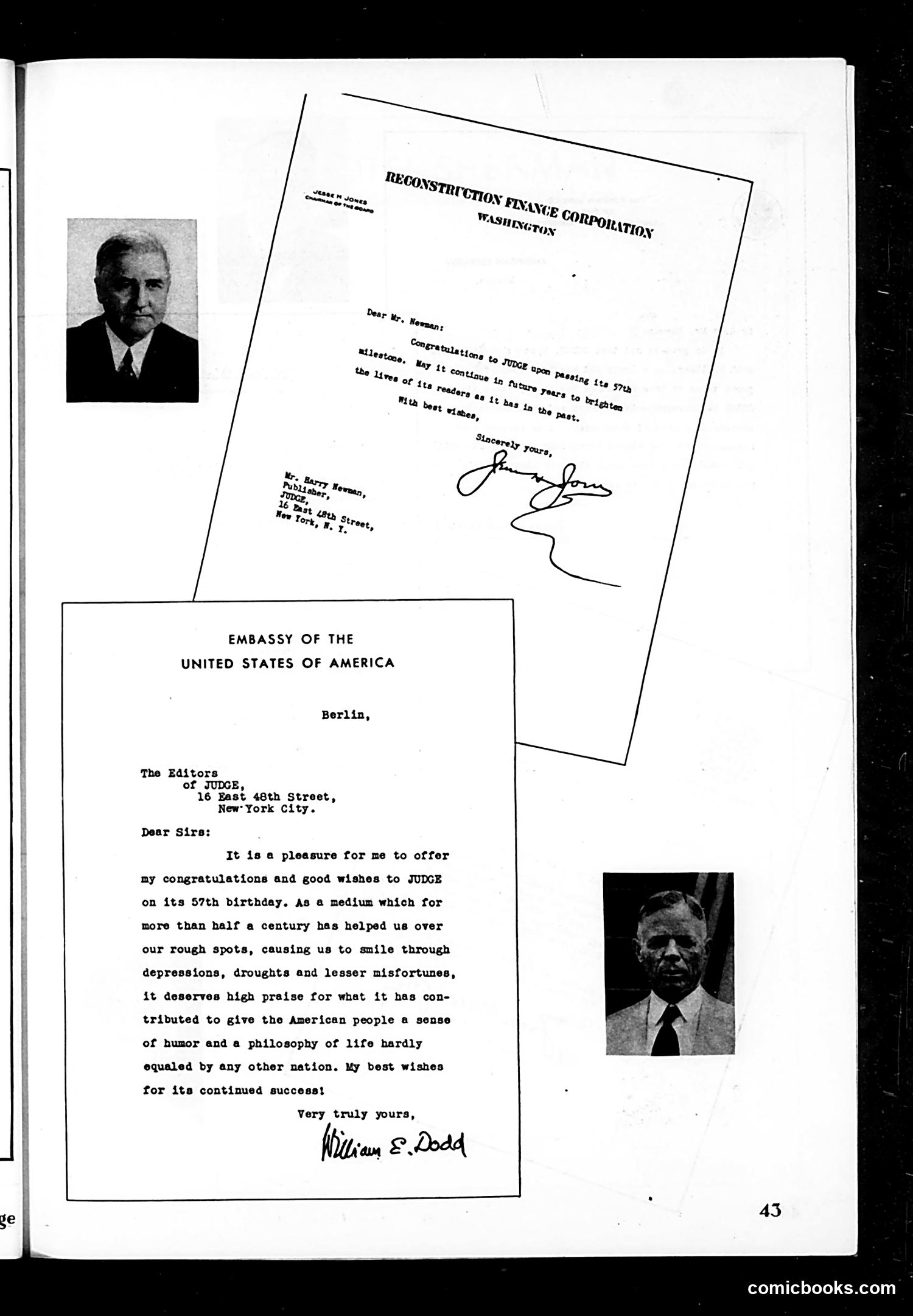
Analysis of Judge Magazine Page This page is primarily a congratulatory letter rather than a cartoon. It features a birthday greeting to *Judge* magazine on its 57th anniversary, sent from the U.S. Embassy in Berlin. The letter is signed by William E. Dodd, who appears to be the Ambassador (based on the Embassy letterhead). Dodd praises *Judge* for helping Americans endure hardships—depressions, droughts, and misfortunes—through humor over more than fifty years. The page includes two portrait photographs: one at top (appears to be the letter's recipient or a notable figure) and one at bottom right (Dodd himself, likely). Key context for modern readers: This letter demonstrates *Judge*'s cultural importance as a satirical publication that provided comic relief during America's Great Depression and other national crises. The 57th birthday dating suggests publication around 1936-1937, when such institutional recognition from diplomatic officials would have been significant validation of the magazine's social value.
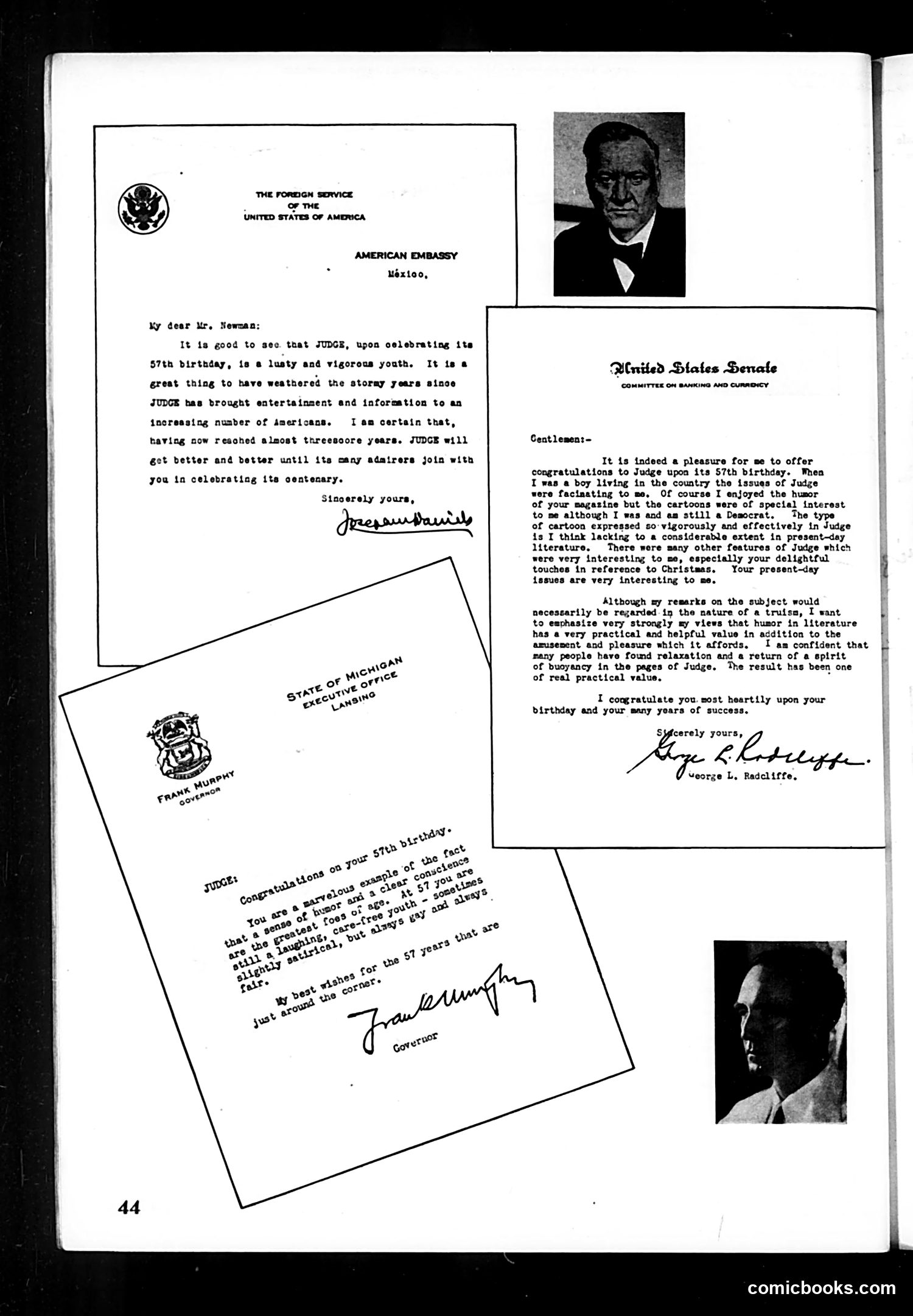
Judge Magazine 57th Birthday Tributes This page collects congratulatory letters to *Judge* magazine on its 57th anniversary. The content reveals the publication's cultural significance to American political and literary figures. The letters come from: - An American Embassy official in Mexico praising Judge's entertainment value and longevity - A U.S. Senator (George L. Radcliffe) on the Senate Banking and Currency Committee, who nostalgically recalls reading Judge's cartoons as a boy and emphasizing humor's "practical value" as stress relief for readers Both writers stress Judge's role in American public discourse—particularly its satirical editorial cartoons—and its ability to reach ordinary citizens with political and social commentary wrapped in entertainment. The letters suggest Judge was considered a serious cultural institution by 1911, not mere frivolous humor, though valued precisely for making serious subjects accessible and engaging. The photographs accompany the signatures, a common practice for authenticated official correspondence of the era.
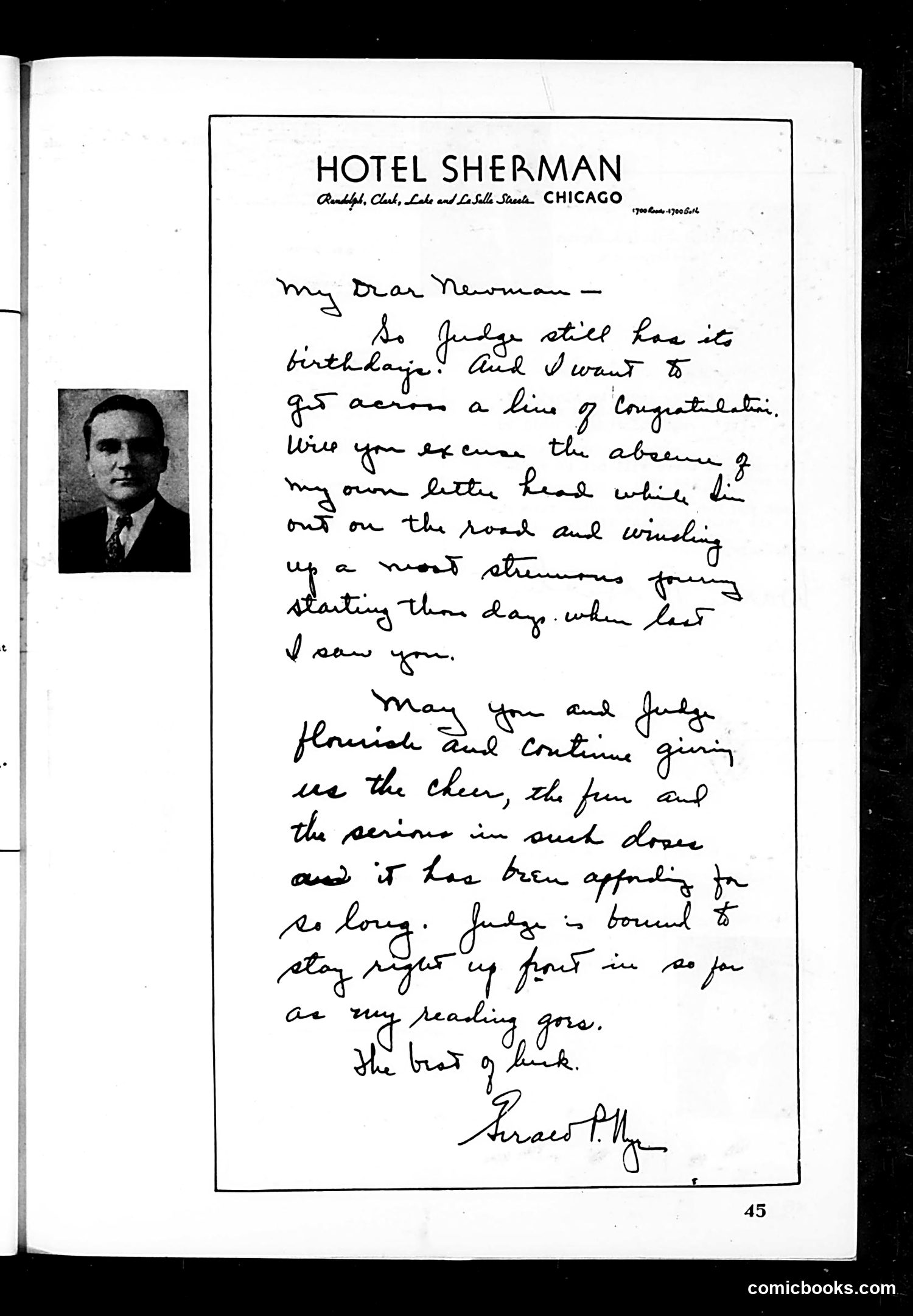
This is not a cartoon page but rather a personal handwritten letter on Hotel Sherman Chicago letterhead. The page features a photograph of a man in formal attire on the left side. The handwritten message appears to be a birthday greeting addressed to "Dear Newman," expressing congratulations and well-wishes. The sender mentions hoping the recipient enjoyed their birthday and references shared memories. The signature is difficult to read with certainty from this image. This appears to be a personal correspondence rather than satirical editorial content, making it unsuitable for analyzing political or social satire typical of Judge magazine's cartoon pages.
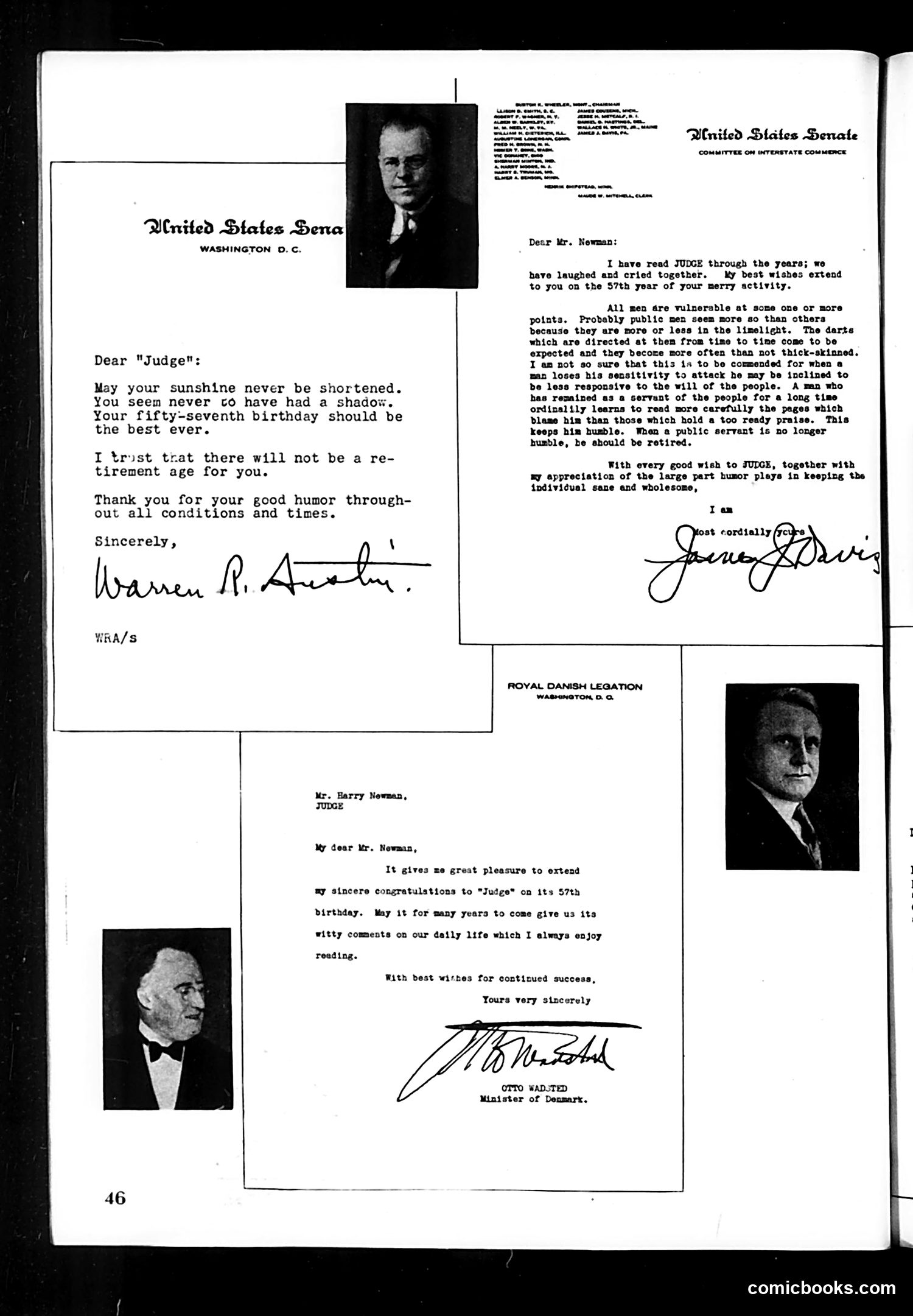
Analysis of Judge Magazine Page This page celebrates Judge magazine's 57th anniversary with congratulatory letters from prominent figures. The content is primarily not a cartoon, but rather fan mail and official correspondence. Key figures visible: - Warren R. Austin (U.S. Senate, Committee on Interstate Commerce) — offers warm birthday wishes, praising Judge's consistent humor and noting that satire's "darts" keep public figures accountable and humble - Otto Wadtsted (Danish Minister) — extends diplomatic congratulations The satire's point: The letters themselves constitute the humor — prestigious government officials publicly endorsing a satirical magazine that routinely mocks them. Austin's letter is particularly self-aware, acknowledging that Judge attacks public figures and arguing this serves a democratic function by preventing complacency. By publishing these letters, Judge demonstrates its cultural legitimacy and influence: even the targets of its satire respect its role as social critic. The page functions as both celebration and validation of American political humor's place in civic life.
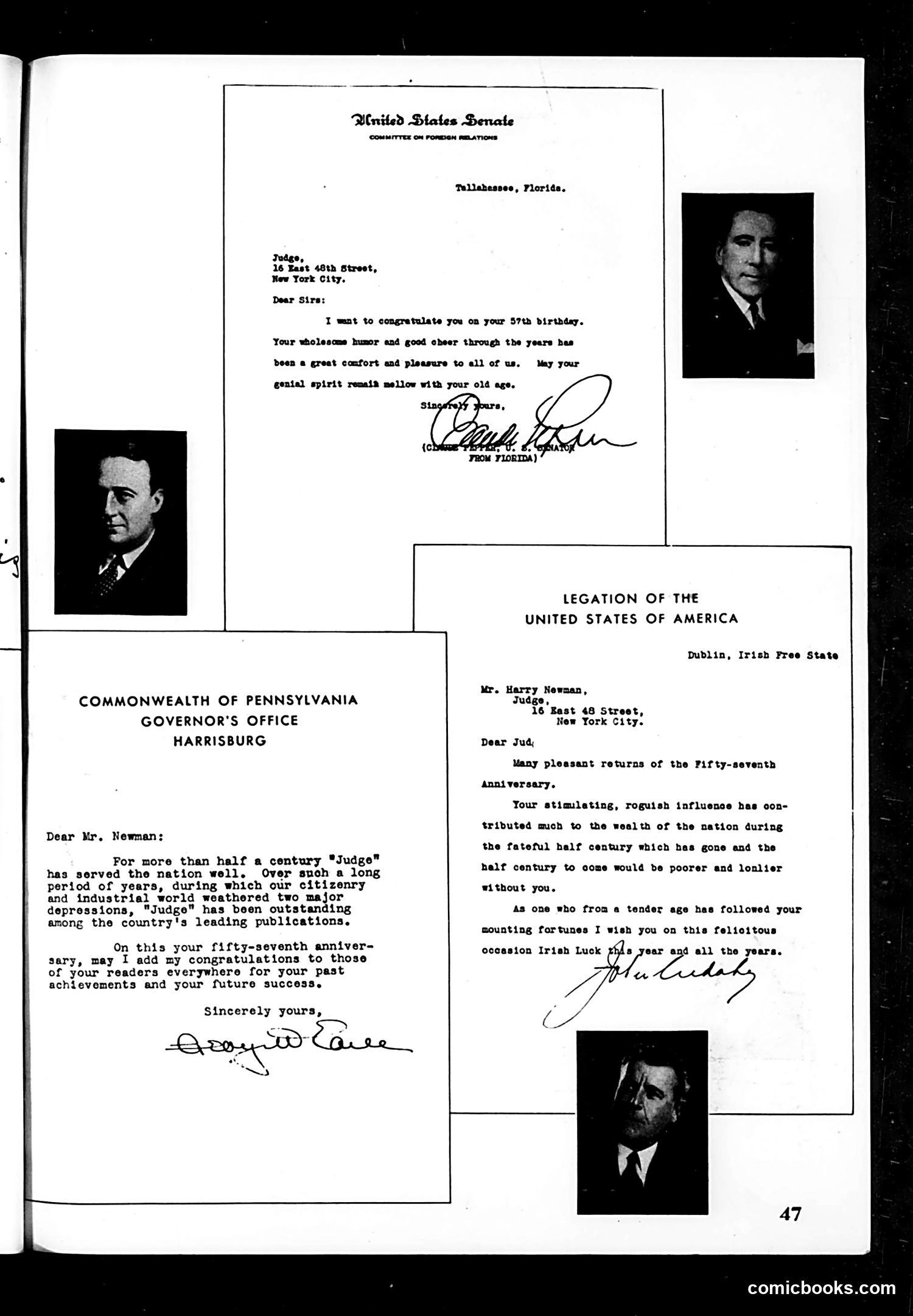
Page 47: Judge Magazine's 57th Birthday Congratulations This is not a cartoon page but rather a collection of congratulatory letters to Judge magazine itself on its 57th anniversary. The page features three formal letters from prominent figures: 1. U.S. Senator from Florida (letterhead visible, signature unclear) congratulates Judge on maintaining "wholesome humor and good cheer." 2. Pennsylvania Governor (signature appears to be "Earle") praises Judge for being "outstanding among the country's leading publications" through two major depressions and industrial upheaval over its 57-year run. 3. U.S. Legation in Dublin, Irish Free State offers warm wishes, noting Judge's "stimulating, roguish influence" has contributed to American wealth. The page demonstrates Judge's prestigious standing among American political leadership during this era. The magazine was clearly respected as a significant cultural institution worthy of formal recognition from governors and senators—a status difficult to imagine for satirical magazines today.
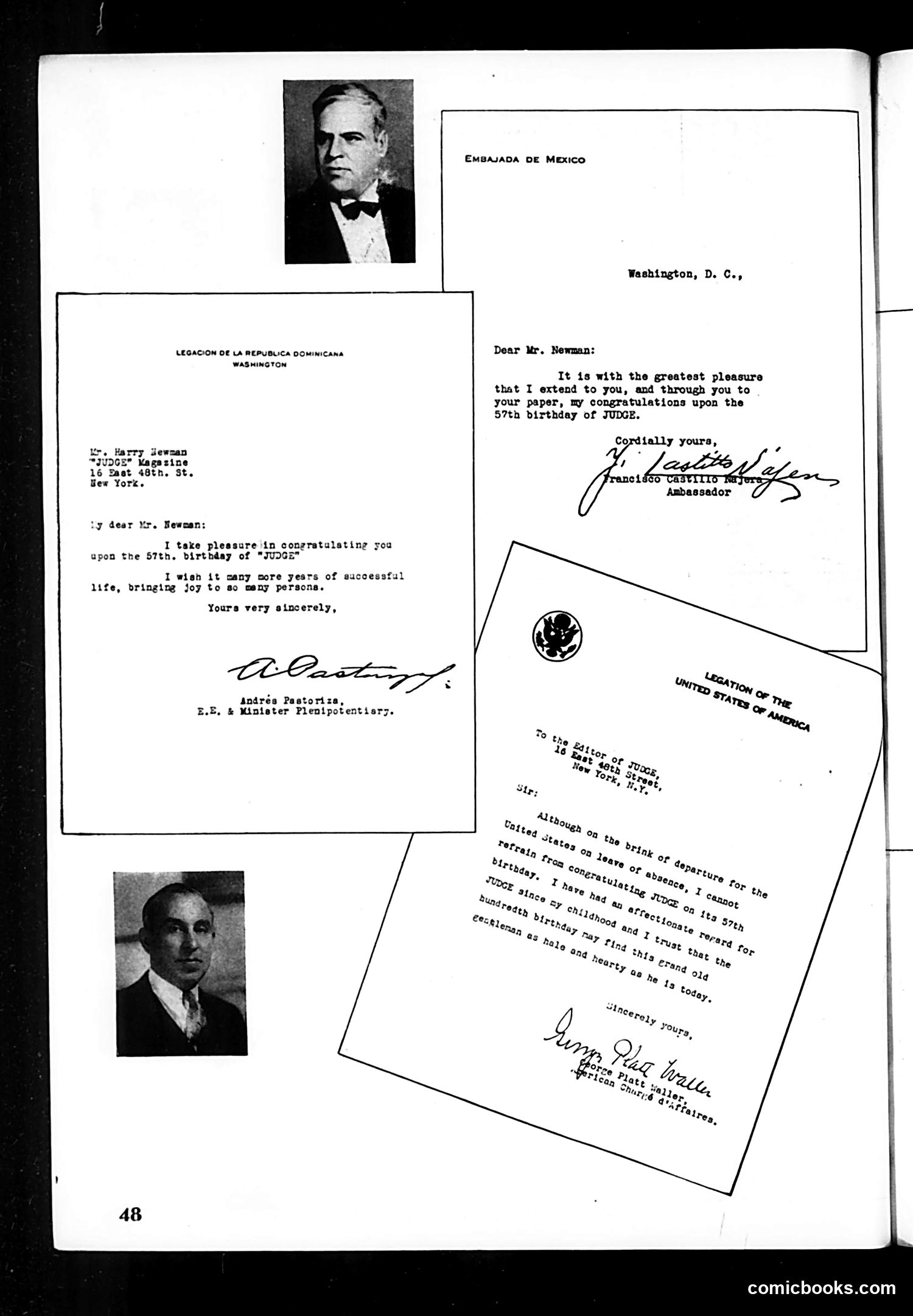
What This Page Shows This is not a cartoon, but rather congratulatory letters to Judge magazine's publisher on the magazine's 57th birthday. The page displays formal diplomatic correspondence from two Latin American ambassadors—one from the Dominican Republic (Andrés Pastoriza) and one from Mexico (Francisco Castillo Nájera)—offering birthday wishes to Judge. Each letter is accompanied by a formal portrait photograph of the diplomat. The inclusion of these international diplomatic congratulations served to lend prestige and legitimacy to Judge magazine, suggesting it had influence and respect even at the ambassadorial level. This was likely published as promotional content within Judge itself, demonstrating the magazine's standing in American culture during whatever year marked its 57th anniversary.
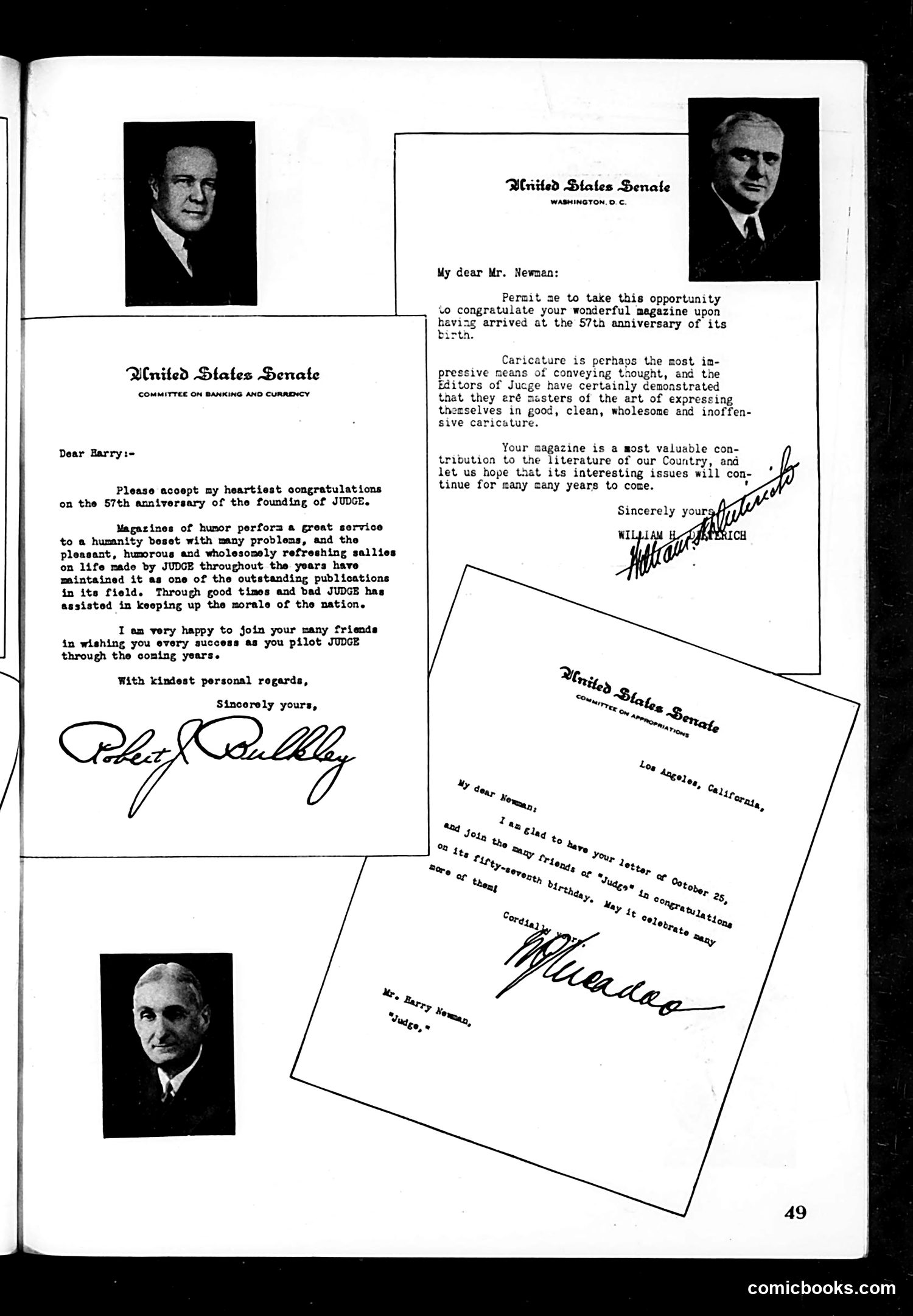
Judge Magazine's 57th Anniversary Tributes This page presents congratulatory letters to Judge magazine on its 57th anniversary, from U.S. Senators. The letters praise Judge's role as a satirical publication serving the nation through humor during difficult times. The key context: Judge was a prominent American humor and satire magazine that used caricature and political commentary. These Senate endorsements—from members of Congress—validate the magazine's cultural importance and its "wholesome" approach to social criticism through exaggeration and caricature. For modern readers: this shows how political satire was institutionally respected in early 20th-century America, with government officials publicly endorsing a humor magazine. The emphasis on caricature being "clean" and "inoffensive" suggests the magazine maintained editorial standards while critiquing society—a distinction the senators considered noteworthy and worthy of official commendation.
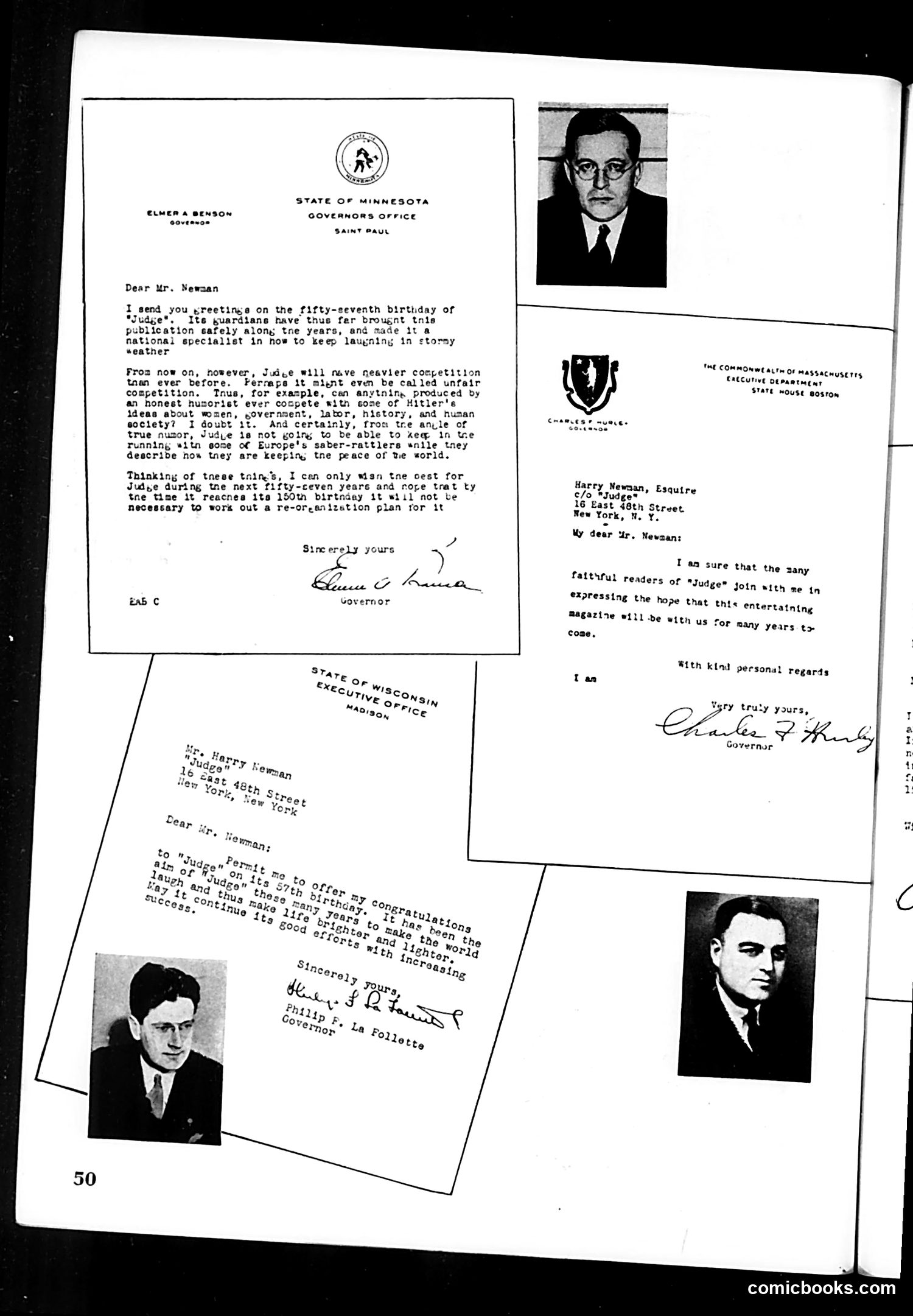
Judge Magazine 57th Birthday Tribute Page This page celebrates Judge magazine's 57th anniversary with congratulatory letters from state governors. The content reveals contemporary anxieties about humor and satire during the 1930s-40s era. Key figures: Letters from governors of Minnesota (Elmer Benson) and Wisconsin (Philip La Follette), addressed to Harry Newman (likely the magazine's editor or publisher). The satire's point: The governors humorously acknowledge that Judge faces impossible competition—not from other humor magazines, but from real-world events. They specifically reference Hitler and European "saber-rattlers" (fascist leaders), suggesting that actual geopolitical threats have become so absurd that satirizing them is nearly impossible. One governor jokes that government incompetence and warmongering are now funnier (or more tragic) than anything comedians can invent. Historical context: This reflects anxieties as WWII approached, when reality seemed to outpace satire itself—a common complaint among humorists during the 1930s-40s.
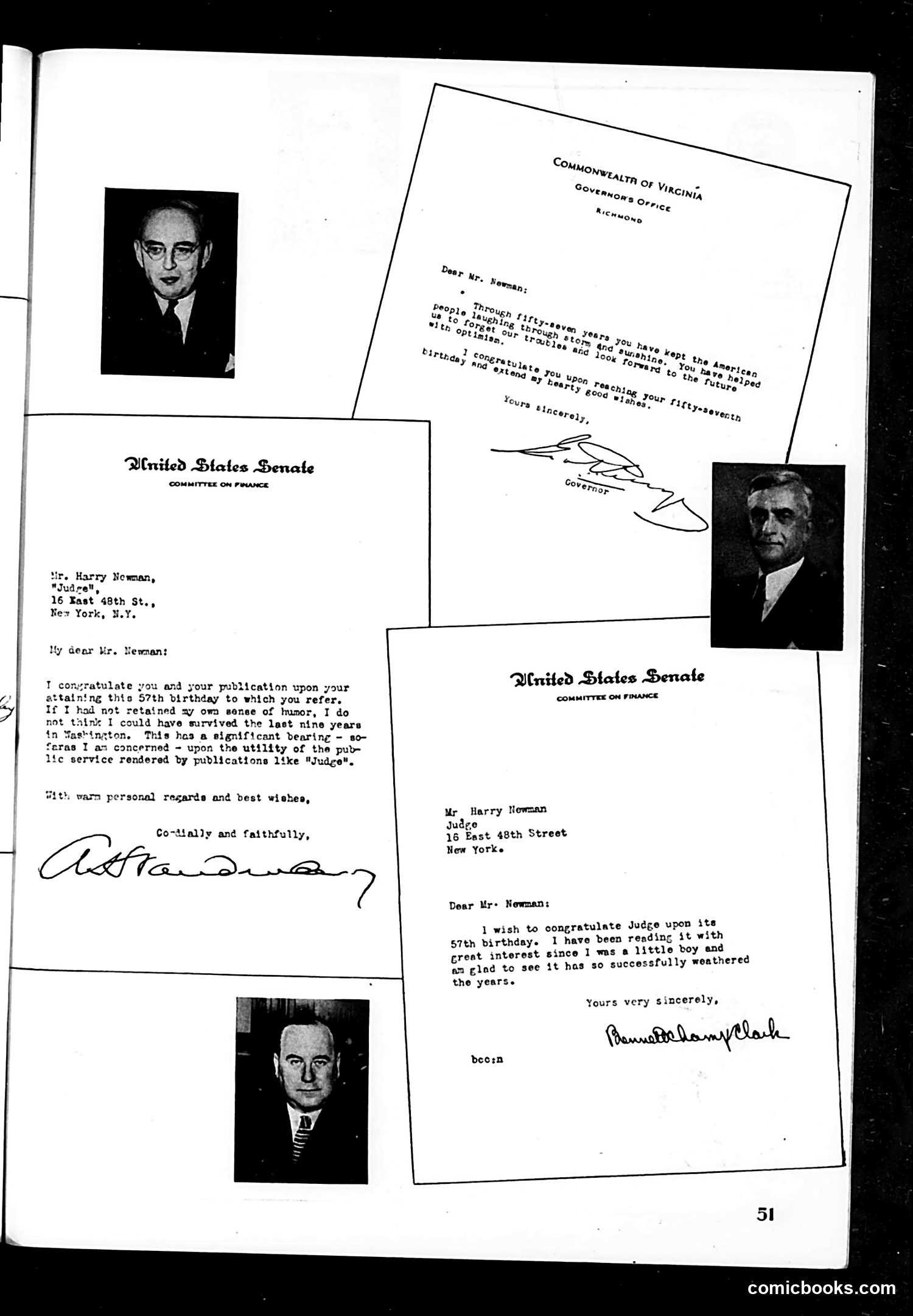
Page 51: Senate Congratulations to Judge Magazine This page contains congratulatory letters to Judge magazine on its 57th birthday, not political cartoons. Two U.S. Senators from the Committee on Finance sent formal letters praising the publication. The first letter (signed by what appears to be a senator, though the signature is unclear) credits Judge with helping him maintain humor during nine difficult years in Washington, suggesting the magazine's satirical content provided psychological relief during a stressful period—likely referring to the Great Depression and/or New Deal era. The second letter, signed by what appears to be another senator, expresses long-standing appreciation for Judge, claiming he has read it since childhood and admired its durability through the years. The page demonstrates Judge's cultural prestige and influence: sitting U.S. senators publicly praised its satirical commentary as essential to public discourse. This reflects Judge's significant role as a platform for political and social commentary in early-20th-century America.
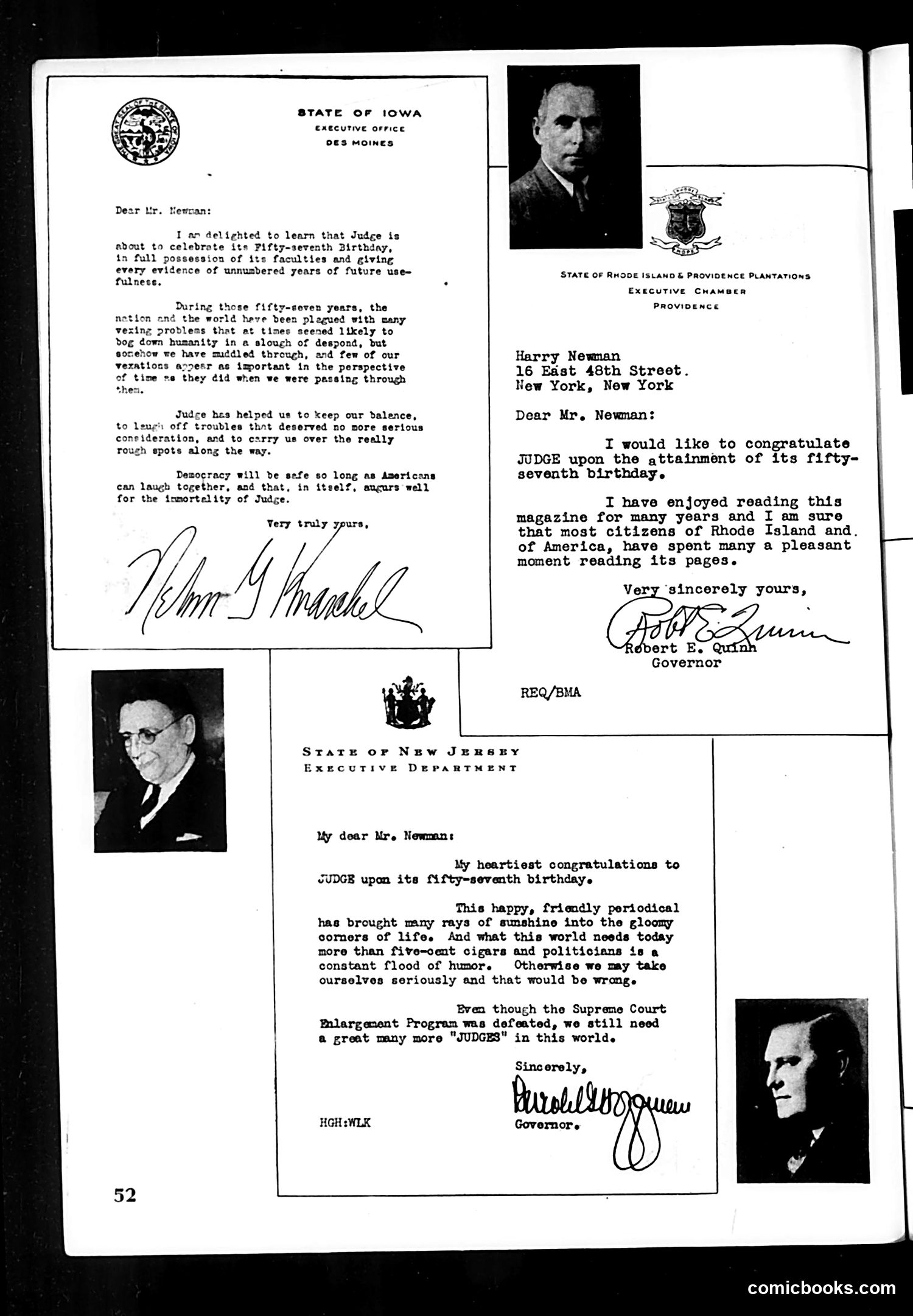
Judge Magazine's 50th Anniversary Tributes This page celebrates Judge magazine's fifty-seventh birthday through congratulatory letters from state governors. The letters are from the governors of Iowa, Rhode Island, and New Jersey (whose signatures appear). Each governor praises Judge's role in American public life. They emphasize that humor and laughter are essential to democracy—that citizens who can "laugh together" maintain social balance during difficult times. The Iowa governor notes Judge has helped the nation "muddle through" various crises over fifty-seven years. The New Jersey governor's letter includes a contemporary reference to a "Supreme Court Enlargement Program"—likely referring to debates over Franklin D. Roosevelt's court-packing proposal (circa 1937). He argues America needs more "judges" (wisdom/judgment) alongside humor to avoid taking itself too seriously. This reflects Judge's self-perception as a stabilizing cultural force: a satirical publication providing necessary comic relief and social commentary during turbulent political periods.
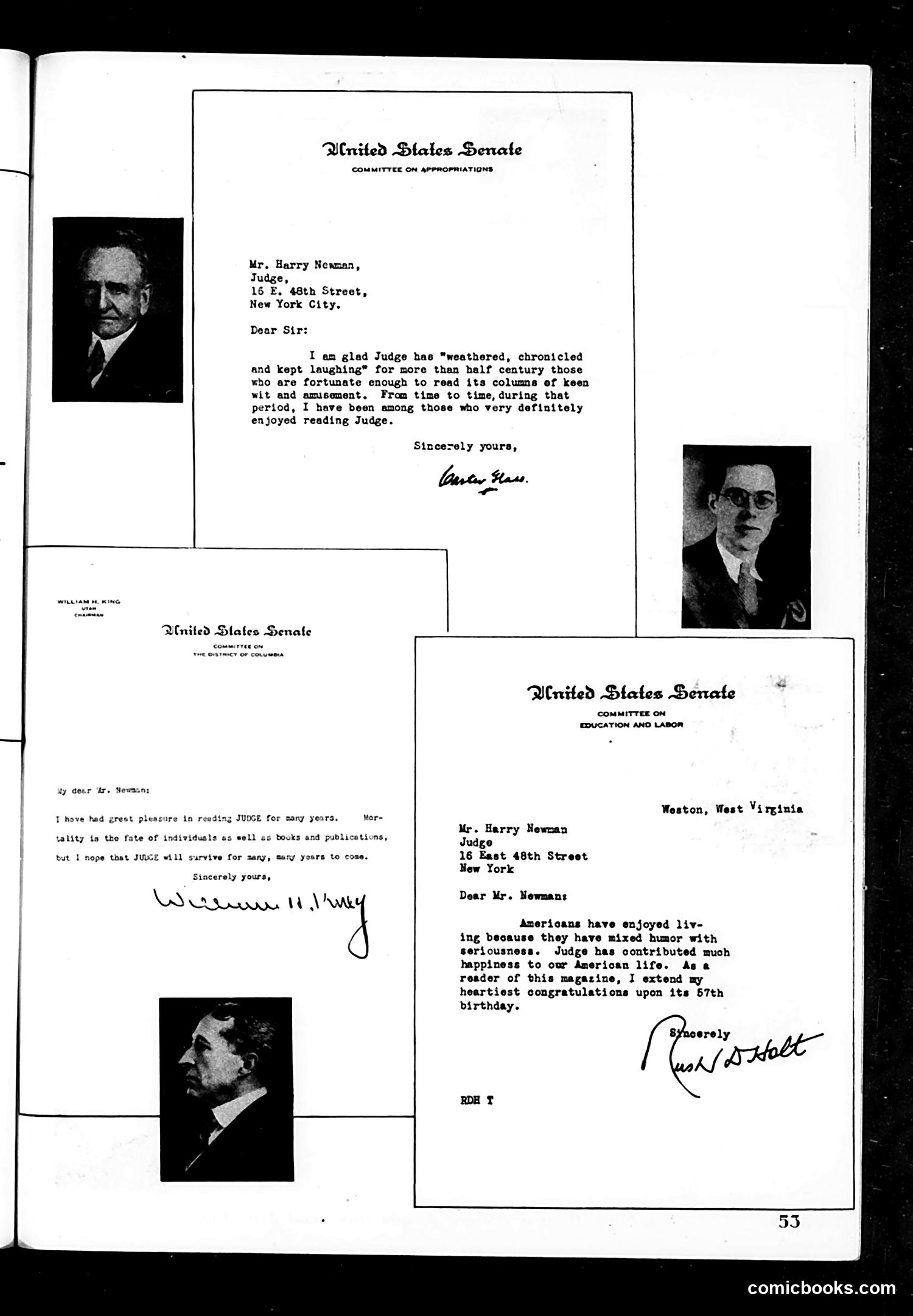
Analysis of Page 53 from Judge Magazine This page is not a cartoon but rather testimonial letters to Judge magazine's publisher Harry Newman, apparently celebrating the publication's 57th birthday. The page features three congratulatory letters from U.S. Senators praising Judge's longevity and cultural contribution. Each letter includes the senator's photograph and signature. The senators commend Judge for "weathering" and maintaining wit and humor over decades, with one specifically noting Americans' appreciation for mixing "humor with seriousness." The key point: This appears to be fan mail from prominent political figures, demonstrating Judge's prestige and influence in early-20th-century American culture. That sitting U.S. Senators would publicly celebrate a satirical magazine suggests Judge held significant social standing despite—or because of—its role mocking political and social targets. The page functions as validation of the magazine's importance, not as satire itself. It's essentially a birthday tribute showing the magazine's reach into the nation's highest levels.
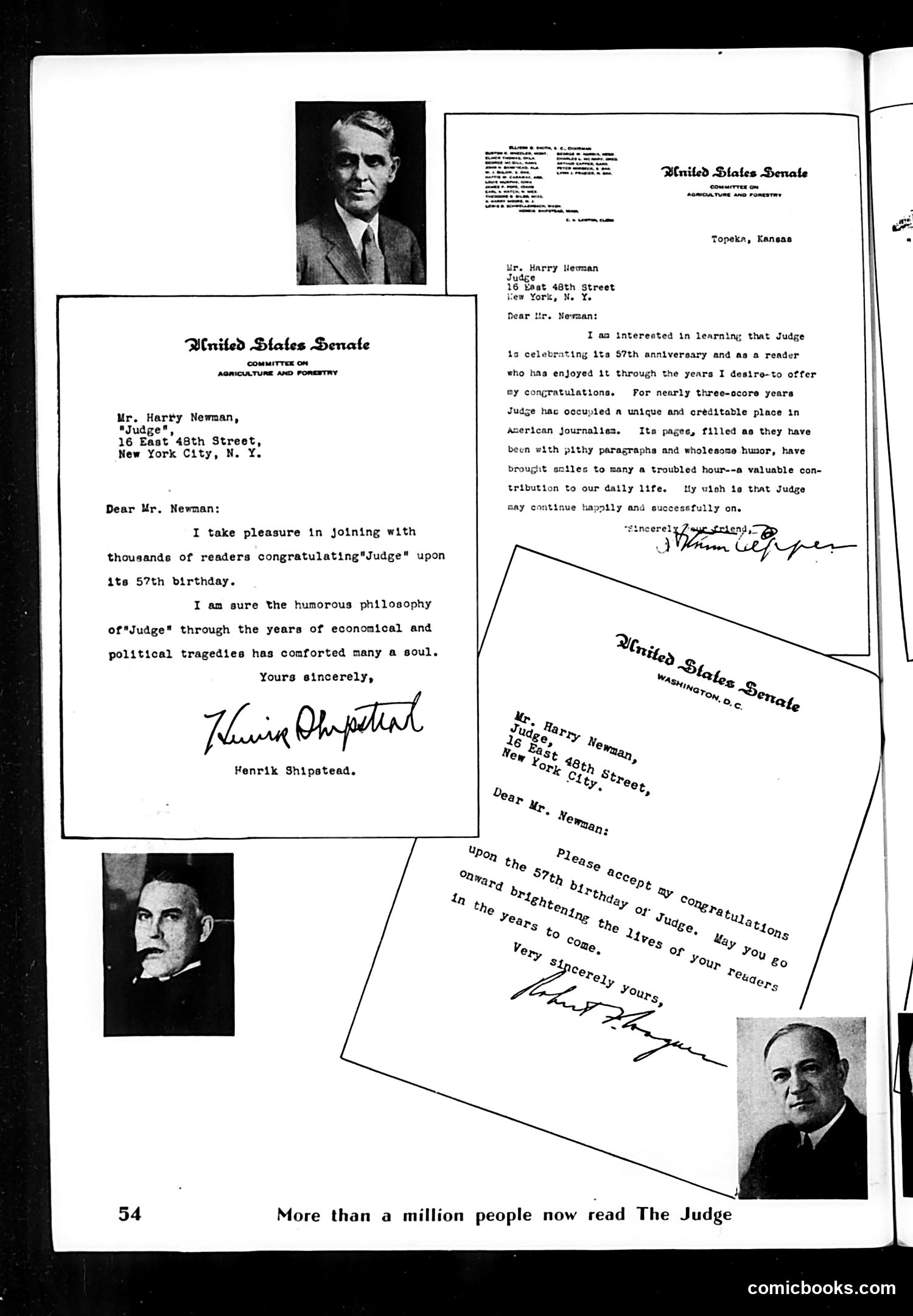
Analysis of This Judge Magazine Page This page celebrates Judge magazine's 57th birthday through congratulatory letters from U.S. Senators. Rather than containing political cartoons, it's primarily testimonial advertising—a common practice where public figures endorse publications. The letters are from: - Henrik Shipstead (Senator, Agriculture and Forestry Committee) - An unnamed senator from Topeka, Kansas Both praise Judge for its satirical humor during economically and politically difficult times ("economical and political tragedies"). They credit the magazine with providing comfort and smiles to readers through hard times—likely referencing the Great Depression era (the exact date is unclear from visible text, but the "57th birthday" reference helps establish timing). The point: These endorsements legitimized Judge as serious cultural commentary, not mere frivolity. By securing Senate testimonials, Judge positioned itself as a valuable public service—using humor to maintain morale during national crisis. The photographs of the senators add gravitas to what is essentially a paid tribute.
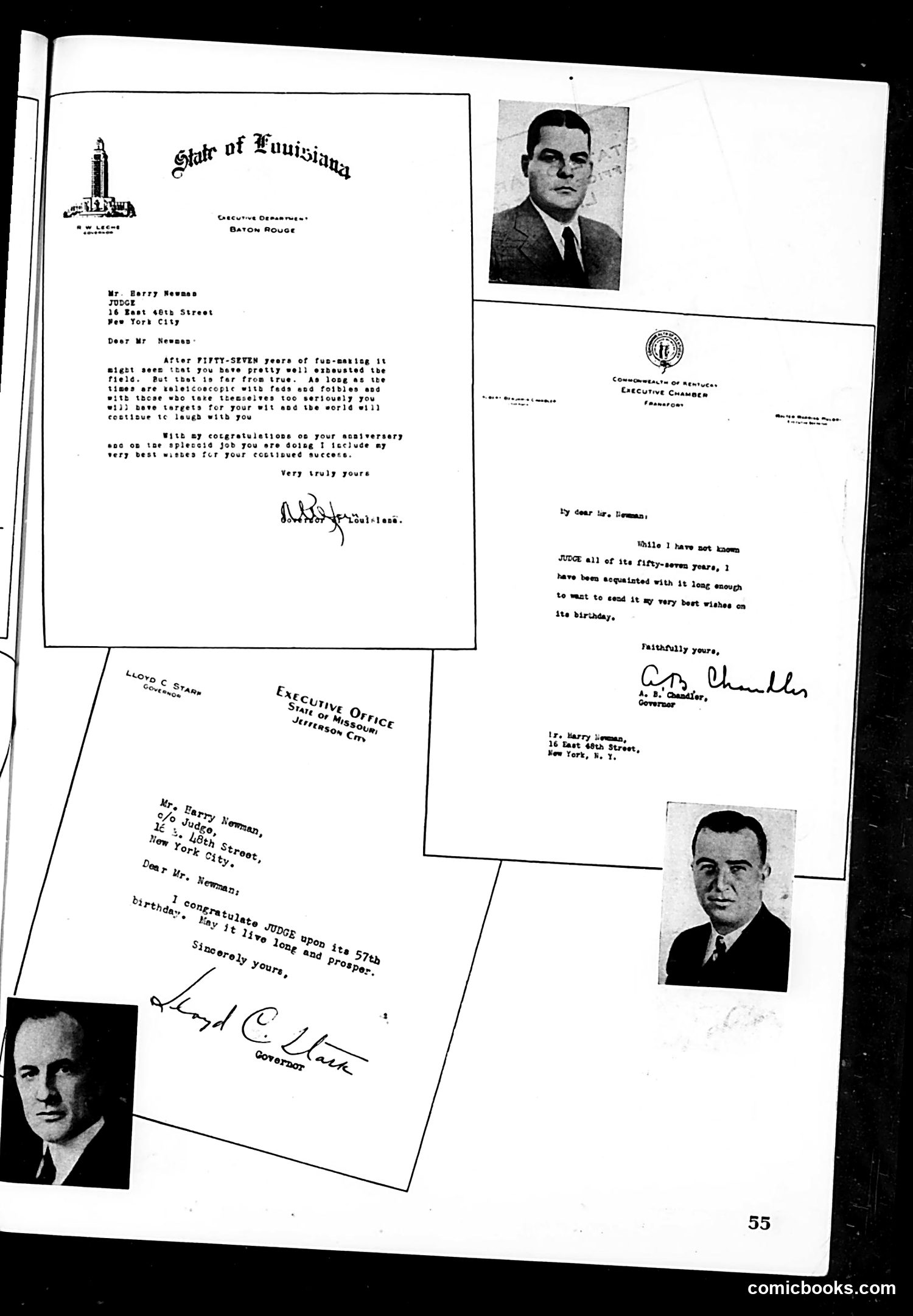
Page 55: JUDGE Magazine Anniversary Tributes This page commemorates Judge magazine's 57th anniversary (establishing publication around 1881). It consists of congratulatory letters from three prominent Louisiana political figures to Barry Newman, apparently a long-time Judge contributor or editor. The letters come from: - State of Louisiana (Baton Rouge executive office) - A.D. Chalkley, Governor - Lloyd C. Blake, Governor Each sender praises Newman's decades of satirical work, noting Judge's continued relevance in targeting "fads and foibles" and holding powerful figures accountable. The page includes formal portrait photographs of the correspondents—standard practice for official documents of this era. Rather than containing cartoons, this is a documentary/testimonial page celebrating Judge's longevity and influence on American political satire, suggesting the magazine maintained significant prestige among state officials.
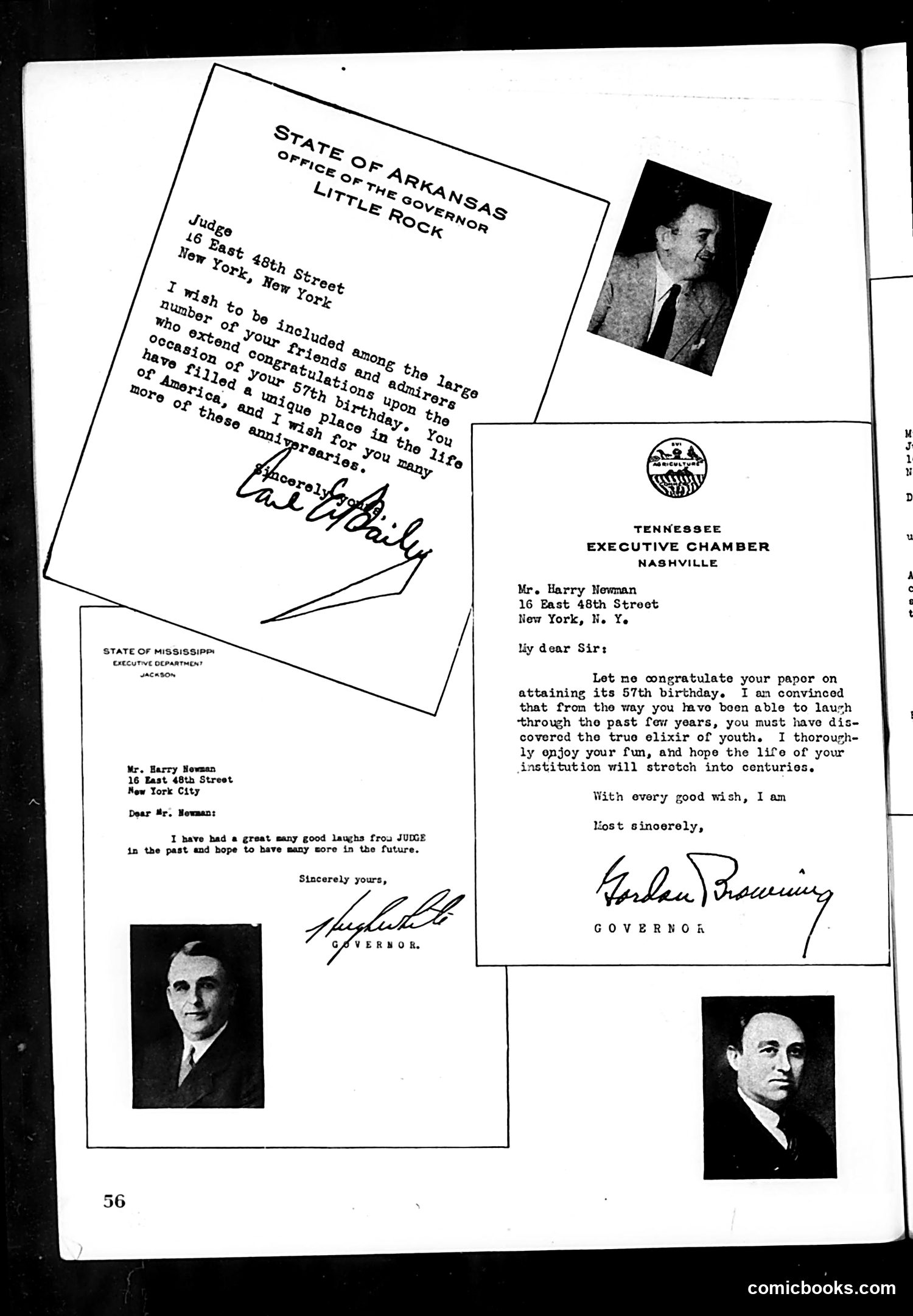
Content Analysis This page displays congratulatory letters to Judge magazine on its 57th birthday, sent by three governors to publisher Harry Newman at 16 East 48th Street, New York. The letters are from: - Governor of Mississippi (signature unclear in image) - Governor of Tennessee (signed "Barkley Browning," identified as Governor) - Governor of Arkansas (signature appears to be "Carl Bailey") Each letter praises Judge's humor and longevity. The governors' messages are lighthearted—they thank the magazine for its laughs and express hope it will continue for "centuries." This is not satirical content itself, but rather a promotional page showing institutional endorsement of Judge magazine during what appears to be the 1930s-1940s. The inclusion of letters from sitting governors demonstrates Judge's cultural prominence and respectability despite being a satirical publication. It's essentially advertising that even serious government officials enjoyed and valued the magazine's humor. The page functions as a celebrity endorsement section before modern media made such practices commonplace.
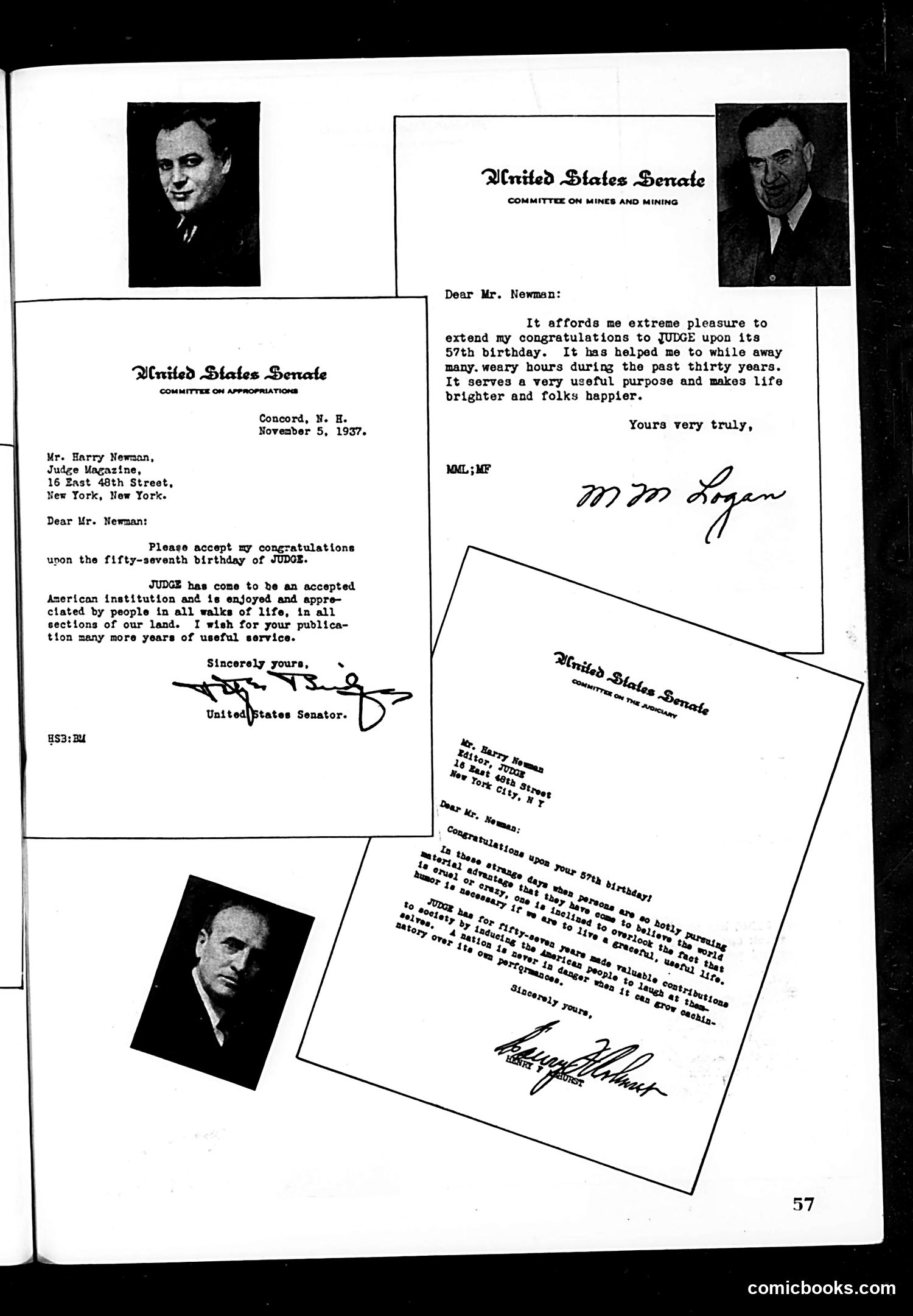
Analysis This is not a cartoon page, but rather a commemorative document celebrating *Judge* magazine's 57th birthday (1937). The page features congratulatory letters from two U.S. Senators, positioned alongside their photographs. The left letter, from a Senator on the Committee on Appropriations, offers formal praise of *Judge* as "an accepted American institution" enjoyed across all social classes and regions. The right letter, from a Senator on the Committee on Mines and Mining, takes a more personal tone, noting that *Judge* has provided him entertainment "during the past thirty years" and claiming it "makes life brighter and folks happier." The page demonstrates *Judge*'s cultural prestige—that sitting U.S. Senators would publicly endorse a satirical magazine suggests it held significant influence in American public discourse during the Depression era. The letters function as institutional validation of the publication's social value and longevity.
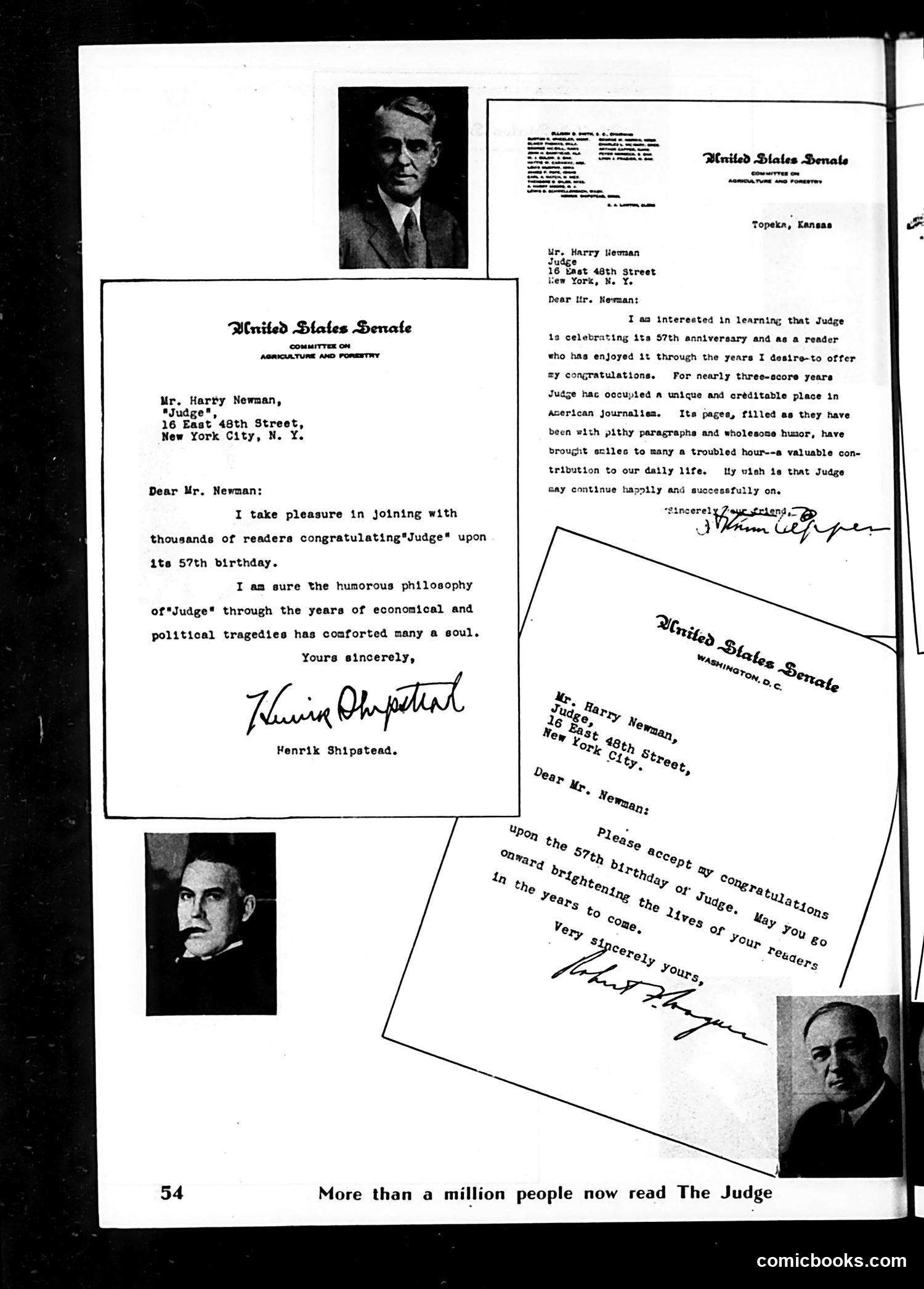
Content Analysis This page celebrates *Judge* magazine's 57th anniversary through congratulatory letters from prominent figures. The visible correspondents are Henrik Shipstead (a U.S. Senator from Minnesota, identifiable by the Senate letterhead) and another official sender. The letters praise *Judge* for its satirical humor during economically and politically difficult times—likely referencing the Great Depression era and its aftermath. The senders credit the magazine with providing comic relief during "troubled hours" through "pithy paragraphs and wholesome humor." This is not a cartoon but rather a promotional page showcasing *Judge*'s cultural legitimacy and readership reach. The page functions as advertising for the magazine itself, demonstrating that serious political figures valued its satirical commentary. The statement "More than a million people now read The Judge" emphasizes its mass circulation and cultural influence during this period.
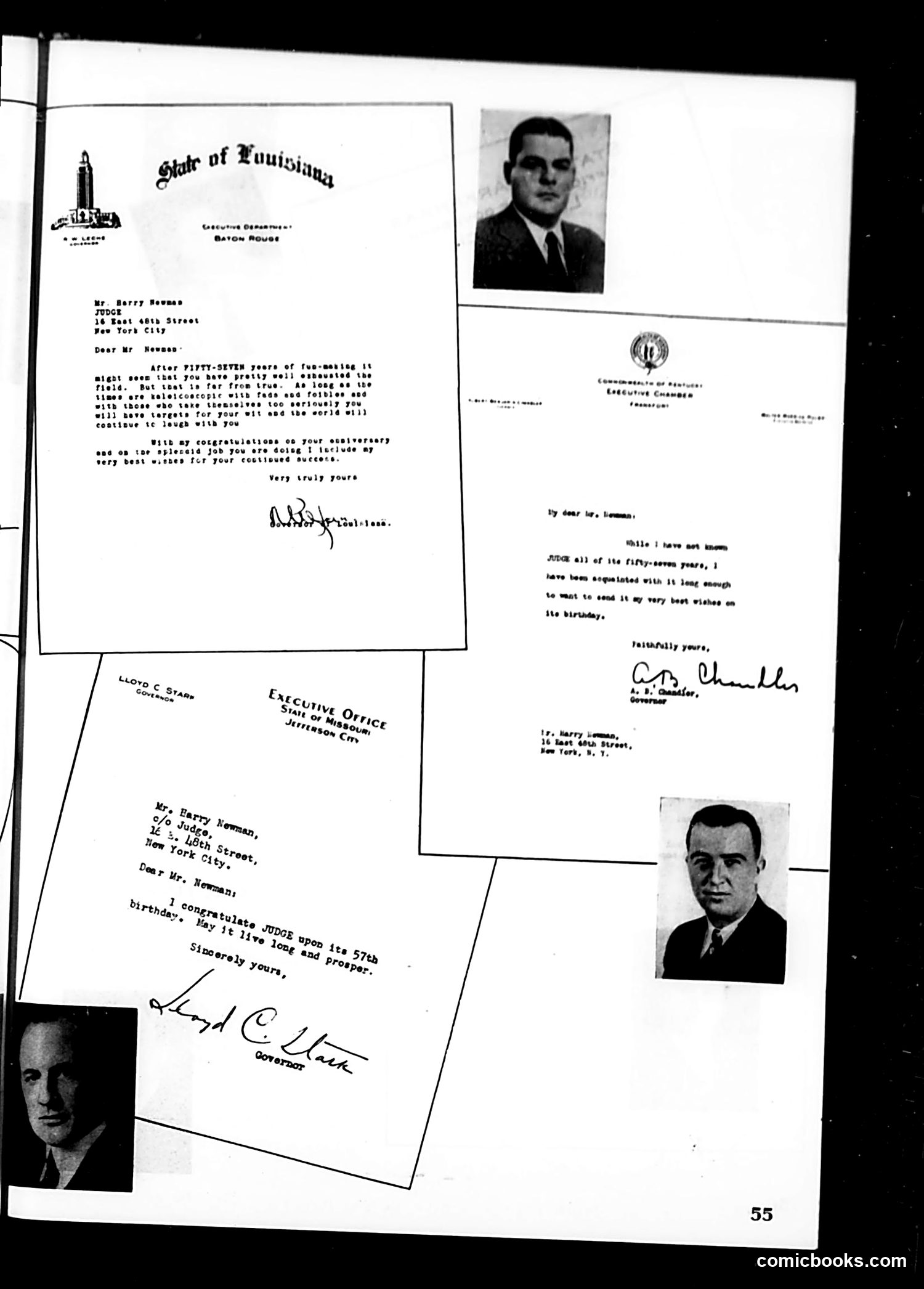
Historical Context Analysis This page appears to be not a cartoon, but rather congratulatory correspondence addressed to someone named Harry Newnes, likely on his birthday or anniversary. The page contains: - A formal letter from the State of Louisiana (Executive Department, Baton Rouge) - A birthday/anniversary greeting from what appears to be a state governor - Three portrait photographs of men in formal business attire The apparent purpose: This seems to be a celebratory compilation honoring Harry Newnes' fifty-seven years of life or professional service. The multiple signatures and formal letterhead suggest this was part of a public recognition or tribute. What we can't determine from the image alone: The exact identity of all correspondents, Newnes's specific profession or significance, and why Judge magazine featured this particular personal correspondence. It may have been notable because Newnes was a prominent figure of the era, but the specific satirical point—if any—is unclear from this documentation page.
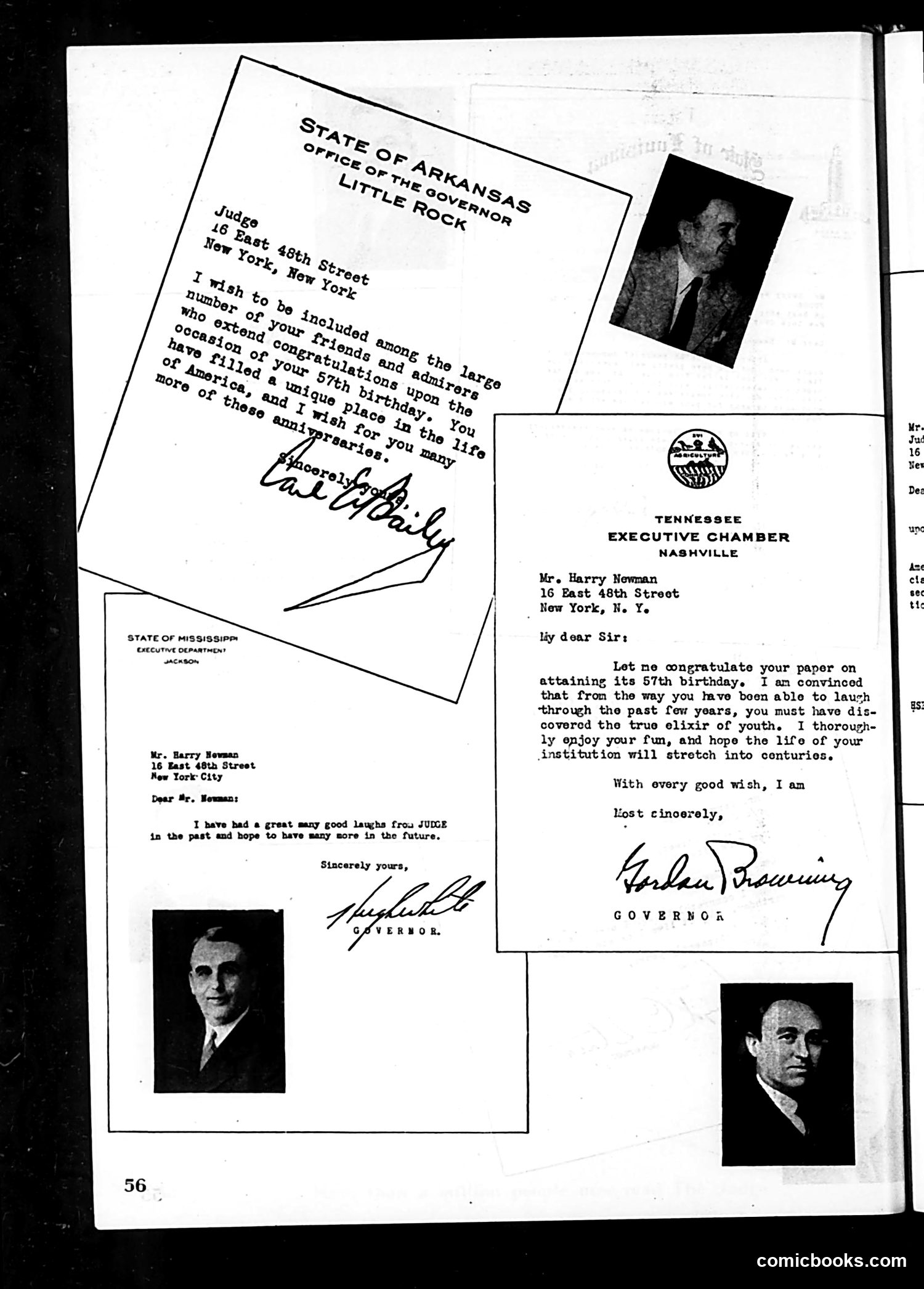
Explanation for Modern Readers This page from *Judge* magazine contains congratulatory letters from three U.S. governors to the magazine on its 57th birthday. The letters appear to be authentic correspondence rather than satirical content—governors from Arkansas, Mississippi, and Tennessee each sent formal notes praising *Judge's* humor and longevity. The page serves as promotional material, showcasing the magazine's influence and respectability by featuring endorsements from high-ranking state officials. This was a common practice in early 20th-century publications to demonstrate cultural prestige and wide readership. The historical interest lies in documenting *Judge's* significant role in American satirical publishing and its acceptance by the political establishment, despite its often-irreverent editorial stance. The formal tone of these letters contrasts with what readers might expect from a humor magazine.
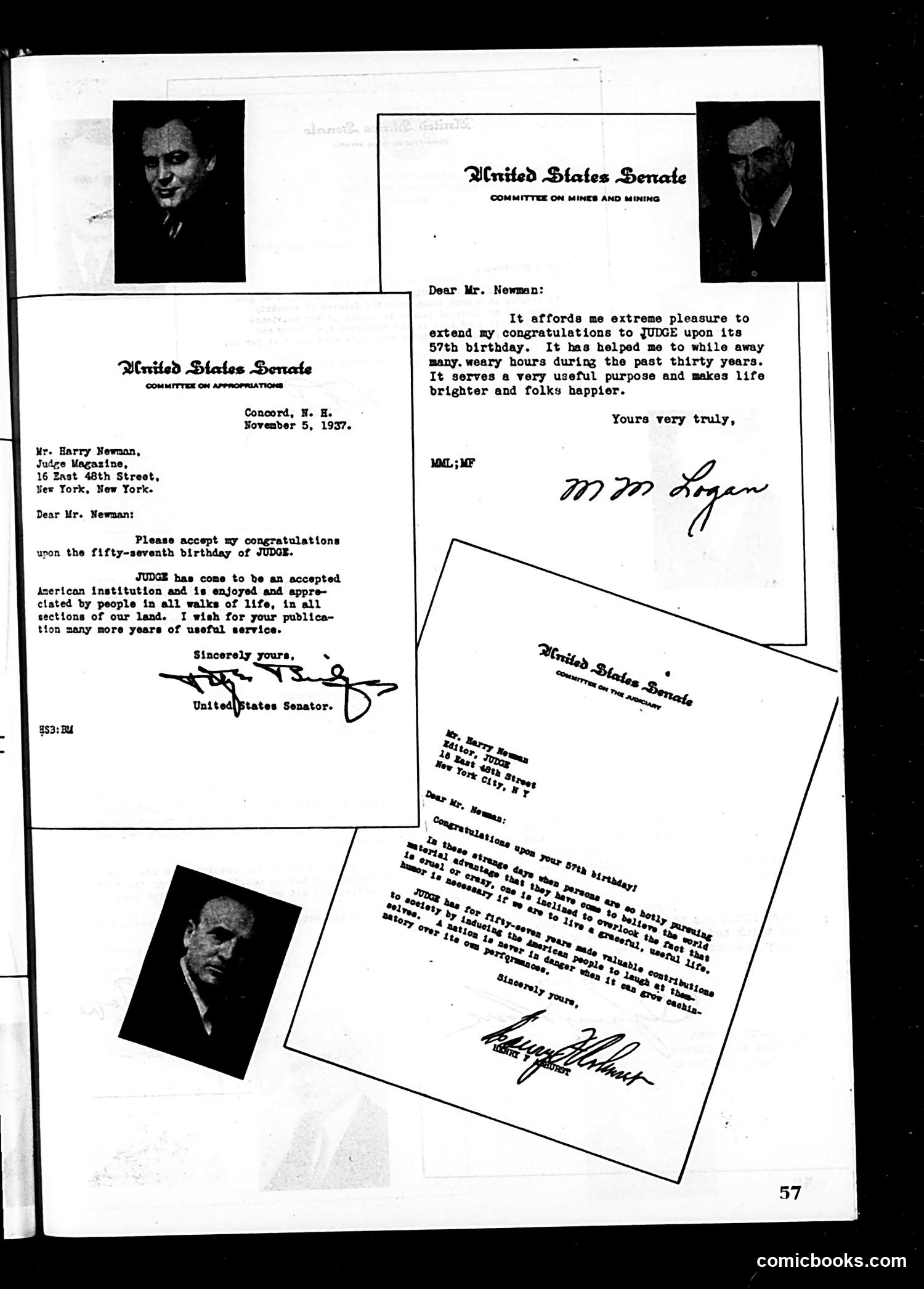
Analysis of Judge Magazine 57th Birthday Tributes (1937) This page contains congratulatory letters to Judge magazine on its 57th anniversary, featuring testimonials from U.S. Senators. The letters praise Judge as "an accepted American institution" enjoyed "by people in all walks of life." One senator notes the magazine "has helped me to while away many weary hours during the past thirty years" and claims it "makes life brighter and folks happier." The page includes portrait photographs of what appear to be the letter-writers, positioned at the top and bottom. The context suggests these are prominent political figures of 1937 lending credibility to the satirical magazine through official endorsement. Rather than containing satirical cartoons, this appears to be a promotional/testimonial page celebrating Judge's longevity and cultural importance during the Depression era, when humor publications served as escapist entertainment for American readers across social classes.
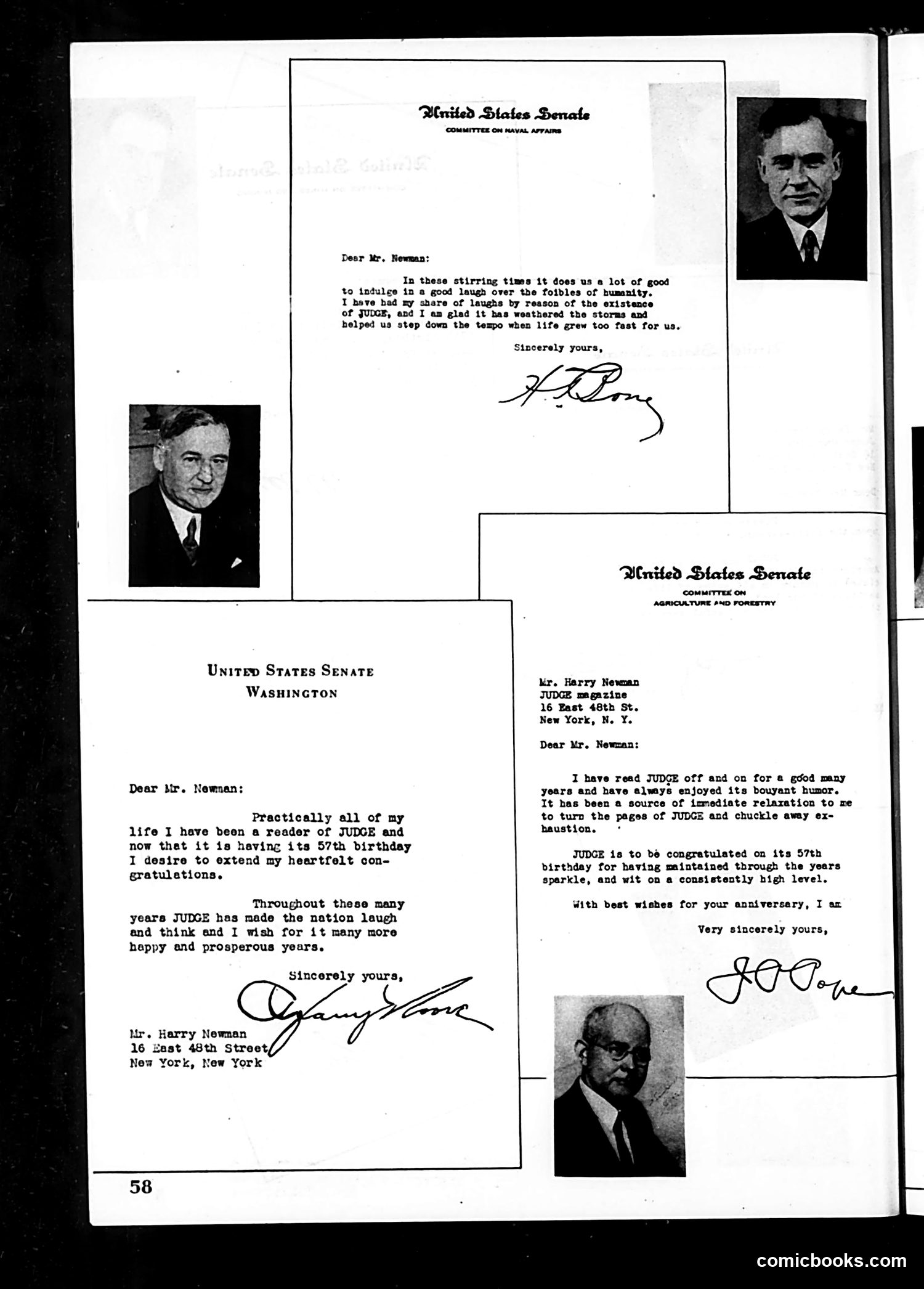
This page from *Judge* magazine features congratulatory letters to the publication on its 57th birthday, from U.S. Senators. The letters praise *Judge* as a source of humor and relaxation during busy times, crediting it with helping Americans "step down the tempo when life grew too fast." The content reflects *Judge*'s status as a respected satirical institution by the mid-20th century. The senators' formal endorsements suggest the magazine held cultural prestige—it wasn't dismissed as mere entertainment but valued for its role in providing "bouyant humor" and making "the nation laugh and think." This is essentially a promotional page rather than a cartoon. It showcases political support for the magazine, with portraits of the letter-writers included. The page demonstrates *Judge*'s longevity and influence in American humor and satire journalism.
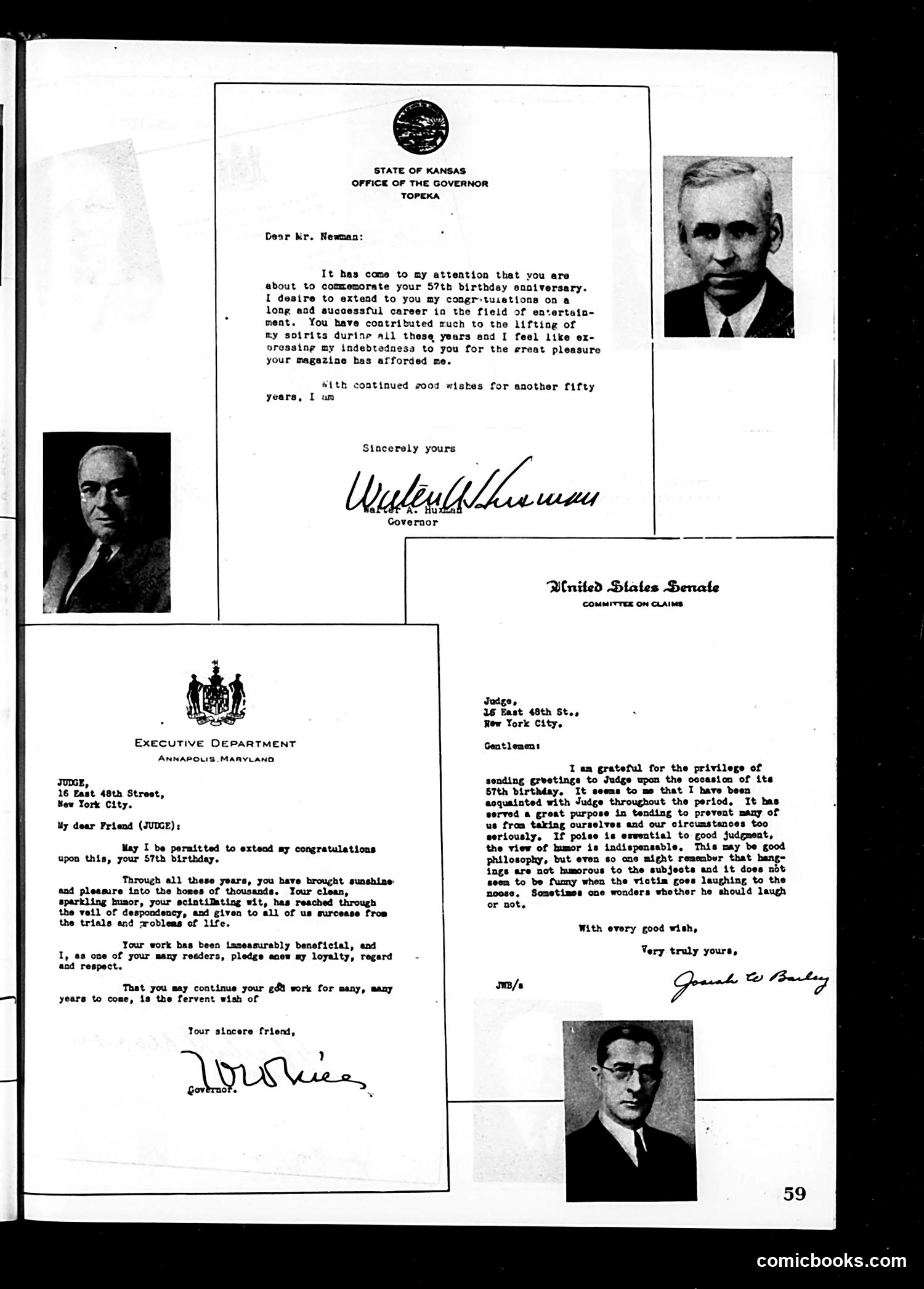
Judge Magazine 57th Birthday Tributes This page contains congratulatory letters to Judge magazine on its 57th birthday anniversary, sent by prominent American officials. The letters are from: - Kansas Governor (signature unclear, likely 1920s-30s era based on style) - Maryland Governor (signature reads "O'Conor") - A U.S. Senator on the Committee on Claims Each letter praises Judge's role in American public life—specifically its satirical humor's ability to provide relief from serious circumstances and help citizens maintain perspective during difficult times. The Maryland governor notably includes a philosophical caveat: that while humor is essential for mental health, not all subjects are appropriate for mockery (using the dark example of executions). This reflects Judge's status as a major American satirical publication whose editorial voice influenced public discourse. The page essentially documents the magazine's cultural importance and respectability among government leadership of the era.
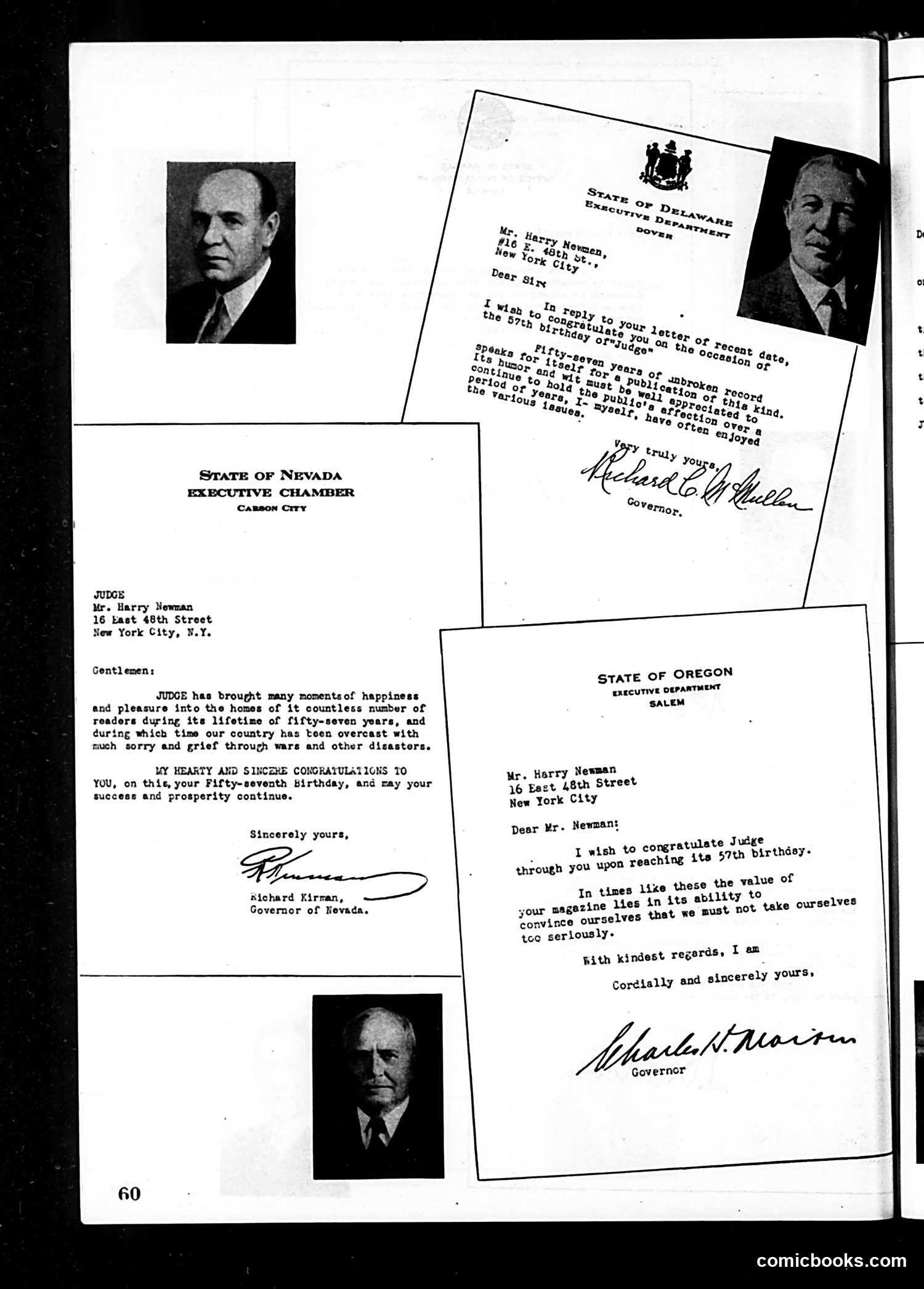
Analysis This page presents congratulatory letters to Judge magazine on its 57th birthday, sent by the governors of Nevada and Oregon to the magazine's recipient, Mr. Harry Newman (likely Judge's editor or publisher). The content emphasizes Judge's role as a source of "happiness and pleasure" during difficult times marked by "wars and other disasters"—likely referencing World War I and its aftermath, given the historical period. The governors' letters highlight what they valued in satirical humor: its ability to provide perspective and prevent people from taking themselves "too seriously." This reflects how American political and satirical magazines like Judge were viewed as important cultural institutions that offered both entertainment and social commentary during turbulent eras. The page serves as a testimonial to the magazine's cultural significance and longevity rather than containing specific political satire itself.
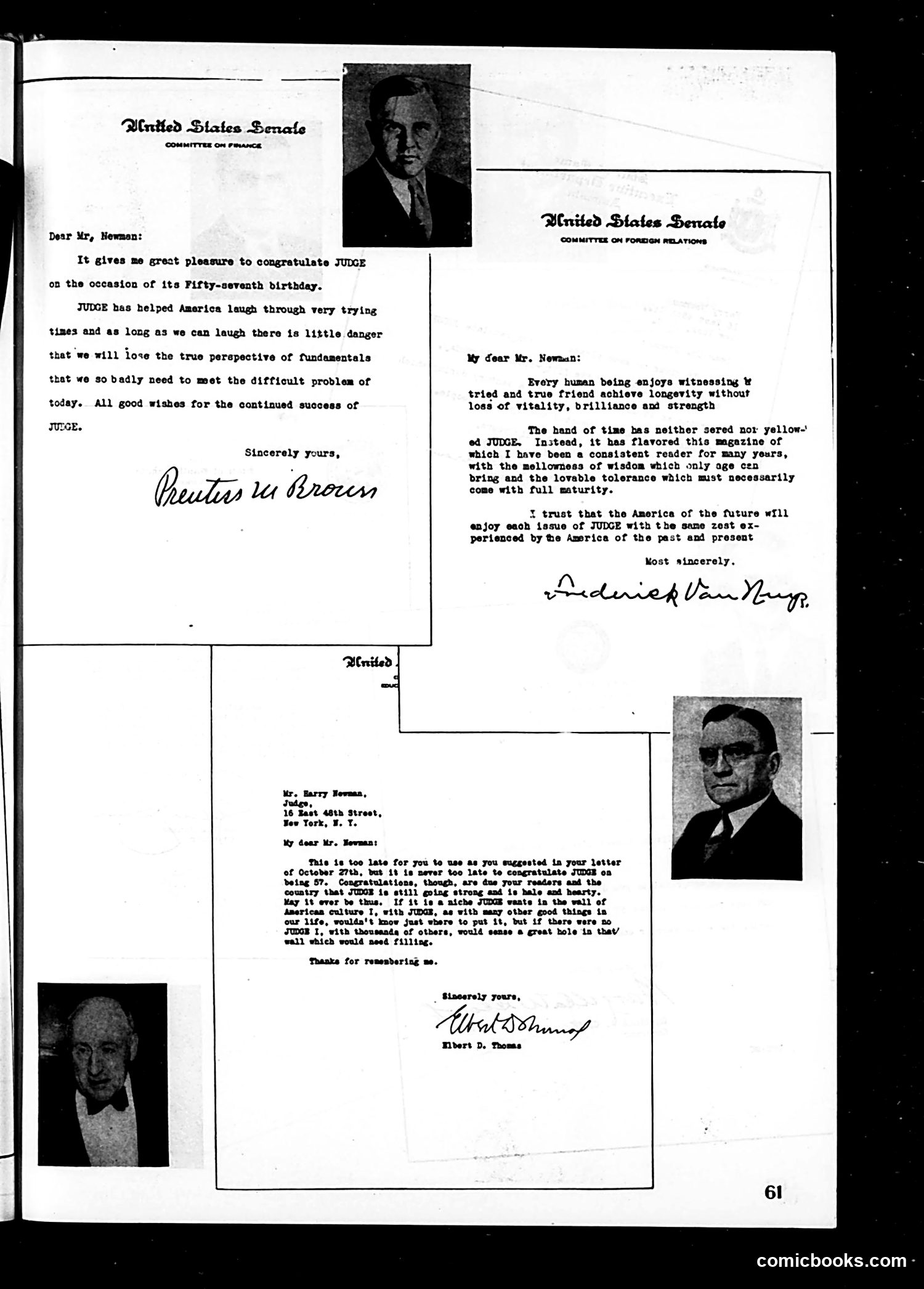
Judge Magazine's 57th Birthday Tributes This page contains congratulatory letters to *Judge* magazine on its 57th anniversary, not political cartoons. Three U.S. Senate figures—identified by their official letterhead—offer birthday wishes. The letters praise *Judge* for helping Americans "laugh through very trying times" and maintaining its satirical edge without becoming dated ("the hand of time has neither sered not yellowed"). They emphasize the magazine's cultural importance as a source of perspective during difficult periods. The senders appear to be prominent senators from the Committee on Finance and Committee on Foreign Relations, though specific names are partially unclear in the OCR. The tone suggests this page documents *Judge*'s influence among political leadership during what appears to be the mid-20th century—a period of significant national challenges the magazine helped Americans process through humor.
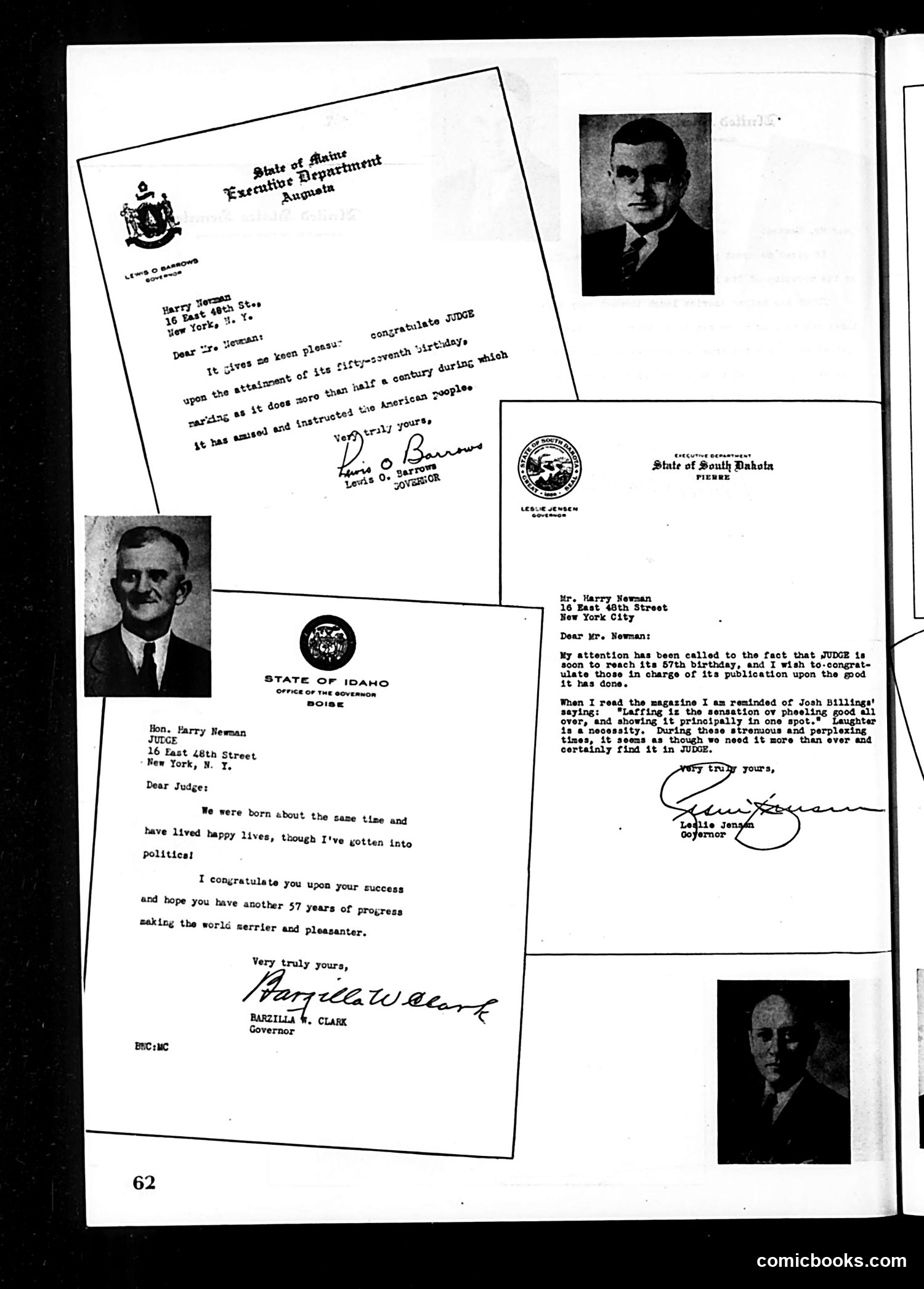
Judge Magazine's 57th Birthday Tributes This page collects congratulatory letters to *Judge* magazine on its 57th birthday from three state governors: Lewis O. Barrows (Maine), Bartilla W. Clark (Idaho), and Leslie Jensen (South Dakota). The letters are formal but warm, celebrating the magazine's role in providing humor during "strenuous and perplexing times." One governor references humorist Josh Billings' observation that laughter is "a necessity," suggesting *Judge*'s satirical content served a social function beyond mere entertainment—it provided relief during what appears to be an economically or politically difficult era (likely the 1920s-30s). The inclusion of gubernatorial endorsements suggests *Judge* positioned itself as a respectable, culturally important publication worthy of political attention, not merely frivolous comedy. The portraits accompanying each letter reinforce their official status.
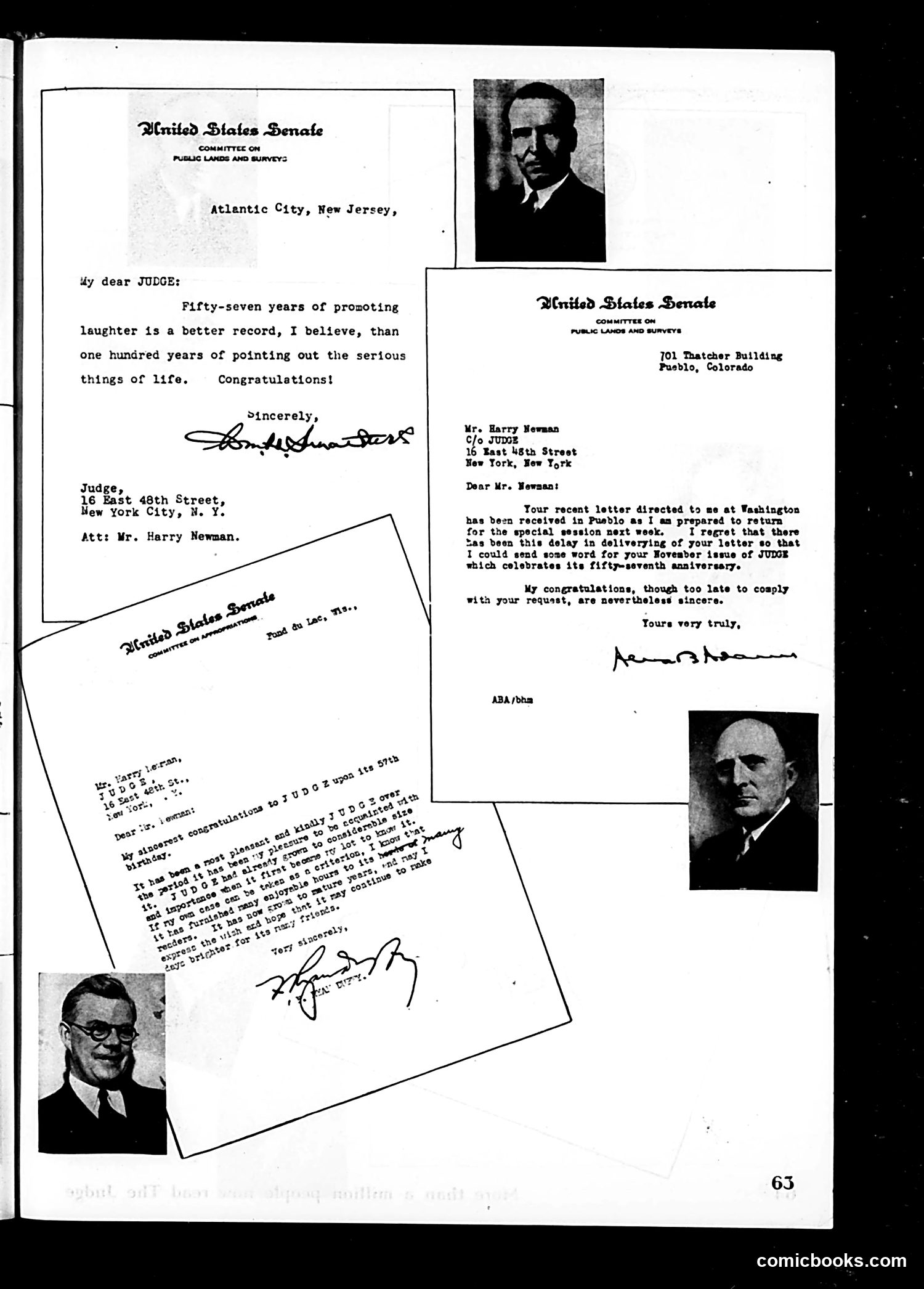
Analysis This page contains congratulatory letters to *Judge* magazine on its 57th anniversary. Two U.S. Senators from the Committee on Public Lands and Surveys sent messages of praise. The left letter, from Atlantic City, New Jersey, offers a brief congratulation, noting that promoting laughter for 57 years is a better achievement than pointing out serious matters for a century. The right letter, from Pueblo, Colorado, apologizes for late delivery of the sender's congratulations to the magazine's November anniversary issue. The sender regrets the postal delay prevented timely contribution to the celebration. The page includes three portrait photographs of what appear to be the letters' signatories, though names aren't clearly legible in the image. This is essentially a fan mail/congratulations page rather than satire—it documents institutional recognition of the magazine's longevity and cultural impact during the early 20th century.
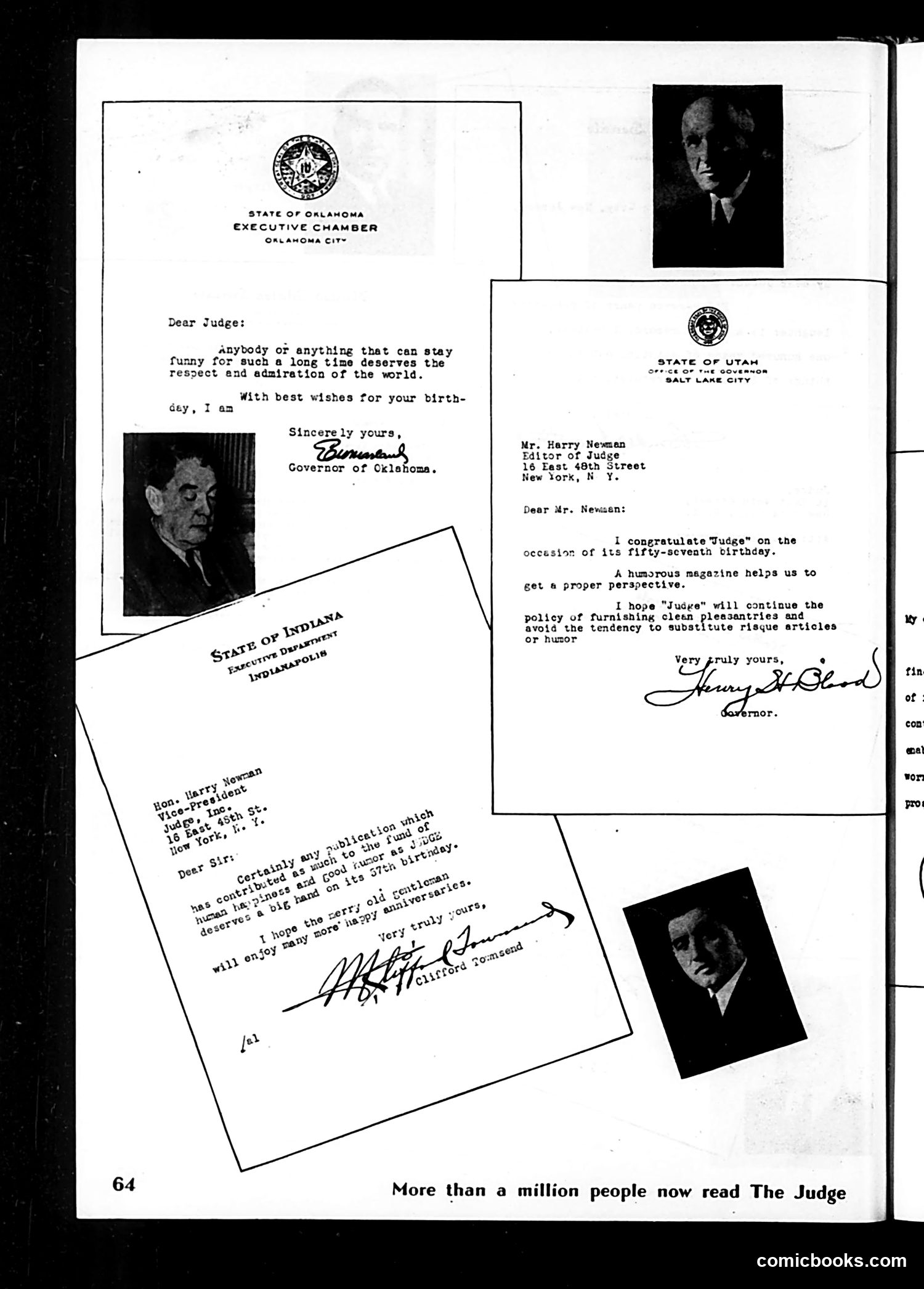
Page 64: Judge Magazine Anniversary Tributes This page celebrates Judge magazine's 57th birthday through congratulatory letters from state governors. The Oklahoma Governor's letter (top left) praises Judge for maintaining humor "for such a long time," deserving "respect and admiration of the world." The Utah Governor's letter (right) congratulates the magazine on the milestone and emphasizes his hope that Judge maintains its "policy of furnishing clean pleasantries" while avoiding "risque articles or humor." These letters reflect Judge's position as an established, respectable American satirical publication—one dignified enough to receive official gubernatorial recognition. The emphasis on "clean" humor versus "risque" content suggests Judge positioned itself as family-friendly satire for a broad audience, distinct from more adult-oriented competitors. The page functions partly as advertising, demonstrating the magazine's cultural legitimacy and wide readership ("More than a million people now read The Judge").
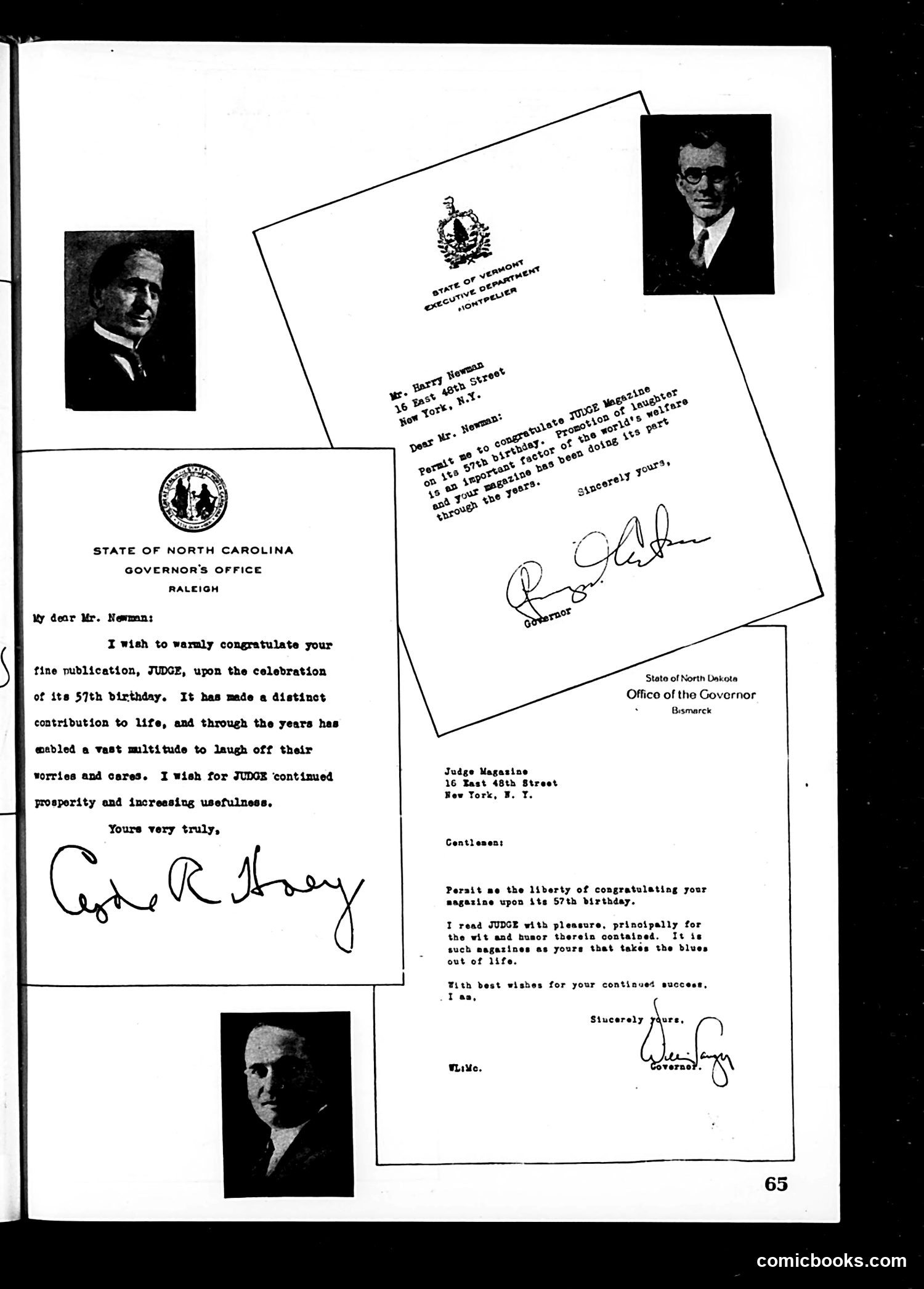
Analysis This page is not a cartoon but rather congratulatory letters to Judge magazine on its 57th birthday, featuring correspondence from two governors. The left letter is from North Carolina's Governor (signature appears to read "Carl Byng" or similar), praising Judge for making "a vast multitude laugh off their worries and cares" over the years. The right letter is from North Dakota's Governor (signature appears to read "Wentz Langer"), similarly commending the magazine's "wit and humor" for taking "the blues out of life." The page displays portraits of four men (likely prominent figures associated with Judge), though their specific identities aren't clearly labeled. Context for modern readers: This reflects Judge's prestige in the 1930s-40s—governors themselves took time to publicly endorse the satirical magazine, indicating it held significant cultural influence. Such formal recognition would be unusual for a humor publication today. The page functions as promotional material celebrating the magazine's longevity and respectability.
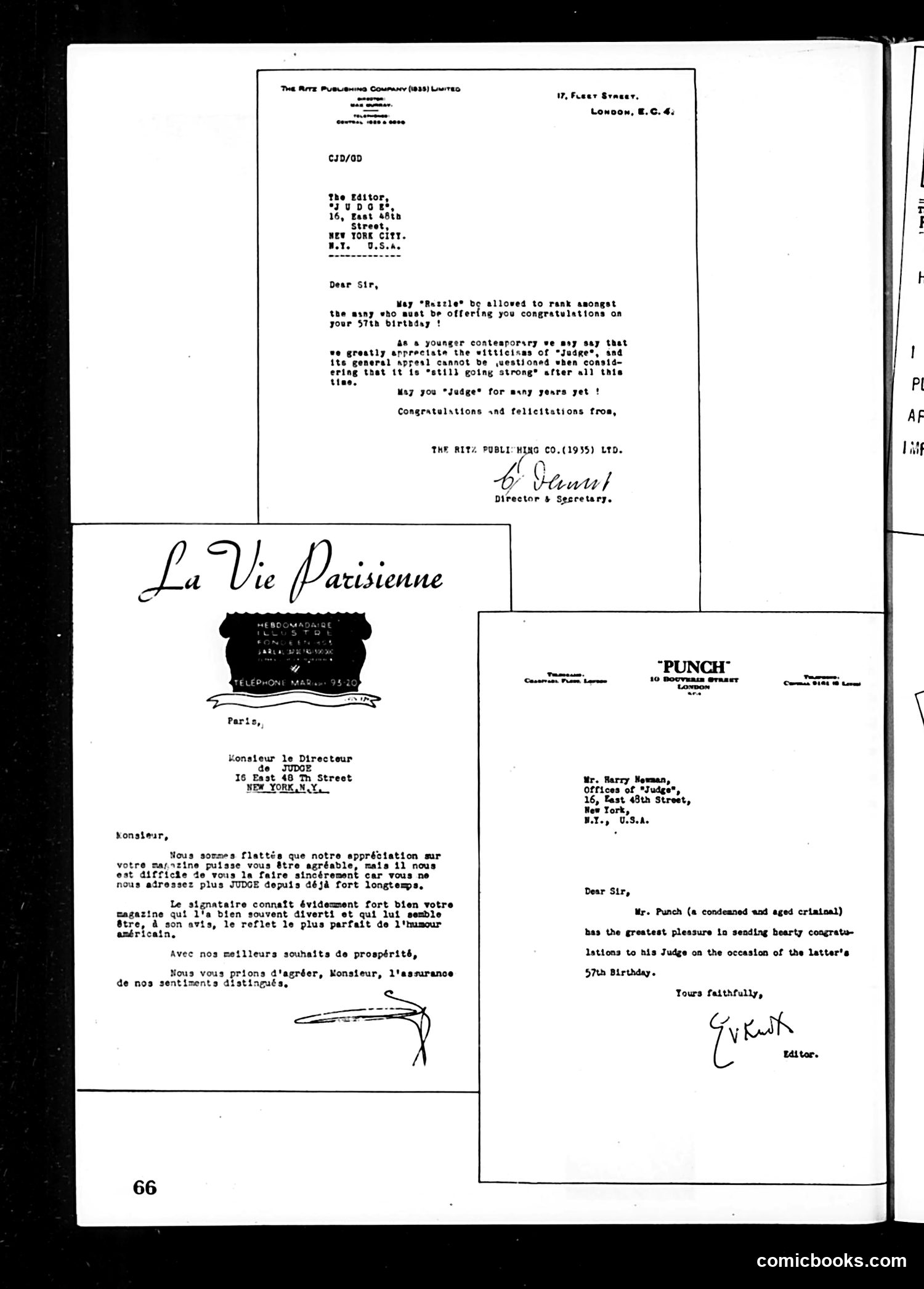
Page Analysis This is primarily congratulatory correspondence rather than cartoons. The page contains three letters celebrating Judge magazine's 57th birthday: 1. Top letter from The Ritz Publishing Company (London) congratulates Judge and expresses appreciation for its wit, hoping it continues "strong" for years. 2. Bottom left is a French letter from "La Vie Parisienne" (a Parisian satirical magazine), also offering birthday wishes and noting Judge's reputation as a perfect reflection of American humor. 3. Bottom right is from "Punch" magazine (the British equivalent to Judge), with its editor playfully calling Punch "a condemned and aged criminal" while sending hearty congratulations to its American counterpart on turning 57. The exchange reflects the international camaraderie among satirical publications of the era—these three major humor magazines (American Judge, French La Vie Parisienne, and British Punch) publicly acknowledging each other's role in their respective cultures' satirical traditions.
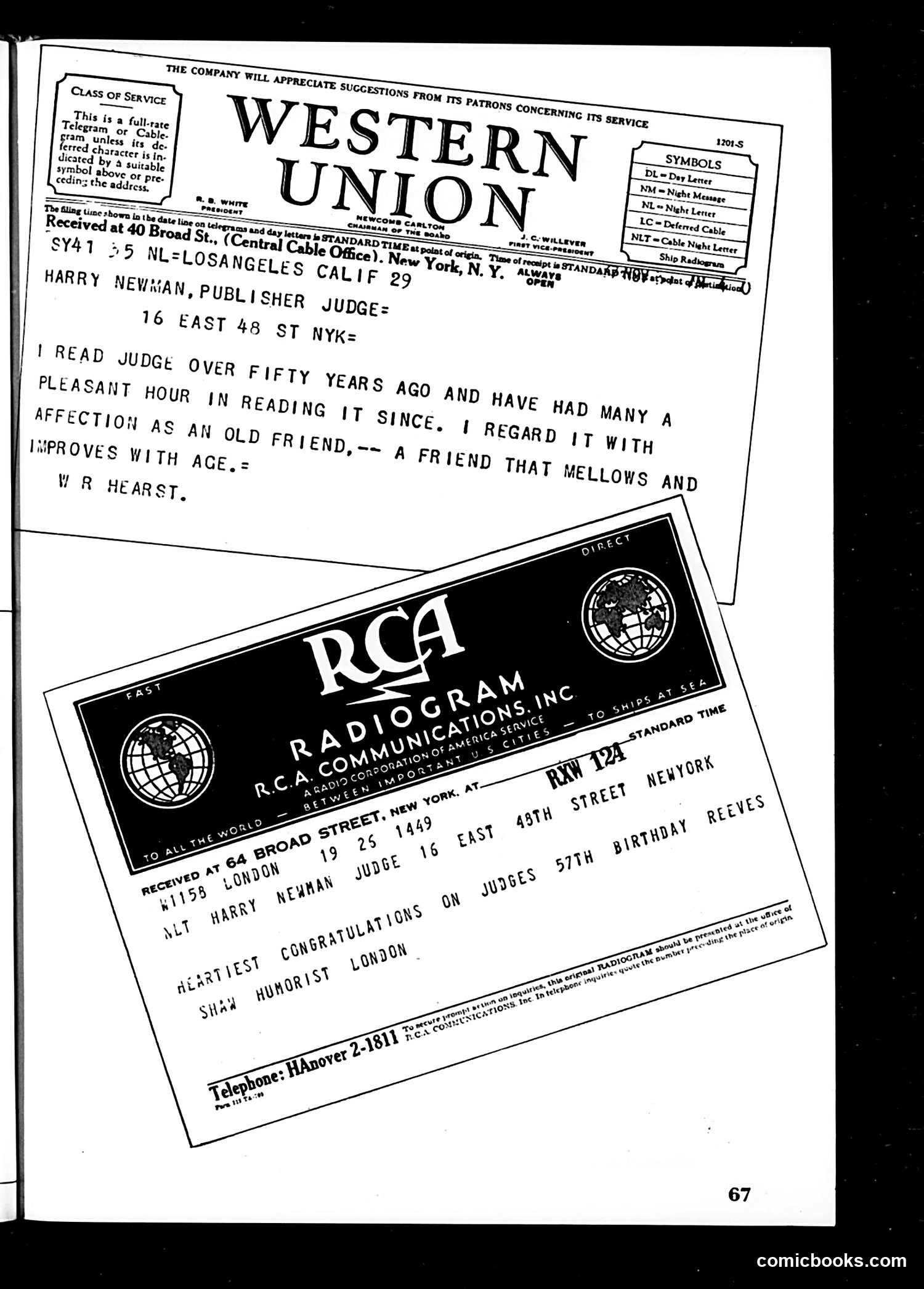
Analysis This page is primarily not a cartoon but correspondence and advertising. The Western Union telegram at the top is from Harry Newman, a publisher/judge, sent to Judge magazine's office in New York. Newman expresses affection for Judge magazine, which he's read for over 50 years, calling it "a friend that mellows and improves with age." Below is an RCA Radiogram congratulating Judge on its 57th birthday, sent from London by "Shaw Humorist London" — likely George Bernard Shaw, the famous Irish playwright and wit. The "satire" here is implicit: these are genuine tributes to Judge's longevity and cultural significance. The humor lies in the flattery itself — prominent figures publicly endorsing a satirical magazine's enduring relevance. Rather than mocking anyone, the page celebrates Judge's reputation as sophisticated, enduring entertainment.
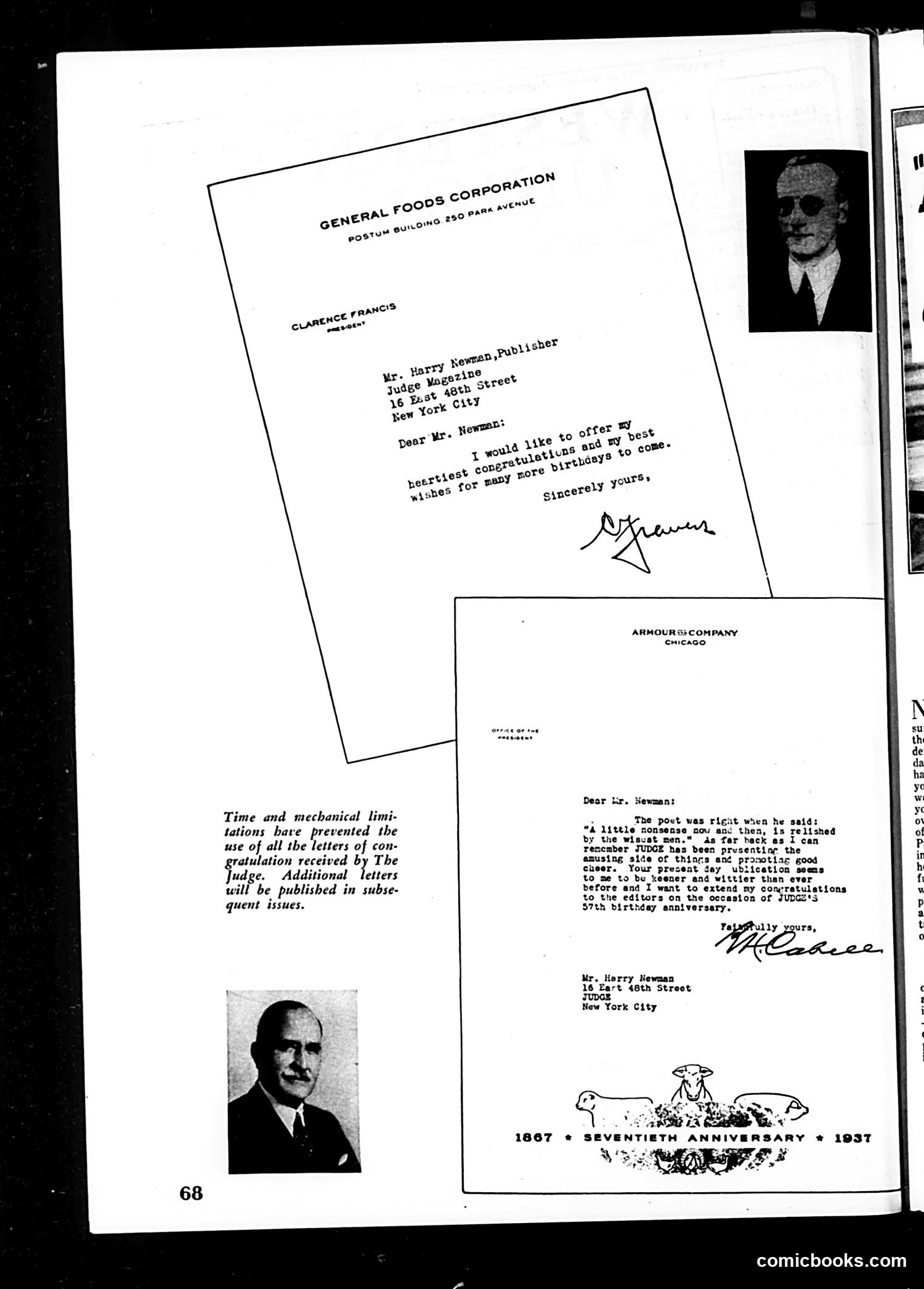
Analysis This page consists of congratulatory letters to Judge magazine on its 70th anniversary (1867-1937), not satirical cartoons. The visible letters are from: 1. Clarence Francis of General Foods Corporation, offering birthday wishes to the magazine's publisher Harry Newman. 2. An Armour & Company (Chicago) executive, praising Judge for presenting "the amusing side of things" and promoting good cheer. The writer notes the magazine remains "keener and wittier than ever" and congratulates the editors on the occasion. Context for modern readers: Judge was a major American humor and satire magazine. These corporate letters represent how prestigious companies positioned themselves by publicly endorsing the publication—a form of branded goodwill during the Depression era. The repeated emphasis on Judge's ability to provide humor and cheer reflects the magazine's cultural role as entertainment during economically difficult times.
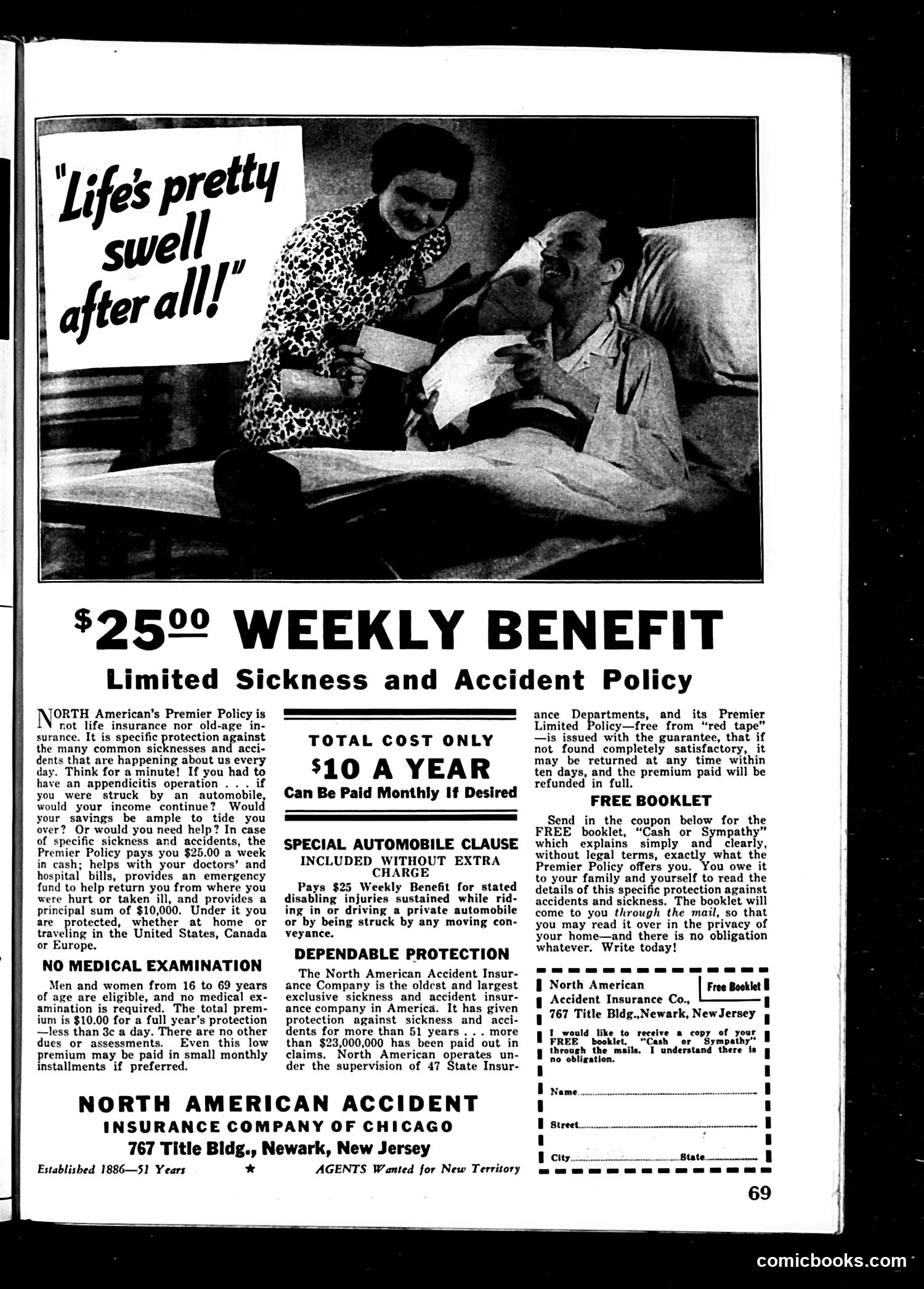
Analysis This is primarily an insurance advertisement, not a satirical cartoon. The page promotes North American Accident Insurance Company's "Premier Policy" offering $25 weekly benefits for sickness and accidents. The image shows a man in bed with a woman attending to him, captioned "Life's pretty swell after all!"—illustrating the financial security the policy provides during illness or injury. Key selling points advertised: - $10/year cost (less than 3 cents daily) - $25 weekly cash benefit - No medical exam required - Ages 16-69 eligible - Covers automobile accidents - Available in 47 states The "satire" (if any) is subtle: the implicit message that without such insurance, workers face financial ruin from common accidents or sickness—a genuine social anxiety of the era before comprehensive health insurance existed. This reflects early-20th-century America's lack of social safety nets, making individual insurance policies critical for working families.
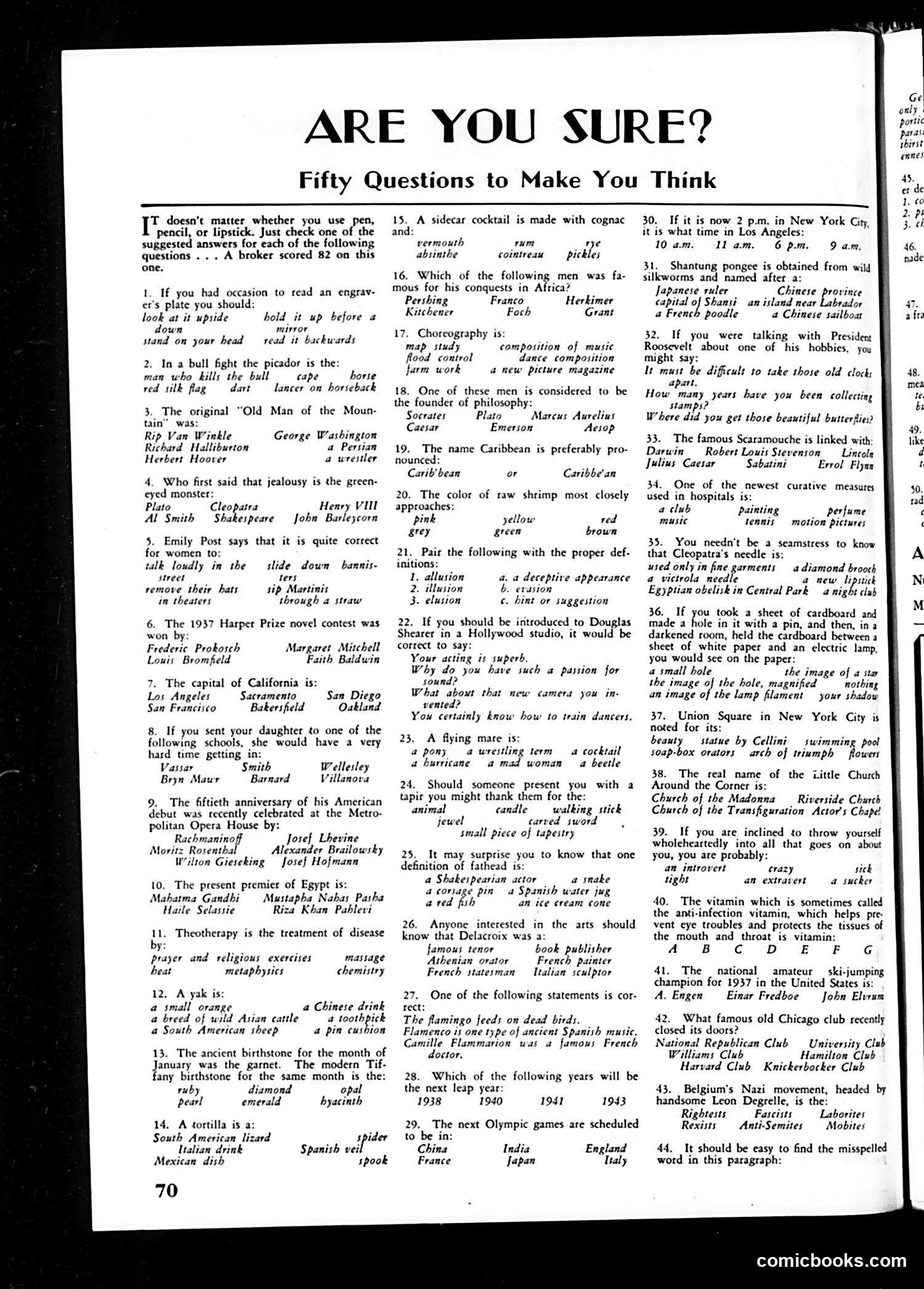
"Are You Sure?" - A 1937 Judge Trivia Quiz This page presents a lighthearted trivia quiz—not a political cartoon. The fifty questions test readers' knowledge across cultural, historical, and practical topics typical of educated 1930s Americans. Notable references visible: - Question 6 references the 1937 Harper Prize, won by Margaret Mitchell (likely for *Gone with the Wind*) - Question 9 celebrates Metropolitan Opera performers' anniversaries - Question 22 mentions Douglas Shearer, a Hollywood sound engineer, testing if readers conflate him with his famous sister Norma Shearer (the actress) - Questions on etiquette (Emily Post, Vassar admissions) reflect Judge's upper-class readership The quiz's difficulty and breadth—covering literature, geography, cocktails, and social protocol—suggests it's aimed at educated, cosmopolitan readers. The framing ("A broker scored 82") adds light self-deprecation, implying even successful professionals struggle with such esoteric knowledge.
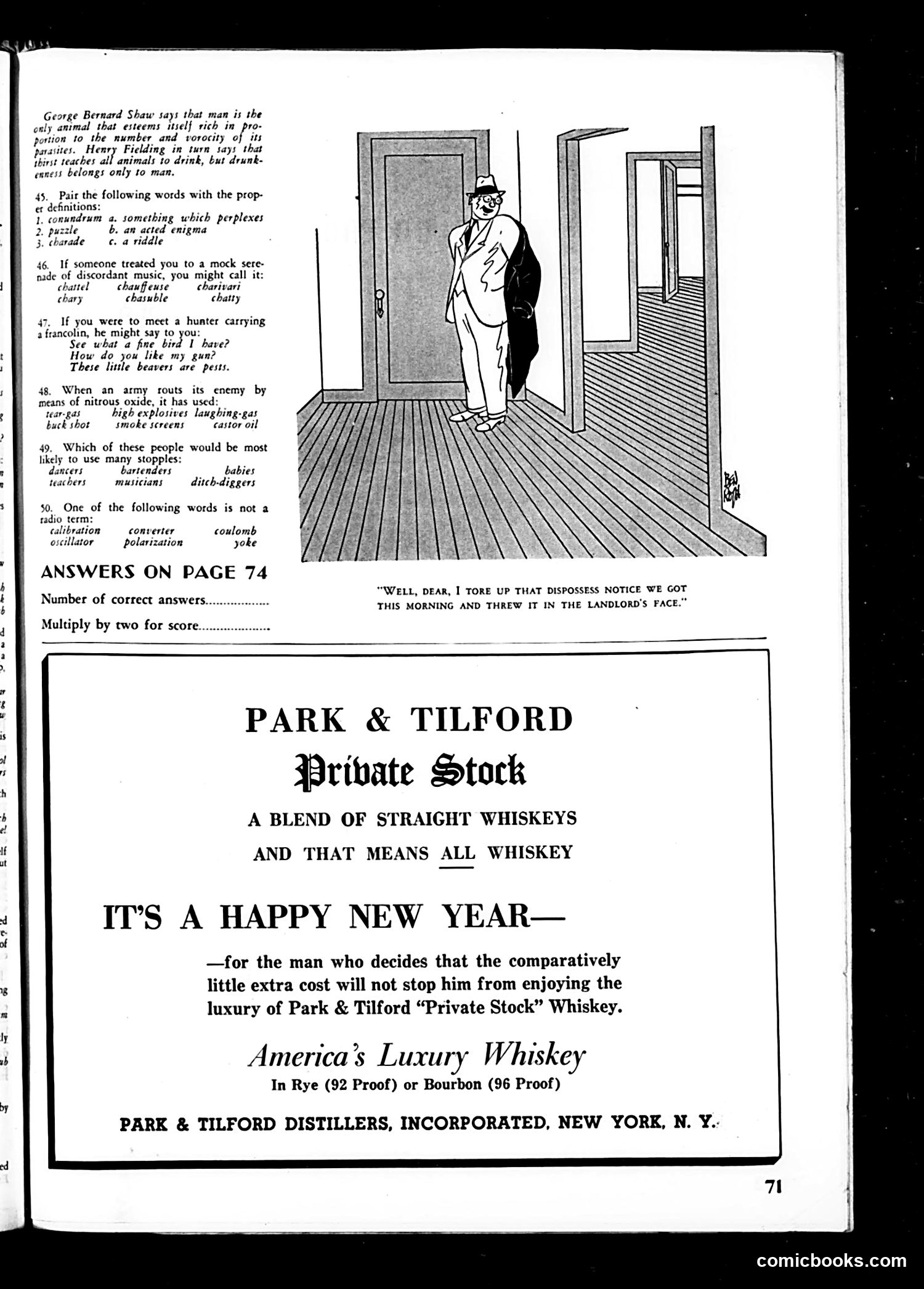
Page 71: Judge Magazine Content Analysis This page combines educational quiz content with advertising and a cartoon caption. The Quiz Section (questions 45-50): Tests vocabulary and general knowledge on topics ranging from literary quotations (Shaw and Fielding on human nature) to word definitions and radio terminology—typical intellectual content for Judge's educated readership. The Cartoon: Shows a man in a suit and hat confronting a landlord or eviction officer at a doorway. The caption reveals the joke: the tenant has destroyed an eviction notice ("dispossess notice") by tearing it up and throwing it in the landlord's face—treating the legal document with contempt rather than addressing the actual debt. The humor targets tenant-landlord tensions, presumably during economic hardship (likely Depression-era given the magazine's period). The Advertisement: Park & Tilford whiskey ad positioned as a luxury New Year's gift, emphasizing quality over cost—marketing to affluent readers unfazed by premium pricing. The page reflects Judge's typical mix of intellectual humor, social commentary, and upscale advertising targeting educated, wealthy audiences.
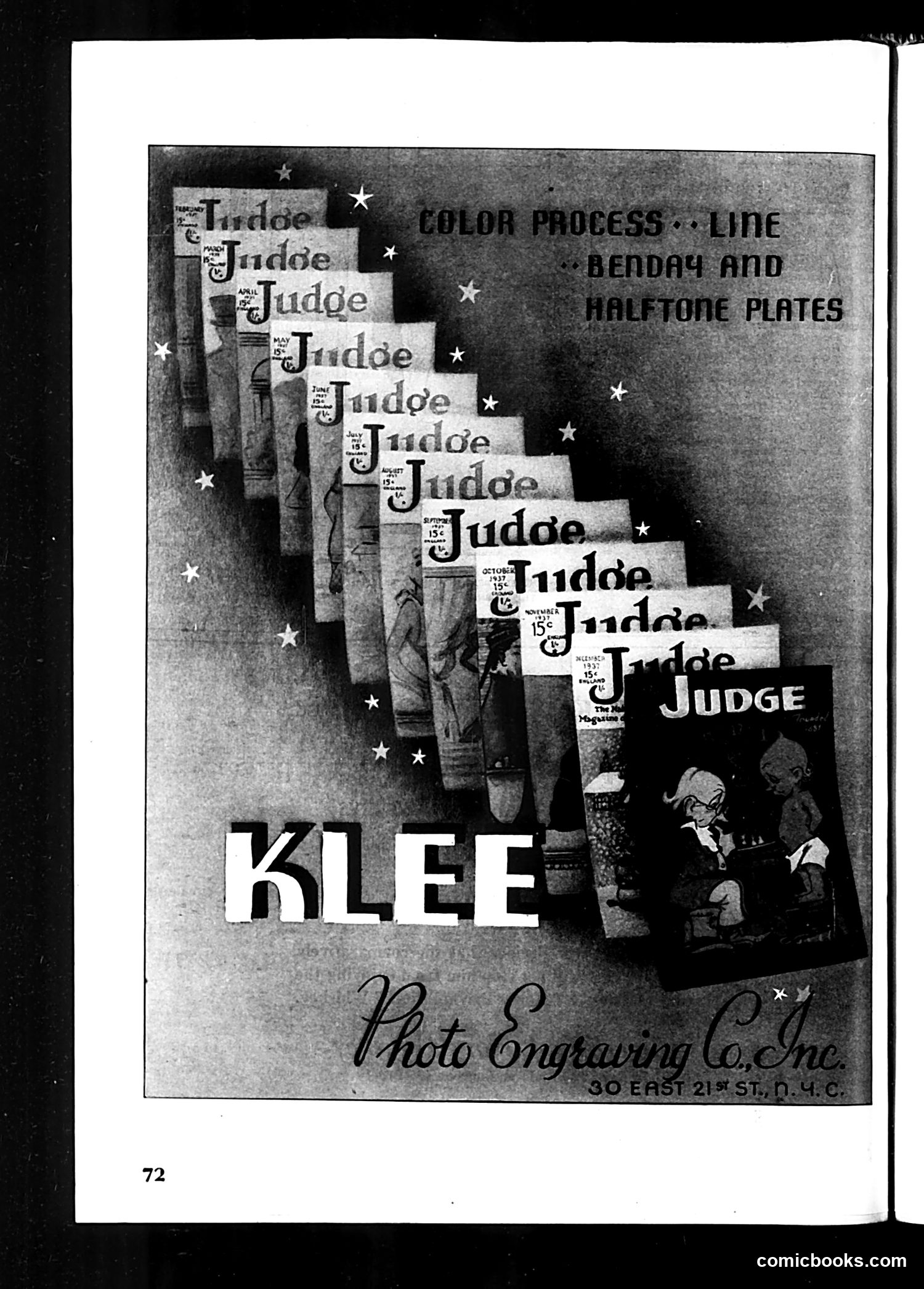
Analysis of Judge Magazine Advertisement Page This is primarily a full-page advertisement for Klee Photo Engraving Co., Inc. (located at 30 East 21st St., NYC), rather than editorial content. The ad showcases their printing capabilities by displaying multiple copies of Judge magazine stacked in a cascading arrangement, decorated with stars. The text emphasizes their expertise in "COLOR PROCESS...LINE BENDAY AND HALFTONE PLATES"—technical printing methods essential for reproducing magazine illustrations and photographs. The small illustration at bottom-right appears to show a judge character (fitting Judge magazine's branding), suggesting the company printed the magazine itself. This is a trade advertisement demonstrating the printer's quality through the product they helped create—Judge magazine's own color printing.
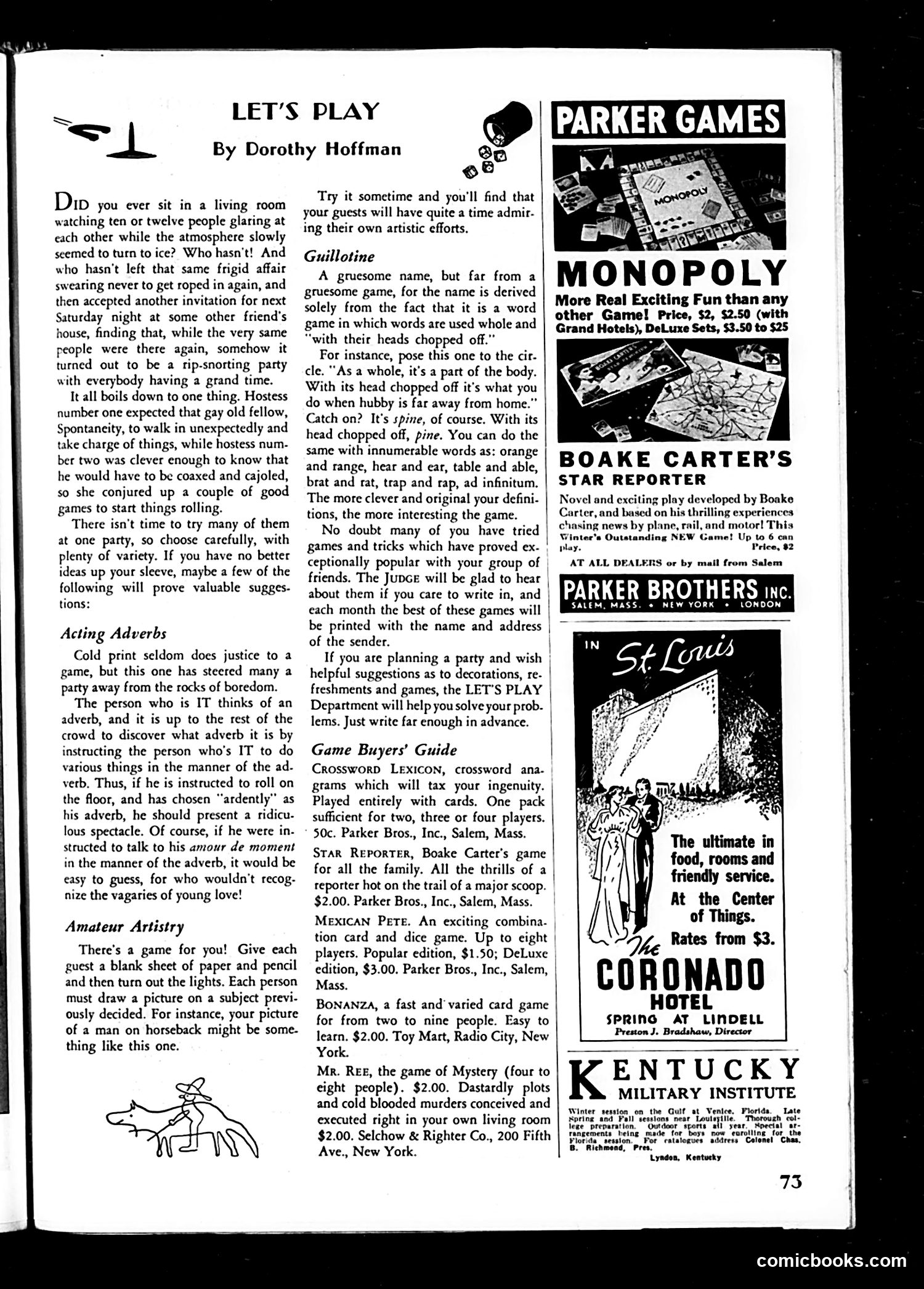
"Let's Play" - Party Games Column This is a non-satirical advice column by Dorothy Hoffman about party games, not a political cartoon. The page offers practical suggestions for hosts struggling with awkward social gatherings. The opening anecdote addresses a relatable mid-century problem: formal dinner parties where guests sit "glaring at each other" in uncomfortable silence. Hoffman's solution is simple—structured games coax out spontaneity and fun. The featured games (Acting Adverbs, Amateur Artistry, Guillotine) are wordplay and drawing activities designed for adult parlor entertainment. The crude cartoon of a man on horseback illustrates how amateur artists' intentionally bad drawings become amusing. The column concludes with game recommendations from Parker Brothers and other publishers—commercial products positioning themselves as party solutions. This reflects Depression-era consumer culture: purchasing manufactured entertainment to facilitate social interaction. The page represents mainstream American middlebrow domestic advice, not satire.
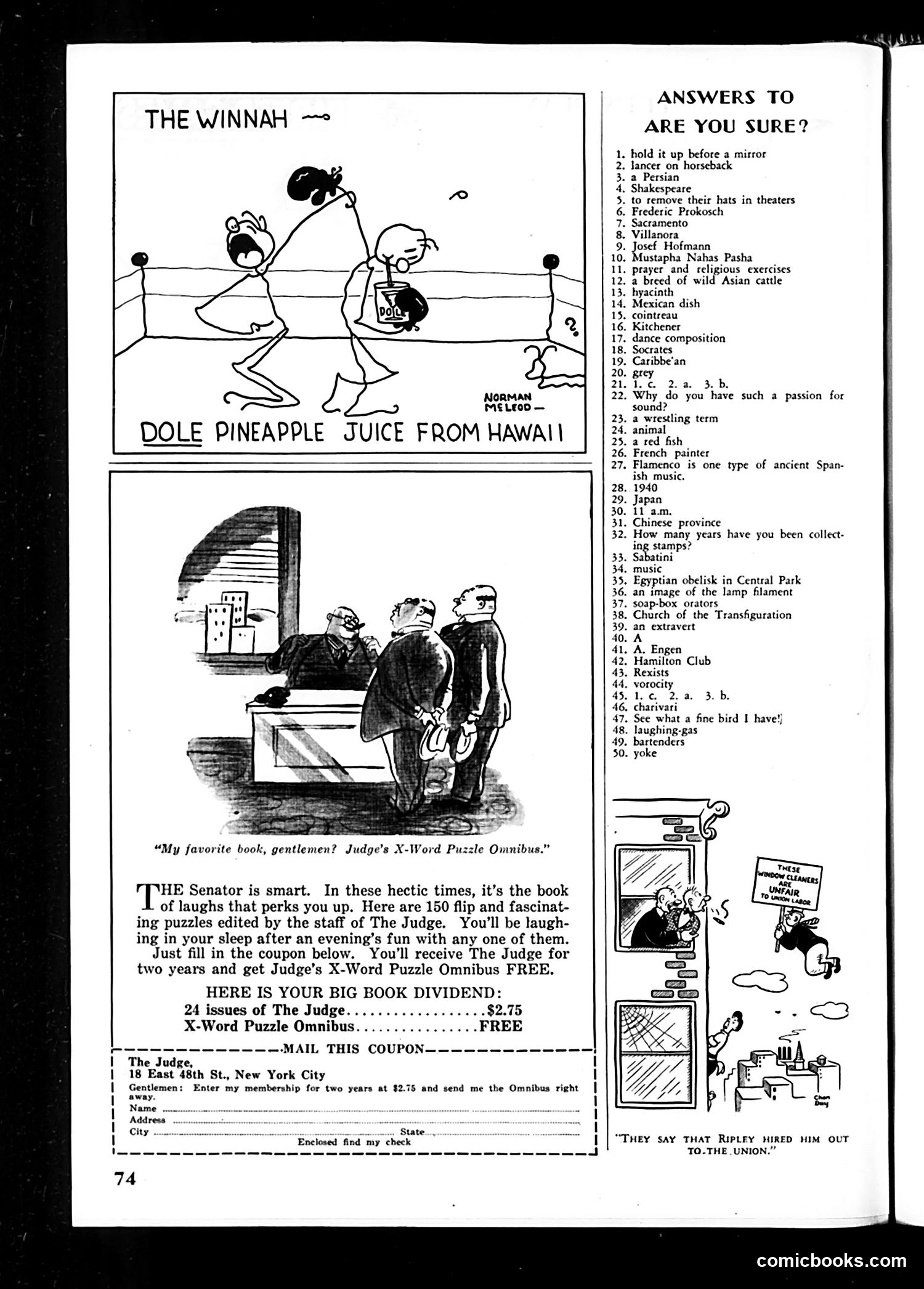
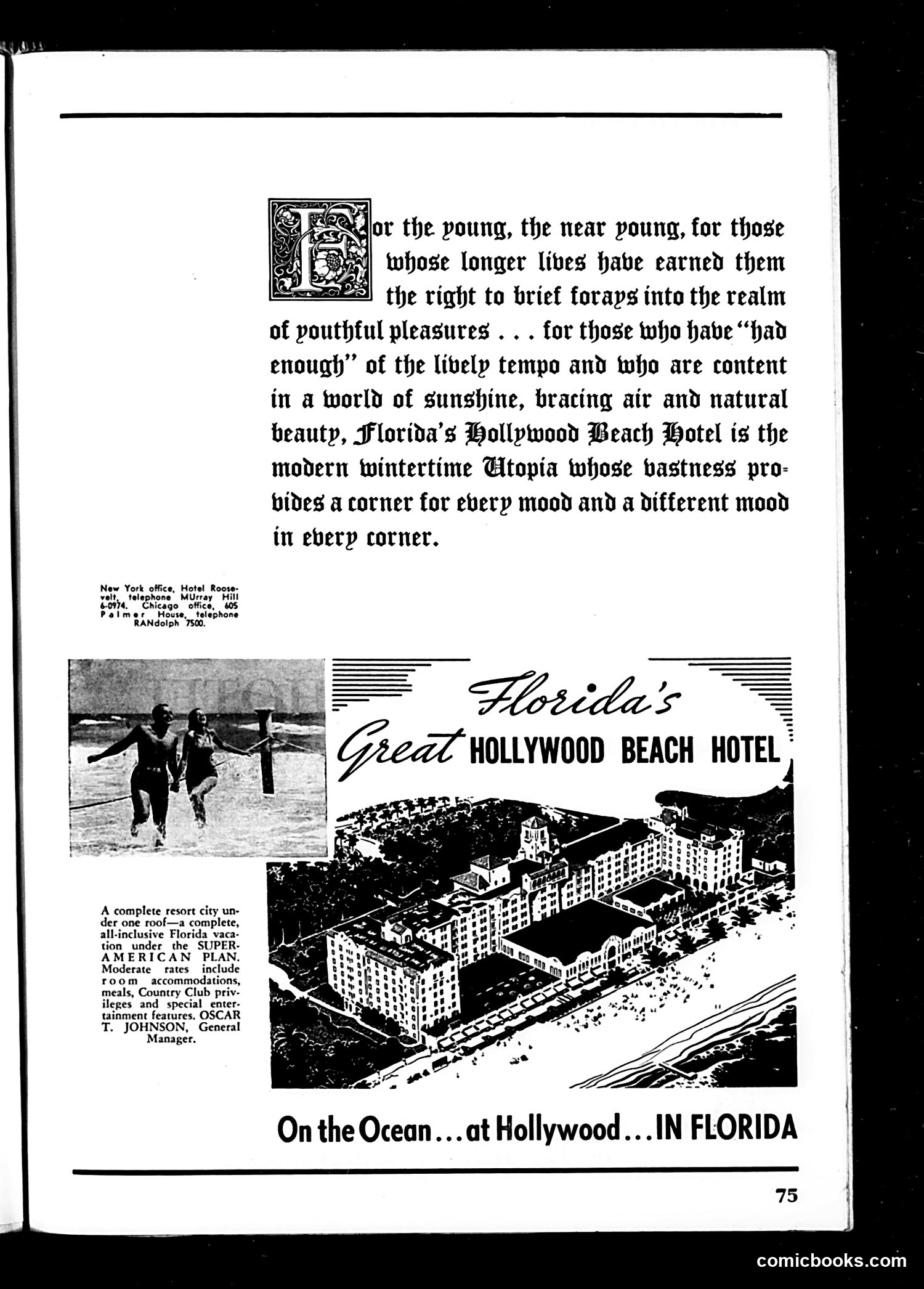
Analysis This is primarily a hotel advertisement rather than political satire or cartoon content. The page promotes Florida's Hollywood Beach Hotel as a winter resort destination. The text describes the hotel as a "modern wintertime Utopia" offering leisure for various demographics—young people seeking excitement and older visitors seeking relaxation. It emphasizes the resort's comprehensive facilities (rooms, meals, entertainment) under an "American Plan" pricing model. The visual elements include a photograph of beachgoers and an aerial illustration of the multi-building hotel complex "on the ocean." The language reflects 1920s-30s advertising style, referencing the hotel's General Manager (Oscar T. Johnson) and listing New York and Chicago office contact information. No political satire or cartoon commentary is evident. This appears to be a straightforward travel/hospitality advertisement in Judge magazine's advertising section.
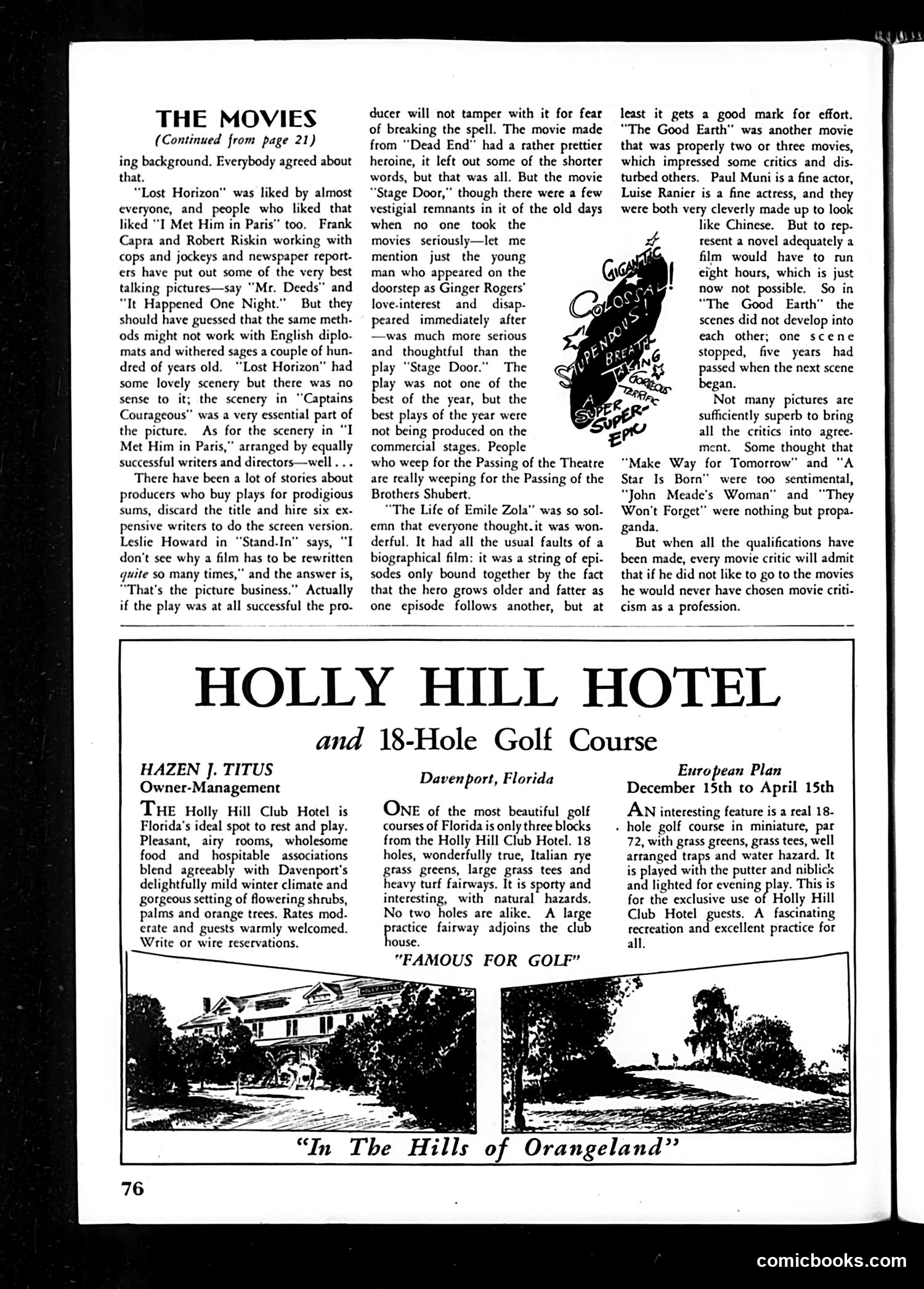
Analysis of This Judge Magazine Page This page contains two distinct sections: a film criticism essay and a hotel advertisement. "The Movies" Column (Editorial Content): The text discusses 1930s Hollywood films and directorial choices, analyzing how successful stage plays translate (or fail to translate) to cinema. It critiques specific films like "Lost Horizon," "Stage Door," and "The Good Earth," arguing that movies require different storytelling approaches than theater. The piece defends movie critics as inherently passionate cinephiles. This represents Judge's typical satirical commentary on contemporary American culture. Holly Hill Hotel Advertisement: The lower half is a straightforward commercial advertisement for a Florida resort hotel with an 18-hole golf course in Davenport, featuring two landscape photographs. This type of paid advertising was standard in Judge magazine. Context: Judge was a humor and satire publication; this page demonstrates how editorial content and advertising coexisted in early 20th-century magazines. The film criticism reflects 1930s Hollywood's golden age and debates about adapting literature for screen.
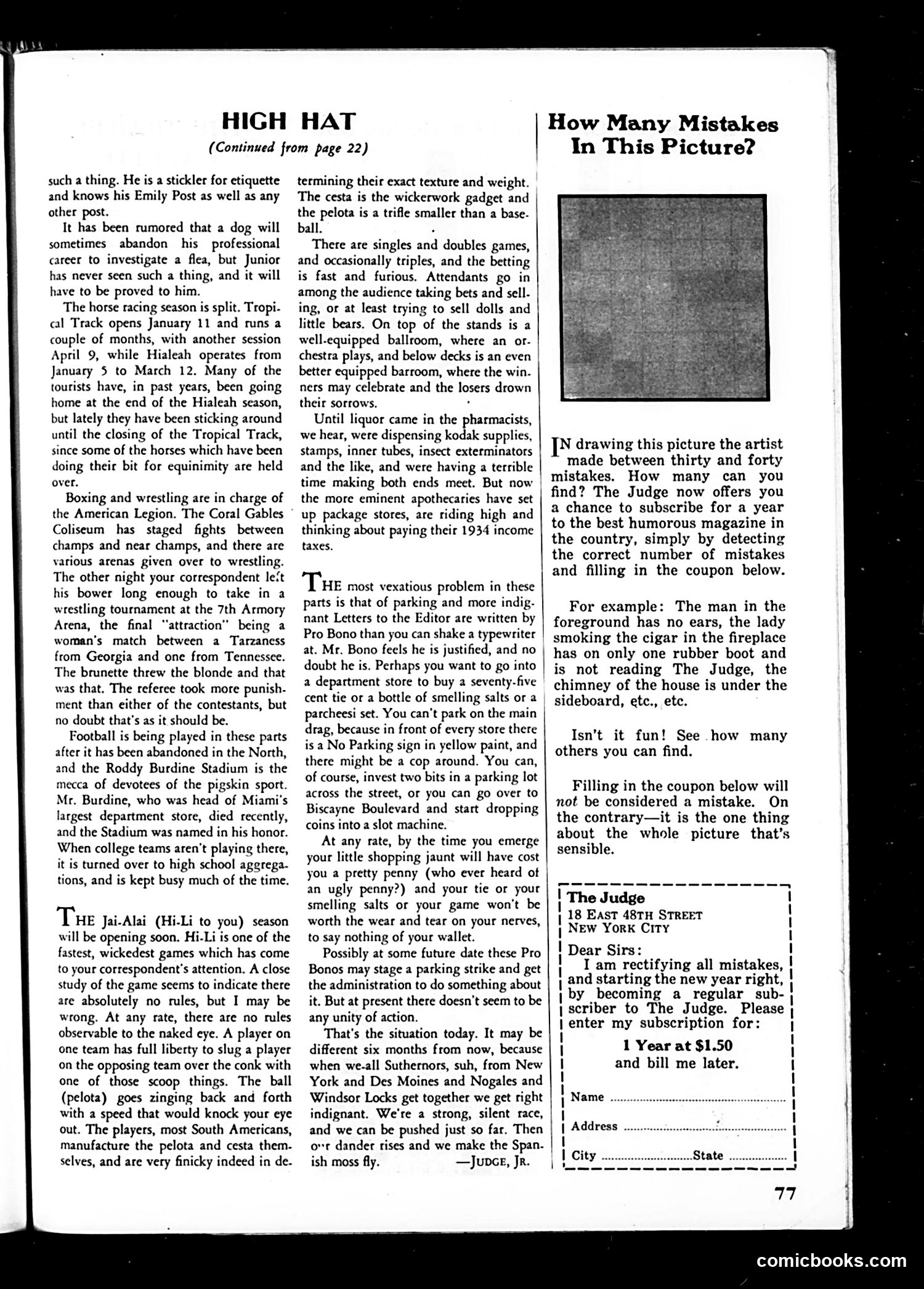
"High Hat" Column Analysis This is a satirical society column (not a political cartoon) describing Miami's leisure activities and social complaints, likely from the 1930s. The column humorously chronicles local entertainments: horse racing at Tropical Track and Hialeah, boxing/wrestling at the Coral Gables Coliseum (named for deceased department store owner Roddy Burdine), football at his stadium, and jai-alai—a Basque sport the author describes as having "absolutely no rules" despite being extremely fast and violent. Social satire includes: - Criticism of "Junior," an etiquette-obsessed character who knows Emily Post intimately - Commentary on Prohibition's end: pharmacists previously sold kodak supplies and stamps as fronts; now they openly operate liquor "package stores" and pay income taxes - Complaints about Miami's severe parking problems clogging the letters section The tone is gossipy and mildly mocking of Miami's tourist culture and pretensions. The adjacent "How Many Mistakes in This Picture?" is an unrelated puzzle feature.
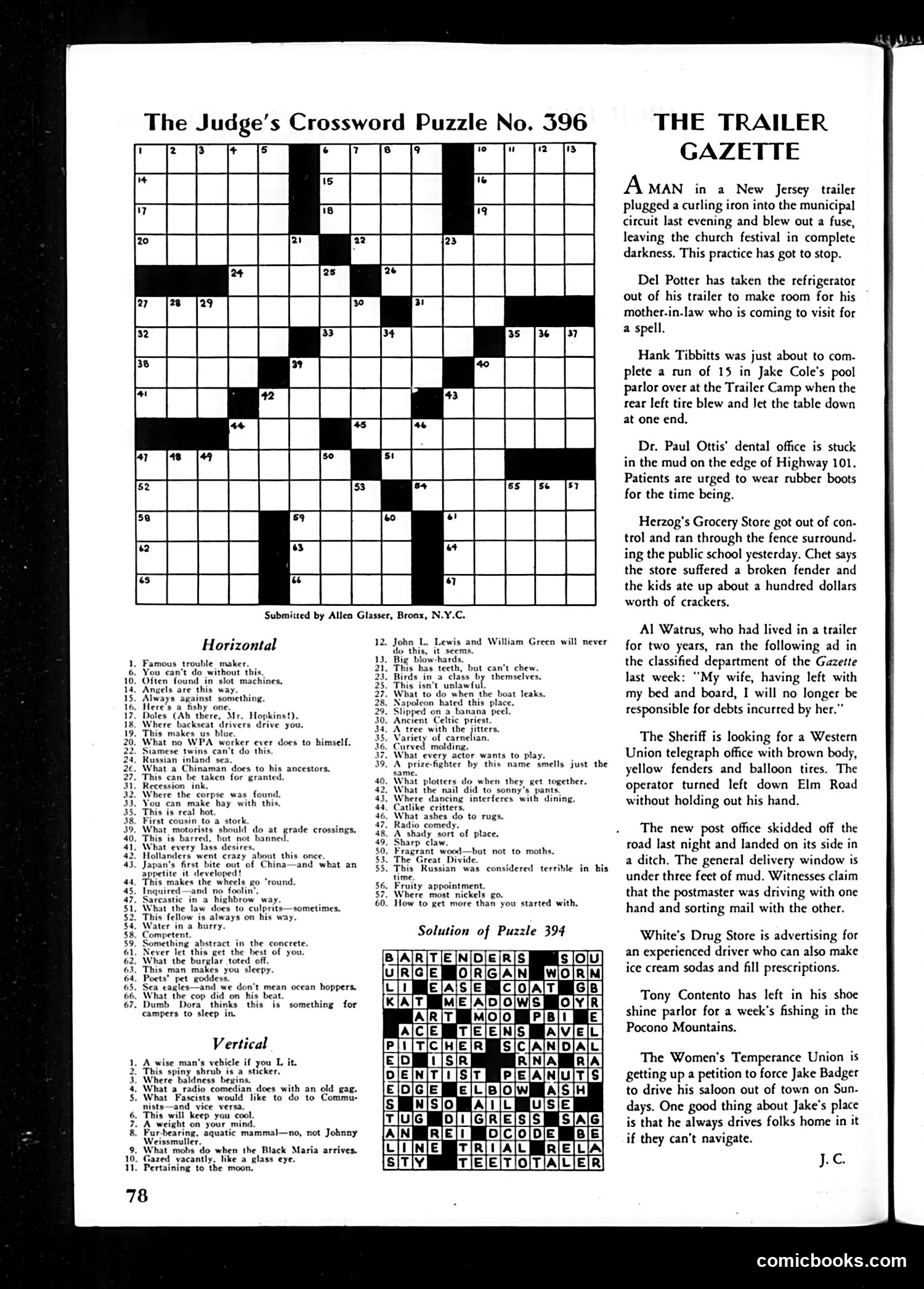
Content Analysis: Judge Magazine Page 78 This page is primarily a crossword puzzle (No. 396) with accompanying satirical short items in "The Trailer Gazette" column. The puzzle itself uses topical clues referencing 1930s events and figures—notably references to John L. Lewis and William Green (labor leaders), Japan's invasion of China, Fascists vs. Communists, and the WPA (Works Progress Administration). These anchor the puzzle to Depression-era America. "The Trailer Gazette" section satirizes the proliferation of trailer homes in Depression-era America through absurdist anecdotes: a man blowing out municipal power with a curling iron, a refrigerator removed to house a mother-in-law, a runaway grocery store. The humor mocks both the makeshift conditions of trailer living and the minor disasters that result from cramped, improvised domestic arrangements. The satire targets working-class housing precarity and the comedic desperation of Depression life—treating trailer communities as inherently chaotic and unstable. This reflects contemporary middle-class anxiety about rapid social change.
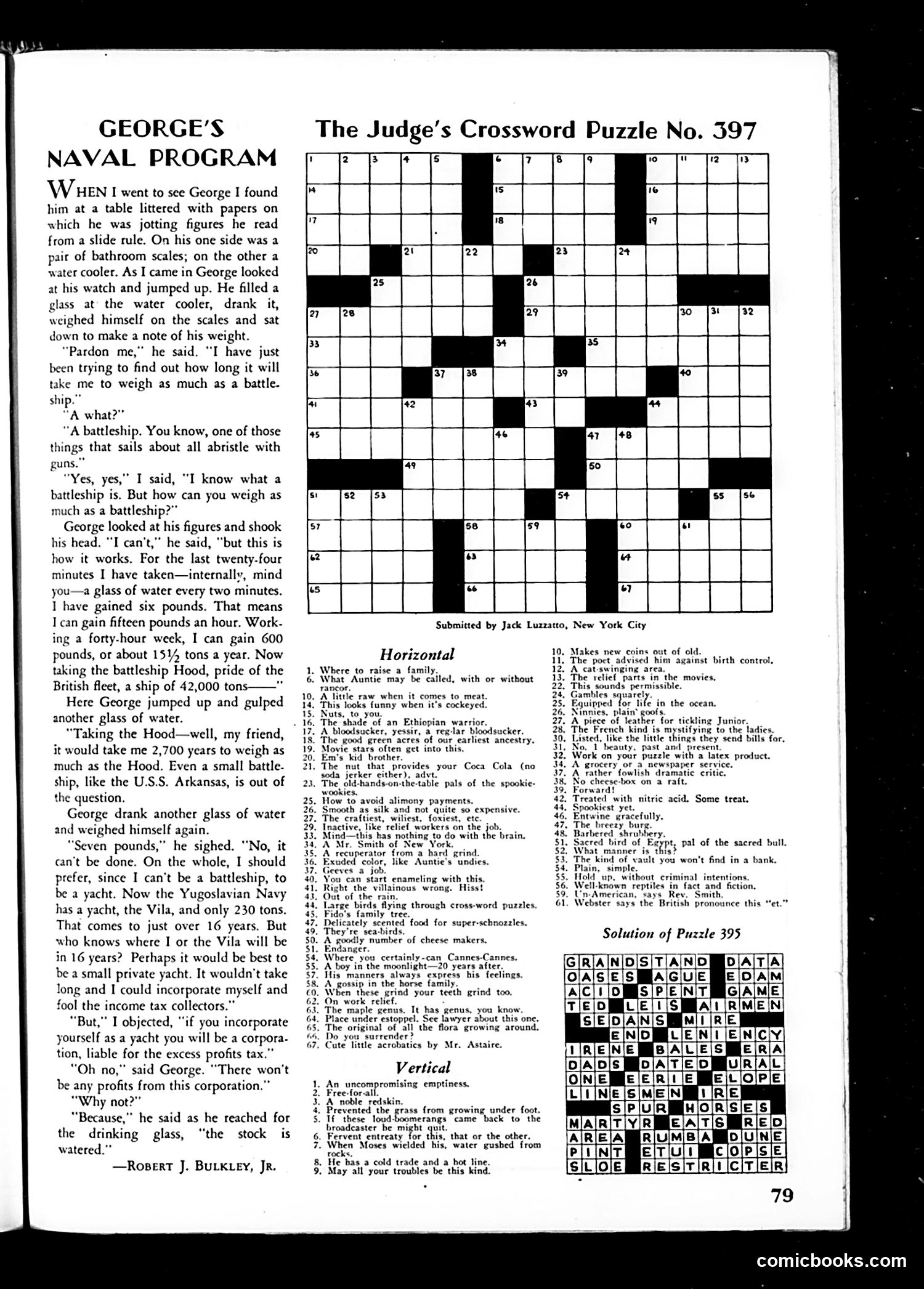
"George's Naval Program" This humorous piece satirizes American naval expansion debates, likely from the 1930s-40s when battleship construction was politically contentious. The Setup: George obsessively calculates how long it would take him to gain weight equal to a battleship by drinking water every two minutes. He determines it would take 2,700 years to match the HMS Hood (42,000 tons) or 16 years to equal a small Yugoslav yacht. The Satire: The joke mocks the absurdity of naval spending discussions by reducing a serious military policy debate to a ridiculous personal weight-gain scheme. George's final quip about incorporating himself as a yacht to "fool the income tax collectors" with "watered stock" is a double pun—literally drinking water while making a corporate tax-evasion joke. The Point: Judge satirizes both excessive military spending and corporate tax avoidance simultaneously, suggesting both are equally foolish schemes. The piece gently ridicules the era's ongoing debates about naval budgets and industrial policy.
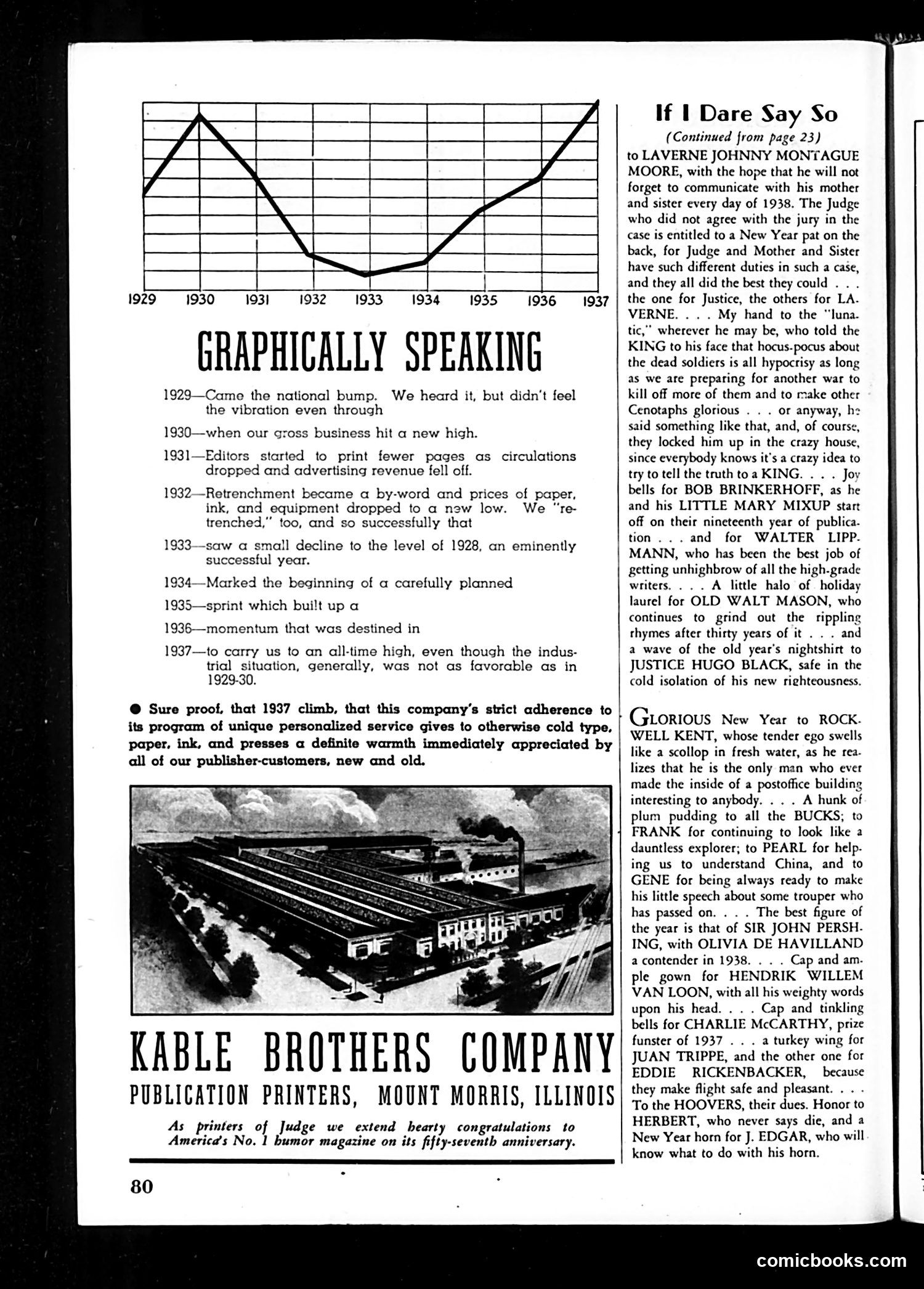
Explanation for Modern Readers This page contains two distinct sections: advertising and editorial commentary. The left side is a graph-based advertisement from Kable Brothers Company (publication printers). It charts their business recovery from the 1929 stock market crash through 1937, showing dramatic decline in 1932-33, then recovery through careful planning and "personalized service." This celebrates their resilience during the Great Depression. The right side is editorial commentary awarding tongue-in-cheek "New Year honors" to various public figures—judges, writers, explorers, and aviators. References include Justice Hugo Black (recently appointed to Supreme Court), columnist Walt Mason, aviator Juan Trippe, and war hero John Pershing. The tone mocks pomposity while praising those the editor deems worthy. The page essentially blends corporate self-promotion with satirical cultural criticism—typical Judge magazine content for its 57th anniversary (1937).
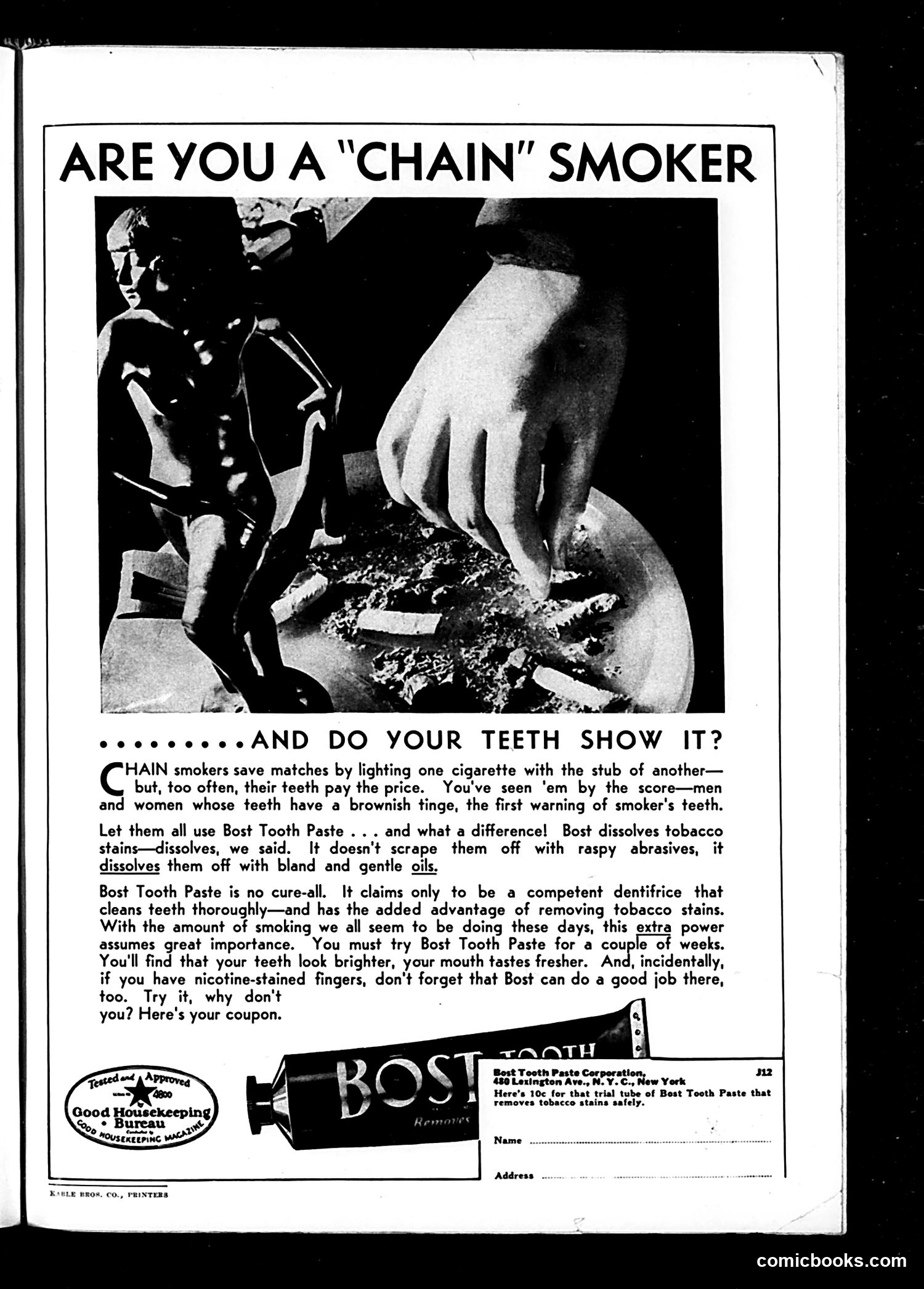
Analysis This is a Bost Tooth Paste advertisement, not political satire. It targets "chain smokers"—people who continuously light cigarettes from the stubs of previous ones—and warns that heavy smoking causes visible tooth discoloration ("brownish tinge"). The advertisement's appeal is social shame: it notes you can identify chain smokers "by the score" by their stained teeth, implying this is an embarrassing, observable mark of the habit. The dark photograph shows hands with yellowed, nicotine-stained fingers handling cigarettes over an ashtray, visually demonstrating the damage smoking causes. Bost Tooth Paste claims to *dissolve* tobacco stains using "bland and gentle oils" rather than abrasive scraping. The ad also notes it can clean nicotine-stained fingers. The humor is gentle and the appeal straightforward: smoking is increasingly common ("the amount of smoking we all seem to be doing"), so this specialized toothpaste has become important. A coupon offers a 10-cent trial. This reflects 1920s-30s consumer culture and the normalization of cigarette smoking before health warnings.
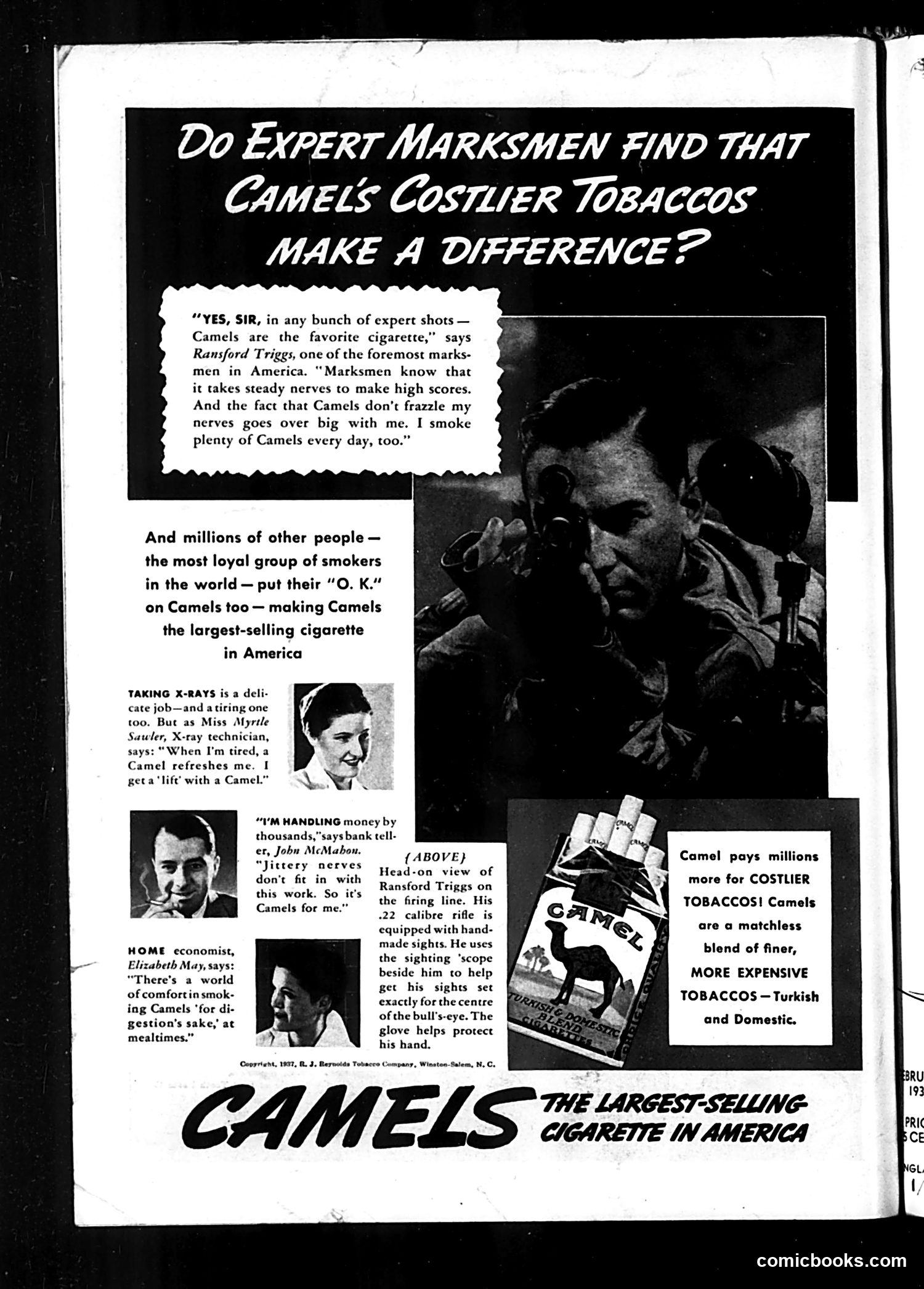
Analysis This is not a cartoon but a cigarette advertisement disguised as testimonial journalism. The page features Camel cigarettes claiming endorsements from various professionals—a sharpshooter (Ransford Triggs), an X-ray technician, and a bank teller—each testifying that Camels help them perform high-precision work by keeping their nerves steady. The advertising strategy exploits a now-discredited notion: that cigarettes calm nerves and enhance focus. By associating Camels with skilled professionals requiring concentration, the ad implies the product aids performance. The "COSTLIER TOBACCOS" claim emphasizes premium pricing as proof of quality. This represents pre-regulatory tobacco marketing, when health claims were unregulated and such endorsements were standard practice. For modern readers, this reveals how brazenly cigarette companies once marketed their product's supposed benefits, before the surgeon general's warnings (1964) and subsequent regulations that prohibited health claims in tobacco advertising.