judge
Judge — February 1938
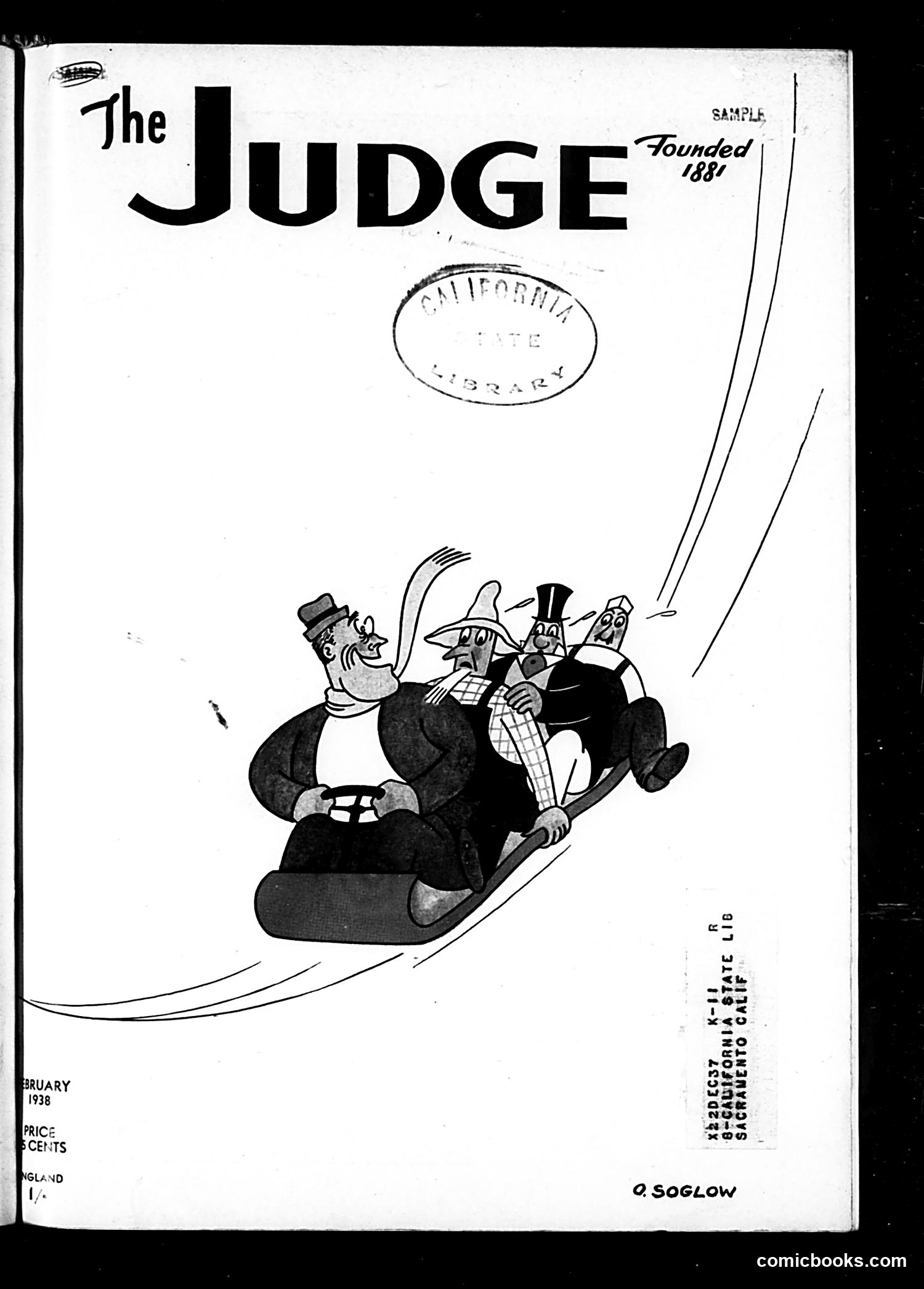
The Judge Magazine Cover - February 1938 This cover illustration by O. Soglow depicts three caricatured figures sledding downhill together, their expressions suggesting anxiety or alarm as they descend a steep slope. The imagery appears to be political satire about economic or social conditions circa February 1938. The context likely relates to the economic recession that struck the United States in late 1937-1938, often called the "Roosevelt Recession." The figures careening downward probably represent government, business, or the general populace losing control during this financial crisis. The sledding metaphor suggests an uncontrolled, potentially dangerous descent. Without clearer identifying labels on the figures themselves, the specific targets of Soglow's satire remain uncertain, though the downward trajectory clearly critiques contemporary economic mismanagement.
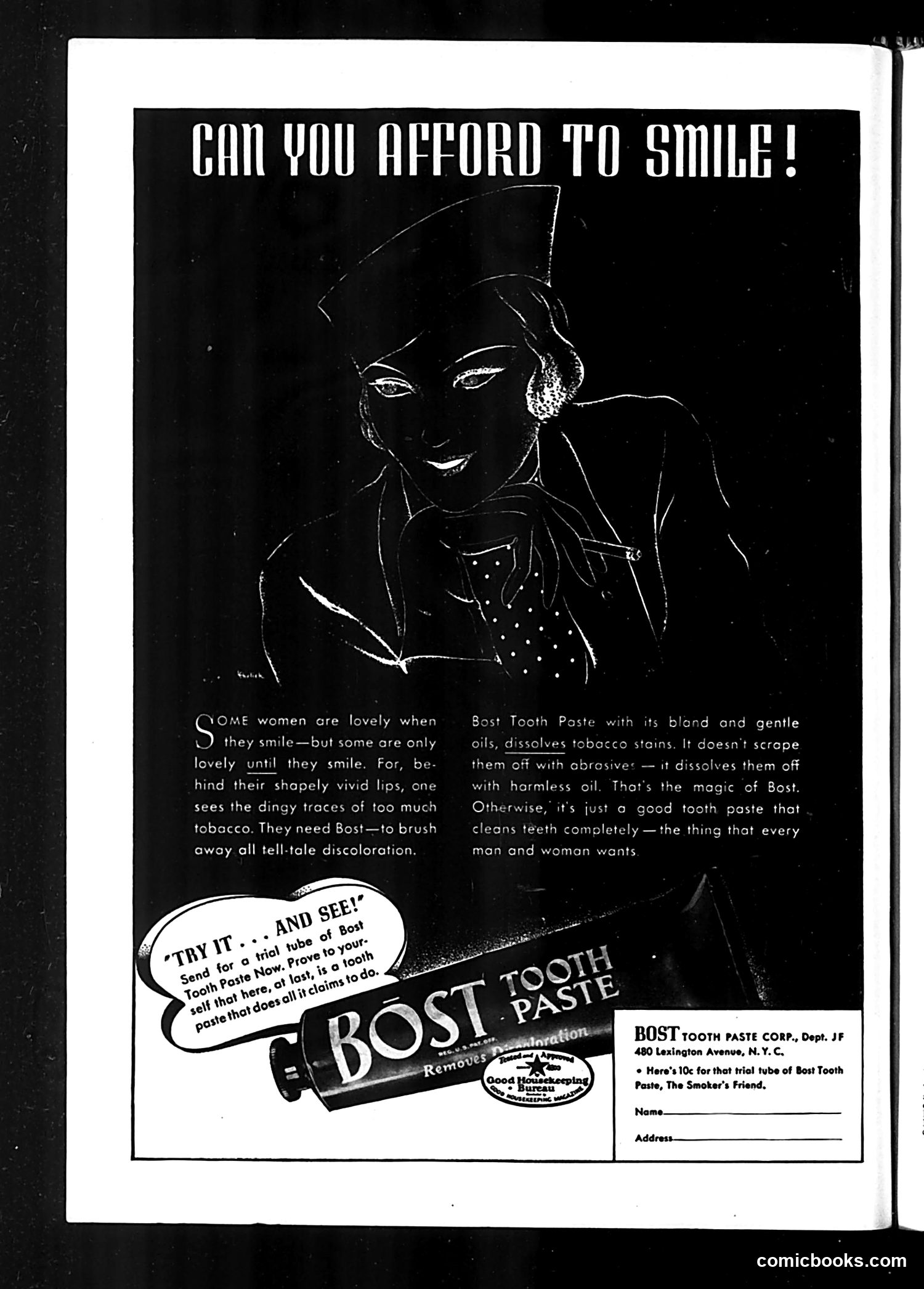
Analysis This appears to be primarily a commercial advertisement rather than political satire. It's a Bost Tooth Paste ad from Judge magazine. The advertisement uses a gendered appeal common to early 20th-century advertising: it suggests that women's attractiveness depends on having a bright smile free of tobacco stains. The headline "CAN YOU AFFORD TO SMILE!" implies that without proper dental care, women should be embarrassed. The illustration shows a stylishly dressed woman in profile, and the copy emphasizes that Bost Tooth Paste "dissolves tobacco stains" without abrasive scrubbing. The ad includes a trial offer coupon (10 cents). This reflects period advertising that capitalized on social anxiety about appearance and cleanliness, particularly targeting women as consumers of personal care products.
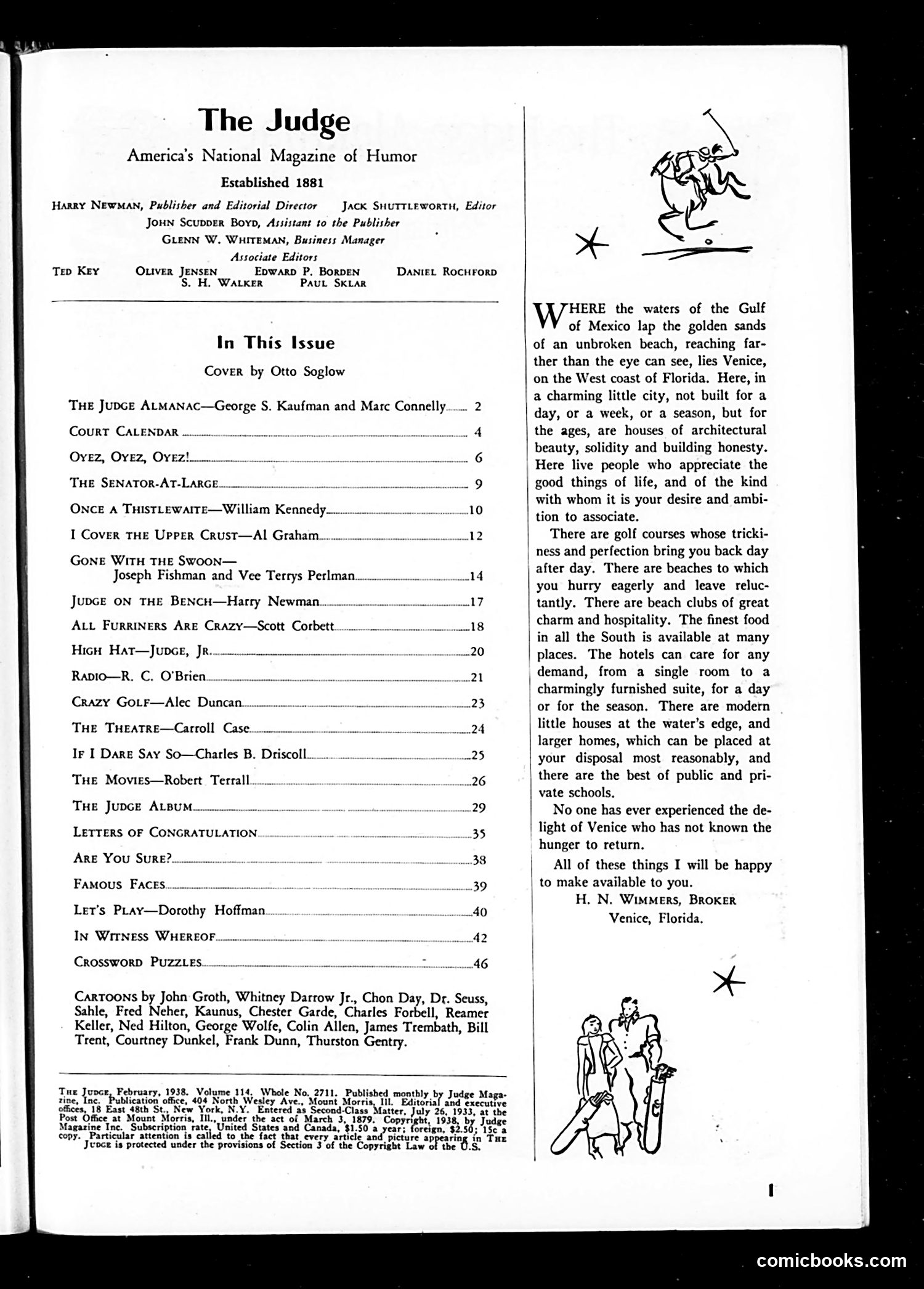
Analysis of Judge Magazine Page This is primarily a table of contents and masthead page from Judge magazine (established 1881), America's leading humor publication. The page lists the issue's contents and editorial staff rather than presenting political cartoons requiring interpretation. The two small cartoons visible appear to be decorative vignettes rather than satirical commentary—one showing a figure with a golf club, the other depicting casual social figures. The substantial prose section is an advertisement disguised as editorial content, promoting Venice, Florida as a tourist destination. It's written by H.N. Wimmers (a broker) and emphasizes luxury amenities, golf courses, and hospitality—typical boosterism of 1920s Florida real estate marketing. This page reflects Judge's dual function: satirical humor magazine and vehicle for advertising revenue.
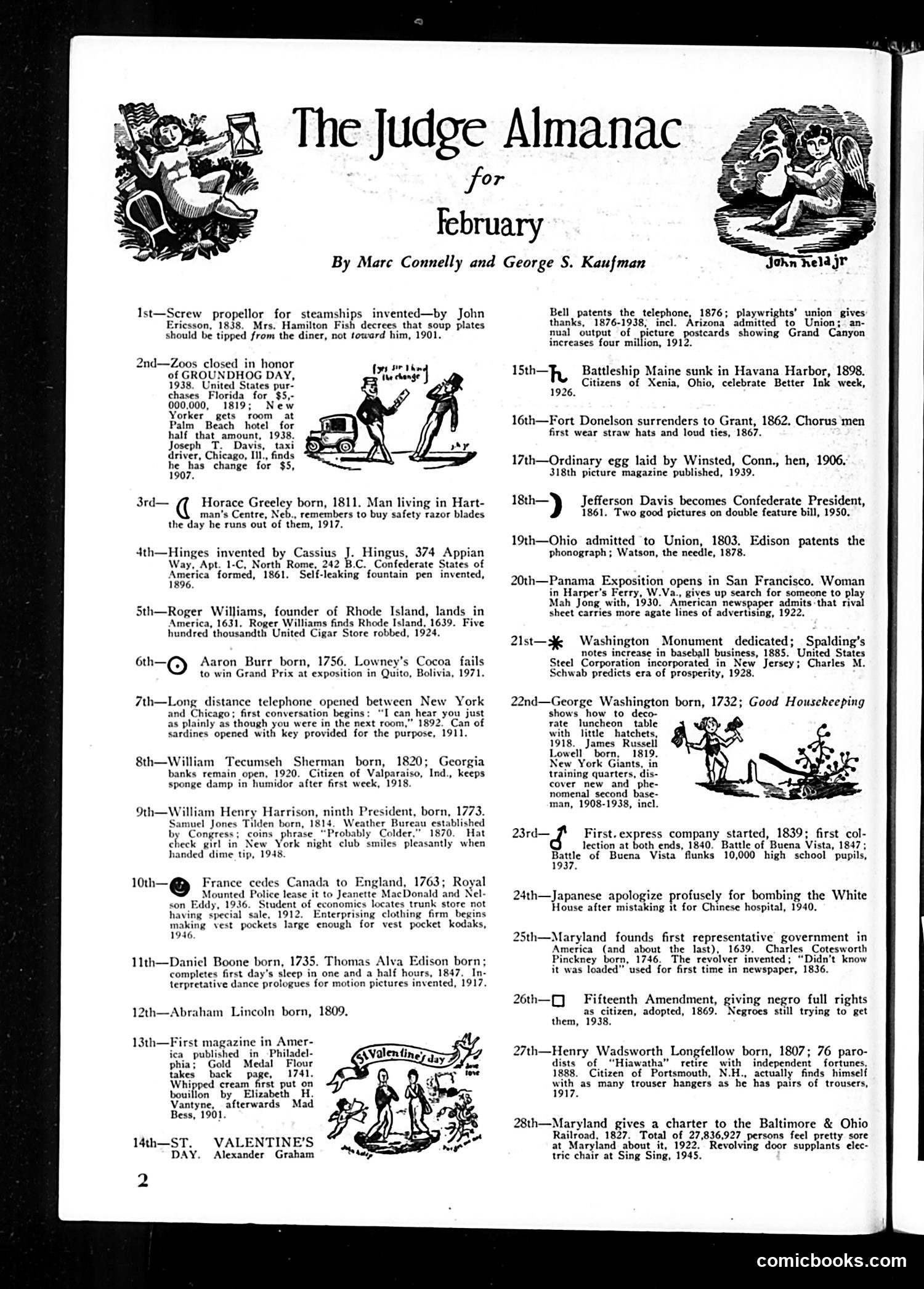
The Judge Almanac for February This page is primarily a factual almanac listing historical events for each day in February, rather than political satire. The entries range from scientific inventions (screw propeller, 1838; telephone patents, 1876) to political events (Ohio admitted to Union, 1803; Lincoln's birth, 1809) to cultural moments (first magazine published in America, 1741; Valentine's Day). The small decorative illustrations—cherubs, couples, a man with a plow—are generic period embellishments typical of almanac design, not satirical commentary. While *Judge* magazine was known for sharp political cartooning, this particular page functions as reference material rather than satire, providing readers useful historical context alongside light decorative elements.
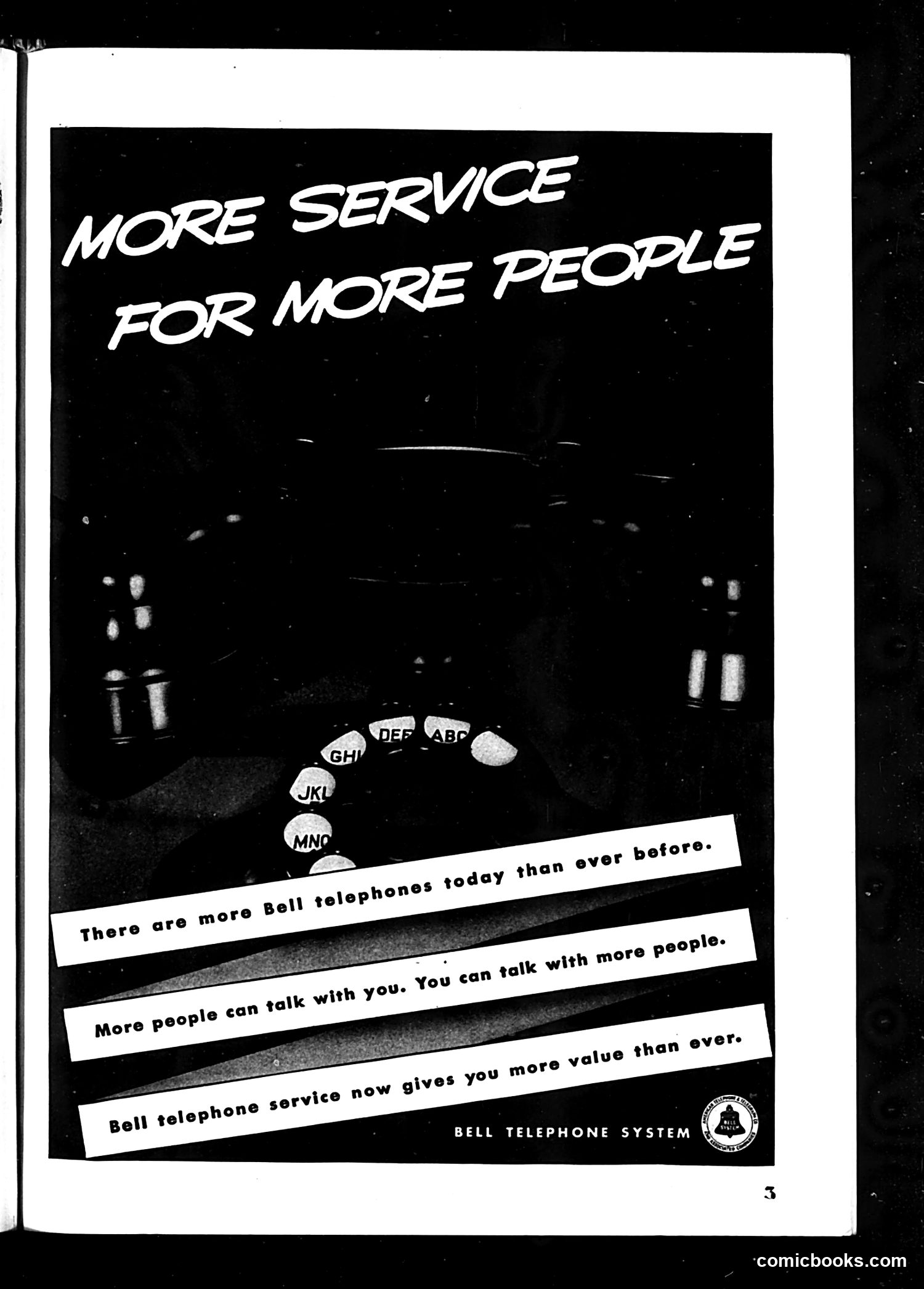
Analysis This is a Bell Telephone System advertisement, not satirical content. The page promotes telephone service expansion during what appears to be the early-to-mid 20th century. The ad's messaging emphasizes growth: more telephones exist than ever before, more people can communicate simultaneously, and customers receive greater value. The telephone dial visible in the image displays letter-number combinations (ABC, DEF, GHI, JKL, MNO), representing the rotary dial system standard of that era. The headline "MORE SERVICE FOR MORE PEOPLE" reflects Bell's marketing of telecommunications infrastructure expansion as a public good. This represents typical mid-century corporate advertising positioning utility expansion as social progress—a common rhetorical strategy before modern skepticism of monopolistic telecommunications companies.
Court Calendar Page Analysis This page from Judge magazine contains entertainment reviews (movies, theatre, books) rather than political cartoons. The only illustration is a small, stylized crowd scene at the bottom left—appears to show simplified audience silhouettes, likely generic theatrical imagery rather than political satire. The reviews themselves offer period social commentary. For example, "Ninotchka" is described as featuring a Soviet character in "bowing robes," reflecting Cold War-era attitudes toward communism. References to "Military Academies" and mentions of Spain suggest 1930s-40s historical context. This is primarily a consumer-focused entertainment guide page, not a vehicle for political satire. Any social commentary emerges incidentally through the film and theatre descriptions rather than through deliberate cartoon satire.
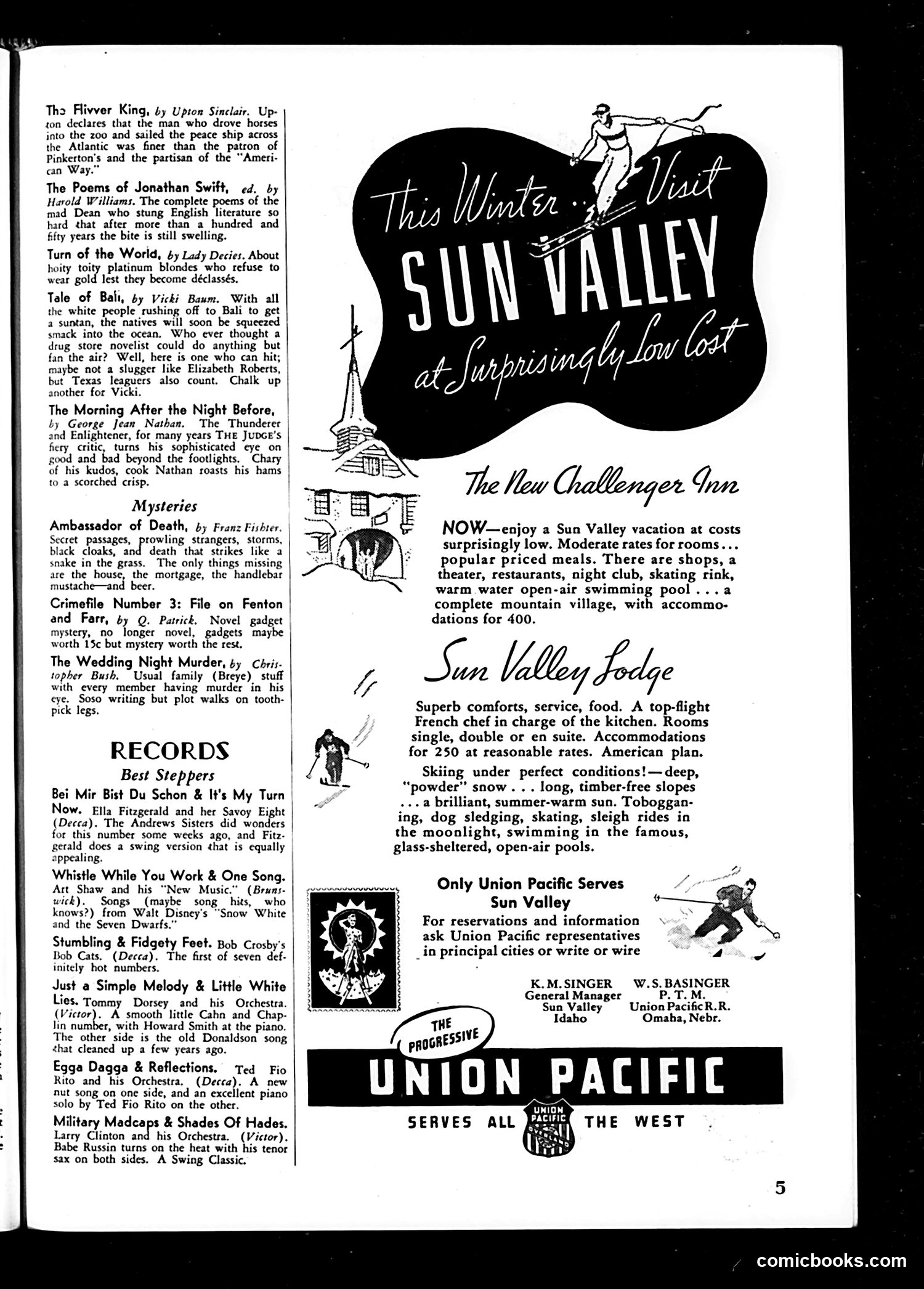
Page Analysis This page is primarily advertising, not satirical content. The dominant feature is a large advertisement for Sun Valley Lodge in Idaho, promoting winter vacation amenities including skiing, sledding, and swimming pools. The ad emphasizes "surprisingly low cost" and "moderate rates," appealing to middle-class vacationers. The left column contains book reviews and a "Records" section listing musical releases—typical Judge magazine content filler rather than satire or political commentary. The only visual humor appears to be generic skiing illustrations accompanying the Sun Valley ad, showing figures in comic skiing poses. These are decorative rather than satirical. The page reflects 1930s-40s travel advertising during a period when ski resort promotion was becoming mainstream American marketing.
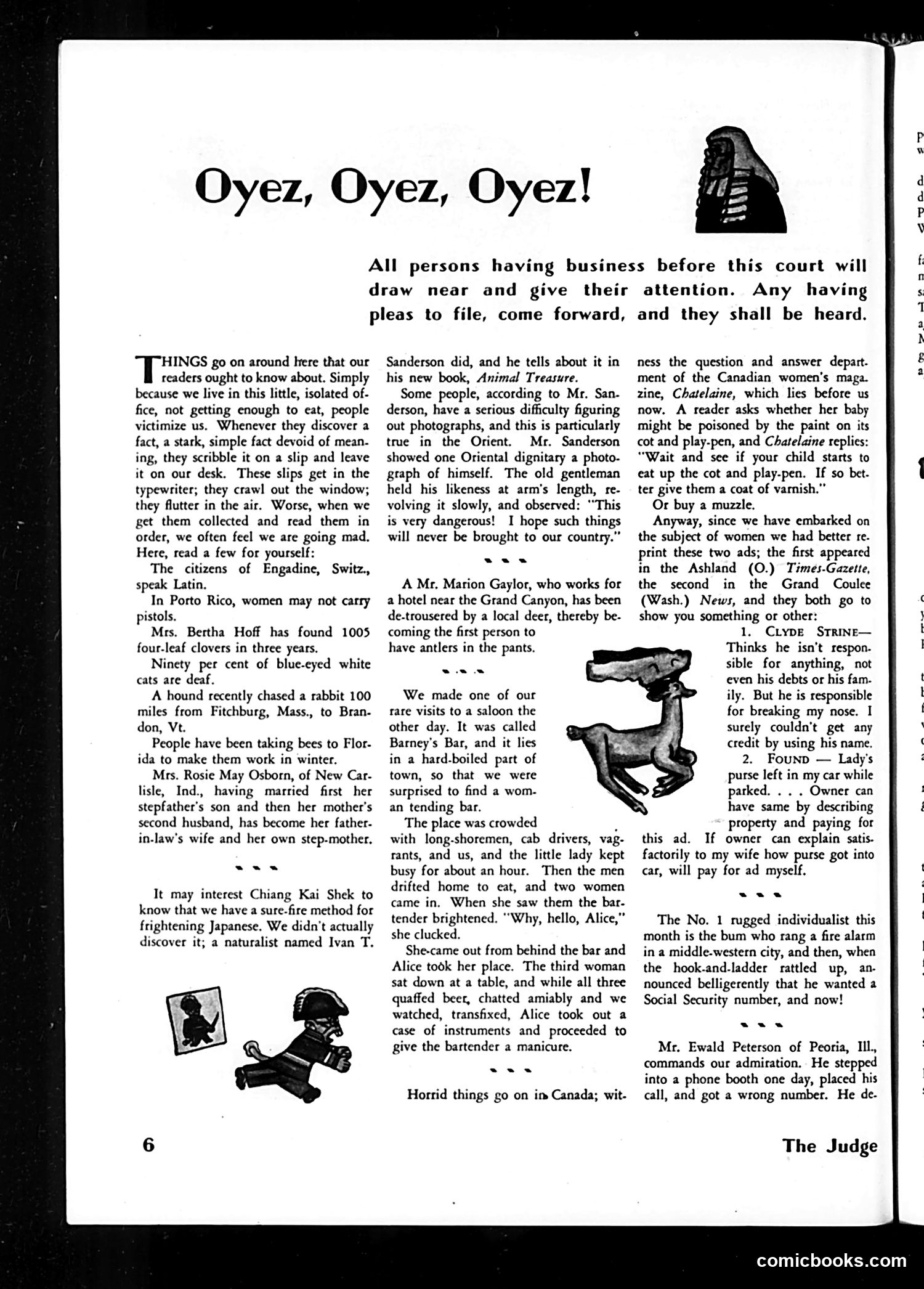
"The Judge" Page Analysis This is a humor column titled "Oyez, Oyez, Oyez!" (a courtroom crier's traditional call). The page collects absurdist anecdotes and reader-submitted oddities rather than political cartoons. The content mocks everyday human eccentricity: a man who traveled 100 miles with a rabbit; people shipping bees to Florida for winter work; a woman who became her own stepmother through remarriage; a deer-related incident at the Grand Canyon; and a woman performing manicures in a saloon. The illustrations show period silhouettes and a small figure, likely decorative. The column's satire targets human peculiarity and illogic in ordinary life—not political figures. This represents Judge magazine's characteristic style: lighthearted social observation rather than partisan commentary, appealing to readers' sense of the ridiculous in everyday society.
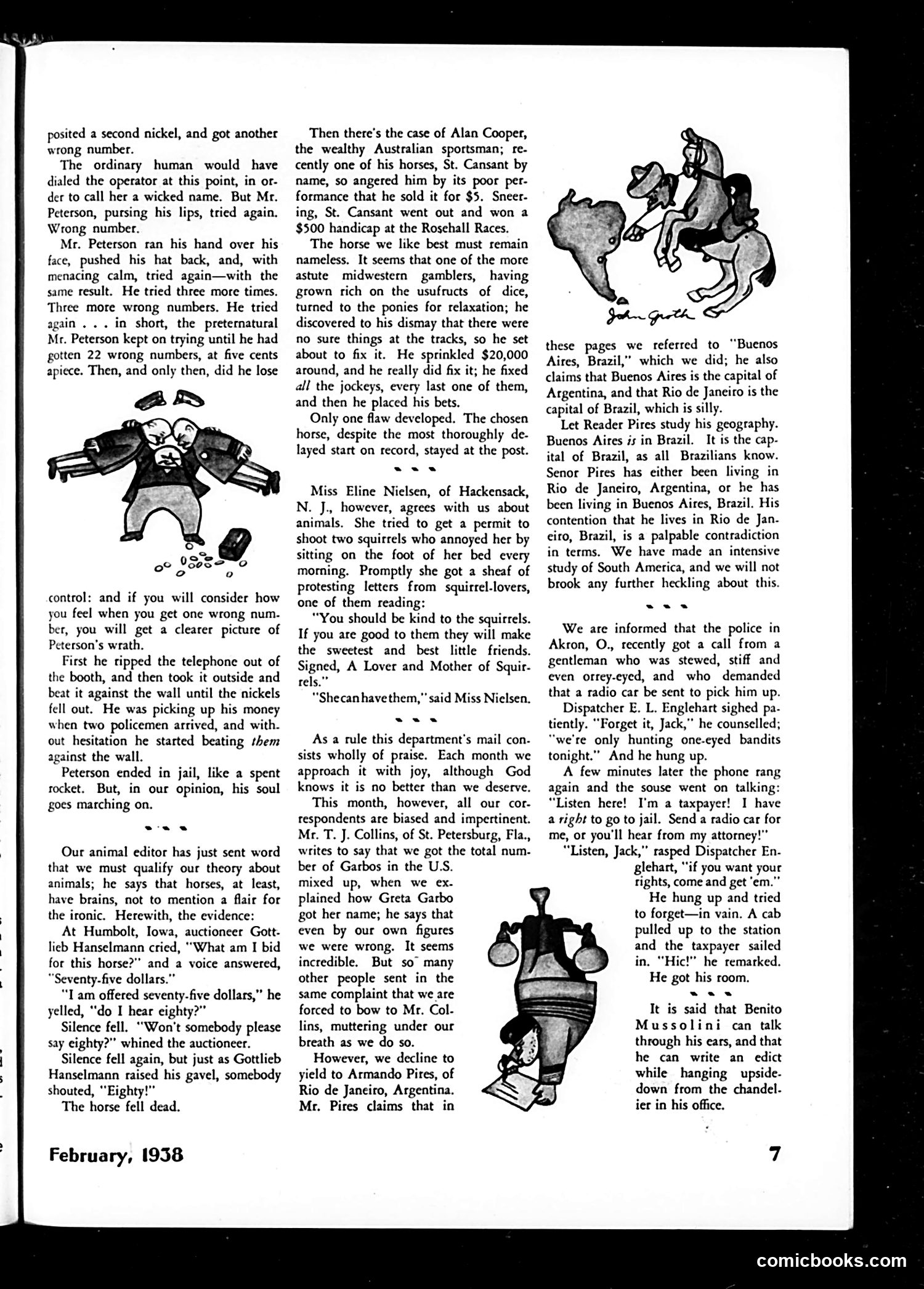
Analysis of Judge Magazine Page (February 1938) This page contains humorous anecdotes rather than political cartoons. The illustrations are simple comic vignettes accompanying short stories: 1. The telephone operator story: A man repeatedly dials wrong numbers trying to reach a horse racing operation, becoming increasingly frustrated. The satire targets both his obsessive gambling and the incompetence of telephone service. 2. The auctioneer story: A horse literally dies during an auction after the auctioneer's repeated shouting of "Eighty!" The humor derives from absurdist exaggeration of auctioneers' loud, dramatic behavior. 3. The dispatcher anecdote: Police humorously handle a call about "one-eyed bandits," initially misunderstanding before realizing the caller means literal bandits. The page's tone is light, focusing on everyday American mishaps and technology failures rather than political commentary.
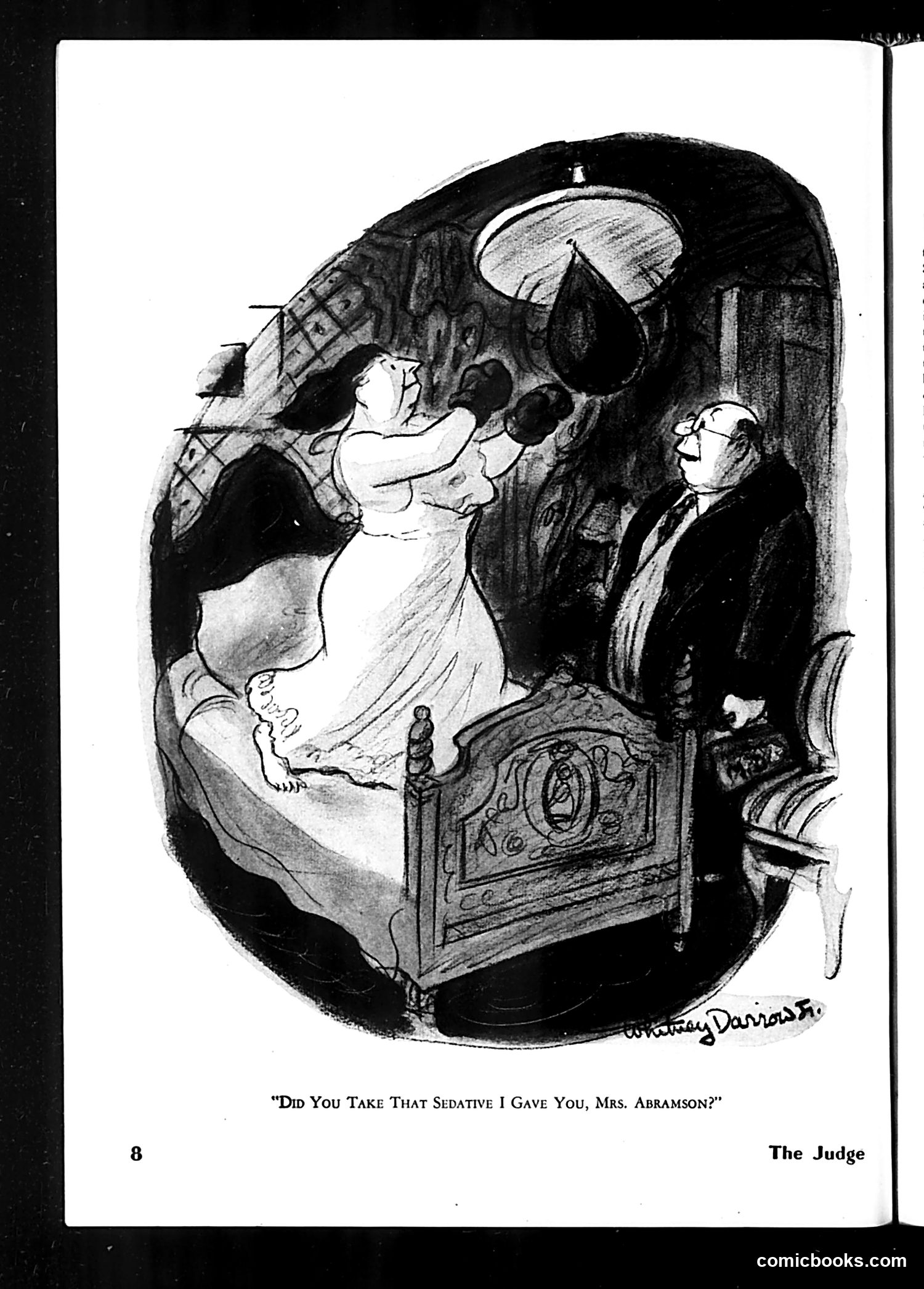
Cartoon Analysis This single-panel cartoon from *Judge* magazine satirizes medical quackery and incompetence. A disheveled doctor (likely a charlatan) stands beside a bed where an enormously pregnant woman, Mrs. Abramson, is in apparent labor or distress, reaching upward. The doctor asks if she took the "sedative" he prescribed—suggesting his dubious medication may have caused her condition rather than helped it. The joke targets fraudulent doctors of the era who administered questionable remedies to patients, often with harmful results. The woman's exaggerated physical state and the doctor's casual, almost oblivious demeanor emphasize the satire: incompetent medical practitioners dispensing dangerous treatments while remaining indifferent to consequences. This reflects early 20th-century concerns about unregulated medical practice.
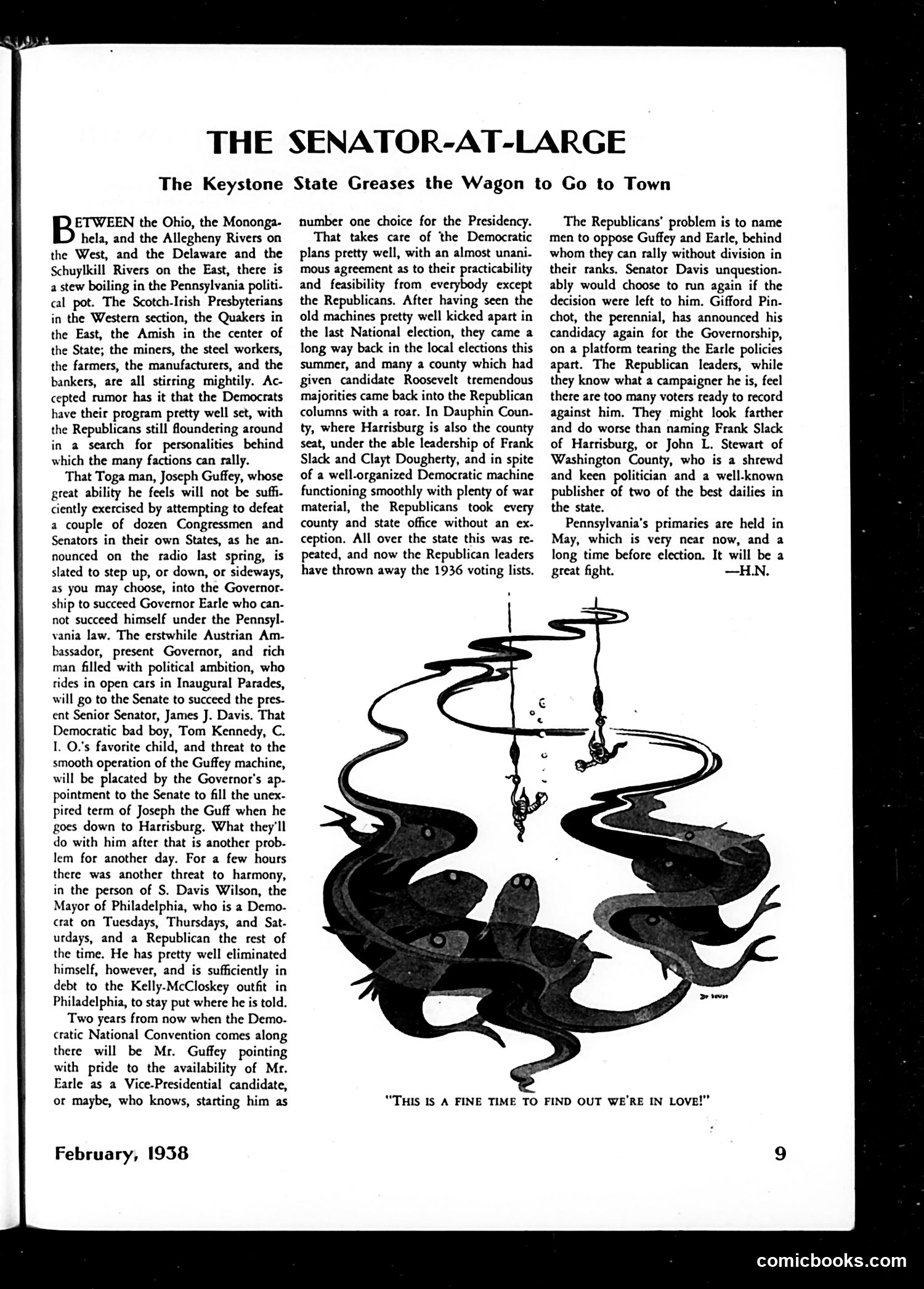
"The Senator-at-Large" (Judge, February 1938) This satirical article and accompanying cartoon mock Pennsylvania's Democratic political machine under Joseph Guffey. The text describes an intricate shuffle of Democratic politicians—Governor Earle moving to the Senate, Guffey to the Governorship, and troublemaker Tom Kennedy (a labor organizer favored by the CIO) being placated with a Senate appointment—all orchestrated to consolidate power before the 1940 presidential cycle. The cartoon depicts this political maneuvering as tangled wagon wheels or dancing figures, visualizing the complex choreography of ambition and deal-making. The caption "This is a fine time to find out we're in love!" suggests ironic commentary on their convenient Democratic unity. The satire highlights Republican weakness: despite losses in 1936, they've regained local ground but lack coherent candidates to challenge the well-oiled Democratic apparatus. The article portrays Pennsylvania politics as a self-serving game among established elites, indifferent to ordinary voters' interests.
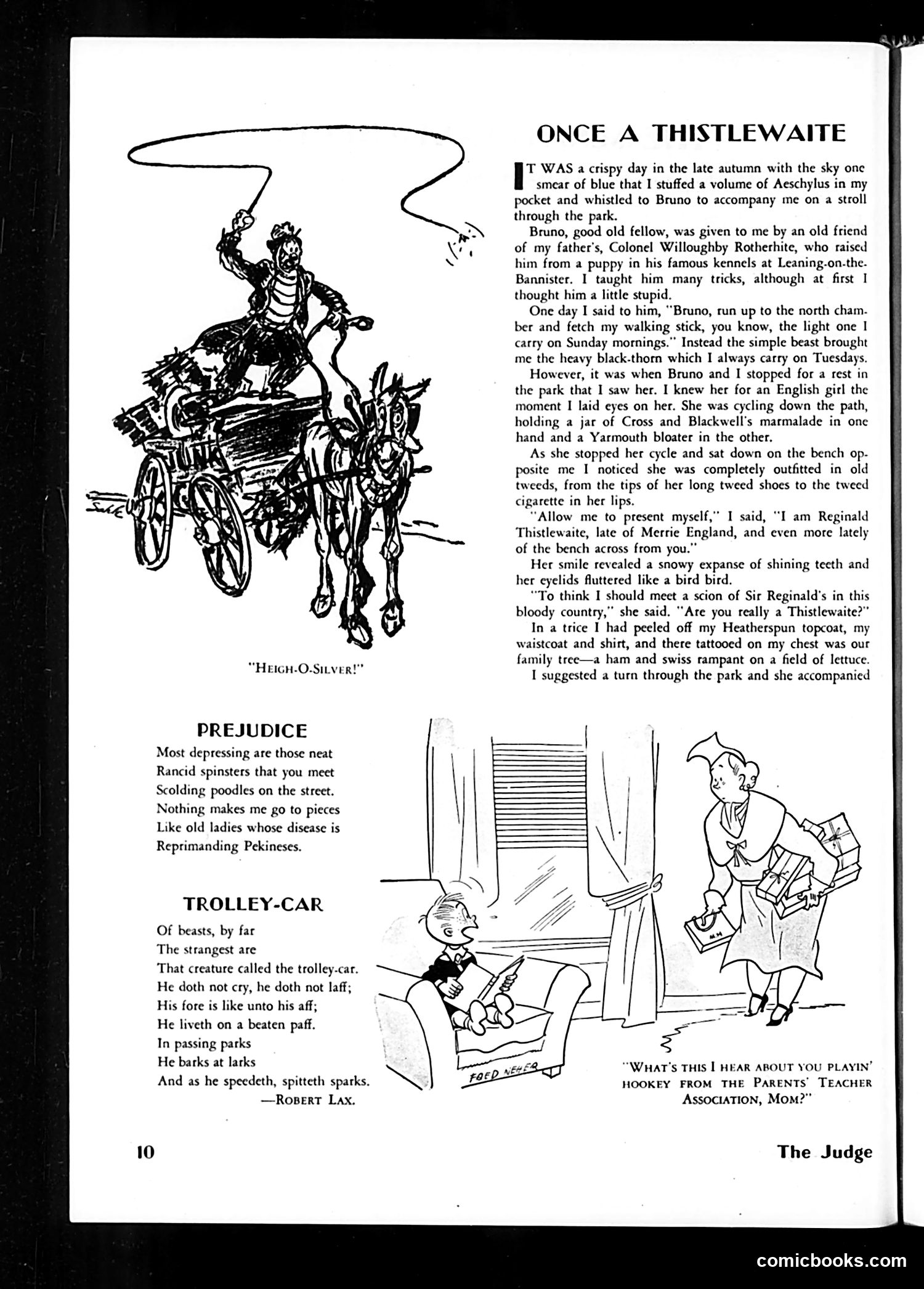
Judge Magazine Page Analysis This page contains three distinct pieces of humor: "Once a Thistlewaite" is a satirical short story mocking pretentious British aristocracy and affected English mannerisms. The narrator, Reginald Thistlewaite, embodies exaggerated upper-class affectation—carrying Aeschylus, naming his dog after a colonel, and absurdly displaying a family "tree" (literally ham and swiss rampant) tattooed on his chest. The story ridicules both pompous British characters and Americans who admire them. "Prejudice" is a brief poem criticizing elderly spinsters who scold small dogs (poodles, Pekingeses) on streets—satirizing busybody moralism and fussy old women. "Trolley-Car" is a humorous verse by Robert Lax treating the electric trolley-car as a bizarre animal, poking fun at this then-new technology with absurdist descriptions of its mechanical properties. The bottom cartoon shows a mother confronting a child about skipping Parent-Teacher Association meetings—satirizing mothers' involvement in school administration and social pressure regarding parental participation.
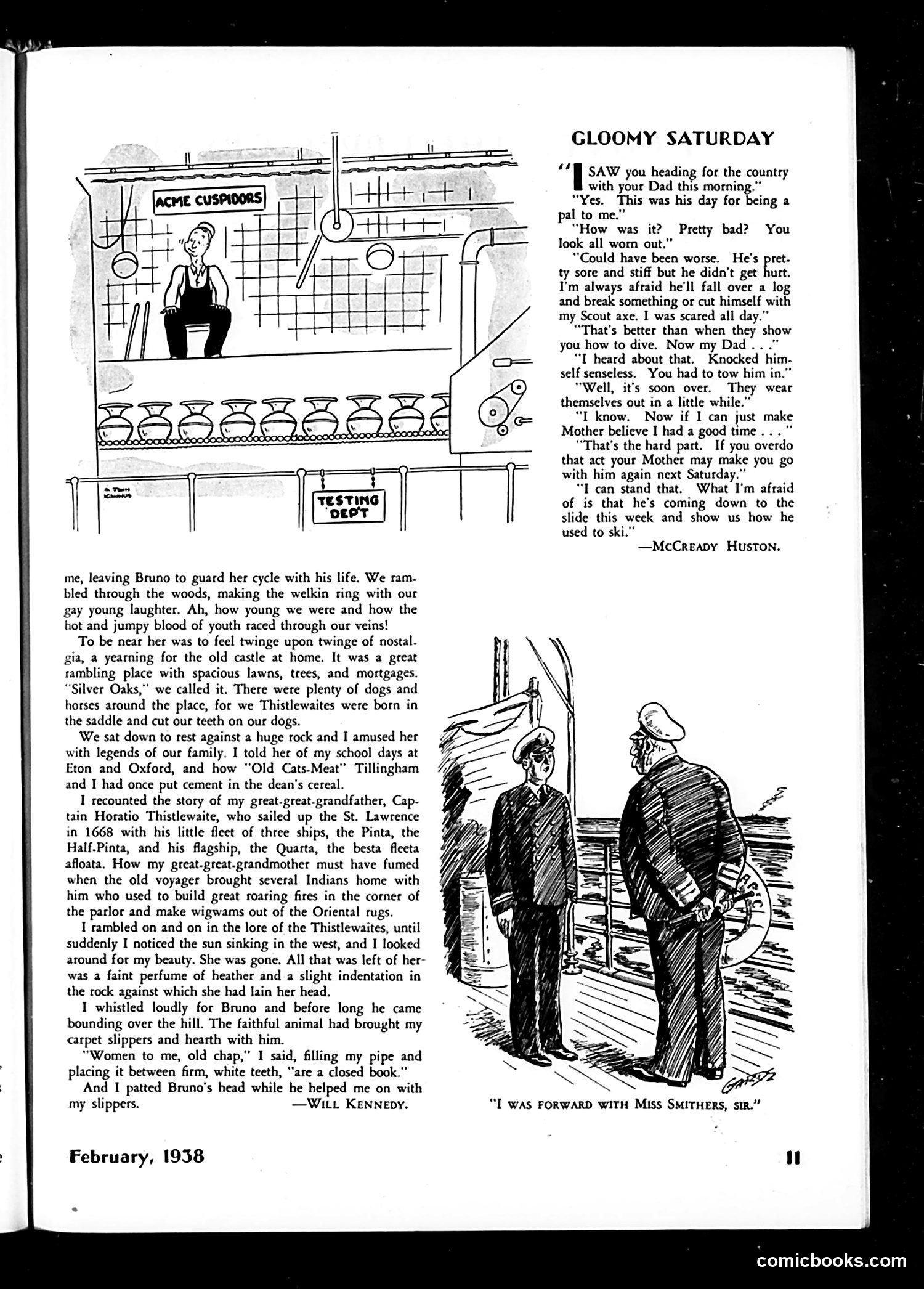
Gloomy Saturday - Judge Magazine Content Analysis This page contains two distinct pieces: The Cartoon (top): A simple comic about fathers and sons. Two boys discuss their Saturday outing with their dads. The humor centers on the generational gap: fathers try to be "pals" by taking sons on activities, but these outings are exhausting and potentially dangerous—the boys worry about their fathers getting hurt or making fools of themselves (falling, diving poorly, attempting outdated ski tricks). The joke's irony: the boys must pretend they had fun to avoid repeat outings, managing their mothers' expectations. The Story (bottom): A lengthy satirical piece titled "I Was Forward with Miss Smithers, Sir." This appears to be mock-nostalgic fiction parodying British upper-class romance narratives. It exaggerates aristocratic pretension through absurd details (rambling estates with "mortgages," ancestors bringing Indians home who build wigwams with Oriental rugs, a dog helpfully retrieving carpet slippers). The abandoned-girlfriend ending undermines the romantic tone, suggesting the narrator's self-absorbed rambling about his family's exploits bored her away—satire of self-important upper-class storytelling.
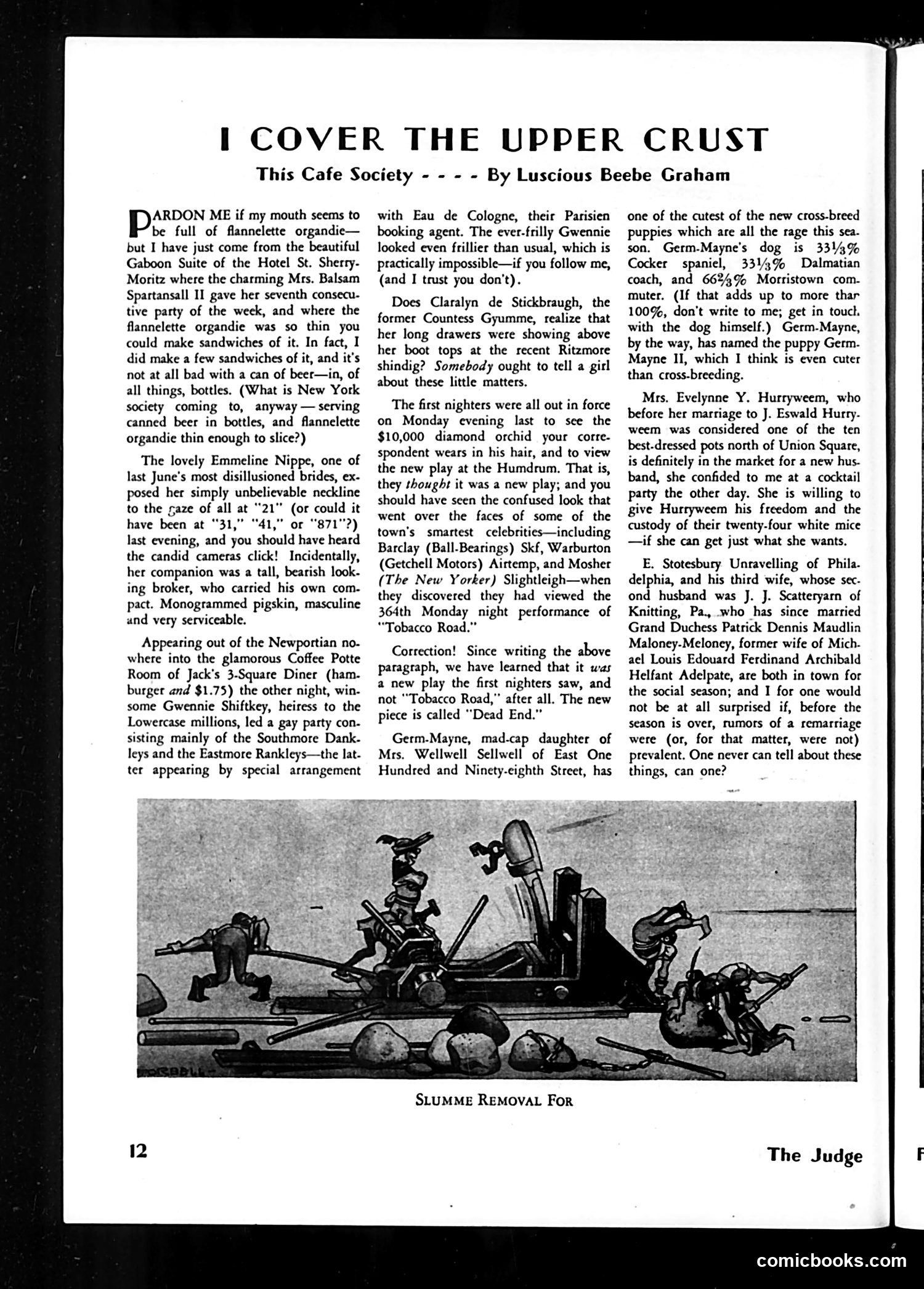
Analysis for Modern Readers This is a satirical gossip column by Luscious Beebe Graham mocking high society's pretensions. The text uses absurdist humor—fictional socialites with ridiculous names (Mrs. Balsam Spartansall II, Claralyn de Stickbraugh) attending exclusive venues like "21" and the Ritzmore Hotel. The satire targets: - Excessive materialism: obsessing over designer details and exclusive restaurants - Social climbing: name-dropping and status anxiety - Superficiality: focus on clothing, appearances, and being seen - Absurd contradiction: wealthy people eating at diners, serving canned beer The cartoon below ("Slumme Removal For") appears to be visual commentary on urban decay or sanitation, though its specific meaning is unclear without fuller context. The column's exaggerated tone and invented details ridicule café society's self-importance during what appears to be the 1930s-40s era.
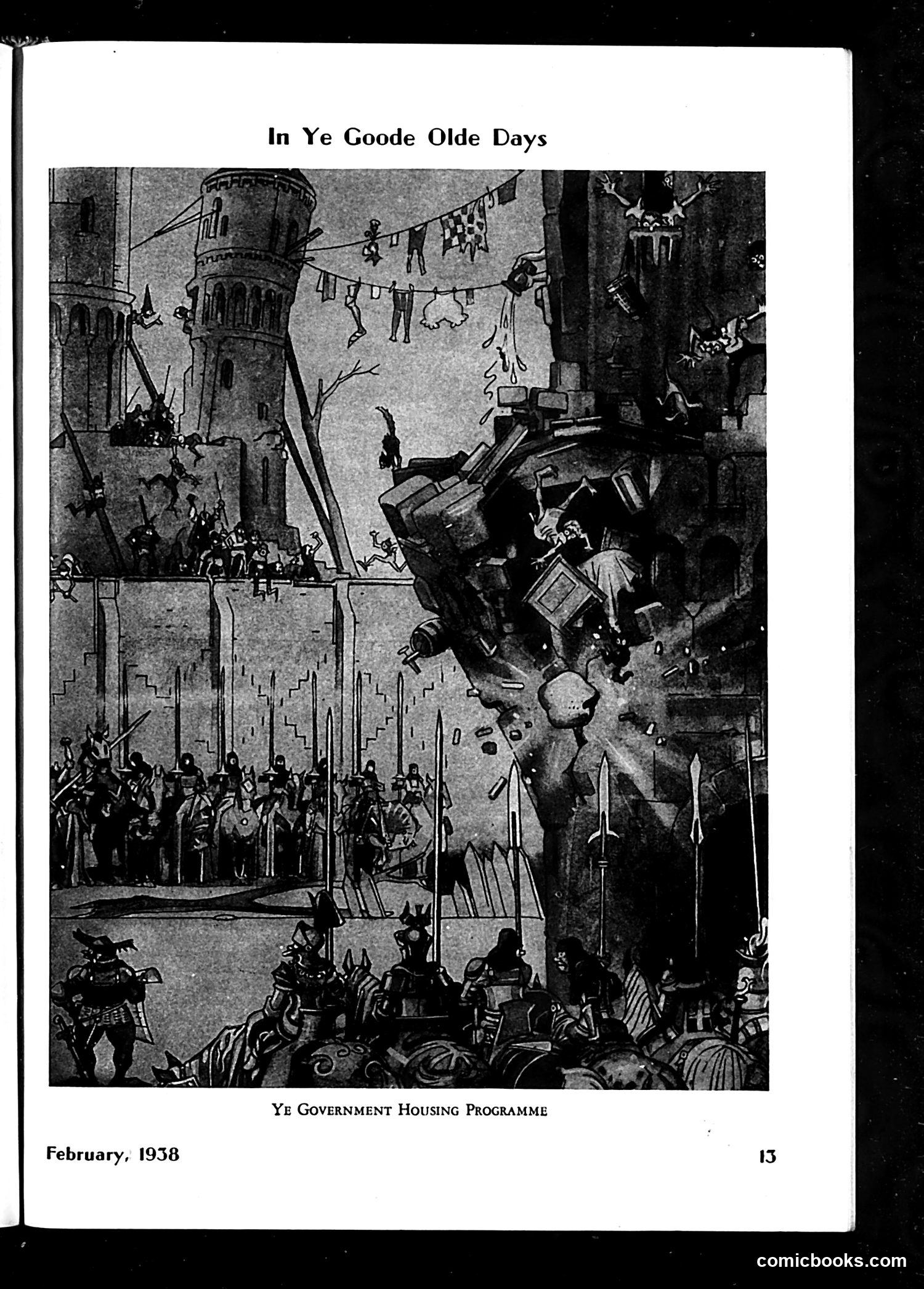
"In Ye Goode Olde Days" - Government Housing Programme (February 1938) This satirical cartoon mocks the government's housing program by contrasting it with medieval siege warfare. The image depicts a chaotic castle scene with soldiers attacking fortifications while civilians observe from above—a visual metaphor suggesting the housing initiative was as destructive and disorganized as medieval conflict. The satire likely critiques the New Deal's housing efforts under the Roosevelt administration, implying that government intervention in housing creates chaos rather than solutions. By framing modern housing policy through "olde days" imagery, the cartoonist suggests the approach is antiquated or barbaric. The date (1938) places this during ongoing Depression-era debates about the effectiveness and wisdom of federal housing programs, which remained controversial among conservatives skeptical of government intervention in markets.
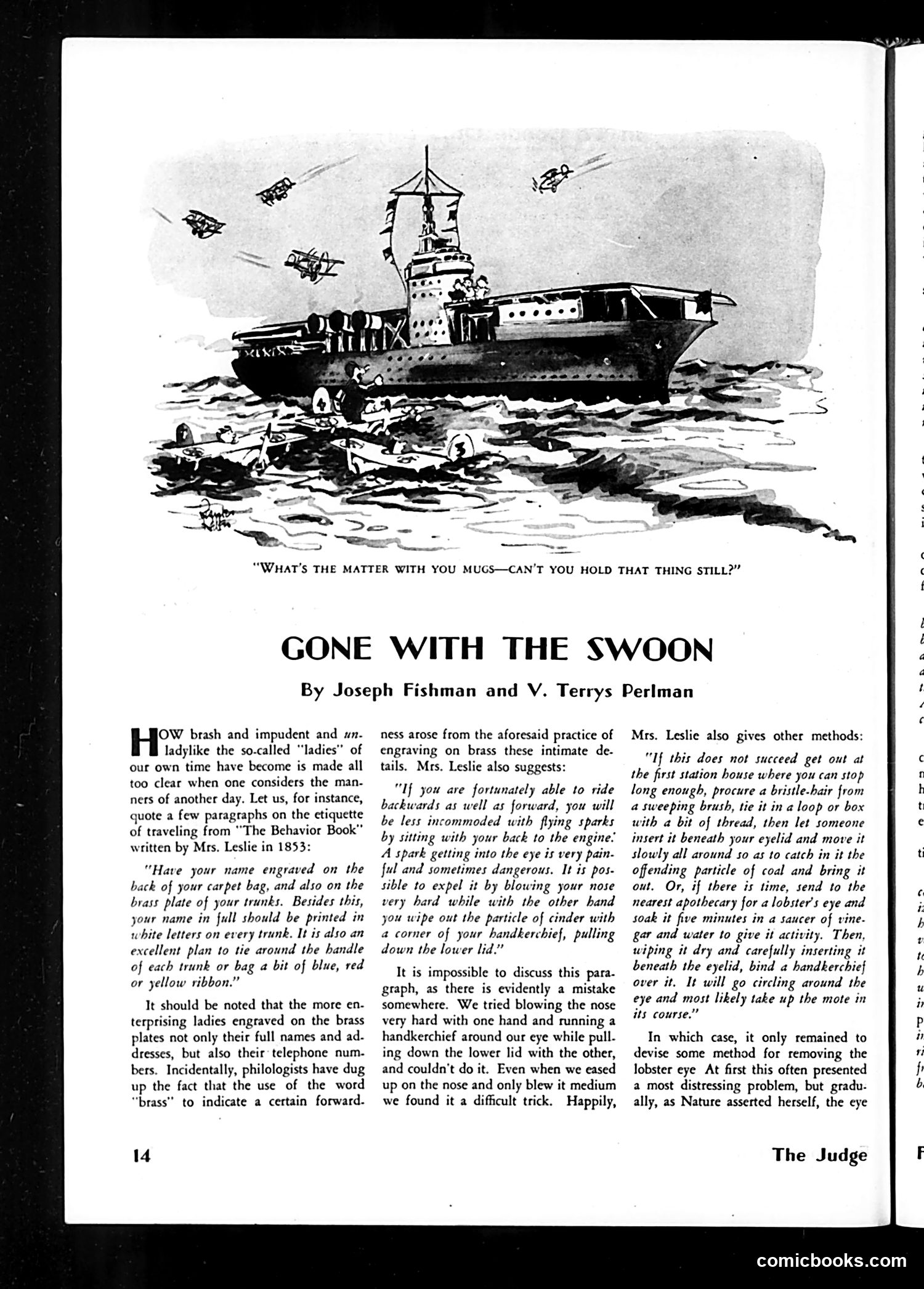
Analysis This page satirizes outdated Victorian-era travel etiquette. The cartoon depicts a military or naval vessel being tossed in rough seas, with the caption mocking passengers trying to stay still—a humorous setup for the article's real target. "Gone with the Swoon" mocks an 1853 etiquette guide by Mrs. Leslie that advised ladies on proper train travel. The authors highlight absurdly impractical advice, particularly the instruction for removing cinders from eyes using contortionist hand maneuvers, a bristle loop inserted under the eyelid, or—most ridiculously—a *lobster's eye* soaked in vinegar and inserted as a replacement. The satire works by letting Mrs. Leslie's genuine advice speak for itself: the authors note they physically attempted her nose-blowing technique and found it impossible, then present the escalating absurdities of Victorian "solutions" without editorializing. The humor targets how backward and fussy earlier generations' standards appear to modern (1920s-era) readers.
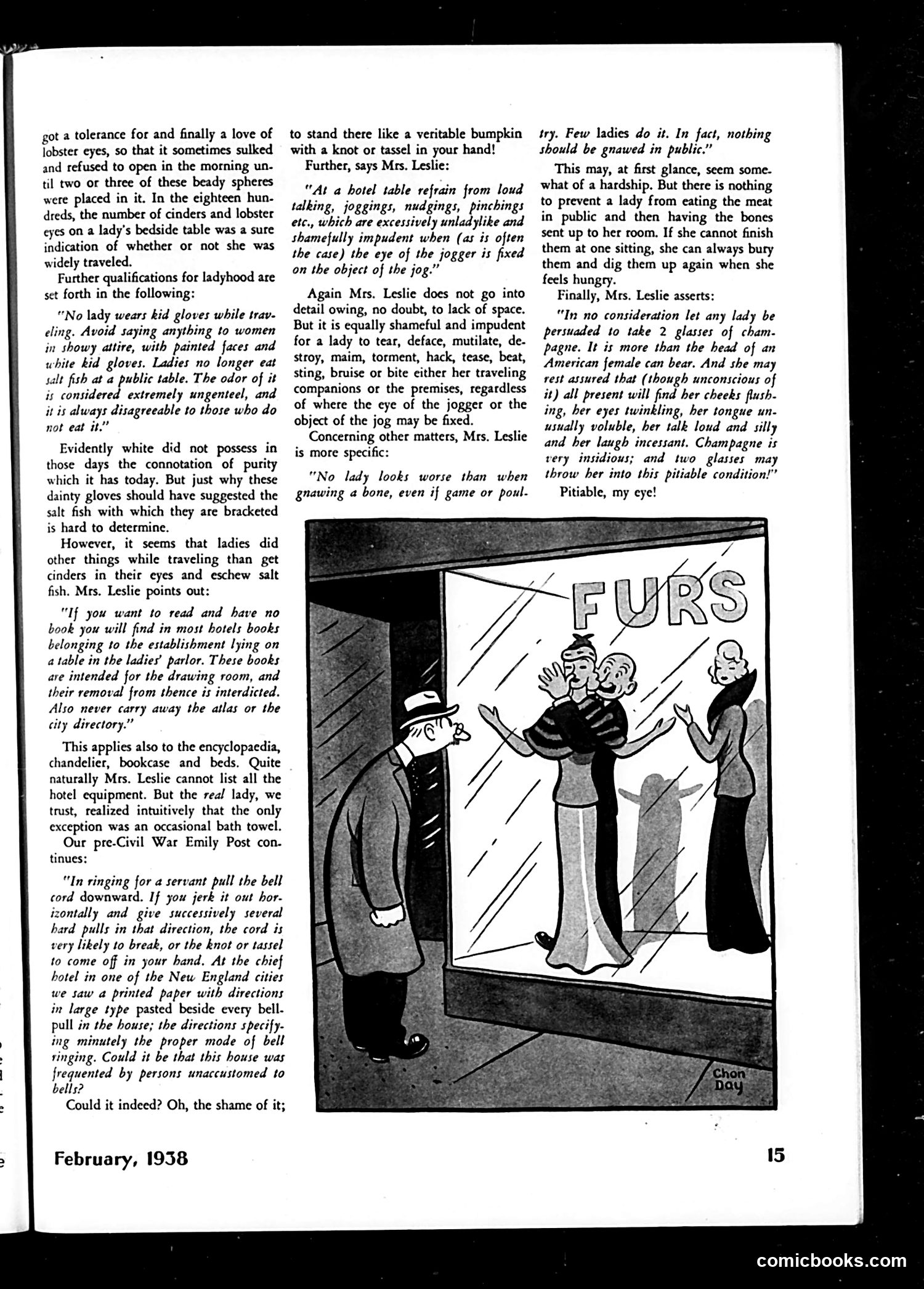
Judge Magazine Cartoon Analysis (February 1938) This page satirizes outdated Victorian etiquette rules through excerpts from "Mrs. Leslie's" 19th-century advice manual. The cartoon depicts a fur store scene where a woman appears shocked or scandalized by something—likely the price or behavior of other customers. The text mocks absurdly specific gentility rules: ladies shouldn't wear white kid gloves while traveling, shouldn't eat salt fish publicly, must pull bell cords downward (not horizontally), shouldn't gnaw bones in public, and shouldn't drink more than one glass of champagne. Mrs. Leslie even warns against stealing hotel property like atlases and chandeliers. By 1938, these rigid Victorian standards seem ridiculous to modern readers. The satire targets both the paranoia of old etiquette guides (detailed bell-ringing instructions!) and the anxiety-inducing nature of arbitrary social rules designed to police women's behavior and appearance. The fur store cartoon likely continues this theme of mocking overwrought propriety concerns.
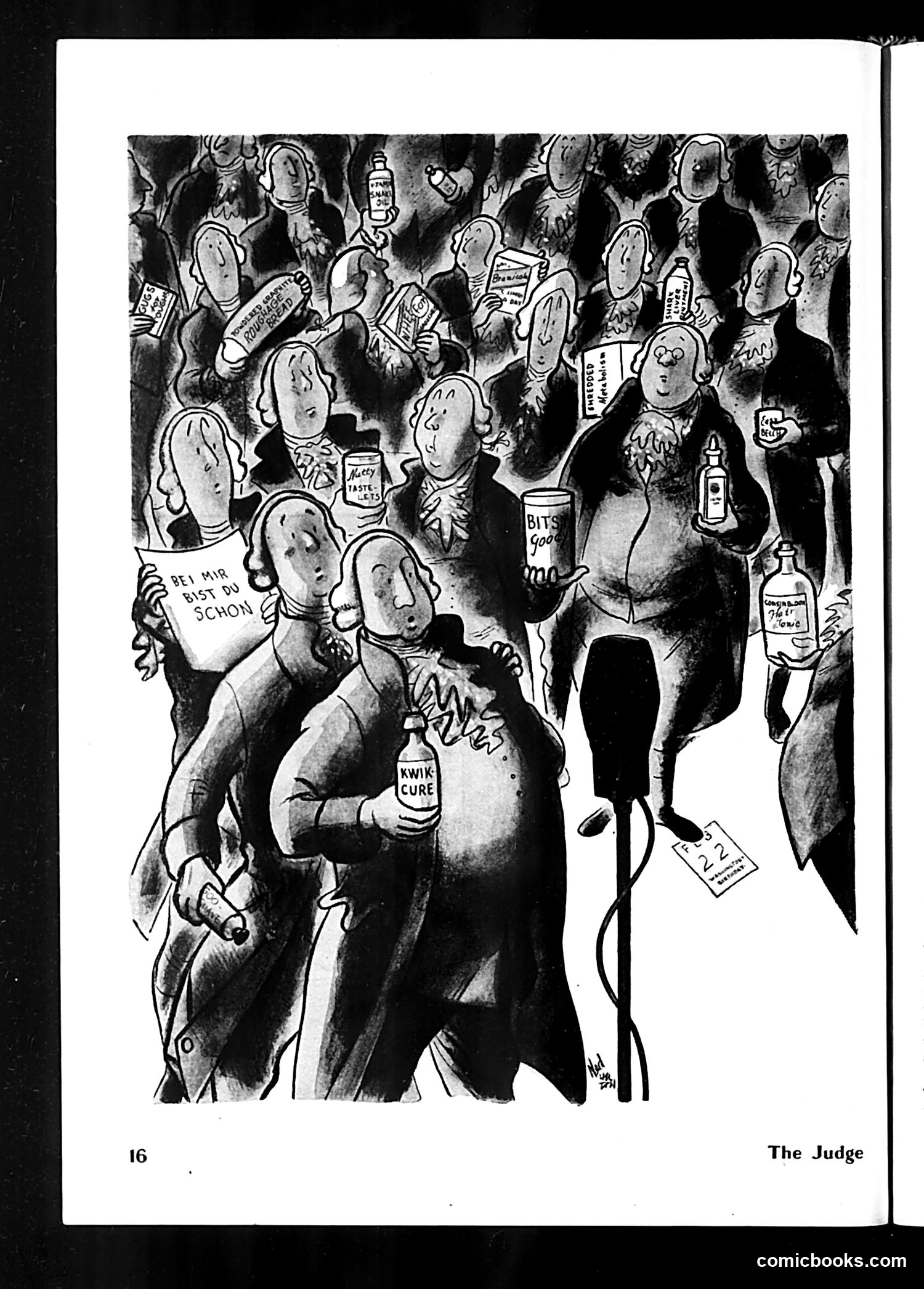
Analysis of Judge Magazine Cartoon (Page 16) This satirical cartoon depicts a crowded scene of people holding various patent medicines and tonics—visible labels include "KWIK CURE," "BITS GOOD," and other bottles. The figures appear caricatured, some with exaggerated features suggesting ethnic stereotyping common to the era. The satire targets the widespread "patent medicine" industry and consumer gullibility. During this period (likely early-to-mid 20th century), unregulated patent medicines made extravagant false health claims. The densely packed crowd suggests mass consumption of these fraudulent products. Text visible includes "BEI MIR BIST DU SCHON" (a Yiddish phrase), possibly indicating ethnic commentary alongside the medical quackery critique. The cartoon mocks both the predatory medicine industry and public desperation for quick remedies.
"Judge on the Bench" - February 1938 This satirical column mocks 1930s American anxieties by praising "professional worriers" as a skilled craft—while subtly critiquing New Deal-era labor leadership and political hand-wringing. The main targets appear to be John L. Lewis (C.I.O. leader) and William E. Green (A.F.L. president). The satire highlights their lavish union headquarters—Lewis's $300,000 office with private elevator, Green's seven-floor building with 100 employees—contrasting labor leaders' comfortable establishments with the working-class concerns they claim to represent. The piece suggests Americans worry excessively about abstract threats (Communism, dictatorship, economic collapse) without addressing concrete problems. By praising "good worriers," the author implies such worry is performative rather than productive. The implicit political point: Depression-era labor bureaucrats and politicians waste energy on rhetoric while entrenching themselves in power and comfort.
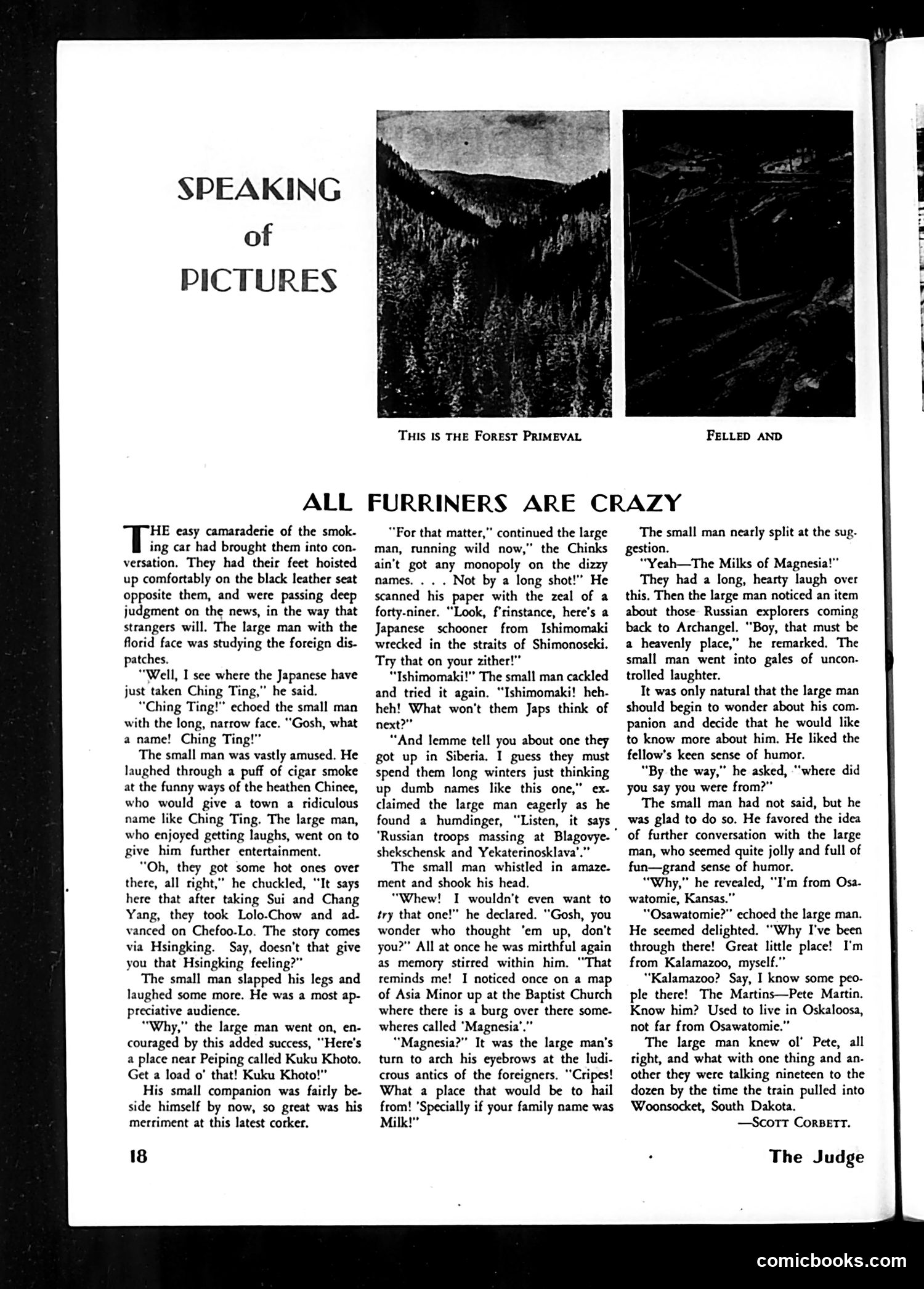
Analysis of "All Furriners Are Crazy" This satirical story by Scott Corbett ridicules American provincialism and casual racism. Two men on a train bond over mocking foreign place names—Chinese towns (Ching Ting, Chefoo-Lo), Japanese cities (Ishimomaki, Shimonoseki), and Russian settlements (Blagovyeshchensk)—finding them absurdly funny simply because they sound unfamiliar. The joke's twist: the large man, amused by "exotic" foreign nomenclature, learns his new friend is from Osawatomie—itself an unusual American name. This reveals the men's hypocrisy; they've been laughing at foreigners for having "crazy" names while possessing equally peculiar ones themselves. The satire exposes how Americans of this era casually dismissed foreign cultures as ridiculous, unaware that their own place names (particularly those of Native American origin) were equally strange to outsiders. It's a critique of parochial attitudes and unconscious cultural superiority.
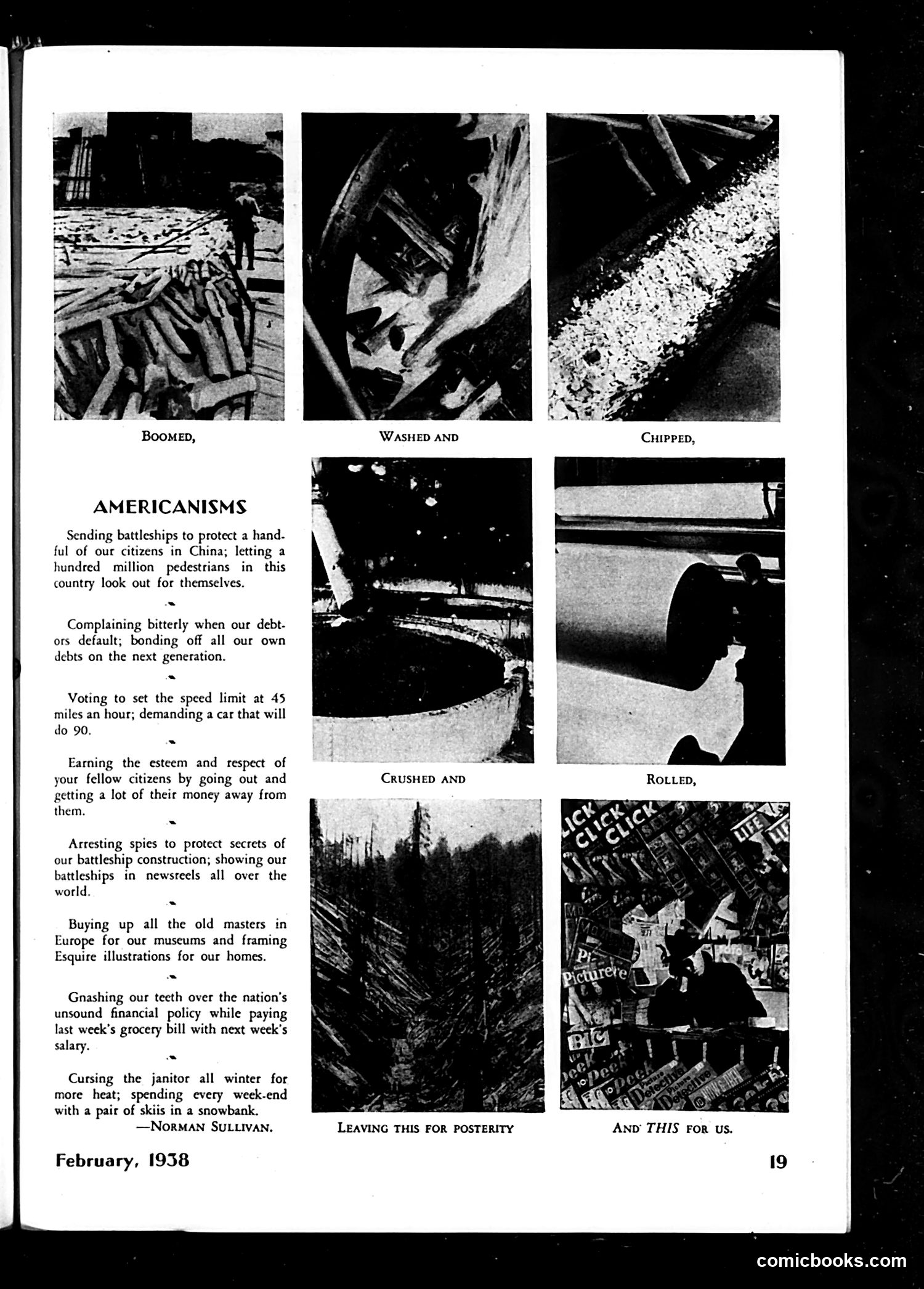
Americanisms Satire (February 1938) This page presents Norman Sullivan's satirical list of American hypocrisies and contradictions. The six photographs at top—labeled "Boomed, Washed and Chipped, Crushed and Rolled"—appear to show deteriorating or damaged metal/industrial objects, likely representing American infrastructure. Sullivan's text skewers American inconsistencies: protecting citizens abroad while ignoring domestic safety; complaining about national debt while personally living beyond means; setting speed limits at 45 mph while demanding 90 mph cars; arresting spies while publicly displaying military secrets in newsreels; collecting European art while framing commercial magazine illustrations. The final paired images—"Leaving this for posterity" (appears to show forest/natural landscape) and "And this for us" (shows urban commercial district)—visualize the core irony: America is preserving Europe's cultural heritage while allowing its own natural resources to deteriorate and prioritizing commercial consumption over environmental stewardship. The satire critiques American moral inconsistency and short-sighted priorities in 1938 pre-WWII America.
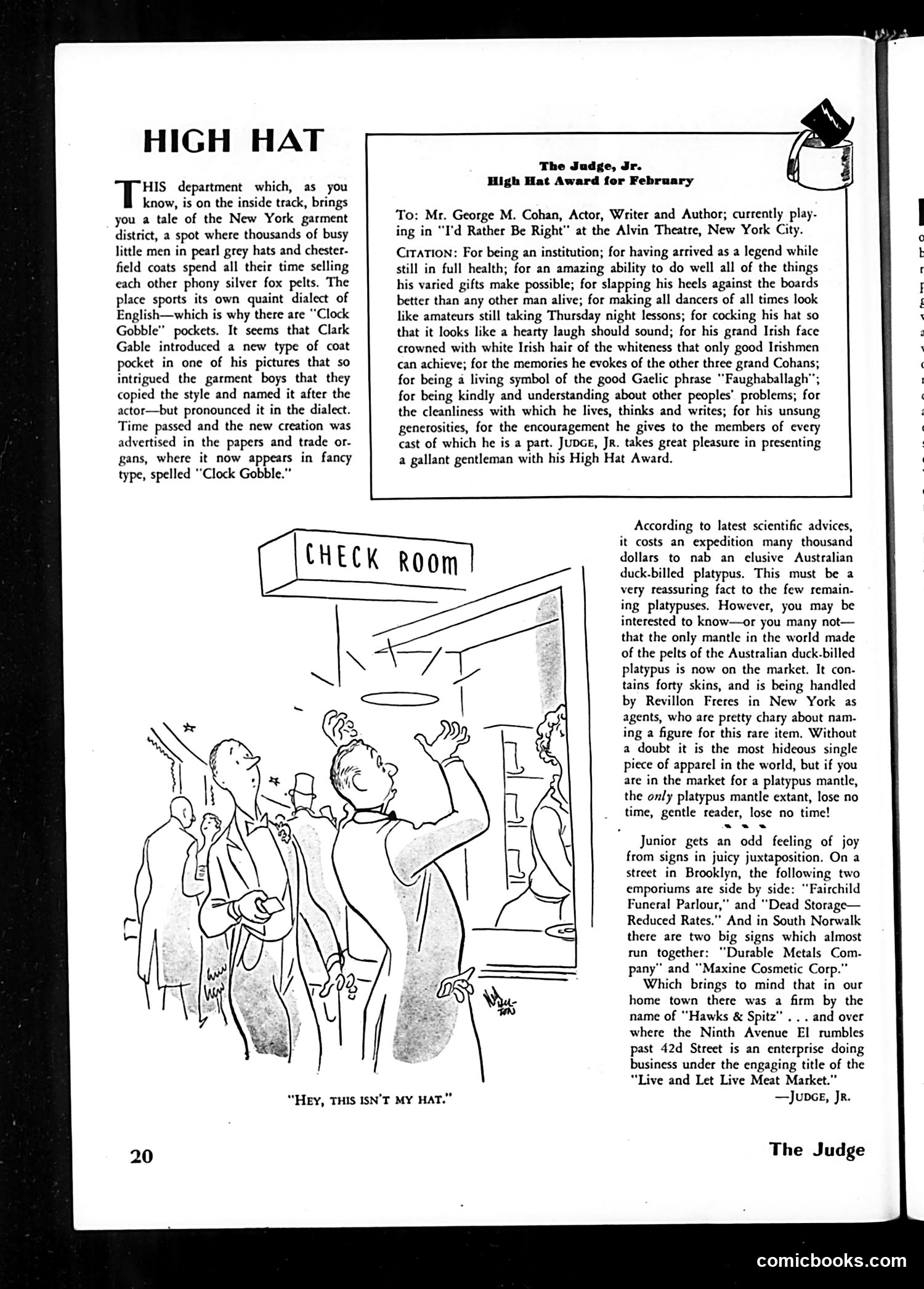
Explanation for Modern Readers This page contains two distinct pieces: "High Hat" Column: A humorous account of New York's garment district slang, explaining how "Clock Gobble" pockets got their name—garment workers copied a pocket style from a Clark Gable film and mispronounced it in their dialect. The piece satirizes the insular world of fashion industry workers dealing in furs and their distinctive manner of speech. The Cartoon: Depicts a check room scene where a well-dressed man angrily confronts an attendant with "Hey, this isn't my hat"—a straightforward joke about mistaken hat identity in a crowded coat check, playing on the era's custom of formal hat-wearing. "High Hat Award": Honors George M. Cohan (famous Irish-American actor/dancer) for his theatrical contributions and character. The award itself celebrates excellence in entertainment. The page reflects 1930s-40s urban American culture, professional formality (ubiquitous hat-wearing), and the magazine's gossipy, insider tone about New York life.
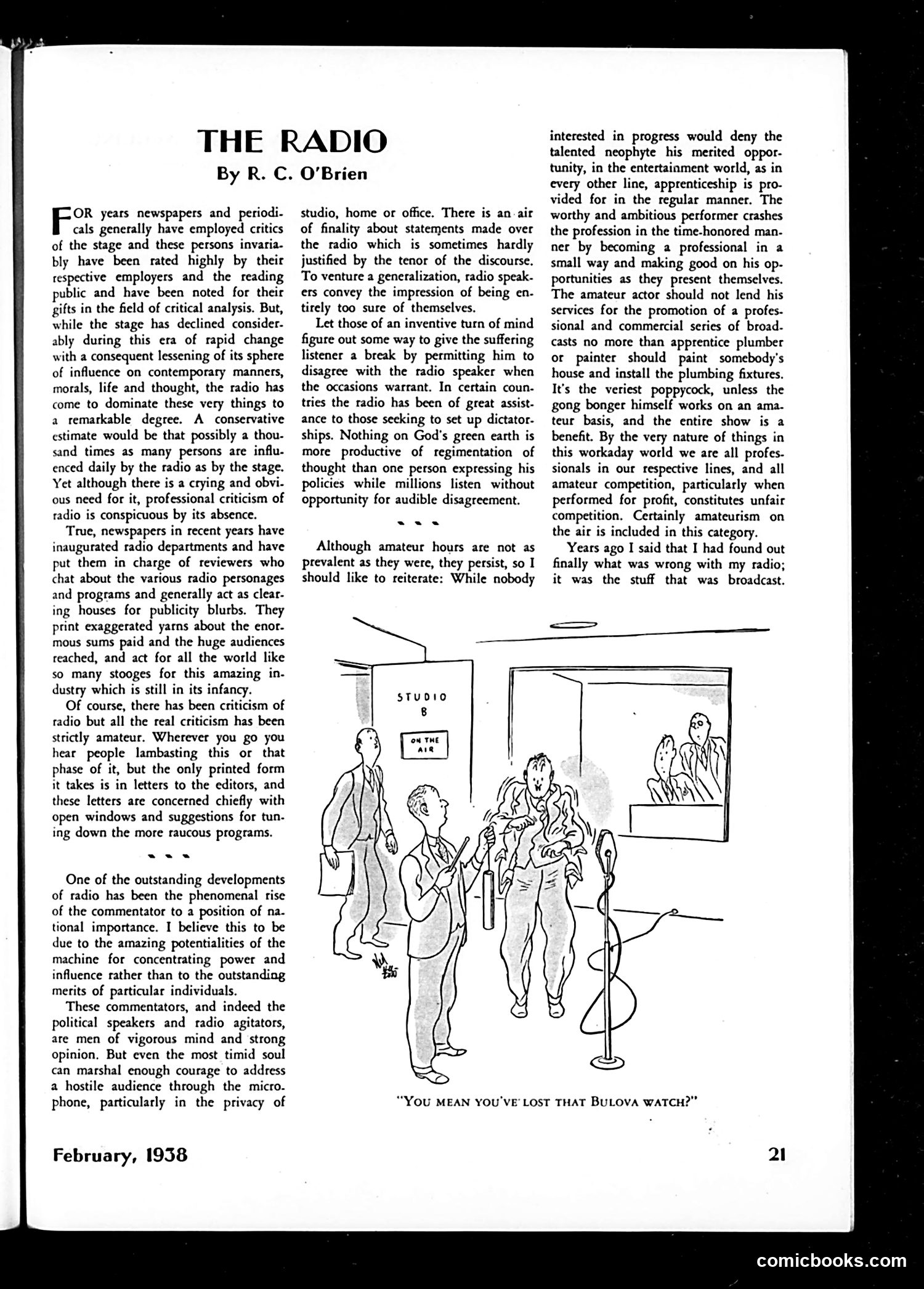
"The Radio" by R.C. O'Brien (February 1938) This article critiques radio's growing cultural influence and lack of professional criticism. O'Brien argues that while newspapers employ theater critics, radio—which influences far more people—has no equivalent serious analysis. Instead, newspapers run publicity departments staffed with uncritical reviewers. The cartoon illustrates the article's complaint about radio's authority problem. It depicts a studio scene where a radio broadcaster speaks to an unseen audience while studio observers listen. The caption—"You mean you've lost that Bulova watch?"—references Bulova, a major radio advertiser of the era, and suggests the absurdity of listeners passively accepting whatever broadcasters say without opportunity for disagreement. O'Brien's broader concern: radio commentators present opinions "as if" they're final truth, and this one-way communication medium poses dangers for authoritarian manipulation—a prescient worry in 1938, given radio's role in fascist propaganda.
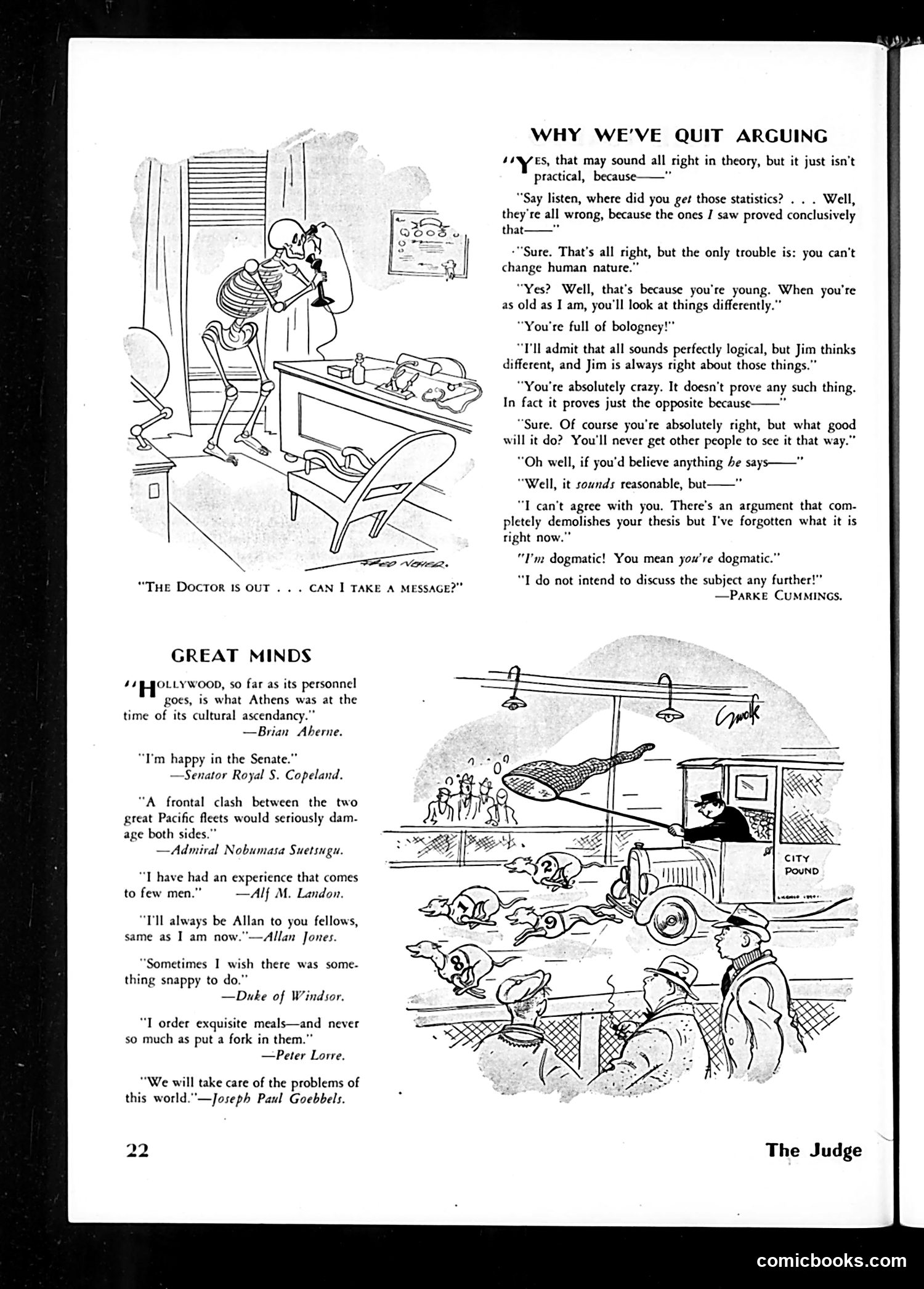
Analysis: Judge Magazine Page Top Cartoon ("Why We've Quit Arguing"): A skeleton representing Death sits with a patient, illustrating marital or domestic argument. The dialogue parodies how couples endlessly debate without resolution—each party dismisses the other's logic through circular reasoning ("you're young," "Jim's always right," "I forgot my argument"). The joke: people don't argue to reach truth; they argue from stubbornness, making productive debate impossible. Attribution to Parker Cummings (artist/writer). "Great Minds" Section: A satirical collection of quotes from prominent 1930s figures (Senator Copeland, Admiral Suetsugu, Alf Landon, Allan Jones, Duke of Windsor, Peter Lorre, Joseph Paul Goebbels). The accompanying illustration shows a city pound with animals—likely mocking these statements as vapid or absurd. The satire suggests these public figures' pronouncements are meaningless platitudes, likening their wisdom to the confused noise of a pound full of animals.
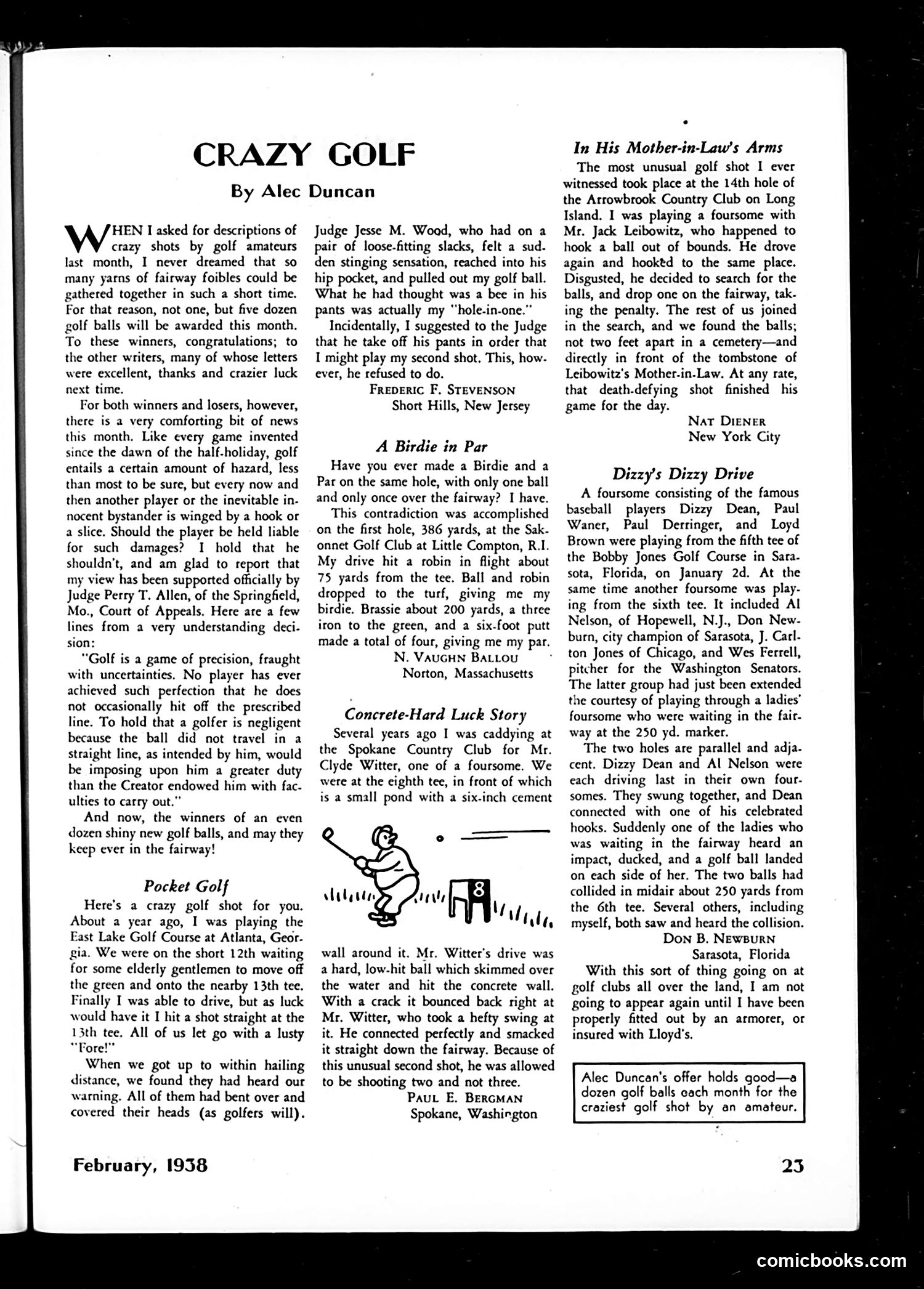
CRAZY GOLF: A 1938 Magazine Feature on Golf Mishaps This page from *Judge* magazine (February 1938) is not a political cartoon but rather a humorous editorial feature about absurd golf incidents. Content: Alec Duncan solicited readers' stories about ridiculous golf shots and mishaps. The page presents several such anecdotes—a judge struck in the rear pocket by a stray ball, a golfer who hit a robin (scoring both "birdie" and "par"), and a player whose drive bounced off a concrete wall back toward him. The Point: The feature celebrates golf's inherent chaos and unpredictability. Duncan notes that a court ruled golfers cannot be held liable for errant shots, since even expert players cannot control perfect precision. The humor relies on the unexpected consequences of golf's inherent dangers—the sport's "hazards" aren't just bunkers and water, but bystanders and wildlife. Relevance: This reflects 1930s leisure culture and the popularity of golf as an accessible sport (note "half-holiday" reference). The tone is lighthearted rather than satirical—celebrating golf's capacity for comedic disaster.
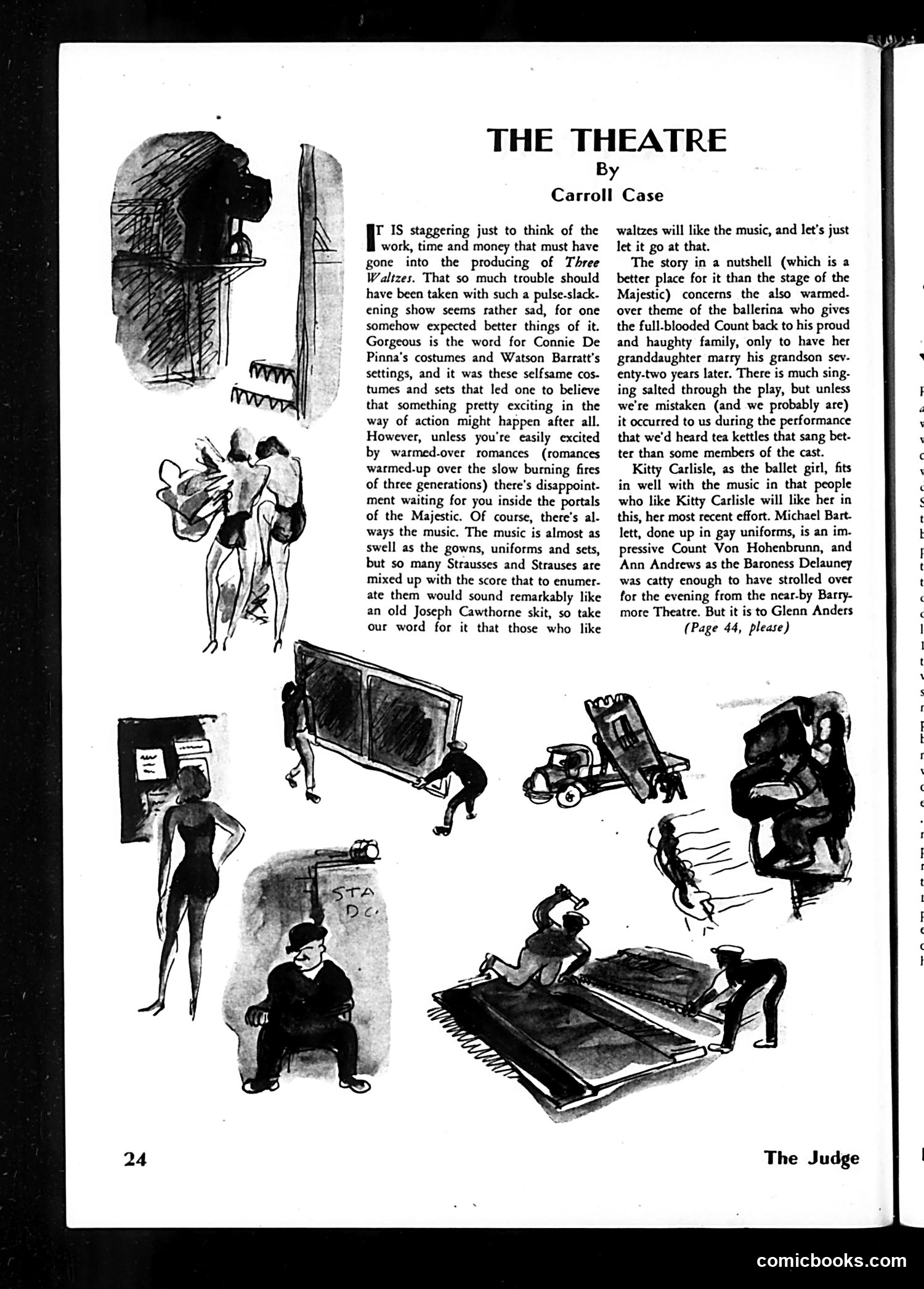
"The Theatre" Review in Judge Magazine Carroll Case reviews the Broadway production of *Three Waltzes* at the Majestic Theatre. The critic's verdict is harshly dismissive: while praising the costumes by Connie De Pinna and sets by Watson Barratt, Case condemns the plot as tired romantic recycling—a century-old story about a ballerina sacrificing love, repeated across generations. Case mocks the Strauss-heavy score and the cast's vocal abilities (unfavorably comparing them to "tea kettles"). Specific performers mentioned include Kitty Carlisle as the ballet girl and Michael Bartlett as Count Von Hohenbrunn. The review suggests the production relied entirely on spectacle rather than substance—gorgeous visuals masking an exhausted narrative. This is typical Judge theatre criticism: witty, dismissive satire targeting Broadway's commercial formulas and overwrought operettas popular in the era.
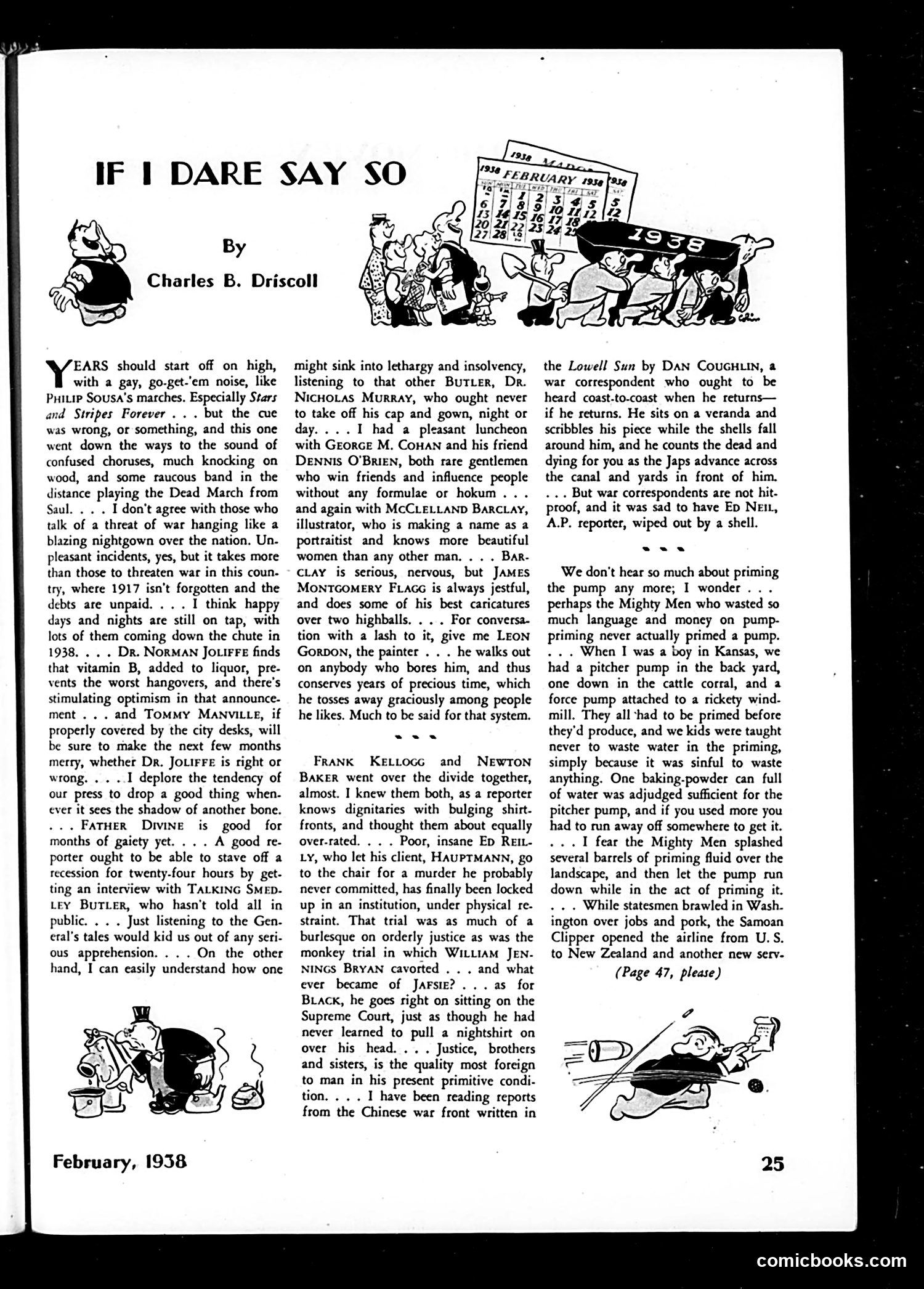
"If I Dare Say So" by Charles B. Driscoll, February 1938 This is a satirical column mixing gossip about public figures with commentary on contemporary anxieties. Driscoll references several notable personalities: Philip Sousa (composer), Tommy Manville (wealthy socialite known for multiple marriages), Father Divine (religious cult leader), and illustrators McClelland Barclay and James Montgomery Flagg. The column touches on serious matters—war anxieties ("a threat of war hanging like a blazing nightgown"), the Hauptmann trial (the Lindbergh kidnapping case), and the Scopes "monkey trial" (evolution debate)—while gossiping about artists, lawyers, and public figures. Driscoll expresses skepticism about justice and social order while simultaneously downplaying war fears. The tone is characteristic of 1930s magazine satire: cynical about institutions but frivolous about grave topics, mixing celebrity chatter with political commentary in ways that would seem tone-deaf today, given the historical moment (Nazi Germany's rise, impending WWII).
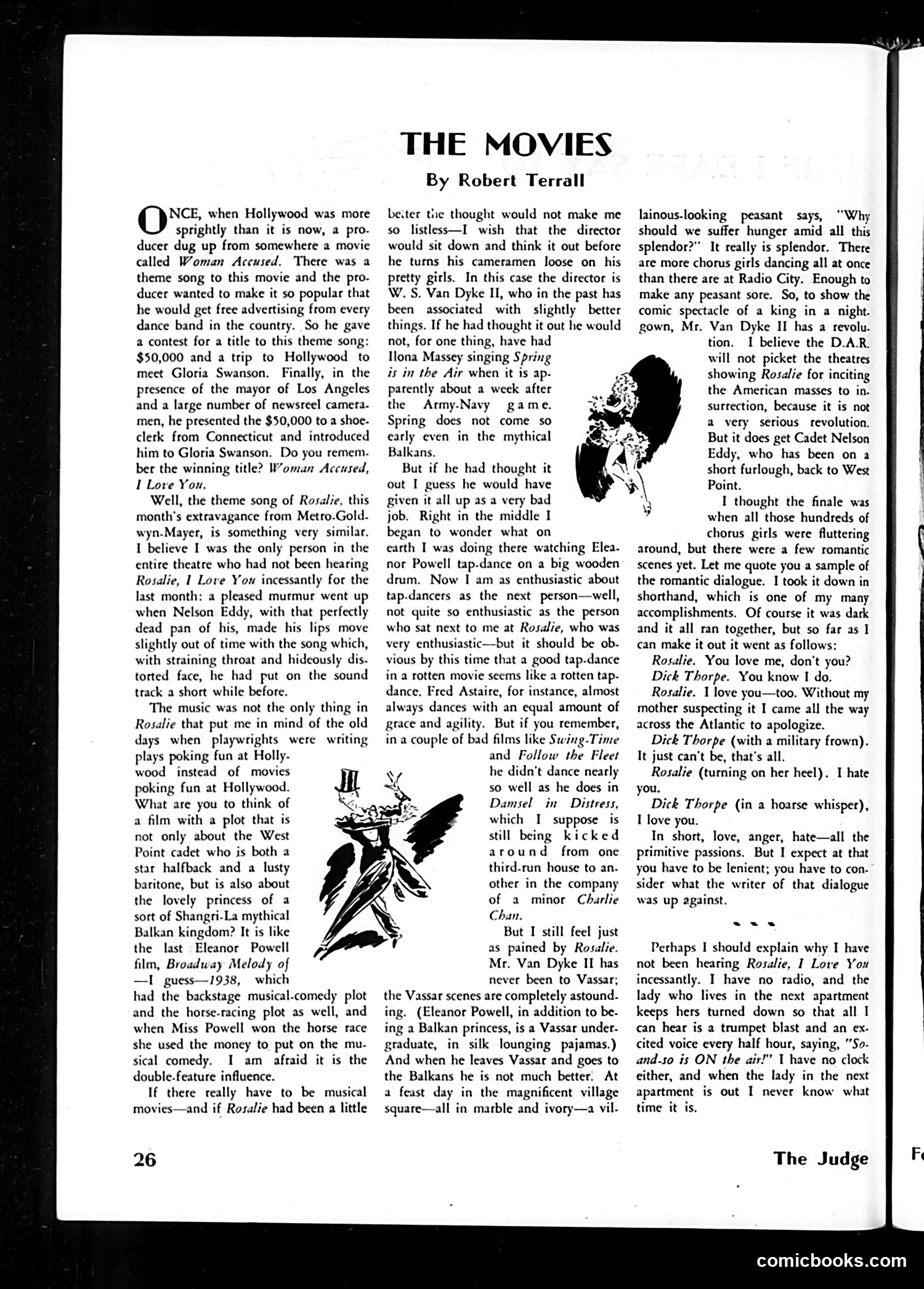
"The Movies" by Robert Terrall — Judge Magazine This is a film review column critiquing *Rosalie*, a 1937 Metro-Goldwyn-Mayer musical starring Nelson Eddy and Eleanor Powell. Terrall satirizes Hollywood's formulaic approach to musicals, particularly director W.S. Van Dyke II's lazy plotting. The main joke: *Rosalie* combines absurdly incompatible plot elements—a West Point cadet/singer AND a princess from a fictional Balkan kingdom—simply stringing together musical numbers without coherent storytelling. Terrall compares this to earlier "double-feature" films that randomly mixed unrelated plots (like *Broadway Melody of 1938*, which added both horse-racing and musical-comedy subplots). The cartoon appears to show a dancer, likely referencing Powell's famous tap-dancing sequences that Terrall argues seem wasted in poorly-constructed films. The satire's point: Hollywood prioritizes big musical numbers and star talent over actual screenplay logic, producing bloated, incoherent entertainment—a common 1930s complaint about the studio system's excess.
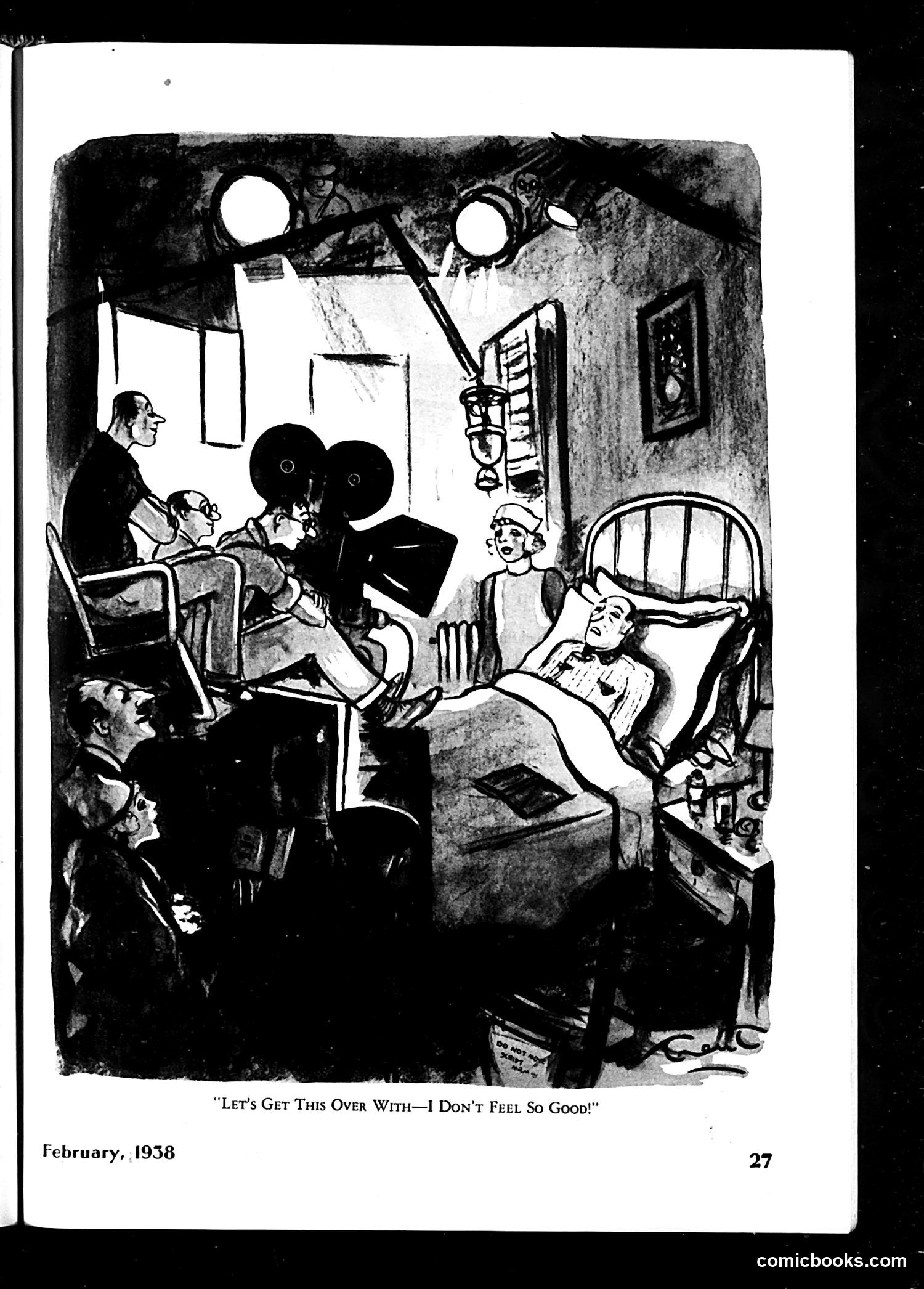
Analysis of Judge Magazine Cartoon, February 1938 This cartoon depicts a film production scene, likely satirizing Hollywood moviemaking during the Great Depression era. The scene shows a movie set with large studio lights overhead, a patient in a hospital bed, and various crew members and observers. The caption—"Let's Get This Over With—I Don't Feel So Good!"—suggests dark humor about either the ordeal of film production itself or, more likely, commentary on the quality or subject matter of contemporary films. The figure in the bed appears genuinely distressed, while the crew treats the situation as routine business. The satire likely critiques the callous, profit-driven nature of the film industry, or possibly mocks specific films dealing with illness or melodramatic hospital scenes that were popular in 1938. The cartoon reflects Depression-era skepticism toward Hollywood's entertainment priorities.
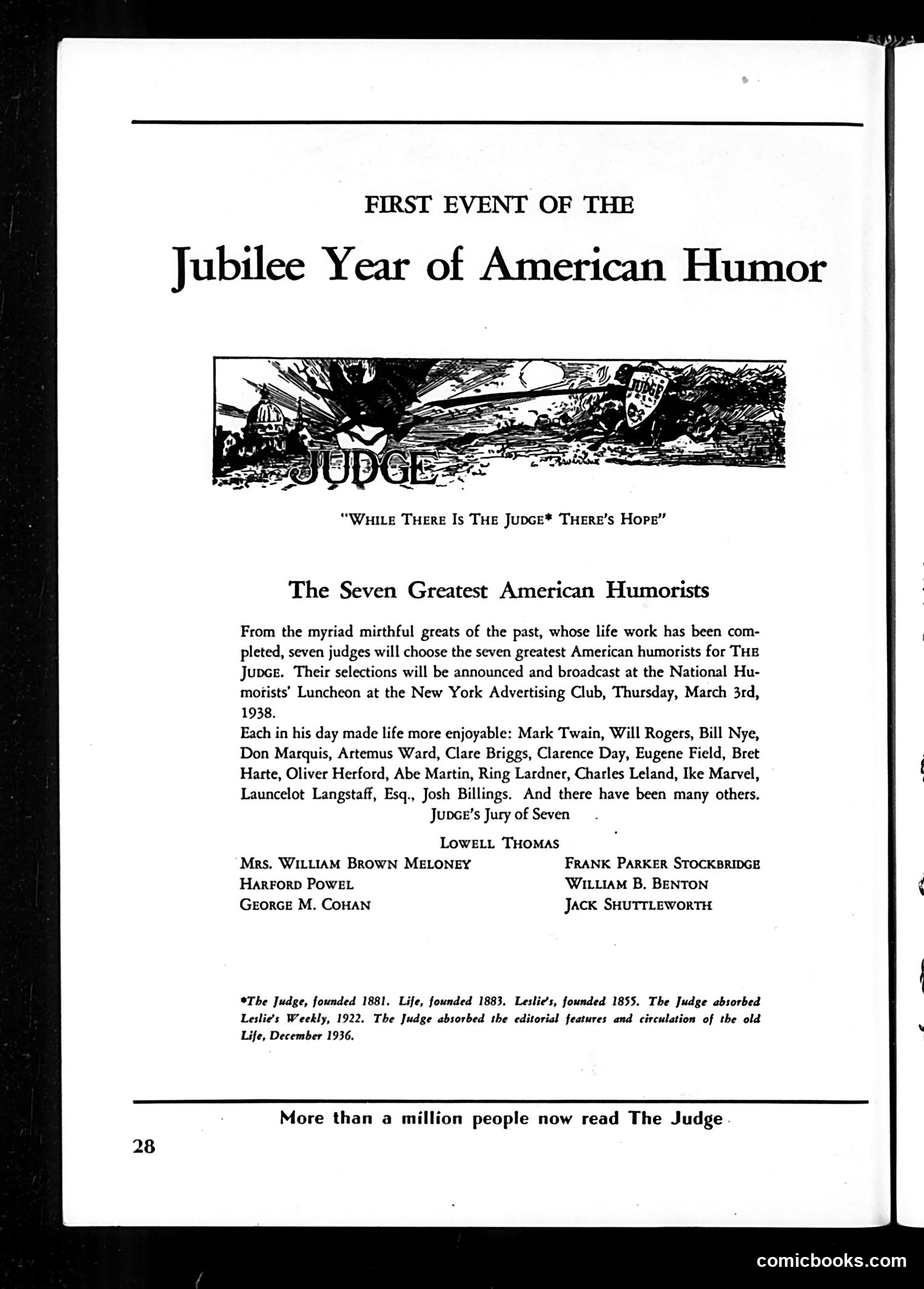
Page Analysis: Judge Magazine's "Jubilee Year of American Humor" This is primarily a title page/announcement, not a cartoon. It promotes Judge magazine's inaugural event: selecting "The Seven Greatest American Humorists" for announcement at a March 3, 1938 luncheon in New York. The page lists deceased humorists being considered (Mark Twain, Will Rogers, Ring Lardner, etc.) and names the seven judges who will make selections, including George M. Cohan (entertainer), Lowell Thomas (radio personality), and William B. Benton (publisher). A small illustration labeled "JUDGE" appears—likely the magazine's mascot or logo—but the content is essentially promotional advertising for Judge's prestige as a humor publication. The footer notes Judge absorbed *Life* magazine in 1936, emphasizing its consolidated influence: over a million readers. This represents Judge celebrating American humor's legacy while asserting its own cultural authority as arbiter of comedic taste.
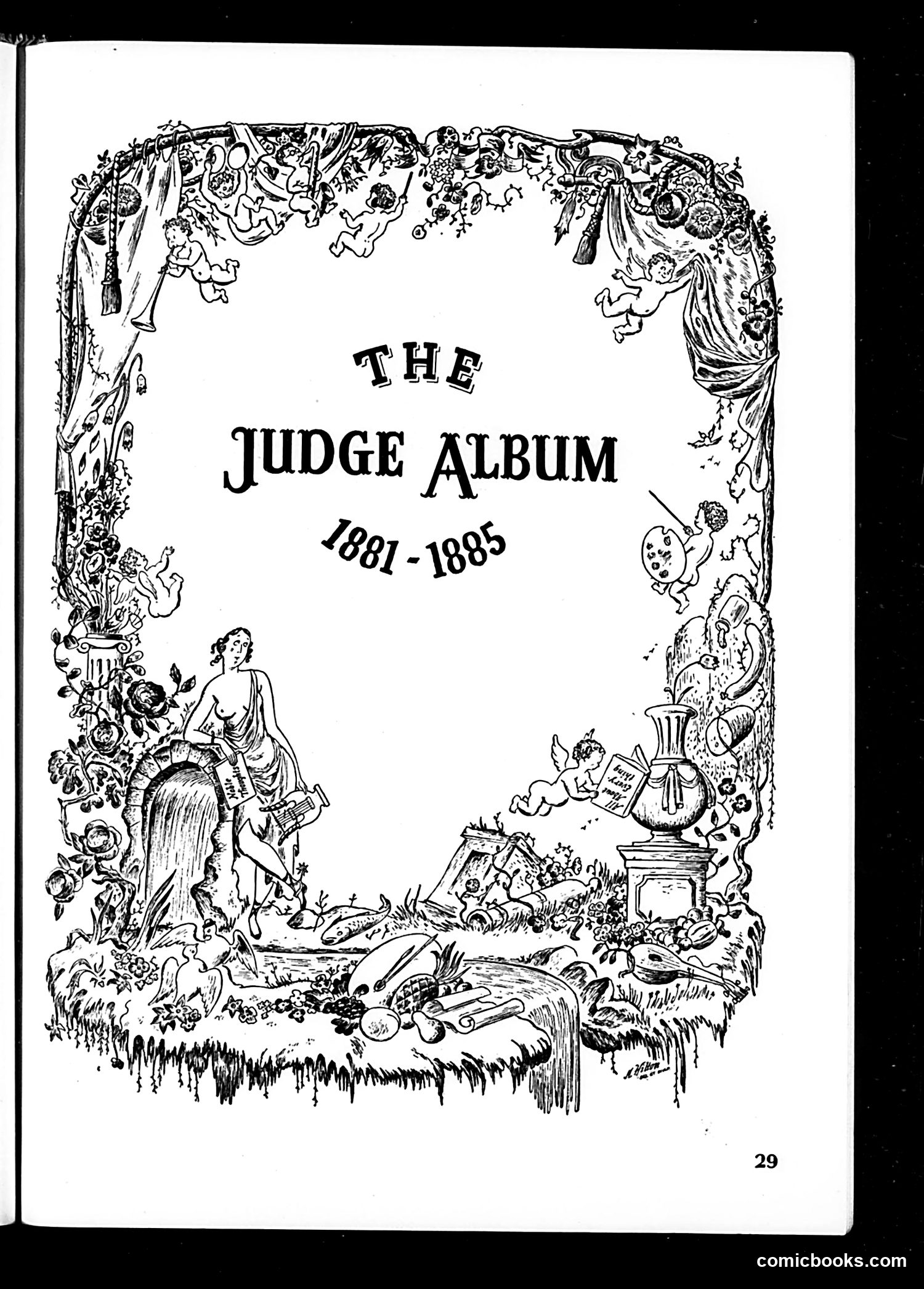
The Judge Album Title Page (1881-1885) This is a title page for a compilation volume of *Judge* magazine, covering 1881-1885. The ornate decorative border is characteristic of Victorian-era design, featuring classical allegorical figures (including what appears to be a muse or personification of justice/wisdom on the left), cherubs, artistic implements, theatrical masks, and various ornamental flourishes. The page itself contains no specific political cartoon or satirical content—it's simply the formal cover identifying the collection. To understand the actual satirical commentary from this period, one would need to examine the interior pages, which would contain Judge's cartoons addressing the political, social, and cultural issues of the early 1880s American Gilded Age.
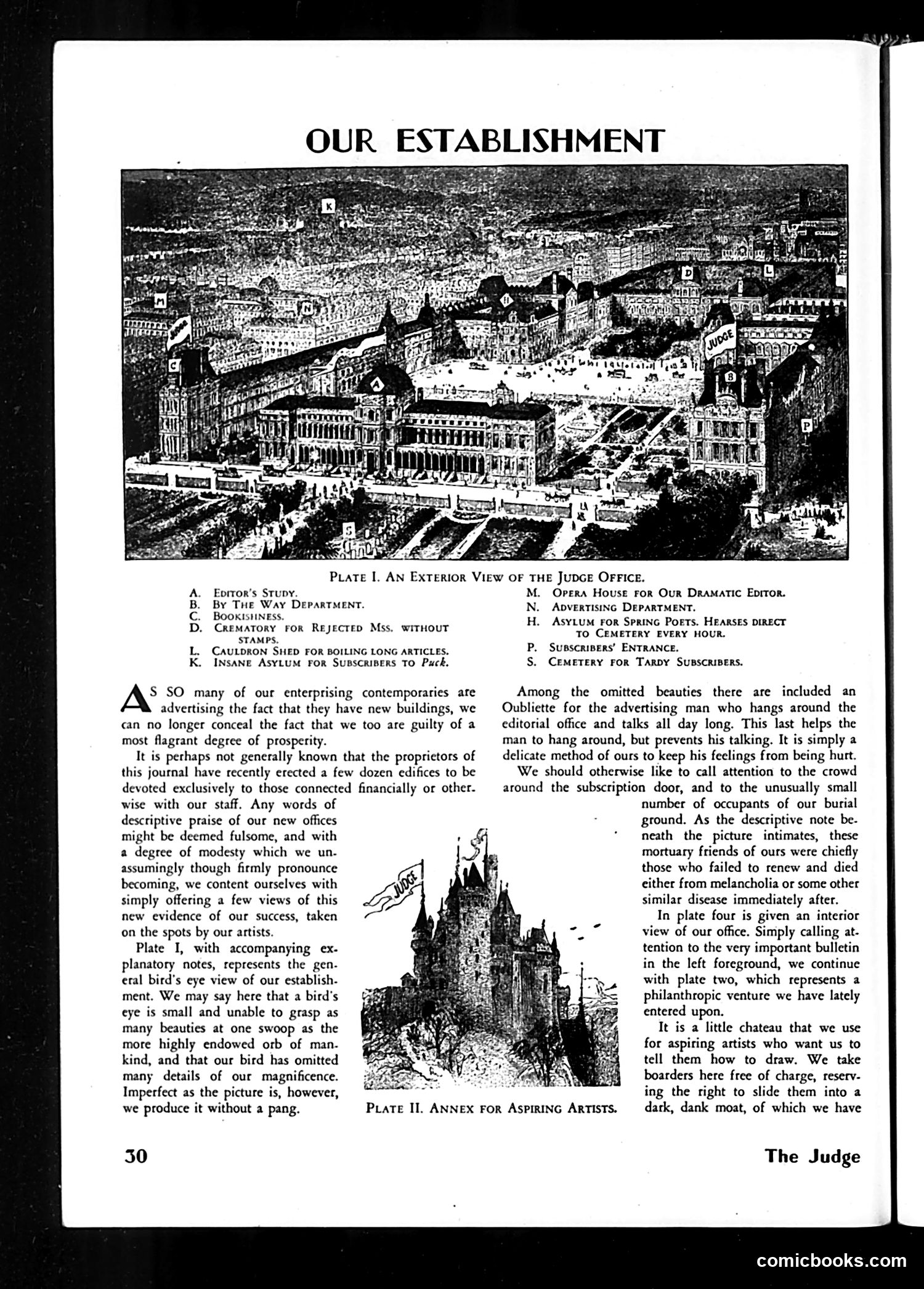
Explanation for Modern Readers This is a self-promotional satire by *The Judge* magazine (a competitor to *Puck*) mocking other publications' boasts about new buildings. The magazine humorously claims to have erected multiple structures for staff, then describes them with exaggerated, darkly comic purposes: - A crematory for rejected manuscripts - An insane asylum for *Puck* subscribers (a rival magazine) - An oubliette (medieval dungeon) for annoying advertising salesmen - A cemetery for subscribers who failed to renew - An "annex" that takes in aspiring artists as boarders, threatening to dump them in a "dark, dank moat" The satire works through absurdist hyperbole—presenting the magazine's fictional prosperity while simultaneously mocking its competitors and its own difficult business (rejected submissions, subscription problems). The dark humor about dead subscribers and trapped artists was typical of *Judge*'s irreverent style. This is essentially an inside-industry joke about magazine publishing struggles disguised as boastful self-promotion.
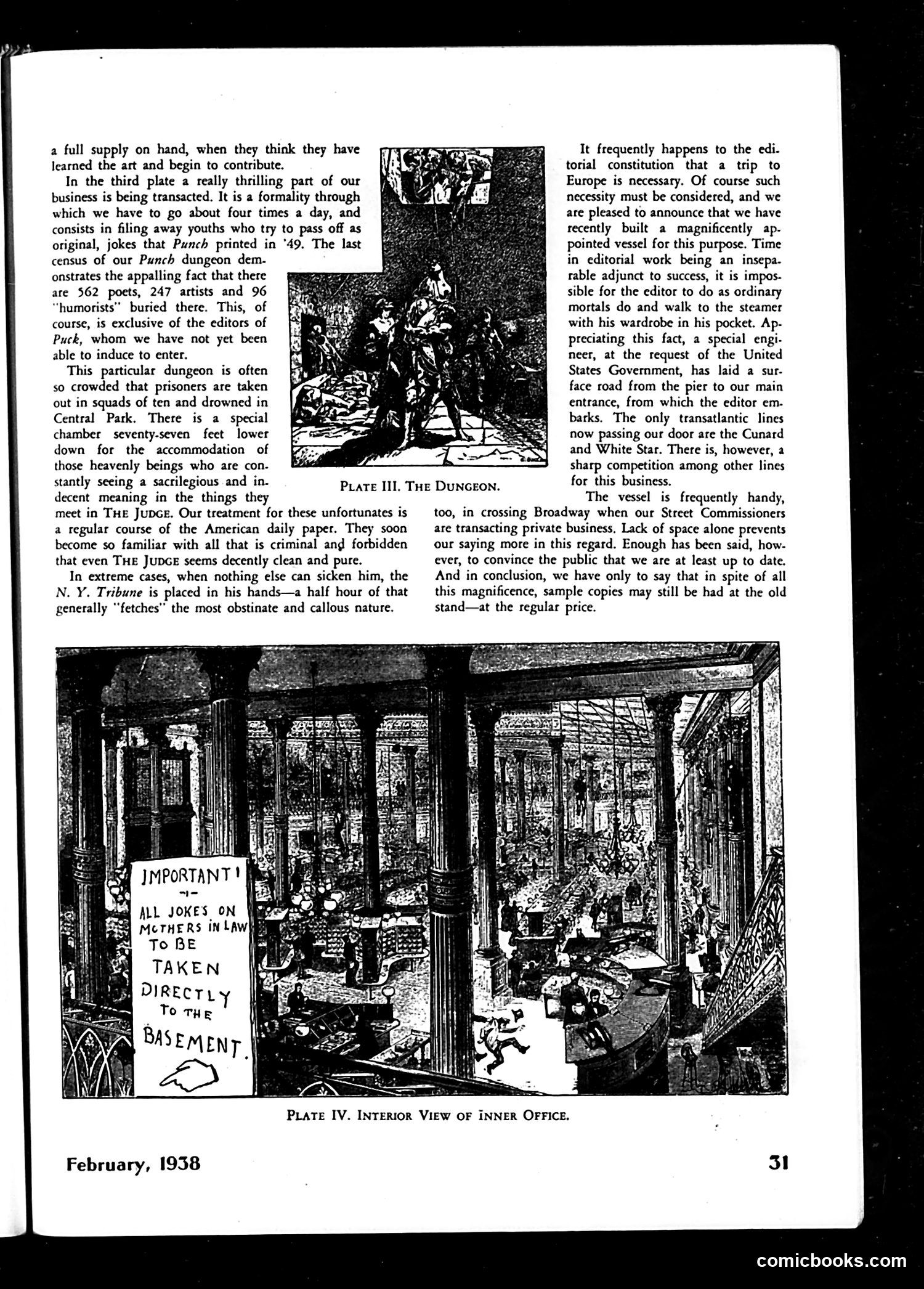
Judge Magazine Satire, February 1938 This page satirizes Judge magazine's own editorial operations. The text humorously describes their "Dungeon"—a filing system for rejected submissions. The joke: they warehouse 562 poets, 247 artists, and 96 "humorists" who've submitted plagiarized or terrible work (notably, jokes already published by Punch in 1849). The dungeon allegedly gets so crowded they "drown" rejects in Central Park in batches of ten. For particularly dense contributors who see "indecent meaning" in everything, they're treated with doses of the American daily newspaper—or as a last resort, the *New York Tribune*—to dull their sensibilities. Plate IV's sign jokes that "mothers-in-law" jokes belong in the basement, mocking a common comedic cliché. The piece is self-deprecating humor about the magazine's editorial challenges: managing endless mediocre submissions and maintaining standards while staying current. It's characteristic early-20th-century magazine satire.
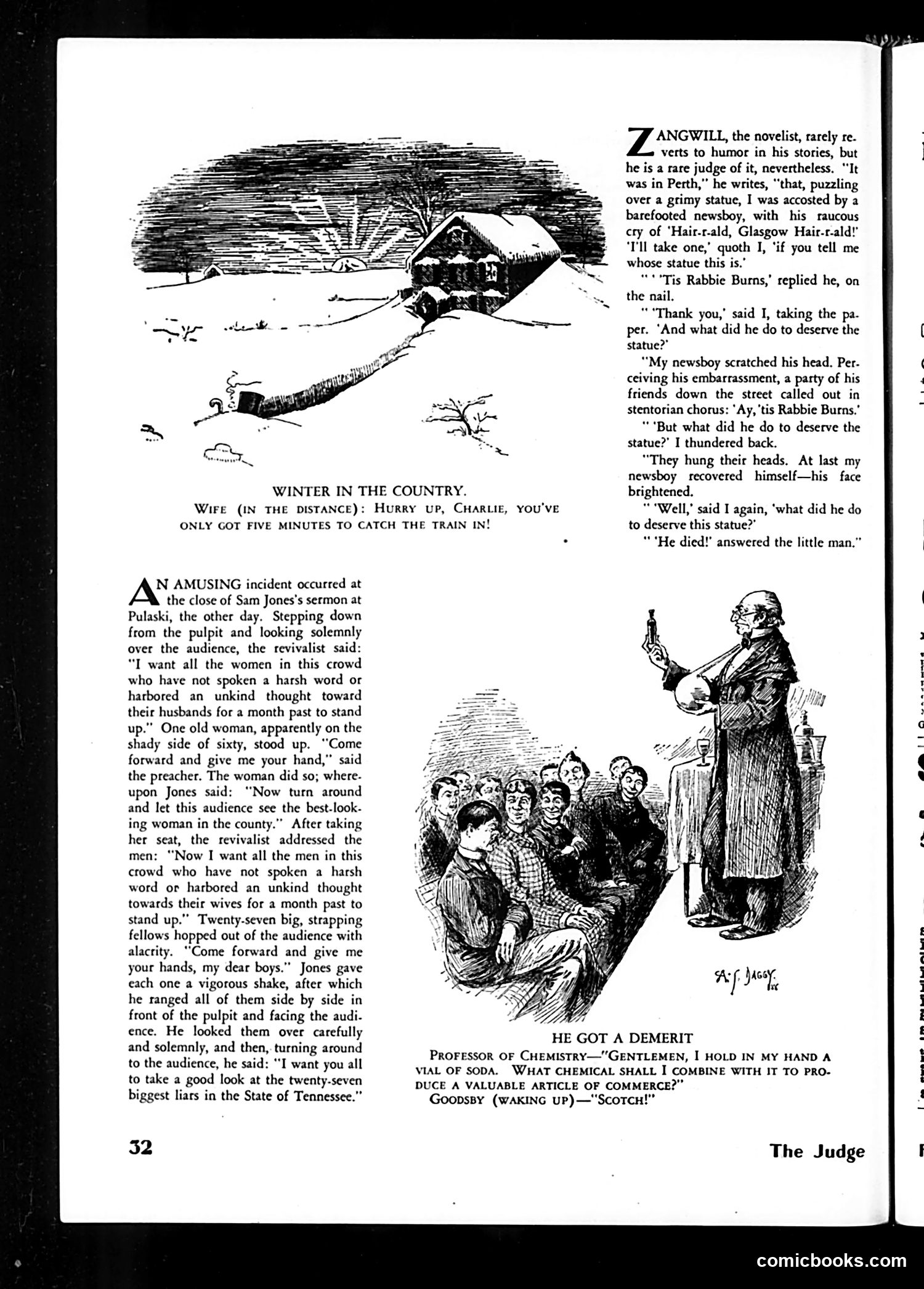
Analysis of Judge Magazine Page This page contains three separate humorous pieces satirizing American life: 1. Rabbie Burns Anecdote: A literary story mocking Scottish newsboys' ignorance. When asked what the poet Robert Burns did to deserve a statue, the boys can't answer—finally admitting "He died!" The satire targets both working-class illiteracy and the absurdity of commemorating the dead without understanding their actual accomplishments. 2. Revivalist Sermon Cartoon: Depicts evangelist Sam Jones conducting a revival meeting. His trick question—asking men who haven't harbored unkind thoughts toward wives to stand—backfires when 27 men respond. Jones publicly labels them "the biggest liars in Tennessee," satirizing both revival tent hypocrisy and the gap between male professions of virtue and actual behavior. 3. Chemistry Classroom Joke: A sleeping student named Goodsby is called on; he groggily suggests "Scotch" (whiskey) as a chemical. The joke mocks inattentive students and implies alcohol's commercial value.
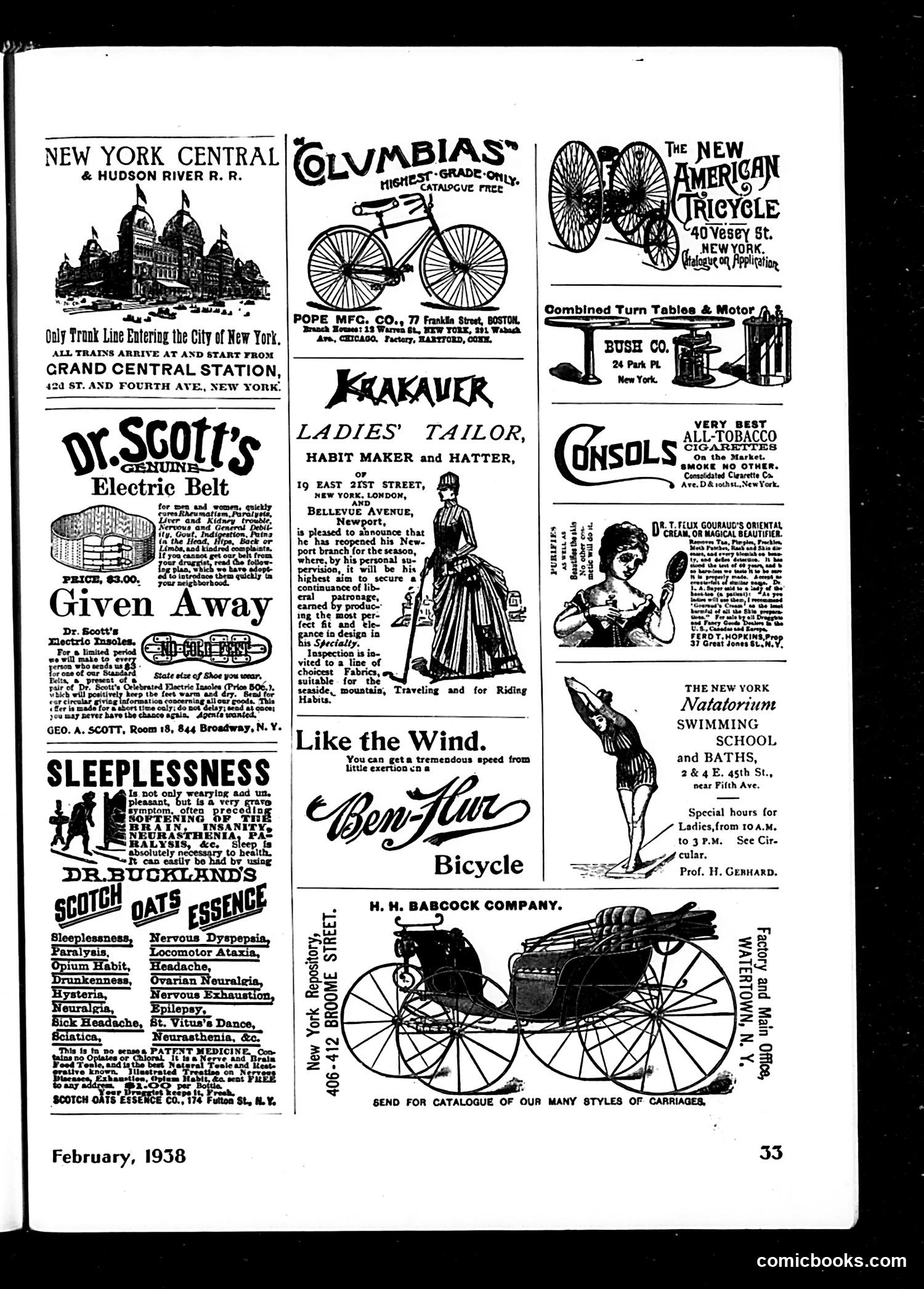
Judge Magazine Page Analysis — February 1938 This page is primarily advertising, not satirical content. It's a collection of commercial advertisements typical of early 20th-century magazines, featuring: Notable ads include: - Dr. Scott's Electric Belt — a quack medical device promising to cure sleeplessness, nervous conditions, and various ailments through electrical stimulation (a common fraud of the era) - Bicycle advertisements (Columbia, Ben-Hur brands) — reflecting the popularity of bicycles as transportation - Ladies' tailor services and clothing shops - Carriage manufacturers (H.H. Babcock Company) - Swimming school and other services For modern readers: The most striking element is Dr. Scott's belt — it exemplifies the patent medicine scams that flourished before FDA regulation. The ad's claims (curing epilepsy, paralysis, drunkenness) appear absurd today but were marketed seriously in 1938. The page reflects pre-automobile America, when bicycles and carriages dominated transportation, and medical regulation was virtually nonexistent.
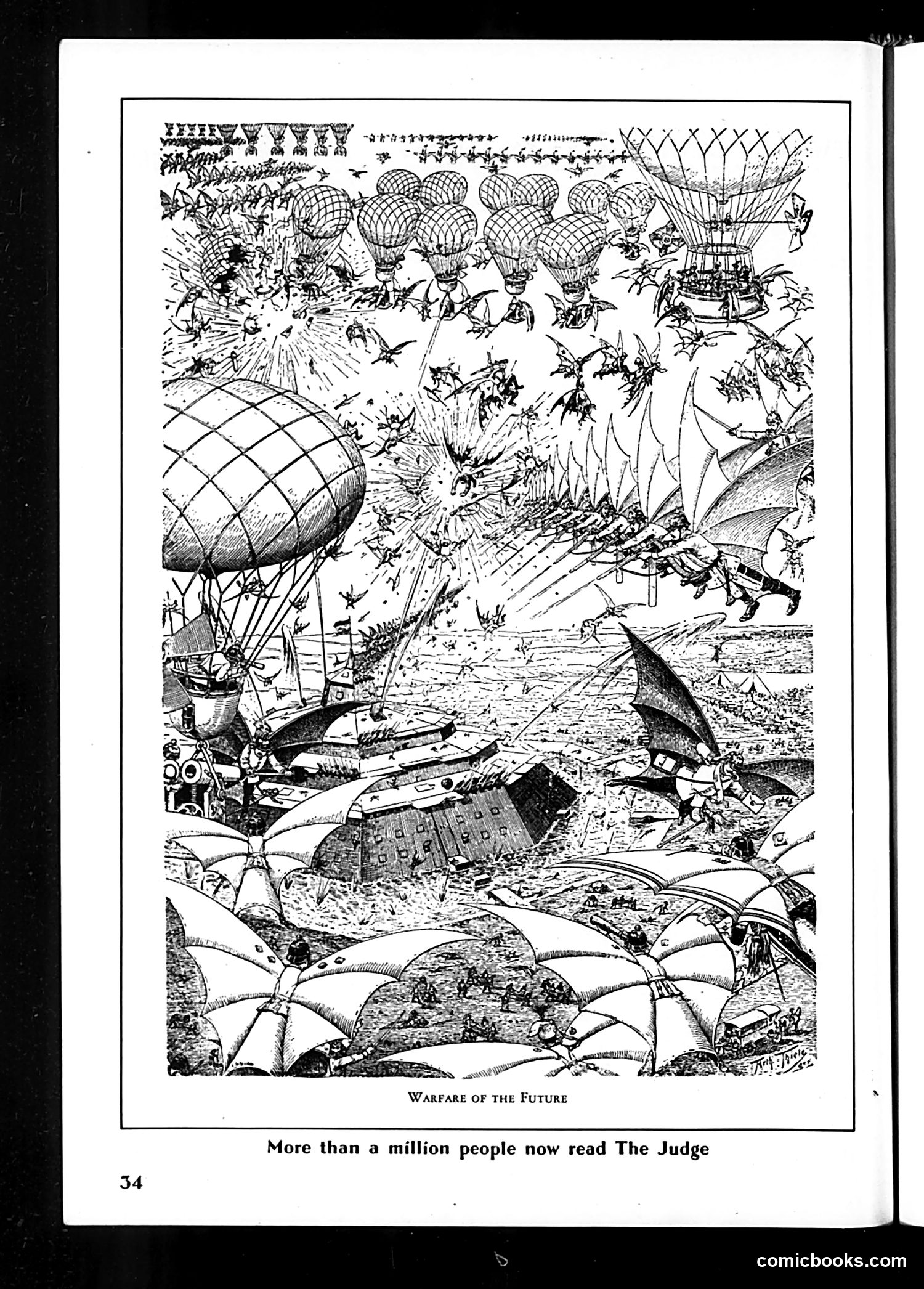
"Warfare of the Future" This satirical illustration depicts an imagined futuristic battlefield filled with airships, balloons, and flying contraptions engaged in aerial combat. The scene shows numerous hot-air balloons, dirigibles, and mechanical flying devices raining projectiles and explosives on ground forces below, which include soldiers with shields and fortifications. Published in *The Judge*, a prominent American satirical magazine, this cartoon likely comments on contemporary anxieties about emerging aviation technology and its potential military applications. The late 19th/early 20th century saw rapid development of airship and airplane technology, prompting speculation—both hopeful and fearful—about how future wars might be fought from the skies. The crowded, chaotic composition emphasizes both the technological ambition and the perceived danger of aerial warfare, satirizing both military innovation and public anxiety about modern conflict.
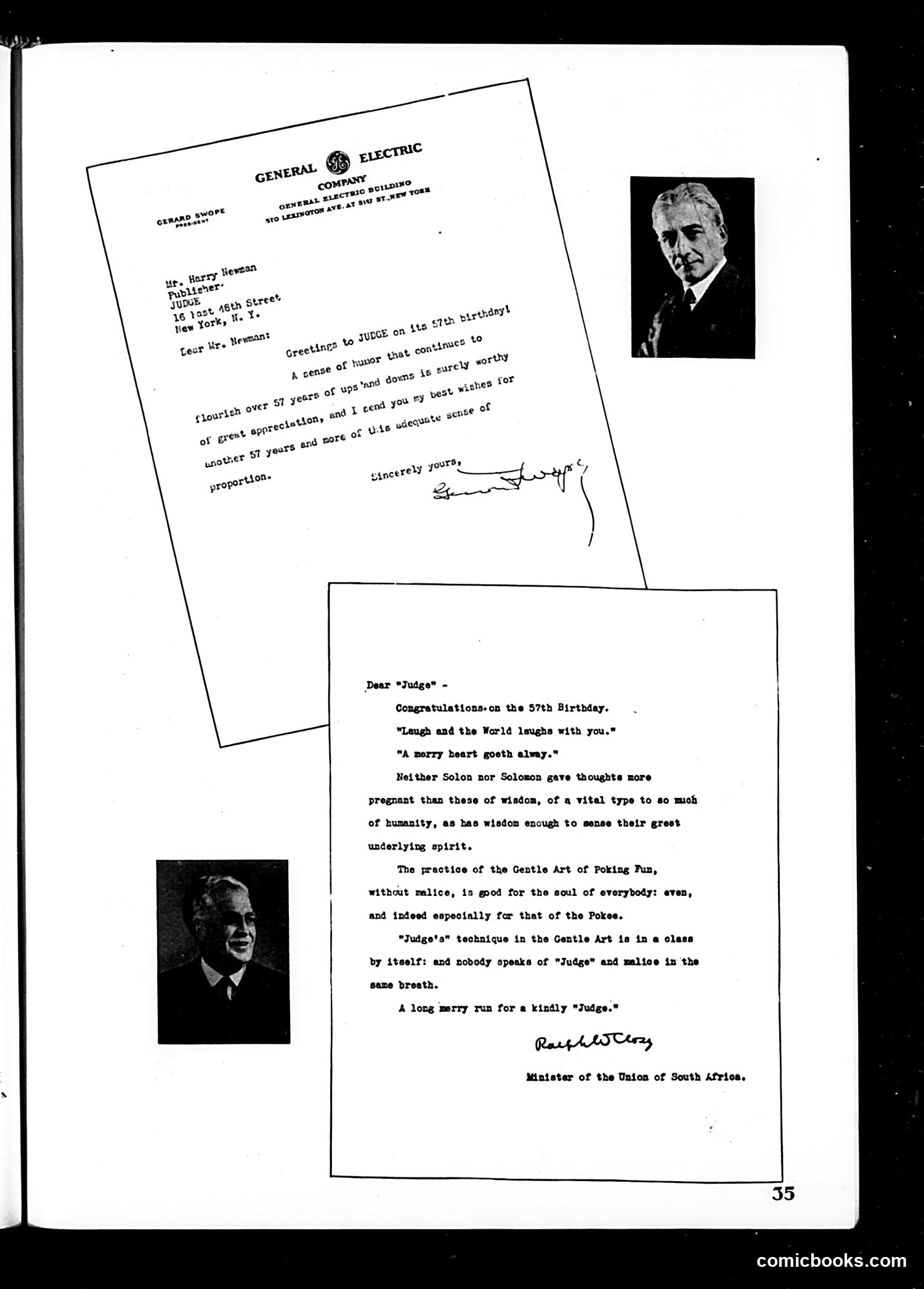
Page 35: Birthday Greeting to Judge Magazine This page contains two formal birthday congratulations letters to *Judge* magazine on its 57th anniversary. The top letter from General Electric's Gerard Swope offers brief warm wishes. The longer letter below, from South Africa's Minister (signature appears to be "Raoul Creswell" or similar), praises *Judge*'s satirical approach—"the Gentle Art of Poking Fun, without malice"—arguing that humor benefits everyone, including those being satirized ("the Pokee"). The minister emphasizes that *Judge*'s humor is uniquely skilled and never cruel. Both letters frame the magazine's satire as wholesome social commentary rooted in wisdom and good-heartedness, celebrating its long run of entertaining readers through gentle mockery rather than vicious attacks.
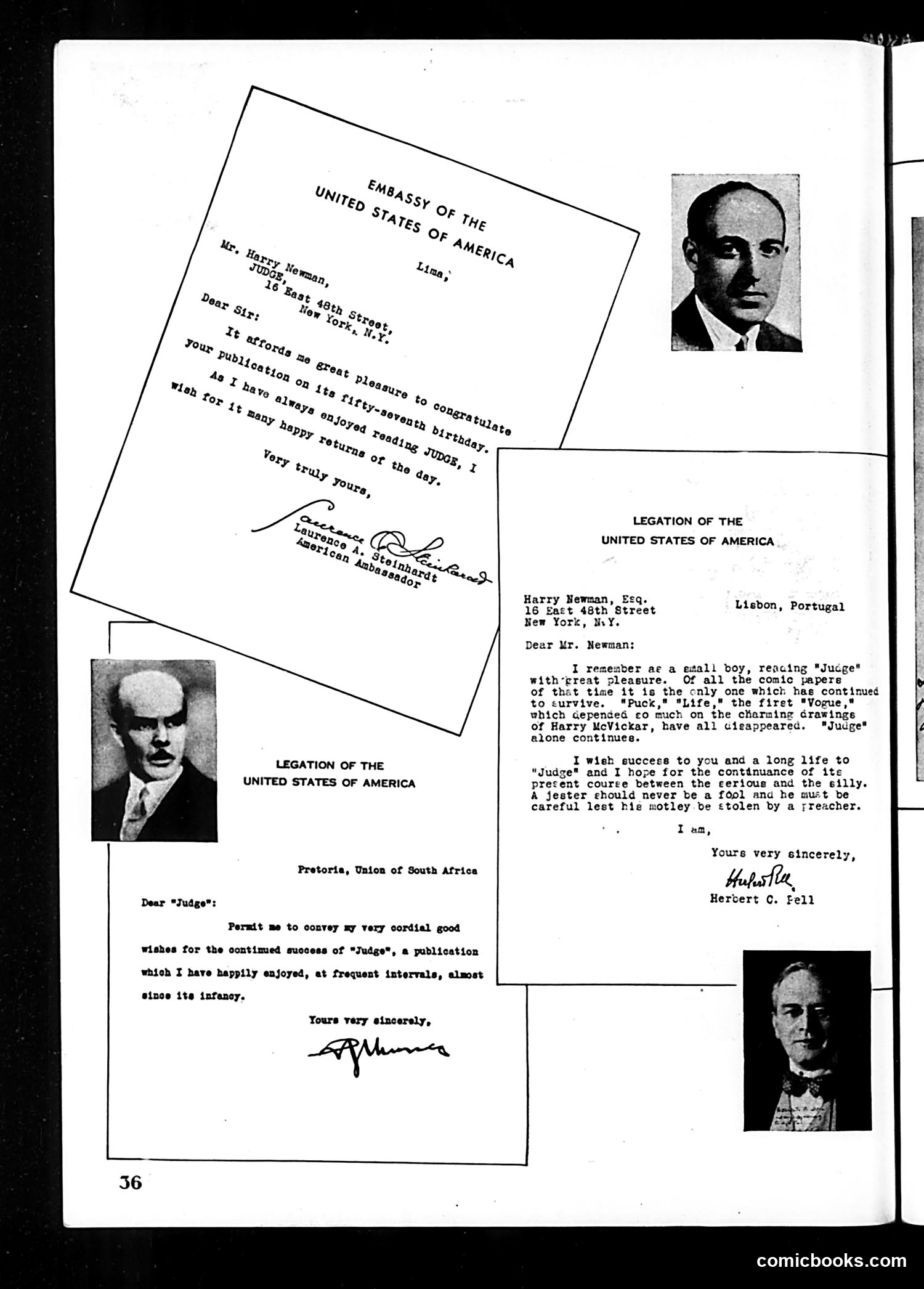
Page 36: Testimonial Letters to Judge Magazine This page features congratulatory letters to *Judge* magazine from U.S. diplomats abroad, celebrating the publication's longevity and influence. The letters come from diplomatic legations in Lisbon, Portugal and Pretoria, South Africa. The writers praise *Judge* as the sole surviving satirical magazine from its era, noting that competitors like *Puck* and *Life* have disappeared. One correspondent includes a cautionary metaphor about jesters: a satirical publication's "motley" (fool's costume/authority) can be stolen by "a preacher"—suggesting concern that moral or political authorities might suppress satire. The page demonstrates *Judge*'s prestige among educated elites and diplomats, positioning it as an important cultural institution. The inclusion of official letterhead and photographs emphasizes the magazine's respectability and reach into circles of power and influence.
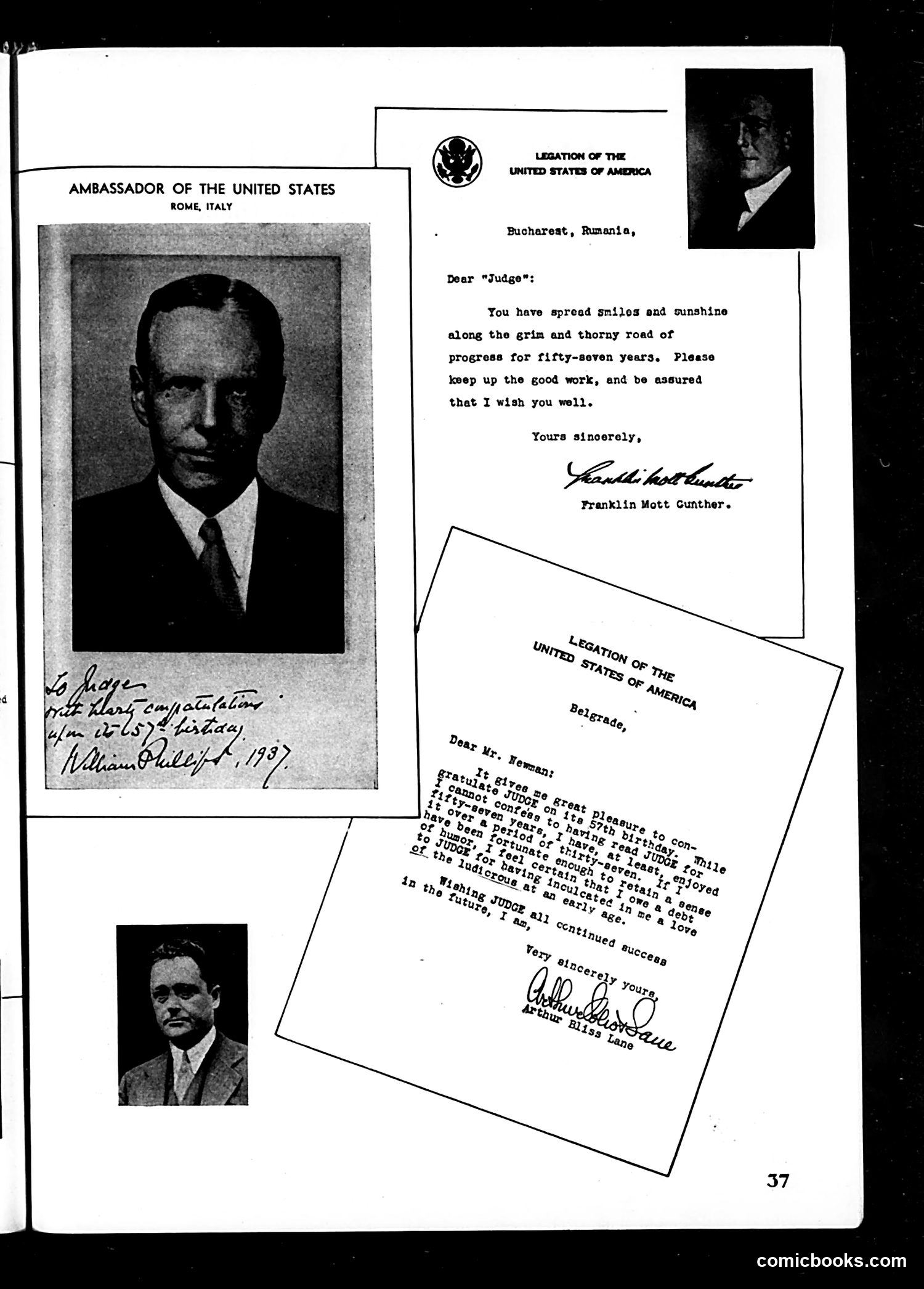
This page is not a cartoon but rather fan mail and promotional material for *Judge* magazine itself. Franklin Mott Gunther, U.S. Ambassador to Rome, sends congratulations on the magazine's 57-year history, praising its role in spreading "smiles and sunshine" during difficult times. The page includes his official portrait and photographs of other dignitaries, likely contributors or supporters. This appears designed to establish *Judge*'s cultural prestige and longevity by showcasing endorsements from prominent government figures. It's essentially advertising the magazine's credibility and influence rather than containing satirical content.
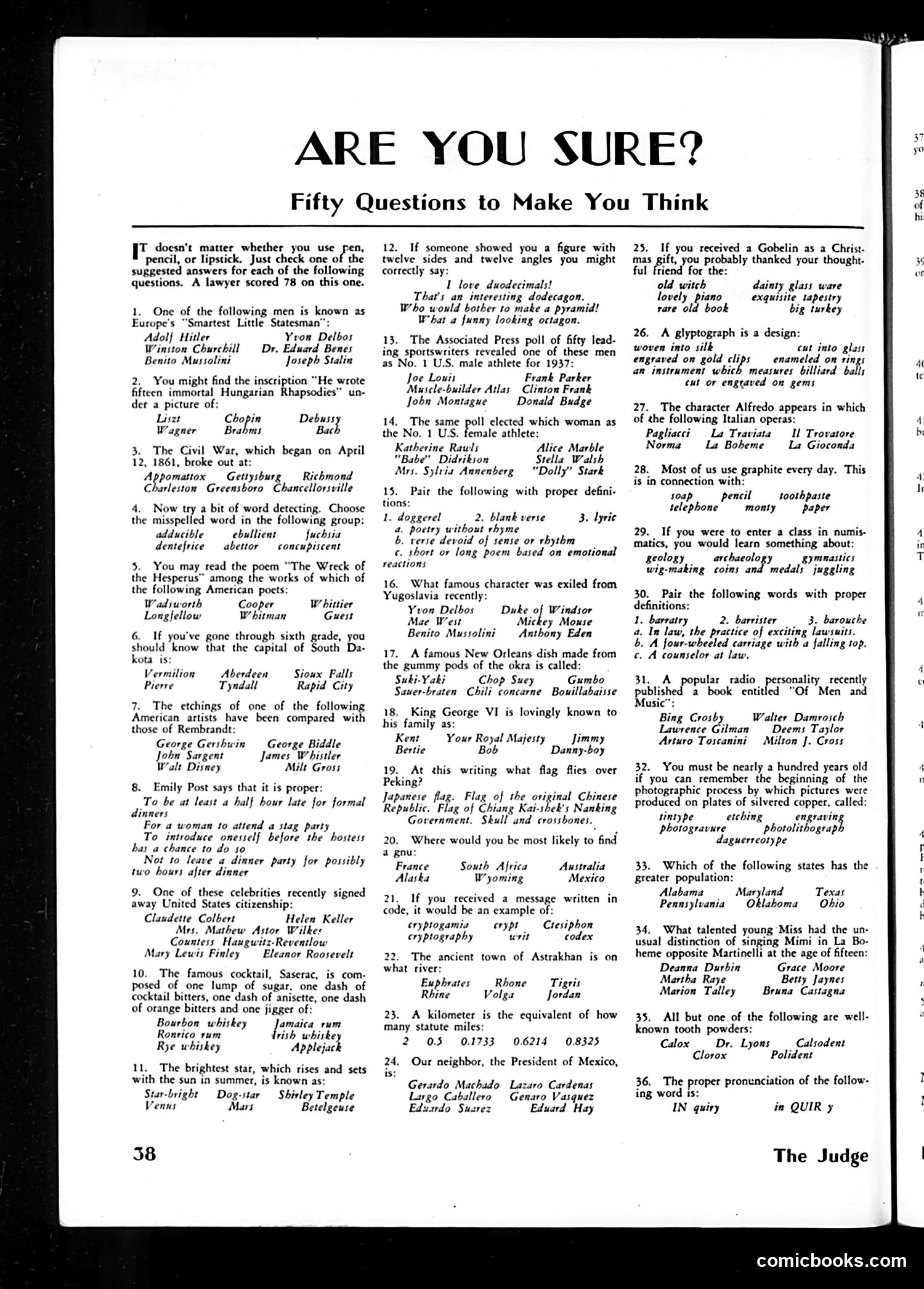
"Are You Sure?" Quiz Analysis This page from *Judge* magazine presents a trivia quiz titled "Fifty Questions to Make You Think," designed as light entertainment for readers. Rather than political satire, it's a straightforward quiz testing general knowledge across multiple domains: history, literature, geography, etiquette, celebrity gossip, and current events. The questions reference 1930s figures and events—Hitler, Mussolini, King George VI, the Sino-Japanese conflict—dating this content to approximately 1937-1938. Question 16 mentions Mae West's recent exile from Yugoslavia, and question 19 asks about flags flying over Peking, providing temporal markers. The "joke" is self-referential: a lawyer scored only 78%, suggesting even educated readers would struggle. This appeals to *Judge*'s educated, middle-class readership by positioning the quiz as a humble-bragging challenge rather than straightforward trivia. It's essentially filler content showcasing the magazine's emphasis on wit and intellectual posturing rather than political commentary.
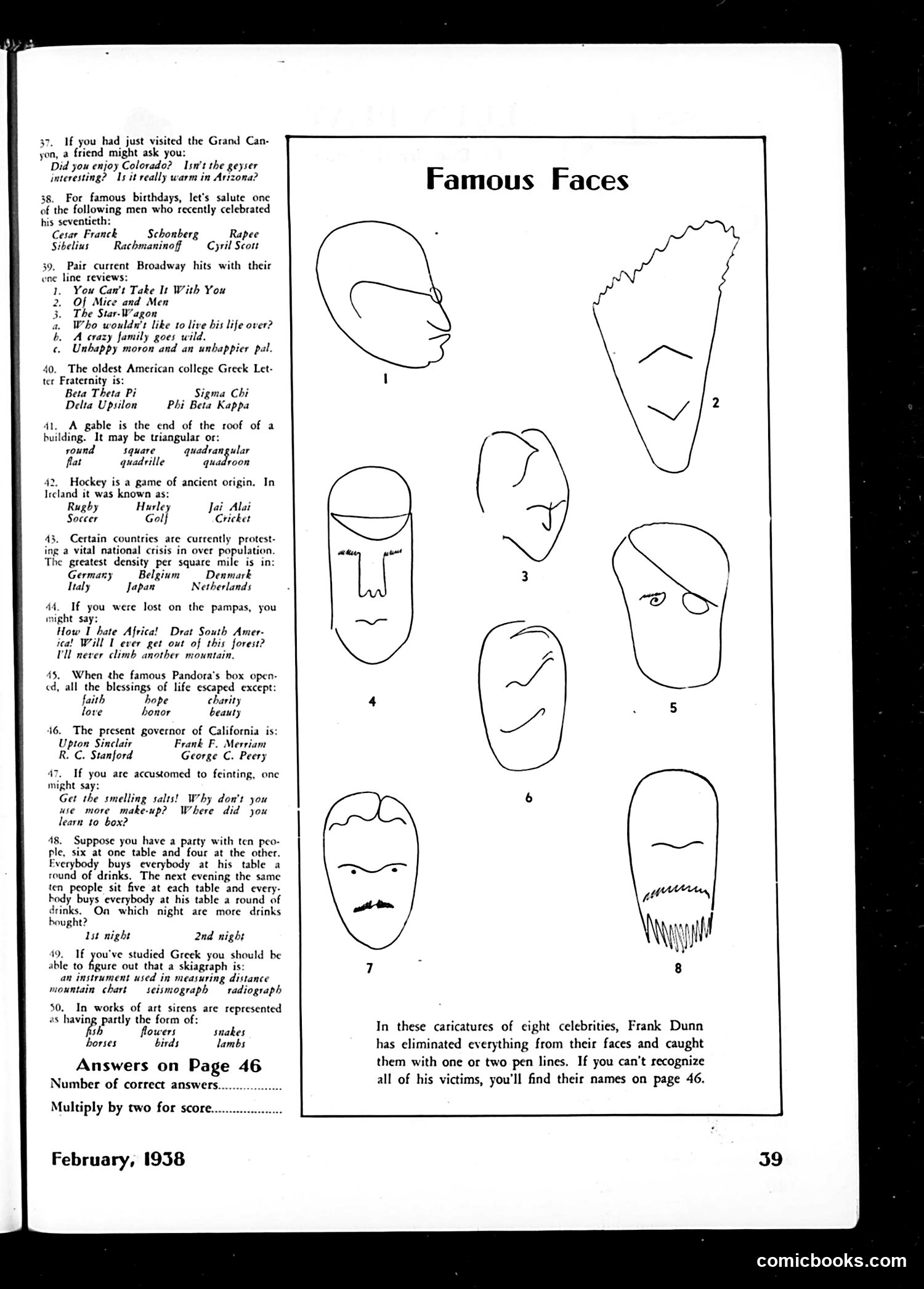
Analysis of Judge Magazine Page (February 1938) This page contains two distinct elements: Left side: A trivia quiz covering general knowledge topics—geography (Grand Canyon, pampas), composers' birthdays (Sibelius, Rachmaninoff), Broadway plays, Greek fraternities, and classical references (Pandora's box). The questions test whether readers catch common mistakes or misconceptions (confusing Colorado with the Grand Canyon, for instance). Right side: "Famous Faces"—eight minimalist caricatures by Frank Dunn using only one or two pen lines per face. The text explains this is a recognition game where readers must identify eight celebrities from their reduced features alone. Answers appear elsewhere in the magazine. The page functions as light entertainment typical of *Judge*'s satirical humor magazine format: testing readers' knowledge while celebrating the skill of capturing recognizable likenesses through extreme simplification. Without seeing page 46, we cannot identify which specific 1938 celebrities are depicted, though the sophisticated artistic technique suggests they were prominent public figures of that era.
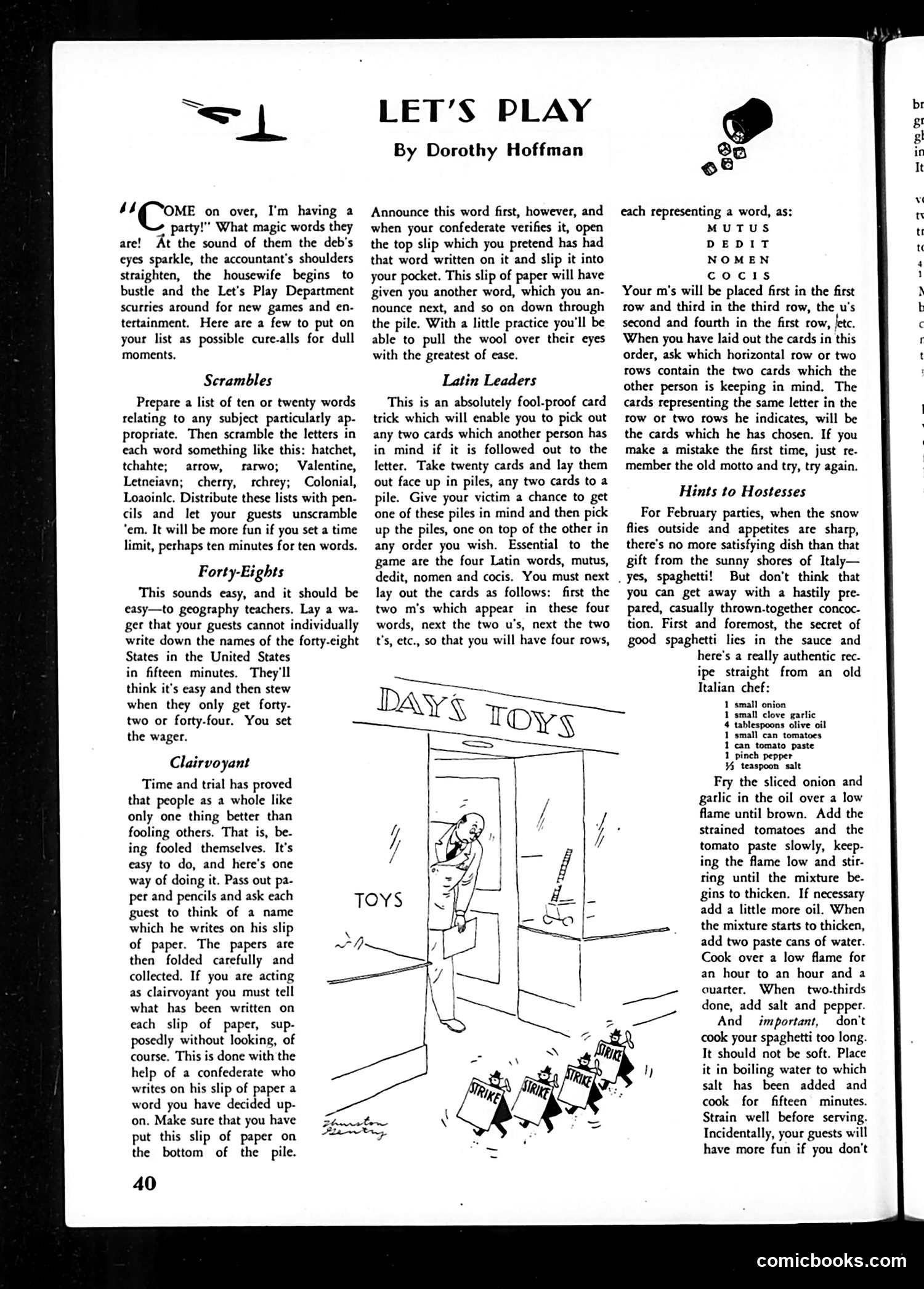
Analysis for Modern Readers This page from Judge magazine presents party games by Dorothy Hoffman, not political satire. The content is practical entertainment advice for 1920s-30s era hosts and hostesses. The games described—word scrambles, geography challenges, and card tricks—were popular parlor games designed to entertain guests at social gatherings. The "Clairvoyant" game relies on a confederate's collusion to create the illusion of mind-reading, while "Latin Leaders" uses a card trick based on letter patterns in Latin words. The illustration shows a toy shop scene with what appears to be a salesman and customers (depicted as small figures or toys), but the caption and connection to the text are unclear. The "Hints to Hostesses" section at bottom transitions into an Italian spaghetti recipe, suggesting this was practical lifestyle content for American homemakers rather than political commentary. The page represents Judge's entertainment and household advice content rather than satirical commentary.
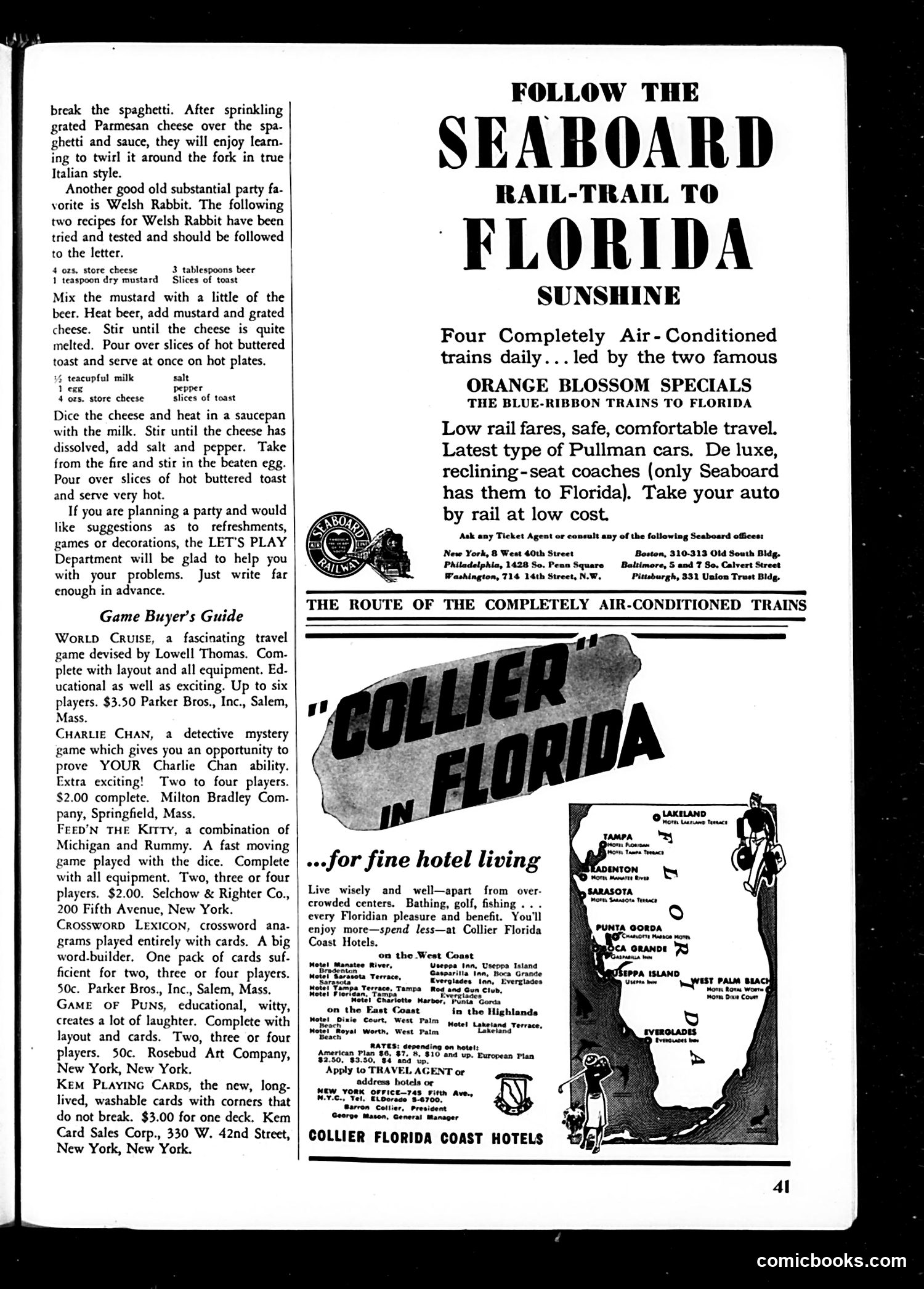
Content Analysis This page is primarily advertising and practical lifestyle content, not satirical commentary. It contains: Left column: Recipe instructions for Welsh Rabbit (cheese on toast) and a "Game Buyer's Guide" reviewing board games and playing cards—typical 1930s leisure products like "World Cruise" and "Charlie Chan" detective games. Right side: Travel advertisements for the Seaboard Air Line Railway's Florida trains (the "Orange Blossom Specials") and Collier Florida Coast Hotels, emphasizing air-conditioned comfort, low fares, and leisurely amenities like golfing and fishing. No political satire is present. This is a standard magazine page mixing domestic advice with commercial promotions targeting middle-class Americans seeking entertainment and vacation travel during what appears to be the Depression or immediate pre-war era. The tone is aspirational rather than critical.
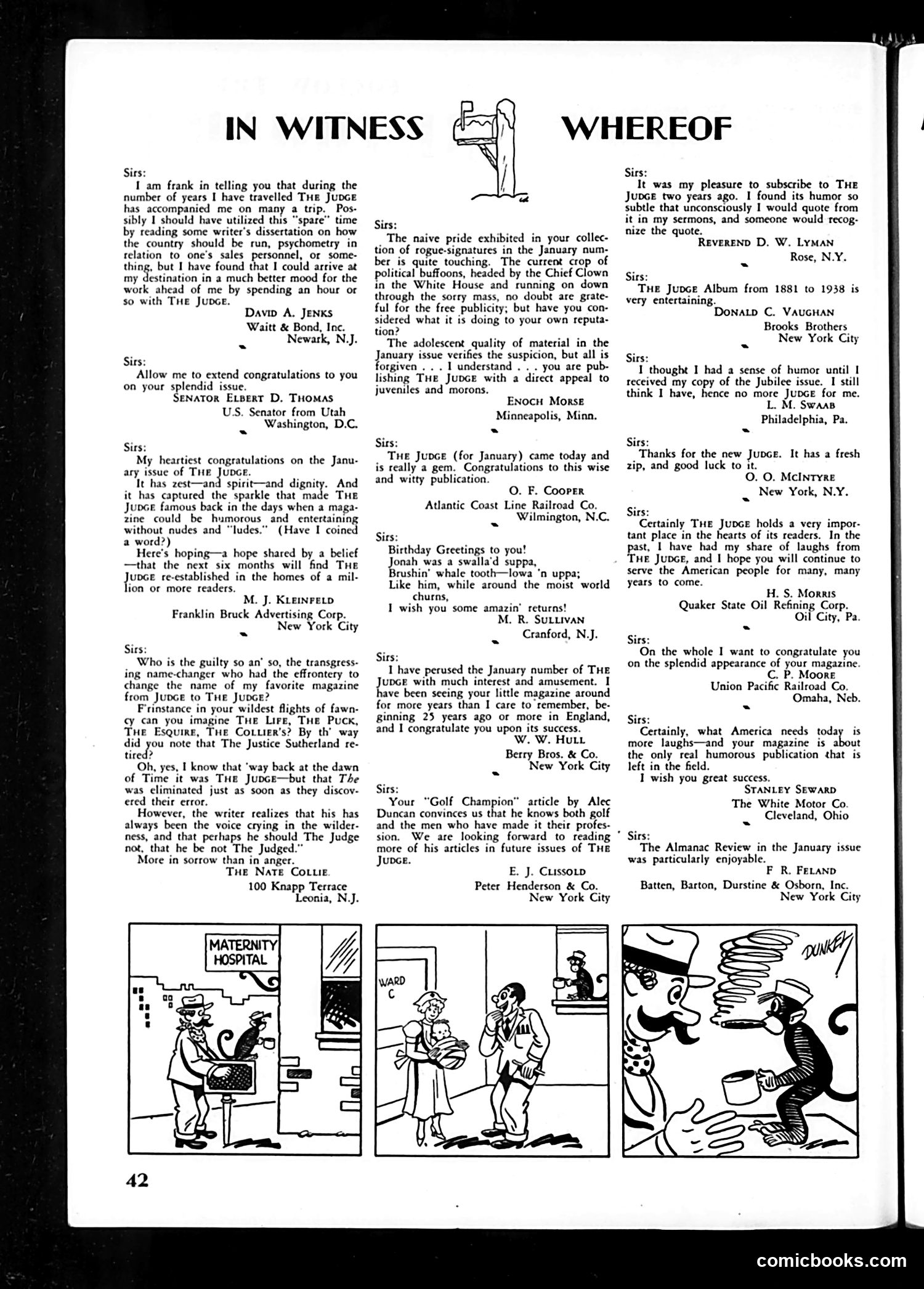
Analysis of Judge Magazine Reader Letters Page This page consists almost entirely of reader letters praising Judge magazine, particularly its January issue. The content reveals little specific political satire—instead, it's a parade of congratulatory messages from business executives, advertisers, and readers applauding the magazine's humor, "zest," and entertainment value. One notable critical letter from Enoch Morse attacks Judge for publishing "rogue-signatures" and mocking "political buffoons, headed by the Chief Clown in the White House," suggesting the magazine was catering to crude political mockery rather than sophisticated satire. Another complains about the magazine's name change from "The Judge" to "Judge." The three cartoons at the bottom appear unrelated to the letters—depicting domestic/comic scenarios (a maternity hospital scene, a conversation, and someone juggling donuts). Context: This reflects Judge's mid-century struggles as it attempted to revive readership and relevance, balancing between established readers and younger audiences.
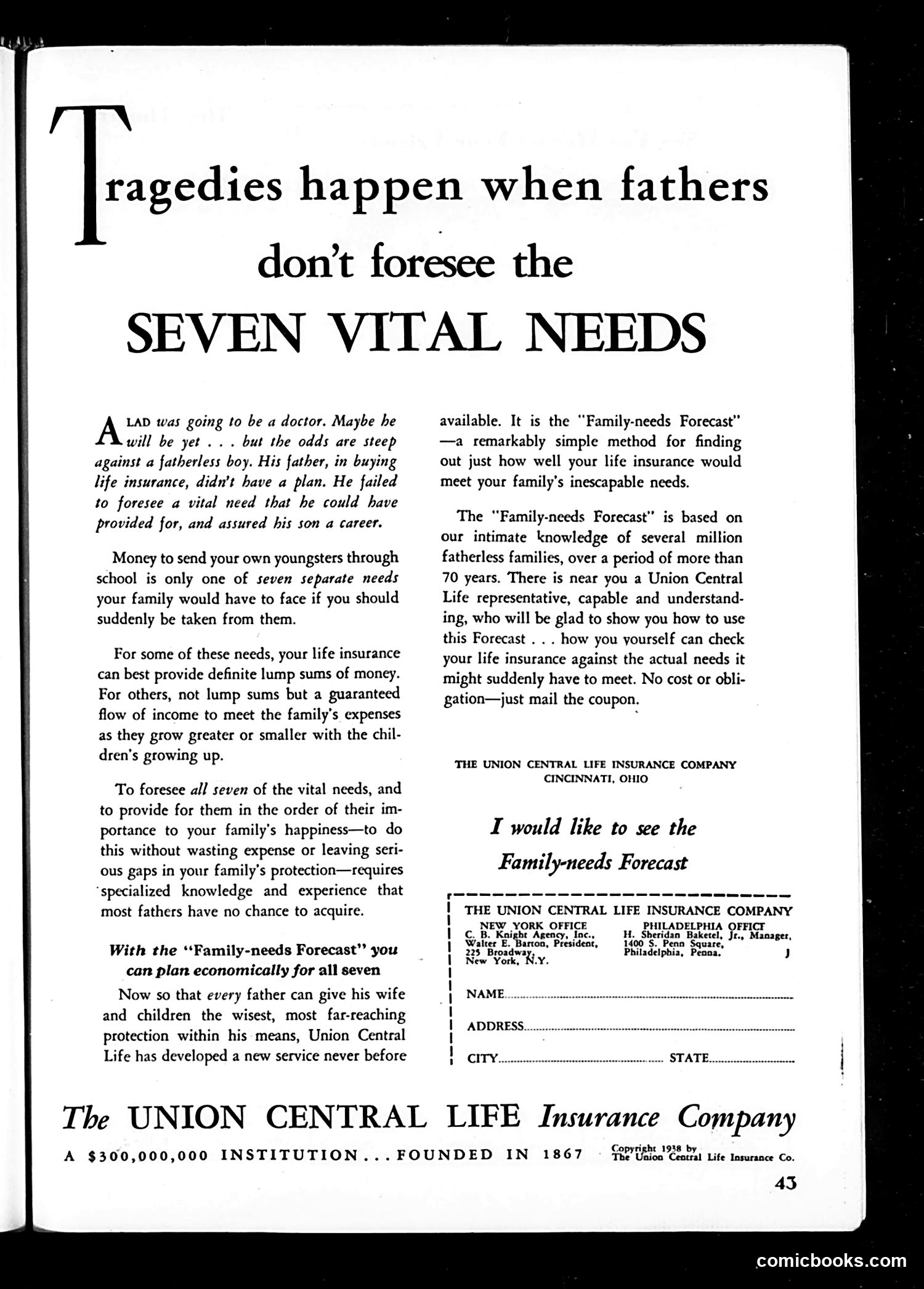
Analysis This is not a cartoon or satire, but a life insurance advertisement from Union Central Life Insurance Company (1938). The page uses emotional appeal rather than humor. It opens with a cautionary narrative: a boy aspiring to be a doctor faces "steep odds" because his father died without adequate life insurance planning. The ad argues that fathers who don't foresee their family's "seven vital needs" leave them vulnerable to financial hardship. The "Family-needs Forecast" is presented as Union Central's solution—a personalized service (free, no obligation) to help fathers calculate whether their insurance adequately covers education, living expenses, and other family necessities. The company emphasizes its 70-year track record managing "several million fatherless families." This reflects 1930s social anxieties about economic security and masculine responsibility. The implicit message: responsible fatherhood means life insurance planning. The ad targets middle-class anxiety about sudden death and downward mobility, positioning the insurance company as expert guardians of family welfare.
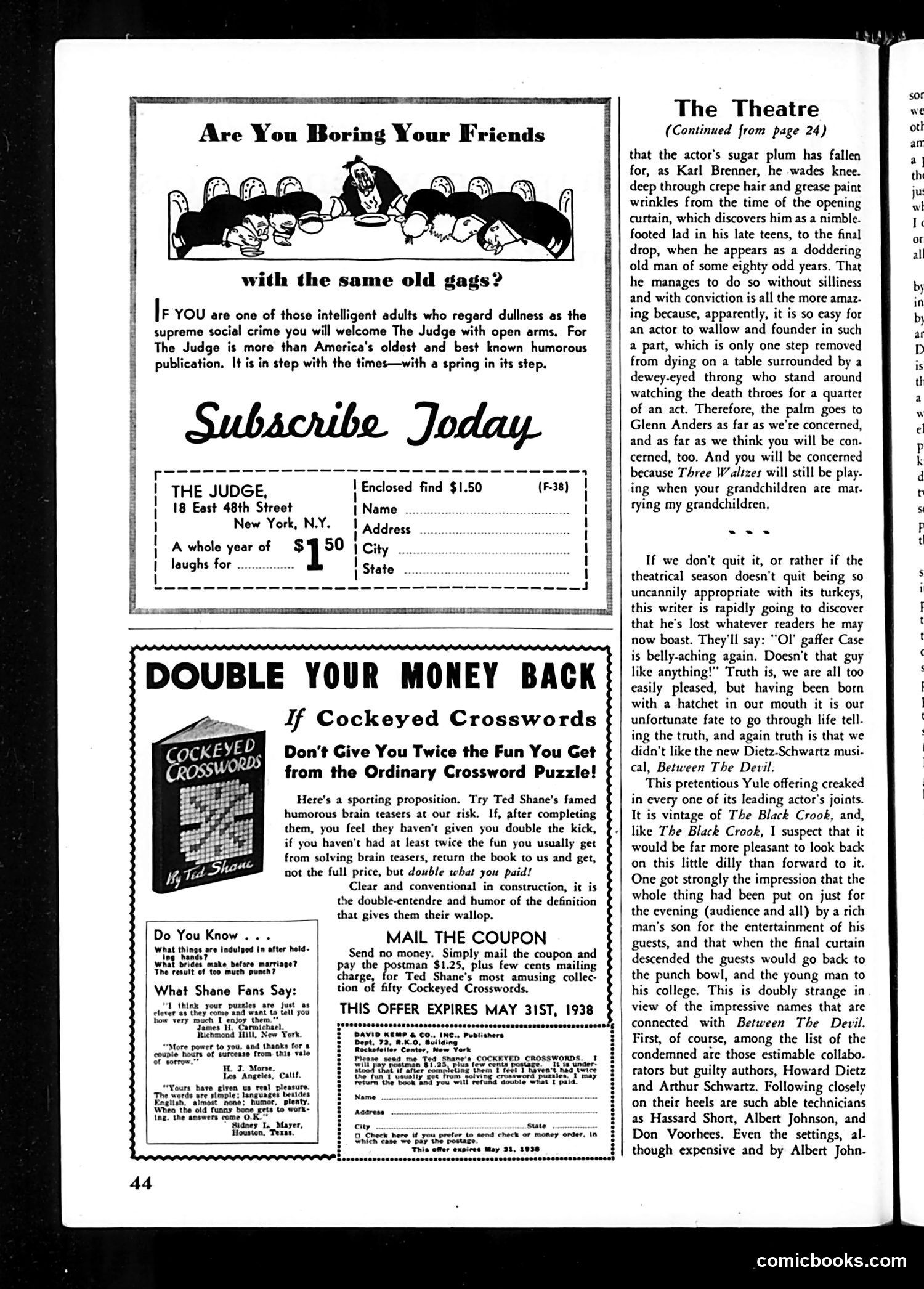
Explanation of Judge Magazine Page This is primarily advertising content rather than political satire. The page features three main advertisements: 1. The Judge subscription ad (top): Promotes a year-long subscription to *The Judge* magazine for $1.50, positioning it as "America's oldest and best known humorous publication" for "intelligent adults who regard dullness as the supreme social crime." 2. Cockeyed Crosswords puzzle book (center): Advertises Ted Shane's humorous crossword puzzles with a money-back guarantee—promising "double the fun" or your money back doubled. 3. Theater review (right column): A contemporary theater critic's review of Broadway productions, praising Glenn Anders's performance and critiquing the musical *Between The Devil*. The cartoon header ("Are You Boring Your Friends") uses generic caricatures of people to humorously suggest readers need *The Judge* to avoid being dull conversationalists. No specific political figures or events are referenced—this is consumer-oriented content typical of 1938 magazine advertising.
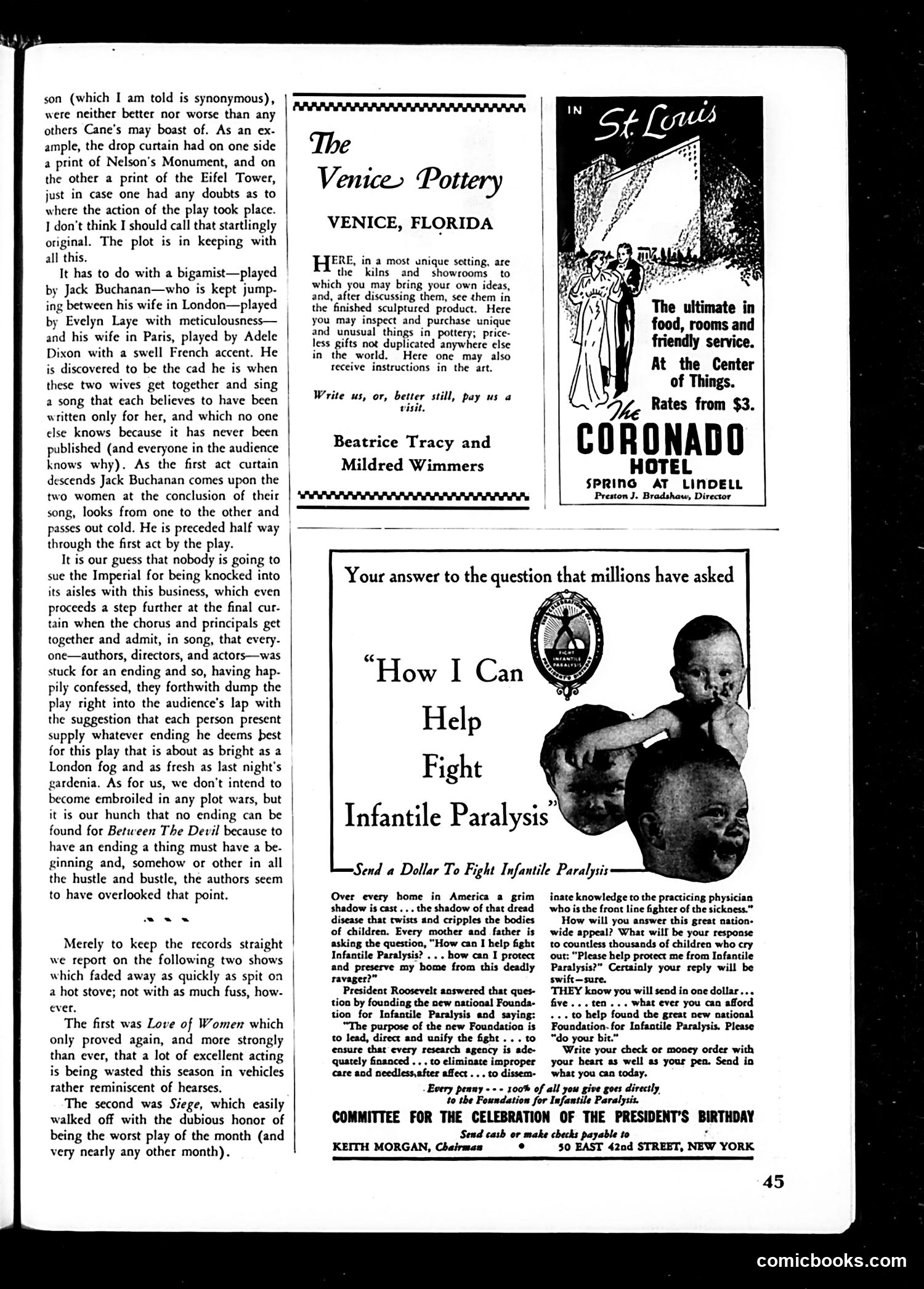
Analysis of Judge Magazine Page This page is primarily advertising and public service content, not satirical editorial material. The left column contains a theater review of the play "Between the Devil," criticizing its weak plot and lazy ending where authors admit they "were stuck for an ending" and dump the resolution onto the audience. The main content is a public health campaign for the fight against infantile paralysis (polio), sponsored by the Committee for the Celebration of the President's Birthday, chaired by Keith Morgan. The campaign urges Americans to "send a dollar to fight infantile paralysis," framing it as a patriotic duty to protect children from this "dread disease." Additional advertisements promote The Venice Pottery in Florida and the Coronado Hotel in St. Louis. The page reflects 1930s-era concerns about polio epidemics and the nascent charitable foundation-building approach to medical crises, predating the later March of Dimes campaigns.
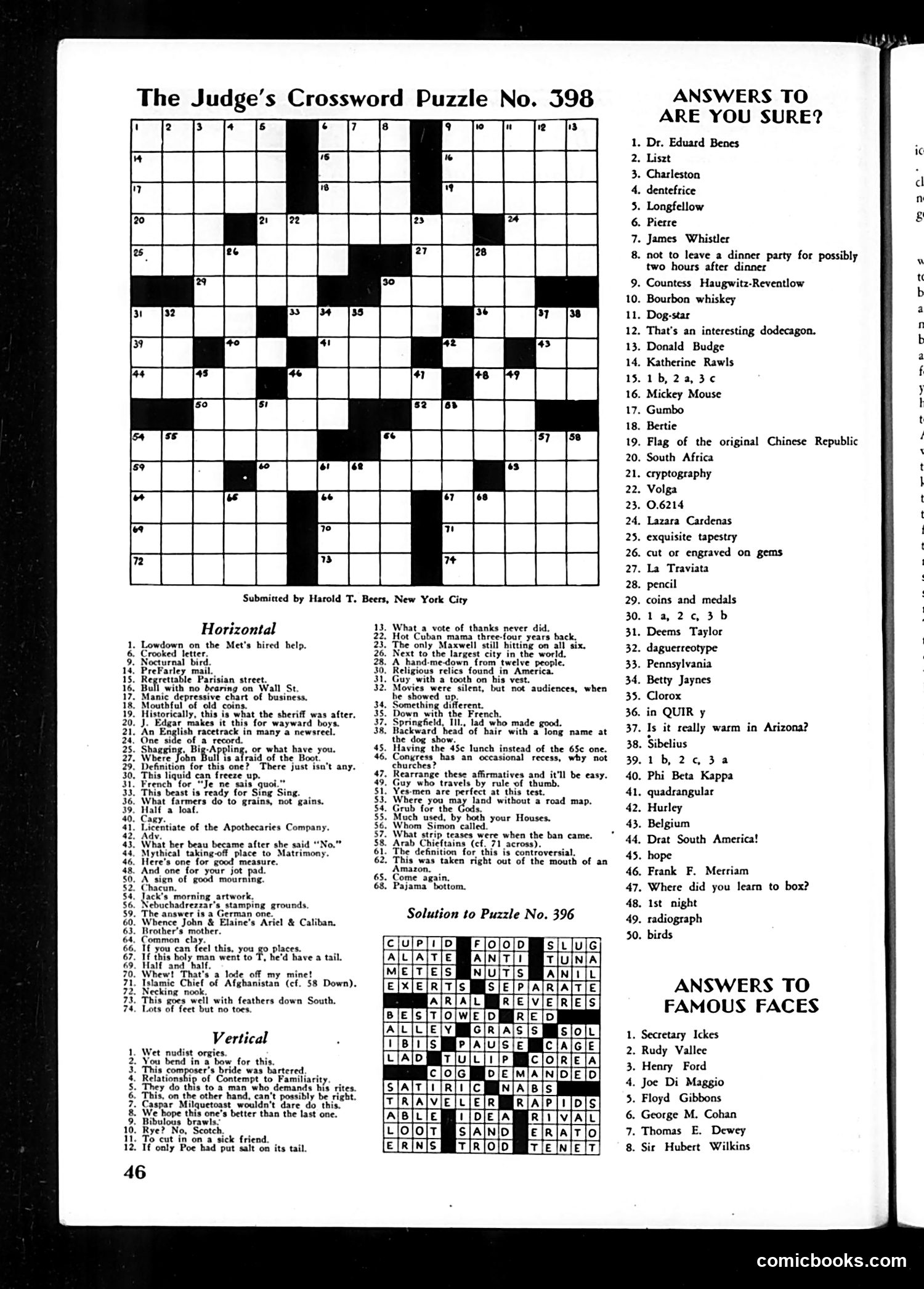
The Judge's Crossword Puzzle No. 398 This page is primarily a crossword puzzle and answer key, not a political cartoon. Judge magazine frequently featured puzzles alongside satirical content. The puzzle itself contains topical clues referencing 1930s-40s American culture and current events. Clues reference: - Public figures: Dr. Eduard Benes (Czechoslovak president), Donald Budge (tennis star), Katherine Rawls (swimmer) - Contemporary references: "Hot Cuban mama three-four years back" (likely referencing a scandal), "Maxwell still hitting on all six" (car model), "Springfield, Ill., lad who made good" (Abraham Lincoln) - Social commentary: References to congressional recesses, strip tease bans, silent film audiences The answer key shows solutions like "Charleston" (the dance), "Bourbon whiskey," and various cultural references. The separate "Famous Faces" section lists celebrities including Secretary Ickes and Henry Ford. This represents Judge's mix of humor, wordplay, and topical satire—using puzzles to subtly reference contemporary politics and popular culture.
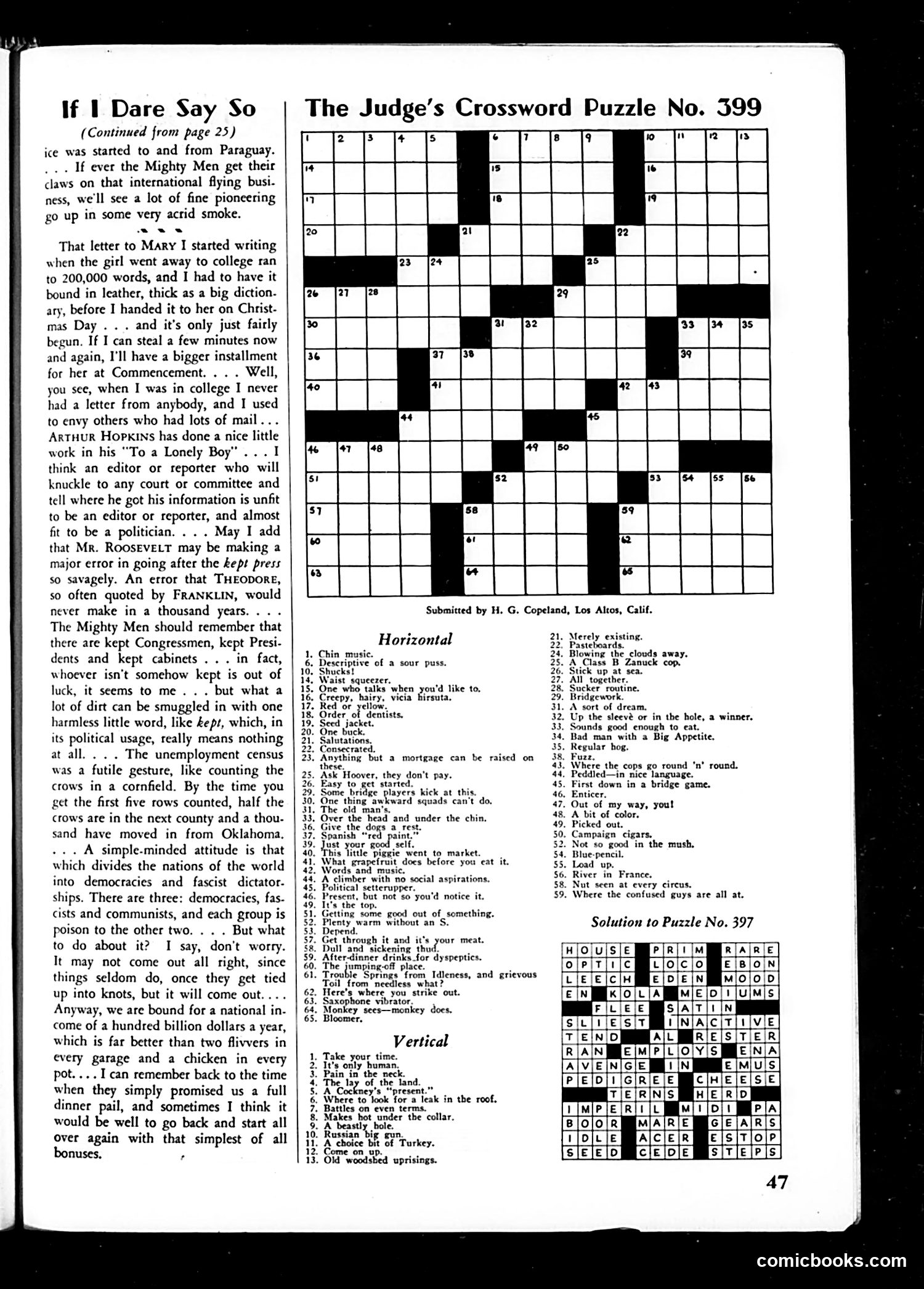
Analysis of Page 47 from Judge Magazine This page contains a satirical opinion column titled "If I Dare Say So" and a crossword puzzle. The column, attributed to a contributor, discusses political and social matters of the era. Key Content: The author critiques the "Mighty Men" (appears to reference powerful political/business figures) regarding international aviation, press freedom, and government oversight. He defends editors and reporters who refuse to reveal sources, calling them unfit for politics if they don't. Political References: The piece criticizes Franklin Roosevelt's aggressive approach toward the "kept press" (controlled media), suggesting Theodore Roosevelt handled such matters more wisely. It discusses three global power structures: democracies, fascism, and communism—all described as mutually poisonous. Social Commentary: The author reflects nostalgically on earlier American promises (the "full dinner pail") versus current economic conditions, and satirizes government initiatives like unemployment census efforts as futile bureaucratic gestures. The tone is conservative-leaning, skeptical of New Deal policies, and concerned about concentration of power.
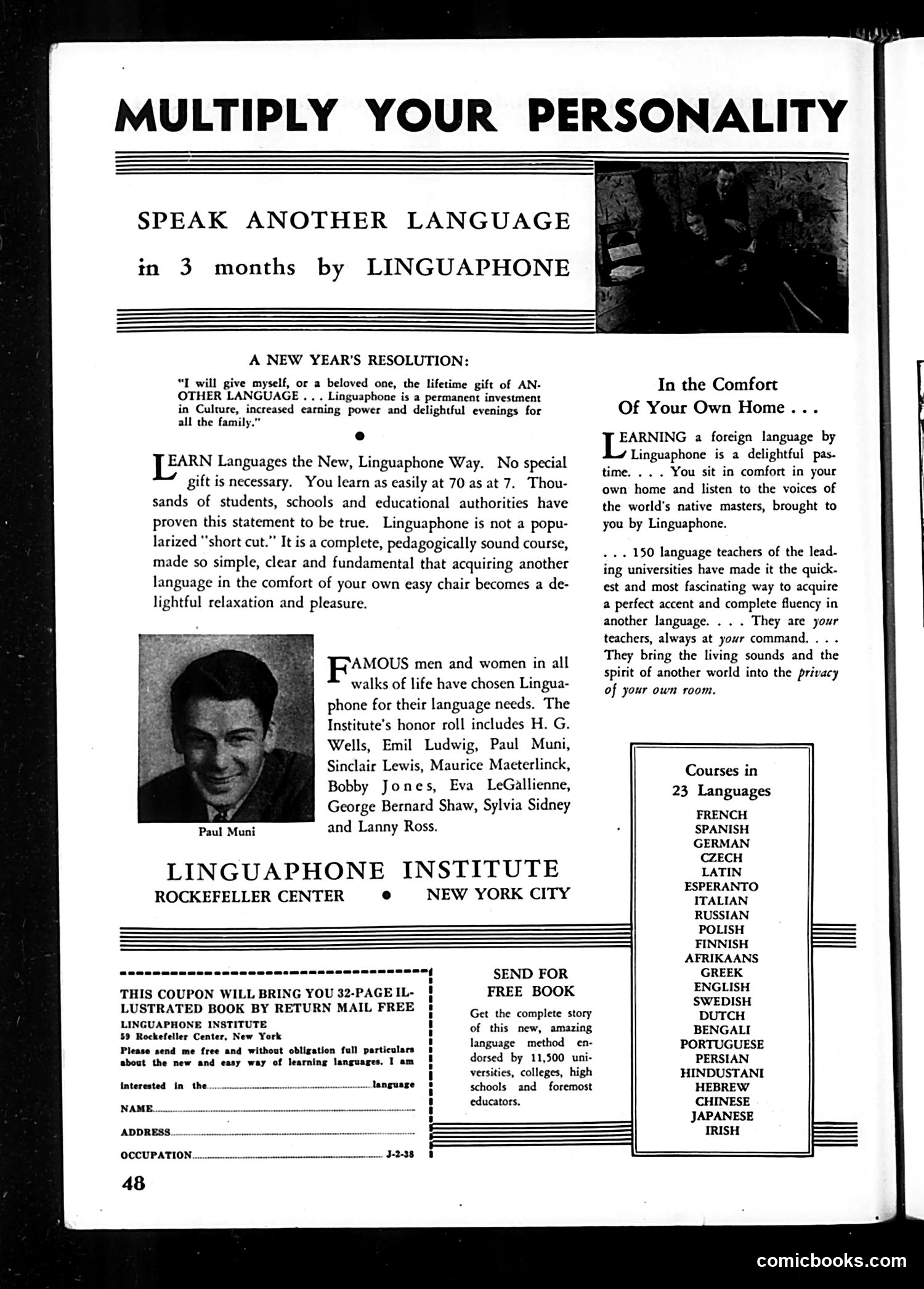
Linguaphone Institute Advertisement This is not a cartoon or satirical content — it's a straightforward advertisement for the Linguaphone language-learning system, positioned as a "New Year's Resolution" pitch. The page promotes learning foreign languages through audio recordings at home, claiming learners can achieve fluency in 3 months. It leverages celebrity endorsement by listing famous users (H.G. Wells, George Bernard Shaw, Paul Muni, etc.) to establish credibility. The appeal emphasizes convenience ("comfort of your own home"), ease ("as easily at 70 as at 7"), and cultural self-improvement ("gift of ANOTHER LANGUAGE"). The 1930s context matters: language learning was positioned as a luxury personal development investment and status symbol. The ad lists 23 available languages, includes a mail-in coupon for a free 32-page illustrated book, and highlights endorsement from 11,500 universities and colleges—standard advertising claims of the era designed to convey scientific legitimacy. This represents typical Judge magazine advertising content rather than satirical editorial material.
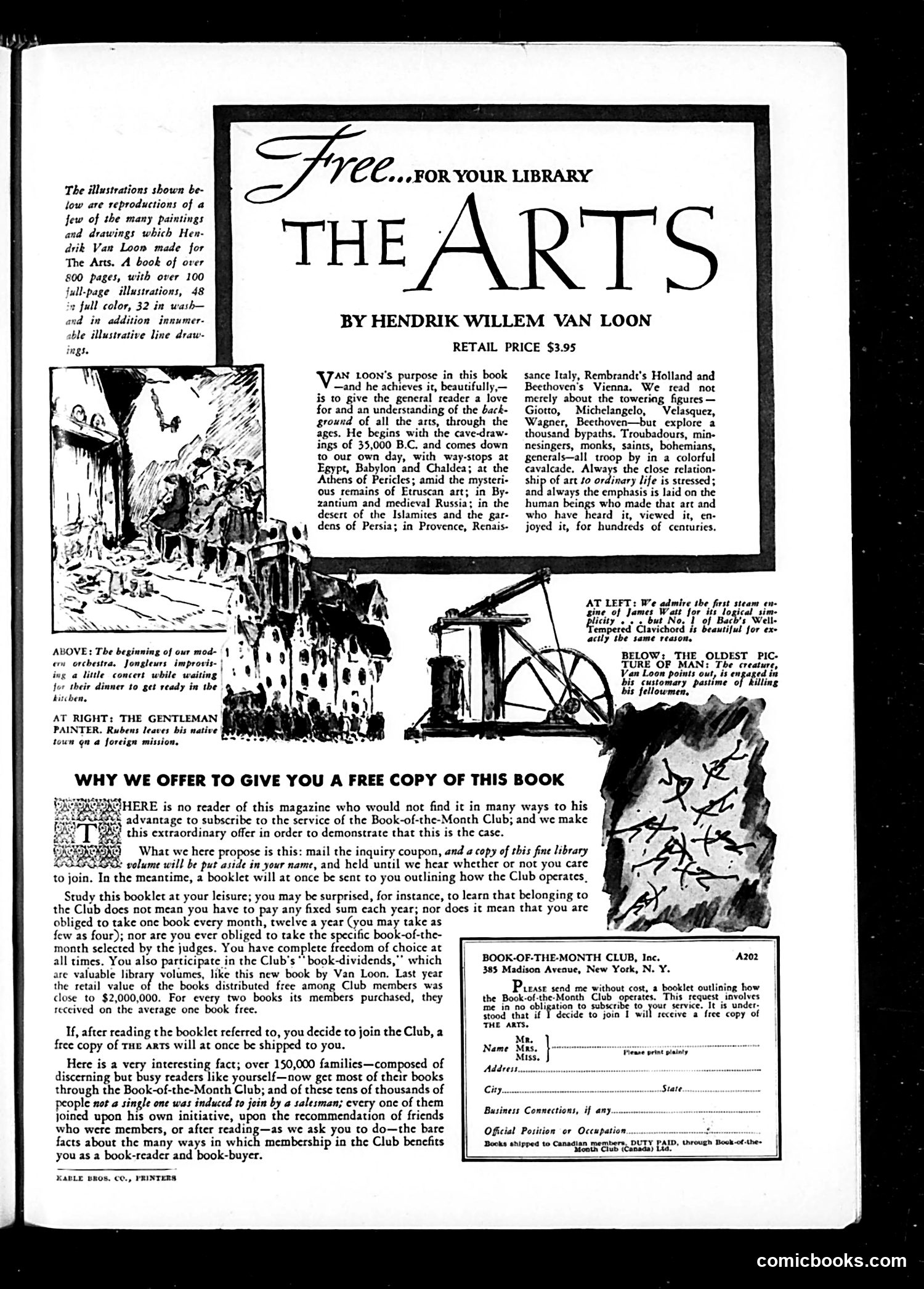
Analysis for Modern Readers This is primarily an advertisement, not a political cartoon. It's a full-page promotion for Hendrik Willem Van Loon's *The Arts*, a comprehensive illustrated history spanning from prehistoric cave paintings to modern times. The page showcases sample illustrations from the 800-page book—depicting subjects like early steam engines, medieval musicians, and Renaissance painters. The text emphasizes Van Loon's approach: showing art not as isolated masterpieces but as expressions of ordinary human life across centuries. The advertisement's real focus is recruiting subscribers for the Book-of-the-Month Club, which is offering this book free to new members. The pitch emphasizes flexibility—members can choose their own books and accumulate "book dividends." This was a popular mid-20th-century subscription service. No satire or political commentary is present; this is straightforward commercial messaging using Van Loon's respected cultural authority to drive club membership.
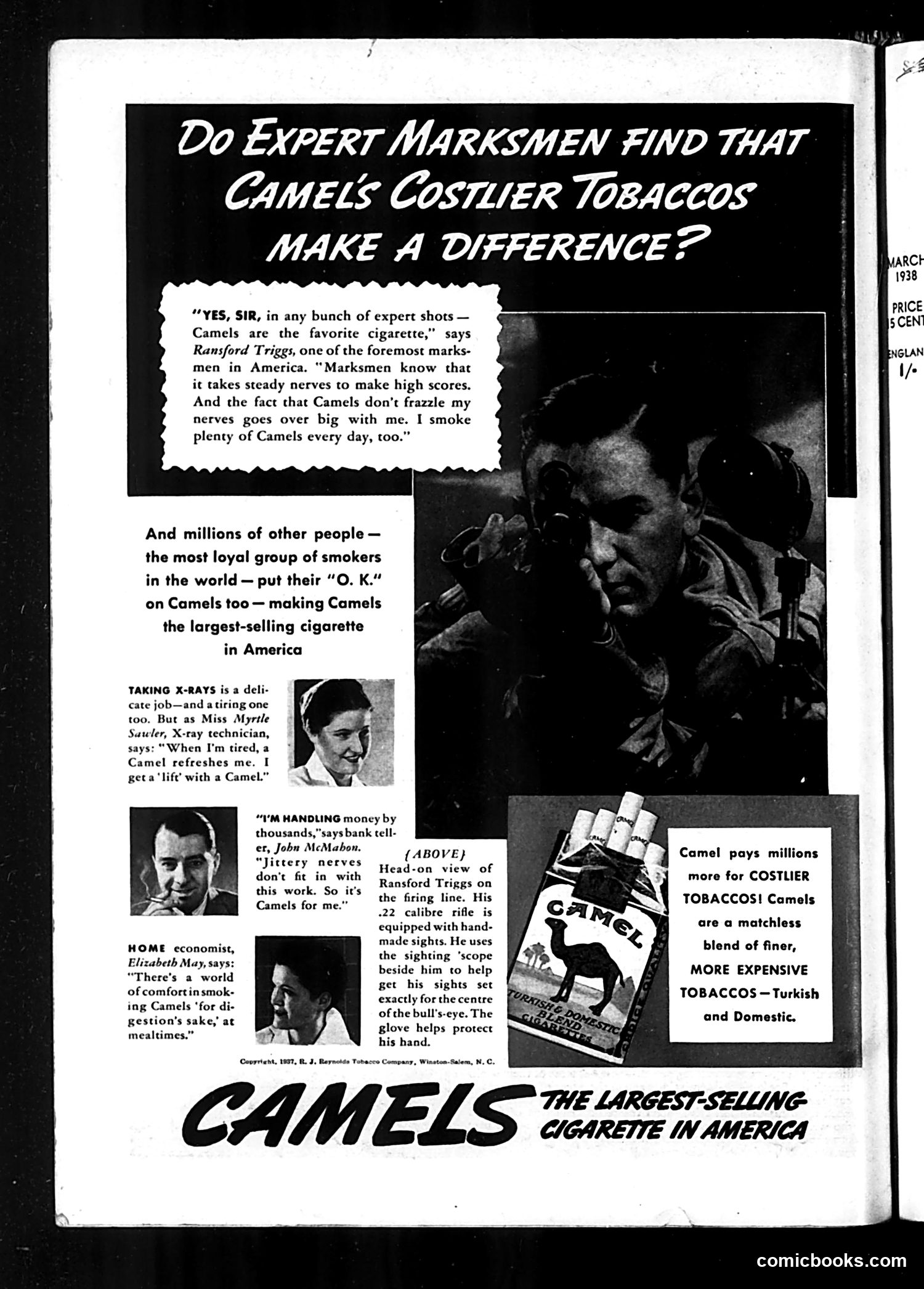
Advertisement Analysis This is a Camel cigarette advertisement, not satire or political cartoon. Dated 1938, it uses testimonials from professionals requiring "steady nerves"—a marksman (Ransford Triggs), X-ray technician, and bank teller—to claim Camels are superior because they don't cause nervousness. The ad employs a common mid-century marketing strategy: associating cigarettes with competence, calm, and professional success. By featuring working-class and skilled professionals rather than celebrities, it suggests Camels are trusted by ordinary experts. The phrase "costlier tobaccos" emphasizes premium pricing as proof of quality. The tagline "largest-selling cigarette in America" implies popularity validates the product. For modern readers: This represents pre-warning-label tobacco marketing that made health claims (calming effects) and explicitly targeted occupations requiring focus—tactics now prohibited. The ad's casual confidence about smoking's benefits reflects attitudes that preceded scientific consensus on smoking's dangers.