judge
Judge — March 1938
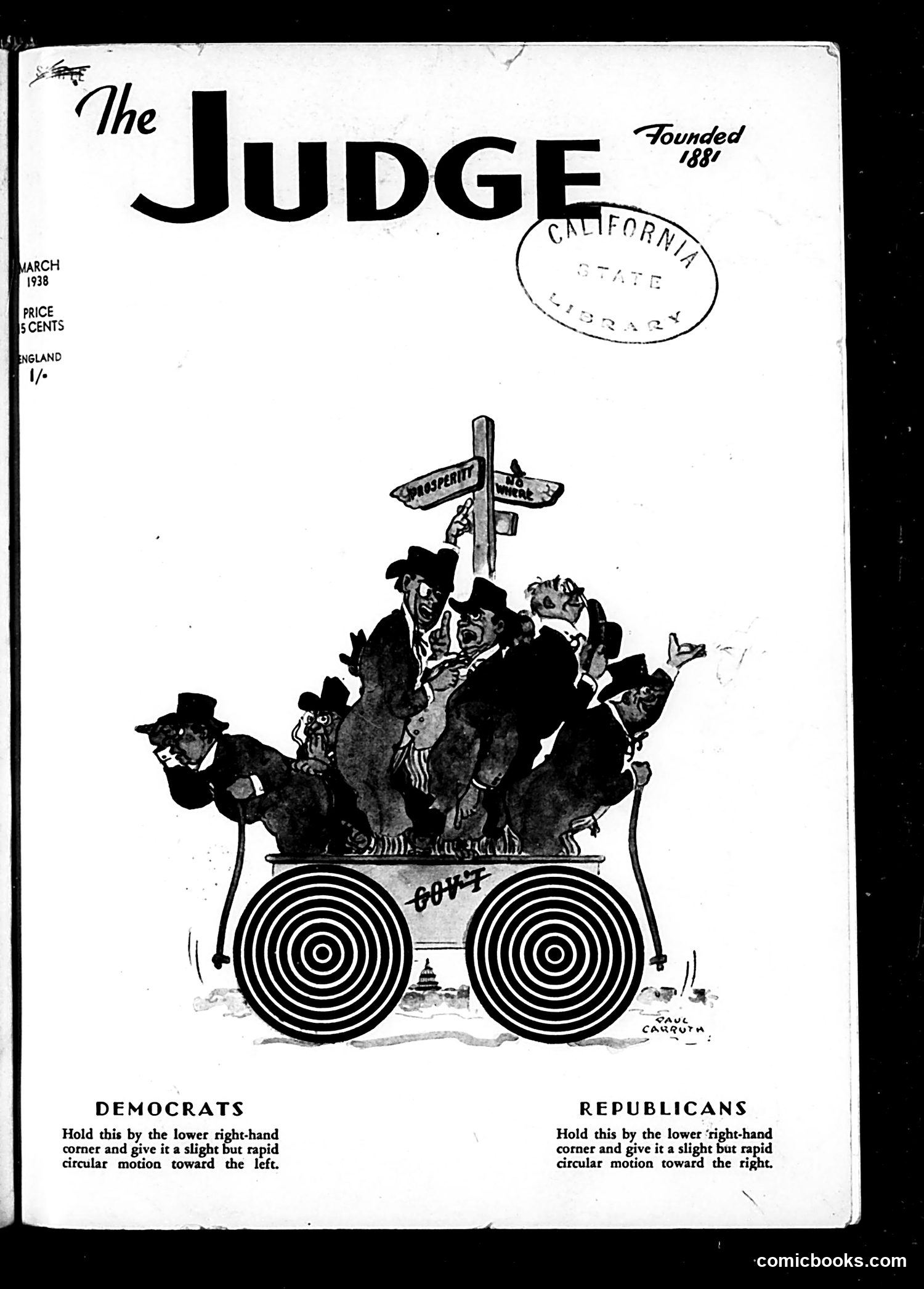
Analysis of "The Judge" Cover, March 1938 This satirical cover depicts the 1938 political landscape as a precarious wagon balanced on two large wheels labeled "COURT." The wagon carries multiple caricatured figures representing political actors, topped by a cross labeled "PROSPERITY." The instructions at bottom reveal the cartoon's optical illusion mechanic: rotating it left (for Democrats) or right (for Republicans) makes the wagon appear to tip in that direction. This visualizes how both parties blamed each other for economic instability during the Great Depression era. The figures likely represent political leaders and institutions of the period; the cross symbolizes that prosperity—the central issue—is precariously balanced between the two parties' competing claims about how to achieve economic recovery.
Analysis This page is primarily advertising, not satire or political cartoon content. It's a full-page advertisement for Union Central Life Insurance Company (Cincinnati, Ohio), founded in 1867. The ad promotes their "Family-Needs Forecast" service, which helps families plan life insurance coverage for seven different potential needs. The opening narrative describes a widowed family facing financial hardship because the father didn't anticipate future expenses. The advertisement appeals to male breadwinners' anxieties about protecting their families' security. It emphasizes that Union Central can help calculate adequate coverage through professional planning. There is no political satire or cartoon content visible—this is straightforward commercial messaging typical of Judge magazine's revenue model, mixing editorial content with advertisements.
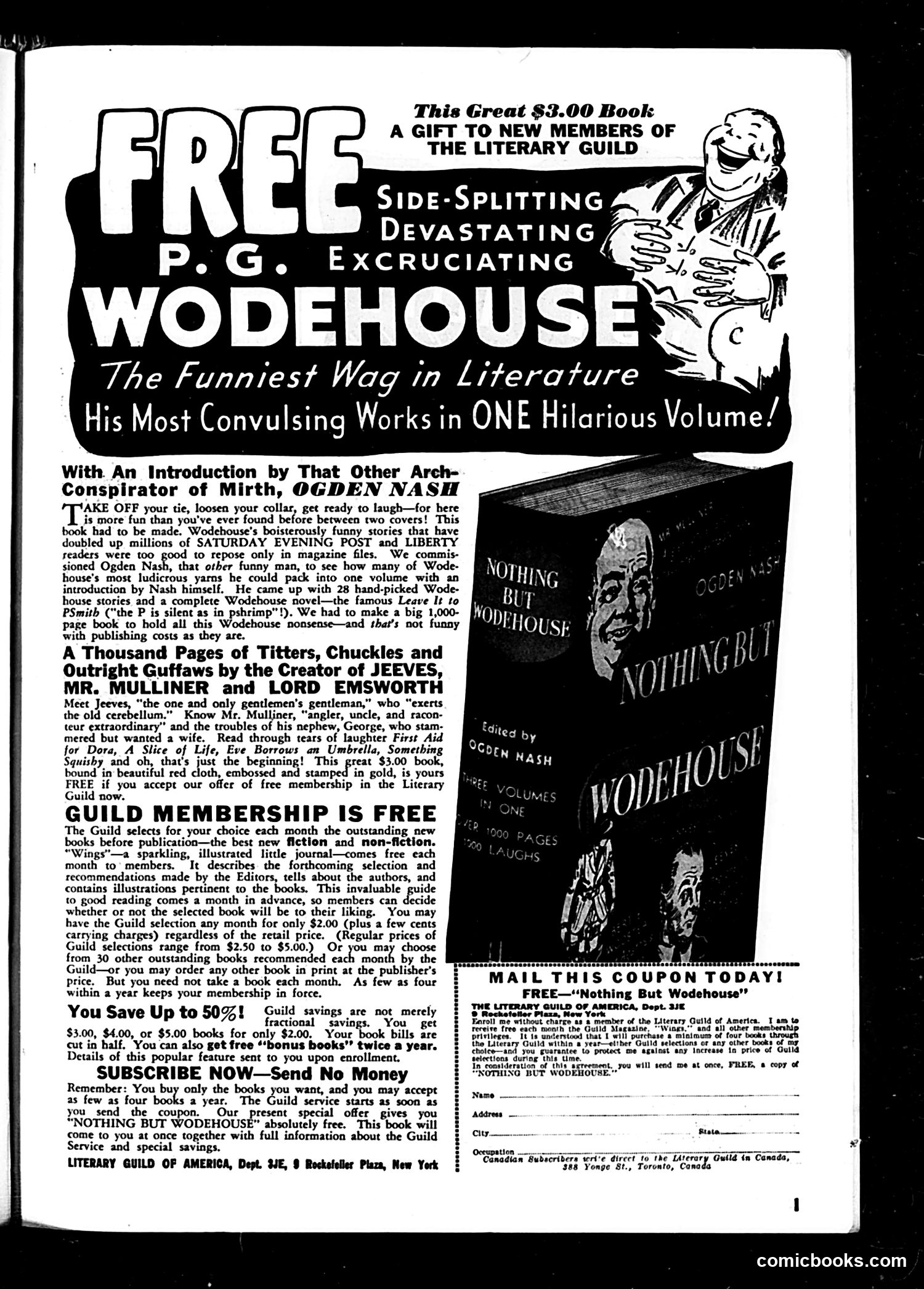
Analysis This is primarily a Literary Guild membership advertisement, not political satire. The page promotes a free P.G. Wodehouse collection titled "Nothing But Wodehouse," edited by Ogden Nash, as a gift for joining the Guild. The visual humor features Wodehouse caricatures and comedic illustrations typical of his work—the jolly figure on the left appears to represent Wodehouse himself or his famous character Jeeves. The advertisement emphasizes Wodehouse's reputation as "the funniest wag in literature," referencing his beloved comic characters including Jeeves, Mr. Mulliner, and Lord Emsworth. The satire is literary rather than political—it mocks pretentious reading culture while celebrating accessible humor. The ad promises members can obtain quality books at discounted prices, positioning the Guild as an alternative to expensive individual purchases.
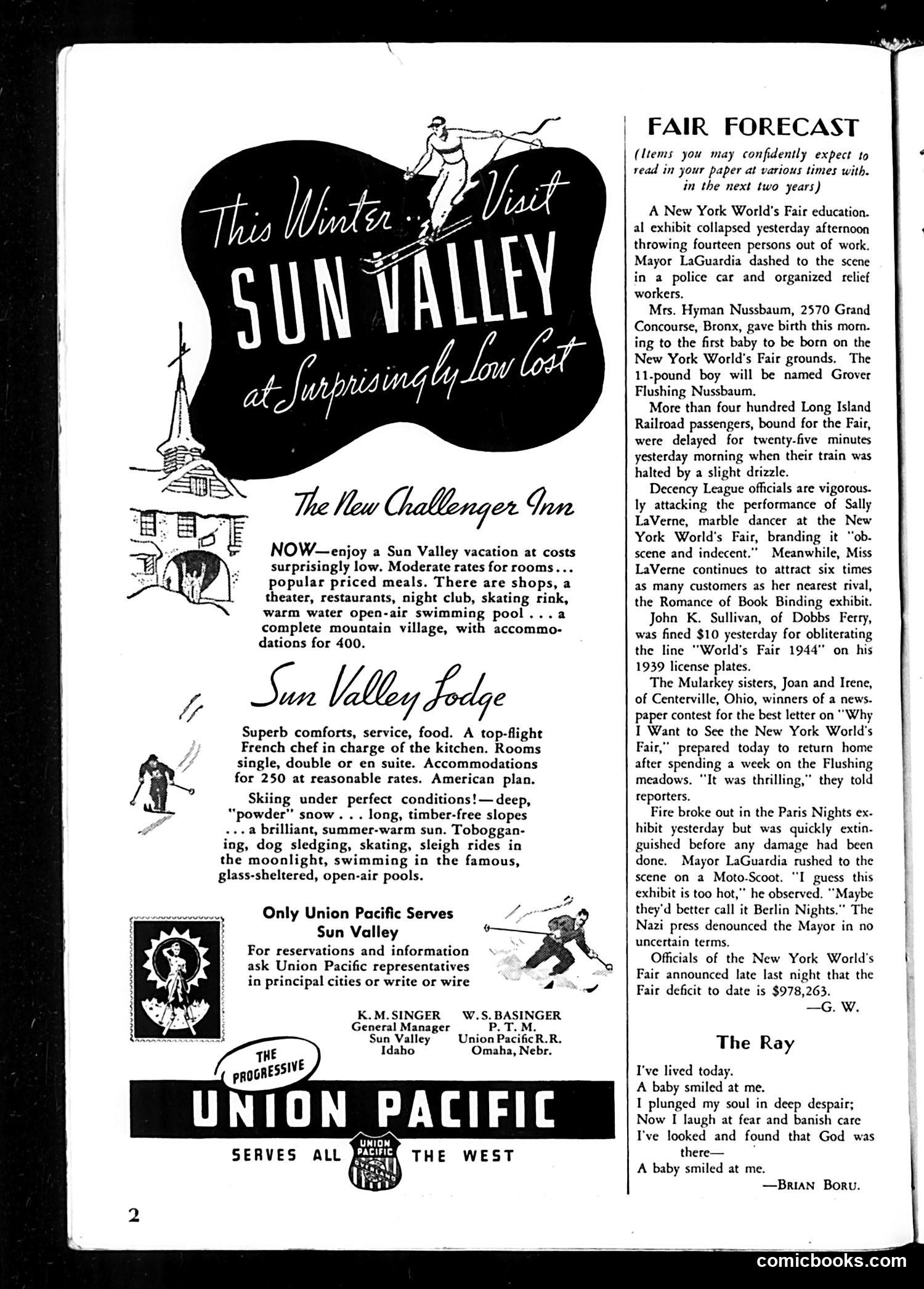
Page Analysis This page is primarily advertising, not satire. The left side features two Union Pacific resort advertisements promoting Sun Valley, Idaho—"The New Challenger Inn" and "Sun Valley Lodge"—emphasizing affordable winter vacations with skiing, skiing, and amenities. The right side contains "Fair Forecast," a gossip column about the 1939 New York World's Fair. Items include: a collapsed educational exhibit, the first baby born on Fair grounds (named Grover Flushing Nussbaum), train delays, and criticism of dancer Sally LaVerne's performance as "obscene and indecent." The column notes the Fair's deficit and includes a poem, "The Ray," by Brian Boru. The content reflects mid-Depression Era promotional material and celebrity coverage rather than political commentary.
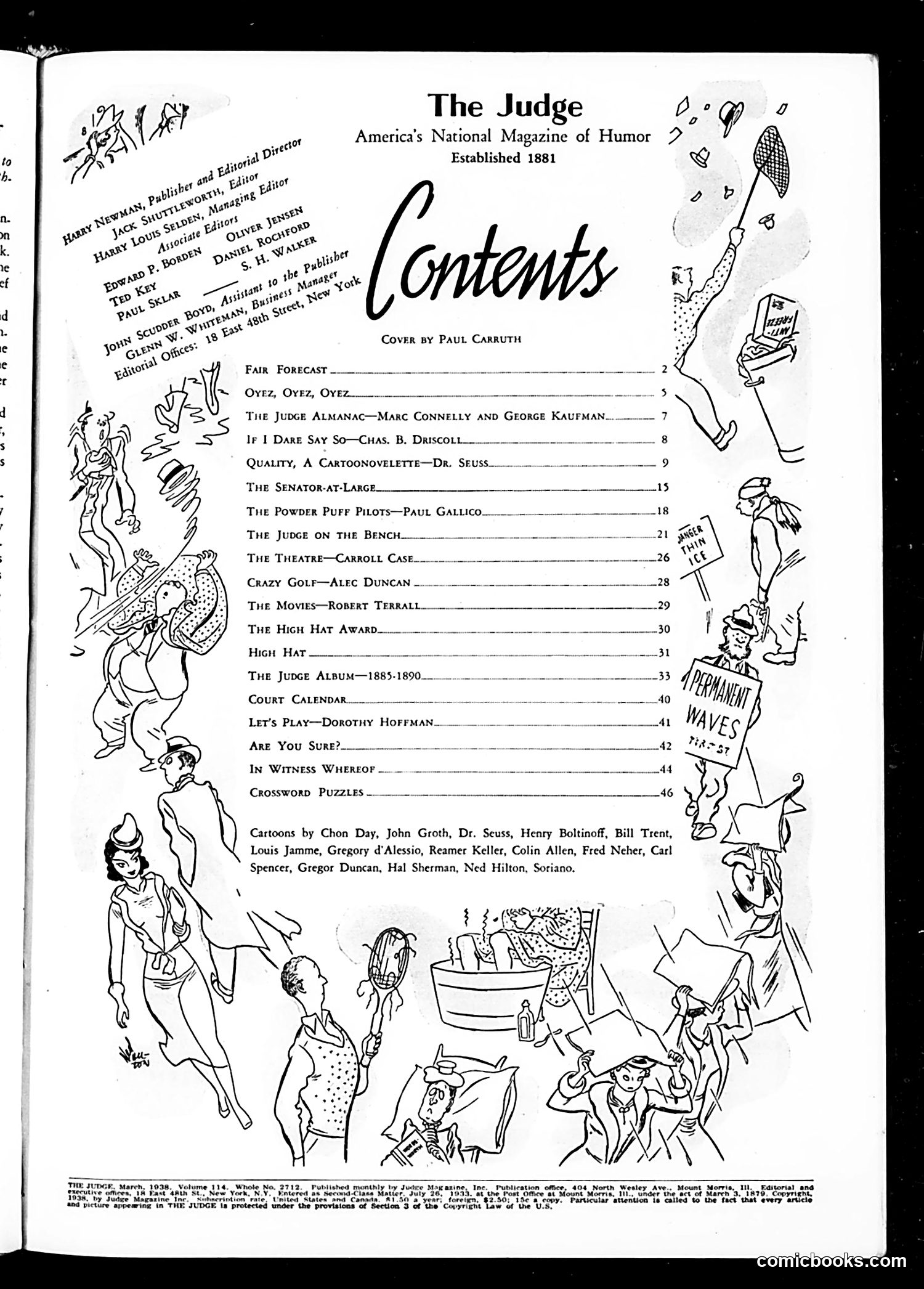
Contents Page Analysis This is a contents page for *The Judge* magazine (March 1938), listing articles and cartoons rather than displaying finished editorial content. Notable entries include "Quality, A Cartoonnovellette" by Dr. Seuss and "The Judge Album: 1883-1890," suggesting historical retrospectives. Several pieces reference contemporary topics: "The Senator-at-Large," "The High Hat Award," and "Court Calendar" appear to offer satirical commentary on politics and social institutions. The page credits cartoonists including Dr. Seuss, John Groth, and others—prominent humorists of the era. Without seeing the actual cartoons or articles, specific political/social references remain unclear, though the magazine's established reputation for political satire suggests commentary on 1930s American governance and society.
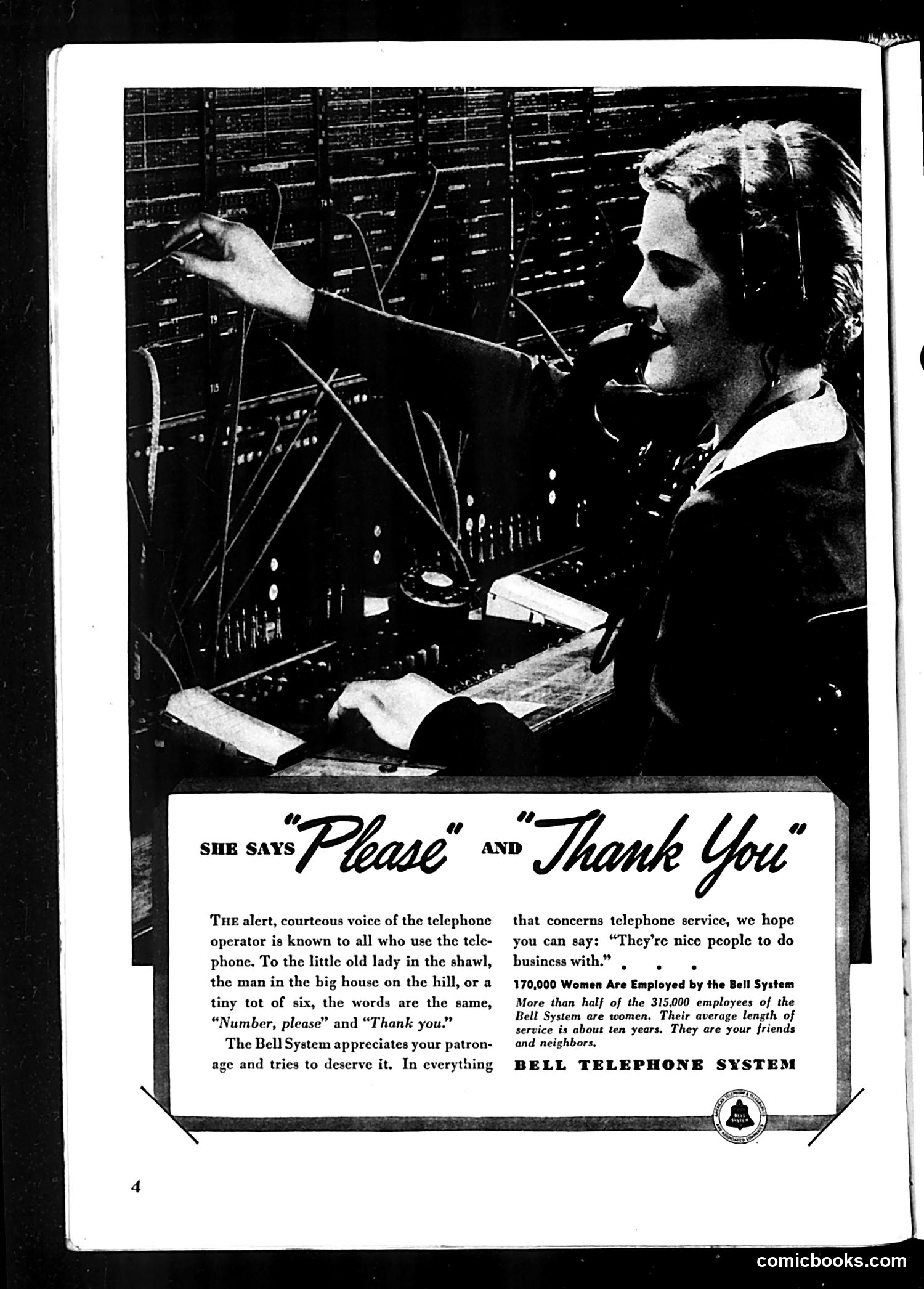
Analysis This is a Bell Telephone System advertisement rather than political satire. It depicts a telephone operator at a switchboard, emphasizing the professional courtesy and service operators provided. The text celebrates the operator's courteous phrases—"Please" and "Thank you"—as hallmarks of quality telephone service. The advertisement notes that 170,000 women were employed by Bell System out of 315,000 total employees, highlighting their significant workforce role. It describes operators as "your friends and neighbors" with an average ten-year tenure, positioning them as trusted community members. The image and copy work together to promote Bell's service quality through human connection, appealing to customers' appreciation for politeness and personal interaction—marketing strategy that emphasizes the human element of telephone service during this era.
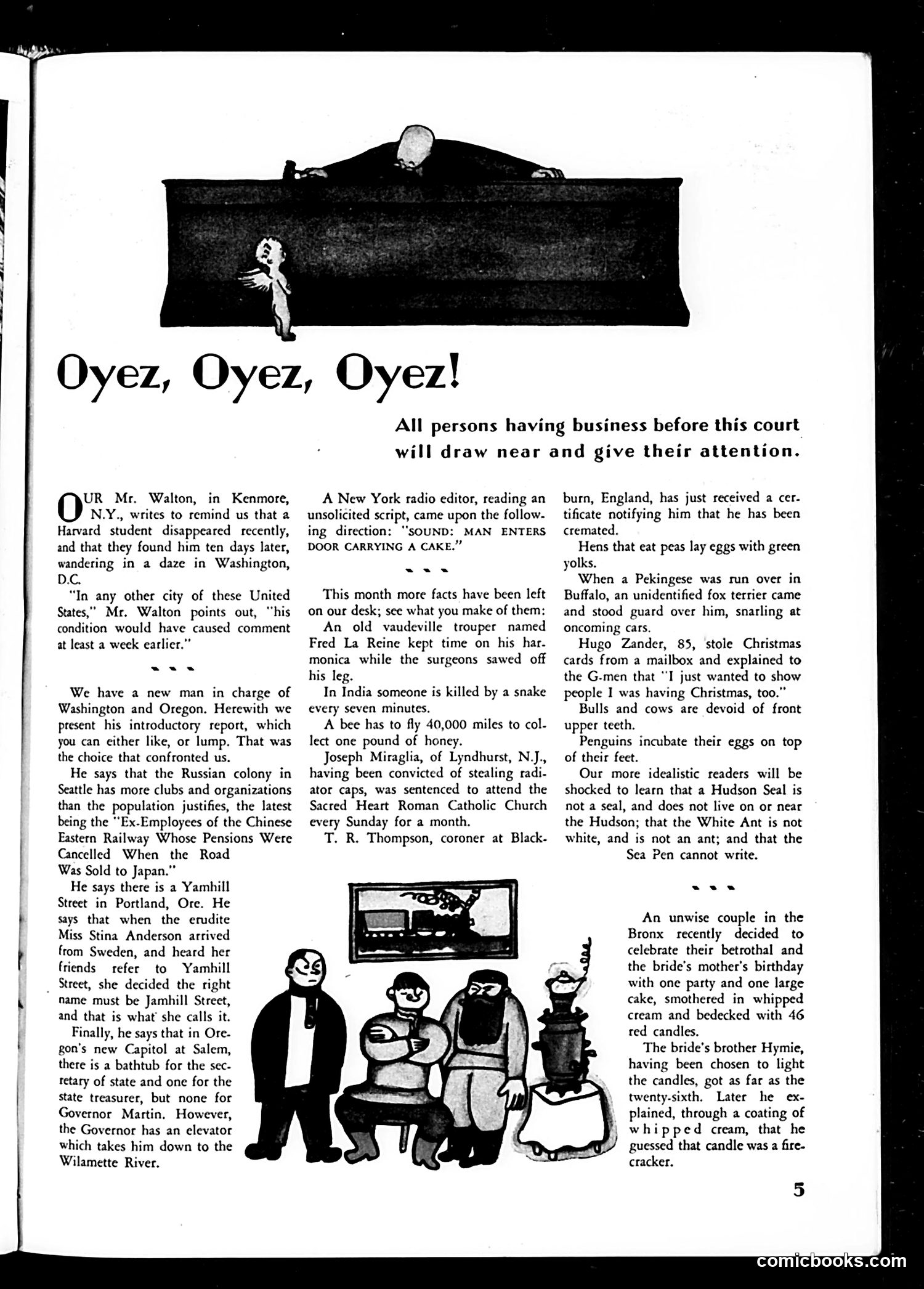
Analysis of Judge Page The page leads with "Oyez, Oyez, Oyez!"—a traditional court crier's call—establishing a humorous "court of anecdotes" format. The content collects amusing stories and odd facts rather than presenting unified political satire. The main illustrated cartoon (bottom) depicts what appears to be a domestic scene with four figures in formal attire gathered around a cake. The accompanying text describes an "unwise couple in the Bronx" celebrating multiple occasions with one large cake, whose candles the bride's brother mistook for firecrackers when he lit them—a slapstick punchline. The page functions primarily as a humor magazine section compiling amusing incidents (a disappeared Harvard student, unusual animal facts, naming mishaps) rather than focused political commentary. The satire is gentle, situational comedy rather than sharp social critique.
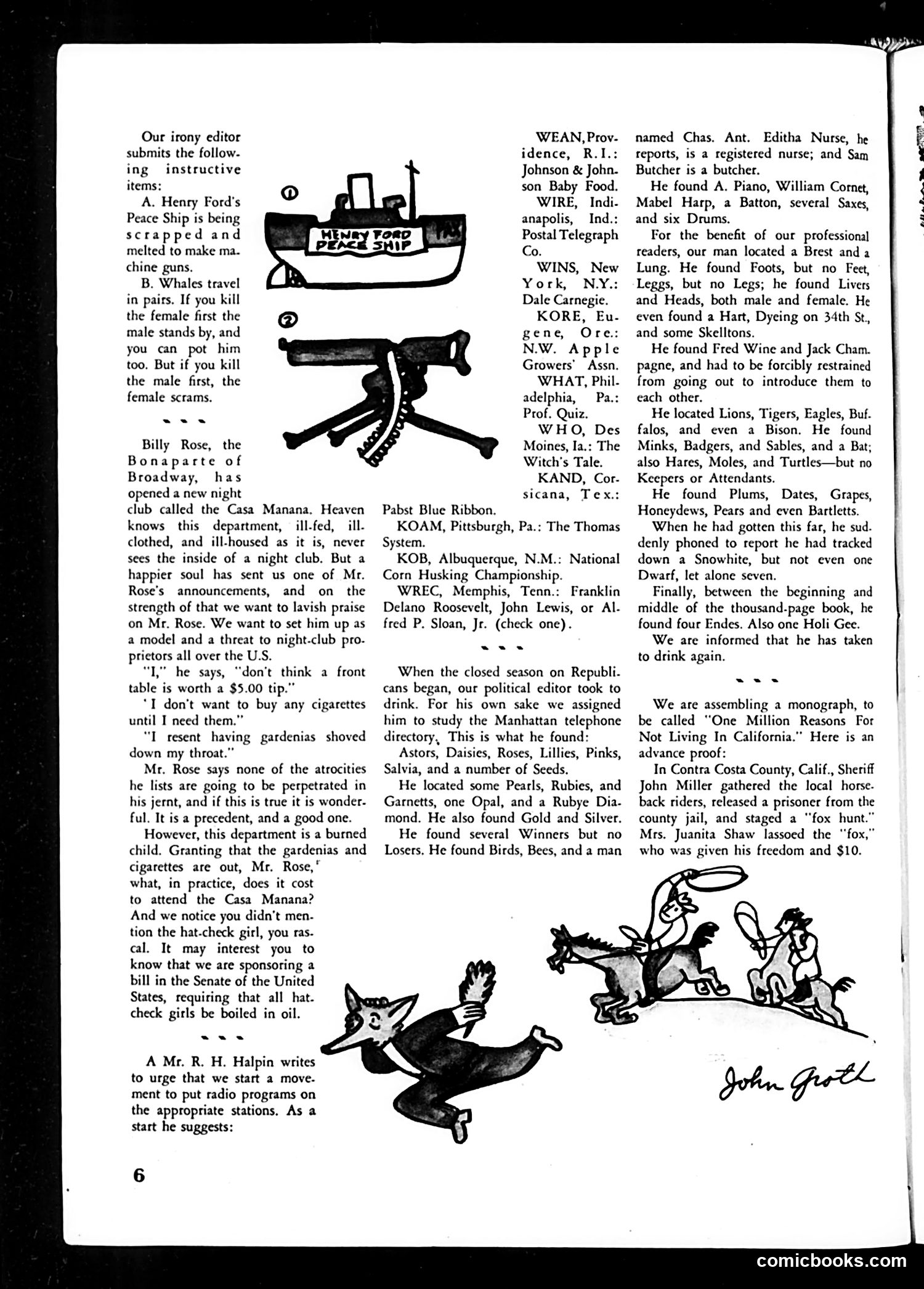
Analysis of Judge Magazine Page This page contains satirical commentary and cartoons rather than a cohesive narrative. The main content includes: Left column: An "irony editor" section mocking absurd statements from various contributors—including complaints about gardeners, cigarettes, and hat-check girls at nightclubs. The satire targets pretentious complaints from the wealthy. Center/Right: Brief humorous reports from across America, including odd findings (animals without typical features, unusual items discovered). The tone is absurdist humor. Cartoons: Two illustrated gags appear—one showing a fox and another showing people in comedic situations—typical of Judge's visual humor style. Bottom note: A suggestion to start a radio program movement, signed by John Groth. The overall page exemplifies Judge's format: satirizing current events, social pretension, and American eccentricity through brief jokes and illustrations rather than sustained political commentary.
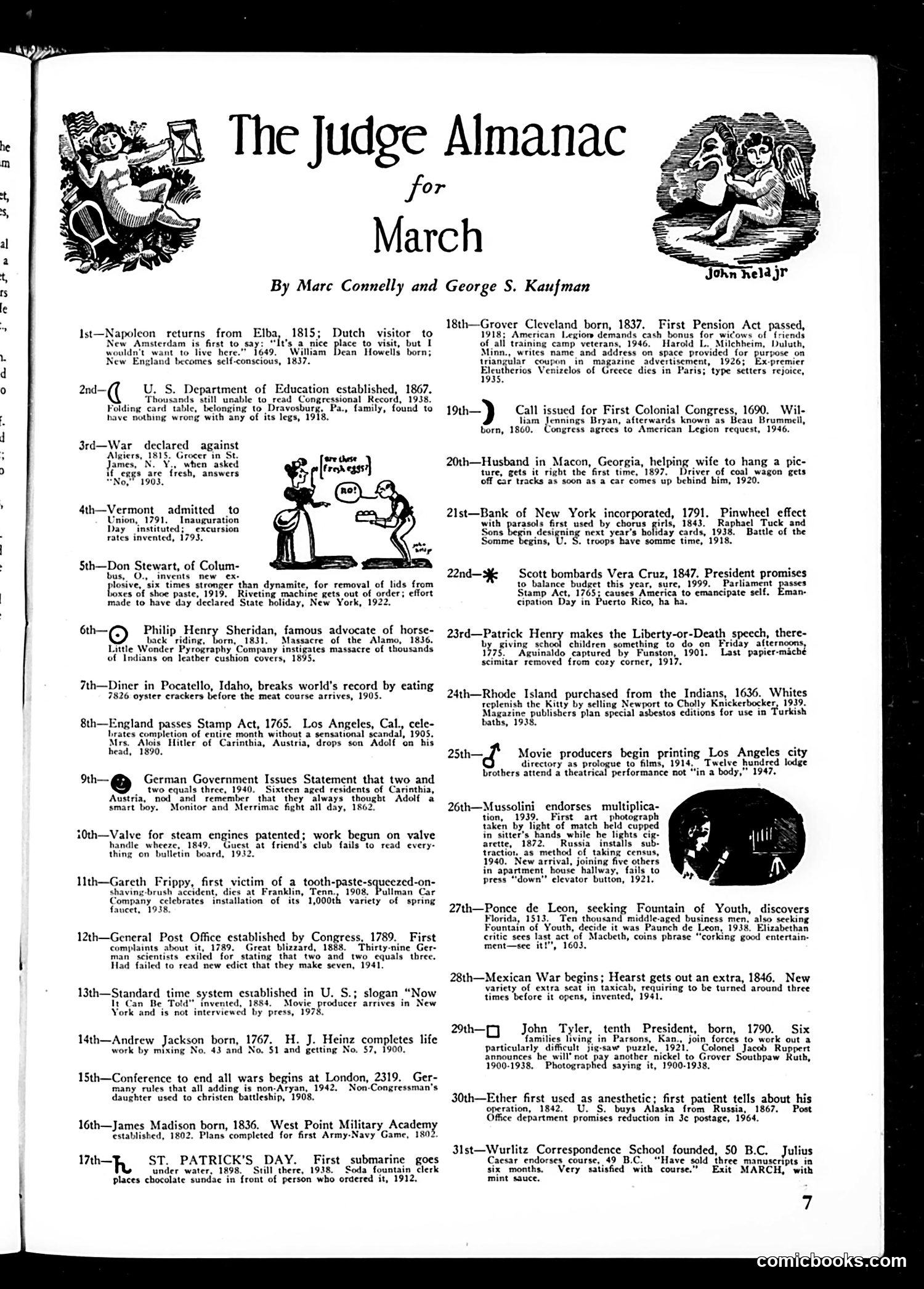
The Judge Almanac for March This is an almanac page listing historical events for each day of March, compiled by Marc Connelly and George S. Kaufman for *Judge* magazine. The page contains two small cartoon illustrations accompanying entries, though they're generic comedic vignettes rather than political satire: One shows a figure apparently caught in an awkward domestic situation (entry 5th); another depicts what appears to be a slapstick scene (entry 8th). The entries themselves document genuine historical events—Napoleon's return from Elba, Vermont's statehood, Patrick Henry's Liberty-or-Death speech, Andrew Jackson's birth, etc.—mixed with humorous or absurd fictional "facts" typical of satirical almanacs. The format parodies serious historical reference works while entertaining readers with invented anecdotes.
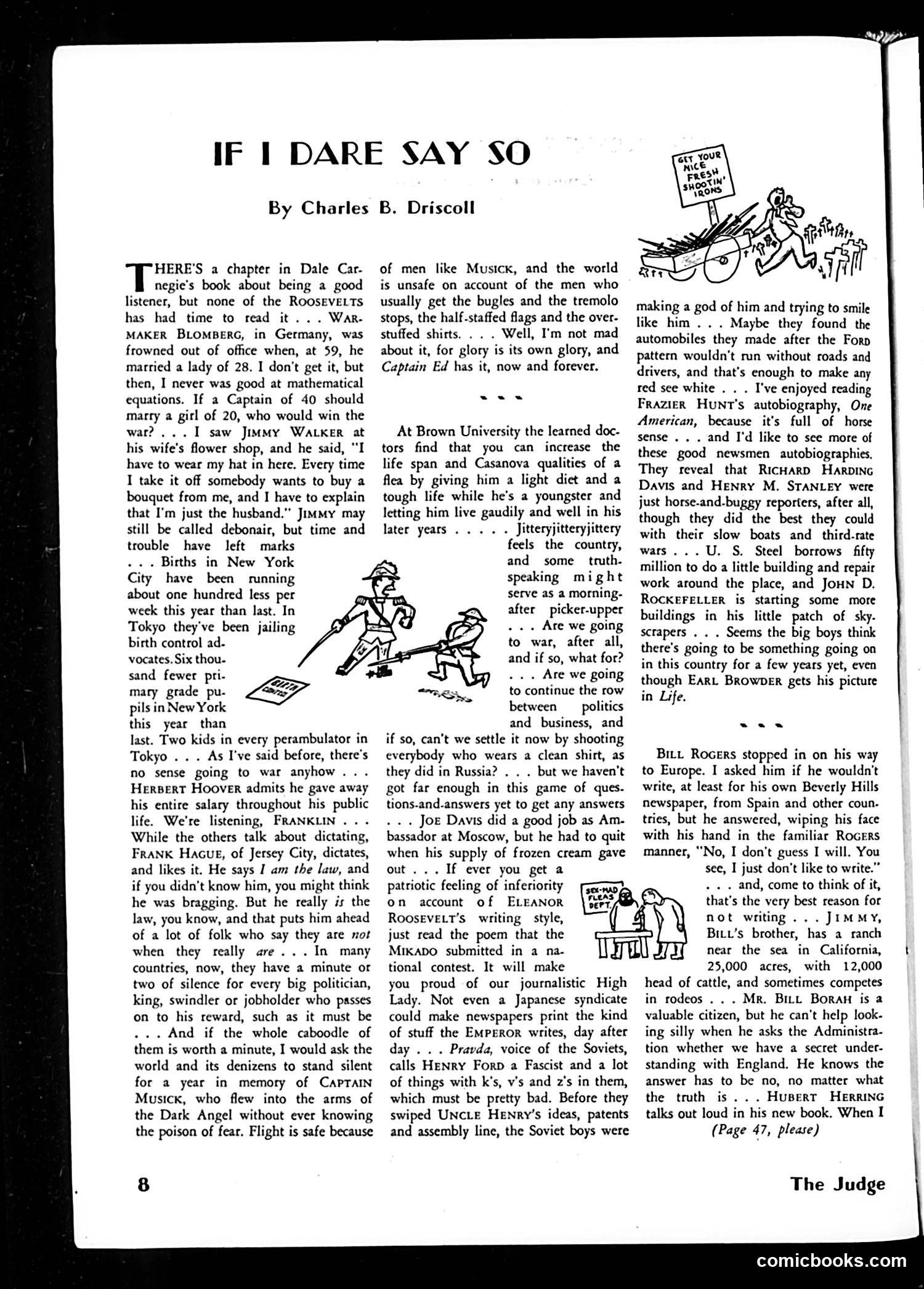
Analysis of "If I Dare Say So" by Charles B. Driscoll This is a satirical opinion column from Judge magazine containing social and political commentary rather than traditional cartoons. The author critiques contemporary figures and trends: Key references: - Herbert Hoover vs. Franklin D. Roosevelt: Driscoll sarcastically challenges Hoover's claim of giving away his entire presidential salary, implying Roosevelt should prove similar generosity - Captain Ed Musick: Aviator praised for pioneering aviation safely without fear - Eleanor Roosevelt: Her writing style mocked as inferior - Henry Ford: Criticized by Soviet propaganda (Pravda) for his industrial innovations, which the Soviets later copied - General observations: Birth control debates in Japan vs. New York; concerns about potential war; political corruption The column's tone is cynical—mocking both American and Soviet leaders while defending working professionals like pilots and journalists who contribute without fanfare. The satire suggests America's political establishment lacks the integrity of ordinary citizens.
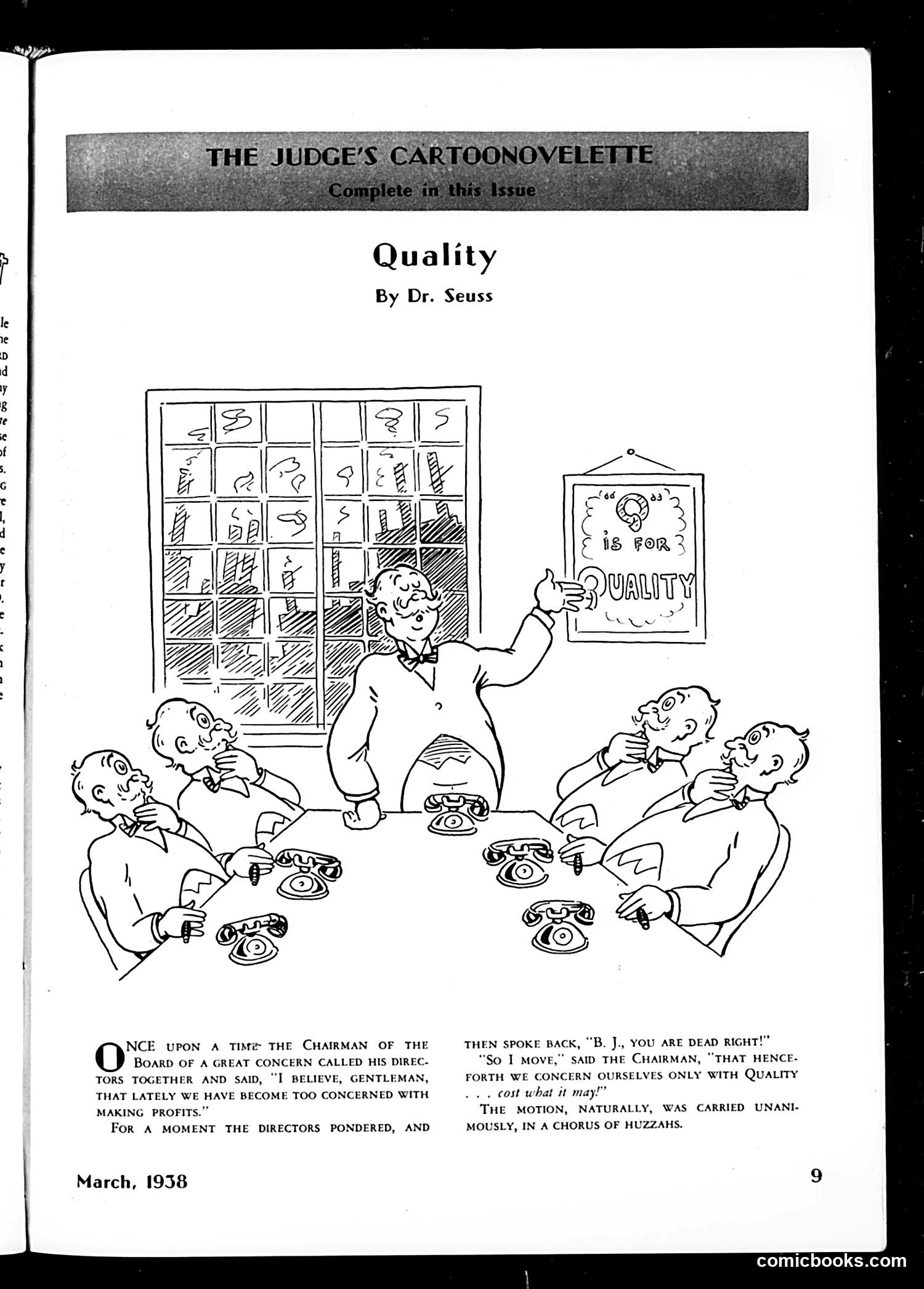
"Quality" by Dr. Seuss (March 1938) This satirical cartoon mocks corporate hypocrisy regarding profit versus quality. A board chairman addresses his directors, proposing they abandon profit-chasing to focus solely on quality—a noble sentiment the directors enthusiastically endorse in unison. The satire lies in the obvious absurdity: the cartoon shows a massive grid behind them (resembling a factory or production schedule) filled with diagonal hatching, suggesting mass production and standardization—the opposite of genuine quality. The cartoon implies that corporate boards make such high-minded proclamations for show while actually prioritizing efficiency and profits. Seuss critiques how corporations adopt virtuous-sounding policies without genuine commitment to them. The unanimous "huzzahs" underscore the performative nature of corporate ethics—everyone agrees on paper, but the underlying systems remain unchanged. This reflects Depression-era skepticism about big business sincerity.
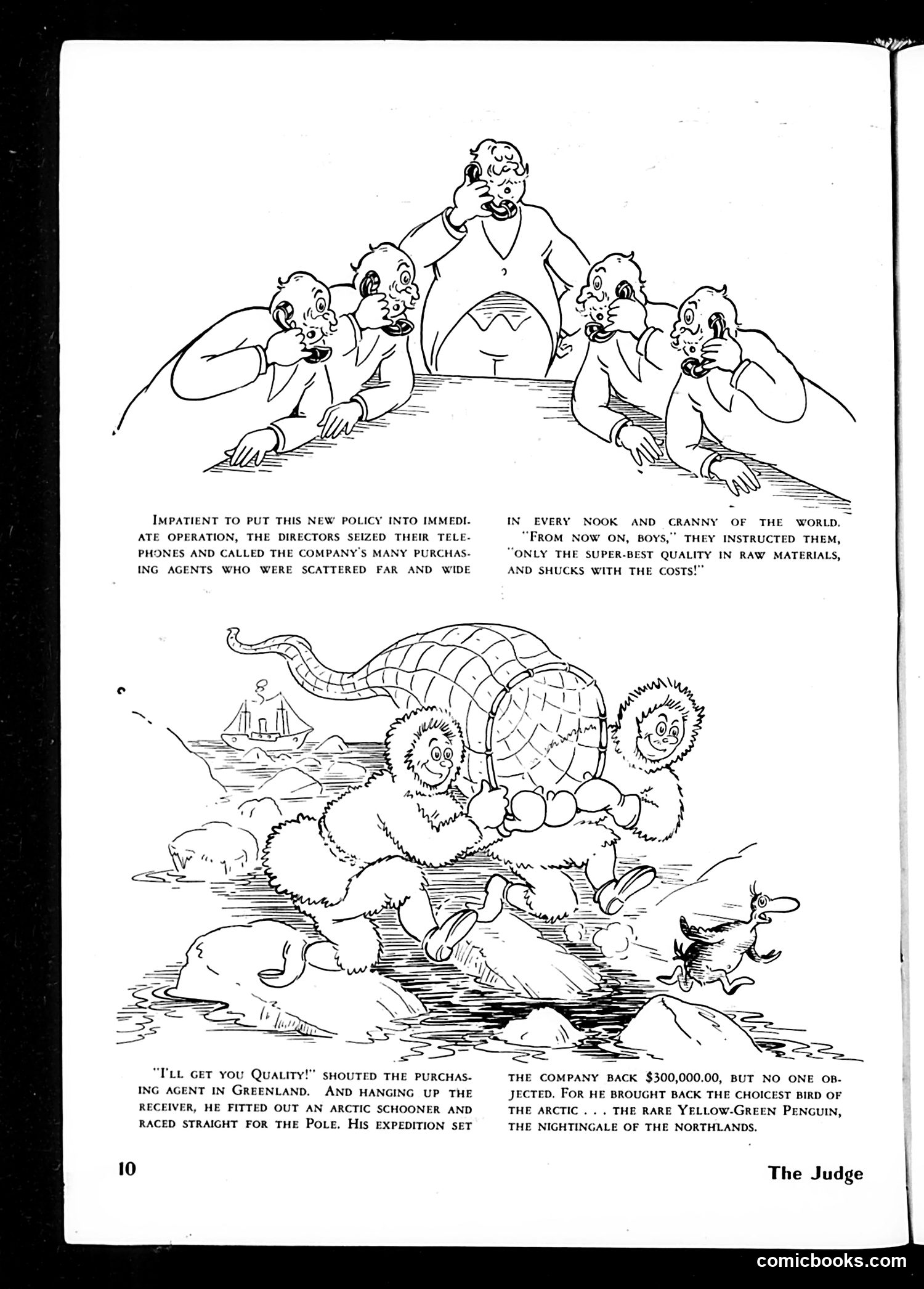
Cartoon Analysis: "Quality at Any Cost" This satirical cartoon mocks corporate obsession with cost-cutting disguised as quality improvement. Company directors issue new directives demanding "super-best quality in raw materials" while watching costs—an inherent contradiction. The absurdist punchline: A purchasing agent in Greenland, taking the mandate literally, spends $300,000 to retrieve a rare "Yellow-Green Penguin" from the Arctic, claiming it's "the nightingale of the northlands." The illustrated expedition shows fuzzy creatures (penguins) being transported via igloo and schooner. The satire targets corporate hypocrisy—executives demand impossible standards while claiming fiscal responsibility, leading subordinates to pursue ridiculous, wasteful solutions. The exotic penguin procurement exemplifies how misguided directives produce absurd real-world consequences that contradict the original cost-saving intent. It's a commentary on corporate bureaucracy and the gap between stated values and actual practice.
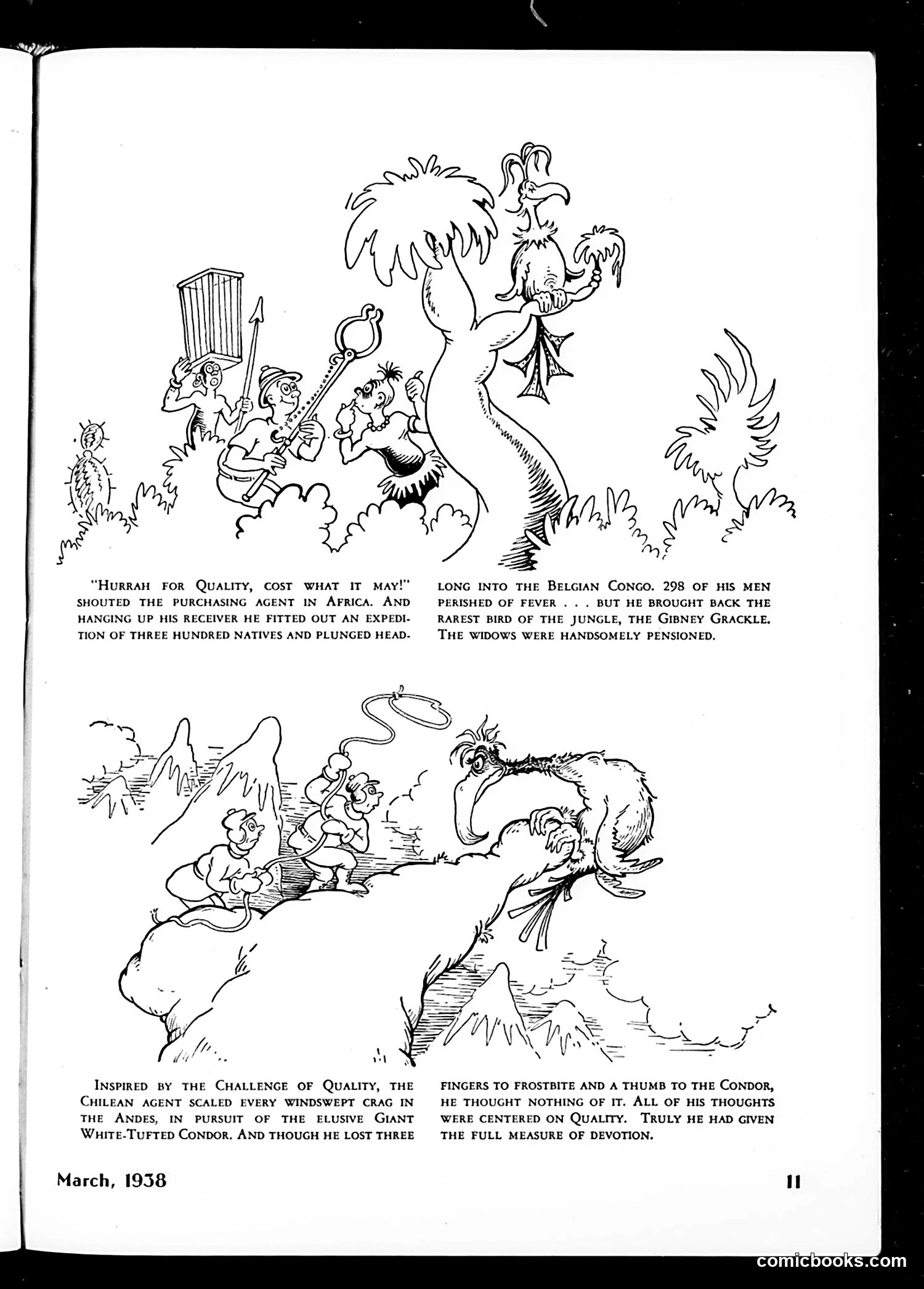
Analysis: "Quality at Any Cost" This March 1938 *Judge* satirical cartoon mocks corporate obsession with product quality regardless of human cost. Two purchasing agents—one African, one Chilean—pursue rare birds (the "Gibney Grackle" and "Giant White-Tufted Condor") with fanatical dedication. The satire critiques: 1. Capitalist excess: The agents sacrifice hundreds of workers' lives and their own limbs for luxury commodities 2. Callous corporate logic: Widows receive pensions as a convenient solution to mass casualties 3. Blind devotion to profit: The agents show no moral concern, only focus on "quality" The exaggerated cartoon style emphasizes the absurdity—treating extreme human suffering as a punchline to corporate greed. Published during the Great Depression, this likely resonates with contemporary concerns about worker exploitation and capitalist indifference to human welfare. The fictional birds underscore the vanity: men die for ornamental luxuries.
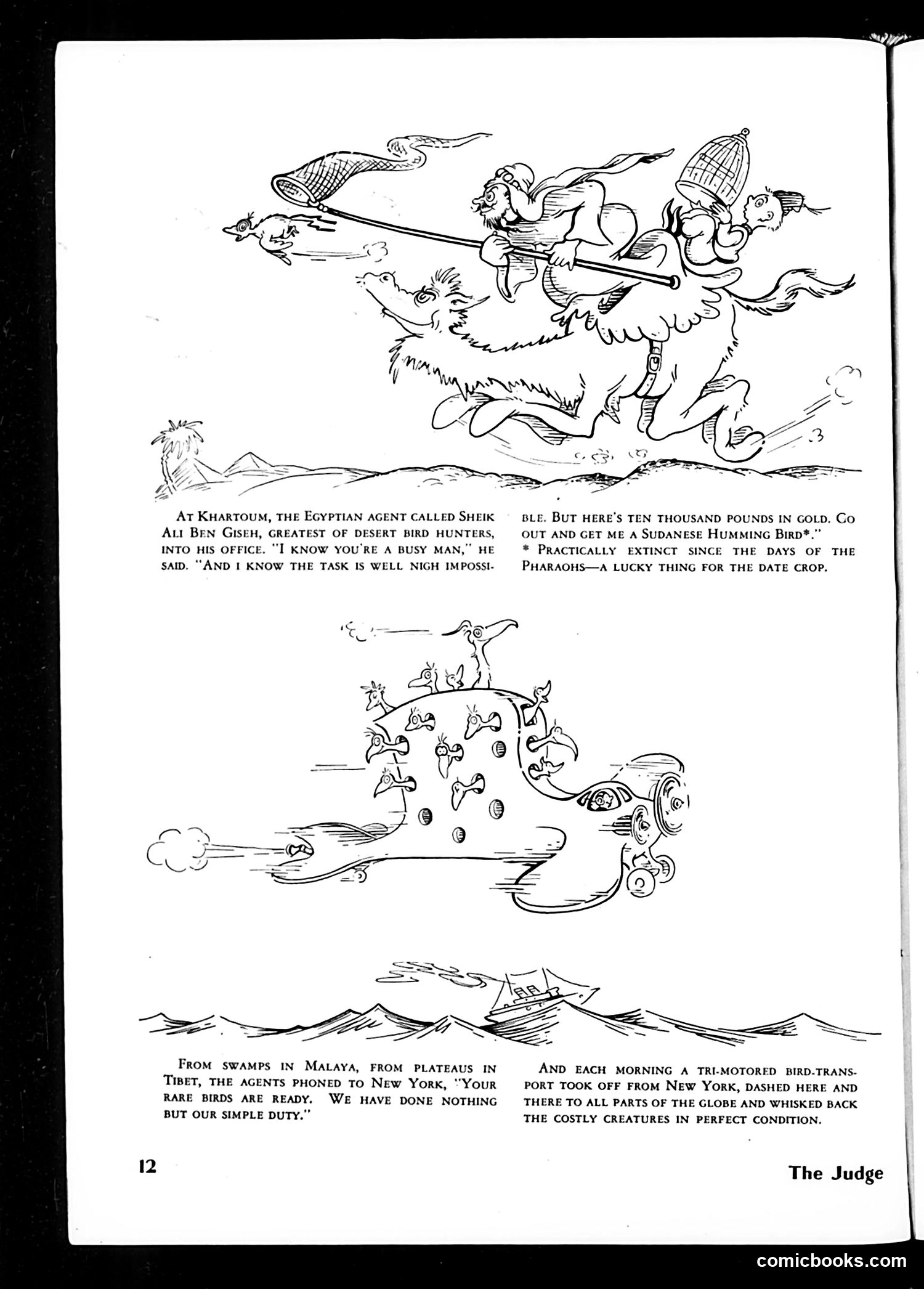
Analysis This is a satirical story about an absurd international scheme. An Egyptian official (Sheik Ali Ben Giseh) bribes a "desert bird hunter" with ten thousand pounds of gold to capture a Sudanese Humming Bird—described as practically extinct since the pharaohs' era—supposedly to protect the date crop. The joke escalates through the middle cartoon, showing the logistical impossibility: agents in remote locations (Malaya, Tibet) coordinating to capture rare birds, then tri-motored aircraft whisking them globally back to New York and elsewhere. The satire likely mocks: - Colonial-era exploitation of distant lands and resources for wealthy interests - The absurdity of industrial logistics applied to impractical goals - Wasteful spending on vanity projects (preserving an extinct bird for crop protection makes no sense) The humor relies on the gap between the grandiose setup and the ridiculous, needlessly complicated execution—a classic Judge magazine approach to lampooning wealthy foolishness and bureaucratic excess.
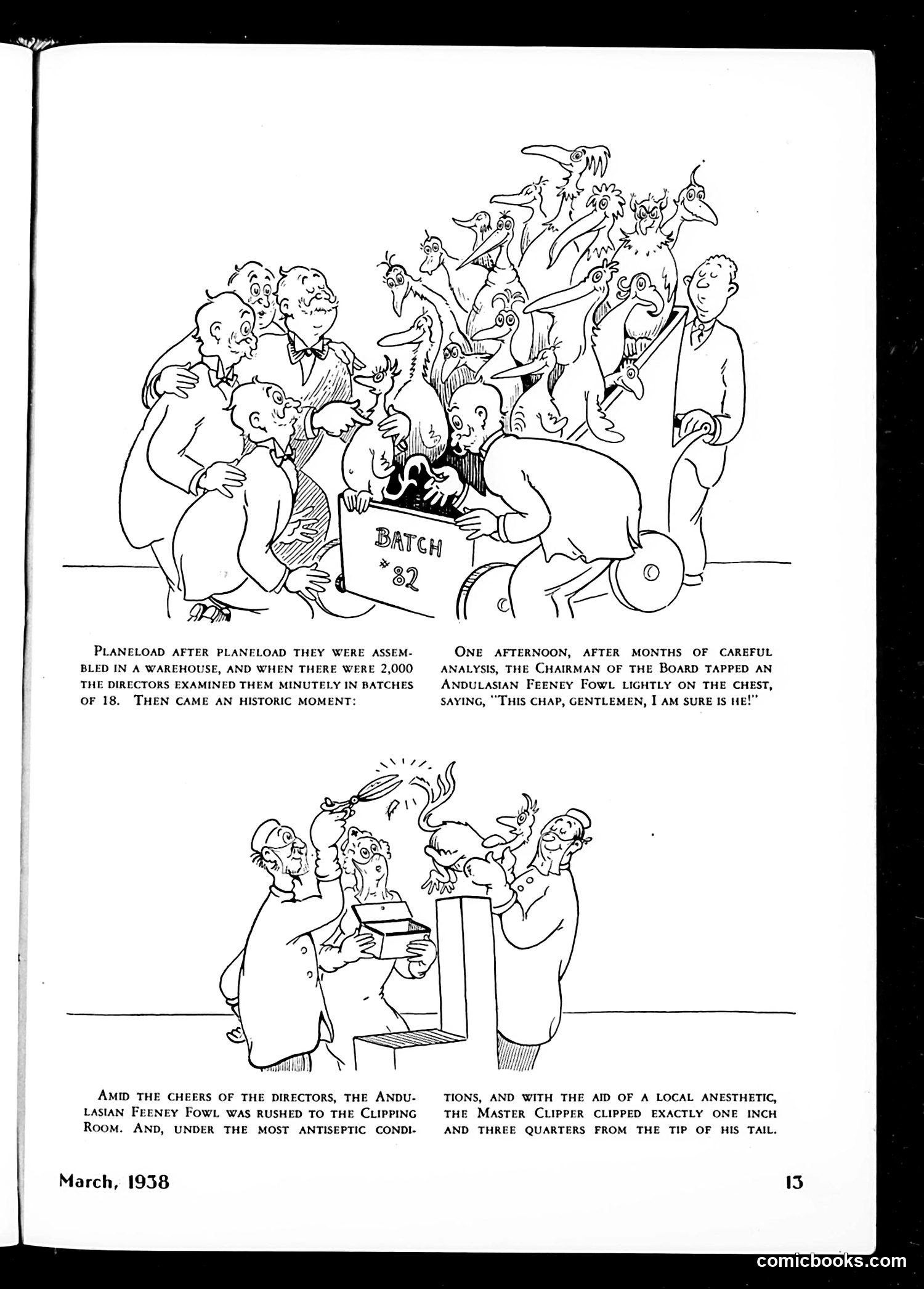
Judge Magazine Satire Explanation This 1938 cartoon satirizes corporate bureaucracy and quality control absurdity. The narrative follows a fictional "Andulasian Feeney Fowl" (a made-up exotic bird) being subjected to elaborate, ridiculous inspection procedures: The Satire: A company assembles 2,000 identical birds in a warehouse, then exhaustively examines them in batches of 18. After months of "careful analysis," executives dramatically identify one "perfect" specimen and rush it to be precisely trimmed—removing exactly 1 inch and three-quarters from its tail under anesthetic conditions. The Point: Judge mocks corporate culture's obsession with standardization, minute specifications, and bureaucratic theater. The executives' celebration over selecting one bird from thousands and making trivial adjustments reflects the era's industrial mass-production mindset, where companies invested enormous resources into meaningless precision and conformity. The humor lies in the escalating absurdity: why does a bird need anesthetic tail-clipping? What difference does 1¾ inches matter?
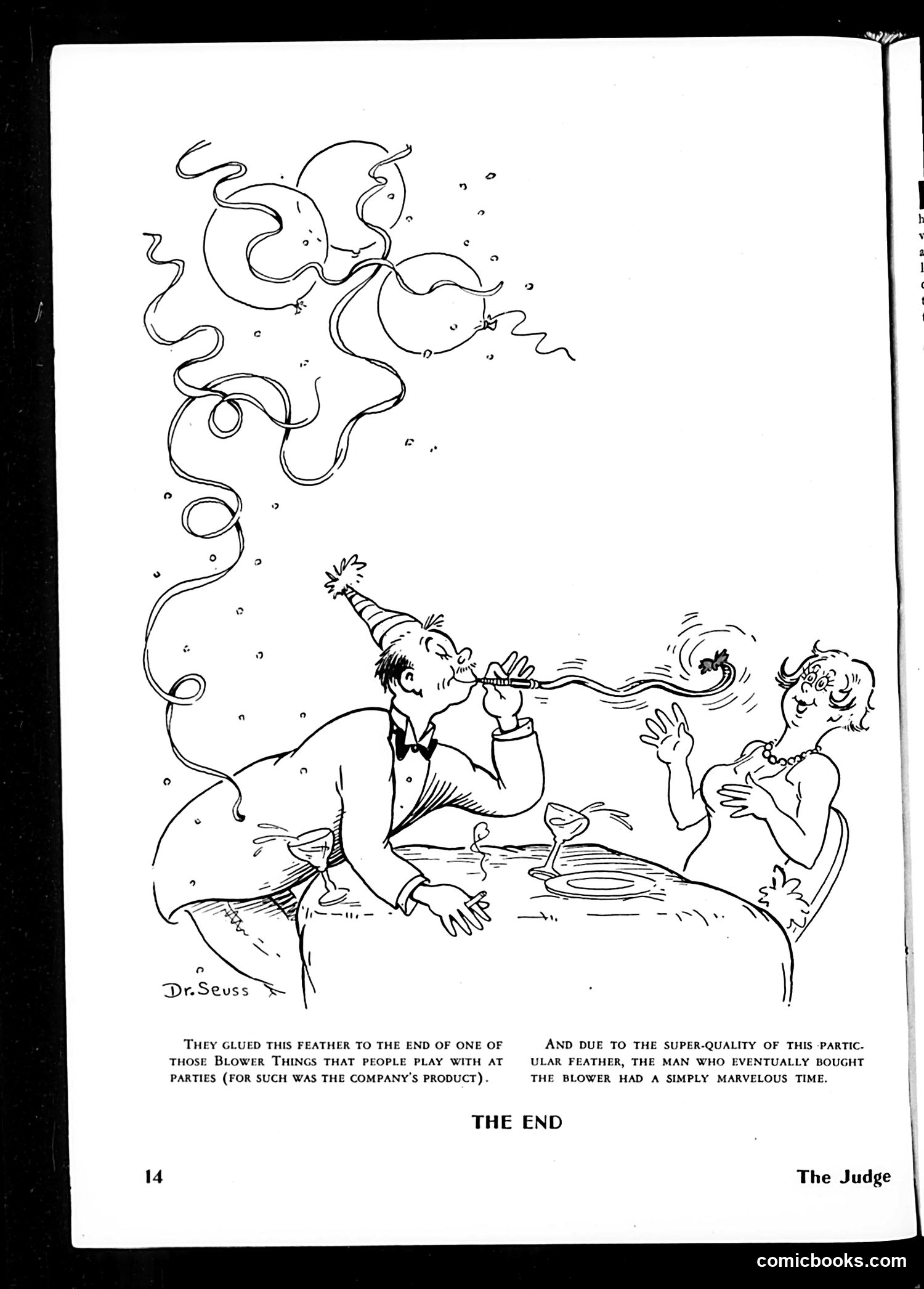
Analysis This is the final panel of a Dr. Seuss story published in *Judge* magazine. The cartoon shows a man and woman at a party: the man blows a party noisemaker (a common festive item), producing elaborate, billowing streams of paper. The satire critiques planned obsolescence and marketing excess. The joke's setup (visible from the text) involves a company deliberately attaching a premium feather to an ordinary party blower, presumably to justify selling it as a luxury product. The punchline—that the buyer had a "simply marvelous time"—mockingly suggests that this minor enhancement delighted the consumer, satirizing how businesses convince people to pay more for trivial product improvements. This reflects early-to-mid 20th century concerns about consumerism and corporate marketing practices that added little real value while commanding higher prices.
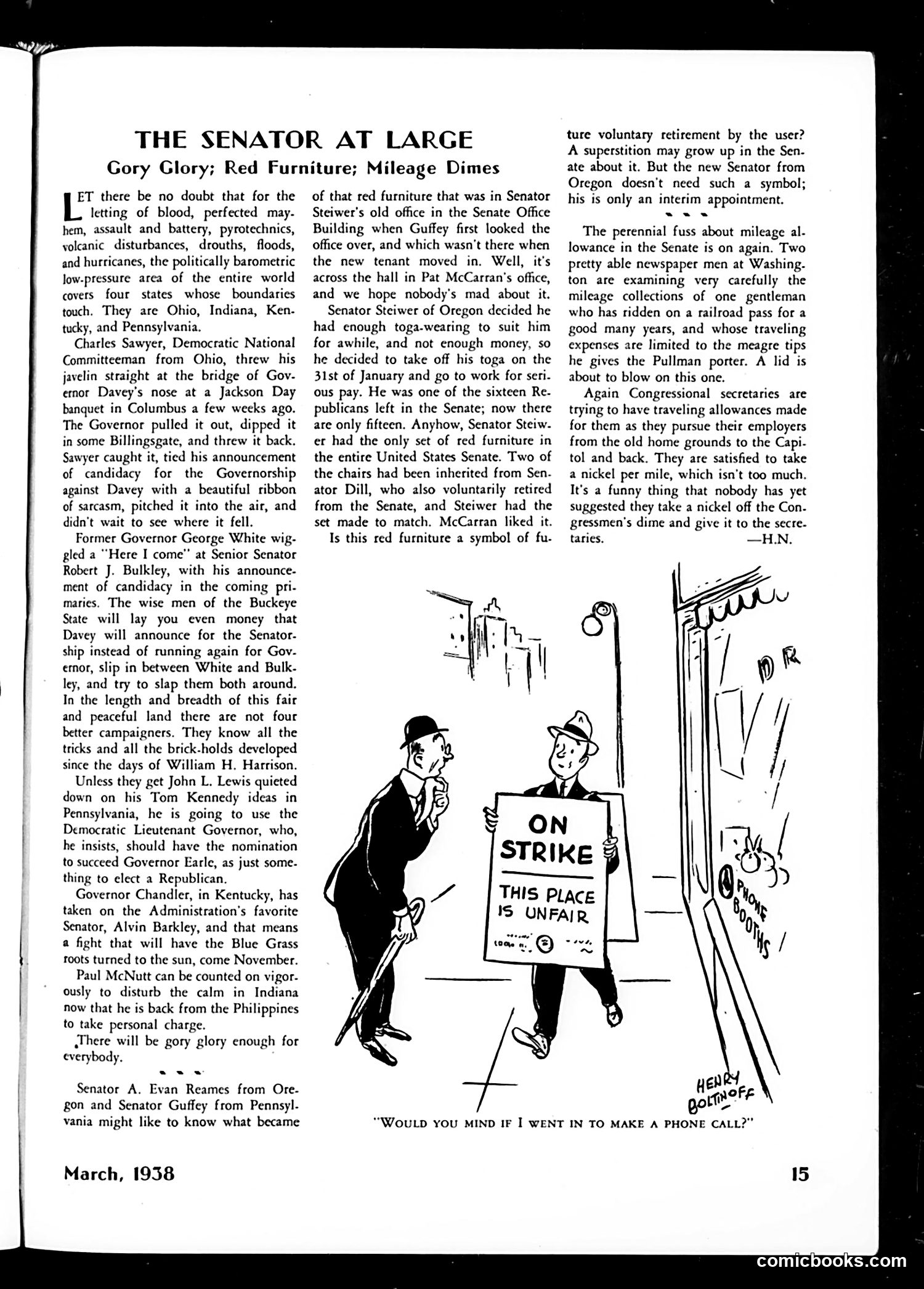
"The Senator at Large" – Judge Magazine, March 1938 This page satirizes Midwestern political turmoil, particularly intense primary battles in Ohio, Indiana, Kentucky, and Pennsylvania. The article mocks Democratic infighting: Governor Martin Davey versus Senator Robert Bulkley and former Governor George White, with labor leader John L. Lewis threatening to upset Pennsylvania's Democratic nomination process. The cartoon below depicts a striking worker confronting someone (likely a senator or official) attempting to make a phone call, with the caption "Would you mind if I went in to make a phone call?" The satire suggests Congressional hypocrisy—legislators championing workers' rights while actually opposing labor's interests. A humorous sidebar jokes about red furniture in Senator Steiwer's (Oregon) abandoned Senate office, now in Senator Pat McCarran's office, suggesting superstitions about voluntary retirements. The piece ultimately conveys Judge's view that Midwestern politics is exceptionally contentious and hypocritical.
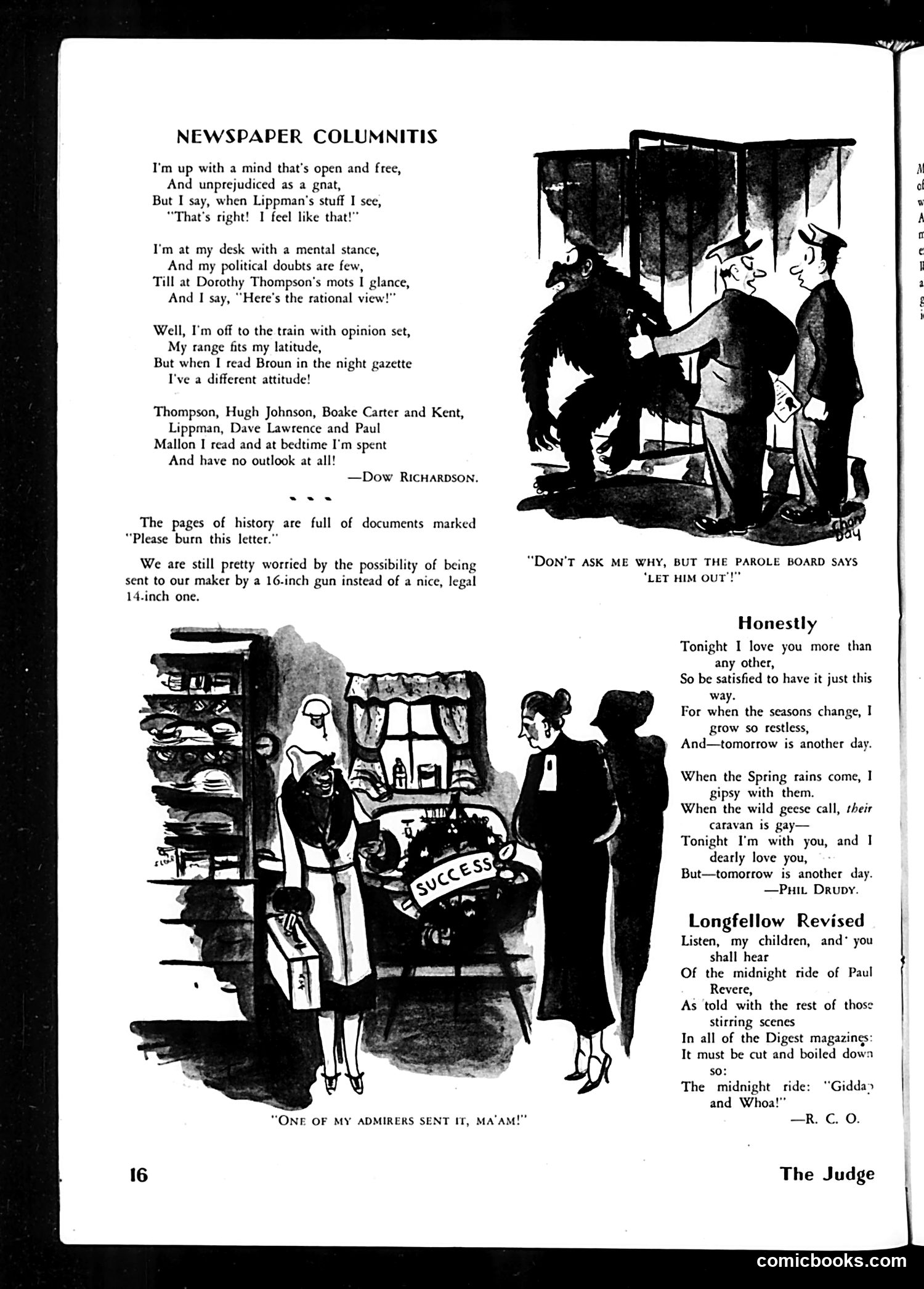
Explanation for Modern Readers This page satirizes 1930s American newspaper columnists and their influence on public opinion. The poem "Newspaper Columnitis" mocks readers who adopt whatever viewpoint they've just read—columnists Walter Lippmann, Dorothy Thompson, Heywood Broun, and others are named as causing this intellectual whiplash. The joke: readers claim independence but are actually swayed by whatever columnist they consumed last, leaving them with "no outlook at all." The cartoon showing someone presenting a "Success" plan satirizes how easily people are influenced by fashionable ideas. References to burning letters and 16-inch guns reflect pre-WWII anxieties about war and secrets. The other poems ("Honestly," "Longfellow Revised") appear unrelated filler—the latter mocks how *Readers' Digest* condenses classic literature into trivial summaries. This reflects Judge magazine's skepticism toward mass media's power to shape opinion without readers realizing it.
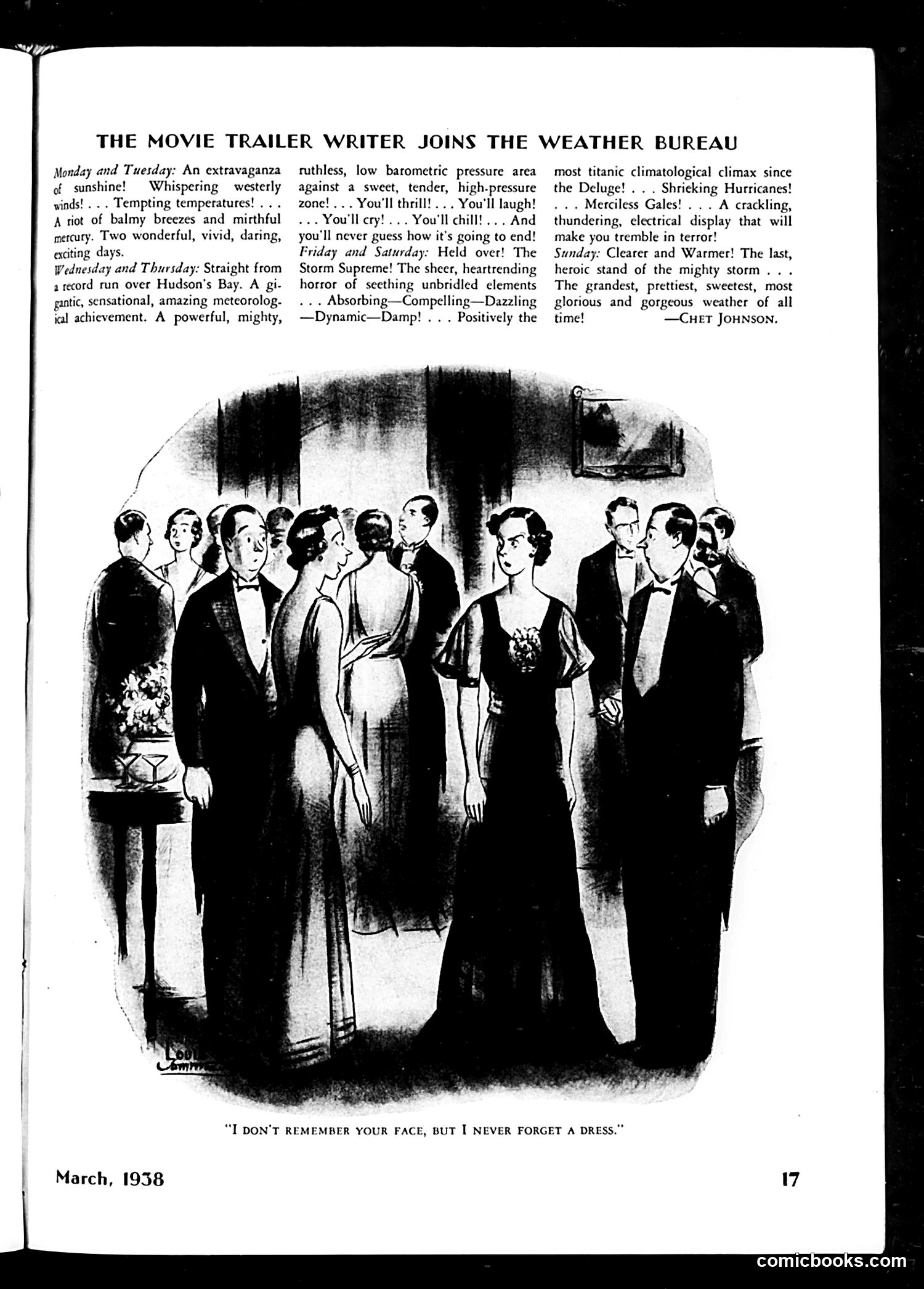
The Joke: Movie Trailer Hyperbole Meets Weather Forecasting This satirical piece mocks how movie trailer writers use extravagant, melodramatic language to oversell ordinary events. The humor comes from applying that same breathless promotional style to mundane weather forecasts. The text parodies typical trailer language: mundane Monday sunshine becomes "an extravaganza," a normal pressure system is "gigantic, sensational, amazing," and ordinary rain transforms into "the most titanic climatological climax since the Deluge!" with "Merciless Gales!" The cartoon below shows an elegant formal gathering, pairing with the caption about never forgetting a dress—suggesting fashion, like movie trailers, relies on memorable presentation over substance. The satire targets 1930s advertising excess: how studios deliberately manipulated language to manipulate audiences. By applying this technique to weather—something objectively neutral and uncontrollable—the piece exposes the absurdity of such hype. Attribution: Chet Johnson (credited author)
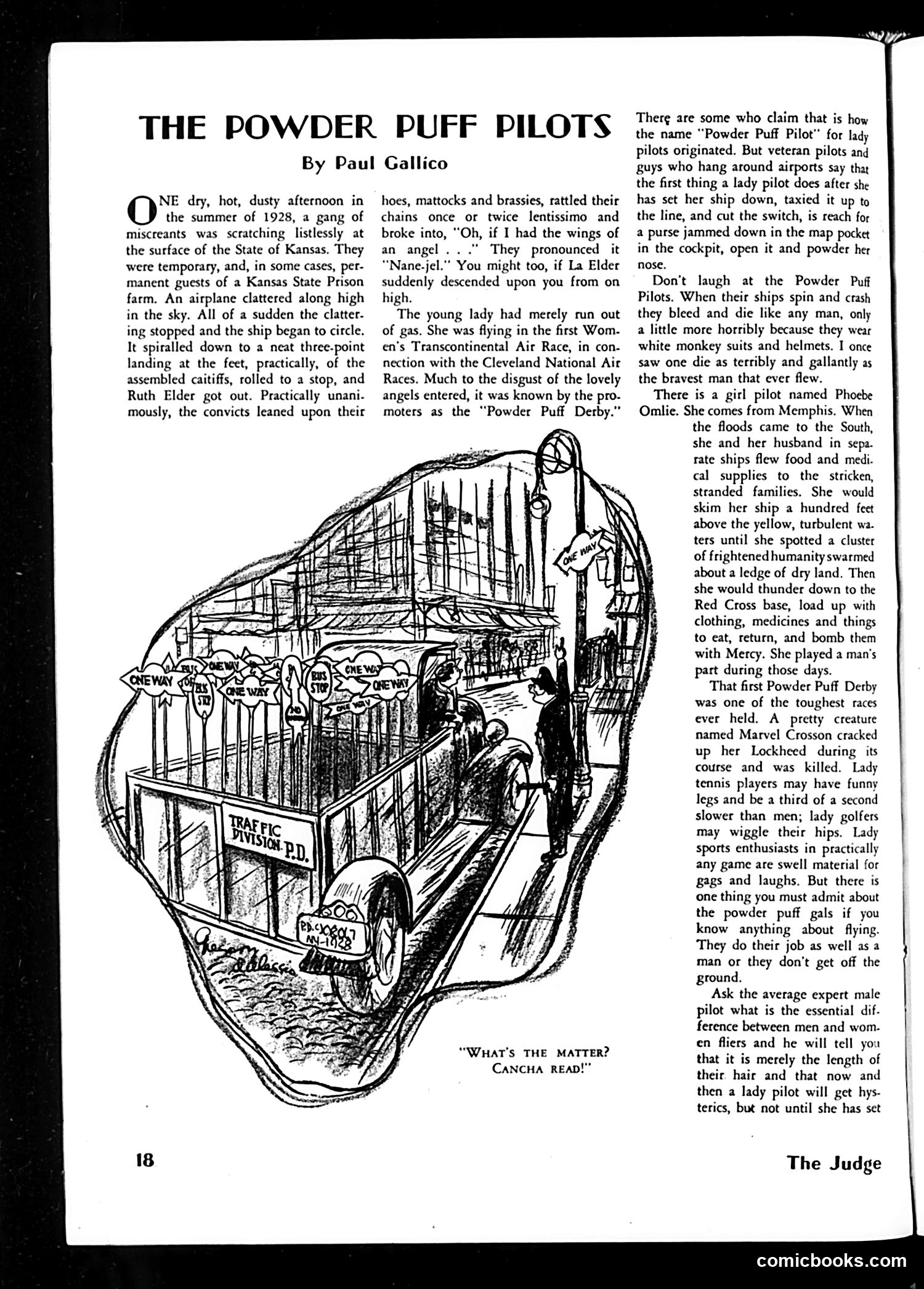
"The Powder Puff Pilots" by Paul Gallico This is a story, not a political cartoon. It concerns the early women aviators of 1928, particularly Ruth Elder and the first Women's Transcontinental Air Race, nicknamed the "Powder Puff Derby"—a dismissive name implying female pilots were frivolous. Gallico's piece satirizes sexist attitudes toward female pilots. The cartoon illustration shows a prison truck labeled with various departments, depicting convicts' reaction to Elder's emergency landing. The story defends women pilots against stereotypes: they're competent professionals who "do their job as well as a man or they don't get off the ground." Gallico cites examples like Phoebe Omlie and Marvel Crosson (who died in the Derby) to demonstrate women's courage and capability, arguing they deserve respect despite derisive nicknames and gendered mockery about makeup and "hysteria." The satire targets male dismissiveness, not the women themselves.
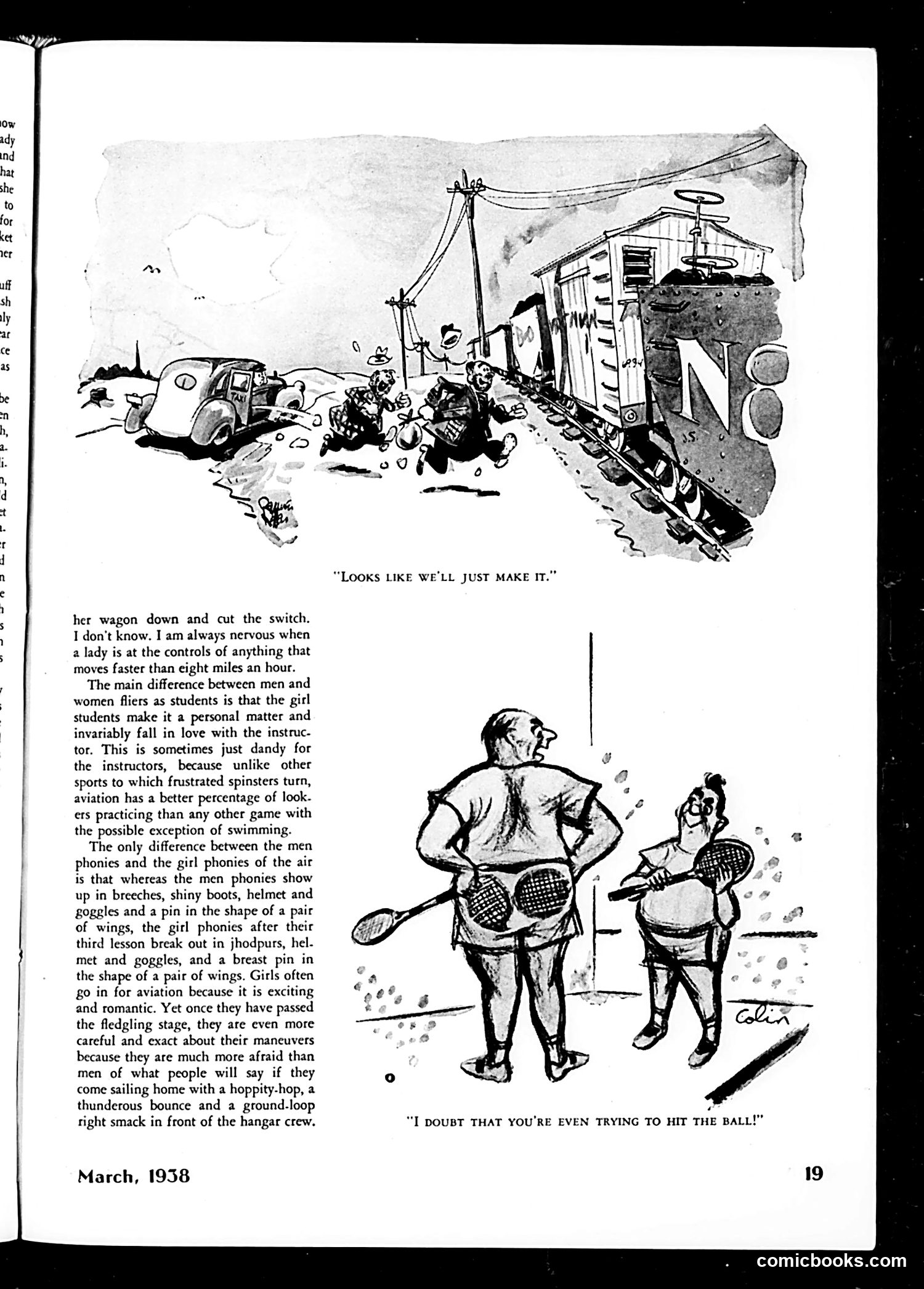
Judge Magazine, March 1938 - Aviation and Gender Satire This page contains two cartoons mocking aviation training and gender stereotypes in the 1930s. Top cartoon: Shows a car and train in a near-collision with the caption "Looks like we'll just make it." It satirizes women drivers' supposedly reckless confidence. Bottom cartoon: Depicts two people playing tennis poorly, with one saying "I doubt that you're even trying to hit the ball!" The humor is unclear from the image alone. Main article text: A lengthy commentary on female aviation students that reveals period sexism. It claims women pilots fall romantically for instructors, are motivated by excitement rather than skill, and—paradoxically—become overly cautious after initial training due to fear of social judgment. The piece mocks female fliers for adopting masculine aviation fashion (jodhpurs, wings pins) while suggesting they lack serious commitment to flying. The satire targets both women's supposed emotional instability and society's double standards about their competence.
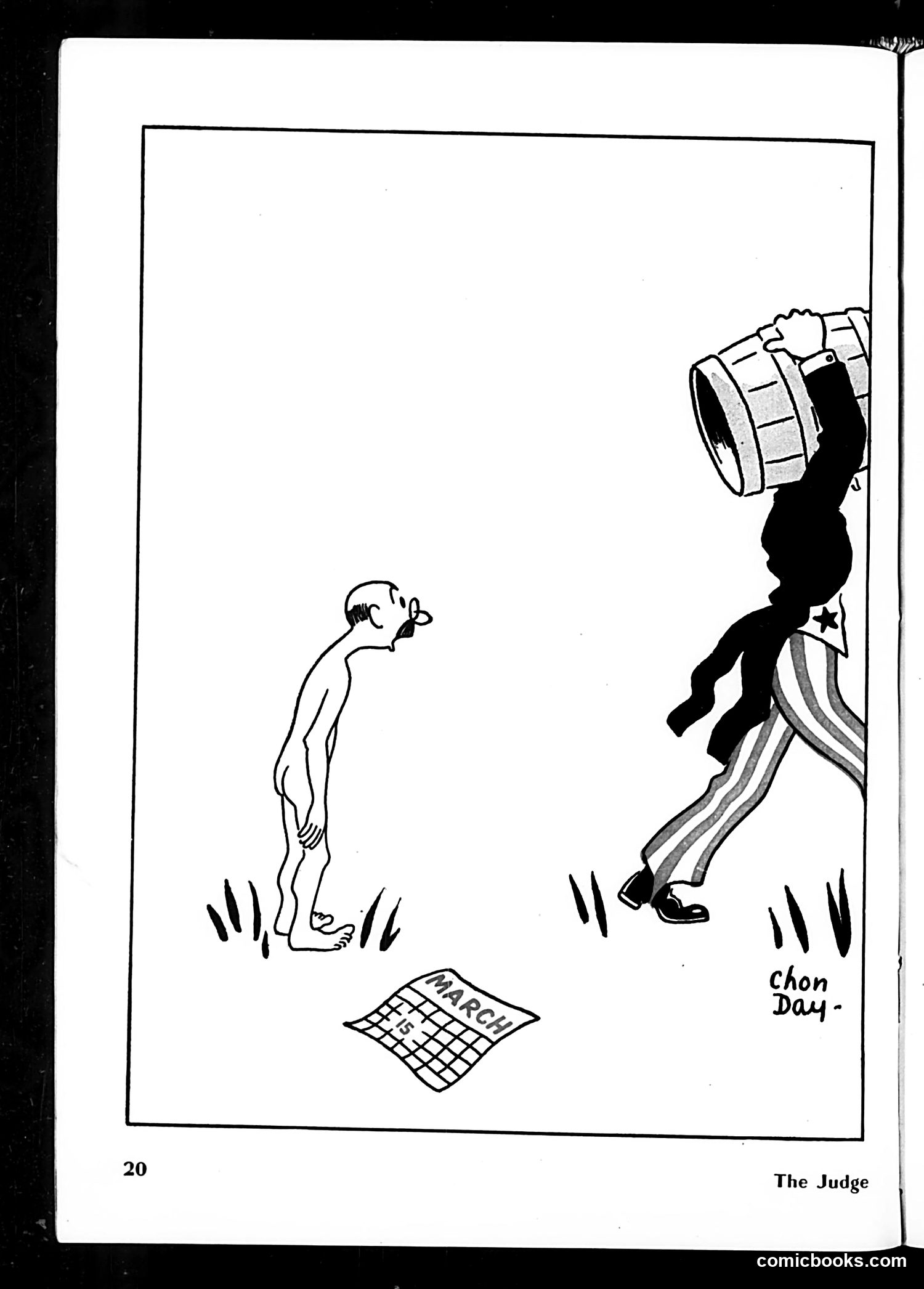
The Judge - Page 20 This political cartoon by Chon Day depicts a stark contrast between two figures. On the left, a nude, emaciated man stands over a calendar marked "MARCH," suggesting deprivation or hardship. On the right, a rotund, well-dressed official or politician carries a large barrel, apparently indifferent to the suffering beside him. The satire likely criticizes economic inequality or government neglect during hardship—the contrast between the starving citizen and the prosperous authority figure unable or unwilling to help. The calendar reference to March suggests this comments on a specific historical crisis or period of want, though without additional context, the exact event remains unclear. The cartoon exemplifies Judge's tradition of sharp social critique through visual exaggeration.
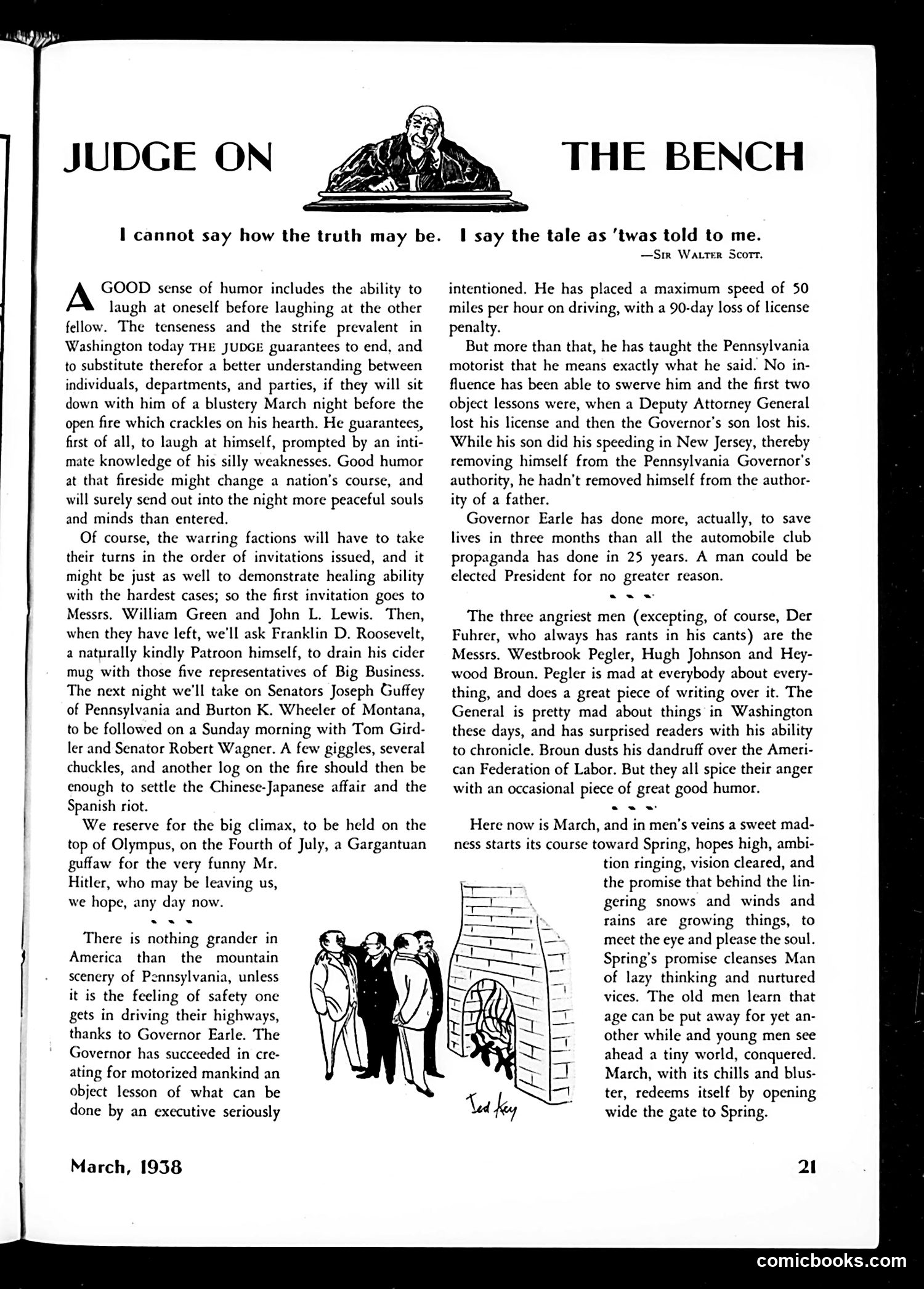
"Judge on the Bench" - March 1938 This editorial column satirizes Washington political tensions by proposing a humorous solution: inviting feuding factions to the author's fireside for cider and conversation. The targets include labor leaders William Green and John L. Lewis, President Franklin D. Roosevelt, business representatives, and various senators—suggesting widespread partisan conflict in the New Deal era. The piece praises Pennsylvania Governor Earle for strict traffic enforcement (50 mph limits, license revocation), noting he even penalized his own son, demonstrating impartial governance that could warrant presidential consideration. It also mocks three perpetually angry columnists: Westbrook Pegler, Hugh Johnson (identified as "The General"), and Heywood Broun, crediting them with sharp writing despite their constant fury. The cartoon's meaning—inviting Hitler to join this "Gargantuan guffaw" on July 4th—reflects pre-war American satirical dismissiveness toward the Nazi threat, treating Hitler as a departing nuisance rather than an existential danger.
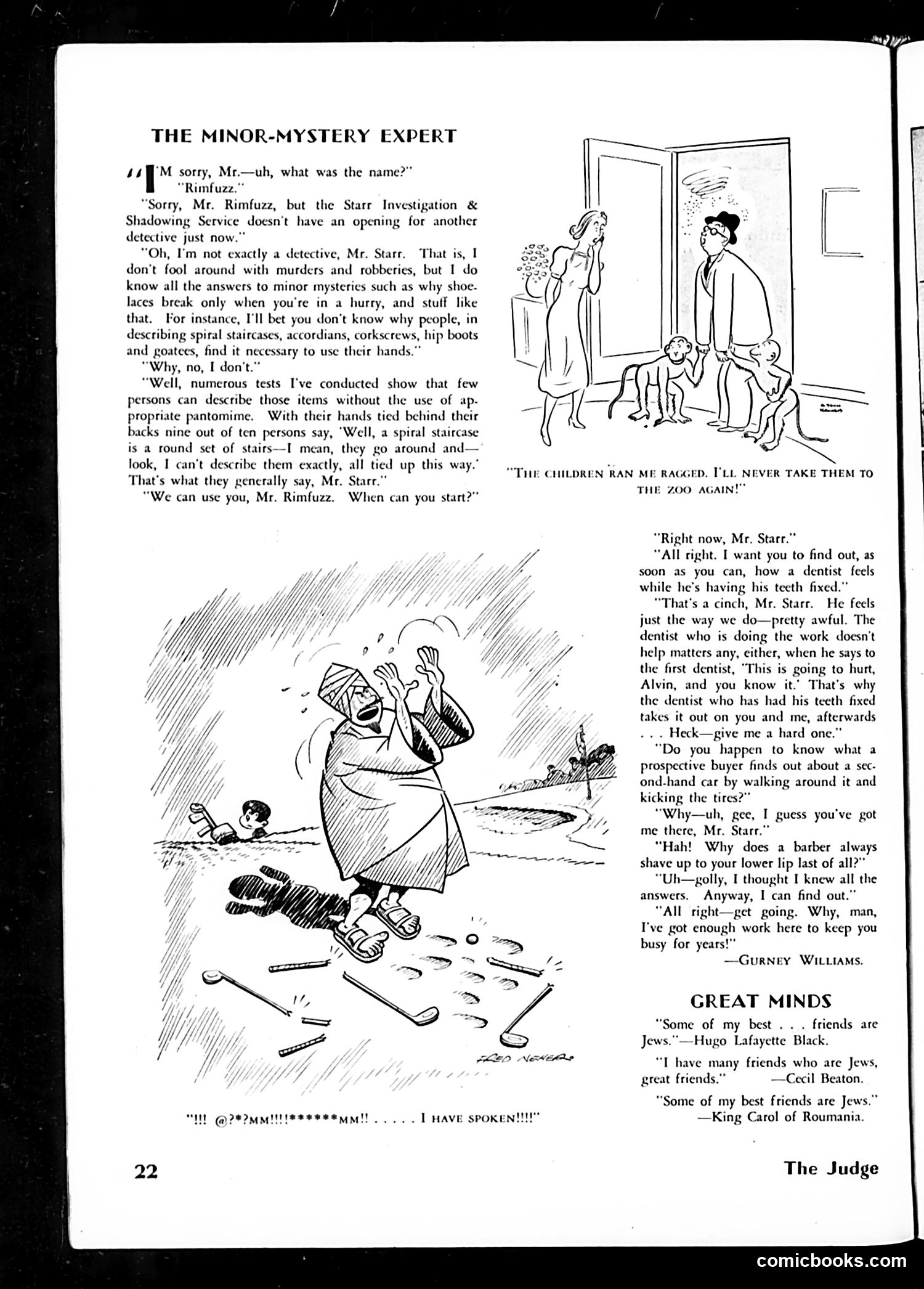
"The Minor-Mystery Expert" This is a humorous piece by Gurney Williams about a job applicant named Rimfuzz seeking work at a detective agency. Rather than investigating crimes, Rimfuzz specializes in solving mundane, everyday mysteries—like why people gesture when describing spiral staircases or accordions, and why dentists are irritable after having their own teeth worked on. The satire mocks both trivial pseudo-expertise and the absurdity of treating minor life annoyances as "mysteries" worthy of investigation. The cartoons show Rimfuzz's animated demonstrations of these hand gestures and his frustrated reactions to being stumped by questions about barber practices and used-car inspections. The page concludes with unrelated quotes about having Jewish friends—likely satirizing the cliché defensive statement used to deflect accusations of prejudice, though the specific political context remains unclear without publication date.
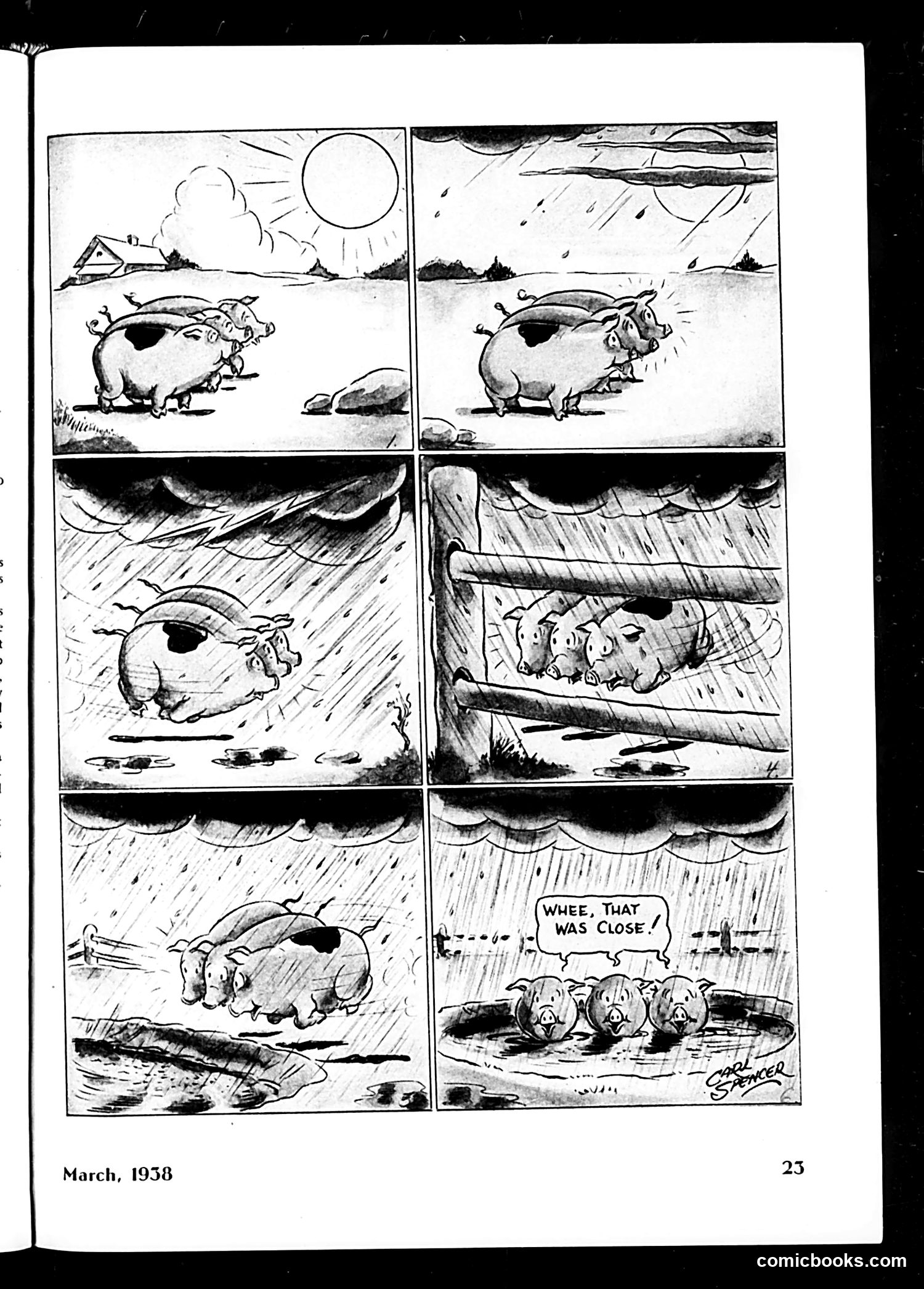
Political Cartoon Analysis: March 1938 This six-panel comic strip depicts pigs seeking shelter from a storm. The narrative shows them gradually crowding into increasingly confined spaces—from open ground to a barn to a shed—as weather worsens. The final panel reveals three pigs huddled together, with one saying "WHEE, THAT WAS CLOSE!" Historical Context: Published March 1938, this likely satirizes the political situation in Europe as fascism expanded. The pigs' desperate scramble for protection probably represents nations seeking safety as Hitler's Germany threatened the continent. The "close call" ending suggests that war or catastrophic conflict was narrowly avoided—though historically, this proved premature, as WWII began in September 1939. The cartoon uses animal metaphor to comment on European political anxiety.
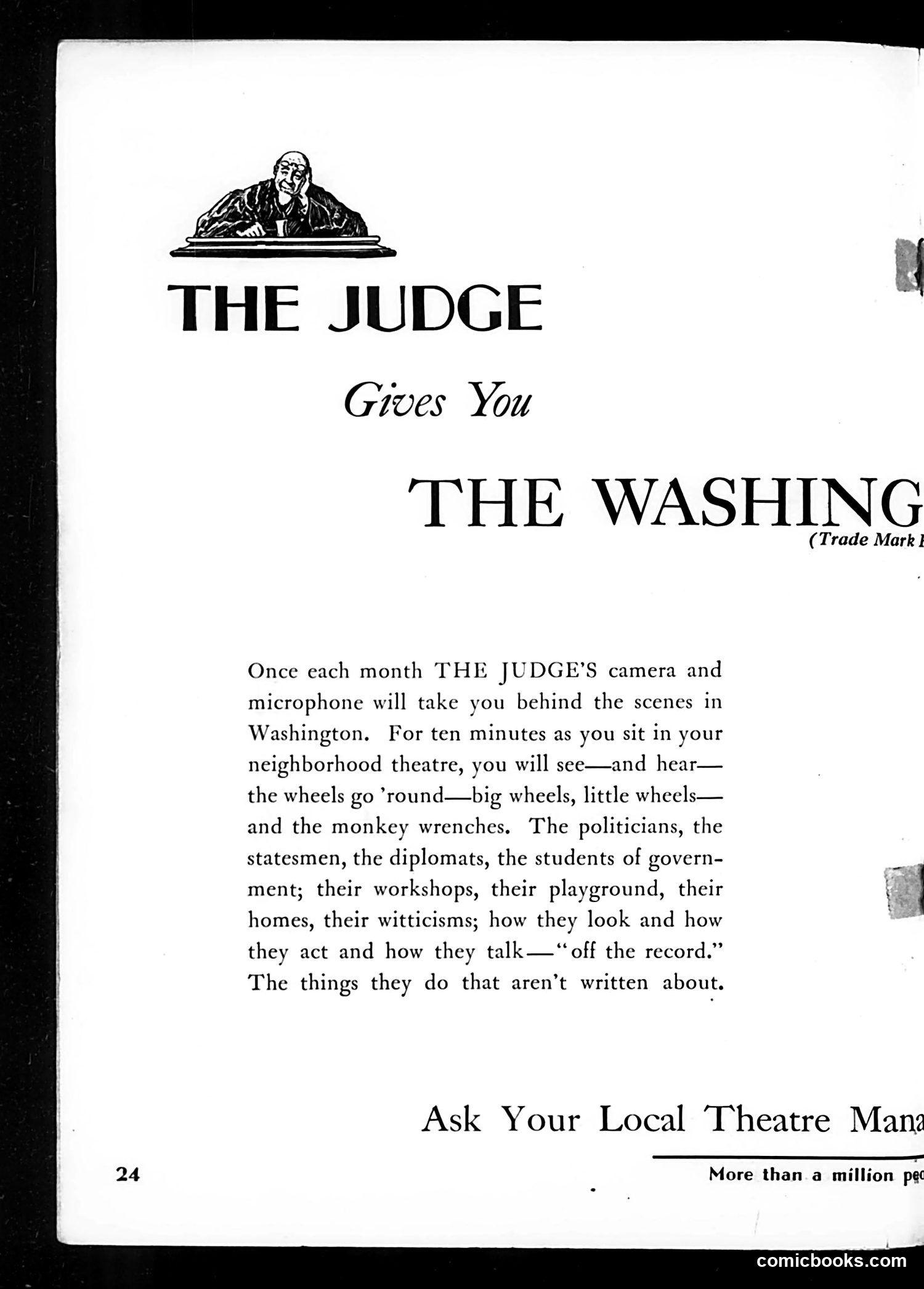
"The Washing" - Judge Magazine Advertisement This is an advertisement for a newsreel or short film series called "The Washing" (the title is cut off, likely "The Washington"). Judge magazine promoted monthly ten-minute segments shown in neighborhood theaters featuring behind-the-scenes footage of Washington, D.C. political life. The appeal promises candid, unfiltered glimpses of politicians, diplomats, and government officials—their workshops, homes, private conversations, and behavior "off the record." The phrase "monkey wrenches" suggests exposing governmental dysfunction or revealing how political machinery actually operates. The judge illustration at top represents Judge magazine's satirical authority. This reflects early 20th-century fascination with newsreels and "documentary" footage as entertainment, while satirizing Washington's hidden workings and politicians' public versus private personas. Readers would find humor in the promise of revealing what powerful figures do when they think nobody's watching.
Analysis of Judge Magazine Page This is a title/announcement page for a new feature called "The Washington Parade" in *Judge* magazine, a satirical publication. The page announces an upcoming series presenting humorous, overlooked historical moments from Washington—"laughable mistakes that have changed the destinies of America." The feature promises to cover amusing and awkward political incidents with *Judge*'s characteristic satirical tone. It will be produced by the magazine's editors and "The Senator-At-Large" (likely a pseudonymous recurring character or columnist). Rather than displaying specific cartoons, this page functions as promotional material introducing readers to the new column. The humor derives from the satirical intent: exposing embarrassing governmental moments typically omitted from official history books. No specific figures or events are identified on this page.
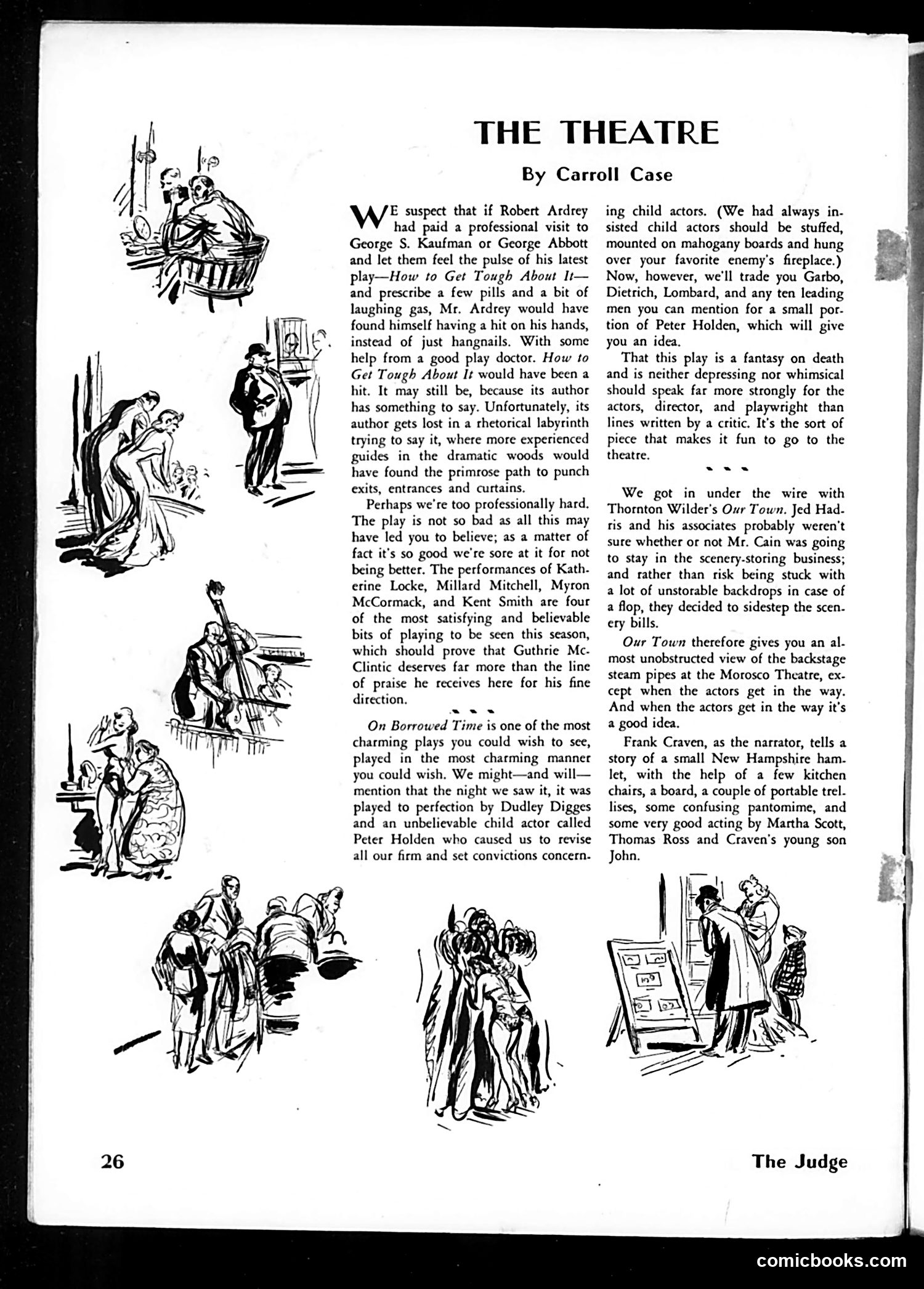
Theatre Review Analysis This is a theatre review column by Carroll Case discussing three Broadway plays. The pieces feature theatrical sketches illustrating scenes from productions. Case critiques Robert Ardrey's "How to Get Tough About It" as conceptually sound but poorly executed—needing better dramatic structure ("play doctor" help from experienced writers like Kaufman or Abbott). He praises "On Borrowed Time," a fantasy about death, especially child actor Peter Holden, humorously reversing his stated position that child actors should be "stuffed, mounted on mahogany boards." For Thornton Wilder's "Our Town," Case jokes that producer Jed Harris avoided expensive scenery, leaving backstage pipes visible at the Morosco Theatre. He credits narrator Frank Craven and actors Martha Scott and Thomas Ross for compensating through strong performances using minimal props (chairs, boards, trellises). The column reflects 1930s theatre culture and professional standards for dramatic criticism.
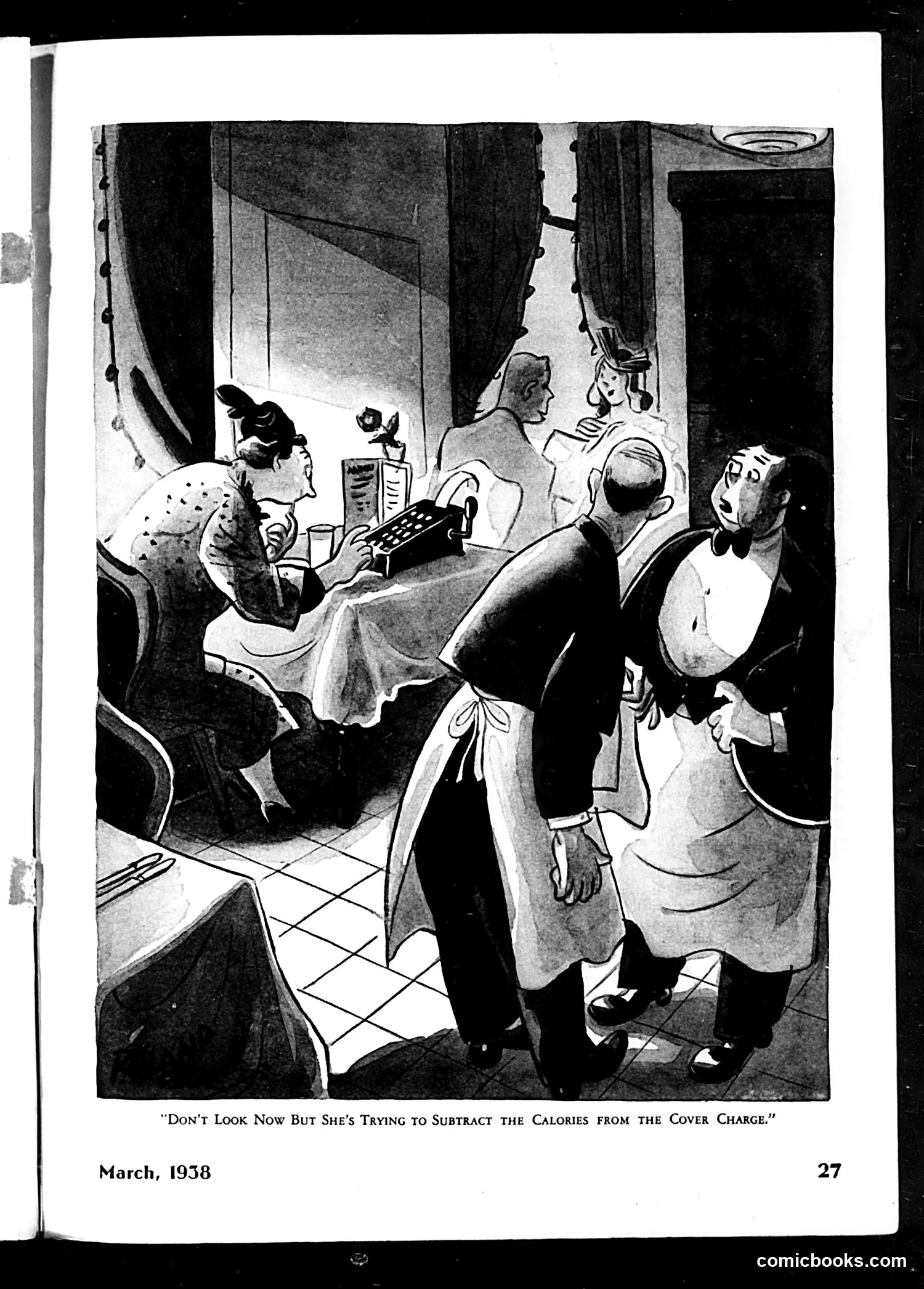
Judge Magazine Cartoon Analysis (March 1938) This cartoon satirizes women's dieting obsession during the 1930s. The scene depicts a restaurant or dining establishment where a woman at a table scrutinizes her meal with a calculator or abacus, attempting to deduct calories from her bill—hence the caption: "Don't Look Now But She's Trying to Subtract the Calories from the Cover Charge." The humor targets the extreme measures some women took to manage weight while dining out, suggesting an absurd conflation of calorie-counting with actual financial arithmetic. The other diners' reactions convey the ridiculousness of this behavior. This reflects broader 1930s anxieties about female appearance and the emerging diet culture, presented here as comedic social commentary on women's vanity and impracticality. The exaggerated caricatures are typical of Judge's satirical style.
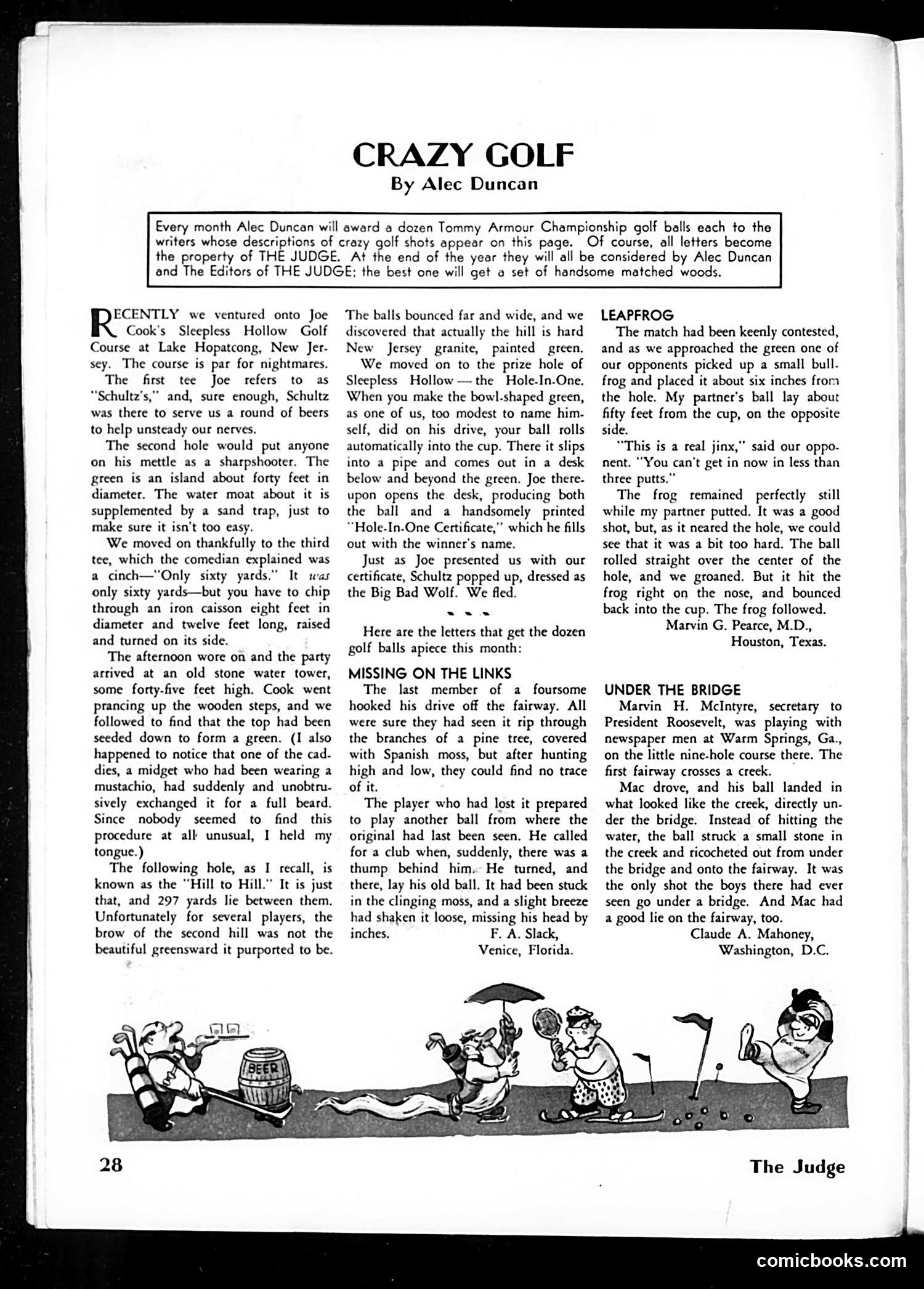
"Crazy Golf" by Alec Duncan This page features a humorous article about "crazy golf"—a novelty miniature golf course at Lake Hopatcong, New Jersey, run by comedian Joe Cook. The author describes absurdly difficult holes: an island green surrounded by water and sand traps, a shot through an eight-foot iron caisson, a green atop a forty-five-foot water tower, and a "Hole-In-One" that automatically deposits successful balls into a desk below. The satirical humor derives from exaggerated course design—each hole deliberately sabotages golfers' chances. Cook's presence as a prankster (he appears dressed as the "Big Bad Wolf") reinforces the course's chaotic nature. Below the main article, readers submitted their own crazy golf stories for prize golf balls. The humor relies on unexpected plot twists: a lost ball mysteriously returns via moss and wind; a frog placed to jinx an opponent remains perfectly still. The satire mocks both golf pretension and the emerging fad of novelty mini-golf courses in 1920s-30s America.
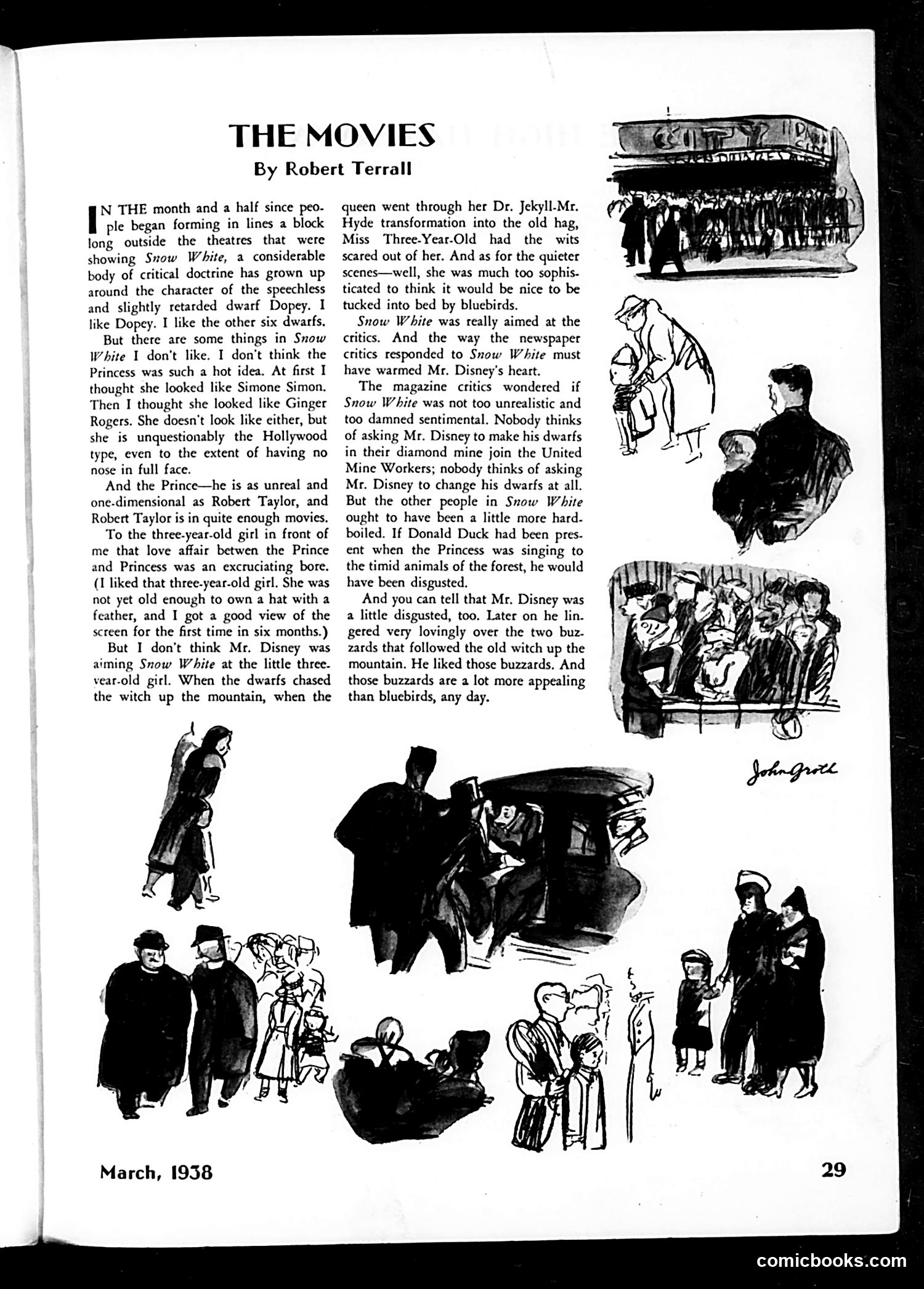
"The Movies" by Robert Terrall (March 1938) This is a film criticism piece reviewing Disney's *Snow White and the Seven Dwarfs*, which had just been released to massive popular success. Terrall argues that while he appreciates the dwarfs—particularly the beloved "Dopey"—the film's other elements are weak. His main critiques: the Princess is a generic "Hollywood type" with no distinctive features; the Prince is as "unreal and one-dimensional" as actor Robert Taylor; and the romantic storyline bores even young children. He notes magazine critics complained the film was *too* unrealistic and sentimental, finding this absurd—nobody expects realistic union-organizing dwarfs or hard-boiled cynicism from Disney. Terrall concludes that Disney himself seemed disgusted with his own sentimentality, evident in how lovingly he filmed the buzzards—which Terrall finds more genuinely appealing than the saccharine bluebirds. The accompanying sketches by John Gruelle illustrate scenes from the film and theater audiences.
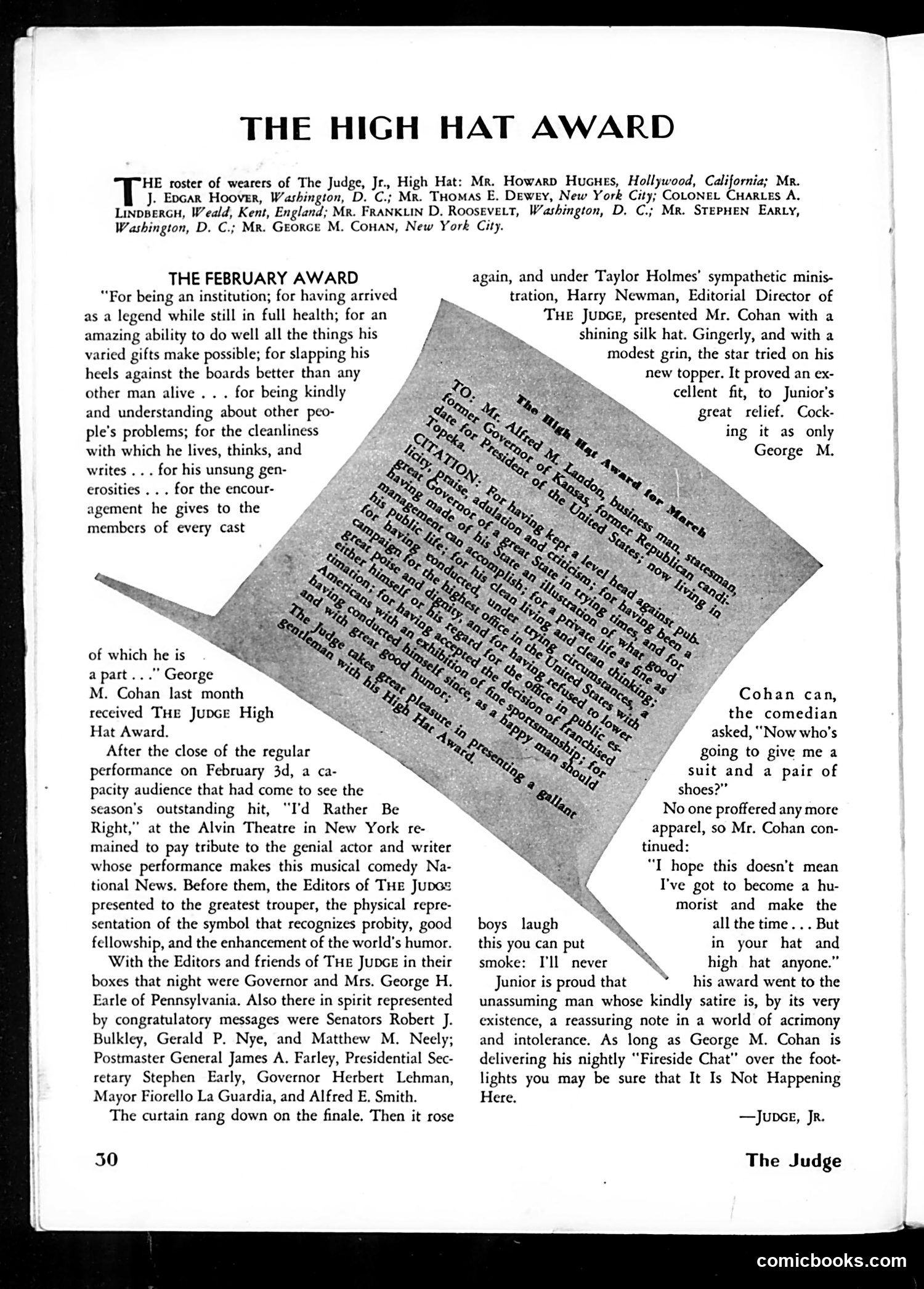
"The High Hat Award" - Judge Magazine This page honors George M. Cohan, the legendary Broadway performer and songwriter, with *The Judge*'s "High Hat Award" for February. The award celebrates Cohan's long career, professionalism, and generosity toward theater colleagues. The satirical element emerges in Cohan's humble acceptance speech: when asked who will give him "a suit and a pair of shoes," he quips that he hopes receiving the award doesn't obligate him to "become a humorist" or perform constant comedy. He promises he'll "never high hat anyone"—a self-aware joke playing on the award's name. The final paragraph cryptically references his current Broadway success in *"I'd Rather Be Right"* as a reassuring "Fireside Chat" (echoing FDR's famous radio addresses), suggesting that theatrical entertainment provides comfort against real-world "acrimony and intolerance." The page lists prominent attendees including FDR's associates, emphasizing the award's cultural prestige.
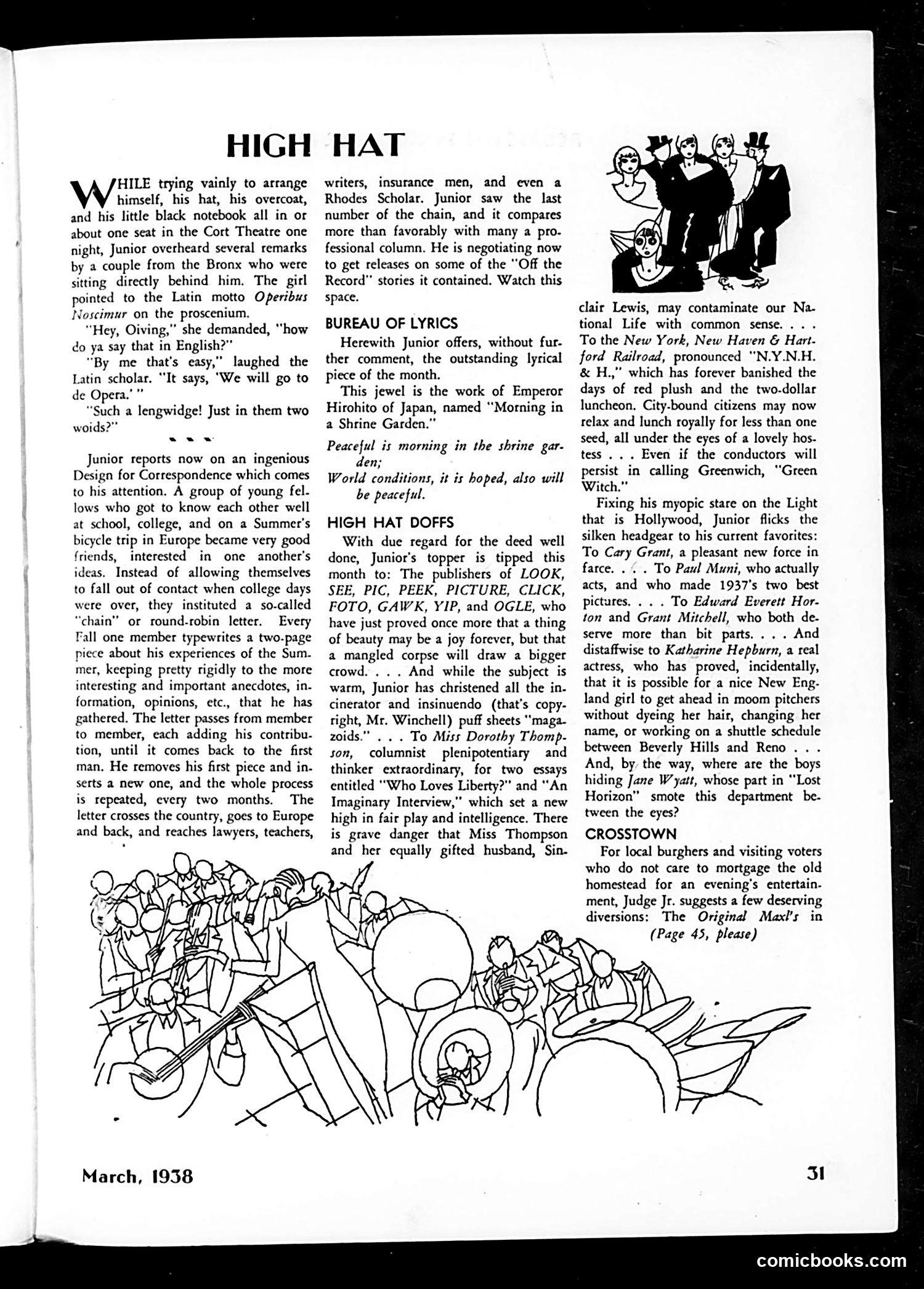
"High Hat" Page Analysis (March 1938) This is a satirical column mixing social commentary with entertainment gossip. The main cartoon shows a crowded theater scene, illustrating the opening anecdote: a couple from the Bronx at the Cort Theatre misinterprets the Latin motto "Operibus Noscimur" ("We are known by our works") as "We will go to de Opera"—a joke mocking working-class ignorance and affected speech patterns. The "Bureau of Lyrics" section sarcastically quotes Emperor Hirohito's poem about a peaceful shrine garden while hoping world conditions are also peaceful—dark commentary on Japan's militarism in 1938, just before WWII escalation. "High Hat Doffs" praises publications like *Look* and *Peek* (new picture magazines) while mocking their sensationalism, and lauds columnist Dorothy Thompson and railroad dining improvements. The tone throughout blends elitism with populist criticism, typical of Judge magazine's sophisticated humor aimed at educated readers.
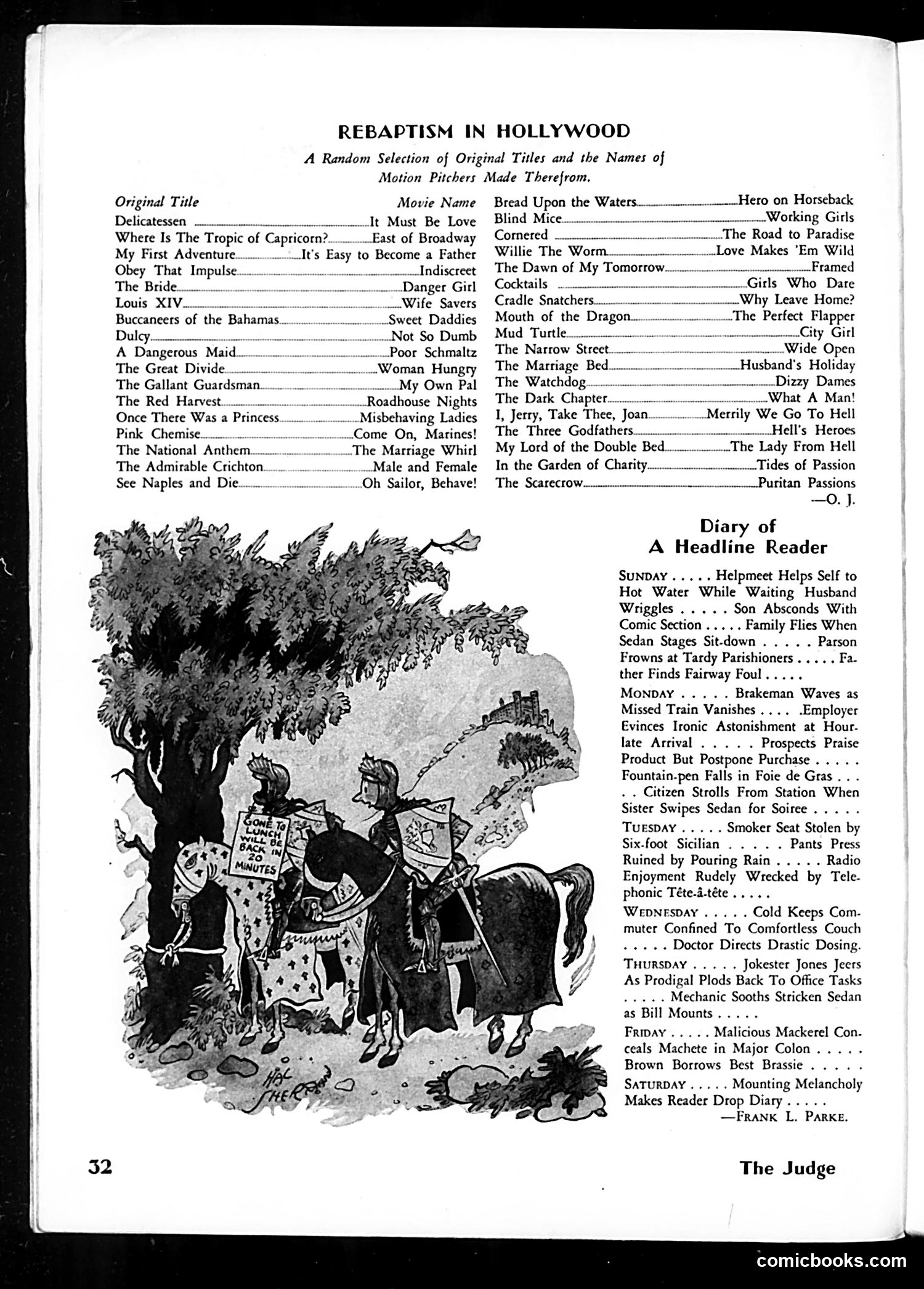
Rebaptism in Hollywood This page satirizes Hollywood's practice of retitling films for release. The table shows original film titles paired with dramatically different "movie names"—often changing serious or literary titles into sensational ones designed for commercial appeal. Examples include "Delicatessen" becoming "It Must Be Love" and "Where Is The Tropic of Capricorn?" becoming "East of Broadway." The satire suggests studios stripped away artistic or intellectual merit in favor of marketable, often salacious titles emphasizing romance, comedy, or scandal ("Girls Who Dare," "Why Leave Home?"). The cartoon below (artist O.J.) depicts someone planning such marketing schemes, reinforcing the critique that Hollywood prioritizes profit over substance. "Diary of a Headline Reader" is a humorous column mocking everyday absurdities. The overall message: Hollywood cynically repackages content for mass consumption, abandoning original artistic intent.
This is a title page for "The Judge Album 1885-1890," published in March 1938. It's not a political cartoon but rather a cover featuring decorative Victorian-era artwork typical of Judge magazine's aesthetic. The ornate border includes classical figures (including a semi-nude allegorical woman), cherubs, artistic implements (palette, brushes), and various symbolic objects representing arts and culture. The page marks a retrospective collection of Judge's content from its early years. Judge was America's leading satirical weekly magazine during the Gilded Age, known for commenting on politics, social issues, and current events through humor and caricature. This 1938 publication date suggests the magazine was revisiting its archive, likely capitalizing on nostalgia for its influential earlier period.
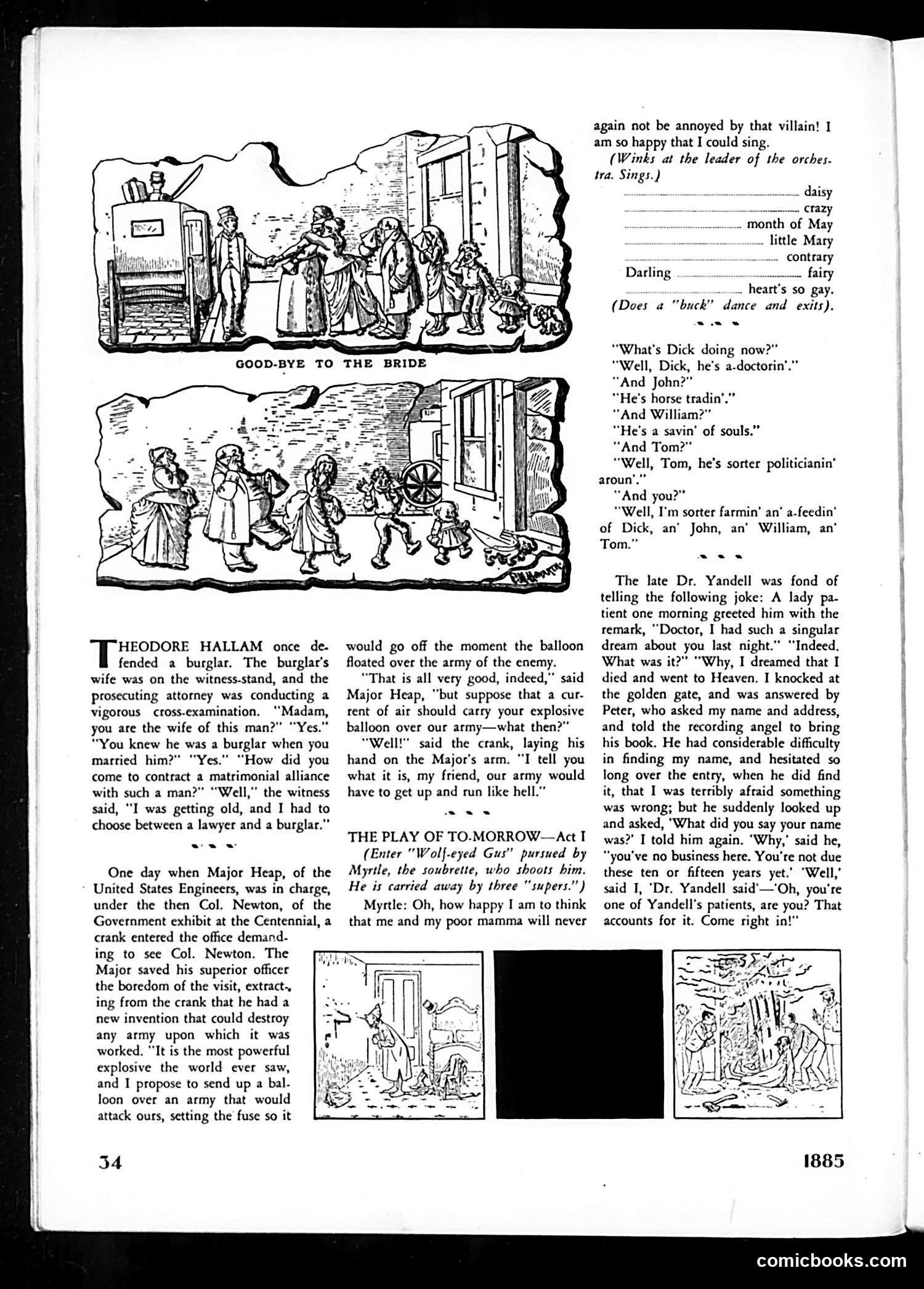
Judge Magazine Satire Analysis (1885) This page contains three humorous anecdotes typical of late-19th-century satirical magazines: 1. Theodore Hallam joke: A woman chose marriage to a burglar over a lawyer—satirizing lawyers as worse than criminals, reflecting common distrust of the legal profession. 2. Major Heap and the crank inventor: A man proposes an "explosive balloon" weapon to Col. Newton. When asked what happens if wind carries it over *their* army, the crank absurdly responds the army should "run like hell." This mocks impractical inventors and poorly-thought-out military schemes. 3. "The Play of To-Morrow": A theatrical parody where a soubrette shoots the villain, then sings. The subsequent dialogue lists occupations (doctor, horse trader, preacher, politician, farmer) in dialect, satirizing melodramatic conventions and possibly rural/working-class speech patterns. 4. Dr. Yandell joke: A patient dreams St. Peter delays finding her name in heaven's book because she's "one of Yandell's patients"—implying his medical treatments nearly killed her, a doctor-incompetence joke.
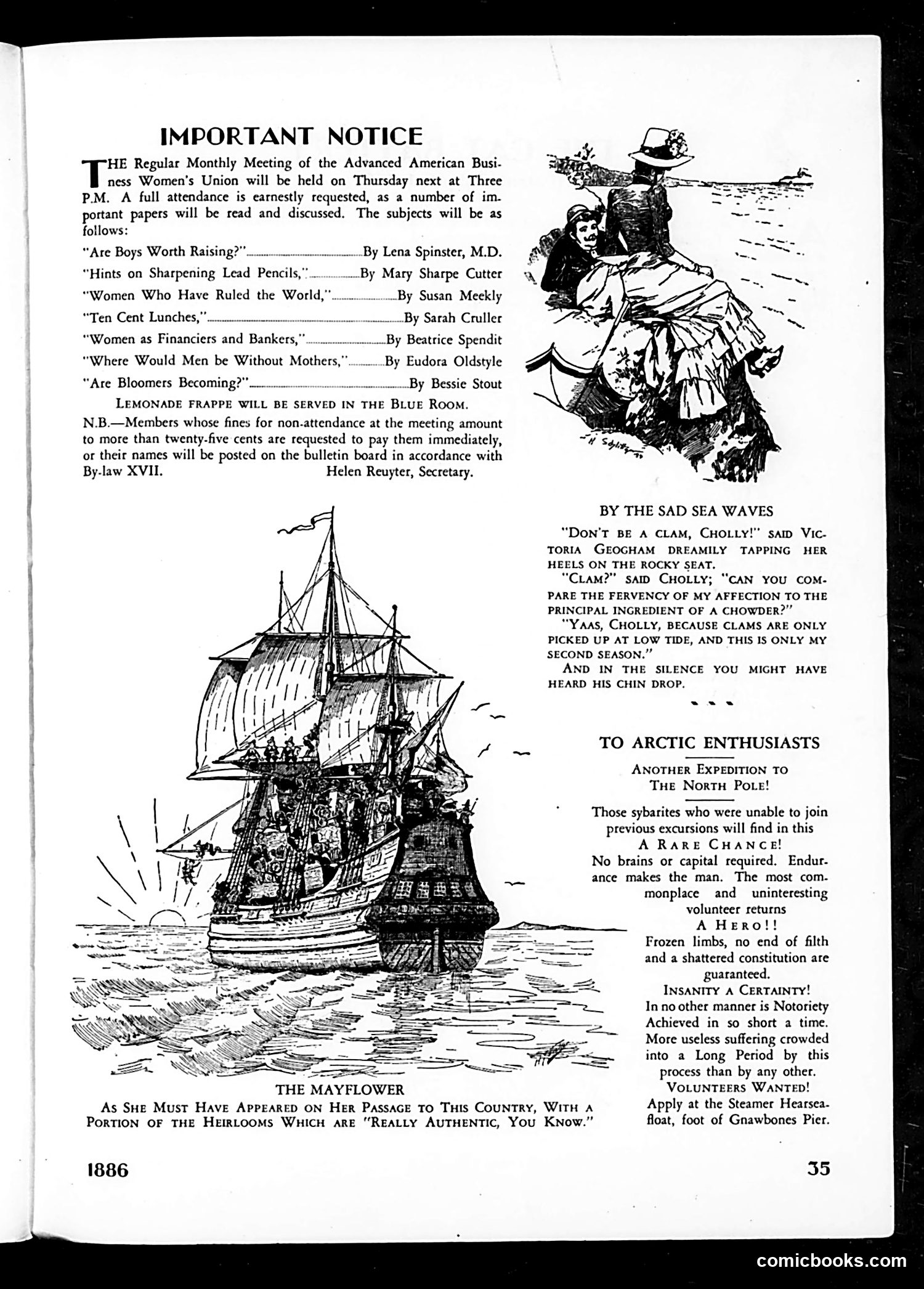
Judge Magazine Page (1886) - Satire Explained This page contains three satirical pieces mocking contemporary American society: "Important Notice" ridicules the women's suffrage and business-women movements through fake lecture titles with punning names ("Lena Spinster," "Mary Sharpe Cutter," "Bessie Stout"). The satire suggests these women are trivial—discussing lead pencils and ten-cent lunches rather than serious business—mocking the era's skepticism toward female professional ambitions. "By the Sad Sea Waves" is a romantic comic dialogue where a woman rejects a suitor's flowery comparison of his love to a chowder ingredient, sarcastically noting clams are only available at low tide and it's "only [her] second season"—implying she's shopping for better prospects. This mocks courtship pretension. "To Arctic Enthusiasts" advertises a fake North Pole expedition, ironically promising frozen limbs, suffering, and insanity as paths to notoriety—satirizing the era's obsession with Arctic exploration as a means to fame. The Mayflower illustration appears decorative, invoking historical authenticity claims.
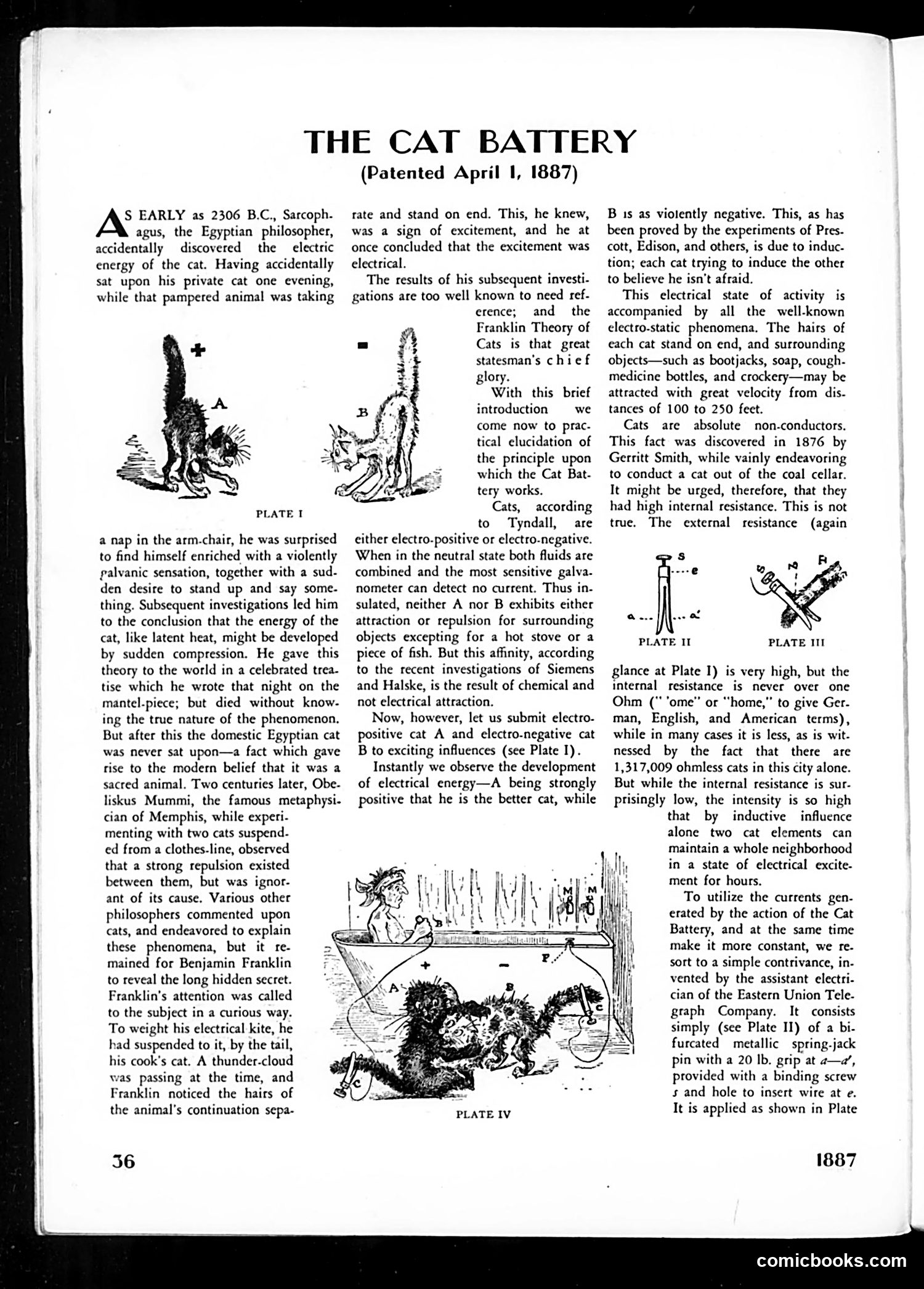
The Cat Battery: A Victorian Satire on Science and Electricity This is a humorous mock-scientific article satirizing the Victorian obsession with electricity and pseudo-scientific explanations. The "Cat Battery" is entirely fictional—a patent-pending device that humorously traces cats' electrical properties back to ancient Egypt. The satire works by applying serious electrical terminology (electro-positive, electro-negative, galvanometers, conductors) to cats' actual behavior—fur standing on end, mutual repulsion between cats. The illustrations show cats arranged to generate electrical current through their natural antagonism. The joke targets both scientific pretension and the era's tendency to attribute almost any phenomenon to electricity (then genuinely revolutionary and poorly understood). References to Franklin, Edison, and Siemens lend false authority. The absurdist premise—that cats are non-conductors with usable electrical output—mocks contemporary speculation about harnessing natural forces. For modern readers, it's essentially a *reductio ad absurdum* of 1880s technological enthusiasm: if electricity explains everything, why not cats?
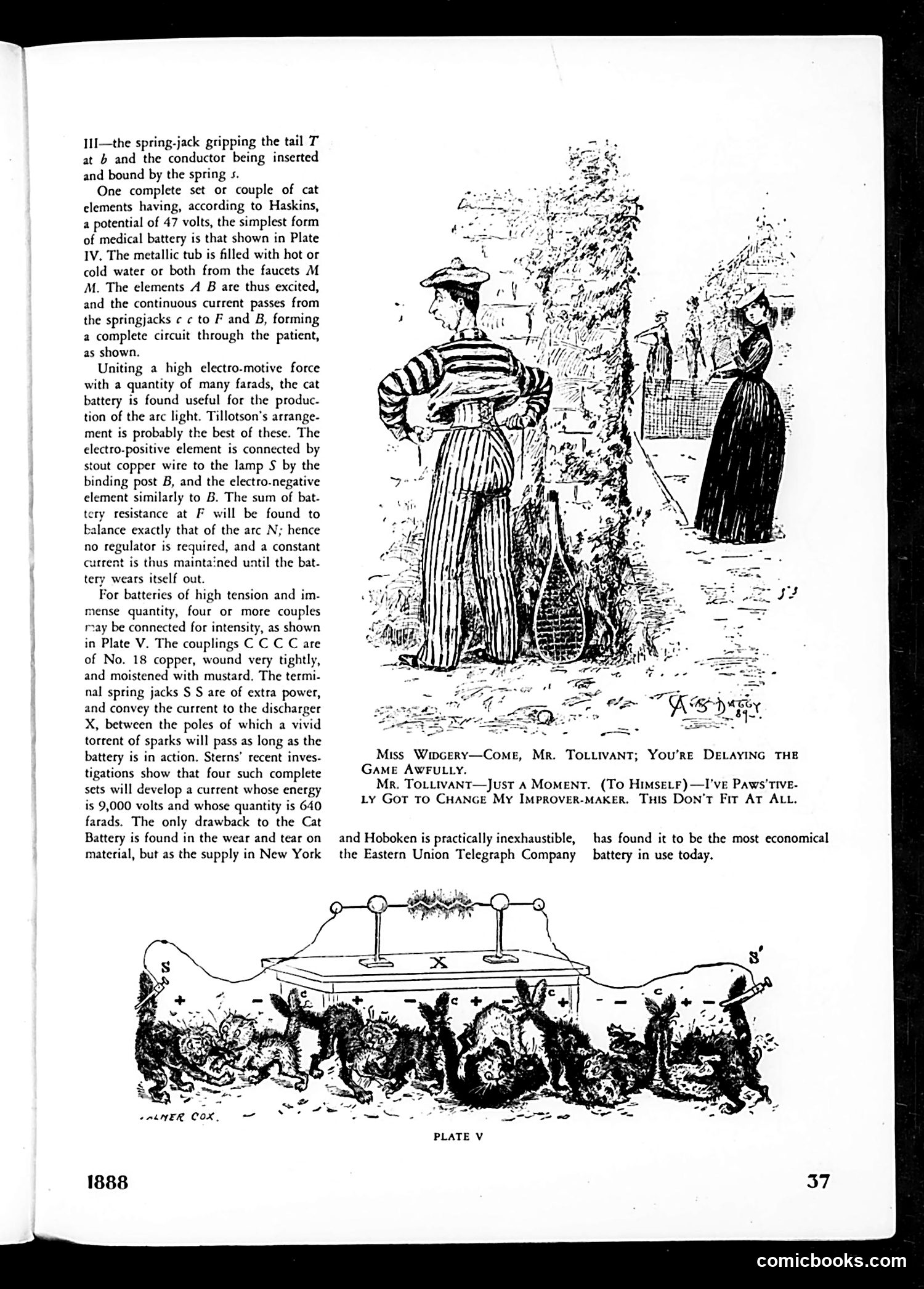
Explanation for Modern Readers This page satirizes the "Cat Battery"—a fictional absurd invention described in pseudo-technical language. The text humorously presents cats as electrical power sources, with detailed instructions for their use in medical treatments, arc lighting, and telegraphy. The cartoon above shows two Victorian-era figures: Miss Widgery and Mr. Tollivant, apparently engaged in courtship or a social game. Tollivant's aside—that he needs to "change my improver-maker" because it "don't fit"—is a sexual double entendre, the joke being his preoccupation with intimate matters during social interaction. The satire operates on multiple levels: it mocks both pseudoscientific medical quackery (electrical "treatments" were genuinely marketed in the 1880s) and the abundance of cats in New York/Hoboken. By treating cats as a practical energy resource with mock-serious engineering detail, Judge ridicules both technological pretension and the era's actual dubious medical practices.
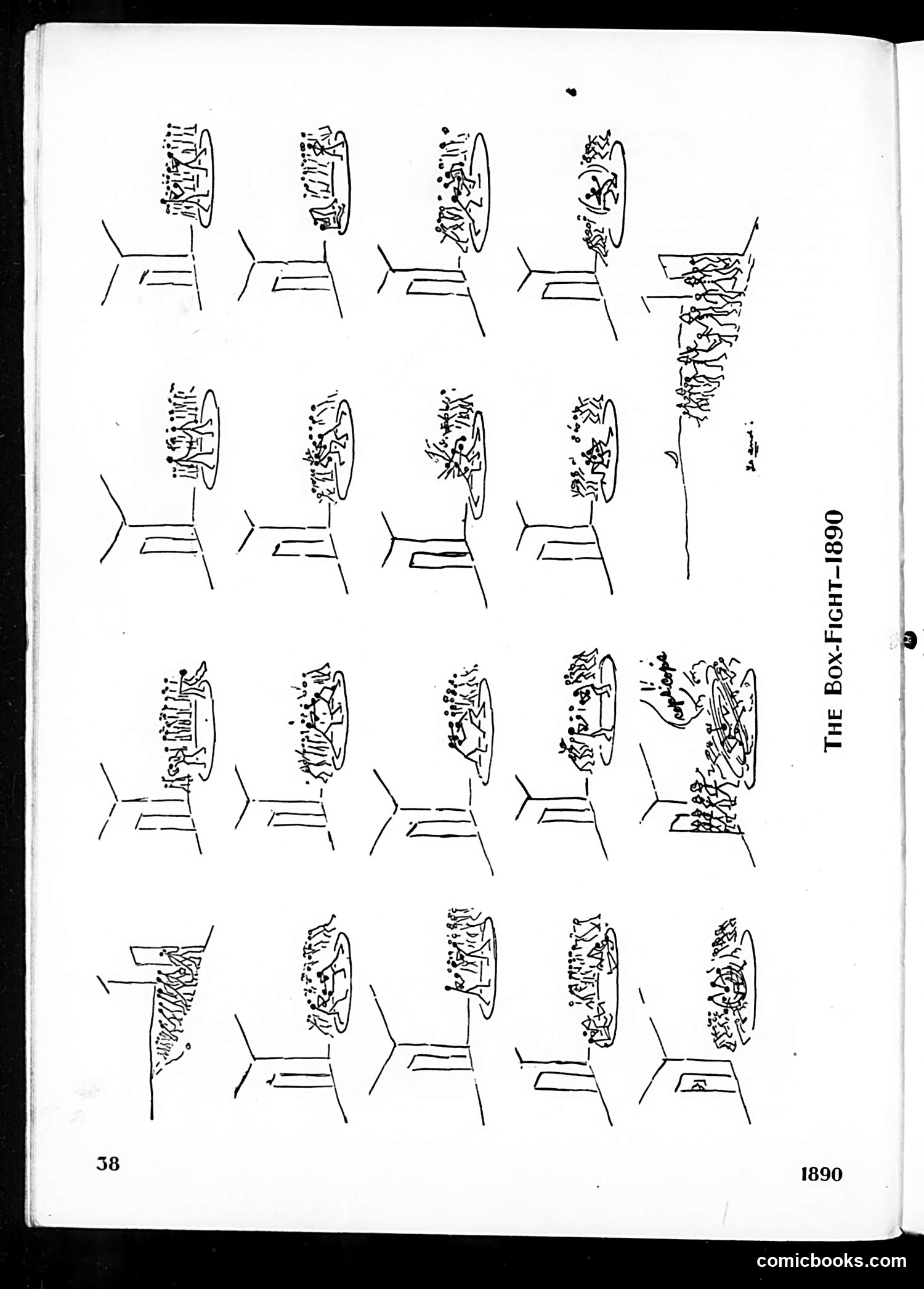
Analysis of This Judge Magazine Page (1890) This page appears to be a visual sequence or strip showing repeated scenes of figures in chairs, rendered in a sketchy style typical of 1890s Judge cartoons. The OCR text is corrupted and illegible, making it impossible to determine the specific political or social commentary. Based solely on the image: Multiple panels depict what appear to be the same figure in similar seated poses, suggesting either a satirical commentary on repetitive behavior, bureaucratic routine, or possibly a sequential joke. The consistent staging and multiple iterations suggest this is either a comparative commentary or depicts some form of cyclical action. Without legible text, I cannot confidently identify the specific figures, political references, or the satire's intended meaning. The page number indicates this is from 1890's Judge, but the corrupted OCR prevents explaining what contemporary readers would have understood.
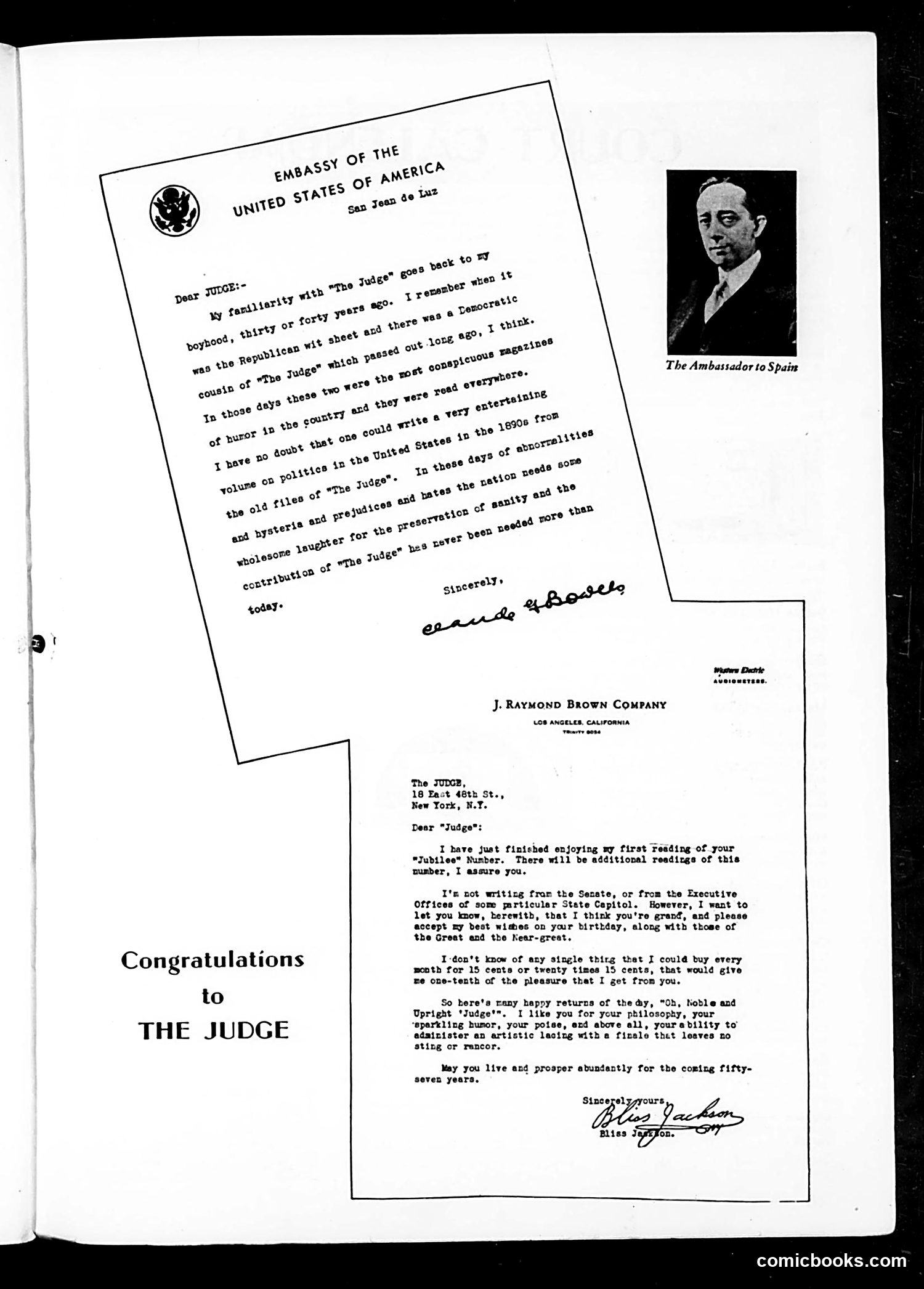
Analysis of Judge Magazine Page This page celebrates Judge magazine's anniversary ("Jubilee" issue) with congratulatory letters. The top letter is from the U.S. Embassy in San José de los, signed by what appears to be a diplomatic official. The second, longer letter praises Judge's satirical work—its "sparkling humor," "philosophy," and ability to deliver social criticism ("artistic lacing") without malice. The page includes a formal portrait labeled "The Ambassador to Spain" and advertising from the J. Raymond Brown Company. Rather than containing a specific cartoon, this page functions as a tribute issue acknowledging Judge's role as American political satire. The letters emphasize the magazine's respected position: even government officials appreciate its ability to critique society and politics with humor while maintaining dignity. This underscores Judge's cultural importance in early 20th-century American journalism.
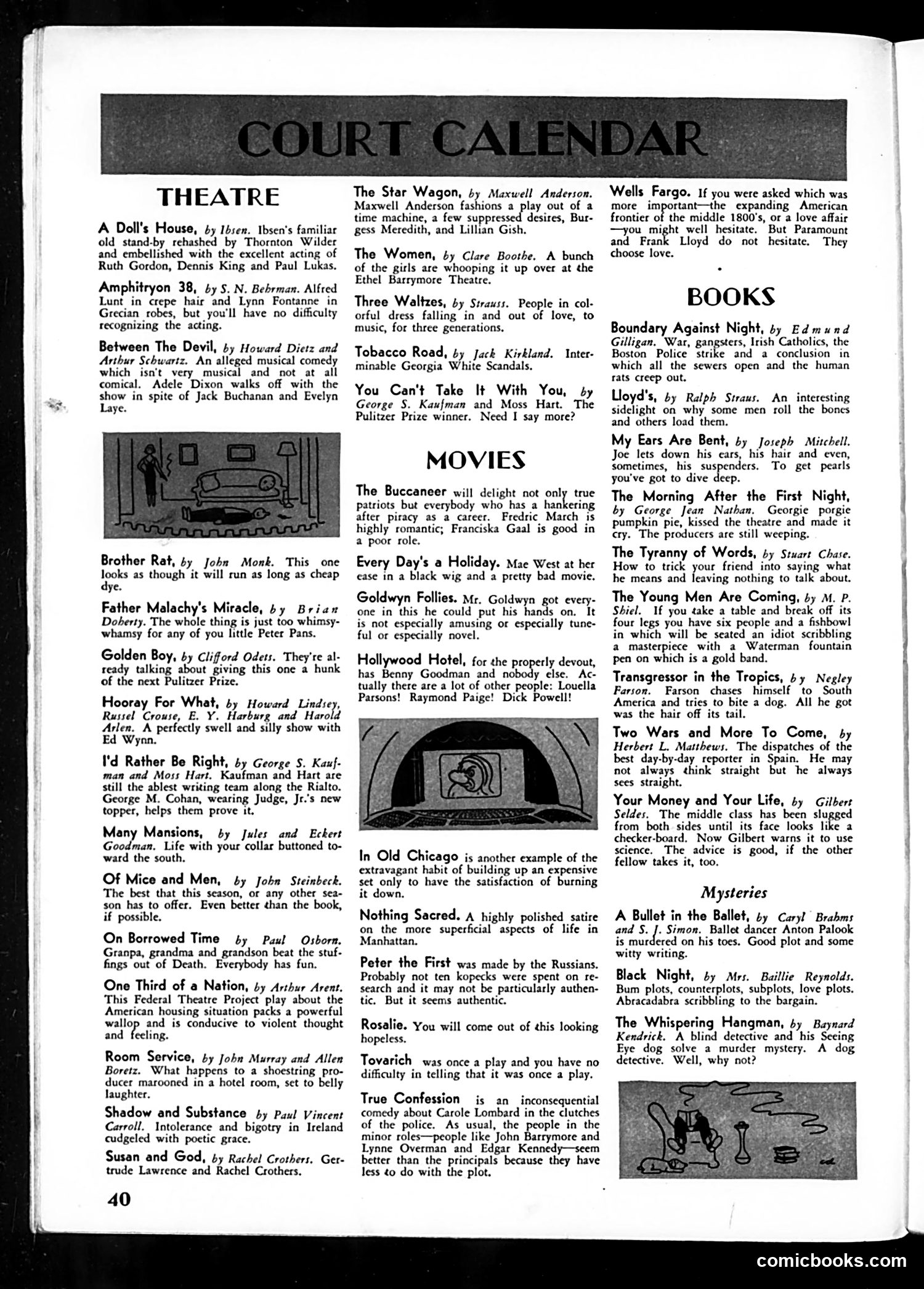
Court Calendar Page Analysis This page from *Judge* magazine is primarily a theater and entertainment review section, not a political cartoon page. It contains capsule reviews of Broadway plays, films, and books from what appears to be the late 1930s. The reviews are written in a witty, sometimes caustic style typical of *Judge's* satirical approach—for example, dismissing "Tobacco Road" as "interminable Georgia White Scandals" and Mae West's film as "a pretty bad movie." The humor is entertainment-focused rather than politically pointed. Notable is the reference to "One Third of a Nation," a Federal Theatre Project play about American housing, which the reviewer acknowledges "packs a powerful wallop"—reflecting *Judge's* acknowledgment of New Deal-era social commentary theater. There are small illustrations accompanying some reviews, but these appear to be decorative sketches rather than political cartoons. This is essentially a entertainment guide with satirical commentary, not a page of political satire.
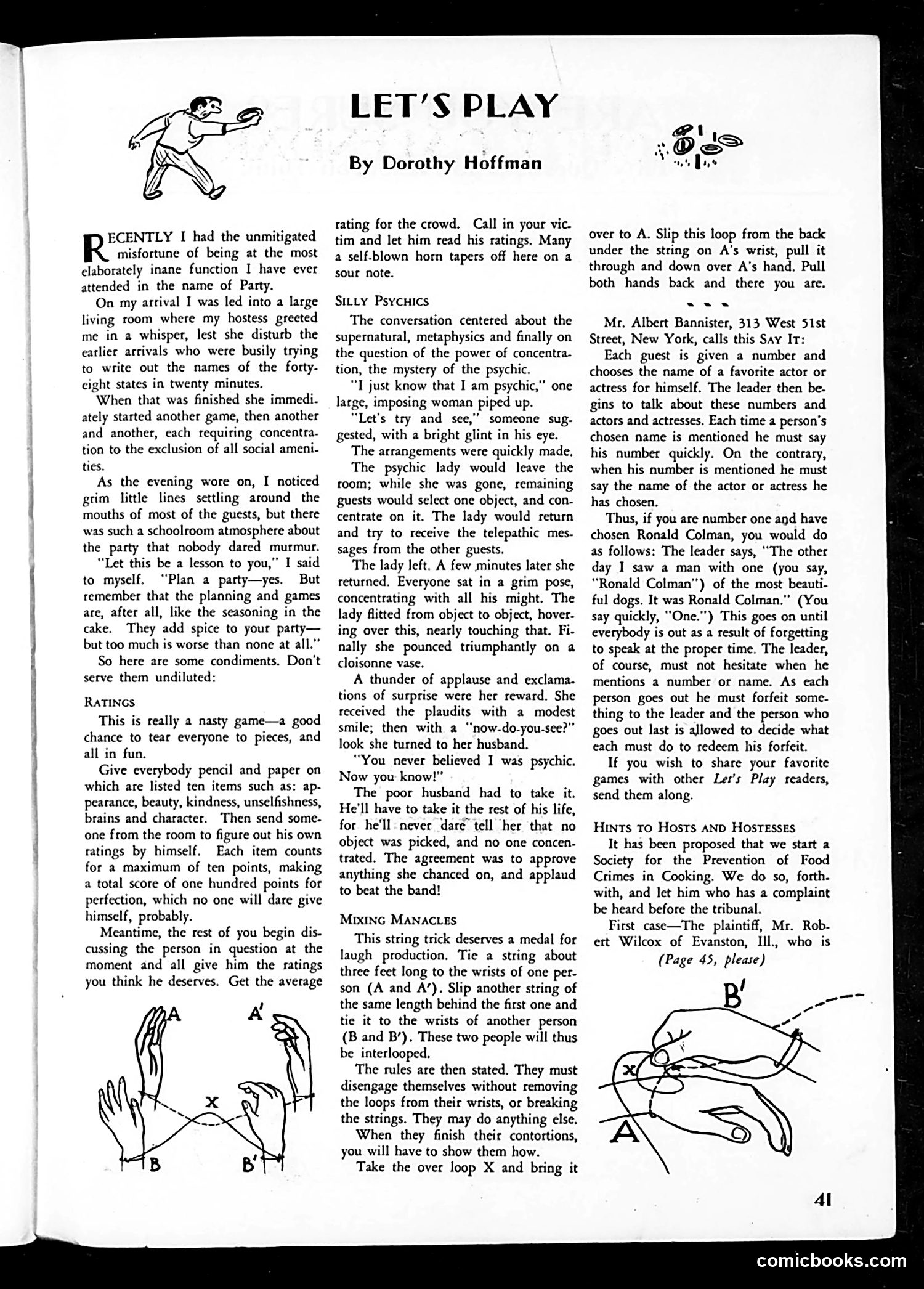
"Let's Play" by Dorothy Hoffman This is a practical advice column disguised as satire about party planning. Hoffman critiques overly game-heavy socializing by describing a tedious party where guests competed in exhausting activities rather than enjoying conversation. The piece presents three party games with commentary: 1. "Ratings"—guests secretly score an absent person on appearance, kindness, brains, etc., then confront them with the unflattering average. The joke: people rarely rate themselves honestly. 2. "Silly Psychics"—a woman claims supernatural powers; guests fake concentrating on an object while secretly agreeing to applaud whatever she touches. The satire: the gullible husband must accept her false triumph rather than expose the deception. 3. "Mixing Manacles"—a string puzzle game for physical comedy. Hoffman's real message: games should *season* parties, not dominate them. Too many competitive activities create "schoolroom atmosphere" and kill genuine social pleasure. This reflects 1920s-30s etiquette concerns about balancing structured entertainment with actual human connection.
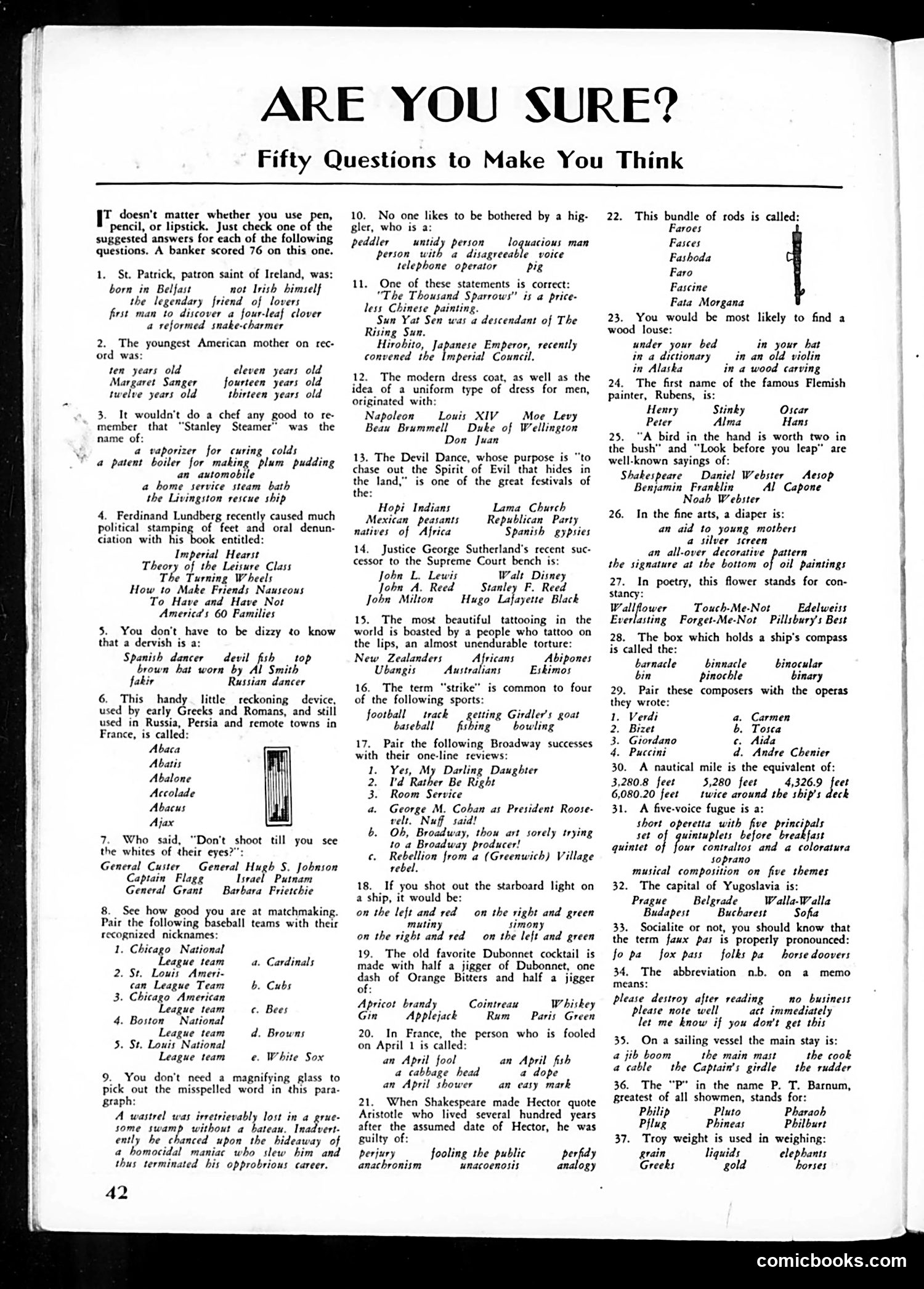
"Are You Sure?" - A Trivia Quiz Page This page from *Judge* magazine presents "Fifty Questions to Make You Think" — a trivia quiz format popular in mid-20th-century American magazines. Rather than political satire, this is entertainment content testing readers' knowledge across history, culture, literature, and current events. The quiz's framing joke is that "a banker scored 76 on this one," suggesting these questions span obscure or tricky subjects. Questions reference contemporary 1930s-40s figures (Ferdinand Lundberg's "America's 60 Families," Justice Sutherland's Supreme Court successor), Broadway shows, and general knowledge (St. Patrick, the abacus, baseball teams). The humor derives from the difficulty and breadth of topics rather than political commentary. This appears to be a lighthearted, educational feature rather than satirical content—typical of *Judge's* diverse content beyond its famous political cartoons.
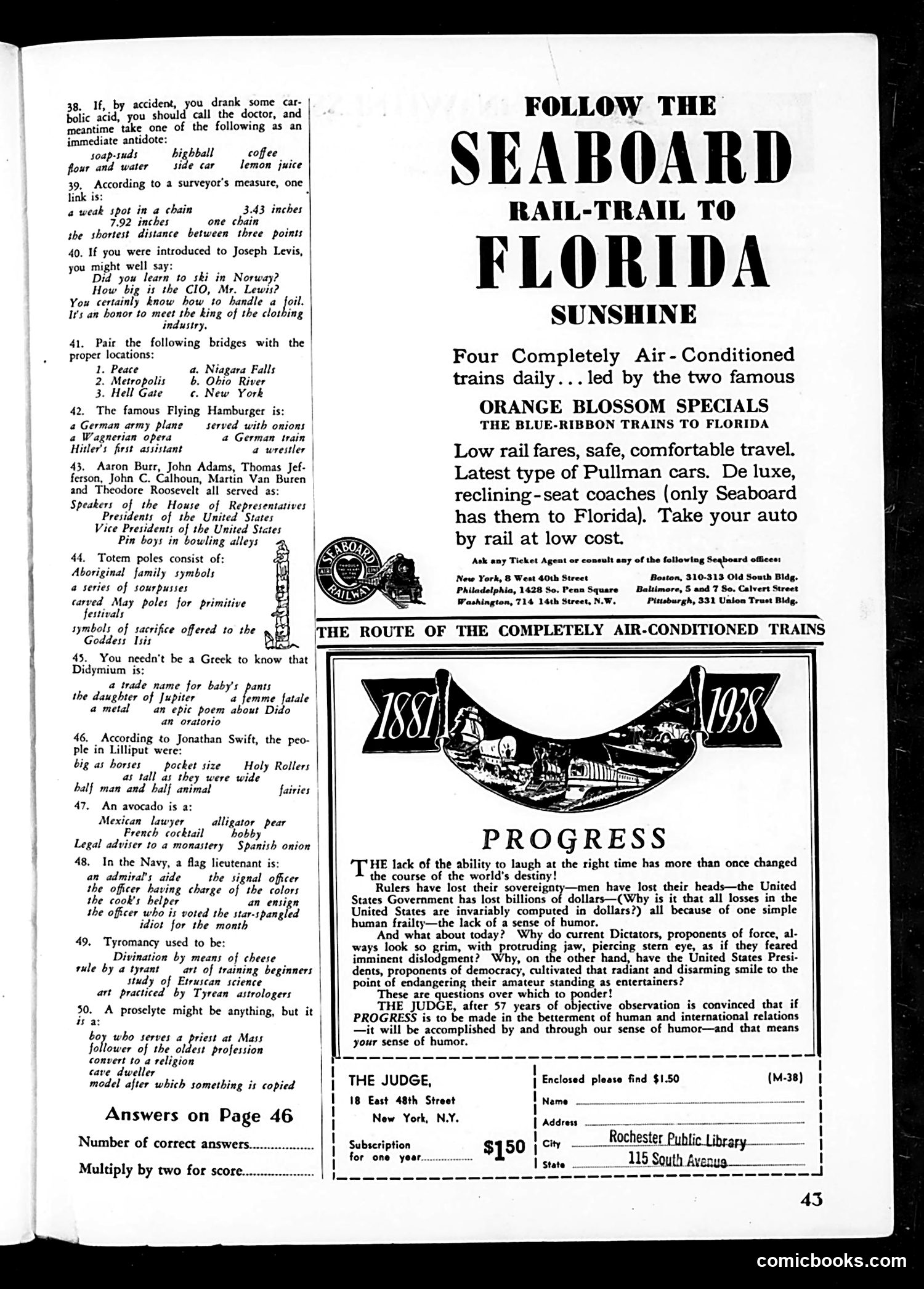
Judge Magazine Page Analysis This page is primarily a trivia quiz (questions 38-50) mixed with period advertising. The quiz tests readers' knowledge across history, literature, geography, and current events. Key historical reference: Question 40 mentions Joseph Lewis and the CIO (Congress of Industrial Organizations), a major labor union of the 1930s-40s. The joke assumes readers know Lewis as a powerful, sometimes controversial labor leader. Political context: Question 49's reference to "Tyromancy" (divination by cheese) appears alongside serious history questions, creating absurdist humor typical of *Judge* magazine's satirical style. The large "PROGRESS" advertisement critiques world leaders and dictators (likely referencing 1930s-40s fascism), arguing that humor and human connection—rather than force—advance civilization. This reflects *Judge*'s role as a humor publication with social commentary. The Seaboard railroad ads promote Florida travel, typical commercial content of the era. Overall, this is a mixed-content page blending trivia entertainment with advocacy advertising.
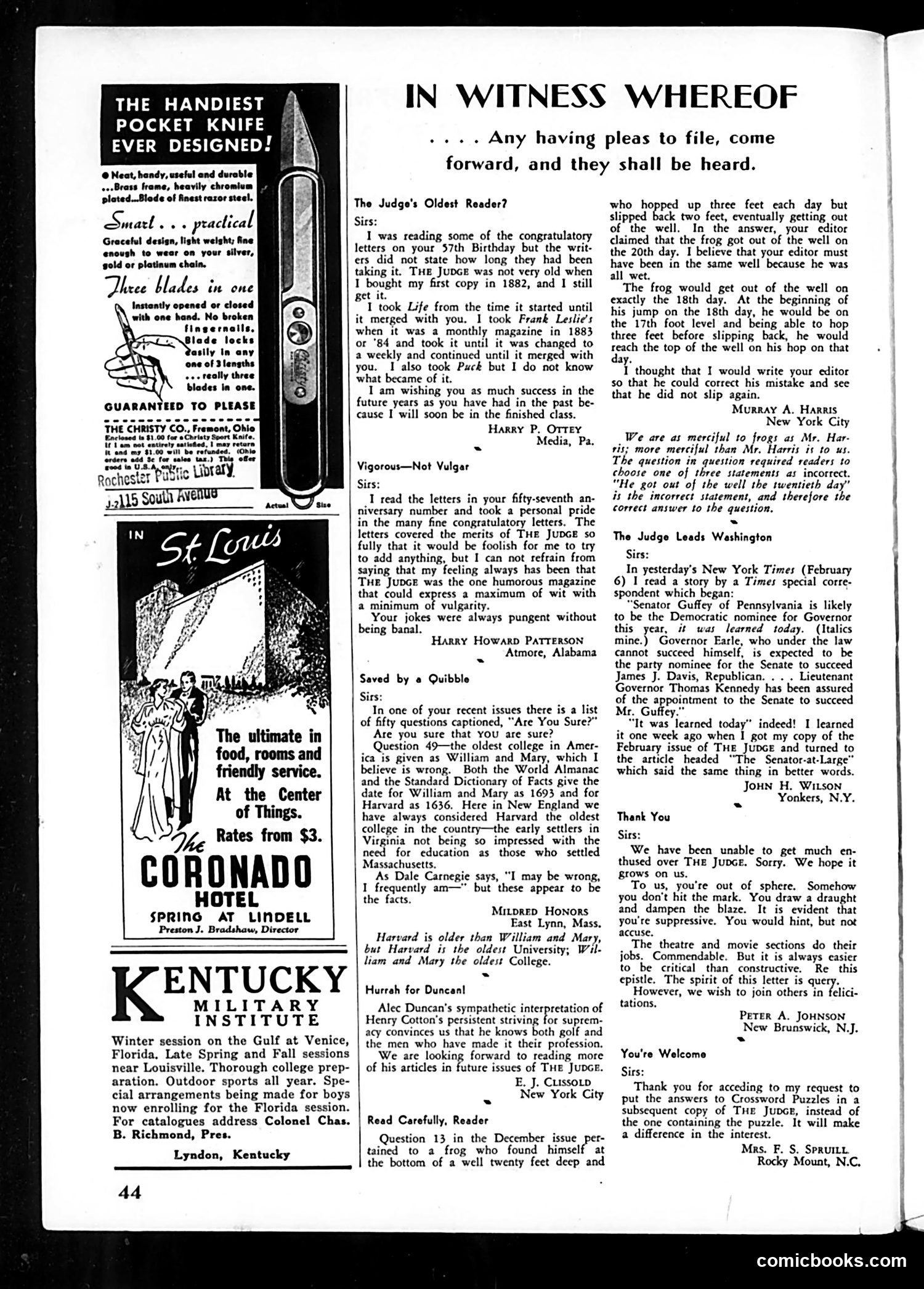
Judge Magazine Page Analysis This page is primarily a letters-to-the-editor section with period advertisements. The content shows readers responding to Judge's 57th anniversary issue. Key Letter Topics: 1. "The Judge's Oldest Reader?" - A reader claims loyalty since 1882, also subscribed to competing humor magazines (Life, Frank Leslie's, Puck), establishing Judge's place in a competitive satirical magazine market. 2. "Vigorous—Not Vulgar" - Praises Judge for witty humor without vulgarity, distinguishing it from cruder competitors. 3. "Saved by a Quibble" - A factual dispute: reader corrects Judge's claim that William and Mary is America's oldest college (it's Harvard, 1636). Judge's response accepts the correction. 4. "Hurrah for Duncan!" - Praises contributor Alec Duncan's golf articles. 5. Frog Math Problem - Reader questions the logic of the published solution. The advertisements (pocket knife, hotels, military school) reflect early 20th-century consumer culture. This is a typical Judge page showing the magazine's role as America's premier satirical publication with engaged readership.
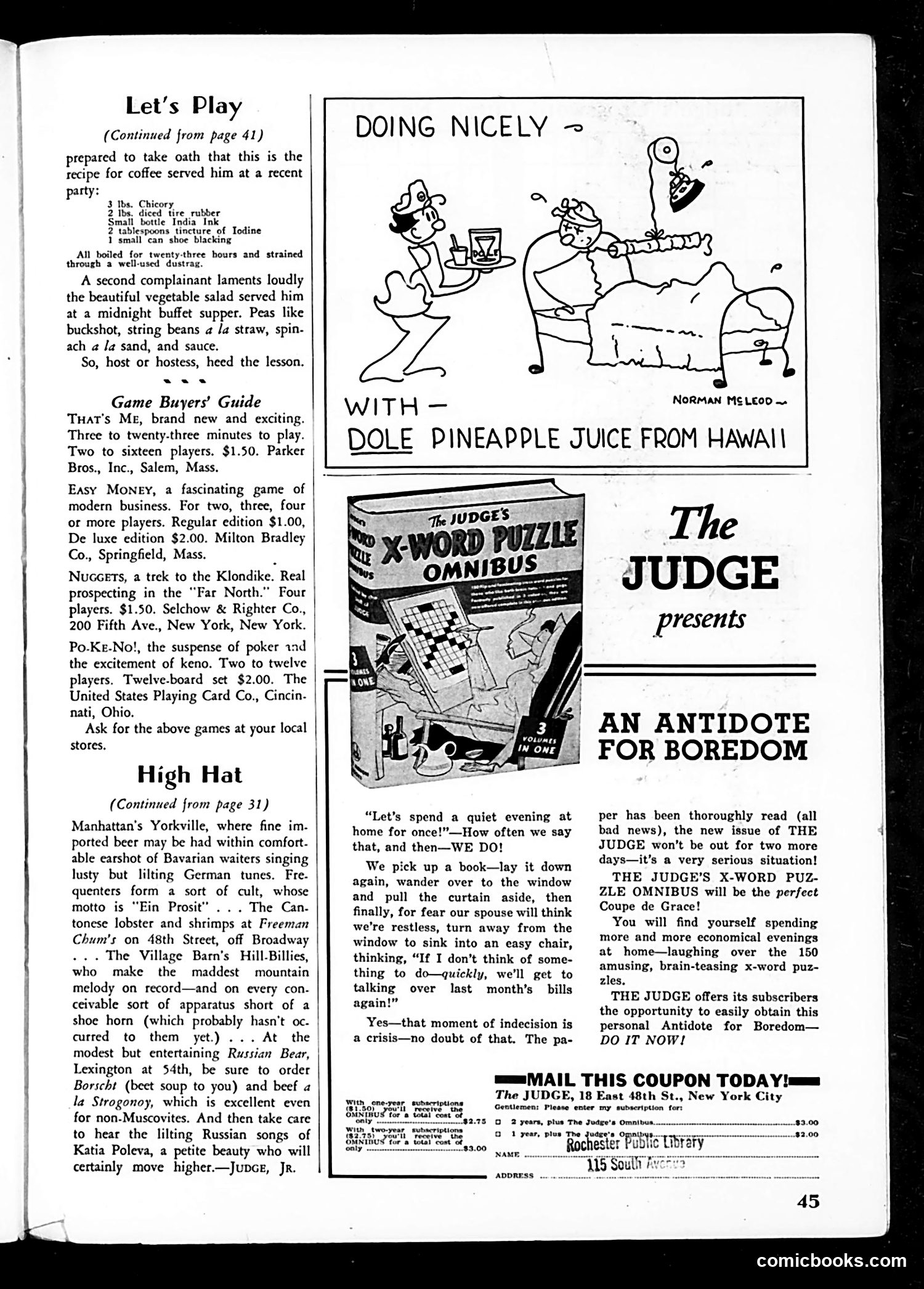
Analysis of Judge Magazine Page 45 This page contains a humorous cartoon by Norman McLeod (top) depicting a couple entertaining at home with Dole pineapple juice—a simple domestic scene satirizing the entertainment industry's marketing of branded products. The bulk of the page features advertisements: a "Game Buyers' Guide" promoting board games as home entertainment, and a "High Hat" column recommending New York City restaurants and entertainment venues featuring ethnic cuisine and live music (German beer halls, Russian restaurants with singers). The main advertisement promotes The Judge's X-Word Puzzle Omnibus as an "antidote for boredom"—offering home entertainment to combat the restlessness of modern domestic life. The copy humorously describes the crisis of a couple stuck at home with nothing to do: newspapers read, spouse growing suspicious of restlessness, conversation drifting to unpaid bills. This reflects 1930s-era anxieties about leisure, entertainment consumption, and domestic companionship during an economically uncertain period. The page is primarily commercial rather than satirical.
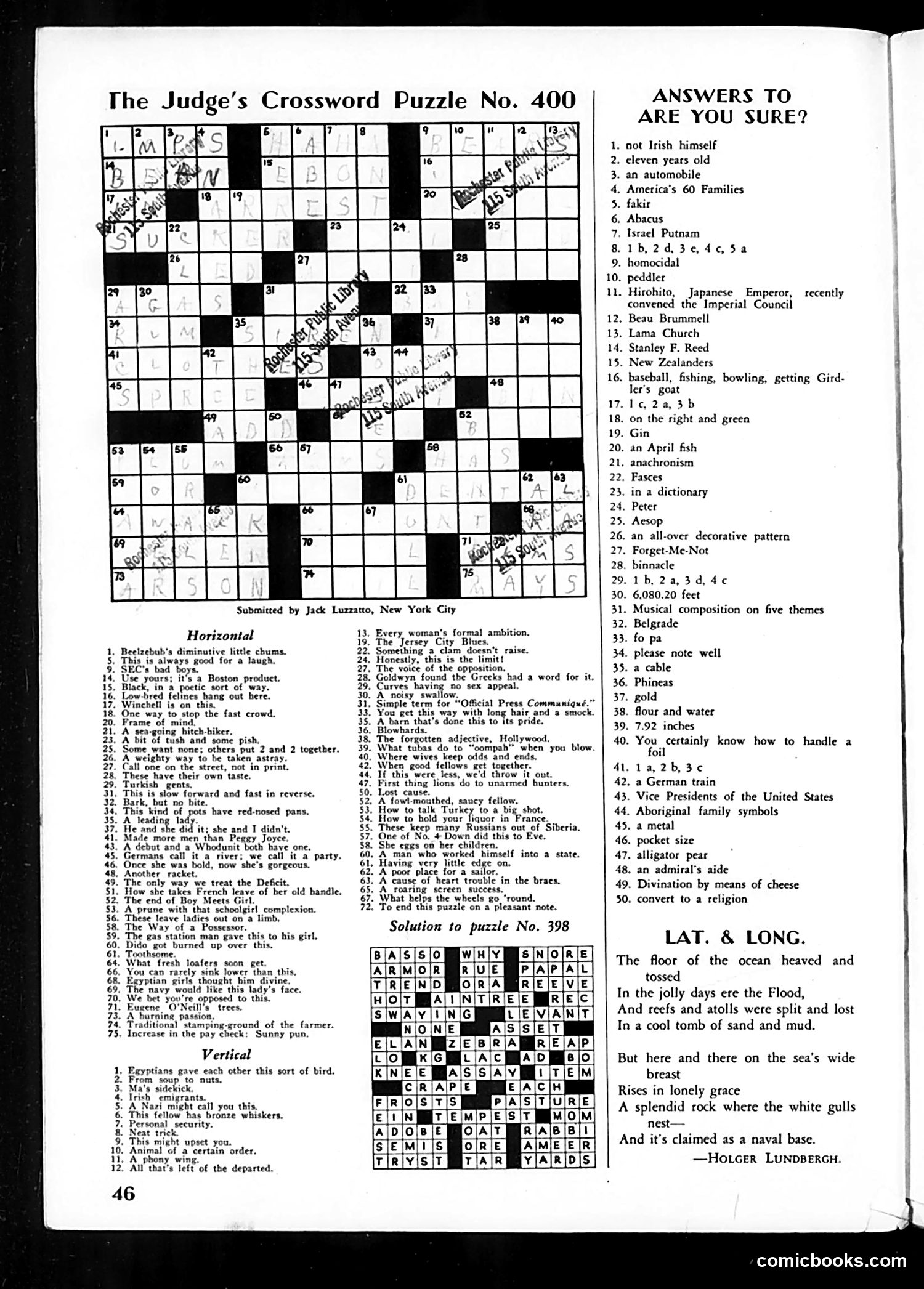
The Judge's Crossword Puzzle No. 400 This page is primarily a crossword puzzle and its answer key from Judge magazine, a satirical publication. It's not a political cartoon but rather a games/entertainment page. The puzzle itself contains dated cultural references and wordplay typical of 1930s American humor. The clues mock contemporary figures and trends: references to "Winchell" (gossip columnist Walter Winchell), Hollywood ("the forgotten adjective, Hollywood"), and topical concerns like the Depression ("The only way we treat the Deficit"). The humor relies on double entendres and period-specific allusions—references to "Peggy Joyce," Egyptian deities, and naval matters that would have resonated with readers then but require historical context today. The page includes the solution to the previous puzzle (No. 398) and concludes with poetry by Holger Lundbergh about maritime imagery, possibly relating to a larger editorial theme. This is essentially a leisure/entertainment page rather than satirical commentary.
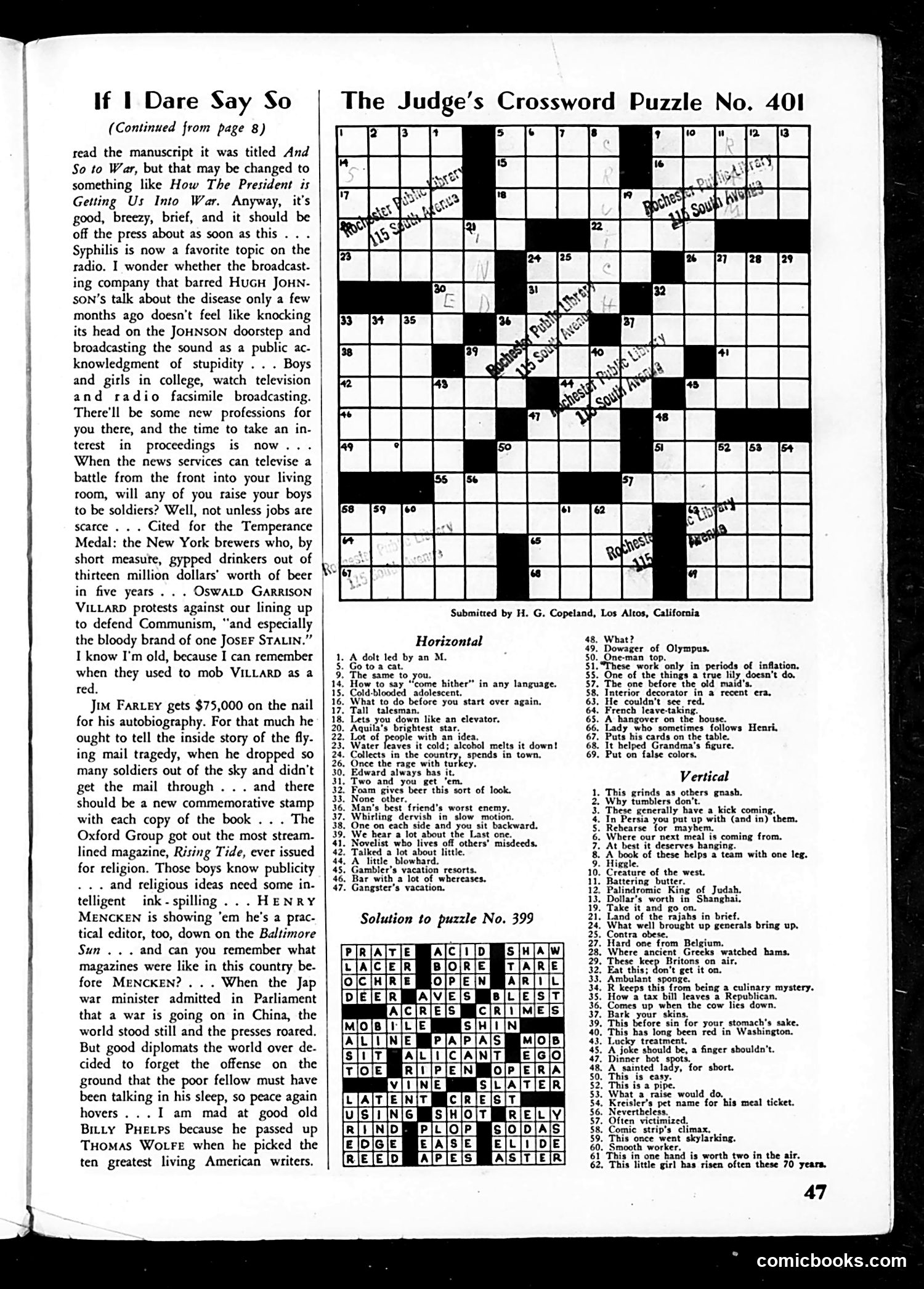
What This Page Means for Modern Readers This is a satirical column ("If I Dare Say So") from Judge magazine, a now-defunct American humor publication. The author critiques contemporary 1930s-40s figures and cultural trends: Key References: - Hugh Johnson and FDR: Satire about government control and war preparation ("Getting Us Into War") - Oswald Garrison Villard: A pacifist editor whom the author ironically notes was once called a "red" (communist sympathizer) - Joseph Stalin: Mentioned negatively regarding communism - Jim Farley: FDR's Postmaster General, criticized for a mail-plane crash that killed soldiers - Japanese war minister: Mocked for accidentally admitting Japan's war in China - Henry Mencken: Praised as an influential editor who shaped American magazine journalism The column mixes celebrity gossip with social commentary—criticizing radio censorship hypocrisy, praising new broadcasting technology, and lamenting cultural priorities. The crossword puzzle below is standard period content. The satire targets: government incompetence, pacifist hypocrisy, media double standards, and celebrity excess—concerns that remained relevant across decades.
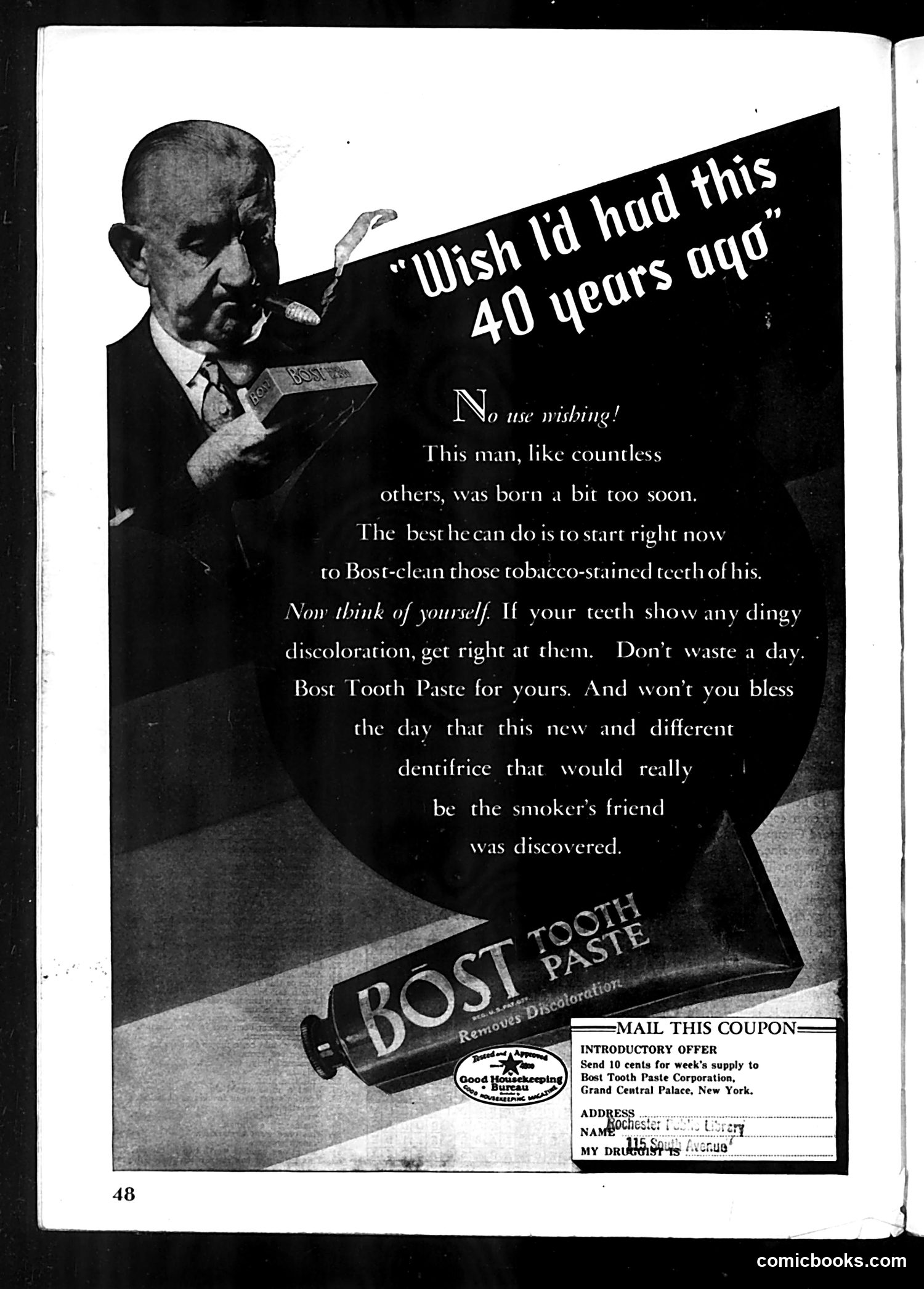
Bost Tooth Paste Advertisement This is a product advertisement, not political satire. It features an older man with a pipe, shown with yellowed, tobacco-stained teeth. The ad's message: he was "born a bit too soon" to benefit from Bost Tooth Paste, a new dentifrice specifically marketed as "the smoker's friend." The humor targets smokers who've damaged their teeth through tobacco use. The ad positions Bost as a solution for discoloration, with an introductory offer coupon (10 cents for a week's supply). The emotional appeal suggests readers shouldn't repeat this man's mistake—act now before dental damage becomes permanent. This reflects early 20th-century marketing that normalized smoking while simultaneously selling remedies for its cosmetic effects. The "born too soon" framing is self-aware about the product's novelty.
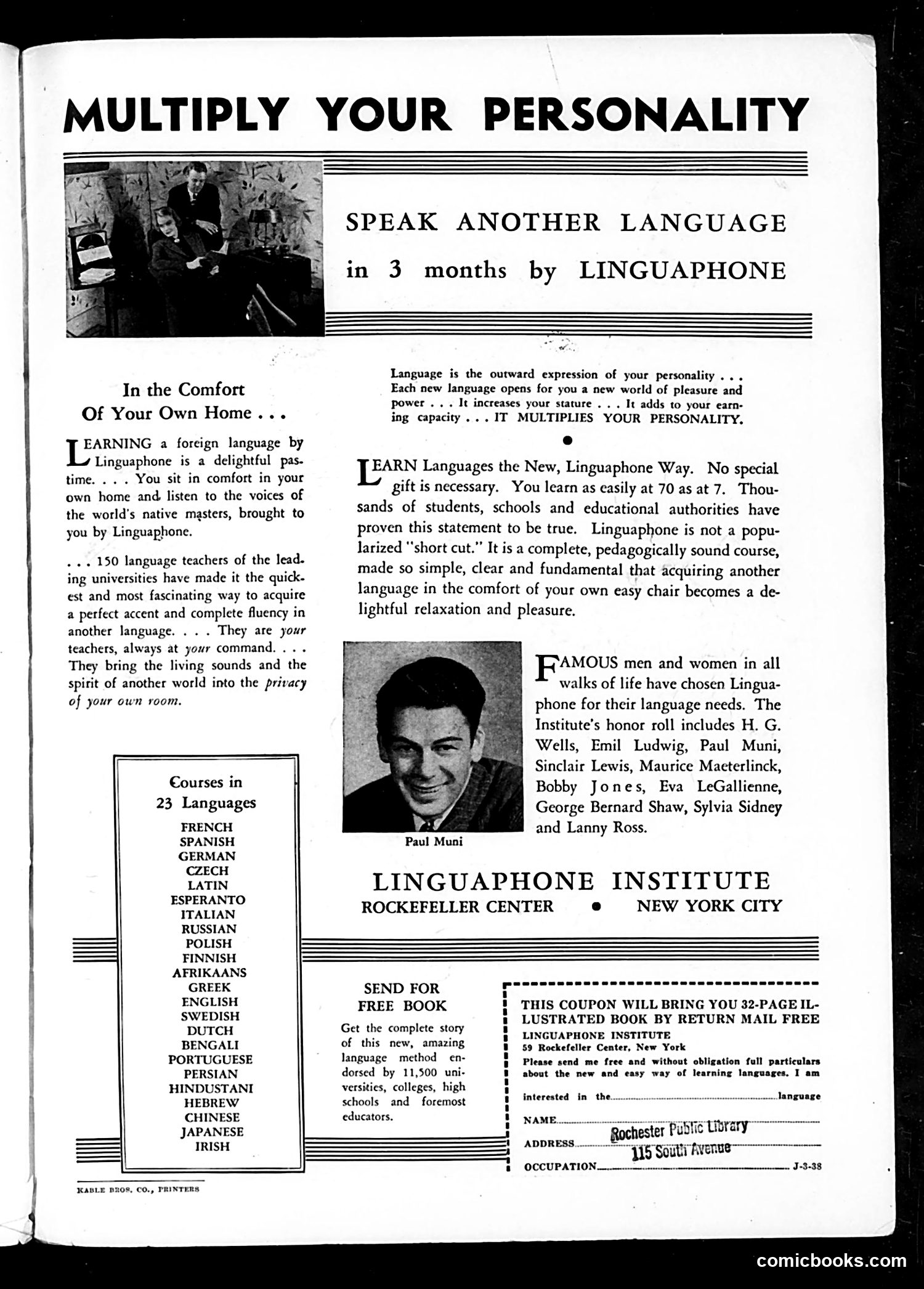
This is a full-page advertisement, not satire or political commentary. It promotes the Linguaphone language-learning method, marketed as an at-home correspondence course using phonograph recordings. The ad appeals to middle-class aspirations by claiming that learning languages "multiplies your personality" and increases earning capacity. It emphasizes accessibility—learnable "at 70 as at 7"—and positions the method as pedagogically rigorous (not a "short cut"), taught by 150 university language professors. The celebrity endorsements (H.G. Wells, Paul Muni, George Bernard Shaw, etc.) lend prestige. The page lists 23 available languages, reflecting the early 20th-century cosmopolitan ambitions of educated Americans. There is no cartoon or satire here—Judge was simply a magazine carrying advertisements alongside its satirical content.
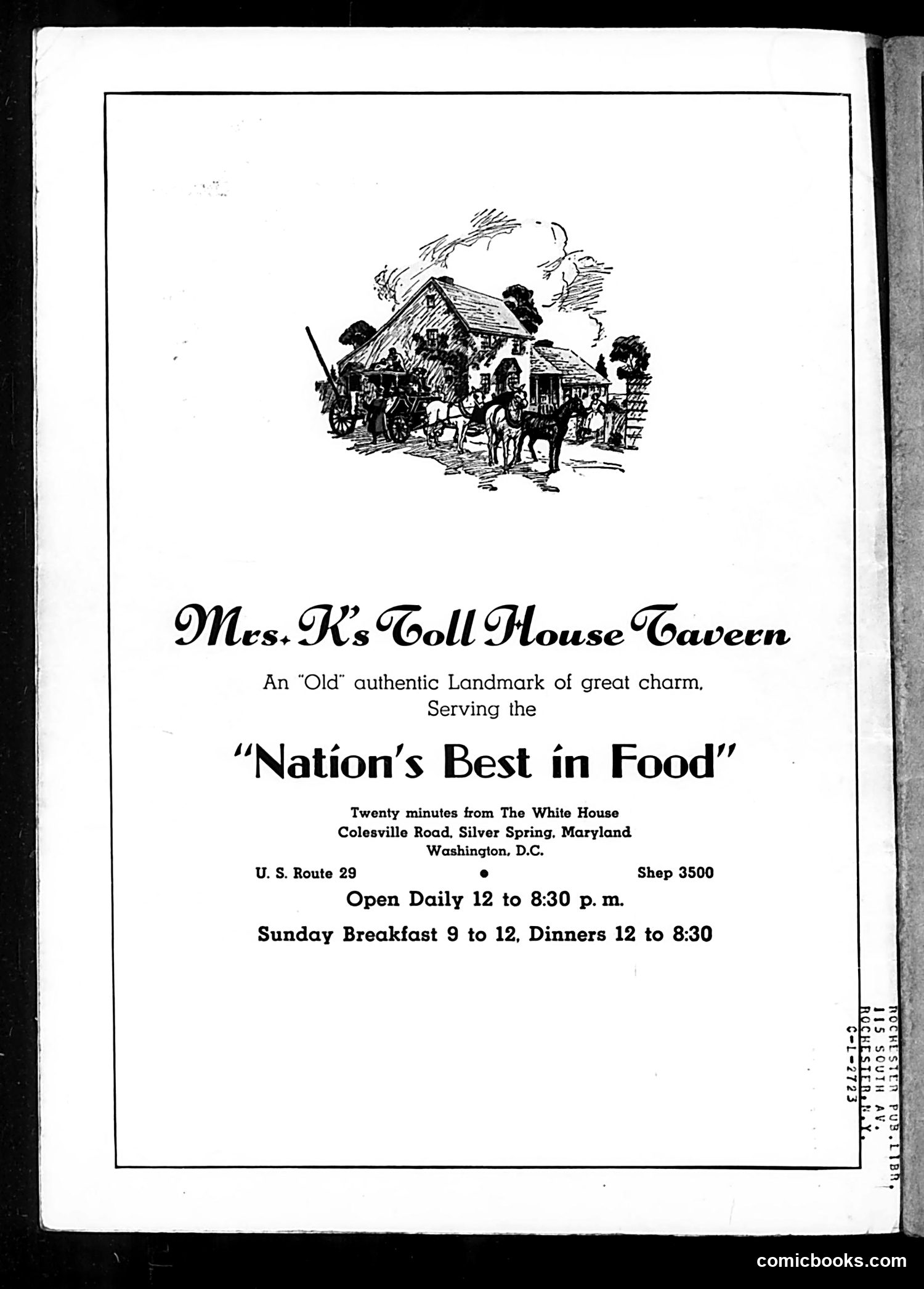
Analysis This is a full-page advertisement, not satirical content. It promotes "Mrs. K's Coll House Tavern," a restaurant in Silver Spring, Maryland, positioned as an "Old authentic Landmark of great charm" serving "Nation's Best in Food." The illustration shows a rustic colonial-era cottage with people and horse-drawn wagons outside, evoking nostalgia for American frontier heritage. The tavern capitalized on proximity to Washington, D.C. (twenty minutes away via U.S. Route 29) to attract tourists and government workers. This reflects mid-20th-century American marketing: packaging quaint, historically-themed dining experiences for urban leisure travelers seeking "authentic" Americana. The emphasis on being "old" and "charming" was a common selling point for roadside restaurants in that era.