judge
Judge — April 1938
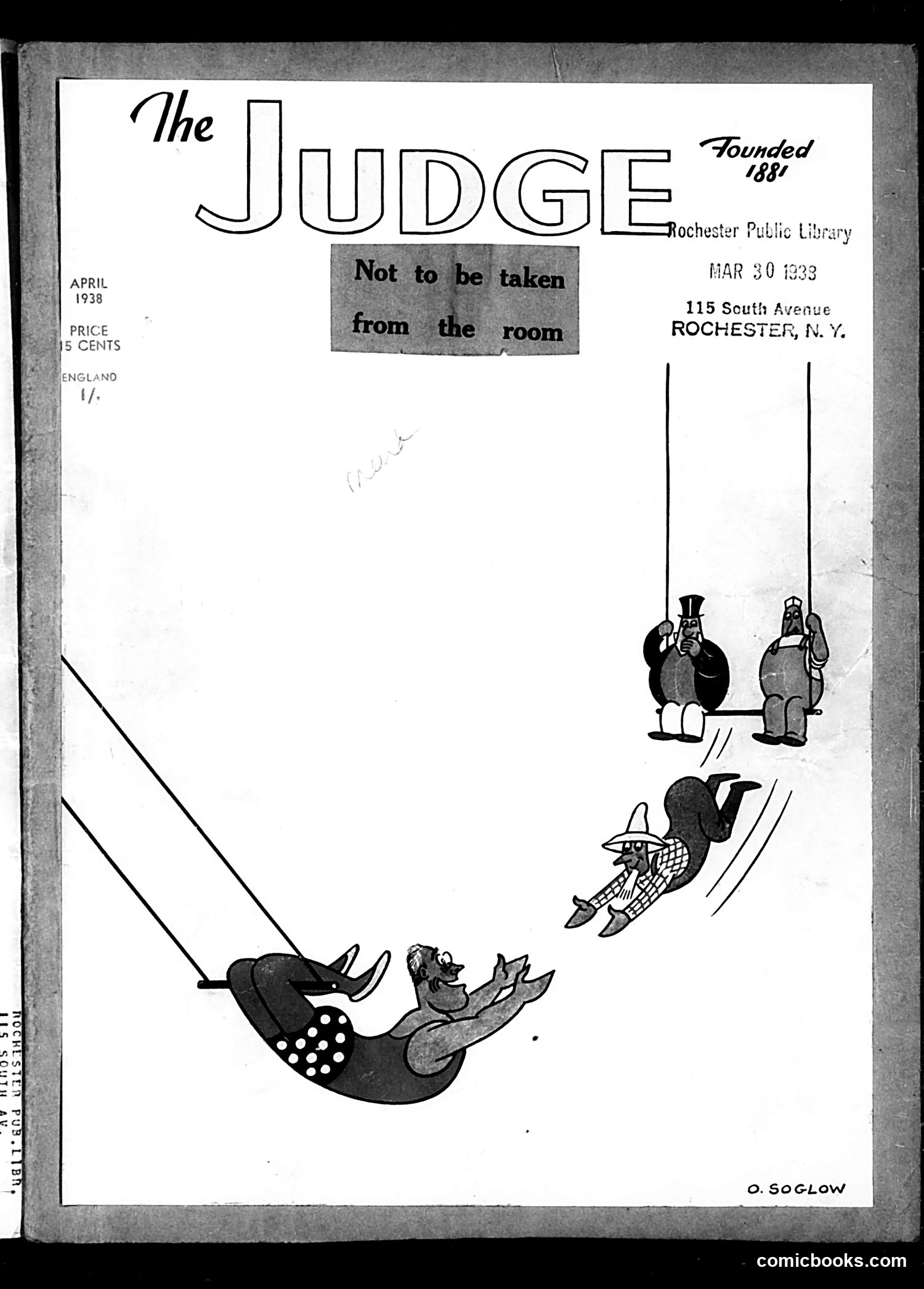
Analysis of Judge Magazine Cover, April 1938 This cover by O. Soglow depicts a swing scene with caricatured figures. The largest figure at bottom-left appears to be an elephant—the Republican party symbol—swinging while others ride swings above. Given the April 1938 date, this likely comments on American politics during Franklin D. Roosevelt's presidency and New Deal era, when Republicans opposed Democratic policies. The specific political meaning is unclear without additional context, but the composition suggests commentary on power dynamics or shifting political fortunes—who's "up" and who's "down" in the political swing. The satire uses the playground metaphor to critique political maneuvering of the period.

I can see this is a page from *Judge* magazine, but the image quality is too poor for me to make out specific cartoon details, illustrations, or captions clearly enough to identify the figures, events, or satirical points with confidence. The right margin shows fragmentary OCR'd text that's largely illegible in this scan. Without being able to read the captions or see the cartoon artwork distinctly, I cannot reliably identify who is being caricatured, what political or social issue is being referenced, or what the satire intended to convey. To properly analyze this page's meaning for a modern reader, I would need a clearer image or legible text accompanying the illustrations.
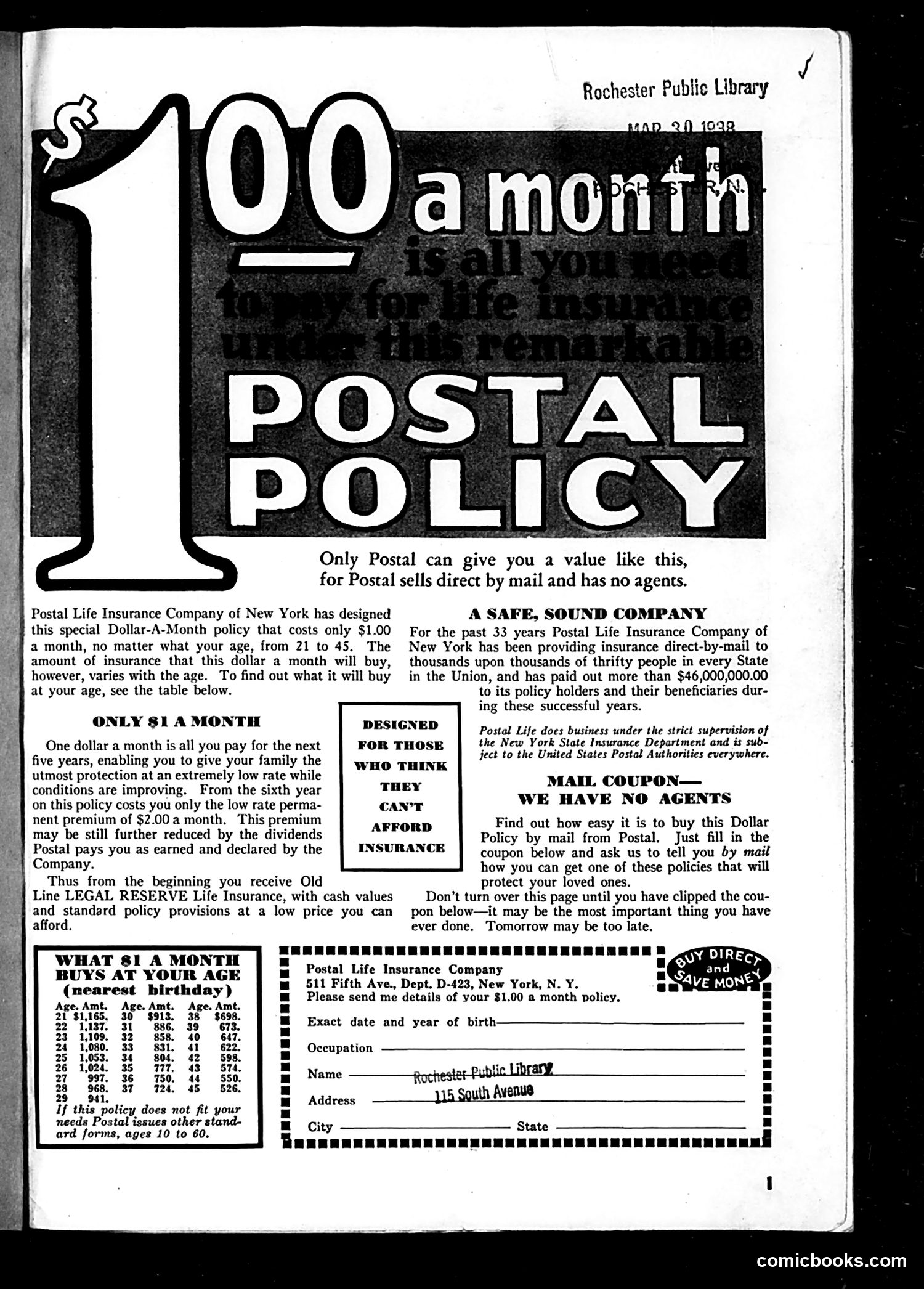
Analysis This page is primarily an advertisement, not a political cartoon. It promotes a "$1 a month" life insurance policy from the Postal Life Insurance Company of New York, marketed as affordable coverage for working people aged 21-45. The satirical element is minimal—the ad's framing suggests the policy targets those who "can't afford insurance," positioning it as a solution for financially struggling Americans. The emphasis on "direct by mail" and "no agents" suggests cost-cutting appeals to working-class readers suspicious of middlemen. The coupon at bottom indicates this is a mail-order sales pitch. There are no identifiable political figures or cartoon characters—just a straightforward, if somewhat patronizing, financial services advertisement typical of early 20th-century *Judge* magazine's commercial content.
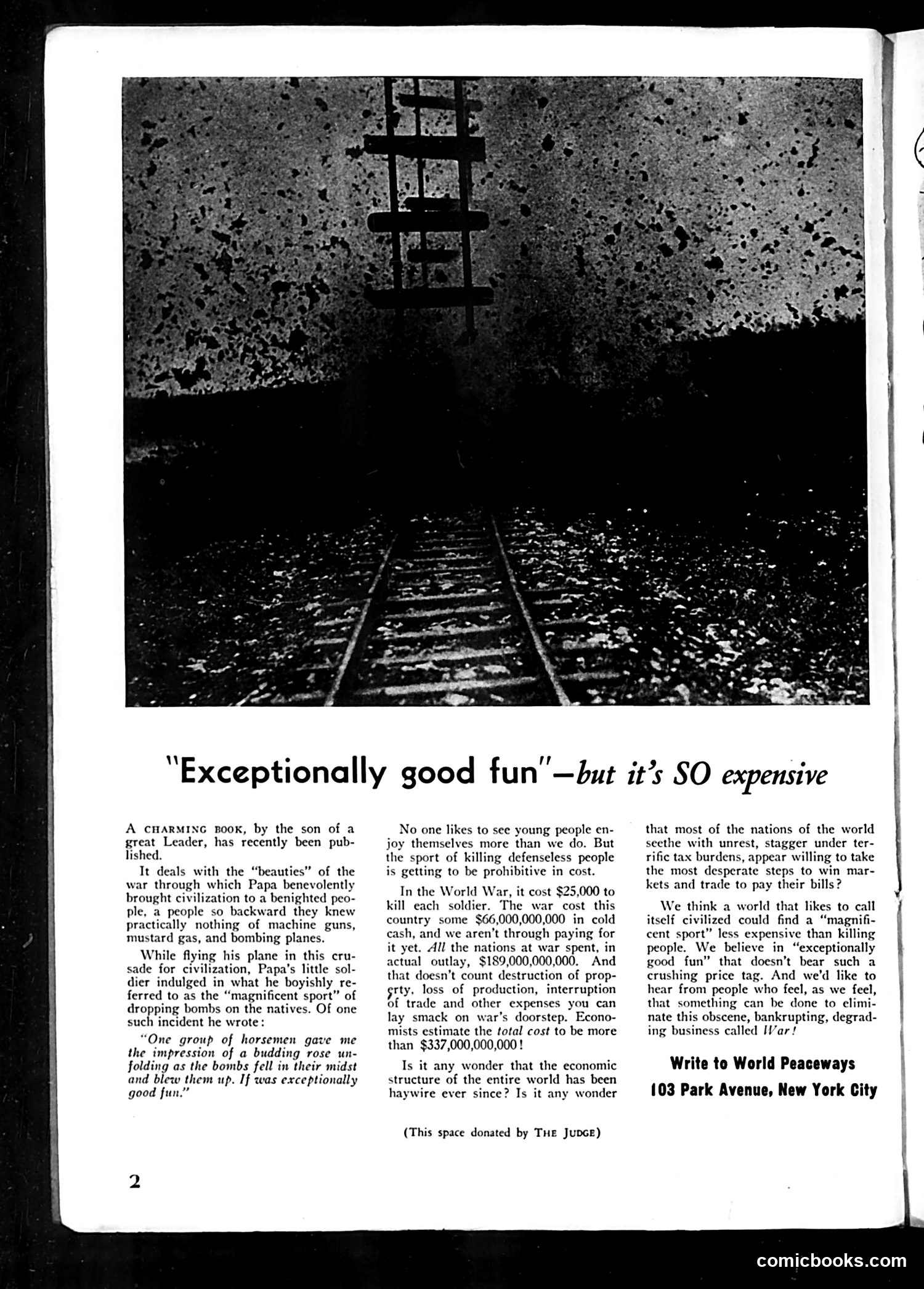
Analysis This appears to be a World War I-era satirical article from *Judge* magazine criticizing the enormous financial cost of warfare. The image shows railroad tracks leading toward a wooden structure (possibly representing military infrastructure or a gallows), symbolizing the path to destruction. The text argues that while people enjoy entertainment, war's expense is prohibitive. It cites specific figures: $25,000 to kill one soldier, and a total war cost exceeding $337 billion. The author contrasts this with the economic devastation war causes—lost production, interrupted trade, and general societal breakdown. The satire's point: nations call themselves "civilized" while engaging in an obscenely expensive, destructive practice that bankrupts entire economies. The piece advocates for peace through "World Pathways," a peace organization listed at the bottom.
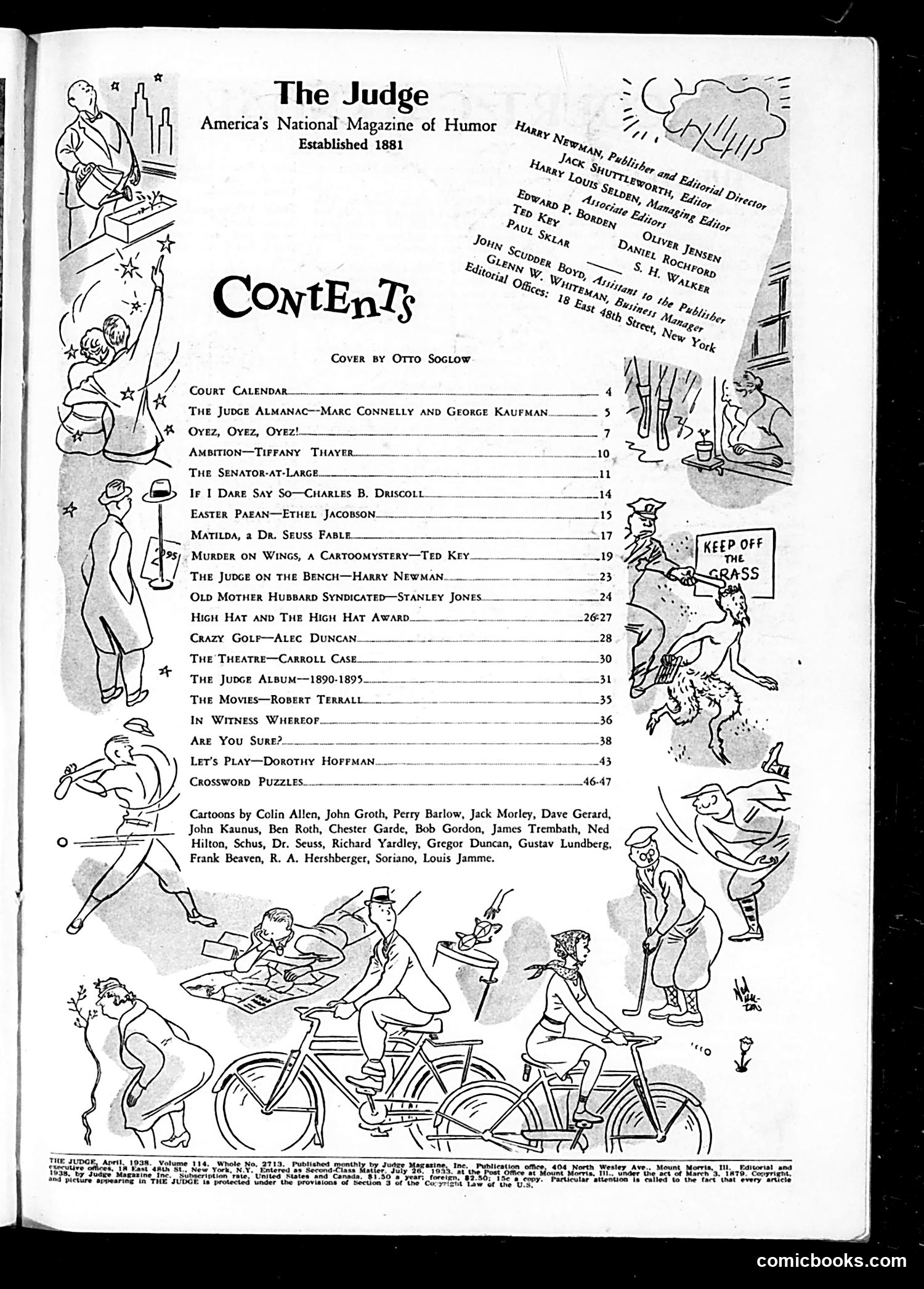
The Judge Contents Page - April 1898 This is a contents/masthead page from *The Judge*, established 1881 as America's humor magazine. The page lists April 1898 articles and illustrations by various cartoonists. The decorative border illustrations show people engaged in leisure activities—cycling, picnicking, playing—reflecting turn-of-the-century recreation themes. One illustration includes a "Keep Off the Grass" sign, likely a gentle jab at park regulations or social propriety. Notable articles include pieces on political figures like "The Judge on the Bench" (Harry Newman) and social commentary like "Easter Parade" and "High Hat and the High Hat Award." The cartoonists credited include established names like Dr. Seuss (Theodor Geisel), suggesting *The Judge*'s role as a launching pad for American satirical talent. The overall tone reflects genteel, middle-class humor typical of the 1890s.
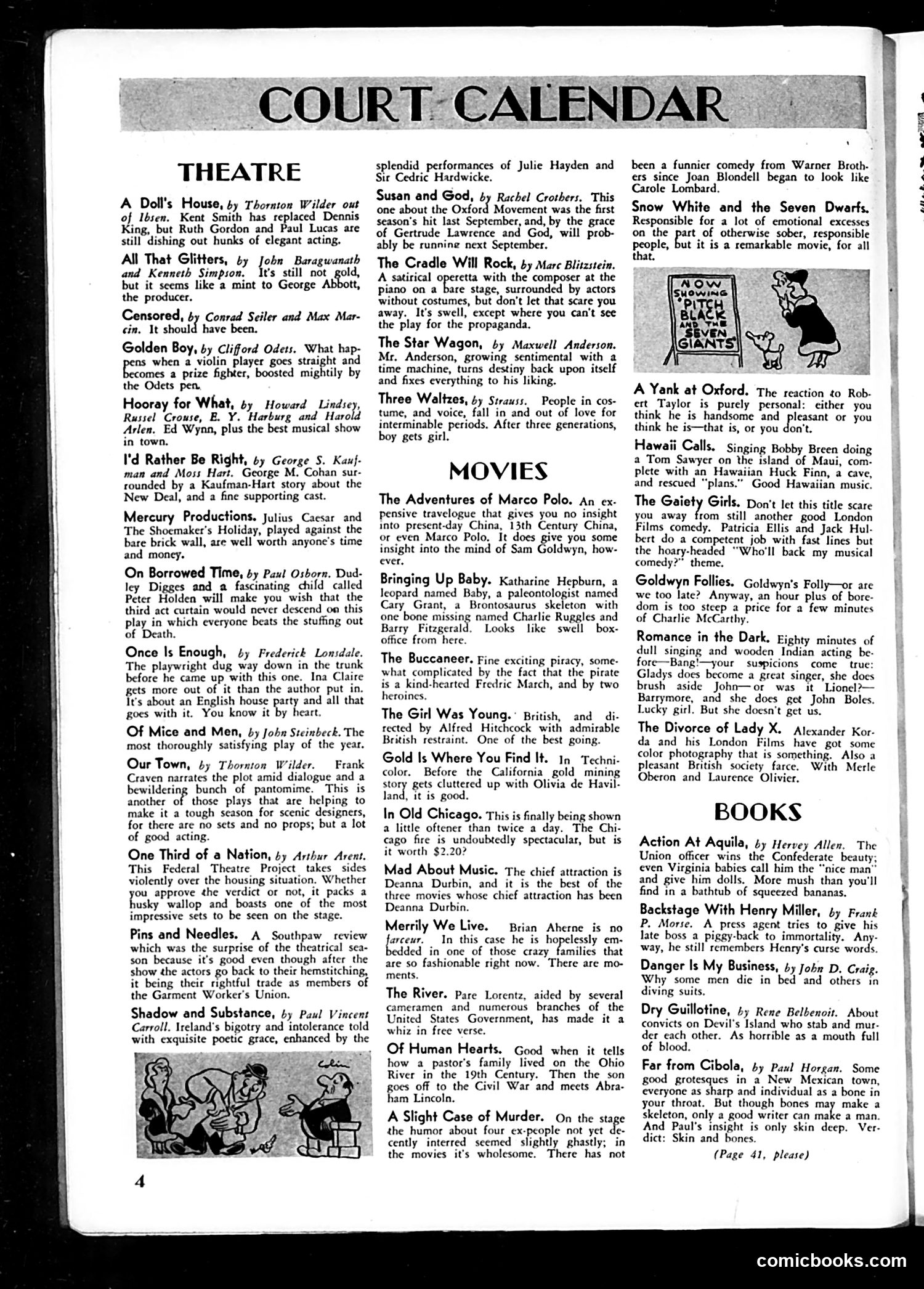
Court Calendar Page Analysis This page from Judge magazine is primarily a court calendar and entertainment review section, not a political cartoon page. It lists current theatrical productions and films with brief critical commentary. The small cartoon visible at bottom left appears to be a generic humorous illustration of people in social situations, unrelated to political commentary. The page's content focuses on entertainment criticism rather than satire—reviewing plays like "A Doll's House" and films like "The Adventures of Marco Polo" and "Bringing Up Baby." The reviews offer modest praise or criticism of contemporary productions. Without clearer political references or identifiable caricatures of specific public figures, this appears to be a standard entertainment/leisure section rather than satirical commentary on current events or politics.
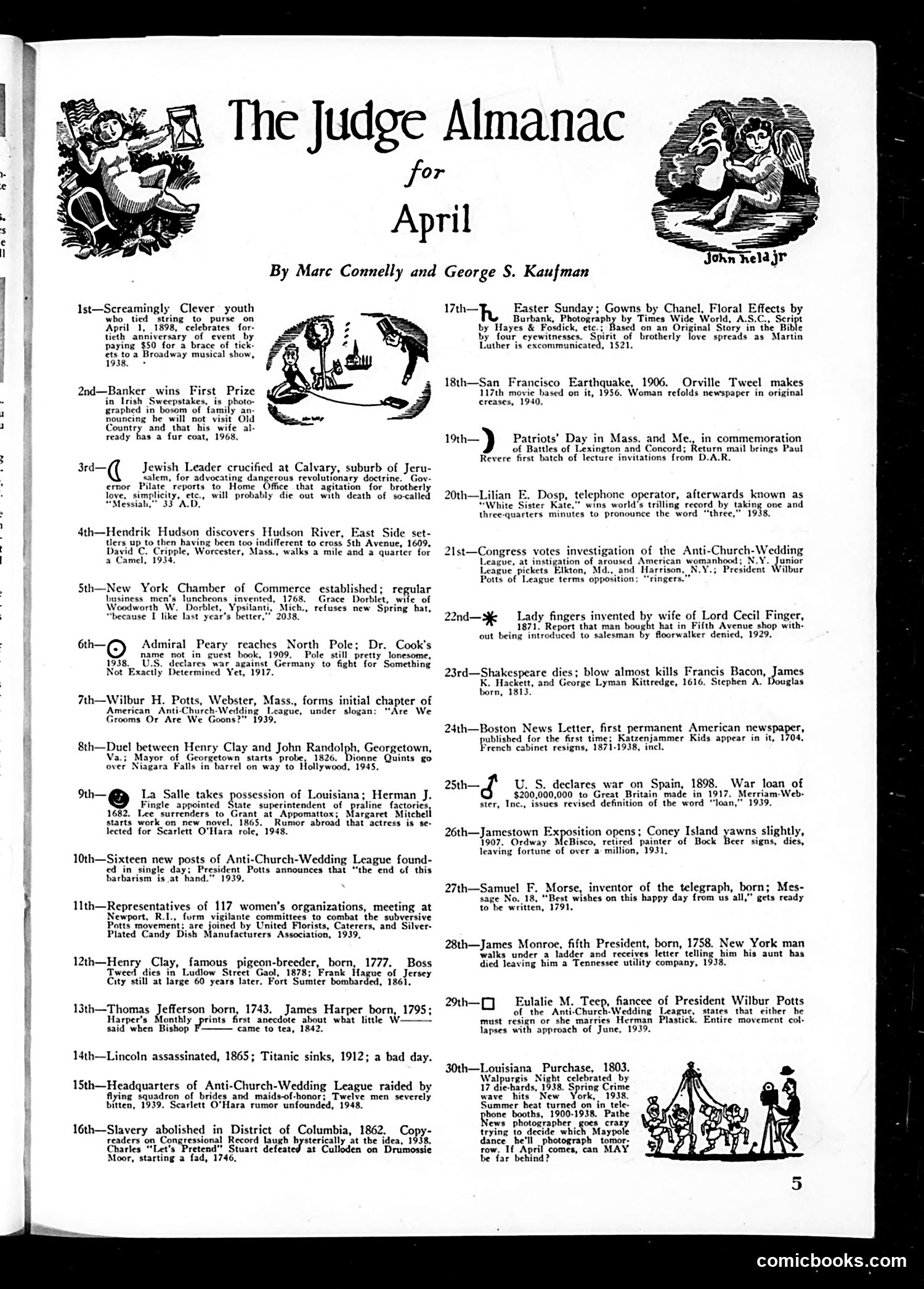
The Judge Almanac for April This page is primarily an almanac listing historical events and notable births for each day of April, rather than a satirical cartoon page. The decorative header features cherubs and classical imagery typical of Judge magazine's ornamental style. The entries mix genuine historical facts (Lincoln's assassination on the 14th, the San Francisco Earthquake of 1906) with fictional or satirical items specific to Judge's running gag: the "Anti-Church-Wedding League." This fictitious organization appears repeatedly throughout April—with headquarters raided, investigations launched, and various members' activities chronicled—creating an ongoing joke about opposition to church weddings that modern readers would need to understand Judge's 1918-era satirical context to fully appreciate.
Analysis This page is primarily an advertisement, not satire or political commentary. It's a 1928 insurance ad for Union Central Life Insurance Company promoting their "Family-needs Forecast" service. The ad's pitch targets widows and bereaved families, arguing that life insurance proceeds should be carefully distributed across "seven vital needs" rather than squandered. The ad emphasizes that Union Central has "71 years" of actuarial expertise to help calculate proper distributions. The small cartoon at top showing a sign reading "ROOMS WITH BOARD" appears to illustrate the kind of modest living situations widows might face—implying insurance planning prevents financial hardship. This reflects 1920s-30s anxieties about economic security and widows' vulnerability, but the page is fundamentally a sales pitch, not political satire.
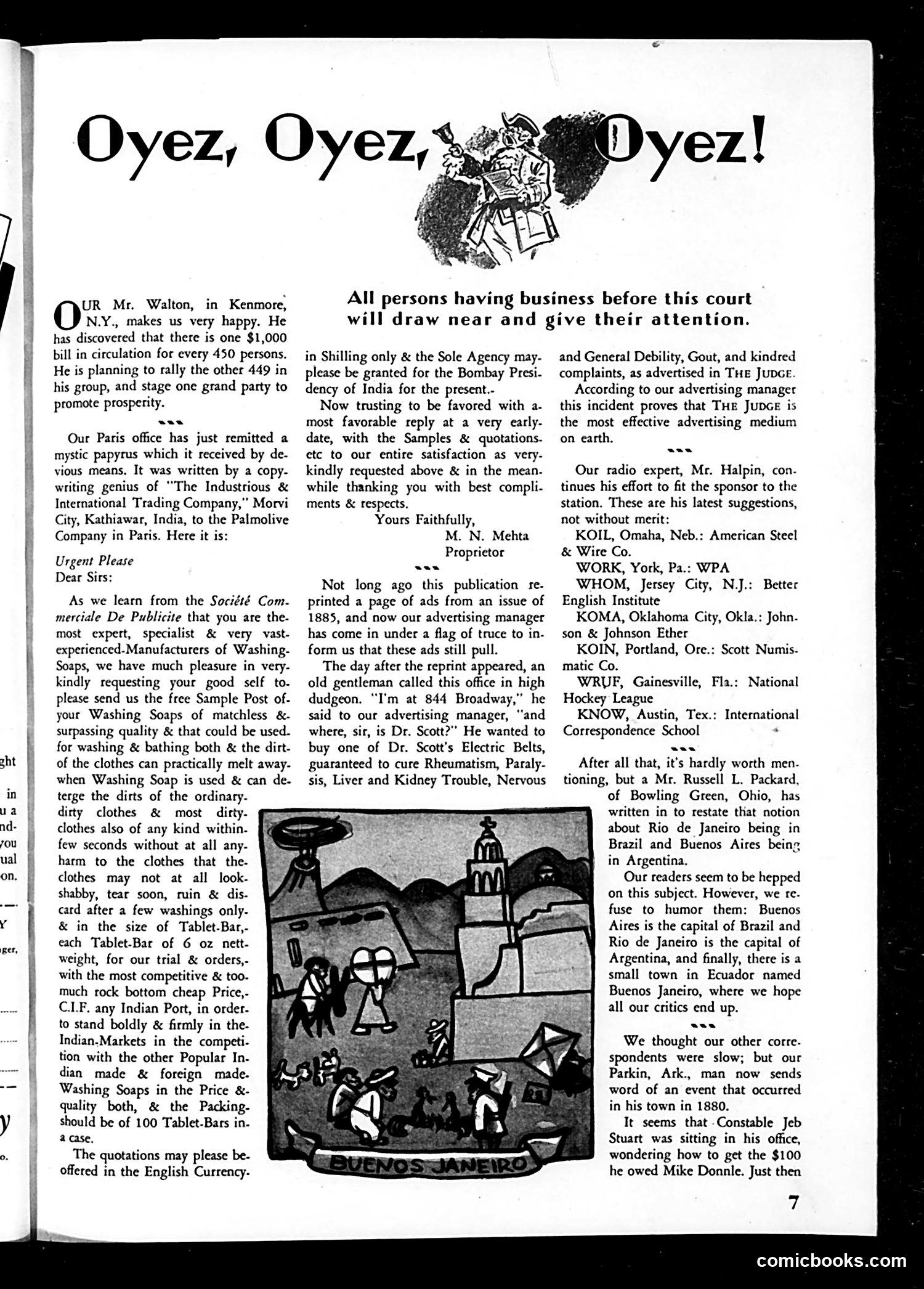
Analysis of Judge Magazine Page This page is primarily advertising and business notices rather than political satire. The main content includes: 1. "Oyez, Oyez, Oyez!" - A mock court announcement heading advertising various products and services 2. The illustration labeled "BUENOS JANEIRO" depicts a colonial-era South American town scene, likely satirizing geographic confusion or misunderstanding of South American cities. The text references confusion about whether Buenos Aires is in Brazil or Argentina, suggesting contemporary American unfamiliarity with South American geography. 3. Multiple advertisements for soap products, wire goods, sporting equipment, and schools mixed throughout the page as "court business" The satire appears gentle—poking fun at American geographic ignorance—rather than sharp political commentary. The page reflects Judge's mixed content model of humor advertisements and product promotions.
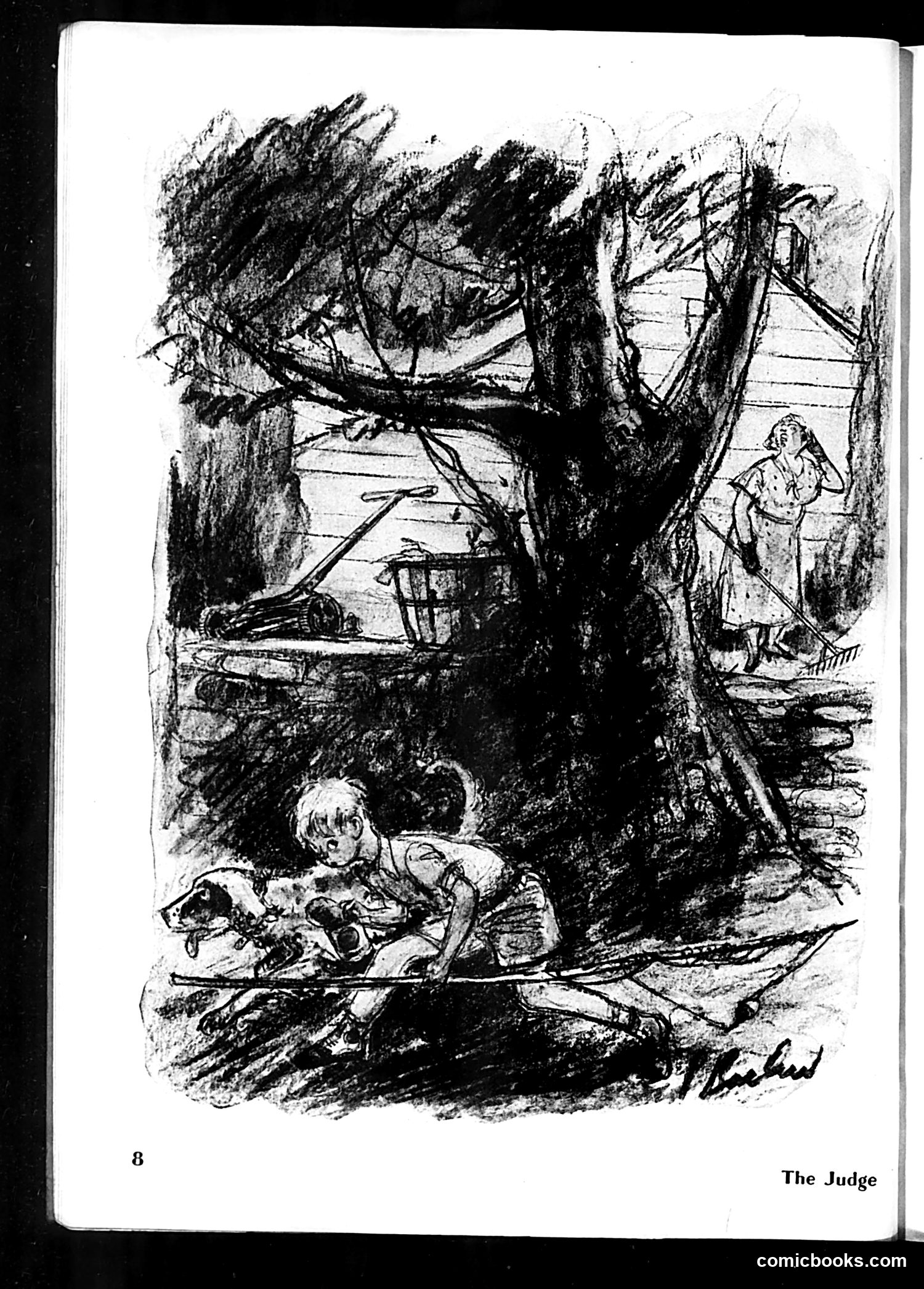
Analysis This page from *Judge* magazine features an illustration labeled "The Judge" showing a woodland scene. A child and dog appear in the foreground near what looks like a fallen log or tree, with an adult figure visible in the background to the right, near a fence. The sketch style is typical of late 19th or early 20th-century editorial illustration. However, without additional context or caption text beyond the title, the specific satirical meaning remains unclear. The scene could reference a legal or moral judgment situation, given the title, but the exact political or social commentary it conveys is not evident from the image alone. The page number "8" suggests this is from a larger issue of the magazine.
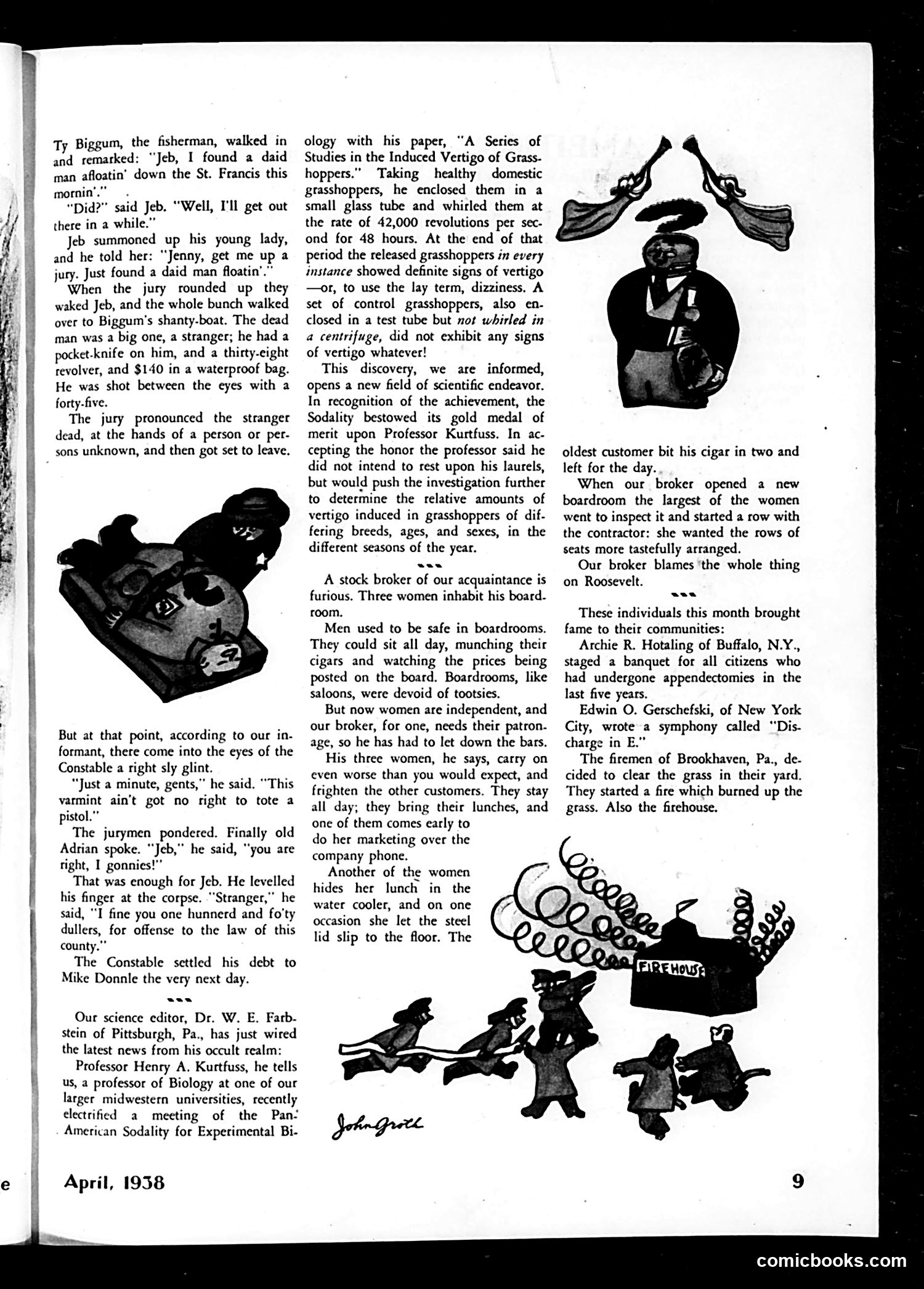
Judge Magazine, April 1938: Social Satire This page contains two distinct satirical pieces: 1. "The Constable's Justice" (left column): A folk-tale style story mocking rural/frontier legal corruption. A dead stranger is found with money and weapons, but the constable cleverly fines the *corpse* for illegally carrying a pistol—allowing him to pocket the $140 in "settlement." The satire targets how lawmen exploited their authority for personal gain in isolated communities. 2. "Scientific Absurdity" (center): Judge ridicules academic pretension by describing Professor Kurtfuss's "groundbreaking" study: spinning grasshoppers at 42,000 revolutions per hour causes dizziness. The satire is obvious—the "discovery" is absurdly self-evident, yet celebrated as if revolutionary. 3. "Women in the Boardroom" (right): Satirizes changing gender dynamics in 1938. A stock broker resents that independent women now frequent his previously all-male boardroom, conducting marketing calls, eating lunch, and—scandalously—rearranging furniture. The satire mocks both male anxiety about women's workplace presence and their trivial grievances.
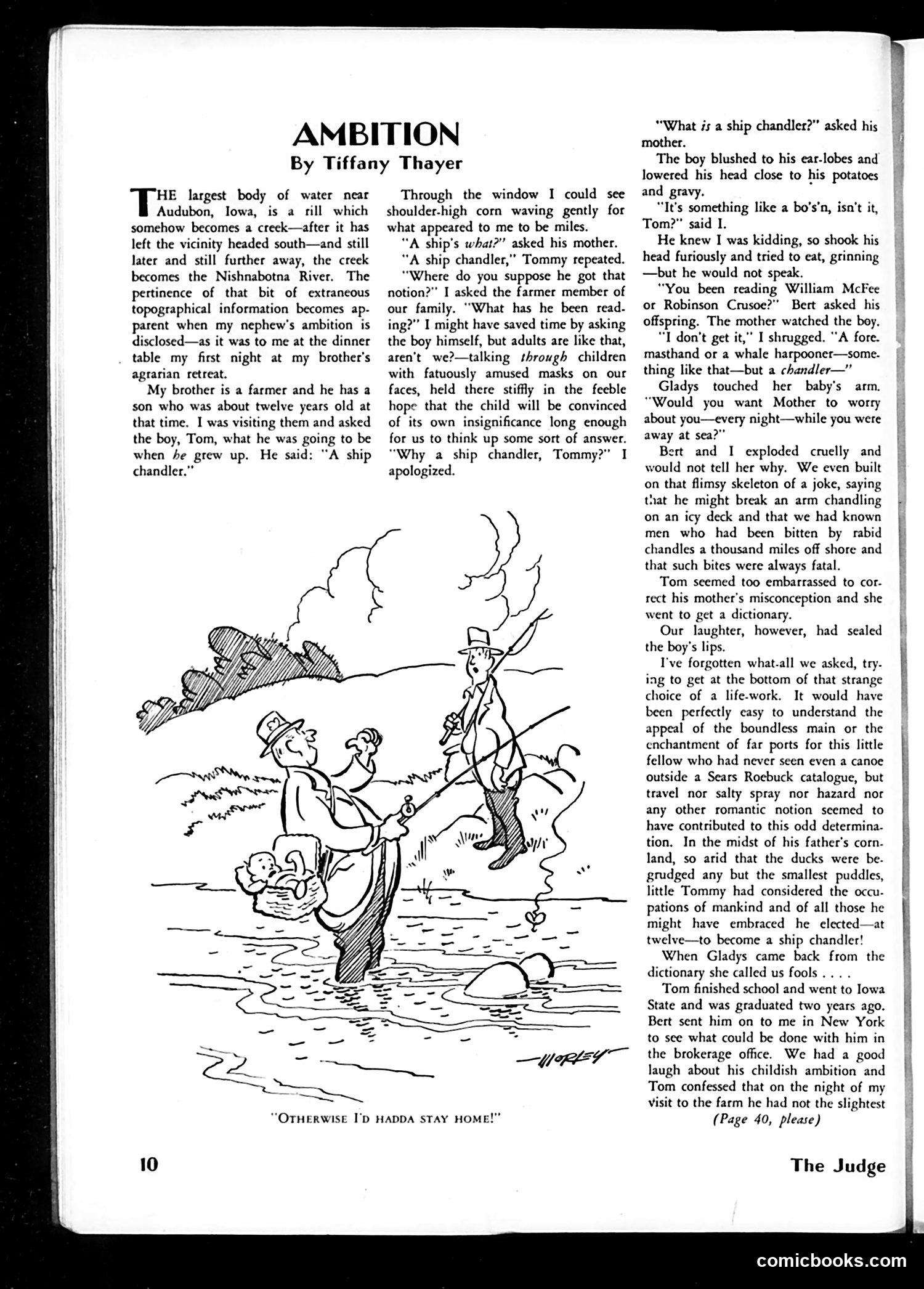
"Ambition" by Tiffany Thayer This is a humorous short story, not a political cartoon. The joke centers on a rural Iowa boy's bizarre career ambition: becoming a "ship chandler" (a person who supplies provisions to ships). The comedy operates on multiple levels: First, the boy's mother mishears "chandler" as something nautical-related. Second, the adults find it absurd that a twelve-year-old in landlocked Iowa—surrounded only by cornfields and tiny puddles—aspires to a maritime trade he's never encountered. The cartoon illustrates the incongruity: a child daydreaming of seafaring while standing in a muddy farm landscape. The satire gently mocks both the boy's romantic naiveté and the adults' condescension toward children's unexplained ambitions. The story apparently continues on page 40, suggesting the boy's peculiar dream had unexpected consequences later in life.
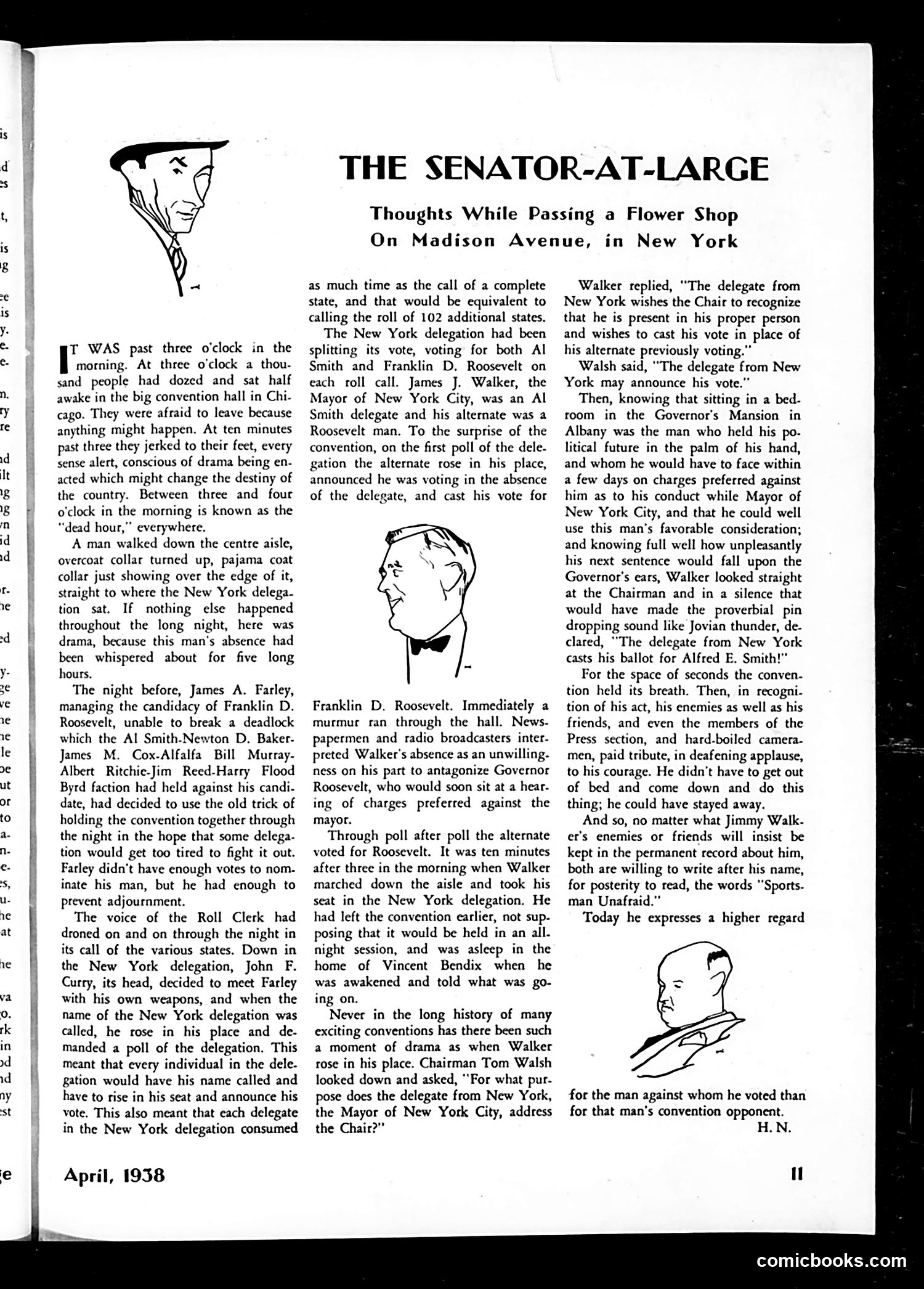
Judge Magazine Satire Analysis (April 1938) This article satirizes a dramatic moment at the 1936 Democratic National Convention. James J. Walker, Mayor of New York City and an Al Smith delegate, was conspicuously absent during crucial voting rounds. His alternate voted for Franklin D. Roosevelt instead, which observers interpreted as Walker's tacit submission to Roosevelt (who had pending corruption charges against Walker). When Walker dramatically reappeared at 3 a.m.—having been asleep elsewhere—and reclaimed his seat to cast his own vote for Smith, it became convention theater. The satire mocks the political machinations: Farley's exhaustion tactics, factional splits within New York's delegation, and Walker's apparent capitulation to Roosevelt's power despite his public defiance. The "Senator-at-Large" title suggests Walker represents his own political interests above all else. The three caricature sketches punctuate the melodramatic narrative of ambition and backstabbing at the convention.
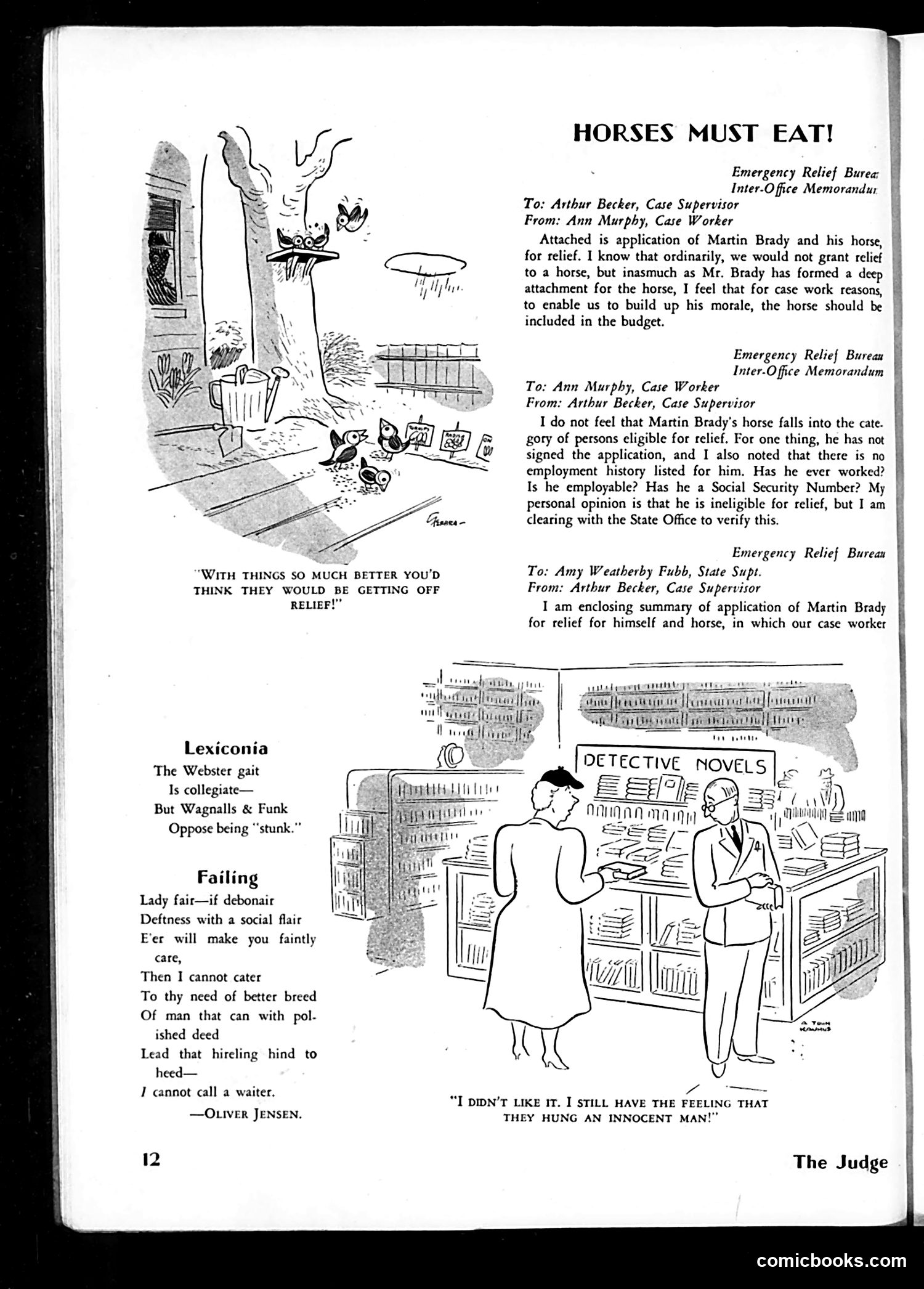
Analysis "Horses Must Eat!" satirizes Depression-era welfare bureaucracy. The main cartoon depicts absurd inter-office memos debating whether a man's horse qualifies for relief benefits. A case worker argues the horse should be included to boost the unemployed man's morale; her supervisor questions whether the horse is "employable" and has a Social Security number, ultimately referring the matter upward. The satire targets: - Bureaucratic absurdity: Applying employment eligibility criteria to livestock - Relief system inefficiency: Endless memo-passing and red tape during economic crisis - Dehumanizing logic: Reducing relief to technicalities rather than human need The headline's irony—"With things so much better you'd think they'd be getting off relief"—suggests economic conditions remain dire despite official optimism, making such desperate applications (man and horse) inevitable. The page also includes lighter word-play content ("Lexiconia") and Oliver Jensen's poem about failing to find quality service workers.
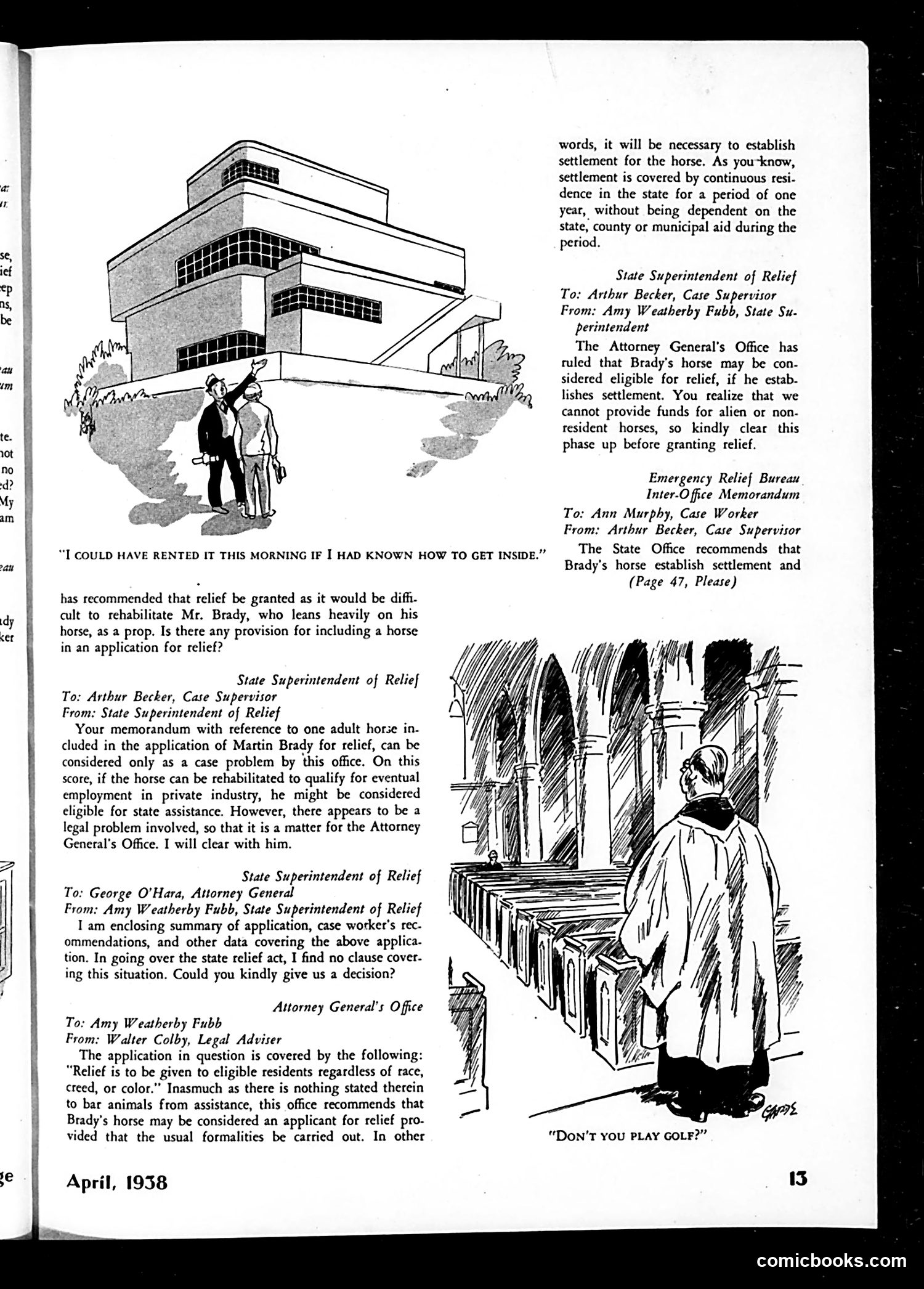
Context for Modern Readers This satirical piece from April 1938 mocks the Depression-era welfare bureaucracy through absurdist humor. The cartoons depict two scenarios about relief applications—one showing a man unable to enter a massive government building ("I could have rented it this morning if I had known how to get inside"), and another of a man apparently confined indoors asked "Don't you play golf?" The text satirizes the ridiculous complexity of relief administration by following an application regarding assistance for Martin Brady's horse. Multiple government offices exchange memos debating whether the horse qualifies for relief, whether it can "establish settlement," and whether animals are barred from assistance. The legal adviser ultimately rules the horse is eligible since nothing explicitly prohibits animals. The satire targets how Depression-era relief agencies became so bureaucratically tangled that absurd cases like supporting a man's horse could theoretically proceed through official channels. It ridicules both government inefficiency and the desperation of applicants claiming dependence on horses as props.
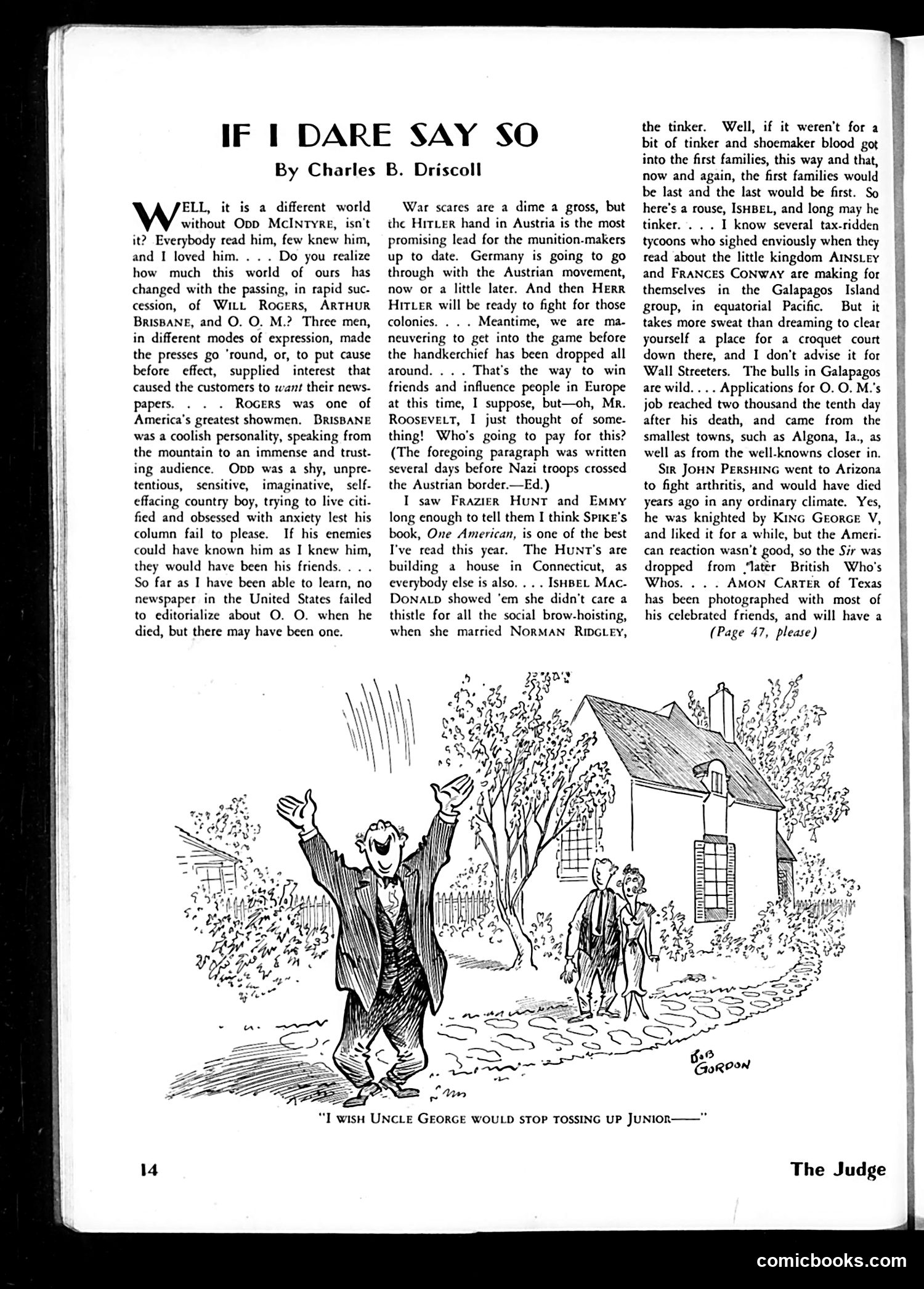
"If I Dare Say So" – Judge Magazine Analysis This is a nostalgic essay by Charles B. Driscoll mourning recently deceased American columnists and public figures, paired with an unrelated cartoon. The Essay's Context: Driscoll reflects on the deaths of O.O. McIntyre, Will Rogers, and Arthur Brisbane—influential newspaper columnists whose writing shaped American public opinion. He characterizes McIntyre as a shy, sensitive writer whose column's success puzzled even him. Political Content: The piece addresses Hitler's 1938 annexation of Austria and warns that America may be maneuvering toward involvement in European conflict, questioning how the nation will finance intervention. This reflects pre-WWII isolationist anxieties. The Cartoon: Shows a man joyfully tossing a child (presumably "Junior") while a woman expresses concern. The caption's humor derives from the domestic anxiety about a parent's exuberant but reckless behavior—a common slapstick scenario of the era. The essay and cartoon are editorially unrelated; both simply occupy the magazine's pages.
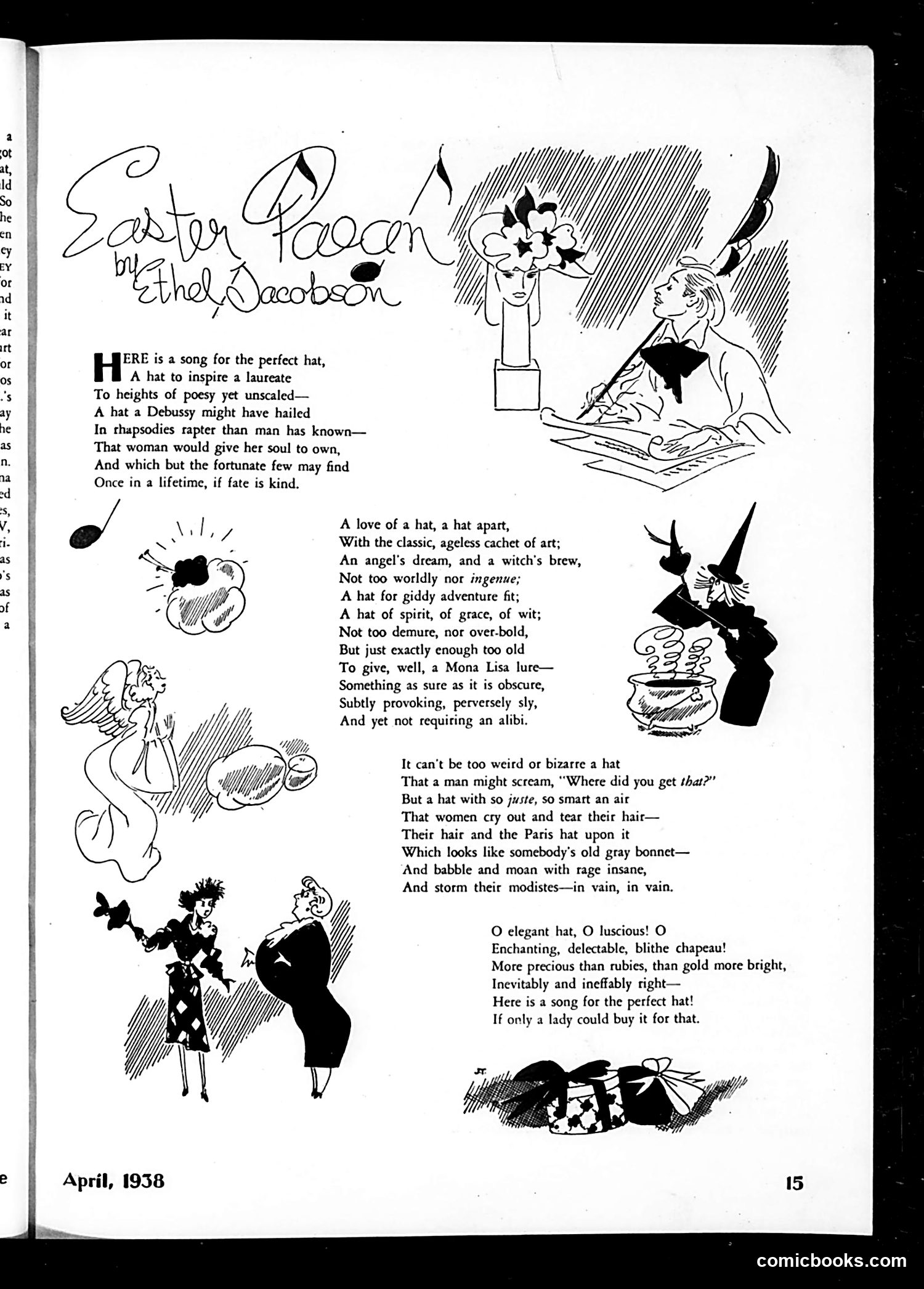
Easter Bonnet by Ethel Jacobson (April 1938) This is a humorous poem celebrating women's obsession with fashionable hats, particularly Easter bonnets—a cultural phenomenon of the 1930s when elaborate hats were essential fashion statements. The satire targets: Female vanity and competition: Women are depicted as willing to "give her soul" for the perfect hat, tearing their hair in jealous rage over rivals' headwear. Fashion industry absurdity: The poem mocks pretentious fashion language ("cachet of art," "Mona Lisa lure," "juste") applied to simple bonnets, comparing hats to high art and precious gems. Gender dynamics: Men are bewildered by women's hat choices; women obsess over designs intentionally enigmatic and "perversely sly." The accompanying illustrations show women in various hat styles and the social drama surrounding them. The final punchline—"if only a lady could buy it for that"—suggests the perfect hat remains impossibly expensive, mocking both female desire and fashion's exclusivity.
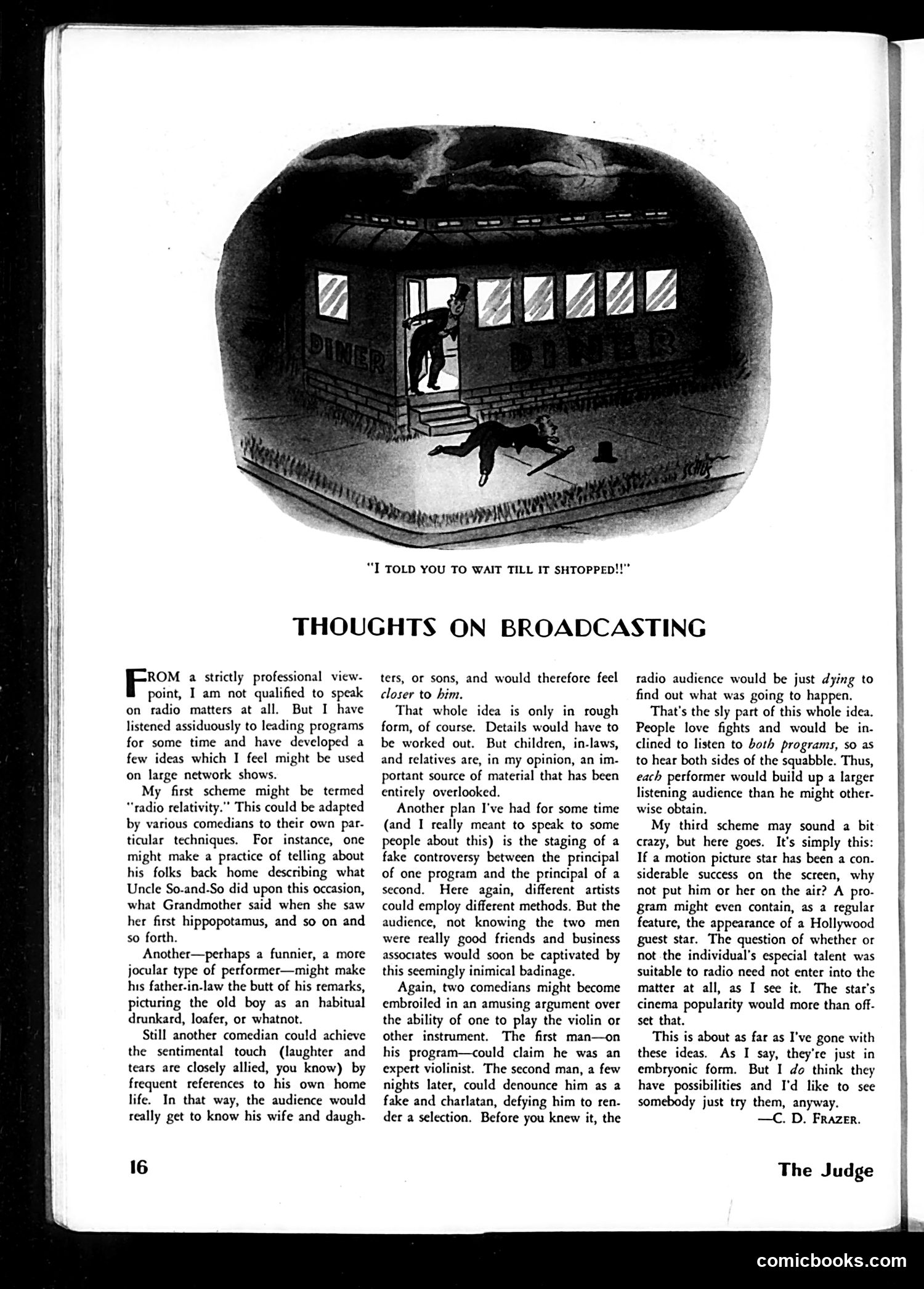
Explanation for Modern Readers This page combines a cartoon and an essay satirizing early radio broadcasting (likely 1920s-30s era). The Cartoon: Shows a diner car from a train with a figure falling beneath it and another person at the door. The caption "I TOLD YOU TO WAIT TILL IT STOPPED!!" is a slapstick joke—someone jumped from a moving train, ignoring safety advice. The Essay "Thoughts on Broadcasting": Author C.D. Frazer proposes absurdly obvious programming ideas as if they're revolutionary innovations: having comedians tell stories about relatives, staging fake feuds between performers to boost ratings, and casting movie stars on radio regardless of talent. The Satire: The humor lies in presenting common-sense or cynical observations as original professional insights. Frazer mocks radio's early days by suggesting that manufactured drama and celebrity names—not actual talent—drive audience engagement. The disconnected cartoon reinforces the satirical tone: just as someone foolishly jumped from a moving train despite warning, radio programmers blindly chase gimmicks. The piece gently ridicules broadcasting's shallow entertainment priorities.
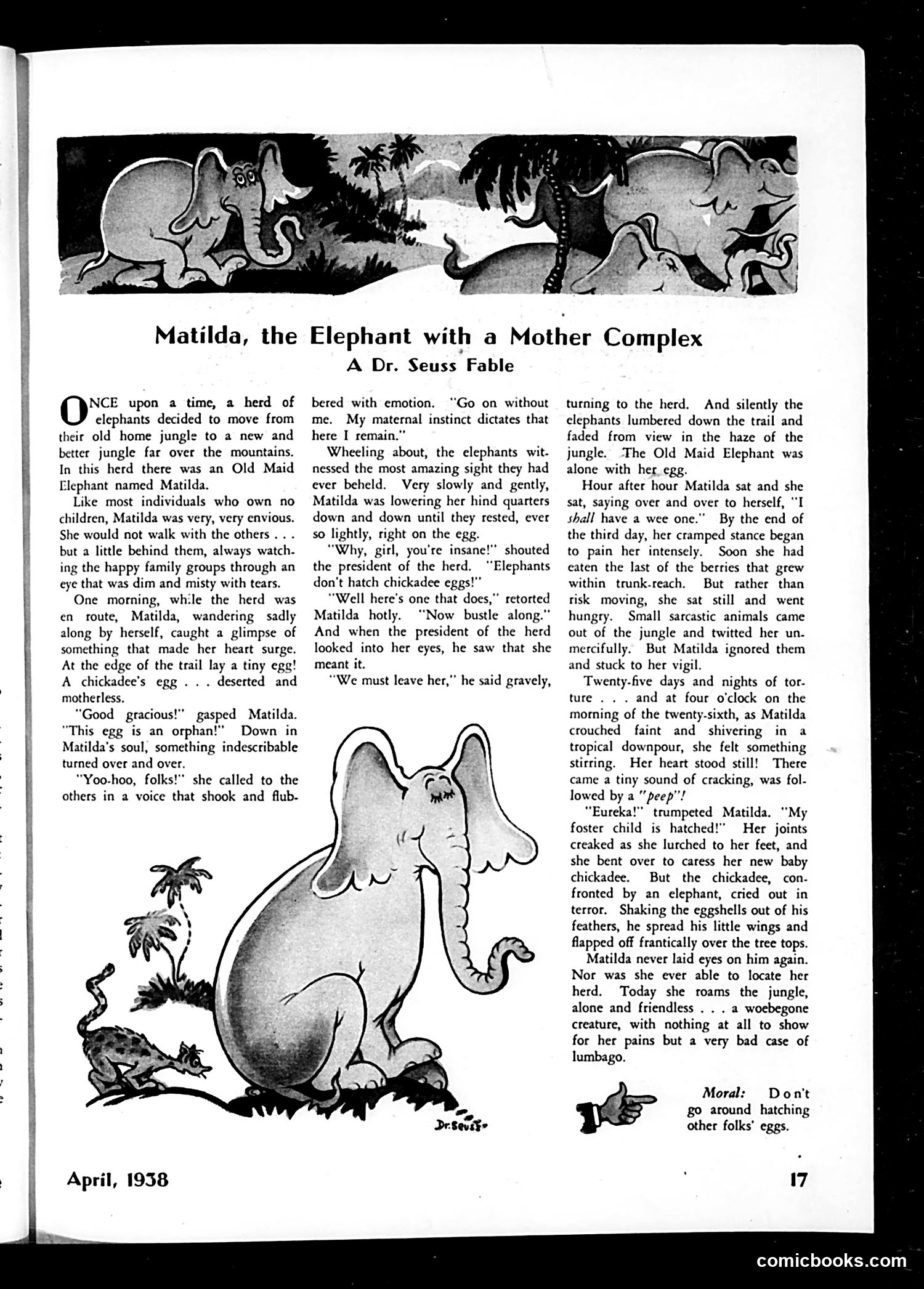
"Matilda, the Elephant with a Mother Complex" This is a Dr. Seuss fable (published April 1938) about an elderly, childless elephant whose maternal desperation leads to disaster. Matilda, an "Old Maid" excluded from family groups, abandons her herd to incubate an abandoned chickadee egg for 26 days. When the egg hatches, the terrified chick immediately flies away, leaving Matilda alone and injured. The moral warns against meddling in others' affairs—"Don't go around hatching other folks' eggs." The story satirizes obsessive maternal instinct and childlessness anxiety in early 20th-century culture. Matilda represents the stereotypical spinster: envious of mothers, emotionally vulnerable, and willing to destroy her own life pursuing an impossible maternal role. The fable suggests such desperation is both pathetic and ultimately self-destructive, ending in isolation and physical decline ("lumbago").
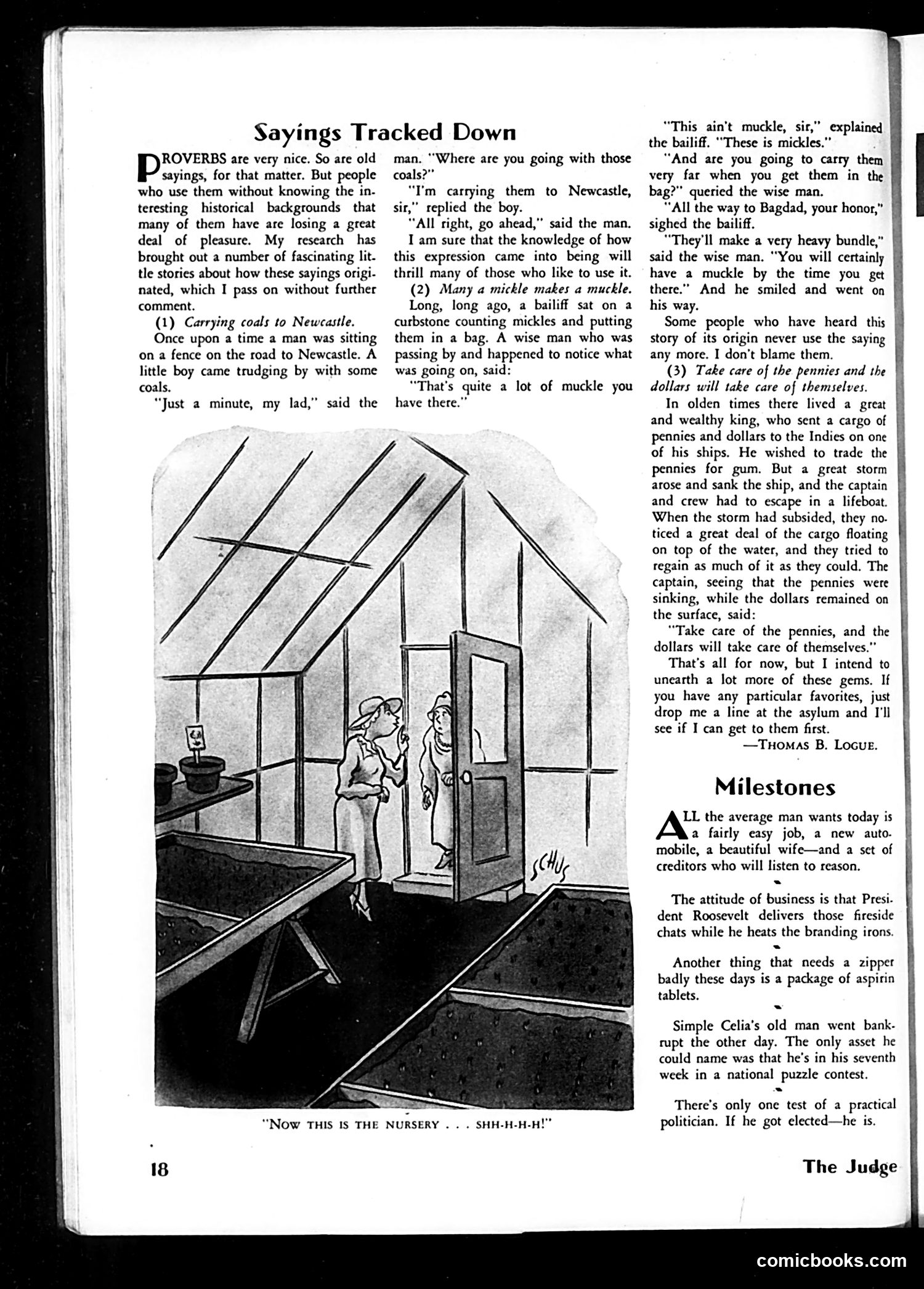
"Savings Tracked Down" — Judge Magazine Satire This page presents mock origin stories for common proverbs, satirizing the tendency to fabricate or embellish historical "explanations" for expressions people use without understanding. The three fake etymologies are deliberately absurd: - "Carrying coals to Newcastle" originates from a boy literally doing exactly that - "Many a mickle makes a muckle" comes from a bailiff counting coins - "Take care of the pennies" stems from a shipwreck where only dollars floated The humor lies in exposing how people gravely cite invented backstories for sayings. The author (Thomas B. Logue) pretends scholarly authority while presenting transparent nonsense, mocking both folklore-peddlers and credulous audiences. The accompanying cartoon—showing a nursery with women and infants—illustrates the absurdity with the caption "Now THIS IS THE NURSERY," connecting to the satirical theme of fabricated origins and manufactured explanations.
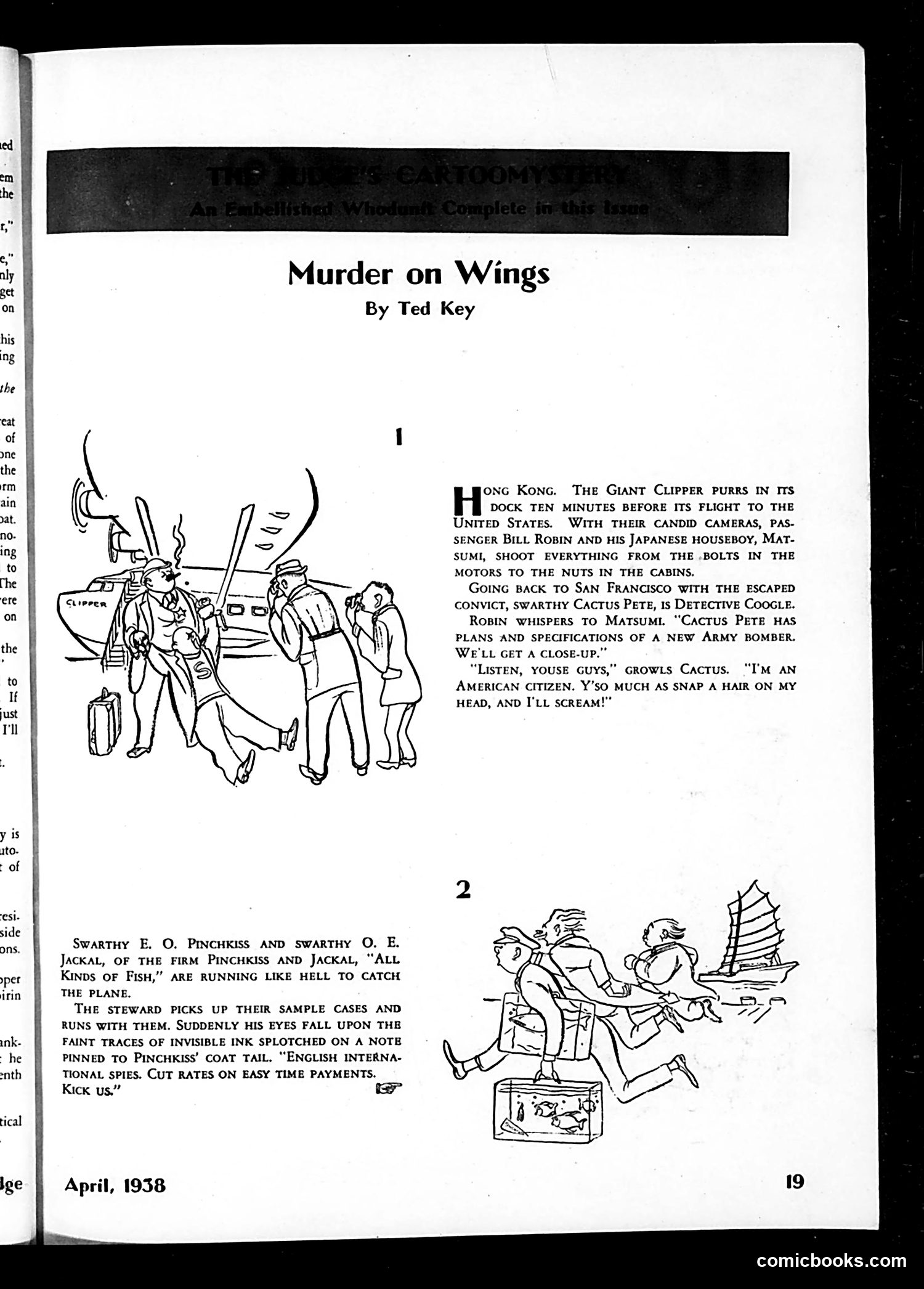
"Murder on Wings" Analysis This is a spy-thriller comic story set in 1938, featuring competing intelligence operatives aboard a transpacific aircraft. The plot involves: Characters: Passenger Bill Robin and his Japanese houseboy Matsumi (armed with cameras); Detective Coogle pursuing escaped convict "Cactus Pete" who possesses stolen Army bomber specifications; and fish merchants Pinchkiss and Jackal, revealed as cut-rate "English International Spies." The Satire: The humor targets 1930s spy-story conventions and anxieties. Cactus Pete's absurd threat to "scream" like a citizen plays on pulp-fiction melodrama. The spies' business card ("cut rates on easy time payments") mocks both espionage as a commercial enterprise and Depression-era installment-plan culture. Context: Published in April 1938—as Nazi Germany accelerated rearmament and Japanese militarism expanded—the story reflects American anxieties about foreign spies and military technology theft, wrapped in comedic adventure-fiction tropes.
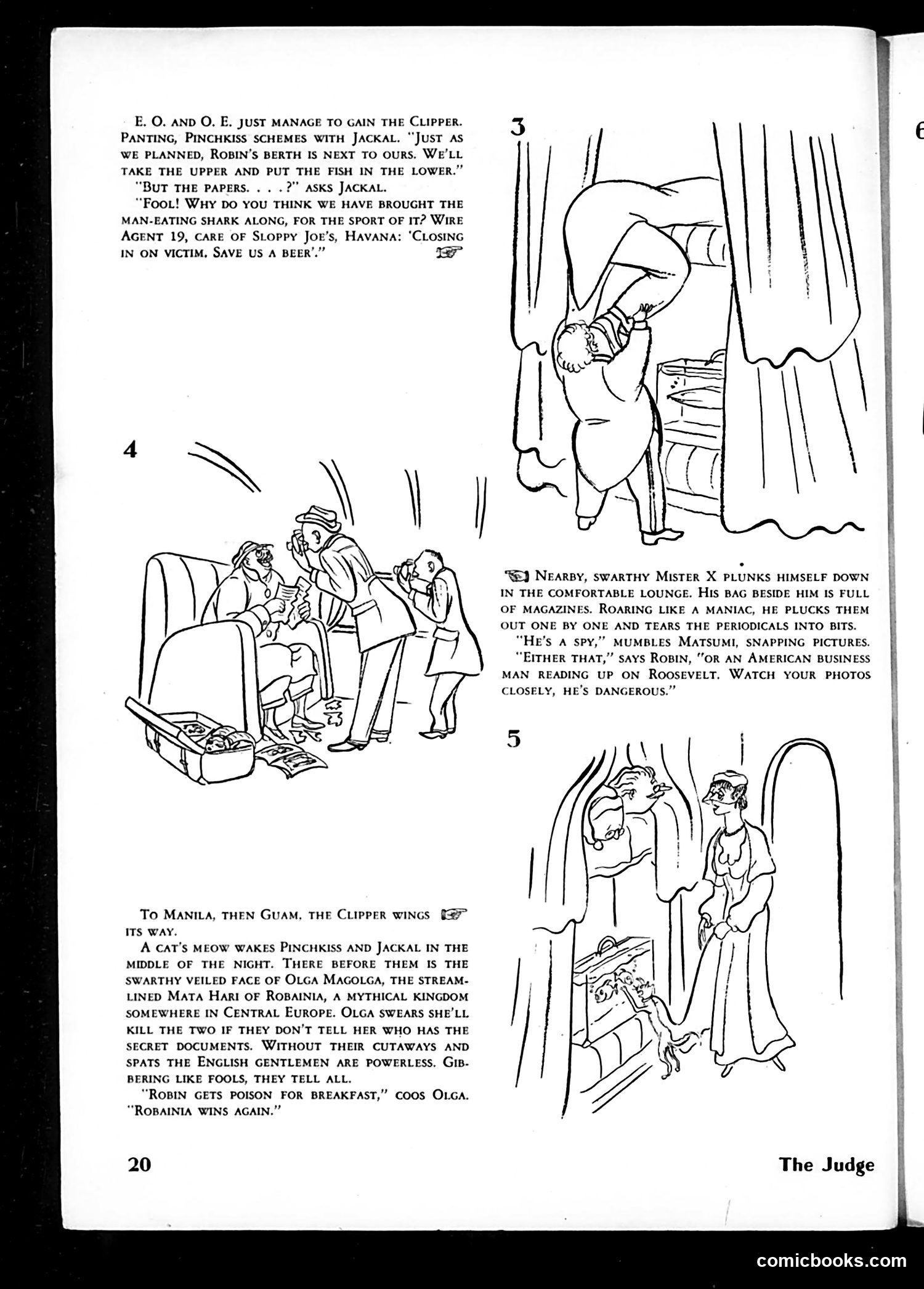
Political Satire in Judge Magazine This page satirizes 1930s spy-thriller adventure stories and international intrigue. The narrative follows villains Pinchkiss and Jackal plotting aboard a ship, competing with the mysterious "Olga Magolga"—a femme fatale spy from the fictional "Robainia" (Central Europe), referencing real anxieties about Eastern European espionage during the pre-WWII era. The satire peaks in the final panel: a suspicious, magazine-destroying passenger is identified as either "a spy" or "an American businessman reading up on Roosevelt"—the joke being that intense political interest in FDR's policies made ordinary Americans indistinguishable from foreign agents. This mocks both era spy-mania and American political anxiety about the New Deal, suggesting hypervigilance toward perceived threats (foreign spies, political enemies) had become absurdly commonplace.
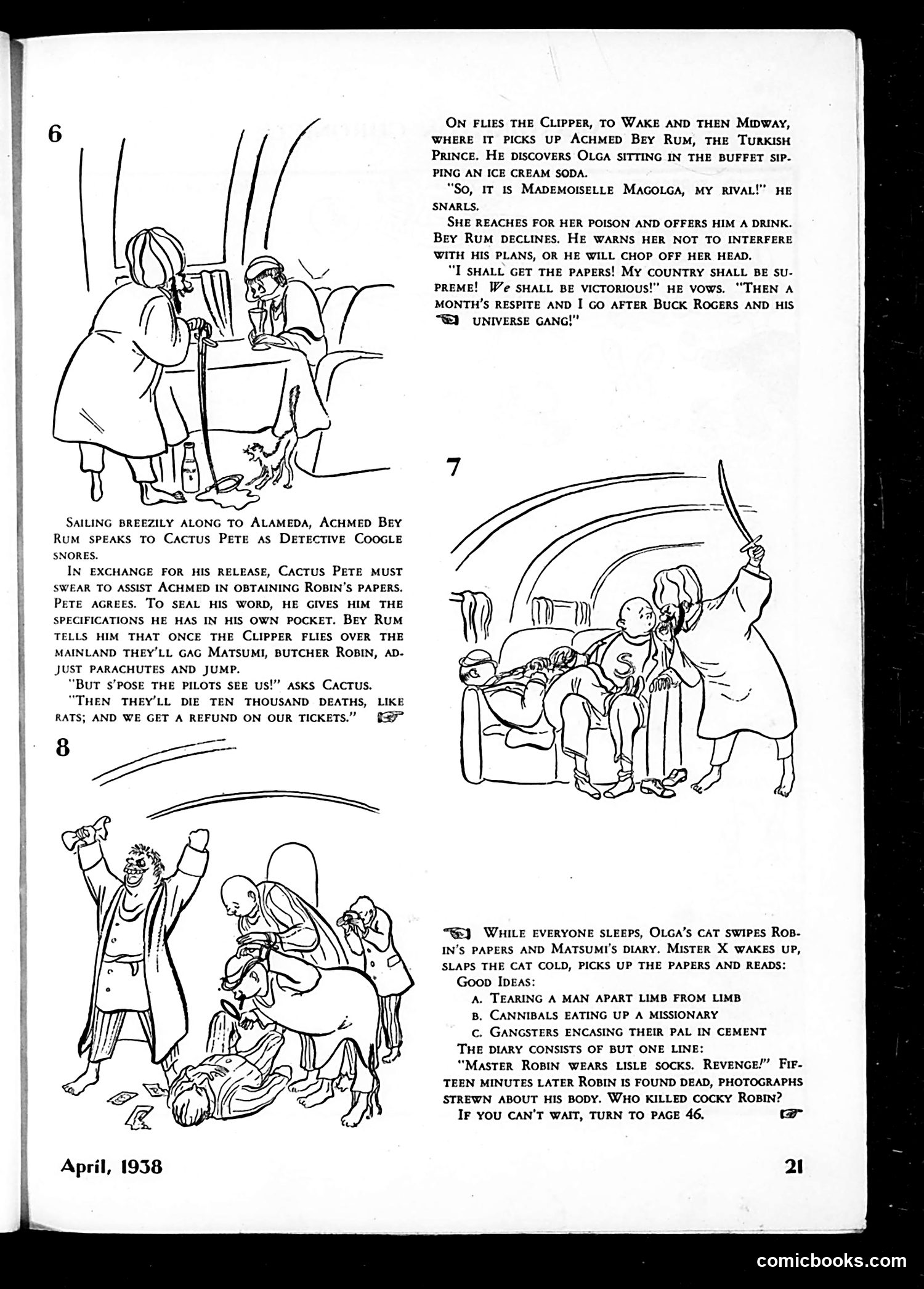
Judge Magazine, April 1938: "Buck Rogers" Serial Parody This page continues a serialized comic adventure story that parodies contemporary pulp fiction and early science fiction. The narrative follows international intrigue involving a Turkish prince (Achmed Bey Rum), a rival woman (Olga), and stolen papers—with a surprise reference to Buck Rogers, the futuristic space hero. The satire targets the melodramatic conventions of 1930s adventure serials: exotic villains with absurd schemes, poison offers, threats of dismemberment, and convoluted plots. The humor lies partly in the ridiculous escalation (after obtaining papers and killing a rival, the villain plans to pursue Buck Rogers "and his universe gang") and partly in absurd details like the killer's identity hinging on "lisle socks." This appears designed as light entertainment mocking serialized adventure stories popular in the era, rather than containing overt political satire.
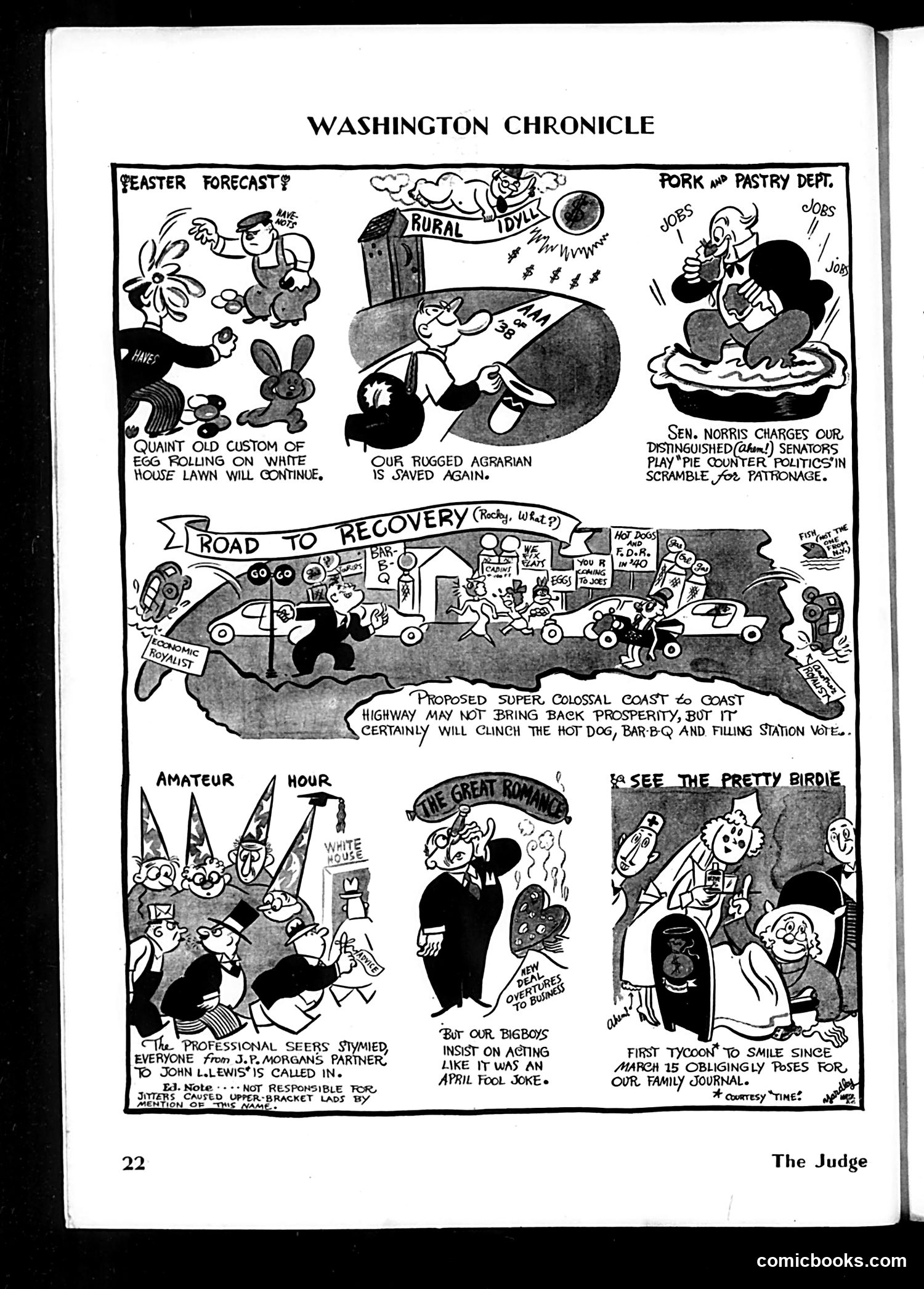
Washington Chronicle - Political Cartoon Analysis This page from *Judge* magazine satirizes early 1930s American politics and economics during the Great Depression era. The top panels mock routine Washington traditions (Easter egg rolling) and Senate patronage politics, with Senator Norris referenced as criticizing senators' "pie counter politics"—suggesting politicians scramble for favors rather than govern seriously. The central "Road to Recovery" cartoon ridicules proposed infrastructure projects (a coast-to-coast highway) as economically hollow gestures that won't restore prosperity, only benefit hot dog vendors and gas stations. Lower panels target business leaders and fortune-tellers: professional economists ("seers") are "stymied," while major industrialists like J.P. Morgan's associates and John L. Lewis consult fortune-tellers for guidance. The final panel jokes that a wealthy "tycoon" smiling for a family newspaper represents the first positive sign since March 15—implying economic despair preceding that date. The satire emphasizes governmental and corporate helplessness during Depression-era economic crisis.
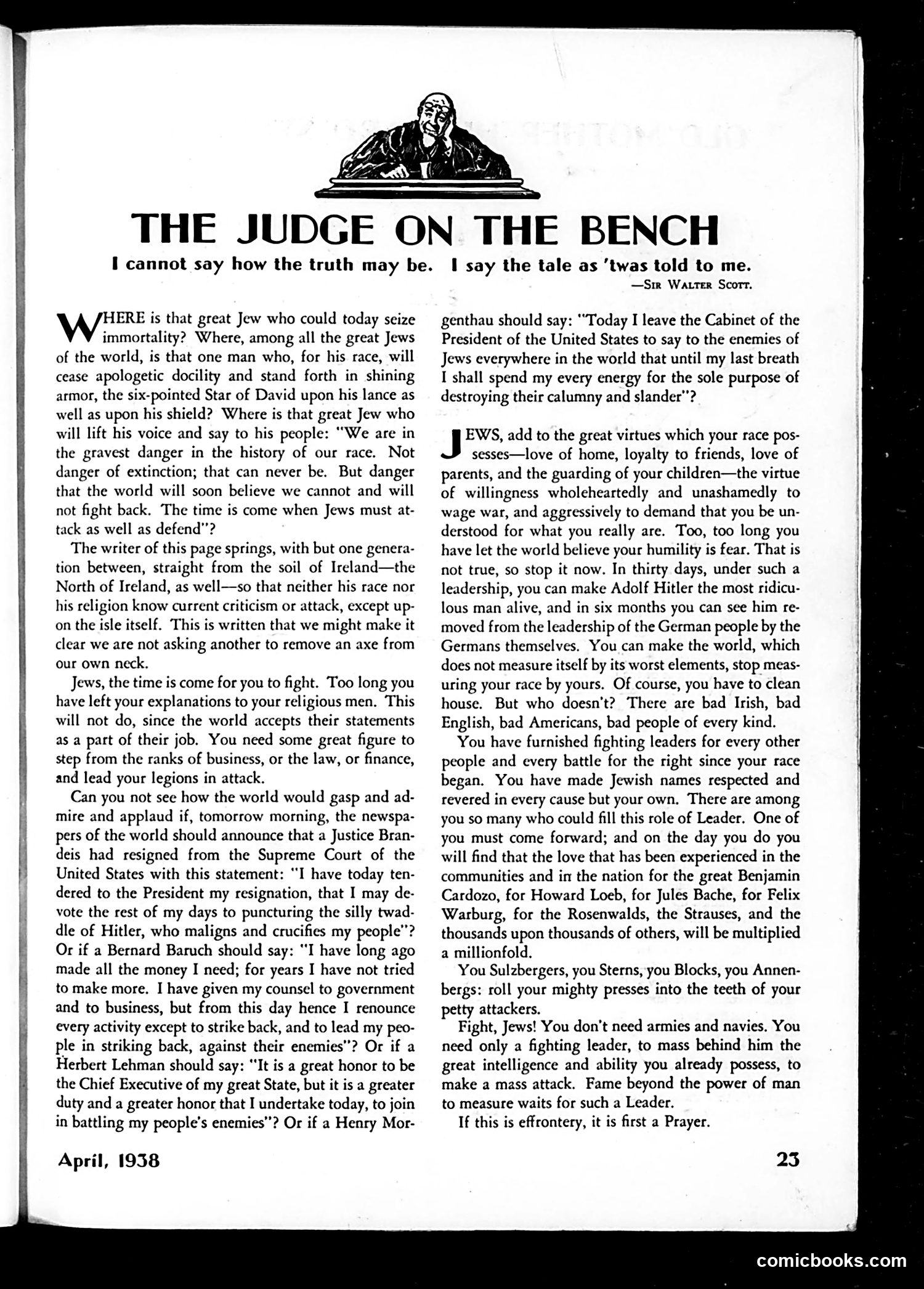
Analysis: "The Judge on the Bench" (April 1938) This editorial argues that Jewish leaders—specifically naming Supreme Court Justice Louis Brandeis, financier Bernard Baruch, New York Governor Herbert Lehman, and Treasury Secretary Henry Morgenthau—should publicly renounce their positions to fight Nazi antisemitism and Hitler's regime. The piece uses a rhetorical device: the Irish-Catholic author claims he has "no dog in this fight," establishing credibility to urge Jews to abandon "apologetic docility" and respond aggressively to Nazi attacks rather than rely on religious leaders' explanations. The author contends that prominent Jewish resignations with bold anti-Nazi statements would demonstrate Jewish strength to the world, counter perceptions of Jewish weakness as "fear," and inspire Germans to remove Hitler themselves. This reflects April 1938 anxieties—just before Kristallnacht—when American observers debated how Jews should respond to Nazi persecution. The piece advocates for visible, militant Jewish leadership during escalating European antisemitism.
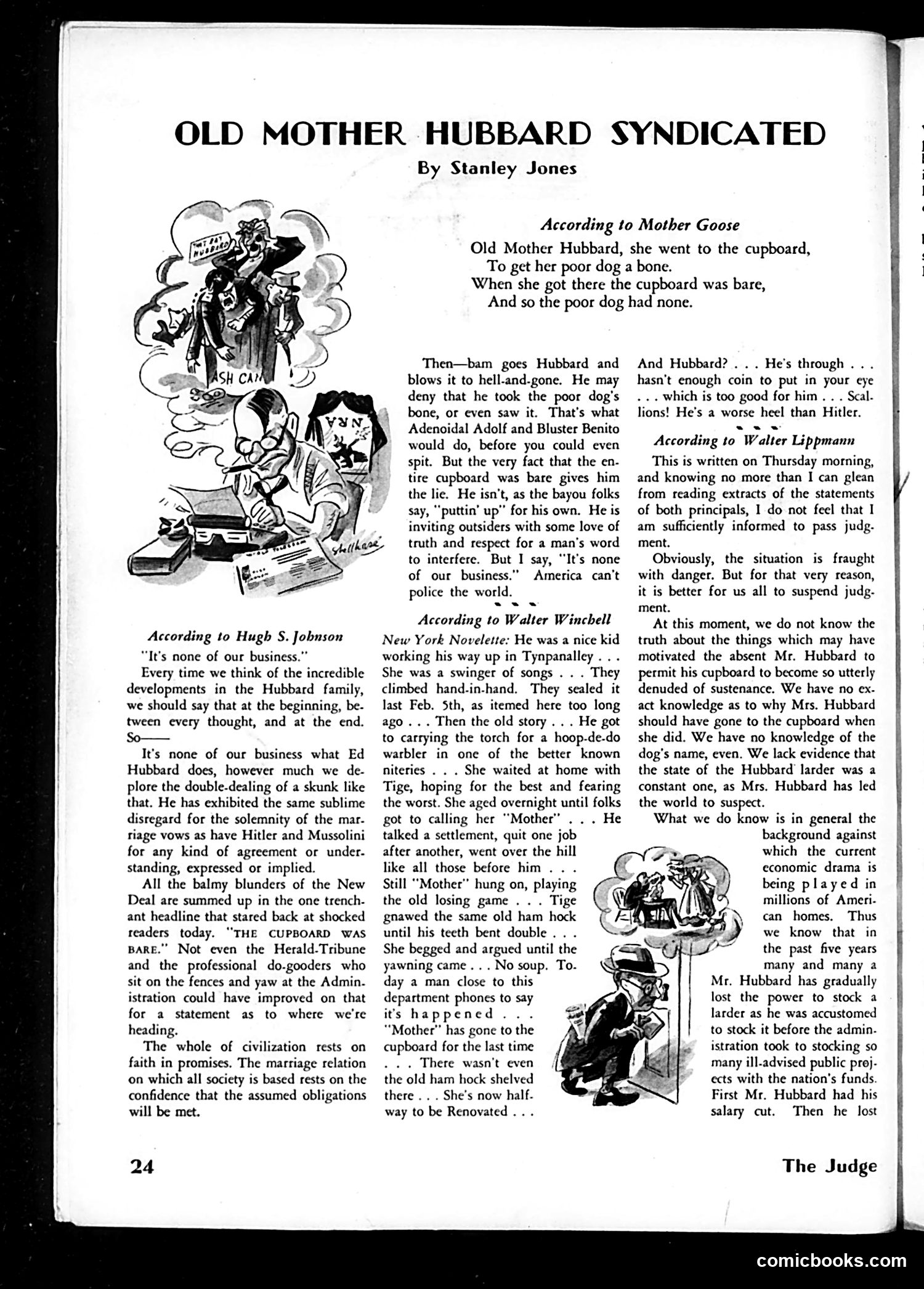
Old Mother Hubbard Syndicated: A Depression-Era Scandal This Judge satire uses the nursery rhyme "Old Mother Hubbard" as a metaphor for a real marital scandal involving Ed and Mrs. Hubbard. The "bare cupboard" represents financial destitution—particularly relevant during the Great Depression. The page presents contradictory takes from prominent figures: Hugh S. Johnson (likely FDR's NRA administrator) says America shouldn't intervene in private matters; Walter Winchell's gossip column treats it as salacious entertainment; Walter Lippmann urges suspension of judgment. The joke is that everyone has opinions despite lacking facts. The cartoonist compares Hubbard's alleged financial irresponsibility to Hitler and Mussolini's treaty violations—equating broken marital promises with broken international agreements. The satire critiques both the scandal itself and the public's self-righteous commentary on it, suggesting America's moral authority is undermined when citizens abandon their own obligations (like paying bills during the Depression).
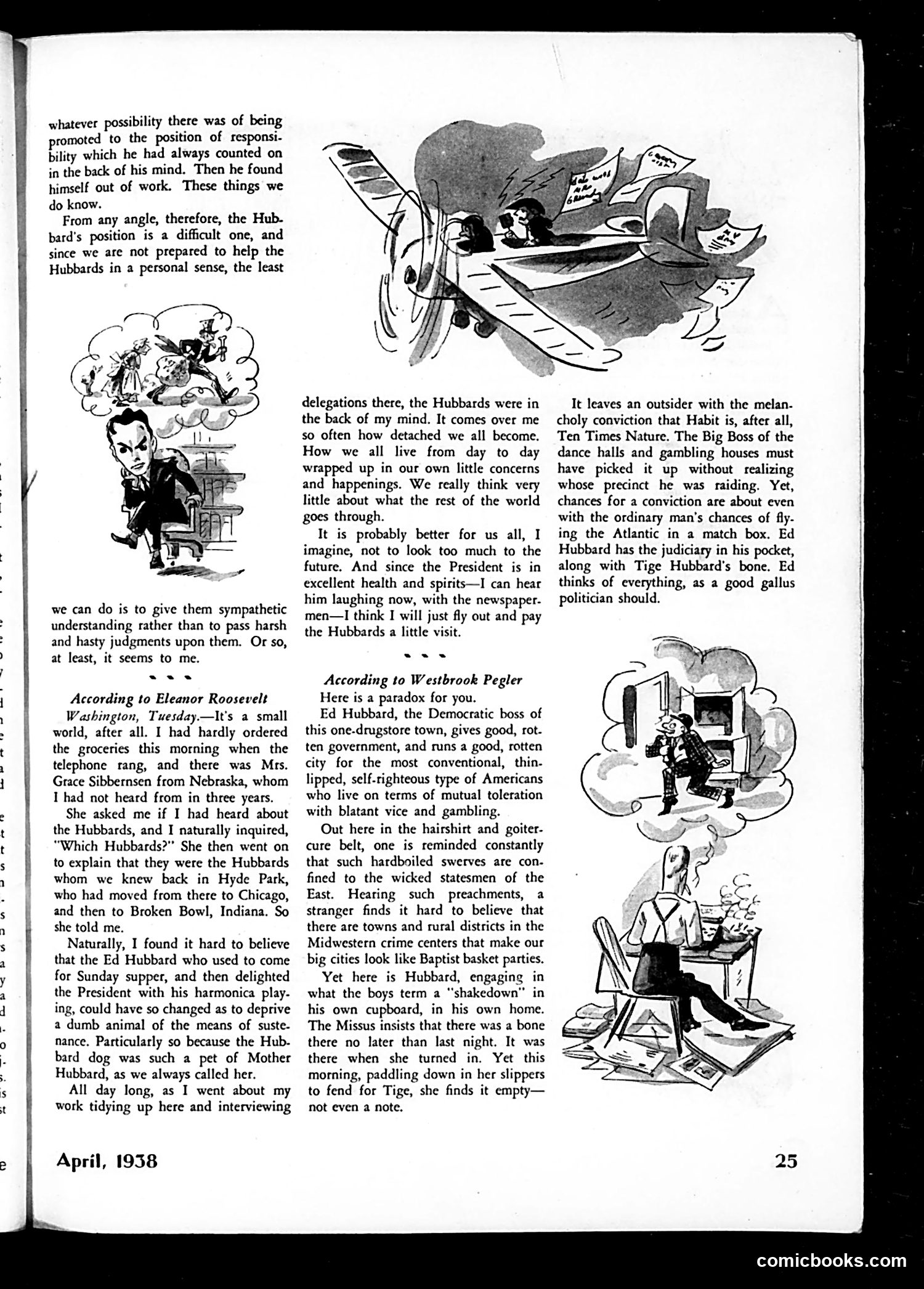
Judge Magazine, April 1938: "The Hubbards" Satire This page presents a domestic scandal through contrasting viewpoints. Eleanor Roosevelt's column describes Ed Hubbard, a small-town Democratic political boss, apparently starving his dog (a reference to the nursery rhyme "Old Mother Hubbard"). Roosevelt frames this charitably as a family's hard times. Westbrook Pegler's competing column reveals the satire's target: Hubbard is actually a corrupt politician who runs gambling and vice operations while maintaining a self-righteous public image. Pegler sarcastically suggests Hubbard stole his own dog's bone as a "shakedown"—implying such petty corruption fits his character perfectly. The cartoons (a man overwhelmed by responsibilities, a woman at her desk) visualize these domestic/political entanglements. The piece mocks Democratic hypocrisy: presenting Midwest politicians as virtuous while Eastern ones are openly corrupt, when regional graft is equally prevalent everywhere.
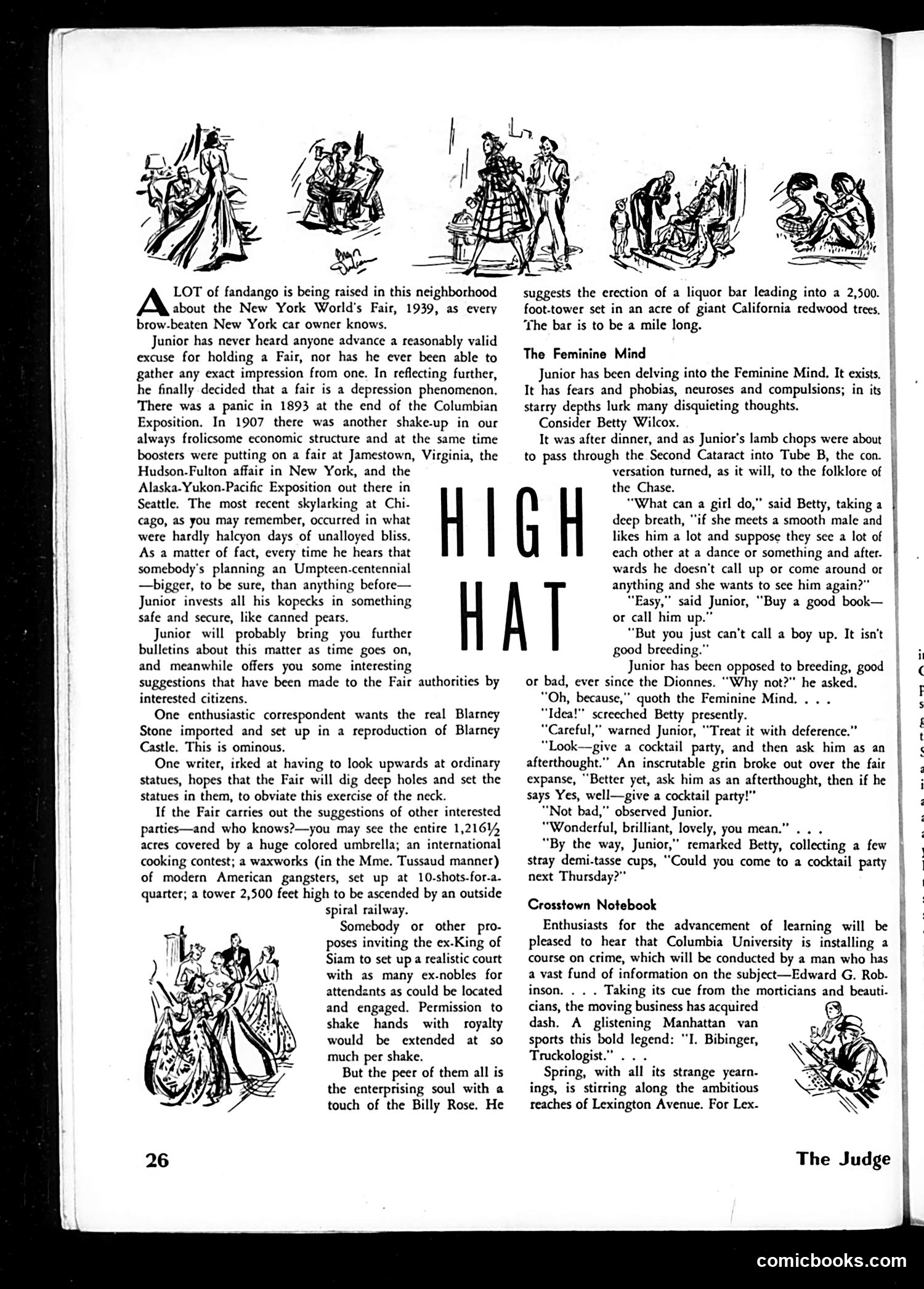
Judge Magazine Commentary: New York World's Fair & "The Feminine Mind" This page satirizes two contemporary topics: The Fair Phenomenon: The left column mocks plans for the 1939 New York World's Fair, arguing fairs are Depression-era panic responses (citing 1893 Columbian Exposition, 1907 Hudson-Fulton Fair, 1933 Chicago Fair). The satirist ridicules increasingly absurd proposed attractions—imported Blarney Stone, sunken statues, 2,500-foot tower with mile-long bar in redwood trees, even ex-King of Siam's court. The humor targets civic boosterism and grandiose schemes during economic uncertainty. "The Feminine Mind": A satirical dialogue between "Junior" and Betty Wilcox about courtship etiquette. Betty cannot call a boy directly (violates "good breeding"), so proposes throwing a cocktail party to invite him casually. The piece mocks 1930s dating conventions and female social constraints—women couldn't initiate romantic contact directly, requiring elaborate social pretexts instead. It's tongue-in-cheek commentary on gender expectations of the era.
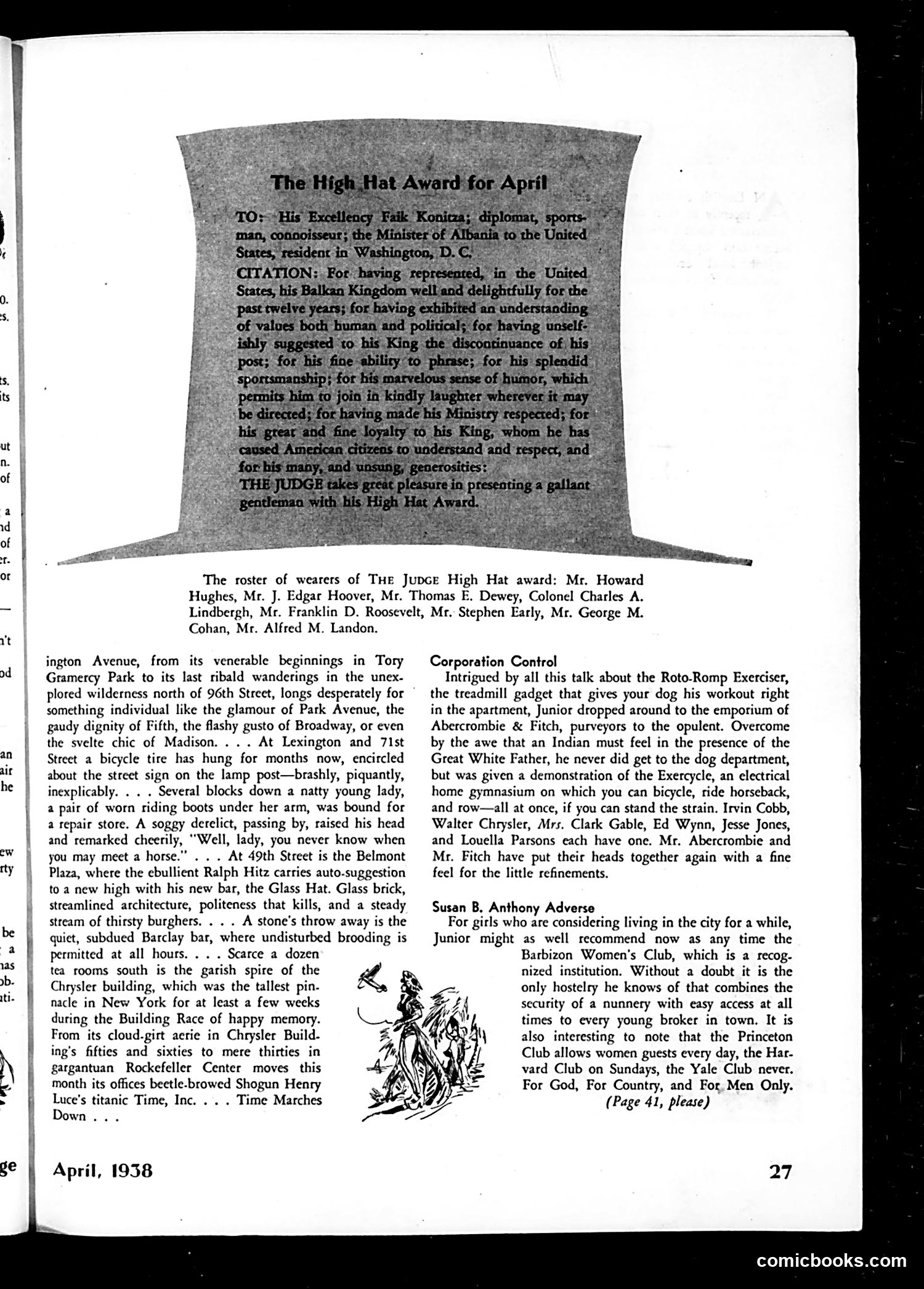
The High Hat Award for April, 1938 This page awards Judge magazine's monthly "High Hat Award" to Falk Koniza, Albania's minister to the United States. The citation praises his diplomatic skill, sportsmanship, loyalty to his king, and ability to foster American respect for the Balkan Kingdom during his twelve-year tenure in Washington. The award itself is a satirical honor—Judge's way of recognizing public figures deemed worthy of admiration. The roster of previous recipients (including FDR, Lindbergh, and J. Edgar Hoover) indicates this was a prestigious, if tongue-in-cheek, accolade. The page also contains miscellaneous Manhattan society commentary and a piece about the Barbizon Women's Club, noting its appeal to young women seeking security with convenient access to eligible young brokers—satirizing both institutional propriety and the marriage market among New York's elite.
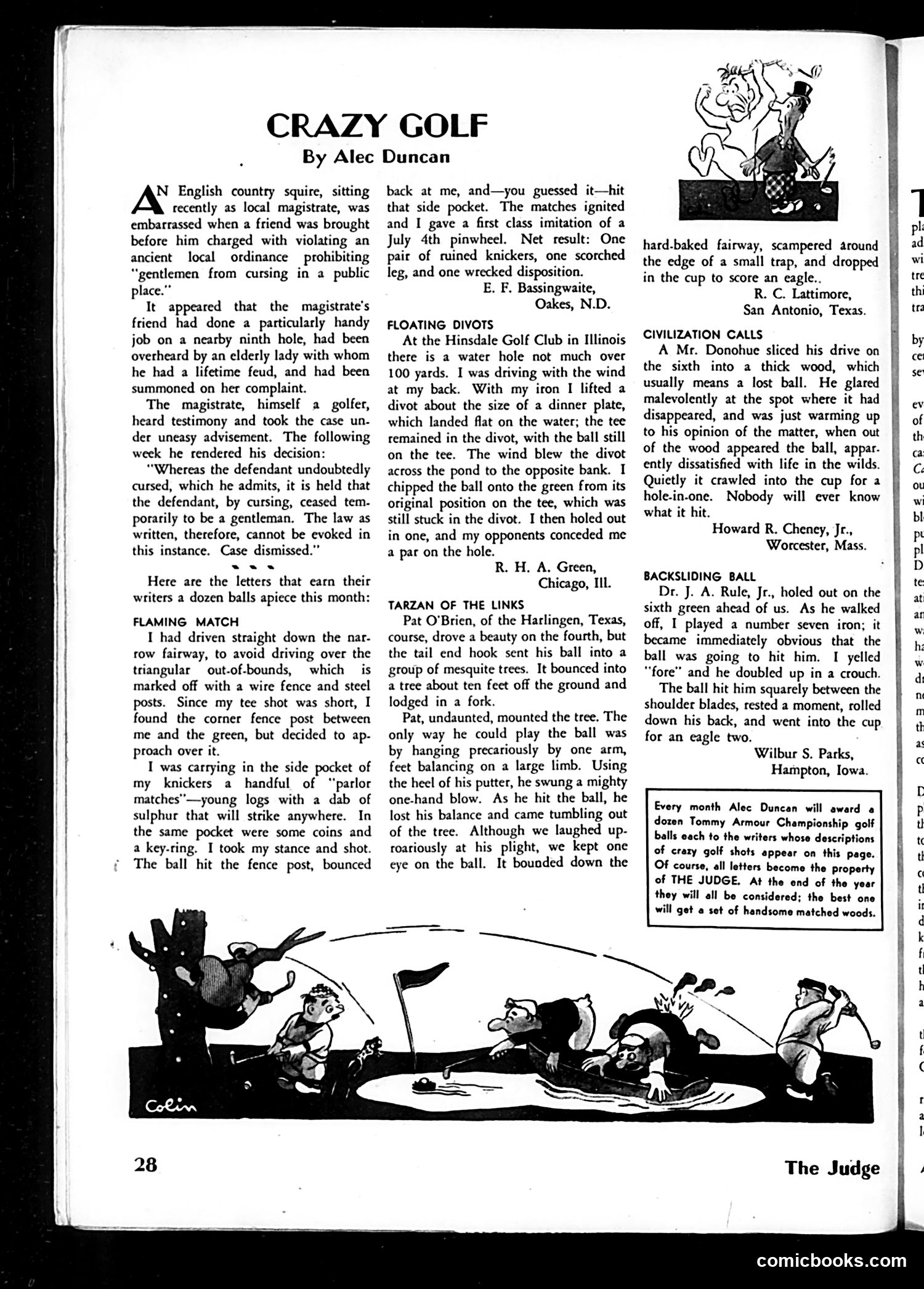
Crazy Golf by Alec Duncan This is a humorous sports column about golf misadventures, not political satire. The page features an opening anecdote about an English magistrate who dismisses charges against a friend for cursing on a golf course—ruling that by cursing, the defendant temporarily ceased being a gentleman and thus the law doesn't apply. The bulk of the page collects reader-submitted accounts of bizarre golf incidents: a player whose pocket matches ignite when struck by a ricochet; a divot that floats across a pond yet somehow allows an eagle; a golfer hanging from a tree who still makes the shot; and a lost ball that mysteriously returns to score a hole-in-one. The cartoon at bottom shows golfers in comical chaos. The humor derives from golf's frustrations and the absurd scenarios players invent to explain away bad shots or celebrate unlikely successes—gentle satire of the sport's pretensions and the tall tales golfers tell.
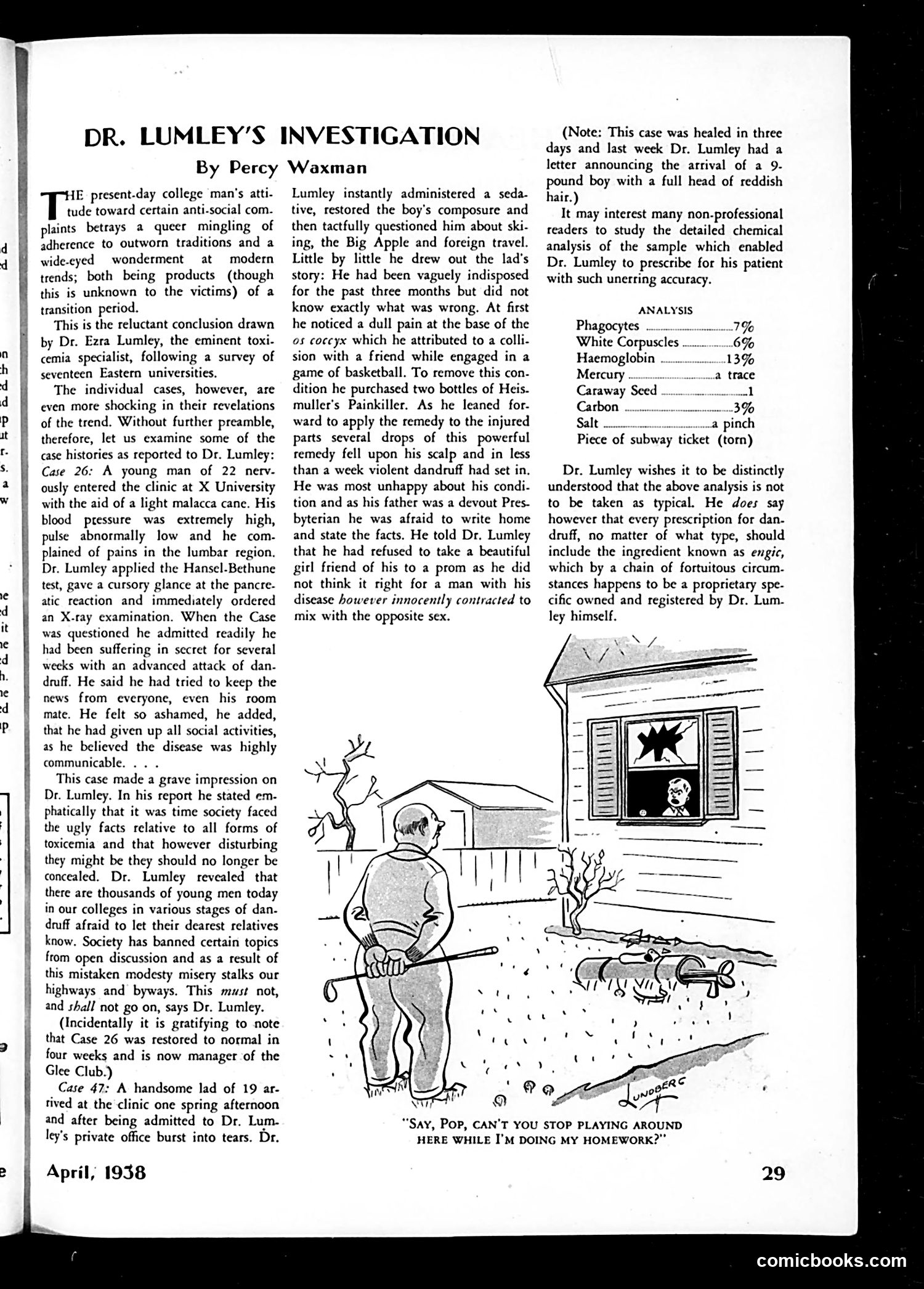
"Dr. Lumley's Investigation" Explained for Modern Readers This satirical article mocks 1930s college culture and social anxiety through fake medical case studies. "Dr. Lumley" is a fictional character created by author Percy Waxman to expose the absurd shame young men felt discussing minor health issues. The humor targets two things: first, college students' exaggerated secrecy about trivial problems like dandruff, which they treated as serious diseases; second, the era's prudish taboos against discussing bodily functions openly. The cases are deliberately ridiculous—one student became nearly suicidal over dandruff, another refused to attend prom due to shame. The accompanying cartoon shows a father scolding his son outside a window, illustrating parental pressure contributing to unhealthy silence. The satire argues that society's "mistaken modesty" about health topics causes unnecessary suffering, advocating for more open discussion. The footnote's punchline (the dandruff patient now has a 9-pound baby) ironically suggests the "cure" involved romantic involvement—mocking both the initial anxiety and 1930s sexual prudishness.
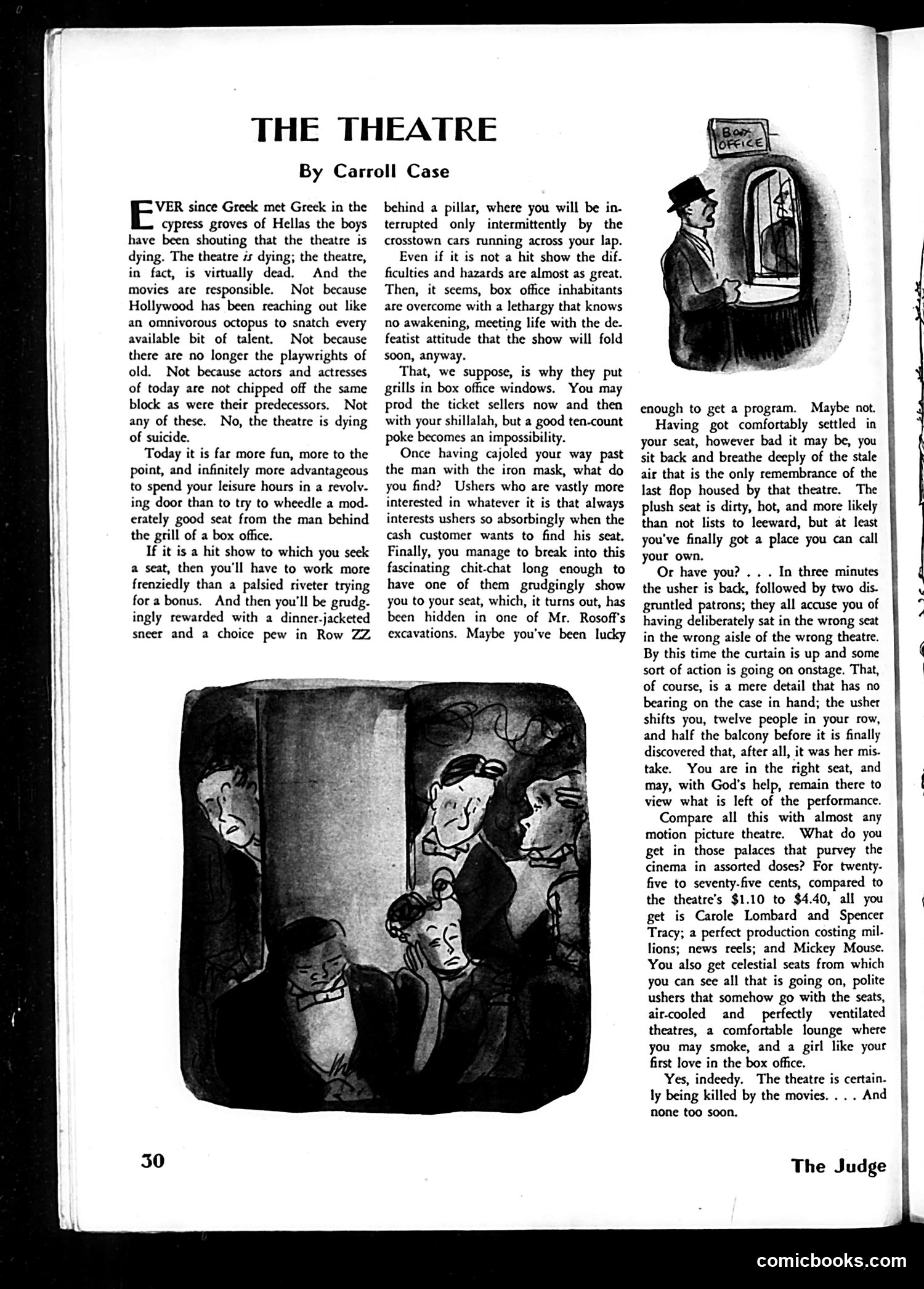
"The Theatre" by Carroll Case — Judge Magazine This satirical essay argues that live theatre is dying not from lack of talent or competition, but from its own terrible customer experience. Case uses exaggerated, humorous descriptions of the theatre-going ordeal: struggling to get box office workers' attention (comparing them to unresponsive, masked figures), being seated behind pillars next to crosstown traffic noise, receiving poor treatment from indifferent ushers, and sitting in dirty, broken seats. The accompanying cartoons (showing frustrated patrons and box office staff) visually reinforce this complaint. Case then contrasts this with cinema: for lower prices (25-75¢ versus $1.10-$4.40), moviegoers get stars like Carole Lombard and Spencer Tracy, perfect productions, Mickey Mouse cartoons, comfortable air-conditioned theatres, and attentive service. The satire's point: theatre kills itself through customer hostility and neglect, making movies—not artistic inferiority—the inevitable winner in entertainment competition.
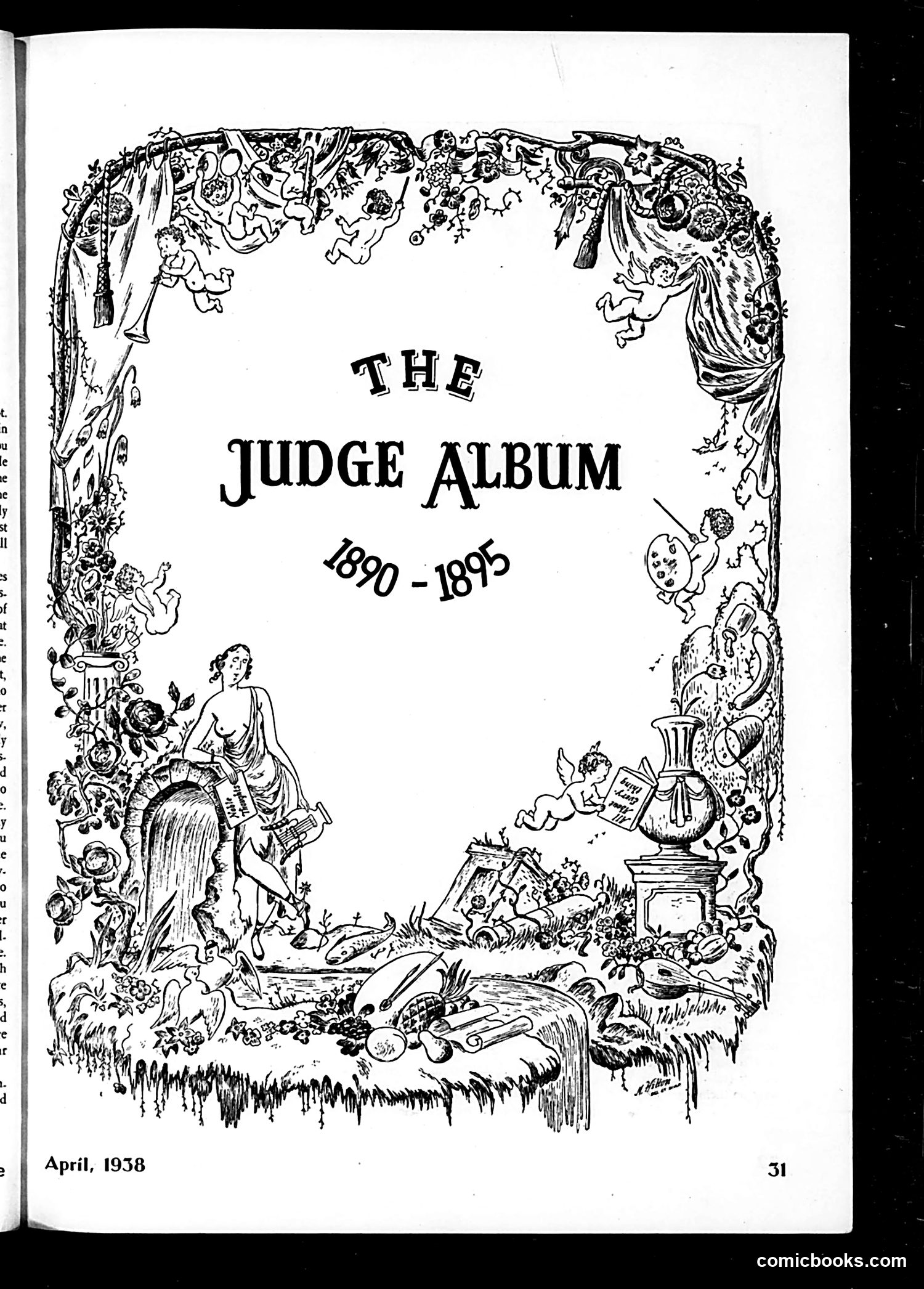
The Judge Album Title Page (1890-1895) This is a decorative title page for a collection of Judge magazine content from 1890-1895, published in April 1938. It's not a political cartoon itself but rather an ornamental cover featuring classical allegorical imagery—a seated female figure (likely representing Justice or Wisdom) surrounded by cherubs, fruits, flowers, and decorative flourishes typical of late Victorian design. The elaborate border and classical aesthetic reflect Judge magazine's identity as a sophisticated satirical publication aimed at educated readers. The specific date range (1890-1895) represents a significant period in American history spanning the Gilded Age and early Progressive Era, though this page doesn't comment on particular events. It's primarily a presentation piece introducing a retrospective collection.
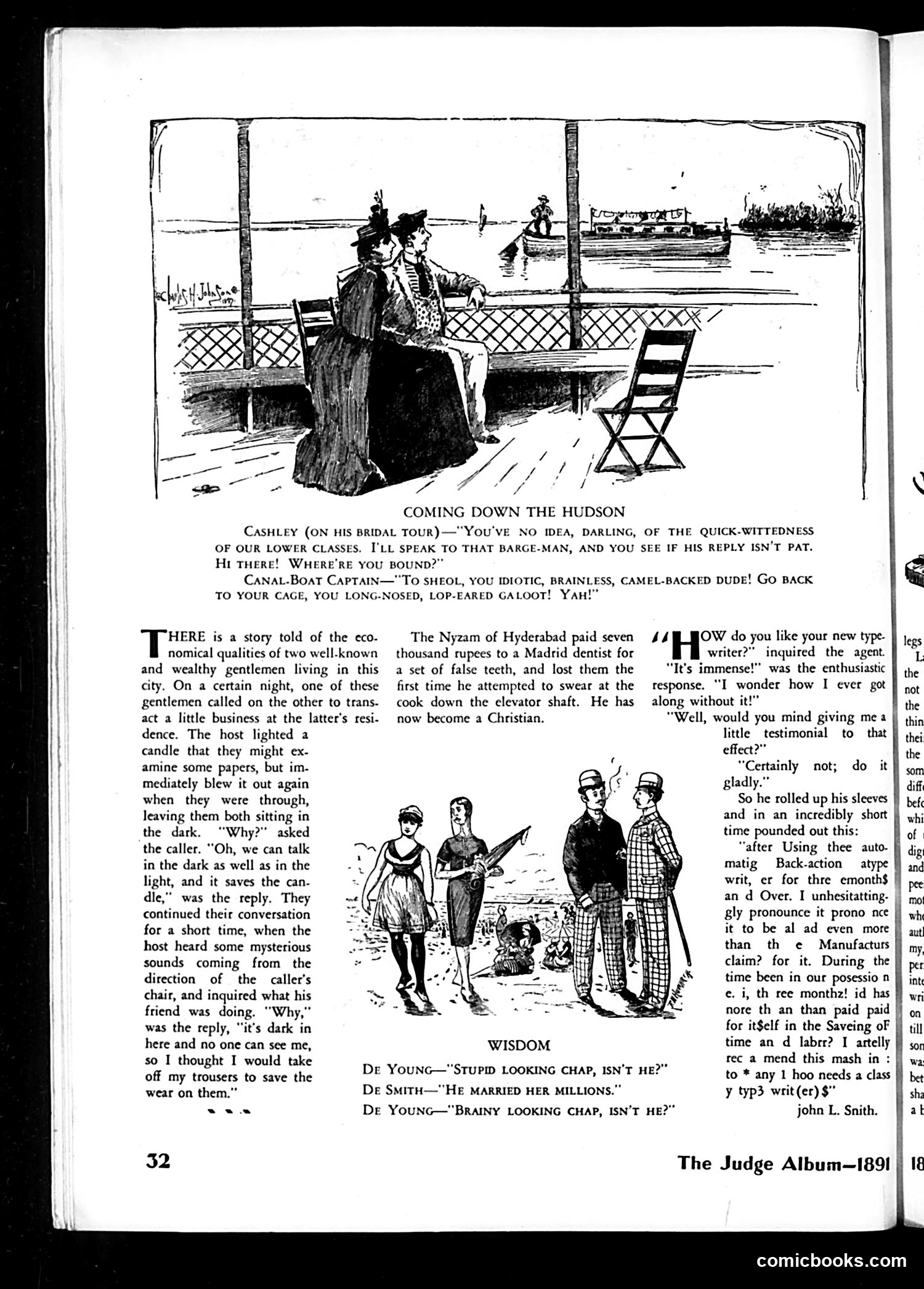
Explaining This Judge Magazine Page (1891) "Coming Down the Hudson" (top cartoon): A wealthy man named Cashley on his honeymoon patronizingly tells his bride he'll demonstrate the "quick-wittedness" of working-class people by speaking to a canal boat captain. When he asks politely where the man is bound, the captain responds with crude insults ("long-nosed," "galoot"). The satire mocks Cashley's condescension—he expected deference but got honest working-class bluntness instead. The joke implies that lower-class people, despite lacking polish, possess genuine wit and won't be patronized. "Wisdom" (bottom): Two gentlemen judge a man "stupid" until learning he married a wealthy woman, then call him "brainy." The joke satirizes how society equates financial success with intelligence, regardless of actual merit. Other content includes anecdotes about wealthy men's penny-pinching and false teeth, typical of Judge's satirical commentary on class pretension and hypocrisy in 1890s America.
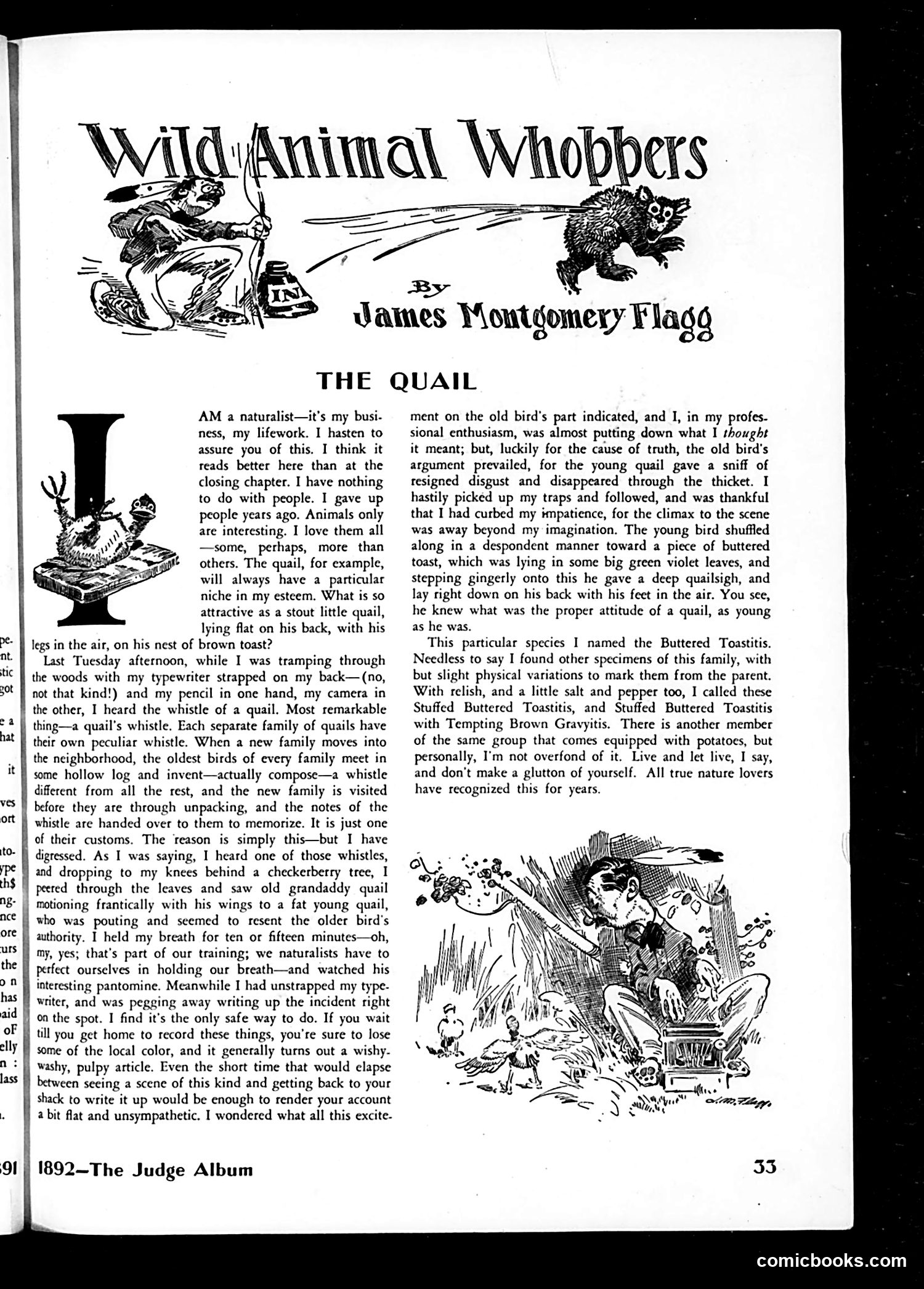
"The Quail" by James Montgomery Flagg This is a humorous essay-story rather than a political cartoon. The satire targets pretentious naturalists and their pseudoscientific affectations. The unnamed narrator claims to be a serious naturalist devoted entirely to animals, yet his "observations" are absurdly ridiculous: he describes quails composing unique family whistles, lying on buttered toast, and names fictional species like "Buttered Toastitis" and "Stuffed Buttered Toastitis with Tempting Brown Gravyitis"—essentially naming them after food dishes. The joke mocks how pseudo-intellectuals adopt elaborate jargon and pretentious methodology (the typewriter strapped to his back, holding his breath for fifteen minutes) while making completely nonsensical "discoveries." The narrator's deadpan delivery of obvious absurdities (quails on buttered toast) as serious natural history exemplifies the magazine's satirical critique of scientific pomposity and social pretension in the 1890s.
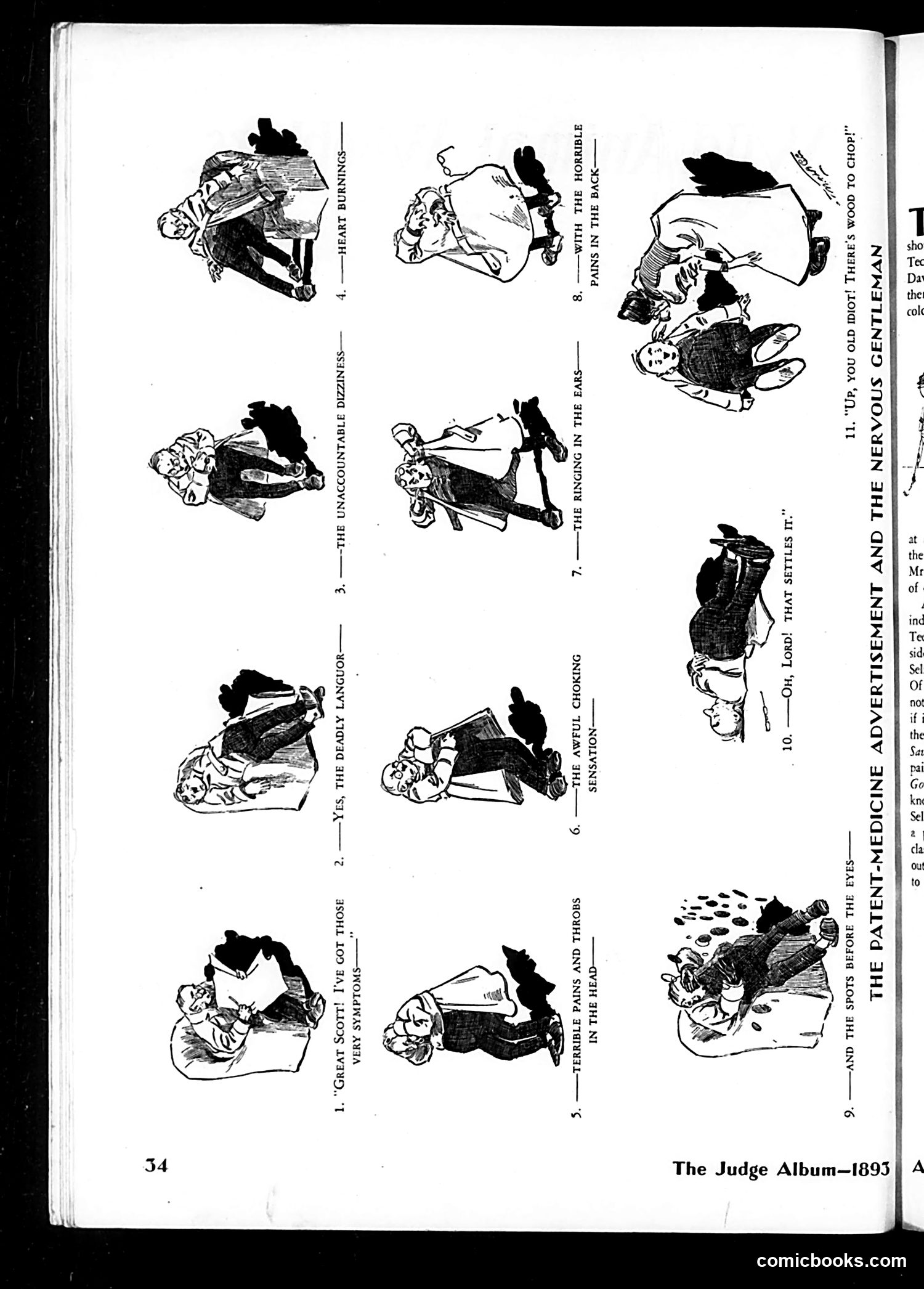
Patent-Medicine Advertisement and Nervous Gentlemen Cartoon This page from *Judge* (1893) satirizes patent medicines and their exaggerated health claims through a series of ten comic illustrations. Each numbered panel depicts a man in various states of physical distress—collapsing, convulsing, or contorting—labeled with conditions like "the deadly langour," "the radically languid," and "the nervous centleman" (sic). The cartoon mocks the widespread American patent-medicine industry of the era, which marketed dubious tonics and pills as cure-alls for vague ailments like "nervousness" (then a catch-all diagnosis, especially for men). The repeated depictions of suffering gentlemen suggest these medicines either didn't work or caused absurd side effects. The satirical point: *Judge* ridicules both the snake-oil salesmen promoting these nostrums and the credulous public believing their false promises.
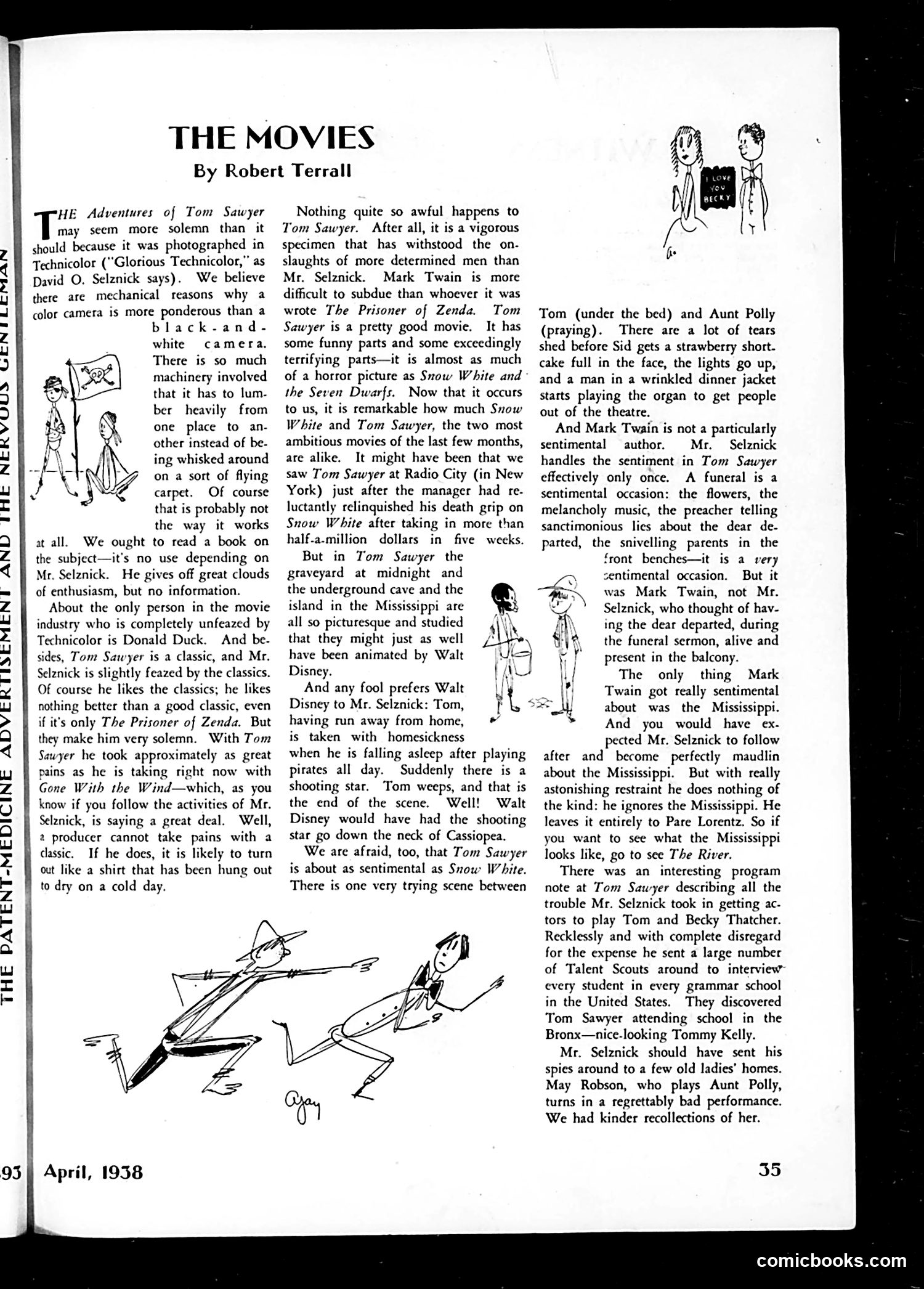
Analysis of "The Movies" by Robert Terrall, April 1938 This is a film review column critiquing David O. Selznick's production of *Tom Sawyer*. The satire targets Selznick's pretentious, over-elaborate approach to adapting classic literature. Key points: - Technicolor complaint: The reviewer argues that color cinematography makes filming mechanically cumbersome, resulting in a ponderous final product—like hanging a wet shirt on a cold day rather than letting it dry naturally. - Selznick's excess: The producer is mocked for treating the material with excessive solemnity, making excessive "pains" with the adaptation. The comparison to his concurrent work on *Gone with the Wind* suggests obsessive perfectionism. - Disney comparison: The reviewer contrasts Selznick's heavy-handed sentimentality with Walt Disney's animated approach, suggesting Disney would have better suited the material with lighter, more imaginative treatment. - Sentimental excess: The film contains manipulative emotional scenes (children crying, organ music) designed to extract tears rather than serve the story—a criticism of manufactured sentiment in studio filmmaking. The cartoons humorously illustrate the characters and scenes discussed.
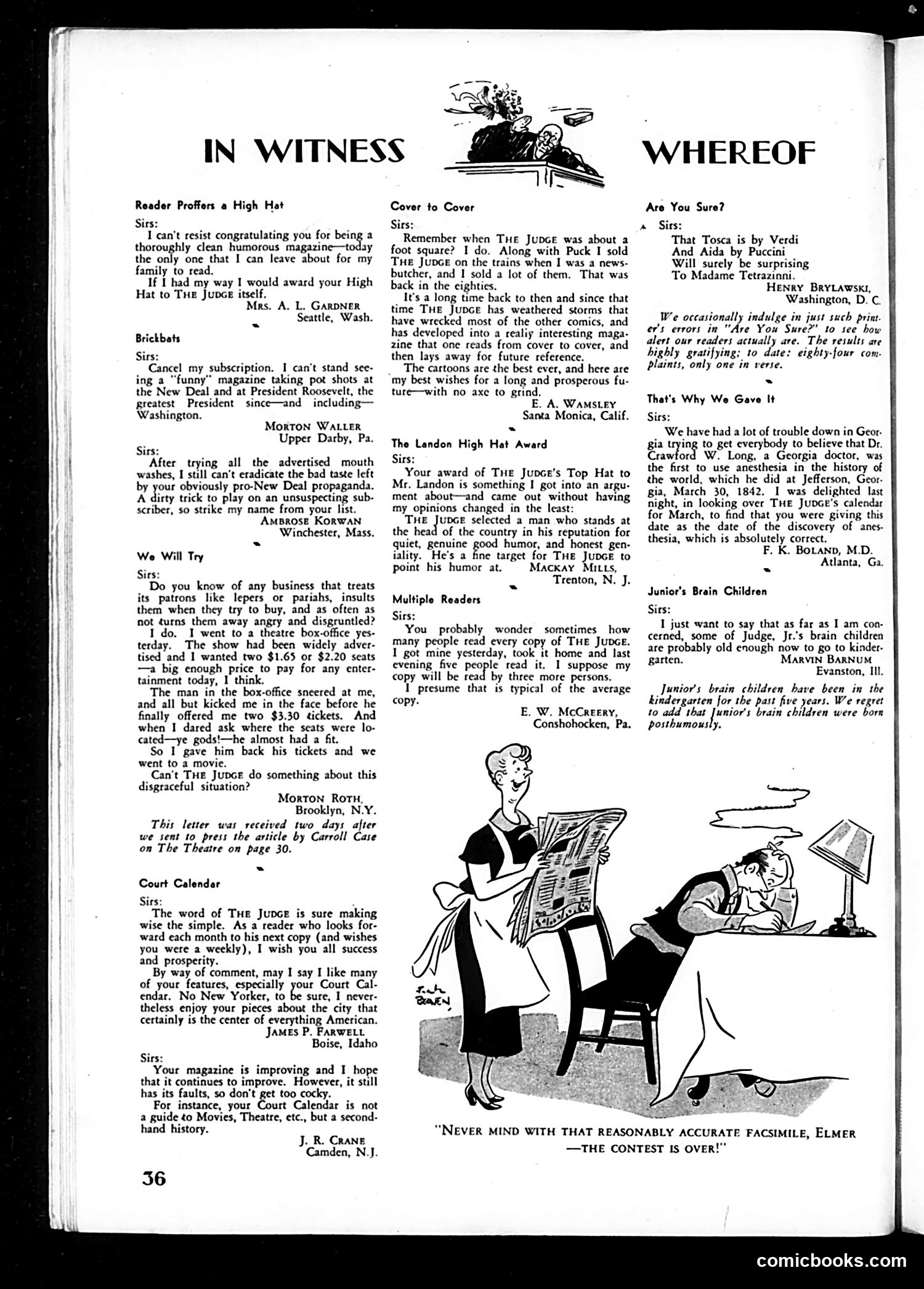
Analysis for Modern Readers This is a letters-to-the-editor page from Judge magazine, not primarily a political cartoon page. The content reveals early 1930s American divisions: Political Context: Readers sharply dispute Judge's editorial stance. Some praise it as "thoroughly clean" and family-friendly; others cancel subscriptions protesting its "pro-New Deal propaganda" or anti-Roosevelt stance. This reflects the intense political polarization over FDR's New Deal programs. References: - "Landon" likely refers to Alf Landon, Republican presidential candidate (1936), whom Judge apparently endorsed - The "Court Calendar" feature is praised as insightful social commentary - One nostalgic reader recalls Judge's 1880s heyday The Cartoon: The bottom illustration is unrelated satirical humor about a woman with a "reasonably accurate facsimile" competing against Elmer—a joke about magazine contests and amateur imitation. Overall Point: The page demonstrates Judge's significance as a forum for public debate, with readers using it to voice strong opinions on contemporary politics and culture.
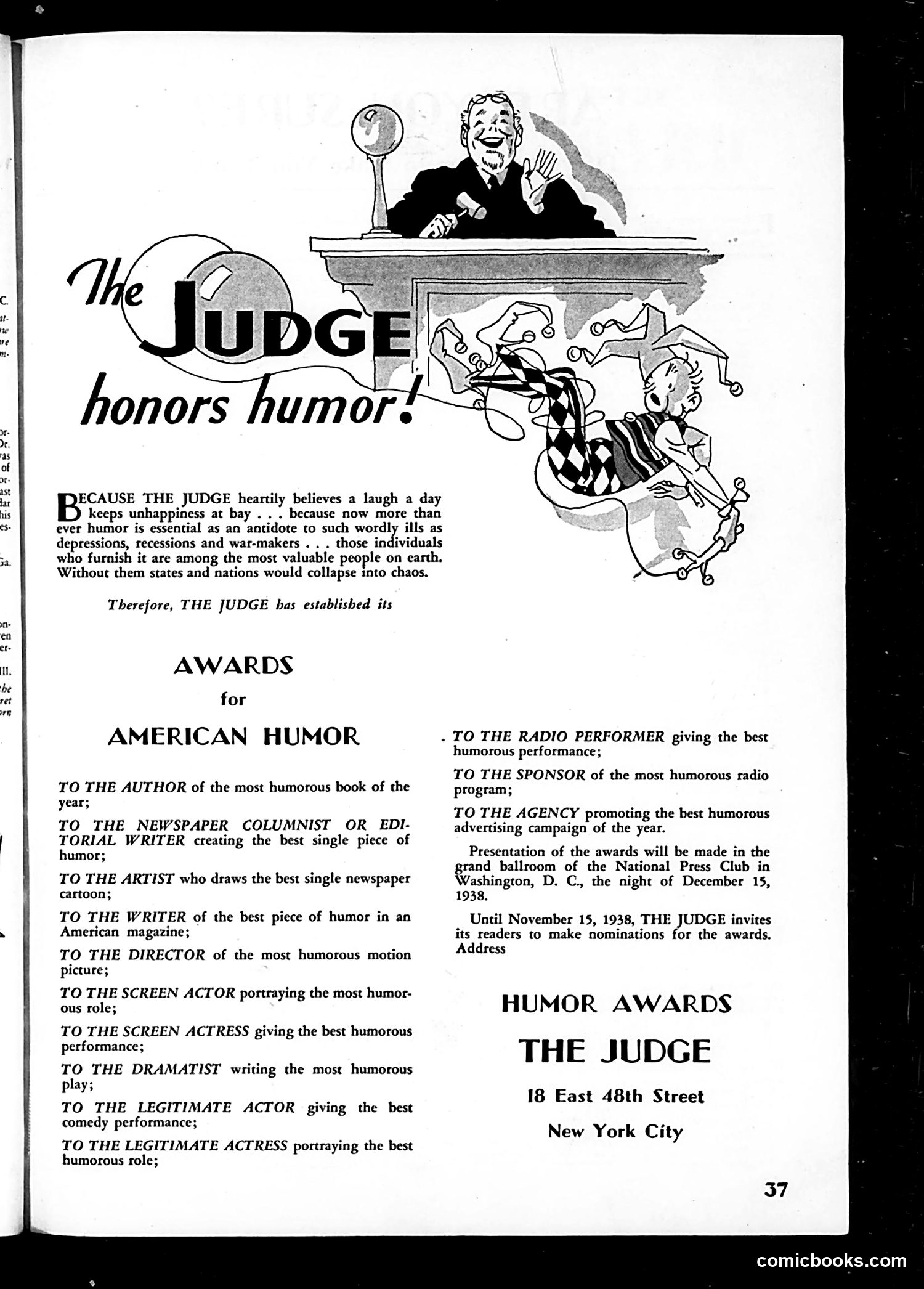
Judge Magazine's Humor Awards Announcement (1938) This page announces *The Judge* magazine's establishment of annual awards celebrating American humor across multiple media—books, newspapers, radio, film, theater, and advertising. The cartoon header shows a jovial judge presiding over comedians and performers, illustrating the magazine's philosophy that humor is socially essential, particularly valuable during economic hardship ("depressions, recessions") and international tension (the reference to "war-makers" likely alludes to rising fascism and WWII's imminence in 1938). The awards encompass both high and popular culture: serious literary authors alongside radio sponsors, Broadway actors alongside cartoonists. This reflects *Judge*'s position as a satirical weekly addressing multiple audiences. The nomination deadline of November 15, 1938, and ceremony date of December 15 suggest this was an inaugural or newly expanded program. The announcement is essentially a call for reader participation, positioning humor-makers as society's stabilizing force during turbulent times.
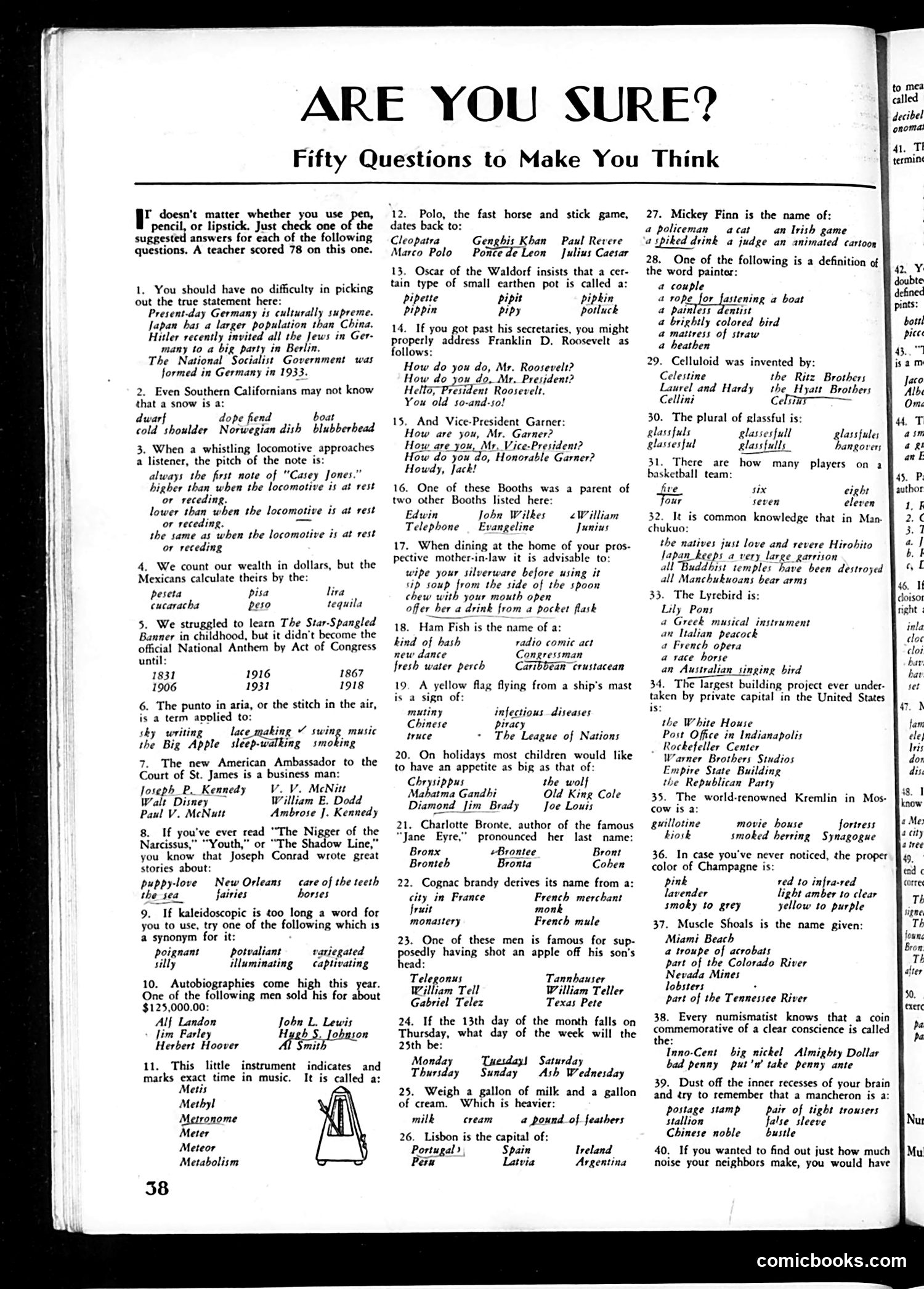
"Are You Sure?" - A 1930s Trivia Quiz Page This is a trivia quiz page from *Judge* magazine, not a political cartoon. The title "Are You Sure?" with "Fifty Questions to Make You Think" indicates this is an educational/entertainment feature testing readers' knowledge. The questions reflect 1930s American concerns and culture: references to Nazi Germany and Hitler (Question 1), Franklin D. Roosevelt and Vice-President Garner (Questions 14-15), the recent adoption of "The Star-Spangled Banner" as official anthem (Question 5), and contemporary figures like Joseph P. Kennedy as Ambassador to Britain (Question 7). The quiz mixes trivial knowledge (polo history, Mexican currency) with cultural literacy (Joseph Conrad, the Booth acting family). A note claims "A teacher scored 78 on this one," suggesting even educated adults would struggle—likely the humor's point. This represents *Judge*'s educational content rather than satirical commentary.
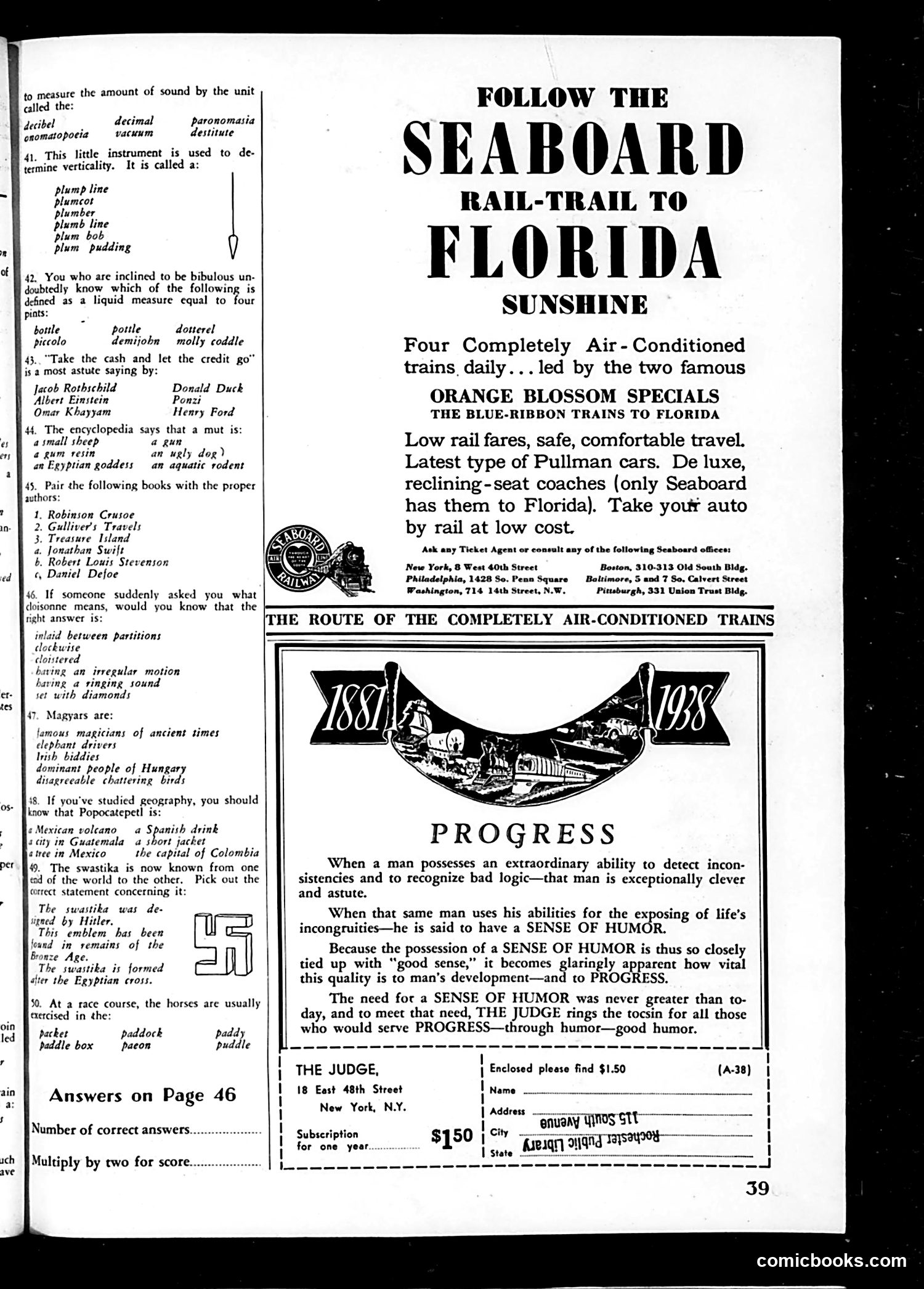
Judge Magazine Content Analysis This page is primarily a trivia quiz mixed with advertising, rather than a political cartoon. The left side contains multiple-choice questions testing general knowledge—covering measurements (decibel), instruments (plumb line), literature (book authors), geography (Popocatepetl), and history (the swastika). Notably, question 47 lists "dominant people of Hungary" as a definition for "Magyars," reflecting 1930s-era ethnic categorization. The right side advertises the Seaboard Air Line Railway's Florida service, promoting the "Orange Blossom Specials" with air-conditioned trains and luxury amenities. Below the ad, an editorial statement about humor and progress argues that a "sense of humor" reflects the ability to recognize life's incongruities and logical flaws—positioning humor as essential to human development. This reflects Judge's self-conception as a magazine serving "PROGRESS" through satirical commentary. The page contains no identifiable political caricatures or cartoons—it's primarily quiz content and period advertising.
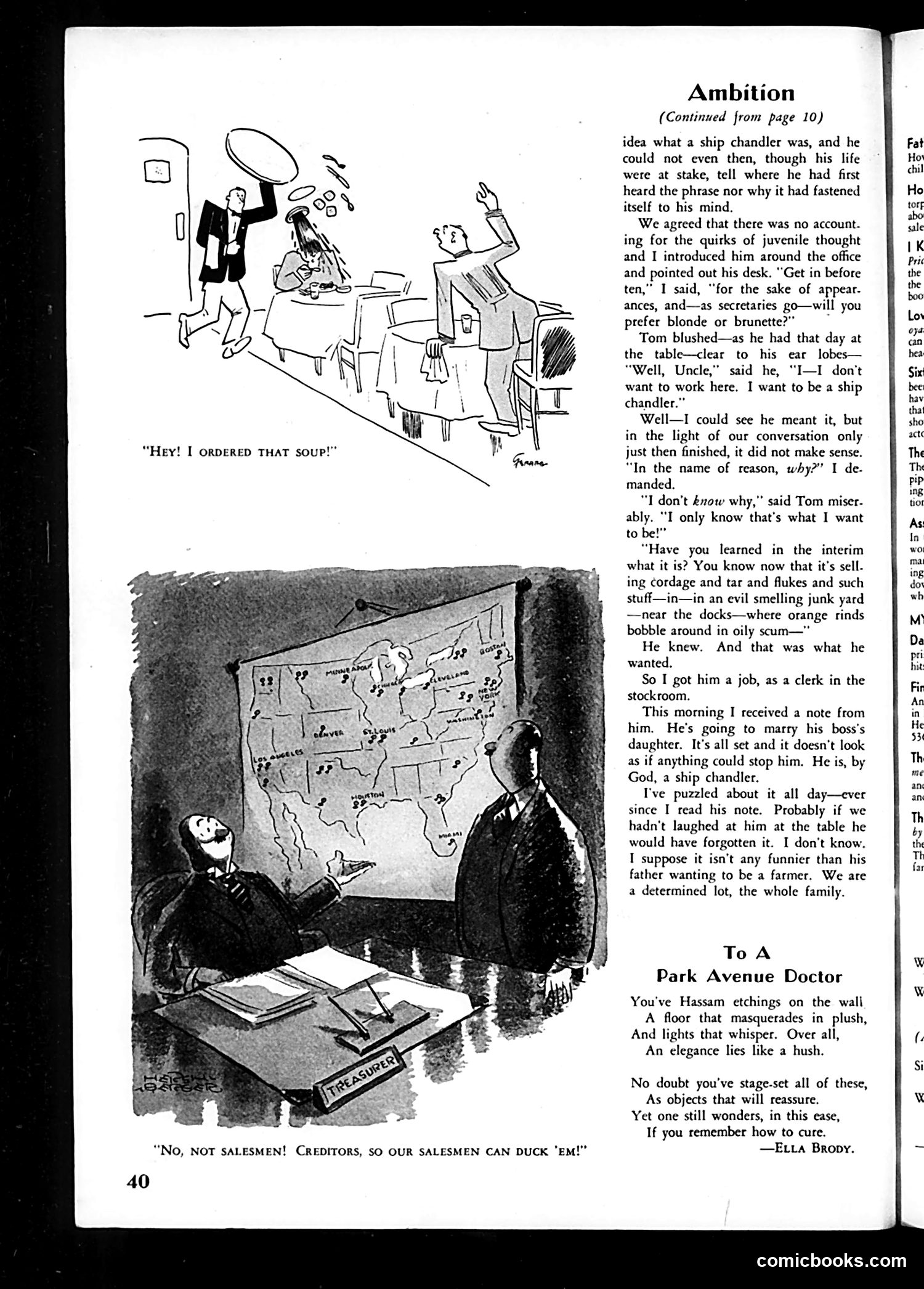
Page Analysis: Judge Magazine, Page 40 This page contains two distinct pieces: "Ambition" (top): A serialized short story about a young man named Tom who inexplicably becomes obsessed with becoming a "ship chandler" (a supplier of maritime equipment). Despite the narrator's attempts to dissuade him by describing the job's unpleasant reality—working in a filthy junk yard near docks—Tom pursues it anyway and achieves success, eventually becoming engaged to his boss's daughter. The satire seems to celebrate youthful determination and following one's calling, however arbitrary, over practical concerns. Two cartoons: The top cartoon shows chaos at a restaurant ("Hey! I ordered that soup!"). The bottom cartoon depicts two businessmen examining a US map labeled "TREASURE," critiquing corrupt business practices—the caption reads "No, not salesmen! Creditors, so our salesmen can duck 'em!"—satirizing how companies might hide from creditors. "To A Dark Avenue Doctor": A poem mocking wealthy Manhattan physicians, questioning whether their elegant Park Avenue offices prioritize appearance over actual medical competence.
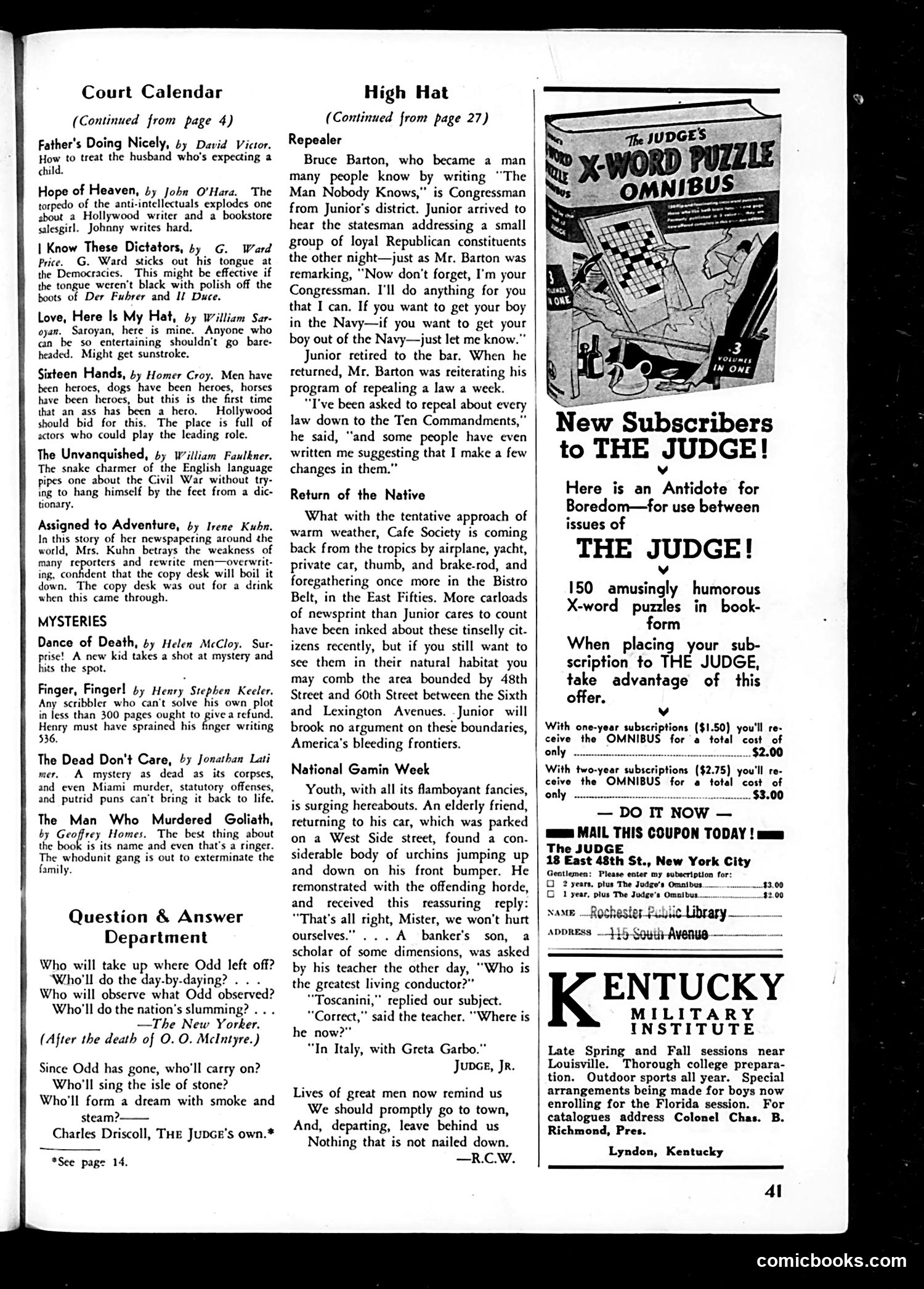
Political and Social Satire Analysis This page contains book reviews and social commentary typical of *Judge* magazine's satirical approach. Book Reviews Section ("Court Calendar"): The reviews mock contemporary literature with barbed wit—praising some authors (Faulkner, McCloy) while skewering others for overwrought prose or derivative mystery plots. The tone is irreverent and dismissive of pretension. "High Hat" Section: Features two satirical pieces: 1. "Repealer": Mocks Congressman Bruce Barton (a real figure known for writing "The Man Nobody Knows"), portraying him as a typical politician making empty promises to constituents about naval appointments and casually proposing to repeal laws—even humorously suggesting changes to the Ten Commandments. The satire targets political opportunism and hollow rhetoric. 2. "Return of the Native": Gently ridicules "Cafe Society"—wealthy socialites returning to New York's fashionable East Side establishments after winter vacations, noting how extensively the press covers their trivial comings and goings. The overall content reflects 1930s-40s urbane skepticism toward politicians, celebrity culture, and literary pretension.
The Washington Parade Advertisement This is an advertisement for a proposed newsreel series by *The Judge* magazine, not a cartoon. It announces "The Washington Parade," a monthly satirical newsreel that would offer behind-the-scenes footage of Washington politics and government bureaucracy. The appeal is explicitly anti-establishment: instead of conventional newsreel content (parades, beauty pageants, ship launchings), viewers would see candid footage from congressional cloakrooms, offices, and lobbies—the "real news" of how government actually operates. The satire lies in presenting politics as theater, with "machines behind the men and the men behind the starch," suggesting politicians are mechanical functionaries. The advertisement emphasizes *The Judge's* 57-year reputation for satirical "sympathetic good humor," positioning this newsreel as exposé wrapped in comedy—offering audiences access to Washington's supposedly hidden inner workings.
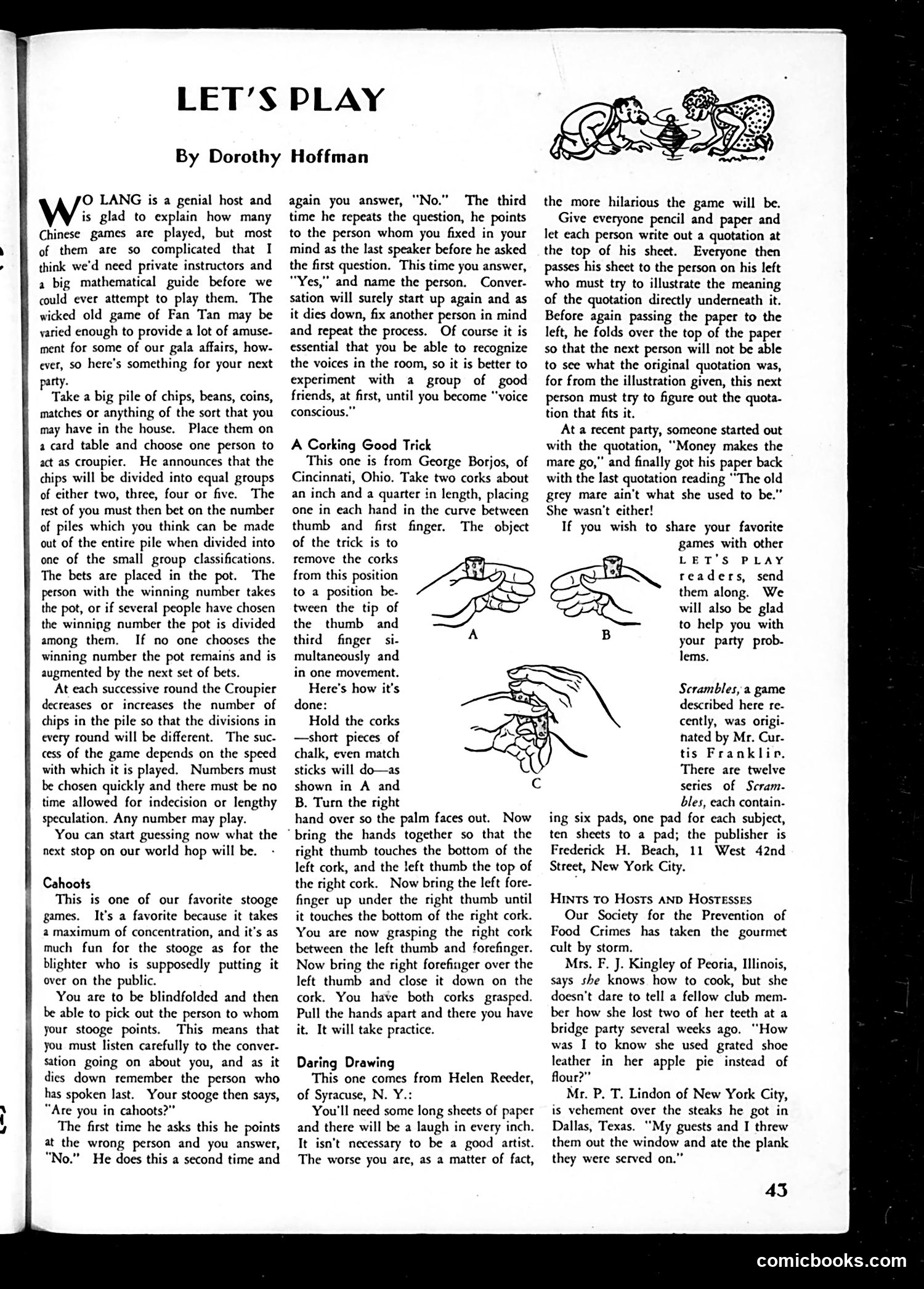
Content Analysis: "Let's Play" by Dorothy Hoffman This is a party games column, not a political cartoon. The page presents three parlor games for entertaining guests at social gatherings: 1. Fan Tan - A Chinese gambling game using chips/coins, where players bet on division outcomes 2. Cahoots - A "stooge game" involving a blindfolded person identifying speakers through voice recognition 3. A Cork Trick - A manual dexterity puzzle from Cincinnati The accompanying illustrations show hand positions for the cork trick (labeled A, B, C). Historical context: This reflects early-to-mid 20th century American entertainment culture—an era when parlor games were standard party entertainment, before electronic media. The reference to Chinese games reflects period interest in "exotic" diversions. The "stooge" games were designed to create social comedy, with one person secretly colluding with the host to fool others. There is no satire or political content—this is straightforward leisure advice for Judge's affluent, party-hosting readership.
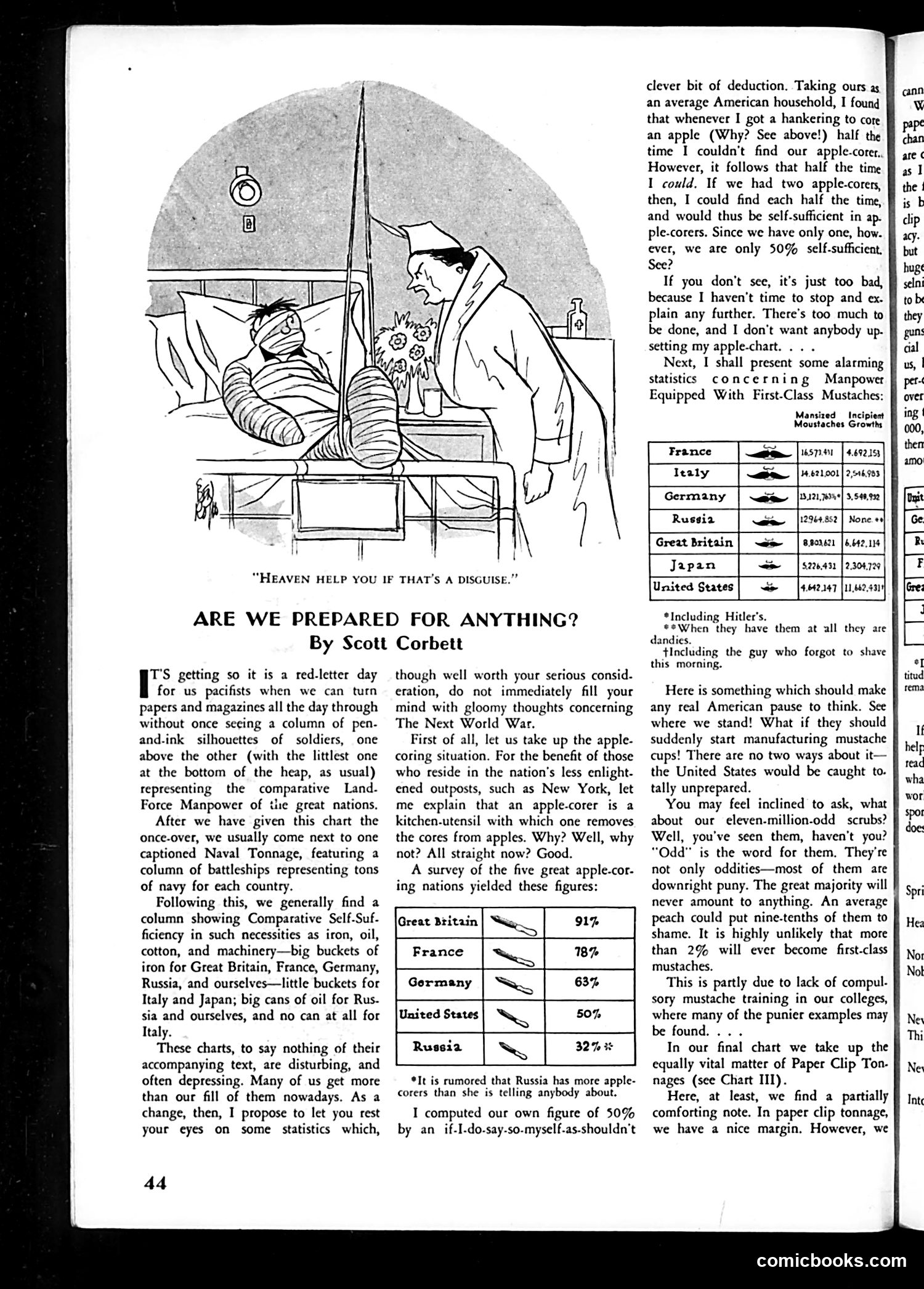
Analysis for Modern Readers This satirical piece by Scott Corbett mocks 1930s-40s American anxiety about military preparedness. The cartoon shows a disguised soldier in a bed, playing on fears of enemy infiltration. The article parodies obsessive war-readiness charts (comparing nations' military forces, naval tonnage, resources) by replacing them with absurd statistics: apple-corer distribution and mustache quality among populations. The satire works on multiple levels: it ridicules both the public's consumption of alarming military comparisons AND America's genuine unpreparedness. By treating trivial items with the same grave tone as weapons data, Corbett suggests that all these statistics are equally meaningless—or that American officials are equally unprepared whether measuring battleships or grooming supplies. The piece reflects pre-WWII American debate: pacifists vs. interventionists, anxiety about foreign threats, and skepticism toward government preparedness claims. The humor targets both jingoistic fear-mongering and complacent isolationism.
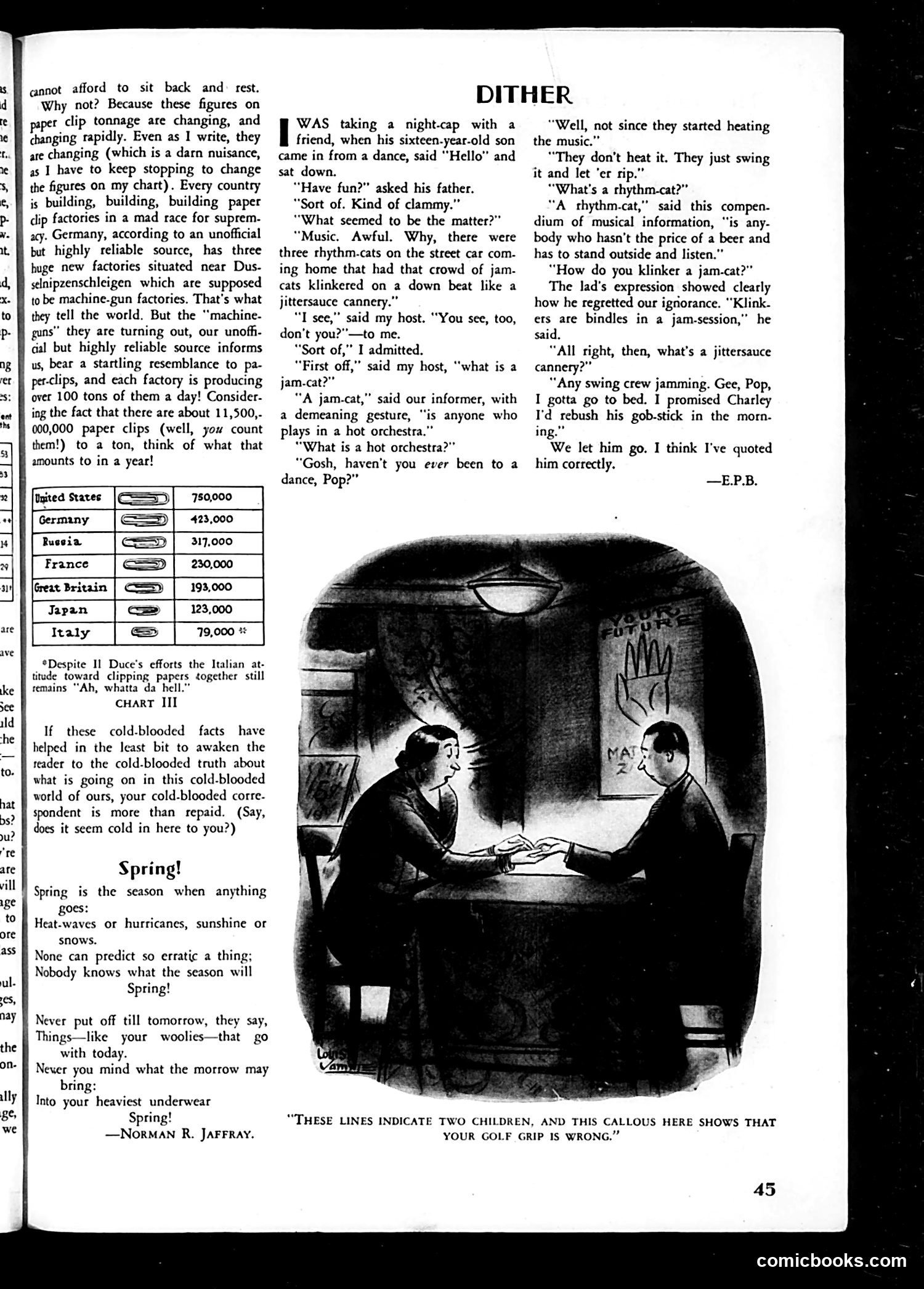
"Dither" – A Judge Magazine Satire on Generation Gap and Jazz Slang This page satirizes the bewilderment of middle-aged parents confronting 1930s youth culture, specifically jazz terminology. The main cartoon shows a father and son in dialogue where the teenager returns from a dance using incomprehensible slang: "jam-cats," "rhythm-cats," "klinkered," "gob-stick," and "jittersauce cannery." The joke is generational incomprehension. The son speaks fluent jazz-age slang while the father—puzzled even by "hot orchestra"—struggles to follow. The humor peaks when the father asks if the teenager had "fun," only to learn the music was "clammy." The son's exasperated explanations ("Gosh, haven't you *ever* been to a dance, Pop?") mock parental ignorance of modern swing culture. The caption's cartoon depicts someone misunderstanding instructions entirely, reinforcing the theme: miscommunication across generations. The satire gently mocks both the teenager's affected jargon and the parent's outdated sensibility, reflecting broader 1930s anxieties about rapidly changing youth culture and musical tastes.
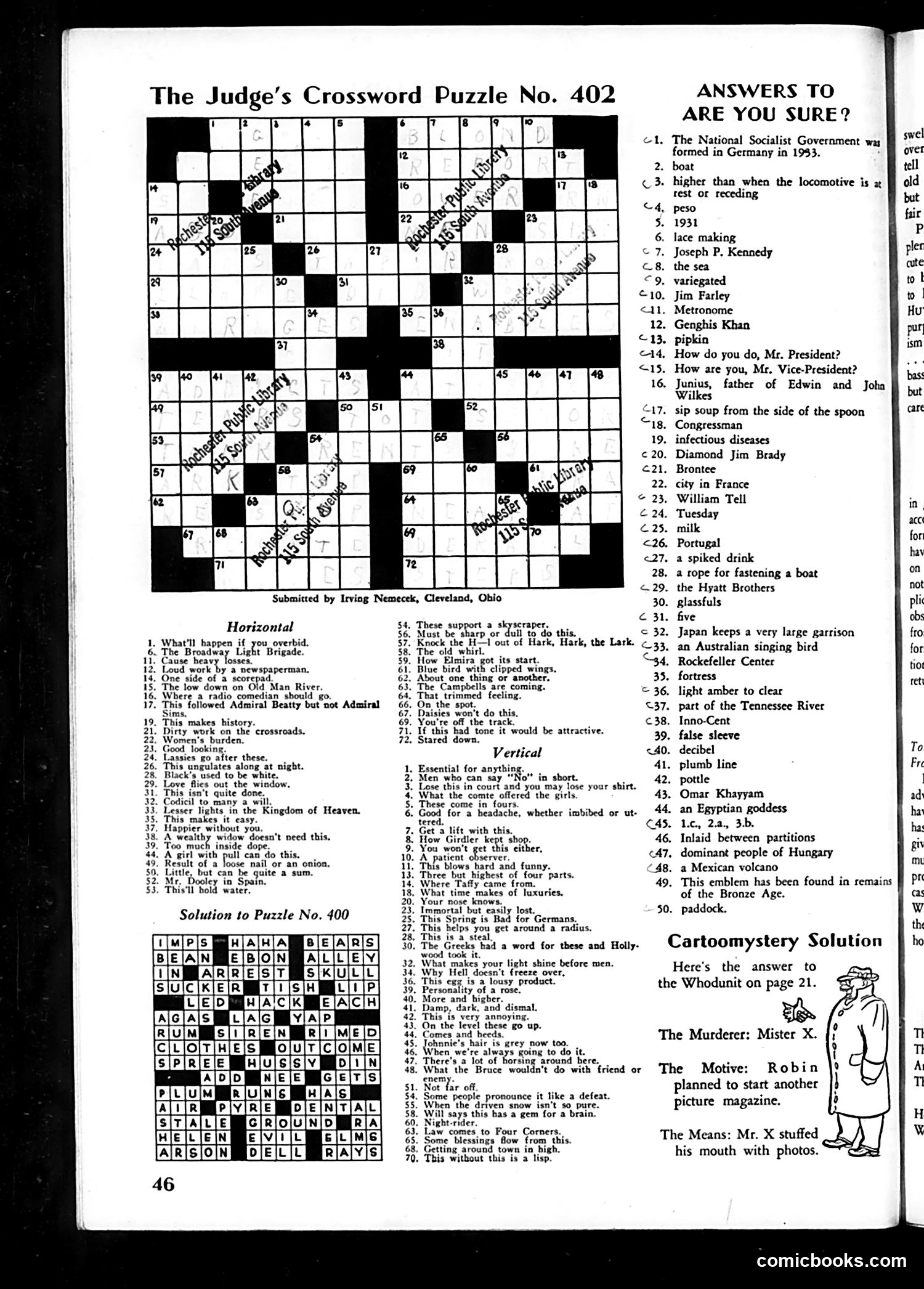
Analysis of Judge Magazine Page This page is primarily a crossword puzzle and its solution, not a political cartoon. However, the clues and answers contain satirical references typical of Judge magazine's mid-1930s content. The puzzle clues mock contemporary figures and events: - References to Joseph P. Kennedy (diplomat/business figure) - Jim Farley (FDR's Postmaster General) - Diamond Jim Brady (Gilded Age financier) - The Hyatt Brothers (contemporary business figures) - Mentions of Germany's National Socialist Government (Nazi regime, 1933) The humor relies on wordplay and insider knowledge—clues like "How do you do, Mr. President?" and "How are you, Mr. Vice-President?" reference contemporary political figures and social customs. The answers section includes a brief "Cartomystery Solution" about "Mister X" and a murder plot involving "Robin," suggesting other satirical content elsewhere in the magazine. This is primarily entertainment content rather than explicit political satire, though it reflects 1930s concerns including business figures, government officials, and Nazi Germany.
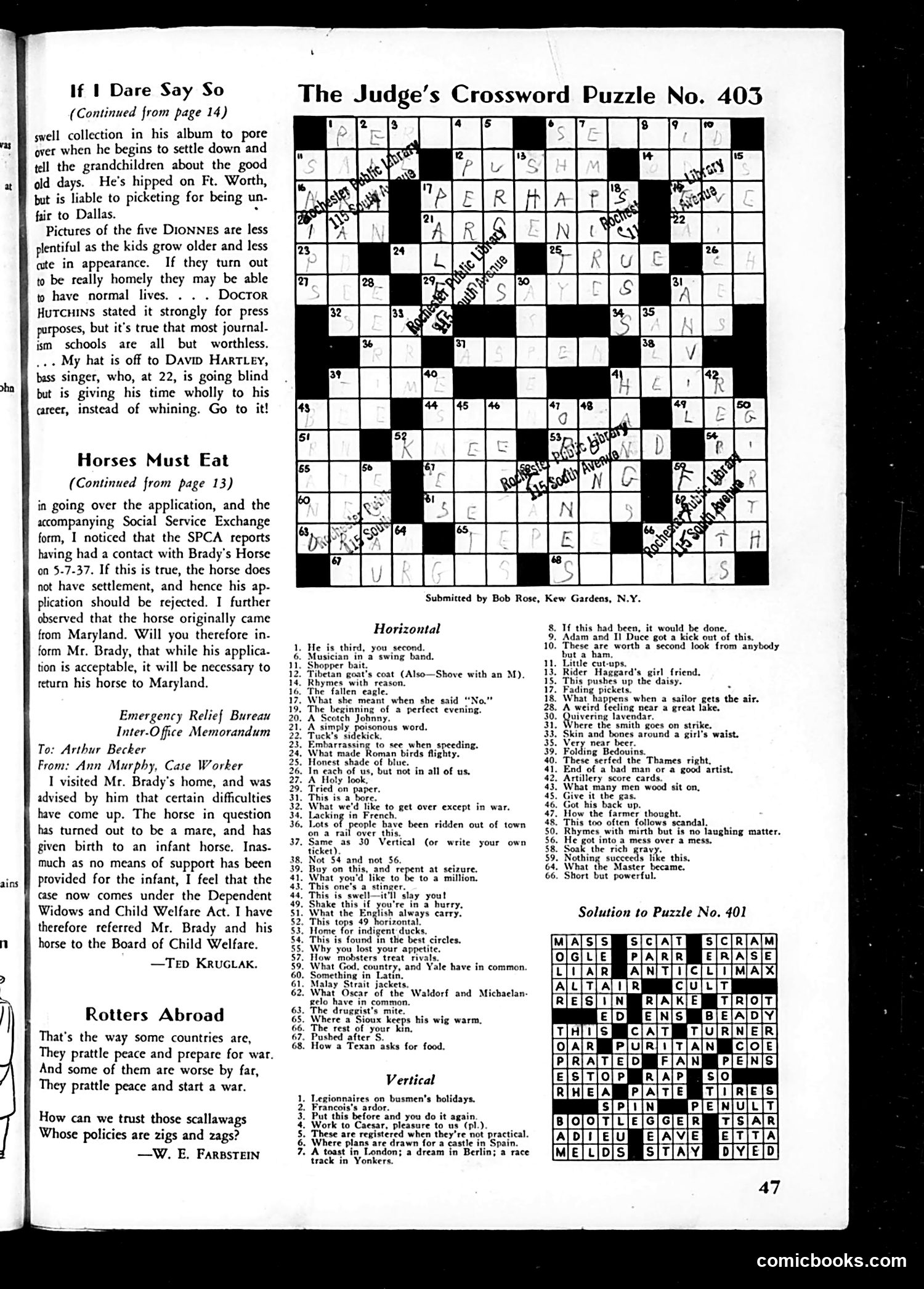
Analysis of This Judge Magazine Page This page contains three separate pieces of satirical content: "If I Dare Say So" and "Horses Must Eat" are opinion columns mocking bureaucratic absurdity. The "Horses Must Eat" section satirizes Depression-era welfare administration through a fictional case where a man applies for relief for his horse, only to encounter escalating bureaucratic obstacles—the horse lacks "settlement," came from Maryland, and then produces a foal requiring dependent support. The satire targets how rigid relief agencies applied rules mechanically, treating a horse application with the same tortured logic as human welfare cases. "Rotters Abroad" is political commentary criticizing certain nations (likely referencing 1930s international tensions) for hypocritically preaching peace while preparing for war, with unstable foreign policies. The remainder is a crossword puzzle with clues, unrelated to the satirical content above. The humor assumes readers understood contemporary relief bureaucracy's reputation for absurd rigidity and appreciated wordplay in crossword construction.
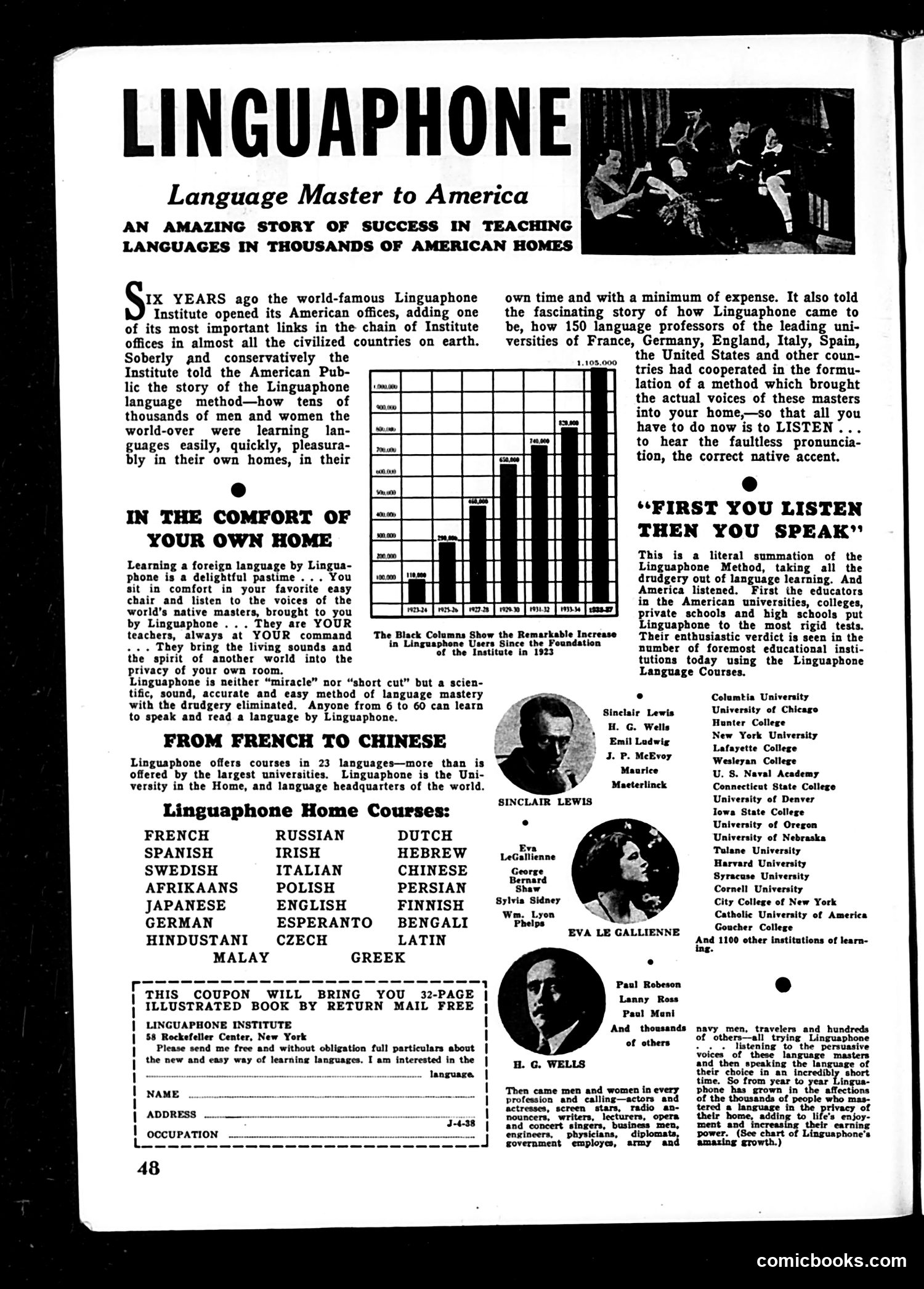
LINGUAPHONE ADVERTISEMENT This is an advertisement for Linguaphone, a language-learning service claiming unprecedented success teaching foreign languages to Americans at home via recorded instruction from native speakers. The page features endorsements from celebrities and prominent figures (Sinclair Lewis, H.G. Wells, Paul Robeson, and others) to establish credibility. The pitch emphasizes convenience ("comfort of your own home"), scientific methodology, and broad institutional adoption—a bar chart shows growth since 1923. The service offers 23 languages from French to Chinese. There's no political satire here. This appears to be a straightforward advertorial in *Judge* magazine capitalizing on 1930s-era fascination with educational technology and the prestige of international culture. The celebrity endorsements and statistics are persuasion tactics typical of interwar advertising rather than satire or commentary.
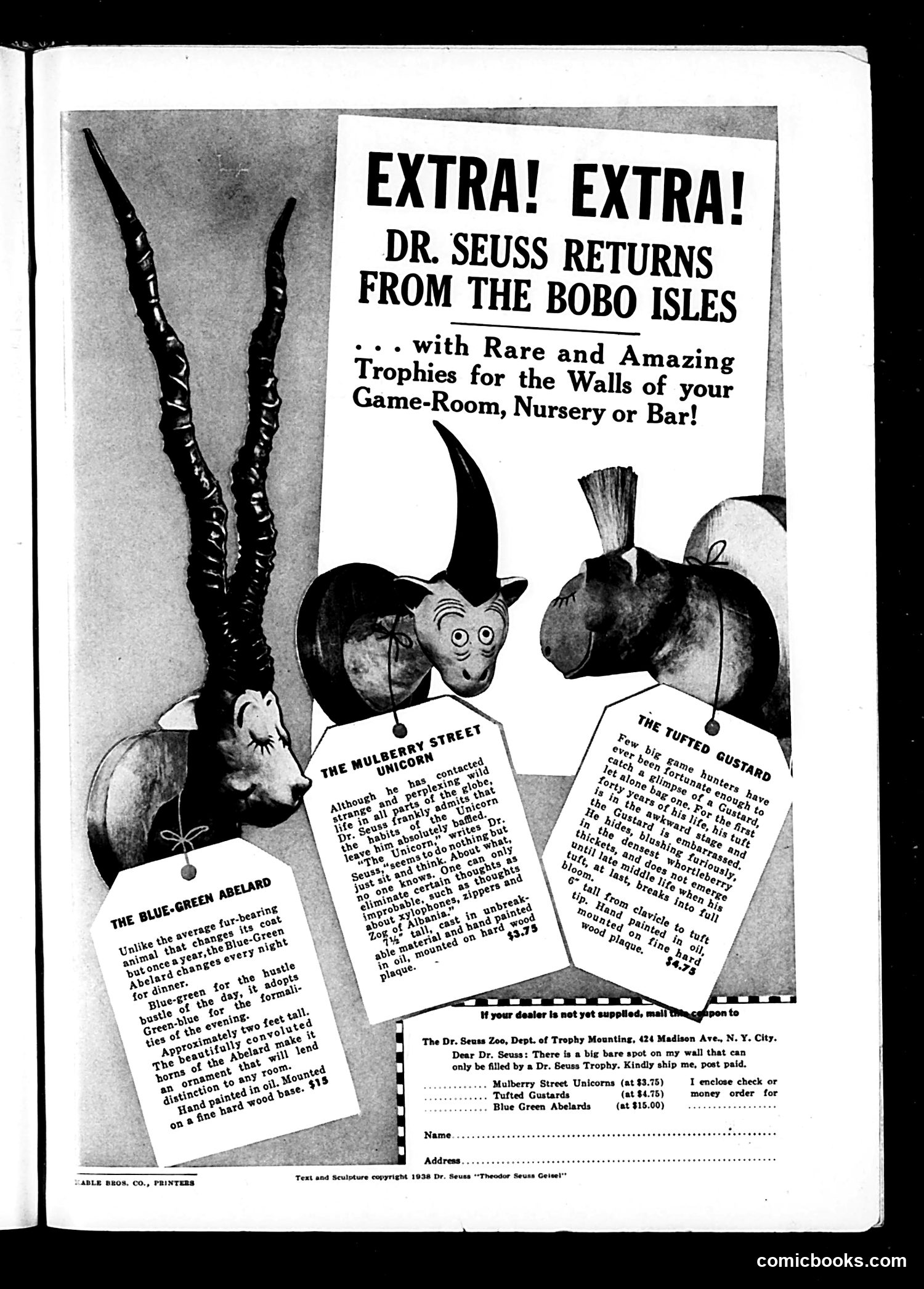
Analysis This is primarily advertising content, not political satire. It's a mail-order promotion for Dr. Seuss collectible animal trophies—taxidermied or mounted fictional creatures from his imaginative "Bobo Isles." The page features three whimsical creatures with attached description cards: - The Blue-Green Abelard - The Mulberry Street Unicorn - The Tufted Bustard These are fake exotic animals designed to appeal to readers' desire for unusual home décor for "game-rooms, nursery or bar." The joke is that Dr. Seuss has supposedly "returned" from imaginary islands with these ridiculous specimens available for purchase. This appears to be self-promotional advertising by Dr. Seuss (Theodor Geisel), leveraging his emerging popularity as an illustrator/author to sell merchandise. The fantastical creatures match his distinctive artistic style. The humor relies on the absurdity of treating invented creatures as real trophies worthy of wall-mounting.
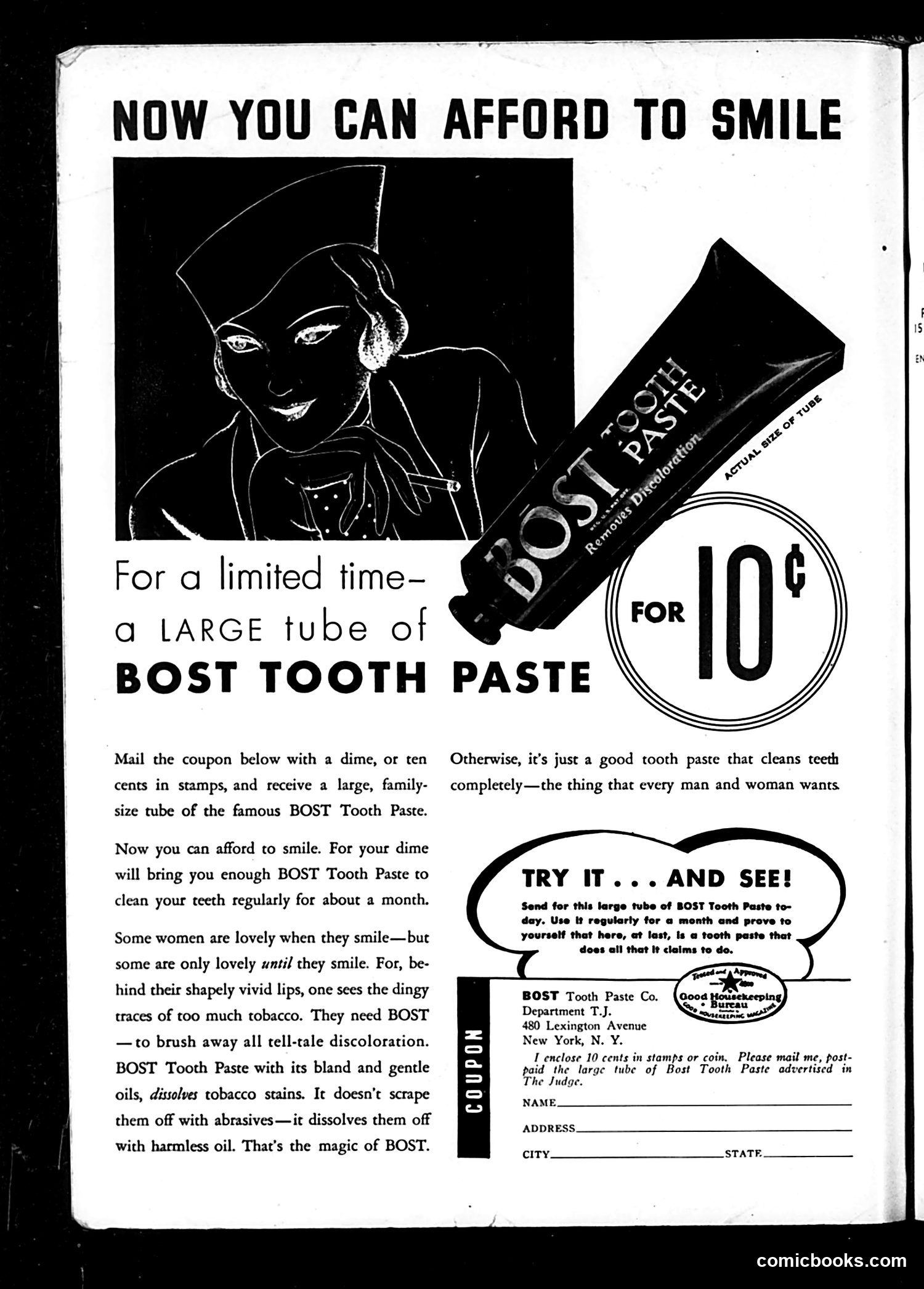
BOST Tooth Paste Advertisement (Judge Magazine) This is a vintage toothpaste advertisement, not political satire. The page promotes BOST Tooth Paste at the bargain price of 10 cents for a large tube—positioned as an affordable luxury during what appears to be an economically constrained period. The advertisement uses a gendered appeal common to early 20th-century marketing: it suggests women's desirability depends on having clean teeth, specifically warning that tobacco stains make women unattractive "until they smile." This reflects period anxieties about women smoking and concerns about appearance. The product's claimed advantage—dissolving tobacco stains with "bland and gentle oils" rather than abrasive scraping—suggests BOST positioned itself as a gentler alternative to competitors. The coupon format was standard advertising practice of the era. There is no evident political cartoon or satire on this page—it's straightforward commercial advertising utilizing social messaging typical of the period.