judge
Judge — May 1938
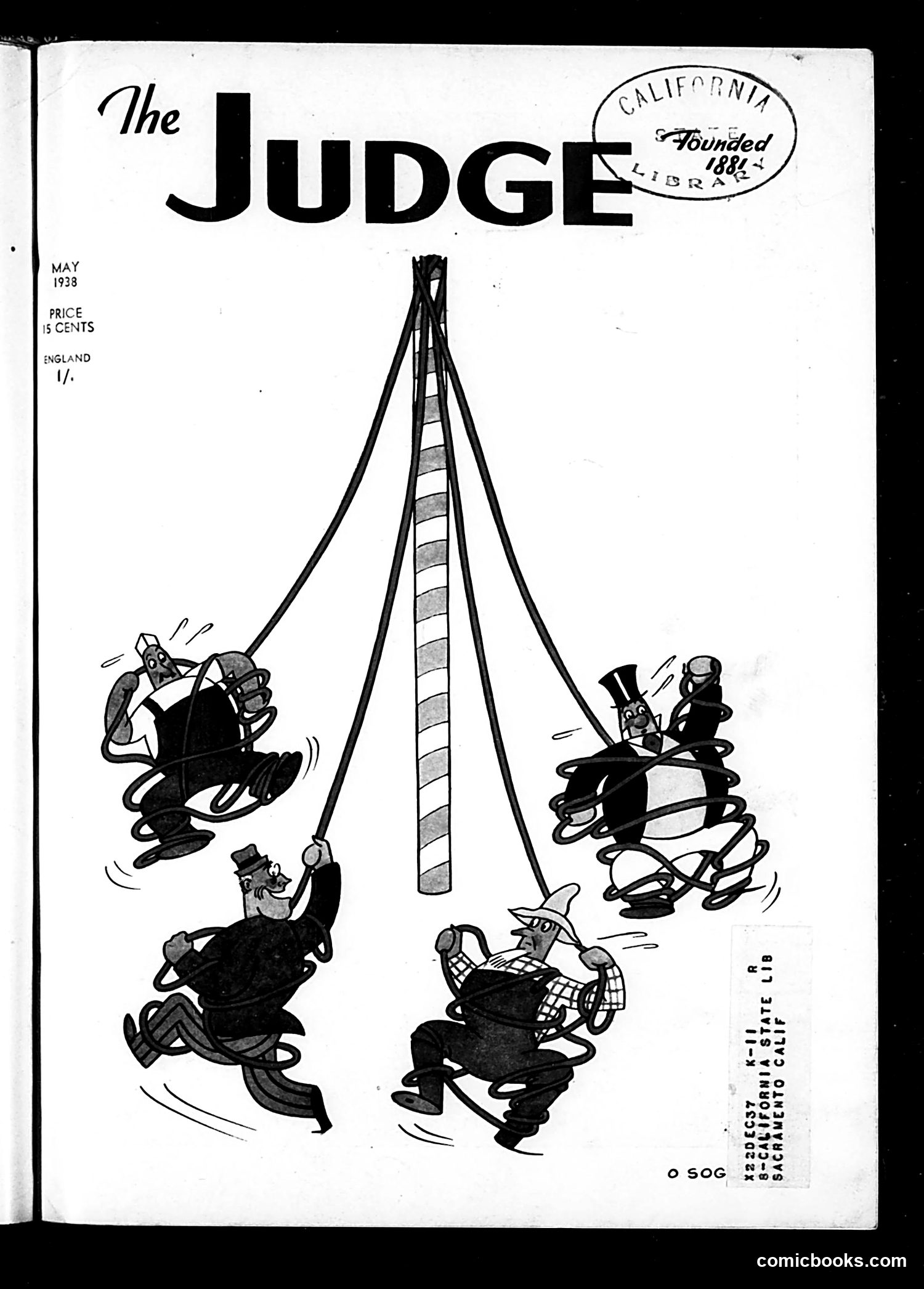
The Judge Magazine Cover - May 1938 This political cartoon depicts four caricatured figures being swung around a central pole like a children's maypole game. The figures appear to represent political or world leaders of 1938, likely including references to European fascist dictators active during that period. The swinging motion suggests chaos, dizziness, or loss of control in international affairs. The specific identities of the figures are unclear from the image alone, but the overall message appears to satirize the tumultuous state of world politics in 1938—a year of significant international tension preceding World War II. The maypole device transforms a children's innocent game into commentary on dangerous political instability among world powers.
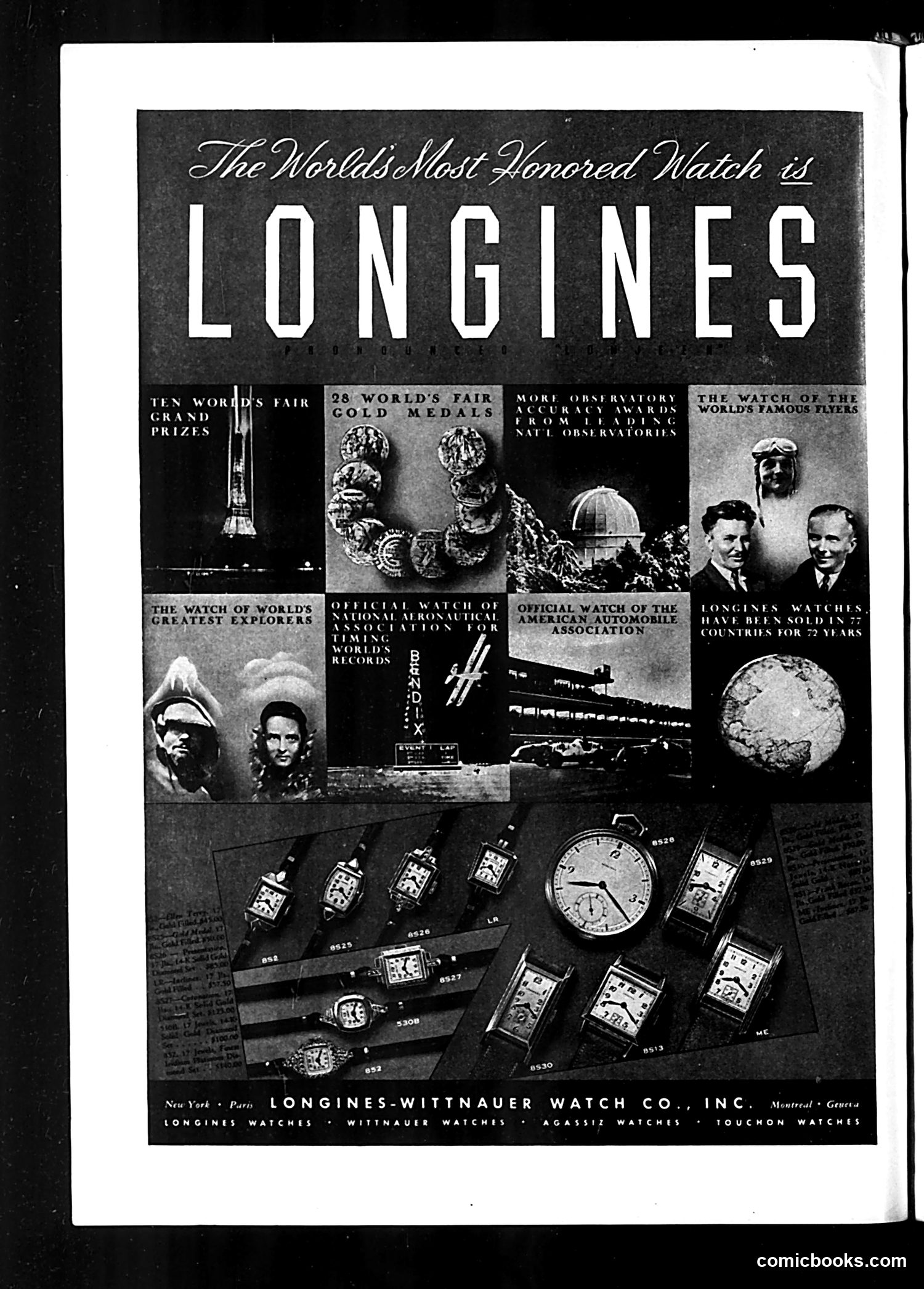
Analysis This is not a cartoon or satire page — it's a full-page advertisement for Longines watches, circa early 20th century. The ad promotes Longines as "The World's Most Honored Watch" by showcasing prestigious endorsements and achievements: Ten World's Fair Grand Prizes, 28 World's Fair Gold Medals, Observatory accuracy awards from leading institutions, and use by famous explorers and aviators. Images include explorers, an astronomer with observatory equipment, and an automobile association official, establishing Longines as the trusted timepiece for serious scientific and adventurous pursuits. The bottom displays various Longines watch models available for purchase. This reflects the era's marketing strategy: associating luxury goods with prestige, achievement, and technological progress rather than satirizing contemporary politics or society.
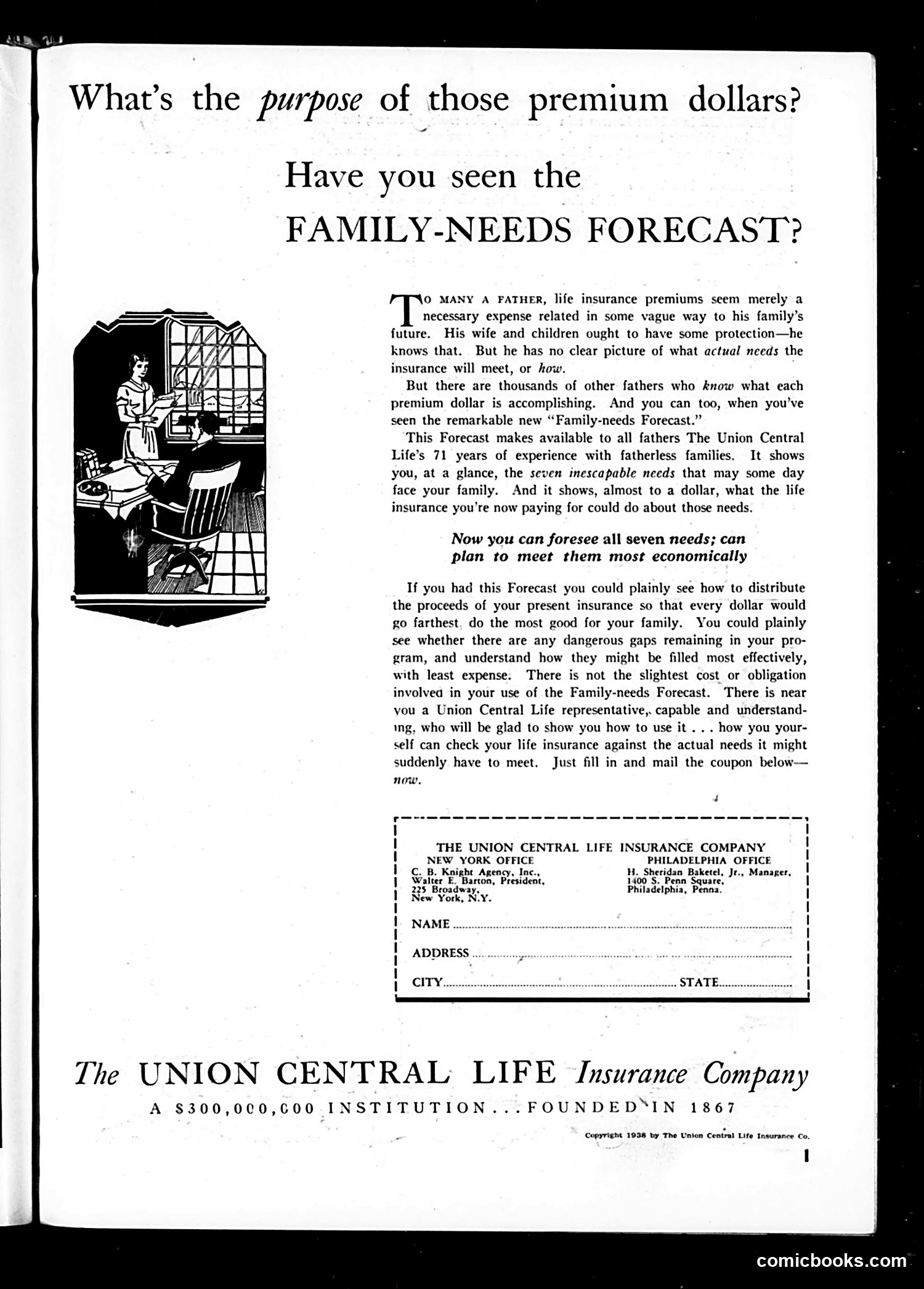
Analysis This page is primarily advertising, not satire or political commentary. It's a 1938 advertisement for Union Central Life Insurance Company's "Family-Needs Forecast" product. The single illustration shows a domestic scene: a woman at a desk or table with a child nearby, suggesting a housewife managing family finances. This imagery appeals to fathers by implying their wives can plan prudently if given proper insurance tools. The ad's pitch is straightforward: the Forecast helps fathers understand their family's future financial needs and ensures insurance dollars are spent efficiently. There is no political satire, caricature, or social commentary—just marketing rhetoric common to Depression-era insurance advertising, emphasizing security and family protection. The page exemplifies how Judge magazine contained commercial content alongside its satirical material.
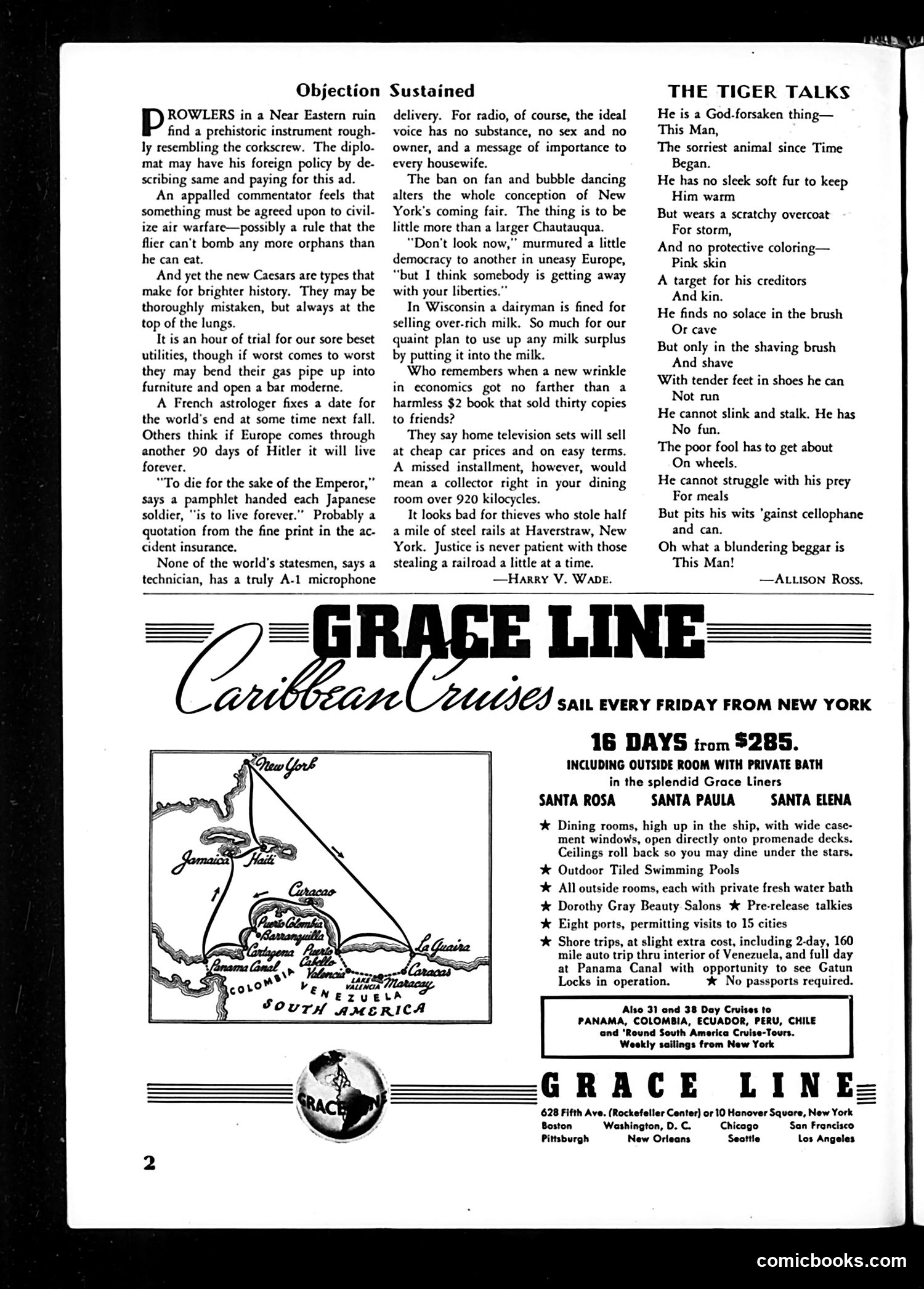
Page Analysis This page is primarily advertising for Grace Line Caribbean cruises, featuring a map of cruise routes through the Caribbean and Central America. The upper portion contains editorial commentary rather than political cartoons. The "Objection Sustained" column discusses various contemporary topics: diplomatic policy, Wisconsin dairy regulations, economics, and social observations. "The Tiger Talks" (a poem by Allison Ross) appears to be satirical commentary on an unnamed subject's miserable circumstances. No clear political cartoons or caricatures are present. The content is mainly commentary on mundane 1930s-era issues (radio broadcasts, wrinkles in economics, home television sales, railroad theft) rather than major political events or figures. The page functions primarily as a magazine filler mixing light editorial commentary with the cruise line advertisement.
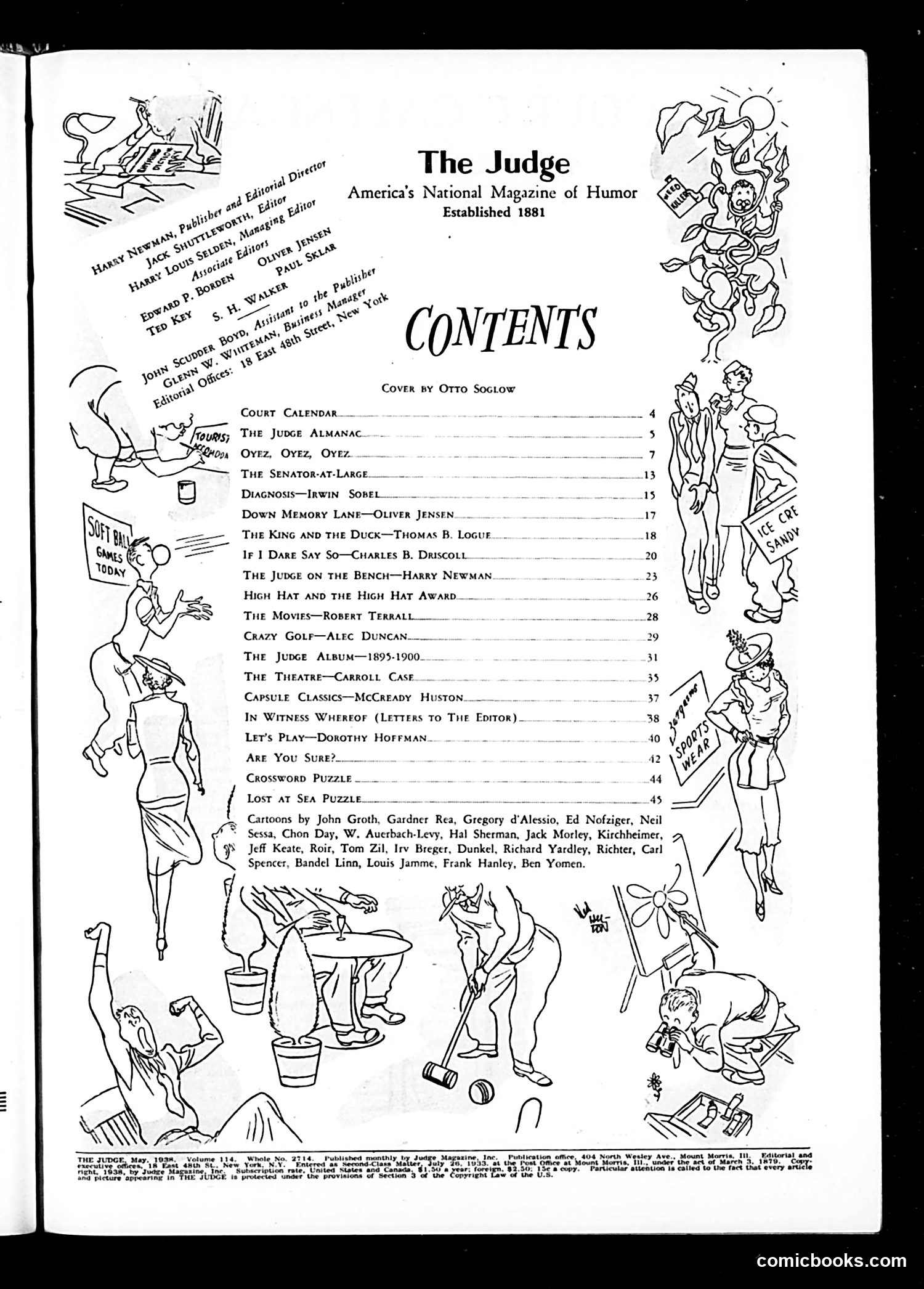
Contents Page Analysis This is a contents/index page for *The Judge* magazine (May 1898), America's premier humor publication. Rather than political cartoons, it lists article titles and contributors for that issue. Notable content includes "The Judge on the Bench" by Harry Newman and "The King and the Duck" by Thomas B. Logue—likely satirical pieces on contemporary figures or events. The cartoonists credited (Groth, Sherman, Morley, and others) were prominent illustrators of the era. The decorative border illustrations depict various comedic scenes: socialites, children, sports activities, and leisure pursuits—typical *Judge* humor focusing on upper-class American life and social absurdities rather than explicit political commentary. The magazine's subtitle emphasizes "Humor" as its primary mission.
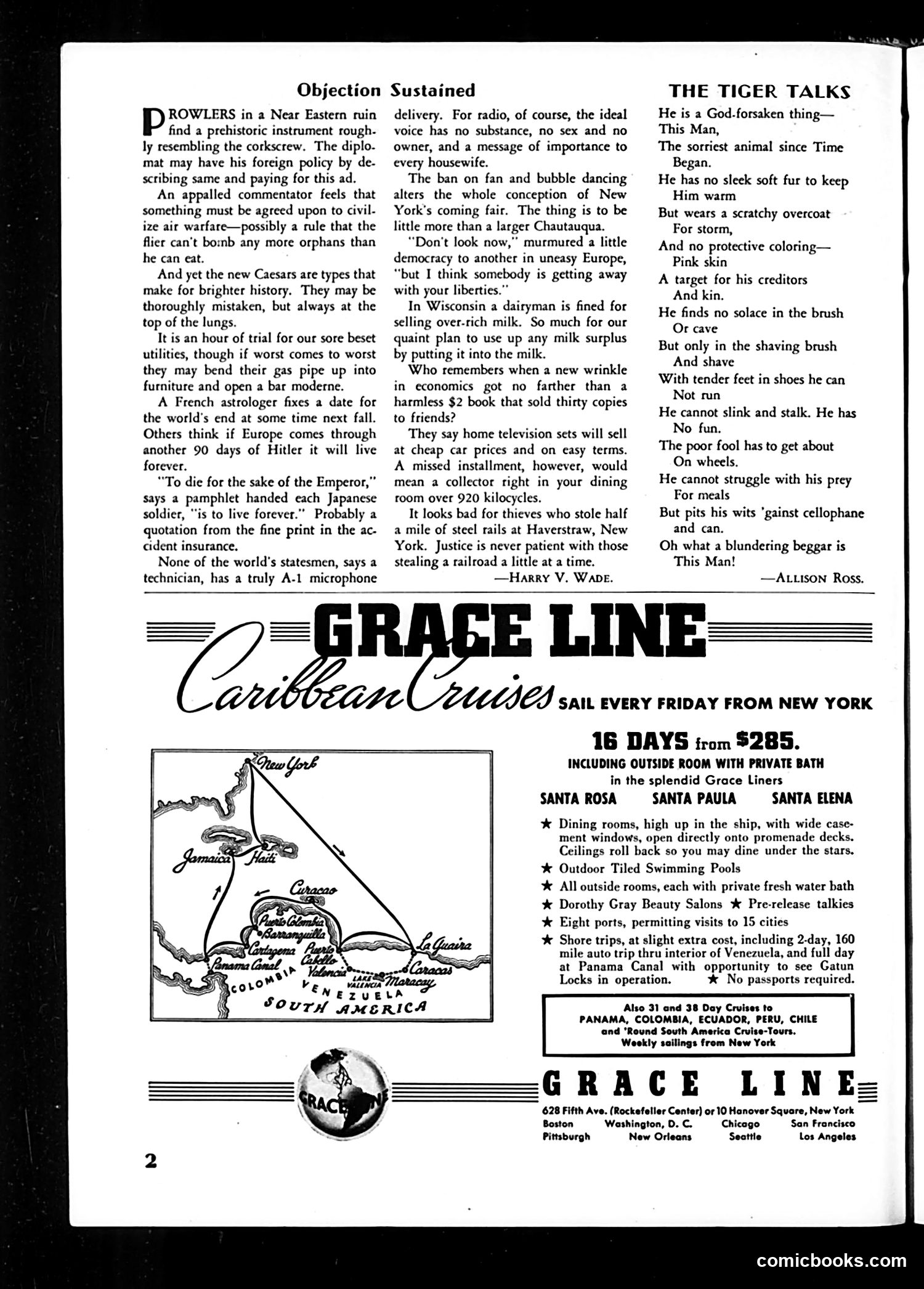
Page Analysis This page is primarily advertising for Grace Line Caribbean cruises, occupying roughly two-thirds of the space with a detailed cruise itinerary and route map. The upper portion contains opinion columns and poetry. "Objection Sustained" by Harry V. Wade critiques various contemporary issues—government policy disputes, economic absurdities (like a $2 economics book selling only 30 copies), and social commentary. "The Tiger Talks" is a poem by Allison Ross depicting a poor, struggling man reduced to bare existence. The satirical content is light and general rather than targeting specific political figures. The humor addresses everyday 1930s concerns: economic hardship, government inefficiency, and consumer goods availability. No particular caricatured individuals are identified in the visible portions.
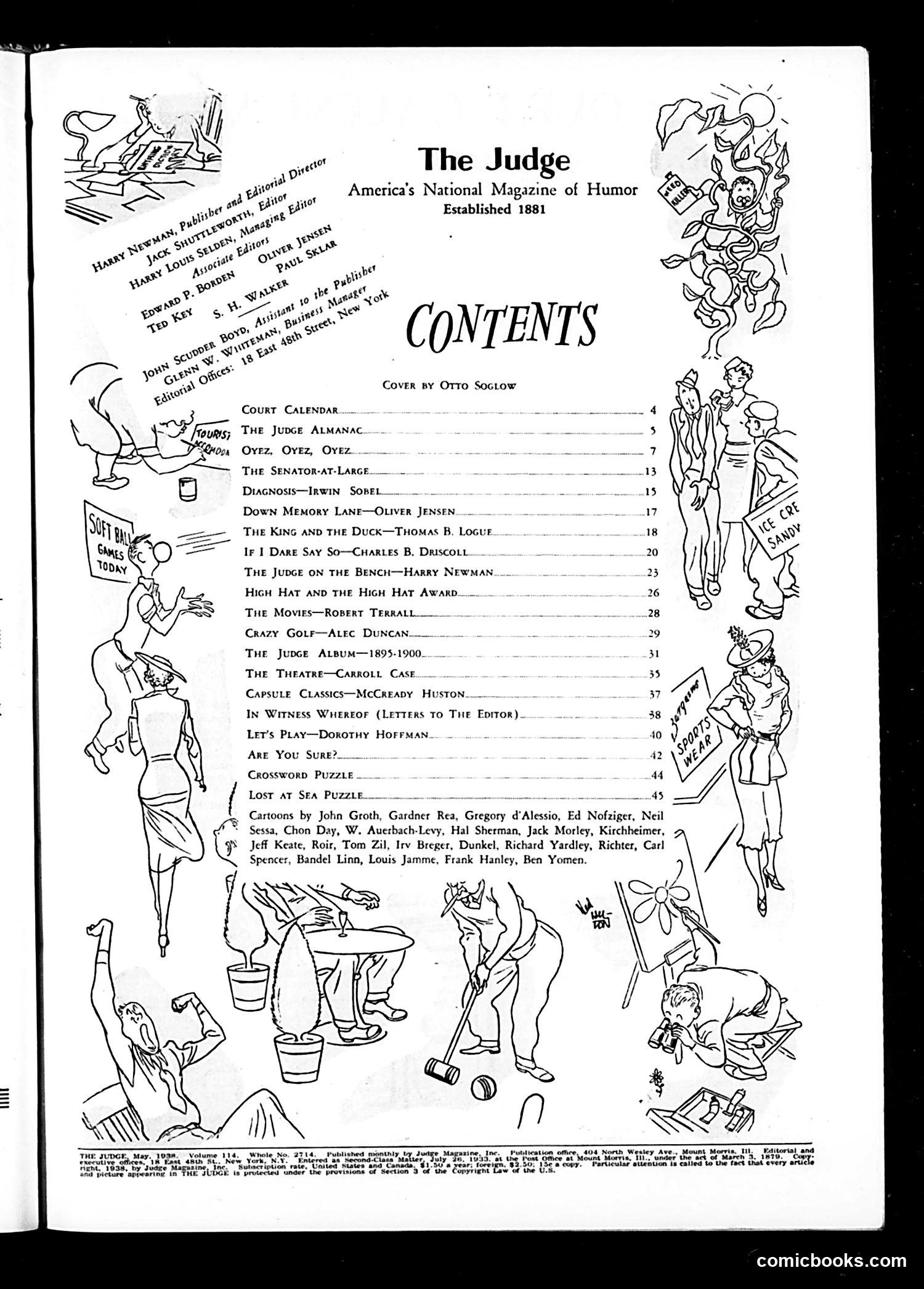
Contents Page Analysis This is a contents page from *The Judge* magazine (established 1881), America's satirical humor publication. The page lists article titles and page numbers rather than displaying completed cartoons with identifiable political figures or clear satirical commentary. The visible cartoons are generic humorous illustrations—figures in various comedic situations (spring cleaning, golfing, beach scenes)—rather than pointed political satire. Without seeing the actual articles (like "Oyez, Oyez, Oyez" or "The King and the Duck"), we cannot identify specific satirical targets. The cartoonists listed (John Groth, Gardner Rea, Gregory d'Alessio, etc.) were *Judge*'s regular contributors. This page serves primarily as an index to the issue's contents rather than as satire itself.
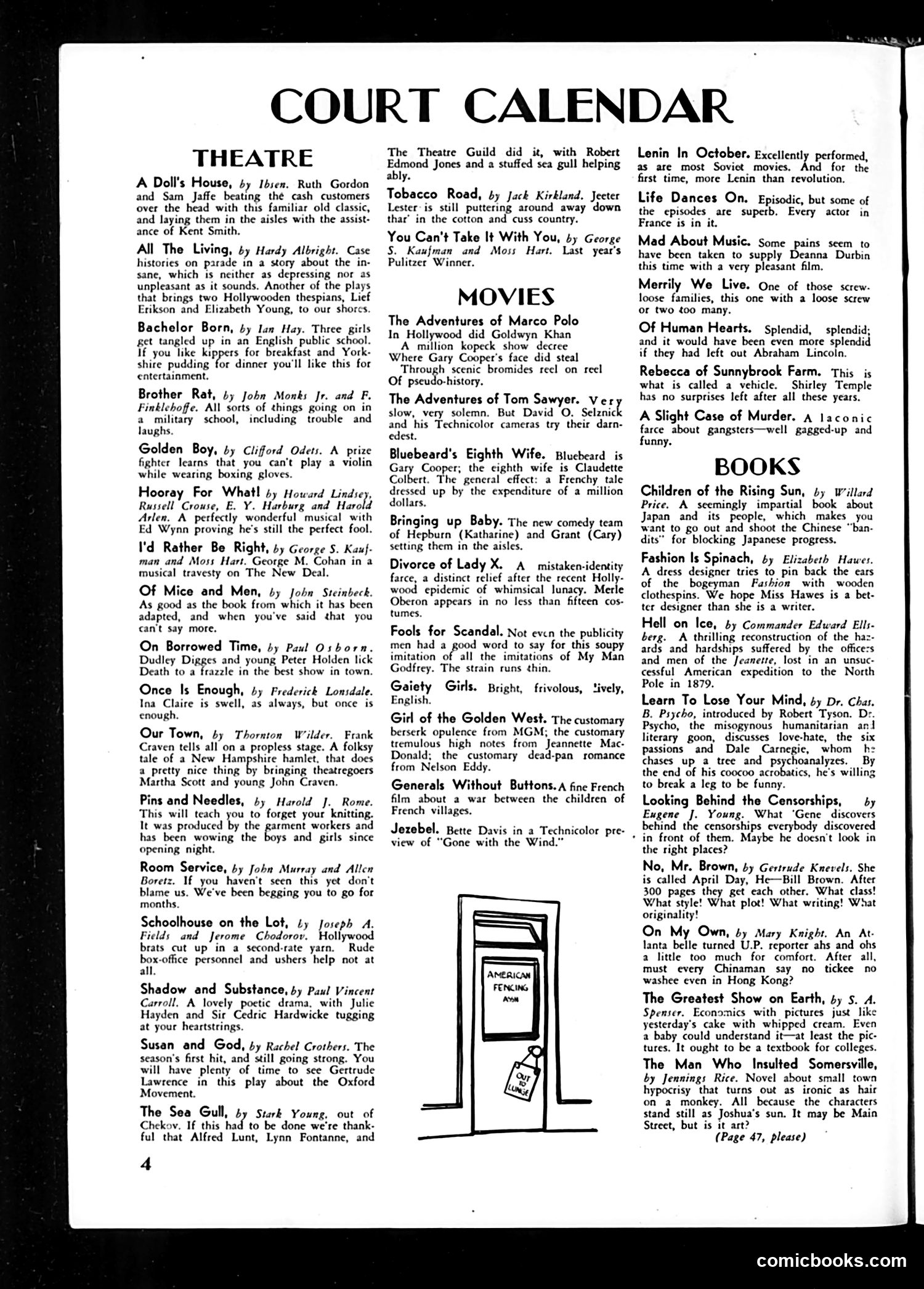
Court Calendar Page Analysis This page from *Judge* magazine is primarily a review section rather than political satire. It contains capsule critiques of contemporary theatrical productions and films, plus book reviews. The single small cartoon visible shows a book or magazine titled "AMERICAN FOREIGN POLICY" being placed in what appears to be a mailbox or slot—likely a visual joke about the publication/distribution of political commentary itself. The reviews themselves constitute the satire: sharp, witty dismissals of plays and films. For instance, the critique of "You Can't Take It With You" notes it won "Pulitzer's Winner"—a sarcastic comment on its commercial success despite (implied) artistic mediocrity. Similar sardonic observations pepper reviews throughout. This represents *Judge*'s characteristic approach: sophisticated cultural criticism disguised as entertainment listings.
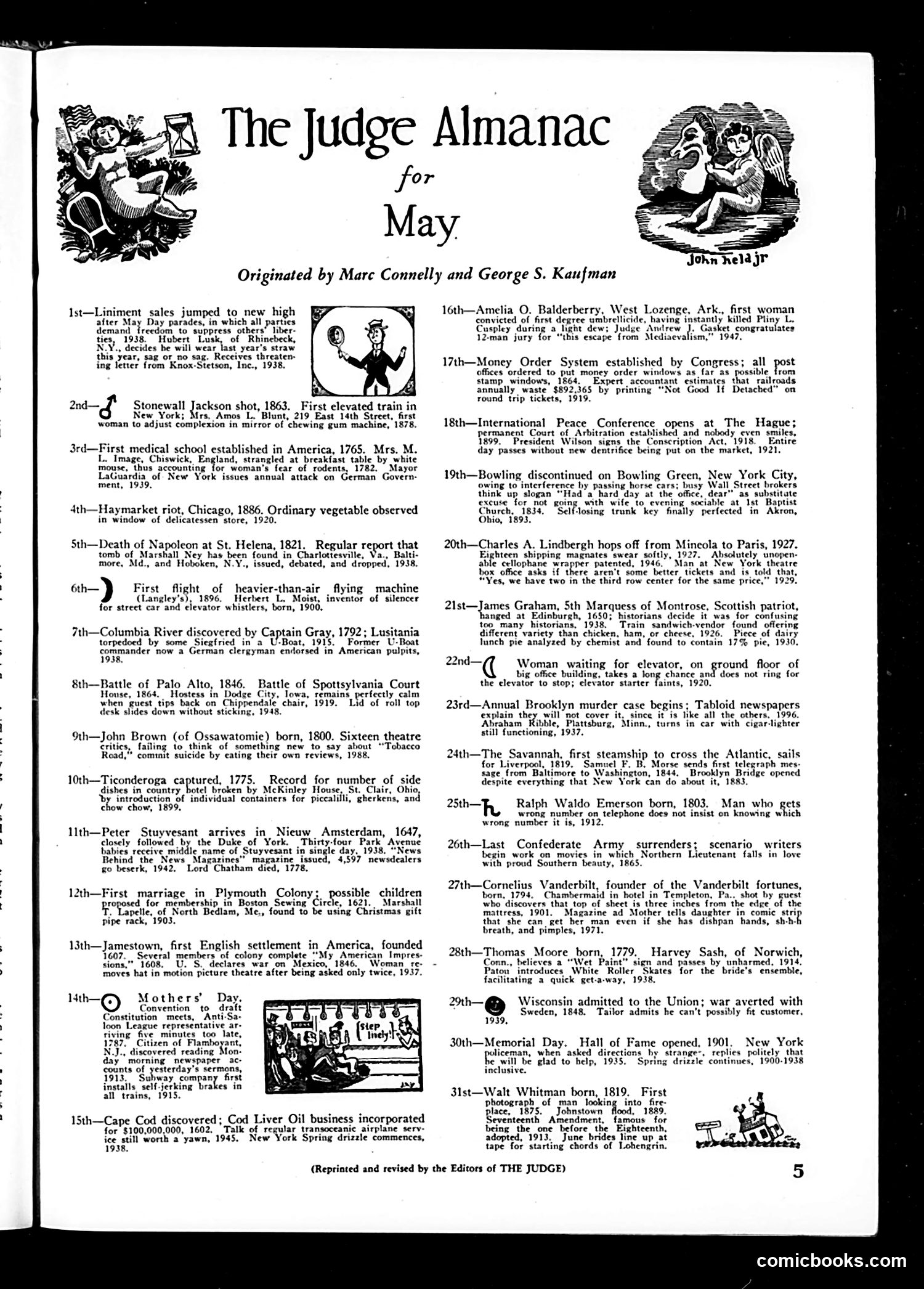
The Judge Almanac for May This is a reference page listing historical events and trivia, not a satirical cartoon. The page contains 31 numbered entries for each day of May, created by Marc Connelly and George S. Kaufman. The entries mix genuine historical facts (Napoleon's death, 1821; Columbia River discovery, 1792) with humorous fictional or absurdist items (a woman complaining about mirror-adjusting on a train; a self-closing trunk that finally perfected itself in Akron, Ohio). The small illustrations scattered throughout are decorative vignettes typical of *Judge* magazine's style. This appears to be the almanac section—a common feature in satirical magazines—designed to entertain readers with a blend of factual and whimsical "historical" observations for the month ahead.
Analysis This page is advertising, not satire or editorial cartoon. It's a Bell Telephone System advertisement positioned as an editorial endorsement in *Judge* magazine. The image shows a dramatic close-up of a person wearing a telephone headset, photographed in stark black-and-white to emphasize the technology and its importance. The ad makes a straightforward nationalist claim: American telephone service is superior in value and quality compared to the rest of the world. This reflects early-to-mid 20th century corporate advertising that used *Judge*'s editorial pages to promote products. The message is propaganda-like—asserting American technological and service superiority—rather than satirical commentary on society. No specific figures or jokes are present; this is pure product promotion.
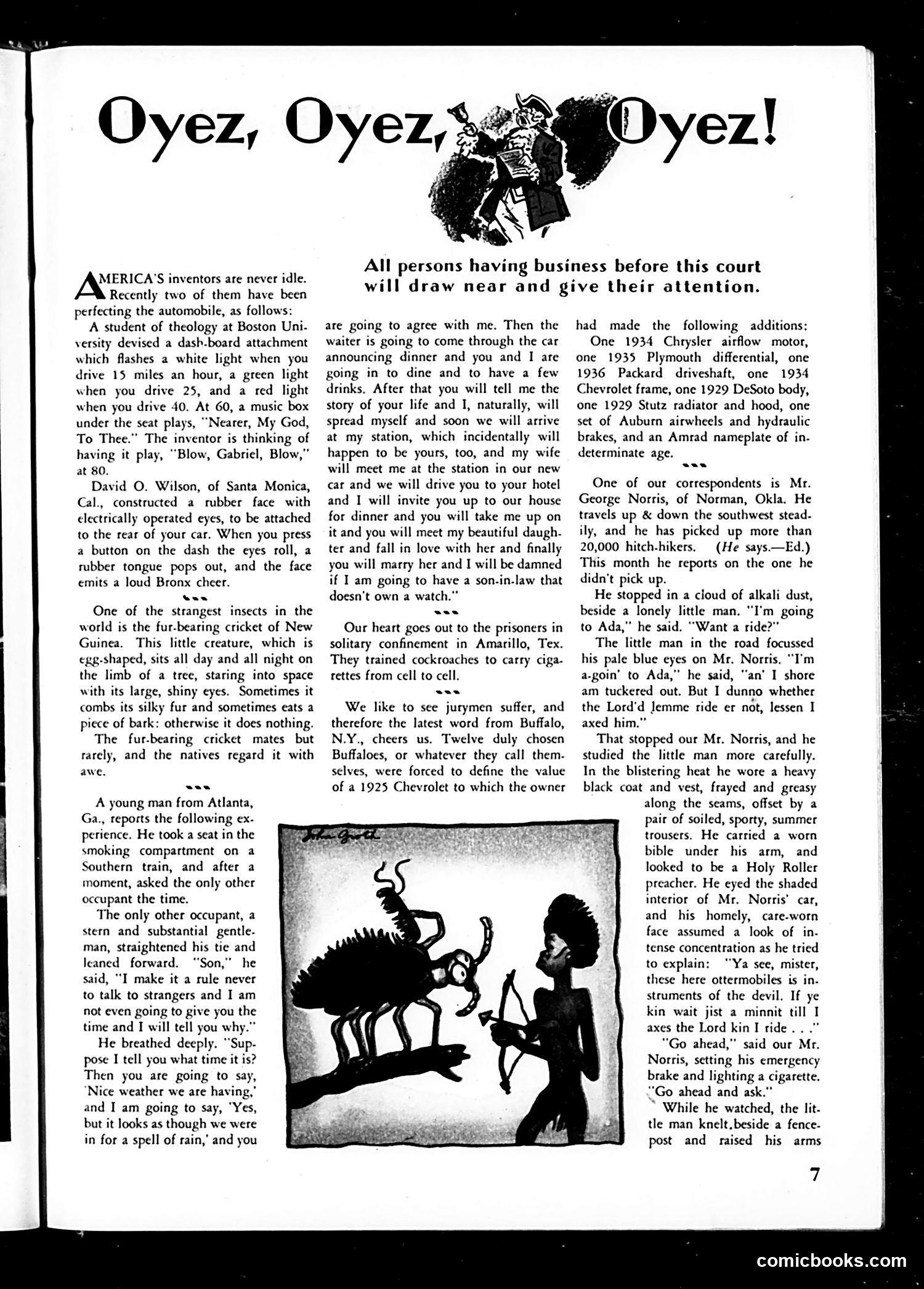
Judge Magazine Satire Analysis This page from Judge magazine (a satirical publication) contains humorous short anecdotes mocking American invention, social pretension, and human nature. The main cartoon depicts a man encountering what appears to be a demonic or grotesque creature—likely illustrating one of the absurd inventor stories: David O. Wilson's rubber face device designed to attach to car rear bumpers, which makes rude gestures and sounds at other drivers. The surrounding text satirizes contemporary American excess and paranoia. Stories include: an overly cautious theology student inventing dashboard warning lights (mocking over-engineering), a train passenger's paranoid monologue about how casual conversation inevitably leads to marriage (satirizing social anxiety), and a jury tasked with valuating a Frankenstein car assembled from mismatched 1920s-30s automobile parts. The humor targets American mechanical obsession, automotive culture, social awkwardness, and the period's peculiar anxieties about casual human interaction.
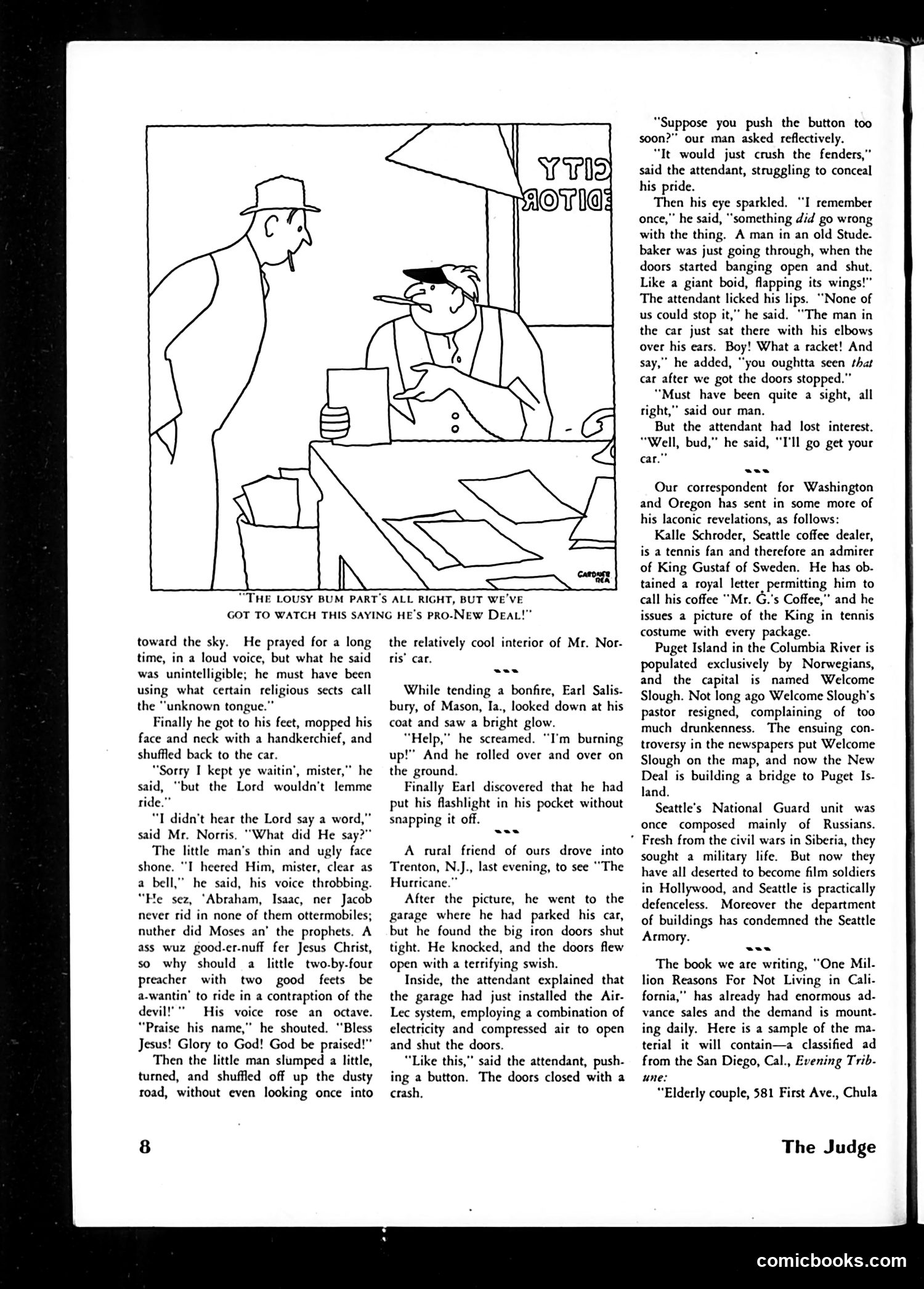
Judge Magazine Page Analysis This page contains a cartoon and several humorous anecdotes typical of Judge's satirical content. The Cartoon: Shows two men in what appears to be a garage or office setting. One man warns the other: "The lousy bum part's all right, but we've got to watch this saying he's pro-New Deal!" The joke references Hollywood's political content—likely about casting or script approval. The concern is that while an actor's "lousy" performance might be acceptable, his public statements supporting Franklin D. Roosevelt's New Deal program could create controversy or boycott risk. The Anecdotes below include: - A religious fundamentalist refusing automobile rides as unbiblical - A man mistaking his flashlight's glow for fire - A garage attendant describing an automated door malfunction These stories mock rural/working-class attitudes toward modern technology and religious rigidity—common Judge targets during the 1930s-40s era when this appears published.
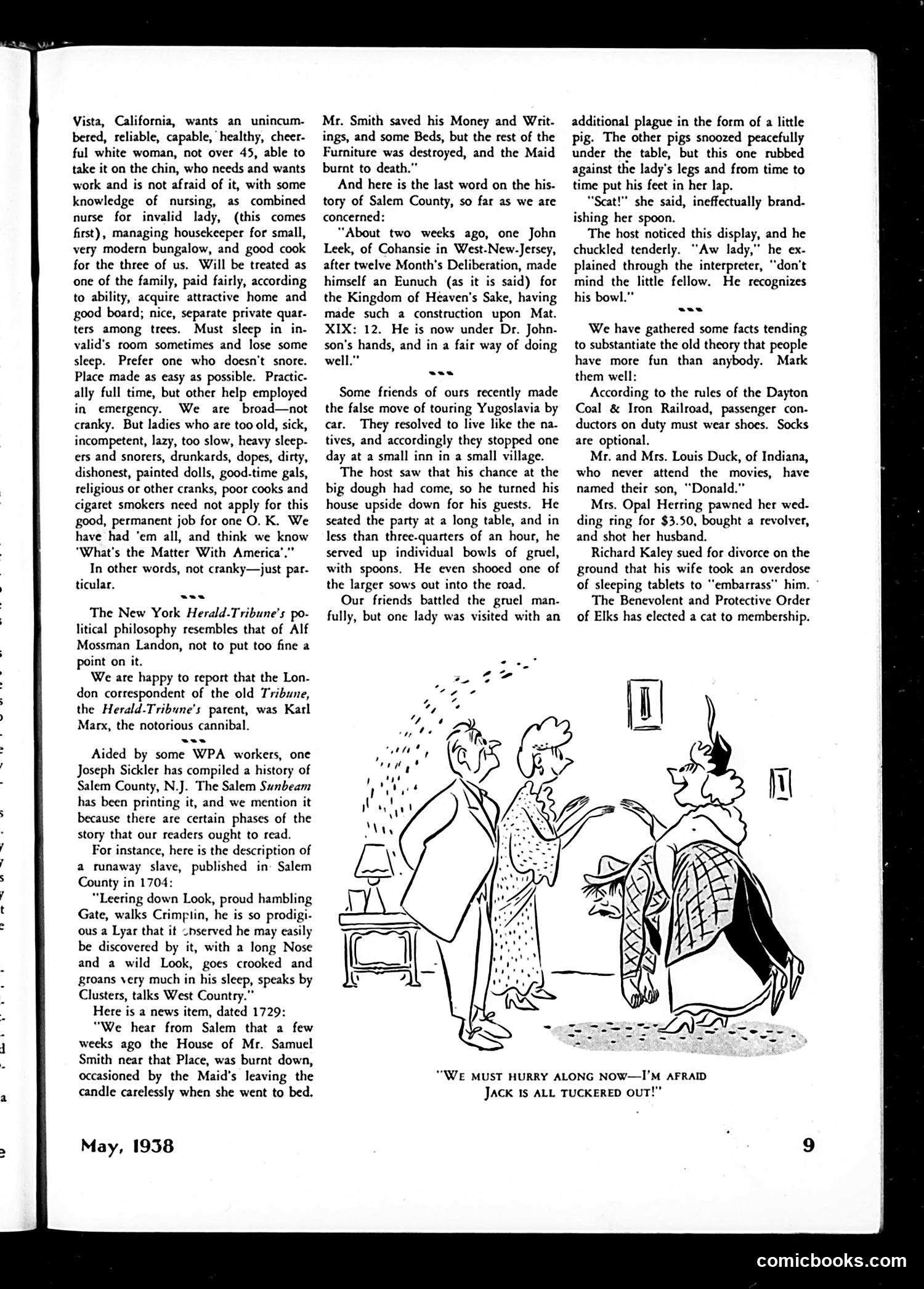
Judge Magazine Content Analysis (May 1938) This page mixes satirical commentary with humor pieces typical of 1930s Judge magazine. Main Cartoon: Shows a couple fleeing their home in panic while a pig attacks them, with the caption "We must hurry along now—I'm afraid Jack is all tuckered out!" This illustrates a humorous travel anecdote about Americans touring Yugoslavia who stayed at a rustic inn. The host, seeing wealthy guests, served meager gruel while pigs roamed freely indoors—the joke being their attempt to "go native" backfired into uncomfortable, undignified circumstances. Satirical Content: The text attacks the New York Herald-Tribune's conservative political leanings, comparing them unfavorably to Republican presidential candidate Alf Landon. It also includes historical documents from Salem County, NJ—deliberately chosen for their absurdity—to mock American history and social attitudes. Context: During the Depression era, Judge used sharp class commentary and mockery of pretension. The Yugoslavia story satirizes upper-class tourists' naïveté and false romanticism about "authentic" foreign living.
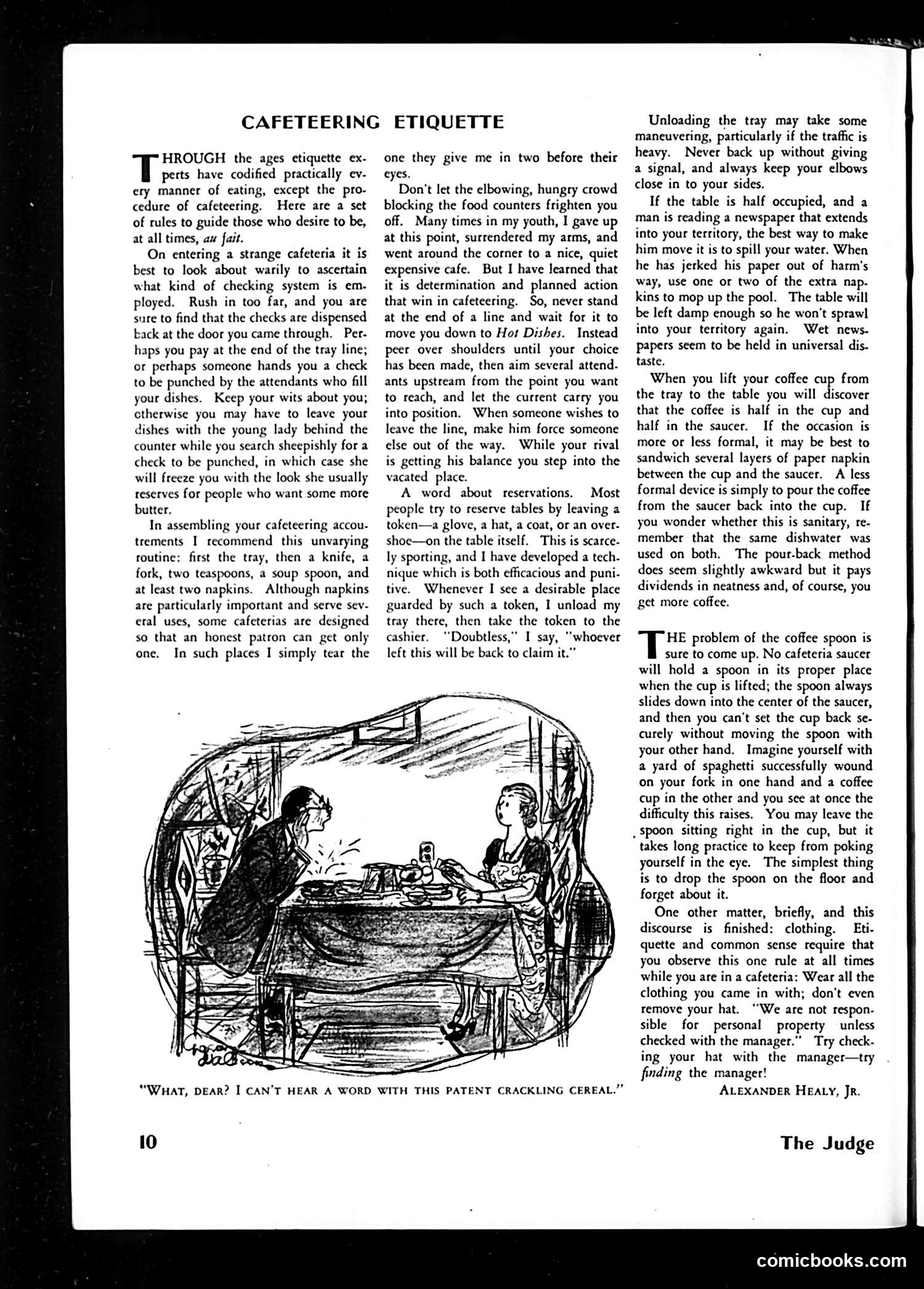
Cafeteering Etiquette This is a humorous advice piece by Alexander Healy Jr. satirizing cafeteria dining conventions. The article mockingly presents absurdly rude behavior as legitimate "etiquette"—elbowing through crowds, stealing reserved tables, spilling water on strangers' newspapers to claim seating, and pouring coffee from saucer back to cup without concern for hygiene. The accompanying cartoon depicts a couple at a cafeteria table where loud cereal noise prevents conversation, illustrating one of the dining annoyances discussed. The satire targets the emerging American cafeteria culture of the early 20th century, where self-service dining created novel social conflicts. By presenting aggressive, inconsiderate tactics as refined rules, Healy critiques both cafeteria chaos and the pretensions of formal etiquette guides. The joke assumes readers recognize cafeteria dining frustrations while appreciating the absurdity of treating such rudeness as proper conduct.
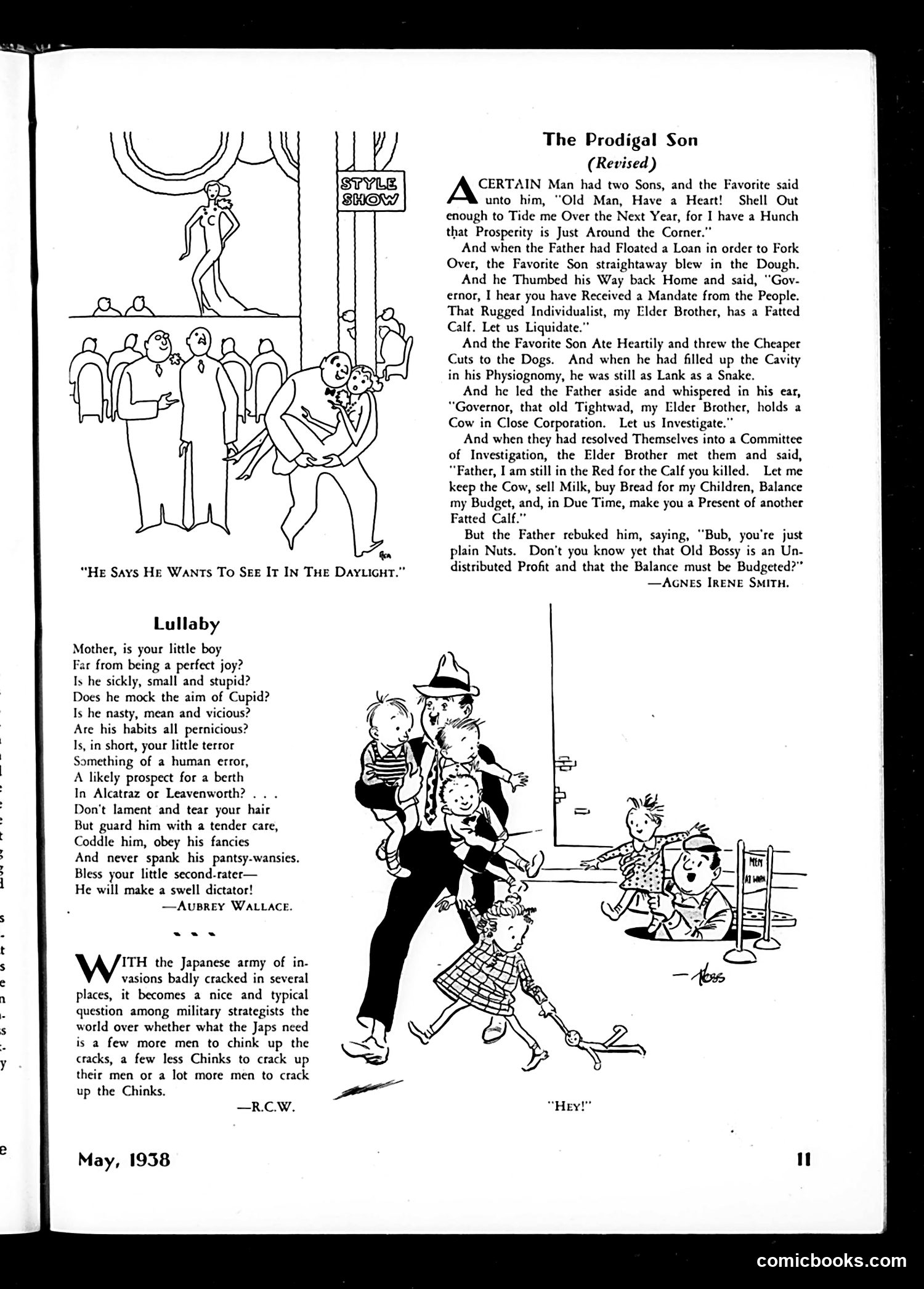
Analysis of Judge Magazine Page (May 1938) "The Prodigal Son (Revised)" satirizes Depression-era politics and wealth redistribution. The parable retelling mocks government intervention: the irresponsible "Favorite Son" squanders a loan, then manipulates his father (representing government) into investigating the responsible elder brother's modest cow. The satire targets bureaucratic committees that punish productive citizens while rewarding spendthrifts through "investigations" and regulation. The phrase "Undistributed Profit" references New Deal taxation—the joke is that government prioritizes confiscating private wealth over sound fiscal management. The "Lullaby" by Aubrey Wallace darkly jokes that raising a difficult, morally deficient child produces future dictators. In 1938, this satirizes authoritarian regimes (likely Nazi Germany and Imperial Japan, given the military reference below). The military cartoon by R.C.W. puns on "Chinks" (both the term for cracks and a slur for Chinese people), crudely joking about Japanese military strategy against China during their ongoing invasion.
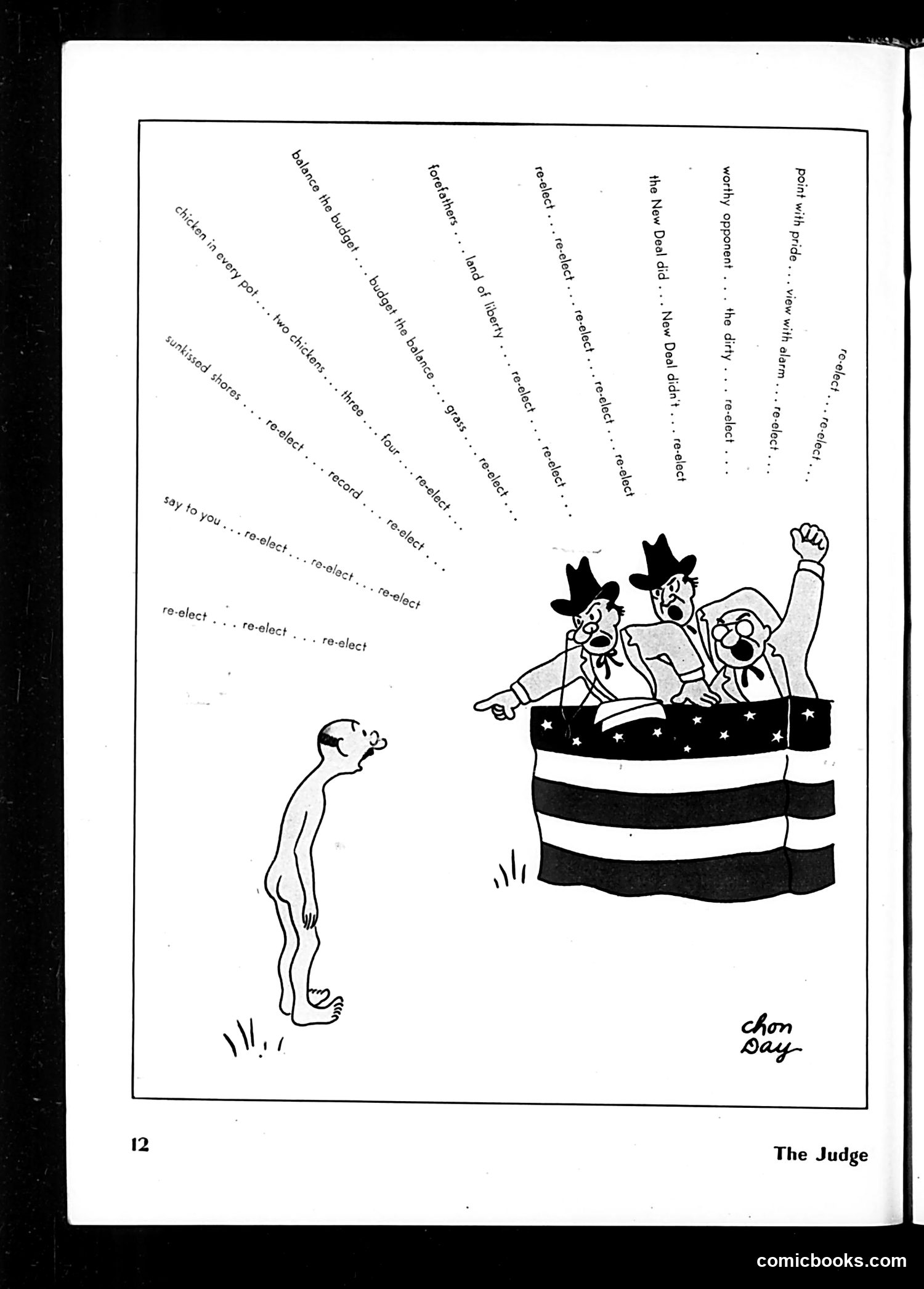
Political Cartoon Analysis This Chon Day cartoon satirizes electoral campaigns and political rhetoric. A figure on the left stretches upward, straining to reach a platform bearing three politicians celebrating atop a pedestal decorated with stars and stripes. The cascading text above lists repetitive campaign phrases: "re-elect," "re-elect," alternating with "worthy opponent," "view with alarm," and references to "the New Deal." The satire targets hollow campaign messaging—the endless repetition of slogans and vague appeals ("view with alarm," "point with pride") that characterize American political campaigns. The struggling figure below represents the common voter, literally unable to reach the elevated politicians who dominate public discourse through empty rhetoric rather than substantive policy discussion. This appears to criticize the superficiality of mid-20th century American electoral politics.
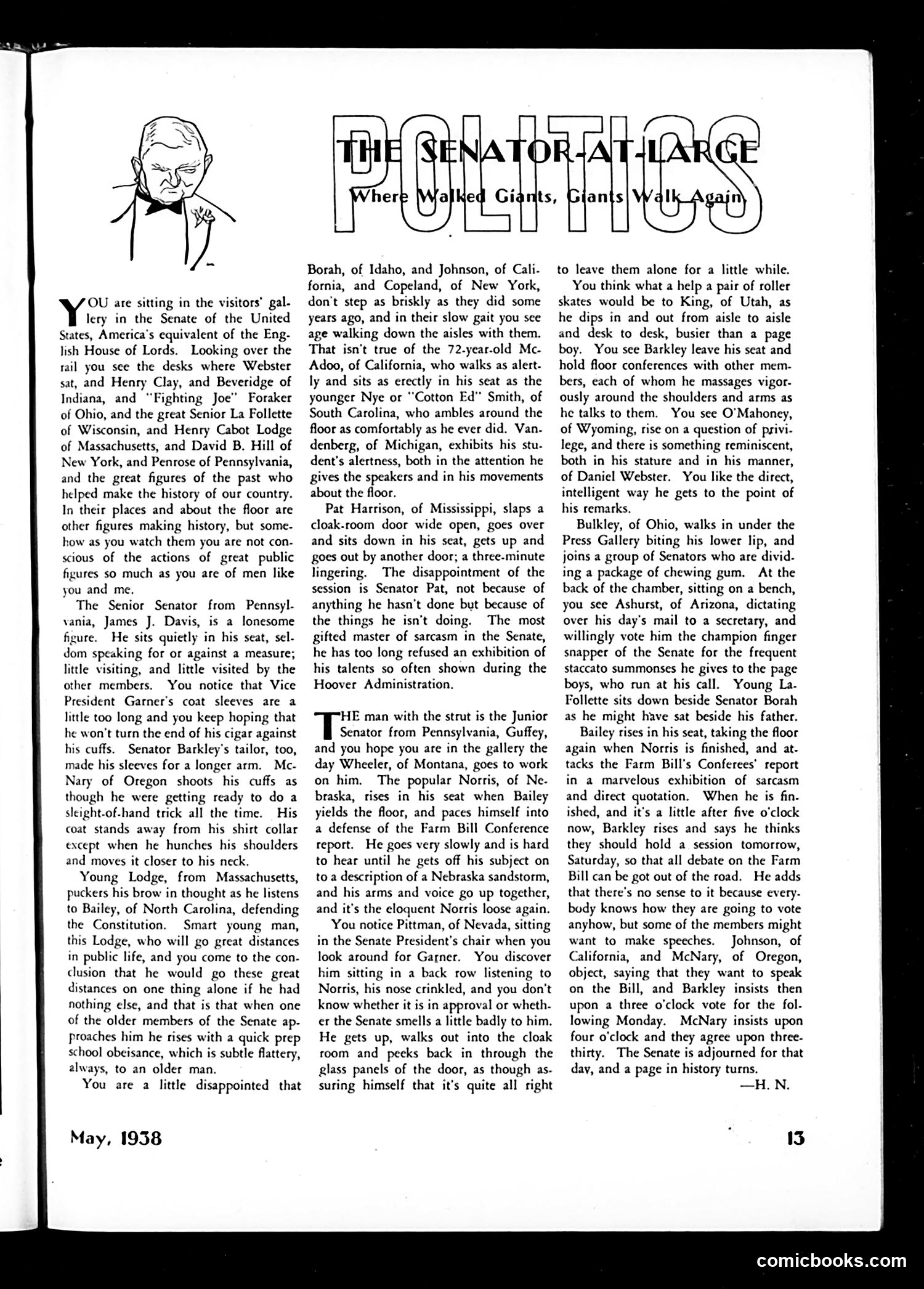
"The Senator-at-Large" — May 1938 This article offers observational humor about U.S. Senate members, describing their physical mannerisms and personalities rather than their legislative accomplishments. The author sketches senators including Borah (Idaho), Johnson (California), McAdoo (California), Harrison (Mississippi), and Guffey (Pennsylvania), noting details like their gait, posture, and behavior on the Senate floor. The satire's point: these aging or mediocre figures occupy seats once held by legendary statesmen (Webster, Clay, La Follette, Lodge). The contrast suggests the Senate has declined—contemporary members are memorable mainly for trivial habits (sleeve length, walking speed, fidgeting) rather than oratorical brilliance or legislative impact. Vice President Garner and others are described with gentle mockery about their appearance and deportment. The overall message critiques 1938 Senate mediocrity through physical comedy rather than policy debate.
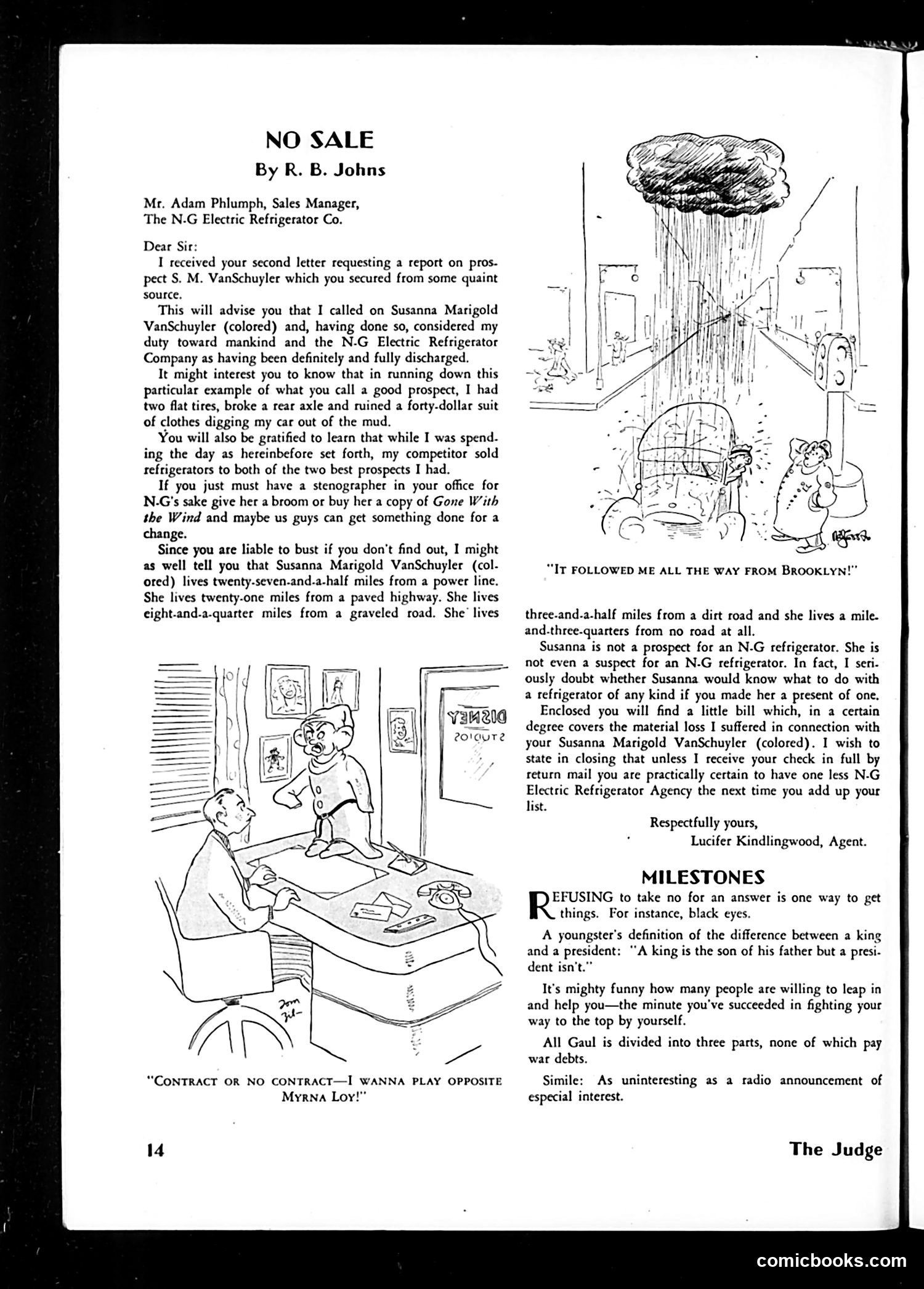
"No Sale" by R.B. Johns This satirical piece mocks poor sales management through an agent's complaint letter. A refrigerator company sales manager assigns the agent to pursue "Susanna Marigold VanSchuyler (colored)"—a rural Black woman living miles from any paved road, electricity, or realistic prospect of needing an appliance. The humor targets management incompetence: the agent wastes a full day (two flat tires, broken axle, ruined suit) pursuing an impossible sale while competitors capture better leads. The agent's final jab—that he might quit unless compensated—underscores the absurdity. The racial designation "(colored)" reflects 1930s-40s era language but serves here primarily to emphasize the absurdity of the assignment, highlighting a rural, isolated customer impossible to serve. The satire aims at white-collar sales bureaucracy, not at the prospect herself. The accompanying office cartoon jokes about actors demanding favorable contracts—unrelated social commentary typical of the magazine's format.
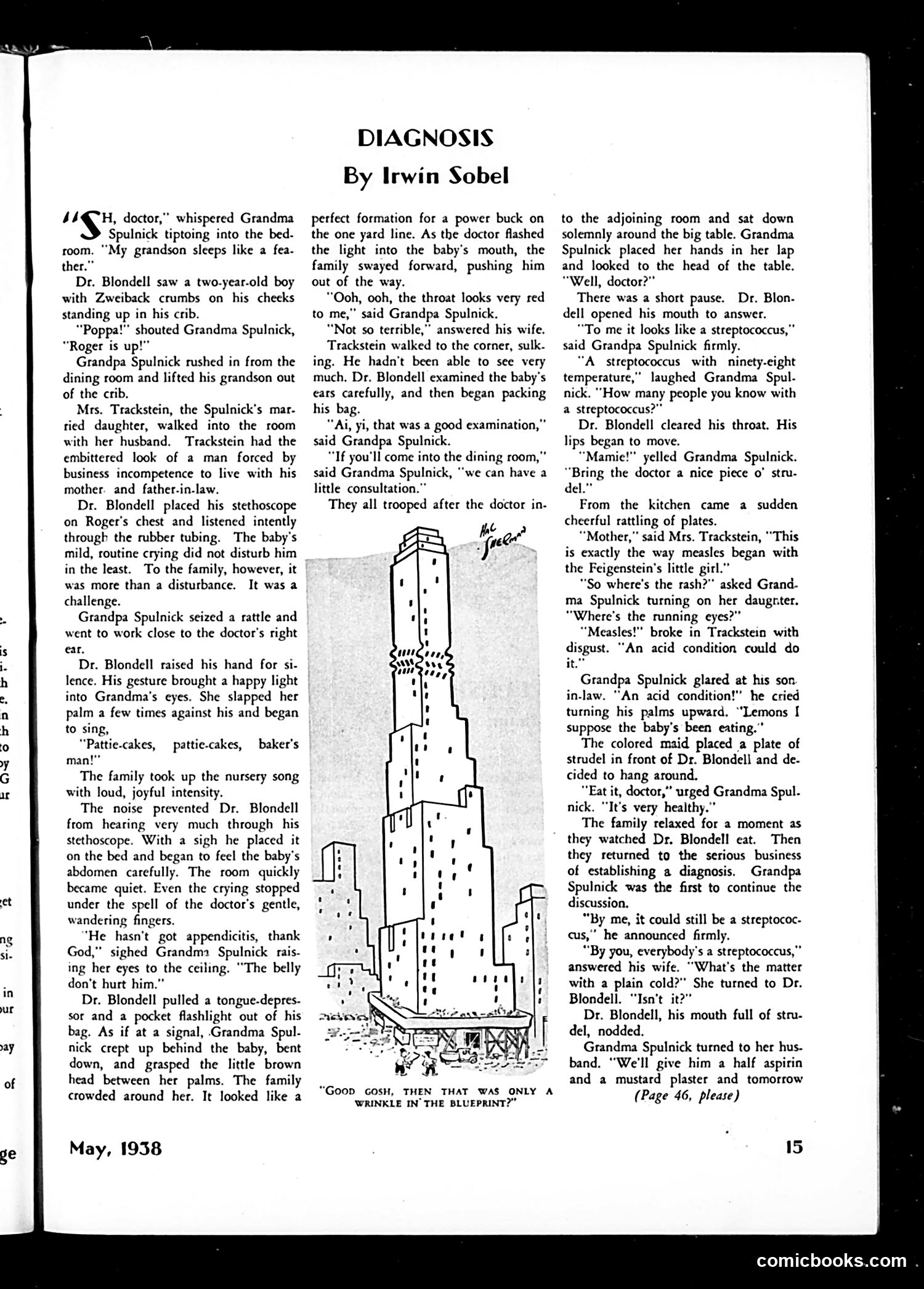
"Diagnosis" by Irwin Sobel — May 1938 This is a humorous short story satirizing Jewish immigrant family dynamics and medical consultation. When Dr. Blondell examines young Roger, the extended Spulnick family—grandparents, parents, and relatives—constantly interrupt, offer their own diagnoses (streptococcus, measles, acid condition), and physically interfere with the examination. The doctor cannot complete his work or deliver his verdict. The satire targets the clash between professional medical authority and assertive, well-meaning immigrant relatives who believe their folk experience supersedes expert knowledge. The family treats the examination as communal entertainment and consultation rather than a private doctor-patient interaction. The cartoon caption references a "wrinkle in the blueprint," suggesting plans disrupted by interference. The humor relies on recognizable ethnic stereotypes of loud, opinionated Jewish families and their skepticism of authority figures—a common trope in 1930s American humor magazines.
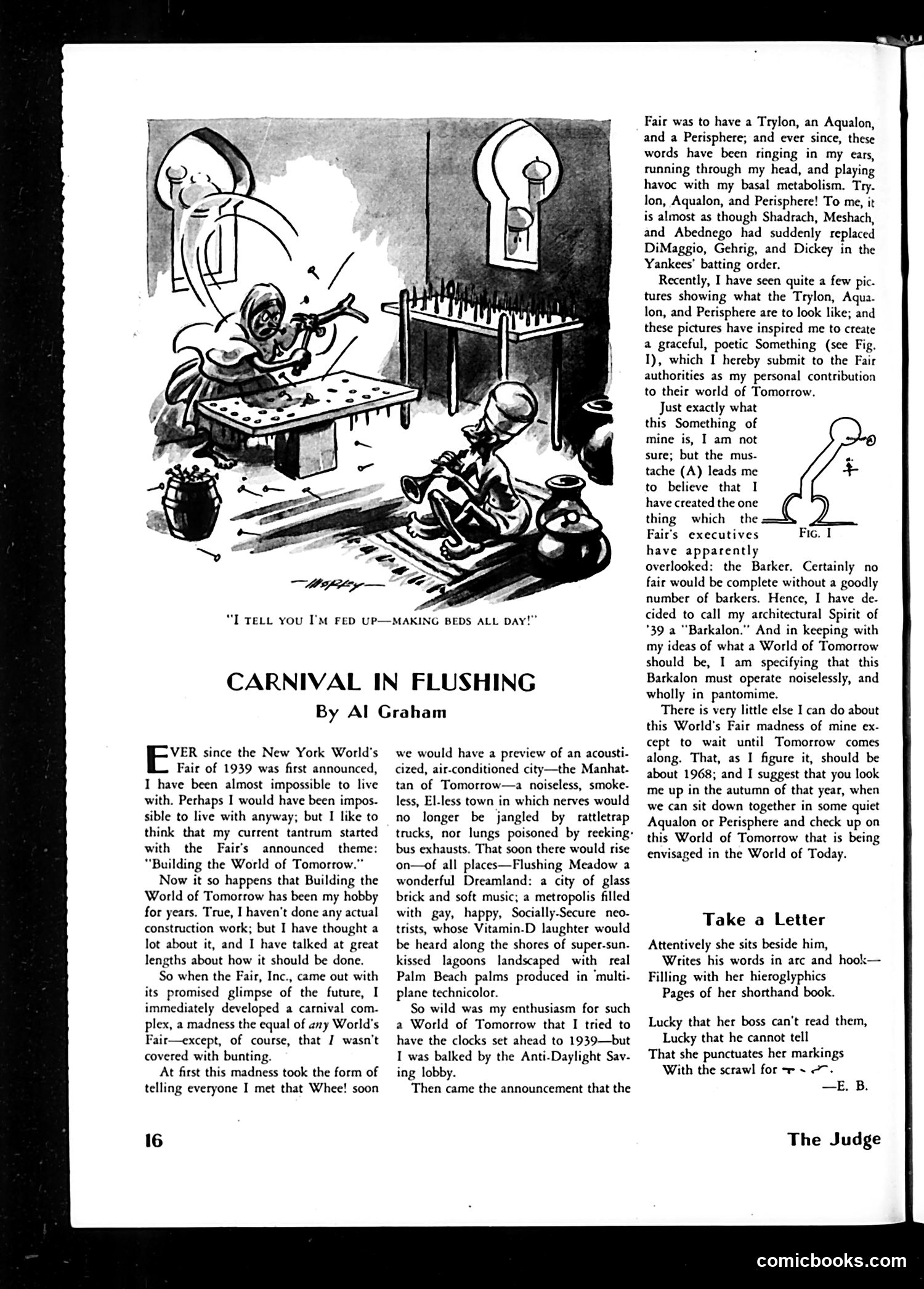
"Carnival in Flushing" - 1939 World's Fair Satire This is a humorous essay by Al Graham about the author's obsession with the 1939 New York World's Fair in Flushing, Queens. The Fair's theme was "Building the World of Tomorrow," which resonated with Graham's lifelong hobby of imagining futuristic cities. The cartoon depicts Graham's fevered imagination: he dreams of a noiseless, smoke-free Manhattan with air conditioning, soft music, and "Socially-Secure" citizens. The Fair introduced three iconic architectural elements—the Trylon, Aqualon, and Perisphere—which have haunted him obsessively (he compares their cultural weight to replacing Yankees baseball stars). Graham's humorous contribution: a "Barkalon"—a carnival barker operating silently in pantomime. The satire gently mocks both his own excessive enthusiasm and the utopian promises of the Fair itself, suggesting the gap between futuristic dreams and reality. The joke concludes with him proposing they meet in 1968 to see if the vision actually materialized. The sidebar poem about stenography is unrelated advertising content.
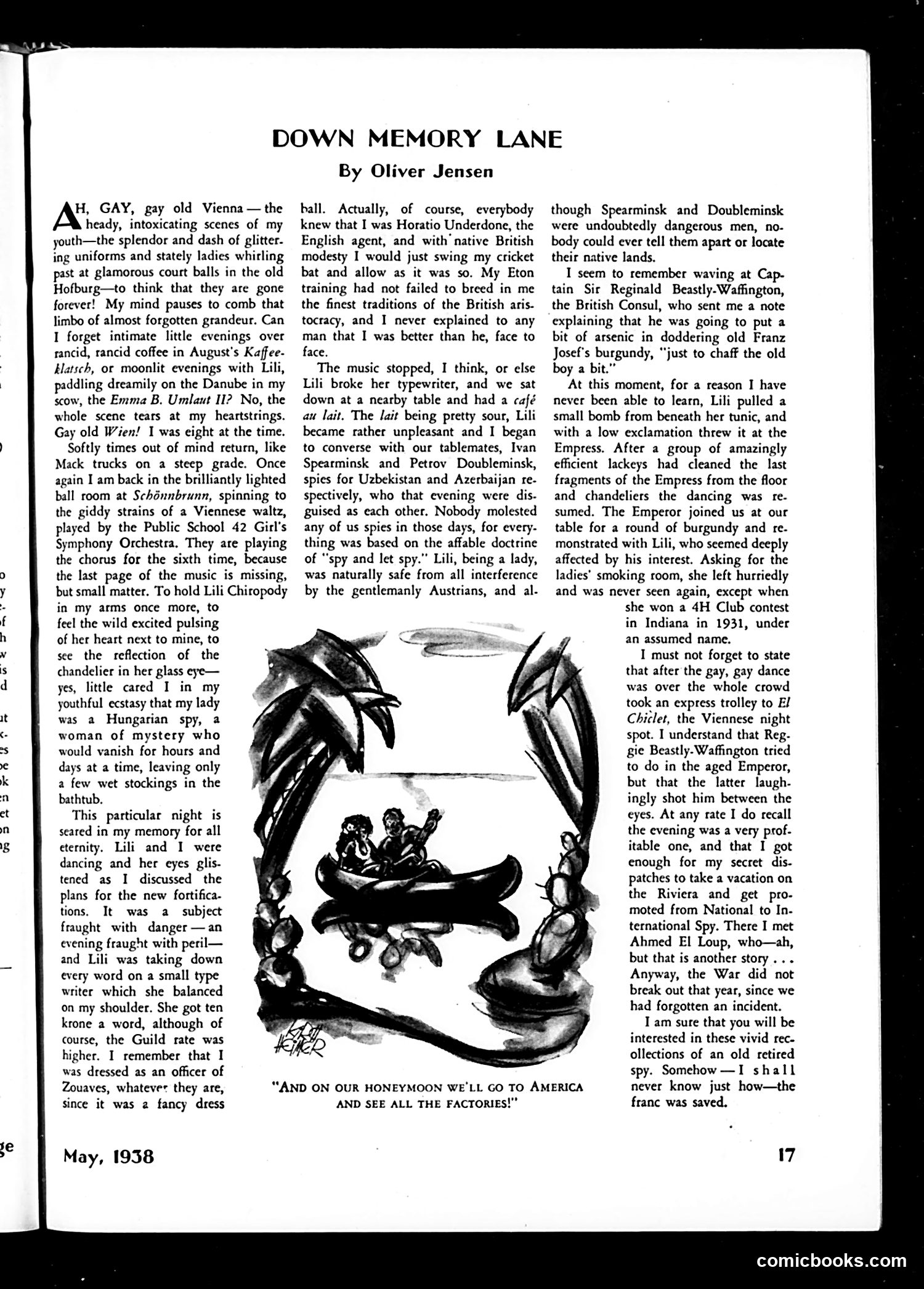
"Down Memory Lane" by Oliver Jensen (May 1938) This is a humorous spy-themed story satirizing pre-WWII Vienna. The unnamed narrator presents himself as a glamorous Austro-Hungarian court figure who was actually a British secret agent ("Horatio Underdone"). The satire mocks the absurdity of espionage in this era: multiple foreign spies (Russian, Uzbek, Azerbaijani) openly socialize together under the genteel "spy and let spy" doctrine. The narrator's romantic interest, Lili, is revealed as a Hungarian spy taking stenographic notes on military fortifications during their dance—paid per word by her handlers. The cartoon illustration depicts characters in a romantic gondola scene, matching the story's nostalgic Viennese setting. The final joke—Lili casually throwing a bomb at the Empress—demonstrates the story's absurdist humor about pre-war European intrigue and the chaotic dangers lurking beneath genteel social surfaces. Published in 1938, this reflects American satirical commentary on European political instability as fascism rose.
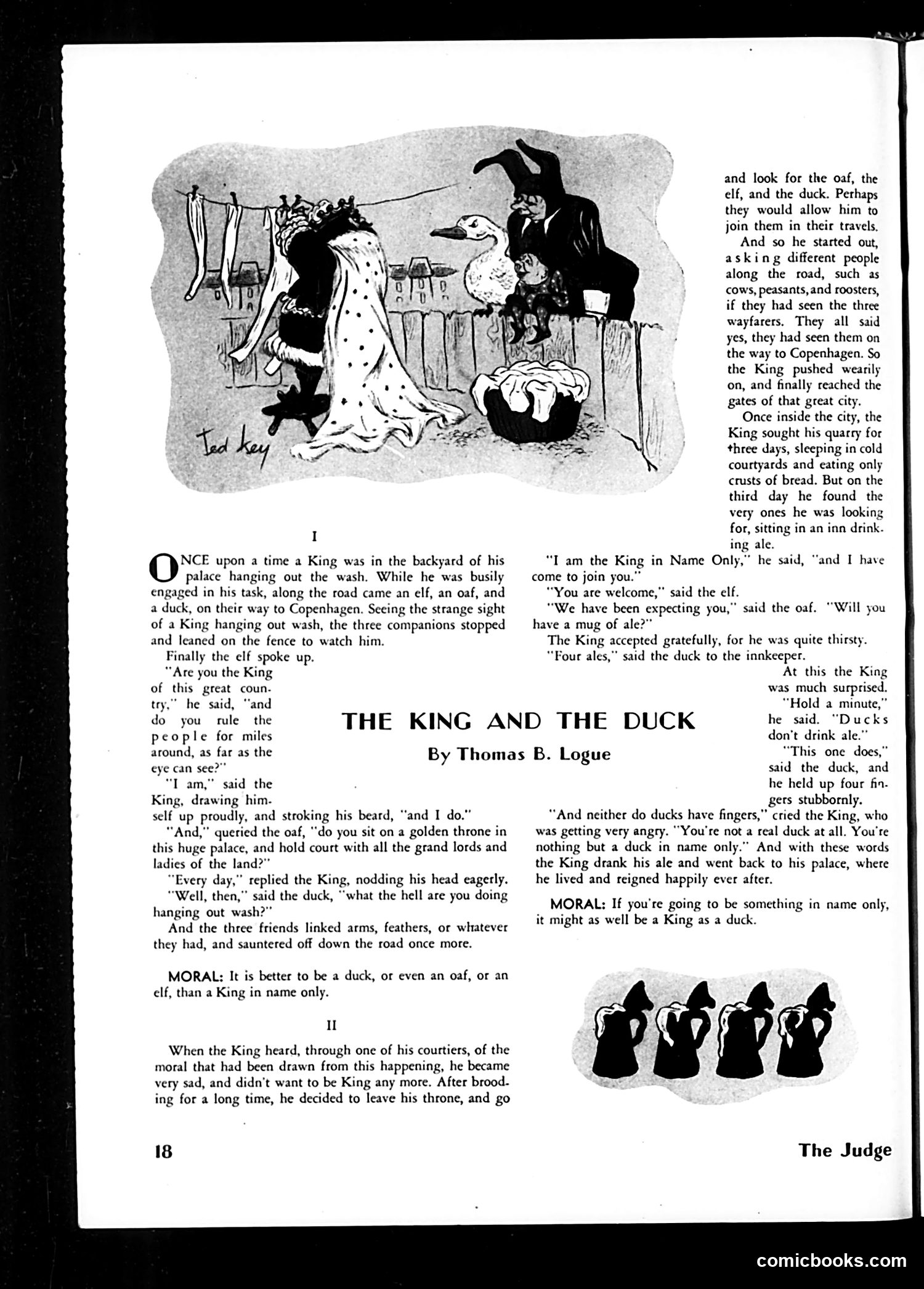
"The King and the Duck" — Political Satire Explained This Thomas B. Logue story satirizes hollow authority and performative power. A King hangs laundry—a common person's task—yet claims absolute rule. When a duck points out this contradiction (a King in "name only" doing peasant work), the King abandons his throne, chasing the duck to Copenhagen. The twist: the duck also turns out to be a "duck in name only" (it drinks ale and has fingers). The King realizes both are equally fraudulent, so he returns home. The satire targets leaders whose titles don't match their actual function or integrity—ruling in "name only" while abdicating real responsibility. The moral suggests that if one must be a mere figurehead, one might as well have the prestige of kingship. This likely critiques ineffectual rulers or political figures of the era whose authority was questioned or compromised.
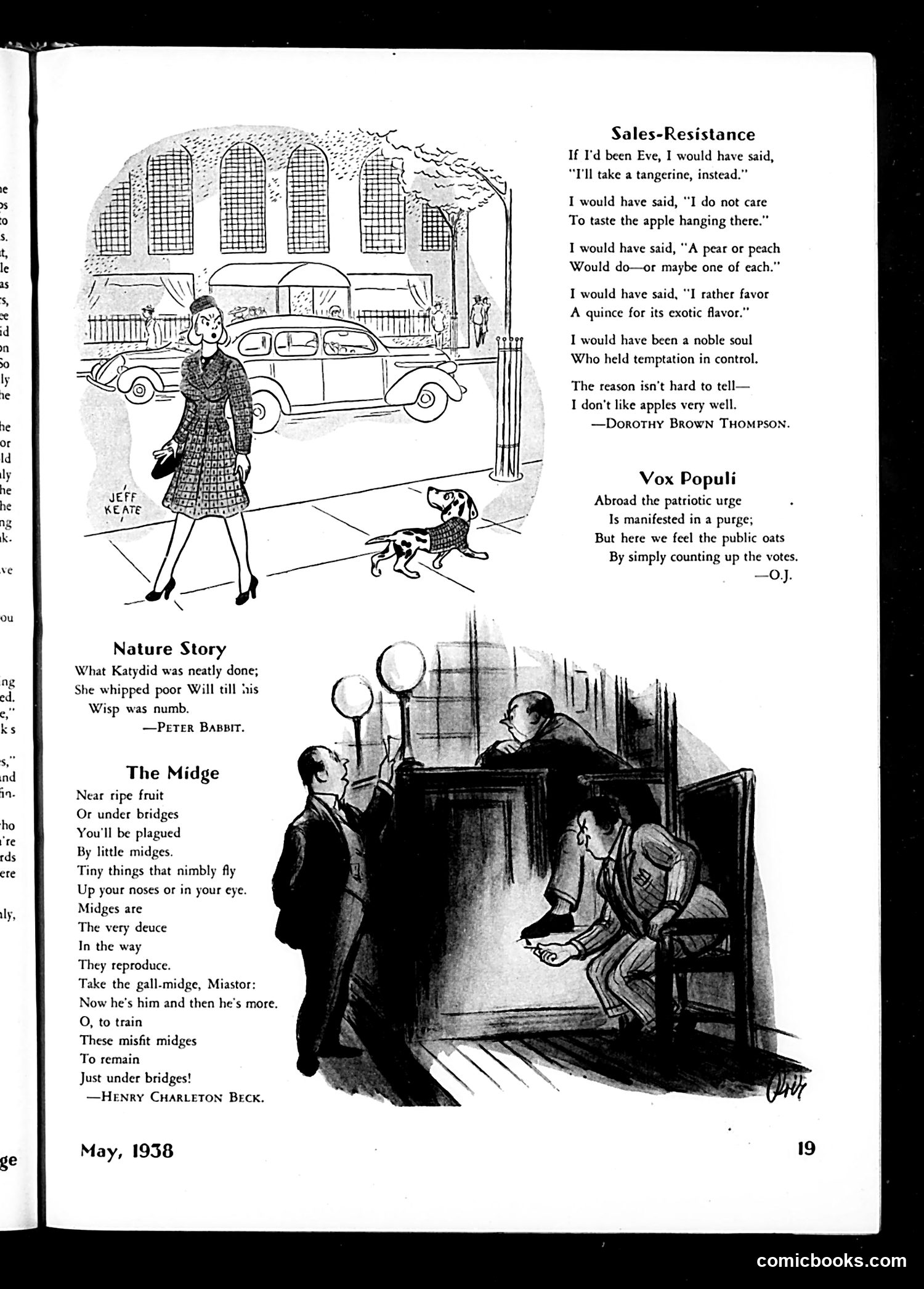
Judge Magazine, May 1938: Page Analysis This page collects four light satirical poems with illustrations, typical of Judge's humor format. "Sales-Resistance" (top): Dorothy Brown Thompson's poem humorously reimagines the Biblical Fall of Man, with Eve resisting temptation through mere *dislike* rather than willpower. The cartoon shows a woman with a small dog on a 1930s street—a visual non-sequitur illustrating that even ordinary people possess resistance to temptation, though for mundane reasons. "Vox Populi": A brief political quip comparing European purges to American democracy's "counting votes"—a topical reference to rising fascism abroad (1938) versus American electoral processes. "Nature Story" and "The Midge": Whimsical nature observations with light verse, unrelated to politics or current events. The page represents Judge's typical mix of social commentary, literary humor, and gentle satire aimed at educated readers—prioritizing wit over hard-hitting political critique.
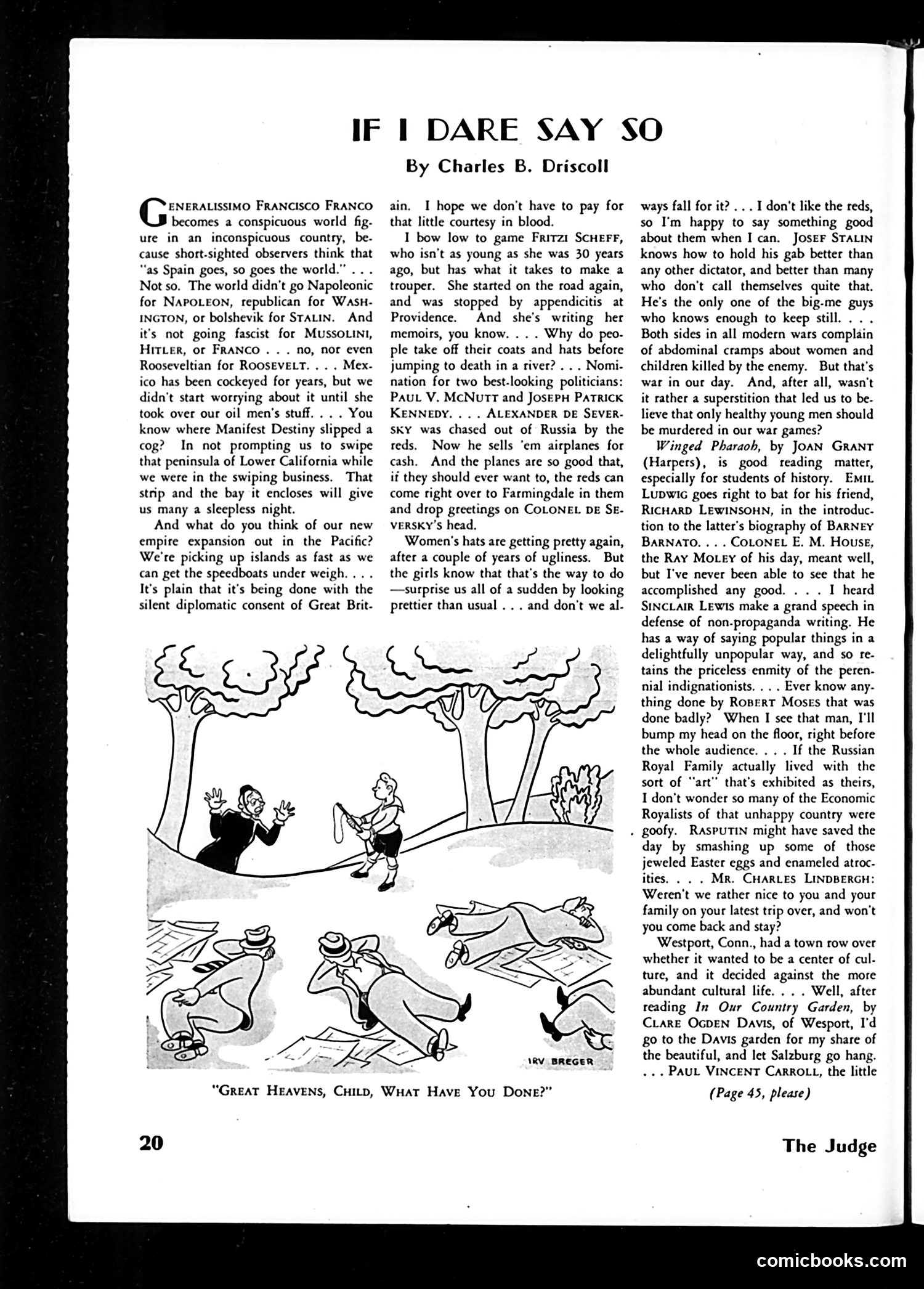
"If I Dare Say So" - Judge Magazine Commentary This is Charles B. Driscoll's opinion column featuring satirical observations on 1930s-40s politics and culture. The cartoon by Irv Breeger illustrates absurdist humor about children's mischief. Key references: - Franco, Stalin, Hitler, Mussolini: Driscoll argues that fascist leaders' domestic power won't automatically transform world politics, countering contemporary American anxiety about global fascism. - Roosevelt: Mentioned as a political figure whose ideology didn't reshape American governance. - Fritzi Scheff: A veteran stage performer resuming touring despite health issues—praised as genuinely tough. - Alexander de Seversky: A Russian émigré now selling aircraft to the Soviet Union (the "reds"), creating ironic commentary on Cold War business dealings. - Sinclair Lewis, Robert Moses, Colonel House: Brief, gossipy assessments of contemporary public figures' competence and integrity. The tone is irreverent, mixing geopolitical observation with Hollywood gossip—typical Judge satirical style mixing serious commentary with trivial cultural items.
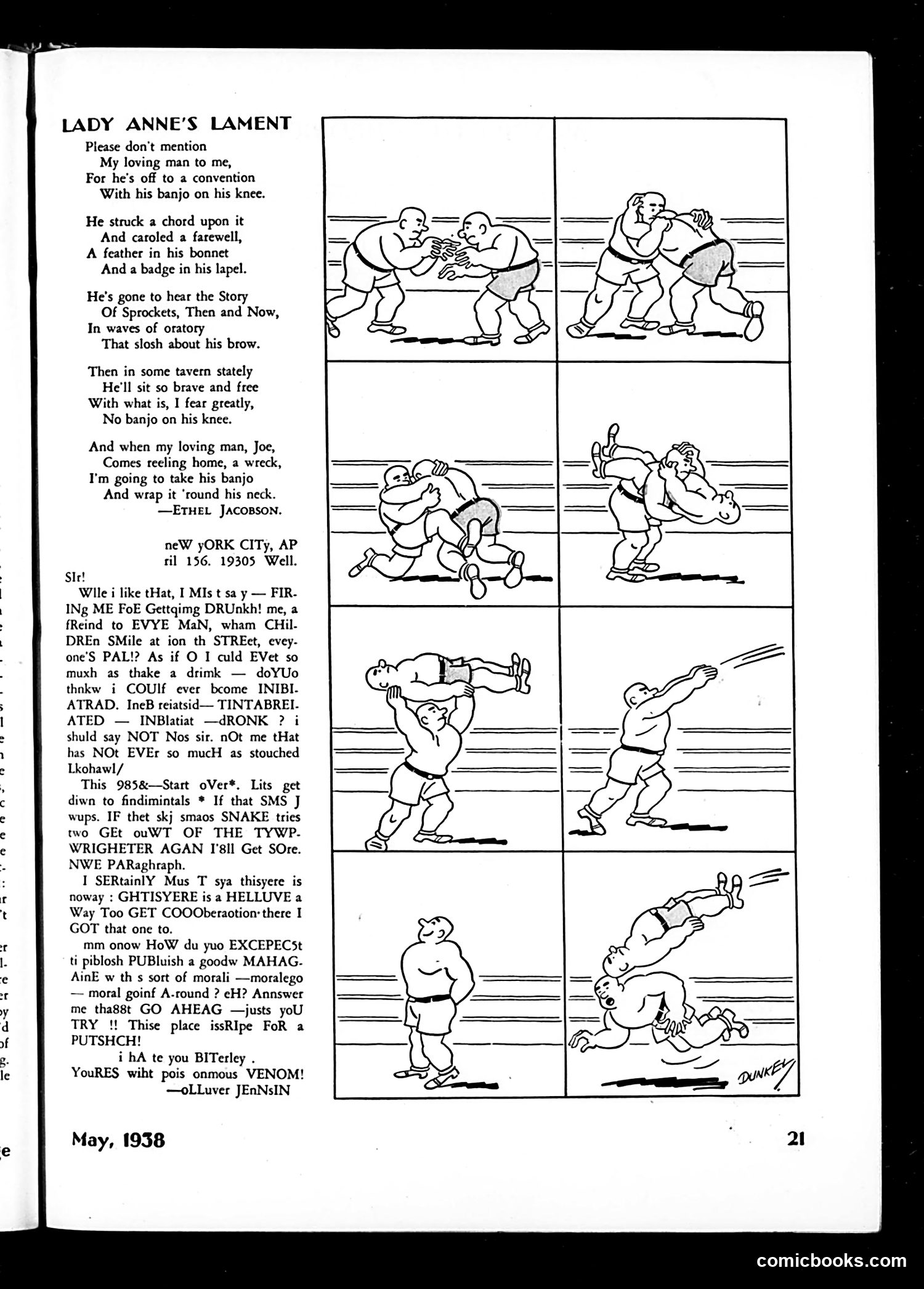
"Lady Anne's Lament" - Judge, May 1938 This page combines a humorous poem with an eight-panel comic strip about marital discord. Lady Anne's Lament depicts a wife's complaint that her husband Joe is attending a convention (likely a banjo players' convention, given repeated references to his instrument) instead of staying home. The satire targets male social habits: the poem suggests Joe will abandon his banjo in taverns while drinking with other men, returning home drunk. The comic panels illustrate the poem through slapstick wrestling/fighting scenes, showing physical comedy typical of 1930s humor. The joke centers on traditional gender roles and male irresponsibility—husbands prioritizing conventions and drinking over domestic life, with wives left to manage the consequences. The garbled "Sir!" letter below appears to be editorial commentary, possibly mocking readers' complaints, though its OCR corruption makes precise meaning unclear.
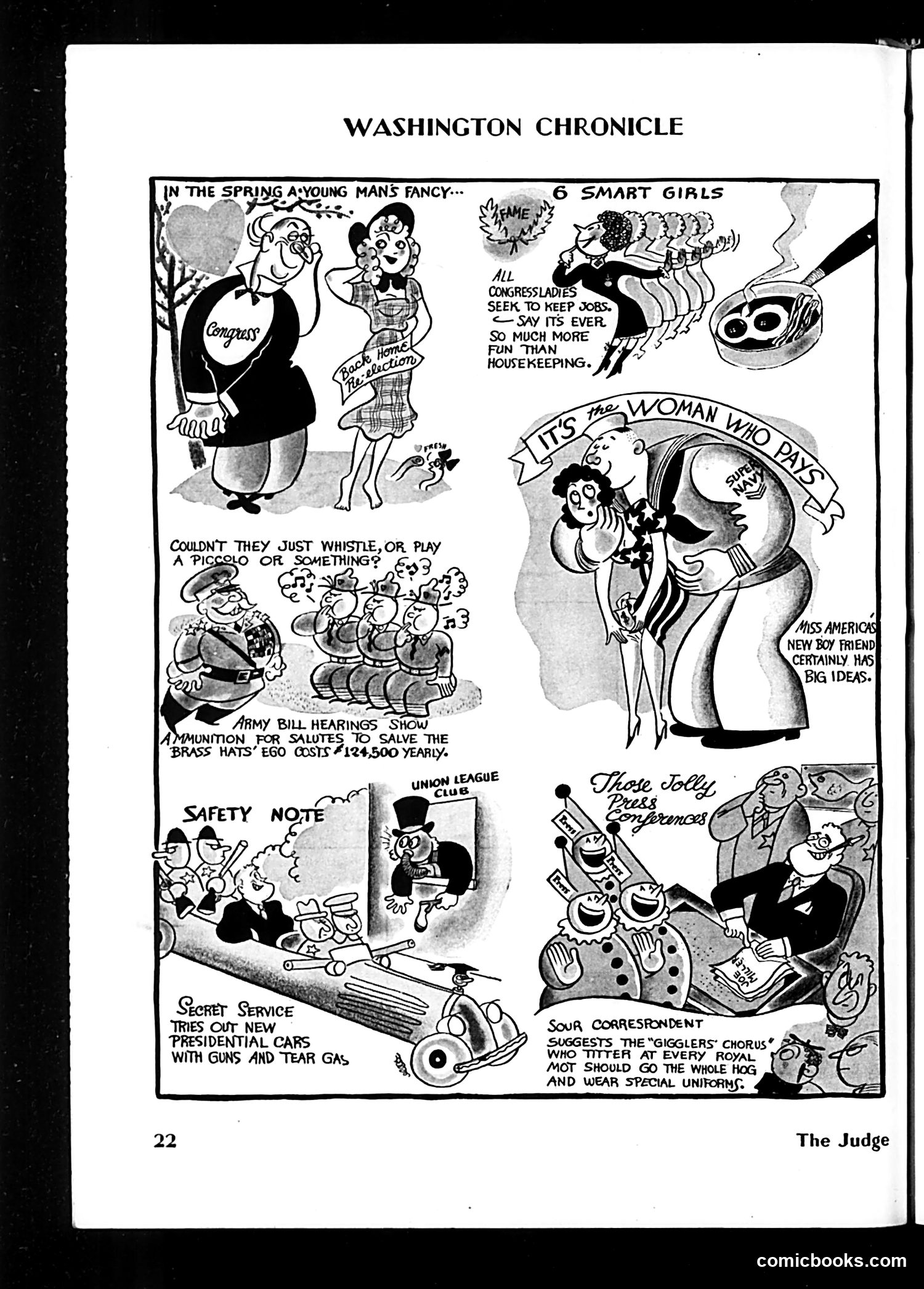
Washington Chronicle Analysis This page satirizes various aspects of American government and society, likely from the 1920s-30s era. Top section: "In the Spring a Young Man's Fancy" mocks congresswomen seeking jobs, suggesting they prefer careers to housekeeping—a dig at women's political ambitions. "6 Smart Girls": References female congressional candidates/representatives, satirizing their aspirations. "The Woman Who Pays": Depicts "Miss America" as burdened by taxpayer costs, suggesting women voters bear financial responsibility for government excess. Safety Note: Ridicules military spending—$124,500 yearly for ceremonial gun salutes to boost officers' egos, questioning whether cheaper entertainment (whistling, piccolo) could replace wasteful ammunition. Secret Service section: Mocks newly-equipped presidential cars with weapons and tear gas, suggesting excessive security apparatus. Bottom right: A correspondent jokes congressmen should wear special uniforms while "giggling" at royal banquets, sardonically critiquing political theater. Overall, the page attacks government extravagance, women in politics, and militarism.
"The Judge on the Bench" — May 1938 This editorial column attacks Hitler and Nazi Germany with unusual directness for American mainstream media at this early date. The piece compares Hitler to criminal gangsters (Jesse James, Dillinger) and argues he should face international trial like the Kaiser after WWI. The author warns that Hitler's persecution of Jews today could expand tomorrow to other religions and nationalities. Notably, the column calls for Jewish leadership and armed resistance ("A great Jew must lead the Jews"), while also urging other religious and ethnic groups—specifically mentioning Irish Catholics—not to assume they're safe from fascist ideology. The piece condemns nations and individuals trading with Hitler as morally equivalent to aiding criminals. The overall message: Hitler represents a spreading threat requiring unified, aggressive opposition before it's too late.
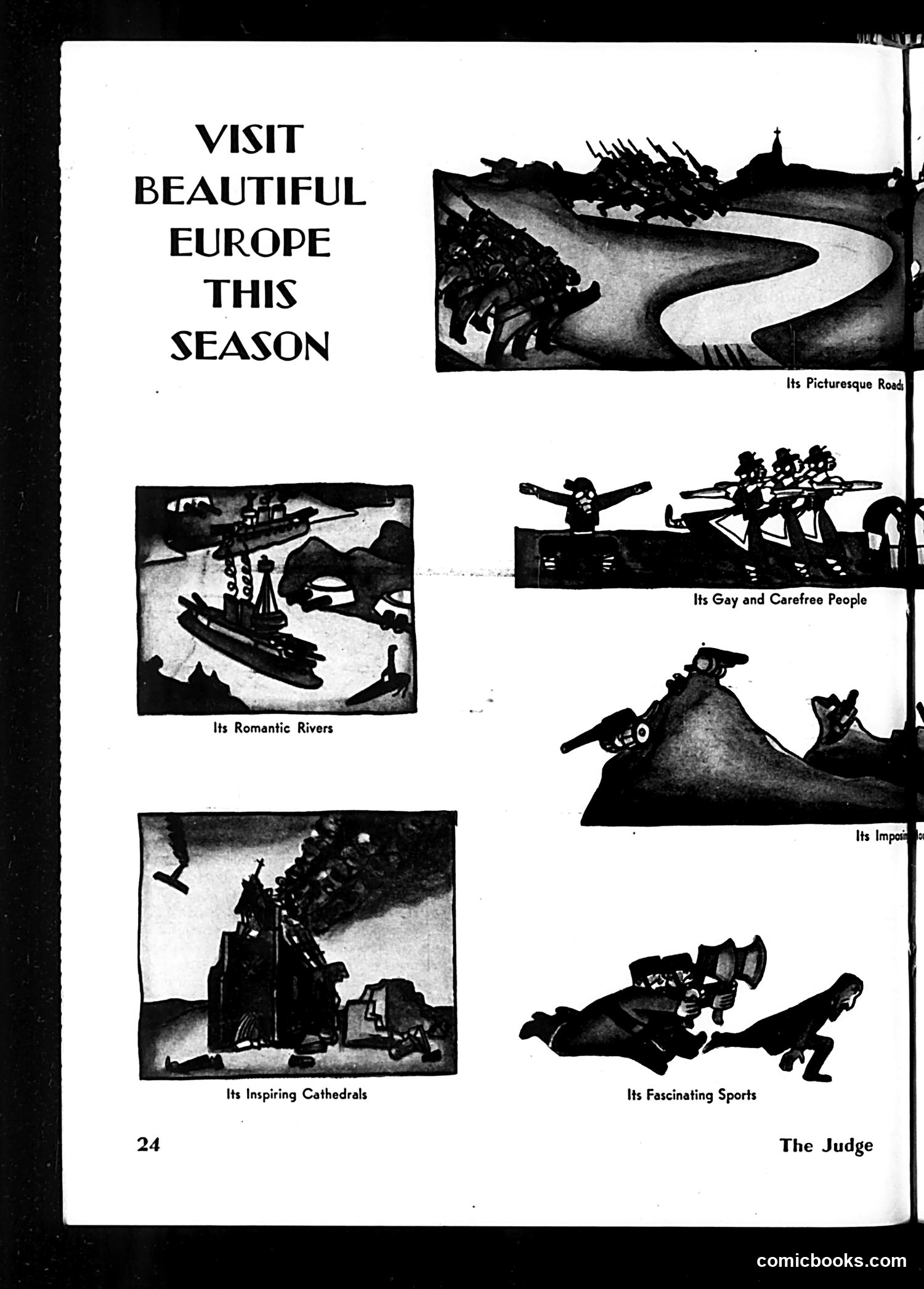
Judge Magazine Travel Advertisement This appears to be a travel advertisement encouraging Americans to visit Europe, structured as a satirical "tourism guide." The page uses silhouette illustrations to showcase European attractions: - "Its Picturesque Roads" (winding landscape) - "Its Romantic Rivers" (boating scene) - "Its Inspiring Cathedrals" (religious architecture) - "Its Gay and Carefree People" (airplane passengers) - "Its Imposing [monuments]" (military aircraft) - "Its Fascinating Sports" (figures in combat/conflict poses) The satire appears to mock European tourism by juxtaposing peaceful attractions with military imagery and combat activities. Given Judge magazine's satirical nature, this likely critiques European militarism or warns American travelers about European conflicts—possibly referencing pre-WWII tensions or actual warfare. The pairing of "carefree people" with military aircraft and combat sports undercuts the travel advertisement's cheerful tone with dark humor about European instability.
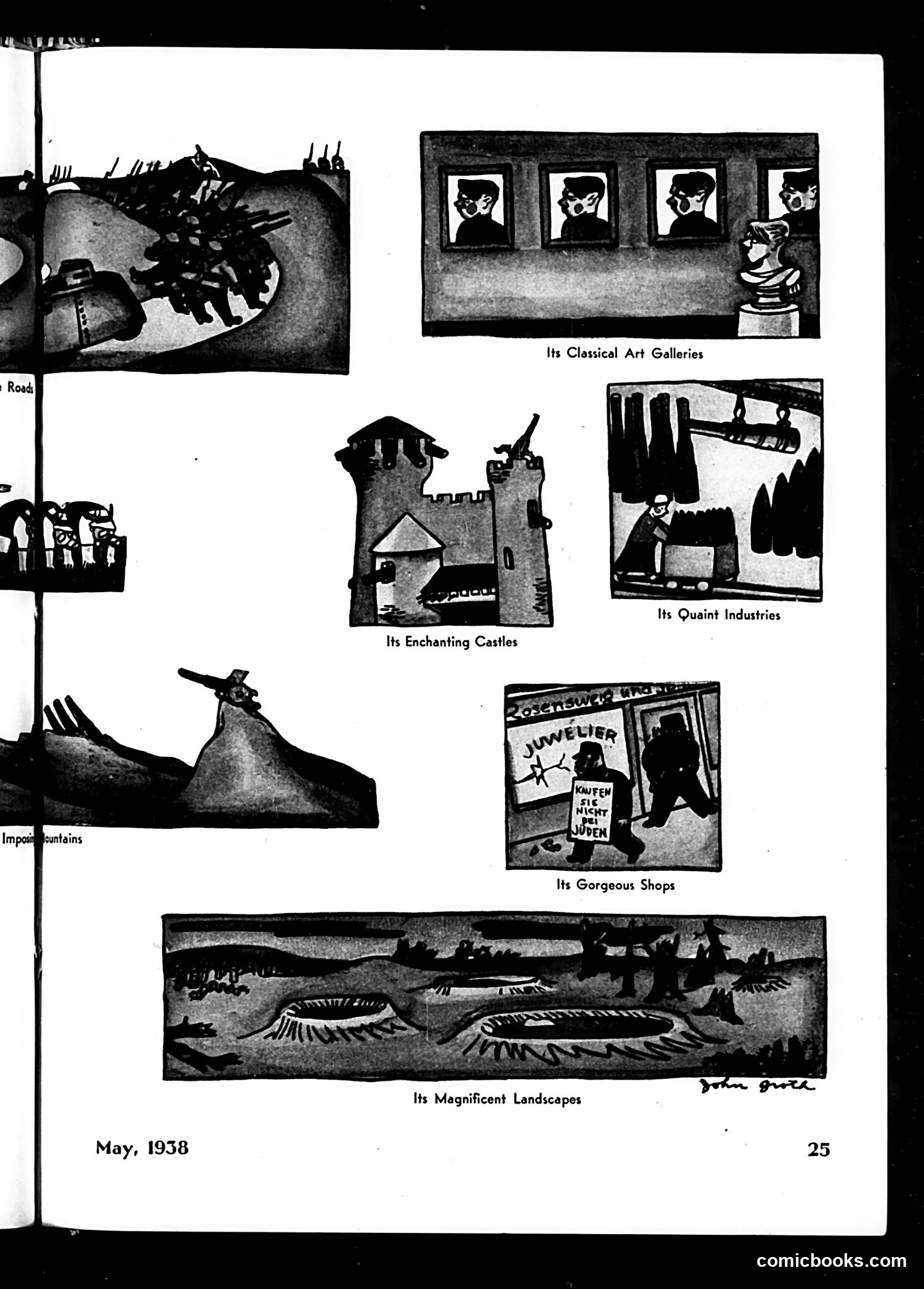
This page from Judge (May 1938) appears to be a humorous promotional series about an unnamed location's attractions. Each illustrated panel highlights a different feature with satirical labels: - "Classical Art Galleries" shows identical portraits - "Enchanting Castles" depicts a fortress - "Quaint Industries" features what appears to be industrial/manufacturing activity - "Gorgeous Shops" shows a jewelry store with a robbery in progress - "Magnificent Landscapes" presents a barren, stark terrain The satire works through exaggeration and ironic contrast—calling ugly or mundane things by grandiose names. The robbery depicted in the shops panel suggests criminal activity is so common it's treated as an ordinary tourist attraction, typical of Judge's cynical humor about urban American life in the 1930s Depression era.
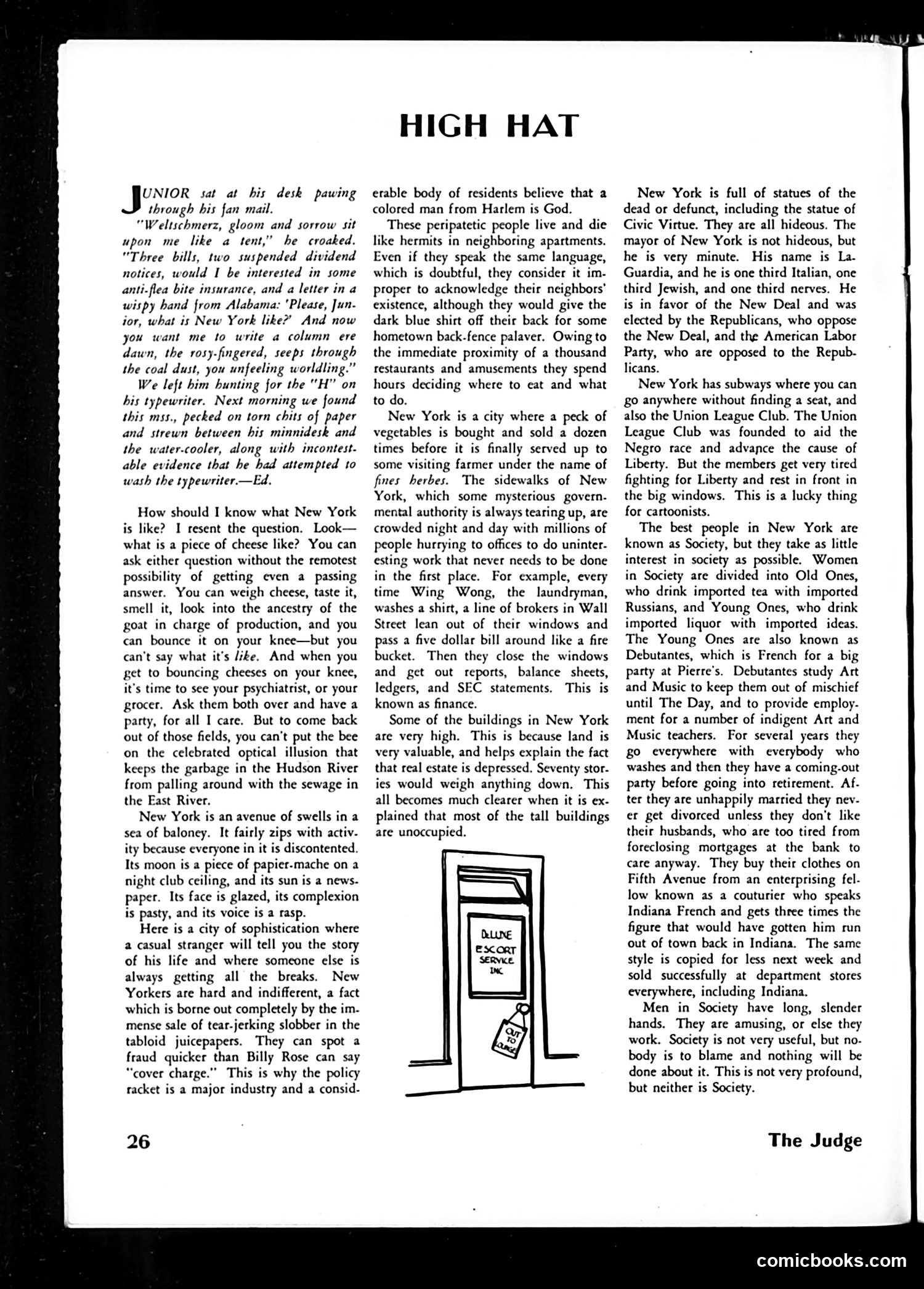
"High Hat": A Satirical Portrait of 1930s New York This piece is a humorous essay disguised as a column, where the writer—identified as "Junior"—complains about being asked to describe New York City. The accompanying cartoon shows a diner/service window, illustrating the urban setting being discussed. The satire targets New York's contradictions: a city of "swells in a sea of baloney" where everyone is simultaneously sophisticated yet discontented. The writer mocks: - Urban isolation: New Yorkers ignore neighbors despite living in proximity - Economic absurdity: unnecessary financial bureaucracy (brokers creating fake busywork) - Class pretense: people claiming sophistication while obsessing over tabloid gossip - Systemic corruption: references to the "policy racket" (illegal gambling operations) as mainstream industry - Racial attitudes: a problematic aside about Harlem residents that reveals period prejudices The humor derives from the writer's refusal to answer a simple question directly, then spending pages cataloging the city's neuroses—itself proving New York's defining characteristic: endless, neurotic self-awareness.
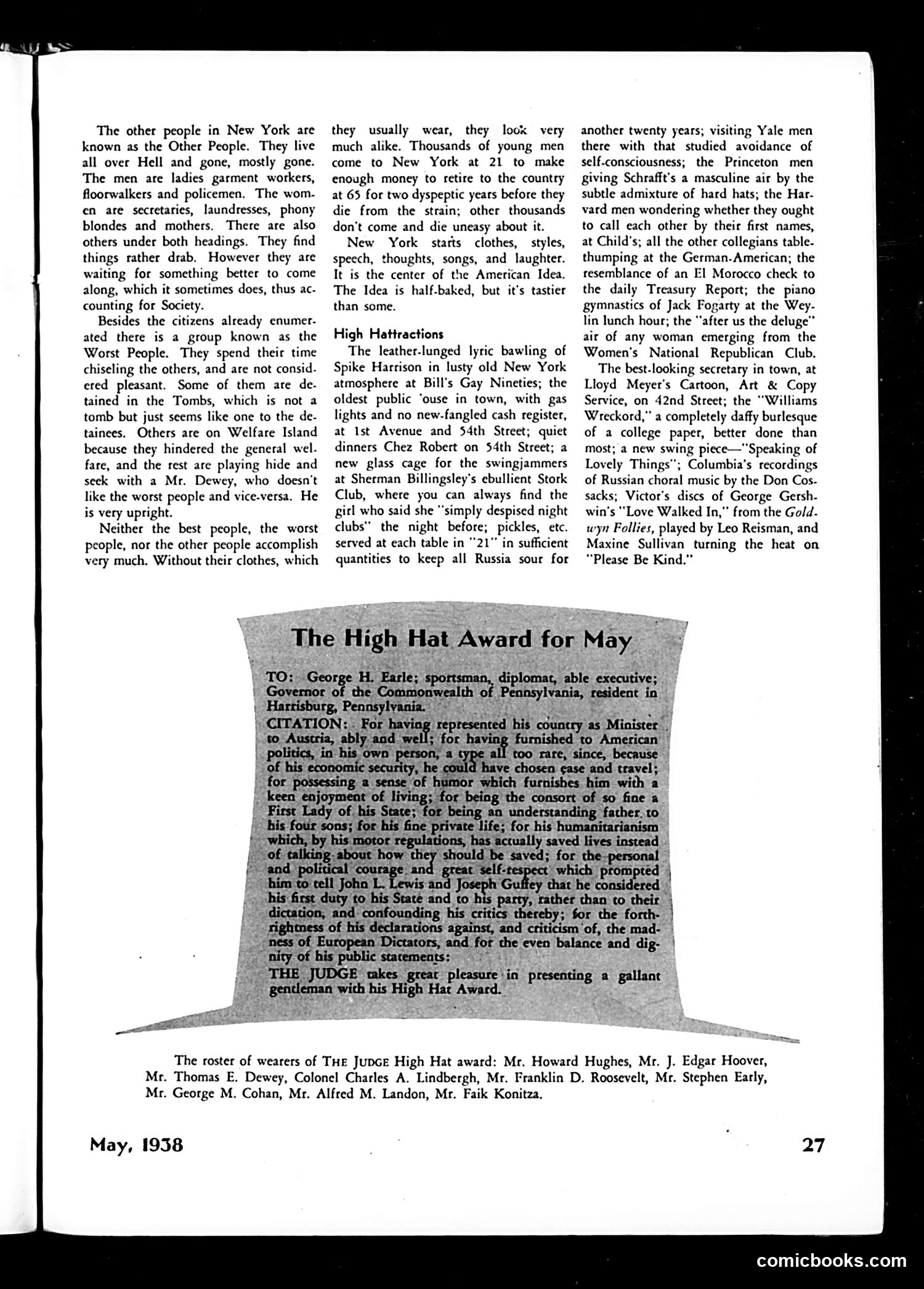
Judge Magazine, May 1938: Social Satire and the High Hat Award This page contains two distinct pieces of satire: Upper section: A lengthy commentary on New York's social hierarchy, dividing residents into "best people" (society elite), "worst people" (criminals, those "playing hide and seek with Mr. Dewey"—likely Thomas Dewey, the anti-corruption prosecutor), and "other people" (working-class New Yorkers). The satire undercuts class distinctions by noting that without clothes, everyone "look[s] very much alike." The "High Hattractions" section then mockingly catalogs Manhattan nightlife and venues ("21," the Stork Club, Bill's Gay Nineties) frequented by the wealthy. Lower section: "The High Hat Award for May" honors Pennsylvania Governor George H. Earle with tongue-in-cheek praise for his diplomatic service, sense of humor, and political courage in criticizing European dictators and standing by his state over party loyalty. The roster of past honorees (Hughes, Hoover, Lindbergh, FDR, Cohan) suggests the award ironically recognizes public figures Judge's editors respected.
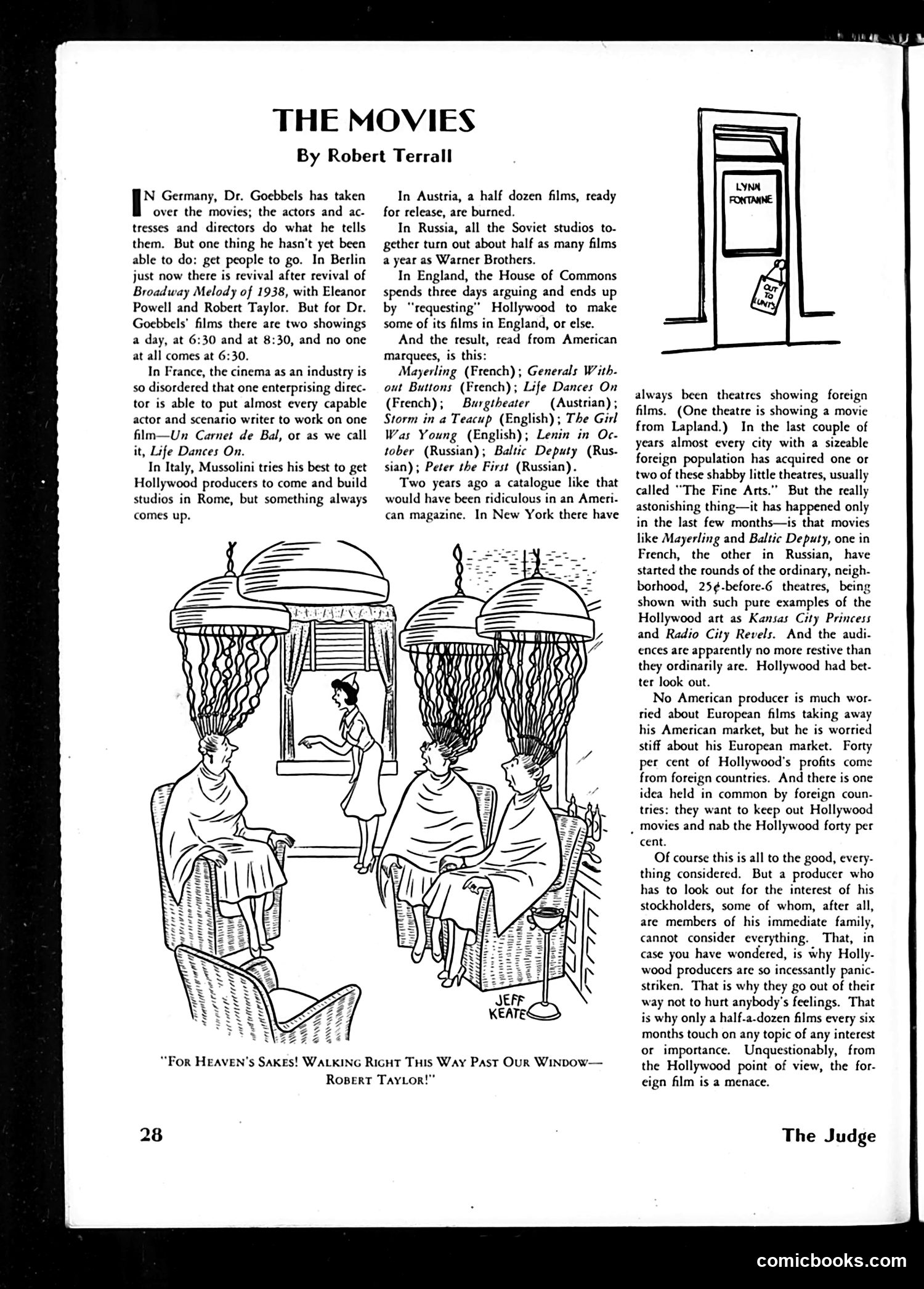
"The Movies" by Robert Terrall This article satirizes how European governments control cinema while Hollywood worries about losing foreign markets. Terrall describes Nazi Germany (under Goebbels), Fascist Italy and Austria, and Soviet Russia all restricting or controlling film production, yet foreign films are surprisingly gaining traction in American neighborhood theaters. The cartoon shows people excited about seeing Robert Taylor films—likely referencing Taylor's Hollywood star power and appeal, contrasting with the article's point about European cinema's unexpected popularity. Terrall's satire targets Hollywood's timidity: producers prioritize profits from foreign markets (40% of earnings) over artistic freedom, so they avoid controversial topics. European governments want to exclude Hollywood to protect their markets. The irony is that despite censorship and control, European films like *Mayerling* and *Baltic Deputy* now play in ordinary American theaters alongside Hollywood fare, suggesting foreign cinema poses a genuine threat to American dominance—hence why studios are "panic-stricken."
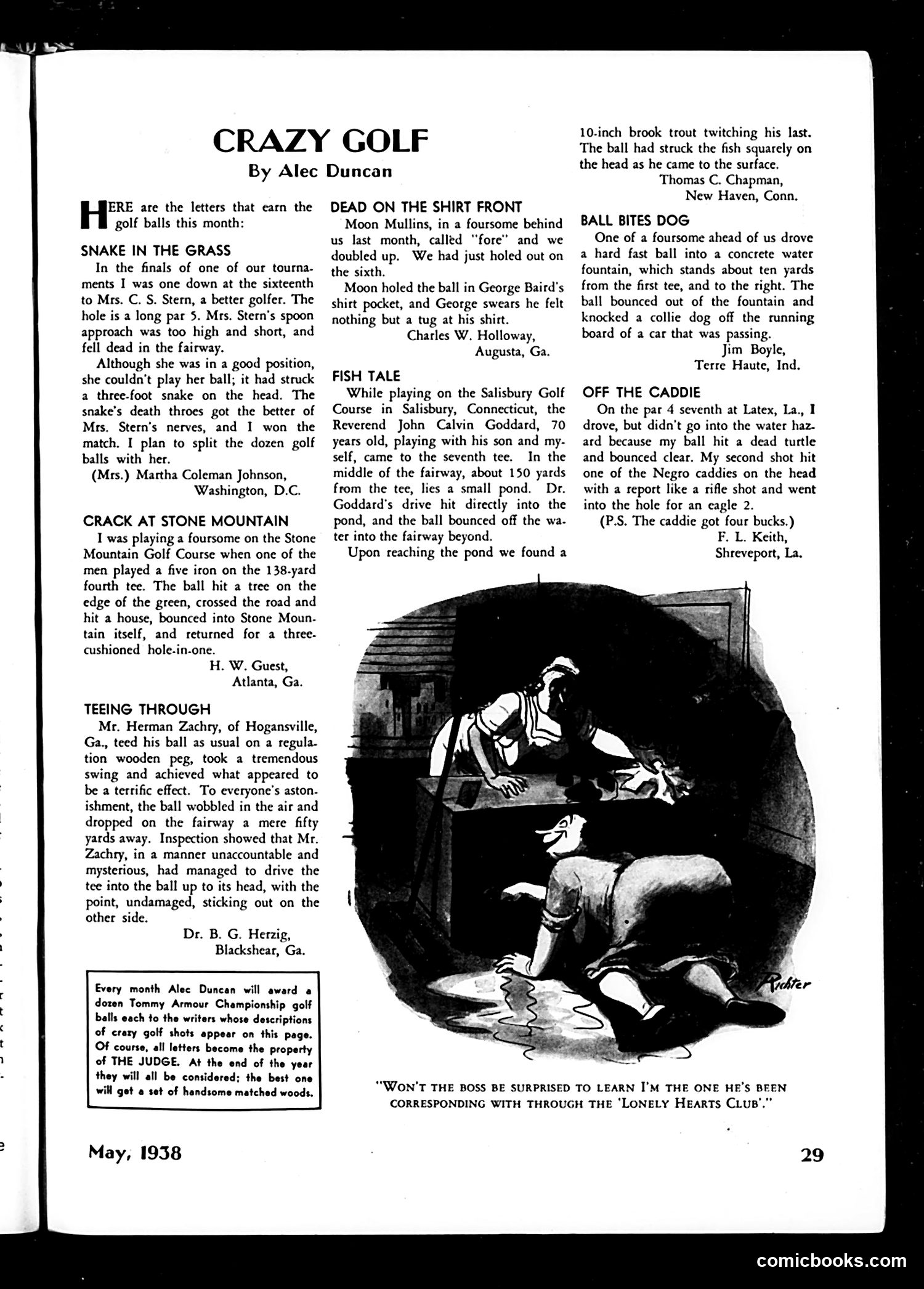
"Crazy Golf" - May 1938 This is a humorous column featuring readers' letters describing absurd golf mishaps. The "Crazy Golf" feature awards golf balls monthly for the most outlandish true stories of golfing accidents. The cartoon at bottom depicts a man and woman meeting in person, revealing they've been corresponding through a "Lonely Hearts Club" — implying romantic pen-pal matchmaking. The humor lies in the man's apparent surprise at the woman's appearance or the discovery of her identity. The letters themselves showcase 1930s-era golf culture's lighter side: a snake interrupts play, a ball drives a wooden tee through itself, a golf shot kills a fish, and remarkably, one caddie (referred to casually by race) gets hit by a ball that then results in an "eagle" (two under par). These stories blend legitimate golfing mishaps with tall tales typical of the period's sporting humor and masculine boasting culture. The magazine awards Tommy Armour Championship golf balls to best submissions.
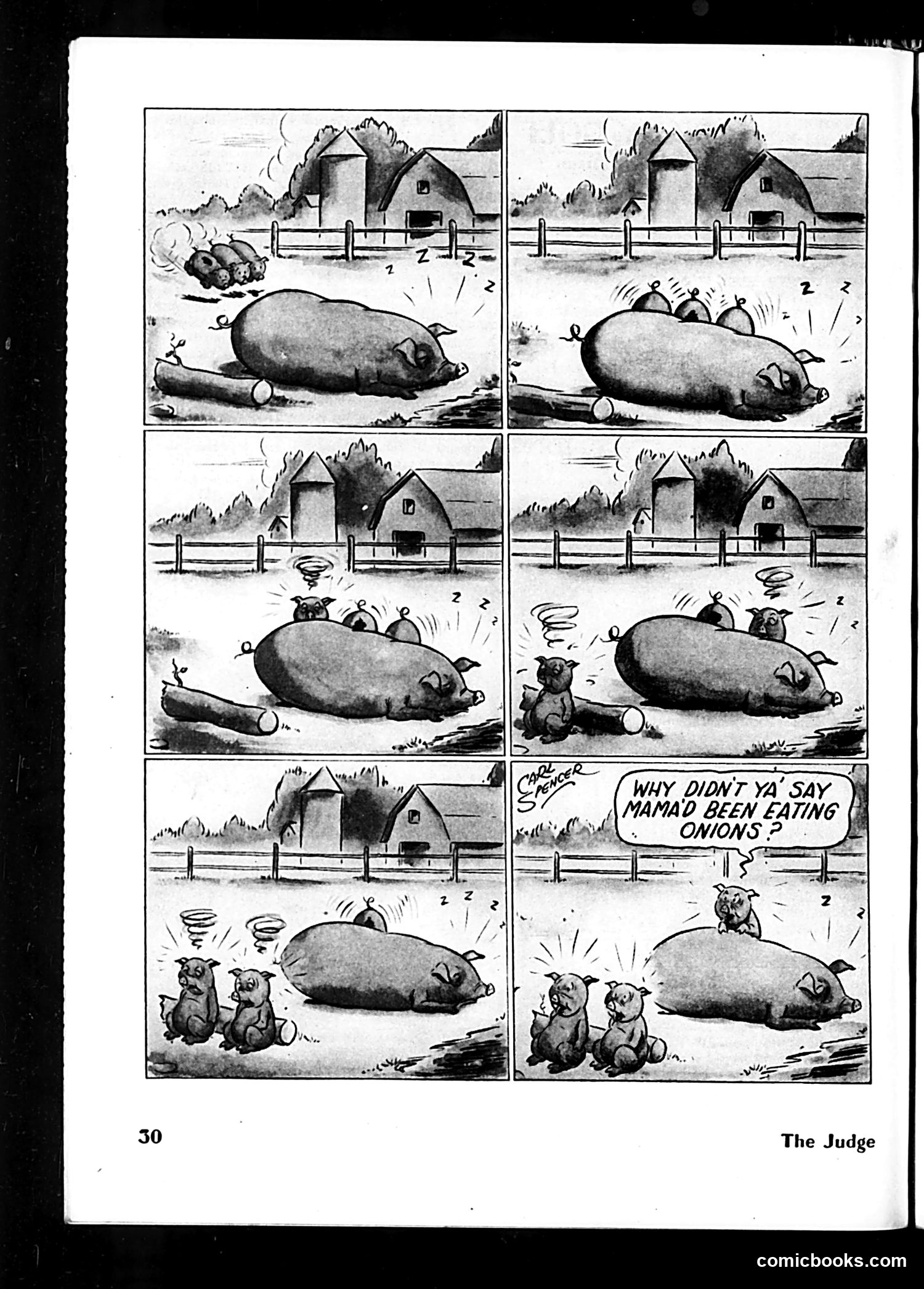
Comic Analysis This is a six-panel comic strip depicting a large pig sleeping on a farm. In the first panels, the pig appears undisturbed. By the middle panels, small animals (appearing to be dogs or similar creatures) gather around the sleeping pig, with motion lines suggesting activity or disturbance. The final panel reveals the joke: one character asks another, "Why didn't ya' say Mama'd been eating onions?" The humor relies on a crude scatological joke—the implication being that the pig's mother had eaten onions, resulting in unpleasant odors that the gathered animals are reacting to. This represents typical early 20th-century Judge magazine humor: simple, farmyard-based comedy aimed at working-class readers, using animals as stand-ins for lowbrow comedic situations.
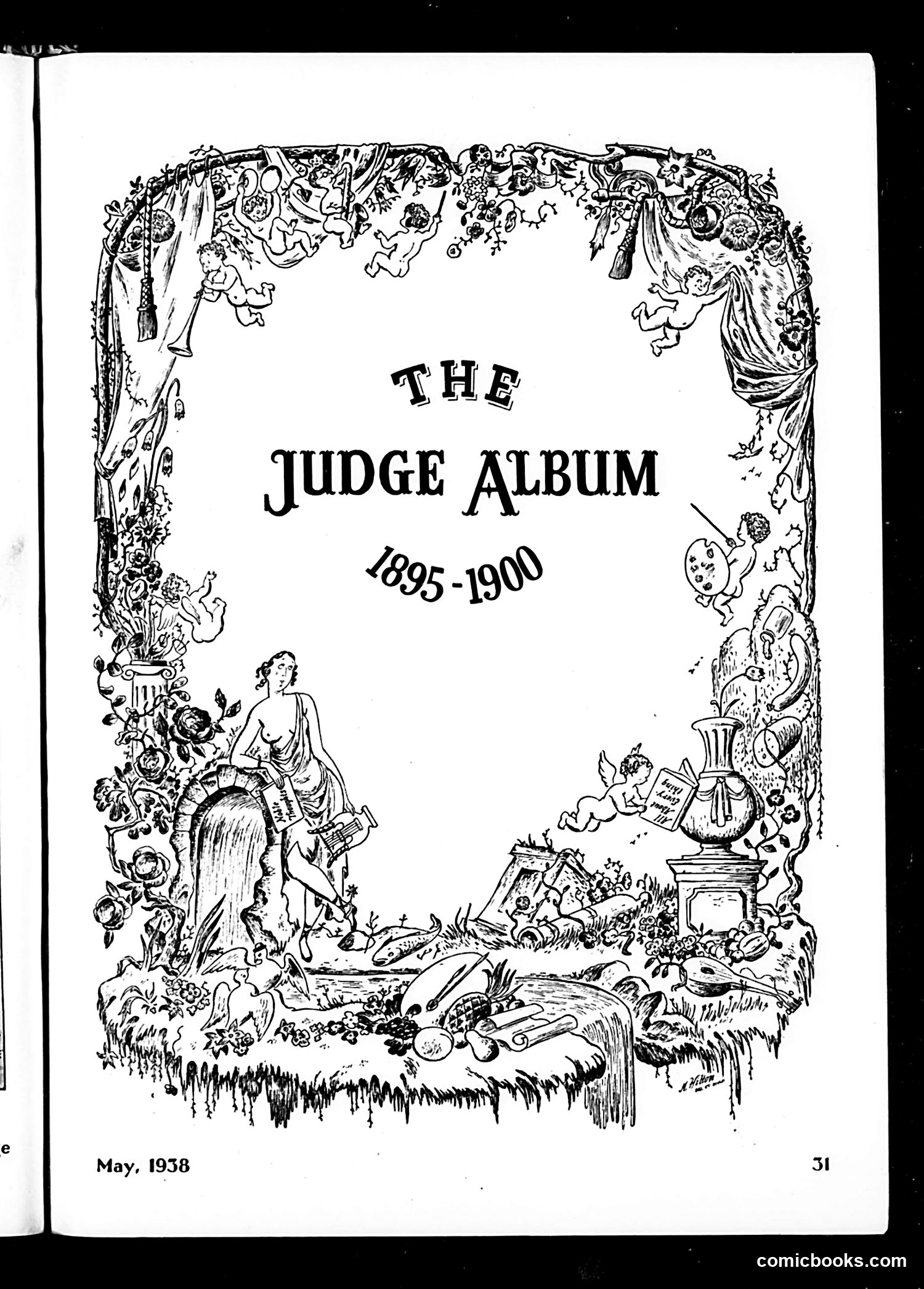
The Judge Album Title Page This is a title page for "The Judge Album 1895-1900," a compilation from the satirical magazine *Judge*. The page itself contains no specific political cartoon or commentary—it's a decorative cover featuring an allegorical female figure (likely representing Justice or Lady Justice) surrounded by cherubs, classical urns, flowers, and artistic ornaments in an ornate Victorian style. The elaborate border design reflects *Judge* magazine's reputation for sophisticated, artistic satire aimed at educated readers. The 1895-1900 date range indicates this album collects material from the Gilded Age and turn-of-the-century America. The publication date "May, 1938" shows this compilation was assembled decades after the original content appeared. This appears to be archival/retrospective rather than containing active political commentary.
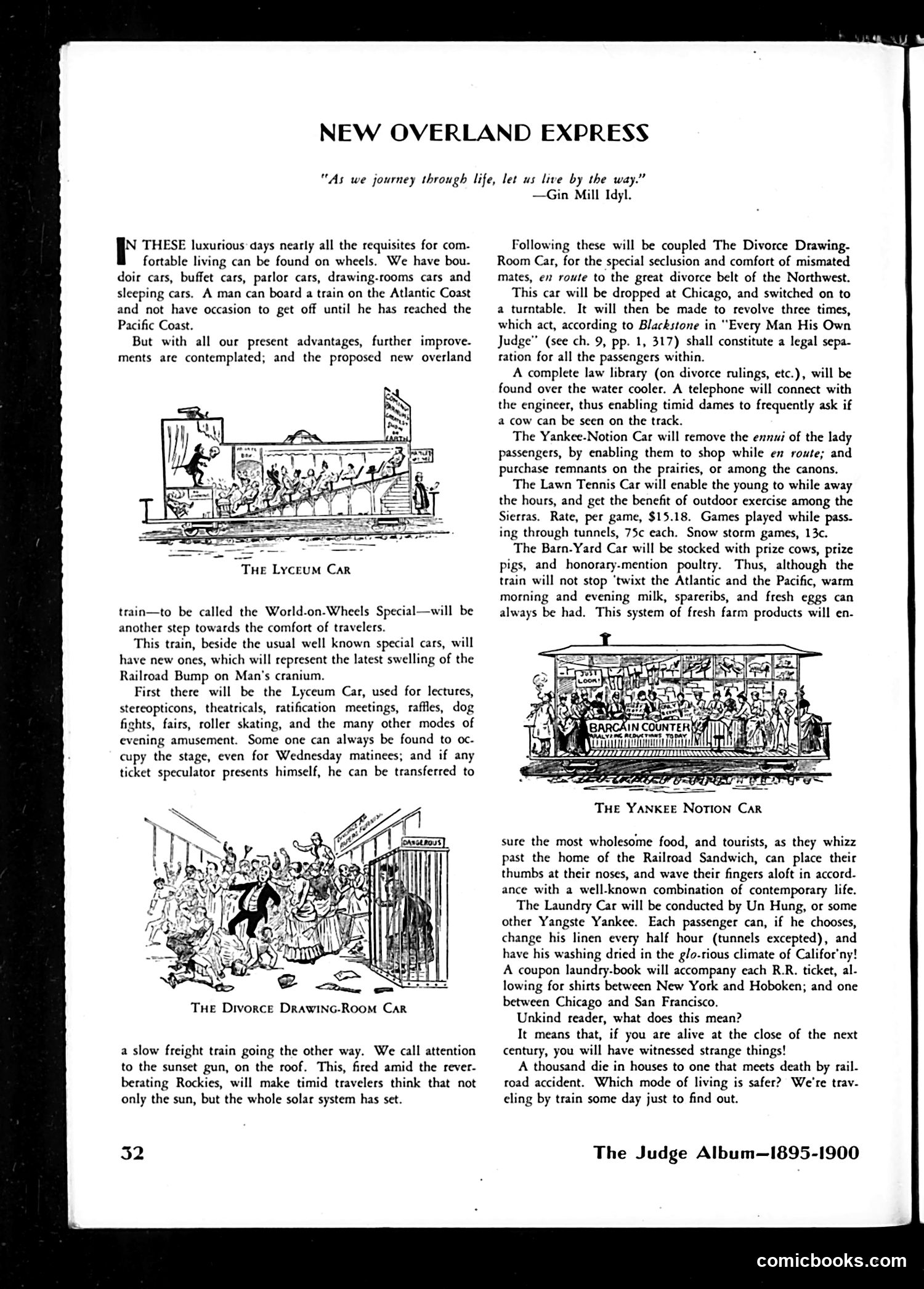
"New Overland Express" - Judge Magazine Satire (1895-1900) This is a satirical proposal for an absurdly elaborate train called the "World-on-Wheels Special." Judge mocks American optimism about technological progress and comfort by imagining increasingly ridiculous specialized cars. The satire targets several contemporary concerns: the "Divorce Drawing-Room Car" jokes about the "great divorce belt of the Northwest"—apparently a real phenomenon of marital dissolution. The "Lyceum Car" mocks intellectual pretension and lowbrow entertainment equally. The "Yankee-Notion Car" satirizes consumerism; passengers shop while traveling. The "Barn-Yard Car" parodies the obsession with fresh food while mocking the "Railroad Sandwich" (cheap train food). The "Laundry Car" run by "Un Hung" contains ethnic caricature typical of the era. Throughout, the humor relies on exaggerating American materialism, comfort-seeking, and the belief that trains could solve all problems—even legal ones (the divorce car rotated three times supposedly constitutes legal separation). The closing question—"if you are alive at the close of the next century, you will have witnessed strange things!"—suggests skepticism about such wild predictions.
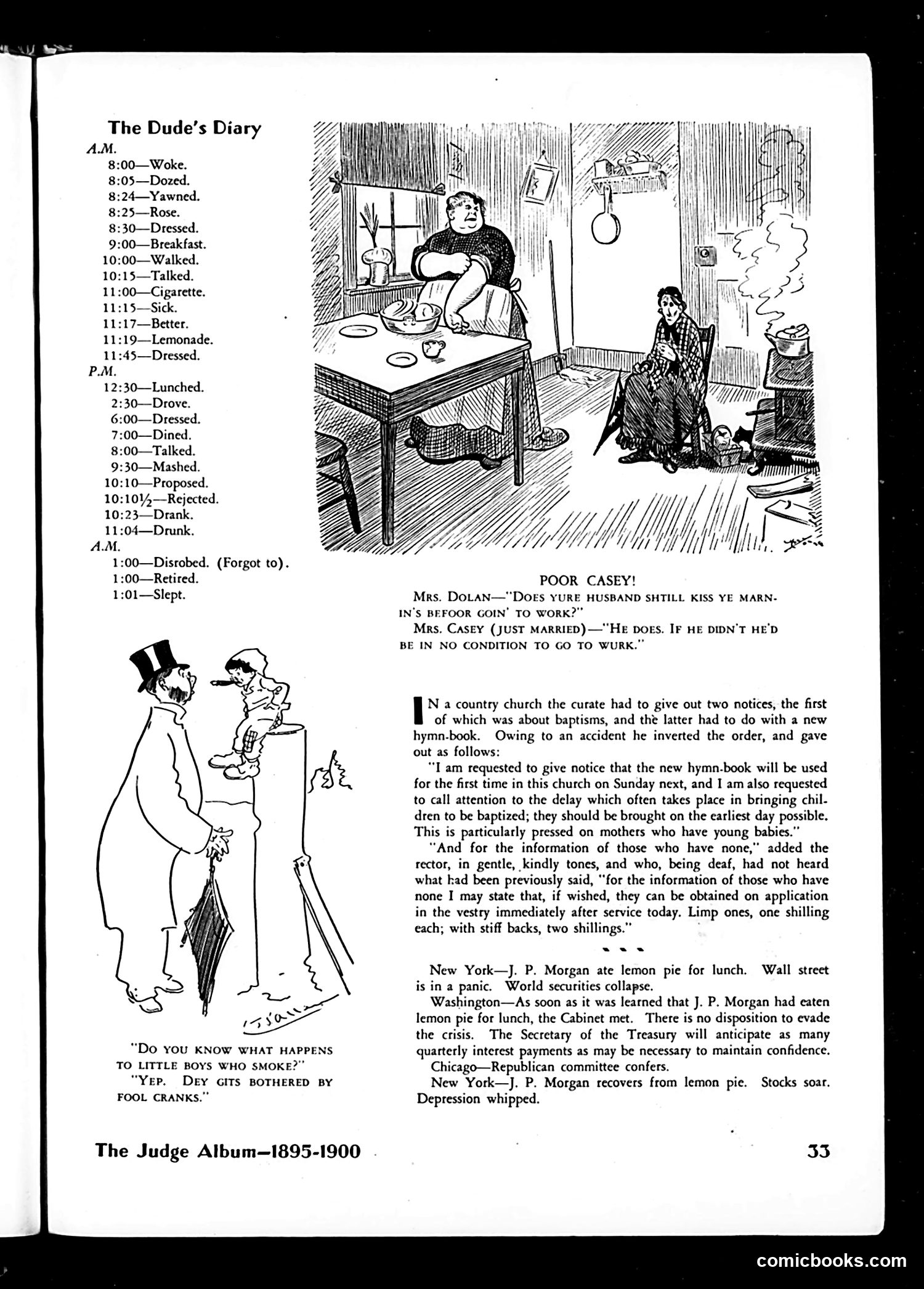
"The Dude's Diary" and Related Content Main Cartoon ("The Dude's Diary"): This satirizes idle wealthy men ("dudes") whose days consist of trivial activities—smoking, eating, dressing repeatedly—culminating in a failed marriage proposal and heavy drinking. The joke ridicules the purposelessness of this leisured class. "Poor Casey" Joke: A newlywed couple uses Irish dialect ("yure," "shtill," "marnin's"). The humor relies on a crude innuendo: the wife claims her husband kisses her before work; if he didn't, he'd be "in no condition" to work—implying exhausting marital relations. Church Notice Anecdote: A deaf rector accidentally announces baptisms and hymn-books in reverse order, creating an absurd double meaning where he appears to advertise babies and religious items for sale ("limp ones, one shilling each"). J.P. Morgan Satire: This mocks Wall Street's irrational panic during financial crises, suggesting the banking system's fragility—even Morgan eating lemon pie causes market collapse and Cabinet emergency meetings.
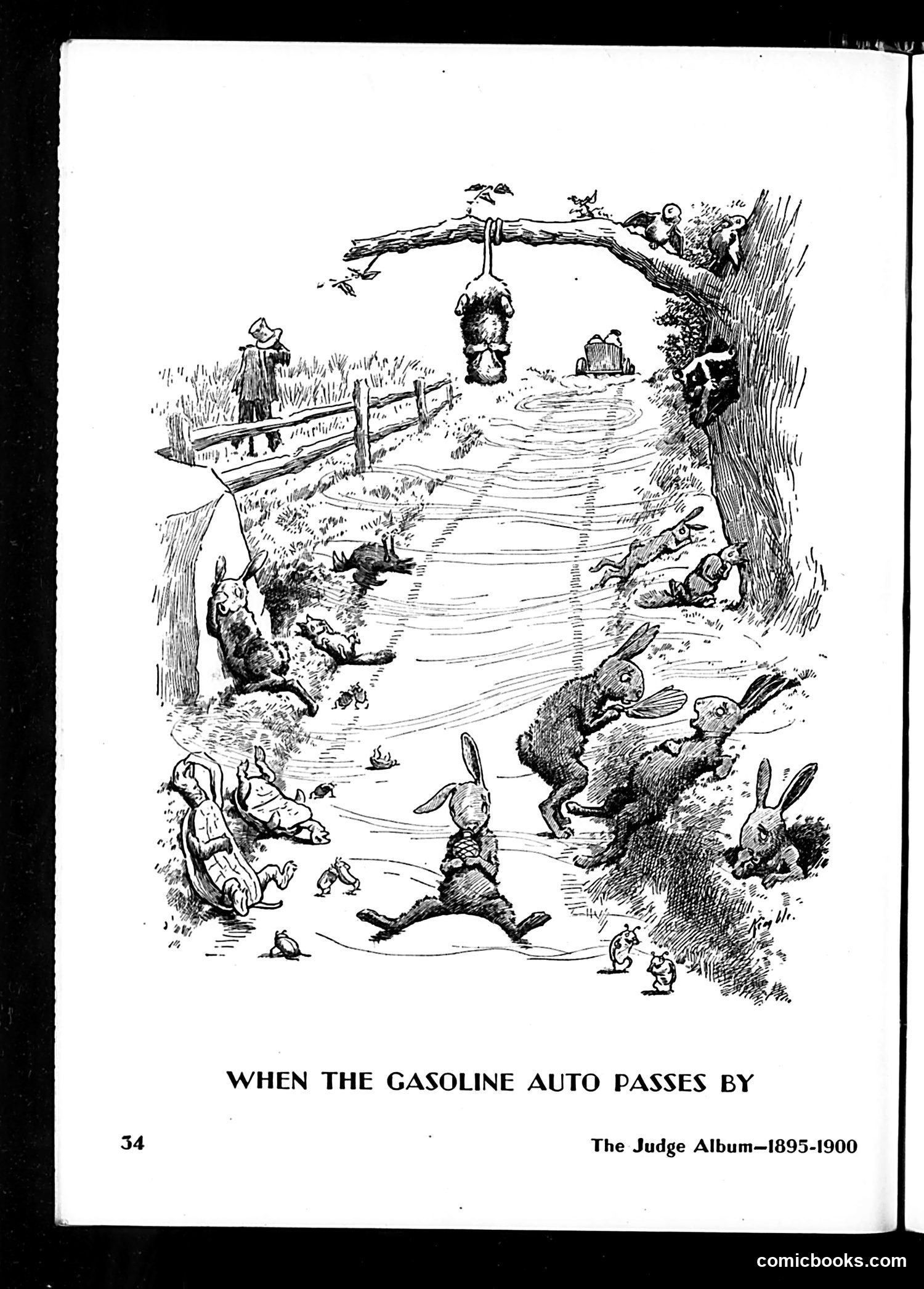
"When the Gasoline Auto Passes By" This satirical illustration from *Judge* magazine (1895-1900) mocks the early automobile's chaotic impact on rural life. The cartoon depicts animals and people scattering in panic as a car approaches on a country road—rabbits, dogs, and other creatures flee in terror while a figure swings from a tree branch and others scramble for safety. The satire targets the automobile's novelty and disruptive effect on traditional countryside existence. The "gasoline auto" represents emerging industrial modernity violently intruding upon pastoral tranquility. Rural inhabitants and wildlife are portrayed as helpless victims of this new technology, unable to control or predict its arrival. This reflects genuine late-19th-century anxieties about automobiles: their noise, speed, unpredictability, and threat to horse-drawn transportation dominated American discourse during this transitional period.
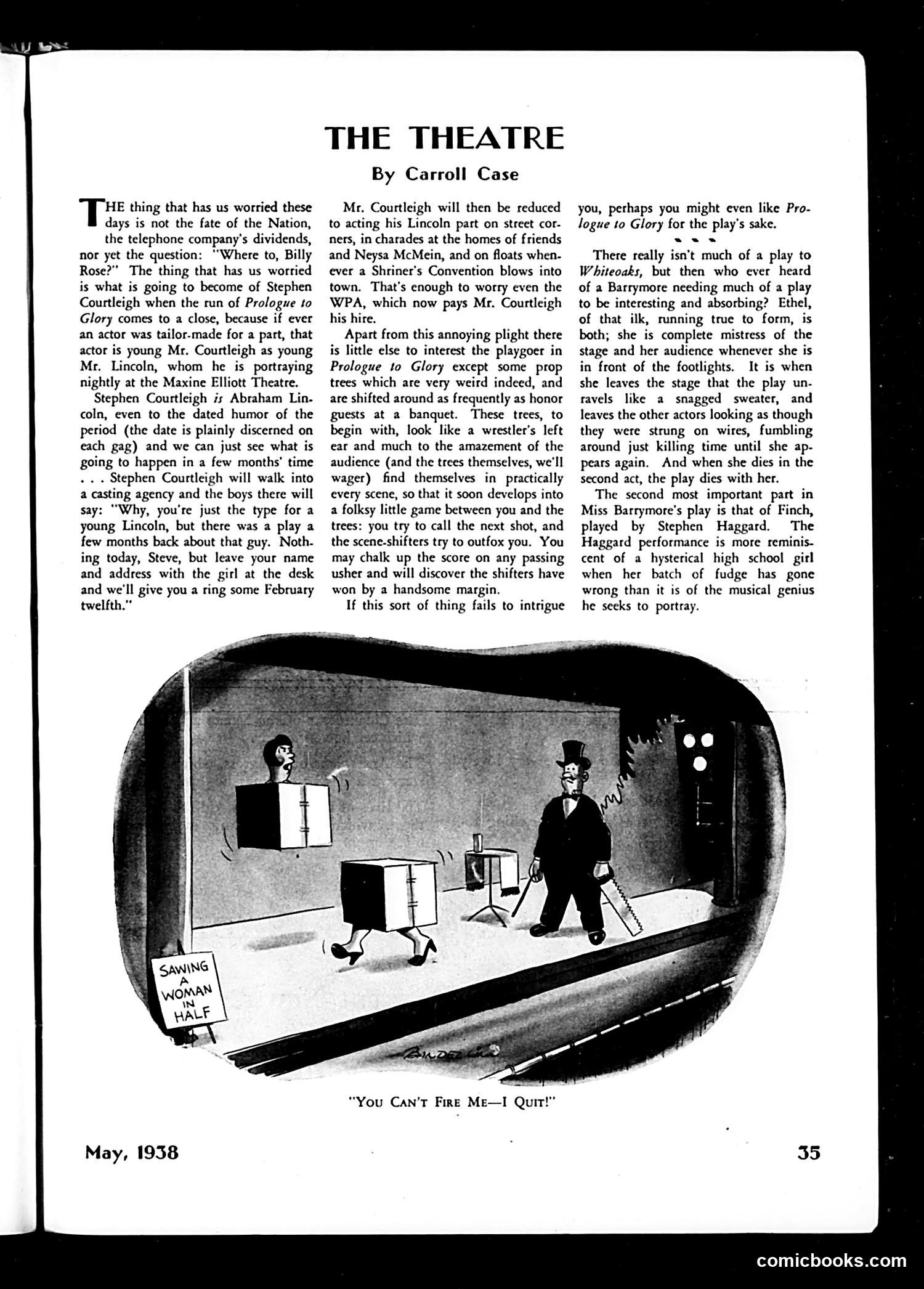
"The Theatre" by Carroll Case, May 1938 This theater column satirizes two Broadway productions through witty observations rather than political commentary. "Prologue to Glory" concerns actor Stephen Courtleigh, who so perfectly embodies young Abraham Lincoln that the critic worries he'll be typecast into oblivion—reduced to playing Lincoln at street corners and Shriner conventions after the play closes. The accompanying cartoon shows a magician's "Sawing a Woman in Half" act, captioned "You Can't Fire Me—I Quit!"—depicting an actor so perfectly suited to a role he becomes inseparable from it. The column also reviews "Whiteoaks," praising Ethel Barrymore's commanding stage presence while criticizing the weak script and fellow actor Stephen Haggard's overly theatrical, "hysterical high school girl" performance. The overall tone is affectionate mockery of theater's absurdities—both the casting dilemma and the uneven quality of performances—typical of Judge's sophisticated humor for theater-going audiences in Depression-era New York.
The Judge's "Washington Parade" Advertisement This is primarily an advertisement announcing a new newsreel series called "The Washington Parade," produced by Judge magazine. Rather than traditional newsreel content (beauty pageants, ship launchings), it promises to show the behind-the-scenes workings of Congress—the cloakrooms and anterooms where political decisions actually happen. The satire's point: Judge is positioning itself as offering viewers the *real* Washington politics instead of frivolous public spectacles. The implicit criticism is that conventional newsreels distract audiences with shallow entertainment while important governmental decision-making occurs invisibly. By juxtaposing "bathing beauties" against "the lives of men who decide to launch battleships," Judge suggests this newsreel will reveal substantive political content—who actually wields power and how. This appears aimed at a 1920s-30s audience increasingly interested in political transparency and government accountability.
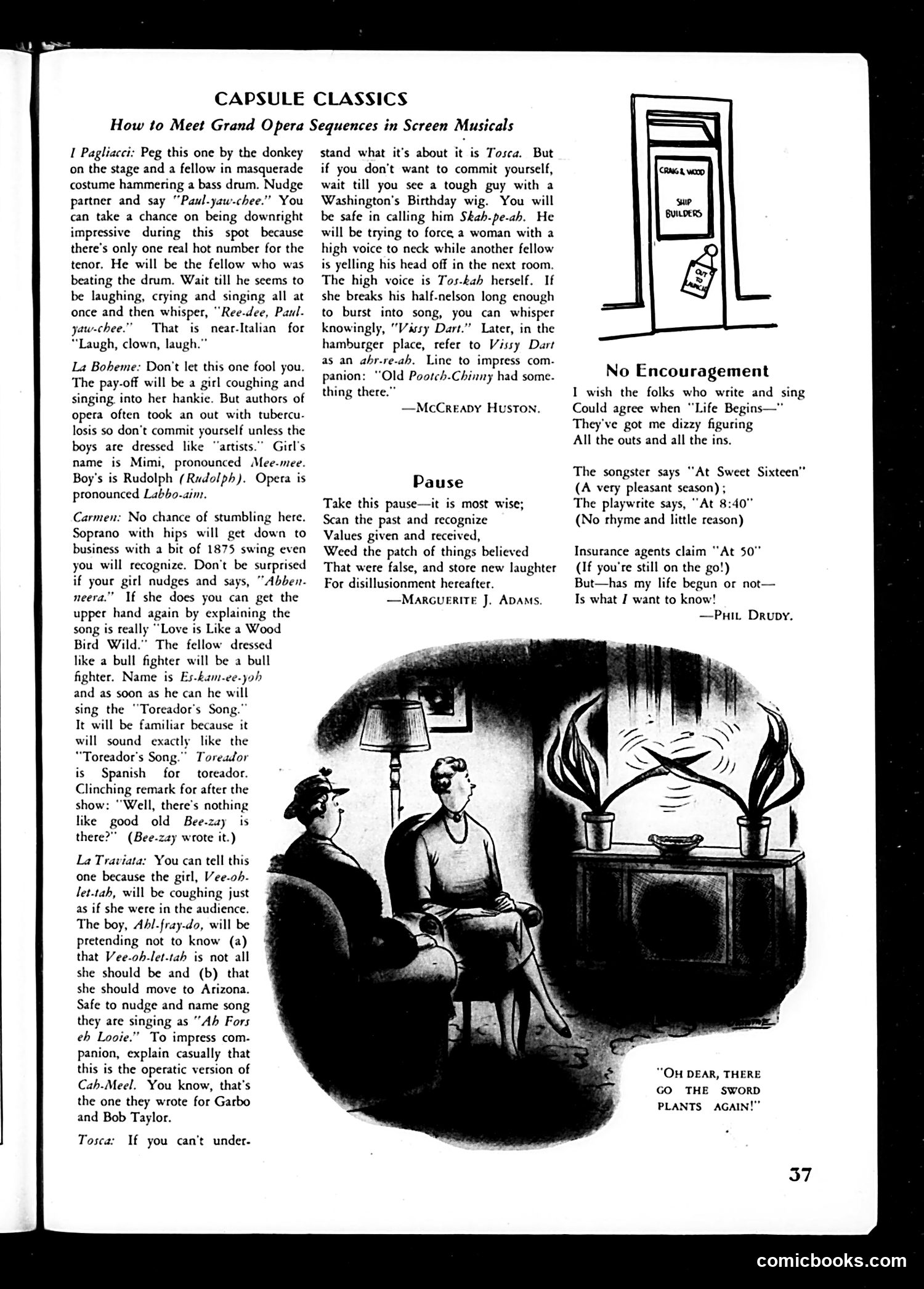
"Capsule Classics" - Judge Magazine Guide to Opera in Movies This is a humorous guide teaching moviegoers how to recognize and discuss famous operas when they appear in screen musicals—a common 1930s-40s practice. The satire targets social pretension: audiences wanted to appear cultured by identifying opera sequences but often couldn't recognize them or pronounce the titles correctly. The advice is deliberately cynical. For *Pagliacci*, watch for a donkey and drum-beater; for *La Bohème*, expect a coughing girl; for *Carmen*, look for a woman with prominent hips in 1875 clothing. The phonetic spellings ("Paul-yaw-chee," "Labbo-aim") mock both opera's Italian pronunciation and American audiences' unfamiliarity. The accompanying cartoon shows a couple at home; the woman says "Oh dear, there go the sword plants again!"—likely referencing operatic drama's overwrought nature. The page satirizes middlebrow American culture's desire for sophistication without genuine understanding.
Analysis: "In Witness Whereof" — Judge Magazine Letters Page This page collects reader responses to a previous Judge editorial about Jewish leadership and fighting antisemitism in 1930s Europe. The cartoon header shows a fist punching, illustrating the "fighting back" theme. The letters debate whether Jews should: - Unite against fascism in Europe (Marcuson argues Christian leadership is needed; Singer calls for broader progressive coalition) - Stop "self-pity" and defensive posturing (Pollock criticizes Jewish passivity; Anshen warns against "humiliating self-repudiation") - Fight communism specifically (DeCasseres notably references Trotsky as "the only fighting Jew") Context: This reflects pre-WWII anxieties about rising fascism, Jewish assimilation debates, and Cold War anti-communist sentiment. The letters reveal internal Jewish community disagreement about strategy—whether to emphasize Jewish identity, align with broader progressive movements, or focus on communist threats. The page functions as a letters-to-the-editor feature showcasing public debate rather than satire.
The Judge Honors Humor — Context for Modern Readers This page is primarily an advertisement/announcement for humor awards established by *The Judge* magazine itself, not a political cartoon. The left column contains reader letters responding to an earlier editorial (referenced as being on page 48) about anti-Semitism and Jewish resistance to fascist dictators—likely referencing Nazi Germany and rising 1930s antisemitism. The letters debate whether Jews should actively fight back against persecution or avoid confrontation. The right side announces *The Judge*'s new "Awards for American Humor" across various media: books, newspapers, radio, film, theater, and advertising. The small cartoon shows a "Citizens Joke Book" icon—reinforcing the humor theme. Key context: Published in 1938 (per the December 15 deadline mentioned), this reflects pre-WWII American debate about Jewish activism and the magazine's attempt to promote humor as cultural relief during turbulent times.
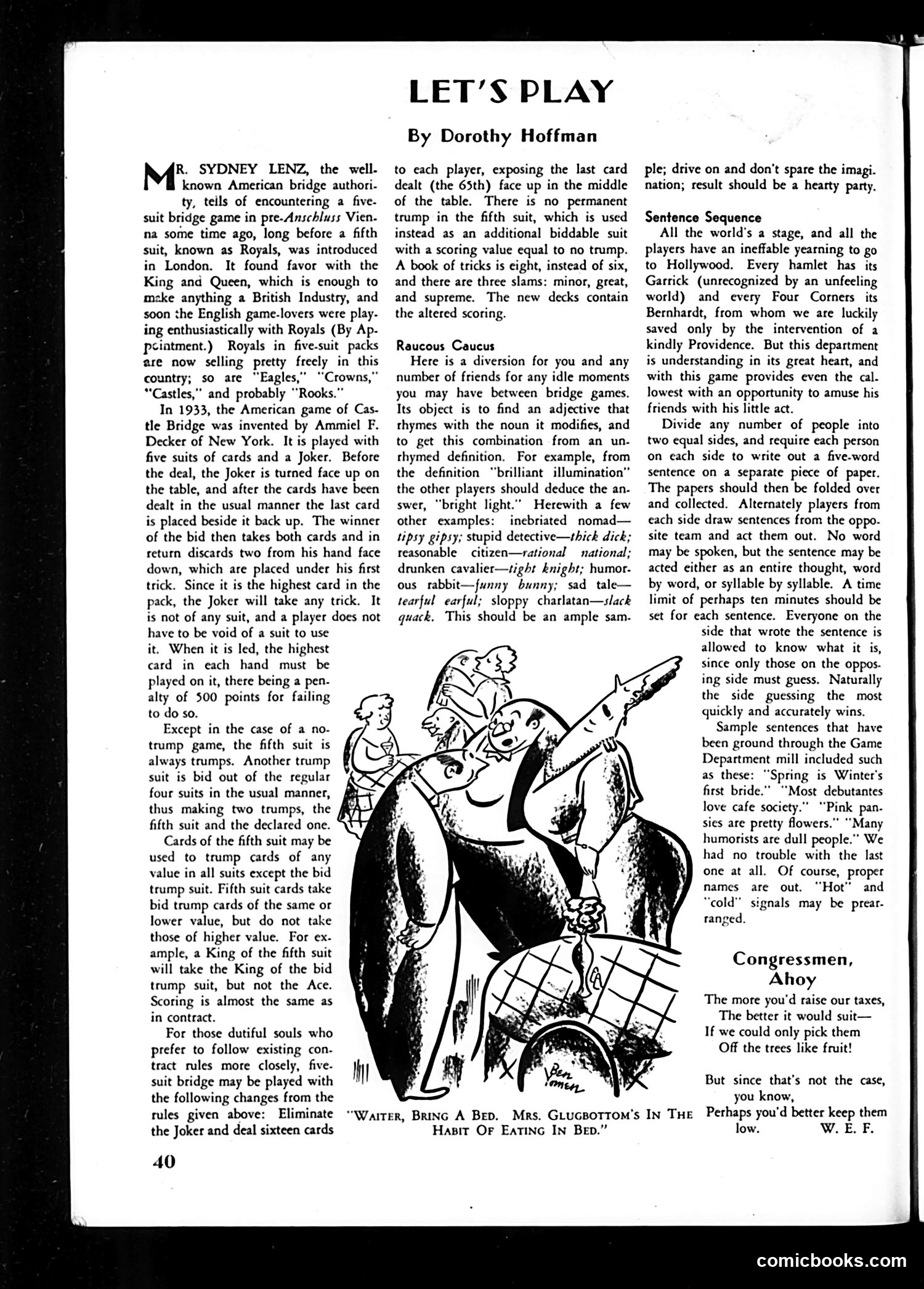
Analysis of Judge Magazine Page This page from Judge magazine contains three distinct game-related articles by Dorothy Hoffman, not political cartoons: 1. "Let's Play" (main article): Discusses five-suit bridge variants—"Royals" (favored by the British King and Queen) and "Castle Bridge" (invented 1933 by American Ammiel Decker). The text explains new rules for these card games gaining popularity in America. 2. "Raucous Caucus": A word-game where players deduce rhyming adjective-noun pairs from definitions (e.g., "bright light," "tight knight"). 3. "Sentence Sequence": A guessing game involving five-word sentences. The single cartoon shows a waiter serving food to someone in bed—illustrating the caption "Walter, Bring A Bed, Mrs. Glugbottom's In The Habit Of Eating In Bed." This is genteel humor about upper-class indulgence, not political satire. Context for modern readers: This reflects 1930s leisure culture and parlor games among educated Americans, with British royal approval lending social cachet to new entertainment trends.
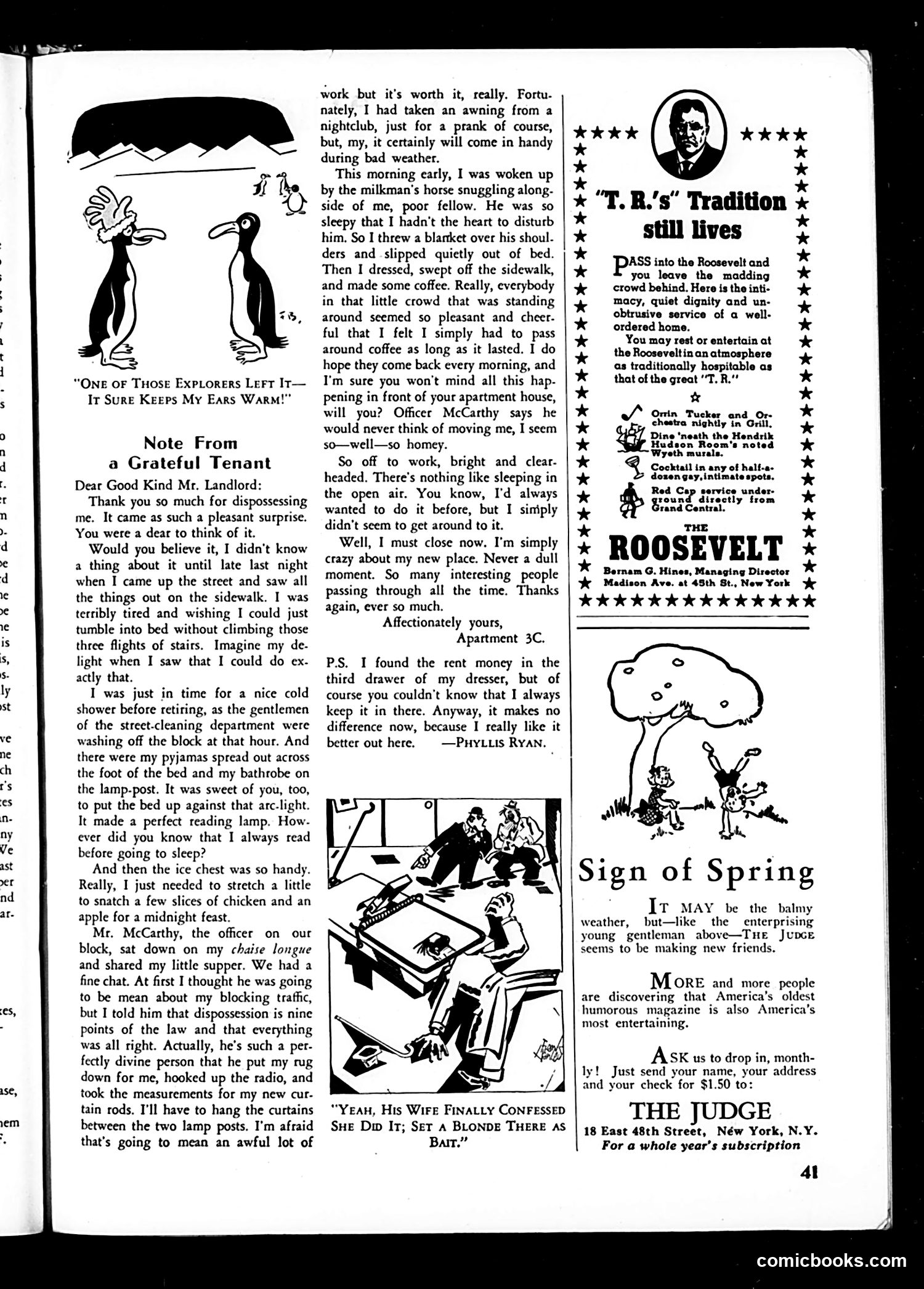
Understanding This Judge Magazine Page This page satirizes eviction during economic hardship, likely from the Depression era. The main piece is a bitter sarcastic letter from "Apartment 3C"—a tenant evicted by their landlord—thanking him with mock gratitude for the dispossession. The humor works through ironic inversion: the tenant describes homelessness as delightful. Being thrown onto the street becomes a pleasant surprise; sleeping outdoors is refreshing; their scattered belongings become convenient furniture; a police officer becoming friendly during their street eviction is "perfectly divine." The satire critiques callous landlord practices and social indifference to eviction. By praising these catastrophic circumstances in exaggerated, cheerful language, the writer exposes how absurd and cruel the situation actually is. The cartoon above (explorers keeping ears warm with an awning) connects thematically—it's about making do with improvised shelter, mirroring the letter's themes of adapting to homelessness. The Roosevelt Hotel advertisement on the right provides ironic contrast: luxury accommodations while people are evicted to the streets.
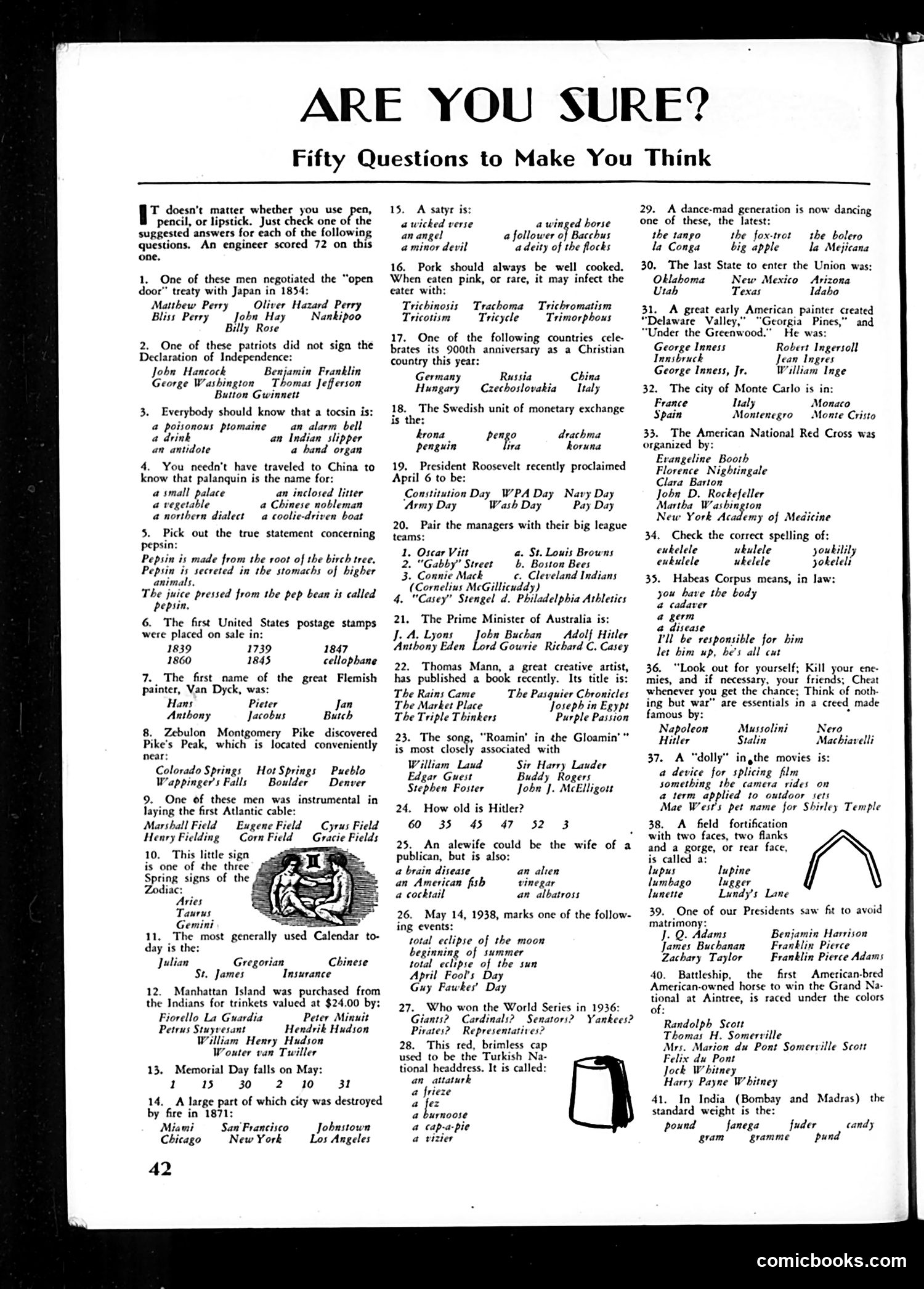
"Are You Sure?" Quiz Analysis This is a trivia quiz page from *Judge* magazine designed to test readers' knowledge across history, geography, science, and current events. The title promises to challenge assumptions. The questions span American and world history (Perry's Japan treaty, Declaration signers, Pike's Peak), general knowledge (vocabulary like "tocsin" and "palanquin"), and contemporary 1930s references. Question 19 mentions President Roosevelt's proclamations, and questions 24-25 reference Hitler, suggesting this was published during the pre-WWII era. The satirical premise—suggested by *Judge's* tradition—appears to be humbling: "An engineer scored 72 on this one," implying even educated readers would struggle. This reflects the magazine's typical approach of gently mocking readers' pretensions to knowledge while entertaining them with obscure trivia and unexpected answer choices (like "cellophane" for stamp dates or "Nankipoo" for Perry). The quiz format itself is the humor—not specific caricatures visible on this page.
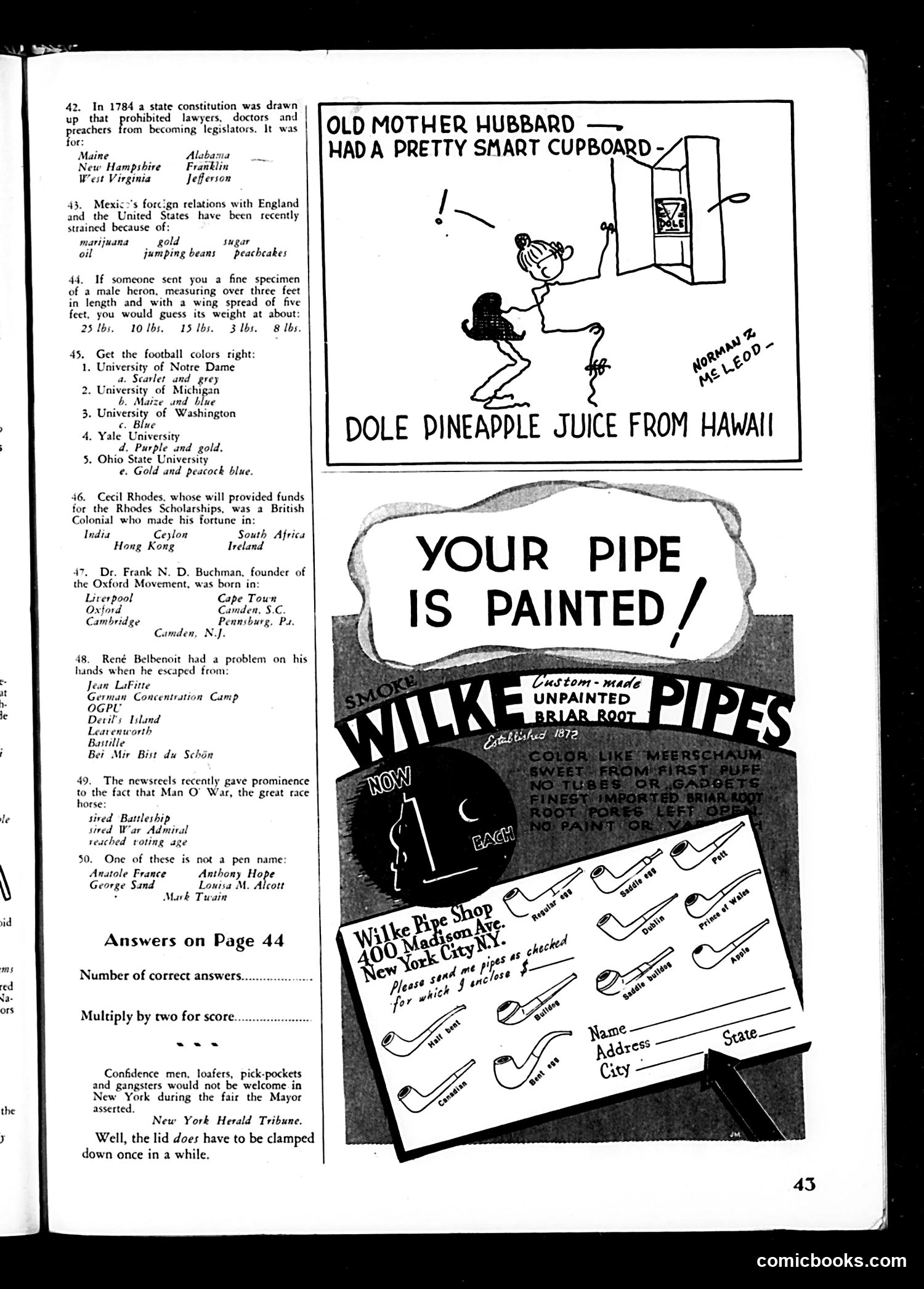
Understanding This Judge Magazine Page This page contains a trivia quiz (questions 42-50) mixed with period advertisements and a small cartoon. The Cartoon: "Old Mother Hubbard Had a Pretty Smart Cupboard" advertises Dole pineapple juice from Hawaii. A stylized woman kicks open a cupboard, discovering the product. The humor is a play on the nursery rhyme about an empty cupboard—here, the "smart" cupboard contains commercial goods. The Wilke Pipes Advertisement: Promotes unpainted briar pipes available in various styles, with a mail-order form to New York City. Historical Context: This appears to be from the 1930s-1940s era, based on references like Man O' War (famous racehorse) and the Oxford Movement. The trivia quiz reflects mid-century American educational interests—state history, international relations, collegiate sports, and literary figures. The page is primarily advertising and entertainment filler rather than political satire. The brief editorial comment at bottom about New York's "fair" and clamping down on criminals is mild social commentary, typical of Judge's light satirical approach to contemporary civic concerns.
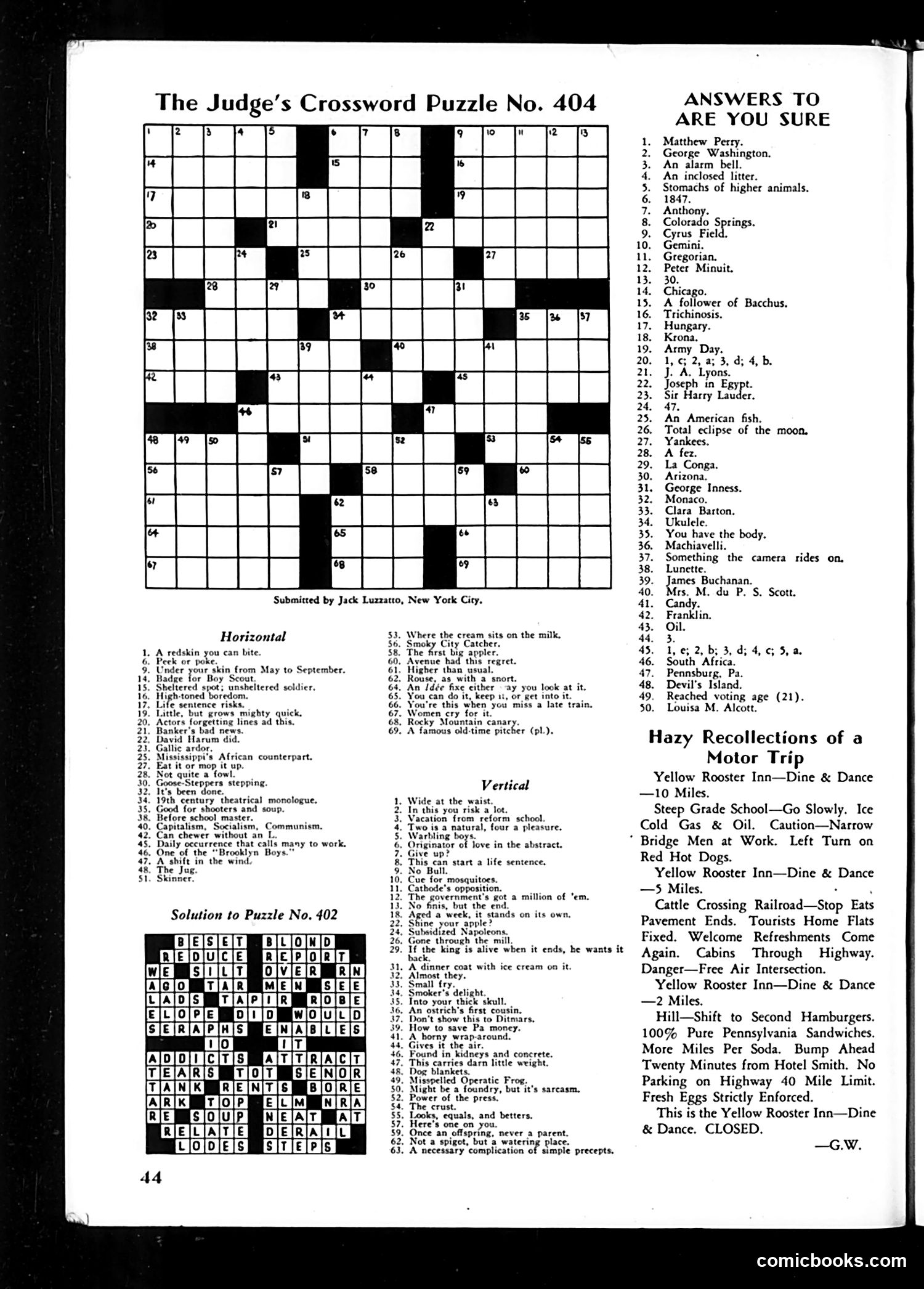
What This Page Contains This page is primarily a crossword puzzle and its answer key from *Judge* magazine, a satirical publication. The puzzle itself contains no political cartoon or commentary—it's a standard word puzzle with clever, punny clues typical of the era (e.g., "A redskin you can bite" = apple; "Badge for Boy Scout" = merit). The only satirical content appears at the bottom: "Hazy Recollections of a Motor Trip," a humorous travel narrative mocking early automobile tourism. It depicts a comedic road journey with tongue-in-cheek observations about roadside distractions (the Yellow Rooster Inn appears repeatedly), poor road conditions, and tourist culture. References like "Cattle Crossing Railroad" and "Danger—Free Air Intersection" satirize the chaos and hazards of early 1920s motoring. There are no identifiable political figures or events depicted. This is filler content—advertising space and entertainment rather than editorial commentary.
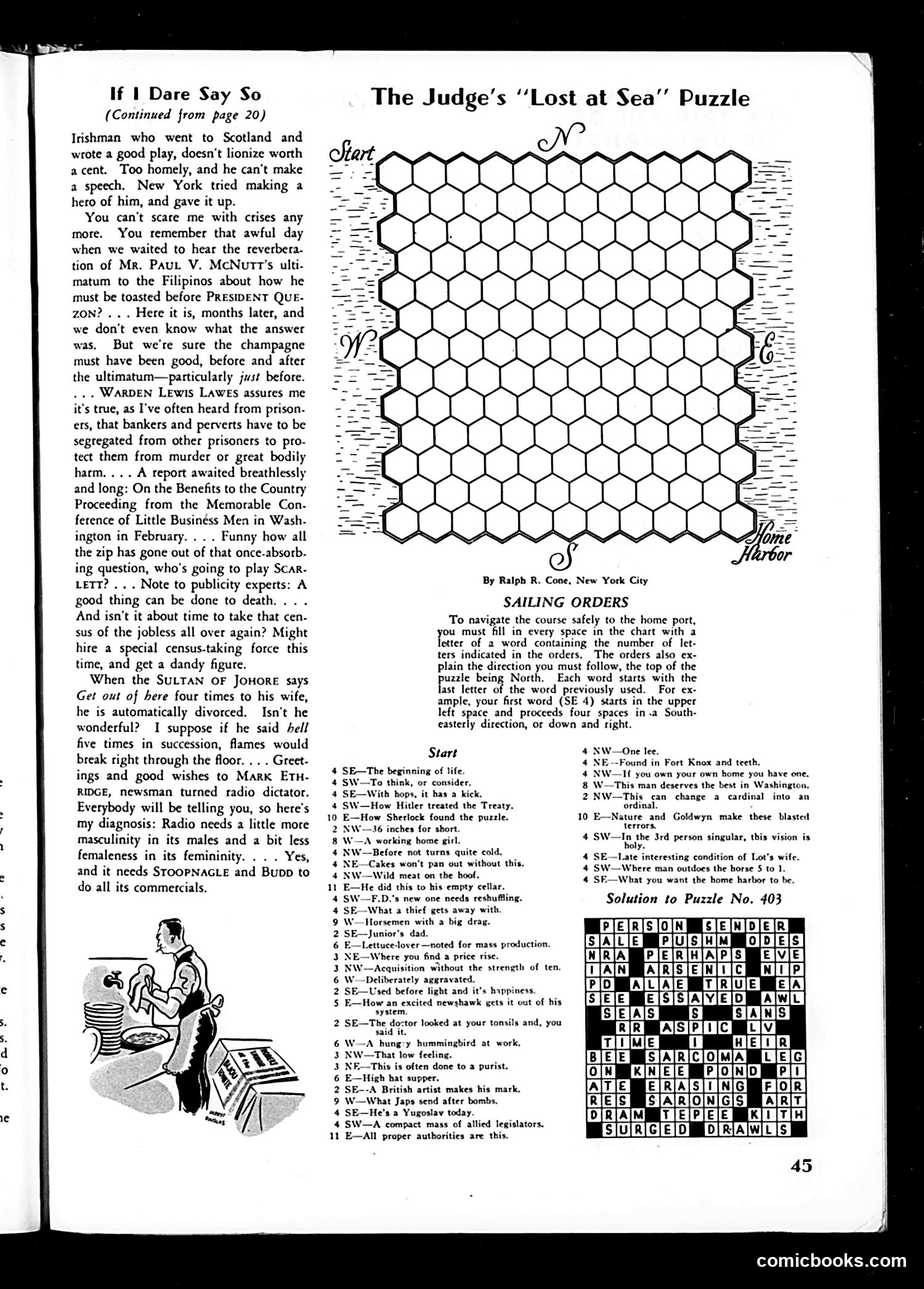
"If I Dare Say So" — Judge Magazine Commentary This is a satirical column and puzzle page from Judge magazine. The "If I Dare Say So" section mocks contemporary figures and events: it ridicules an Irish playwright's lack of appeal, references a forgotten diplomatic ultimatum by Paul V. McNutt to Philippine President Quezon, jokes about banker criminality in prisons, and comments on the disappearing news interest in "Gone with the Wind" casting. There's also wordplay about the Sultan of Johore's automatic divorce laws and snide remarks about radio personality Stoopnagle and Budd needing more masculinity. The main content is "The Judge's Lost at Sea Puzzle"—a word-search game where solvers fill hexagonal grid spaces following compass directions (NE, SW, etc.) using clues about words with specified letter counts. It's recreational filler typical of magazines of this era.
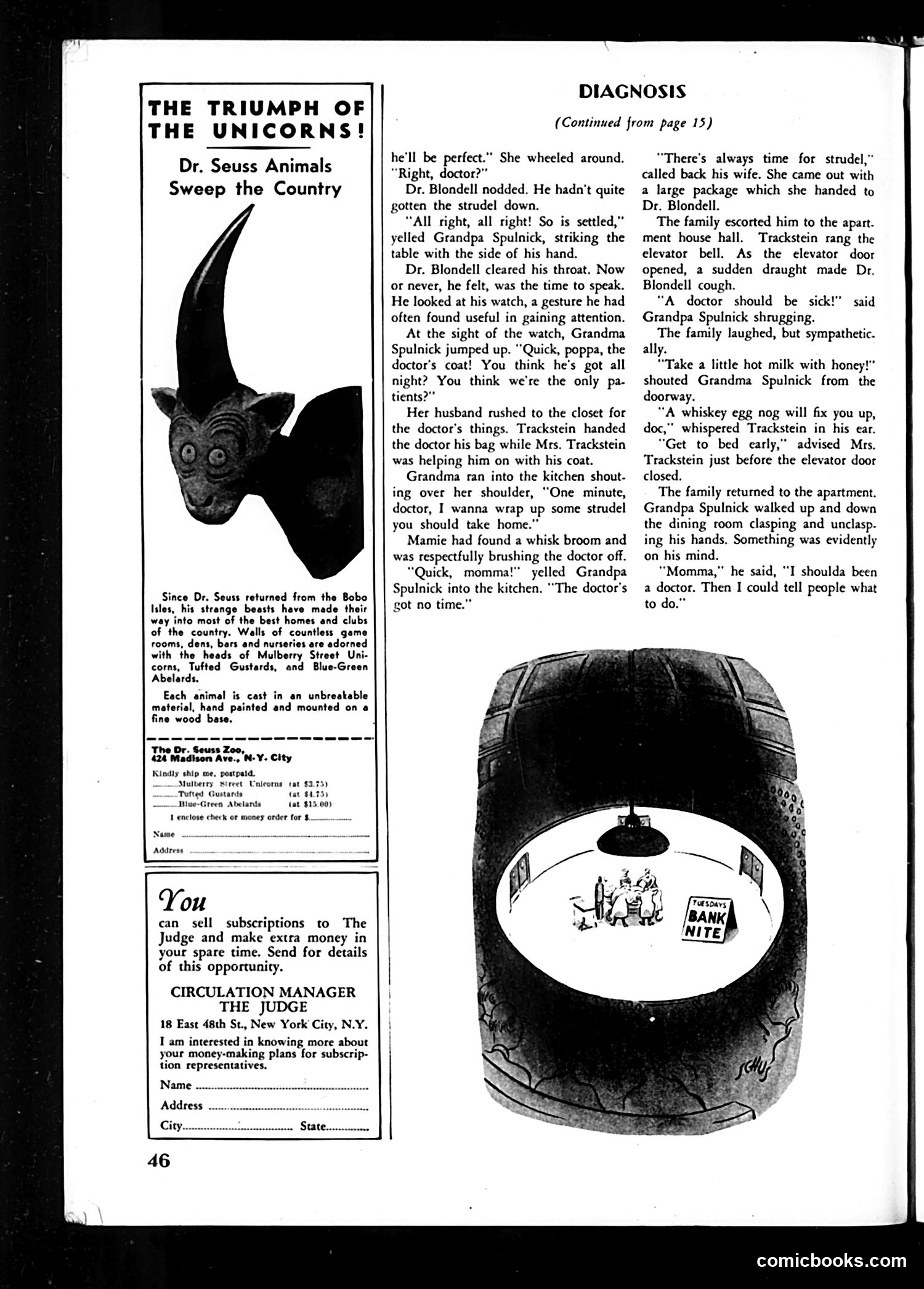
Judge Magazine Page Analysis This page combines advertising and fiction. The left side promotes Dr. Seuss's collectible animal figurines from his early works (Mulberry Street Unicorns, Tufted Gusterds, Blue-Green Abelards)—a commercial tie-in capitalizing on Seuss's growing popularity. The ad notes these fantastical creatures have become fashionable décor in wealthy homes and clubs, reflecting 1930s consumer culture. The right side continues a serialized story titled "Diagnosis," featuring a Jewish family (the Spulnicks and Tracksteins, identifiable by names and Yiddish-inflected dialogue) fussing over their doctor visit. The humor derives from ethnic stereotype: overbearing relatives, excessive hospitality (forcing strudel on the doctor), and the grandfather's wistful observation that he should have been a doctor to command respect—a common immigrant aspiration trope in period comedy.
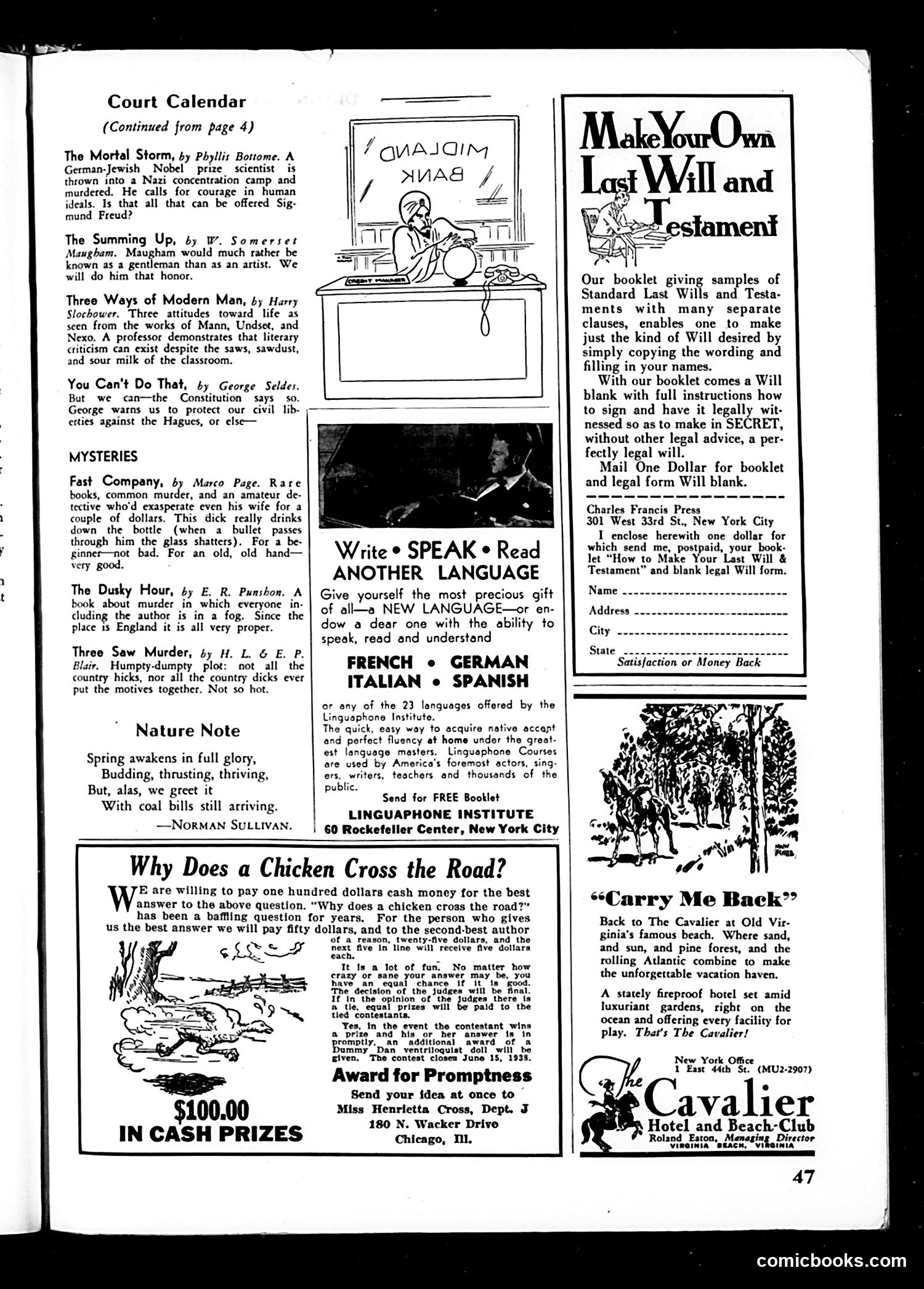
Page Analysis: Judge Magazine This page is primarily advertising and filler content, not political satire. The main elements are: Book Reviews Section: Brief critical summaries of contemporary novels, including *The Mortal Storm* (about Nazi persecution of a Jewish scientist) and mystery novels. "Why Does a Chicken Cross the Road?": A lighthearted contest offering $100 in cash prizes for the best answer to this joke question—presented as novelty entertainment. It's not political commentary but rather a playful engagement with readers. Language Instruction & DIY Will Services: Standard advertisements for the Linguaphone Institute and legal document services. Nature Quote: A humorous brief poem about spring and bills. The page lacks significant political cartoons or satirical commentary. It represents the magazine's typical mix of book criticism, reader contests, and commercial advertisements rather than the pointed editorial cartooning Judge was known for.
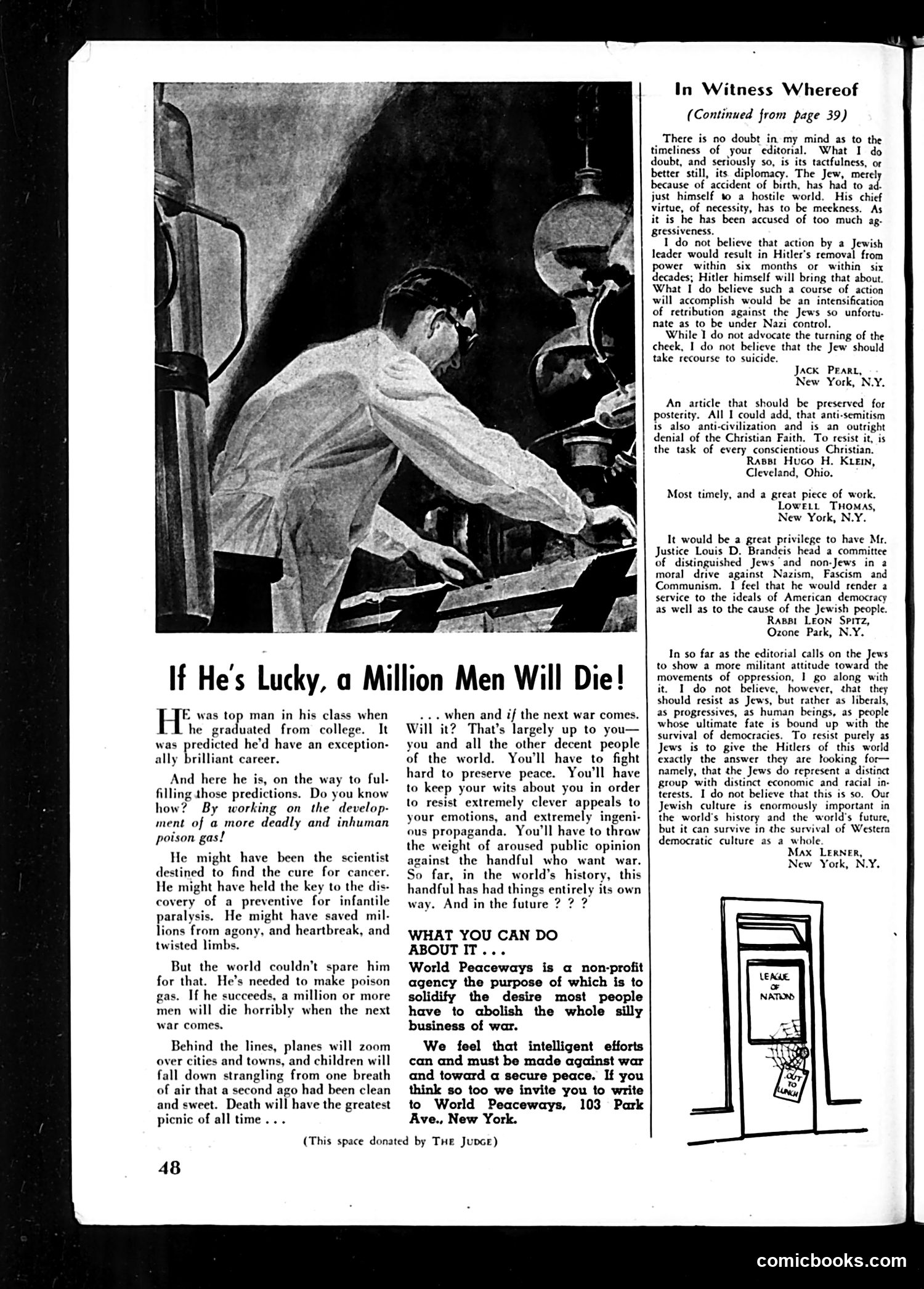
Analysis: "If He's Lucky, a Million Men Will Die!" This anti-war cartoon from *Judge* magazine critiques the militarization of scientific talent during the pre-WWII era. The large image depicts a young scientist—described in text as a brilliant college graduate—now developing poison gas instead of pursuing humanitarian breakthroughs (cancer cures, infantile paralysis prevention). The satire targets both the misallocation of human genius toward weapons development and, implicitly, those promoting war preparation. The accompanying text argues that ordinary citizens must actively resist war through "aroused public opinion" against "the handful who want war." The reader letters below suggest this relates to Jewish perspectives on Nazi Germany and appropriate Jewish responses to fascism—some arguing for restraint, others for stronger resistance. The page represents 1930s American pacifist sentiment, warning that the next war's technological horrors (chemical weapons, aerial bombardment of civilians) would be catastrophic. The *World Peaceways* advertisement reinforces the magazine's anti-war messaging.
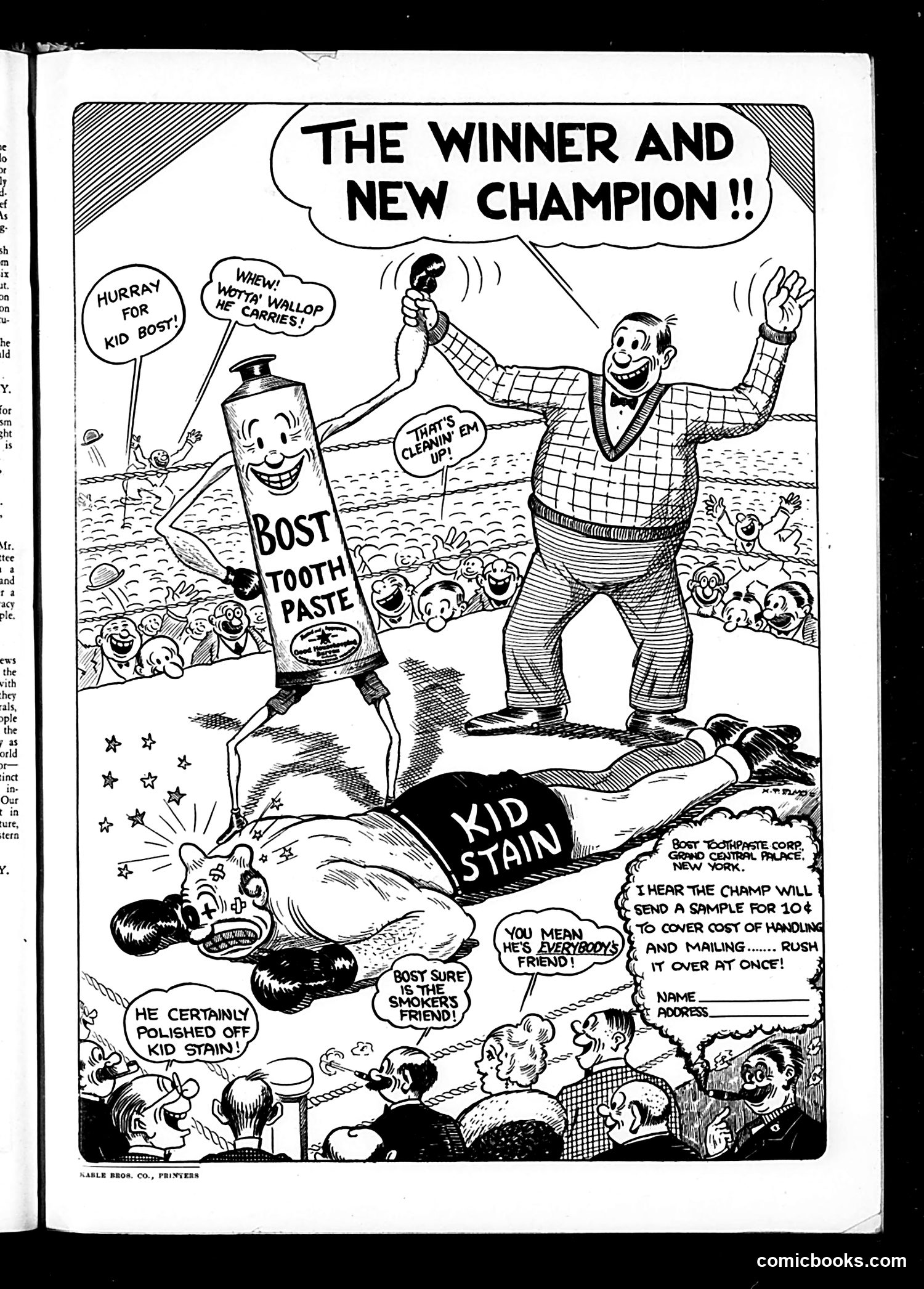
Analysis This is a vintage advertisement disguised as a comic strip, promoting Boost Toothpaste. The cartoon depicts a boxing-style victory scene where a anthropomorphized Boost Toothpaste tube defeats a character labeled "Kid Stain." The satire uses sports spectacle to market the product: Boost is presented as the triumphant "champion" over tooth stains. The crowd cheers the toothpaste's victory, while supporting characters like "Bosy Sure" (likely "Rosy Sure," suggesting healthy gums) celebrate. The ad promises a free sample for 10¢ postage, typical of early 20th-century marketing tactics. The humor relies on personification and mock-heroic framing—treating stain-removal as an epic battle. This reflects period advertising that anthropomorphized products and used competitive sports imagery to appeal to consumers.
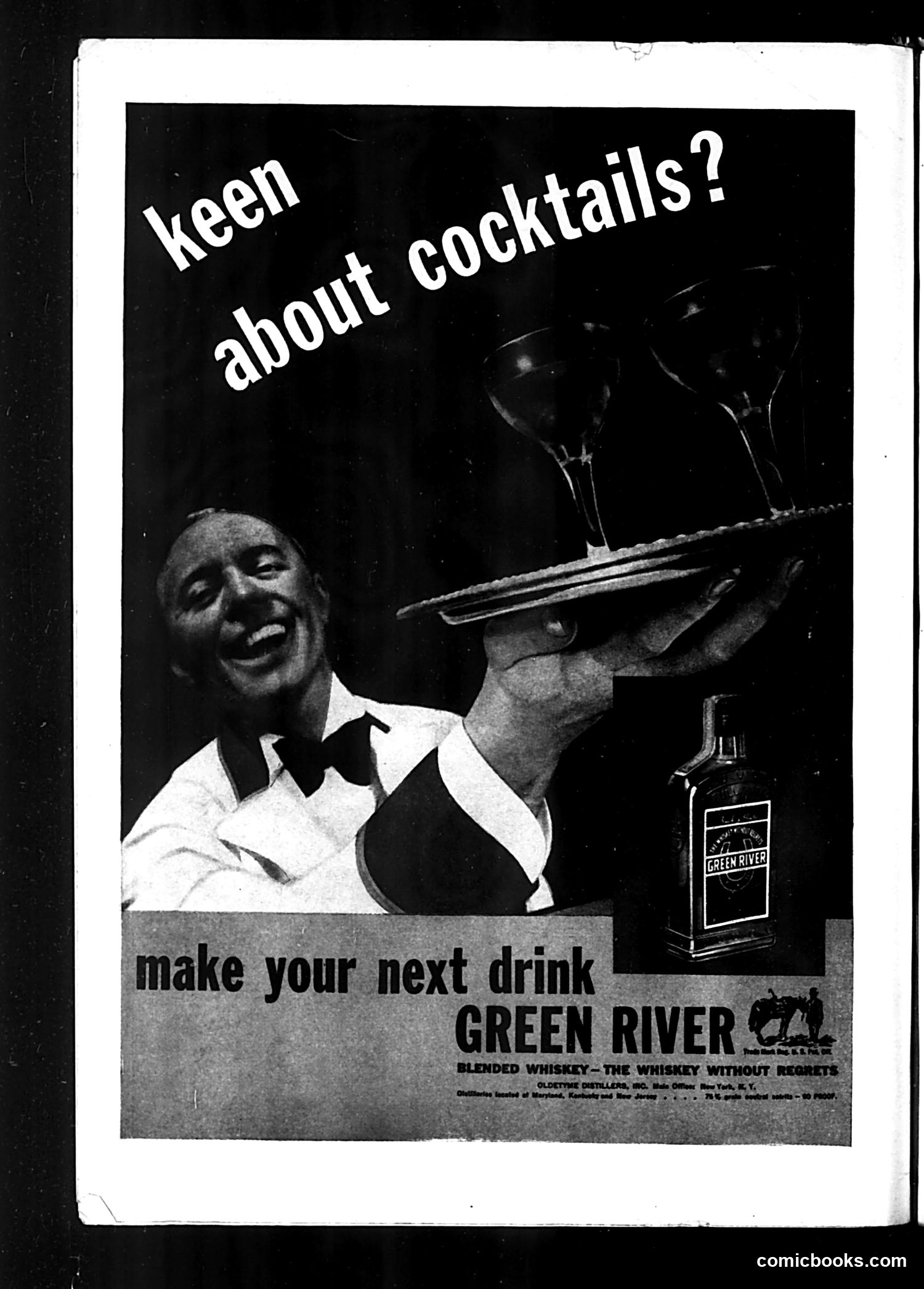
Analysis This is a vintage advertisement, not editorial satire. It promotes Green River blended whiskey with the tagline "The Whiskey Without Regrets." The ad features a smiling bartender or server in formal attire (bow tie, white shirt) holding a tray with cocktail glasses and a bottle of Green River whiskey. The headline "keen about cocktails?" positions the product as desirable for cocktail enthusiasts. The phrase "whiskey without regrets" appears to be a humorous marketing claim—suggesting that Green River whiskey won't leave drinkers regretting their choice the next morning, a lighthearted appeal typical of mid-20th century alcohol advertising before regulations restricted such claims. The ad emphasizes product appeal through an enthusiastic, personable server character rather than sophisticated satire.