judge
Judge — June 1938
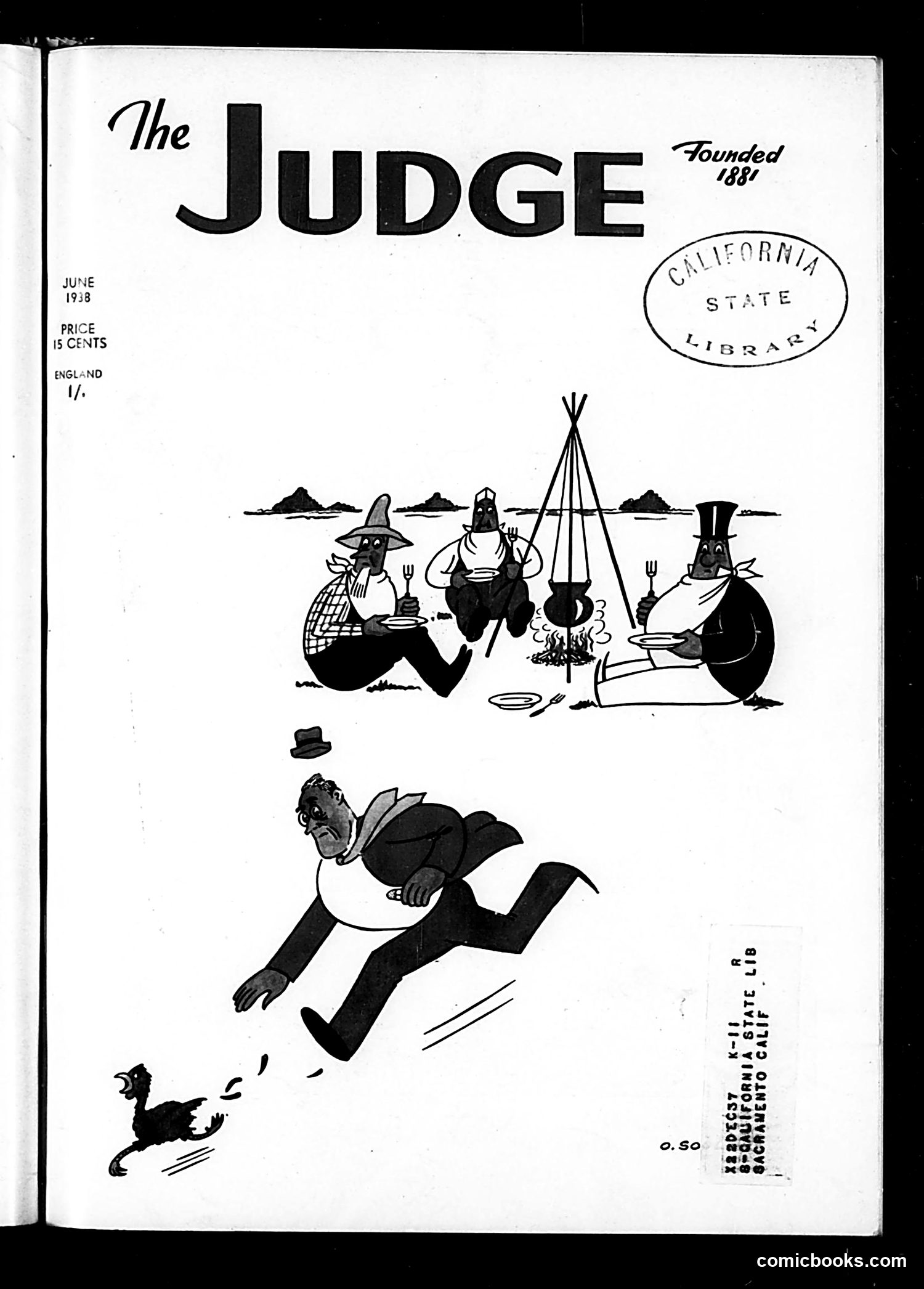
Analysis of Judge Magazine Cover (June 1938) This cover depicts two cartoon scenes satirizing political anxieties of 1938. The upper panel shows four caricatured figures in what appears to be a camping or diplomatic scene, likely referencing international tensions preceding World War II. The lower panel shows a well-dressed man in formal attire fleeing in panic, chased by a small dog. This appears to be satirizing fear or alarm among political/business figures, though the specific identity is unclear without additional context. The overall tone suggests anxiety about economic or political instability during this period. The magazine's June 1938 date places this during pre-war European tensions and domestic American political concerns. The crude caricatural style was typical of Judge's satirical approach to contemporary events.

Cherry Grove Kentucky Straight Bourbon Whiskey Advertisement This page is a liquor advertisement, not a political cartoon. It displays a label for "Cherry Grove" brand Kentucky straight bourbon whiskey, marked as 100 proof. The ad features a shield-shaped logo with the brand name prominently displayed, characteristic of early-to-mid 20th century whiskey marketing. The "REG U.S. PAT OFF" notation indicates registered trademark and patent office approval. There is no satirical content or political commentary visible. This appears to be a straightforward commercial advertisement for bourbon whiskey, likely from Judge magazine's advertising section. The stark black-and-white design was typical of vintage spirits advertising.
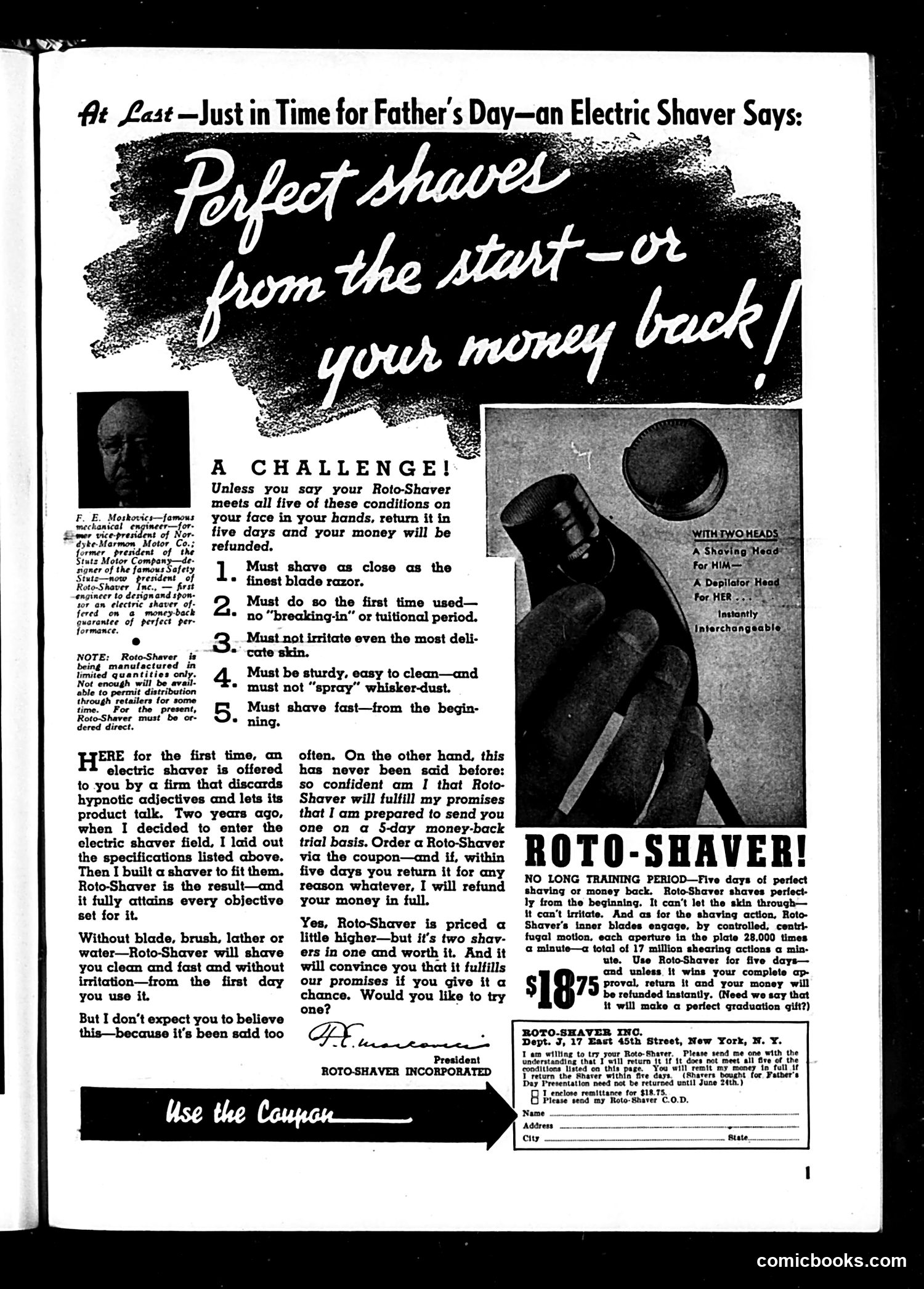
Roto-Shaver Advertisement This page is primarily a product advertisement, not political satire. It promotes the "Roto-Shaver," an early electric razor (priced at $18.75), marketed as a Father's Day gift. The ad features a testimonial from F.E. Markovitch, identified as an "famous mechanical engineer" and former vice-president of various companies. He presents five performance guarantees, claiming the shaver delivers "perfect shaves from the start" without requiring a breaking-in period. The challenge format—promising money-back if conditions aren't met—was a common sales tactic of the era. The accompanying coupon and detailed specifications reflect 1930s-40s direct-mail advertising conventions. The inclusion of interchangeable heads for men and women indicates marketing to multiple demographics. This is commercial promotion rather than editorial content.
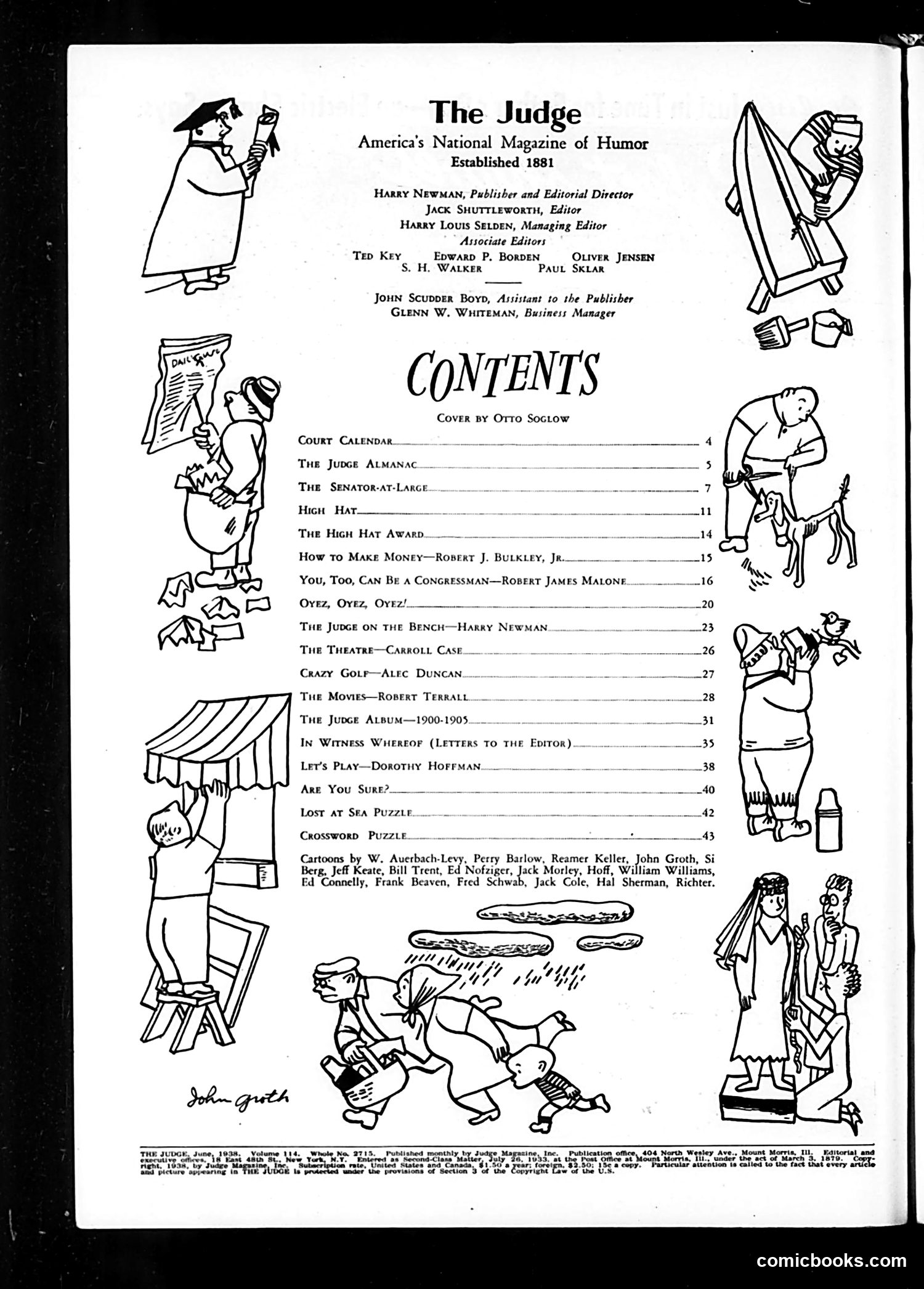
The Judge Contents Page (June 1900) This is a contents/masthead page from *The Judge*, America's premier humor magazine established in 1881. The page lists articles and features for the June 1900 issue, including pieces on politics ("The Senator-at-Large"), theater, golf, and puzzles. The cartoons decorating the margins appear to be generic humorous illustrations rather than specific political satire—figures with exaggerated proportions engaged in everyday activities (shopping, golfing, parenting). Without identifying specific caricatures or referencing particular 1900 events in the visible illustrations, these seem designed simply as decorative humor typical of the magazine's style. The masthead credits editor Harry Newman and associates, establishing this as an official publication page rather than substantive editorial content.
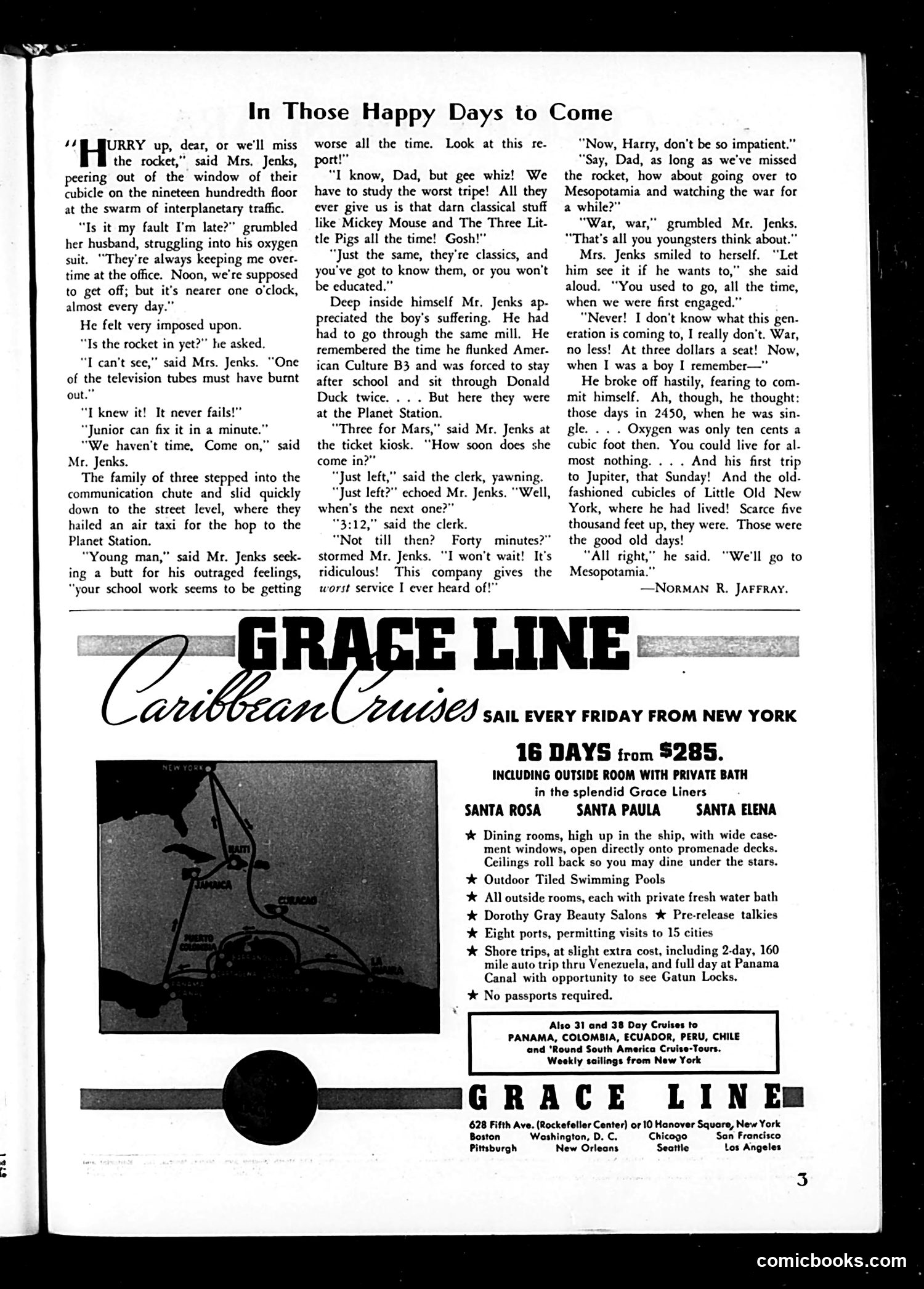
Analysis This page is primarily advertising content rather than satirical cartoon material. The dominant feature is a Grace Line cruise advertisement promoting Caribbean cruises from New York, sailing "every Friday" for 16 days at $285, visiting ports including Santa Rosa, Santa Paula, and Santa Elena. The upper portion contains "In Those Happy Days to Come," a short fictional story by Norman R. Jaffray about a father and son visiting a "Planet Station" — apparently science fiction humor imagining future space travel. The story's joke concerns the son's impatience with classical entertainment (Mickey Mouse, Donald Duck) and the father's nostalgic recollection of 1940s New York geography. The page reflects mid-20th century commercial publishing where advertisements often dominated editorial space in magazines like Judge.
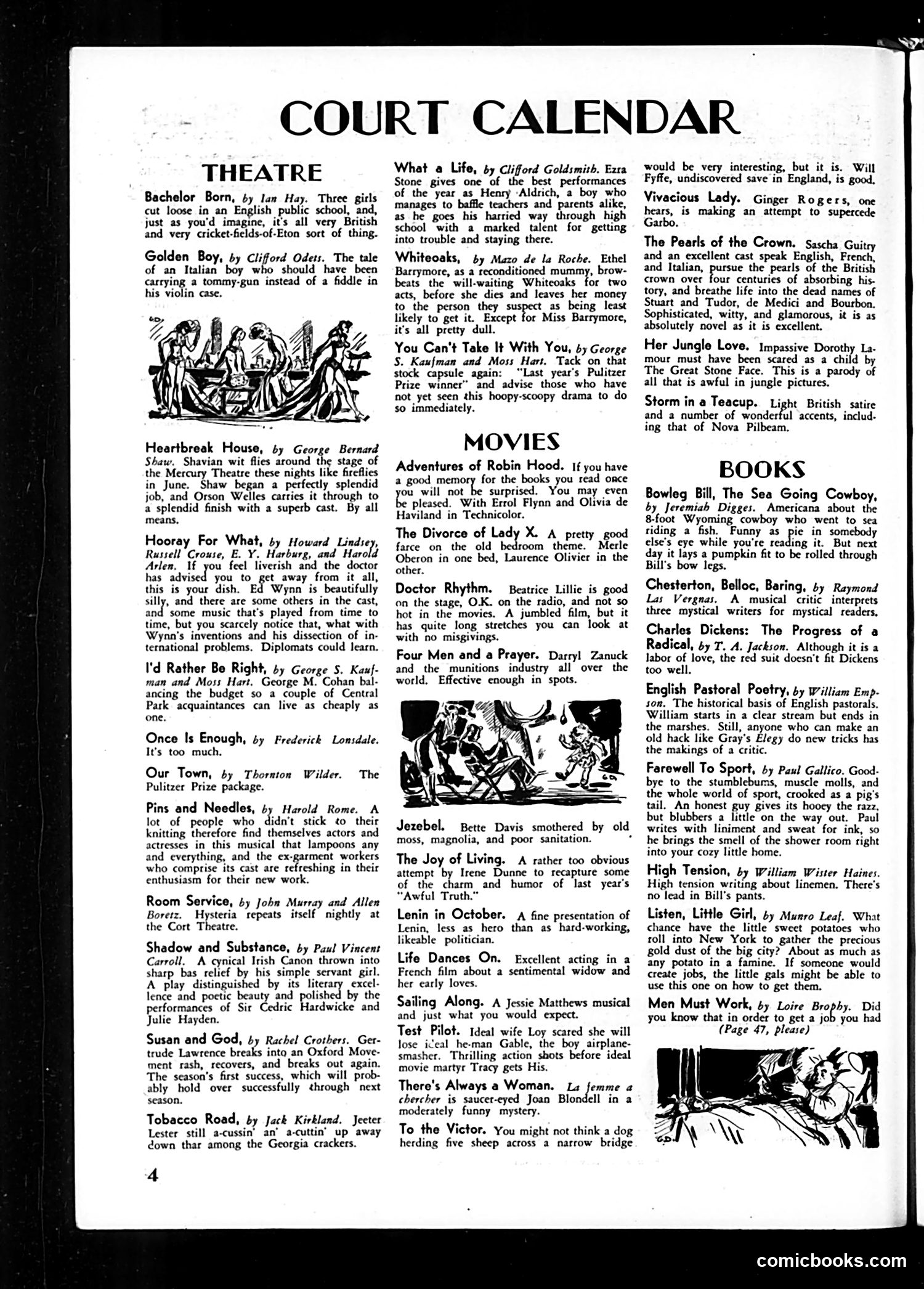
Court Calendar Page Analysis This page is primarily a entertainment guide, not political satire. It lists theatrical productions, movies, and books with brief reviews and descriptions. The two small cartoons appear to be generic humorous illustrations accompanying entertainment reviews rather than political commentary. They depict: 1. A theatrical scene showing figures in period costume (top left) 2. A domestic or social scene with figures interacting (bottom center) These illustrations are decorative accompaniments to the entertainment listings rather than satirical commentary on current events or politics. The page itself represents Judge magazine's function as a lifestyle publication—providing readers with cultural recommendations for theater, cinema, and literature of the era, alongside its better-known satirical cartoons found elsewhere in the magazine.
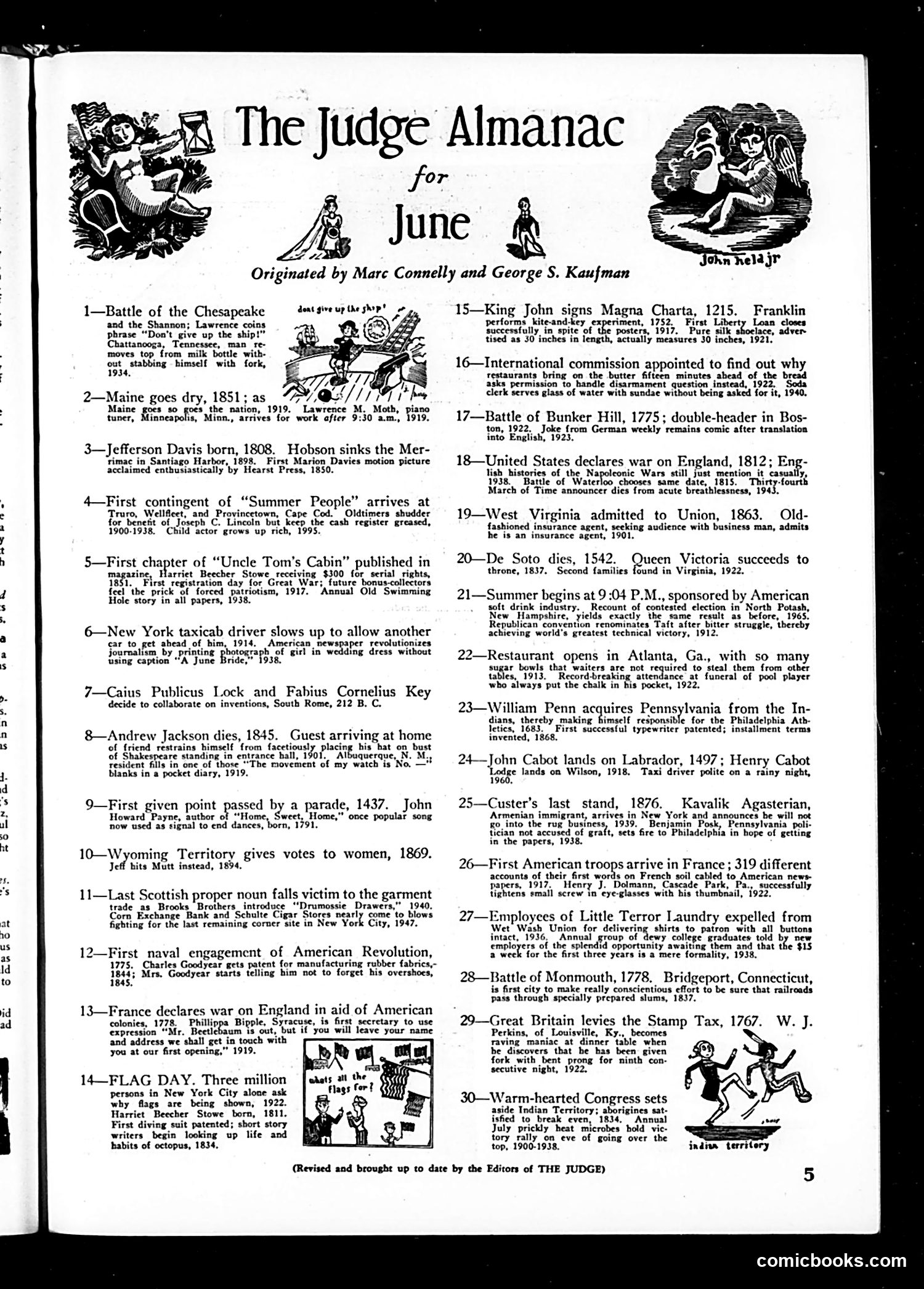
The Judge Almanac for June This page is primarily an almanac of historical events rather than political satire. It lists 30 numbered historical facts arranged chronologically, each with brief descriptions and dates ranging from 1437 to 1922. The few illustrations appear decorative rather than satirical—cherubs/angels at the header and small vignettes accompanying entries about Flag Day (showing patriotic imagery) and Indian Territory (showing Native Americans). The content mixes major American events (Revolutionary War, Civil War, westward expansion) with quirky trivia (typewriter patents, restaurant opening records). The humor is gentle and antiquarian—celebrating American history and oddities rather than attacking political figures or positions. This functions as educational entertainment for Judge's readers rather than sharp political commentary.

Bost Tooth Paste Advertisement This is a straightforward commercial advertisement, not political satire. It promotes Bost Tooth Paste as an affordable solution for tooth cleaning and whitening. The image shows a smiling woman in 1920s-style dress and hat, illustrating the product's promised benefit: an attractive smile. The accompanying text emphasizes that Bost Tooth Paste can remove tobacco stains "gently" using "harmless oil" rather than abrasive scraping—a notable selling point when smoking was widespread and socially acceptable. The 10-cent price and mail-in coupon were typical marketing tactics of this era. The Good Housekeeping seal of approval lent credibility. The page's appearance in *Judge* magazine simply reflects how such advertisements subsidized publications' printing costs.
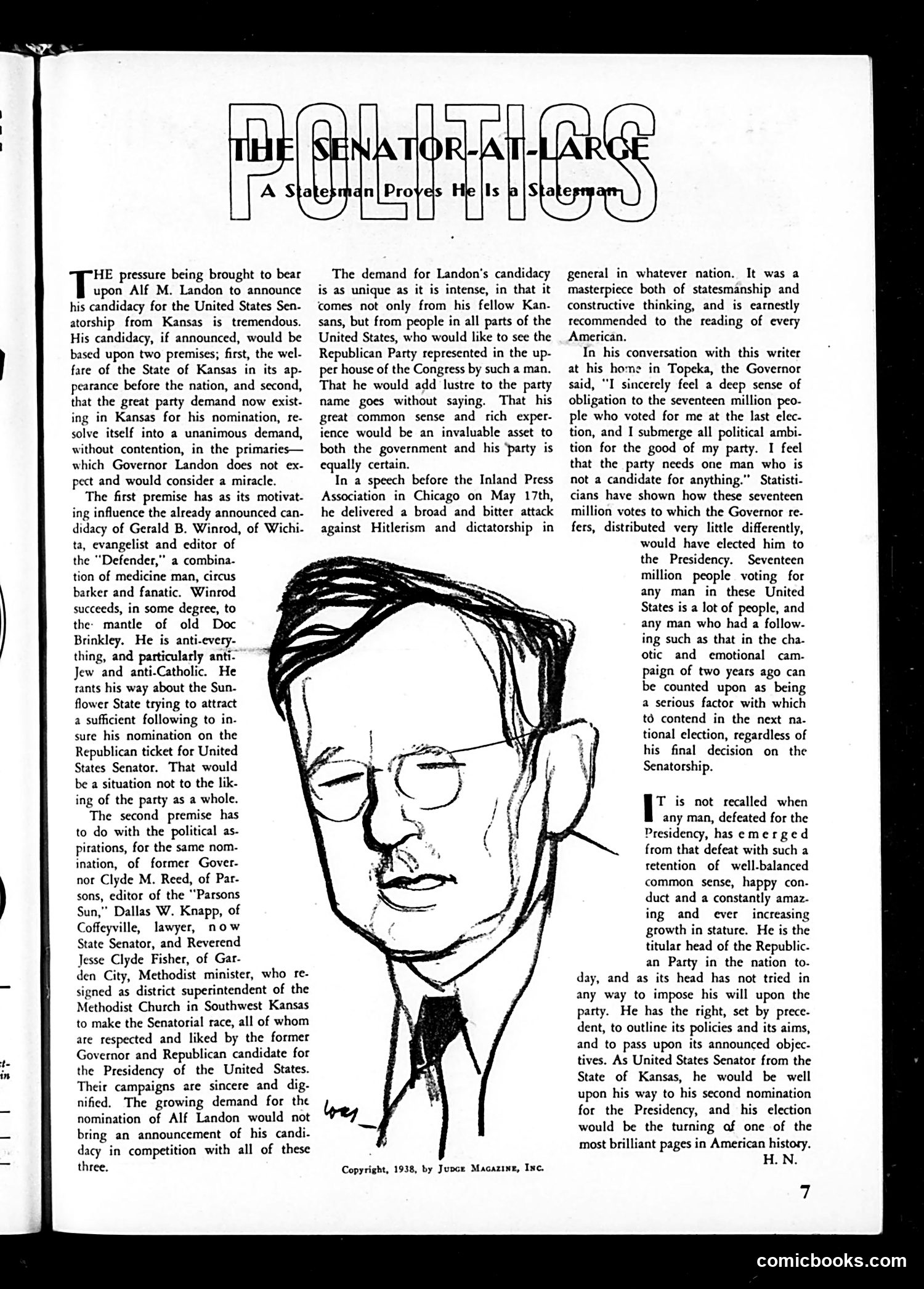
"The Senator-at-Large: A Statesman Proves He Is a Statesman" This article discusses Alf M. Landon of Kansas, who announced his candidacy for U.S. Senator. The text criticizes rival Republican candidates—Gerald B. Winrod (described as anti-Semitic and anti-Catholic, compared to "old Doc Brinkley") and others including Clyde M. Reed and Jesse Clyde Fisher. The accompanying portrait sketch depicts Landon as a serious, bespectacled figure—presenting him as a rational, moderate alternative to more extreme Republican candidates. The article praises Landon's "common sense" and "statesmanship," arguing that even if defeated for the Presidency, his Senate election would represent an important victory against extremism and demagoguery in American politics. The satire endorses Landon as the sensible choice.
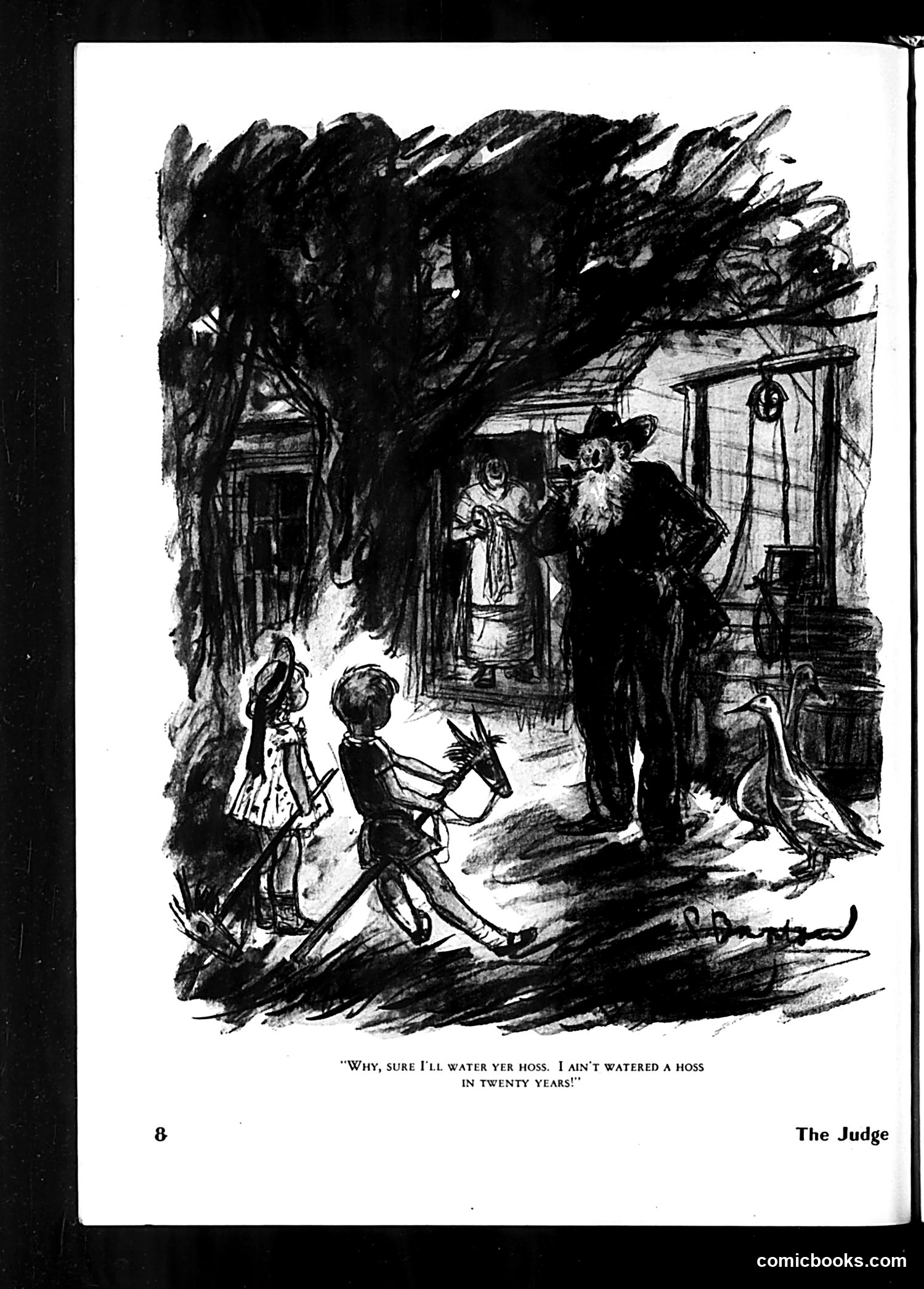
This cartoon depicts a domestic scene where a man (appearing to be a farmer or laborer based on his work clothes) is being confronted by what seems to be his wife and an authority figure—possibly a judge or official—near a house. The caption reads: "Why, sure I'll water yer hoss. I ain't watered a hoss in twenty years!" The satire appears to mock either neglectful husbandry or a man's reluctance to perform basic farm duties. The presence of the official figure suggests legal consequences or social judgment regarding animal welfare or property maintenance. The humor lies in the character's defensive admission that he's abandoned his responsibilities for two decades, implying either laziness or incompetence. This reflects *Judge* magazine's tendency toward social commentary on rural life and domestic accountability in early-to-mid 20th century America.
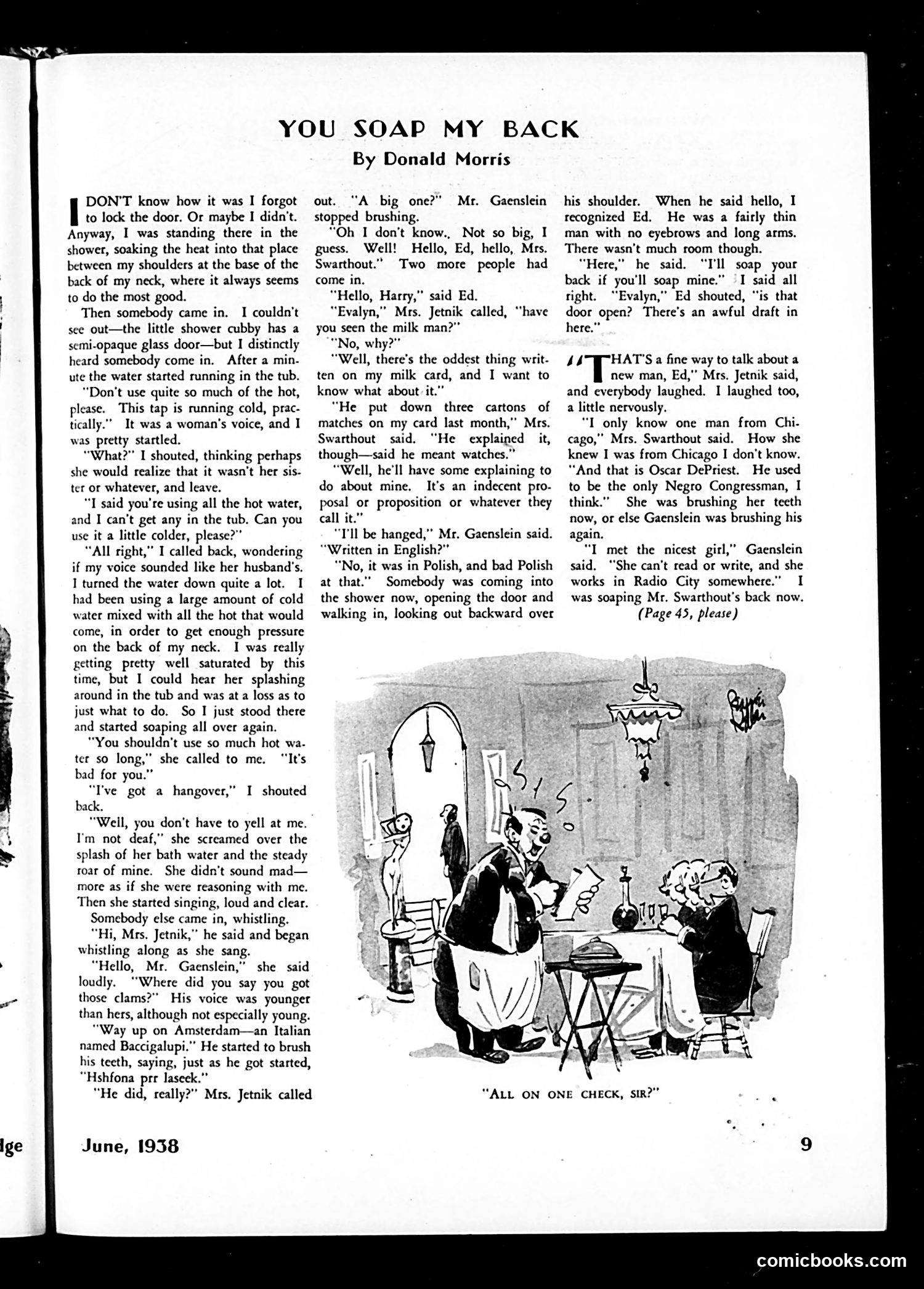
Analysis This humorous short story satirizes the chaos of crowded, communal urban apartment living in 1930s America. The narrator attempts a private shower but finds himself in an increasingly absurd situation where multiple neighbors—Mrs. Jetnik, Mr. Gaenslein, Ed, and Mrs. Swarthout—casually intrude into the bathroom, bathing, singing, and conversing simultaneously. The satire targets the lack of privacy and personal space in densely-packed city apartments, where neighbors freely impose on one another without embarrassment. The escalating intrusions, from water-sharing complaints to unsolicited hygiene advice to a stranger offering to soap the narrator's back, mock the forced intimacy of cramped urban housing. The casual mention of Oscar DePriest (America's first Black congressman) and ethnic references (Italian grocer, Polish milkman) reflect the immigrant and working-class neighborhood context typical of 1930s urban America. The joke's absurdist humor comes from treating this complete invasion of privacy as mundane neighborly interaction.
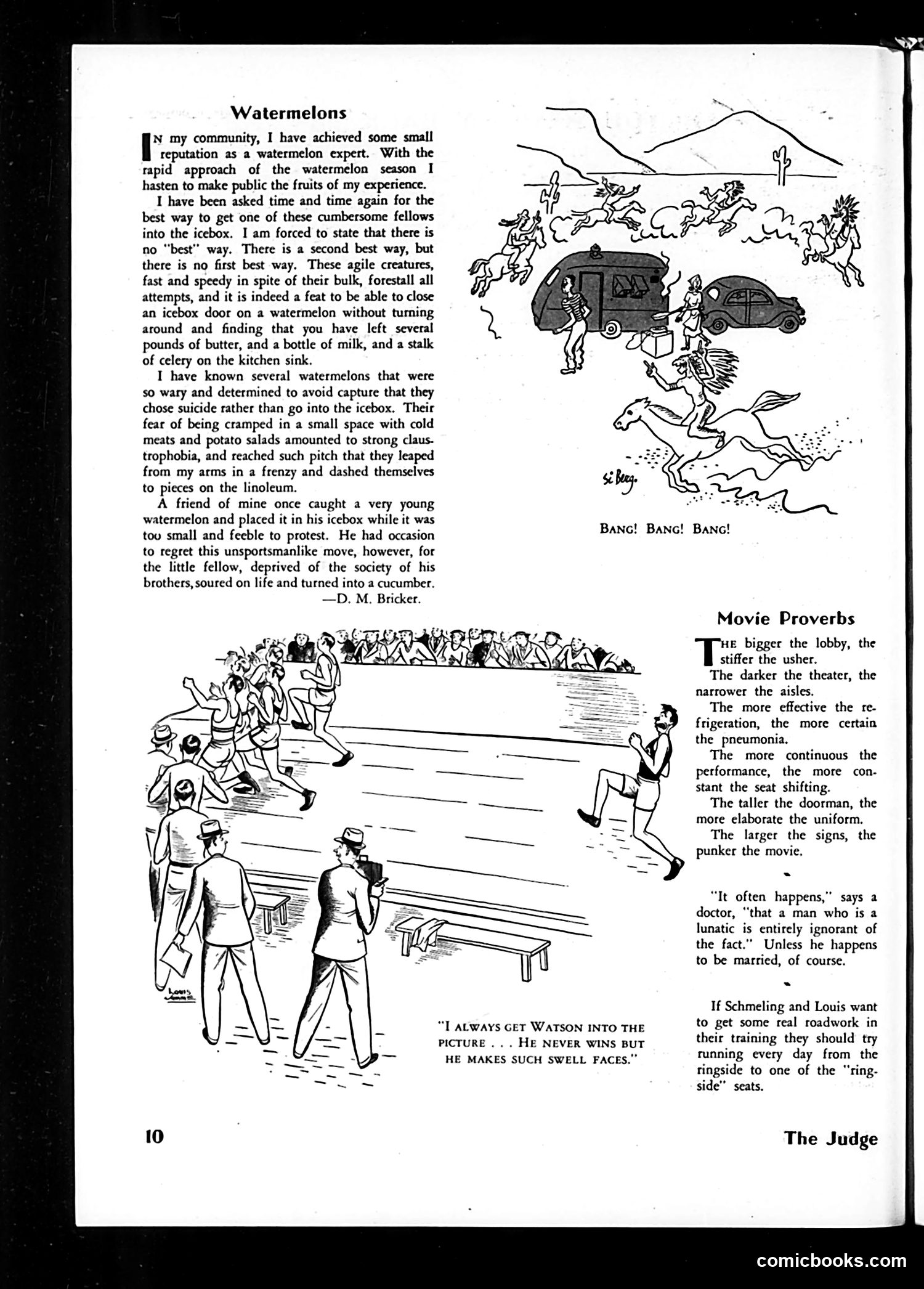
Page Analysis: Judge Magazine "Watermelons" (top left): A humorous essay by D.M. Bricker about the difficulty of storing watermelons in iceboxes. The accompanying cartoon shows a chaotic scene of people chasing watermelons that have escaped into a desert landscape—visual comedy illustrating the text's premise that watermelons are impossibly agile and difficult to contain. "Movie Proverbs" (right side): Satirical observations about cinema theater experiences, mocking common annoyances: cramped lobbies with brusque ushers, dark theaters with narrow aisles, overly cold air conditioning causing illness, uncomfortable seats, and misleadingly elaborate signage for poor-quality films. The cartoon below shows a bowling alley, apparently illustrating the "seat shifting" complaint. Bottom quote about Watson: References an actor (Watson) who allegedly appears in films despite never winning roles, but is valued for his expressive face—likely mocking overwrought silent-film acting or a specific performer's limited talent. These pieces represent Judge's typical satirical approach: gentle social mockery of everyday frustrations and entertainment industry conventions.
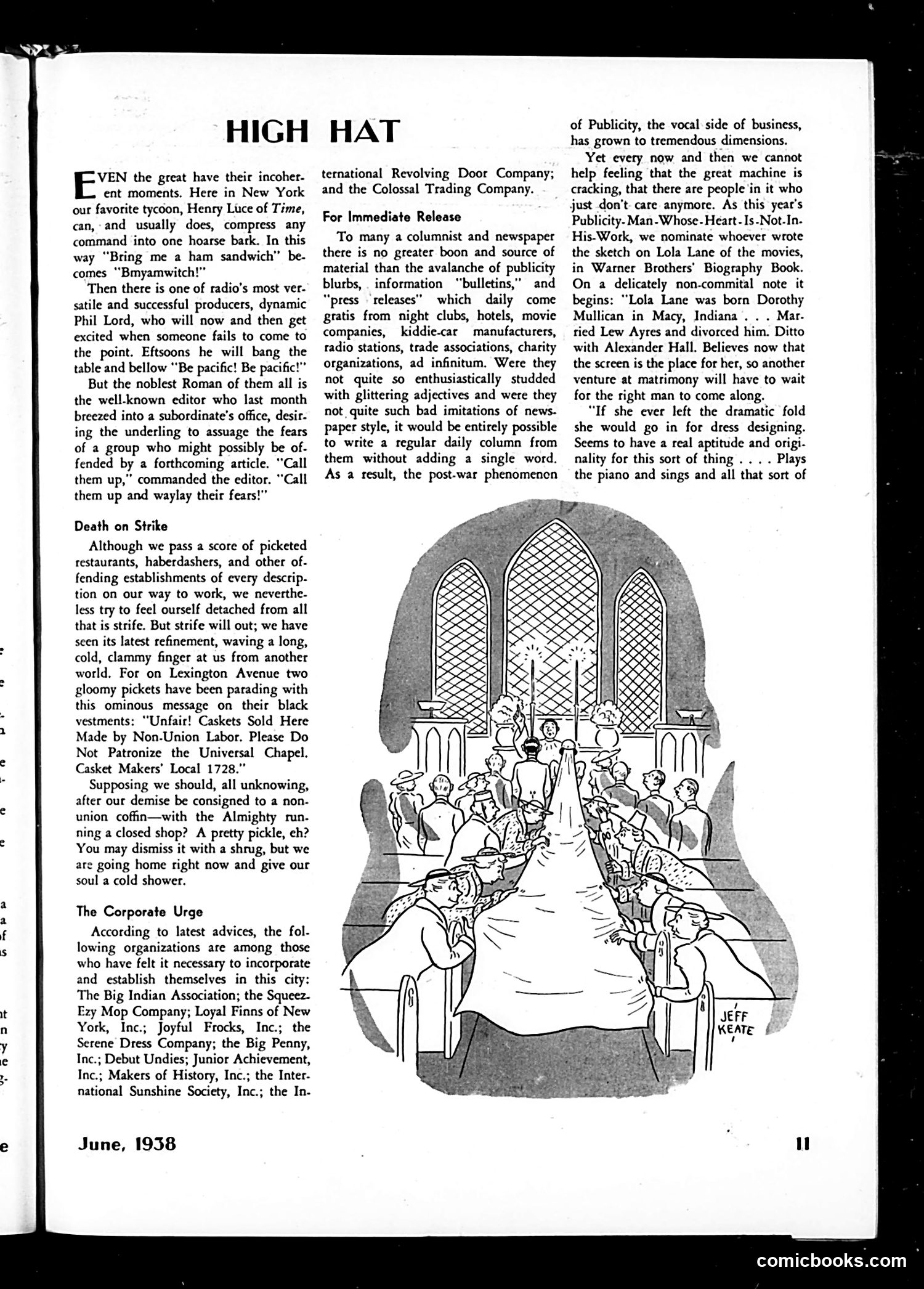
"High Hat" - Judge Magazine, June 1938 This satirical page mocks the absurdities of 1930s American business and media culture. "High Hat" opening: Ridicules powerful men's incomprehensible speech patterns—Henry Luce (Time magazine founder) barks garbled commands; Phil Lord (radio producer) demands people "be pacific"; an unnamed editor confuses subordinates with malapropisms like "waylay their fears." "Death on Strike": Darkly jokes about labor activism extending even to coffin-makers' unions, imagining non-union caskets as a damnation concern. "The Corporate Urge": Lists absurdly named newly-incorporated organizations (Big Indian Association, Squeez-Ezy Mop Company, International Revolving Door Company) satirizing America's corporate boom and the proliferation of trivial organizations seeking legitimacy through incorporation. Right panel illustration (by Jeff Keate): Shows a crowded church interior, likely illustrating the casket-maker's union picketing story. The overall theme: powerful executives communicate nonsense; labor strikes reach comic extremes; and Americans obsessively incorporate meaningless entities.
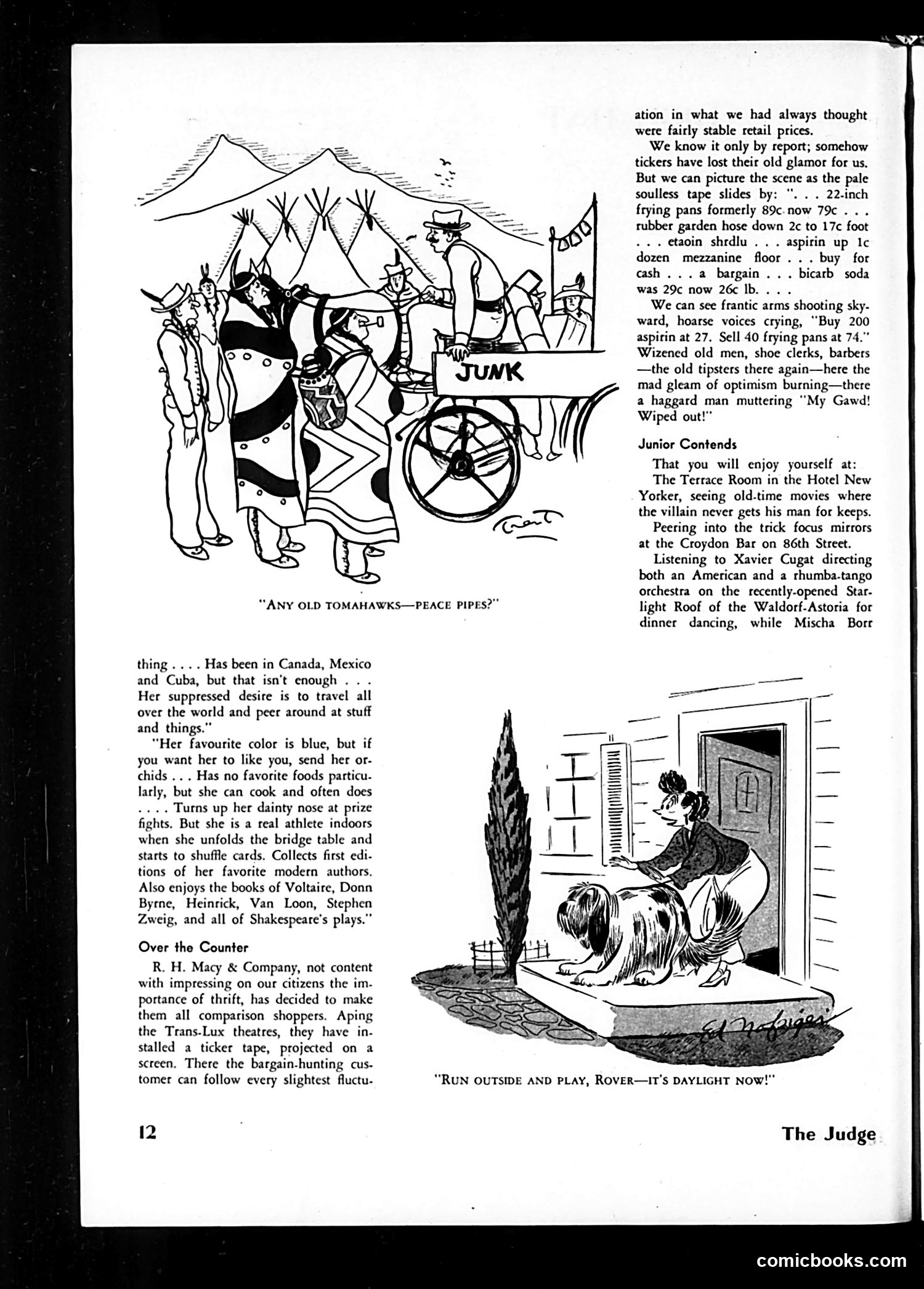
Analysis for Modern Readers This page contains two satirical cartoons about 1920s-30s American consumer culture and stock market anxieties. Top cartoon ("Any Old Tomahawks—Peace Pipes?"): Depicts a chaotic Native American encampment with people frantically trading goods. This satirizes the stock market frenzy and speculation mania of the era—comparing frenzied financial trading to primitive bartering. The image mocks how ordinary citizens became obsessed with quick profits through stock speculation. Bottom cartoon ("Run Outside and Play, Rover"): Shows a woman sitting indoors at a window while a dog begs to go outside. This jokes about Depression-era thrift culture—the woman is so obsessed with indoor activities (bridge games, reading) and saving money that she won't even let the dog enjoy daylight. It satirizes how financial anxiety made people miserly and homebound. Both cartoons critique how economic uncertainty and consumerism dominated American life, turning people into either frantic speculators or penny-pinching worriers.
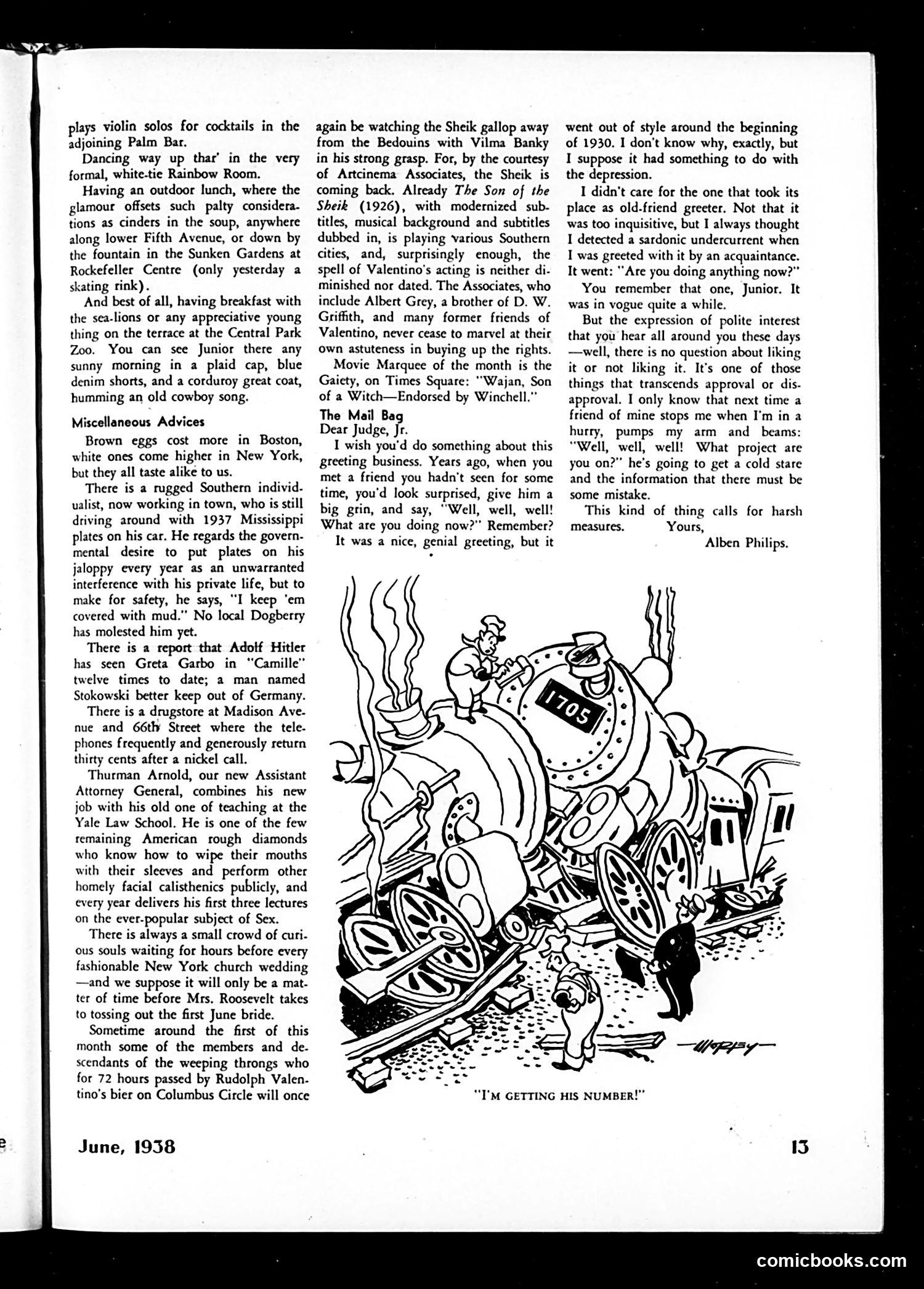
Understanding This June 1938 Judge Magazine Page This page mixes social commentary with light satire typical of Judge's style. The main cartoon shows a chaotic car accident with the caption "I'M GETTING HIS NUMBER!"—a visual gag about traffic safety and insurance claims, common themes in 1930s humor. The text includes brief "miscellaneous advices" poking fun at contemporary life: a Southern driver defying license plate requirements, references to Adolf Hitler and Greta Garbo (topical 1938 gossip), and Thurman Arnold (the actual Assistant Attorney General known for his public persona). A "Mail Bag" letter critiques how greeting etiquette changed post-1929, blaming the Great Depression for killing the old enthusiastic "Well, well, well! What are you doing now?" greeting. This reflects genuine social anxiety about the economic crisis's cultural impact. The page reflects 1938 concerns: economic hardship, celebrity culture, government figures, and traffic safety—all treated with Judge's characteristic light, sometimes satirical touch.
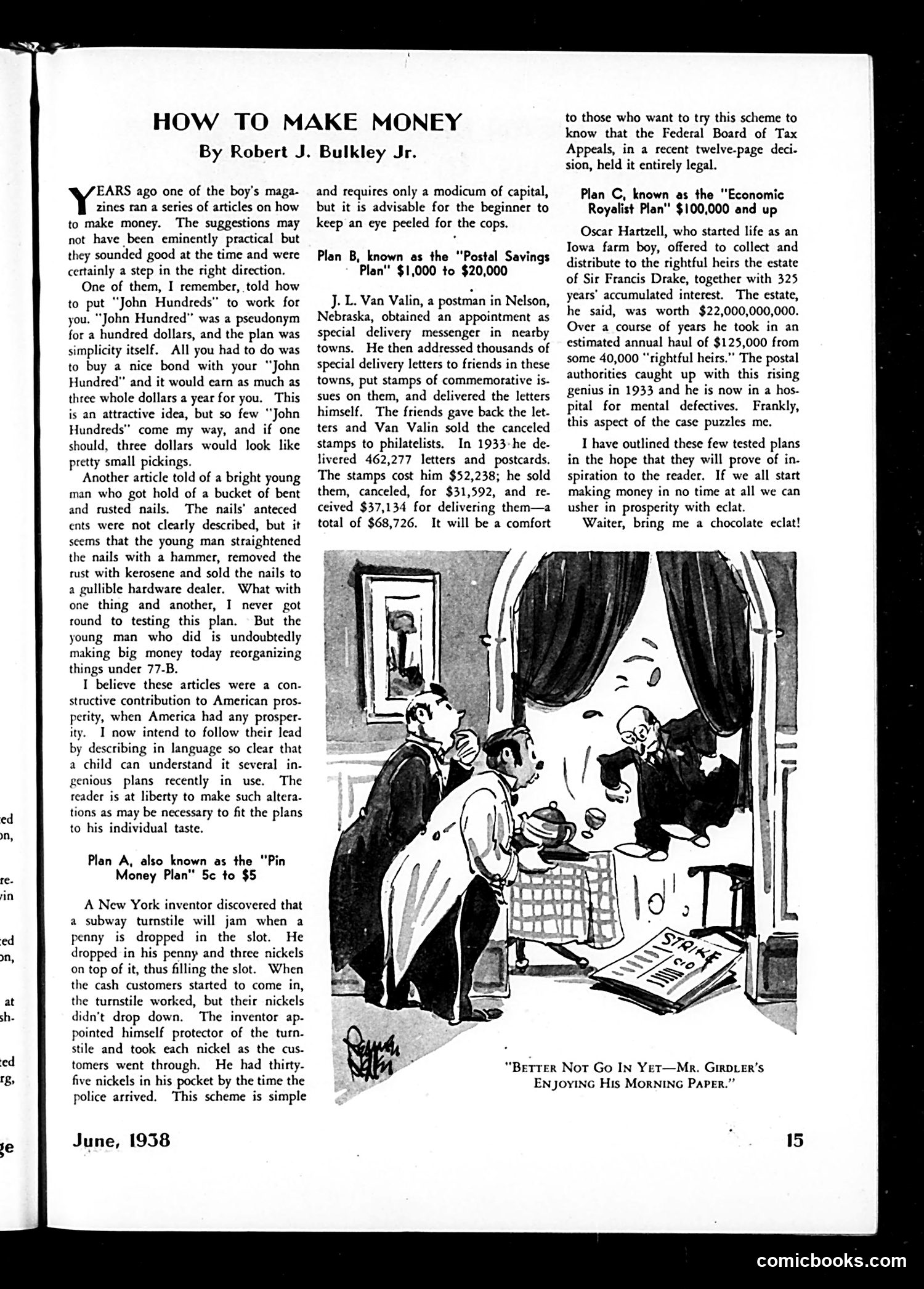
"How to Make Money" - Judge Magazine, June 1938 This satirical article by Robert J. Bulkley Jr. presents three increasingly elaborate "money-making schemes," each with real historical examples, to mock both get-rich-quick fantasies and actual fraud. Plan A describes a petty subway turnstile scam—jamming the mechanism to pocket customer nickels until arrest. Plan B details J.L. Van Valin's 1933 postal scheme: he mailed commemorative stamps to friends, collected them back as "canceled" stamps, and sold them to collectors—then profited further from delivery fees. Remarkably, the Federal Board of Tax Appeals ruled it *legal*. Plan C satirizes Oscar Hartzell, an Iowa farm boy who perpetrated a famous confidence scheme claiming he could distribute Sir Francis Drake's 325-year-accumulated estate ($22 billion) to "rightful heirs." He defrauded approximately 40,000 people of an estimated $125,000 annually before postal authorities arrested him in 1933. The article's escalating scale—from petty theft to legitimate loopholes to massive fraud—critiques Depression-era desperation and financial schemes disguised as opportunity.
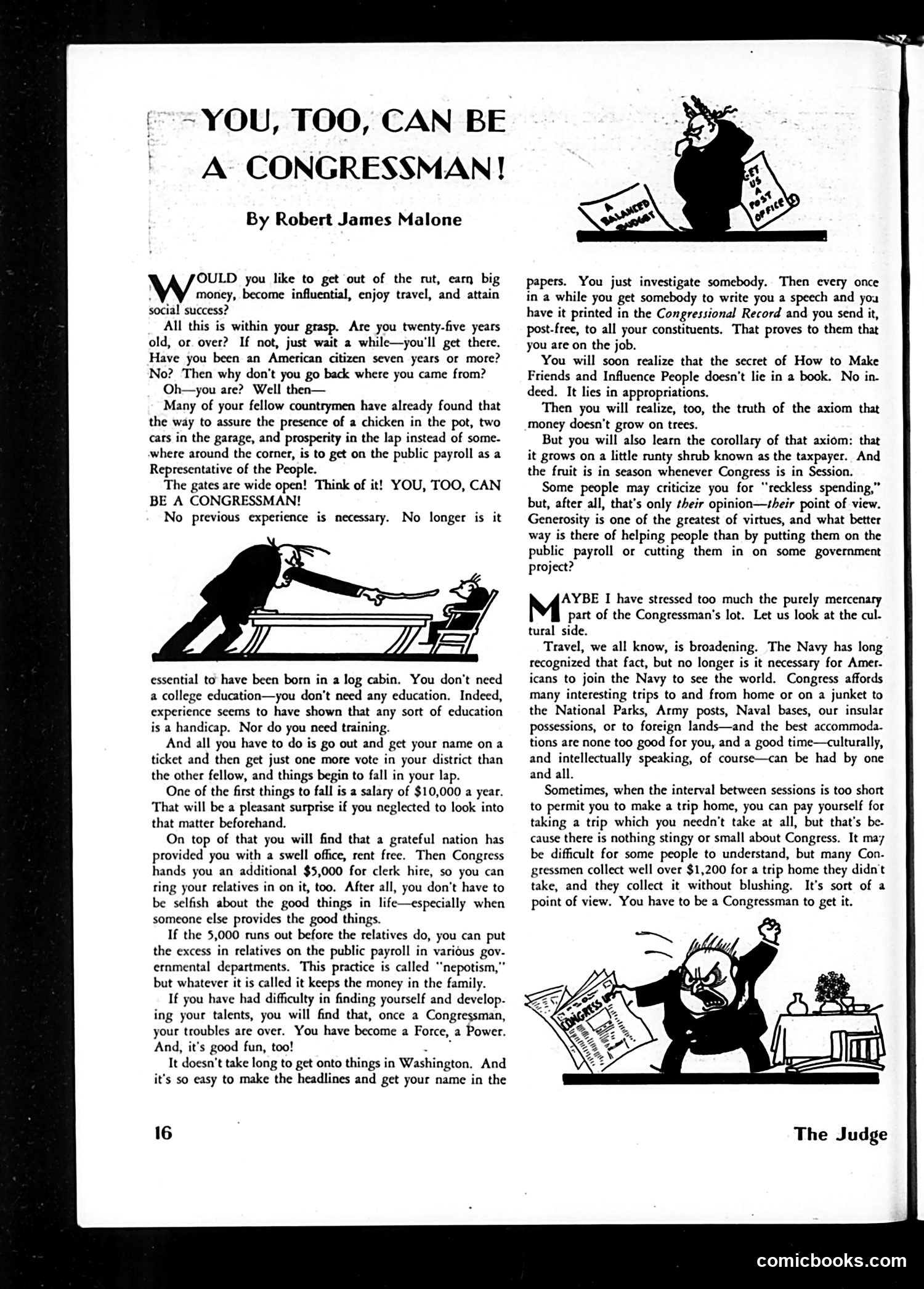
Explanation for Modern Readers This satirical article mocks the ease of becoming a U.S. Congressman and the corruption inherent in the position. Written by Robert James Malone for *Judge* magazine, it presents a cynical "how-to" guide highlighting several abuses: Key Targets: - No qualifications needed: Education is portrayed as a "handicap" - Financial corruption: The $10,000 salary plus $5,000 clerk-hire allowance (early 20th century wages), which congressmen use to employ relatives—a practice called "nepotism" - Self-serving investigations: Politicians gain fame by investigating others, publishing speeches in the Congressional Record to impress constituents - Wasteful spending: Justified as "generosity" while funded by taxpayers (the "runty shrub") - Perks masquerading as duty: Congressional travel presented as cultural enrichment The Satire's Point: The article exposes how becoming a congressman requires only getting one more vote than your opponent, then exploiting the position for personal enrichment and family benefit—all legally. The accompanying cartoons visually reinforce these themes of greed and incompetence in government.
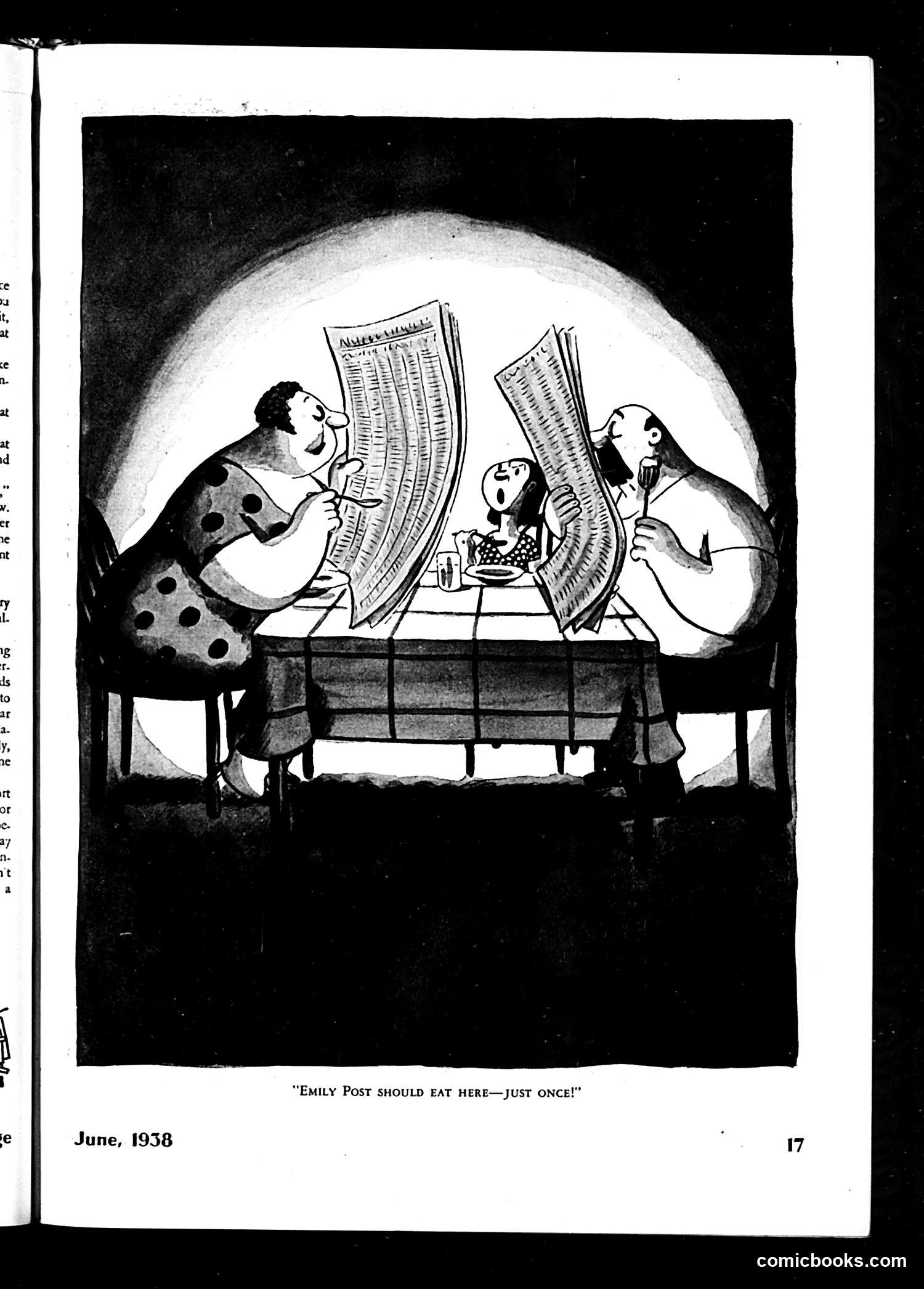
Analysis of Judge Magazine Cartoon, June 1938 This cartoon satirizes etiquette advice, specifically critiquing rigid social rules about proper dining. Two men hold up large newspapers/menus as screens at a dinner table while a woman sits between them, appearing uncomfortable or confused. The caption reads: "EMILY POST SHOULD EAT HERE—JUST ONCE!" Emily Post was America's most famous etiquette authority in the 1930s. The joke mocks her strict rules of polite dining conduct by suggesting they're impractical or absurd in real situations. The men's use of newspapers as barriers suggests the awkwardness and artificiality of following such rigid social conventions—behavior that would actually create discomfort rather than elegance. The satire targets both Post's influence and the era's obsession with formal social propriety.
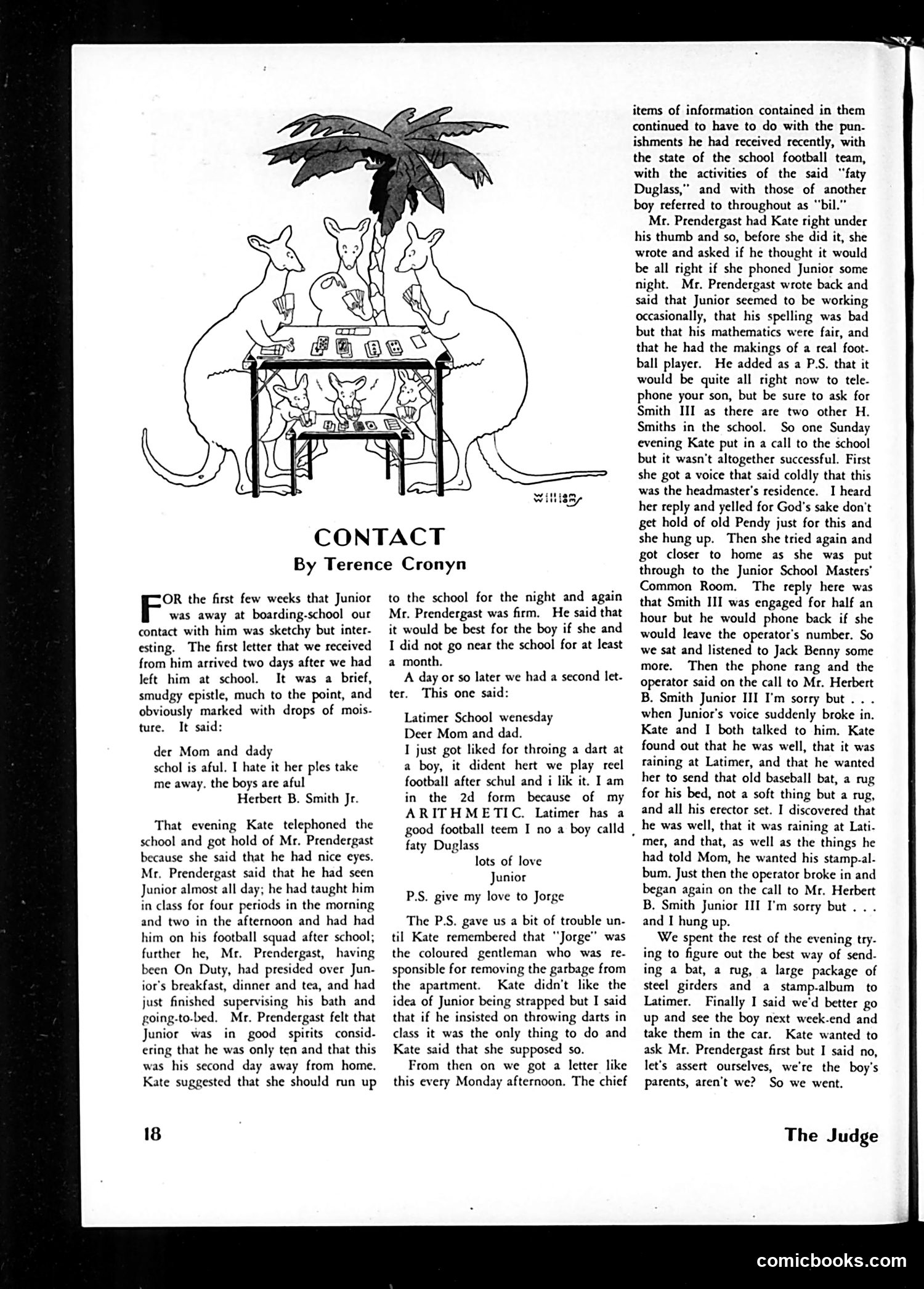
"Contact" by Terence Cronyn – Judge Magazine This is a humorous domestic story about a boy's first weeks at boarding school, illustrated with a cartoon showing animals (appearing to be goats or similar creatures) seated at a dining table. The narrative satirizes both anxious parents and institutional bureaucracy. The mother "Kate" becomes emotionally invested in the school's headmaster "Mr. Prendergast," while the father maintains practical skepticism. The boy's letters—full of spelling errors and casual mentions of punishments and schoolyard friendships ("faty Duglass," "bil")—are authentic and touching, but the parents' attempts to contact him are hilariously obstructed by bureaucratic red tape and the headmaster's paternalistic control. The satire targets upper-class parental anxiety about boarding school, the school's assertion of authority over children, and the absurdity of institutional communication systems. The joke is that modern parents cannot simply reach their son—they must navigate operators, multiple "H. Smiths," and the headmaster's gatekeeping.
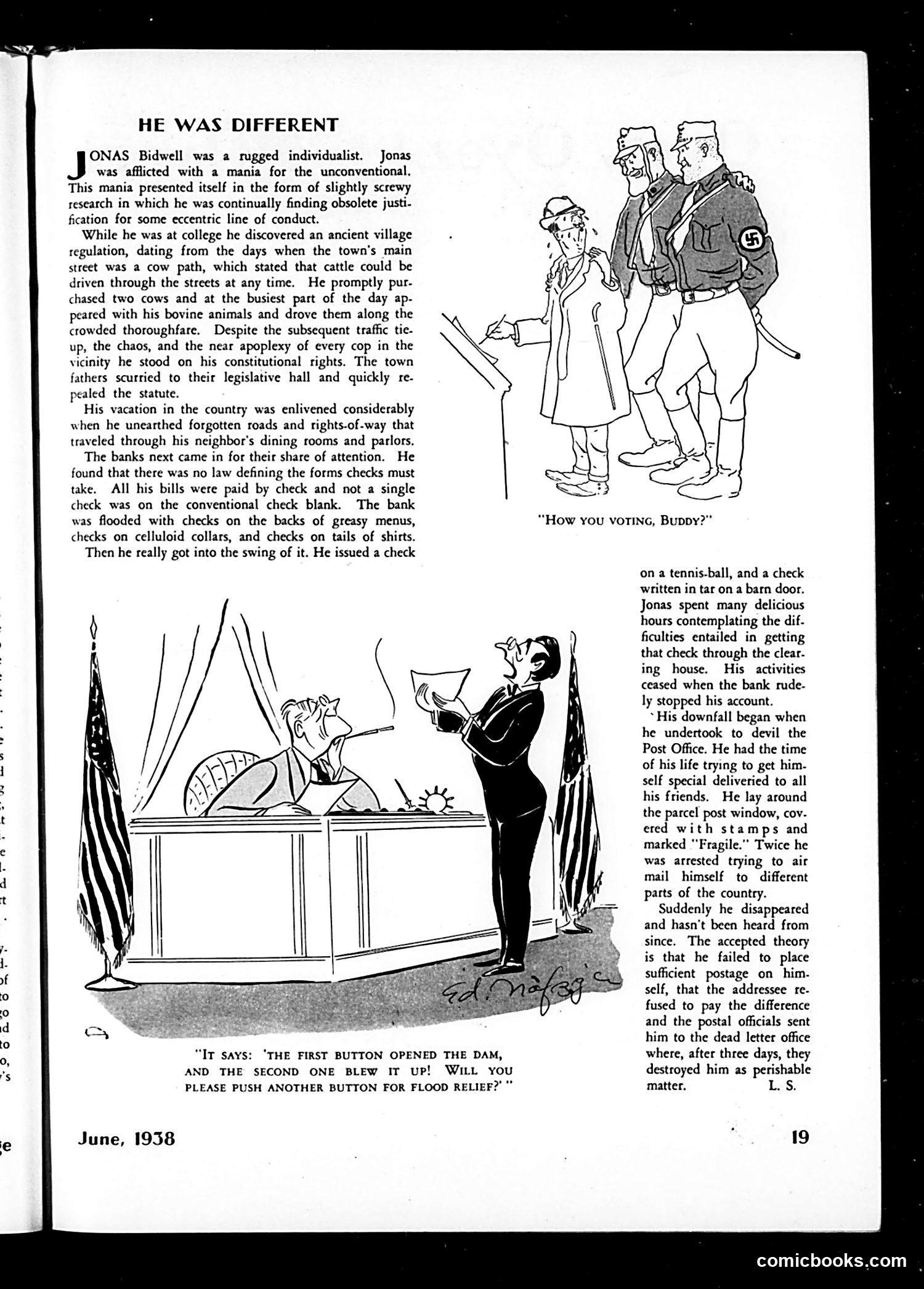
"He Was Different" - Judge, June 1938 This satirical story mocks a character named Jonas Bidwell, a self-proclaimed "rugged individualist" who exploits obscure legal loopholes for anarchic ends. The satire targets Depression-era individualism taken to absurd extremes. Jonas's pranks escalate: driving cows through town streets (citing outdated ordinances), mailing himself through the Post Office with insufficient postage, and flooding banks with unconventional checks—written on tennis balls, greasy menus, and shirt tails. The cartoon at top shows three Nazi figures asking "How you voting, Buddy?"—a topical 1938 reference to rising fascism abroad. The bottom cartoon depicts a man issuing absurd dam-control buttons as "flood relief," likely satirizing New Deal programs or government overreach. The story's ending—Jonas disappearing, presumed destroyed by postal bureaucracy—suggests that even extreme individualism cannot survive modern institutional systems. The satire critiques both anarchic individualism and governmental inflexibility.
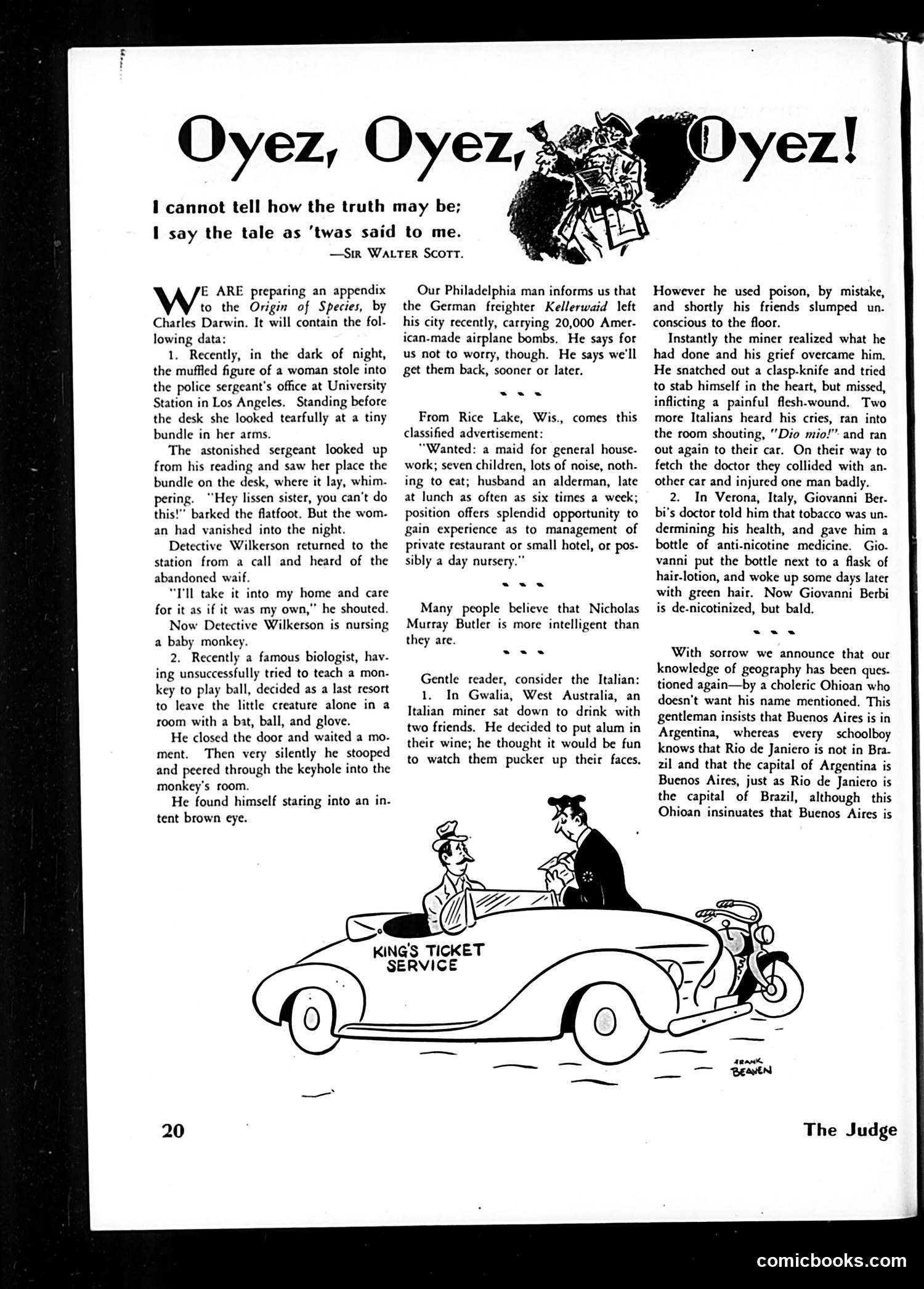
Analysis of Judge Magazine Page This page satirizes human folly through anecdotes framed as potential additions to Darwin's *Origin of Species*—suggesting the stories illustrate evolutionary devolution or human stupidity. The main items mock: 1. A Los Angeles police detective who adopts an abandoned baby, only to discover it's a monkey—implying humans and primates are barely distinguishable. 2. A biologist's failed experiment teaching a monkey to play ball, played for absurdist humor. 3. A tragic Italian poisoning incident in Australia where a miner jokes by putting alum in friends' wine, accidentally uses poison instead, then attempts suicide and causes a car accident—dark satire on comedic intent gone wrong. 4. A second Italian anecdote about Giovanni Berbi who confuses anti-nicotine medicine with hair lotion, turning his hair green—another example of human carelessness. The cartoon depicts a car labeled "King's Ticket Service," likely a transportation advertisement. The page's framing device—attributing these tales secondhand (per Scott's epigraph)—emphasizes unreliability and gossip, typical of Judge's satirical approach.
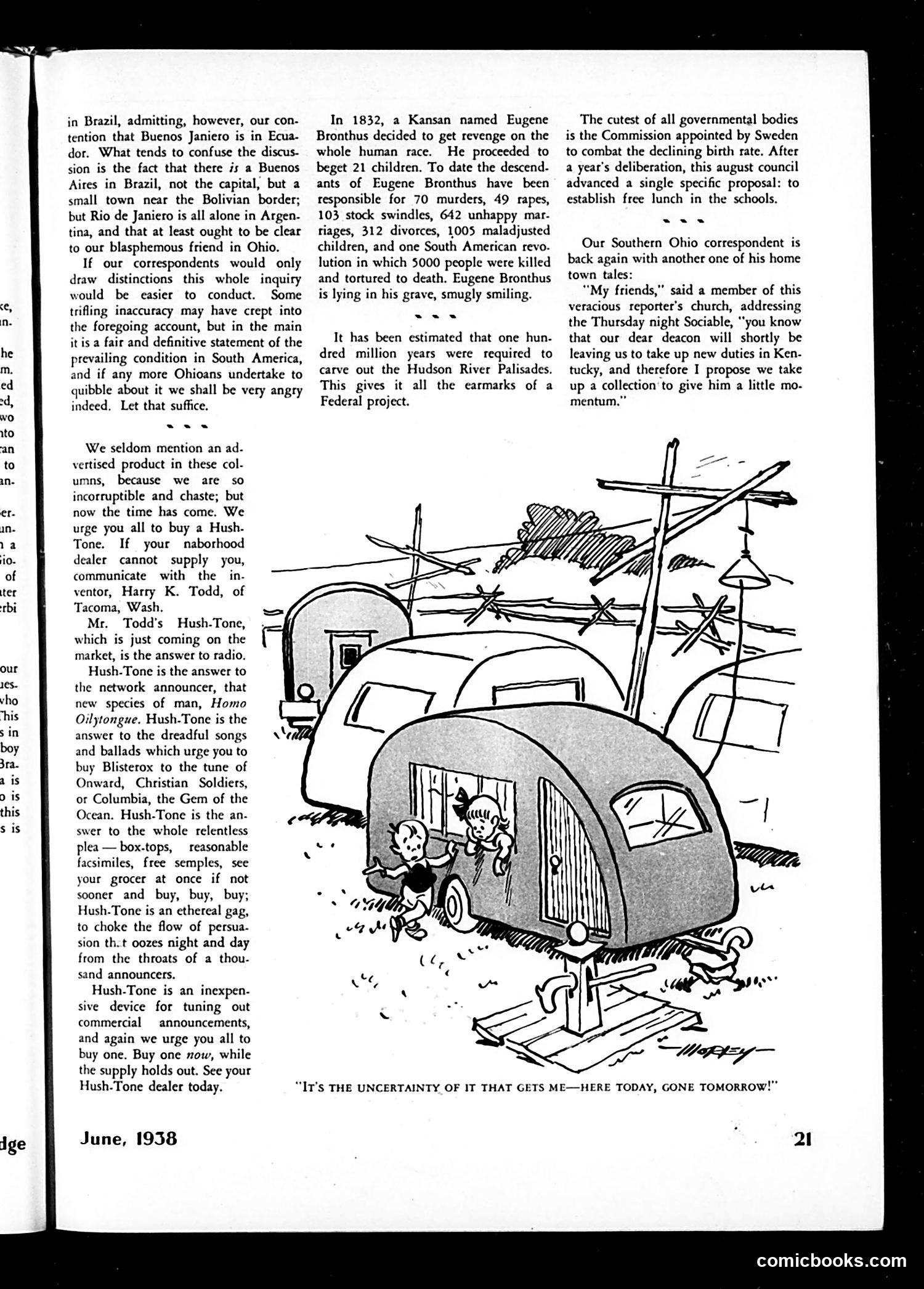
Judge Magazine, June 1938 - Analysis This page contains satirical commentary and advertising typical of Judge's format. The main cartoon depicts a ramshackle trailer home with a family and the caption "It's the uncertainty of it that gets me—here today, gone tomorrow!" This reflects Depression-era anxieties about economic instability and homelessness, sardonically capturing the precarious lives of mobile working families. The text includes characteristic Judge humor: absurdist "news" items (like the Bronthus family genealogy attributing murders and divorces to one 1832 ancestor) and mock-serious social commentary. A substantial section advertises "Hush-Tone," a device to mute radio commercials—satirizing the era's explosive growth of commercial radio broadcasting and aggressive advertising tactics that audiences found intrusive. The ad itself is tongue-in-cheek; Judge pretends to reluctantly endorse the product while mocking consumer culture's relentless sales pitches.
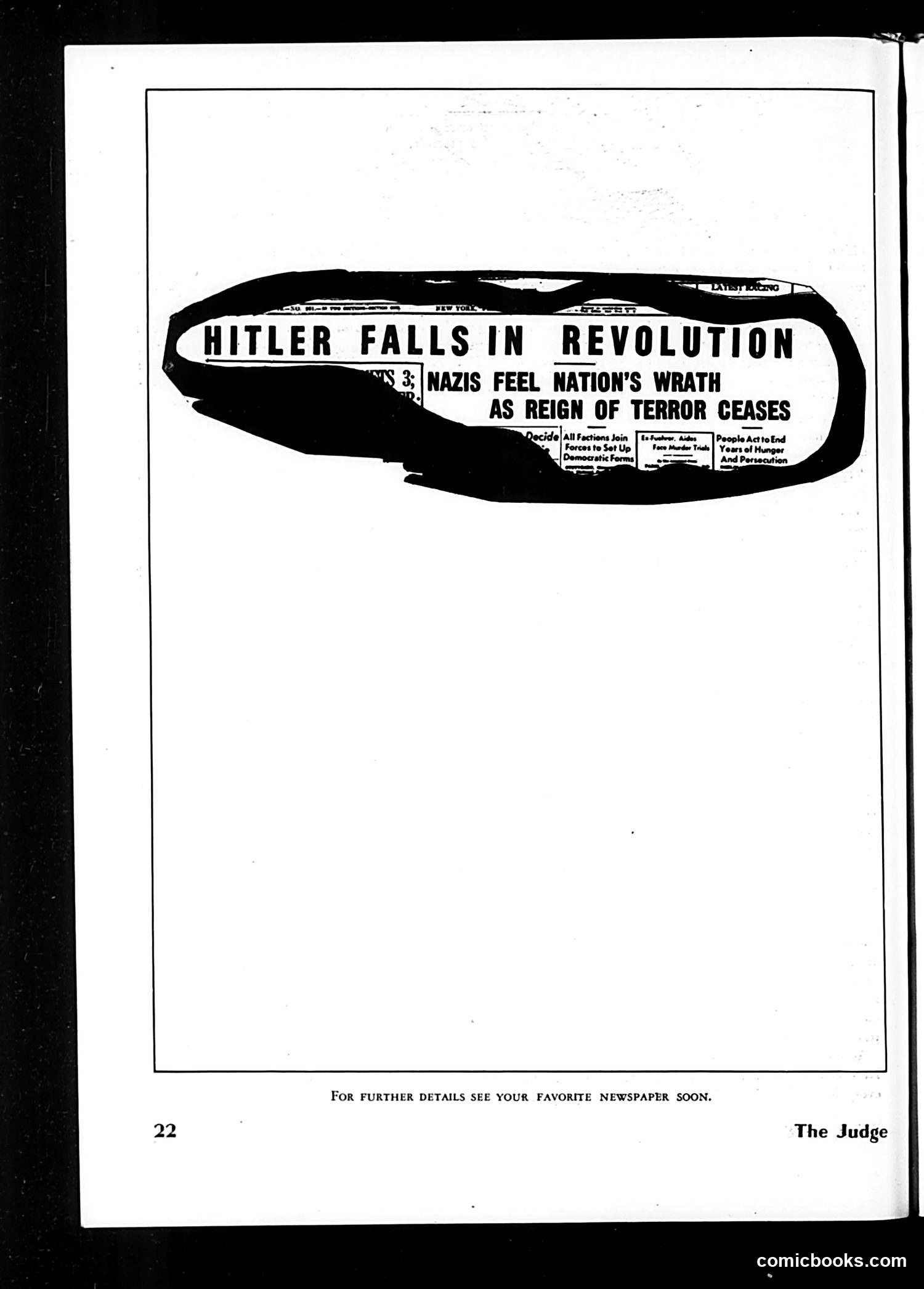
Page Analysis This page from *Judge* magazine features a newspaper headline clipping framed dramatically in black. The main headline reads "HITLER FALLS IN REVOLUTION" with a subheading "NAZIS FEEL NATION'S WRATH AS REIGN OF TERROR CEASES." The satire appears to be celebrating Hitler's downfall and the end of Nazi rule. The black border frame emphasizes the momentous nature of this news. Additional subheadings reference related events: mentions of factions joining forces, murder trials, and people acting to end years of hunger and persecution. This is clearly a World War II-era piece from *Judge* treating Hitler's fall as major news worthy of satirical commentary. The page directs readers to newspapers for further details, suggesting this was timely commentary on actual wartime events.
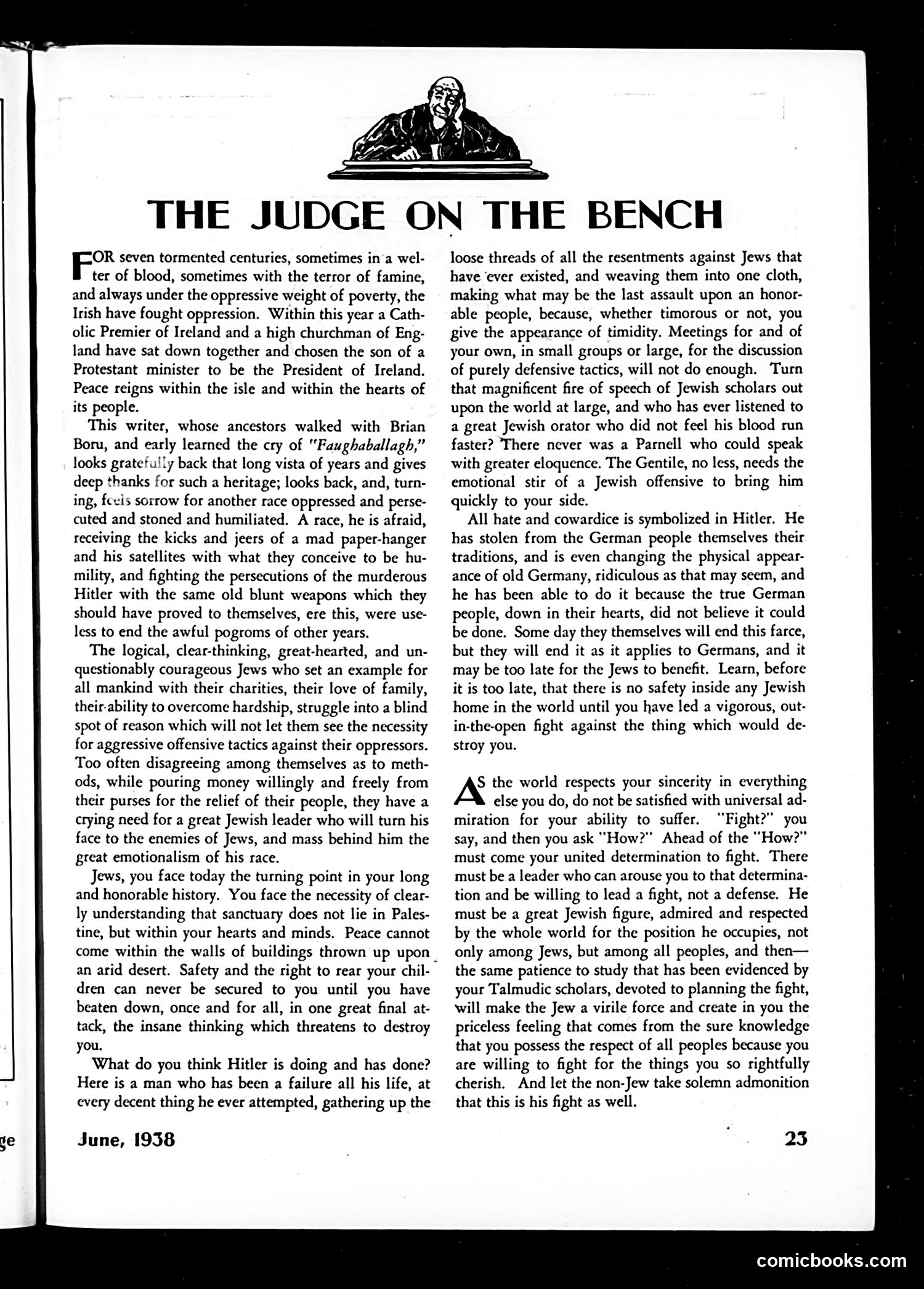
"The Judge on the Bench" - June 1938 This editorial argues that Jews face an existential crisis under Hitler and must adopt aggressive, offensive tactics rather than passive defense. The writer—identifying himself as Irish Catholic—draws a parallel between Irish historical oppression and current Jewish persecution. The piece directly addresses Jewish readers, criticizing them for internal disagreement and relying on defensive measures alone. It calls for a powerful Jewish leader to unite the community and mobilize public persuasion through rhetoric. The author argues that Hitler's power derives from exploiting anti-Semitic sentiment, and that Jewish passivity—appearing "timid"—enables this. Published in 1938, as Nazi persecution intensified, the editorial reflects pre-WWII American debate about Jewish responses to fascism. The tone is urgent and confrontational, rejecting what the writer sees as insufficient Jewish mobilization against existential threat.
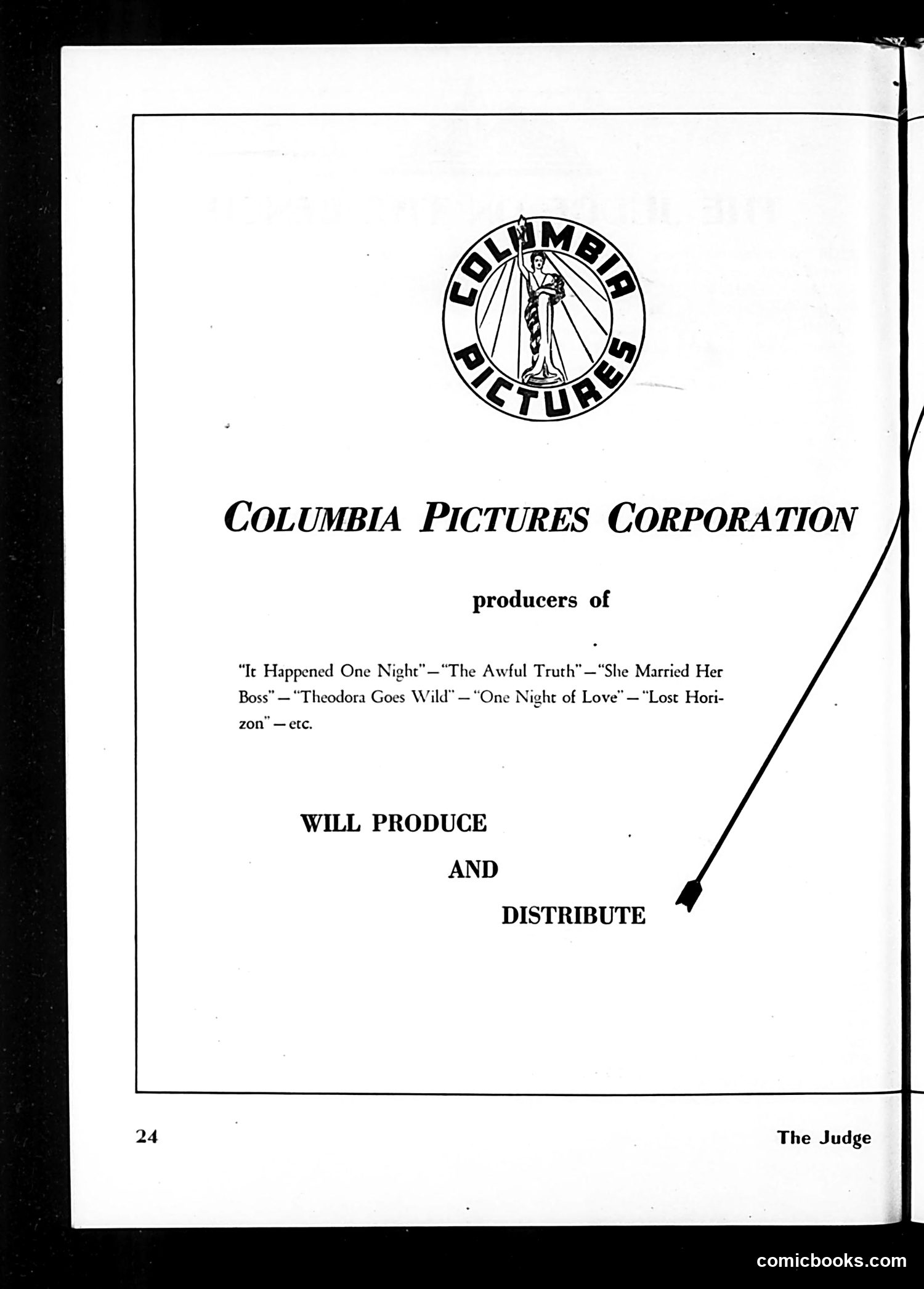
Analysis This is a title/advertisement page from *Judge* magazine, not a political cartoon. It announces Columbia Pictures Corporation as a producer and distributor, listing their recent films from the 1930s (including the Oscar-winning "It Happened One Night"). The page features Columbia's iconic logo—the female figure holding a torch—which remains their corporate symbol today. The text simply promotes the studio's production and distribution capabilities to *Judge* readers. No satire or political content is present. This is straightforward corporate advertising placed within the magazine. The "comicbooks.com" attribution suggests this is from a digitized archive of Judge's content.
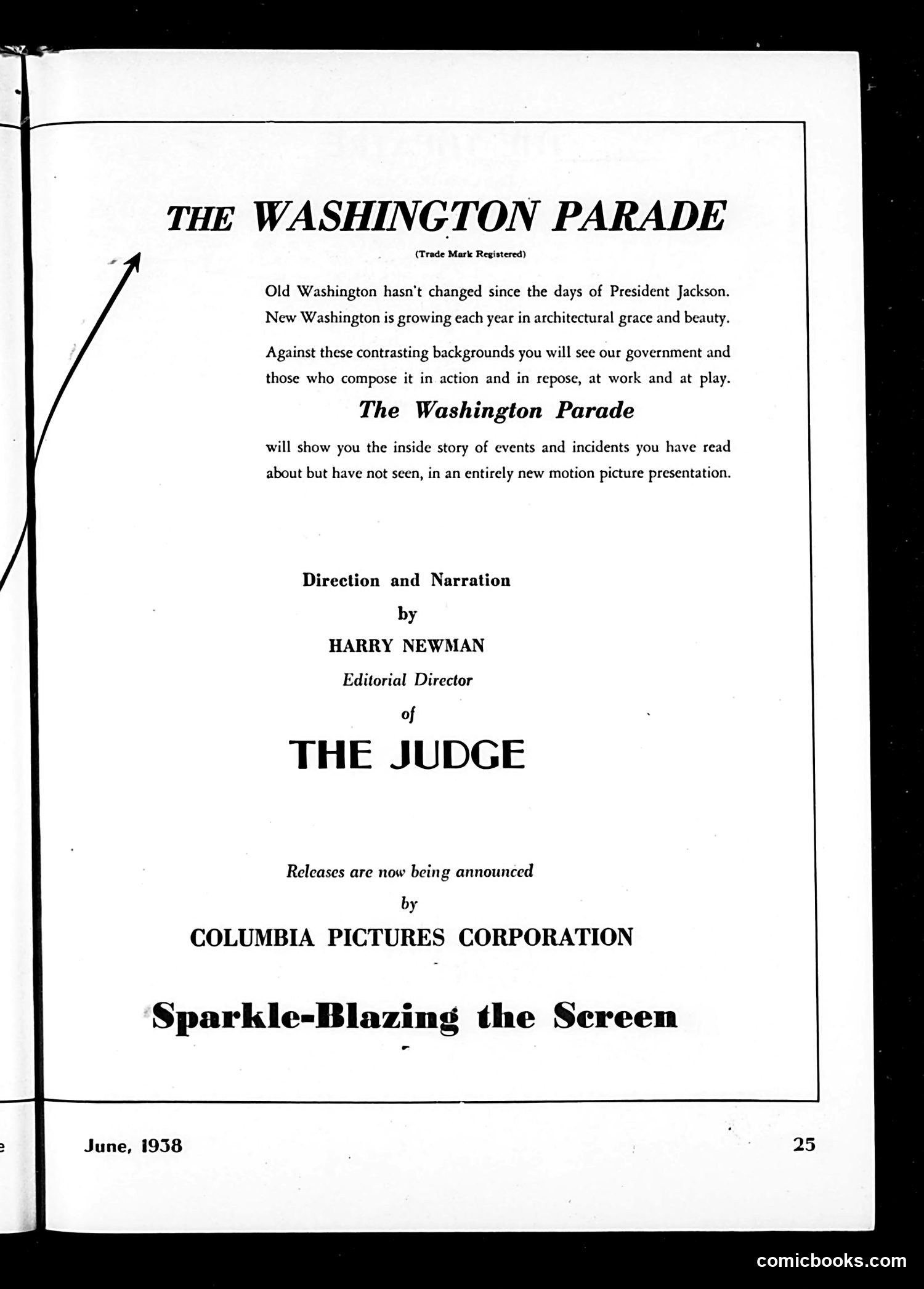
This is primarily a title/advertisement page rather than a political cartoon. It announces *The Washington Parade*, a motion picture produced by Columbia Pictures Corporation, directed and narrated by Harry Newman (Editorial Director of *Judge* magazine). The content is promotional, describing the film as showing government officials "in action and in repose, at work and at play" against contrasting backdrops of old and new Washington architecture. The phrase "Sparkle-Blazing the Screen" is standard 1938 movie marketing language. Key context: This represents Judge magazine's venture into film production during the Depression era. The film promised insider glimpses of Washington—likely satirical commentary on government operations, a fitting extension of Judge's satirical tradition. However, no specific political figures or satirical points are identifiable on this page alone; it functions as a straightforward promotional announcement from June 1938.
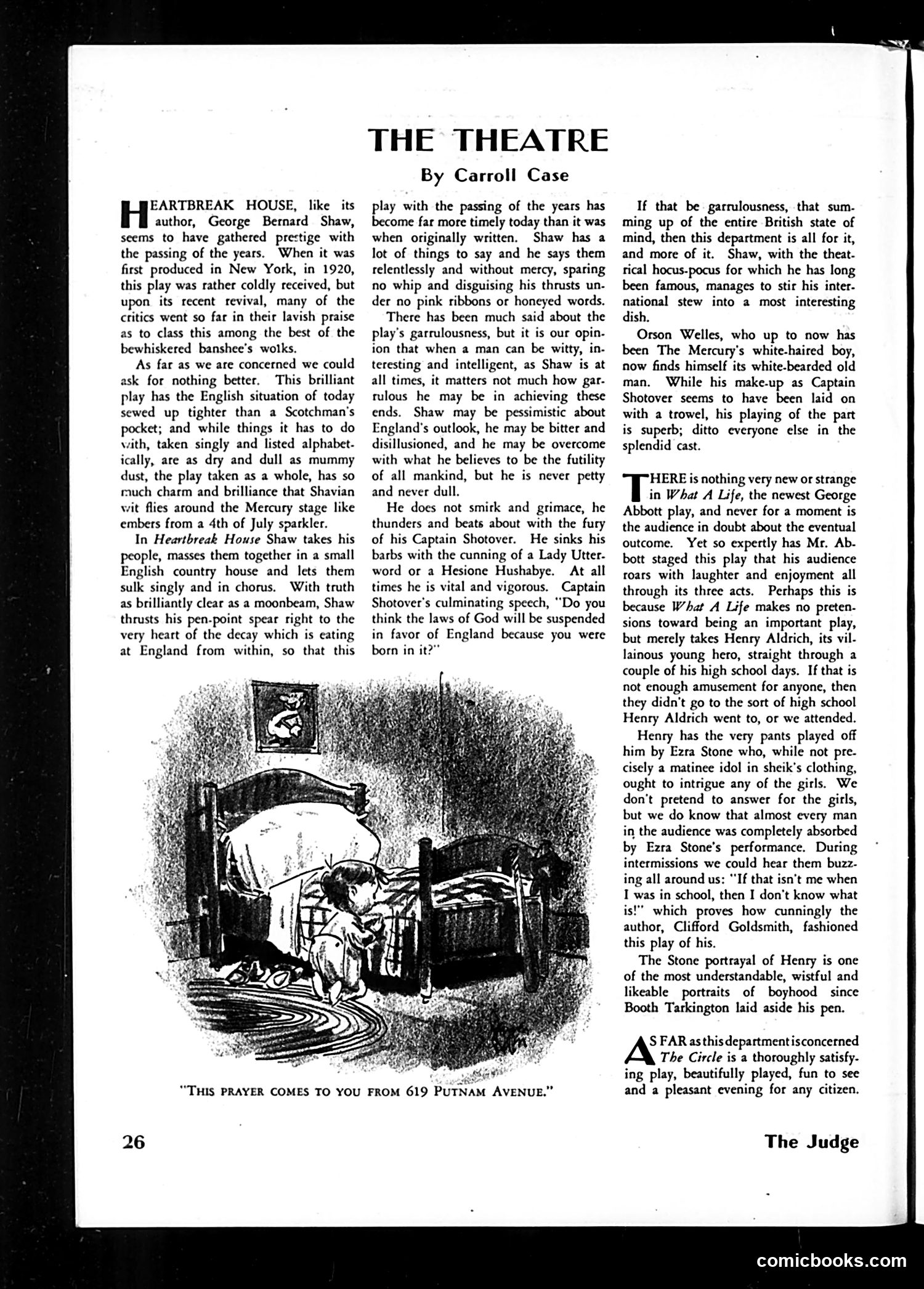
Theatre Reviews from Judge Magazine This page contains two theatre reviews by Carroll Case from Judge magazine (a satirical publication). Heartbreak House: The review praises George Bernard Shaw's play about English decay, initially cool-received in 1920 but now acclaimed. The critic defends Shaw's verbose dialogue, arguing his wit and intelligence justify the length. Orson Welles plays Captain Shotover; the review notes his heavy makeup but praises his performance and the cast overall. What A Life: A George Abbott comedy about high school student Henry Aldrich. The reviewer acknowledges it's formulaic with predictable outcomes, but credits Abbott's expert staging for the audience's consistent laughter. Ezra Stone plays Henry. The illustration (captioned "This prayer comes to you from 619 Putnam Avenue") appears unrelated to the reviews—a domestic scene of someone praying bedside. Both reviews are straightforward theatre criticism rather than political satire, typical of Judge's arts coverage alongside its satirical content.
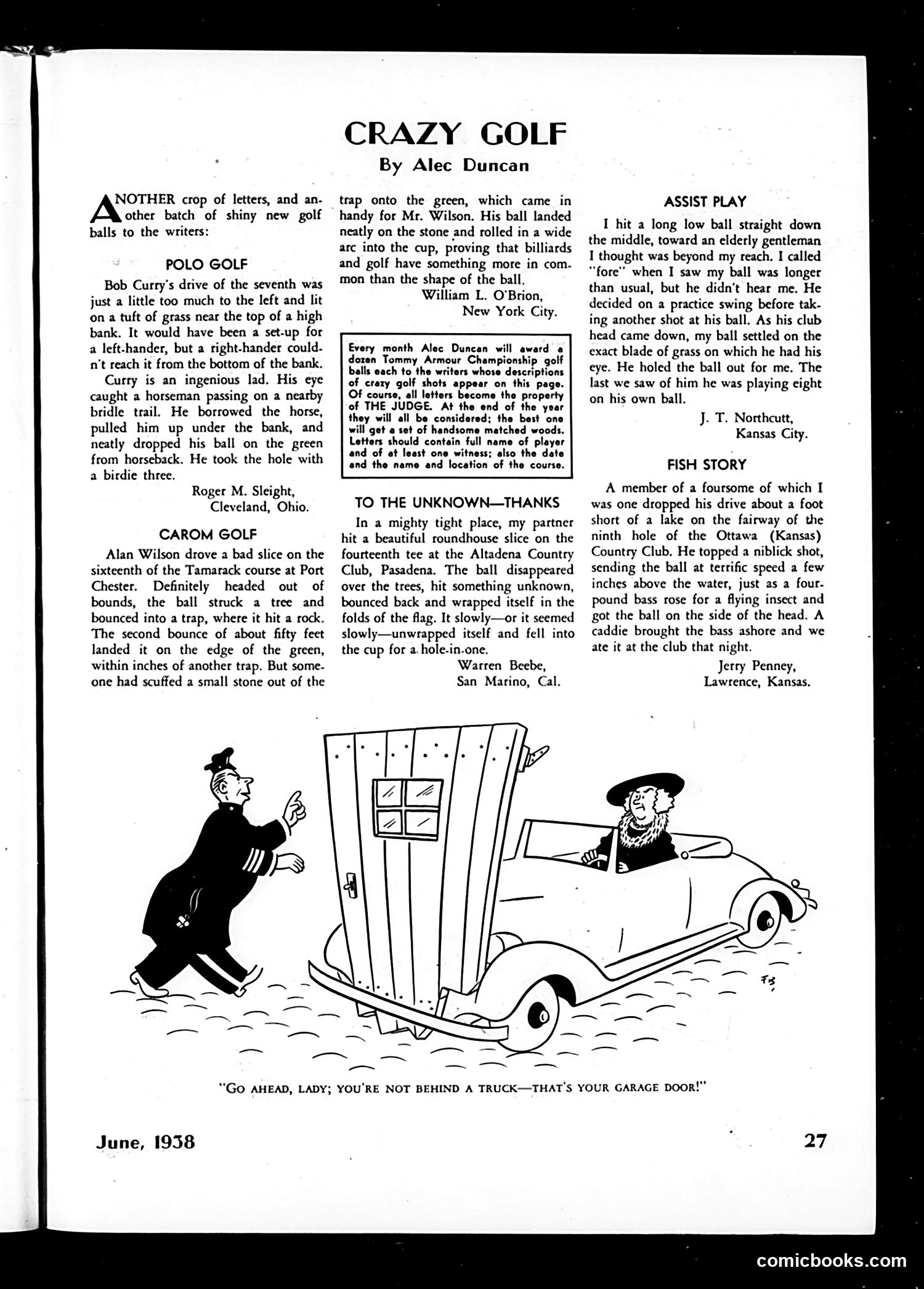
"Crazy Golf" - Judge Magazine, June 1938 This page collects humorous reader-submitted stories about implausible golf shots, a recurring feature in Judge magazine. Each anecdote describes increasingly absurd ways balls reached the cup—using a horse to access a ball on a high bank, caroming off a tree and rock into the cup, wrapping around a flag, or even striking a fish mid-flight. The cartoon below satirizes driving safety of the era. A man directs a woman driver, insisting she's "not behind a truck" but rather looking at her own garage door. The joke targets 1930s anxieties about women drivers—a common source of period humor—suggesting she's so inexperienced or inattentive she can't distinguish obstacles, creating a mild commentary on gender and automotive competence that reflected contemporary biases. The feature promises Tommy Armour golf balls monthly to best submissions, making it a reader-participation contest.
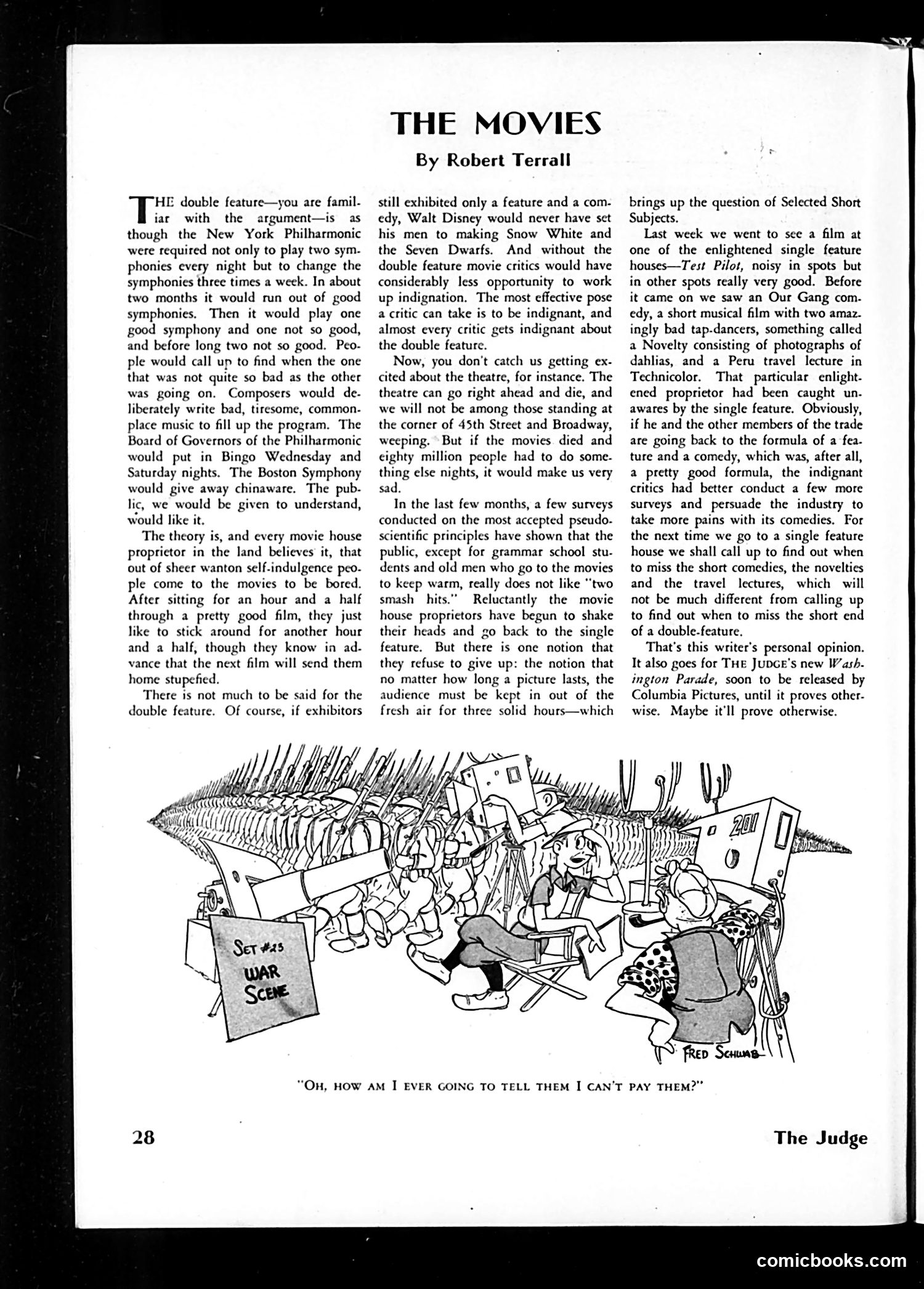
"The Movies" by Robert Terrall - Explanation for Modern Readers This is a satirical essay criticizing the double feature—a common 1930s-40s cinema practice of showing two full-length films in one sitting. Terrall argues this practice is artistically wasteful, comparing it to a symphony orchestra playing multiple compositions nightly until quality deteriorates. The accompanying cartoon (credited to Red Scheuer) depicts a chaotic movie set labeled "War Scene," with the caption "Oh, how am I ever going to tell them I can't pay them?"—satirizing the film industry's financial struggles amid Depression-era economics. Terrall's broader point: movie studios, forced to fill double features, compromise artistic quality. He notes studios even recruited Walt Disney to produce *Snow White and the Seven Dwarfs* to pad programs. The essay argues that returning to single features won't help if theaters still pad shows with low-quality short subjects (cartoons, travel lectures, novelties). Critics should demand better comedies, not just fewer films.
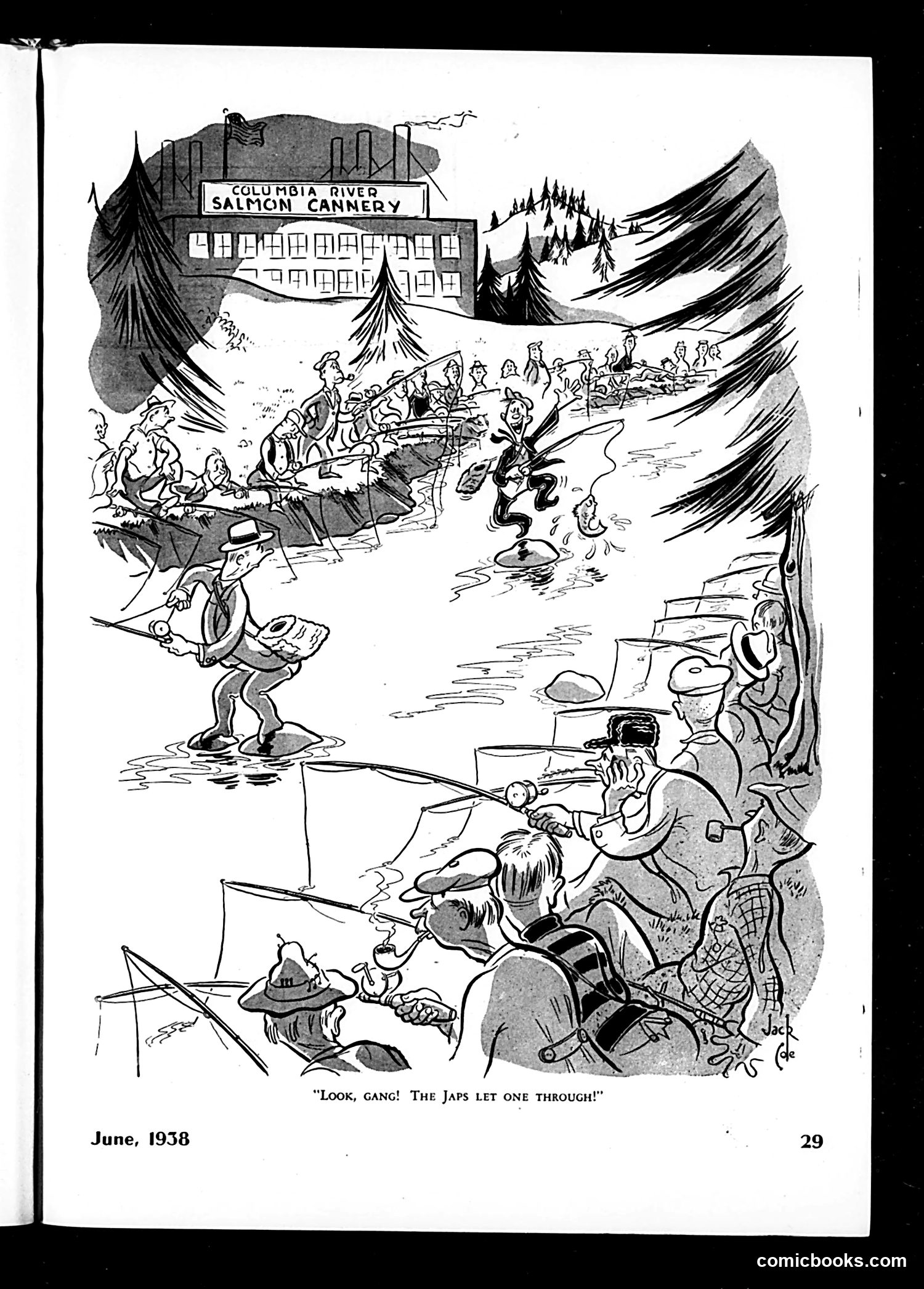
Analysis This June 1938 cartoon satirizes Japanese fishing practices on the Columbia River. The scene shows fishermen at a salmon cannery discovering that a single salmon has escaped Japanese fishing nets—treated as a remarkable, celebratory occurrence ("Look, gang!"). The satire criticizes aggressive Japanese commercial fishing in Pacific Northwest waters, suggesting their operations were so extensive and efficient that salmon rarely escaped. This reflects pre-WWII American anxieties about Japanese economic competition and resource competition in the Pacific region. The cartoon implies Japanese fisheries were depleting local salmon stocks at an unsustainable rate, making even one escaped fish noteworthy. This captures 1938 tensions between American and Japanese economic interests before Pearl Harbor.
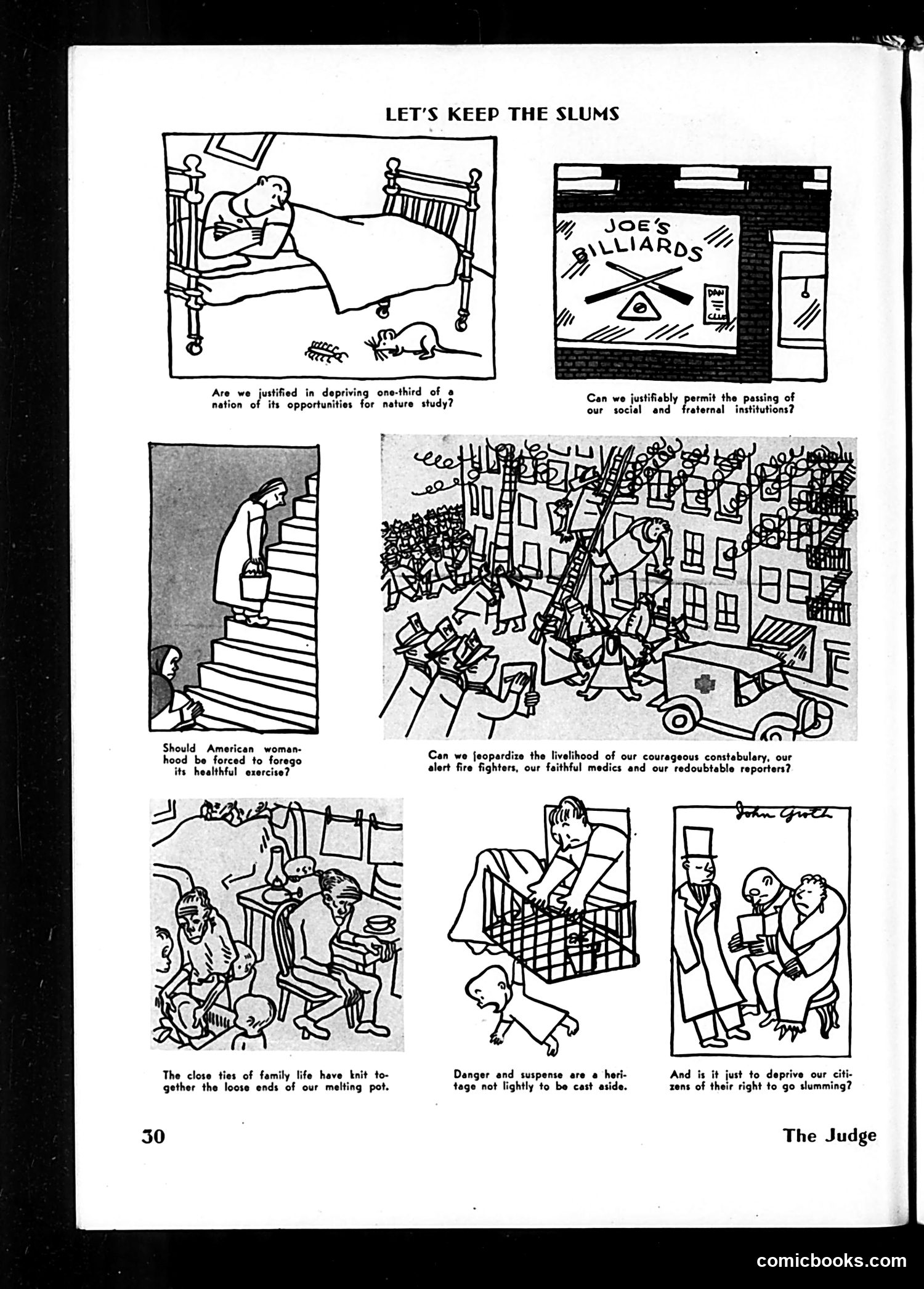
"Let's Keep the Slums" - Judge Magazine Satire This page uses ironic rhetoric to mock arguments *against* slum clearance and urban reform. The headline's sarcasm is the key: the cartoons present absurd justifications for preserving slums, which Judge evidently saw as indefensible. The six panels sarcastically ask: Should we deny poor children nature study to keep slums? Preserve social institutions in squalor? Risk police and firefighters' lives? Destroy family bonds? And finally—most bitterly—shouldn't wealthy citizens retain their "right" to visit slums as entertainment? The satire targets both actual slum conditions and the hypocritical excuses the comfortable classes made to avoid addressing them. By listing progressively absurd reasons to maintain urban decay, Judge argues such arguments collapse under their own weight. The final panel's question—whether slumming is a legitimate "right"—particularly mocks wealthy voyeurism and indifference to poverty. This reflects early-20th-century Progressive Era debates about urban reform.
The Judge Album Title Page (1900-1905) This is a decorative title page for a collection of Judge magazine content from 1900-1905, published in June 1938. The elaborate ornamental border features classical allegorical figures—including a woman representing arts or culture—alongside cherubs, flowers, urns, and artistic implements like palettes and brushes. These decorative elements were typical of turn-of-the-century design aesthetics. The page itself contains no specific political or social satire; it serves as a cover or introduction to what appears to be a retrospective anthology. Judge was a prominent American satirical weekly known for political commentary and humor. This particular volume likely collected the magazine's most notable cartoons and articles from that five-year period, presented to 1938 readers as historical material.
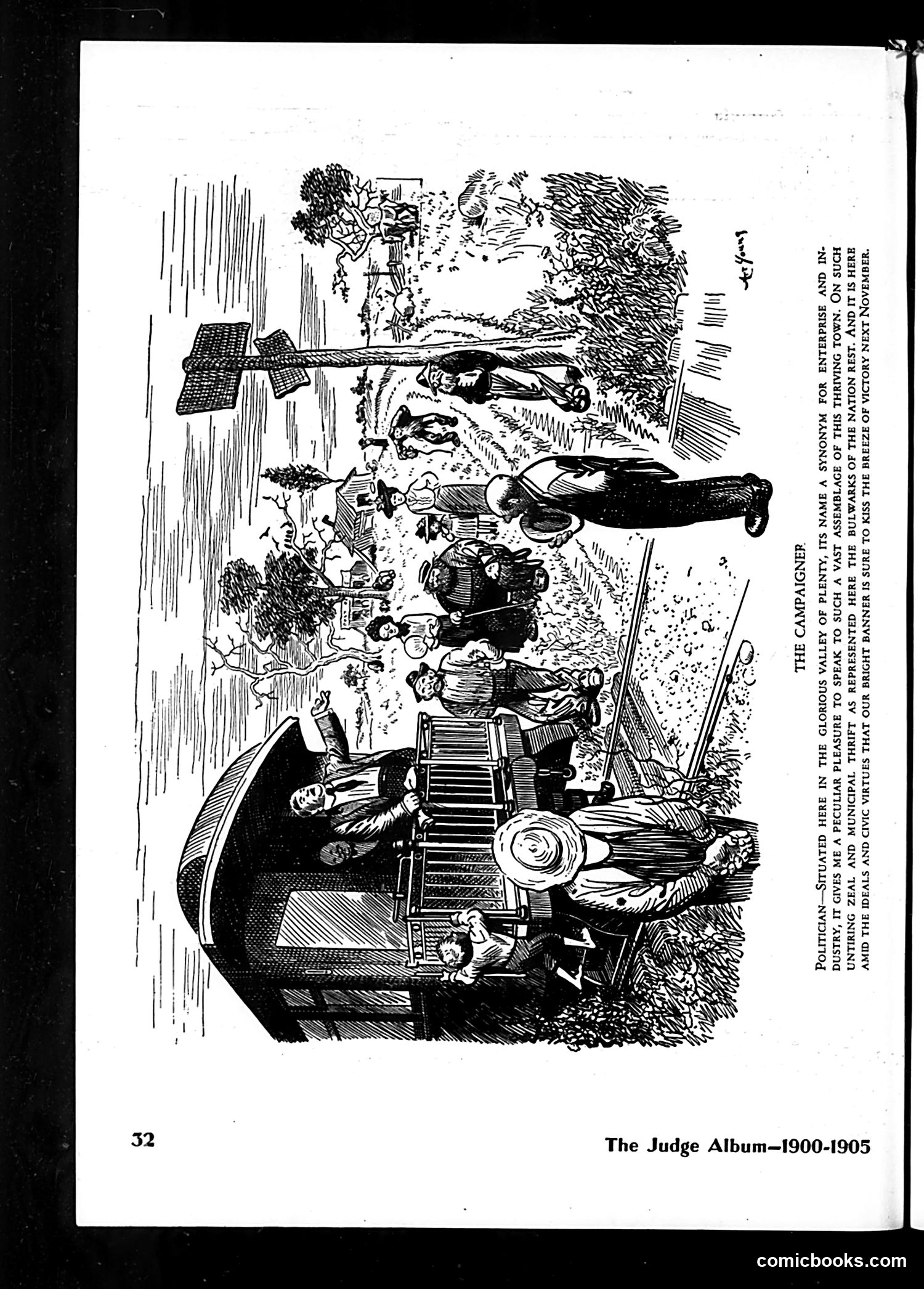
Political Cartoon Analysis: "The Gordons the Campaigner" This political cartoon from Judge (1900-1905) depicts a campaign scene, likely satirizing a contemporary political figure or movement. The image shows what appears to be a political candidate or campaigner surrounded by various supporters and onlookers in an outdoor setting with a carriage or campaign vehicle. The caption references a campaign and appears to mock the spectacle of political organization—showing crowds, decorative elements, and the machinery of electoral politics. Without clearer identification of the specific figure being caricatured, the satire likely targets the elaborate, theatrical nature of early 20th-century American political campaigning or a particular candidate's methods. The OCR text is too corrupted to provide accurate context, but the visual composition suggests Judge's typical criticism of political excess, hypocrisy, or incompetence during this era.
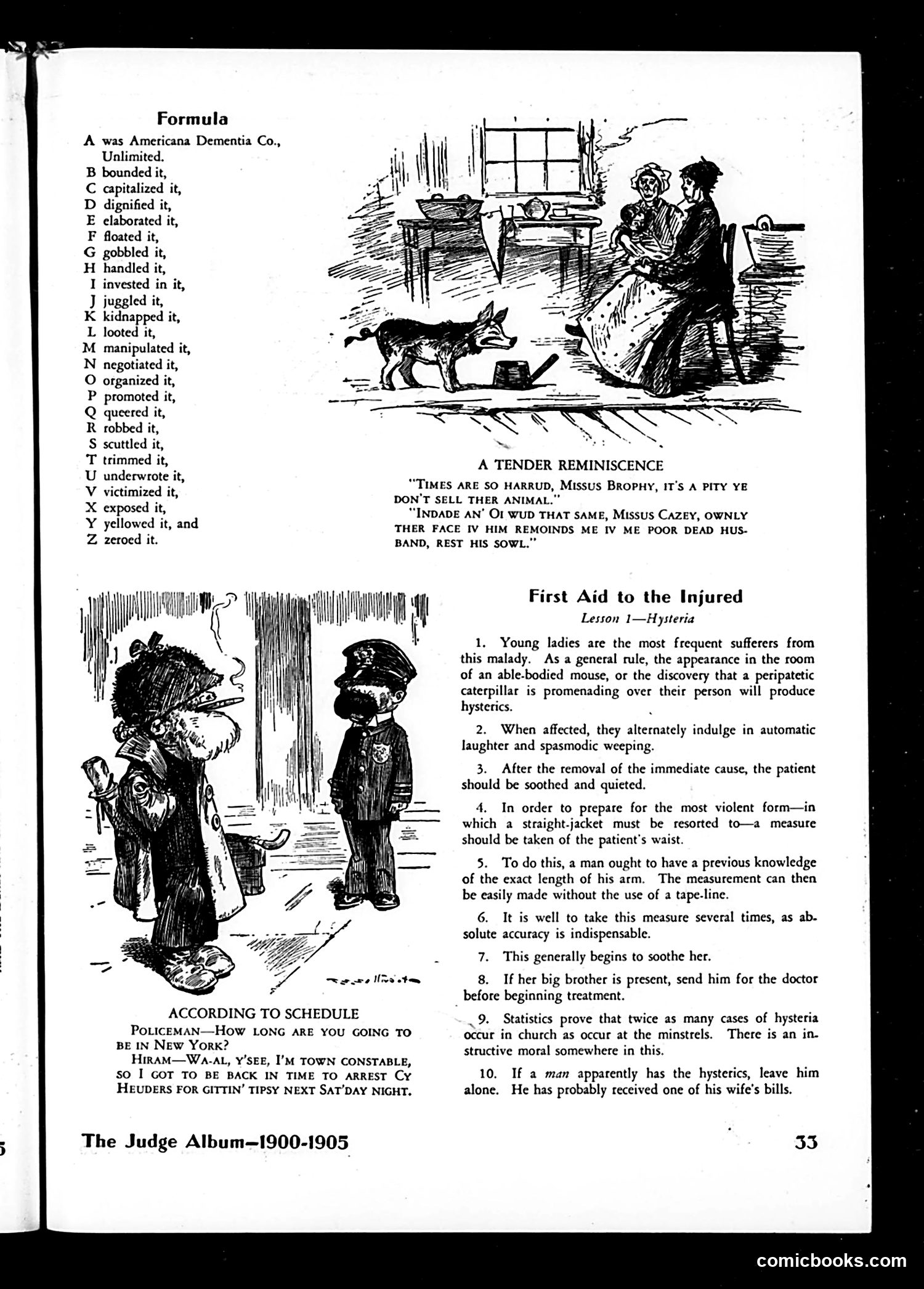
Judge Magazine Page Analysis (1900-1905) This page contains three distinct satirical pieces: 1. "Formula": A alphabetical list mocking corporate malfeasance—specifically the Americana Dementia Company scheme. Each letter represents a different questionable business practice (bounding, capitalizing, manipulating, robbing, etc.), satirizing how businessmen systematically exploit ventures through predatory financial tactics. 2. "A Tender Reminiscence": An Irish-dialect cartoon showing two women discussing selling their donkey, with one reluctant because it resembles her dead husband. This mocks sentimental Irish stereotypes common in period humor. 3. "First Aid to the Injured - Lesson 1: Hysteria": Medical satire claiming young women are prone to hysteria from mice or caterpillars, recommending a straight-jacket and offering dubious "treatments" (measuring waist repeatedly). The concluding joke suggests men experiencing hysteria likely received bills from wives. This lampoons period medical attitudes toward female nervousness and gender stereotypes. The "According to Schedule" cartoon makes an unclear local reference about a constable's arrest schedule.
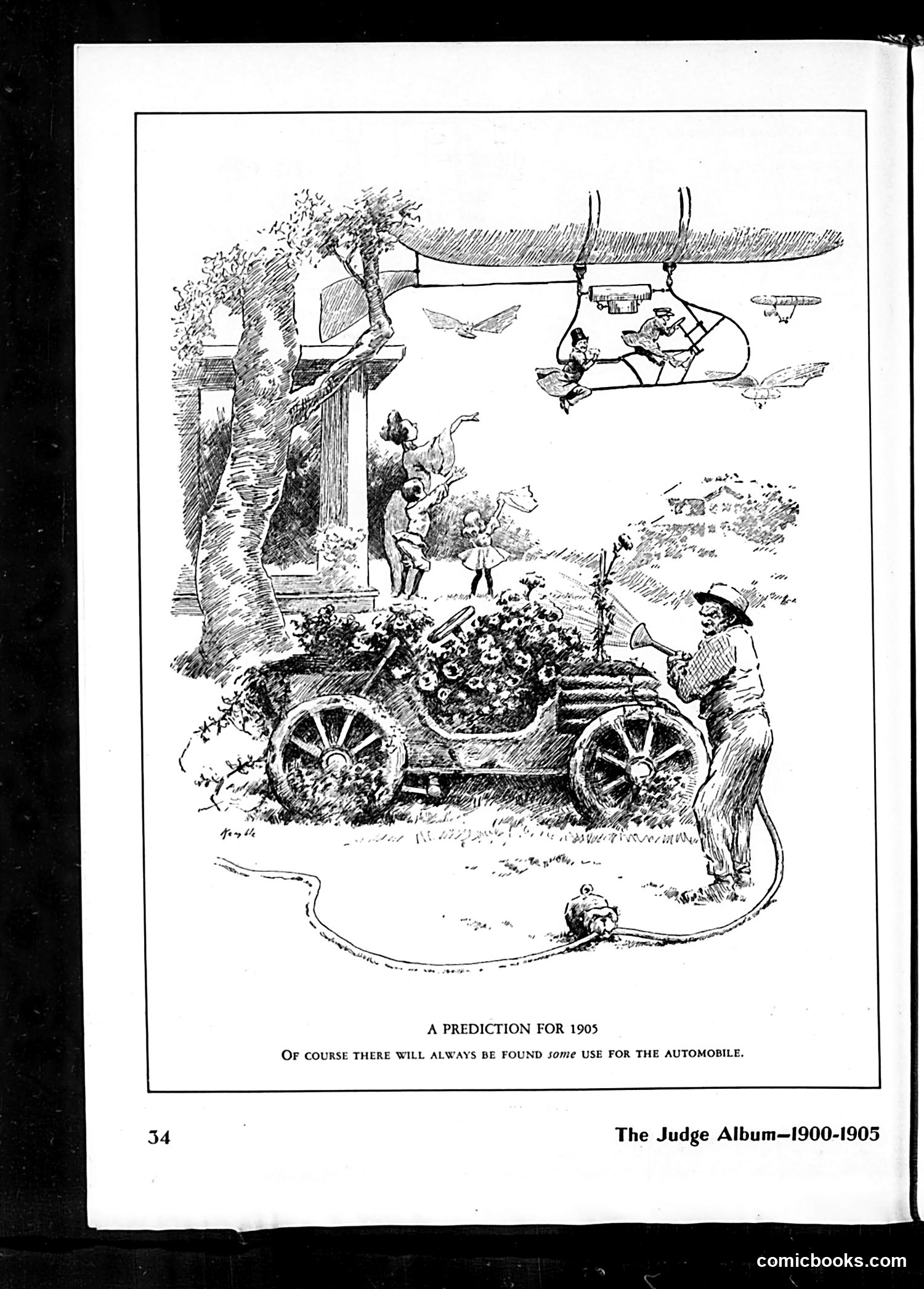
Analysis This is a satirical illustration titled "A Prediction for 1905" from *Judge* magazine's 1900-1905 album. The cartoon depicts an absurdly impractical future use for automobiles: a flower cart pulled by an early motorcar, operated by a gardener, while children play overhead in a helicopter and people engage in various leisure activities below. The satire mocks the early automobile era's hype and uncertainty about practical applications. The caption—"Of course there will always be found *some* use for the automobile"—suggests skepticism about whether this new technology would become truly useful, implying that even finding frivolous purposes like hauling flowers would be stretching it. The cartoon captures a pre-automotive era perspective when cars seemed like expensive novelties with unclear purpose, contrasting sharply with how essential they would become.
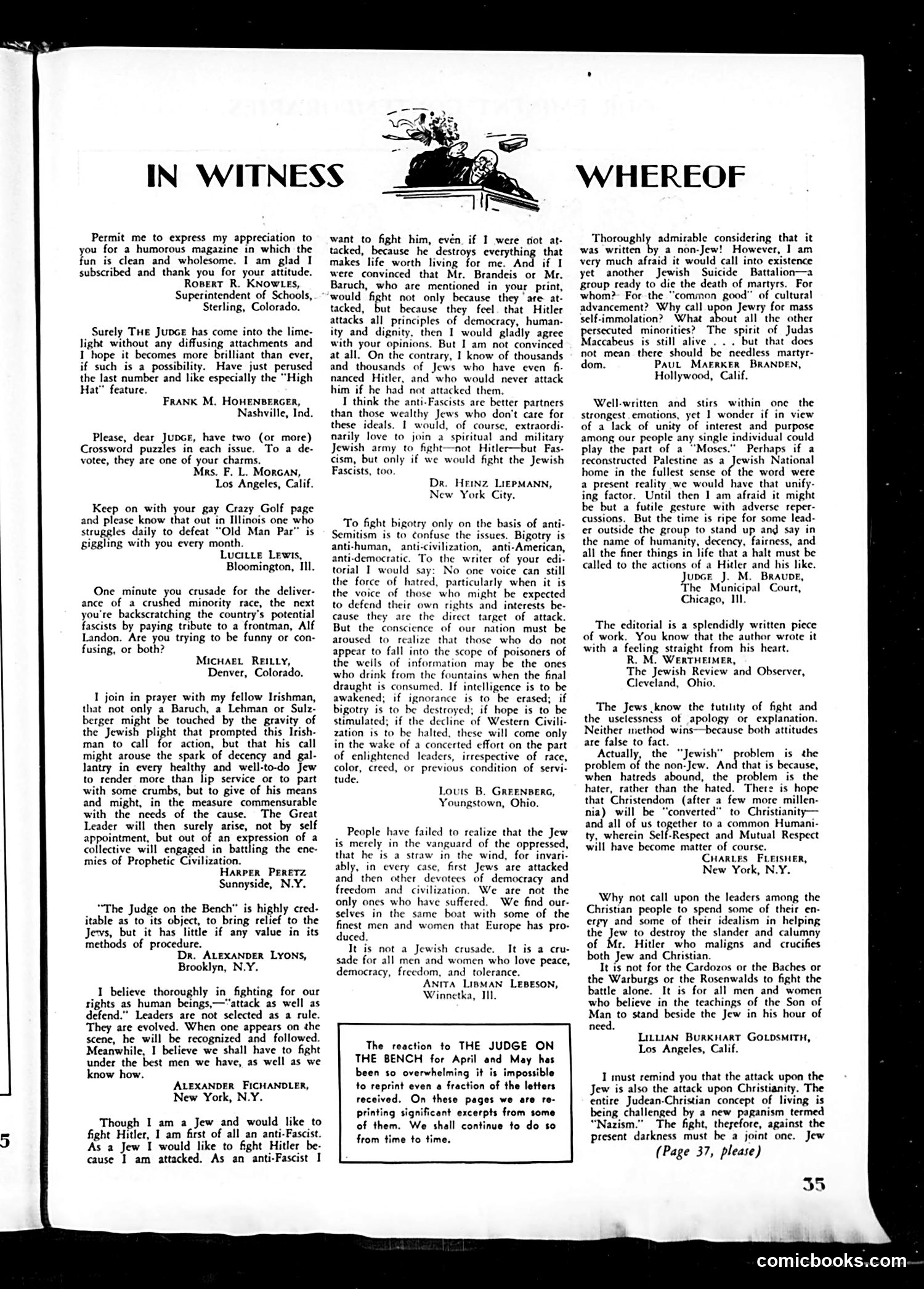
Understanding This Judge Magazine Letters Page This page consists entirely of reader letters responding to Judge magazine's recent editorial content—specifically pieces titled "The Judge on the Bench" addressing Jewish persecution and resistance to Hitler. The letters reveal internal debate within the Jewish American community circa 1936-1940 about the proper response to Nazi persecution. Key tensions include: - Whether to fight Hitler as Jews specifically or as anti-fascists generally (Liepmann argues fighting fascism itself is nobler than ethnic self-defense) - Skepticism about wealthy Jewish leaders like Baruch and Brandeis actually championing Jewish causes versus merely their own interests - Disagreement over methods: some praise Judge's advocacy; others criticize it as ineffectual One letter (Reilly) sarcastically accuses Judge of inconsistency—crusading for minorities while praising Alf Landon, a Republican presidential candidate some viewed as fascist-sympathetic. The letters show American Jews grappling with whether their fight was particularist (Jewish survival) or universalist (defending democracy itself).
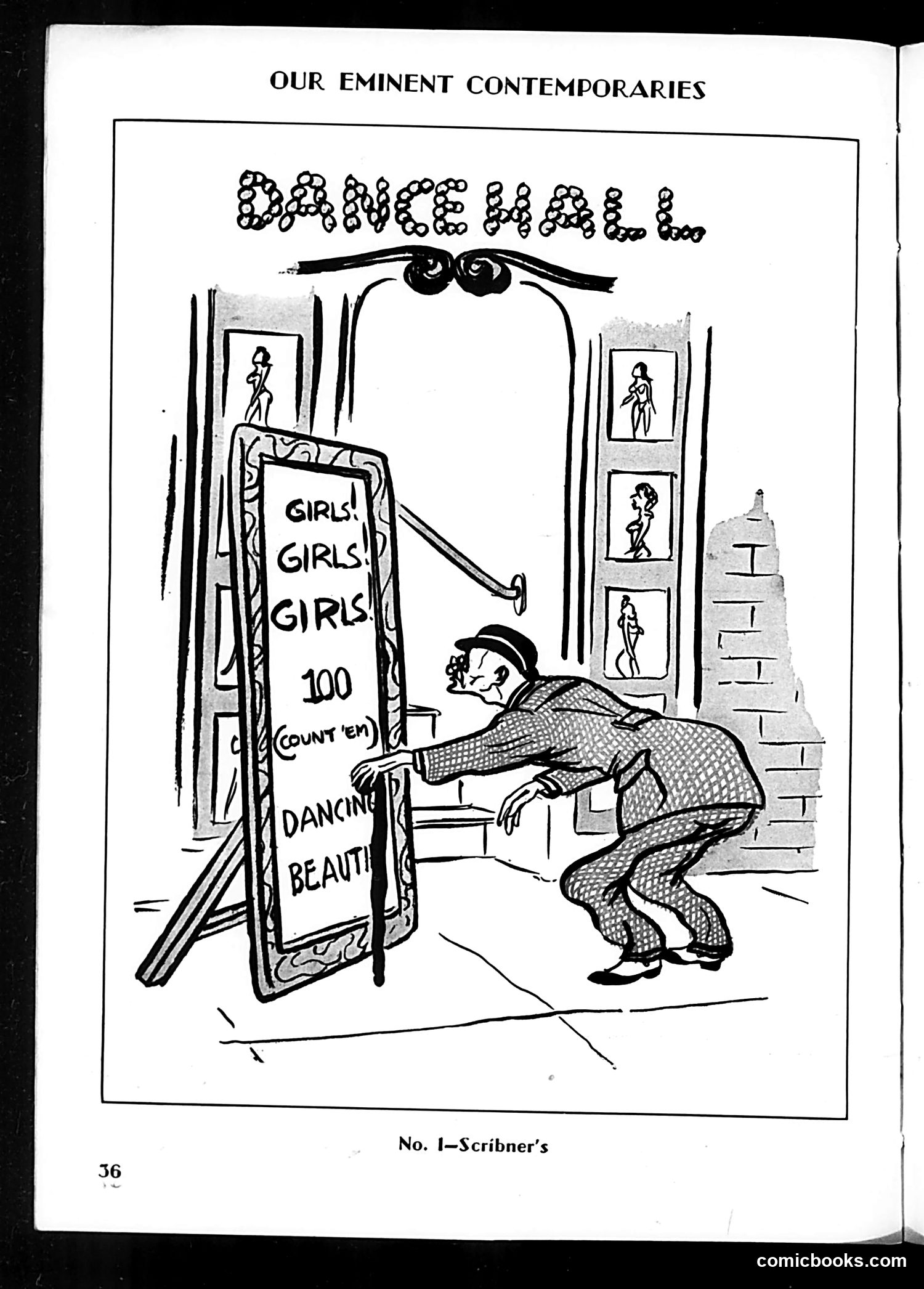
"Dave-Male" Cartoon Analysis This satirical cartoon mocks the entertainment industry, likely targeting a specific theatrical producer or promoter. A well-dressed man in a bowler hat crouches excitedly before a marquee advertising "GIRLS! GIRLS! GIRLS! 100 (COUNT 'EM) DANCING BEAUTI[ES]" — the sign clearly a parody of popular revue shows that emphasized spectacle over substance. The cartoon ridicules the shallow commercialism of such productions: the protagonist's eager, undignified posture suggests desperation to attract audiences through quantity of performers rather than artistic merit. The column of illustrated female figures on the marquee reinforces the mechanical objectification of performers. The page header "OUR EMINENT CONTEMPORARIES" adds ironic commentary, suggesting this theatrical figure represents notable contemporary culture worth satirizing. The reference to "Scribner's" indicates Judge magazine's critique of contemporary entertainment trends.
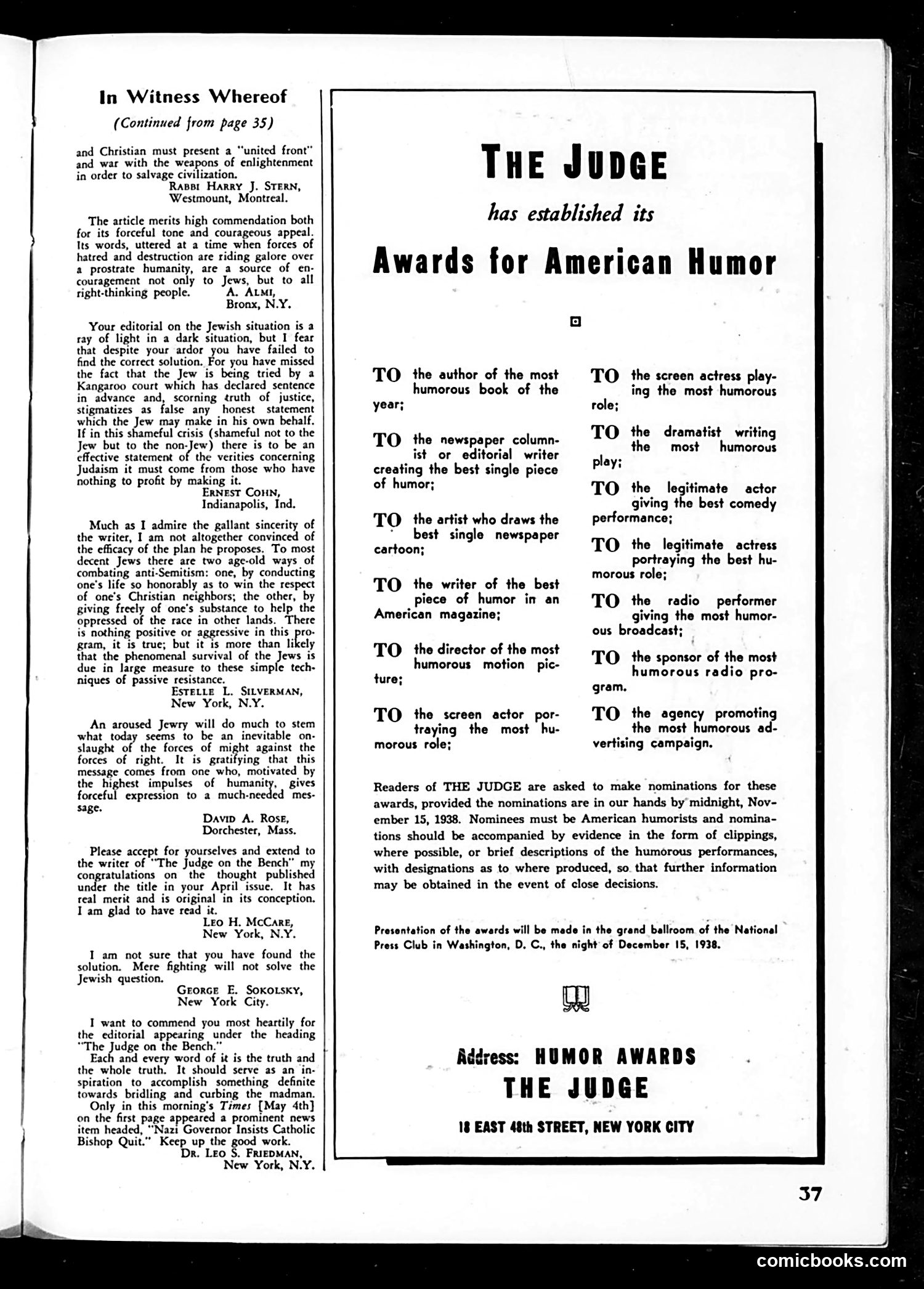
The Judge's Humor Awards (1938) This page is primarily advertising and editorial content, not a cartoon. The right side announces *The Judge* magazine's new "Awards for American Humor"—establishing prizes across multiple media (literature, newspapers, magazines, film, radio, theater) for the year's best humorous work. The left side contains reader letters responding to a previous *Judge* editorial titled "The Judge on the Bench" (not visible here). The letters debate how Jews should respond to rising antisemitism and Nazi persecution in 1938. Writers argue over passive resistance versus active opposition, with references to "Kangaroo courts" and Nazi treatment of Catholics, reflecting pre-WWII anxieties about fascism. The page reflects *Judge's* role as a platform for serious satirical commentary on contemporary crises, alongside humor content—showing how American magazines addressed the Jewish question and Nazi threat during this critical period.
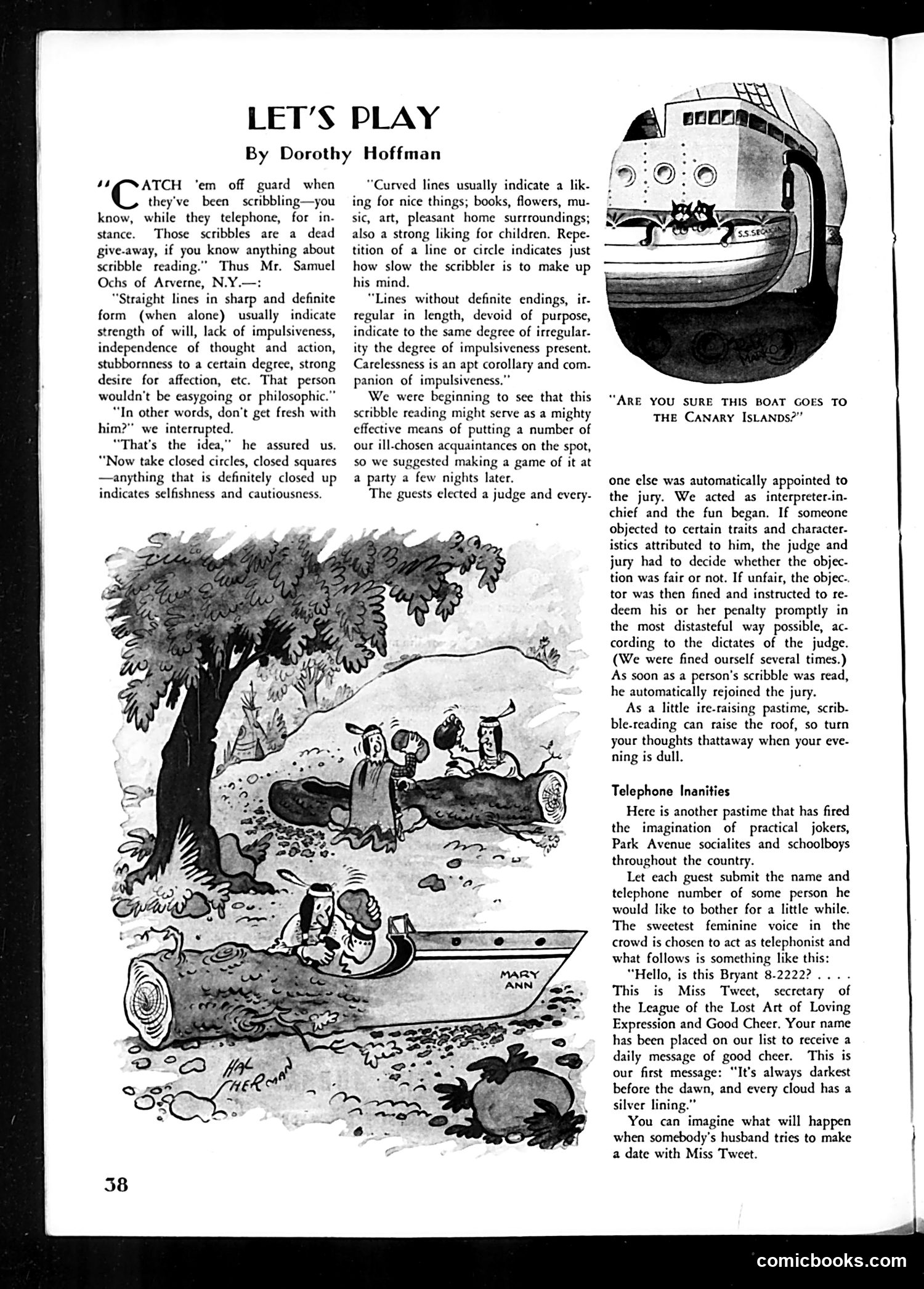
Analysis This page from *Judge* magazine presents two parlor games for entertaining guests at parties: "Scribble Reading" uses graphology—interpreting personality from doodles—as a party game. A Mr. Samuel Ochs of Arverne, New York, claims to decode character traits from handwriting patterns: straight lines indicate willpower, closed shapes reveal selfishness, curved lines suggest appreciation for beauty. Guests' scribbles are read aloud, and if anyone objects to the interpretation, a judge and jury determine fairness. Those ruled unfair face penalties. The humor lies in the social awkwardness of having one's alleged character flaws publicly judged. "Telephone Inanities" describes prank calls. Guests provide phone numbers of people to harass. A woman with "the sweetest feminine voice" calls pretending to represent "Miss Tweet" of the "League of the Lost Art of Loving Expression," delivering saccharine daily messages. The joke: imagine a husband's confusion when receiving such calls. Both games exploit early-20th-century fascinations with pseudoscientific personality analysis and the mischievous potential of the relatively new telephone technology.
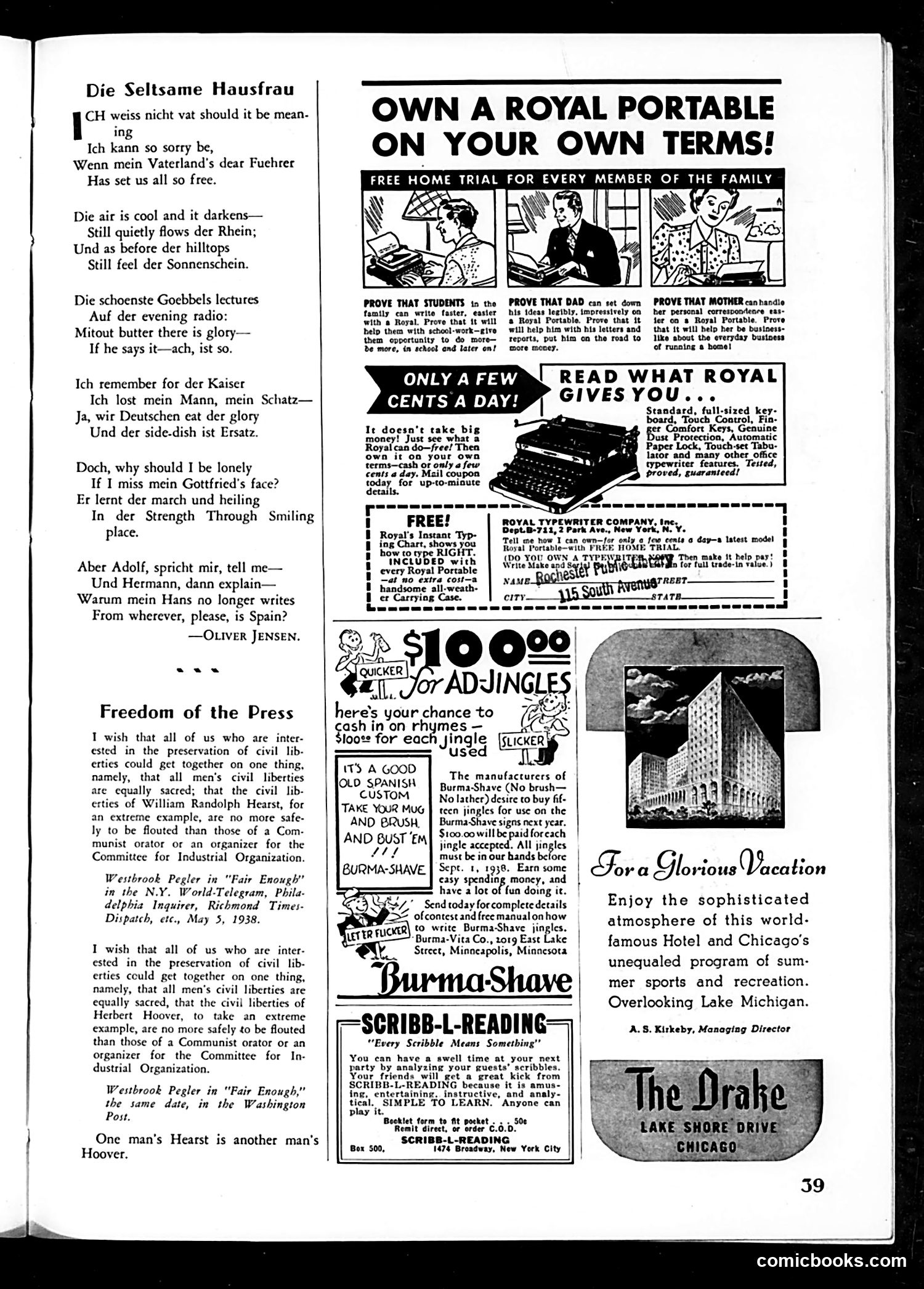
Analysis of Judge Magazine Page 39 This page contains political satire about Nazi Germany alongside period advertising. "Die Seltsame Hausfrau" (The Strange Housewife): A satirical poem by Oliver Jensen mocking Nazi propaganda from a German woman's perspective. Written in broken English with German phrases, it depicts her confusion and loss under Hitler's regime—she's lost her husband and son to Nazi service ("Spain" likely references the Spanish Civil War where Germans fought). The satire exposes the hollow propaganda ("Strength Through Smiling") while revealing the human cost of fascism. "Freedom of the Press" section: A pointed editorial juxtaposing two similar Westbrook Pegler quotes from 1938—one mentioning William Randolph Hearst, another substituting Herbert Hoover. The punchline "One man's Hearst is another man's Hoover" criticizes inconsistent application of free-speech principles, suggesting defenders pick and choose whose liberties matter based on politics. Advertisements: Standard period ads (Royal typewriters, Burma-Shave jingles, vacation promotions) fill the remaining space—typical commercial filler for magazines of this era.
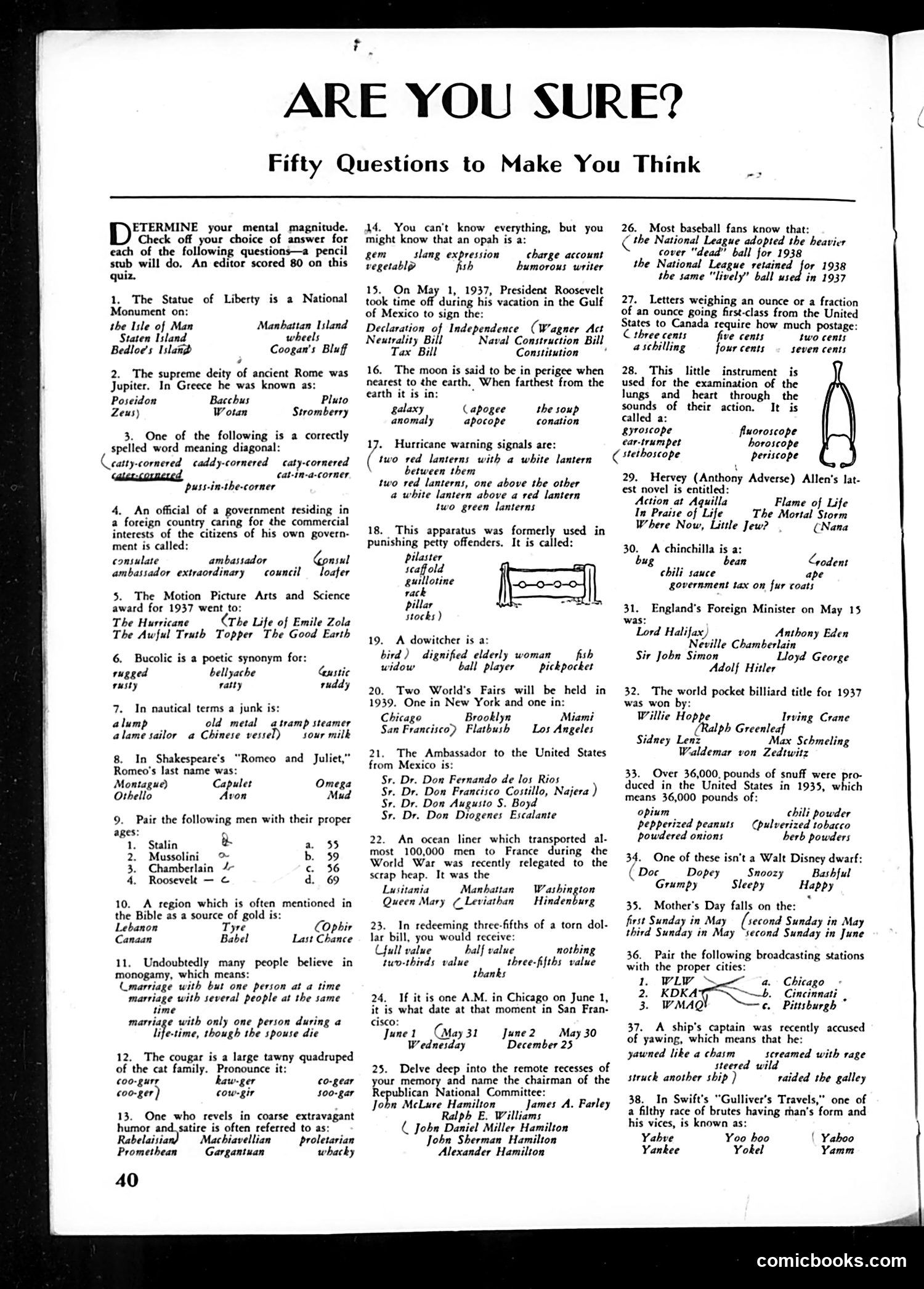
"Are You Sure?" Quiz Page - Judge Magazine This is a trivia quiz page, not a political cartoon. Titled "Fifty Questions to Make You Think," it tests readers on history, literature, science, and current events—primarily from 1937. The quiz reveals period concerns and knowledge gaps Judge's audience faced. Questions reference contemporary figures (Stalin, Mussolini, Chamberlain, Roosevelt) and 1937 events (the Wagner Act, Roosevelt's Gulf vacation). References to movies ("The Good Earth," "Topper") and sports (baseball's "lively ball" debate) show popular culture preoccupations. The satirical premise—that "an editor scored 80 on this quiz"—mocks educated readers' likely inability to answer all questions correctly, suggesting even informed people have surprising blind spots. This self-deprecating humor was typical of Judge's appeal to its literate, middle-class audience during the Depression and pre-war era.
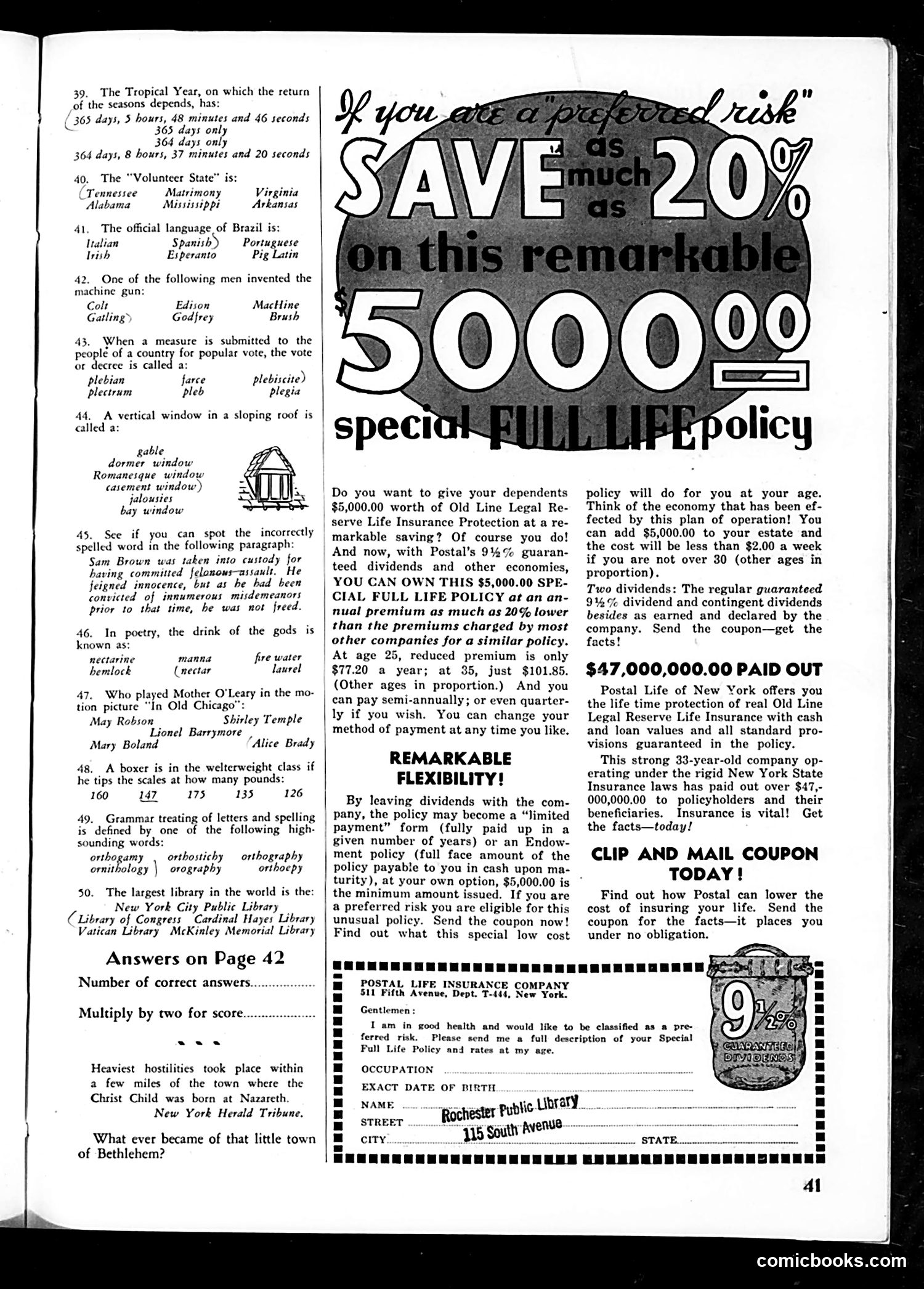
What This Page Means This is a miscellaneous content page from *Judge* magazine, dominated by an advertisement for Postal Life Insurance. The top half contains a trivia quiz (questions 39-50) covering geography, history, literature, and general knowledge—typical filler content in magazines of this era. The large insurance advertisement uses aggressive marketing language ("SAVE as much as 20%") to promote a $5,000 life insurance policy with flexible payment options. The ad appeals to breadwinners concerned about providing for dependents. At the bottom is a dark joke: a news clipping notes that "heaviest hostilities" occurred near Nazareth, then asks cynically "What ever became of that little town of Bethlehem?"—implying that Bethlehem (the Palestinian town) has been forgotten or destroyed. This appears to reference contemporary Middle Eastern conflict, though the specific historical moment is unclear without a date. The page represents typical magazine advertising and content blending of the era, where commercial pitches surrounded editorial matter with minimal separation.
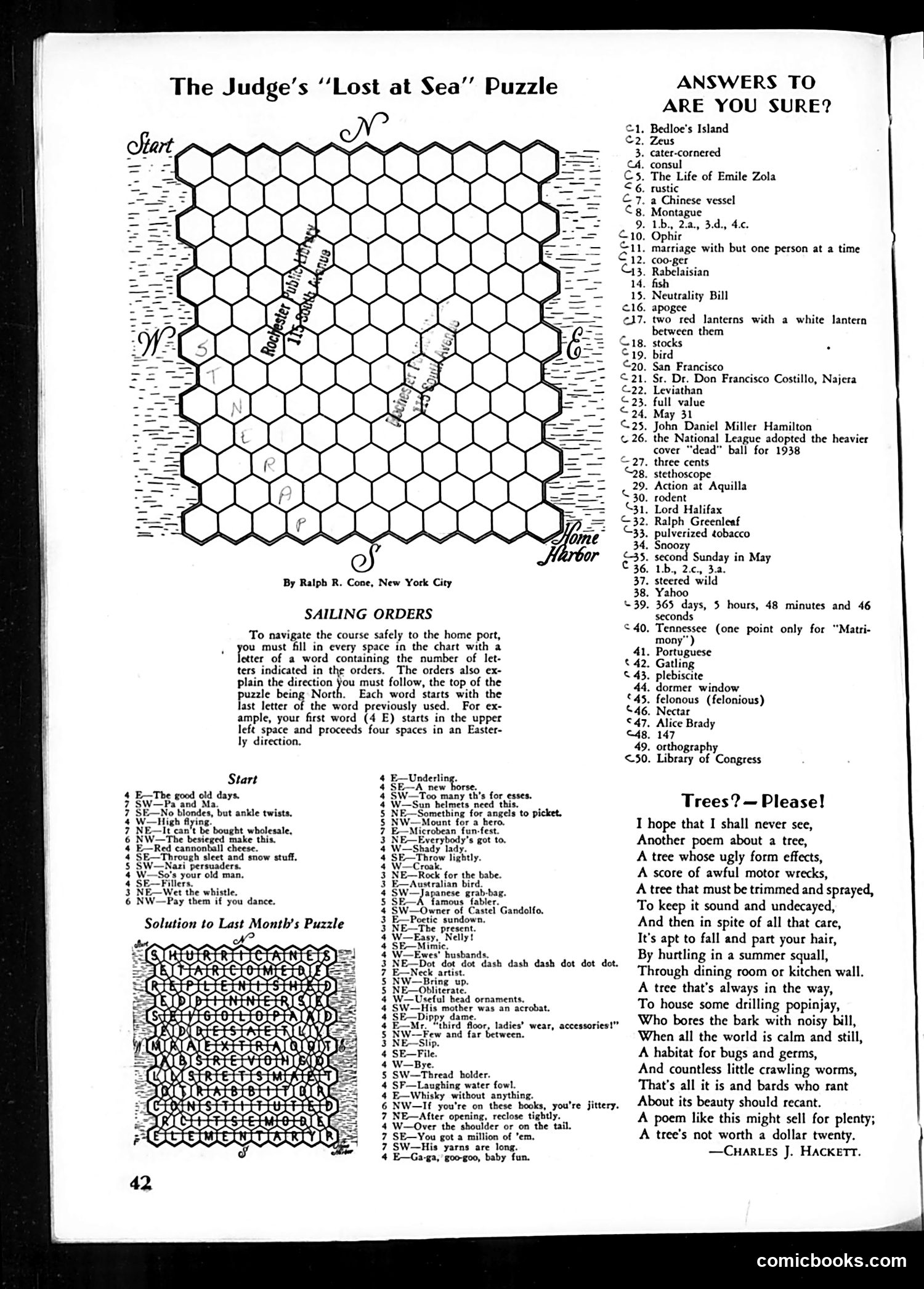
The Judge's "Lost at Sea" Puzzle (Page Analysis) This page features a word-puzzle game rather than political satire. The main content is "The Judge's 'Lost at Sea' Puzzle," a hexagonal grid puzzle where solvers fill in words based on sailing directions and clues. The clues are deliberately playful and riddling—typical of period word games. The accompanying "Sailing Orders" provide directional paths (Northeast, Southwest, etc.) and cryptic word hints. The puzzle's nautical framing is purely thematic. At page bottom is a poem titled "Trees? — Please!" by Charles J. Hackett, a humorous anti-nature piece mocking sentimental poetry about trees. It sarcastically catalogs trees' actual annoyances: they block views, harbor insects, drop branches through roofs, and generally create property damage and nuisance. The page also includes the solution to the previous month's puzzle and answer key for this puzzle. This represents typical *Judge* entertainment content: recreational puzzles and light verse rather than political commentary.
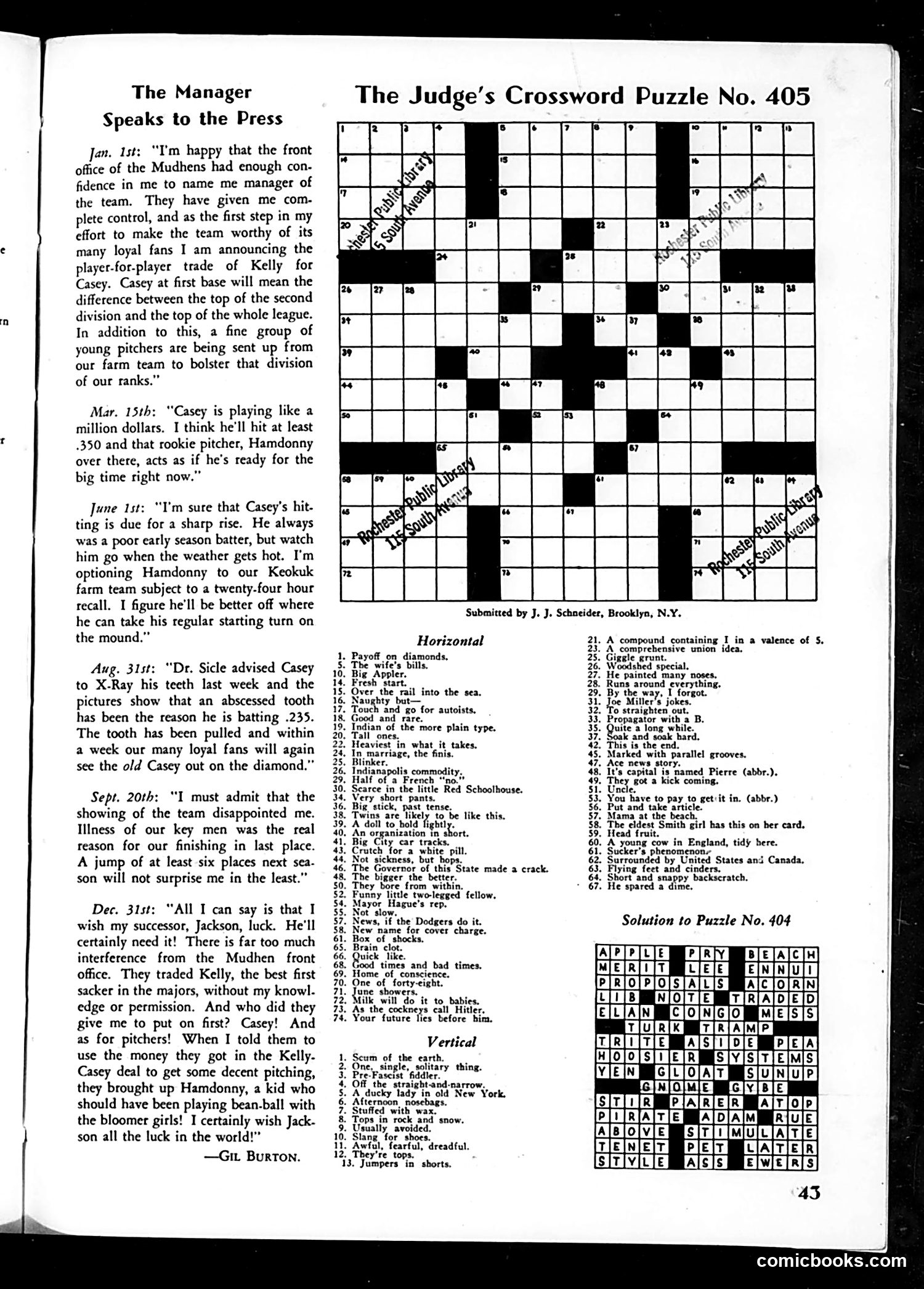
"The Manager Speaks to the Press" This satirical piece mocks a baseball manager's excuse-making throughout a season. The column presents his statements chronologically from January through December, revealing a pattern of initial optimism that progressively crumbles into blame-shifting. The manager confidently announces a player trade (Kelly for Casey) as the solution to success. By mid-season, Casey performs poorly, but the manager finds external explanations: weather, an abscessed tooth, pitcher availability. As the team finishes last place, the manager abandons responsibility entirely, blaming the front office for trades made "without my knowledge" and attributing failure to illness and interference rather than his own poor management. The satire targets a common figure: the executive or manager who takes credit for early-season optimism but deflects all accountability for failure. By year's end, he's passed leadership to his successor "Jackson" with resigned wishes of luck, having learned nothing. It's a timeless critique of excuse-making and lack of personal responsibility.
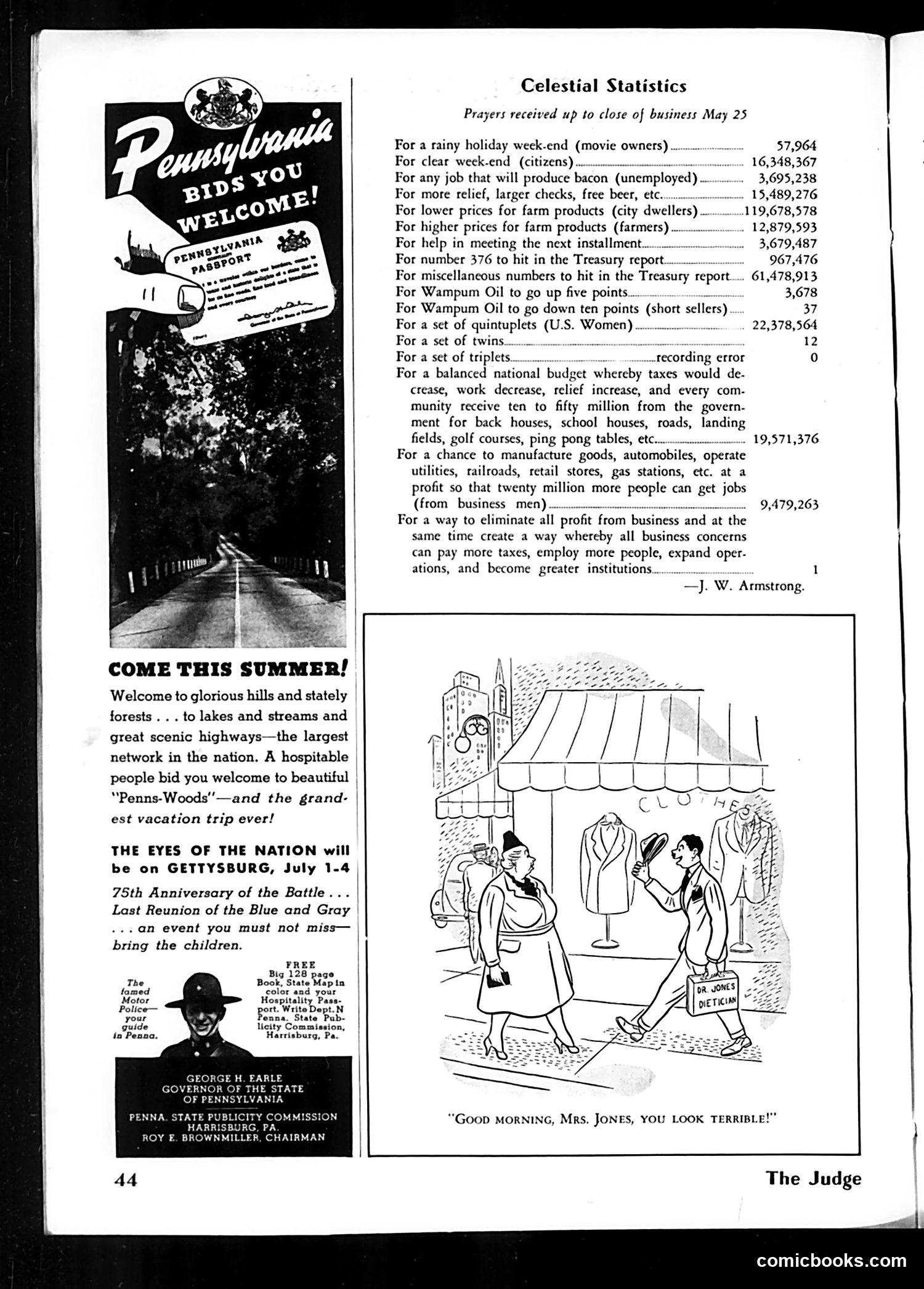
Page Analysis: Judge Magazine Satirical Content This page contains two distinct satirical pieces: Left side: A Pennsylvania tourism advertisement promoting summer vacation to Gettysburg for its 75th anniversary (July 1-4), ironically positioned during Depression-era economic hardship. Right side – "Celestial Statistics": A biting satire on prayer requests, attributed to J.W. Armstrong. The piece mocks conflicting public desires and economic contradictions of the 1930s: - Movie owners pray for rain; citizens for clear weather - Farmers want high prices; city dwellers want low prices - Stock speculators have opposite hopes for "Wampum Oil" - The final entry is most pointed: businessmen pray for profitable manufacturing to create jobs, while simultaneously praying for a system eliminating all business profit while increasing taxes and employment The cartoon below shows a disheveled woman being greeted cheerfully, suggesting the contrast between forced optimism and grim reality during economic depression. Together, these pieces critique the era's contradictory hopes and the impossibility of satisfying everyone's incompatible economic interests.
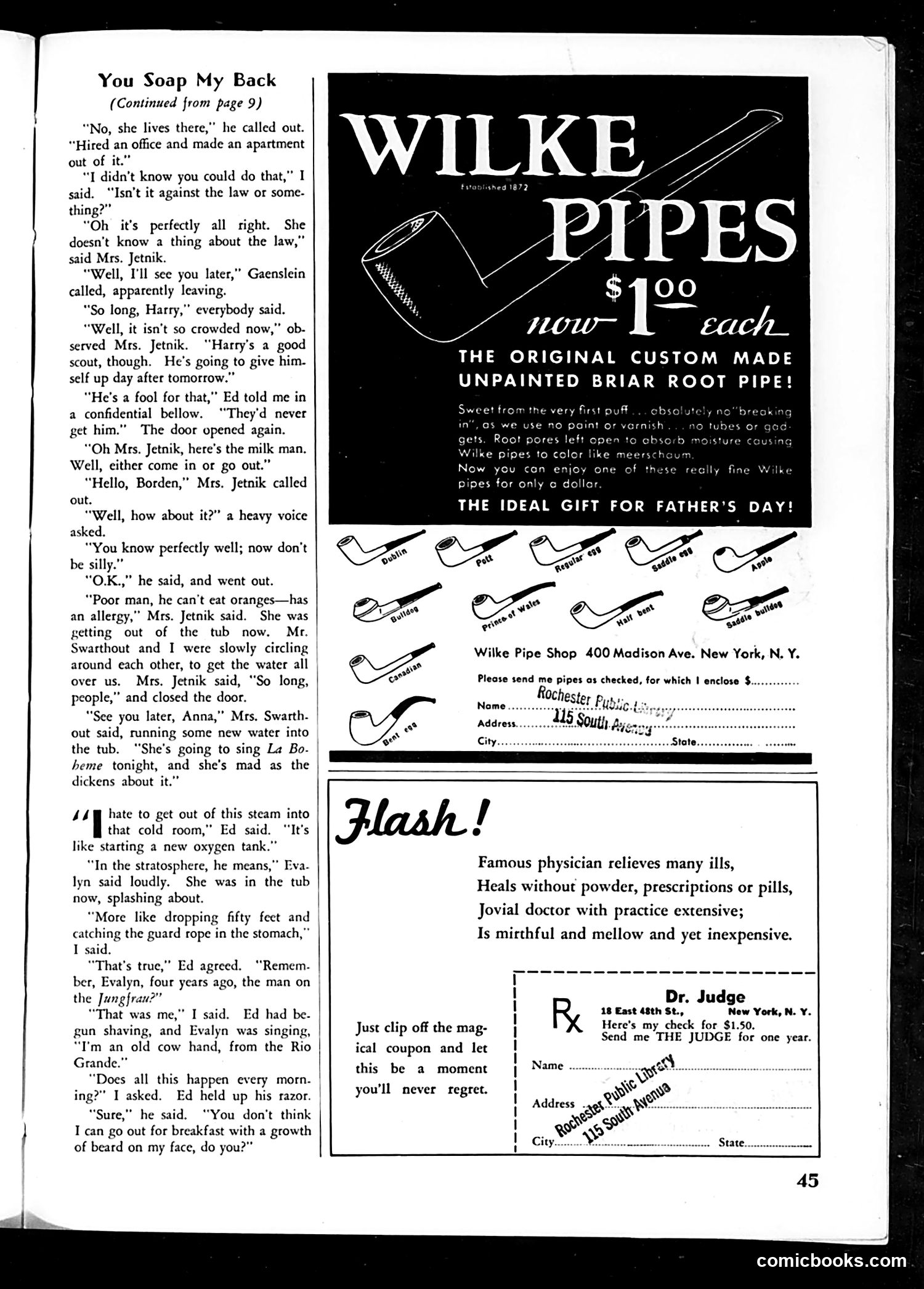
Explanation for Modern Readers This page contains a serialized short story ("You Soap My Back," continued from page 9) depicting a chaotic bathroom scene where multiple people share bathing and grooming space while conducting casual conversation. The humor derives from the casual intimacy and frank discussion of bodily functions typical of early 20th-century American domestic life—particularly the matter-of-fact references to allergies, bathing routines, and shaving. The remainder of the page is advertising: a Wilke Pipes tobacco pipe promotion ($1.00), a "Dr. Judge" mail-order medical service, and a subscription offer for Judge magazine itself. These ads are typical period marketing using humor and exaggeration to sell products. There are no identifiable political cartoons or caricatures on this page. It's primarily a fiction continuation with surrounding commercial content.
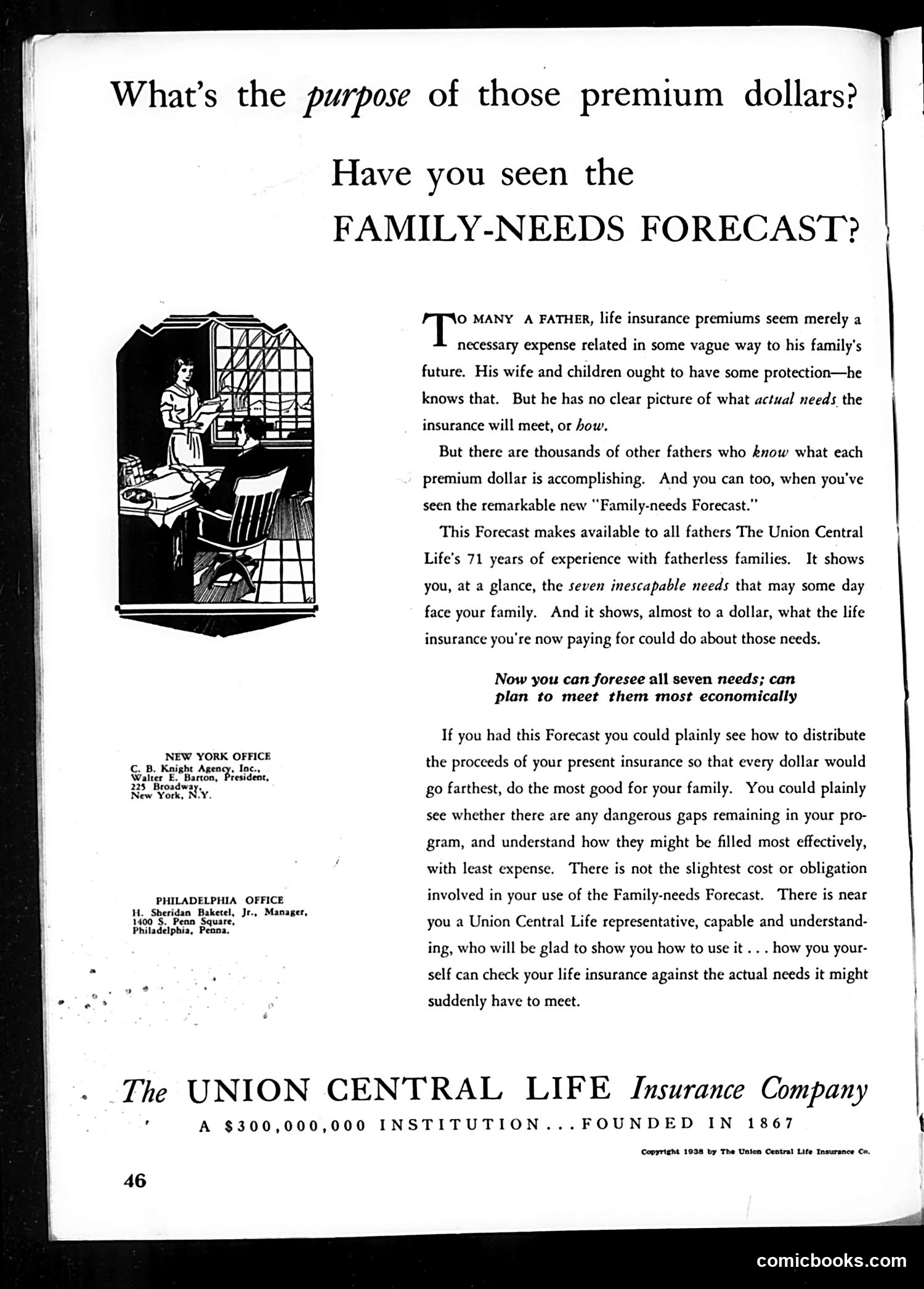
Analysis for Modern Readers This is a life insurance advertisement, not satire or political commentary. The page promotes Union Central Life's "Family-needs Forecast"—a planning tool for fathers. The accompanying illustration depicts a woman (likely a widow) working at home with a child, visualizing the financial vulnerability that motivates the insurance pitch. The ad addresses a real anxiety: most fathers bought insurance without understanding what specific needs it would cover or whether coverage was adequate. The "Forecast" promised to show fathers the "seven inescapable needs" a family might face (presumably: income replacement, debt payment, childcare, education, housing, etc.) and calculate how insurance proceeds could address each one. This was marketed as a free, no-obligation planning service. The tone is paternalistic and assumes fathers are the decision-makers; it also subtly exploits fear of family destitution. By 1938 standards, this direct-mail insurance marketing was relatively sophisticated customer education—today it would be standard practice.
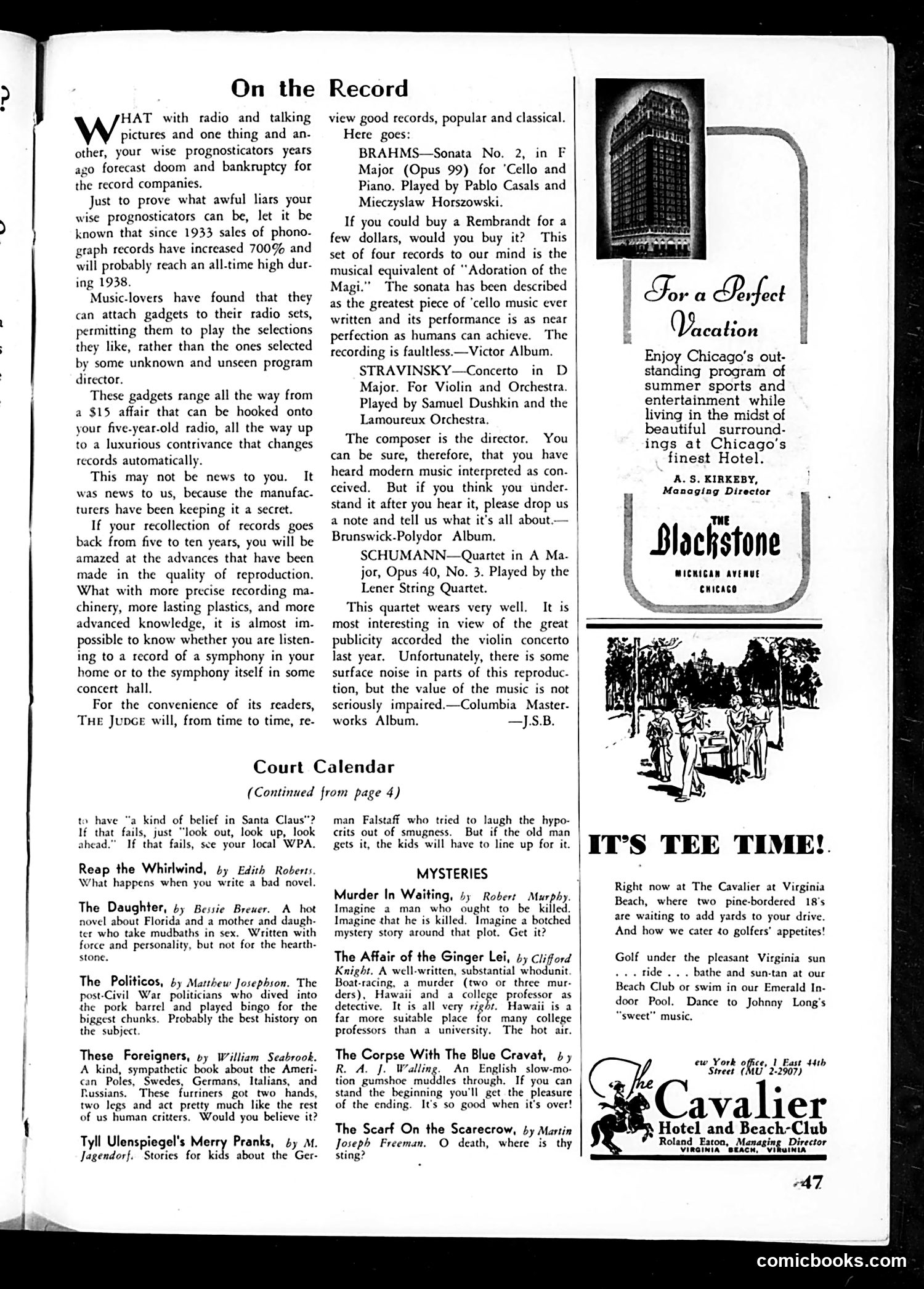
"On the Record" - Judge Magazine Page Analysis This page is primarily editorial and advertising content, not political satire. The main article celebrates the phonograph record industry's unexpected boom—sales rose 700% since 1933, contradicting earlier predictions of industry collapse. The piece reviews classical records (Brahms, Stravinsky, Schumann), praising recording technology advances that make home listening nearly indistinguishable from concert hall performance. The tone is celebratory: record enthusiasts can now attach devices to radios to play preferred selections rather than accepting programmers' choices. The sidebar advertises The Blackstone Hotel in Chicago and The Cavalier Hotel in Virginia Beach, emphasizing leisure and vacation enjoyment. The "Court Calendar" section reviews current books, including titles addressing class and social difference ("These Foreigners" sympathetically portrays immigrant groups). No clear political cartoon or satirical figures appear on this page. It's primarily a consumer-culture celebration of technological progress and entertainment options available to middle-class Americans in 1938.
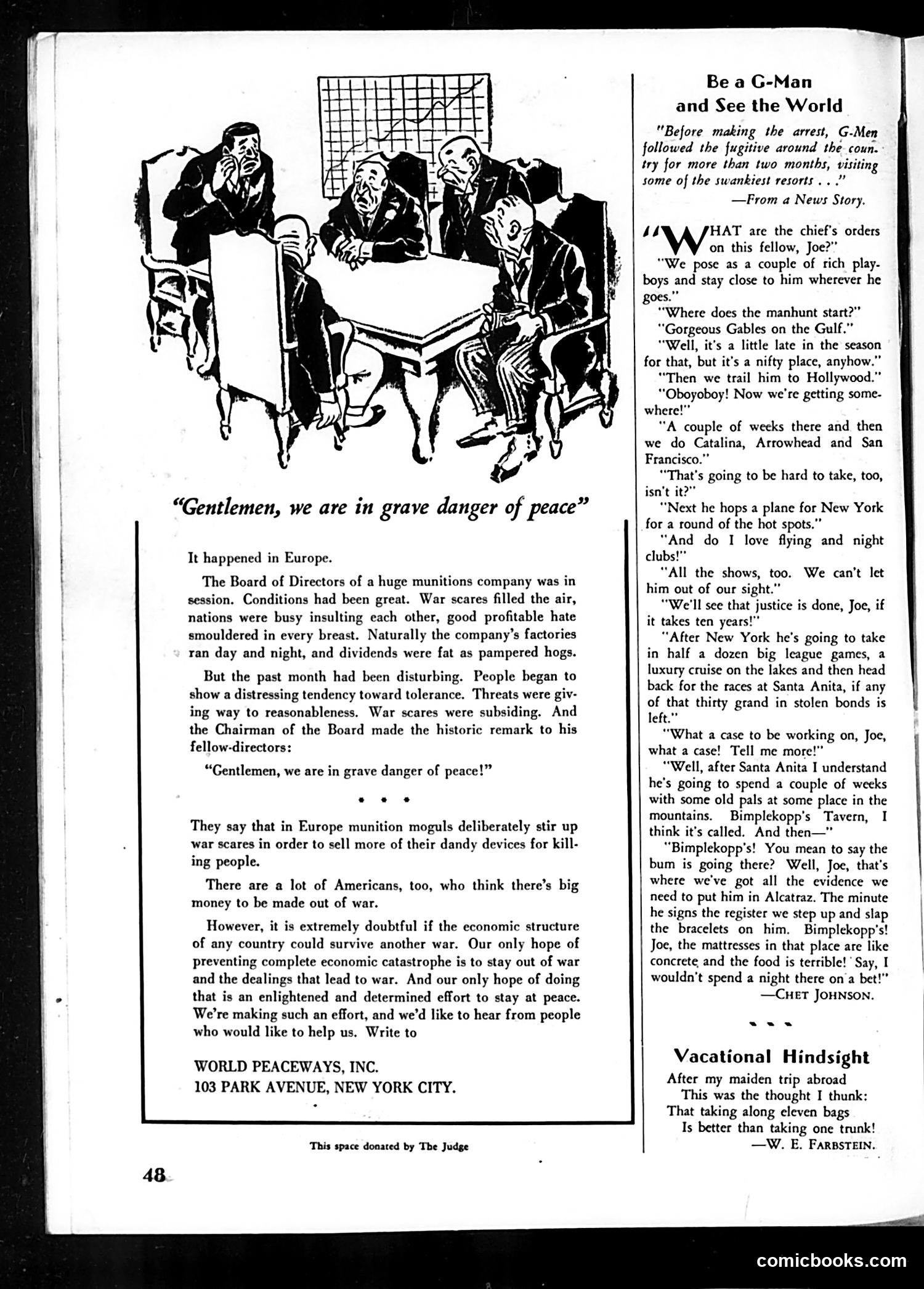
Political Cartoon Analysis: Judge Magazine The main cartoon satirizes munitions manufacturers who profit from war. European arms dealers are depicted in a board meeting expressing alarm that peace is breaking out—their business depends on conflict and "war scares." The satire targets the economic incentive structure: these industrialists actively stir up international tensions to sell weapons. The accompanying editorial argues this applies to some Americans too, though it doubts any country could actually survive another war economically. The secondary humor piece mocks FBI "G-Men" (federal agents) chasing a criminal fugitive through luxury resort destinations—Gables, Hollywood, Catalina, night clubs, baseball games, and a cruise—disguised as wealthy playboys. The joke is that apprehending a criminal apparently requires sampling America's finest leisure activities, making the "punishment" of law enforcement seem enviable rather than arduous. Both pieces reflect pre-WWII American concerns about war profiteering and satirize institutional hypocrisy.
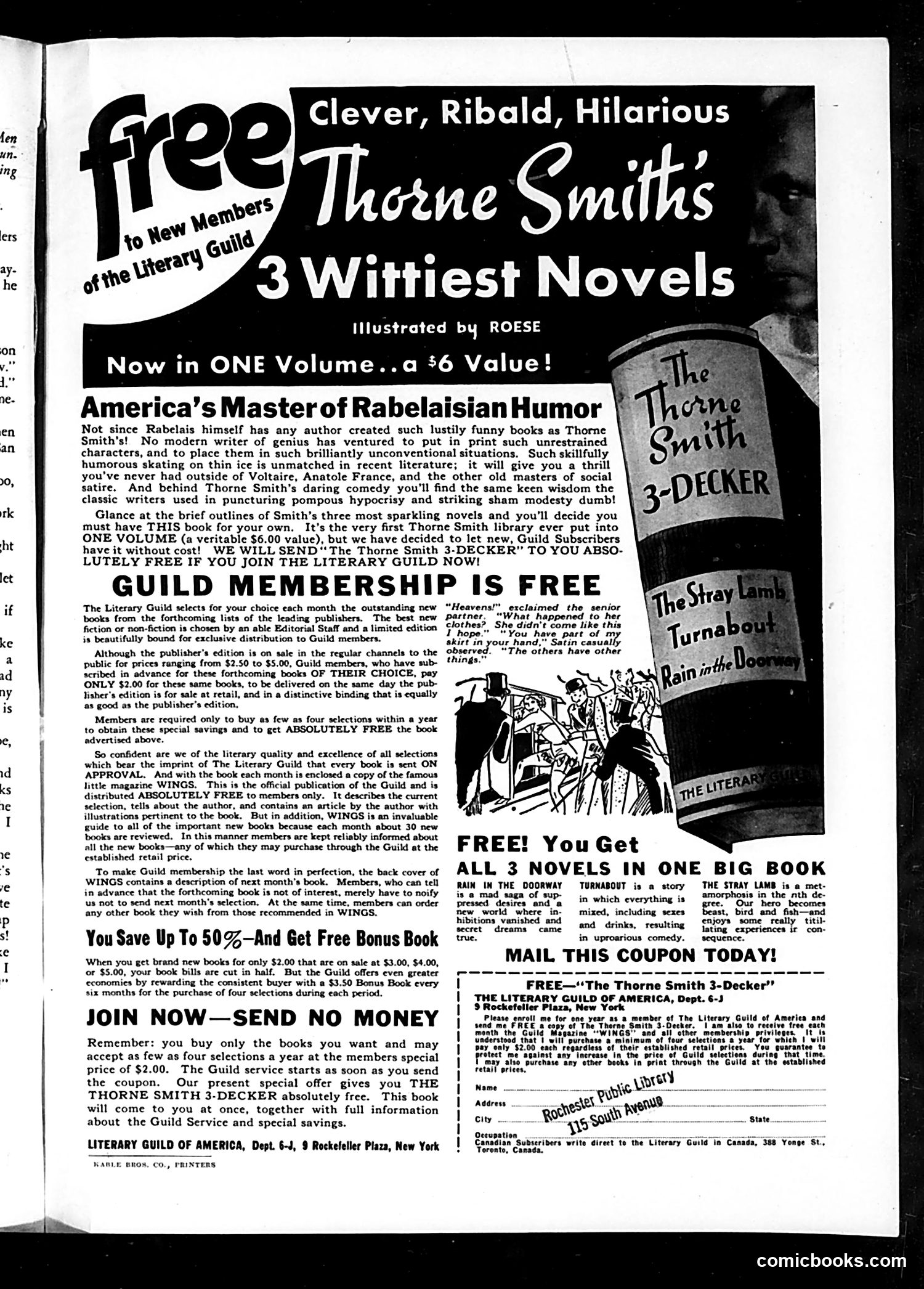
Explanation for Modern Readers This is primarily a book club advertisement, not a political cartoon. It promotes Thorne Smith's collected novels through the Literary Guild of America. The Content: The page advertises a special offer: new Literary Guild members receive Smith's "3-Decker" (three novels in one volume: *Rain in the Doorway*, *Turnabout*, and *The Stray Lamb*) absolutely free upon joining. Why It Matters Historically: Smith was marketed as "America's Master of Rabelaisian Humor"—a comparison to the 16th-century French satirist known for bawdy, irreverent comedy. The ad emphasizes Smith's scandalous reputation: his books contain "unrestrained characters" in "unconventional situations" comparable to Voltaire and Anatole France. This suggests his work pushed 1920s-30s publishing boundaries regarding sexual content and social satire. The Business Model: Members paid only $2.00 per selection (versus $2.50-$5.00 retail), requiring commitment to purchase four books yearly—a direct-mail marketing strategy targeting middle-class readers seeking contemporary literature.

Green River Whiskey Advertisement This is a whiskey advertisement rather than political satire. It features a smiling bartender or server in formal attire (bow tie and vest) holding a tray with cocktail glasses, promoting Green River blended whiskey as "the whiskey without regrets." The ad's tagline "keen about cocktails?" appears designed to appeal to cocktail culture. The bottle shown is labeled "Green River." This represents mid-20th century liquor advertising, likely from the pre-1950s era based on the styling and production quality. The advertisement uses an enthusiastic service worker character to market the product, a common advertising approach of that period. No specific political figures or satirical commentary are present—this is straightforward commercial promotion.

I can see this is a heavily damaged or degraded page from Judge magazine, with the watermark "comicbooks.com" visible. However, the image is almost entirely black with only faint, unclear outlines of what appear to be circular shapes or heads arranged in a pattern. The OCR text provides only the website attribution and no readable content. Due to the severe image degradation, I cannot reliably identify any figures, political references, captions, or satirical content. To properly analyze this as a historical cartoon or comic, a higher-quality or clearer version of the page would be necessary. I cannot responsibly speculate about the meaning without legible visual or textual information.