judge
Judge — July 1938
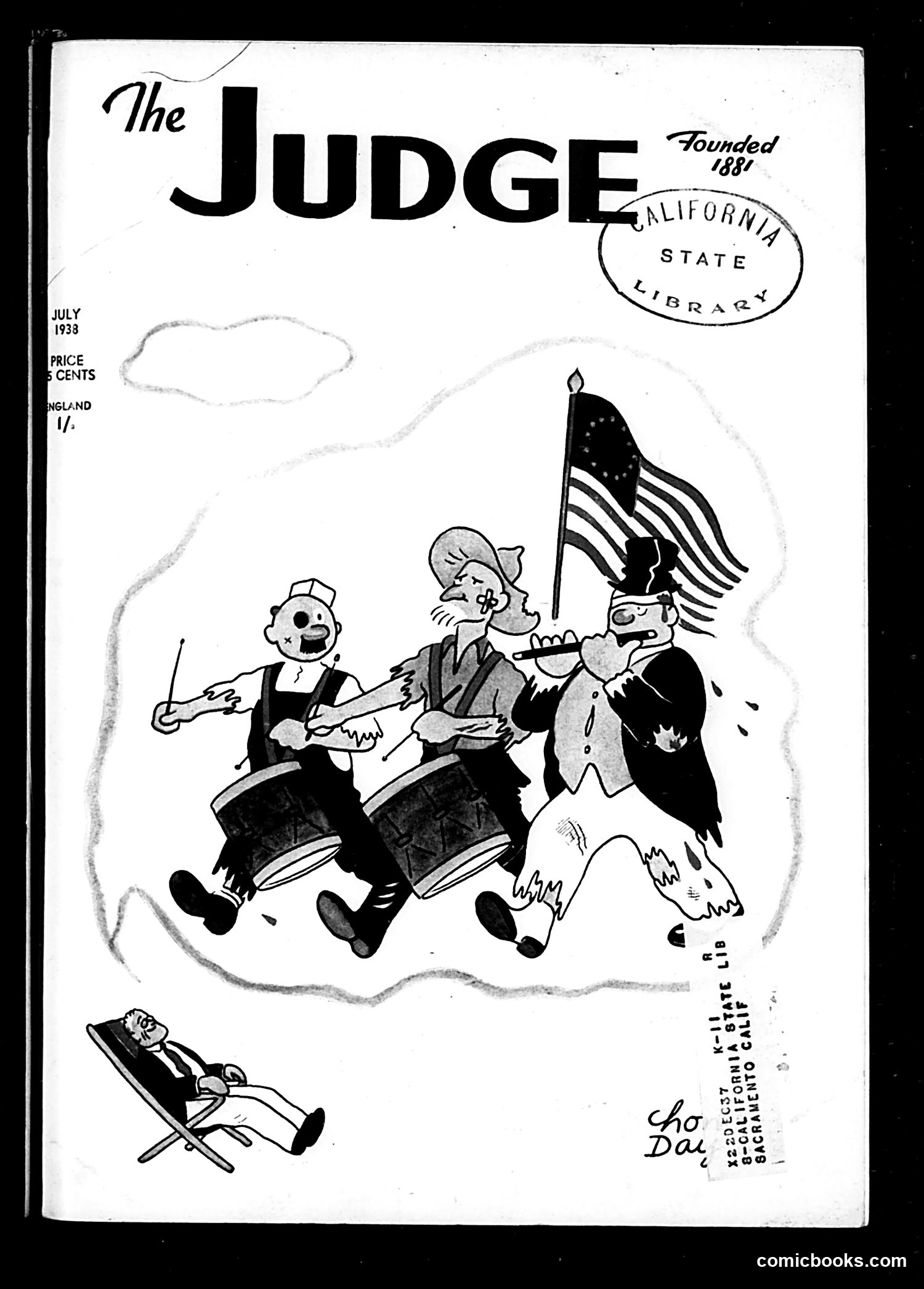
The Judge Cover - July 1938 This cover depicts three cartoon characters celebrating with an American flag during what appears to be a patriotic moment. The figures seem to represent common American stereotypes of the era—possibly referencing working-class or immigrant archetypes popular in 1930s humor. The central figure weeps while holding the flag, suggesting emotional patriotic fervor. The style is typical of Judge magazine's satirical approach to American life and politics during the Depression era. Without clearer context about specific 1938 events, the exact satirical target remains uncertain. It likely comments on patriotism, national sentiment, or social attitudes of that period, though the specific political reference is unclear from the image alone. The "Cho Dac" signature appears to be the cartoonist's mark.
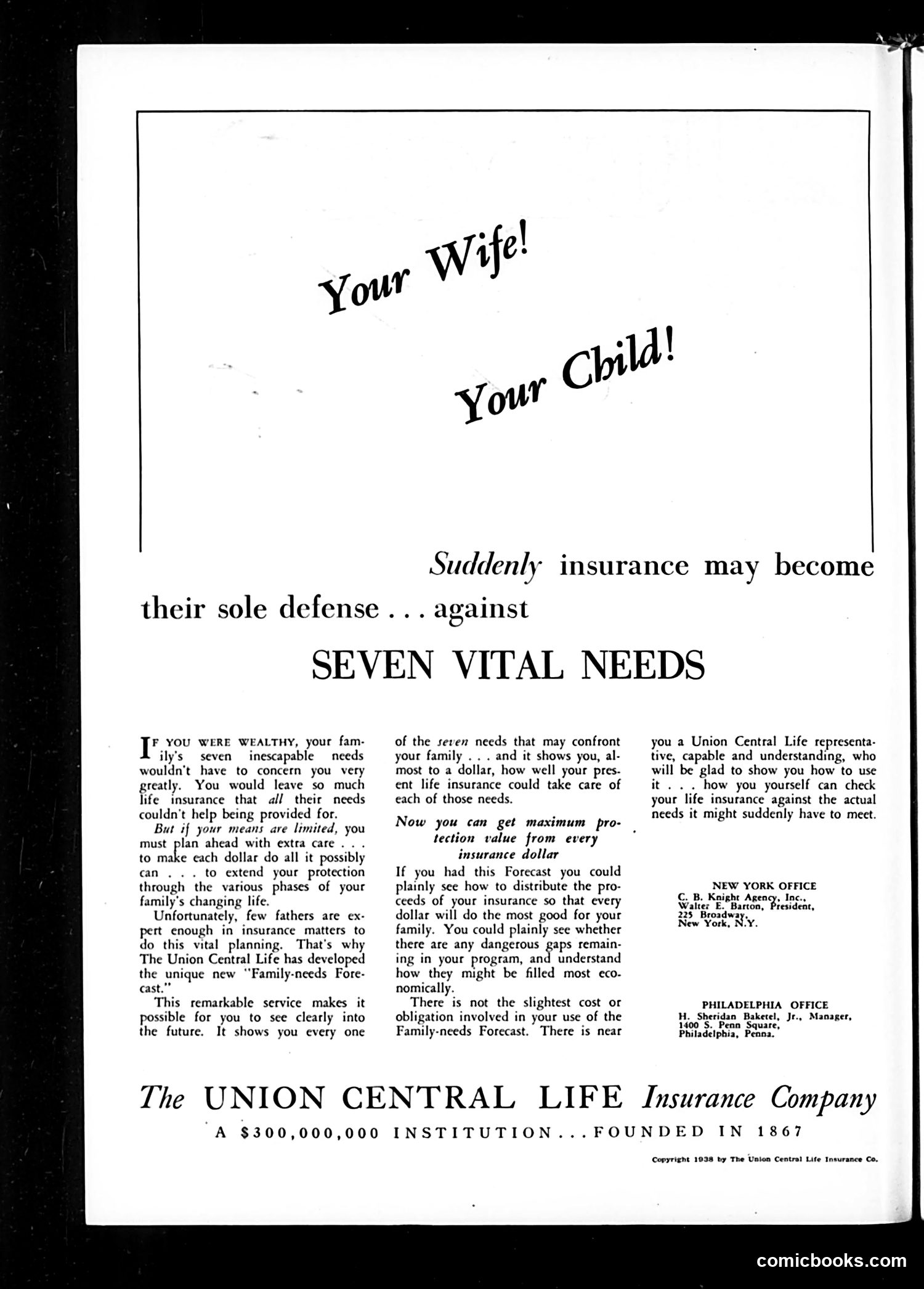
Analysis This is primarily an insurance advertisement, not editorial satire. The Union Central Life Insurance Company uses anxiety-based marketing to sell life insurance policies. The ad addresses readers directly ("Your Wife! Your Child!") to invoke fear about family vulnerability. It argues that life insurance provides essential financial protection against "seven vital needs" — funeral costs, living expenses, education, and other unforeseen hardships that could devastate dependents. The text emphasizes the company's "Family-needs Forecast" service, which supposedly helps customers visualize future financial gaps and distribute insurance accordingly. While the dramatic language ("Suddenly") and emotional appeals were common 1930s advertising tactics, this represents commercial persuasion rather than political satire. The page demonstrates how insurance companies marketed their products by emphasizing middle-class anxieties about family security during the Depression era.
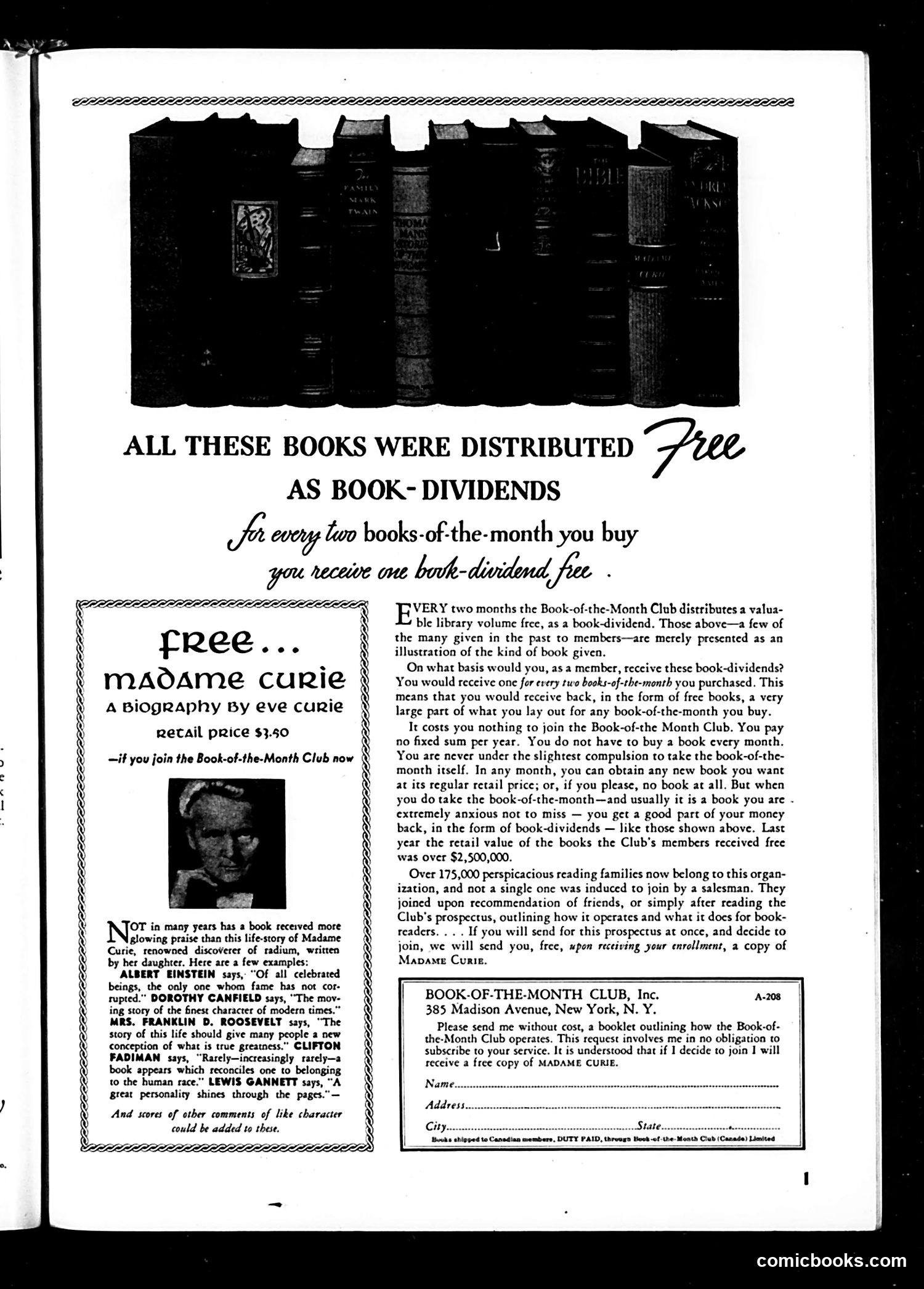
Analysis This page is primarily advertising, not satire or political commentary. It promotes the Book-of-the-Month Club's membership benefits, specifically highlighting their "book-dividend" system where members receive free books with purchases. The left side features a featured selection: Madame Curie, a biography by Eve Curie (retail $1.50). The advertisement includes testimonial quotes praising the Club's offerings, attributed to figures like Albert Einstein, Dorothy Canfield, and Clifton Fadiman. The main pitch emphasizes the financial incentive: for every two books purchased, members receive one free. The text claims over 175,000 families belonged to the Club and that members received over $2,500,000 in free books the previous year. There is no political cartoon or satire on this page—it is straightforward commercial promotion.
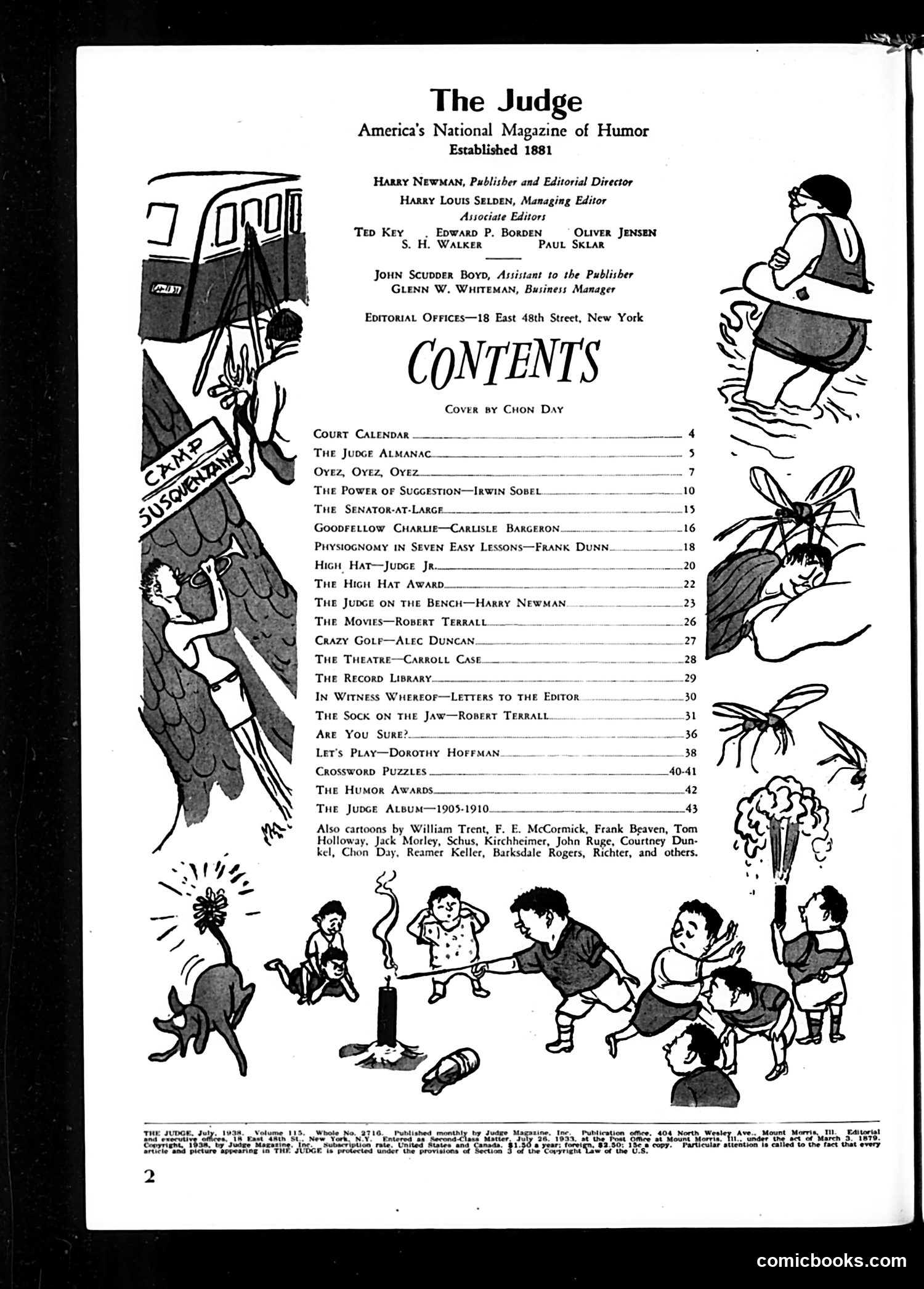
Contents Page Analysis This is a contents page from *The Judge* magazine (July 1932, Volume 113). It lists humorous articles and cartoons typical of the era's satirical magazine format. The editorial staff and contributing cartoonists are listed at the top. The bottom illustration appears to be a generic comedic scene of children playing with fireworks or firecrackers—a common visual joke topic for the period. Notable article titles suggest the magazine's satirical scope included political commentary ("The Senator-at-Large"), social observation ("Physiognomy in Seven Easy Lessons"), and entertainment criticism ("The Movies," "The Theatre"). Without seeing individual article content, the specific satirical targets remain unclear, though the 1932 date suggests potential commentary on the Great Depression era.
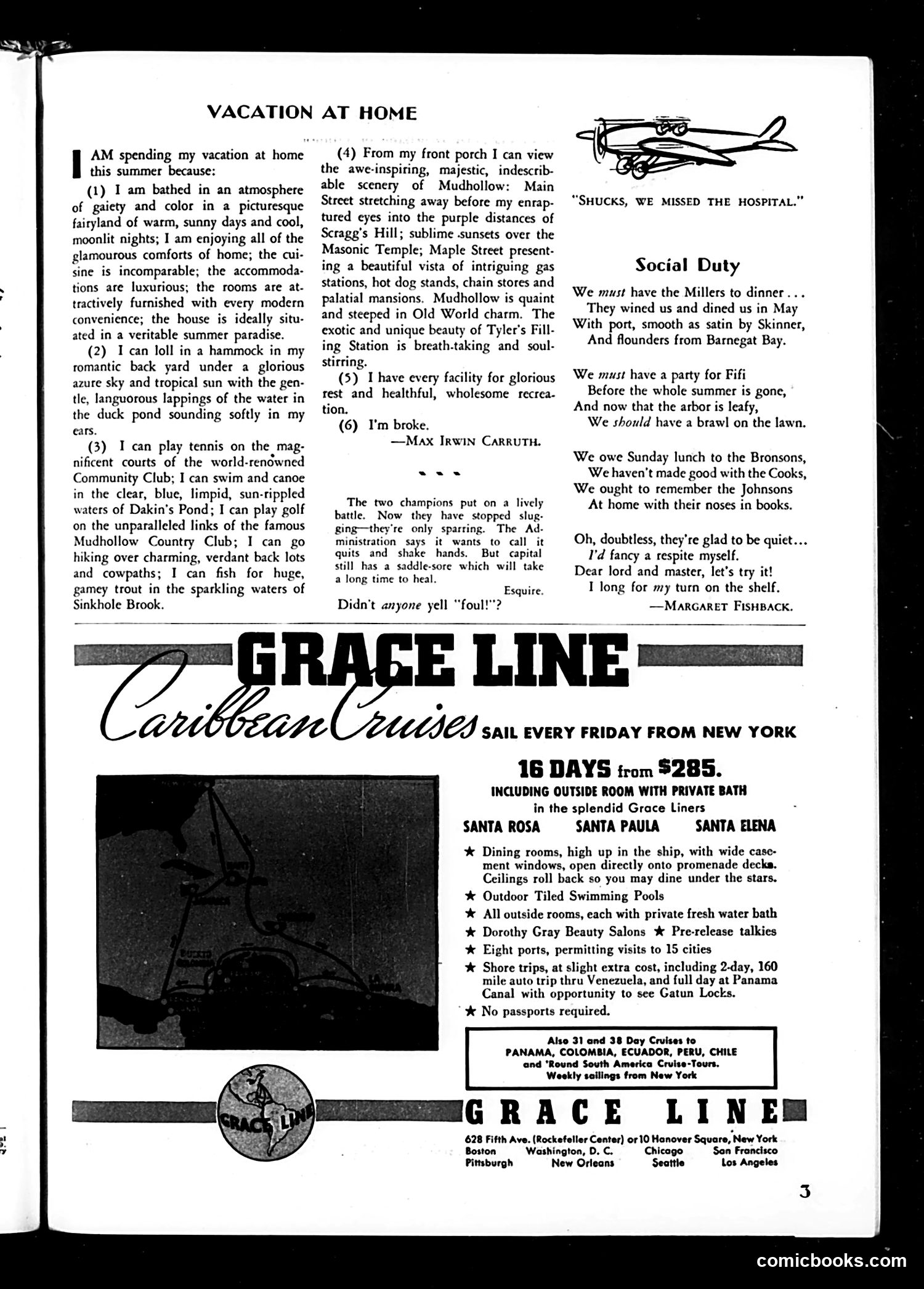
Analysis This page is primarily advertising and light humor columns rather than political satire. The main content consists of: 1. "Vacation at Home" - A humorous essay by Max Irwin Carruth listing reasons to vacation domestically (hammocks, tennis, golf, canoeing) rather than travel abroad. The final quip "Didn't *anyone* yell 'fool'?" suggests self-aware irony about staying put. 2. "Social Duty" - A verse by Margaret Fishback poking fun at social obligations—dinner parties, lunches with neighbors—that accumulate during summer, ending with the speaker hoping for their turn on "the shelf" (to be left alone). 3. Grace Line Caribbean Cruises advertisement - A full-page cruise ship promotion offering 16-day Caribbean voyages from New York. The humor is gentle, domestic, and relatable rather than politically pointed. No caricatures or political figures are present.
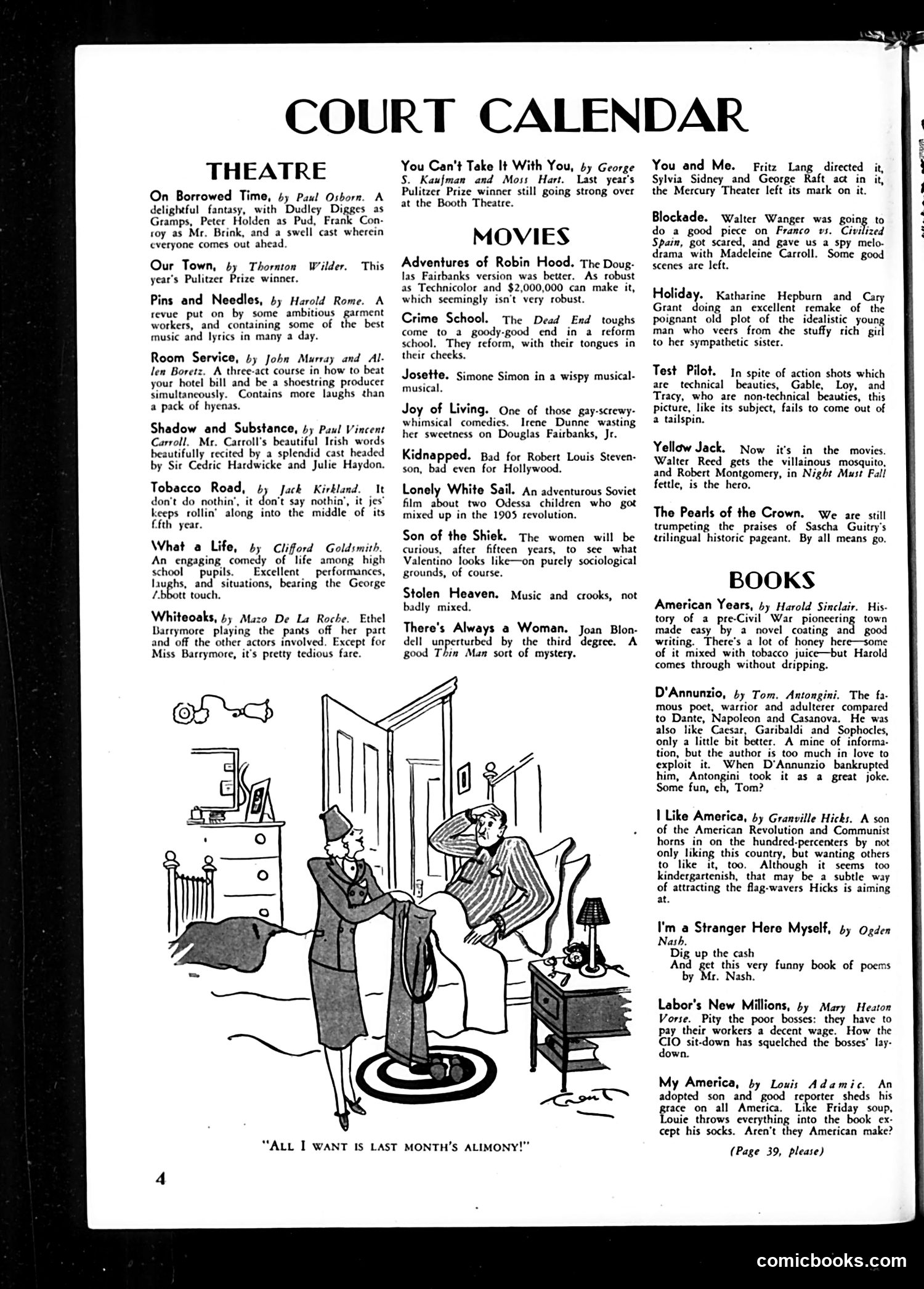
"Court Calendar" Page Analysis This page from *Judge* magazine contains theater and book reviews alongside a single cartoon captioned "ALL I WANT IS LAST MONTH'S ALIMONY!" The cartoon depicts a domestic dispute: a woman in a dress confronts a man in formal attire inside a bedroom, gesturing emphatically while pointing toward bedroom furniture. The humor targets marital financial disputes—specifically, the woman's demand for alimony payments owed from the previous month. This reflects early-to-mid 20th century anxieties about divorce settlements and alimony obligations. The cartoon satirizes the common domestic complaint of unpaid support, presenting the woman as assertive and the man as apparently evasive. The bedroom setting emphasizes the intimate nature of marriage breakdowns while the financial complaint underscores the material consequences of divorce for women. The page's primary content consists of theater reviews and book recommendations.
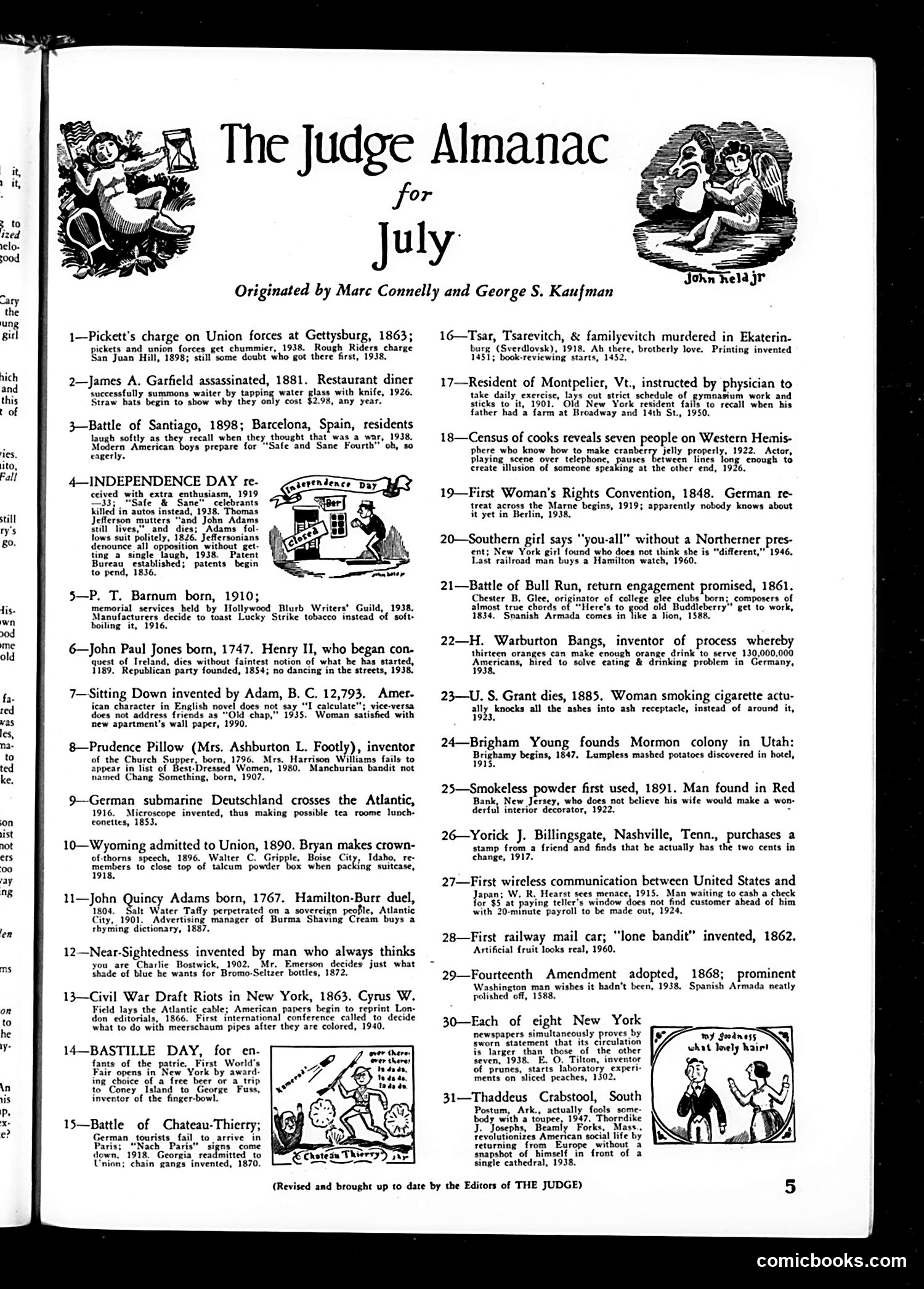
The Judge Almanac for July This page is primarily an almanac of historical events and inventions, not political satire. It lists 31 dated entries for July, ranging from Independence Day trivia to inventions like the submarine, wireless communication, and the railroad mail car. The few accompanying illustrations are decorative rather than satirical: - Small vignettes accompany entries on the Bastille Day and Chateau-Thierry (WWI references) - These appear to be generic historical scene drawings, not caricatures The page functions as educational content disguised as entertainment—typical of Judge magazine's approach during this period. Rather than sharp political commentary, it offers miscellaneous American history and technological achievements, presented with light humor through the juxtaposition of mundane details (e.g., "Woman smoking cigarette accidentally knocks all the ashes into ash receptacle, instead of around it, 1923").
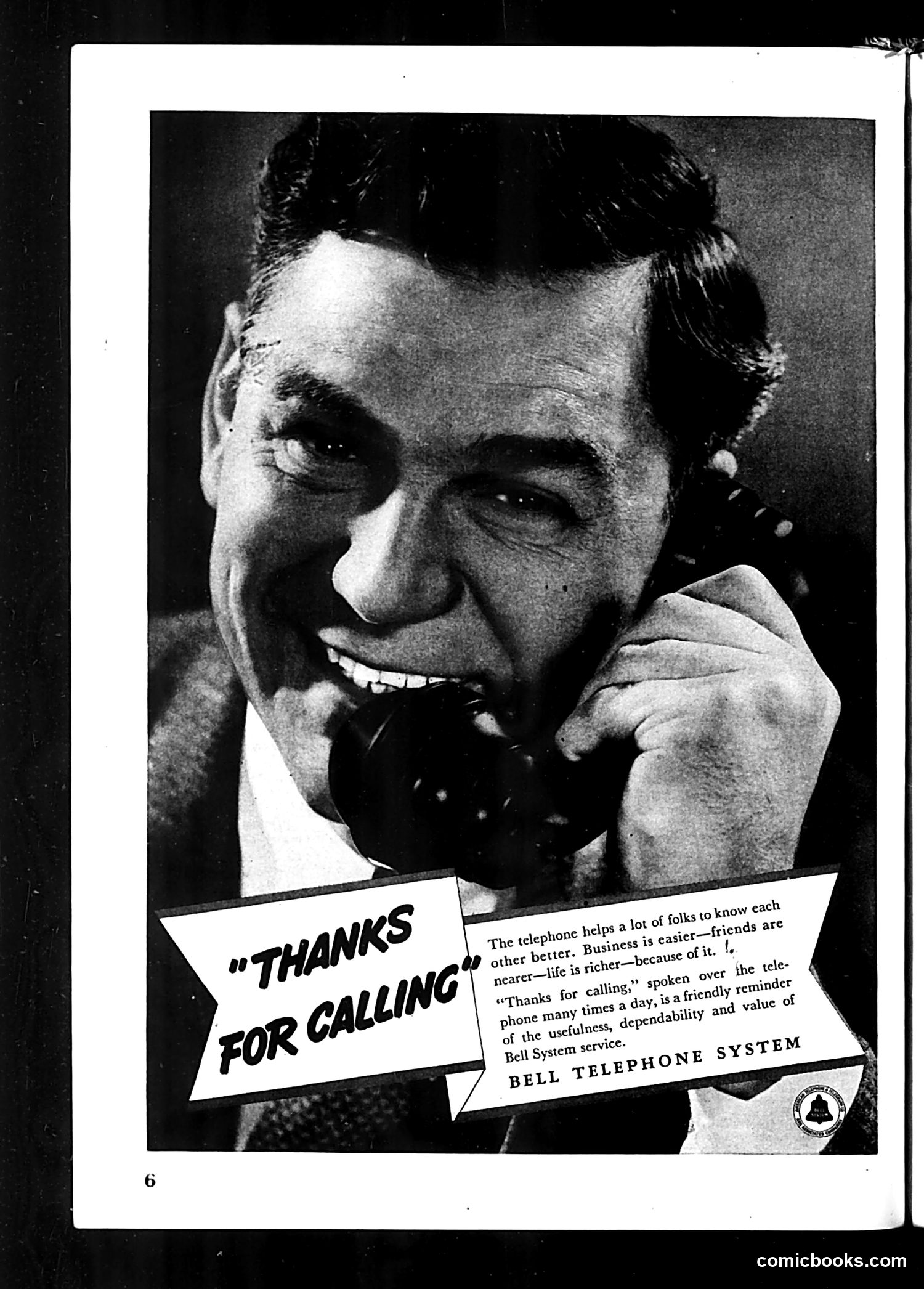
Analysis This is a Bell Telephone System advertisement, not satire or political commentary. The page features a photograph of a man holding a telephone handset, smiling broadly at the camera. The advertisement uses a testimonial format with the quote "THANKS FOR CALLING" in a speech bubble. The accompanying text praises the telephone's role in connecting people and facilitating business, emphasizing how it makes "life is richer" through dependability and value. This represents a straightforward corporate marketing appeal from Judge magazine's advertising section. Rather than satirizing anything, Bell Telephone is using the magazine's platform to promote the social and practical benefits of telephone service to readers—a common advertising approach of the era for utilities and communication services.
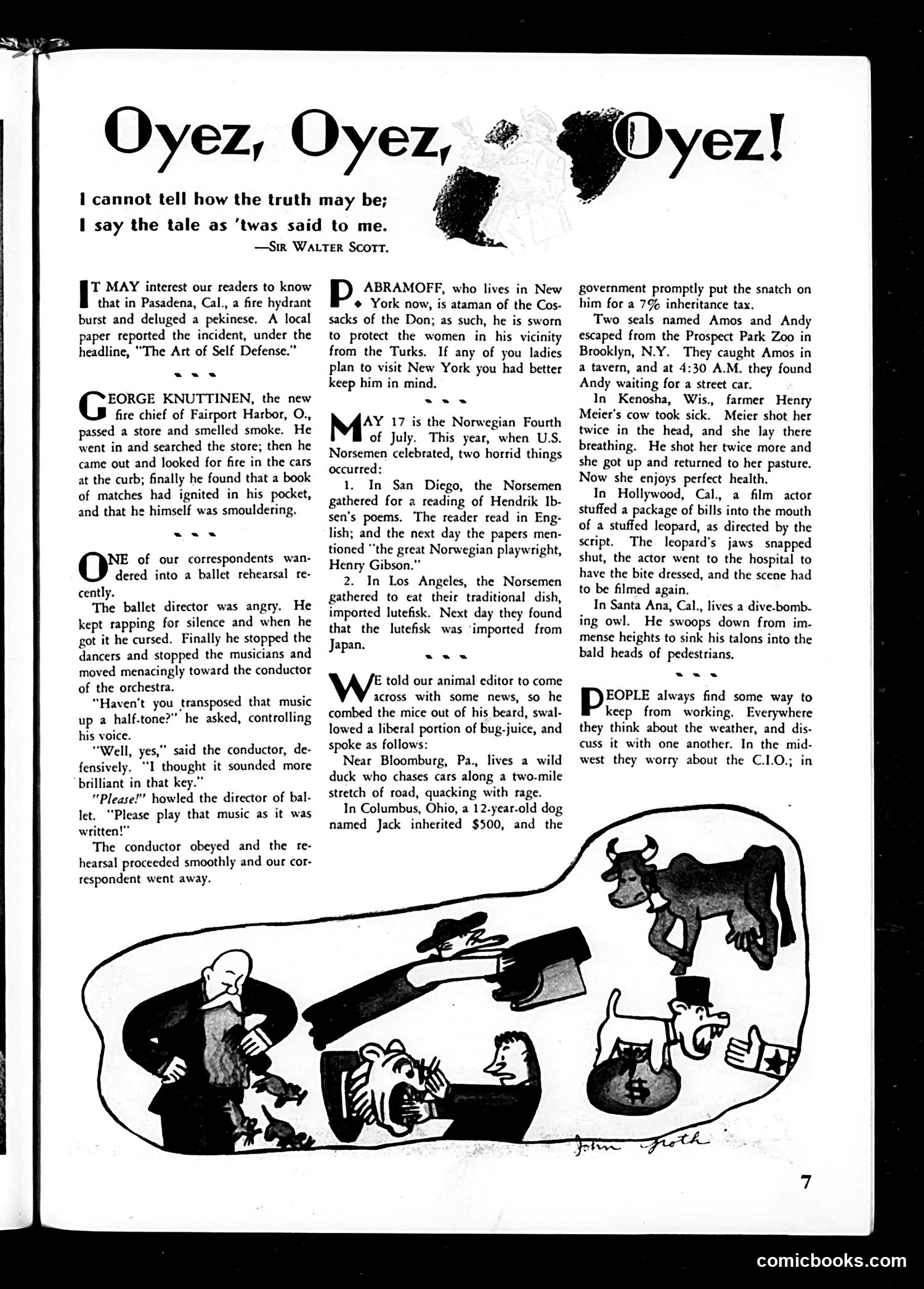
Analysis of "Oyez, Oyez, Oyez!" Page from Judge Magazine This page collects humorous anecdotes rather than political cartoons. The stories mock various mishaps: - A Pasadena fire chief who found a book while investigating a store fire - George Knuttinen, a harbor chief who smelled smoke and investigated incorrectly - A ballet director stopped during a performance for transposing music - Norwegian Fourth of July celebrations, including incidents in San Diego and Los Angeles - A wild duck in Bloomsburg, PA, and a 12-year-old dog inheriting $500 in Columbus, Ohio The bottom illustration depicts these absurd scenarios. The humor relies on incongruity—the unexpected collision of serious situations (fires, performances) with ridiculous outcomes or details. This reflects Judge's style of satirizing everyday human folly rather than targeting specific political figures or events.
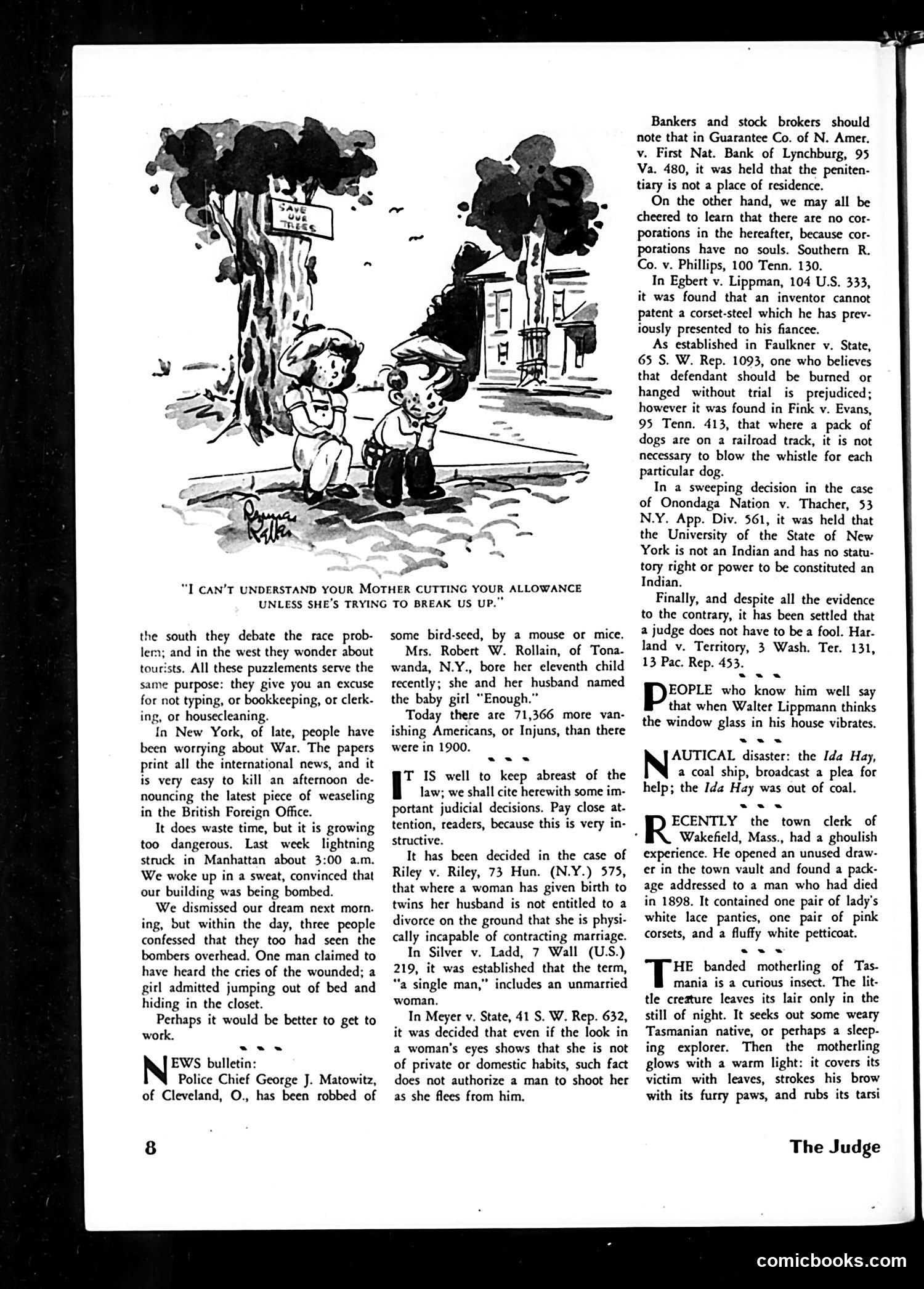
The Judge Page Analysis The Main Cartoon The illustration depicts two young people beneath a tree labeled "LOVE." The boy complains that the girl's mother cutting her allowance seems designed to "break us up"—suggesting parental disapproval of their romance through financial pressure. The Satire's Point This is typical romantic comedy satire: the boy interprets economic hardship as a deliberate parental strategy to separate them, missing the more obvious explanation that money is simply tight. It mocks young lovers' tendency to see themselves as the center of their parents' concerns. The Surrounding Content The page contains miscellaneous satirical items: absurd "news bulletins" (a police chief robbed by mice; a couple naming their eleventh child "Enough"); and a series of deliberately ridiculous legal case summaries poking fun at judicial logic—such as the ruling that shooting a fleeing woman isn't justified merely because "the look in her eyes" suggests impropriety. This reflects Judge magazine's characteristic irreverent humor targeting social conventions, legal absurdities, and human folly.
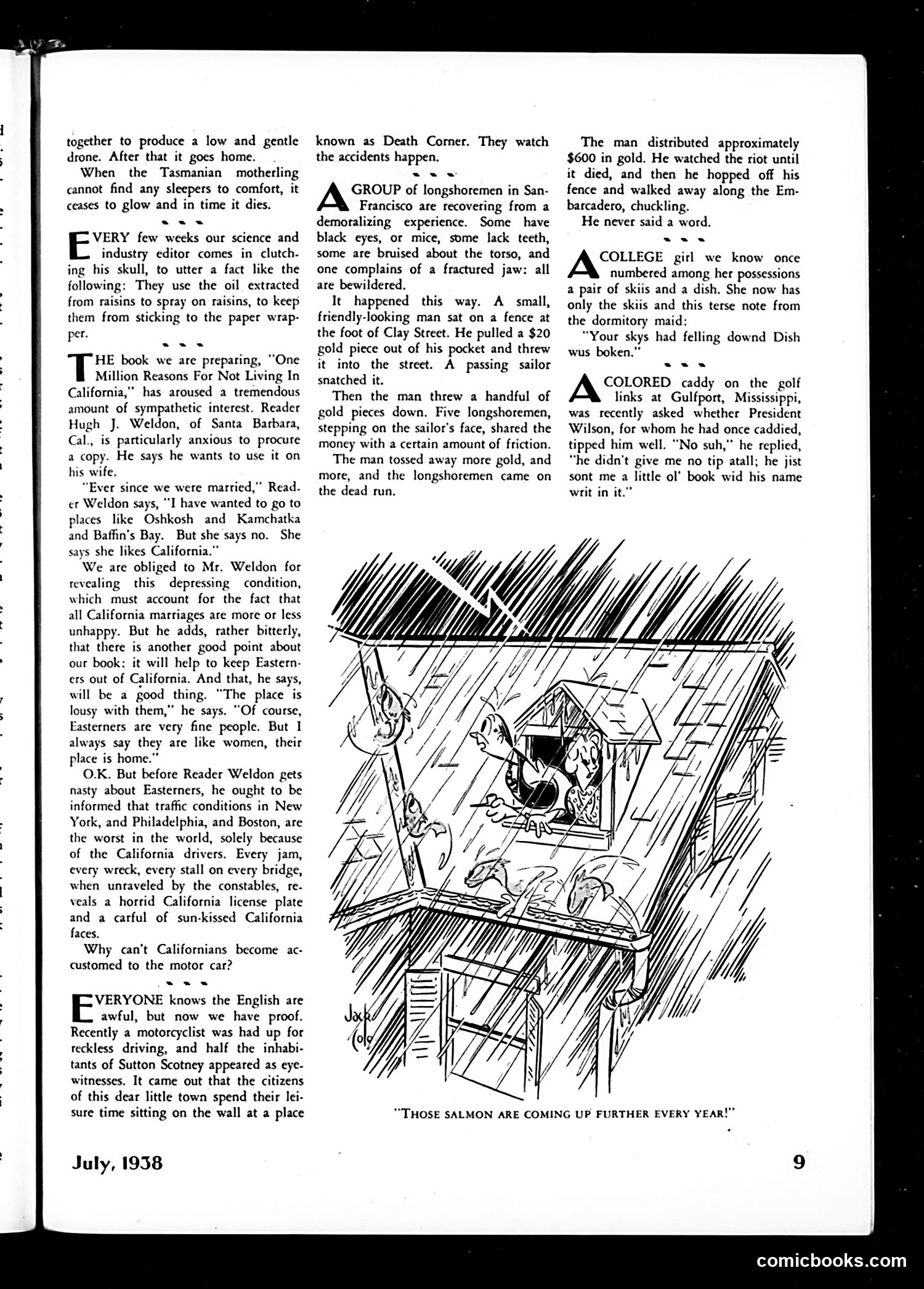
Judge Magazine Satire Analysis (July 1938) This page contains several humorous anecdotes satirizing American regional and social differences: California vs. Eastern attitudes: The longest piece mocks Californians' resistance to leaving their state while blaming them for causing traffic chaos in Eastern cities with reckless driving. The satire suggests California's appeal makes residents provincial, yet ironically, they're terrible drivers who terrorize the East Coast. San Francisco longshoremen: A brief comic tale about a mysterious man distributing $600 in gold pieces to cause chaos among dock workers—likely satirizing working-class greed and violence through dark humor. Social class commentary: The college girl's note from a maid contains intentional misspellings ("felling," "downd," "wus boken"), mocking lower-class speech patterns, while the golf caddy anecdote about President Wilson appears to mock cheapness among the wealthy. English eccentricity: A jab at British culture—villagers gathering at "Death Corner" to watch accidents for entertainment, portraying the English as morbidly peculiar. The illustration shows figures in what appears to be a basement or covered area during rain.
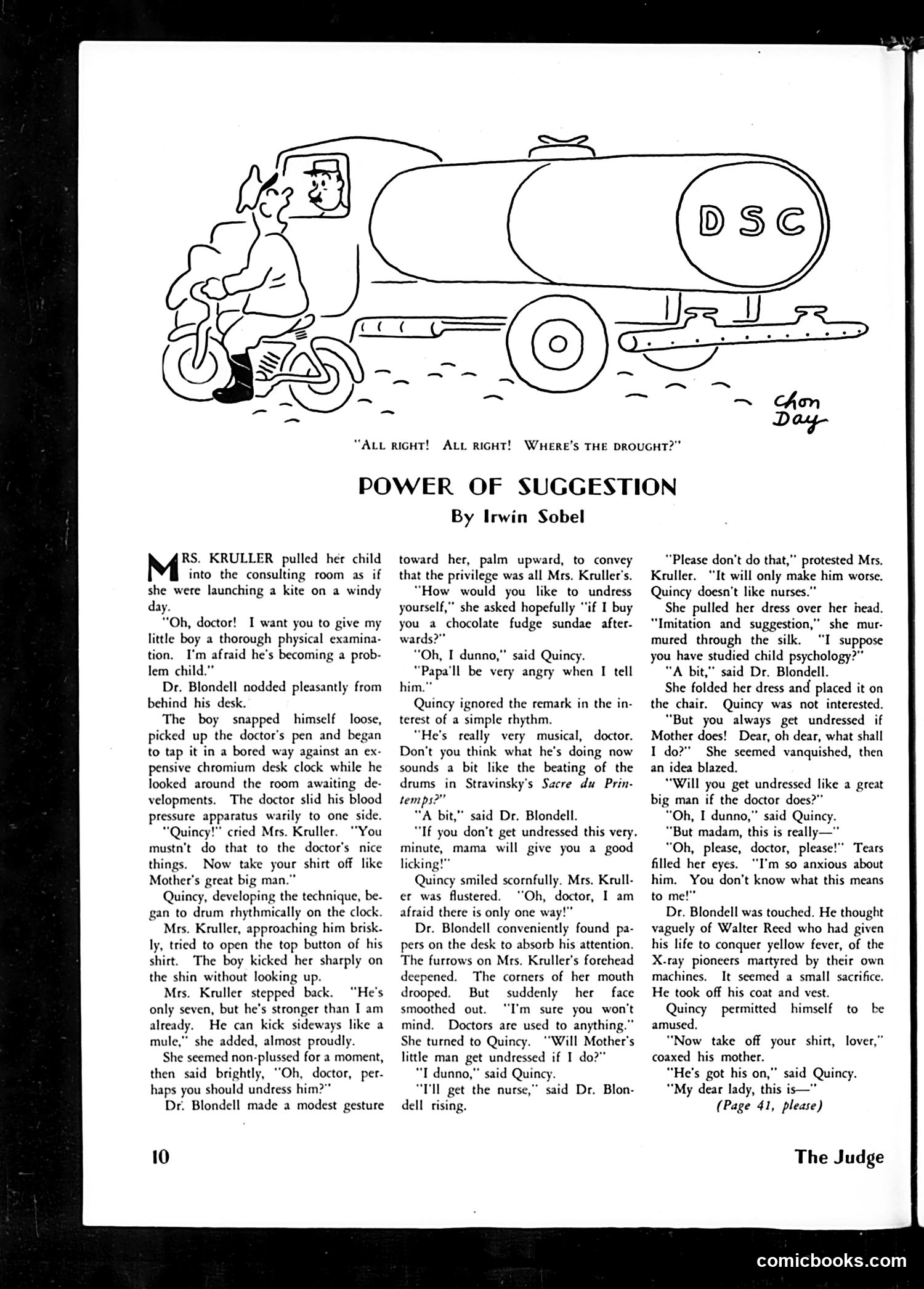
"Power of Suggestion" - Judge Magazine Cartoon Analysis This story satirizes both permissive parenting and pop psychology trends of the early 20th century. Mrs. Kruller brings her unruly seven-year-old "problem child" Quincy to Dr. Blondell for examination, but the boy is disruptive and defiant—kicking his mother, refusing to undress. Mrs. Kruller repeatedly attempts psychological manipulation: bribing with sundaes, praising his "musical" disruption, threatening punishment. When direct methods fail, she invokes "imitation and suggestion"—stripping herself naked to demonstrate compliance, assuming the child will copy her behavior. The satire targets: (1) pseudoscientific child psychology jargon used to excuse parental ineffectiveness, and (2) the absurd extremes parents will reach based on trendy theories. Dr. Blondell's bemused cooperation—eventually undressing himself—suggests the ridiculousness of adults abandoning common sense for fashionable psychological theory. The joke is that suggestion and imitation fail entirely; Quincy remains unmoved by his now-naked mother and doctor.
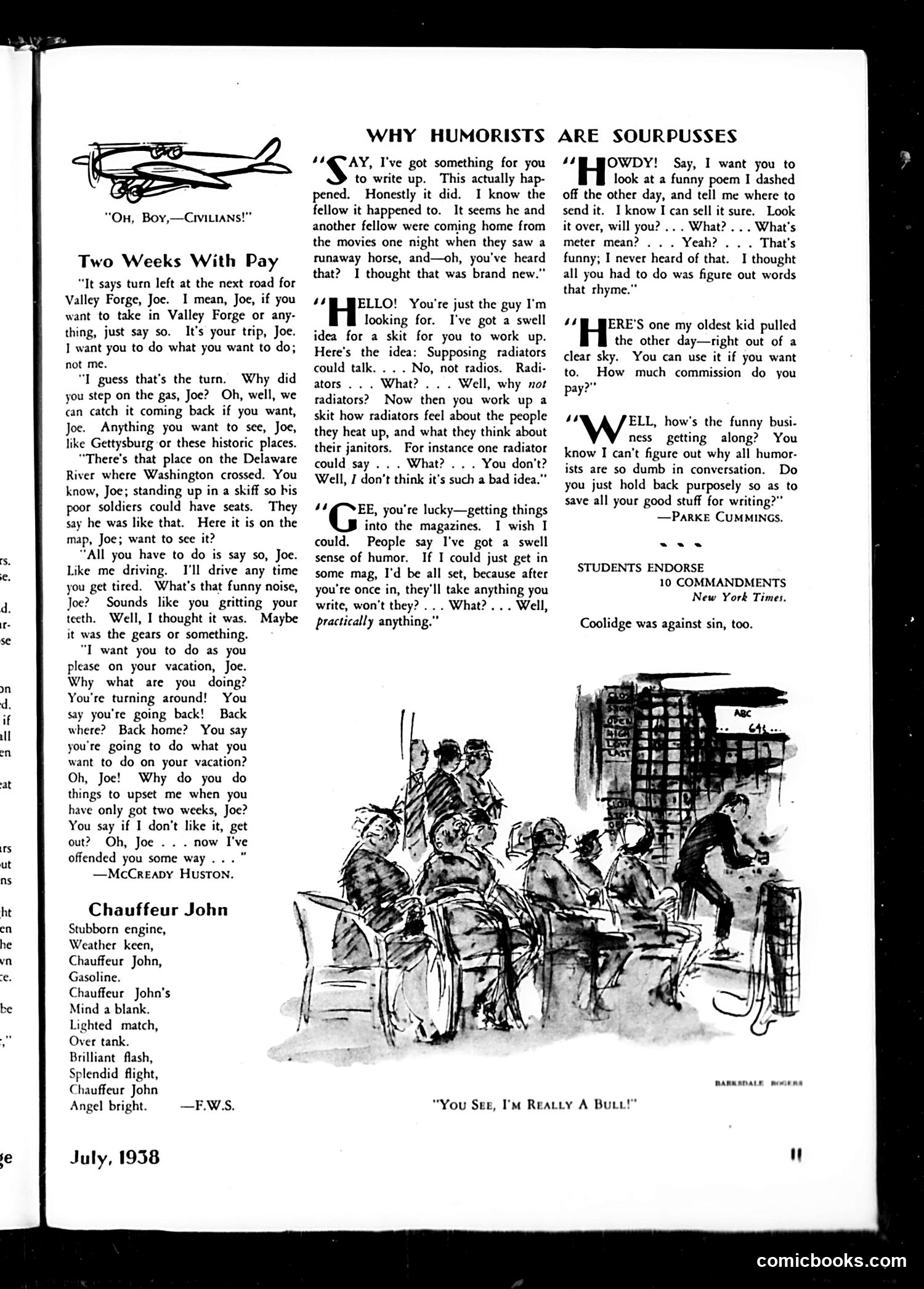
Analysis of Judge Magazine Page (July 1938) This page contains three separate satirical pieces mocking humorists and their creative processes: "Two Weeks With Pay" satirizes the anxious, overbearing vacation companion—likely depicting a common social type rather than a specific person. The joke is the companion's suffocating deference ("do what you want, Joe") that actually pressures the vacationer into compliance, causing Joe to abandon his trip in frustration. "Why Humorists Are Sourpusses" presents a series of people pitching terrible ideas to a humorist—radiators that talk, overheard horse stories, forced rhyming poems. The satire suggests humor writers are pestered with hackneyed suggestions, explaining their grumpy demeanor. Parker Cummings (credited at bottom) observes that humorists are "dumb in conversation," hoarding their wit for published work. "Chauffeur John" is a dark poem about a reckless driver who ignites gasoline vapors with a match, dying spectacularly ("Angel bright"). The cartoons target lazy creative pitching and the gap between conversational dullness and published talent—relevant workplace humor for 1938 readers familiar with magazines and comedy writing.
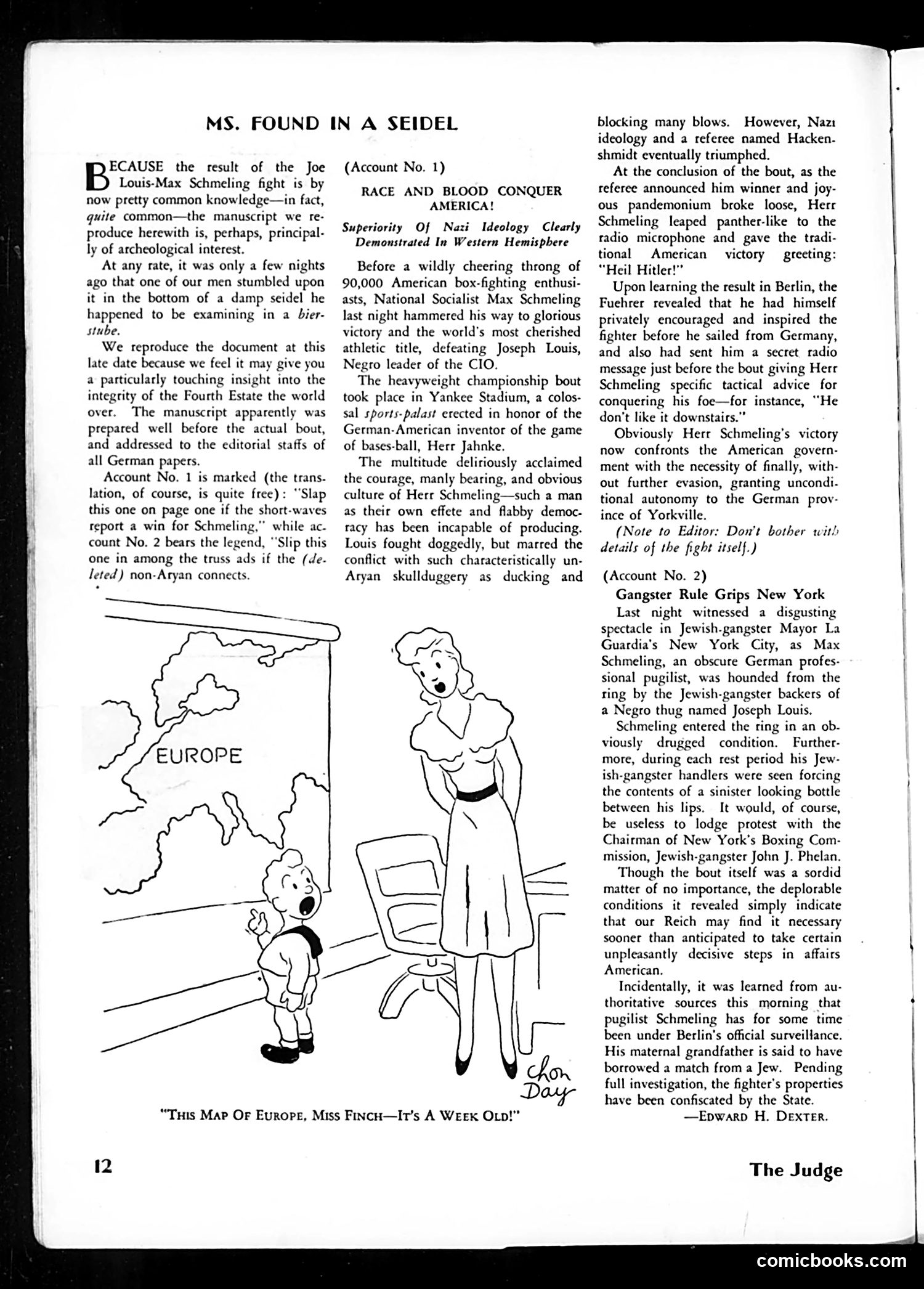
Analysis: "MS. Found in a Seidel" This satirical piece lampoons Nazi propaganda machinery by presenting two pre-written accounts of the Joe Louis-Max Schmeling heavyweight boxing match, supposedly discovered in a German beer hall (seidel). The satire: Judge ridicules how Nazi Germany apparently prepared competing narratives before the fight occurred—one celebrating a Schmeling victory as proof of Aryan superiority, another (Account No. 2) blaming Jewish gangsters and corruption if Louis won. The cartoon below mocks German propagandists' disconnect from reality. Key figures: Max Schmeling (German boxer), Joseph Louis (African American boxer and union leader), referenced as Nazi ideological symbols. The joke: By presenting both pre-written accounts, the magazine exposes Nazi propagandists' cynical manipulation—they'd publish whichever narrative fit the actual outcome, while claiming journalistic integrity. The second account's virulent antisemitism and racism illustrates Nazi rhetoric's absurdity to American readers. Historical context: This references the real 1938 rematch (Louis won), which carried geopolitical weight as Nazi Germany's symbol faced American boxing's champion.
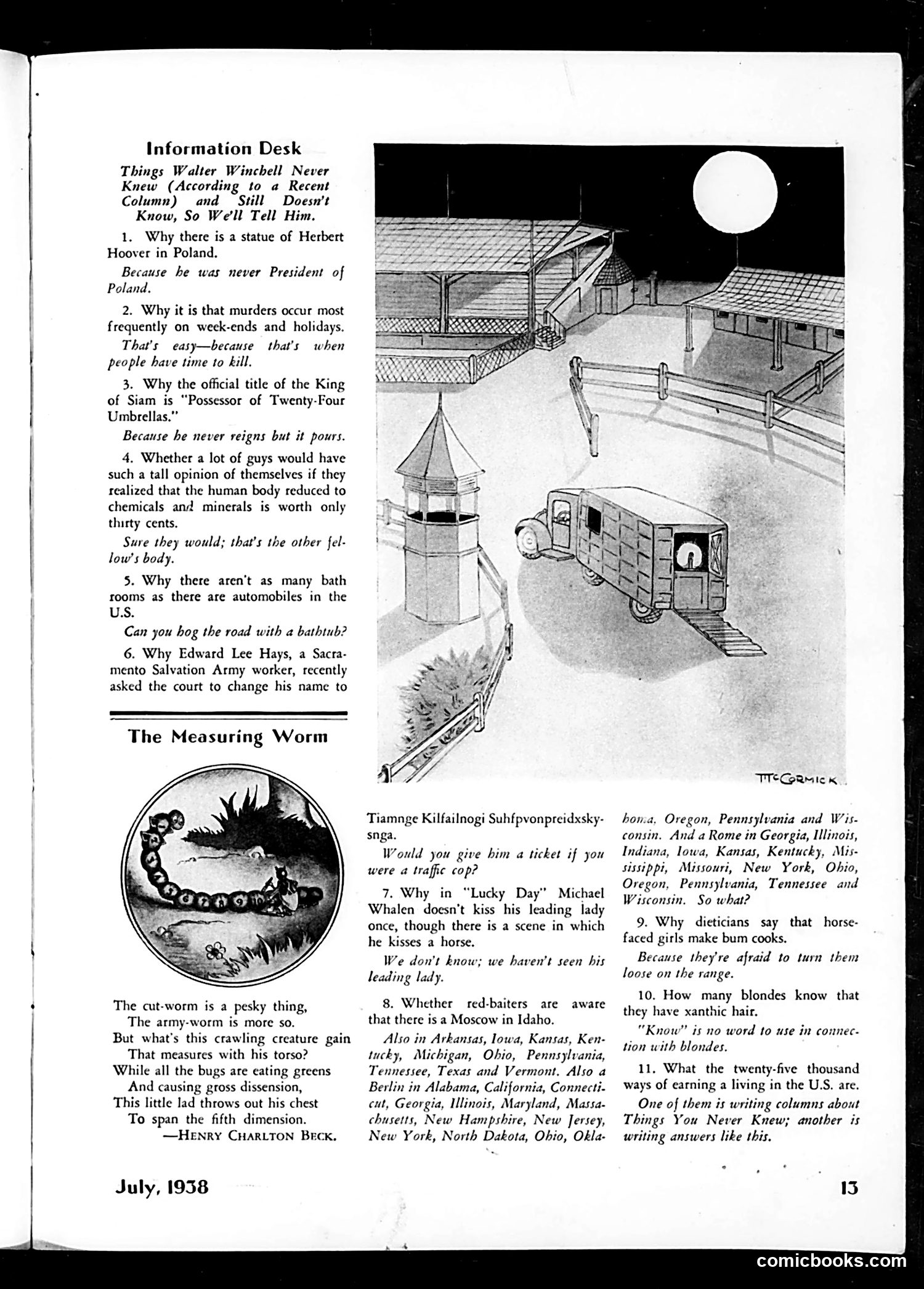
Judge Magazine, July 1938: Information Desk This page is a humorous column mocking Walter Winchell, the famous gossip columnist of the era. The "Information Desk" presents absurd trivia and jokes framed as things Winchell "never knew"—satirizing his know-it-all persona and gossipy column style. The jokes are period-specific zingers: Herbert Hoover references his failed presidency; the King of Siam joke plays on "reigns/rains"; question 8 mocks anti-communist "red-baiters" by listing American towns with Soviet or German names; question 9 contains a derogatory joke about "horse-faced girls"; question 10 stereotypes blondes as unintelligent. The accompanying worm illustration and Henry Charlton Beck poem offer whimsy unrelated to the column's satire. The page satirizes both Winchell's celebrity gossip dominance and 1930s casual prejudices.
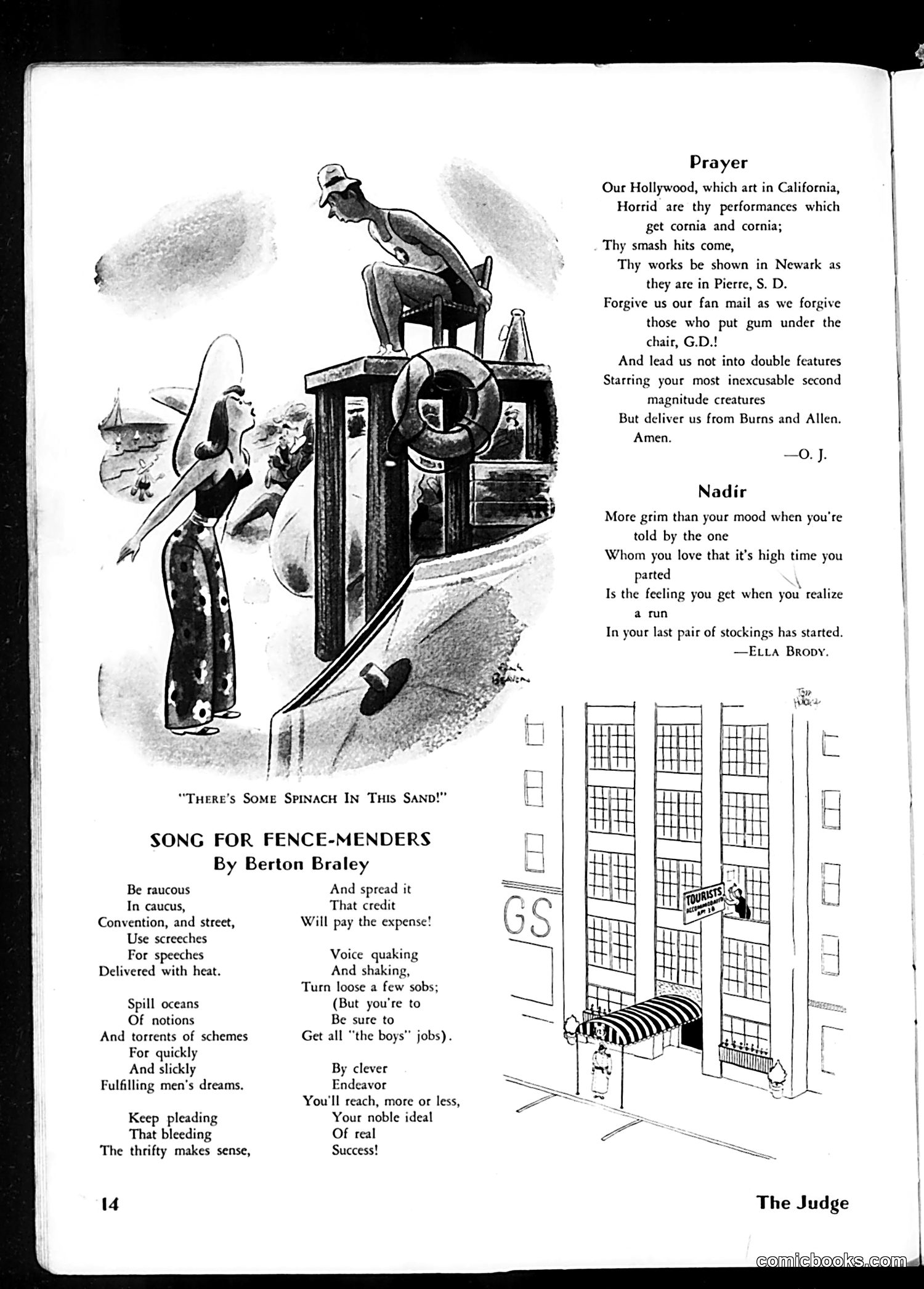
Judge Magazine Page Analysis This page contains satirical commentary on early 20th-century American politics and popular culture: "Song for Fence-Menders" mocks politicians who adopt contradictory positions to appeal to voters. "Fence-mending" refers to politicians repairing relationships across party lines through duplicity—they're advised to be loud and emotional in speeches, spread credit-based spending schemes, manufacture tears for sympathy, while quietly ensuring patronage jobs go to political allies ("the boys' jobs"). The satire targets political hypocrisy and empty rhetoric. "Prayer" parodies the Lord's Prayer while mocking Hollywood productions shown in small towns like Newark and Pierre, South Dakota. It references comedians Burns and Allen as tiresome performers, suggesting Hollywood's ubiquitous low-quality entertainment has become inescapable. "Nadir" is simply a humorous verse about women's frustrations with ruined stockings—a relatable domestic annoyance of the era when stockings were expensive and fragile. The cartoon "There's Some Spinach in This Sand" (top) appears to depict someone discovering an unpleasant surprise, likely related to the political deception themes elsewhere on the page.
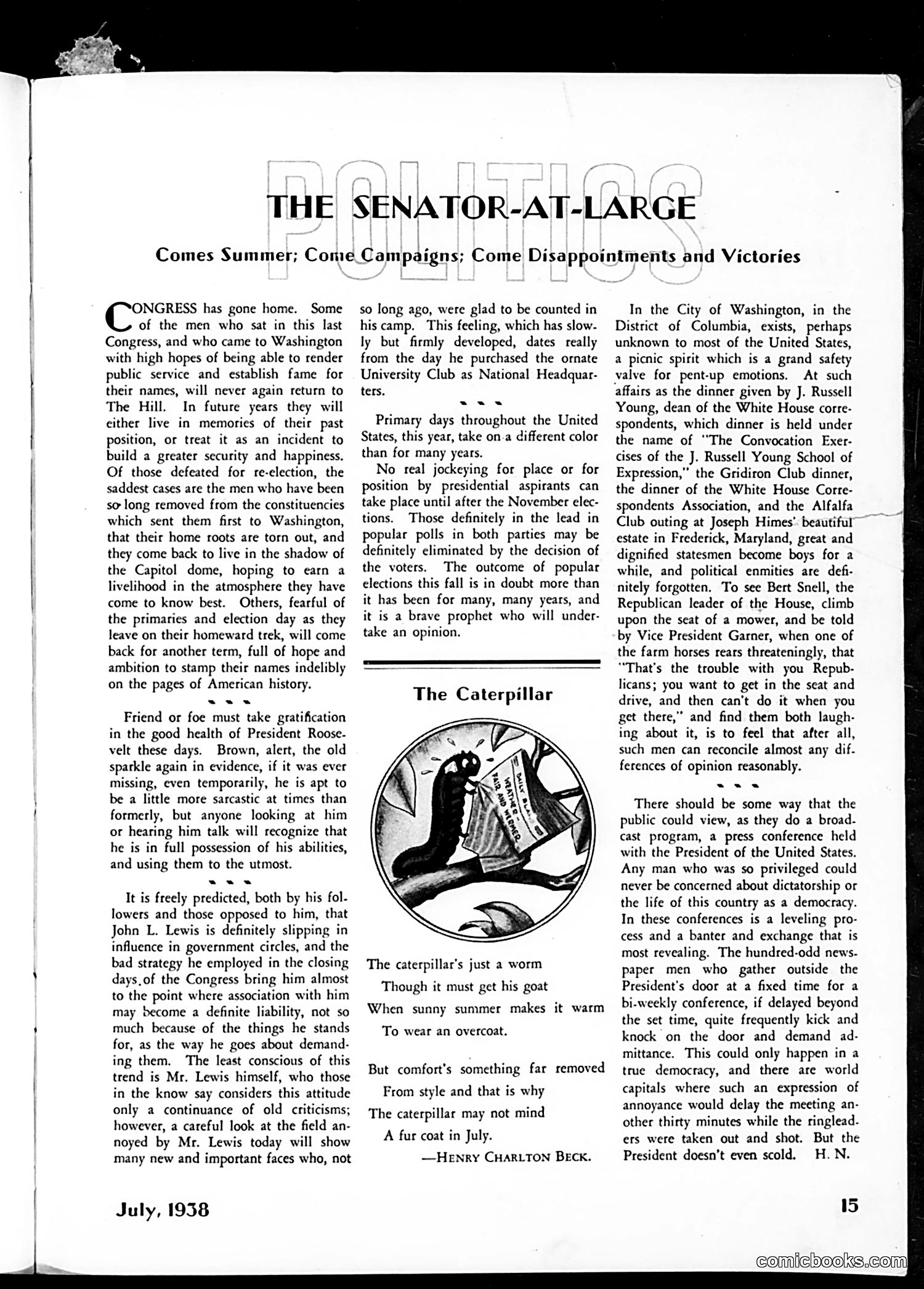
Analysis: "The Senator-at-Large" (Judge, July 1938) Main Article: A political commentary on Congress recessing for summer. The author discusses defeated congressmen and, more significantly, President Franklin D. Roosevelt's current good health and renewed vigor. The piece expresses relief at Roosevelt's apparent recovery, noting his sharpened sarcasm and continued command of his abilities. Key Political Reference: The article criticizes John L. Lewis, the labor leader and head of the Congress of Industrial Organizations (CIO). Lewis is described as "slipping in influence" due to poor political strategy. The specific grievance involves his unpopular purchase of the ornate University Club as CIO headquarters—an extravagance that reportedly alienated former supporters. "The Caterpillar" Poem: A light satirical verse by Henry Charlton Beck about a caterpillar uncomfortable in summer heat, forced to wear an overcoat for propriety despite discomfort. This functions as a humorous filler mocking rigid social conventions that prioritize appearance over practical comfort. Context: The 1938 midterm elections were approaching; Roosevelt faced growing political challenges and questions about his health. Lewis's labor movement was losing Democratic Party favor during this period.
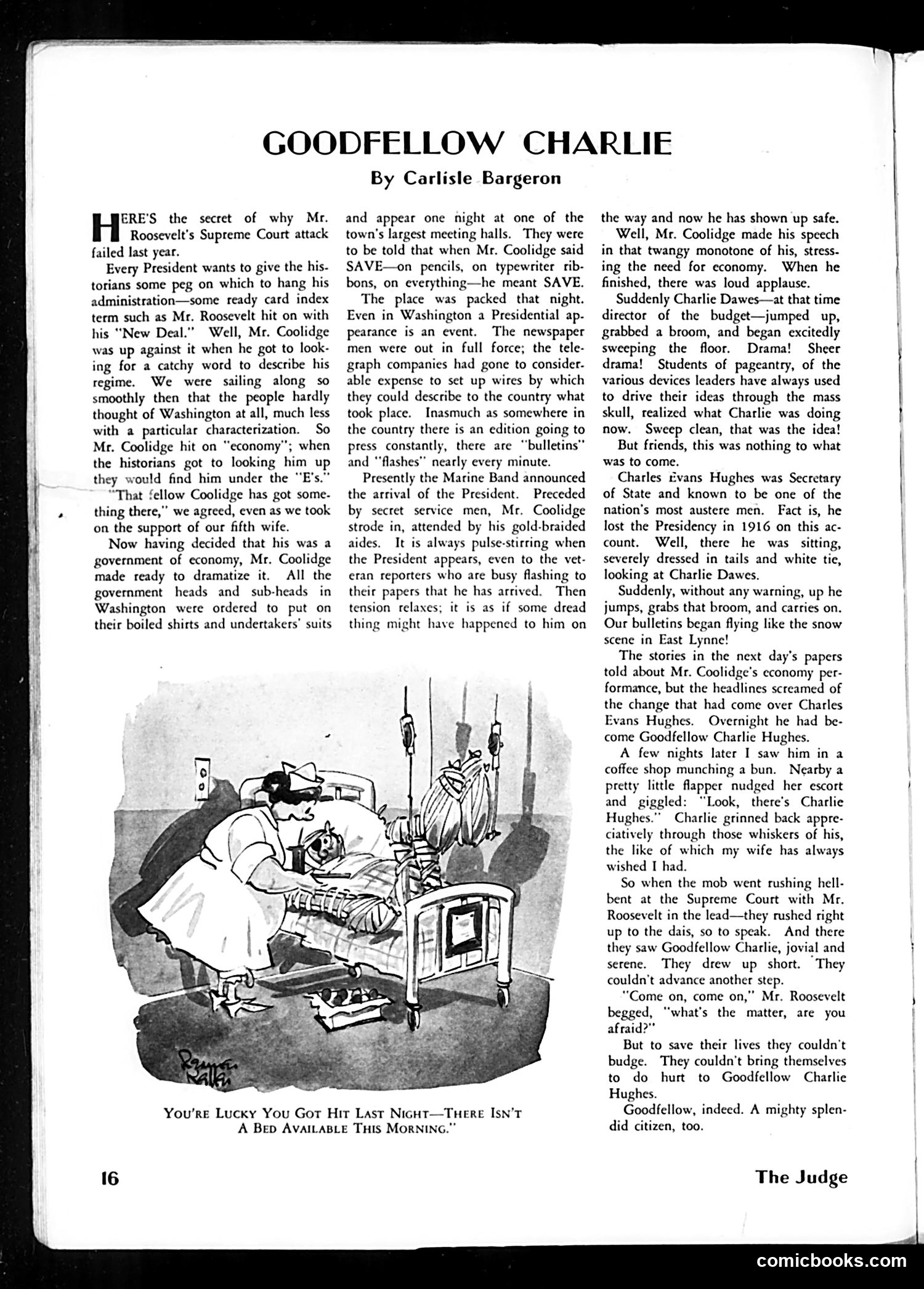
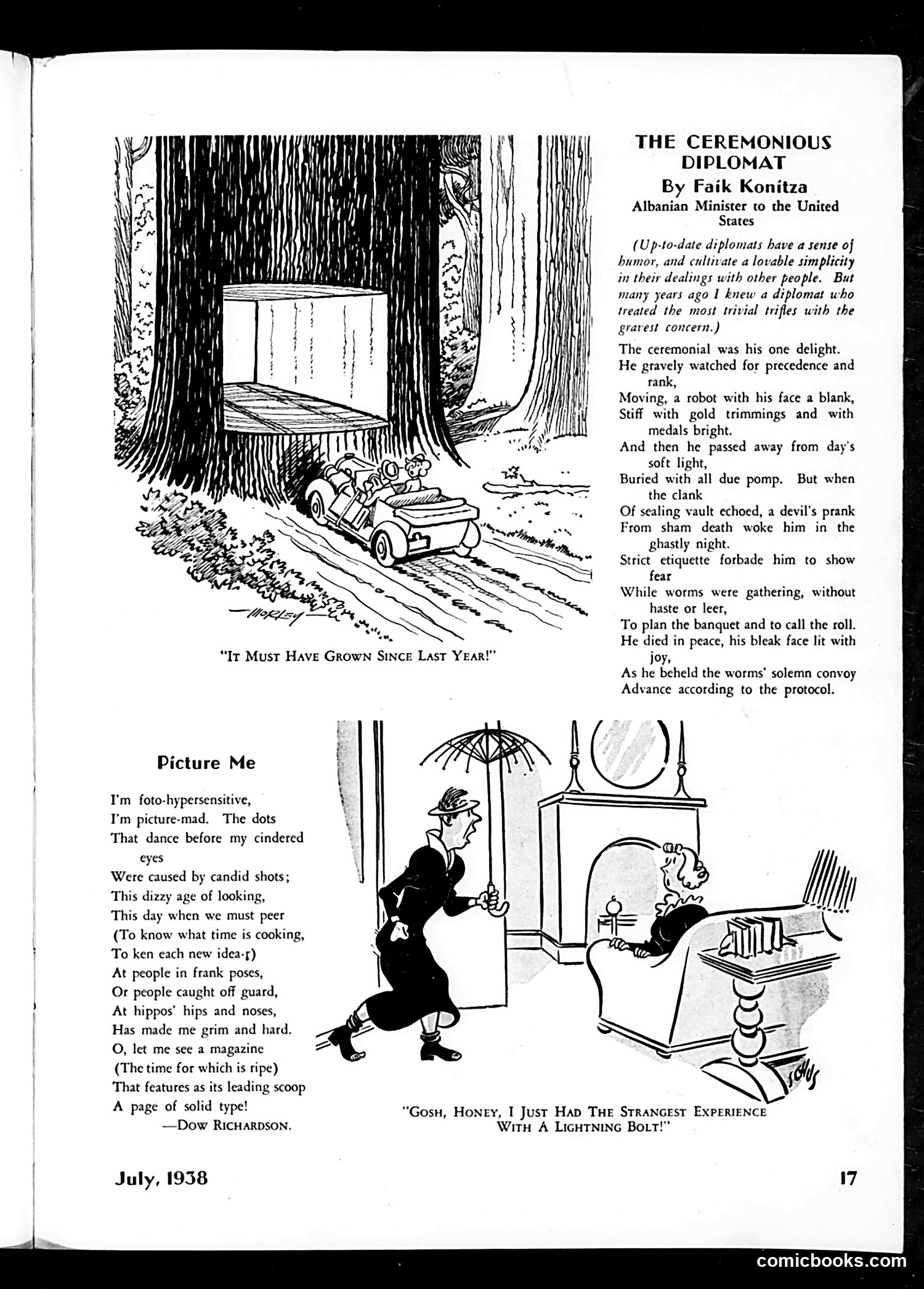
Explanation for Modern Readers This Judge magazine page (July 1938) contains three distinct pieces: "The Ceremonious Diplomat" is a satirical poem by Albania's U.S. minister mocking rigid diplomatic protocol. It depicts a stuffy diplomat so obsessed with rank and ceremony that even after death, he maintains formal etiquette while worms prepare to consume him—treating his decomposition as a formal banquet with proper precedence. "Picture Me" is a humorous poem by Dow Richardson critiquing photography obsession in 1930s media culture. The speaker complains that constant candid photography and magazine images have made him exhausted and hardened, yearning for a magazine containing actual text rather than more pictures. The cartoons illustrate these pieces: one shows a tiny car dwarfed by enormous tree-trunk legs (commenting on scale/growth), the other depicts a man with an umbrella startled by a woman in a bathtub, with her exclaiming about a "lightning bolt" experience—a domestic humor gag. The page satirizes both diplomatic pomposity and the emerging visual media culture of the 1930s.
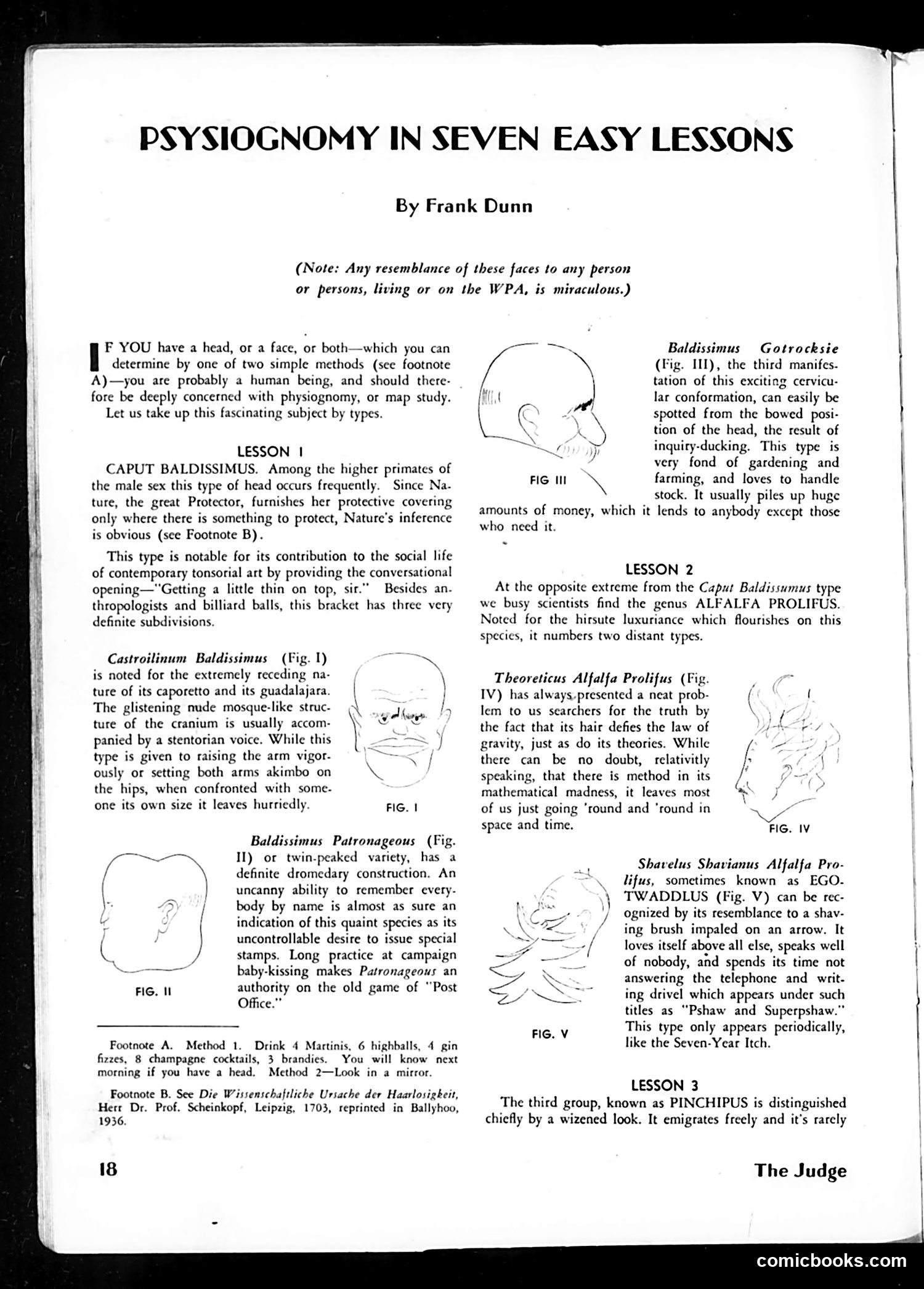
Psysiognomy in Seven Easy Lessons: A Satirical Guide This is a humorous pseudoscientific piece by Frank Dunn mocking phrenology—the discredited practice of analyzing character through facial features. The satire targets specific contemporary figures through absurd "types": Caput Baldissimus types lampoon bald politicians, particularly: - "Patronageous" (twin-peaked head)—appears to reference a politician fond of baby-kissing and campaign stamps, likely a New Deal-era politician - "Gotrocksie" (bowed head from "inquiry-ducking")—a wealthy farmer-type who hoards money Alfalfa Prolifus types mock intellectuals with wild hair: - "Theoreticus"—theoretical thinkers whose hair "defies gravity" like their logic - "Ego-Twaddlus"—a self-absorbed writer spouting pretentious opinions The note referencing "the WPA" (Works Progress Administration) dates this to the 1930s New Deal era. The satire ridicules both politicians and intellectuals through invented Latin nomenclature, undermining pseudoscientific character analysis while poking fun at recognizable public figures of the period.
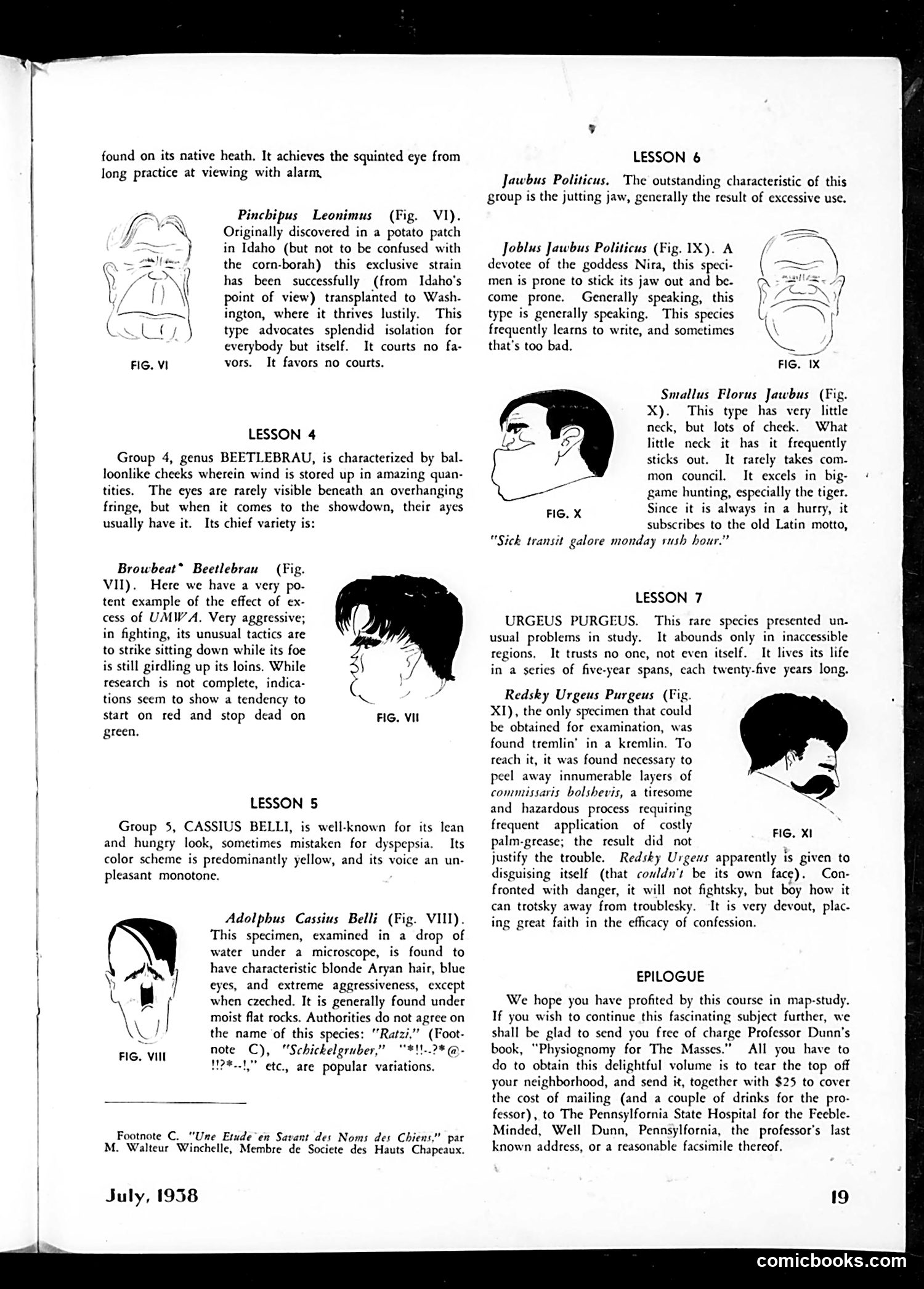
Political Satire in Judge Magazine (July 1938) This page satirizes political figures through pseudo-scientific "species" classifications. The cartoons use exaggerated facial features as coded references to contemporary leaders: "Pinchipus Leonimus" (Idaho origins, isolation advocacy) likely mocks an isolationist politician. "Browbeat Beetlebrau" appears to reference aggressive labor union tactics. "Adolphus Cassius Belli" uses transparent wordplay—"Ratzi," "Schickelgruber"—to mock Adolf Hitler, describing "blonde Aryan hair" and aggressiveness, a clear anti-Nazi jab. "Jawbus Politicus" mocks politicians' bombastic speech and jutting jaws. "Redsky Urgeus Purgeus" satirizes Soviet communism, found in a "kremlin," requiring navigation through layers of Soviet bureaucracy ("commissaris bolshevis"), depicting Communist leaders as evasive and dependent on bribes ("palm-grease"). The 1938 date places this amid rising fascism and Cold War tensions. Judge uses biological classification parody to ridicule political opponents across ideological lines—fascists, communists, and American demagogues alike.
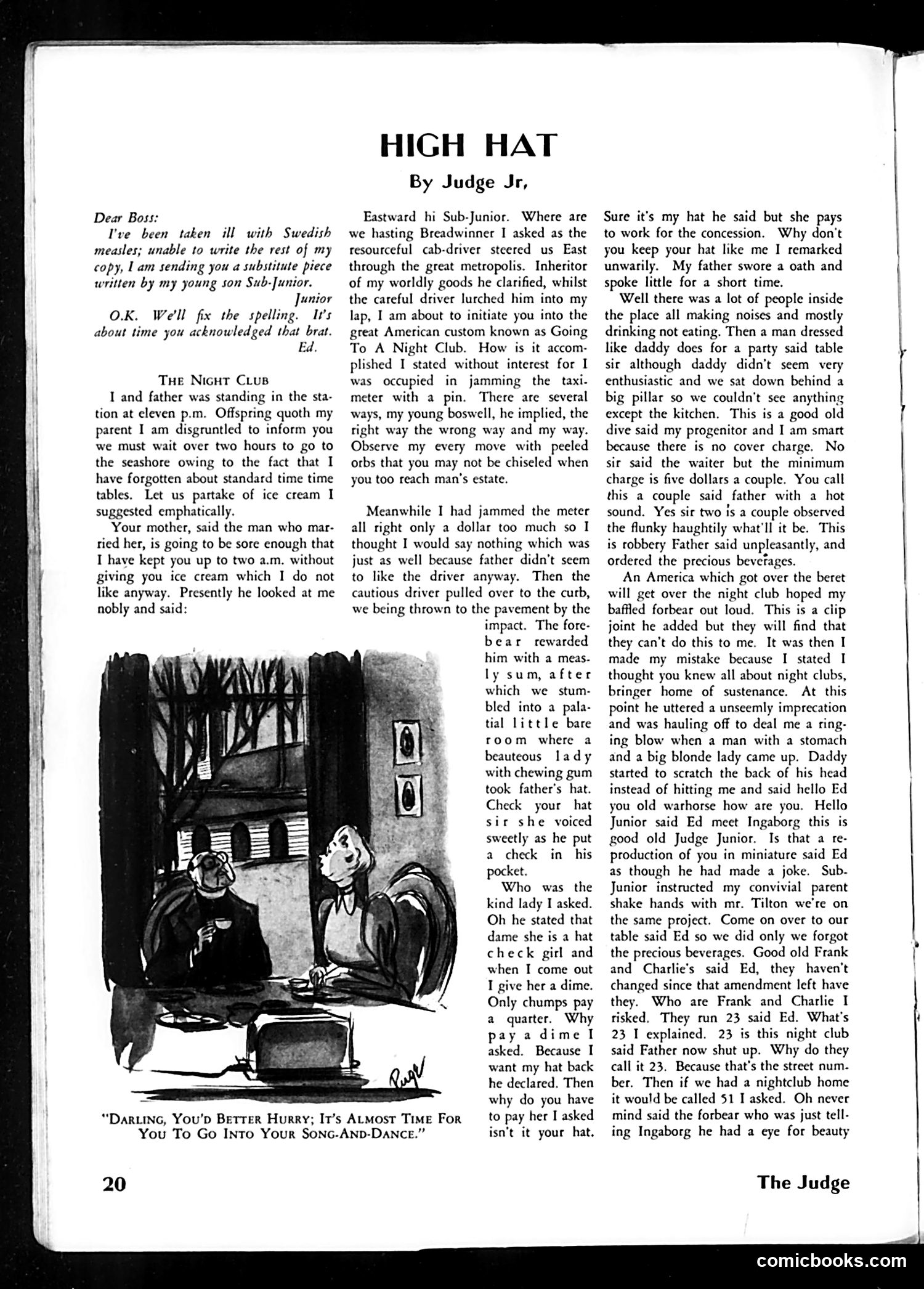
"High Hat" by Judge Jr. This satirical piece mocks 1920s nightclub culture and parental hypocrisy. A father takes his young son "Sub-Junior" to a nightclub, ostensibly to educate him in "great American custom," while complaining throughout about costs: the taxi meter, hat-check fees, minimum charges, and inflated drink prices. The humor lies in the father's contradictions—he lectures his son about being "chiseled" by establishments while getting fleeced himself, then grows indignant when the boy points out the obvious con. The "high hat" title refers to both pretentious nightclub culture and the father's pompous, lecturing tone. The illustration shows the awkward scene at the hat-check counter, capturing the stuffy formality of the speakeasy era. The piece satirizes both Prohibition-era nightclubs as exploitative establishments and the self-deluded middle-class fathers who frequent them while posturing as worldly sophisticates to their children.
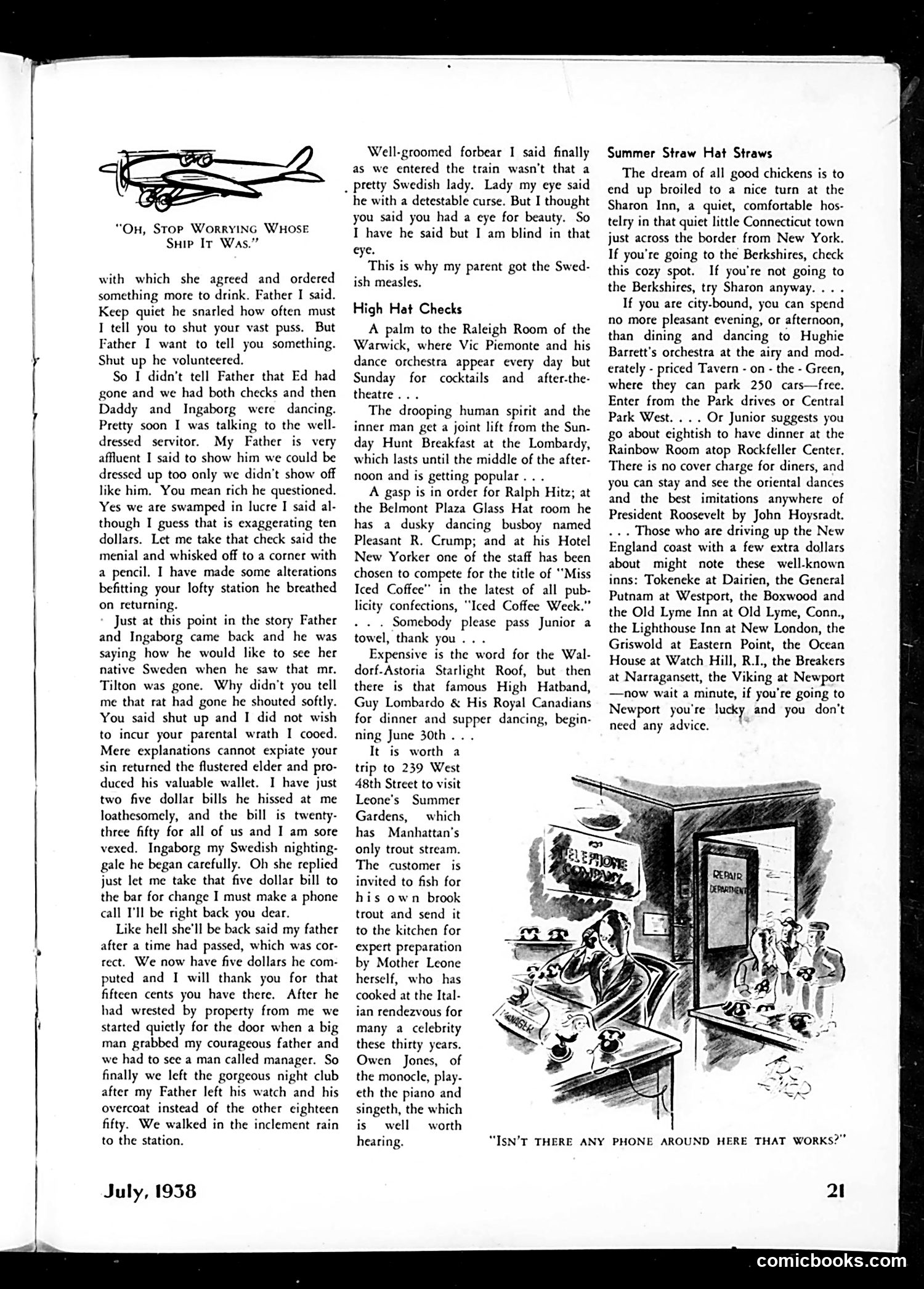
Explanation for Modern Readers This page contains two distinct pieces from Judge magazine (July 1938): The Main Story ("Oh, Stop Worrying Whose Ship It Was"): A humorous first-person narrative about a teenager accompanying his difficult, miserly father to a nightclub with a Swedish woman named Ingaborg. The joke relies on the father's cheap behavior and bad temper—he leaves his watch and overcoat as payment instead of cash, walks out in the rain, and makes insulting remarks about Ingaborg. The title's punchline: when the father claims to have "an eye for beauty" but is "blind in that eye" regarding the Swedish woman, the narrator deadpans this explains why his parent "got the Swedish measles"—a non-sequitur joke about prejudice. "High Hat Checks": A brief column promoting upscale Manhattan nightclubs and restaurants (the Warwick, Lombardy, Belmont Plaza, Waldorf-Astoria, Leone's), highlighting their orchestras, dining, and novelty attractions. It's essentially advertising disguised as gossip-column commentary. Both pieces reflect 1930s leisure culture and urban sophistication.
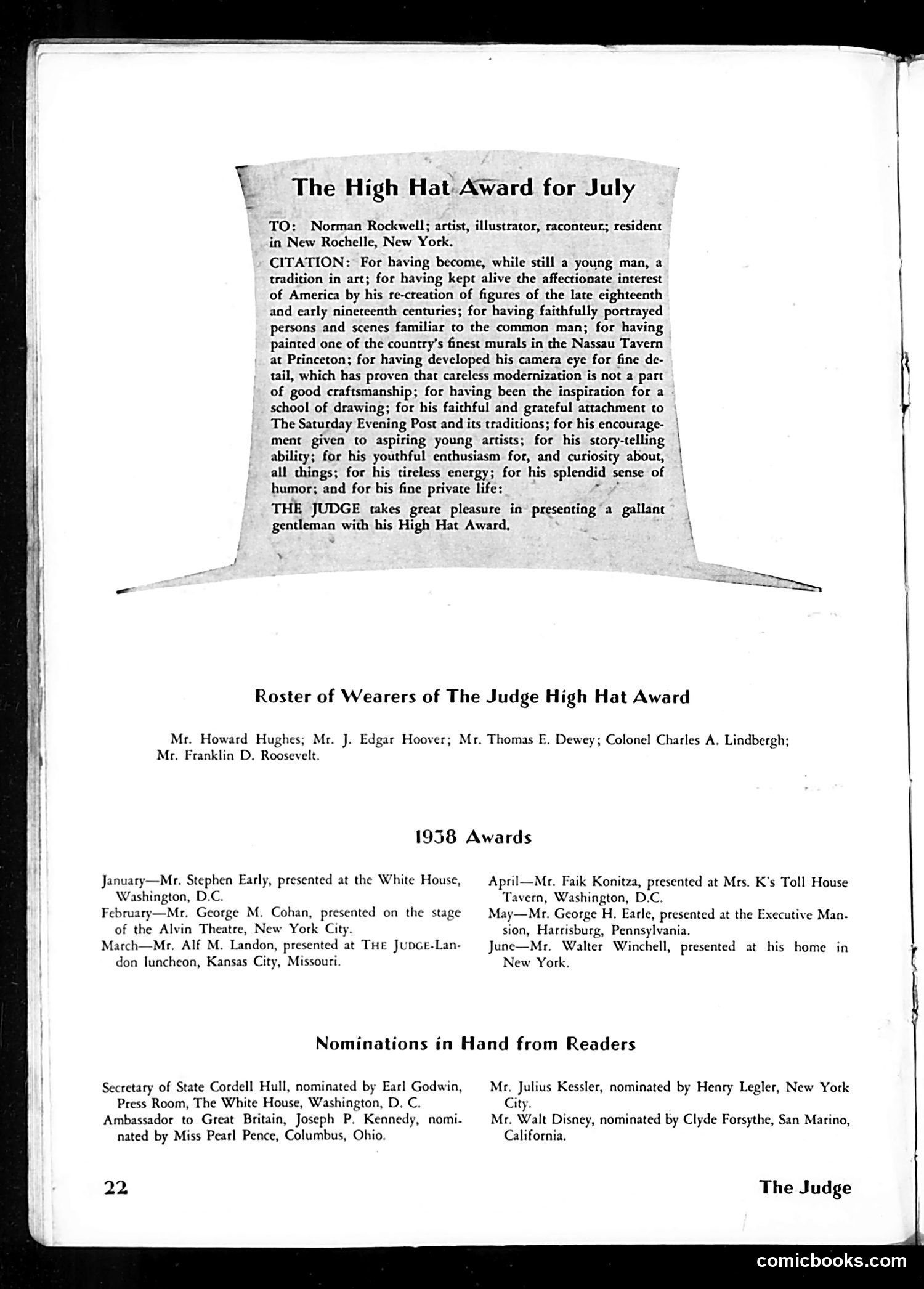
The High Hat Award for July This page announces Judge magazine's monthly "High Hat Award" for July 1938, honoring Norman Rockwell. The award celebrates Rockwell as an artist who preserved America's affection for late 18th and early 19th-century imagery, faithfully depicted common people and scenes, and maintained attachment to *The Saturday Evening Post*—where his work became iconic. The citation praises his technical precision, inspirational influence on young artists, storytelling ability, and character. Previous award recipients listed include J. Edgar Hoover, Charles Lindbergh, and Franklin D. Roosevelt—major public figures of the era. The 1938 awards section notes recipients like George M. Cohan and Walter Winchell. "Nominations in Hand from Readers" suggests Judge solicited public suggestions for future honorees, including politicians and entertainers. This reflects Judge's role as a prestige publication celebrating American cultural figures and institutions during the Depression era.
"The Judge on the Bench" - July 1938 This editorial condemns Nazi antisemitism and Hitler's persecution of Jews. The author, writing as "The Judge," argues that Hitler—referred to as "an amateur logician, a mad paper-hanger drunk with power"—is systematically murdering and robbing Jews because they are defenseless and disorganized, not because of any offense. The piece warns that unchecked hatred will spread to other nations. It appeals to Jewish leaders outside Germany to organize resistance and prevent the "poison" of antisemitism from metastasizing internationally. The author uses historical examples (American Revolution, Ireland's independence) to argue that passionate determination, not cold logic, defeats tyranny. Notably, this 1938 Judge editorial explicitly criticizes Nazi atrocities occurring in real-time, positioning the magazine as anti-fascist during a period when such positions weren't universal in American media.
"The Washington Parade" This is a satirical advertisement for a fictional motion picture about U.S. government. The joke pitches Washington, D.C. itself as entertainment, with various government institutions and figures positioned as dramatic characters: "The Washington Parade," "The Senate," "The Judge on the Bench," and "High Hat" (likely referring to pompous politicians). The opening gags mock Congress—asking what makes a congressman's hair stand on end, and whether the Supreme Court likes to dance—treating serious governmental bodies as comedic subjects. The satire suggests that American government is inherently theatrical and absurd enough to function as entertainment. By framing actual political institutions as a "thrilling motion picture," Judge magazine satirizes both Washington's self-importance and the public's appetite for political spectacle. This reflects 1920s-30s cynicism about government competence and gravitas.
This page is primarily an advertisement for "The Washington Parade," a monthly newsreel-style film produced by Columbia Pictures. Rather than containing political satire, it promotes an entertainment product to Judge magazine's readers. The ad highlights that the short film, directed and narrated by Harry Newman (Editorial Director of The Judge itself), features humorous coverage of Washington D.C. political happenings—described as "actual and funny" content about "the record" of government workers and officials. By emphasizing Columbia Pictures' track record with successful films like "Mr. Deeds Goes to Town" and "It Happened One Night," the advertisement attempts to lend credibility and prestige to this monthly release. The tone suggests these were light, gossipy glimpses into Washington life meant for entertainment rather than serious political commentary—positioning government figures as subjects of comedic observation.
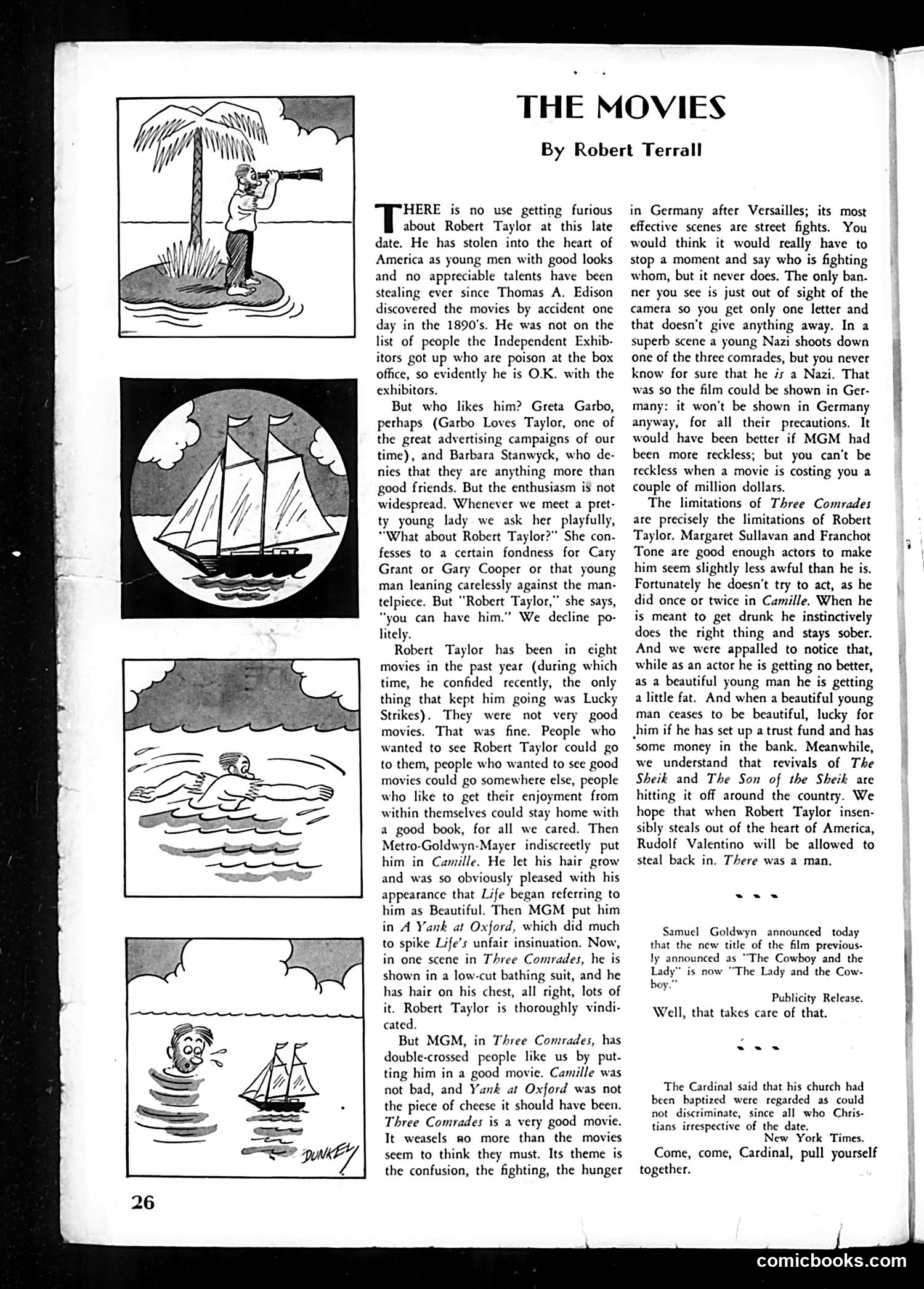
"The Movies" by Robert Terrall — Judge Magazine This article satirizes actor Robert Taylor, a handsome but talentless leading man who achieved popularity despite mediocre films. The author argues Taylor succeeded solely on looks—a Hollywood pattern since Edison invented cinema. The cartoons illustrate Taylor's vapid appeal: a man with a telescope (seeing nothing), a ship in a bottle, and a figure in water (representing his shallow depth). The satire's point: MGM studios cynically cast Taylor in *Three Comrades*, a genuinely good film about post-WWI Germany. The movie deliberately obscures its Nazi villain to secure distribution, showing Hollywood's cowardice. The author resents that Taylor—who doesn't act, just exists attractively—benefits from better actors like Sullavan and Tone carrying the film. The closing jab: Taylor's fading beauty (he's "getting a little fat") is his only asset; without it and inherited wealth, he's finished.
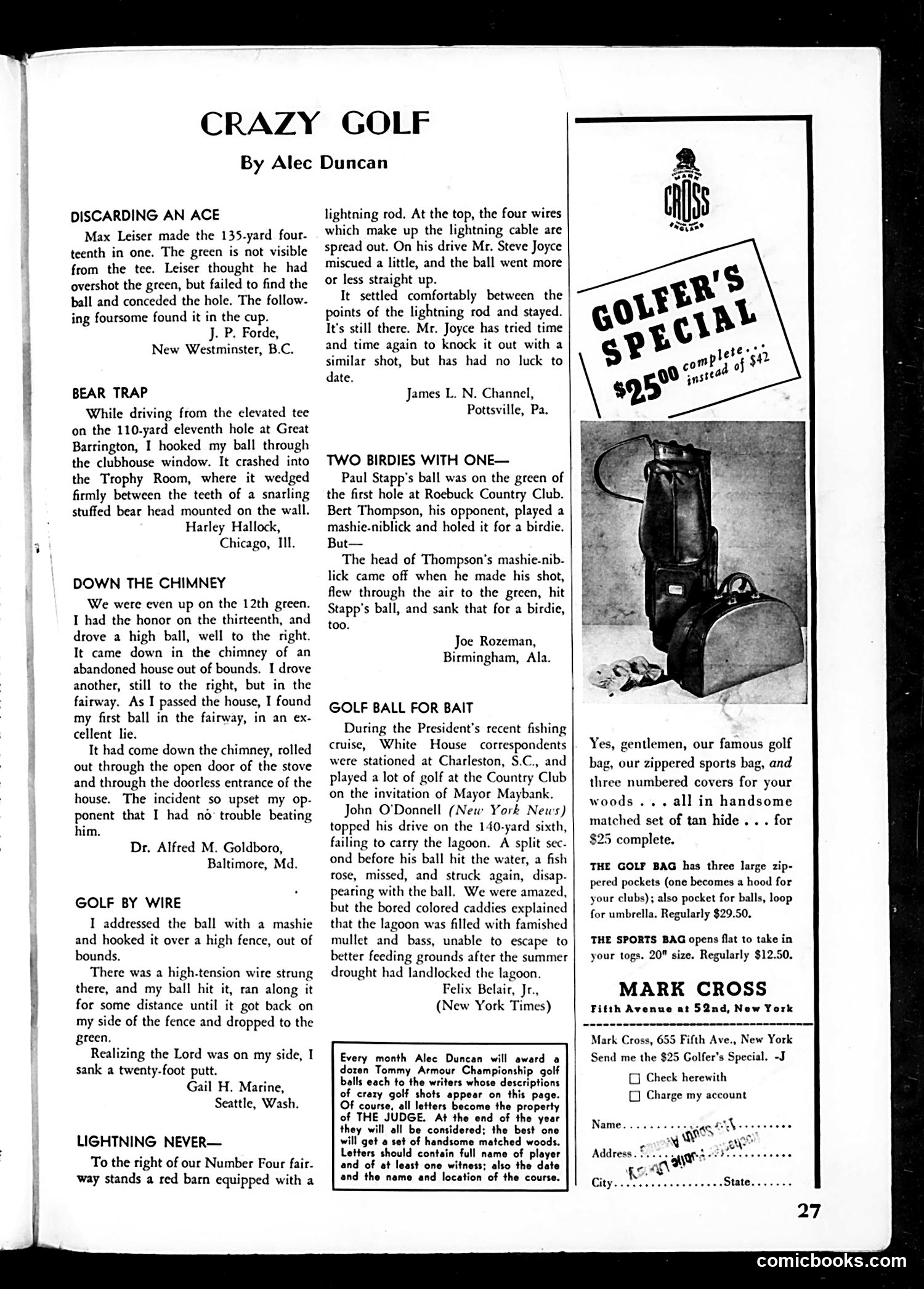
"Crazy Golf" - A Humor Column About Improbable Golf Incidents This page features a humor column by Alec Duncan collecting supposedly true anecdotes of bizarre golf mishaps and unlikely outcomes. Rather than political satire, it's recreational humor for Judge magazine's readers—likely wealthy enough to play golf at country clubs. Each brief story describes an absurd scenario: a ball landing in a trophy room's stuffed bear's mouth, another wedged on a lightning rod, a ball that rode along electrical wires back into play, and improbably, a fish stealing a golf ball from a lagoon during a White House correspondent's game. The appeal lies in the incongruity between golf's orderly reputation and these chaotic, physically implausible events. The column invited readers to submit their own "crazy golf" stories, with winners receiving golf equipment. This reflects mid-20th-century Judge content: gentle, club-culture humor aimed at an affluent male readership rather than political commentary.
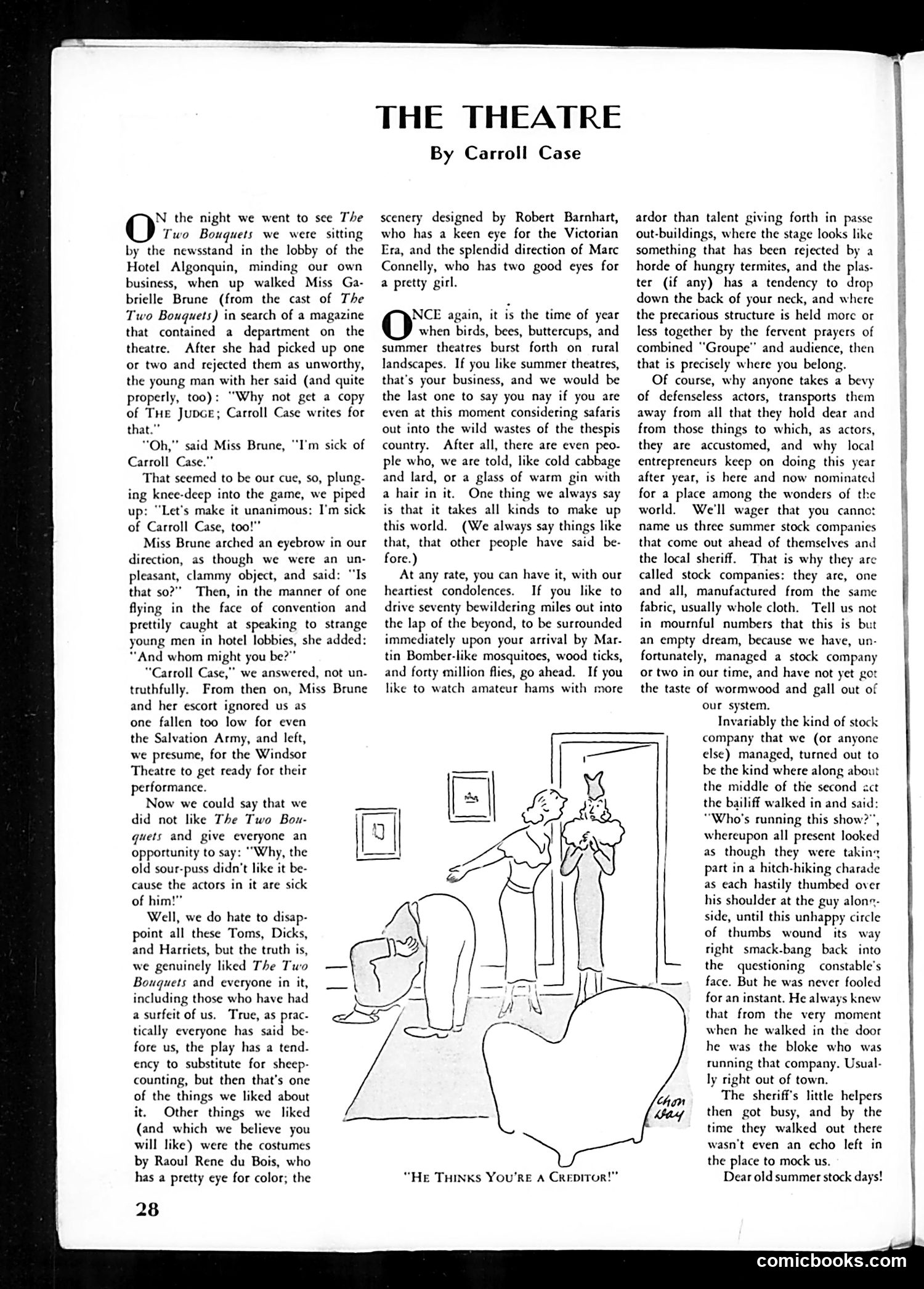
Analysis of "The Theatre" by Carroll Case This is a theater review with accompanying cartoon from Judge magazine. The piece humorously recounts how the author, Carroll Case (a real theater critic for Judge), encountered actress Gabrielle Brune from the play *The Two Bouquets* in a hotel lobby. When someone suggested she read Case's theater column, Brune expressed her disgust with his reviews. Case then impudently identified himself, leading Brune to snub him coldly. The cartoon illustrates this awkward encounter, showing the embarrassed figures. The text is actually a positive review of *The Two Bouquets*—praising its costumes, scenery, and direction—making Brune's rejection of Case personally rather than professionally motivated, which adds to the joke's sting. The second section satirizes summer stock theater companies, mocking amateur productions in deteriorating rural buildings plagued by insects and incompetent actors, while local entrepreneurs exploit both performers and audiences with these makeshift ventures.
Analysis of Judge Magazine Page This page is primarily advertising and editorial content, not political satire. It features: Main Content: "The Judge Library"—a monthly record recommendation column promoting Victor Records releases. The editorial discusses how ordinary people can build a classical music collection affordably through monthly purchases. The Satire (Minor Element): The opening paragraph gently mocks different music audiences: "music sharks and opera devotees" who'll rush out, "swing addicts and jazz-band fiends" who need to calm down, versus "ordinary people" who simply want to enjoy good music at home with refreshments. This is light social humor about musical snobbery and genre preferences—typical 1920s-30s cultural commentary. Context: This reflects the era's record industry boom and Judge magazine's role mixing entertainment criticism with humor. The tone is encouraging home music consumption as accessible culture. Verdict: Mostly a legitimate editorial/advertising piece with minimal satirical content.
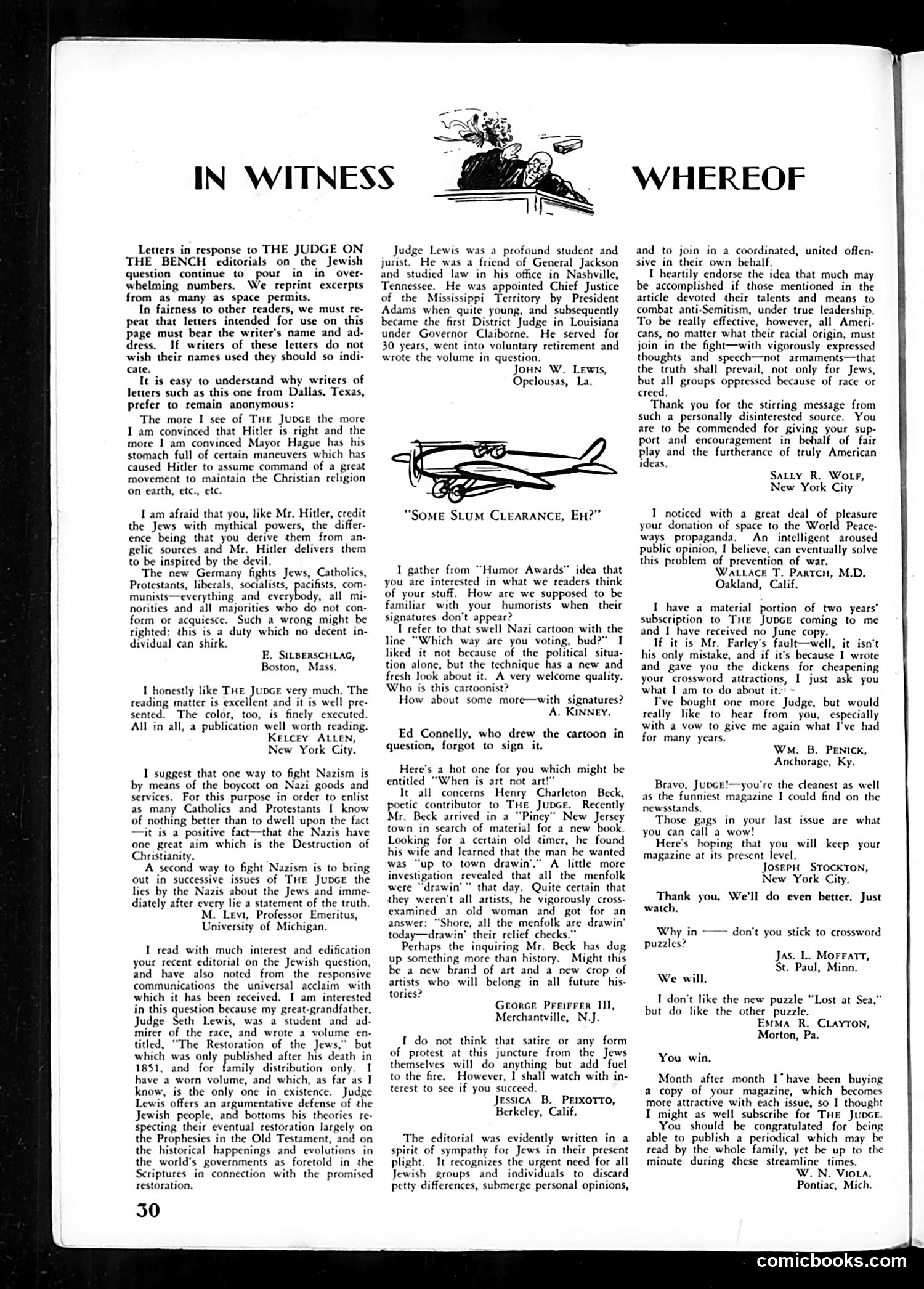
Analysis of "In Witness Whereof" Page from Judge Magazine This page presents reader letters responding to Judge's recent editorial on "the Jewish question"—a euphemism for antisemitic discourse. The letters reveal deep divisions in 1930s American opinion. One anonymous Dallas letter endorses Hitler's antisemitism as justified "Christian" action, prompting editor E. Silberschlag's rebuttal that Nazi Germany attacks all minorities and dissenters, not just Jews. Other correspondents propose fighting Nazism through consumer boycotts and exposing Nazi lies. A letter from John W. Lewis references his great-grandfather's 1851 defense of Jewish restoration, suggesting historical precedent for pro-Jewish sympathy. The cartoon "Some Slum Clearance, Eh?"—accompanying these letters—likely offers visual commentary on the debate, though its specific meaning requires seeing the image clearly. The page documents Judge magazine's editorial stance against antisemitism during a period when such positions faced significant American opposition.
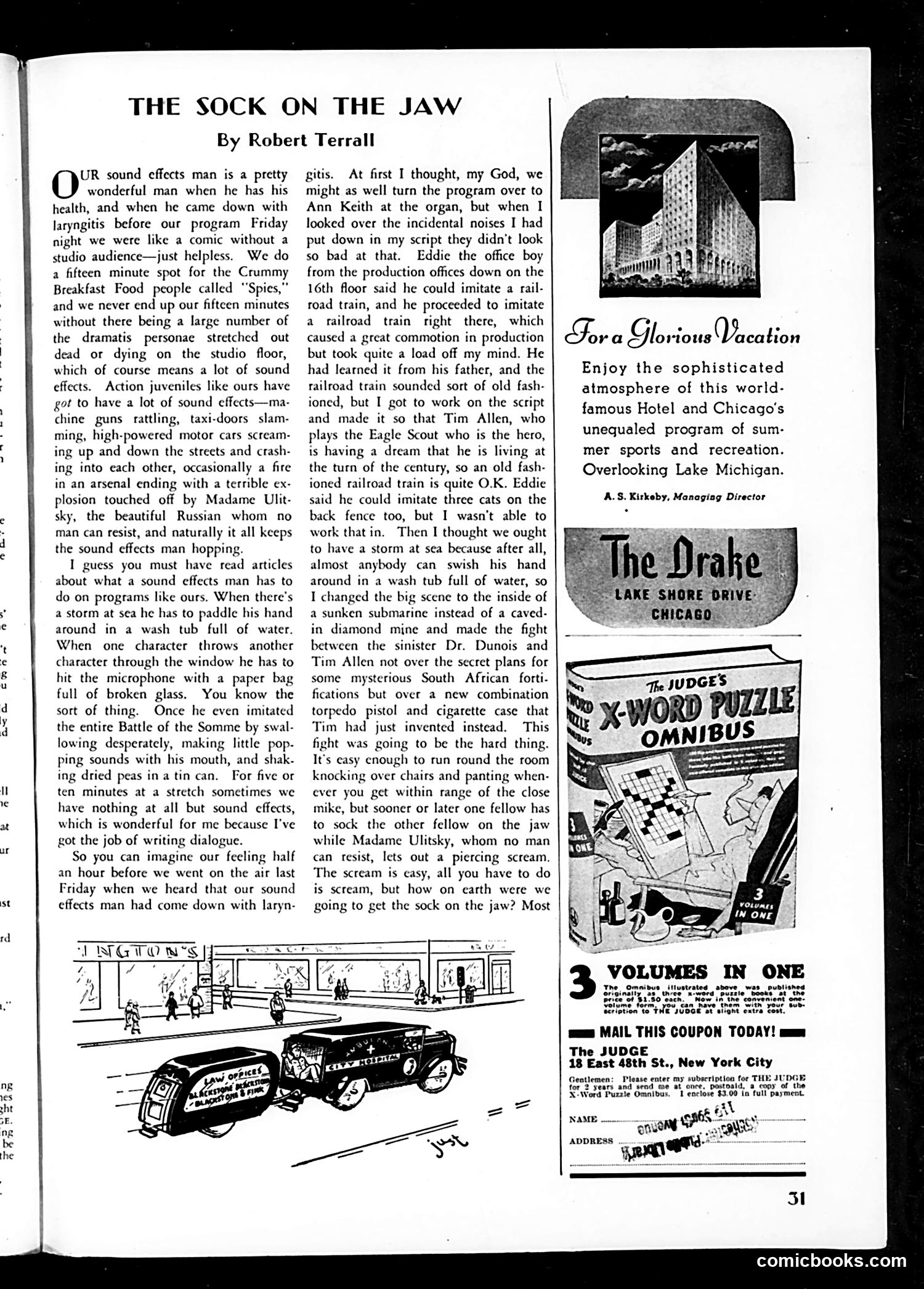
"The Sock on the Jaw" - Context for Modern Readers This is a behind-the-scenes story about radio drama production in what appears to be the 1930s-40s. The author describes the challenges of creating sound effects for a weekly radio show called "Spies" when their sound effects man becomes ill with laryngitis. The humor derives from the practical problem-solving required in *live* radio broadcasting: without visible action, every noise must be created manually—machine guns (rattling), car crashes (broken glass in paper bags), even the Battle of the Somme (swallowing and dried peas in a tin can). The story's irony centers on recreating a crucial scene: a character punching another in the jaw while an actress screams. The title's "sock on the jaw" is both literal (the punch sound needed) and figurative—the difficulty of achieving it without their specialist. The cartoon at bottom shows a car crash, illustrating the sound-effect challenges described. This reflects radio's dependence on audio-only storytelling, now largely obsolete.
Judge Magazine Advertisement/Editorial This is primarily an advertisement for Peek magazine, disguised as editorial content. The left side promotes Peek as "the picture magazine that ribs picture magazines"—a humorous photo magazine promising over 100 captioned pictures designed to make American readers laugh at everyday life's absurdities. The long right-column text is a rambling anecdote about radio sound effects, likely written by or about someone involved in producing a radio drama program (possibly "Madame Ulitsky" or a similar serial). It describes the frustrations of creating realistic sound effects for a submarine fight scene—attempting to simulate a punch using celery, sponges, and other household items, while dealing with difficult actors like "Larry Albertson." The piece exemplifies Peek's stated mission: extracting humor from mundane professional situations and "the whimsies of fate." The self-deprecating, conversational tone targets readers who enjoy behind-the-scenes Hollywood/radio industry gossip and practical comedy.

"Mr. Dentist" - Bost Tooth Paste Advertisement This is primarily a tooth paste advertisement, not political satire. The "cartoon" is a product endorsement playing on professional vanity. The image shows a man examining his reflection in a mirror, captioned "Mr. Dentist." The ad's humor targets dentists specifically: it acknowledges that even dental professionals smoke cigarettes (despite knowing better), and subtly shames them about visible stains on teeth and fingers. Bost positions itself as the "Smoker's Friend"—a toothpaste that removes tobacco stains while leaving "lingering sweetness of breath." The appeal is to dentists' professional pride: using Bost themselves demonstrates competence to their patients. This reflects early-20th-century cigarette ubiquity and the tension between health knowledge and smoking prevalence, even among medical professionals. The coupon offers a free sample to *Judge* readers.
"Notes on the Spread of Human Reason" This page is primarily an advertisement for *Movie Life* magazine, but the right column presents satirical "news briefs" mocking human irrationality and absurdity. The column catalogs bizarre, often darkly comic incidents: a general proposing sterilization of refugees, a jealous man shooting his wife, a woman protesting clothing prices by running nude, police confiscating books to "advance learning," and multiple cases of marital dysfunction or violence. The satire's point is in the column's title: these real incidents supposedly illustrate the "spread of human reason"—the irony being obvious. The author presents genuine news stories as evidence that civilization produces not enlightenment but folly, violence, and absurdity. This reflects 1930s-era cynicism about progress and modernity, suggesting that despite advances, human behavior remains fundamentally irrational and self-destructive. The tone is darkly humorous rather than outright condemnatory—treating serious matters (murder, suicide) as tragicomic proof of universal human unreasonableness.
Political Context of This Judge Magazine Page This page contains reader letters to Judge magazine's editor, likely from the 1930s-40s based on references to Hitler and Alf Landon (1936 presidential candidate). The main satirical content comes from two letters criticizing the editor's positions: 1. Irish-American identity: A reader claiming Irish descent attacks the editor's Irish pride, sarcastically suggesting Jews and Irish unite to fight Hitler and establish a new "Ireland" in Germany—a biting jab at perceived editorial inconsistency or hypocrisy regarding ethnic nationalism. 2. Anti-Nazi advocacy: The writer mocks Judge's apparent efforts to stir Jewish readers toward war with Hitler, suggesting cynically that Jews want others (Irish) to do their fighting while they control commerce and media—a vicious stereotype reflecting antisemitic tropes common in that era. The letter also ridicules Alf Landon as a failed Republican candidate. These letters represent inflammatory reader responses to editorial positions, showcasing how Judge published contentious commentary reflecting period prejudices alongside its satire.
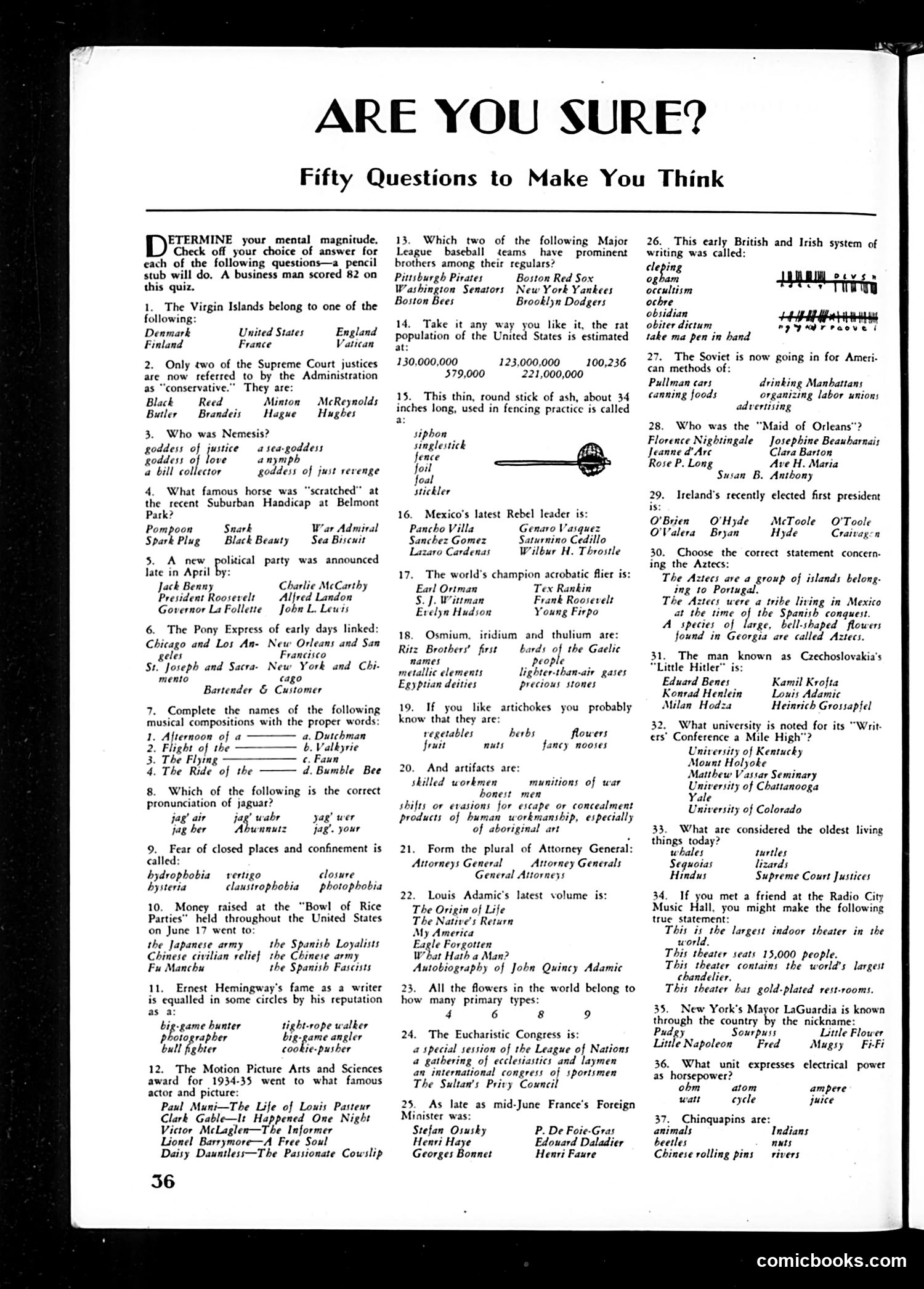
Analysis of "Are You Sure?" Quiz Page This is a trivia quiz page, not a political cartoon. However, the content reveals satirical social commentary typical of Judge magazine's 1930s era. The questions mock contemporary American politics and culture. Question 5 references a "new political party announced in April" by Charlie McCarthy—a ventriloquist's dummy—sarcastically suggesting political figures like President Roosevelt, Alfred Landon, and labor leader John L. Lewis are no more substantive than a puppet. This likely comments on the 1936 election period's political theater. Question 2 about Supreme Court justices labeled "conservative" by the Administration reflects New Deal-era tensions between FDR and the Court. Questions 10 and 13-16 reference current events: Spanish Civil War relief efforts, baseball, and Mexican politics under Lázaro Cárdenas. The quiz's framing—"Determine your mental magnitude"—satirizes both Americans' pretensions to knowledge and Judge's own audience of educated elites. It's gentle mockery of contemporary life rather than sharp political attack.
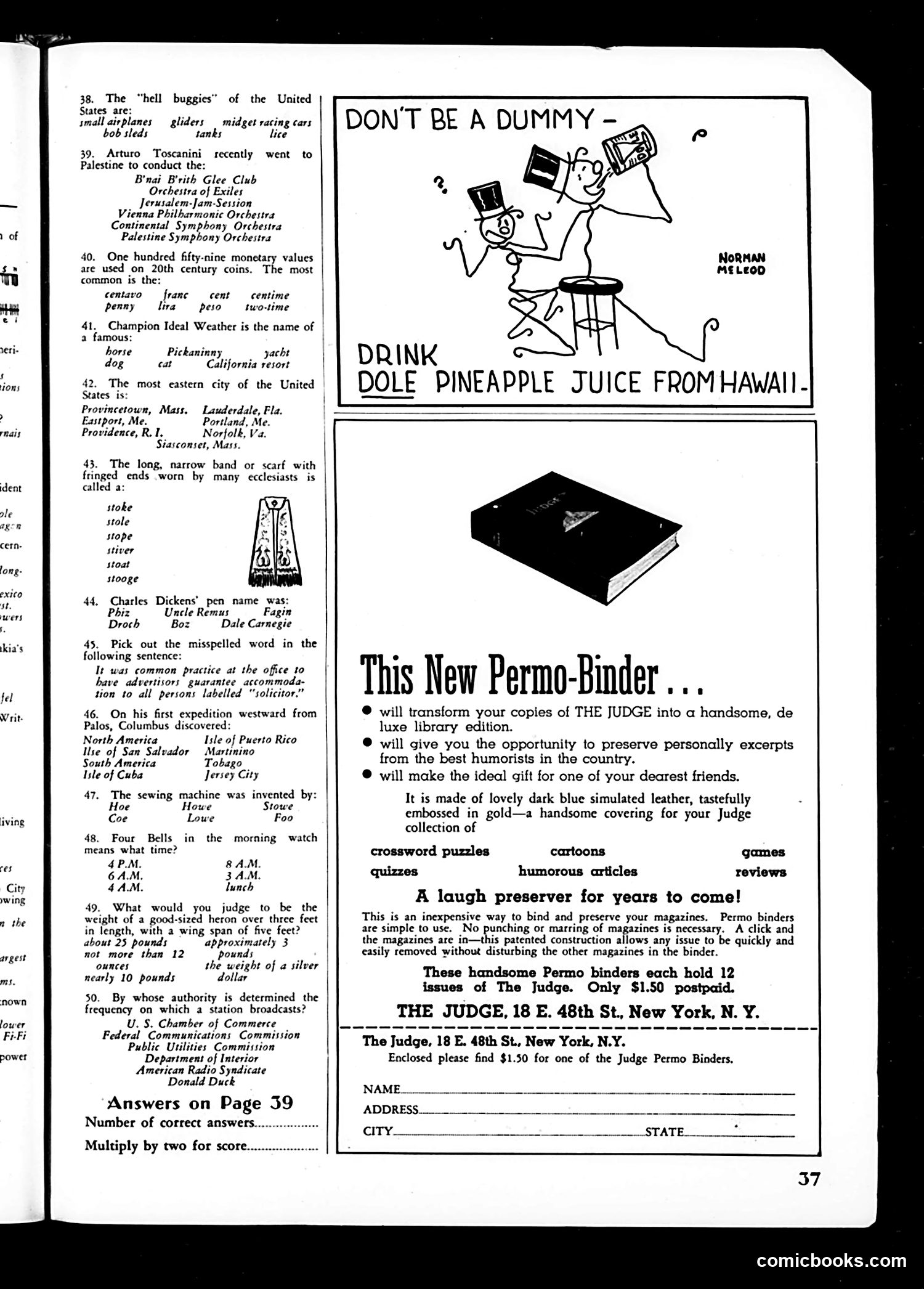
Analysis of Judge Magazine Page 37 This page is primarily a trivia quiz with advertising, not political satire. The quiz tests readers' knowledge across diverse topics: aviation, classical music, currency, animals, geography, literature, and history. Questions reference contemporary figures like conductor Arturo Toscanini and Columbus's voyage—standard educational fare. The only cartoon appears at top: a simple "Don't Be a Dummy" advertisement featuring stick figures promoting Dole Pineapple Juice from Hawaii. This is straightforward product advertising with no satirical content. The bulk of the page advertises the Permo-Binder, a binding solution allowing readers to transform Judge magazines into leather-bound library collections. This appeals to collectors wanting to preserve "personally excerpts from the best humorists." The page reflects Judge's dual identity: offering light entertainment (quizzes, humor) while marketing products to its educated, affluent readership. No political commentary or social satire is evident here—it's primarily commercial content with generic trivia questions.
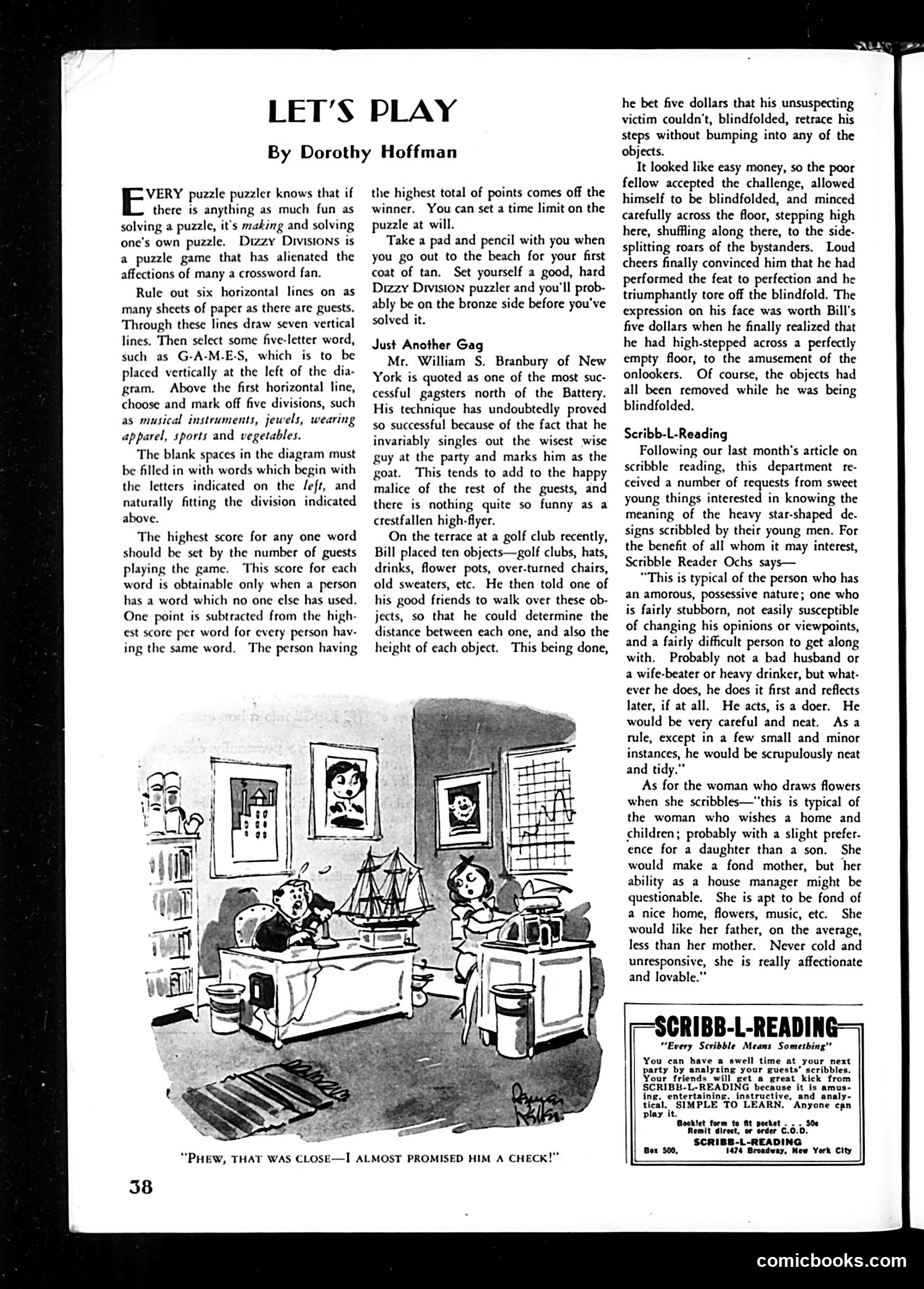
Analysis for Modern Readers This page from *Judge* magazine contains three separate entertainment features, not political satire: "Let's Play" describes "Dizzy Divisions," a word-puzzle game similar to crosswords, designed for social gatherings or beach outings. "Just Another Gag" recounts a practical joke by New York "gagster" William S. Branbury. The setup: he places ten objects on a golf club terrace, blindfolds a victim, then bets he cannot navigate between them without bumping anything. The trick—the objects are secretly removed while blindfolded, leaving the mark stumbling through empty space to onlookers' amusement. The cartoon caption ("I almost promised him a check!") shows the joker nearly losing his bet money. "Scribb-L-Reading" analyzes handwriting interpretation, specifically what star-shaped doodles reveal about the writer's personality (possessive, stubborn, difficult). The page represents light, leisure-focused content typical of *Judge*'s social humor—parlor games, pranks, and pseudoscientific amusements for middle-class entertainment.
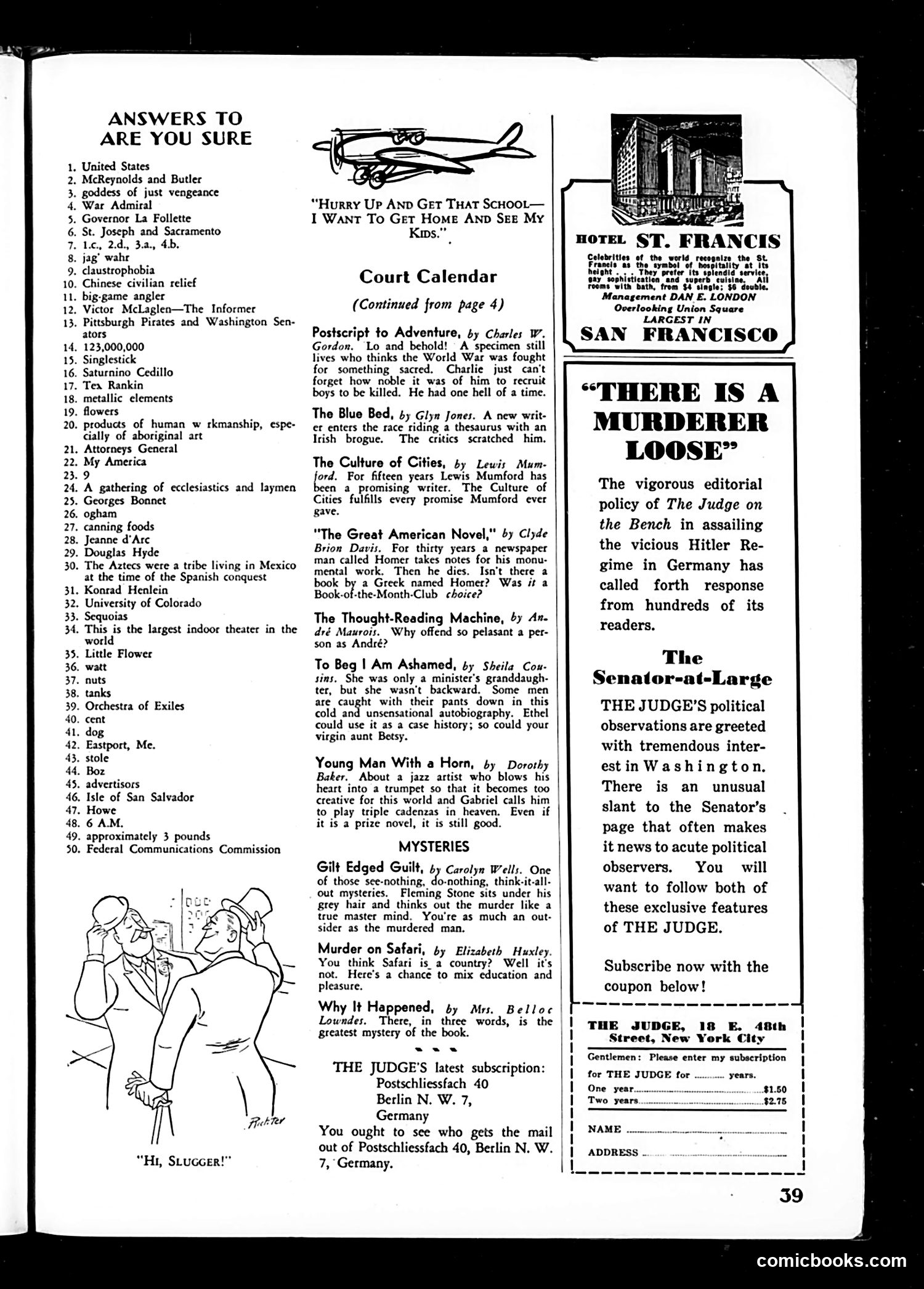
Analysis for Modern Readers This page from *Judge* magazine contains book reviews, crossword puzzle answers, and advertisements—mostly standard magazine content. The single political cartoon shows two figures in conversation with the caption "Hi, Slugger!"—likely satirizing political or public figures, though specific identities aren't clear from the image alone. The most significant political content is the editorial note "There Is A Murderer Loose," celebrating *The Judge's* anti-Nazi stance. This references *The Judge's* vocal criticism of Hitler's Germany, which was generating reader response. The inclusion of a German postal address (Postschliessfach 40, Berlin) appears to mock Nazi mail interception. The page reflects late-1930s American magazine culture: cautious but increasingly direct anti-fascist commentary alongside commercial advertisements and literary reviews. The satire is mild by modern standards, relying on readers' familiarity with contemporary political figures and events.
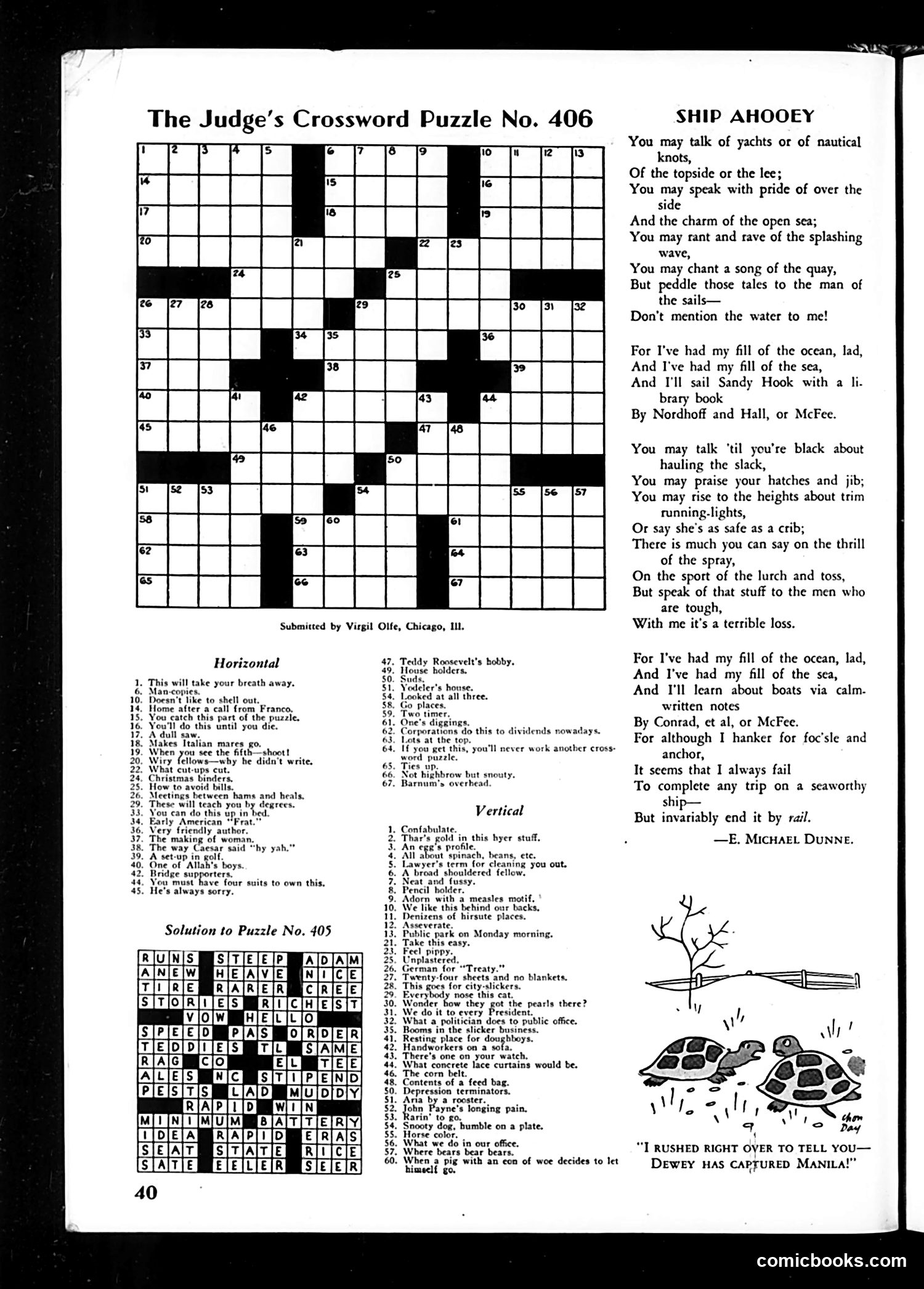
Analysis of Judge Magazine Page No. 406 This page is primarily a crossword puzzle with accompanying maritime-themed poem and cartoon, typical of Judge's early 20th-century content. Main Content: The Poem "Ship Ahooey" by E. Michael Dunne is a humorous complaint from someone who gets seasick. Despite romantic notions of sailing (referencing authors Nordhoff, Hall, and Conrad), the narrator admits he always ends voyages "by rail"—unable to complete any seaworthy trip without becoming ill. Cartoon Reference: The small cartoon shows a turtle and includes the caption: "IT RUSHED RIGHT OVER TO TELL YOU—DEWEY HAS CAPTURED MANILA!" This references Admiral George Dewey's 1898 naval victory in Manila Bay during the Spanish-American War—treating the turtle as if delivering urgent war news, a humorous juxtaposition of the slow-moving animal with urgent military dispatches. The crossword puzzle itself contains typical period wordplay and clues referencing contemporary life and personalities (Teddy Roosevelt's hobbies, etc.).
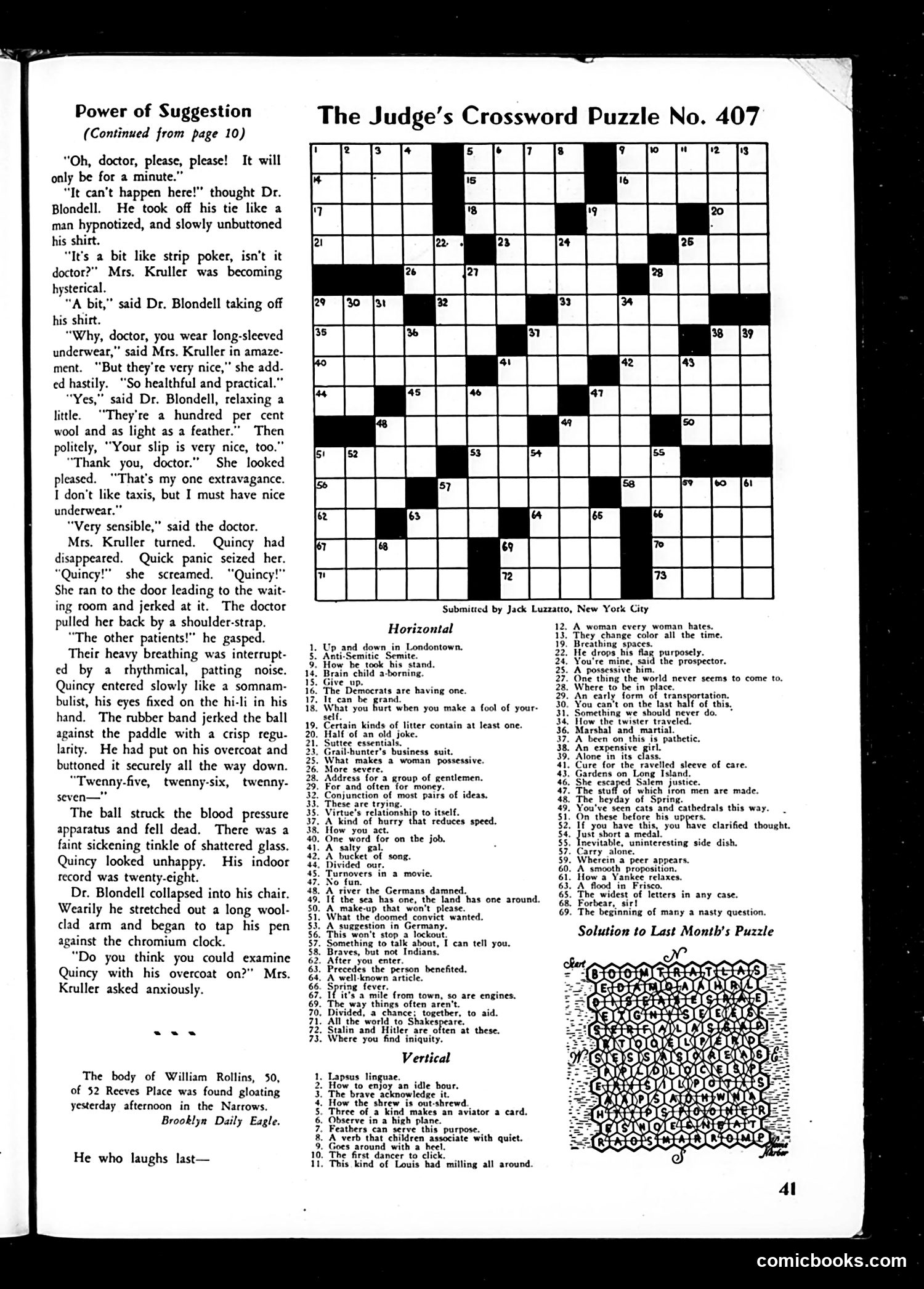
"Power of Suggestion" - Judge Magazine Satire This page contains a humorous short story satirizing psychological suggestion and hypnotic influence—a popular pseudoscience of the era. Dr. Blondell, treating a neurotic patient (Mrs. Kruller), becomes absurdly susceptible to her implied suggestions, progressively removing his clothing despite professional propriety. The doctor, supposedly the rational authority figure, is rendered helpless by her manipulative remarks about his underwear and slip. The comedy peaks when her son Quincy enters obliviously counting paddle-ball hits, indifferent to the chaotic scene—deflating the dramatic tension. The satire mocks both the era's credulous belief in suggestion's power and patients' ability to manipulate medical professionals through psychological manipulation. The page also features Judge's crossword puzzle, a standard magazine fixture of this period.
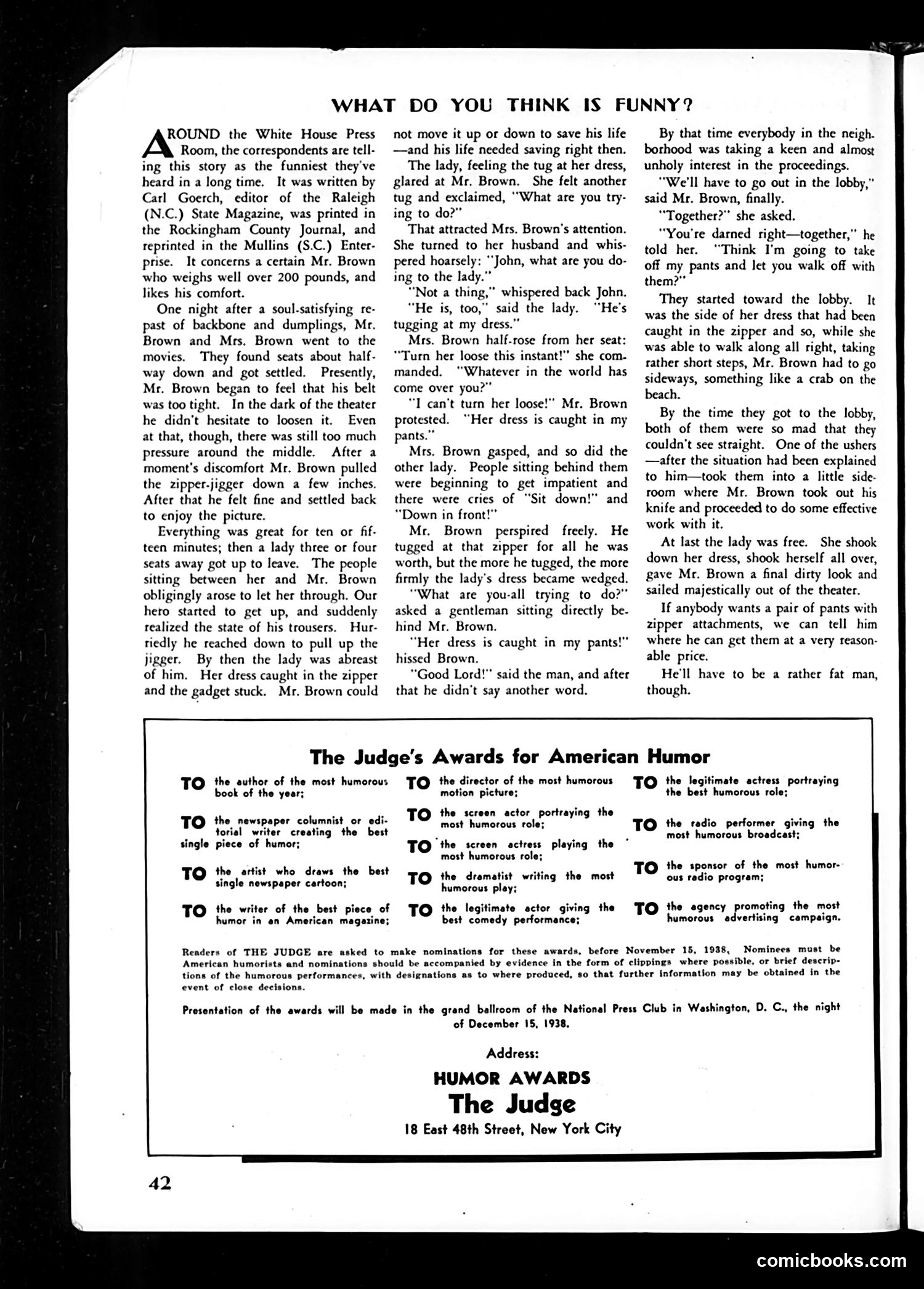
"What Do You Think Is Funny?" — Judge Magazine This page presents a humorous anecdote circulating among White House Press Corps correspondents, attributed to Carl Goerch of Raleigh's State Magazine. The story concerns Mr. Brown, an overweight moviegoer whose unzipped pants accidentally trap a woman's dress when she passes by his seat. The ensuing theater chaos—with Mrs. Brown's outrage, fellow patrons' impatience, and Mr. Brown forced to shuffle sideways like "a crab on the beach" toward the lobby—creates escalating physical comedy. The punchline involves a knife-wielding usher cutting the trapped fabric free. The page's lower half advertises Judge's Humor Awards program, soliciting nominations across multiple media categories (newspapers, magazines, theater, film, radio). The awards ceremony would occur December 15, 1938, at the National Press Club in Washington, D.C. The humor relies entirely on slapstick embarrassment and physical mishap—typical Judge-era comedy targeting middle-class discomfort and bodily indignity.
This is a title page for "The Judge Album 1905-1910," a collection from Judge magazine's satirical cartoons and comics spanning those years. The ornate decorative border features cherubs, classical figures, allegorical imagery (including what appears to be Lady Justice or similar personifications), fruits, flowers, and various whimsical elements typical of early 20th-century design aesthetics. The elaborate frame suggests this was a prestigious publication compiling the magazine's best work from that five-year period. No specific political figures or current events are referenced on this page—it serves simply as a cover/title page announcing the collection's scope and publication date.
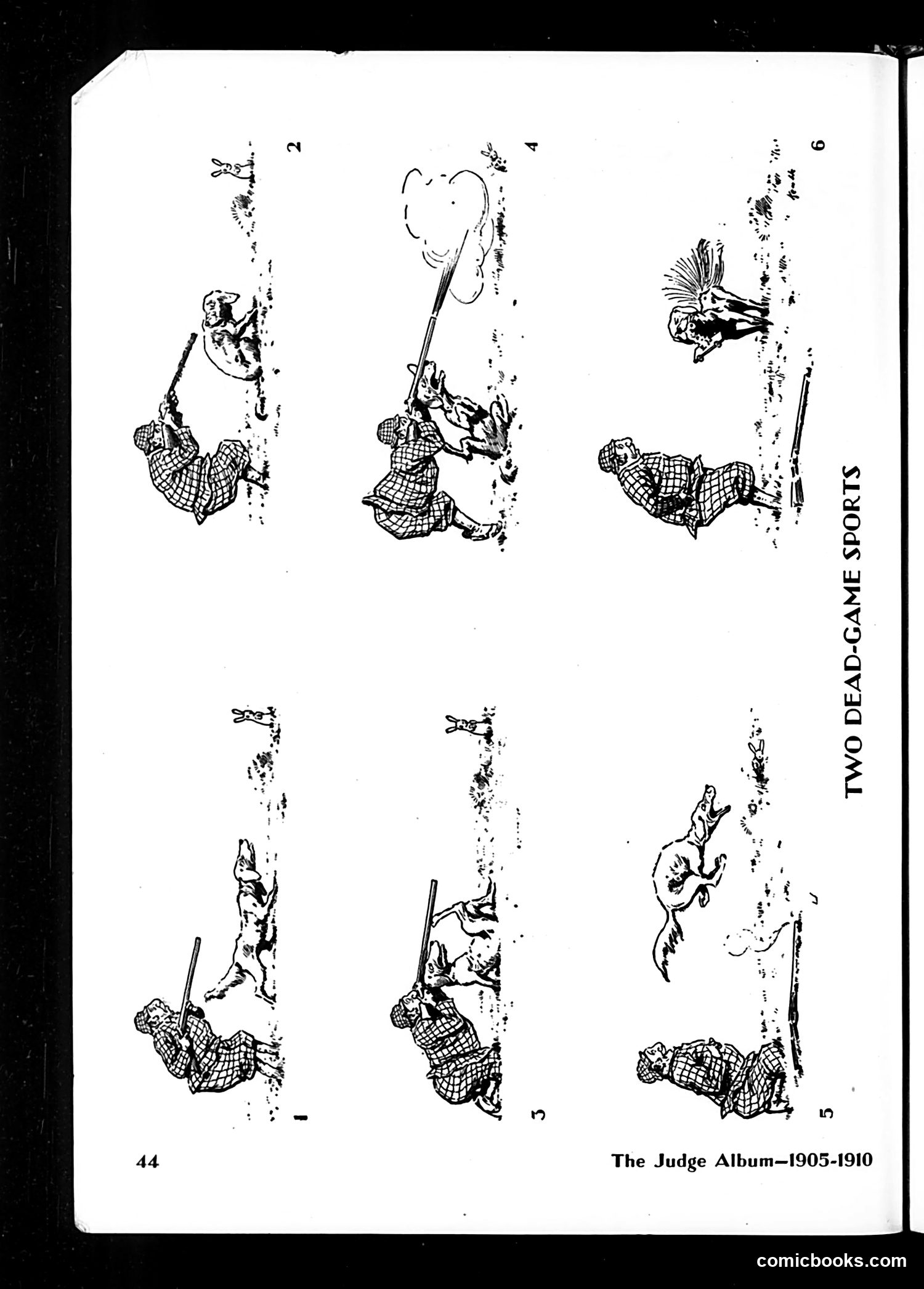
Two Dead-Game Sports This page from *Judge* magazine (1905-1910) illustrates "Two Dead-Game Sports"—a series showing the same two men engaged in different hunting or fishing activities. Each panel depicts them pursuing game with nets and poles in various outdoor scenarios. The phrase "dead-game sport" was period slang for someone willing to try anything and face hardship without complaint. The satire likely mocks wealthy leisure-class men attempting rustic pursuits, their earnest but clumsy efforts at outdoor recreation, or the pretense of "sporting" culture among urban elites. The repetitive scenarios may suggest the absurdity of their obsessive hobby-chasing or the tedium of wealthy gentlemen's pastimes. Without clearer caricature details or text, the specific targets remain unclear, but the humor centers on masculine vanity and class affectation.
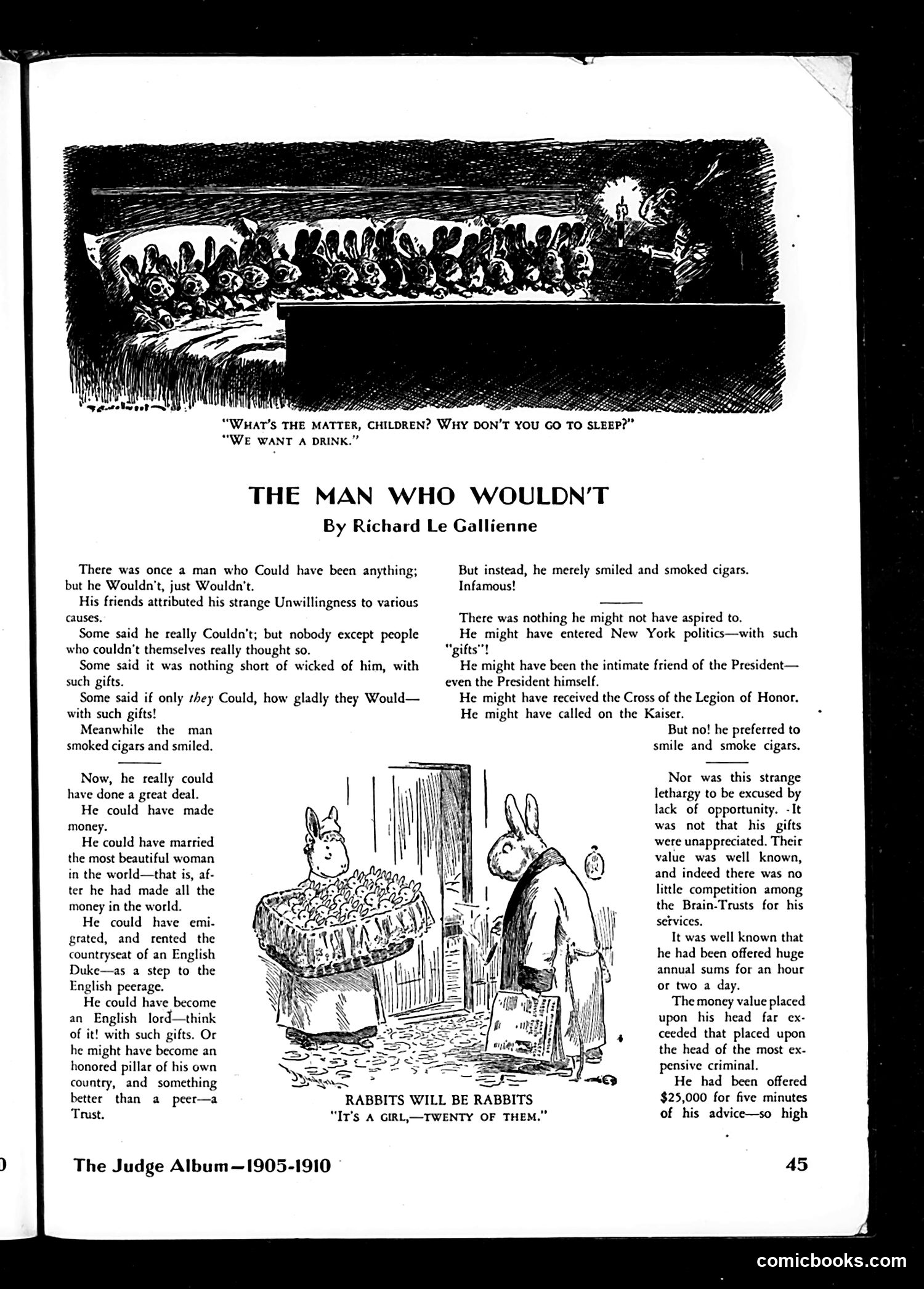
"The Man Who Wouldn't" - Satire of Ambition and Refusal This story by Richard Le Gallienne satirizes a man of considerable talent who refuses to capitalize on his abilities—rejecting opportunities for wealth, political power, aristocratic status, and fame. His only consistent action: smoking cigars and smiling. The satire targets the *expectations* placed on talented individuals in early 1900s America. Society deems it morally corrupt that he won't pursue money-making, enter New York politics, befriend the President, or seek European honors and connections. His passivity becomes "infamous" simply because he refuses the prescribed path of ambition. The cartoon's opening image (children wanting a drink while adults sleep) and the rabbit illustration appear thematic rather than directly connected. The piece mocks both the relentless pursuit of power and society's judgment of those who opt out—suggesting that contentment without achievement is viewed as a moral failing rather than a valid choice.
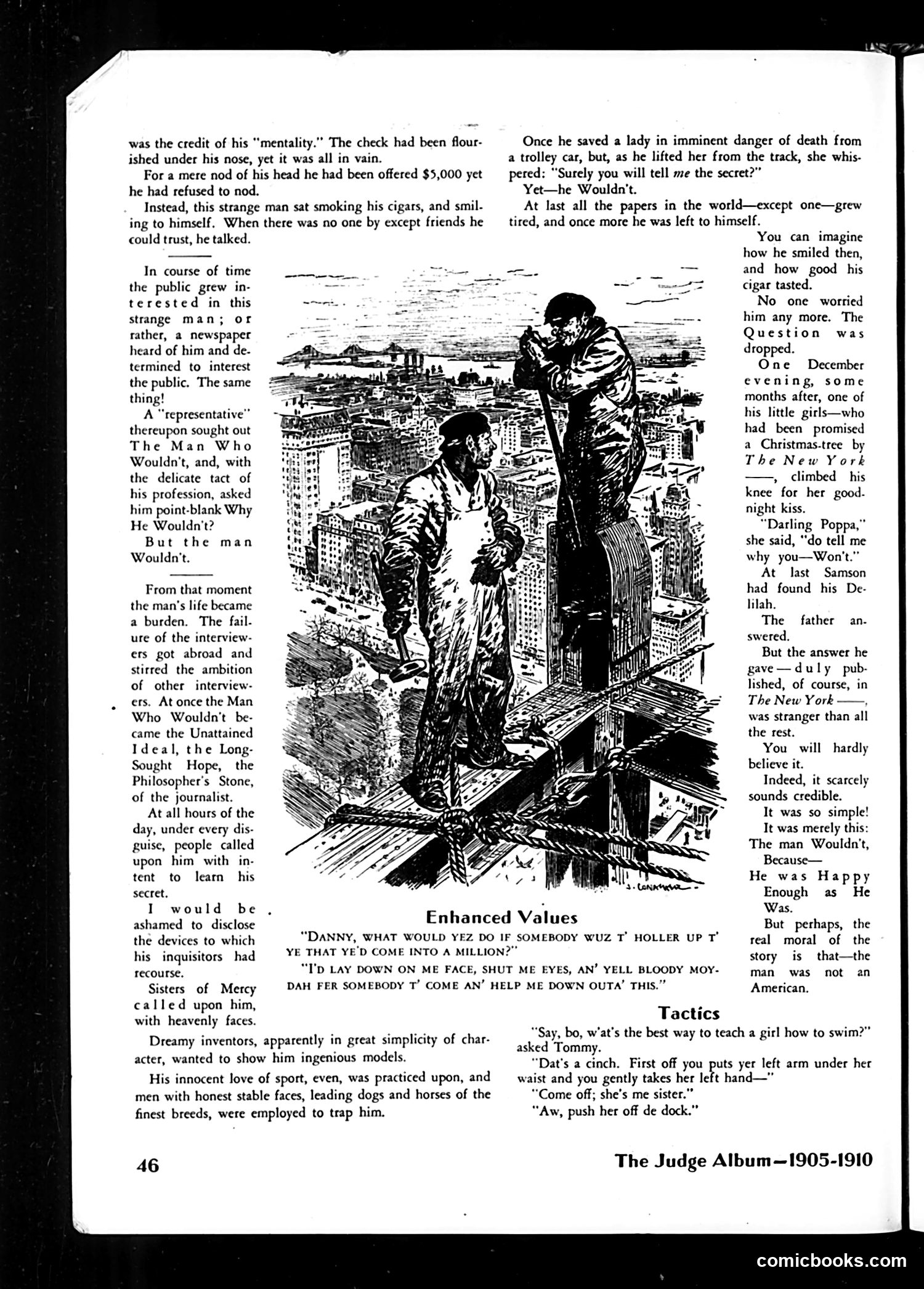
"The Man Who Wouldn't" - Judge Magazine Satire This page satirizes American newspaper culture and journalistic obsession with sensationalism. The central story mocks how the press pursues a mysterious man who refuses all inducements—including a $5,000 bribe—to reveal his "secret." Journalists deploy elaborate schemes (disguised visits, appealing to his love of sport) to extract his story, treating his silence as an irresistible mystery. The satire's punchline reveals the absurdity: his secret is simply that he's content and happy as he is—and the final commentary suggests this proves he's "not an American," implying Americans are inherently dissatisfied and driven by ambition. The page also includes two humor sections: "Enhanced Values" (depicting working-class Irish characters discussing sudden wealth) and "Tactics" (a crude joke about teaching swimming). These represent typical Judge magazine's mix of satirical commentary with period-appropriate comic vignettes.
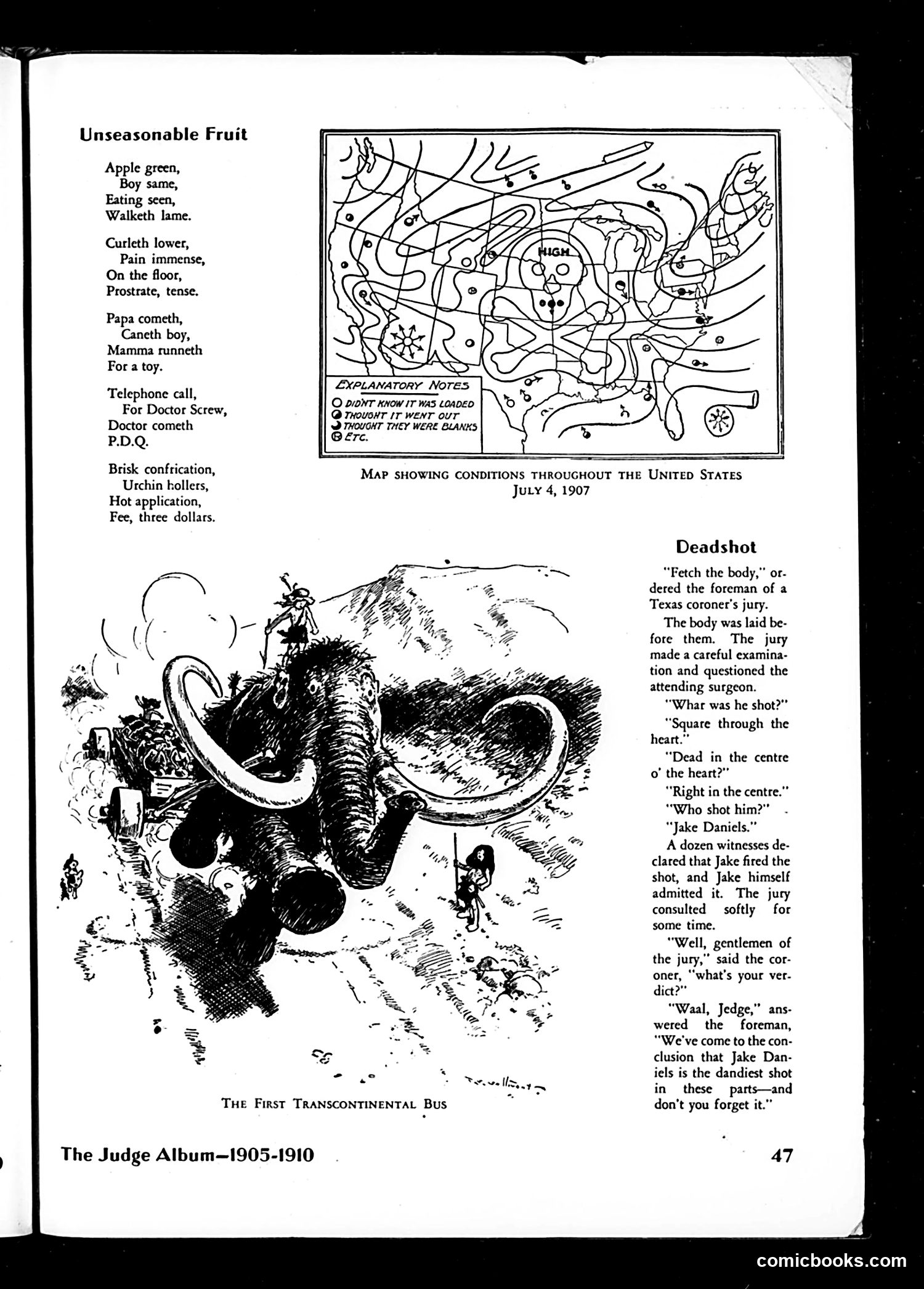
Explanation for Modern Readers This page from *Judge* magazine (1905-1910) contains two satirical pieces: "Unseasonable Fruit" is a humorous poem about a child eating unripe apples and becoming violently ill—vomiting, cramping, requiring a doctor's emergency visit costing three dollars. The joke plays on Victorian-era parental anxiety and the notion of children getting into mischief. "Deadshot" satirizes frontier/Texas justice as absurdly lenient. A man (Jake Daniels) is tried for shooting someone "square through the heart"—an obviously fatal, premeditated act. Despite a dozen witnesses and the defendant's own admission, the all-male jury's verdict ignores the murder itself, instead praising Jake as "the dandiest shot." The satire mocks how frontier culture valorized marksmanship over actual justice, and how juries might use thin pretexts to acquit killings they considered justified or admirable. The dialect ("Waal, Jedge") reinforces stereotypes about backwoods justice being crude and lawless.
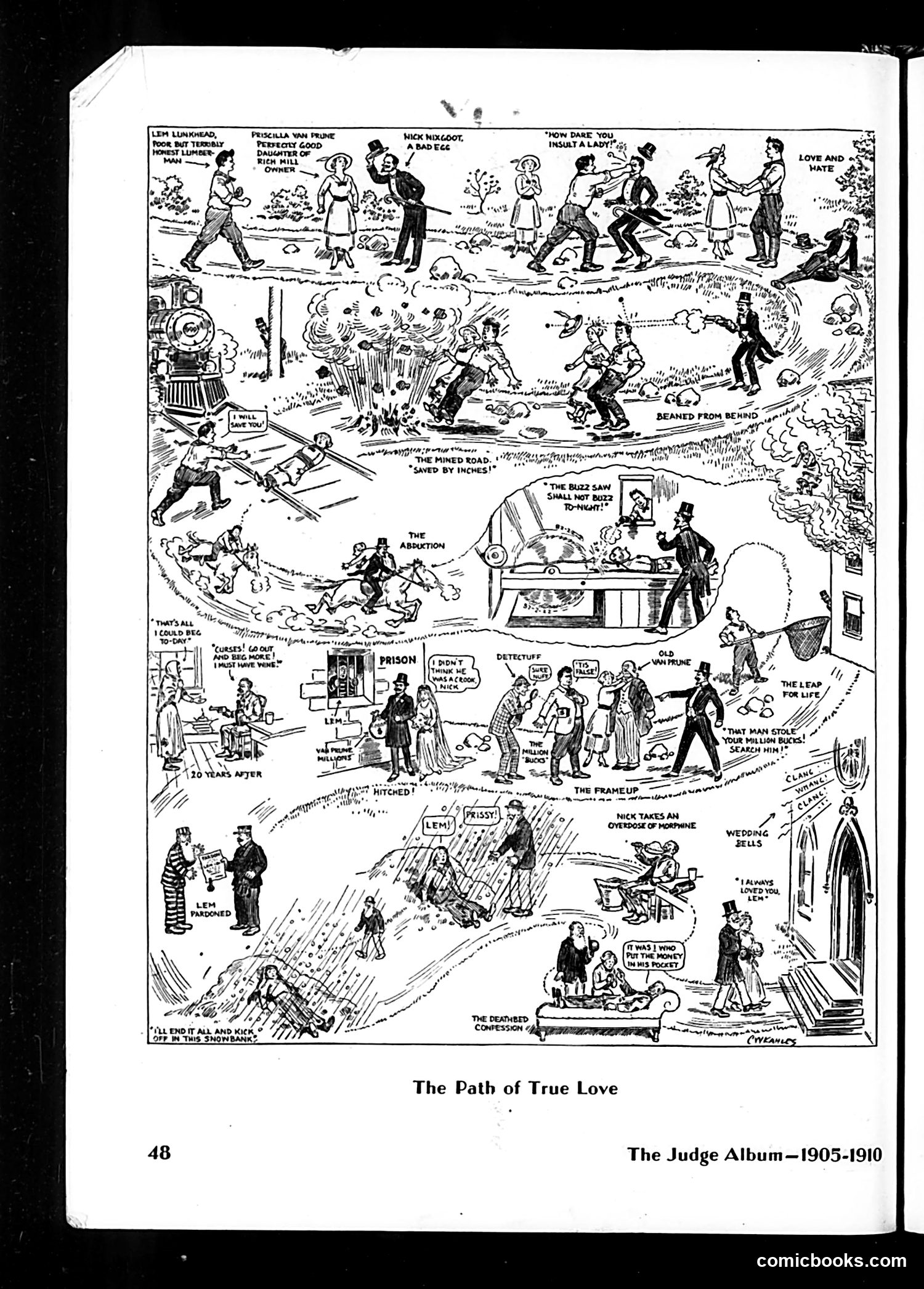
"The Path of True Love" - Judge Magazine (1905-1910) This single-panel cartoon satirizes romantic courtship as an obstacle course of disasters and indignities. A couple navigates a chaotic journey featuring labeled hazards: a train, explosions, a prison, a buzz saw, a deathbed confession, and a snowbank suicide attempt. The satire mocks Victorian romance narratives by treating love as a *literal* perilous path where lovers must survive slapstick catastrophes—train wrecks, legal troubles, near-death experiences—rather than emotional challenges. The exaggerated dangers and the couple's persistence through absurd obstacles parody both melodramatic literature and the idealization of romantic devotion. The title's earnestness contrasts sharply with the chaotic, darkly comedic imagery, creating humor through this juxtaposition. It reflects early 20th-century skepticism toward sentimentalized love stories.
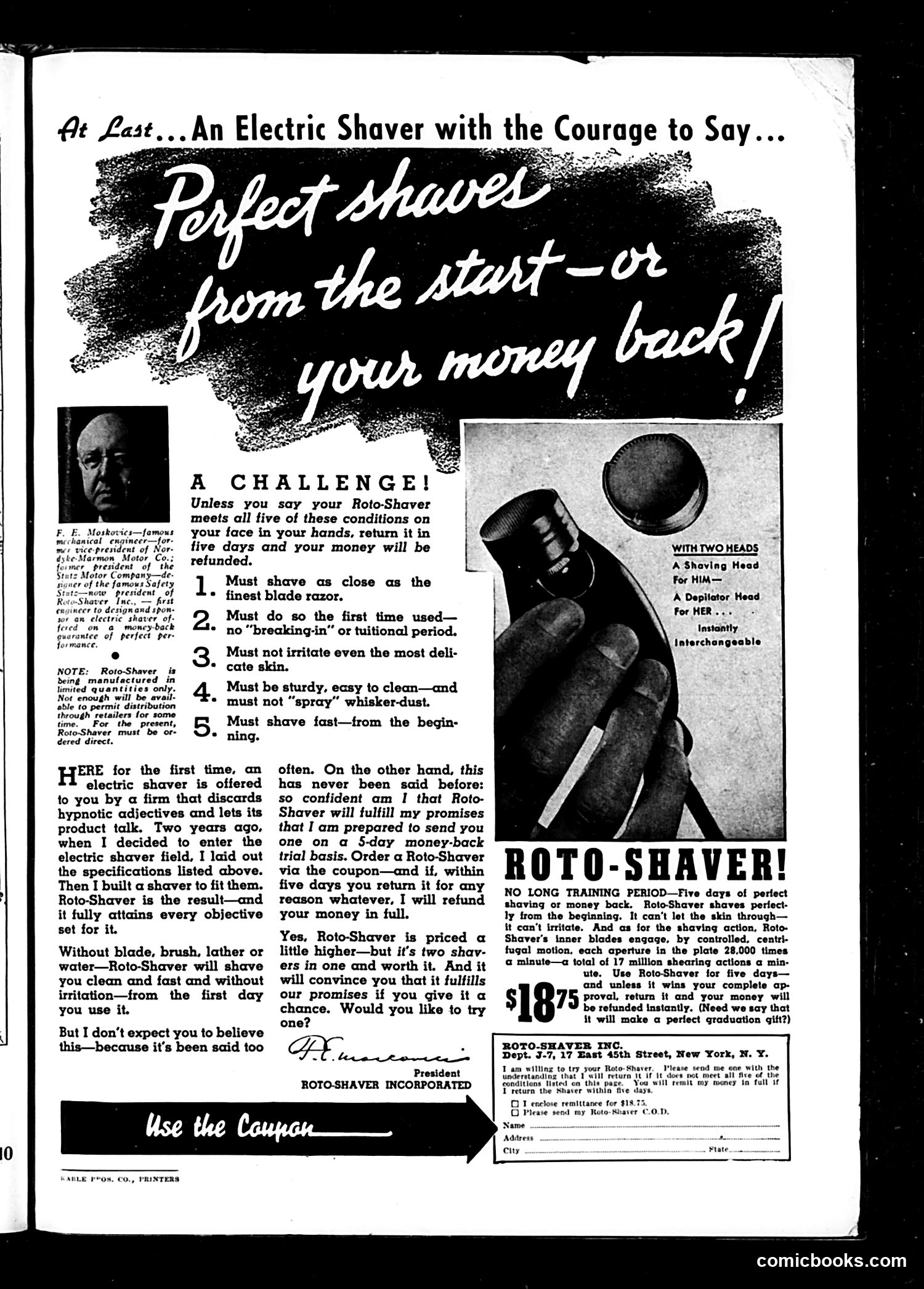
Page Analysis: Roto-Shaver Advertisement This is primarily a product advertisement, not a cartoon or satirical content. It promotes the Roto-Shaver, an early electric razor, through a money-back guarantee pitch. Key Elements: The ad features F.E. Moskovics, the product's inventor and president of Roto-Shaver Inc., who is identified as a former vice-president of major motor companies. His credentials establish credibility for the technical innovation. The "Challenge" consists of five specific performance claims (close shave, works immediately, non-irritating, sturdy, fast operation). The Pitch: A bold 5-day money-back guarantee—unusual for the era and presented as proof of manufacturer confidence. The ad emphasizes this guarantee repeatedly, framing it as evidence the product actually works rather than relying on marketing hype. Notable Detail: The shaver has interchangeable heads for men and women, marketed simultaneously. This is straightforward advertising copy with no satirical content—Judge magazine apparently accepted paid advertisements alongside its editorial cartoons.
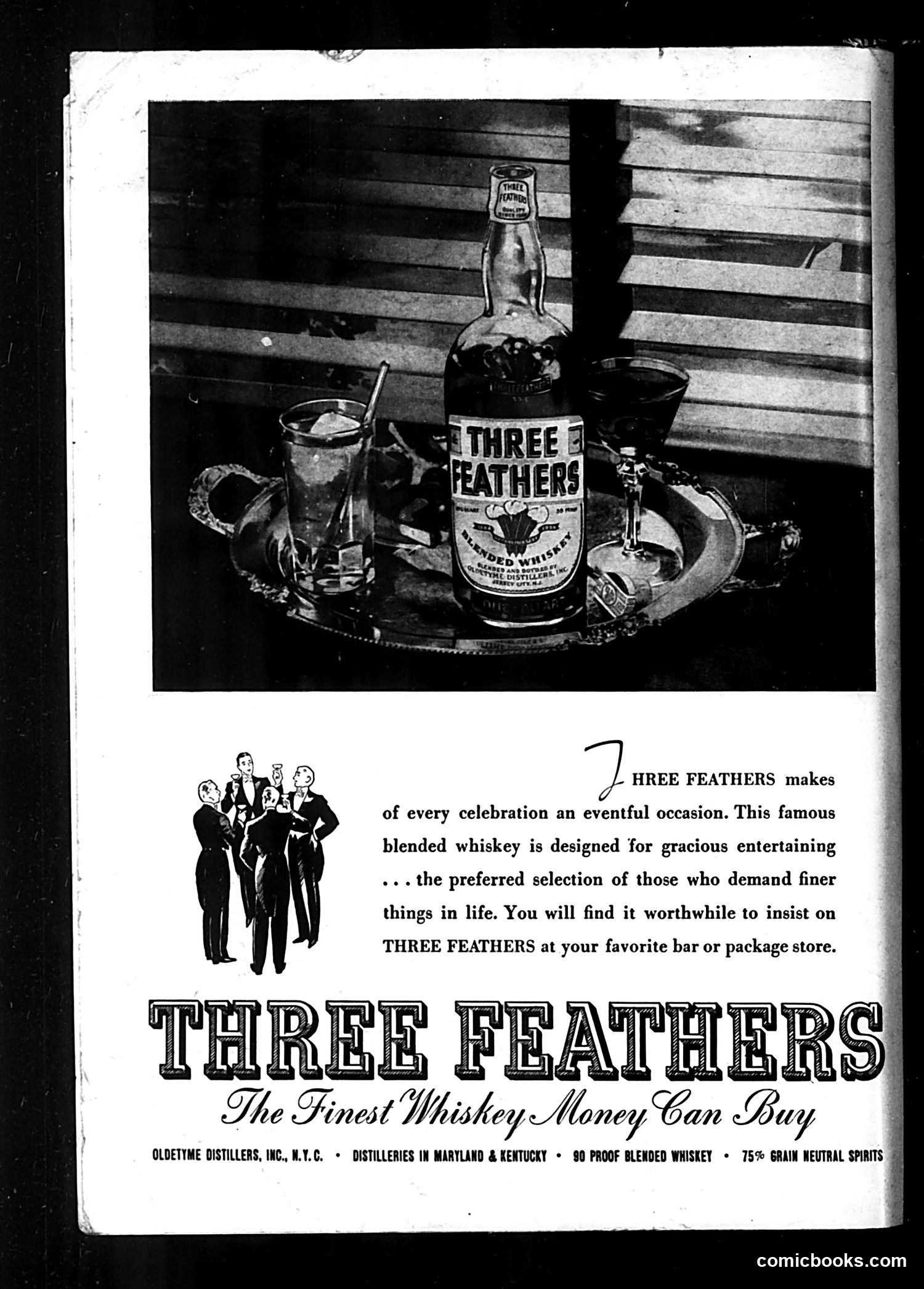
Three Feathers Whiskey Advertisement This is a full-page advertisement, not satire or political commentary. It promotes Three Feathers blended whiskey as a premium product for "gracious entertaining" and those "who demand finer things in life." The ad features a photograph of the bottle surrounded by drinking glasses and decorative serving pieces, alongside an illustration of well-dressed men in formal attire. The messaging appeals to aspirational consumers by associating the whiskey with sophistication and upscale social occasions. The fine print identifies the manufacturer (Oldetime Distillers, Inc.) and specifies it's a 90-proof blended whiskey produced in Maryland and Kentucky, containing 75% grain neutral spirits. This represents typical mid-century advertising targeting affluent consumers through appeals to status and refined taste.

I can see this is a page from Judge magazine, but the image is almost entirely black with only a white margin visible on the left side and the "comicbooks.com" watermark at the bottom. The OCR text provided contains only the website watermark. I cannot make out any discernible cartoon, illustration, text, or political content from this image. The page appears to be either: - Severely damaged or degraded - A blank or mostly-black page from the original publication - Improperly scanned Without being able to see the actual cartoon(s) or readable text, I cannot identify figures, explain satirical references, or determine the historical context. A clearer scan would be necessary to provide meaningful analysis.