judge
Judge — August 1938
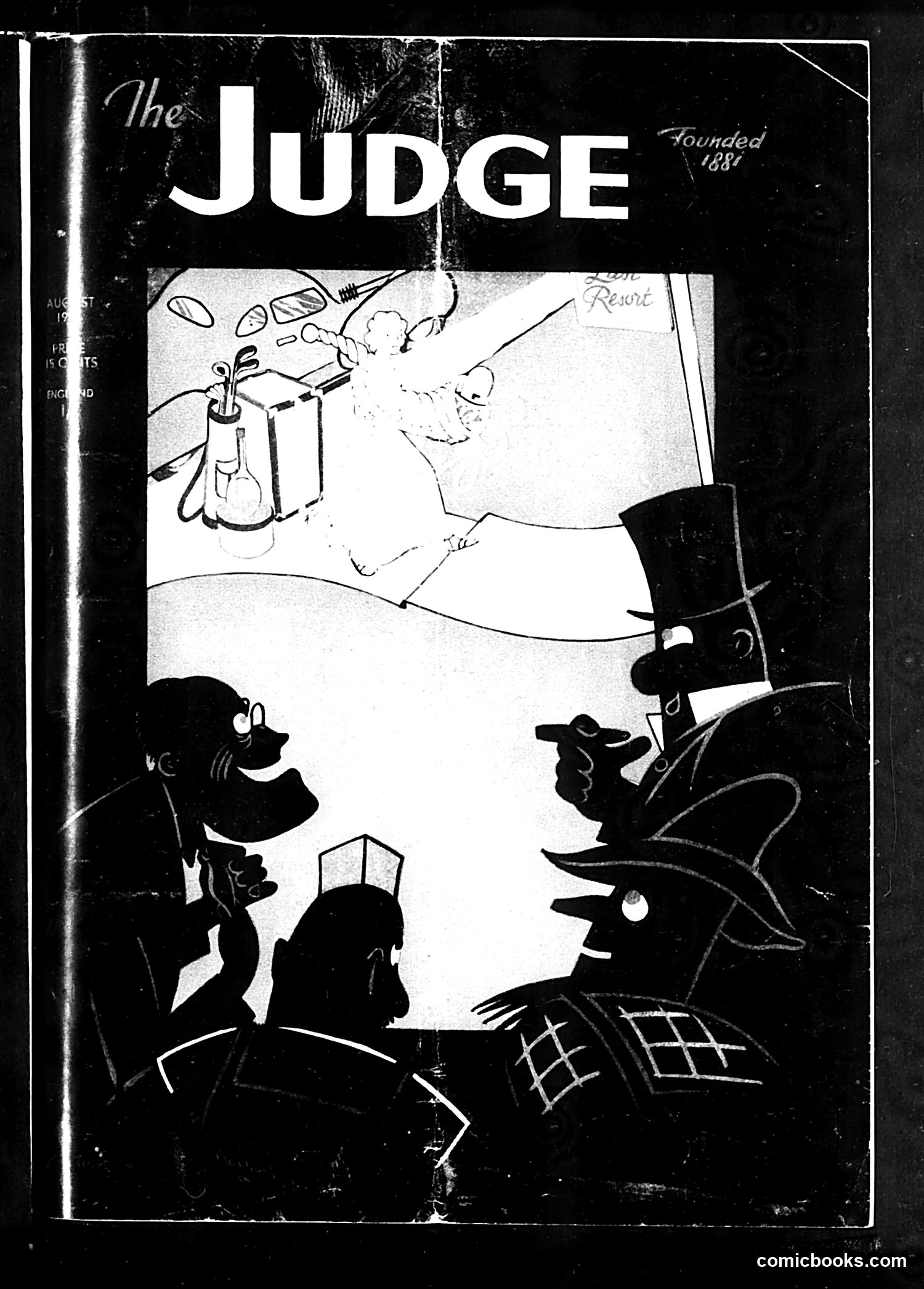
The Judge Magazine Cover - Analysis This appears to be a Judge magazine cover from August 1921 (visible on spine). The central illustration shows a woman's face/head being scrutinized or examined by three caricatured male figures wearing formal attire (top hats), positioned below and around her like judges or critics evaluating her. The satire likely addresses gender dynamics and social judgment of women during the early 1920s—a period of significant social change (women's suffrage had recently passed in 1920). The "judges" examining the woman suggests commentary on how society critically evaluated women's appearance, behavior, or role in society. The title "The Judge" reinforces this theme of judgment itself. The aesthetic employs the magazine's characteristic art deco/modernist illustration style typical of early 1920s satirical publications.
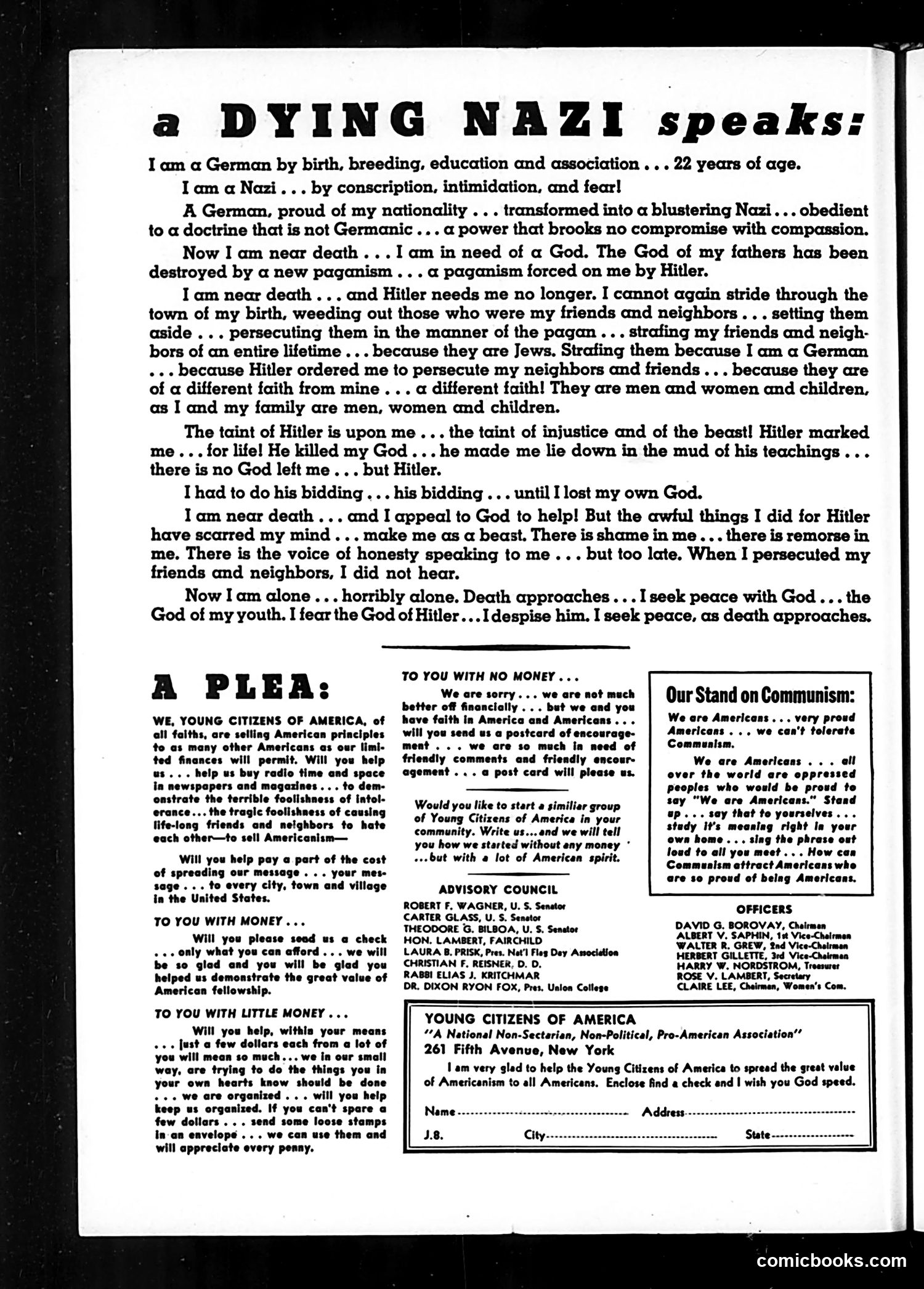
Analysis This page appears to be from a WWII-era American publication containing anti-Nazi propaganda rather than traditional satire. The main content is a monologue titled "A DYING NAZI SPEAKS" — presented as a confessional deathbed statement from a 22-year-old German Nazi expressing remorse for persecuting friends and neighbors, particularly Jewish people, under Hitler's orders. The Nazi speaker describes spiritual corruption and seeks God's forgiveness while despising Hitler. Below this is "A PLEA" from the "Young Citizens of America," a fundraising appeal for an anti-Communist organization seeking small donations to spread American values. Rather than satirizing specific figures through caricature, this page uses emotional rhetoric and moral argument to promote American ideological positions against both Nazism and Communism during the Cold War period.
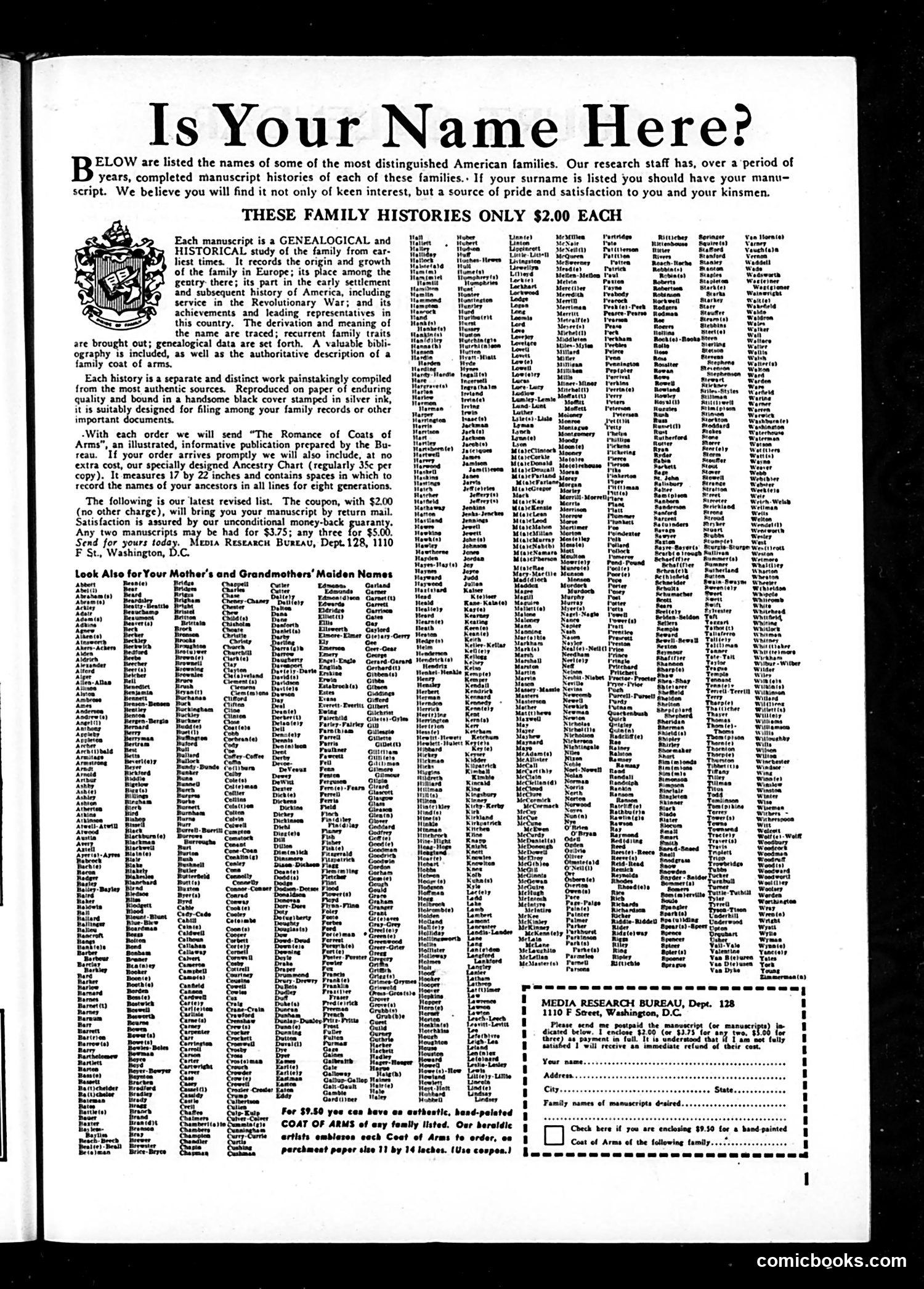
Page Analysis This page is primarily advertising, not satire or political commentary. It advertises family history manuscripts available for $2.00 each from what appears to be a genealogy service located at 1110 F Street, Washington, D.C. The page lists hundreds of surnames in dense columns, offering genealogical and historical records for distinguished American families. Each manuscript reportedly documents "origin and growth of the family in Europe" and their "part in the early settlement and subsequent history of America." The ornamental coat-of-arms image is decorative branding. A small order form appears at bottom right. This is a commercial genealogy service advertisement, not editorial content, though it ran in *Judge* magazine.
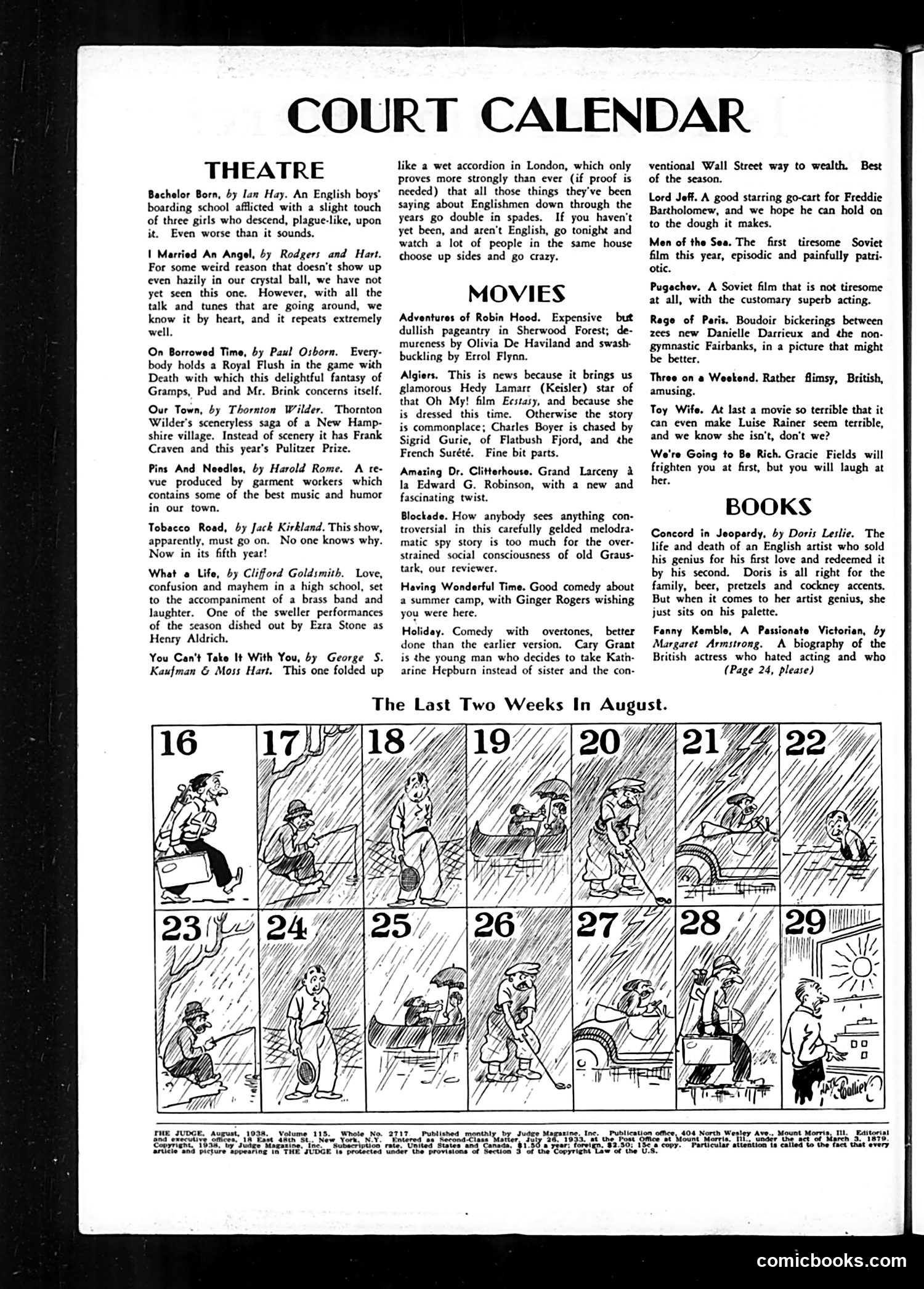
Court Calendar Page from Judge Magazine This page combines entertainment reviews with a weather-themed comic strip calendar for August 16-29. The upper section reviews current Broadway plays and films, including *Adventures of Robin Hood*, *Algiers*, and *You Can't Take It with You*. The calendar strip below depicts a recurring character—apparently an everyman or working-class figure—dealing with rainy weather throughout the two-week period. On August 29, the final panel shows sunshine breaking through, suggesting relief after prolonged storms. The humor appears gentle and observational rather than overtly satirical, focusing on the universal frustration of summer rain and the simple joy of clear skies returning. The strip functions as both calendar and light social commentary on weather's impact on daily life.
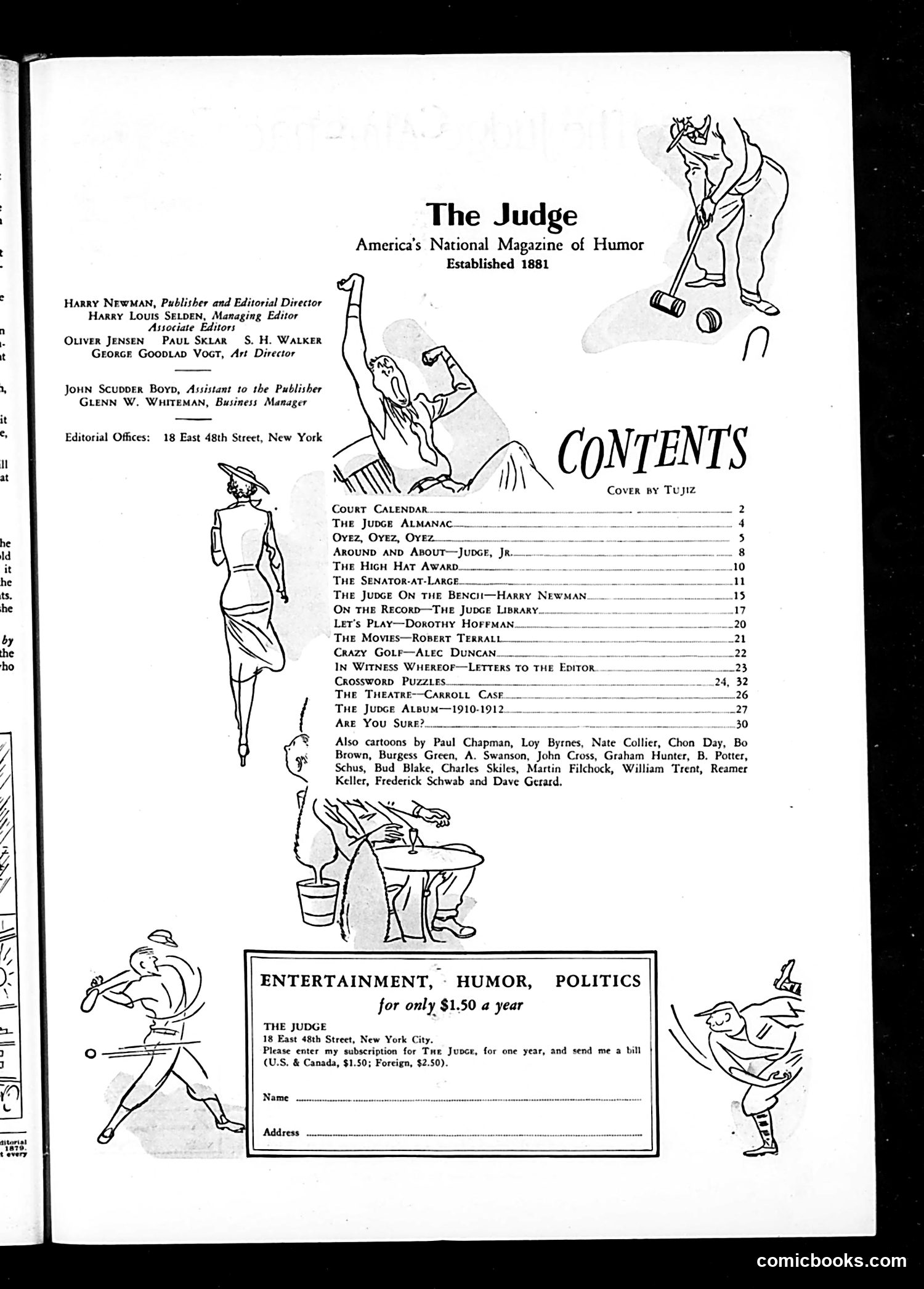
The Judge Contents Page (circa 1910-1912) This is a table of contents page for *The Judge*, a humor magazine established in 1881. The page features decorative line drawings of figures engaged in various activities—golfing, croquet, and casual poses—typical of early 20th-century leisure. The contents list articles on topics including politics ("The Senator-at-Large"), sports ("Crazy Golf"), theater, and social commentary. A subscription advertisement at the bottom offers a year's subscription for $1.50, promoting "Entertainment, Humor, Politics." The cartoons themselves don't appear to reference specific political figures or events—they're generic illustrations celebrating upper-class recreation and leisure activities, reflecting the magazine's target audience of educated, affluent readers. This page primarily serves an organizational function rather than satirical purpose.
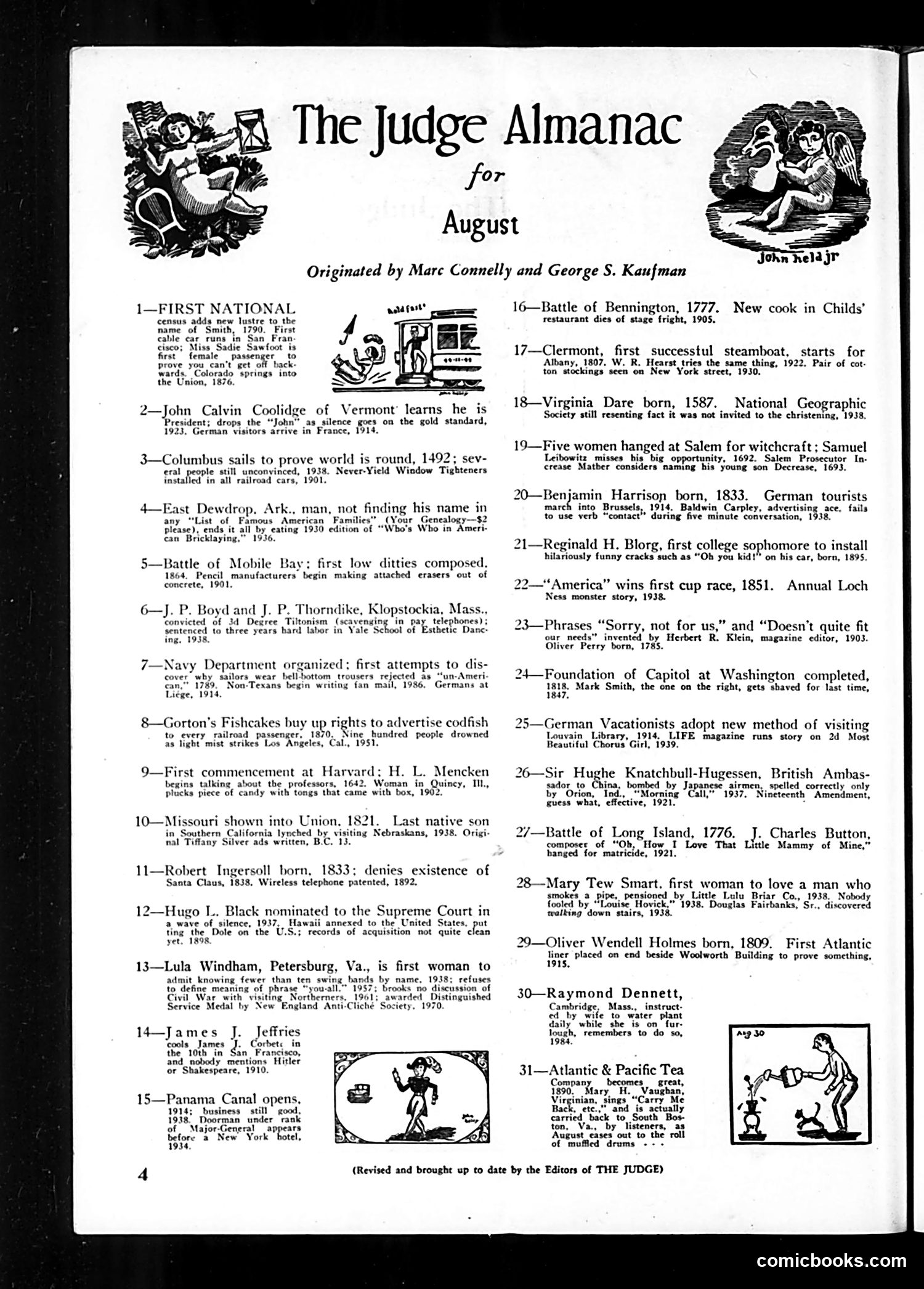
The Judge Almanac for August This page is primarily an almanac of historical events and trivia rather than political satire. It lists 31 dated entries mixing genuine history (Panama Canal opening, 1914; Battle of Bennington, 1777) with humorous anecdotes and obscure facts. The small decorative woodcuts scattered throughout are generic period illustrations—cherubs, workers, and figures—not specific political cartoons targeting identifiable individuals. The humor is light and miscellaneous: absurd inventions (a college sophomore installing "hilariously funny ranch which says 'Oh you kid'" on his car), wordplay ("Sorry, not for us"), and quirky biographical details rather than pointed social critique. This appears to be filler content typical of early 20th-century magazines, blending genuine almanac information with whimsical entertainment for readers.
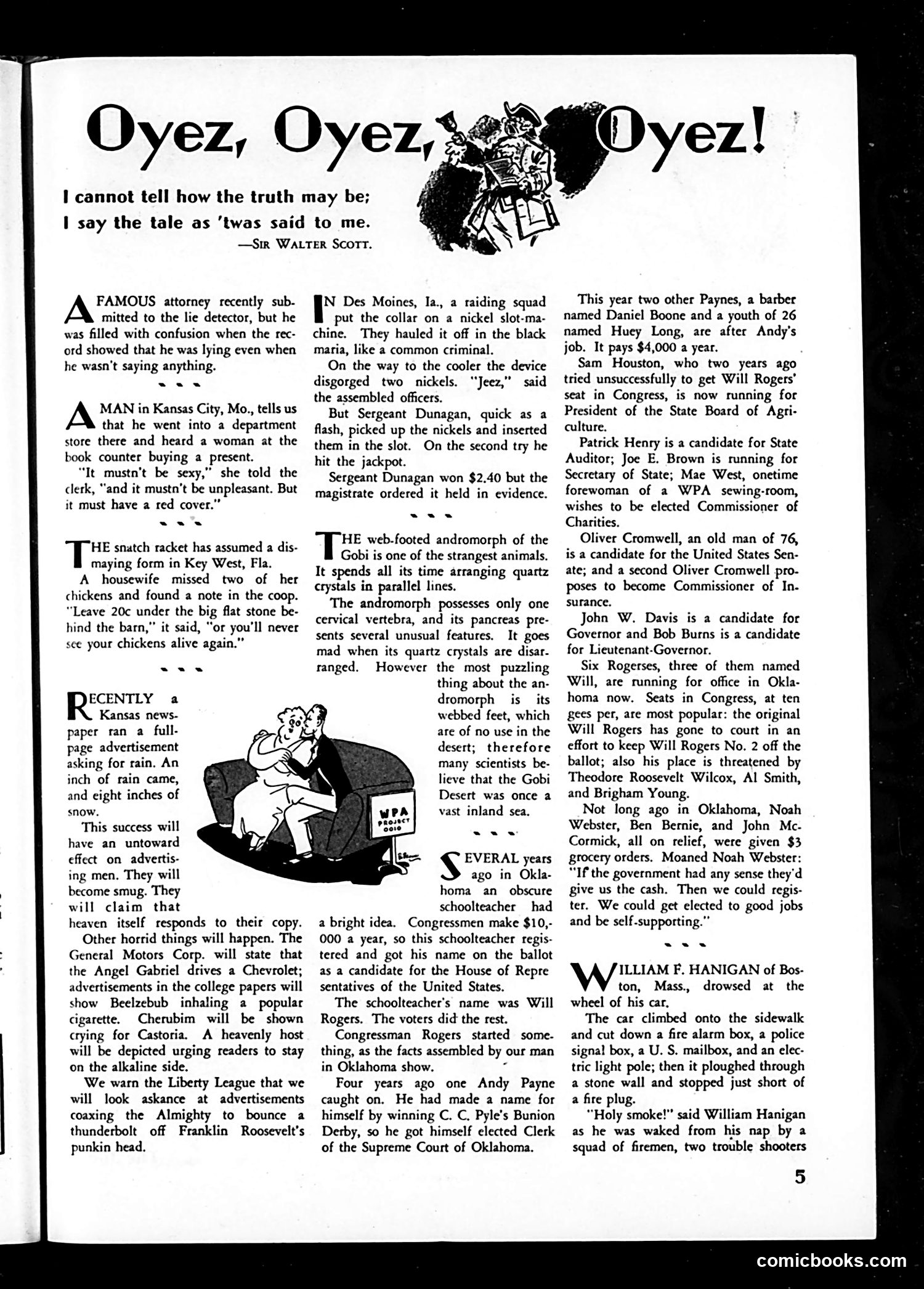
Page Analysis: Judge Magazine Satirical Stories This page contains humorous anecdotes rather than political cartoons. The stories mock various American institutions and figures through exaggerated tales: 1. The lie detector story satirizes legal expertise and modern technology's limitations. 2. The slot machine caper depicts police incompetence in Des Moines, Iowa. 3. Oklahoma political references appear throughout—the text mentions Will Rogers (the famous entertainer-turned-politician), C.C. Pyle's Bunion Derby, and various Oklahoma candidates for office. The schoolteacher-turned-congressman story likely references actual Depression-era political developments in Oklahoma. 4. The Golsi Desert creature is a fictional animal used for absurdist humor about scientific confusion. The satire targets government corruption, law enforcement bungling, and the era's political opportunism, typical of Judge magazine's social commentary.
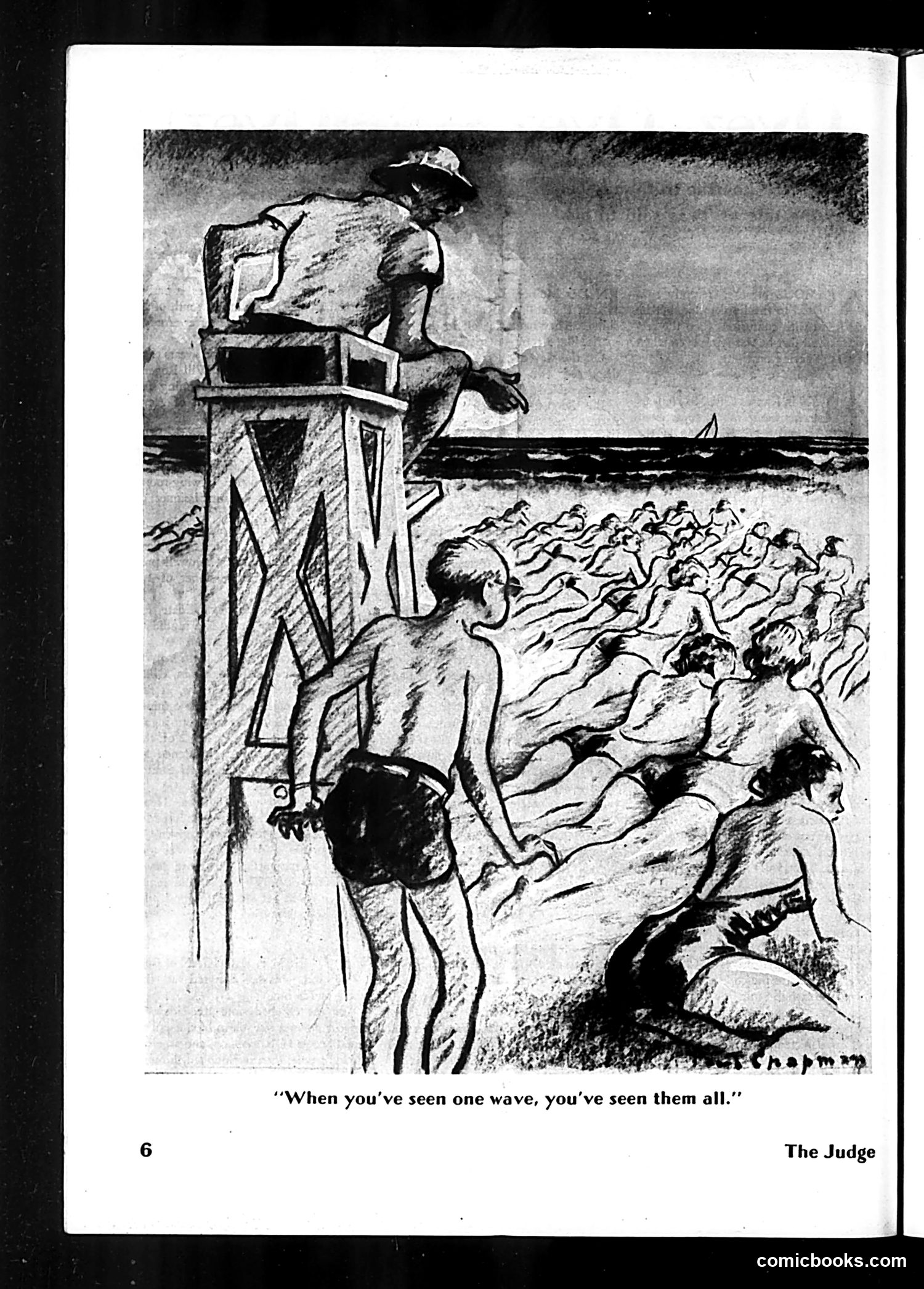
Cartoon Analysis This cartoon depicts a lifeguard perched on a tall observation stand overlooking a crowded beach. A bather below asks about the repetitive nature of watching waves, to which the lifeguard responds: "When you've seen one wave, you've seen them all." The satire targets the monotony and tedium of certain jobs—particularly seasonal work like lifeguarding. The joke suggests that after observing the ocean's repetitive patterns, the work becomes mindless and interchangeable. The guard's elevated position and detached stance reinforce his apathy toward his duties. This commentary on workplace boredom and the soul-crushing nature of routine labor would have resonated with Judge's early 20th-century readers experiencing industrial monotony and standardized work conditions.
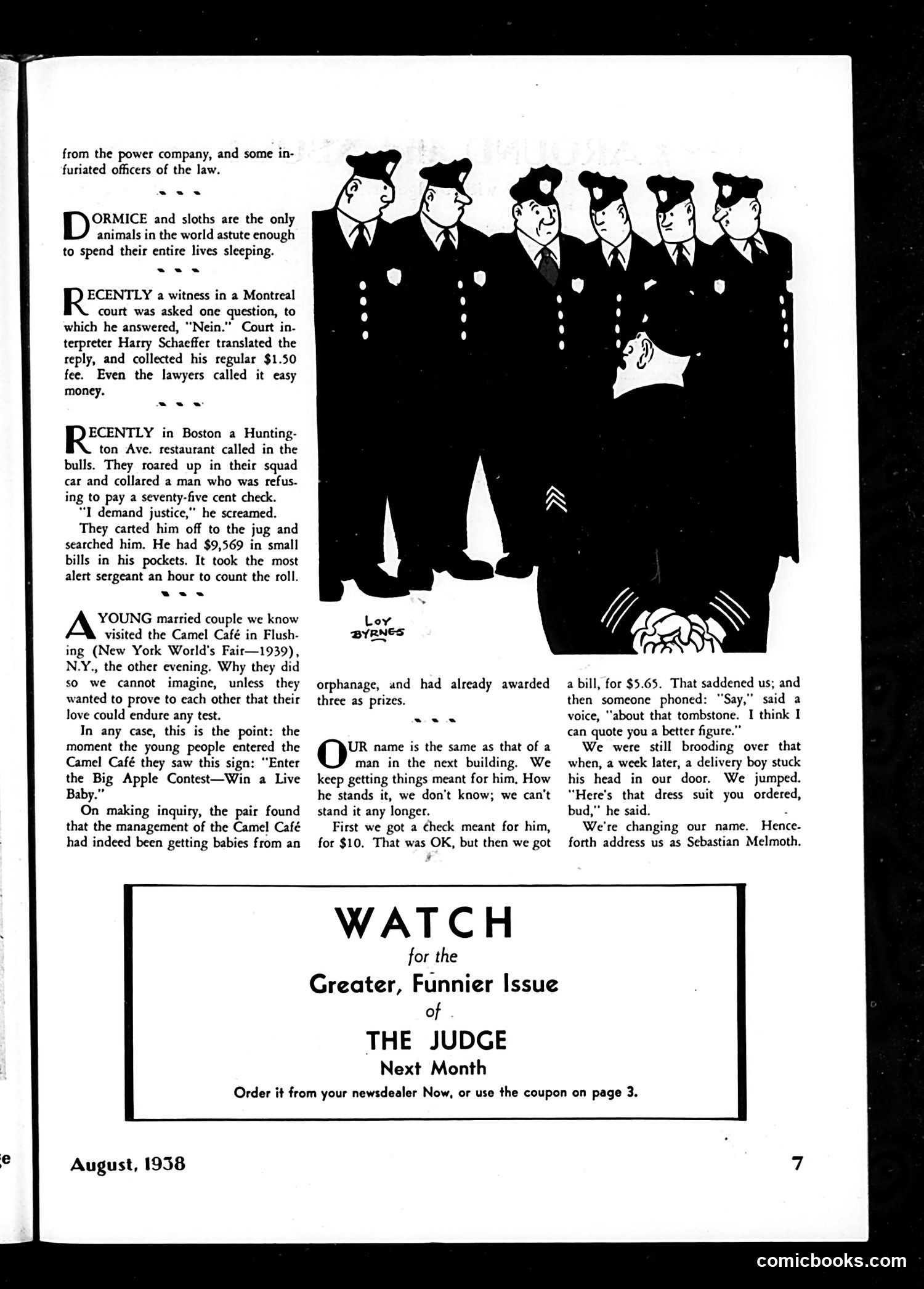
Judge Magazine, August 1938 — Page Analysis This page contains humorous anecdotes rather than political cartoons. The illustration shows six uniformed police officers (identifiable by their distinctive hats and uniforms with chevrons) with a small figure below them. The stories mock institutional absurdity: dormice sleeping constantly, a Montreal court interpreter charging $1.50 to translate a simple "Nein" (German for "no"), and Boston police officers spending an hour counting $9,569 in small bills from a man refusing to pay a 75-cent restaurant check. The final anecdote describes confusion over names and addresses—people changing their identity to "Sebastian Melmoth" after receiving an unsolicited dress delivery for "$5.65." These are lighthearted satires of bureaucratic inefficiency, legal expense, and everyday confusion—not overtly political commentary. The police illustration likely accompanies one of these stories.
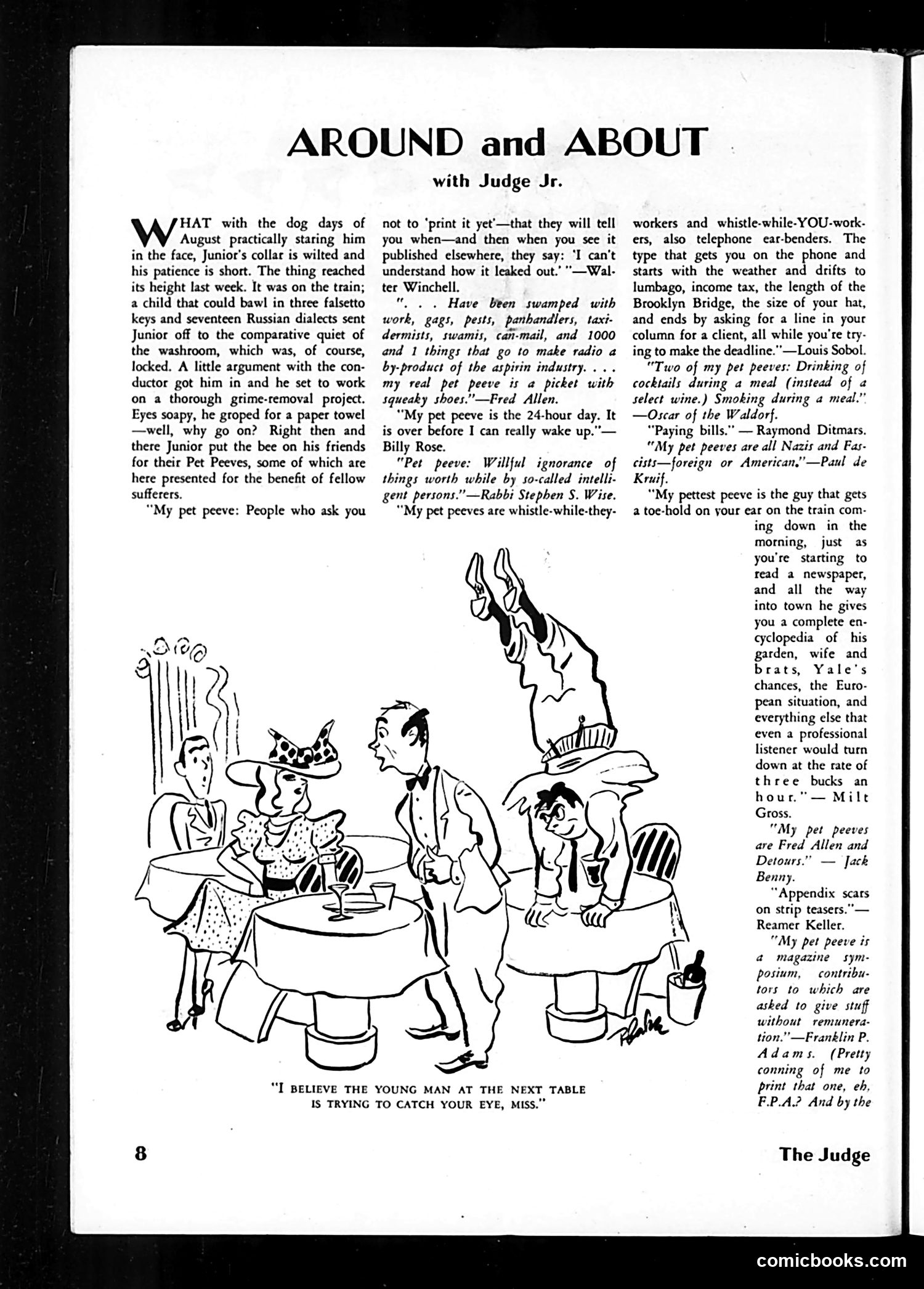
"Around and About with Judge Jr." - Pet Peeves Column This page features a humorous column collecting "pet peeves"—minor annoyances—from famous entertainers and writers of the era (likely 1930s-40s based on references). The cartoon depicts a social scene where a woman is warned that a man at another table is trying to get her attention, playing on the awkwardness of being noticed. The celebrity quotes mock everyday irritations: Walter Winchell complains about sources who demand secrecy then claim leaks; Fred Allen gripes about radio industry chaos and squeaky shoes; Billy Rose resents the 24-hour day; Rabbi Stephen Wise criticizes willful ignorance. Later contributors mention telephone bores, bill-paying, Nazis, train conversationalists, and magazine contributors working without pay. The final quote from Franklin P. Adams is self-aware humor—he jokes about complaining that magazines ask for unpaid contributions while *himself* contributing to this magazine unpaid, creating a witty recursive joke about the very medium publishing his complaint.
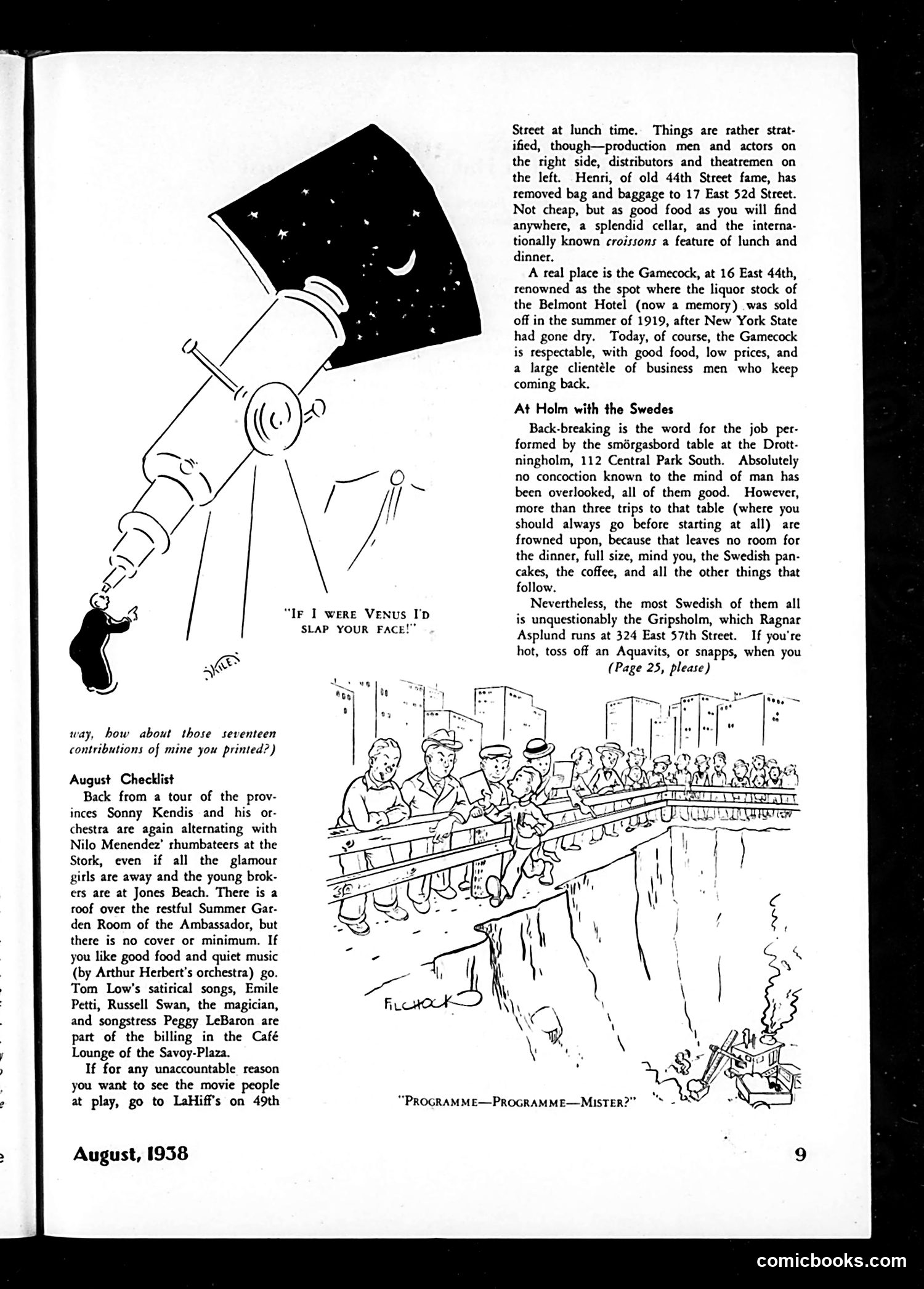
Judge Magazine, August 1938 - Page Content Analysis This page is primarily a restaurant and nightlife guide for New York City's entertainment district, not political satire. It recommends various establishments (Henri's, the Gamecock, Swedish restaurants) with details about their food, atmosphere, and clientele. The single cartoon shows a figure with an umbrella and stars, captioned "If I were Venus I'd slap your face!" — a playful, nonsensical joke with no clear satirical target. The "August Checklist" section reviews entertainment venues and performers: Sonny Kendis's orchestra, various singers and musicians performing at clubs like the Stork, Ambassador, and Savoy-Plaza. It mentions summer entertainment options for New York's leisure class. The bottom cartoon depicts people fishing near what appears to be industrial infrastructure, captioned "Programme—Programme—Mister?" — its meaning is unclear without additional context. Overall, this is lifestyle/entertainment content rather than political or social satire.
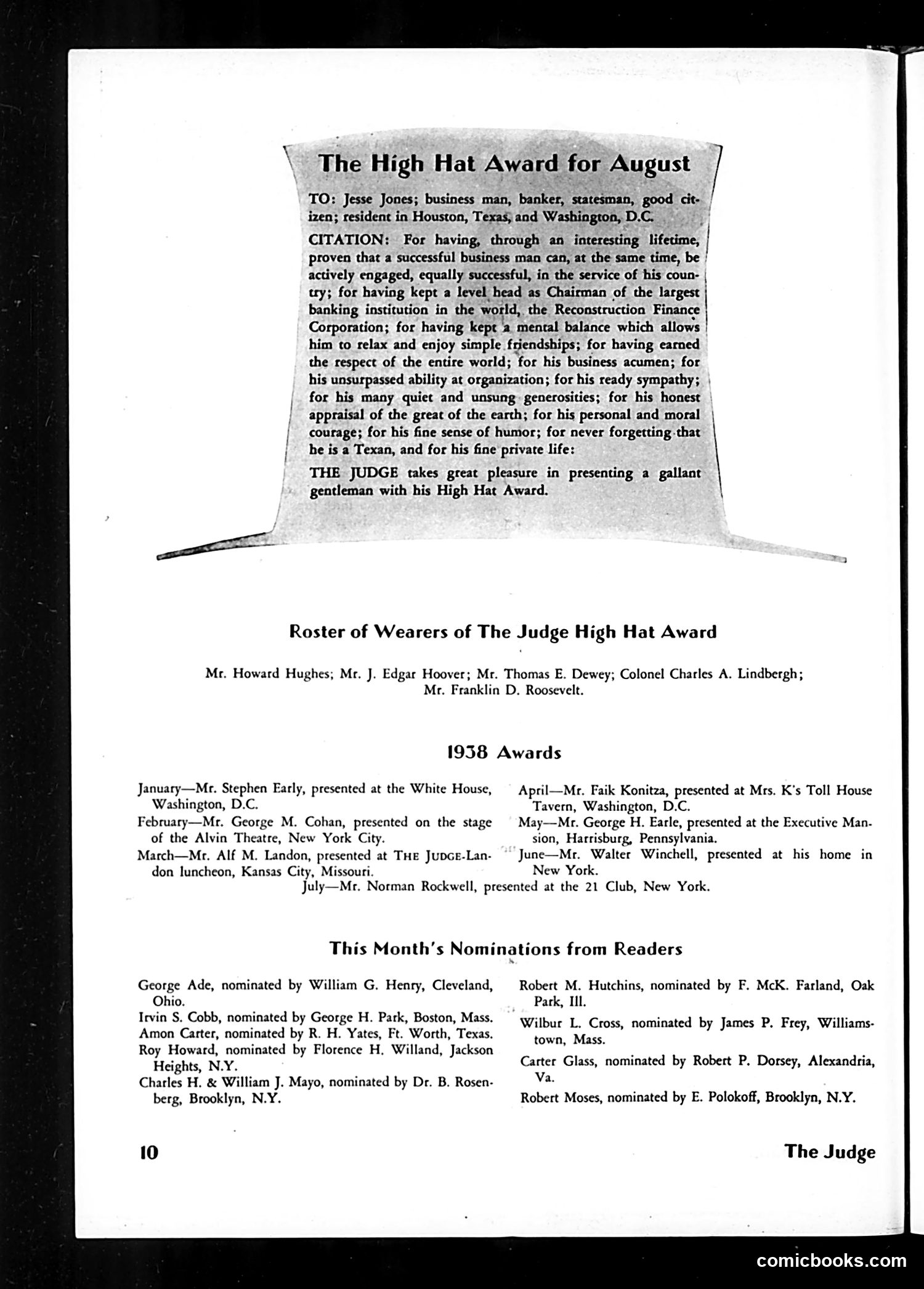
The High Hat Award for August This page presents *Judge* magazine's prestigious monthly "High Hat Award," honoring distinguished Americans. The August 1938 recipient is Jesse Jones, a prominent Houston banker and chairman of the Reconstruction Finance Corporation—a New Deal agency. The citation praises his balance of business success with public service, leadership, generosity, and integrity. The page also lists previous award recipients (including FDR, Lindbergh, and J. Edgar Hoover) and current 1938 honorees, plus reader nominations for future consideration. This isn't satire but rather *Judge*'s genuine tribute to accomplished figures. The "High Hat" metaphor suggests elite status and respectability. The award reflects the magazine's editorial values: celebrating successful, patriotic Americans who combine business acumen with civic responsibility and personal character—particularly those serving the national interest during Depression-era recovery efforts.
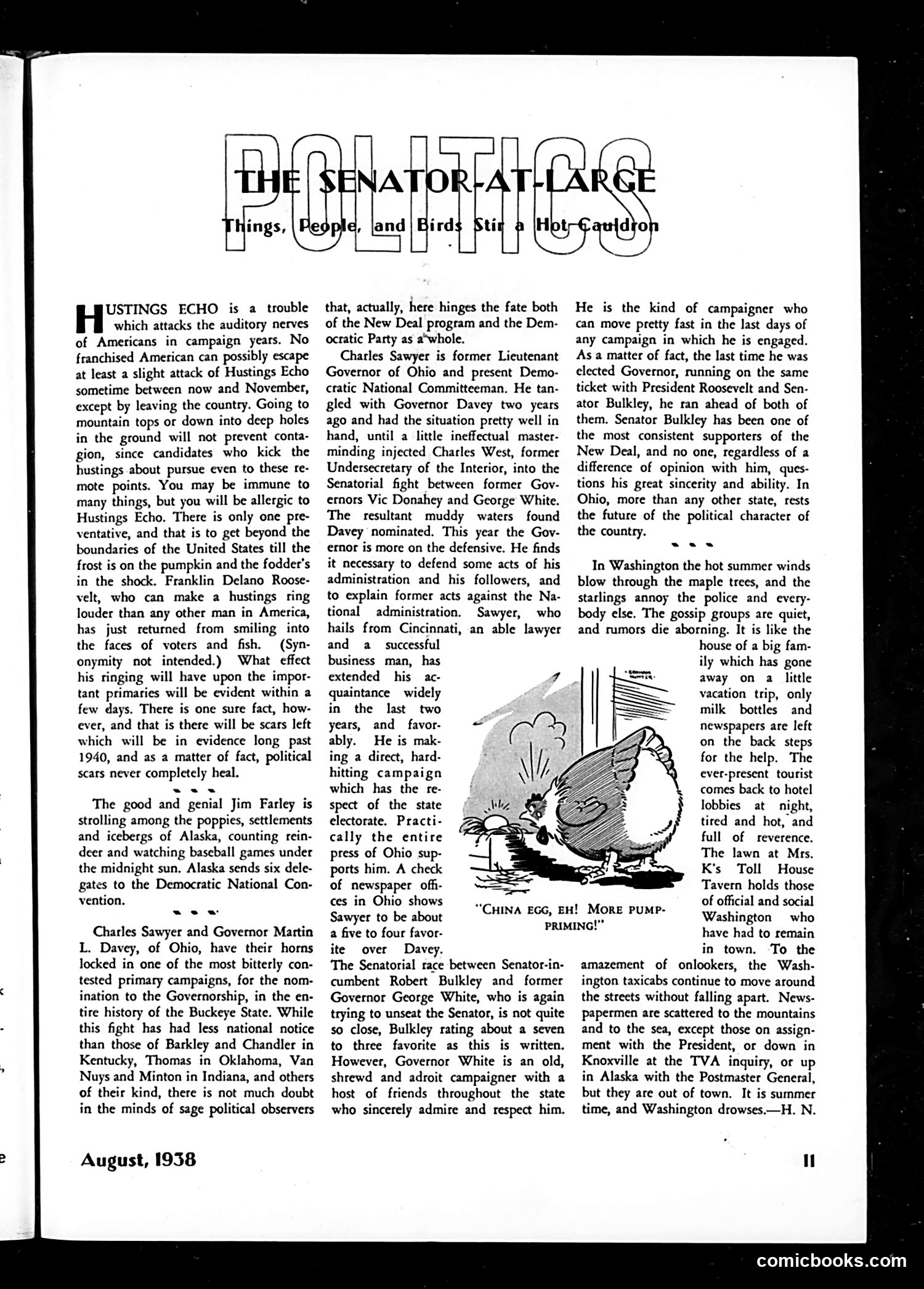
The Senator-at-Large: Political Satire from Judge, August 1938 This page discusses 1938 primary campaigns, particularly Ohio's contested Democratic races. The main cartoon depicts a figure (likely President Franklin D. Roosevelt, referenced in the text as making campaign appearances) as a cracking egg labeled "China egg," with someone saying "More priming!"—satirizing FDR's "pump-priming" economic stimulus policies. The article critiques "Hustings Echo"—the unavoidable noise of campaign season—and discusses Ohio's gubernatorial primary between Charles Sawyer and Governor Martin Davey, and the Senate race between incumbent Robert Bulkley and former Governor George White. The satire suggests these intra-Democratic fights have national significance for the New Deal's future. The cartoon implies Roosevelt's campaign interventions themselves crack under pressure, needing constant government stimulus to maintain.
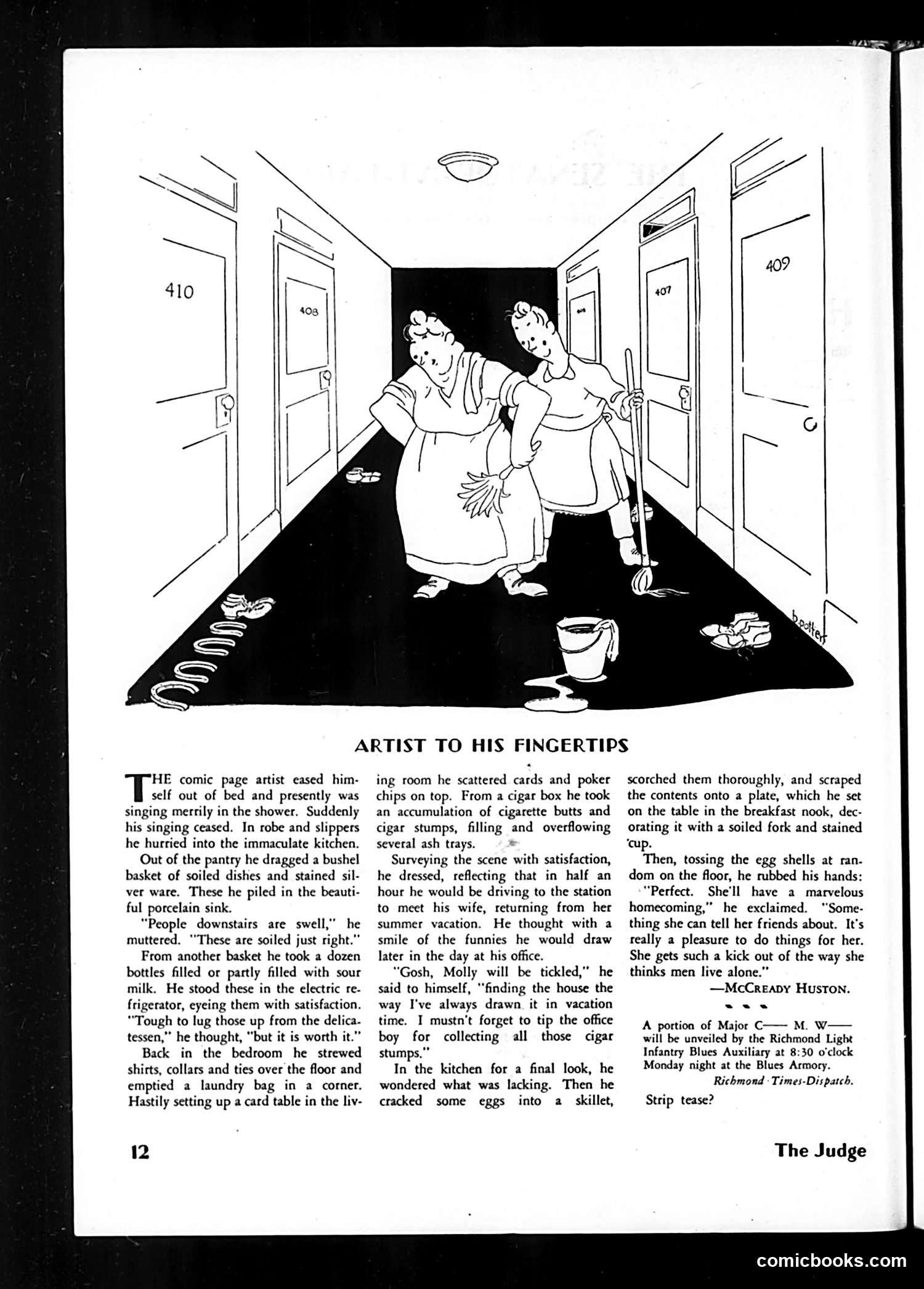
"Artist to His Fingertips" - Explanation for Modern Readers This satirical story mocks a comic strip artist who deliberately creates chaos in his home before his wife returns from vacation. The joke is ironic: he purposefully dirties the kitchen, leaves sour milk in the refrigerator, scatters clothes, sets up a messy poker game, and cooks burnt eggs—all while congratulating himself for creating the "perfect" homecoming. The satire targets two things: (1) the artist's assumption that his wife will find his slovenliness amusing because he draws it that way in his comic strip, and (2) broader assumptions about bachelor messiness. The punchline reveals his delusion—he thinks recreating the chaotic bachelor lifestyle from his cartoons will entertain his returning wife, when obviously she'll be dismayed. The accompanying newspaper clipping's cryptic "Strip tease?" appears to be an editor's joke, playing on the phrase "strip" (comic strip) for added wordplay.
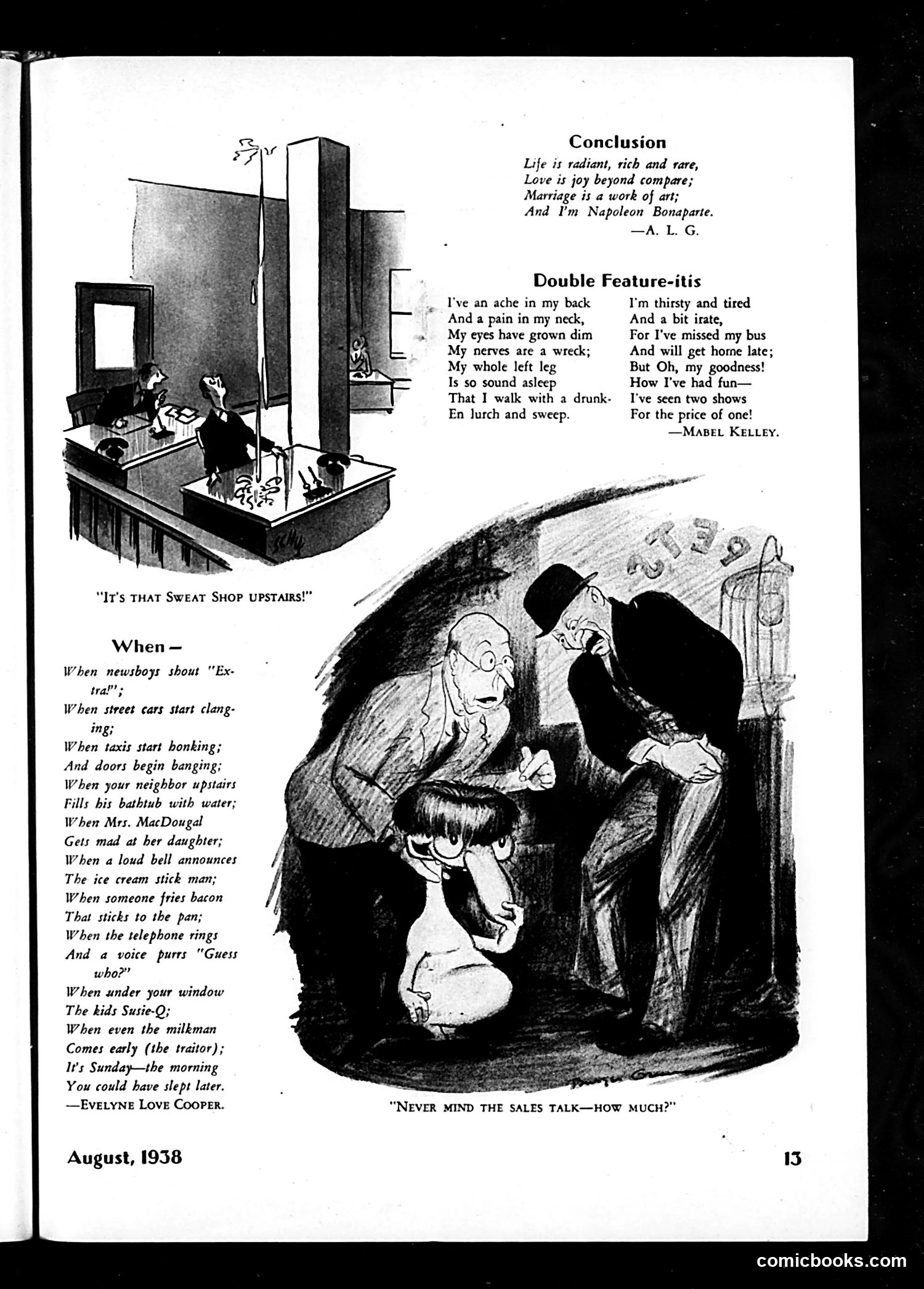
Judge Magazine, August 1938 - Page Analysis This page contains humorous verse and illustrations satirizing urban 1930s American life: "Double Feature-itis" mocks moviegoers' exhaustion from watching two films consecutively—a common Depression-era entertainment practice offering value. The poem catalogs physical ailments (sore back, dim eyes, numb leg) suffered from prolonged sitting, yet the patron considers it worthwhile entertainment. "When—" by Evelyne Love Cooper satirizes urban apartment living's constant noise pollution: neighbors' plumbing, street traffic, hawking vendors, crying children, and ringing phones. The poem's punchline reveals it's Sunday morning—the one day someone could sleep in, but can't due to this relentless urban cacophony. The cartoon (captioned "Never mind the sales talk—how much?") depicts a woman dismissing a salesman's pitch, cutting through Depression-era commercial rhetoric to demand only the price—suggesting consumer wariness and economic hardship. All three pieces humorously document ordinary working-class frustrations during the 1930s economic downturn.
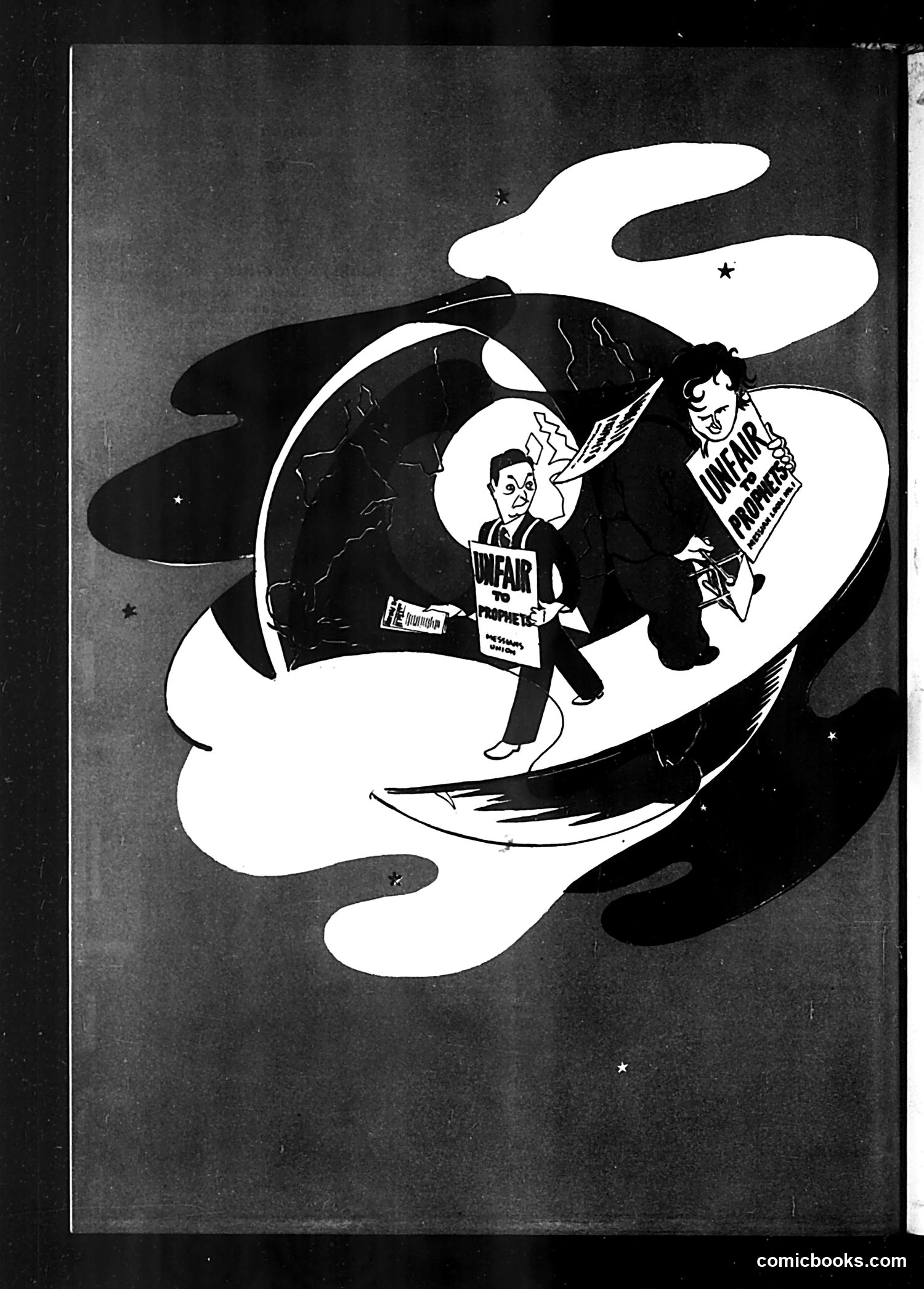
Political Cartoon Analysis This black-and-white satirical illustration from *Judge* magazine depicts two figures inside a large rabbit's head against a starry background. Both figures hold signs reading "UNFAIR" (one adds "TO PROPHETS"). The cartoon appears to be criticizing magicians or illusionists—specifically the famous "rabbit from a hat" trick. The satire likely mocks either fraudulent fortune-tellers/prophets or magicians who deceive audiences. The rabbit imagery suggests exposing a magic trick as unfair deception. Without a clear date or caption visible, the specific political target remains unclear, though it appears to critique charlatans or those making false promises to the public. The surreal, dreamlike composition emphasizes the illusory nature of the subjects being attacked.
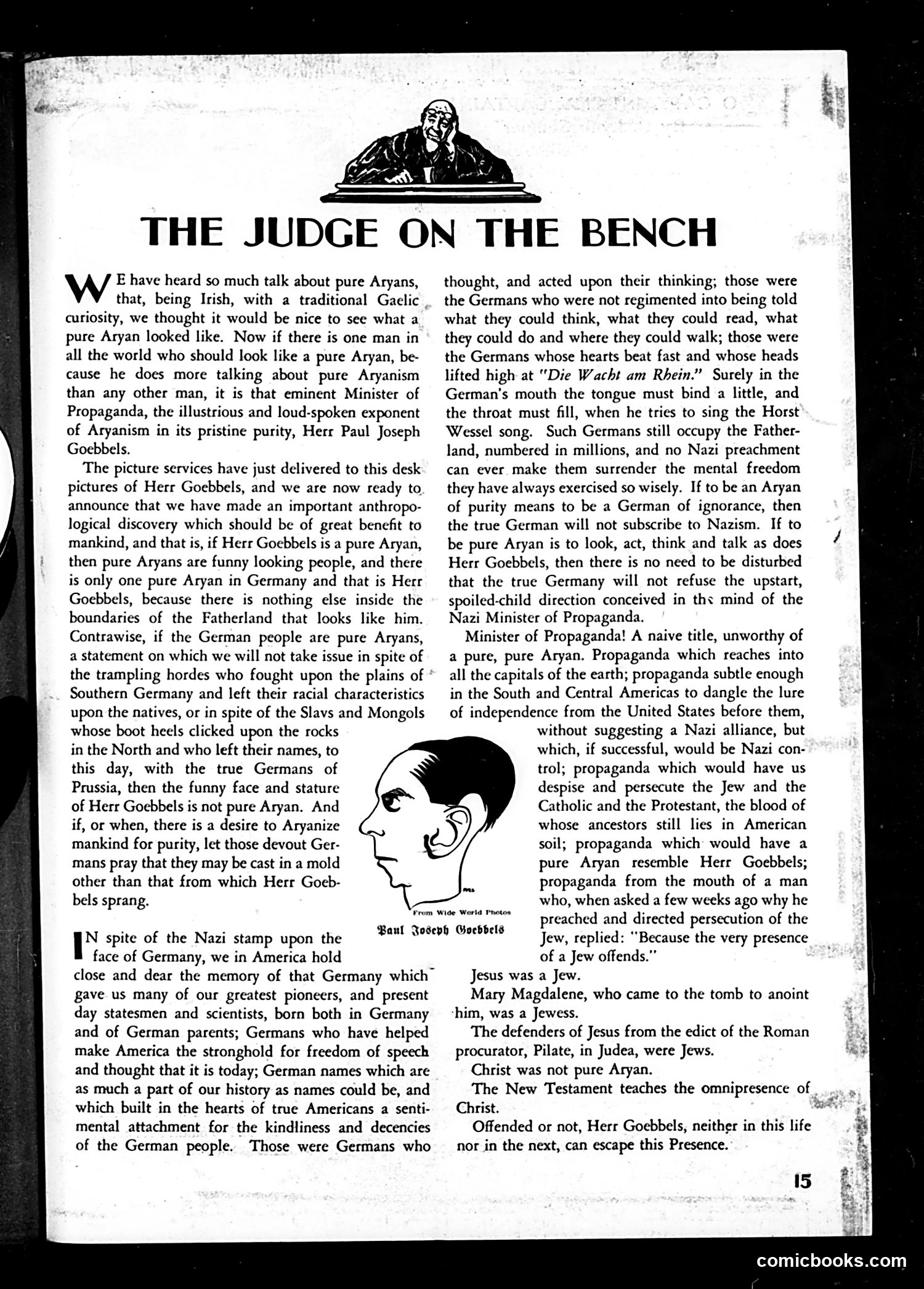
"The Judge on the Bench" — Satirizing Nazi Racial Ideology This editorial cartoon mocks Nazi Germany's propaganda minister Paul Joseph Goebbels and the regime's obsession with "pure Aryan" racial purity. Judge magazine's satirical argument: if Goebbels—the Nazi's loudest advocate for Aryanism—represents a "pure Aryan," then pure Aryans must be "funny looking people." The caricature (visible in profile) emphasizes Goebbels's physical features in a deliberately unflattering way to undermine Nazi racial theories. The piece attacks Nazi propaganda generally, criticizing its reach into the Americas and its efforts to corrupt German-American cultural memory. It distinguishes between Germans who built America through freedom of thought versus those now enslaved by Nazi ideology. The author appeals to pre-Nazi German cultural heritage ("Die Wacht am Rhein") while denouncing the current regime's "spoiled-child direction." This is anti-Nazi satire written for American readers who still maintained some nostalgia for pre-Nazi Germany.
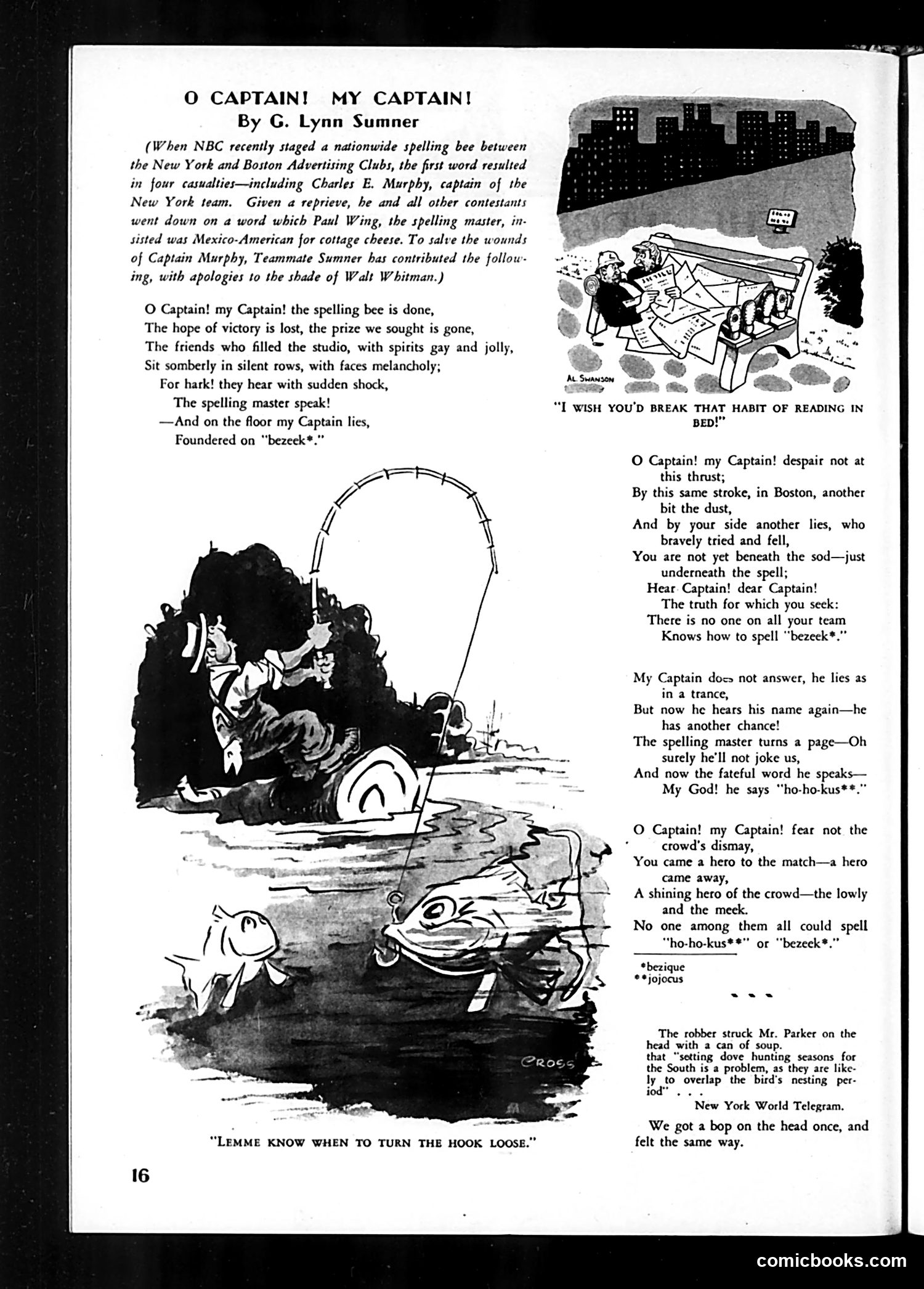
"O Captain! My Captain!" — Judge Magazine This page parodies Walt Whitman's Civil War poem using a 1930s spelling bee mishap. NBC staged a competition between New York and Boston advertising clubs; New York's captain, Charles E. Murphy, failed on the word "bezique" (a card game). The poem humorously reimagines this defeat as tragedy, comparing Murphy's spelling failure to a soldier falling in battle. The cartoons mock both the spelling bee and Murphy's humiliation. One illustration shows fishing—a visual pun on "letting the hook loose" after catching fish, paralleling the spelling master's role. Another depicts someone reading in bed, unrelated to the main satire. The satire targets the absurdity of treating a trivial advertising-club competition with mock-heroic grandeur, while poking fun at Murphy's public embarrassment. The footnotes reveal the "difficult" words were actually obscure or nonsensical, emphasizing the bee's ridiculousness.
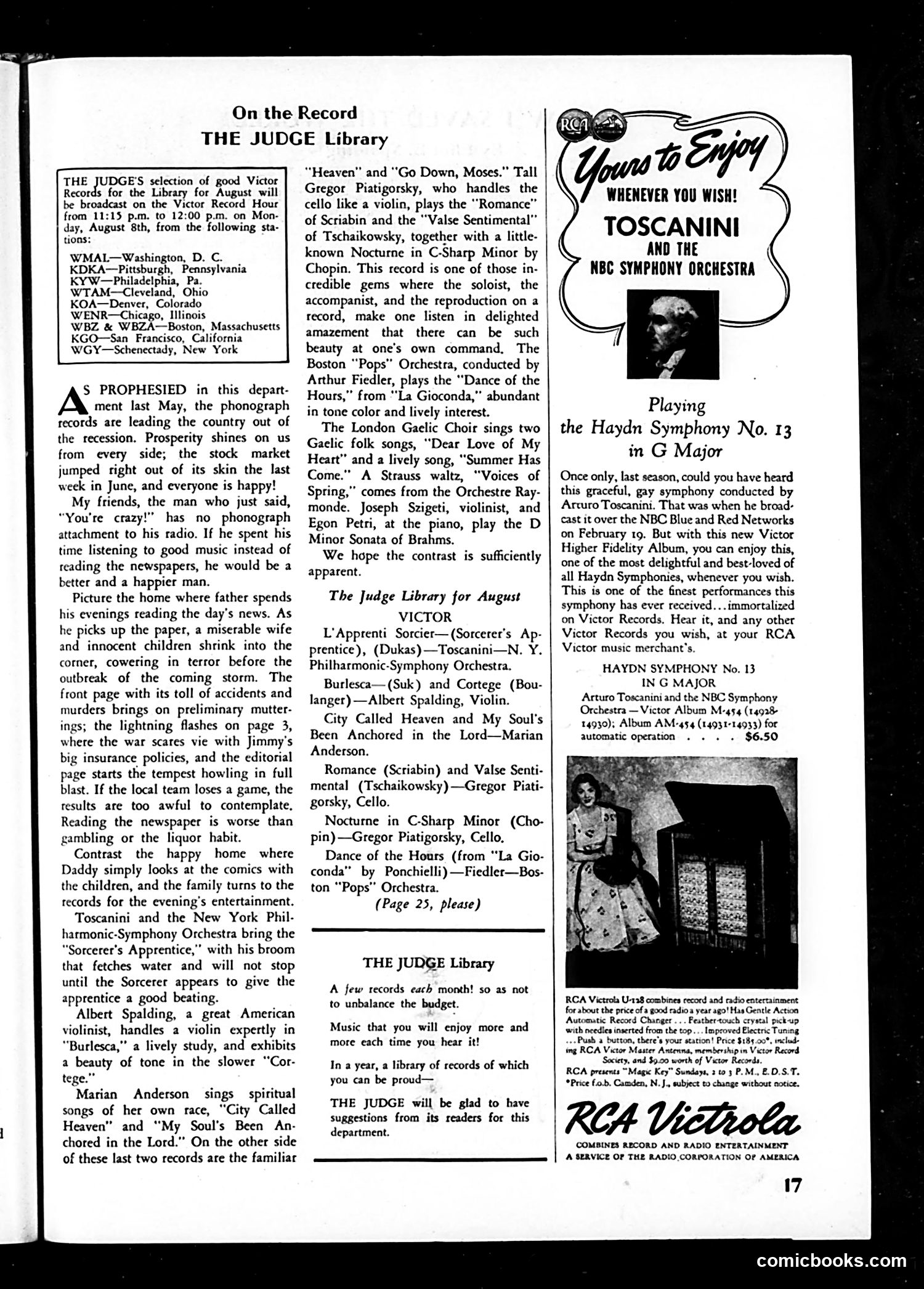
"On the Record: The Judge Library" — August 1924 This page is primarily promotional content and record reviews, not satire. Judge magazine's editor is recommending Victor Records for August listening, to be broadcast on a radio program across multiple stations. The satirical *argument* is embedded in the editorial text: reading newspapers causes family anxiety and domestic misery, while listening to classical music records creates harmony and happiness. The author contrasts the "miserable wife and innocent children" cowering as father reads bad news against the "happy home" where the family enjoys music together instead. The featured performers—Toscanini, Marian Anderson, Albert Spalding—were prominent classical musicians of the era. Anderson, notably, was an African American opera singer during the Jim Crow era. The satire is gentle social commentary: blaming newspapers for unhappiness and promoting recorded music as the antidote to modern anxiety—a pitch disguised as cultural criticism.
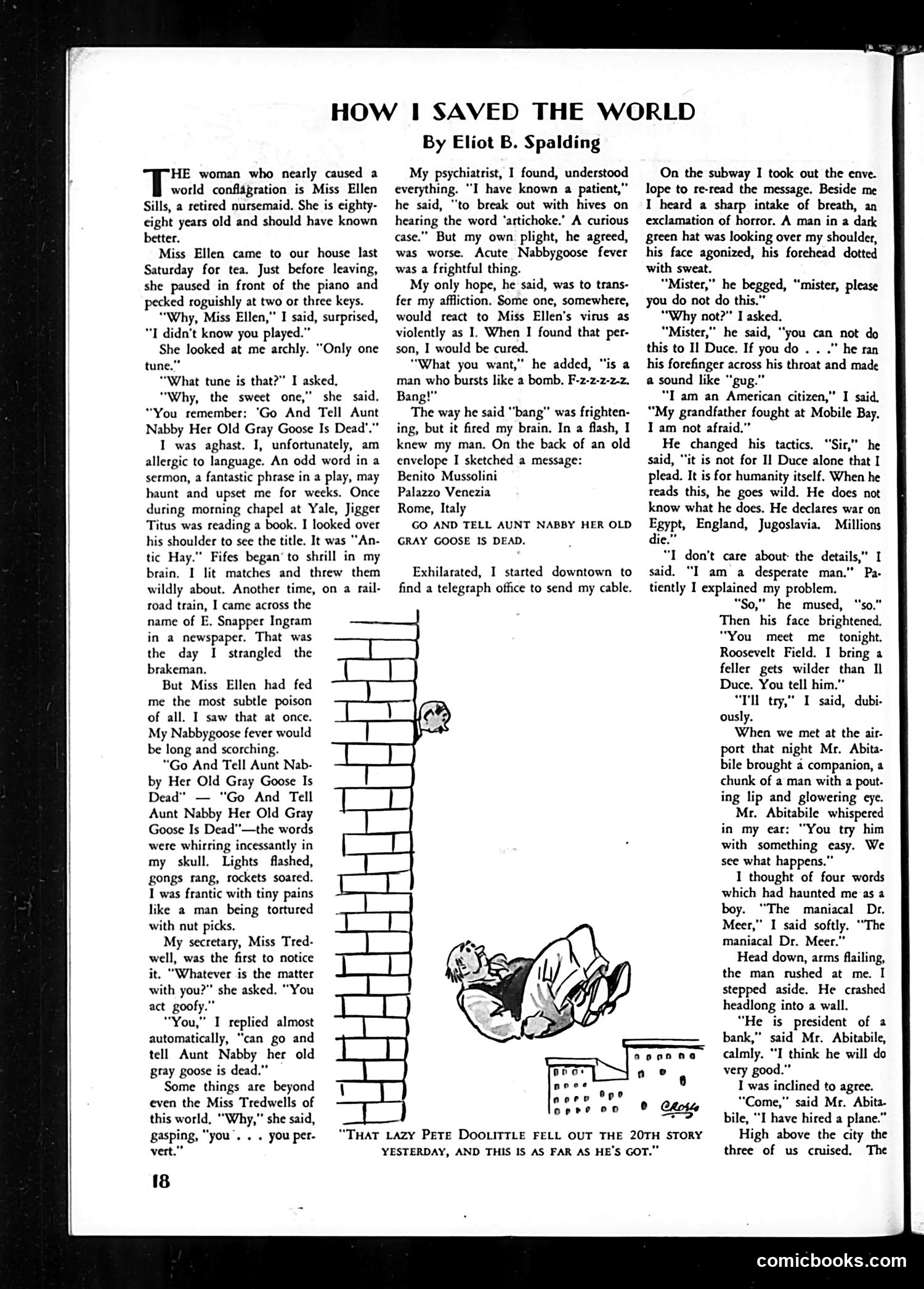
"How I Saved the World" - Judge Magazine Satire This is a humorous story satirizing both obsessive-compulsive behavior and contemporary fears about international conflict, likely from the 1930s based on references to Mussolini. The narrator becomes mentally tormented by the nursery rhyme "Go And Tell Aunt Nabby Her Old Gray Goose Is Dead" after hearing it casually. Following psychiatric advice to "transfer" his affliction, he decides to cable the phrase to Benito Mussolini in Rome, reasoning that Mussolini will become obsessed instead. On the subway, an Italian man (presumably a Fascist diplomat or agent) discovers the plan and desperately begs him not to send it, warning that Mussolini will "go wild" and declare war on multiple nations. The joke mocks both the narrator's absurd logic and contemporary anxiety about Mussolini's unpredictability and aggressive tendencies during the pre-WWII era. It's dark humor suggesting that world peace is precariously dependent on random, trivial factors.
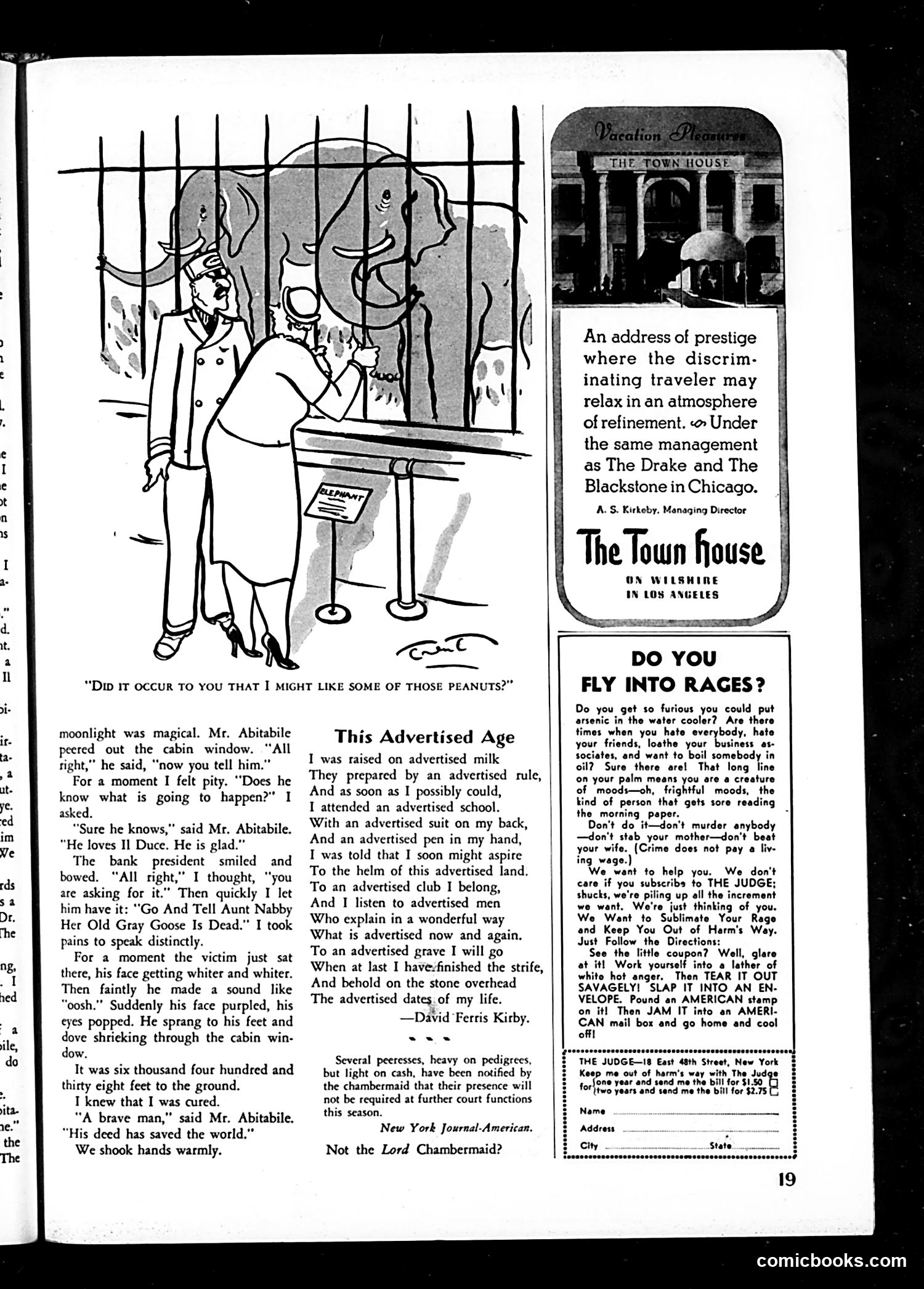
Explanation for Modern Readers This page contains two main satirical pieces: "The Advertised Age" (poem by David Ferris Kirby): A critique of pervasive consumer advertising in 1920s-30s America. The satire traces a person's entire life—from advertised milk in infancy through advertised school, employment, and finally an advertised grave—mocking how advertising has infiltrated every aspect of existence. The point: modern life has become wholly commercialized, with advertising dictating choices from cradle to grave. "Do You Fly Into Rages?" (advertisement parody): The Judge magazine itself satirizes anger-management through tongue-in-cheek self-promotion. It humorously suggests readers' violent impulses ("murder anybody," "stab your mother") can be sublimated by angrily tearing up a subscription coupon and mailing it—essentially mocking both the premise of anger-management advice and the magazine's own advertising tactics. The cartoon above depicts a bar scene; the caption suggests offering peanuts to an unseen figure, though the specific reference remains unclear without additional context.
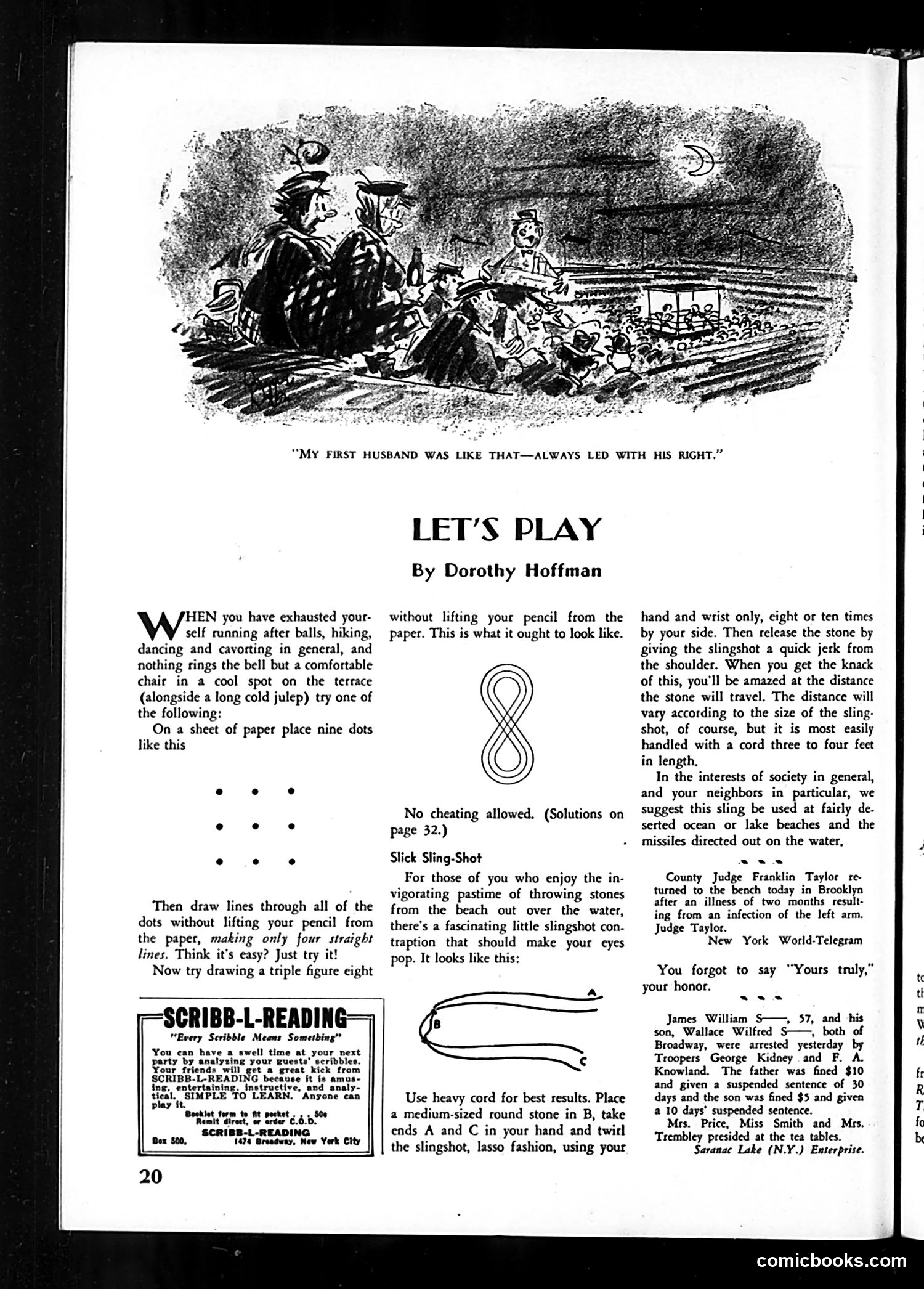
"Let's Play" - Judge Magazine Content Analysis This page from *Judge* presents recreational activities by Dorothy Hoffman aimed at idle wealthy people. The cartoon at top depicts a woman recalling her first husband "always led with his right"—likely a boxing or dominance reference, establishing a humorous tone about marital dynamics. The main content offers three pastimes for the leisured class: 1. Pencil puzzles (nine dots, triple figure-eight)—mental diversions for the bored 2. Slingshot construction—a homemade toy for stone-throwing 3. Scribbl-Reading advertisement—a parlor game analyzing handwriting for personality assessment The satirical edge targets upper-class leisure culture and frivolous entertainment. The closing note wryly suggests slingshots be used at "deserted" beaches "in the interests of society"—gently mocking wealthy people's potential nuisance to others. The page's miscellaneous news items (judge returning to work, arrests, tea party) appear standard filler rather than satirical commentary.
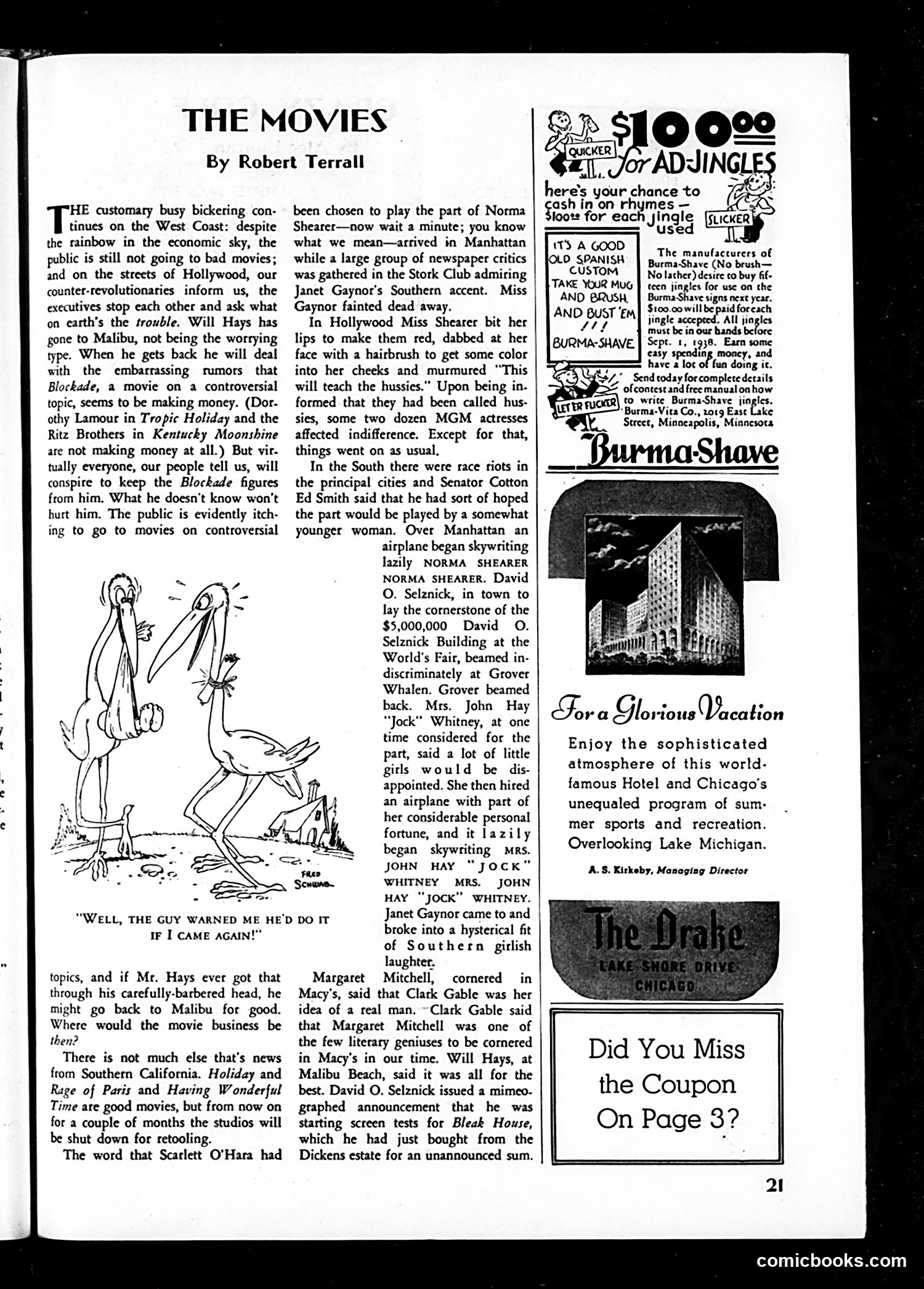
"The Movies" - Robert Terrall's Hollywood Satire This column mocks Hollywood's internal politics around casting *Gone with the Wind*. The key tension: Norma Shearer (a major MGM star) was being considered for Scarlett O'Hara, but the role ultimately went to an unknown actress (Vivien Leigh, though unnamed here). Terrall satirizes the absurd reactions—Shearer biting her lips and using a hairbrush to simulate the appearance of being flustered; MGM actresses pretending indifference; wealthy socialite Mrs. "Jock" Whitney skywriting her own name in response. He mocks Will Hays (Hollywood's censor) for conveniently avoiding the drama in Malibu. The column also critiques Hollywood's moral guardianship: executives are conspiring to hide that *Blockade* (a film about the Spanish Civil War) is profitable—a controversial topic they want suppressed from Hays. The crude cartoon shows two caricatured figures in an exaggerated argument, illustrating the petty bickering the column describes.
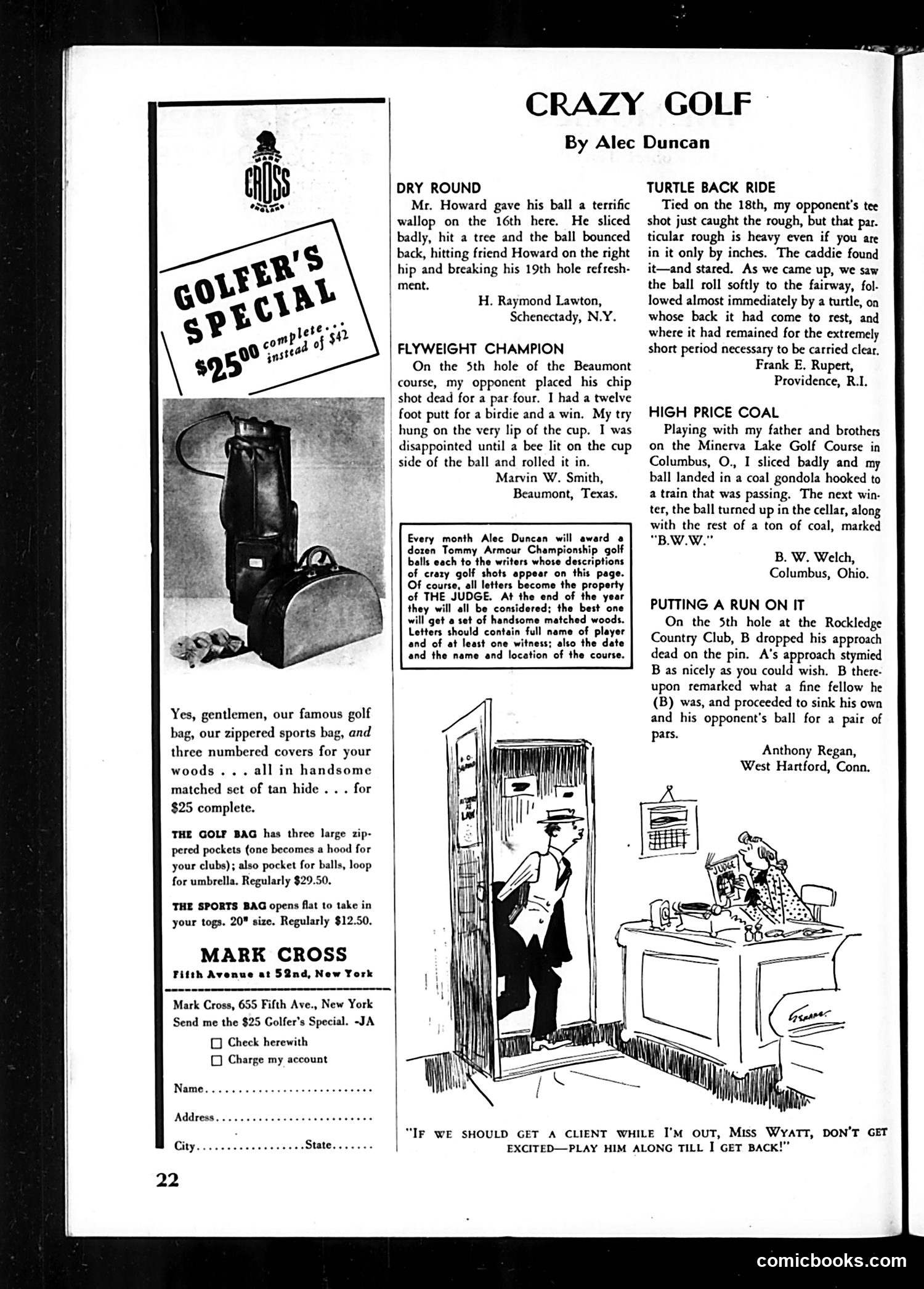
"Crazy Golf" Page Analysis This page from *Judge* magazine features a humorous column collecting readers' submissions about absurd golf incidents. The "Crazy Golf" feature by Alec Duncan invites readers to submit stories of bizarre or impossible golf moments—balls bouncing off players, insects rolling balls into cups, golf balls traveling via turtle or coal train—with prizes of golf equipment awarded monthly. The page also advertises Mark Cross luxury golf bags ($25 complete), targeting affluent golfers. The cartoon at bottom depicts an office manager instructing his secretary not to turn away potential clients while he's absent, suggesting casual indifference to business. This satirizes workplace inefficiency or the relaxed attitudes of some businessmen during this era (appears to be 1920s-30s based on style and typography). The overall content reflects the leisure interests and consumer culture of prosperous American readers.
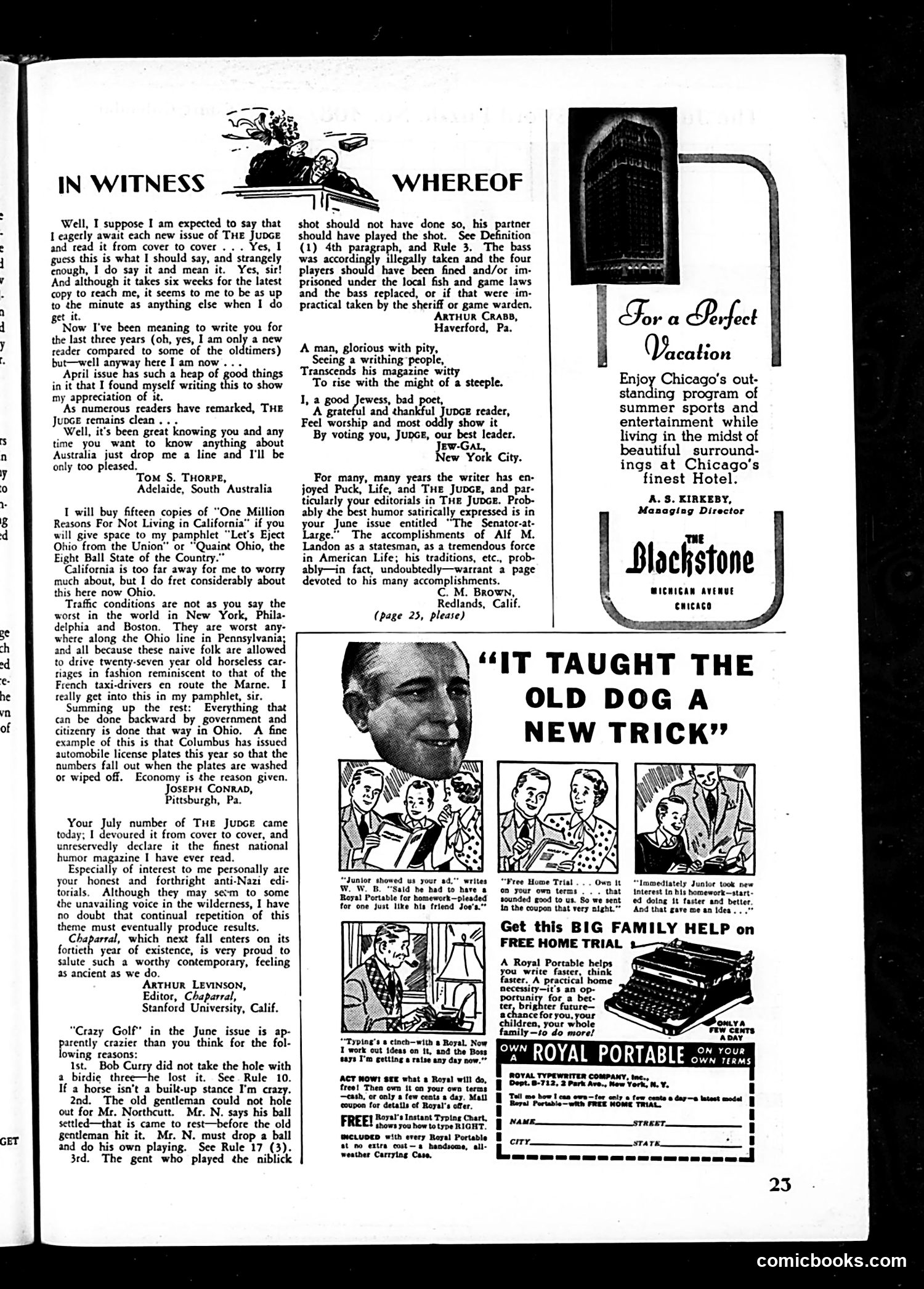
Analysis This page consists primarily of reader letters to *Judge* magazine, not political cartoons. The "In Witness Whereof" header is a humorous framing device. The letters praise *Judge's* humor and satirical content. Notable references include: - A complaint about Ohio's backward governance and dangerous old automobiles on roads - Praise for a June *Judge* article titled "The Senator-at-Large" satirizing Alf Landon (the 1936 Republican presidential candidate) and his accomplishments—the writer sarcastically suggests Landon's record "undoubtedly" warrants editorial praise The Landon reference dates this to 1936. The letters represent typical reader appreciation mail to a satirical magazine. The page also contains advertisements: a Chicago hotel ad and a Royal Portable typewriter promotion featuring a family use scenario ("It Taught the Old Dog a New Trick"). No significant political satire appears here—it's essentially a letters column with ads.
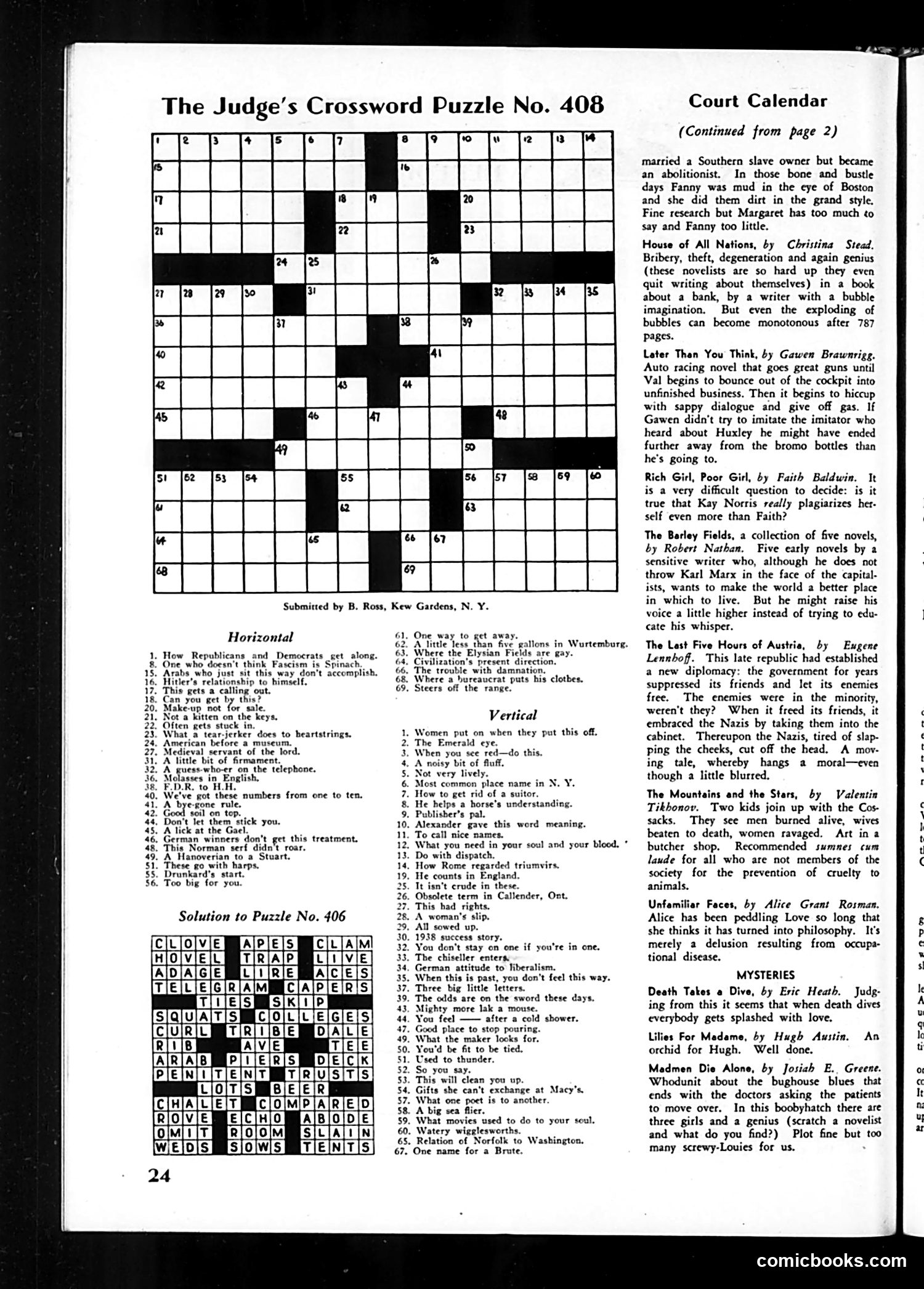
Analysis of Judge Magazine Page No. 408 This page consists primarily of a crossword puzzle with literary/cultural clues, not a political cartoon. The clues are satirical wordplay targeting 1930s American culture and politics. Notable references include: - "How Republicans and Democrats get along" — suggests partisan conflict - "Hitler's relationship to himself" — Nazi self-aggrandizement - "Civilization's present direction" — implies decline or negative trajectory (likely referencing economic depression or fascism's rise) - "German winners don't get this treatment" — appears to reference Nazi treatment of enemies or conquered peoples The page also features book reviews critiquing contemporary novels with Judge's characteristic snark—mocking pretentious writing, bubble-headed plots, and self-plagiarizing authors like Faith Baldwin. The overall tone reflects Judge magazine's satirical purpose: poking fun at political dysfunction, European fascism, American cultural pretension, and literary mediocrity during the late 1930s era.
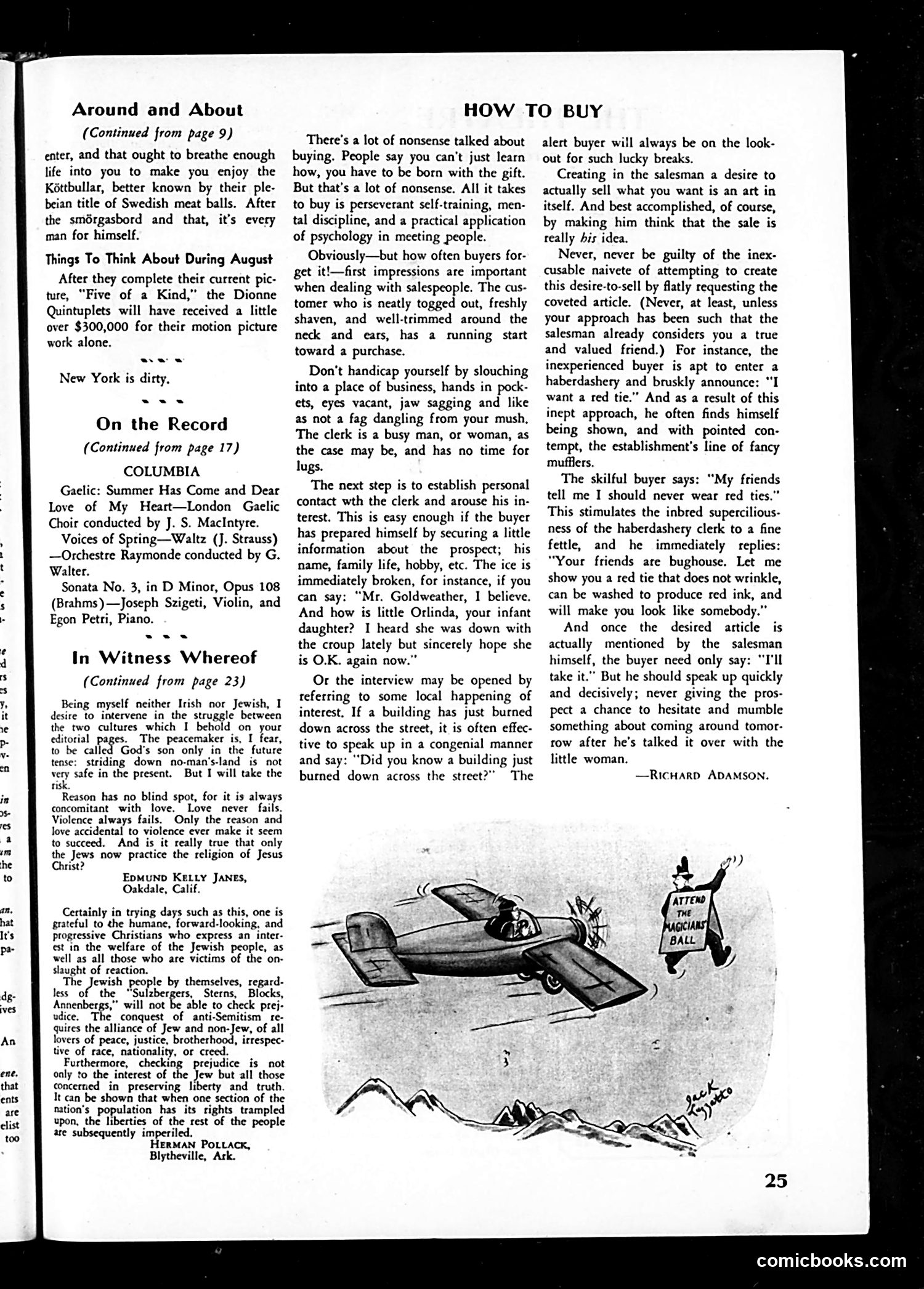
Cartoon Analysis: Judge Magazine Page This page contains two distinct sections: Main Content: A satirical article titled "How to Buy" offers tongue-in-cheek advice on retail purchasing, emphasizing personal grooming, establishing rapport with salesclerks, and psychological manipulation. The tone is humorous mockery of business self-help literature popular in the era. The Cartoon: Shows an airplane labeled "ATTEND THE MACARONI BALL" flying over mountains. The cartoon appears to reference a social event (likely the Macaroni Ball, a real high-society gathering), satirizing wealthy elites attending fancy balls while presumably more pressing concerns exist. The crude drawing style and the juxtaposition of leisure activities suggests social commentary on class disparities. Letters Section ("In Witness Whereof"): Readers debate anti-Semitism and interfaith cooperation, reflecting 1930s-era tensions around prejudice and religious tolerance—serious editorial content contrasting with the page's lighter material above. The page blends satire, advice humor, social commentary, and reader debate typical of Judge's format during this period.
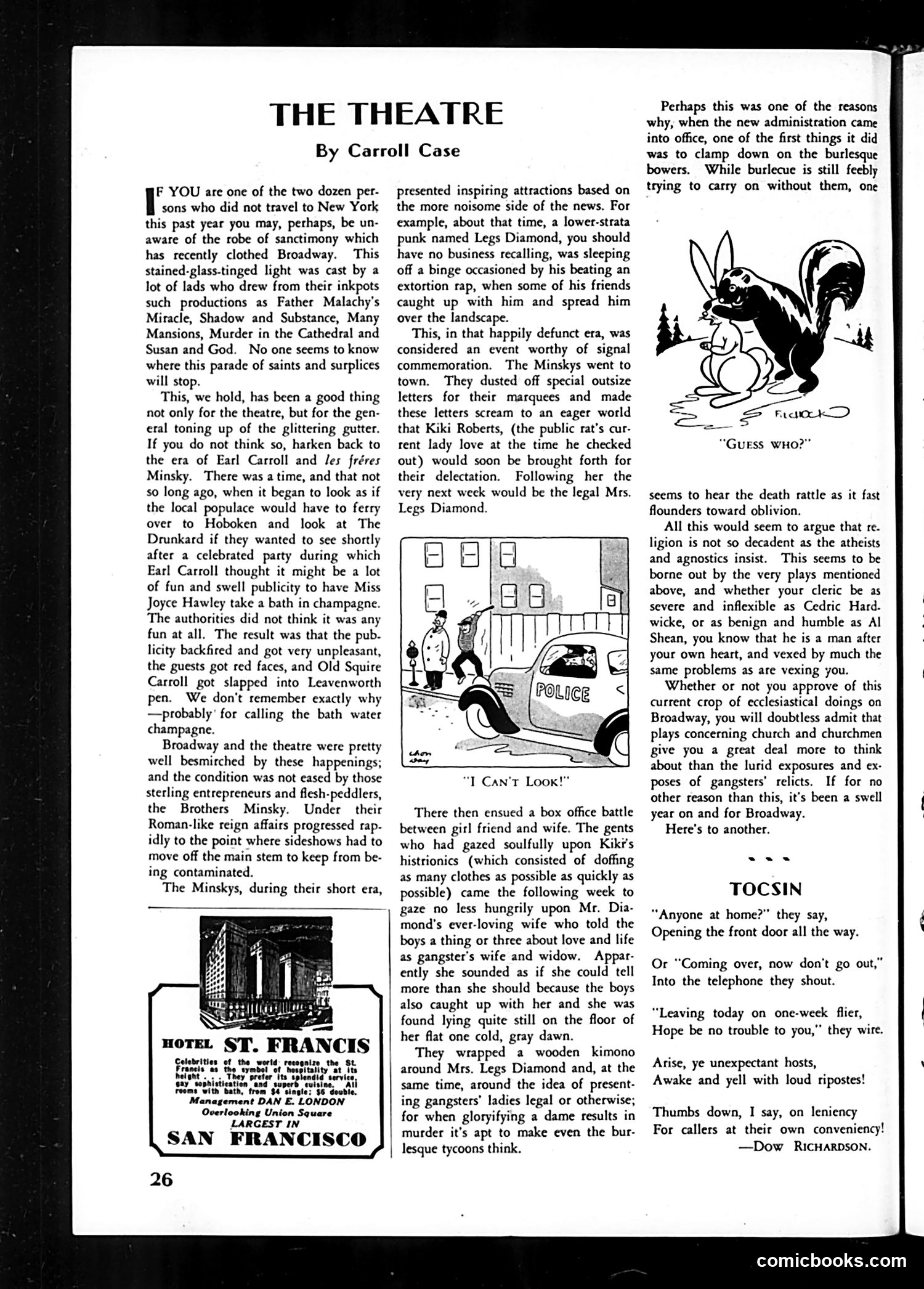
Analysis for Modern Readers Carroll Case's theater column contrasts Broadway's recent "moral uplift" with its seedier past. He celebrates that religious-themed plays (*Murder in the Cathedral*, *Father Malachy's Miracle*) have replaced burlesque and scandal-mongering entertainment. The main cartoon depicts the Legs Diamond murder case: a notorious 1931 gangster killing where his girlfriend Kiki Roberts and estranged wife both became tabloid sensations. The Minsky brothers (burlesque impresarios) had exploited this crime for box-office profit, advertising both women performers as draws. Case argues this sordid era—when burlesque theaters capitalized on real violence and gangsters' associates—damaged Broadway's reputation. The new religious plays represent cultural improvement. The cartoon's joke ("I Can't Look!") shows a police officer averting his eyes from the crime scene, suggesting moral disgust. Case concludes this moral cleanup likely influenced city authorities to finally clamp down on burlesque's worst excesses.
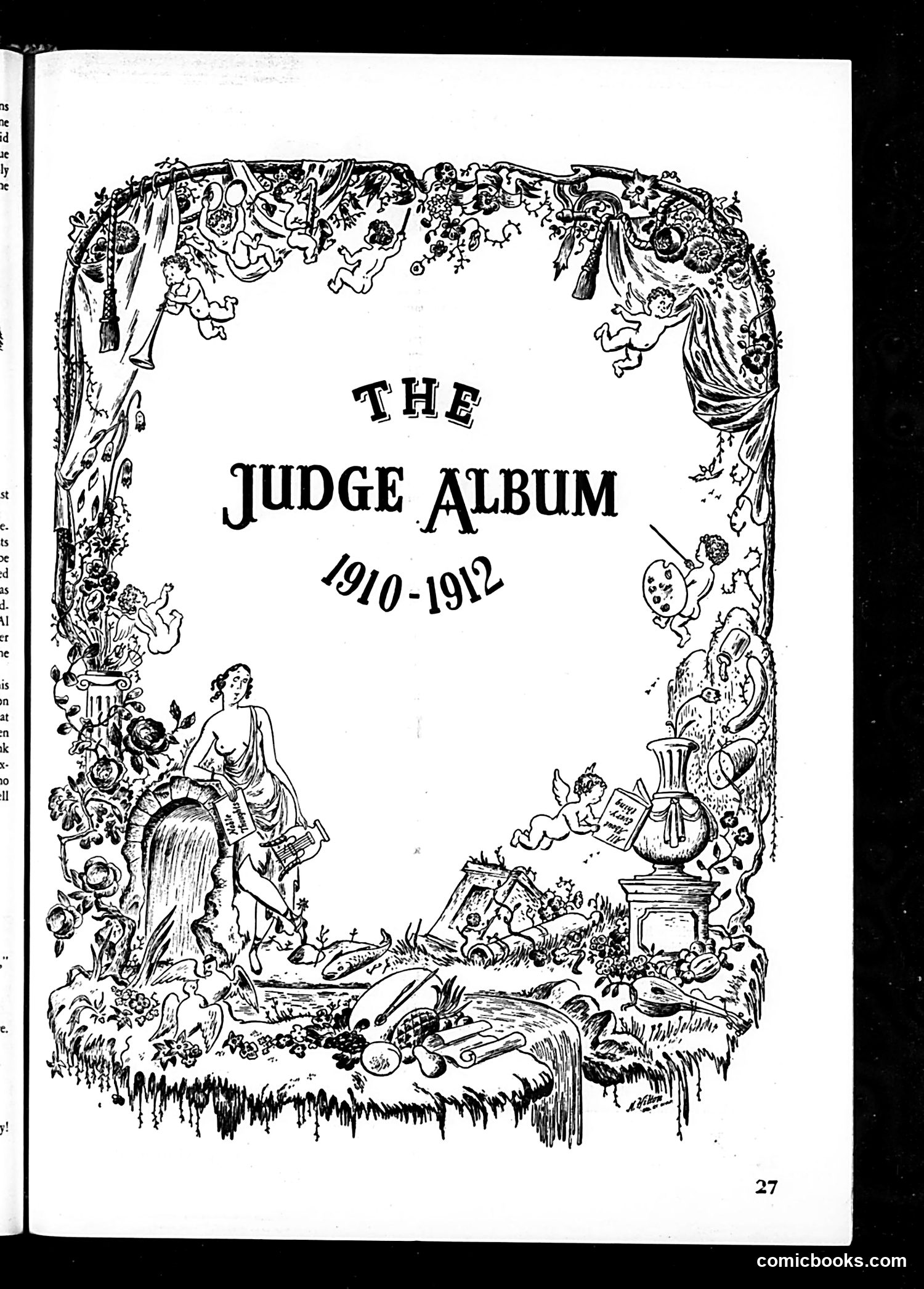
This is the title page for "The Judge Album 1910-1912," a collection from Judge magazine. The ornate decorative border features classical and allegorical imagery typical of early 20th-century design—cherubs, flowing fabrics, artistic implements, books, and a seated female figure representing Justice or Art. The elaborate frame suggests the magazine's self-presentation as sophisticated satirical commentary on contemporary American life and politics. The page itself contains no specific political cartoon or social satire—it's purely a cover design announcing the collected contents from those years. The decorative elements reflect Judge's positioning as an upscale humor publication aimed at educated readers, distinct from more working-class comic publications of the era. This was a period spanning the late Taft administration through early Wilson presidency.
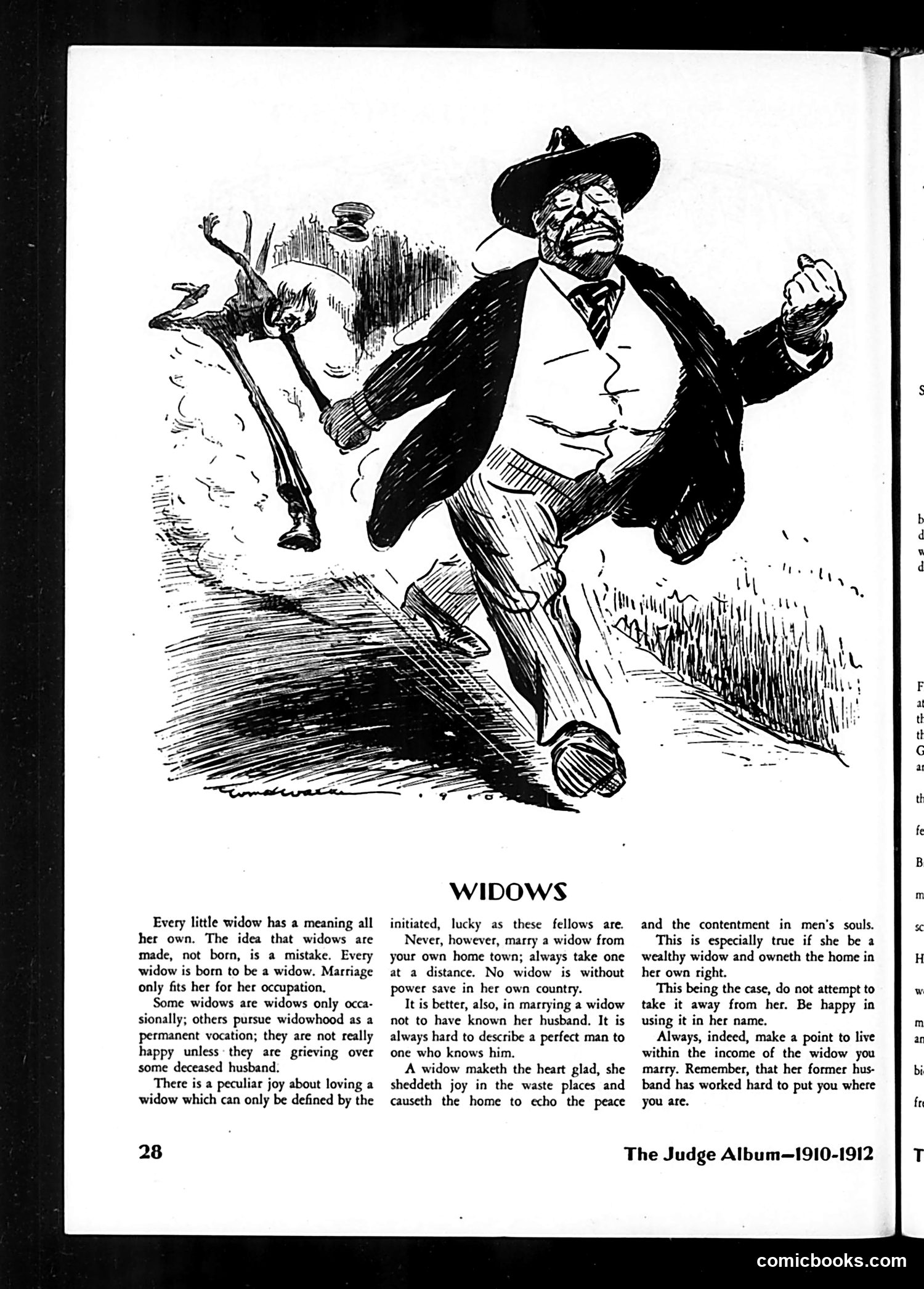
Analysis of "Widows" from The Judge (1910-1912) This page combines a cartoon with satirical prose commentary on widows and remarriage. The illustration depicts a man (appears to be a prospective husband or suitor) energetically pursuing or fleeing from a widow, with exaggerated physical comedy typical of early 1900s humor. The text offers tongue-in-cheek "advice" reflecting early 20th-century social attitudes: it mocks the stereotype that widows are naturally inclined toward remarriage, jokingly suggests marrying a wealthy widow from out of town (to avoid comparisons to her deceased husband), and advises husbands to live off the widow's inherited wealth rather than their own earnings. The satire targets both widows' remarriage prospects and men's mercenary attitudes toward wealthy wives. The "wisdom" presented—particularly the notion that widows possess inherent advantages and that marrying them for money is acceptable—reflects period gender and class dynamics with obvious irony.
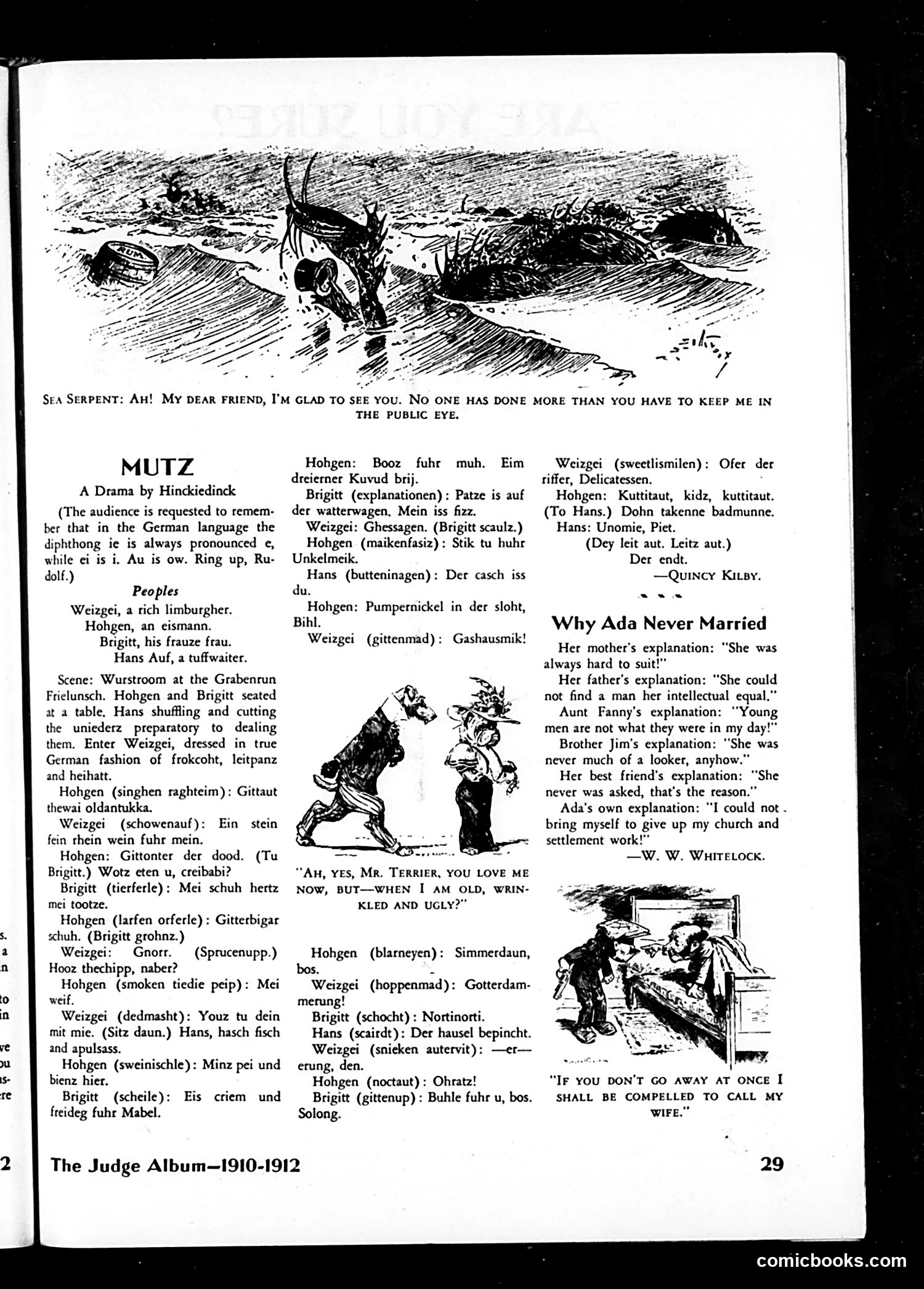
Judge Magazine Page Analysis (1910-1912) This page contains satirical content mocking German immigrants and their culture during the early 1900s. "Mutz" play excerpt: A crude parody of German language and culture, featuring intentionally mangled "German" dialogue and stereotypical characters in a tavern scene. The nonsensical pseudo-German mimics how Anglo-American audiences perceived German immigrants—as comically incomprehensible and culturally foreign. This reflects anti-immigrant sentiment and ethnic stereotyping common in early 20th-century American humor. "Why Ada Never Married": A gentler piece listing humorous explanations from various people about a woman's unmarried status, concluding with her own—she prioritized church and settlement work over marriage. This gently mocks both marriage pressure and women who rejected it. Top cartoon: Shows a sea serpent greeting what appears to be another creature, likely satirizing contemporary sea monster or cryptid fascination in popular culture. The page exemplifies Judge's ethnic humor tradition, mixing crude German stereotyping with lighter social commentary about American life.
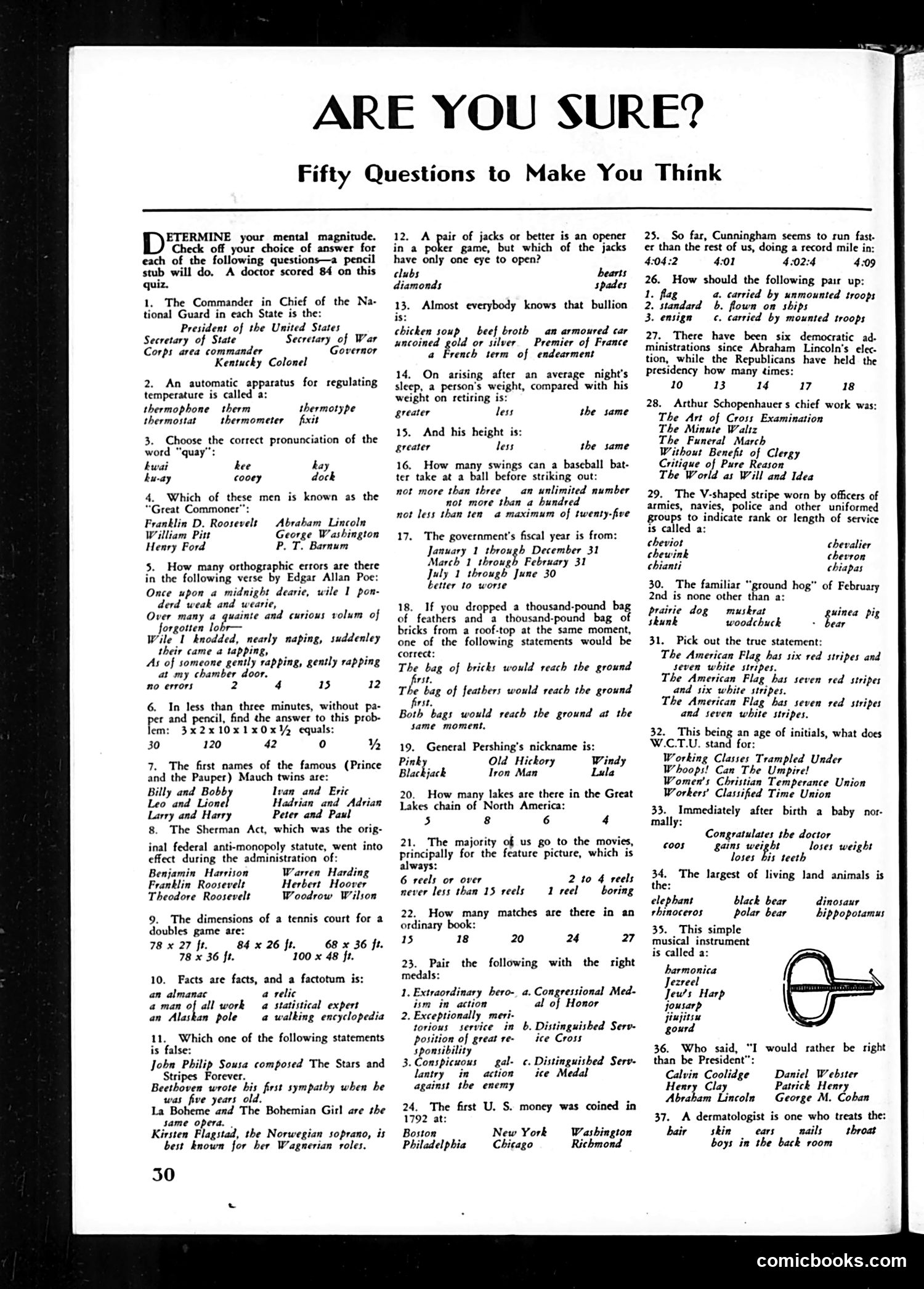
"Are You Sure?" - A Trivia Quiz Page This page is a trivia quiz, not a political cartoon. It's titled "Fifty Questions to Make You Think" and presents a self-scoring mental aptitude test, noting that "a doctor scored 84 on this quiz." The questions cover diverse topics: American government (Commander in Chief, Sherman Act), literature (Edgar Allan Poe), music (John Philip Sousa), sports (baseball, tennis), geography (Great Lakes), and historical figures (General Pershing, Lincoln). The humor is gentle—it's positioned as a challenge to reader confidence. Questions range from genuinely difficult (tennis court dimensions) to deliberately tricky (the Poe spelling errors test) to seemingly simple (which jack in poker has one eye?). This appears to be filler content typical of Judge magazine—designed for reader engagement rather than satirizing specific political events or figures. It reflects 1930s-era American trivia interests and assumes educated readership familiar with classical references.
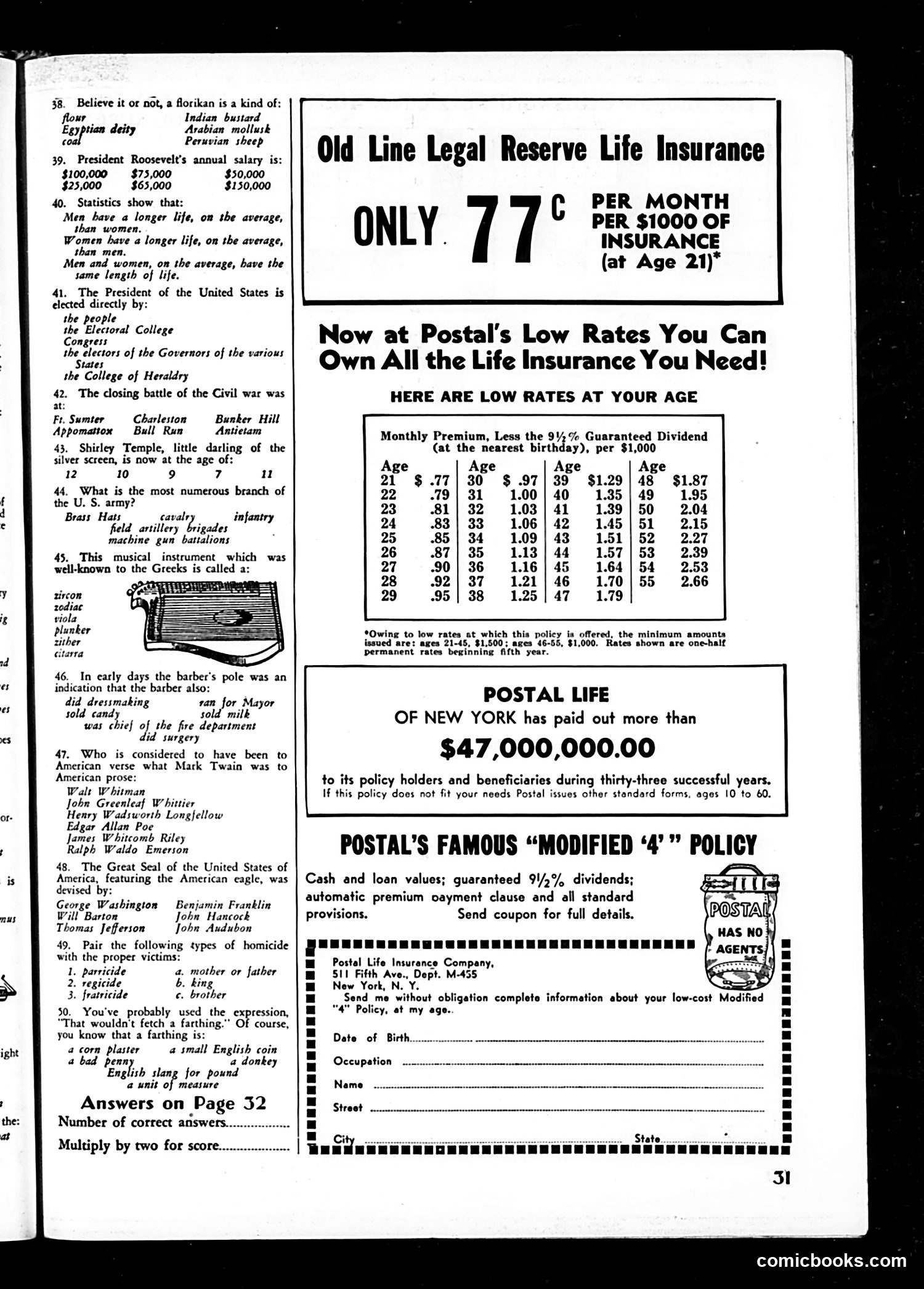
Analysis of Judge Magazine Page 31 This page is primarily advertising and a trivia quiz, not political satire. The left side contains a general knowledge quiz with 12 questions covering history, literature, government, and pop culture—including questions about President Roosevelt's salary, the Civil War, and actress Shirley Temple (who was famous in the 1930s-40s). The right side is a full-page life insurance advertisement for Postal Life of New York, emphasizing cheap rates (77 cents per $1,000 at age 21) and claiming $47 million paid to policyholders. The ad includes a rate table and coupon. There is no political cartoon or satire visible on this page. It represents typical magazine content from the era: reader engagement through quizzes paired with commercial advertising—a standard format for mid-twentieth-century American magazines.
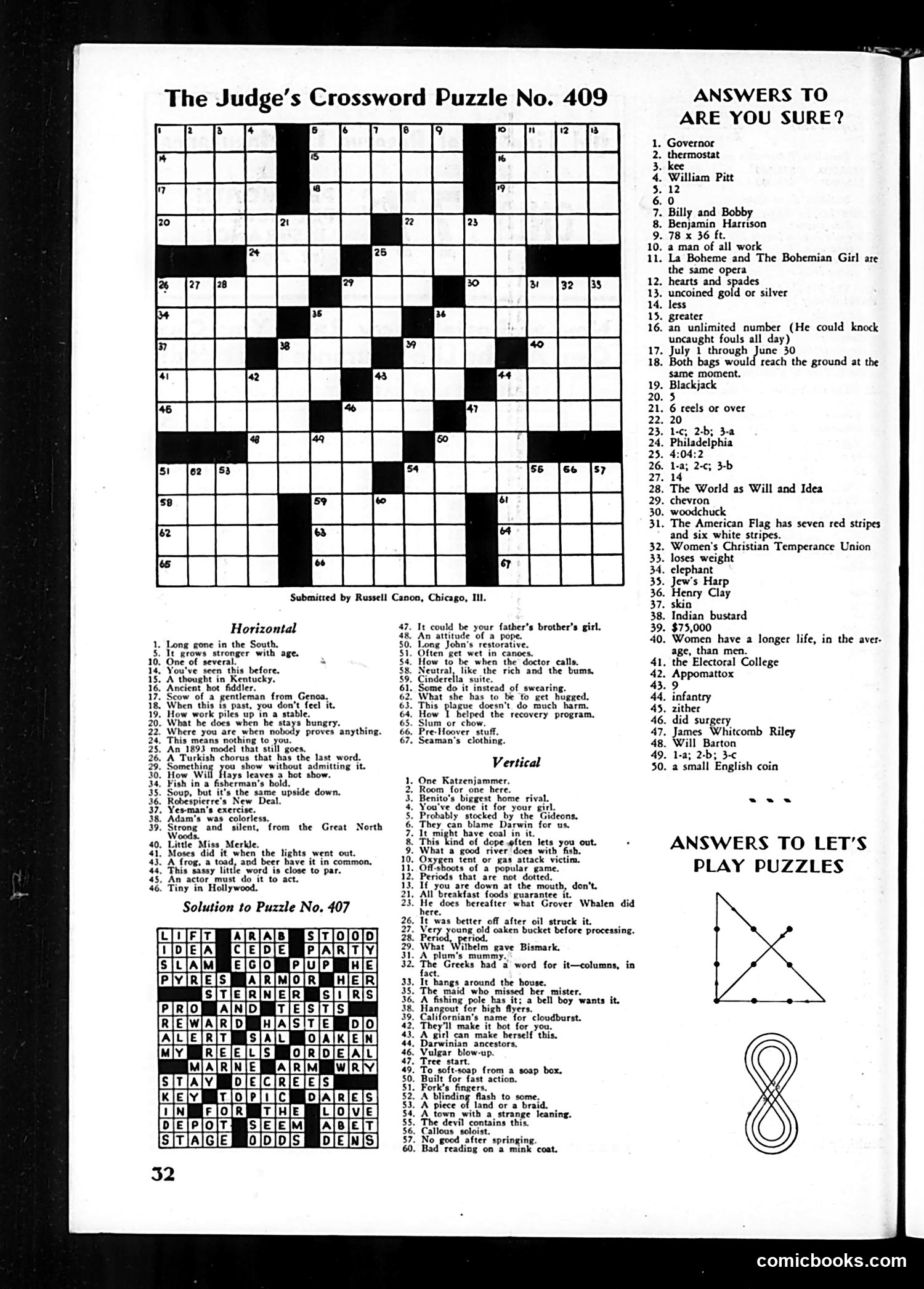
The Judge's Crossword Puzzle No. 409 This page is primarily a crossword puzzle and its solution, not a political cartoon. It's a standard puzzle submission from a reader named Russell Canon of Chicago. However, the clues themselves contain topical references reflecting Judge magazine's satirical approach: - References to Franklin D. Roosevelt's New Deal ("Robespierre's New Deal") - Mentions of Prohibition-era humor ("To soft-soap from a soap box") - Contemporary political figures like Benjamin Harrison and Henry Clay in the answers - Allusions to current events like the Electoral College The puzzle uses wordplay and riddles typical of 1930s-era Judge humor—mixing innocent definitions with subtle social commentary about governance, wealth, and current affairs. The accompanying "Let's Play Puzzles" section shows geometric diagrams unrelated to the crossword. This represents Judge's characteristic blend of entertainment and gentle political/social satire woven into everyday leisure activities.
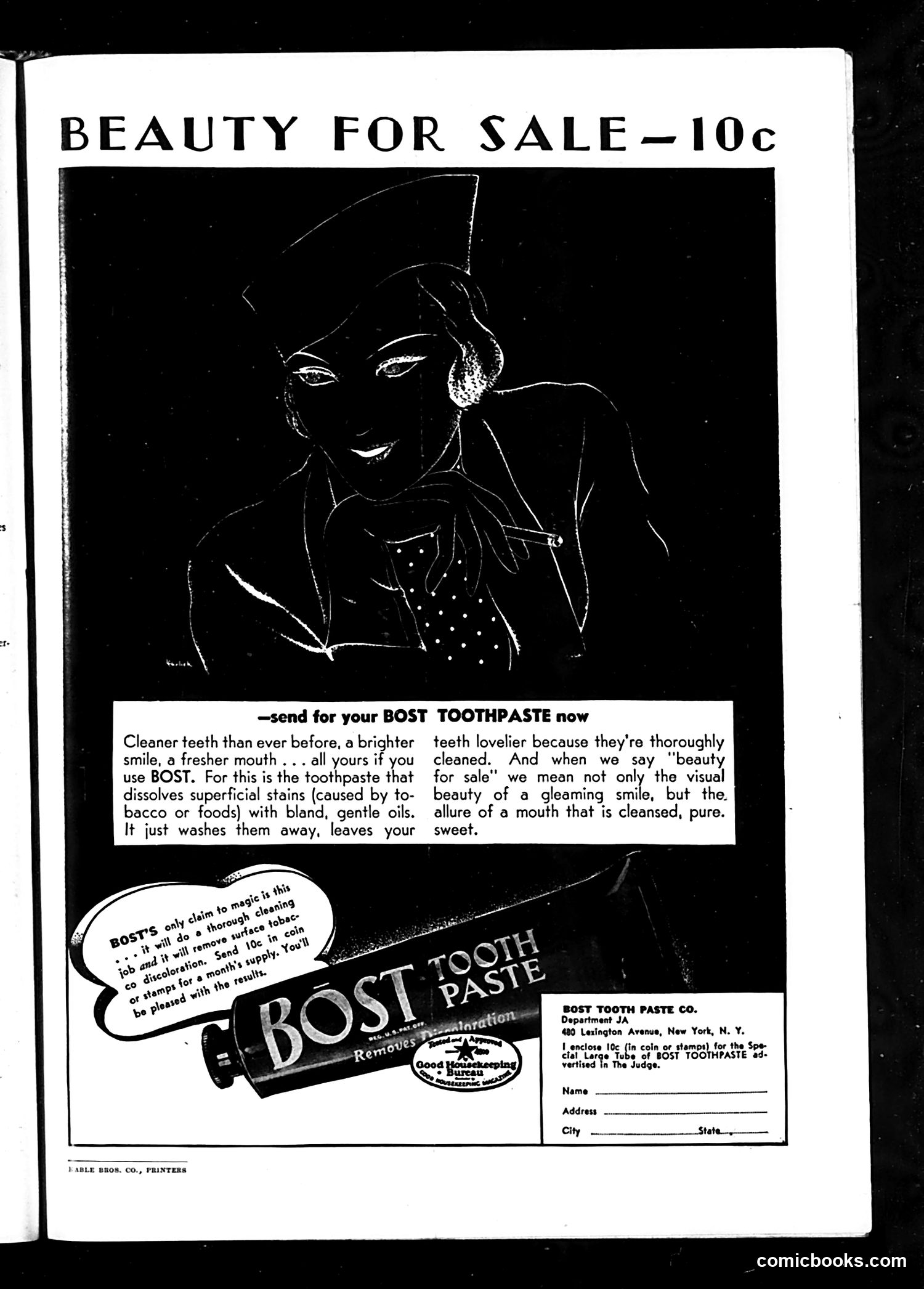
Analysis of Judge Magazine Advertisement Page This is primarily a toothpaste advertisement for BOST brand, not a political cartoon. The page features: The Advertisement: A stylized illustration of an attractive woman with 1920s-30s styling (bobbed hair, defined makeup, fashionable hat) promoting BOST toothpaste as a beauty product. The headline "Beauty for Sale—10c" treats dental hygiene as an affordable path to attractiveness. The Sales Pitch: The copy claims the toothpaste removes tobacco and food stains using "bland, gentle oils," equating white teeth with moral purity ("cleansed, pure, sweet"). This reflects period attitudes linking physical appearance to character and desirability. Historical Context: Published in *Judge* magazine, this reflects early 20th-century advertising targeting women by conflating dental care with romantic appeal and social acceptability. The 10-cent price point and mail-order coupon were typical mass-market sales tactics of the era. For Modern Readers: The explicit equation of teeth-whitening with female beauty and marriageability would strike contemporary audiences as dated and reductive.
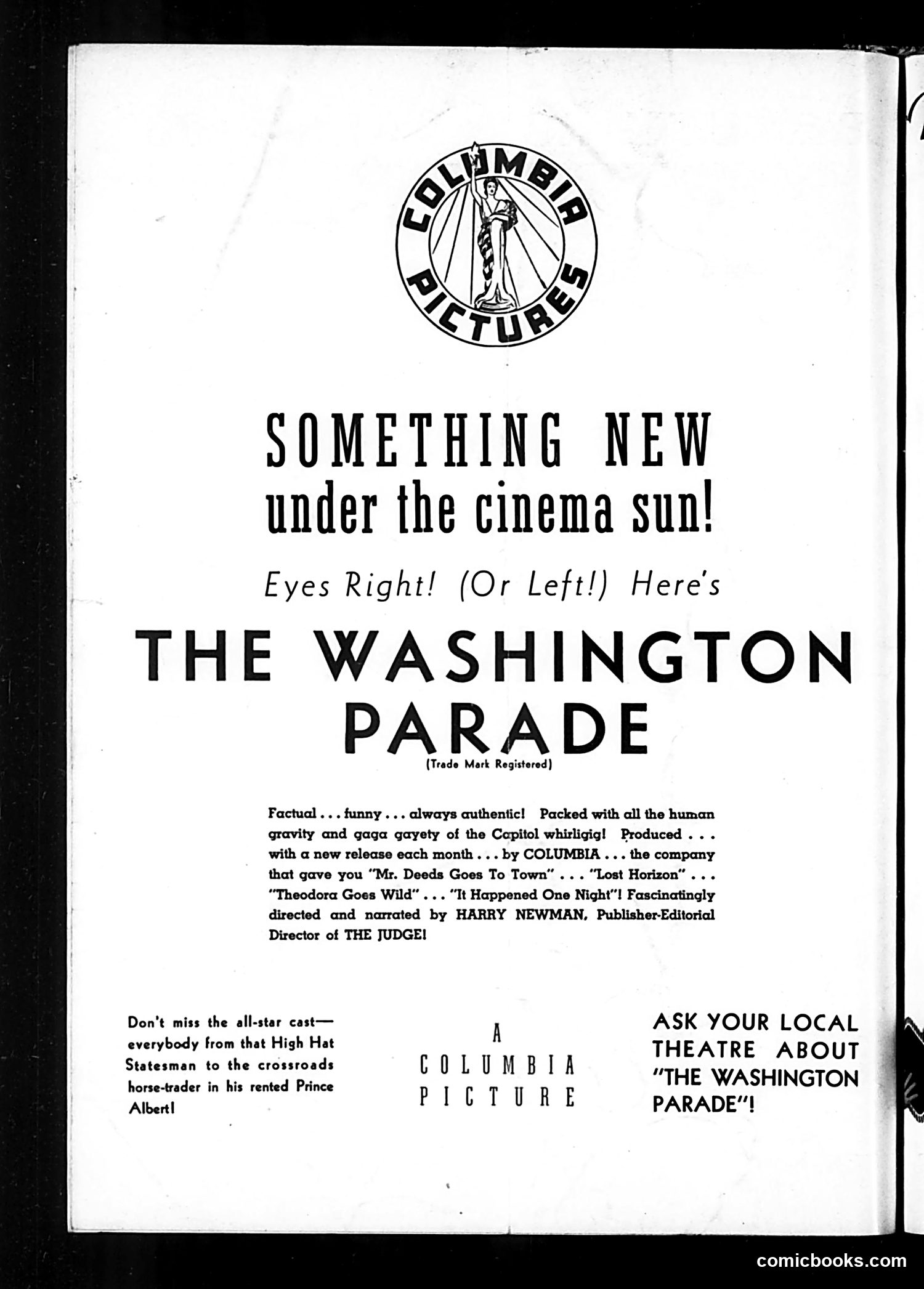
This is a film advertisement, not a political cartoon. It promotes "The Washington Parade," a Columbia Pictures newsreel-style short film directed by Harry Newman (publisher of *Judge* magazine itself). The ad promises satirical content about Washington D.C. politics—describing it as "factual...funny...always authentic" and "packed with all the human gravity and gaga gayety of the Capitol whirligig." The phrase "Eyes Right! (Or Left!)" humorously acknowledges political divisions. The cast description—"everybody from that High Hat Statesman to the crossroads horse-trader in his rented Prince Albert"—mocks both pompous politicians and pretentious social climbers, suggesting the film offers comedic observations about Washington's varied cast of characters and their absurdities. This was typical 1930s promotional content: *Judge* advertising its own media ventures while satirizing government figures.