judge
Judge — September 1938
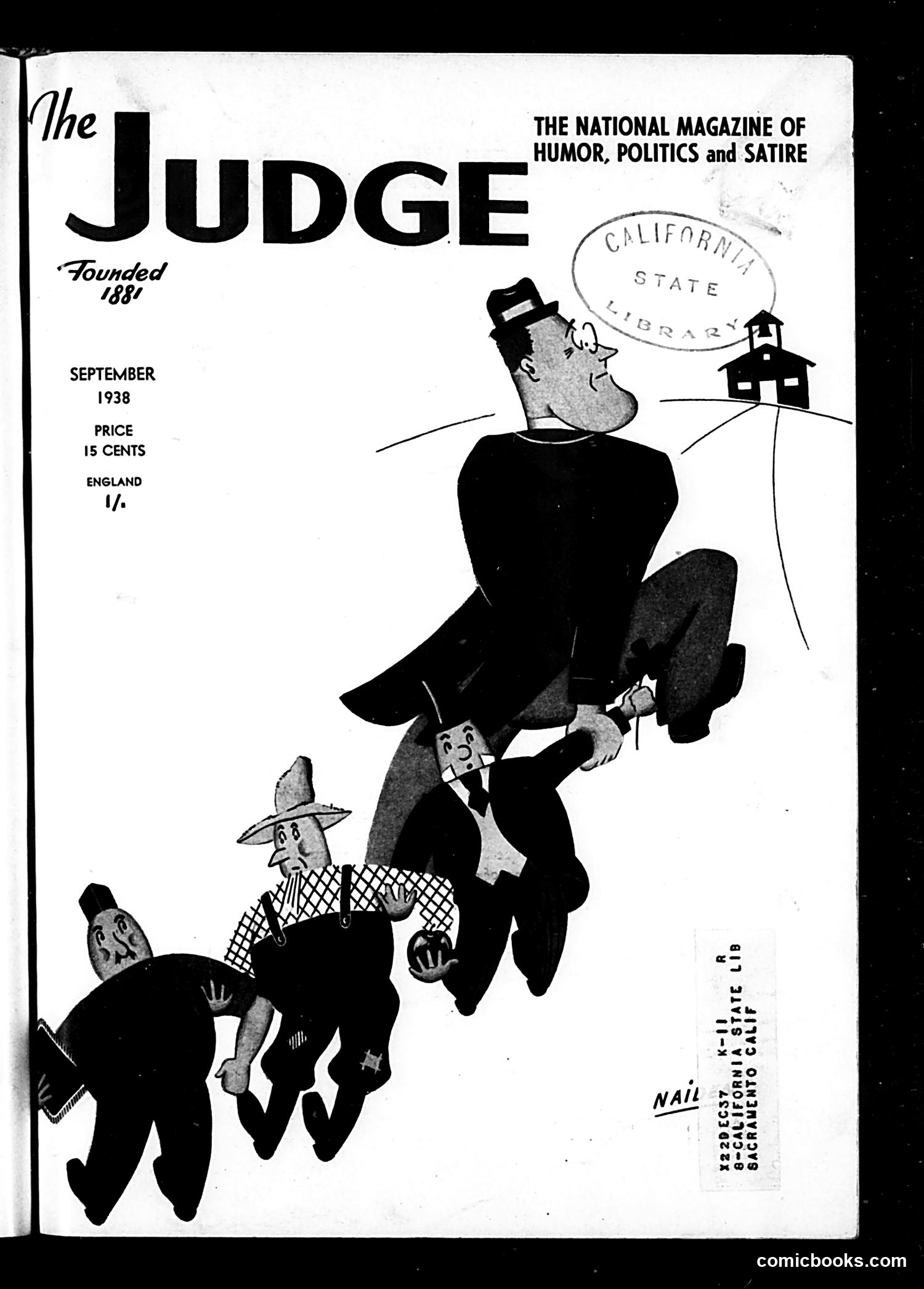
Analysis of Judge Magazine Cover, September 1938 This cover depicts a tall figure in formal dress being pulled downward by three smaller men in various costumes (appearing to represent different national or political interests). The schoolhouse in the background suggests American education or values at stake. The satire likely comments on isolationism versus international pressure during 1938—a year of rising European fascism and calls for American intervention. The smaller figures appear to represent foreign powers or ideological movements attempting to drag America into their conflicts, while the tall American figure resists or struggles with these pressures. The specific identities of the smaller figures remain unclear without additional context, but the composition clearly expresses anxiety about external forces threatening American independence during this pre-World War II period.
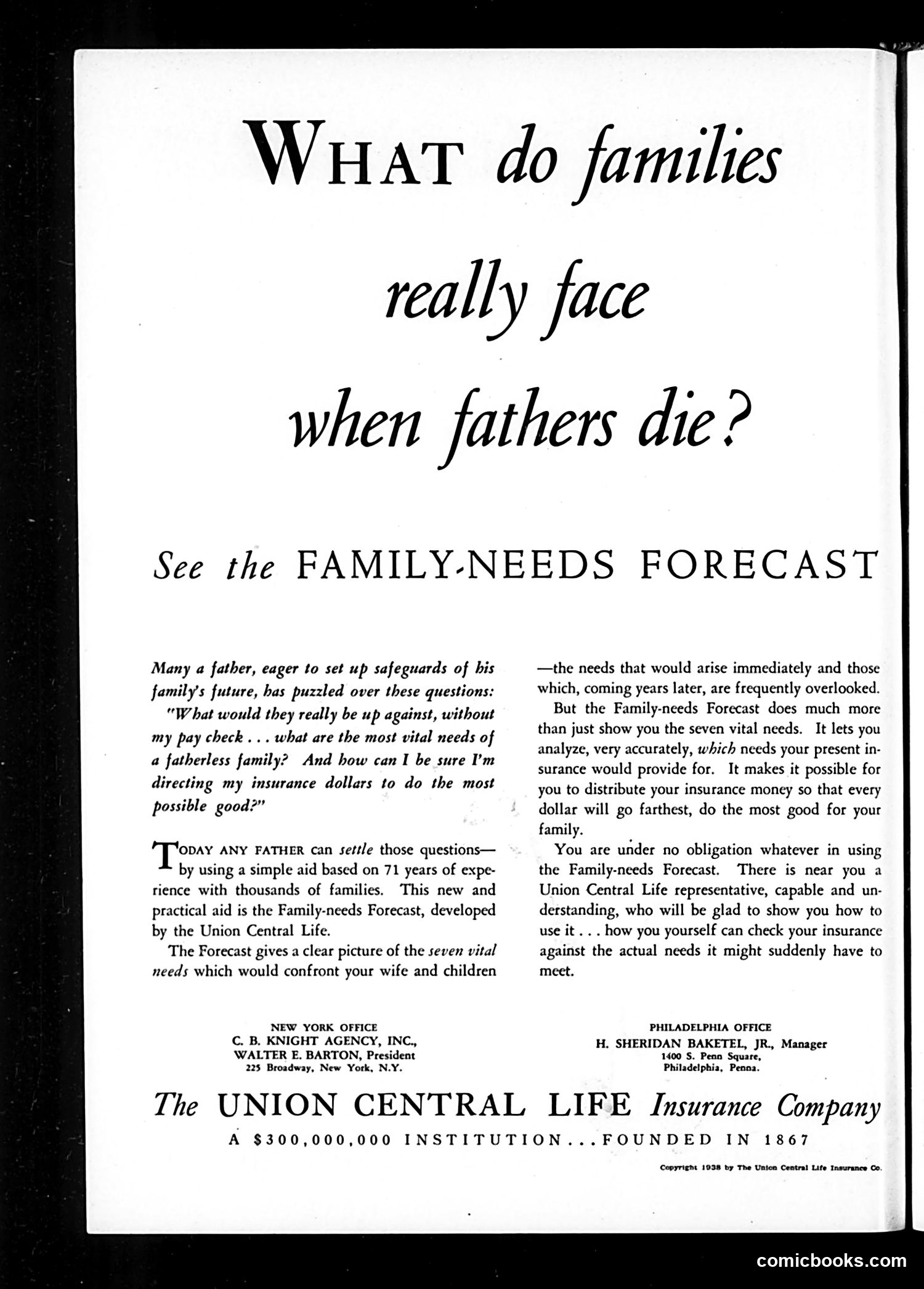
Analysis This is not a cartoon or satire page, but rather a full-page insurance advertisement from Union Central Life Insurance Company (copyright 1938). The ad addresses fathers directly, posing the question: "What do families really face when fathers die?" It then promotes the "Family-Needs Forecast," a tool claiming to help men plan adequate life insurance by identifying seven vital financial needs their dependents would face after their death. The appeal is to middle-class male anxieties about providing for wives and children. The ad emphasizes practical financial planning rather than emotional manipulation, offering a Union Central Life representative to help calculate appropriate coverage amounts. This reflects 1930s life insurance marketing strategies targeting breadwinners during the Depression era.
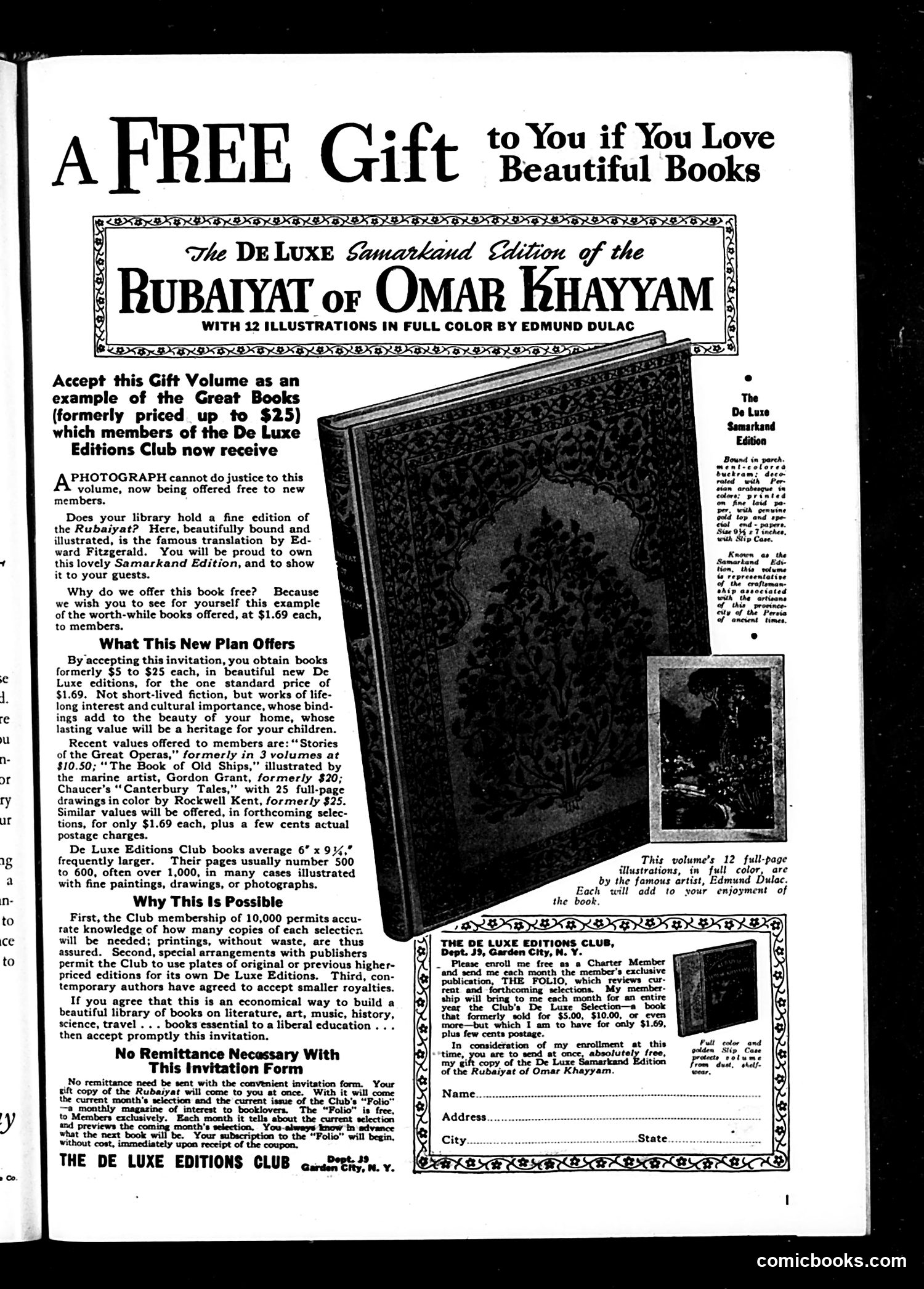
Analysis This page is primarily an advertisement, not a cartoon or satirical content. It promotes "The De Luxe Samarkand Edition of the Rubaiyat of Omar Khayyam"—a beautifully illustrated classic poetry book—being offered free to new members of the De Luxe Editions Club. The ad emphasizes the book's value (formerly sold for $5-$10) and appeals to culturally refined readers by highlighting Edmund Dulac's 12 full-color illustrations. It explains the club's business model: members pay $1.69 per selection for leather-bound classics normally priced much higher. There is no political satire, caricature, or social commentary visible. The page is a straightforward commercial solicitation using prestigious literary content to attract book-loving subscribers.
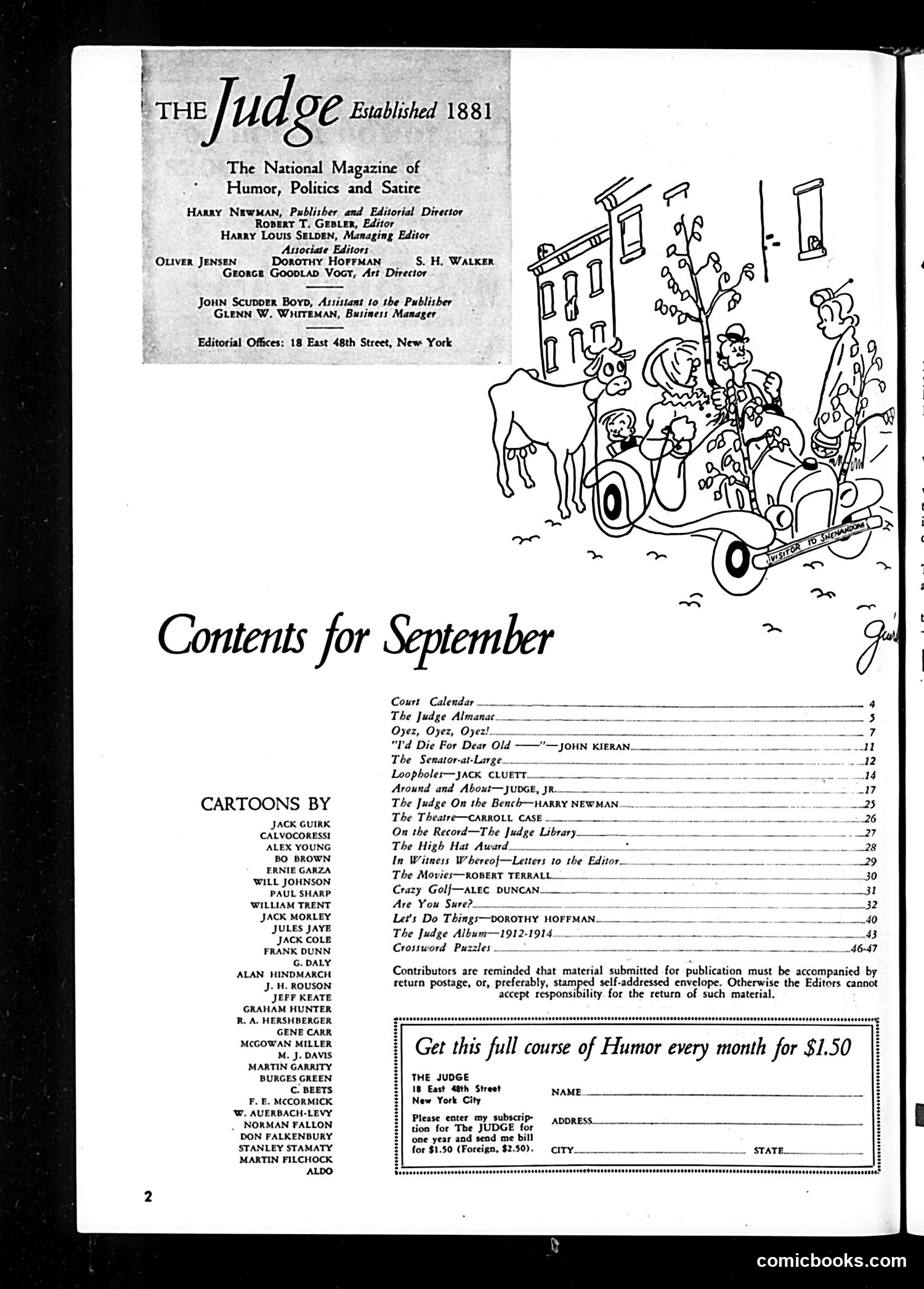
Analysis of Judge Magazine Contents Page (September) This is a table of contents page for *The Judge*, a satirical magazine established in 1881. The masthead illustration depicts a chaotic street scene with a car (appearing to be from the early 1900s) surrounded by pedestrians, a cow, and falling debris from a building—likely satirizing urban congestion or automobile dangers during the early automotive era. The contents list includes political and social commentary pieces: "The Senator-at-Large," "Around and About," and "The Theater" suggest commentary on government, society, and culture. Without seeing the actual articles, the specific satirical targets remain unclear, though the cartoonists listed (Jack Guirk, Cesare Cegliossi, others) were known contributors to *Judge's* humorous social critique.
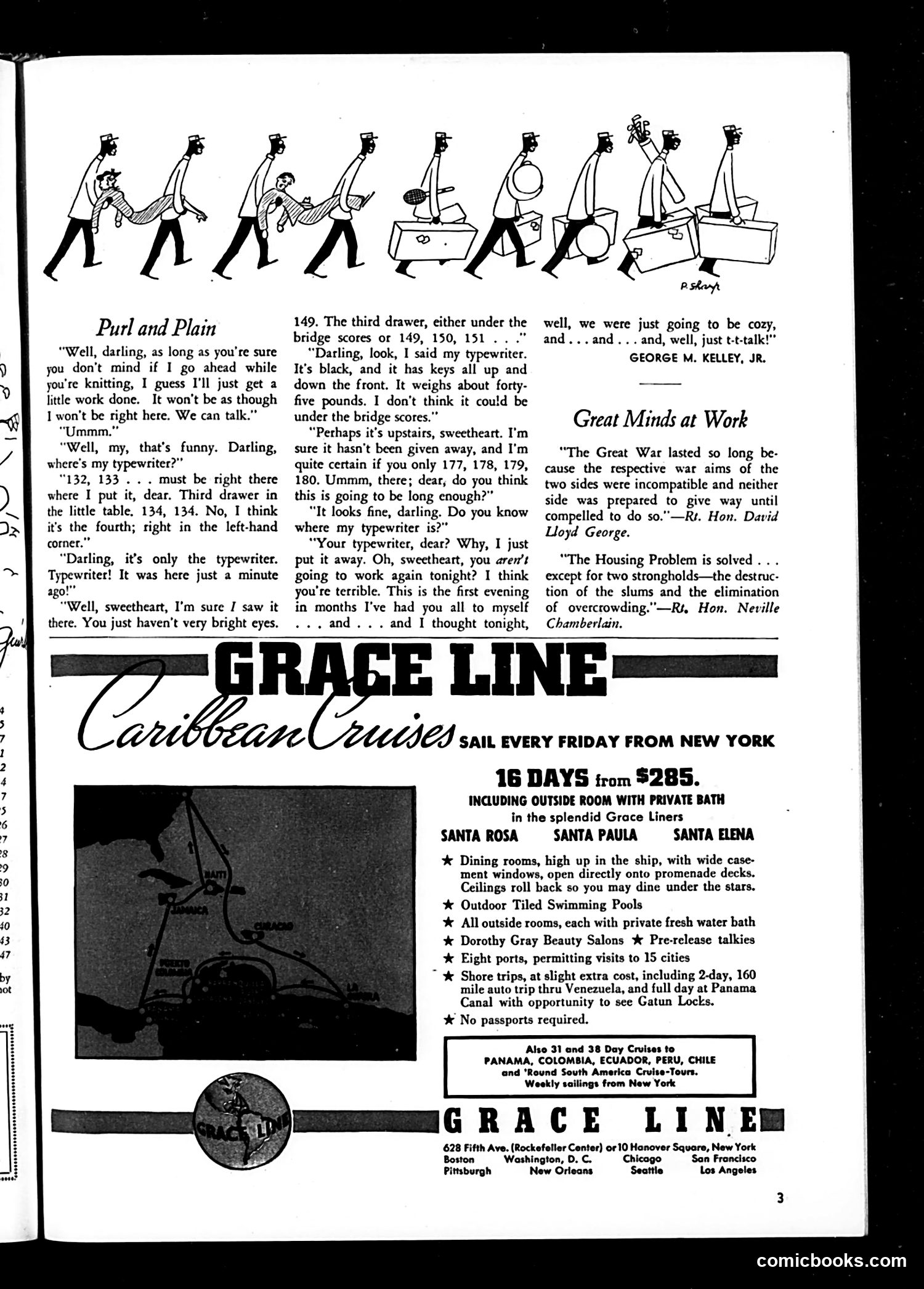
Analysis of This Judge Magazine Page The top cartoon, "Purl and Plain," depicts a domestic comedy sketch about knitting. A wife is knitting while her husband wants to go out, but she insists on staying in. The humor involves their playful banter about a typewriter and drawer locations—standard marital banter of the era. This appears to be lighthearted domestic humor rather than political satire. The bulk of the page is a Grace Line Caribbean Cruises advertisement promoting 16-day voyages from $285, featuring three ships (Santa Rosa, Paula, Elena) with amenities like swimming pools and beauty salons. The "Great Minds at Work" section quotes historical figures on war and housing problems, but these are brief, unrelated quotes rather than connected commentary. Overall, this is primarily an advertising page with minimal satirical content.
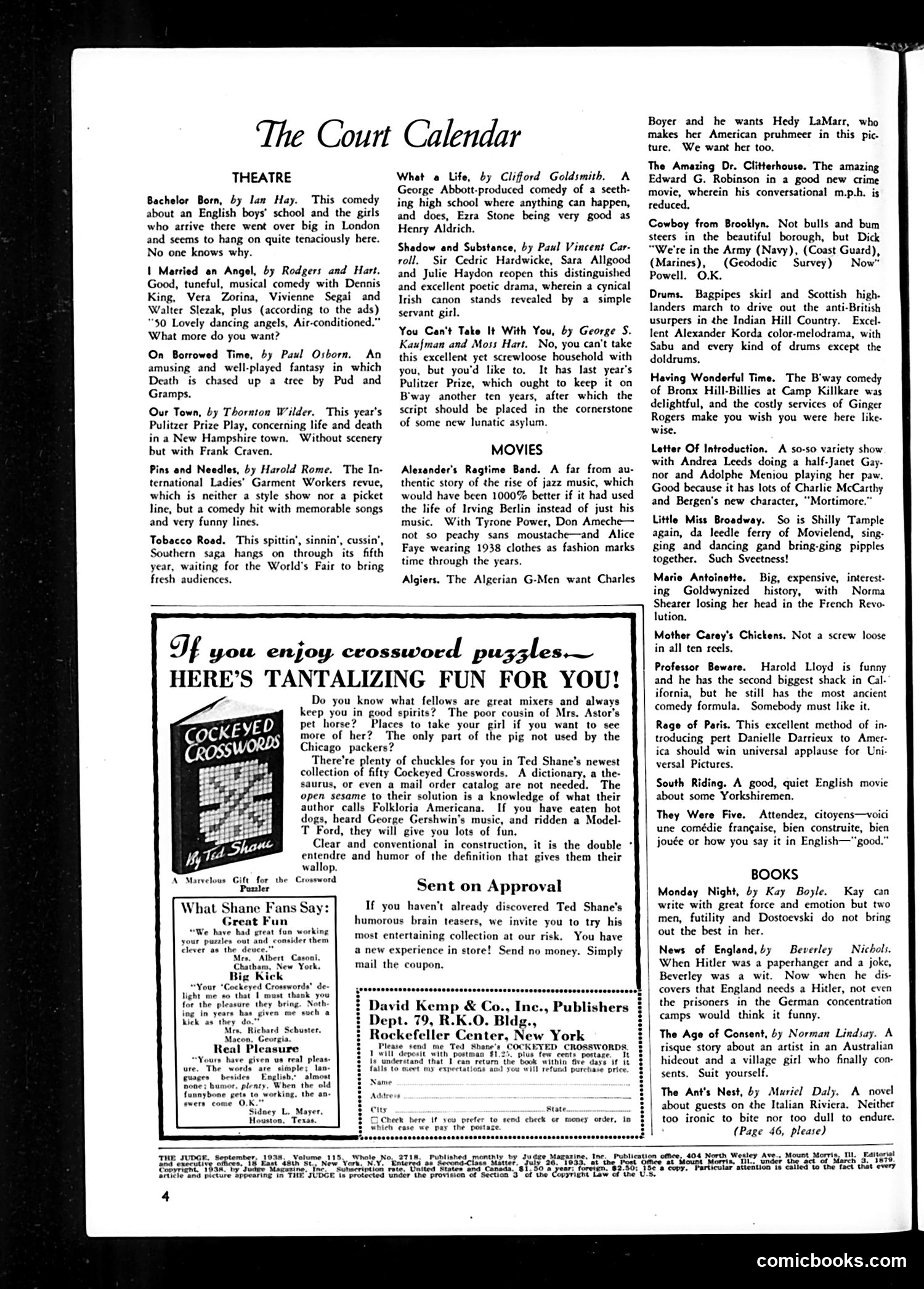
The Court Calendar - Judge Magazine, September 1938 This page is primarily a theater and entertainment review section rather than political satire. It contains brief reviews of current Broadway plays, movies, and books, along with advertisements. The main visual element is a crossword puzzle advertisement for "Cockeyed Crosswords" by Ted Shane, marketed as entertainment. The puzzle promotion includes testimonials from fans praising Shane's puzzles. The content reflects 1938 popular culture: references to jazz history, Harold Lloyd films, and contemporary British and American theater. A notable book review mentions Hitler and concentration camps, indicating some awareness of Nazi Germany. The page demonstrates Judge's shift toward general entertainment coverage rather than political commentary by this date.
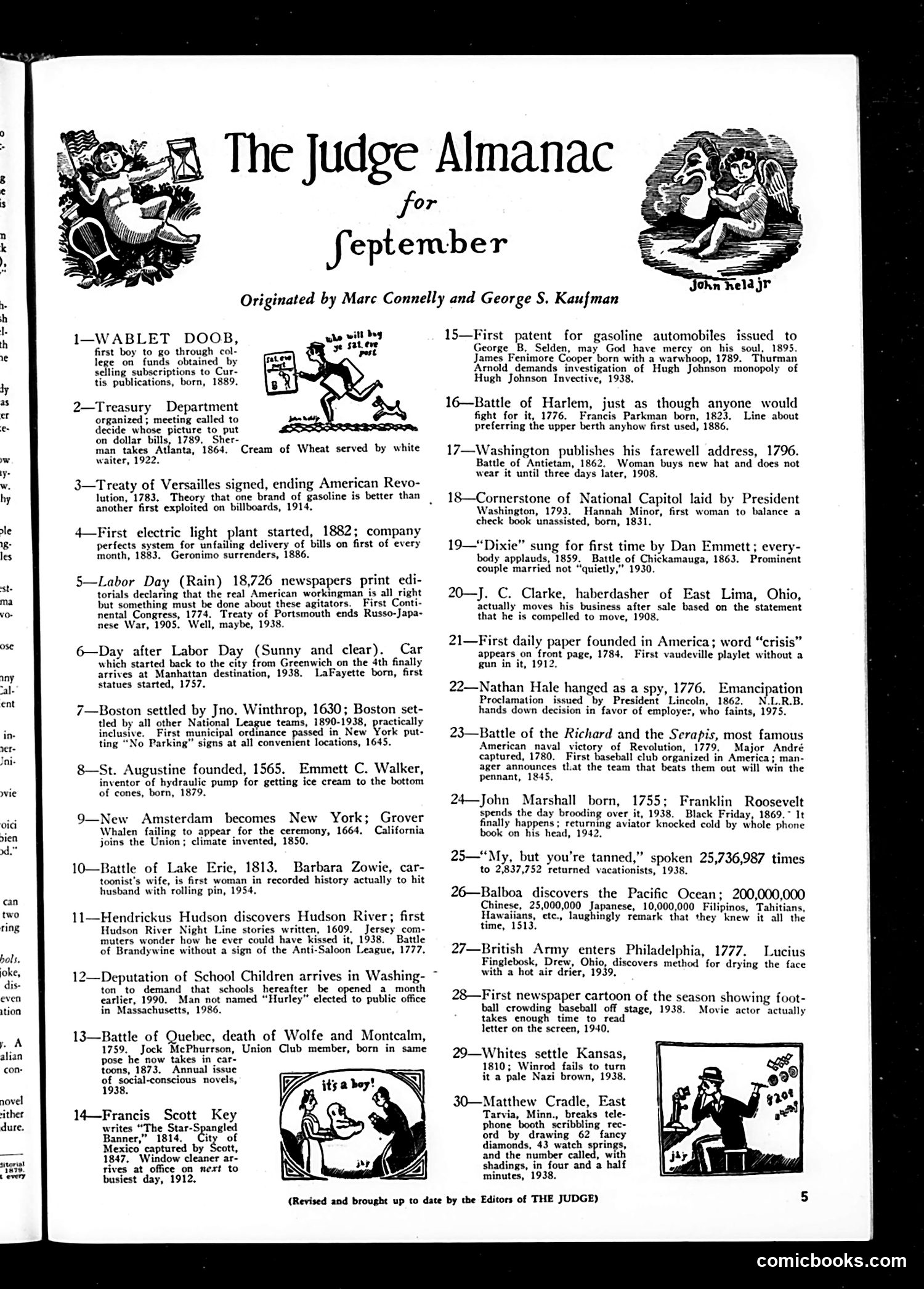
The Judge Almanac for September This page is primarily an almanac of historical facts and dates, not political satire. It lists 30 significant American historical events tied to September dates—ranging from the founding of Boston (1630) to recent 1938 items like a movie actor reading a letter on screen. The three small cartoon illustrations are generic vignettes accompanying unrelated items: one shows someone running (item 5, Labor Day), another depicts a domestic scene (item 14), and a third shows a man with money (item 30). These are decorative elements typical of Judge magazine's layout rather than satirical commentary. The page functions as educational/entertaining reference material, reflecting American historical pride through compiled dates and achievements.

Analysis This is a Bell Telephone System advertisement, not satire or political commentary. The page promotes telephone service quality through an appeal to patriotic values. The central image shows a vintage rotary telephone, flanked by three smaller photographs depicting telephone workers: an operator ("the voice with a smile"), a male technician ("the man on the job"), and office staff. The ad claims good telephone service depends on "constant courtesy" and credits Bell's workforce—specifically praising "telephone men and women" and their "courtesy and efficiency." The boxed text below suggests telephone service is essential infrastructure, positioning reliable phones as a national asset "in good times and bad." This is straightforward corporate messaging emphasizing employee dedication rather than satire.
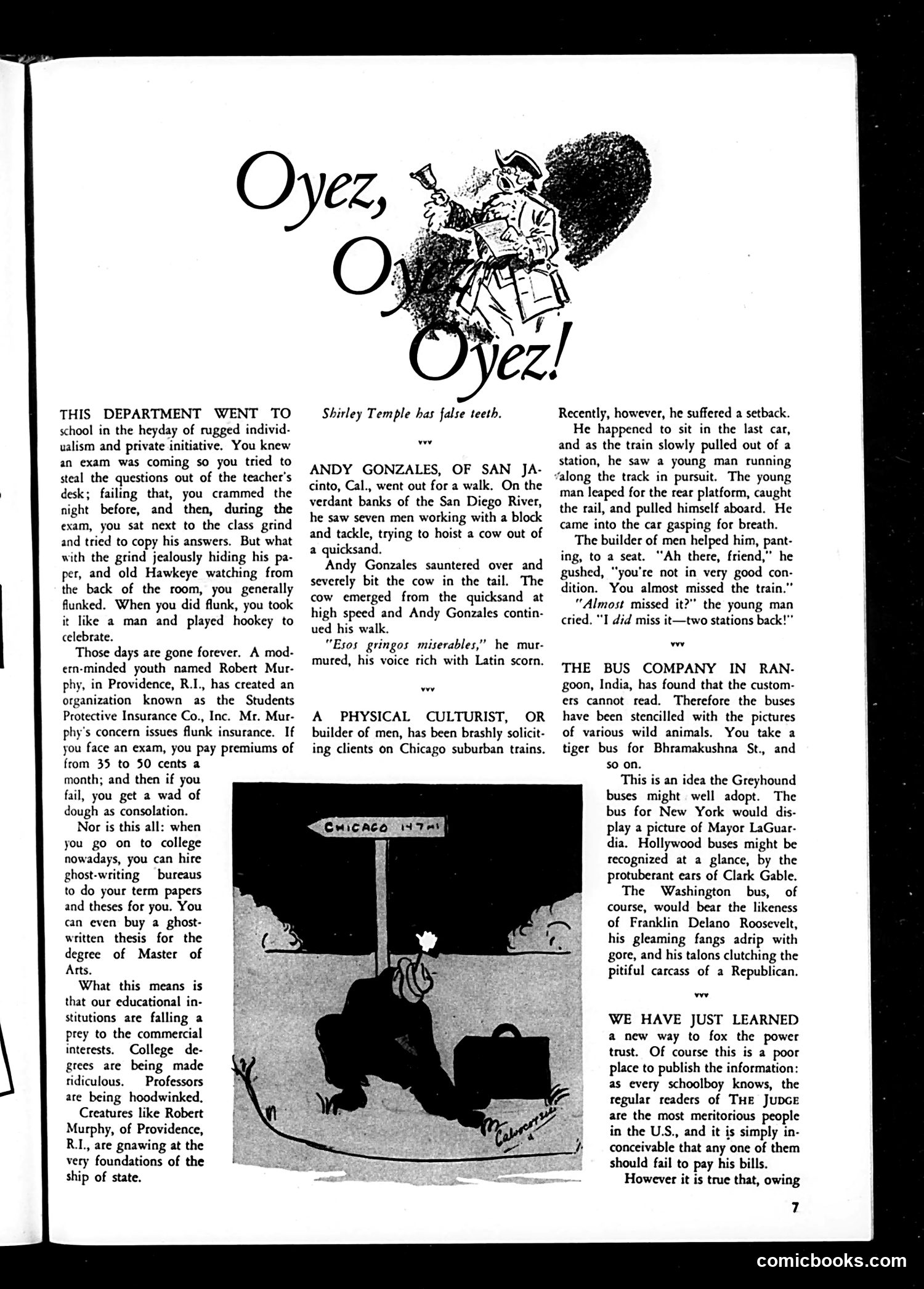
Analysis of Judge Magazine Page This page contains satirical commentary on American education and social issues, circa early 20th century. Main Cartoon: Depicts a "Physical Culturist, or builder of men" soliciting clients on Chicago suburban trains. The figure appears to be a muscular man in a somewhat undignified pose, satirizing fitness charlatans who preyed on gullible commuters. Text Commentary: The left column critiques academic dishonesty—students hiring ghost-writers for papers and thesis work, suggesting educational institutions are "falling prey to commercial interests." The author mocks this degradation, noting that even Master of Arts degrees can be purchased. Other Items: Brief anecdotes about false teeth, a cow rescue, and bus company illustrations in India. The final section mocks media coverage of the "power trust," suggesting even The Judge's readers—described as "most meritorious people"—fail to pay attention to important issues. The page satirizes commercialism, fraud, and public apathy in early 20th-century America.
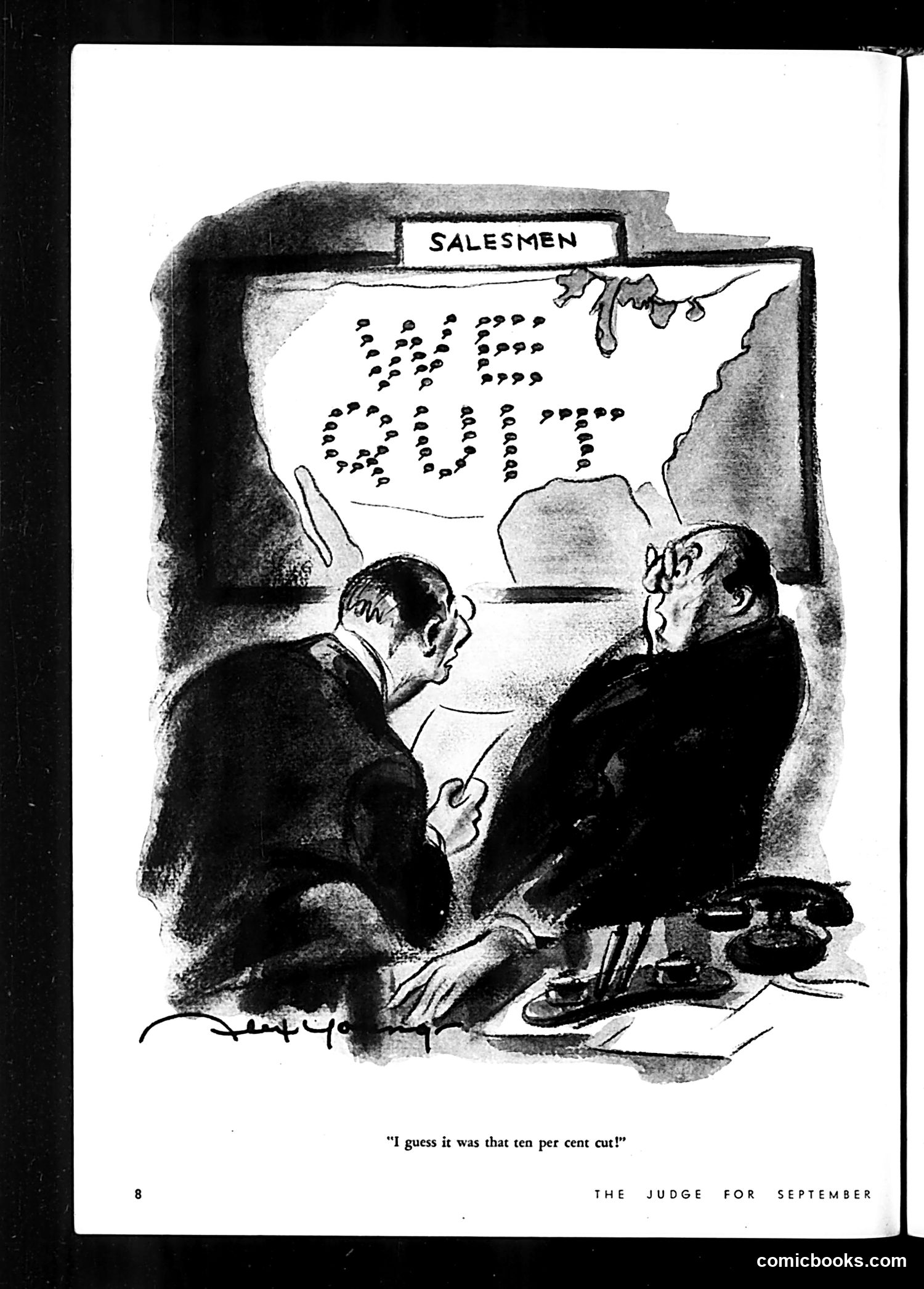
Cartoon Analysis This single-panel cartoon from *Judge* magazine satirizes sales management during an economic downturn. Two businessmen in an office examine a U.S. map labeled "SALESMEN" where sales territories are marked with small figures arranged in declining patterns—visually representing reduced sales numbers. The caption, "I guess it was that ten per cent cut!" suggests ironic commentary on corporate cost-cutting measures. One manager apparently expects the other to acknowledge that cutting salesmen's pay or commissions by 10% has directly caused the visible collapse in sales performance shown on the map. The joke critiques corporate logic: management implemented cost-cutting expecting no consequences, but the data now clearly shows the negative impact. It's a satire on short-sighted business decision-making where penny-pinching backfired, demonstrating that reduced compensation demotivates the sales force and harms overall revenue.
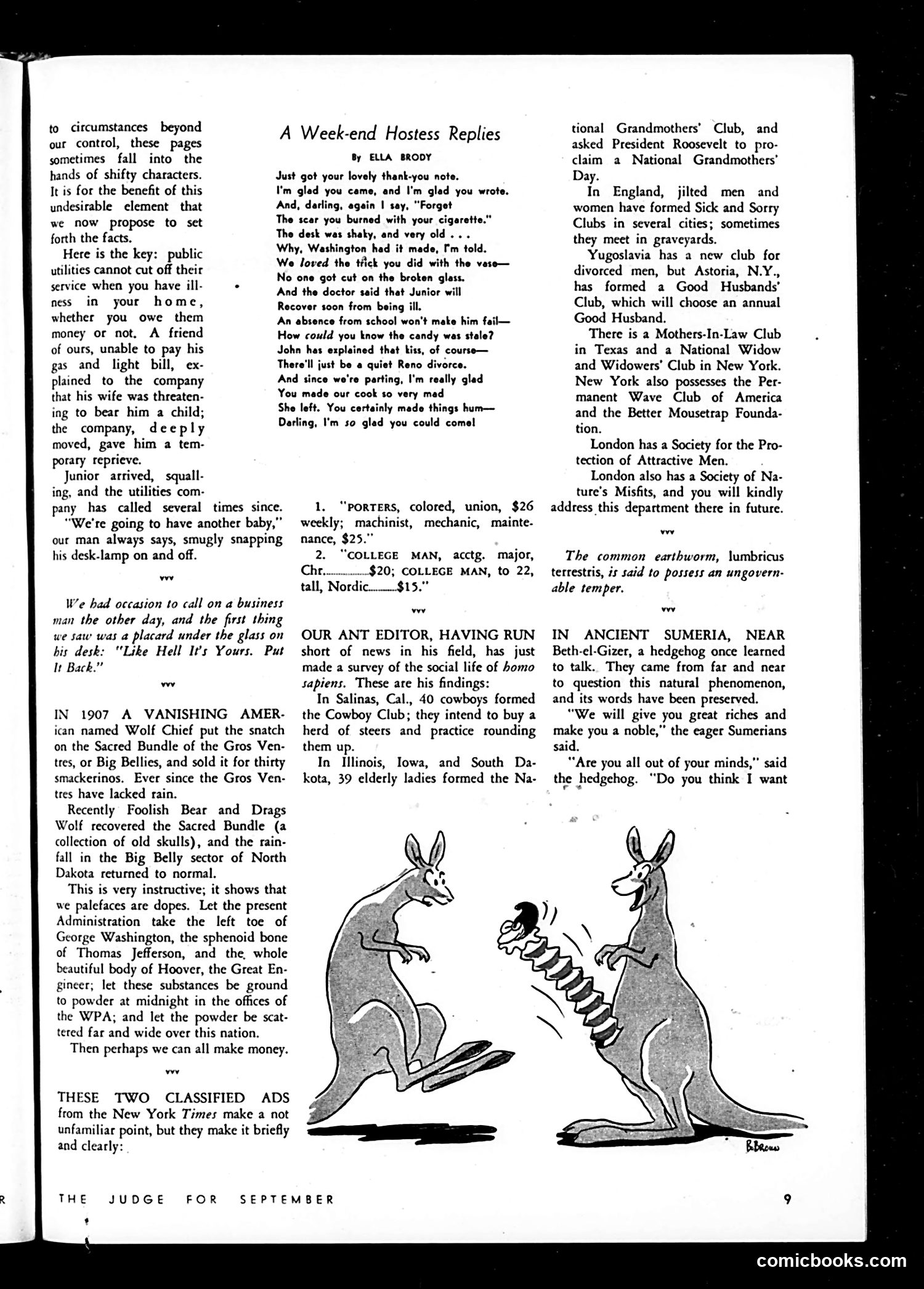
Analysis of Judge Magazine Page This page contains satirical commentary on 1930s American social issues. Main Content: The "Week-end Hostess Replies" poem satirizes poor guest behavior through mock-gracious acceptance of various offenses: burning furniture with cigarettes, breaking glassware, serving stale candy that sickened the host's child, and causing the host's infidelity (leading to divorce). The humor lies in the hostess's exaggerated politeness masking genuine disaster. Social Satire: A brief article mocks utility companies' policies, describing how a man exploits their reluctance to disconnect service during family emergencies by repeatedly claiming his wife is pregnant. Another section ridicules racial and class discrimination revealed in classified ads: identical positions paying $26/week for Black workers versus $15-20 for white college graduates based on appearance ("tall, Nordic"). Political Reference: A mock-serious proposal suggests grinding up relics of Washington, Jefferson, and Hoover to scatter nationwide to cure economic problems—satirizing New Deal policies (WPA mentioned) as ineffective superstition. The kangaroo cartoon illustrates the hostess poem's theme of escalating chaos.
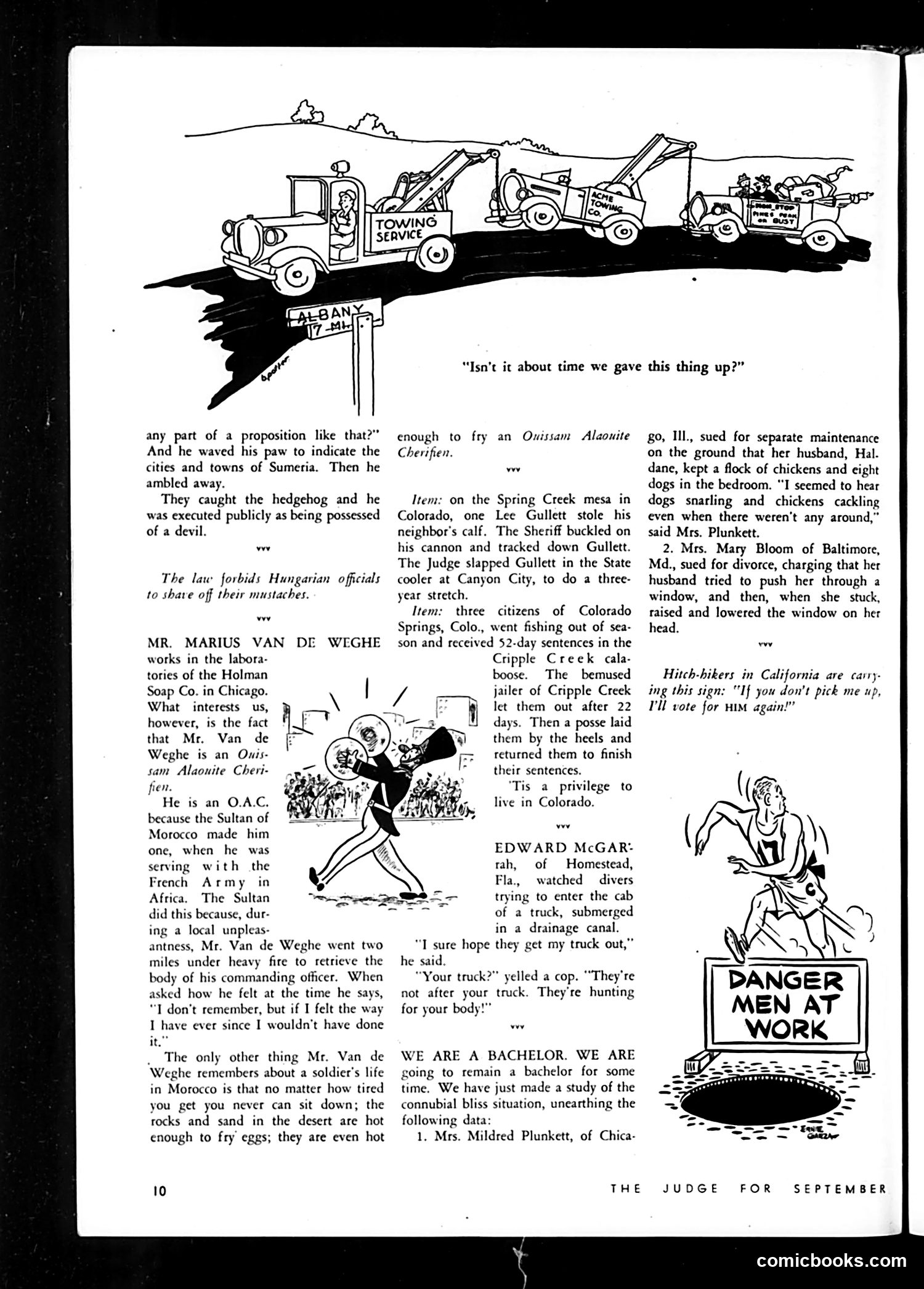
Page Analysis: Judge Magazine This page from Judge (a satirical magazine) contains several humorous anecdotes and cartoons mocking American life and marriage. Top Cartoon: Shows a towing service procession on a cliff labeled "ALBAN," with the caption "Isn't it about time we gave this thing up?" This appears to satirize either the towing industry's proliferation or automobiles' unreliability—vehicles constantly needing rescue. Main Content: The page features brief, darkly comic stories: - Van de Weghe profile: Notes his Moroccan military honor, contrasting his exotic credentials with mundane Chicago soap factory work—satirizing how immigrant/cosmopolitan credentials become irrelevant in American employment. - Colorado law enforcement anecdotes: Mock inconsistent justice (stealing a calf gets three years; fishing violations get 52 days, then jailers let prisoners out early, requiring recapture). - Marriage horror stories: Wives divorcing husbands for keeping livestock in bedrooms or attempting murder through windows—satirizing domestic misery. The magazine's humor relies on absurdist exaggeration to critique social institutions, immigration assimilation, legal inconsistency, and marriage unhappiness.
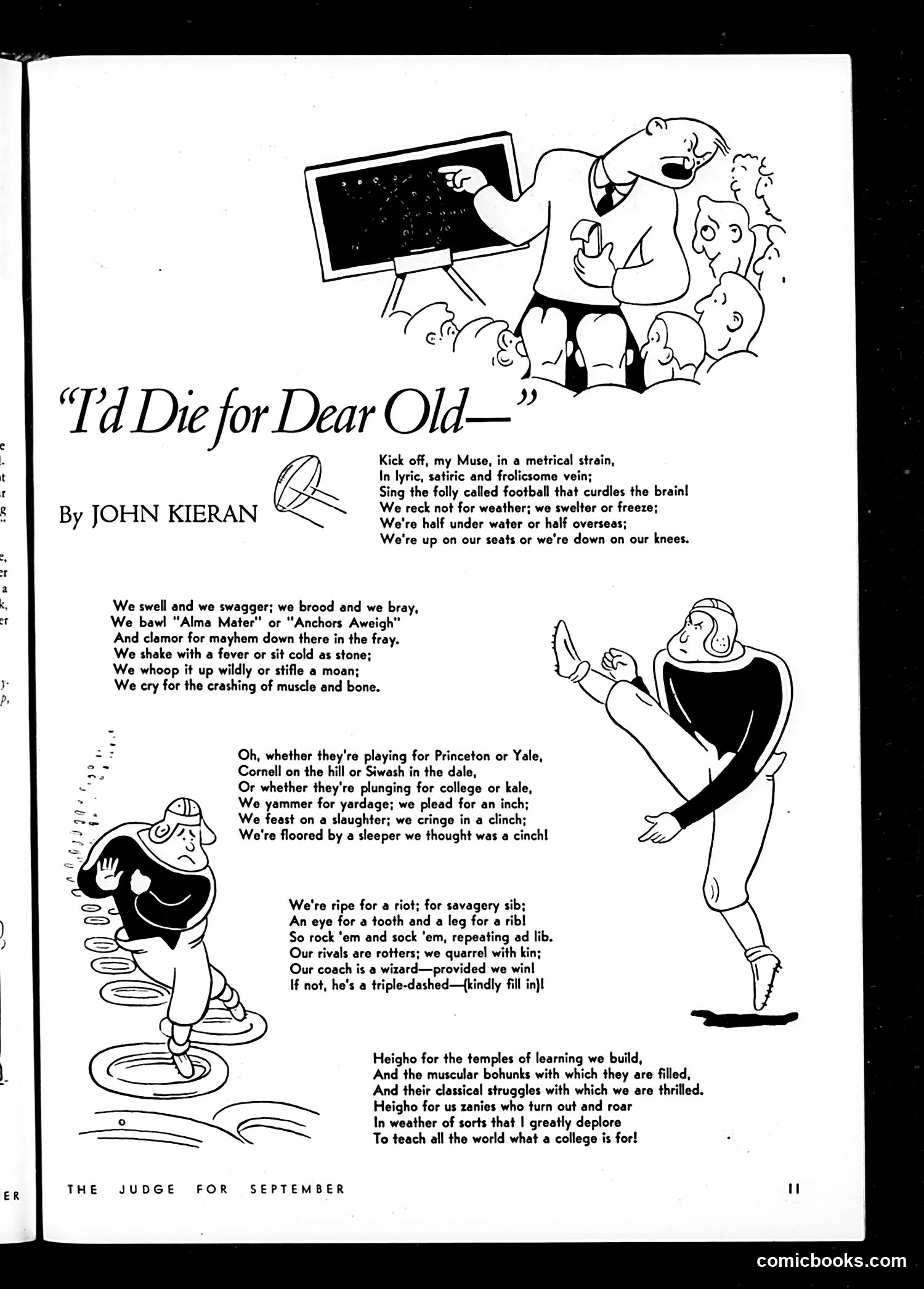
"I'd Die for Dear Old—" Analysis This John Kieran poem satirizes college football fandom and the obsessive devotion fans display toward their institutions. The cartoon illustrates how fans emotionally invest in games, depicting them as a rowdy, almost cult-like group displaying extreme reactions—"We swell and we swagger," "We whoop it up wildly." Kieran mocks the paradoxes of fan behavior: they endure terrible weather, experience violent mood swings between elation and despair, and worship coaches who are "wizards" only while winning. The satire targets the absurdity of treating college sports as quasi-religious ("temples of learning"), the violence celebrated in gameplay ("crashing of muscle and bone"), and fans' willingness to abandon civility for their school—whether Princeton, Yale, Cornell, or generic "Siwash" colleges. The final stanza delivers the joke: fans pretend this spectacle "teaches all the world what a college is for"—when it clearly demonstrates the opposite, reducing universities to athletic entertainment venues.
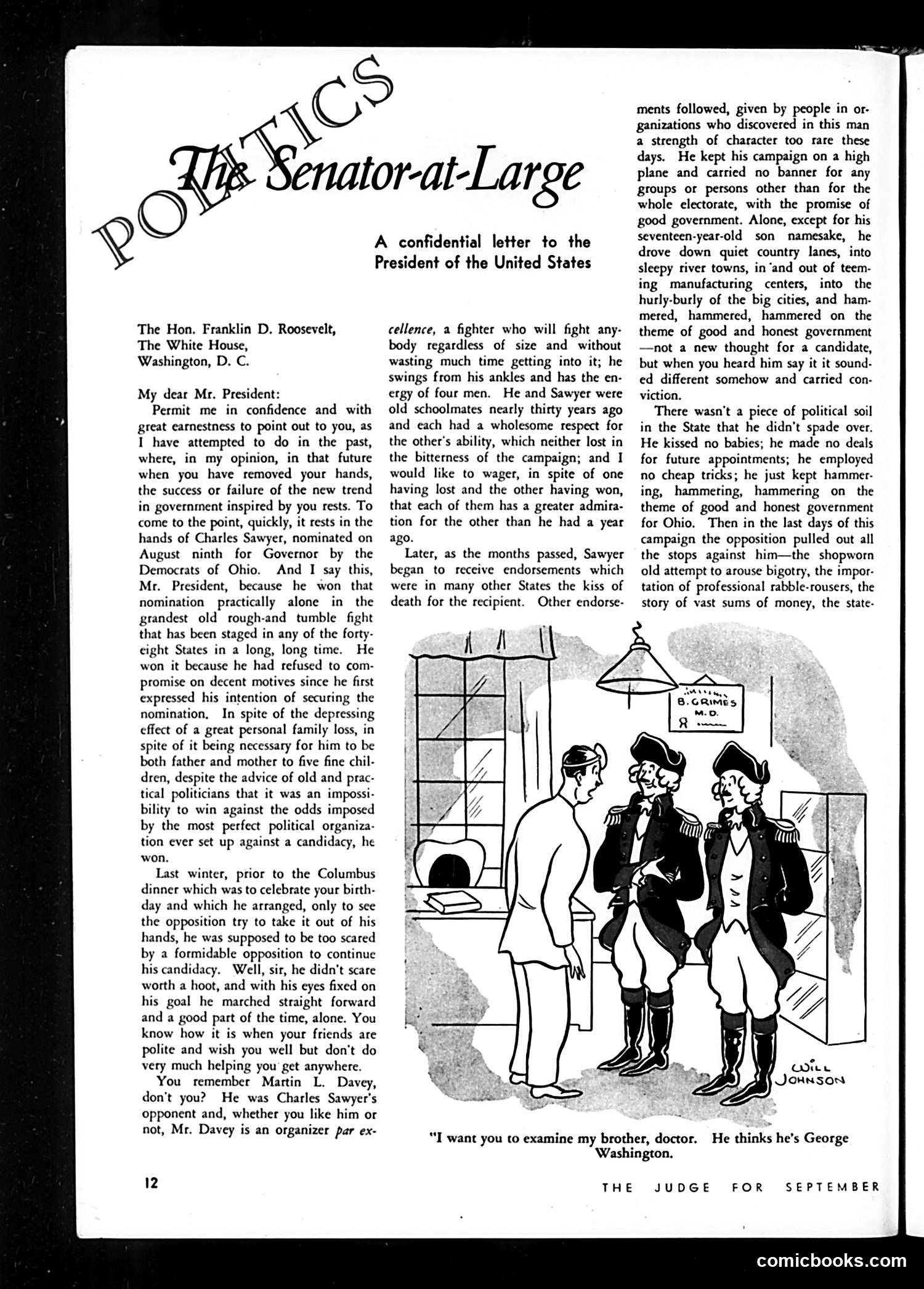
"The Senator-at-Large" Analysis This page presents a laudatory letter to President Franklin D. Roosevelt endorsing Charles Sawyer, the Democratic nominee for Governor of Ohio (nominated August 9th, presumably 1930s). The letter praises Sawyer's successful primary campaign against the entrenched political machine represented by his opponent Martin L. Davey—described as a masterful organizer. Sawyer's victory is framed as remarkable given he campaigned alone (with only his seventeen-year-old son), refused political compromises, made no backroom deals, and focused solely on "good and honest government." The cartoon depicts Sawyer meeting with military/government figures, with the caption joking that he thinks he's "George Washington"—a satirical comparison equating Sawyer's principled campaign to the founding father's integrity. The satire's point: Judge celebrates Sawyer as an unusually honest political candidate in an era of machine politics, using the George Washington comparison to suggest he represents rare virtue in American politics.
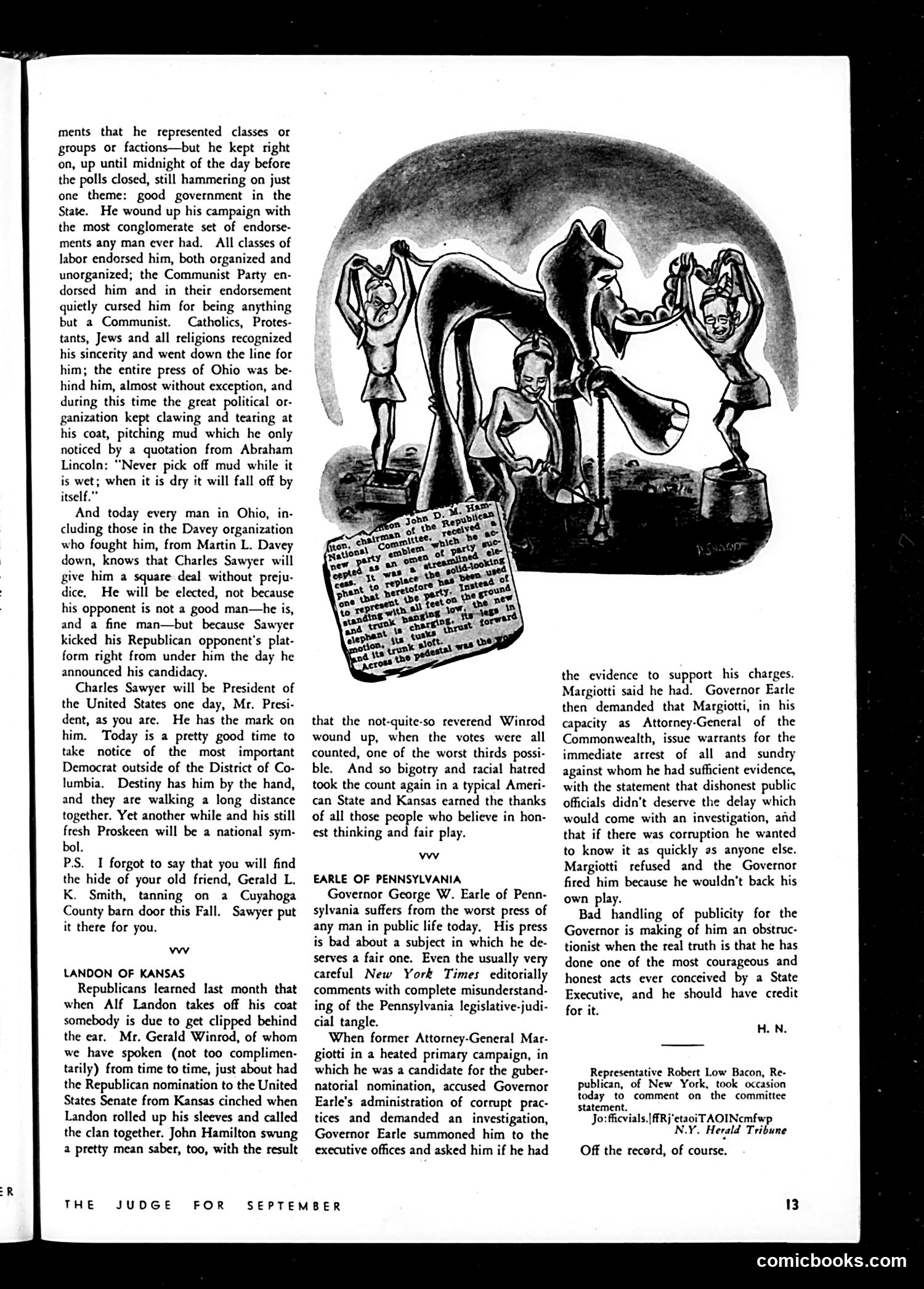
Political Satire from Judge Magazine This page contains three brief political commentaries on 1930s state-level politicians, likely from 1936 based on references to Alf Landon's presidential campaign. Charles Sawyer (Ohio Democrat): The lengthy opening section praises Sawyer as a unifying political force who secured unprecedented cross-factional endorsements—from labor and religious groups to communists and the Republican-leaning Ohio press. The point: Sawyer transcended partisan politics through sheer personal integrity and smart campaign strategy, undermining his opponent's platform. Alf Landon (Kansas): The cartoon's smaller second piece credits Republican Landon with muscling out Gerald Winrod from the Senate nomination race, praising this as a victory against "bigotry and racial hatred." Governor George Earle (Pennsylvania): This section defends Earle against press criticism over his handling of corruption allegations from rival Margiotti, calling Earle's demand for evidence "courageous and honest." Overall, Judge celebrates centrist Democrats and Republicans who combat extremism and corruption—a progressive stance for this satirical magazine.
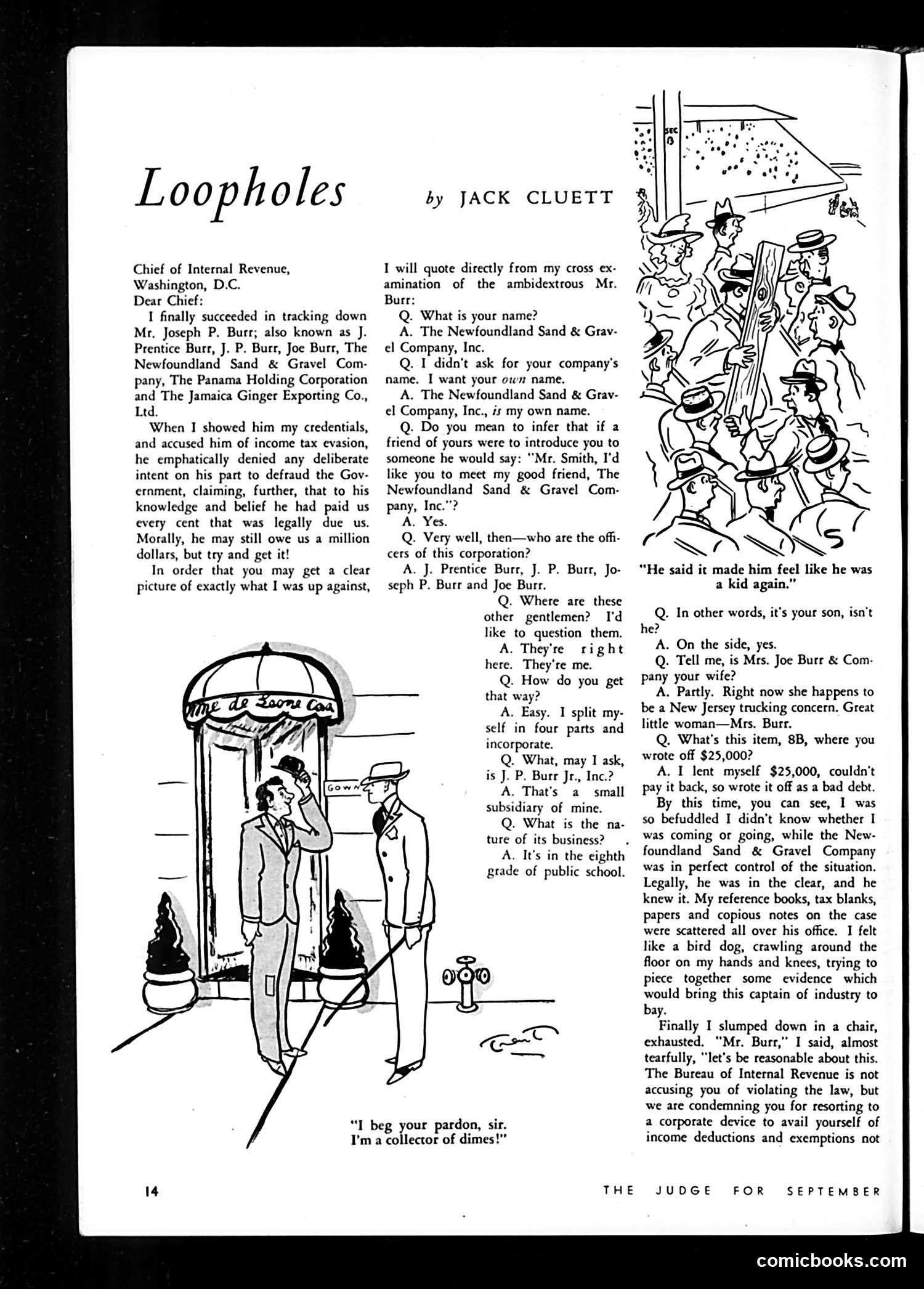
"Loopholes" by Jack Cluett This satirical piece mocks tax evasion through corporate shell games. A revenue agent pursues "Mr. Joseph P. Burr," who exploits legal loopholes by incorporating himself under multiple names (J. Prentice Burr, Joe Burr, etc.) and creating shell corporations. The humor derives from Burr's absurd literalism: he claims the corporation *is* his name, lists himself as multiple officers, writes off bad debts to himself, and incorporates his son (literally a schoolchild in "eighth grade"). The agent becomes comically helpless—crawling on floors gathering evidence—while Burr remains "legally in the clear." The cartoon criticizes wealthy individuals exploiting tax law's technical language to avoid obligations while remaining technically within bounds. The title "Loopholes" names the satirical target: legal provisions that permit wealthy people to evade moral—if not legal—tax responsibility. The punchline about a "collector of dimes" suggests trivial enforcement against flagrant abuse.
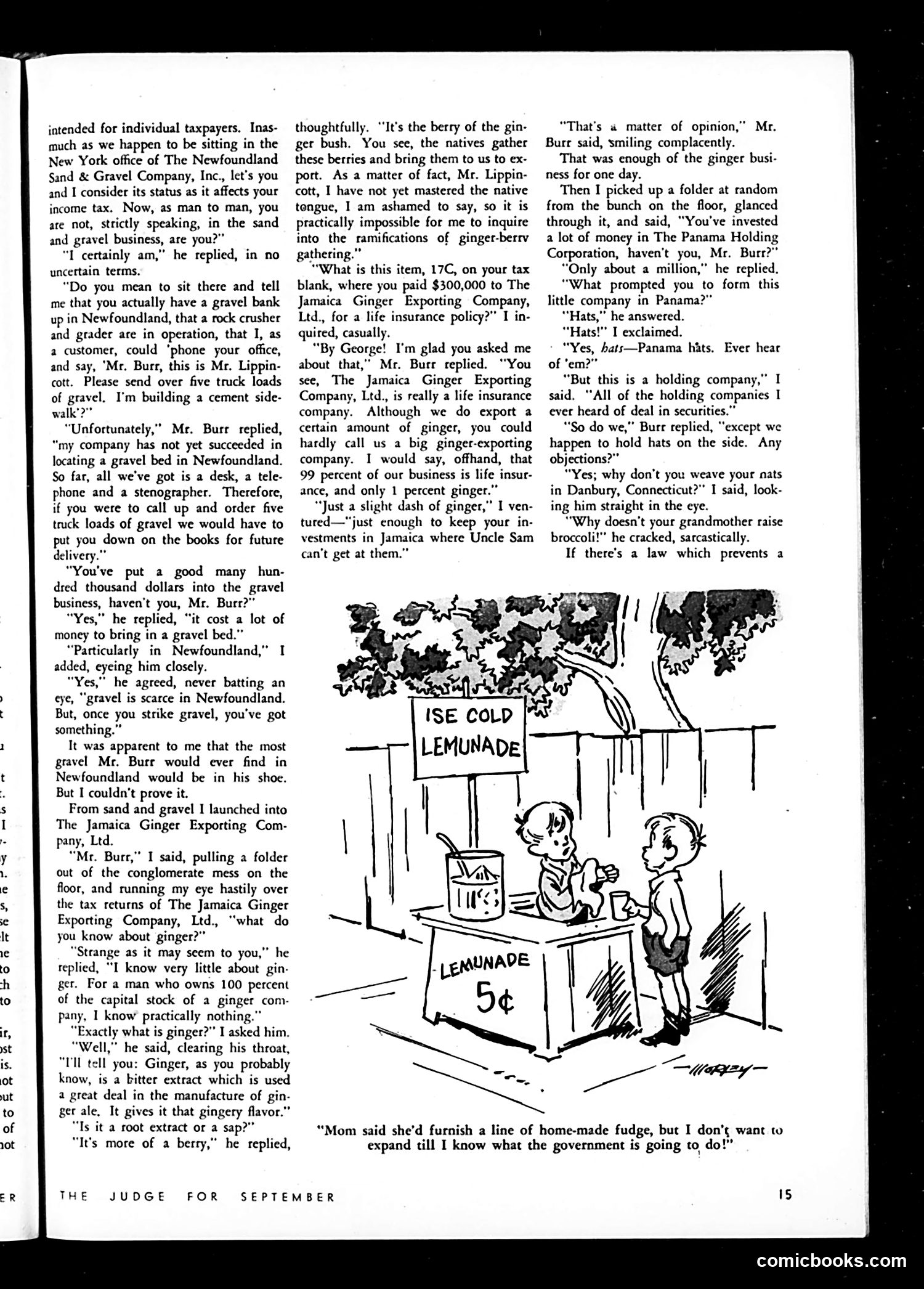
Analysis of Judge Magazine Page This page satirizes tax evasion schemes prevalent in the 1920s-30s. The protagonist, a tax inspector, interrogates Mr. Burr about his dubious business ventures. The Jamaica Ginger Exporting Company is the primary target. Burr admits his company is actually a life insurance operation (99% of business) disguised as a ginger exporter—a classic tax dodge. By claiming to export to Jamaica, he shields investments from U.S. taxation. His admission that ginger is "a berry of the ginger bush" gathered by natives he can't communicate with reveals the company is entirely fictional window-dressing. Similarly, his Newfoundland Sand & Gravel Company owns no actual gravel beds—just "a desk, a telephone and a stenographer"—yet receives substantial capital investments. The cartoon (bottom) shows children selling lemonade, ironically captioned about government expansion, suggesting even legitimate small businesses face bureaucratic scrutiny while wealthy operators exploit loopholes. The satire criticizes how wealthy businessmen create shell companies to evade taxes while ordinary citizens operate transparently.
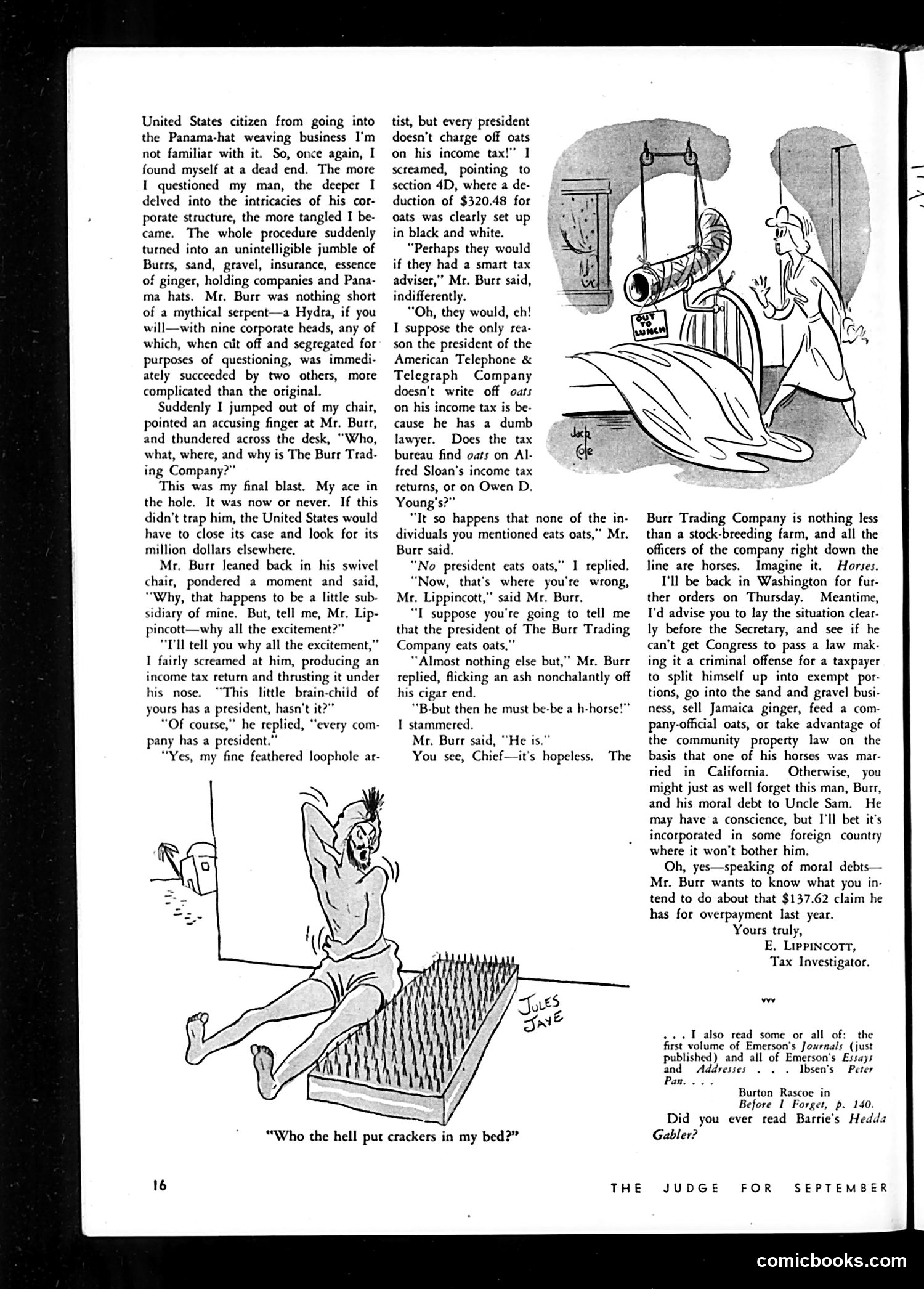
Explanation for Modern Readers This is a satirical story about tax evasion, not a political cartoon. A tax investigator (Lippincott) pursues a businessman named Mr. Burr through an absurdly complicated corporate structure designed to hide income. The joke culminates when Lippincott discovers that The Burr Trading Company—ostensibly a subsidiary claiming oat expenses—is actually a horse-breeding farm, and its "president" is literally a horse. This reveals Burr's scheme: by incorporating his horses as a business with a horse as president, he's attempting to write off expenses illegally. The satire targets wealthy individuals who exploit corporate loopholes and complex business structures to avoid taxes. References to real executives (Alfred Sloan of General Motors, Owen Young) highlight how only the wealthy could afford such elaborate schemes. The hopelessness expressed reflects public frustration with the wealthy evading taxation while ordinary citizens paid honestly.
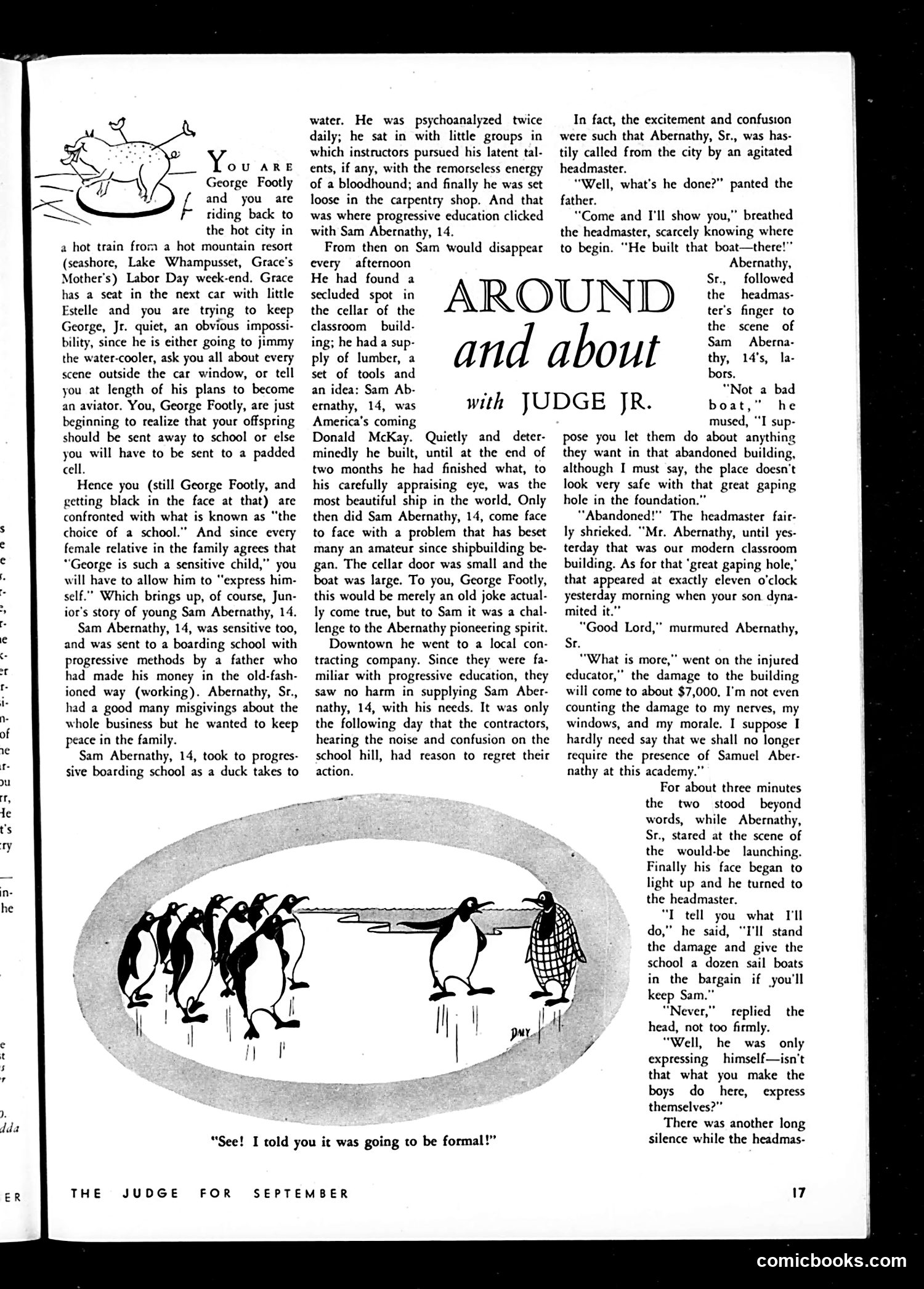
Analysis for Modern Readers This satirical piece mocks "progressive education"—a 1920s-30s pedagogical movement emphasizing student self-direction and exploration over traditional discipline. The humor lies in its reductio ad absurdum: young Sam Abernathy, encouraged to freely pursue his interests in carpentry, becomes so absorbed building a ship in the school cellar that he literally demolishes the classroom building to remove it. The cartoon (penguins in formal wear launching a ship) is a visual pun on the "formal" launching ceremony Sam's project becomes. The joke targets progressive educators' naïve faith that student interests, if sufficiently liberated, naturally lead to constructive outcomes. Instead, Sam's unchecked initiative causes $7,000 in damage—a pointed critique suggesting progressive methods lack necessary restraint and accountability. The piece is framed as advice to "George Footly" about school choice, implying readers should think carefully before embracing this trendy educational philosophy.
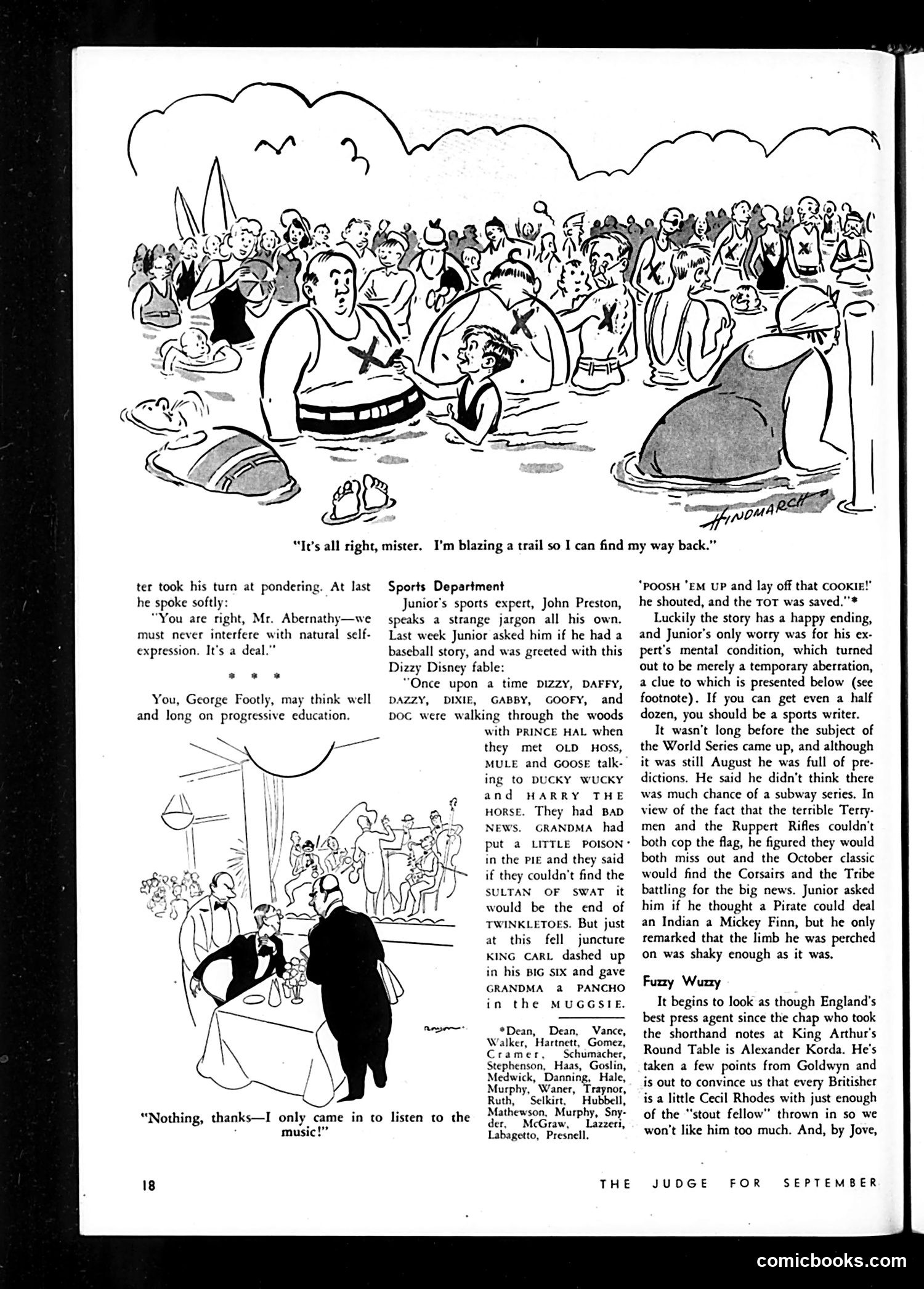
Analysis for Modern Readers This page contains three satirical pieces from *Judge* magazine: Top Cartoon: A humorous beach scene mocking "progressive education." A portly man claims to be "blazing a trail" in the ocean, suggesting adults who embrace permissive parenting philosophies are themselves lost and foolish—a jab at trendy educational theories of the era. "Sports Department": A parody of a junior sportswriter's overwrought storytelling using nonsensical animal names that are actually thinly-veiled references to 1930s baseball stars (Babe Ruth, Dizzy Dean, etc.). The joke satirizes both overwrought sports journalism and how children uncritically mimic adults' affected jargon. "Fuzy Wuny": A brief critique of British filmmaker Alexander Korda's PR machine, suggesting he portrays all Britons as noble "stout fellows" (colonial adventurer types) to manipulate American audiences—a jab at propaganda-adjacent entertainment marketing. The page mocks educational fads, juvenile mimicry of adult affectations, and foreign media manipulation.
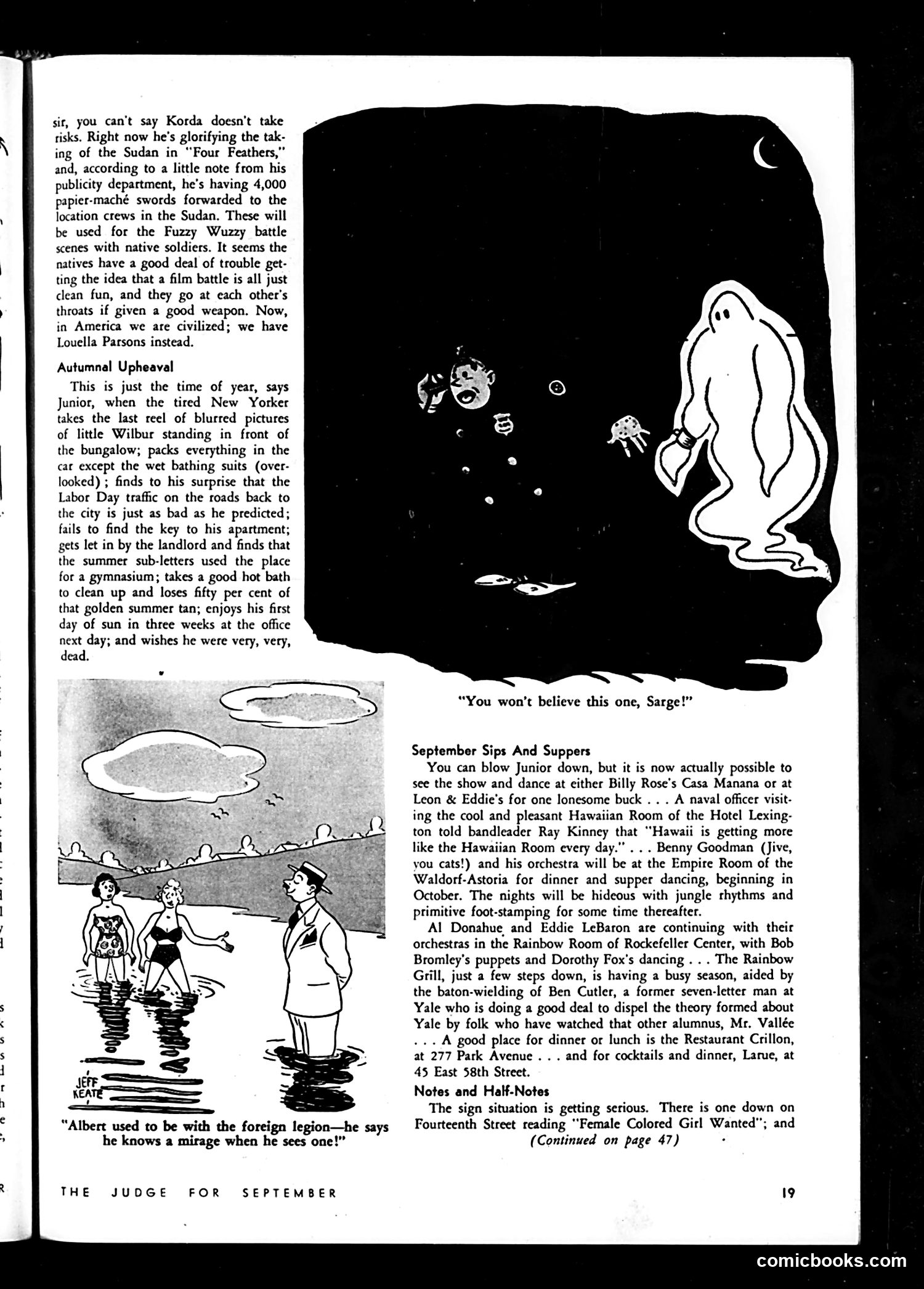
Judge Magazine Page Analysis This page contains two distinct satirical pieces: Top section: Critiques filmmaker Alexander Korda's production of "Four Feathers" (about Sudan conquest). The joke mocks Korda's use of 4,000 papier-mâché swords for battle scenes with native soldiers, noting the natives don't understand film is "clean fun" and actually try to kill each other with real weapons. The satire compares this to America's supposed civility, sarcastically suggesting Louella Parsons (a notorious gossip columnist) represents our advancement—implying celebrity scandal-mongering is equally barbaric. Bottom section: A cartoon showing three people at a beach. The caption "Albert used to be with the foreign legion—he says he knows a mirage when he sees one!" jokes about mistaking mirages for reality, likely referencing someone's dubious claims or self-aggrandizing stories. The remaining text covers entertainment venues and musicians available in September—primarily advertising upscale NYC nightclubs and restaurants featuring popular bandleaders like Benny Goodman.
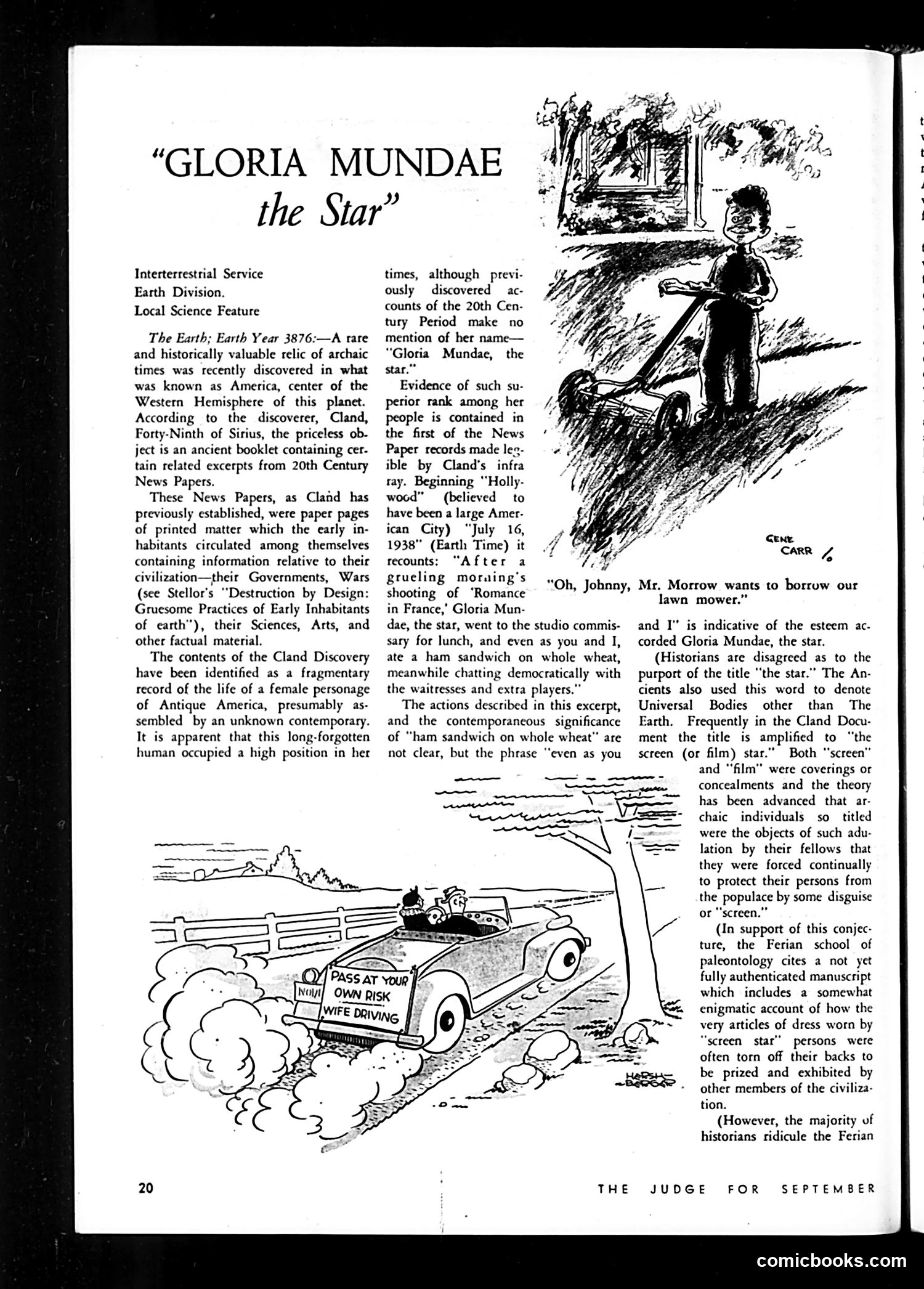
"Gloria Mundae the Star": A Satirical Look at 1938 Celebrity Culture This science fiction satire imagines future archaeologists in 3876 discovering a 20th-century newspaper account of actress "Gloria Mundae" eating a ham sandwich. The joke operates on multiple levels: The Setup: Futuristic scholars treat mundane celebrity gossip as profound historical evidence of an important personage, complete with earnest academic debate about what "the star" means and why she required "screens" (disguises) for protection from adoring crowds. The Satire: Judge mocks both 1938 Hollywood's inflated self-importance and the breathless fan magazines documenting celebrities' trivial daily activities. By presenting a simple lunch story as archaeological treasure, the magazine ridicules how contemporary media elevates starlets to near-deity status over meaningless details. The Cartoon: A car with a "Pass at your own risk—wife driving" sign humorously undercuts the magazine's satirical tone, offering unrelated domestic humor typical of the era. The piece satirizes celebrity worship and gossip journalism through the distancing lens of far-future scholarship.
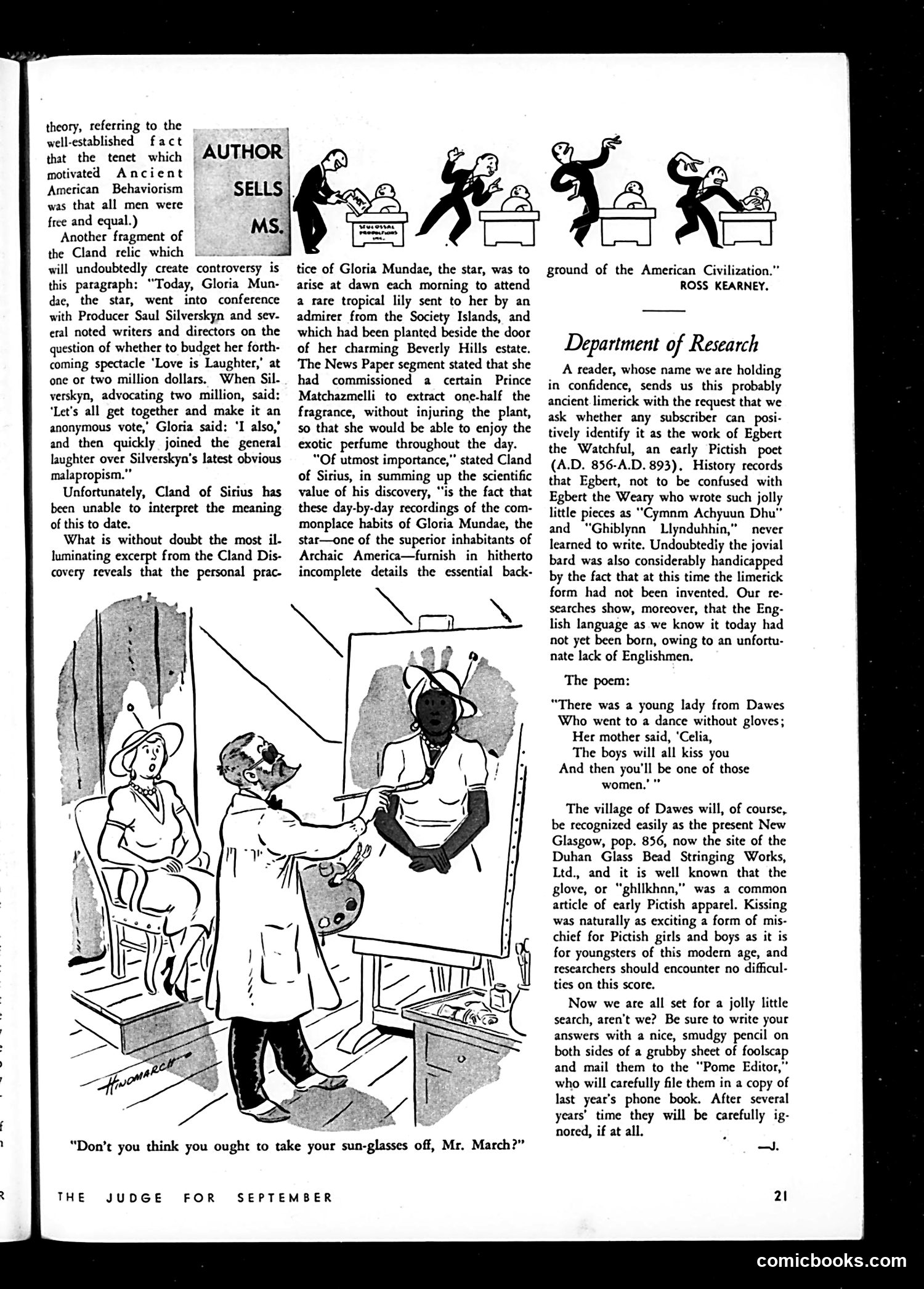
Cartoon Analysis The main cartoon depicts a Hollywood film producer or director (likely caricaturing someone from 1930s cinema) wearing dark sunglasses indoors while reviewing work with a female assistant or colleague. The joke in the caption—"Don't you think you ought to take your sun-glasses off, Mr. March?"—satirizes the affectation of wearing sunglasses indoors, a pretentious habit associated with Hollywood personalities seeking privacy or cultivating a glamorous image. The surrounding text is a satirical pseudo-scholarly article mocking Hollywood's obsession with Gloria Mundae, a fictional film star, treating her mundane daily routines as historically significant artifacts worthy of academic study. Judge magazine ridicules both Hollywood's self-importance and the entertainment industry's treatment of stars as cultural icons deserving serious analysis. The humor targets celebrity worship and the absurdity of documenting trivial details about entertainers' lives.
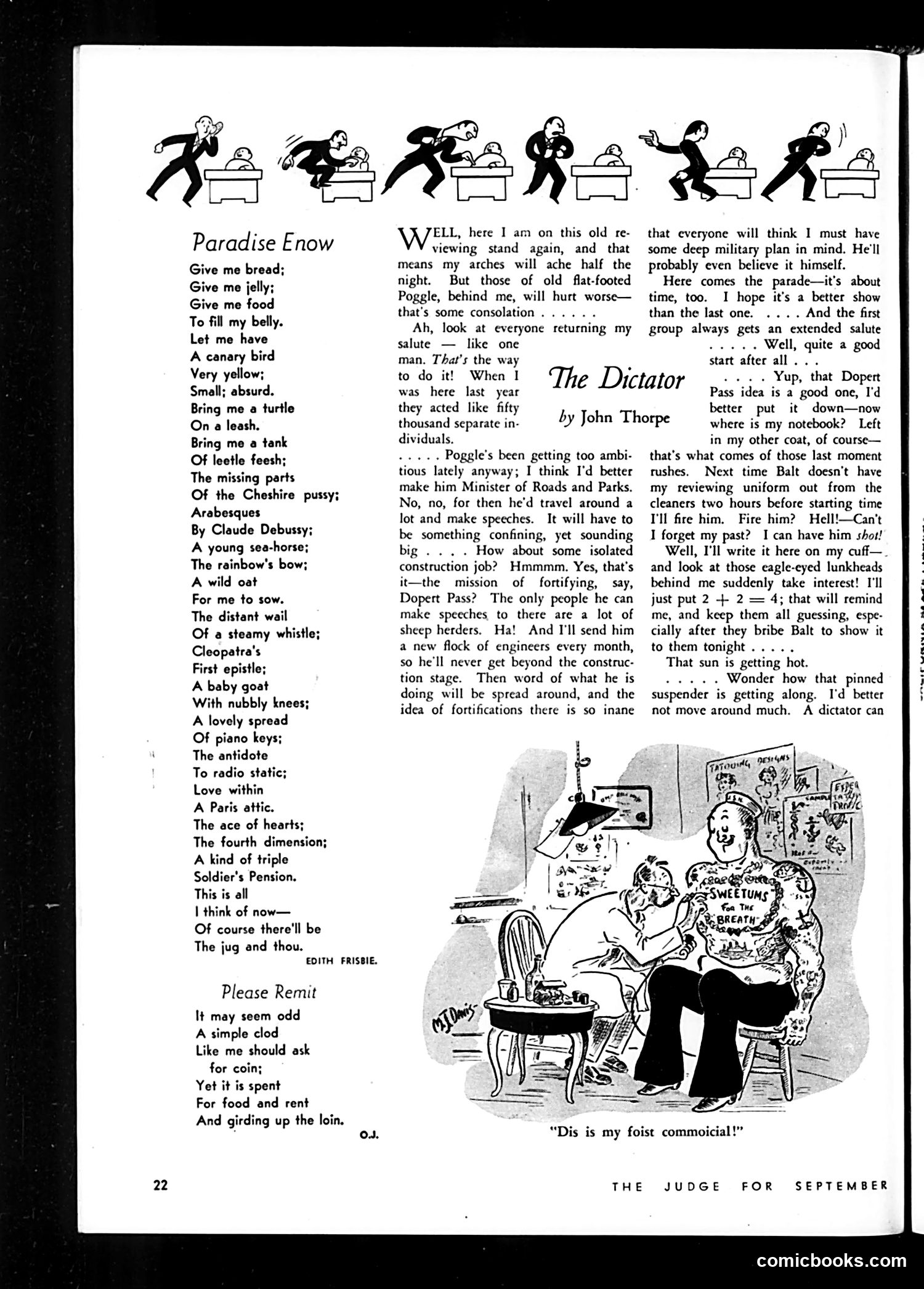
Political Satire Analysis: "The Dictator" by John Thorpe This page satirizes authoritarian rule through a dictator's internal monologue during a military parade. The figure, though unnamed, appears to represent a generic European dictator of the interwar period (likely 1920s-1930s based on Judge's era). The satire exposes several dictatorial tactics: manipulating subordinates through arbitrary reassignment (making "Poggle" minister of an isolated construction project to keep him busy and prevent rival power), manufacturing false impressiveness through strategic disinformation (spreading vague reports about fortifications to seem militarily strategic), and maintaining control through fear (casually considering execution). The visual joke—the dictator taking notes on his cuff during the parade to impress onlookers—highlights vanity and performative authority. The accompanying poem "Paradise Enow" appears unrelated editorial content. The cartoon mocks how dictatorial power relies on theater, paranoia, and petty manipulation rather than genuine leadership.
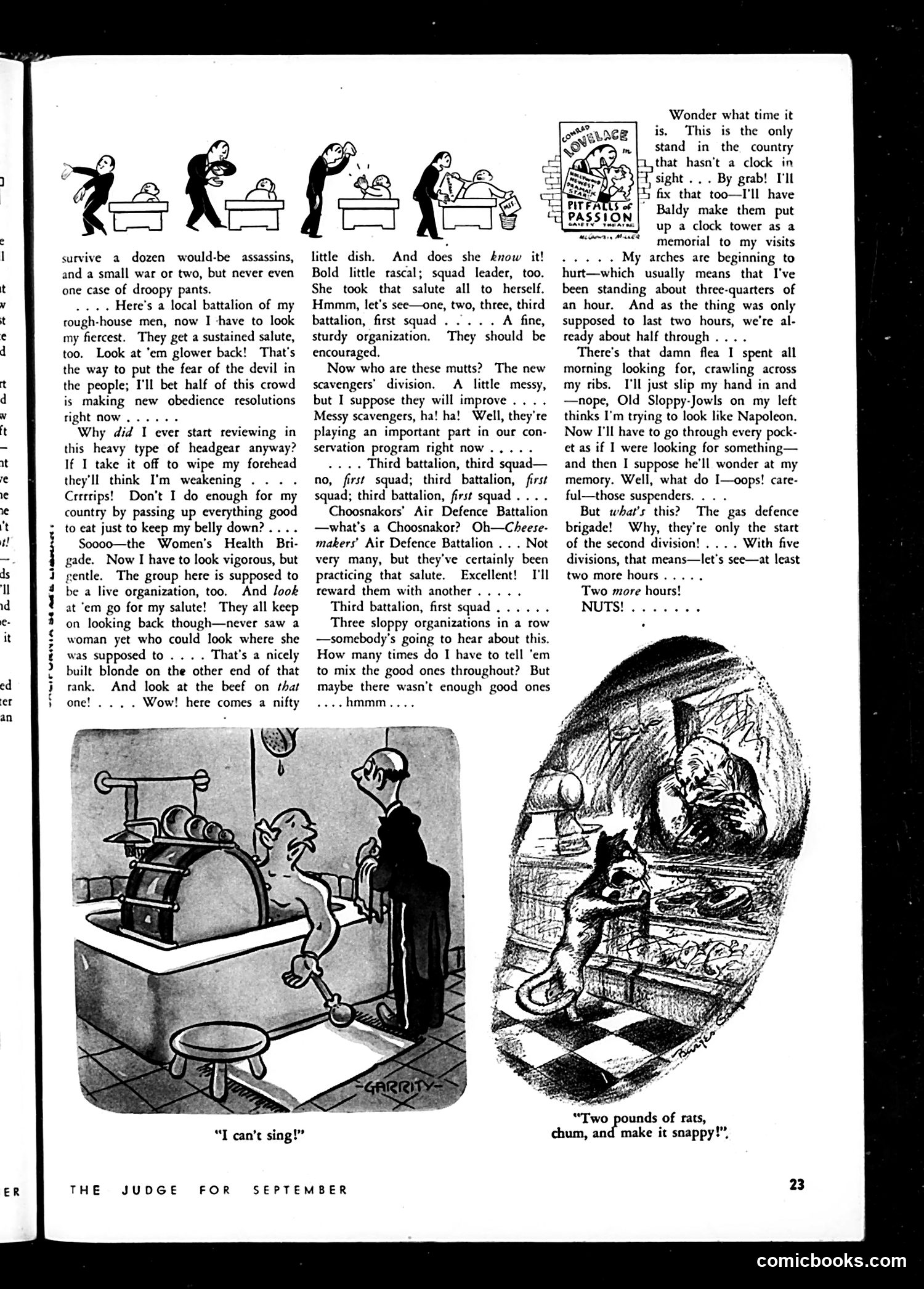
Political Cartoon Analysis: Judge Magazine Page This page satirizes military bureaucracy and pompous authority during what appears to be a wartime period (likely WWI-era, based on references to "Air Defence Battalion" and gas masks). The main text depicts a military inspector reviewing various civilian defense divisions—women's brigades, scavengers, and "cheese-makers' air defence battalion"—with exaggerated self-importance. He obsesses over minor details (salutes, organization) while physically uncomfortable (aching arches, itching fleas), revealing the absurdity of his authority. The satire targets: - Bureaucratic pretension: The inspector's grandiose attitude masking mundane duties - Civilian mobilization: Poorly-organized, misnamed defense units (note the confusion over unit names) - Gender stereotypes: Objectifying comments about female volunteers The two cartoons below—"I can't sing!" and "Two pounds of rats, chum, and make it snappy!"—appear to mock incompetence and desperation in these civilian defense efforts. The overall message: wartime home-front organization is chaotic, absurd, and run by self-important mediocrities.
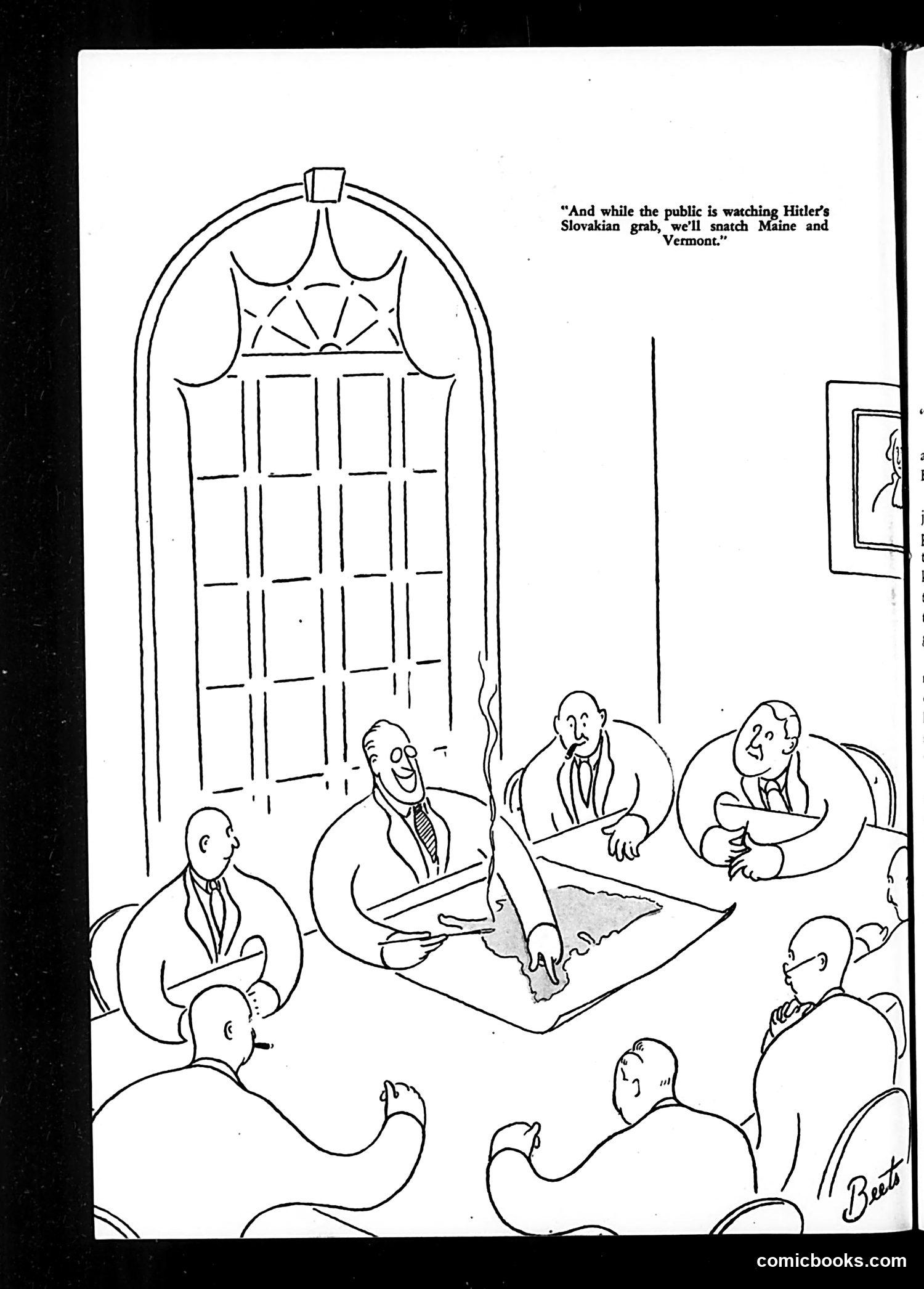
Cartoon Analysis This is a political cartoon from *Judge* magazine satirizing American foreign policy during World War II. The scene shows government officials gathered around a map, with one pointing to locations while declaring: "And while the public is watching Hitler's Slovakian grab, we'll snatch Maine and Vermont." The cartoon criticizes the U.S. government for exploiting public distraction with Nazi aggression in Europe to pursue domestic territorial ambitions. Maine and Vermont appear on the map before them. The joke suggests political hypocrisy—while Americans focus on Hitler's expansionism abroad, their own leaders scheme for territorial expansion at home, making them morally equivalent to the enemy they oppose. The cartoon's perspective indicates frustration with perceived governmental opportunism during wartime.
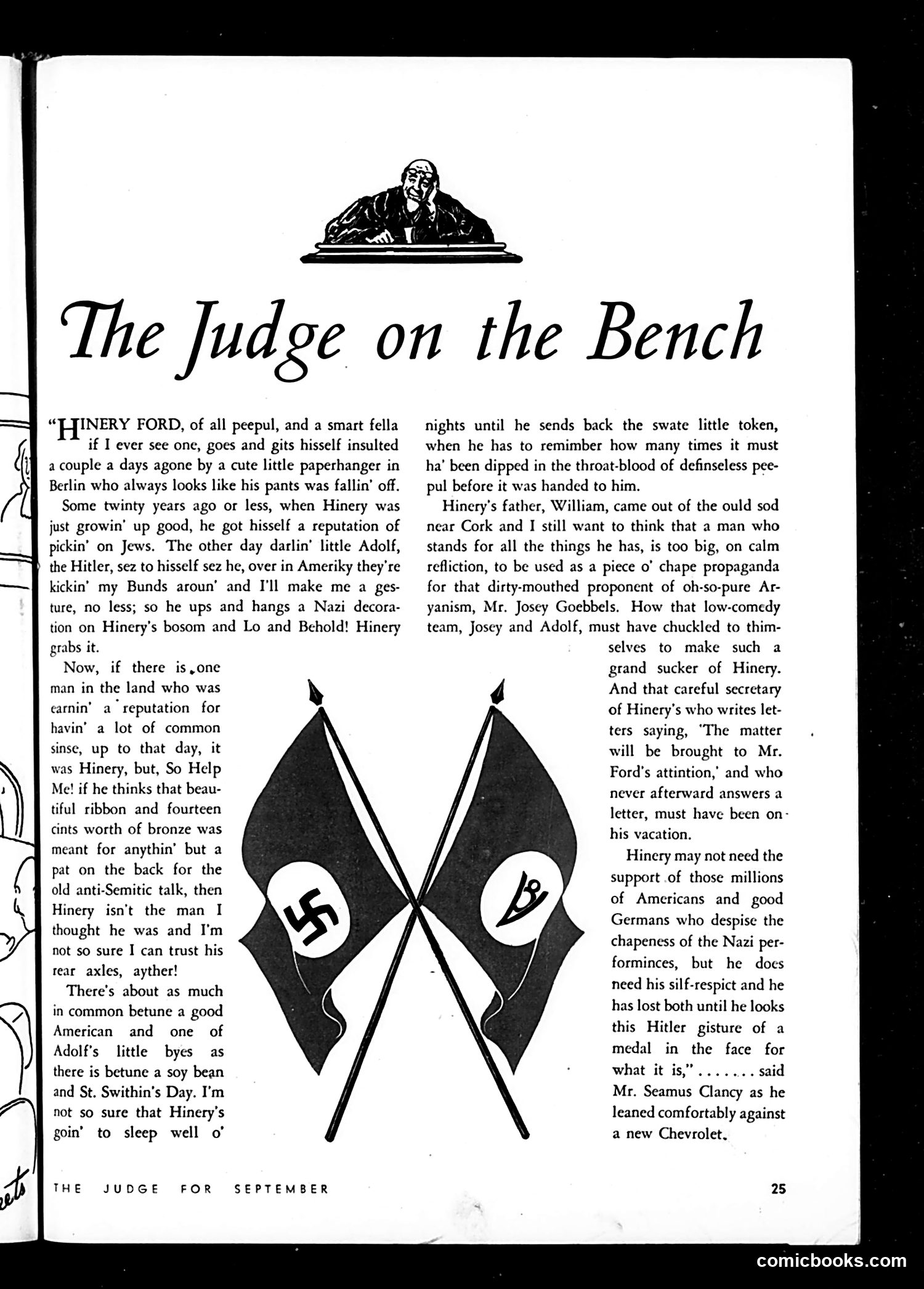
"The Judge on the Bench" - Analysis This article satirizes Henry Ford's acceptance of a Nazi medal from Adolf Hitler. The writer (using Irish-dialect vernacular for comic effect) criticizes Ford for accepting this honor despite his well-known history of antisemitism—which Hitler apparently exploited as propaganda. The key figures: - "Hinery Ford" (Henry Ford): American industrialist - "the little paperhanger in Berlin" (Adolf Hitler): derisive reference to Hitler's failed art career - Joseph Goebbels ("Josey Goebbels"): Nazi propaganda minister The satire's point: Ford, once known for common sense, has been duped by Nazi flattery into becoming a propaganda tool. The crossed Nazi and Ford Motor Company flags reinforce this unholy alliance. The article argues Ford—an Irish-American whose father emigrated from Ireland—should know better than to accept honors from a regime he shares antisemitic views with, and that accepting the medal morally compromises him regardless of his prior reputation. The piece reflects American concern about Nazi influence and Ford's controversial ideology during the pre-WWII period.
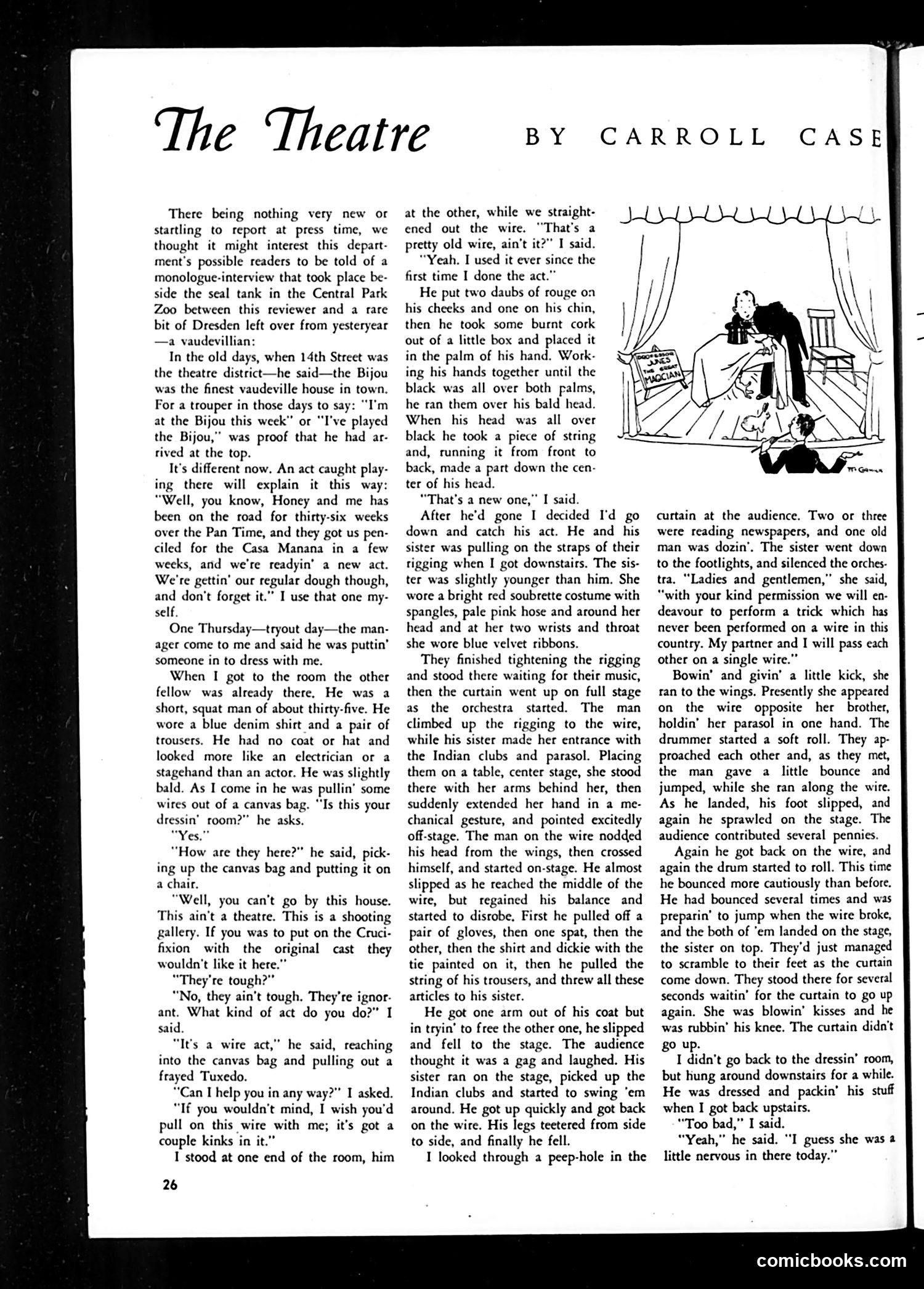
"The Theatre" by Carroll Case — Judge Magazine This is a theatrical anecdote about vaudeville's decline. The narrator, a vaudeville performer, reflects on how the Bijou Theatre on 14th Street was once prestigious, but has become a second-rate venue ("shooting gallery"). The story centers on meeting a fellow performer—a wire-walker—who performs an act with his sister. The comedian describes the man's shabby appearance and minimal costume-making (burnt cork for blackface makeup, a frayed tuxedo). The act itself involves the man performing on a high wire while his sister makes theatrical gestures below with Indian clubs and parasol. The satire targets vaudeville's degradation: once-thriving performers now work smaller circuits ("Pan Time," "Casa Manana") while playing indifferent, "ignorant" audiences. The wire act appears dated and poorly resourced. The piece nostalgically critiques how theatrical entertainment has become cheaper, more desperate, and less respected—reflecting vaudeville's actual decline in the early 20th century as cinema and other entertainments displaced it.
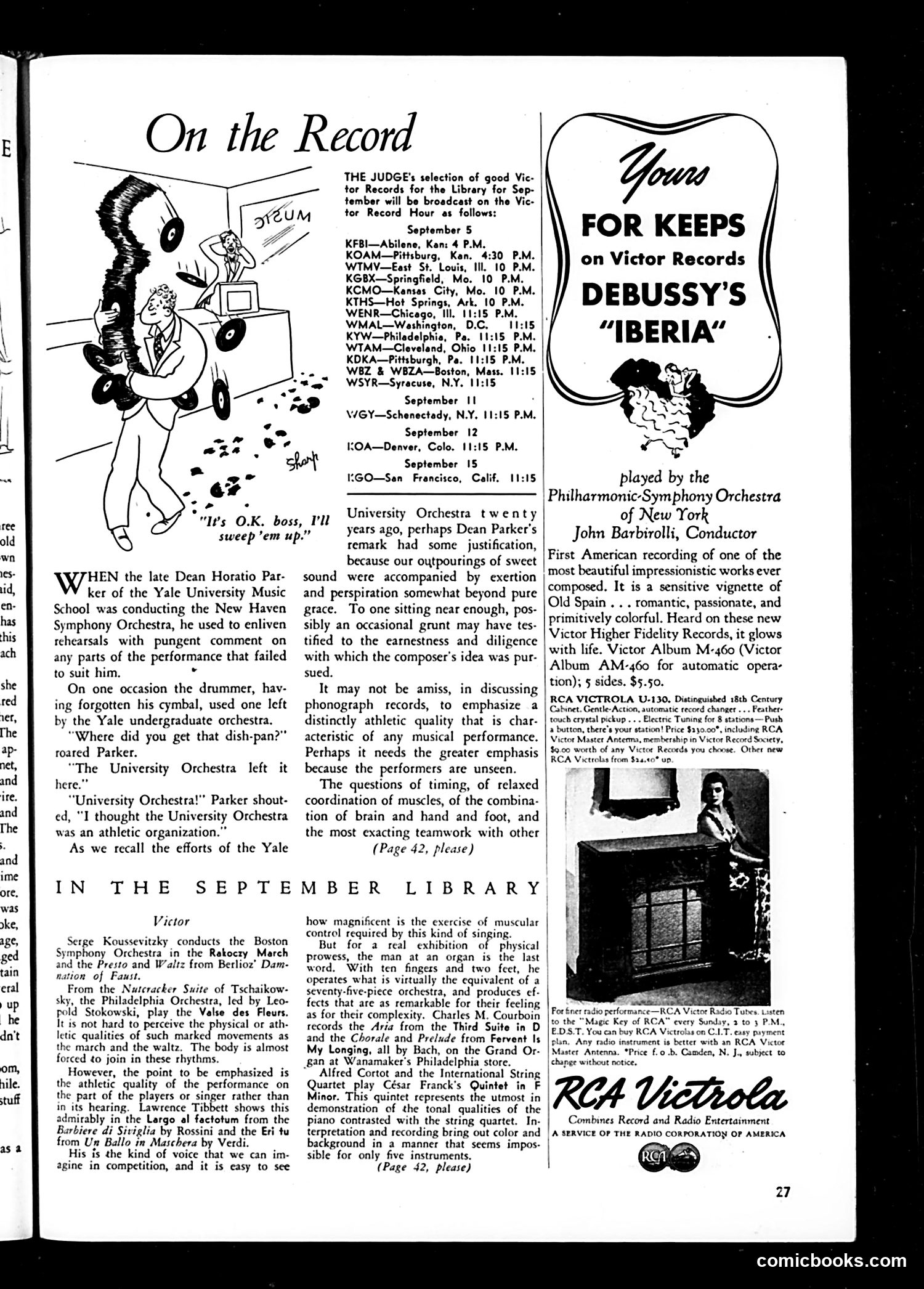
Explanation for a Modern Reader This page contains a humorous anecdote about Dean Horatio Parker of Yale's music school, followed by record advertisements. The joke relies on a specific academic context. The Cartoon/Anecdote: Dean Parker conducted the Yale University Orchestra and was known for harsh criticism. When a drummer used a borrowed cymbal from the undergraduates, Parker mockingly called it a "dish-pan." When told it came from the "University Orchestra," Parker quipped that he thought the University Orchestra "was an athletic organization"—implying it was so poor-quality it seemed more like a sports team than a musical ensemble. The Satire: The humor targets the apparently mediocre performance standards of Yale's amateur student orchestra around 1905-1910 (twenty years before this publication). Parker's crack suggests the orchestra was athletically vigorous but musically incompetent—a pointed insult to institutional pride. Context: The page mostly advertises Victor Records' radio broadcast schedule and classical recordings, using this anecdote as filler content typical of Judge magazine's mix of satire and advertising.
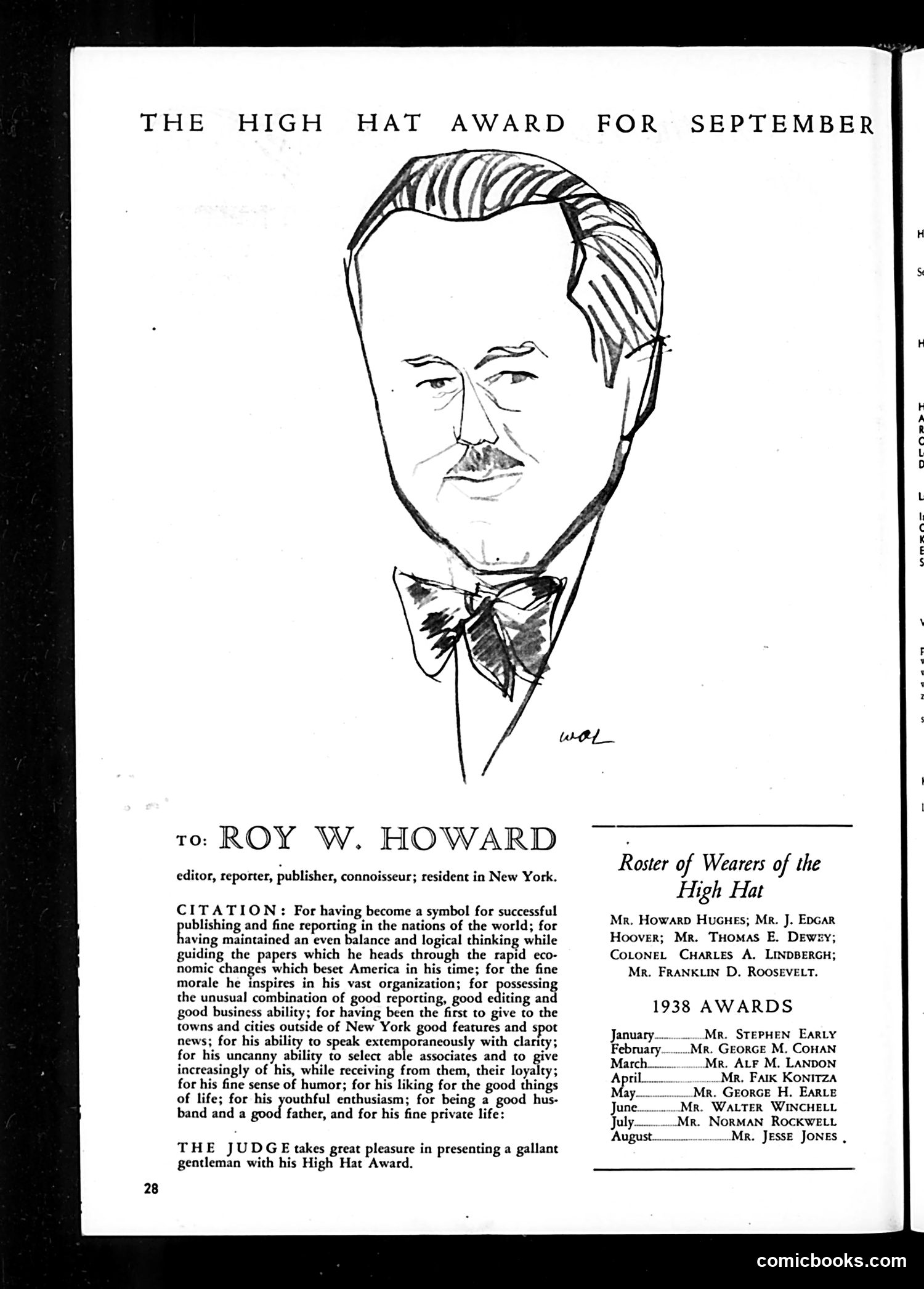
"The High Hat Award for September" (1938) This page presents *Judge* magazine's satirical monthly award to Roy W. Howard, a prominent newspaper publisher and editor. The elaborate citation praises Howard's journalism excellence, business acumen, and personal character—spanning his balanced reporting during America's economic upheaval, his ability to inspire organizational loyalty, and his skills as a husband and father. The satire lies in the *excess* of the praise itself. By lavishing such ornate, comprehensive flattery on a businessman-publisher, *Judge* (a conservative publication) gently mocks both corporate celebrity culture and the magazine's own practice of celebrating prominent figures. The award humorously elevates Howard to near-mythic status. The roster of previous award-winners—including President Franklin D. Roosevelt, Herbert Hoover, and aviator Charles Lindbergh—shows this was an established feature honoring America's most prominent men across business, politics, and entertainment.
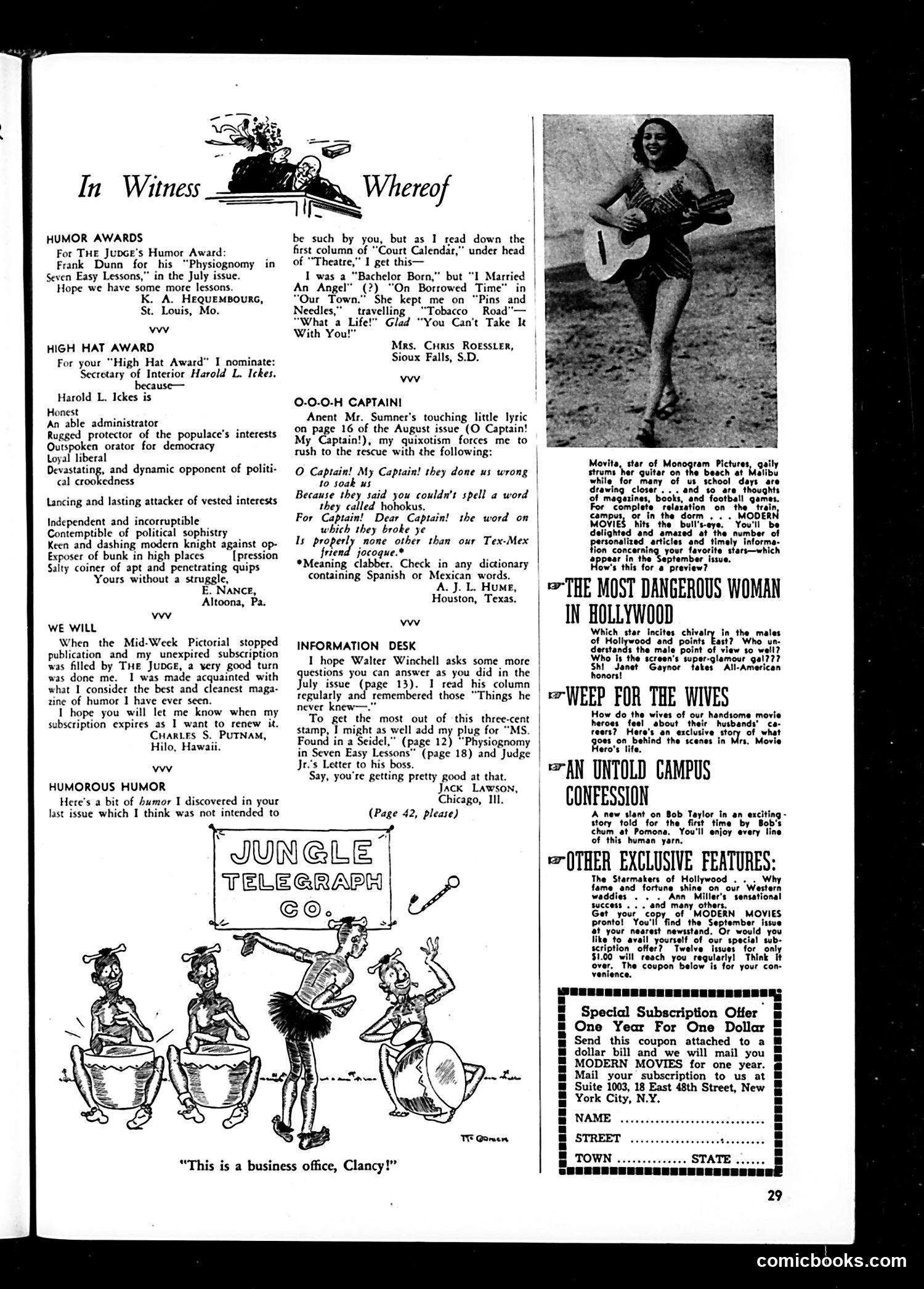
Analysis of Judge Magazine Page Content This page consists primarily of reader letters and advertisements rather than editorial cartoons. The content includes: Main Elements: 1. "Humor Awards" - Readers nominating figures for recognition. Notably, Secretary of Interior Harold L. Ickes receives praise as an "honest," "able administrator" and "devastating opponent of political crookedness" — suggesting contemporary appreciation for his combative liberalism and anti-corruption stance. 2. "Jungle Telegraph" cartoon - A humorous illustration showing anthropomorphized figures at what appears to be a telegraph office, with the caption "This is a business office, Clancy!" The joke's specifics are unclear without additional context. 3. Advertisements - For *Modern Movies* magazine and subscriptions, featuring actress Mertis (star of Monogram Pictures). Historical Context: This appears to be from the New Deal era, given Ickes' prominence and the magazine's satirical focus on American politics and culture.
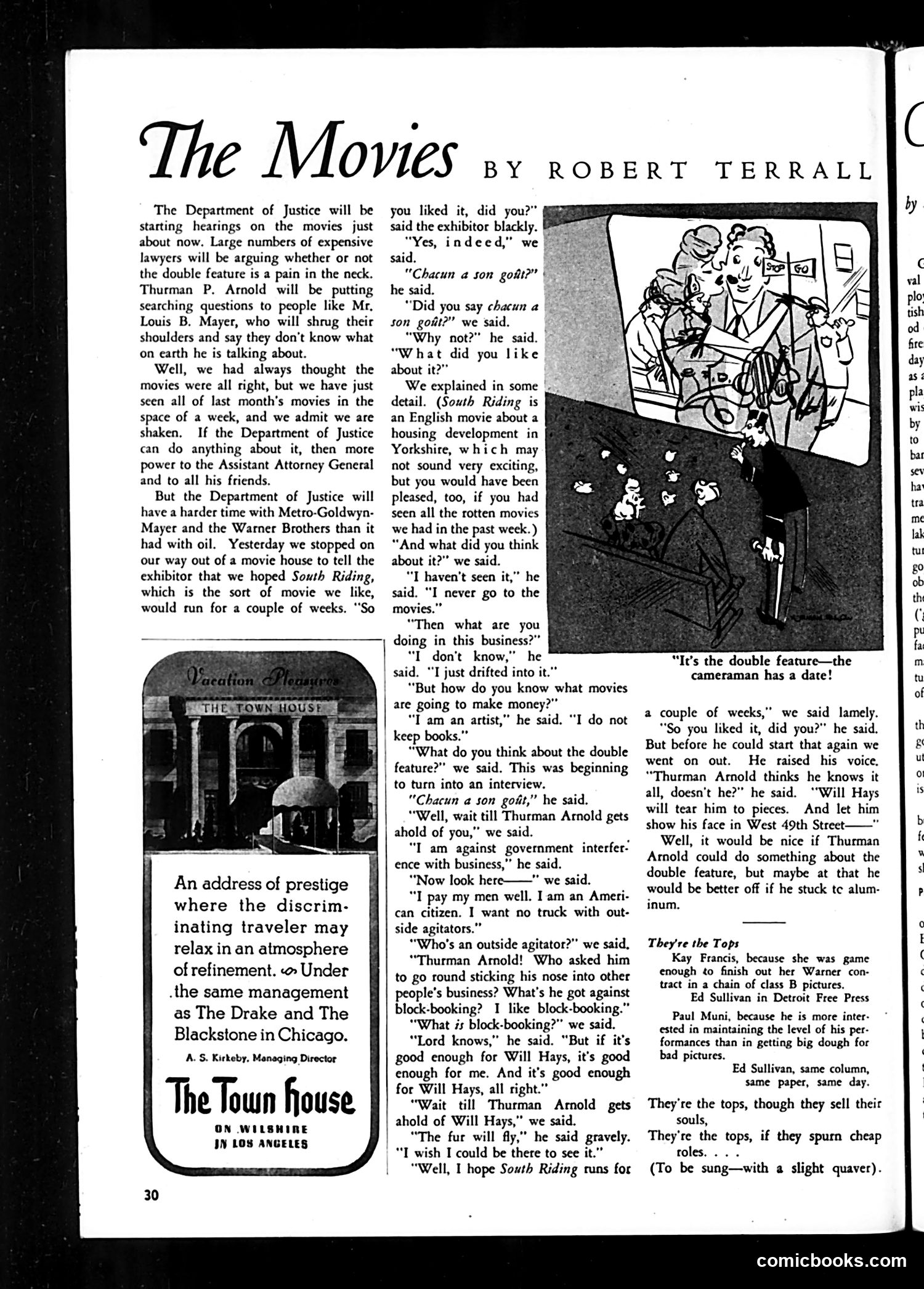
Explaining This Judge Magazine Page This satirical piece by Robert Terrall mocks Hollywood's resistance to government antitrust scrutiny. Thurman P. Arnold, the Assistant Attorney General, was investigating whether double features constituted monopolistic practices that harmed competition. The humor centers on a conversation with a movie theater exhibitor who: - Claims artistic ignorance ("I do not keep books") - Defends "block-booking" (studios forcing theaters to show unwanted films) without understanding it - Invokes Will Hays (head of film industry's self-censorship board) as protection against government interference - Speaks French clichés ("Chacun à son goût"—"to each his own") The cartoon's joke: the cameraman has a "date" during the double feature—implying even crew members abandon poorly-programmed showings. The satire targets Hollywood's smugness, claiming artistic/business autonomy while operating monopolistic practices they don't fully comprehend. The threat of Arnold's investigation looms as the only potential corrective to industry arrogance.
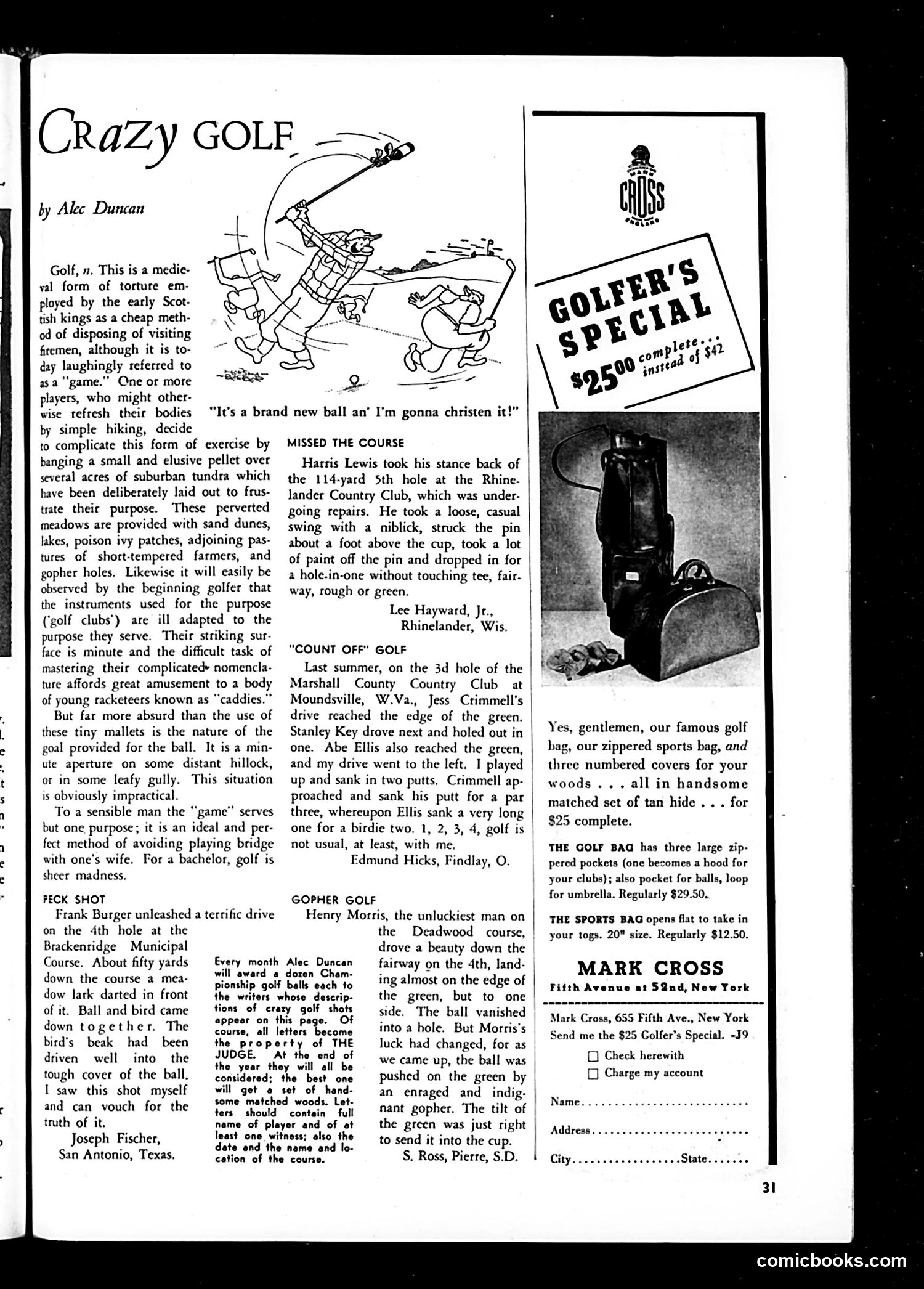
Analysis of "Crazy Golf" Page This page from Judge magazine presents satirical commentary on golf through two main elements: The Opening Essay (by Alec Duncan): A mock-serious "definition" of golf that ridicules the sport as an absurd, deliberately frustrating activity invented by medieval Scottish kings as torture. Duncan sarcastically notes golf's impractical design—tiny mallets, impossible targets on distant hillocks, poison ivy and gopher holes—and suggests the game's real value is avoiding playing bridge with one's wife. The humor targets golf's popularity among American leisure-class men while questioning its logical purpose. Reader Submissions: The bulk comprises humorous anecdotes about impossible golf shots—hole-in-ones without touching fairway or green, sequential perfect scores, a bird-beak-impaled ball pushed into the cup by a gopher. These exaggerated stories mock both golf's unpredictability and enthusiasts' tendency to embellish their experiences. The accompanying advertisement for the "Golfer's Special" ($25 golf bag) provides ironic commercial framing. Overall, the page satirizes golf culture and the absurdity of the sport itself, reflecting early-20th-century American attitudes toward this leisure activity.
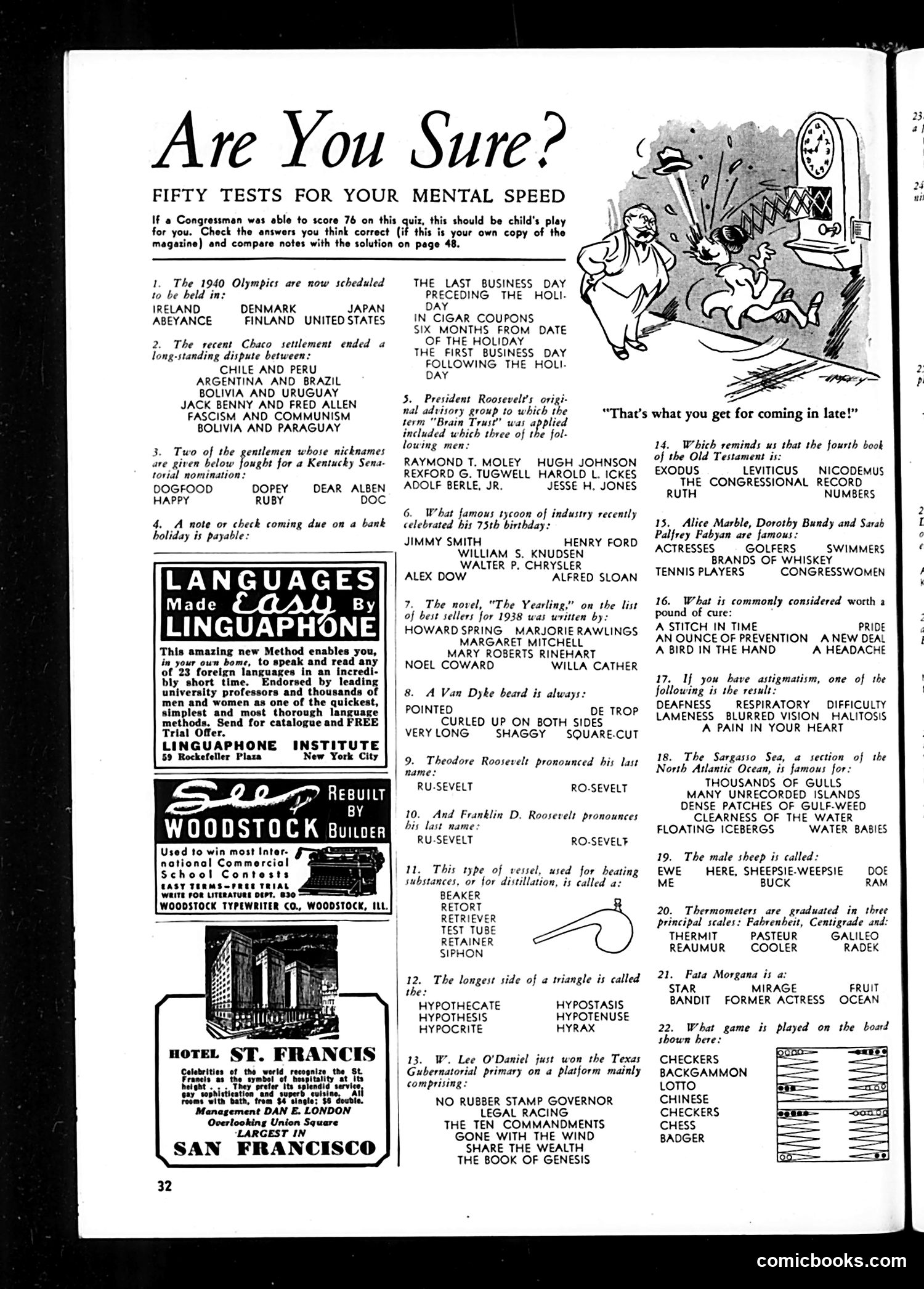
"Are You Sure?" — A Mental Speed Quiz from Judge Magazine This page presents a trivia quiz titled "Fifty Tests for Your Mental Speed," satirically claiming that if a Congressman scored 76, it should be easy for readers. The humor lies in the backhanded insult: congressmen are implicitly portrayed as unintelligent, so this "should be child's play" for ordinary people. The questions themselves mix legitimate 1930s-era facts (FDR's "Brain Trust," Henry Ford's birthday, W. Lee O'Daniel's Texas gubernatorial campaign) with absurdist trick answers. For example, question 3 references real politicians (Jack Benny and Fred Allen were comedians, not senators), and question 14 includes "The Congressional Record" as a Bible book—a jab at Congress's irrelevance or verbosity. The cartoon inset shows a latecomer being scolded, suggesting procrastination costs. Overall, the page mocks both Congress and readers' confidence in their own knowledge.
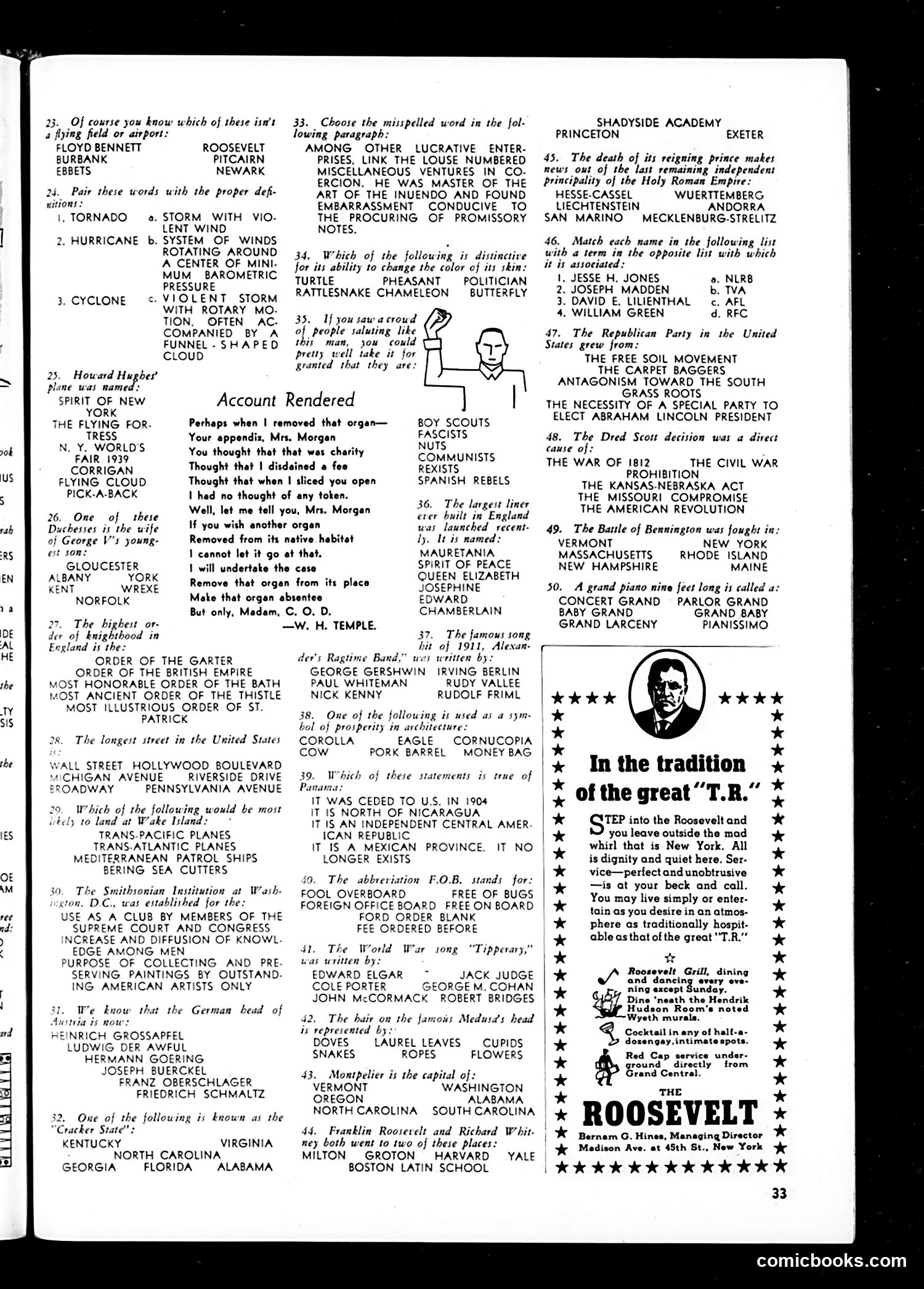
Analysis for Modern Readers This page is primarily a trivia quiz from Judge magazine, not a political cartoon. It presents 23 multiple-choice and matching questions on miscellaneous topics: geography, history, aviation, British honors, and current events. The only clearly political content appears in Question 35, which asks readers to identify a group based on a salute gesture. The answer options include "FASCISTS," "BOY SCOUTS," "COMMUNISTS," and "REXISTS"—reflecting 1930s-40s anxieties about totalitarian movements. The cartoon shows a figure giving what appears to be a fascist salute, and the joke implies such salutes were common among multiple ideological extremes. The "Account Rendered" cartoon below depicts a surgeon billing a patient for organ removal on "C.O.D." (cash on delivery) terms—satirizing medical profiteering. An advertisement for The Roosevelt Hotel appears at page bottom, unrelated to the quiz content. The magazine's purpose here is lighthearted entertainment and mild social commentary rather than serious political satire.
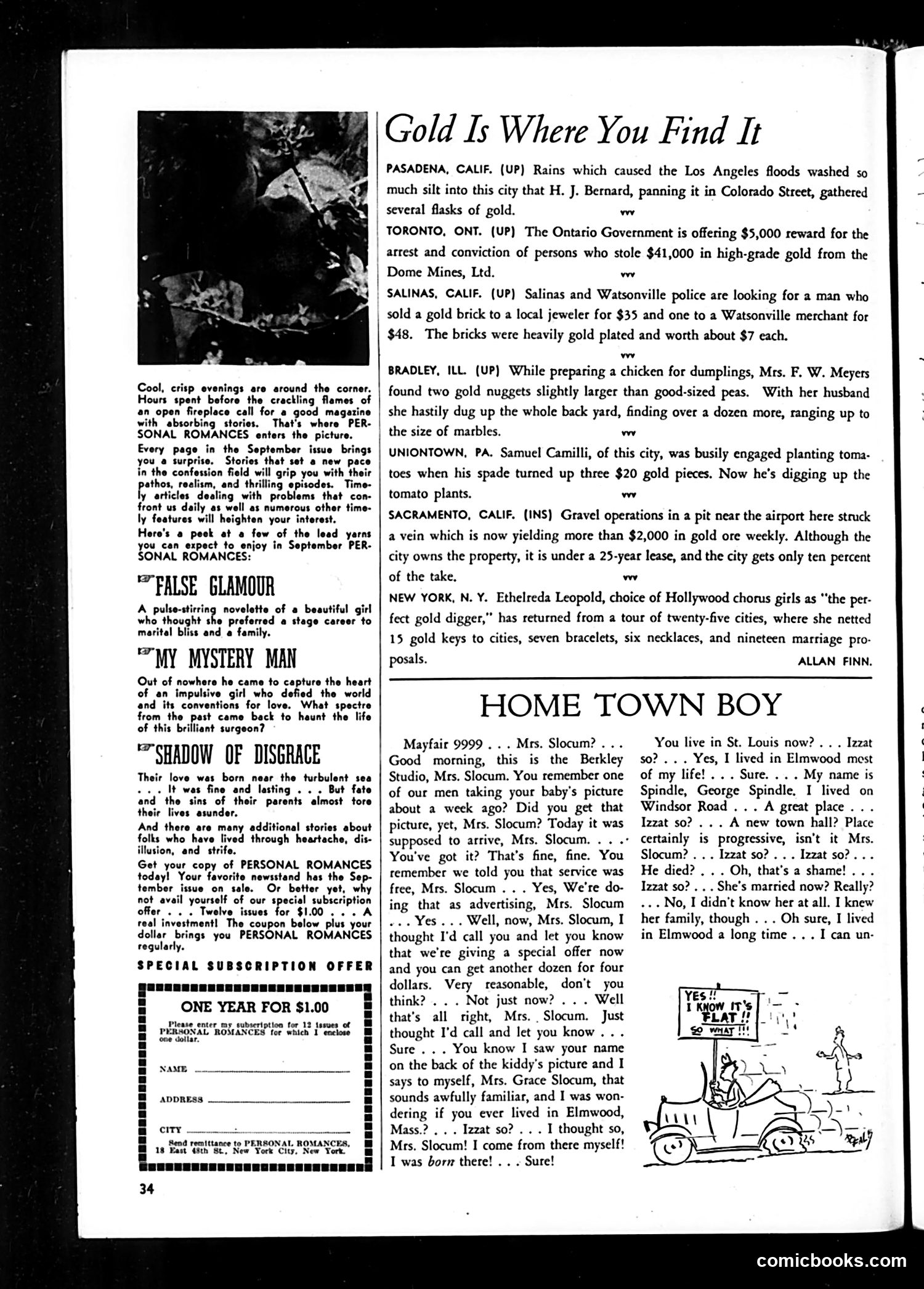
"Gold Is Where You Find It" — A Depression-Era Satire This page juxtaposes two contrasting pieces: a Personal Romances pulp magazine advertisement and a humorous news column satirizing get-rich-quick fantasies. The "Gold Is Where You Find It" section collects absurd true anecdotes: a woman finds gold nuggets in her chicken dinner; a man discovers coins while gardening; flood silt yields gold. The real punchline is the final item: Ethelreda Leopold, a "gold digger" (slang for a woman pursuing wealthy men), netted "15 gold keys to cities, seven bracelets, six necklaces, and nineteen marriage proposals." The satire targets Depression-era desperation. While ordinary people fantasize about stumbling upon wealth, the actual "gold digger"—a woman using romance transactionally—proves more successful at extracting value than any lucky farmer or flood victim. The placement next to cheap pulp fiction advertisements emphasizes the theme: both target working-class readers hungry for escape fantasies and romantic stories, exploiting hopes of sudden fortune or true love.
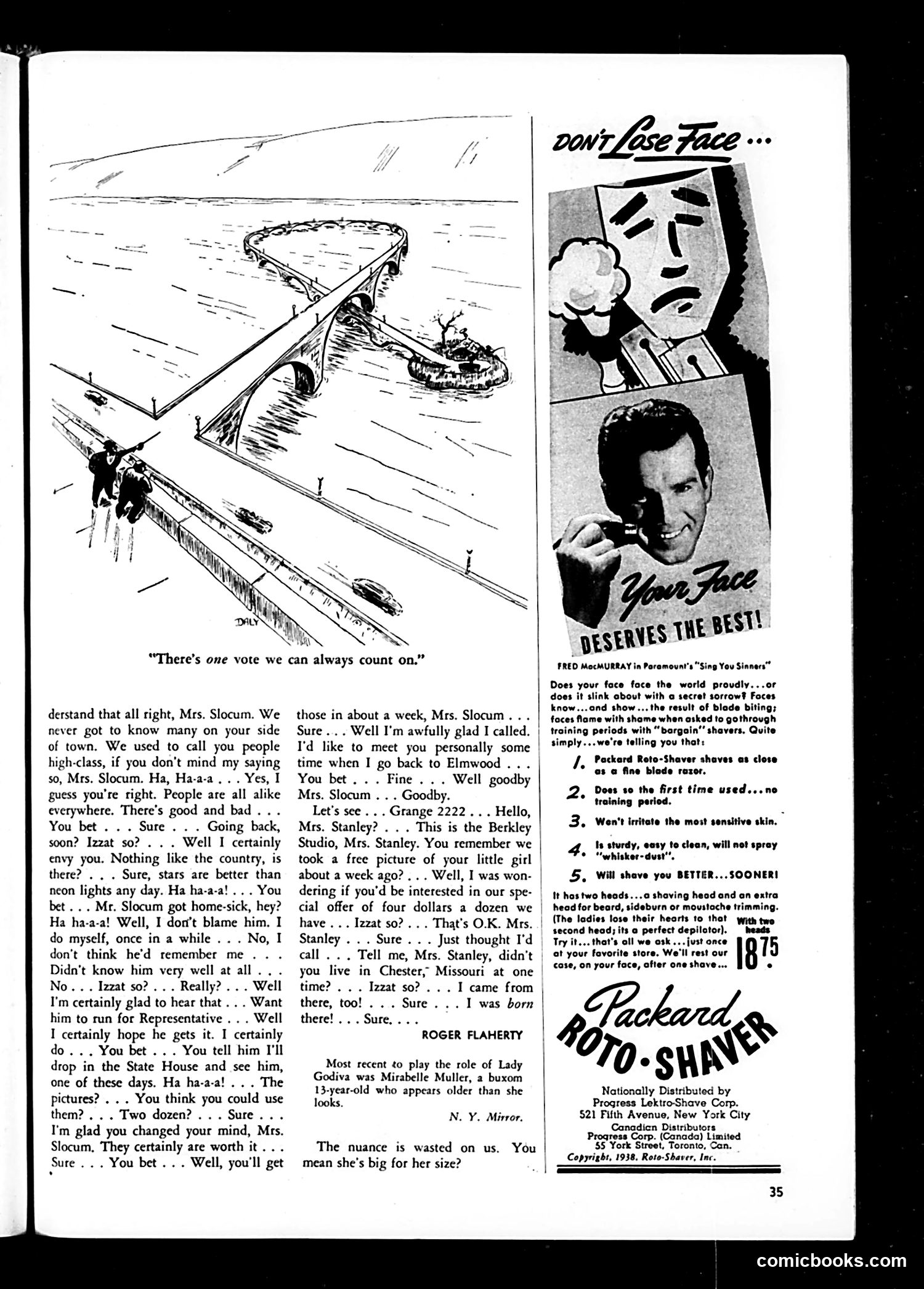
Political Cartoon Analysis: "There's one vote we can always count on" This cartoon satirizes voter manipulation and class-based political patronage in early 20th-century America. The left panel shows a salesman making a pitch to secure a vote, using flattery and manufactured personal connections ("I came from there too!"). The dialogue reveals the cynical mechanics: the salesman appeals to shared rural nostalgia and small-town values while actually selling photographs and building political support. The title suggests that wealthy or upper-class voters ("Mrs. Slocum") are predictably manipulable through appeals to their social class interests and nostalgia. The repeated "Izzat so?" catchphrase emphasizes the salesman's performative friendliness—fake rapport designed to extract commitment. The cartoon critiques how politicians cultivate votes through personal schmoozing rather than substantive policy discussion, particularly targeting those returning to rural constituencies for representative races. It's essentially about retail politics and the performance of authenticity for electoral gain. The right side is a Packard Roto-Shaver advertisement and is unrelated.
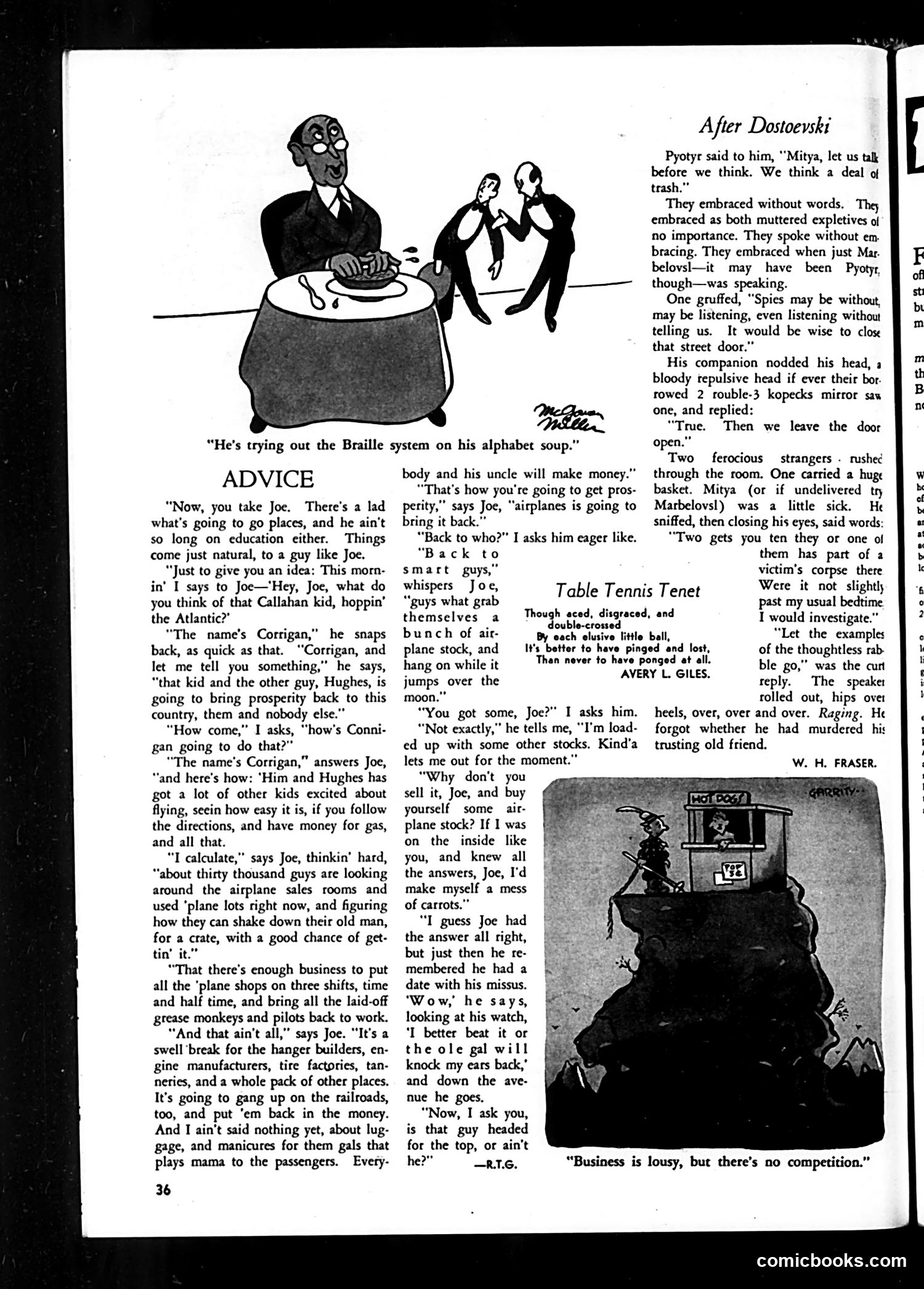
Analysis: Judge Magazine Page Top Cartoon ("Braille System"): A man experiments with alphabet soup using Braille—a visual pun mocking someone's foolish attempt to apply an inappropriate system to everyday objects. Main Story ("Advice"): A streetwise character named Joe discusses how aviators Corrigan and Hughes will spark economic recovery. Joe predicts their aviation exploits will inspire 30,000 people to buy planes, creating a economic boom across industries (aircraft shops, engine manufacturers, railroads, etc.). The satirical point: Joe talks as if he possesses insider knowledge about prosperity, yet admits he personally hasn't invested in airplane stock—he's all talk. The narrator calls out this contradiction, suggesting Joe is a typical blowhard who claims expertise while lacking conviction in his own advice. Context: This reflects 1930s Depression-era optimism about aviation as an economic savior, while mocking the gap between popular prognostication and actual financial commitment. Other content: Brief literary parody ("After Dostoevski"), sports verse, and another cartoon about business.
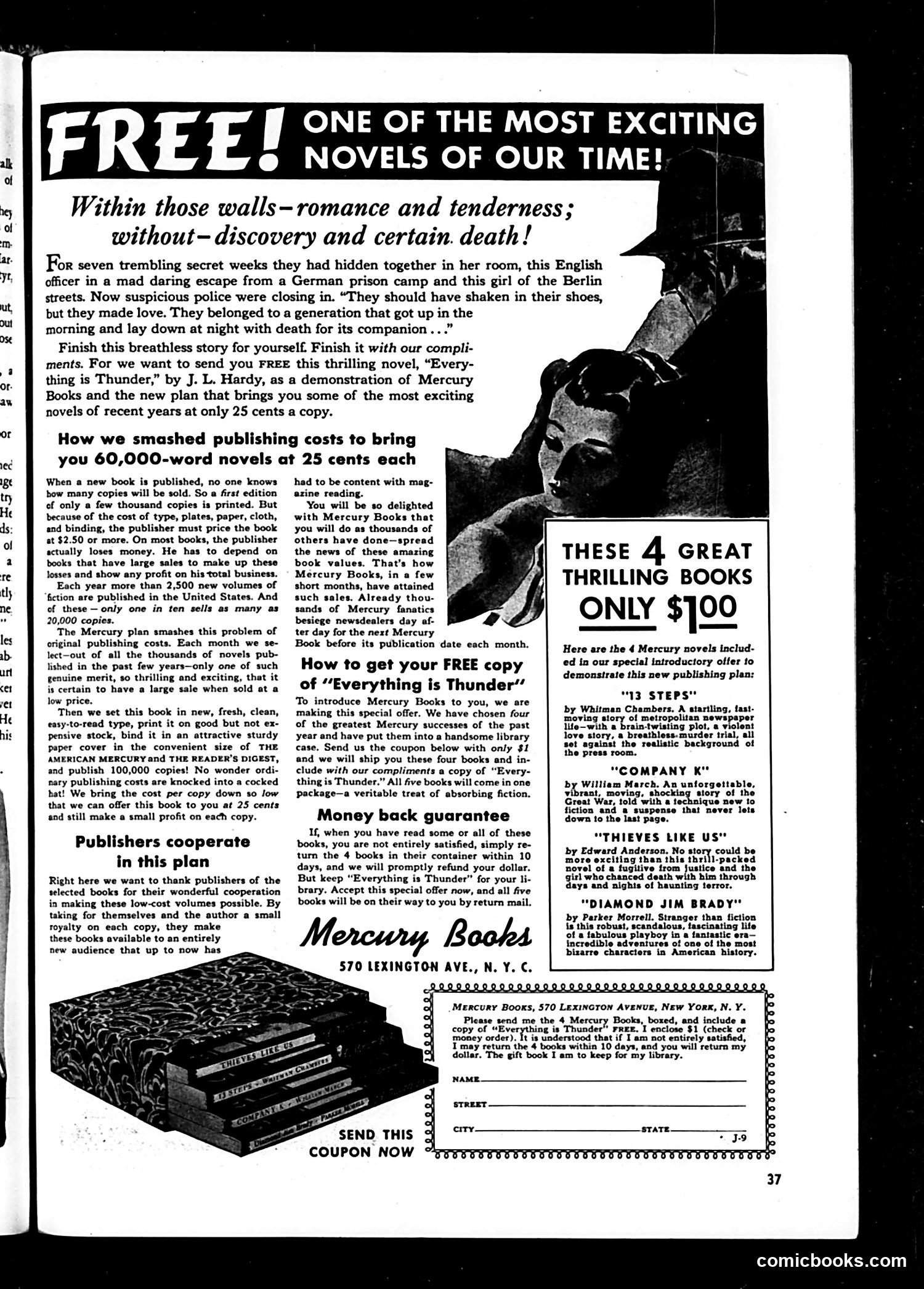
What This Page Means This is not a cartoon or satirical content—it's a straight commercial advertisement for Mercury Books, a 1930s-40s publishing venture. The page promotes a business model innovation: Mercury Books republished successful recent novels in large print runs (100,000 copies) using cheaper materials and distribution, undercutting standard hardcover prices from $2.50 to just 25 cents. This was genuinely disruptive—most new books sold poorly, forcing publishers to charge high prices. By selecting proven bestsellers and mass-producing them, Mercury Books could profit at lower prices. The "free novel" offer (the wartime romance "Everything is Thunder") was a loss-leader to introduce customers to the service. The advertisement emphasizes publisher cooperation and includes a money-back guarantee. This reflects Depression and wartime economics: making reading affordable for mass audiences. There is no satire here—Judge magazine simply carried advertisements alongside editorial content.
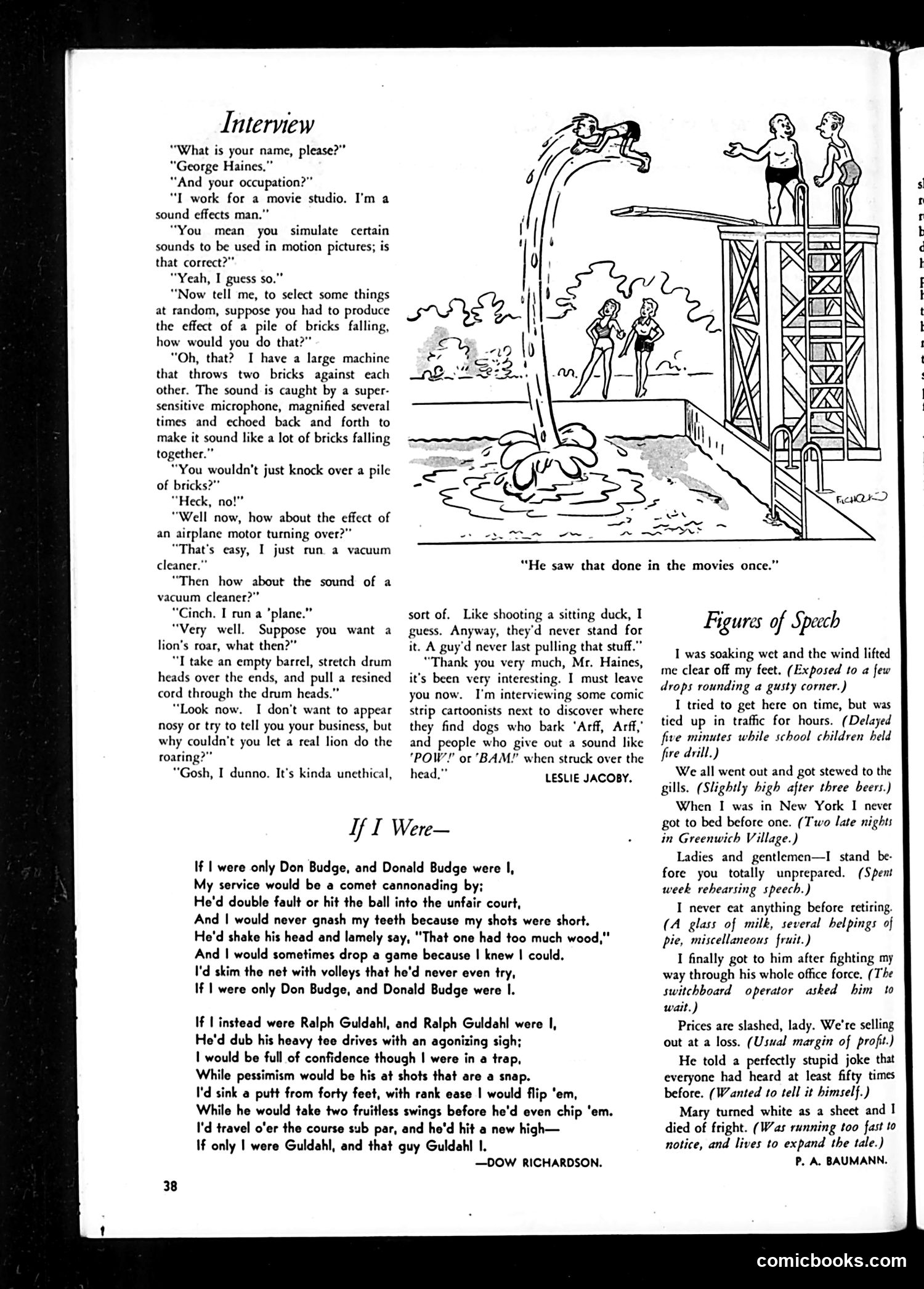
Judge Magazine Page Analysis This page contains three separate humor pieces satirizing 1930s American culture. "Interview" mocks Hollywood sound effects, where a studio technician explains absurd methods—using a vacuum cleaner for airplane motors, drum heads for lion roars. The satire culminates in a jab at comic strip artists, questioning how they find dogs that literally bark "Arff, Arff!" and people who vocalize "POW!" when hit—exposing the artificial conventions readers accepted in comics. "If I Were" features sports humor about tennis champion Don Budge and golfer Ralph Guldahl (both prominent 1930s athletes). The poems fantasize swapping places, with the author imagining he'd play perfectly while they'd fumble—typical envious sports-fan humor. "Figures of Speech" satirizes exaggeration in everyday conversation, contrasting what people claim ("soaking wet," "stewed to the gills") against mundane reality (light rain, three beers). It's social commentary on human tendency toward dramatic self-aggrandizement.
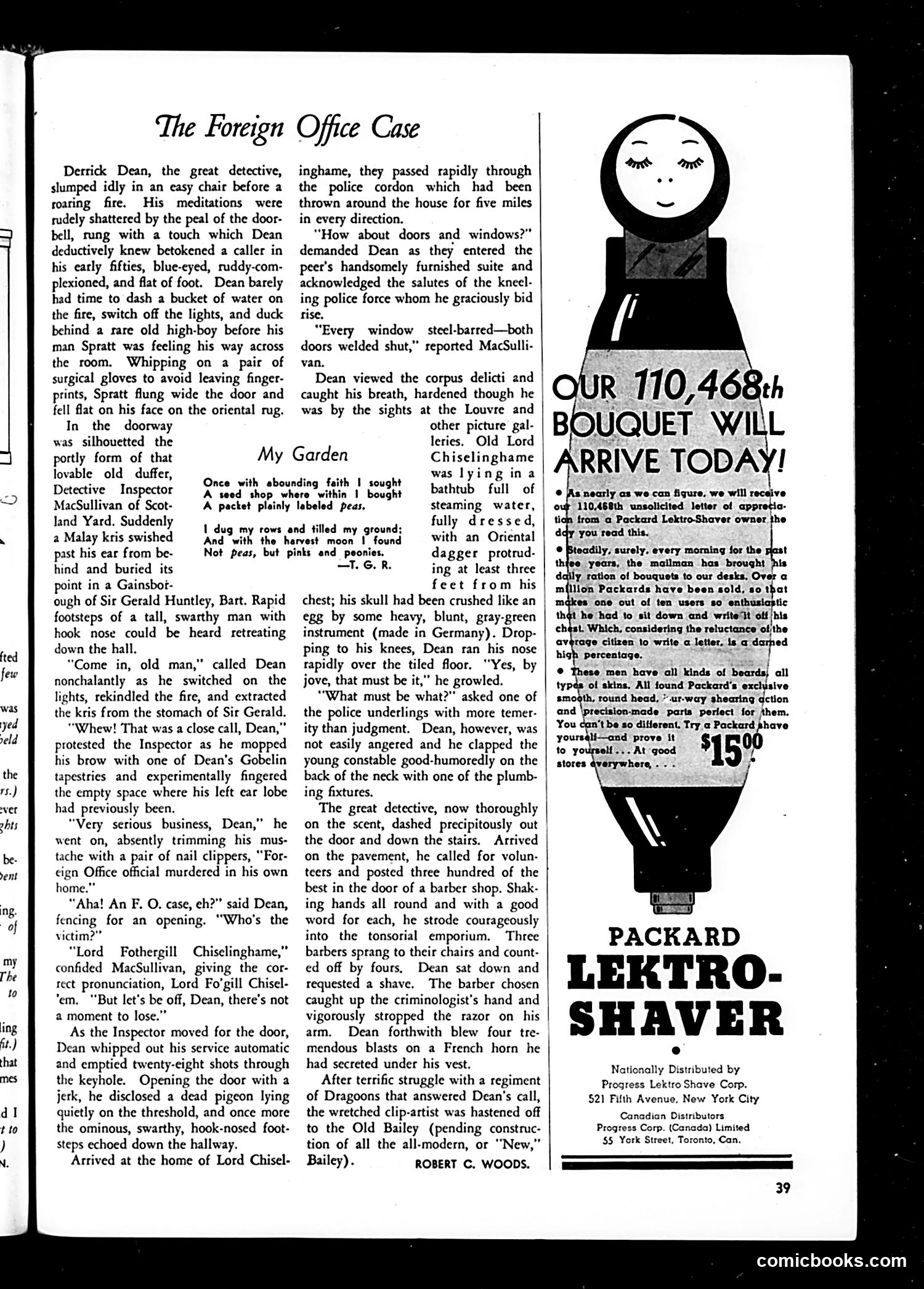
"The Foreign Office Case" - A Parody of Detective Fiction This page contains a short detective story parodying the popular "great detective" mystery genre (likely referencing Sherlock Holmes-type tales). The protagonist, Derrick Dean, is a comically incompetent detective who solves a murder through absurd deductions and violent slapstick rather than actual logic. The satire mocks the genre's conventions: Dean's ridiculous ability to deduce someone's age and appearance from a doorbell ring, the melodramatic setup with assassins hurling daggers, and the absurd "evidence" he discovers (like determining guilt from floor smells). The humor lies in how Dean bumbles through a Foreign Office official's murder while maintaining an air of sophisticated competence. The page also includes a brief poem "My Garden" about gardening mishaps, and an advertisement for a Packard electric shaver, typical of Judge magazine's mixed content format.
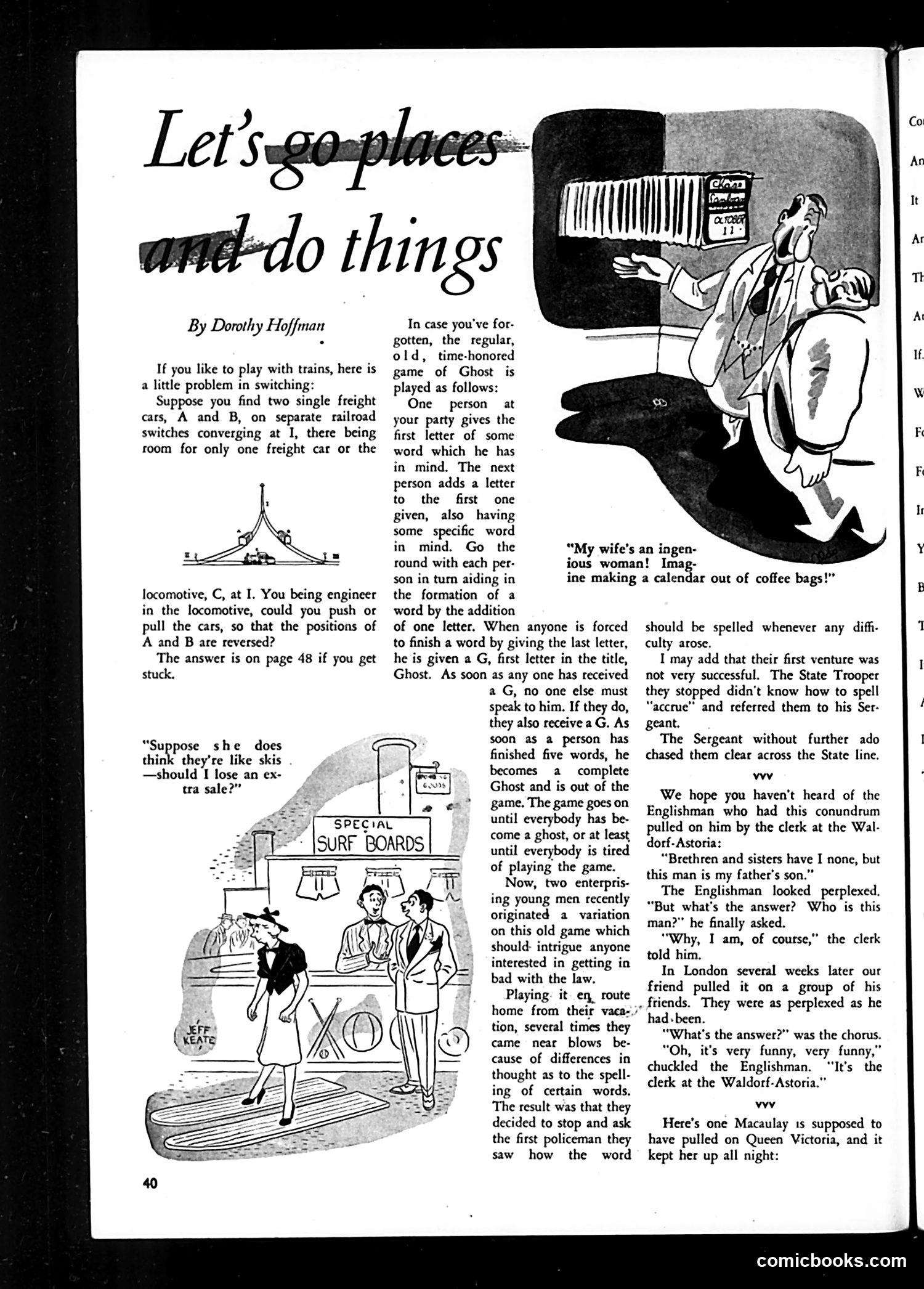
Analysis: "Let's Go Places and Do Things" by Dorothy Hoffman This page from *Judge* contains three distinct pieces of humor: 1. The Train-Switching Puzzle (left): A practical logic problem about repositioning railroad cars—pure recreational brain-teaser, no satire. 2. The Surf Board Cartoon (bottom left): A salesman questions whether he's losing a sale because a female customer compares surfboards to skis. The joke mocks both the customer (conflating unrelated items) and perhaps the salesman's insecurity about her logic. 3. Verbal Games and Riddles (right): The bulk of the page describes party games ("Ghost") and includes anecdotes about riddle-telling. The humor centers on wordplay confusion—two men quarreling over spelling so badly they consult a state trooper, who doesn't know either and chases them away; an Englishman fooled by a simple riddle at the Waldorf-Astoria. Context: These pieces celebrate intellectual humor and wordplay typical of *Judge*'s educated audience. The satire is gentle—mocking confusion rather than targeting specific figures or politics. The surfer-skis joke may lightly mock emerging 1930s leisure culture.
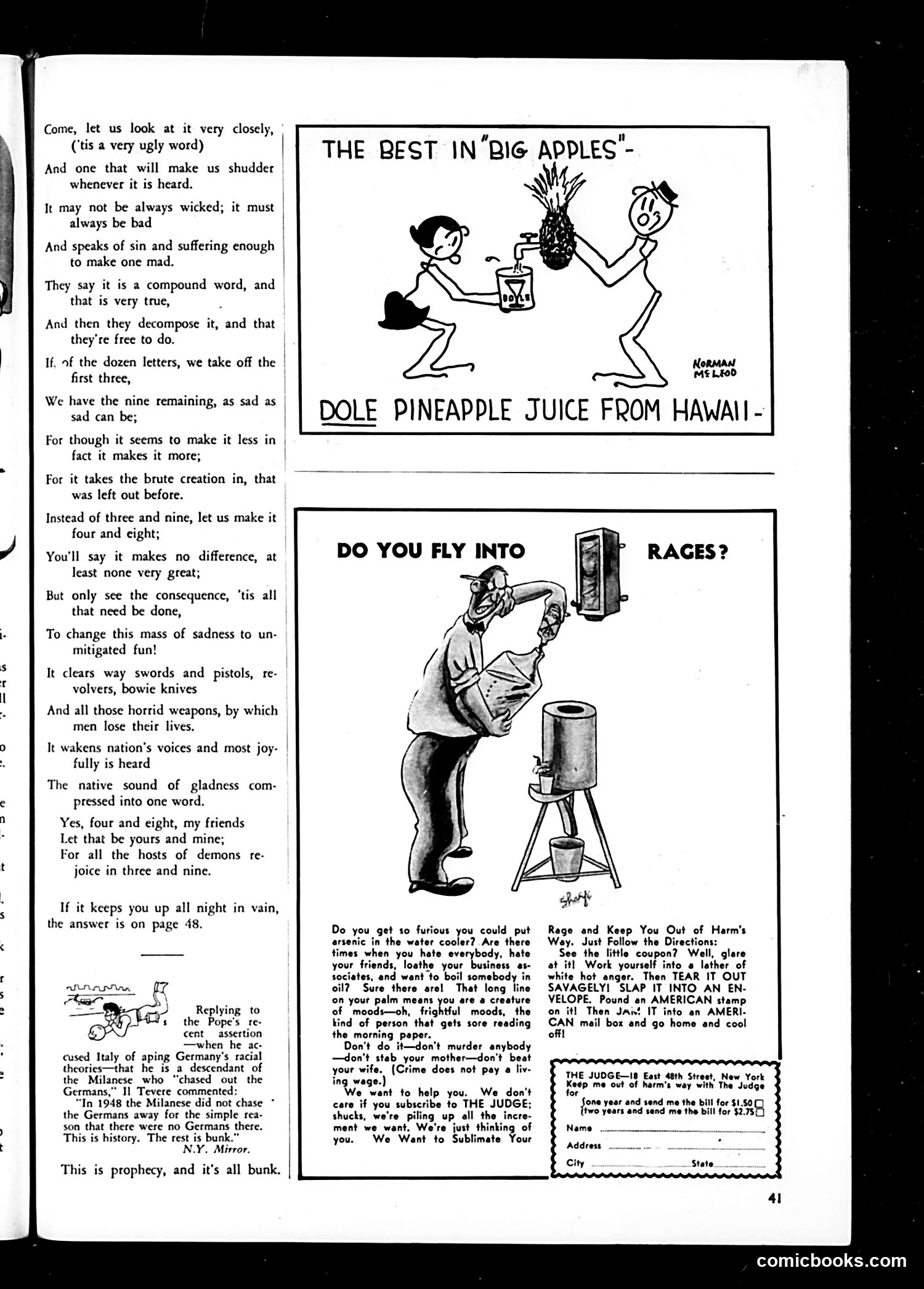
Analysis of Judge Magazine Page This page contains two distinct elements: Left side: A poem playing with wordplay—appearing to dissect an ugly 12-letter word by removing letters to create different meanings. The poem suggests that removing certain letters transforms something negative into something joyful, though the actual word remains obscured as a riddle for readers to solve on page 48. Top cartoon: "The Best in Big Apples" advertises Dole pineapple juice from Hawaii with simple stick-figure imagery of people enjoying the product. Bottom cartoon: "Do You Fly Into Rages?" is a humorous therapeutic pitch encouraging angry readers to channel their rage productively—by tearing out a coupon, writing angry letters to *Judge* magazine, and mailing them as catharsis rather than committing actual violence. It's a self-promotional advertisement disguised as public service advice, using exaggerated language ("SAVAGELY! SLAP IT") to make anger-management through subscription seem appealing. The page also includes a brief note about the Pope and Italy that appears unrelated to the main content.
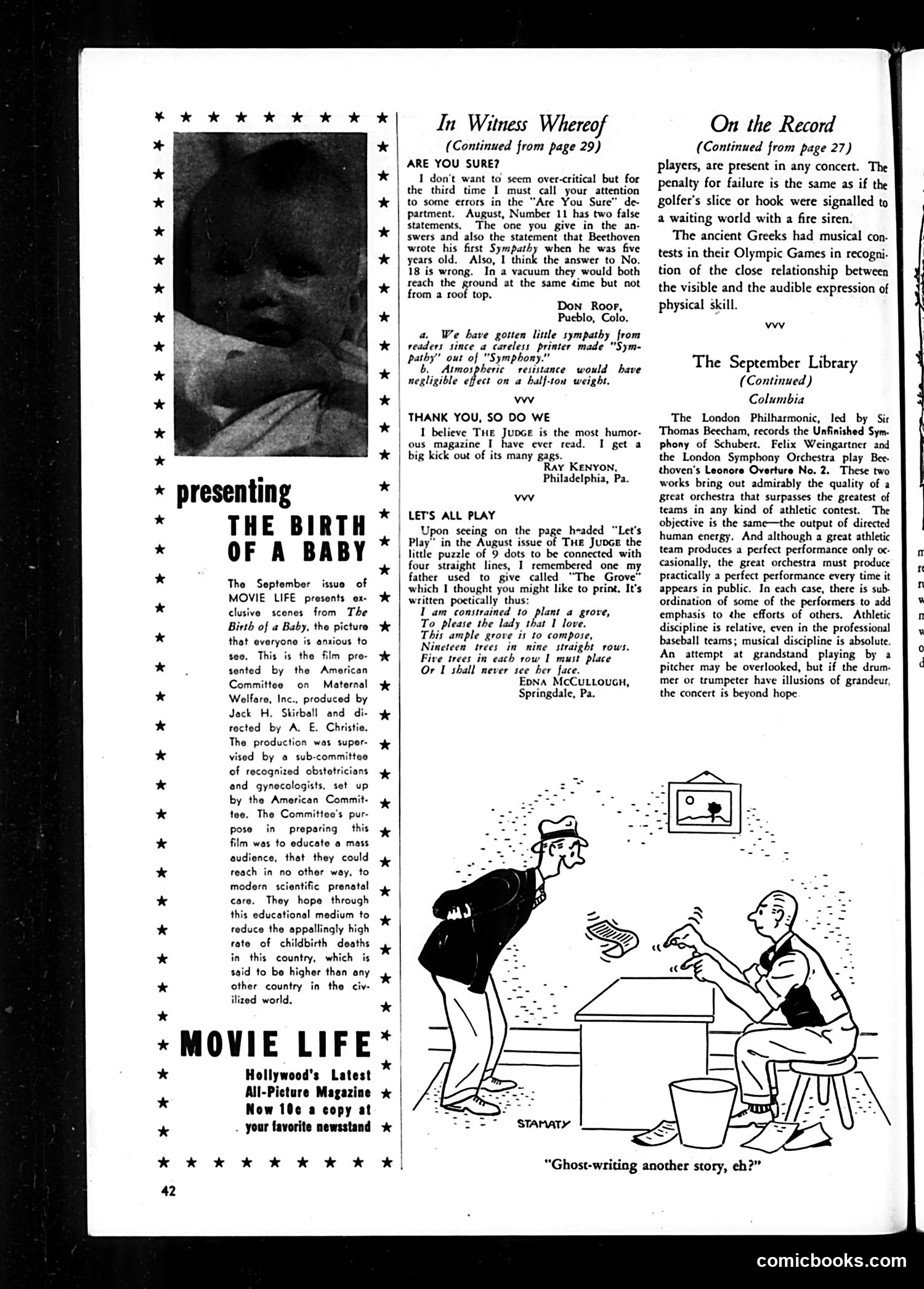
Explanation for Modern Readers This page from *Judge* magazine contains reader letters and advertisements rather than political satire. The left side advertises "The Birth of a Baby," a 1938 educational film about childbirth supervised by medical professionals—considered controversial at the time for showing actual obstetric procedures to a mass audience. It was intended to reduce the country's high maternal mortality rates through public education. The right page features reader corrections to *Judge's* "Are You Sure?" trivia section and a letter praising the magazine's humor. At the bottom is a cartoon about "ghost-writing," showing someone requesting help writing another story—a simple workplace pun with no political significance. The page primarily serves advertising and reader-engagement functions rather than satire.
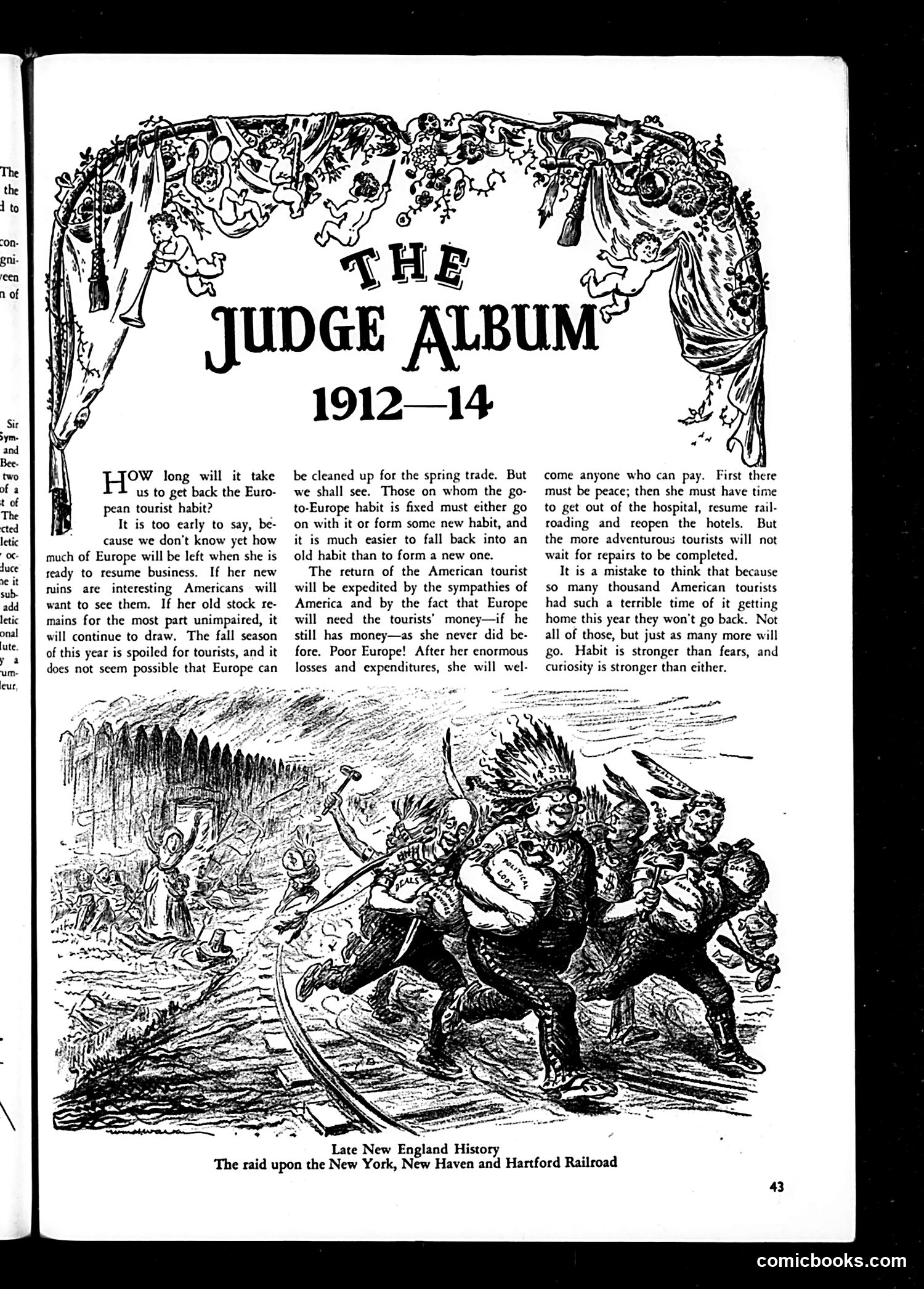
The Judge Album 1912-14: European Tourism During WWI This page discusses American tourism to Europe amid World War I. The article speculates on when American tourists will resume visiting Europe, acknowledging that warfare has disrupted the continent and destroyed infrastructure ("ruins"). The piece sardonically notes that wealthy Americans with established European travel habits will return once peace arrives—driven by both curiosity and Europe's desperate financial need for tourist money ("Poor Europe! After her enormous losses and expenditures, she will welcome anyone who can pay"). The underlying satire critiques American materialism and shallow tourism: despite the war's horrors, affluent travelers will resume their leisure trips once convenient routes reopen. The article suggests habit and curiosity overcome moral concerns about visiting a war-damaged continent. The lower illustration appears to reference "Late New England History: The raid upon the New York, New Haven and Hartford Railroad"—likely a separate satirical commentary, though its specific meaning requires additional context.
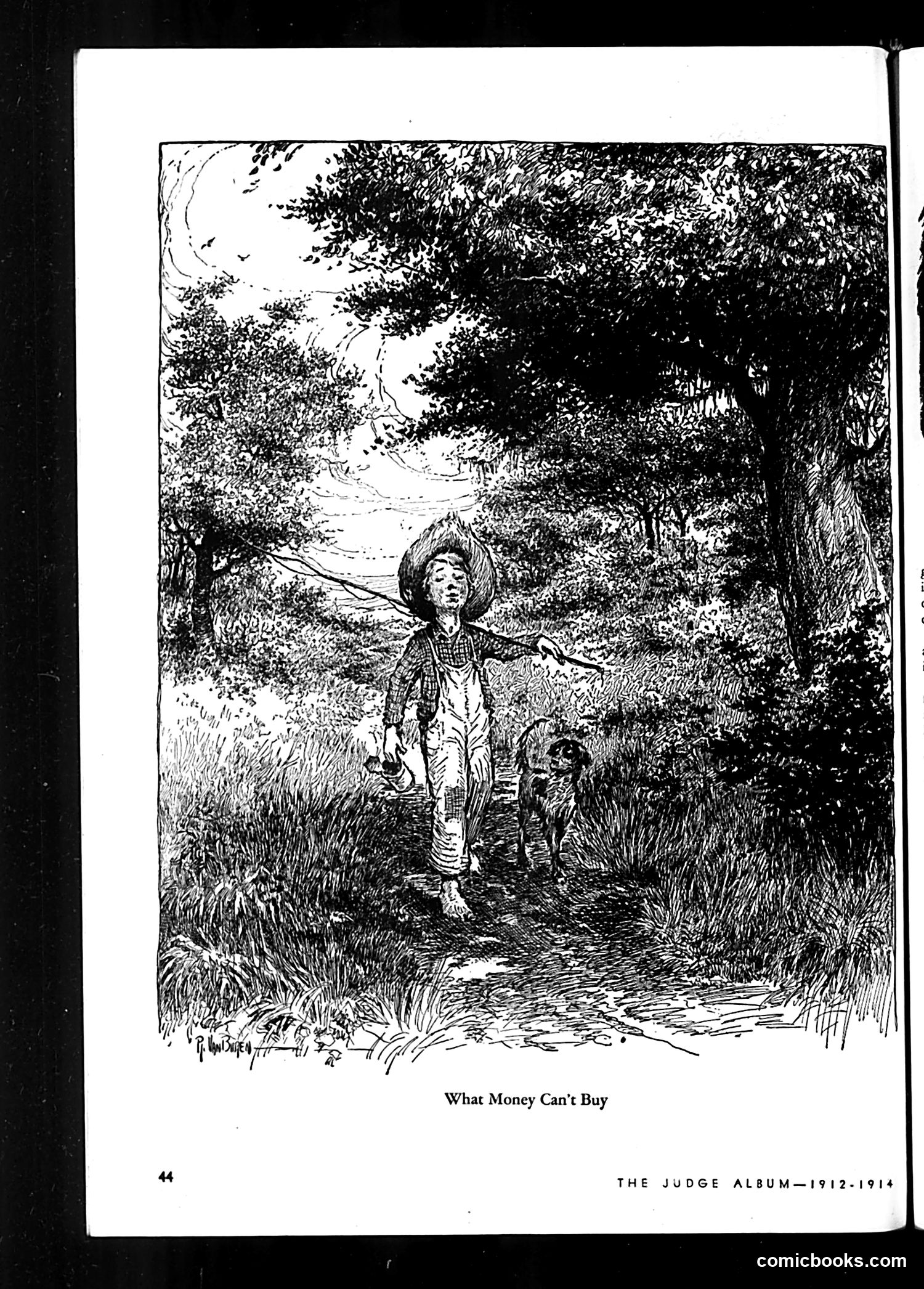
"What Money Can't Buy" This illustration from *Judge* magazine (1912-1914) depicts a child in a rural woodland setting, appearing to enjoy simple pleasures of nature—freedom, play, and outdoor adventure. The title "What Money Can't Buy" suggests the satirical point: that genuine happiness and childhood innocence cannot be purchased with wealth. This reflects early 20th-century Progressive Era anxieties about industrialization and urbanization's impact on American life. The cartoon likely critiques wealthy society's materialism by contrasting it with the priceless value of natural simplicity, childhood wonder, and rural authenticity. The rustic scene emphasizes what modern commercialism cannot replicate or corrupt—the authentic human experience of nature and youth.
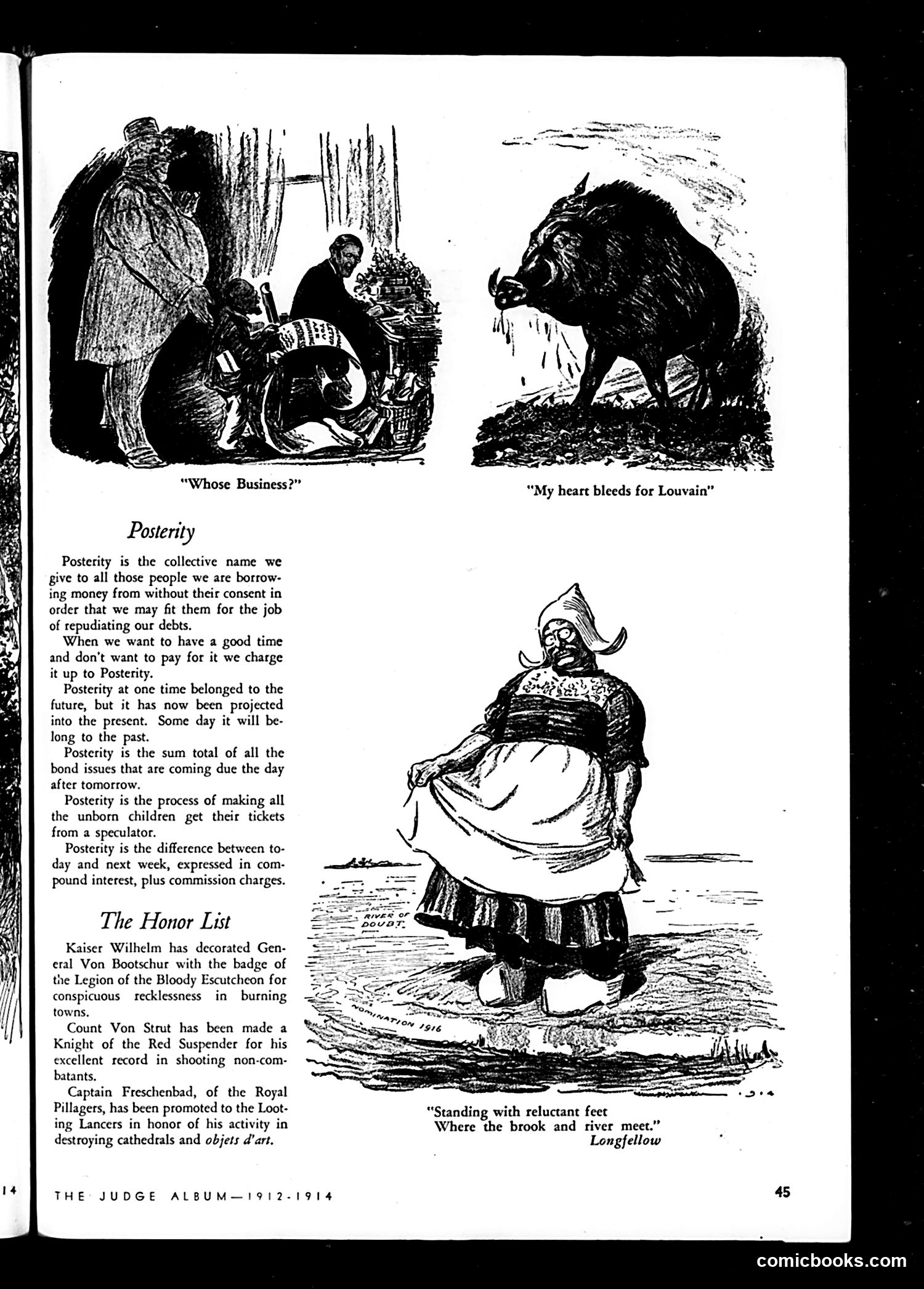
Explanation for Modern Readers This page from *Judge* (1912-1914) contains WWI-era American political satire targeting German military conduct. Top cartoons: "Whose Business?" and "My heart bleeds for Louvain" reference German atrocities in Belgium—specifically the burning of the city of Louvain in 1914, a real historical event that shocked the world. The imagery suggests hypocrisy: those claiming sympathy for victims while profiting from destruction. "Posterity" essay: This satirizes government deficit spending—borrowing money that future generations must repay. It's a timeless critique of fiscal irresponsibility masked in humorous definitions. "The Honor List": Bitter sarcasm mocking Kaiser Wilhelm II's military decorations. Judge sarcastically "honors" German officers (Von Bootschur, Von Strut, Freschenbad) with invented medals for war crimes: burning towns, shooting civilians, looting cathedrals. The names are likely fabricated mockery. This directly criticizes German military brutality in occupied territories and the kaisers's endorsement of it. The page reflects American anger at German conduct before U.S. entry into WWI (April 1917).
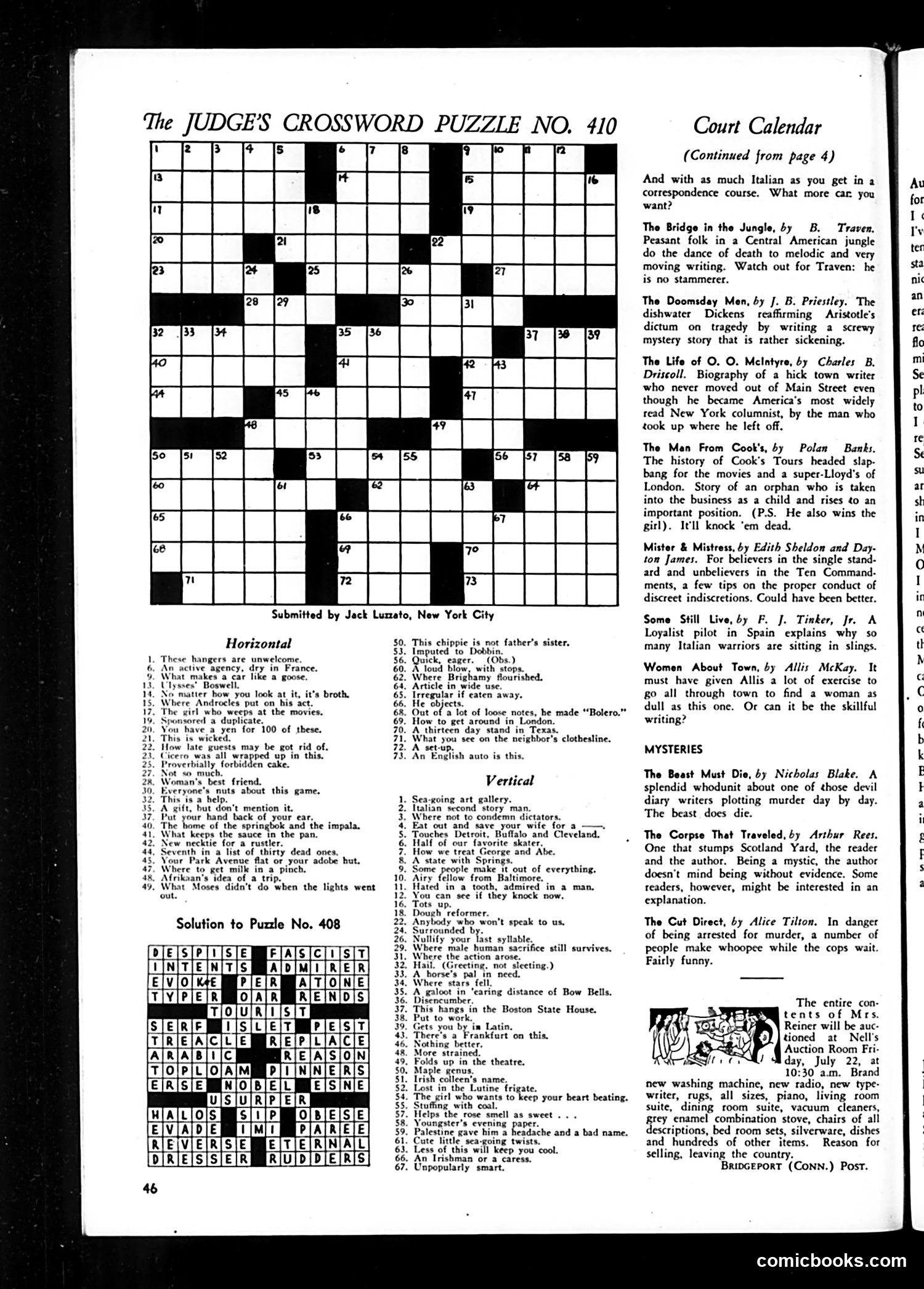
Judge Magazine Crossword Puzzle Page This page is primarily a crossword puzzle (No. 410) with its solution to the previous puzzle (No. 408). The clues are typical wordplay of the era—puns and indirect definitions characteristic of 1930s-era puzzle humor. Below the puzzle appears a "Court Calendar" section reviewing contemporary books, written in Judge's satirical house style. The reviews employ the magazine's characteristic snark: dismissing J.B. Priestley as a "dishwater Dickens," mocking a biography of newspaper columnist O.O. McIntyre, and describing a romance novel about Cook's Tours as destined for Hollywood schmaltz. The page contains no political cartoons or caricatures—it's essentially recreational content (puzzles and book reviews) typical of Judge's lighter editorial offerings. The satire here is mild literary criticism rather than political commentary.
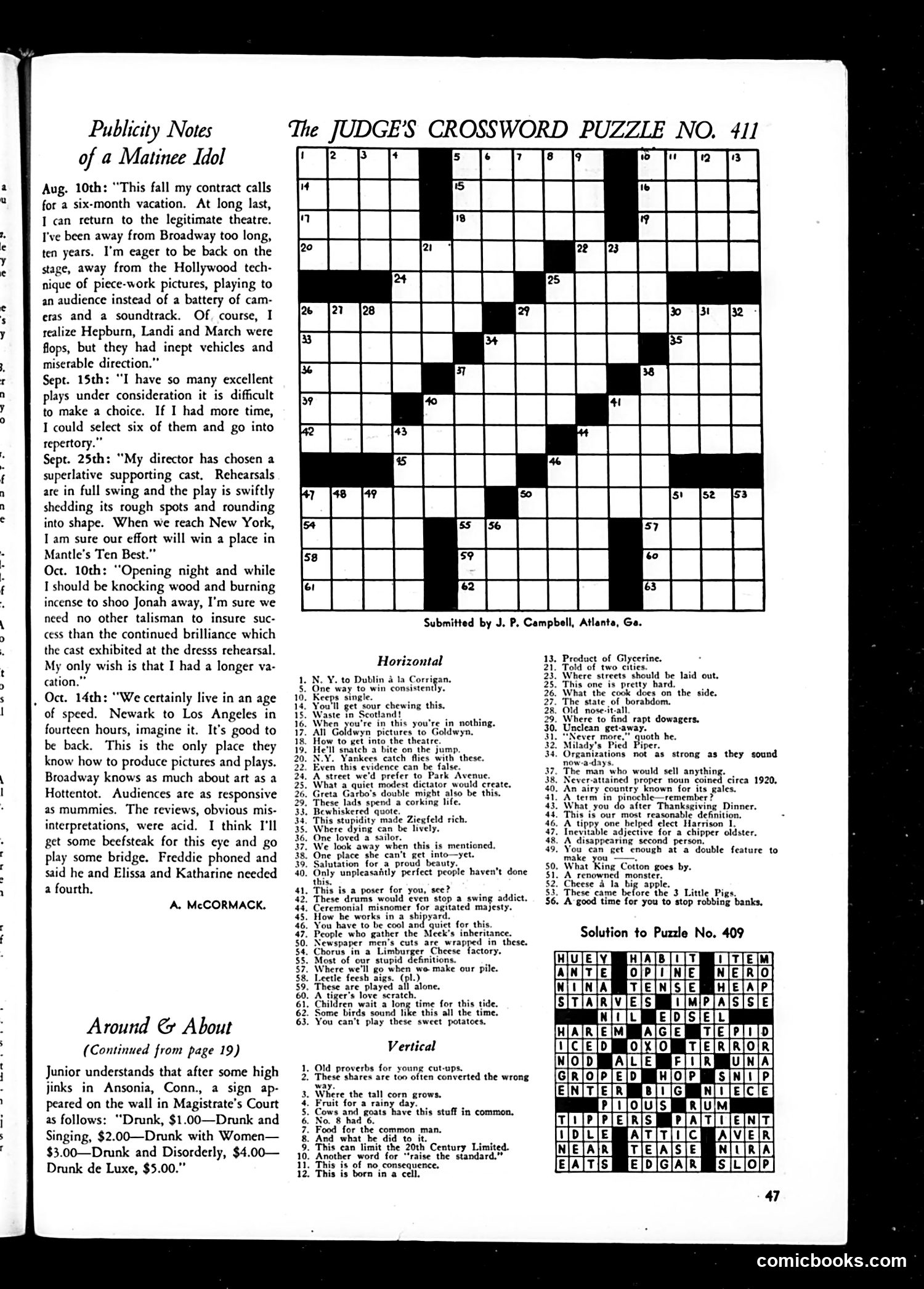
The Matinee Idol's Hypocrisy This page satirizes a Hollywood actor's transparent phoniness through dated diary entries. The piece, titled "Publicity Notes of a Matinee Idol" by A. McCormack, tracks an unnamed star's public statements over two months. The joke centers on his contradictions: In August, he claims eagerness to escape Hollywood's "piece-work" for legitimate Broadway theater, dismissing film stars (Hepburn, Landi, March) as failures. By September, he's boasting about his Broadway play's inevitable success. But by October 14th—just four days after opening—he's reversed completely, declaring Broadway audiences "mummies" and Hollywood "the only place they know how to produce pictures and plays," before heading back to Los Angeles. The satire exposes the era's common Hollywood hypocrisy: actors publicly scorning commercial film work while actually depending on it, performing earnestness for publicity while chasing money and prestige. The rapid flip-flops reveal self-serving careerism masked as artistic principle—a timeless entertainment industry critique.
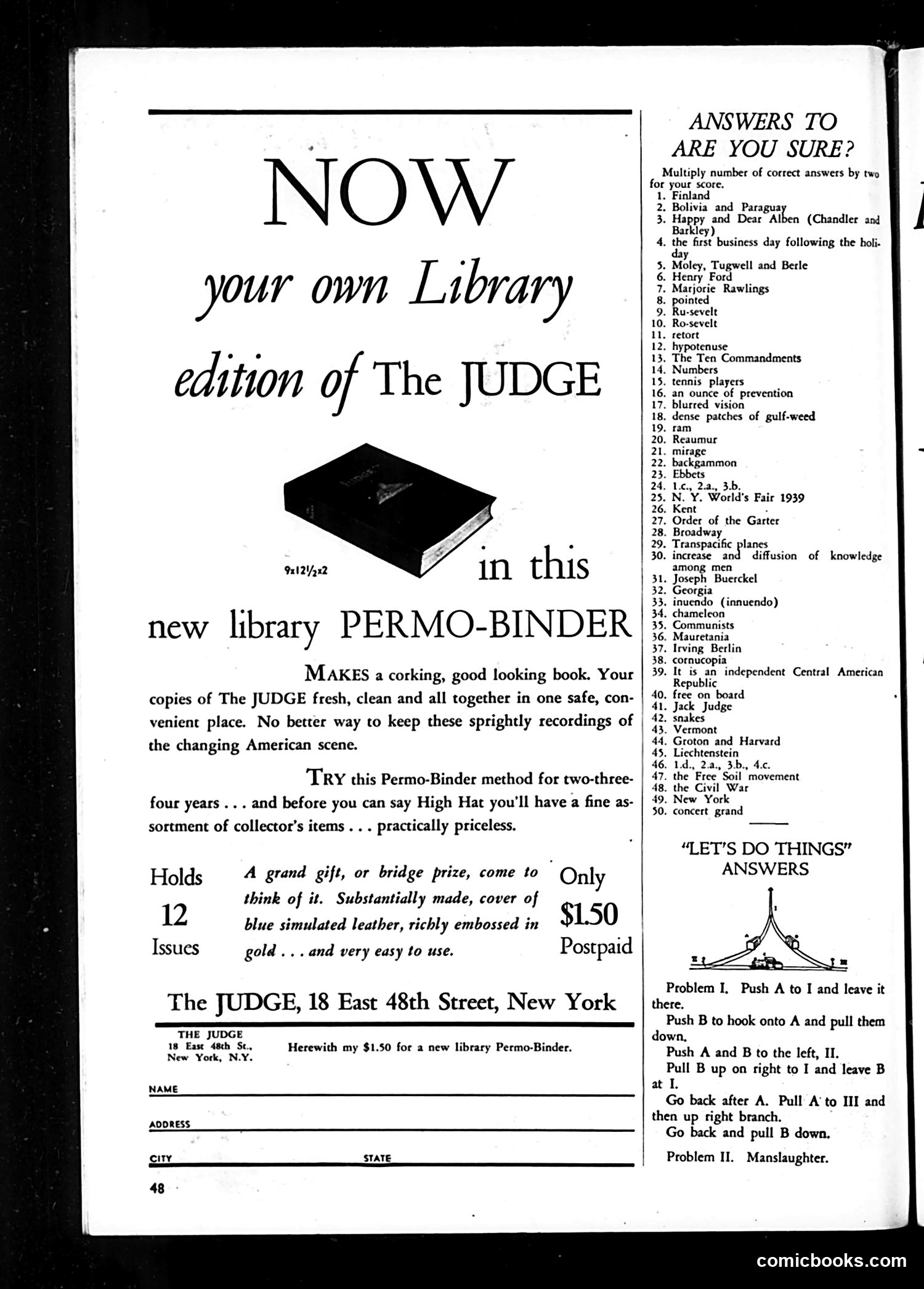
Judge Magazine Page Analysis This page is primarily advertising and quiz content, not political satire. The main feature advertises a "Permo-Binder"—a leather binding system for collecting Judge magazines, priced at $1.50 postpaid. The pitch emphasizes it as an attractive gift to preserve "sprightly recordings of the changing American scene." The page also includes an "Are You Sure?" quiz with answers covering general knowledge topics (geography, history, literature, current events like the 1939 New York World's Fair). A separate section titled "Let's Do Things" presents logic puzzles labeled "Problem I" and "Problem II" (the latter titled "Manslaughter"). No political figures or satire are evident on this page—it's primarily a merchandise promotion and puzzle feature typical of magazine interiors from this era. The content reflects 1930s-era general knowledge and recreational puzzle trends rather than social or political commentary.
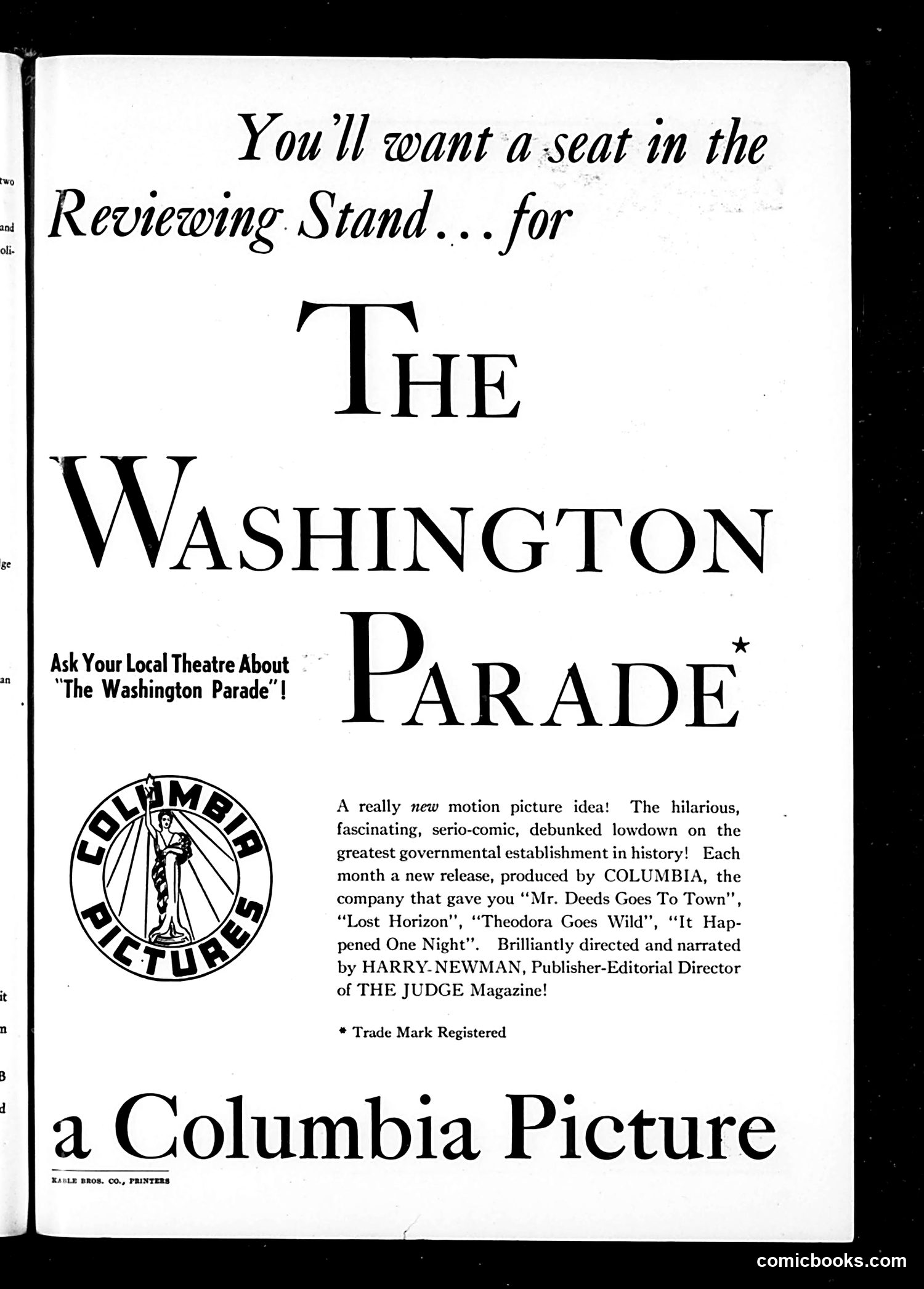
"The Washington Parade" - Advertisement Analysis This is primarily a movie advertisement, not a political cartoon. It promotes Columbia Pictures' new film "The Washington Parade," described as a satirical, comedic "debunking" of the U.S. government—positioning it as entertainment that mocks Washington D.C. and governmental institutions. The ad emphasizes the film's humorous intent ("hilarious, serio-comic") and appeals to readers' desire to see government satirized. Director Harry Newman's connection to *Judge* magazine (a prominent satirical publication) lends credibility to the comedy premise. The tagline about wanting "a seat in the Reviewing Stand" suggests the film offers a spectator's perspective on political happenings—treating Washington as a parade to be observed and laughed at. For modern readers, this reflects early-20th-century entertainment's appetite for government satire, framed as family-friendly cinema rather than serious political critique.
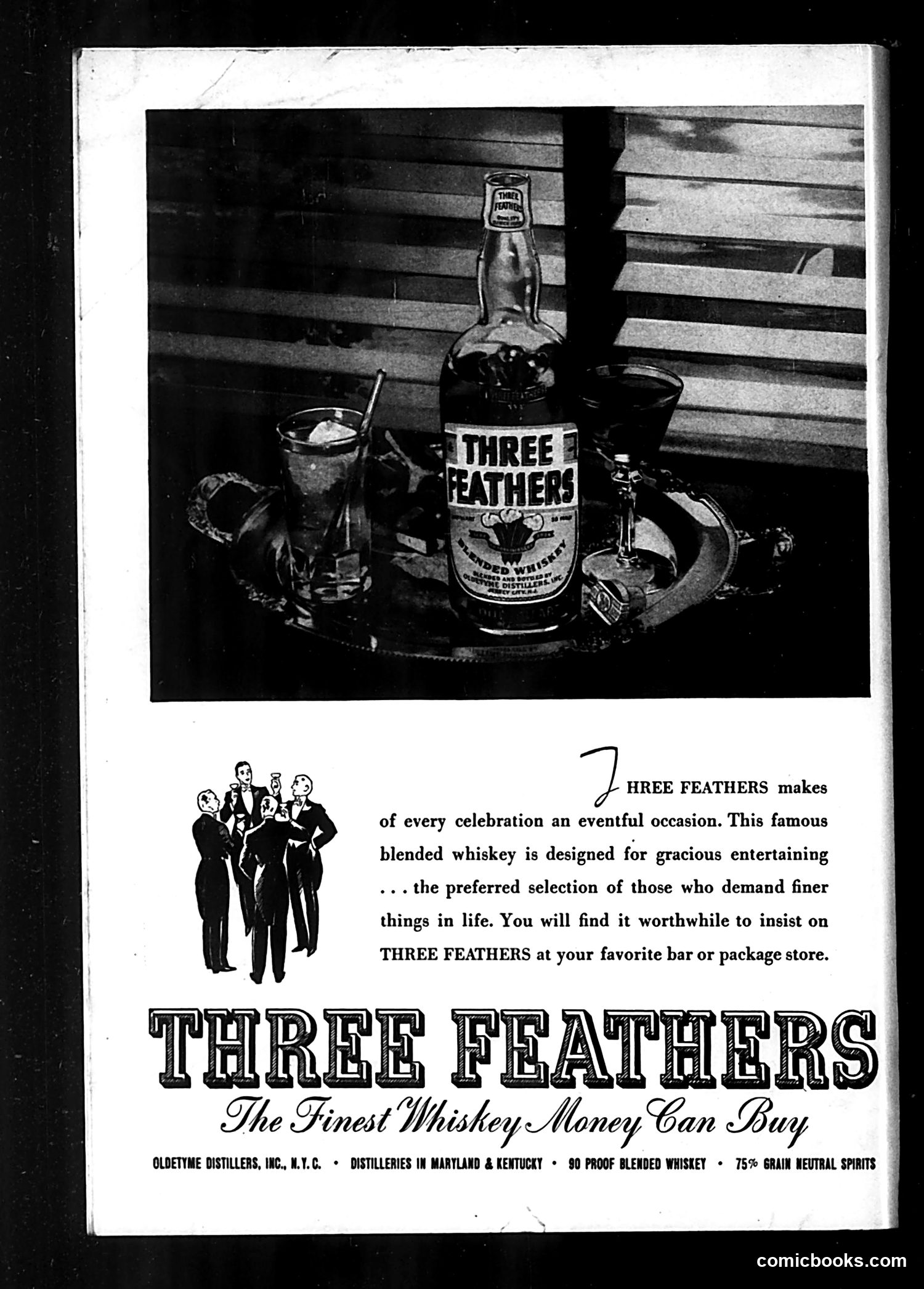
Three Feathers Whiskey Advertisement This is not a political cartoon or satire—it's a straight advertisement for Three Feathers blended whiskey, likely from the 1930s-1940s based on the styling. The ad uses common period marketing tactics: an image of the product bottle surrounded by cocktail glasses and elegant serving vessels, paired with text emphasizing luxury and sophistication. The accompanying illustration of four men in formal attire represents the target demographic—affluent gentlemen who appreciate "finer things in life." The pitch is straightforward: Three Feathers is the sophisticated choice for upscale entertaining and is available at bars and liquor stores. There's no satire or hidden meaning—this is simply vintage alcohol advertising designed to associate the product with elegance and social status.

I'm unable to provide meaningful analysis of this page. The image is almost entirely black or severely degraded, making it impossible to discern any cartoon artwork, figures, caricatures, or visual details. While the OCR text appears to show only "comicbooks.com" (likely a watermark), there is no legible content visible that would allow me to identify the satirical subjects, political references, or the intended humor. To properly analyze this Judge magazine page, a clearer or higher-contrast image would be necessary. If you have access to a better-quality scan, I'd be happy to examine it.