judge
Judge — December 1938
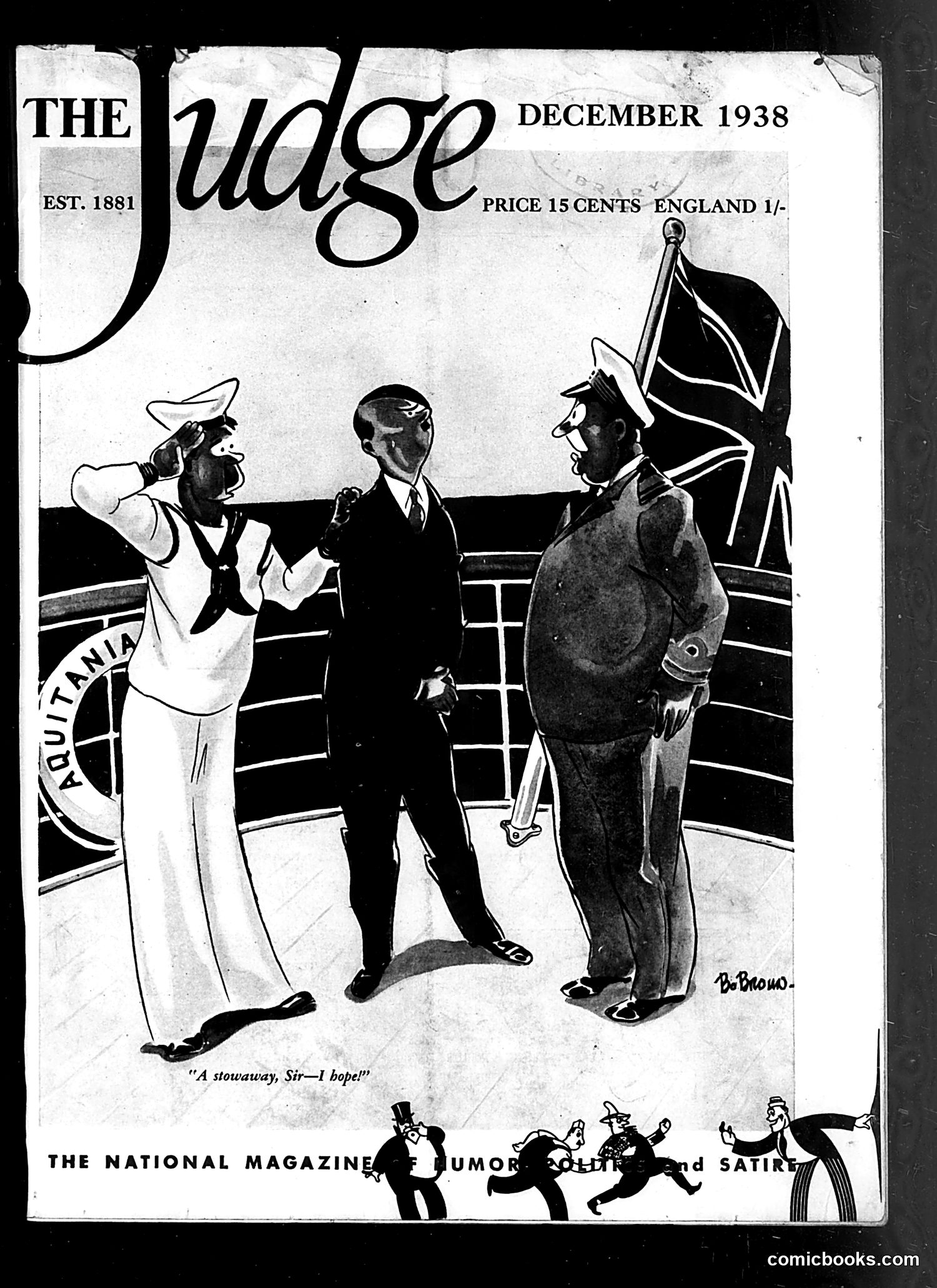
Judge Magazine, December 1938 The main cartoon shows three figures on what appears to be a ship deck (marked "Aquitania"). A sailor in white uniform on the left says "A stowaway, Sir—I hope!" to a dignified man in the center, while a third figure on the right holds a British flag. This likely satirizes diplomatic tensions of late 1938, possibly referencing the Munich Crisis or British-German relations. The "stowaway" phrase suggests an unwanted presence or hidden threat. The British flag and formal setting indicate this concerns international diplomacy. Without clearer identification of the specific figures, the precise political event remains unclear, though the context suggests commentary on British foreign policy anxieties during this period of rising fascist tensions in Europe.
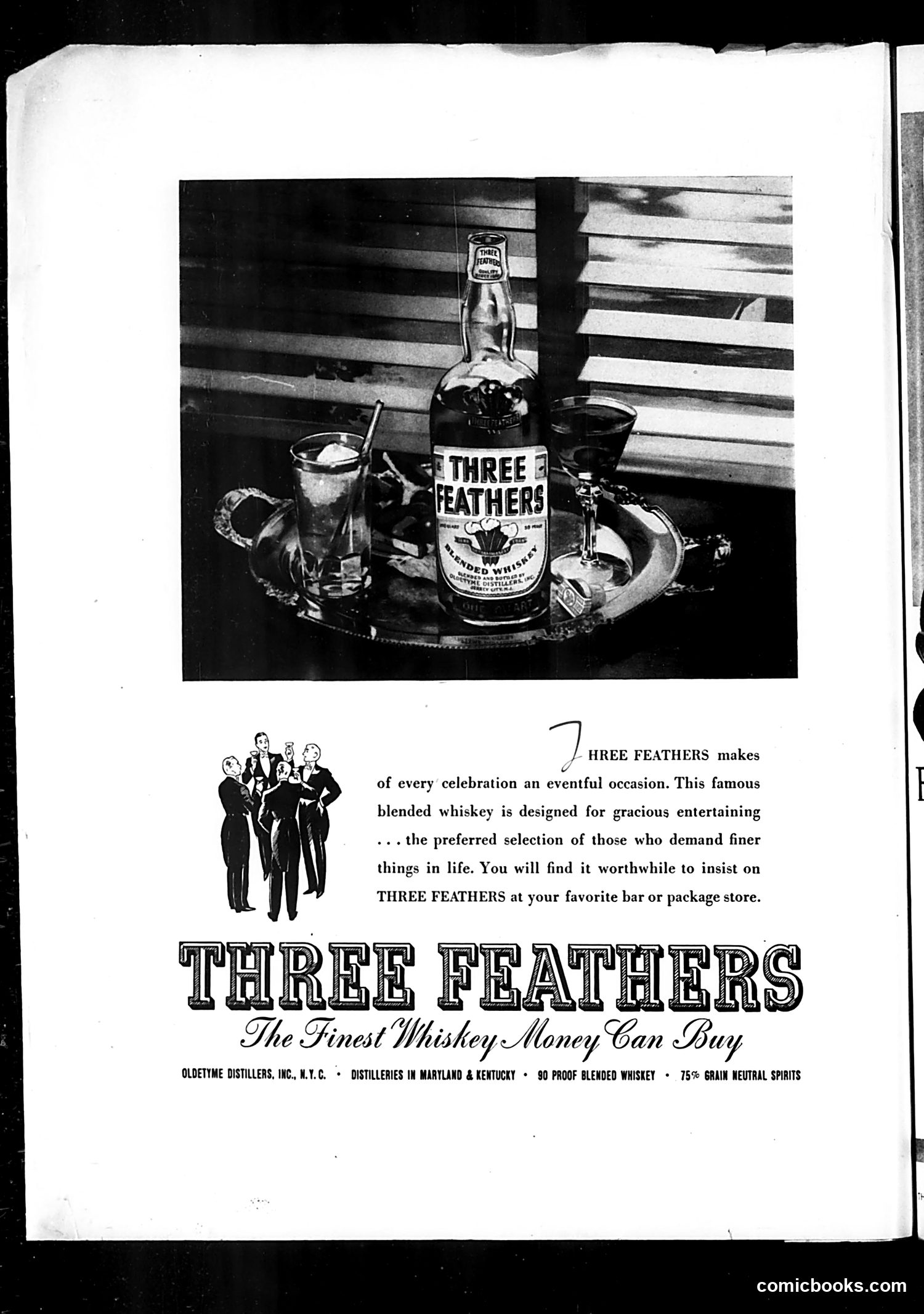
Analysis This page is primarily an advertisement, not a political cartoon. It promotes Three Feathers blended whiskey from Oldetime Distillers in Maryland and Kentucky. The ad uses social aspiration as its marketing appeal: the whiskey is positioned as "the preferred selection of those who demand finer things in life" and "the finest whiskey money can buy." The photograph shows the bottle with cocktail glasses and decorative serving items on an ornate tray, emphasizing elegance and upscale entertaining. The small illustration of well-dressed men in formal attire reinforces the product's association with sophisticated social gatherings. The ad targets affluent consumers during what appears to be the post-Prohibition era (given the explicit mention of "90 proof blended whiskey"). This reflects no political satire—it's straightforward commercial messaging in Judge magazine's advertising section.
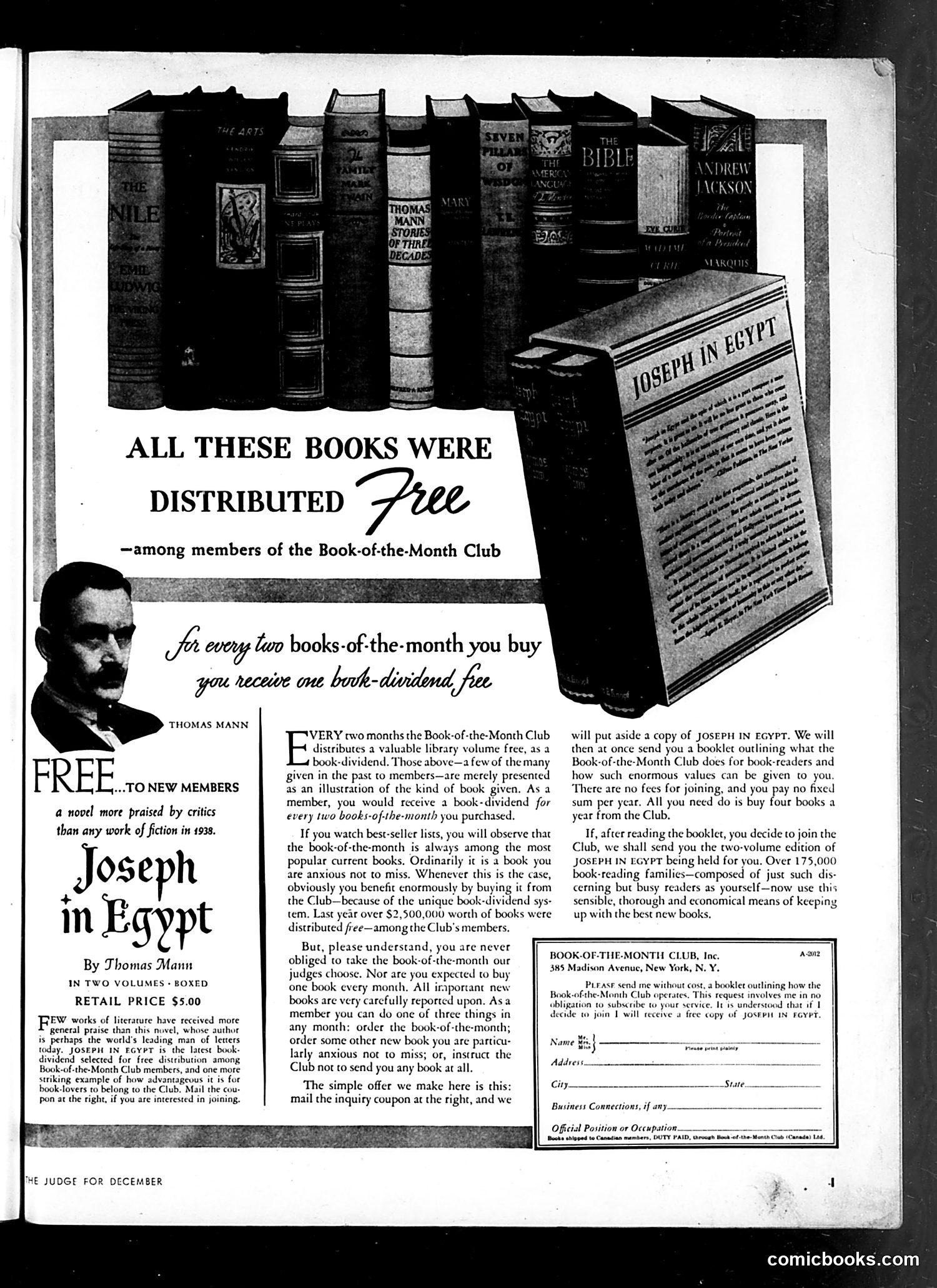
Analysis This page is primarily advertising, not satire or political commentary. It promotes the Book-of-the-Month Club's membership offer. The advertisement features Thomas Mann, the renowned German-American novelist (identified by portrait and name), whose novel *Joseph in Egypt* is being offered as a free "book-dividend" to new club members. The pitch emphasizes that for every two books purchased monthly, members receive one book free. The visual shows an array of bound volumes to suggest the club's literary offerings. The appeal targets educated, middle-class readers interested in serious literature—Mann was a prestigious, Nobel Prize-winning author whose work conveyed cultural sophistication. This represents 1920s-30s consumer marketing: using celebrity endorsement and subscription incentives to build membership in a cultural institution.
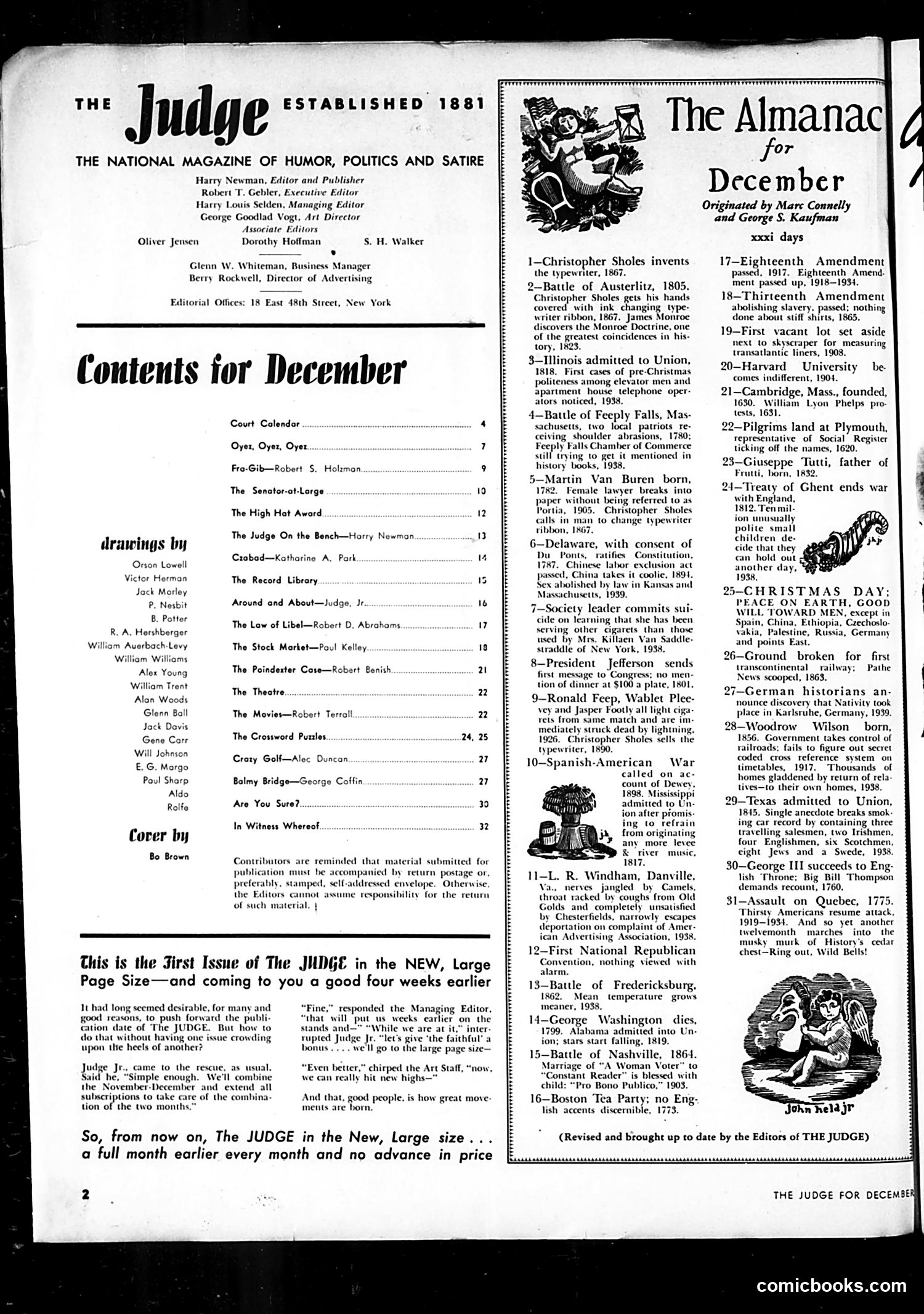
Analysis of Judge Magazine Page (December) This page is primarily the table of contents and masthead for Judge magazine's December issue, established 1881. The left side lists editorial staff and article titles for the coming month's content. The right side features "The Almanac for December," a calendar of historical events by Marc Connelly and George S. Kaufman. Rather than satire, this section offers factual historical dates—from Christopher Sholes inventing the typewriter (entry 1) through various battles, treaties, and notable deaths throughout American history. The cartoons visible appear decorative rather than political commentary, accompanying the almanac entries. This page functions as an index and historical reference rather than satirical content. The actual satirical articles and political cartoons would appear elsewhere in the magazine.
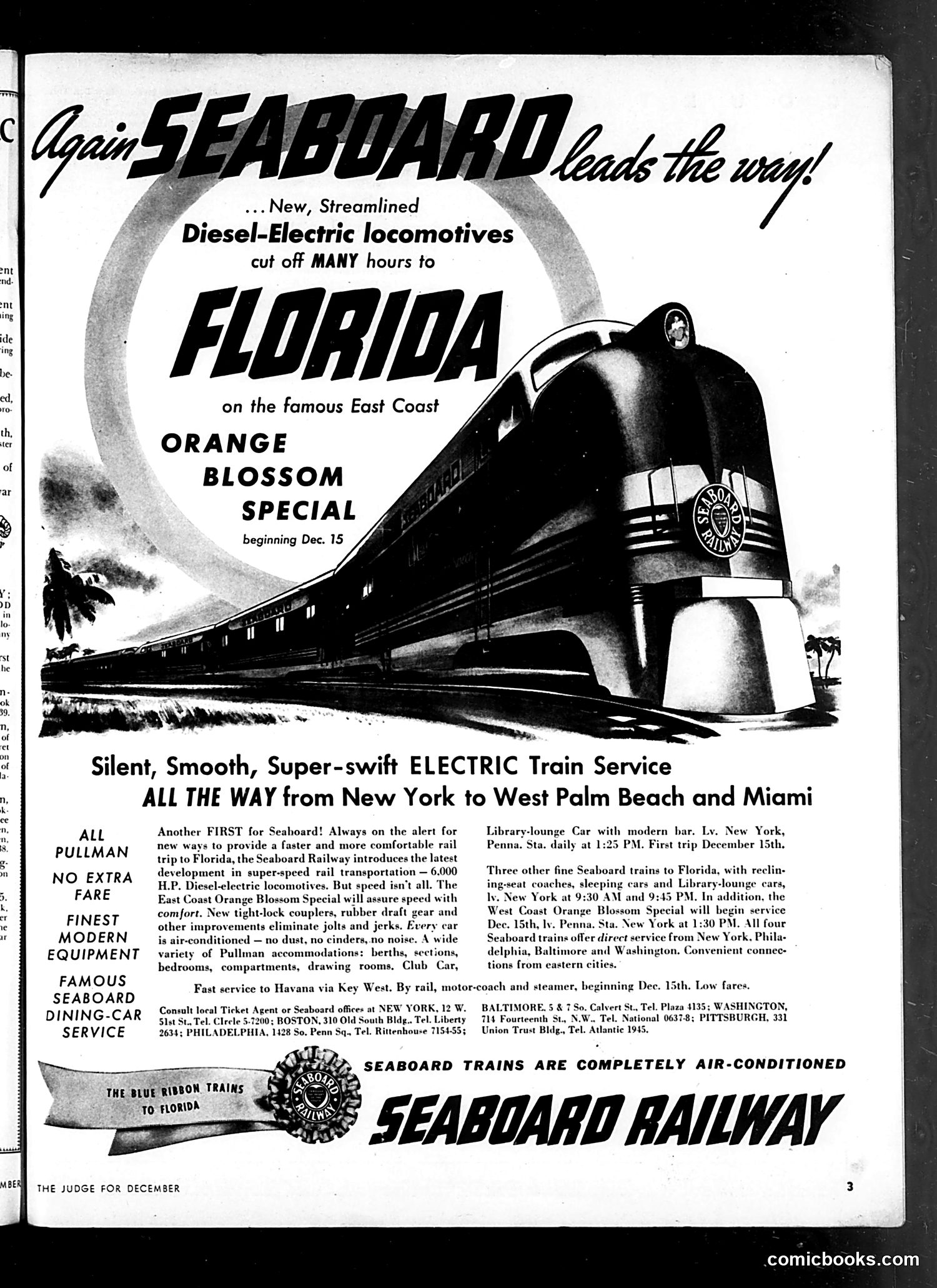
Analysis This is not a political cartoon or satirical content — it's a full-page advertisement for Seaboard Railway's new streamlined passenger train service. The ad promotes the "Orange Blossom Special," a diesel-electric locomotive service running from New York to Miami and West Palm Beach, beginning December 15th. The streamlined train illustration exemplifies 1930s-40s Art Deco design aesthetics. Key selling points emphasized include: - Modern diesel-electric technology (faster, quieter than steam) - All-Pullman cars with no extra fare - Air conditioning throughout - Improved dining car service - Convenient connections to Havana via Key West The advertisement positions Seaboard Railway as innovative and forward-thinking, using the streamlined locomotive as a symbol of modern progress and speed — typical marketing strategy for the era's competitive passenger rail industry.
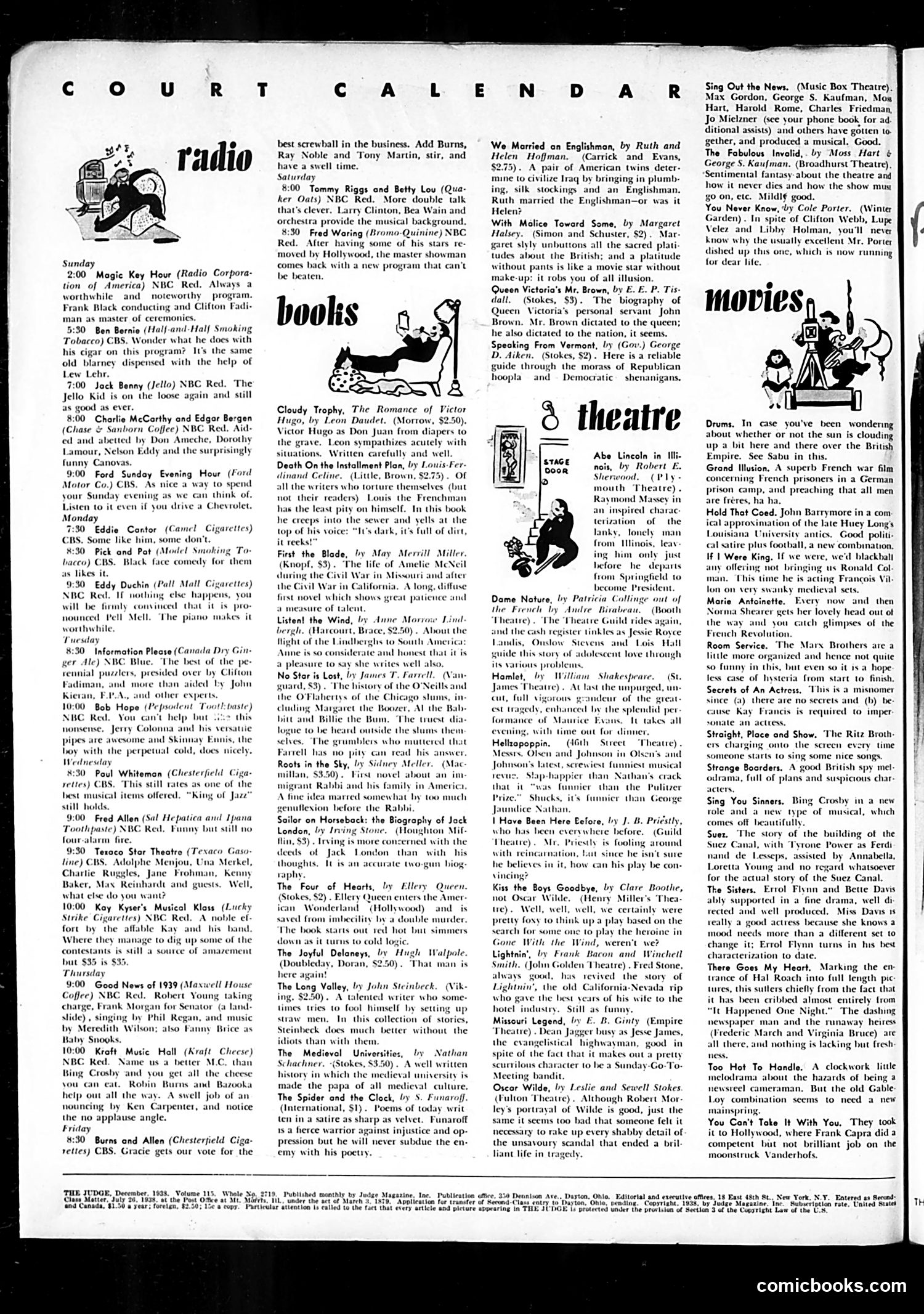
Court Calendar Page Content Analysis This appears to be primarily an entertainment guide page from Judge magazine (dated December 1934, based on the footer), rather than a satirical cartoon page. The layout is divided into three sections: - Radio programming listings - Books reviews and recommendations - Movies and Theatre sections with show descriptions The small illustrations are functional decorative elements typical of entertainment guides—a radio set, reading figure, and film camera—not satirical political cartoons. The content focuses on entertainment recommendations for the week, including radio programs, book reviews, and theatrical productions. This is essentially a what's-on guide for leisure consumption, not a vehicle for political or social satire. No identifiable political figures or satirical commentary are evident on this particular page.
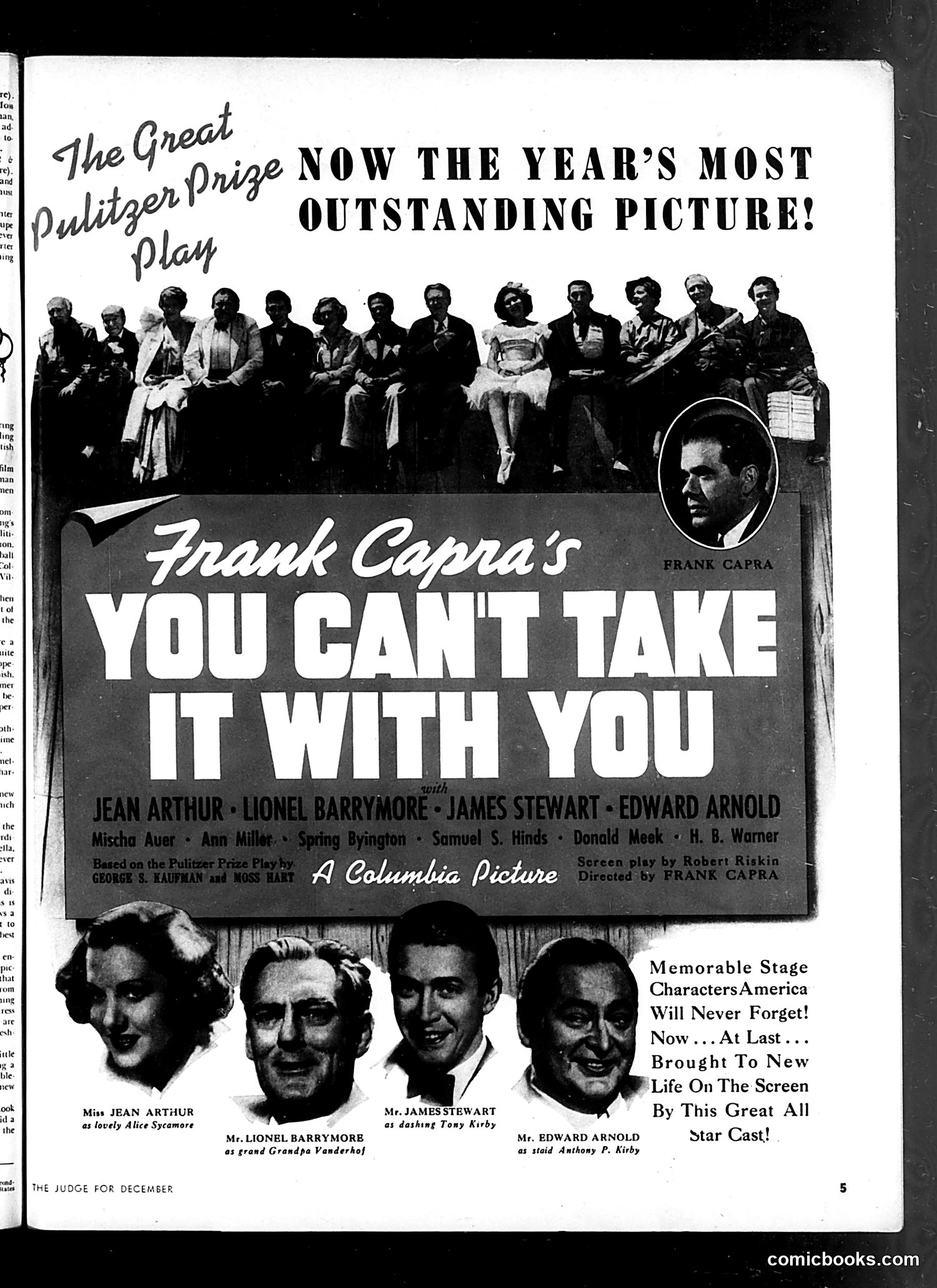
This page is primarily a movie advertisement, not political satire. It promotes Frank Capra's film "You Can't Take It with You," described as "The Great Pulitzer Prize Play" and "Now the Year's Most Outstanding Picture!" The ad features the cast including Jean Arthur, Lionel Barrymore, James Stewart, and Edward Arnold, with their character names listed below their photographs. The large group photo at top shows the ensemble cast. The text emphasizes this is a Columbia Pictures production based on a Pulitzer Prize-winning stage play, now adapted for film. The advertisement highlights it as a prestigious, acclaimed work bringing "memorable stage characters America will never forget" to cinema. There is no evident political cartoon or satire on this page—it's straightforward entertainment industry marketing from what appears to be a 1938-1939 publication.
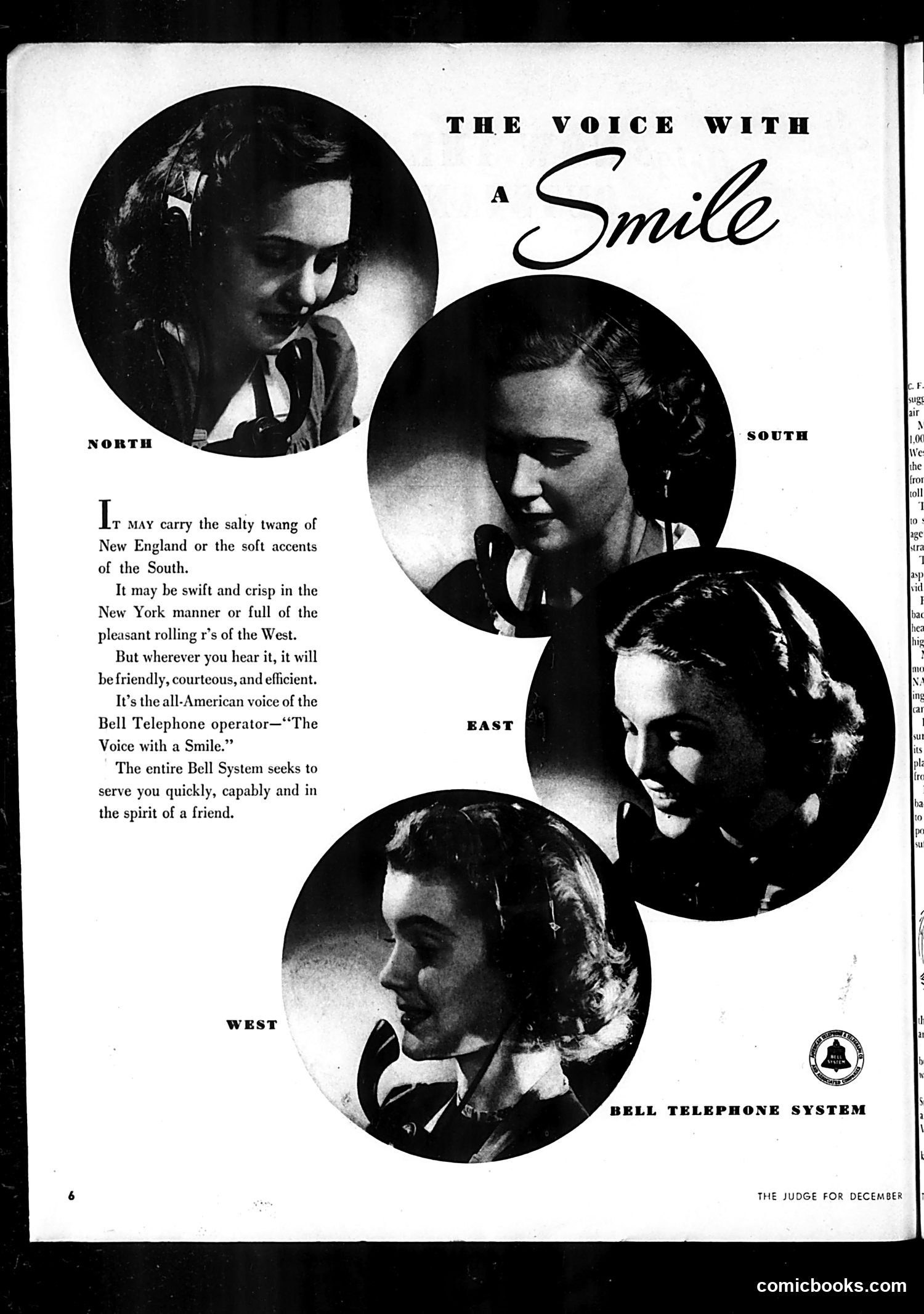
Advertisement Analysis This is a Bell Telephone System advertisement, not political satire. The page promotes the Bell Telephone Operator as "The Voice with a Smile." The ad uses four circular portraits of women operators representing different American regions (North, South, East, West), emphasizing that regardless of regional accent—whether "salty" New England, Southern, New York, or Western tones—Bell operators maintain friendly, courteous, efficient service. The text frames this as the "all-American voice" representing unified national service. This reflects mid-20th-century corporate messaging emphasizing standardized professionalism and regionalism as charming variation within a cohesive system. The smiling female operators suggest the company's marketing strategy of associating telephone service with feminine warmth and accessibility.
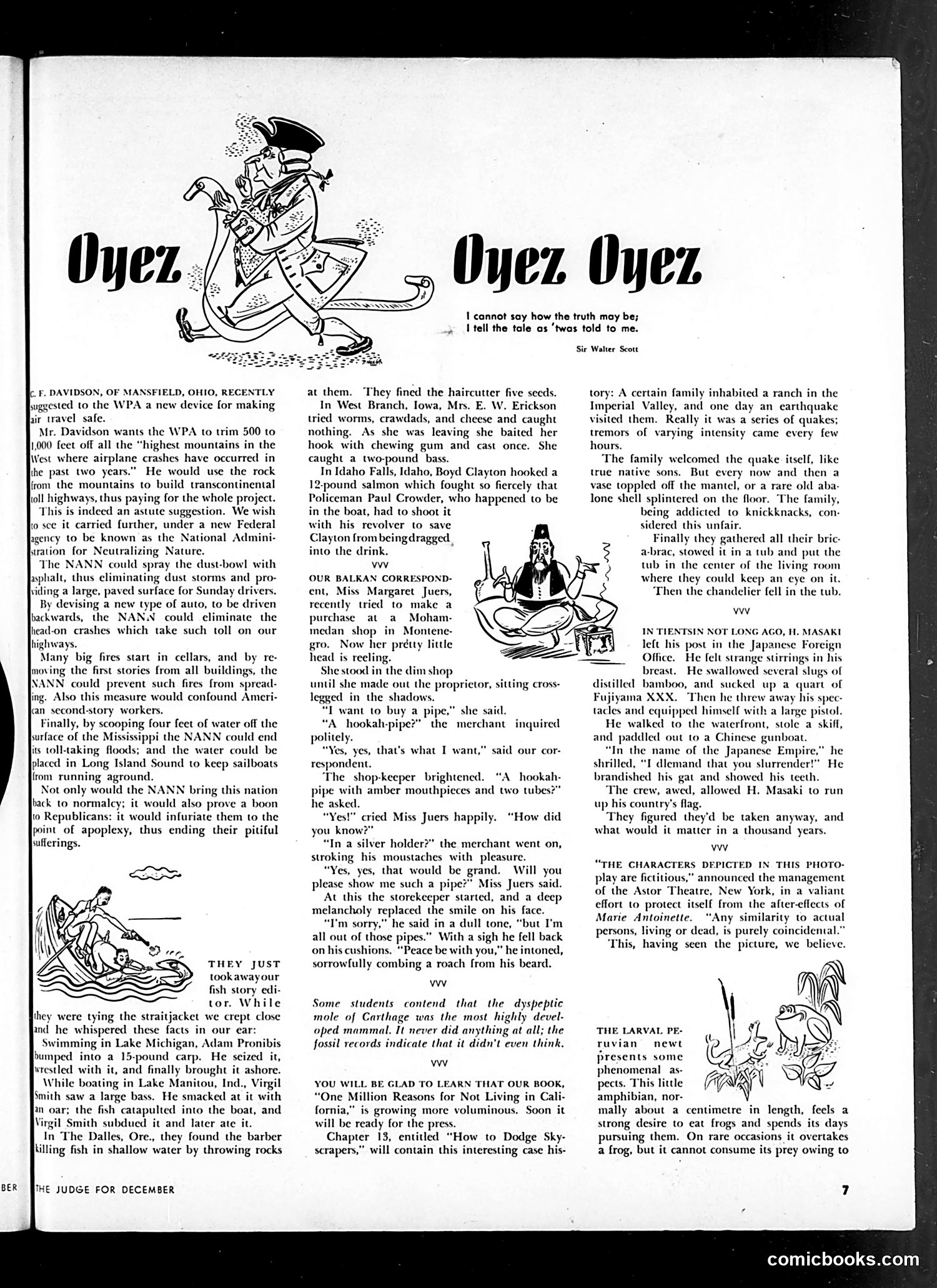
"Oyez Oyez" Page Analysis This appears to be a miscellaneous content page from *Judge* magazine featuring multiple unrelated short stories and anecdotes rather than political satire. The main illustrated stories include: 1. Top left: A cartoon of someone in old-fashioned dress, possibly colonial-era, associated with a story about WPA workers and airplane crashes. 2. Center: An illustration showing what appears to be a merchant transaction involving a hookah pipe—part of a narrative about Miss Juers purchasing an unusual item. 3. Right column: References to Japanese and Chinese characters in a theatrical or fictional context. 4. Bottom: An illustration of a larval peruvian newt, presented as a humorous nature note. The page functions primarily as humor/entertainment content mixing fictional tales, anecdotes, and nature observations rather than political commentary.
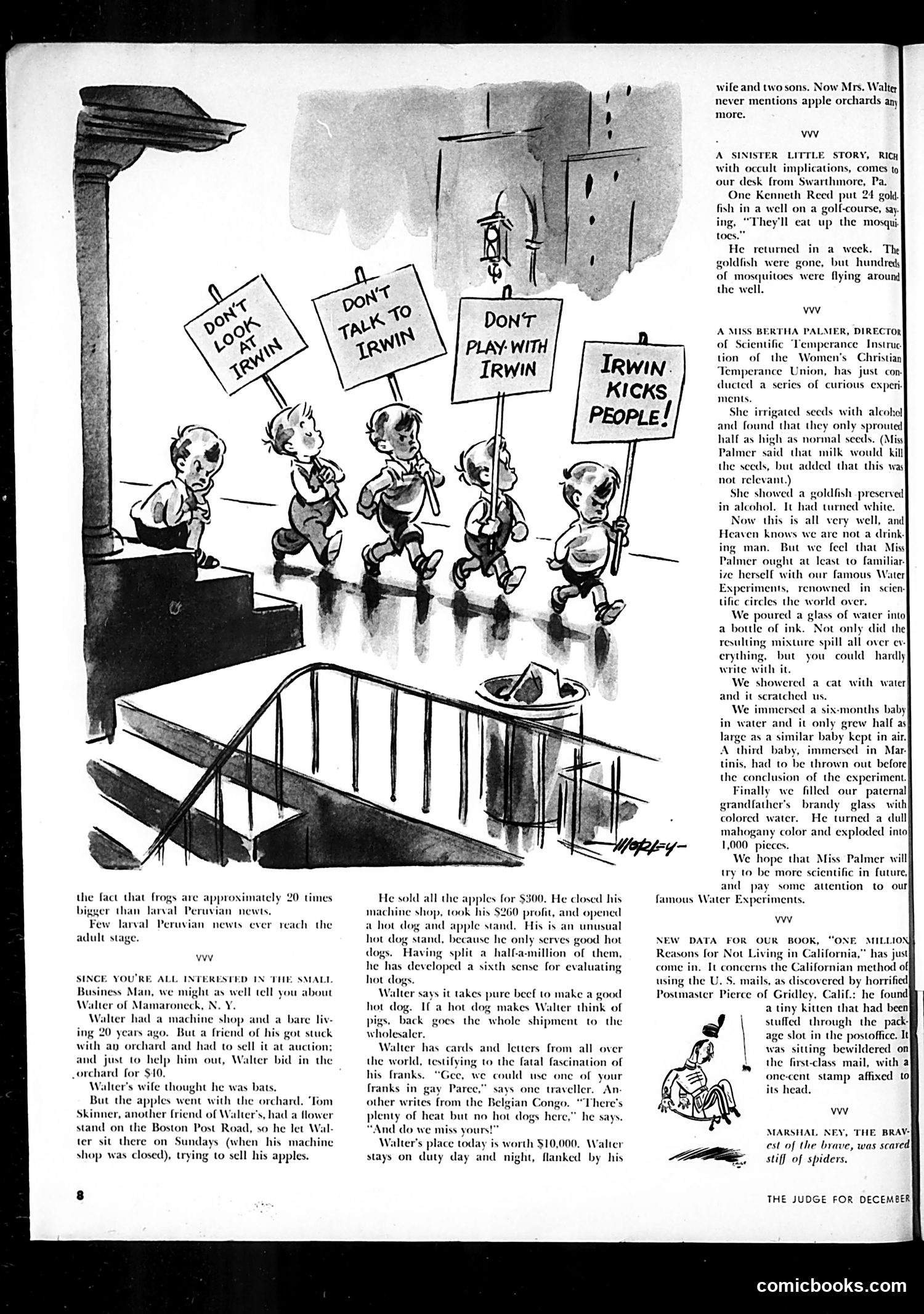
Explanation for Modern Readers This page from *Judge* magazine contains several satirical pieces mocking pseudoscientific claims and social trends of the era. The main cartoon depicts children carrying protest signs about "Irwin" — likely referring to a then-famous person or trend the modern reader would need additional context to identify. The satire appears to target whatever fad or public figure "Irwin" represents. The text stories ridicule: 1. Walter's hot dog stand — a rags-to-riches small business tale presented as noteworthy, satirizing American entrepreneurialism. 2. The goldfish/mosquito story — mocking magical thinking and folk remedies. 3. Miss Palmer's temperance "experiments" — attacking the Women's Christian Temperance Union's anti-alcohol propaganda by sarcastically describing absurd "water experiments" that "prove" water is equally harmful. This is *Judge's* defense of drinking against temperance crusaders. The humor relies on readers recognizing these public figures and movements as worthy targets of ridicule.
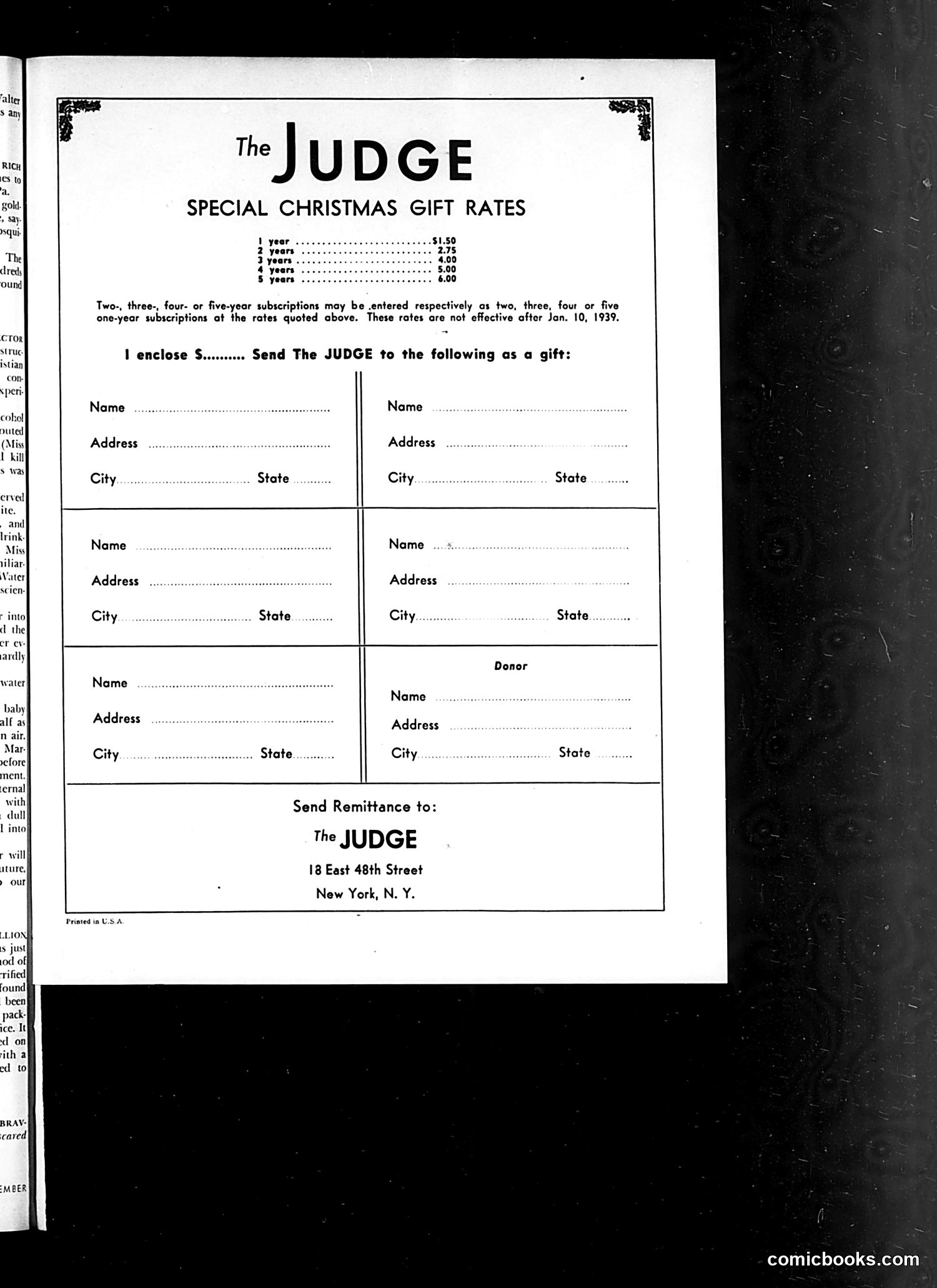
This is a subscription advertisement, not a cartoon or satirical content. It's a Christmas gift promotion page from *Judge* magazine, likely from late 1938 (given the Jan. 10, 1939 deadline mentioned). The page offers special discounted subscription rates ranging from $1.50 for one year to $6.00 for five years. It allows customers to purchase multiple subscriptions as gifts by filling in recipient information on the form. There is no satire, political commentary, or caricature present. This is straightforward promotional material designed to encourage readers to give *Judge* magazine subscriptions as Christmas gifts—a common marketing strategy for publications during this era. The page functions purely as an order form with mailing instructions to the magazine's New York headquarters.

I'm unable to provide a meaningful analysis of this page. The image shows what appears to be a largely blank or heavily degraded page from Judge magazine, with minimal visible text or discernible cartoon content. The OCR text returned only fragments and a website attribution, offering no substantive content to interpret. To properly analyze a Judge magazine page as a political cartoon historian would, I would need a clearer image where the illustrations and accompanying text are legible enough to identify figures, read captions, and understand the satirical references. If you have a clearer version of this page, I'd be happy to provide historical context and explanation of the satire.
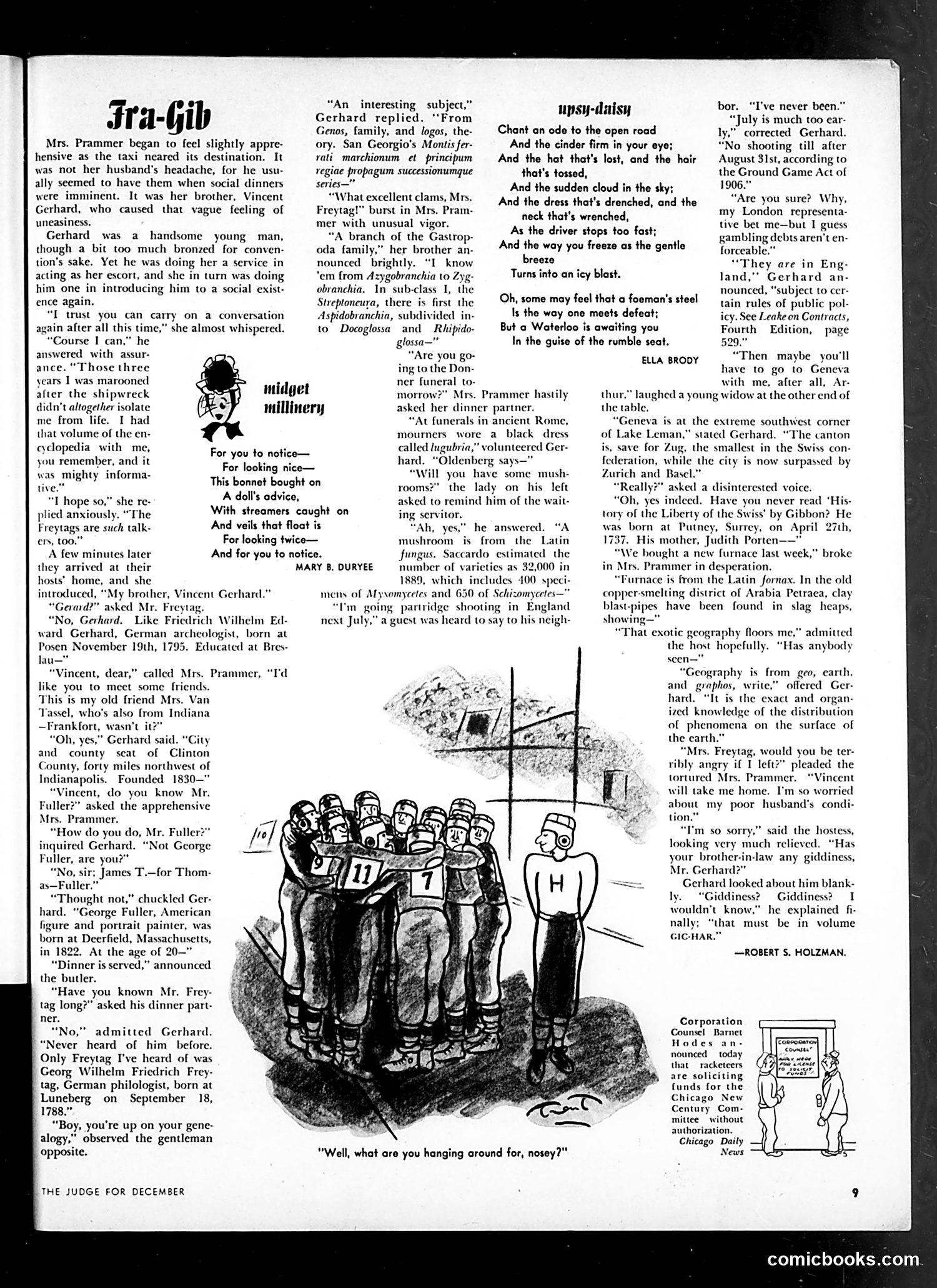
Explanation for Modern Readers This is a humorous short story titled "Fra-Gib" about Vincent Gerhard, a socially awkward man recently returned from being marooned after a shipwreck. His sister Mrs. Prammer brings him to a dinner party, hoping he can reintegrate into society. The joke is that Vincent responds to every social conversational opening with pedantic, irrelevant factual information—turning remarks about clams into mollusk taxonomy, funeral etiquette into Roman history, mushrooms into mycology classifications. He's armed only with an old encyclopedia volume and cannot engage in normal dinner conversation. The satire targets two things: (1) the pretentiousness of over-education presented inappropriately, and (2) the social awkwardness of someone unable to read social cues or engage in casual, polite conversation. His relentless factual lectures destroy each conversational attempt, making him a social liability despite his sister's best efforts. The page also includes unrelated advertisements and a cartoon about children's millinery (hats).
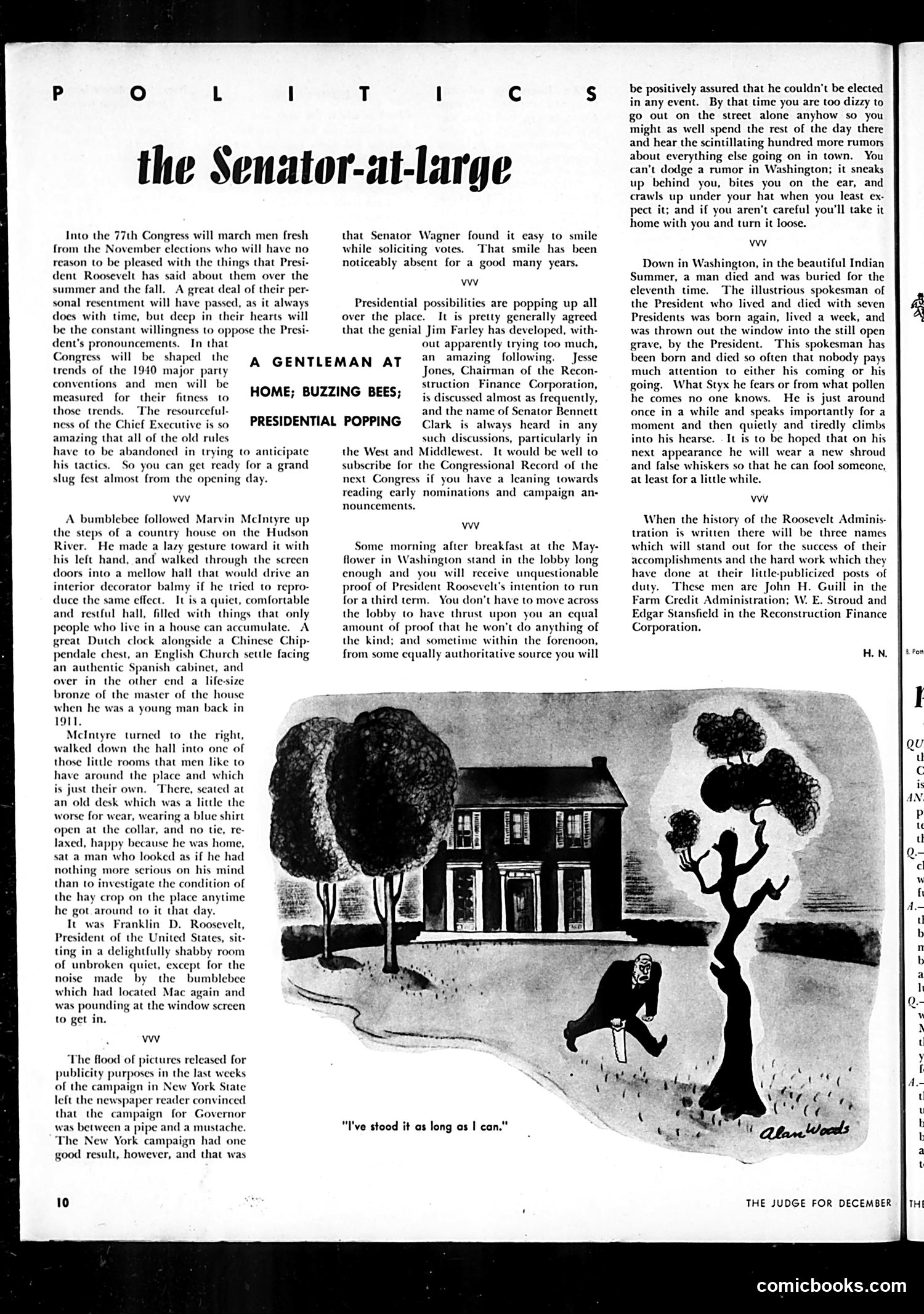
"The Senator-at-Large" — Judge Magazine Political Commentary This page from *Judge* magazine contains political commentary about the incoming 77th Congress and Roosevelt administration, centered on three topics: 1. Congressional Opposition: The article predicts that newly elected congressmen, resentful of Roosevelt's public criticism during the 1940 campaign, will be primed to oppose the President's initiatives despite any personal reconciliation over time. 2. Presidential Succession Speculation: The piece mocks the flood of "presidential possibilities" being discussed—Jim Farley, Jesse Jones, and Senator Bennett Clark are mentioned as potential 1940 candidates. The satire highlights how Washington insiders constantly generate unfounded rumors about presidential ambitions. 3. The Cartoon: The accompanying illustration by Allen Woods depicts a man clinging to a tree with the caption "I've stood it as long as I can," likely satirizing someone's political endurance—possibly relating to Roosevelt's rumored third-term intentions, which the text also discusses skeptically. The overall tone mocks Washington's rumor mill and political posturing.
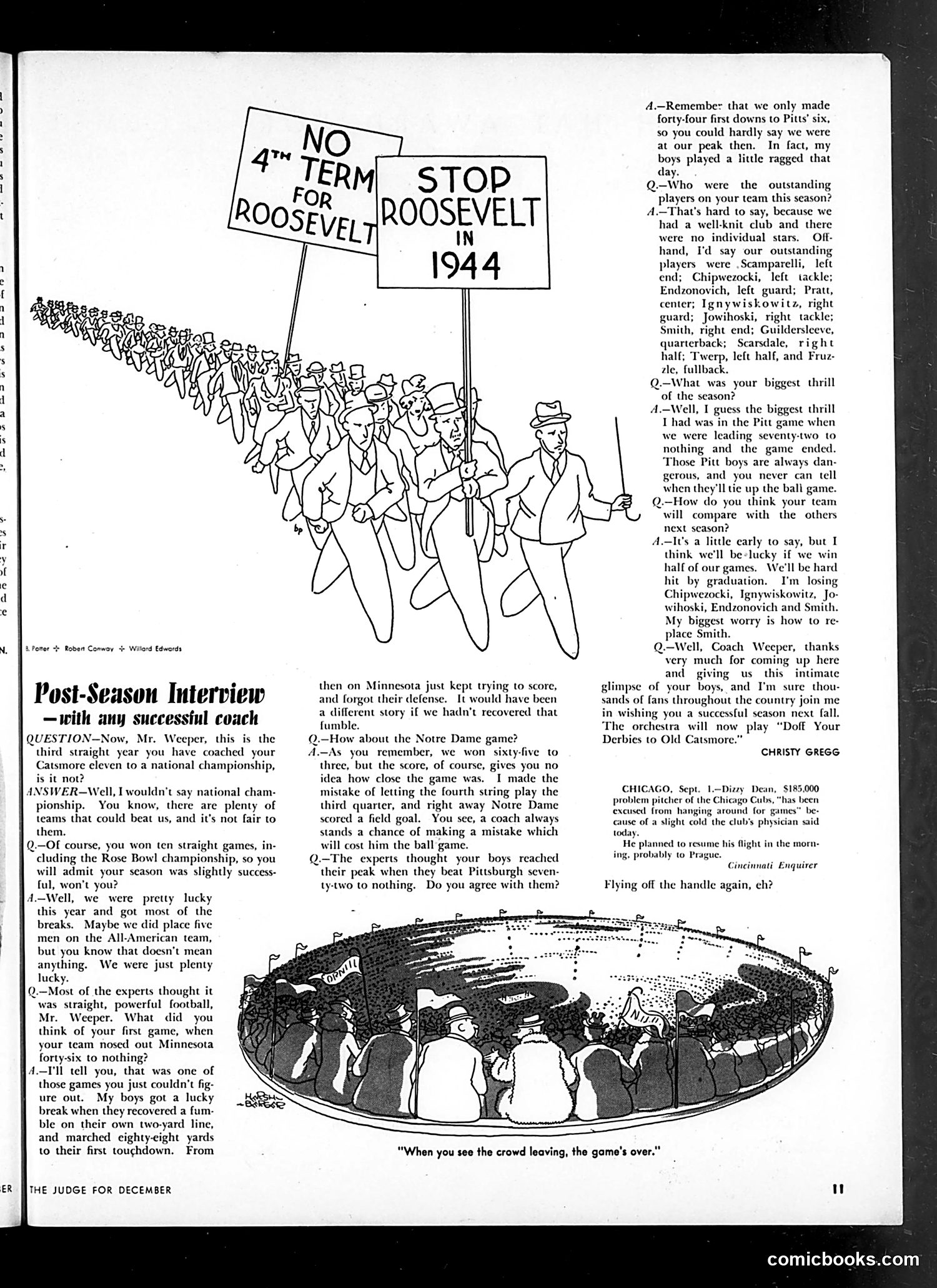
Analysis: Post-Season Interview with Coach Weeper This is a satirical humor piece mocking the false modesty and deflection common in post-game coaching interviews. Coach Weeper has just won his third consecutive national championship with a 46-0 victory over Minnesota and 65-3 win over Notre Dame, yet he consistently minimizes his team's accomplishments. The satire works through exaggeration: when asked about dominant performances, Weeper attributes success to "luck," recovers fumbles, and "mistakes." He downplays his All-American players (with obviously fabricated ethnic names like "Scamparelli" and "Chipwezocki"), claiming no individual stars exist. He even expresses worry about replacing one player despite overwhelming victories. The political cartoon at top shows a 1944 anti-Roosevelt campaign parade, referencing the presidential election during this magazine's publication. The bottom cartoon depicts a stadium crowd leaving early, captioned to suggest games end when spectators depart. The humor targets the clichéd humility athletes and coaches perform publicly—the disconnect between actual success and expressed self-doubt.
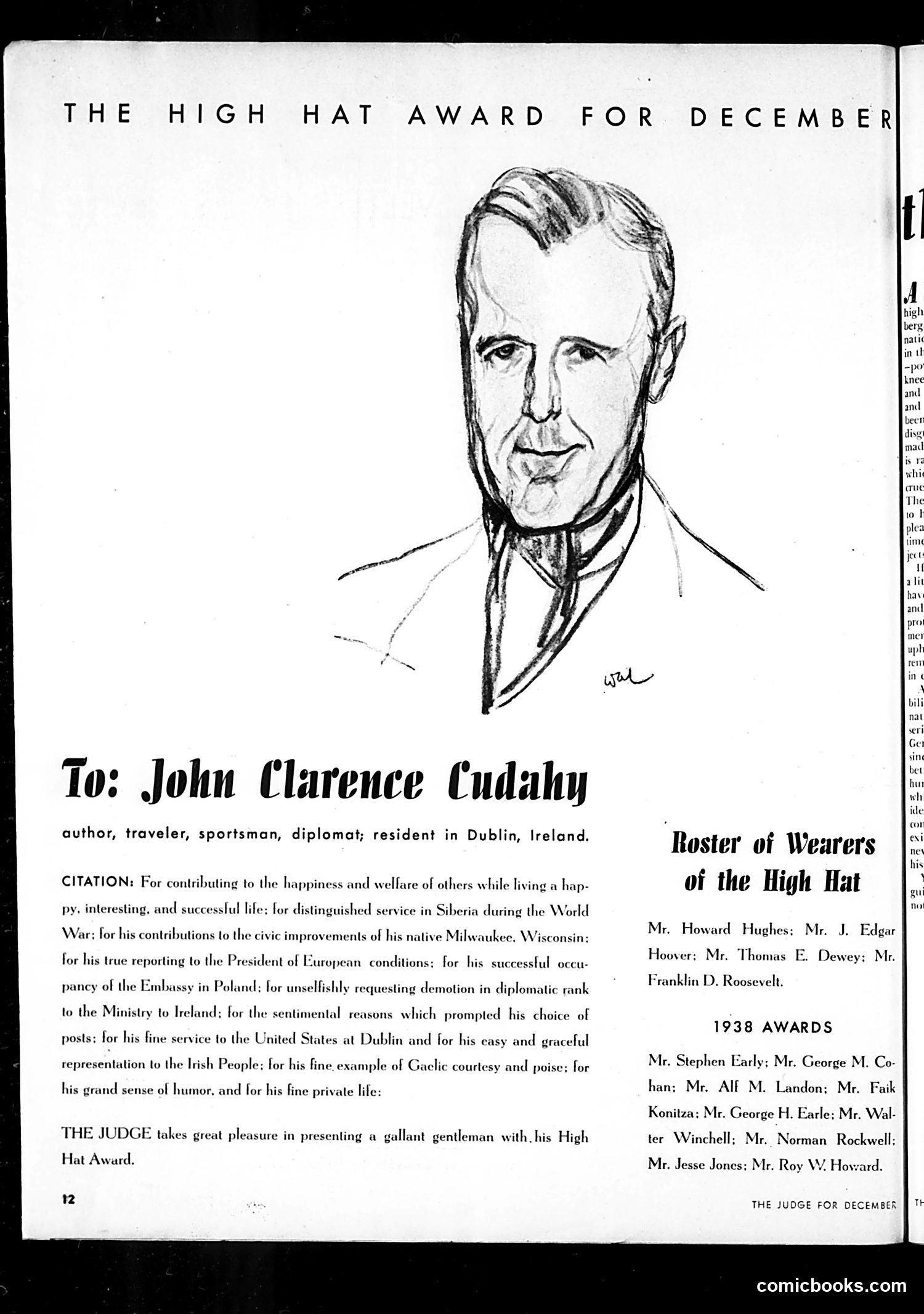
"The High Hat Award for December" This page awards Judge magazine's monthly "High Hat Award" to John Clarence Cudahy, a diplomat and author. The "High Hat" appears to be the magazine's honor for distinguished Americans. The citation praises Cudahy's diplomatic service (notably in Poland and Ireland), his WWI service in Siberia, Milwaukee civic work, and his character—emphasizing his voluntary demotion to the Irish ministry for "sentimental reasons," suggesting he chose personal preference over career advancement. The accompanying roster lists previous recipients including FDR, J. Edgar Hoover, and Thomas Dewey, establishing this as a prestigious recognition. The sketch portrait shows a dignified gentleman matching Cudahy's description. This appears to be a genuine honor rather than satire—Judge magazine's way of celebrating exemplary public figures and private citizens embodying American values of service and integrity.
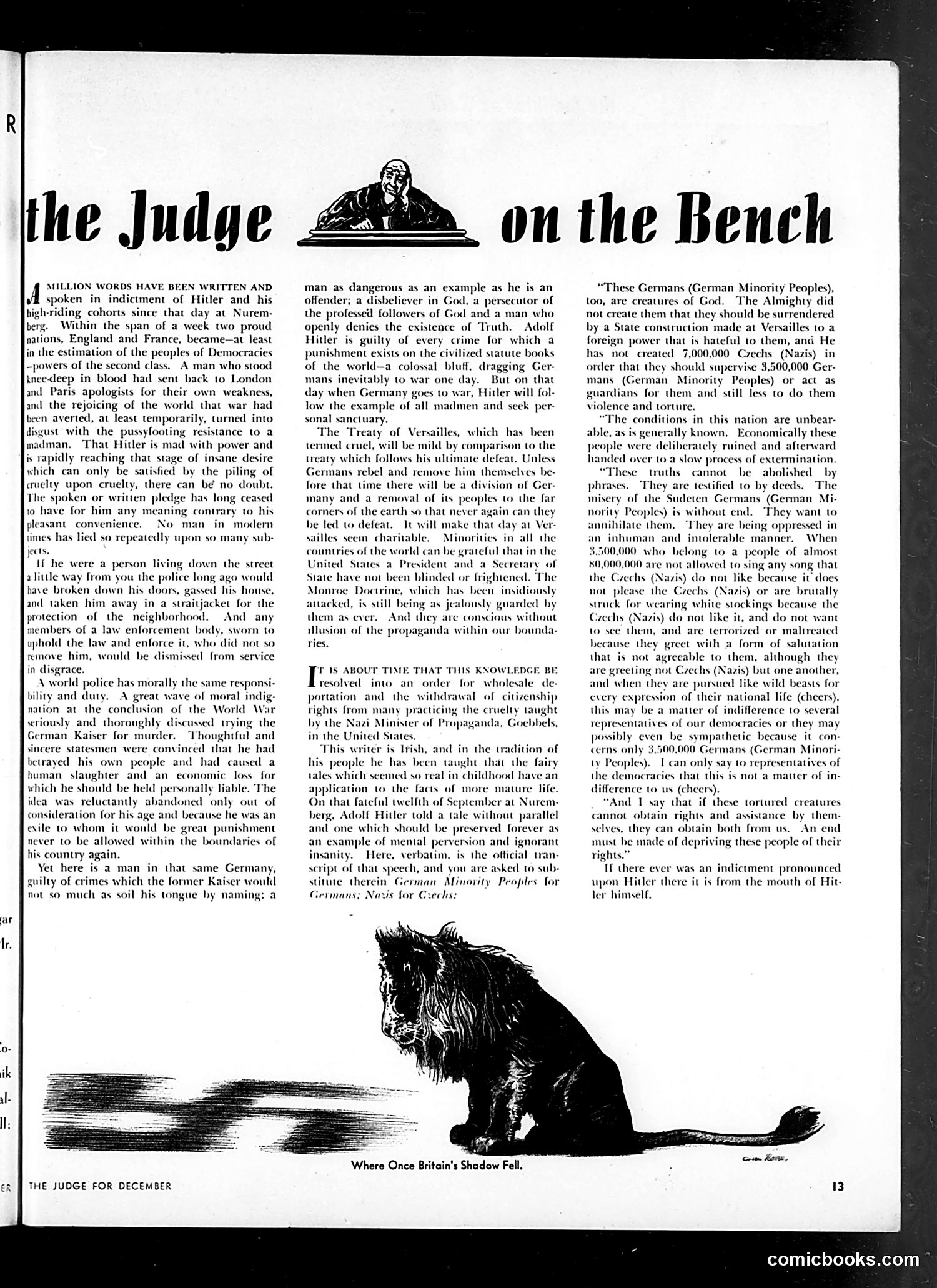
Analysis for Modern Readers This is an anti-Nazi editorial from Judge magazine, likely from late 1938 (given references to the Treaty of Versailles and Hitler's recent aggression). The text argues Hitler is a madman who should be forcibly removed from power, warning that his inevitable defeat will bring harsher consequences than Versailles. The accompanying cartoon—"Where Once Britain's Shadow Fell"—depicts a lion (representing British imperial power) now reduced to a crouching, diminished beast. This critiques Britain's appeasement policy toward Hitler, suggesting British strength and global influence have been fatally weakened by failing to confront Nazi aggression. The editorial also calls for deporting German-Americans who propagandize Nazi ideology, reflecting contemporary anxieties about fifth-column threats during the pre-WWII period.
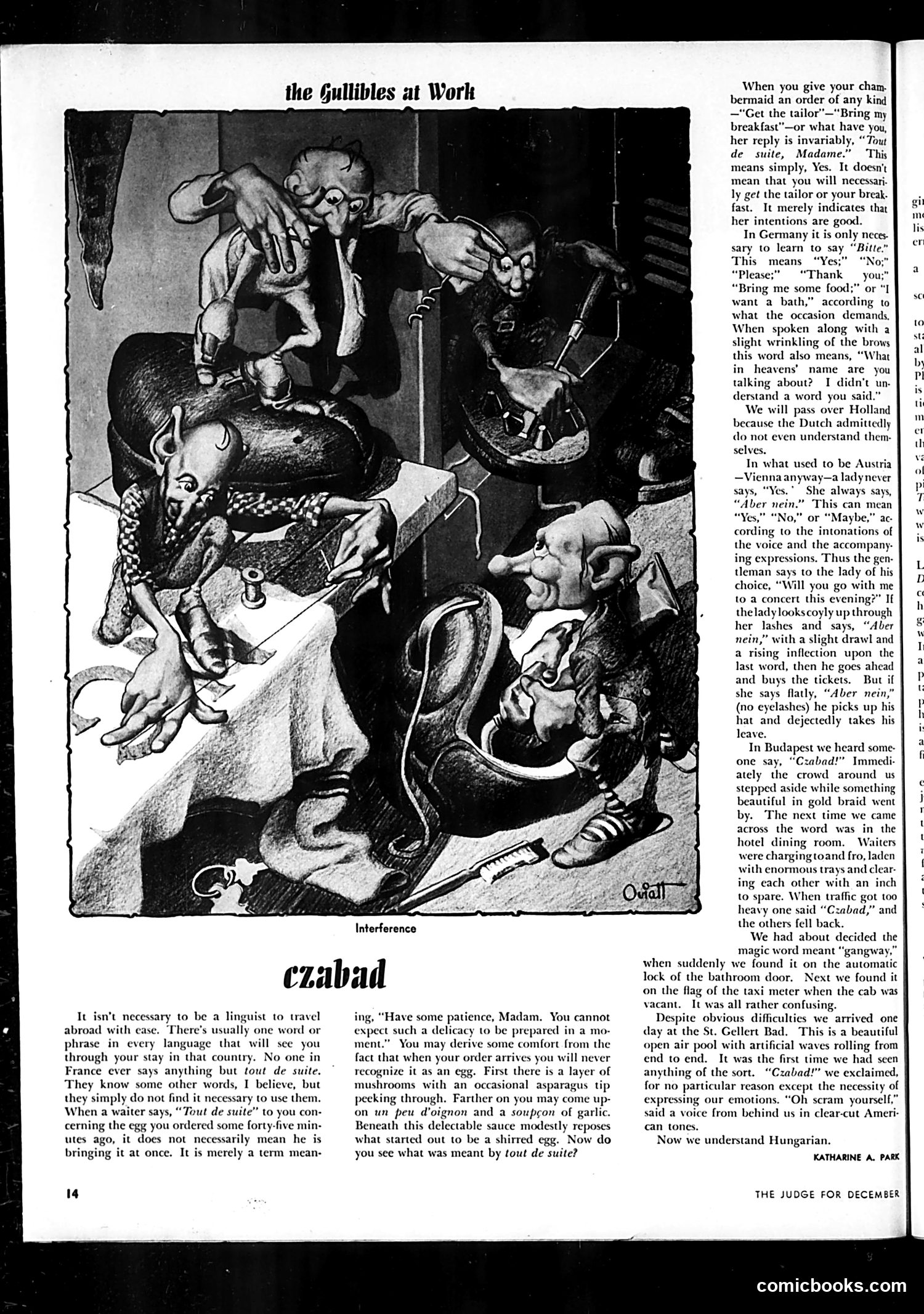
Explanation for Modern Readers This page from *Judge* magazine presents satirical commentary on European languages and cultural misunderstandings through the article "The Gullibles at Work." The accompanying cartoon (titled "Interference") depicts what appears to be European characters in chaotic interaction, illustrating the communication difficulties described in the text. The article humorously explains how travelers navigate foreign countries using single catch-all phrases: French "tout de suite" (right away), German "bitte" (please/yes), and Austrian "aber nein" (but no—which can paradoxically mean yes). The humor culminates with Hungarian "czabad," which the American traveler discovers means "gangway/make way," appearing on door locks, taxi meters, and pool signs—until finally hearing it translated bluntly by another American at a Budapest spa. The satire mocks both American tourists' linguistic laziness and the bewildering opacity of European languages and customs. The punchline—that understanding finally comes through plain American directness—reflects 1920s-era attitudes about American practicality versus European complexity.
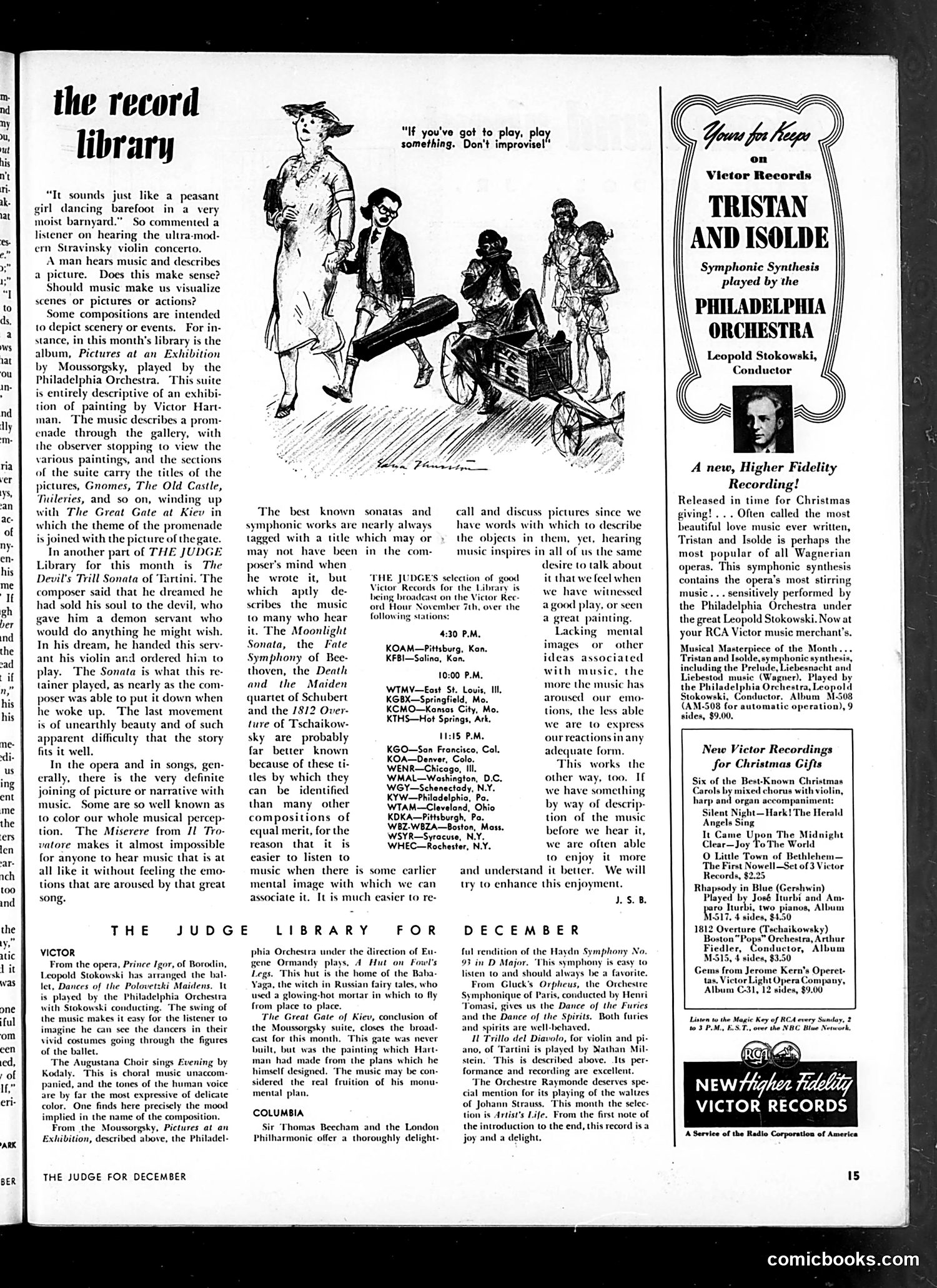
Analysis of Judge Magazine Page Content This page is primarily advertising and music criticism, not political satire. The small cartoon at top shows a woman and children at what appears to be a musical performance, with the caption "If you've got to play, play something. Don't improvise!" — a mild joke about amateur musicians, likely referencing modern/avant-garde music's apparent formlessness. The bulk of the page discusses "The Record Library," explaining how classical music evokes visual imagery and narrative. It describes recordings of pieces like Moussorgsky's *Pictures at an Exhibition* and Tartini's *Devil's Trill Sonata*, arguing that programmatic music — compositions with titles suggesting specific scenes or stories — helps listeners engage emotionally by connecting music to mental images. The right side advertises Victor Records' new "Higher Fidelity" recording of Wagner's *Tristan and Isolde*, performed by Leopold Stokowski and the Philadelphia Orchestra. No significant political satire is present. This is a straightforward music appreciation column paired with product advertising, typical of Judge's December 1930 content.
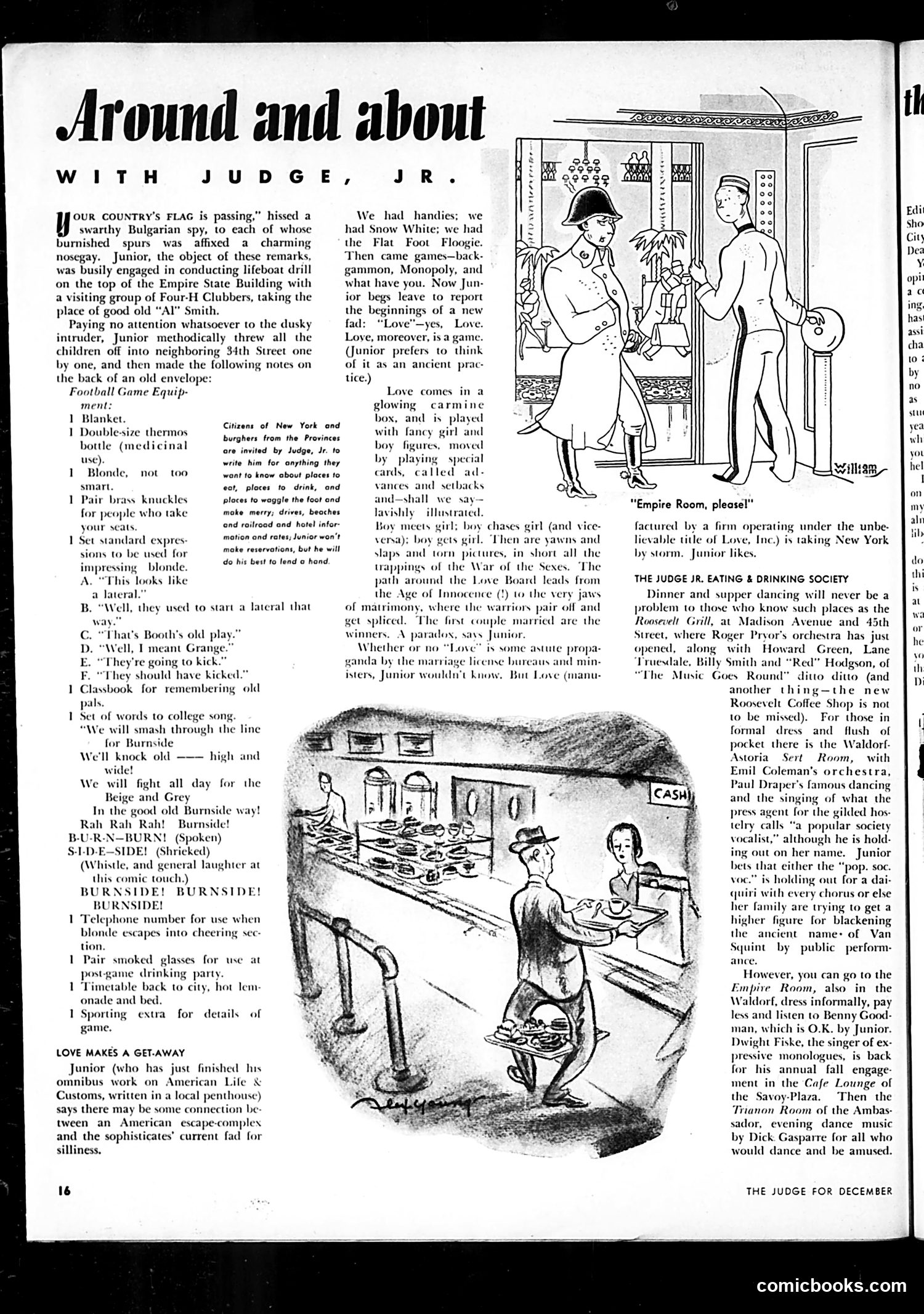
Explanation for Modern Readers This is a humorous column by "Judge Jr." satirizing 1930s New York sophistication and courtship trends. The main cartoon depicts a spy overhearing a child conducting lifeboat drills atop the Empire State Building—likely mocking both absurd civil-defense paranoia and the era's "Four-H Club" wholesome-youth movement. The text playfully critiques the current fad of a board game called "Love," which Junior describes as mimicking courtship through game mechanics (meeting, chasing, winning). The satire suggests modern sophisticates have reduced romance to commercialized recreation, packaging emotional complexity into "fancy" game pieces and a predetermined "Love Board" path leading to marriage. The football notes and collegiate song references mock college-boy pretension. Throughout, the writer gently ridicules 1930s high-society culture—its obsession with fashionable fads, escape-fantasies, and the reduction of authentic human experience (love, loyalty, tradition) into consumable entertainment products marketed to the wealthy and bored.
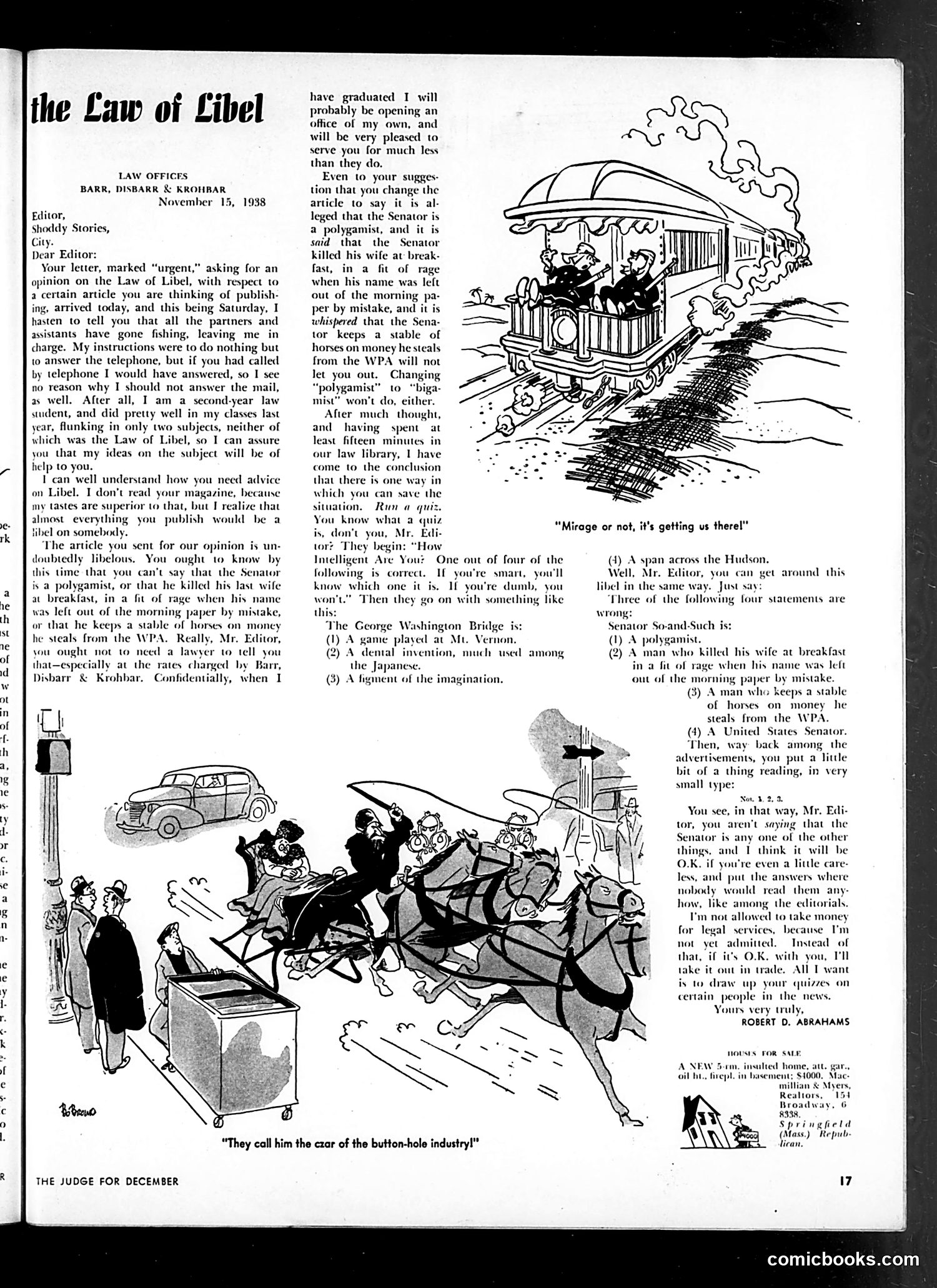
"The Law of Libel" - Judge Magazine, November 1938 This article satirizes both libel law and magazine editors' reckless practices. A second-year law student, filling in at a law office, advises a magazine editor that an article accusing a U.S. Senator of being a polygamist, murdering his wife, and stealing WPA funds is "undoubtedly libelous." The joke: the student suggests a loophole—disguise the accusations as a quiz ("How Intelligent Are You?"), with the libelous statements as false answers buried in tiny print among advertisements. This parodies how publications evaded responsibility for defamatory content through technical tricks. The cartoons on the page—showing chaotic scenes (a car accident, a runaway horse—illustrate the absurdist consequences of irresponsible journalism. The satire targets both corrupt politicians worth exposing and publications that make unfounded accusations without legal consequence, mocking the era's weak libel protections.
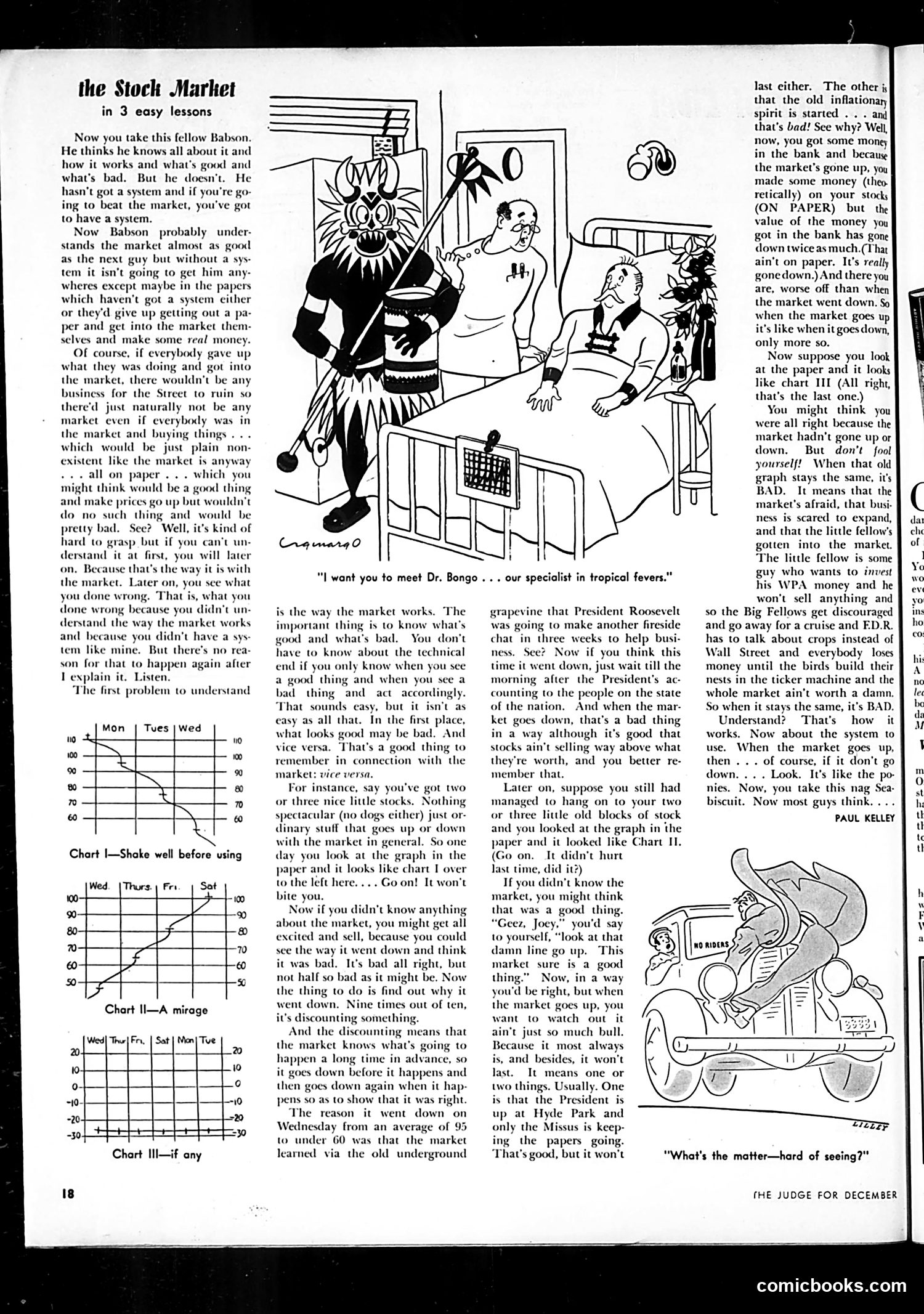
The Stock Market in 3 Easy Lessons - Analysis This is a satirical article mocking stock market advice and investor psychology during the Great Depression era. The main target appears to be Roger Babson, a well-known market analyst and investment advisor of the period, who is ridiculed for claiming to understand markets through "systems." The cartoon (top) depicts a frenzied, demonic figure labeled "Dr. Bongo" terrorizing an investor—representing how market volatility inspires irrational fear and panic. The article's humor relies on circular, contradictory logic: markets are "all on paper," prices move unpredictably, and "what looks good may be bad." It references President Roosevelt's fireside chats, suggesting the market reacts erratically to political news before events occur. The three accompanying charts are intentionally useless—one labeled "shake well before using" like medicine, another titled "a mirage"—emphasizing that technical analysis is pseudoscience. The satire's core point: stock market investing is fundamentally mystifying and rigged, with no genuine predictive system possible. Ordinary investors are victims of their own delusions and expert charlatans.
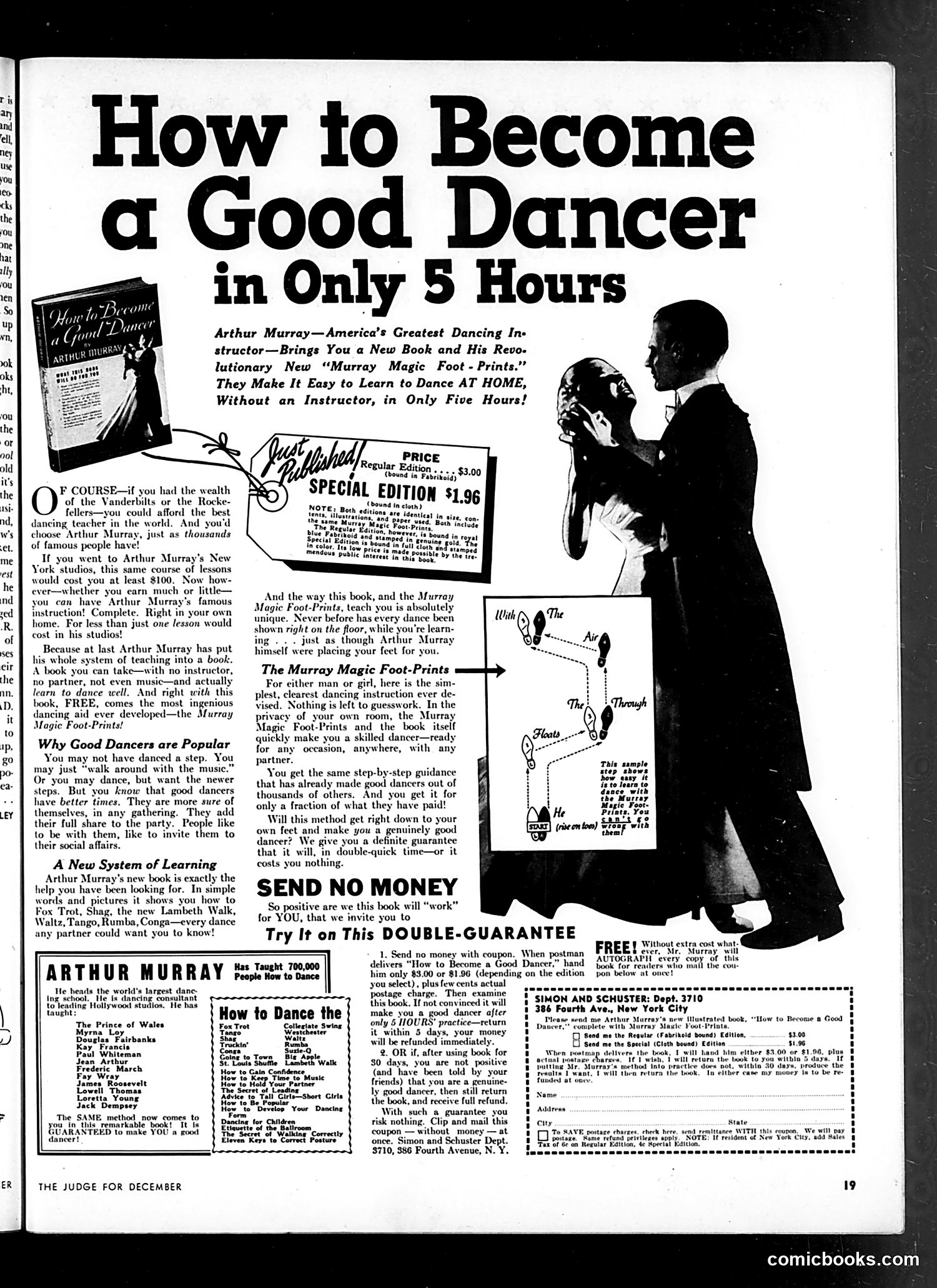
Analysis for Modern Readers This page is primarily advertising, not satire or political commentary. It promotes Arthur Murray's dance instruction book and "Magic Foot-Prints" system, claiming to teach dancing in five hours at home. The appeal targets middle-class readers by emphasizing democratized luxury: the ad suggests that while wealthy Vanderbilts and Rockefellers could afford expensive dance instructors, this book makes professional instruction affordable to everyone. It promises social benefits—good dancers are "popular," "sure of themselves," and invited to parties. The text mentions Arthur Murray taught "700,000 people" and worked with Hollywood stars (Loretta Young, Jean Arthur, Frederic March), lending credibility. The "Magic Foot-Prints" are footprint diagrams showing where to step. This reflects 1930s-40s consumer culture: the belief that mail-order products and books could provide shortcuts to self-improvement and social success. The double-guarantee ("try before you pay") was a common sales tactic of the era. There is no political satire on this page—it's straightforward commercial promotion.
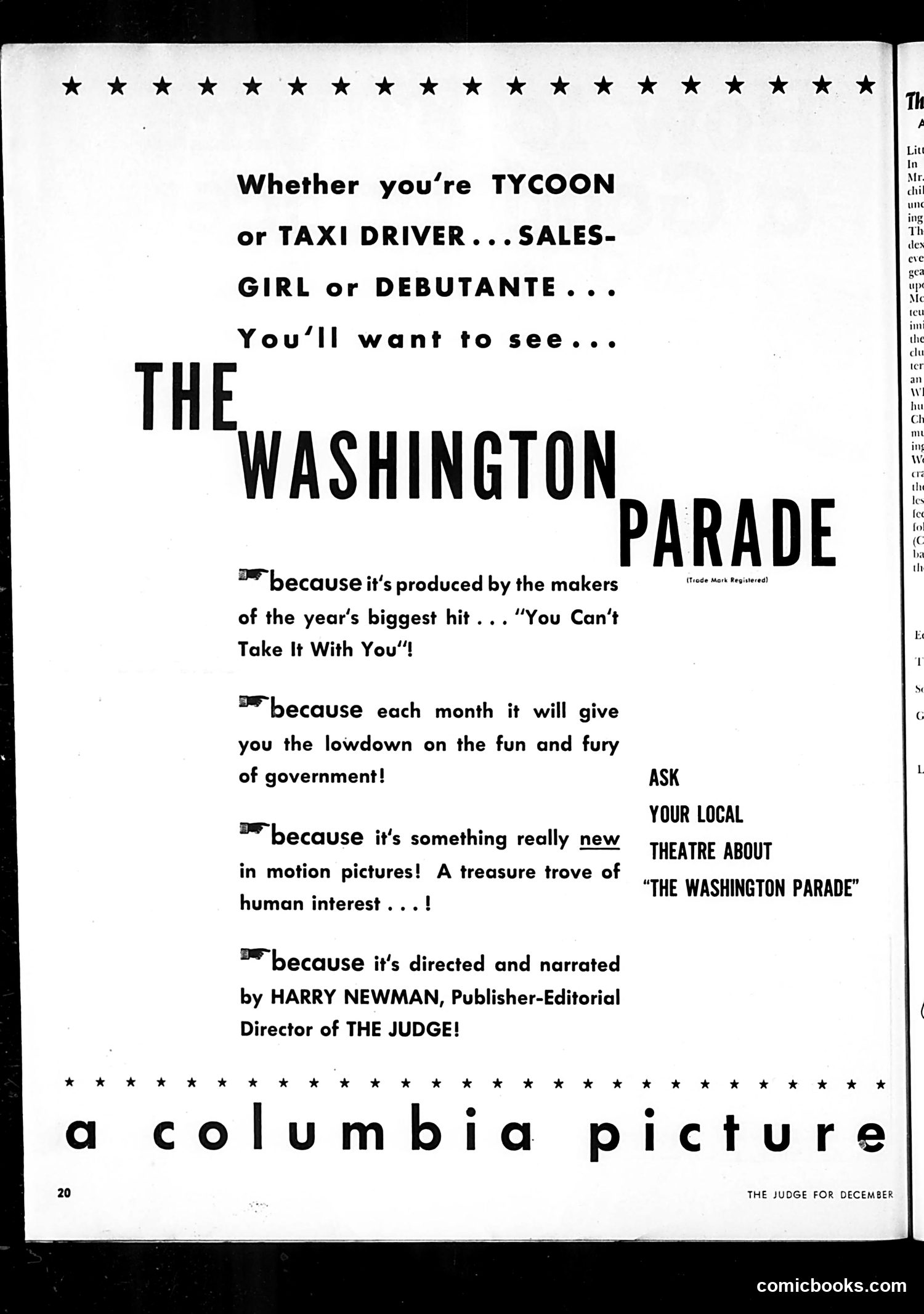
"The Washington Parade" Advertisement This is a movie advertisement in Judge magazine promoting a Columbia Pictures film. The ad targets a broad audience ("tycoon or taxi driver...sales-girl or debutante") to see "The Washington Parade." The selling points reference: - The producers of "You Can't Take It With You" (a successful 1936 film) - Monthly installments about "the fun and fury of government" - Harry Newman, Publisher-Editorial Director of *The Judge*, directing and narrating The satirical angle appears to be positioning a documentary-style picture about government as entertainment for everyday Americans. The "fun and fury of government" phrasing suggests light, accessible coverage of political happenings—typical of Judge's satirical approach to current affairs. This is essentially house advertising: Judge promoting a film directed by one of its own editors, blending the magazine's satirical sensibility with cinema.
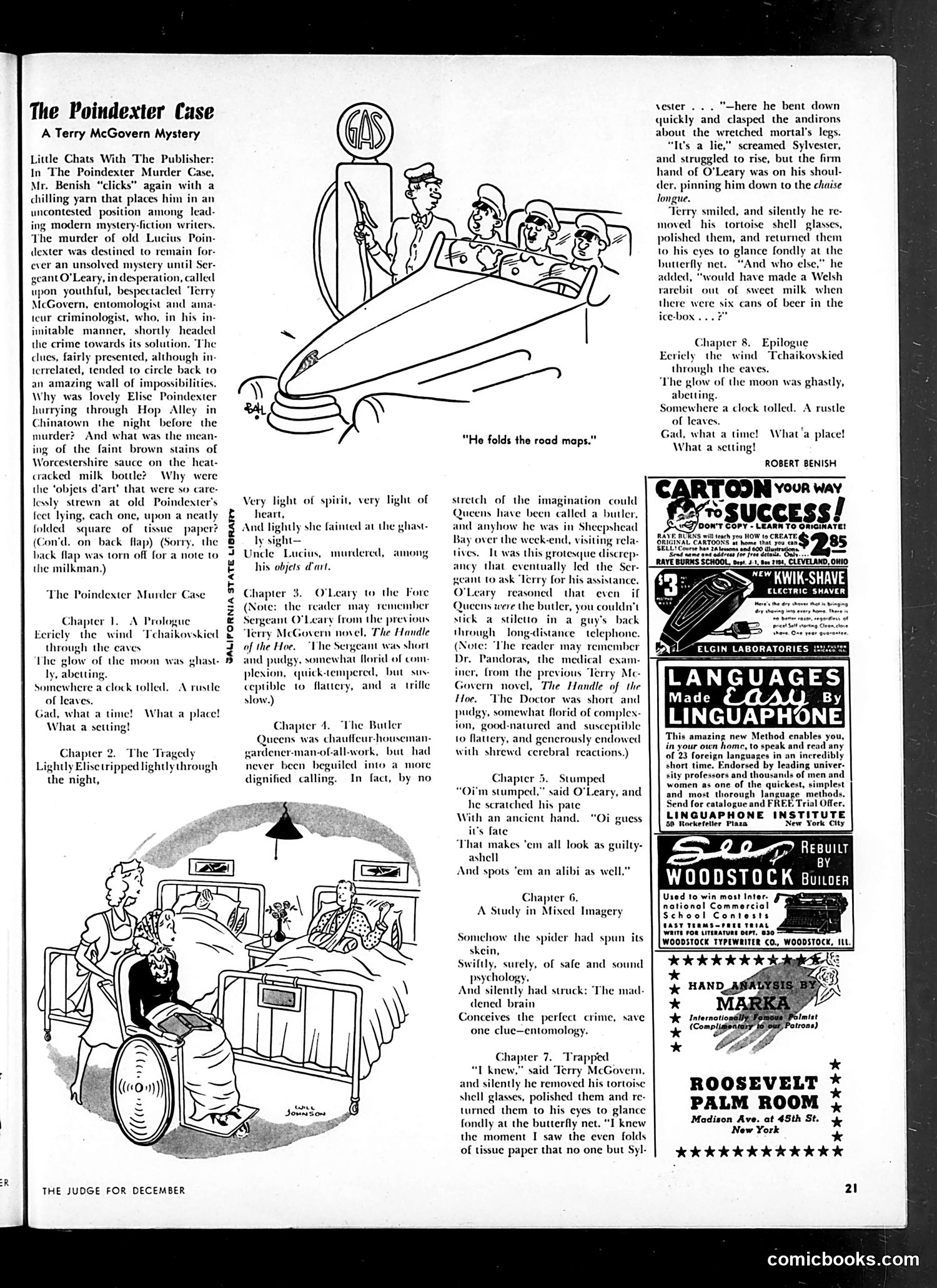
The Poindexter Case: A Parody Mystery This page presents a serialized mystery story parodying popular detective fiction of the era. The protagonist is Terry McGovern, a young "entomologist and amateur criminologist" solving the murder of Lucius Poindexter. The satire mocks overwrought mystery-writing conventions: melodramatic descriptions ("the wind Tchaikovskied through the caves"), absurd clues (Worcestershire sauce on a milk bottle, tissue paper placement), and convoluted plot mechanics. Characters like the slow-witted Sergeant O'Leary and the conveniently absent butler Queens exemplify detective-story clichés. The accompanying illustration depicts the solution scene—McGovern dramatically apprehending the culprit. The humor targets the genre's reliance on improbable deductions and theatrical denouements. This appears designed to amuse readers familiar with contemporary mystery serials, gently mocking their formulaic plotting and purple prose.
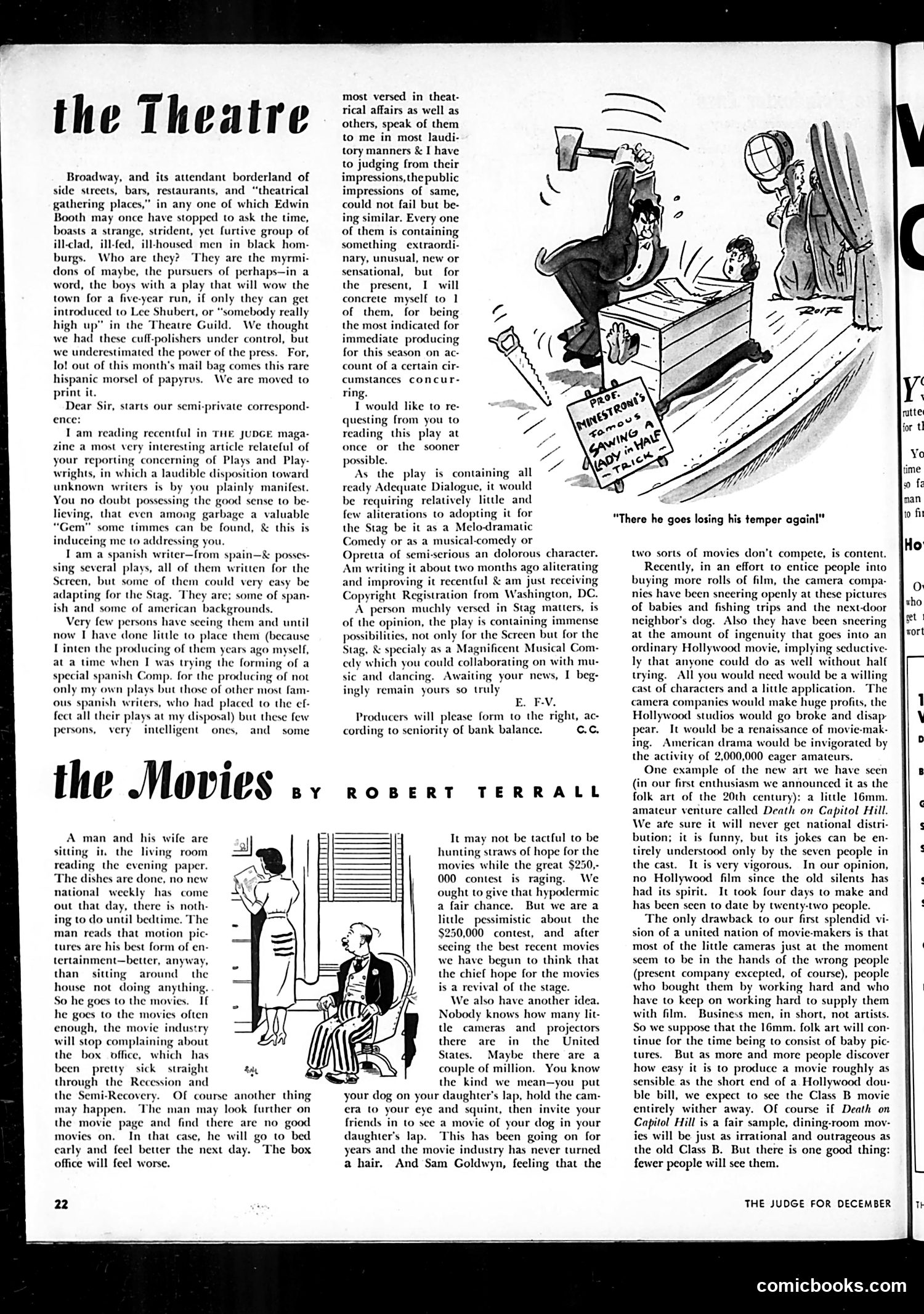
Explanation for Modern Readers This page from *Judge* magazine satirizes two entertainment industry issues circa early 20th century: "The Theatre" section mocks struggling playwrights desperately seeking backing. The accompanying letter—written in deliberately broken English by a Spanish writer—parodies the earnest, grammatically mangled submissions editors receive from hopeful unknown writers. The humor lies in his inflated claims ("immense possibilities") and broken phrasing ("muchly versed," "aliterations"). The cartoon shows a theatrical figure losing his temper, likely representing an exasperated producer tired of such pitches. "The Movies" section by Robert Terrall comments on the film industry's attempt to boost camera sales by mocking amateur moviemaking (home videos of babies and dogs). The satire suggests manufacturers disparage amateur content to sell more equipment to hobbyists who want professional-quality results—a cynical marketing strategy. The cartoon illustrations show domestic scenes of amateur filmmaking attempts. Both pieces target entertainment industry gatekeepers and the aspirational outsiders trying to break in.
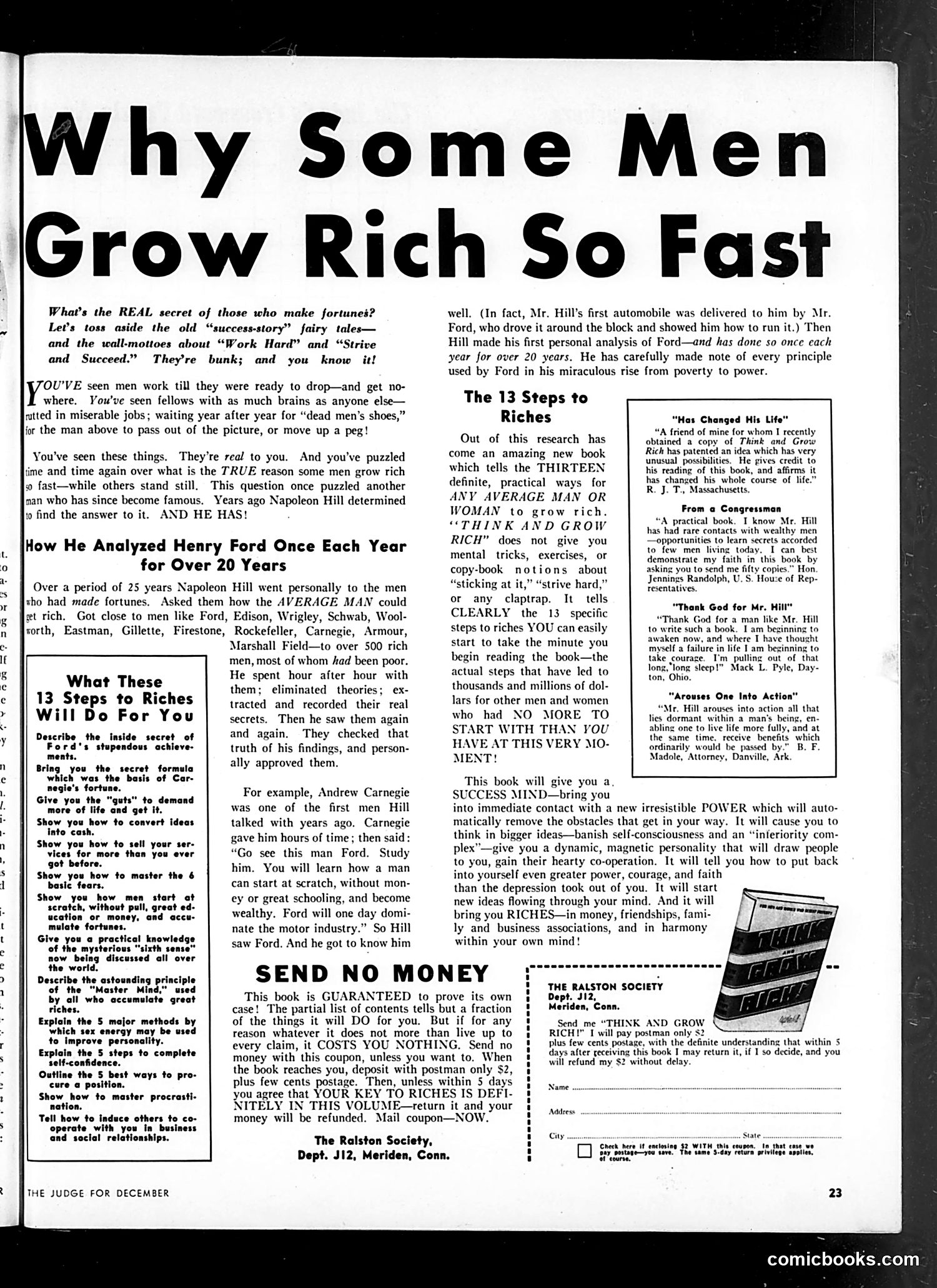
Analysis for Modern Readers This is primarily advertising content for Napoleon Hill's book "Think and Grow Rich," disguised as editorial material in Judge magazine. The page exploits early 20th-century anxieties about economic mobility. It targets working-class readers frustrated by limited advancement, dismissing traditional advice ("Work Hard," "Strive") as "bunk." The pitch references real wealthy figures—Henry Ford, Edison, Carnegie, Rockefeller—implying Hill personally studied them over decades and extracted "13 definite, practical ways" to get rich. This creates false authority: Hill claims Ford himself demonstrated his car to him. Testimonials (a congressman, unnamed satisfied customers) lend credibility. The satire lies in Judge's own skepticism about such promises: the magazine simultaneously published aspirational ads while mocking get-rich-quick schemes. The page's earnest tone about "secrets" that "COST YOU NOTHING" to learn (except the book price) represents the timeless marketing of self-help literature to economically anxious audiences. The irony: readers seeking genuine wealth-building advice received a book promoting visualization and positive thinking instead.
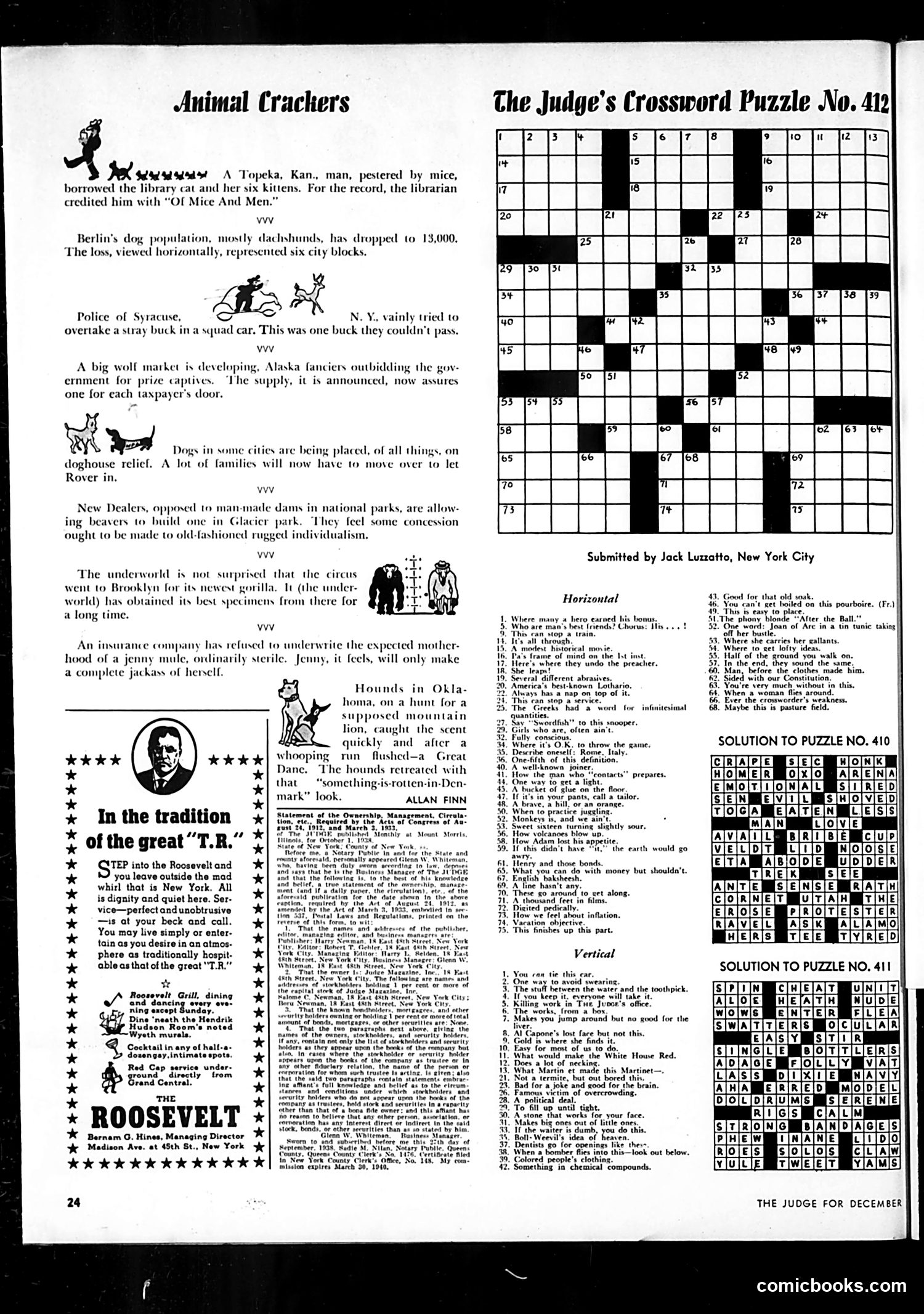
Judge Magazine: "Animal Cracchers" Page Analysis This page collects humorous short animal anecdotes typical of Judge's satirical style. The "Animal Cracchers" section uses anthropomorphized animal stories as social commentary: Key items: - Berlin's dachshunds: Likely referencing post-WWI Germany's economic collapse—six city blocks of dog loss as absurdist commentary - New Dealers and beavers: Mocks Franklin D. Roosevelt's administration, suggesting they're so ideologically opposed to government intervention they'd allow nature to do what humans won't - Jenny mule refusing insurance: Pun on "jackass"—satirizes both insurance companies and female sexuality/reproduction anxieties - Circus gorilla from Brooklyn: Dark humor suggesting Brooklyn criminals are even more primitive than circus animals The page primarily consists of crossword puzzles and advertisements (The Roosevelt hotel). The humor relies on puns, political jabs at New Deal policies, and absurdist animal logic—common Judge magazine fare of the 1930s era.

I can see this is a page from *Judge* magazine, but the image shows primarily a blank white page with minimal visible content. The OCR text appears to be corrupted or consists only of technical markers/symbols rather than readable article or caption text. Without legible cartoon imagery or coherent text content, I cannot identify specific figures, political references, or satirical points. The page layout suggests it may be mostly blank space, possibly an advertisement, filler page, or a scanning/OCR error. To provide meaningful historical context about the cartoon's satire and references, I would need a clearer image showing actual illustrated content and readable text captions.

I cannot reliably analyze this page because the image quality and OCR text are insufficient. The page appears to be mostly blank or heavily darkened, with only fragmentary characters visible in the OCR output that don't form coherent words or sentences. Without legible text content or visible cartoon imagery, I cannot identify figures, political references, or satirical intent. To provide accurate historical context about this Judge magazine page, I would need a clearer image showing the actual cartoon(s) and readable text. If you have a higher-resolution version, that would help considerably.
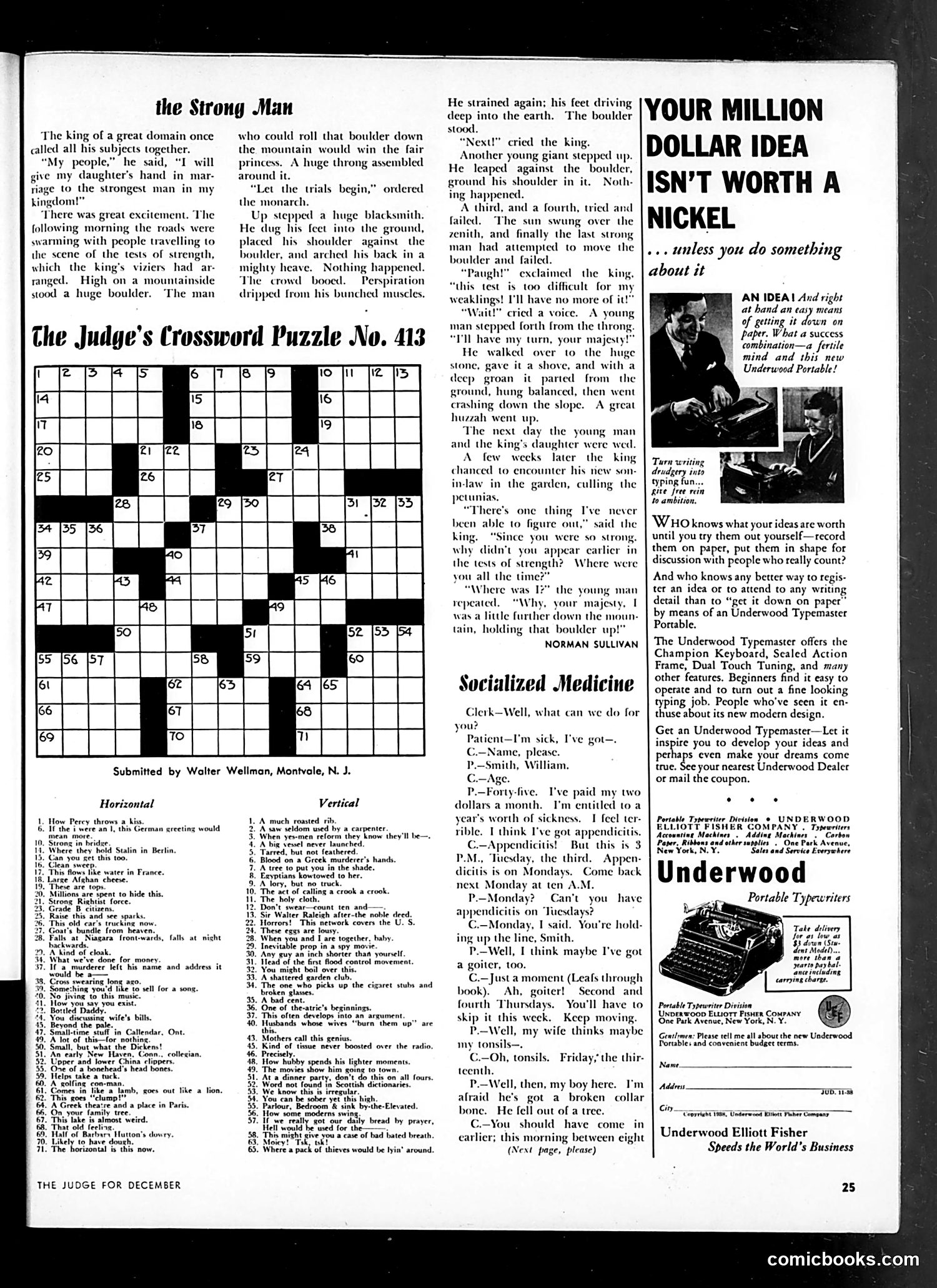
"The Strong Man" - A Judge Magazine Story This page contains a serialized tale titled "The Strong Man," a fairy-tale-like narrative about a king offering his daughter to the strongest man in his kingdom. The story describes a competition where suitors must roll a massive boulder down a mountainside. The excerpt shown depicts various contestants attempting and failing this task. The story appears to be straightforward adventure fiction rather than political satire—it's a romantic/strength-testing narrative typical of Judge magazine's entertainment content. The tale uses the boulder-moving challenge as a metaphor for testing worthiness, though the specific moral or satirical point (if any) isn't evident from this excerpt alone. The page also features Judge's signature crossword puzzle and advertisements for Underwood typewriters, which were major products for the era. Without additional context about when this was published or the story's conclusion, the satirical intent remains unclear.
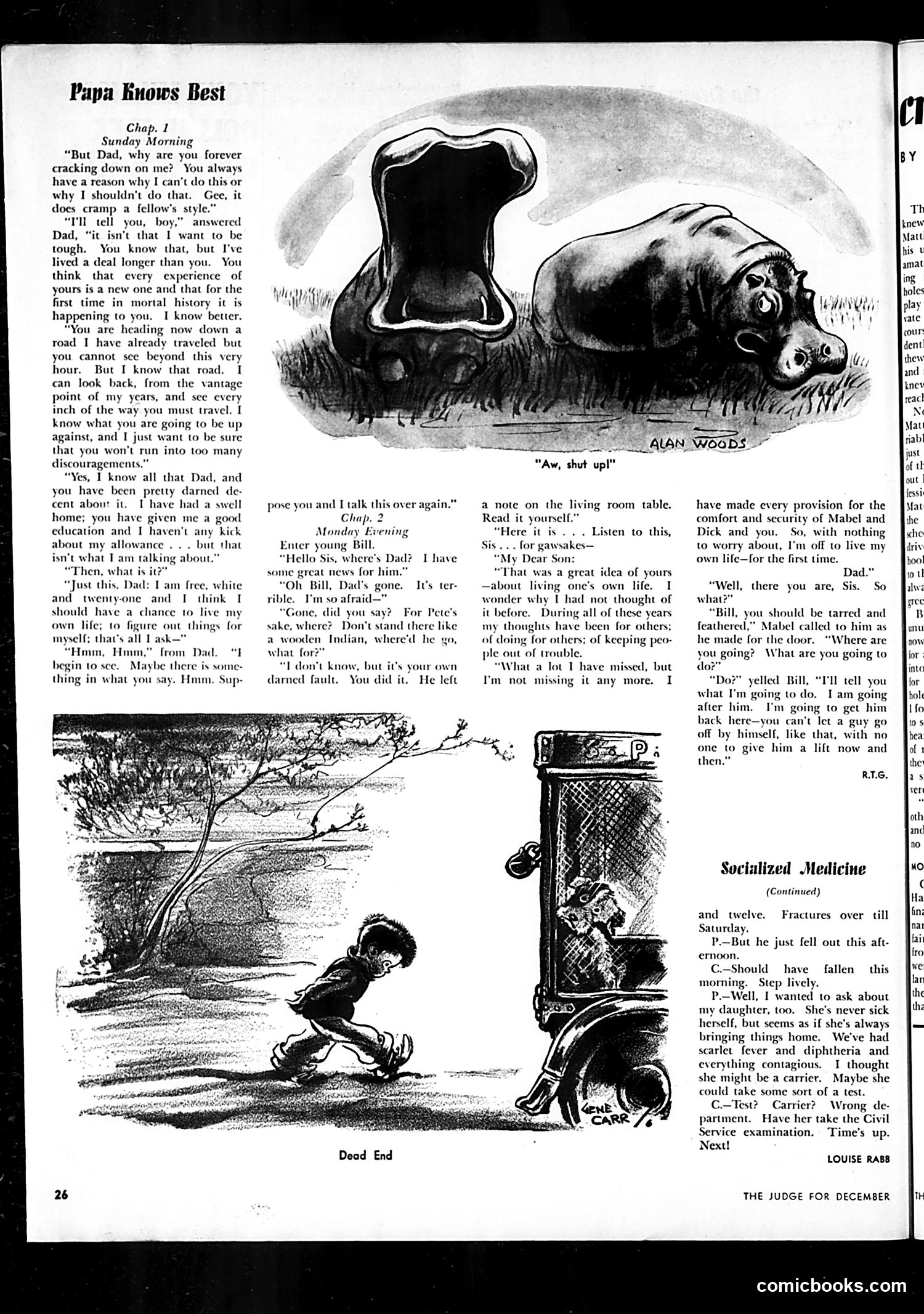
"Papa Knows Best" — A Cautionary Tale on Modern Parenting This two-chapter story satirizes generational conflict and the consequences of permissive parenting. A young man (Bill) complains to his father about paternal restrictions, arguing he's "free, white and twenty-one" and deserves to live independently. The father initially sympathizes, but Bill's complaint inspires Dad to abandon his family entirely, leaving a note claiming he too wants to live for himself without responsibility. The satire targets the modern philosophy that children require absolute freedom to self-discover. By showing the father taking Bill's logic to its extreme conclusion—abandoning his own family duties—the story warns that unchecked individualism undermines parental authority and family stability. The implicit message: some restrictions exist for good reason, and selfish personal freedom comes at a social cost. The accompanying cartoon "Dead End" (artist Carr) visually reinforces this theme through an image of a child at a literal dead end, suggesting life's wrong paths.
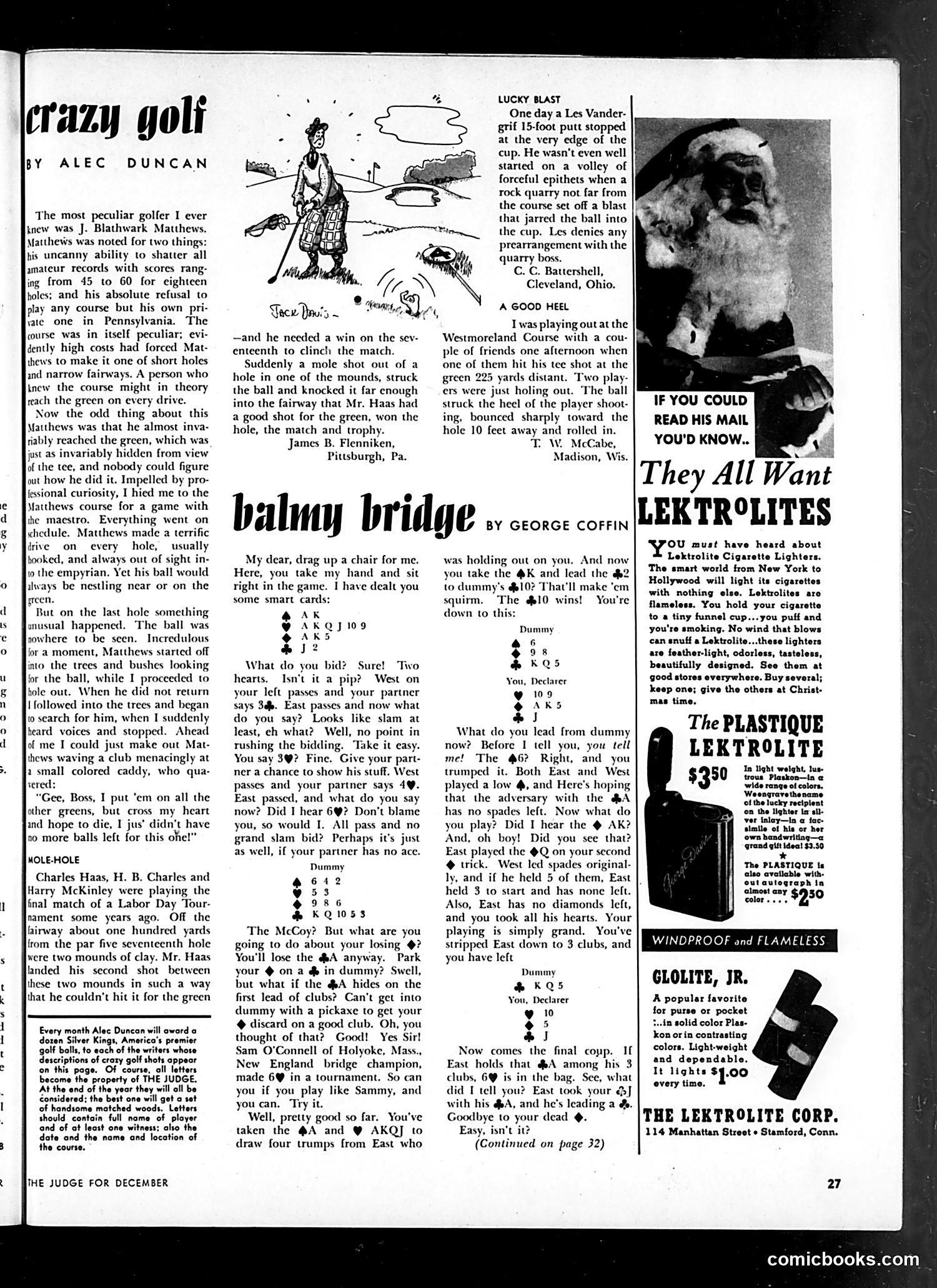
Crazy Golf Page Analysis This page from *Judge* magazine presents humorous golf anecdotes in the "Crazy Golf" column. The main content is three comedic stories about unusual golf incidents: 1. "Crazy Golf" by Alec Duncan describes J. Blathwark Matthews, an eccentric golfer who scores remarkably well on his private Pennsylvania course—until revealed to use a Black caddy who illegally places balls on the greens (the caddy confesses he's run out of balls). 2. "Mole-Hole" tells of a mole emerging from a mound and fortuitously knocking a player's ball into winning position. 3. "Lucky Blast" describes a quarry explosion jarring a putt into the cup. The humor relies on absurdist scenarios and physical comedy. The page also includes a bridge column and period advertisements. The racist depiction of the caddy reflects the era's casual bigotry but represents the magazine's satirical tone rather than its primary focus.
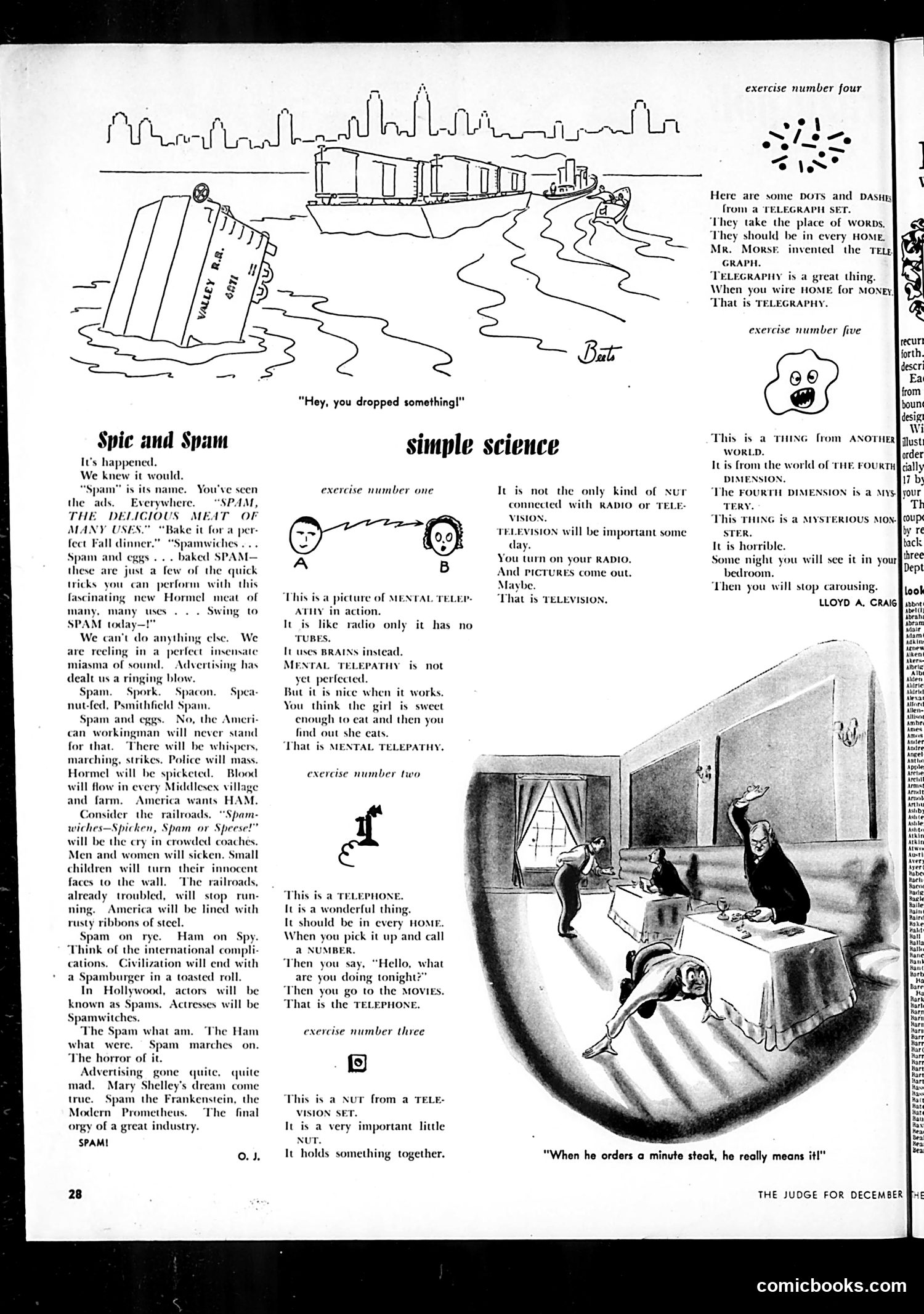
Analysis for Modern Readers This page contains two distinct satirical pieces from Judge magazine: "Spic and Spam" (left column) is a scathing critique of advertising saturation. The author mocks Hormel's aggressive marketing of SPAM processed meat, imagining it so pervasive that it would replace "ham" in everyday language, disrupt labor relations, cause international incidents, and dominate Hollywood. The satire targets the era's intrusive advertising culture and corporate overreach—the complaint that advertising had become "quite, quite mad." "Simple Science" (right side) uses crude drawings and condescending explanations to parody popular science writing and radio/television education. It humorously "explains" mental telepathy, telephones, and telegraph equipment to an implied unsophisticated audience, culminating in a nonsensical "fourth dimension" creature. The tone mocks both emerging broadcast technology and the public's fascination with it. Both pieces reflect 1930s anxieties about mass media, consumer culture, and technological change.
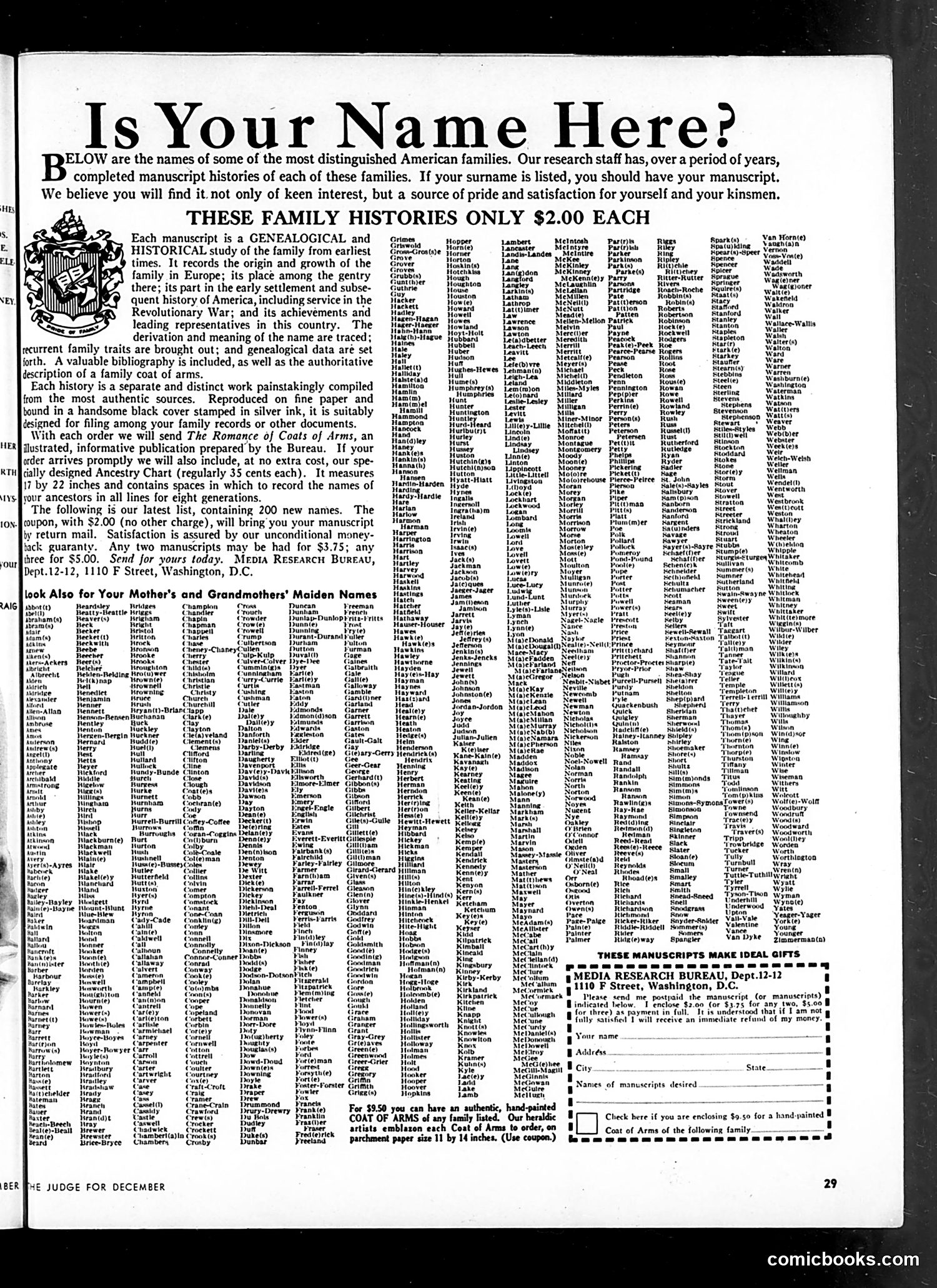
What This Page Is About This is not a cartoon or satirical piece, but rather a genealogy advertisement from Judge magazine. The Merida Research Bureau is marketing family history manuscripts for $2.00 each. They're pitching to American readers' pride in their ancestry by claiming to have researched "distinguished American families" with detailed genealogical records tracing lineage back to Europe, through early American settlement, and Revolutionary War service. The satire lies in the implicit social commentary: Judge is selling to readers' vanity about family status and social standing—the assumption that knowing one's family tree, especially one with "gentry" connections, is a source of "pride and satisfaction." The extensive lists of surnames and maiden names reinforce this appeal to genealogical snobbery that was popular among American audiences of the era. It's less about mocking the product than about exposing Americans' aspirational interest in proving aristocratic lineage.
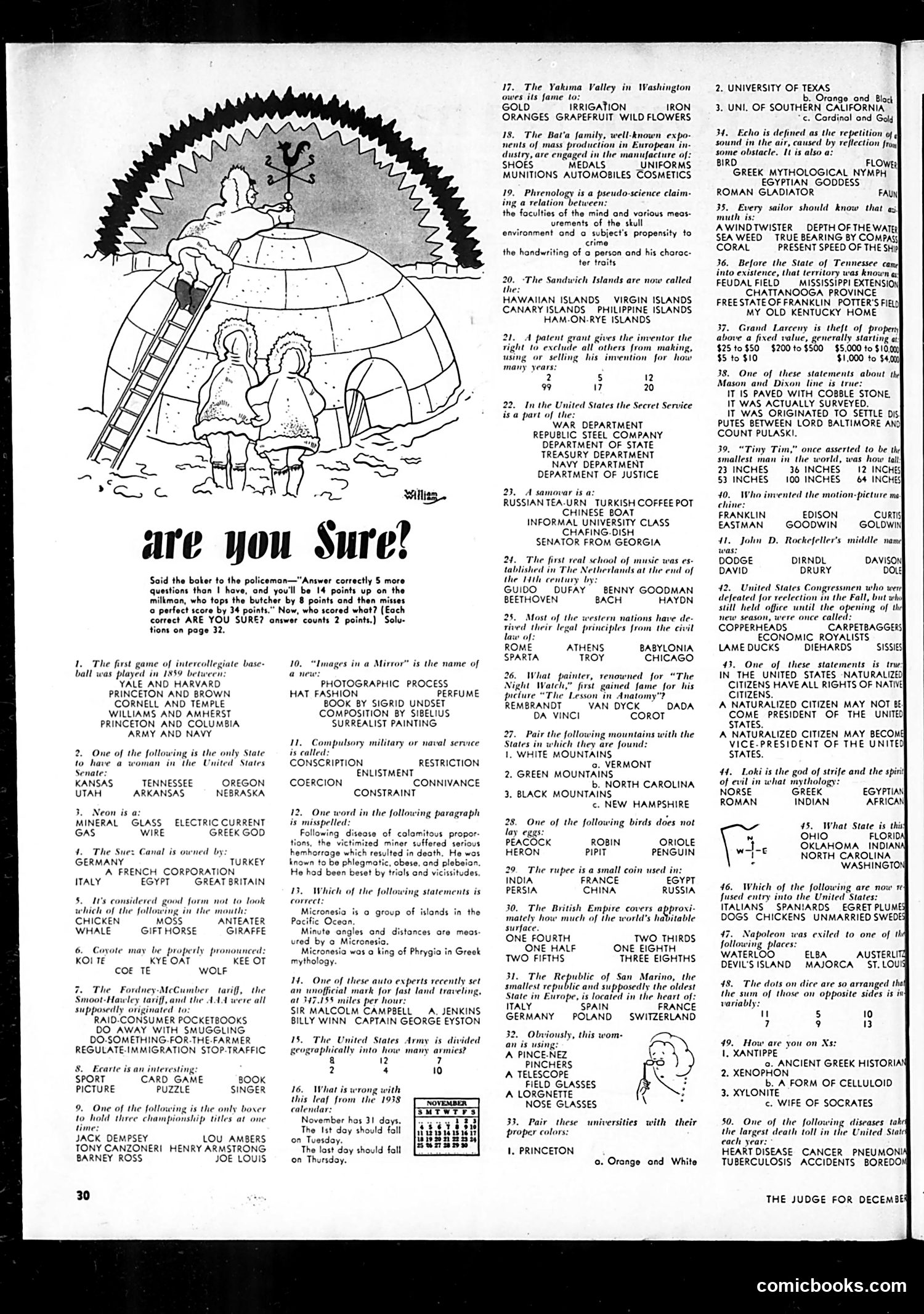
"Are You Sure?" - Judge Magazine Quiz Page This page features a trivia quiz game framed as a humorous exchange between a baker and a policeman. The cartoon shows two figures (the baker and cop) near an igloo-like structure, establishing a lighthearted tone. The quiz itself is a straightforward multiple-choice game testing general knowledge across diverse topics: history (intercollegiate baseball), politics (women senators), science (neon), geography (Suez Canal), language, tariffs, sports, and current events. The answers are scored competitively—players earn points for correct responses. This reflects Judge magazine's typical content: educational entertainment for middle-class readers. The trivia format was popular in 1930s-40s publications as both amusement and a way to demonstrate cultural literacy. The specific questions reveal contemporary American concerns: tariffs, military organization, and technological achievements (land speed records). The page is essentially advertising the magazine's intellectual appeal rather than delivering sharp political satire.

What This Page Shows This is a full-page advertisement, not political satire. It promotes Longines watches by emphasizing their prestige and reliability. The ad showcases Longines' credibility through various endorsements: they won twenty-eight gold medals at world's fairs; they're used by famous aviators and explorers (including Howard Hughes' round-the-world flight); they're the official timepiece of the National Aeronautical Association and American Automobile Association; and they're chosen by United Air Lines for mail routes. The page demonstrates how luxury brands of this era established authority through institutional validation and association with cutting-edge achievements—aviation, exploration, and precision timekeeping. The multiple watch images and factory photographs reinforce craftsmanship. This reflects 1930s-40s advertising strategy: prestige comes from official partnerships with prestigious organizations and famous accomplishments, not consumer testimonials.
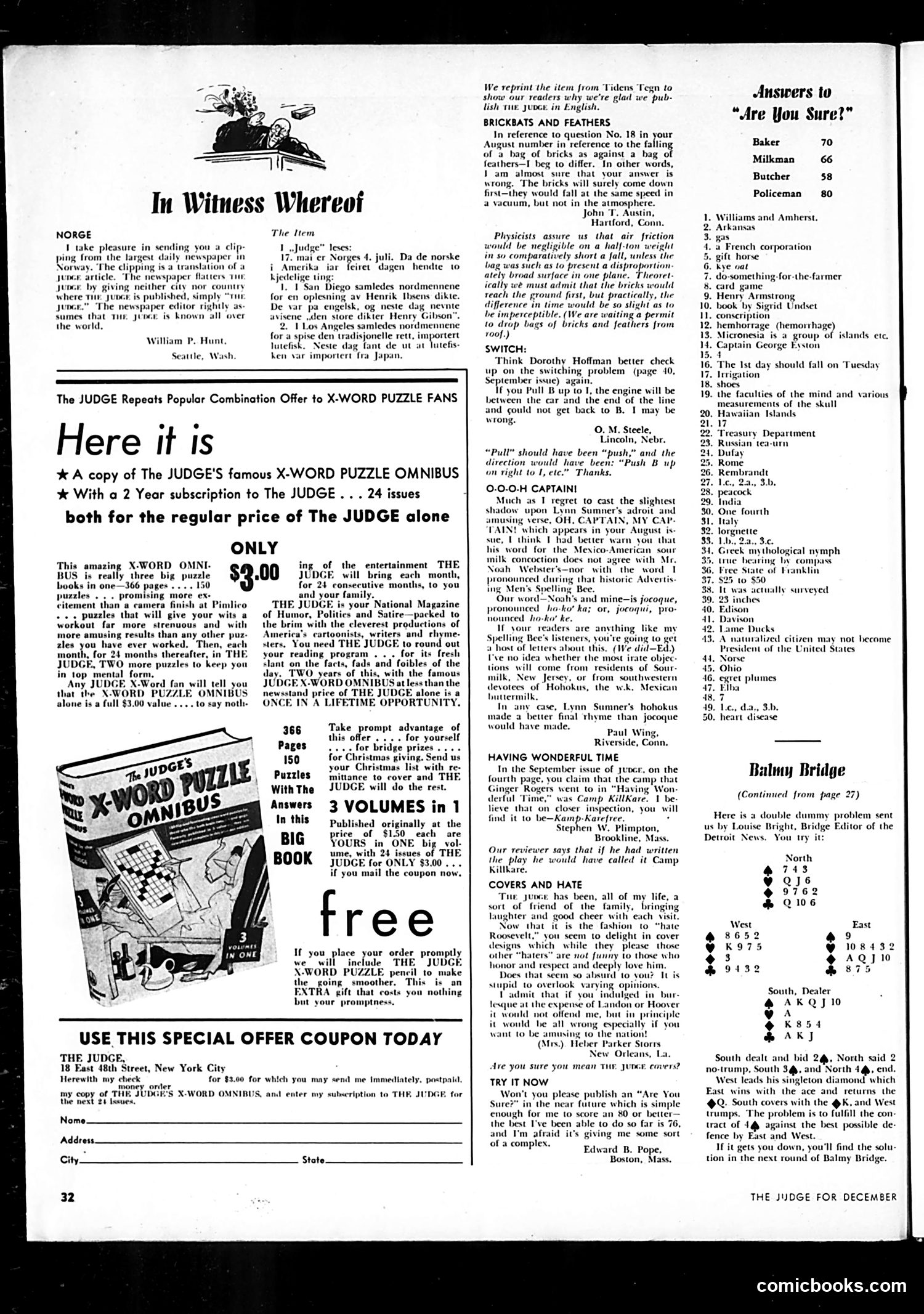
Explanation for Modern Readers This page is primarily advertising and reader correspondence, not satirical content. The main feature is a promotional offer for *The Judge*'s X-Word Puzzle Omnibus—a 366-page puzzle book bundled with a 2-year magazine subscription, all for $3.00. This was positioned as a "lifetime opportunity" and Christmas gift option. The "In Witness Whereof" section reprints a Norwegian newspaper's mention of *The Judge*, celebrating the magazine's international reputation. A reader anecdote describes Norwegian-Americans in San Diego and Los Angeles—one group reciting Ibsen in English, another discovering their imported lutfisk actually came from Japan—gentle ethnic humor about immigrant communities. The "Brickbats and Feathers" section debates a physics question about falling objects, with a reader challenging *The Judge*'s previous answer about whether bricks or feathers fall faster (the magazine defends the original answer while conceding practical considerations). The page reflects *Judge*'s dual identity: sophisticated puzzle entertainment for middle-class readers, plus light comedy about contemporary American life.

Analysis This is a vintage advertisement for Green River blended whiskey, not political satire. The ad features a well-dressed server or bartender in formal attire (white shirt, bow tie) holding a serving tray with cocktail glasses, with a bottle of Green River whiskey visible. The text reads "keen about cocktails?" and "make your next drink GREEN RIVER," with the tagline "BLENDED WHISKEY—THE WHISKEY WITHOUT REGRETS." The advertisement uses an appeal to sophistication and style, targeting consumers interested in cocktail culture. The phrase "without regrets" appears designed to suggest quality and satisfaction. This reflects the pre-Prohibition or early post-Prohibition era's marketing of alcohol as refined and desirable.
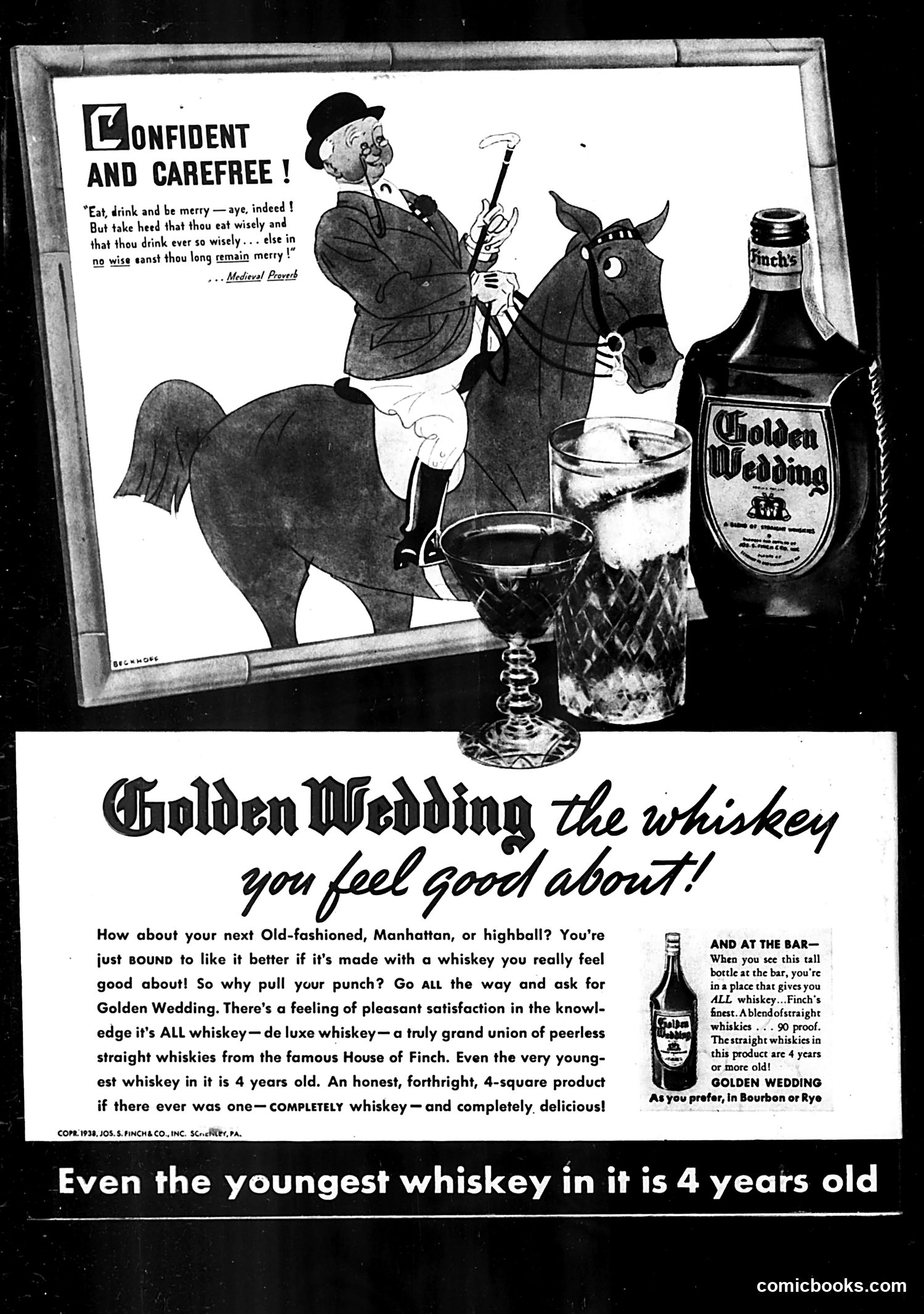
Golden Wedding Whiskey Advertisement This is primarily a whiskey advertisement, not political satire. It features a jolly, caricatured man on horseback (likely representing a jovial drinker or bon vivant) alongside bottles of Golden Wedding brand whiskey. The ad plays on a medieval proverb about eating and drinking "wisely" to stay merry, using it to pitch whiskey as a premium product. The key sales message emphasizes that Golden Wedding is "ALL whiskey"—a straight whiskey blend from the Finch distillery, with even its youngest component aged four years, available in Bourbon or Rye. The humor is light and genteel rather than satirical: it's essentially telling consumers to "go all the way" and demand quality whiskey rather than settling for inferior brands. The page dates to 1938, during Prohibition's repeal era when alcohol advertising had recently become legal again.

I cannot reliably identify the specific content of this page. The image is extremely dark and degraded, with heavy grain and poor contrast that makes it difficult to discern clear figures, text, or cartoon details. The OCR text provided is also largely garbled and illegible, containing only fragments like "comicb" (likely "comicbooks.com"). To properly analyze this Judge magazine page—identifying the political figures, satirical targets, and historical context—I would need a clearer image with readable text. As it stands, asserting specific identifications or meanings would violate the accuracy requirement. I recommend consulting a higher-quality scan of this source material.