judge
Judge — January 1939
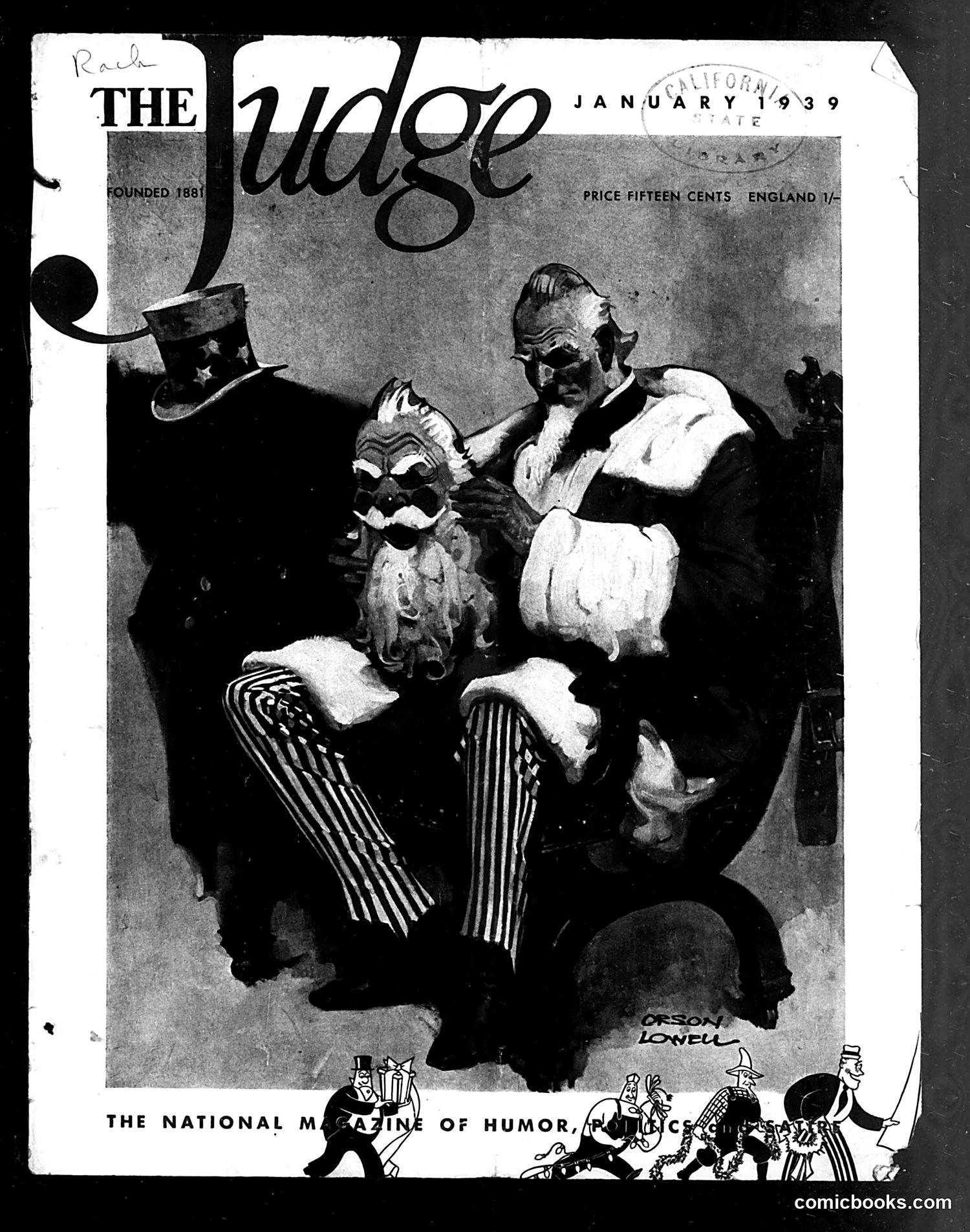
Analysis of Judge Magazine Cover, January 1939 This cover illustrates political anxiety about European fascism in early 1939. The two figures in elaborate military uniforms with medals and decorative fur collars appear to represent European fascist dictators—likely Hitler and Mussolini, based on the historical context and their exaggerated, menacing appearance with grotesque masks or faces. The smaller figure between them, dressed as what appears to be Uncle Sam or a classical figure, represents either democracy or the United States being threatened or controlled by these authoritarian powers. The ornate, theatrical costumes emphasize the satirist's view of fascism as performative spectacle and dangerous theater. The joke warns American readers about the growing threat of European fascism as WWII loomed.
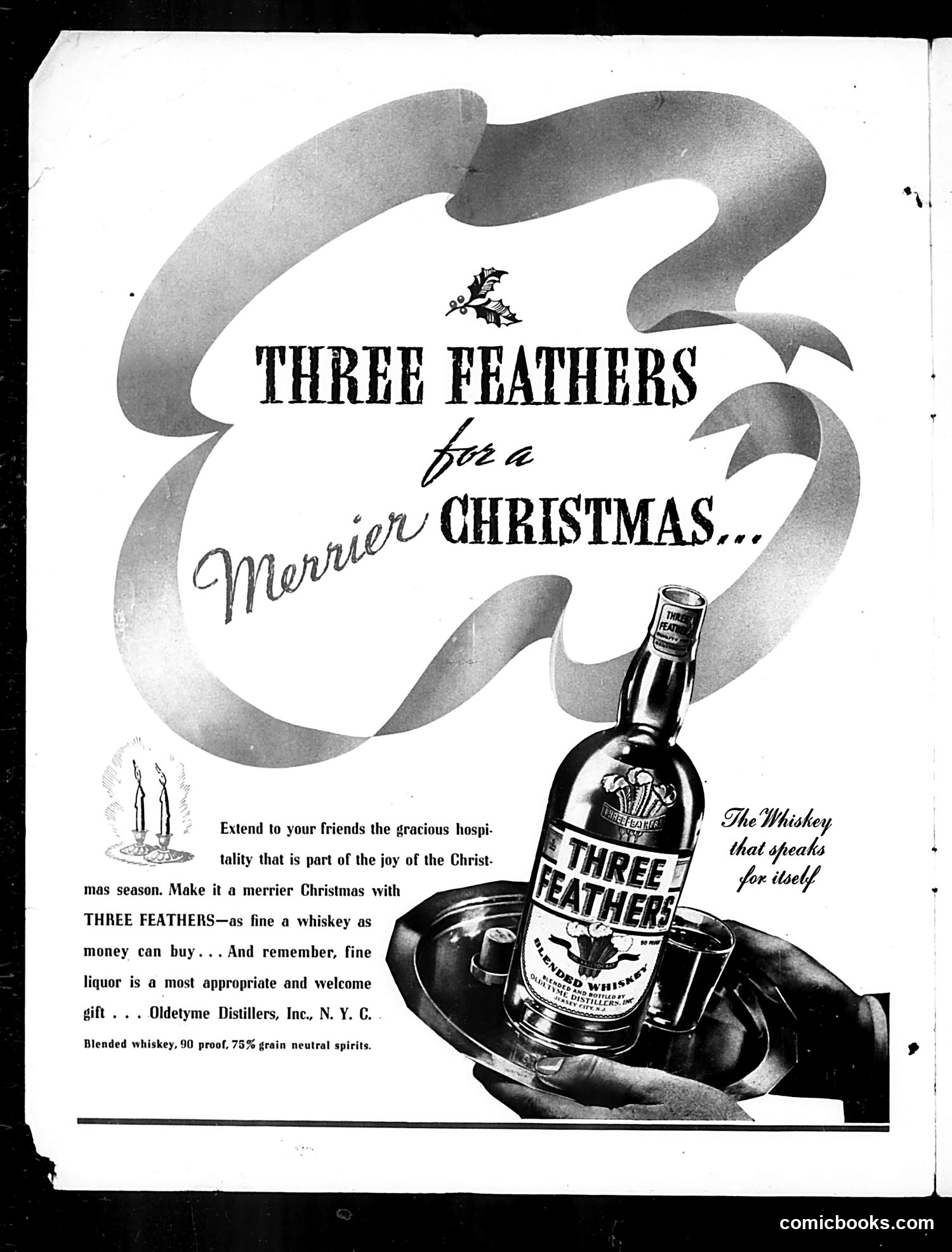
Analysis This is primarily a commercial advertisement, not editorial satire. It promotes Three Feathers whiskey as a Christmas gift. The design uses festive imagery—a decorative ribbon border forming a wreath-like frame and holly sprigs—to create holiday appeal. A hand presents a bottle of Three Feathers blended whiskey alongside glasses on a serving tray. The ad's messaging emphasizes social obligation: extending "gracious hospitality" during Christmas is framed as appropriate gift-giving. The tagline "The Whiskey that speaks for itself" suggests quality. Historical context: The ad reflects mid-20th-century attitudes normalizing alcohol as a standard holiday present and celebrating conspicuous generosity during the season. This represents pre-modern advertising standards regarding alcohol promotion.
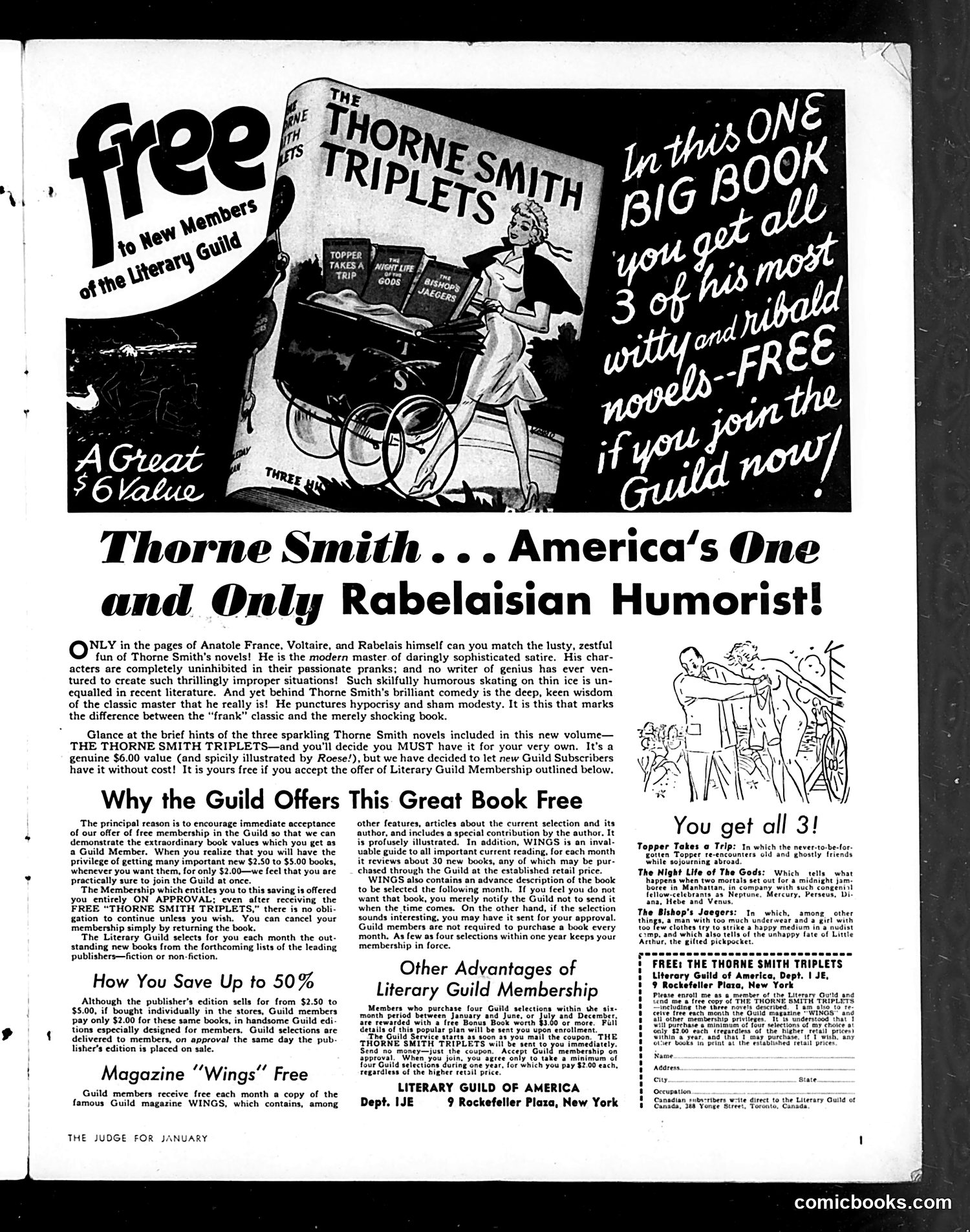
Judge Magazine Advertisement Analysis This page is primarily a Literary Guild membership advertisement, not political satire. The main image promotes "The Thorne Smith Triplets"—three novels by humorist Thorne Smith, offered free to new Guild members. The cartoon shows a woman with a baby carriage surrounded by book titles, illustrating Smith's reputation as "America's One and Only Rabelaisian Humorist." The visual joke references his bawdy, sophisticated comedic style. The advertisement emphasizes membership benefits: receiving three books worth $6 retail value for free, discounted future purchases, and access to the monthly *Wings* magazine. The pitch targets readers seeking entertainment during the Depression era by promising significant savings on books. This is commercial advertising, not political commentary.
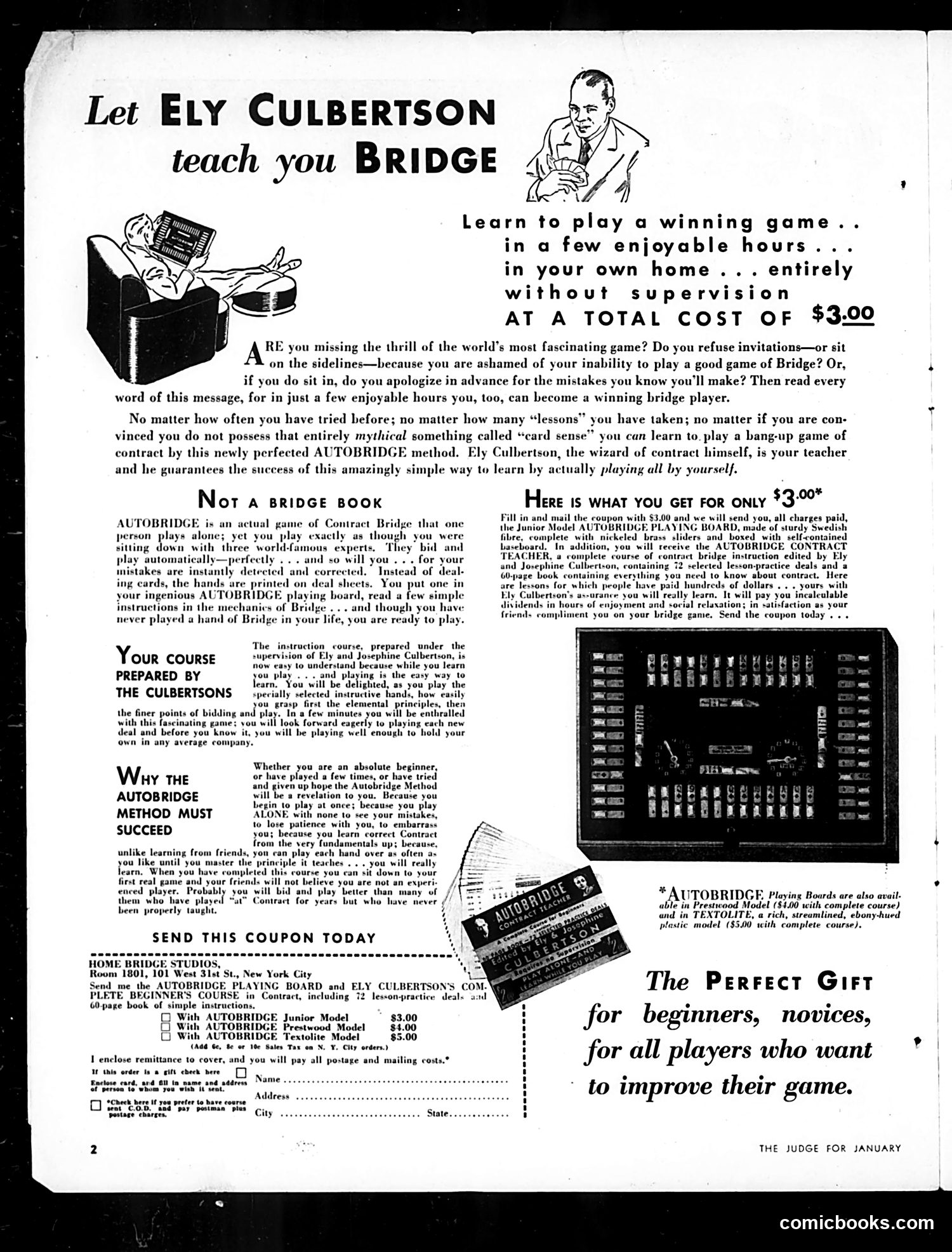
Analysis This page is primarily a vintage advertisement, not political satire. It promotes the "Autobridge" bridge-playing instruction system by Ely Culbertson, a famous bridge expert of the era. The advertisement uses persuasive copy targeting bridge enthusiasts who feel insecure about their play. It promises that Culbertson's method allows learners to master contract bridge independently at home for $3.00—then a modest sum. The illustrations show a relaxed person learning from Culbertson's materials and display the physical product: a mechanical learning board with sliding cards representing bridge hands. There is no political content or satire on this page. Judge magazine, while known for humor and commentary, used its pages for paid advertisements like this one, which represent everyday consumer culture of the period.
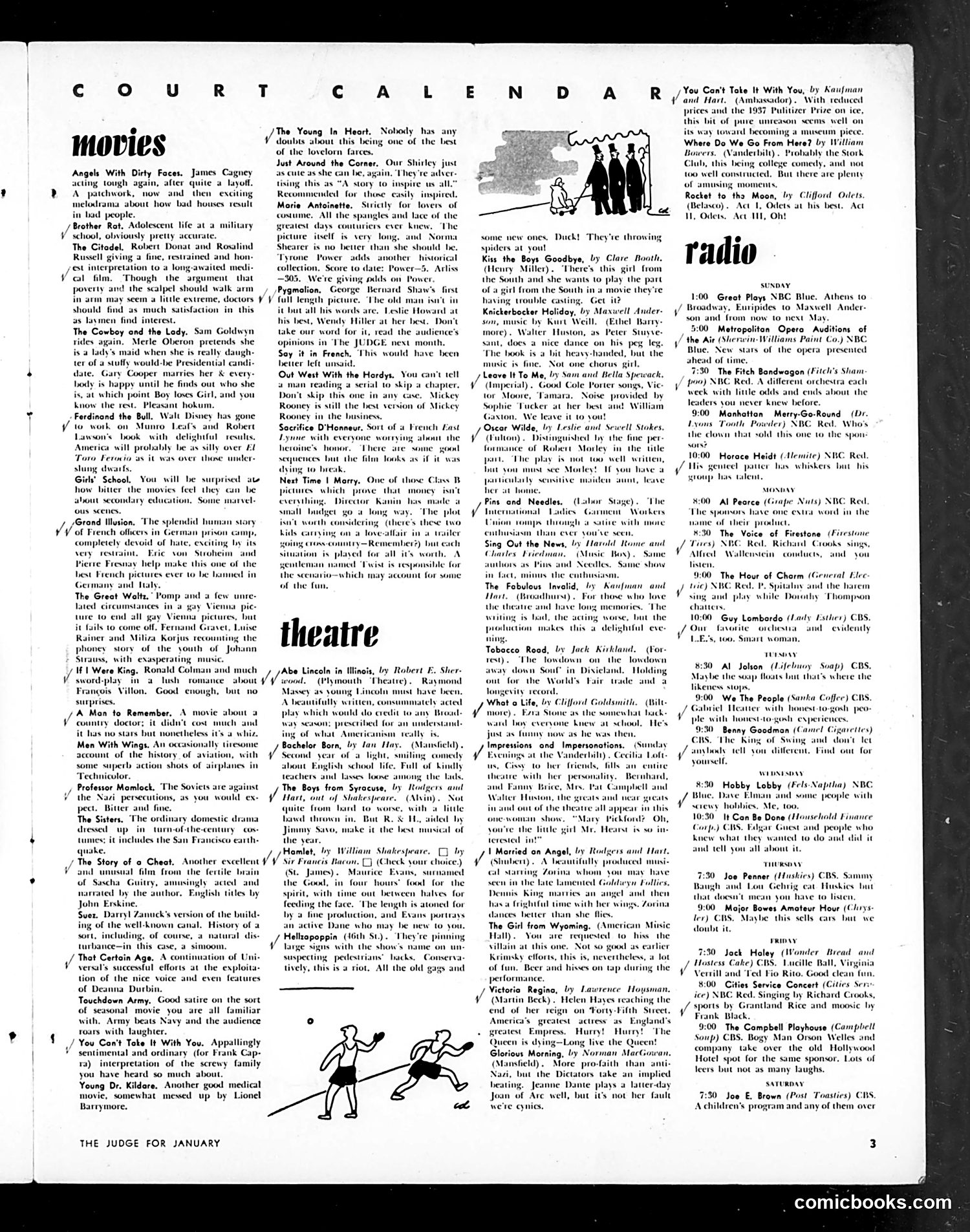
Court Calendar Page Analysis This is primarily an entertainment guide page from Judge magazine, listing movies, theatre, and radio programming. The small cartoons are decorative elements accompanying the listings rather than satirical commentary. The two cartoon figures at the bottom appear to be generic comedic characters (not identifiable political figures) in exaggerated poses—likely illustrating entertainment or physical comedy themes relevant to the listed shows. The page itself is a scheduling/review digest rather than political satire. It reviews films like "Angels With Dirty Faces" (Cagney) and theatrical productions, providing entertainment recommendations for readers. The cartoon elements are incidental decorative features, not the page's primary content or message. Without clearer identification of specific individuals or dated references in the cartoons, they appear to be general humor rather than pointed political satire.
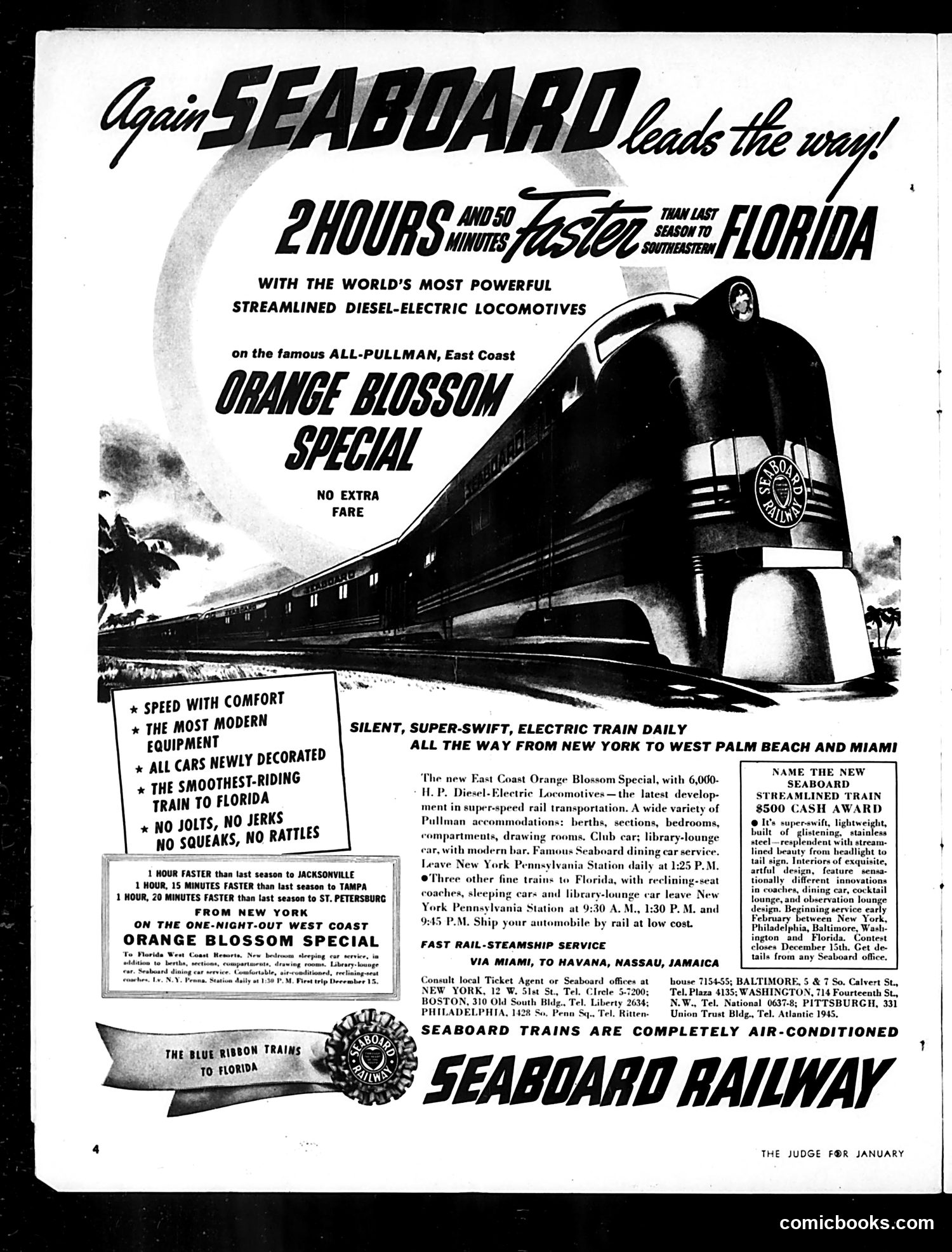
Analysis This page is primarily an advertisement, not political satire. It promotes the Seaboard Railway's "Orange Blossom Special" train service to Florida, featuring: - A streamlined diesel-electric locomotive with art deco styling - Marketing claims: 2 hours faster than competitors, no extra fare, air-conditioned cars, smooth ride - Service details: New York to Florida, daily runs, connections to Miami/Havana The "Blue Ribbon Trains to Florida" logo appears at bottom left. No political cartoon or satire is present. This is a straightforward 1940s transportation advertisement emphasizing modernity, speed, and comfort—typical of the era's optimistic industrial marketing. Judge magazine regularly carried such full-page ads alongside its satirical content.
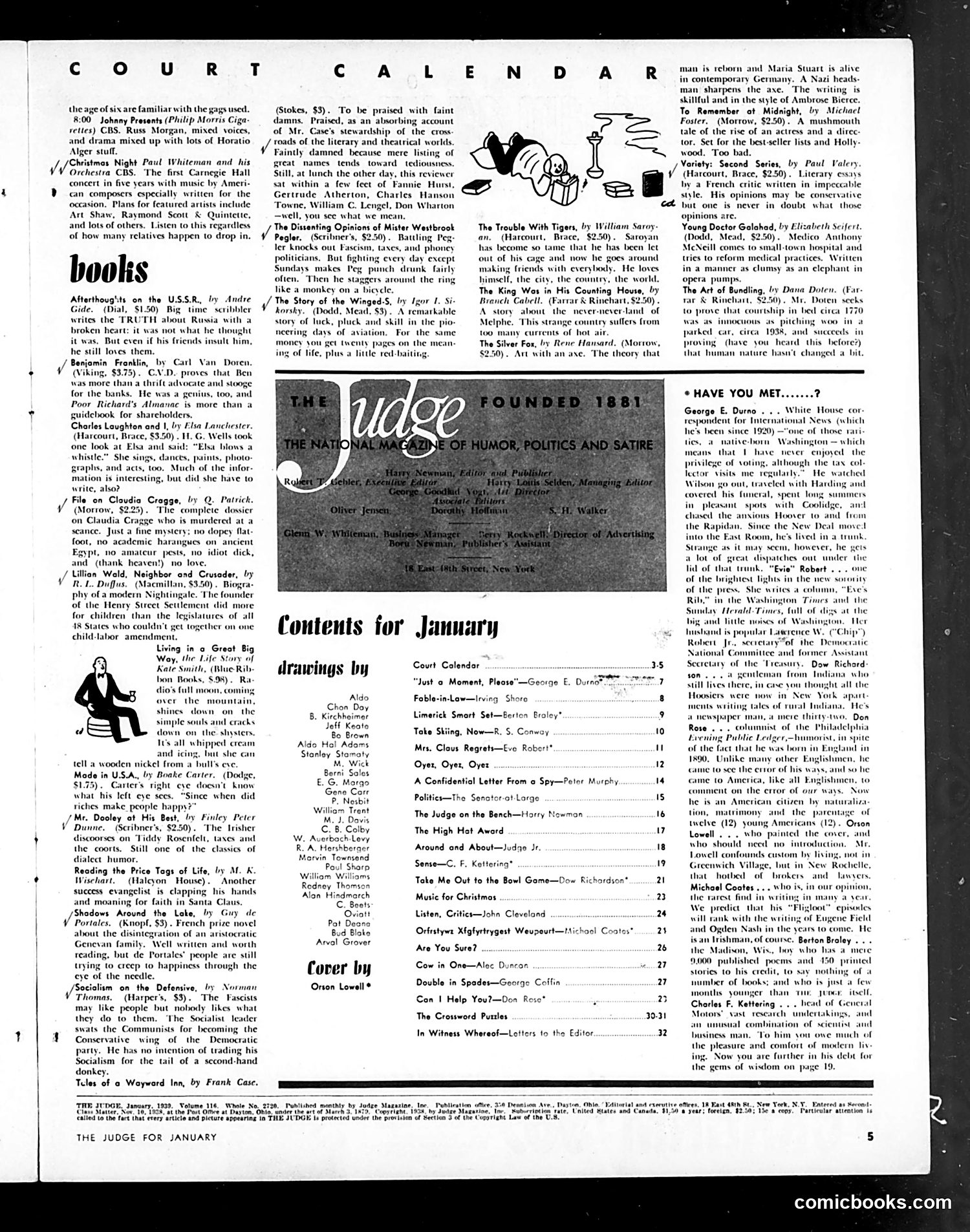
Analysis of Judge Magazine Content Page (January 1934) This page primarily contains a table of contents and masthead for Judge magazine's January 1934 issue, rather than finished cartoons or satirical illustrations. The visible cartoon appears to show a figure (possibly a child or small person) surrounded by scattered objects, though the specific political reference is unclear from the image quality. The "HAVE YOU MET...?" section features George E. Durso, described as a humor correspondent. The biographical note indicates he's been with Judge since 1929, establishing this as professional staff material rather than satire commentary. The page is primarily editorial/administrative content — listing article titles, illustrators, and contributors — rather than containing substantial satirical cartoons for modern interpretation.
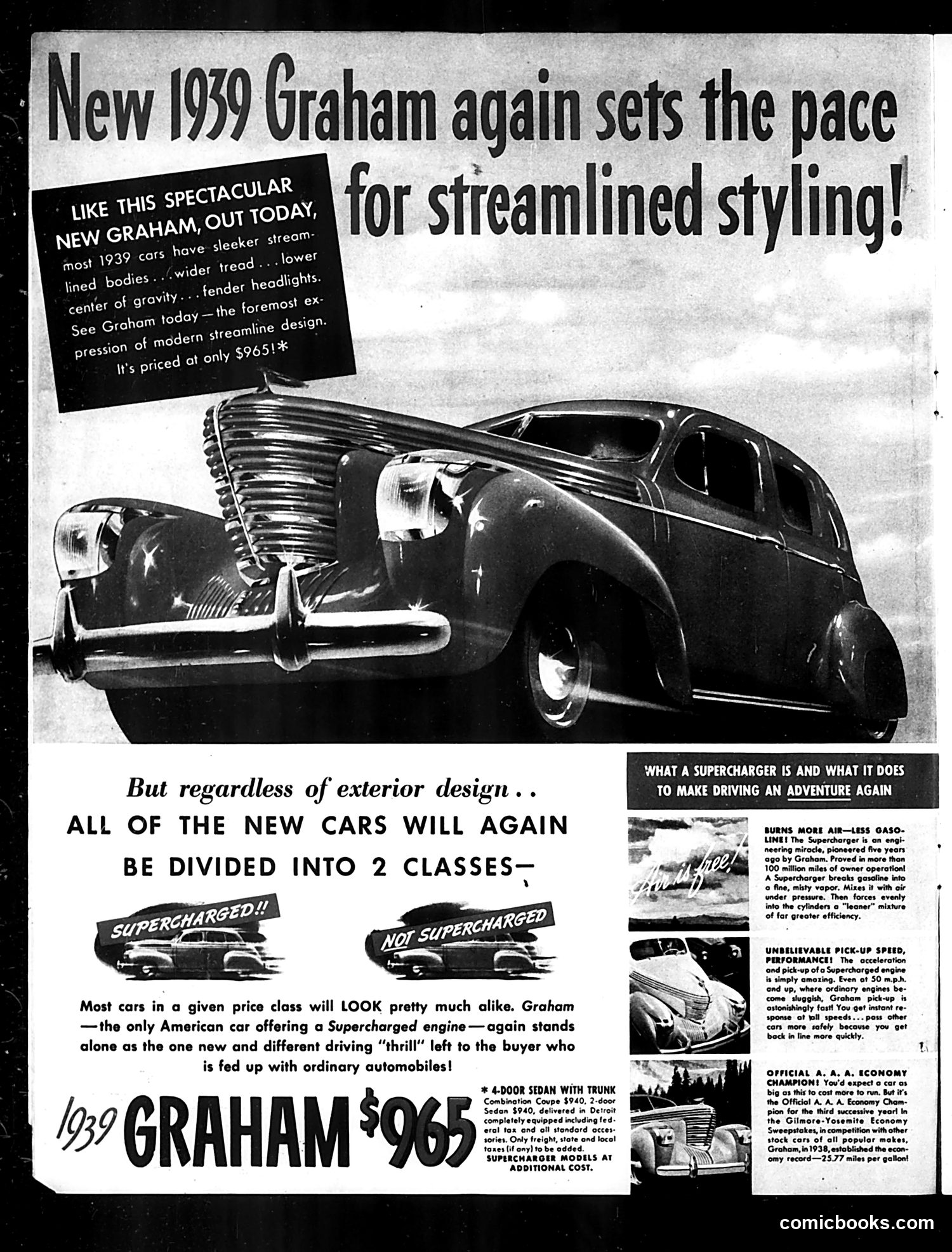
Analysis This is primarily a 1939 Graham automobile advertisement, not satirical content. The page promotes Graham's new "streamlined styling" as setting the pace for the industry, featuring a sleek 1939 model priced at $965. The key marketing angle distinguishes Graham cars into two classes: "Supercharged" and "Not Supercharged" models. The advertisement emphasizes that Graham's supercharger technology—which "burns more air, less gasoline"—provides superior performance and acceleration compared to ordinary engines. The page includes technical explanations of supercharger benefits and economy records, positioning Graham as an innovative manufacturer offering exciting driving performance. This appears to be straightforward automotive advertising rather than political or social satire, capitalizing on 1930s consumer interest in technological advancement and modern automotive design.
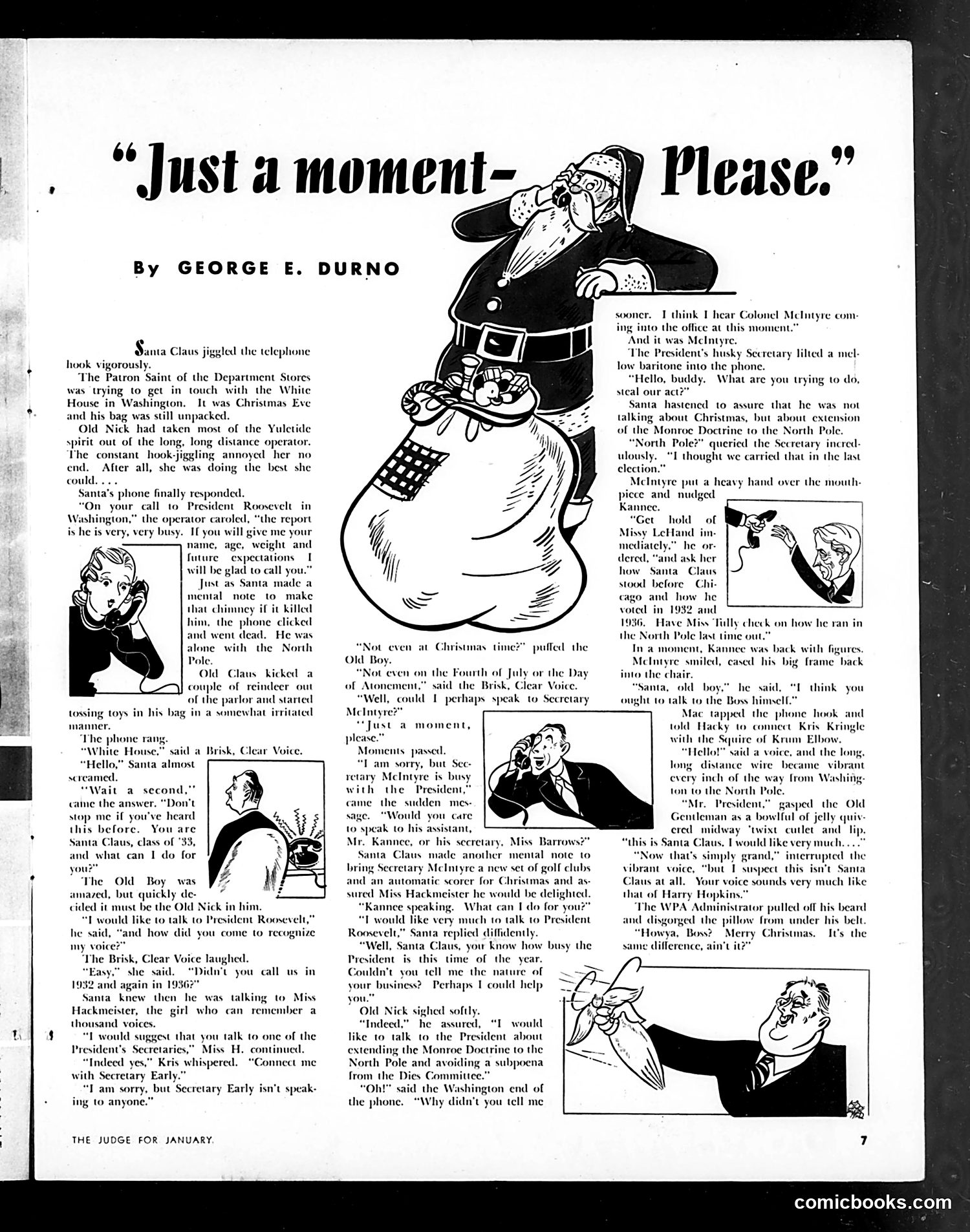
"Just a Moment—Please" by George E. Durno This satirical story depicts Santa Claus repeatedly attempting to call President Roosevelt in Washington during the Christmas season, but encountering constant bureaucratic obstruction. Santa seeks to discuss extending the Monroe Doctrine to the North Pole and avoiding a subpoena from the Dies Committee. The humor centers on the difficulty of reaching the President through his staff—particularly Secretary McIntyre—and the absurdity of Santa's official "business" with the federal government. The Dies Committee reference points to the contemporary House Un-American Activities Committee investigations of the 1930s-40s. The cartoon satirizes both presidential inaccessibility and Cold War-era government paranoia, presenting Santa's North Pole operations as subject to federal scrutiny.
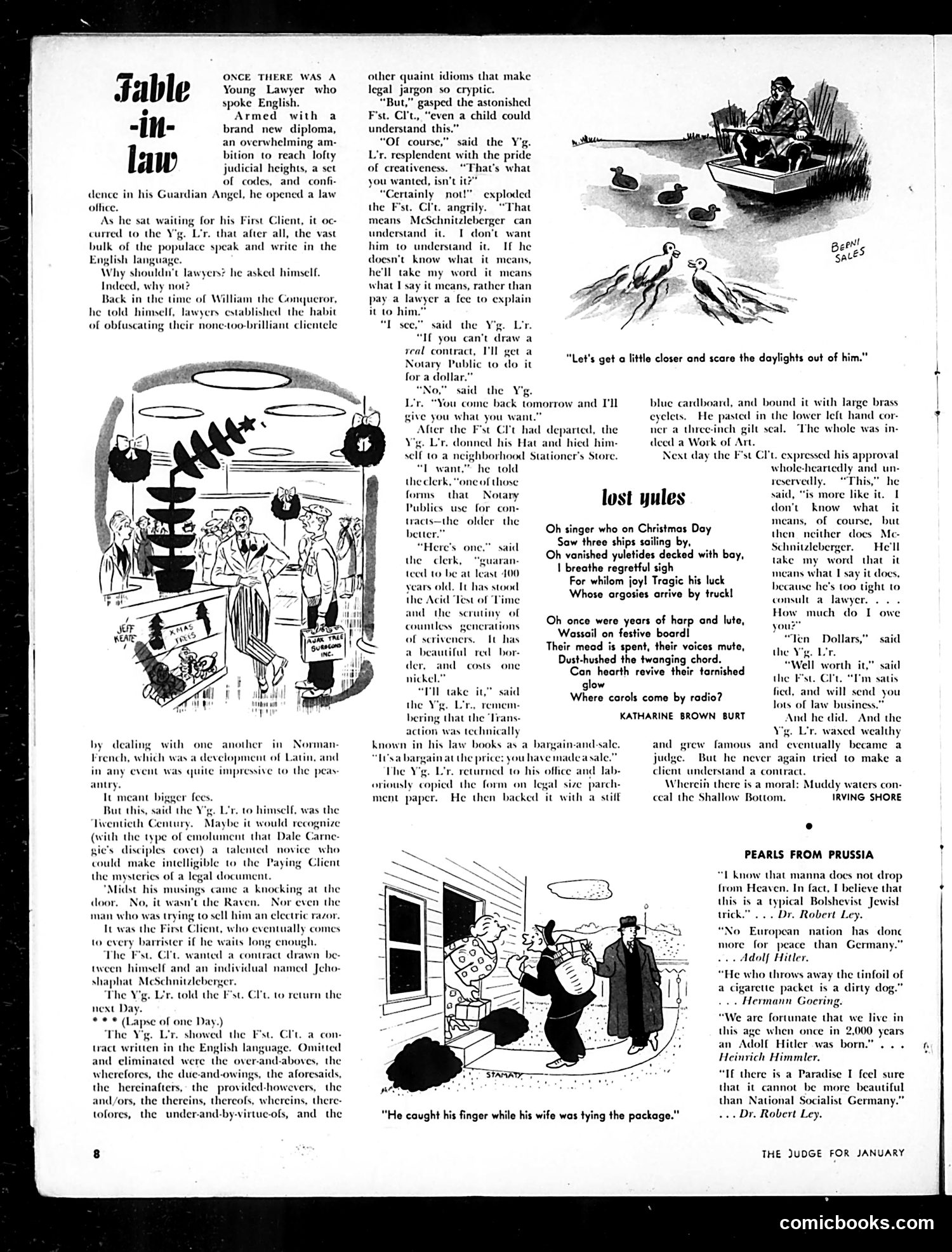
"Fable-in-law": Legal Jargon Satire This story satirizes lawyers' deliberate use of incomprehensible language to inflate their fees and maintain professional mystique. A young lawyer, idealistic about making law accessible to ordinary clients, drafts a contract in plain English. His first client is horrified—he *wants* the contract incomprehensible so the other party cannot understand its terms without paying a lawyer to explain it. The satire's target is the legal profession's self-interested obscurantism. The young lawyer learns that clarity threatens lawyers' business model: incomprehensibility creates demand for legal expertise. The client eventually buys an old, ornate notary form covered in archaic jargon—precisely because its impenetrability serves his interests. The accompanying illustrations show the client's satisfaction with obtuse language and include unrelated comic vignettes. This reflects Judge magazine's typical format mixing satirical stories with humorous sketches.
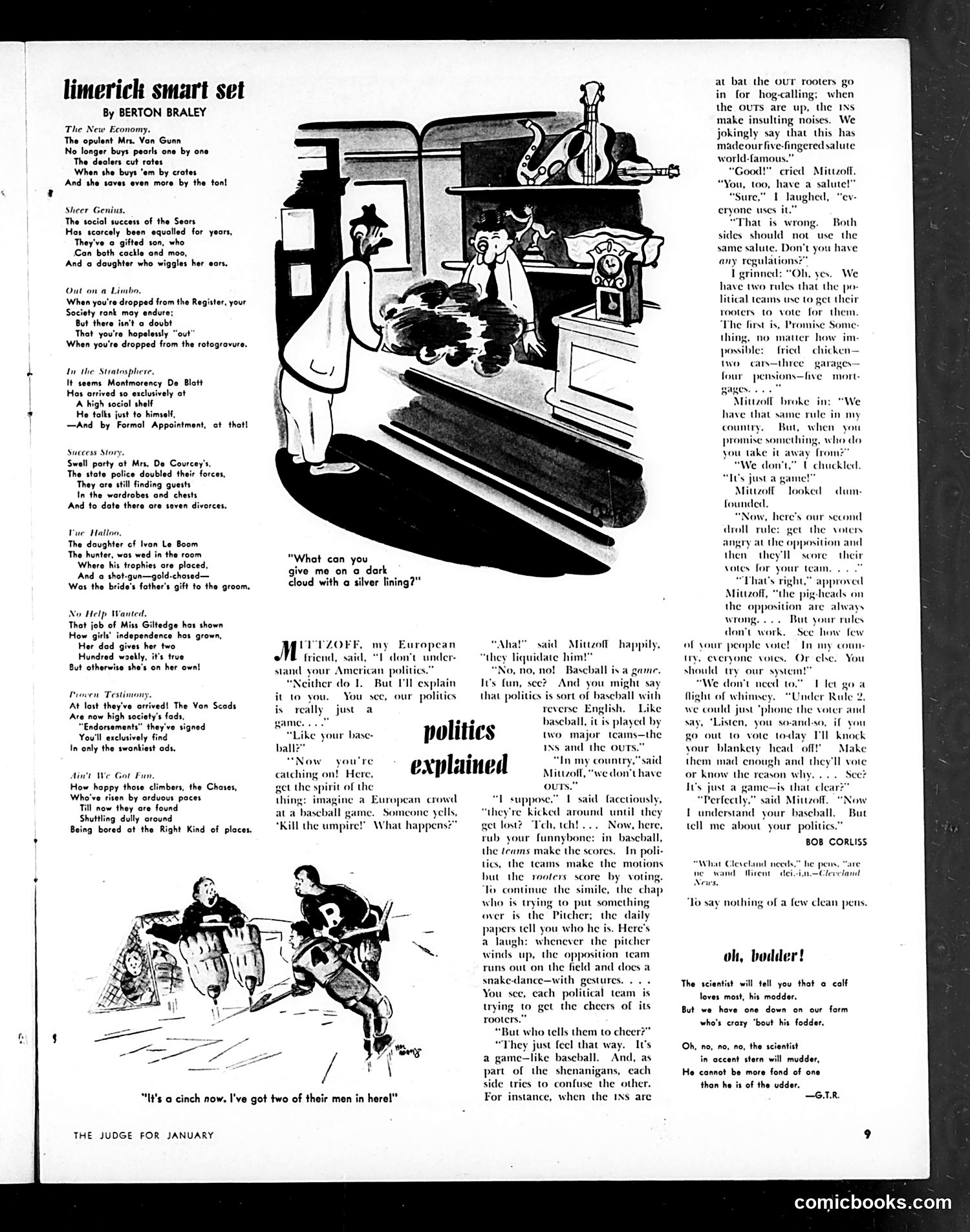
"Politics Explained" - Judge Magazine Satire This page contains humorous limericks and a longer comic dialogue explaining American politics to a European visitor named Mittzoff. The Main Cartoon/Article: A European friend struggles to understand American politics. An American explains it using baseball as an analogy: politics is like baseball with "ins" (those in power) and "outs" (opposition). Teams make motions while voters score by voting. The "pitcher" is whoever's trying to push an agenda; newspapers identify him. When the pitcher winds up, the opposition team runs out and does a "snake-dance" with gestures—like fans making insulting noises when the outs are up. The satire mocks American politics as mere spectacle and game-playing rather than serious governance, with voters as passive "rooters" cheering their team rather than thinking critically. The Limericks poke fun at wealthy socialites, nouveau riche climbers, and superficial society life—typical Judge targets. The piece assumes readers understand baseball well enough to follow the political metaphor.
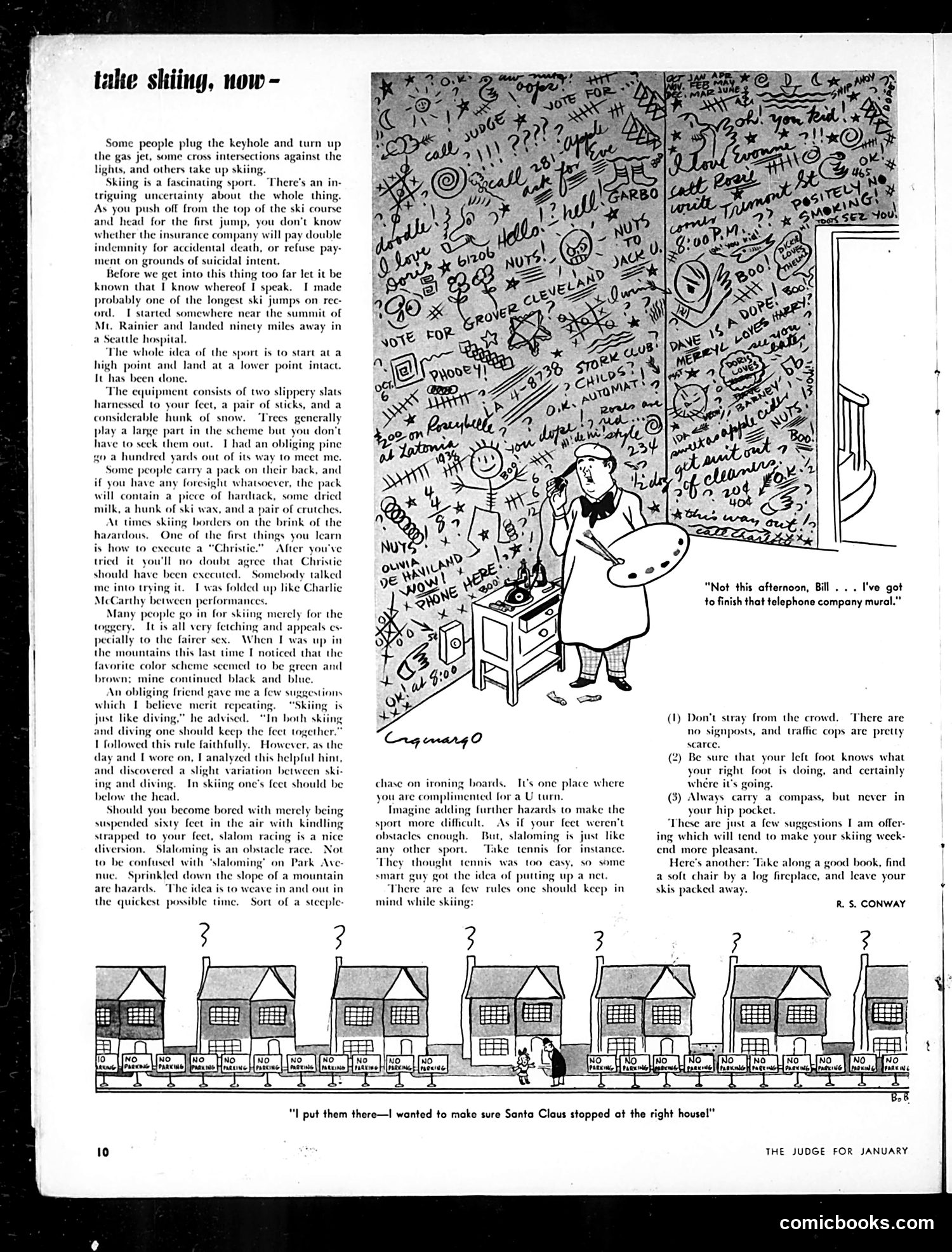
Judge Magazine Page Analysis This page contains a humorous essay on skiing by R.S. Conway, satirizing the sport's inherent dangers and absurdity. The main cartoon shows a man at a drafting table working on a "telephone company mural"—a reference to the widespread practice of defacing public spaces with graffiti-like markings (visible in the dense scribbles covering the wall behind him). The skiing article mocks the sport through exaggerated descriptions: comparing it to executing a dangerous maneuver called the "Christie," describing a fictional ski jump ending in a Seattle hospital, and offering deliberately unhelpful safety tips (carry a compass "but never in your hip pocket"). The bottom cartoon shows someone placing items at houses, joking about ensuring "Santa Claus stopped at the right house"—a simple Christmas-themed gag unrelated to the skiing content. The satire targets skiing's fashionability among wealthy Americans and the sport's genuine hazards, presented through deadpan, ironic humor typical of Judge magazine's style.
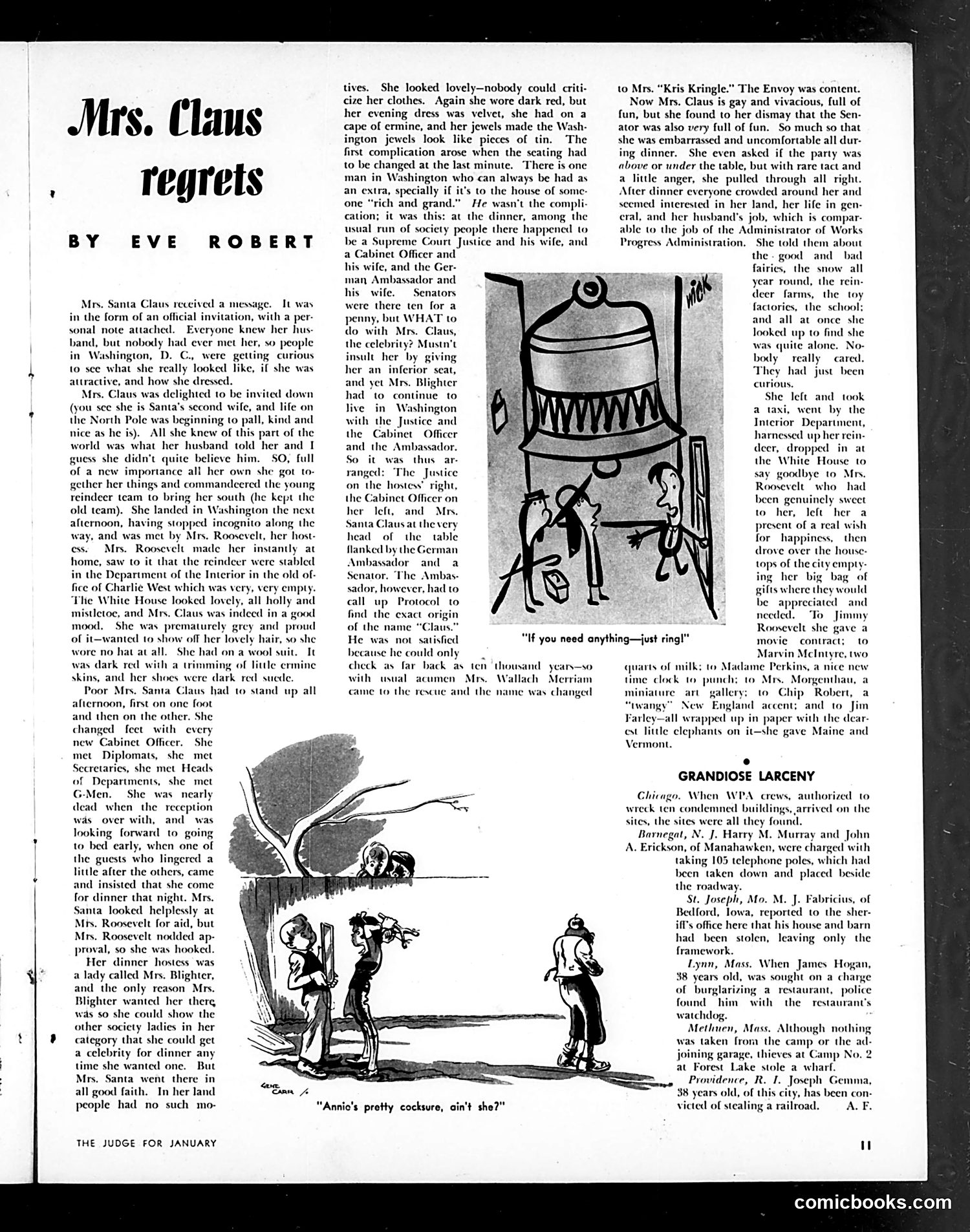
"Mrs. Claus Regrets" - Social Satire from Judge Magazine This story satirizes Washington D.C. society etiquette obsessions during the New Deal era (implied by references to the Roosevelt administration, Cabinet Officers, and government departments). The joke centers on social status anxiety: Mrs. Santa Claus—a nobody from the North Pole—becomes a hot celebrity simply from being *unknown* and famous by association. A social climber named Mrs. Blighter invites her to dinner to impress other society women, but faces an impossible diplomatic problem: how to seat a mysterious celebrity without offending a Supreme Court Justice, Cabinet Officer, and German Ambassador? The satire mocks both the artificial hierarchy of Washington society and how status-conscious socialites will pursue trivial celebrities. Mrs. Claus's obliviousness to these games—she arrives "in good faith"—emphasizes the absurdity of the elaborate social rules governing who sits where. Protocol is treated with mock-solemnity; even her surname requires verification. The accompanying cartoons illustrate the social pressures humorously.
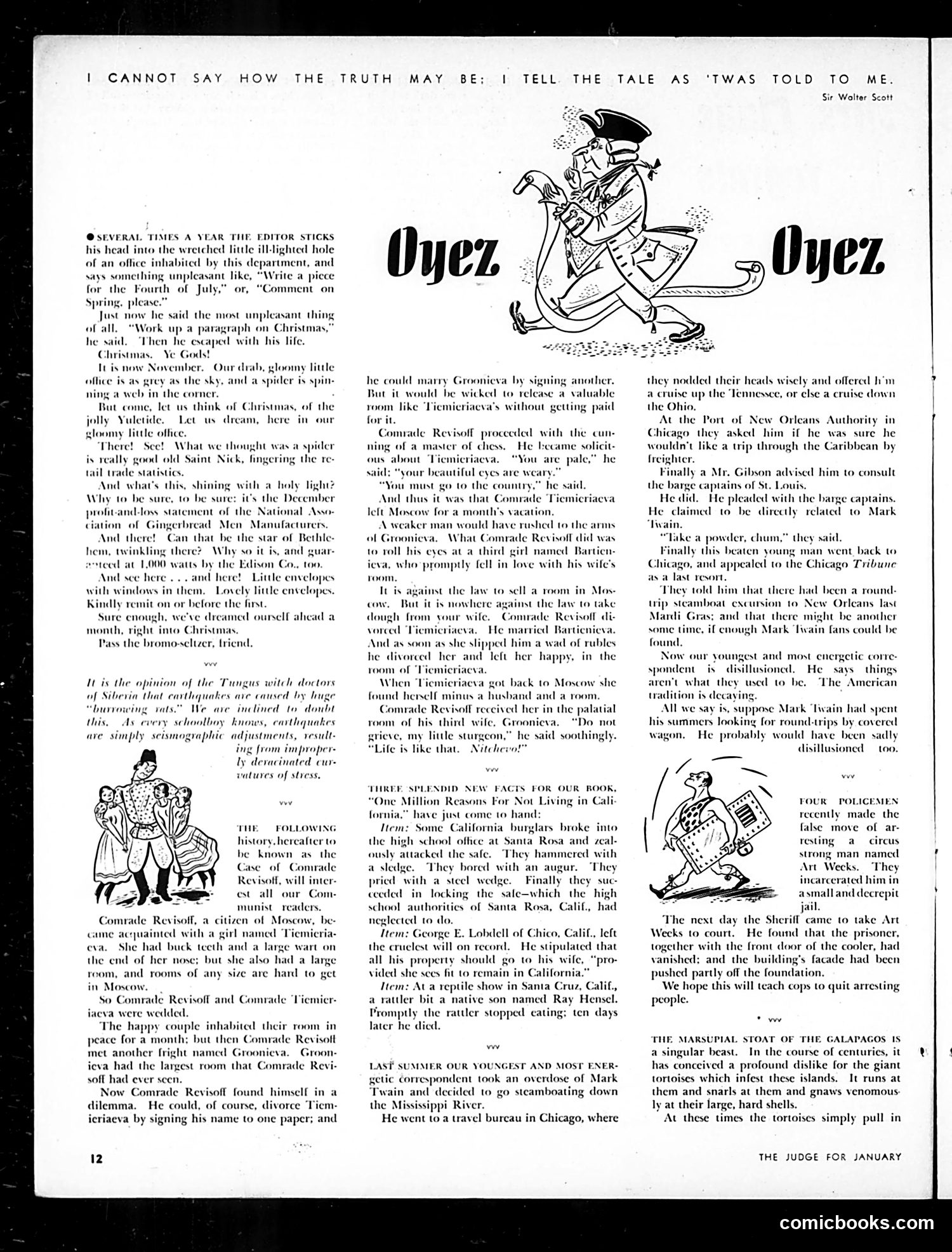
"The Case of Comrade Revisoff" - Soviet Housing Satire This page satirizes Soviet communism through a darkly comedic story about housing scarcity in Moscow. The protagonist, Comrade Revisoff, exploits Soviet law to serial-marry women solely to acquire their large rooms—the scarcest resource in post-revolutionary Moscow. He marries Tiemicriaeva for her room, then divorces her to marry Gronieva (who has an even larger room), then marries a third woman, Bartienieva, abandoning each wife in turn. The satire targets Soviet ideology's failure to solve basic material needs. Despite communist rhetoric about equality, housing remains so desperately scarce that it drives immoral behavior. The story's casual tone—ending with the Russian word "Nitchevo!" (meaning "never mind" or "it doesn't matter")—emphasizes the cynical acceptance of this dysfunction. The piece mocks both Soviet conditions and the moral compromises communism allegedly encouraged.
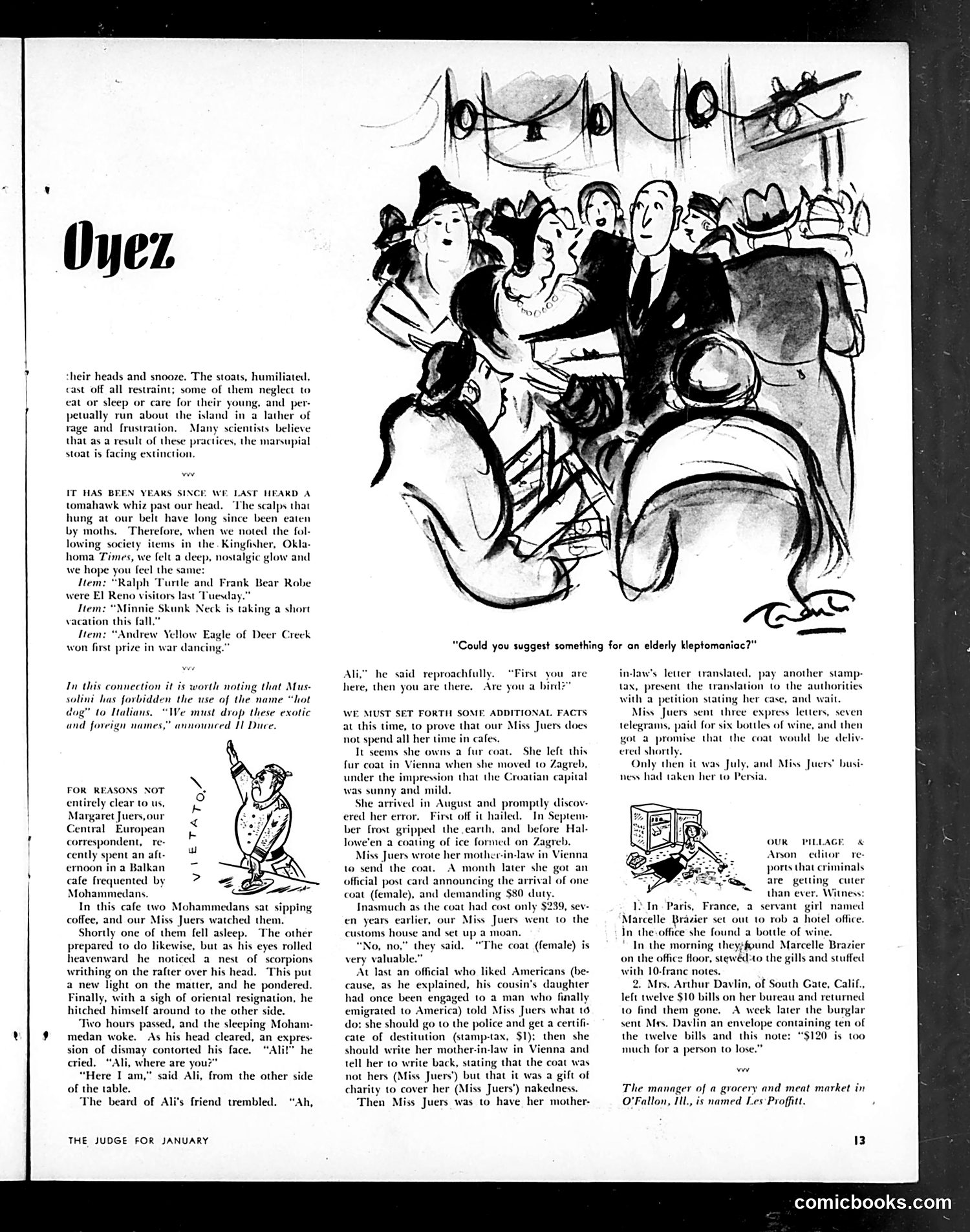
Judge Magazine Satire Analysis Main Cartoon ("Could you suggest something for an elderly kleptomaniac?"): The illustration shows a well-dressed social gathering where a gentleman appears to be asking for advice about an elderly woman—likely a member of high society—who has kleptomania (compulsive stealing). The satire targets wealthy or upper-class individuals whose criminal behavior is treated as a quirky personality flaw rather than actual crime. The joke mocks how society overlooks or euphemistically discusses misconduct among the privileged. Text Content: The page includes humorous anecdotes, including one mocking Native American names in Oklahoma newspaper society columns ("Ralph Turtle," "Minnie Skunk Neck"), and a longer story about correspondent Margaret Juers navigating European bureaucracy trying to retrieve a fur coat from Vienna to Zagreb—satirizing the absurdity of customs regulations and official paperwork. The page also references Mussolini's ban on the word "hot dog" in Italy, mocking fascist language policing as ridiculous.
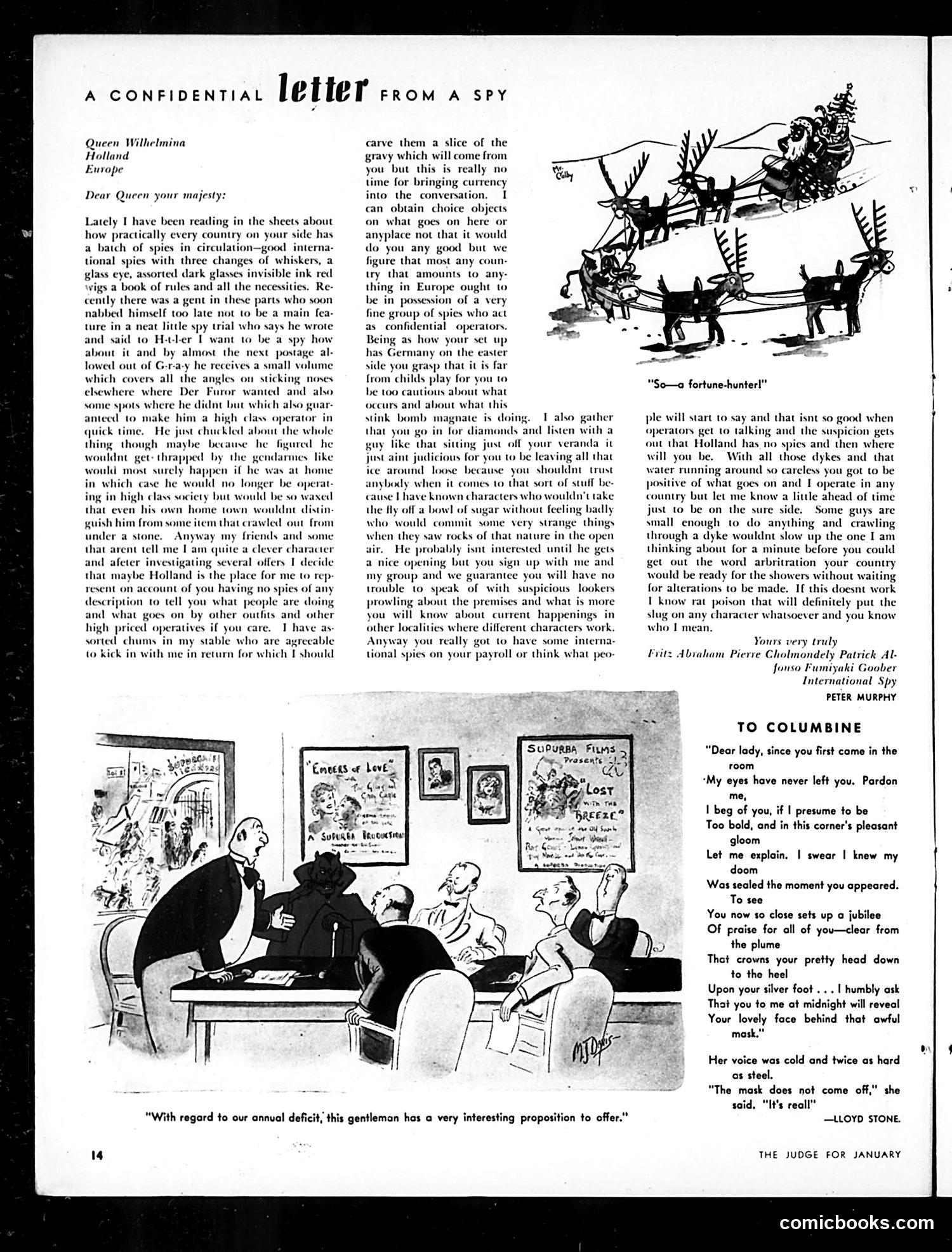
Explanation for Modern Readers This page from *Judge* magazine satirizes international espionage concerns of the interwar period. The main feature is a humorous "letter from a spy" to Queen Wilhelmina of Holland, offering his services as a confidential operative. The satire works on multiple levels: it mocks the proliferation of spies across Europe (a real anxiety of the 1930s), portrays the spy as a bumbling charlatan who naively wrote to Hitler requesting spy work, and ridicules the spy's crude pitch to the Queen—mixing grandiose promises ("confidential operators") with petty concerns about diamonds and sabotaged dykes. The cartoon below depicts businessmen discussing "annual deficit" and a suspicious financial "proposition," likely conflating the era's economic anxieties with spy-story tropes. The sidebar poem "To Columbine" appears unrelated—standard magazine filler. The overall effect is lighthearted mockery of spy culture and European geopolitical paranoia.
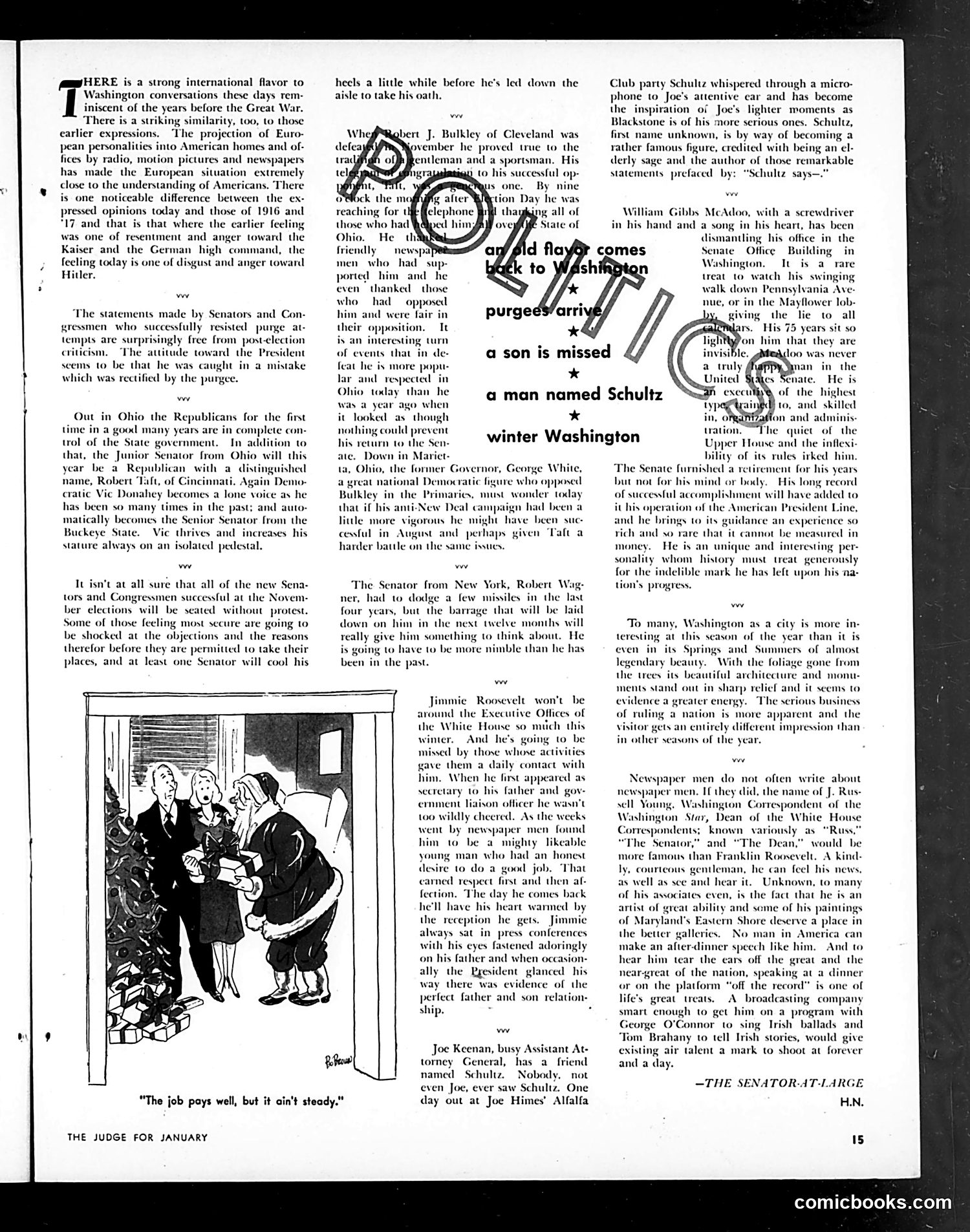
Analysis of "The Judge for January" Page This page contains political commentary on 1930s American politics. The main cartoon depicts a father figure showing children toys labeled with political figures' names, captioning "The job pays well, but it isn't steady"—satirizing the instability of political office. The text discusses Roosevelt's failed 1938 "purge" campaign, where he attempted to remove conservative Democrats from Congress. It notes surprisingly little anger toward Roosevelt from purged senators, contrasting this with pre-WWI anti-German sentiment. The article praises William Gibby McAdoo (Wilson-era figure) and Senator Robert Taft of Ohio, recently elected as a Republican. It also celebrates former Ohio Democratic Governor George White, who opposed New Deal policies. The piece expresses frustration with political instability while praising individual integrity and experience. The underlying message: despite Roosevelt's controversial actions, American political figures maintain dignity and sportsmanship—unlike the animosity toward foreign enemies that preceded WWI.
"The Judge on the Bench" - Analysis This is an editorial essay, not a cartoon, appearing in *Judge* magazine's January issue (year unclear from image). The piece is a patriotic Christmas meditation on American exceptionalism and global responsibility. Main themes: The text contrasts America's commitment to the "Golden Rule" and justice with suffering "blood-blinded little peoples" abroad whose ears are "stopped against the voice of God." This framing suggests the author views American values as morally superior and redemptive. Historical context clues: References to "other lands" in "deep sorrow" and hopes to "lift them back to happiness" suggest this addresses international conflict or oppression—possibly relating to European affairs during WWI or WWII era, though the exact period is unclear from the page alone. The satire: The grandiose tone—depicting America as a beacon of justice destined to rescue benighted peoples—may be sincere patriotic rhetoric or potentially ironic commentary on American interventionism, though the text's reverent style suggests straight sentiment rather than satire.

I appreciate your detailed instructions, but I must be honest: this image is almost entirely black with only a white vertical strip on the left edge and the "comicbooks.com" watermark visible. The image quality and darkness make it impossible to discern any cartoon figures, text, caricatures, or satirical content with confidence. To provide accurate historical analysis as you've requested, I would need a clearer, legible version of this Judge magazine page. Without being able to read the OCR text clearly or see the actual illustrations, I cannot identify the figures, political references, or satirical intent without violating your "accuracy over completeness" rule. Could you provide a higher-contrast or clearer scan of this page?

I can see this is a page from *Judge* magazine (as indicated by the watermark), but the image quality is too poor for me to make out specific cartoon content, figures, or text with confidence. The page appears mostly black with some vertical striping and minimal visible detail. Without being able to reliably identify the cartoon(s), caricatures, labels, or satirical elements on this page, I cannot accurately explain what political or social references it contains or what the satire targets. To provide accurate historical analysis as requested, I would need a clearer or higher-resolution image where the cartoon artwork and any accompanying text are legible.
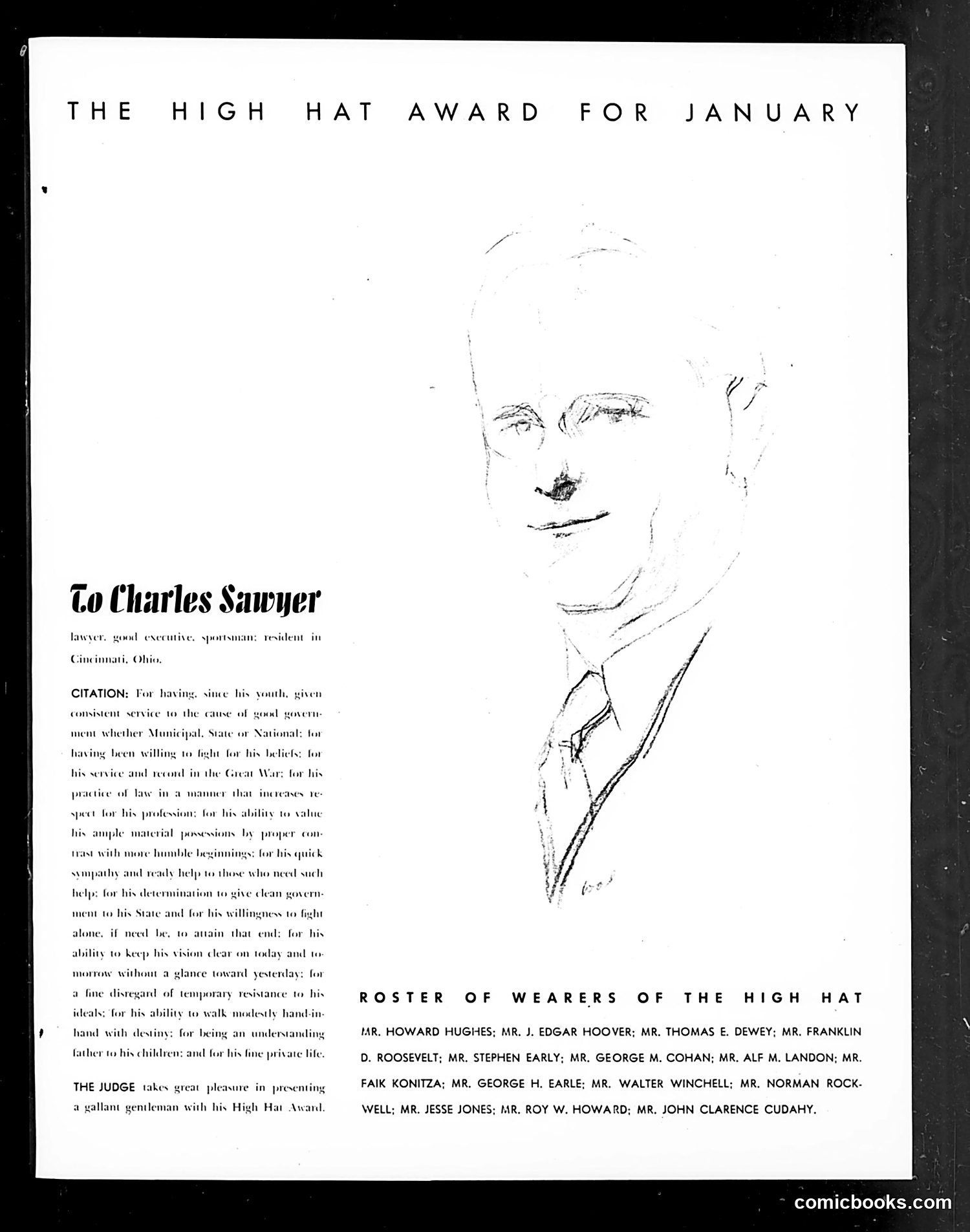
The High Hat Award for January This is a commendation page from *Judge* magazine honoring Charles Sawyer, an Ohio lawyer and civic figure. The "High Hat Award" was *Judge*'s monthly recognition for distinguished Americans deemed exemplary citizens. The citation praises Sawyer for lifelong public service, WWI service, ethical legal practice, charity work, and clean governance efforts. The sketch portrait shows him in formal attire. The "Roster of Wearers" lists previous recipients—a who's who of early-to-mid 20th century American power: FDR, J. Edgar Hoover, Thomas Dewey, George M. Cohan, and others. This establishes the award's prestige by association with national figures. The satirical intent is unclear from this page alone—*Judge* may be earnestly celebrating civic virtue, or subtly mocking self-congratulatory "great men" narratives. Without the magazine's broader context and tone, the exact satirical angle remains ambiguous.
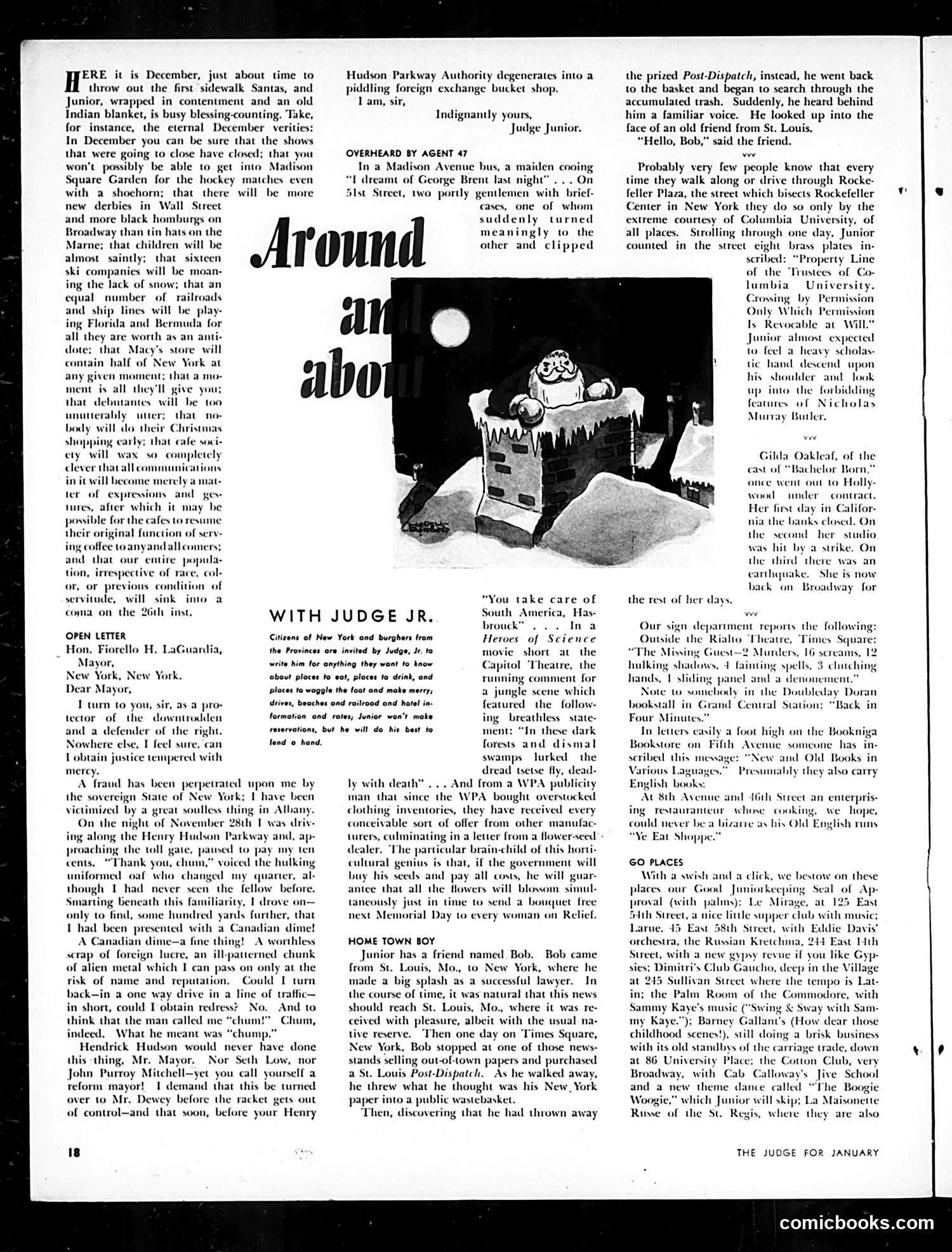
Analysis: "Around and About with Judge Jr." - December 1936 The central cartoon depicts Santa Claus sitting atop a snowy rooftop under moonlight, illustrating the magazine's opening essay about December traditions and seasonal predictability. The main text is a satirical "open letter" to NYC Mayor Fiorello LaGuardia, complaining about receiving a Canadian dime instead of a quarter as change at the Henry Hudson Parkway toll booth. The writer demands LaGuardia investigate this "fraud" and involve DA Thomas Dewey, treating this minor inconvenience as a major scandal. The satire targets both: 1. Government incompetence (the toll worker's mistake) 2. Overwrought citizen outrage at trivial matters The joke hinges on the writer's exaggerated indignation—demanding the mayor's intervention and invoking Dewey's prosecutorial authority over a worthless dime. The closing jab—the worker calling him "chum" actually meaning "chump"—adds wordplay. The column continues with brief anecdotes ("Overheard by Agent 47") capturing New York gossip, typical of Judge magazine's satirical social commentary.
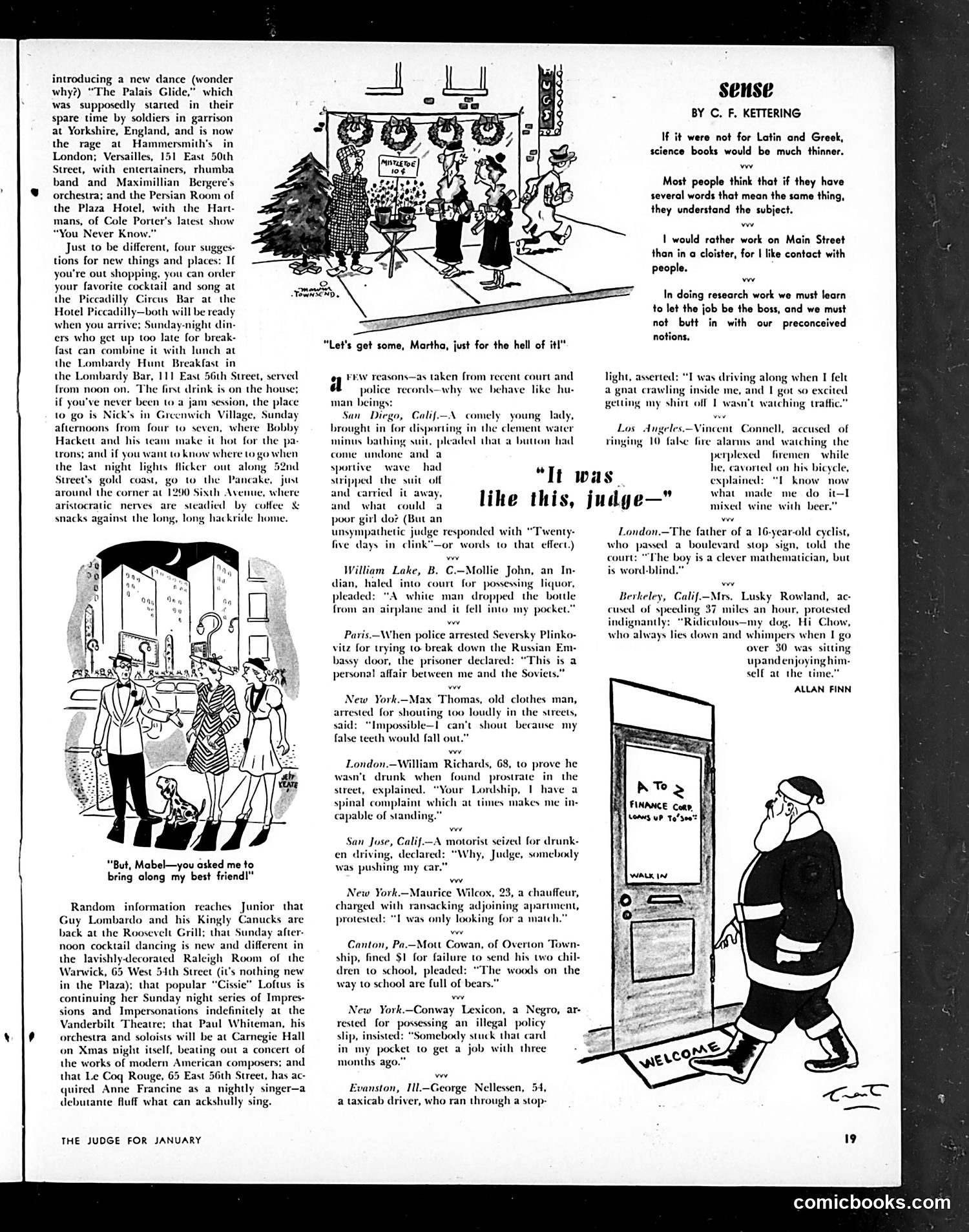
Analysis of "The Judge" Magazine Page This page contains two distinct sections: Top Section: A society column about New York nightlife venues (the Piccadilly Circus Bar, Lombardy Hunt Breakfast, Nick's jam sessions, etc.), accompanied by cartoon illustrations of entertainers and socialites. This reflects 1930s-40s Manhattan leisure culture. Bottom Section ("It was like this, judge—"): A humorous feature presenting absurd courtroom excuses from recent arrest records. The joke lies in defendants' transparently ridiculous explanations: a woman's bathing suit supposedly blown away by a wave, a man claiming a bottle "fell from an airplane into my pocket," someone arrested for shouting insisting their false teeth prevent them from shouting loudly. The satire targets human nature and the legal system—highlighting how people manufacture implausible justifications when caught, and the judges' skeptical responses. The headline "It was like this, judge—" captures the defensive tone of someone about to offer an unconvincing explanation. The cartoons support both sections' themes of urban entertainment and social behavior.
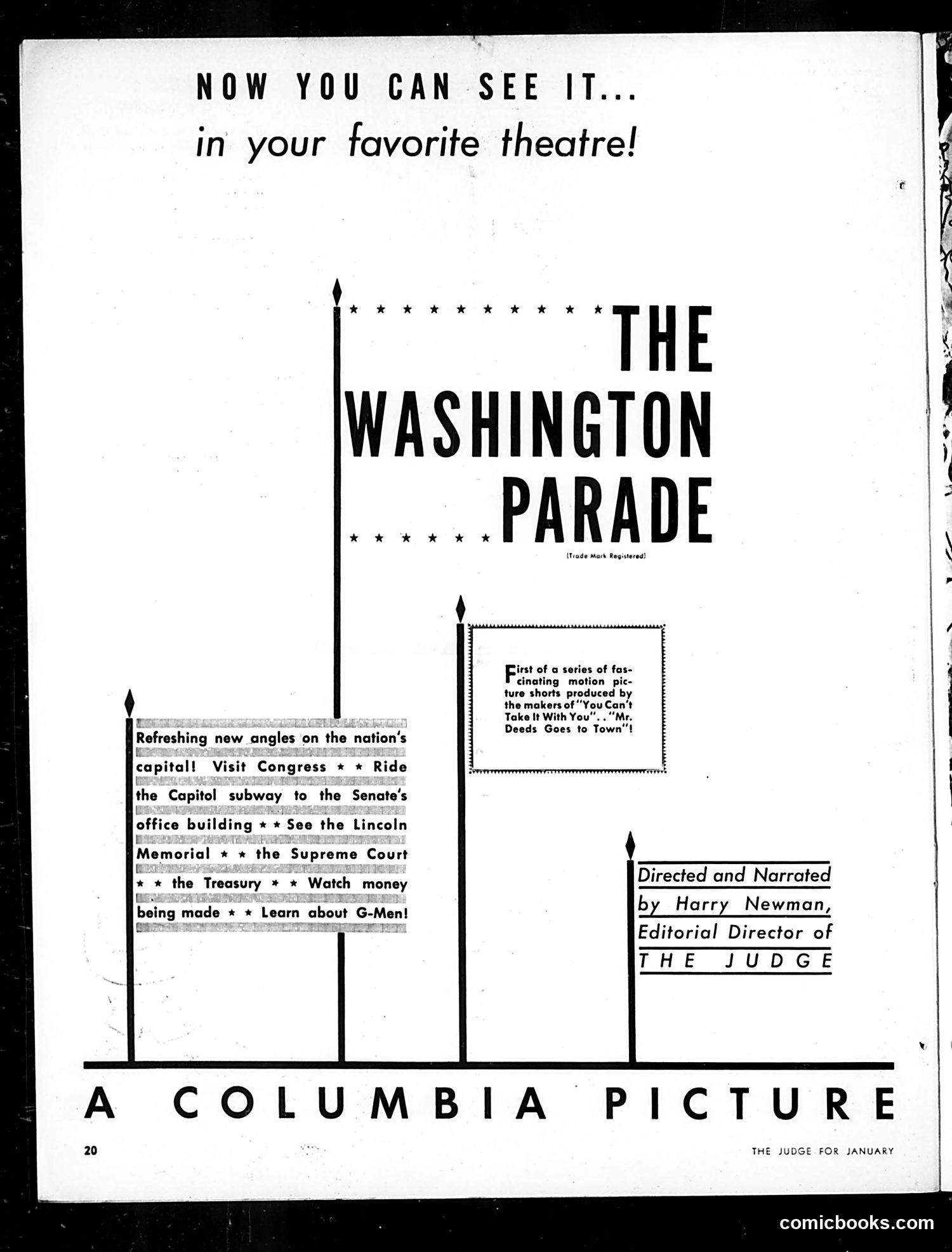
"The Washington Parade" Advertisement Analysis This is a movie advertisement, not a political cartoon. It promotes a Columbia Pictures short film called "The Washington Parade," directed by Harry Newman (Editorial Director of *Judge* magazine). The ad markets the film as a tourist-style travelogue offering "refreshing new angles" on Washington, D.C. It promises viewers visits to Congress, the Capitol, Senate offices, Lincoln Memorial, Supreme Court, Treasury Department, and federal law enforcement (G-Men). The satire is subtle: by framing Washington institutions and government operations as entertainment attractions—like a sightseeing tour—the ad gently mocks both bureaucratic Washington and the public's fascination with it. The emphasis on "watching money being made" at the Treasury adds mild commentary on government spending. The film is positioned as part of a series from the producers of populist comedies (*You Can't Take It With You*, *Mr. Deeds Goes to Town*), suggesting it shares their critical-yet-humorous tone toward American institutions.
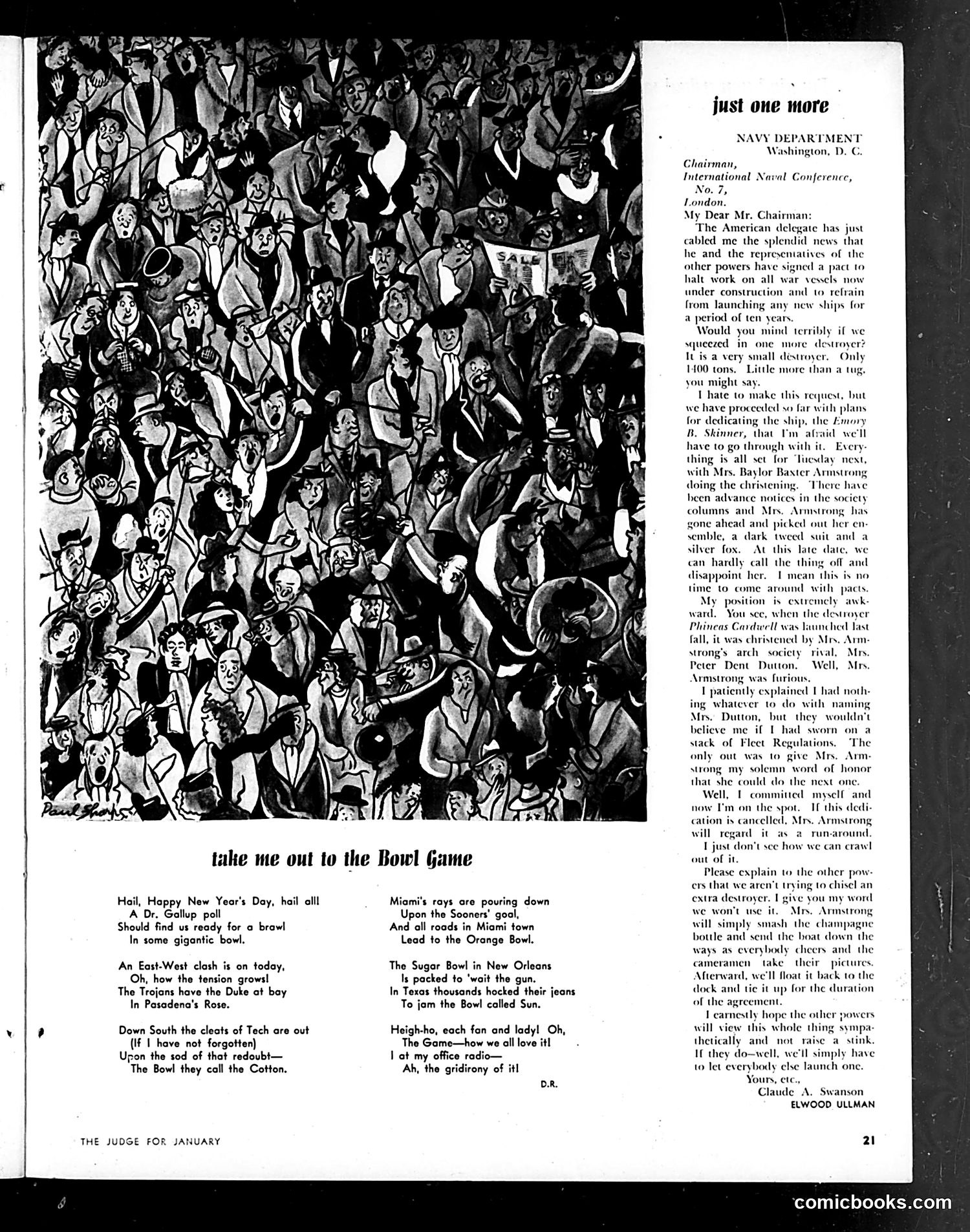
Explanation for Modern Readers This page contains two satirical pieces from *Judge* magazine: "Take Me Out to the Bowl Game" (left) is a humorous poem celebrating New Year's Day college football bowls—the Rose Bowl, Cotton Bowl, Orange Bowl, Sugar Bowl, and Sun Bowl. The accompanying crowd illustration emphasizes the enormous popularity and social obsession with these games. The satire gently mocks American culture's fervent enthusiasm for collegiate athletics. "Just One More" (right) is a letter from Navy Secretary Claude A. Swanson to an International Naval Conference chairman, requesting permission to launch one additional destroyer despite a just-signed ten-year halt on warship construction. The humor lies in Swanson's elaborate excuse: he's already promised the christening honor to Mrs. Baylor Baxter Armstrong, who would be deeply offended if the event were cancelled—a social embarrassment he frames as a serious diplomatic problem. The satire mocks both military bureaucracy and upper-class social pretension.
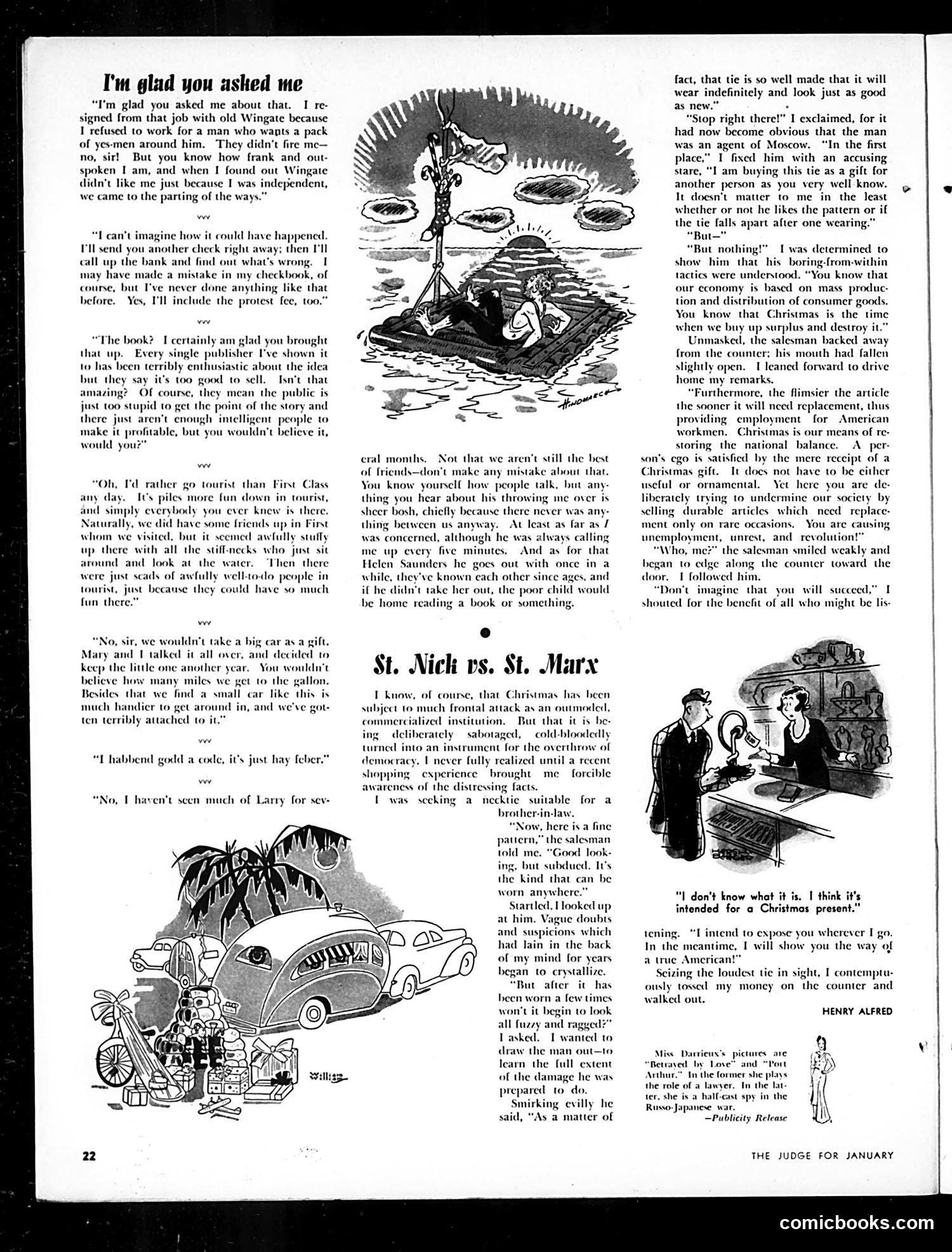
Political Satire Analysis: "I'm Glad You Asked Me" This page satirizes American hypocrisy and self-deception through monologues of people justifying questionable behavior. The left column features various speakers offering transparently false explanations: a man claiming he quit his job for principle (when fired for disloyalty), someone blaming bank errors, a publisher rejecting a "too good" manuscript, and others making excuses about their choices. The humor exposes how people construct elaborate rationalizations to preserve their self-image. The title itself is ironic—these speakers seem relieved to explain themselves, yet their justifications contradict obvious reality. The bottom section, "St. Nick vs. St. Marx," satirizes Cold War paranoia by depicting a salesman recommending a durable necktie as a suspected Communist agent. The joke mocks Americans' tendency to see Soviet sabotage in everyday commerce—a durable, affordable product is reframed as an attack on capitalism. This reflects 1950s anxiety about communist infiltration in American institutions.
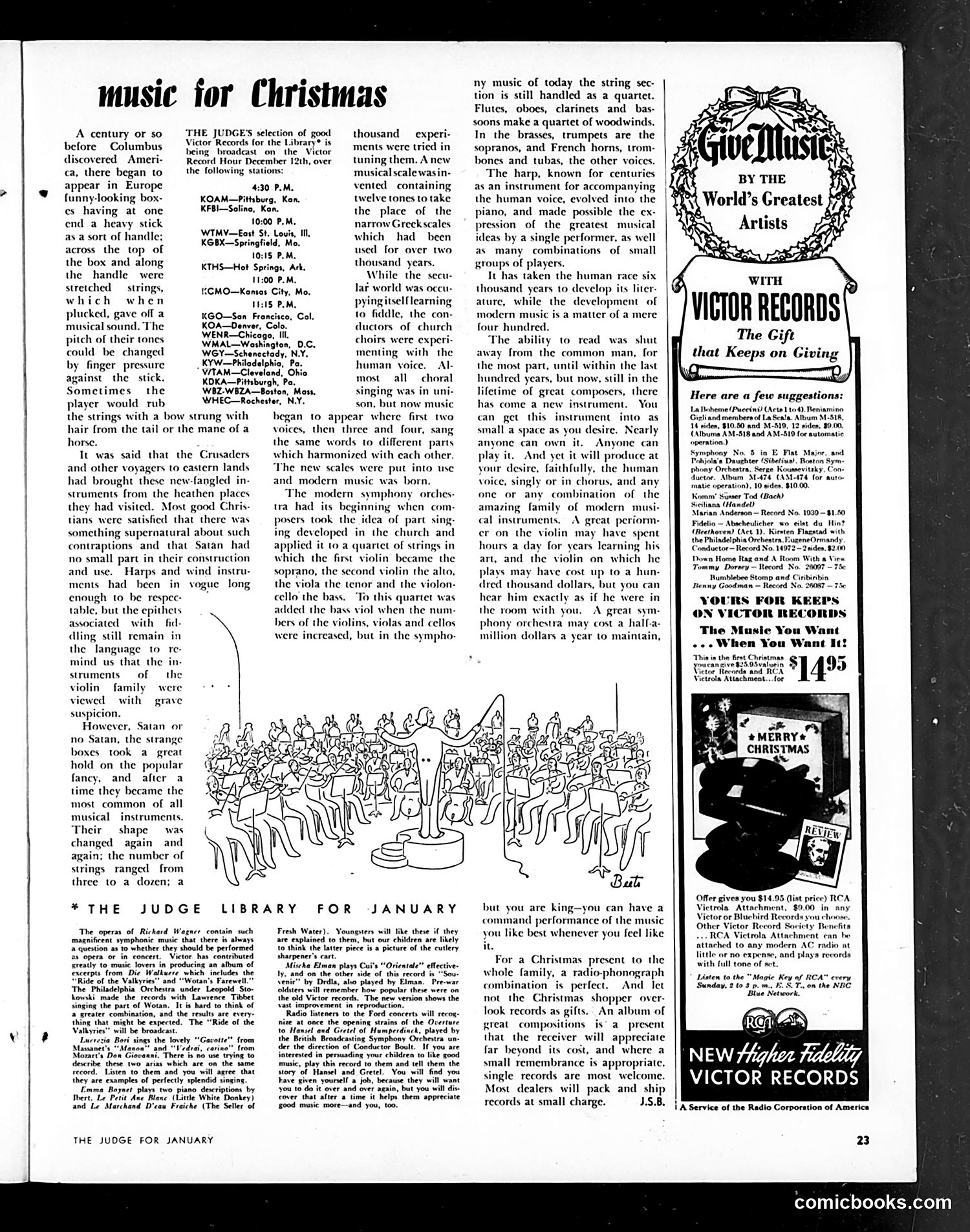
"Music for Christmas" - Judge Magazine This page is primarily advertising and educational content rather than political satire. The main article traces the history of stringed instruments (violins) from medieval Europe through modern times, noting their initial suspicion as "instruments of Satan" before becoming commonplace. The accompanying illustration shows a large orchestra or chorus performing, accompanying the text's discussion of musical development. The right side features Victor Records advertising, promoting classical music recordings (Wagner's operas, Massanet's "Manon," Mozart) as Christmas gifts. The ads emphasize these are "The Gift that Keeps on Giving." No clear political satire is present. This is a straightforward holiday-themed promotional page combining music history with high-end record advertising, targeting educated, classical-music-appreciating readers during the 1920s-30s era when recorded music was still a luxury consumer good.
"Listen, Critics" — Judge Magazine Satire This page satirizes theater critics through two pieces: Main Article: A caustic essay predicting that a maladjusted schoolboy will become a professional theater critic—doomed to perpetual unhappiness. The satire argues critics are inherently bitter, failed artists (this boy dreams of building tenements, not reviewing plays) whose negativity damages both theater and themselves. The piece mocks critics' pretentiousness and their power to harm productions while satisfying no one—audiences ignore their reviews, producers blame them for ruining theater. "Listen, Critics" section: Proposes surveying regular theatergoers instead of professional critics to evaluate plays, suggesting the public's unbiased opinions matter more than critics' jaded perspectives. The underlying complaint: professional critics are self-appointed arbiters whose cynicism serves no one and reflects their own failed ambitions rather than genuine theatrical merit.
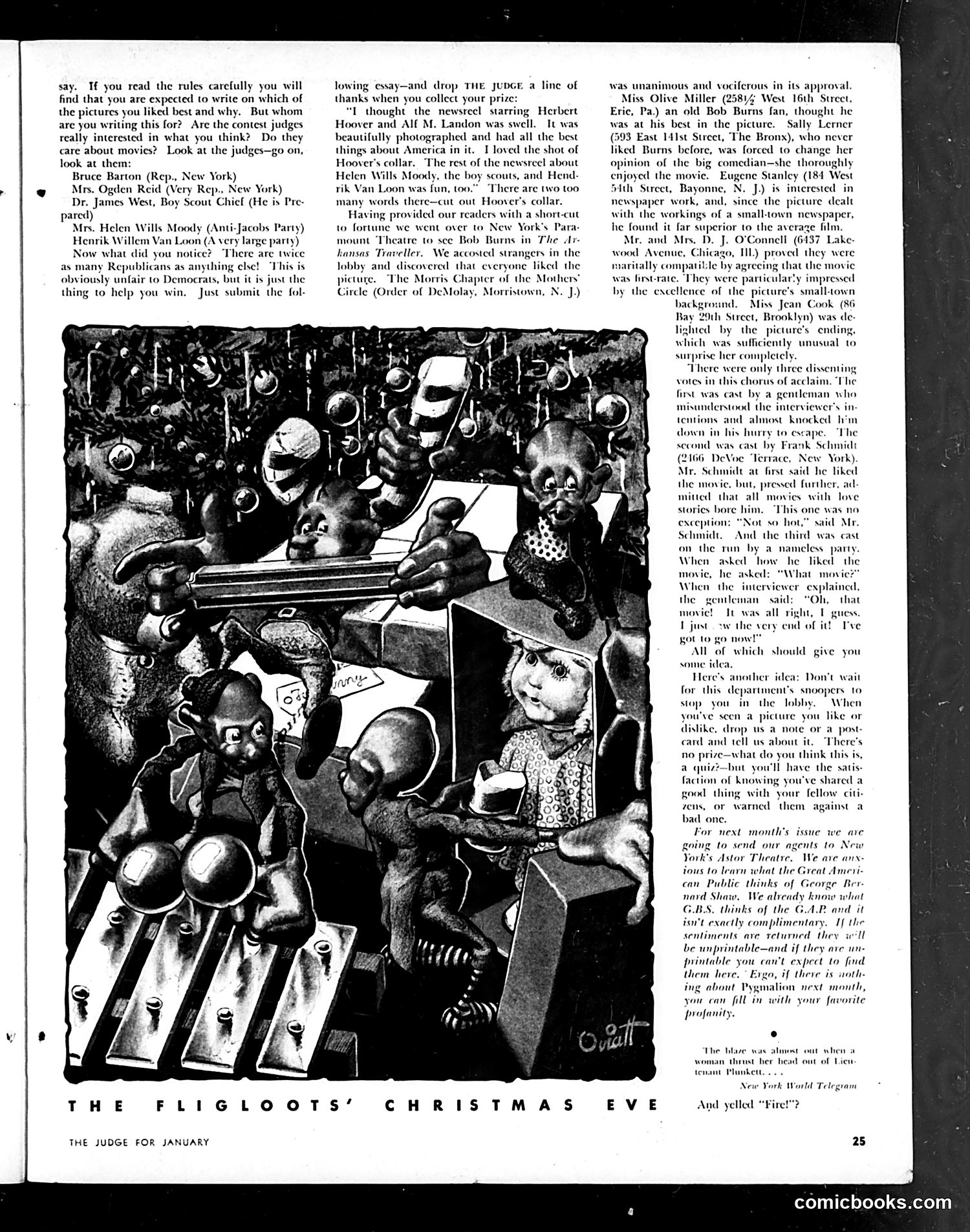
"The Fligloots' Christmas Eve" — Judge Magazine Satire This page satirizes a Judge magazine contest inviting readers to write essays about newsreels, ostensibly judged fairly. The satire reveals the contest is rigged: the judging panel includes two Republicans (Bruce Barton, Mrs. Ogden Reid), a Boy Scout chief, tennis champion Helen Wills Moody, and historian Henrik Willem Van Loon—a deliberately skewed panel favoring Republican interests and establishment figures. The text mocks readers for trusting the competition while exposing the judges' obvious Republican bias. It then pivots to reviewing Bob Burns' film "The Arkansas Traveller," gathering enthusiastic audience reactions. The large cartoon illustration (artist signed "Cesare") depicts chaotic Christmas Eve revelry—likely "The Fligloots" family mentioned in the title—showing multiple figures in domestic pandemonium, reinforcing Judge's satirical humor about American life and consumer culture during this pre-WWII era.
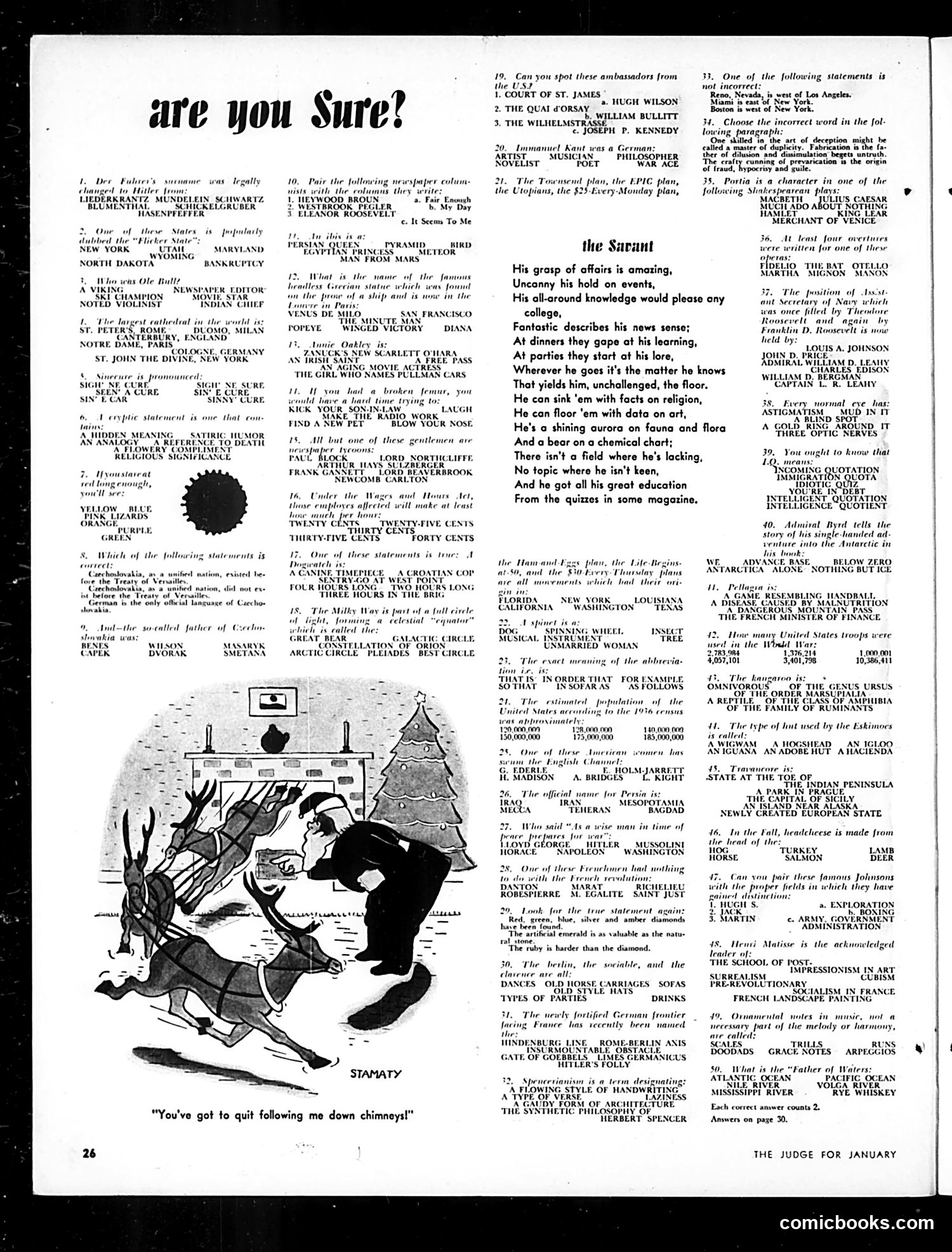
Judge Magazine Page Analysis This page from Judge magazine contains multiple quiz/trivia sections testing readers' knowledge of 1930s figures, culture, and current events. The main cartoon features "Stamaty" and depicts Santa Claus being chased down a chimney by what appears to be a figure with a gun, with the caption "You've got to quit following me down chimneys!" This is a humorous take on wartime or crime-era paranoia. The quiz questions reference contemporary 1930s personalities and topics: ambassadors (likely including Joseph P. Kennedy), German philosopher Immanuel Kant, New Deal programs (Townsend plan, EPIC plan), newspaper columnists like Heywood Broun and Eleanor Roosevelt, and entertainment figures. Question references to "The Führer" indicate Nazi Germany context. The "Savant" poem celebrates an intellectual polymath—someone knowledgeable across all fields. Overall, the page blends general knowledge trivia with light satire of contemporary politics and personalities from the mid-to-late 1930s.
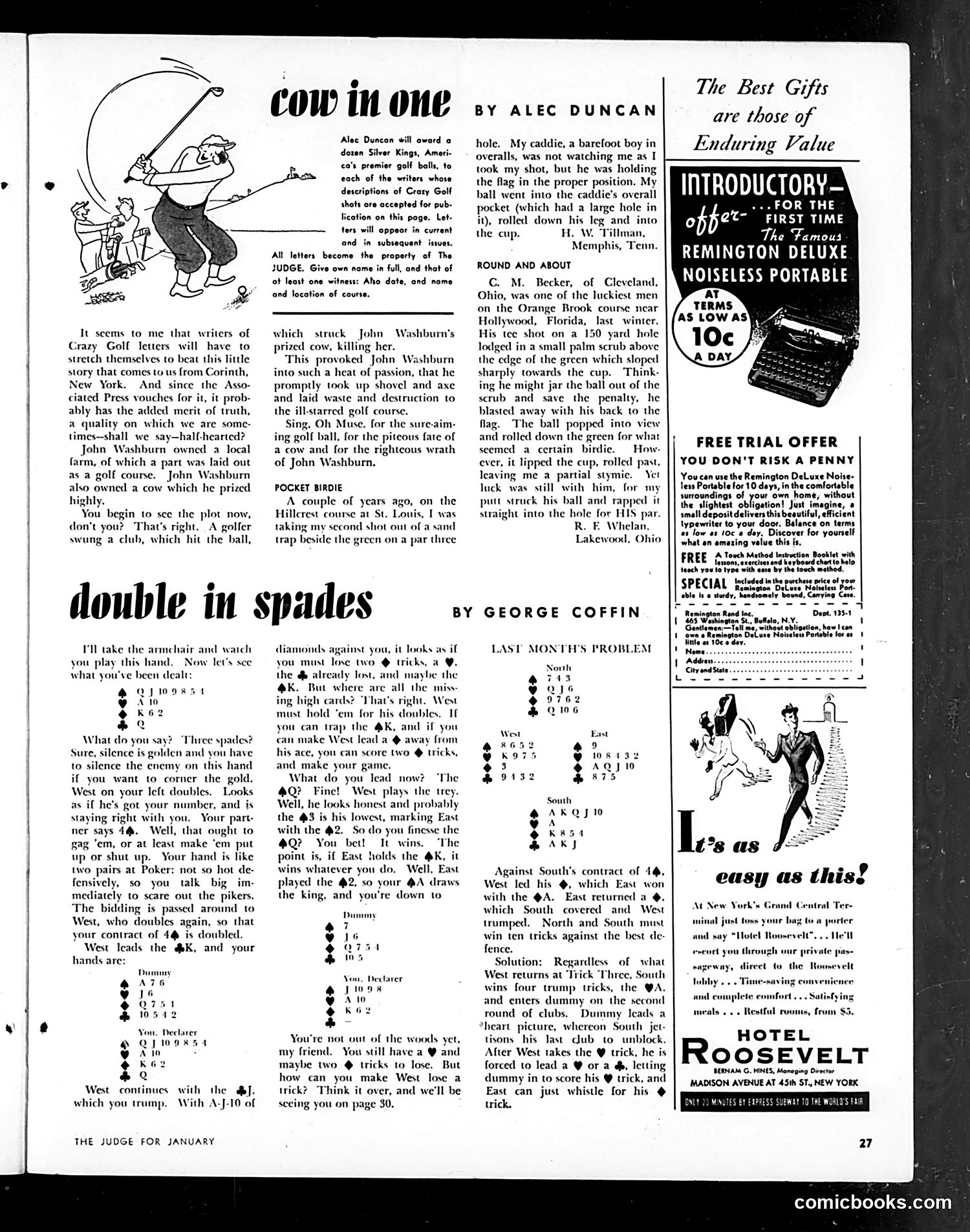
"Cow in One" - Historical Context This page from *Judge* magazine features two distinct pieces: "Cow in One" (top): A humorous anecdote about crazy golf mishaps, attributed to the Associated Press. A golfer's errant shot kills a local farmer's prized cow, prompting the farmer (John Washburn) to destroy his own golf course in rage. The joke plays on the golf-obsessed American culture of the era and the absurdity of backyard golf courses becoming common. The story's appeal lies in the farmer's disproportionate revenge and the implicit irony that a recreational activity causes real destruction. "Double in Spades" (bottom): A bridge card game instructional column by George Coffin, teaching contract bridge strategy to readers. This reflects bridge's immense popularity in early-to-mid 20th-century American leisure culture. The page also contains advertisements, including a hotel promotion and a Remington typewriter offer, typical of *Judge's* revenue model. No specific political figures or references are evident on this page—it's primarily entertainment and lifestyle content.
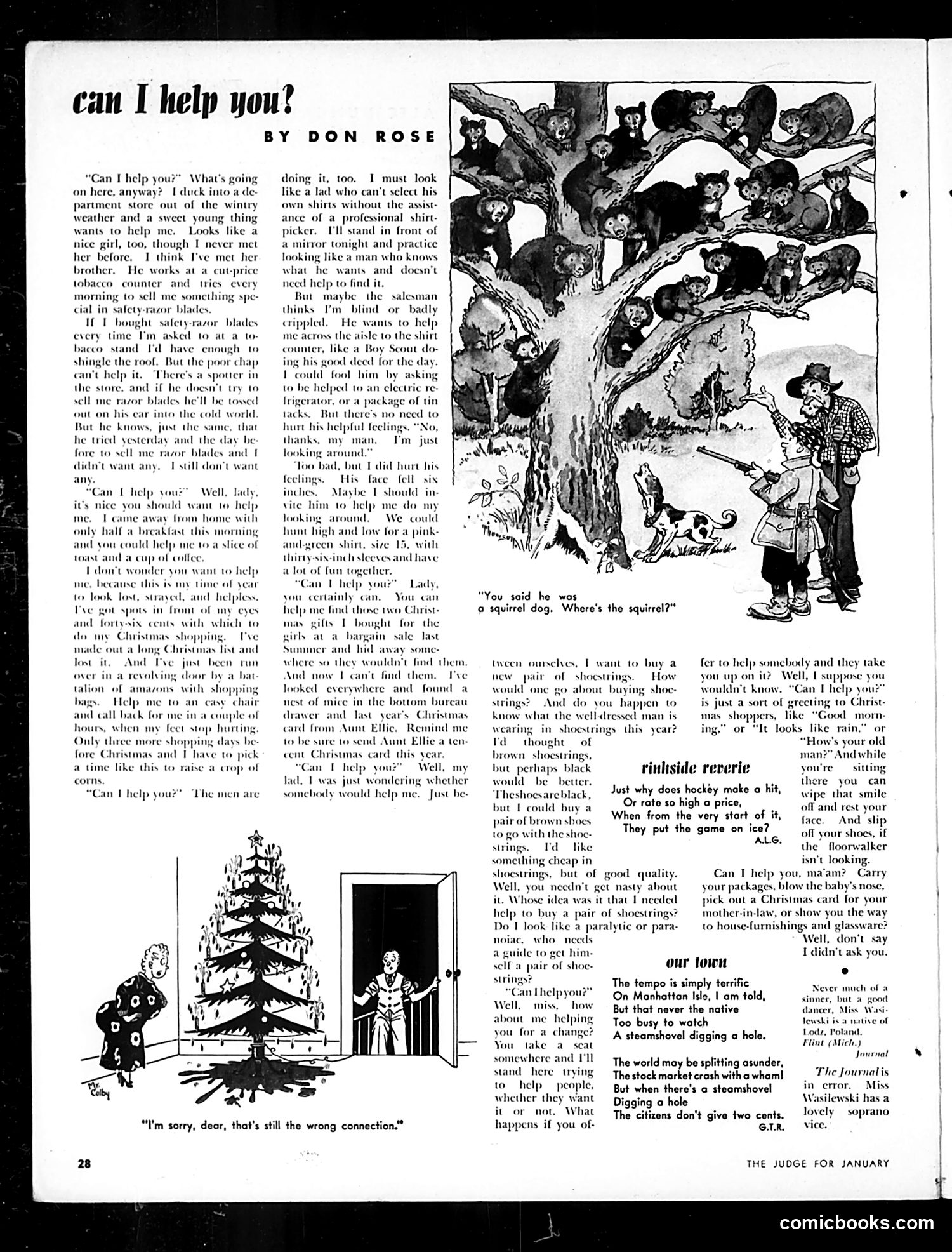
Analysis for Modern Readers This is Don Rose's humorous essay about department store clerks offering unsolicited assistance. The piece satirizes both the aggressive sales tactics of retail workers and the exhausted, reluctant customer (the narrator). The central joke: Rose observes that salespeople's helpful offers are often unwanted—he's pestered to buy razor blades, shirts, shoes—yet he recognizes the clerks are pressured by management (the "spotter" who fires them if they don't sell). He sympathizes with their predicament while remaining annoyed. The cartoons illustrate his exasperation: one shows him surrounded by eager shop workers; another depicts a phone mix-up ("I'm sorry, dear, that's still the wrong connection"); a third shows confusion about a "squirrel dog." The sidebar poems mock holiday shopping chaos and "digging a hole" (financial ruin from overspending). This reflects pre-WWII consumer culture anxiety—the tension between capitalist sales pressure and personal autonomy, wrapped in gentle satire rather than serious critique.
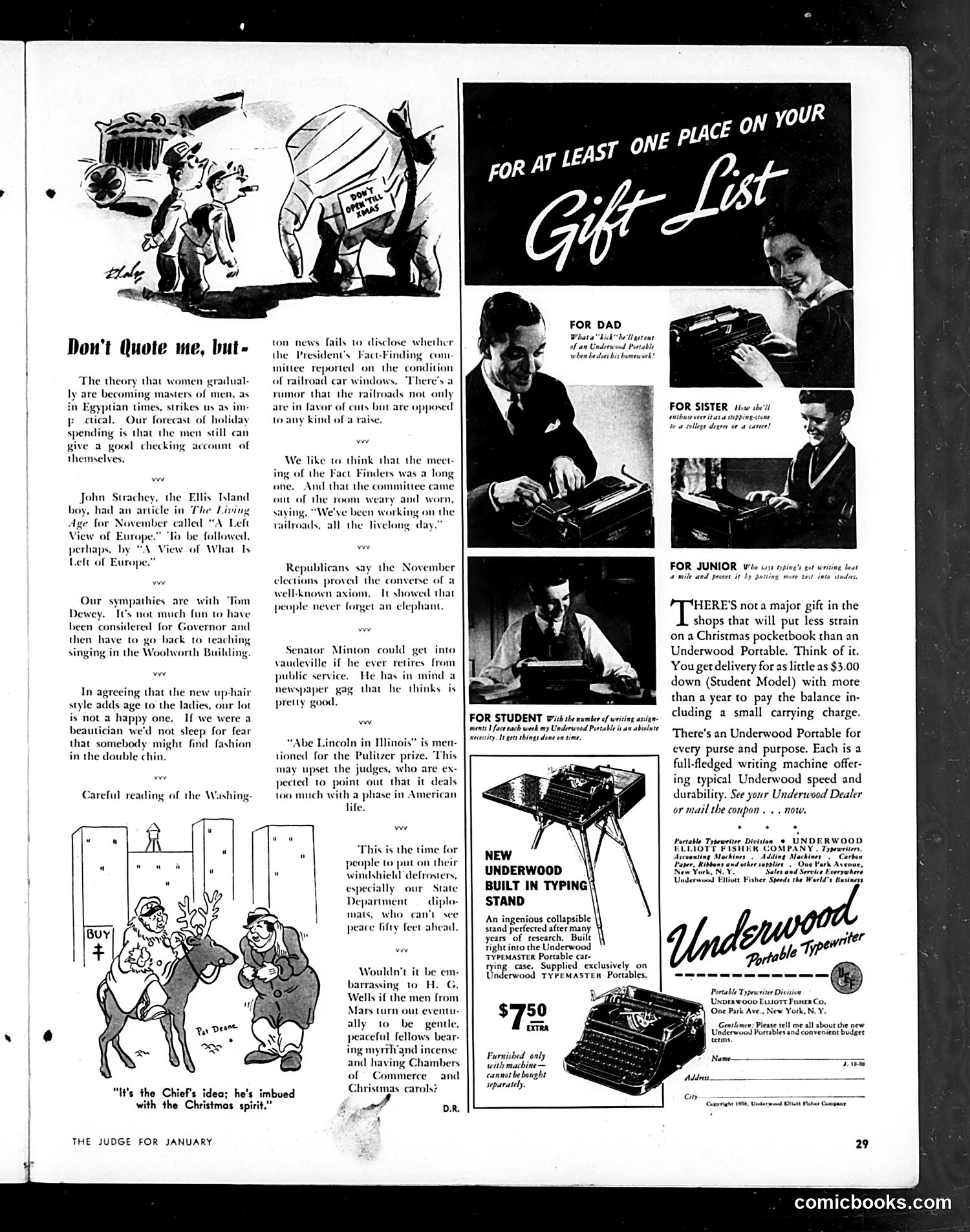
Analysis of This Judge Magazine Page This page contains political commentary and advertising rather than a single unified cartoon. Political References: The "Don't Quote Me, But—" column includes several topical jabs: references to John Strachey (a left-wing British politician) and his writings on European politics; mild mockery of Tom Dewey (likely the 1938 candidate for New York governor); and commentary on a presidential "Fact-Finding Committee" regarding railroad labor disputes—suggesting the committee's work was performative rather than substantive. A small cartoon at bottom-left depicts Christmas charity, with the caption "It's the Chief's idea; he's imbued with the Christmas spirit"—likely satirizing President Roosevelt's public relations around holiday benevolence. Advertisement: The dominant right side promotes the Underwood Portable Typewriter, targeting multiple demographics (Dad, Sister, Student, Junior) with gift-buying suggestions at $7.50, emphasizing affordability and financing options. The overall tone reflects 1930s New Deal-era political skepticism mixed with consumer marketing.
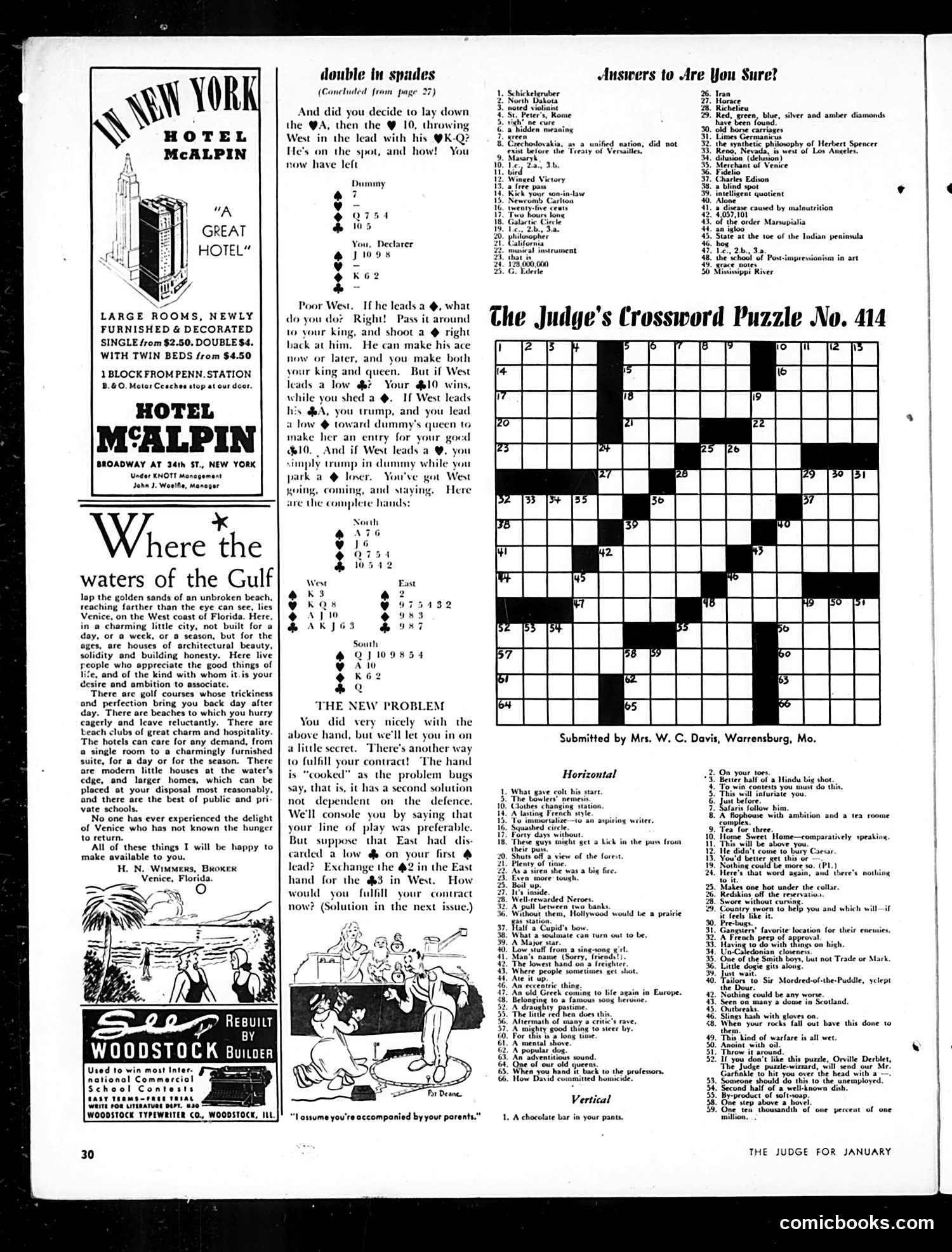
Page Analysis: Judge Magazine Content This page contains primarily advertising and puzzle content rather than political satire. The notable elements are: Advertisements: The McAlpin Hotel in New York and Venice, Florida real estate promotions dominate the left side, promoting leisure travel and property investment—typical of 1920s-era marketing. Main Content: "The Judge's Crossword Puzzle No. 414"—a standard crossword puzzle with clues, reflecting the crossword craze that swept America in the 1920s. Bridge Column: A "double in spades" bridge strategy article discusses card game tactics, indicating Judge's audience included middle-class readers interested in parlor games and leisure activities. One Cartoon: A small illustration at bottom shows a parent-child scenario with the caption "I assume you're accompanied by your parents"—mild humor about dating/courtship conventions of the era. The page demonstrates Judge's shift toward entertainment and lifestyle content rather than sharp political commentary, reflecting its evolution as a general-interest magazine by this period.
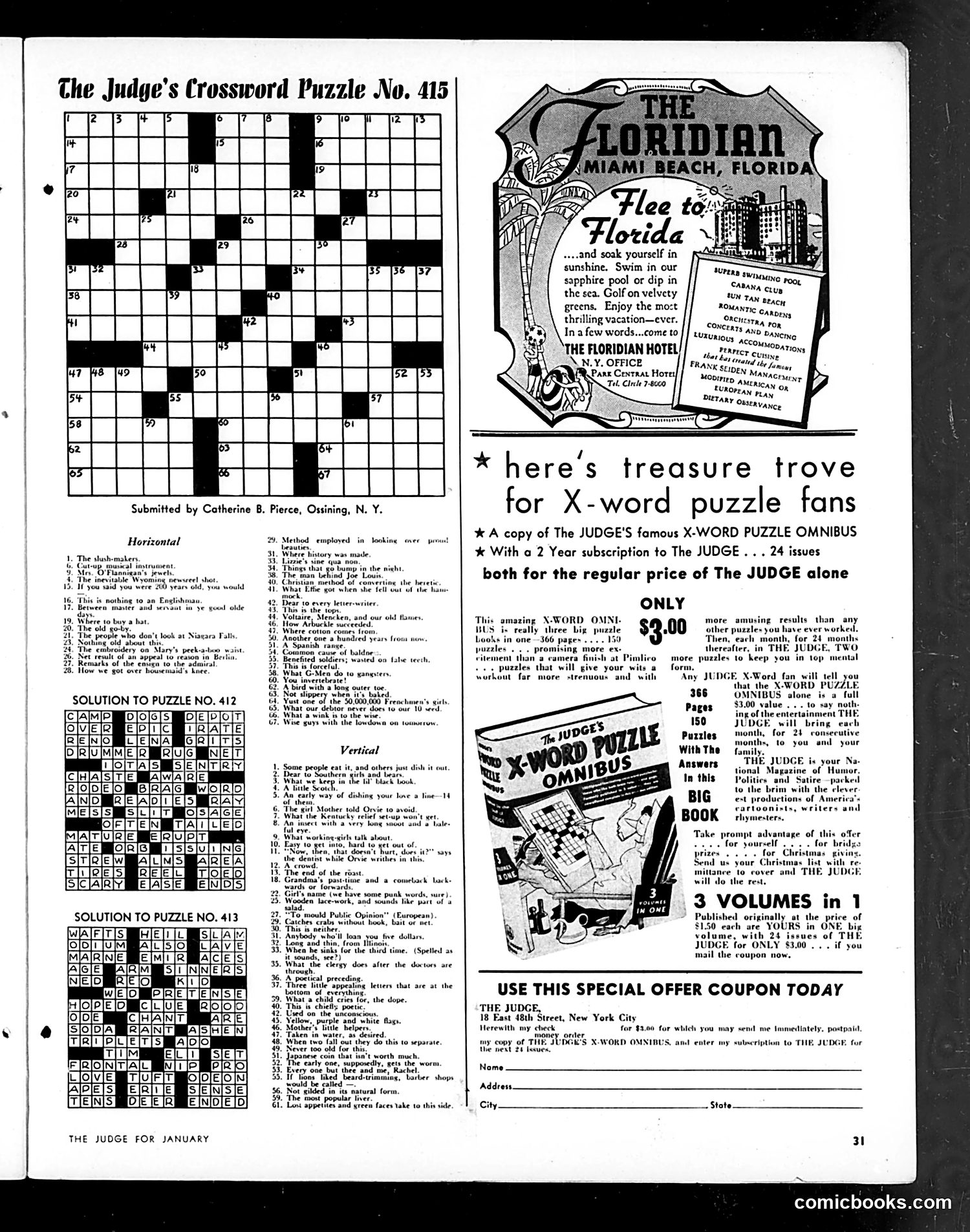
Analysis of This Judge Magazine Page This page is primarily advertising and puzzle content rather than editorial cartoons or satire. The main content consists of: 1. Crossword Puzzle No. 415 — a standard word puzzle with clues submitted by Catherine B. Pierce of Ossining, New York 2. Solutions to previous puzzles (Nos. 412 and 413) — shown in filled-in grids 3. A large advertisement for The Floridian Hotel in Miami Beach, Florida, promoting vacation travel with typical 1930s-40s tourism language ("soak yourself in sunshine") 4. A promotional offer for The Judge magazine's "X-Word Puzzle Omnibus" — a collection of three puzzle books plus a 2-year subscription, all for $3.00 The page reflects Judge's era when puzzle content was a major draw for readers. The vacation ad and subscription offer are straightforward commercial messaging with no apparent satire or political commentary.
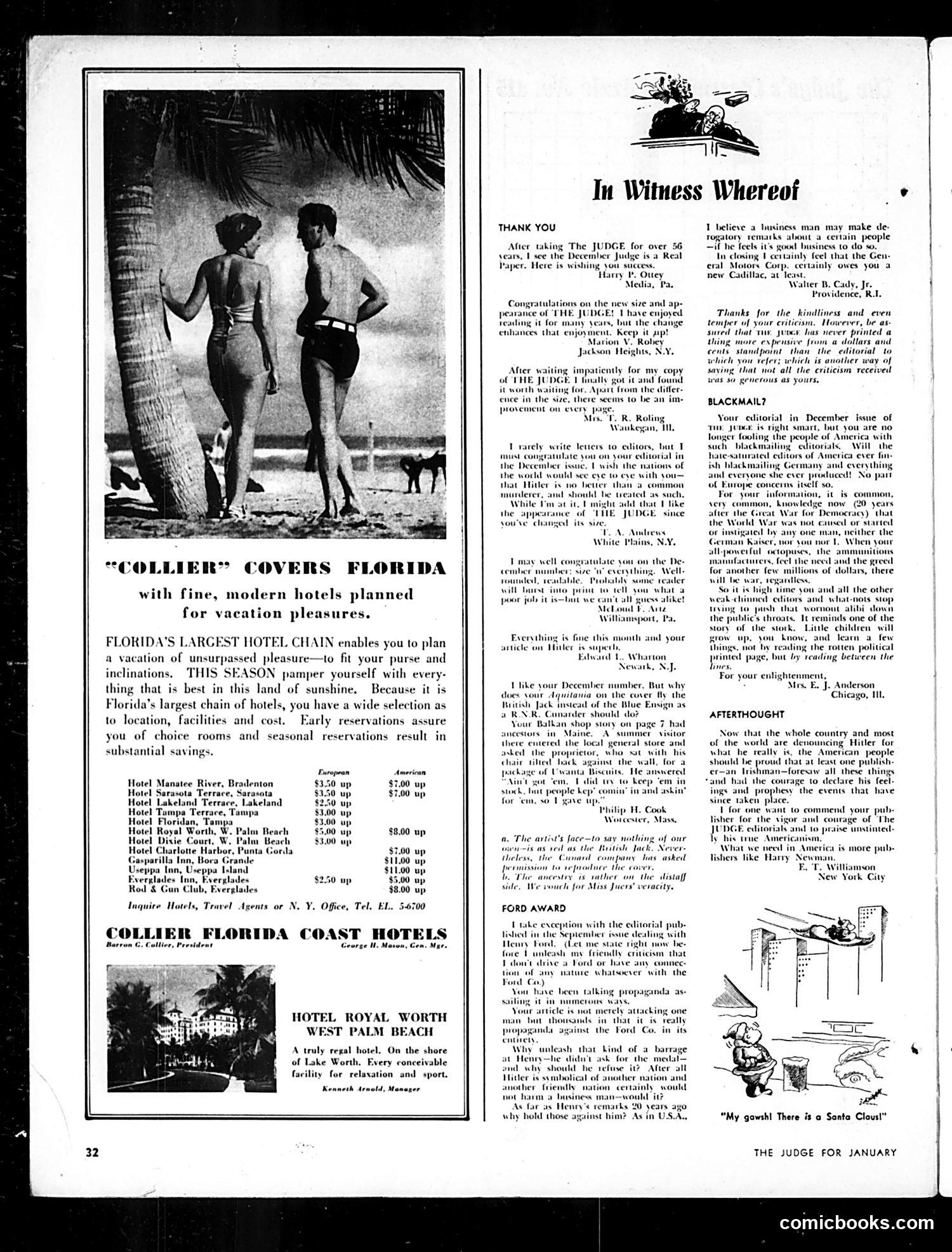
Analysis of Judge Magazine Page (January Issue) This page is primarily reader letters and hotel advertisements, not political cartoons. The substantive content consists of thank-you letters praising Judge's recent redesign and format change. The only political reference appears in the letters section: readers discuss an editorial about Hitler. One letter (Edward Wharton) praises the magazine's "article on Hitler," while another (Walter Cady) defends Henry Ford against Judge's September criticism, arguing Ford shouldn't be condemned for accepting a medal despite "derogatory remarks about a certain people." This appears to reference Ford's 1938 Nazi decoration and his controversial anti-Semitic views—contemporary controversies Judge had evidently addressed. The page otherwise showcases Florida hotel chain advertisements and a small cartoon titled "My guest! There is a Santa Claus!" (lower right), which appears unrelated to the political content. The editorial focus on Hitler and Ford suggests Judge was actively debating American business leaders' problematic relationships with Nazi Germany during this pre-WWII period.
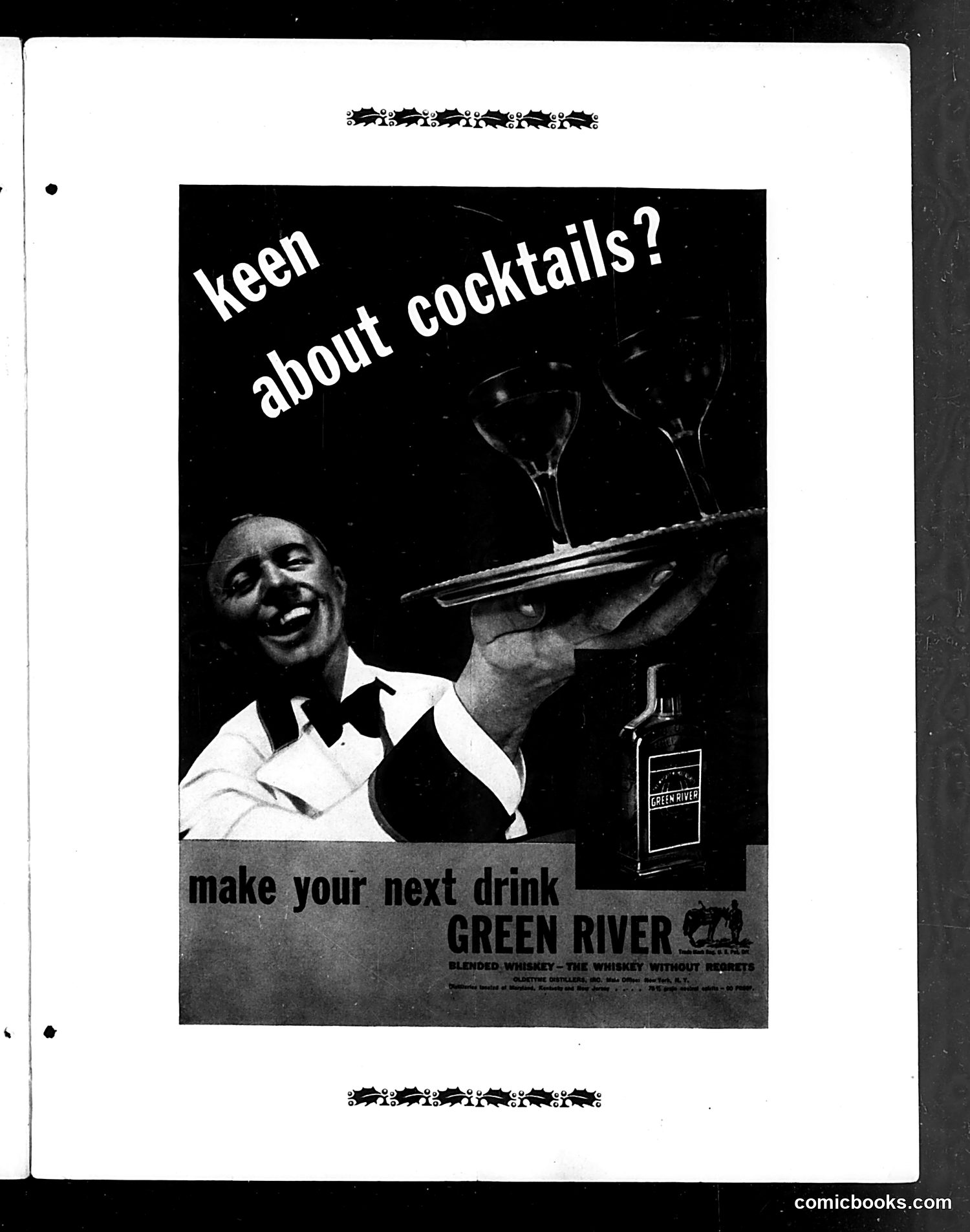
Analysis This is a vintage advertisement, not satire or political commentary. It promotes Green River whiskey through a bartender character asking "keen about cocktails?" The ad encourages readers to "make your next drink GREEN RIVER," featuring a smiling server in formal attire holding a tray with cocktail glasses and a bottle. The pitch relies on mid-century advertising conventions: a friendly, enthusiastic service worker endorses the product directly to consumers. The phrase "keen about cocktails" uses period slang ("keen" meaning enthusiastic/appealing). The "whiskey without secrets" tagline appears to emphasize straightforward quality. As a magazine advertisement rather than editorial content, this reflects the consumer culture and social conventions of its era.
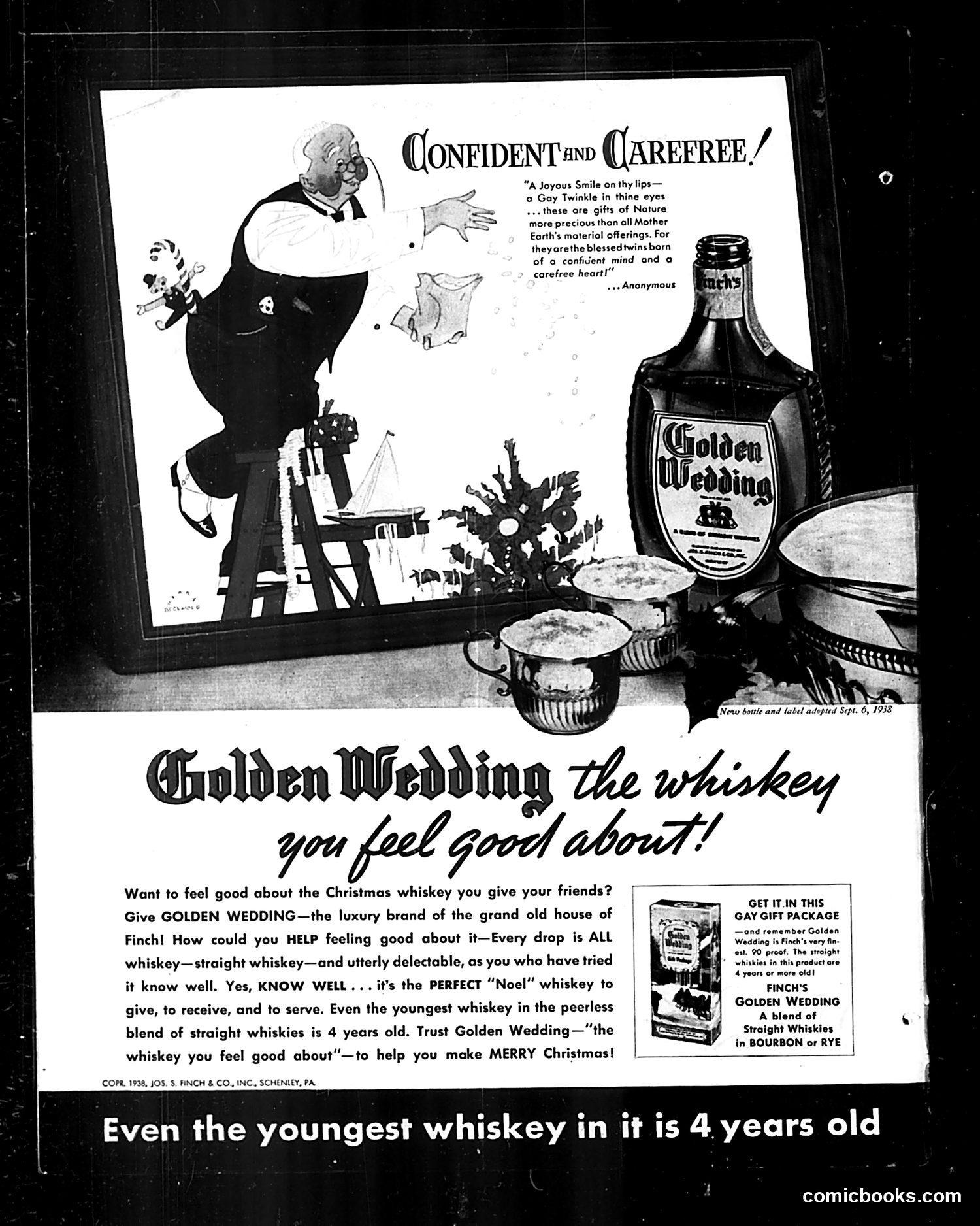
Golden Wedding Whiskey Advertisement (1938) This is primarily a whiskey advertisement, not political satire. The cartoon depicts a jovial, caricatured man (likely meant to represent a stereotypical "bon vivant" or pleasure-seeker) dancing with a small dog, presenting gift boxes—visualizing the appeal of giving Golden Wedding whiskey as Christmas presents. The advertisement's pitch emphasizes that the whiskey is "all whiskey" and aged (minimum 4 years), positioning it as a luxury gift that makes the giver "feel good about" their choice. The pseudo-philosophical quote about "a confident mind and carefree heart" attempts to elevate the product beyond mere alcohol. The ad dates to 1938, during Prohibition's repeal (1933), when whiskey companies aggressively marketed their products. The "gay gift package" reference uses "gay" in its period meaning of "cheerful/festive," not relating to sexual orientation. This reflects pre-WWII consumer advertising culture and attitudes toward alcohol promotion that would face increasing restrictions later.

I cannot reliably analyze this page. The image is severely degraded—extremely dark with heavy grain, scratches, and vertical lines that obscure any clear details. While I can faintly discern what appear to be repeated face-like shapes or caricatures arranged vertically, I cannot make out facial features, expressions, or identifying characteristics with enough clarity to identify specific figures or explain the satire with confidence. The OCR text is largely unreadable gibberish, providing no contextual help. To properly analyze this Judge magazine page, a clearer image would be necessary.