life
Life — October 27, 1898
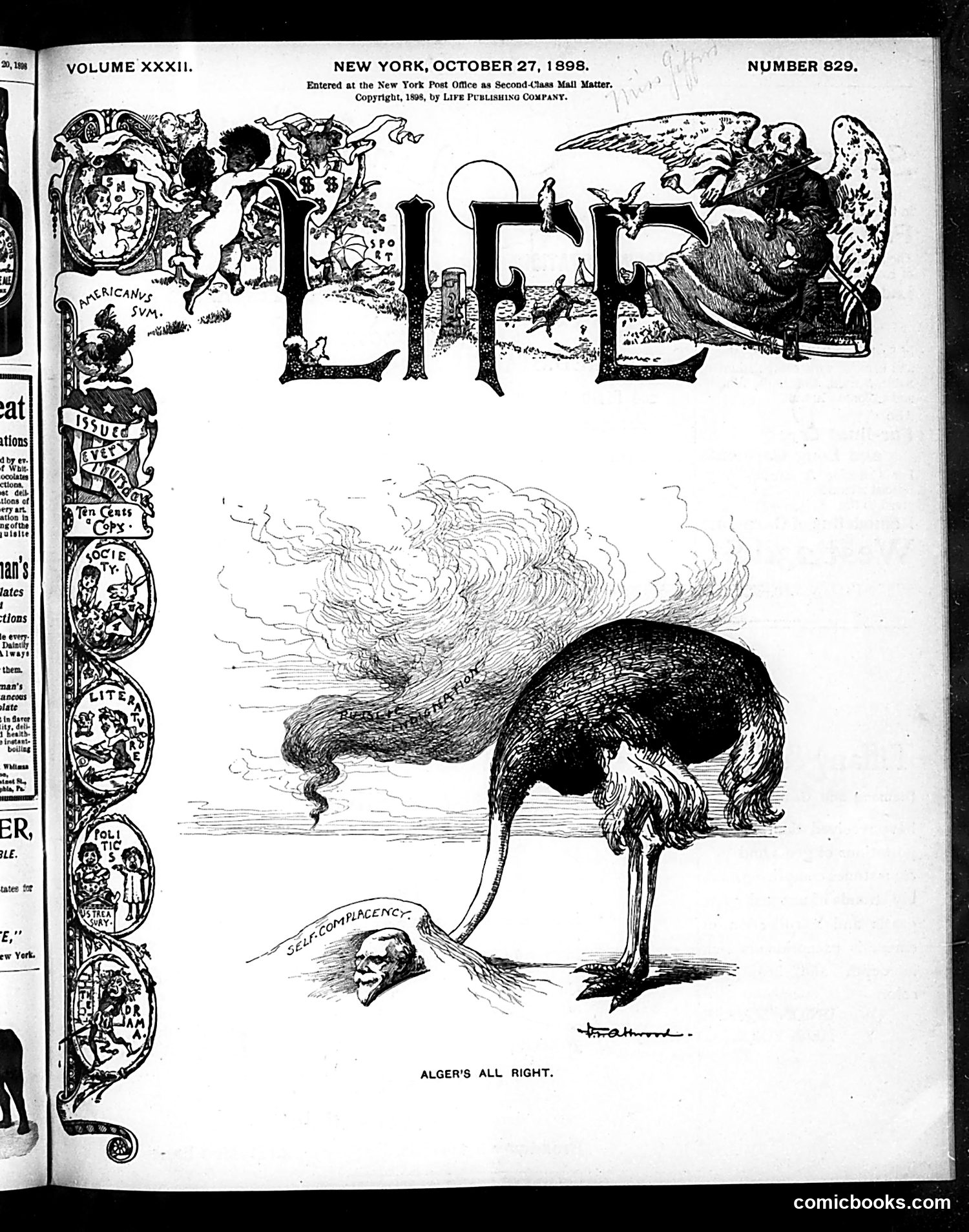
"Alger's All Right" This cartoon from *Life* magazine (October 27, 1898) satirizes someone labeled "Self-Complacency" depicted as an ostrich with its head buried in the ground. The image plays on the phrase "an ostrich burying its head in the sand"—a metaphor for willful ignorance or refusing to acknowledge problems. The title "Alger's All Right" likely references Russell Alger, U.S. Secretary of War during the Spanish-American War (1898). The cartoon suggests Alger maintained complacency about serious issues—possibly corruption, mismanagement, or scandals within the War Department—by ignoring criticism or evidence of problems. The ostrich represents his refusal to confront difficulties, while smoke erupts around him, implying actual crises he overlooks.
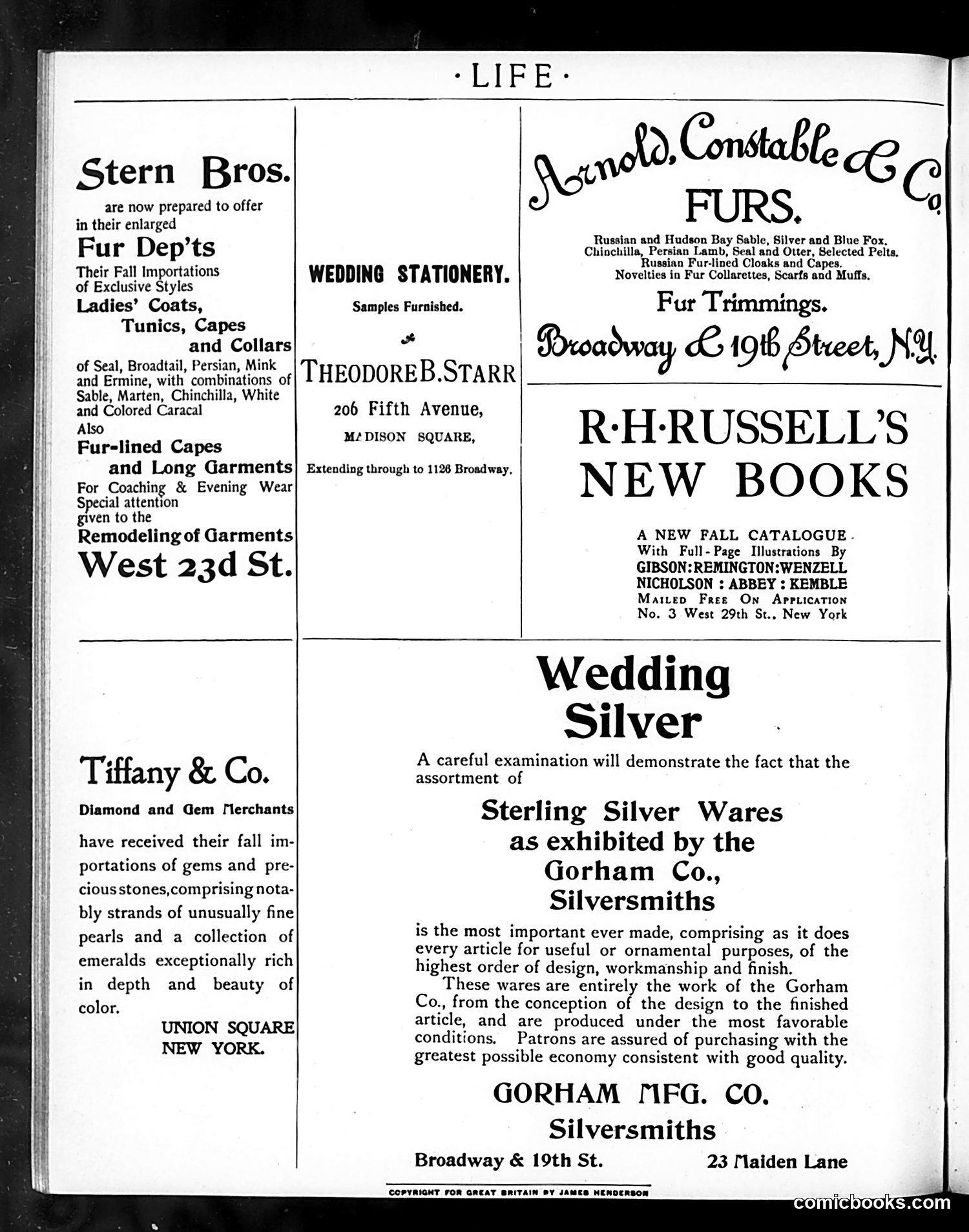
Analysis This page is primarily advertising, not editorial content or cartoons. It contains no political satire or comic commentary. The advertisements showcase luxury goods typical of early 20th-century New York: Stern Bros. fur coats and capes (West 23rd St.), Theodore B. Starr wedding stationery (Madison Square), Arnold Constable & Co. furs (Broadway & 19th St.), R.H. Russell's new books, Tiffany & Co. diamonds and gems (Union Square), and Gorham Manufacturing Company silverware (Broadway & 19th St.). These ads reflect the magazine's affluent readership and New York's commercial landscape during this period. There are no cartoon figures, political references, or satirical content visible on this page.
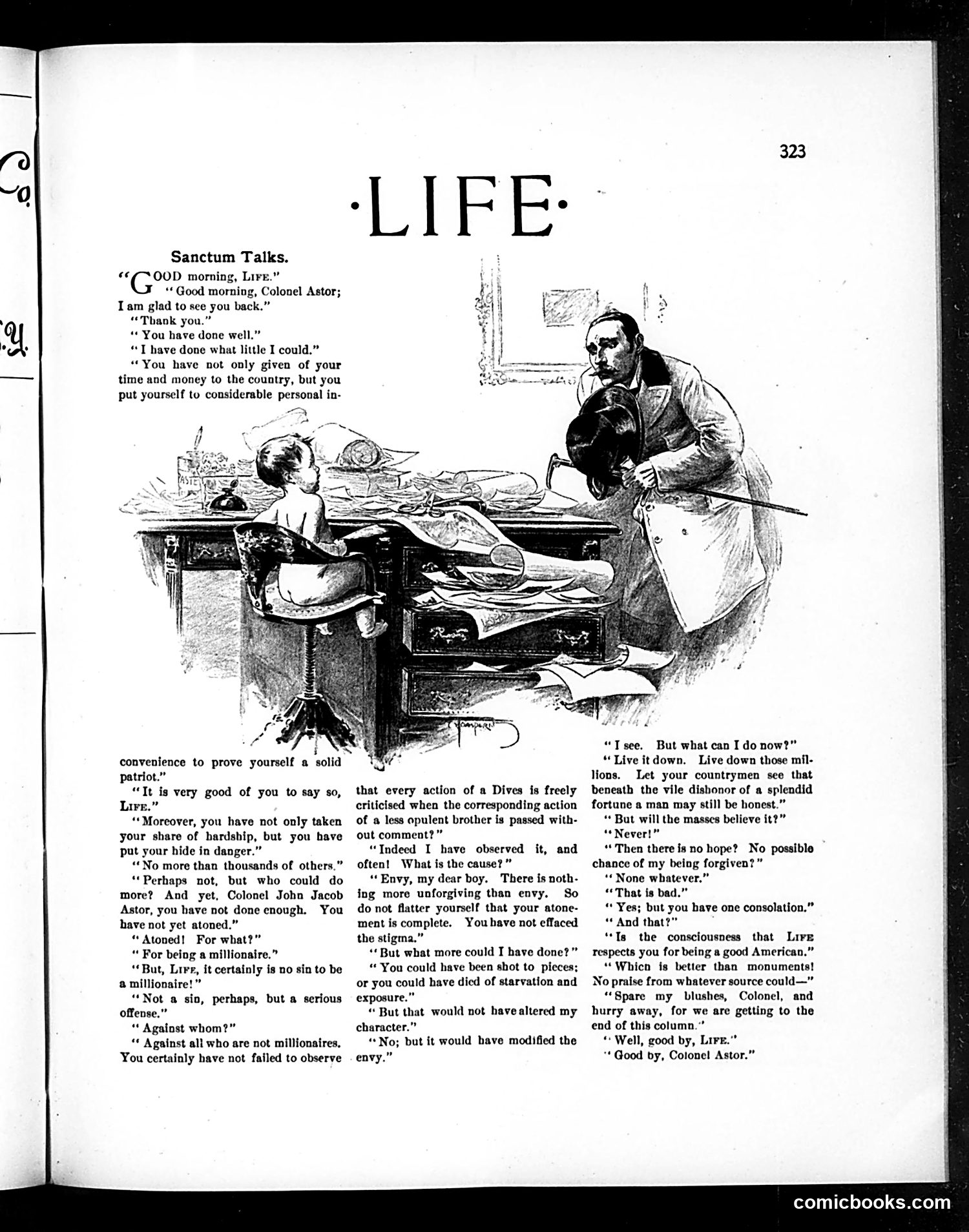
"Sanctum Talks" - Life Magazine Commentary This page features a dialogue between Colonel Astor (identifiable as a wealthy millionaire) and an unnamed visitor. The satire critiques wealthy philanthropists who give money and time to charitable causes while claiming personal sacrifice. The Colonel argues that his charitable work has cost him considerably, but the visitor counters that true sacrifice would mean actual hardship—starvation or financial ruin. The exchange suggests that wealthy donors' "sacrifices" are trivial compared to real suffering. The satirical point: American millionaires congratulate themselves for modest charitable giving while remaining wealthy, never experiencing genuine deprivation. The cartoon mocks the self-congratulatory nature of elite philanthropy and questions whether comfortable charity constitutes real moral action.
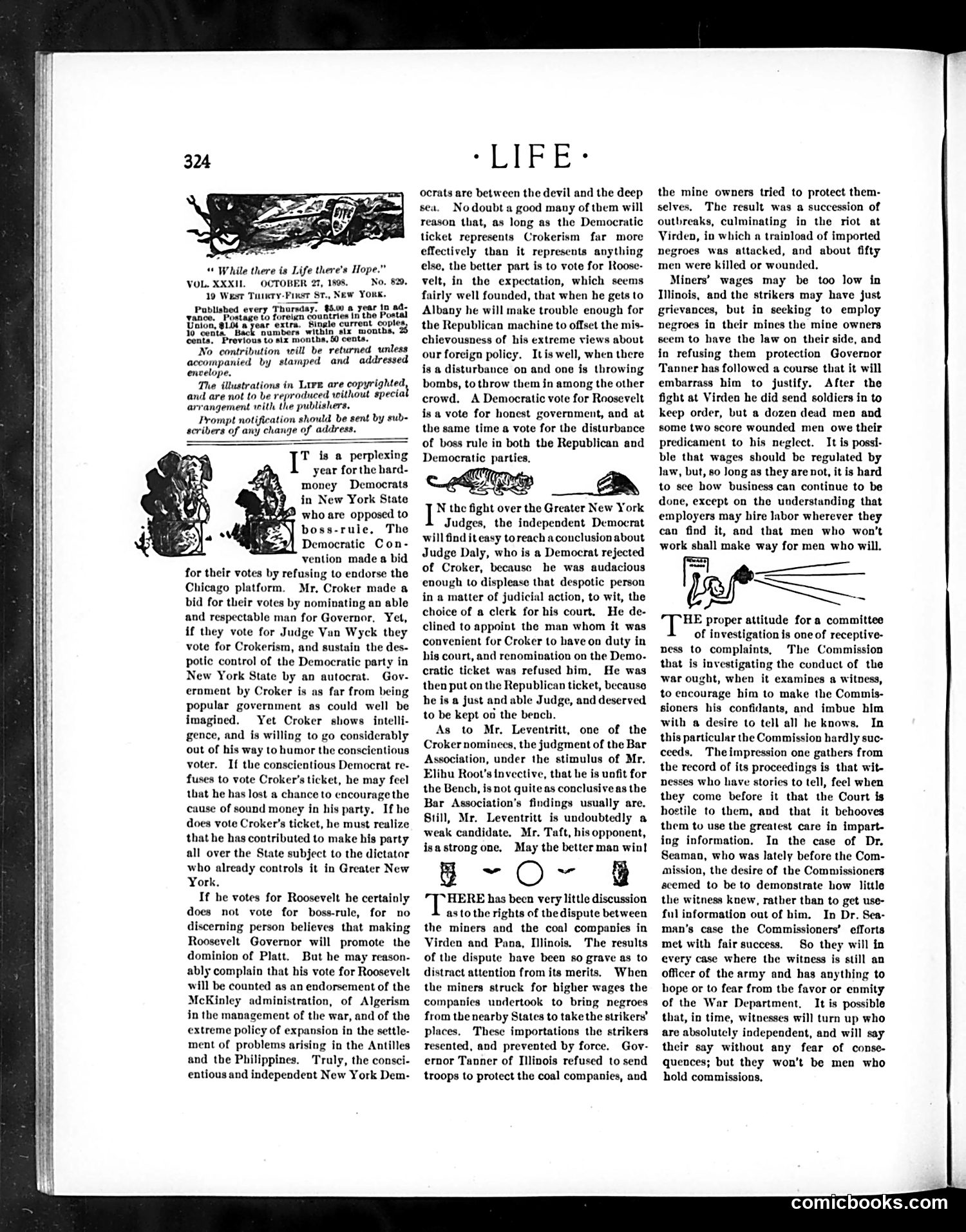
Political Satire Analysis: Life Magazine, October 27, 1906 Main Editorial Content: This page discusses the 1906 election, critiquing Democratic Party strategy. The text argues that voting for Roosevelt (Republican) versus the Democratic candidate represents a choice between honest government and political disruption. It suggests Democrats made an unsuccessful bid for Judge Croker's support at their Chicago convention, and criticizes their judicial selections. Visual Elements: The page features decorative political illustrations—caricatured figures in classical style, though specific identities are unclear from reproduction quality. These appear to be generic satirical representations rather than portraits of named individuals. Main Argument: Life's editors advocate for Roosevelt's re-election as superior to Democratic alternatives, framing the election as a choice between competent governance and machine politics.
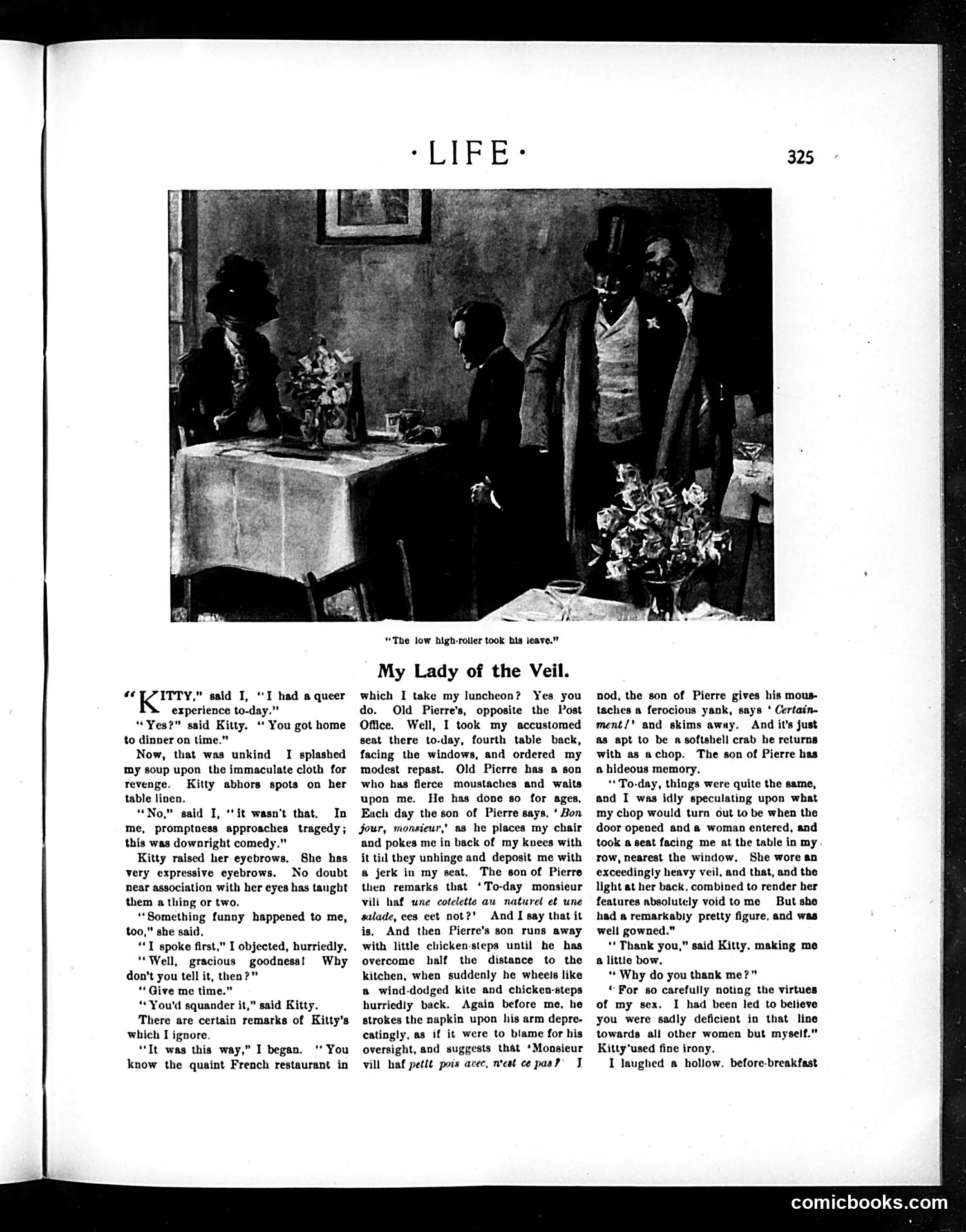
"My Lady of the Veil" - Life Magazine Page 325 This page presents a humorous short story rather than a political cartoon. The narrative, told by a character named "I," describes a dining experience at an upscale French restaurant where the narrator encounters an acquaintance named Kitty. The story satirizes French restaurant pretension and social affectation. The humor centers on Kitty's affected behavior—her "expressive eyebrows" and theatrical mannerisms—which the narrator finds ridiculous. The piece mocks both her attempts at sophistication and the pompous service at "Old Pierre's" restaurant, particularly through anecdotes about Pierre's son's exaggerated behavior and his dramatic napkin-folding. The satire targets upper-class dining culture and the absurdity of theatrical affectation among wealthy Americans attempting Continental sophistication.
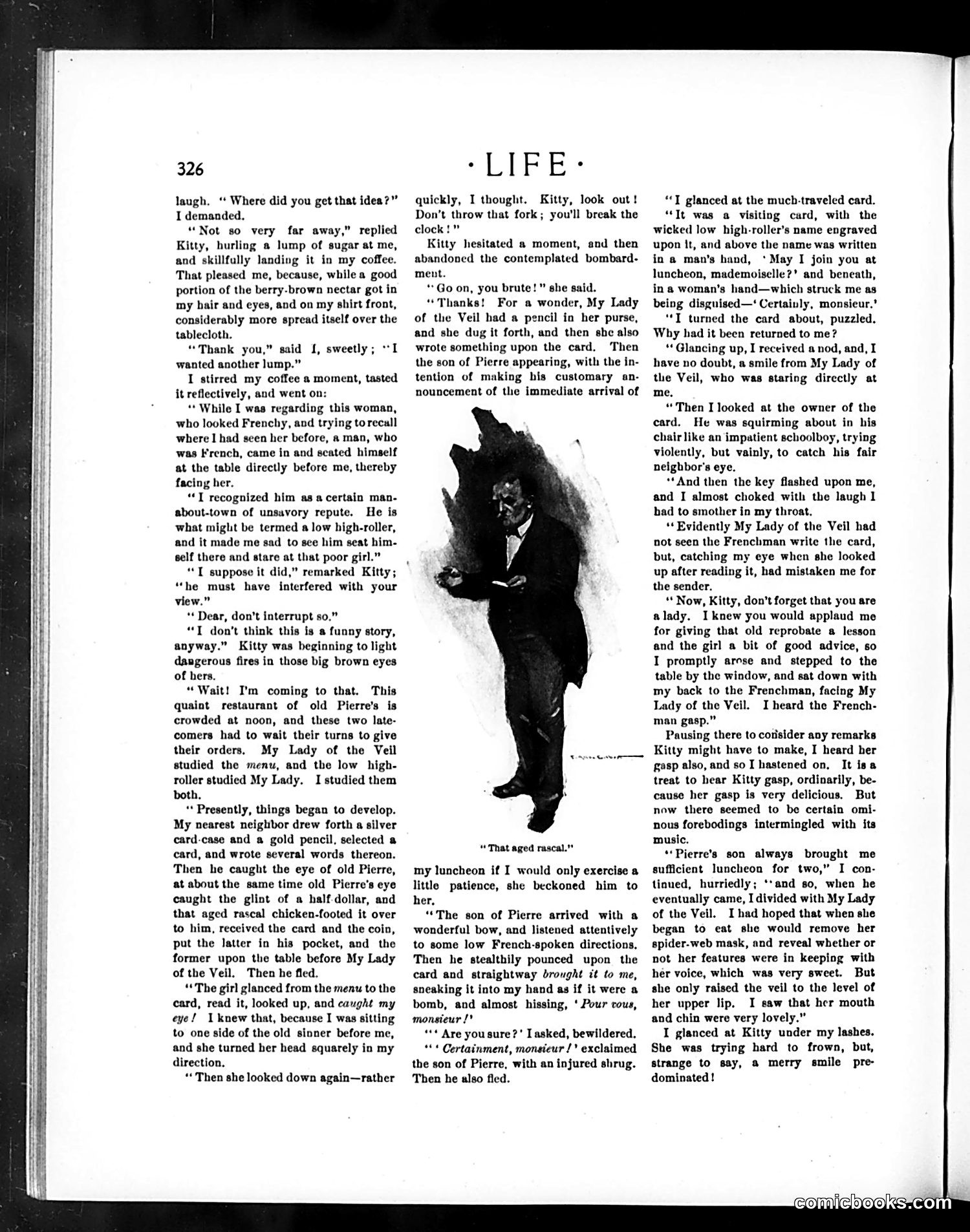
Analysis This page is primarily narrative fiction, not political satire or editorial cartooning. The text describes a romantic/comedic incident involving characters named Kitty, Pierre, and "My Lady of the Veil." The single illustration—labeled "That aged rascal"—depicts an elderly man in formal dress, apparently the character Pierre. He's portrayed as a scheming figure attempting to pass a card to the narrator, which becomes a source of confusion and intrigue in the story. The content is not political commentary. It's a serialized short story in *Life* magazine exploring themes of mistaken identity, social deception, and romantic entanglement among society characters. The "rascal" reference simply denotes Pierre's mischievous role in the plot. This represents *Life's* entertainment content rather than its satirical editorial function.
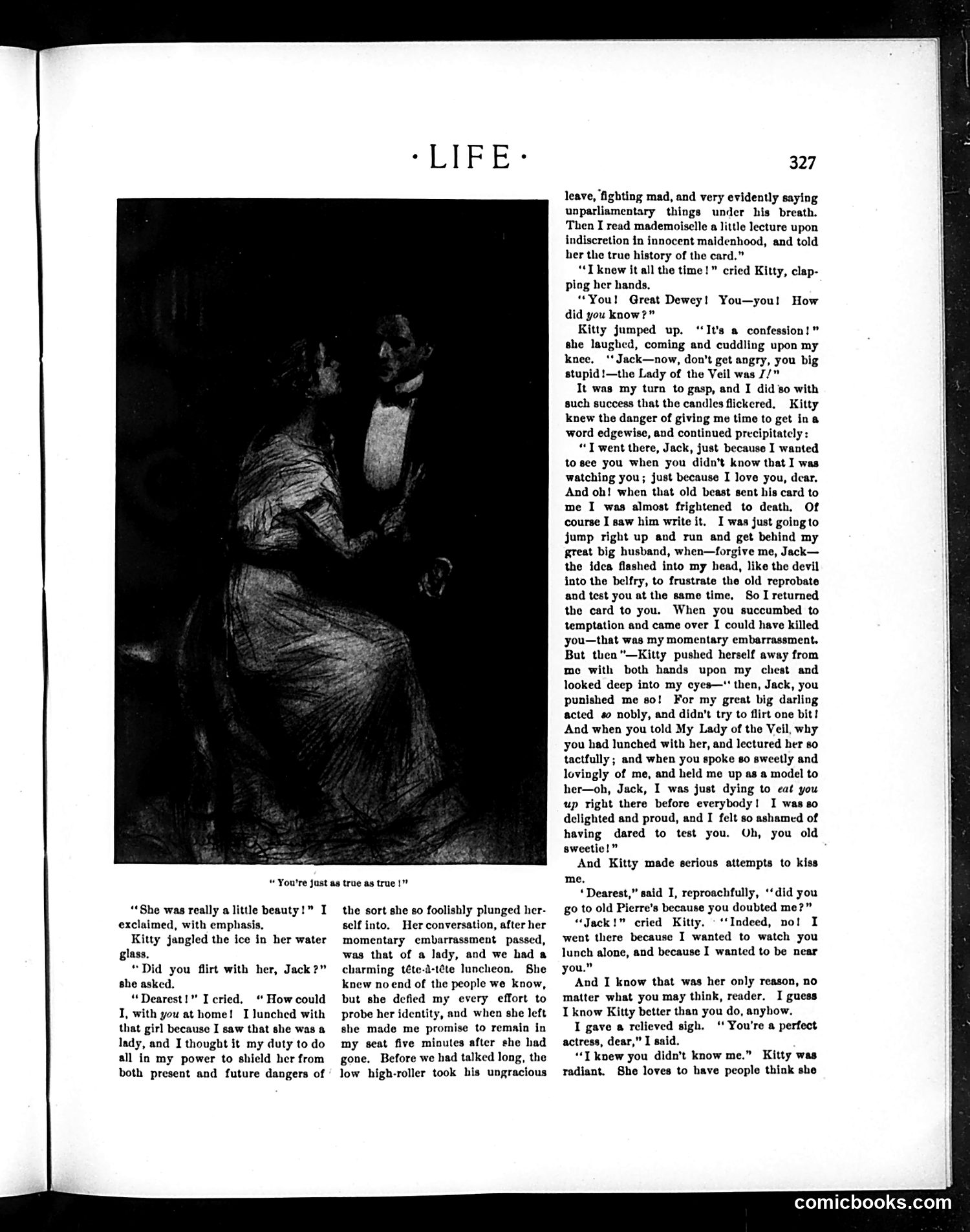
Analysis of Page 327 from Life Magazine This page contains a serialized story rather than political satire or comics. The single illustration shows a woman and man in an intimate embrace, accompanying narrative text about a romantic/domestic drama. The story involves characters named Jack and Kitty discussing infidelity and trust in their relationship. Kitty confesses to visiting someone named Pierre (likely to provoke jealousy), while Jack admits to lunching with "the Lady of the Veil." The narrative explores themes of marital temptation, jealousy, and reconciliation through confession and emotional manipulation. This appears to be popular fiction serialized in Life magazine, reflecting early 20th-century interest in domestic melodrama rather than political commentary. The "Lady of the Veil" reference suggests mystery/scandal, common tropes in period fiction.
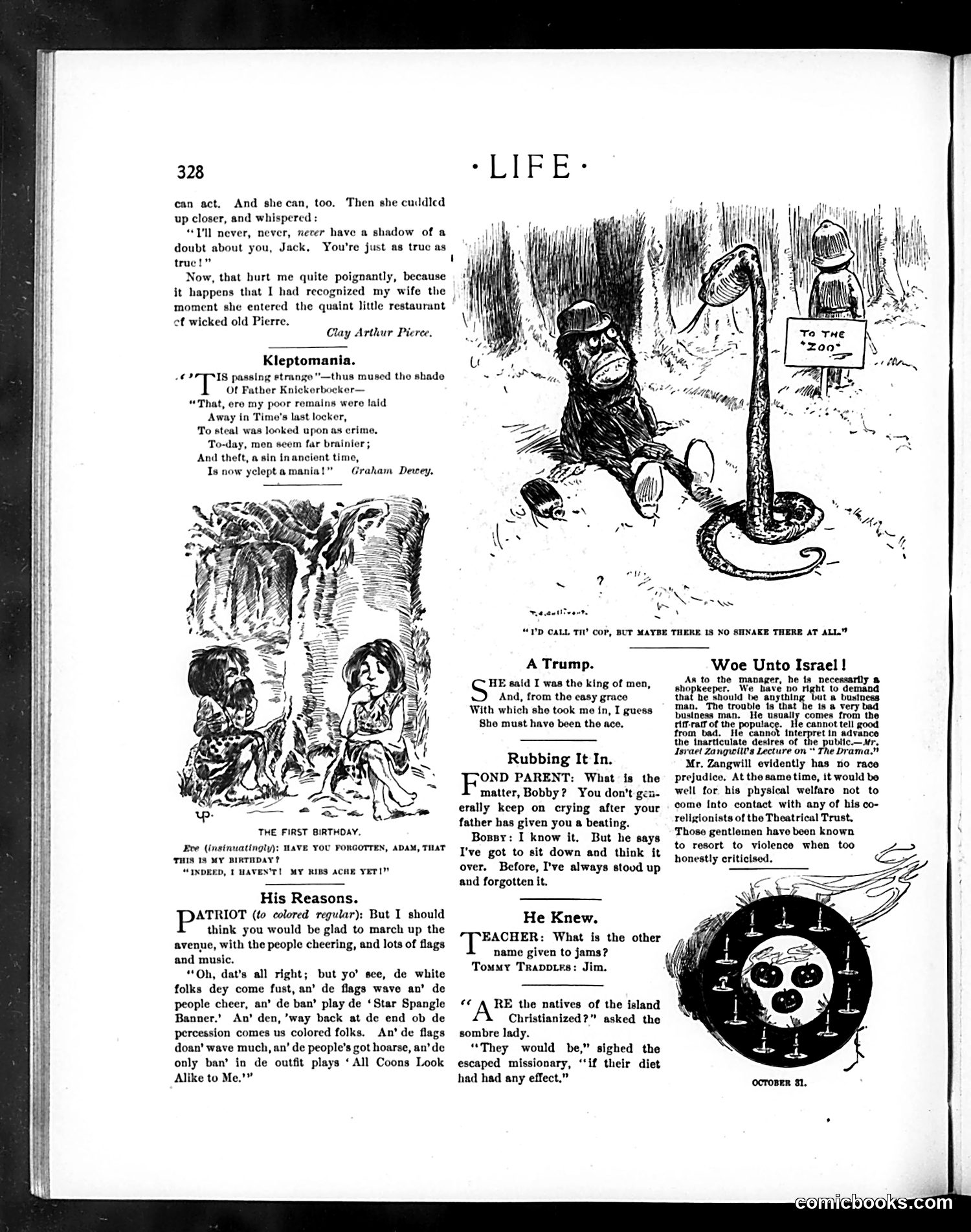
Analysis of Life Magazine Page 328 This page contains several humor pieces and illustrations typical of early 20th-century Life magazine. The main cartoon titled "I'D CALL TH' COP, BUT MAYBE THERE IS NO SNAKES THERE AT ALL" shows an animal (appears to be a monkey or ape) at a zoo entrance, playing on fears and anxieties about reporting crime or disturbances when uncertain of the facts. Other sections include short humorous dialogues: "A Trump," "Rubbing It In," and "He Knew"—brief comedic exchanges about everyday situations like a child receiving punishment, parent-child dynamics, and a teacher questioning students about missionaries. The illustrations by various artists satirize ordinary social situations and human foibles rather than specific political figures or events. The satire targets universal human behaviors: dishonesty, stubbornness, and moral hypocrisy.
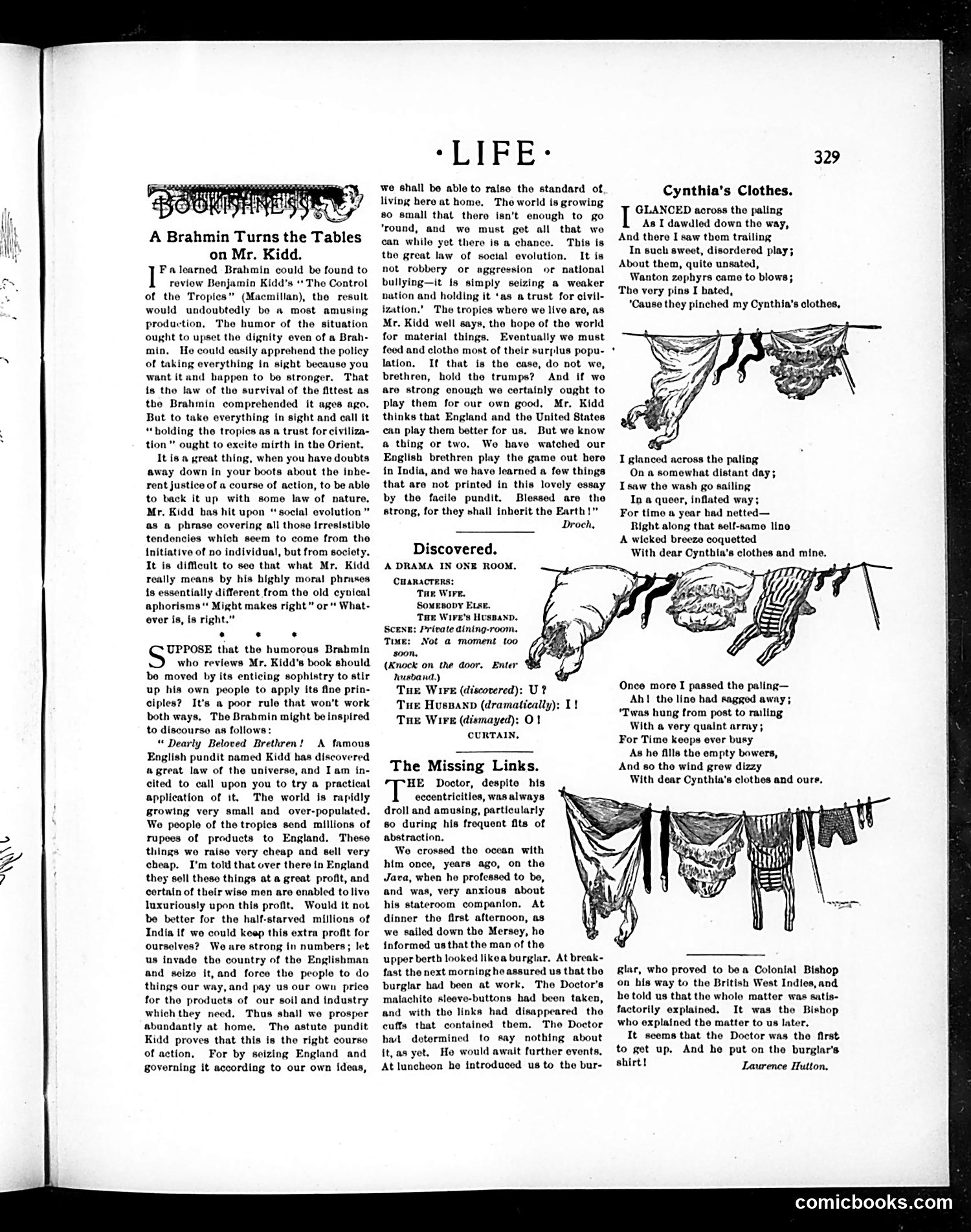
Analysis of Life Magazine Page 329 This page contains three distinct pieces: a satirical article about Benjamin Kidd's social theories, a one-act dramatic sketch titled "Discovered," and a poem called "Cynthia's Clothes." The main satire criticizes Benjamin Kidd (an actual social theorist) for advocating that England should colonize tropical regions to solve overpopulation. The author mocks Kidd's proposal as impractical, arguing England already profits from India without needing additional colonies. The dramatic sketch depicts a domestic quarrel where a husband discovers his wife's clothing missing—implying infidelity or elopement. The accompanying poem satirizes a woman's obsession with fashionable clothes, depicting laundry day with garments drying on a line. The illustrations show clotheslines with period-appropriate garments, supporting the domestic comedy themes.
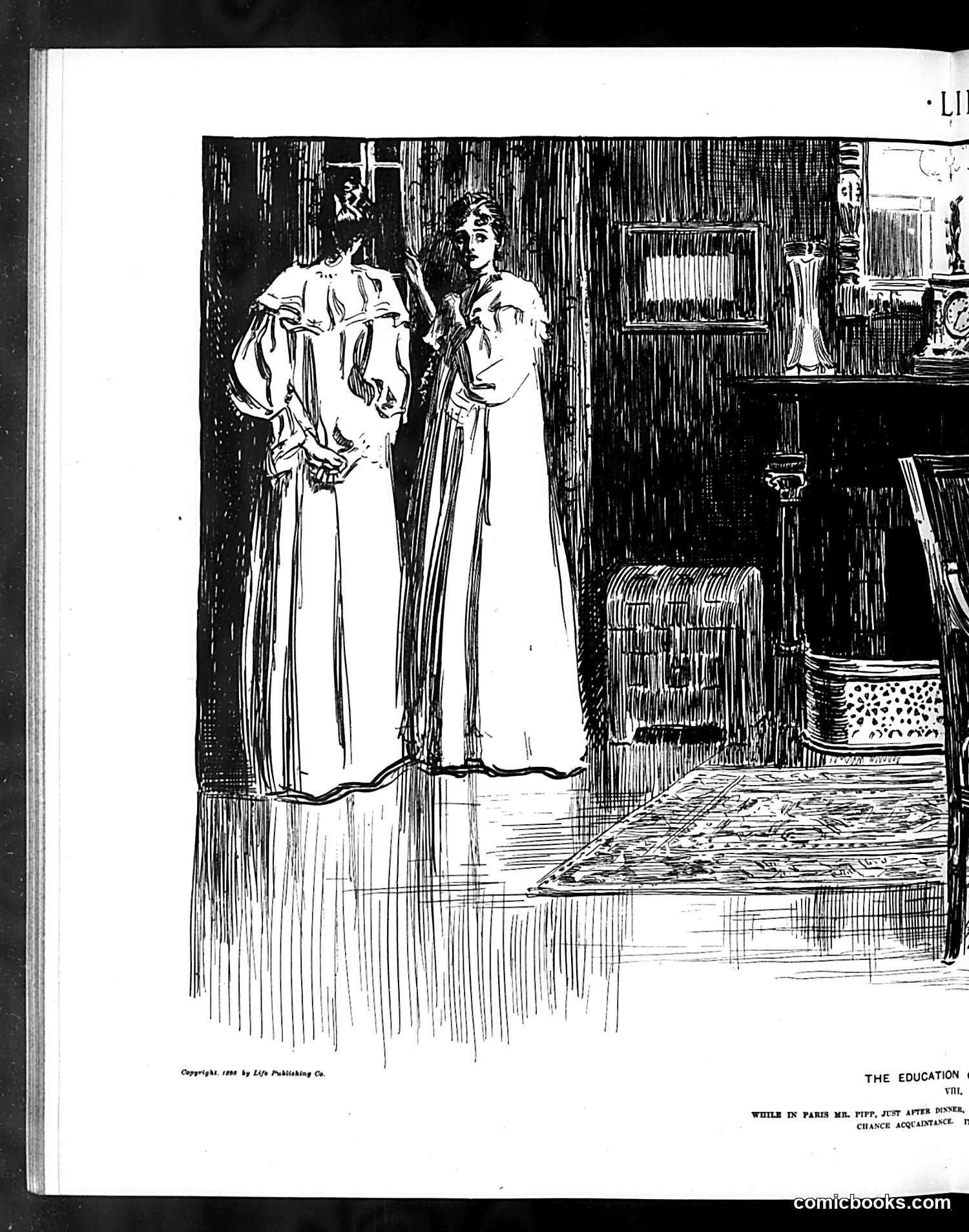
Analysis This is an illustration from Life magazine (copyright 1902 by Life Publishing Co.) titled "The Education of the Duke: While in Paris Mr. Pitt, Just After Dinner, Chance Acquaintance H[...]" The sketch depicts two women in long, flowing white gowns in an elegant interior room. The caption references "Mr. Pitt" and a "chance acquaintance" in Paris, suggesting a satirical scene about a gentleman's social encounters or romantic misadventure abroad. Without additional context about who "Mr. Pitt" refers to or what specific incident this illustrates, the precise target of satire is unclear. However, the title's phrase "education of the Duke" suggests mockery of aristocratic behavior or romantic entanglements in Paris—a common subject of early 20th-century American satirical humor about wealthy Americans or British nobility abroad.
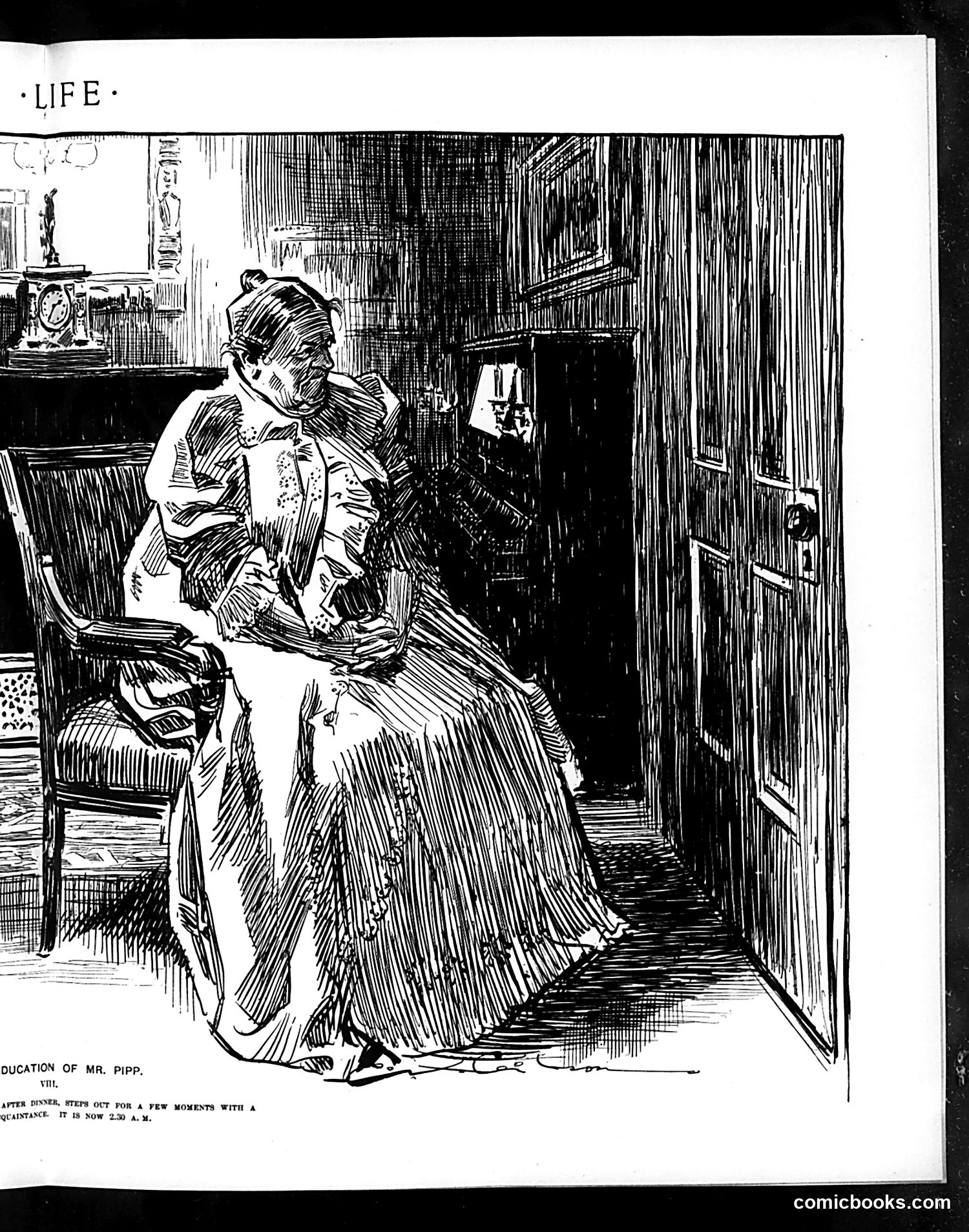
"The Education of Mr. Pipp" - Life Magazine This appears to be an illustration from a serialized story or comic in *Life* magazine titled "The Education of Mr. Pipp" (episode VIII). The caption indicates: "After dinner, steps out for a few moments with a acquaintance. It is now 2:30 A.M." The image shows a woman in period dress (early 20th century) sitting in a parlor, apparently waiting. The scene suggests satirical commentary on courtship or social etiquette—likely mocking either the woman's patience during a prolonged evening or the man's behavior in stepping out with an "acquaintance" at an inappropriate late hour. Without seeing preceding episodes, the specific joke about "education" remains unclear, but the tone suggests gentle social satire about Victorian-era dating customs and propriety.
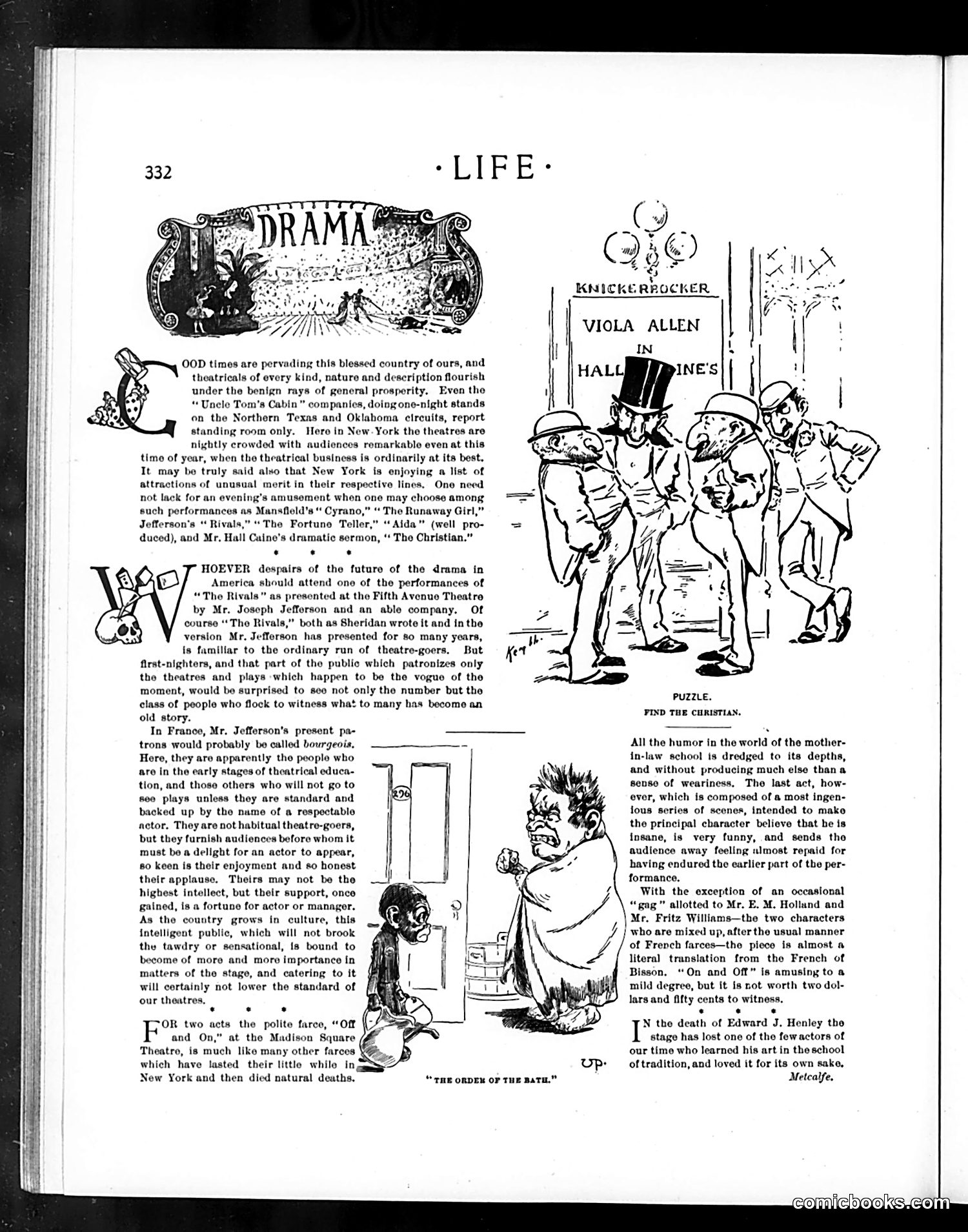
"Hall Caine's" Drama Review - Life Magazine This page reviews theatrical productions on Broadway, focusing on a play called "The Rivals" at the Fifth Avenue Theatre. The main illustration shows a caricatured scene titled "Puzzle: Find the Christian," depicting exaggerated figures in what appears to be a comedic critique of morality in theater. The text discusses American drama's future, noting that while New York theaters are crowded, audiences flock to popular rather than high-quality productions. It criticizes the "vogue of the moment" drawing crowds based on celebrity rather than artistic merit. The review mentions a French farce "Off and On" at the Madison Square Theatre that "lasted their little while in New York and then died natural deaths"—satirizing the disposable nature of certain theatrical productions.
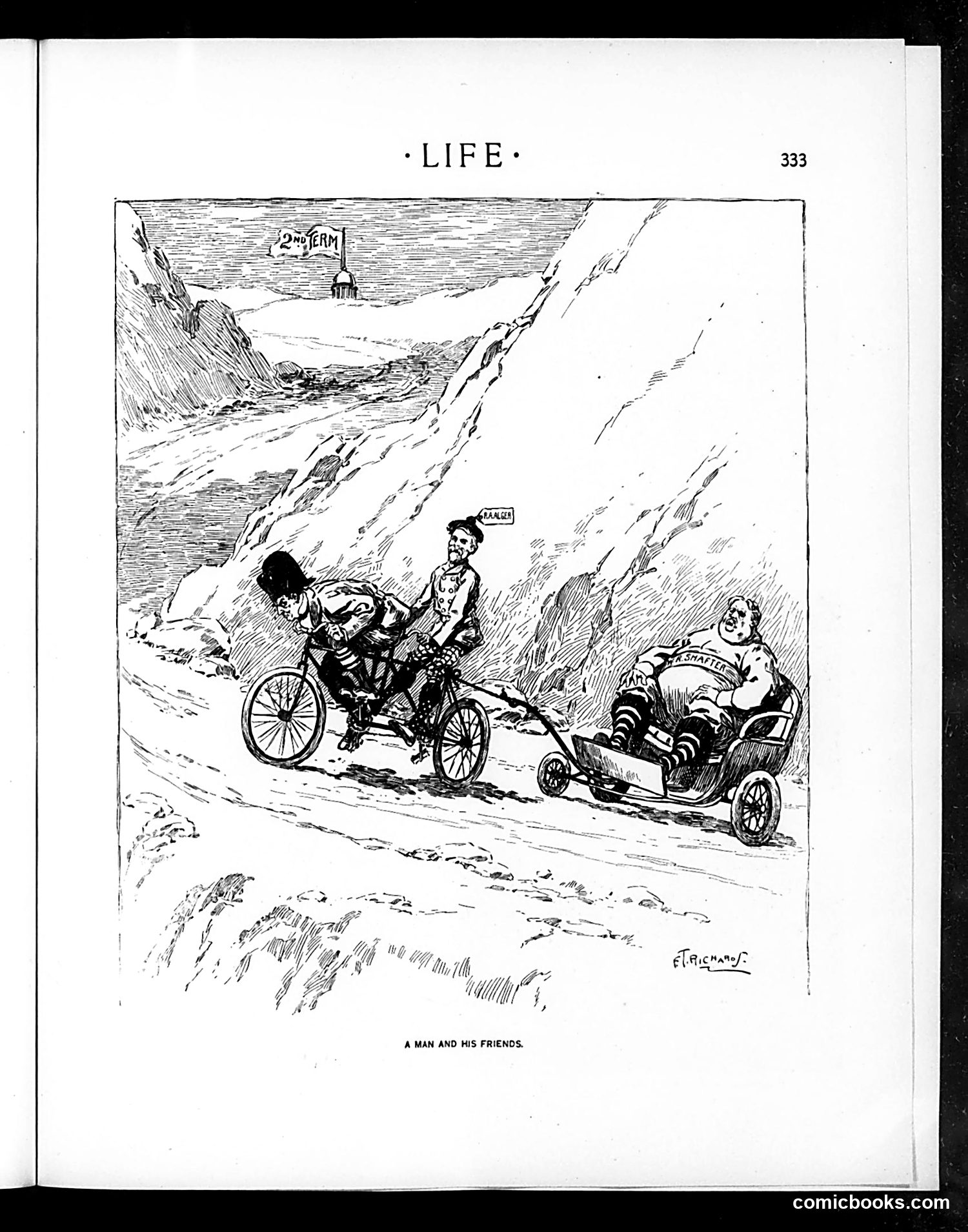
"A Man and His Friends" This satirical cartoon from *Life* magazine depicts three figures on a mountainous road: a man on a bicycle (center), another man standing/gesturing (left), and a larger figure in a cart being pulled (right). The style and composition suggest social commentary on friendship or companionship dynamics. The humor likely centers on the physical disparity and effort involved—the bicyclist and walker must exert themselves to transport their heavyset companion. This appears to be satire about unequal relationships or the burden of supporting someone, though without specific historical context, the exact political or social reference remains unclear. The rustic mountain setting adds to the comedic visual contrast.
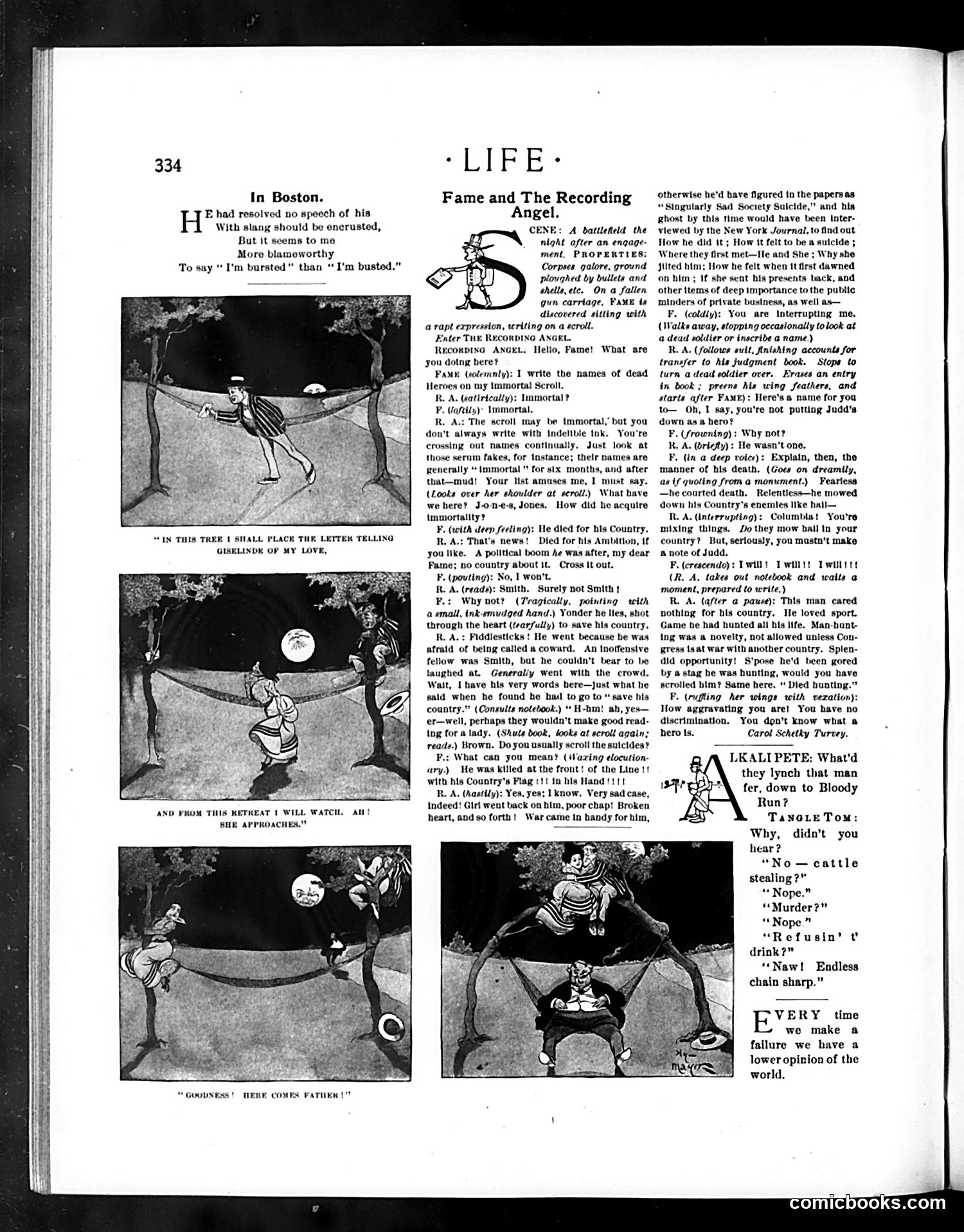
Analysis of "Fame and The Recording Angel" This dialogue-driven cartoon satirizes how war heroism gets mythologized and manipulated. The Recording Angel (representing divine truth/judgment) confronts Fame (representing public memory/propaganda) as she inscribes soldiers' names on an "immortal scroll" after battle. The satire targets false heroism narratives: Jones died for political ambition, not country; Smith was motivated by fear of cowardice, not patriotism; Brown was actually a suicide whose death conveniently got reframed by war. The Recording Angel systematically debunks Fame's sanitized versions, revealing selfish or desperate motives beneath heroic rhetoric. The final example—Judd, whom Fame describes poetically as "fearless" and "relentless"—gets caught in absurdity when the Angel questions whether soldiers actually "mow hail" (mixing metaphors), exposing how Fame creates false mythological language. The cartoon critiques how societies construct false historical narratives around war deaths, transforming complicated human failures into inspiring propaganda.
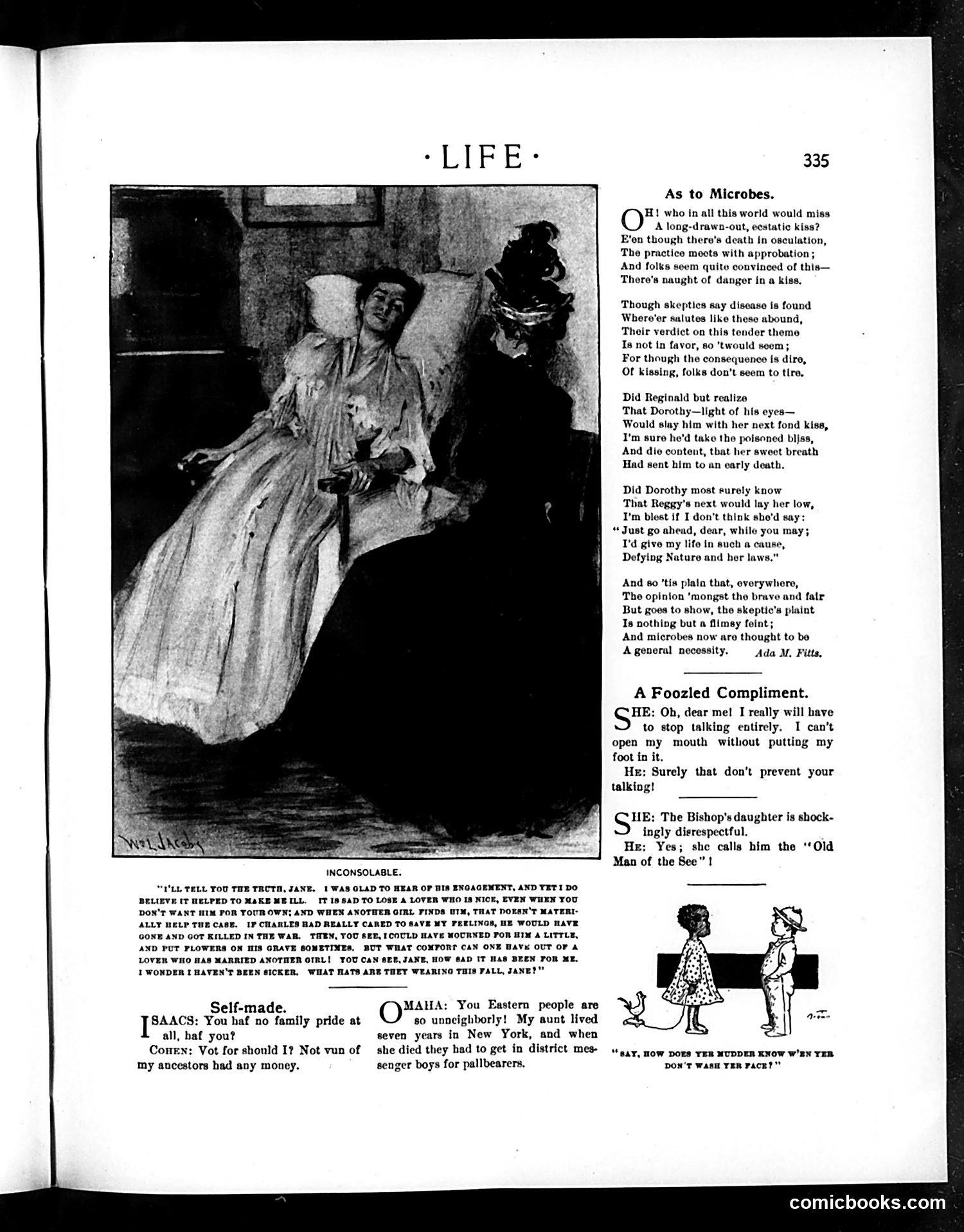
Content Analysis: Life Magazine Page 335 This page contains several humor pieces typical of early 20th-century Life magazine: "As to Microbes" (top): A poem by Ada M. Fitts satirizes public dismissal of germ-theory dangers, specifically regarding kissing. It mocks young lovers (Reginald and Dorothy) who would accept fatal illness from each other's kisses rather than forgo romance. The satire targets the tension between scientific warnings about disease transmission and widespread romantic/social practices—people knew kissing spread microbes but ignored the risk. "A Foozled Compliment" and "The Bishop's Daughter": Brief joke exchanges playing on verbal mishaps and disrespect. "Inconsolable" (center): A dramatic monologue from a jilted woman complaining that her former lover's engagement and marriage (rather than dying heroically in war) leaves her without romantic outlet or dignity. "Self-made" and "Maha" (bottom): Short ethnic-humor pieces stereotyping Jewish and Eastern immigrants about ancestry and neighborliness. The left illustration appears to show an intimate scene, likely supporting the microbes poem's theme.
"Jim Scissors at Nully's" - A Satirical Take on the Spanish-American War This page contains humorous anecdotes rather than political cartoons. The main feature is a mock-Chinese dialect monologue from a Chinese steward aboard the USS Oregon, describing the ship's famous Pacific-to-Atlantic voyage and combat against the Spanish fleet off Santiago during the 1898 Spanish-American War. The satire works on multiple levels: it celebrates American naval victory and military superiority while simultaneously mocking both Chinese immigrants (through exaggerated pidgin English) and the Spanish as incompetent fighters ("Splantard he no good, get dlunkee"). The humor relies on ethnic caricature—a period-standard but deeply offensive comedic device. The anecdote about General Grant and Governor Seymour references their 1868 presidential contest, with Seymour's witty acknowledgment of Grant's electoral victory drawing applause. The page also includes a legal anecdote involving courtroom humor about repeating slander.
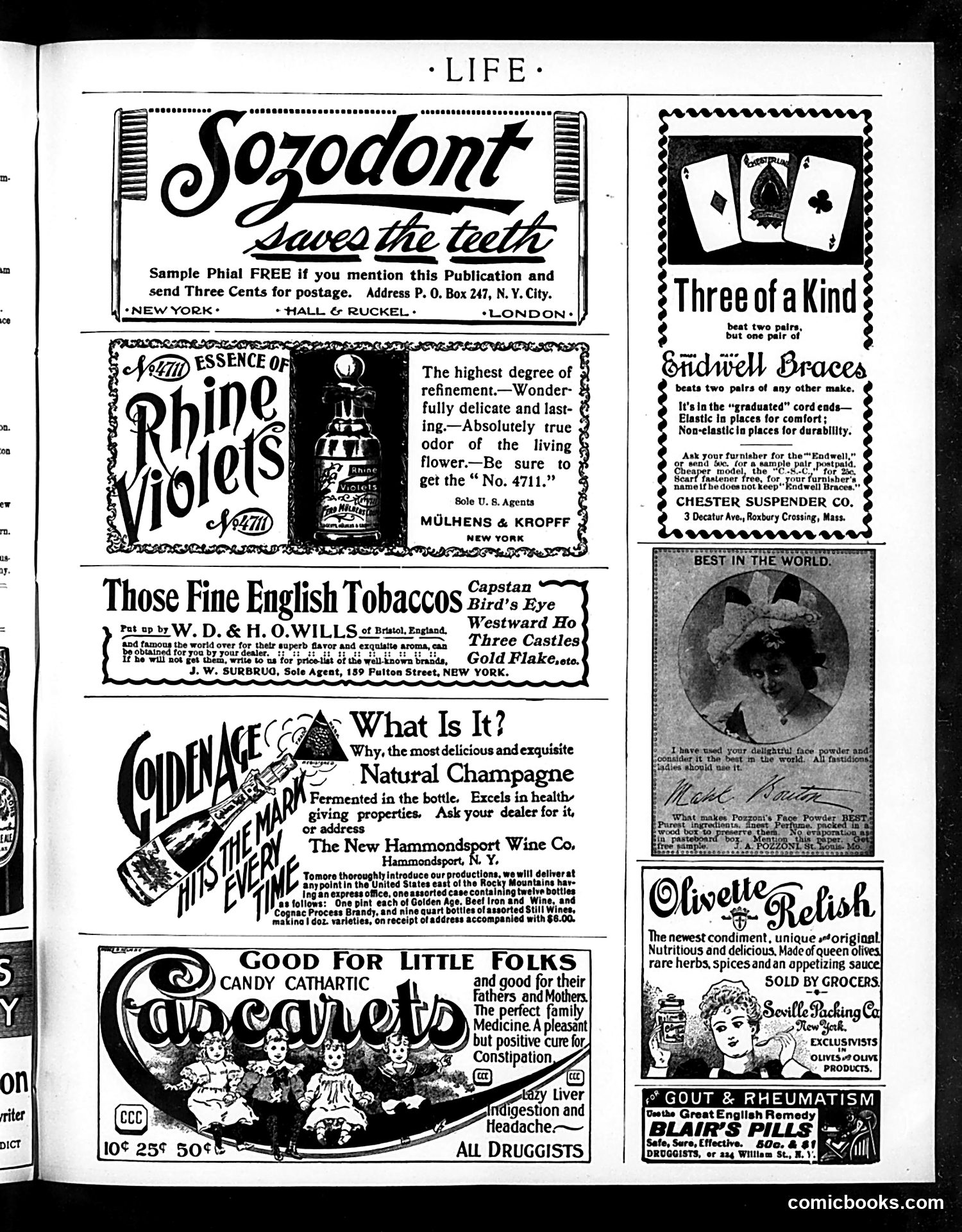
Advertising Page from Life Magazine This is primarily an advertising page, not a satirical cartoon. It contains approximately 10 product advertisements typical of early 20th-century American magazines. Notable ads include: - Sozodont toothpaste (offering free sample) - Essence of Rhine Violets perfume - English Tobaccos by W.D. & H.O. Wills - Goldnage Natural Champagne wine - Caviare's Candy (a cathartic/laxative marketed as family medicine) - Endwell Braces (suspenders) - Olivette Relish (olive condiment) - Blair's Pills (for gout and rheumatism) The page reflects common early 1900s patent medicine advertising, where dubious health claims were unregulated. Products like Caviare's and Blair's Pills exemplify the era's widespread promotion of questionable remedies for constipation, indigestion, and various ailments—practices that would later prompt FDA regulations.
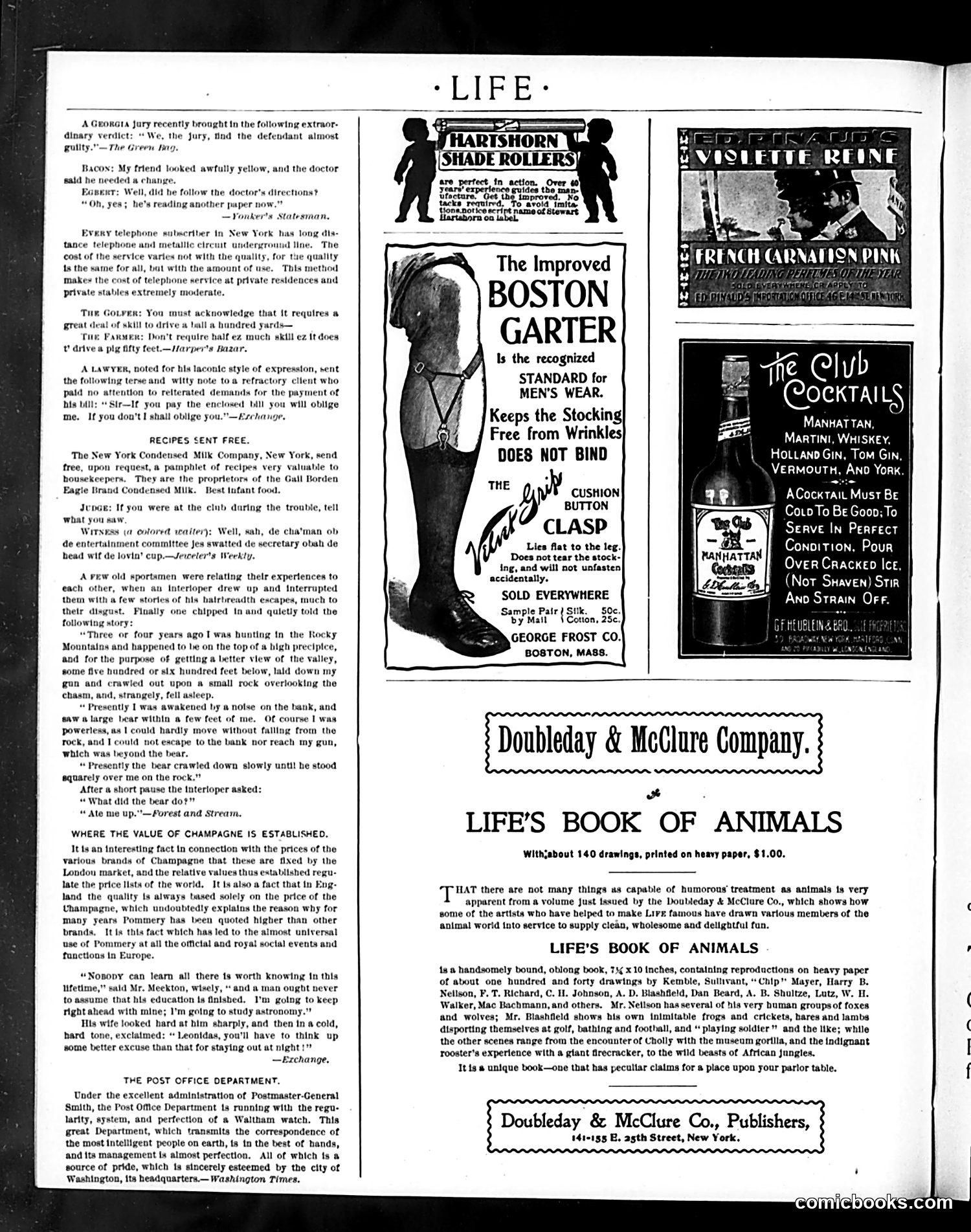
Analysis of Life Magazine Page Content This page is primarily advertisements and humorous anecdotes rather than political cartoons. The small jokes scattered throughout mock everyday situations: a jury verdict about someone "guilty," a doctor's advice ignored, telephone service complaints, and lawyers' terse bill collection. These reflect common turn-of-the-century frustrations. The main story—a hunter's tall tale about encountering a bear on a mountain precipice—follows the page's satirical tone: an elaborate, implausible adventure story interrupted by skeptical listeners. The punchline ("What did the bear do?") is cut off, typical of the era's serialized humor. The advertisements (Boston Garter, shoe cushion buttons, cocktail recipe) show period products. A "Life's Book of Animals" is advertised as educational entertainment. No identifiable political figures or specific dated events appear here. This is a typical page from Life magazine's lighter, miscellaneous humor section rather than its satirical commentary pages.
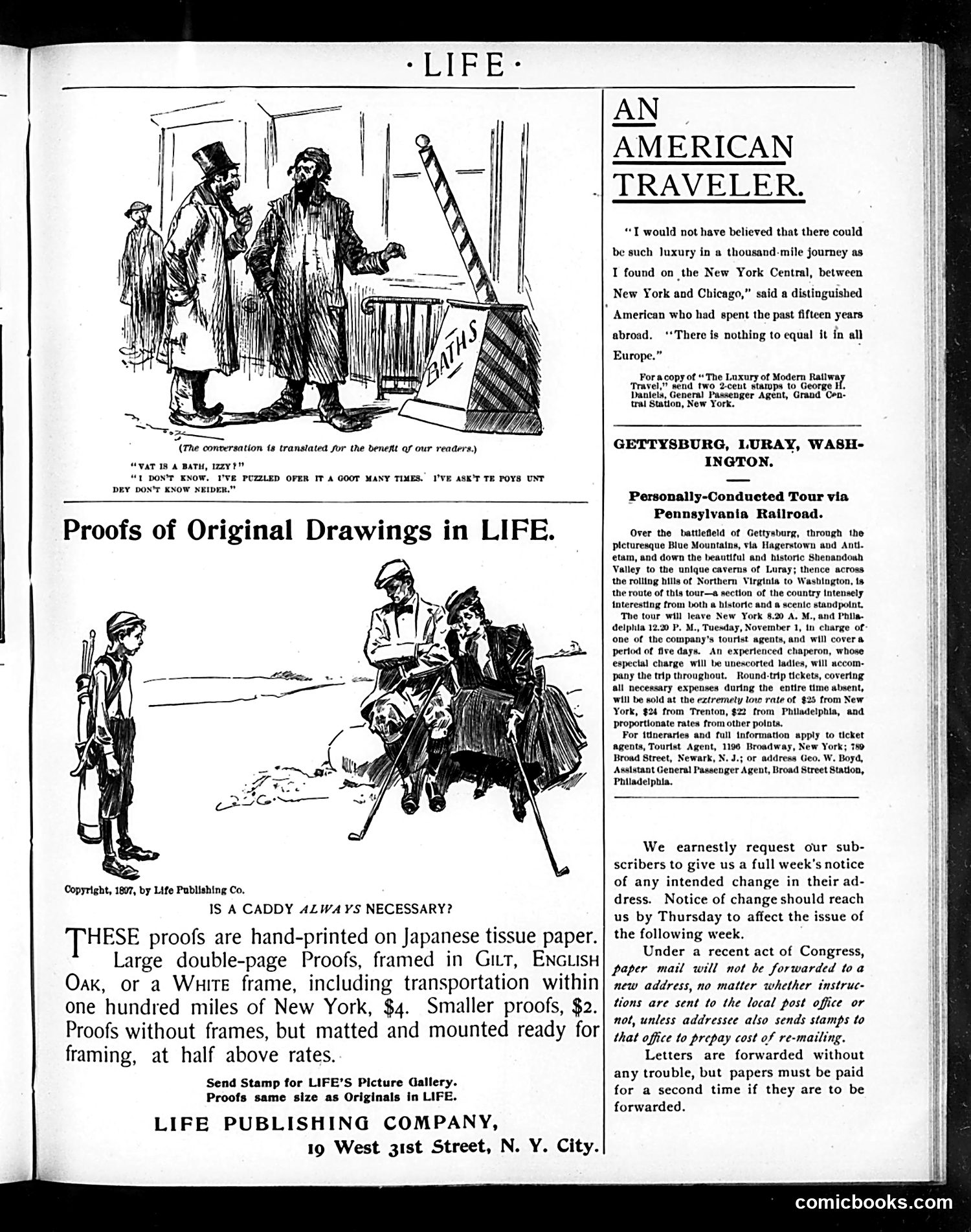
Explanation of the Cartoons and Content The top cartoon depicts Jewish immigrants ("Izzy" and companions, identifiable by the Yiddish dialect and stereotypical caricature) puzzled by the concept of a bath—a joke about poor European immigrants unfamiliar with American plumbing and hygiene standards. This reflects late-19th-century American stereotypes about recent arrivals. The middle cartoon, "Is a Caddy Always Necessary?" shows a caddy observing two golfers struggling awkwardly with their sport, satirizing upper-class leisure activities and perhaps suggesting incompetence among amateurs. The page is primarily advertising and editorial content, promoting railroad tours (Pennsylvania and New York Central lines), Life magazine's art proofs for sale, and subscription management notices. The cartoons serve as filler alongside commercial pitches for tourist travel and luxury rail service—typical of Life's satirical-but-commercial format around 1897.
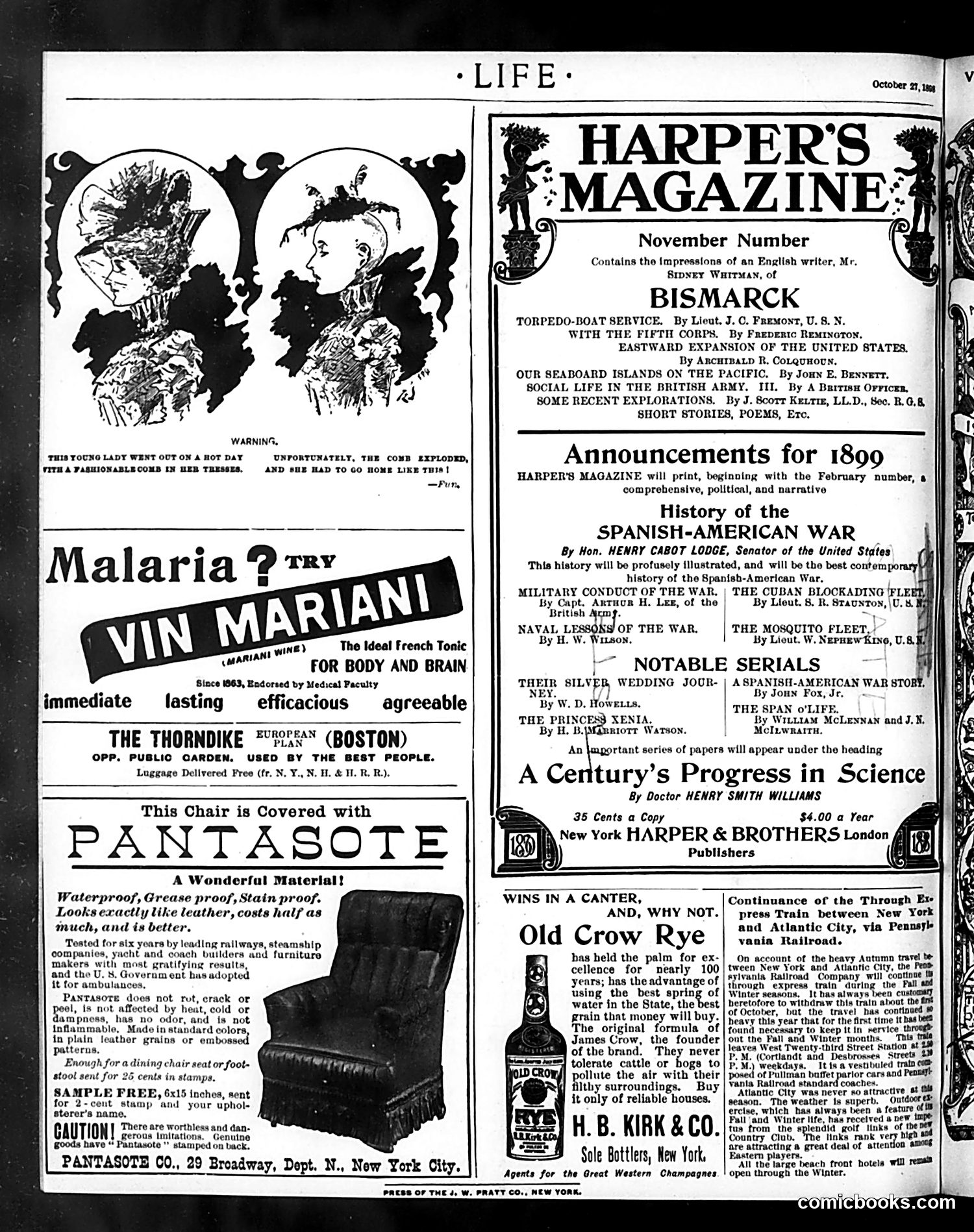
Life Magazine, October 21, 1898: Page Analysis This is primarily a title/contents page and advertisement section for Harper's Magazine's November 1898 issue, not a satirical cartoon page. The only cartoon visible is a small humorous sketch at top-left: a cautionary joke about a young woman whose fashionable decorative comb exploded from heat on a hot day, forcing her to return home disheveled. This is gentle social satire about the impracticality of ornate Victorian women's fashion accessories. The page is dominated by announcements for 1899 content, heavily emphasizing Harper's planned comprehensive history of the Spanish-American War (recently concluded in 1898), featuring Senator Henry Cabot Lodge and military analysis. This reflects contemporary American interest in the war and the nation's emerging imperial ambitions. The remaining space features period advertisements for patent medicines (Vin Mariani tonic), furniture materials (Pantasote), whiskey (Old Crow Rye), and railroad services—typical commercial content of the era.