life
Life — August 23, 1929
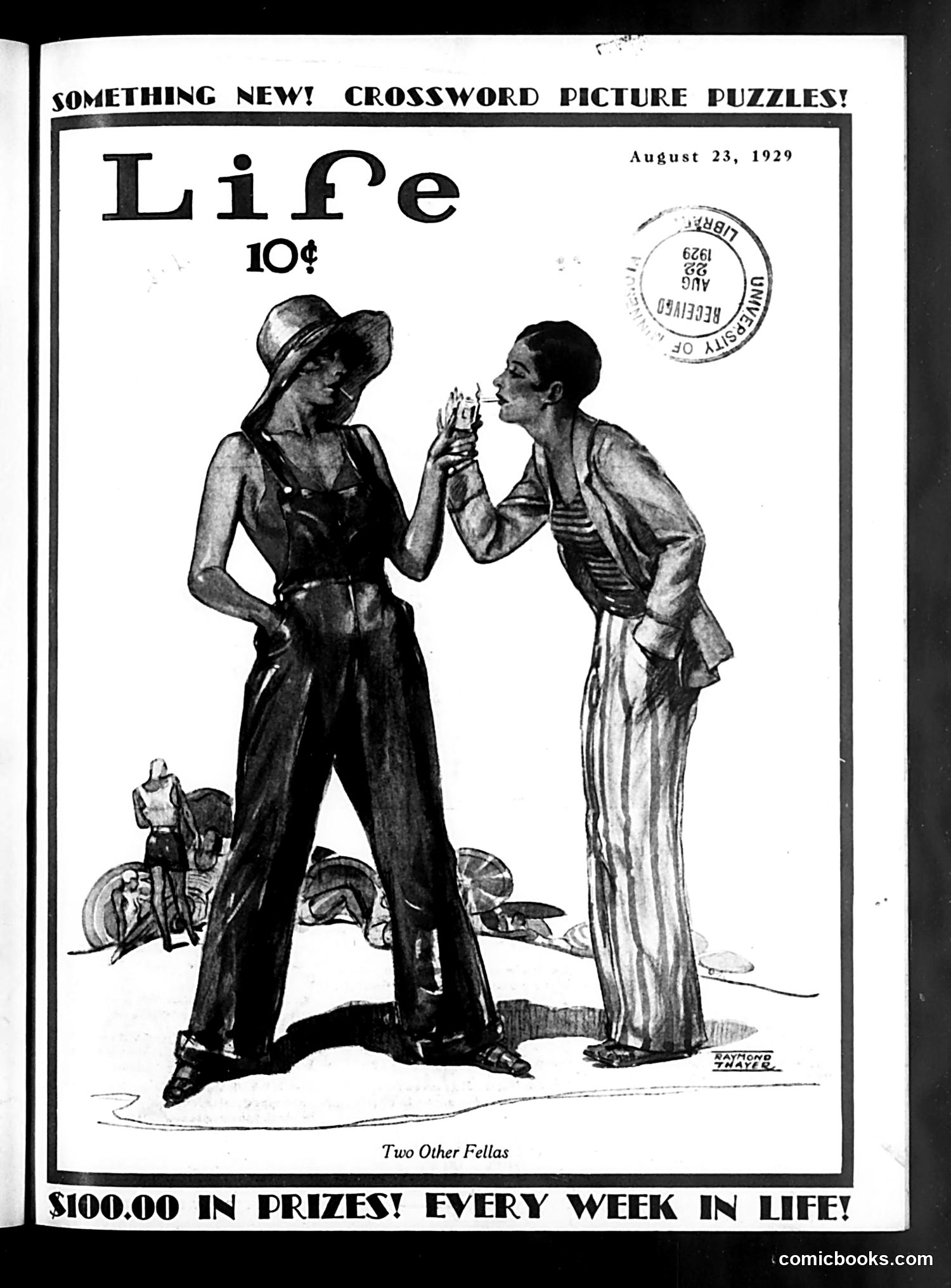
Life Magazine Cover Analysis - August 23, 1929 This is a Life magazine cover featuring an illustration titled "Two Other Fellas." The image shows two men in 1920s attire engaged in conversation near a beach, with swimming equipment visible in the background. The cover advertises "SOMETHING NEW! CROSSWORD PICTURE PUZZLES!" and "$100.00 IN PRIZES! EVERY WEEK IN LIFE!" This reflects Life's shift toward interactive entertainment content during the late 1920s. The illustration itself appears to be a humorous domestic or social scene typical of Life's satirical approach to contemporary manners and relationships. Without clearer identifying details or captions, the specific satirical target remains unclear, though the casual beach setting and the figures' body language suggest commentary on social interactions or dating customs of the Jazz Age era.
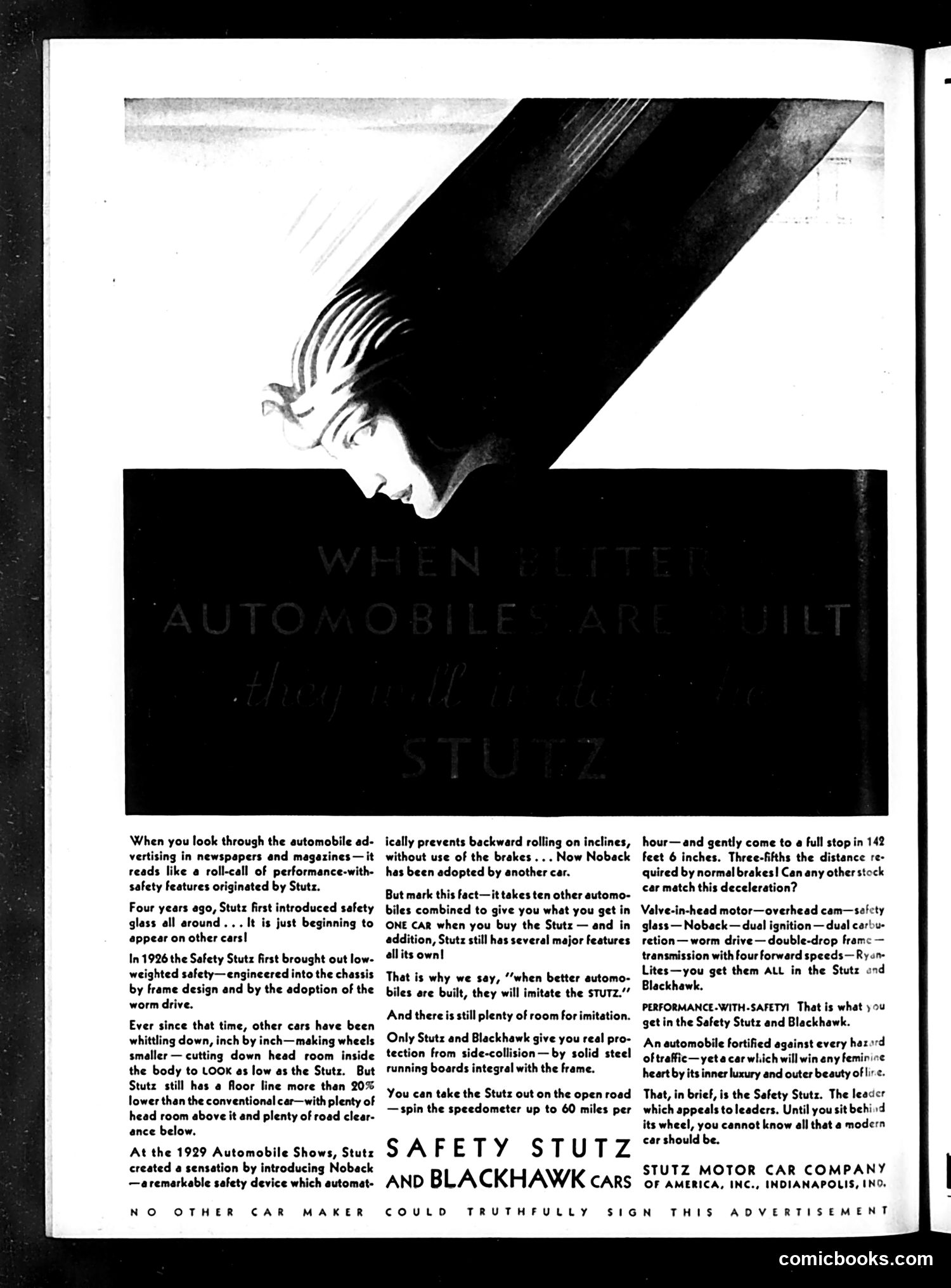
Analysis This page is primarily an advertisement, not satire or political commentary. It promotes Safety Stutz and Blackhawk automobiles made by Stutz Motor Car Company of Indianapolis. The illustration shows a stylized profile of a woman's head tilted back, with a large black diagonal shape (likely representing a car hood or chassis element) overhead. This is a design-focused advertisement emphasizing the car's engineering innovations. The text discusses Stutz's safety features introduced in 1929, including safety glass and the Noback device preventing backward rolling on inclines. It positions Stutz and Blackhawk as performance vehicles with advanced safety technology, claiming "no other car maker could truthfully sign this advertisement." There is no political satire present—this is straightforward commercial advertising from the automobile industry's early safety-feature era.
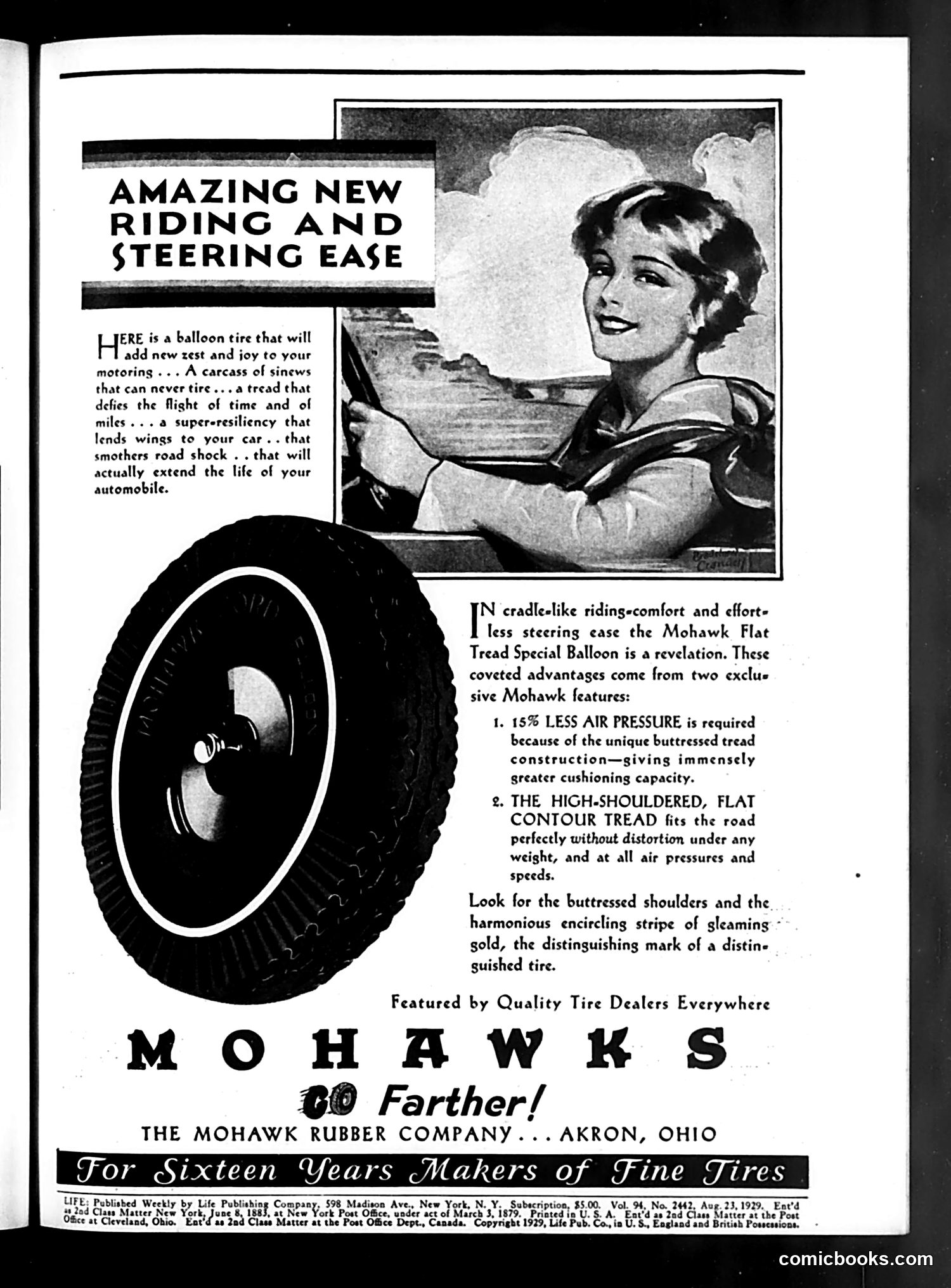
Analysis This page is primarily an advertisement, not satire or political content. It's a 1929 promotional ad for Mohawk brand automobile tires, specifically the "Flat Tread Special Balloon" model. The ad features a smiling woman driver to appeal to the growing market of female motorists in the late 1920s. The accompanying copy emphasizes comfort and ease—"cradle-like riding comfort and effortless steering ease"—positioning the tire as luxurious and modern. The two key selling points highlighted are reduced air pressure requirements and a flat-contour tread design. The ad notes these tires were "Featured by Quality Tire Dealers Everywhere" and credits Mohawk's "Sixteen Years" as tire manufacturers based in Akron, Ohio. This represents typical automotive advertising of the Jazz Age period, targeting the expanding consumer car market.
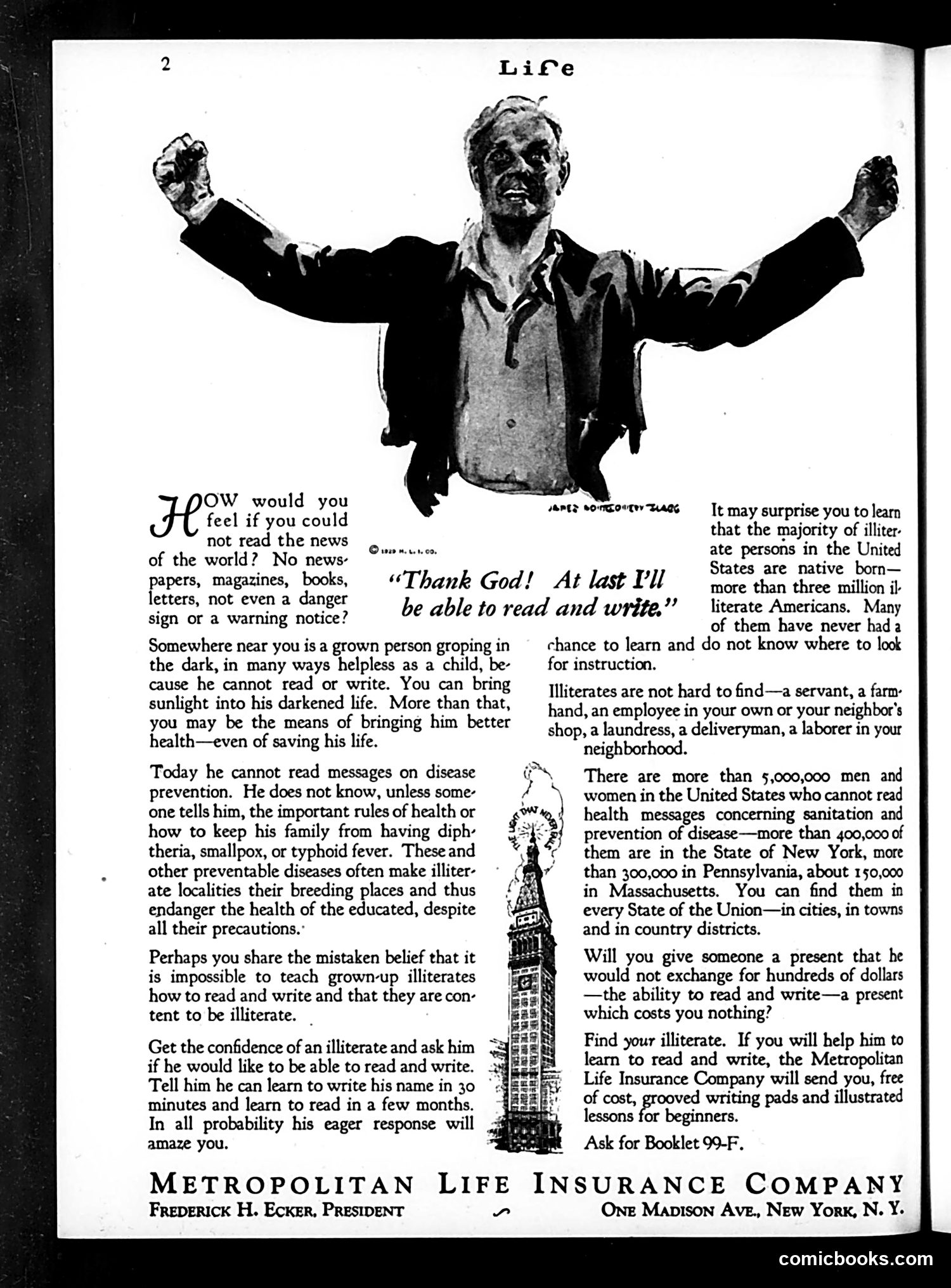
Analysis This page is primarily a Metropolitan Life Insurance Company advertisement, not satire or political commentary. The image shows a jubilant man with arms raised, captioned "Thank God! At last I'll be able to read and write." The ad addresses adult illiteracy in early 20th-century America, claiming over 5 million illiterate adults existed nationwide. It argues that teaching illiterates to read is feasible and valuable—potentially preventing disease spread through health ignorance and improving overall wellbeing. The advertisement encourages readers to identify illiterate acquaintances (servants, farmhands, laborers) and help them learn using free materials Metropolitan Life would provide. The tone is paternalistic, reflecting contemporary attitudes toward education as a moral/civic duty. This represents corporate social responsibility messaging of that era, using uplift narratives to promote brand goodwill while addressing genuine literacy gaps.
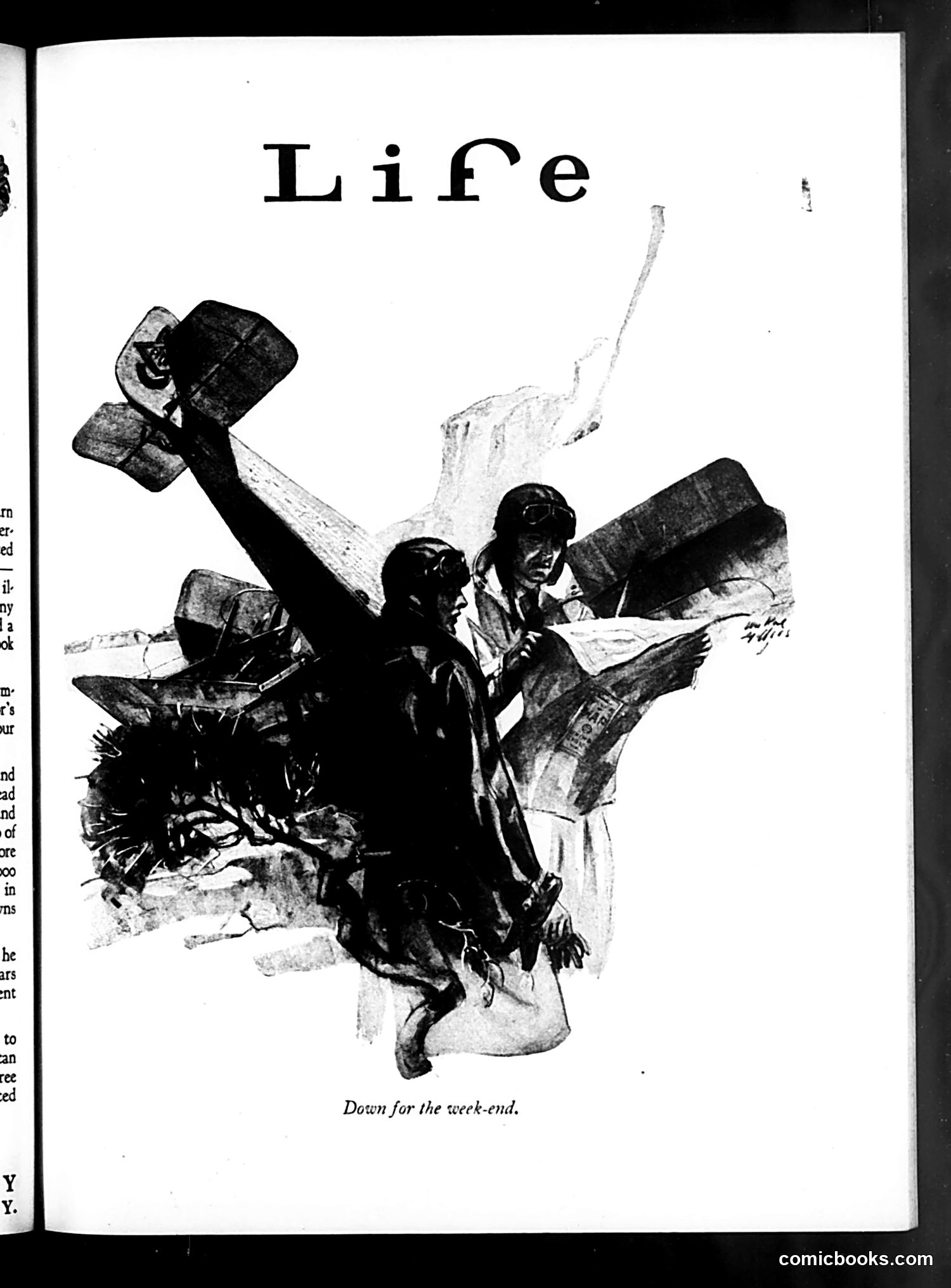
"Down for the week-end" This Life magazine page satirizes wealthy urbanites heading to the countryside for leisure. The illustration shows three figures in suits tumbling chaotically off what appears to be a vehicle or conveyance, accompanied by baggage and a dog. The humor stems from the contrast between the aspirational image of a relaxing weekend escape and the actual comic chaos of travel—overpacked luggage, ungainly poses, and general disarray. The caption "Down for the week-end" plays on this tension between the genteel expectation and messy reality. This reflects early-20th-century Life magazine's satirical focus on upper-class American leisure habits and the emerging phenomenon of weekend getaways that had become fashionable among the affluent.
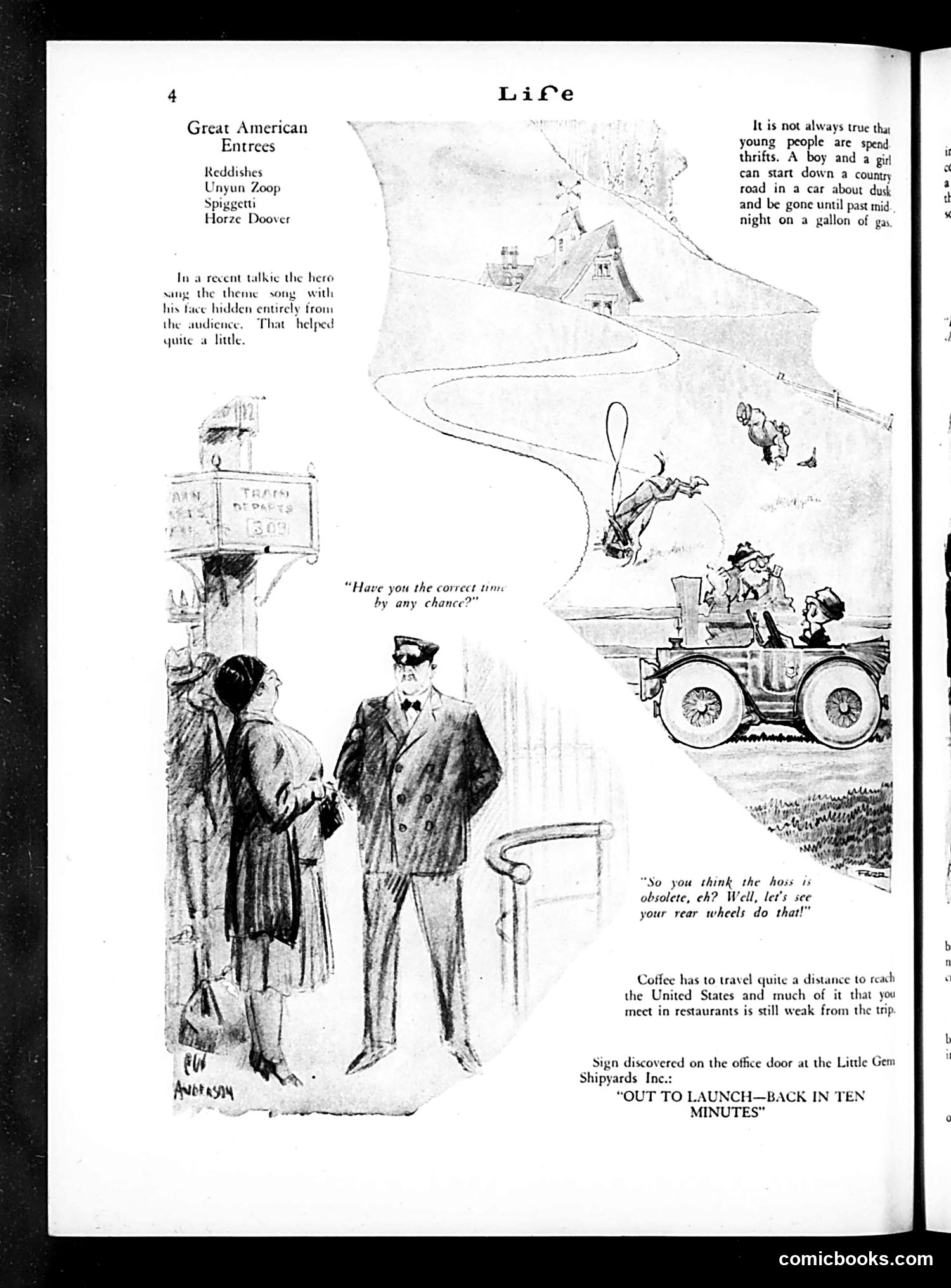
Life Magazine Page Analysis This page contains two distinct cartoons satirizing early 20th-century American life. Left cartoon: A man asks a woman at a water fountain, "Have you the correct time by any chance?" The joke appears to mock social pretense—using an elaborate excuse to start a conversation, suggesting men employed transparent pick-up lines. Right cartoon: Shows a car with passengers asking about "rear wheels," with the caption questioning whether "the boss is obsolete." This satirizes automobile innovation and changing workplace hierarchies as cars modernized transportation. Header section lists "Great American Entrees" (Reddishes, Uyun Zoop, Spaghetti, Horze Doover)—likely mock exotic food names, typical of Life's satirical humor. The page reflects 1920s-era anxieties about modernization, dating customs, and technological disruption.
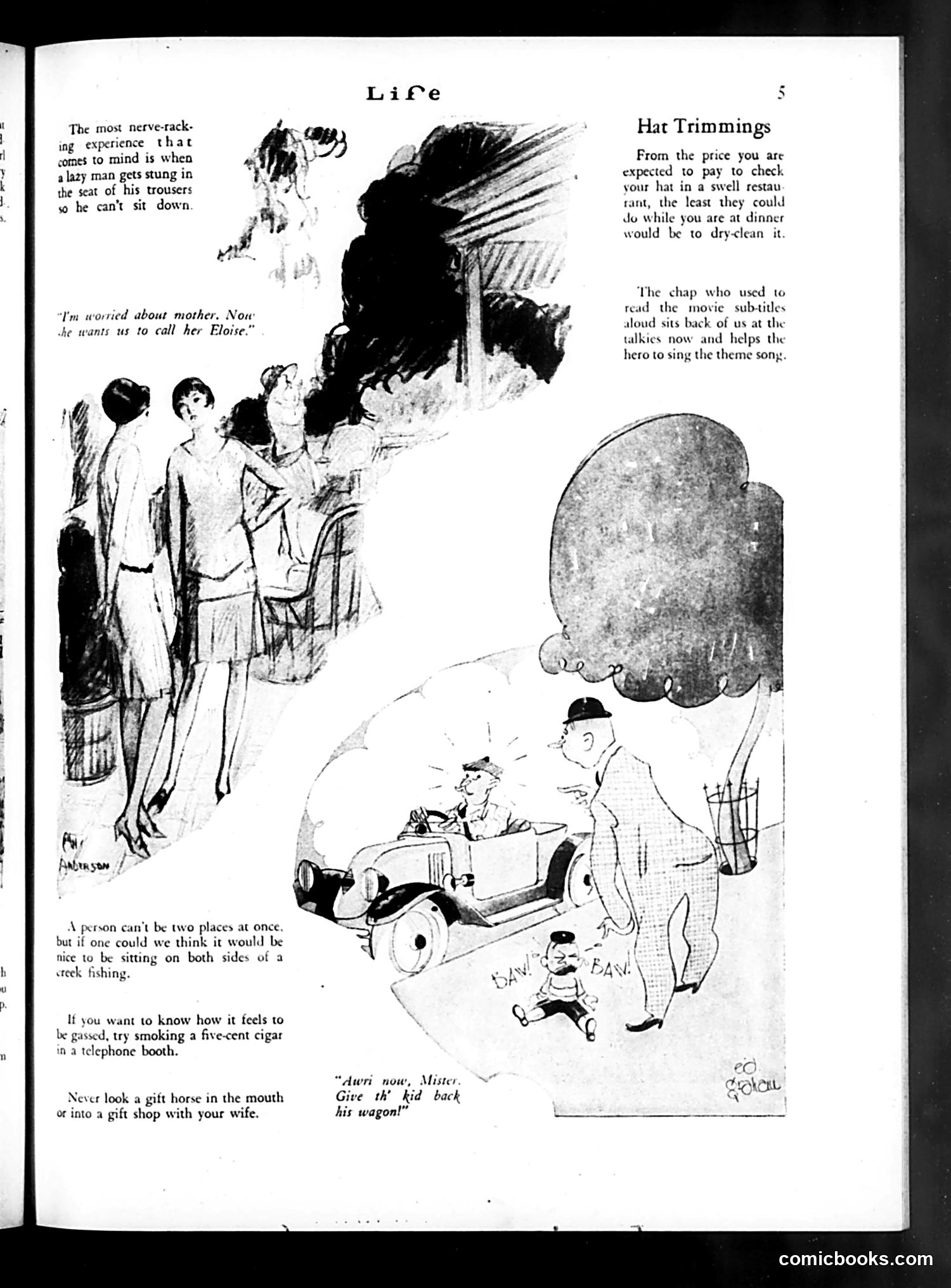
Analysis of Life Magazine Page 5 This page contains humorous social commentary and cartoons typical of Life magazine's satirical format. The top cartoon depicts a domestic scene where a lazy man lounges while his wife expresses concern about calling their mother Eloise—a joke about nagging spouses and family obligations. The "Hat Trimmings" section offers dry observations about hat maintenance and movie theater etiquette, mocking pretentious social customs of the era. The lower cartoon shows a slapstick scene with a toy wagon and figures, captioned "Darn now, Mister. Give th' kid back his wagon!"—suggesting theft or misappropriation played for humor. Throughout, brief quips mock contemporary social behaviors: gift-giving etiquette, phone booth smoking, and marital dynamics. The cartoons target middle-class American customs and behaviors with gentle, period-appropriate satire.
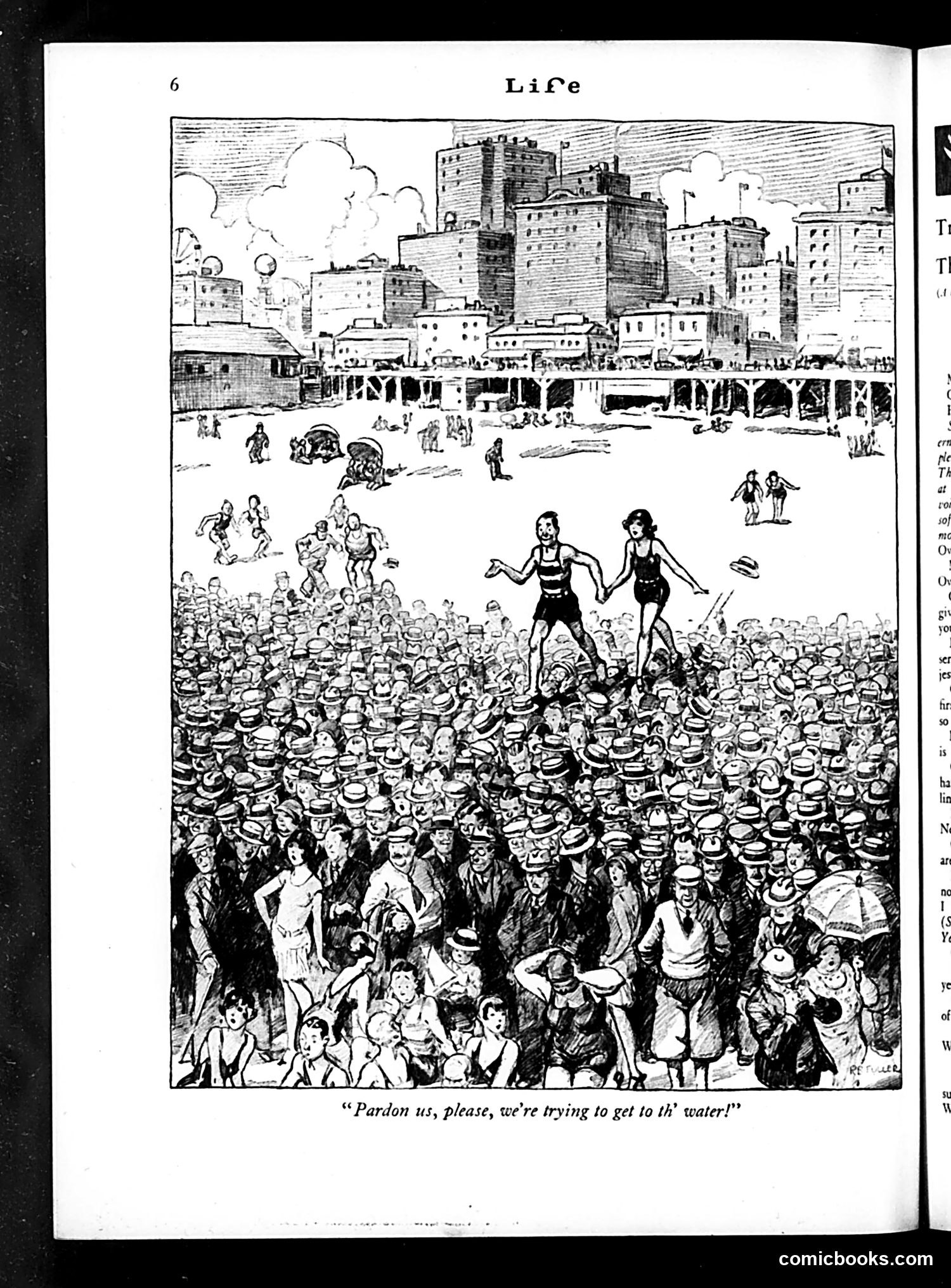
Analysis This single-panel cartoon depicts a crowded beach scene with thousands of swimmers packed densely together in the water. Two women in swimsuits stand prominently on the sand, addressing the crowd with the caption: "Pardon us, please, we're trying to get to th' water!" The satire comments on overcrowding at public beaches, likely during the early-to-mid 20th century when beach recreation became increasingly popular among urban Americans. The cartoon mocks the absurdity of beach congestion—so many people are already in the water that two more swimmers cannot even reach it. The formal hats and clothing visible in the crowd suggest this reflects Depression-era or post-Depression leisure culture, when public beaches became accessible mass-recreation destinations. The joke is about the tension between democratic access to public spaces and the resulting chaos from overwhelming popularity.
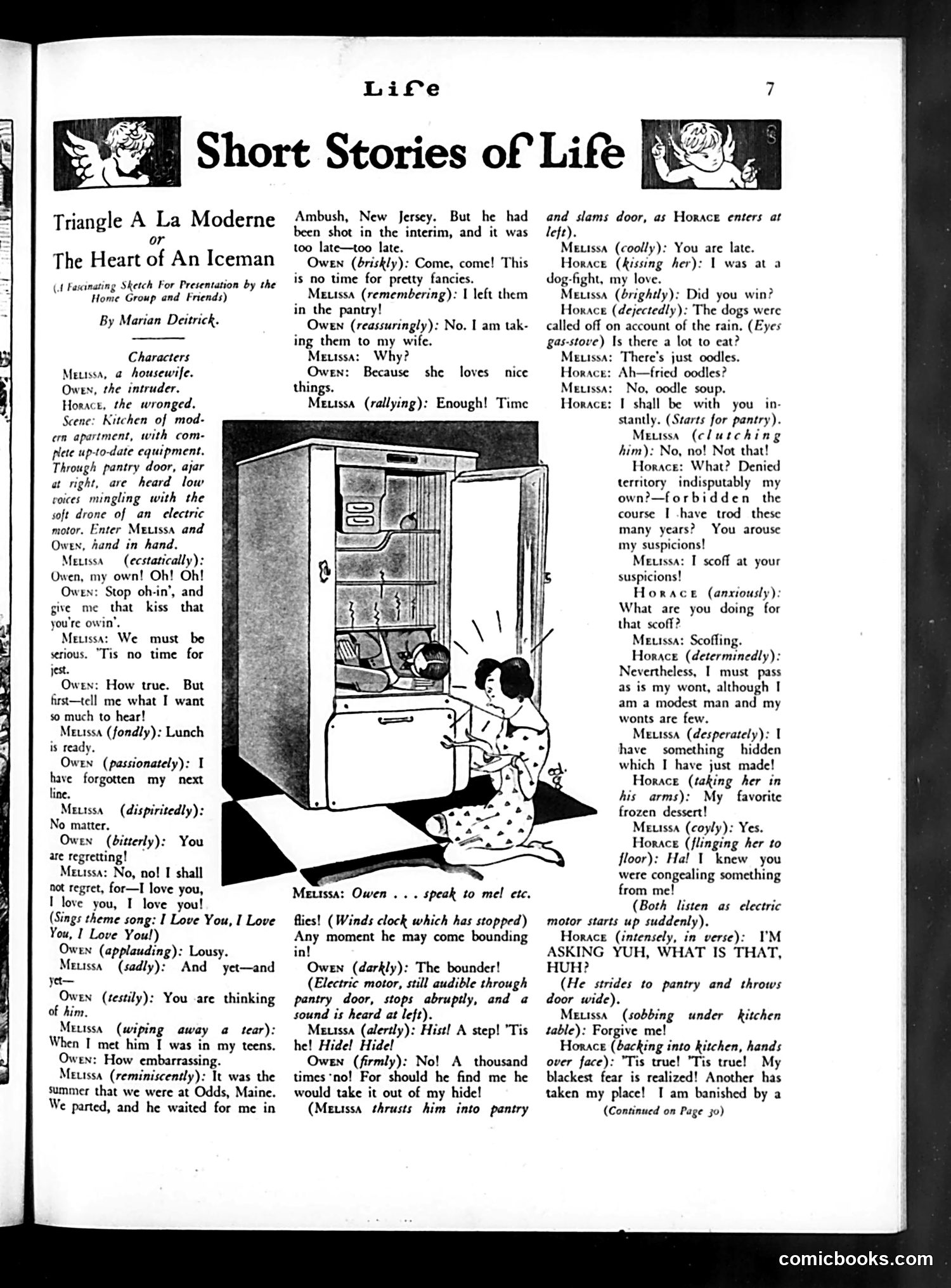
"Triangle A La Moderne or The Heart of An Iceman" This is a domestic comedy sketch by Marian Deitrick about marital tension. The plot involves Melissa (a housewife) and Owen (her husband), with Horace (an intruder) arriving unexpectedly. The humor centers on mistaken identity and jealousy: Owen has been shot and is acting suspiciously, which Melissa interprets as infidelity. When Horace enters through the pantry door, Melissa assumes he's Owen's lover, creating farcical confusion. The "iceman" reference in the title likely alludes to the common "iceman" trope in period comedies—a stock figure used to suggest illicit affairs. The sketch satirizes both marital paranoia and the melodramatic domestic scandals popular in early 20th-century humor.
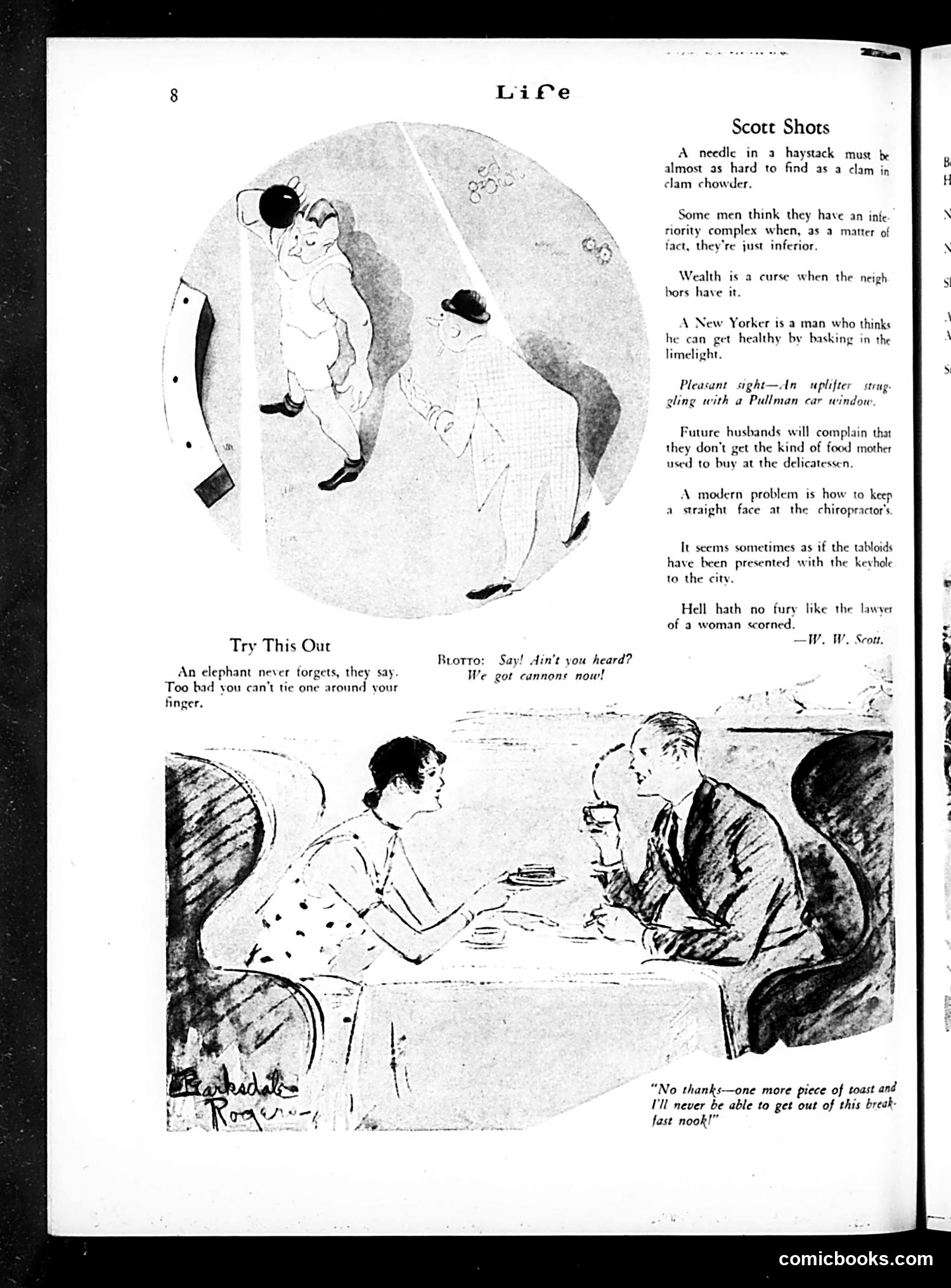
Analysis of Life Magazine Page 8 This page contains two distinct sections: "Scott Shots" (top right): A collection of brief satirical observations about contemporary society, including quips about inferiority complexes, wealth, New Yorkers, Pullman car etiquette, food quality, chiropractors, and legal matters. These are general social commentary rather than political satire. "Try This Out" (bottom): A cartoon showing a couple dining, with the woman saying "Say! Ain't you heard? We got cannon now!" The man replies "No thanks—one more piece of toast and I'll never be able to get out of this break fast nook!" The joke plays on "cannon" (a military weapon) as wordplay, but the humor seems to rely on the woman's somewhat oblivious excitement about armaments during what appears to be a domestic moment. The satire targets either wartime preoccupation or absurd dinner conversation.
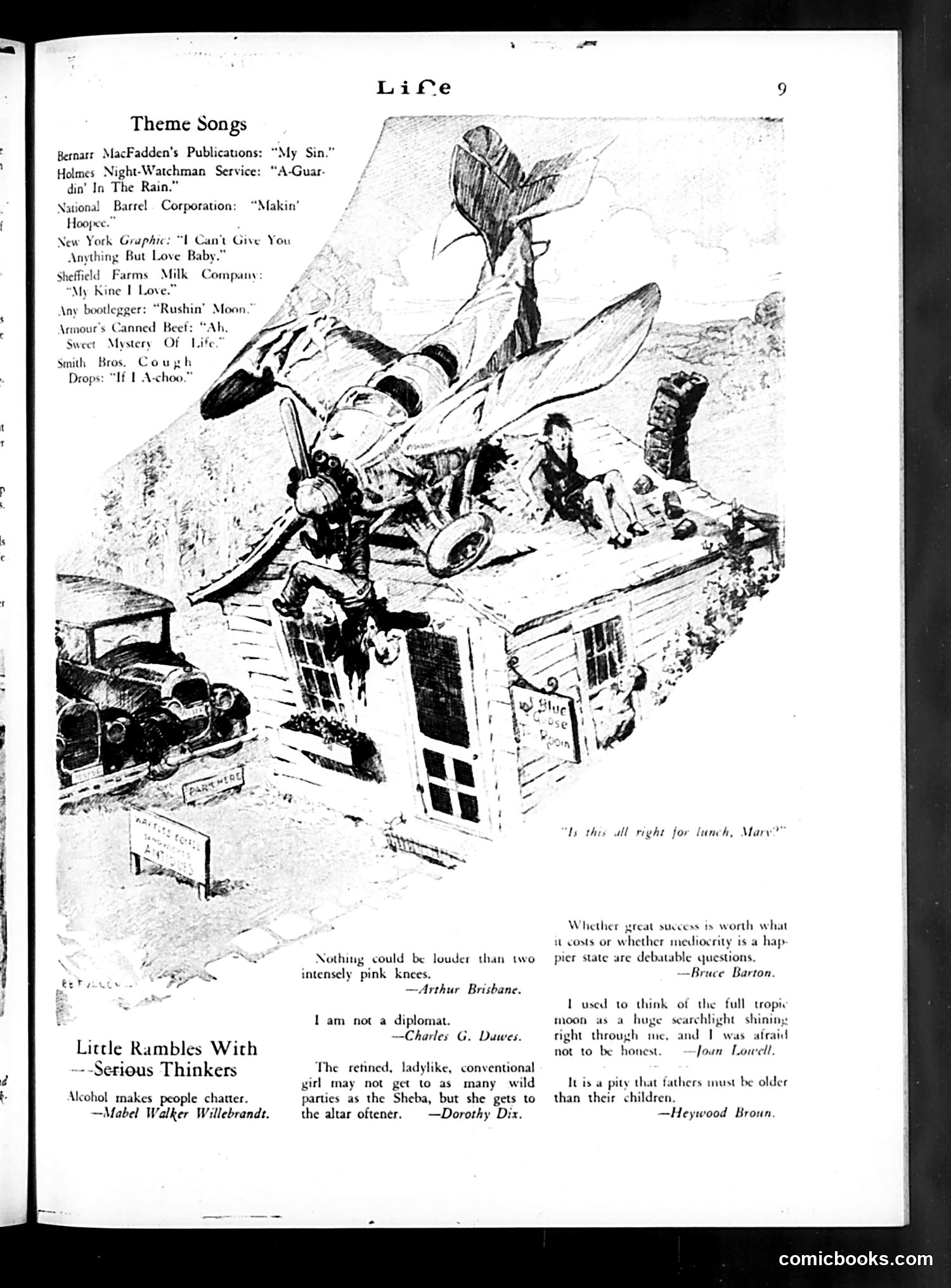
Analysis This page from *Life* magazine contains a large cartoon and quotation section titled "Little Rambles With Serious Thinkers." The main cartoon depicts a domestic scene where a woman (labeled "Mary" in the caption) appears to have crashed an airplane into a farmhouse. The caption reads: "Is this all right for lunch, Mary?" The humor satirizes women drivers and aviation—emerging technologies of the era—by suggesting a wife's recklessness with a vehicle has catastrophic consequences. The juxtaposition of casual domesticity ("lunch") with violent destruction creates absurdist comedy typical of *Life's* style. Below are unrelated quotations on various topics (success, diplomacy, gender roles) attributed to contemporary figures and celebrities, presented as philosophical observations. This format was common in *Life* for light social commentary.
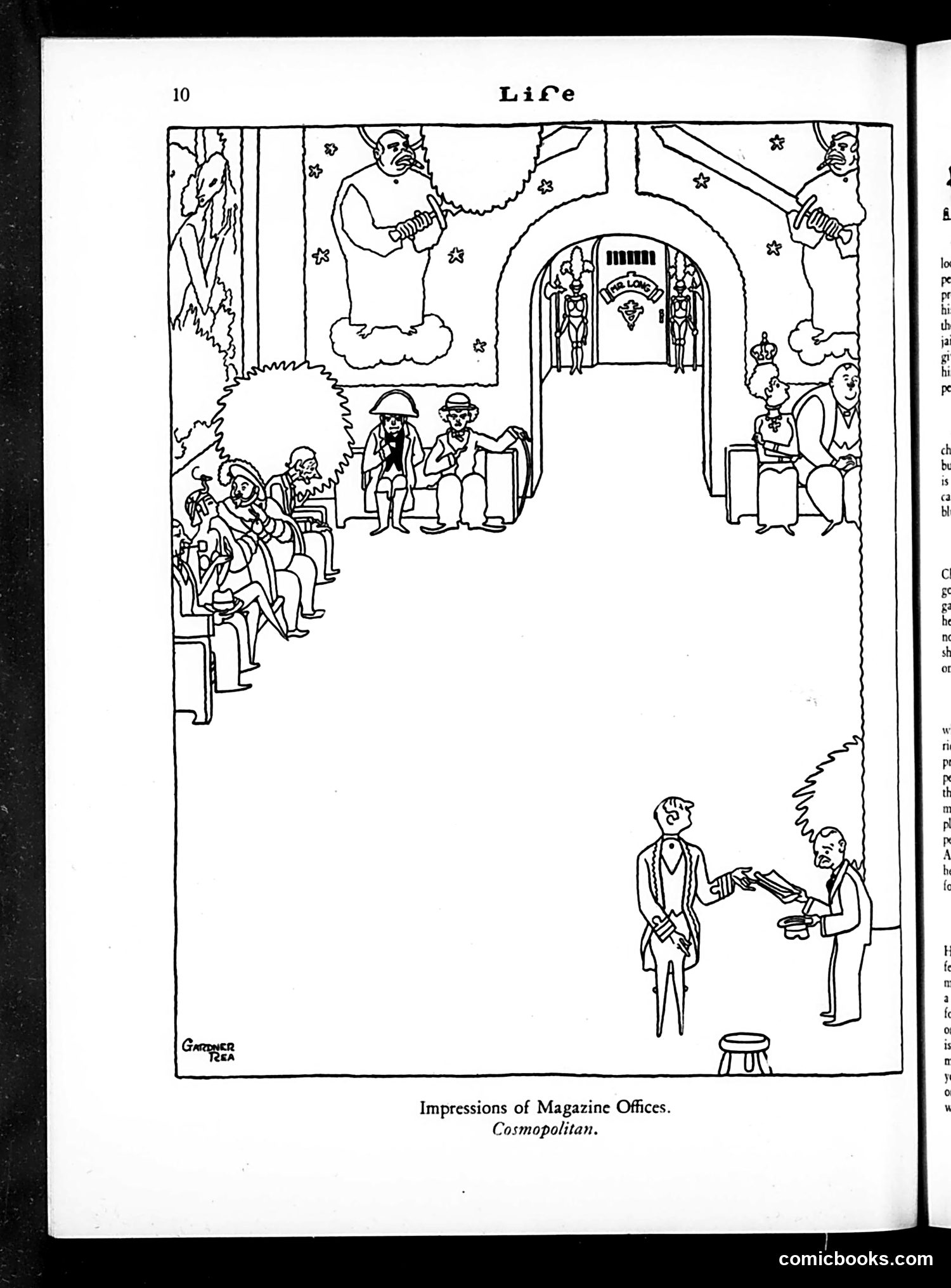
Analysis of "Impressions of Magazine Offices" This is a satirical cartoon depicting the contrast between the heavenly/idealized vision of magazine work and its mundane reality. The upper portion shows angels and celestial imagery—a vision of magazine offices as ethereal, blessed spaces. The lower portion grounds this in reality: two ordinary businessmen conducting a transaction outdoors, appearing to haggle or negotiate over what looks like payment or manuscripts. The cartoon mocks the romantic notion people hold about working in publishing and journalism. The title "Cosmopolitan" suggests this satirizes that specific magazine's public image versus actual office operations—likely focused on the commercialism and negotiation that actually drive magazine business, rather than any artistic or editorial ideals.
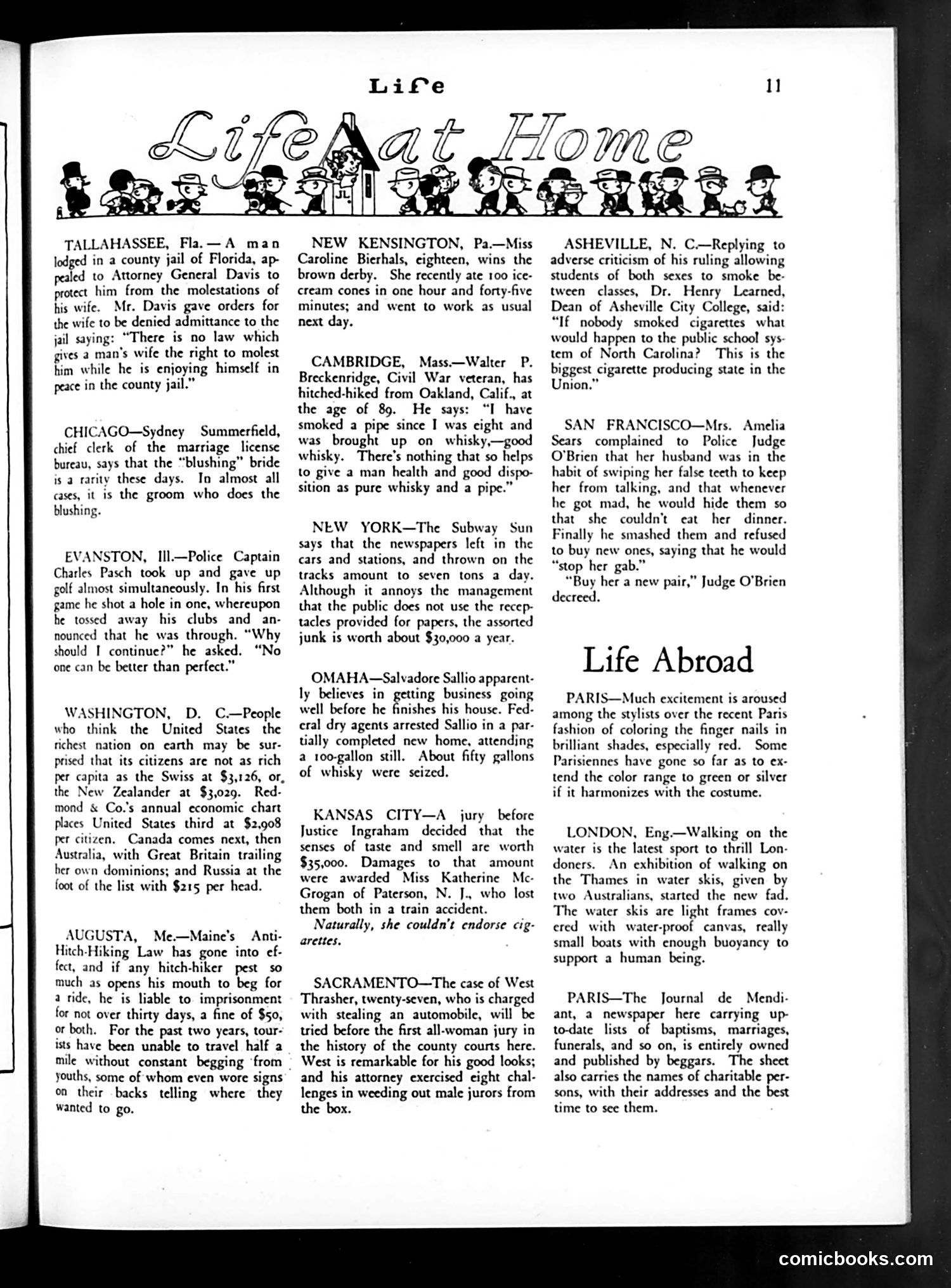
Life Magazine Page Analysis This page from *Life* magazine contains two sections: "Life at Home" and "Life Abroad," presenting humorous anecdotes from various American and international locations. The "Life at Home" section features satirical short items mocking American society—including a Florida man defending his right to modest peace in jail, a bride's eating record, and a police captain's golf obsession. These brief comedic pieces critique American habits and values through exaggeration. The header illustration shows a row of small figures in formal dress, appearing to represent diverse American society. "Life Abroad" offers travel anecdotes, including Parisian fashion trends and London water sports, contrasting American culture with international practices. The satire targets American excess, bureaucratic absurdity, and social pretension through factual-seeming but absurd scenarios.
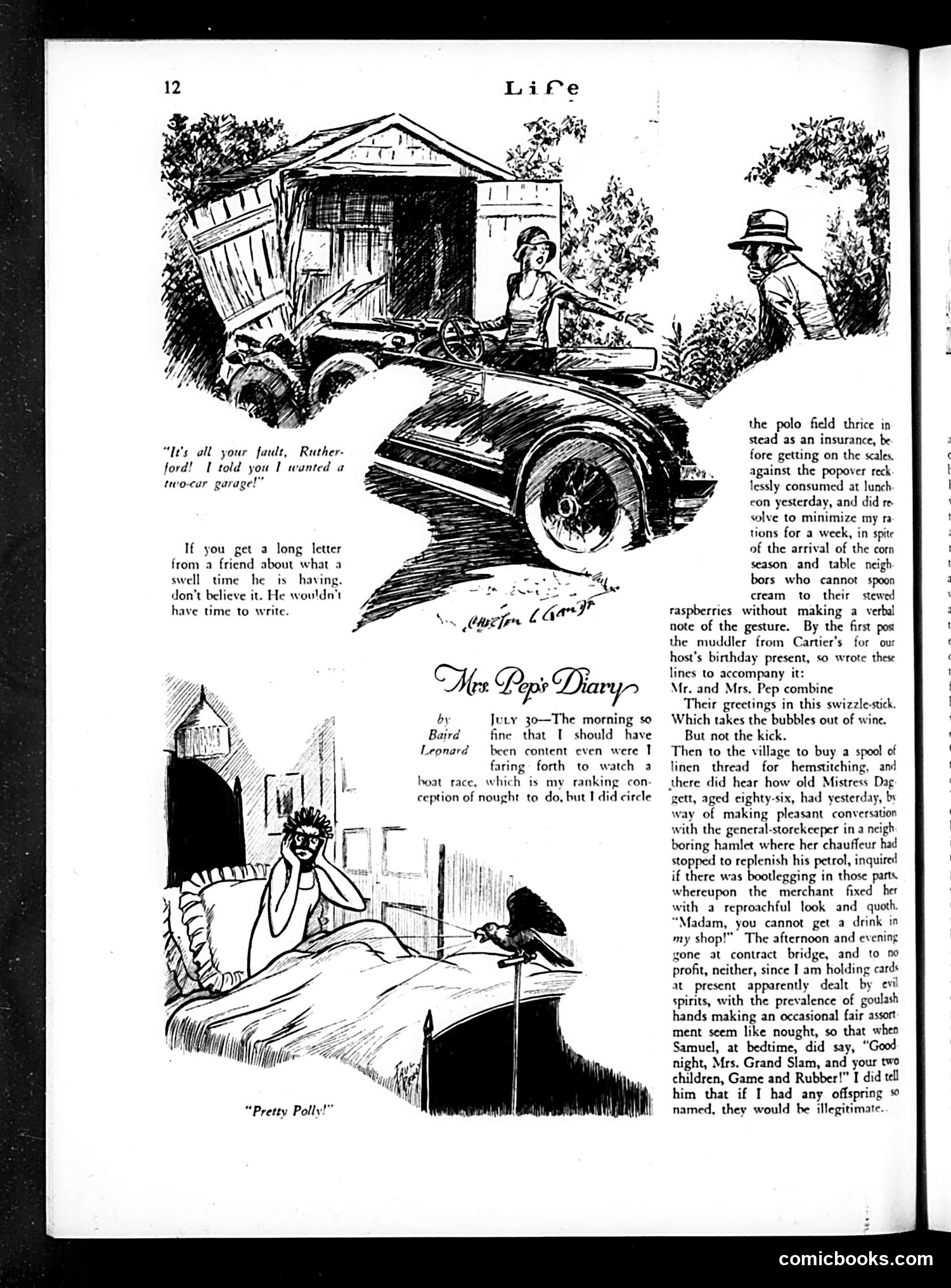
Analysis of Life Magazine Page 12 This page contains two satirical cartoons and a diary entry titled "Mrs. Pep's Diary" by Baird Leonard. Top cartoon: Shows a man confronting his wife about garage space, captioned "It's all your fault, Rutherford! I told you I wanted a two-car garage!" The satire targets post-WWI consumer culture and marital tensions over domestic spending and space—a common source of comedy about middle-class aspiration. Bottom cartoon ("Pretty Polly!"): Depicts a woman in bed with a parrot, likely satirizing gossip, idle conversation, or companionship. The title suggests mockery of mindless chatter. Mrs. Pep's Diary: A humorously written account of mundane social events—boat races, card games, neighborhood dynamics—that pokes fun at upper-middle-class leisure activities and gossip-driven social life. All three pieces mock the concerns and pretensions of affluent American society in this era.
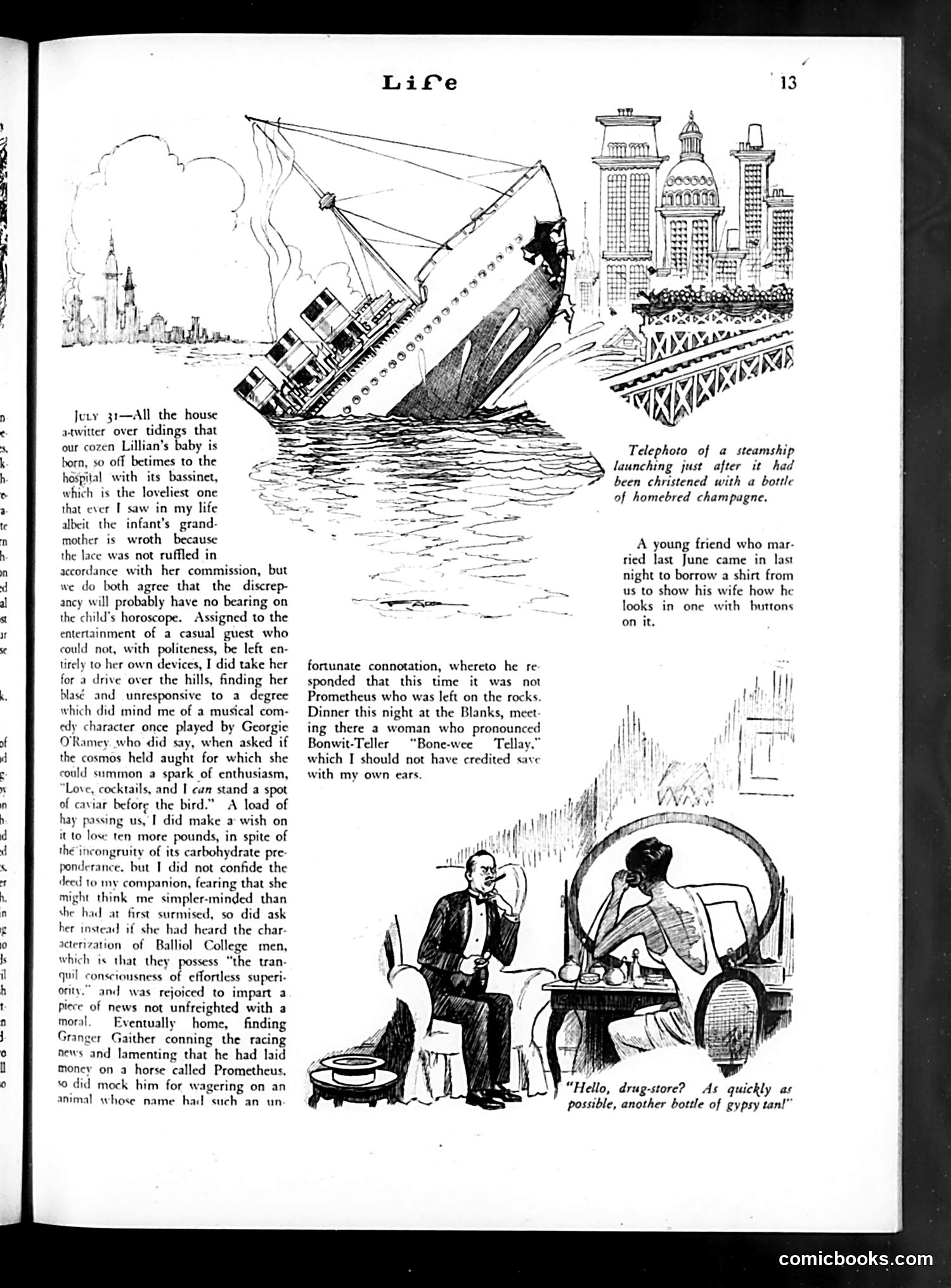
Analysis of Life Magazine Page 13 This page contains two illustrations with accompanying text commentary on social topics of the era. The upper illustration depicts a sinking steamship with a cityscape in the background, captioned "Telephoto of a steamship launching just after it had been christened with a bottle of homebred champagne." This appears to be satirizing either ship-launching ceremonies or, possibly, concerns about American-made products. The lower illustration shows a man and woman in what appears to be a domestic interior, with the caption "Hello, drug-store? Quickly as possible, another bottle of gypsy run!" The surrounding text discusses social observations about births, horoscopes, and character references to "Balliol College men." The overall tone is satirical commentary on contemporary American social customs and class attitudes, typical of Life magazine's humorous social criticism.
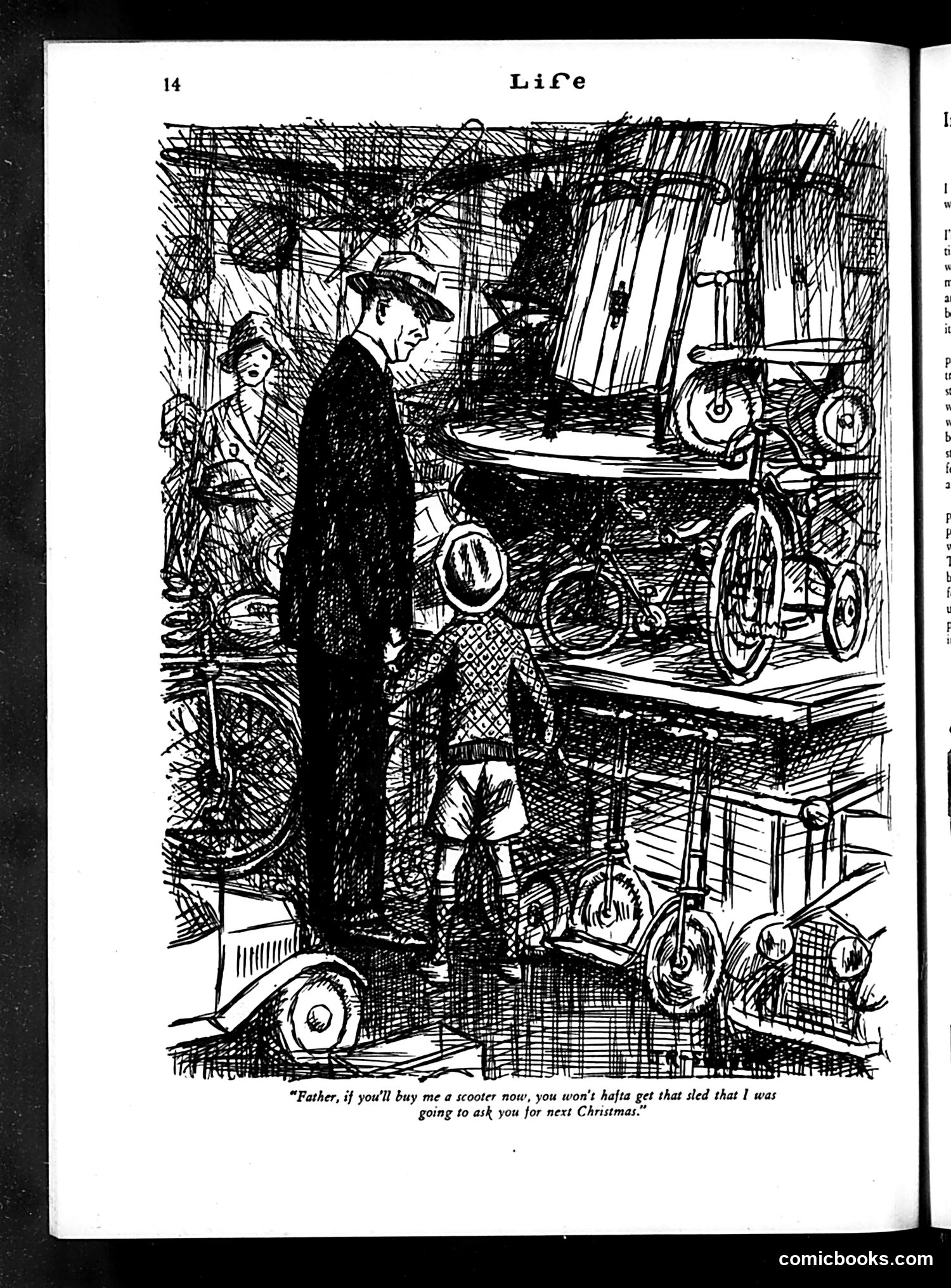
Analysis of Life Magazine Cartoon This is a single-panel cartoon depicting a domestic scene in what appears to be a bicycle shop or storage area. A well-dressed man in a long coat stands with a small child, who pleads: "Father, if you'll buy me a scooter now, you won't hafta get that sled that I was going to ask you for next Christmas." The Satire: The joke hinges on consumer manipulation and childhood negotiating tactics. The child attempts to bargain with the father by suggesting that buying an expensive item now will forestall future requests—an obvious logical fallacy meant to amuse adults. The cartoon satirizes both children's persuasive scheming and parents' willingness to indulge material desires, likely reflecting post-war or early 20th-century consumer culture anxieties about commercial excess and childhood materialism.
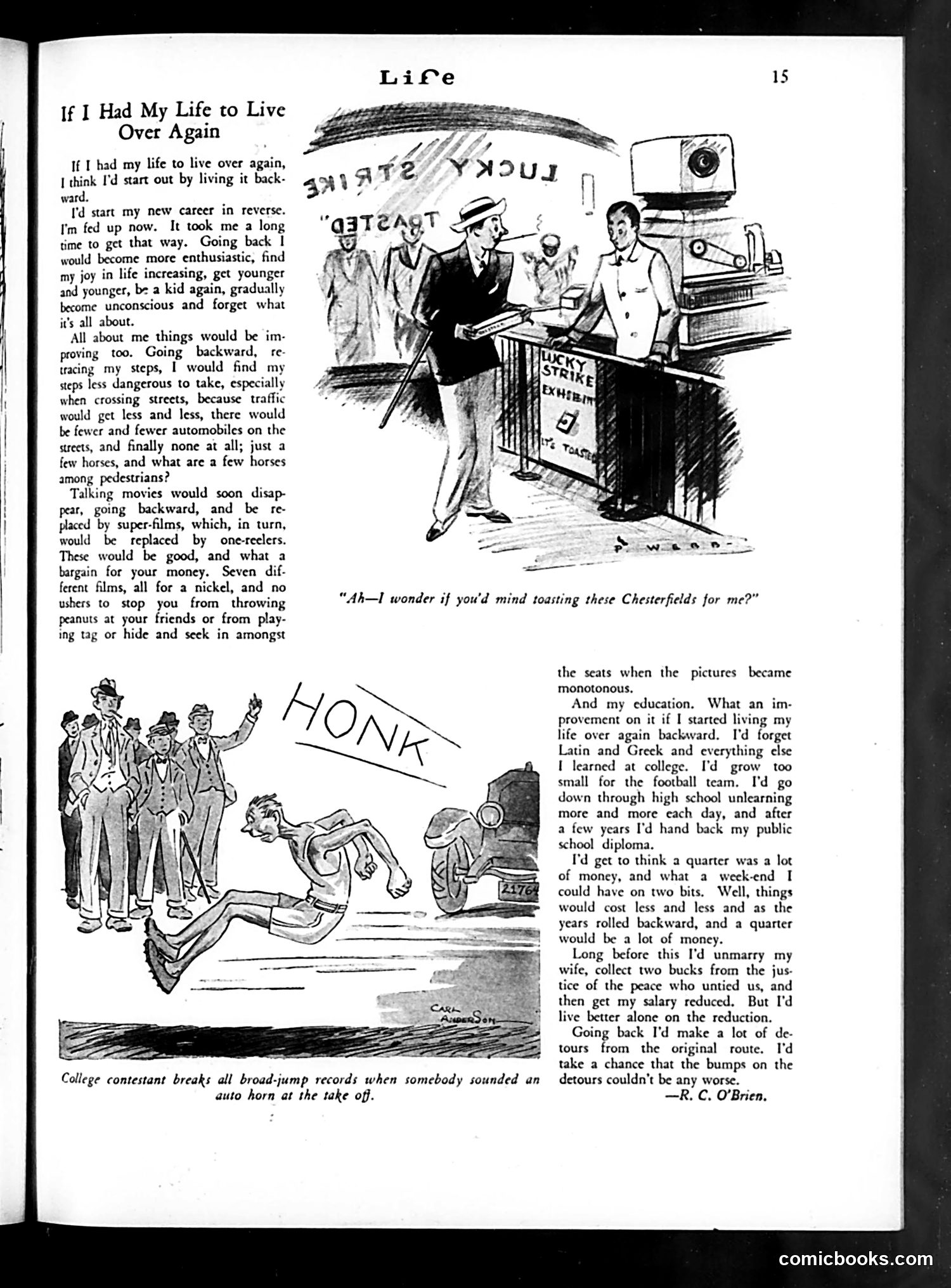
Analysis of Life Magazine Page 15 This page contains a humorous essay titled "If I Had My Life to Live Over Again" by R. C. O'Brien, accompanied by two cartoons illustrating absurd reversals. The upper cartoon depicts a movie theater scene where someone is toasting Chesterfield cigarettes—a satirical jab at product placement in early cinema. The lower cartoon shows a college athlete breaking broad-jump records when "somebody sounded an auto horn at the take off"—mocking how easily performance can be disrupted by trivial distractions. The essay itself humorously imagines living life backward: career in reverse, fewer cars on roads, simpler entertainment, and undoing one's education. The satire targets modern life's complexities and commercialization, suggesting earlier, simpler times were preferable—a common 1920s-30s sentiment about technological progress.
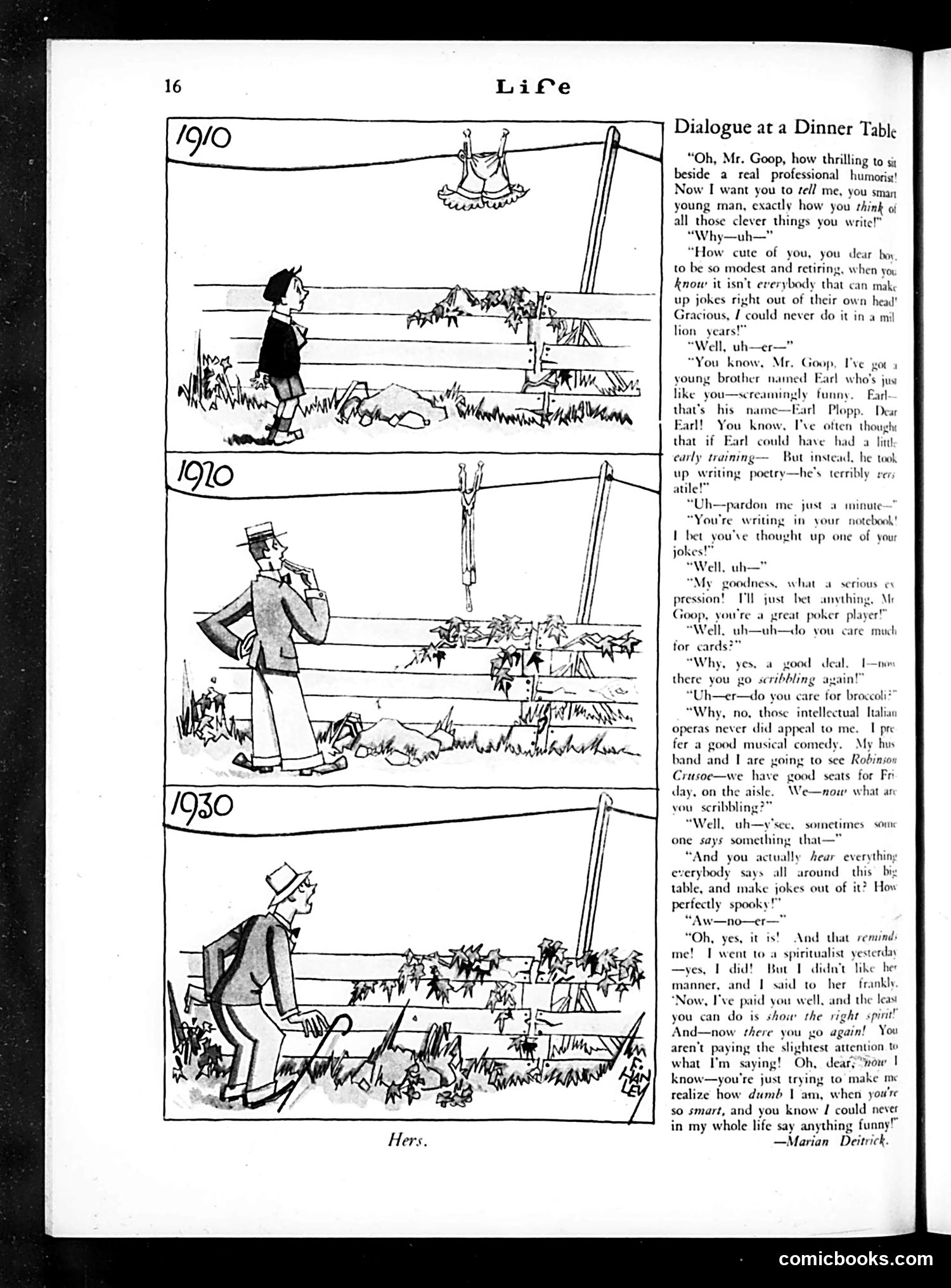
Analysis This page contains a three-panel comic strip titled "Dialogue at a Dinner Table," credited to Marian Deitrick. The strip depicts the same male figure in three time periods (1910, 1910, and 1930), showing his progressive decline in confidence and social status. The humor satirizes a man who fancies himself a wit and humorist but is actually tedious and unfunny. The dinner guest (female speaker) compliments his "professional humorous" writing while subtly mocking him—praising his modesty, mentioning his brother Earl's failed poetry career, and ultimately revealing that everyone at dinner parties finds him unbearably dull. The three panels suggest this pattern of social embarrassment has persisted across two decades, with the man becoming progressively smaller and more diminished, illustrating how his reputation has shrunk through years of boring dinner guests with mediocre jokes.
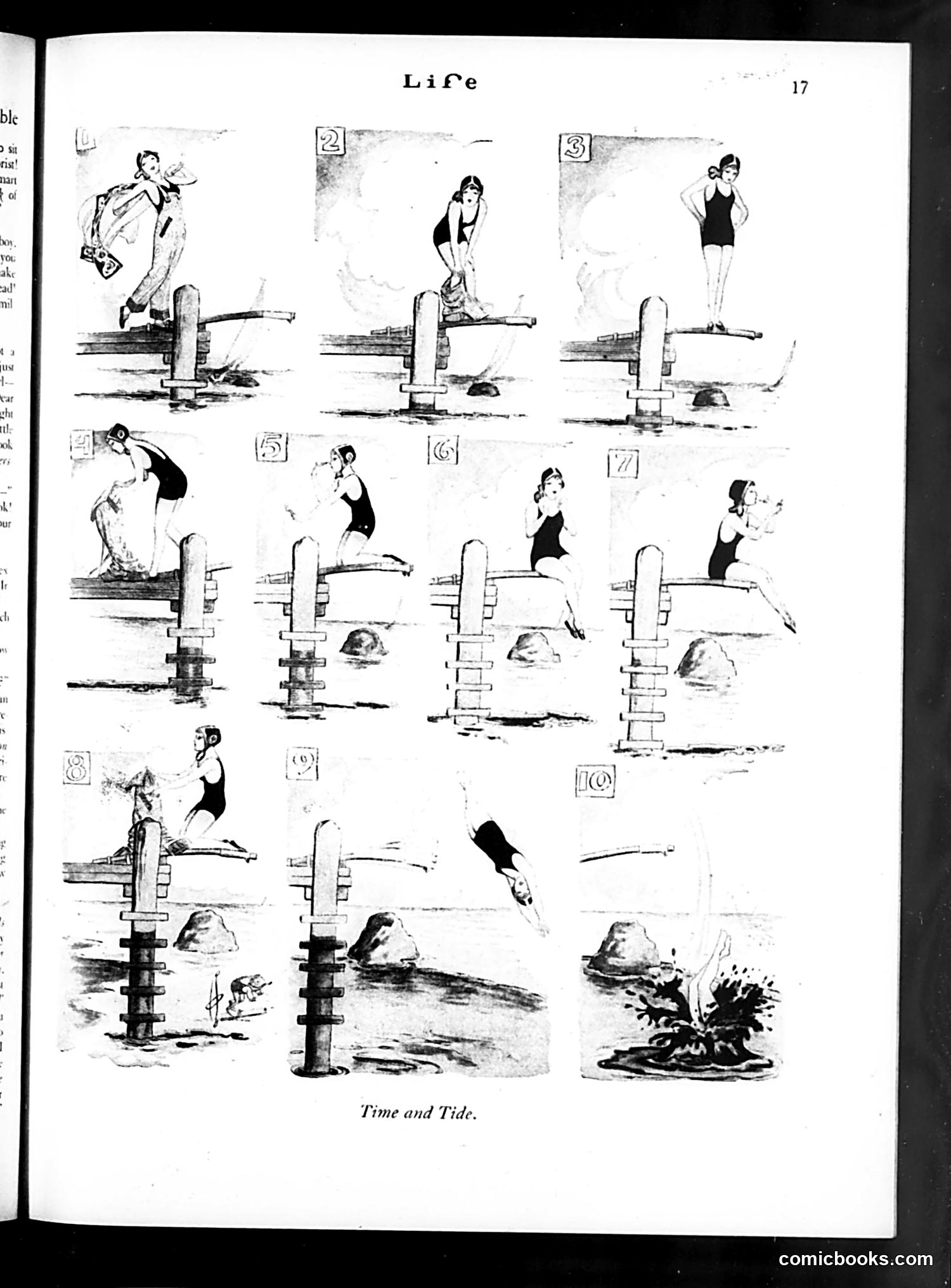
"Time and Tide" - A Swimming Lesson Comic Strip This appears to be a humorous instructional sequence showing a woman learning to swim at what looks like a public bathing area or pier. The numbered panels (1-10) demonstrate progressive swimming techniques, from basic balance on the diving board through various swimming strokes and ultimately diving into water. The satire likely plays on early 20th-century attitudes about women's athletics and swimming. At this era, women's participation in water activities was still considered novel or somewhat risqué, given Victorian-era swimwear restrictions and social conventions. The title "Time and Tide" suggests inevitable progress—whether the reluctant learner likes it or not—the tide of social change will sweep her into modern swimming culture.
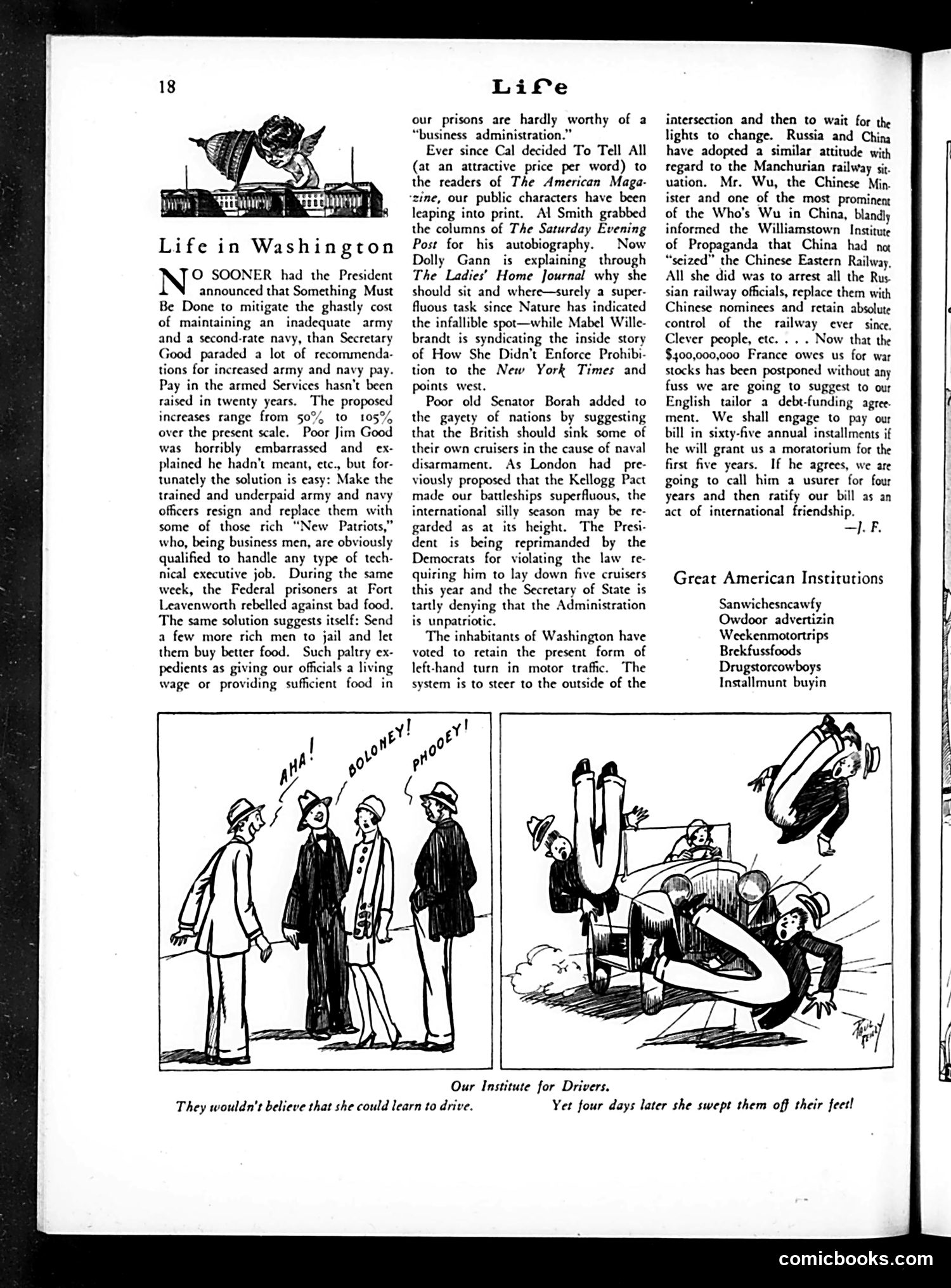
Analysis of Life Magazine Page 18 This page contains the "Life in Washington" column discussing military and naval spending debates, alongside two cartoons titled "Our Institute for Drivers." The cartoons mock a driving school or instruction program. The left panel shows skeptical onlookers doubting a woman's ability to learn driving ("They wouldn't believe that she could learn to drive"). The right panel shows the same woman competently driving, having swept the doubters "off their feet" within four days. The satire targets gender assumptions about women drivers—a contemporary social issue. The cartoon suggests that despite prevailing doubts about female driving ability, women could master the skill quickly when given proper instruction. This reflects early-20th-century attitudes questioning women's mechanical competence, which the cartoonist mocks by depicting their actual capability.
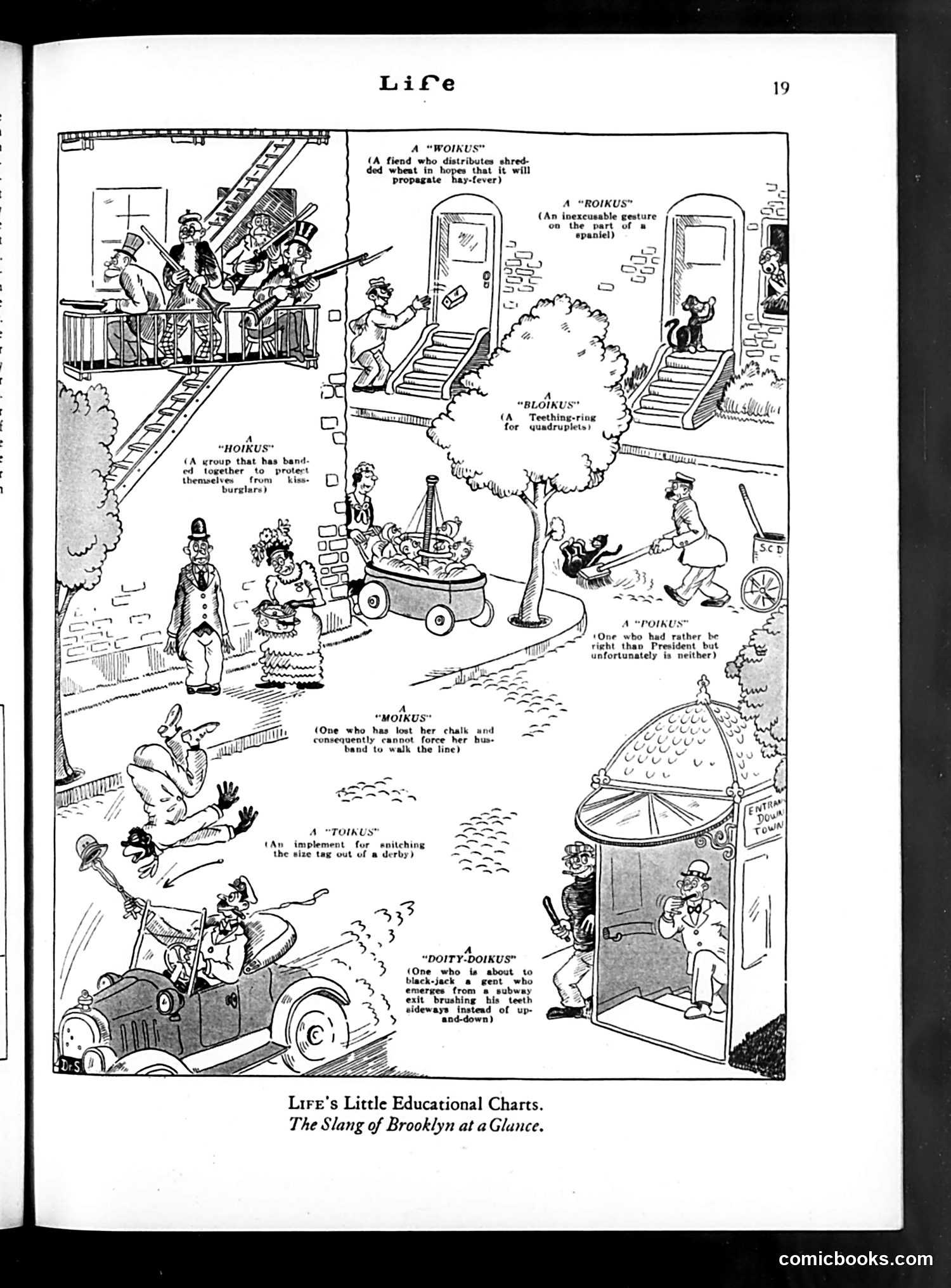
"The Slang of Brooklyn at a Glance" This page presents satirical "educational definitions" of invented Brooklyn slang terms, each illustrated with humorous scenarios. The cartoons mock both Brooklyn's distinctive dialect and the pretense of creating a formal "educational chart" for casual speech. The definitions target various social irritants and character types: a "Woikus" spreads hay fever; a "Roikus" is a dog's bad manners; a "Bloikus" is a teething ring for multiple babies. More pointed are "Hoikus" (groups protecting themselves from aggressive kissing), a "Poikus" (someone too principled for politics), and a "Doity-Doikus" (someone brushing teeth improperly in public). The satire works by applying pseudo-intellectual Japanese-sounding names (riffing on "haiku") to quintessentially American, working-class Brooklyn observations—mocking both the residents' speech patterns and the era's fascination with faux-scholarly classification.
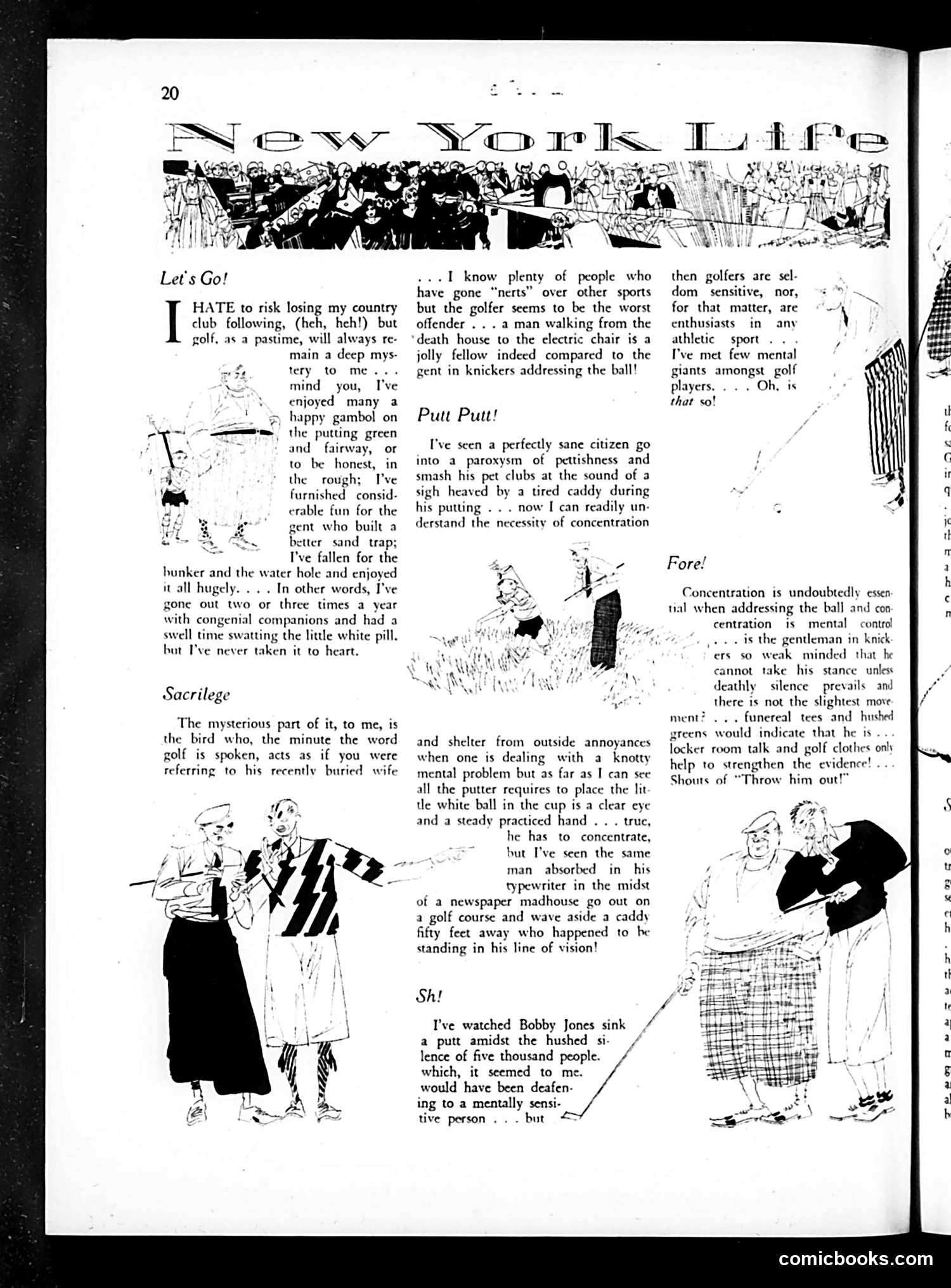
Explanation for Modern Readers This is a humorous essay satirizing golf and golfers' obsessive behavior. The author claims to enjoy golf casually but ridicules the sport's practitioners for their extreme emotional sensitivity and pretentiousness. The core joke: golfers demand absolute silence and mental focus for what the author sees as a simple task (putting a ball in a cup), yet these same men show no such discipline elsewhere—like when absorbed in chaotic newspaper offices. The author mocks golfers as overly serious, mentally weak, and socially awkward, noting they throw tantrums over minor disturbances during play. The reference to "Bobby Jones" appears to be a famous golfer, used as an example of the cultish reverence surrounding golf. The overall satire portrays golf culture as absurdly pretentious—treating a recreational sport with religious solemnity while the participants demonstrate poor character elsewhere. The accompanying illustrations show golfers in various states of distress and ridiculous behavior, reinforcing the mockery of their dramatic overreaction to the game.
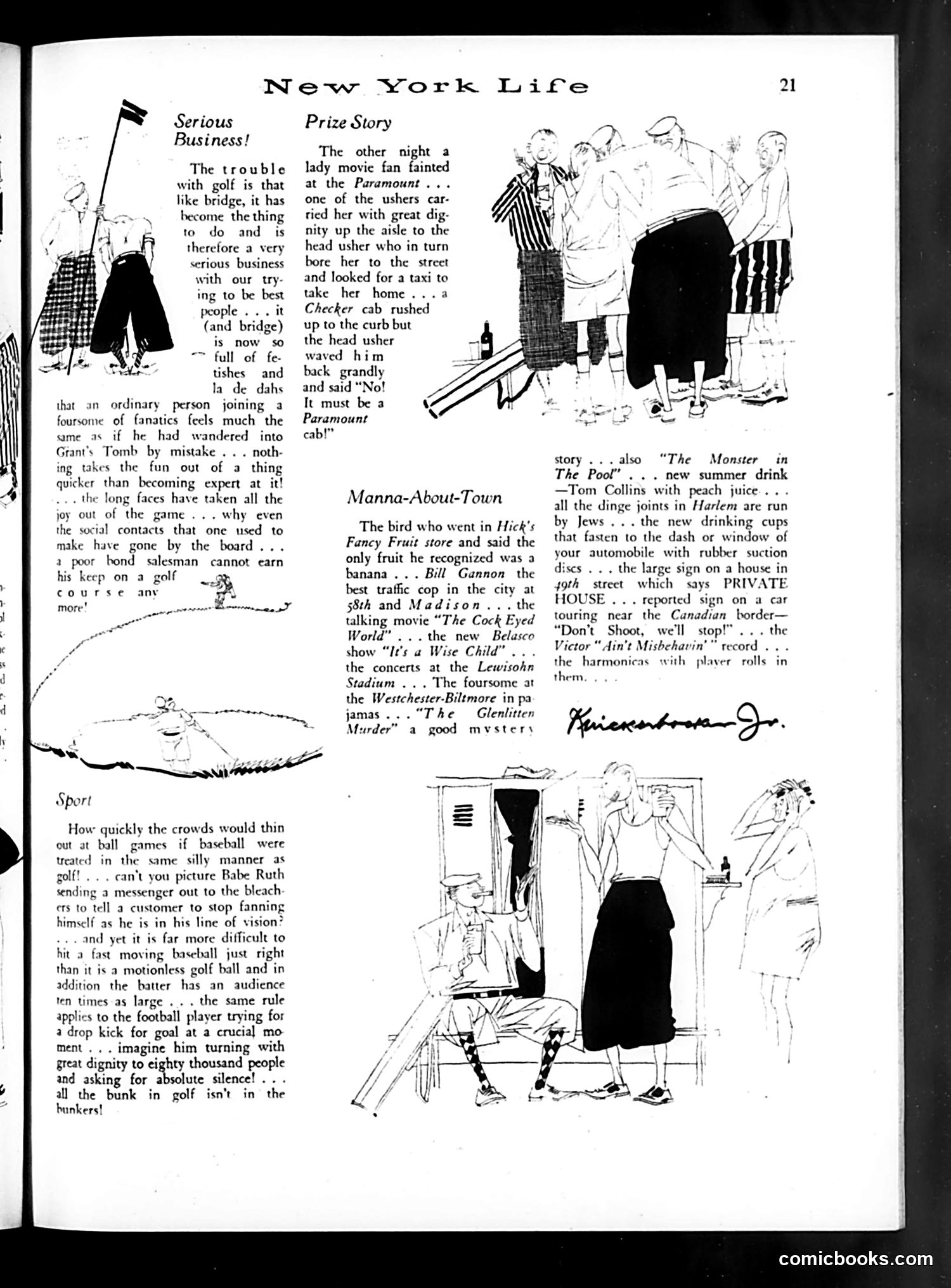
"New York Life" Page Analysis This page from *Life* magazine satirizes the pretentiousness that has infected American leisure activities, particularly golf and bridge among the wealthy social set. "Serious Business!" mocks how golf has transformed from a recreational game into a status-obsessed ritual among "trying to be best people." The author argues that expert obsession has sucked the joy out of the activity—wealthy socialites now treat it with such seriousness that ordinary people feel unwelcome, and even a "poor bond salesman cannot earn his keep on a golf course" because he lacks the required intensity. "Sport" extends this critique by imagining if baseball were treated with golf's pretentious rigidity. The satirist notes the absurdity: baseball is actually *harder* than golf, yet fans enjoy it because it remains fun rather than a test of social standing. "Manna-About-Town" catalogs contemporary New York trivia and entertainments, while "Prize Story" offers a brief anecdote mocking movie theater snobbery—an usher insisting on a "Paramount cab" rather than any taxi, suggesting performative class-consciousness. The overall message: excessive seriousness destroys enjoyment.
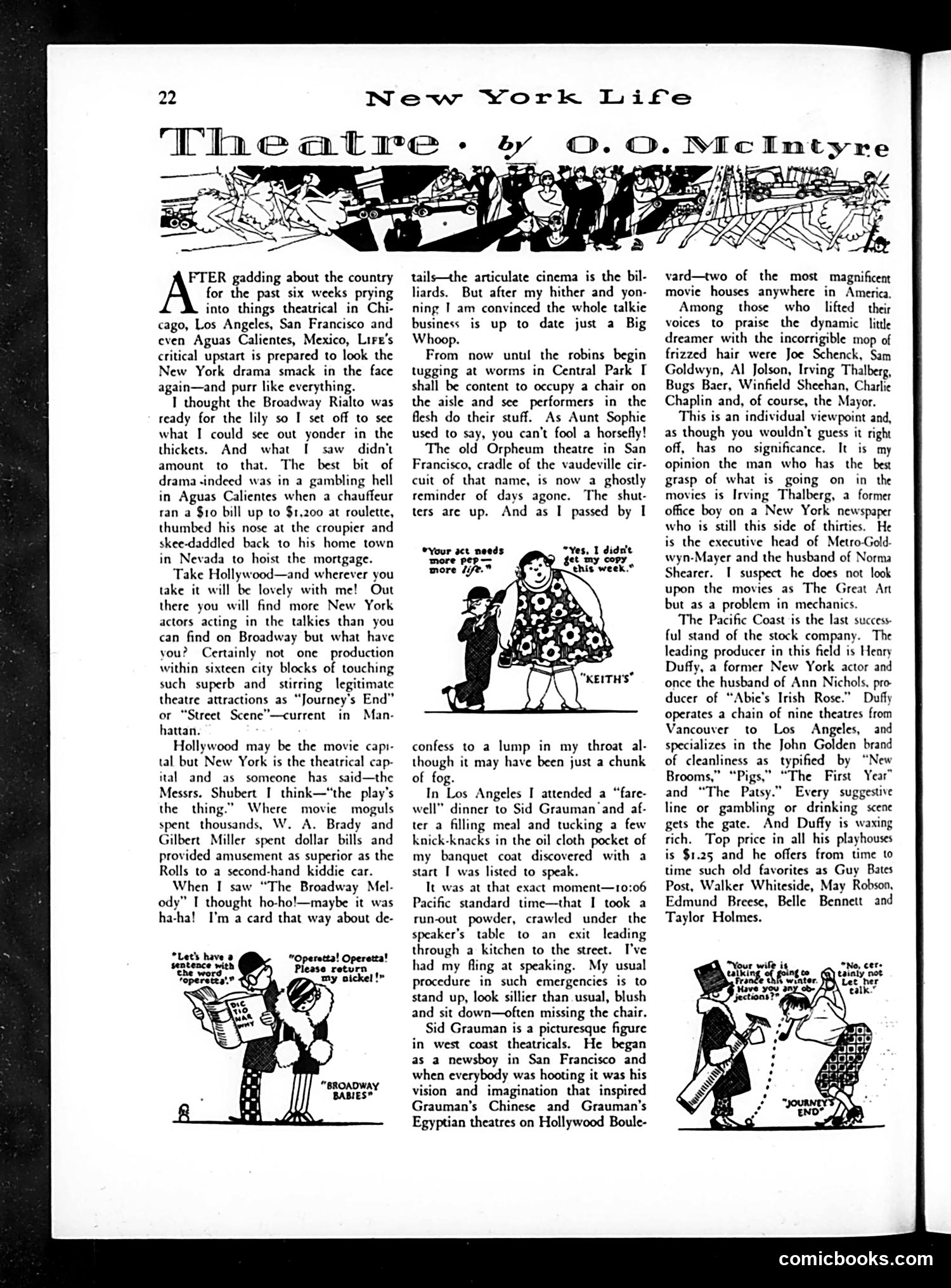
Analysis of "Theatre" by O.O. McIntyre This page is a theatrical gossip column comparing American theater across regions. McIntyre, the author, criticizes Hollywood's "talkies" (early sound films) as inferior to legitimate New York Broadway theater, despite Hollywood's glamorous reputation and star power. The cartoons humorously depict theater industry figures and situations—including what appears to be "Broadway Babies" and references to "Keith's" (likely Keith vaudeville circuit theaters). The sketches mock the contrast between theatrical pretension and reality. McIntyre praises Broadway producers like the Shuberts, W.A. Brady, and Gilbert Miller, and mentions Hollywood figures like Sid Grauman (who built the famous Chinese and Egyptian theaters). He name-drops major stars (Chaplin, Jolin, Goldwyn, Thalberg) attending Grauman's farewell dinner. The satire mocks both Hollywood's obsession with spectacle over substance and his own theatrical pretensions—he humorously admits fleeing a speaking engagement by crawling under a table.
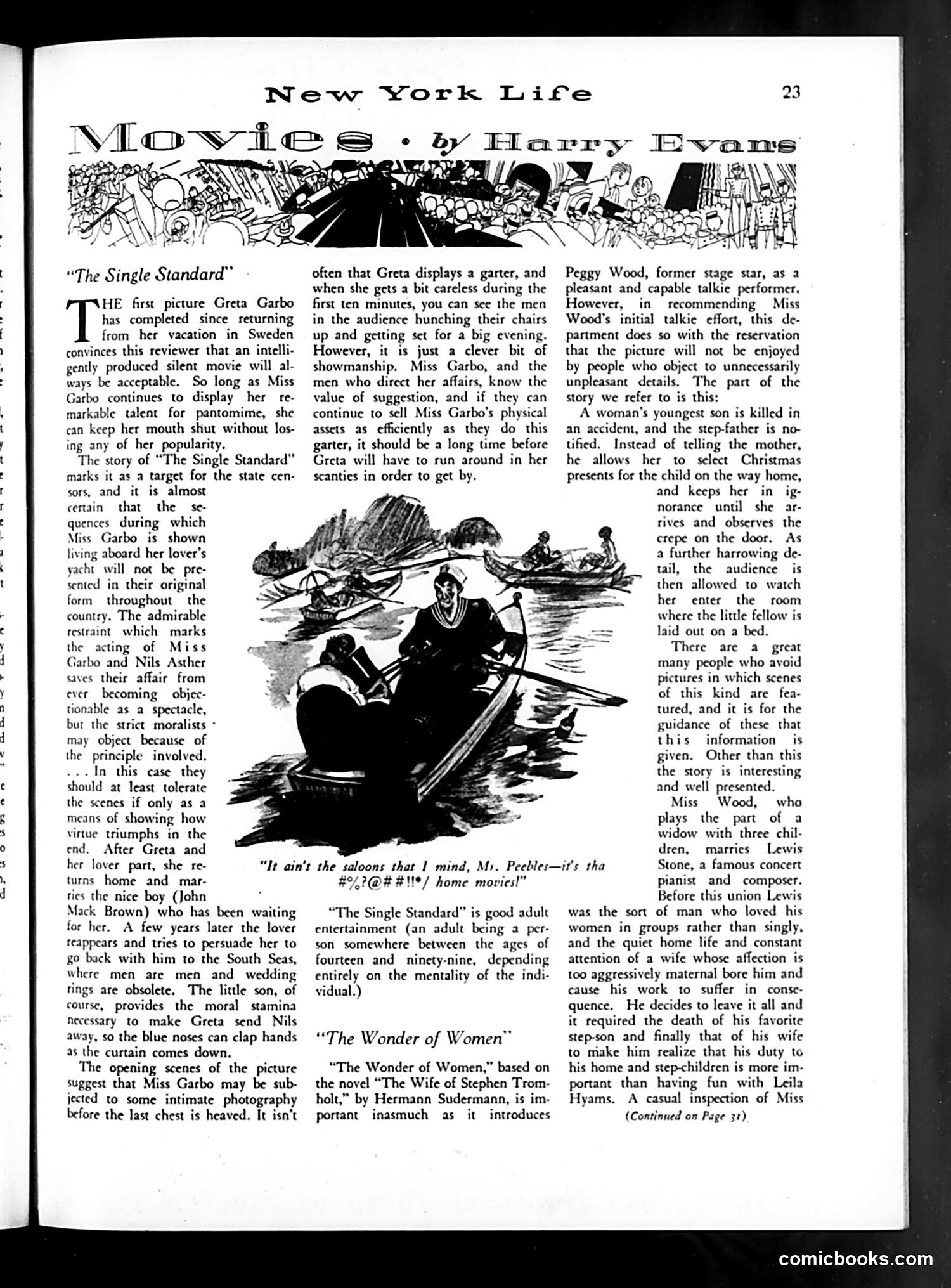
Movie Reviews from Life Magazine This page contains film reviews by Harry Evans critiquing two silent films. The main illustrated review covers Greta Garbo's "The Single Standard," which the critic praises for its intelligent storytelling and Garbo's pantomime talent. However, he notes the film will face censorship from state boards, particularly scenes of Garbo aboard her lover's yacht. The reviewer frames this as a moral tale where virtue ultimately triumphs—Garbo's character leaves her lover and marries a respectable man, her child providing the moral catalyst. The small cartoon below depicts a couple at home movies, with one person complaining about home-filmed content rather than actual cinema—likely satirizing the then-novel trend of amateur home film-making. The second review discusses "The Wonder of Women," praising actress Peggy Wood's talkie debut while warning sensitive audiences about its depiction of a child's accidental death and the mother's grief.
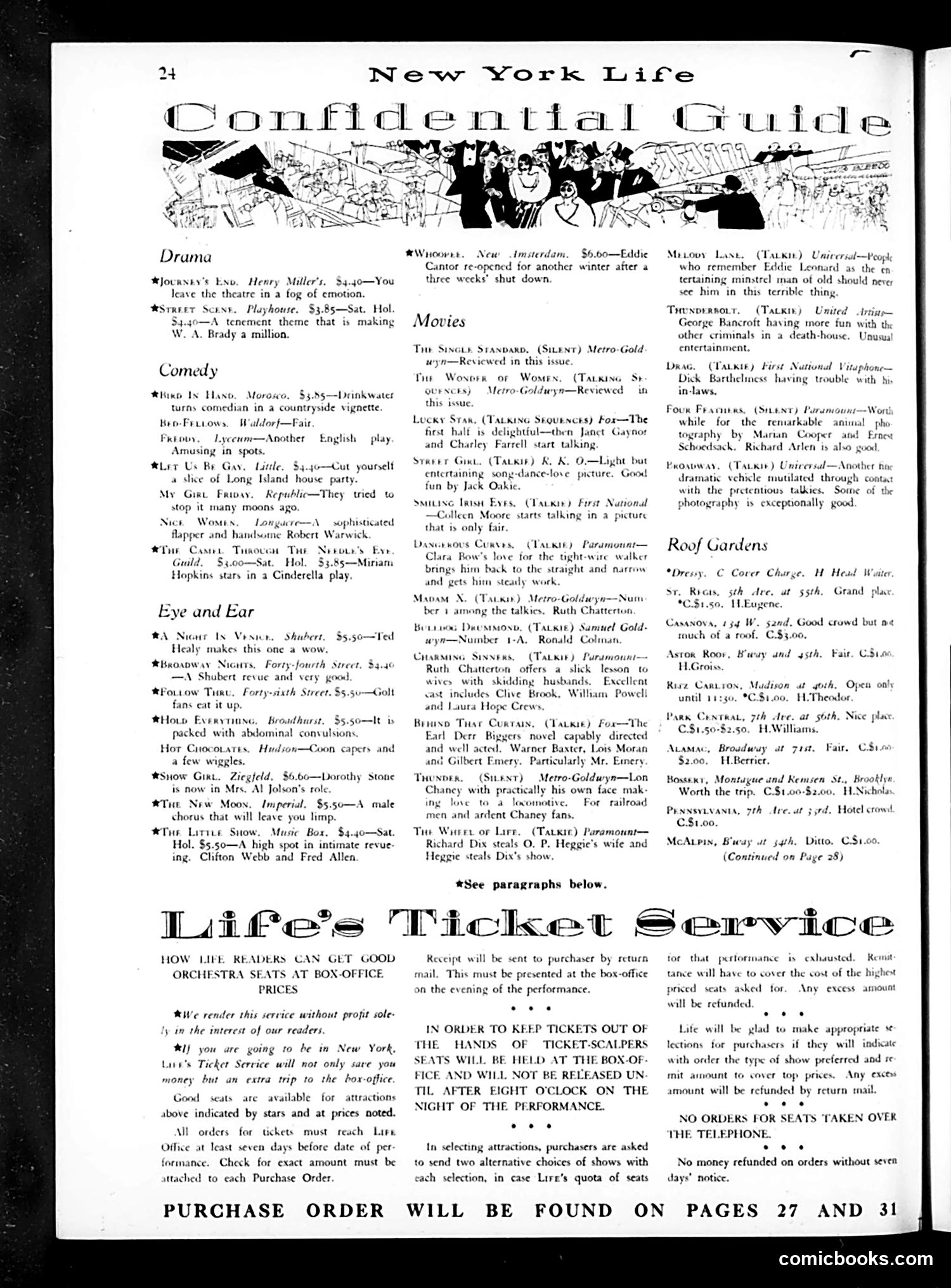
Analysis of Life Magazine Page 24 This is primarily a theater and entertainment listing page, not a political cartoon page. It contains: Drama, Comedy, and Movie Reviews: Brief critical capsules of Broadway shows and films, with ticket prices and theaters listed. The tone is satirical—short, punchy descriptions mock productions ("A tenement theme that is making W. A. Brady a million" for *Street Scene*; "A high spot in intimate revuing" for *The Little Show*). Notable: References to talking pictures (early "talkies") appearing alongside silent films, indicating this is from the late 1920s transition period. Reviews note when dialogue quality disappoints ("The first half is delightful—then Janet Gaynor and Charley Farrell start talking"). Life's Ticket Service: The lower section advertises *Life* magazine's theater ticket ordering system, with warnings about scalpers and refund policies. No political cartoons appear on this page—it's entertainment coverage typical of *Life*'s satirical but primarily consumer-focused content from this era.
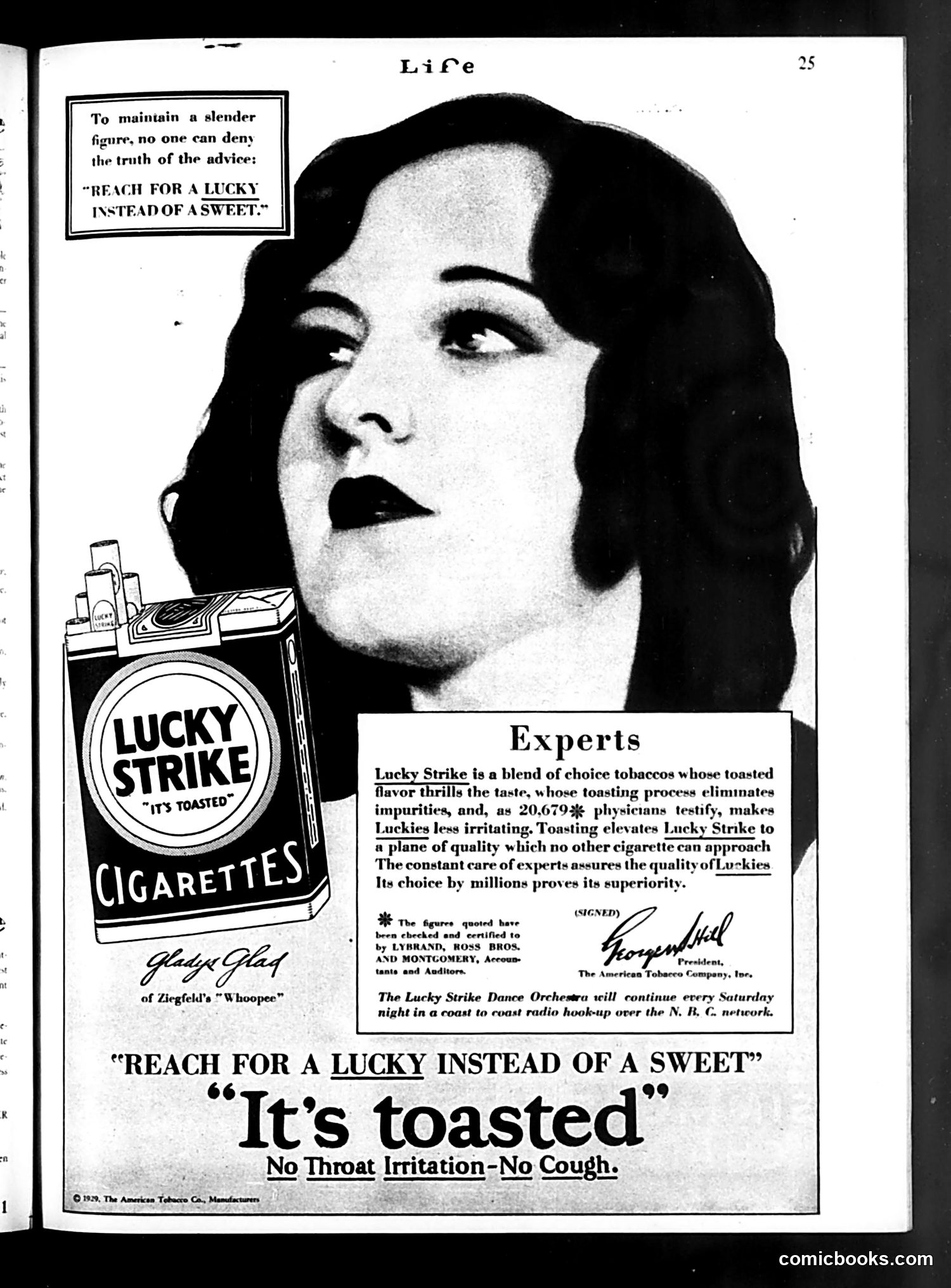
Lucky Strike Cigarette Advertisement (1929) This is a cigarette advertisement, not satire—though modern readers should recognize its deeply problematic claims. The ad features Gladys Glad (identified as from Ziegfeld's "Whoopee"), a glamorous woman endorsing Lucky Strike cigarettes. The central pitch: women should "reach for a Lucky instead of a sweet" to maintain a slender figure. The "Experts" section cites 20,679 physicians claiming toasting makes Luckies "less irritating" and tobacco "pure"—false health claims typical of 1920s tobacco marketing before regulation. Key context for modern readers: This represents the tobacco industry's deliberate strategy to market cigarettes to women as diet aids and weight-control tools. The "toasted" process claim was largely marketing fiction. The physician endorsements were dubious—the accounting firm citation added false credibility. This advertisement exemplifies how corporations made health claims later proven false, targeting women's body anxieties to expand their market.
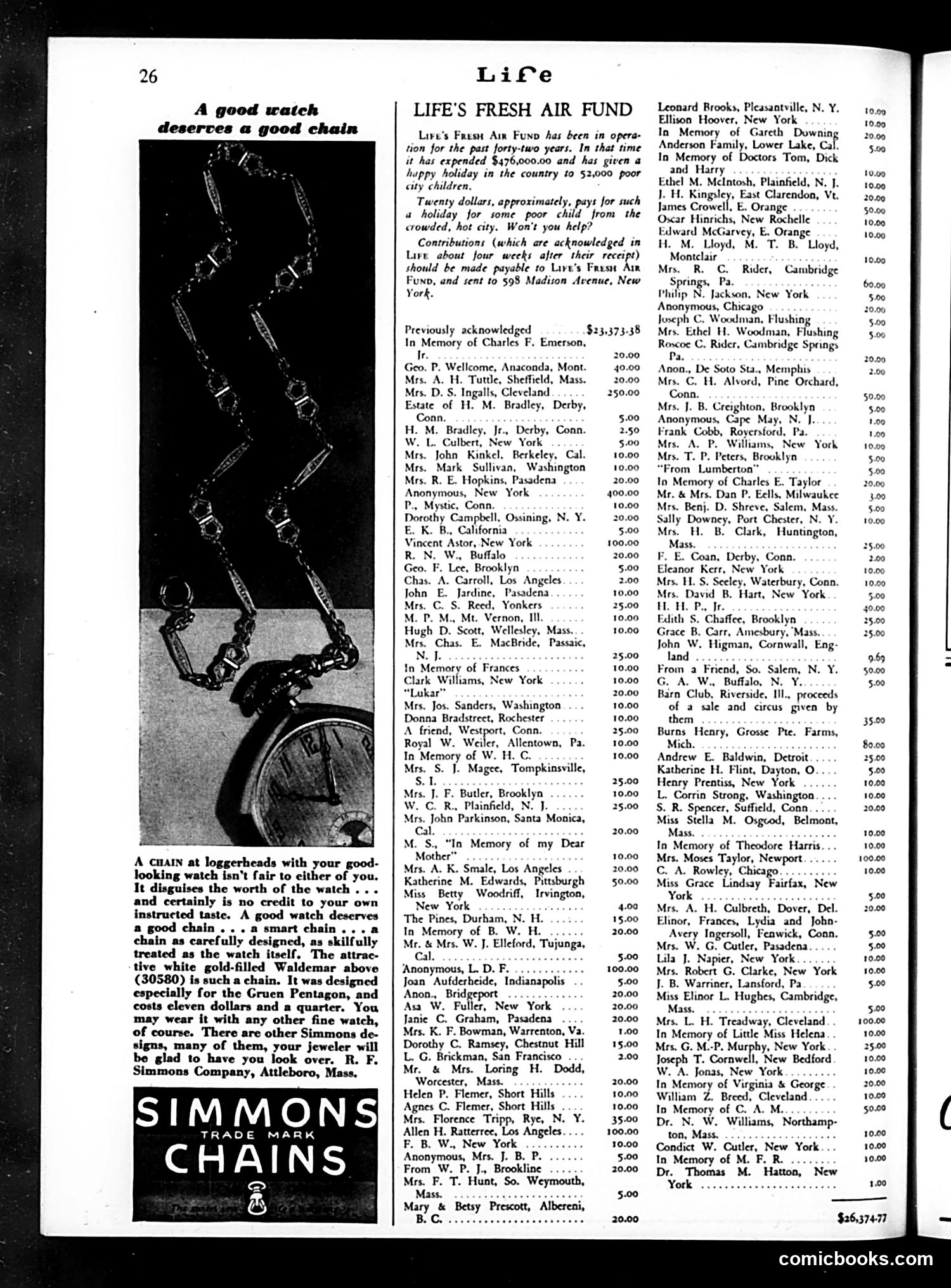
Explanation for Modern Readers This page contains two distinct elements: Left side: Simmons Chains Advertisement An ad for watch chains, featuring a photograph of an elegant wristwatch with chain. The copywriting argues that a quality watch deserves matching quality in its chain—a consumer goods pitch using aesthetic and status arguments common to 1920s-30s advertising. Right side: Life Magazine's Fresh Air Fund A charitable fundraising list for Life's Fresh Air Fund, which provided country holidays for poor city children. The fund had operated 42 years, spent $476,000, and helped 52,000 children. Donations of $5-$400 are listed with donors' names and cities—a transparency practice showing how contributions were used. The page reflects early-20th-century American philanthropy and consumer culture: wealthy readers donate to help poor urban children, while simultaneously being marketed luxury goods. The listing of donors' names served as both acknowledgment and subtle social status indicator.
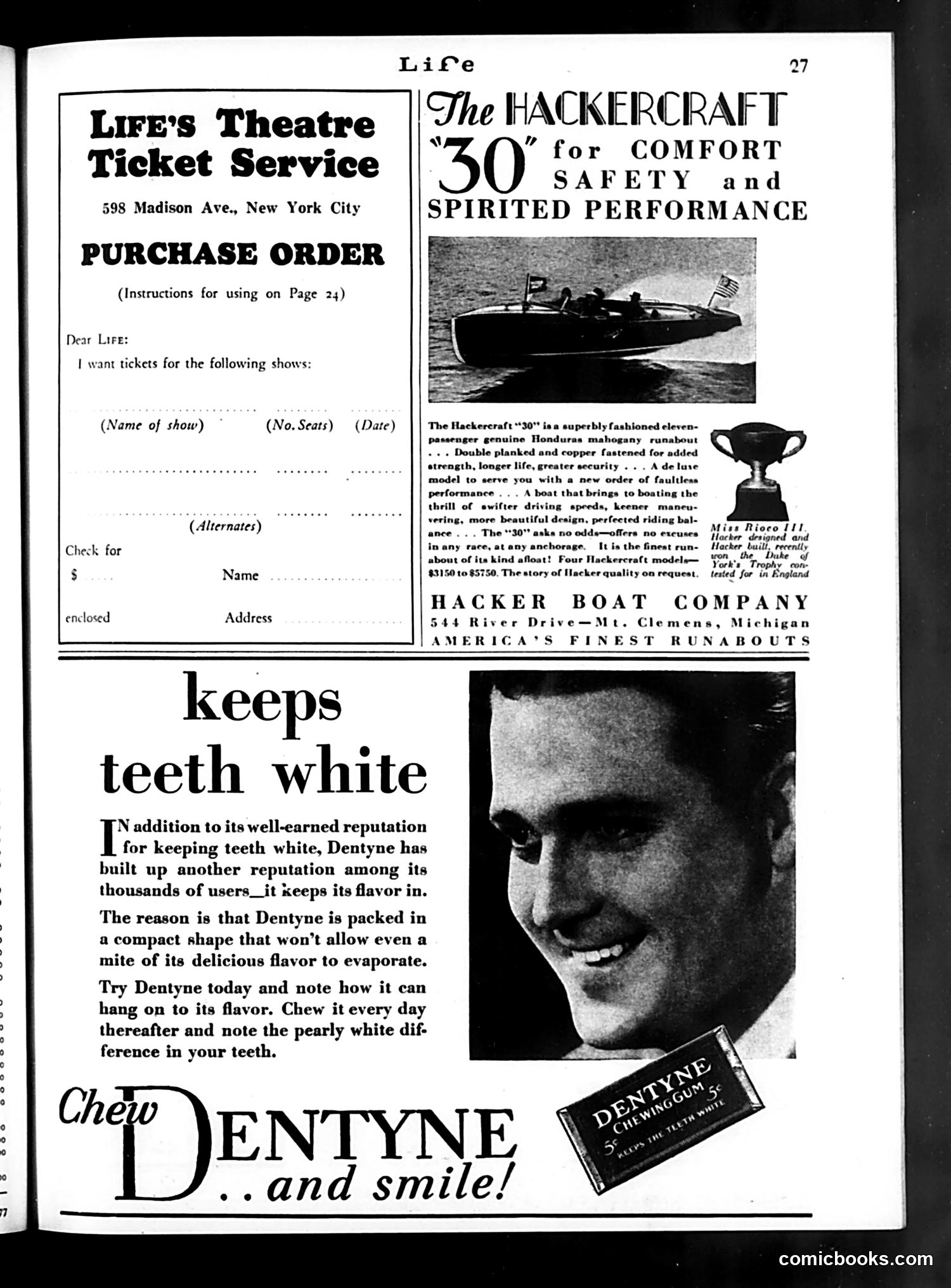
Life Magazine Page 27 Analysis This page contains no political cartoon or satire—it's primarily advertising and a theatre ticket service form. The upper left features a purchase order form for Life's Theatre Ticket Service, a practical service for readers to order Broadway/theatre tickets by mail. The right side advertises the Hackercraft "30" speedboat, marketed as a luxury recreational vessel emphasizing comfort, safety, and performance. The boat appears to have won a "Duke of York's Trophy" in England. This is straightforward product advertising aimed at affluent readers. The lower half advertises Dentyne chewing gum, with a photograph of a smiling man. The ad's pitch is that Dentyne's compact packaging preserves flavor better than competitors' products, and regular chewing produces visibly whiter teeth. All three items—theatre tickets, luxury boats, and gum—reflect the consumer-focused advertising typical of Life magazine during this era (appears to be 1920s-1930s). There is no satirical or political content on this particular page.
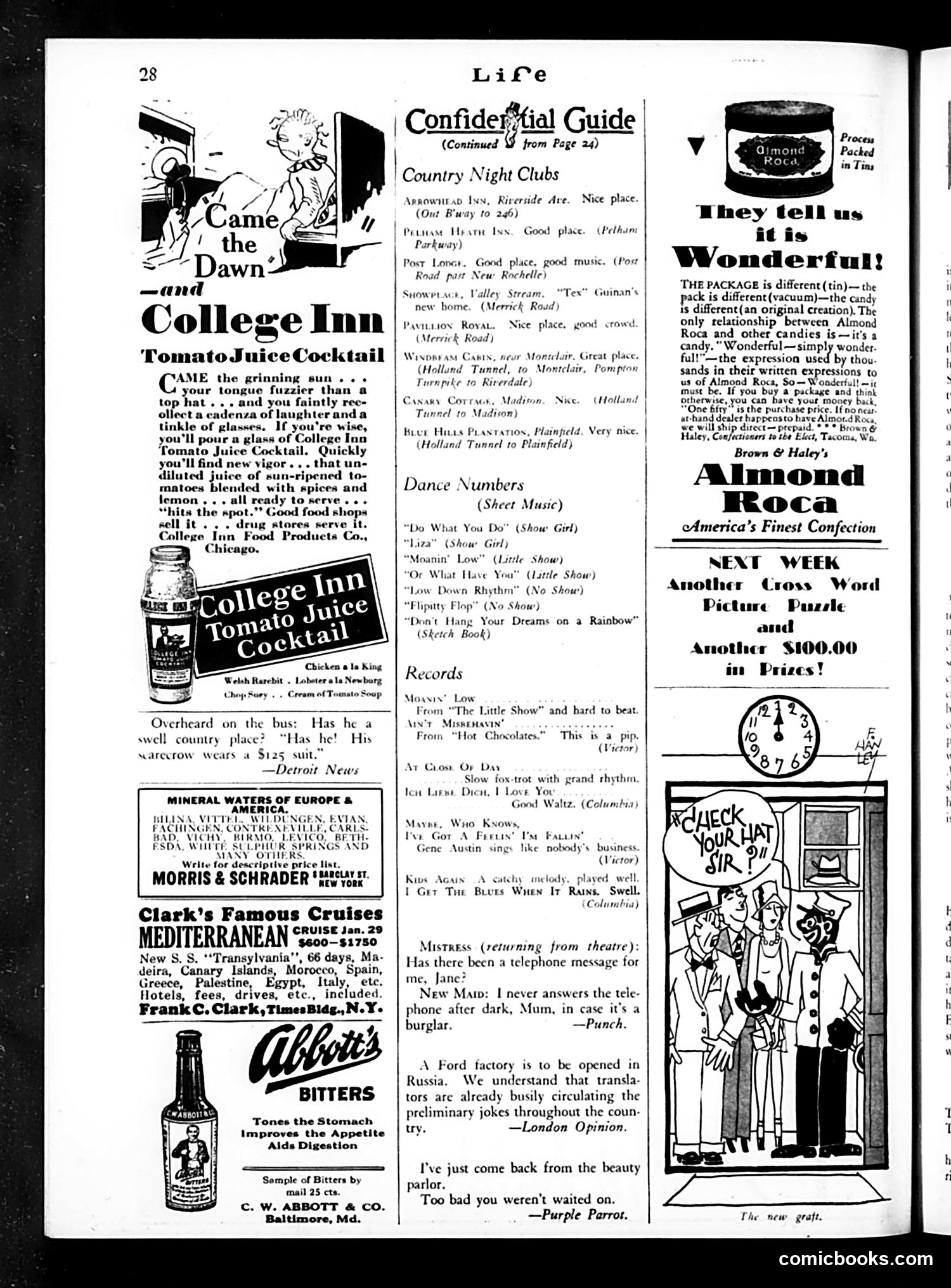
Life Magazine Page 28 (Circa 1920s-Early 1930s) This page is primarily advertisements and entertainment listings, not political satire. The main content includes: Advertisements: College Inn Tomato Juice Cocktail (a hangover remedy), Abbott's Bitters, Clark's Mediterranean cruises, and Almond Roca candy. Entertainment Guide: Lists country nightclubs near New York (including one run by "Tex" Guinan, a famous speakeasy operator during Prohibition), sheet music and phonograph records from popular Broadway shows like "The Little Show" and "Hot Chocolates." Humor: Small jokes like the overheard bus conversation about a wealthy man whose scarecrow wears a $125 suit (mocking conspicuous wealth during economic uncertainty), and a Punch cartoon about a maid refusing to answer phones after dark for fear of burglars. The cartoonish illustration shows the "College Inn" establishment. This reflects Jazz Age leisure culture and Prohibition-era entertainment venues.
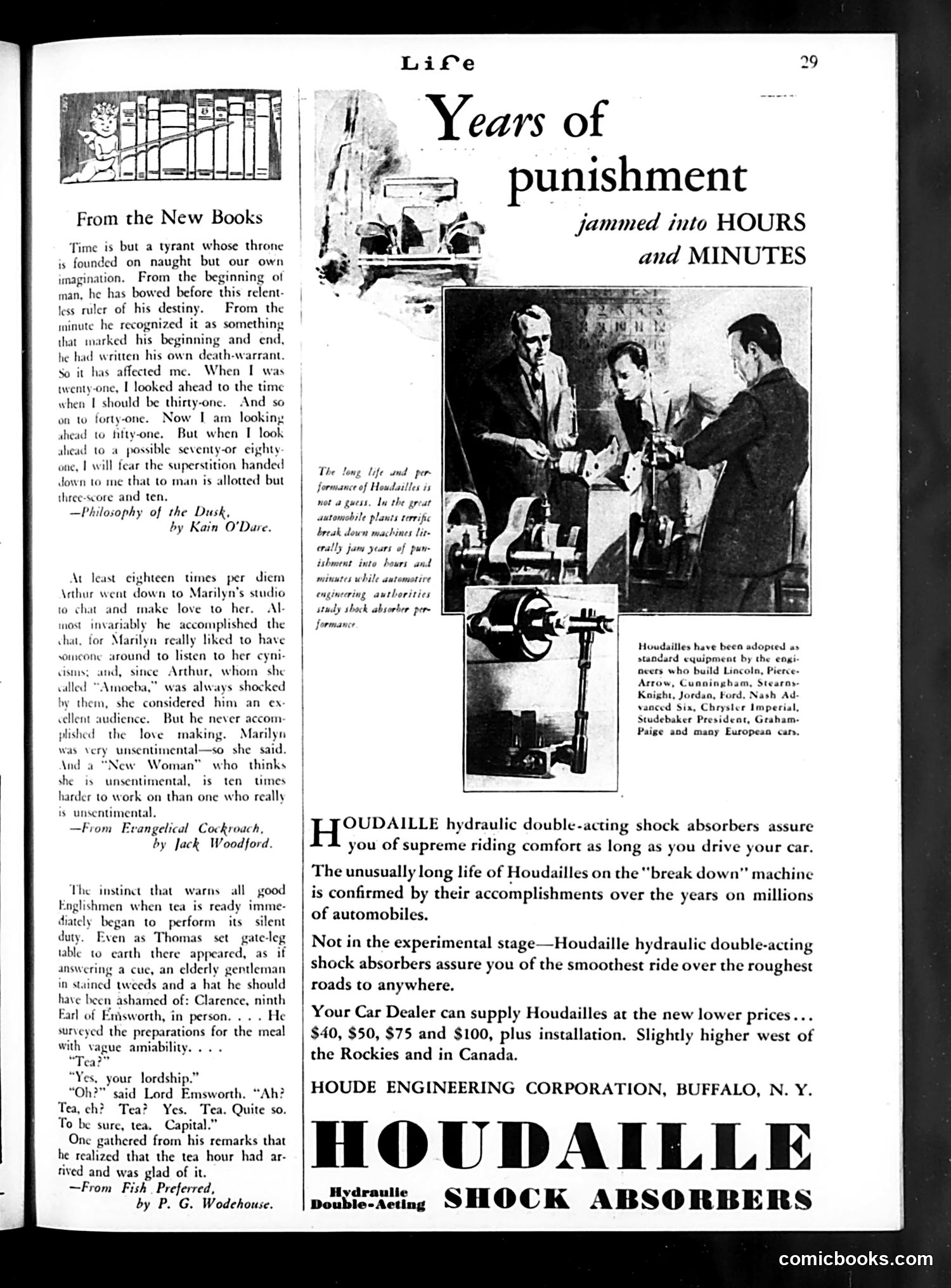
Life Magazine Page Analysis This page combines book excerpts (left) with a Houdaille shock absorber advertisement (right). The book excerpts are literary satire from contemporary publications, featuring cynical observations about time, relationships, and English eccentricity. They mock human nature: obsession with aging, manipulative romance ("Amoeba"), and the absent-minded aristocrat Lord Emsworth—a character too detached to fully comprehend even tea service. The Houdaille ad (dominant right side) uses automobile testing imagery to claim product durability. The photographs show engineering testing equipment and industrial scenes. The copy argues that Houdailles' long lifespan is proven by surviving grueling factory "break down" machines—an extended metaphor comparing automotive punishment to human suffering ("Years of punishment jammed into HOURS and MINUTES"). The juxtaposition is characteristically *Life* magazine: serious literary excerpts paired with commercial persuasion. The ad's pseudo-scientific claim mirrors the book excerpts' existential pretension—both attempting to convince readers of authority through elaborate rhetoric.
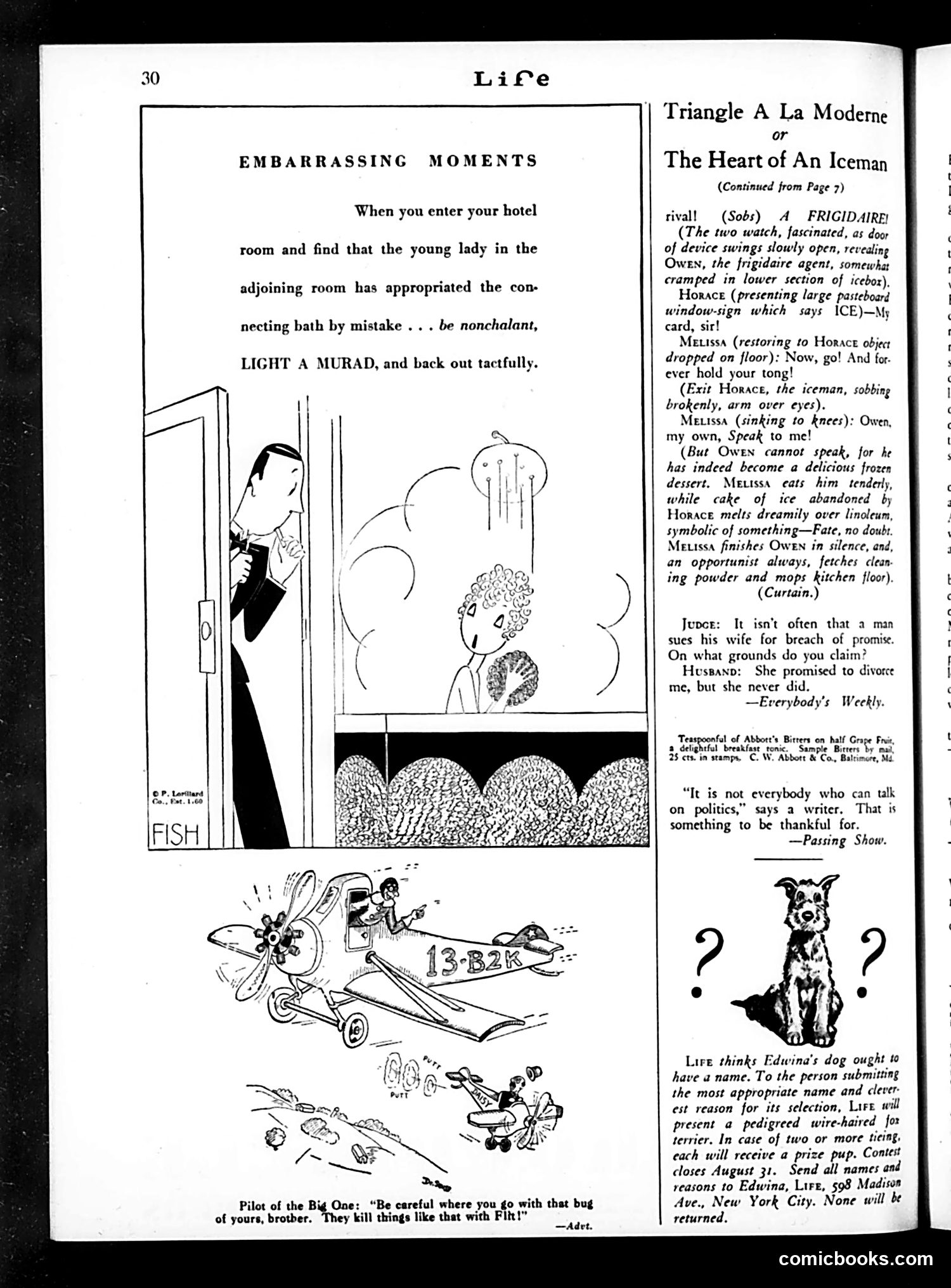
Analysis of Life Magazine Page "Embarrassing Moments" Cartoon (top left): A humorous domestic scenario where a man enters his hotel bathroom to discover a woman from the adjoining room bathing there—she's accidentally used the connecting bath. The joke advises nonchalance and lighting a Murad cigarette before backing out tactfully. This plays on early 20th-century hotel design (connecting baths between rooms) and social embarrassment etiquette. "Triangle A La Moderne" (right column): A serialized comedic story about romantic competition: an iceman and a Frigidaire refrigerator agent both pursue a woman named Melissa. The punchline absurdly suggests the agent becomes literally frozen inside the refrigerator, which Melissa then eats. This satirizes how new household appliances (refrigerators) were replacing traditional services like ice delivery—presented as dark comedy about technological obsolescence. Other items: Include a humorous divorce anecdote, cigarette advertising, and a dog-naming contest advertisement typical of magazine content from this era (approximately 1920s-1930s).
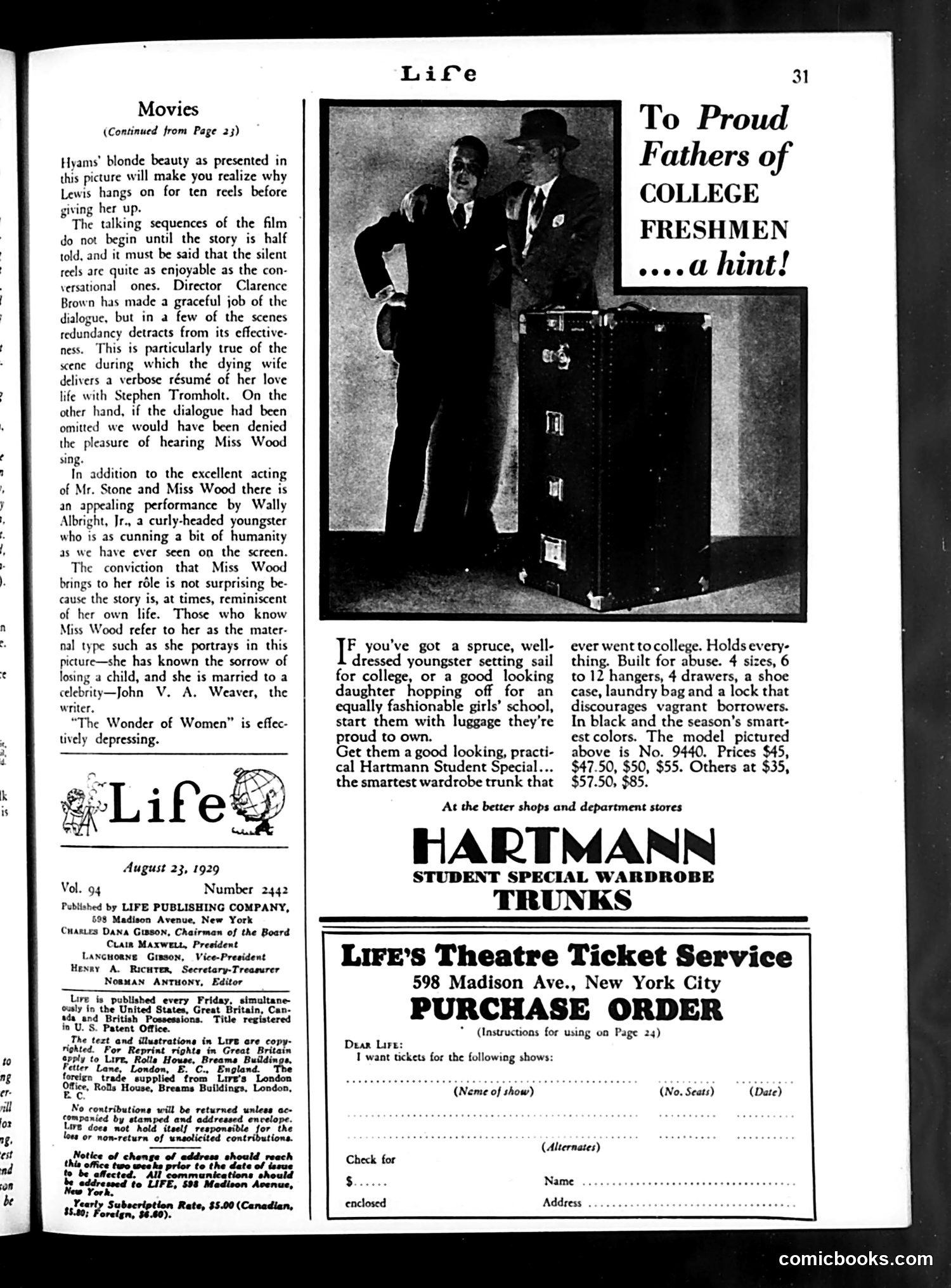
Analysis of Life Magazine Page (August 23, 1929) This page is primarily advertising and magazine infrastructure, not satirical content. The main visual shows two men in formal attire examining a large trunk—this advertises Hartmann Student Special Wardrobe Trunks for college-bound students. The copy appeals to fathers sending children to college, positioning the trunk as a prestigious necessity ("luggage they're proud to own"). The advertisement emphasizes durability and security features (lockable, discourages borrowers). The left column contains a film review discussing "The Wonder of Women," praising actress Natalie Wood's performance and noting how her screen role parallels her personal life (having lost a child). The page footer shows standard magazine masthead information and a theatre ticket order form for Life subscribers. There is no political cartoon or satire on this page—it represents typical 1929 magazine content mixing entertainment coverage with targeted advertising to affluent readers.
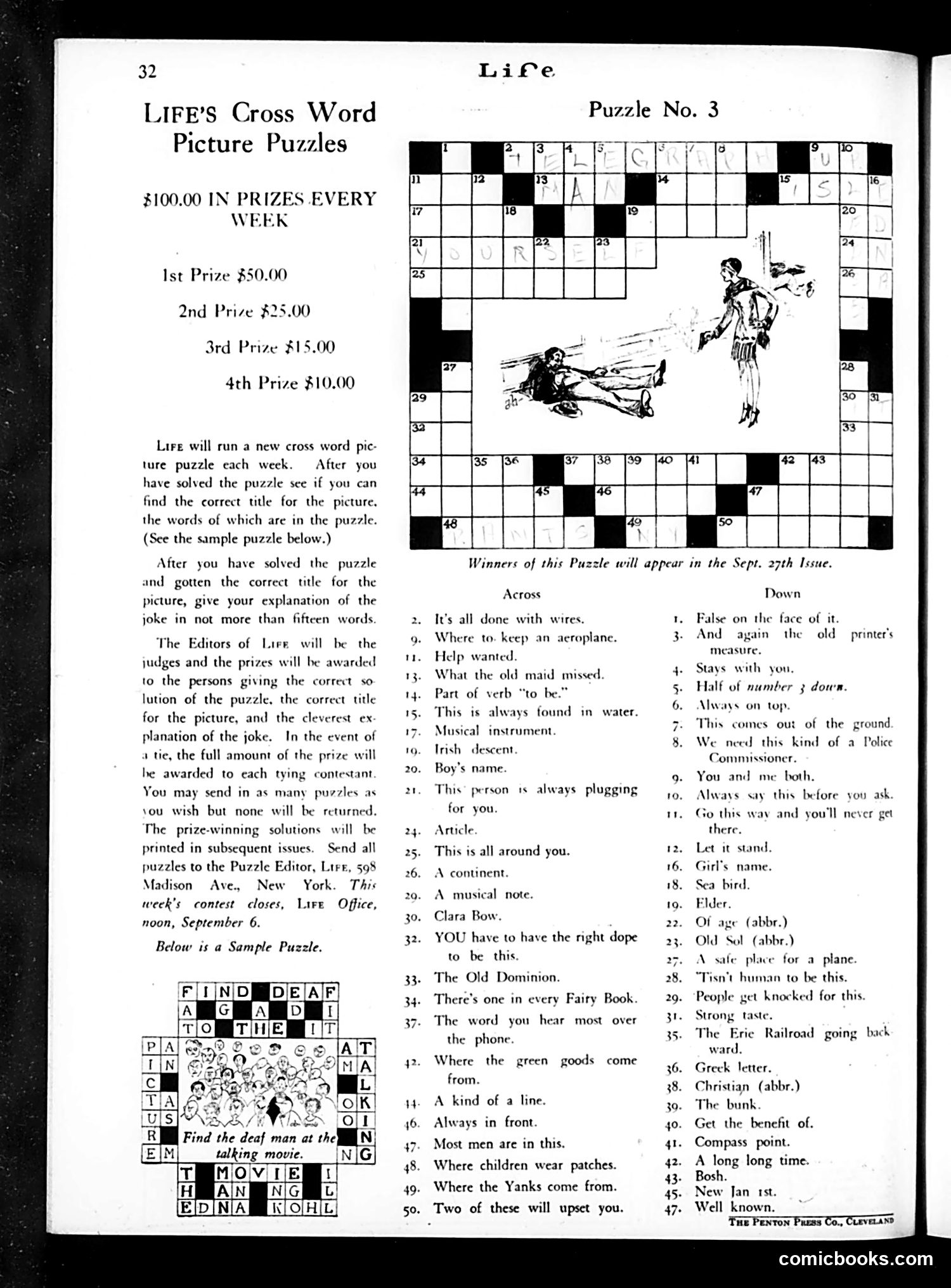
LIFE Magazine Crossword Picture Puzzle This page is primarily a contest announcement, not political satire. Life magazine is promoting a weekly crossword-picture puzzle competition offering $100 in prizes (1st prize: $50). The mechanics: solvers complete a crossword, identify the picture's title using words from the puzzle, then explain the joke in fifteen words maximum. Entries are judged on correctness and cleverness of explanation. The sample puzzle shown features a simple illustration of two figures—a man sliding/falling and a woman standing—with the solution appearing to be "Find the deaf man at the talking movie" (a joke about silent film era). The woman appears fashionably dressed in 1920s style. The clues reference contemporary references: Clara Bow (silent film star), the Erie Railroad, "the Yanks," and "green goods" (counterfeit money slang). This appears to be from September 1925 based on the closing date mentioned.
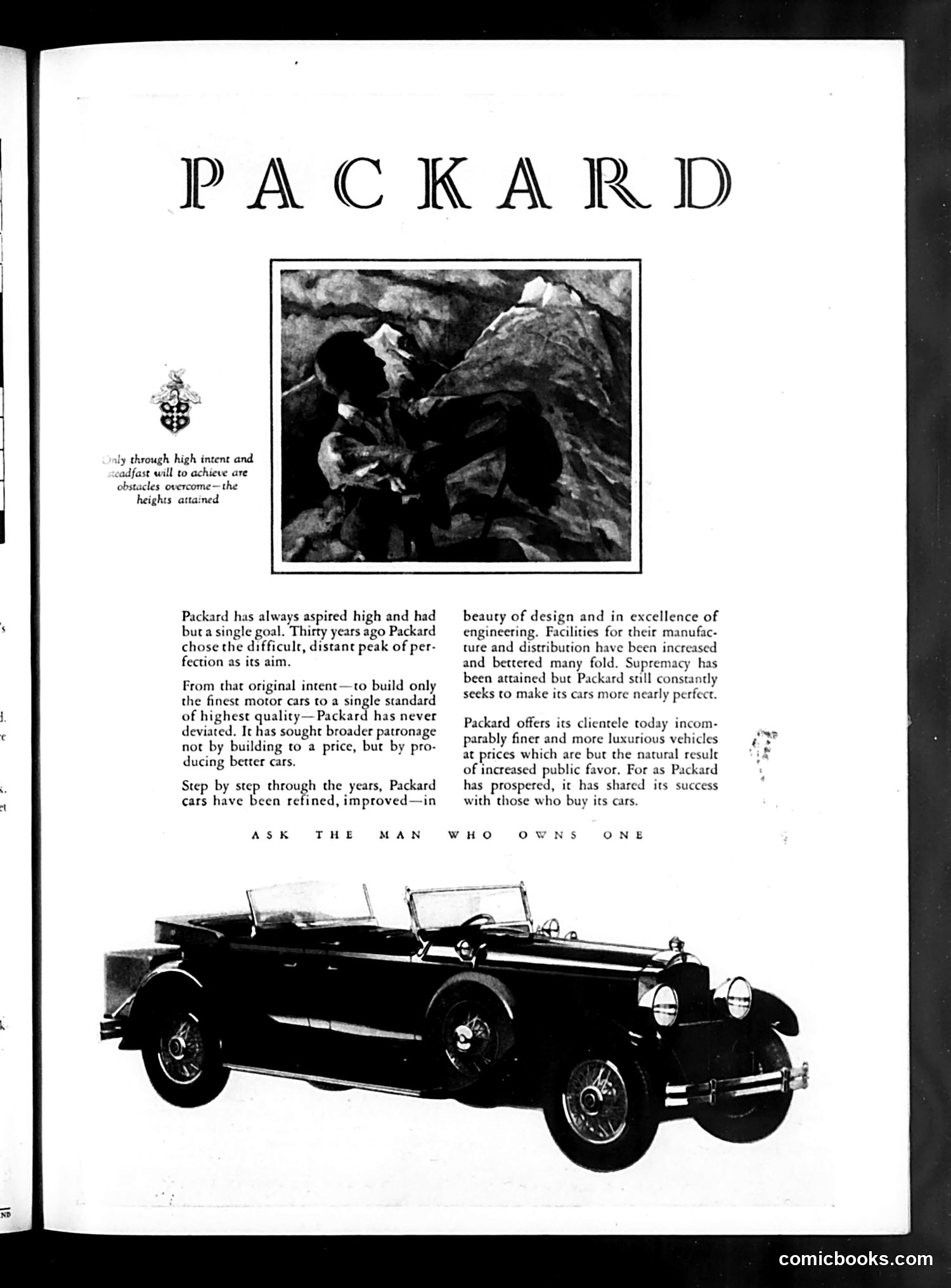
Packard Automobile Advertisement This is a luxury car advertisement, not political satire. The page promotes Packard automobiles, a prestigious American marque known for high-end vehicles. The text emphasizes Packard's 30-year commitment to quality over affordability—building "the finest motor cars to a single standard of highest quality" rather than competing on price. The mountaineer image at top symbolizes the company's ambitious goal of reaching "perfection." The phrase "Ask the Man Who Owns One" (visible at bottom) was Packard's famous advertising slogan, implying that satisfied owners are the best endorsement. The convertible car shown represents the luxury market Packard targeted. For modern readers: this reflects early 20th-century marketing that equated automobiles with aspiration and personal achievement, positioning Packard as the prestige choice for wealthy consumers.
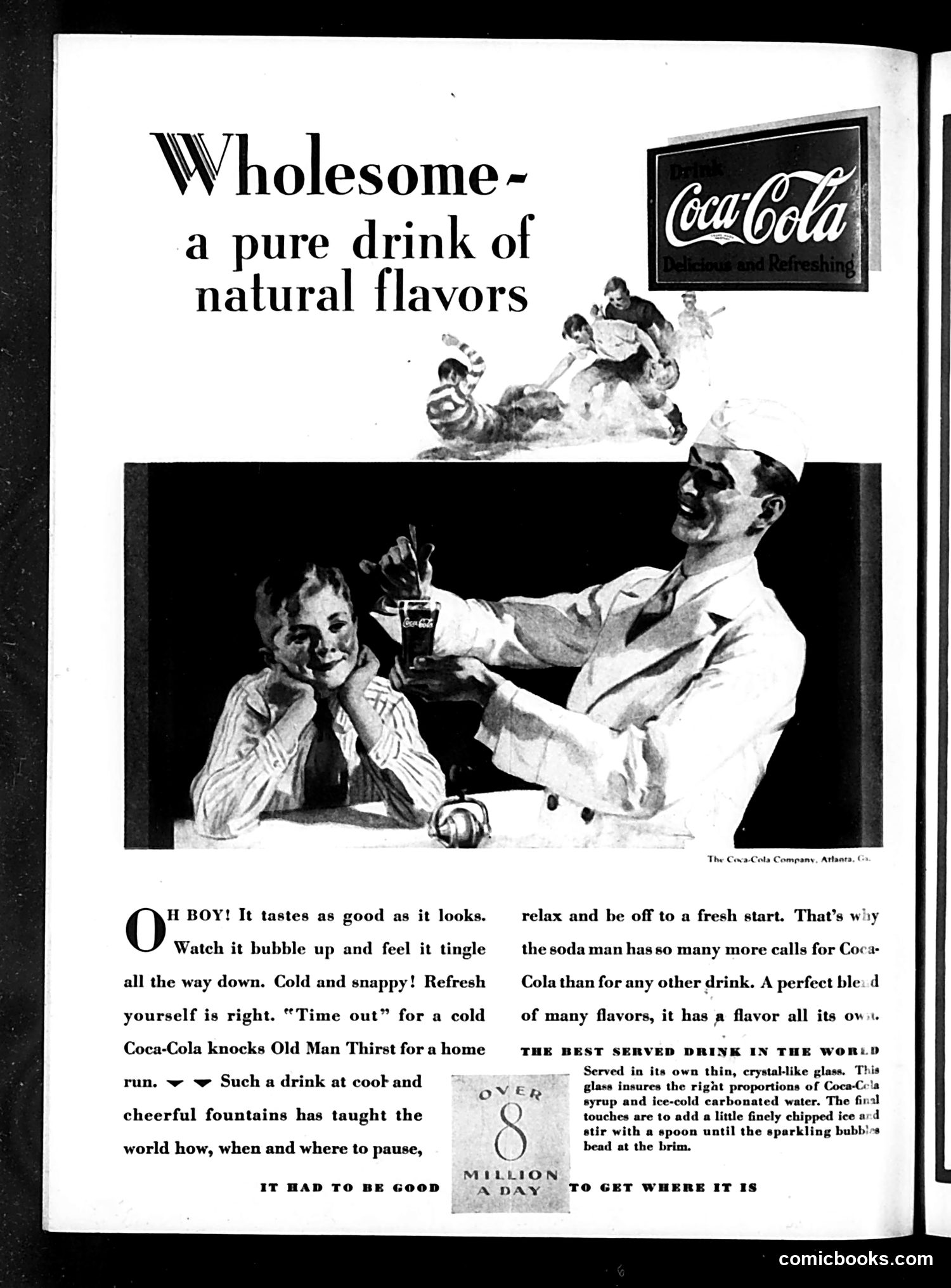
Analysis This is a Coca-Cola advertisement, not political satire. The page promotes Coca-Cola as a wholesome, refreshing beverage made from "natural flavors." The image shows a man serving a Coca-Cola to a smiling boy, emphasizing family wholesomeness and the drink's appeal to children. The ad uses period marketing language ("cold and snappy," "bubbles up") and claims Coca-Cola outsells competitors because of its superior taste and quality preparation. The "8 Million A Day" badge indicates the product's popularity and market dominance. The advertisement describes proper fountain service—the specific proportions of syrup, carbonated water, and chipped ice required to serve Coca-Cola correctly. This reflects early 20th-century advertising strategy: positioning a commercial product as a wholesome, family-friendly "pause" in daily life. Modern readers should note the emphasis on natural ingredients (a claim that would face scrutiny today) and the casual inclusion of a child consumer.