life
Life — August 30, 1929
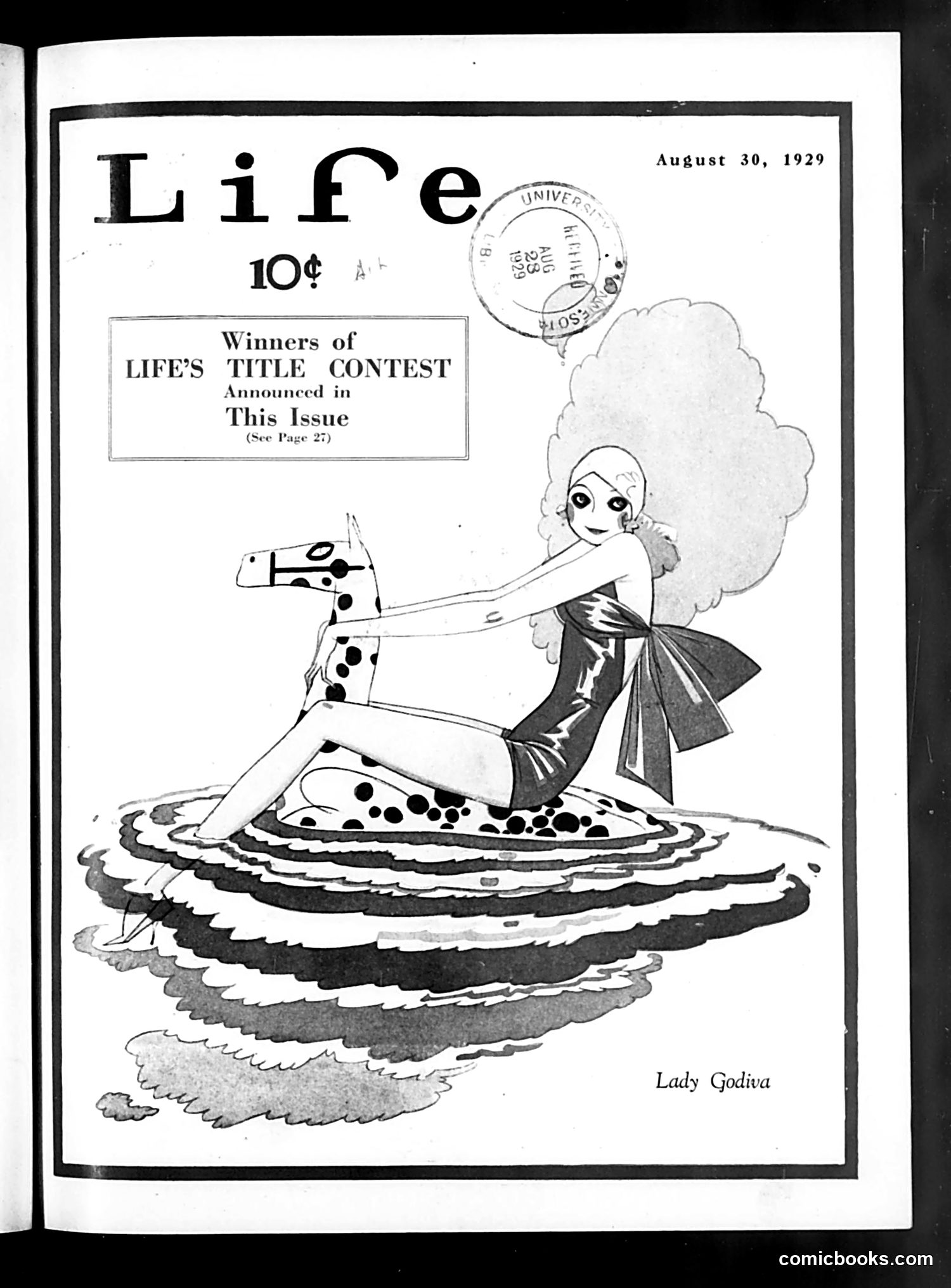
Analysis of Life Magazine Cover, August 30, 1929 This is the cover of Life magazine, a satirical publication, priced at 10 cents. The illustration titled "Lady Godiva" depicts a stylized woman with voluminous bobbed hair (characteristic of 1920s flapper fashion) sitting on a ornate, cloud-like cushion while holding reins attached to a spotted horse. The image appears to satirize the extravagance and frivolity of the Jazz Age wealthy, specifically mocking wealthy women's indulgent lifestyles. The "Lady Godiva" reference invokes the medieval legend of a noblewoman who rode naked through town, suggesting commentary on shameless displays of wealth or impropriety. The cover also announces a "Life's Title Contest" with winners announced inside (page 27).
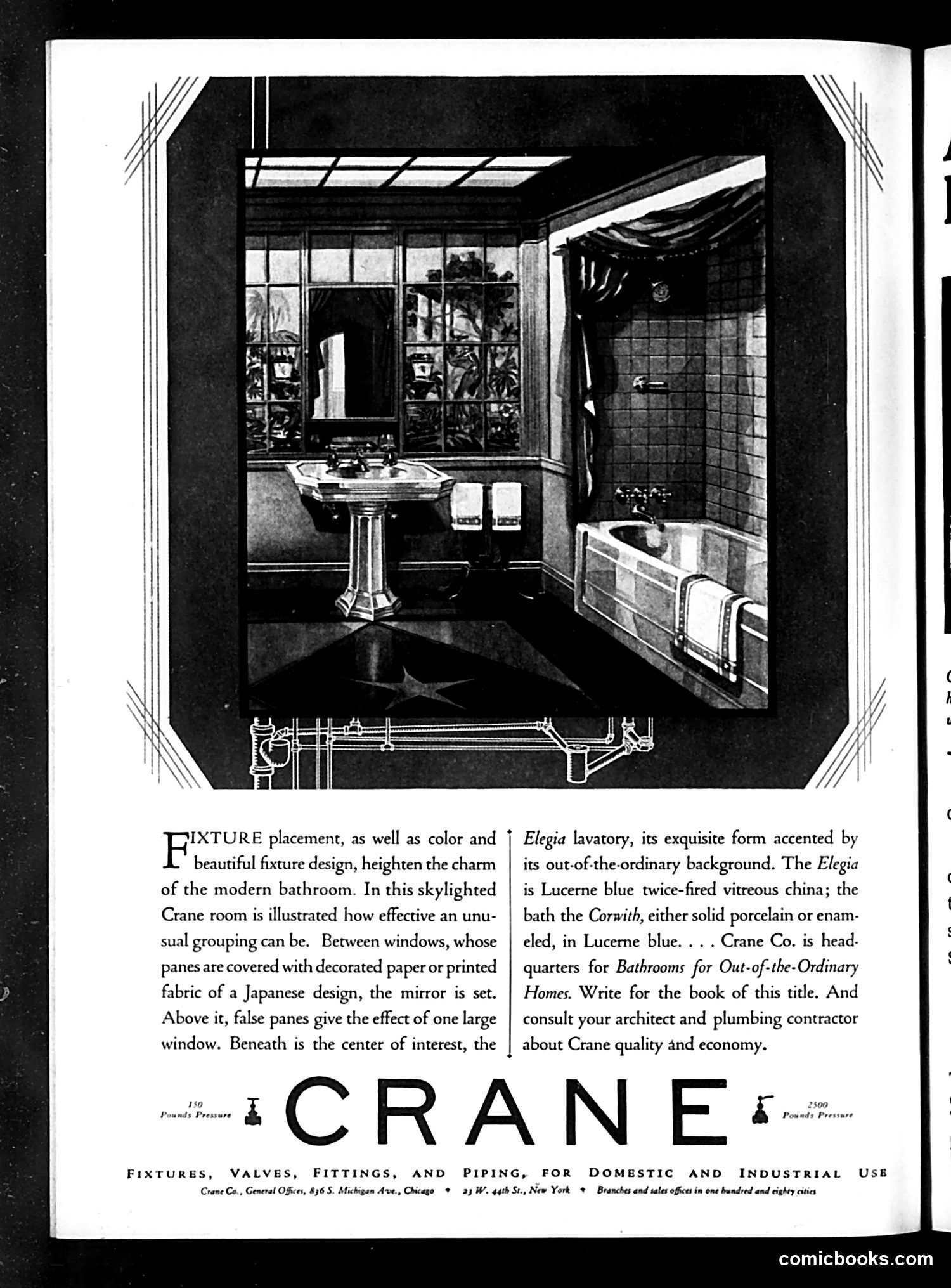
Analysis This is not a political cartoon or satire page—it's a Crane Company advertisement for bathroom fixtures from what appears to be an early-to-mid 20th century Life magazine. The image shows a luxurious bathroom interior design featuring a pedestal sink, bathtub with railings, tiled walls, and decorative mirrored windows. The ad copy emphasizes "fixture placement" and "beautiful fixture design" for modern homes, highlighting Crane's Elegia lavatory in "Lucerne blue" and Corwith bath options. The text markets these as "Bathrooms for Out-of-the-Ordinary Homes," positioning Crane as the manufacturer for quality, economical bathroom design. There is no political or social satire present—this is straightforward product advertising emphasizing modern plumbing aesthetics and design innovation.
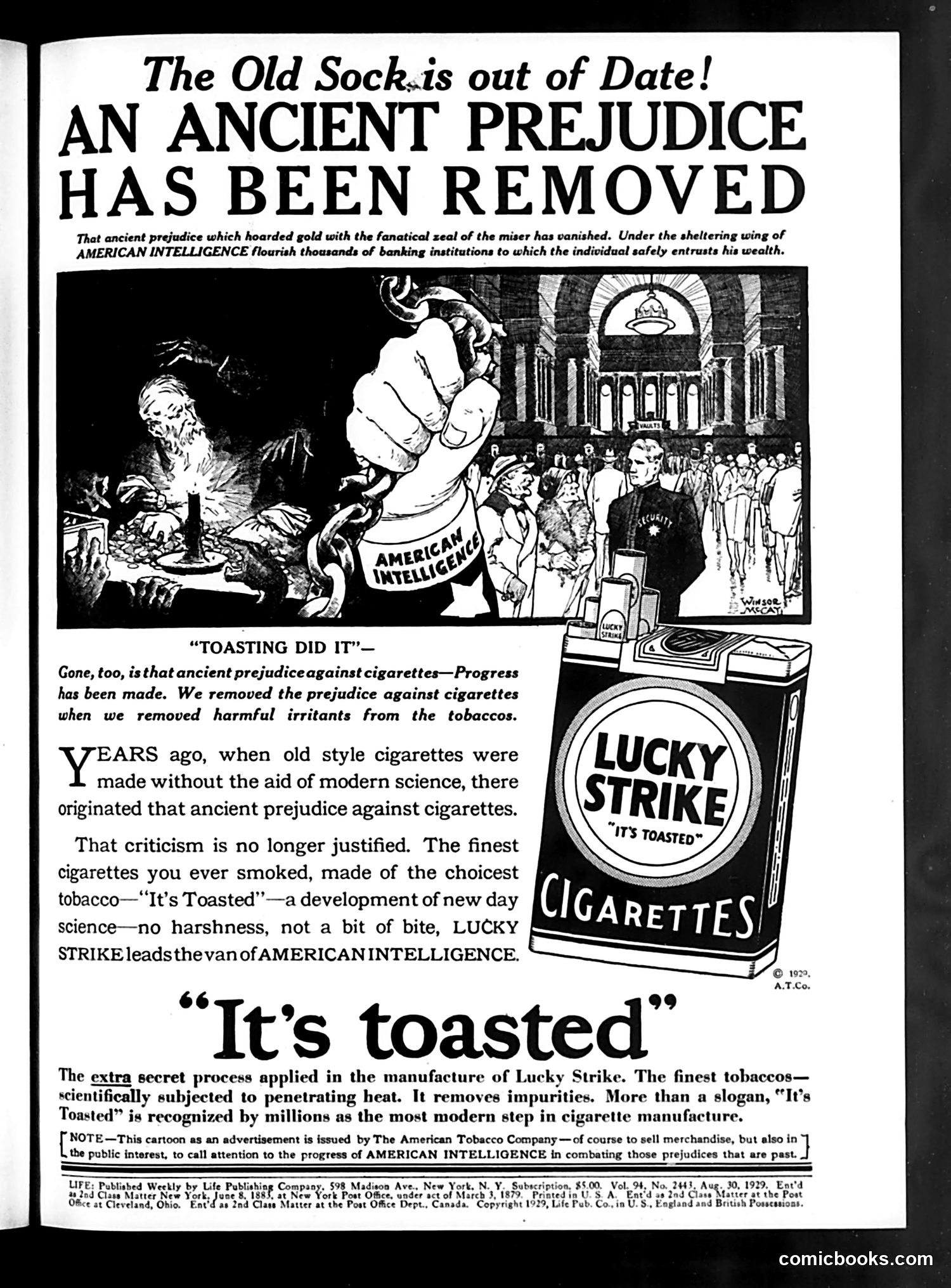
Analysis: Lucky Strike Cigarettes Advertisement This is a cigarette advertisement disguised as editorial content, not genuine satire. The page uses nationalist rhetoric and pseudo-scientific claims to market Lucky Strike cigarettes. The illustration shows a giant hand labeled "American Intelligence" crushing snakes (representing "ancient prejudice against cigarettes"). The accompanying text falsely claims that scientific advancement—specifically Lucky Strike's "toasting" process—has removed harmful elements from tobacco, making old anti-smoking concerns obsolete. The ad conflates product innovation with progress and patriotism, suggesting skepticism toward cigarettes is backward thinking. This represents aggressive early-20th-century tobacco marketing that exploited American faith in science and modernity to overcome legitimate health concerns—before cigarettes' actual dangers were widely acknowledged.
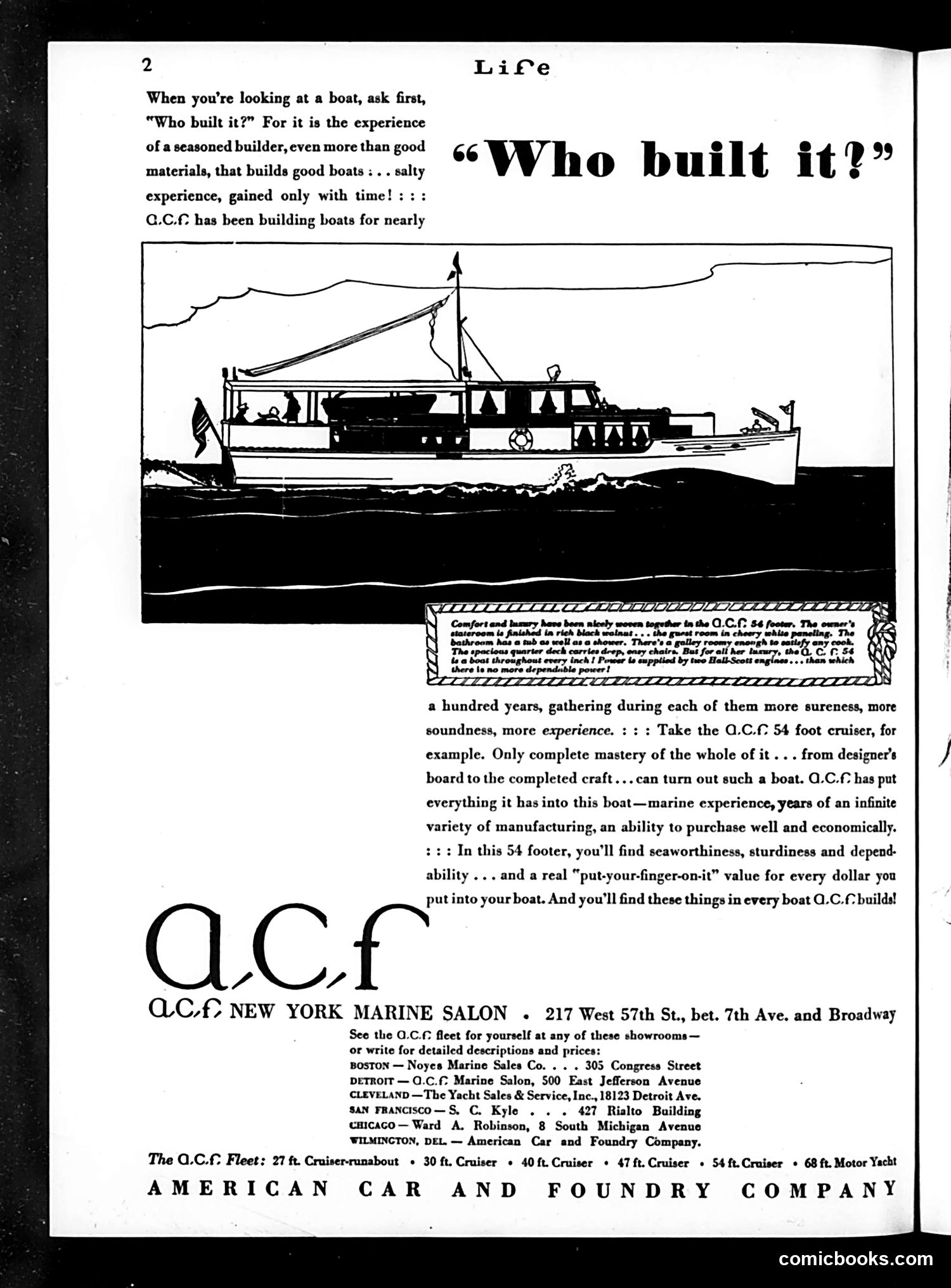
This page is primarily advertising, not satire or political commentary. It's a full-page advertisement for O.C.F. (American Car and Foundry Company) boats, specifically promoting their 54-foot cruiser model. The ad uses the headline "Who built it?" to emphasize O.C.F.'s century of boat-building experience and craftsmanship. The illustration shows a motor yacht with detailed cross-section information about its construction and amenities (rich mahogany interior, comfortable quarters, Hall-Scott engines). The text argues that a boat's quality depends on the builder's experience and skill—materials alone don't suffice. O.C.F. claims their accumulated expertise ensures seaworthiness, durability, and value across their entire fleet of vessels. This is straightforward product marketing targeting affluent leisure-boat buyers.
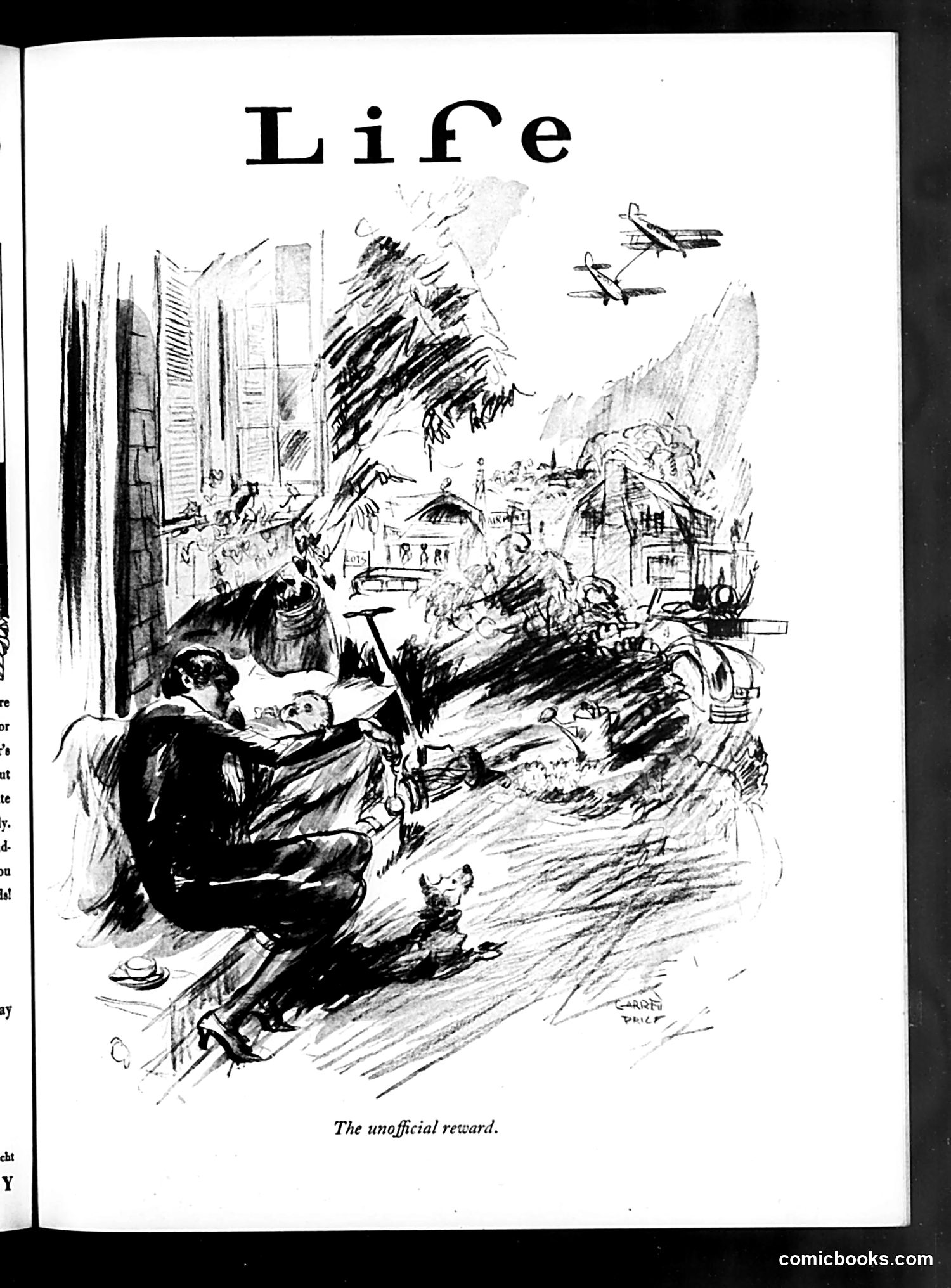
"Life" Magazine Cartoon Analysis This page titled "Life" features a sketch captioned "The unofficial record." The illustration shows a man sitting on what appears to be a ledge or step, holding papers while observing a chaotic urban scene below. The scene depicts destruction—burning buildings, collapsed structures, and general devastation—with two military aircraft flying overhead. The cartoon appears to satirize the gap between official governmental reports and actual wartime conditions. The "unofficial record" likely refers to honest documentation of war damage that contradicts sanitized official statements. Given the aircraft and urban destruction, this probably comments on bombing campaigns or their aftermath, contrasting reality with propagandistic or censored accounts. The specific historical context remains unclear without additional publication details.
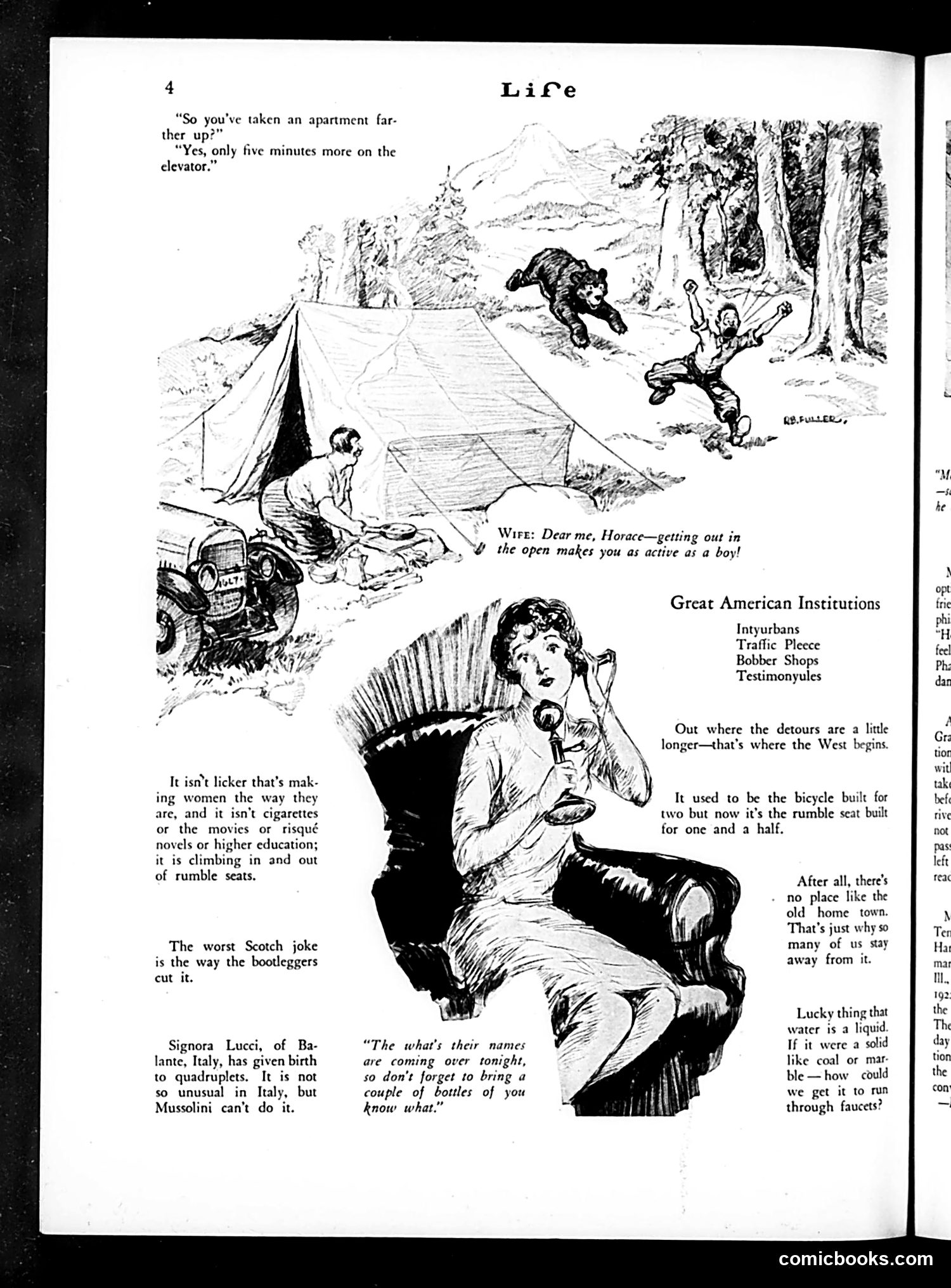
Analysis of Life Magazine Page This page satirizes American domestic life and social institutions through humor. The top cartoon depicts a camping scene where a wife compliments her husband Horace on becoming "active as a boy" outdoors—contrasting urban life with rugged recreation. The section titled "Great American Institutions" mockingly lists "Inturbans / Traffic Fleece / Bobber Shops / Testimonyules"—playing on words to critique modern conveniences and social practices. The lower illustration shows a woman on the telephone discussing an evening party, with accompanying text joking about bootleggers, Scotch whiskey, and bringing bottles to social gatherings—likely referencing Prohibition-era speakeasy culture and the illegal alcohol trade. The overall tone mocks contemporary American social customs, consumerism, and the gap between small-town nostalgia and urban reality.
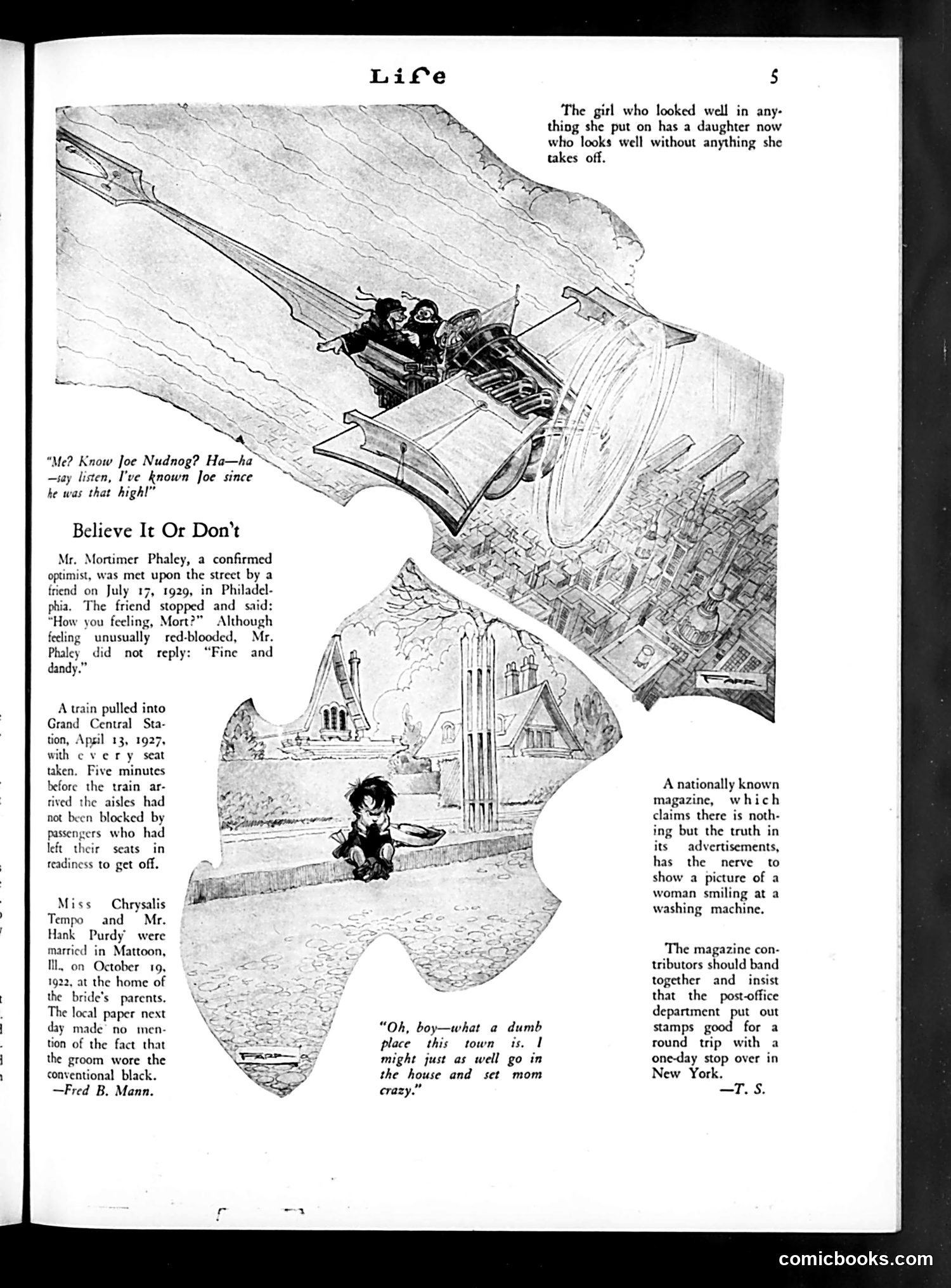
Analysis of Life Magazine Page 5 This page contains three distinct humor pieces: 1. Top cartoon: Shows two people on a roller coaster with dialogue "Me? Know Joe Nudnog? Ha—ha—say listen, I've known Joe since he was that high!" The joke satirizes social pretension—people claiming familiarity with others they barely know. 2. "Believe It Or Don't" section: Anecdotes about odd coincidences (a man meeting a friend while unusually flushed, a train departing exactly when all passengers were seated, a groom wearing conventional black to his wedding). These mock the magazine's tendency to highlight trivial or fabricated "remarkable" occurrences. 3. Bottom cartoon: A boy in a shabby town says "Oh, boy—what a dumb place this town is. I might just as well go in the house and set mom crazy." This satirizes small-town tedium and youthful restlessness.
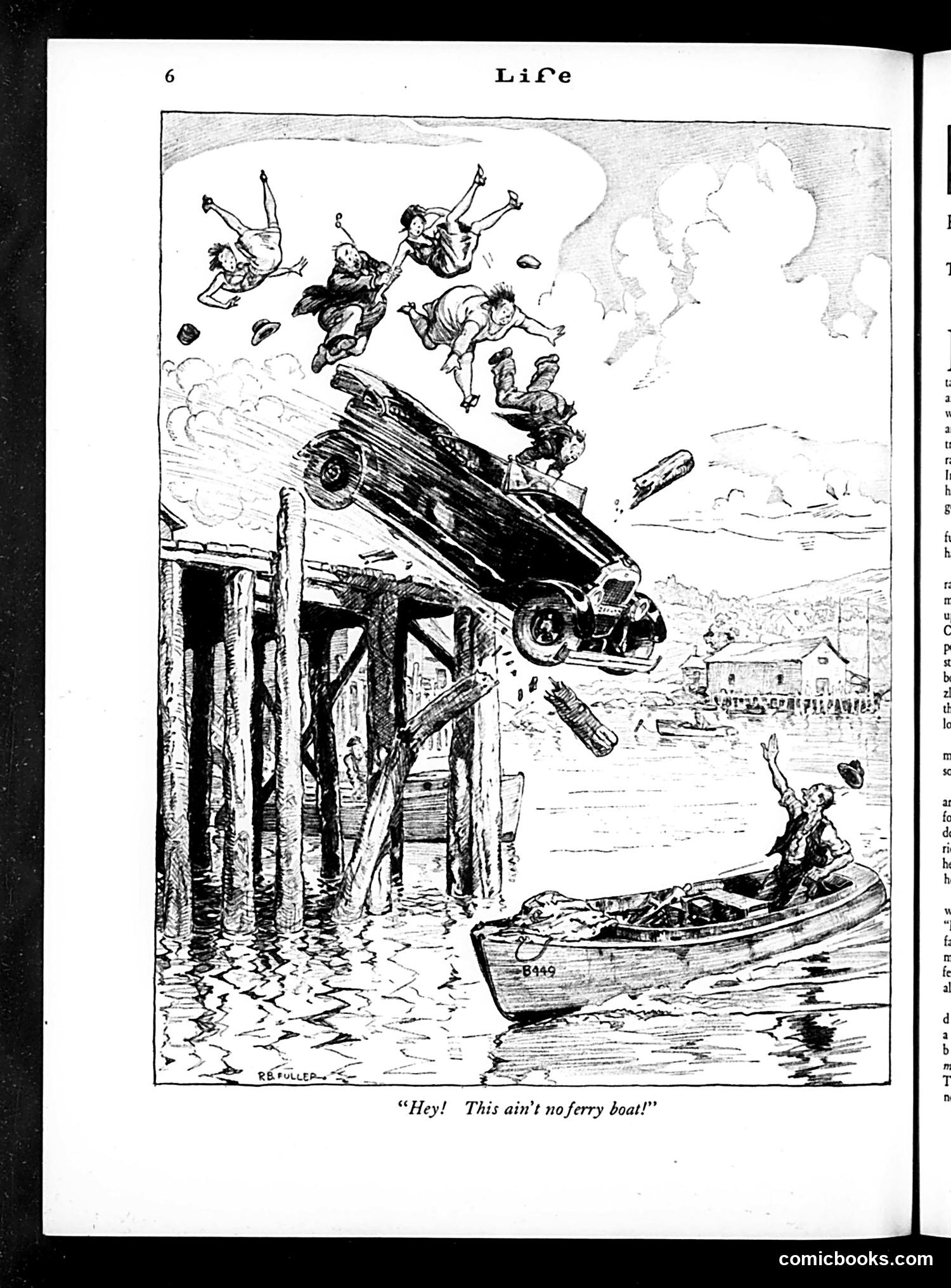
Analysis This cartoon depicts a chaotic scene where a truck has crashed off a wooden pier into water below, with people and cargo flying through the air. A man in a small boat below shouts "Hey! This ain't no ferry boat!" The humor is straightforward slapstick: the truck driver appears to have mistaken the pier for a ferry landing and driven straight off. The passenger's complaint plays on the absurdity—he's pointing out that a small rowboat is obviously not a vehicle ferry, yet the truck has just treated it as such. This is visual comedy about vehicular mishap and human error rather than political satire. The artist's signature appears to be "R.B. Fuller" or similar. The cartoon simply mocks careless driving and poor judgment without referencing specific political figures or events.
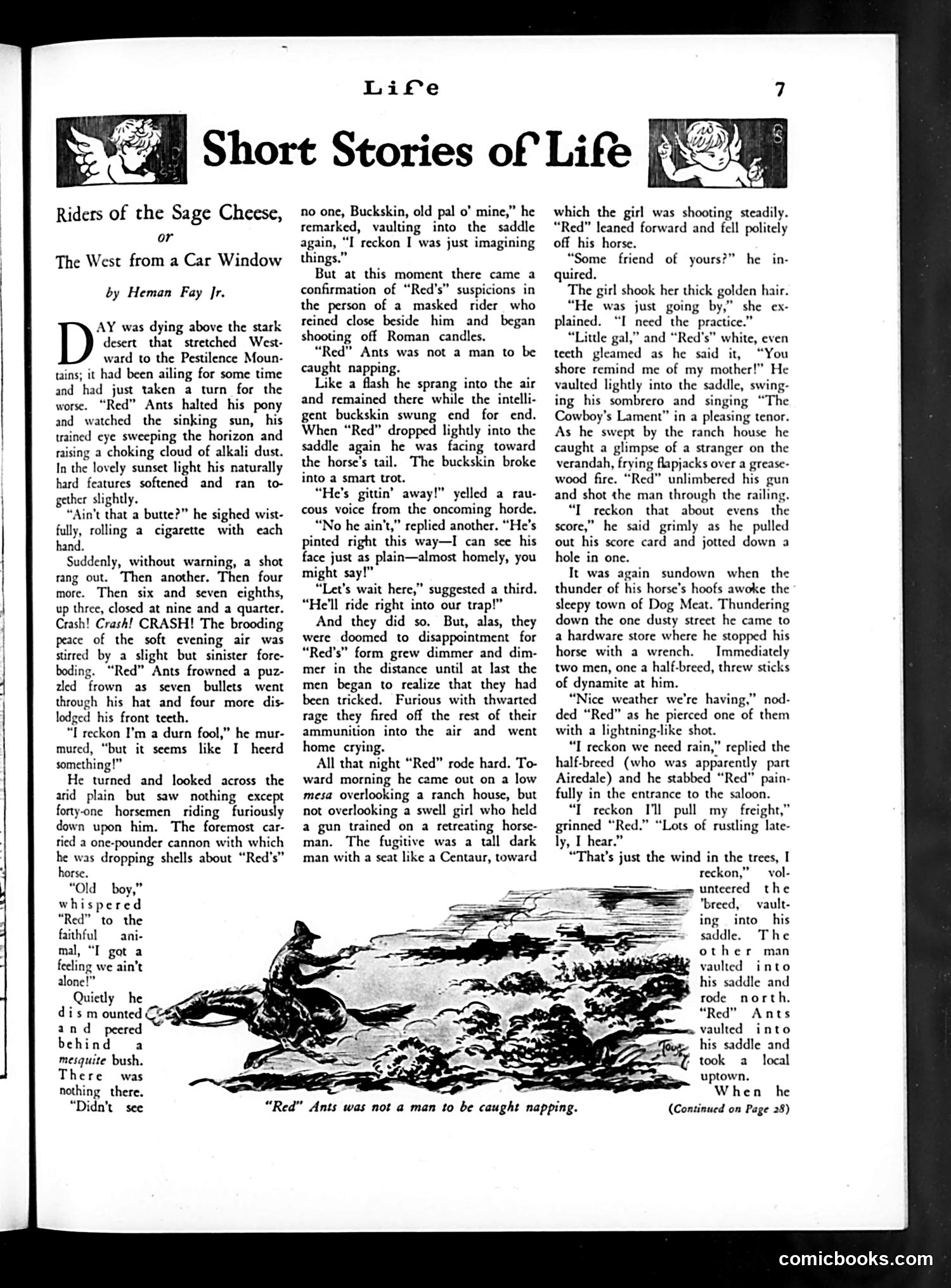
Analysis This page contains a short story titled "Riders of the Sage Cheese, or The West from a Car Window" by Herman Fay Jr., rather than political satire or editorial cartoons. The narrative is a Western adventure featuring a character named "Red" Ants, a cowboy pursued by mounted horsemen across the desert. The story appears to be humorous fiction playing on Western genre conventions—the title's "Sage Cheese" pun suggests comic intent. The single illustration shows Red Ants on horseback being chased across arid terrain, matching the action described in the text. This is entertainment content typical of Life magazine's satirical humor section, not political commentary. The satire here is literary rather than political—poking fun at Western adventure tropes rather than addressing contemporary events.
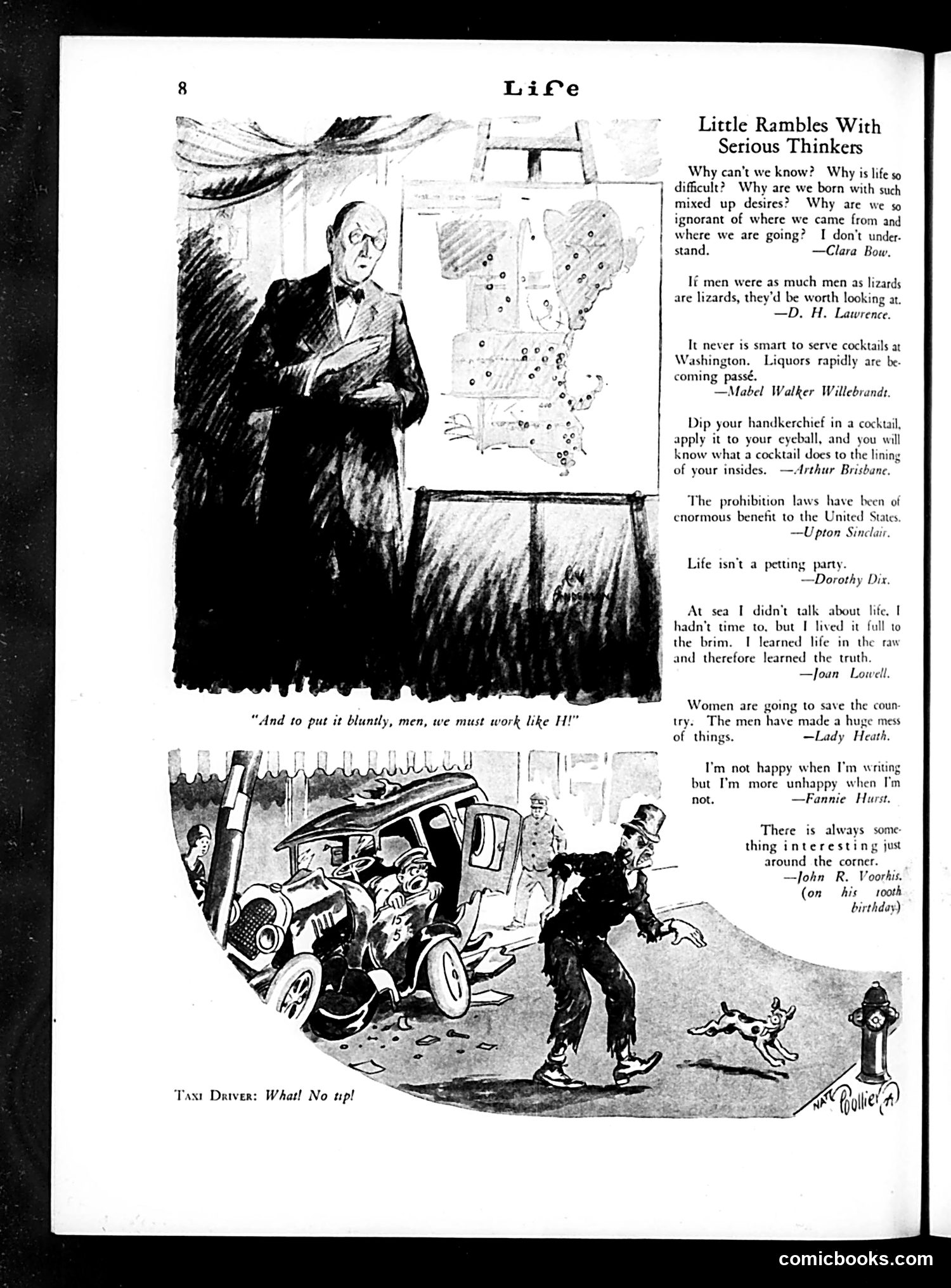
Analysis of Life Magazine Page 8 This page features two cartoon illustrations with philosophical quotations titled "Little Rambles With Serious Thinkers." The top cartoon shows a man studying a map of the United States, with the caption "And to put it bluntly, men, we must work like H—!" This appears to satirize post-WWI workplace demands or industrial labor rhetoric. The bottom cartoon, captioned "Taxi Driver: What! No up!" depicts a collision scene where a taxi driver reacts with shock—likely commenting on the custom of tipping (or lack thereof). The "no up" refers to the absence of a gratuity. Both cartoons use humor to critique contemporary American social behaviors: intense work culture and tipping practices. The accompanying quotes from various writers reflect 1920s intellectual commentary on life's difficulties and contradictions.
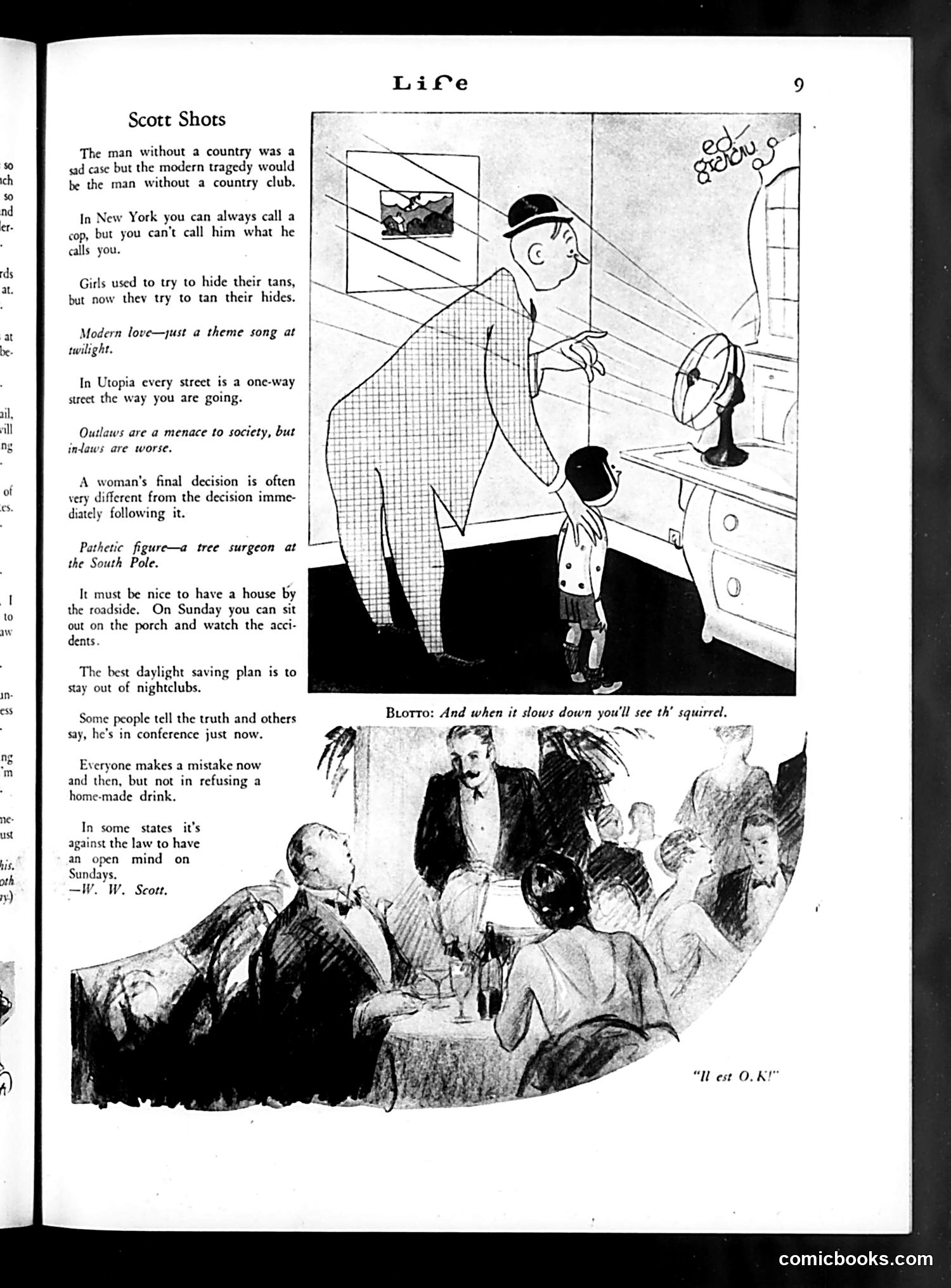
Analysis of Life Magazine Page 9 This page contains satirical commentary by Scott Shots alongside two cartoon illustrations. The top cartoon depicts a man showing a child a fan, with the caption "And when it slows down you'll see th' squirrel." The joke appears to be about optical illusion or trick vision—a common parlor trick where a fan's blades, when slowing, create the illusion of an image. The bottom cartoon shows a dinner party scene with the caption "It eat O.K!" suggesting someone sampling unfamiliar or questionable food and reluctantly approving it. The accompanying text snippets are humorous observations about modern life—observations about New York police, tanning, love songs, and various social behaviors. The overall tone is wry commentary on 1920s American urban society and social conventions.
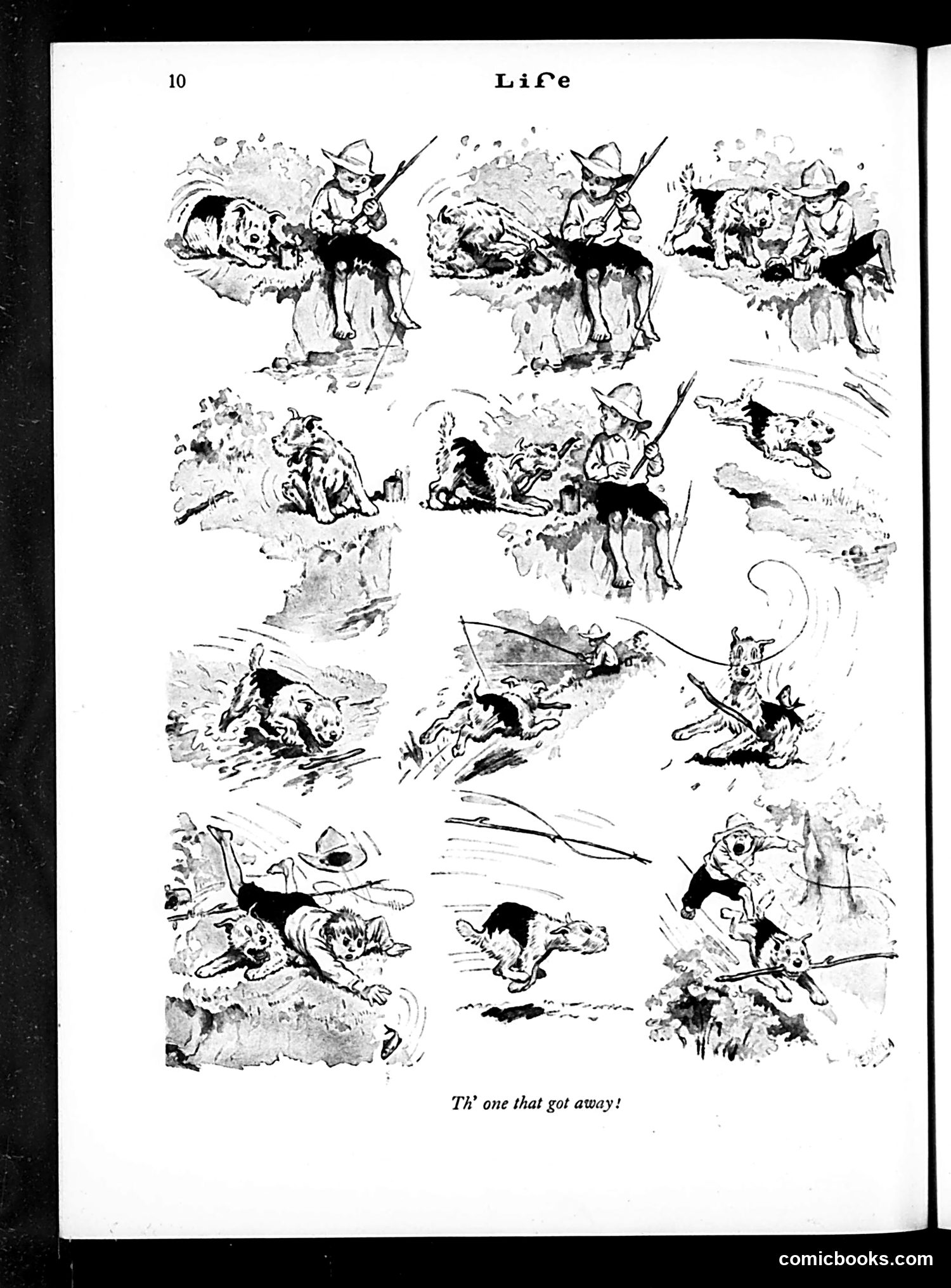
Analysis This page from *Life* magazine presents a humorous sequential cartoon titled "Th' one that got away!" The narrative follows what appears to be a fishing expedition gone wrong. The comic depicts hunters or fishermen pursuing game (likely rabbits or similar small animals based on the drawings). The sequence shows various failed attempts at catching prey—the animals escaping through different tactics across multiple panels. The repeated failures and the final caption "Th' one that got away!" suggest this is satirizing the common hunting/fishing trope where the quarry consistently eludes capture. This appears to be gentle, non-political humor about outdoor incompetence rather than social commentary. The style is consistent with early-to-mid 20th century *Life* magazine's comedic content.
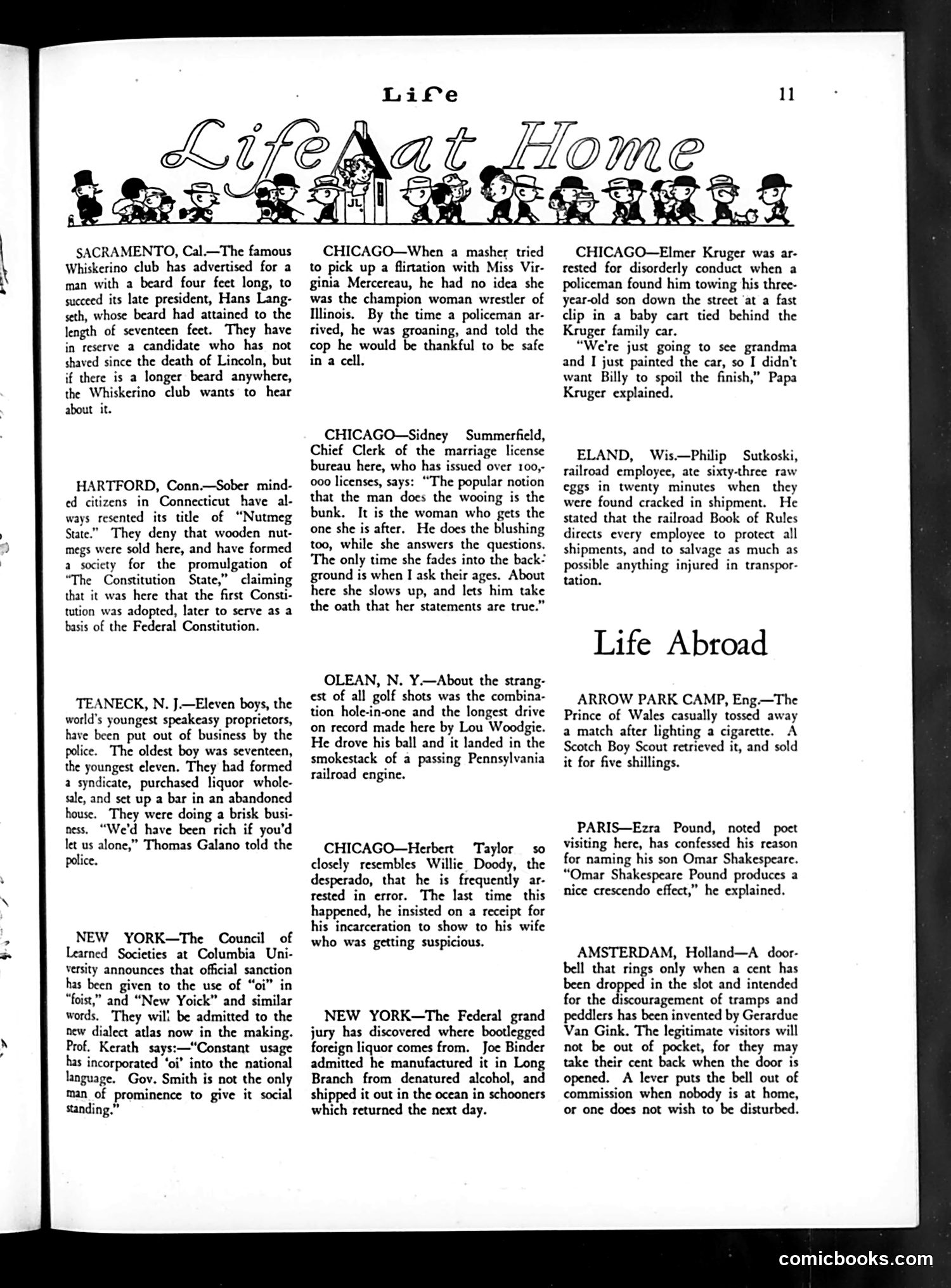
Life Magazine Page 11 Analysis This page contains two sections of brief humorous anecdotes rather than political cartoons. "Life at Home" features short jokes about American domestic life, including stories about a man with an exceptionally long beard (a candidate since Lincoln's time), a policeman discovering a child riding in a painted car, and various other domestic mishaps. "Life Abroad" presents similarly brief comedic observations about international locations—including anecdotes about the Prince of Wales losing a match, poet Ezra Pound's son, and a Dutch doorbell mechanism. The decorative header shows silhouettes of various people in period dress. The humor is gentle and observational rather than sharply satirical, reflecting Life magazine's approach to social commentary through witty, everyday scenarios rather than direct political critique.
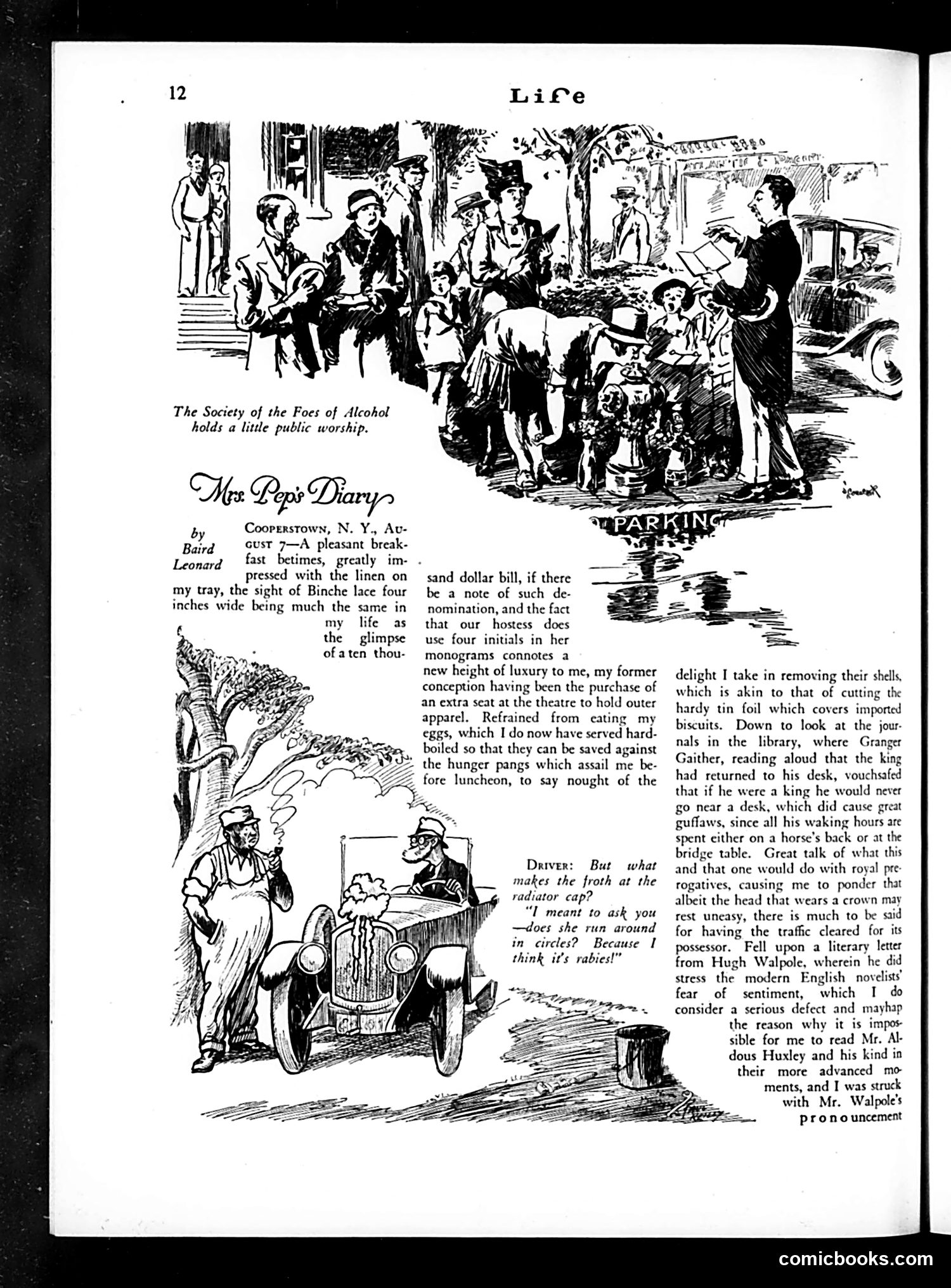
Analysis of Life Magazine Page This page contains "Mrs. Pop's Diary" by Baird Leonard, a humorous column set in Cooperstown, N.Y. The accompanying illustrations satirize early 20th-century automotive culture and social pretension. The top cartoon depicts "The Society of the Foes of Alcohol holds a little public worship"—likely mocking temperance movement activists gathered in a park. The lower cartoon shows a driver asking a mechanic about a "froth at the radiator cap," with the mechanic responding sarcastically: "I meant to ask you—does she run around in circles? Because I think it's rabies!" This jokes about early car unreliability and the confusion cars caused in society. The diary text humorously chronicles middle-class anxieties about displaying wealth (monogrammed linens, theater seats) and modern inconveniences, capturing period class consciousness.
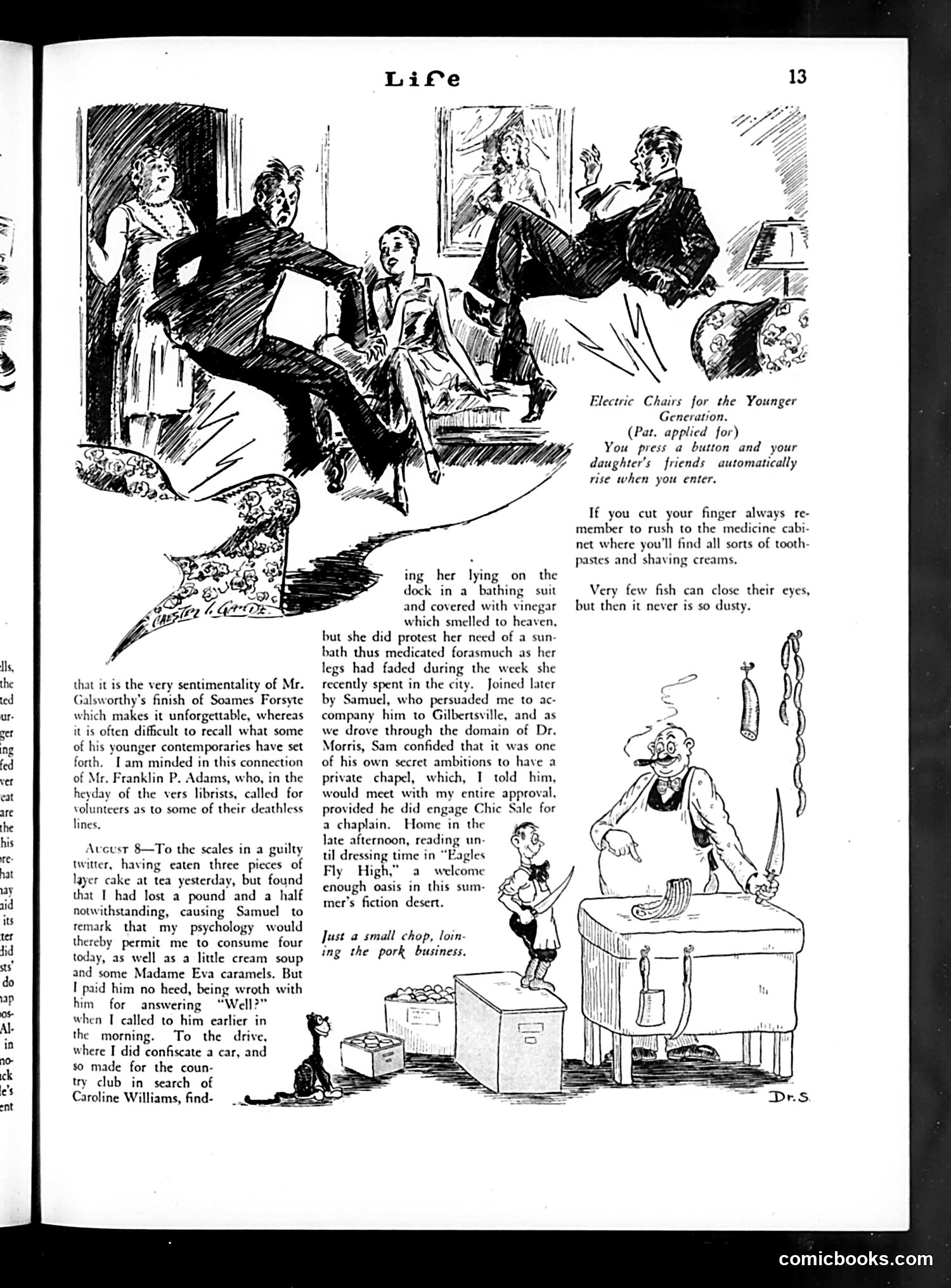
Life Magazine Page 13 - Satirical Content Top Cartoon: "Electric Chairs for the Younger Generation (Pat. applied for)" depicts a drawing-room scene where young people's chairs automatically catapult them upward when visitors arrive—a satirical jab at the era's youth culture and their perceived restlessness or inability to sit still during social visits. The joke mocks both generational behavior and the period's obsession with labor-saving "modern" inventions. Bottom Cartoon: Titled "Just a small chop, loin-ing the pork business," shows a chef preparing food with small children nearby. This appears to be dark humor playing on period concerns about working conditions, child labor, or food safety practices—though the exact reference remains unclear without additional context. Both reflect Life magazine's satirical commentary on contemporary American society and technology.
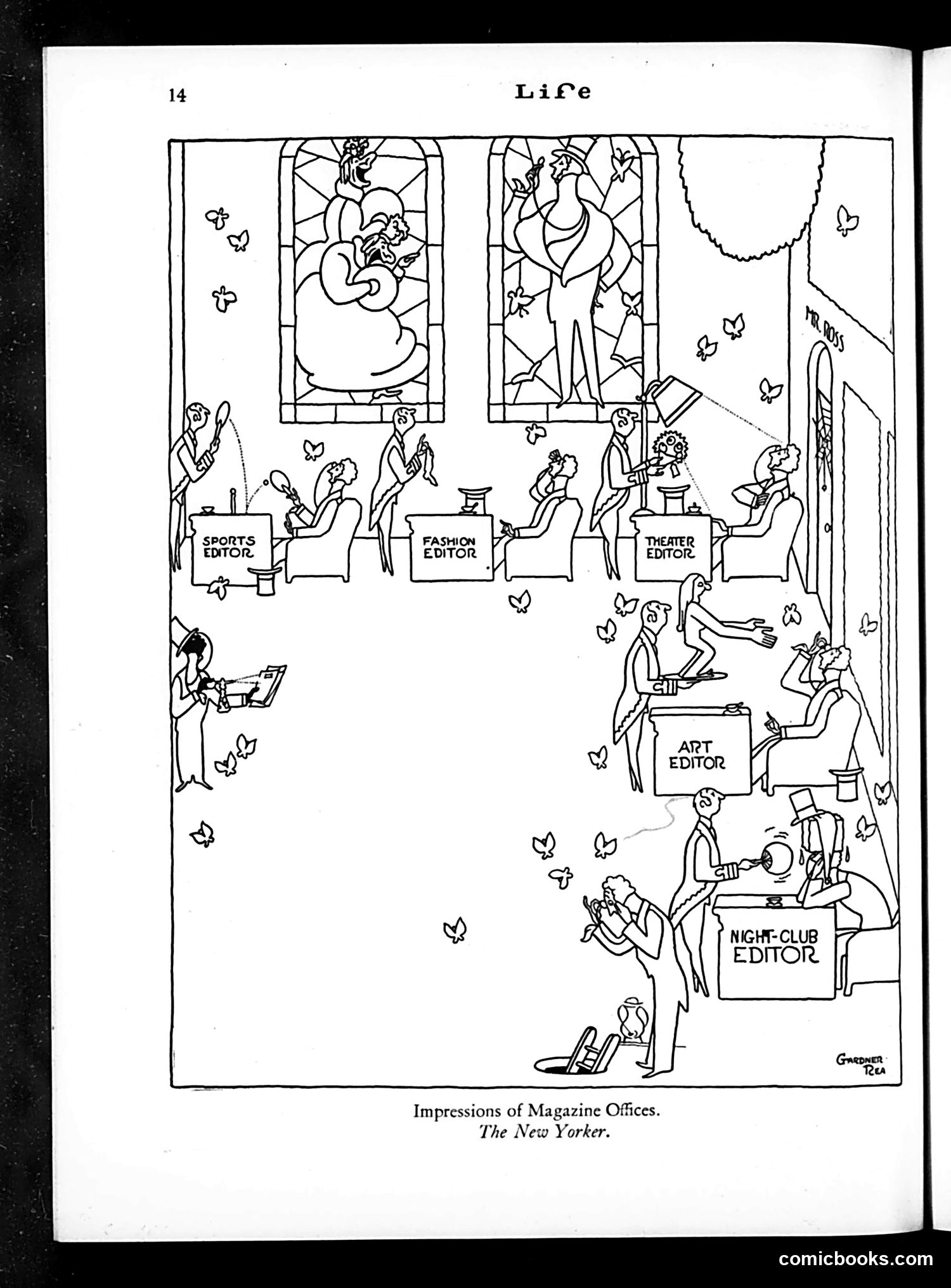
"Impressions of Magazine Offices: The New Yorker" This cartoon satirizes *The New Yorker* magazine's editorial departments through humorous stereotypes. The illustration shows five editorial sections—Sports Editor, Fashion Editor, Theater Editor, Art Editor, and Night-Club Editor—each depicted with caricatured figures engaged in stereotypical activities at their desks. The satire suggests that *The New Yorker*, positioned as a sophisticated urban publication, actually caters to frivolous lifestyle coverage rather than serious journalism. The heavenly stained-glass windows above mock the magazine's pretensions to cultural refinement, while the scattered butterflies and leisurely poses of the editors underscore the magazine's emphasis on entertainment and leisure rather than substantive reporting. The cartoon gently ridicules the magazine's superficiality and target demographic of wealthy, pleasure-seeking New Yorkers.
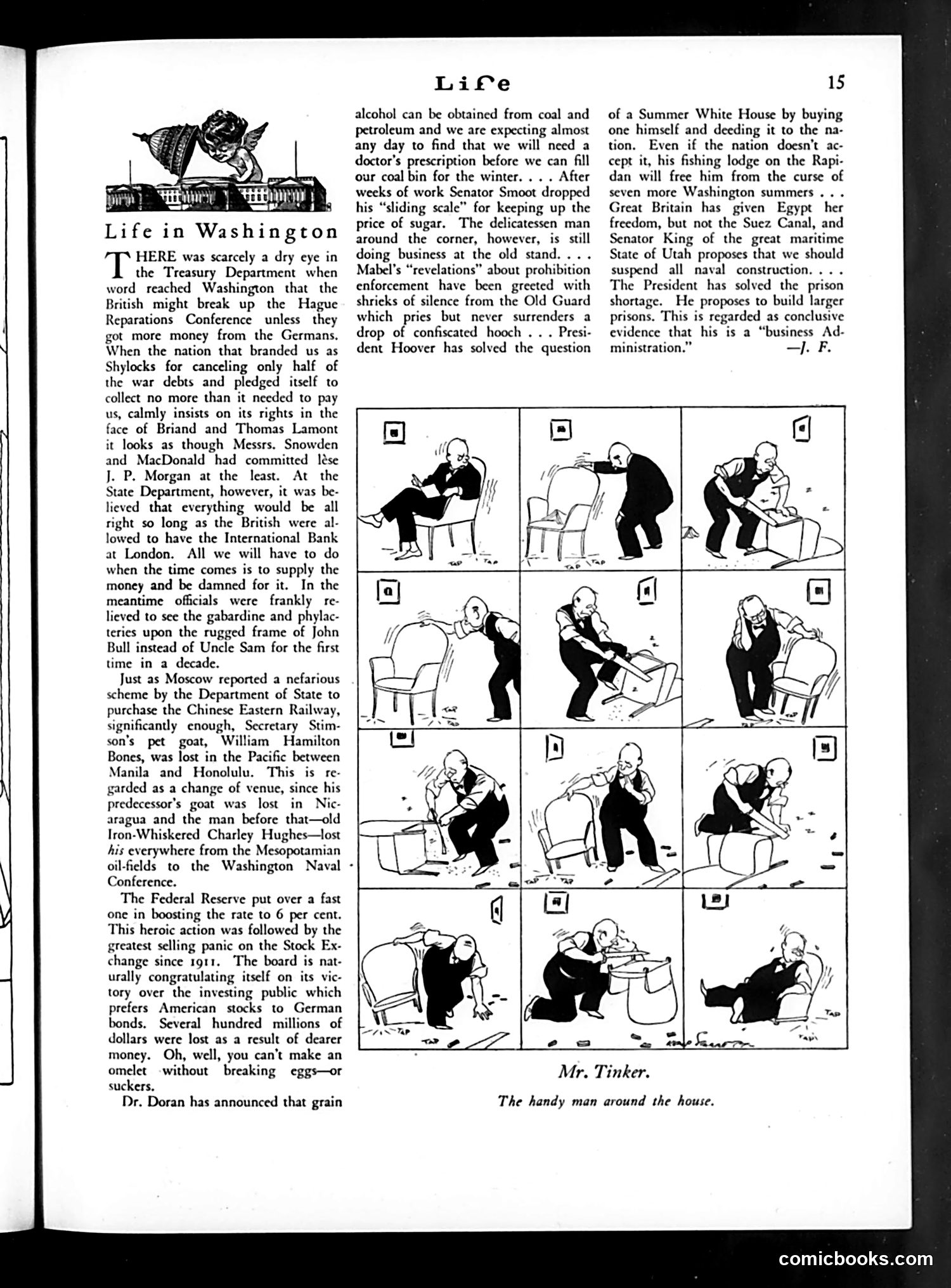
"Mr. Tinker: The Handy Man Around the House" This is a humorous comic strip showing a man repeatedly attempting household repairs, growing increasingly frustrated and disheveled across twelve panels. He struggles with what appears to be a chair, trying unsuccessfully to fix or adjust it—pounding, pulling, and manipulating it in various ways while his clothing becomes progressively torn and damaged. The satire targets the "handy man" archetype—the amateur home repairperson who tackles household projects without proper skill or tools, typically making situations worse. Each panel emphasizes his incompetence through exaggerated physical comedy. The strip mocks the common domestic frustration of failed DIY repairs, a relatable theme for 1920s readers managing their own household maintenance during an era before widespread professional services.
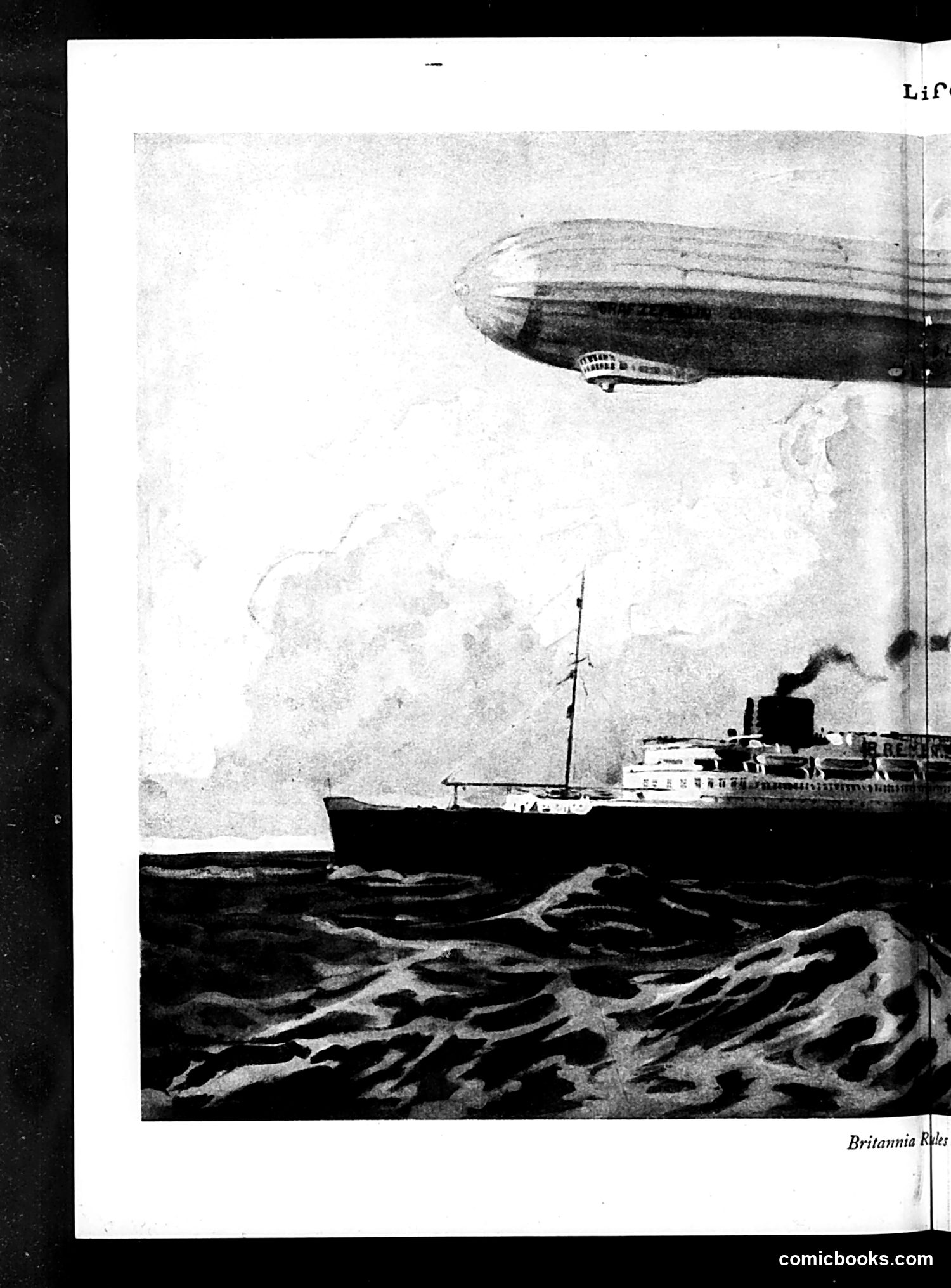
Analysis This page shows an illustration from *Life* magazine depicting the RMS Britannia (labeled at bottom) at sea. The image contrasts an airship (zeppelin or dirigible) hovering above with a large ocean liner below on rough waters. The satire likely comments on transportation competition or technological change — comparing newer aerial dirigible technology with established ocean-liner travel. Given *Life*'s satirical nature, this may mock either: - The hype surrounding airships as "the future" versus traditional ships' proven reliability - Concerns about airship safety or practicality over established maritime transport The dramatic composition — with the massive ship dwarfed below and the airship above — suggests commentary on shifting transportation paradigms in early 20th-century technology.
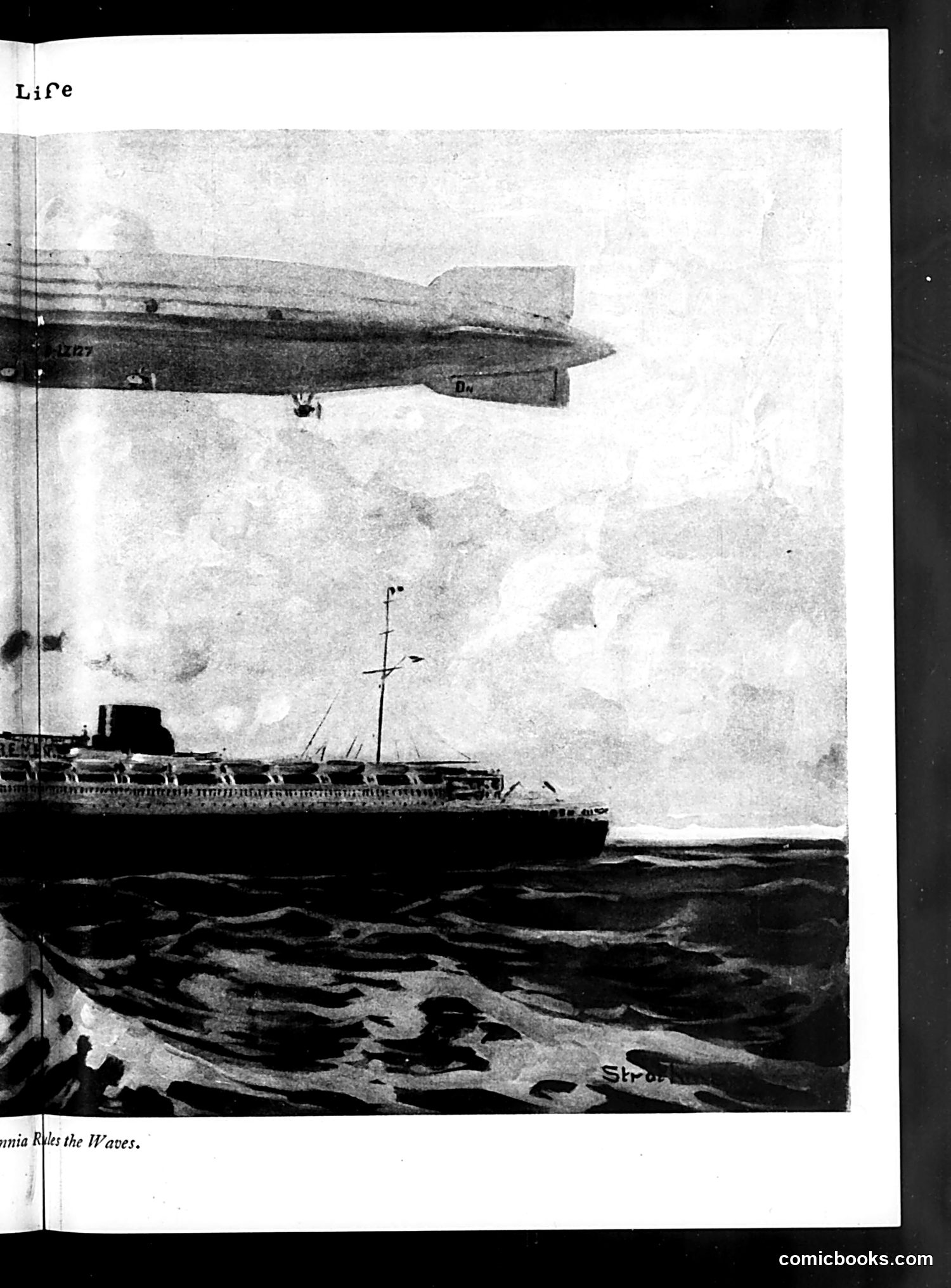
Analysis This page from *Life* magazine shows an illustration of a military airship (dirigible/zeppelin) flying above a naval vessel on rough seas. The caption at bottom appears to read "...nia Rules the Waves" (likely "Britannia Rules the Waves," referencing Britain's naval dominance). The image appears to be satirizing military aerial power and naval superiority, possibly commenting on early 20th-century technological advancement in warfare. The juxtaposition of the modern airship hovering over the traditional battleship suggests themes about changing military dominance or the obsolescence of older naval power in light of new aerial technology. Without a clear date visible, the specific historical context—whether this addresses WWI-era concerns, pre-war tensions, or arms race anxieties—remains uncertain, though the imagery suggests early aviation's military implications were a topic of satirical interest.
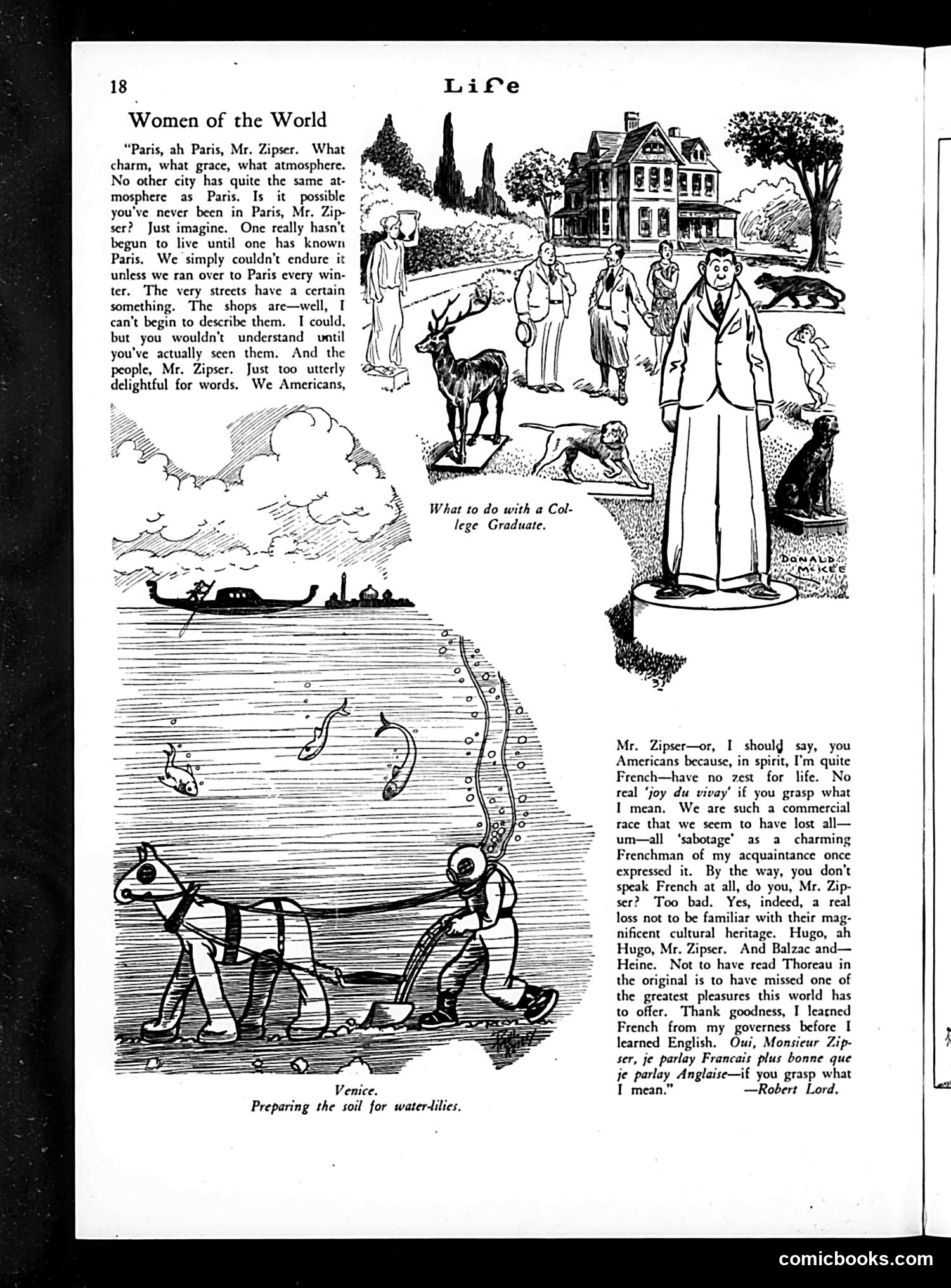
Analysis This page from *Life* magazine features a satirical article titled "Women of the World" presenting a monologue by "Mr. Zipser" about Paris and French culture. The Satire: The piece mocks American tourists and cultural pretension. Zipser is apparently an American visitor praising Paris's charm while admitting Americans can't truly appreciate it. The humor derives from this contradiction—he's "utterly delighted for words" yet continues talking extensively. The Illustrations: Two pen-and-ink drawings depict contrasting scenes: a genteel American household with a college graduate (titled "What to do with a College Graduate"), and Venetian workers preparing water-lilies. The Point: The satire criticizes American cultural insecurity and superficiality toward Europe, while also gently mocking the educated American who claims refined taste but lacks genuine understanding. The closing quote by Robert Lord emphasizes linguistic and cultural gaps between Americans and French sophistication.
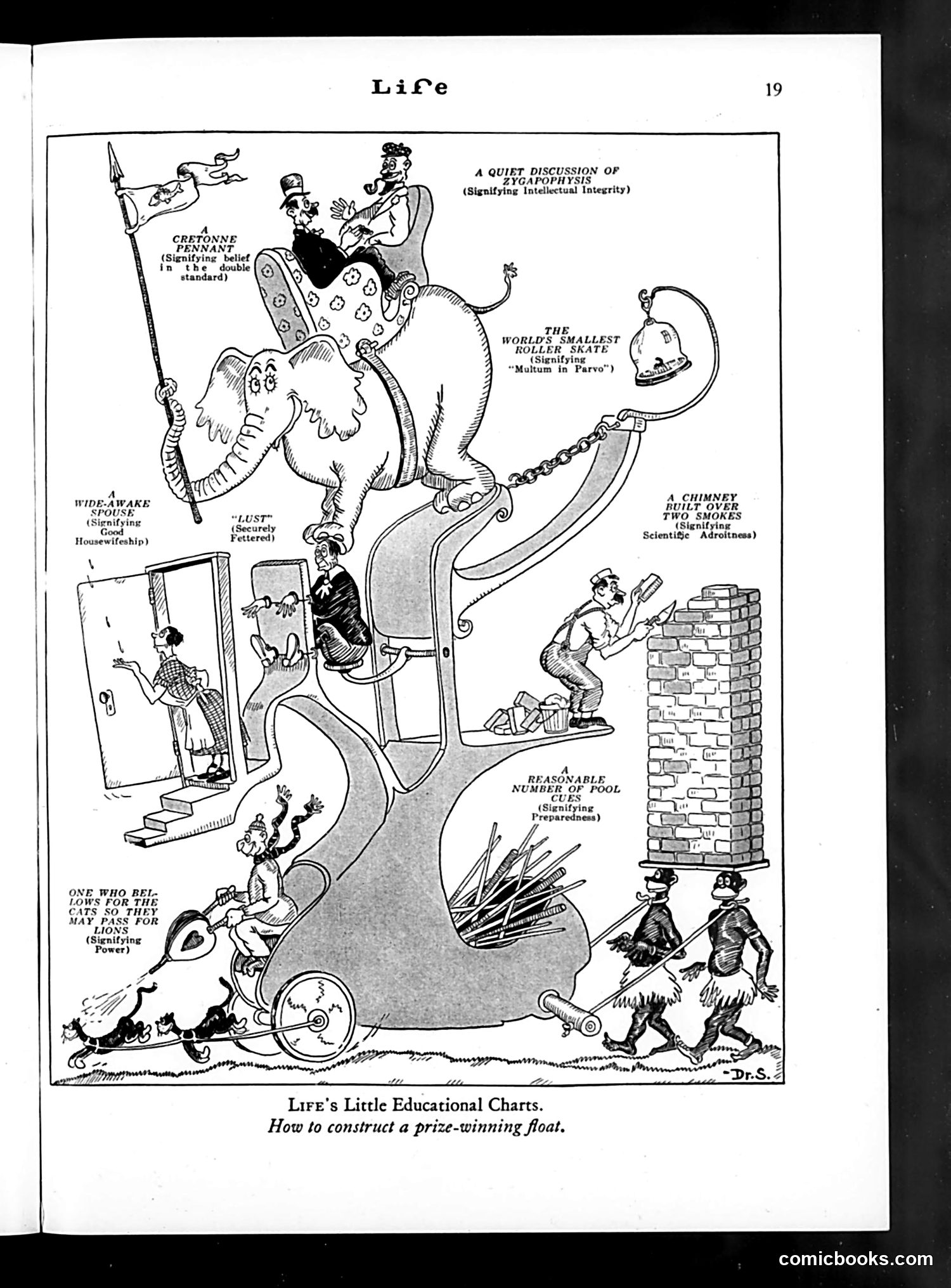
"How to Construct a Prize-Winning Float" This satirical cartoon mocks parade floats—likely from a civic or promotional competition—by labeling absurd components with pseudo-intellectual justifications. Each bizarre element (a tiny roller skate, a chimney, pool cues, a cretonne pennant) is paired with grandiose claims about what it "signifies": intellectual integrity, scientific skill, preparedness, or power. The satire targets pretentious float-builders who disguise frivolous or nonsensical designs with inflated language and false profundity. The central elephant (an unlikely parade element) serves as the absurd centerpiece. By showing how ridiculous objects can be dressed up with verbose explanation, the cartoon ridicules both the floats themselves and the self-important commentary surrounding them—a common target of *Life* magazine's humor about American civic culture and social posturing.
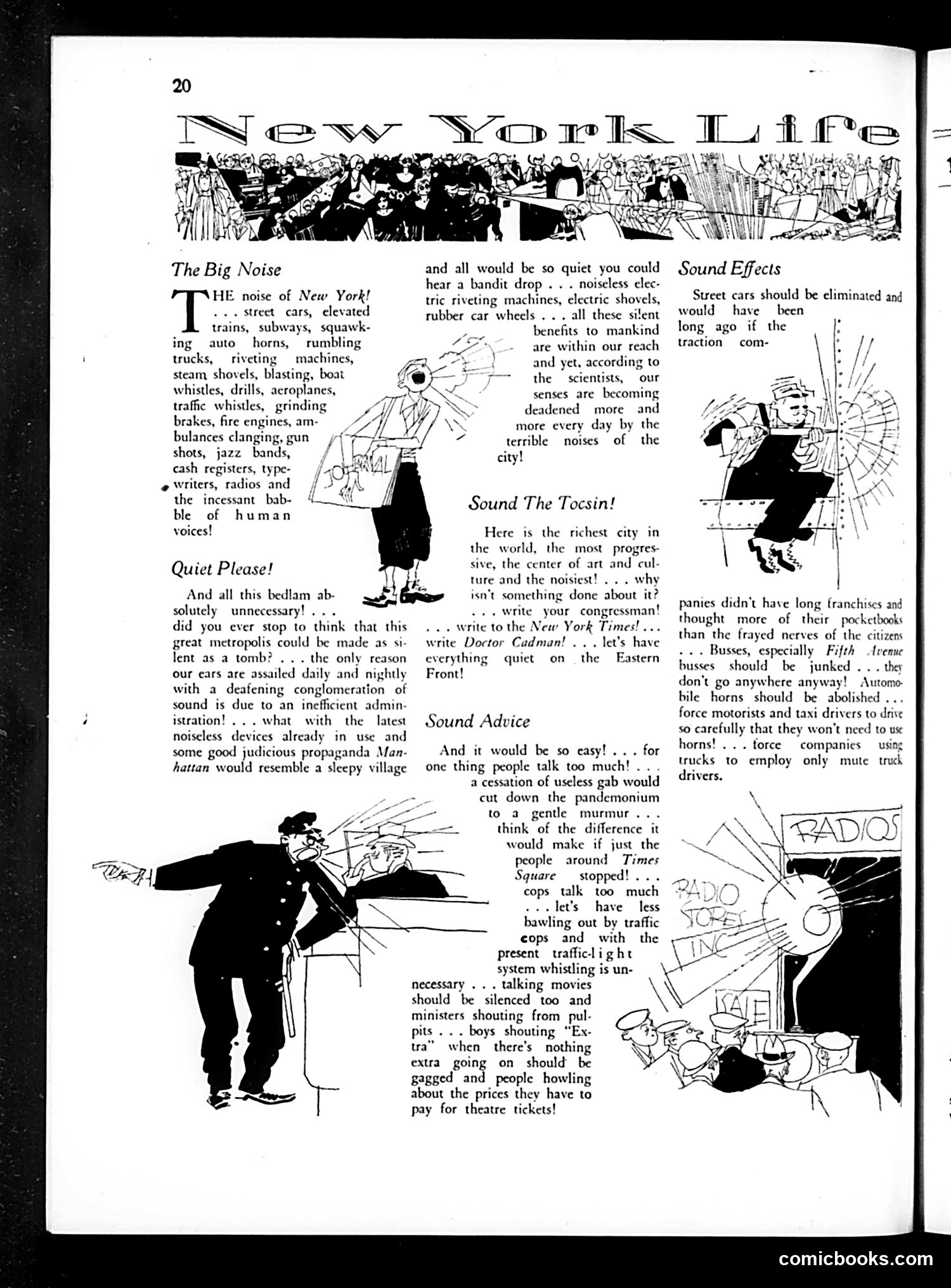
"The Big Noise" - Life Magazine Satire on New York City Noise This page satirizes New York City's overwhelming noise pollution in the early 20th century. The article catalogs the relentless urban cacophony: street cars, elevated trains, horns, riveting machines, jazz bands, and human voices create an incessant assault on residents' senses. The satire's point: despite having access to silent technologies, New York's inefficient administration refuses to implement them. The piece sarcastically proposes solutions—eliminating street cars, silencing talking movies, gagging newsboys, controlling taxi drivers—all presented as absurdly impractical given the city's chaos. The illustrations show exasperated citizens being bombarded by noise lines, emphasizing sensory overload. The article references writing to newspapers and congressmen, suggesting this noise problem was a genuine civic complaint of the era that satirists felt warranted public attention and reform.
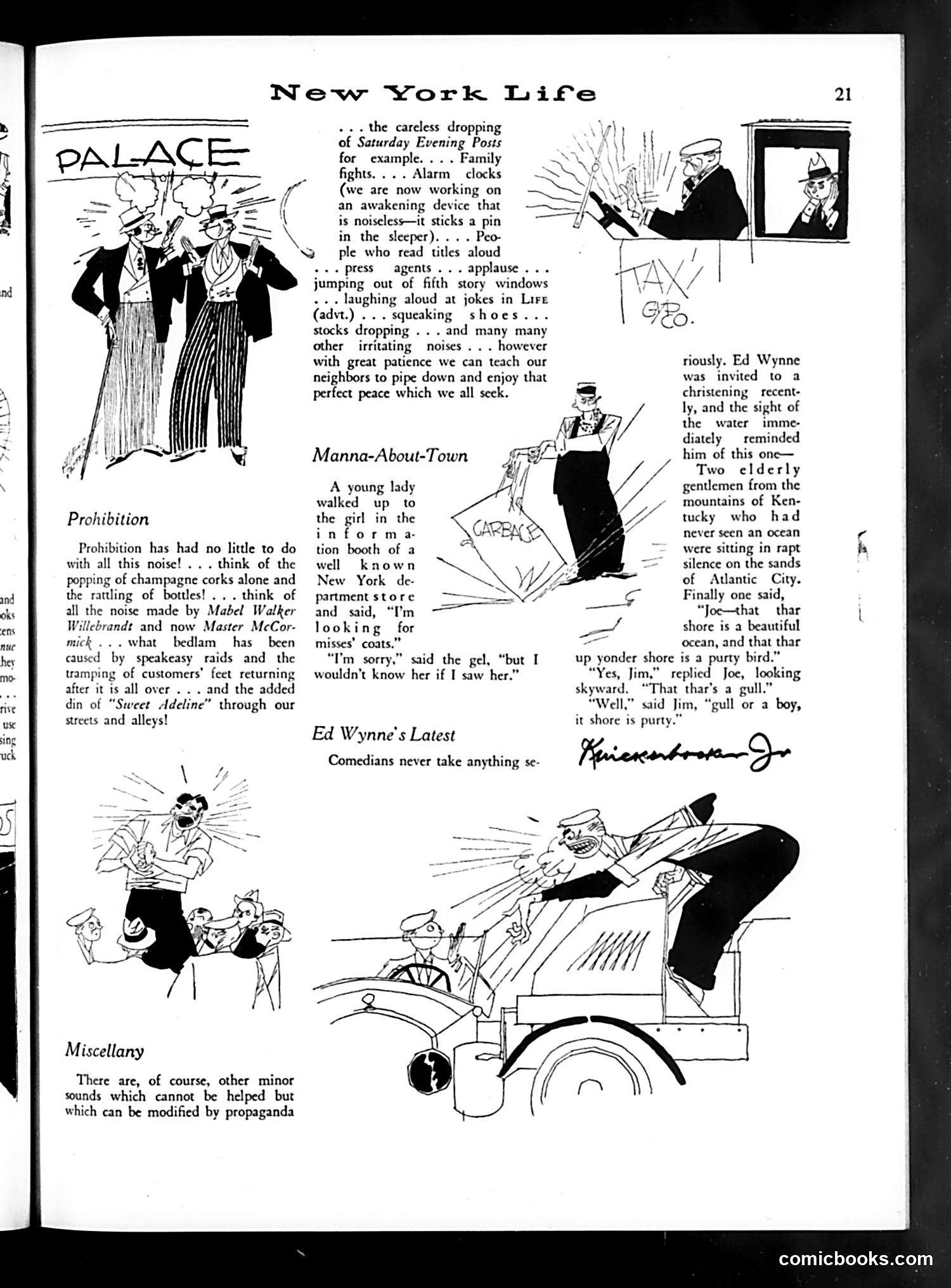
New York Life Magazine Page Analysis This page satirizes urban noise pollution in 1920s New York City. The "Palace" section mocks the cacophony of modern life—champagne corks (referencing Prohibition-era speakeasies), alarm clocks, squeaking shoes, and people reading aloud. The Prohibition section specifically blames alcohol laws for increased noise: speakeasy raids, customers' footsteps, and drunken singing of "Sweet Adeline." It references Mabel Walker Willebrandt (actual Prohibition enforcement official) and "Master McCormick" (likely a contemporary enforcer), criticizing their noisy raid operations. The "Manna-About-Town" joke plays on a department store information booth worker misunderstanding "misses' coats" as a missing person. "Ed Wynne's Latest" presents a folksy anecdote about two rural Kentuckians seeing the ocean and a seabird for the first time—gentle humor about provincial innocence rather than urban sophistication, contrasting with the page's broader noise-complaint theme.
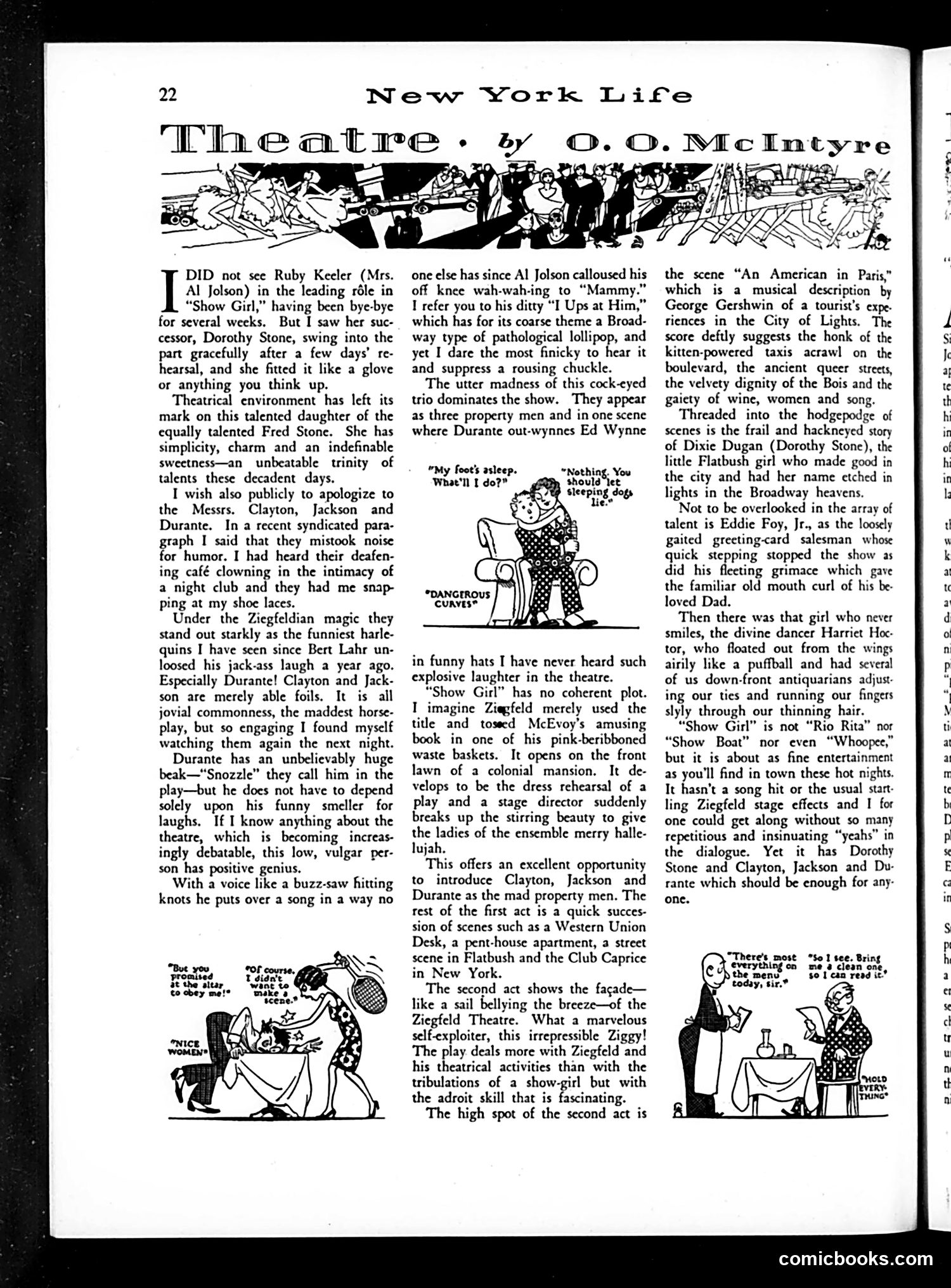
Theatre Review: "Show Girl" (New York Life, circa 1929) This is O.O. McIntyre's theatre column reviewing the Broadway musical "Show Girl." The piece critiques and praises the comedic trio of Clayton, Jackson, and Jimmy Durante, who appear as "mad property men." McIntyre particularly lauds Durante's talents despite his prominent nose ("Snozzle"), calling him a performer of "positive genius" whose voice and delivery elevate even crude material. The review notes the show lacks coherent plot, existing mainly as a vehicle for Ziegfeld's theatrical self-promotion and Gershwin's "An American in Paris" musical sequence. The cartoons scattered throughout illustrate comedic bits from the production—showing performers in exaggerated, vaudeville-style poses typical of 1920s entertainment journalism. The piece humorously apologizes for earlier dismissing Clayton, Jackson, and Durante as mere noise-makers in nightclubs, now recognizing their stage brilliance under "Ziegfeldian magic."
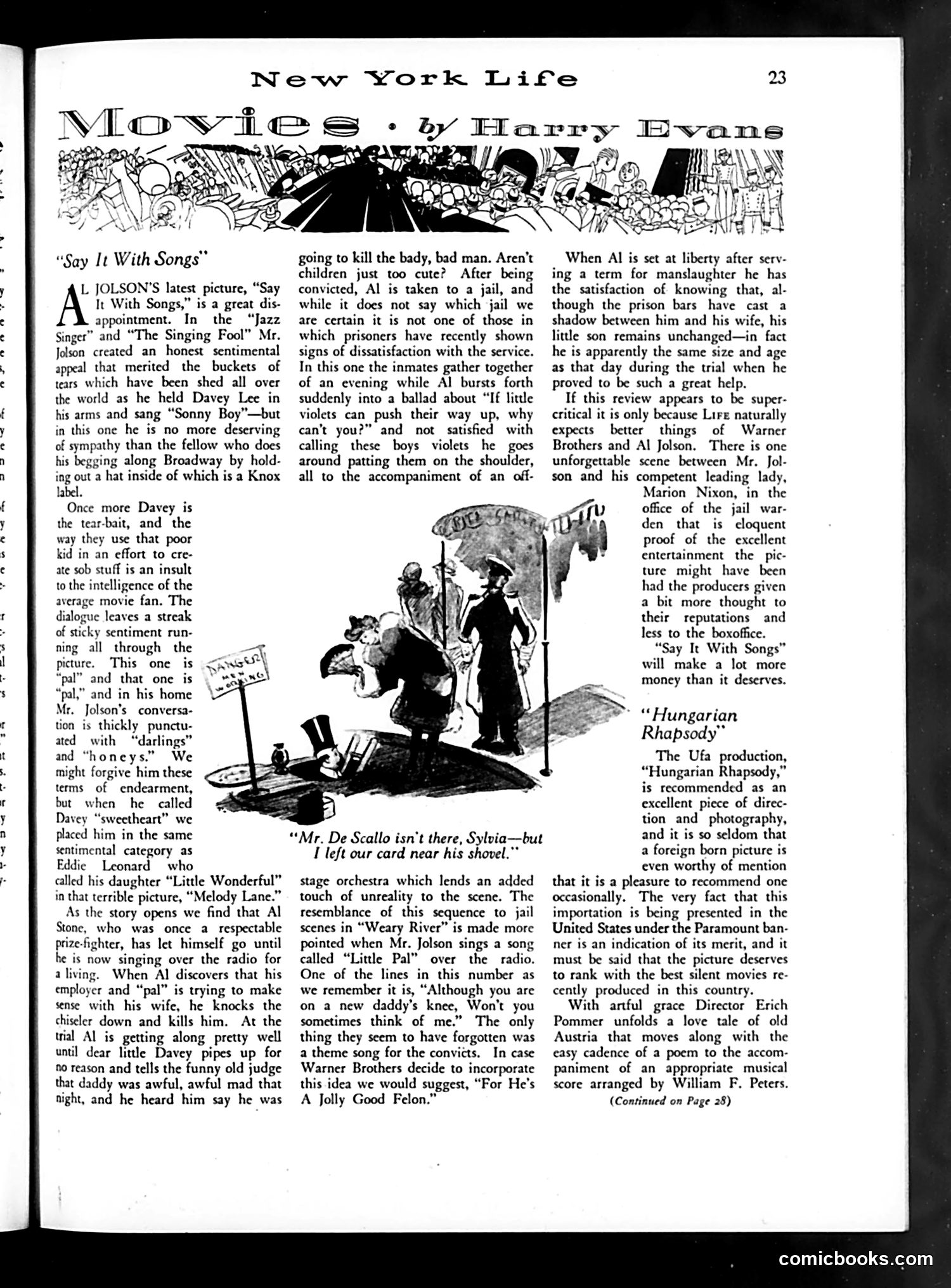
"Say It With Songs" - Movie Review Satire This is Harry Evans's film criticism column reviewing Al Jolson's latest talkie, "Say It With Songs." The review is scathing satire attacking the film's manipulative sentimentality. The plot involves Jolson's character, a former boxer turned radio singer, killing a man and going to prison. The film repeatedly exploits child actor Davey Lee to extract tears from audiences—a tactic Evans finds insulting to viewers' intelligence. Evans particularly mocks the jail scenes where Jolson sings uplift songs like "If little violets can push their way up, why can't you?" to fellow prisoners. The humor lies in Evans's sardonic suggestions: calling one song "For He's A Jolly Good Felon" and criticizing the film's overuse of saccharine dialogue ("darlings," "honeys," "sweethearts"). The small cartoon caption jokes about a door-to-door salesman, likely unrelated satire. Evans concludes the film wastes Warner Brothers' and Jolson's talents despite one good scene between Jolson and actress Marion Nixon.
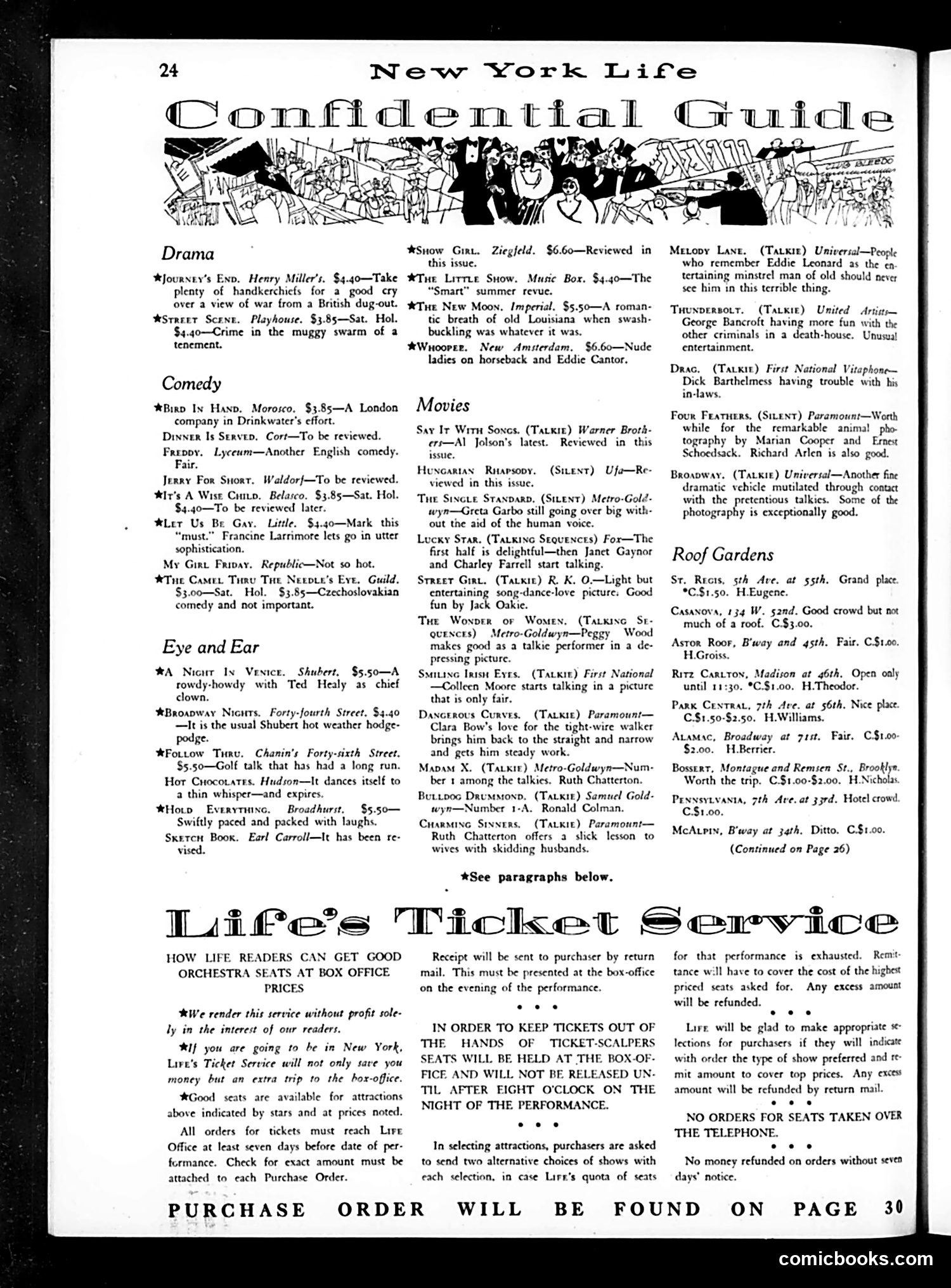
What This Page Shows This is a theater and entertainment guide from Life magazine—essentially a weekly listings page for New York City shows, movies, and venues circa the late 1920s. The content reflects a crucial historical moment: the transition from silent to "talking" films. Notice how reviews repeatedly mark movies as "(TALKIE)" or "(SILENT)" and make jokes about this technology. For instance, *The Lucky Star* is described as "delightful—then Janet Gaynor and Charley Farrell start talking," suggesting audiences found actors' voices disappointing. *The Single Standard* advertises that Greta Garbo succeeds "without the aid of the human voice." The theater listings cover Broadway productions—dramas, comedies, and musical revues—with prices and brief satirical descriptions. The header illustration appears to show 1920s entertainment figures and nightlife scenes. This page documents a specific, vanishing moment in entertainment history when silent film technology was being displaced.
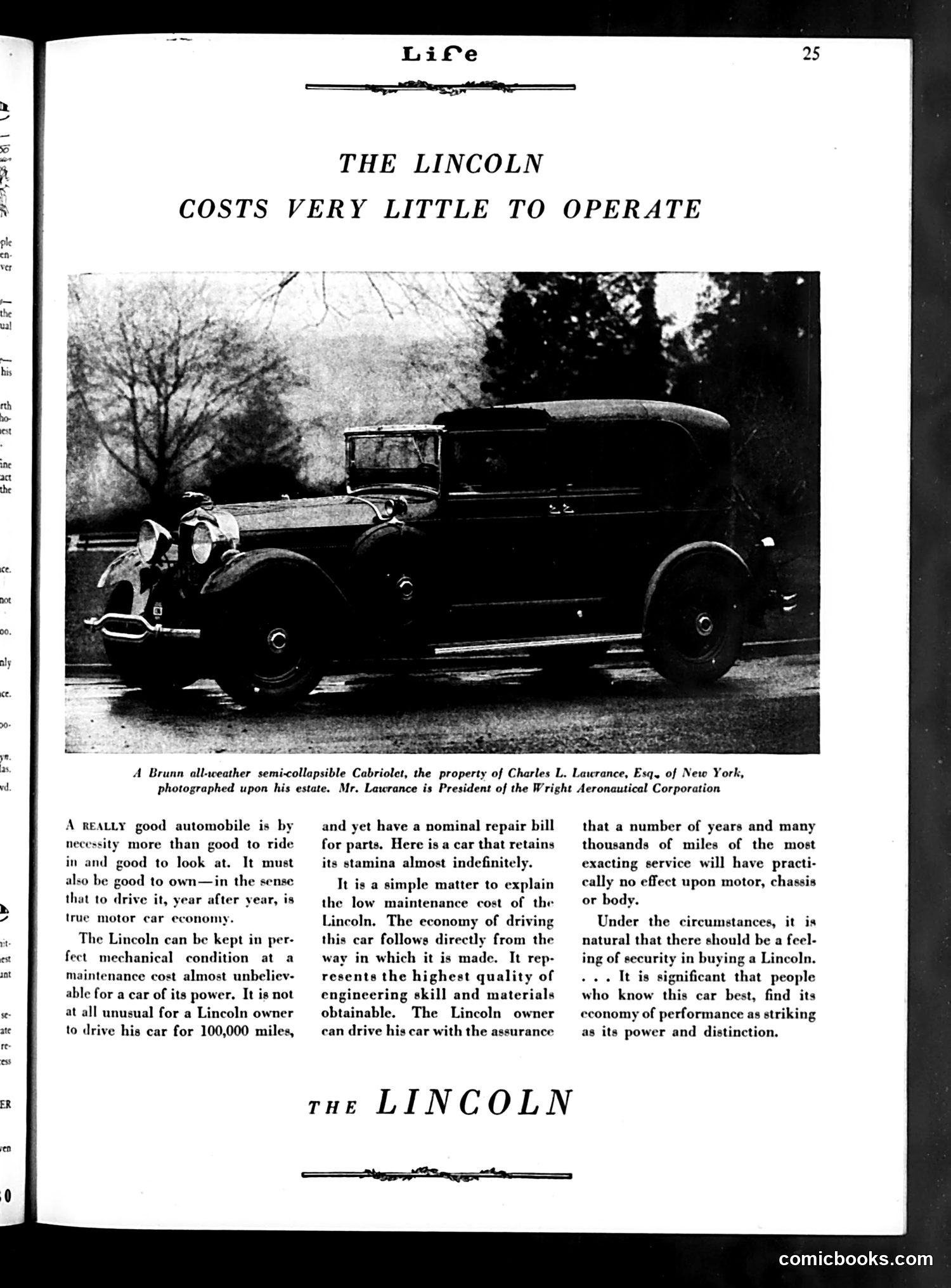
Lincoln Automobile Advertisement This is a luxury car advertisement, not political satire. Life magazine ran such ads throughout its pages. The image shows a Lincoln automobile—a high-end vehicle owned by Charles L. Laurance, president of the Wright Aeronautical Corporation, photographed at his estate. The advertisement's pitch emphasizes that despite Lincoln's premium status, it costs surprisingly little to operate and maintain over time. The key sales argument: a Lincoln owner can drive 100,000 miles with minimal repair bills because the car uses superior engineering and materials. This appeals to wealthy buyers by framing the purchase as economical—you're not just buying status, but practical value. The reference to Laurance's aeronautical corporation likely adds prestige: if an aviation industry leader trusts his Lincoln, it signals both luxury and reliability to the target audience of affluent potential buyers.
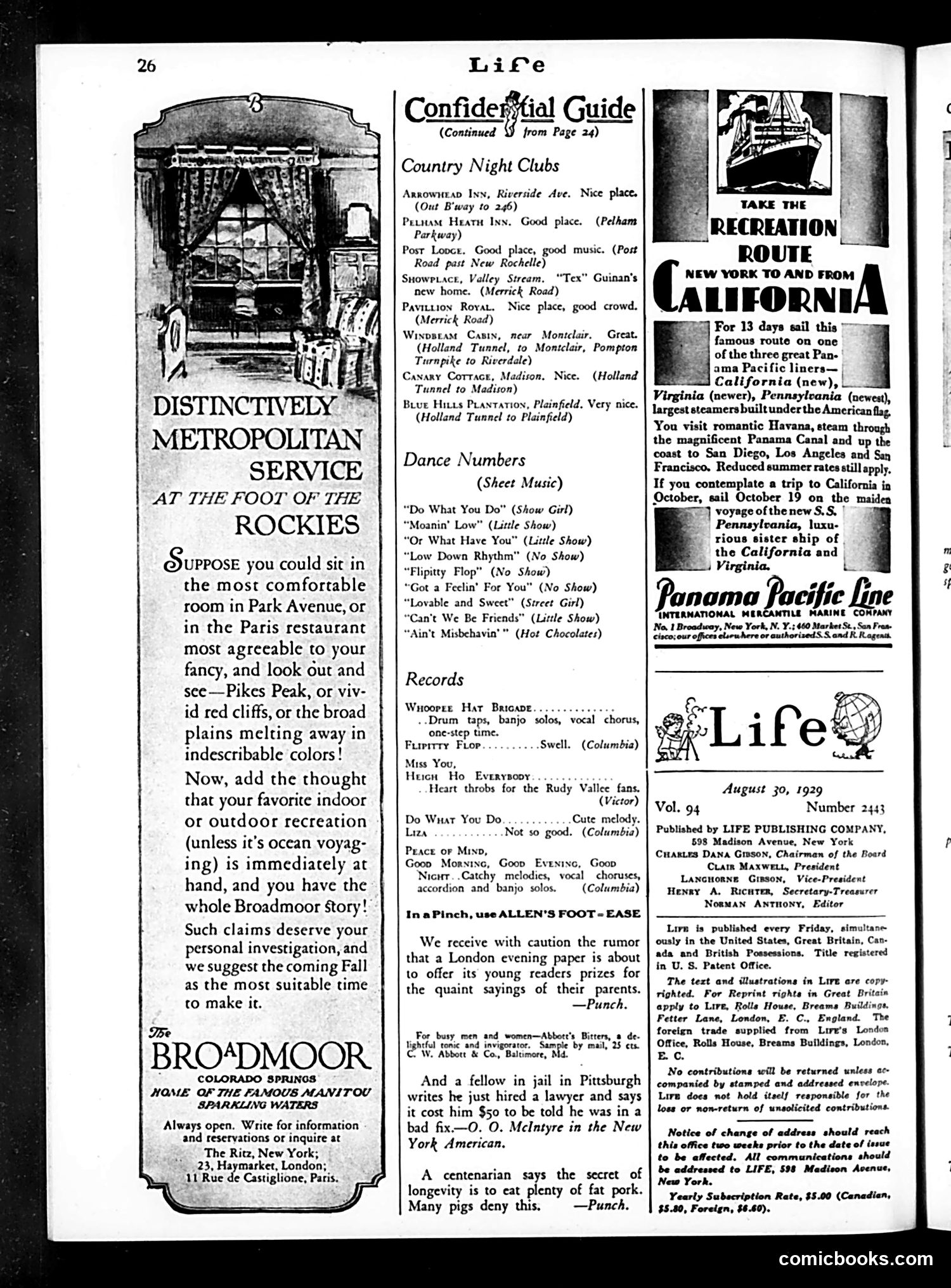
Analysis of Life Magazine Page, August 30, 1929 This page contains primarily advertisements and entertainment listings, not political cartoons. The left side features a large Broadmoor Hotel advertisement (Colorado Springs resort) using aspirational imagery—describing views of Pikes Peak and suggesting luxurious Park Avenue living combined with Rocky Mountain recreation. The center contains a "Confidential Guide" to country nightclubs (speakeasies), dance numbers, and phonograph records—reflecting the Jazz Age/Prohibition era when such venues operated. The right side advertises Panama Pacific Line cruises to California, promoting three new steamships (California, Virginia, Pennsylvania) with stops in Havana and the Panama Canal. Brief humor items at bottom include jokes from *Punch* magazine about London parents' sayings and a centenarian's diet secrets. Historical context: This 1929 page captures pre-Depression American prosperity, leisure culture, and the hidden world of Prohibition-era nightclubs operating under euphemistic names.
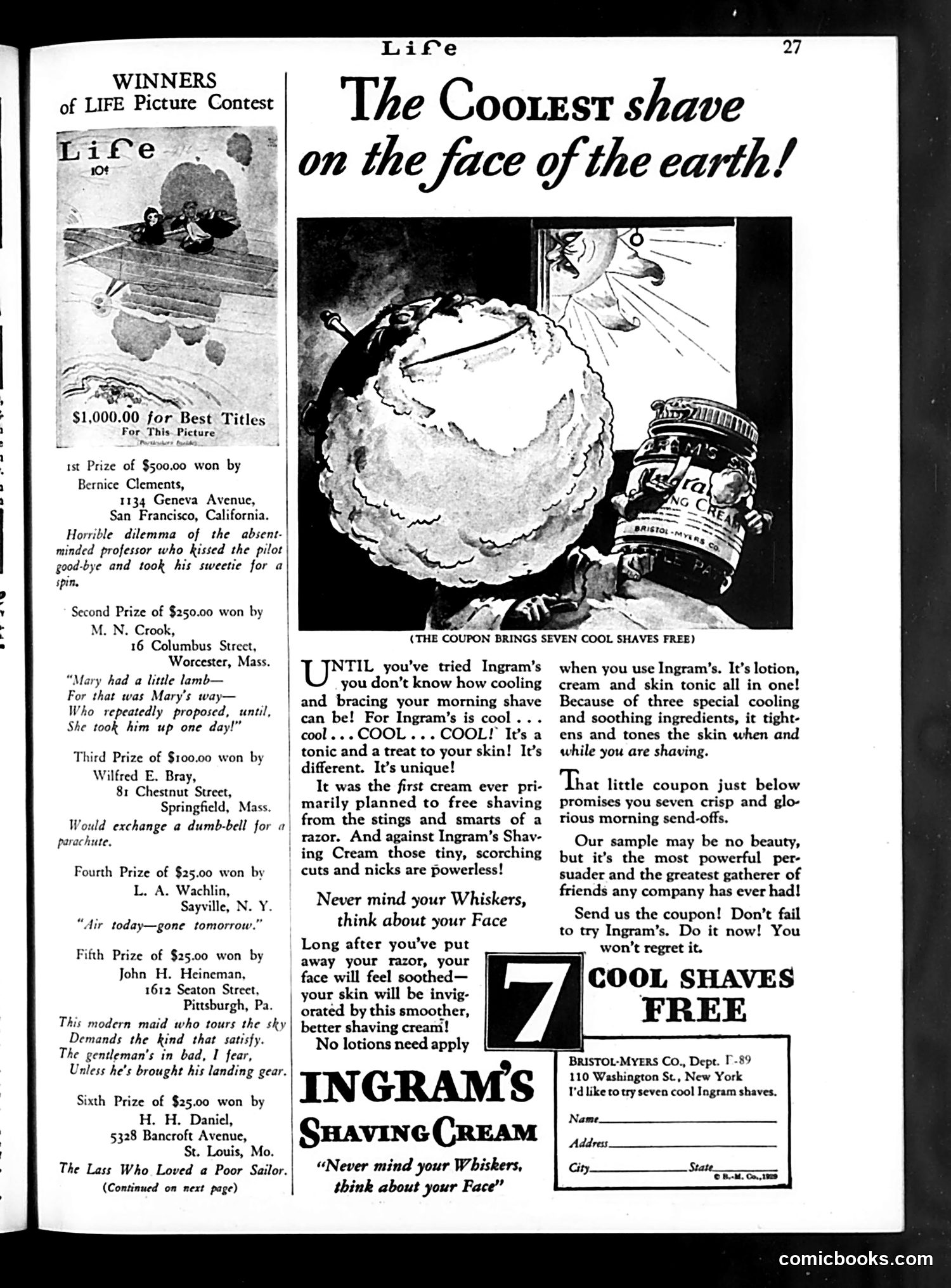
Analysis for Modern Readers This page is primarily advertisement, not satire. The top section showcases winners of a LIFE magazine photo-captioning contest from an earlier issue—readers submitted humorous captions for a picture (now not visible) involving an absent-minded professor, an airplane pilot, and romantic confusion. The winning captions play on wordplay and mild innuendo typical of 1920s-30s humor. The bulk of the page is a large advertisement for Ingram's Shaving Cream. The ad's tagline—"Never mind your Whiskers, think about your Face"—emphasizes skincare benefits (cooling, soothing, toning) rather than just shaving performance. This reflects early 20th-century marketing shifting toward grooming as self-care. The offer of "seven cool shaves free" via coupon was a standard direct-response advertising technique of the era. There is no political content or satirical point—this is straightforward commercial messaging.
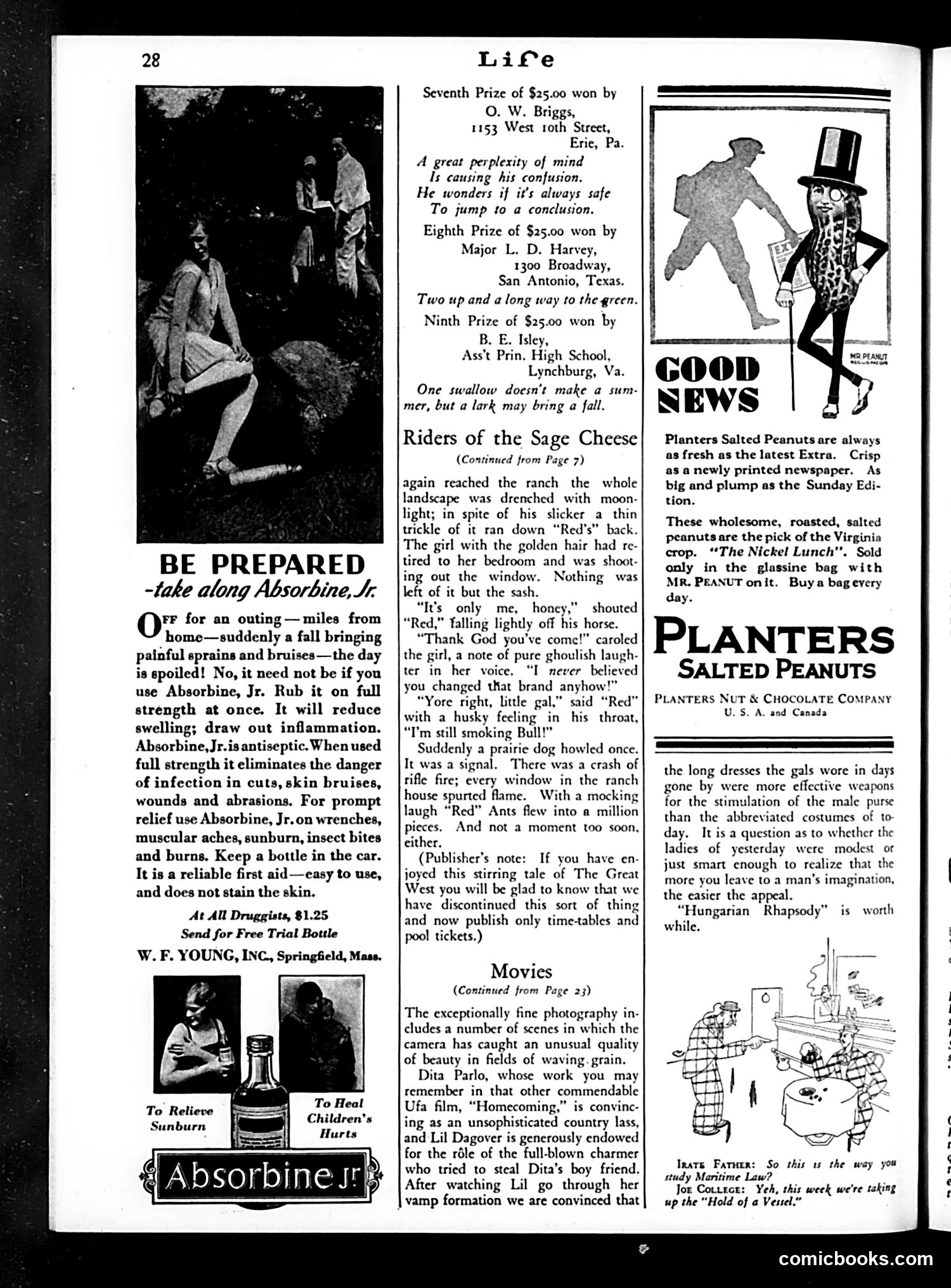
Analysis of Life Magazine Page 28 This page is primarily advertising and miscellaneous content rather than political satire. It contains: Left side: A full-page ad for Absorbine Jr., a liniment product marketed as first-aid treatment for sprains, bruises, and minor injuries—positioned as essential for outdoor activities. Center: Three contest-winning limericks or humorous verses submitted by readers, each winning $25. These are gentle wordplay jokes (e.g., "One swallow doesn't make a summer, but a lark may bring a fall"). Center-right: A continuation of "Riders of the Sage Cheese," a Western story being satirized by the publisher's note, which jokes that they've discontinued publishing such stories in favor of practical content like timetables. Right side: A Planters Peanuts ad and movie review discussing cinematography and actresses in what appears to be a German film. The page reflects 1920s-era magazine layout: advertising revenue mixed with reader participation contests and entertainment content. The "Sage Cheese" parody is the closest to satire, mocking pulp Western fiction conventions.
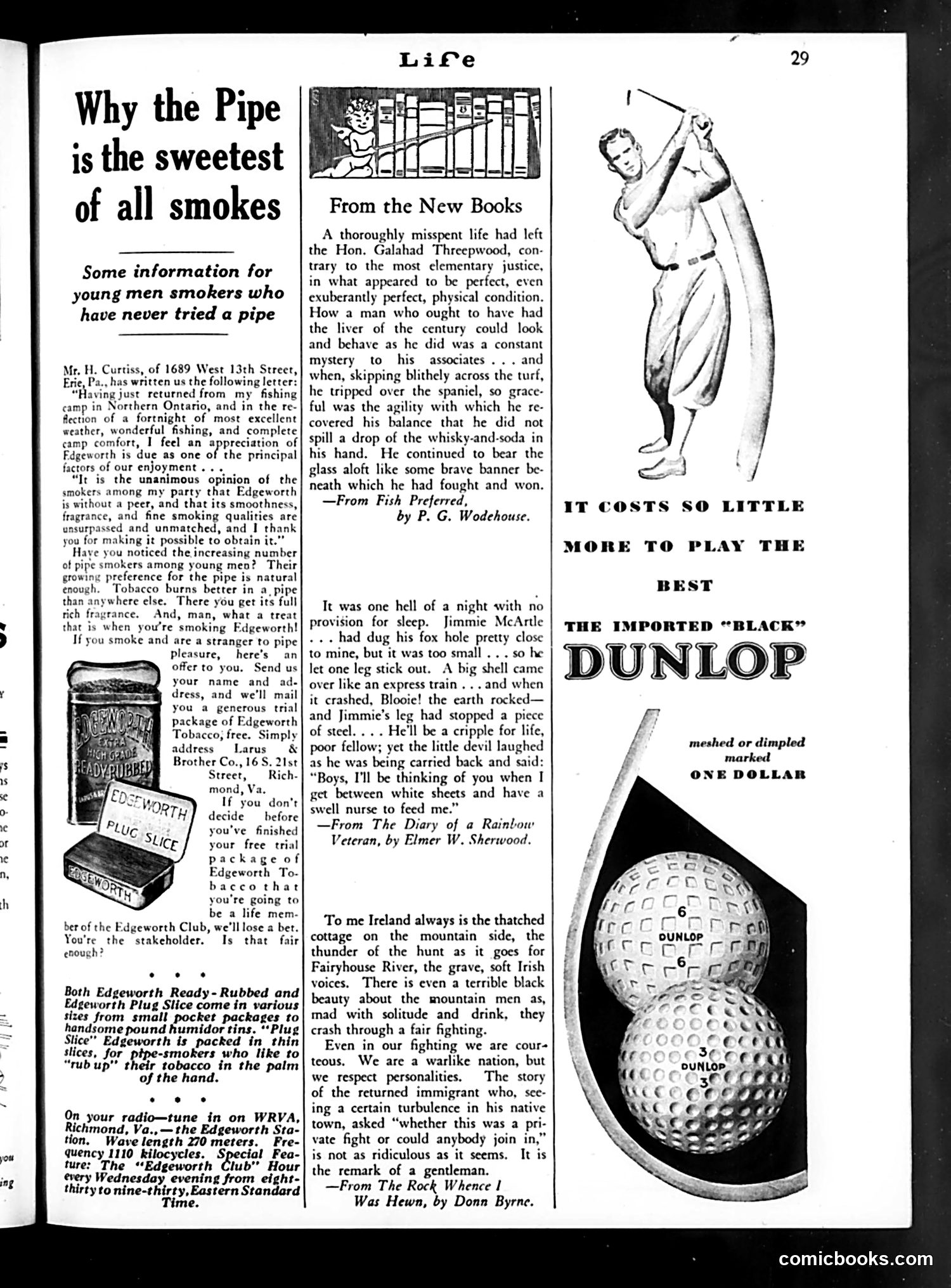
Life Magazine Page 29: Advertisement and Book Excerpts This page is primarily advertising for Edgeworth tobacco pipe tobacco, presented as editorial content. The main article quotes a satisfied customer (Mr. H. Curtiss) praising the product's quality, then offers a free trial package to encourage young men to take up pipe smoking—a growing trend the ad claims to have noticed. The page also includes book excerpts from popular authors (P.G. Wodehouse, Elmer W. Sherwood, and others) intended as entertainment filler. These appear unrelated to the tobacco advertising. On the right side is a Dunlop golf ball advertisement showing the product costs "so little more to play the best." The tobacco ad's pitch is straightforward marketing: pipes deliver superior tobacco flavor, and Edgeworth specifically is smooth and fragrant. The "Edgeworth Club" and radio station promotion indicate the brand was leveraging emerging mass media to build consumer loyalty among young men during the early radio era.
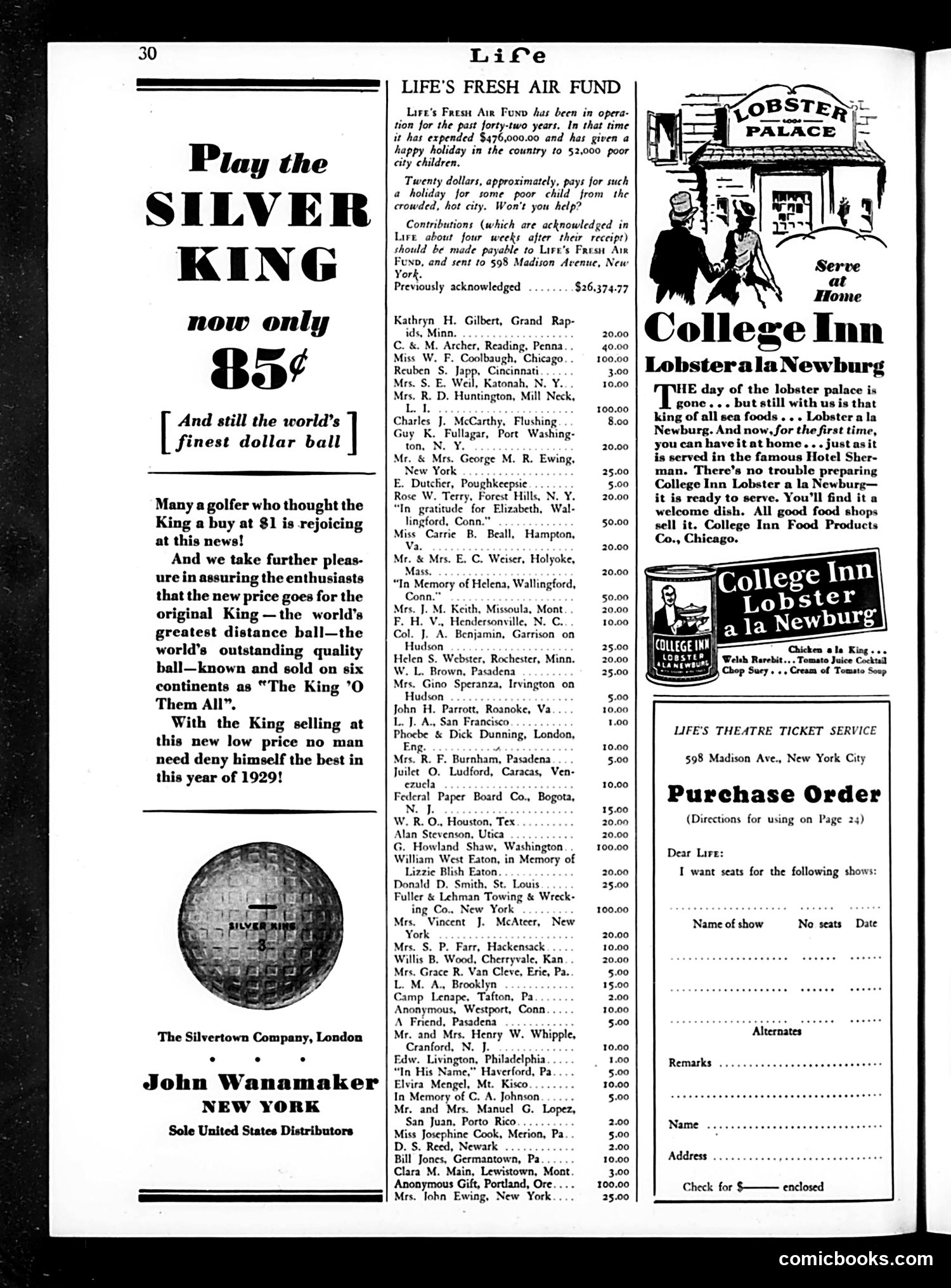
Life Magazine Page Analysis (1929) This page combines charity fundraising with advertising, typical of Life's format. Left side: An advertisement for the "Silver King" golf ball, announcing a price reduction to 85¢. The copy emphasizes quality and value—reassuring 1929 golfers that this "world's finest dollar ball" remains excellent despite the lower price. This timing is notable: the ad ran just before the October 1929 stock market crash, when such "bargain" messaging became grimly ironic. Center/Right: Life's Fresh Air Fund solicitation, a genuine charity providing poor city children country holidays. The page lists donors and their contributions ($2-$100), showing upper-middle-class philanthropic participation. Bottom right: Advertisement for College Inn Lobster à la Newburg, marketed as now available for home consumption—previously only served at fancy hotels like the Sherman. The juxtaposition reveals 1929 consumer culture: affordable luxuries (golf, canned lobster) marketed to middle-class readers alongside noblesse oblige charity.
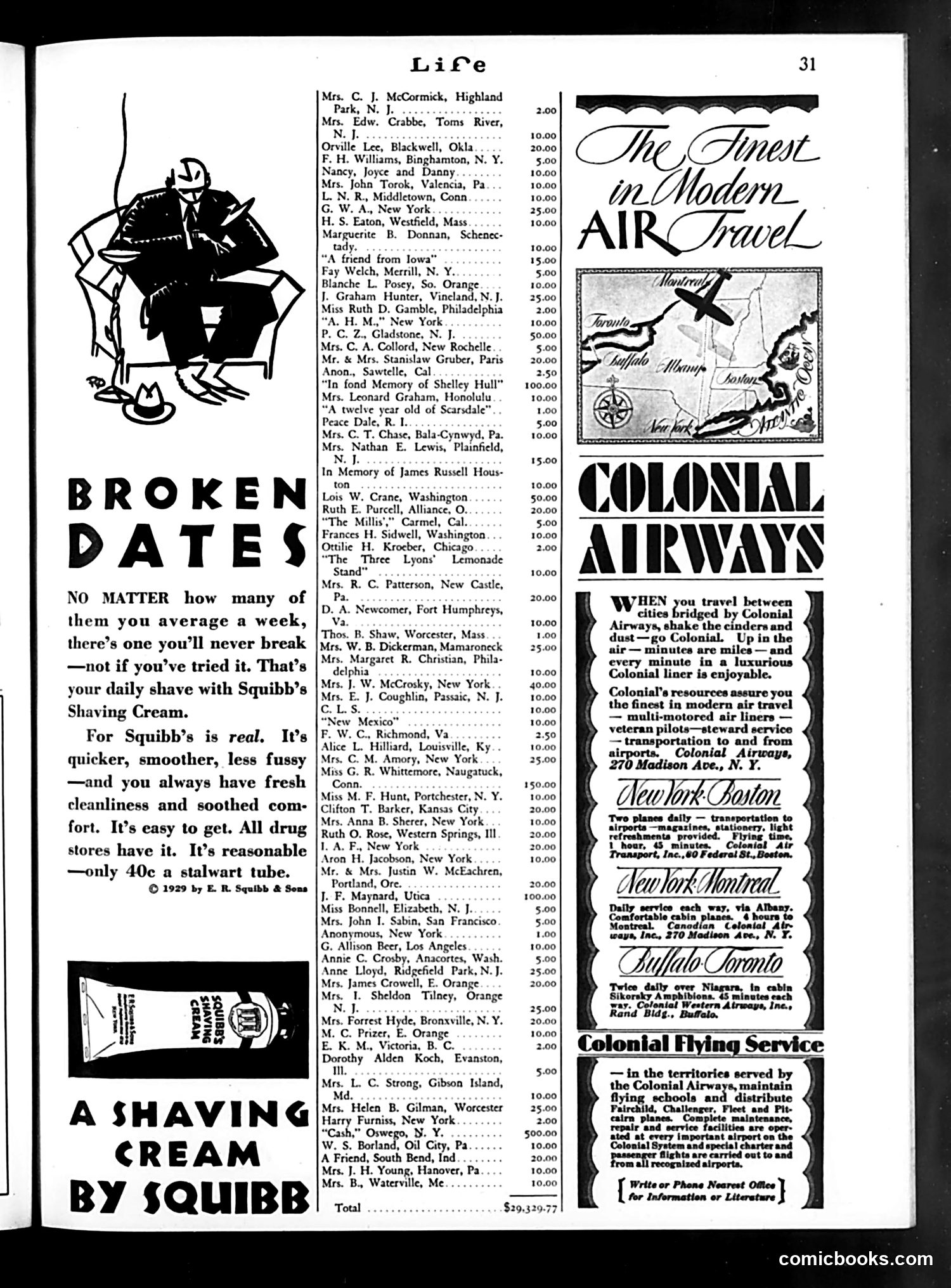
"Broken Dates" Cartoon Analysis This 1929 advertisement for Squibb Shaving Cream uses a visual pun to sell reliability. The cartoon shows a man seated in a chair, appearing disheveled or distressed, with the caption "BROKEN DATES." The joke works on two levels: "broken dates" literally refers to romantic dates that fell through—a relatable problem for the magazine's male readership. The ad's pitch is that while you may break dating plans, there's one commitment you won't break: your daily shaving routine with Squibb's cream. The humor relies on self-deprecating male anxiety about dating and romance, which was common advertising fodder in this era. By positioning shaving as the one reliable habit, the ad implies that proper grooming with Squibb's might help prevent those broken dates in the first place—a subtle appeal to vanity and self-improvement through product use. The accompanying list appears to be contributions or donations, making this primarily an advertising page.
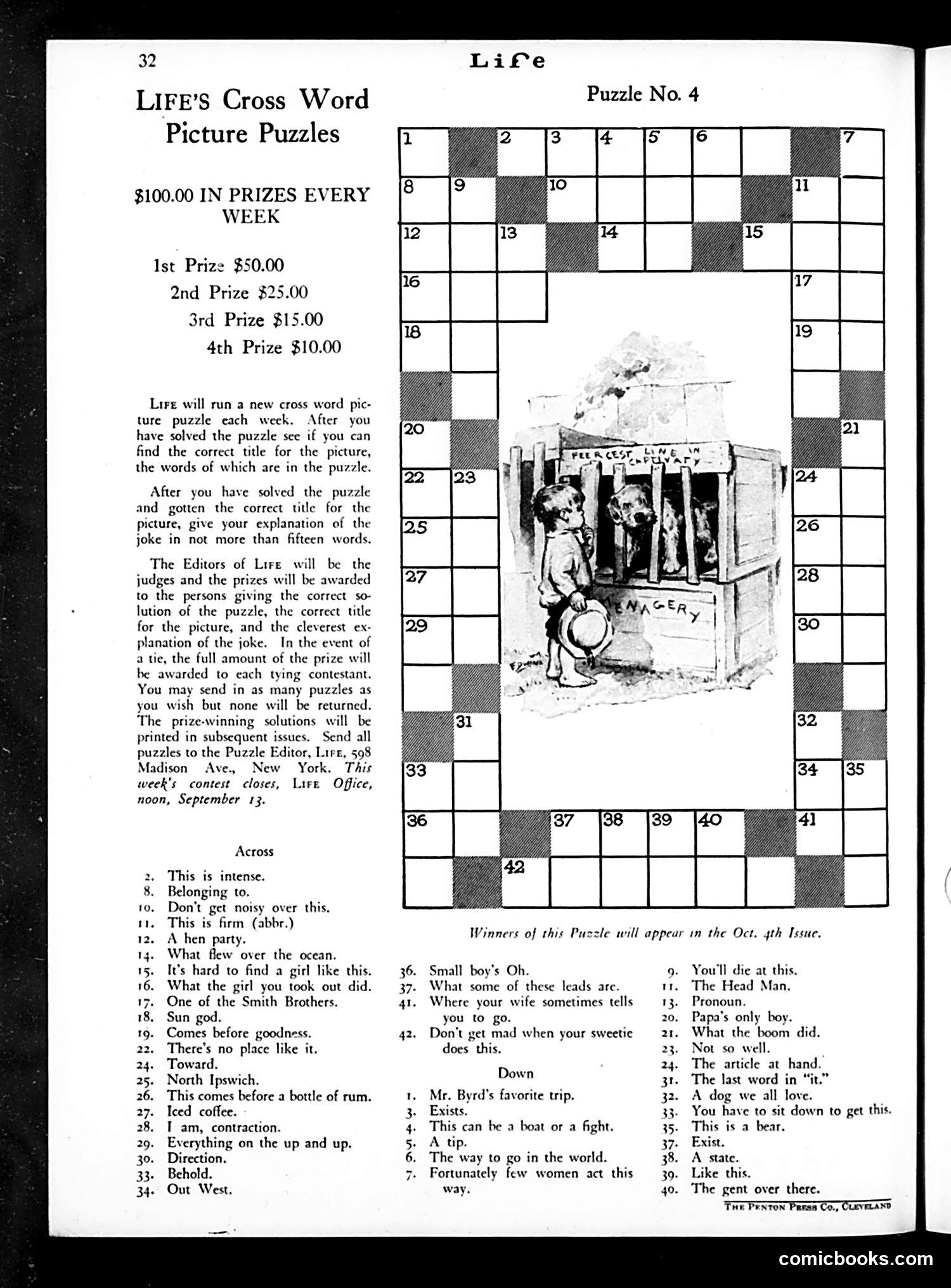
Life Magazine Crossword Picture Puzzle Analysis This page presents a crossword picture puzzle contest from Life magazine, offering $100 in weekly prizes ($50 first place down to $10 fourth place). The central illustration depicts a child at a homemade lemonade stand labeled "LEMONADE," a classic Americana scene of youthful entrepreneurship. The puzzle format requires solvers to: (1) complete the crossword grid, (2) determine the correct title for the picture from the crossword answers, and (3) explain the joke in fifteen words or fewer. The clues are intentionally playful and indirect—"Mr. Byrd's favorite trip" (Down 1, referring to Admiral Richard Byrd's polar expeditions), "Sun god" (Across 10, answer: RA), "There's no place like it" (Across 23, likely HOME)—making this both a vocabulary test and visual interpretation exercise. This represents Life's editorial strategy of combining interactive entertainment with satirical commentary, typical of early-to-mid 20th century magazine culture.
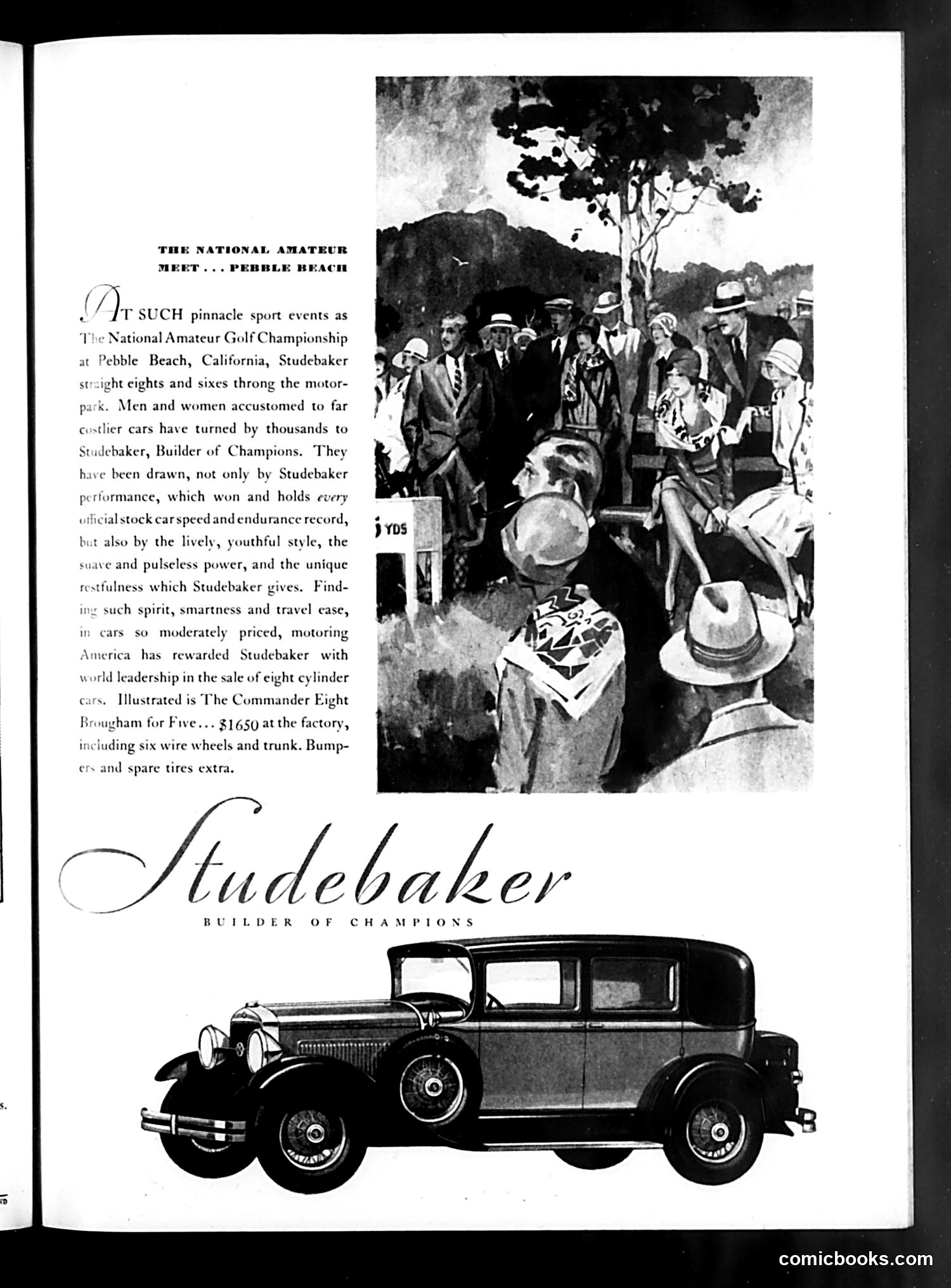
Analysis This is a Studebaker automobile advertisement, not satire or political commentary. The page uses the National Amateur Golf Championship at Pebble Beach, California as aspirational context—a "pinnacle sport event" attracting wealthy competitors. The advertisement's appeal is straightforward: it claims that people accustomed to more expensive cars are choosing Studebaker because it offers "lively, youthful style" and performance at moderate pricing ($1,650). The photograph shows well-dressed spectators at the golf event, establishing an upscale social setting. The tagline "Builder of Champions" references Studebaker's documented racing records. For a modern reader, this represents typical mid-century automotive marketing: associating a mass-market car with luxury, performance, and social status through sports sponsorship and celebrity association. There is no satirical intent—this is straightforward period advertising designed to appeal to aspirational middle-class buyers.
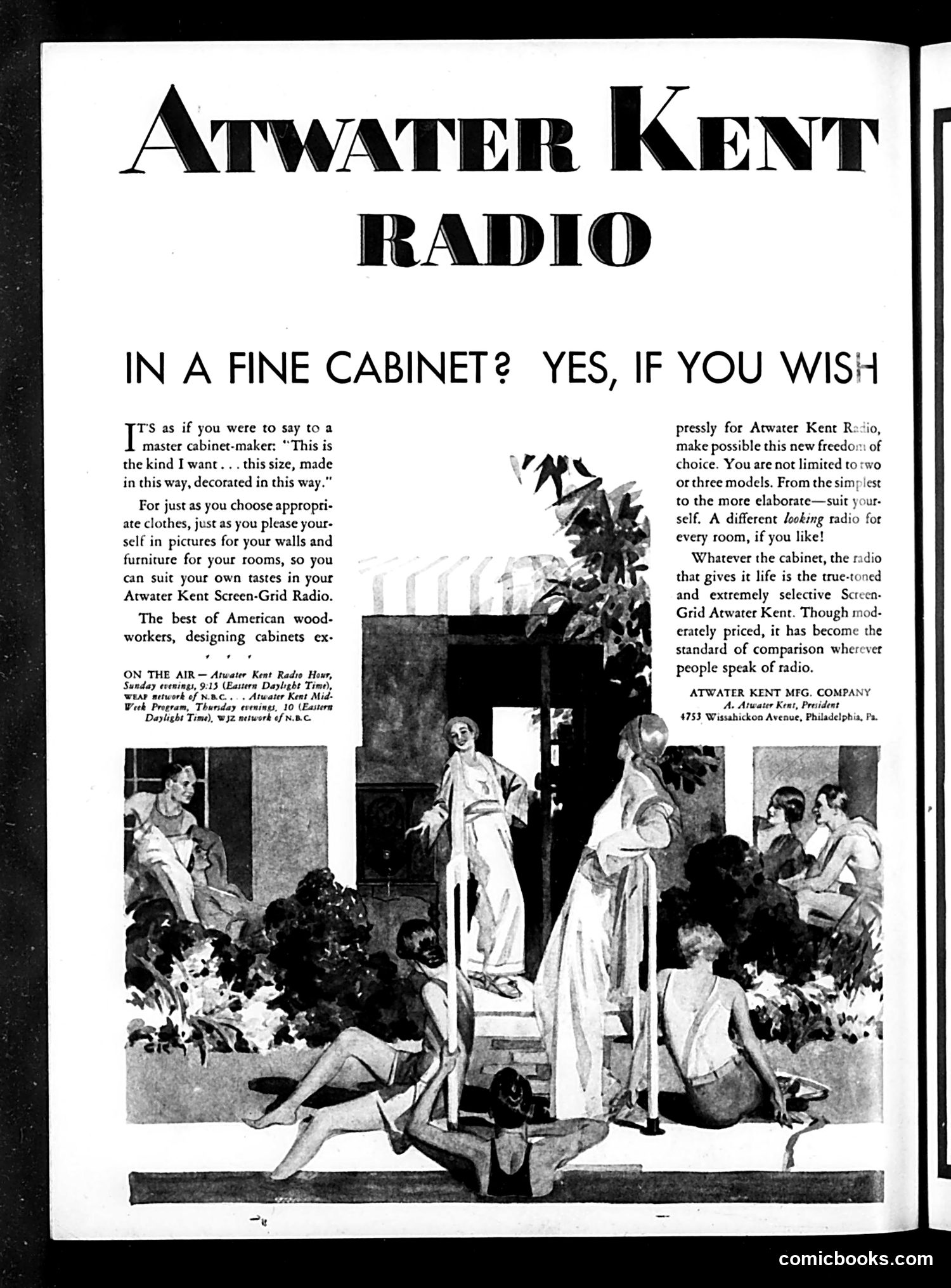
Atwater Kent Radio Advertisement This is a product advertisement, not political satire. It promotes Atwater Kent radios, a major American manufacturer of the 1920s-30s. The ad uses an illustration of fashionably dressed women gathered around a decorative radio cabinet to appeal to consumers' desire for stylish home furnishings. The pitch equates radio purchasing with personal taste in clothing and furniture—you can customize your radio's cabinet design to match your décor and personality. The text emphasizes consumer choice ("freedom of choice") and the radio's quality ("true-toned," "extremely selective"), positioning it as a status symbol for middle-class homes. The "Screen-Grid" technology is highlighted as the standard of comparison in radio quality. This reflects the 1920s-30s era when radios were transitioning from technical novelties to essential household appliances and decorative pieces, marketed to women as aesthetic home investments.