life
Life — September 13, 1929
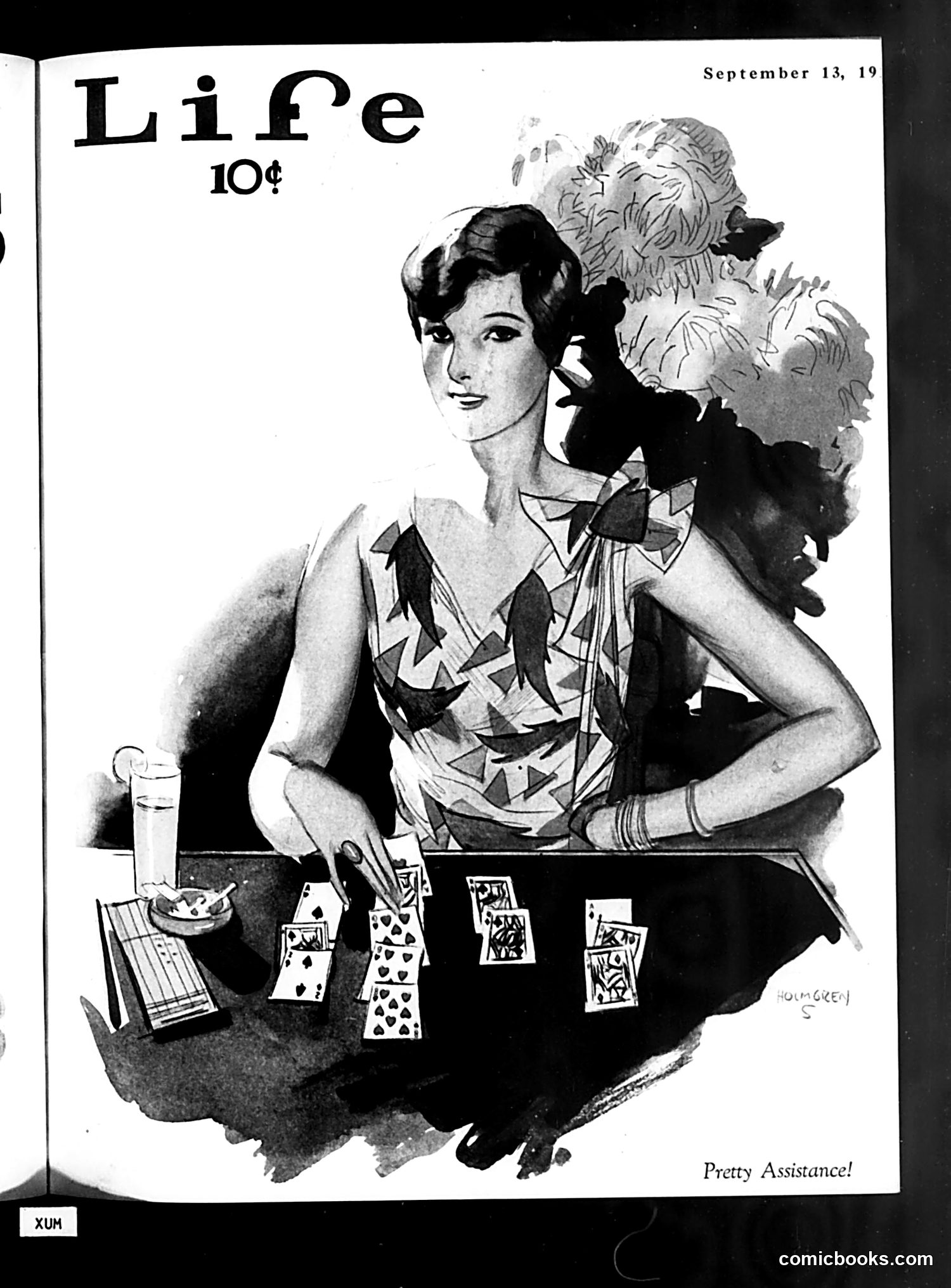
"Pretty Assistance!" - Life Magazine Cover, September 13, 1919 This cover depicts a woman playing cards while holding two cherubs or cupids on her shoulders. The title "Pretty Assistance!" suggests the joke concerns cheating at cards—the cherubs represent "pretty assistance" or supernatural help to win. The illustration satirizes either card-playing scandals of the era or the broader theme of women seeking unfair advantages, possibly through charm or deception. The 1919 date places this during the Jazz Age, when card games were popular social activities and gambling concerns were widespread. The woman's fashionable bobbed hairstyle reflects contemporary 1920s style. The specific context of what scandal or trend this references remains unclear without additional source material.
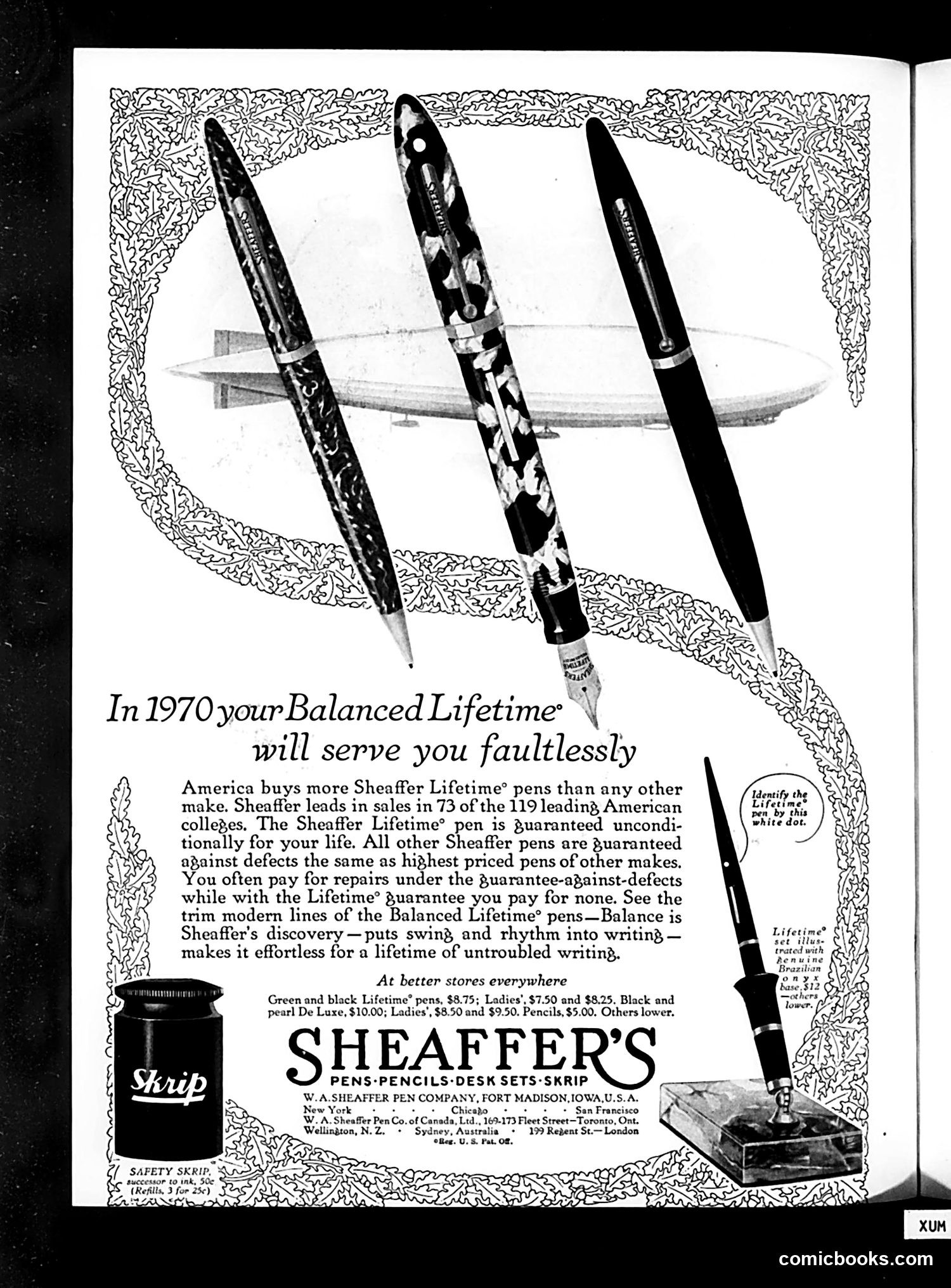
Analysis This is not a political cartoon or satirical content—it's a straightforward advertisement for Sheaffer pens, specifically promoting their "Balanced Lifetime" model. The ad claims that in 1970, Sheaffer pens will provide reliable writing service for life. It emphasizes that Sheaffer leads American sales and offers an unconditional lifetime guarantee, unlike competitors. The visual shows three elegant pens with decorative ornamental framing. The ad highlights pricing ($8.75 for basic models up to $10 for deluxe versions) and notes that the "Balanced Lifetime" design adds "swing and rhythm into writing." This appears in *Life* magazine as paid advertising, not editorial content or satire.
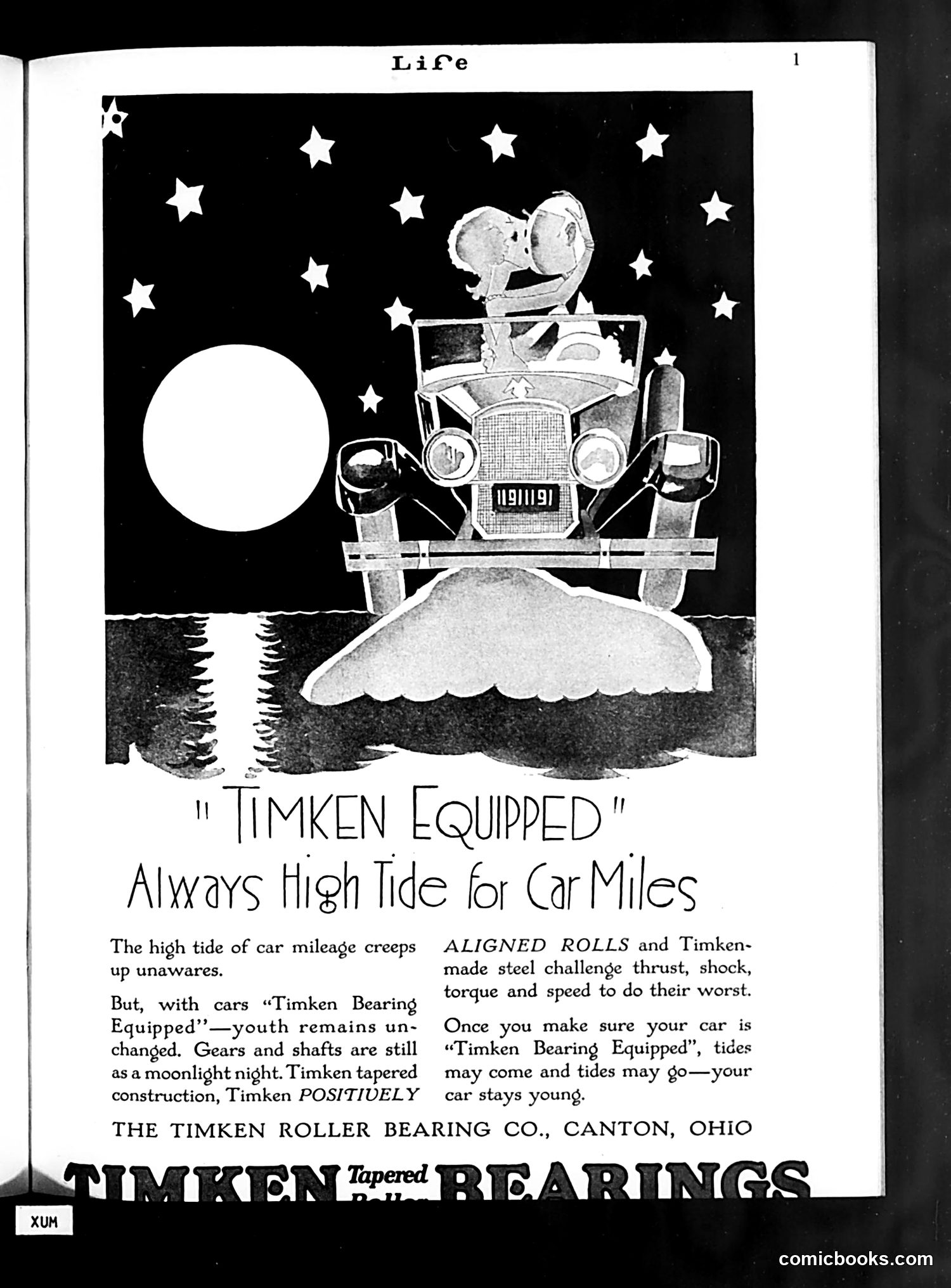
Analysis This is primarily a Timken Roller Bearing Company advertisement, not political satire. The page uses whimsical imagery to market industrial products to automobile owners. The cartoon depicts two anthropomorphic characters in a vintage automobile driving on the moon's surface, with a large moon and stars visible. The headline "TIMKEN EQUIPPED: Always High Tide for Car Miles" uses a maritime metaphor to promise durability. The ad's logic: just as Timken bearings keep cars functioning despite "high tides" of wear (shock, torque, speed), they maintain vehicle longevity. The moon setting suggests aspiration and modernity—space travel was emerging in popular imagination during this era. This is straightforward commercial advertising exploiting contemporary fascination with science and innovation, not political commentary.
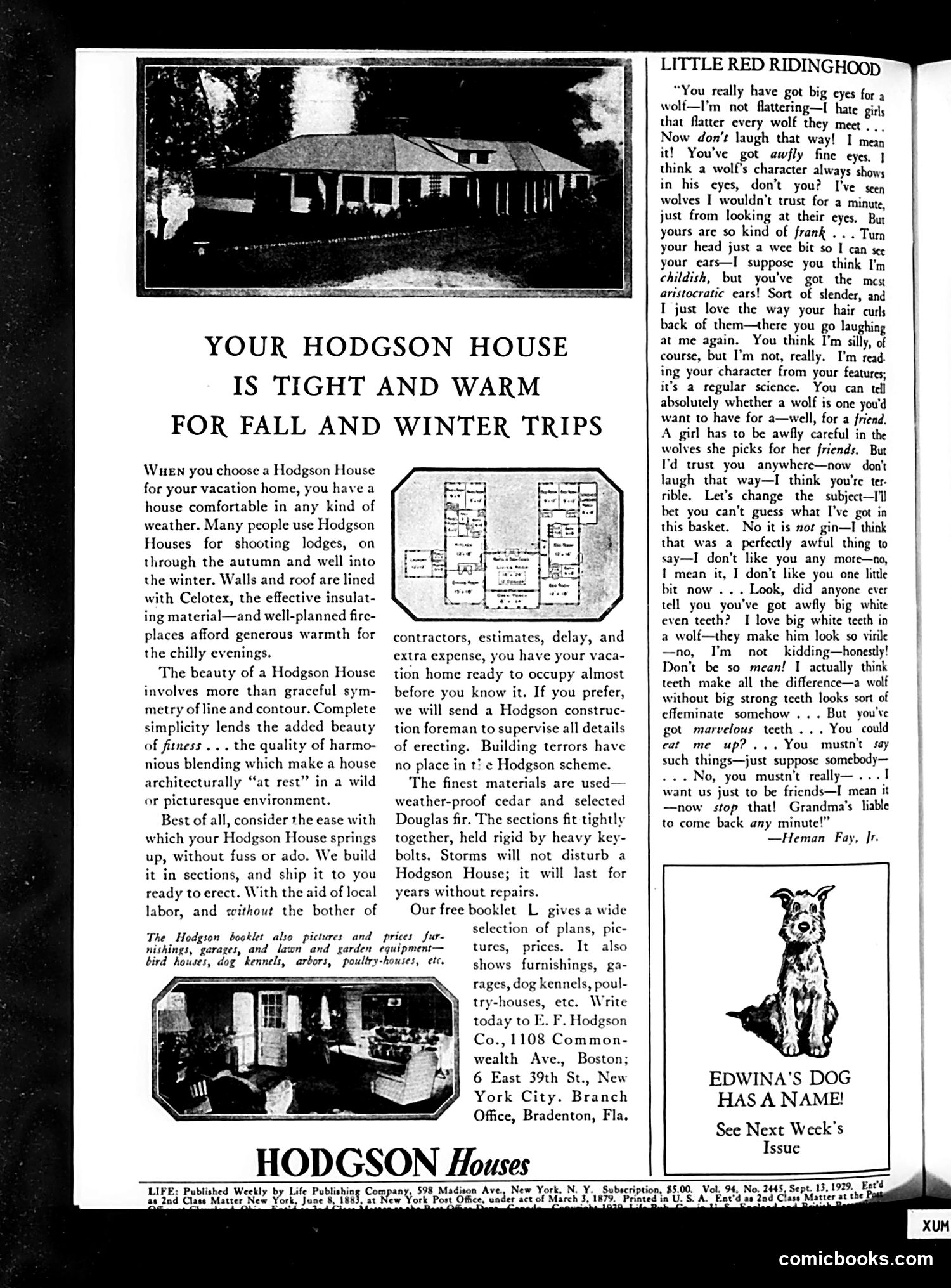
Analysis This page is primarily advertising, not political satire. The left side promotes Hodgson Houses—prefabricated home kits shipped in sections for assembly. The text emphasizes their affordability, durability (using cedar and Douglas fir), and suitability for vacation homes, hunting lodges, or year-round residences. The right side contains "Little Red Ridinghood," a flirtatious dialogue where a girl playfully teases a boy about his appearance and character, using wolf/predator metaphors. It's light romantic banter typical of 1920s magazine humor—the girl is mock-threatening, suggesting the boy's "big eyes" and physical features make him wolf-like, but she ultimately invites him back. The bottom promotes "Edwina's Dog"—a tease for next week's issue.
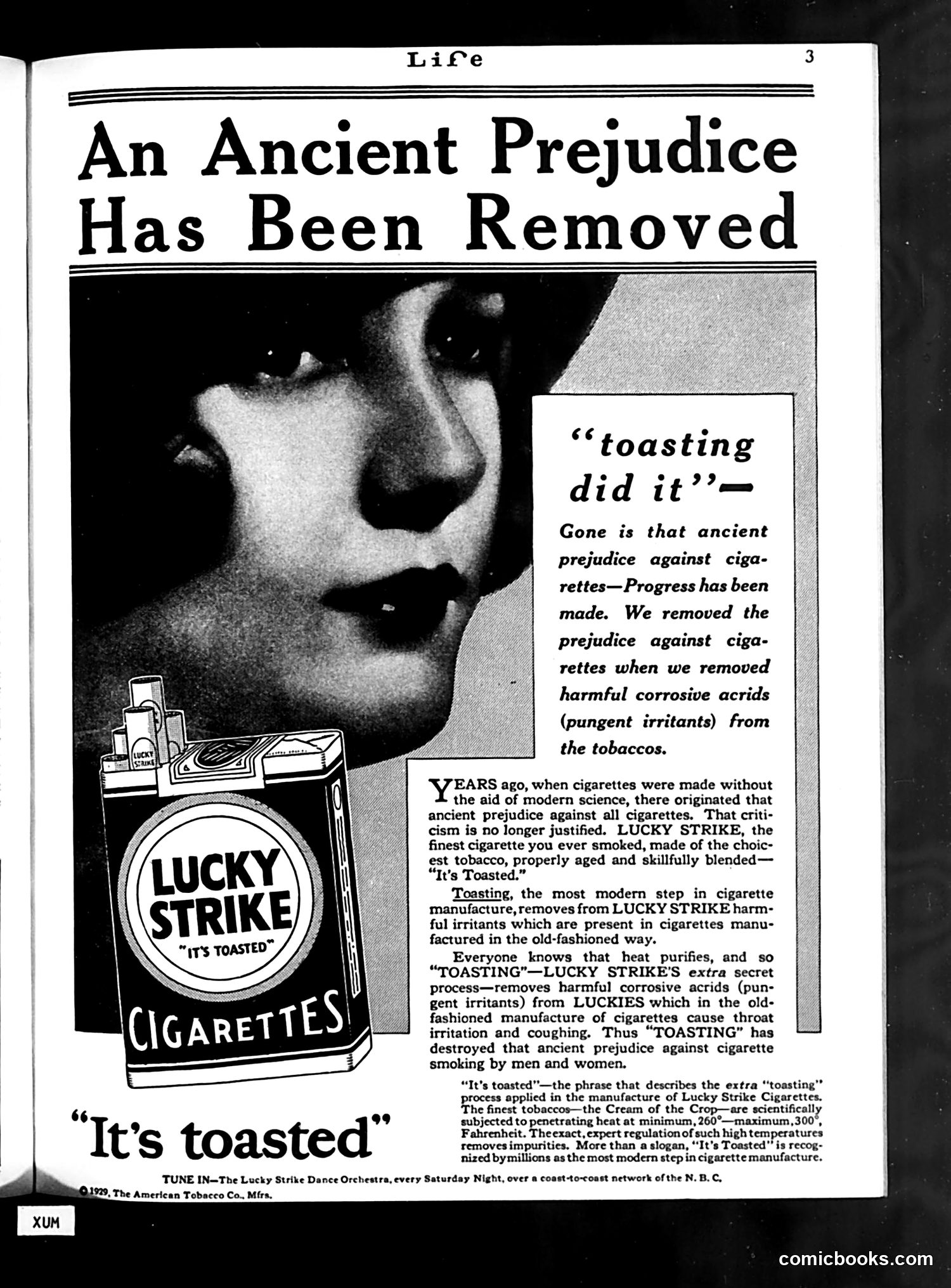
Analysis This is not satire—it's a cigarette advertisement for Lucky Strike, disguised as editorial content in Life magazine. The ad claims that "toasting" (heat treatment) removes harmful corrosive acids from tobacco, thereby eliminating "ancient prejudice" against cigarettes. The tagline "It's toasted" appears throughout. Key context for modern readers: This represents early 20th-century tobacco marketing before health warnings were required. The ad uses pseudo-scientific language ("heat purifies," "removes irritants") to address genuine public health concerns about cigarettes, repackaging them as a product improvement rather than addressing smoking's actual dangers. The phrase "ancient prejudice" is cynical—it equates legitimate health concerns with superstition rather than valid worry. This exemplifies how corporations used advertising to manufacture credibility around dangerous products.
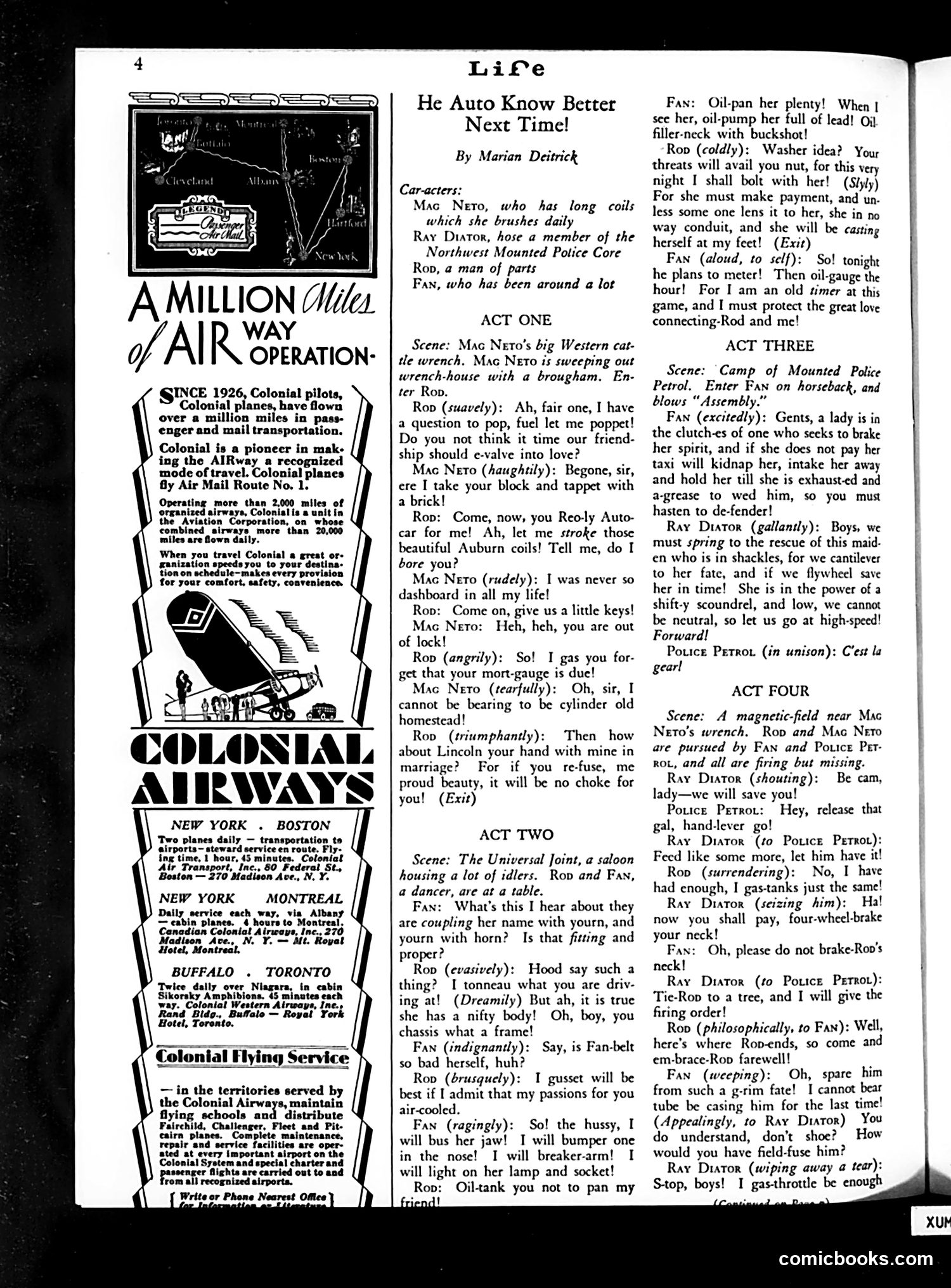
Analysis of "He Auto Know Better Next Time!" by Marian Deitrick This page is primarily a comedic playlet (short dramatic sketch) satirizing romantic entanglements among automobile enthusiasts. The characters—Mag Neto, Rod (a police officer), and Fan—engage in a love triangle involving jealousy and competitive bravado about their vehicles' performance. The satire targets the automotive culture obsession of the 1920s-1930s, where cars and driving prowess had become status symbols tied to masculinity and romance. The exaggerated dialogue mocks how drivers treated automobiles as extensions of their identity, using car terminology as flirtation ("cylinder," "gas," "horsepower"). The page also features Colonial Airways advertisements below, promoting early commercial aviation routes in North America, reflecting the era's fascination with modern transportation technology.
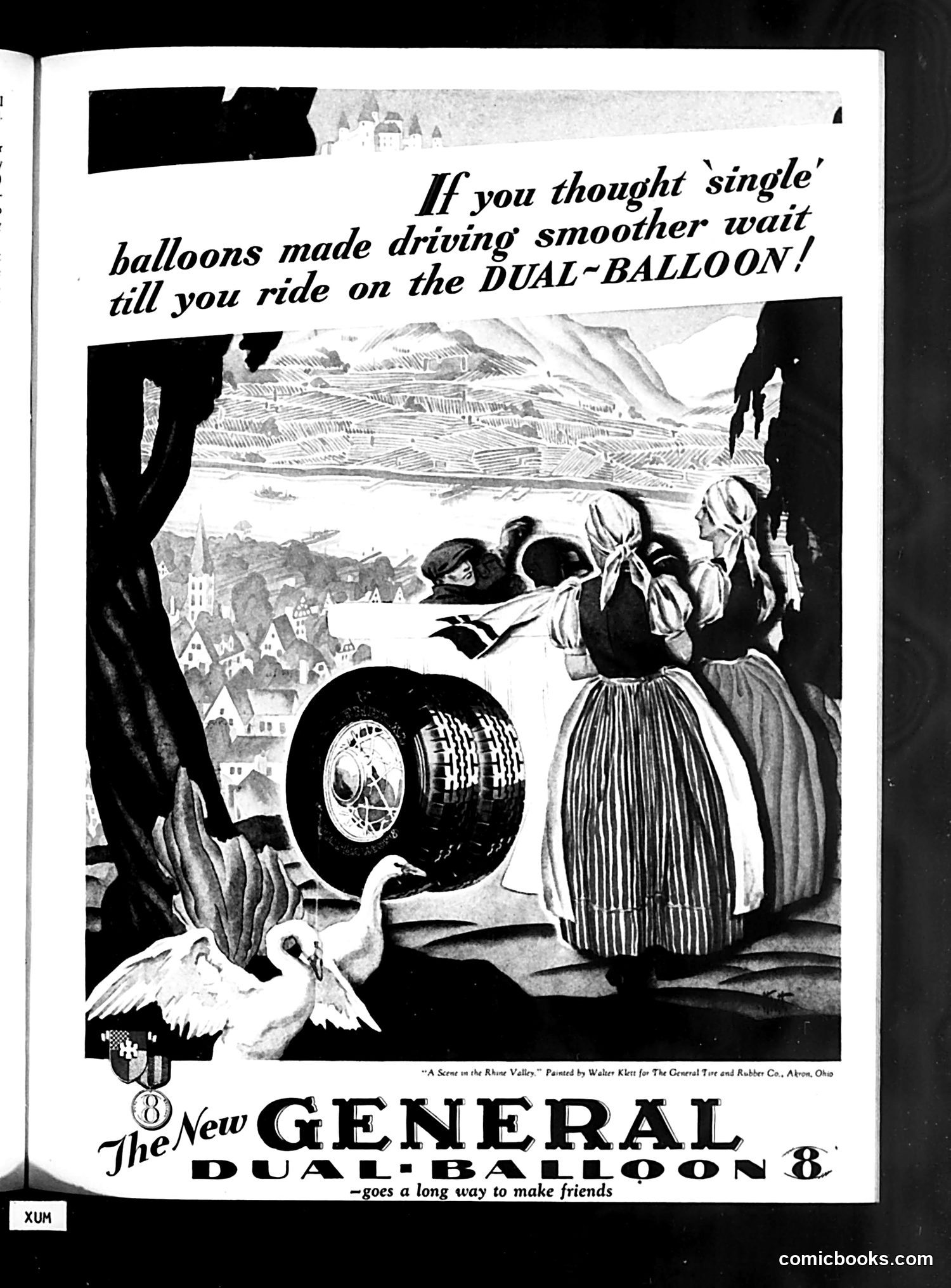
Analysis This is a General Tire advertisement, not political satire. The ad promotes the "Dual-Balloon 8" tire by comparing it favorably to single balloons for smooth driving. The imagery is whimsical rather than satirical: women in what appear to be traditional Alpine or European folk costumes stand with a large dual-balloon tire overlooking a mountainous village landscape. A goose is present in the foreground. The tagline "goes a long way to make friends" suggests the tire's superior quality makes travel more pleasant. The painting credit to Walter Kern is noted. This represents vintage automotive advertising using fantastical, lighthearted imagery to market tire technology—common advertising strategy of the era. There is no political commentary or social satire present on this page.
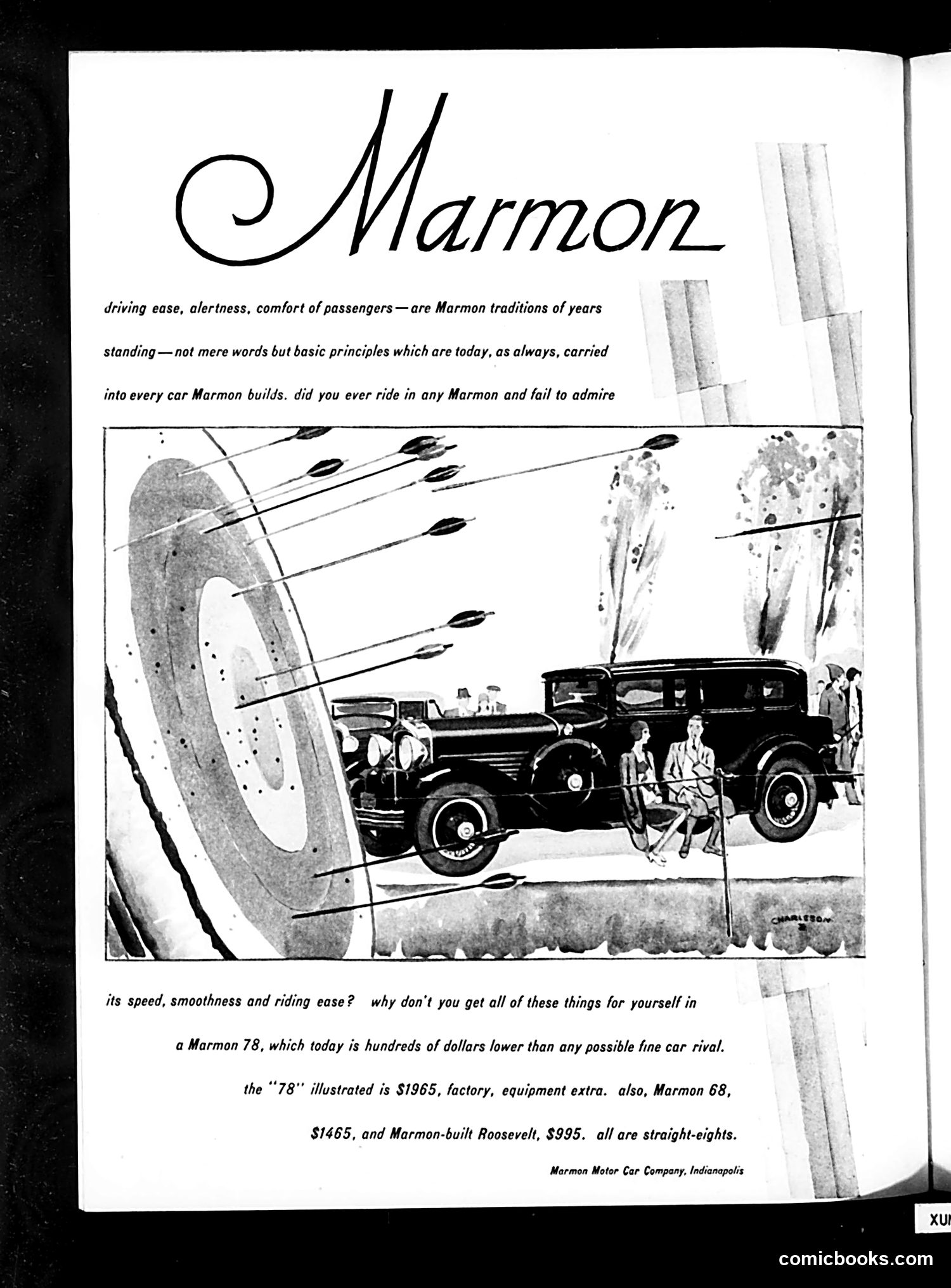
Marmon Automobile Advertisement This is a vintage car advertisement, not political satire. It promotes the Marmon automobile, made by the Marmon Motor Car Company of Indianapolis. The ad emphasizes Marmon's traditional qualities—"driving ease, alertness, comfort"—and appeals to buyers by highlighting value: the Marmon 78 costs $1,965, "hundreds of dollars lower than any possible fine car rival." The illustration shows well-dressed passengers enjoying the car's smooth ride, with stylized motion lines suggesting speed and comfort. The ad lists three models (78, 68, and Roosevelt) with prices, all featuring straight-eight engines—a premium technical feature of the era. This reflects 1920s automotive marketing emphasizing both luxury and affordability.
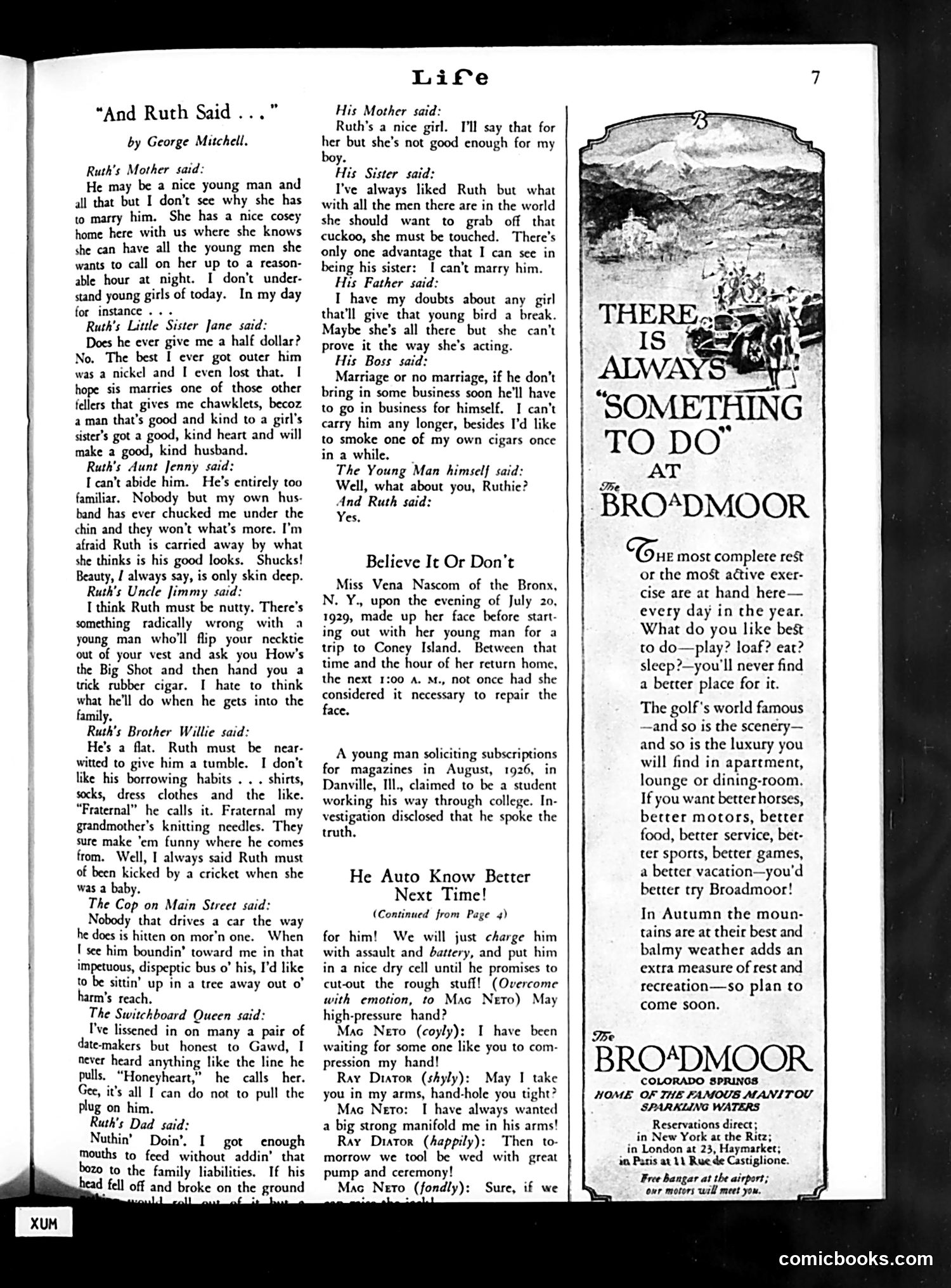
Analysis of Life Magazine Page 7 This page contains two distinct sections: Left side: A satirical piece titled "And Ruth Said..." by George Mitchell, featuring dialogue from various family members and acquaintances debating whether a young woman named Ruth should marry a particular man. Each speaker offers contrasting opinions—some praising Ruth's qualities, others criticizing the suitor's prospects or character. The humor lies in the contradictory advice and family dynamics around marriage decisions. Right side: A travel advertisement for Broadmoor resort in Colorado Springs, promoting luxury amenities and recreational activities. The copy emphasizes golf, fine dining, and relaxation. The page juxtaposes domestic comedy with aspirational leisure marketing, typical of 1920s Life magazine content mixing satire with commercial advertising.
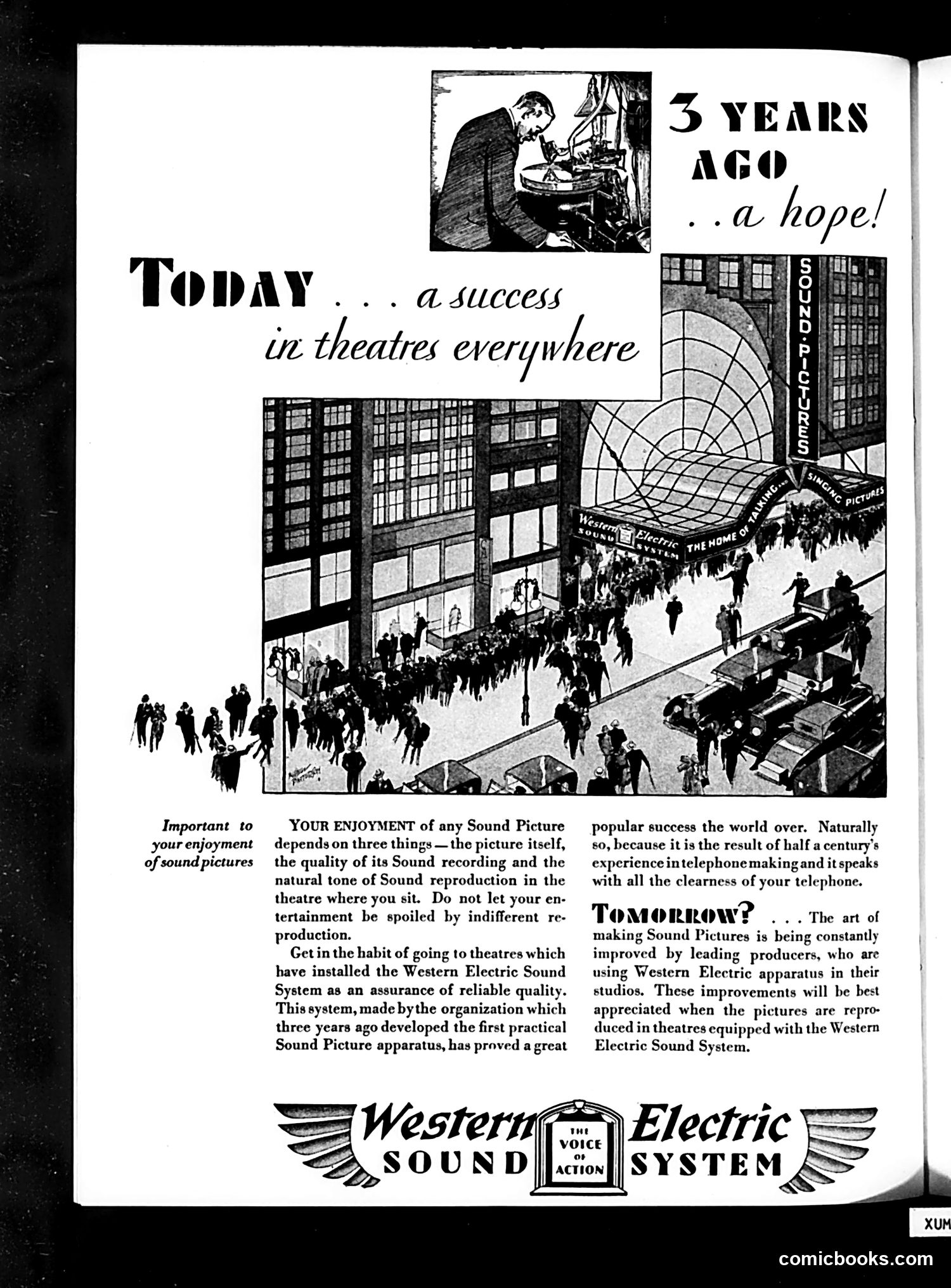
Western Electric Sound System Advertisement This is a full-page advertisement, not satire or political commentary. It promotes Western Electric's sound reproduction technology for movie theaters. The ad uses a "then vs. now" comparison: three years ago (top), sound in cinema was experimental ("a hope"), shown by a technician working on early equipment. Today (bottom), it's successful, depicted by crowded theaters enjoying films at what appears to be a major cinema. The pitch emphasizes that Western Electric developed the first practical sound picture apparatus and now leads improvements in theater sound quality. The message targets moviegoers: attend theaters with Western Electric Sound Systems installed to ensure reliable audio reproduction and not have your entertainment "spoiled by indifferent reproduction." This reflects cinema's transition to synchronized sound in the late 1920s.
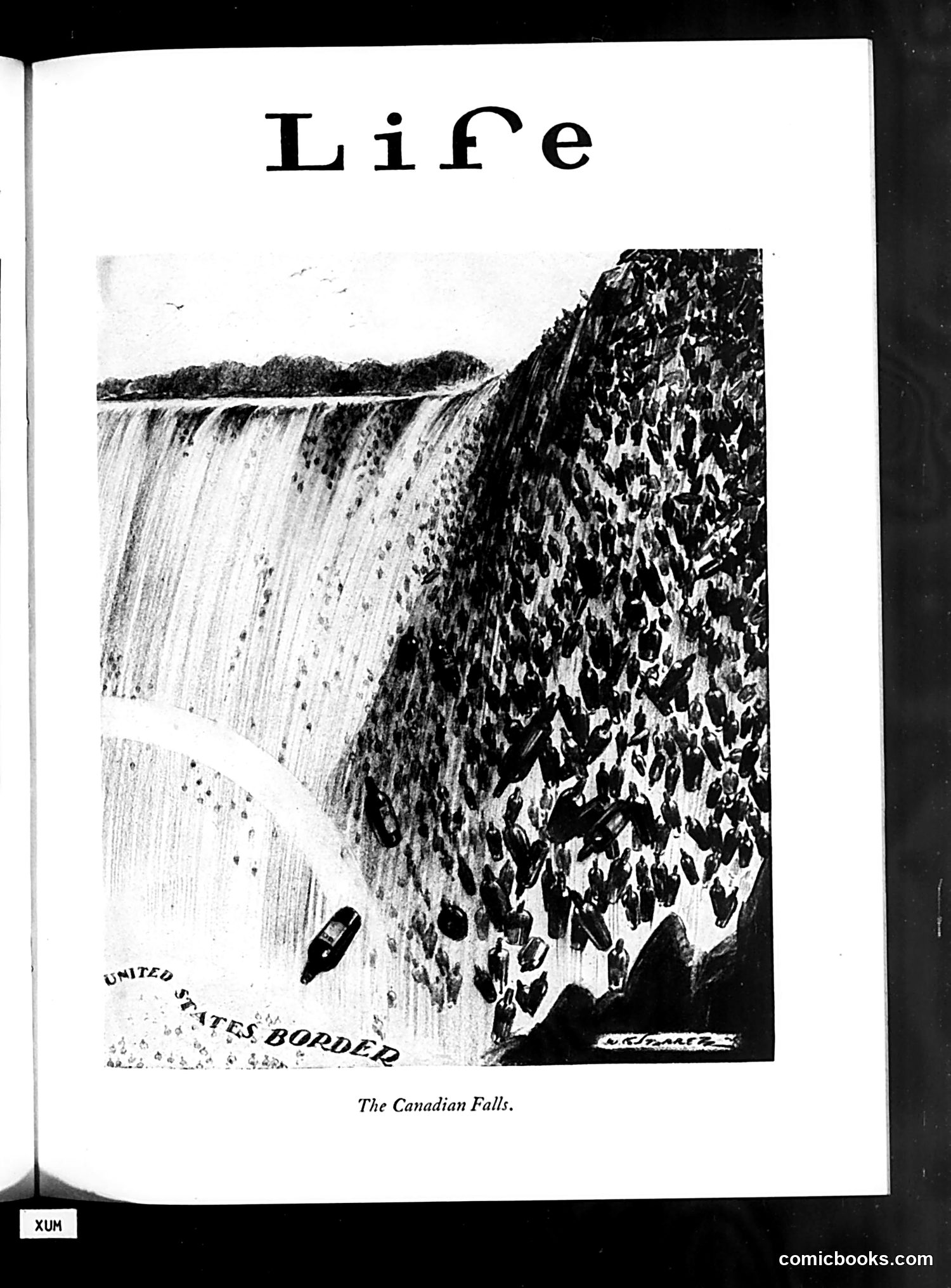
Analysis This is a title page for a Life magazine section titled "Life" featuring an illustration labeled "The Canadian Falls" (Niagara Falls). The image shows a dramatic waterfall with ivy-covered cliffs on the right side and a small boat in the water below. A stamp reading "UNITED STATES BORDER" appears in the lower left corner. The satirical point appears to reference the U.S.-Canada border, likely commenting on tourism, natural resources, or cross-border relations during the early-to-mid 20th century. The placement of the border stamp on an iconic natural landmark suggests commentary on how artificial political boundaries divide naturally shared geography. Without additional context from the article text, the specific satirical target remains unclear, though it likely critiques either border policy or the commercialization of natural wonders.
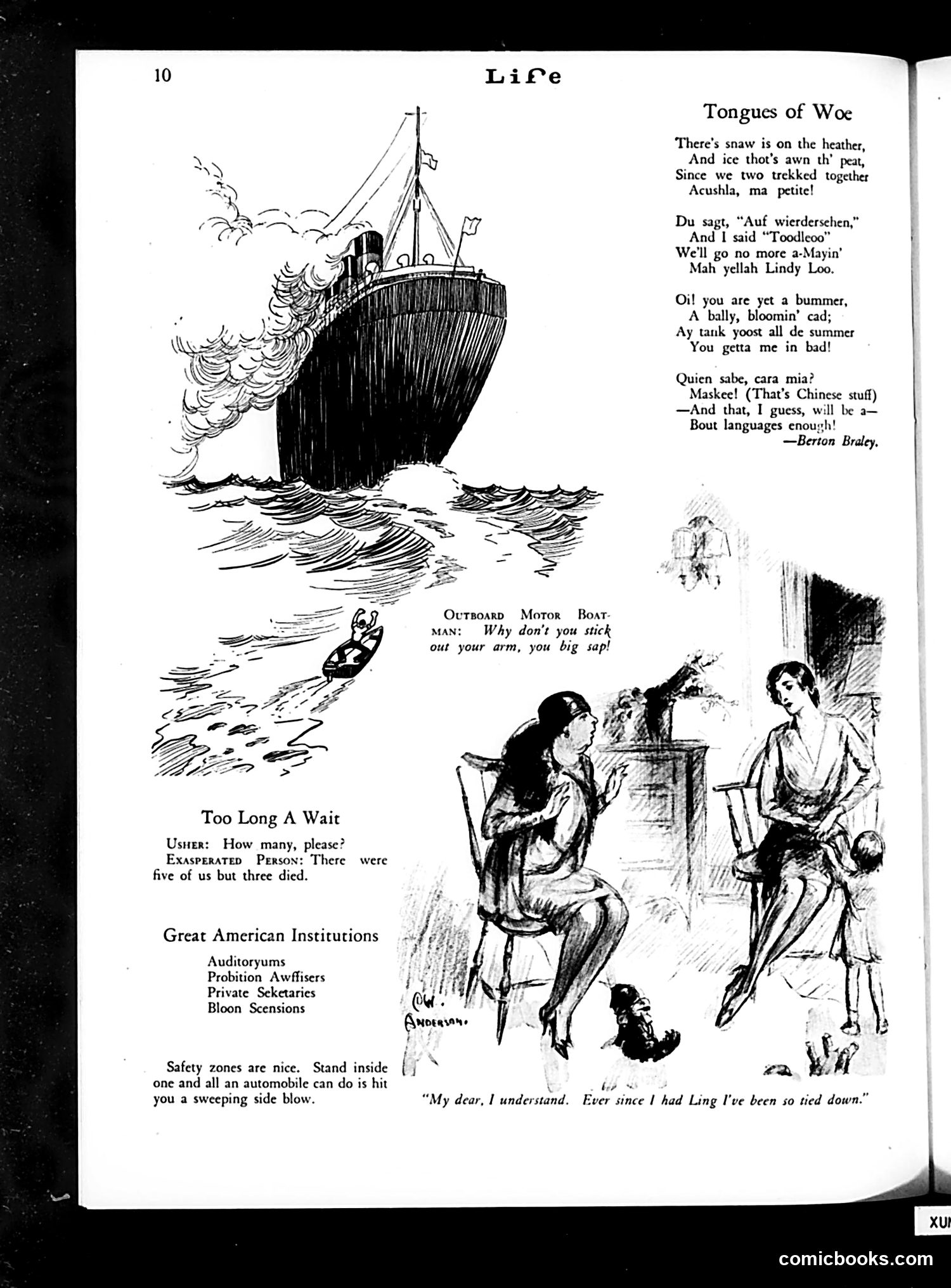
Analysis of Life Magazine Page 10 This page contains several unrelated satirical pieces typical of Life's humor magazine format: "Tongues of Woe" presents a poem by Berton Braley mocking multilingual affectation and travel pretense—the speaker sarcastically catalogs foreign phrases picked up during travel, suggesting such linguistic showing-off is annoying. "Outboard Motor Boat" shows a crude joke about a man on a motorboat, likely sexual innuendo. "Too Long A Wait" presents a dark joke: an usher at what appears to be an execution asks exhausted prisoners how many arrived; three of five died waiting. This satirizes bureaucratic inefficiency and possibly capital punishment delays. "Great American Institutions" lists items with grim humor (auditoriums, prohibition, blood donations). The final illustrated scene depicts a woman telling a man she's been "tied down" since losing "Ling I've"—likely a pun or reference unclear without additional context.
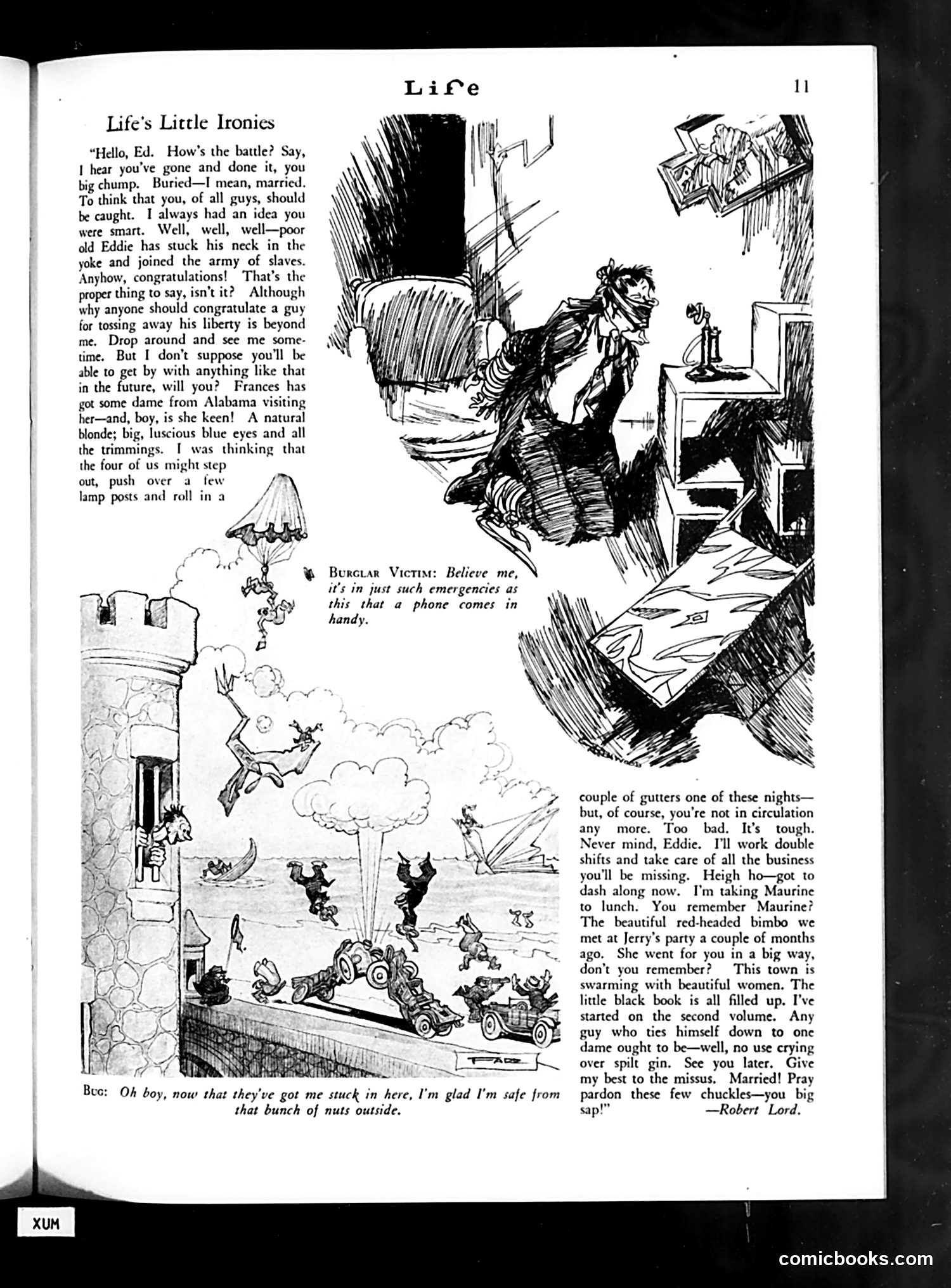
Analysis of Life Magazine Page This page features "Life's Little Ironies," a satirical column with accompanying illustrations. The main narrative (attributed to Robert Lord) is a humorous letter from "Ed" to a friend, congratulating him ironically on being caught and imprisoned as a soldier, while boasting about romantic conquests and social activities back home. The cartoon illustrations depict military scenes (a tower, soldiers, vehicles) contrasting with civilian leisure. The irony being satirized is the disconnect between soldiers' sacrifice and hardship versus the carefree social lives of those remaining in civilian society—a common WWI-era social critique. A secondary illustration shows a burglar victim using a telephone, captioned about emergencies, providing an unrelated comedic vignette typical of Life's format.
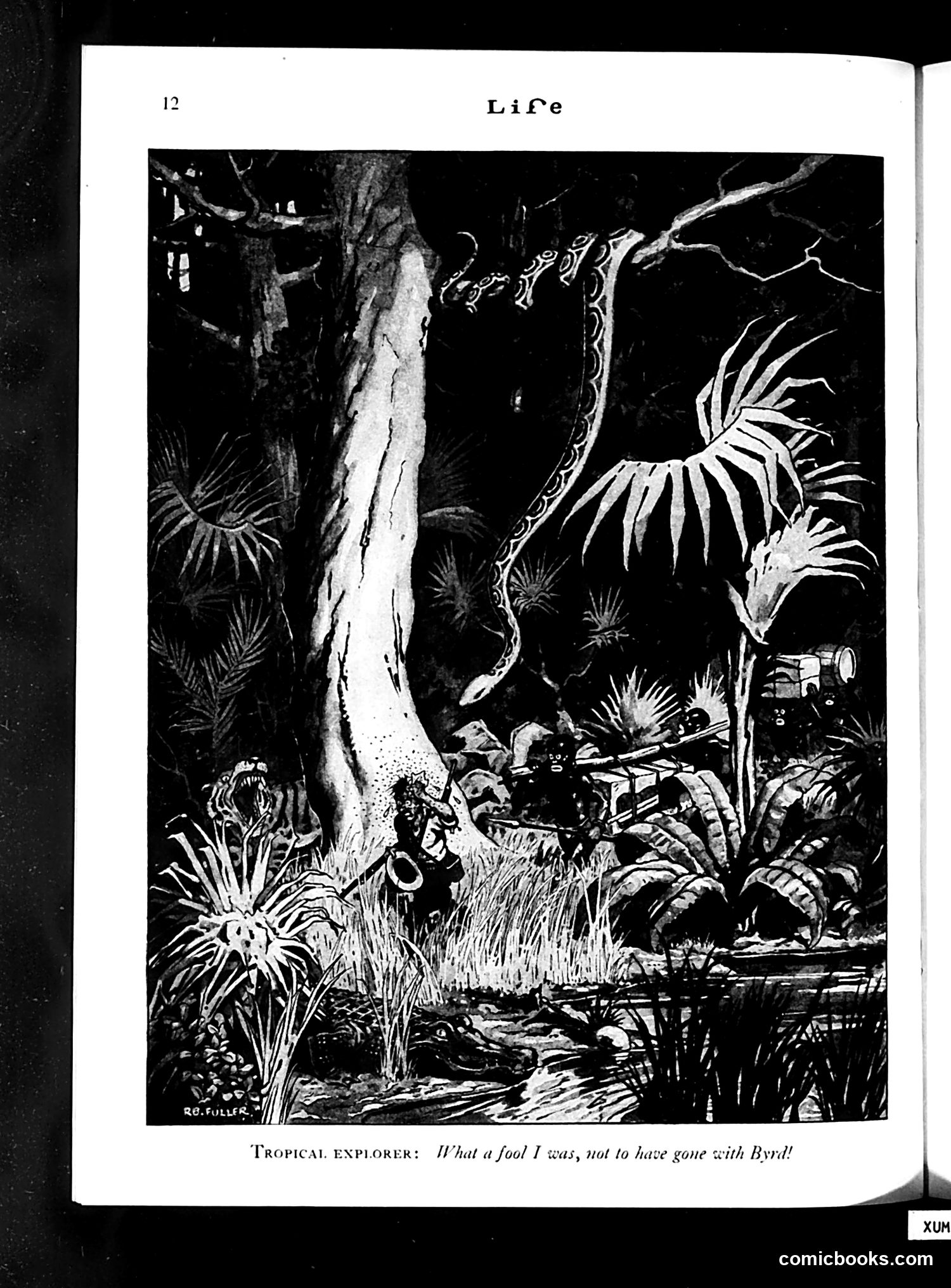
Explanation for Modern Readers This is a single-panel cartoon titled "Tropical Explorer: What a fool I was, not to have gone with Byrd!" The image depicts an explorer in a tropical jungle setting, surrounded by exotic plants and wildlife. The satire references Richard Byrd, a famous early-20th-century polar explorer known for Antarctic expeditions. The joke suggests the speaker chose a difficult tropical expedition instead of joining Byrd's prestigious polar adventures—and now regrets it, surrounded by harsh jungle conditions. The cartoon mocks the explorer's poor decision-making and pokes fun at the competitive world of exploration expeditions during this era, when such ventures were celebrated public events. The artist (R.C. Fuller, visible at bottom) uses the tropical hardship to humorously suggest Byrd's expeditions were the "better" choice.
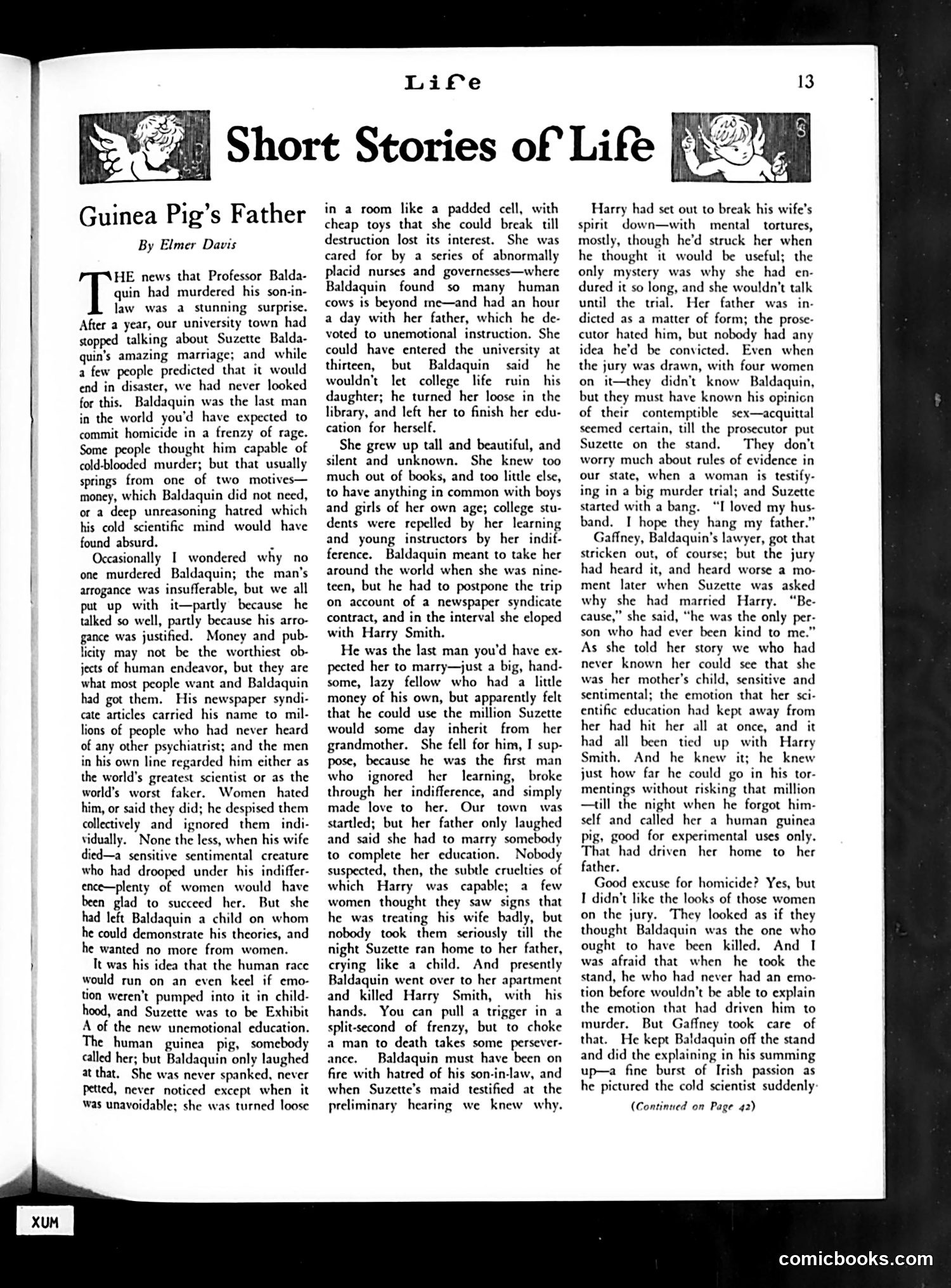
"Guinea Pig's Father" by Elmer Davis This is a short story, not a political cartoon. The narrative concerns Professor Baldaquin, a renowned but arrogant scientist who neglects his daughter Suzette's emotional needs while she grows up isolated and poorly socialized. She marries Harry Smith, a mediocre man, partly out of desperation for kindness. The story critiques cold scientific rationalism—Baldaquin treats his daughter like an experimental subject rather than a person, denying her normal childhood experiences. When Suzette later shoots Harry, the tale appears to explore how emotional deprivation and lack of human connection can lead to tragedy. The "guinea pig" metaphor reflects contemporary concerns about how detached intellectualism can harm human relationships and welfare.
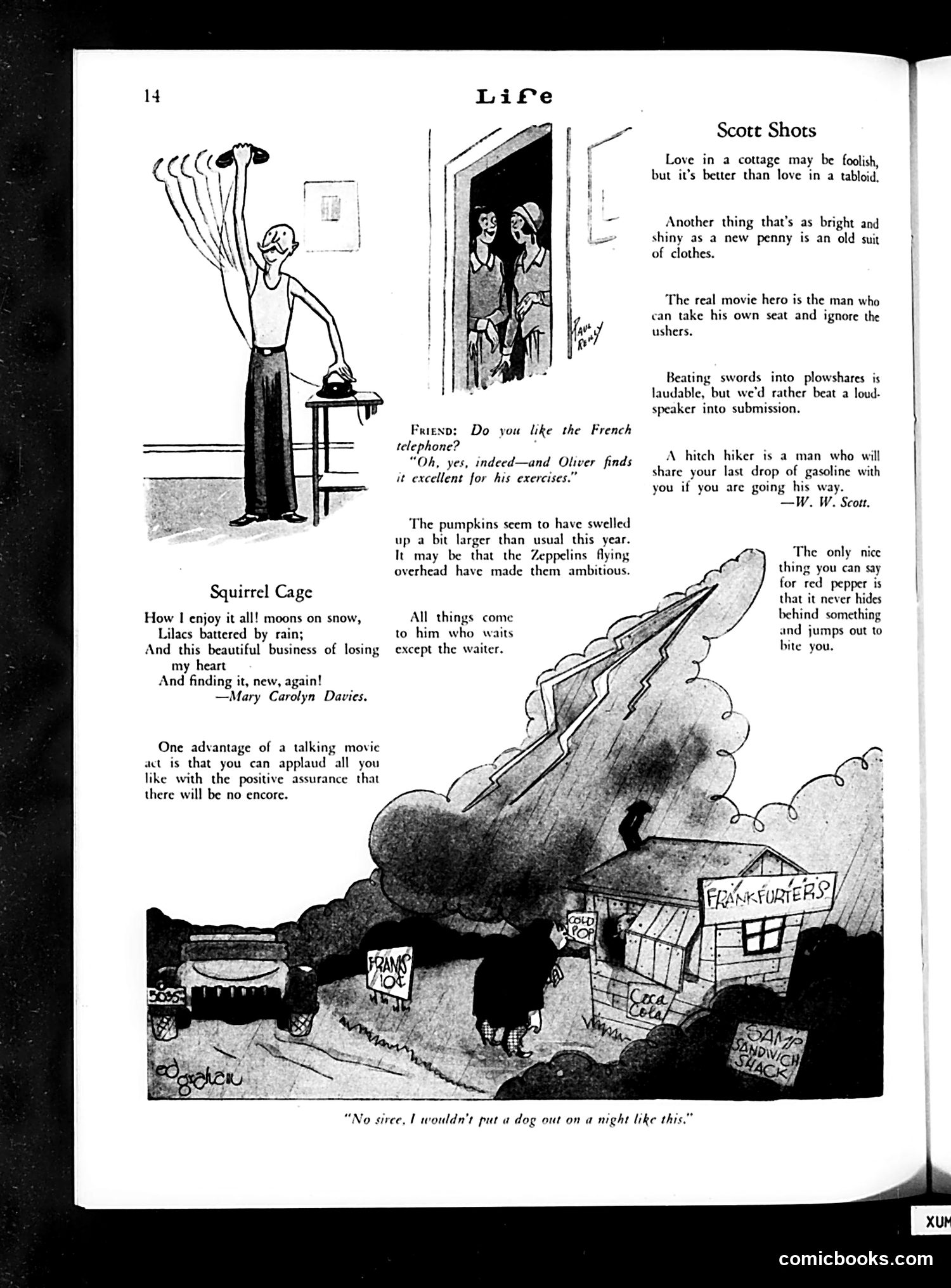
Analysis of Life Magazine Page 14 This page contains several humorous short observations and two cartoons from what appears to be an early-to-mid 20th century issue. The "Squirrel Cage" cartoon shows a person juggling teacups while operating some kind of exercise equipment, satirizing the frantic pace of modern life and attempts at self-improvement. The larger bottom cartoon depicts a massive hot dog crushing small buildings and vendor stands labeled "Frankfurters," "Corn," and "Candy." The caption reads: "No since, I wouldn't put a dog out on a night like this." This appears to satirize the absurdity of oversized hot dogs at what's likely a county fair or amusement park, playing on the double meaning of "hot dog" and the impossibility of the scenario. The scattered "Scott Shots" are brief, quotable observations on contemporary social life and behavior.
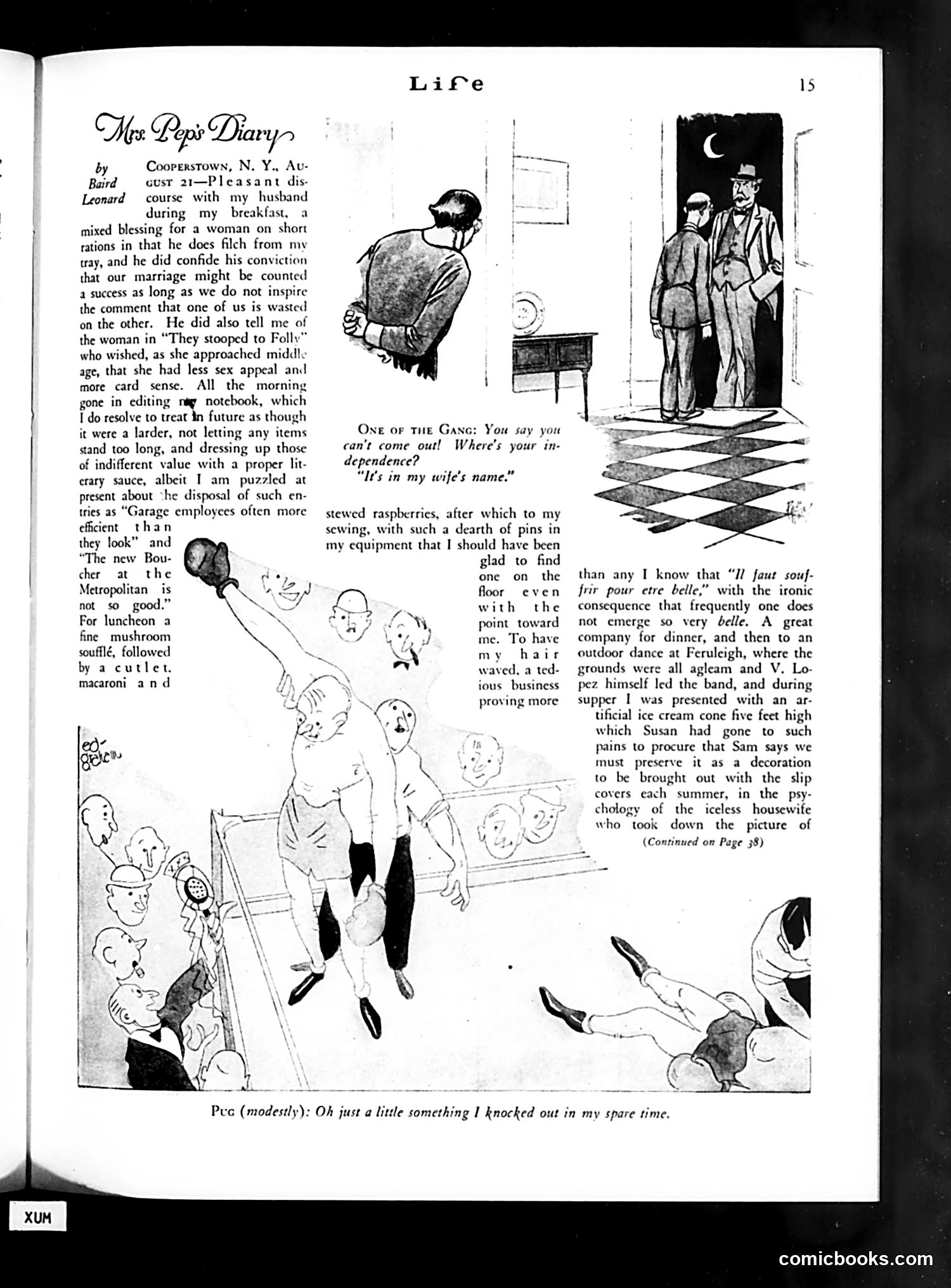
"Mrs. Pep's Diary" - Life Magazine Satire This is a humorous domestic diary piece by Baird Leonard titled "Mrs. Pep's Diary," set in Cooperstown, N.Y. (dated August 21). The satire mocks middle-class married life and gender dynamics of the era. The main cartoon depicts a woman at a formal dinner/dance event (outdoor venue at Feruleigh), showing the contrast between social expectations and domestic reality. The caption "One of the Gang" satirizes women's limited independence—a woman claims "it's in my wife's name" regarding finances, highlighting how married women had no legal control over property or money. The lower illustration shows children playing, labeled "Pep (modestly): Oh just a little something I knocked out in my spare time"—likely mocking both parental pretension and the exhausting reality of childcare disguised as leisure.
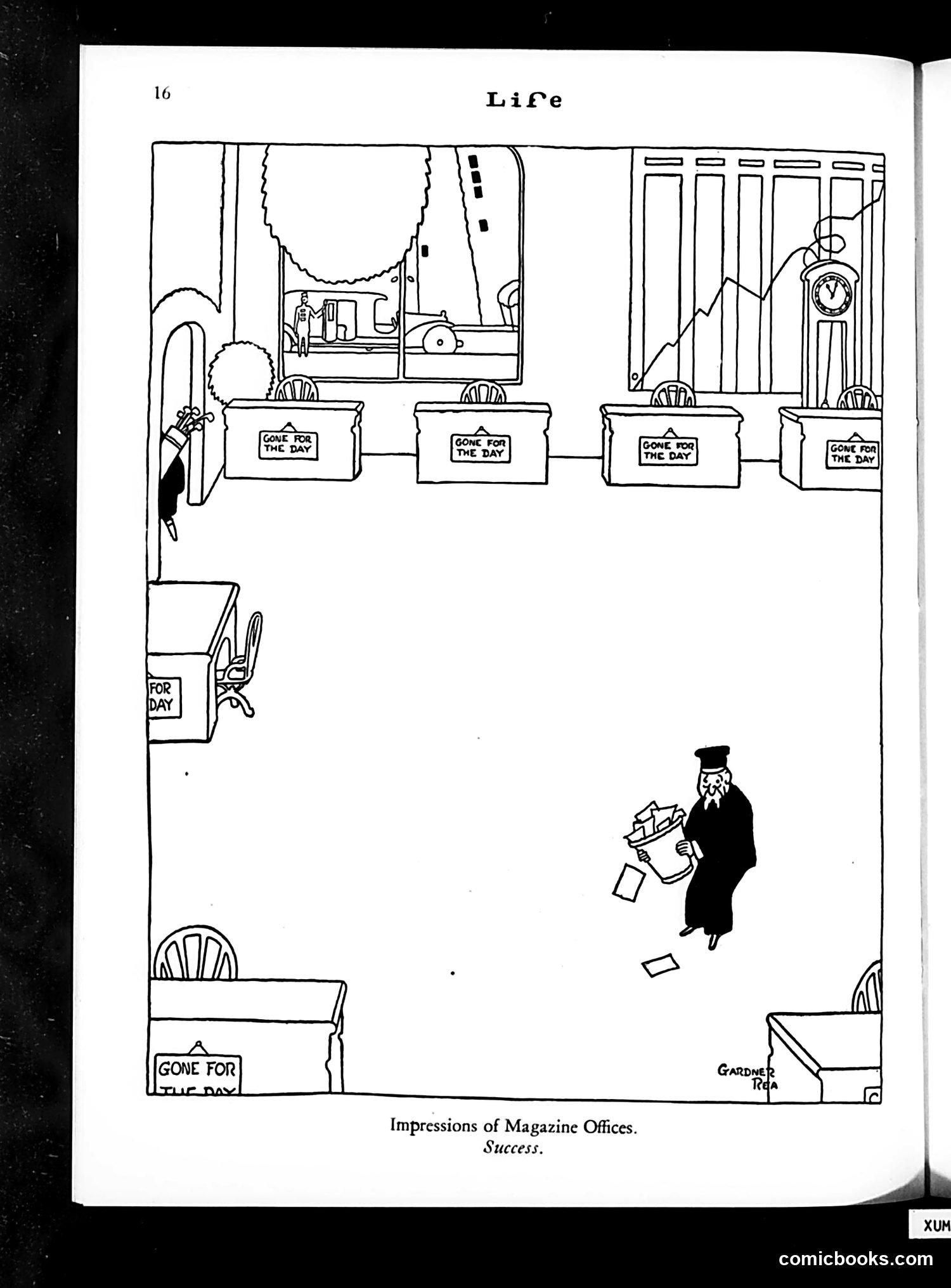
"Impressions of Magazine Offices: Success" This single-panel cartoon satirizes the contrast between appearance and reality at successful magazine offices. Multiple desks display "GONE FOR THE DAY" signs while employees are absent, yet the office appears professionally equipped with a clock, furniture, and organized workspace. The central figure—a bearded man in formal dress carrying papers and dropping documents—appears to be a editor or publisher surveying the empty office, seemingly amused by the irony. The satire targets the gap between a magazine's projected image of bustling productivity and the actual work habits of its staff. The repeated "GONE FOR THE DAY" labels emphasize that despite the office's polished appearance, real work gets accomplished elsewhere—or perhaps not at all. This mocks both magazine culture and general workplace pretense of the era.
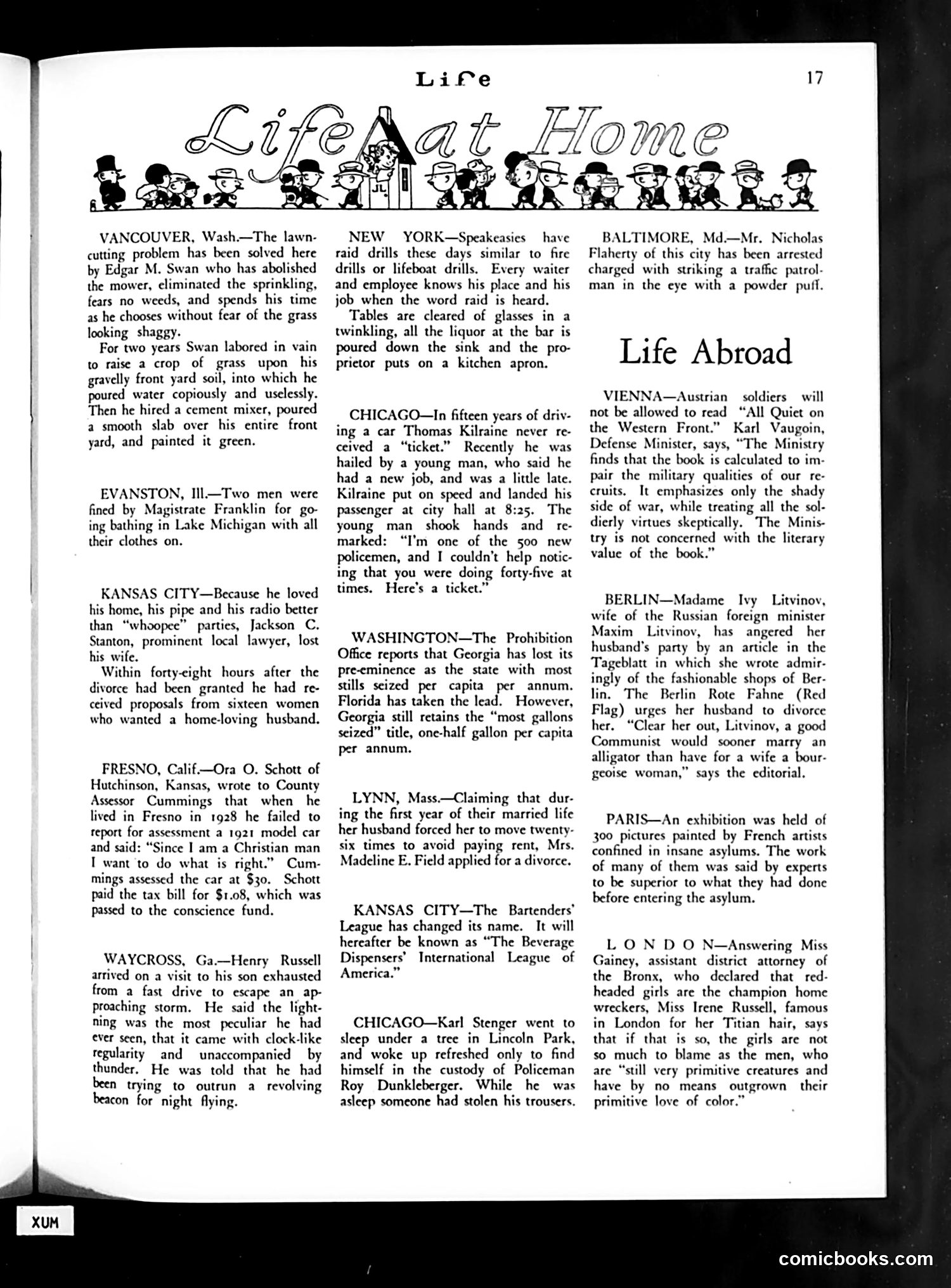
Life Magazine Page 17 - "Life at Home" and "Life Abroad" This page presents humorous anecdotes from American towns and international dispatches, rather than political cartoons. The header illustration shows silhouettes of men in various poses and hats—typical 1920s attire. The "Life at Home" section satirizes American domestic life through brief, comedic stories: a man solving lawn problems by abandoning his mower, a driver never receiving a traffic ticket in fifteen years, a lawyer losing his wife after hosting "whoopee" parties. The humor relies on ironic reversals and absurd situations. "Life Abroad" offers satirical commentary on international affairs, including Austrian military censorship, a Russian minister's wife publicly criticized in a newspaper, and London's views on "red-headed girls" as primitive. The satire targets bureaucratic absurdity and cultural stereotypes of the period.
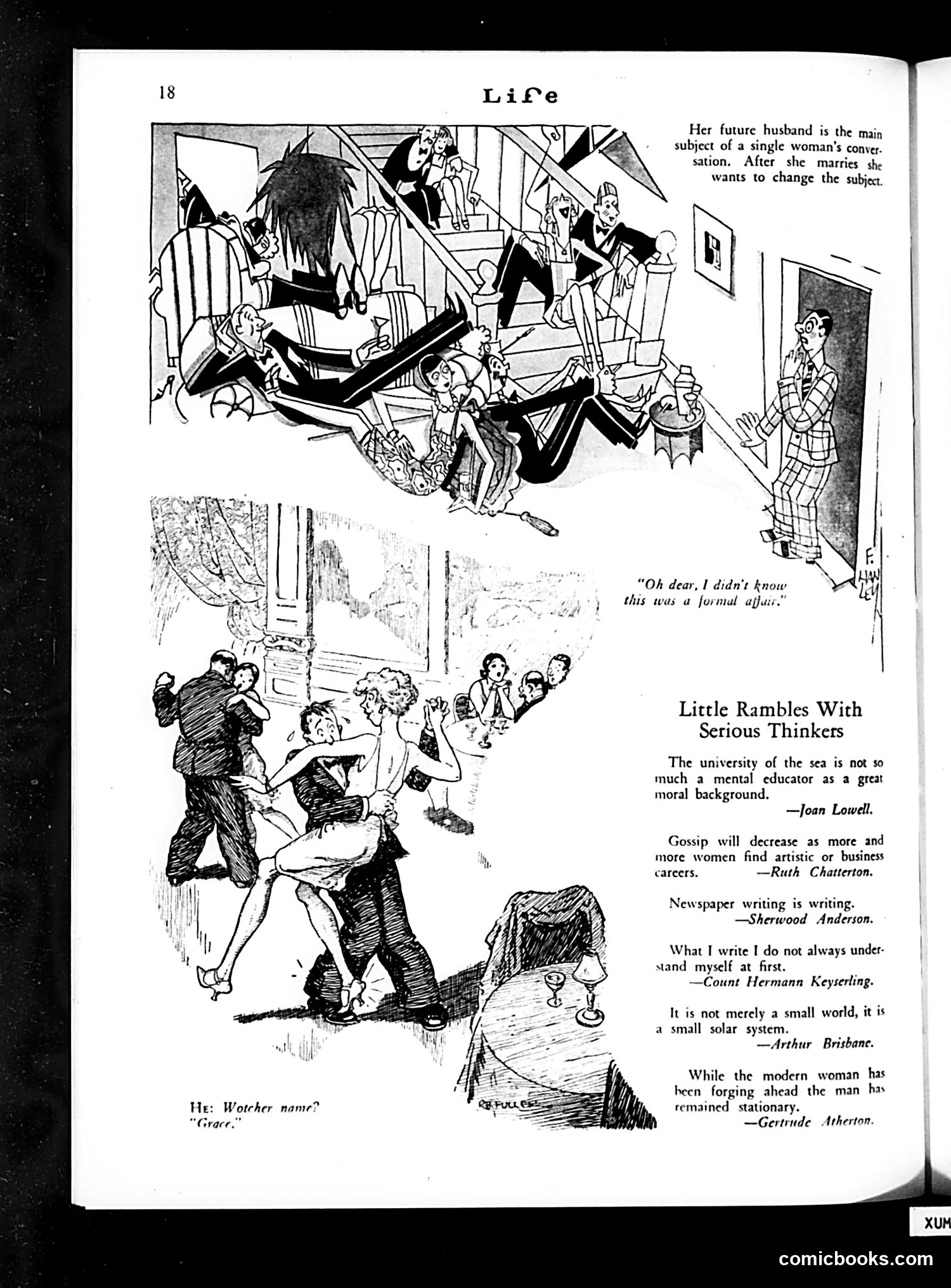
Page 18 of Life Magazine - Social Satire This page contains two cartoons satirizing early 20th-century social attitudes: Top cartoon: Depicts a chaotic formal party or ball where a woman in a prominent position appears to dominate the scene. The text states: "Her future husband is the main subject of a single woman's conversation. After she marries she wants to change the subject"—mocking women's alleged obsession with marriage and husbands. Bottom cartoon: Shows a woman surrounded by men in what appears to be street flirtation or public interaction. The caption reads "Watcher name?" / "Grace"—apparently illustrating casual romantic encounters. The section "Little Rambles With Serious Thinkers" presents cynical quotes about women, gossip, and modern society from various named contributors, reflecting the magazine's satirical commentary on gender relations and social behavior of its era.
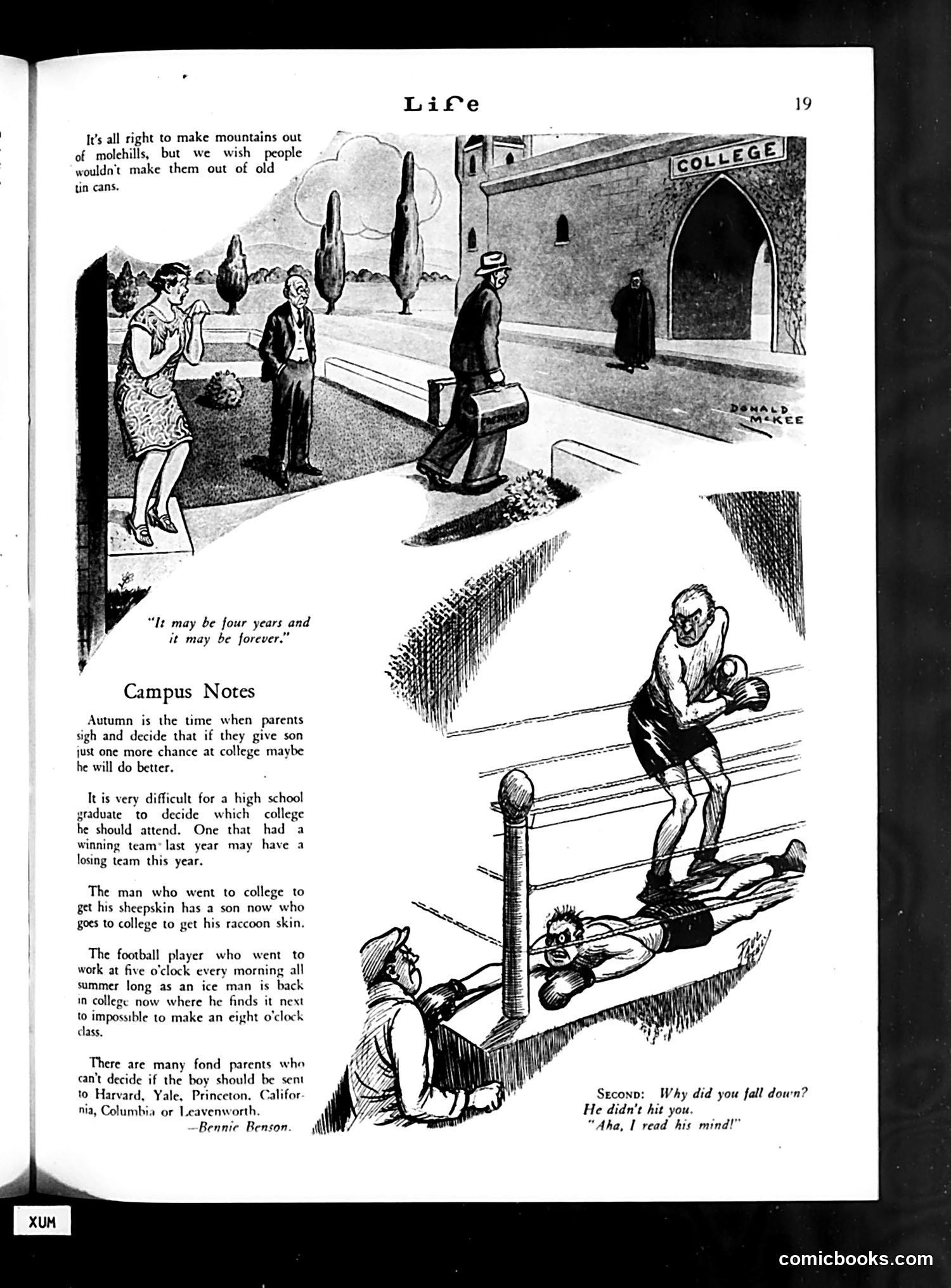
Life Magazine Page Analysis This page contains satirical commentary on American college culture, likely from the 1920s-30s. Top cartoon (by Donald McKee): Shows a college building with the caption "It may be four years and it may be forever"—a joke about parental uncertainty regarding their son's college attendance and completion. "Campus Notes" section: A series of witty observations mocking college attendance patterns: - Parents repeatedly giving failing sons "one more chance" - Prestige-chasing (students choosing colleges based on winning sports teams) - Generational pretension (fathers earning "sheepskins," sons seeking "raccoon skins"—slang for fraternity status symbols) - Athletes unable to maintain early morning jobs while in school - The humorous final line equating sending a boy to college with sending him to Leavenworth (a federal prison) Bottom cartoon: A volleyball scene where one player reads the opponent's "mind" to predict their move—absurdist humor about athletic strategy. The overall satire critiques American educational culture as status-focused, academically dubious, and financially draining for families.
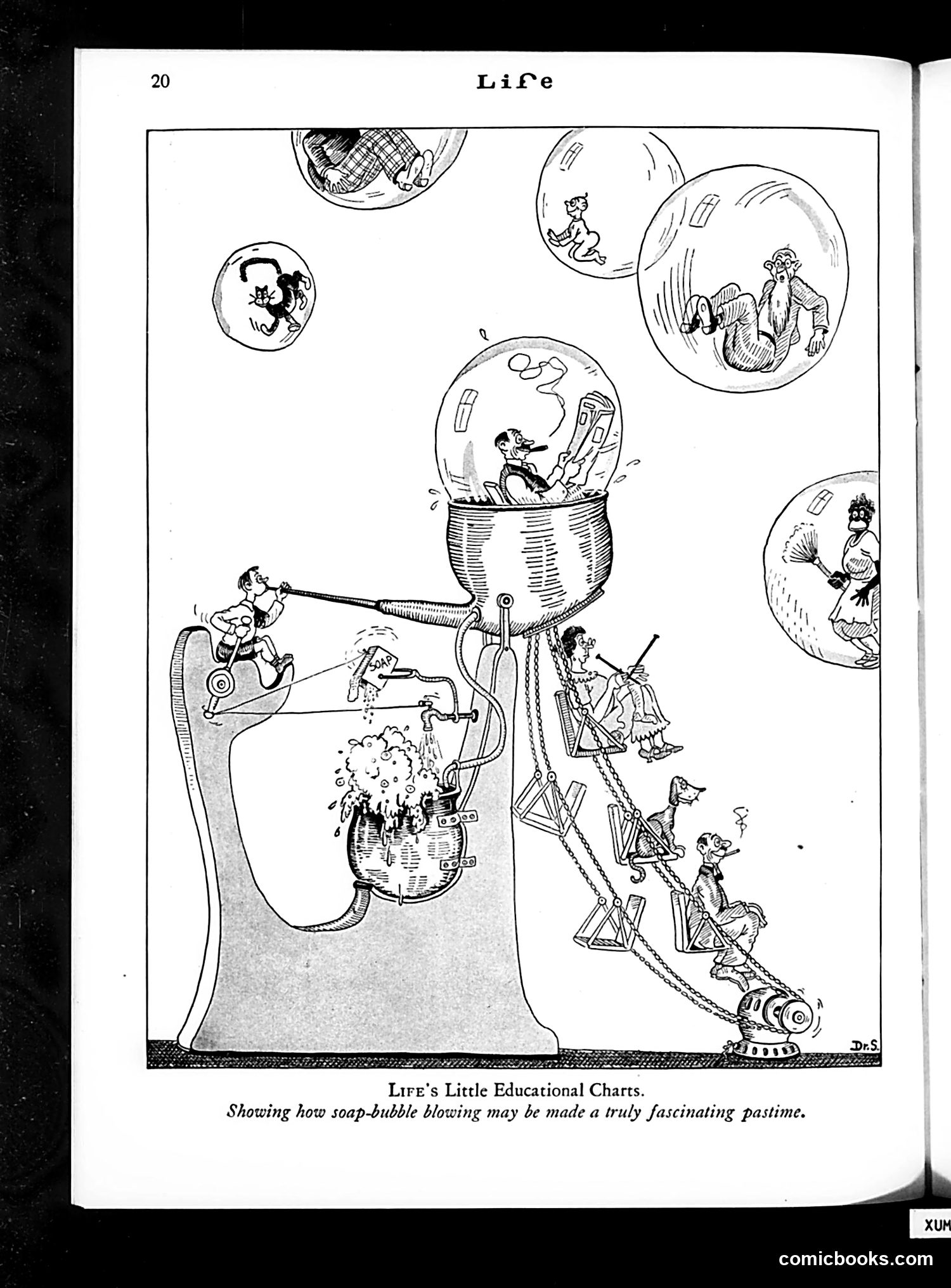
Life Magazine Educational Satire This is a satirical "educational chart" about soap-bubble blowing. The main illustration shows an elaborate mechanical contraption with giant soap bubbles at the top containing various human figures and scenes. Smaller bubbles float above showing additional vignettes. The satire appears to mock overly complicated "educational" schemes—turning a simple children's activity into an absurdly complex apparatus with pulleys, levers, and industrial machinery. The caption promises to make bubble-blowing "a truly fascinating pastime," but the elaborate setup suggests the opposite: that adding unnecessary complexity ruins simple pleasures. This reflects early 20th-century Life magazine's characteristic humor mocking overcomplicated modern contraptions and pretentious "self-improvement" schemes. The multiple scenes in the bubbles likely represent different outcomes or scenarios from this ridiculous device.
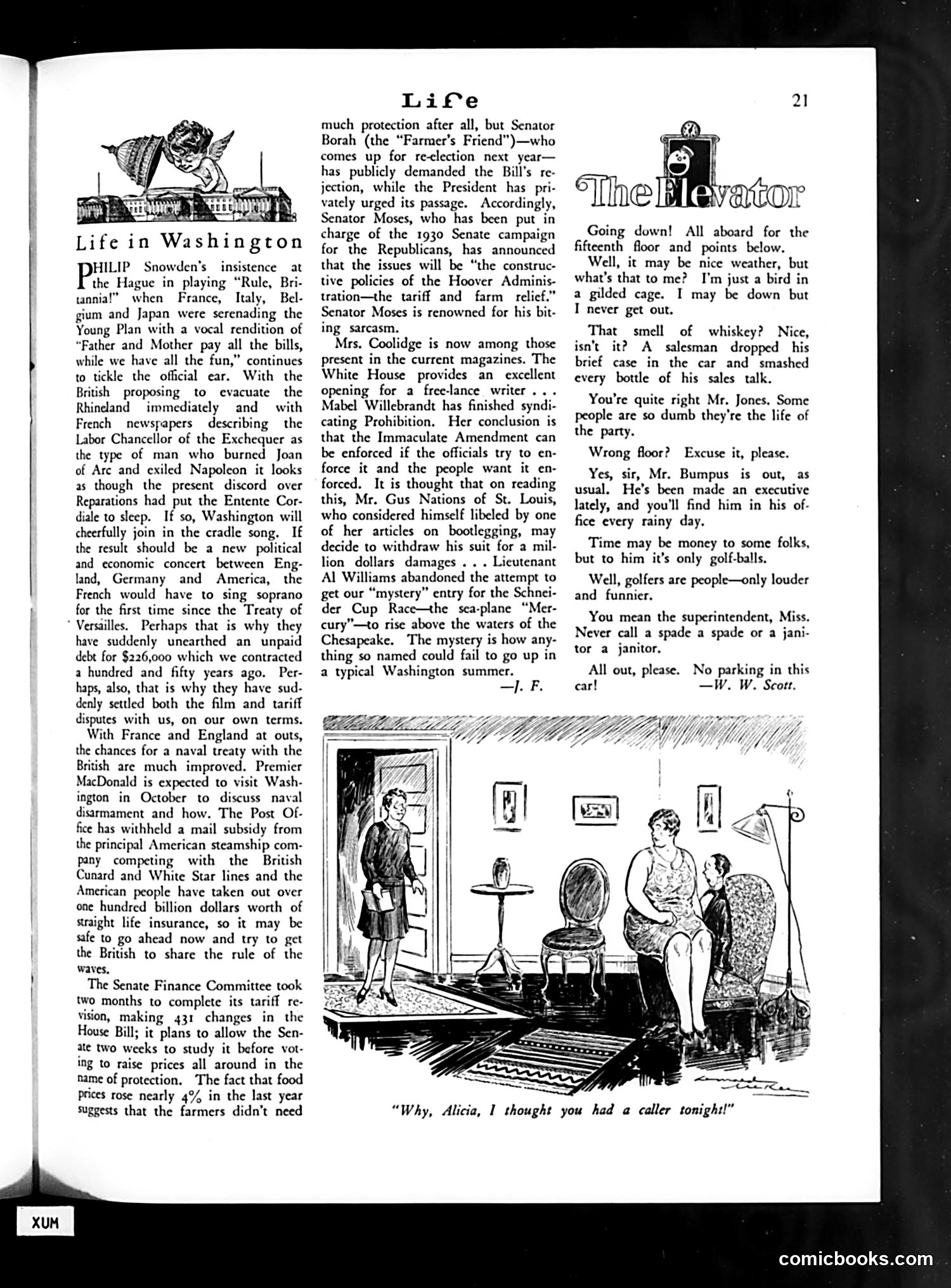
"The Elevator" Cartoon Analysis This single-panel cartoon satirizes Prohibition enforcement (1920-1933). A woman in an apartment elevator encounters another passenger who smells of whiskey, contradicting the constitutional ban on alcohol. The joke operates on multiple levels: the woman's complaint about being "a bird in a gilded cage" who "never gets out" contrasts with the obvious presence of illegal alcohol in her building. The cartoon mocks the hypocrisy of Prohibition—it was theoretically enforceable but widely ignored by the public, including supposedly respectable urbanites. The timing connects to the page's discussion of Mabel Willebrandt (Prohibition enforcement official) and her claim that the Amendment could work if officials and citizens wanted it to. The cartoon's evidence suggests neither group actually supported enforcement, making her position absurd.
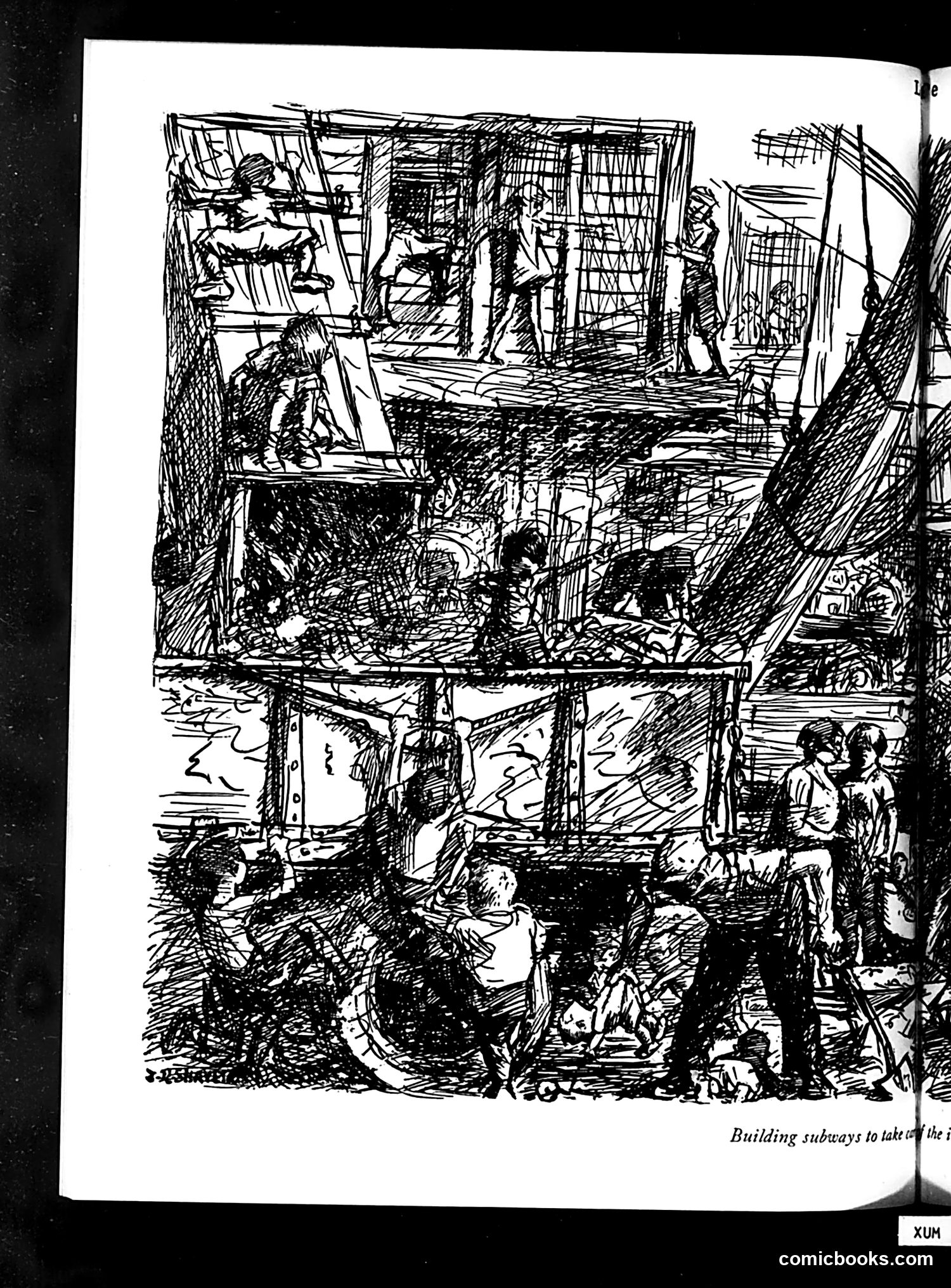
Analysis This is a detailed ink sketch depicting construction work on what appears to be a subway system. The caption reads "Building subways to take the i[...]" (text cuts off). The image shows multiple levels of underground construction activity—workers, scaffolding, support beams, and excavation—rendered in energetic cross-hatching typical of early-to-mid 20th century editorial illustration. Without the complete caption or publication date visible, the specific satirical target is unclear. However, this likely comments on either the massive expense/disruption of subway construction projects, or satirizes the infrastructure ambitions of a particular city or political administration. The chaotic, layered composition emphasizes the scale and complexity of such public works. The OCR text provided contains only formatting artifacts, making precise interpretation difficult. The cartoonist's point appears social commentary on urban development, but the exact satirical angle cannot be confidently determined from the visible information.
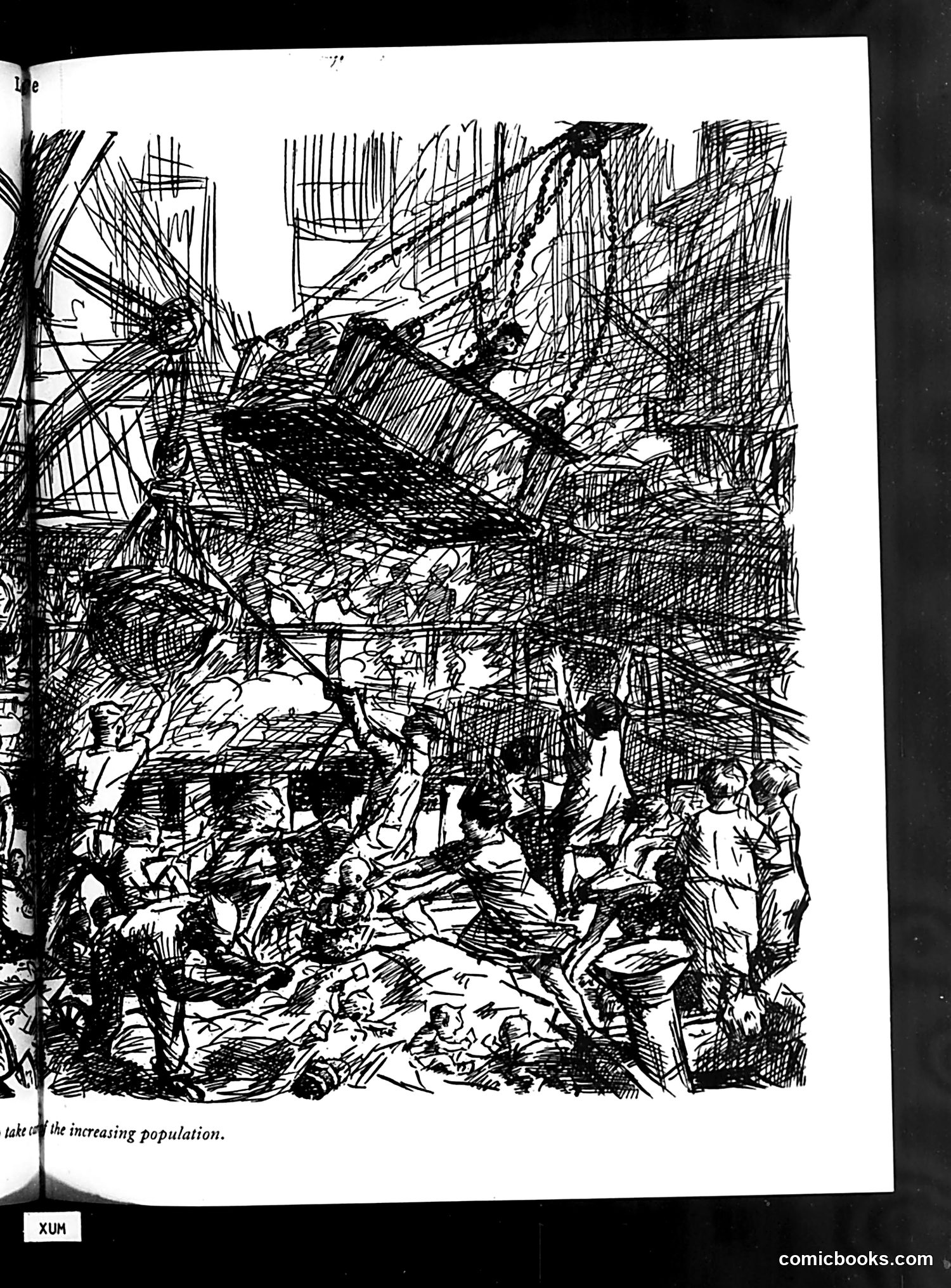
Analysis This page shows a heavily cross-hatched ink drawing depicting a chaotic, crowded urban or industrial scene. The visible text fragment "the increasing population" suggests this is satirizing overpopulation or urban congestion. The composition emphasizes density through dense linework and numerous figures clustered together in what appears to be a confined space—possibly a tenement, factory, or city street. The artistic style uses aggressive hatching to convey cramped, uncomfortable conditions. Without additional context or clearer text, the specific political figures or references remain unclear. However, the overall message appears critical of population growth's social consequences, likely commenting on early 20th-century urban overcrowding, poor working conditions, or immigration concerns that were common satirical subjects in *Life* magazine during this period.
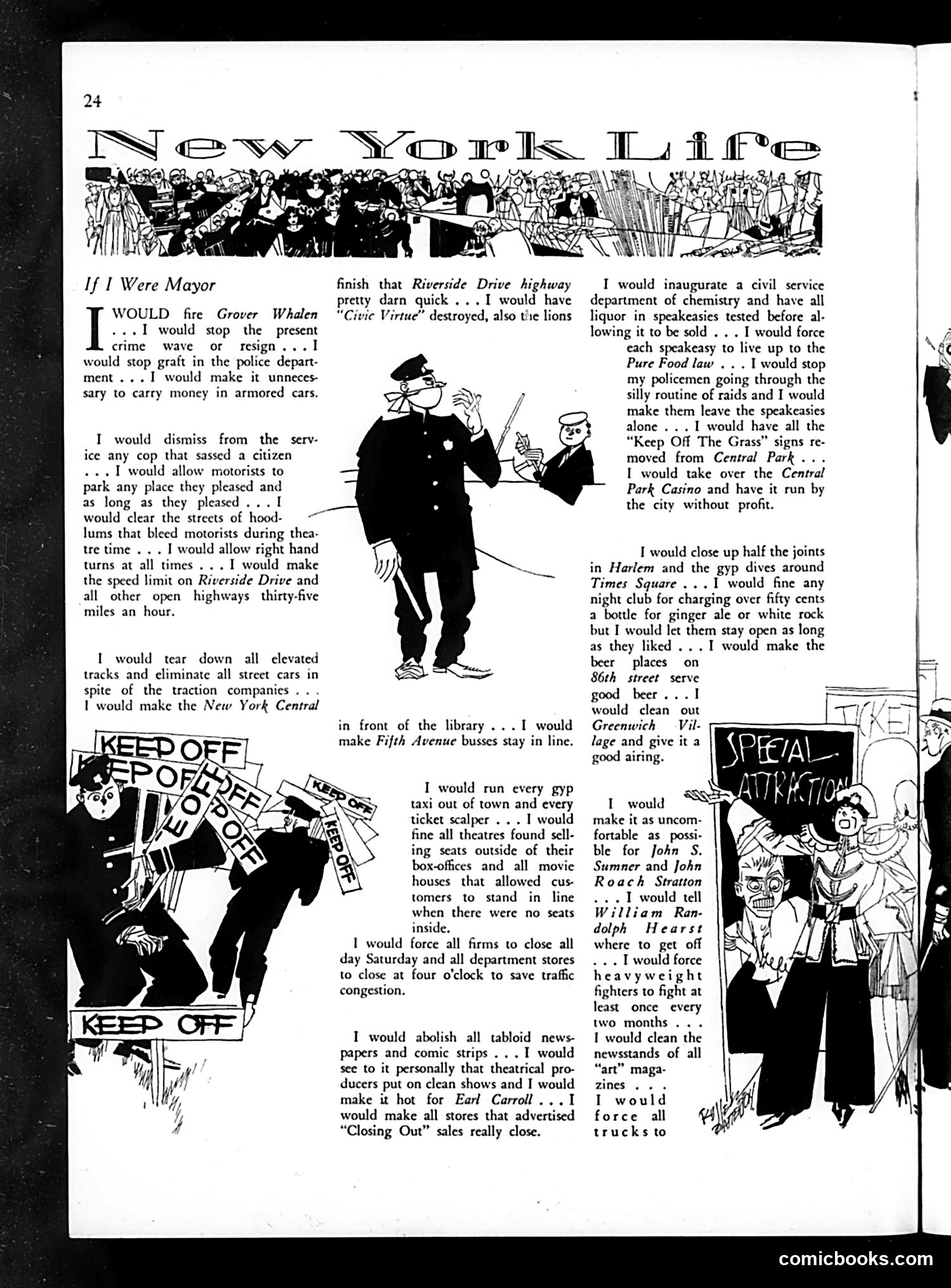
"If I Were Mayor" — A Satirical Wish-List This is a humorous fantasy column where an unnamed author lists grievances about New York City governance, imagining reforms they'd impose as mayor. The piece targets Grover Whalen, the actual NYC Police Commissioner (visible in the caricature), mocking his ineffectiveness against crime, graft, and traffic problems. The satire addresses 1920s-era urban complaints: Prohibition-era speakeasies, corrupt police, street congestion, elevated trains, and tabloid sensationalism. References like "Earl Carroll" (theatrical producer known for risqué shows), "John Sumner" (moral censor), and "William Randolph Hearst" (newspaper magnate) identify specific public figures the author wants to restrain. The cartoon's tone is cynical—suggesting no real mayor could or would fix these problems. The "Keep Off the Grass" signs removed from Central Park, combined with closing speakeasies, reveals the author's contradictory desires: freedom for some vices, crackdowns on others. It's political satire masquerading as friendly complaining.
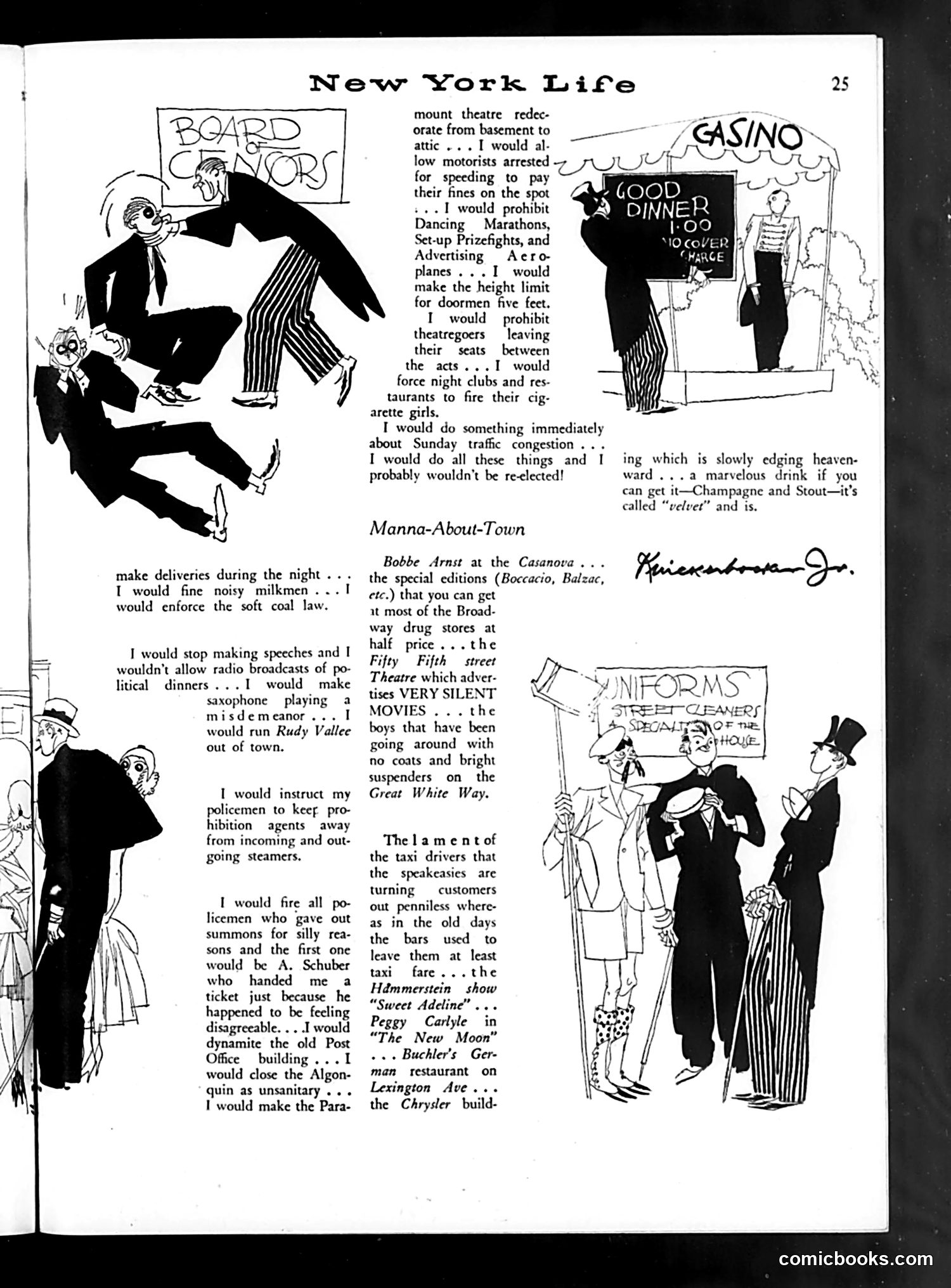
Satire Explained: "What I Would Do If I Were Mayor" This page presents a humorous political fantasy where an unnamed figure lists absurd and petty reforms they'd implement as New York City mayor. The cartoons show exaggerated characters being physically removed or accosted, visualizing the proposed policies. The satire targets both municipal governance and 1920s-era social annoyances. References include: - Prohibition enforcement (keeping agents from steamers, closing speakeasies) - Entertainment complaints (banning saxophone player Rudy Vallée, "silent movies," dancing marathons) - Petty grievances (noisy milkmen, overzealous traffic cops issuing frivolous tickets) - Architectural modernization (the Chrysler Building) The concluding line—"I would do all these things and I probably wouldn't be re-elected!"—reveals the joke: these "reforms" are so unreasonable and self-serving that they'd guarantee electoral defeat. It's satirizing both municipal politics and New Yorkers' endless complaints about their city.
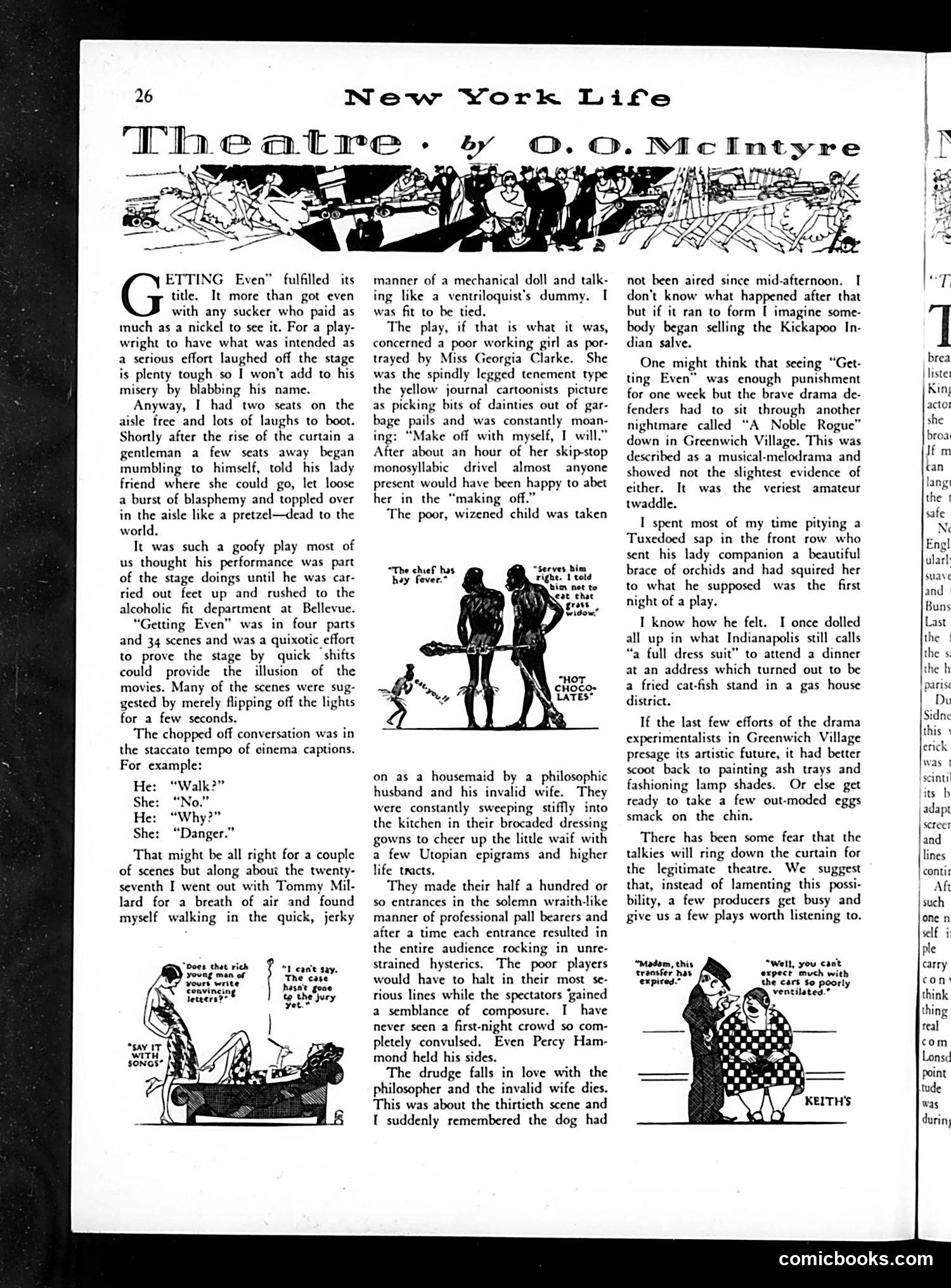
Theater Criticism & Satire in Life Magazine This is a theater review by O.O. McIntyre critiquing two Broadway plays: "Getting Even" and "A Noble Rogue." The piece satirizes both productions as incompetent disasters. The satire targets: 1. "Getting Even" — criticized for imitating cinema with rapid scene changes and choppy dialogue that makes the critic himself unconsciously mimic its jerky movements. The play is so bad an audience member collapses (possibly from drink), and the reviewer questions if it's intentional performance art. 2. "A Noble Rogue" — dismissed as amateurish "twaddle," a supposed musical-melodrama showing "not the slightest evidence" of either quality. The small cartoon illustrations reinforce the absurdity through visual gags about the plays' failures. McIntyre's persona is the weary sophisticated critic enduring theatrical torture, culminating in sympathy for an unfortunate gentleman who brought his companion expecting quality entertainment. The humor relies on exaggeration and the critic's sardonic voice mocking pretentious, poorly-executed experimental theater.
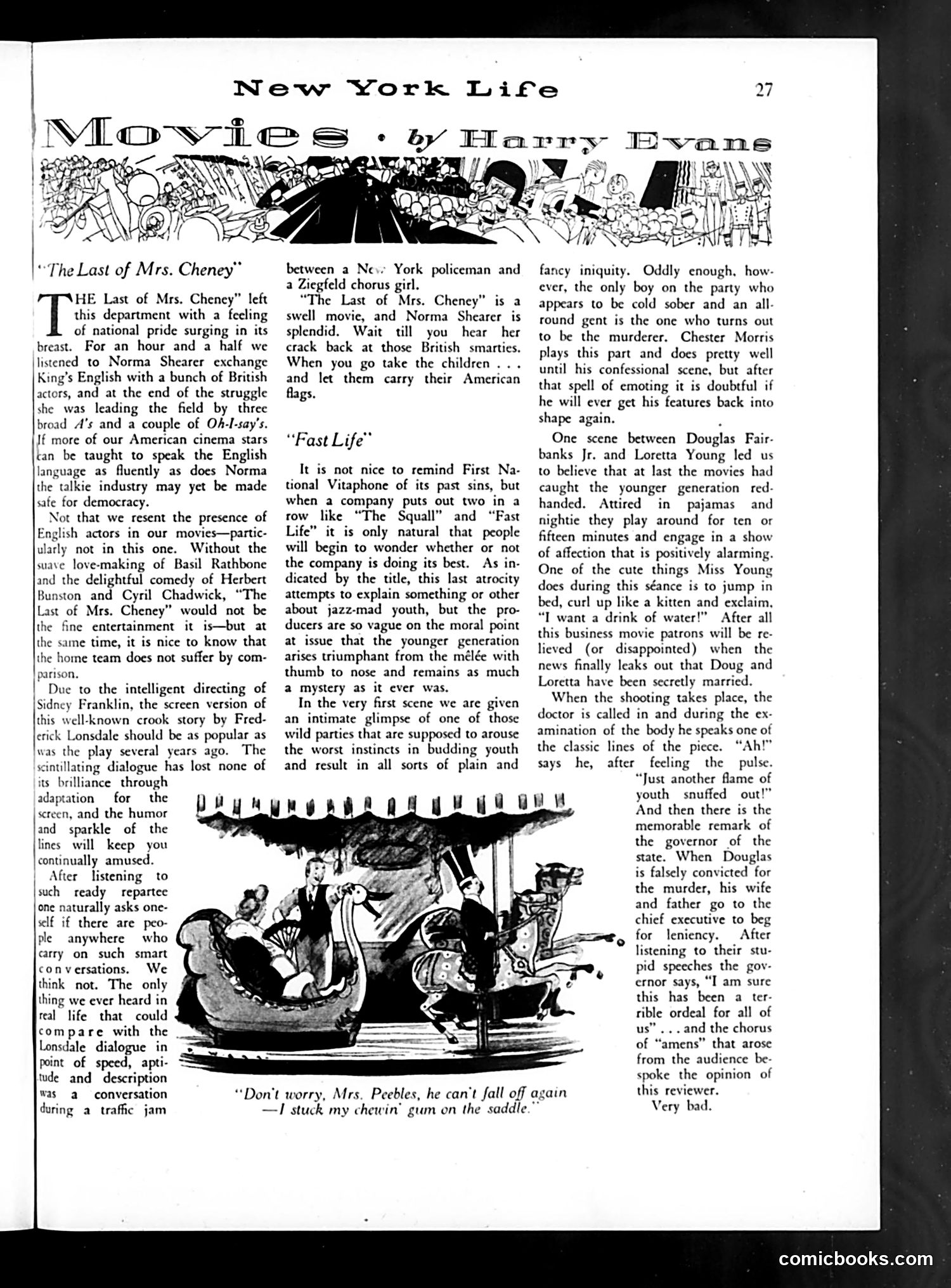
Cartoon & Film Criticism Analysis This is a film review column from Life magazine (not political cartooning). The page contains two movie reviews by Harry Evans: "The Last of Mrs. Cheney": Praises actress Norma Shearer for speaking crisp English alongside British actors (Basil Rathbone, Herbert Bunston, Cyril Chadwick). The reviewer expresses nationalist pride that American cinema stars can compete linguistically with British performers. The joke about the Ziegfeld chorus girl and policeman references a well-known Manhattan type—flapper culture. "Fast Life": Criticizes this First National film for its muddled messaging about "jazz-mad youth." The reviewer finds it hypocritical that the film supposedly warns against wild parties and moral decay while depicting young actors (Douglas Fairbanks Jr., Loretta Young, Chester Morris) in pajamas in suggestive scenes. The satire targets the film's failure to coherently condemn the behavior it claims to critique. The cartoon illustrates a riding scene with a humorous caption about chewing gum as adhesive—unrelated to the reviews themselves.
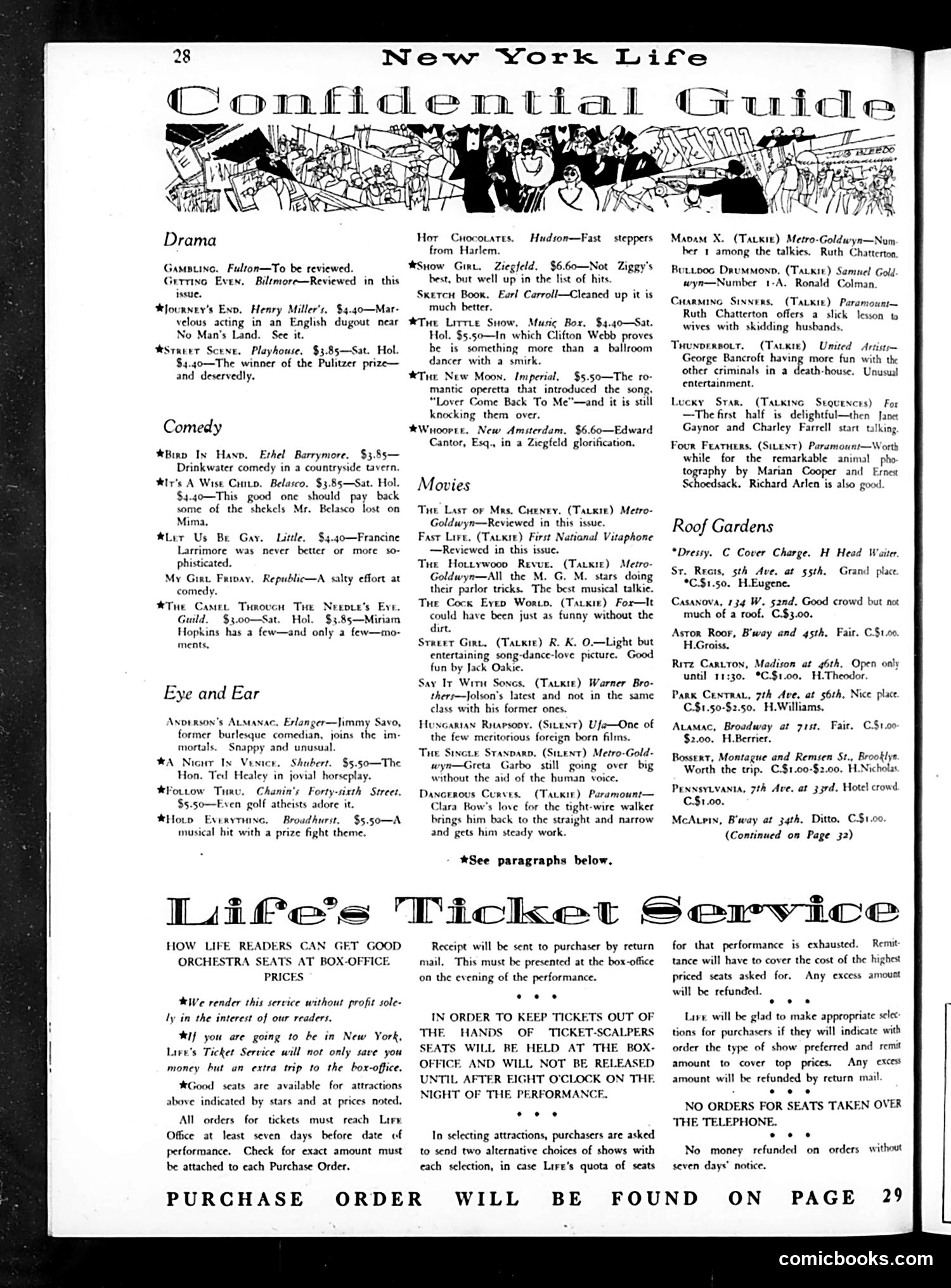
Explanation for Modern Readers This page is primarily a theater and entertainment guide, not a political cartoon. It's a "Confidential Guide" listing Broadway shows, movies, and roof gardens with brief reviews and prices. The page reflects 1920s entertainment culture: - Theater dominance: Broadway shows are the main entertainment, many with famous stars (Ethel Barrymore, Ruth Chatterton, Eddie Cantor) - Emerging "talkies": Movies are listed separately, with notation "(Talkie)" indicating sound films—a new technology. Some silent films remain - Vaudeville legacy: References to "burlesque comedian" Jimmy Savo and song-and-dance acts show vaudeville's influence - Pricing: Tickets ranged $1-$6.60, with higher prices for Saturday/holiday performances - Class markers: Roof gardens with "cover charges" catered to wealthier patrons The "Life's Ticket Service" section advertises that readers could order discounted orchestra seats through the magazine—a common service before modern ticketing systems. No political satire is evident here; this is a straightforward entertainment listings page.
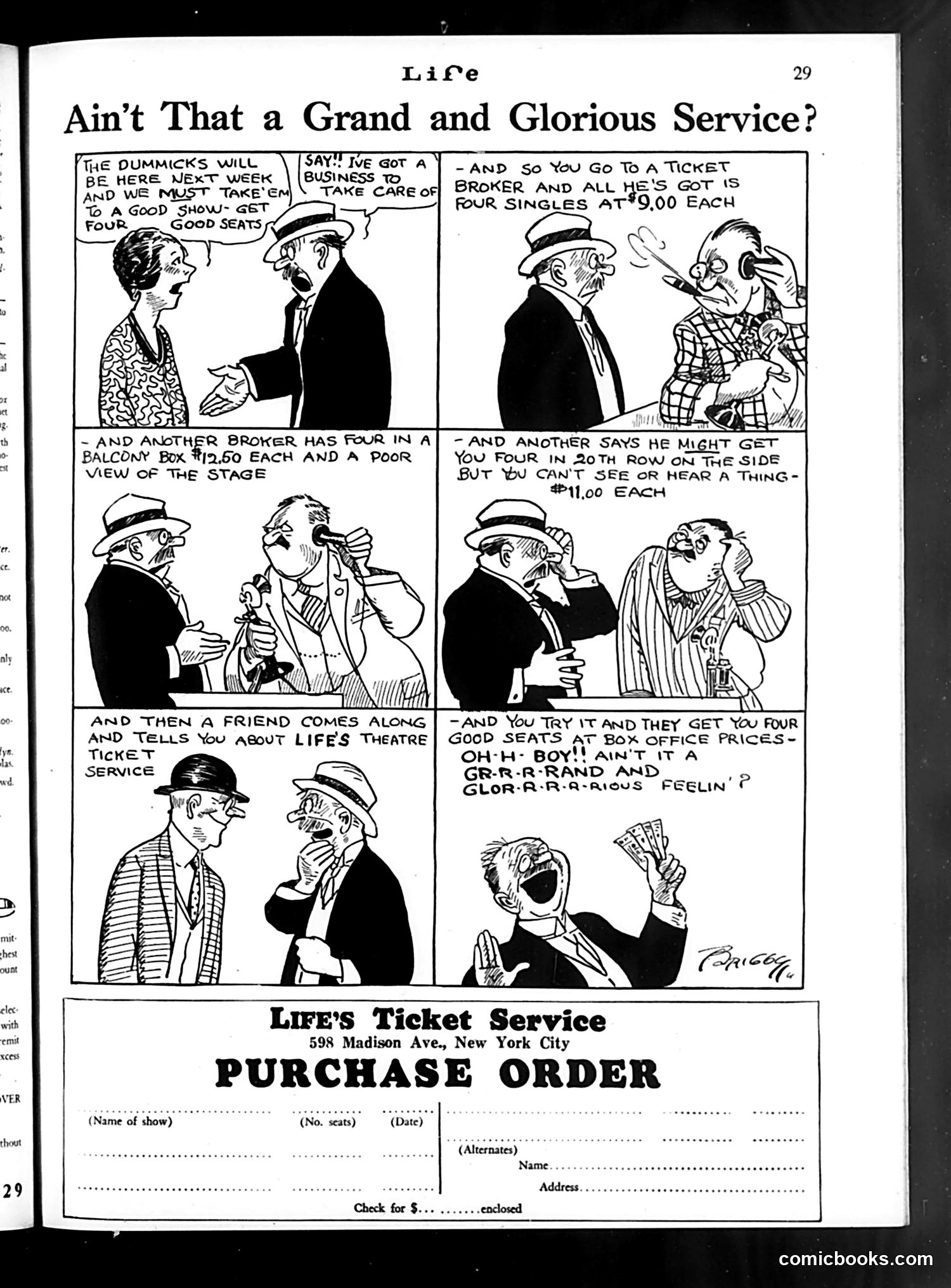
"Ain't That a Grand and Glorious Service?" This satirical comic mocks ticket scalpers and brokers who exploited theatergoers in early 20th-century New York. The strip shows a man being repeatedly disappointed: ticket brokers offer overpriced seats with poor views ($9-$12.60 each when box office prices were lower), until Life magazine's own "Ticket Service" allegedly secures good seats at fair prices. The humor works on two levels: it ridicules the predatory ticket-resale market while simultaneously functioning as advertising for Life's legitimate ticket service—presented as the solution to scalper exploitation. The exaggerated reactions ("ain't it a grand and glorious feeling?") emphasize how absurdly overpriced Broadway tickets had become. This reflects genuine consumer frustration with ticket speculation, a recurring problem in American entertainment history.
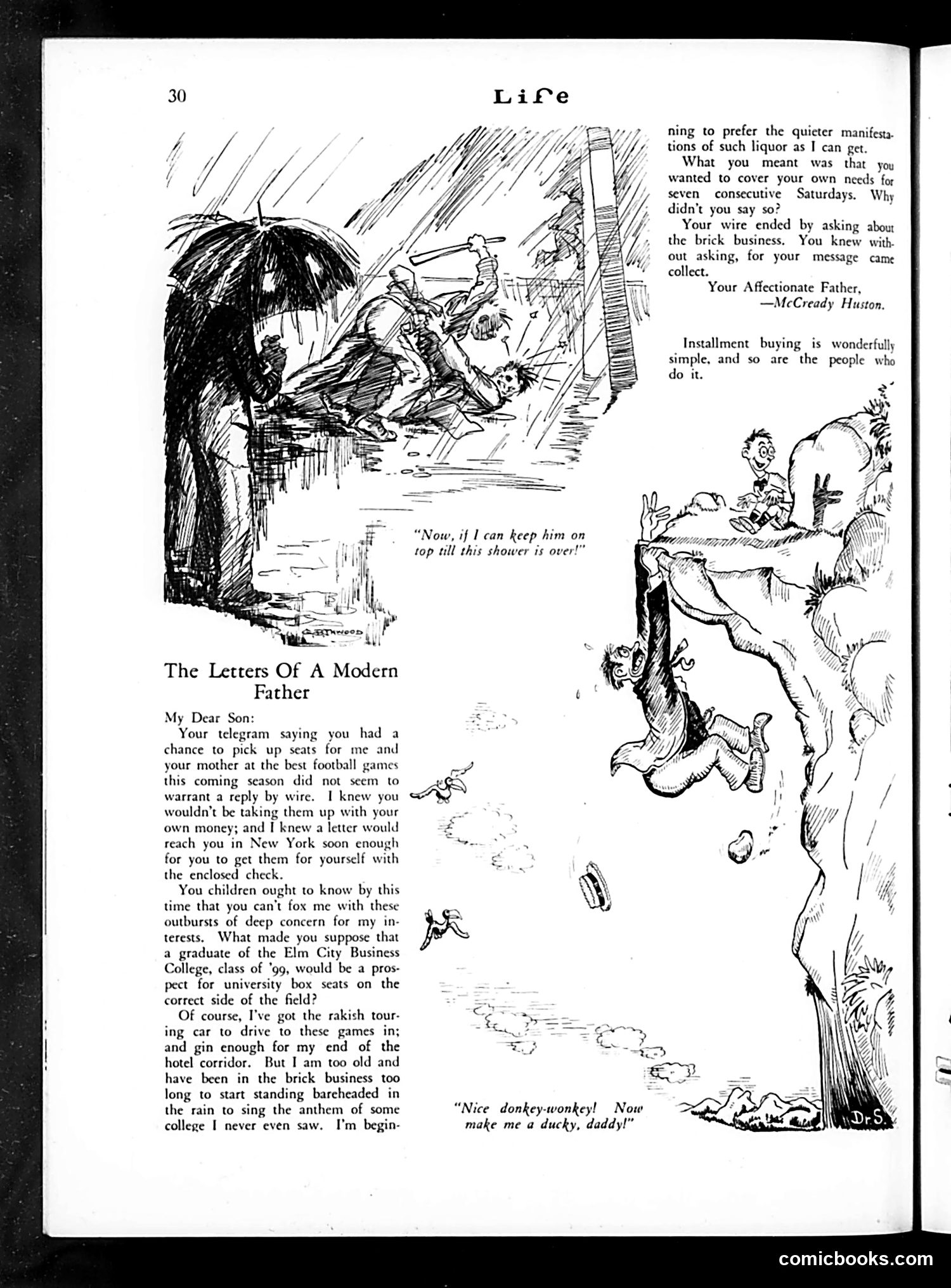
Explanation of "The Letters of a Modern Father" This satirical piece mocks a wealthy father's hypocrisy and self-deception. The father claims to reject his son's offer of football tickets as unnecessary expense, yet simultaneously brags about owning a "rakish touring car" and having "gin enough for my end of the hotel corridor"—revealing he spends freely on personal luxuries. The satire targets the father's transparent excuses: he won't attend college games because he's "too old" and "been in the brick business too long," but his real objection appears to be snobbish (refusing to stand in rain at a college he never attended). The accompanying illustrations show domestic scenes: a couple in rain with an umbrella, and a child addressing an adult as "ducky, daddy"—contrasting innocent family life with the father's self-interested rationalizations. The piece exemplifies *Life* magazine's satirization of American middle/upper-class pretension and family hypocrisy during this era (likely early 1900s).
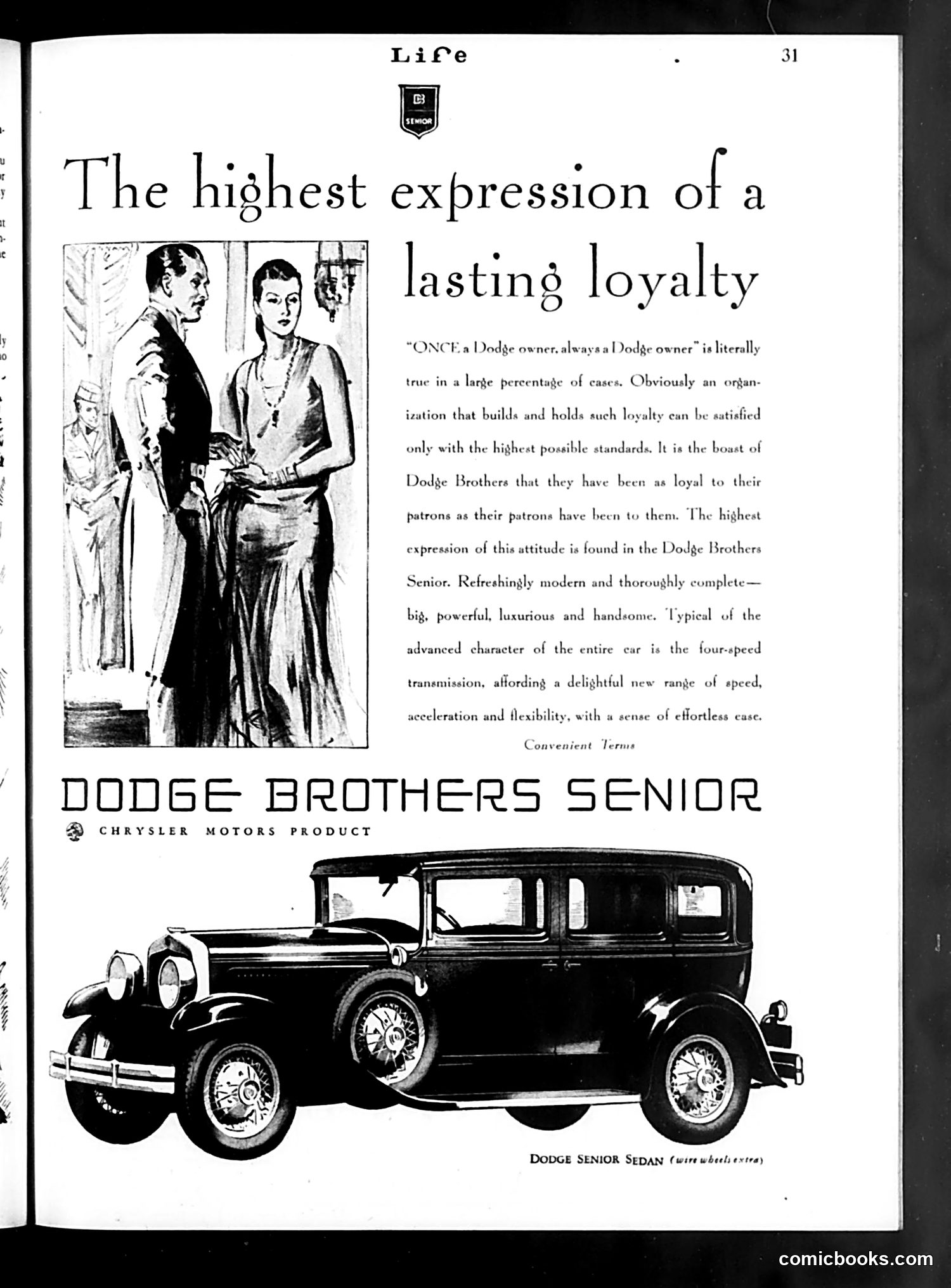
Analysis This is not a cartoon or satire—it's a straightforward automobile advertisement from Life magazine's advertising pages. The page promotes the Dodge Brothers Senior sedan, a Chrysler Motors product. The illustration shows a well-dressed couple (representing affluent consumers) alongside the featured vehicle. The ad's central claim is that Dodge owners demonstrate exceptional brand loyalty ("once a Dodge owner, always a Dodge owner"), which the company frames as evidence of superior manufacturing standards. The text emphasizes the car's modern features: its four-speed transmission, power, luxury, and "effortless ease." The phrase "Convenient Terms" suggests financing options were available. There is no political commentary, satire, or caricature present. This is simply vintage automotive marketing targeting wealthy Americans, likely from the late 1920s based on the car's design and advertising style.
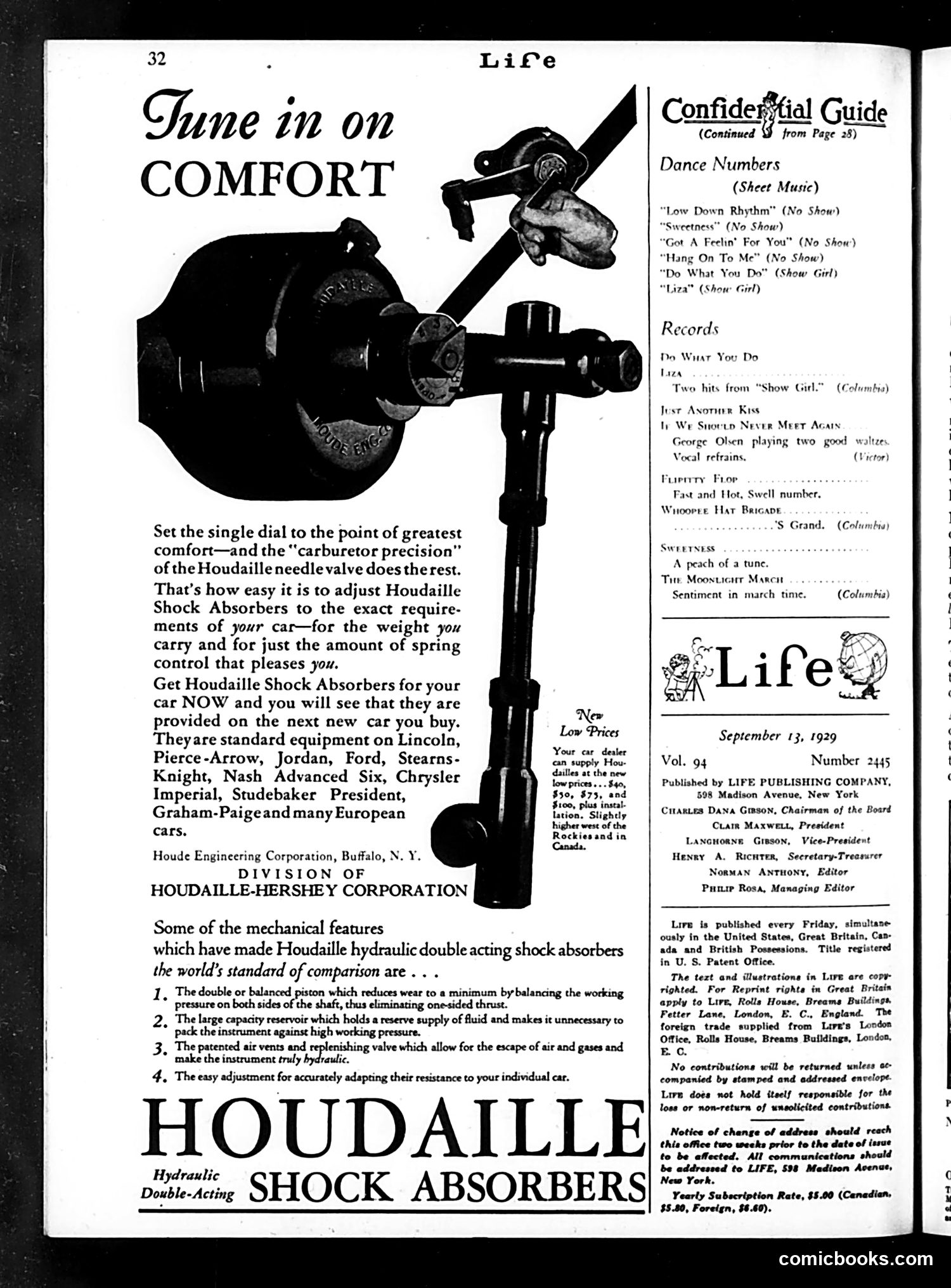
Explanation for Modern Readers This page is primarily advertising, not satire or political commentary. The left side features a full-page advertisement for Houdaille Shock Absorbers, automobile suspension components. The visual shows a mechanical shock absorber device with a dial adjustment. The ad's appeal is straightforward: it emphasizes ease of use (a single dial for comfort adjustment) and lists luxury car brands—Lincoln, Pierce-Arrow, Ford, Chrysler—that came equipped with this technology as standard equipment. This was a genuine selling point in 1929, when suspension systems were still relatively new features. The right side contains masthead information and a "Confidential Guide" listing dance numbers and phonograph records, typical Life magazine content from this era. No cartoon or satire is present—this is a straightforward commercial advertisement for automotive technology aimed at prosperous car buyers during the pre-Depression economic boom.
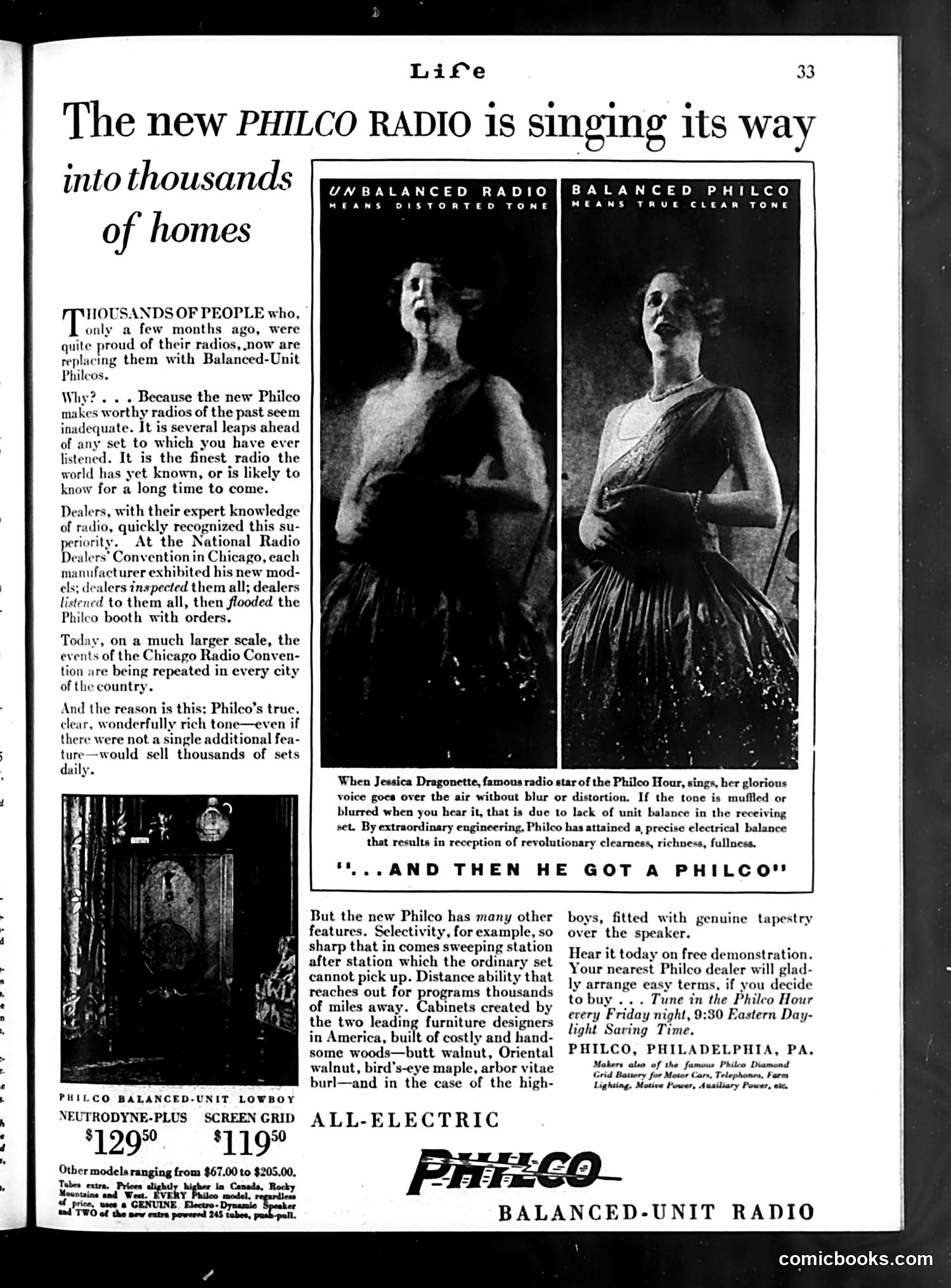
Philco Radio Advertisement Analysis This is a product advertisement, not satire or political commentary. The page promotes Philco's new "Balanced-Unit" radio technology. The imagery contrasts an "unbalanced radio" (left, producing distorted tone) with a "balanced Philco" (right, producing clear tone) using before-and-after photos of a woman's face to visually represent audio quality. The distorted image appears blurred; the balanced one appears sharp—a clever visual metaphor for sound quality. The advertisement references Jessica Dragonette, an actual famous radio singer of the Philco Hour, to demonstrate that superior tone reproduction matters for professional broadcasters and home listeners alike. The copy claims dealers at Chicago's National Radio Convention overwhelmingly preferred Philco models, implying industry-wide endorsement. Prices range from $129.50 to $205.00—substantial sums in this era (likely 1920s-30s based on style). The "AND THEN HE GOT A PHILCO" tagline suggests the product transforms one's listening experience.
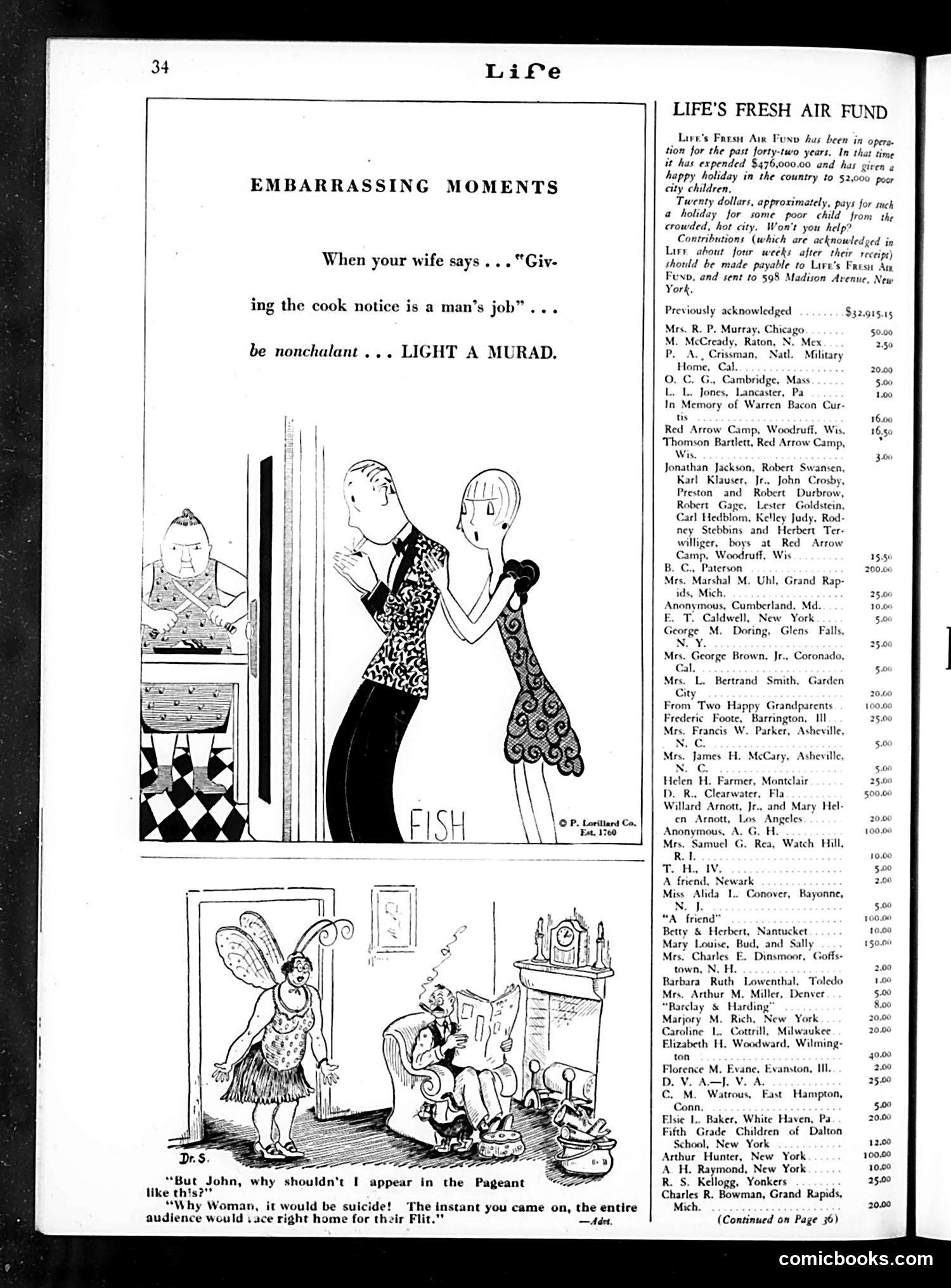
Explanation for Modern Readers This page contains two cartoon jokes about early 20th-century social anxieties, plus a charitable fundraising section. Top cartoon: A wife tells her husband to give the cook notice—traditionally "a man's job." He responds by lighting a Murad cigarette to appear nonchalant. The joke assumes masculinity requires emotional detachment; smoking signals composed confidence. Bottom cartoon: A wife asks why she shouldn't perform in a pageant wearing her current outfit. The husband replies that the audience would race home to buy "Flit" (an insecticide spray). The implication: her appearance is so shabby/poor it would trigger an exodus—likely she looks infested or slovenly. Both jokes reflect period anxieties about masculine authority, feminine appearance standards, and consumer products as social markers. The right column lists donors to Life's Fresh Air Fund, which sent poor urban children to the countryside—a Progressive-era charity concern.
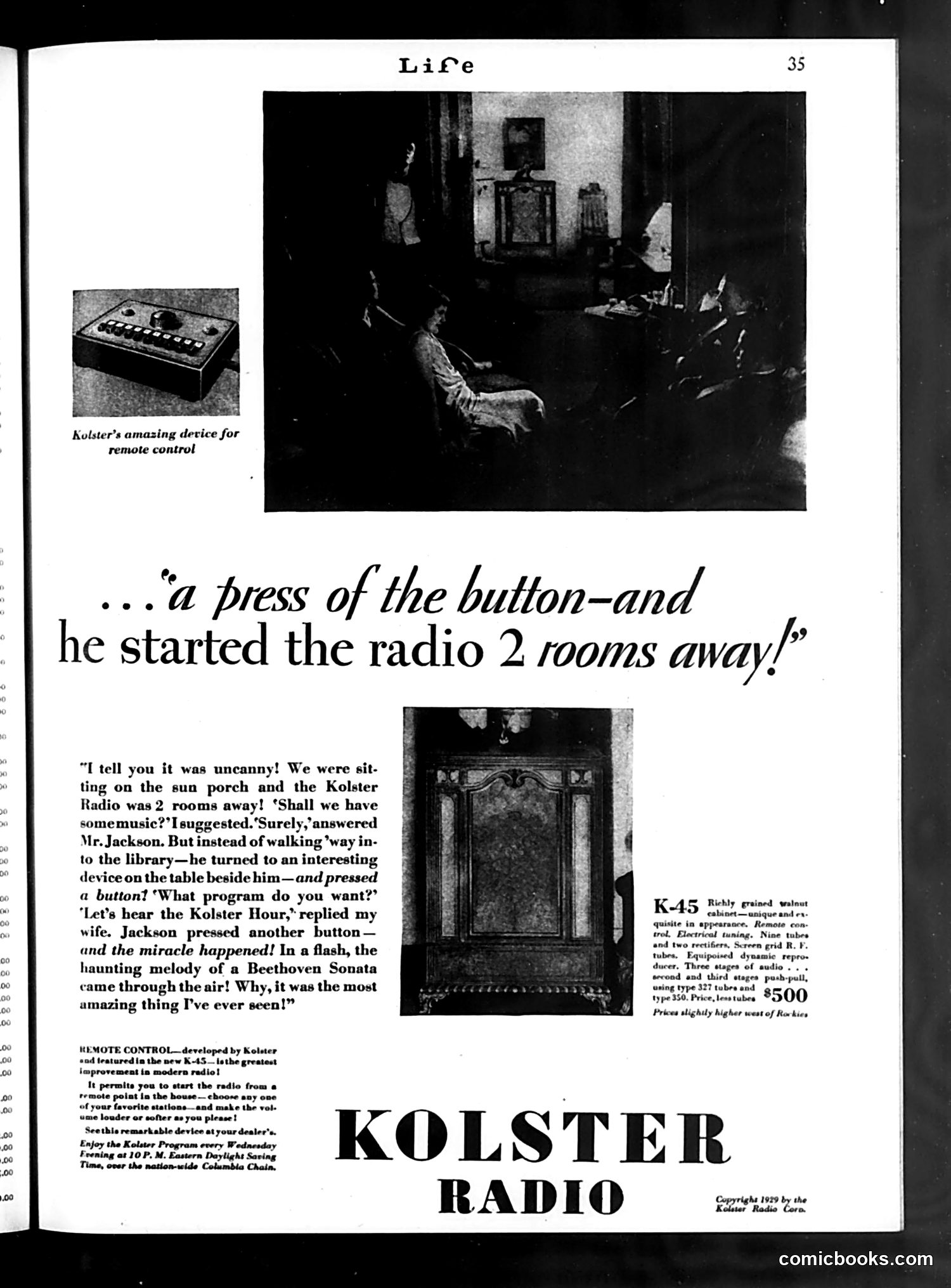
Kolster Radio Advertisement (circa 1929) This is a product advertisement, not political satire. It promotes Kolster's new remote-control radio technology—a genuine innovation for the era. The "joke" is presented as a marvel of modern convenience: a man can now operate his radio from another room by pressing a button, rather than walking to the library. The testimonial frames this as almost miraculous ("uncanny," "the most amazing thing I've ever seen"). To a modern reader, this seems mundane—remote controls are ubiquitous. But in 1929, wireless remote control was genuinely novel and luxurious technology. The advertisement's breathless tone reflects genuine consumer excitement about labor-saving devices in the Jazz Age. The K-45 cabinet model costs $500 (expensive for the period), positioning it as a premium product for affluent households. The ad ran during Kolster's sponsored radio program on the Columbia chain, representing early broadcast advertising.
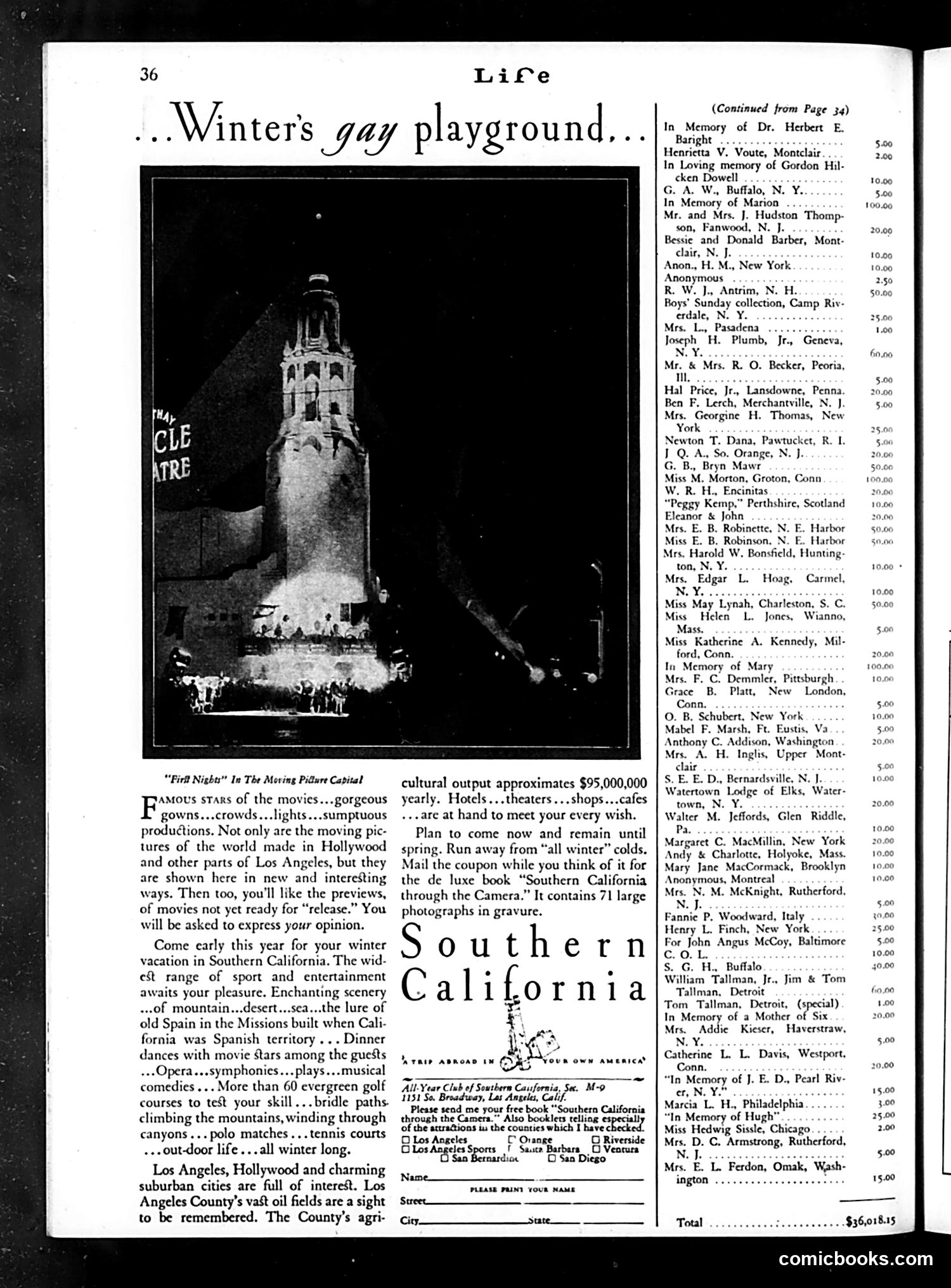
Analysis of Life Magazine Page 36 This page is primarily advertising and memorial listings, not political satire. The main content is a tourism advertisement for Southern California, promoting Los Angeles and Hollywood as a winter vacation destination. The striking image shows a illuminated mission tower or similar Spanish colonial structure, labeled "Winter's gay playground," emphasizing the region's attractions: movie studios, golf courses, hotels, theaters, and outdoor activities. The ad copy highlights Hollywood's dominance in film production and promises entertainment, scenic beauty (desert, mountains, missions), and warm weather as escape from "winter colds." It's a straightforward promotional piece encouraging Eastern readers to visit. The right column contains memorial donations — contributions made "In Memory of" deceased individuals, listing donors' names and locations. This appears to be a charitable remembrance section of the magazine. There is no political cartoon or satire on this page. It reflects the era's celebration of California's growing entertainment industry and tourism appeal.
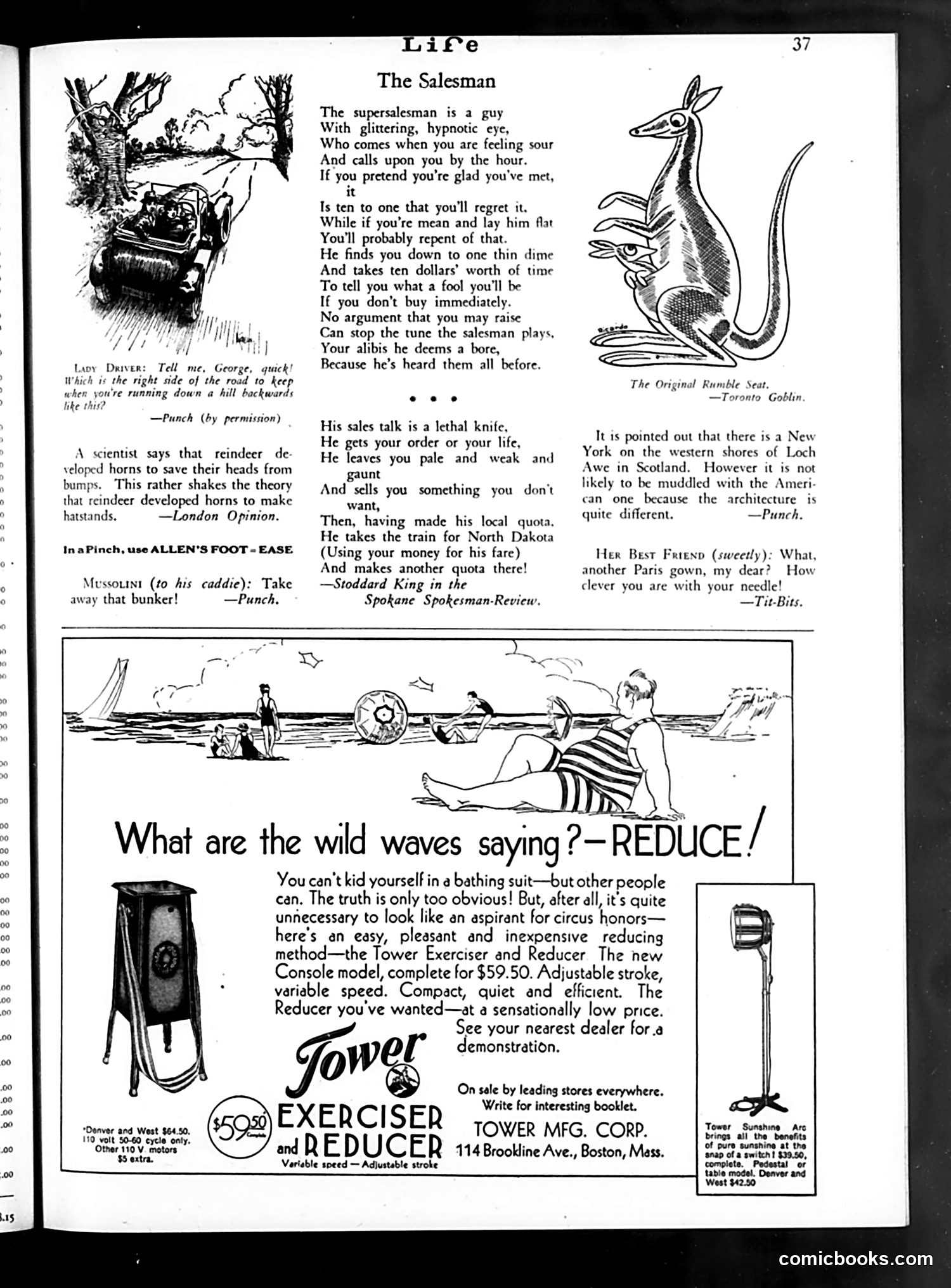
Analysis of Life Magazine Page 37 This page contains satirical poetry and advertising from an early 20th-century American humor magazine. "The Salesman" poem mocks the aggressive door-to-door salesman—a common figure of the era. The satire depicts him as manipulative and relentless: he arrives uninvited, uses psychological pressure ("hypnotic eye"), makes you feel guilty whether you're rude or polite, wastes your time with unstoppable pitch, sells unwanted goods, and leaves to repeat the scheme elsewhere. The humor targets both the salesman's ruthlessness and the consumer's powerlessness against high-pressure sales tactics. The Tower Exerciser advertisement uses body-shaming humor ("can't kid yourself in a bathing suit") to sell a mechanical exercise device for weight reduction—reflecting 1920s-30s anxieties about appearance. The "reduce" theme appears both in the satire and ad, connecting concerns about bodies and consumption. The scattered short jokes reference minor social observations (Scottish geography, golf) typical of British-American humor magazines of the period.
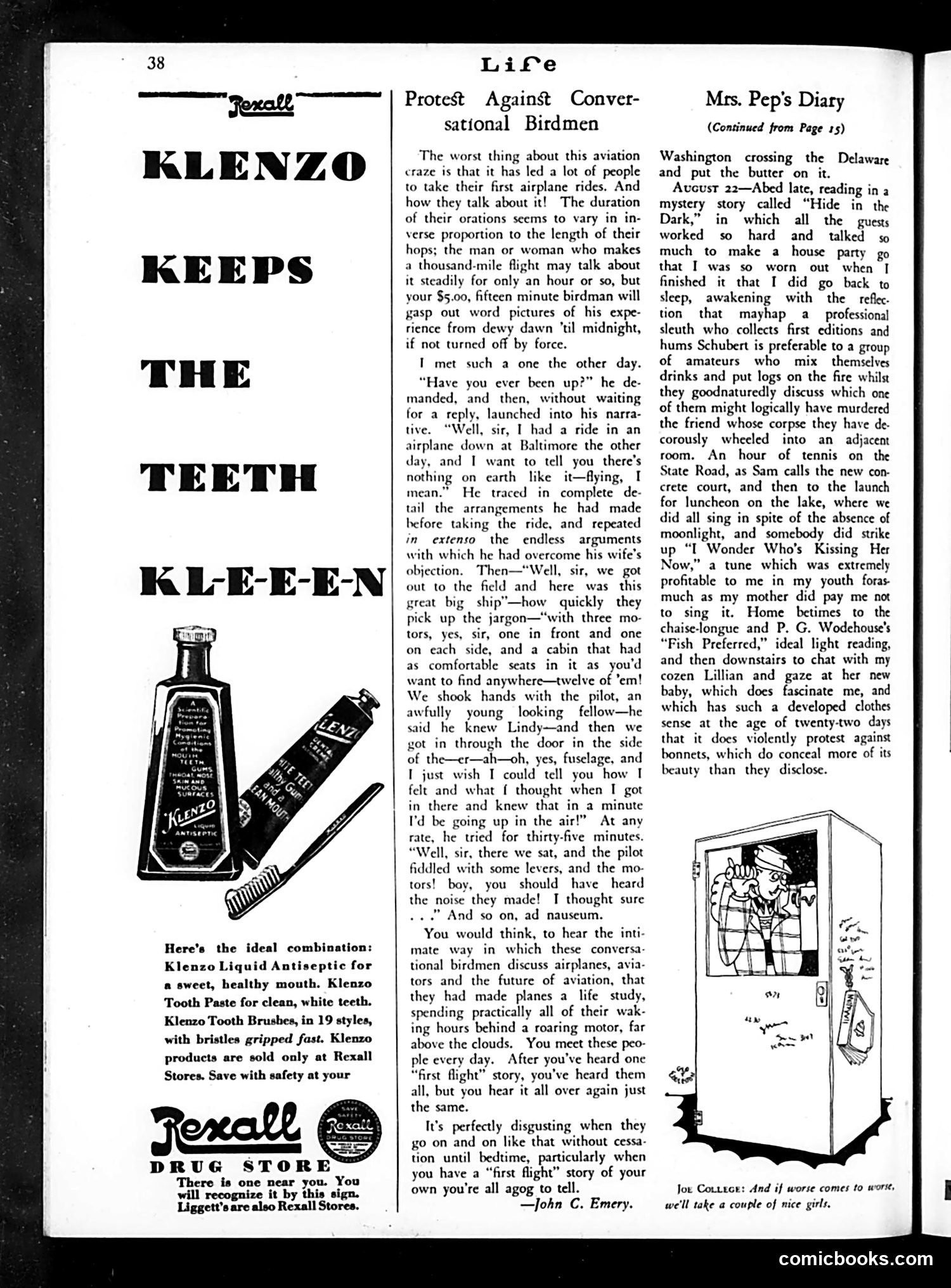
Page Analysis: Life Magazine This page contains two distinct pieces of satirical content: Main Article: "Protest Against Conversational Birdmen" by John C. Emery A humorous essay lamenting the recent aviation craze's social consequence: people who take brief airplane rides become insufferable bores, recounting their flights in exhaustive, tedious detail. Emery mocks how even a 15-minute flight generates hours of narrative, complete with exaggerated descriptions of aircraft mechanics and name-dropping (the pilot "knew Lindy"—Charles Lindbergh). The satire peaks in his complaint that these amateur aviators monopolize conversation while he himself has an unheard "first flight" story waiting to be told. Secondary Content: - Large Klenzo toothpaste advertisement (left column) - "Mrs. Pep's Diary" diary entries (right), including mundane observations about reading mystery novels The piece satirizes 1920s American obsession with aviation as a novelty experience and the social awkwardness of braggadocious storytelling—timeless targets of Life's humor.
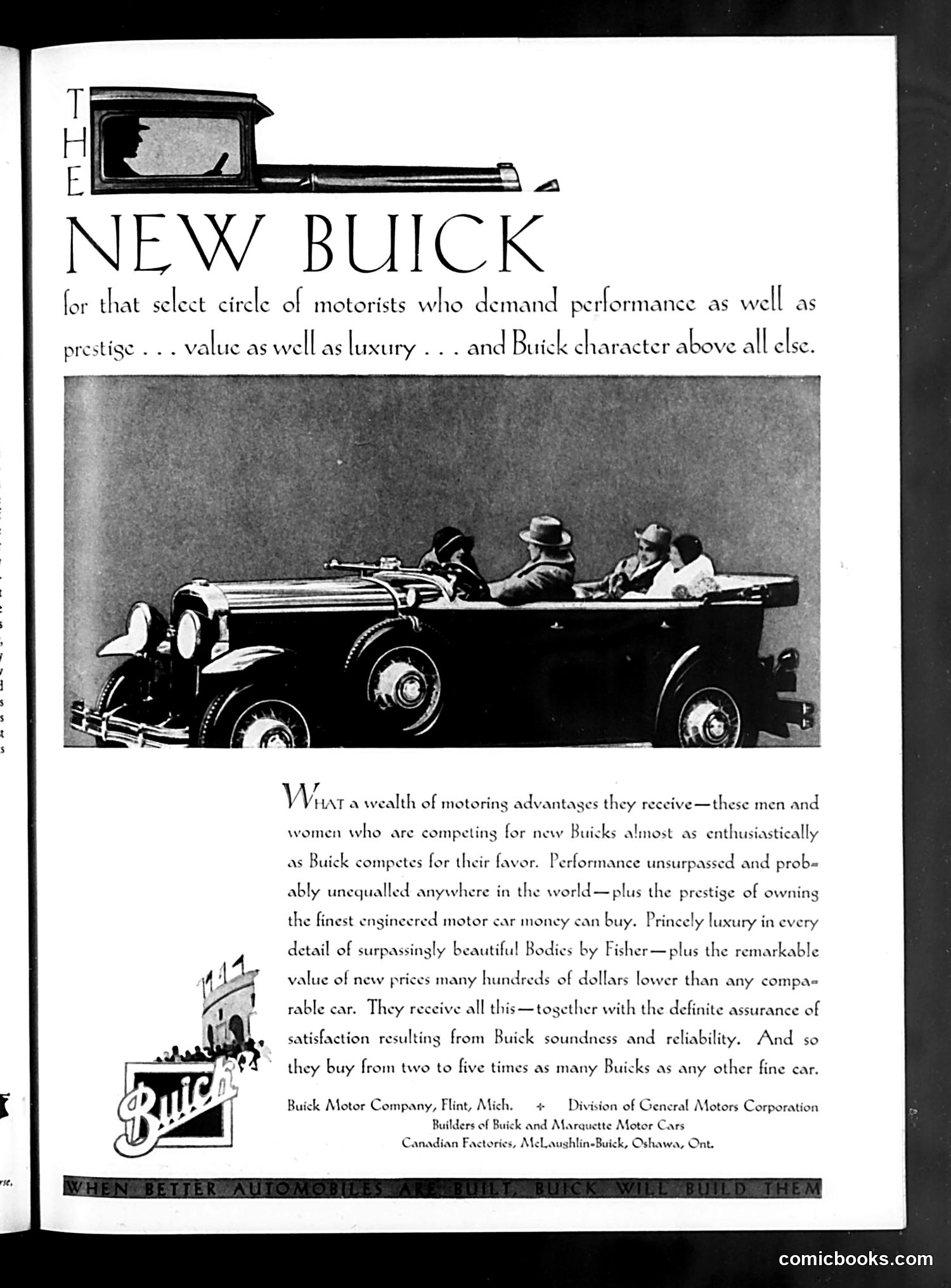
Analysis This is a Buick automobile advertisement, not political satire or editorial cartoon. The page promotes the new Buick to affluent buyers, emphasizing performance, luxury, and value. The image shows a convertible carrying four well-dressed passengers in 1920s attire, visually representing the "select circle of motorists" the advertisement targets. The tagline promises "performance as well as prestige...value as well as luxury." The text's sales pitch emphasizes Buick's engineering superiority ("unsurpassed and probably unequalled anywhere in the world"), Fisher body design, and surprisingly low prices for a luxury vehicle. The claim that buyers purchase "two to five times as many Buicks as any other fine car" suggests competitive dominance. This reflects the 1920s automotive market, when Buick was indeed a major player in General Motors' lineup, positioned between mass-market Chevrolet and luxury Cadillac. The advertisement targets status-conscious, performance-minded buyers with disposable income.
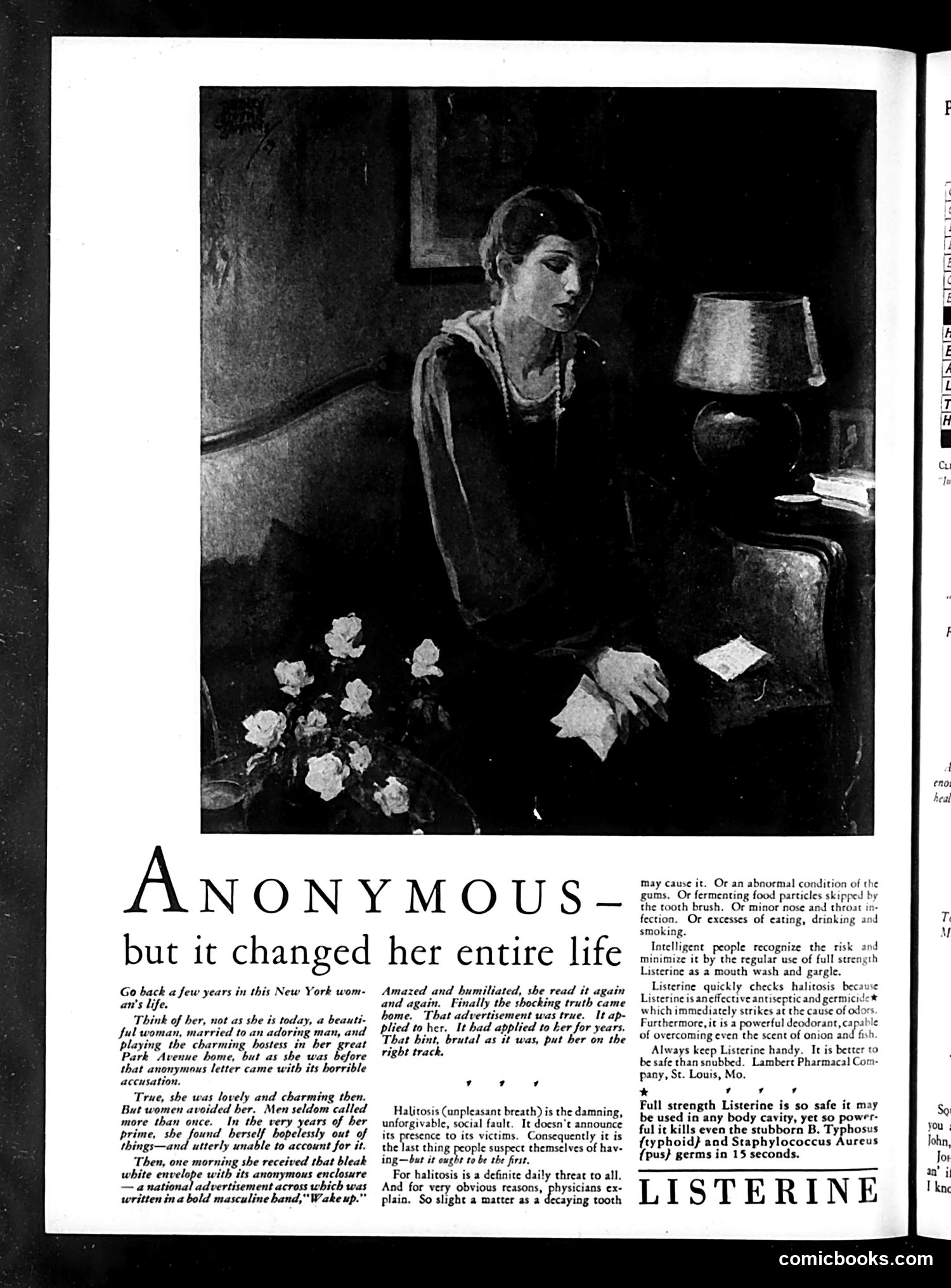
Analysis This is a Listerine mouthwash advertisement, not satire or political content. It uses a cautionary narrative to sell the product. The story describes a wealthy Park Avenue woman whose social life suffered inexplicably until she received an anonymous letter—which turns out to be a Listerine ad—alerting her to the possibility she had halitosis (bad breath). The "shocking truth" that "changed her entire life" is that she suffered from this social liability. The advertisement exploits shame and social anxiety, suggesting that bad breath silently ruins relationships and social standing without the sufferer's knowledge. It positions Listerine as the solution, emphasizing its antiseptic properties and claiming medical credibility. This reflects early-to-mid 20th century advertising strategy: creating anxiety about personal hygiene conditions, then offering a product as the cure. The gendered aspect—targeting women's social acceptability—was typical of the era's marketing approach.
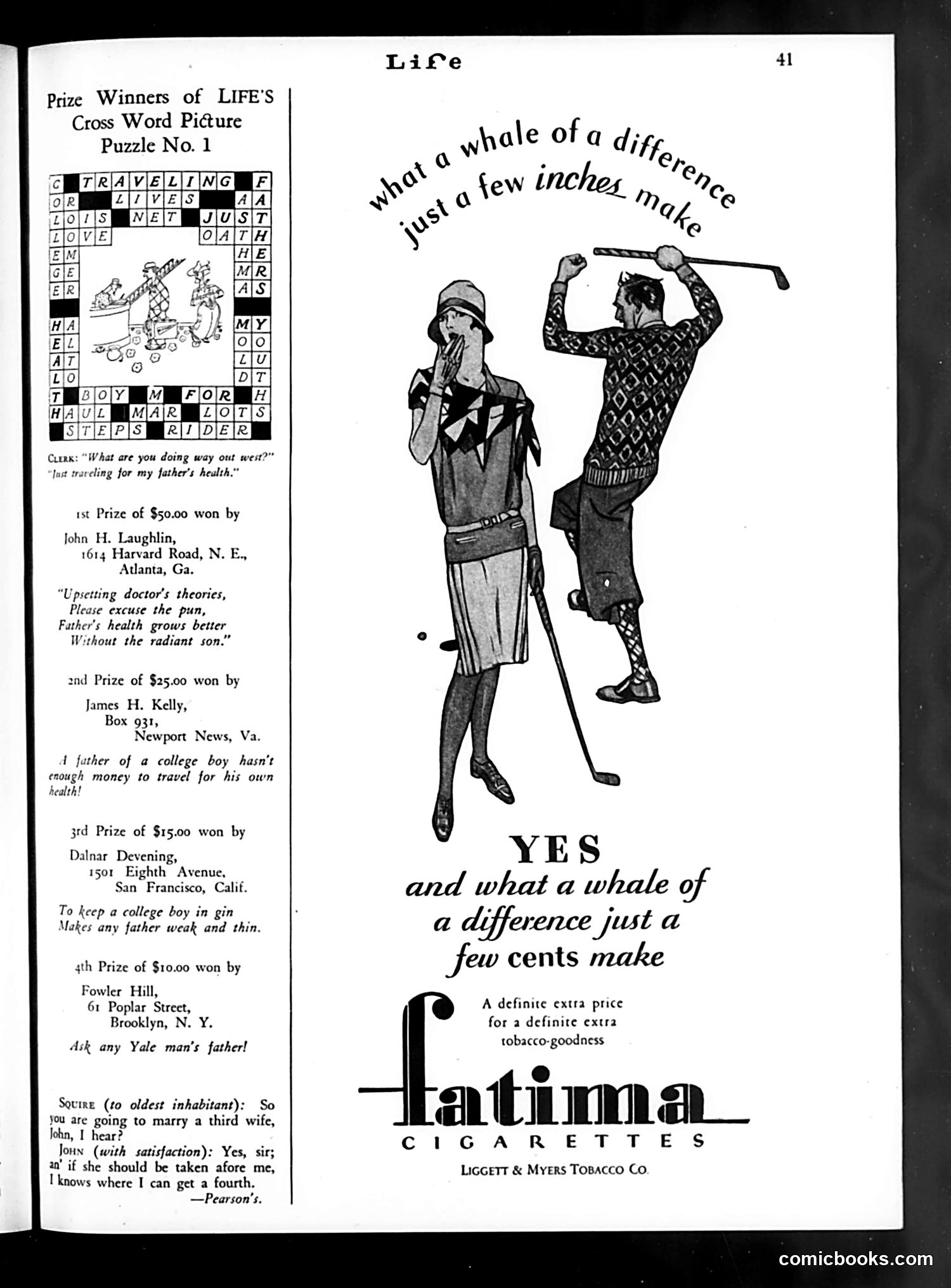
Life Magazine Page Analysis This page combines a puzzle contest results section with advertising and period humor. The left side announces winners of LIFE's crossword puzzle competition, with prize money ranging from $50 to $10. The winning entries are humorous verses about fathers' financial burdens—specifically college boys draining paternal resources through travel, alcohol ("gin"), and general expenses. These jokes reflect early 20th-century anxieties about youth spending and parental sacrifice. The right side features a cigarette advertisement for Fatima brand, using a golf scene and the tagline "what a whale of a difference just a few cents make"—emphasizing that a small price premium delivers superior tobacco quality. The bottom includes a period joke about an elderly man marrying multiple wives, typical of Pearson's magazine humor. The overall page reflects contemporary concerns: parental finances, consumer goods marketing, and casual humor about marriage and aging.
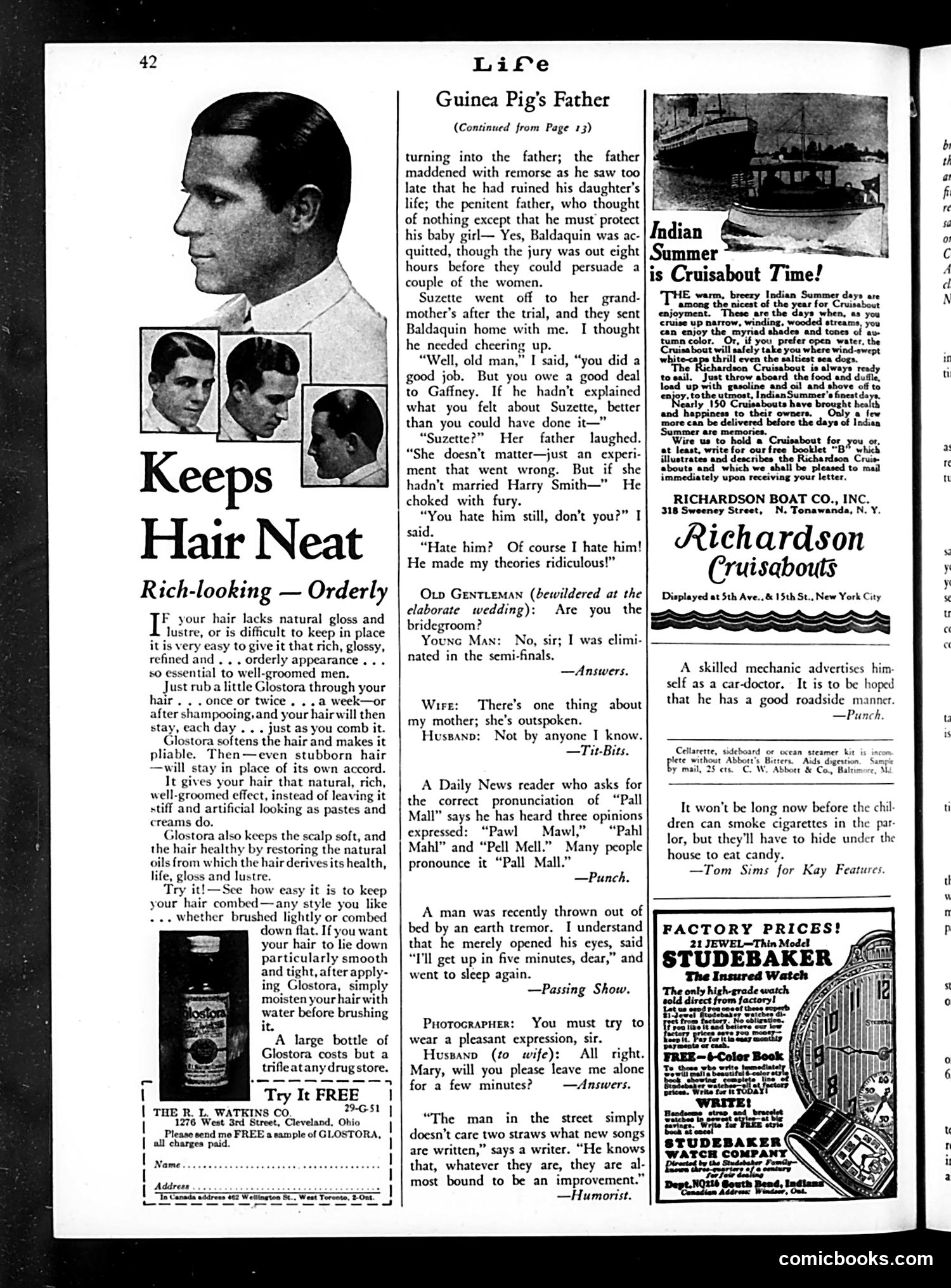
"Keeps Hair Neat" - Glostora Advertisement & Life Magazine Satire Page This page is primarily an advertisement for Glostora hair product (left side), promoting a liquid pomade that allegedly gives hair natural gloss and orderliness without the stiff, artificial appearance of pastes and creams. The remaining content consists of satirical humor and jokes typical of Life magazine's format: - A serialized story excerpt titled "Guinea Pig's Father" depicting a legal drama - A "Bewildered at the elaborate wedding" cartoon joke about a bridegroom - Several reader-submitted humorous quips about marriage, pronunciation, earthquakes, and songwriting—the standard "jokes column" format of the era - A Richardson Crusaboats advertisement for recreational boats The cartoons and jokes are not overtly political—they're domestic, social humor aimed at early 20th-century middle-class readers. The "Guinea Pig's Father" narrative concerns a paternity case and a father's obsession with his failed scientific theories over his daughter's welfare, reflecting period anxieties about both sexuality and science.
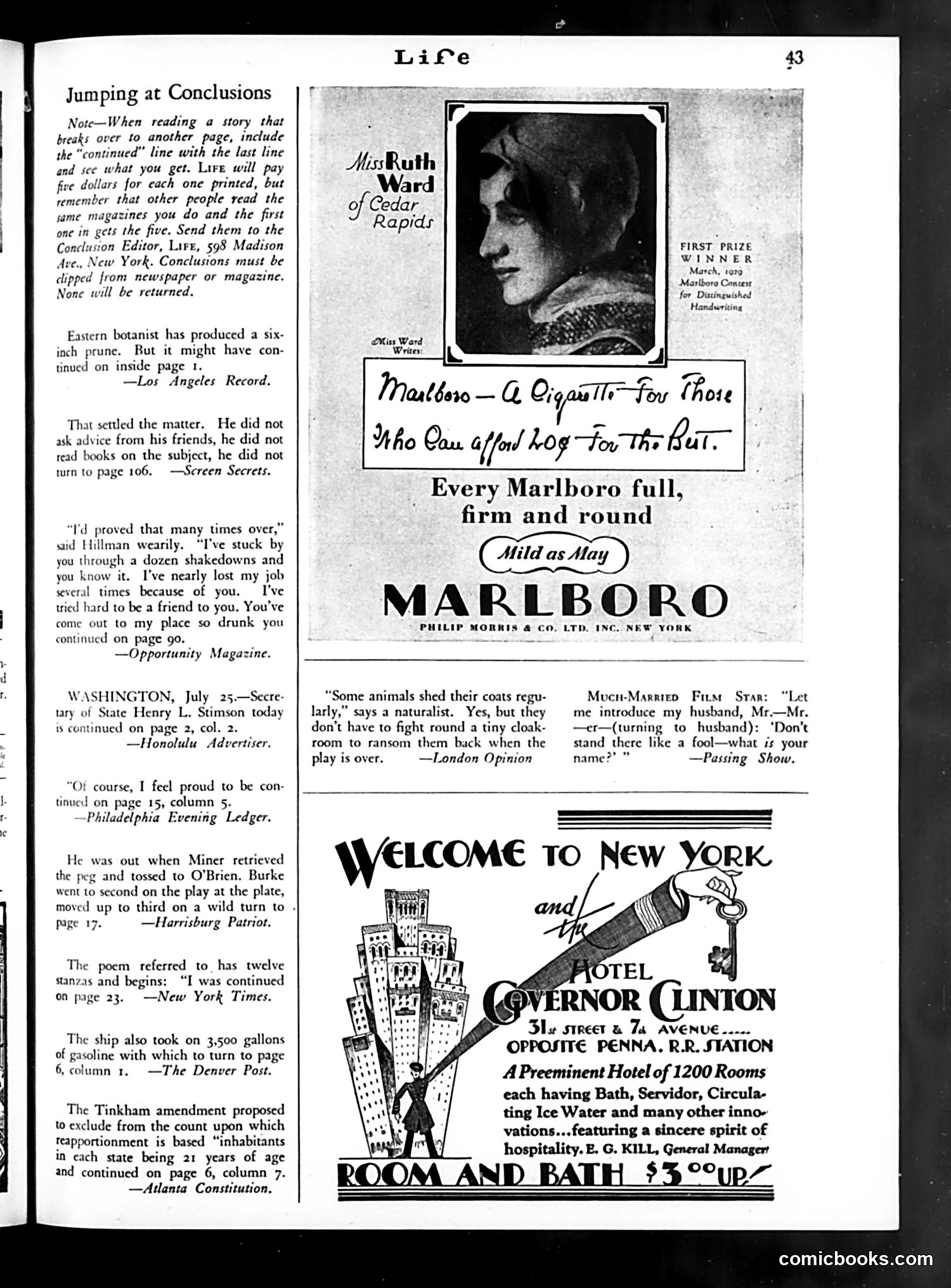
"Jumping at Conclusions" – A Life Magazine Satire This page features Life's recurring humor column showcasing unintentional absurdities created when magazine stories break across pages. Readers send in the awkward or nonsensical sentences created by pairing a story's final line with the next page's opening line. Examples include a botanist producing a six-inch prune that "might have continued," and Secretary of State Henry Stimson's statement absurdly cut off mid-sentence. The humor relies on the reader's recognition that magazine layout creates these ridiculous juxtapositions through simple editorial accidents—turning mundane news items and personal anecdotes into unintended comedy. Life paid five dollars per published submission, incentivizing readers to spot these textual collisions. The feature satirizes both magazines' fragmented format and readers' tendency to overlook editorial quirks. The page also contains period advertisements for Marlboro cigarettes and the Hotel Governor Clinton.
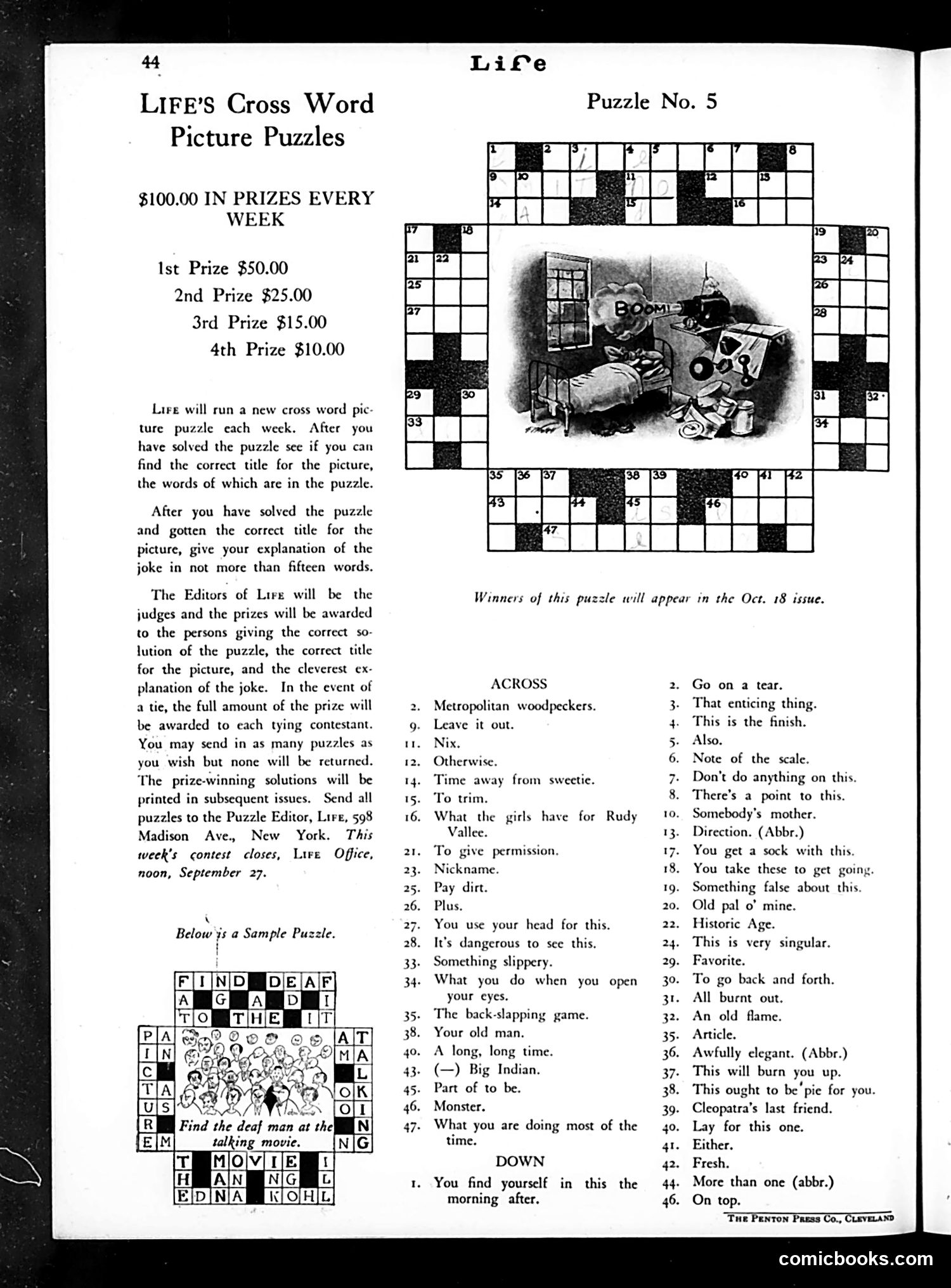
Life Magazine's Picture Puzzle This page showcases Life's weekly crossword picture puzzle contest, offering $100 in prizes ($50 first prize down to $10 fourth). The illustration for "Puzzle No. 5" depicts a young man in bed surrounded by various items—toys, a radio, and other playthings—suggesting childish behavior or immaturity. The puzzle requires solvers to: 1. Complete the crossword using clues provided 2. Identify the correct title for the picture (using words from the puzzle) 3. Explain the joke in fifteen words or fewer Winners would be announced in the October 18 issue. The sample puzzle below shows how this format works, with a crowd scene labeled "Find the deaf man at the talking movie"—a joke playing on the irony of someone unable to hear attending a sound film. This represents early entertainment marketing by Life magazine, blending word games, visual humor, and audience engagement through competition.
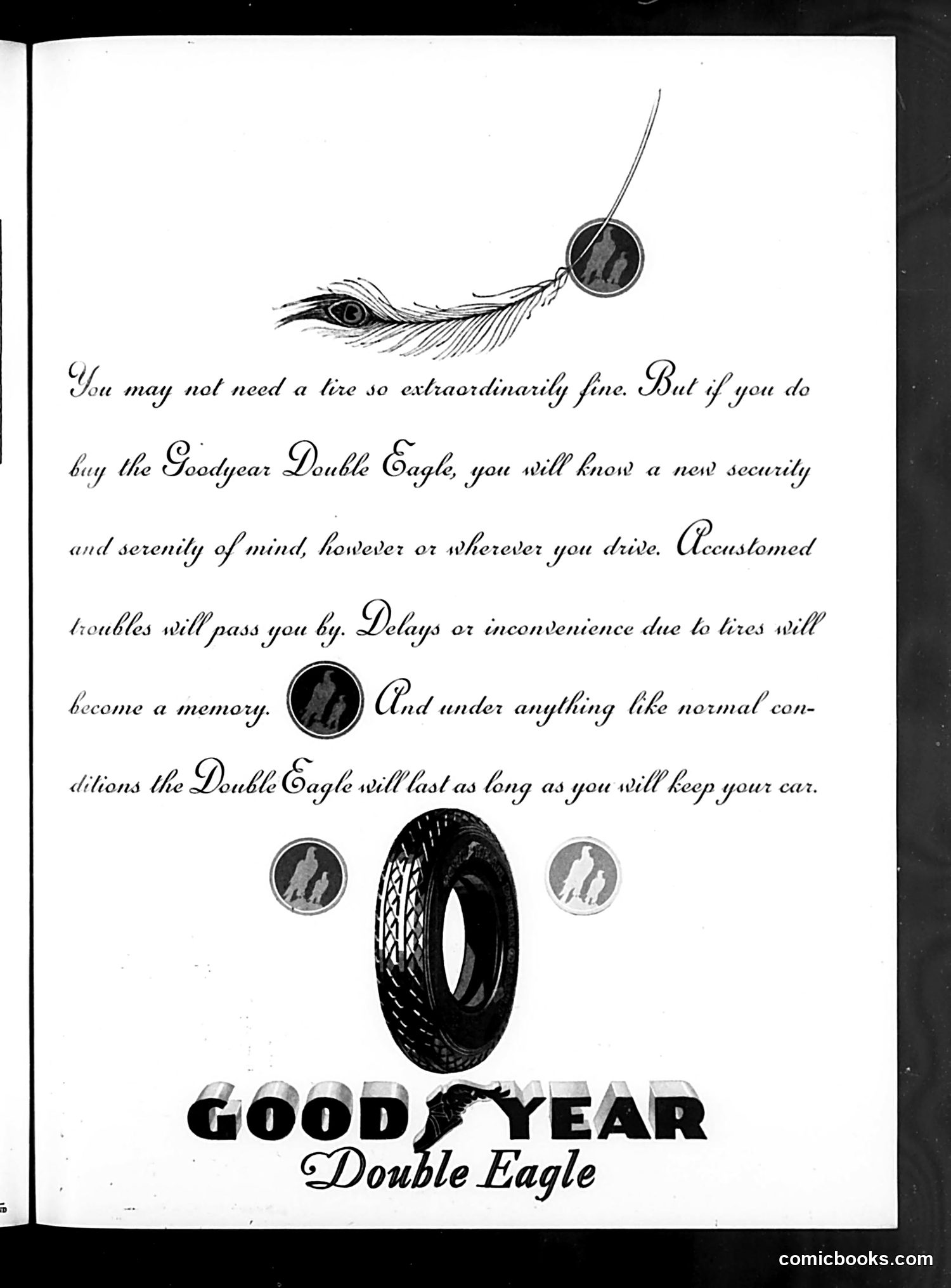
Analysis This is a Goodyear tire advertisement, not a political cartoon. The page promotes the "Double Eagle" tire brand to early 20th-century automobile owners. The ad uses persuasive messaging centered on reliability and peace of mind. The decorative eagle illustrations symbolize strength and protection. The text promises that buyers won't experience tire troubles or delays if they purchase Double Eagle tires—implying competitors' products fail more frequently. The phrase "as long as you will keep your car" is key: it suggests the tire's durability matches the vehicle's lifespan, a selling point for an era when cars were expensive investments and tire quality directly affected driving safety and convenience. This represents typical early automotive advertising strategy: emphasizing product dependability to justify premium pricing in an emerging consumer market.
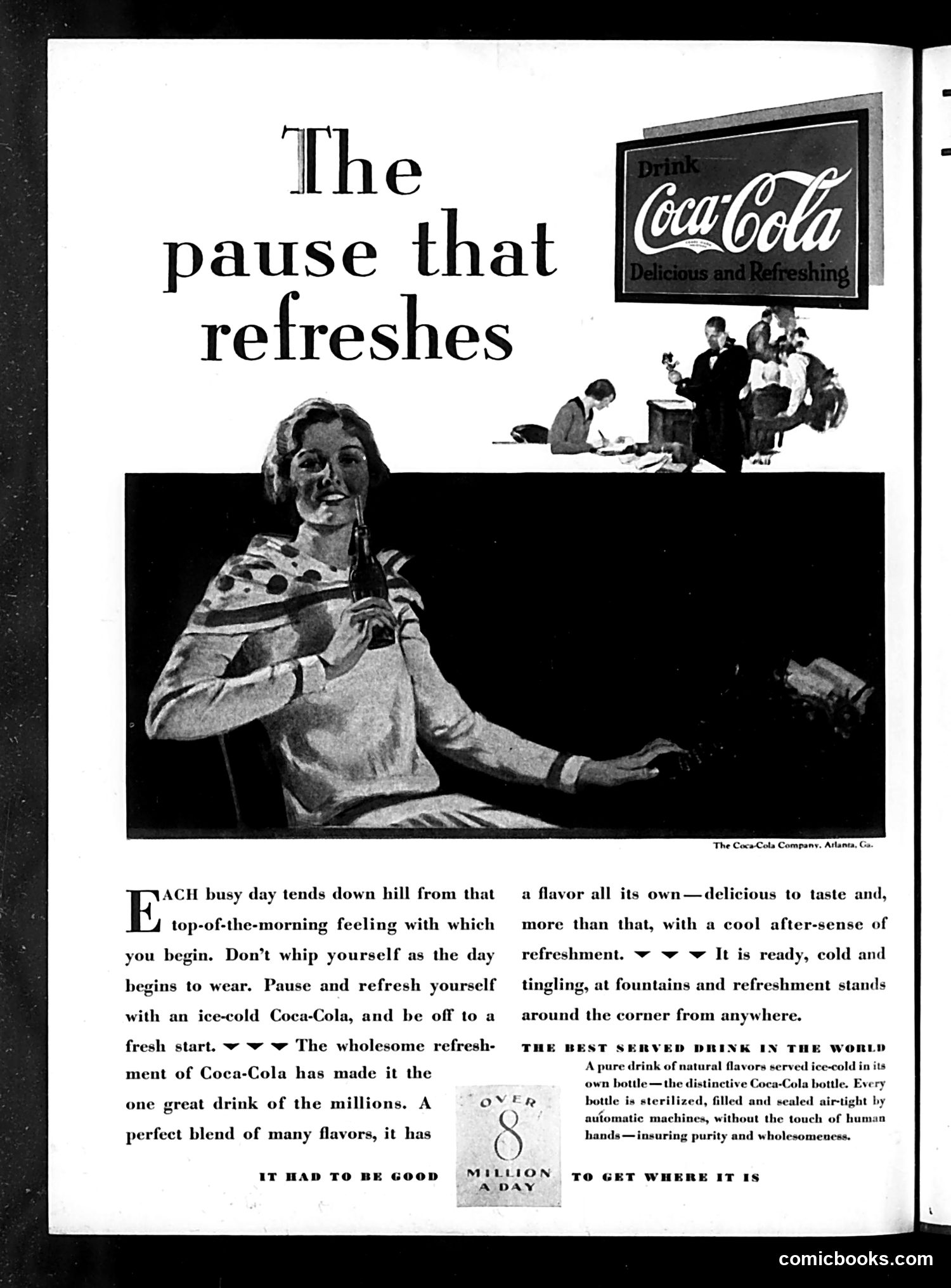
Analysis This is a Coca-Cola advertisement, not political satire. The page promotes Coca-Cola as a midday refreshment break. The imagery: A woman holding a Coca-Cola bottle is shown in the foreground, appearing refreshed. Behind her, an office scene depicts workers at desks and standing around, suggesting a workplace setting. The message: The ad uses the concept of "the pause that refreshes" (Coca-Cola's actual slogan from this era) to pitch the drink as an energy booster during a tiring workday. The text argues that as energy flags mid-day, pausing for an ice-cold Coca-Cola restores vigor for a "fresh start." Historical context: This appears to be early-to-mid 20th century advertising. The emphasis on "automatic machines" and "purity" reflects contemporary marketing concerns about hygiene and industrial modernity. The "Over 8 Million a Day" claim advertises the drink's popularity. There is no political cartoon or satire present—this is straightforward commercial messaging.