life
Life — September 20, 1929
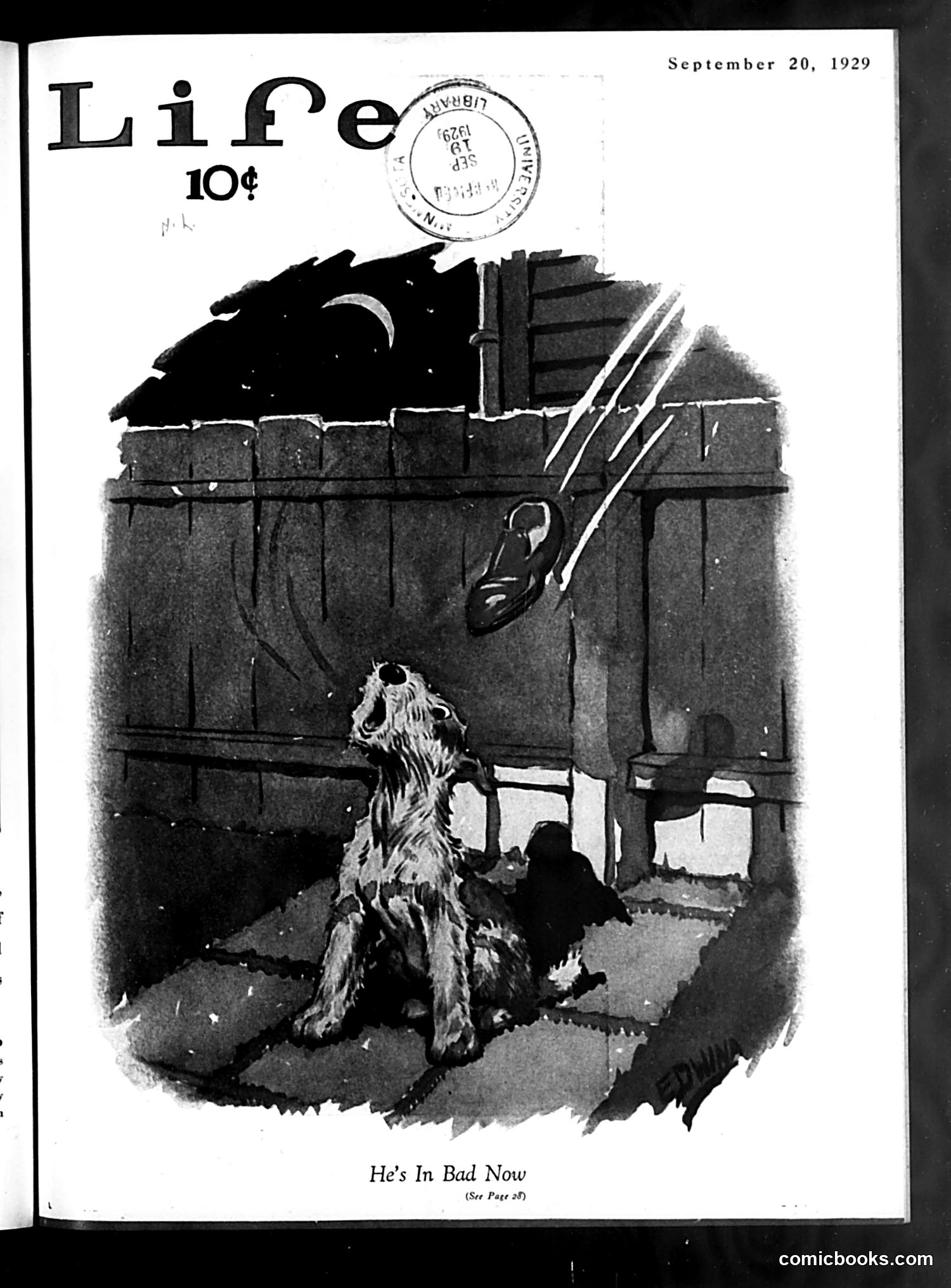
"He's In Bad Now" — Life Magazine, September 20, 1929 This cartoon depicts a dog in a prison cell, climbing a ladder to escape while a guard pursues him up the ladder. The title "He's In Bad Now" is a pun on the dog's predicament. The cartoon likely references the widespread practice of Prohibition enforcement during the late 1920s, when police raids on illegal alcohol operations were frequent. The dog appears to represent someone (possibly a bootlegger or ordinary citizen) caught violating Prohibition laws. The prison setting and escape attempt humorously suggest the serious legal consequences citizens faced for alcohol-related offenses during this period. The satirical point critiques either the severity of Prohibition enforcement or the desperation of those attempting to evade it.
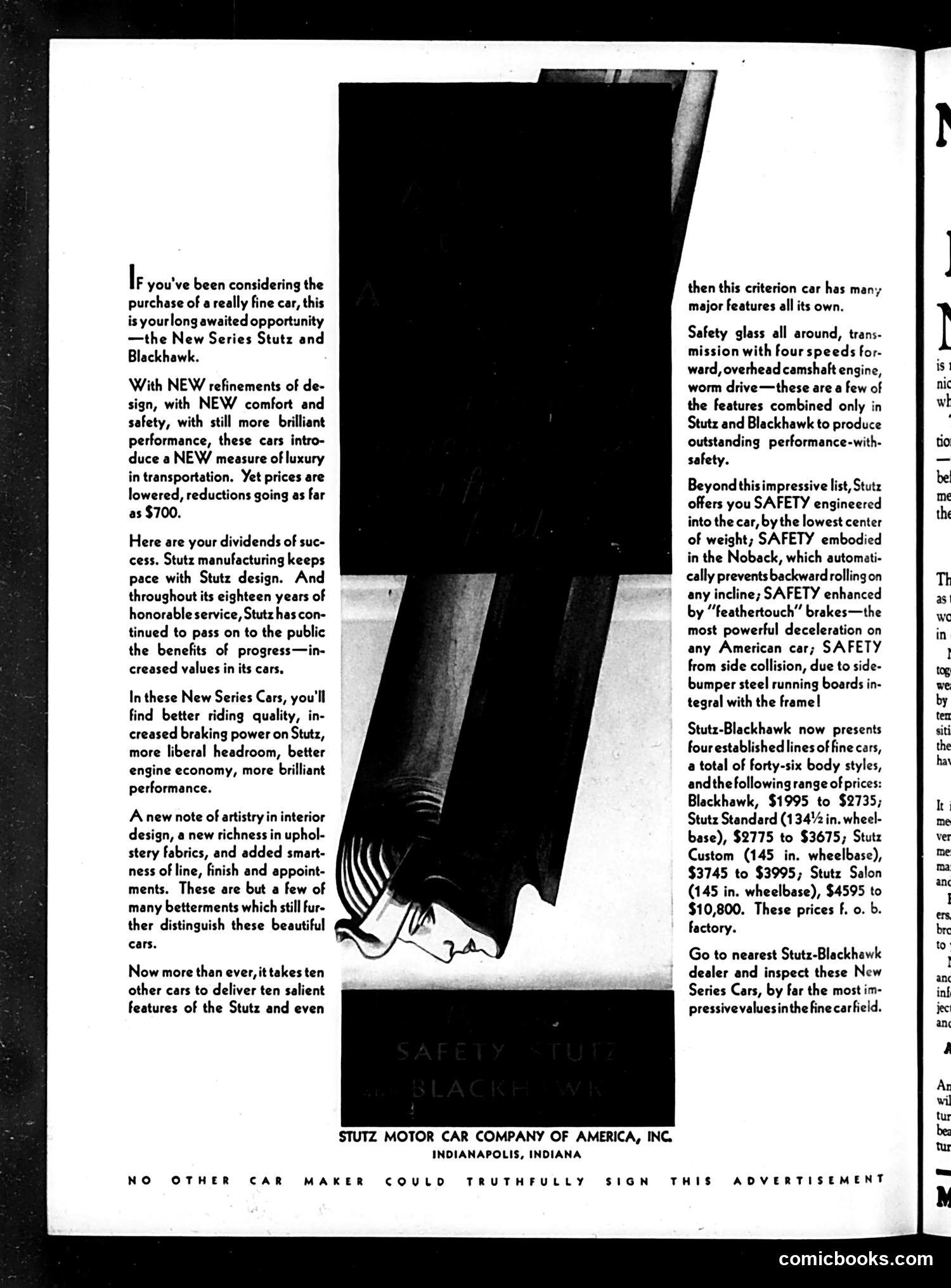
Analysis This is not a satirical cartoon page, but rather a Stutz automobile advertisement from Life magazine. The central image shows a stylized illustration of a woman's legs and feet, emphasizing elegance and luxury lifestyle. The ad promotes the "New Series Stutz and Blackhawk" cars, highlighting safety features, performance improvements, and interior design refinements. The advertisement targets affluent readers, emphasizing that "prices are lowered, reductions going as far as $700" while maintaining luxury status. It lists specific models and price ranges from $1,995 to $10,800. The page represents commercial advertising as editorial content—common in early 20th-century magazines where luxury brands occupied significant space. The artistic leg illustration was a typical marketing technique of the era for conveying sophistication and aspirational lifestyle.
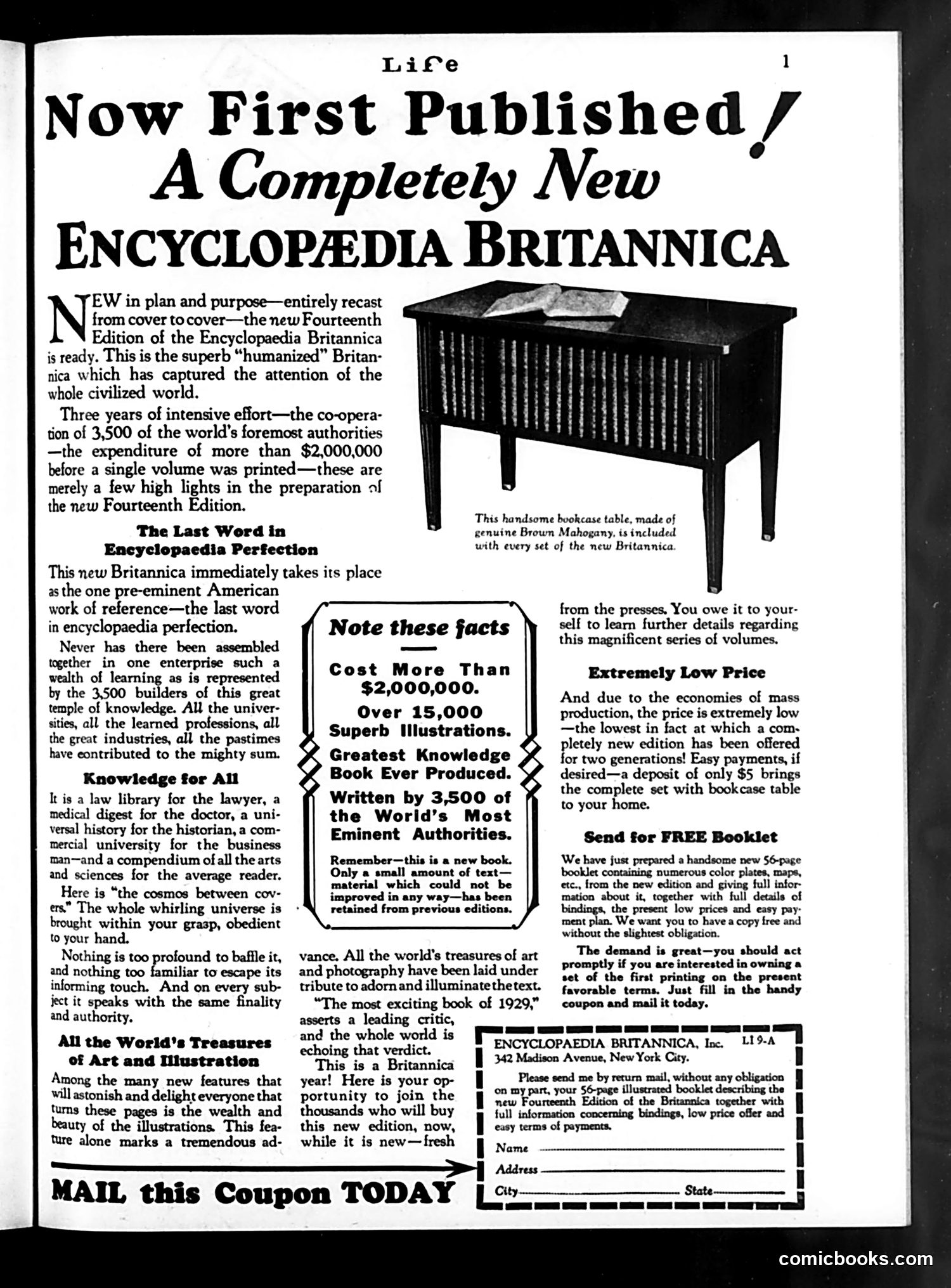
Content Analysis This page is primarily advertising, not satire or political cartoon. It's a full-page advertisement for the Encyclopædia Britannica's new Fourteenth Edition, published in Life magazine. The ad highlights the encyclopedia's credentials: three years of development, input from 3,500 world authorities, and over $2,000,000 in production costs. It emphasizes 15,000+ illustrations and positions the work as "the one pre-eminent American work of reference." The only visual element is a photograph of a handsome mahogany bookcase table (included with purchase) displaying the encyclopedia volumes. The marketing strategy targets affluent readers by emphasizing prestige, comprehensiveness, and "extremely low price" with easy payment terms. There is no political satire or social commentary present on this page.
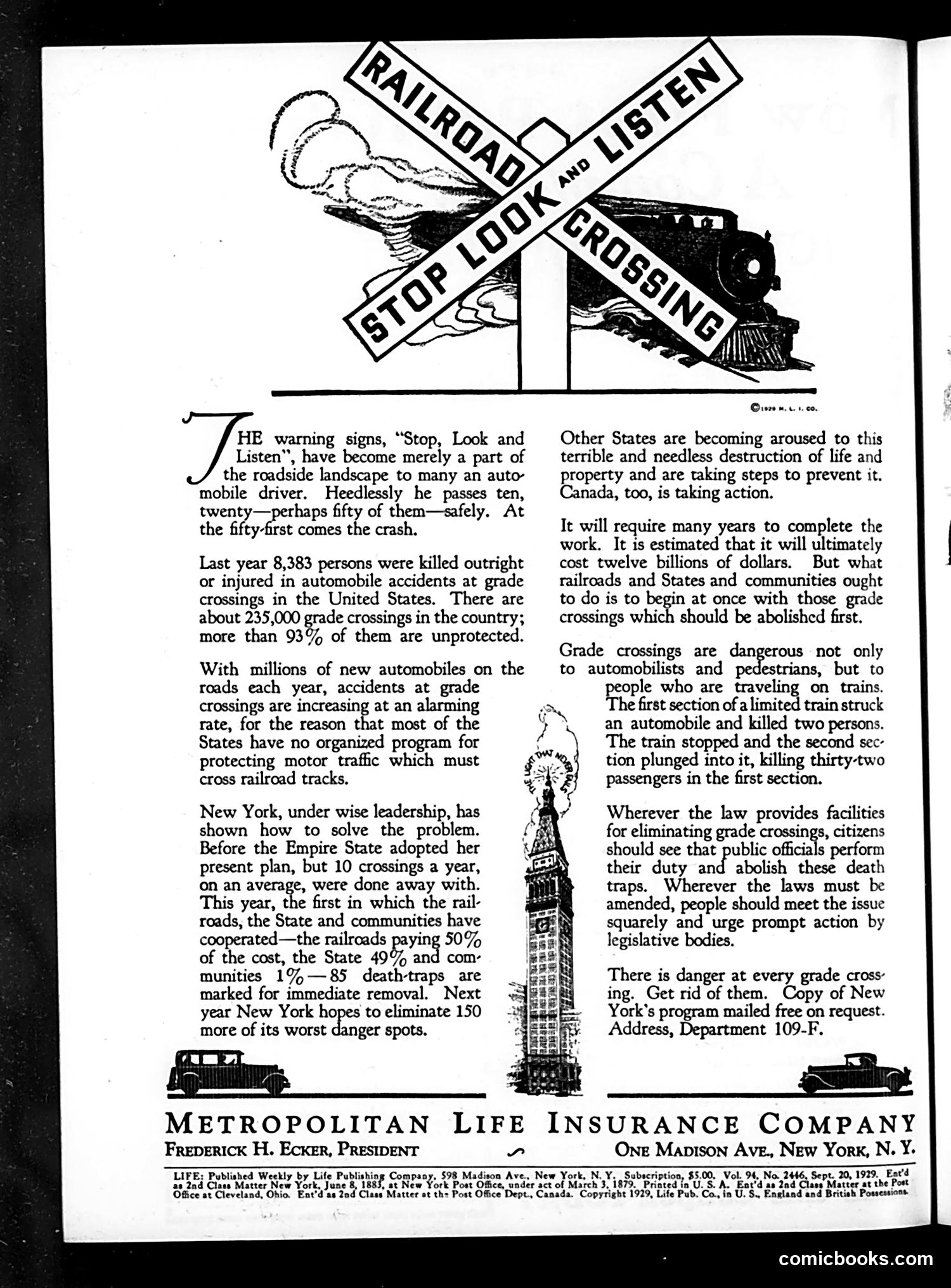
Railroad Crossing Safety Advertisement This is a public service advertisement by Metropolitan Life Insurance Company addressing a serious early-20th-century safety crisis: unprotected railroad grade crossings. The Issue: The text reports 8,383 deaths from automobile accidents at grade crossings in the U.S. the previous year, with over 93% of 235,000 crossings unprotected. As automobile ownership increased dramatically, collisions at these crossings became epidemic. The Message: The prominent railroad crossing sign and locomotive illustration emphasize the danger. The ad advocates abolishing grade crossings entirely—a costly but necessary solution estimated at twelve billion dollars. New York State is highlighted as a model, having already eliminated 150 dangerous crossings with shared railroad-state-community funding (railroads 50%, state 49%, communities 1%). The advertisement urges citizens to pressure legislators to eliminate these "death traps" immediately.
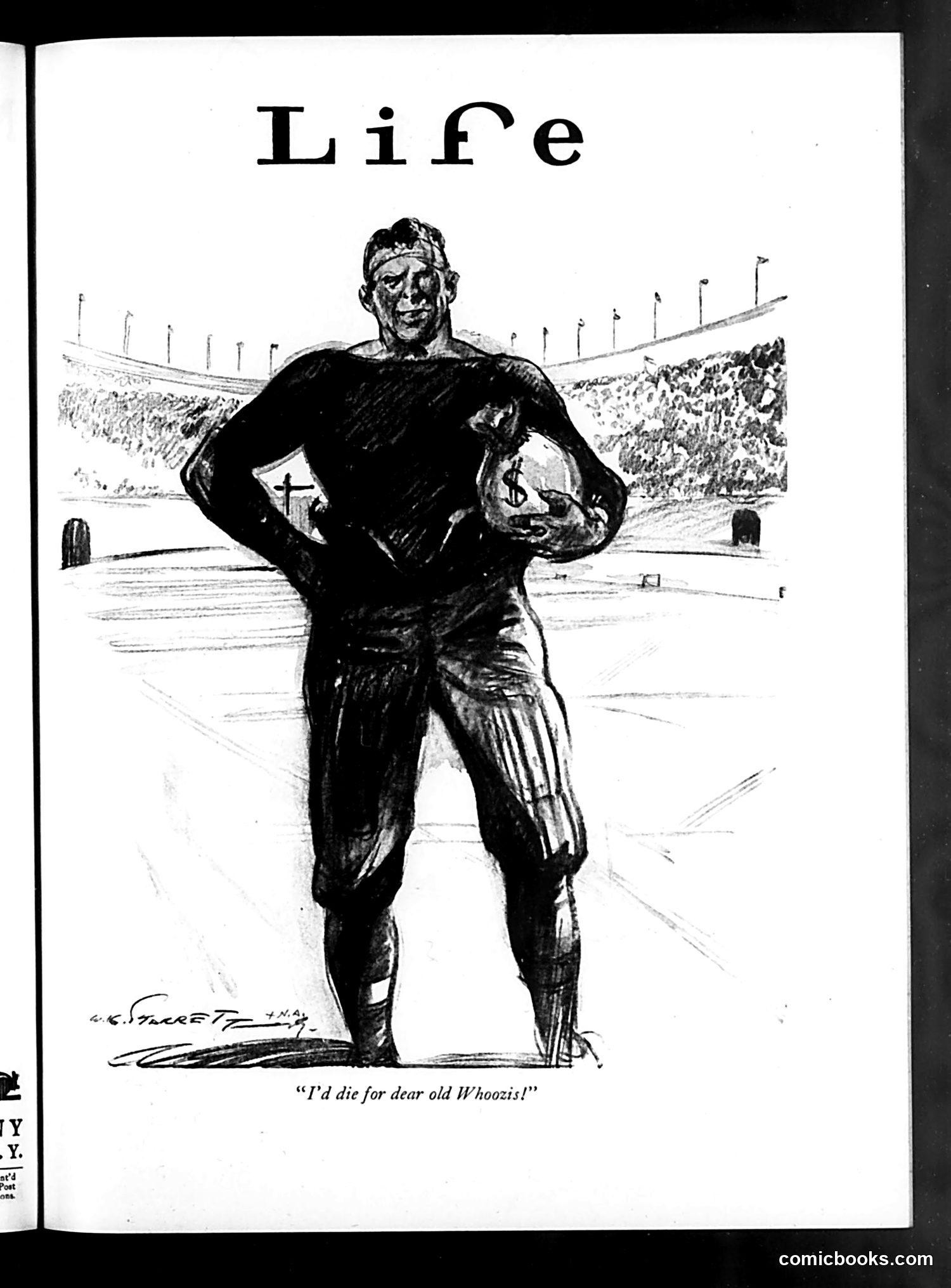
Analysis This Life magazine cover features a football player in a stadium, striking a heroic pose while holding a football. The caption reads "I'd die for dear old Whoozis!" — the vague name "Whoozis" is the joke itself. The satire mocks the excessive sentimentality and school spirit rhetoric surrounding college football. Rather than naming a specific school, the cartoonist uses "Whoozis" (implying "whoever") to ridicule how interchangeable this patriotic devotion becomes — players proclaim undying loyalty to their institution in nearly identical, clichéd terms regardless of which college they attend. The drawing's dramatic heroic style further emphasizes the satirical contrast between inflated rhetoric and the somewhat absurd nature of risking one's life for a sports team or school name.
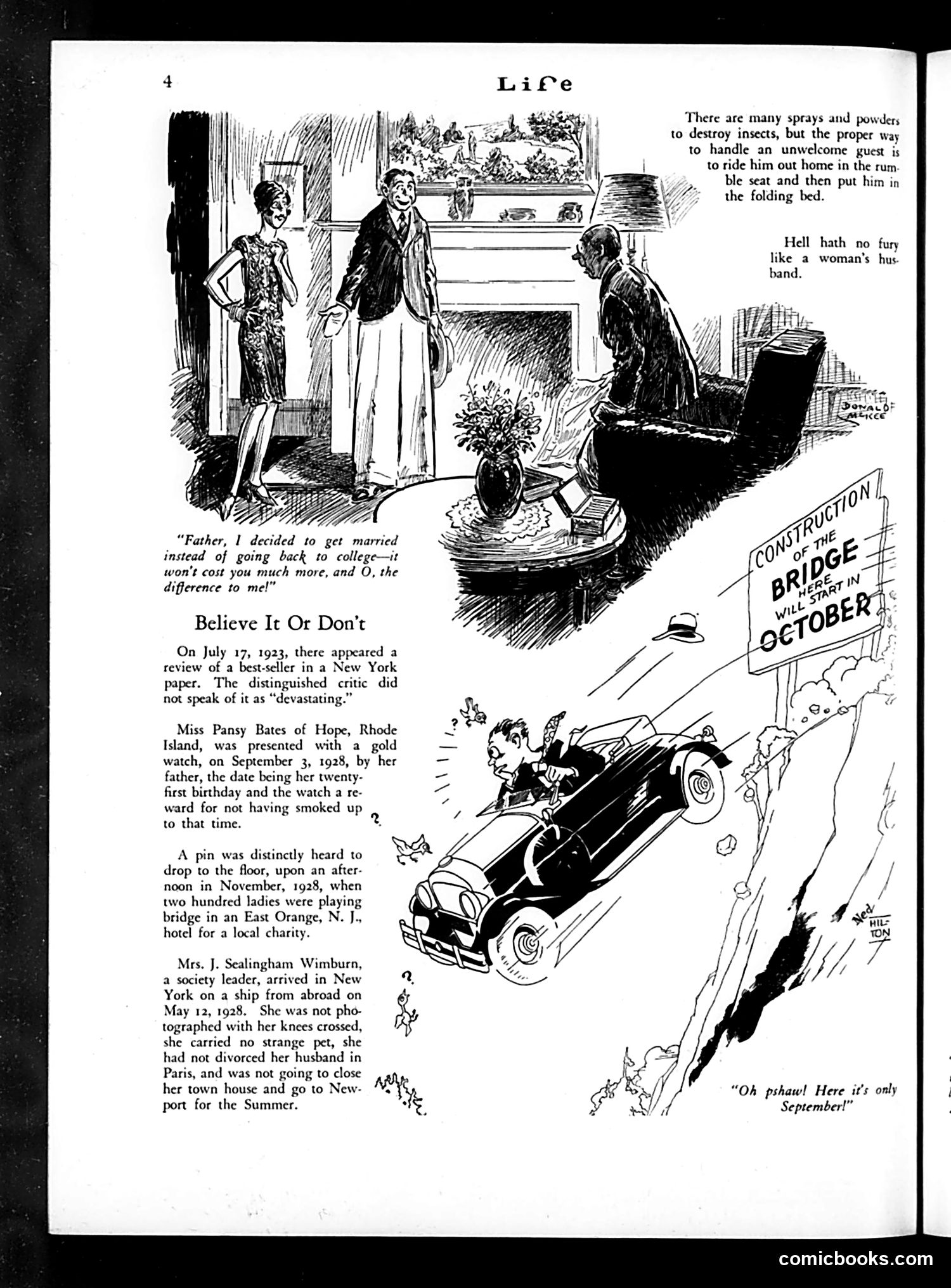
Analysis of Life Magazine Page This page contains two distinct pieces: Top cartoon: Shows a woman telling her father she's decided to marry instead of returning to college, asking if the difference matters to him. The joke satirizes changing social attitudes—the woman expects her father to object to marriage as a distraction from education, but the caption "Hell hath no fury like a woman's husband" suggests husbands were viewed as more troublesome than education. Bottom section: "Believe It Or Not" presents unusual anecdotes (Miss Pansy Bates receiving a gold watch for her 21st birthday without smoking it; a pin dropping audibly during bridge; Mrs. Sealingham Wimburn's arrival in New York). These are novelty items intended as amusing trivia. The car illustration advertising "Construction of the Bridge will start in October" appears to be an unrelated advertisement.
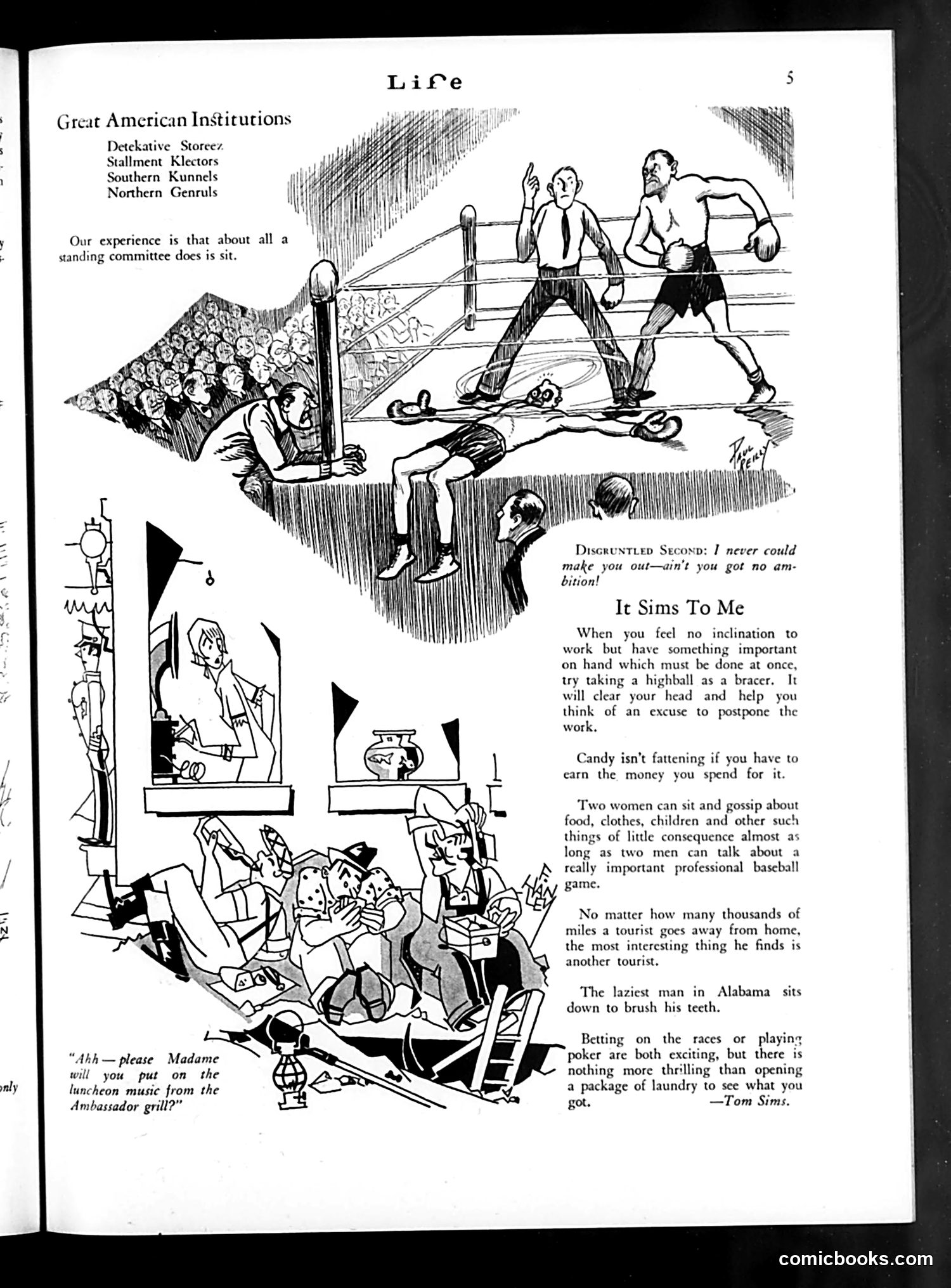
Analysis of Life Magazine Page This page satirizes American institutions and social absurdities. The top section mocks "standing committees" — showing they accomplish nothing but sitting. The boxing ring cartoon depicts committee members as ineffectual spectators while action happens around them. Below, "It Sims To Me" (attributed to Tom Sims) offers humorous observations about human nature: people seeking excuses to avoid work, the appeal of gossip, tourists' predictable behavior, and the thrill of gambling or laundry-opening surprises. The lower cartoon depicts chaos at what appears to be a diplomatic or social function, with the caption requesting music from "the Ambassador grill" — likely satirizing pretentious social events and bureaucratic confusion. The overall message critiques institutional ineffectiveness and human foibles with gentle humor typical of mid-century American satire.
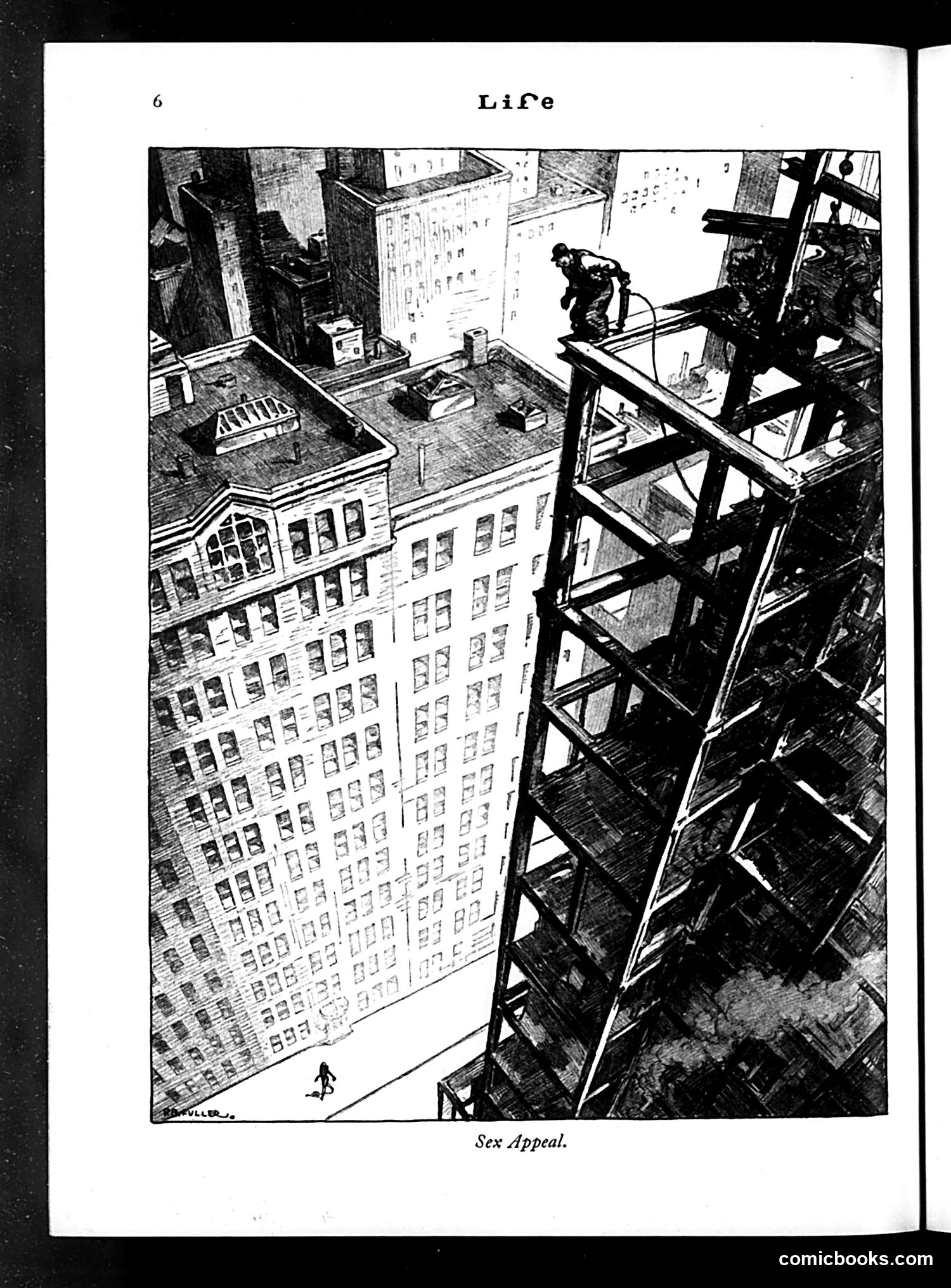
"Sex Appeal" - Life Magazine Cartoon This cartoon depicts a dangerous construction scene from a vertiginous overhead angle. A worker stands precariously on steel framework high above a city street, where a tiny pedestrian is visible far below. The composition emphasizes the extreme height and danger of the work. The caption "Sex Appeal" appears ironic or cynical—suggesting the cartoon critiques how dangerous, underpaid manual labor might be romanticized or made to seem attractive despite its hazards. The cartoon likely satirizes either media representations of construction workers, or broader societal attitudes that glamorize risky working conditions rather than addressing worker safety and fair compensation. The vertiginous perspective makes the joke's dark edge clear: "sex appeal" cannot compensate for genuine danger.
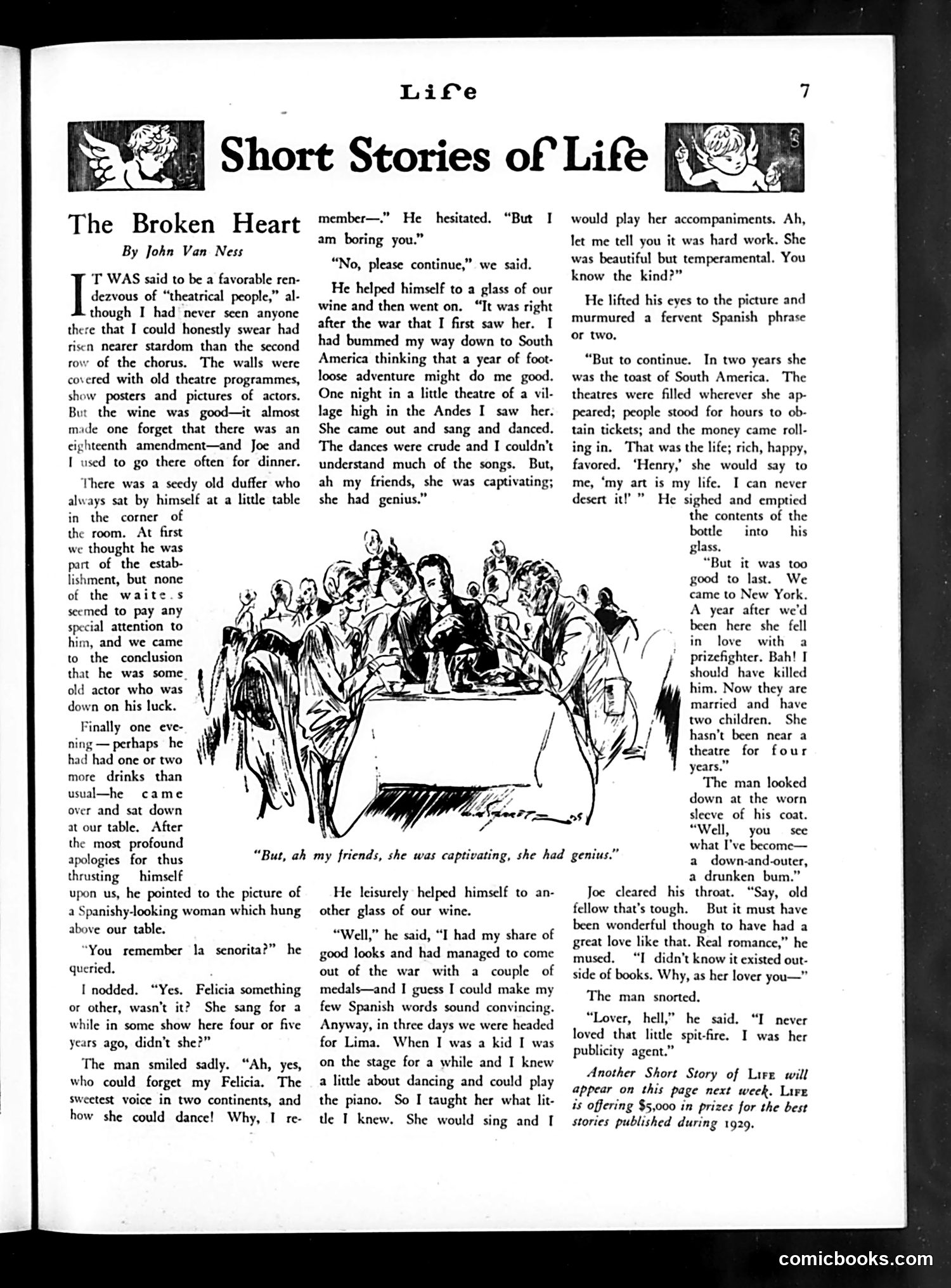
"The Broken Heart" by John Van Ness This is a short story rather than political satire. The narrative concerns a man reminiscing about a Spanish dancer named Felicia whom he knew years ago in South America. He had taught her to sing and dance, and she became celebrated throughout the continent. However, when she moved to New York, she fell in love with a prizefighter and abandoned her theatrical career. Now married with children, she has disappeared from public life entirely. The story explores themes of lost love and squandered artistic talent—a common literary subject of the era. The accompanying illustration shows what appears to be a theatrical or social gathering, though the story's focus is on the narrator's nostalgic regret about Felicia's abandonment of her promising career.
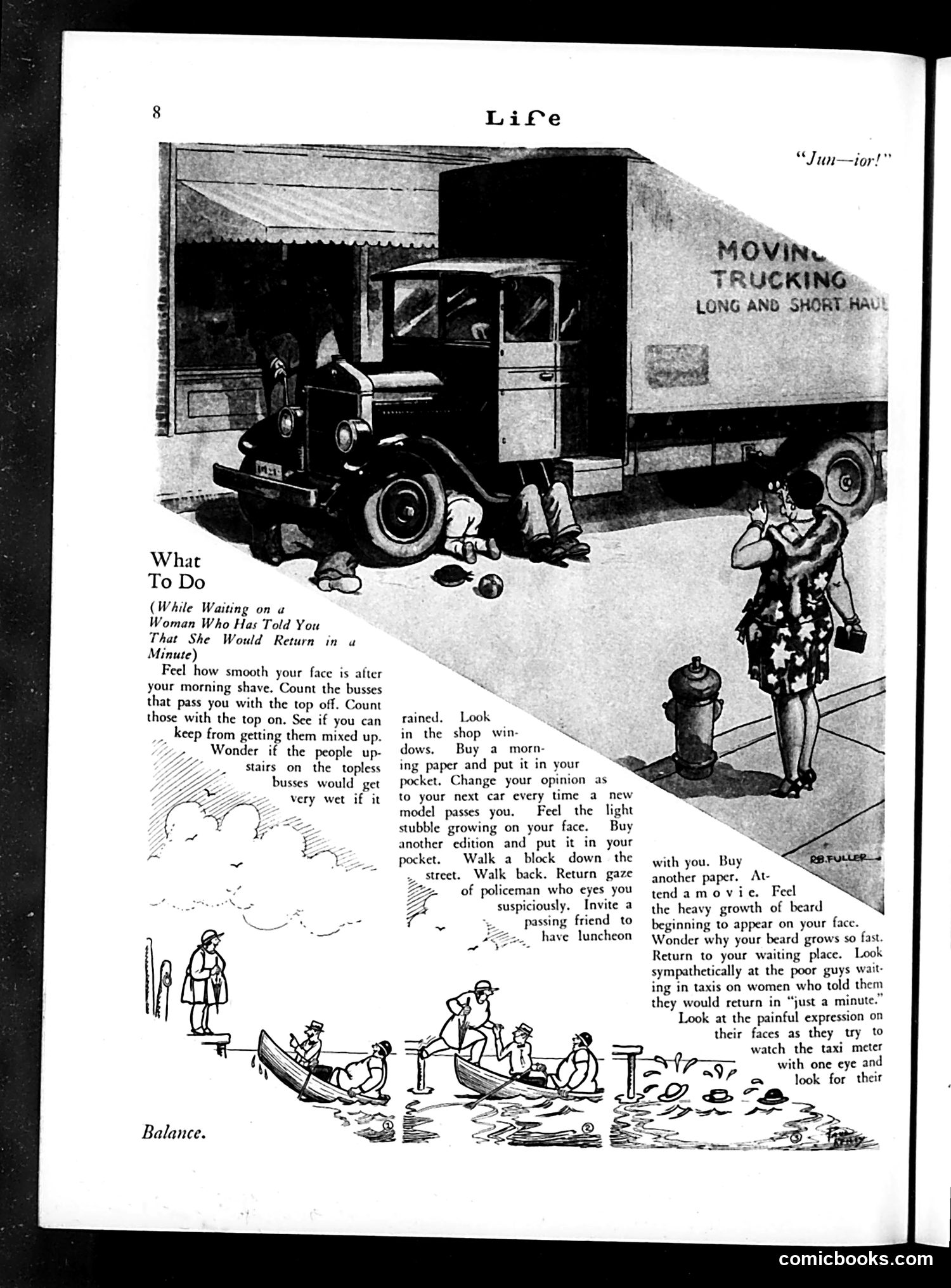
Analysis of Life Magazine Page This page contains two satirical pieces mocking the experience of waiting for tardy companions. "What To Do" (top left) humorously suggests ways to occupy yourself while waiting for someone who promised to return "in a minute"—activities include counting buses, examining your face for whiskers, buying newspapers, and attending a movie. The implicit joke: people chronically underestimate how long they'll actually be gone. "Balance" (bottom) depicts men in small boats on water, struggling to maintain equilibrium—a visual metaphor for the precarious situation of men waiting in taxis while women shop, watching the meter run. The accompanying text describes their frustration and anxiety during this wait. Both pieces target domestic impatience and gender dynamics around shopping and punctuality—common complaints in 1920s-era humor.
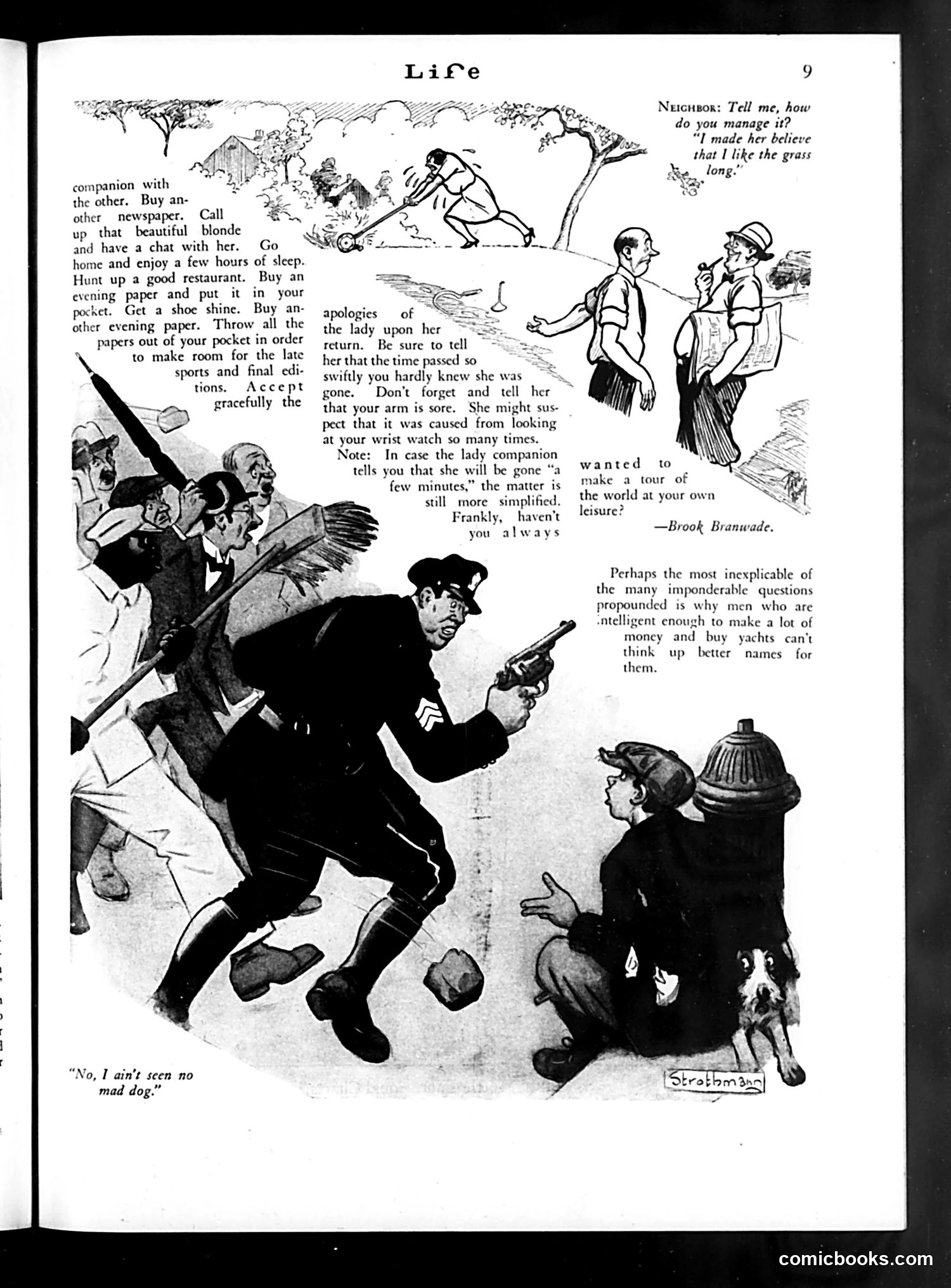
Analysis of Life Magazine Page 9 This page contains humor advice and two distinct cartoons. Top cartoon: Shows a couple on a country outing. The text offers humorous tips for managing a female companion during leisure time—suggesting buying newspapers, going to restaurants, and managing her expectations about time away. The advice is patronizing by modern standards, reflecting early 20th-century gender attitudes where women required management and distraction. Bottom cartoon (signed Strothman): Depicts a man with a gun confronting two figures, claiming "No, I ain't seen no mad dog." The humor appears to reference either urban crime or a literal search for a dangerous animal—the context is unclear without additional historical information. The exaggerated caricaturing and action suggest social satire, possibly about police or vigilante behavior. Both reflect period attitudes toward gender relations and urban/rural life.
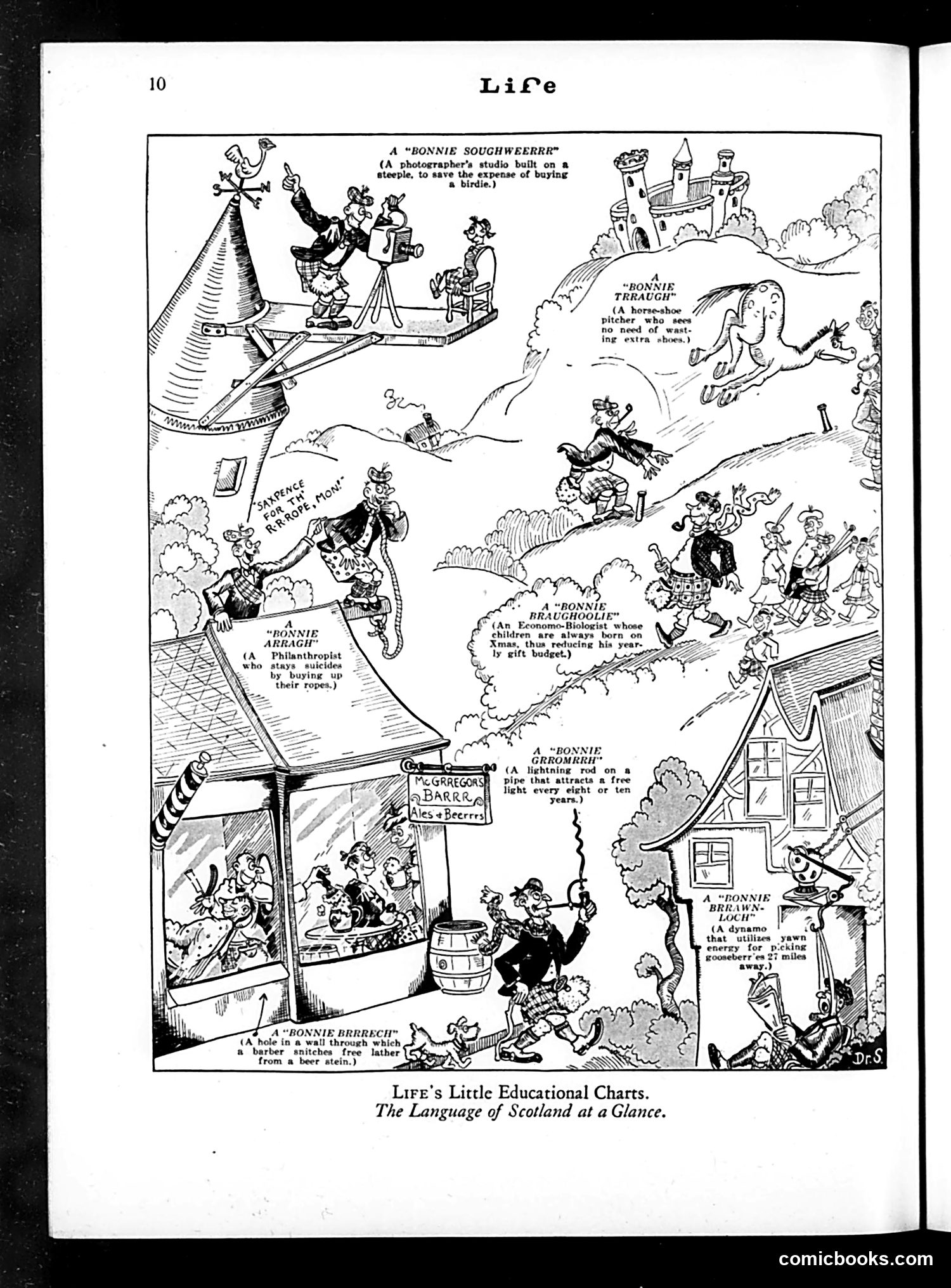
This page presents "Life's Little Educational Charts: The Language of Scotland at a Glance" — a humorous illustrated guide to Scottish terminology and culture. The cartoon shows various whimsical Scottish concepts with definitions. These include: - "Bonnie Soughweerie" (a photographer's studio built on a steeple to save buying a birdie) - "Bonnie Terachie" (a horse-shoe pillow to save on shoes) - "Bonnie Herbage" (an anthropomorphist who saves money by buying up their ropes) - "Bonnie Braw" (a dynamo that utilizes lawn clippings) - "Bonnie Girromrh" (a lightning rod on a pipe that lights every eight or ten years) The satire mocks Scottish thriftiness and resourcefulness through absurdist inventions and wordplay, presenting exaggerated stereotypes of Scottish frugality as humorous "educational" definitions for American readers unfamiliar with Scottish culture and dialect.
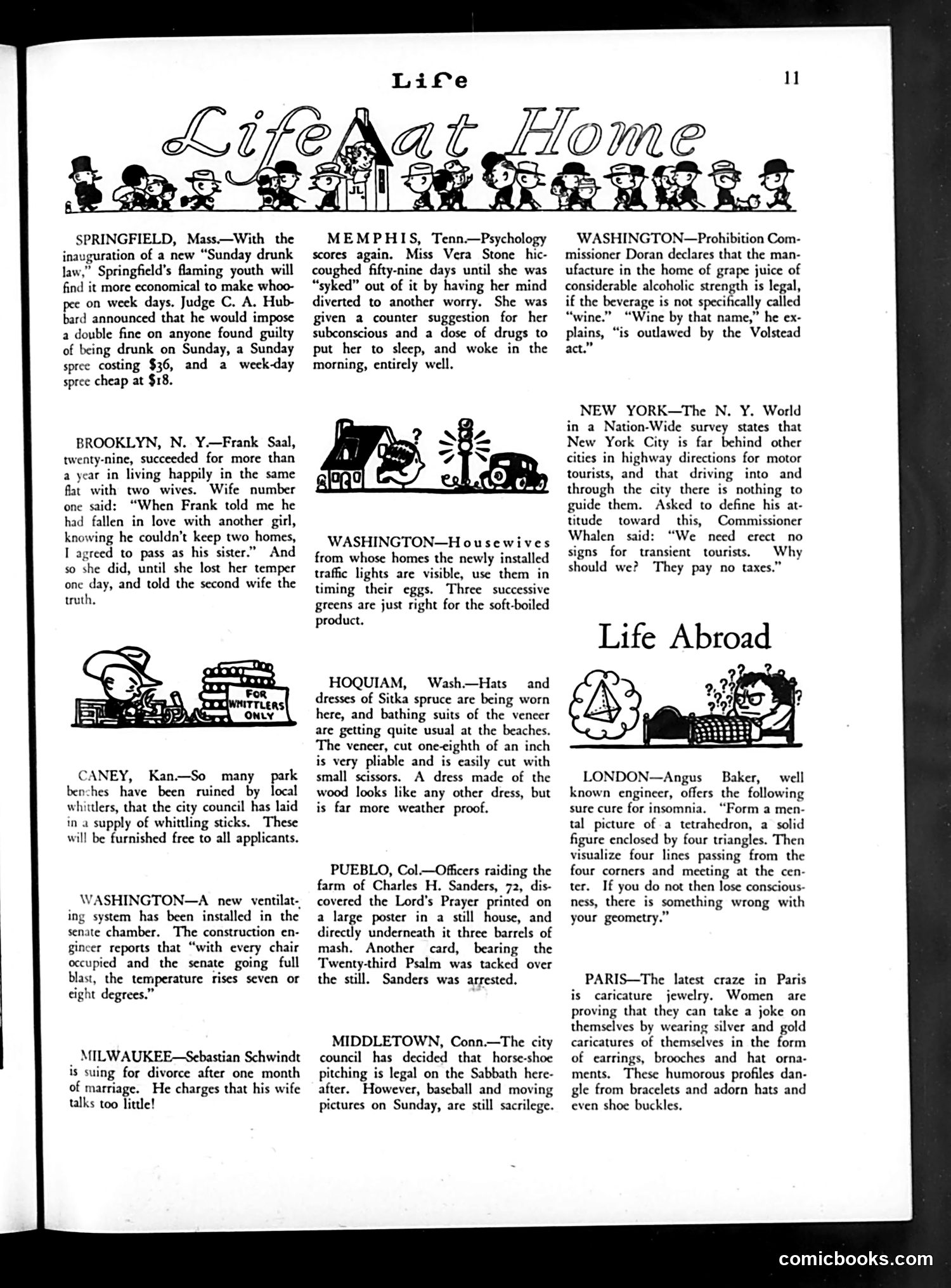
Analysis of Life Magazine Page 11 This page contains humorous anecdotes rather than political cartoons. The "Life at Home" section includes domestic humor about married couples and legal quirks—such as a Springfield judge imposing fines for Sunday drunkenness, and a Brooklyn man managing two wives simultaneously before one discovered the deception. The small illustrations are decorative vignettes (a man with whittling sticks, a chef with "Whittlers Only" sign) accompanying these brief stories rather than standalone editorial cartoons. The "Life Abroad" section reports curiosities from various cities—hats made of Sitka spruce being worn at beaches, insomnia treatments, and Parisian women wearing caricature jewelry as self-aware fashion statements. The page functions primarily as a humor and miscellany column rather than political satire.
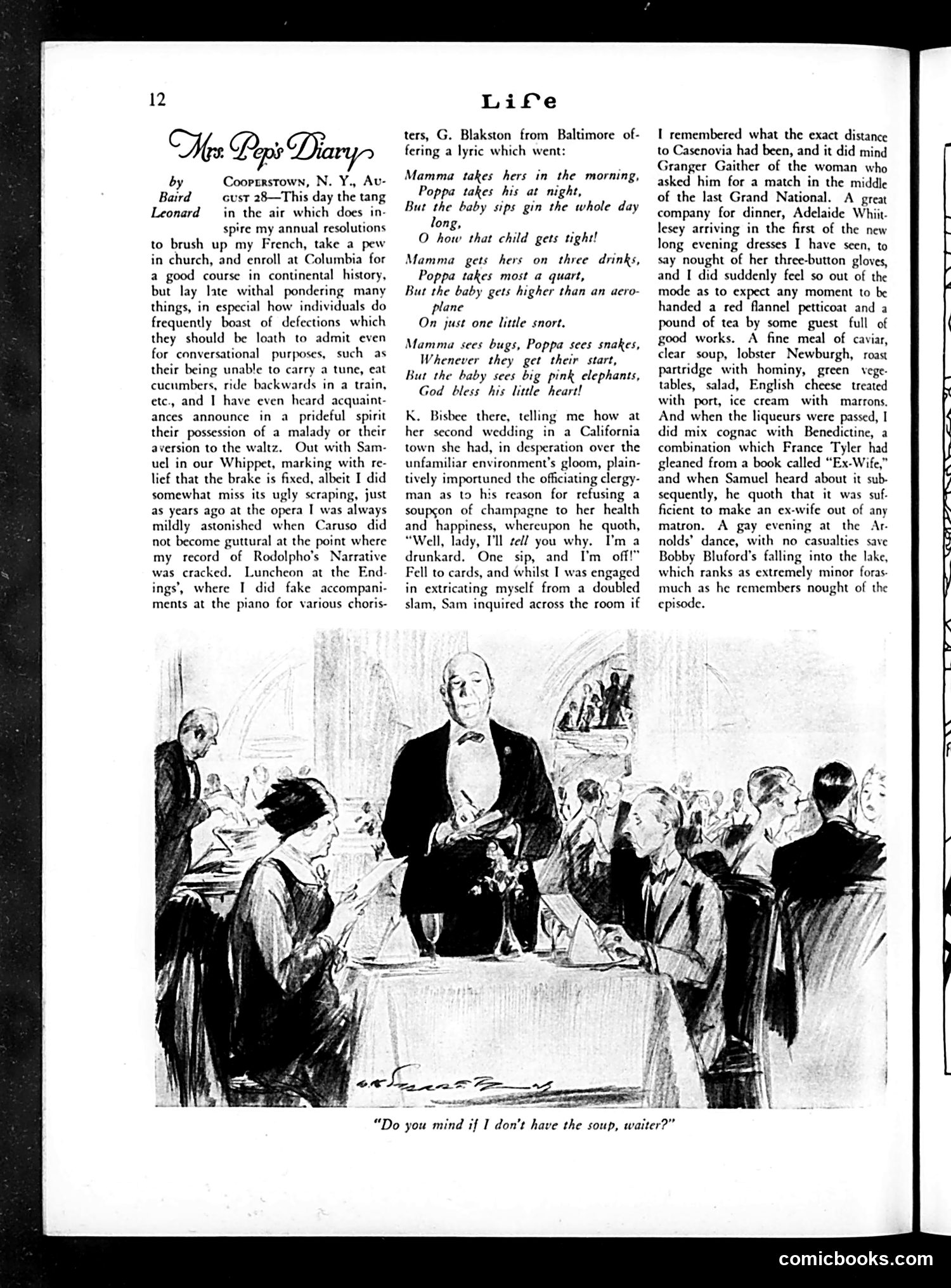
Explanation for Modern Readers This page from *Life* magazine contains "Mrs. Pop's Diary," a humorous domestic column by Baird Leonard (dated August 28, Cooperstown, N.Y.). The text recounts social observations—including a lyric from G. Blakston of Baltimore about a child and mother. The cartoon below depicts a formal dinner scene where a waiter asks a diner, "Do you mind if I don't have the soup, waiter?"—a reversal of the typical server-guest dynamic. This is genteel satire mocking working-class social anxiety or pretension: the servant is asking permission rather than serving, inverting social hierarchy for comedic effect. The joke targets early-20th-century concerns about class boundaries and proper etiquette.
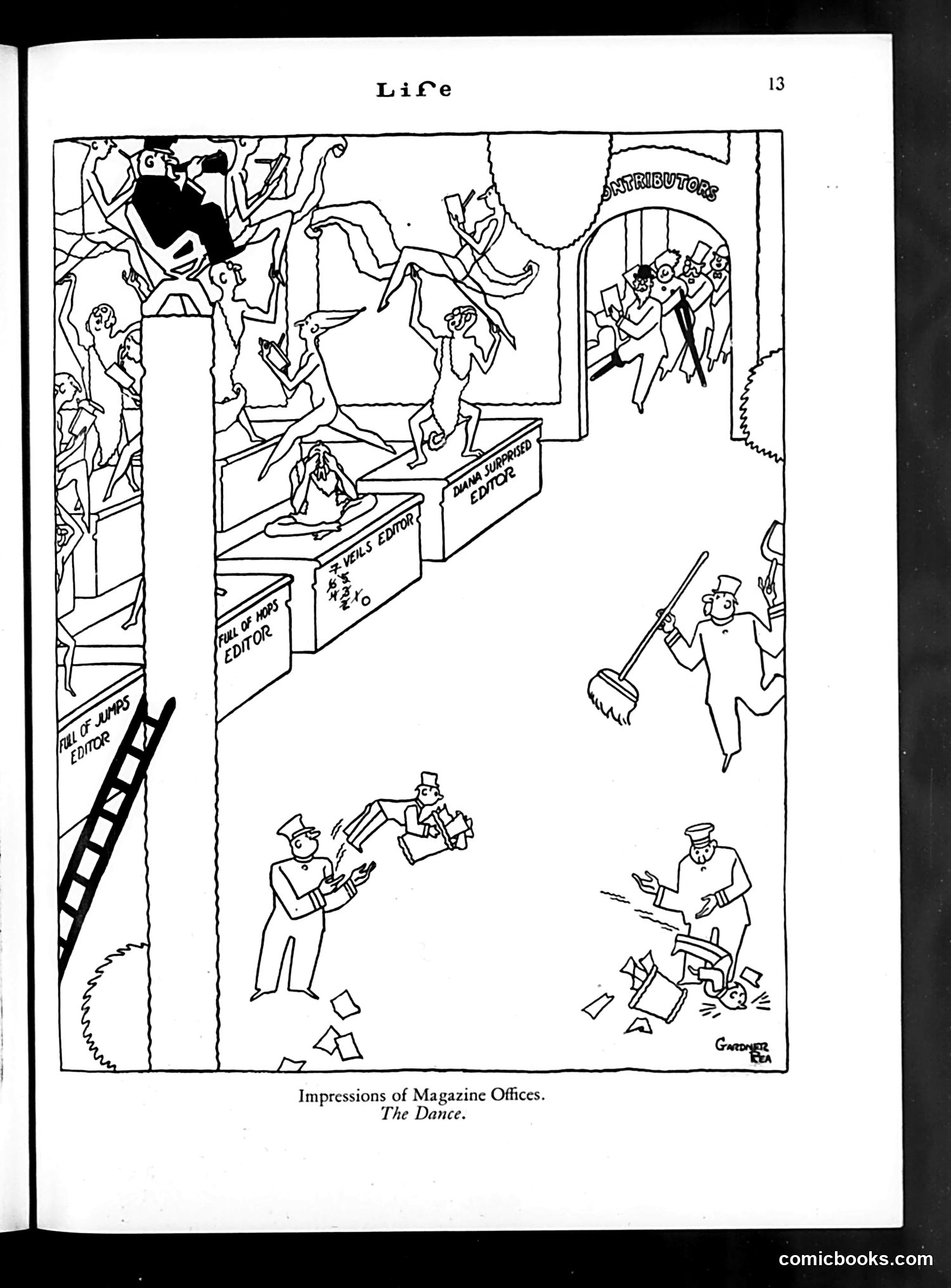
"Impressions of Magazine Offices: The Dance" This cartoon satirizes the chaotic workplace culture of magazine editorial offices. The illustration depicts multiple levels of activity in a building labeled with various editor positions ("Editor," "Managing Editor," "News Editor," "Contributors"). The satire centers on the frenetic energy and dysfunction: editors and staff are shown climbing ladders, dancing, juggling papers, sweeping debris, and generally behaving in disorderly fashion. The labeled positions suggest a hierarchy that appears completely ineffective—despite clear chain-of-command structure, everyone is in apparent chaos. The title "The Dance" suggests the satirical point: magazine office work is portrayed as meaningless, frenzied activity rather than productive labor. This mocks both editorial pretension and the actual disorder behind magazine publication in the early 20th century.
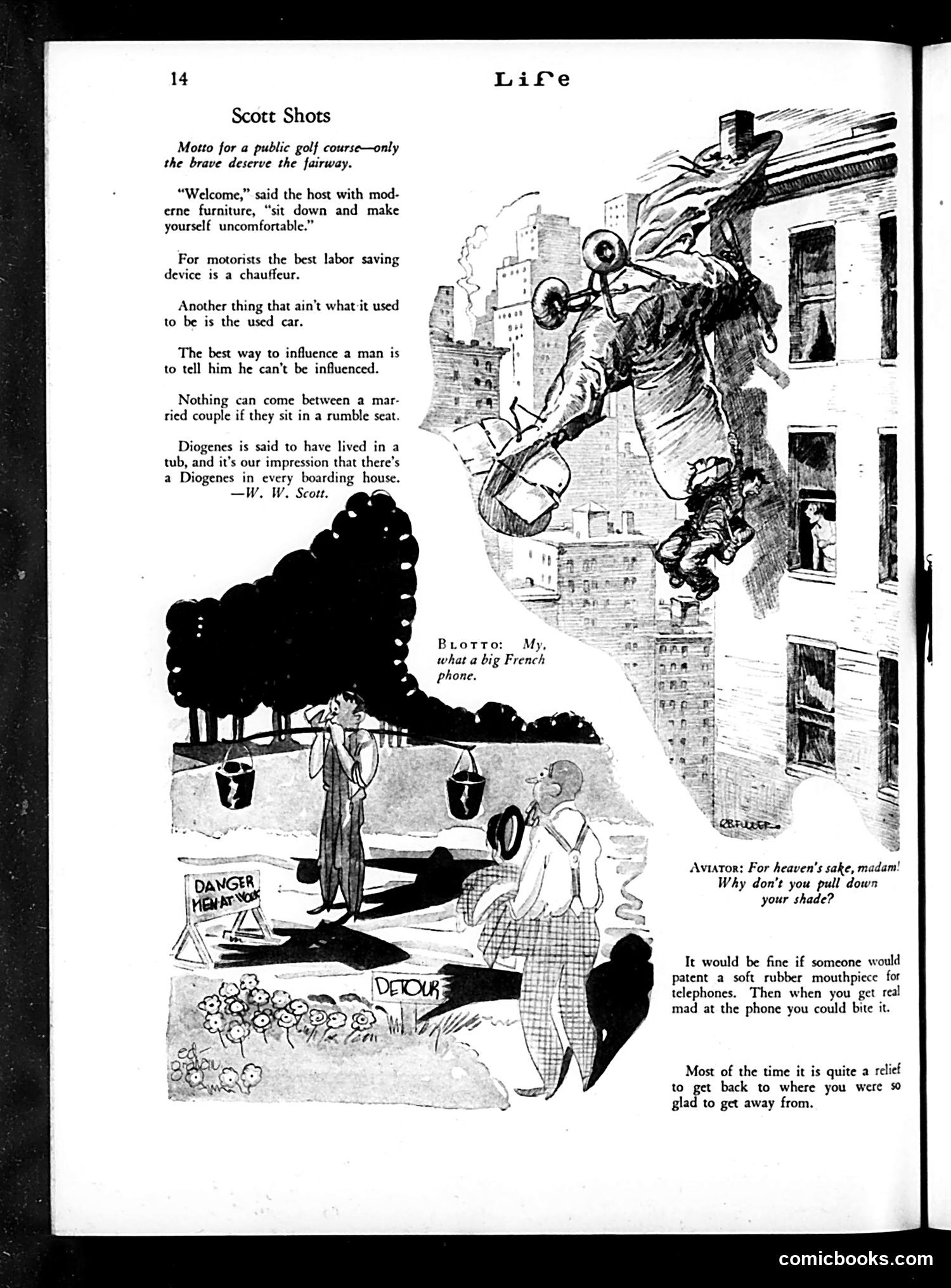
Scott Shots — Life Magazine Humor Page This page collects brief satirical observations and two cartoons by Scott (the cartoonist's signature appears on the building cartoon). Top cartoon: Shows an airplane crash into an apartment building with the caption "My, what a big French phone." The joke targets the absurdly large size of early French telephones—a period complaint about French telephone design. Bottom cartoon: Depicts a woman at a dangerous road construction site with signs reading "Danger," "Detour," and "Highway Work." The aviator above quips "Why don't you pull down your shade?" The satire mocks both reckless women drivers of the era and the impracticality of driving with window shades. The scattered aphorisms above (about golf courses, chauffers, used cars) are typical Life magazine witticisms—brief social commentary on 1920s-era leisure and consumer culture.
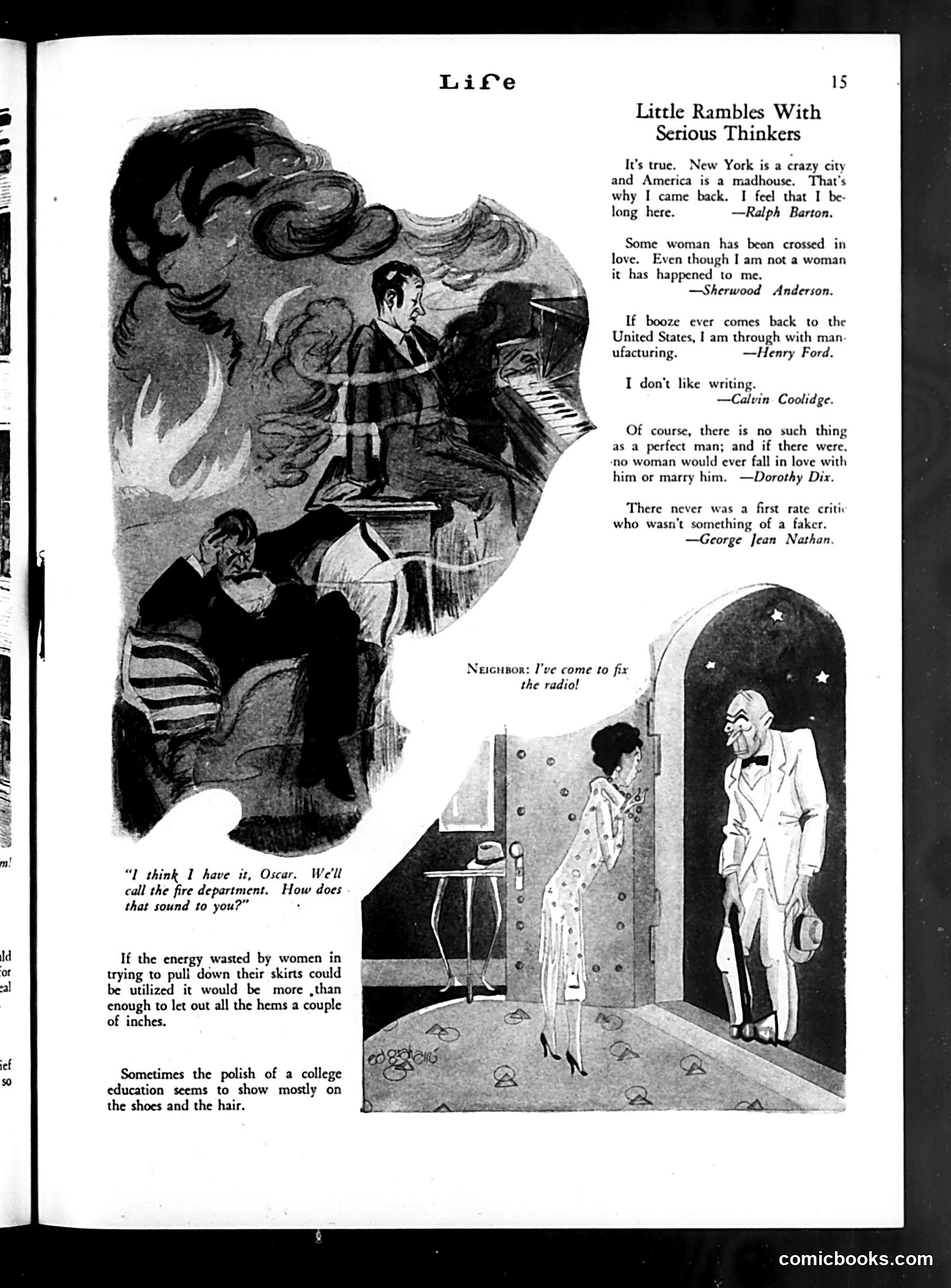
Analysis This page from *Life* magazine presents satirical commentary on contemporary figures and social mores. The top section features quotes from notable Americans (Ralph Barton, Sherwood Anderson, Henry Ford, Calvin Coolidge, Dorothy Dix, and George Jean Nathan) offering sardonic observations about love, writing, and human nature. The lower cartoon depicts a domestic scene where a woman tells a neighbor, "I've come to fix the radio," while a man in formal attire appears at a doorway. The implication is a double entendre about infidelity or impropriety masked by a mundane excuse. The accompanying text satirizes women's fashion and college education, employing the era's characteristic misogynistic humor typical of 1920s-30s *Life* magazine—mocking women's appearance and intellectual development.
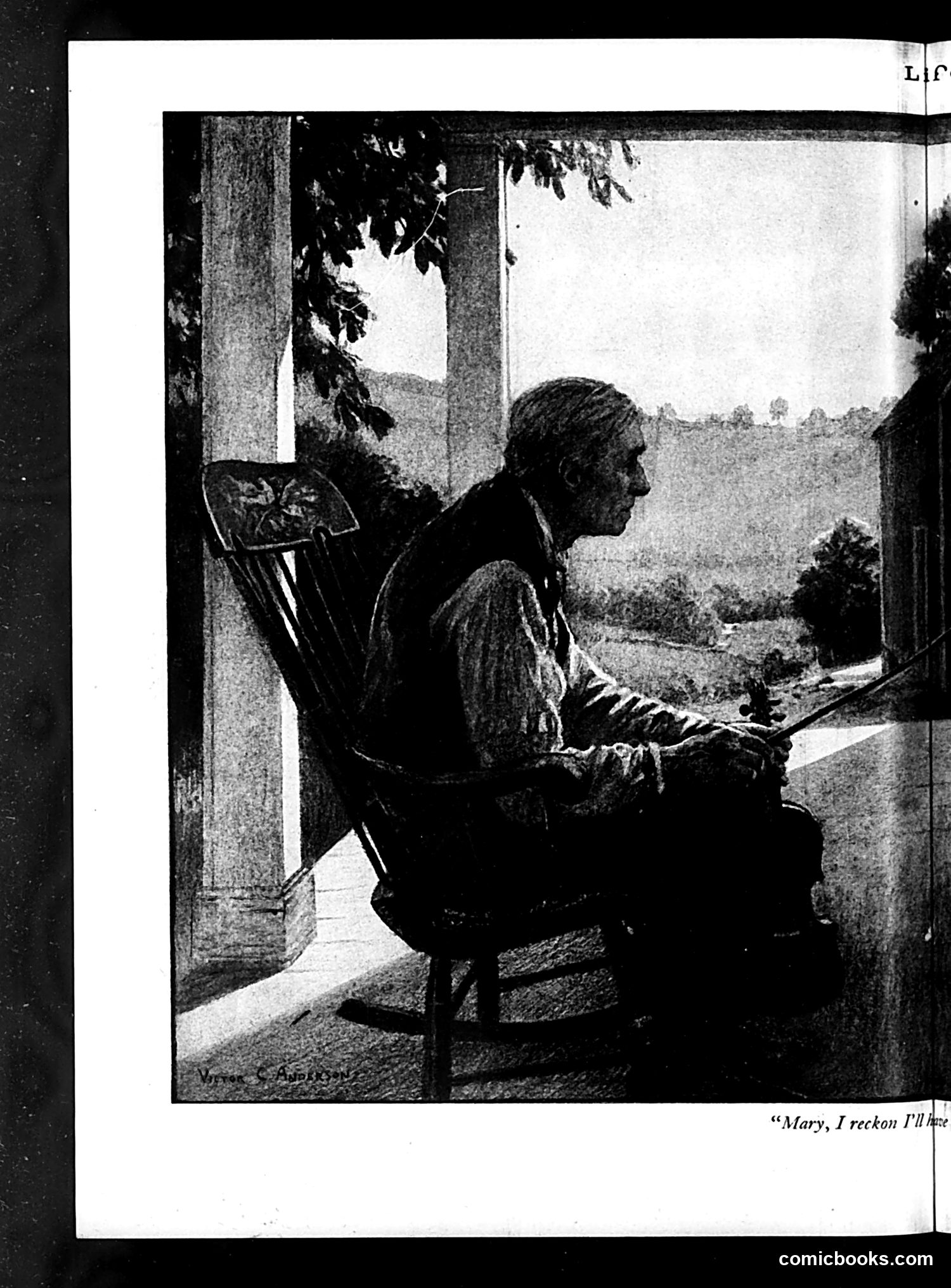
Analysis This appears to be a dramatic scene from an early 20th-century Life magazine illustration. The image shows a man in formal attire sitting by a window, gazing out at a rural landscape. The caption reads "Mary, I reckon I'll h..." (text is cut off). The illustration appears to be from a serialized story or dramatic piece rather than political satire. The style and composition—the interior domestic setting, the contemplative pose, the romantic landscape vista—suggests this depicts a personal or romantic moment, likely showing a character making a significant life decision or confession to someone named Mary. Without the complete caption and surrounding text, the specific narrative context and satirical point (if any) remain unclear. The artistic signature is partially visible but illegible.
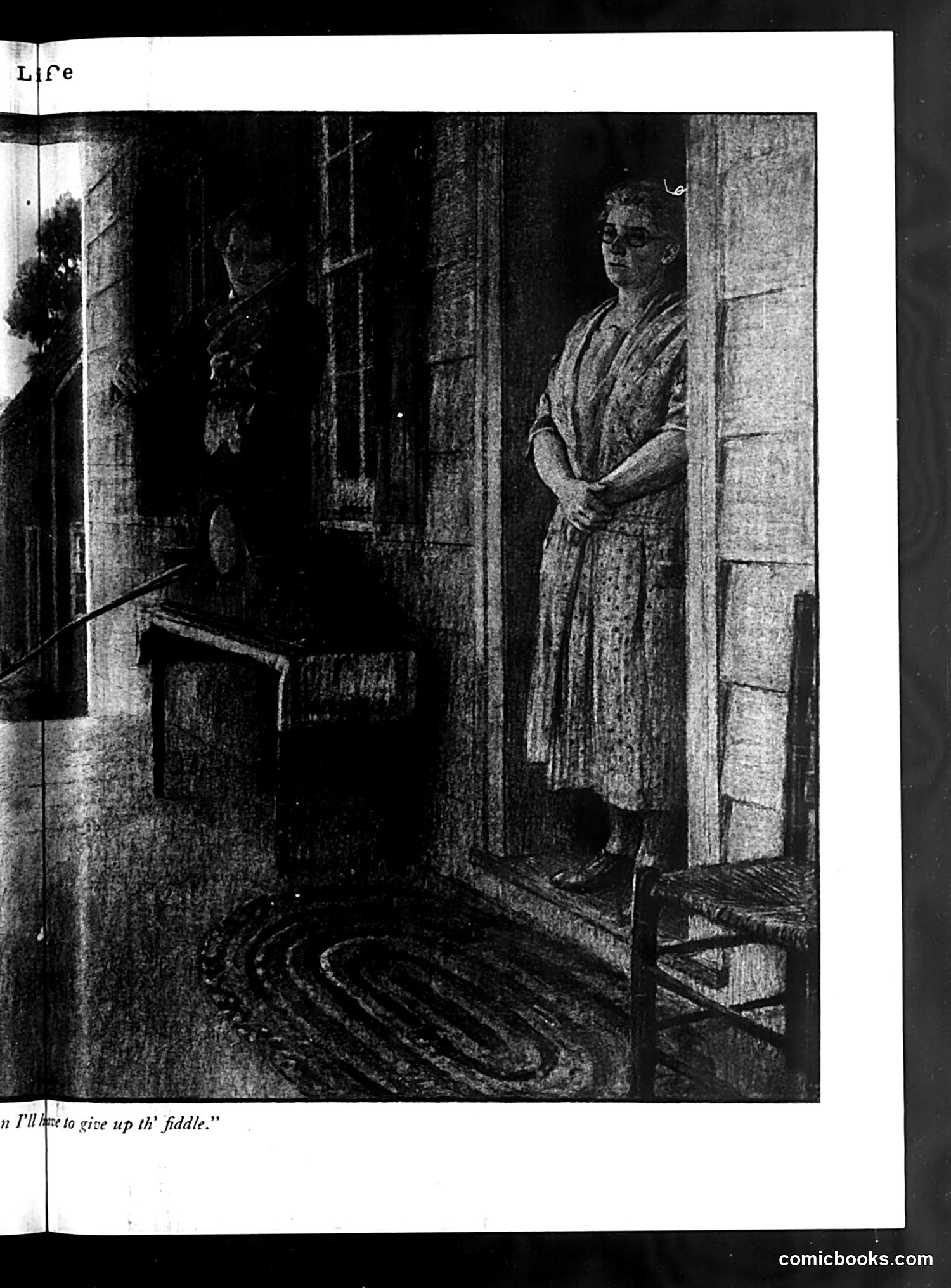
Analysis This appears to be a scene from a humorous domestic illustration or comic strip from *Life* magazine. The visible caption reads: "n I'll 'ave to give up th' fiddle." The image shows a woman in a robe standing in a modest interior space, seemingly addressing someone off-camera. The caption suggests a working-class or lower-middle-class domestic scenario where financial hardship forces someone to give up playing the fiddle—likely a hobby or source of modest income. The humor appears to play on the tension between artistic pursuits and economic necessity. The phrase "I'll 'ave to give up th' fiddle" uses colloquial speech patterns typical of early-to-mid 20th century satire, suggesting the subject is economically strained. Without additional context, the specific satirical target remains unclear.
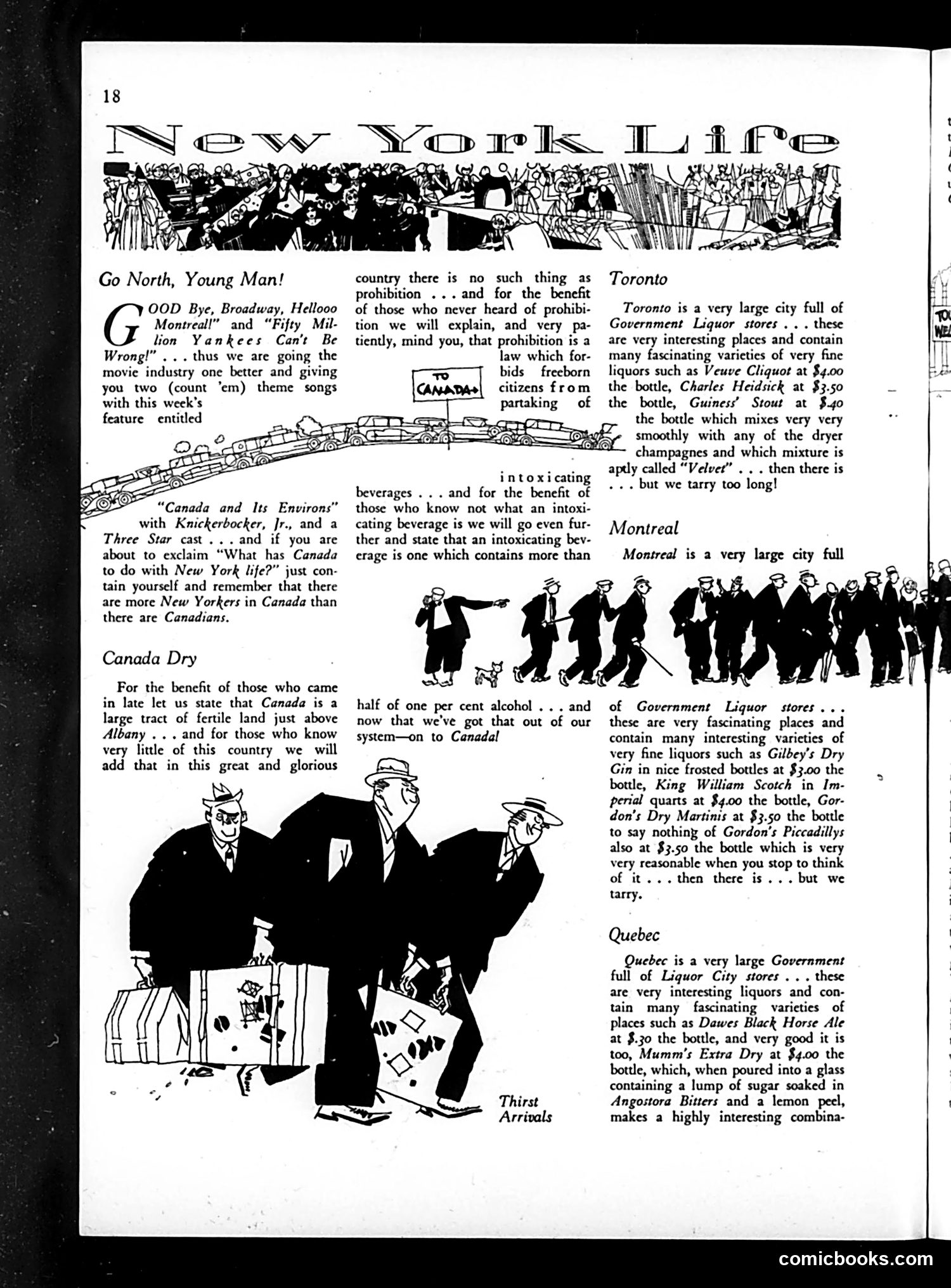
Context for Modern Readers This 1920s *Life* magazine page satirizes American Prohibition and Canadian alcohol tourism. The headline "Go North, Young Man!" encourages Americans to visit Canada, where alcohol remained legal after the U.S. banned it in 1920. The cartoon "Thirst Arrivals" depicts three men in suits arriving with luggage, humorously suggesting Americans were immigrating to Canada primarily to drink. The detailed descriptions of Canadian and Quebec liquor brands and Government Liquor stores mock how Americans flocked north to purchase legal alcohol. The satire targets Prohibition's failure: rather than eliminating drinking, it simply redirected American consumers across the border. The piece presents this as an absurd consequence of American "dry" laws, contrasting with Canada's continued alcohol availability.
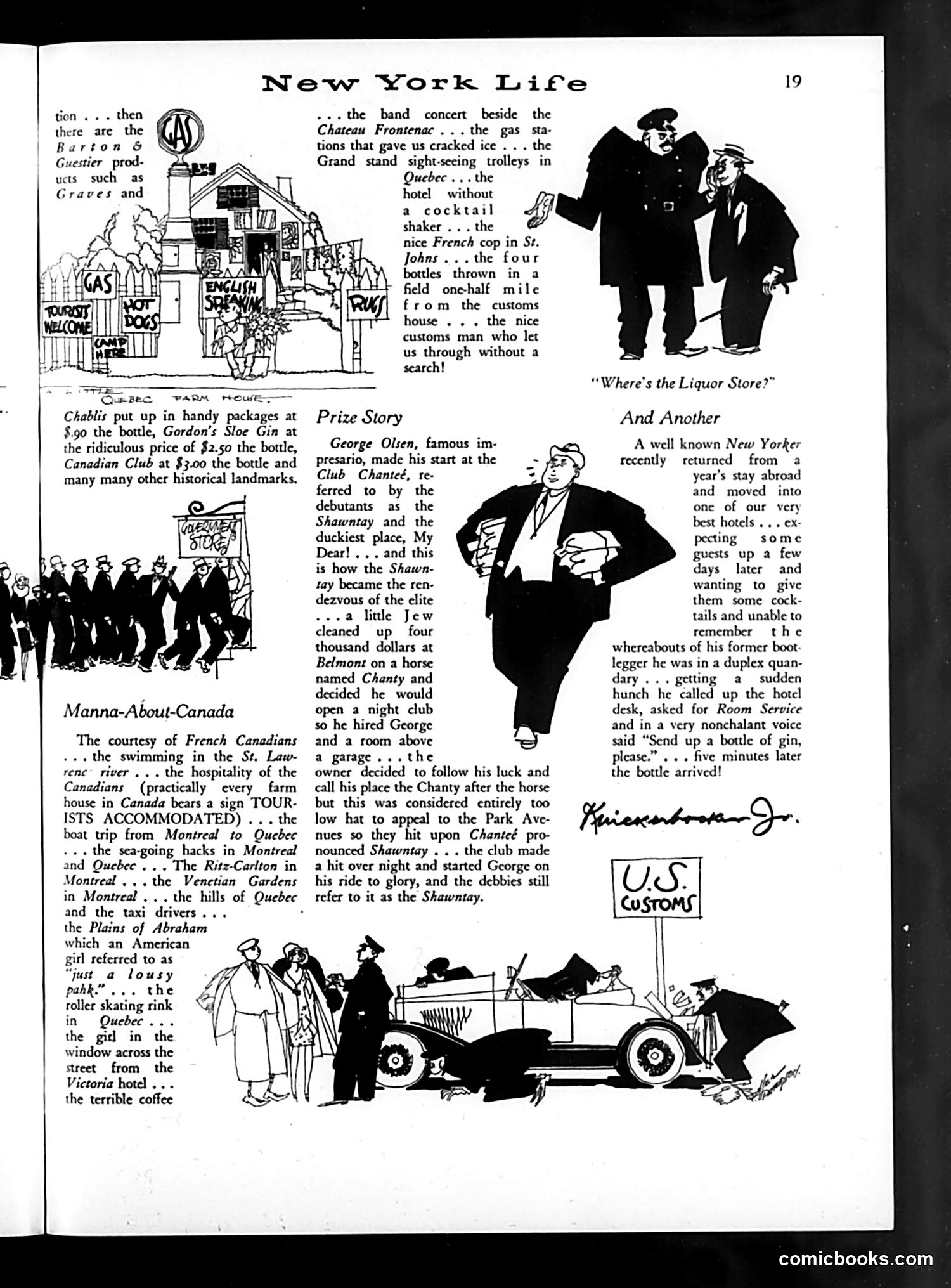
Prohibition-Era Satire in Life Magazine This page satirizes American tourists' experiences in Canada during Prohibition, when alcohol was illegal in the U.S. but legal in Canada. The Main Jokes: The top section humorously catalogs Canadian attractions—actually just excuses to smuggle liquor back: overpriced gin bottles, customs officials, and the "nice customs man" who didn't search them. "Prize Story" mocks how a speakeasy got a fancy French name. A Jewish gambler won money on a horse named "Chanty," opened a night club with that name, but Park Avenue debutantes wouldn't go somewhere so common—so it became "Chanteé" (pronounced "Shawntay"), and suddenly became the elite's favorite spot. "And Another" jokes about a returning New Yorker so accustomed to ordering bootleg gin from his former illegal supplier that he casually asks his hotel's room service for gin—and it arrives, suggesting hotels openly served alcohol despite Prohibition's official ban. The satire targets both Americans' desperation for alcohol and the hypocrisy of Prohibition enforcement.
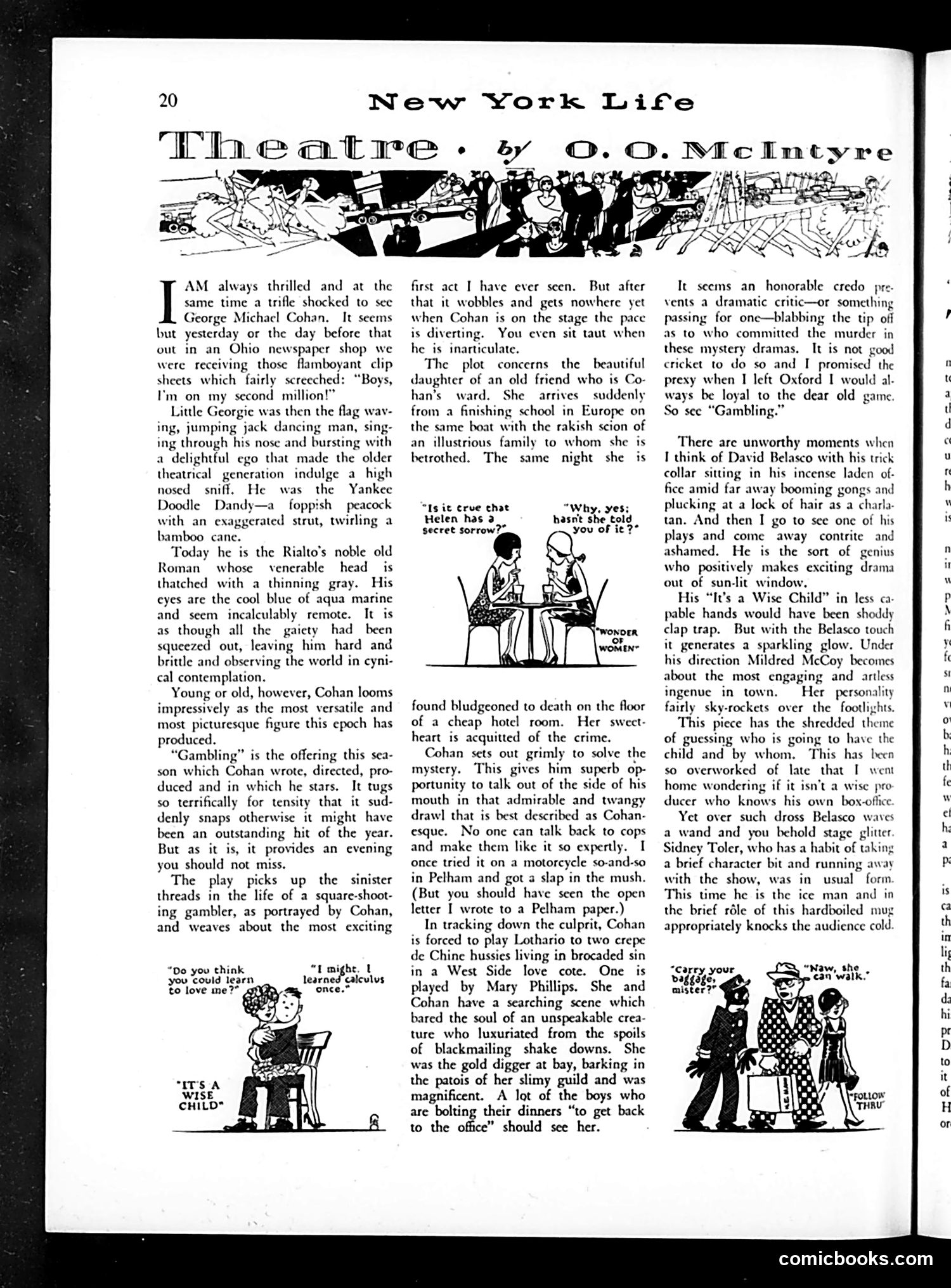
Theatre Review: George M. Cohan's "Gambling" This is O.O. McIntyre's theatre review of George M. Cohan's play "Gambling." The piece contrasts Cohan's transformation from his earlier incarnation as an egotistical, vaudeville "Yankee Doodle Dandy" performer (flagged by the OCR'd reference to his boastful newspaper clippings: "I'm on my second million!") to his current persona as a seasoned, cynical Broadway figure. The review praises Cohan's versatility and the play's first act while criticizing its later wobbliness. McIntyre highlights strong supporting performances, particularly Mary Phillips as a blackmailer character. The cartoons humorously illustrate theatrical tropes—romantic dialogue about learning to love, and the theatrical world's culture of rushing back to offices after dinner.
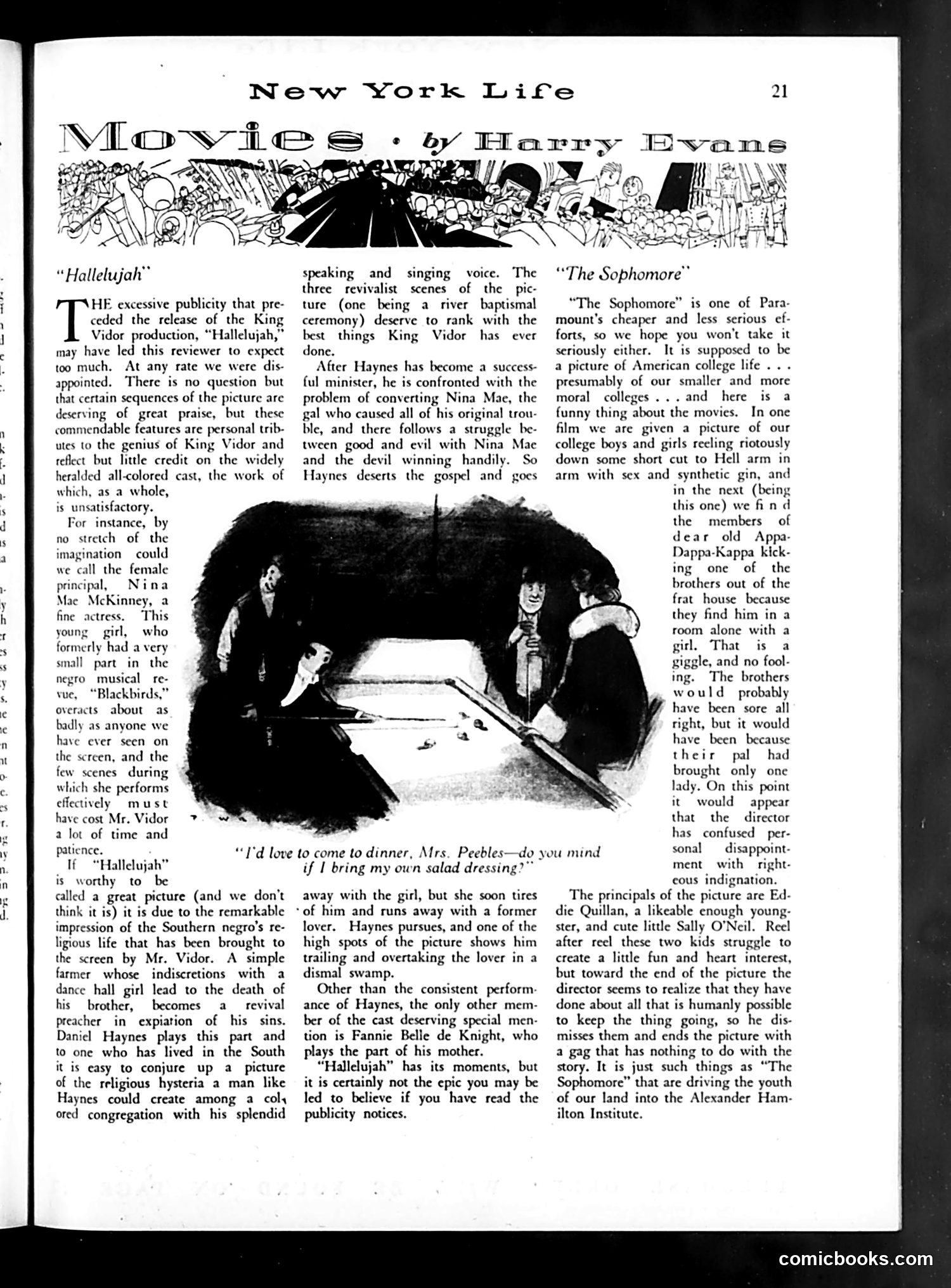
Analysis of This 1929 Film Review Page This page reviews two films by Harry Evans for *New York Life* magazine. The main content is a movie review, not a political cartoon. "Hallelujah" (King Vidor's 1929 film) is criticized despite praise for Vidor's direction and actor Daniel Haynes's performance. The reviewer dismisses the film's female lead, Nina Mae McKinney, as overacting badly. The plot involves a Southern farmer-turned-revival-preacher and his moral struggle with a temptress. The review's language reflects period attitudes: it describes the film's value as capturing "the Southern negro's religious life" and "religious hysteria," using terminology typical of 1920s film criticism but jarring to modern readers. "The Sophomore" is a college comedy about fraternity morality standards. The single illustration shows a dinner party scene with the caption about bringing "salad dressing"—likely a mild innuendo joke typical of era humor. The page represents straightforward film criticism from the Jazz Age, not satire. Its racial language and assumptions reveal historical attitudes about Black representation in cinema.
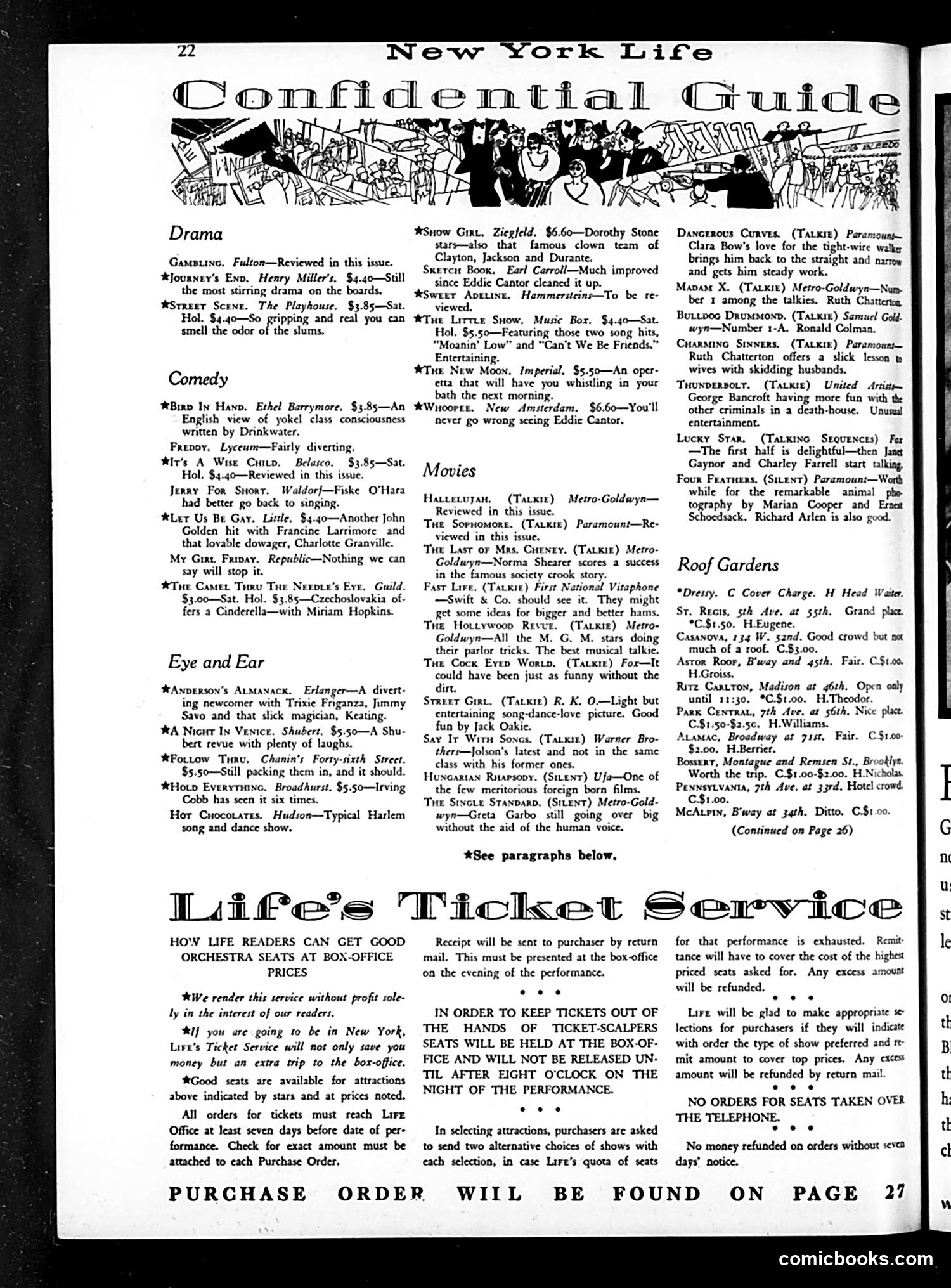
New York Life Confidential Guide - Page Content Explanation This page is primarily a theater and entertainment listing guide for New York City audiences, not a political cartoon. It contains: Drama/Comedy/Movies sections: Reviews and advertisements for Broadway shows and films, with ticket prices and brief critiques. Notable references include Eddie Cantor (performer in multiple productions), Greta Garbo, and Clara Bow—major entertainment figures of the era. Key context for modern readers: The asterisks (*) mark shows Life magazine recommends. The repeated notation "(TALKIE)" indicates sound films—still a novelty in this period. Some reviews contain period humor: one dismisses a performer saying "had better go back to singing," while another quips that a show "could have been just as funny without the dirt." Life's Ticket Service section: Explains how readers could purchase theater tickets through the magazine, avoiding scalpers—a consumer service for affluent readers. This is essentially an entertainment guide page, not satirical content requiring political/historical context.
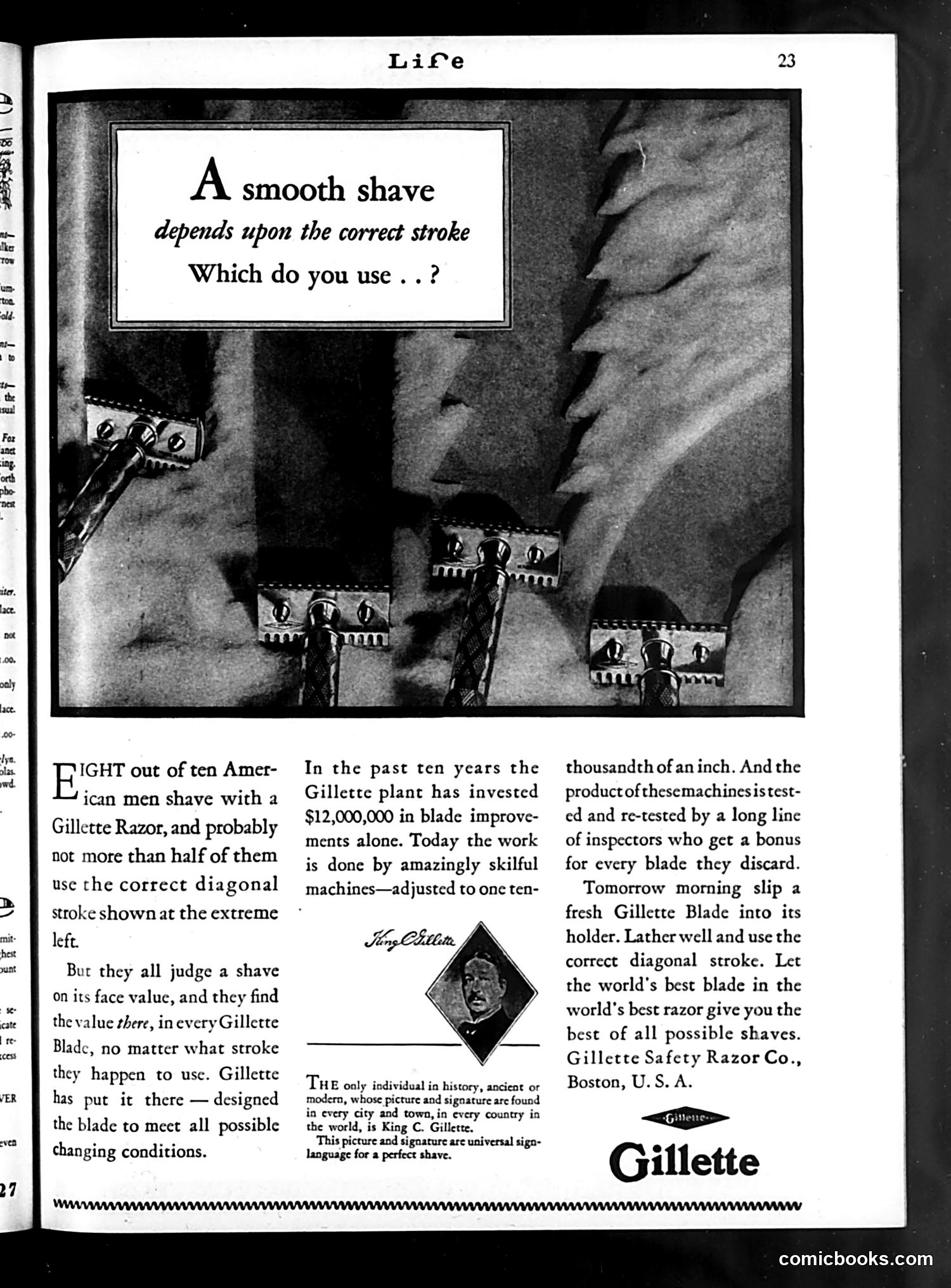
Gillette Safety Razor Advertisement This is a product advertisement, not satire or political commentary. The page promotes Gillette Safety Razors to male readers of *Life* magazine. The ad uses three shaving techniques photographed on men's faces to demonstrate the "correct diagonal stroke" for achieving a smooth shave. The central claim is that while most men don't use proper technique, Gillette blades are engineered so well ($12 million invested in improvements) that they work regardless of stroke—suggesting product superiority. The sidebar celebrates King C. Gillette (the razor's founder) as "the only individual in history" whose image appears worldwide, treating his signature as "universal sign-language for a perfect shave." This is marketing hyperbole positioning Gillette as globally iconic. For modern readers: this represents early 20th-century corporate advertising emphasizing manufacturing precision and technological investment as guarantees of quality—a common sales pitch in that era.
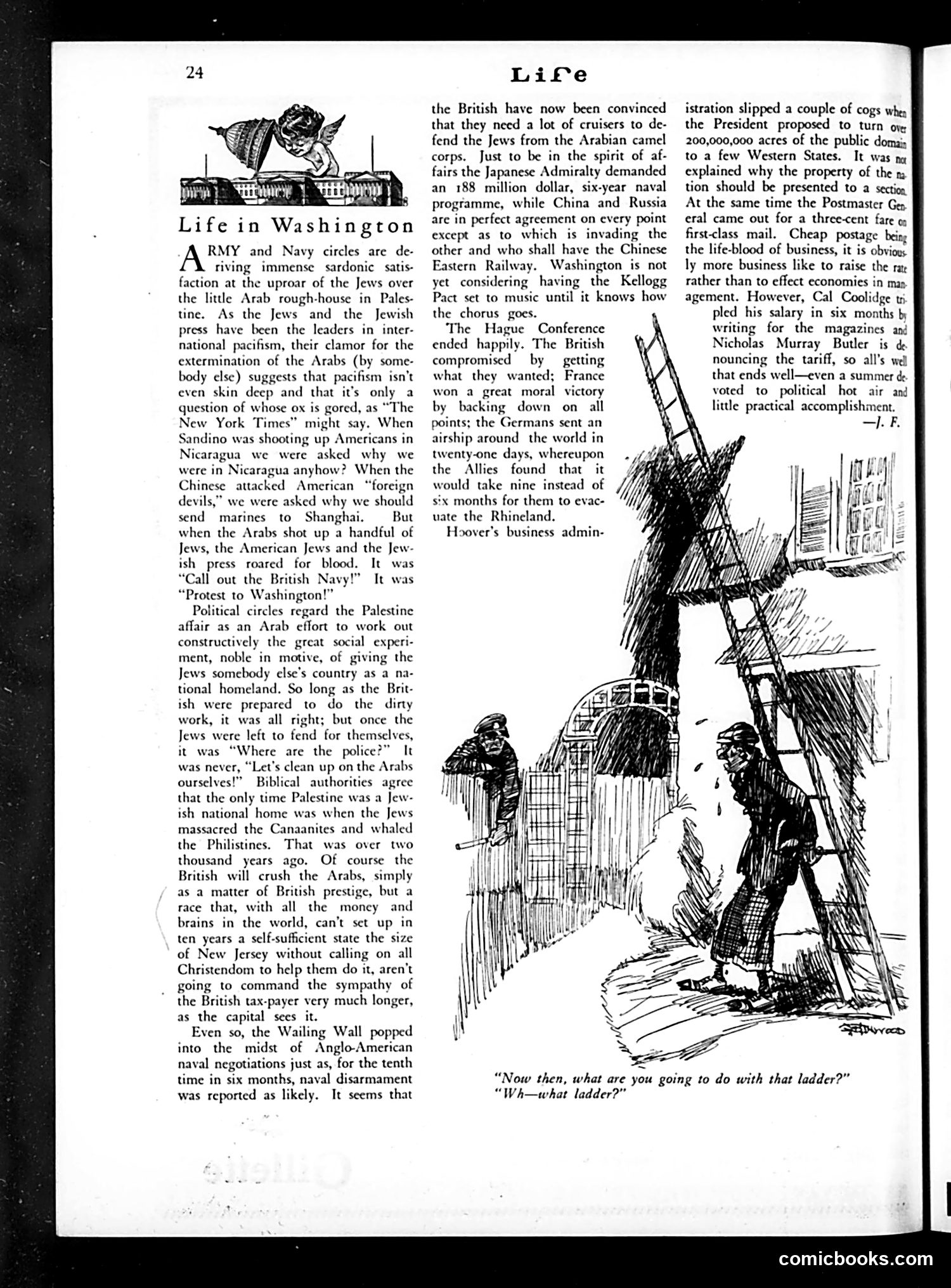
Analysis of Life Magazine Page This page from *Life* magazine satirizes contemporary political tensions, particularly regarding the Palestine conflict and its ripple effects on international relations. The main column "Life in Washington" critiques Jewish advocacy for military intervention in Palestine while historically championing pacifism. The author argues this hypocrisy undermines credibility—Jews demand British Navy protection against Arabs but previously opposed American military interventions elsewhere (Nicaragua, Shanghai, China). The piece mocks the broader situation: Britain will suppress the Arabs to maintain prestige; Jewish leaders can't establish a functional state without Christian assistance; and the Palestine crisis conveniently disrupts Anglo-American naval disarmament talks (already contentious with Japan and Germany demanding military expansion). The accompanying cartoon shows someone confused about what to do with a ladder—likely referencing bureaucratic incompetence, possibly related to Hoover's administration's mishandling of public land proposals mentioned in the text. The satire targets hypocrisy, imperial cynicism, and how regional conflicts destabilize international negotiations.
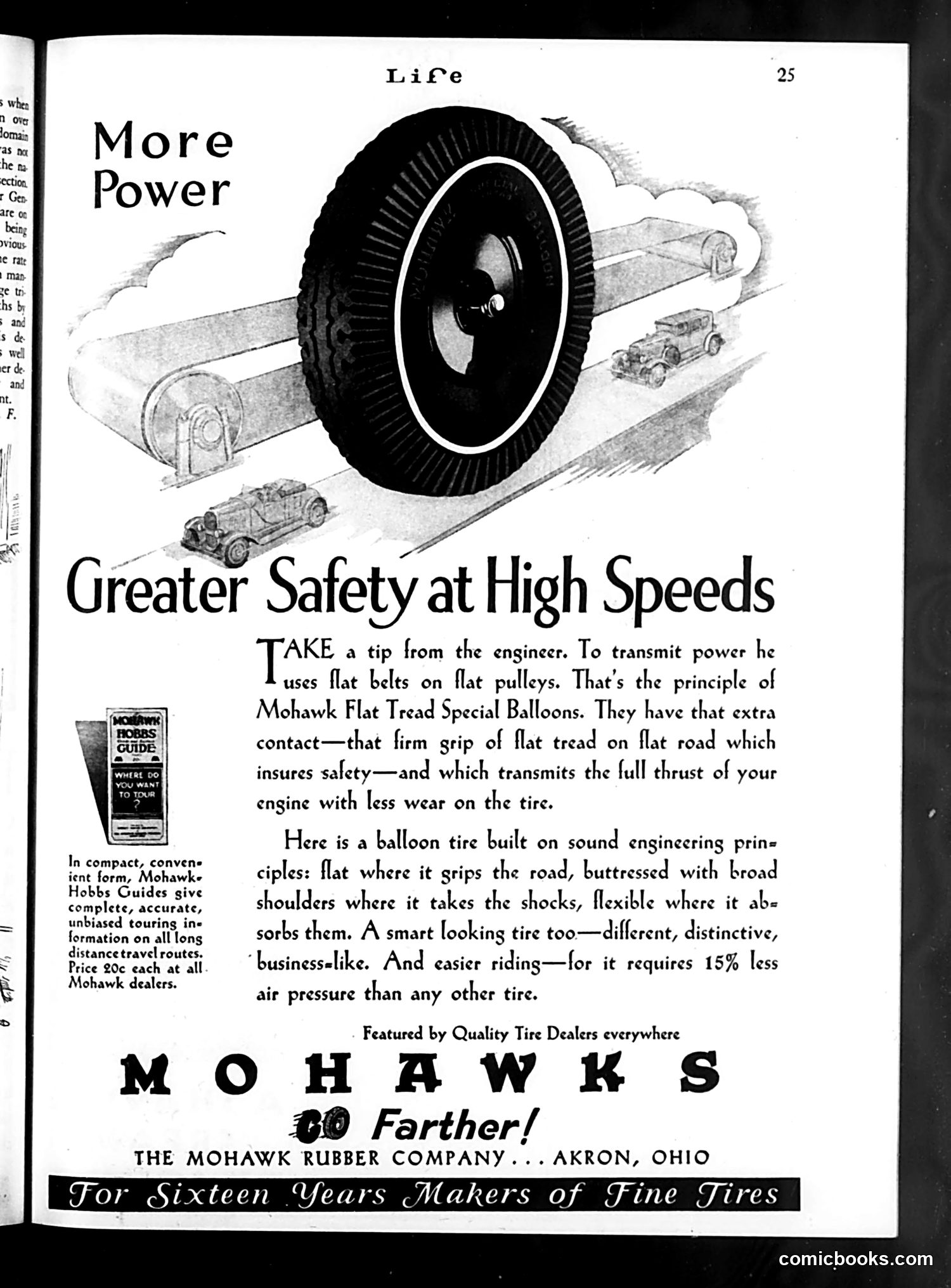
Mohawk Tire Advertisement (Life Magazine) This is a tire advertisement, not political satire. The Mohawk Rubber Company uses an engineering analogy to market their "Flat Tread Special Balloons" tires. The ad compares tire design to industrial power transmission: just as engineers use flat belts on flat pulleys to efficiently transmit power, Mohawk tires use flat tread on flat road surfaces for better grip and safety at high speeds. The illustration shows a large tire dominating the page, with automobiles on a road below—emphasizing the tire's role in vehicle performance. Key selling points highlighted: superior safety, reduced air pressure requirements (15% less than competitors), distinctive appearance, and easier riding. The ad notes these tires were "Featured by Quality Tire Dealers everywhere" and that Mohawk had been "Makers of Fine Tires" for sixteen years. This represents early automotive-era advertising (likely 1920s-1930s) emphasizing safety innovations for cars at increasing highway speeds.
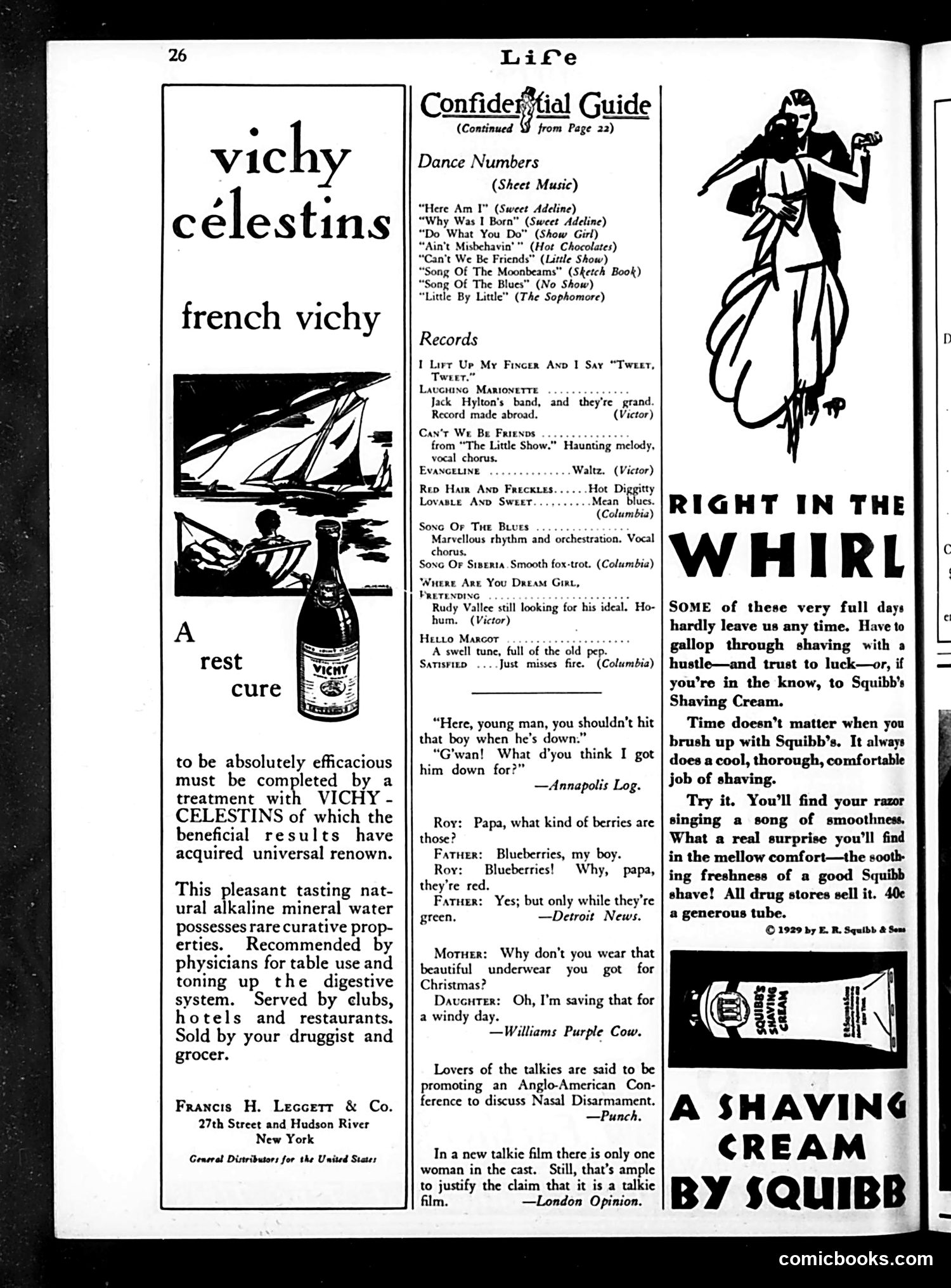
Life Magazine Page Analysis This page is primarily advertising and entertainment content from circa 1929, not political satire. Left side: Advertisement for Vichy Celestins mineral water, a French spa product marketed as a digestive tonic—typical patent medicine marketing of the era. Center: "Confidential Guide" listing popular sheet music and phonograph records, reflecting 1920s entertainment hits (Rudy Vallée, Jack Hylton's band). Below are brief humorous anecdotes—a Naval Academy joke about fighting, a child's logic about blueberries, and a quip about saving underwear for windy weather. These are mild, family-friendly gags typical of the period's humor magazines. Right side: Advertisement for Squibb's Shaving Cream, emphasizing convenience for busy modern life. The page reflects 1920s consumer culture: commercial products marketed as solutions to contemporary life's pace, popular entertainment of the moment, and gentle domestic humor. There is no political commentary visible.
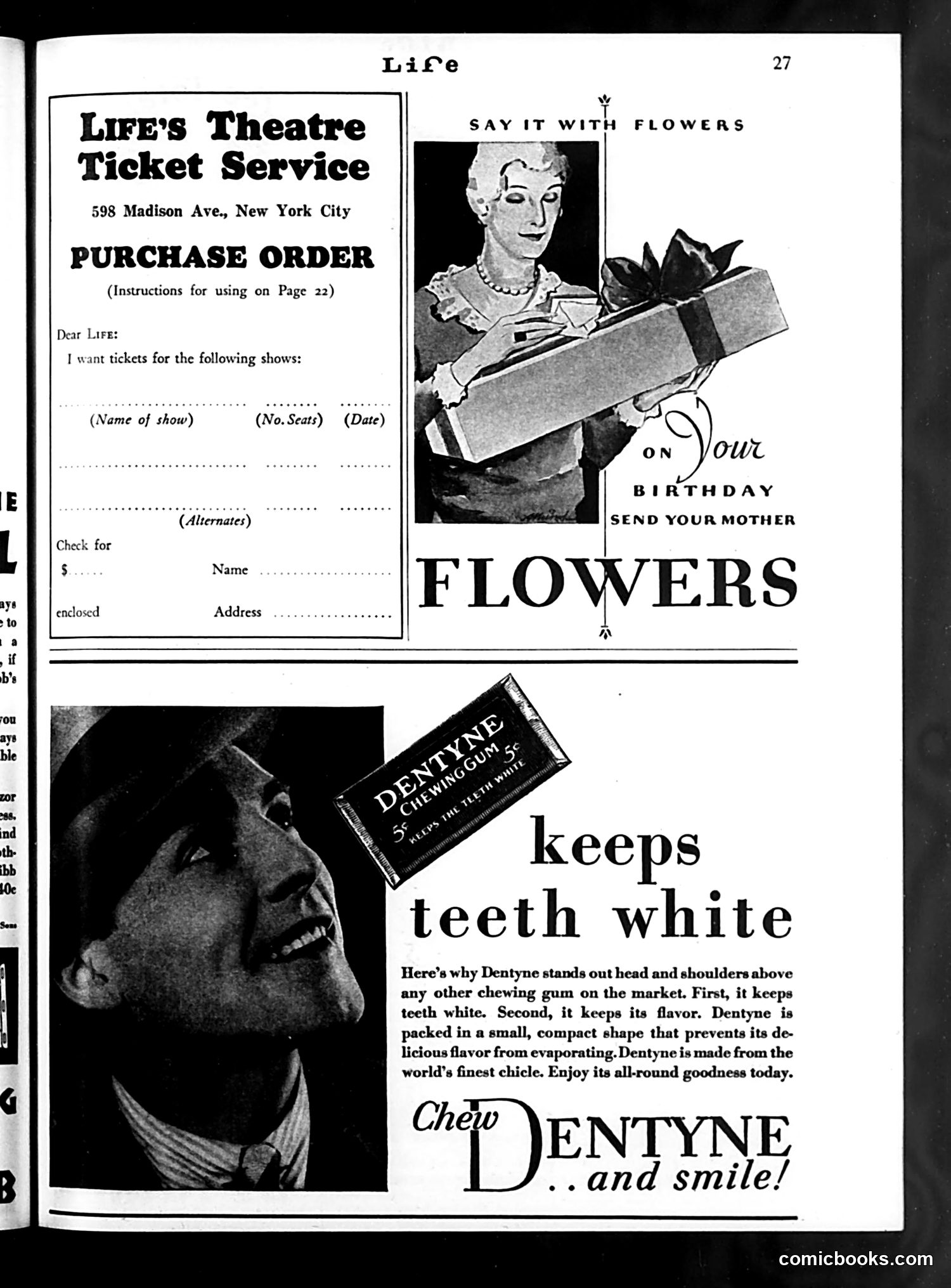
Analysis of Life Magazine Page 27 This page is primarily advertising and service features, not political satire. Content breakdown: 1. Theater Ticket Service (left): A practical mail-order form for purchasing Broadway tickets through Life magazine—a common service magazines offered readers. 2. "Say It With Flowers" (top right): A flower delivery advertisement encouraging readers to send mothers birthday flowers, playing on the period's gift-giving conventions. 3. Dentyne Chewing Gum (bottom): A product advertisement featuring a smiling man's face with the tagline "keeps teeth white...and smile!" The ad emphasizes that Dentyne prevents tooth discoloration and maintains flavor better than competitors. Historical context for modern readers: This reflects 1930s-40s consumer culture where magazines bundled editorial content with advertising. The flower ad plays on traditional gender roles (mothers as gift recipients), while the gum ad uses tooth whiteness—then marketed as a beauty/health benefit—as a key selling point, a common advertising strategy of the era.
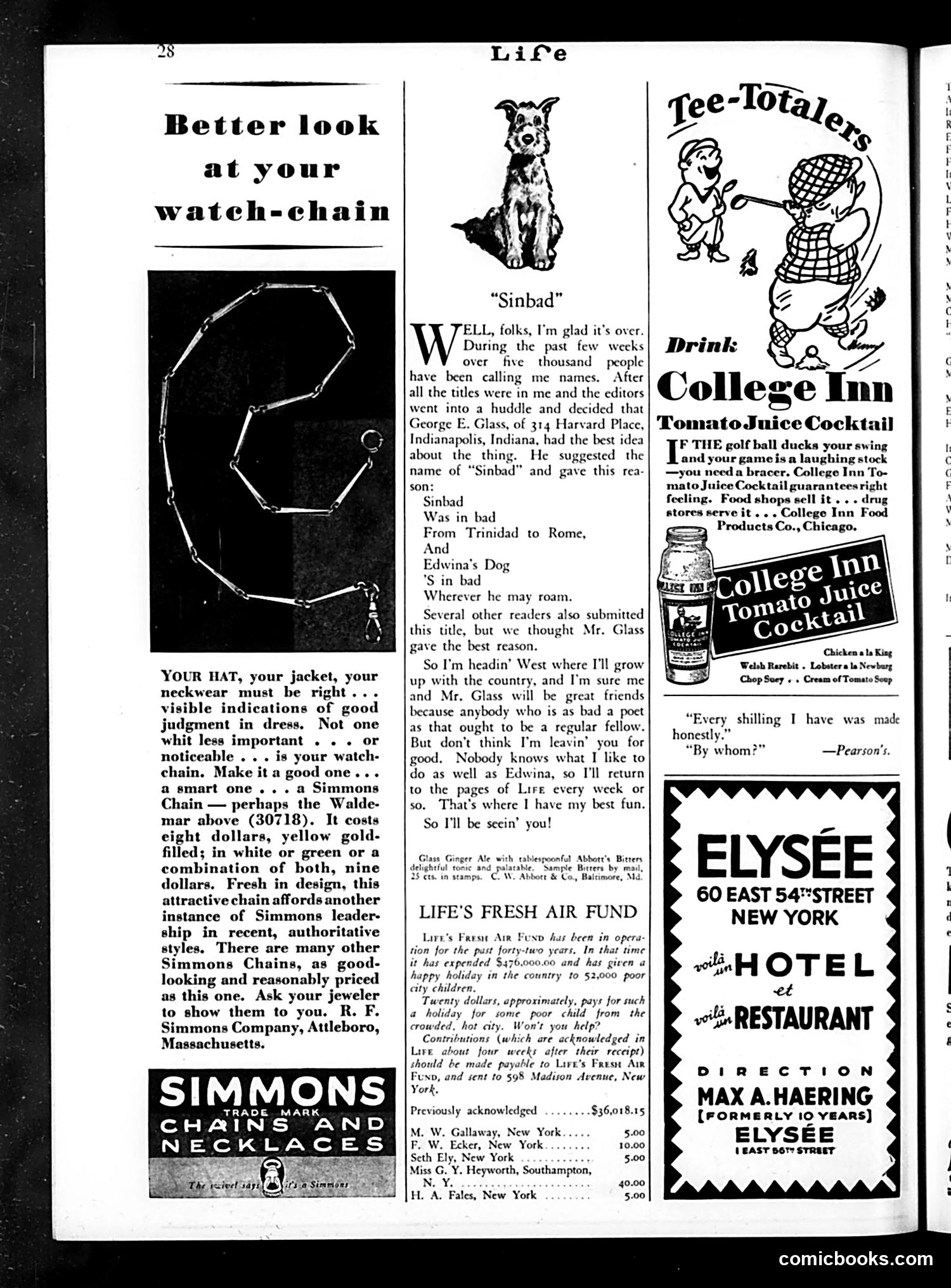
Explanation for Modern Readers This page is primarily advertising with one editorial feature. The main content is a farewell letter from "Sinbad," a recurring cartoon character in Life magazine. The editors announced a contest to name the character; George E. Glass of Indianapolis won by suggesting "Sinbad," justified with a rhyme about being "in bad" from Trinidad to Rome. Sinbad is departing the magazine to "head West" but promises occasional returns. The character appears to have been a comic strip or regular illustrated feature, though no actual cartoon is visible here. The page otherwise contains advertisements for Simmons watch chains (emphasizing accessories as markers of good taste), College Inn tomato juice cocktails, the Elysée Hotel in New York, and details about Life's Fresh Air Fund—a legitimate charitable effort providing country holidays for poor urban children. The tone is lighthearted and typical of early 20th-century magazine humor and philanthropy appeals.
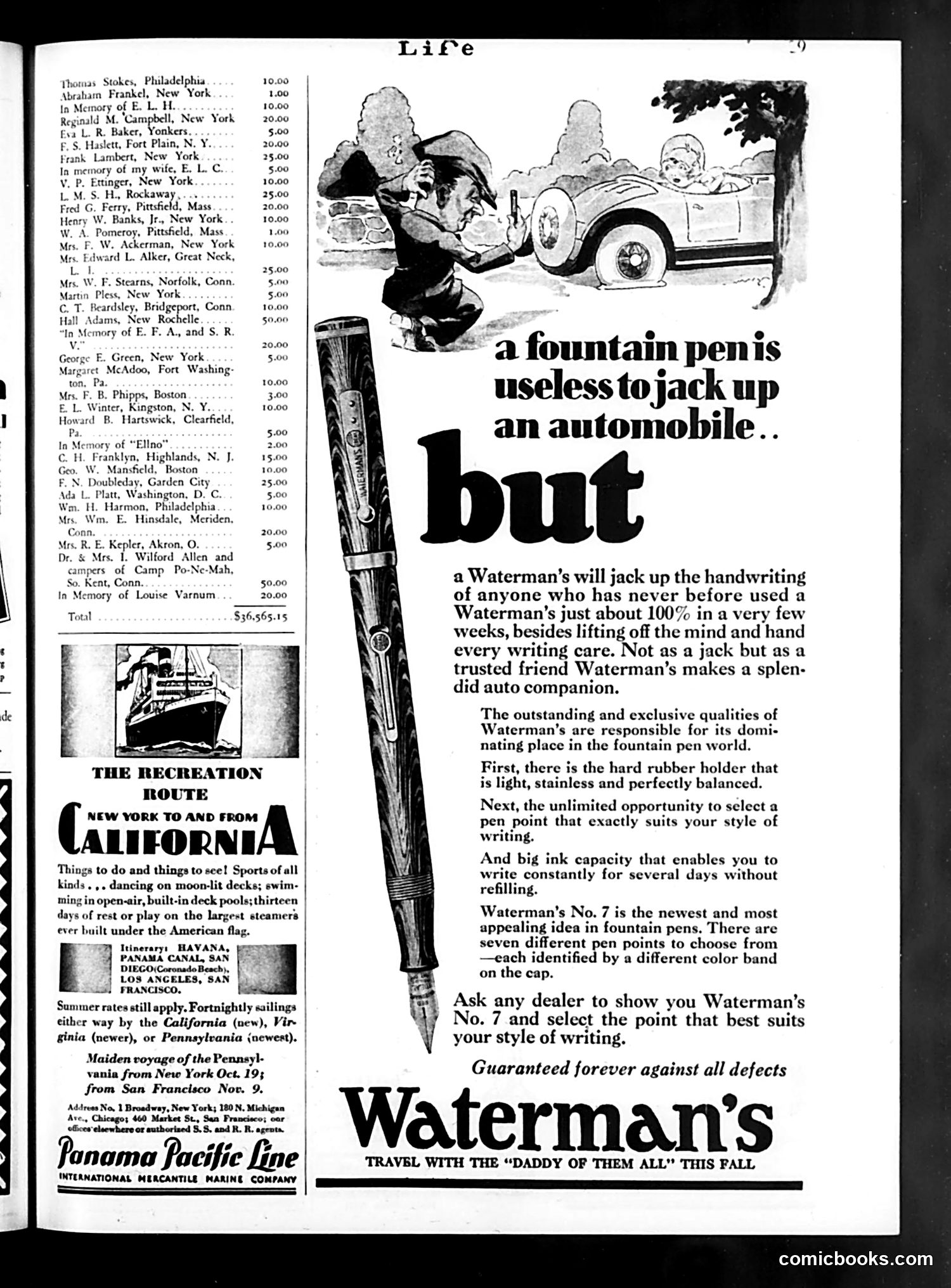
Analysis of Life Magazine Page This page is primarily advertising and donation listings, not political satire. The main content features a Waterman's fountain pen advertisement using car-repair humor. The ad shows a man crouching beside an automobile with the headline: "a fountain pen is useless to jack up an automobile...but a Waterman's will jack up the handwriting of anyone who has never before used a Waterman's." The joke plays on "jacking up"—literally lifting a car for repairs versus metaphorically improving someone's penmanship. It's straightforward product marketing with a visual pun, not social commentary. The page also includes a Panama Pacific Line cruise advertisement promoting California travel routes via steamship, and a donations list (likely for a charitable cause), though the beneficiary isn't specified here. This is commercial content typical of 1920s magazine publishing—advertising subsidized editorial content. There is no political cartoon or satire to analyze.
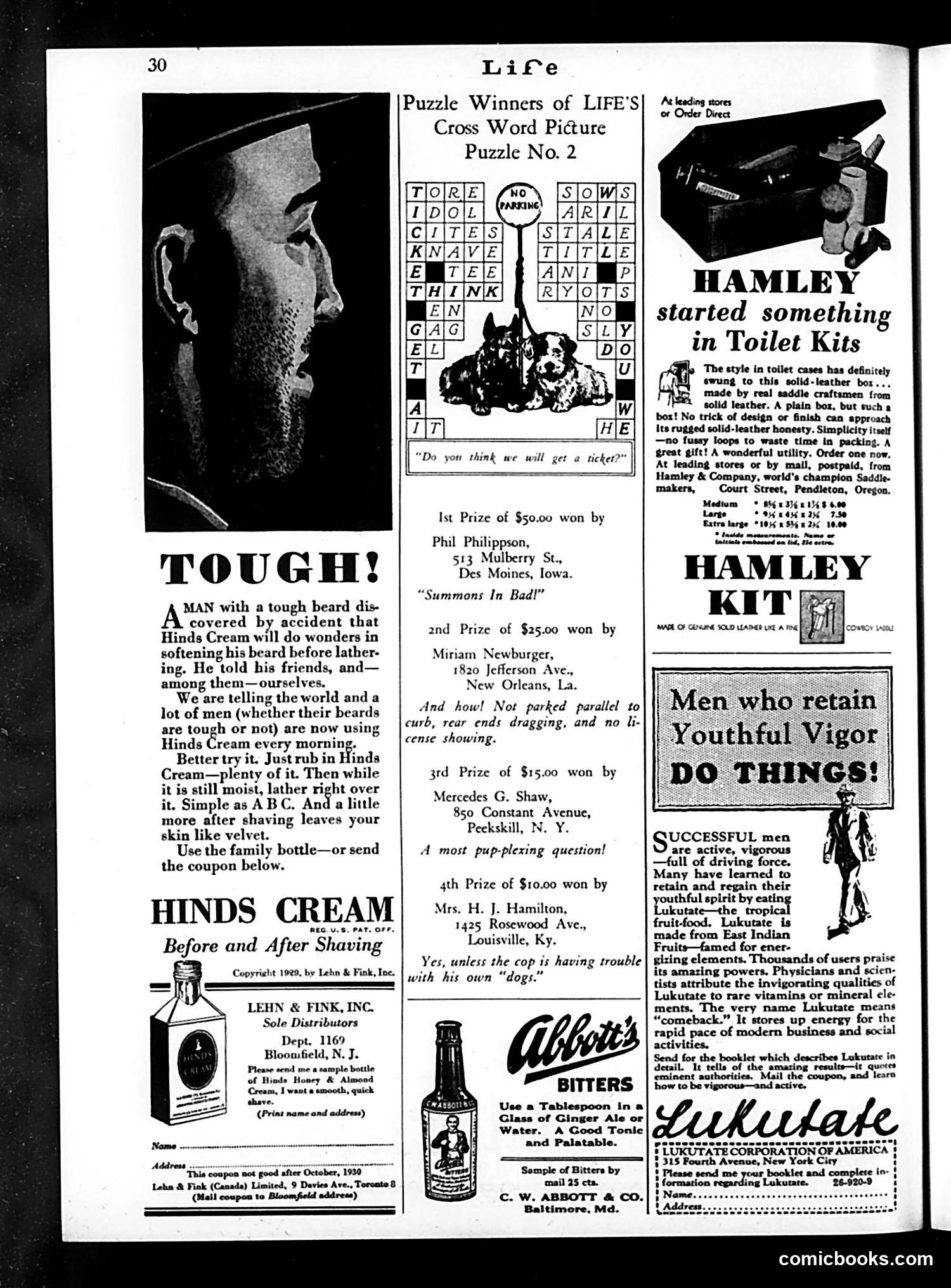
Life Magazine Page Analysis This page from Life magazine (circa 1929) is primarily advertising with a puzzle section, rather than editorial satire. The main content includes: Puzzle Section: Winners of Life's crossword puzzle are announced with their answers—mostly puns about traffic violations and police ("Summons In Bad!", "A most pup-pleasing question"). Advertisements: The page showcases period grooming and health products: - Hinds Cream: A shaving cream marketed to men with tough beards - Hamley Kit: Solid-leather toilet kits made by saddle craftsmen in Oregon - Abbott's Bitters: A medicinal tonic - Lukutate: A tropical fruit supplement claiming to restore "youthful vigor" and energy No political cartoons appear. The visual humor is limited to the puzzle's dog illustration and the generic advertisements typical of 1920s-30s magazines. The page reflects contemporary consumer culture and advertising tropes targeting masculine self-improvement and vitality.
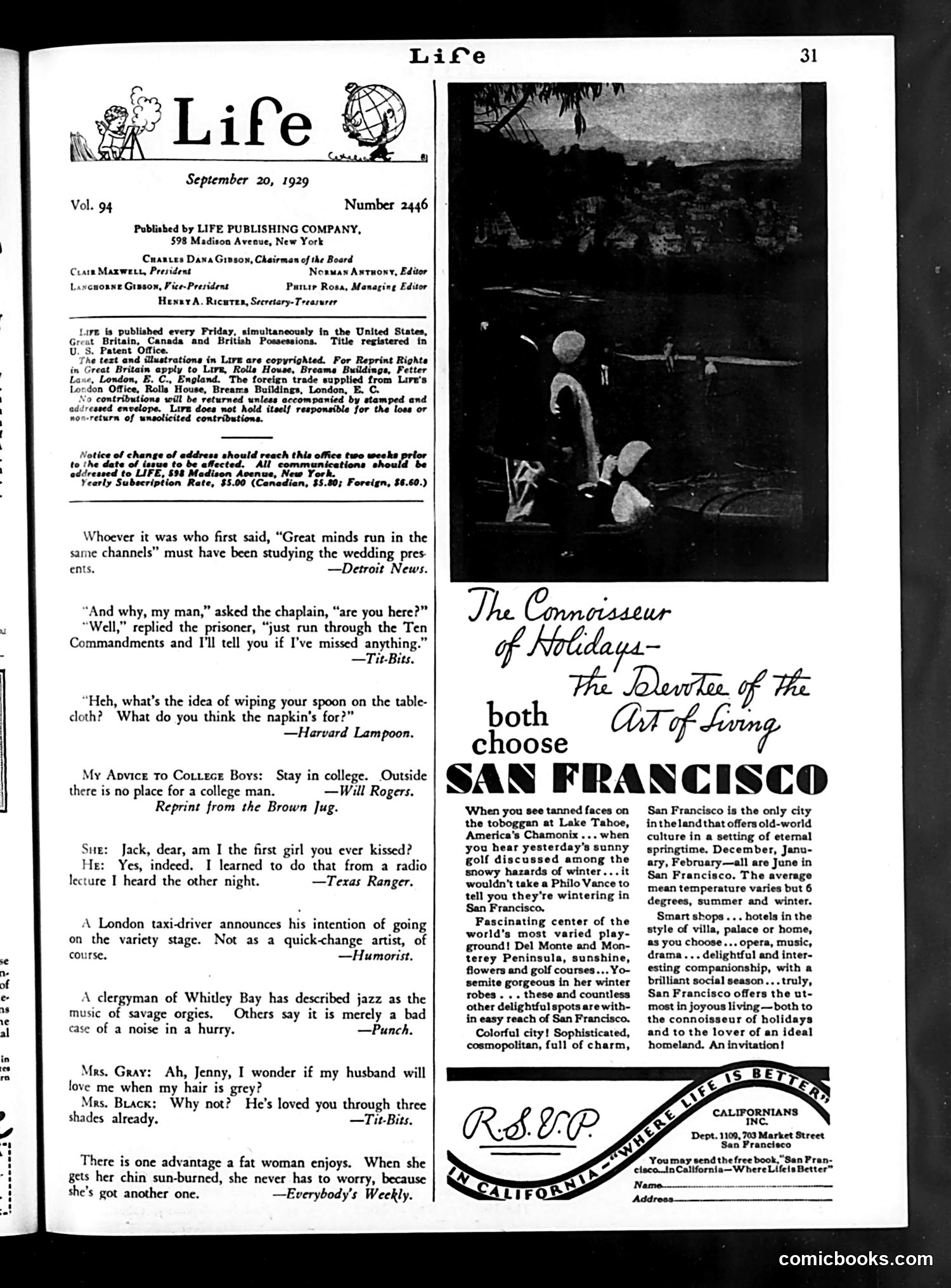
Life Magazine, September 20, 1929 This page is primarily a title/contents page featuring editorial masthead information and miscellaneous humor pieces sourced from other publications. The jokes touch on contemporary 1920s social themes: marriage expectations, prison morality, table manners, college life, radio lectures, and jazz music as "savage." The dominant feature is a full-page San Francisco tourism advertisement showing what appears to be a leisure scene (possibly boating or recreation). The ad promotes San Francisco as a year-round destination with mild winters, accessible to attractions like Lake Tahoe, Yosemite, and Monterey. It emphasizes the city's sophisticated culture—opera, music, drama—and appeals to both wealthy tourists ("connoisseur of holidays") and those seeking "an ideal homeland." Notable context: This issue published just days before the October 1929 stock market crash, making the leisure-focused advertising and upbeat tone historically ironic, though contemporary readers would not yet know this economic catastrophe was imminent.
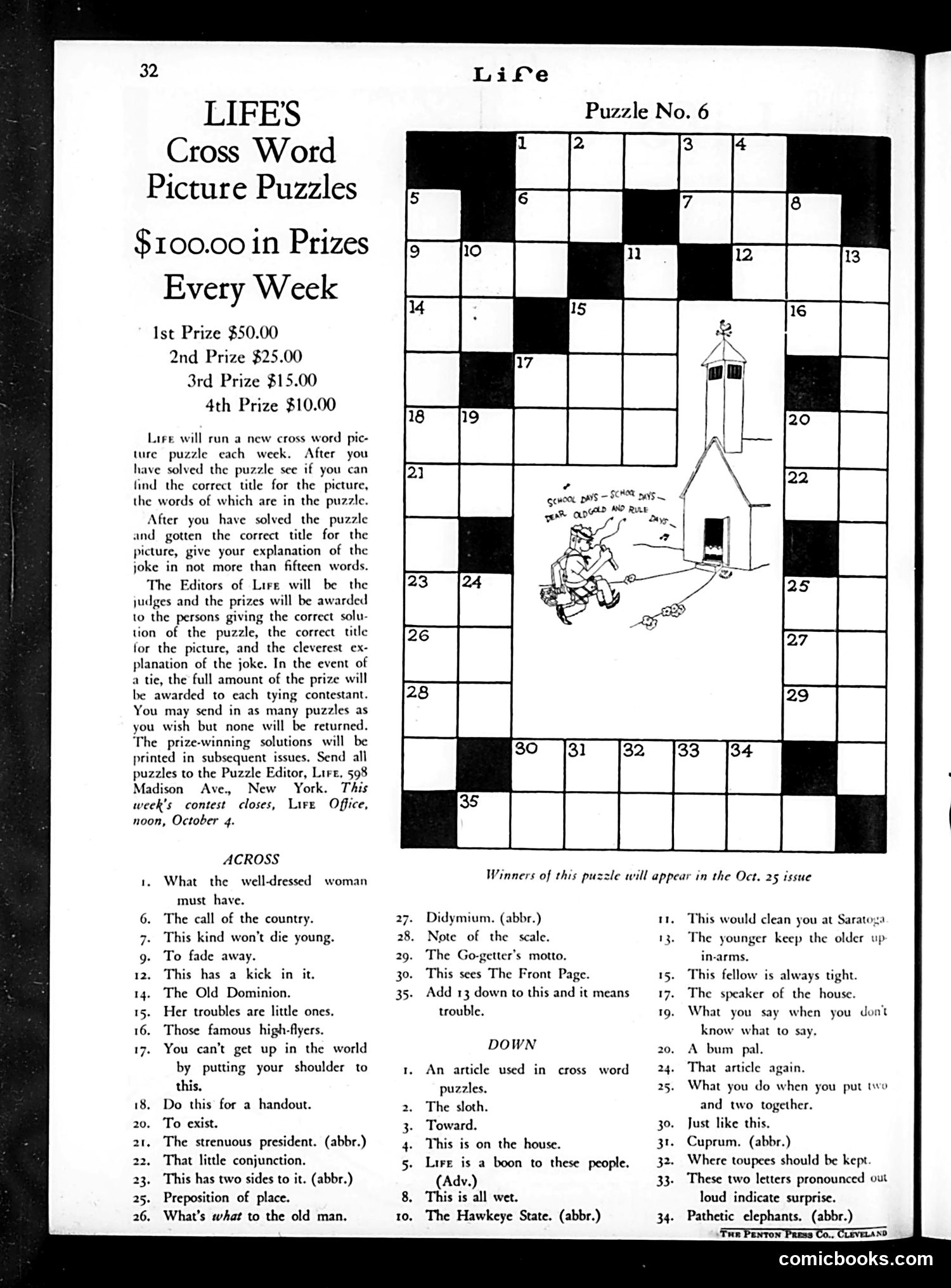
Life Magazine Cross Word Picture Puzzle (Puzzle No. 6) This page announces Life magazine's weekly cross word picture puzzle contest, offering $100 in prizes. Solvers must: 1. Complete the crossword puzzle 2. Identify the correct title for the accompanying cartoon illustration 3. Explain the joke in fifteen words or fewer The cartoon depicts a figure at a desk with papers scattered about, appearing stressed or frustrated—likely illustrating a pun or joke about office work, finances, or bureaucratic frustration. The specific joke is unclear from the image quality, though the crossed-out papers suggest themes of failure, rejection, or clerical chaos. Winners would be selected based on puzzle accuracy, correct title identification, and cleverest joke explanation. Solutions would appear in Life's October 25 issue. This was a common engagement strategy for magazines of this era, encouraging reader participation and repeat purchases.
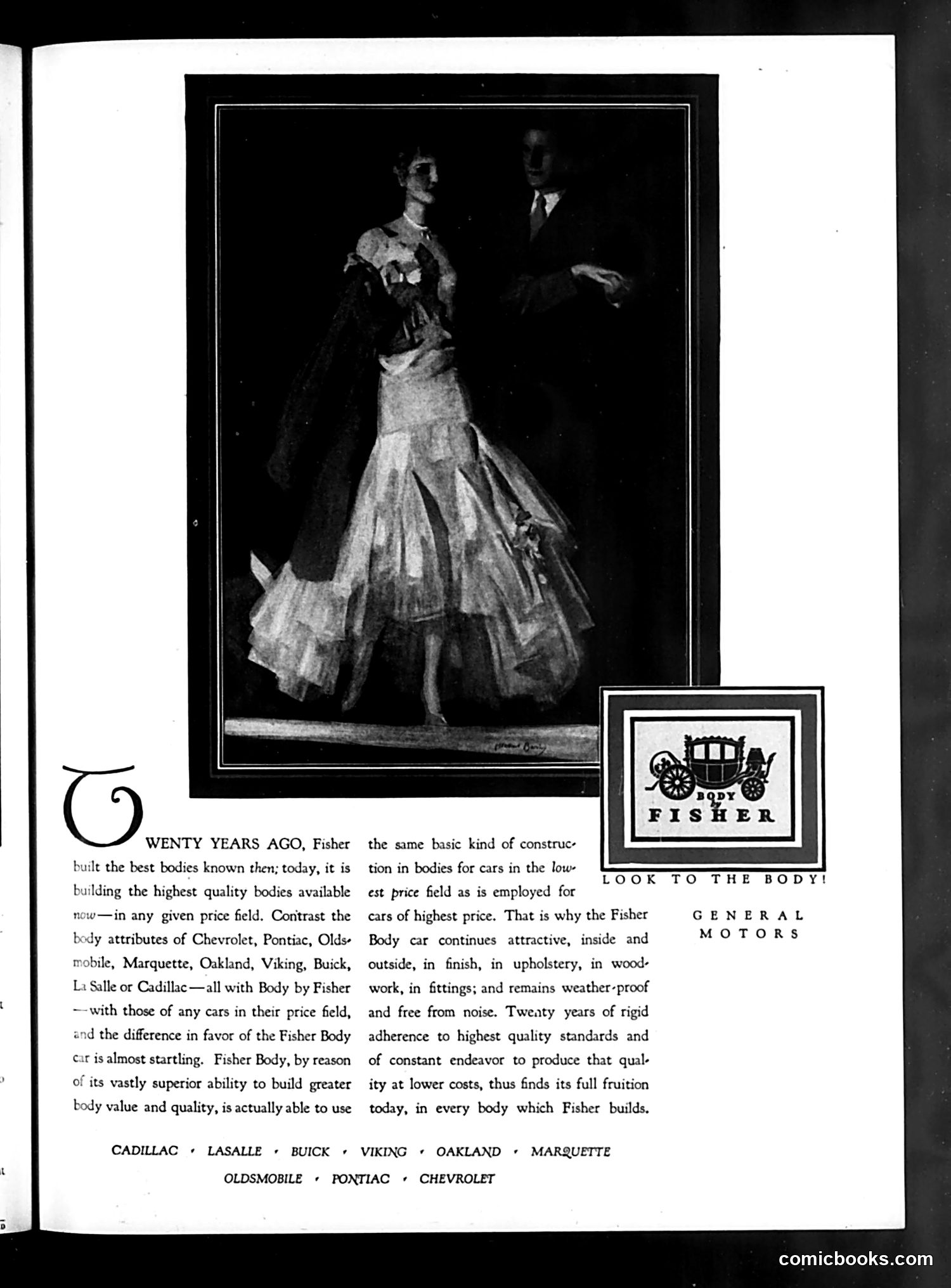
Analysis This is not a cartoon or satire—it's a General Motors advertisement for Fisher Body, a major automobile body manufacturer. The page features an elegant photograph of a woman in formal evening wear with a man in a tuxedo, likely meant to evoke luxury and sophistication. The advertisement emphasizes Fisher Body's 20-year reputation for quality construction across multiple GM car lines (Chevrolet through Cadillac). The key sales pitch: Fisher Body uses the same superior construction techniques regardless of price point, so even lower-priced cars (Chevrolet, Pontiac) have the quality standards previously reserved for expensive models (Cadillac, LaSalle). The tagline "LOOK TO THE BODY!" suggests buyers should evaluate cars by their bodywork quality. This reflects 1920s-30s automotive marketing strategy, positioning Fisher Body as a prestige component that justified premium pricing across GM's entire vehicle lineup. There is no political content or satire present—purely commercial messaging.
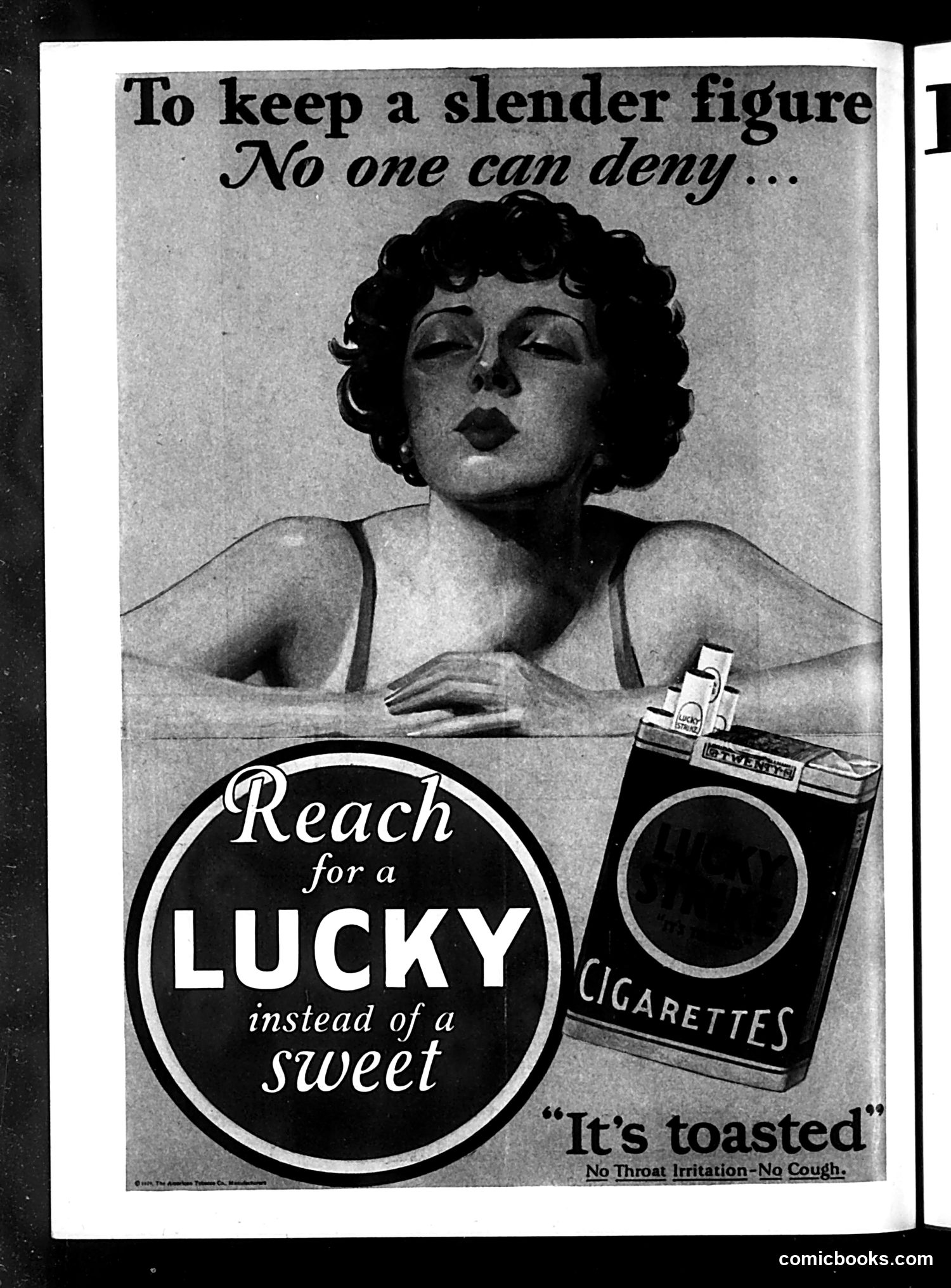
Lucky Strike Cigarette Advertisement This is a vintage cigarette advertisement, not political satire. It promotes Lucky Strike cigarettes by targeting women concerned with maintaining a slim figure. The ad's headline—"To keep a slender figure / No one can deny... / Reach for a LUCKY instead of a sweet"—suggests cigarettes as an appetite suppressant or weight-control alternative to candy. The image shows a glamorous woman in what appears to be 1920s-30s styling. The tagline "It's toasted / No Throat Irritation–No Cough" emphasizes the product's supposed health benefit. This reflects a historical era when cigarette companies openly marketed smoking to women as a weight-management tool, exploiting body-image anxieties. Such advertising would later become controversial as health dangers of smoking became widely understood.