life
Life — September 27, 1929
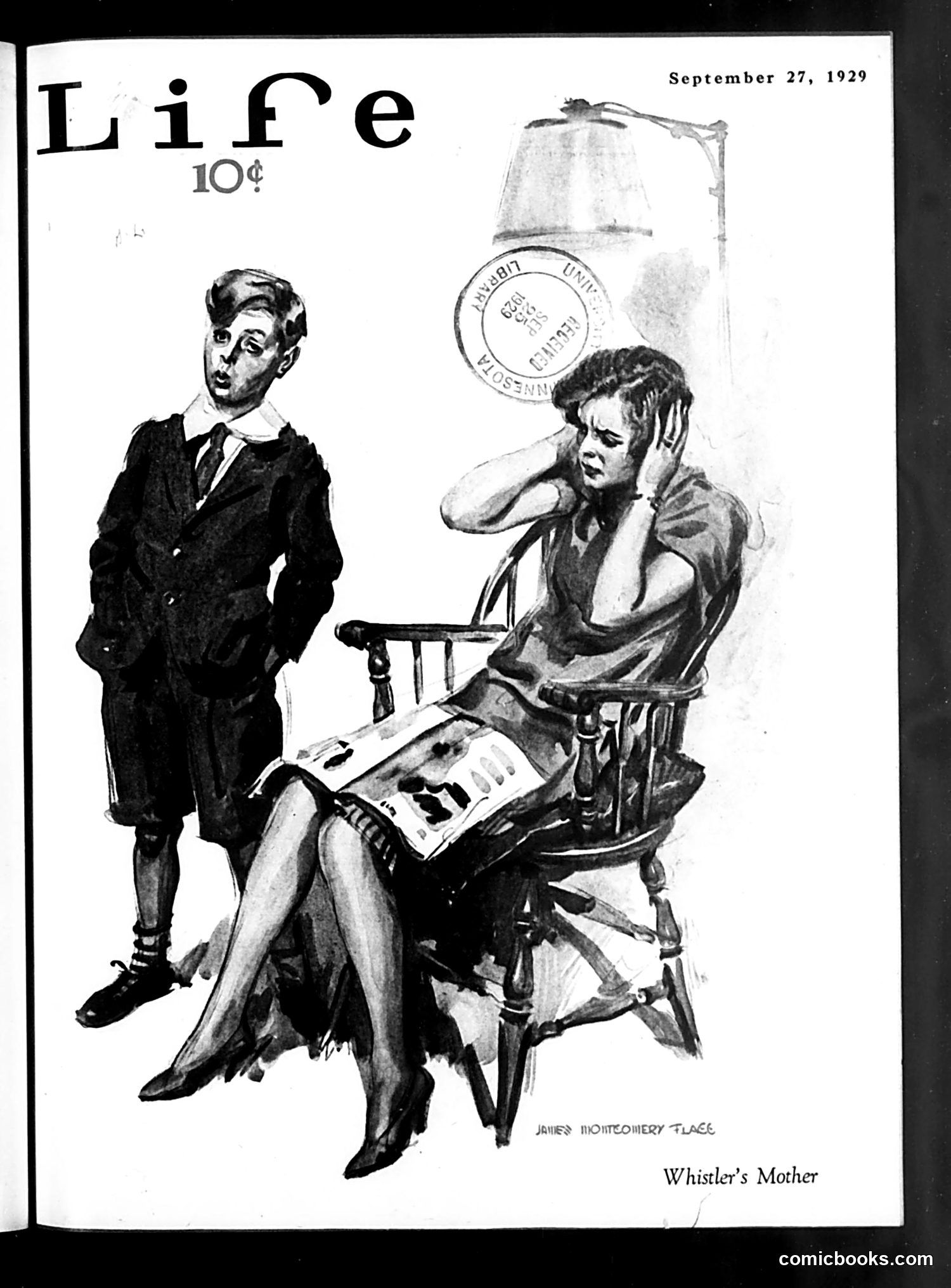
"Whistler's Mother" - Life Magazine, September 27, 1929 This cartoon by James Montgomery Flagg satirizes a domestic quarrel. A man in formal attire stands confronting a woman seated in a chair, who covers her ears in distress. The title references James McNeill Whistler's famous 1871 painting "Arrangement in Grey and Black No. 1" (commonly called "Whistler's Mother"), which depicts an elderly woman sitting calmly in profile. The joke inverts that iconic image: instead of a dignified, patient mother, we see a modern woman actively refusing to listen to complaints—a commentary on contemporary marital disputes and changing gender dynamics in 1920s America. The composition parodies the original painting while mocking domestic conflict and women's increasing assertiveness.
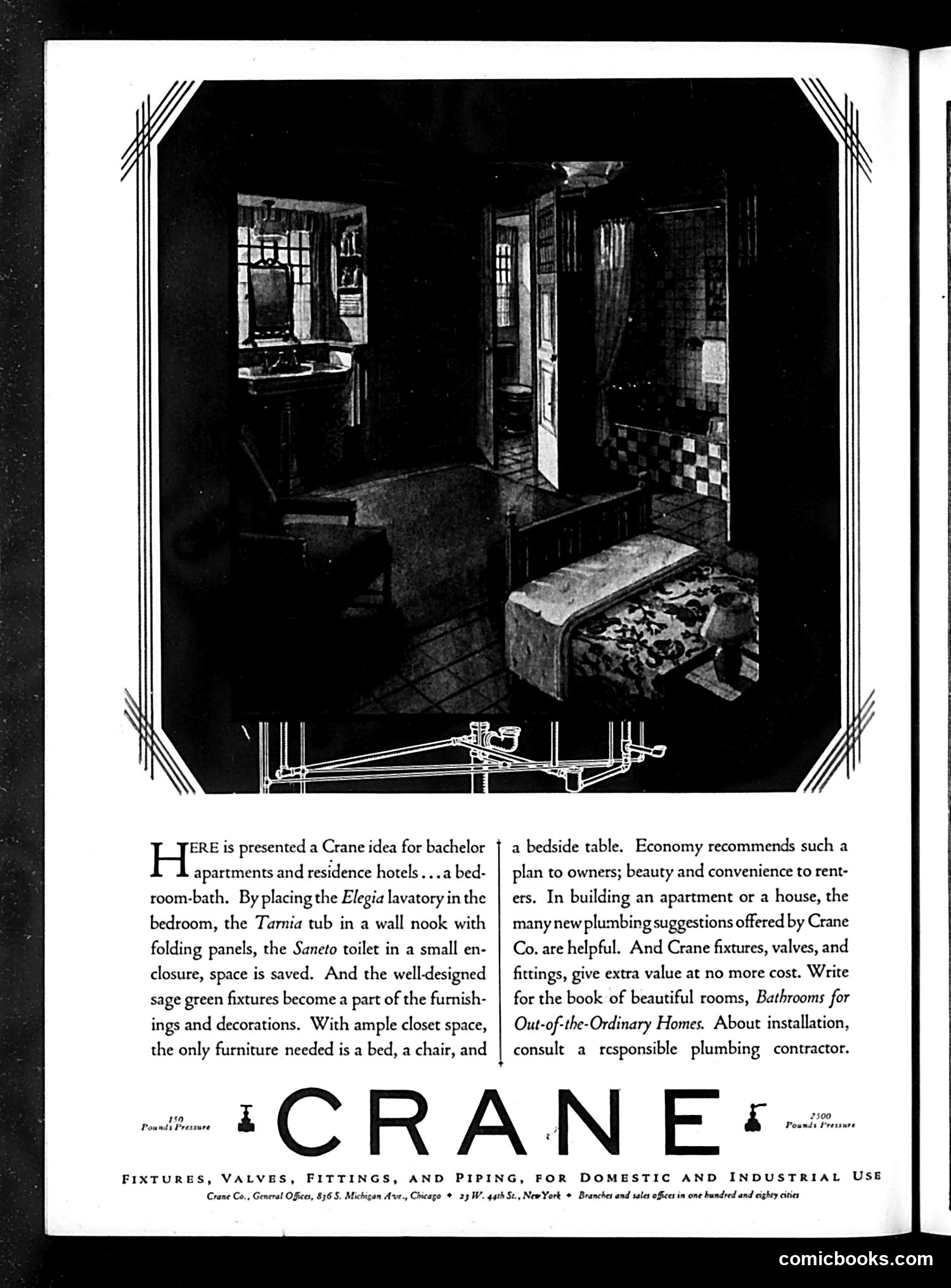
Analysis This page is primarily an advertisement, not satirical content. It's a Crane Co. advertisement for bathroom fixtures and plumbing supplies, specifically promoting their products for "bachelor apartments and residence hotels." The image shows a compact, efficiently designed bathroom layout featuring Crane's products: an Elegia lavatory, Tamia tub, and Sancto toilet. The advertiser emphasizes space-saving design and aesthetic appeal—fixtures "become a part of the furnishings and decorations." The pitch targets budget-conscious renters and builders by highlighting economy and convenience. There is no political satire or social commentary here; this is straightforward product marketing typical of 1920s-era Life magazine advertising, promoting modern plumbing innovations to American consumers.
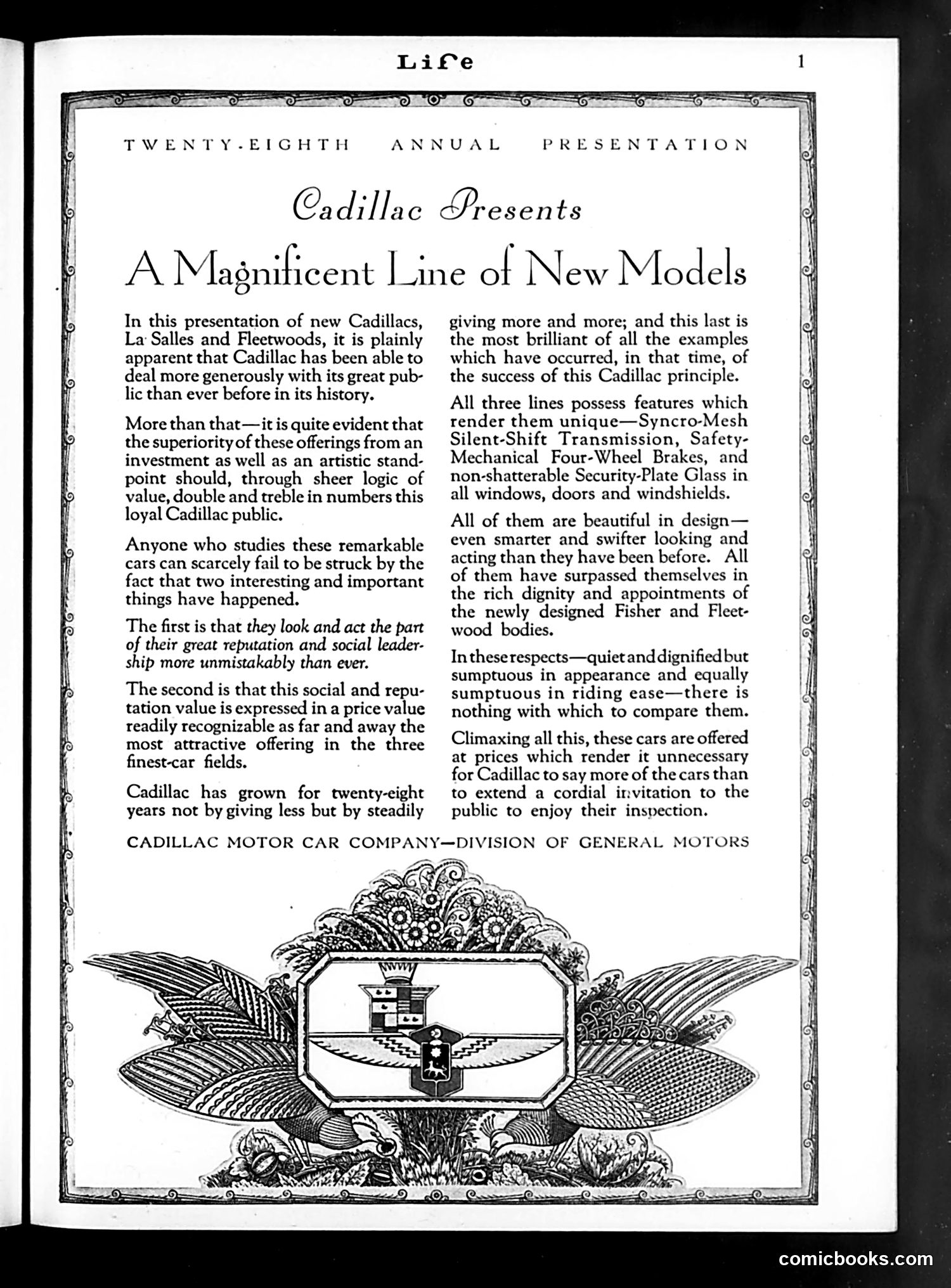
Analysis This page is not satire or political cartoon—it's a straightforward advertisement for Cadillac automobiles. The ornate header declares this the "Twenty-Eighth Annual Presentation" of new Cadillac models (La Salles and Fleetwoods). The text promotes three product lines, emphasizing their superior engineering features: Syncro-Mesh transmission, Safety-Mechanical brakes, and Security-Plate Glass windows. The elaborate decorative emblem at bottom featuring wings and a crowned shield is Cadillac's corporate logo and brand identity. The pitch emphasizes Cadillac's 28-year growth strategy: expanding their offerings while maintaining premium reputation and pricing. The tone is aspirational, positioning these cars as markers of "great reputation and social leadership." This represents typical high-end automotive advertising from the early twentieth century, targeting wealthy consumers.
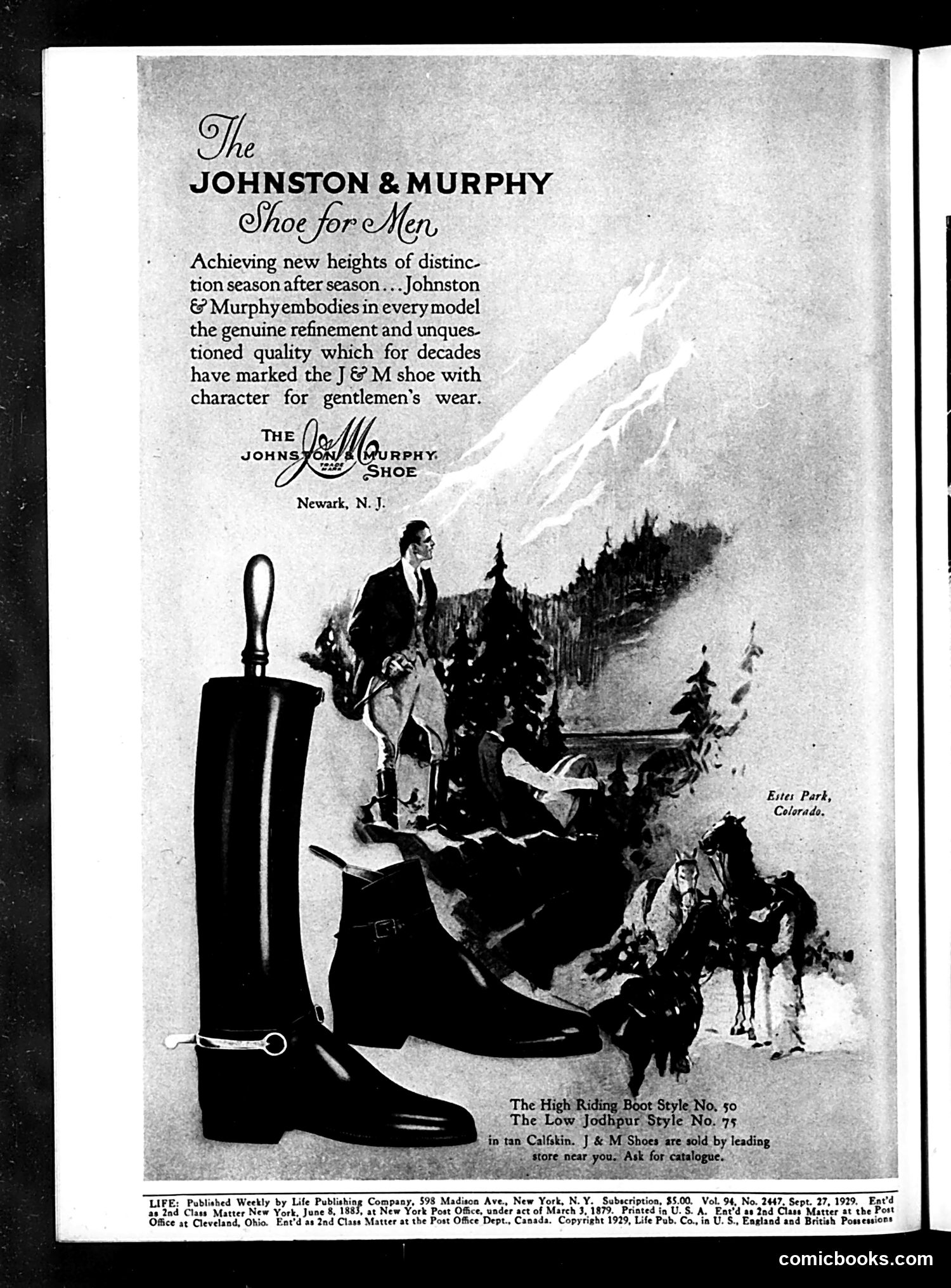
Analysis This is not a political cartoon or satire—it's a straightforward advertisement for Johnston & Murphy shoes, a men's footwear brand based in Newark, New Jersey. The ad uses an aspirational wilderness scene showing a well-dressed man in business attire overlooking a scenic Colorado landscape (labeled "Estes Park, Colorado"). The imagery suggests that Johnston & Murphy shoes are appropriate for both refined gentlemen's wear and outdoor/sporting activities. The text emphasizes the brand's decades-long reputation for "genuine refinement and unquestioned quality" in men's footwear. Two specific styles are advertised: a High Riding Boot (Style No. 50) and a Low Jodhpur Style (No. 75). The ad is from Life magazine's September 27, 1929 issue. This is purely commercial marketing, not political commentary.
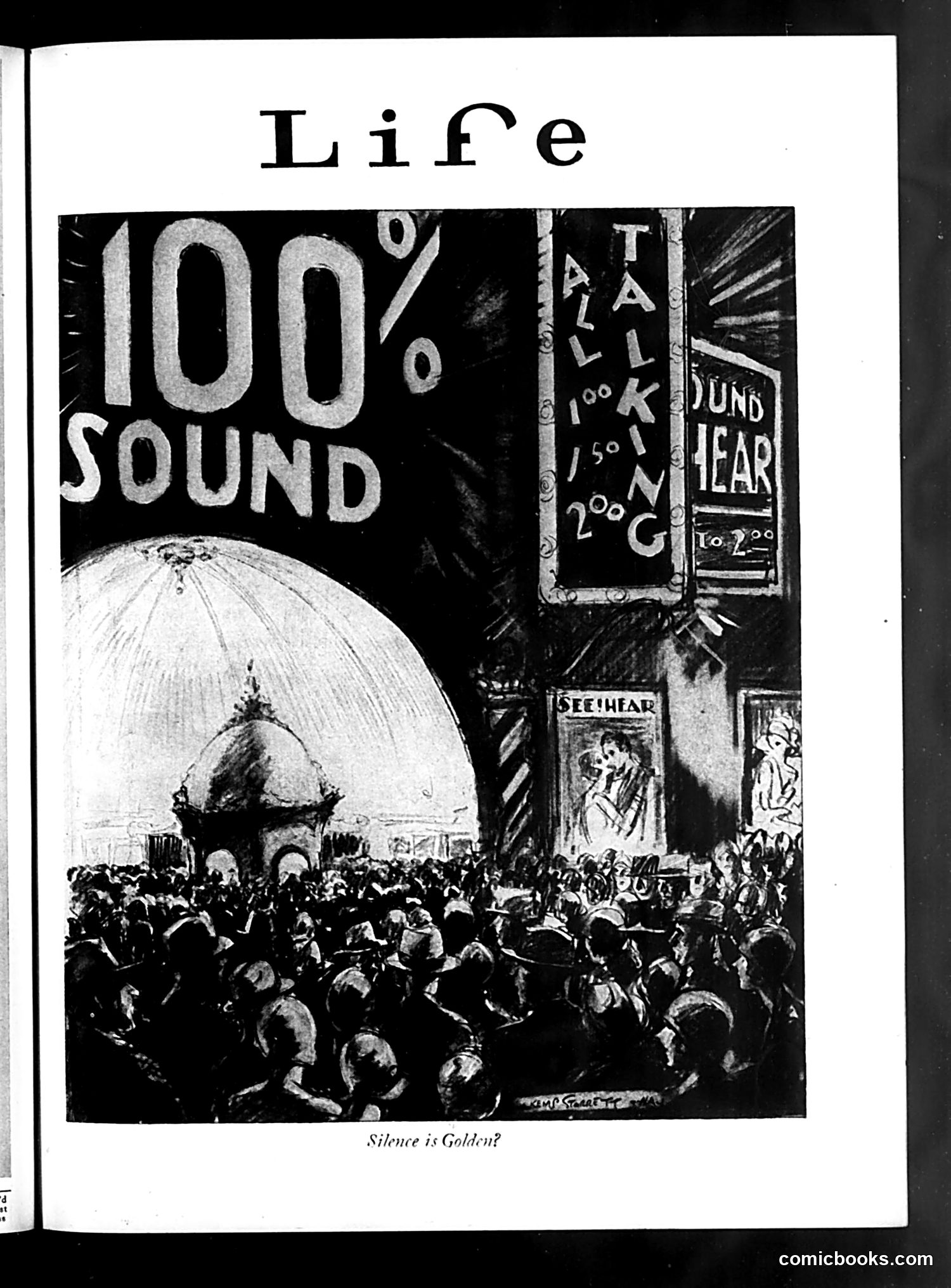
Analysis of "Life" Magazine Page This page satirizes the transition to "talking pictures" (sound films), a revolutionary technology of the late 1920s. The illustration shows a massive crowd gathered around a giant dome-shaped speaker or sound apparatus, with signs advertising "100% SOUND," "TALK," and "DUMB HEAR." The caption "Silence is Golden!" ironically contrasts the era's enthusiasm for audible cinema against the previous silent film era. The cartoon critiques how crowds eagerly embrace this new technology, suggesting perhaps concerns about quality or artistic merit being sacrificed for novelty and commercial appeal. The dystopian imagery—the overwhelming crowds, mechanical scale—implies social commentary on mass culture and technological determinism rather than celebrating progress.
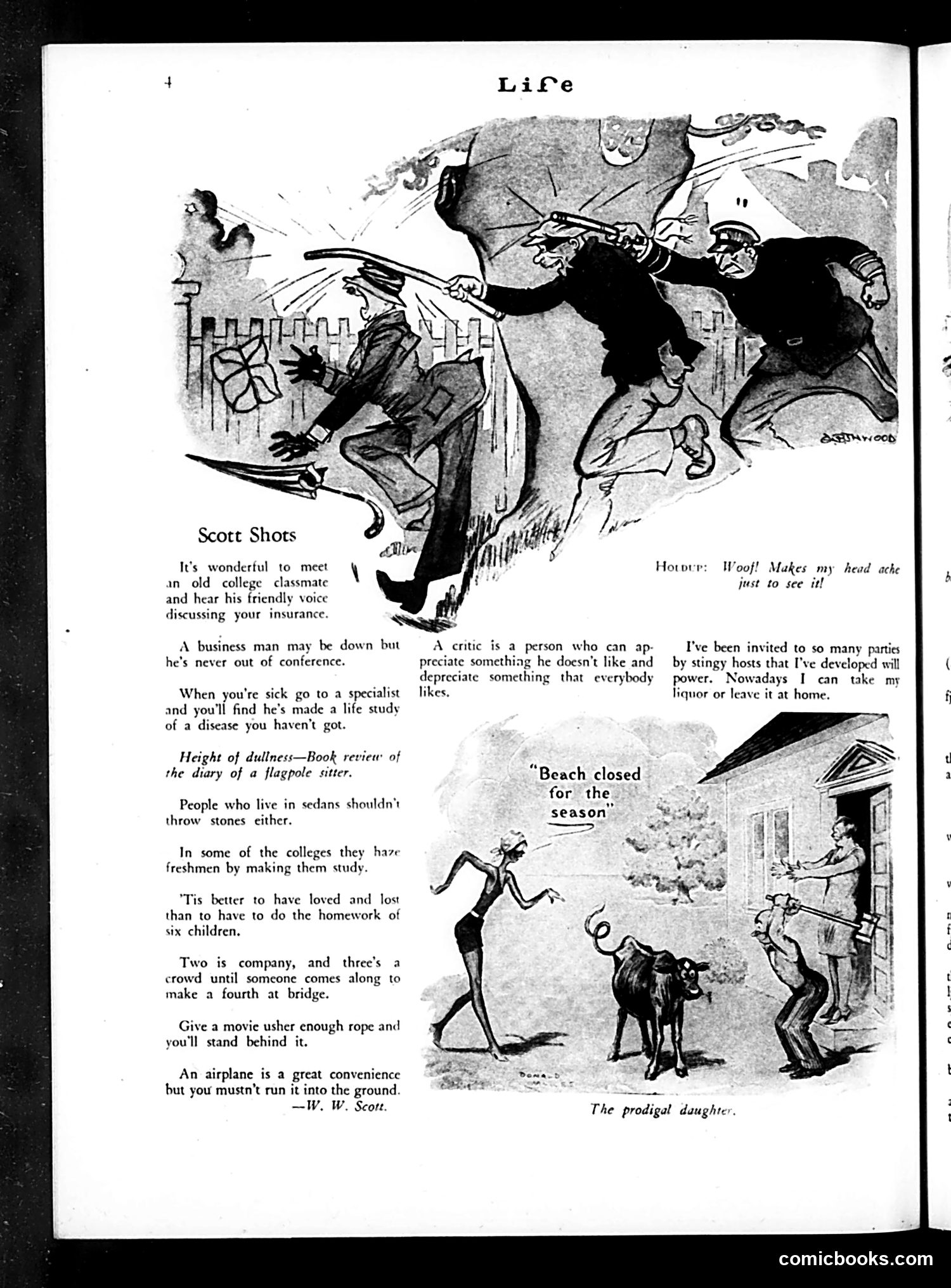
"Life" Magazine Page Analysis This page from *Life* magazine contains two distinct sections: "Scott Shots" (top): A satirical cartoon depicting business and social commentary through humorous observations. The chaotic illustration shows figures in various predicaments, accompanying quips about insurance, specialists, critics, and colleges. The humor relies on gentle social satire about everyday situations. "The Prodigal Daughter" (bottom): A cartoon showing a scantily-clad young woman attempting to enter a beach house while being turned away by what appears to be a parent or authority figure. The caption "Beach closed for the season" is a double entendre—the joke appears to reference either parental disapproval of the daughter's appearance or behavior, reflecting era-appropriate commentary on youth culture and social propriety. Both exemplify *Life*'s signature blend of visual humor and social observation.
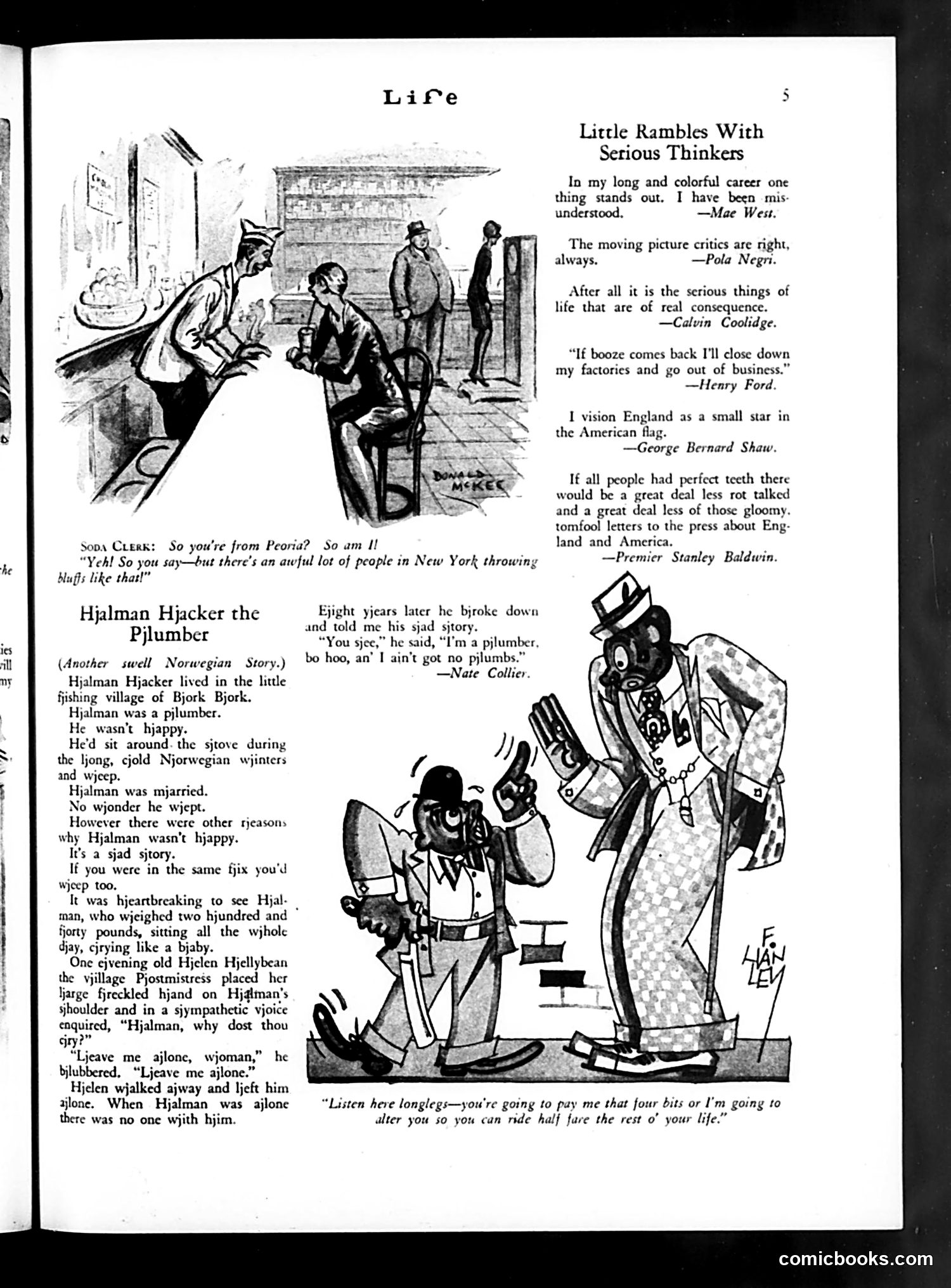
Analysis of Life Magazine Page 5 This page contains two satirical sections: Top cartoon: A soda clerk addresses a customer from Peoria, Illinois, mocking New Yorkers as rowdy and unruly—likely reflecting early 20th-century regional stereotypes about urban versus small-town American behavior. Main story: "Hjalman Hjacker the Plumber" presents a Norwegian folk-tale style narrative about an unhappy plumber in a fishing village. The story emphasizes his misery despite material comfort, illustrating a common theme: that contentment depends on emotional/relational fulfillment rather than mere employment or survival. The bottom cartoon shows what appears to be a domestic dispute, with a threatening figure demanding payment or threatening consequences. The page mixes short humor pieces with social commentary typical of Life's satirical approach to American life and character.
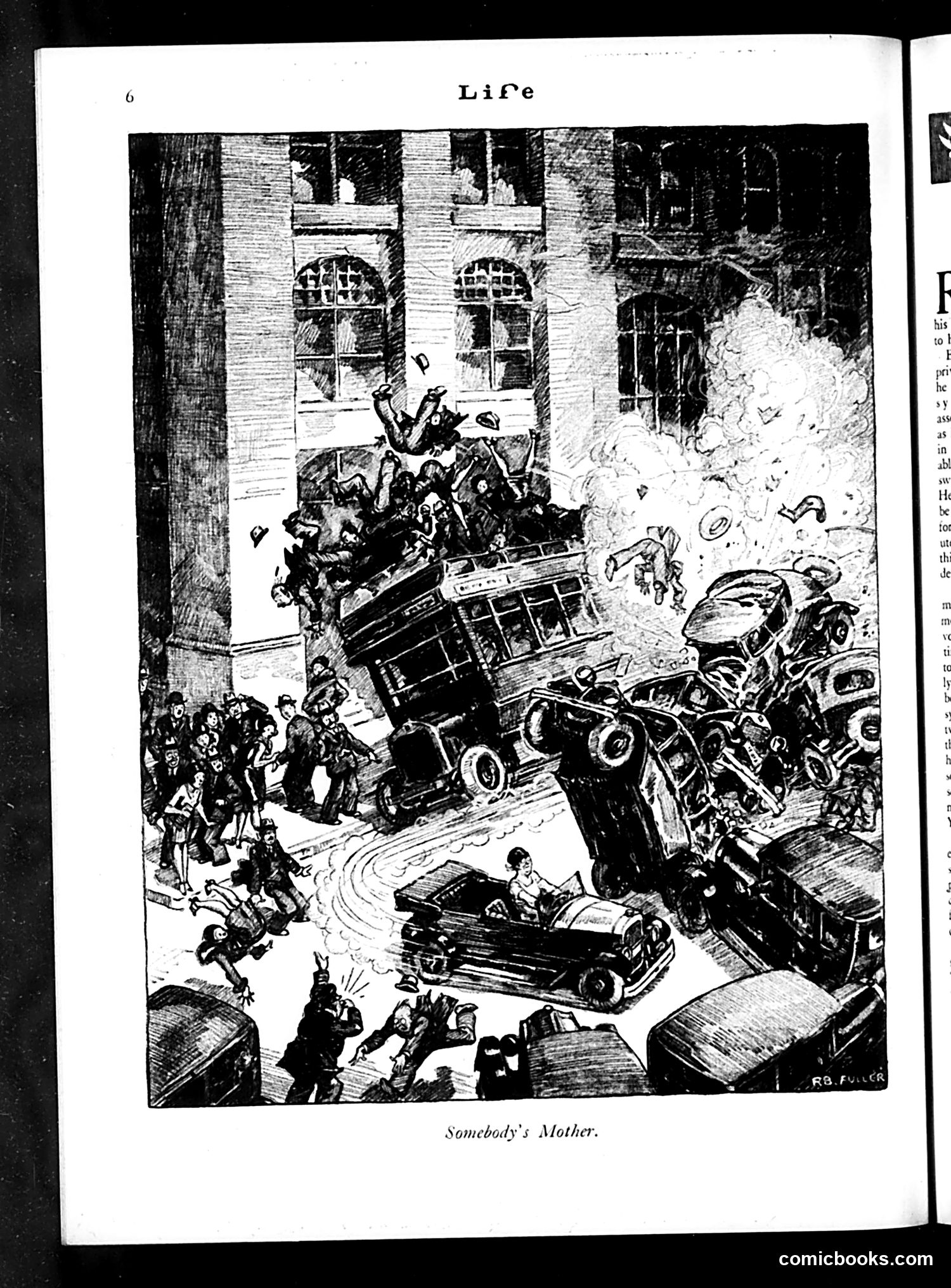
Analysis of "Somebody's Mother" This cartoon depicts a tragic urban street scene showing a truck accident with casualties. The composition shows: - A large overturned truck in the center, spilling its load - Multiple automobiles scattered around the street - Pedestrians and onlookers surrounding the accident - A brick building in the background - Bodies or injured persons visible in the wreckage The title "Somebody's Mother" suggests the satire focuses on the human cost of traffic accidents—specifically highlighting how victims are someone's family member, emphasizing the tragedy behind statistics. This appears to be social commentary on urban traffic dangers during the automobile era, when such accidents were becoming increasingly common and deadly. The piece likely criticizes either unsafe driving practices, inadequate street safety measures, or society's indifference to these mounting casualties.
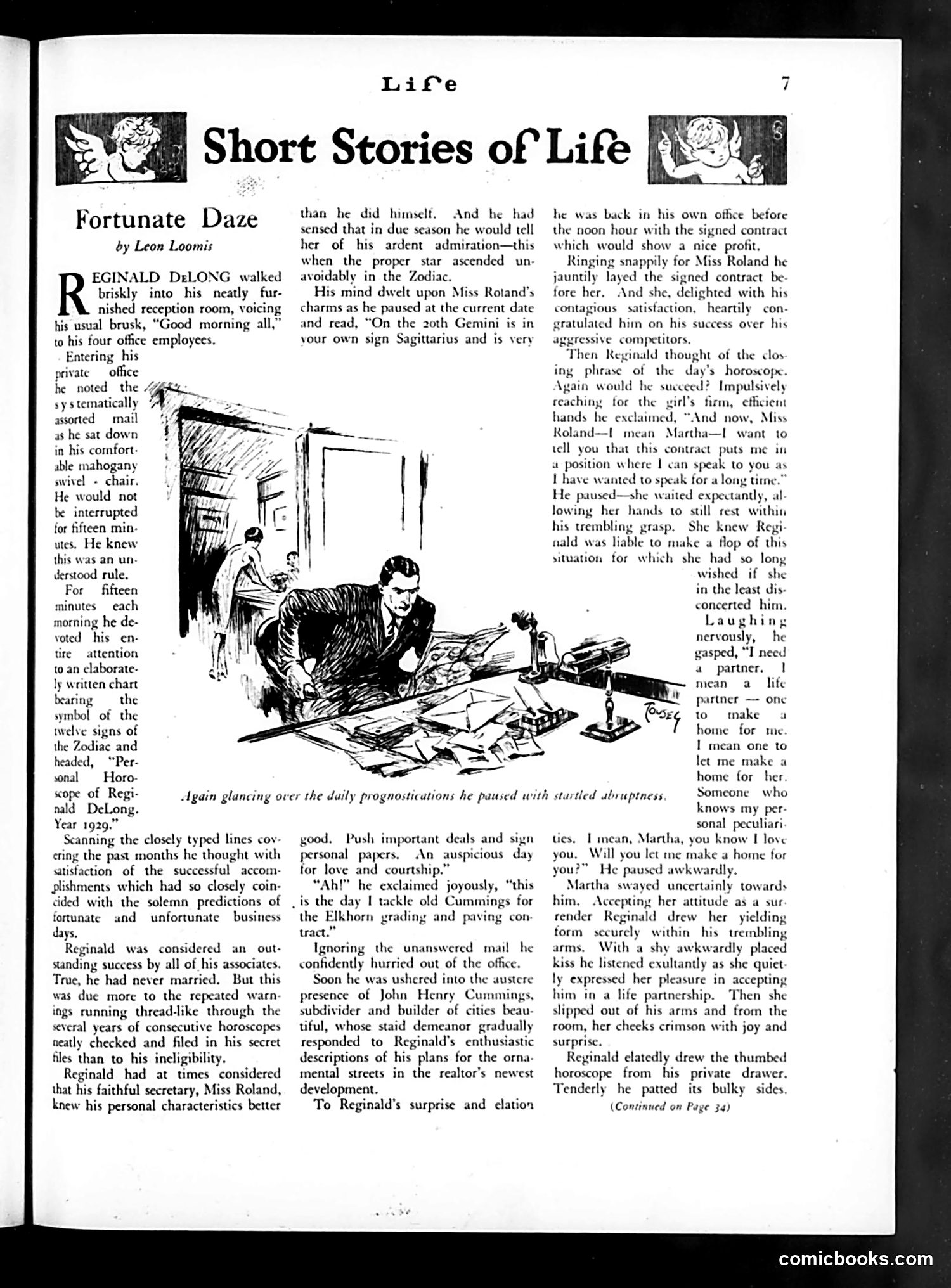
"Fortunate Daze" by Leon Loomis This is a short story, not a political cartoon. The narrative follows Reginald DeLong, a businessman who consults daily horoscopes based on zodiac signs. The story satirizes the absurdity of making important business decisions—like signing contracts and pursuing romance—based on astrological predictions rather than rational judgment. The accompanying illustration shows Reginald sprawled dramatically over his desk, surrounded by astrological charts and papers, having apparently acted on his horoscope's advice. The humor targets early 20th-century fascination with pseudoscientific fortune-telling and superstition among even educated, professional men, mocking their willingness to surrender decision-making to mystical nonsense.
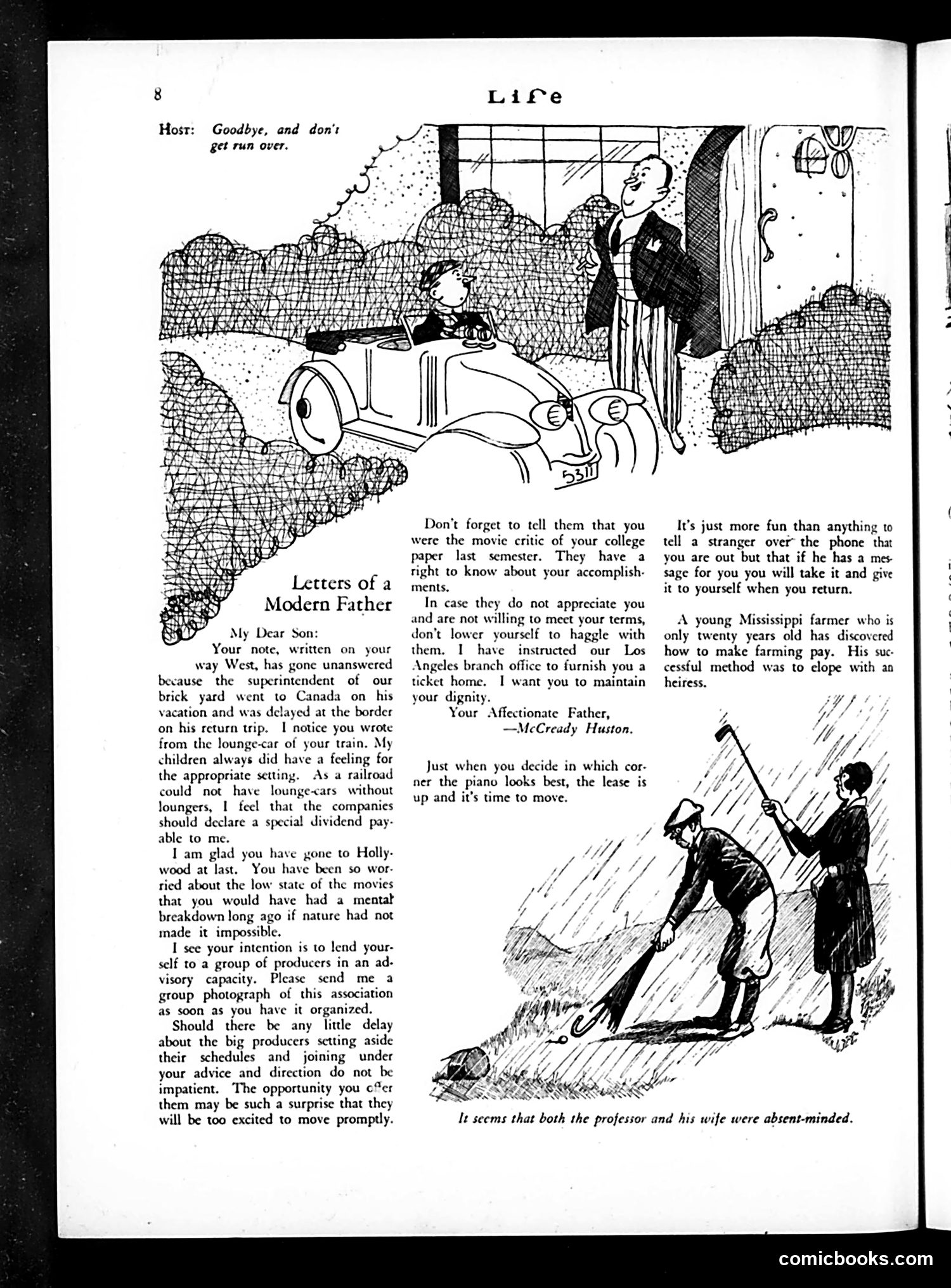
Analysis of Life Magazine Page 8 This page contains two distinct pieces: Top cartoon: Shows a man in a car saying goodbye to another man, with the caption "Goodbye, and don't get run over." The humor satirizes casual, dismissive farewells—suggesting indifference to someone's safety. "Letters of a Modern Father": A humorous advice column from "McCready Huston" to his son in Hollywood. The father scolds his son for lounging in train cars, warns against impressing movie producers, and advises maintaining dignity. The satire mocks both aspiring young men seeking Hollywood success and overbearing paternal concern about social status and proper behavior. Bottom cartoon: Shows two figures in heavy rain, with caption "It seems that both the professor and his wife were absent-minded," depicting domestic absent-mindedness as comedy. All three pieces use gentle satire about American social attitudes toward career ambition, family propriety, and everyday behavior.
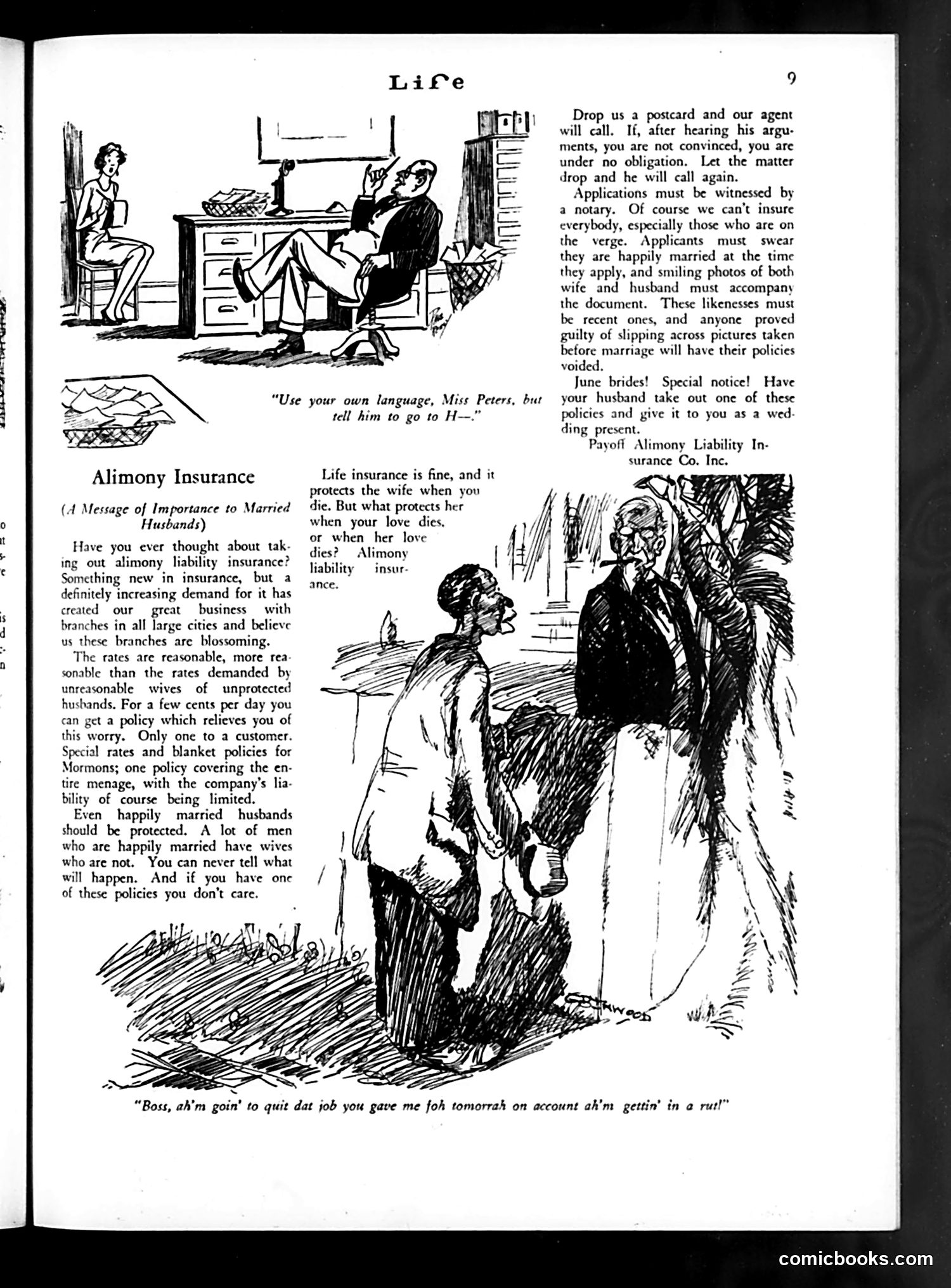
Analysis of Life Magazine Page 9 This page contains two distinct sections: Top Cartoon: Depicts an office scene where a man at a desk tells a woman (Miss Peters) to use more forceful language when instructing someone to go to "H—" (Hell). It's a mild workplace joke about professional propriety. Main Feature: "Alimony Insurance" A satirical advertisement-style article promoting insurance against alimony payments. The accompanying cartoon shows a man confronting his boss, threatening to quit due to a new rut/entanglement, implying marital trouble. The satire targets the emerging phenomenon of alimony liability insurance—policies protecting husbands from financial obligations if marriages fail. The piece mocks both the insurance industry's opportunism and the anxiety among married men about potential divorce costs. The crude dialect in the caption suggests working-class vulnerability to such schemes.
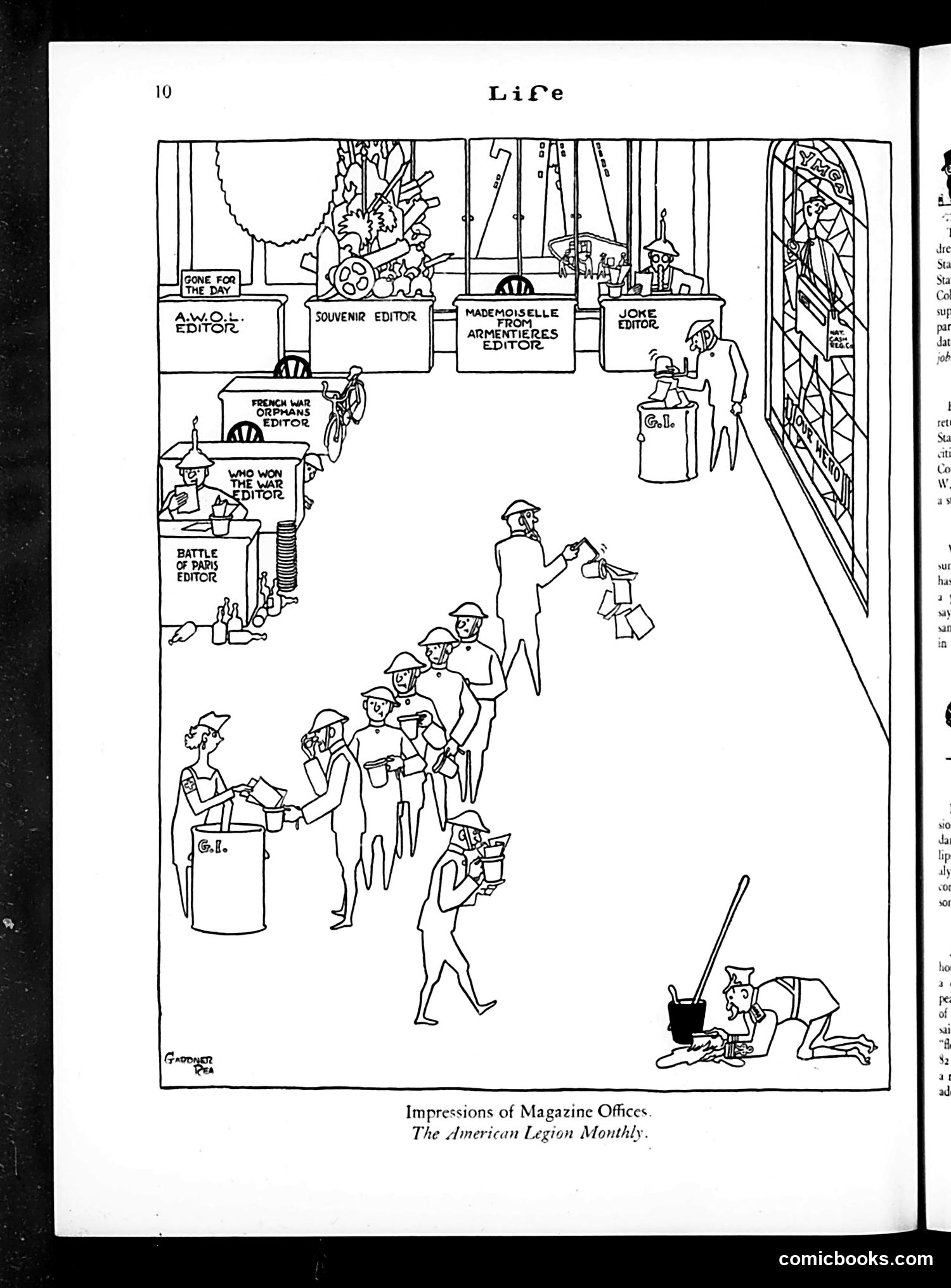
Impressions of Magazine Offices This satirical cartoon depicts the editorial hierarchy and workflows of magazine publishing offices during the World War I era. The upper tier shows specialized editors at their desks: an "Awol Editor," "Souvenir Editor," "Mademoiselle and Armetieres Editor," and "Joke Editor." Below them are lower-ranking editors handling war-related content ("French War Orphans Editor," "Who Won the War Editor," "Battle of Paris Editor"). The bottom half shows soldiers as raw material being processed through this system—they're being funneled, sorted, and distributed like commodities to feed the magazine's war-focused content. The satire mocks how American magazines exploited soldiers' experiences and war narratives for commercial purposes, treating human suffering as editorial inventory rather than genuine news.
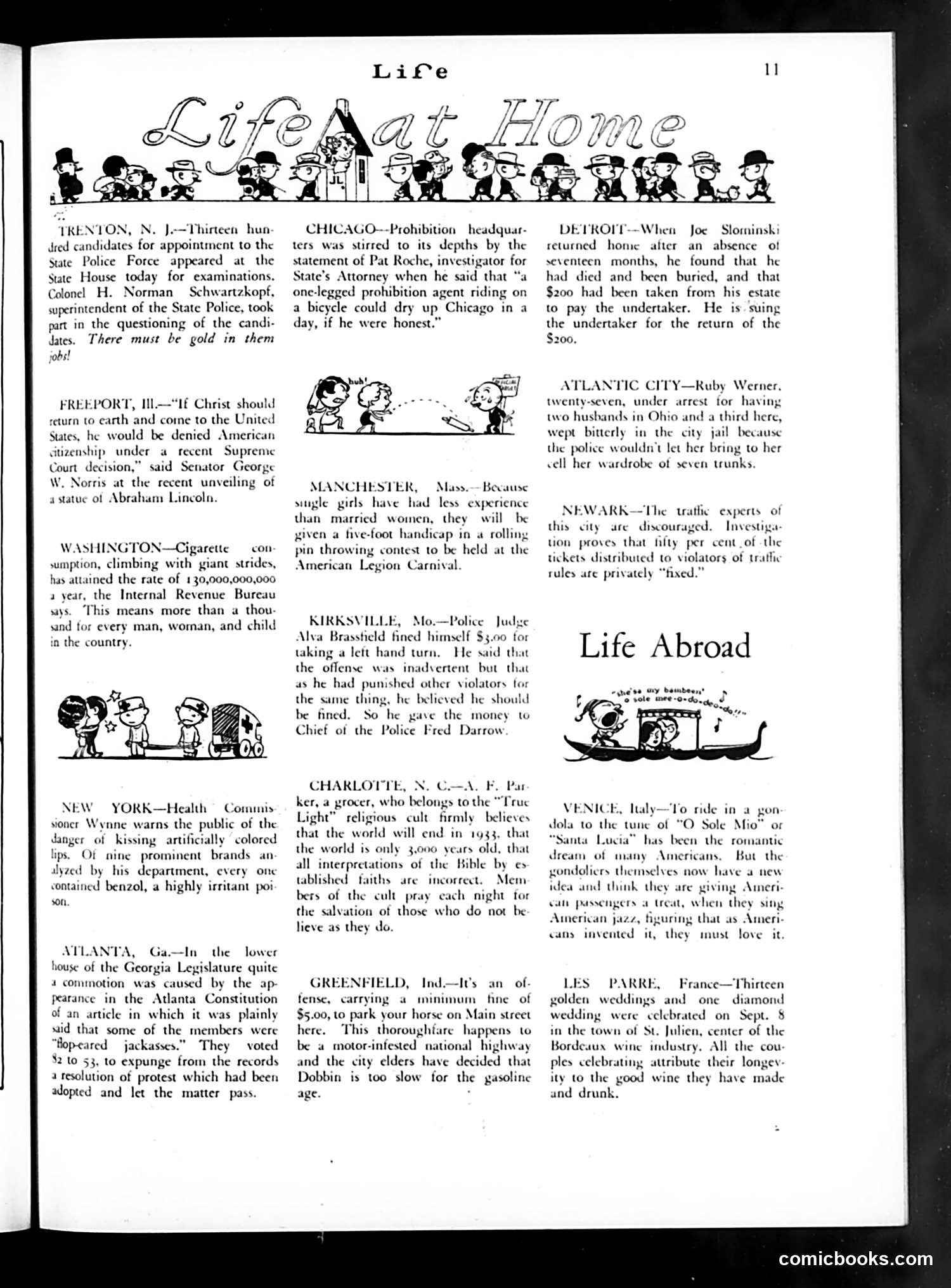
"Life at Home" Cartoon Analysis This page from *Life* magazine contains humorous brief news items and two small cartoon illustrations. The cartoons appear to depict children in everyday situations—one shows youngsters playing or interacting, the other shows similar domestic scenes. The accompanying text items are satirical commentaries on contemporary American absurdities: a senator's questionable logic about returning Christ to earth and citizenship, a judge fining himself for traffic violations, warnings about artificially colored lips being toxic, and concerns about a religious cult's apocalyptic predictions. The cartoons themselves are relatively simple domestic vignettes. Without clearer visual detail, I cannot identify specific figures or caricatures, but they appear designed to complement the humorous tone of the surrounding satirical news commentary about everyday American life and social oddities.
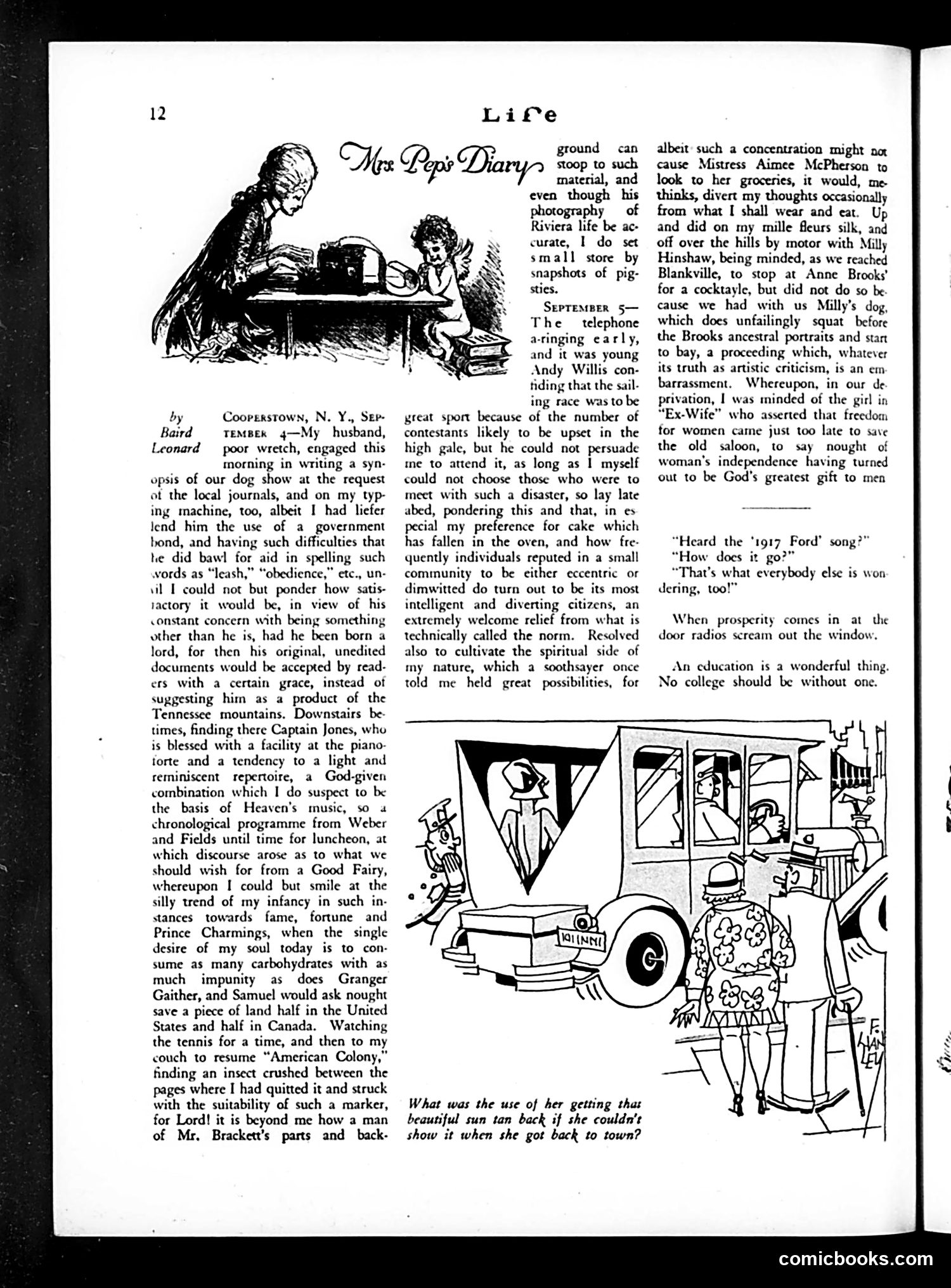
Analysis of Life Magazine Page 12 This page contains "Mrs Pep's Diary," a humorous column by Baird Leonard about domestic life in Cooperstown, NY. The accompanying cartoon satirizes women's fashion and automotive culture of the era. The cartoon depicts a woman displaying an elaborate sun tan, with the caption questioning: "What was the use of her getting that beautiful sun tan back if she couldn't show it off when she got back to town?" The satire targets the contradiction between summer leisure activities (getting a tan at a resort) and urban social conventions that required modest, covering clothing. The 1917 Ford automobile in the cartoon and references to contemporary figures (Prince Charmings, Grange Gaither) date this to the 1920s, when automobiles and leisure travel were becoming status symbols for middle-class Americans.
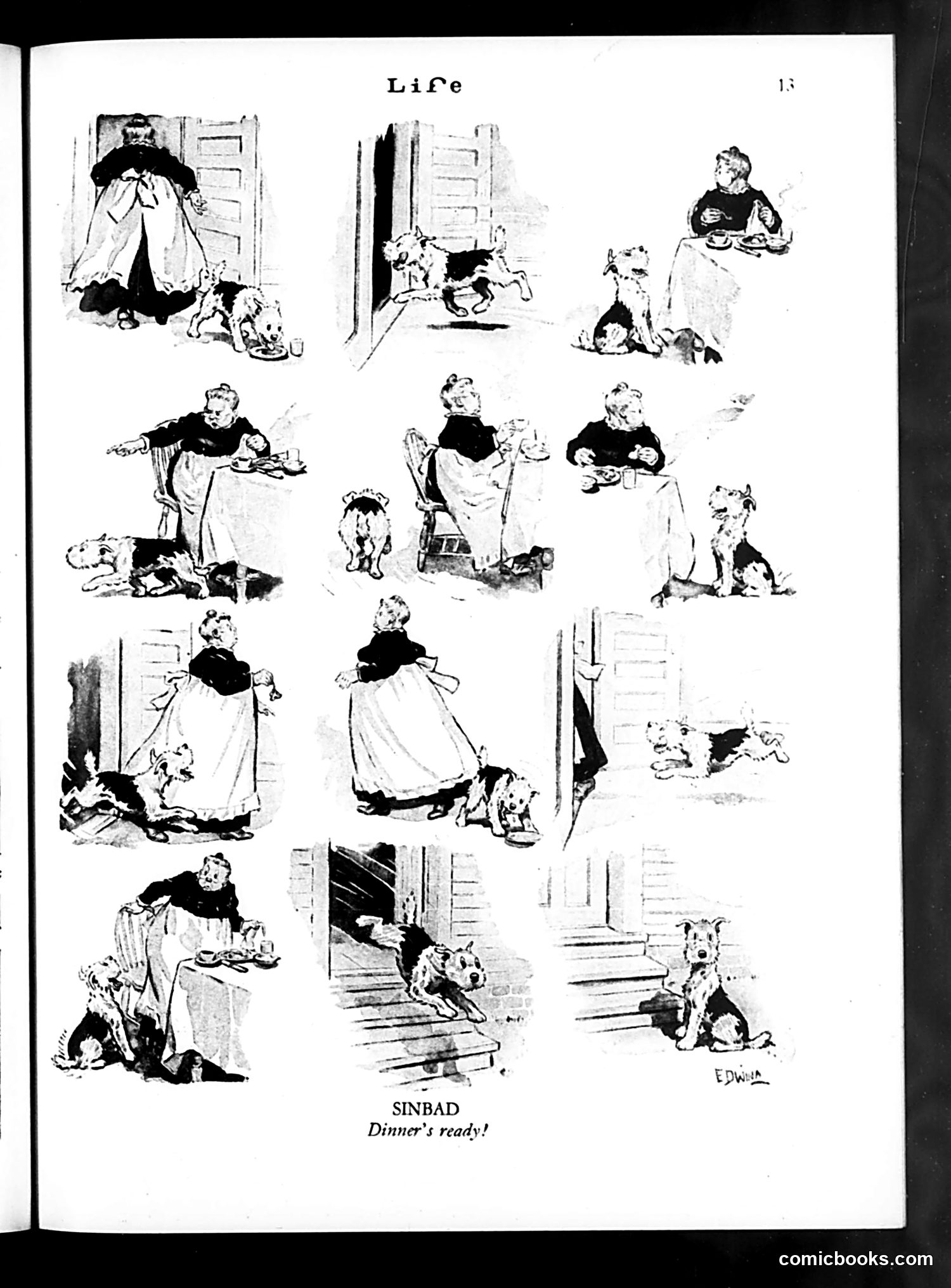
"Sinbad: Dinner's Ready!" This cartoon series by E.D. (Edward Windsor Kemble, likely) depicts a domestic scene with a woman and dogs. The title "Sinbad" paired with "Dinner's ready!" appears to be a humorous take on the famous sailor, reimagined as a dog or pet character awaiting meals. The twelve sequential panels show variations of a woman calling or preparing food for Sinbad, with the character's eager responses. This is likely satirizing either: 1. Pet owner dynamics—anthropomorphizing animal behavior 2. A contemporary character or celebrity nicknamed "Sinbad" 3. General domestic life and the predictability of feeding routines The repetitive format suggests comedy through visual variation on a single joke theme, common in Life magazine's humor approach.
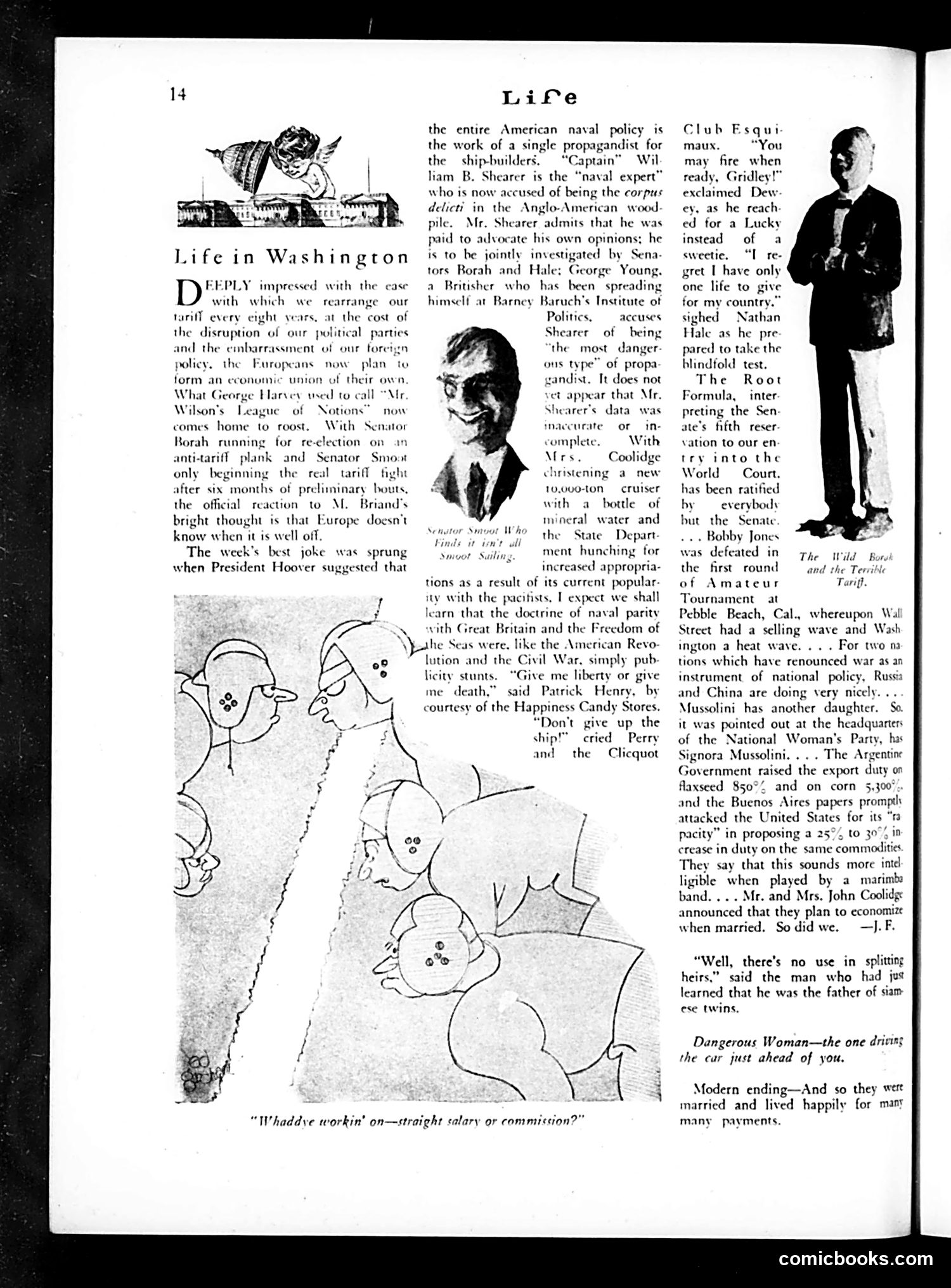
"Life in Washington" - Page Analysis This satirical column critiques American naval policy, claiming it's dominated by propagandist "Captain" William B. Shearer, whom the author calls the "most dangerous type" of propagandist. The text accuses Shearer of pushing inaccurate data, possibly under investigation by senators. The cartoon below depicts multiple figures with simplified, caricatured faces in profile, illustrating the column's theme about manipulation and influence in Washington politics. The accompanying sketch shows a man in formal dress (likely Shearer or a related figure), and there's a joke about a "Lucky Strike" cigarette and naval policy debates. The overall message: special interests and individual propagandists unduly influence major American policy decisions.
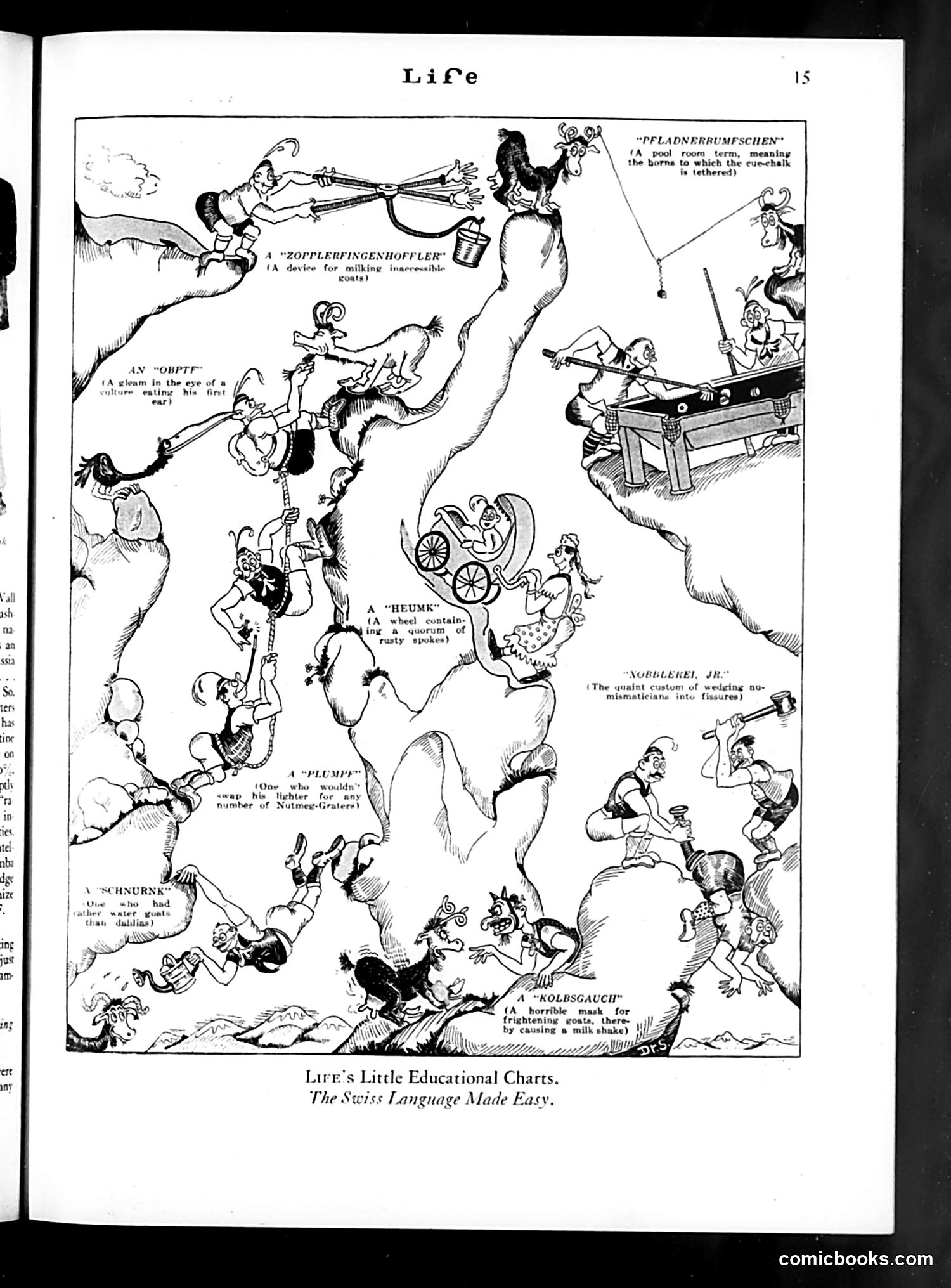
Life's Little Educational Charts: The Swiss Language Made Easy This page is a satirical "educational chart" teaching Swiss-German vocabulary through humorous illustrations. Each labeled term depicts exaggerated situations: - "Zopplerfingenhopfler" (A device for milking inaccessible goats) - "Oppt" (A sound made when calling one's first wife) - "Heumk" (A wheel containing a worm of questionable habits) - "Nöbblekel, Jr." (A mountain custom of eating memorabilia) - "Plumff" (One who wouldn't buy butter for any number of reasons) - "Schursk" (One who had rather water plants than starfish) - "Kolbsgauch" (A horrible mask for frightening goats) The satire mocks Swiss-German as absurdly complex while poking fun at Swiss customs and rural life through invented, nonsensical definitions paired with chaotic comedic illustrations.
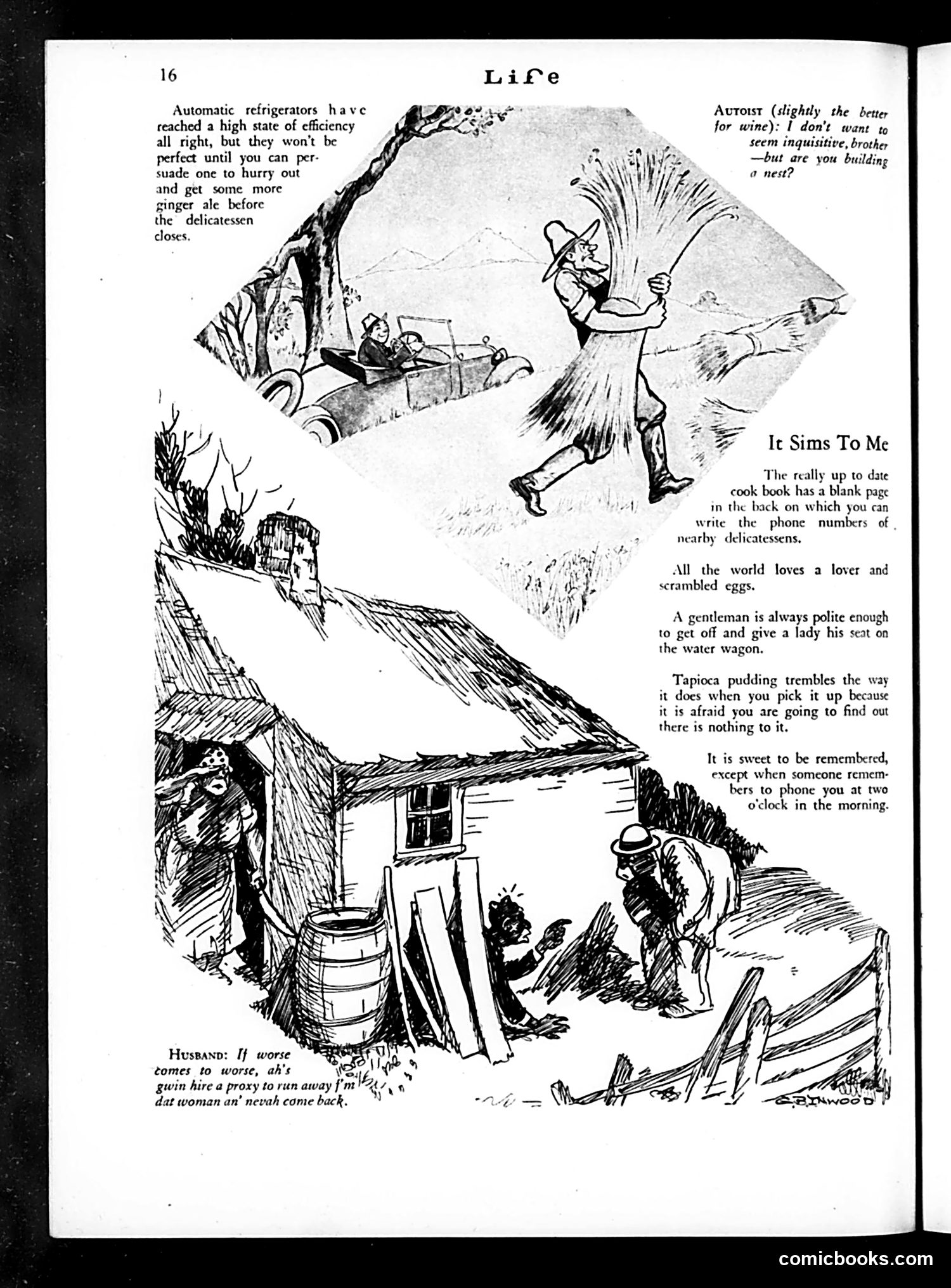
"Life" Magazine Page 16 - Social Commentary This page contains three separate humor pieces satirizing early 20th-century domestic life: 1. "Autoist" (top right): Mocks a car owner who asks an automobilist about building a nest—apparently suggesting the wealthy spend so much time in their automobiles they should live in them. 2. "It Sims To Me" (right column): Offers satirical "modern life tips," including keeping a blank page in cookbooks for delicatessen phone numbers instead of cooking, and remarking that tapioca pudding "trembles" like jello because it's insubstantial. 3. "Husband" (bottom): A domestic joke about wives hiring proxies to run away rather than doing it themselves—cynical commentary on marriage. The overall tone critiques materialism, convenience culture, and marital discord.
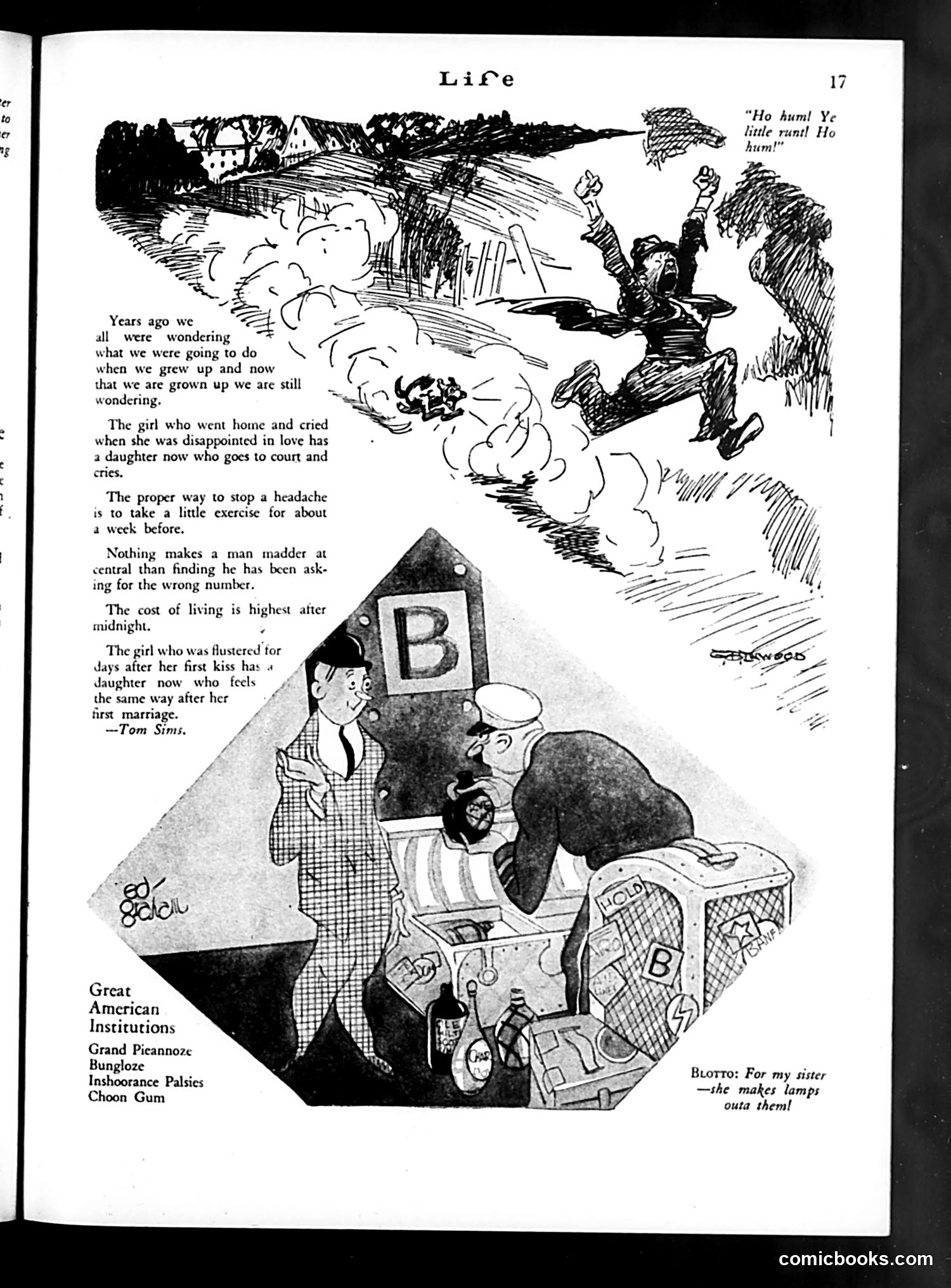
Analysis of Life Magazine Page 17 This page contains two distinct cartoons with accompanying humorous observations. The upper cartoon depicts a man joyfully jumping over clouds, shouting "Ho hum! Ye little varmit! Ho hum!" The scene appears to be rural/pastoral. The satire's specific target is unclear without additional context. The lower cartoon shows what appears to be a "B" branded structure (possibly representing a business or institution), with figures interacting around it. The caption reads "Blotto: For my sister—he makes lamps outa them!" This is a crude joke about alcohol intoxication ("blotto" meaning drunk), suggesting the brother transforms beer bottles into lamps—dark humor about alcoholism. The page includes several humorous observations about life, including observations on childhood wonder, love, headaches, and marriage, credited to Tom Sims.
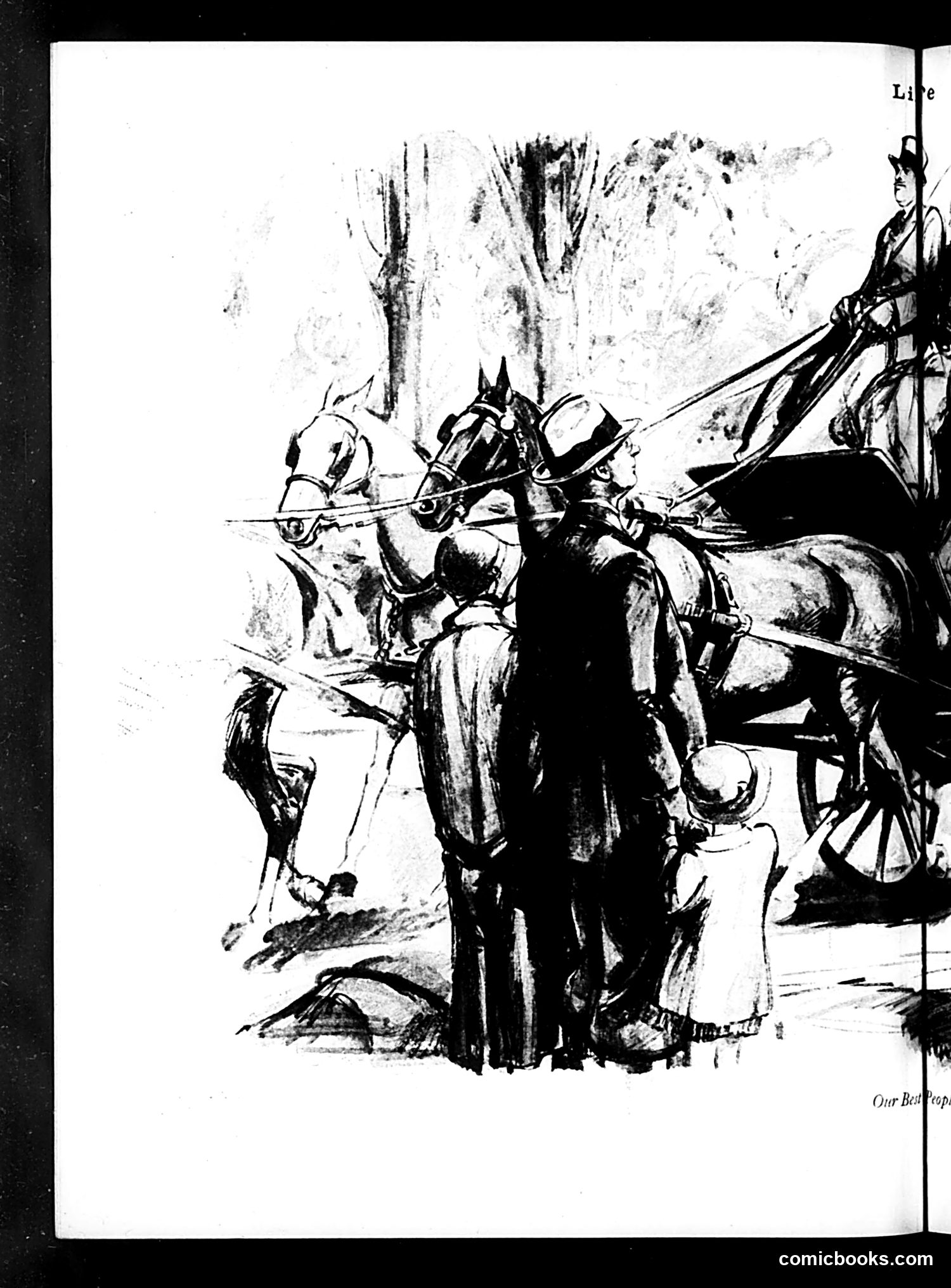
Analysis This page appears to be from *Life* magazine and shows a sketch titled "Our Best Troops" (visible at bottom right). The illustration depicts a military scene with mounted soldiers on horses and what appears to be a child or young person in white clothing in the foreground. The satire likely comments on military recruitment or the quality of soldiers, suggested by the ironic title "Our Best Troops." The presence of the small child among uniformed mounted soldiers suggests commentary on either inadequate military personnel, youth involvement in warfare, or possibly civilian displacement during conflict. However, without clear dates, specific historical context, or identifying captions visible in this reproduction, I cannot definitively state which conflict or period this satirizes. The sketching style and printing quality suggest early-to-mid 20th century publication.
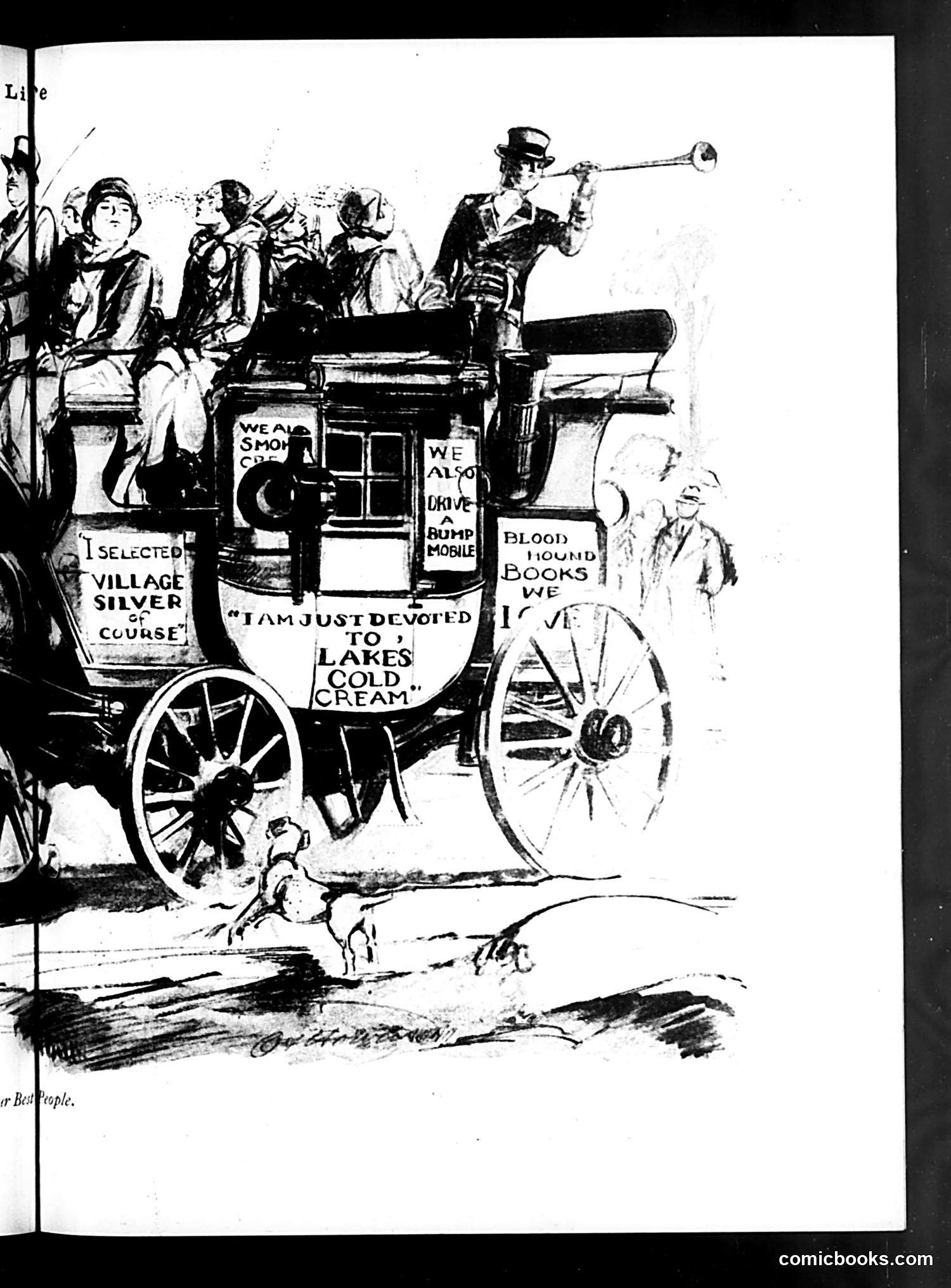
Analysis This is a satirical illustration showing a carnival or promotional vehicle laden with advertising claims. The cart displays contradictory slogans: "I Selected Village Silver of Course," "I Am Just Devoted to Lakes Cold Cream," "We Also Drive Bump Mobile," and "Blood Hound Books We Live." The satire targets advertising excess and consumer manipulation—the vehicle is overloaded with competing product endorsements, each claiming devotion to different brands simultaneously. A barker with a megaphone promotes these goods while onlookers (including a small dog) observe skeptically. This mocks early 20th-century advertising's absurd multiplication of celebrity endorsements and product claims. The chaotic stacking of unrelated goods on one vehicle illustrates how advertising had become overwhelming and contradictory, with public figures shilling for whatever paid them, regardless of logical consistency.
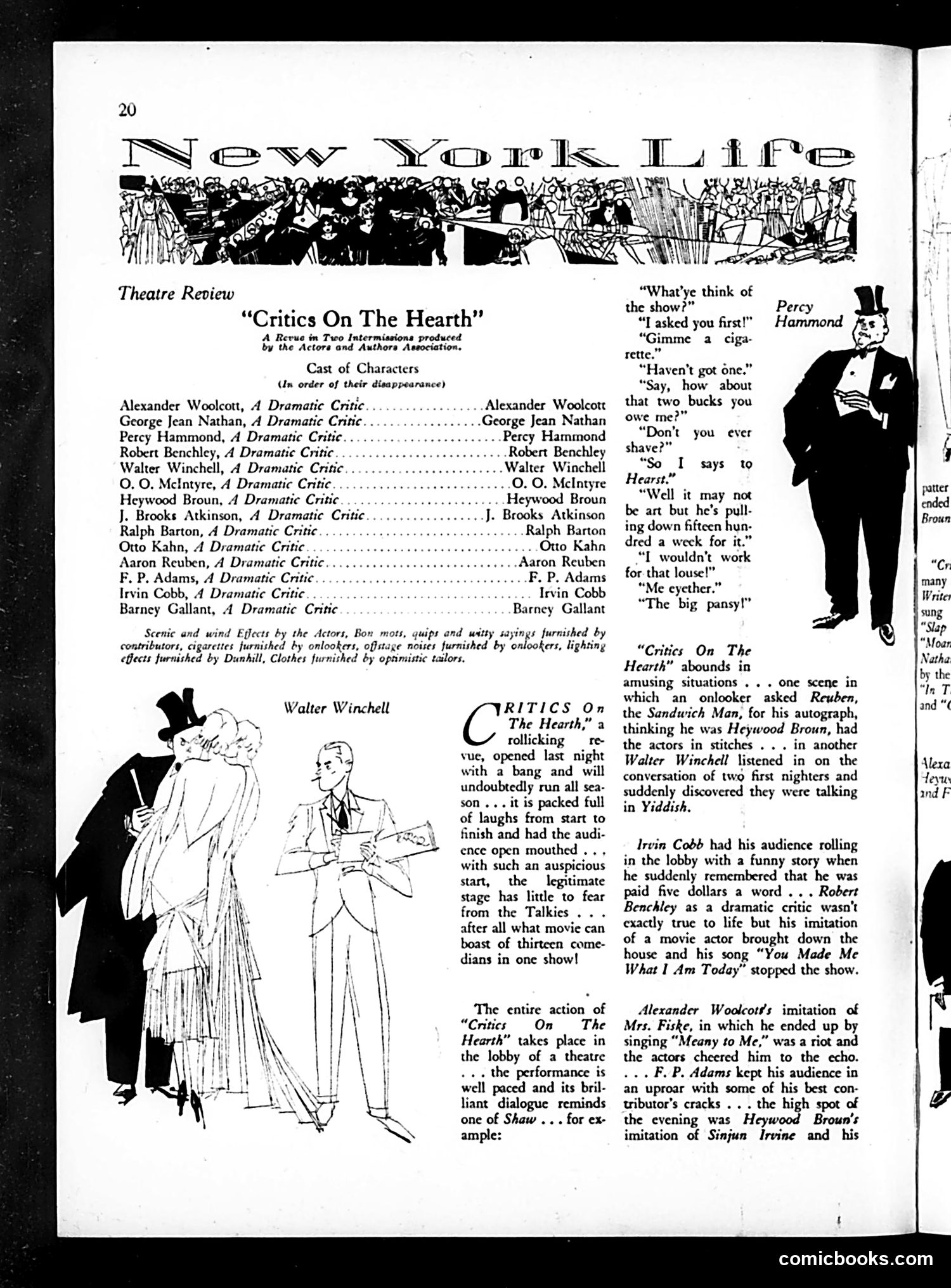
"Critics On The Hearth" Theatre Review This page reviews a satirical theatrical revue mocking New York's prominent drama critics of the era. The show features the critics themselves—Woolcott, Nathan, Hammond, Benchley, Winchell, and others—as characters, with each performing impressions and parodies of one another. The humor targets their pretensions and mannerisms: Winchell's gossip-column style, their competitive one-upmanship, and their self-importance. The accompanying sketch shows a formally dressed man (likely representing theatrical society) observing the chaos. The review itself mimics their overwrought critical style—breathless praise with references to Shaw—while the "dialogue" examples mock their affected banter about money, appearance, and artistic worth. The jokes about Yiddish, vaudeville, and five-dollar-per-word payments reference contemporary theatrical culture and the critics' actual personas and quirks known to readers.
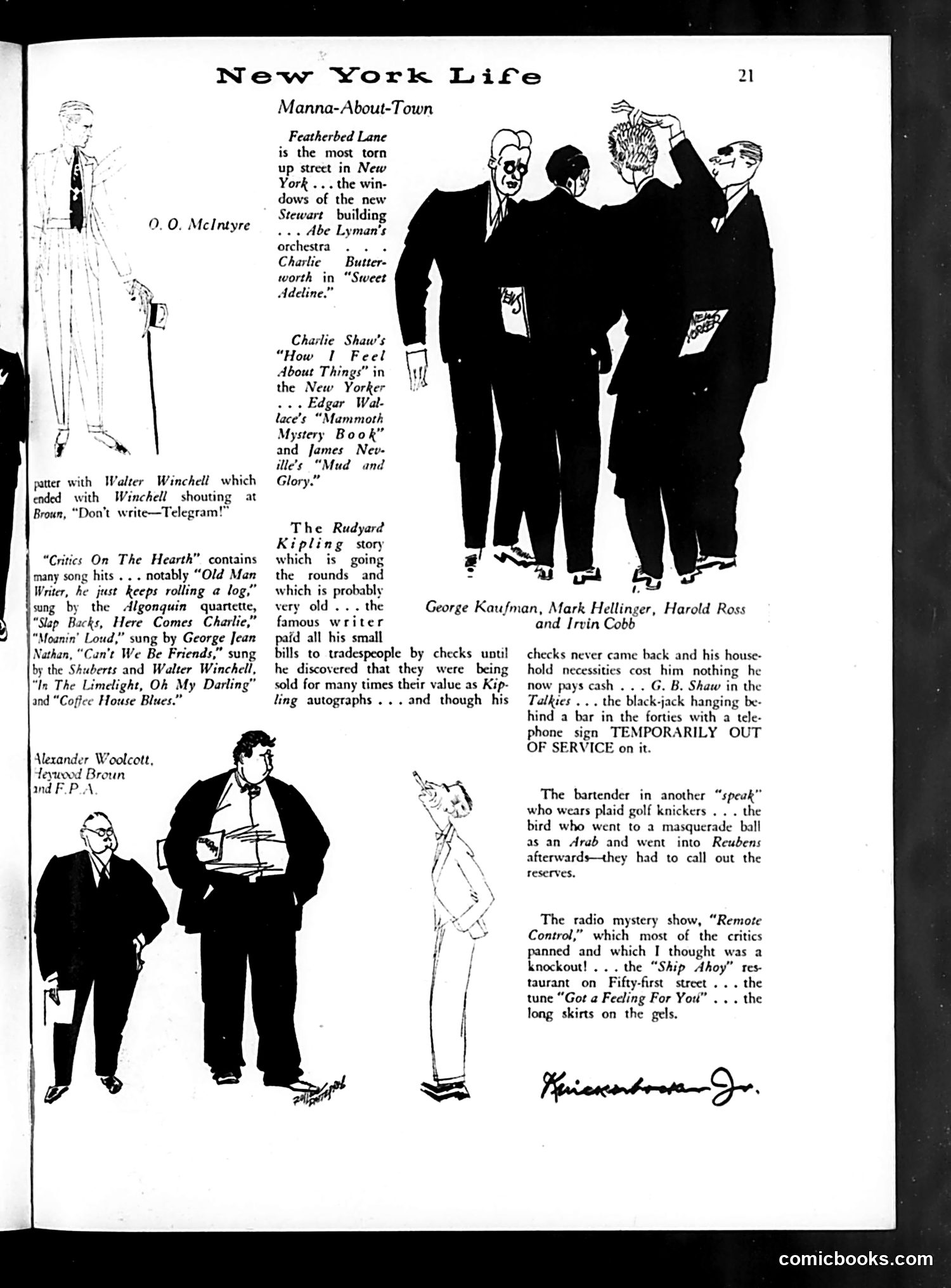
New York Life Page Commentary This is a satirical column about Manhattan's entertainment and literary scene, circa late 1920s. The page features caricatures of prominent figures: O.O. McIntyre (the columnist), Alexander Woolcott, Heywood Broun, and F.P.A. (Franklin P. Adams)—all influential New York theater critics and writers. The humor targets: - Winchell vs. Broun: A reference to the rivalry between gossip columnist Walter Winchell and critic Heywood Broun, with Winchell dismissively telling Broun to telegraph rather than write. - The Rudyard Kipling anecdote: Famous writer discovered people were reselling his autographed checks for more than face value, so he stopped writing checks—mocking celebrity obsession. - Speakeasy culture: References to Prohibition-era illegal bars, including absurd incidents like someone attending a masquerade ball in Arab costume, then going to the upscale Reubens restaurant (requiring police intervention). The column satirizes Manhattan's pretentious entertainment world and its eccentric denizens during the Jazz Age.
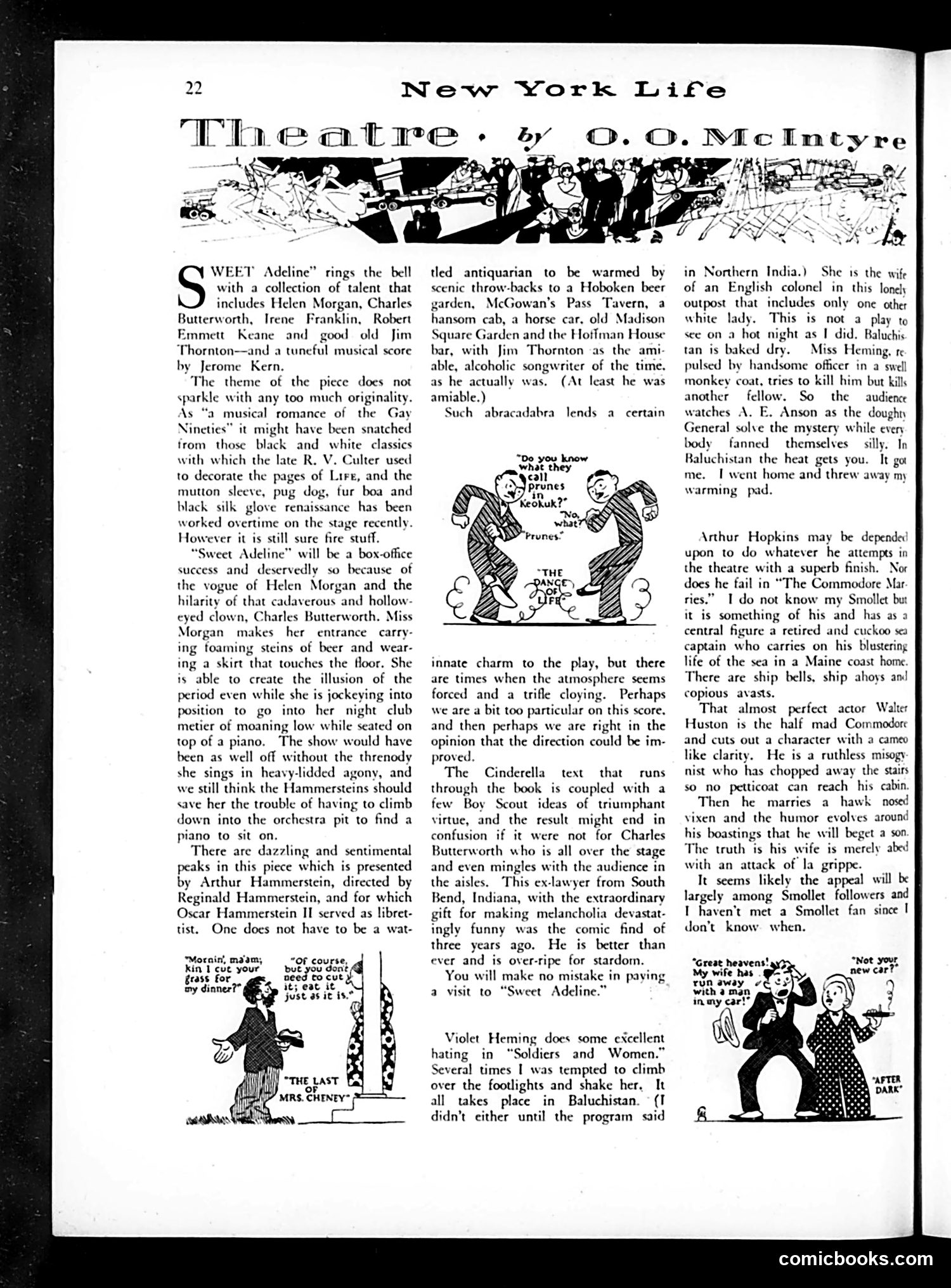
Analysis of This Life Magazine Theater Page This is a theater review column by O.O. McIntyre covering two Broadway productions: "Sweet Adeline" and "Soldiers and Women." "Sweet Adeline" is praised as commercially successful, featuring Helen Morgan and Charles Butterworth. The critic notes the show uses nostalgic "Gay Nineties" aesthetics (period costumes, beer gardens, old New York landmarks). While acknowledging the plot lacks originality, McIntyre praises Butterworth as a comedic talent—an "ex-lawyer from South Bend, Indiana" who creates humor from melancholy. The cartoons show characters discussing "prunes" and dancing, likely visual gags from the production. "Soldiers and Women" is set in Baluchistan (Northern India) and features Violet Heming as a colonel's wife navigating romantic conflict in oppressive heat. McIntyre found it so stifling he wanted to leave—literally throwing away his "warming pad" upon returning home. The tone is typical 1920s theater criticism: witty, gossipy, focused on star power and audience appeal rather than artistic depth.
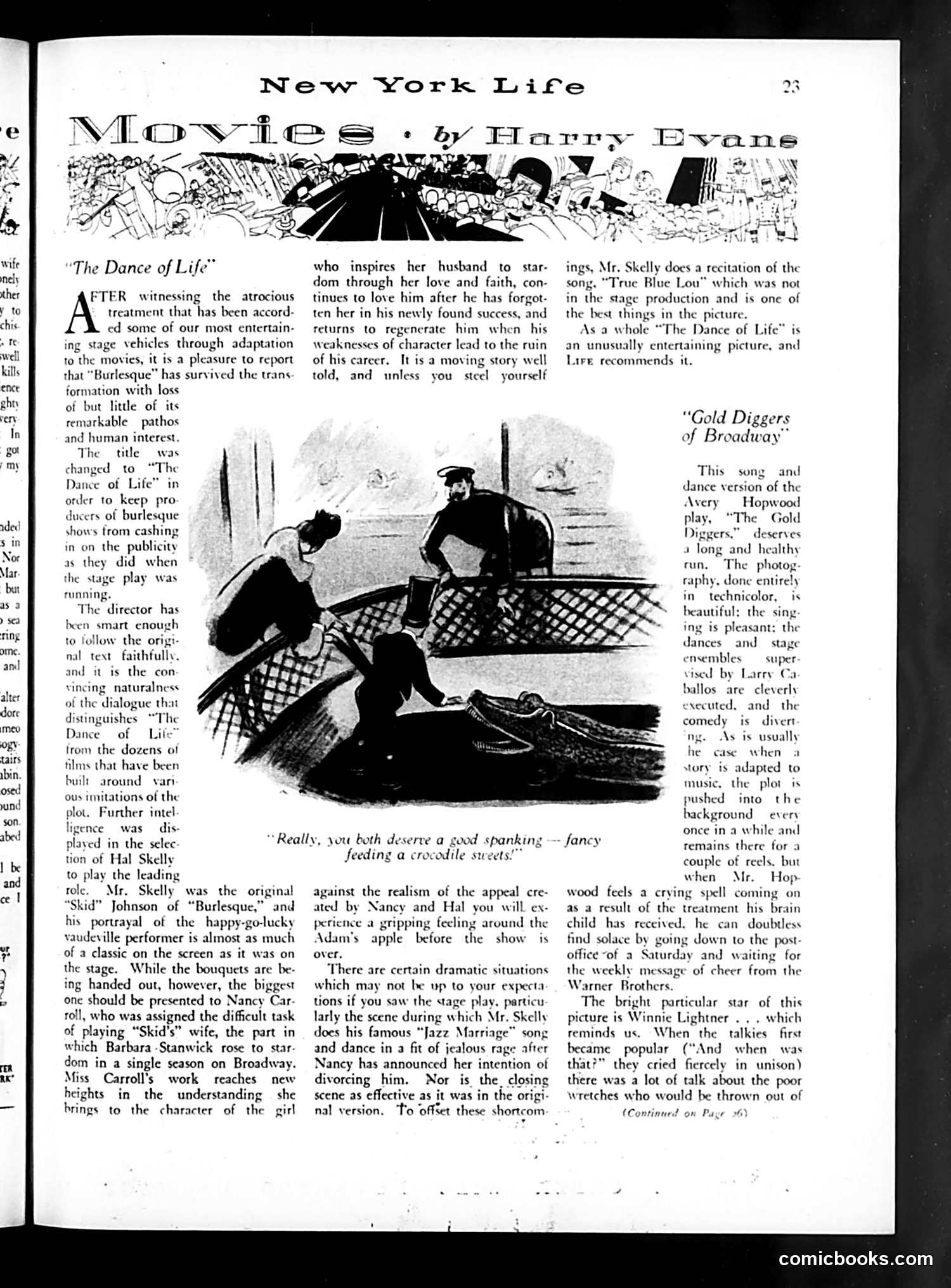
Analysis for Modern Readers This page reviews two early sound films adapted from stage plays: "The Dance of Life" (based on "Burlesque") and "Gold Diggers of Broadway." The main illustration depicts a scene from "The Dance of Life," showing performers in what appears to be a vaudeville or burlesque setting. The review praises the film's fidelity to its source material and highlights performances by Hal Skelly (reprising his original Broadway role) and Nancy Carroll, who plays a devoted wife supporting her husband's theatrical ambitions despite his infidelity and eventual downfall. The reviewer notes that adapting stage plays to film often results in poor quality, making this film's success notable. Specific scenes—particularly a "Jazz Marriage" song-and-dance number—are discussed as either effective or disappointing compared to the original play. The secondary review of "Gold Diggers of Broadway" similarly praises its Technicolor cinematography and musical numbers while noting that plot becomes secondary to musical spectacle—a common trade-off when adapting plays for the emerging musical film genre. Winnie Lightner is highlighted as the film's star. Both reviews reflect the 1920s-era tension between theatrical and cinematic storytelling conventions.
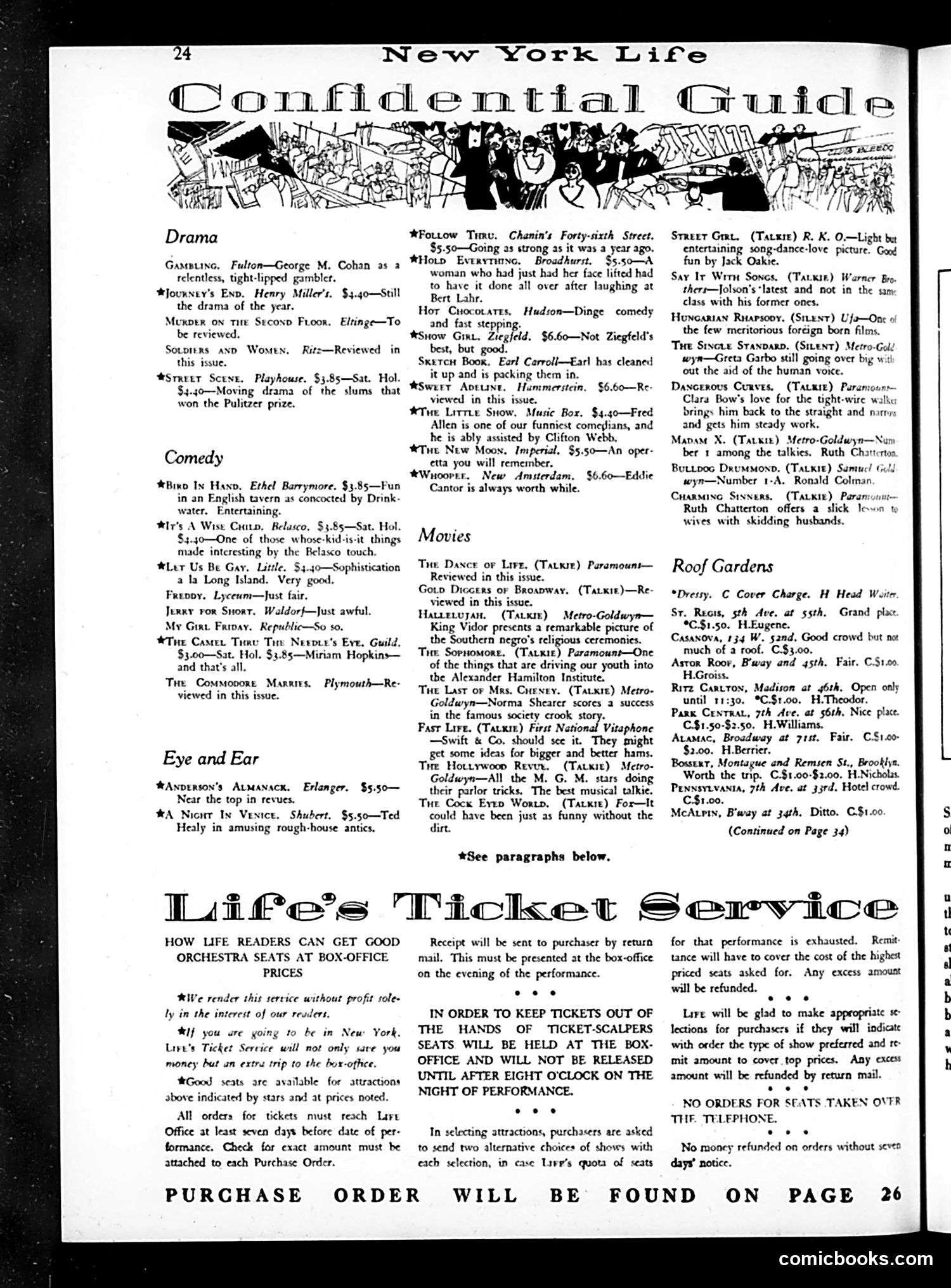
New York Life Magazine Entertainment Guide (c. 1920s) This page is a theater and entertainment listings guide for New York City, not a political cartoon. It catalogs current stage productions and films with brief critical assessments. The "Confidential Guide" reviews Broadway plays (comedies like "Bird in Hand," dramas like "Street Scene"), vaudeville performances, and early "talking" and silent films. Asterisks mark particularly recommended shows. Notable references include George M. Cohan (famous actor-playwright), Ziegfeld (impresario of the Follies), and emerging film stars like Greta Garbo and Al Jolson. The guide emphasizes that Life magazine's ticket service provides discounted orchestra seats—a reader benefit. The tone is chatty and insider-knowing, typical of Life's satirical sophistication for its educated, urban audience. This is essentially an entertainment magazine section, not satirical commentary.
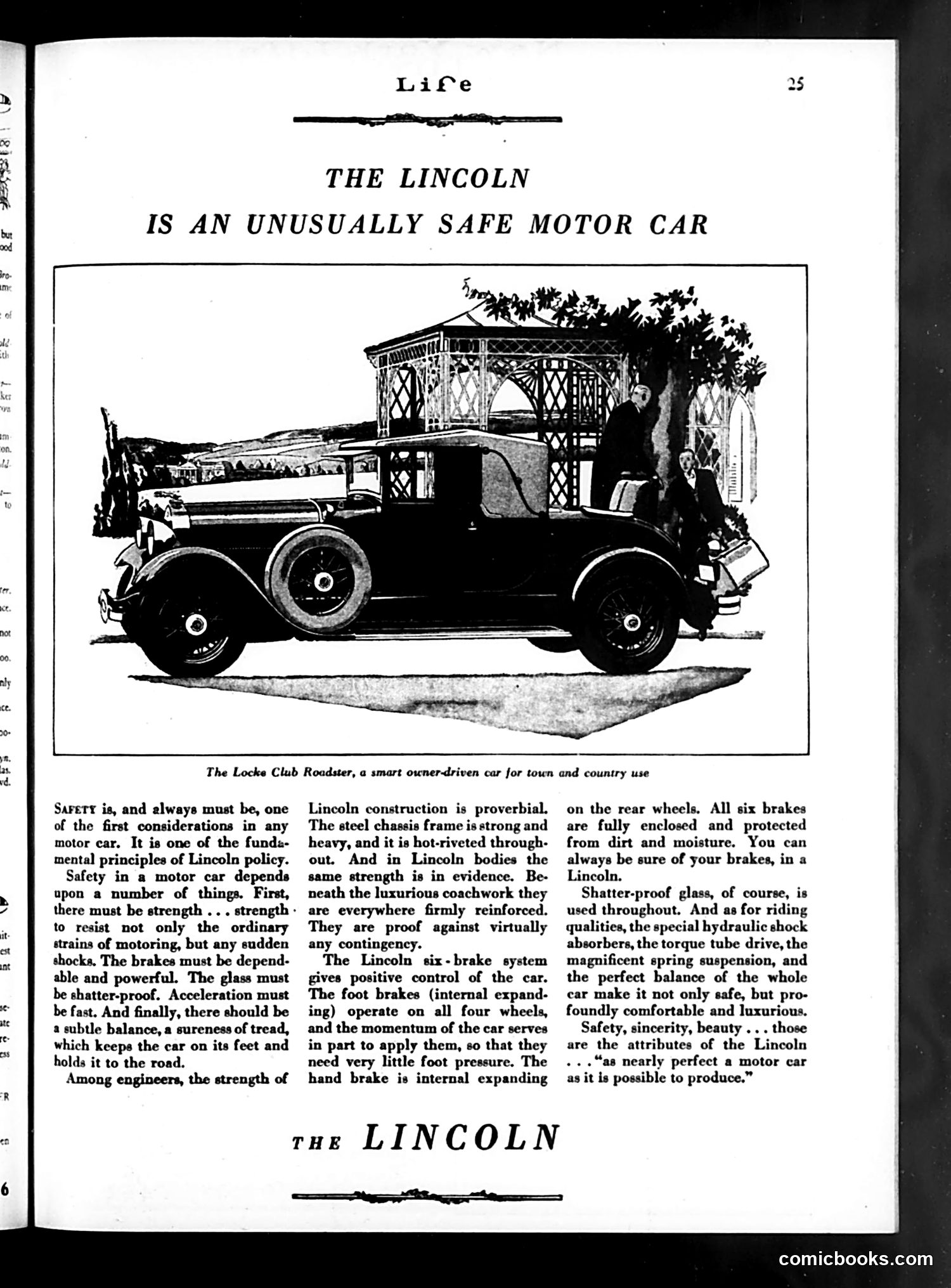
Analysis This is not a cartoon or satire—it's a straightforward automobile advertisement for the Lincoln motor car, appearing in Life magazine (likely 1920s-early 1930s based on the vehicle style). The page promotes the Lincoln as an "unusually safe motor car" through a detailed pitch emphasizing engineering features: steel chassis construction, six-brake system, shatter-proof glass, shock absorbers, and suspension design. The illustration shows "The Locke Club Roadster," a luxury vehicle positioned for affluent "owner-driven" use. The text uses safety as the primary sales angle, listing technical specifications to convince readers of the car's reliability and quality. There is no political commentary, satire, or caricature—this is period advertising copy aimed at wealthy consumers who could afford a premium automobile. The "Life" magazine context suggests this appeared alongside actual satirical content elsewhere in the publication, but this particular page is purely commercial messaging.
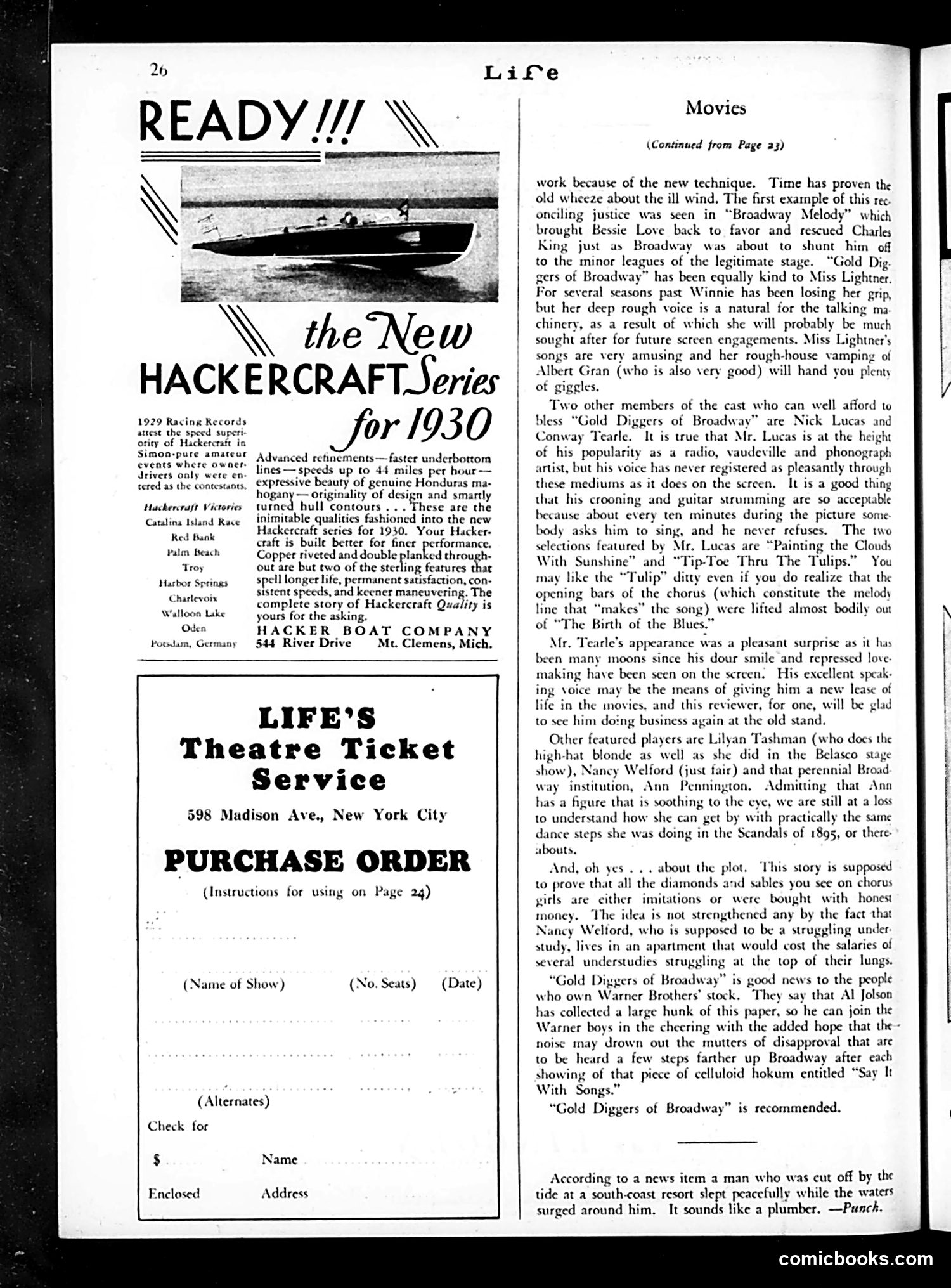
Analysis for Modern Readers This page combines advertising and entertainment criticism from 1930 Life magazine. The top half advertises Hackercraft speedboats, emphasizing their 1929 racing records and luxury features (Honduras mahogany, copper riveting). This targets wealthy leisure consumers. The bottom section reviews the film "Gold Diggers of Broadway," praising how talking pictures revived fading stage careers. The critic notes that: - Winnie Lightner's rough voice suits cinema better than her previous mediums - Nick Lucas (radio/vaudeville star) sings twice per film, though his voice sounds better on screen than radio - Conway Tearle may experience a career renaissance through his speaking voice - The film recycles melody from "Birth of the Blues" - Supporting actresses like Lilyan Tashman and Ann Pennington perform familiar dance routines The satire is gentle: the critic acknowledges cinema's power to resurrect careers while gently mocking performers (especially Pennington) for relying on stale material. This reflects early sound-film era skepticism about whether stage talent translated to cinema.
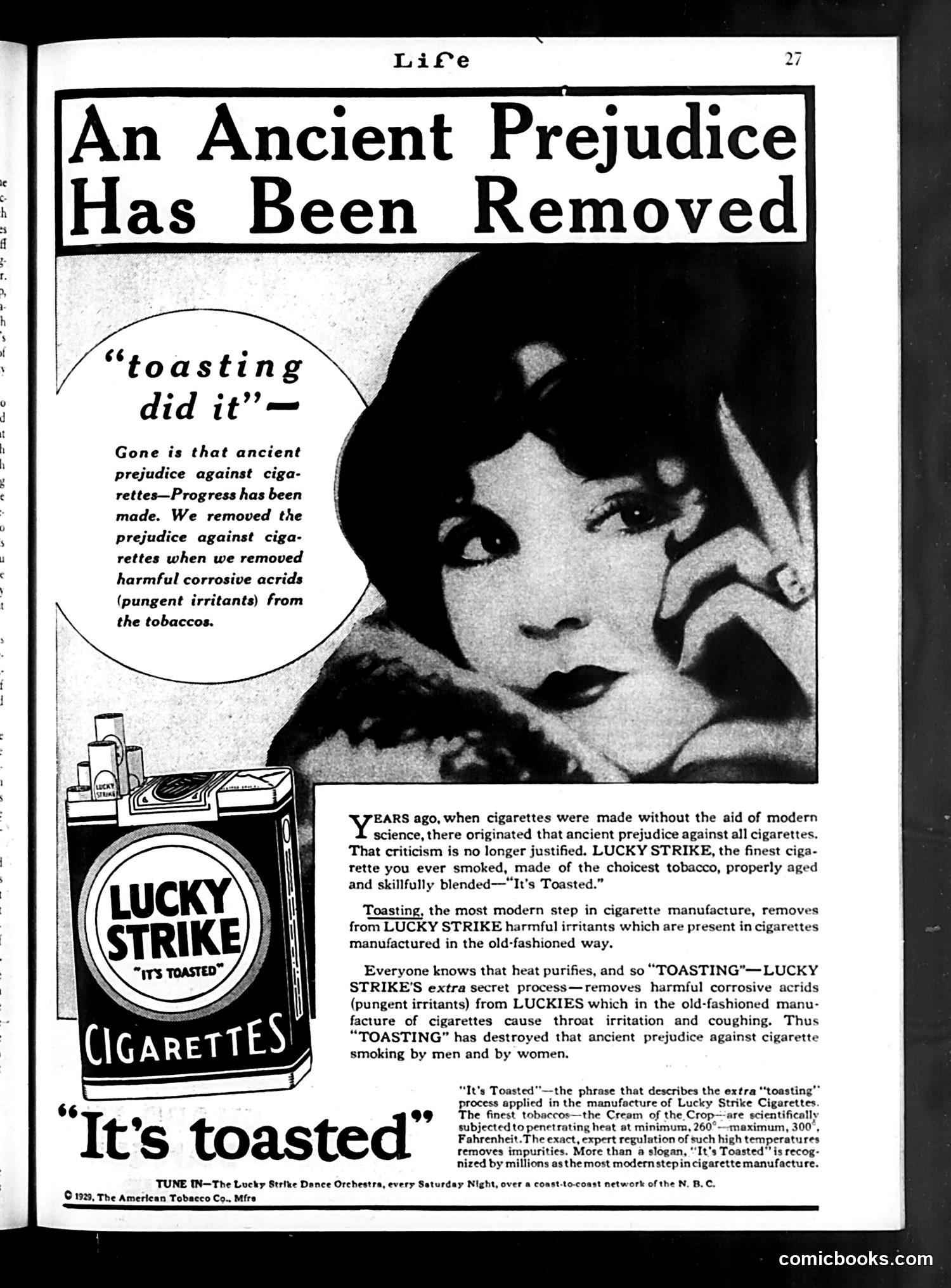
Lucky Strike Cigarette Advertisement (1929) This is a cigarette advertisement, not satire—though it reads satirically to modern readers. Lucky Strike claims to have removed "ancient prejudice" against smoking by introducing "toasting," a heat process that allegedly removes harmful irritants from tobacco. The advertisement features a glamorous woman's face and argues that old criticism of cigarettes was justified when made without modern science, but is now obsolete. The "prejudice" being referenced appears to be health concerns and social disapproval of smoking, particularly by women. The irony for modern readers: Lucky Strike presents a marketing innovation as solving legitimate health dangers, when cigarettes themselves remained highly dangerous. The ad exemplifies early 20th-century advertising's strategy of reframing health objections through pseudo-scientific claims rather than addressing actual risks. The phrase "It's Toasted" became Lucky Strike's famous slogan used to market cigarettes as safer.
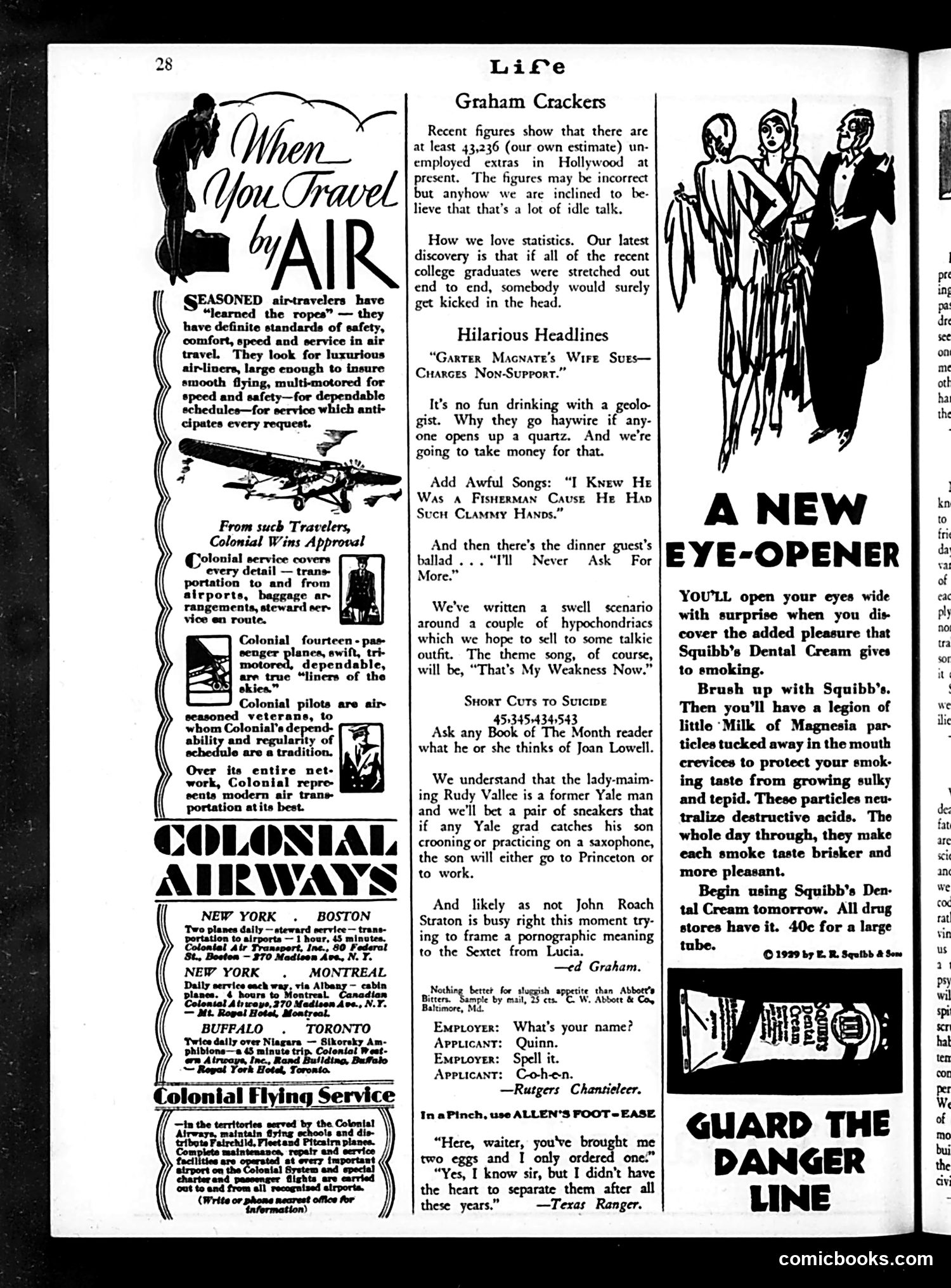
Life Magazine Page Analysis This page from *Life* magazine combines satirical humor columns with period advertisements. The main editorial content, "Graham Crackers," offers topical jokes about 1920s-30s society: Key satire points: - Unemployed Hollywood extras (43,236 estimated) characterized as generating "idle talk" - College graduate statistics presented as absurdist humor - Jokes about dating geologists, Rudy Vallee (crooner/Yale alumnus), and preacher John Roach Straton's attempts to find indecent meanings in classical music The advertisements promote Colonial Airways (early commercial aviation) and Squibb's Dental Cream, reflecting consumer products of the era. Context for modern readers: This represents *Life* magazine's satirical gossip-column style, mixing Hollywood industry commentary with wordplay and social observation typical of 1920s-30s humor—much of which relies on now-obscure references (Rudy Vallee, Joan Lowell) that would require period knowledge to fully appreciate. The tone assumes reader familiarity with contemporary celebrities and debates.
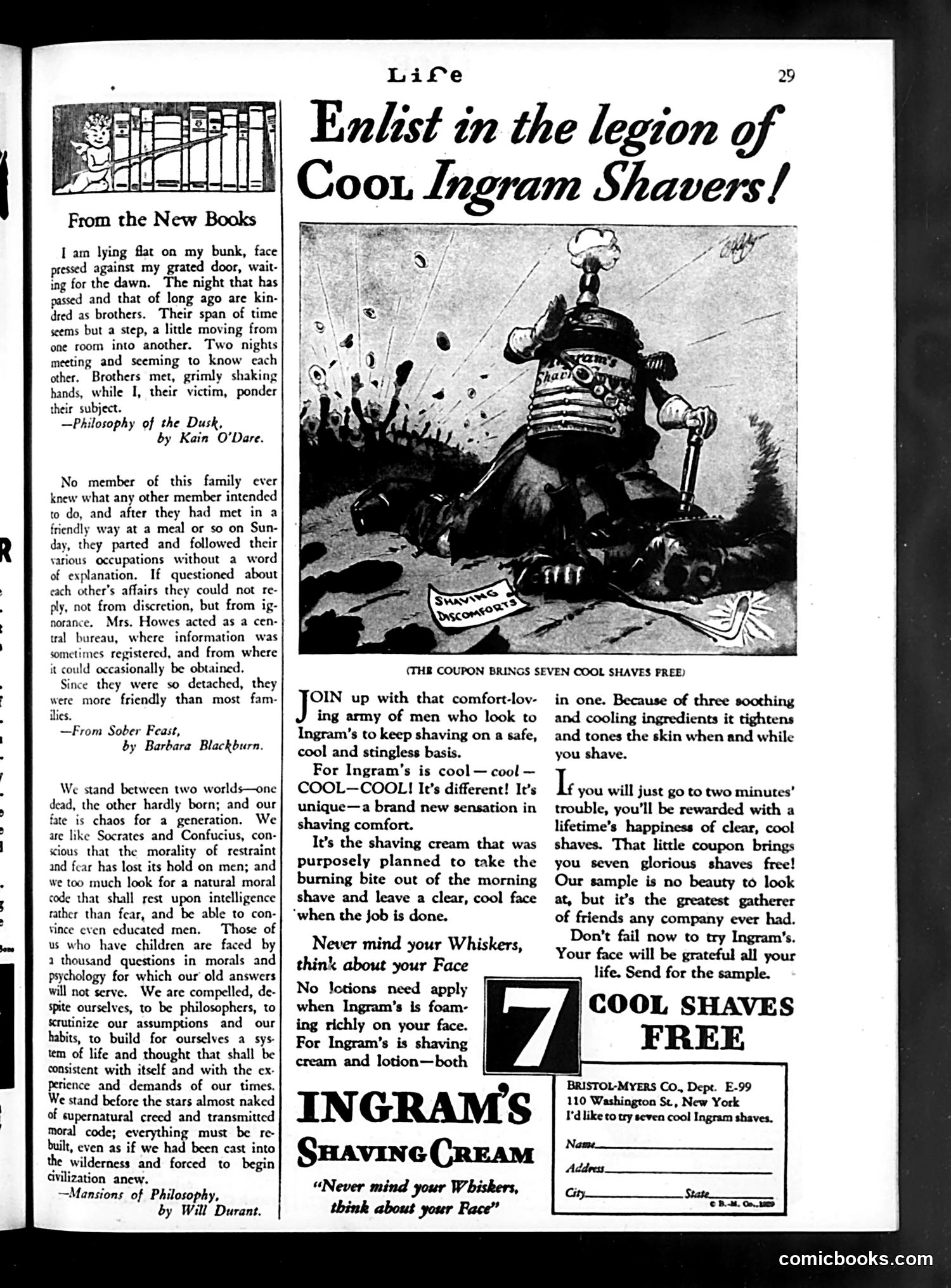
Analysis This page mixes literary excerpts with advertising. The cartoon shows a mechanical robot or war machine labeled "Ingram's" firing shaving cream or foam as weaponry, with "Whiskers" depicted as the defeated enemy being blasted away. The satire is straightforward advertising mockery: Ingram's Shaving Cream is humorously presented as a militaristic product—men should "enlist in the legion" to wage war against facial hair. The robot/machine aesthetic parodies contemporary military imagery (likely WWI-era, given the design), treating mundane grooming as epic combat. The slogan "Never mind your Whiskers, think about your Face" positions the product as solving a vanity problem through aggressive marketing language. The coupon gimmick ("seven cool shaves free") was standard advertising practice. The literary quotes above mock philosophical hand-wringing about modern morality—contrasting serious existential concerns with the trivial consumer concern of shaving comfort. This juxtaposition between Life's satirical editorial content and commercial advertisements was typical of the magazine's format.
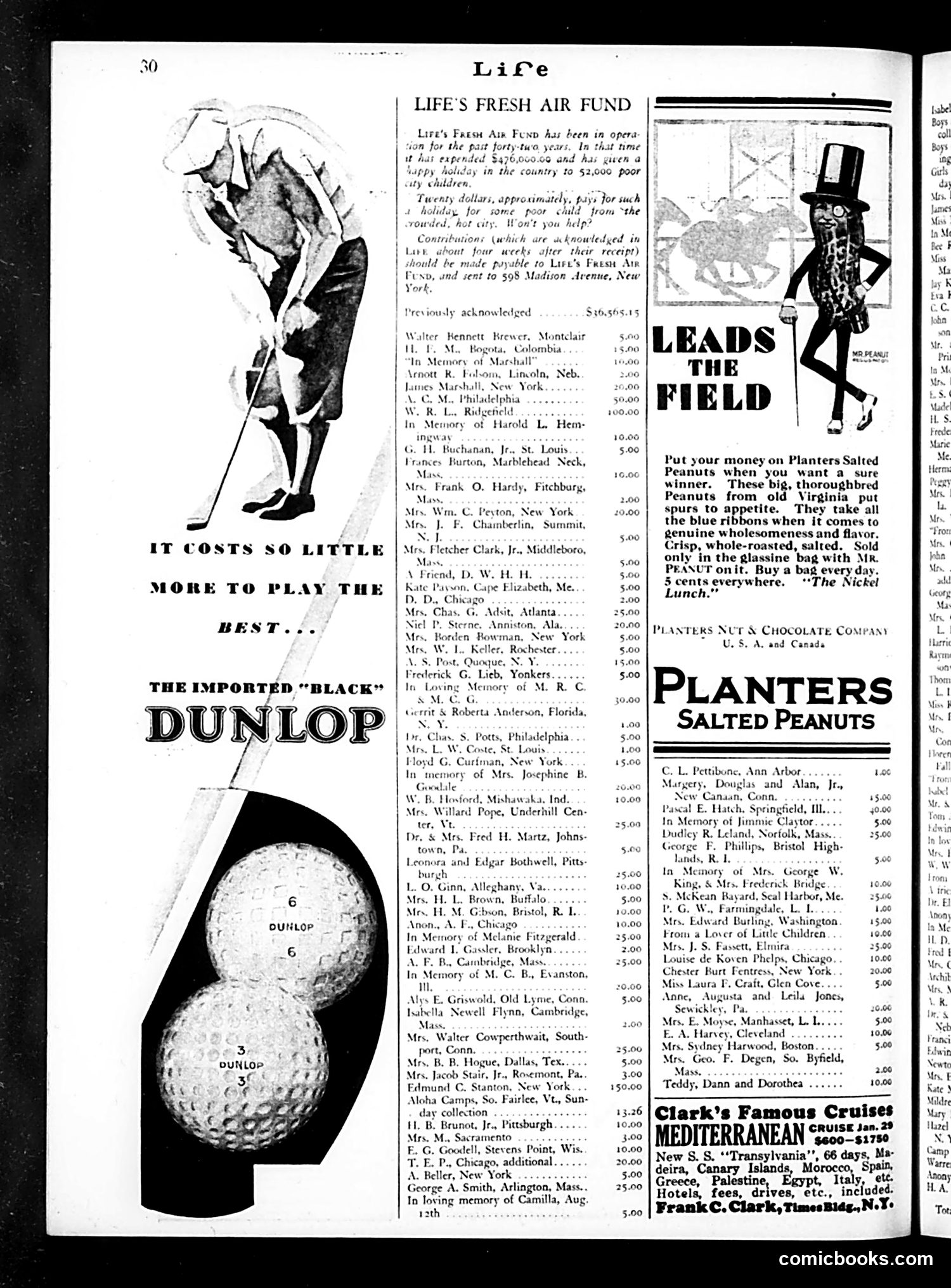
Analysis This page is primarily advertising and donor acknowledgments, not political satire. The left side features a Dunlop golf ball advertisement—the "Black" Dunlop—using the slogan "It Costs So Little More to Play the Best." The visual shows a golfer in silhouette with an oversized golf ball. The center contains Life's Fresh Air Fund, a charitable initiative providing poor children country holidays. It lists donors and contribution amounts (ranging from $1–$150). The right side advertises Planters Salted Peanuts with the iconic Mr. Peanut mascot in top hat and monocle, promoting them as a reliable product ("when you want a sure winner"). There is no political cartoon or satirical commentary on this page. It represents typical Life magazine content of this era—mixing advertisements with charitable fundraising announcements. The Mr. Peanut figure, while distinctive, is simply a commercial mascot, not a caricature of a political figure.
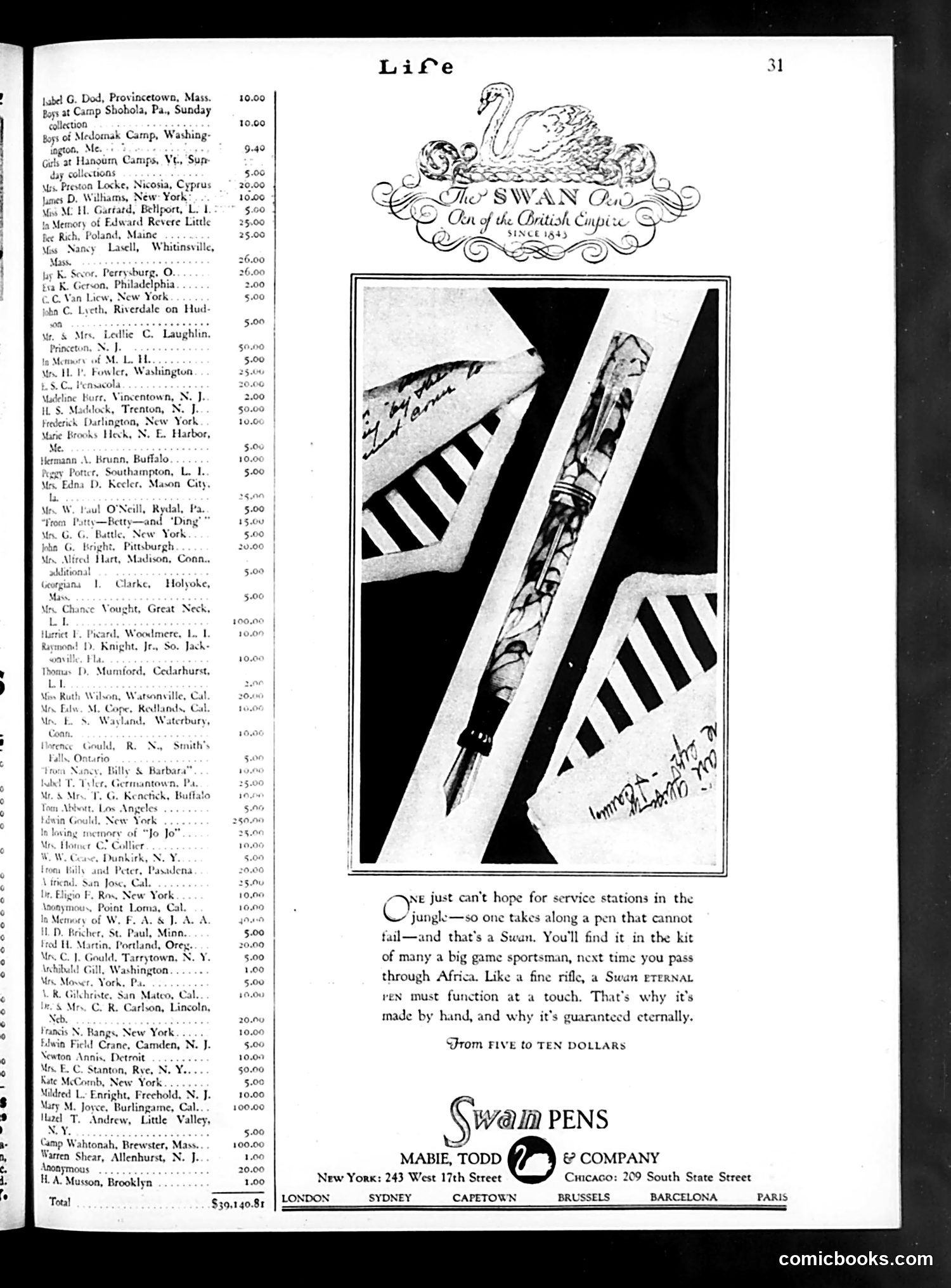
Page Analysis: Life Magazine Advertisement This page is primarily an advertisement for Swan pens, not a political cartoon. The upper portion shows decorative illustrations of ornate pens against a black and white geometric background. Below runs promotional copy explaining Swan's appeal to "big game sportsmen" in Africa—the pens function reliably in harsh conditions and are "guaranteed eternally" because they're "made by hand." The left column lists donors to what appears to be a charitable collection (possibly for summer camps, based on references to "Camp Shobola" and similar institutions), totaling $30,140.81. The "satire" here is commercial rather than political: the advertisement humorously suggests that taking a quality pen on safari is as essential as "a fine rifle," appealing to wealthy sportsmen's vanity. The copy plays on the romance of African adventure while subtly positioning the Swan pen as a luxury good for the affluent. This reflects early 20th-century advertising strategy: associating products with aspirational lifestyles and exotic travel.
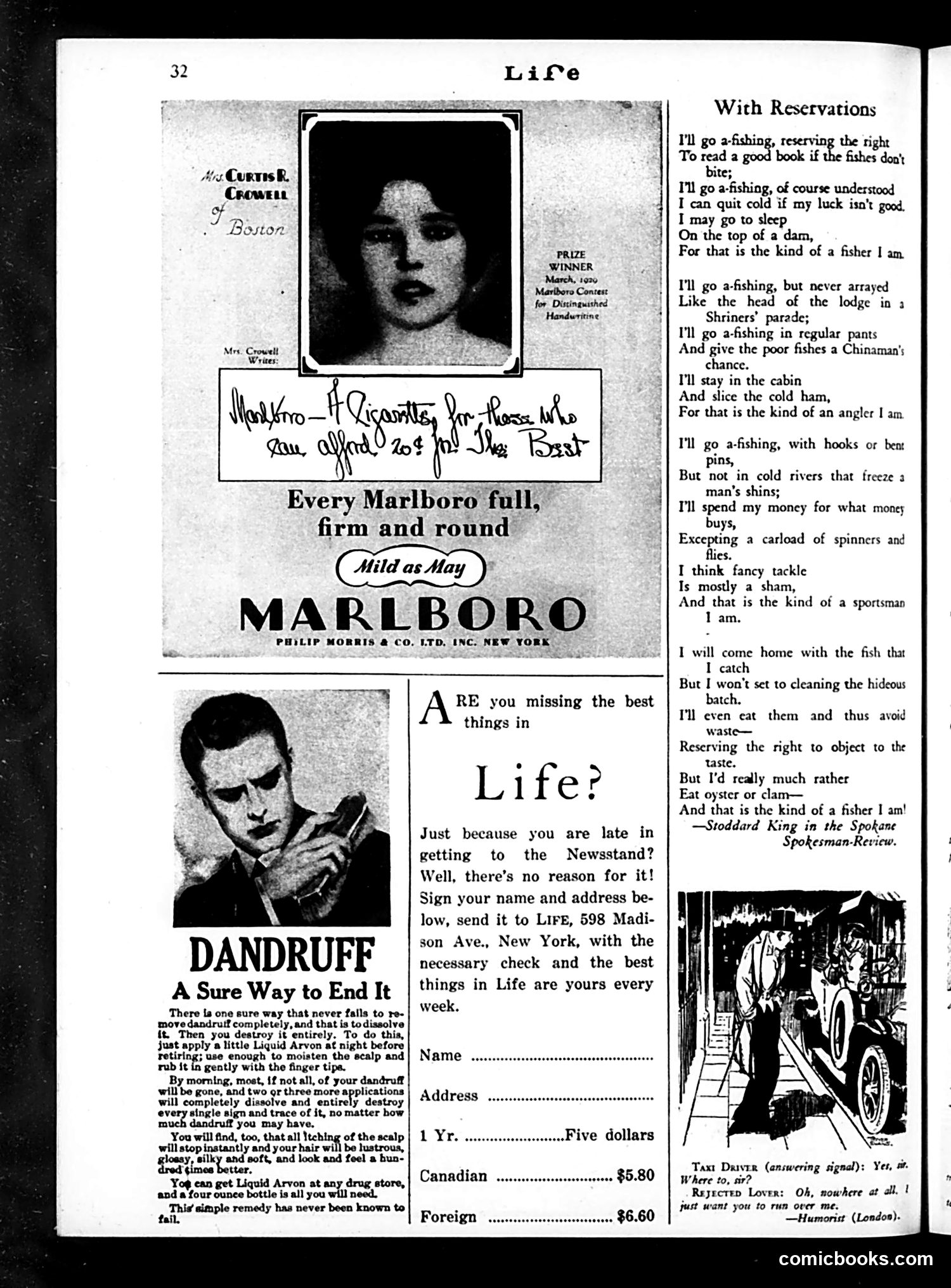
Life Magazine Page Analysis This page combines advertisements with humorous content typical of Life magazine's satirical format. Top Section: A Marlboro cigarette ad featuring a prize-winning portrait by Curtis R. Crowell, with a handwritten inscription. This appears to be promoting cigarettes as a lifestyle product. Main Advertisement: "Dandruff - A Sure Way to End It" hawks Liquid Arvon, a patent medicine claiming to dissolve dandruff completely. The ad represents typical early-20th-century medical marketing—overstating efficacy with pseudo-scientific language about "dissolving" the problem. Right Column: A humorous poem titled "With Reservations" satirizes casual anglers who fish with minimal commitment—willing to quit if luck fails, skipping fancy equipment, eating cold ham in the cabin. It mocks pretentious "sportsmen" while celebrating an unpretentious, practical approach. Bottom Section: A subscription pitch for Life magazine itself, with pricing tiers, plus a small cartoon joke about a "rejected lover" asking a taxi driver to run him over—dark humor typical of the era. The page reflects 1920s advertising, lifestyle satire, and consumer culture.
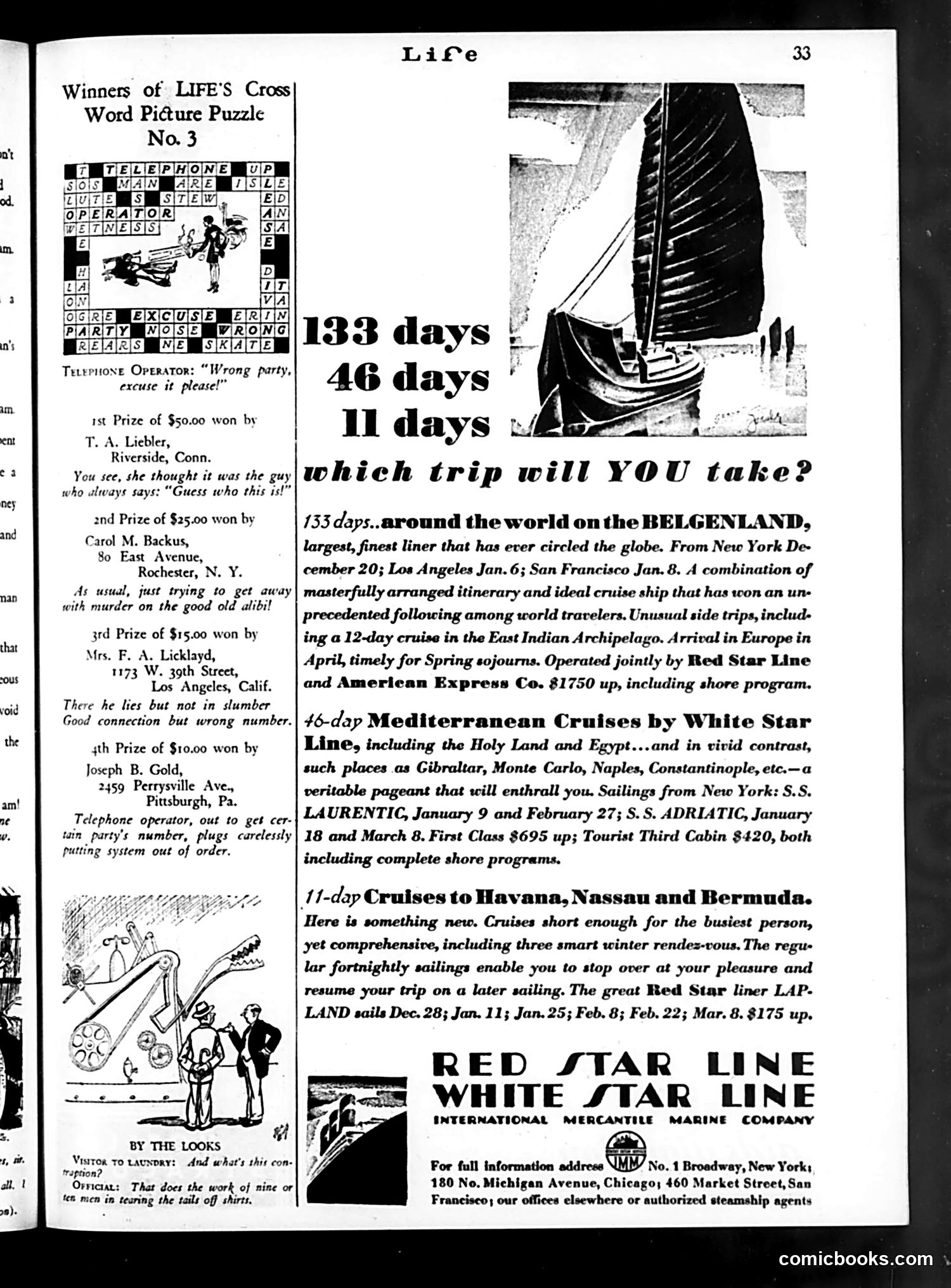
Analysis This page mixes a crossword puzzle contest with cruise ship advertising. The main content is not political satire but rather commercial promotion. The left column shows winners of Life magazine's crossword puzzle competition, each entry accompanied by a brief joke: - A telephone operator mixing up callers - A woman mistaking someone's voice - Someone lying dead with a "wrong number" pun - A careless operator damaging phone equipment The humor is domestic and mild—workplace mishaps and misunderstandings typical of 1920s-30s comedy. The right side advertises luxury ocean voyages by Red Star Line, White Star Line, and American Express: around-the-world cruises (133 days), Mediterranean trips (46 days), and Caribbean cruises (11 days). These represent aspirational leisure travel for affluent Americans. The small cartoon at bottom left ("By the Looks") shows passengers and appears connected to the "telephone operator" theme but is largely illegible. This is primarily an advertising page with light comedic filler—not political commentary.
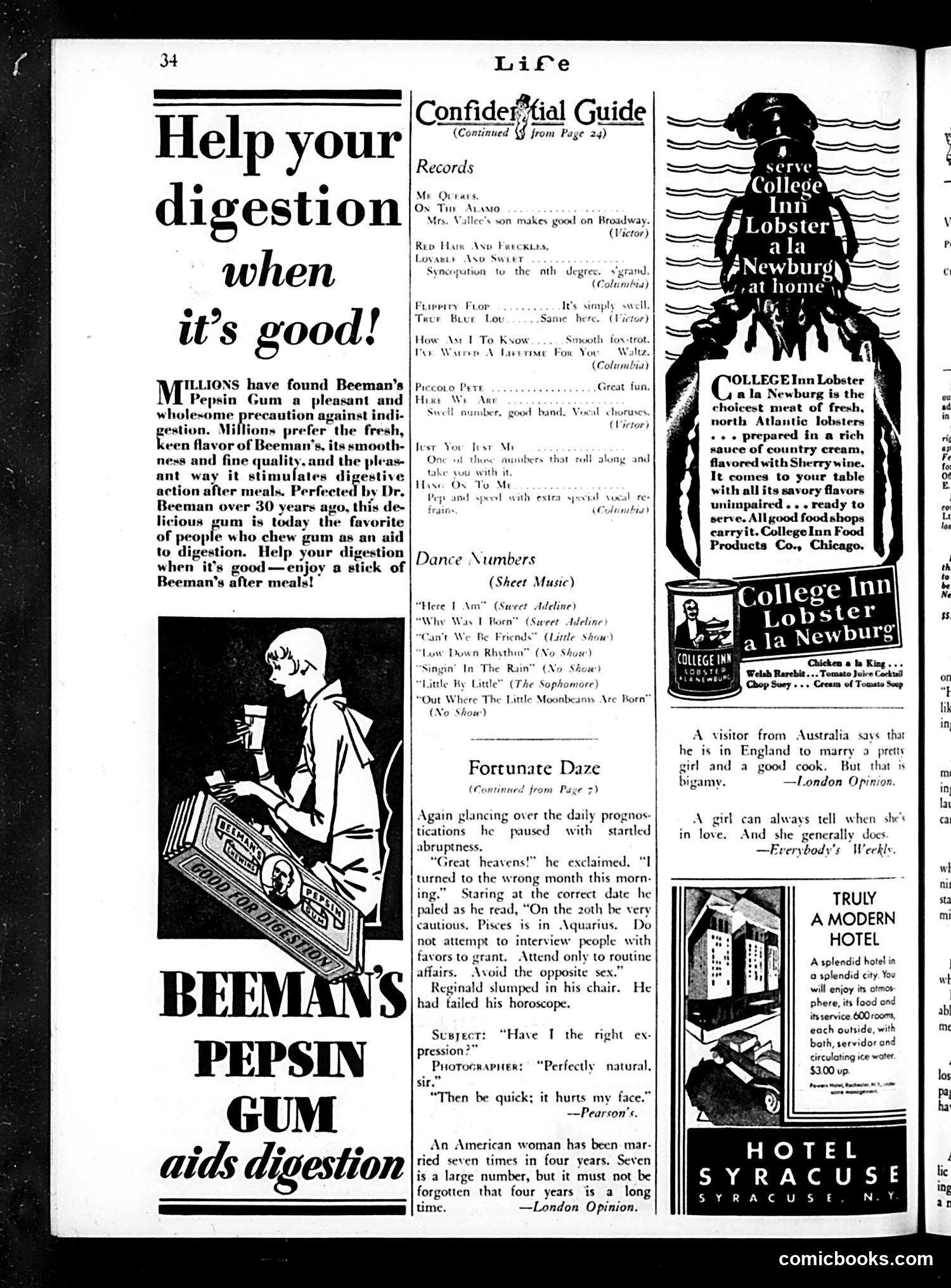
Analysis of Life Magazine Page 34 This page is primarily advertising and humor content, not political satire. The main elements are: Left side: A Beeman's Pepsin Gum advertisement claiming the product aids digestion. The illustration shows a woman chewing gum—a common marketing approach of the era emphasizing how modern consumers could maintain health through commercial products. Center: A "Confidential Guide" column listing popular song records and dance numbers, typical of Life's entertainment coverage during what appears to be the 1920s-30s era. Right side: Advertisements for College Inn Lobster à la Newburg and a modern hotel, plus a humor section called "Fortunate Daze" featuring jokes about astrology and horoscopes—mocking people's belief in zodiac-based decision-making. Bottom jokes include quips about marriage and romance, reflecting period attitudes. The page reflects early 20th-century consumer culture, popular music trends, and light satirical humor rather than serious political commentary.
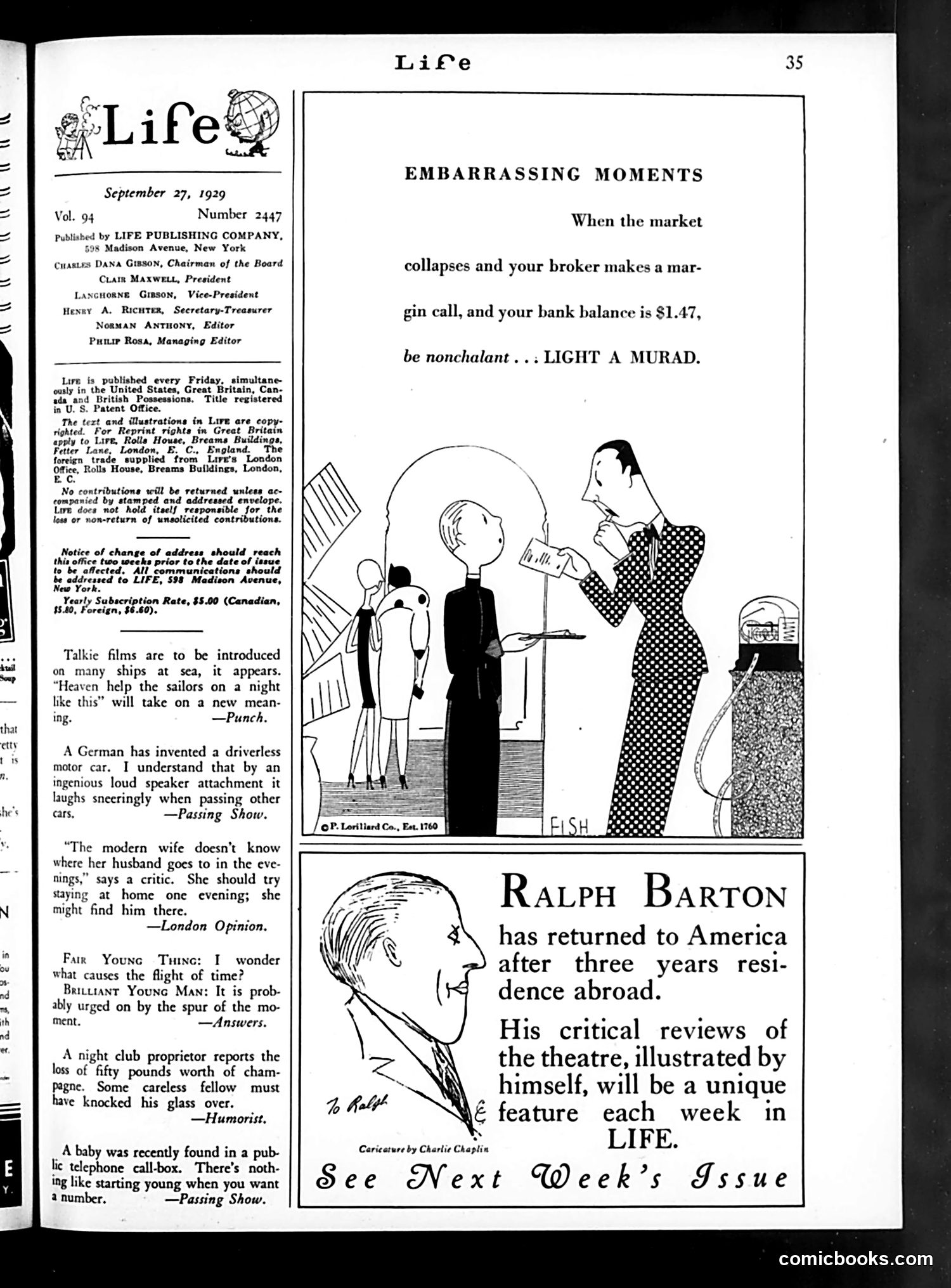
"Embarrassing Moments" - Stock Market Crash Context This page, dated September 27, 1929, was published just days after the catastrophic stock market crash of October 1929 (Black Tuesday). The main cartoon satirizes the financial panic gripping America. The illustration shows a anxious man in a checkered suit receiving a "margin call" from his broker—a demand for additional funds to cover investment losses. The joke: he has only $1.47 in his bank balance. The caption advises him to "be nonchalant" and light a Murad cigarette—a darkly humorous advertisement suggesting smoking will somehow help him cope with financial ruin. The cartoon works as both social satire and product placement, mocking the desperate situation facing ordinary investors who bought stocks on credit (margin) and faced total collapse. The nonchalance recommended is obviously impossible, making the desperation the real punchline. This captures the immediate shock of the Great Depression's onset.