life
Life — October 4, 1929
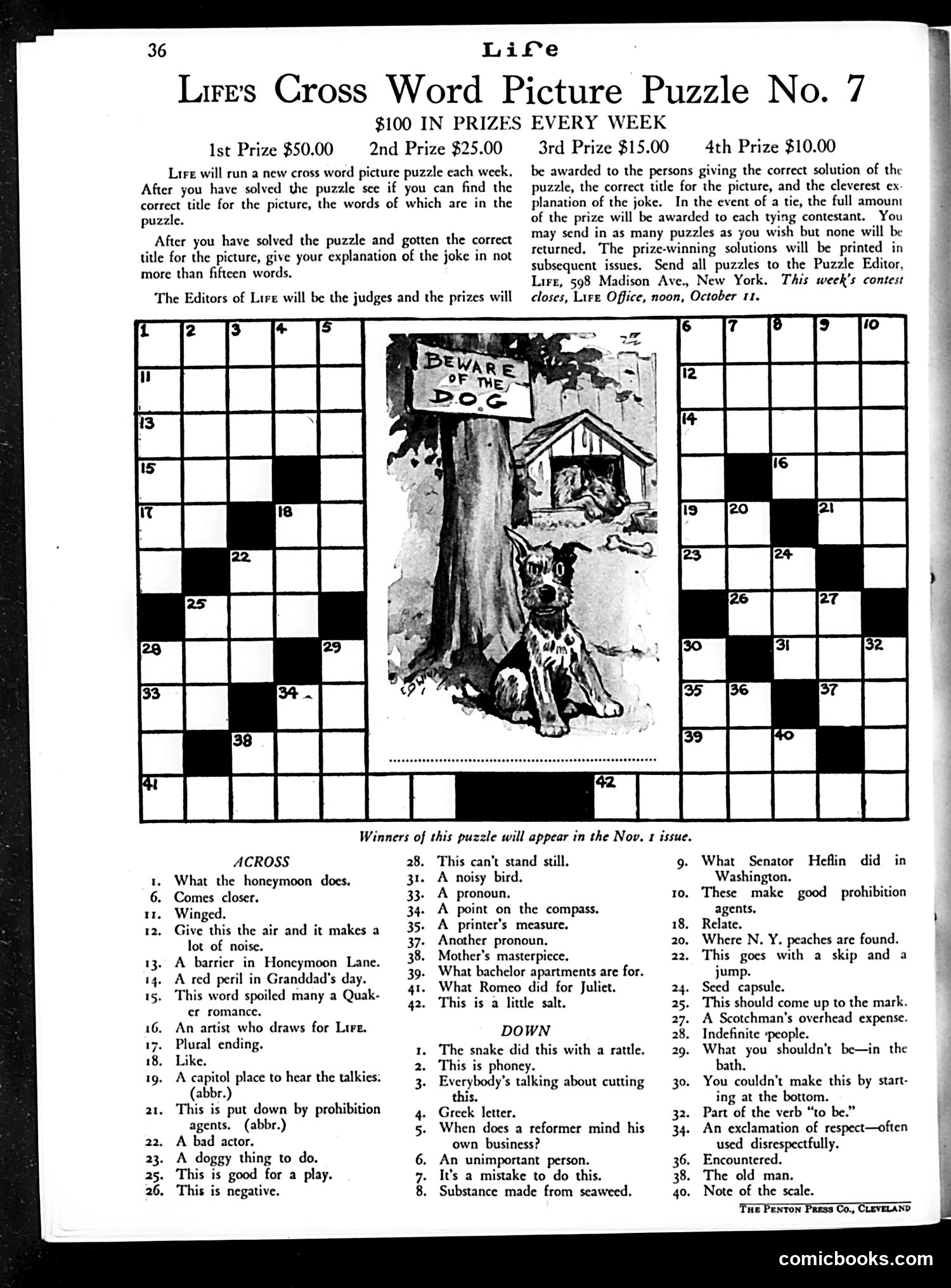
Analysis of Life Magazine Crossword Puzzle Page No. 7 This page is primarily a crossword puzzle contest, not political satire. It features a humorous illustration of a dog beneath a "Beware of the Dog" sign—a visual joke setting up the puzzle's theme. The crossword clues reference early 20th-century American culture: Senator Heflin (Washington politics), N.Y. peaches, Romeo and Juliet, and Prohibition-era references ("prohibition agents," "good prohibition agents"). The puzzle offers $100 in weekly prizes ($50 first place), typical of Life magazine's entertainment contests during this era. The humor is gentle wordplay rather than political commentary—clues like "What Romeo did for Juliet" and "A doggy thing to do" are lighthearted puns, not satire. This represents Life's evolution from pure satire to a general-interest magazine incorporating puzzles and competitions.
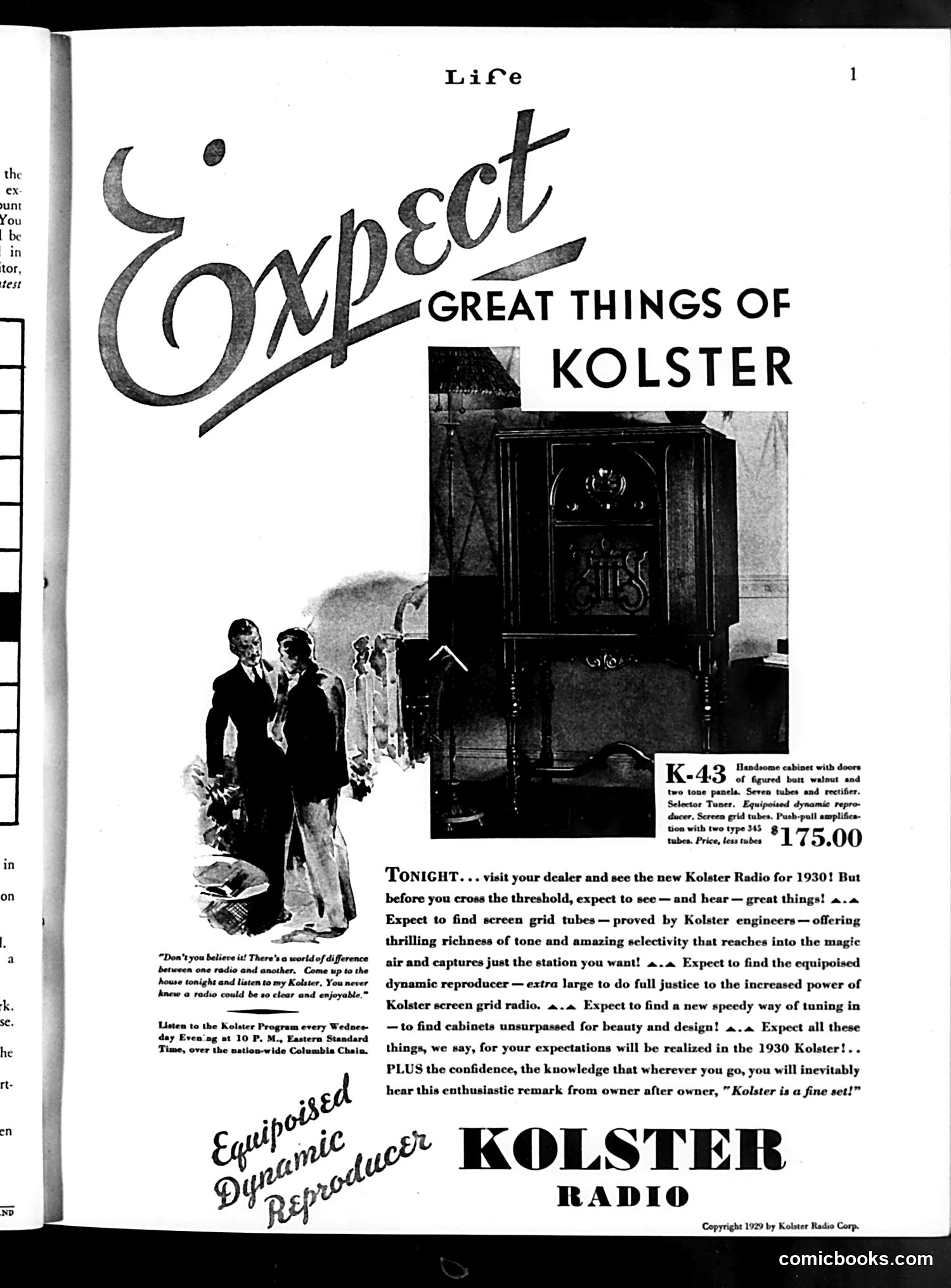
Analysis This is primarily a Kolster Radio advertisement, not a political cartoon. The page shows a 1930 radio cabinet (model K-43, priced at $175.00) being promoted as incorporating advanced features like "seven tubes and rectifier" and "screen grid tubes." The small illustration depicts well-dressed people approaching the radio, suggesting it's a social attraction—a common marketing approach of the era. The text emphasizes Kolster's technological superiority and invites readers to visit dealers to experience the "new Kolster Radio for 1930." There is no political satire or social commentary here. This is straightforward commercial advertising leveraging the excitement around radio technology's rapid advancement in the early 1930s. The "great things" referenced are technological features, not historical or political events.
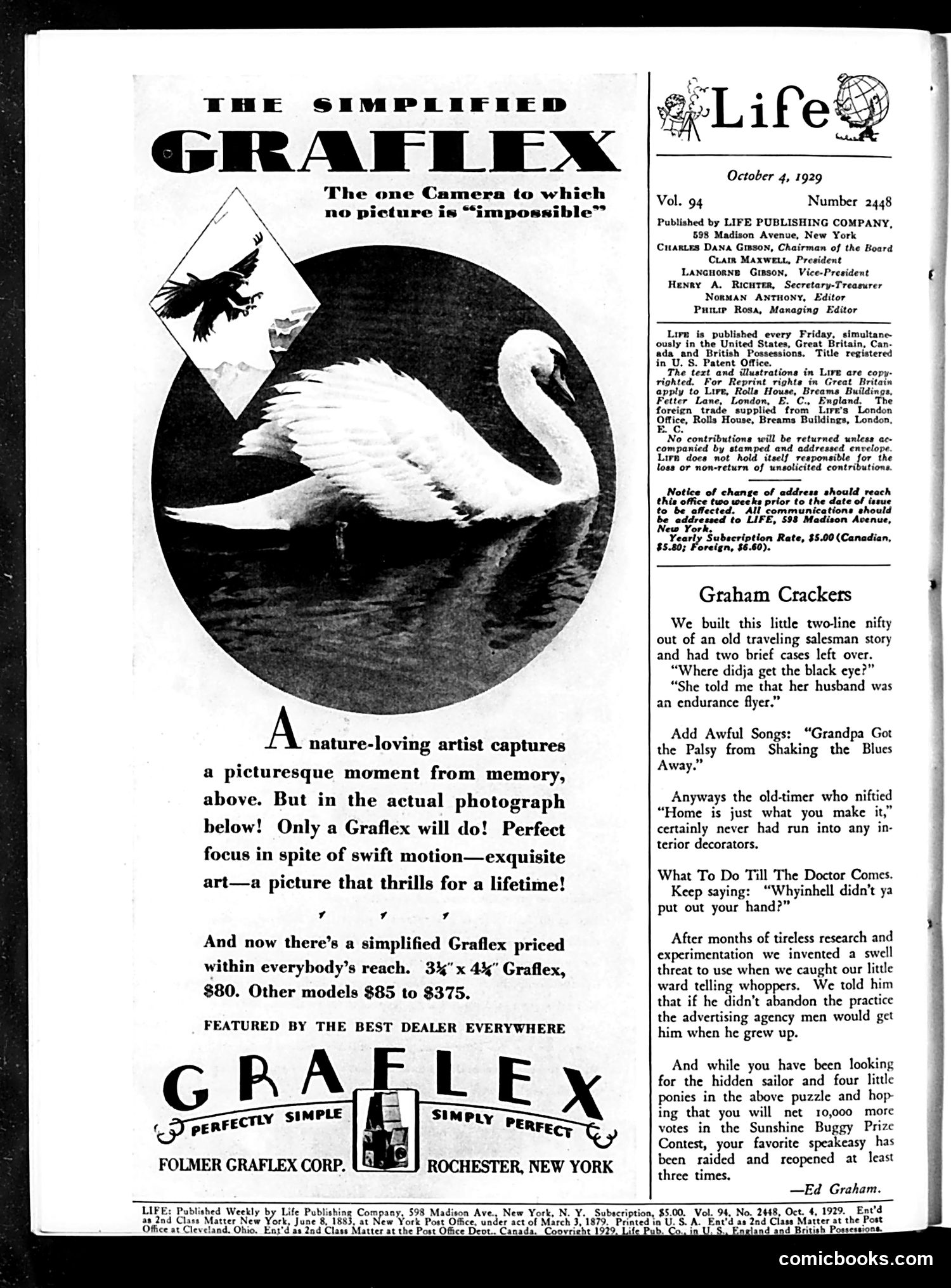
Analysis This page is primarily a Graflex camera advertisement rather than political satire. The main image shows a swan, likely captured in motion photography—the ad emphasizes that only a Graflex camera can achieve "perfect focus in spite of swift motion." The smaller inset illustration (upper left) appears to be an artistic rendering of the same swan scene, illustrating the ad's point: that while artists can paint from memory, photographers need superior equipment for precise, dynamic action shots. The right column contains "Graham Crackers," a humor section with brief, unrelated anecdotes and jokes—typical filler content for Life magazine during this era. There is no political commentary or caricature on this page.
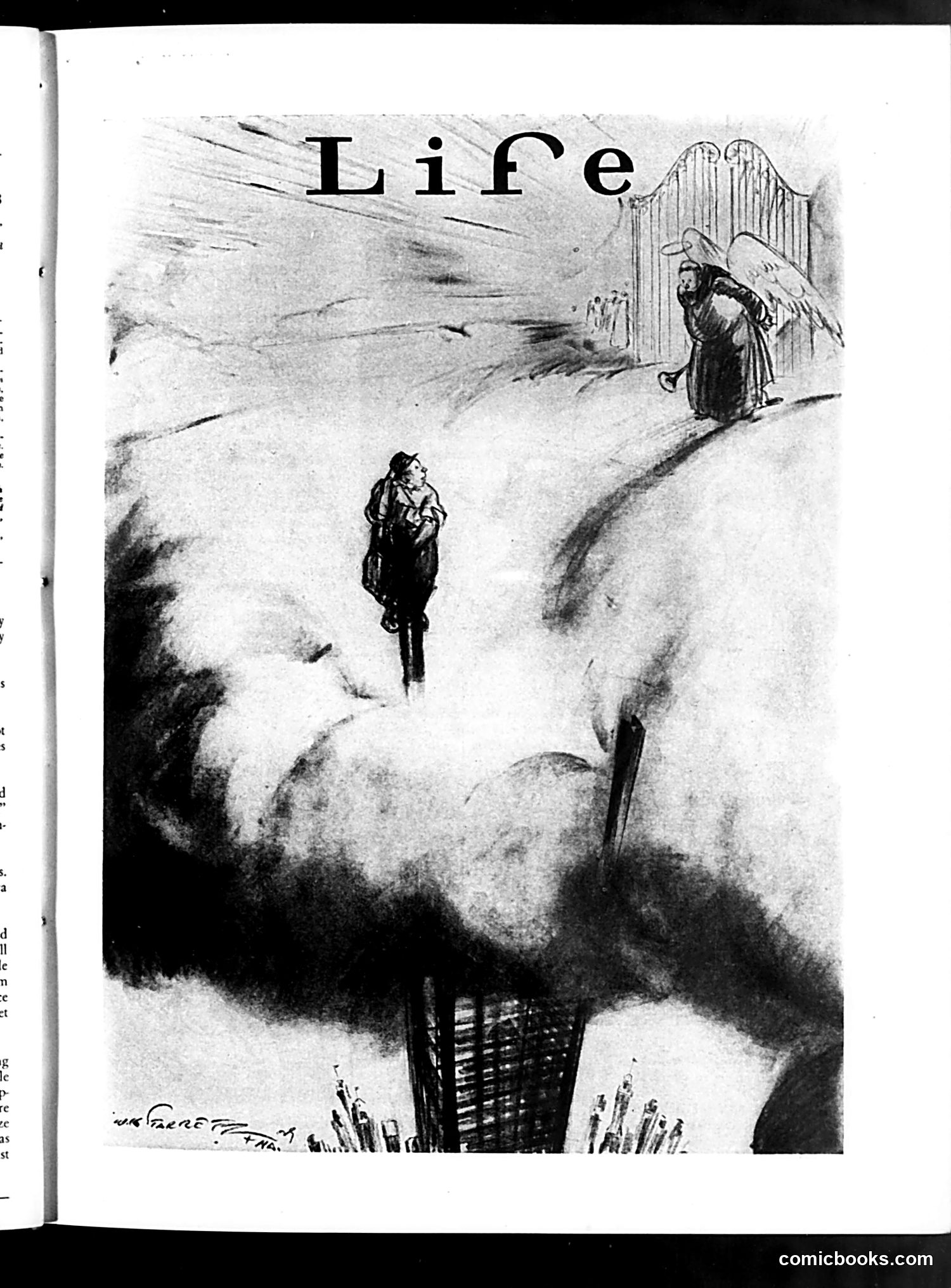
Analysis of Life Magazine Cover This appears to be a cover illustration for *Life* magazine featuring allegorical imagery. A solitary human figure walks through a barren, snow-covered landscape toward a distant angelic figure standing at what appears to be a gate or threshold. The composition suggests a spiritual or existential journey—possibly depicting the passage from earthly life toward the afterlife or divine judgment. The stark, expressionistic style and somber mood convey themes of mortality and transcendence rather than political satire. Without accompanying text identifying specific figures or referencing particular events, the imagery functions as philosophical commentary on human existence rather than commentary on contemporary political figures or situations. The artistic style and allegorical approach were common in *Life* magazine's cover designs during the early-to-mid twentieth century.
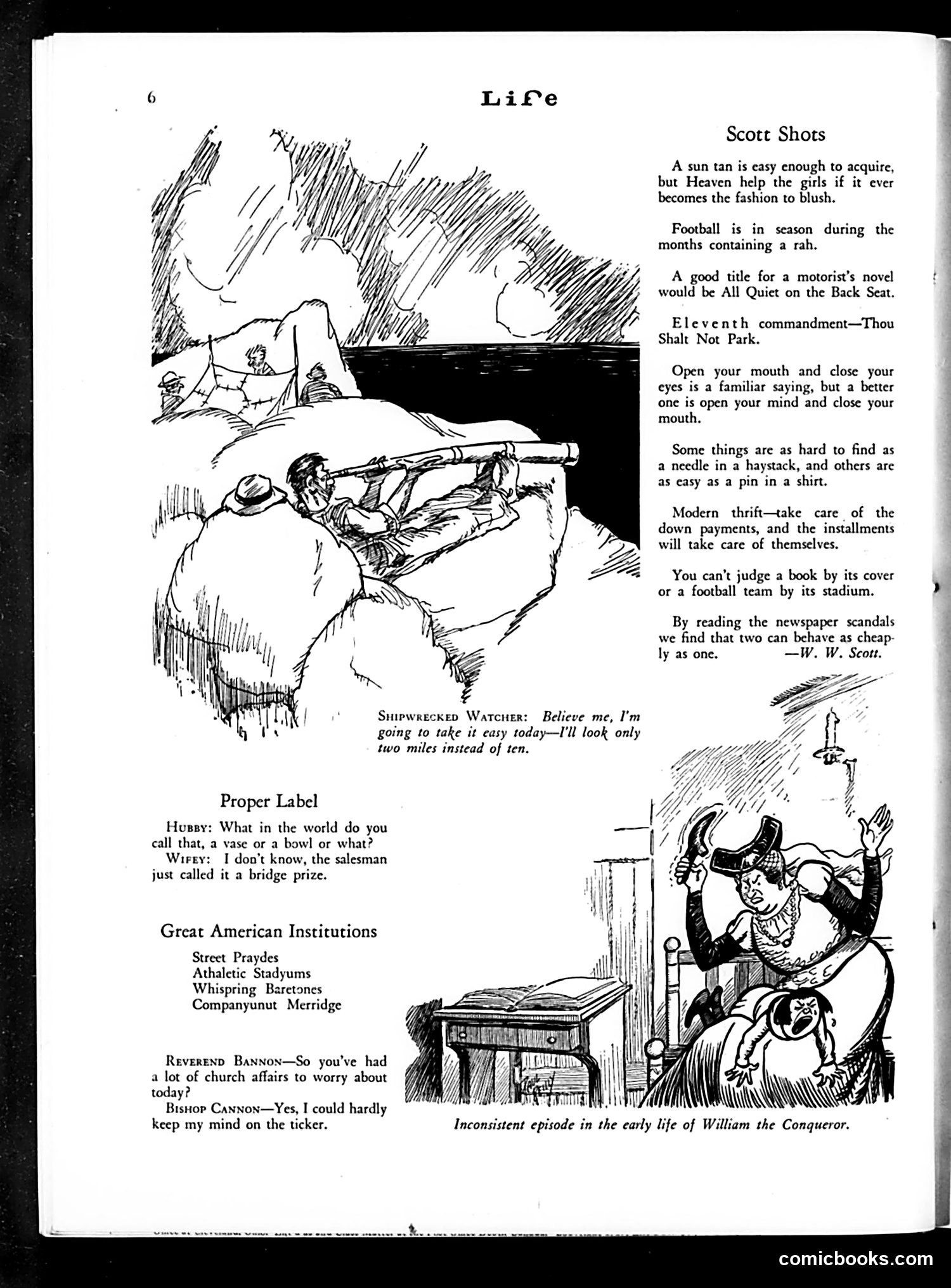
Analysis of Life Magazine Page 6 This page contains miscellaneous satirical shorts and humor pieces rather than a cohesive political cartoon. The "Scott Shorts" section offers social commentary on contemporary behavior: sun tans becoming fashionable, football season, and parking violations. The "Eleventh Commandment—Thou Shalt Not Park" reflects early automobile-era frustrations. Two illustrated vignettes appear: one depicts a shipwrecked sailor attempting to take "it easy," and another shows "William the Conqueror" as a mischievous child creating chaos indoors. The "Proper Label" dialogue jokes about unclear terminology for decorative objects, while "Great American Institutions" sarcastically lists social phenomena like "Street Praydes" and "Whispering Baritones." The humor is observational rather than explicitly political, targeting everyday American life and social conventions of the era.
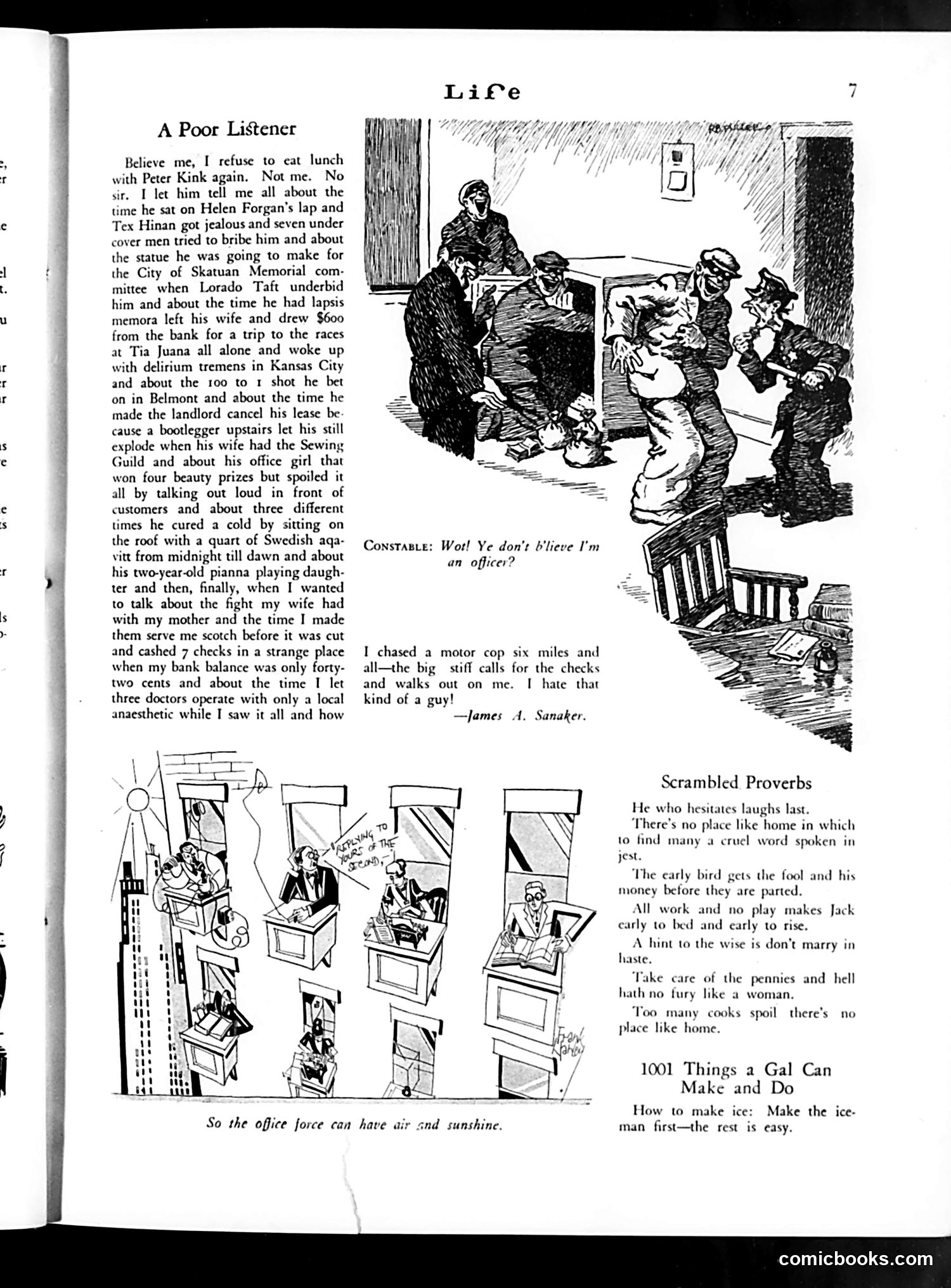
"A Poor Listener" and Related Content The main cartoon shows a constable (police officer) confronting a group of people on the street, saying "Wot! Ye don't b'lieve I'm an officer?" The accompanying text by James A. Sanaker describes chasing a motor cop six miles who ignored his calls—suggesting police who ignore citizens' requests or fail to help when needed. The left cartoon depicts an office building with workers in stacked windows, captioned "So the office force can have air and sunshine"—satirizing cramped, poorly-ventilated office conditions where management forces workers into tight spaces. Below are "Scrambled Proverbs" (humorous twisted sayings) and "1001 Things a Gal Can Make and Do," typical Life magazine humor content from the early 20th century, likely targeting gender roles and social expectations.
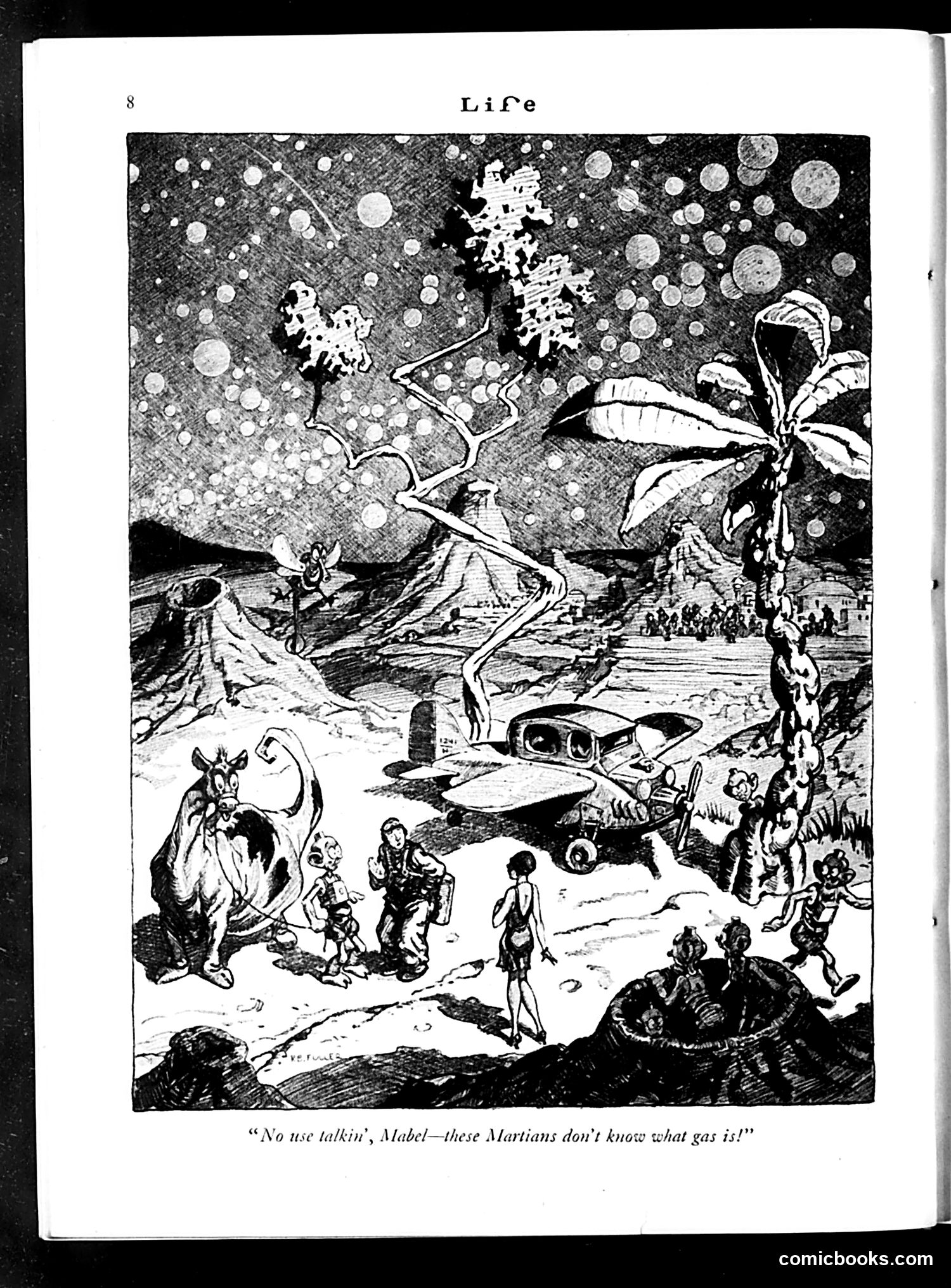
Analysis This is a science-fiction cartoon depicting an alien landscape with Martian inhabitants and human visitors. The caption reads: "No use talkin', Mabel—these Martians don't know what gas is!" The joke satirizes early 20th-century American consumer culture and advertising. A human character (presumably "Mabel") appears to be attempting to sell or promote gasoline to Martians who have no use for it—they lack automobiles or combustion-based technology. The humor targets the absurdity of aggressive marketing and the assumption that all beings would desire mass-produced goods. It's a commentary on American commercialism's reach and presumption that modern conveniences are universally desirable, even to extraterrestrial life with completely different needs and infrastructure.
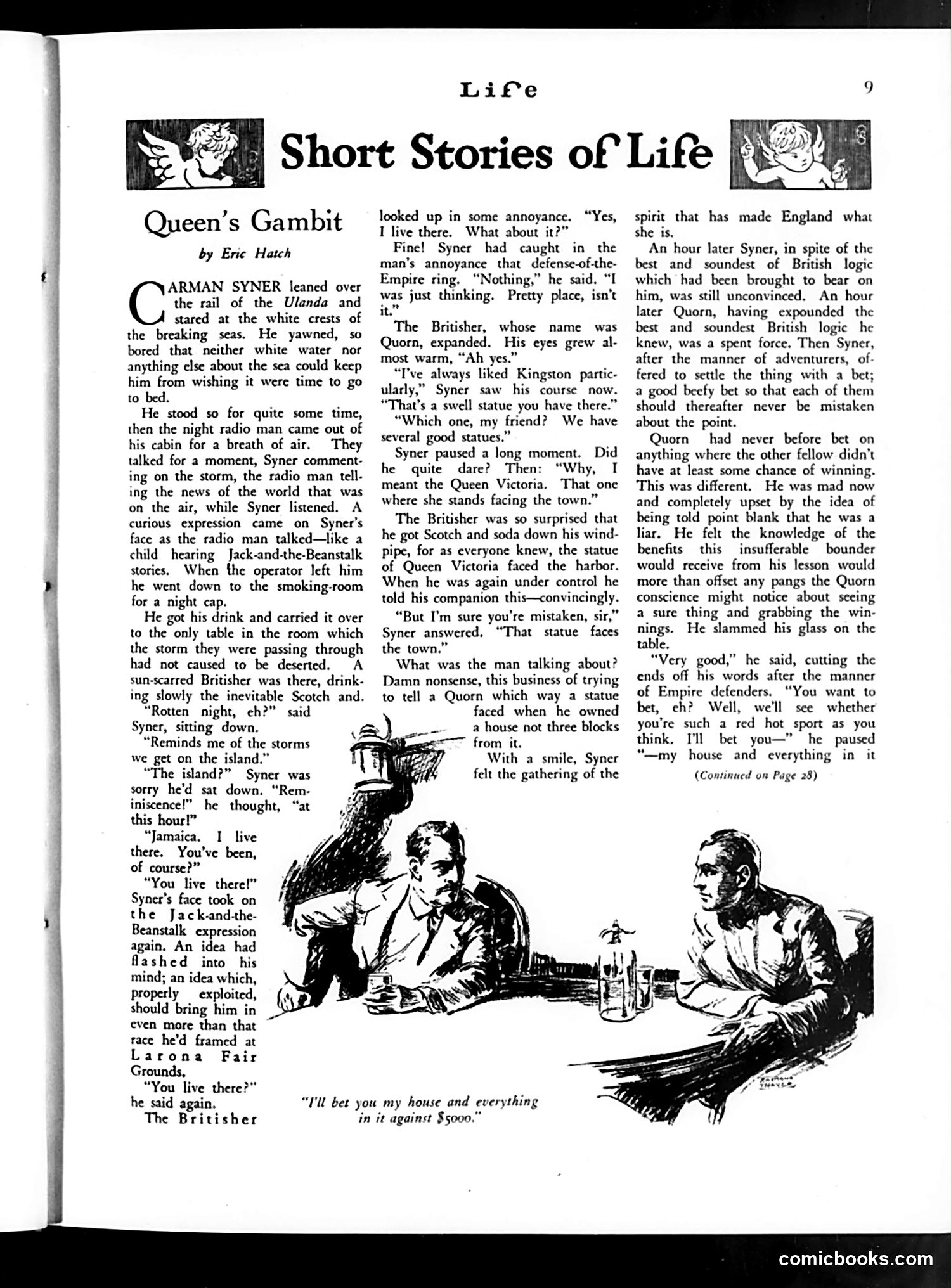
"Queen's Gambit" by Eric Hatch - Analysis This short story satirizes British colonial attitudes and class consciousness. Two men—Carman Syner (apparently British) and an unnamed Britisher—are aboard a ship during a storm. They debate whether Syner lives in Jamaica or Kingston, with the Britisher expressing surprise and some disdain about Syner's colonial residence. The "Queen's Gambit" of the title appears to reference a bet Syner makes: wagering his house and £5,000 that he can convince someone he actually lives elsewhere—a commentary on colonial pretension and the social anxiety of maintaining respectability within the British Empire's rigid class structure. The story mocks how colonials tried to perform status and belonging within imperial hierarchies.
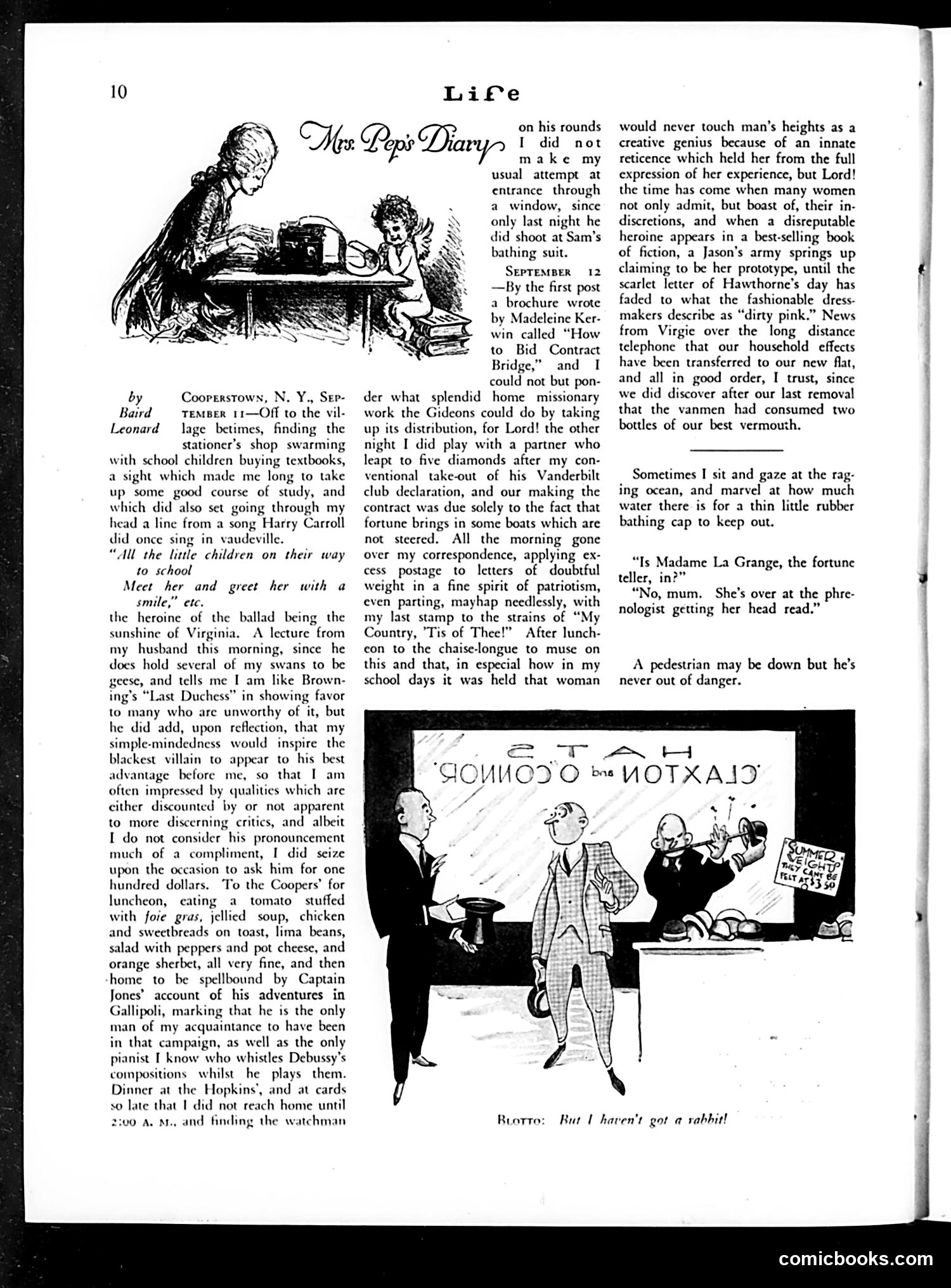
Analysis of Life Magazine Page This page contains "Mrs. Pep's Diary" by Leonard, a society gossip column with accompanying illustration and cartoon. The main cartoon (bottom) shows a man in a checkered suit at what appears to be a Chinese restaurant (text reversed in background reads "CHOP SUEY CANTON"). The caption reads: "Burro: But I haven't got a rabbit!" This is a pun-based joke playing on the word "burro" (Spanish for donkey). The man is apparently being asked to produce a rabbit (perhaps for a magic trick or wager), but protests he only has a burro (donkey). The humor relies on the unexpected language twist and the absurdity of the situation. The diary portion discusses social events, bridge games, and society gossip typical of 1920s-30s Life magazine's satirical commentary on upper-class life.
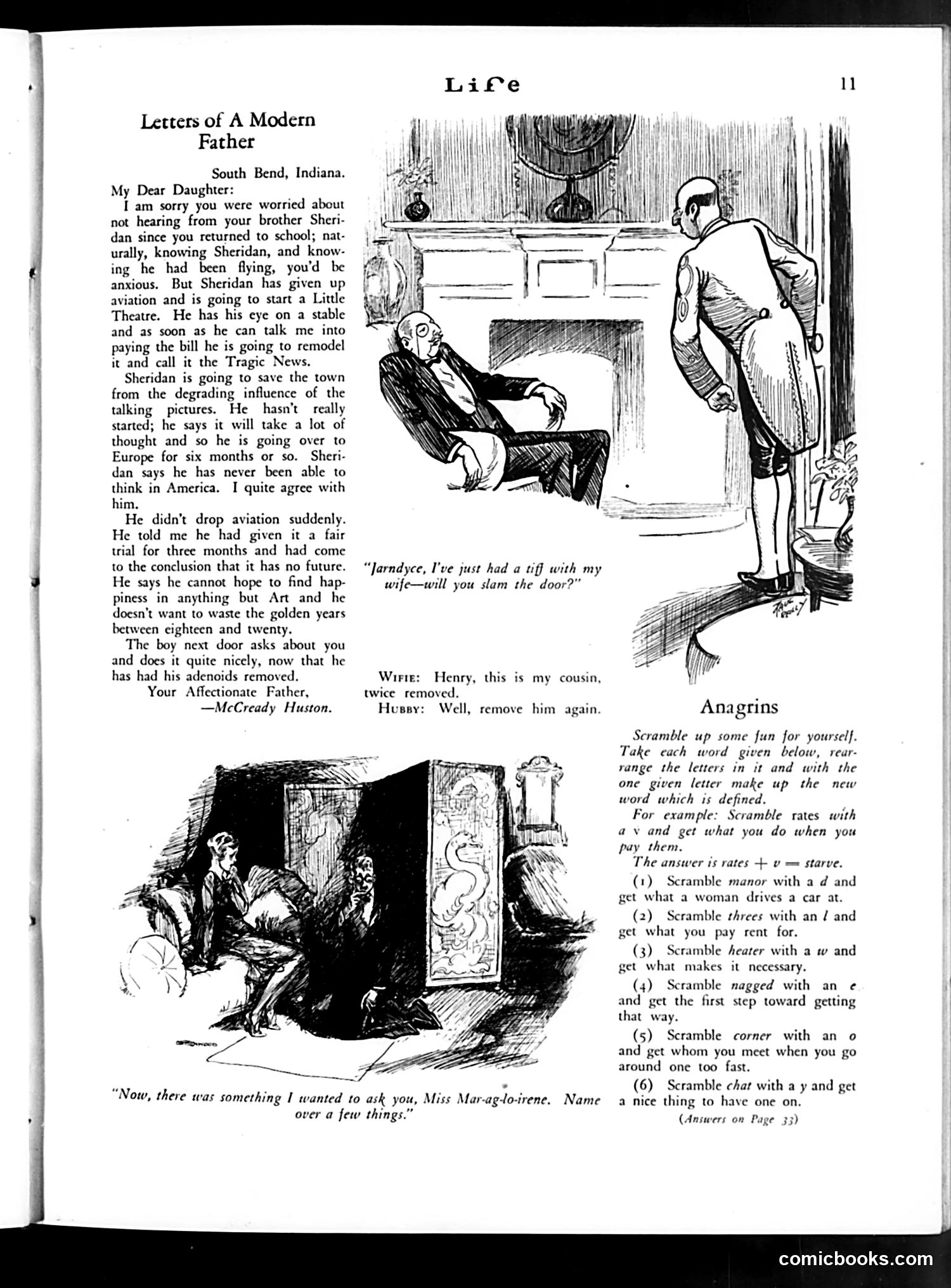
"Letters of A Modern Father" & Social Satire This page from *Life* magazine contains two elements: Top cartoon: A domestic comedy showing a husband telling his wife he's had "a tiff" with her, asking her to "slam the door." The wife introduces her cousin, and the husband quips "Well, remove him again"—a joke about unwanted in-laws and marital discord. Bottom cartoon: Shows someone requesting information from "Miss Mar-ag-lo-irene," likely a play on a complicated or affected name, satirizing modern naming trends or pretentious affectations. The letter discusses the writer's son Sheridan, who has abandoned aviation to start a "Little Theatre" and is traveling to Europe—mocking artistic pretensions among young men of means during this era. The page uses humor to critique family dynamics, class aspiration, and bohemian artistic ambitions typical of early 20th-century American society.
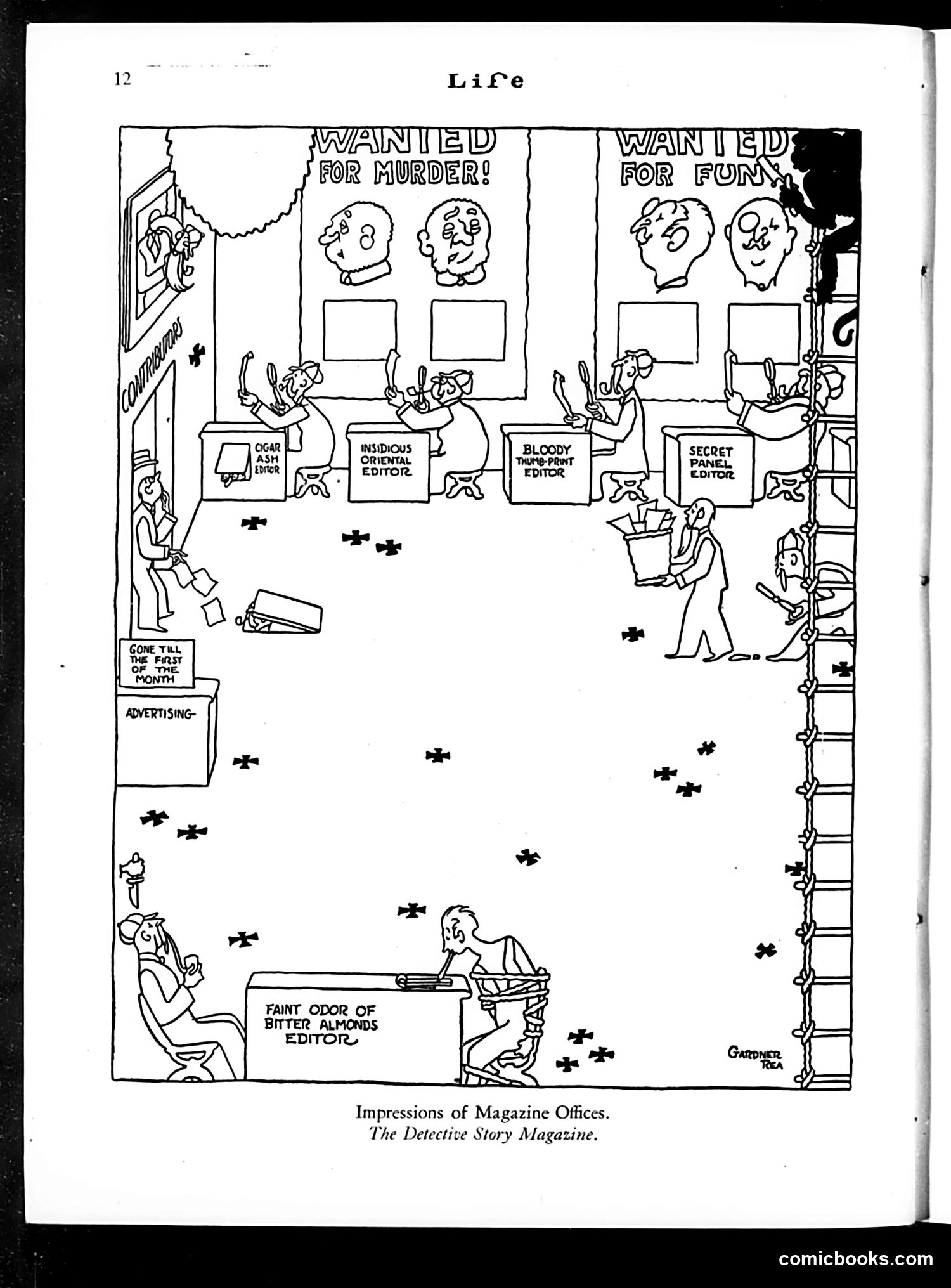
Magazine Office Satire This cartoon satirizes *The Detective Story Magazine* office. The humor centers on the violent, sensational nature of detective fiction contrasted with the mundane reality of magazine editing. The wanted posters show "Wanted for Murder" and "Wanted for Fun" — mocking how detective magazines sensationalize crime. Below, editors work at desks labeled "Insidious Oriental Editor," "Bloody Thumb-Print Editor," and "Secret Panel Editor" — joking that specialized editors exist solely to inject melodrama. The bottom shows an editor experiencing "Faint Odor of Bitter Almonds" (likely referencing poisoning plot devices common in detective stories), while figures with guns and bodies scattered throughout suggest the violent content these editors process daily. The satire targets the formulaic, over-the-top conventions of pulp detective fiction and the specialized editorial machinery required to produce such sensational content.
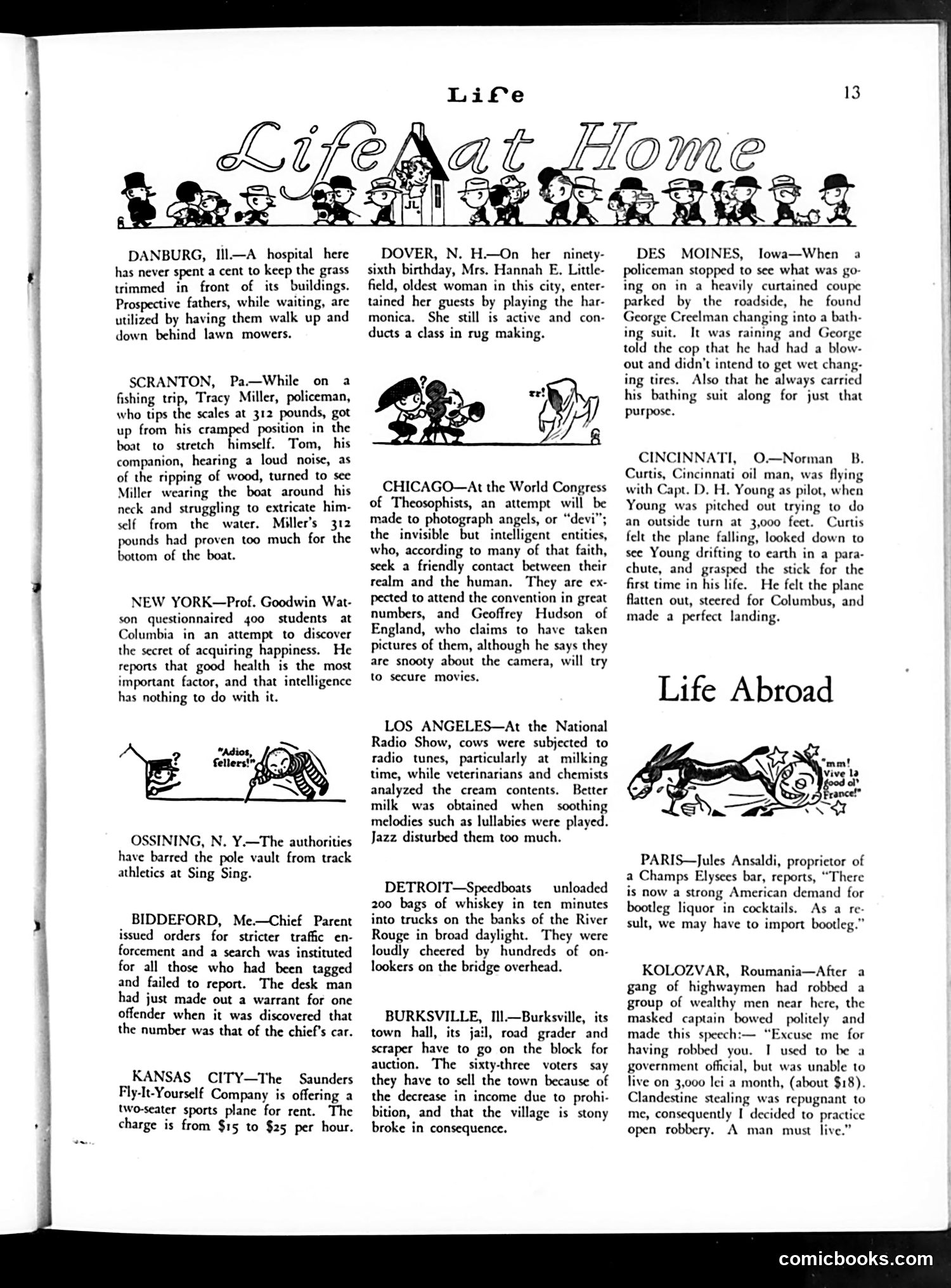
Analysis This page from *Life* magazine presents humorous anecdotes from American life ("Life at Home") and international news ("Life Abroad"). The content is primarily text-based with minimal illustration. The cartoons appear to be small decorative vignettes rather than political commentary. One shows what appears to be a figure labeled "Miss Gillers" (unclear reference), and another depicts a cow being subjected to "radio tunes" at the Los Angeles National Radio Show—satirizing the notion that music might improve milk production. The anecdotes mock everyday absurdities: a hospital keeping grass trimmed by having fathers push mowers, professors seeking "happiness secrets," and police stopping speedboat whiskey smuggling in Detroit. The "Life Abroad" section includes a European bandit's polite apology for robbery—satire on Continental politeness. The humor relies on incongruity and mild social observation rather than sharp political critique.
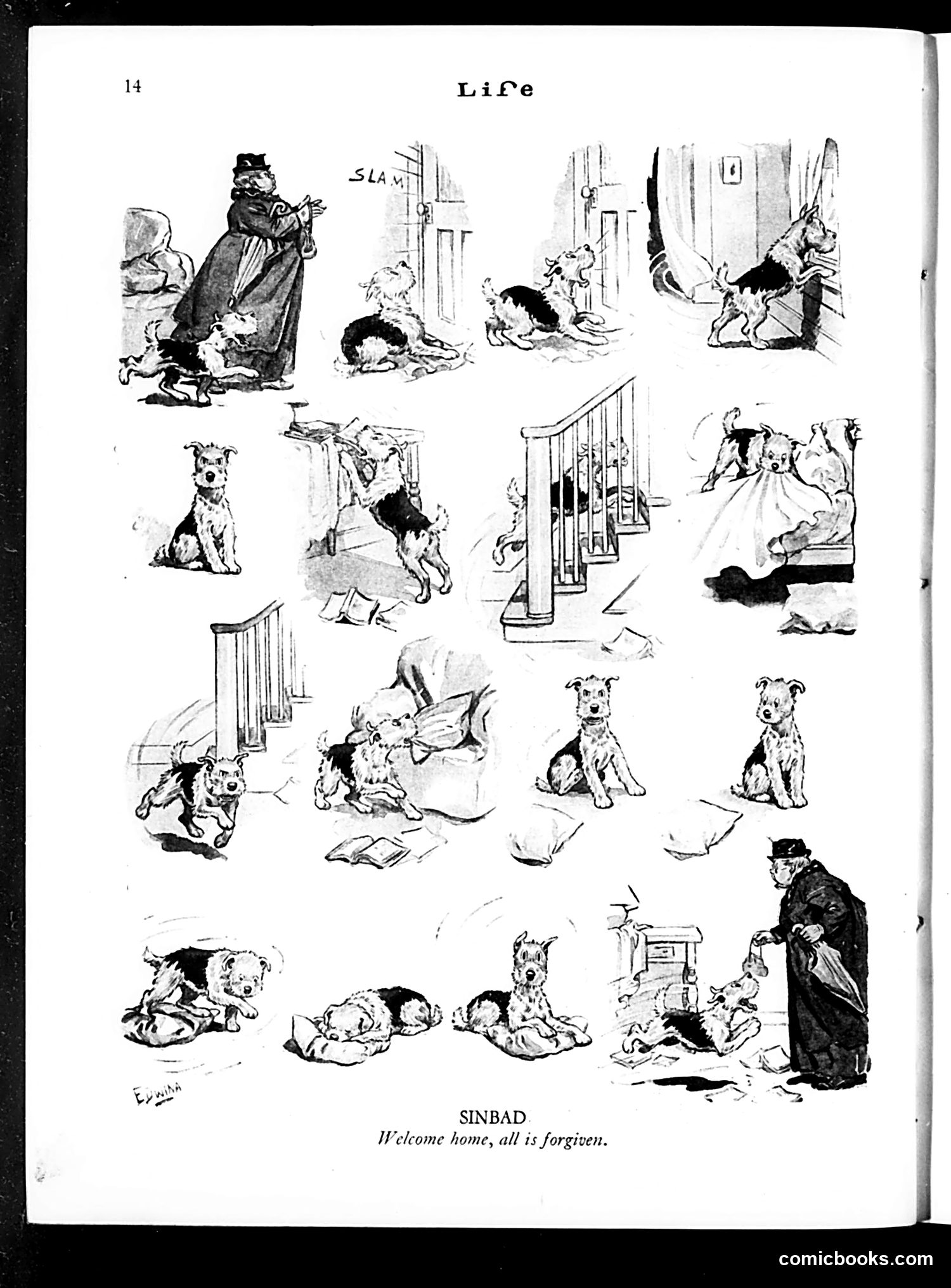
Analysis of "Sinbad" Page from Life Magazine This page presents a visual narrative titled "Sinbad: Welcome home, all is forgiven," depicting a character's homecoming surrounded by dogs in various states of greeting and mischief. The cartoon satirizes the chaos of a traveler's return. The sequence shows dogs causing destruction—overturned furniture, scattered possessions, and general mayhem—yet the caption suggests forgiveness despite the dogs' misdeeds. The phrase "all is forgiven" ironically comments on how pet owners excuse their animals' bad behavior upon returning home, or possibly reflects on the sentimental welcome that overrides practical consequences. The artwork, rendered in classic early-20th-century illustration style, humorously exaggerates the dogs' enthusiastic but destructive expressions and postures to highlight the contradiction between affection and chaos.
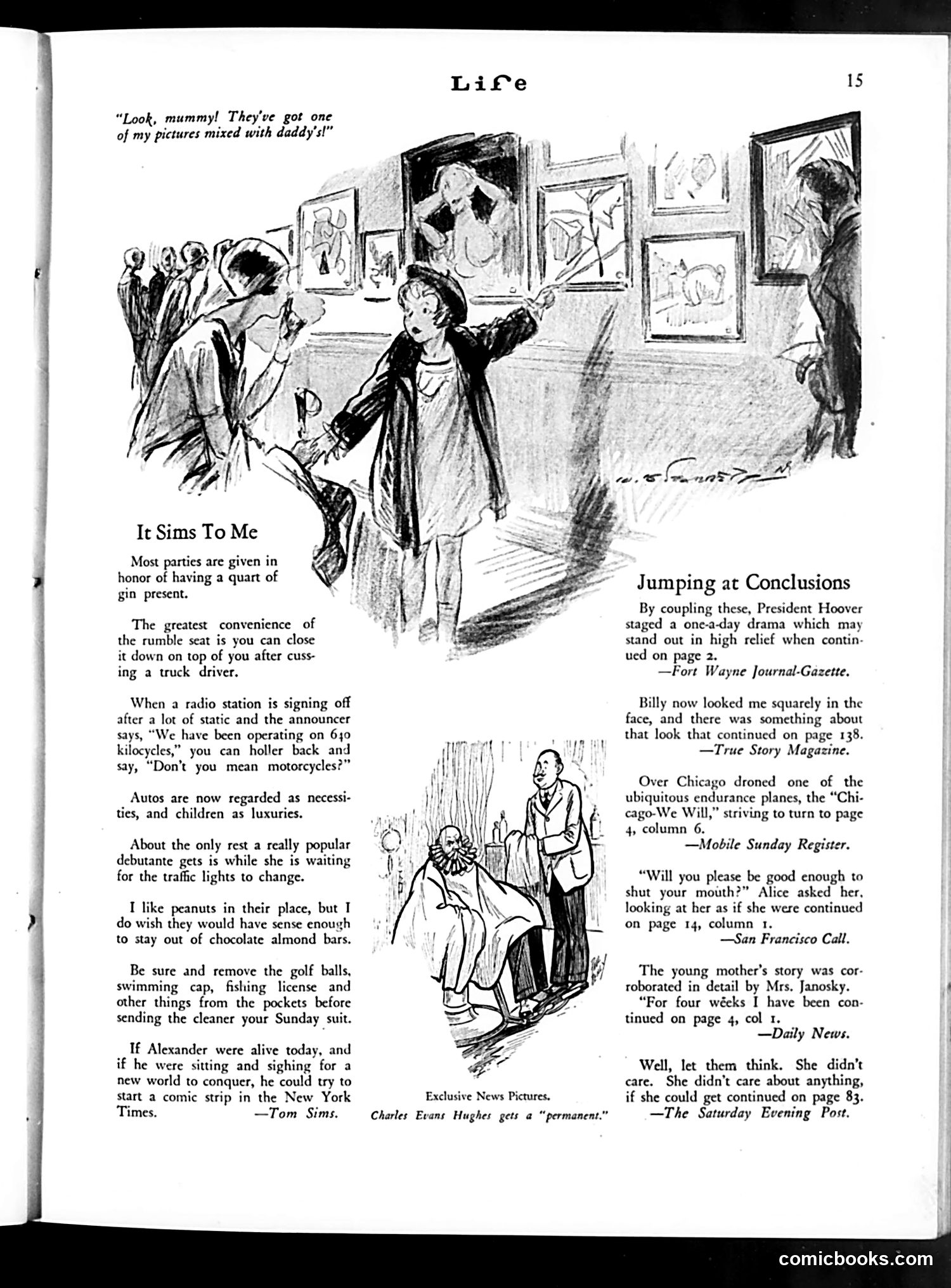
Analysis of Life Magazine Page 15 This page contains humor columns and satirical observations rather than political cartoons. The main illustrated piece, "It Sims To Me" (likely by Tom Simi, credited at bottom), shows a child at an art gallery pointing out mixed pictures to their mother—a joke about parental embarrassment in public. The column humorously critiques 1920s-30s American social trends: the prevalence of gin at parties (Prohibition-era reference), car culture replacing pedestrian life, radio proliferation, and peanuts at social events. One quip references President Hoover's potential as a comic-strip creator. The "Jumping at Conclusions" section cites various newspaper sources commenting on a story about a young mother, appearing to continue from an earlier page. The satire targets everyday modern inconveniences and social absurdities of the era.
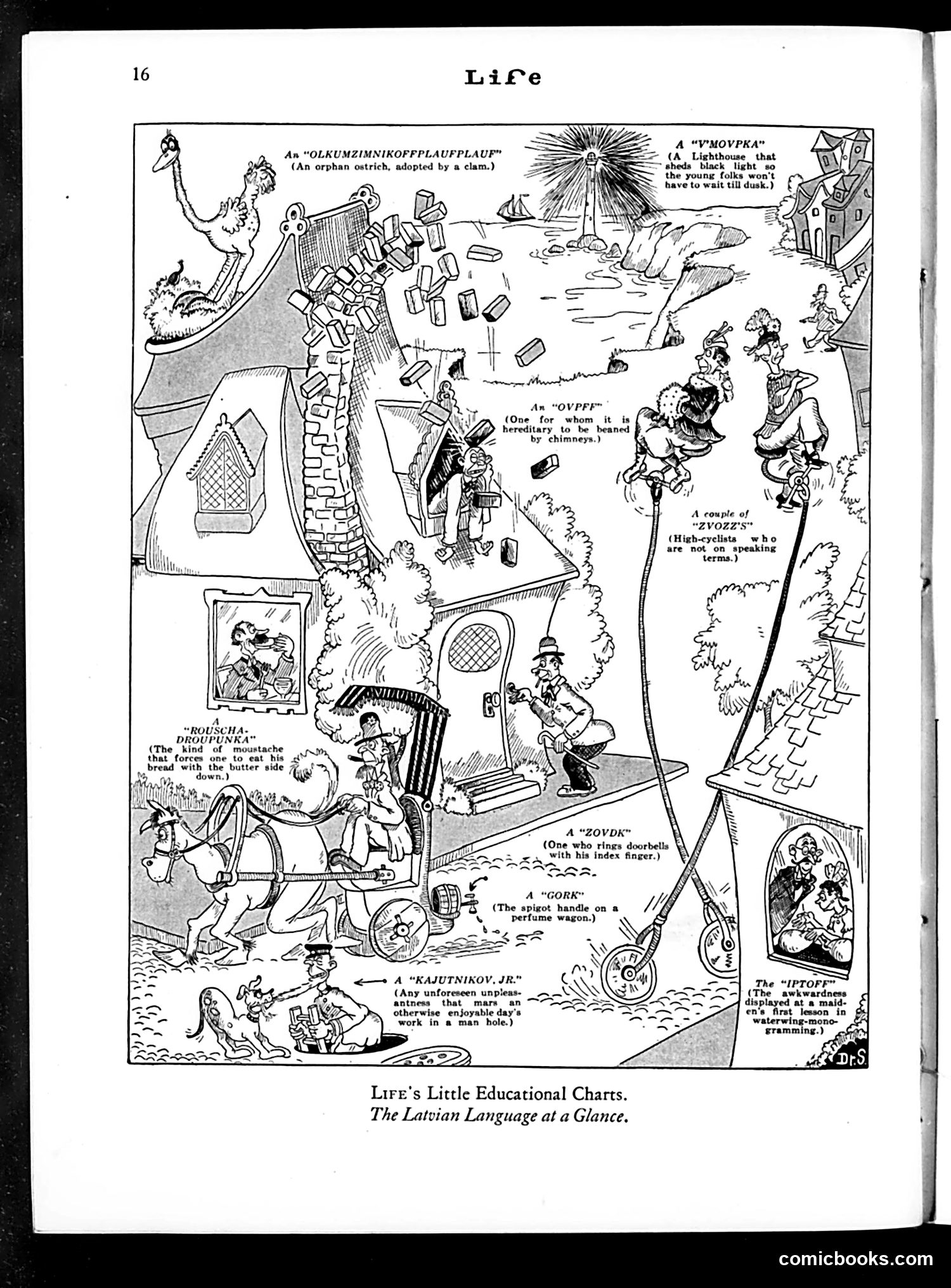
"The Latvian Language at a Glance" This educational satire presents Latvian vocabulary through absurdist scenes. Each labeled figure demonstrates a word's meaning: - "OLKRUMZINNIKOFFPLAUFPLAUFF" (orphan ostrich adopted by a clam) - "MOVPKA" (lighthouse for young folks) - "OVFF" (creature hereditary to chimneys) - "ZVOZZES" (high-cyclists not on speaking terms) - "ZOVDK" (doorbell ringer using index finger) - "RAJUTNIKOV JR." (unseen unpleasantness) - "TIPTOFF" (awkward diving instruction) The humor mocks Latvian as an incomprehensible, tongue-twisting language through deliberately nonsensical word-definitions. This reflects early 20th-century American attitudes toward Eastern European languages and immigrants, presenting linguistic difference as inherently ridiculous rather than legitimate.
Analysis of Life Magazine Page 17 The page contains two main sections: Left column ("Life in Washington"): Political satire discussing League of Nations disarmament efforts, naval parity between American and British cruisers, and upcoming visits by Premier MacDonald and Admiral Beatty. The commentary mocks Washington's political maneuvering and bureaucratic "Big Navy" propaganda, referencing the 1930 campaign and various senators' positions on naval adequacy. Right section ("Have Women A Sense Of Humor?"): Announces a national humor writing contest sponsored by Life and the Women's Press Club of New York, offering $1,000 in prizes. The contest challenges women to prove they possess humor equal to men's, with submissions judged by notable writers listed. The tone is lighthearted but reflects 1930s gender debates about women's intellectual capabilities.
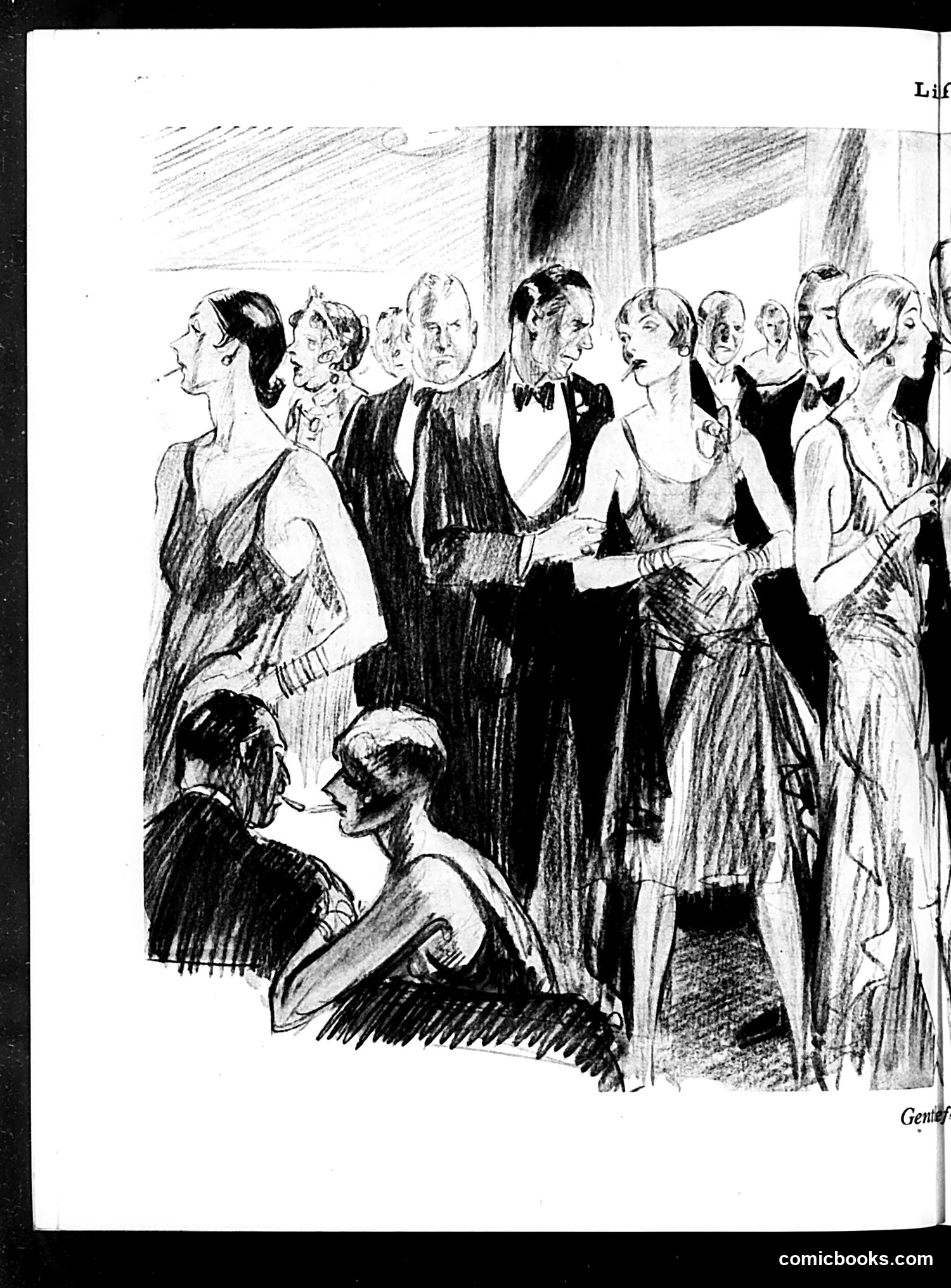
Analysis This appears to be a satirical sketch from *Life* magazine depicting a formal social gathering or party scene. The drawing shows well-dressed figures in evening wear (tuxedos and gowns) at what appears to be an upper-class event, with some figures seated in the foreground and others standing in conversation in the background. The specific satire or commentary isn't entirely clear from the image alone without additional context or caption text. The scene could be satirizing social pretension, class divisions, or specific contemporary social events, but without visible identifying labels, captions, or publication date information on this page, I cannot definitively state which political or social reference is being mocked or who the specific figures represent.
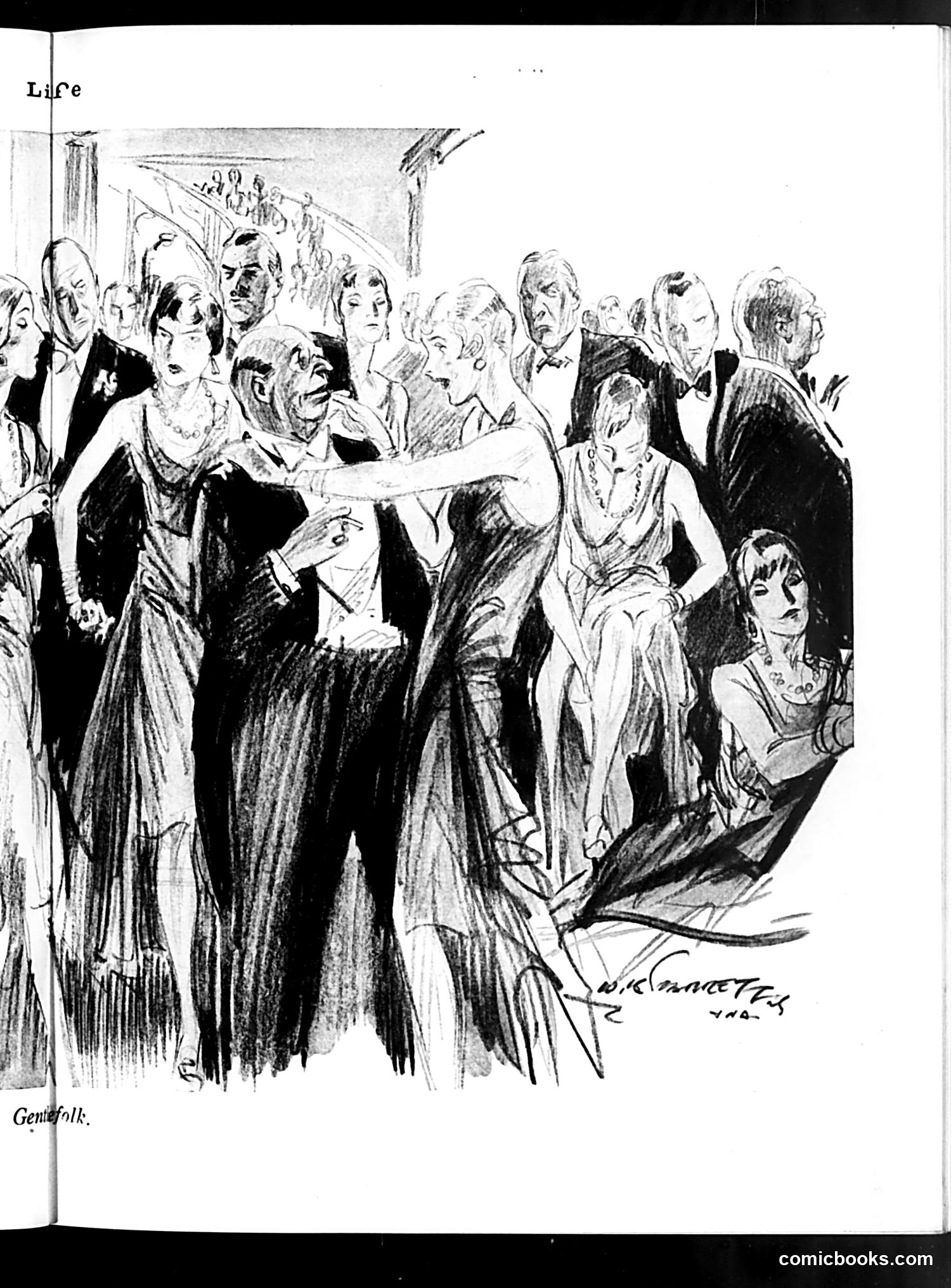
"Gentlefolk" - Life Magazine Cartoon This sketch depicts a formal social gathering of well-dressed men and women in evening wear, appearing to be at an upscale event or reception. The title "Gentlefolk" suggests satire about high society. The drawing style captures various facial expressions and postures suggesting social awkwardness or tension among the attendees. Several figures appear to be observing or reacting to something occurring in the crowd's center. The satire likely mocks pretension within elite social circles—perhaps commenting on artificial civility, social climbing, or the performative nature of "polite society." The crowded composition and varied reactions suggest commentary on how the wealthy present themselves versus underlying social dynamics. Without additional context, the specific social commentary remains unclear, though the title and composition suggest critique of upper-class affectation.
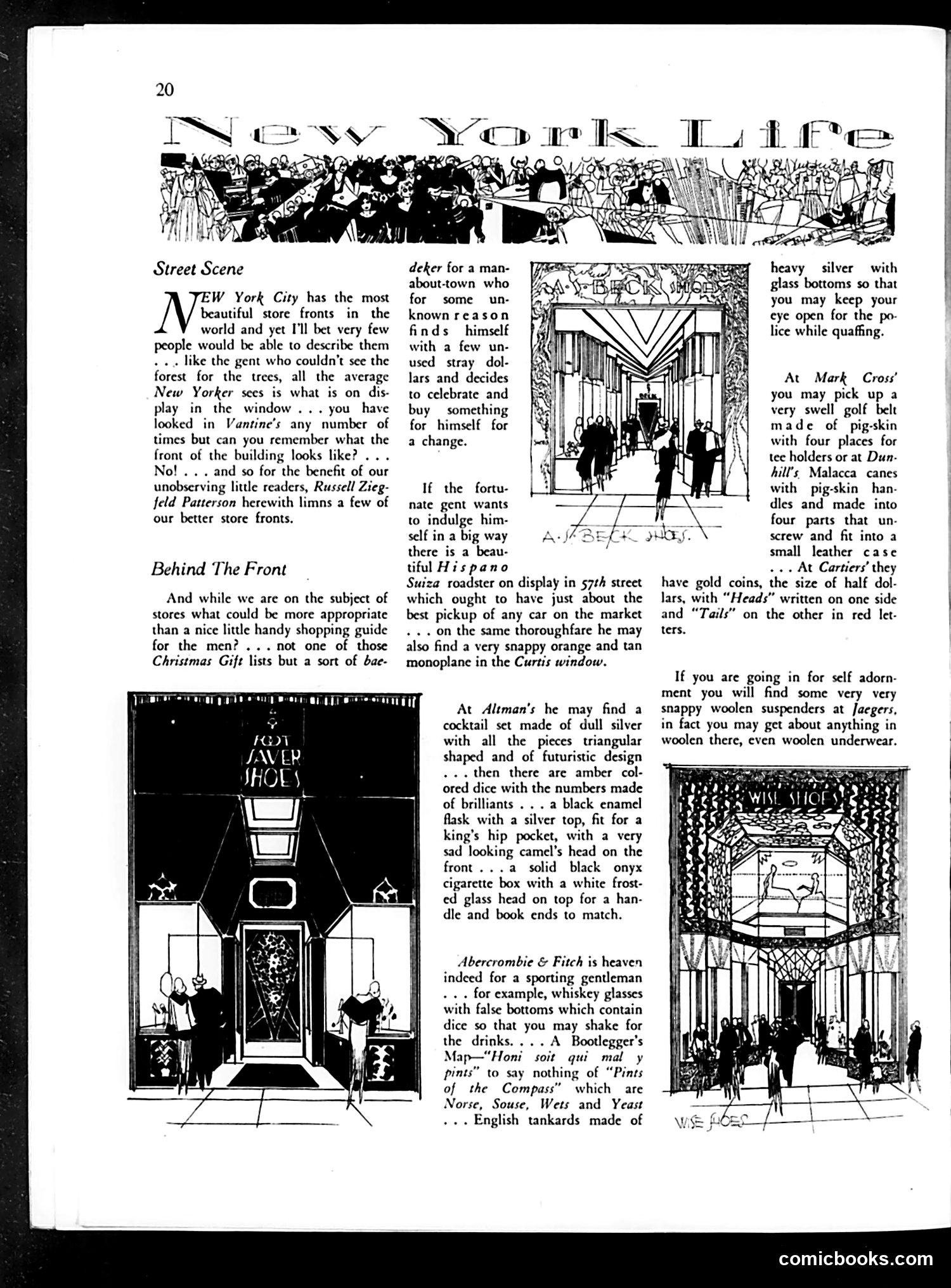
New York City Store Fronts (1920s Life Magazine) This page is a consumer guide to fashionable Manhattan shopping, not political satire. The text describes elegant storefront displays and luxury goods available at high-end retailers like Cartier, Alman's, Curtis, Mark Cross, Jaeger, and Abercrombie & Fitch. The accompanying illustrations show the architectural facades of these prestigious shops and their window displays featuring items like cocktail sets, cigarette boxes, golf equipment, and accessories. The tone is humorous but appreciative—gently mocking wealthy consumers' ability to find "snappy" luxury goods while also celebrating New York City's status as a shopping destination with "the most beautiful store fronts in the world." This reflects 1920s consumer culture and the emerging department store experience.
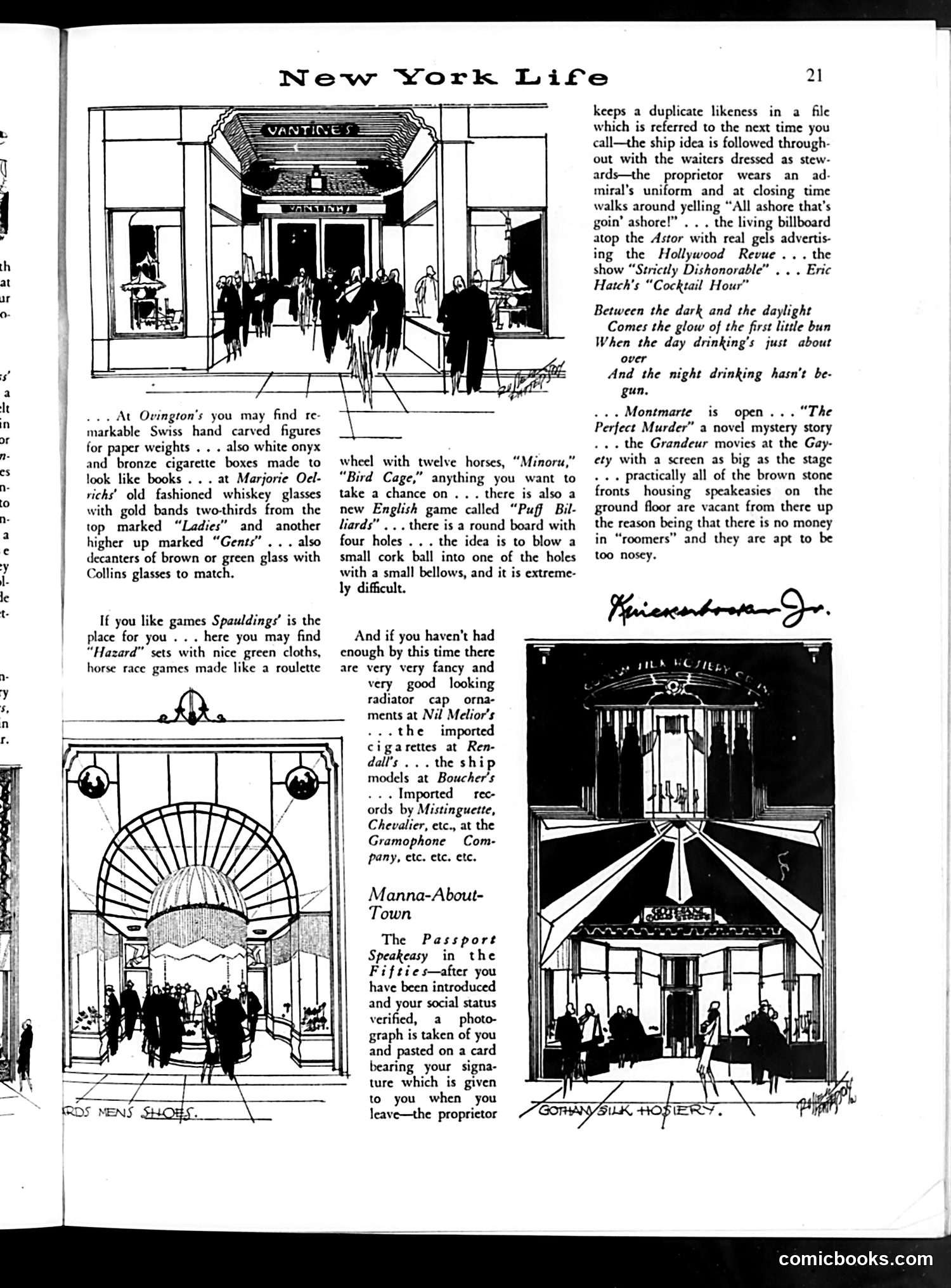
New York Life - Entertainment & Shopping Guide (Page 21) This page is primarily a lifestyle column describing upscale Manhattan nightspots and shopping destinations from what appears to be the 1920s-30s era. Rather than political satire, it features architectural sketches of fashionable venues including: - Oquinton's - a gift shop with Swiss figurines and games - Oss Menis Shoes - a speakeasy (note the Prohibition-era reference) - The Passport Speakeasy - where patrons receive a signed photograph upon entry - Gotham Silk Hosiery - an upscale shop The text humorously describes themed entertainments (a ship-themed restaurant with waiters in admiral's uniforms) and novelty items. The tone is lighthearted social commentary on wealthy New Yorkers' consumption habits and nightlife during Prohibition, when speakeasies operated illegally.
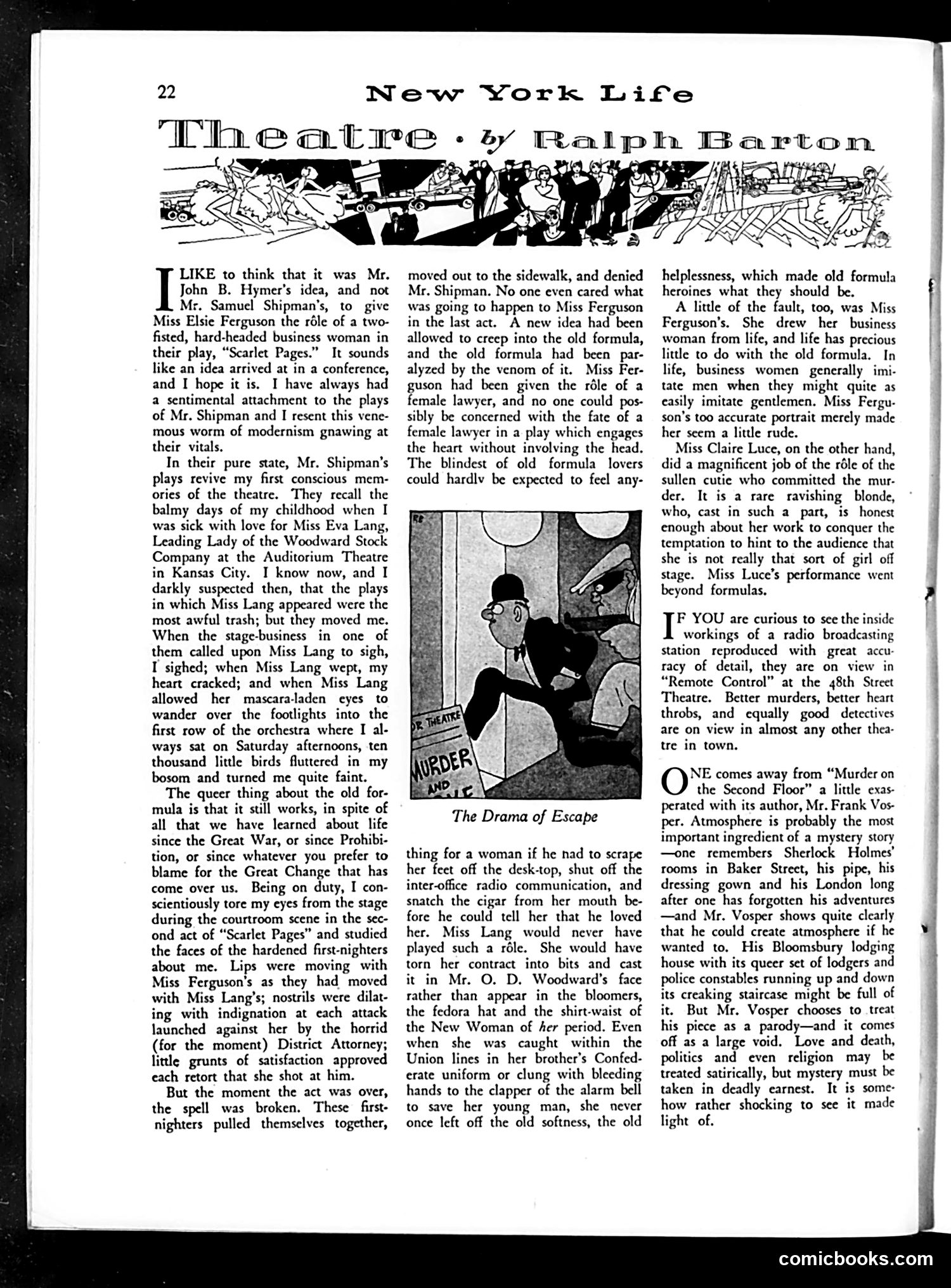
Analysis This is a theater review by Ralph Barton critiquing the play "Scarlet Pages" starring Elsie Ferguson. The accompanying illustration titled "The Drama of Escape" depicts a radio broadcasting station scene, likely referenced in the review's discussion of modern theatrical elements. Barton argues that the play fails because it introduces a "new idea"—Ferguson's character as a hard-headed female lawyer and businesswoman—into the traditional theatrical "formula" that emotionally moves audiences through sentiment and femininity rather than intellect. He nostalgically contrasts Ferguson with Eva Lang, a Kansas City actress who embodied the old formula's passive, emotional heroines who never abandoned "softness" and "helplessness," even in melodramatic situations (Confederate uniforms, alarm bells). The satire critiques modernism's corruption of reliable entertainment formulas. Barton suggests audiences responded emotionally during the act but lost interest once they realized the character engaged their minds rather than hearts. The "New Woman"—independent, wearing practical clothing like bloomers and fedoras—represents incompatible values that undermine sentimental drama's effectiveness.
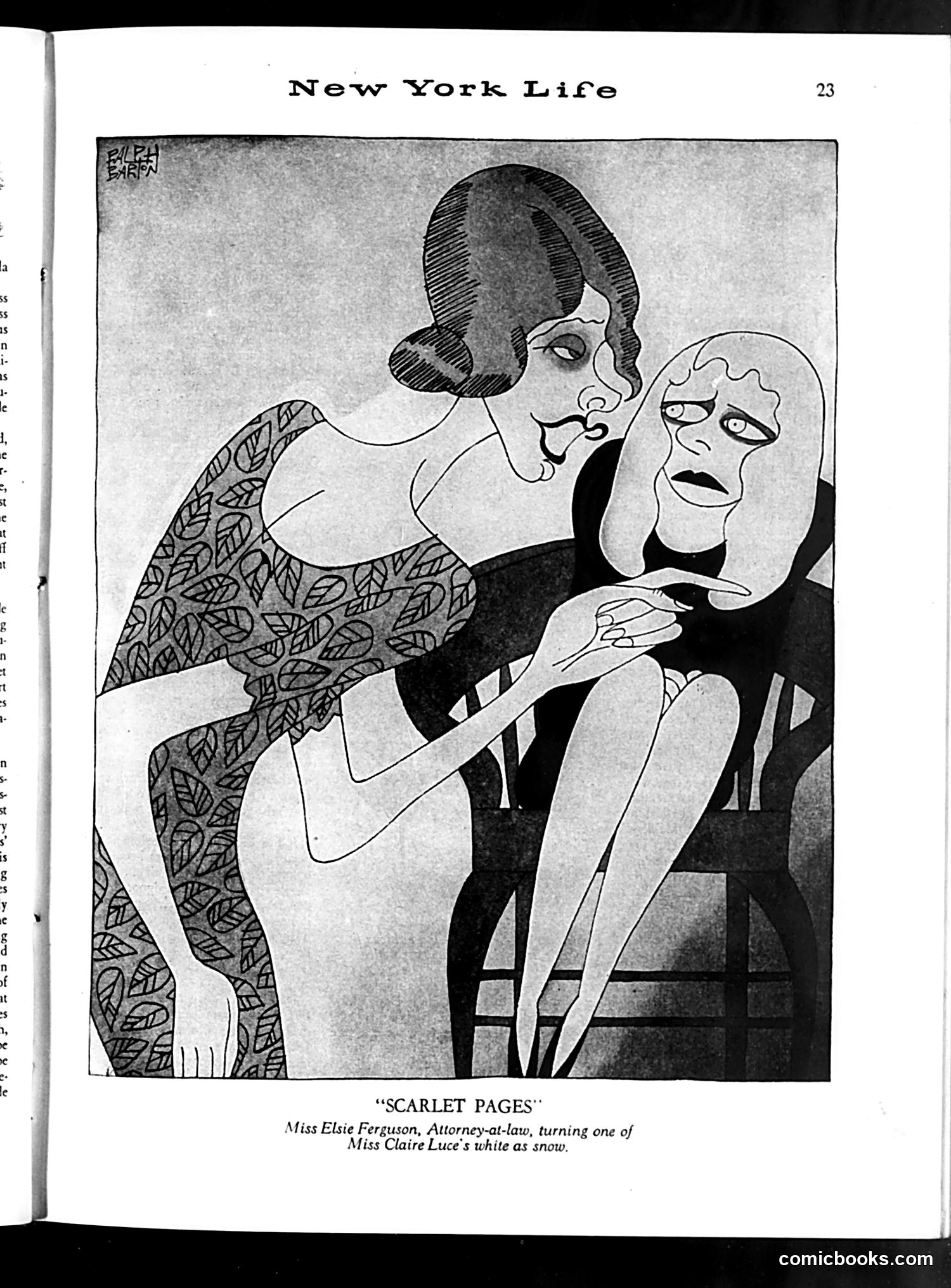
This is an illustration accompanying a theater review or advertisement for "Scarlet Pages," featuring actress Elsie Ferguson as an attorney-at-law. The cartoon depicts Ferguson in professional attire alongside another character (Miss Claire Luce), shown in a suggestive pose. The caption's reference to turning something "white as snow" appears to be a moral joke—likely contrasting Ferguson's legal/respectable professional role with the scandalous or risqué implications of the "scarlet" title. The stylized Art Deco illustration emphasizes the theatrical nature of the piece. This represents 1920s-era Life magazine's blend of theater coverage with mildly risqué humor about morality and respectability versus transgression.
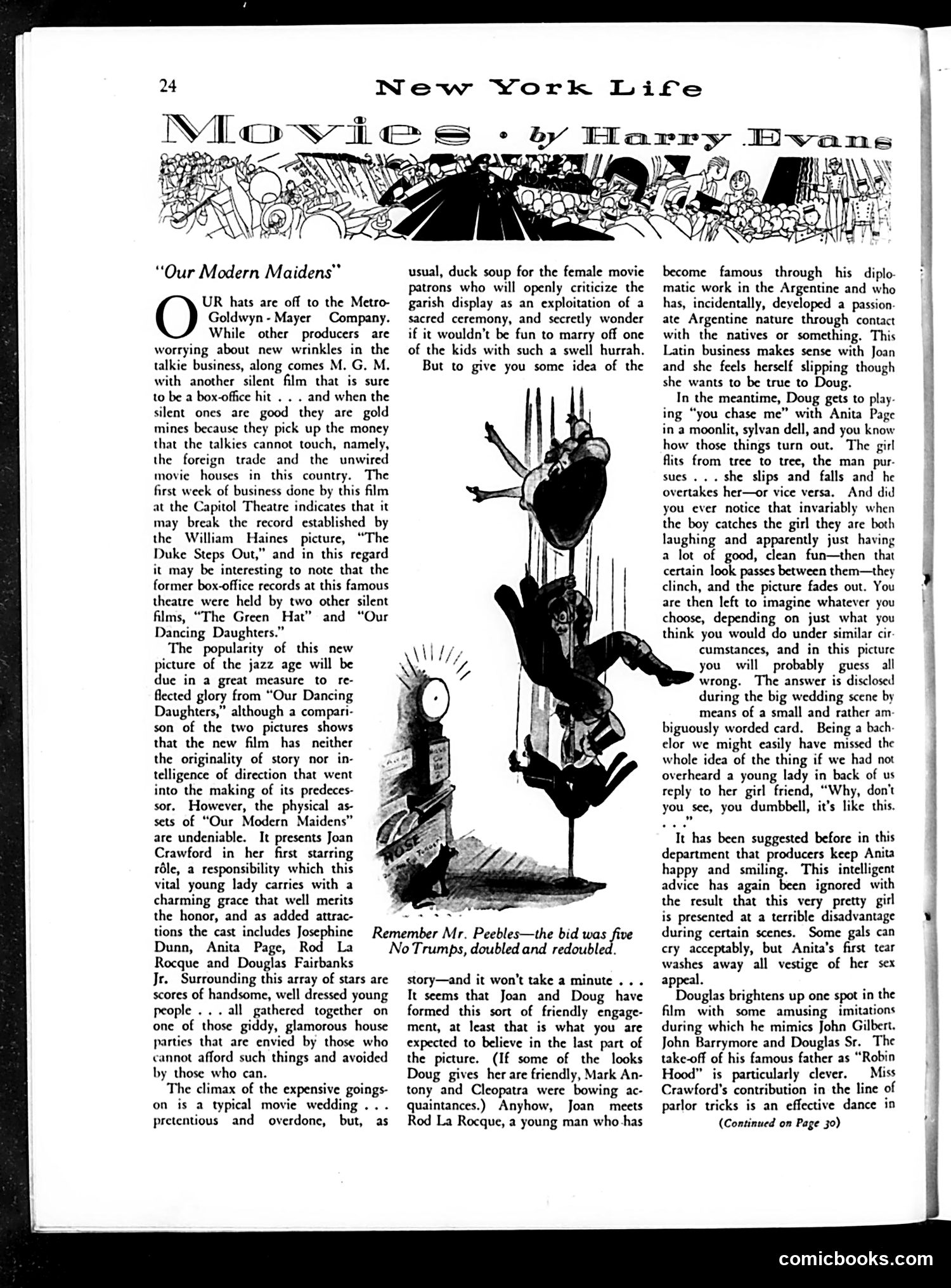
"Our Modern Maidens" Review - Life Magazine This is Harry Evans's film criticism column reviewing MGM's "Our Modern Maidens," a silent film starring Joan Crawford in her first starring role, alongside Douglas Fairbanks Jr. and Rod La Rocque. The accompanying illustration depicts a slapstick chase scene typical of the era—a man pursuing a woman through trees, with exaggerated physical comedy (she slips, he overtakes her). Evans praises the film's commercial appeal while critiquing its artistic merit. He notes that silent films remain profitable for foreign distribution and non-wired American theaters, contrasting them with the "talkie business" (sound films). He acknowledges the cast's physical appeal while suggesting the story lacks originality compared to the predecessor "Our Dancing Daughters." The satire targets female moviegoers, suggesting they publicly criticize lavish wedding scenes as sacrilegious while secretly envying them—and implicitly critiques the film's reliance on physical attraction over substantive storytelling.
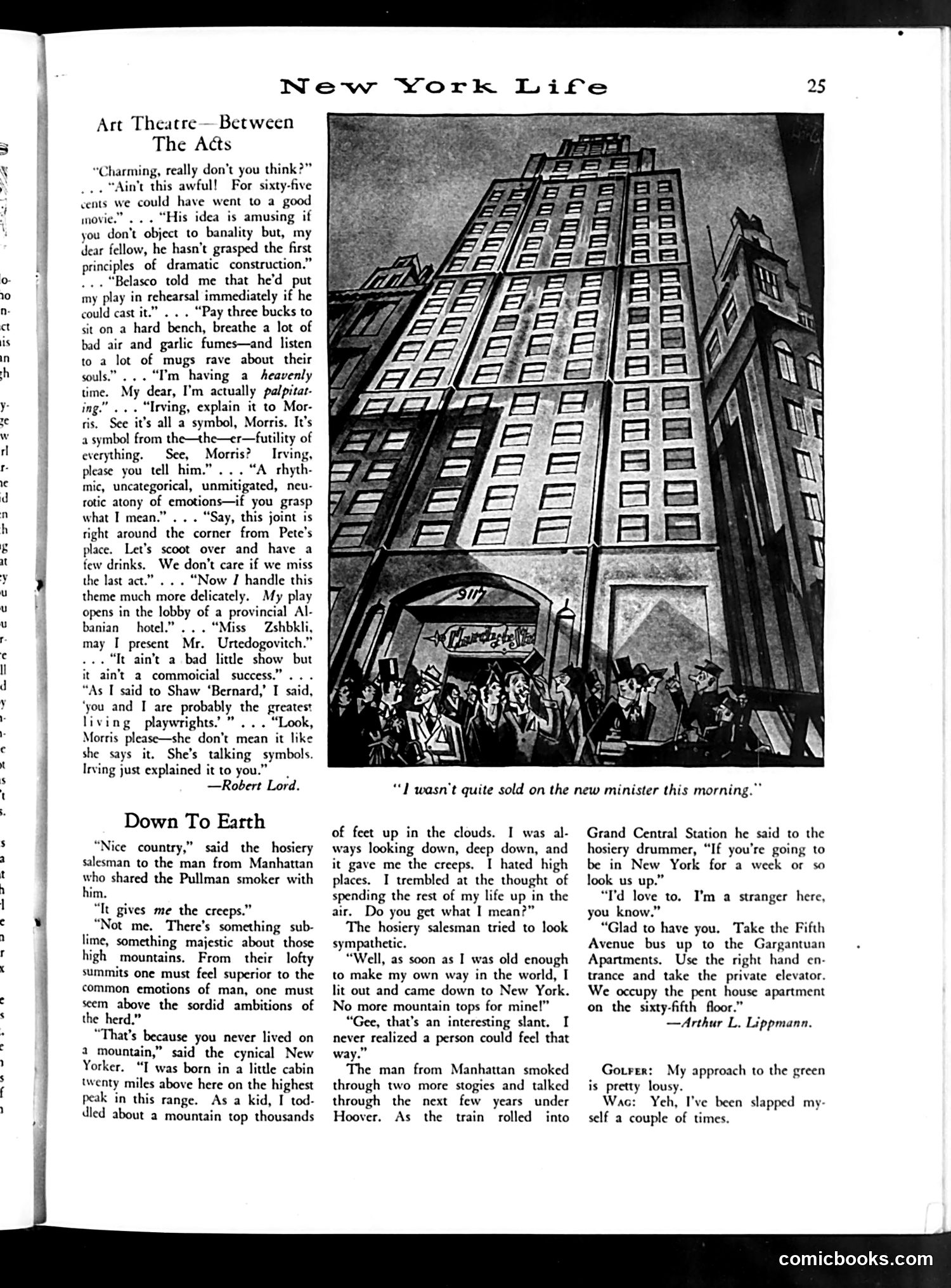
Analysis of Life Magazine Page 25 "Art Theatre—Between The Acts" This cartoon satirizes pretentious theatergoers at avant-garde productions. The accompanying dialogue mocks intellectuals who use inflated language ("rhythmic, uncategorical, neurotic atony of emotions") and pose as sophisticated while attending experimental theater. The humor lies in the contrast between their affected discussion of "symbols" and "futility" versus their actual indifference—they'd rather be at cheaper movies or drinking at Pete's bar. Robert Lord skewers both the self-important playwrights and the phoniness of those who claim to understand their work. "Down to Earth" This story uses a mountain-dweller's reversal of expectations to mock romantic notions about nature. Rather than finding spiritual elevation in peaks, the New Yorker experienced childhood dread. The punchline—he now lives in a penthouse on the sixty-fifth floor—suggests city dwellers replicate their origins, seeking artificial height instead of authentic mountains, while maintaining the same disconnection. Both pieces reflect Jazz Age cynicism about pretense and sentiment.
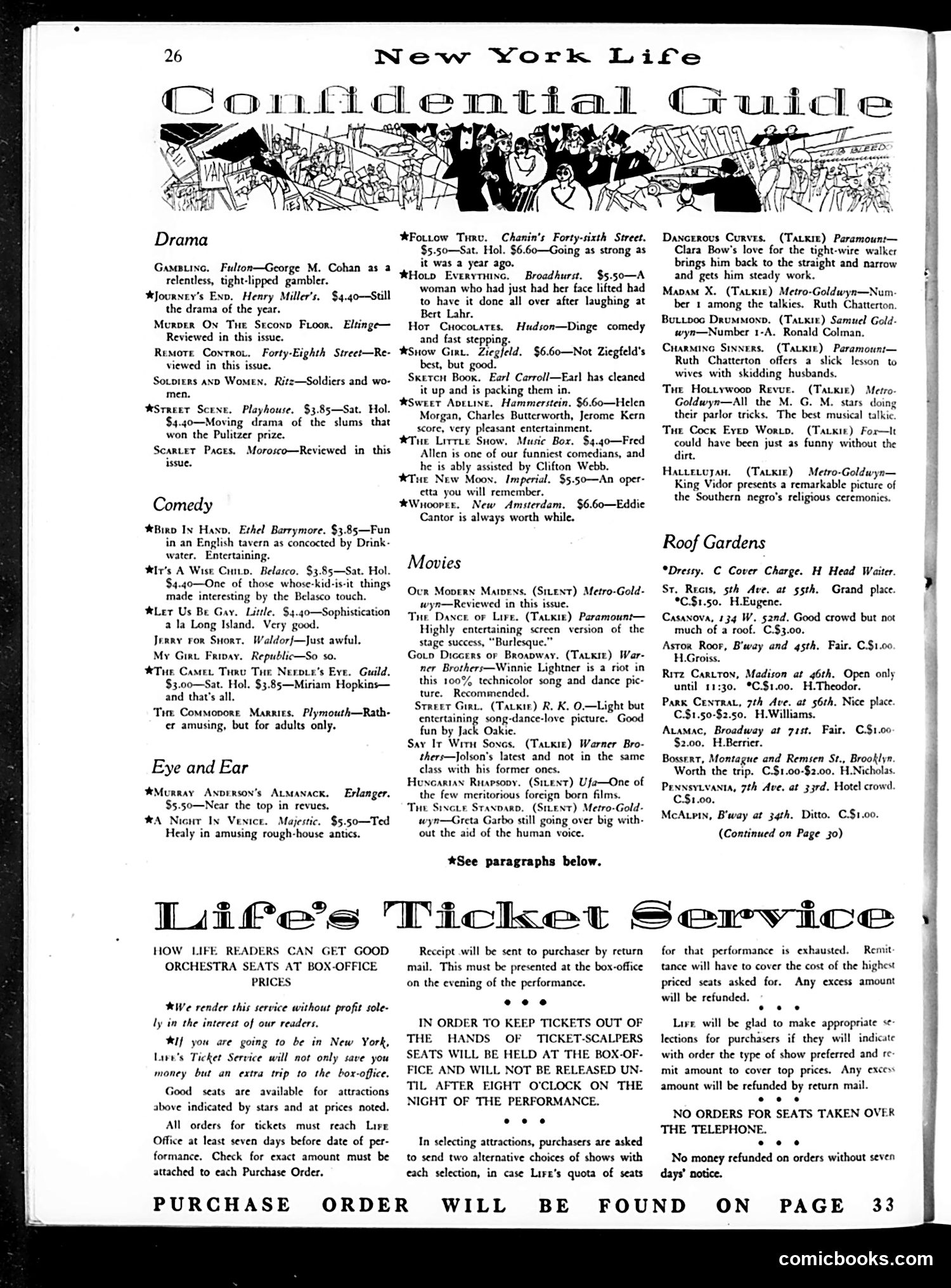
This page is primarily a theater and entertainment guide for New York City, not a political cartoon. It lists current Broadway productions, movies, and nightlife venues with brief reviews and ticket prices. The content reflects early "talkie" era (sound films were new—note repeated "[TALKIE]" labels). Key social details: George M. Cohan and Eddie Cantor were major stars; Bert Lahr and Fred Allen were rising comedians; Greta Garbo and Clara Bow were film icons. The Pulitzer Prize-winning "Street Scene" indicates serious drama was valued alongside entertainment. Notable: "Hallelujah" is described as showing "the Southern negro's religious ceremonies"—period language reflecting how African American subjects were marketed to white audiences. Prices ($3.85-$6.60) reflect 1920s economics. The "Life's Ticket Service" section reveals ticket-scalping was already a problem, requiring box-office restrictions to prevent resale.
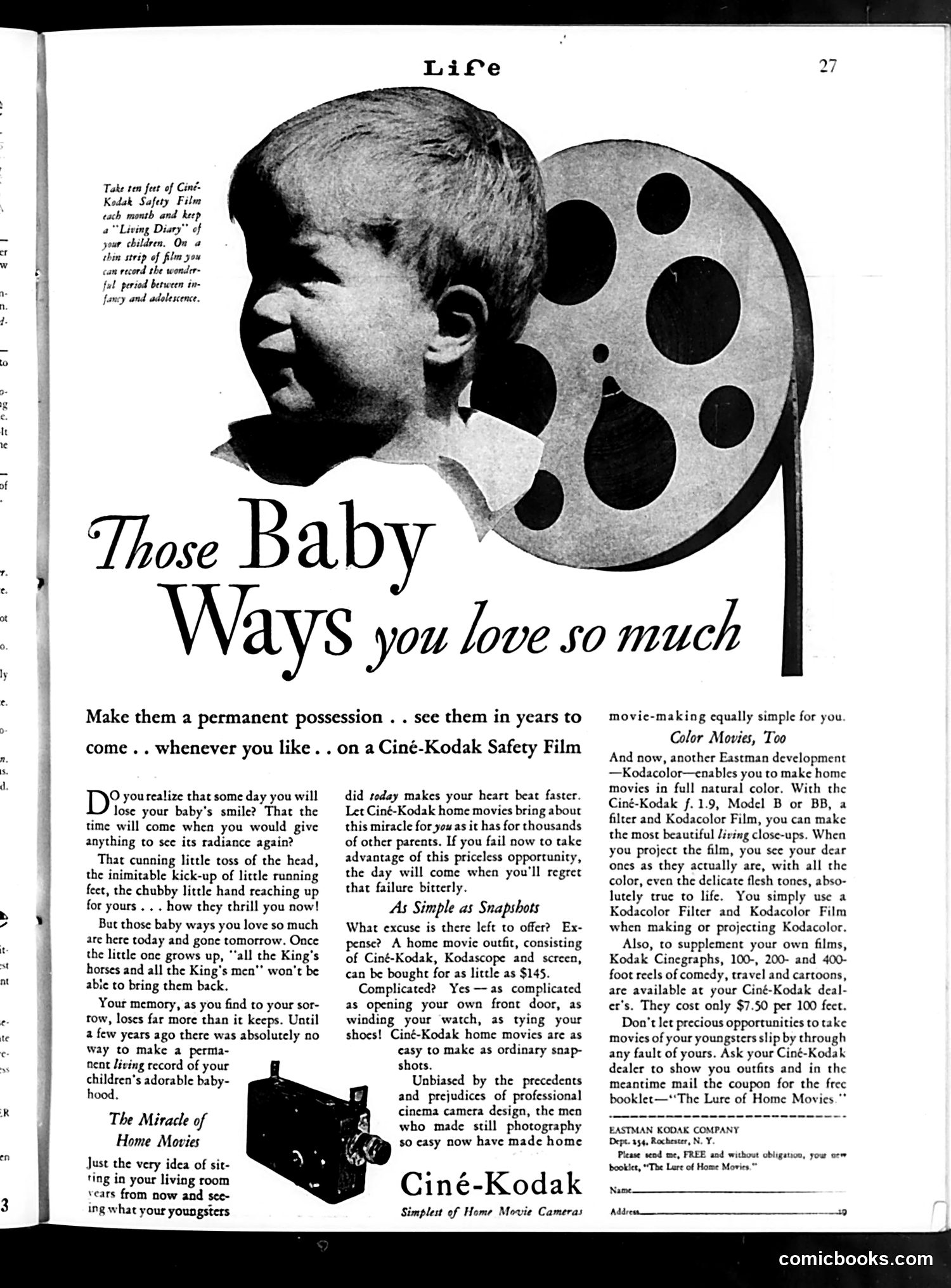
Analysis This is primarily advertising, not satire or political commentary. It's a Kodak advertisement for home movie cameras, appearing in Life magazine (page 27). The page uses emotional appeals rather than humor or political content. The central image shows a baby's profile next to a film reel, symbolizing the product's purpose: capturing childhood moments permanently. The pitch targets parental anxiety about time passing and memories fading—"some day you will lose your baby's smile." It promises that Ciné-Kodak cameras make home moviemaking affordable ($145), simple ("as easy as snapshots"), and now available in color (Kodacolor). There is no identifiable political satire, caricature, or social commentary. This is straightforward consumer marketing exploiting nostalgic and protective feelings about children. The rhetorical strategy is sentimental persuasion, not satirical critique. The only potentially noteworthy element is the gender assumption: the advertisement appeals implicitly to mothers as the documentarians of family life, reflecting mid-20th-century domestic ideology.
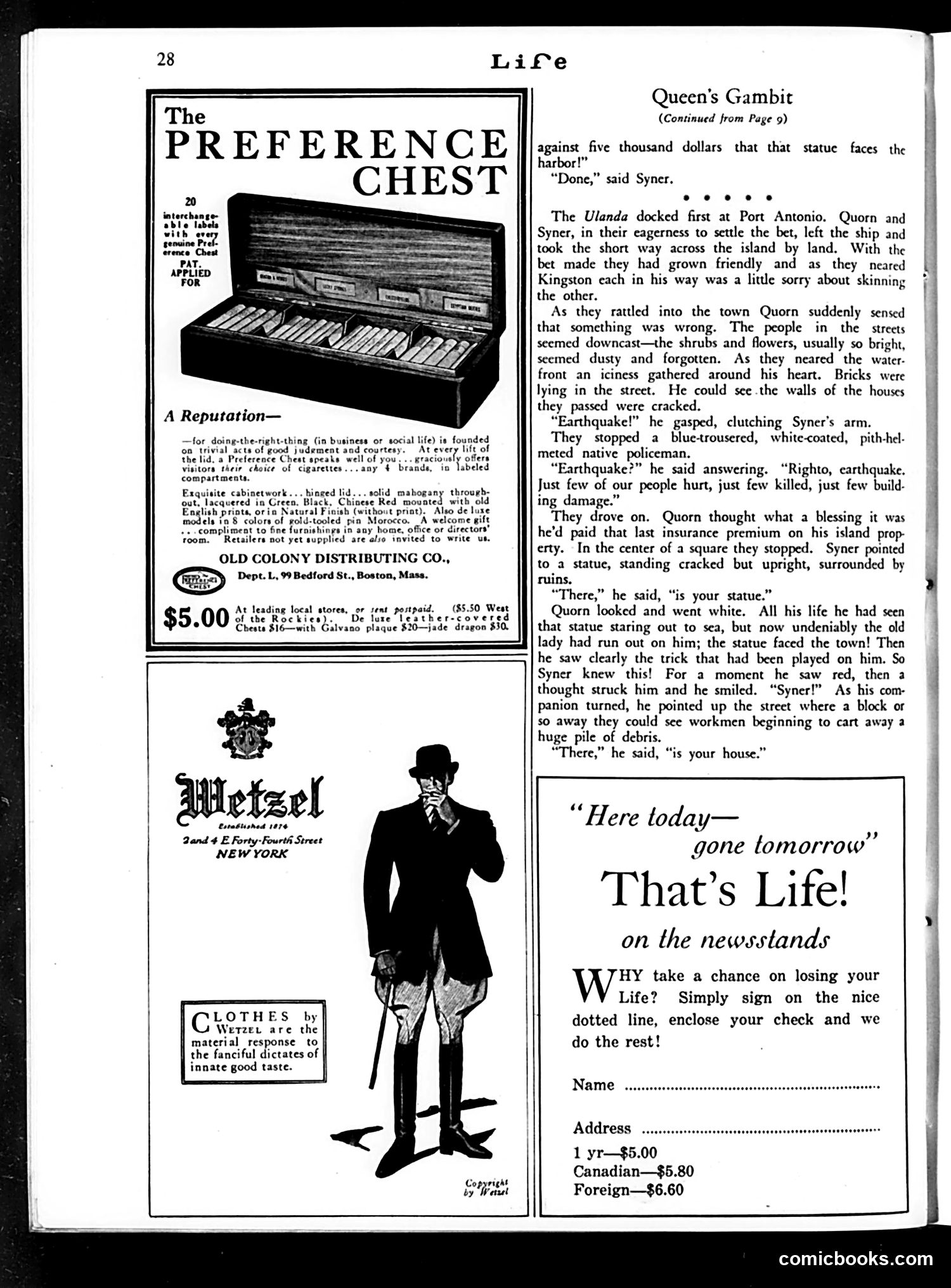
Page Analysis: Life Magazine Advertisement and Fiction This page combines advertisements with the conclusion of a short story called "Queen's Gambit." The Advertisements: - "The Preference Chest" promotes an elegant mahogany cigarette dispenser ($5.00), marketed as a sign of good taste and business reputation - Wetzel Clothes advertisement features a silhouetted gentleman, emphasizing refined taste and quality materials The Fiction Story: The "Queen's Gambit" concludes a tale about two men—Quorn and Syner—who bet on whether a statue faces the harbor. Upon arriving at Port Antonio after an earthquake, Quorn discovers the statue now faces town (Syner won the bet through trickery), but finds his own house destroyed. The final irony: Syner's house is also demolished. The story illustrates life's unpredictability and fate's indifference to human schemes. The Life Magazine Subscription Ad: Uses the story's concluding moral ("Here today—gone tomorrow / That's Life!") to pitch magazine subscriptions, wittily connecting the fiction's theme of impermanence to why readers need Life magazine to stay current with events.
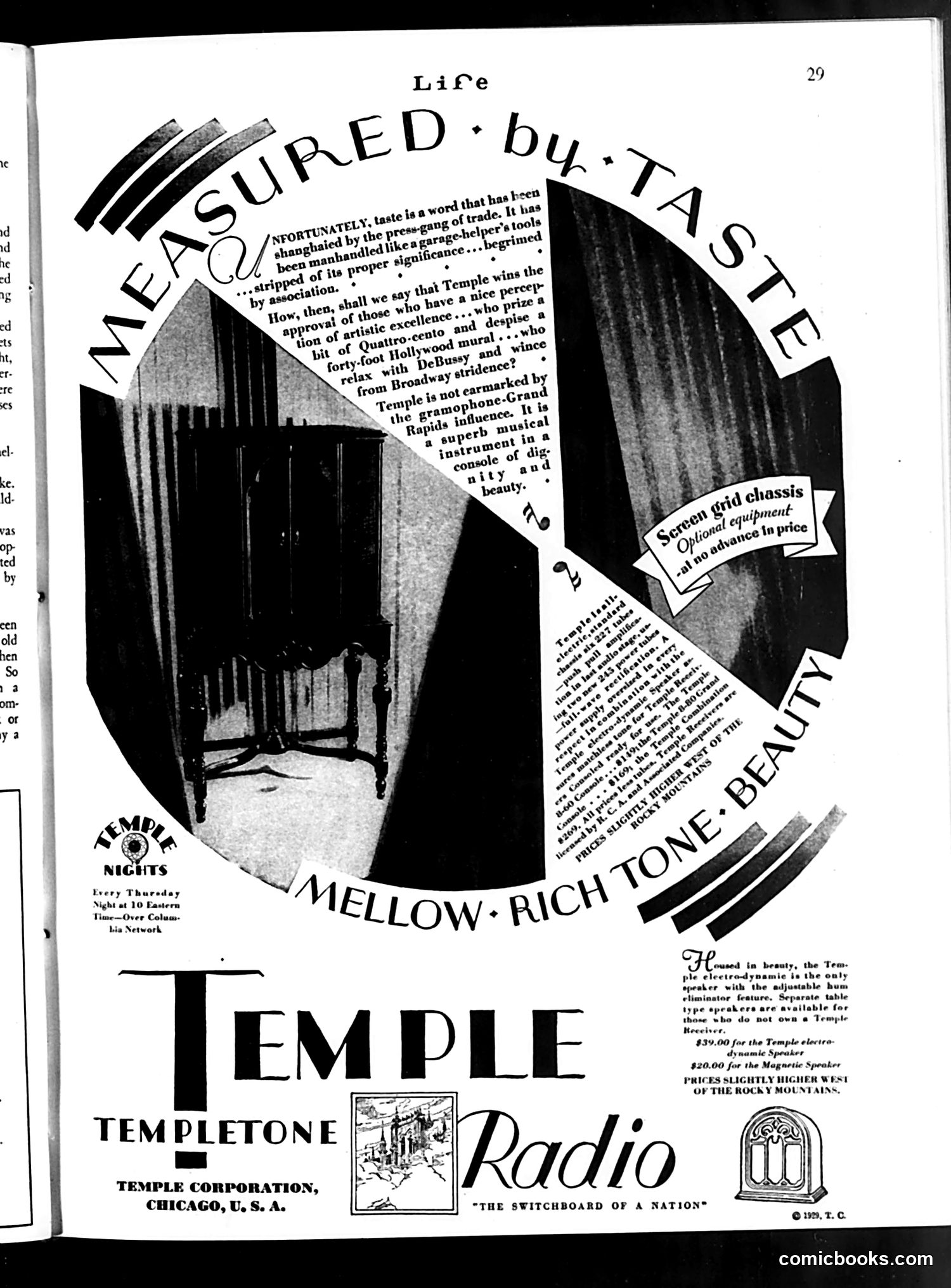
Analysis This page is primarily a Temple Radio advertisement (1920s era), not political satire. The circular design shows an ornate radio receiver with dramatic lighting, emphasizing its elegant cabinetry. The ad's language ("Measured by Taste," "Mellow Rich Tone, Beauty") appeals to consumers seeking sophisticated home entertainment. Text describes Temple's reputation for quality and artistic excellence, positioning radio as a luxury good for discerning buyers. The phrase "The Switchboard of a Nation" (radio's tagline) reflects how radio was marketed as connecting Americans. The mention of "Temple Nights" (Thursday broadcasts) and pricing ($39-$39+ "slightly higher West of Rocky Mountains") indicates regional distribution costs. This is commercial advertising, not editorial commentary or satire. It reflects 1920s consumer culture and radio's emergence as a prestige home technology, when radios were expensive furniture pieces rather than utilities.
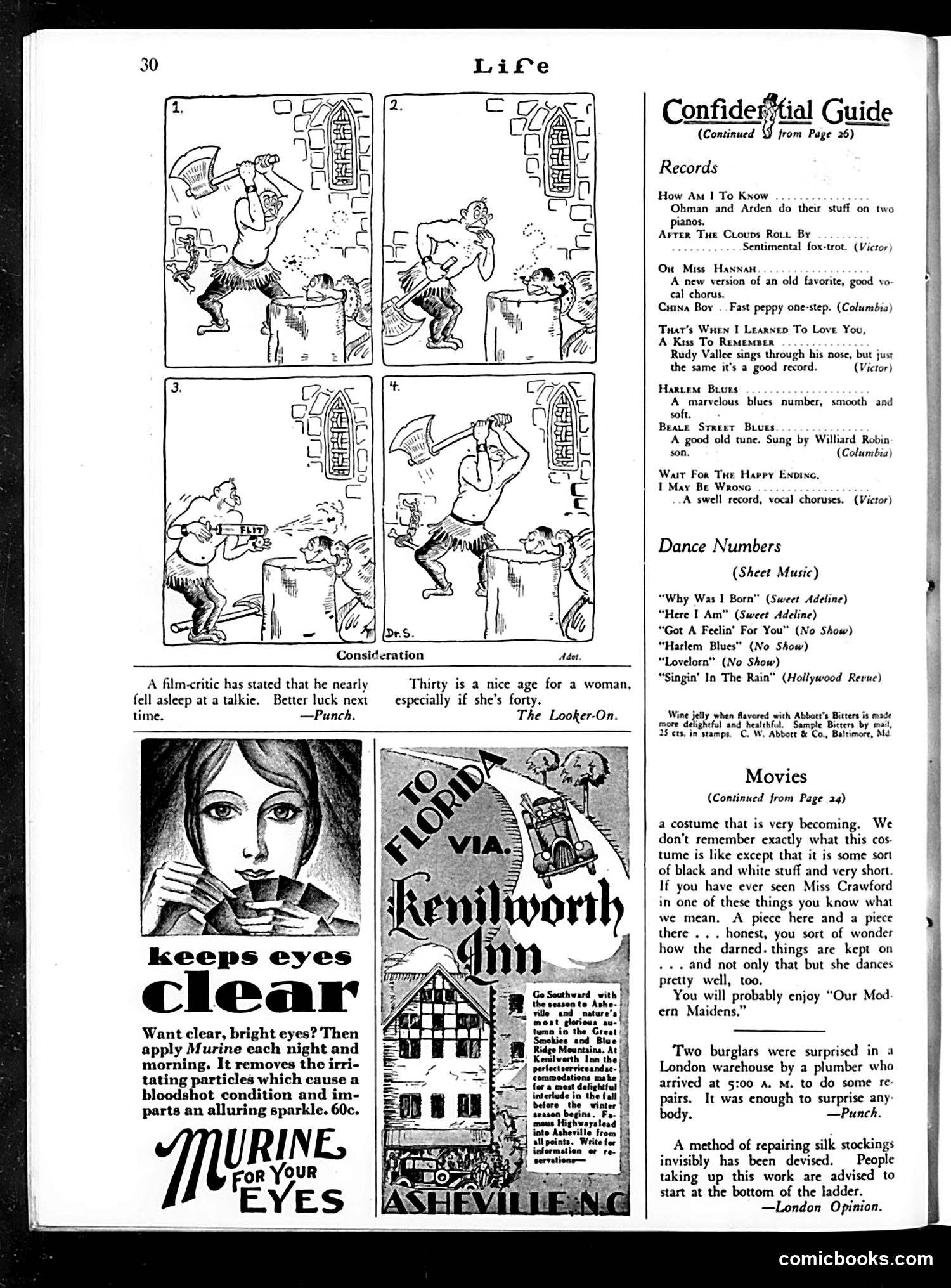
Page Analysis: Life Magazine, circa 1920s This page features a "Confidential Guide" section listing contemporary music and dance records—likely from the early "talkie" era when sound films were revolutionary. The four comic panels at top depict what appears to be a jazzy dance scene, with figures in 1920s attire performing energetic movements, reflecting the era's fascination with jazz and modern dance. The advertisements (Murine eye drops, Kenilworth Inn) are period products typical of the 1920s. The humor relies on era-specific references: a film critic nearly falling asleep at a "talkie" (early talking picture—still a novelty), a joke about women turning forty while claiming to be thirty, and anecdotes from *Punch* and *London Opinion* about mundane mishaps (burglars interrupted, invisible stocking repair). The music listings reference Rudy Vallée and popular standards ("Sweet Adeline," "Harlem Blues"), reflecting Jazz Age entertainment tastes. This page essentially documents 1920s popular culture and consumer humor—mostly inaccessible without that historical context.
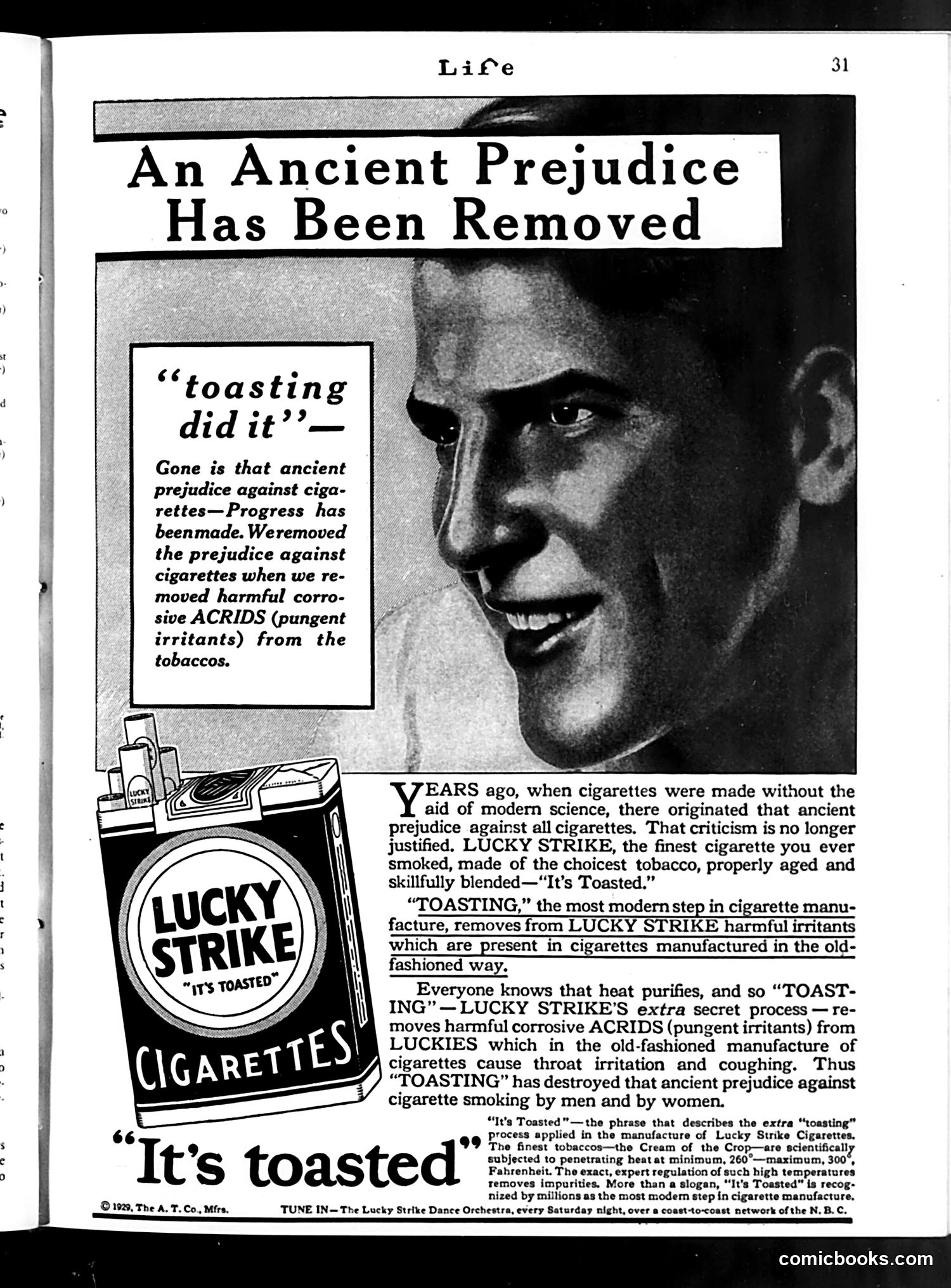
Lucky Strike Advertisement (1929) This is a cigarette advertisement, not satire—though it reads as darkly comic to modern eyes. Lucky Strike claims their "Toasting" process removes harmful irritants (called "acrids") from tobacco, thereby eliminating "ancient prejudice" against smoking. The ad features a smiling man's face and argues that old criticism of cigarettes was justified when they caused throat irritation, but Lucky Strike's heat treatment has solved this problem. The campaign essentially rebrands cigarettes as scientifically improved and safe for "men and by women." The irony for modern readers: The ad boasts of removing irritants while promoting a highly addictive, carcinogenic product. "Ancient prejudice" was actually valid health concern. This represents early 20th-century tobacco industry marketing—making health claims about products now known to cause serious disease.
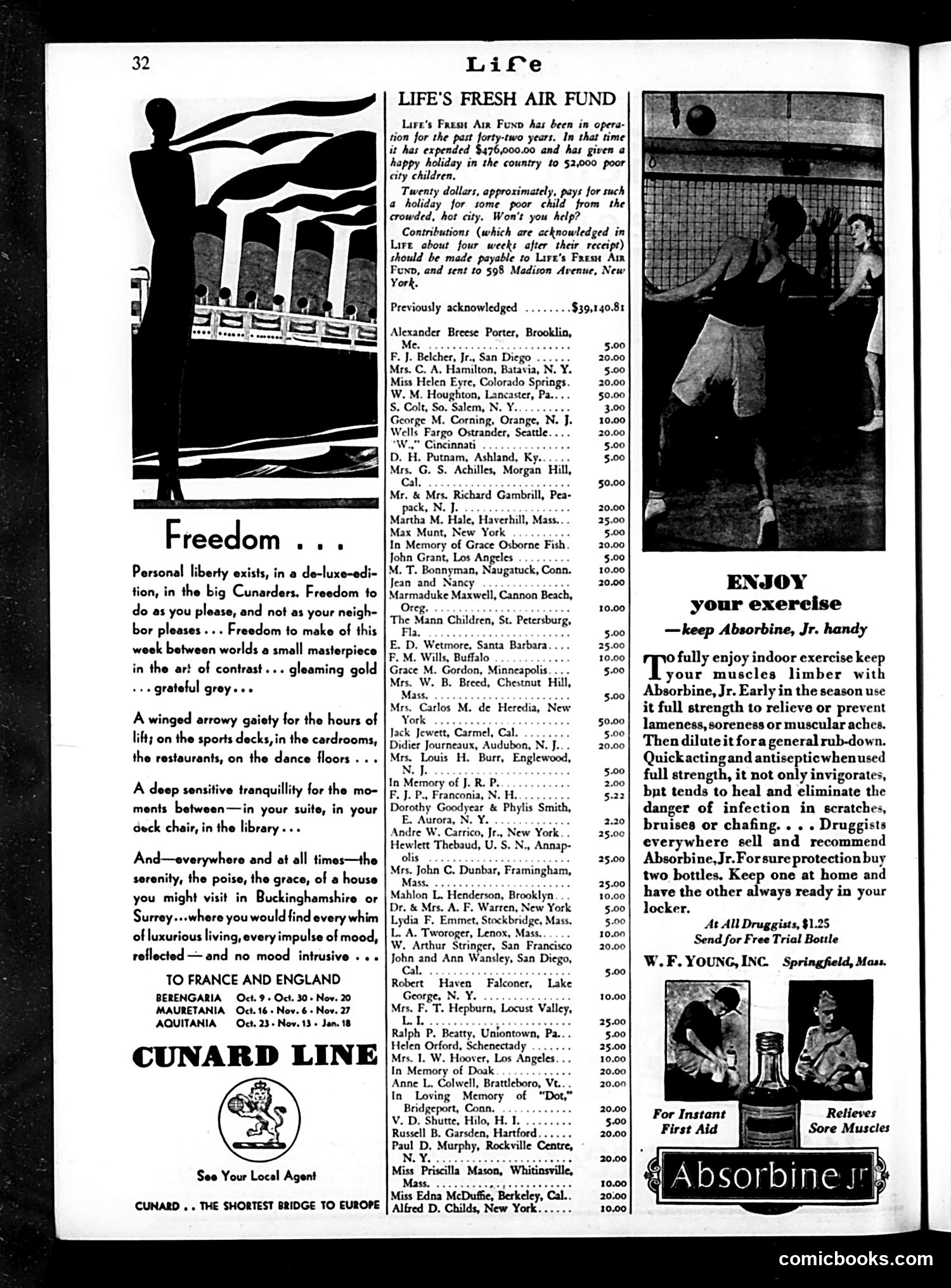
Life Magazine Page Analysis This page presents a stark class contrast through juxtaposition. The left side features an elegant Cunard Line cruise ship advertisement promoting luxury travel to Europe—emphasizing "freedom," personal liberty, and refined pleasures aboard vessels like the *Berengaria* and *Mauretania*. The silhouette illustration shows passengers in sophisticated leisure. The right side immediately pivots to Life's Fresh Air Fund, a charitable initiative providing poor city children countryside holidays. The fund has distributed $476,000 over 42 years to 52,000 children, with donations of $5-50 listed. The satire is implicit: while wealthy Americans enjoy transatlantic luxury and "freedom," impoverished urban children need charitable donations (approximately $20) for a single countryside holiday. The page's layout creates a pointed editorial comment on economic inequality in 1920s America—the juxtaposition itself is the cartoon. The "freedom" celebrated in cruise advertising contrasts sharply with the constrained circumstances of poor children in "crowded, hot" cities requiring philanthropic intervention.
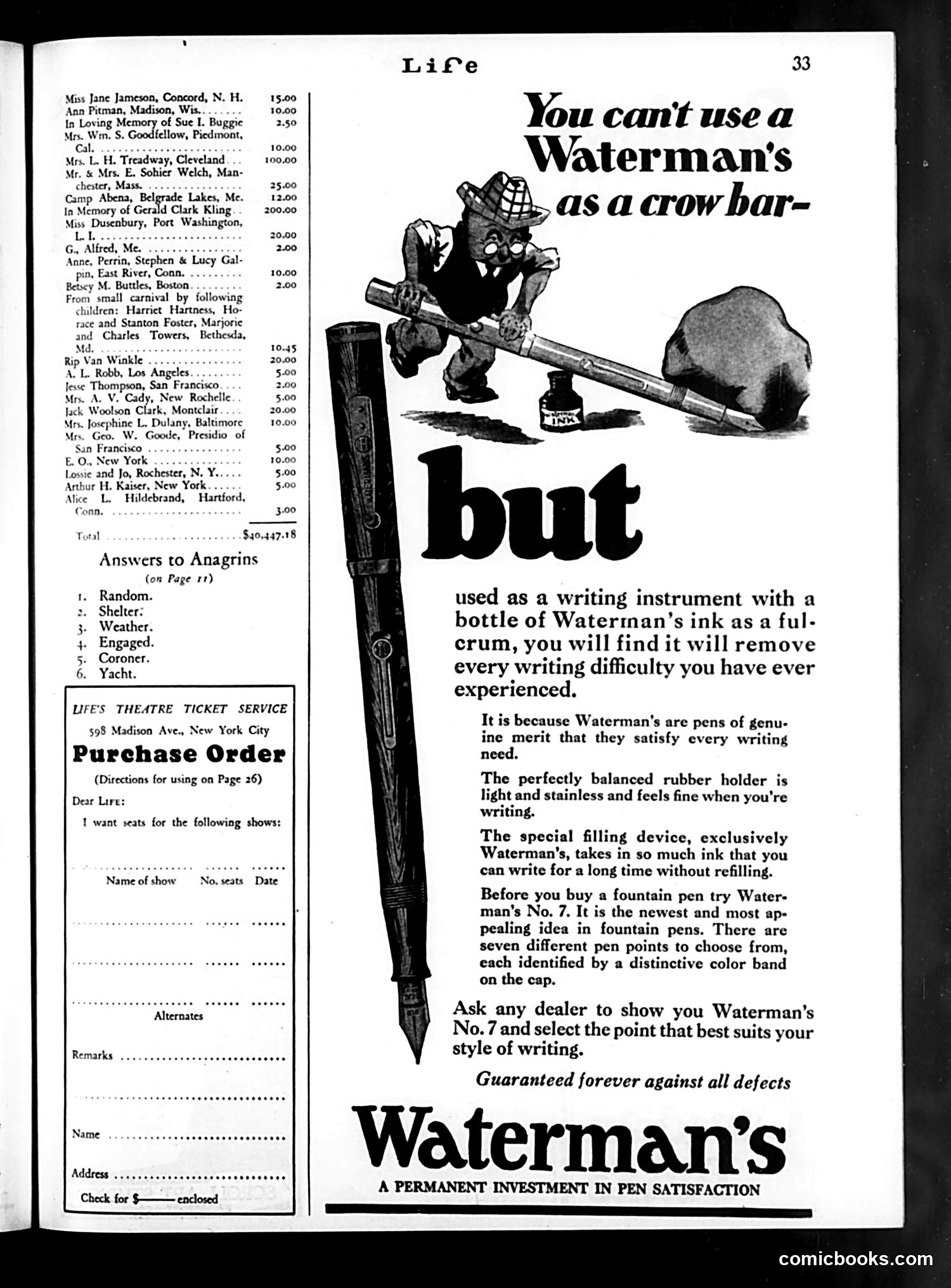
Page 33 Analysis This page is primarily advertising, not satire or political commentary. The dominant content is a Waterman's fountain pen advertisement featuring a humorous illustration of a figure using a crowbar alongside pen and ink supplies. The ad's joke is visual wordplay: the headline claims you "can't use a Waterman's as a crowbar—but" then argues the pen is so effective at removing writing difficulties that it's practically a tool of equal utility. The cartoon figure and crowbar are meant to be absurd, emphasizing the pen's superior performance humorously. The left column contains routine charitable donation listings (memorial gifts, theater ticket orders) typical of Life magazine's fundraising section. There's no political satire or social commentary visible—this is straightforward period advertising for a quality writing instrument, emphasizing durability, design, and filling capacity.
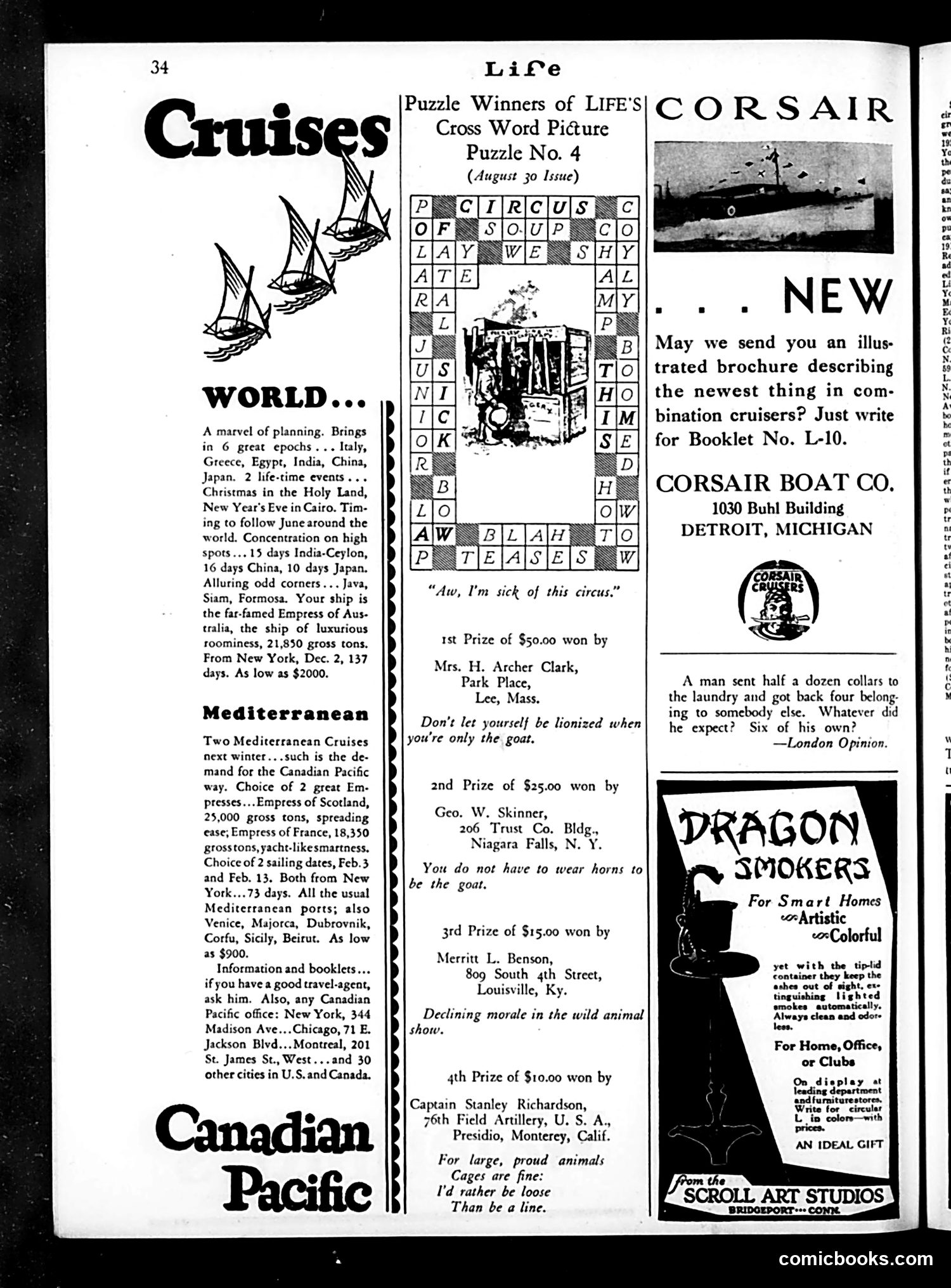
Content Analysis: Life Magazine Page 34 This page is primarily advertising and puzzle content, not political satire. The main feature is a crossword puzzle solution from Life's August 30 issue. The puzzle's answer—"Aw, I'm sick of this circus"—appears to reference circus/animal show performers (based on winning entries mentioning "goats" and "wild animal show" morale). The humor derives from circus-themed wordplay rather than political commentary. The bulk of the page advertises luxury cruise lines: Canadian Pacific (world cruises and Mediterranean voyages) and Corsair boats, typical of 1920s-30s travel marketing targeting affluent readers. A small joke at bottom-right (from *London Opinion*) plays on laundry mix-ups—unrelated to the page's main content. No political figures or satire are present. This is straightforward period advertising and puzzle recreation.
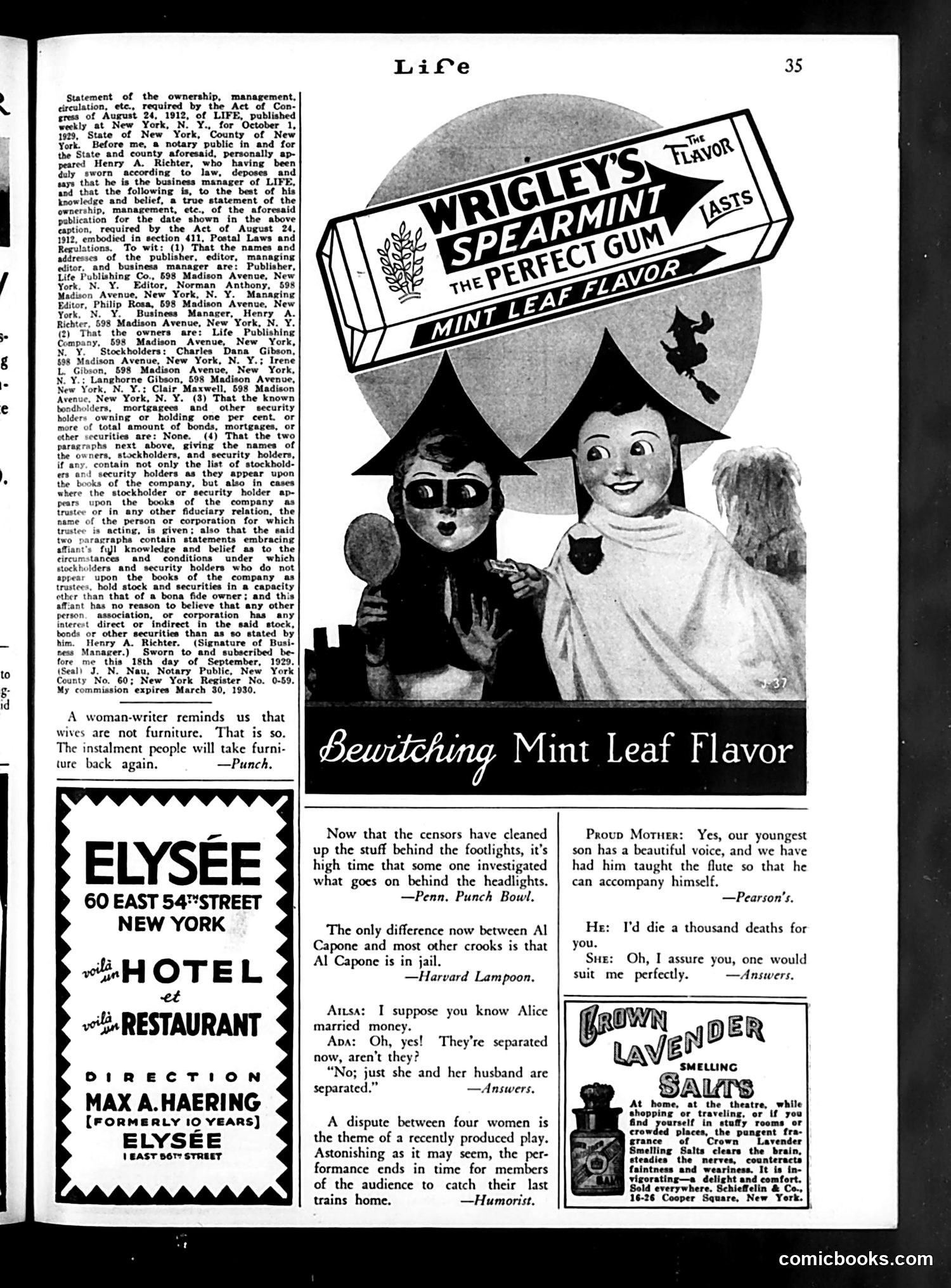
Analysis of Life Magazine Page 35 This page is primarily administrative and advertising content, not political satire. The bulk consists of legal ownership statements required by the 1912 Act of Congress, listing Life's publishers and stockholders (notably Charles Dana Gibson, the magazine's founder). The page includes three humor snippets at bottom: 1. A quip about censorship: authorities have cleaned up theatrical content ("behind the footlights") but should investigate automobile behavior—likely referencing reckless or immoral conduct in cars, a contemporary social concern during the 1920s-30s. 2. A jab at Al Capone being imprisoned while other criminals remain free—timely topical humor from the Prohibition era. 3. A domestic joke about a woman who "married money" but separated from her husband—satirizing marriages of convenience. The dominant advertisement is Wrigley's Spearmint gum with "bewitching mint leaf flavor," featuring cheerful vintage mascot imagery. Also advertised: the Elysée Hotel in New York and Crown Lavender smelling salts.
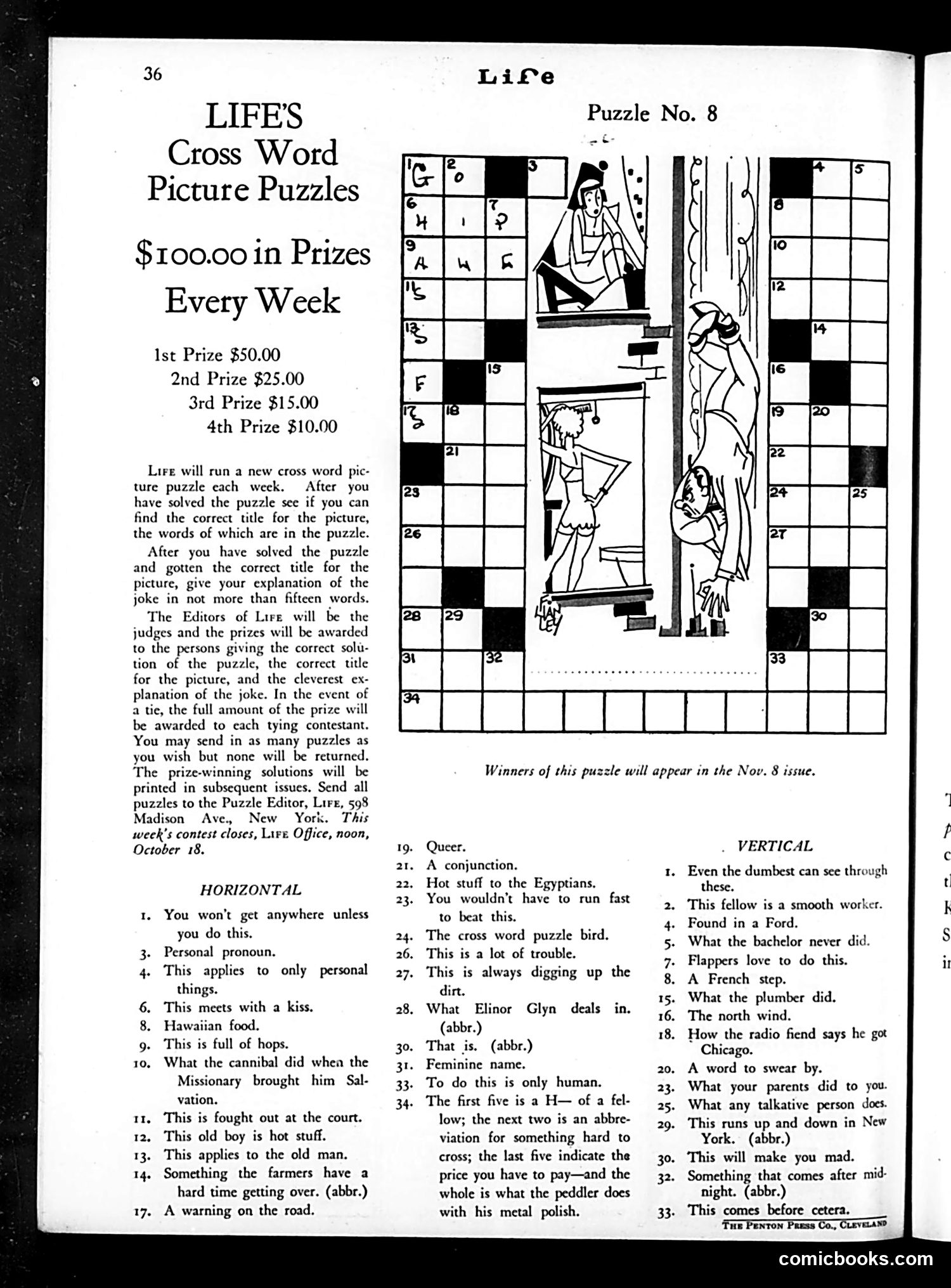
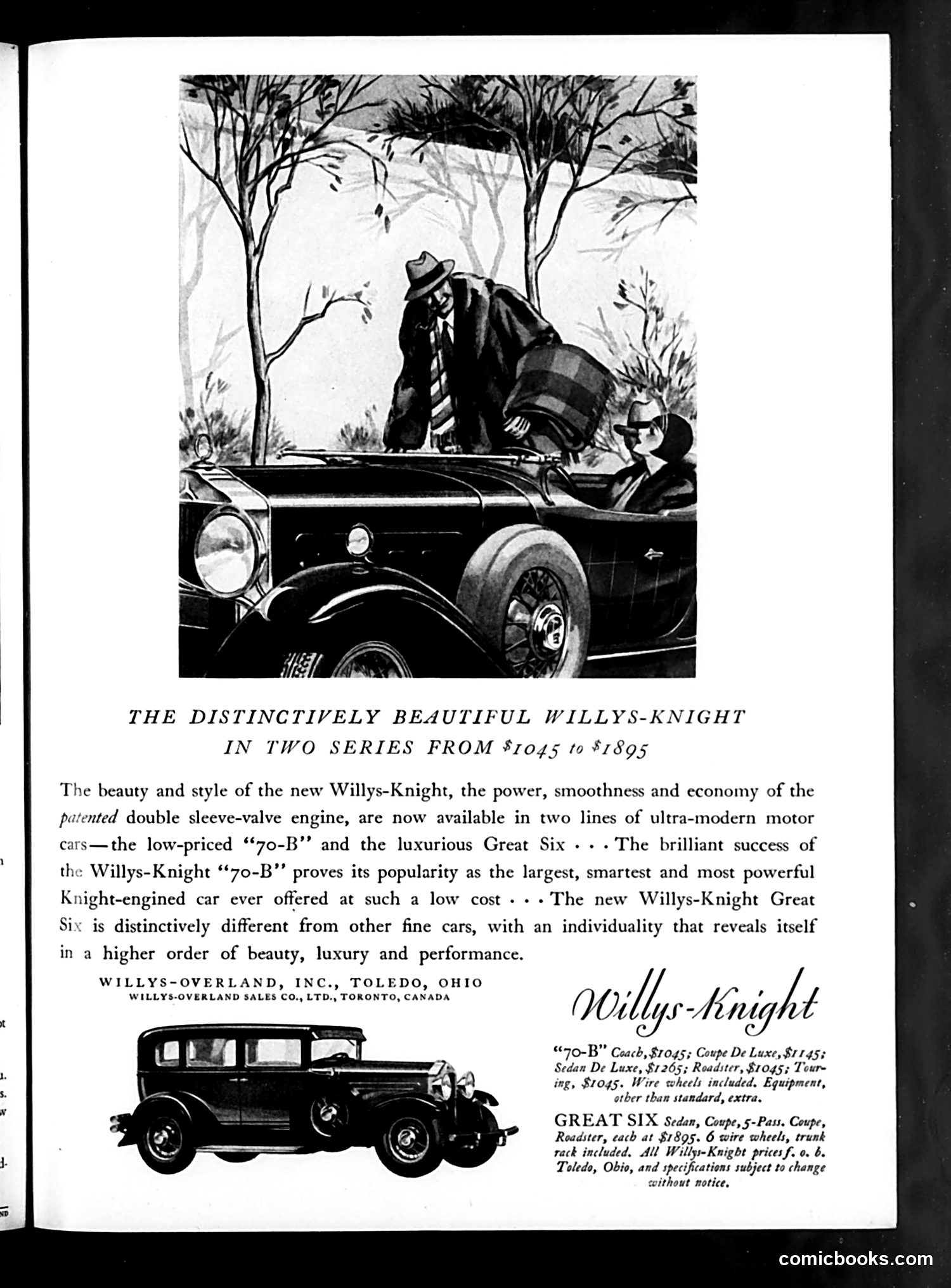
Analysis This is primarily a car advertisement, not political satire. It promotes Willys-Knight automobiles manufactured by Willys-Overland, Inc. in Toledo, Ohio. The illustration depicts two men in a convertible automobile stopped in a wooded area—likely meant to convey leisure, freedom, and the aspirational lifestyle associated with car ownership in this era. The ad emphasizes the "patented double sleeve-valve engine" as a technical innovation, positioning two models: the affordable "70-B" (starting at $1,045) and the luxury "Great Six" ($1,895). The language stresses that quality and power are now accessible across price points—a marketing pitch to different consumer segments. There is no apparent political content or social satire on this page. It reflects 1920s consumer culture and automotive marketing conventions of the period.
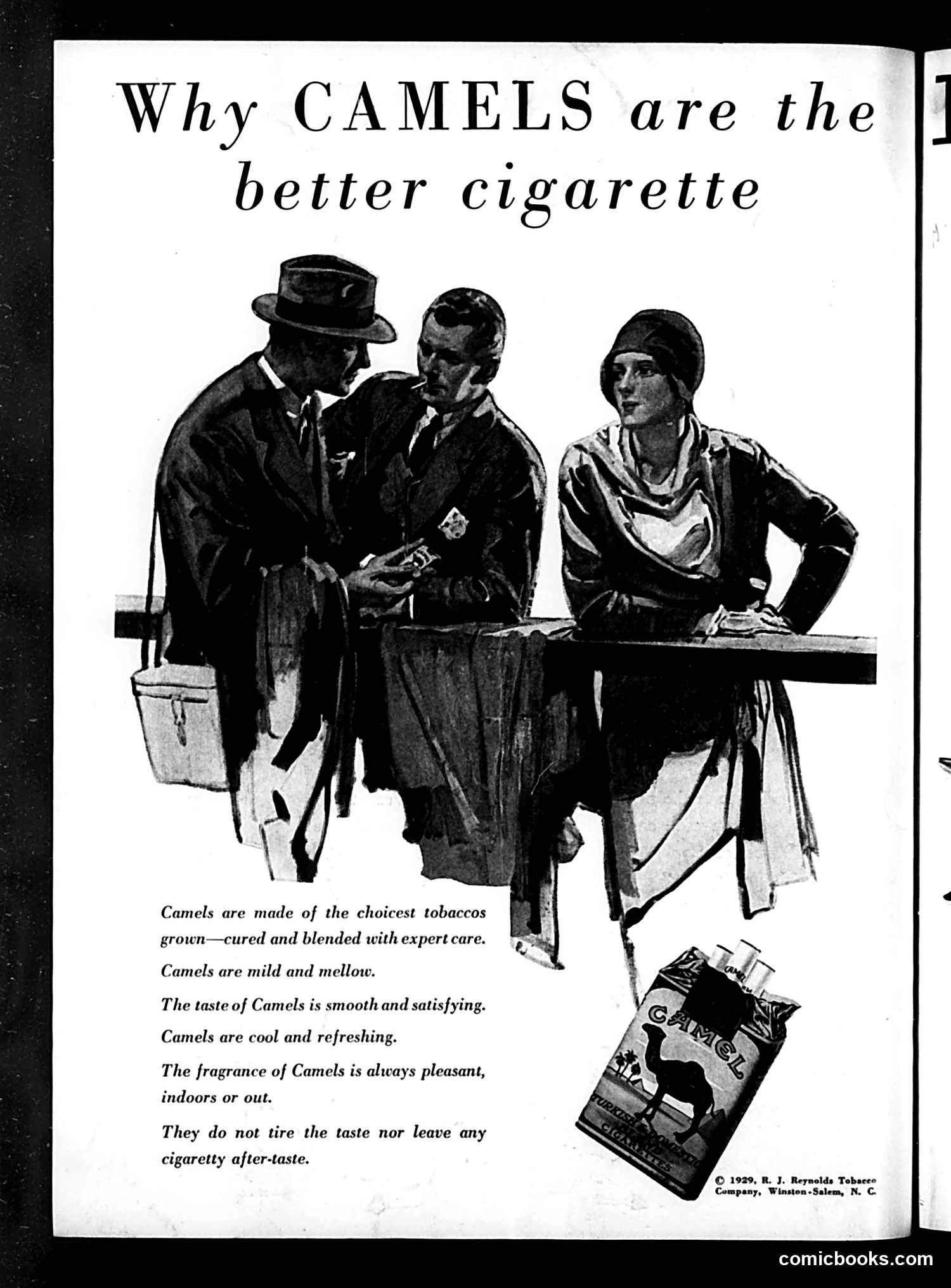
Analysis This is a cigarette advertisement, not satire or political commentary. It's a 1929 Camel brand ad from Life magazine promoting smoking qualities. The image shows three well-dressed figures (two men and a woman) in what appears to be a social or business setting, examining a cigarette package. The composition suggests aspirational, sophisticated consumers—a common advertising strategy of the era. The text lists product benefits: mild flavor, smooth taste, pleasant aroma, no aftertaste. For modern readers, the striking element is the complete absence of health warnings—this predates any cigarette regulation. The advertisement openly touts smoking as desirable and socially sophisticated, reflecting 1920s-30s marketing norms when tobacco dangers were either unknown publicly or deliberately downplayed by manufacturers.