life
Life — October 11, 1929
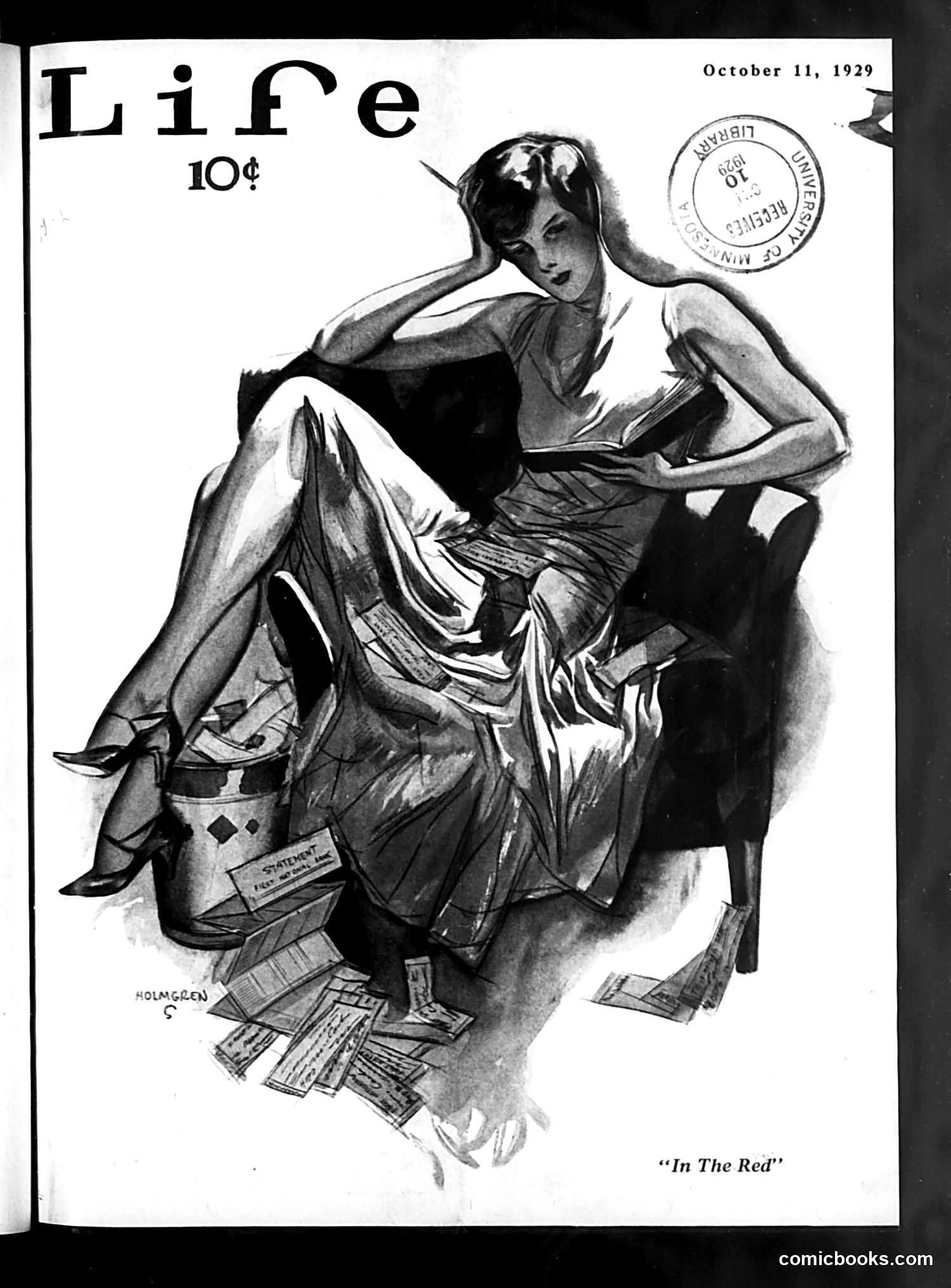
Analysis of Life Magazine Cover, October 11, 1929 This cover illustration, titled "In The Red," depicts a woman surrounded by scattered financial documents or bills, sitting in a relaxed pose. The phrase "in the red" refers to financial loss or debt. Historical Context: This issue was published just days before the Stock Market Crash of October 29, 1929 (Black Tuesday), which triggered the Great Depression. The timing suggests the artwork anticipated financial catastrophe. The Satire: The illustration likely comments on consumer debt and financial vulnerability during the 1920s, depicting a woman casually amid mounting bills—perhaps satirizing either reckless spending habits or the precarious financial position many Americans occupied before the economic collapse. The artist signature reads "Holmgren."
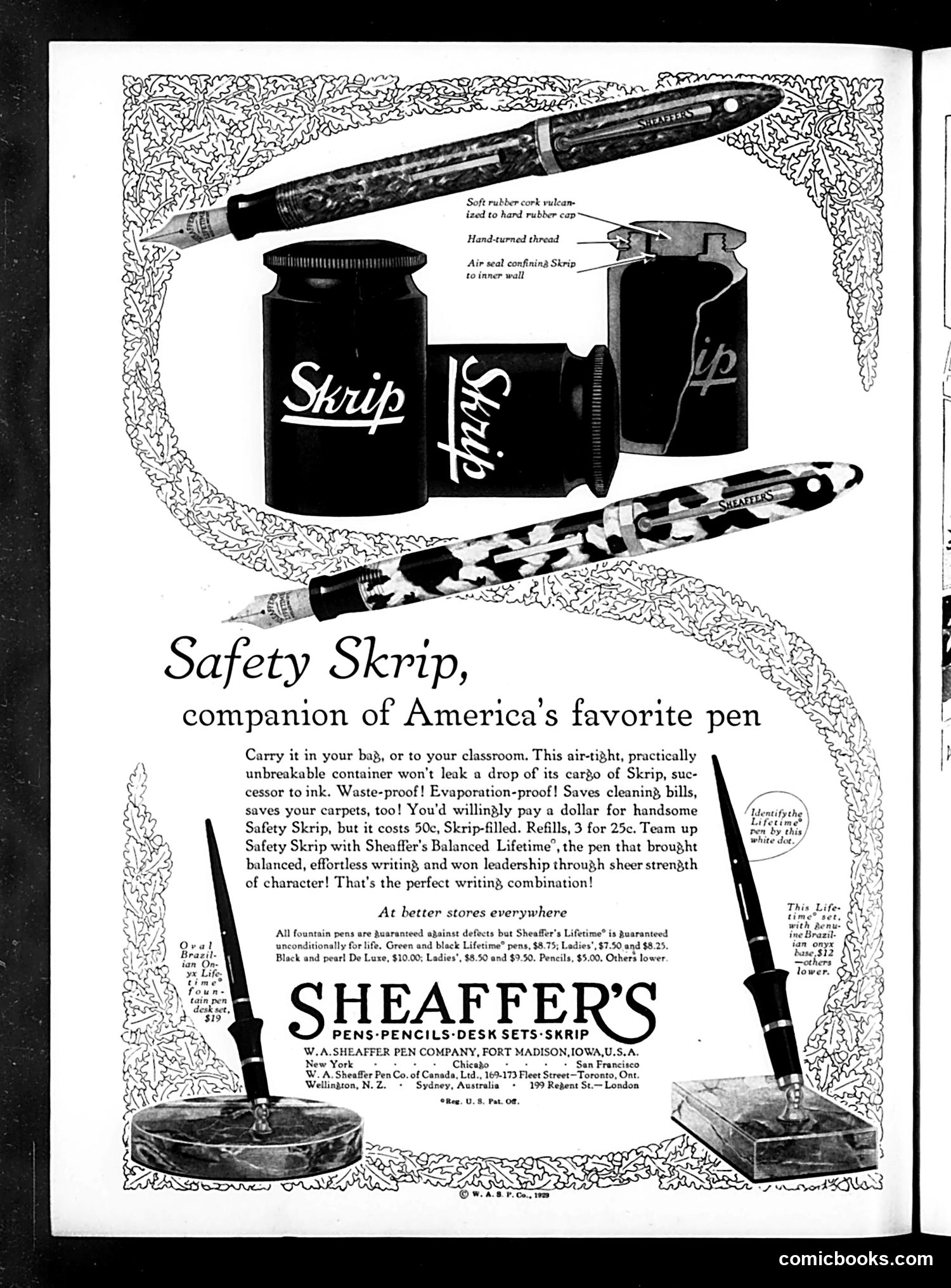
Analysis This is not a political cartoon or satire — it's a straightforward product advertisement. The page promotes "Safety Skrip," an ink container made by Sheaffer's pen company. The ad emphasizes practical benefits: the container is airtight and unbreakable, preventing ink from evaporating or spilling. The detailed technical drawings show the soft rubber cork, hand-turned thread, and air-seal strip. The marketing pitch targets students and office workers who want to avoid mess and cleaning costs. The tagline calls it the "companion of America's favorite pen," tying it to Sheaffer's existing popular fountain pen line. This reflects early-20th-century consumer culture, when fountain pens were common writing instruments and ink containers were genuine household concerns. The ad ran in *Life* magazine alongside other product advertisements.
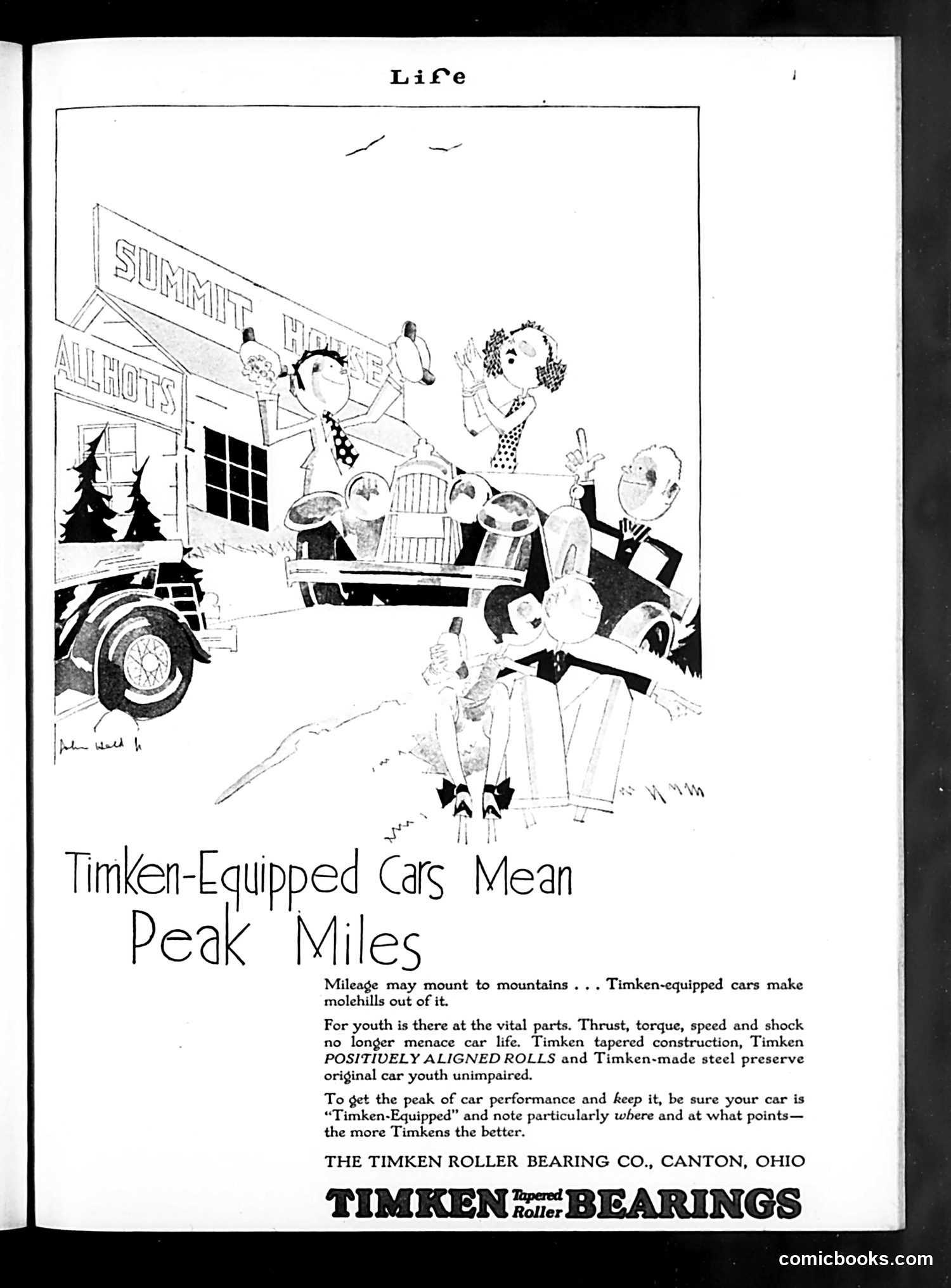
Analysis This is primarily a Timken Roller Bearings advertisement rather than political satire. The illustration depicts a celebratory scene at what appears to be a mountain lodge or resort (marked "Summit House" and "Allotts"), with well-dressed figures celebrating—likely representing successful motorists who've conquered mountain driving. The advertisement's message is straightforward: Timken-equipped cars perform better on challenging terrain. The tagline "Timken-Equipped Cars Mean 'Peak' Miles" uses the mountain setting as a visual pun. The text emphasizes that Timken components—tapered construction, positively aligned rolls, and steel preservation—maintain car performance and youth during demanding driving conditions. This reflects 1920s automotive advertising, emphasizing mechanical superiority and leisure motoring aspirations rather than containing political commentary.
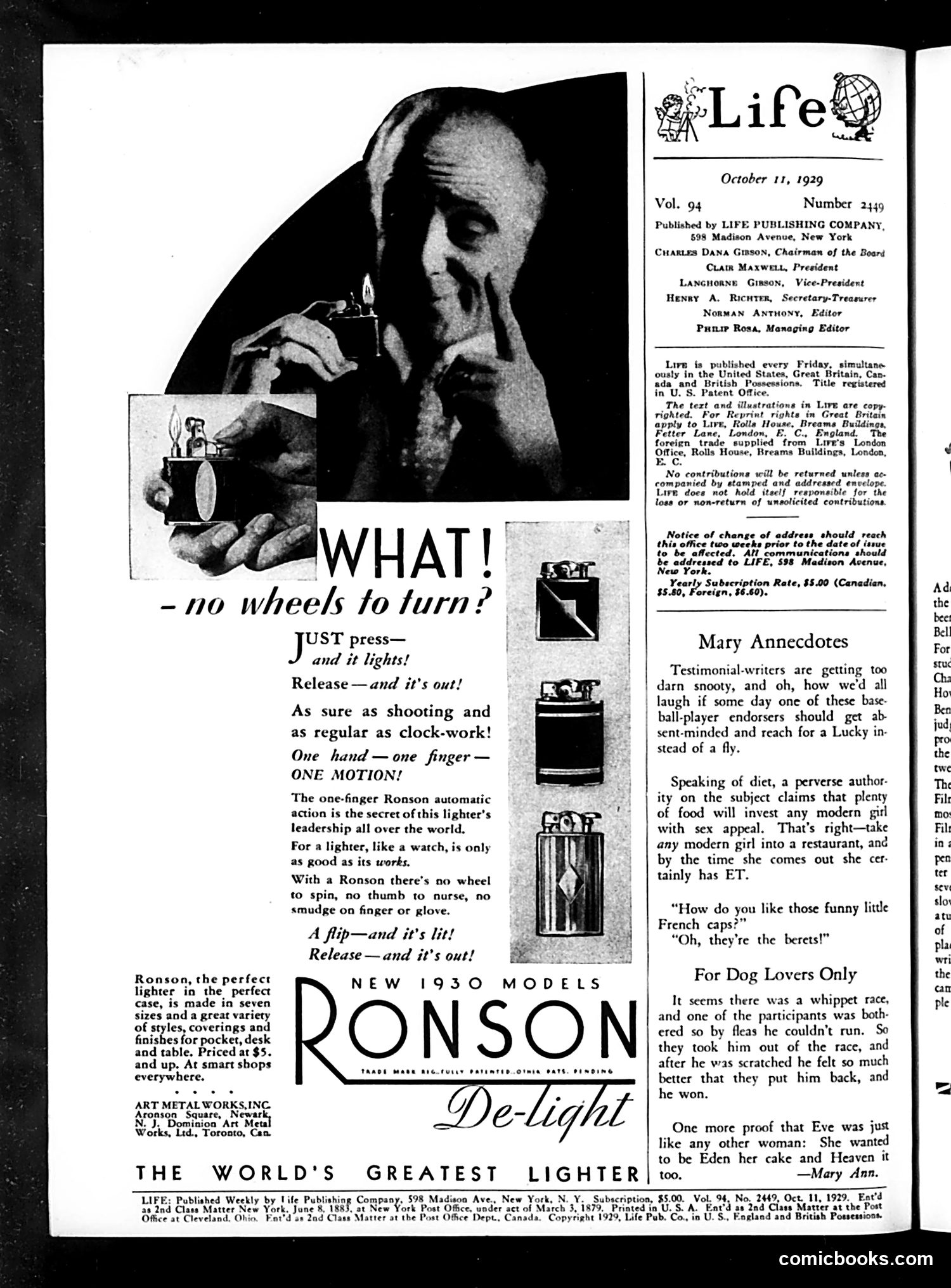
Life Magazine, October 11, 1929 This page is primarily a Ronson lighter advertisement ("The World's Greatest Lighter"), occupying most of the space. The ad uses a large photograph of a man with an exaggerated facial expression demonstrating the lighter's one-finger operation—the main selling point emphasized repeatedly ("One hand—one finger—ONE MOTION!"). The lighter's ease of use is compared to reliability of a watch or shooting mechanism. Multiple smaller product images show the 1930 models available. The right column contains brief humorous articles unrelated to the advertisement, including a piece called "Mary Annecdotes" with light satirical observations about testimonial writers and modern dating culture. The page reflects 1929 consumer marketing rather than political satire.
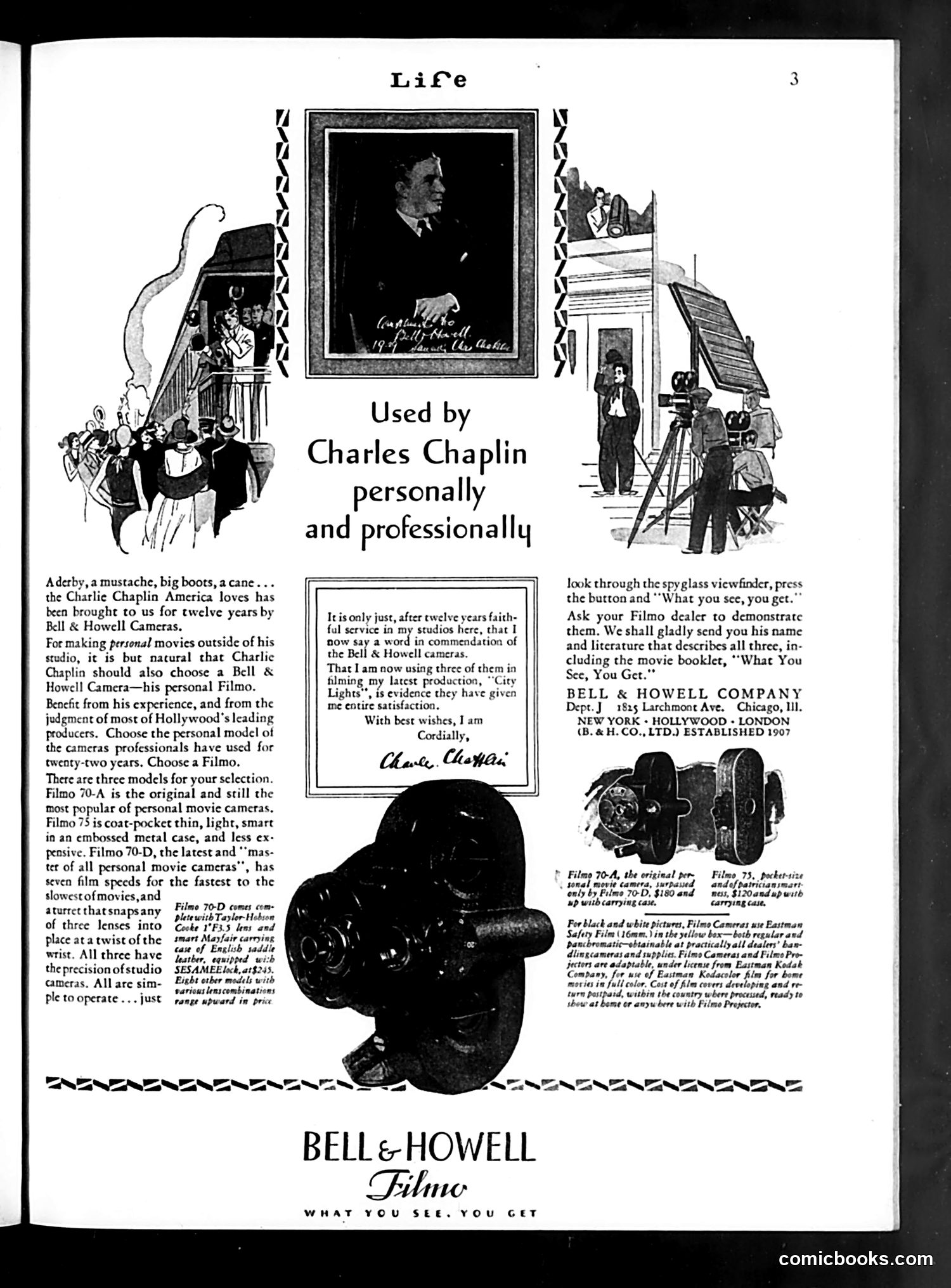
Analysis This page is primarily advertising, not satire or political commentary. It's a Bell & Howell Filmo camera advertisement from *Life* magazine, featuring an endorsement from Charlie Chaplin. The ad emphasizes that Chaplin used Bell & Howell cameras for twelve years in his studio work and personal filmmaking. The decorative illustrations flanking the central portrait show theatrical and film-production scenes, reinforcing the product's association with professional cinema. The large camera image at bottom displays the equipment being marketed. The text emphasizes the cameras' precision engineering, range of models, and ease of operation—standard advertising copy positioning the product as suitable for both professional and amateur filmmakers. This is commercial promotion, not editorial commentary.
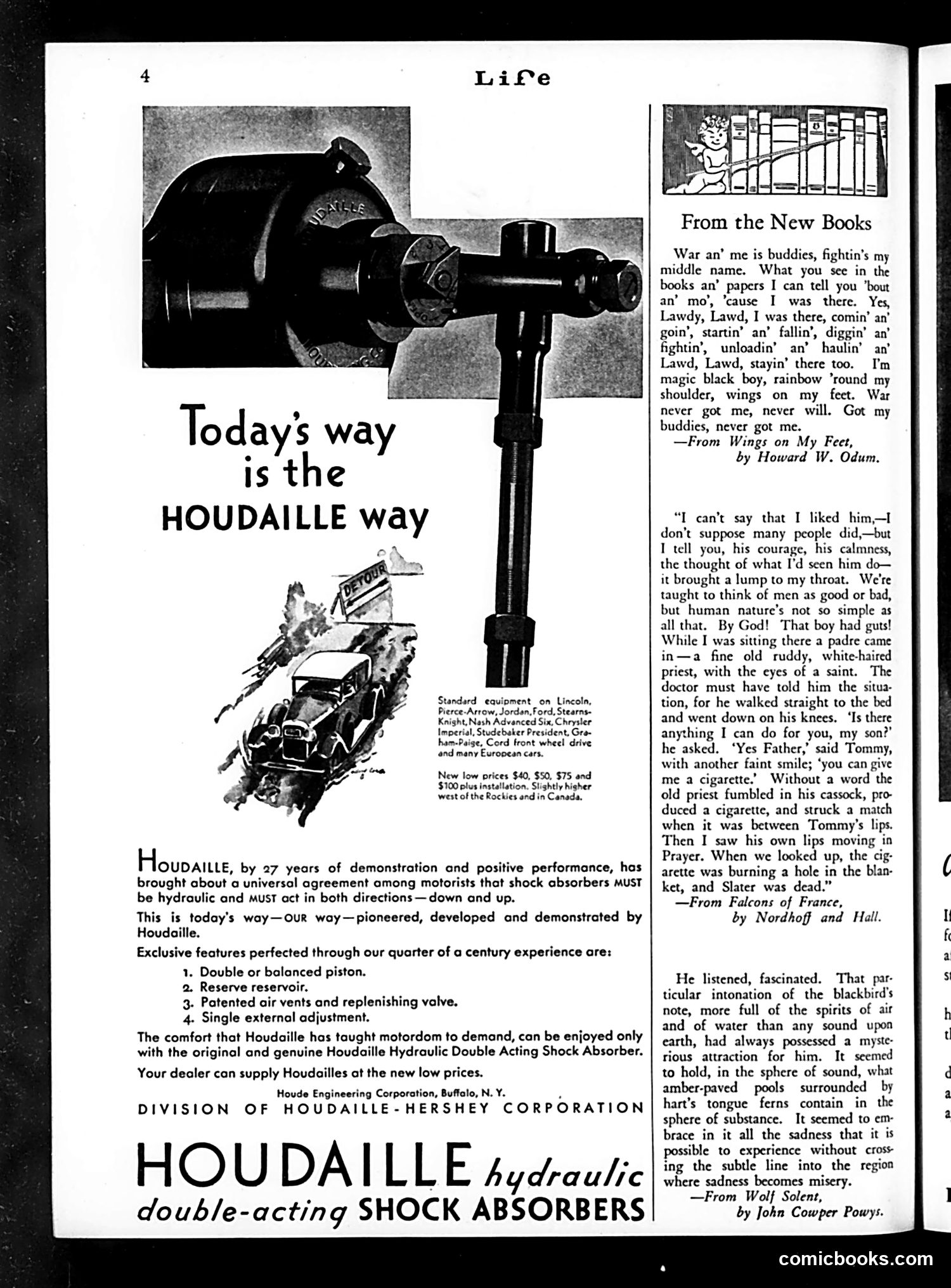
Page Analysis This page is primarily advertising, not satire or political commentary. The left side features a large advertisement for Houdaille hydraulic shock absorbers for automobiles, emphasizing their "double-acting" design and reliability through "27 years of demonstration." The right side contains "From the New Books" — literary excerpts from contemporary war and adventure novels, including works by Howard W. Odum and others. These passages reflect post-WWI literature exploring themes of combat experience, courage, and human nature. There is no political cartoon on this page. The imagery is entirely commercial and literary. The content reflects 1920s-era American publishing and automotive marketing, with no identifiable satire or social commentary present.
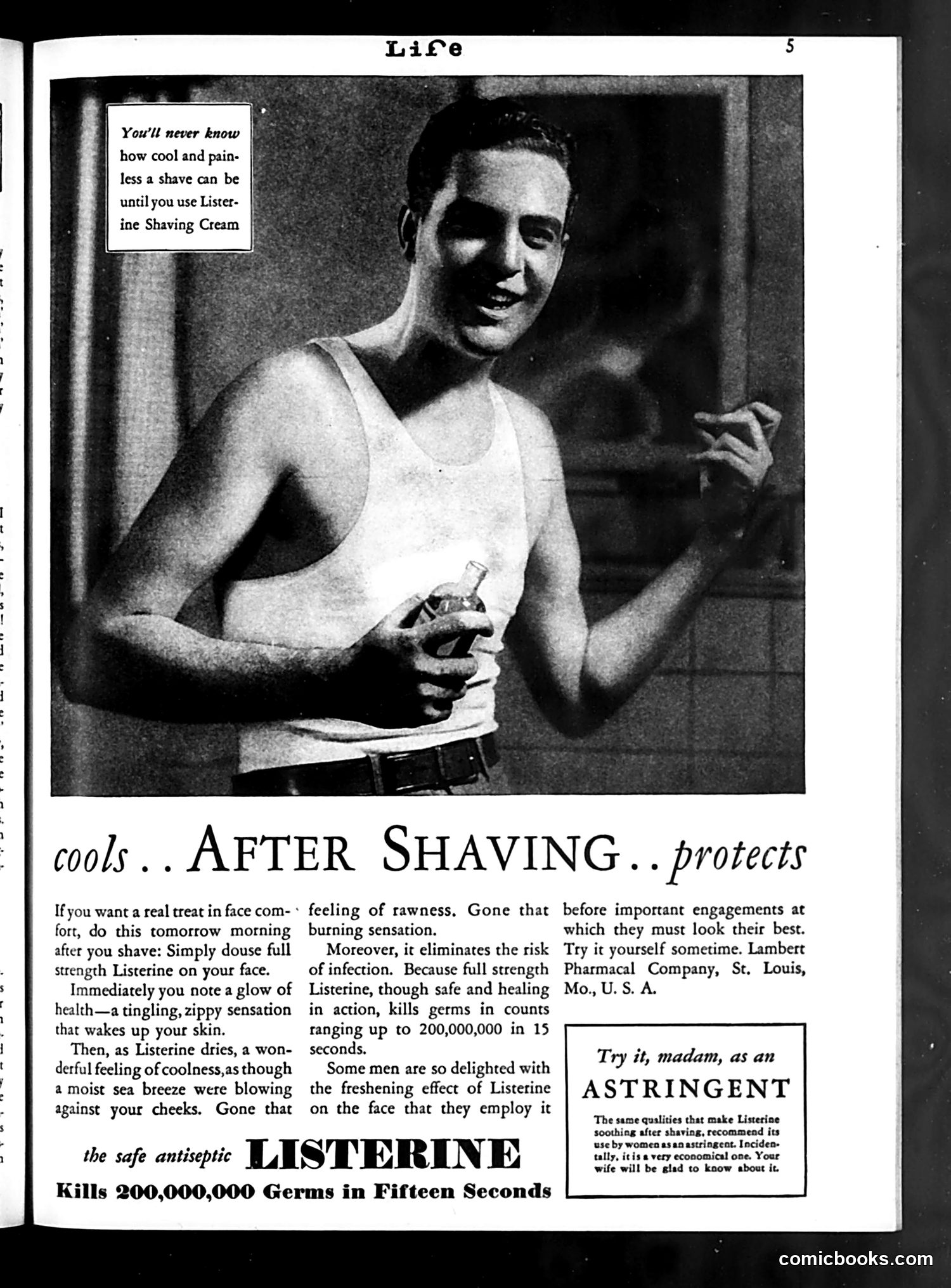
Listerine Advertisement Analysis This is a Listerine advertisement, not a political cartoon. It promotes Listerine as an after-shaving product and antiseptic mouthwash. The ad features a man in an undershirt holding a bottle, smiling contentedly. The headline promises that Listerine "cools...after shaving...protects" and claims it "kills 200,000,000 germs in fifteen seconds." The copy emphasizes the product's soothing sensation post-shave and its antiseptic properties, targeting men concerned with both grooming comfort and hygiene. A sidebar promotes Listerine as an astringent for women. This reflects early-twentieth-century marketing that positioned antiseptics as cure-alls and heavily emphasized germ-killing—a common advertising strategy of that era before modern medical understanding.
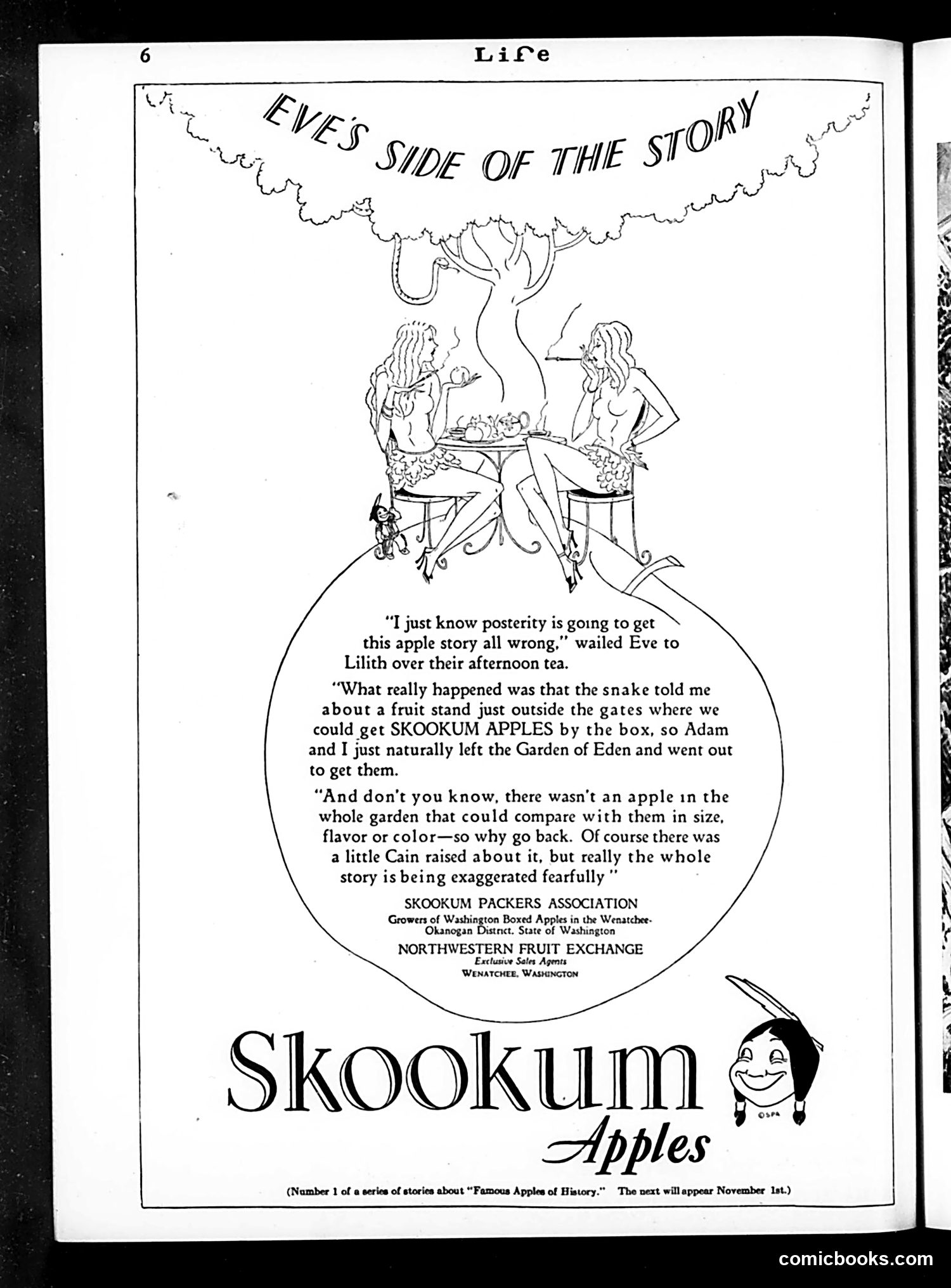
"Eve's Side of the Story" — Skookum Apples Advertisement This is a vintage advertisement disguised as humor, not political satire. The ad presents "Eve's side of the story" regarding the Biblical apple incident. Two women sit beneath a tree while Eve claims the snake actually directed Adam and her to a fruit stand *outside* Eden selling Skookum brand apples—not the forbidden fruit. She dismisses the Fall of Man narrative as exaggerated, blaming gossip around Cain. The joke is an early advertising technique: humorously recontextualizing a famous story to promote a commercial product. Skookum Apples, grown in Washington State, uses playful irreverence toward religious narrative to position their apples as superior and desirable. The mascot apple character at bottom reinforces the brand identity.
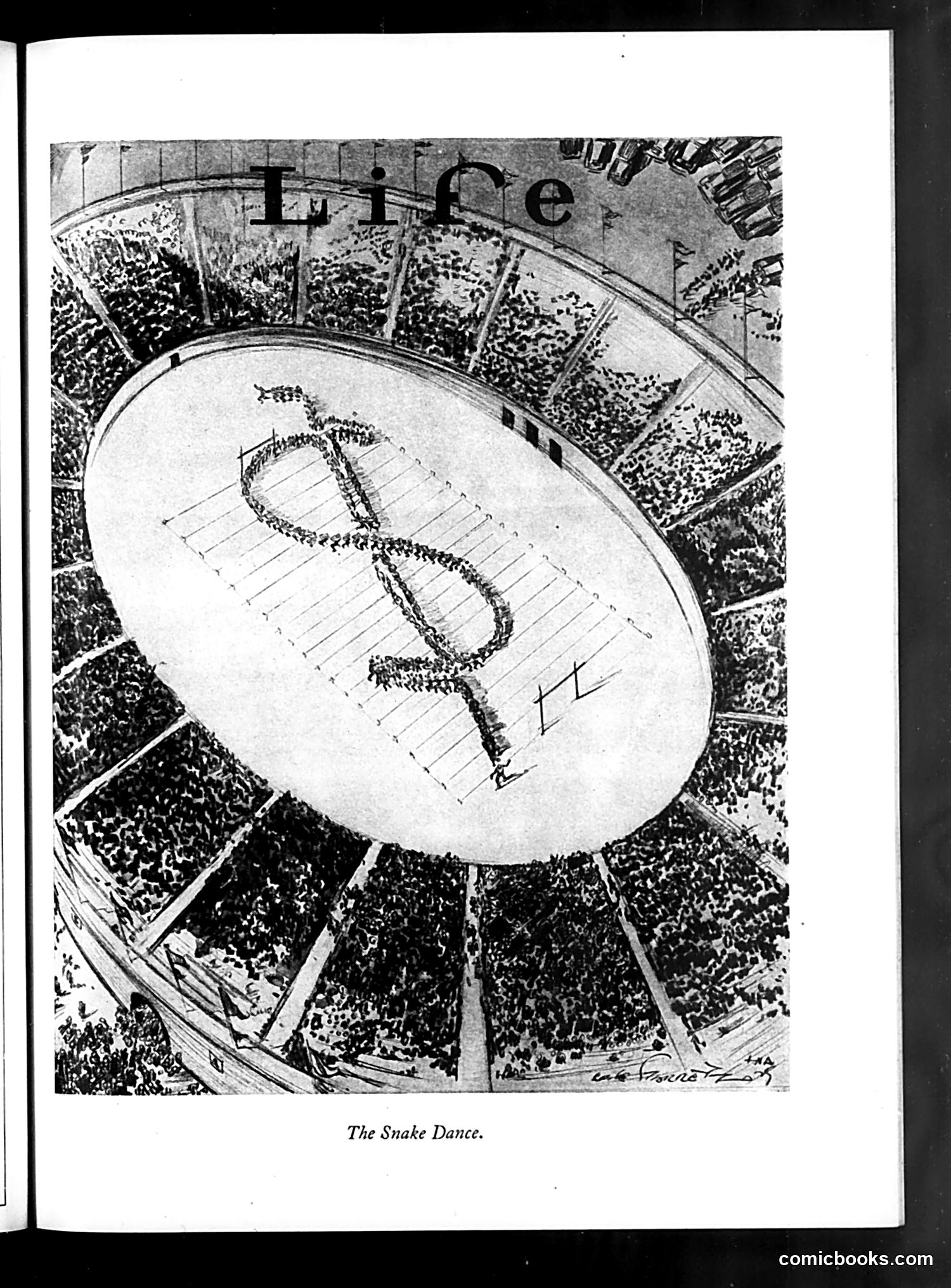
"The Snake Dance" This aerial photograph shows a large stadium filled with spectators arranged in a serpentine pattern on the field below. The image appears to document an actual organized crowd formation or performance rather than political satire. "The Snake Dance" likely references a real public spectacle—possibly a college tradition, civic pageant, or large-scale organized event popular in early-to-mid 20th century America, when *Life* magazine frequently documented such mass gatherings and social phenomena. The photograph's bird's-eye perspective emphasizes the geometric precision of thousands of people arranged into a snake-like shape, which would have been visually striking and novel to contemporary readers. Without additional context from the magazine issue, the specific occasion remains unclear, though this appears celebratory rather than satirical in intent.
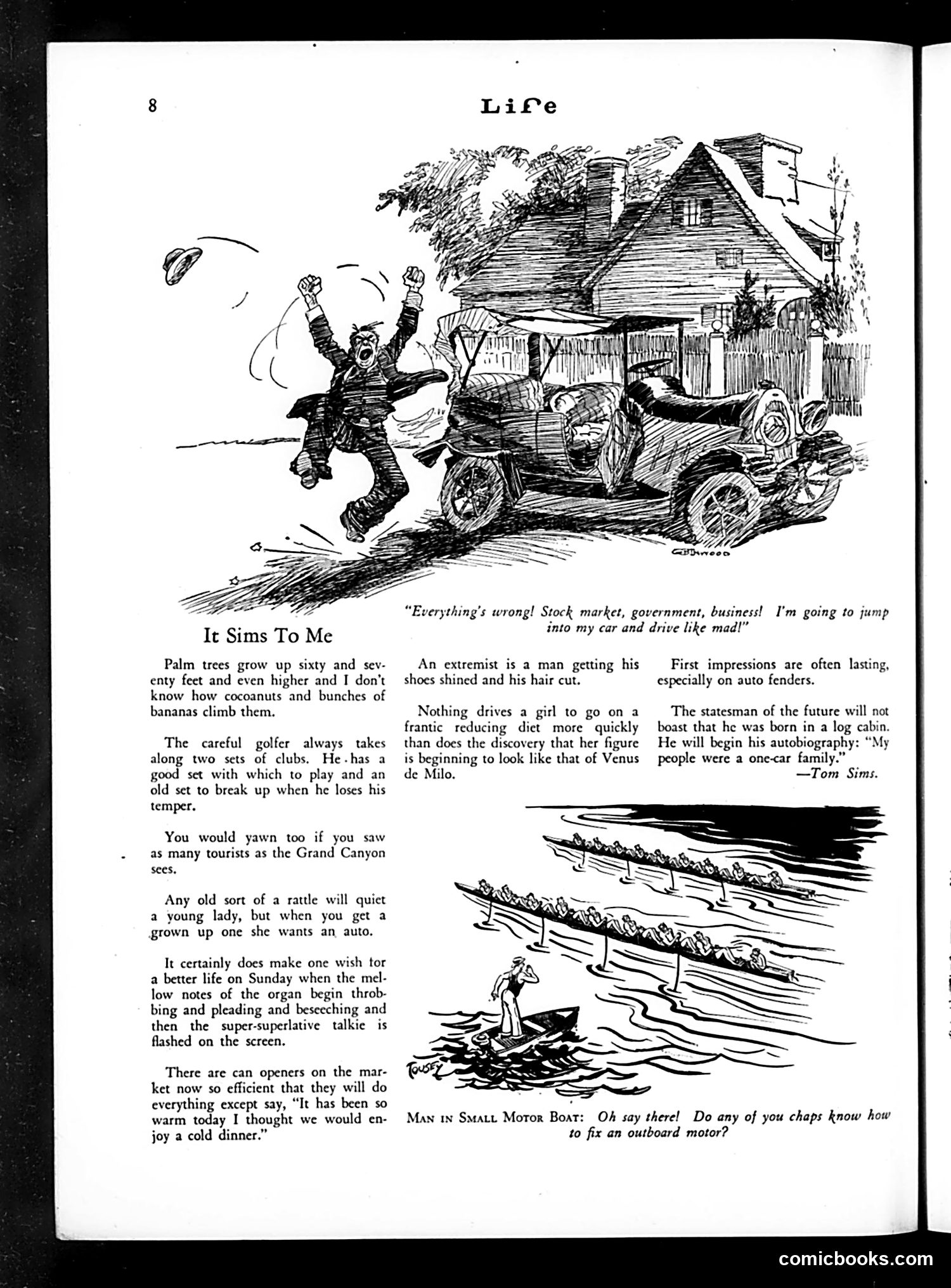
Analysis: "It Sims To Me" This page from *Life* magazine features satirical commentary attributed to "Tom Sims." The main cartoon depicts a man joyfully jumping beside an automobile, declaring he'll "jump into my car and drive like mad!" in response to troubles with "Stock market, government, business!" This appears to be 1920s-era satire mocking Americans' escapism through automobiles and reckless driving during economic or political turmoil. The cartoon suggests that rather than addressing serious problems, people sought refuge in the newfound thrill of motorcar culture. The accompanying text contains various humorous observations about contemporary life—golf, fashion, and cinema—typical of *Life*'s satirical approach to American social trends. The secondary illustration shows a man in a motorboat, continuing the theme of recreational escape.
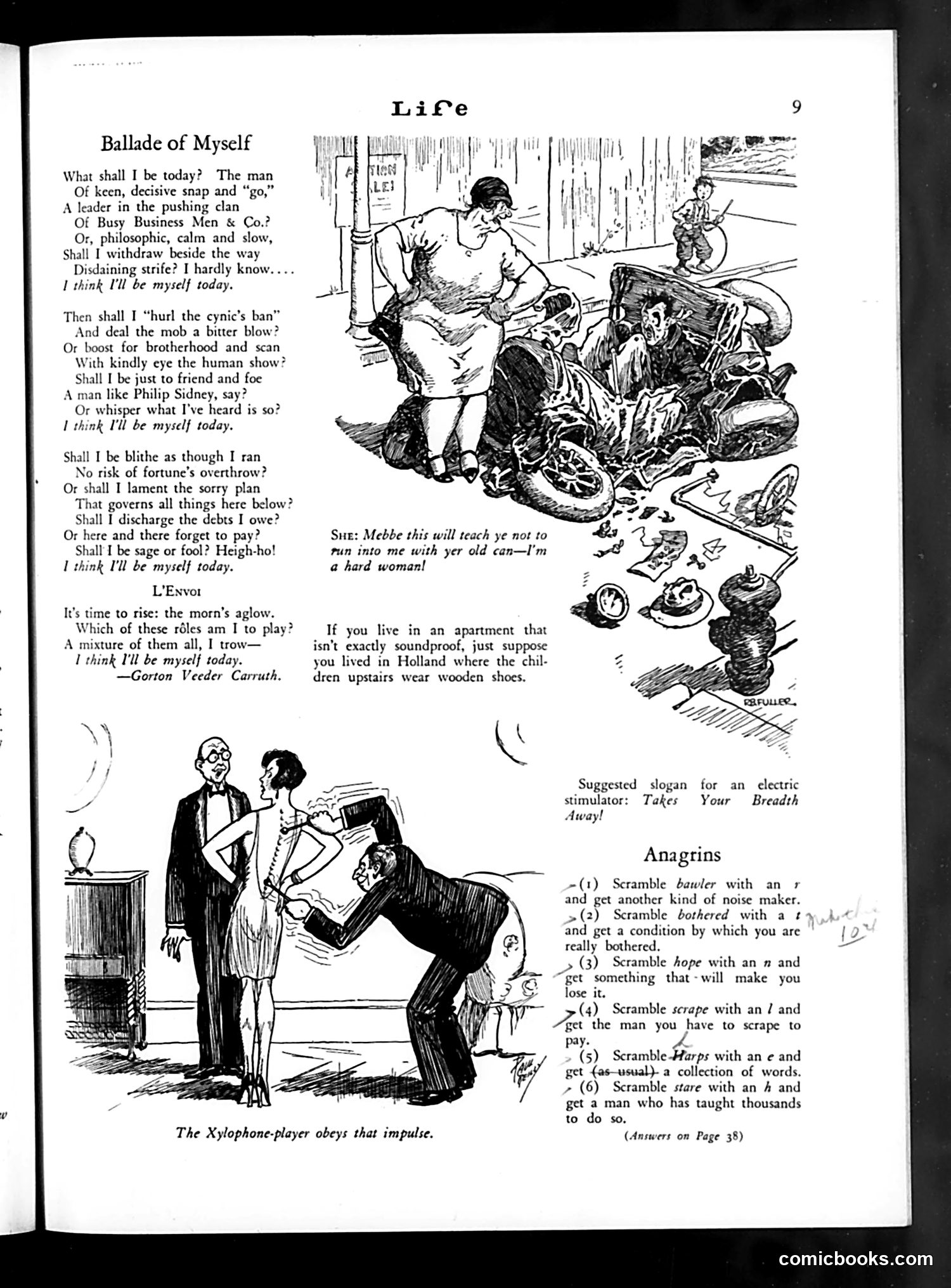
Page Analysis: Life Magazine, Page 9 This page contains three distinct pieces of satire: 1. "Ballade of Myself" — A poem mocking self-centered indecision, likely critiquing contemporary business culture and philosophy. The repeated refrain "I think I'll be myself today" satirizes empty rhetoric about individualism. 2. Top cartoon — Shows a woman surrounded by domestic chaos (dishes, cooking implements), with the caption "Mebbe this will teach ye not to run into me with yer old can—I'm a hard woman!" This mocks the emerging stereotype of the independent, liberated woman while also satirizing traditional domestic life. 3. Bottom cartoon — Titled "The Xylophone-player obeys that impulse," depicts a formal couple where the man appears to be playing a xylophone on the woman's body. This is sexual satire commenting on social propriety and impulse versus restraint in romantic/social interactions.
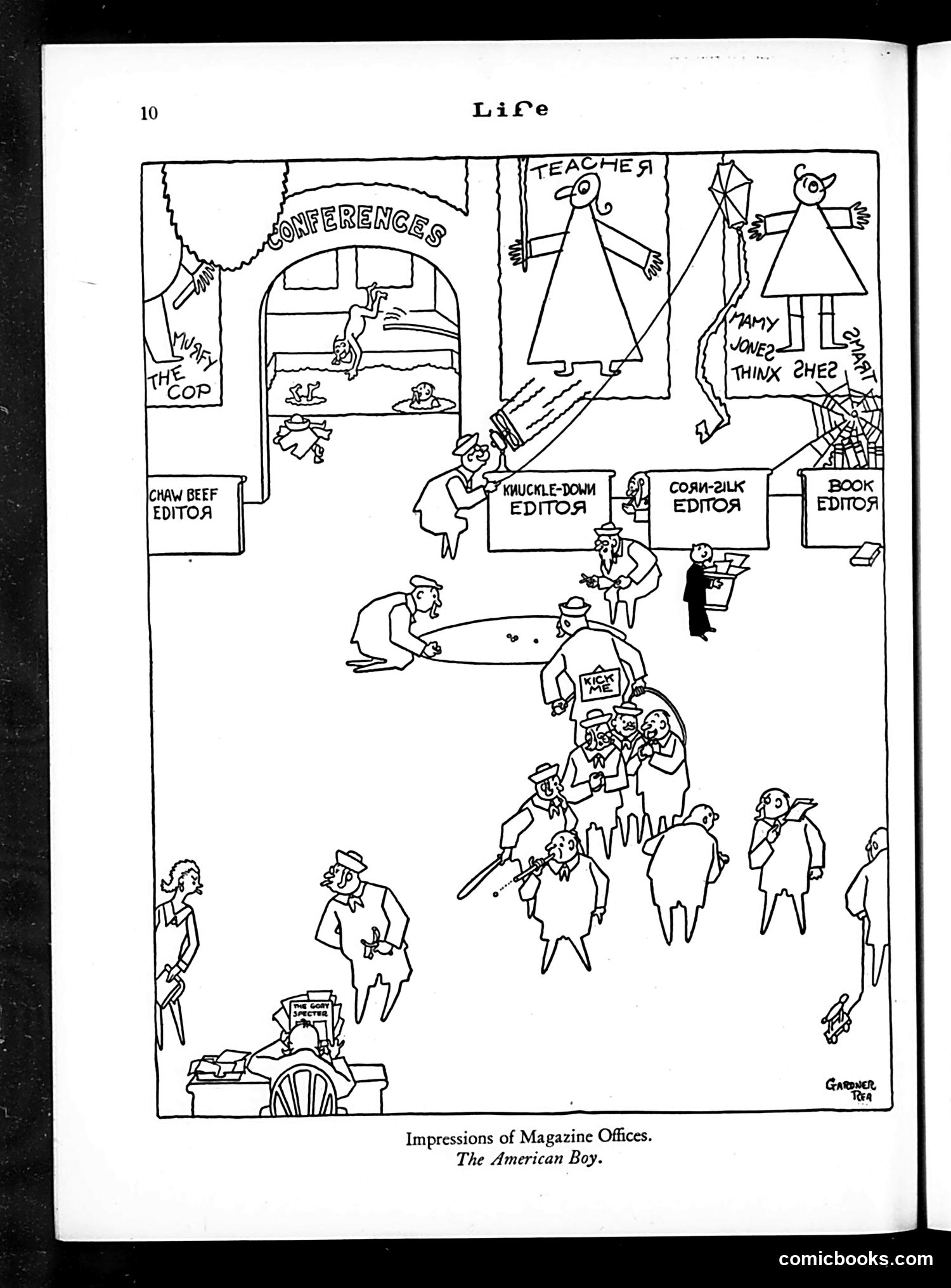
"Impressions of Magazine Offices" - The American Boy This satirical cartoon depicts the chaotic operations of *The American Boy* magazine's offices. The illustration shows various editorial departments labeled: "Chaw Beef Editor," "Knuckle-Down Editor," "Corn-Silk Editor," and "Book Editor." The cartoon mocks the magazine's perceived focus on rough-and-tumble boys' entertainment through exaggerated scenes: children playing marbles, wrestling, fighting, and causing mayhem. A "Teacher" figure appears distressed at top. The "Conferences" section shows authority figures seemingly ineffectual amid the disorder. The satire suggests *The American Boy* caters to rowdy, mischievous youth interests—emphasizing physical roughhousing and street games—rather than refined or educational content. It's a humorous critique of the magazine's editorial priorities and target demographic.
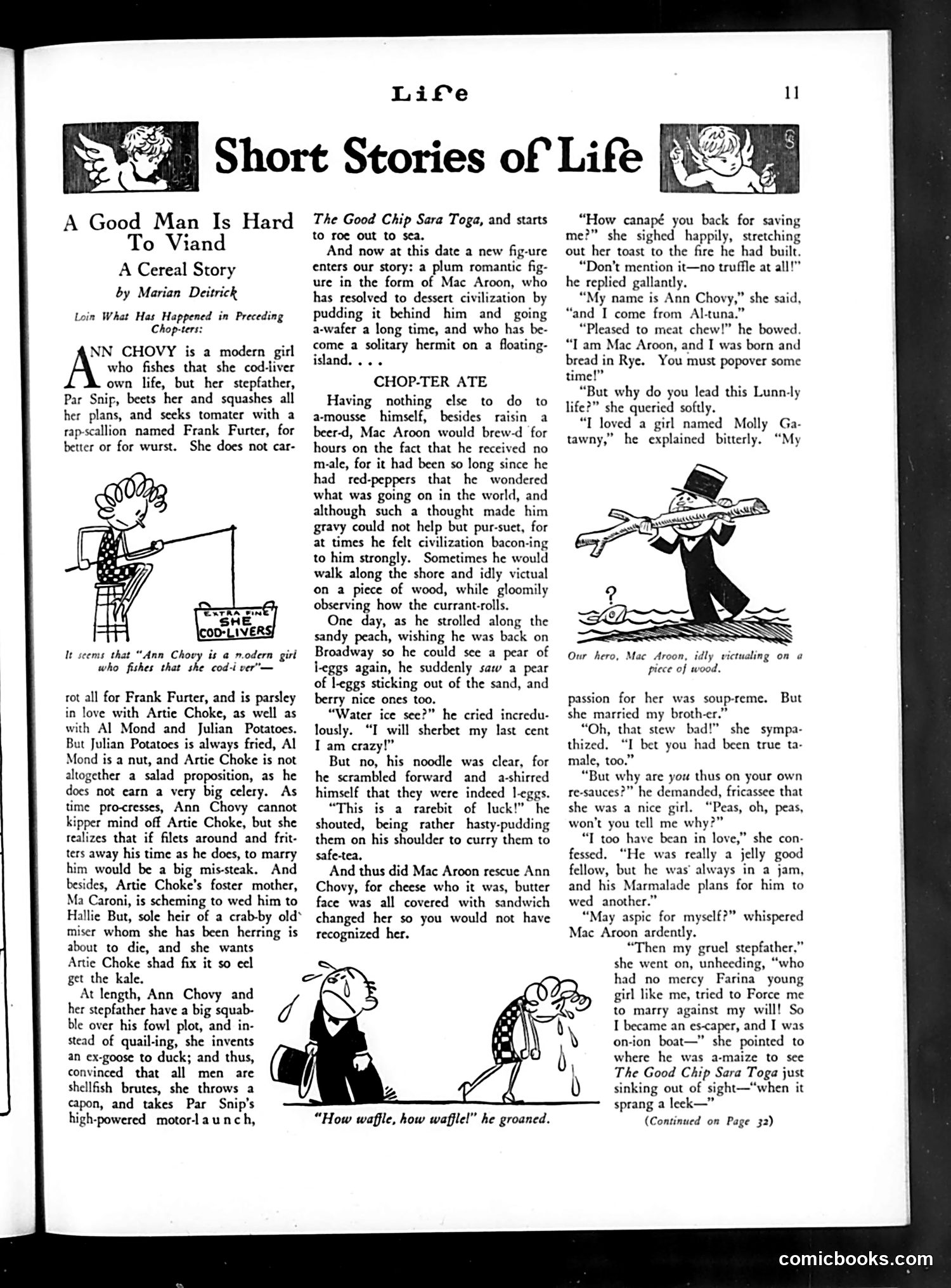
"Short Stories of Life" - Life Magazine Page 11 This page contains a satirical short story titled "A Good Man Is Hard To Find: A Cereal Story" by Marian Deitrick, illustrated with small cartoons. The narrative mocks romantic tropes through the character Ann Chovy, a "modern girl" who fishes for cod-liver oil but seeks romance with a man named Frank Furter. The story ridicules conventional courtship through absurd character names (Artie Choke, Julian Potatoes) and situations. The accompanying illustrations show characters in comedic predicaments—one figure fishing, another struggling with food items. The satire targets early 20th-century romance narratives and gender expectations, presenting love as messy and unglamorous rather than the idealized versions popular in contemporary fiction and advertising. The humor relies on puns, odd names, and subverting sentimental story conventions.
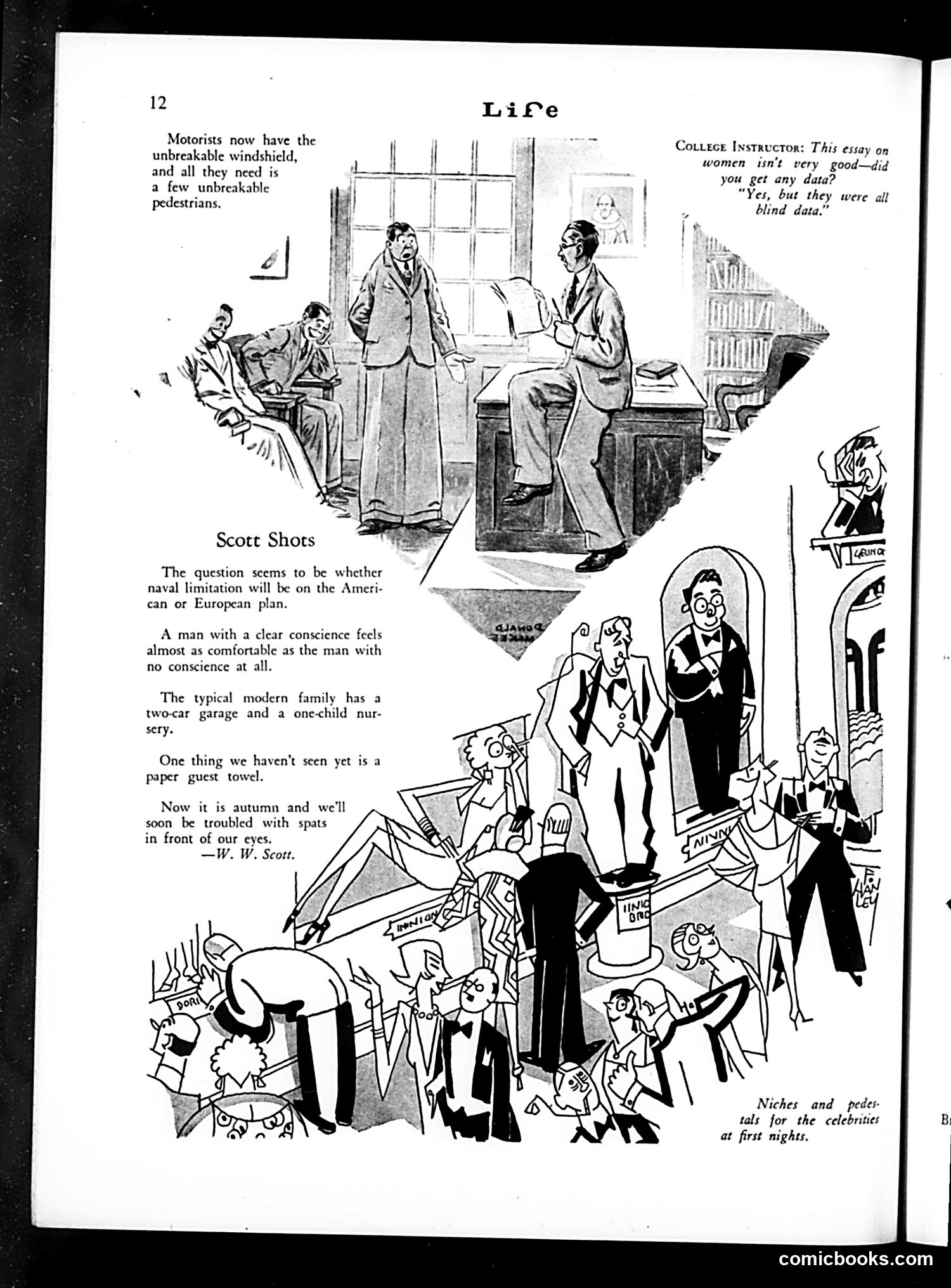
Analysis of Life Magazine Page 12 This page contains several brief satirical commentaries on contemporary life, plus two cartoons. Top cartoon shows a college instructor questioning a student about an essay on women, with the punchline that the data was "all blind data"—mocking either poor research methodology or the student's inability to observe women accurately. "Scott Shorts" section offers disconnected quips about motorists, naval limitations, modern family life, and autumn leaf spots—typical of the magazine's brief humor format. Large bottom cartoon depicts an elegant formal event (appears to be a nightclub or entertainment venue) where celebrities are being introduced to pedestrians, with "niches and pedestals for the celebrities at first nights" as the caption. This satirizes the artificial separation and elevation of famous people in social settings. The overall tone mocks contemporary American social pretensions and absurdities.
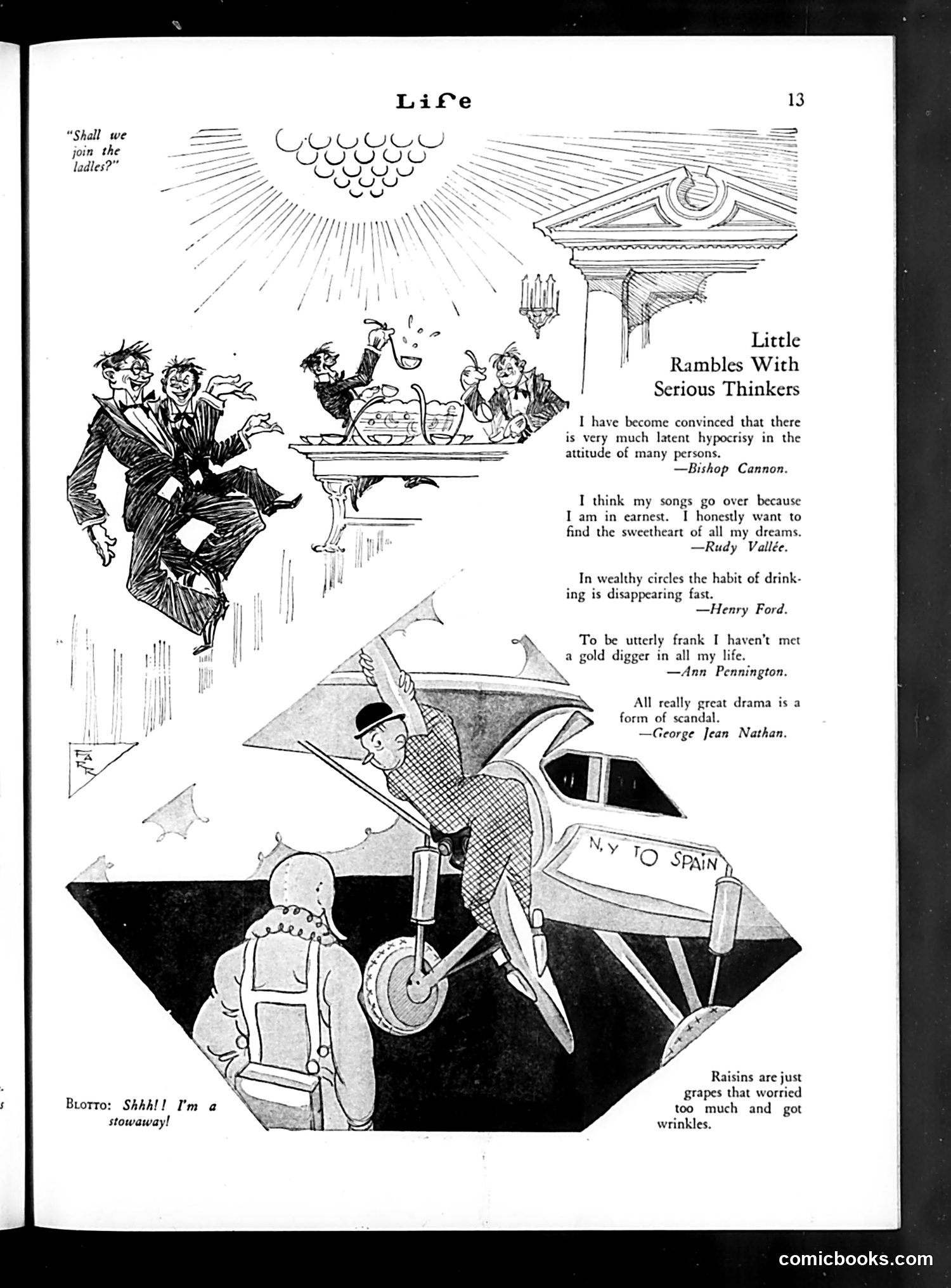
Analysis of Life Magazine Page 13 This page features humorous illustrations and quotes under "Little Rambles With Serious Thinkers." The cartoons satirize various social pretensions: The upper illustration shows well-dressed men and women at what appears to be a formal social gathering, with the caption "Shall we join the ladies?" — mocking Victorian-era gender segregation customs. The lower cartoon depicts a stowaway hiding in an airplane labeled "N.Y. TO SPAIN," capturing early aviation-era humor about travel. The quotes mock hypocrisy among the wealthy and famous — including Henry Ford on declining drinking habits among the rich, and Ann Pennington claiming unfamiliarity with wealth. George Jean Nathan's quote about drama satirizes theatrical pretension. The closing joke about raisins being "grapes that worried too much and got wrinkles" provides lighthearted wordplay typical of Life's satirical style.
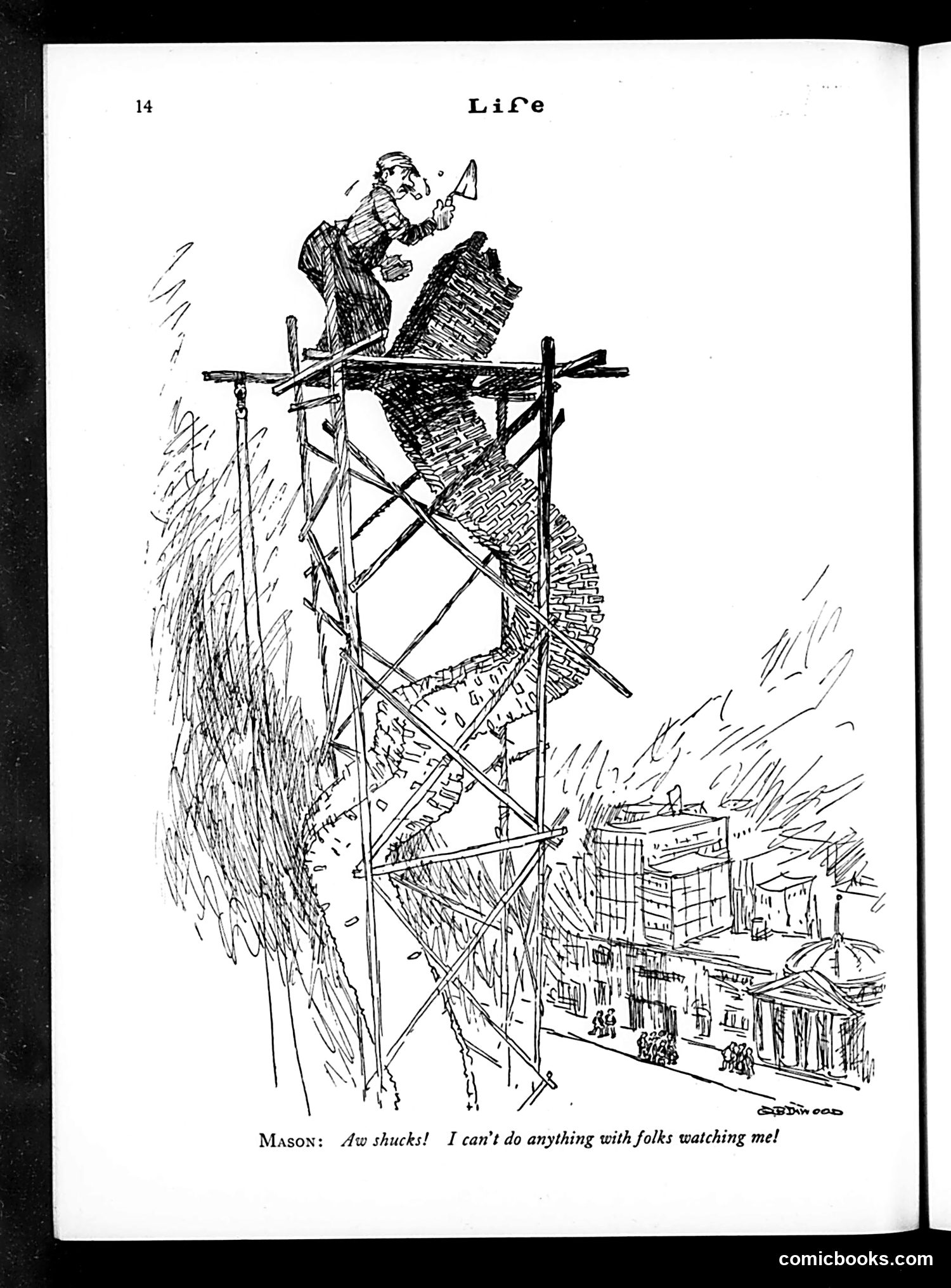
Cartoon Analysis This satirical cartoon depicts a mason (construction worker) standing atop scaffolding high above a city street, holding a trowel and looking frustrated. The caption reads: "Aw shucks! I can't do anything with folks watching me!" The cartoon satirizes self-consciousness under public scrutiny—a universal human experience. The joke is that the mason cannot work effectively because he's aware of people observing him from below. This likely comments on how public attention or surveillance inhibits natural performance, whether in labor, politics, or public life. The exaggerated height of the scaffolding and the tiny onlookers below emphasize the absurdity: even distant observation creates paralysis. The cartoon captures a relatable anxiety about performing under watchful eyes, presented through working-class imagery.
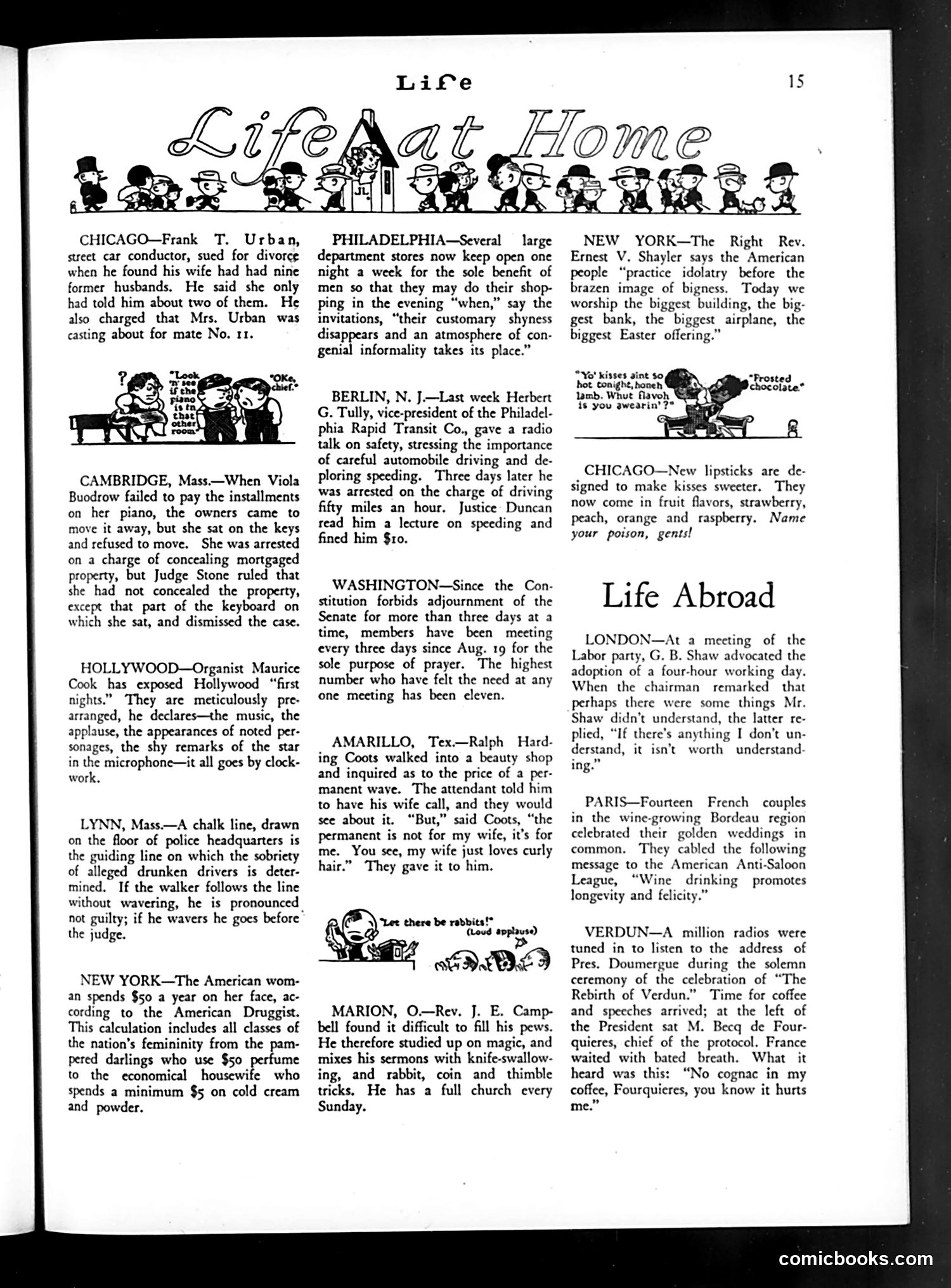
Analysis of Life Magazine Page 15 This page contains two sections: "Life at Home" (domestic American anecdotes) and "Life Abroad" (international news briefs). The cartoon visible shows a small figure saying "there chess be rabbit!" with "(loud applause)" noted—this appears to be satirizing either a magic trick or performance claim, likely mocking showmanship or fraudulent entertainment. The text anecdotes mock various American social behaviors: a woman concealing mortgaged property, organists arranging "first nights," drunken drivers, and a man's vanity about his hair permanent wave. The "Life Abroad" section humorously contrasts European customs—French wedding toasts, German radio safety lectures—with American perspectives. The overall tone is light social satire targeting urban middle-class quirks and pretensions during what appears to be the 1920s era.
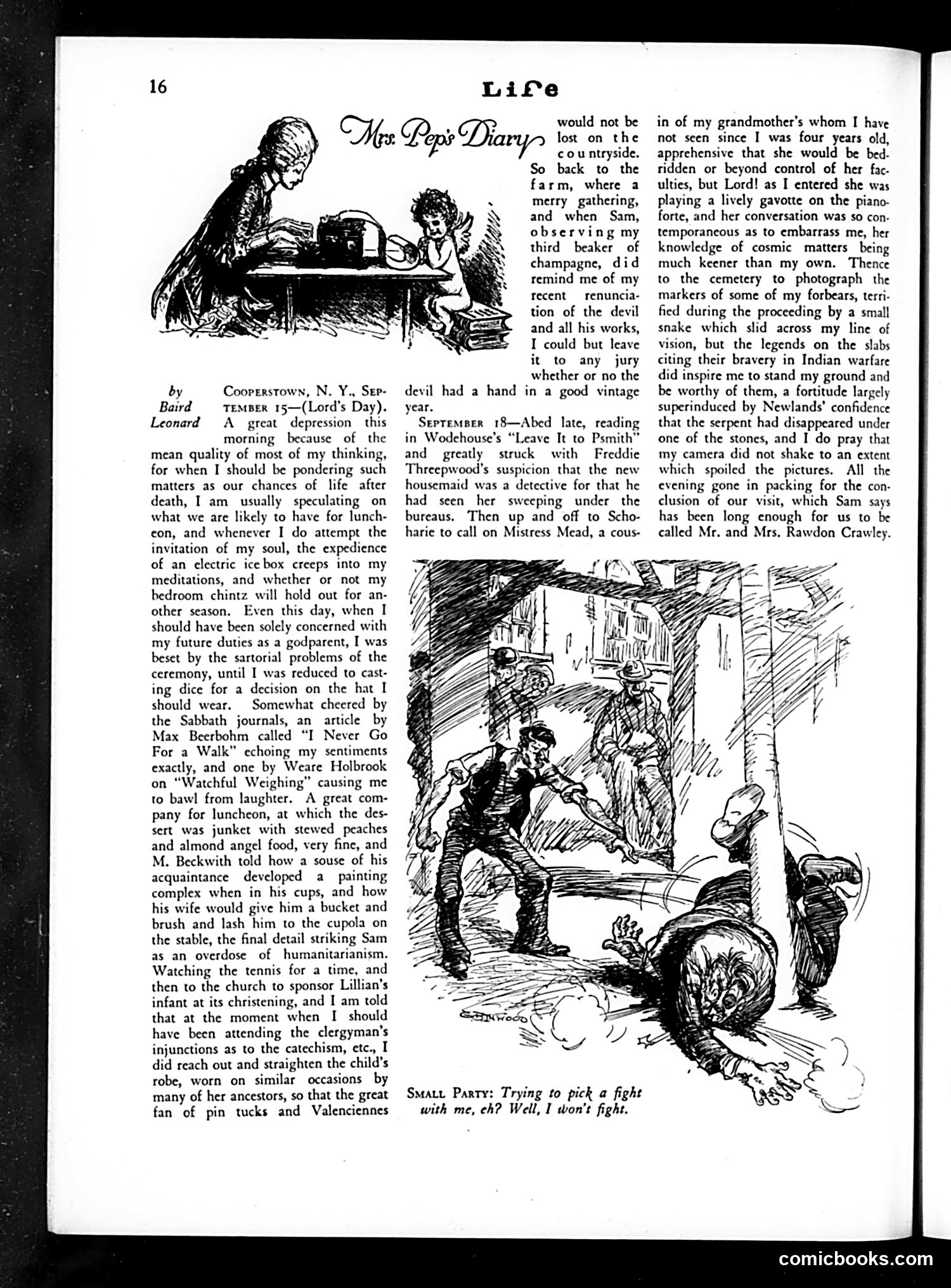
Analysis of "Mrs. Pep's Diary" Page This appears to be a humorous diary column from *Life* magazine, featuring social satire rather than political content. The page includes an illustration of a woman writing at a desk (the titular Mrs. Pep) and a separate sketch captioned "Small Party: Trying to pick a fight with me, eh? Well, I won't fight." The diary entries recount mundane upper-middle-class experiences—Depression-era social anxieties, household staff interactions, and minor domestic dramas. The "small party" cartoon depicts what appears to be a confrontational street scene, likely satirizing working-class disputes or common urban conflicts. The humor targets genteel concerns and social pretension rather than specific political figures. The overall tone is lighthearted social commentary on American life during the Depression era.
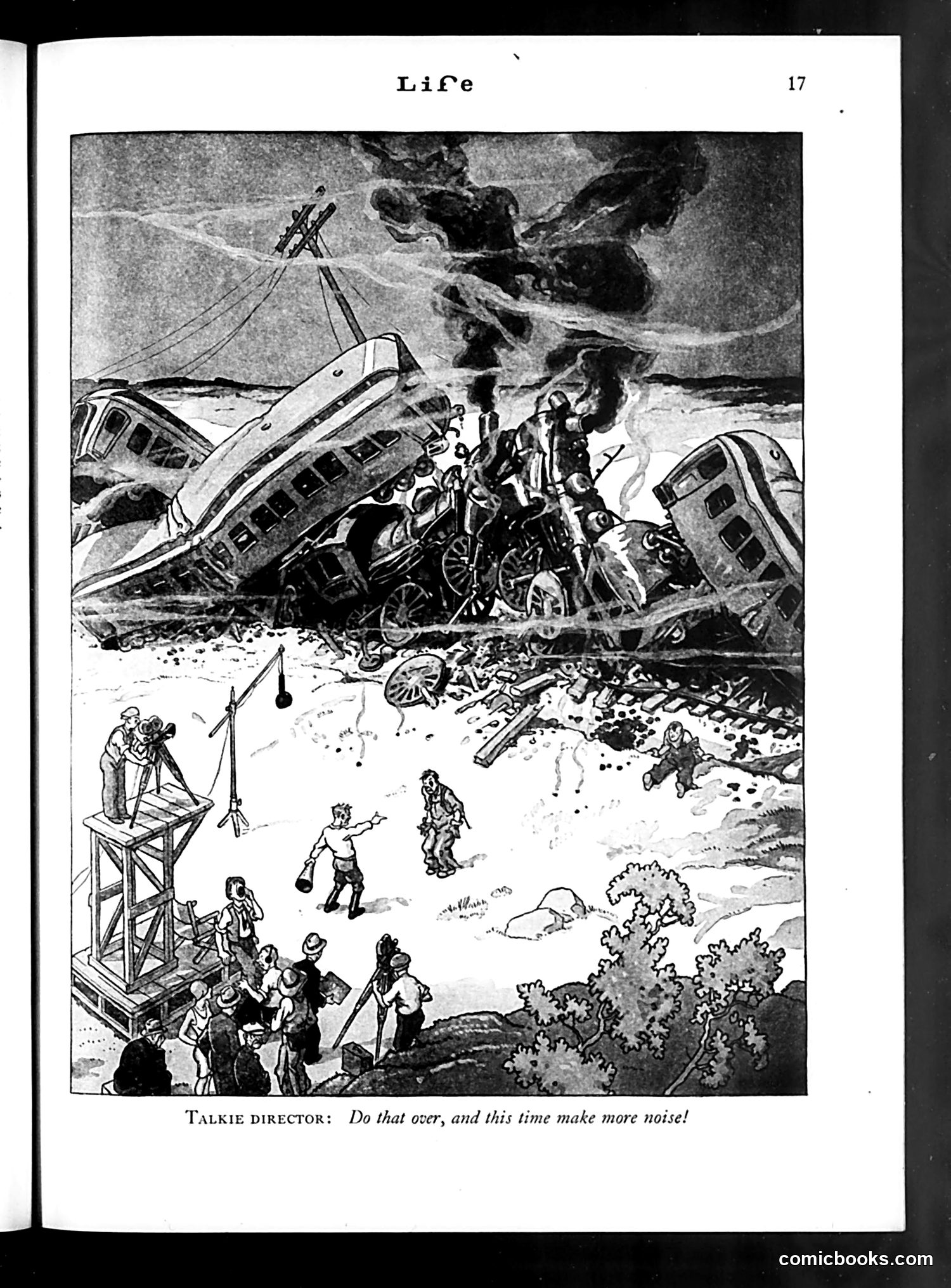
Page Analysis: Life Magazine, Page 17 This is a satirical cartoon about early "talkie" (sound) film production. The image depicts a chaotic movie crash scene with actors, directors, and crew on a film set. The caption reads: "TALKIE DIRECTOR: Do that over, and this time make more noise!" The satire targets the transition from silent to sound films in Hollywood. The joke is that talkie directors now obsess over *sound effects* and noise levels—a novelty concern that silent film directors never had. The exaggerated crash scene with multiple takes suggests how filmmakers were experimenting with and over-emphasizing audio elements, sometimes prioritizing noise production over natural storytelling or acting quality. This reflects early 1920s-30s Hollywood's somewhat crude approach to incorporating sound technology into filmmaking.
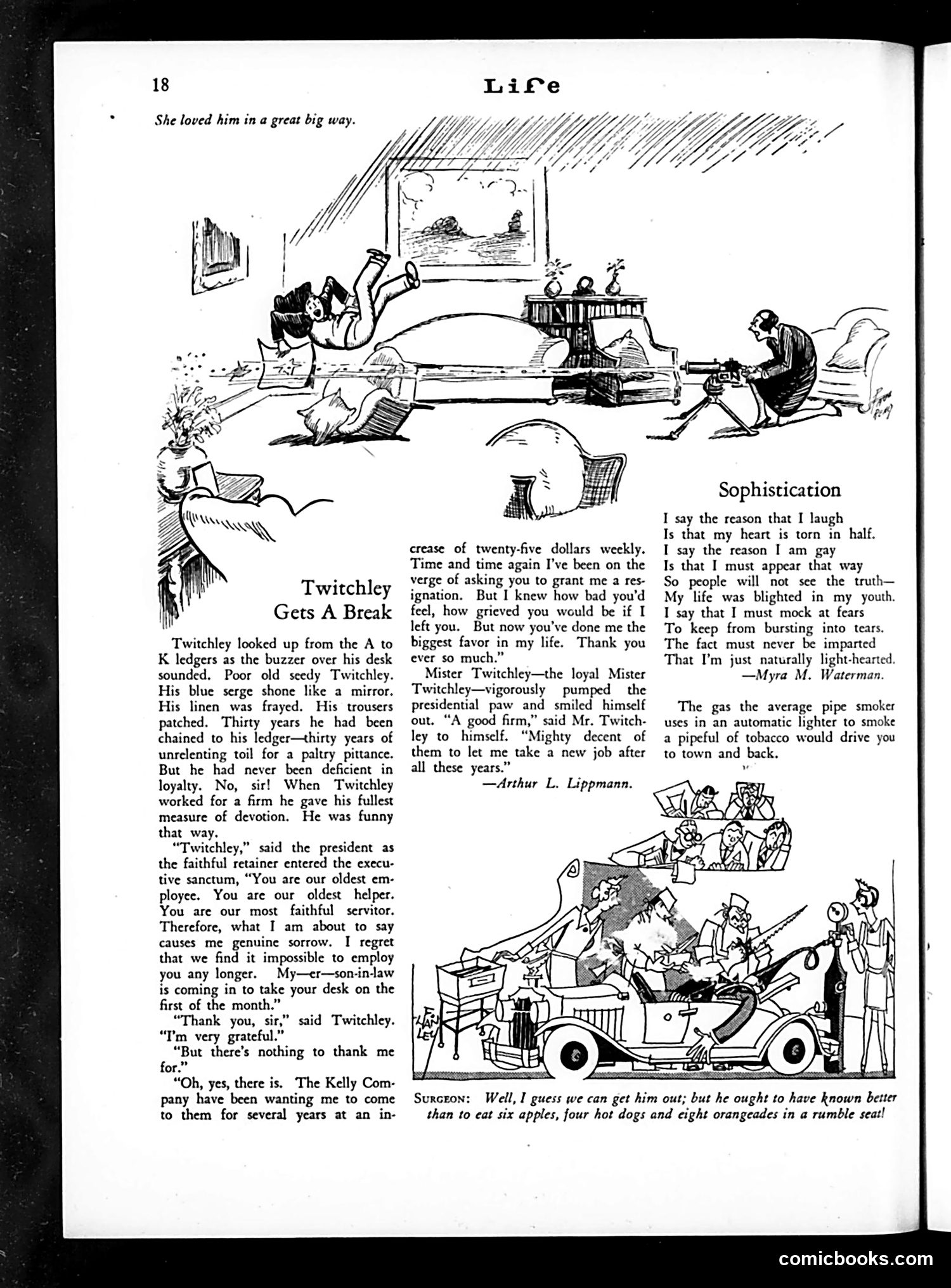
Page 18 of Life Magazine - Analysis This page contains two separate stories with illustrations: "Twitchley Gets A Break" depicts an elderly office worker (Twitchley) finally receiving job security after 30 years of loyal service. The president grants him a permanent position, relieving his financial anxiety. The satire critiques corporate indifference—only after decades of exploitation does the company acknowledge his devotion. "Sophistication" is a poem by Myra M. Waterman about emotional repression. It describes someone who laughs to hide heartbreak and adopts a gay demeanor to mask suffering, arguing authenticity must be concealed. The lower cartoon shows a chaotic ambulance scene, with a surgeon commenting that the patient should have known better than to eat six apples, four hot dogs, and eight oranges in a rumble seat—mocking reckless behavior and overeating.
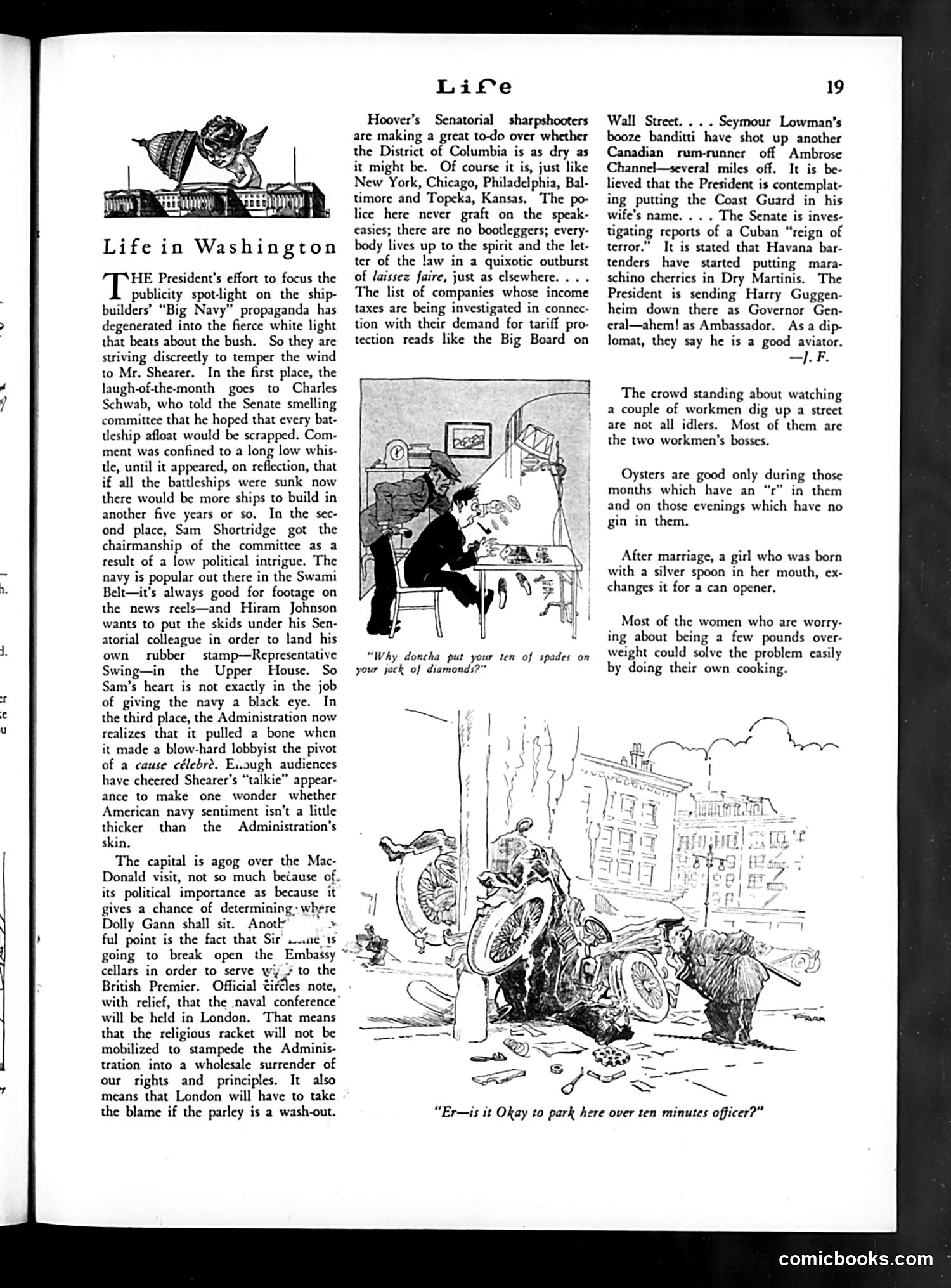
"Life in Washington" — Political Satire, circa Late 1920s This page satirizes early Hoover-era Washington politics. The main article mocks the Administration's naval policy debates: Charles Schwab (shipbuilder) ironically advocated scrapping battleships, creating cynical laughter when observers realized this would require building replacements. Senator Sam Shortridge's committee chairmanship resulted from petty infighting between California politicians (Hiram Johnson wanting to undermine his colleague). The piece skewers how the Administration weaponized lobbyist Shearer's "talkies" to promote naval expansion, questioning whether public sentiment for military spending is genuinely stronger than the Administration's self-interest. Secondary gossip targets Prohibition's obvious failure in Washington D.C., and the social controversy over where Dolly Gann (likely the Vice President's relative) should sit at diplomatic dinners—trivial against the MacDonald naval conference's geopolitical stakes. The cartoons illustrate everyday absurdities: a solitaire player and a street-digging crew surrounded by supervisors—mocking bureaucratic inefficiency.
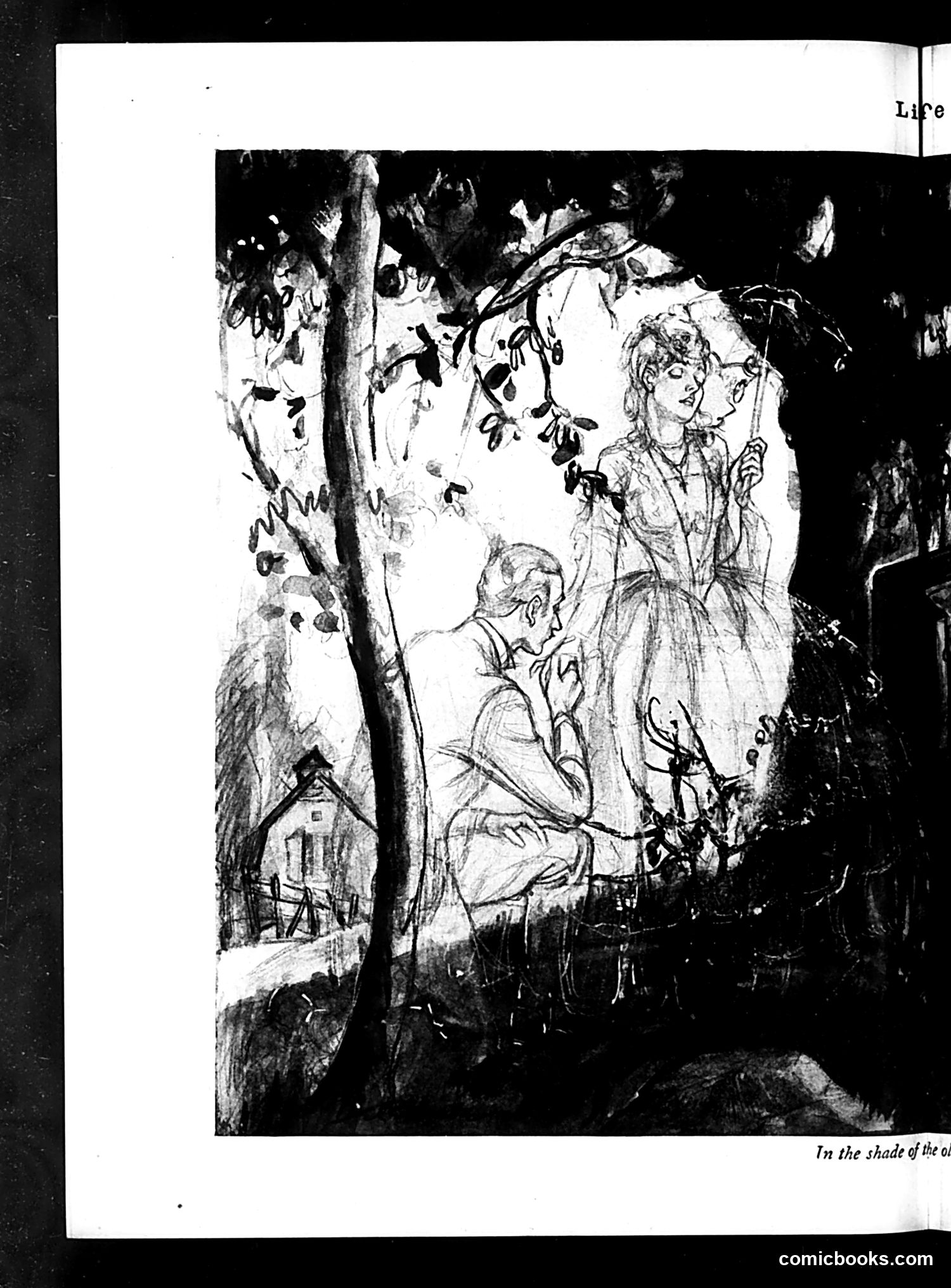
Analysis This appears to be an illustration from *Life* magazine showing a romantic or pastoral scene. The image depicts what seems to be a young couple in an outdoor setting beneath a tree, with a small house visible in the background. The sketch style is characteristic of early-to-mid 20th century magazine illustration. The partial caption reads "In the shade of the ol[d]" (likely "old tree" or similar), suggesting a sentimental or nostalgic theme common to *Life*'s content. However, the image quality is too degraded and the caption too incomplete to definitively identify specific satirical targets, political references, or the precise joke intended. Without seeing the full page context, caption, or date, I cannot reliably explain what social commentary or satire this illustration conveys to a modern reader.
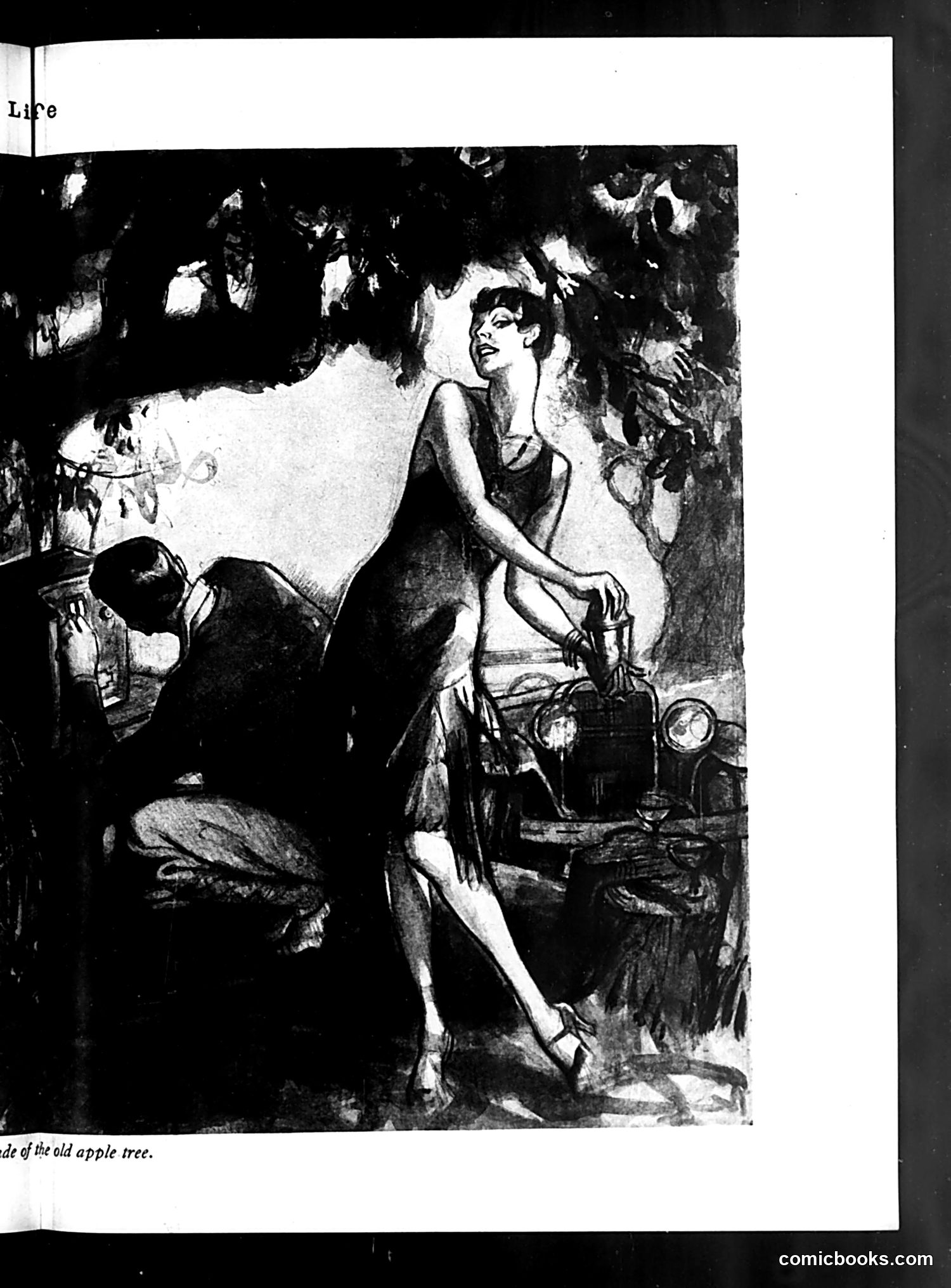
Analysis This appears to be an illustration from *Life* magazine, though the page is largely cut off. The visible OCR text fragment—"de of the old apple tree"—suggests this may reference the folk song "The Old Apple Tree" or a related narrative. The image shows a woman in 1920s-style dress and bob haircut in what appears to be an intimate or suggestive scene with a man, set among foliage. The artistic style and composition suggest this is likely satirizing contemporary social behavior or romantic conventions of the era. However, without more complete text or context visible on the page, I cannot definitively identify the specific social commentary, political reference, or satirical point being made. The fragmentary nature of the source limits confident interpretation of the intended message.
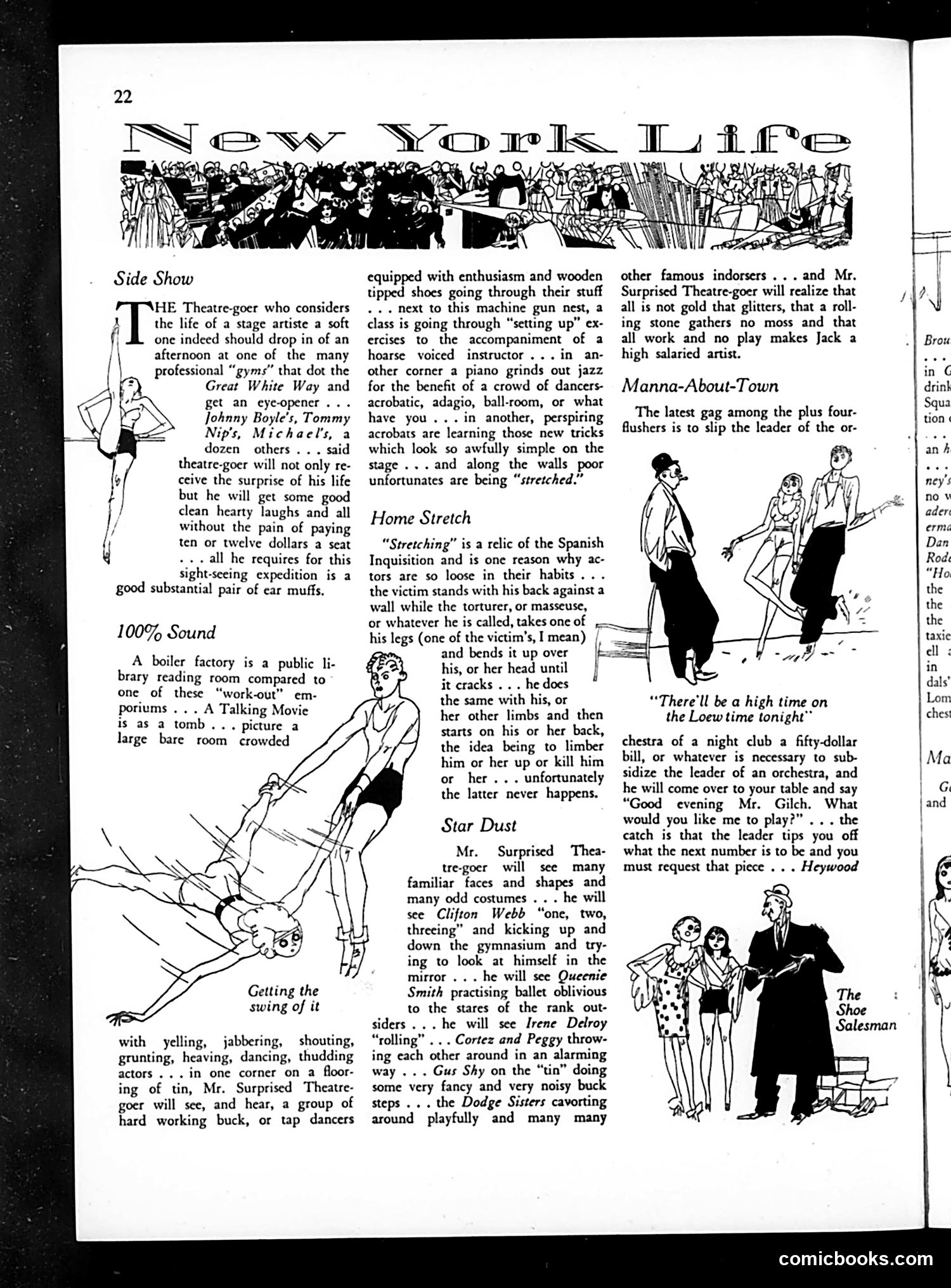
What This Page Means This is satirical commentary on Broadway theater life, specifically mocking the grueling training regimens actors endure. The piece describes visiting professional dance studios (gyms) on "the Great White Way" (Broadway), where aspiring performers engage in punishing physical work. The satire operates on several levels: the author feigns sympathy for the "Surprised Theatre-goer," then describes cacophonous, exhausting conditions—comparing the noise to a boiler factory, the silence of a talking movie being a tomb by comparison. Key targets include the brutal "stretching" exercises (compared to Spanish Inquisition torture), tap dancing, acrobatics, and "setting up" exercises. Named performers like Clifton Webb and Irene Delroy exemplify the grueling daily reality behind glamorous stage performances. The joke's underlying point: theater stardom requires backbreaking, unglamorous labor—there's no mystique, only sweat and noise. The final section about nightclub musicians reveals petty con games among theater people, reinforcing that show business involves constant scheming, not artistry.
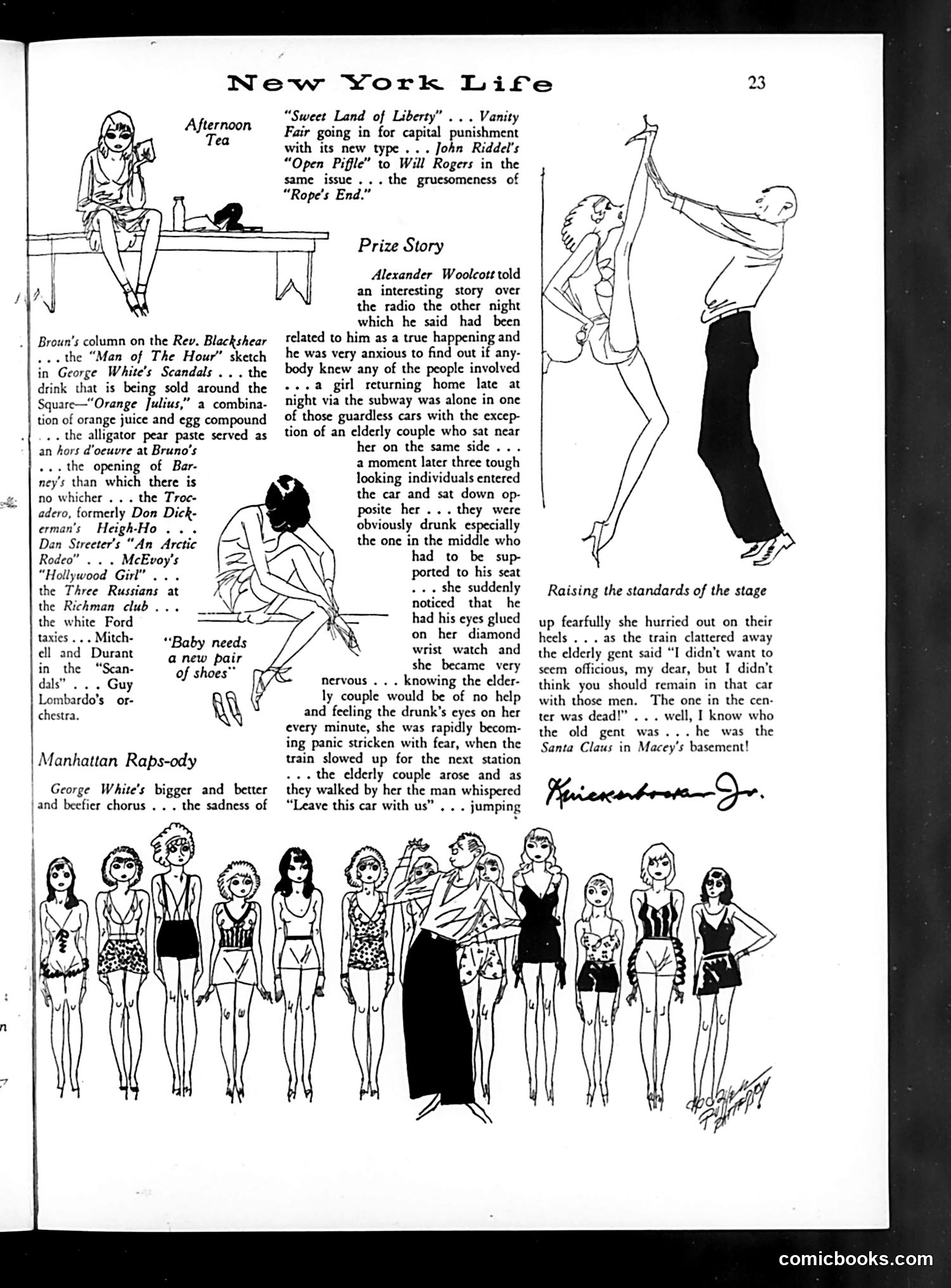
Explanation for Modern Readers This page from *Life* magazine contains entertainment gossip and illustrations rather than political cartoons. The "Afternoon Tea" section reviews current Broadway shows, nightclubs, and cultural events (George White's *Scandals*, the Trocadero nightclub, etc.). The main content is a short story by Alexander Woolcott about a woman on the subway who becomes frightened by a drunk man staring at her diamond watch. An elderly couple rescue her by inviting her to leave the car—then reveal the man was dead. The joke's punchline: the "hero" was actually the Santa Claus from Macy's department store basement, suggesting he was a working-class figure, not the dignified savior the story initially implied. The "Manhattan Raps-ody" illustration shows chorus girls from George White's revue, typical entertainment coverage for this satirical magazine.
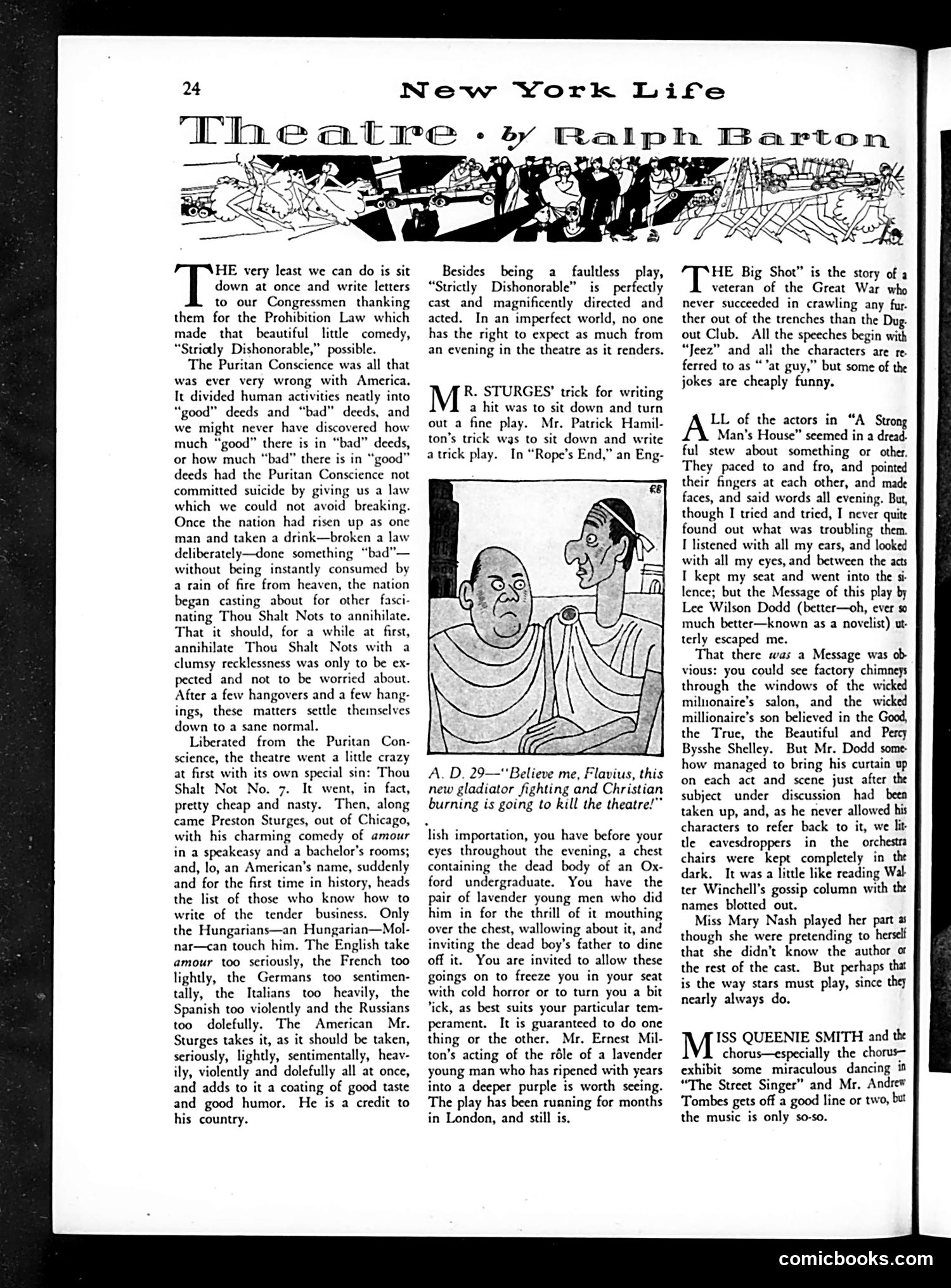
Explaining This Theatre Critique Page This is Ralph Barton's theatre column reviewing Broadway shows in the post-Prohibition era. The main satirical point: Prohibition's repeal (1933) supposedly "liberated" American theatre from Puritan moral constraints, allowing it to finally explore adult themes like romance and sexuality. The cartoon (labeled A.D. 29) presents a Roman gladiator warning that Christian-themed entertainment will "kill the theatre"—a historical parallel suggesting that moralistic content (whether ancient Christianity or American Puritanism) threatens theatrical vitality. Key reviews: - *"Strictly Dishonorable"* by Preston Sturges: praised as sophisticated comedy about amour in speakeasies, representing American maturity about romance - *"Rope's End"*: a British "trick play" featuring a corpse in a chest, designed to shock audiences - *"The Big Shot"*: dismissed as cheap wartime nostalgia Barton argues that freed from censorious moralism, American theatre can now mature artistically. The implicit critique: some producers exploit this freedom with sensationalism rather than genuine sophistication.
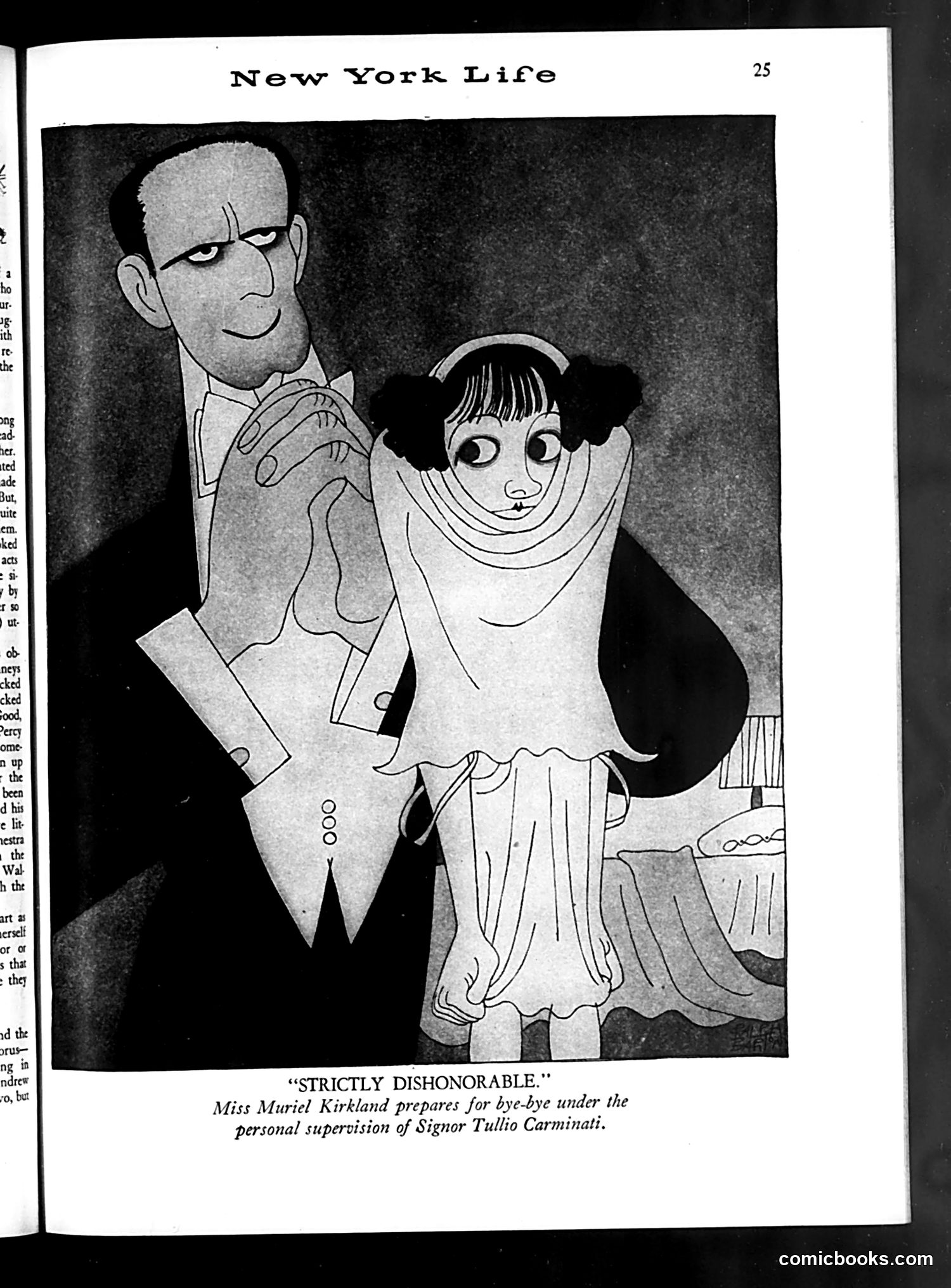
This appears to be a theatrical satire illustration from Life magazine referencing a play titled "Strictly Dishonorable." The caption identifies two performers: Miss Muriel Kirkland and Signor Tullio Carminati. The cartoon depicts a man in formal attire leaning over a woman in a negligée, suggesting an intimate or compromising situation—likely playing on the play's title and its suggestive plot. The illustration uses exaggerated caricature style typical of Life's satirical approach. The phrase "prepares for bye-bye" uses period slang implying romantic or sexual farewell. The satire appears to mock both the theatrical production's risqué subject matter and perhaps the performers themselves, reflecting 1920s-30s attitudes toward stage entertainment that dealt with romantic entanglement.
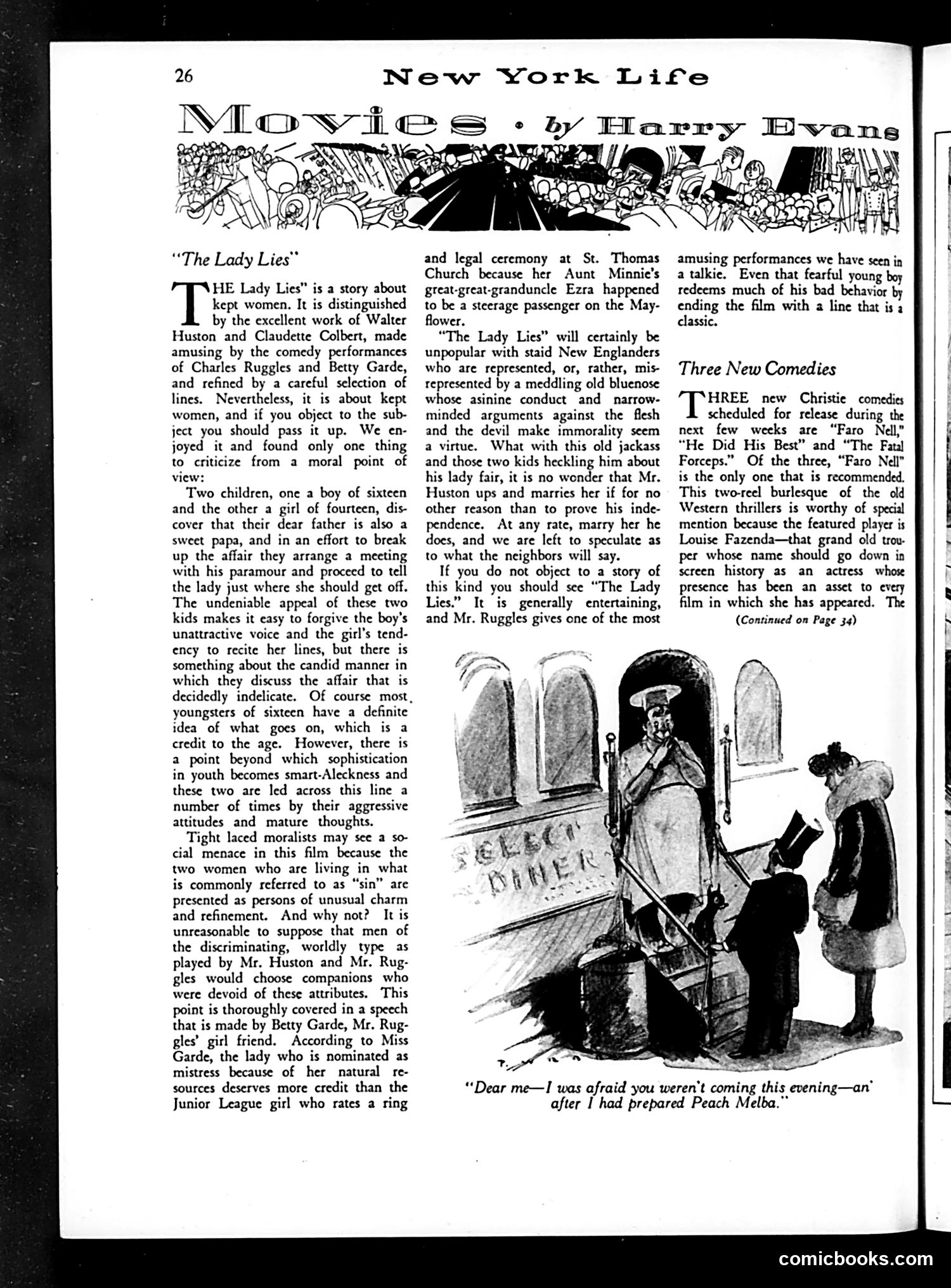
"The Lady Lies" Film Review and Satire This is a film review column by Harry Evans examining a 1929 film about infidelity. The main review critiques "The Lady Lies," starring Walter Huston and Claudette Colbert, praising the performances while morally objecting to its subject matter: a kept woman and her lover's teenage children confronting her. The satire targets *moral hypocrisy*. Evans notes that strict "New Englanders" and "tight laced moralists" condemn the film's sympathetic portrayal of an unmarried woman living with a man, yet the story suggests this woman—chosen for her charm and refinement—deserves more respect than a society woman married only for lineage (the "Junior League girl who rates a ring" because her ancestor was a Mayflower passenger). The cartoon below (showing a woman at a doorway with caption about Peach Melba) likely illustrates domestic domestic comedy, supporting the review's theme of domestic scandal.
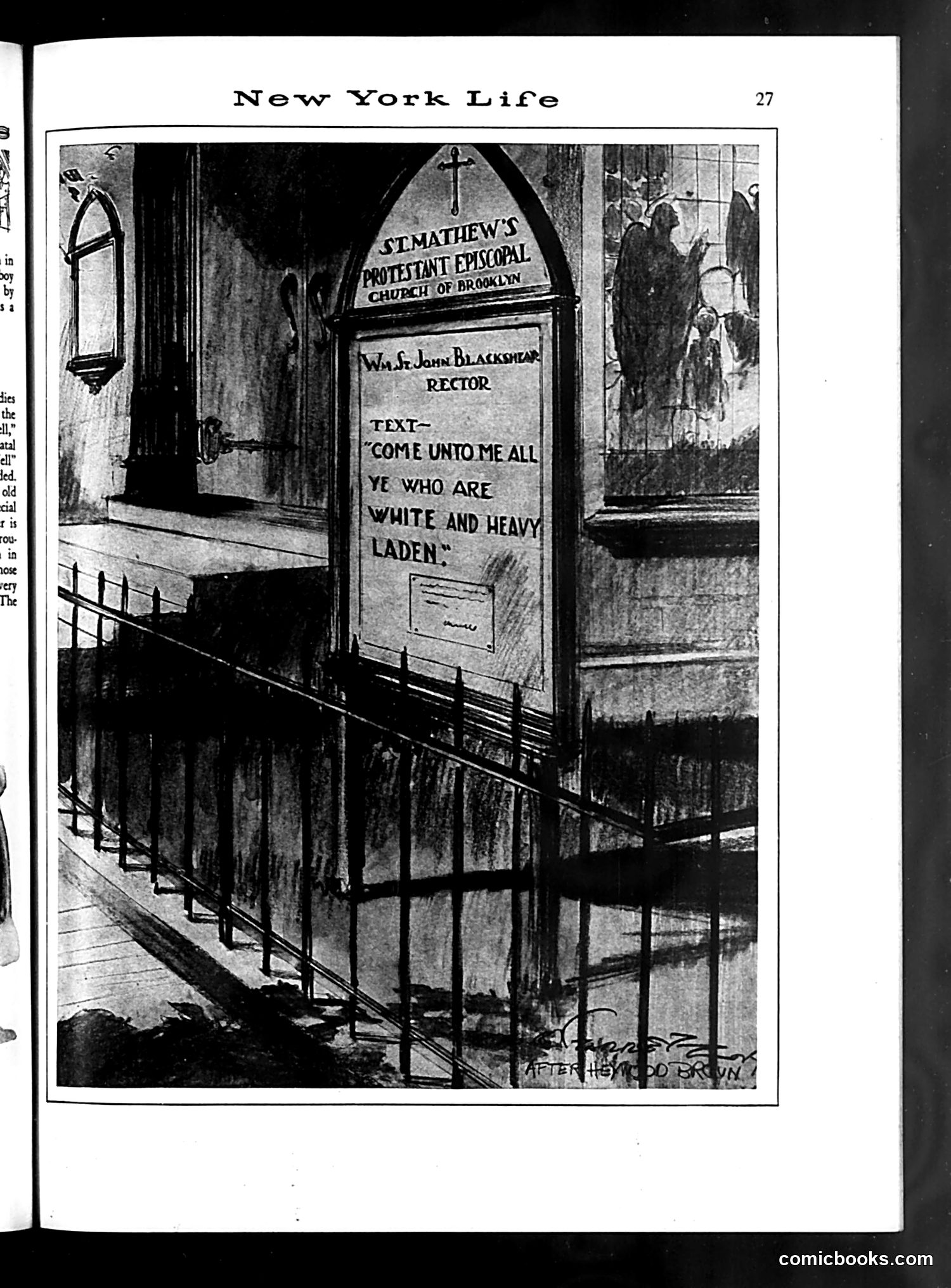
This photograph shows St. Matthew's Protestant Episcopal Church of Brooklyn with a prominent sign displaying its rector, W.S. John Blackshear, and the biblical text "Come unto me all ye who are white and heavy laden." The satire targets the church's apparent racial exclusivity by altering or highlighting the word "white" in the scripture quotation. The original Matthew 11:28 passage reads "Come unto me, all ye that labour and are heavy laden," making no racial distinction. By emphasizing "white," the image satirizes what appears to be discriminatory church practices or the rector's views, suggesting the church welcomes only white congregants despite Christianity's universal message. This reflects early-to-mid 20th century American racial tensions and religious hypocrisy regarding segregation.
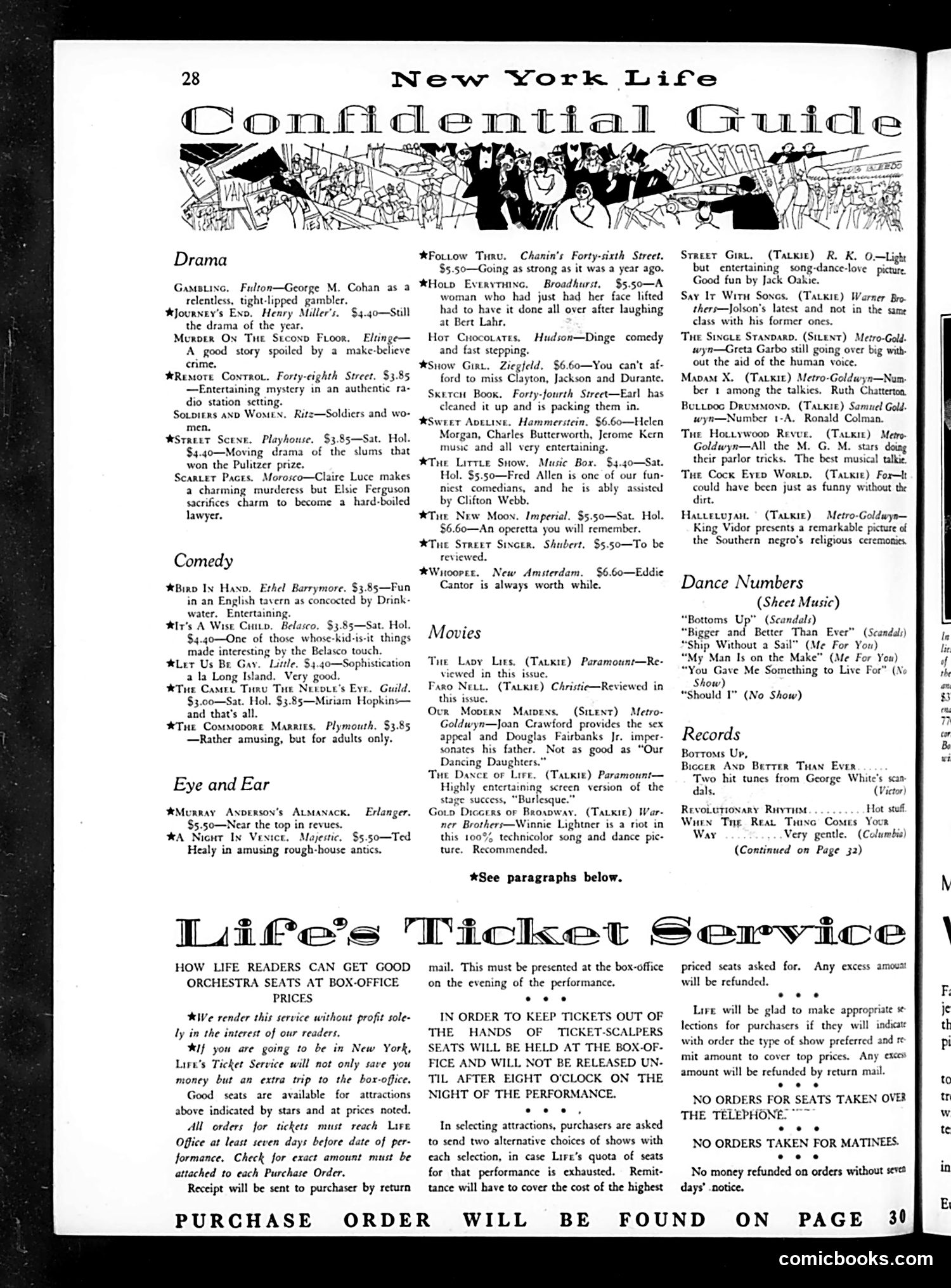
Analysis of This Page This is a theater and entertainment listing page from Life magazine, not a political cartoon. The page contains theater reviews and movie listings from what appears to be the late 1920s (based on references to early talkies and silent films). Key content: - Brief reviews of Broadway plays in categories (Drama, Comedy, Eye and Ear) - Movie reviews distinguishing between talking pictures (Talkie) and silent films - A ticket service advertisement explaining how Life readers can purchase orchestra seats at box-office prices Notable references: Reviews mention stars like Greta Garbo, Al Jolson, Joan Crawford, and Eddie Cantor. The distinction between "Talkie" and "Silent" films reflects the transitional period when sound cinema was newly revolutionary. The satire/humor is mild—mostly in brief, witty descriptions of productions (e.g., "You can't afford to miss" certain shows). This is primarily a service page for entertainment-seeking New Yorkers rather than political commentary.
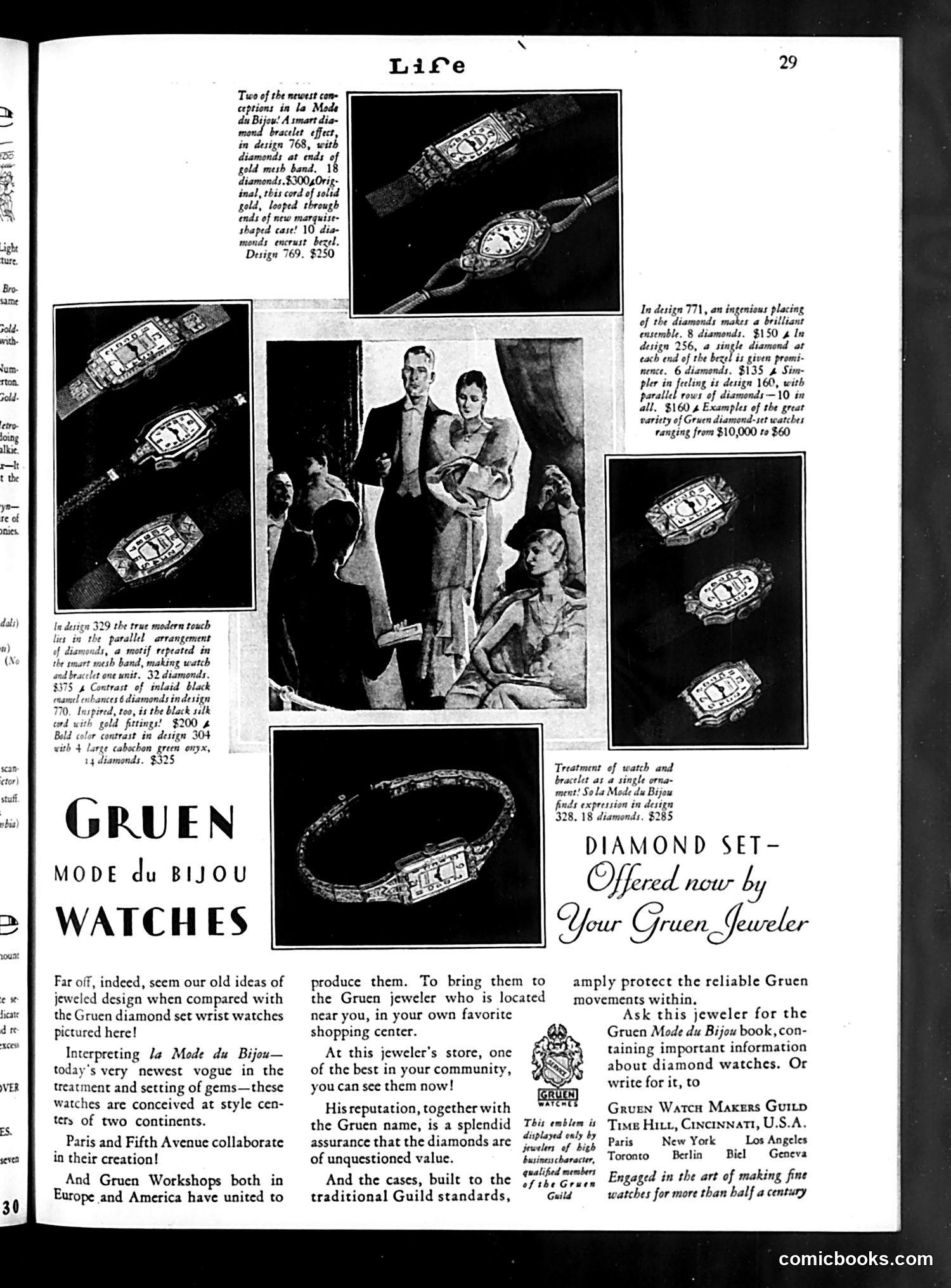
Analysis This is not a cartoon or satire—it's a luxury watch advertisement for Gruen diamond watches, circa 1920s-1930s. The page showcases high-end wristwatches incorporating diamonds and precious metals, marketed as embodying "la Mode du Bijou" (jewelry fashion). The central image shows a well-dressed couple and children examining these watches, positioning them as aspirational luxury goods for affluent consumers. The text emphasizes that Gruen's designs collaborate between Paris and Fifth Avenue design centers, lending continental sophistication. Multiple watch designs are displayed with prices ranging from $135 to $10,000, each described with technical detail about diamond placement and materials. The advertisement includes a Gruen Watch Makers Guild emblem, assuring buyers of authenticity and quality. This is straightforward commercial messaging targeting wealthy consumers interested in jewelry-quality timepieces—no political commentary or satire is present.
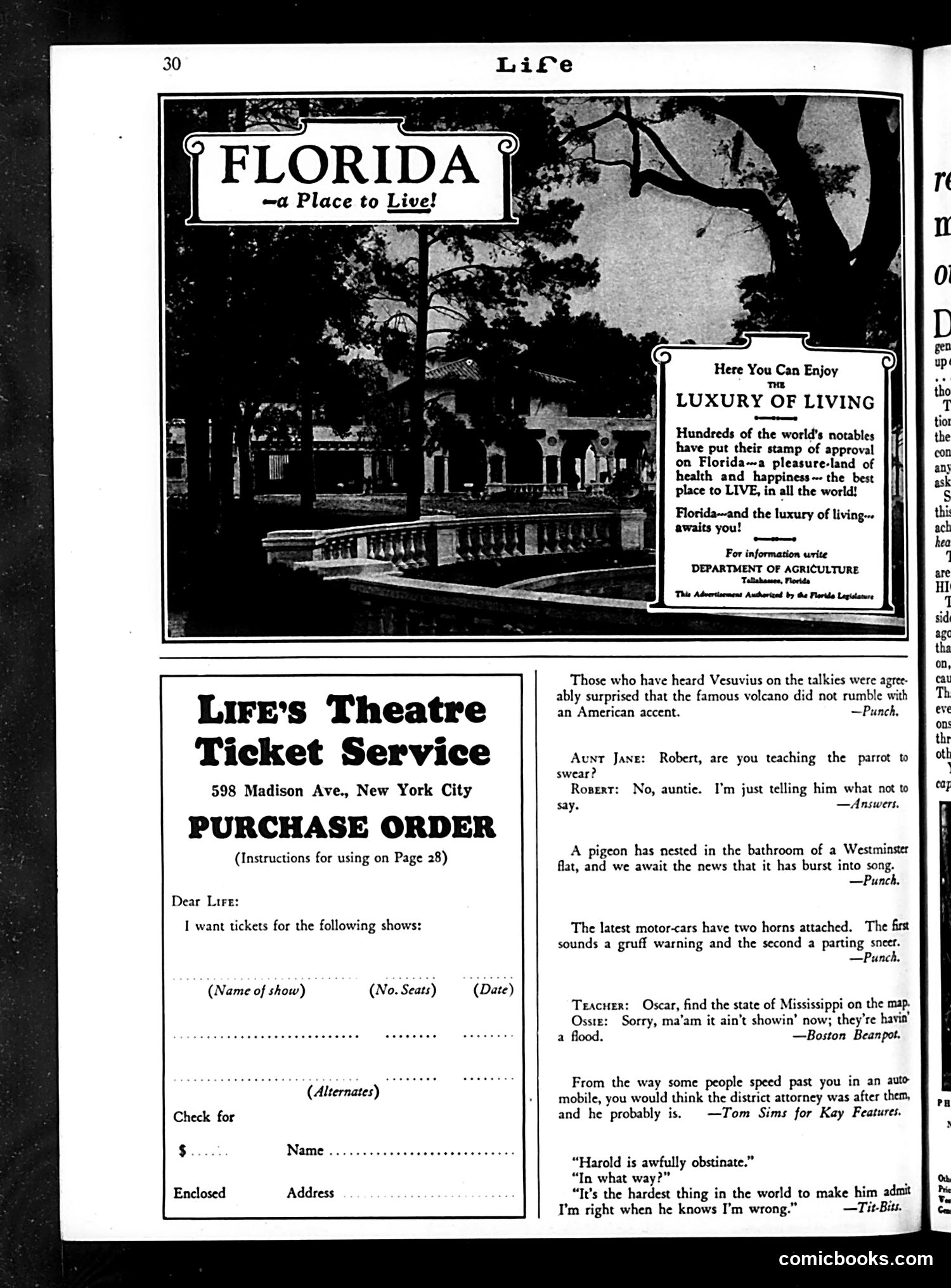
Page 30 of Life Magazine: Content Analysis This page combines advertising with humor sections—typical of Life's format. The Florida Advertisement (top) is a straightforward tourism promotion by Florida's Department of Agriculture, marketing the state as "a place to Live" emphasizing "luxury of living" and health benefits. The image shows an elegant columned structure, appealing to wealthy visitors. Life's Theatre Ticket Service (bottom left) is a mail-order form for purchasing theater tickets, unrelated to satire. The Humor Section (right) collects brief jokes reprinted from various sources (Punch, Boston Beanpot, etc.). These include: - A Vesuvius film reference (volcano without American accent—mocking Hollywood) - A parrot-training joke - A pigeon nesting joke - Car horns satirizing social rudeness - A Mississippi flood reference (topical weather disaster) - Speeding drivers - A joke about stubbornness These are light, domestic humor pieces typical of Life's satirical content—no specific political figures are caricatured. The page represents standard 1920s-30s magazine content: advertising, ticket sales, and collected mild social satire.
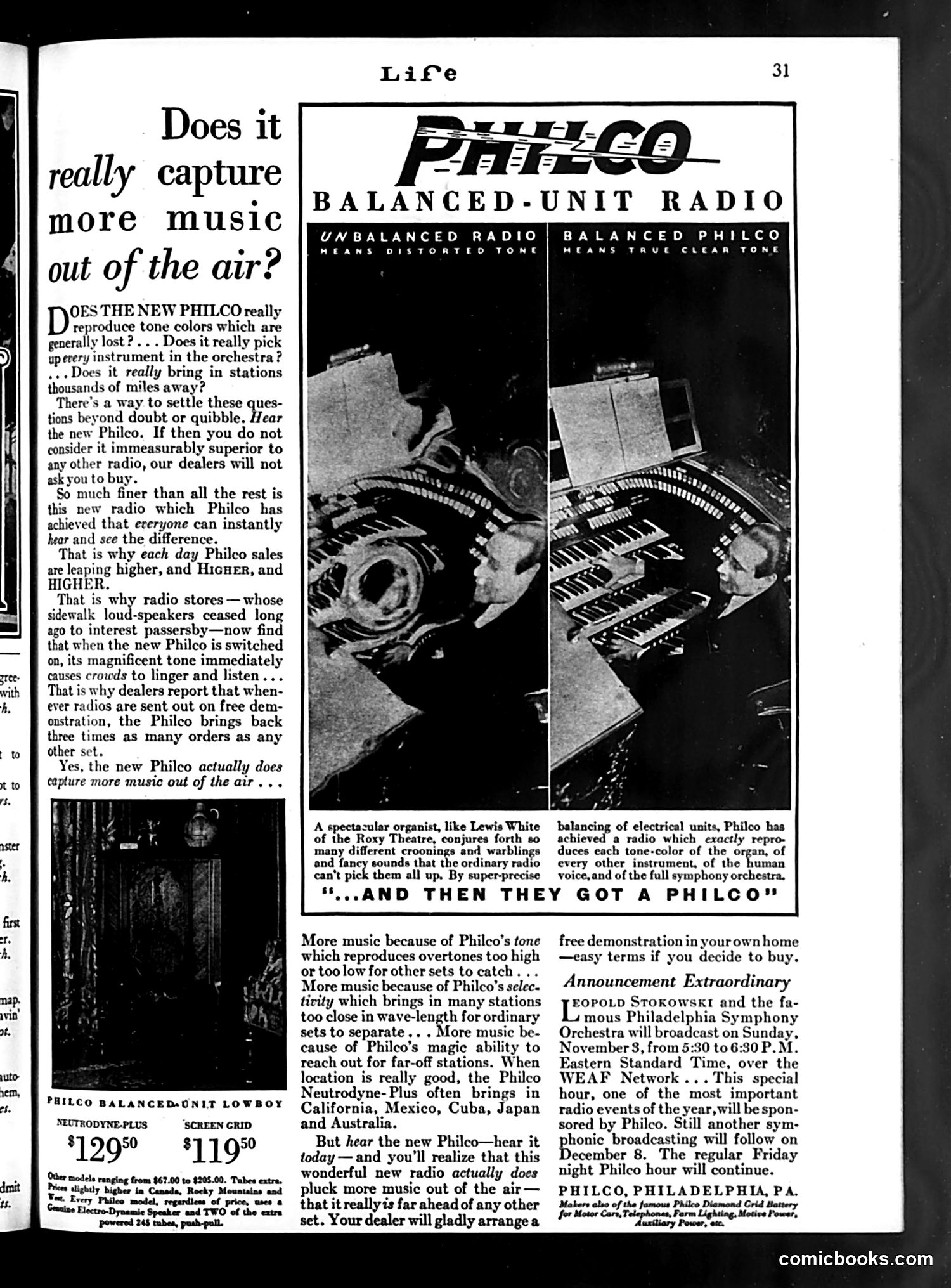
Analysis: Philco Radio Advertisement, Life Magazine This is a product advertisement, not satire or political content. It promotes Philco's new "Balanced-Unit Radio" against competing radio brands of the late 1920s. The page contrasts an "unbalanced radio" (producing distorted tone) with Philco's "balanced" model, claiming superior sound reproduction. The text references Lewis White, a real organist at the Roxy Theatre, to demonstrate the radio's ability to capture complex musical nuances. The advertisement emphasizes competitive advantages: clearer tone, better station selectivity, and stronger long-distance reception. It highlights endorsements from famous conductor Leopold Stokowski and the Philadelphia Symphony Orchestra—a major promotional coup. The two radio models shown ($129.50 and $119.50) represent different price points in Philco's product line. The dramatic language ("HIGHER, and HIGHER") reflects the competitive radio market of that era, when radio was still a luxury consumer good. This reflects the early broadcast era's emphasis on audio fidelity as a major selling point.
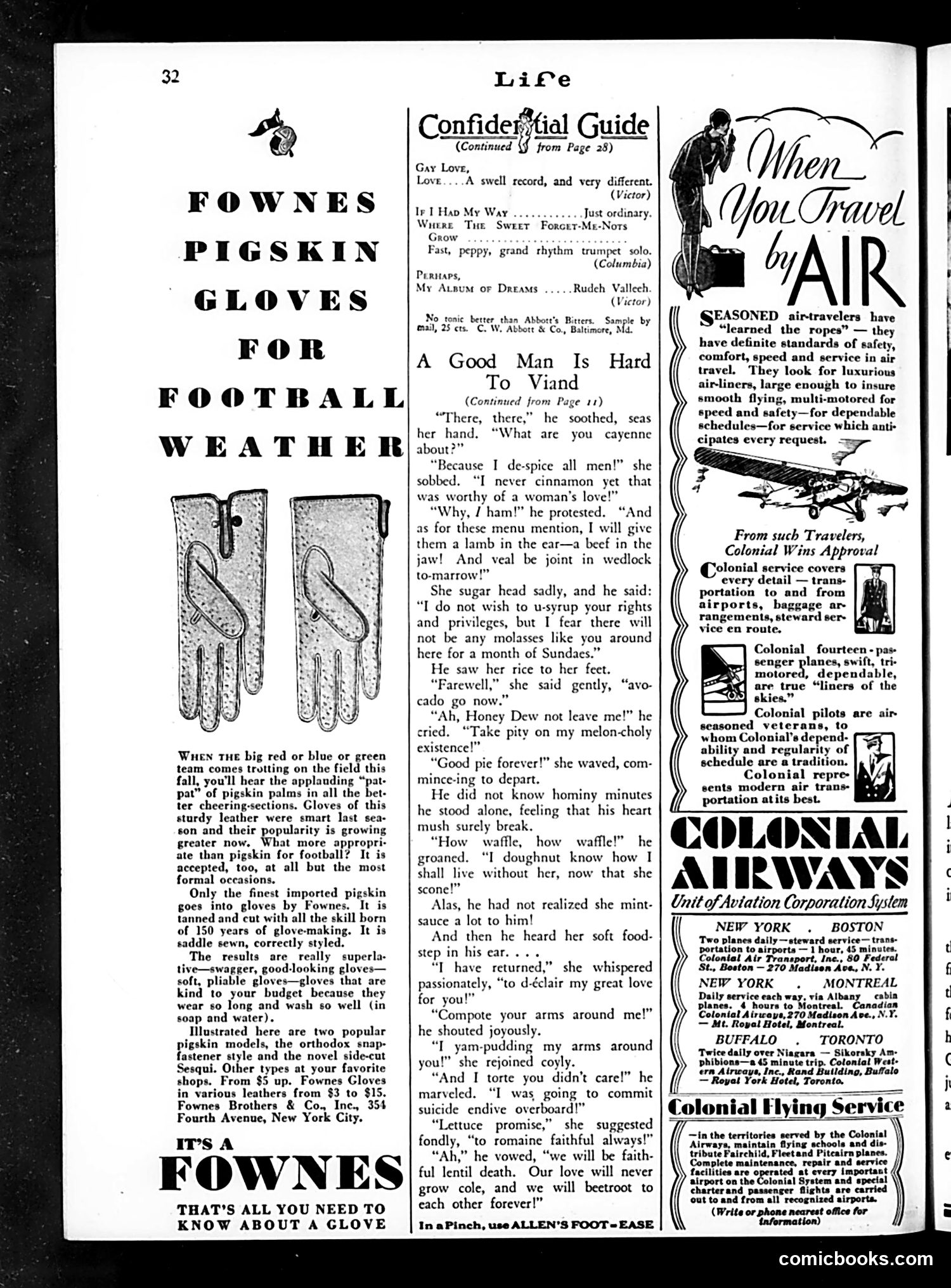
What This Page Contains This Life magazine page is primarily advertising and serialized fiction, not political satire. The left side advertises Fownes pigskin gloves for football weather—emphasizing their quality, durability, and appropriateness for fall sports and formal occasions. The center features the continuation of a humorous romantic story titled "A Good Man Is Hard to Viand." It's a pun-heavy comedic piece where dialogue is laden with food references: the woman says "I never cinnamon yet," he responds "Why, I ham!", and later exchanges include "sugar head," "rice to her feet," and "I yam-pudding my arms around you." This is lighthearted wordplay humor typical of 1920s Life magazine—no deeper political meaning. The right side carries advertisements for Colonial Airways, promoting air travel as a modern luxury for "seasoned airtravelers." There is no political cartoon or satire on this page—it's a typical mixed-content magazine spread of ads and serialized entertainment.
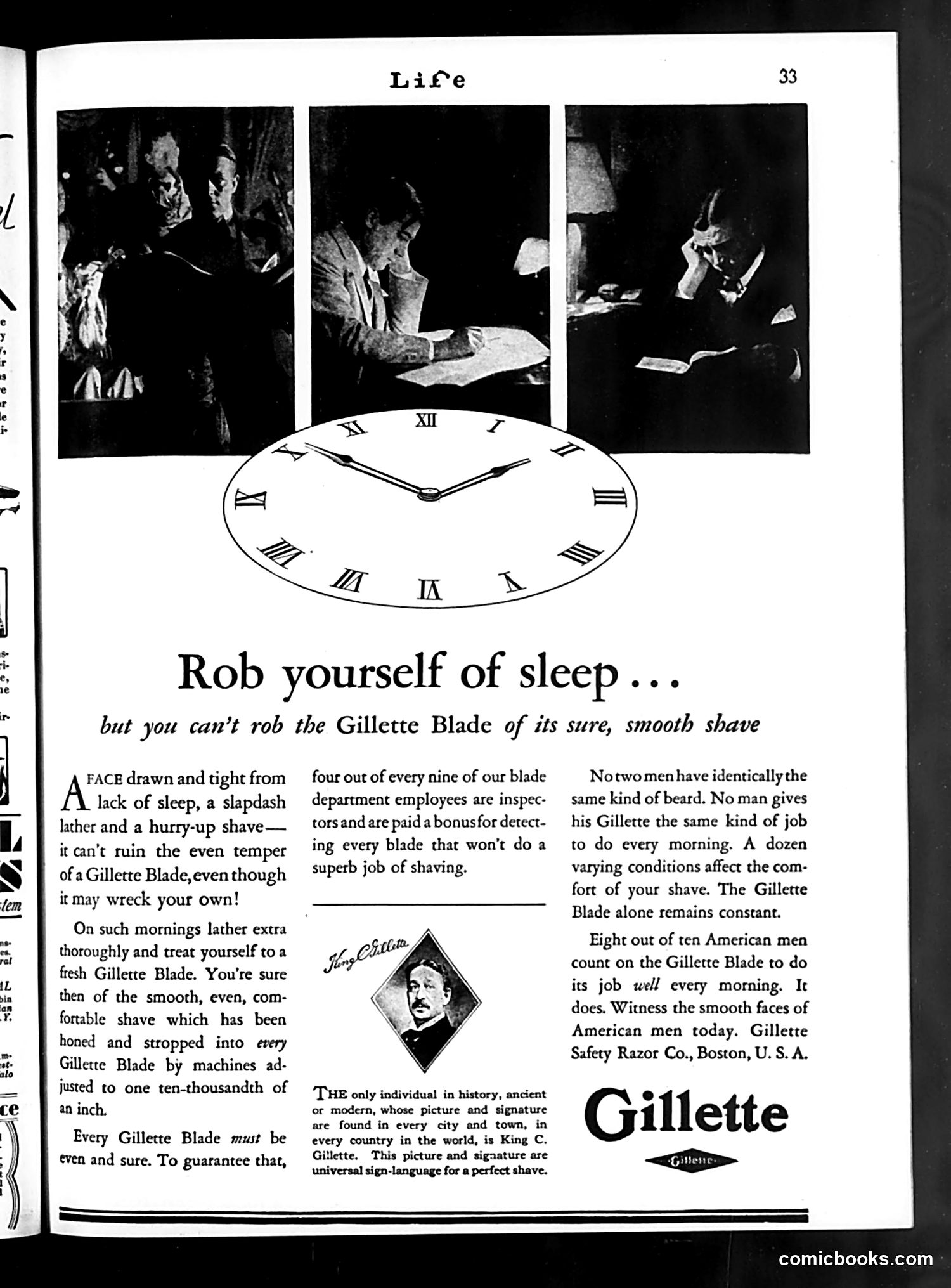
Gillette Advertisement Analysis This is primarily a Gillette razor blade advertisement, not satire or political content. The page uses three black-and-white photographs showing men in various states of sleep deprivation and shaving to promote the product's reliability. The ad's central claim: even when a man is exhausted and rushes through his morning routine ("Rob yourself of sleep"), a Gillette blade will still deliver a quality shave because of the company's rigorous manufacturing standards (inspectors check one ten-thousandth of an inch tolerances). The text emphasizes that Gillette blades are universally recognized—claiming King C. Gillette's image appears "in every city and town, in every country in the world" as synonymous with "a perfect shave." Eight of ten American men allegedly rely on Gillette daily. This reflects early 20th-century advertising strategy: reassuring consumers that consistent quality persists despite variable user conditions. There is no political satire present.
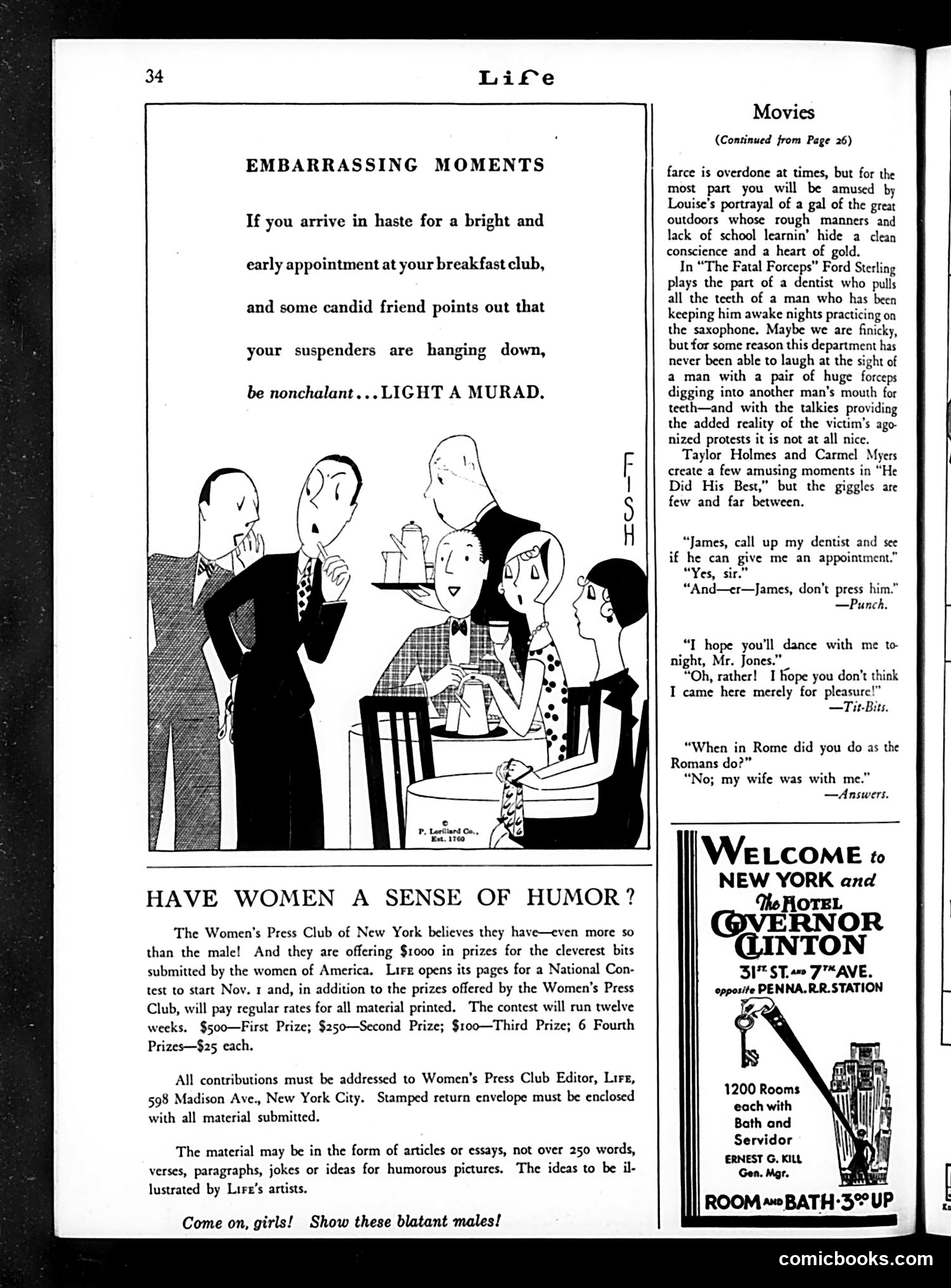
Analysis of This Life Magazine Page The Main Cartoon ("Embarrassing Moments"): depicts a breakfast club scene where a man has arrived with his suspenders visibly hanging down—a wardrobe malfunction. The joke's advice is to "light a Murad" (a cigarette brand) and act nonchalant to distract from the embarrassment. This is an advertisement disguised as humor, leveraging social anxiety about public appearance to sell cigarettes. "Have Women a Sense of Humor?" Section: announces a $1,000 contest by the Women's Press Club of New York inviting female contributors to submit humorous material to *Life* magazine. The competitive framing ("Show these blatant males!") reflects 1920s-era debates about gender and intellectual capability. The contest challenged gender stereotypes by asserting women were equally capable of wit and satire. Context: This reflects post-suffrage America (women gained voting rights in 1920), when questions about women's intellectual equality remained contested. The page suggests *Life*'s role in promoting women's participation in public discourse.
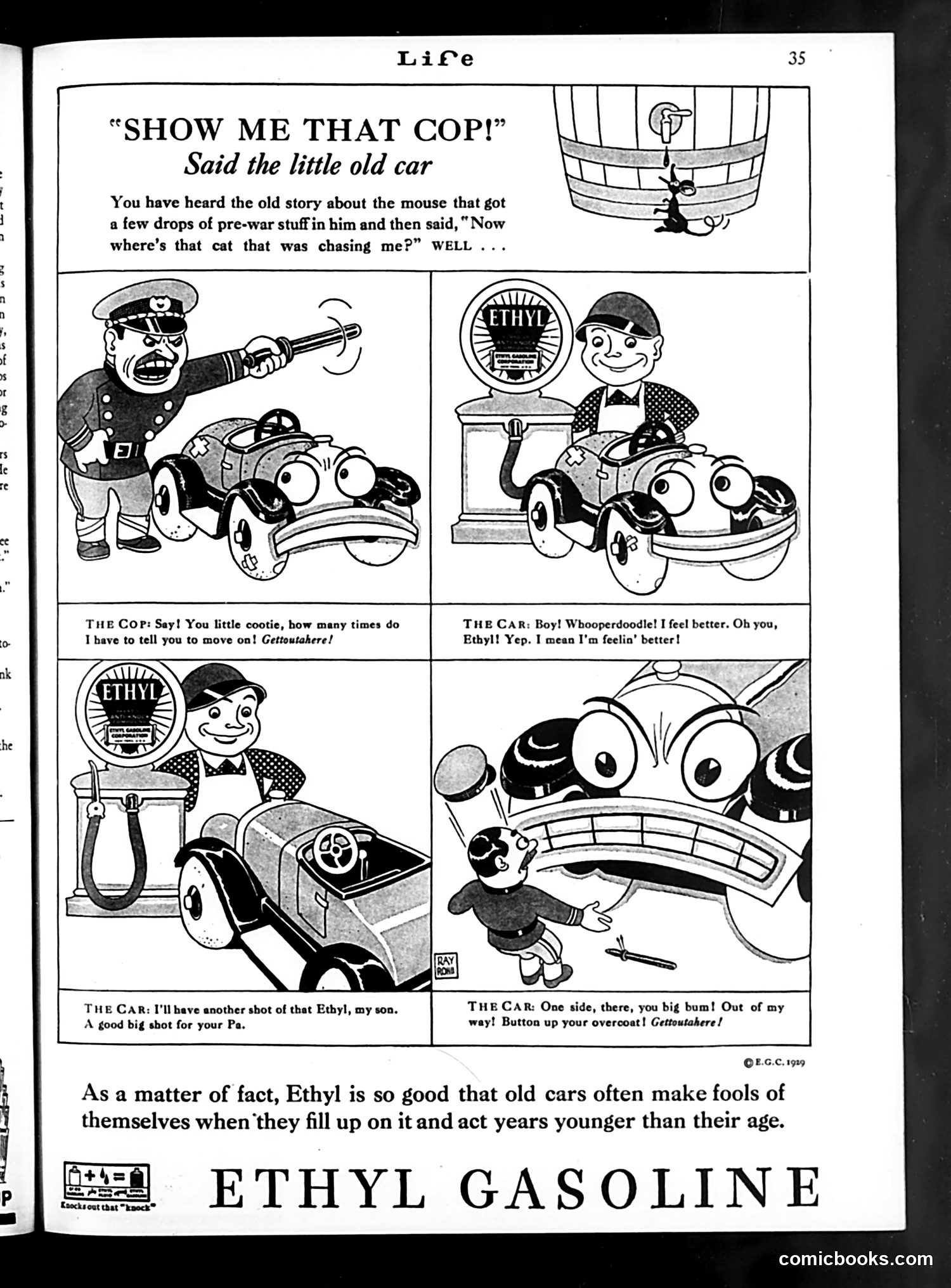
"Show Me That Cop!" - Ethyl Gasoline Advertisement (1929) This is a humorous advertisement for Ethyl gasoline, personifying an old car as a cocky character. The joke plays on the "pre-war stuff" (alcohol) comparison: just as a mouse emboldened by liquor confronts its predator, an old car filled with Ethyl gasoline becomes so energized it brazenly talks back to a police officer, then antagonizes other drivers. The car's sudden confidence and youthful behavior—rudeness to the cop, bossiness to pedestrians—satirizes how dramatically the fuel transforms the vehicle's performance. The ad's tagline confirms the message: Ethyl is so effective that old cars act decades younger after using it, making "fools of themselves." The reference to "knock" (engine knocking) and Ethyl's anti-knock properties reflects genuine automotive concerns of the 1920s-30s. This appears to be a Life magazine advertisement circa 1929.
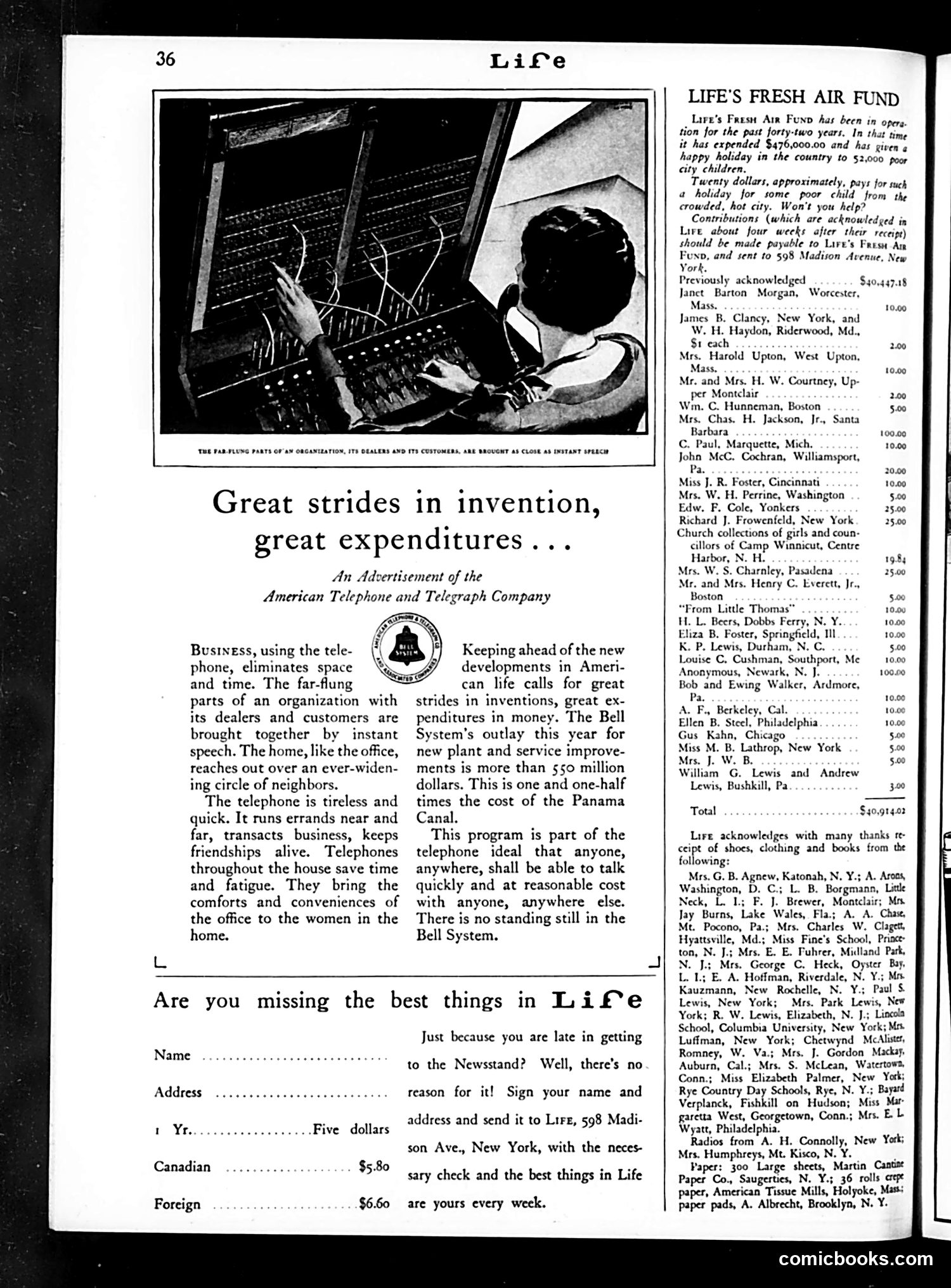
Life Magazine Page Analysis This page combines a full-page Bell System advertisement with charitable fundraising content and subscription information. The Advertisement: The top image shows a telephone operator at a switchboard. The ad argues that AT&T's massive expenditure ($550 million annually—exceeding Panama Canal costs) justifies itself by connecting business operations and homes across distances. It frames the telephone as essential infrastructure enabling modern life, emphasizing that "there is no standing still in the Bell System." The Satire/Irony: The juxtaposition is subtle but pointed. While Bell touts its vast investments in infrastructure and convenience, the *Fresh Air Fund* section documents modest charitable donations ($5-$100) helping poor city children escape urban heat—a competing vision of how wealth should serve society. The contrast implies corporate spending priorities versus actual human welfare needs. Non-advertising content: The Fresh Air Fund listing and subscription pitch occupy the right column, presenting small-donor philanthropy as an alternative worthy cause.
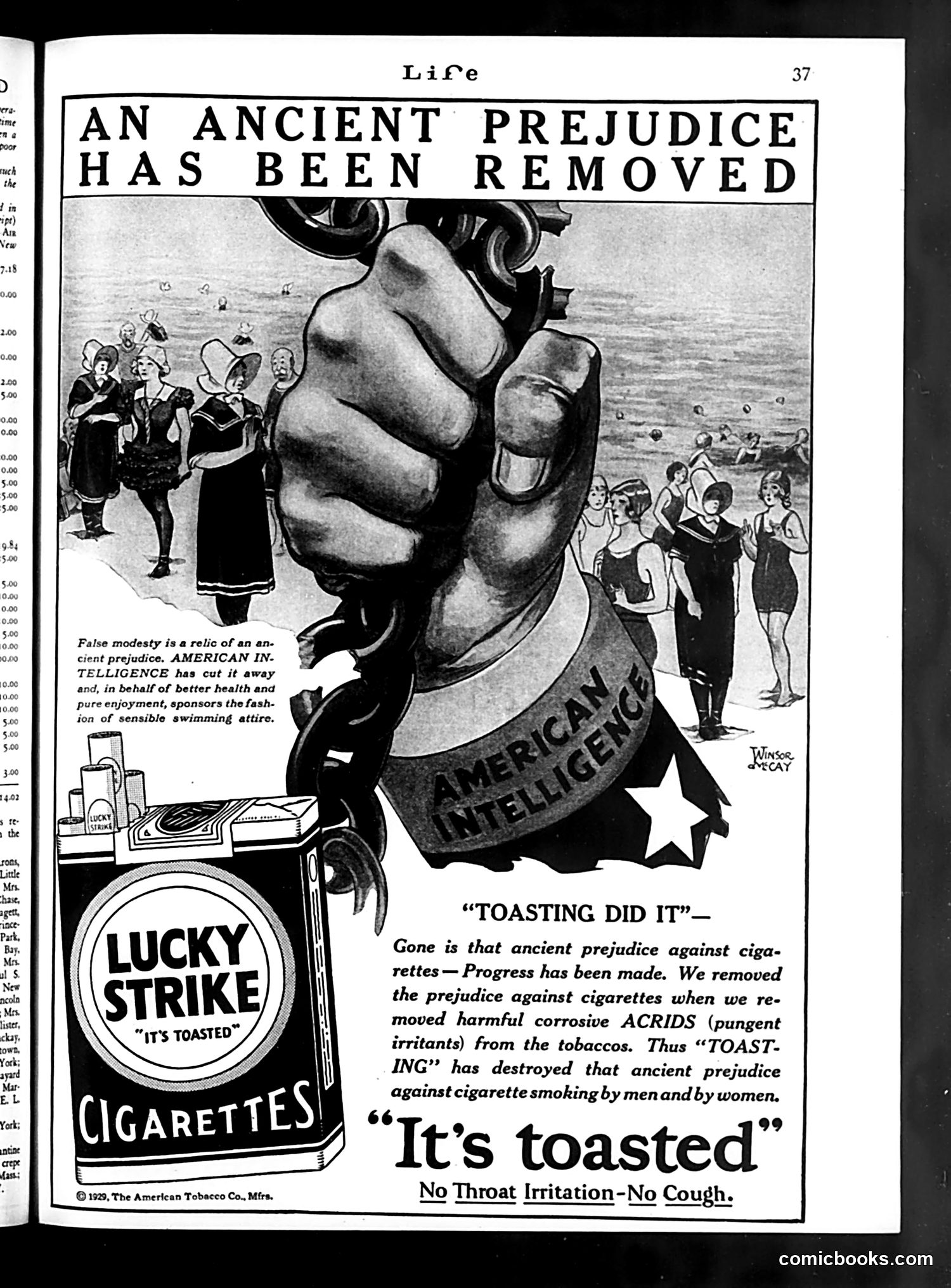
Lucky Strike Advertisement Analysis This is a Lucky Strike cigarette advertisement, not editorial satire. The page uses two parallel arguments to promote smoking: The "Ancient Prejudice" Framing: The ad claims that just as society overcame modesty about revealing swimwear (shown with beach-goers in 1920s bathing suits), it should overcome prejudice against cigarettes. The imagery of a classical statue being unveiled suggests removing outdated social restrictions. The "Toasting" Claim: The ad falsely asserts that Lucky Strike's toasting process removes harmful "acrid" (irritating) compounds from tobacco, thereby eliminating health concerns about smoking. This is marketing pseudoscience—the toasting process did not actually remove carcinogens. Historical Context: This circa-1929 ad reflects the tobacco industry's early strategy of normalizing smoking, particularly among women, by framing anti-smoking sentiment as antiquated prudishness rather than legitimate health concern. The "No Throat Irritation" promise was entirely unsubstantiated marketing language.
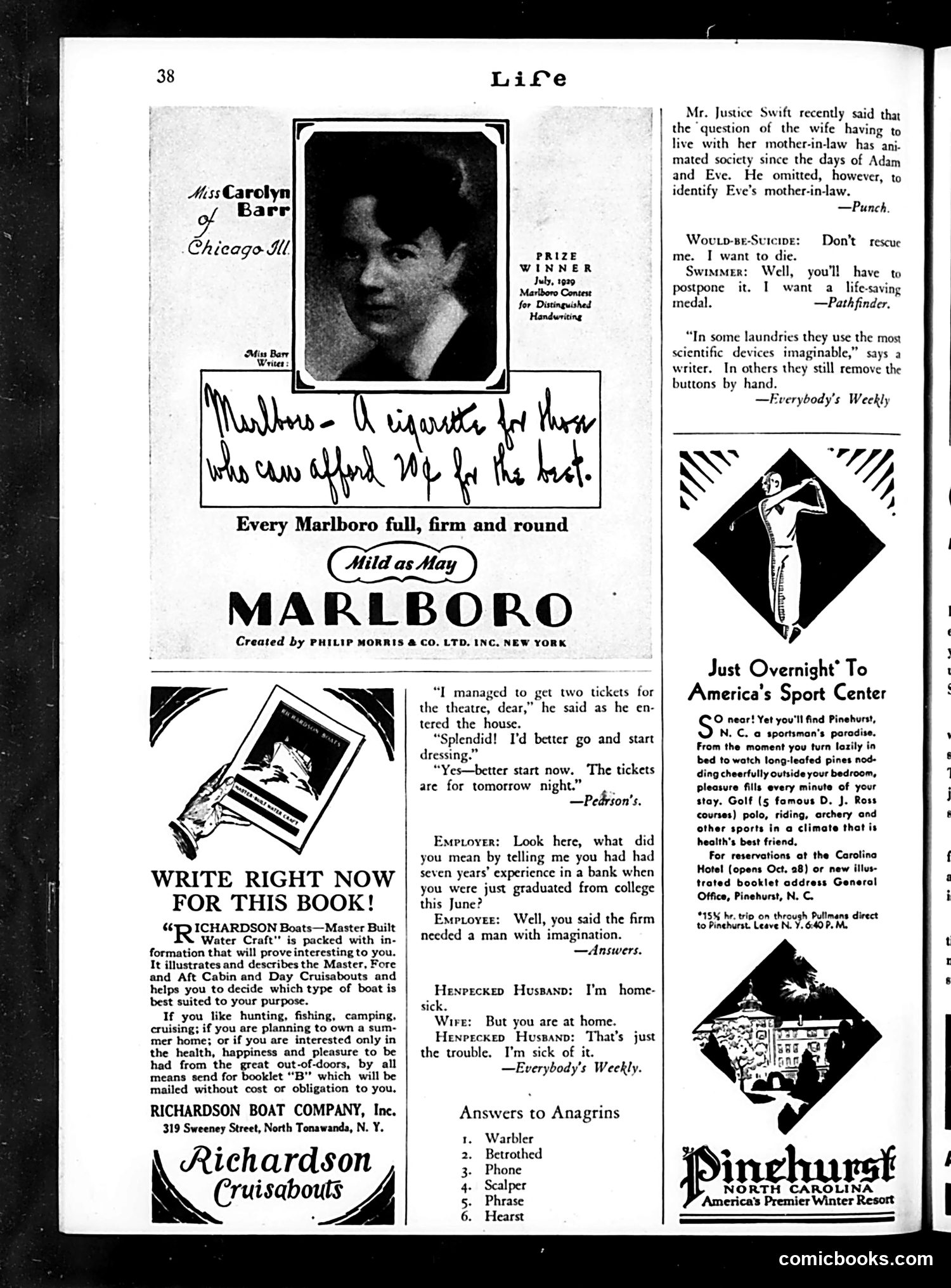
Life Magazine Page Analysis This page is primarily advertising, with brief humor snippets interspersed. The main content includes: Featured Advertisement: A Marlboro cigarette ad showcasing Miss Carolyn Barr of Chicago, a prize-winner for handwriting (July 1929). The ad emphasizes the cigarette's quality. Humor Snippets: Brief jokes from various publications (Everybody's Weekly, Answers, Pathfinder, Punch) covering domestic and social situations—wives rushing to dress for theater tickets scheduled for tomorrow, a recent college graduate claiming seven years' banking experience, a henpecked husband homesick despite being home, and commentary on laundry services. Additional Ads: Richardson Boats and Pinehurst resort promotions. The page reflects 1920s-era concerns: marital dynamics, employment dishonesty, class-conscious vacationing, and cigarette marketing. The jokes are gentle social satire typical of Life's middle-class readership, with no sharp political commentary visible.
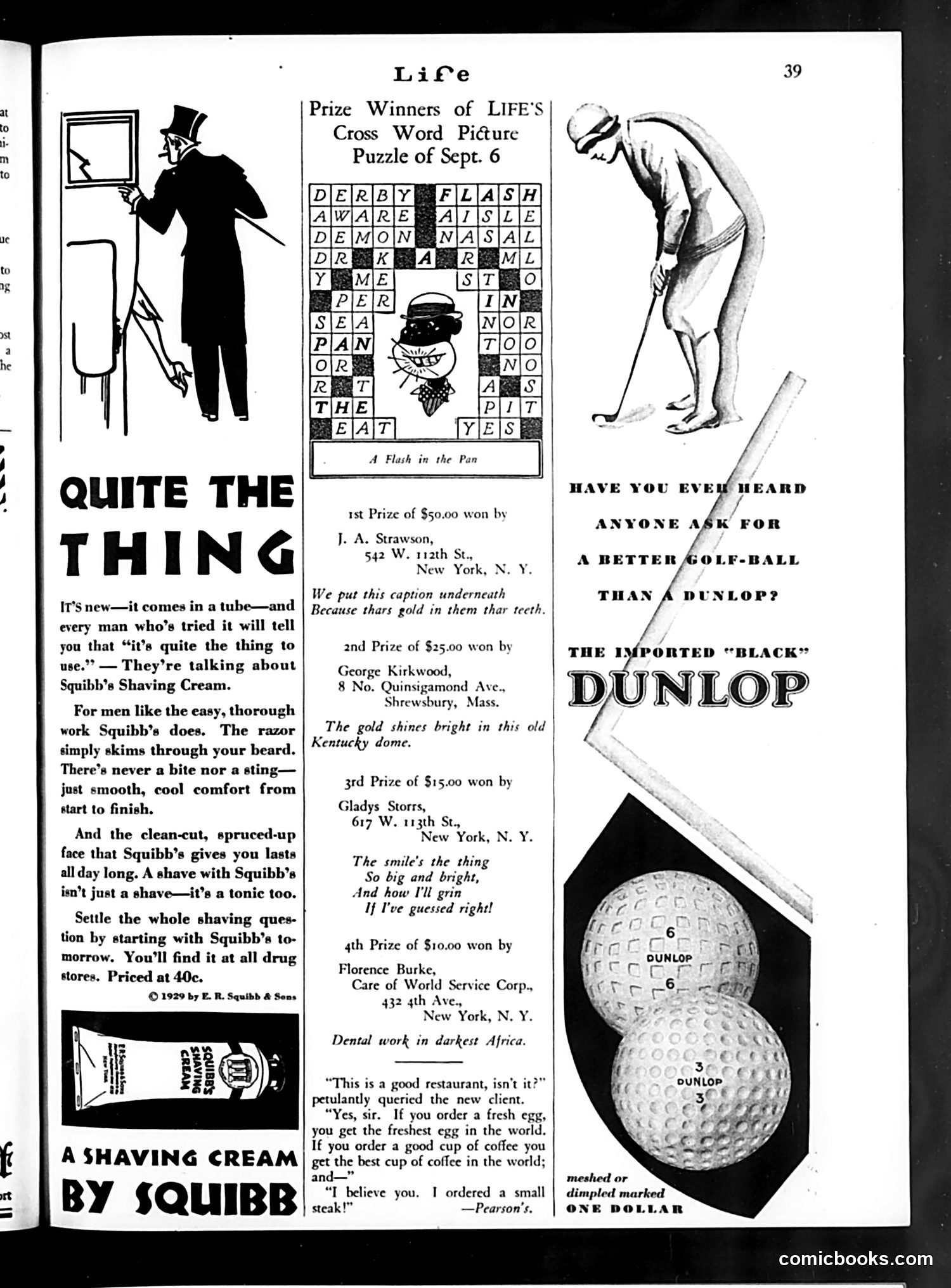
Page 39 of Life Magazine - Content Analysis This page contains primarily advertising and puzzle results rather than political satire. Left side: A Squibb's Shaving Cream advertisement featuring a silhouetted gentleman holding a mirror and razor. The ad emphasizes smooth, comfortable shaving with no irritation—marketing language typical of 1920s product promotion. Center: Results of Life's crossword puzzle contest, with a cartoon of a grinning face (the puzzle solution apparently involved teeth/dental imagery). Captions submitted by winners play on gold teeth and smiling themes—typical of Life's humorous contest format. Right side: Advertisement for Dunlop golf balls, featuring product photos and a golfer figure. Bottom: A brief humorous anecdote about a restaurant patron discovering that quality ingredients yield quality meals—gentle satire on obvious logic. The page is primarily commercial content aimed at early 1930s male readers (shaving, golf). There is no significant political or social satire visible here.
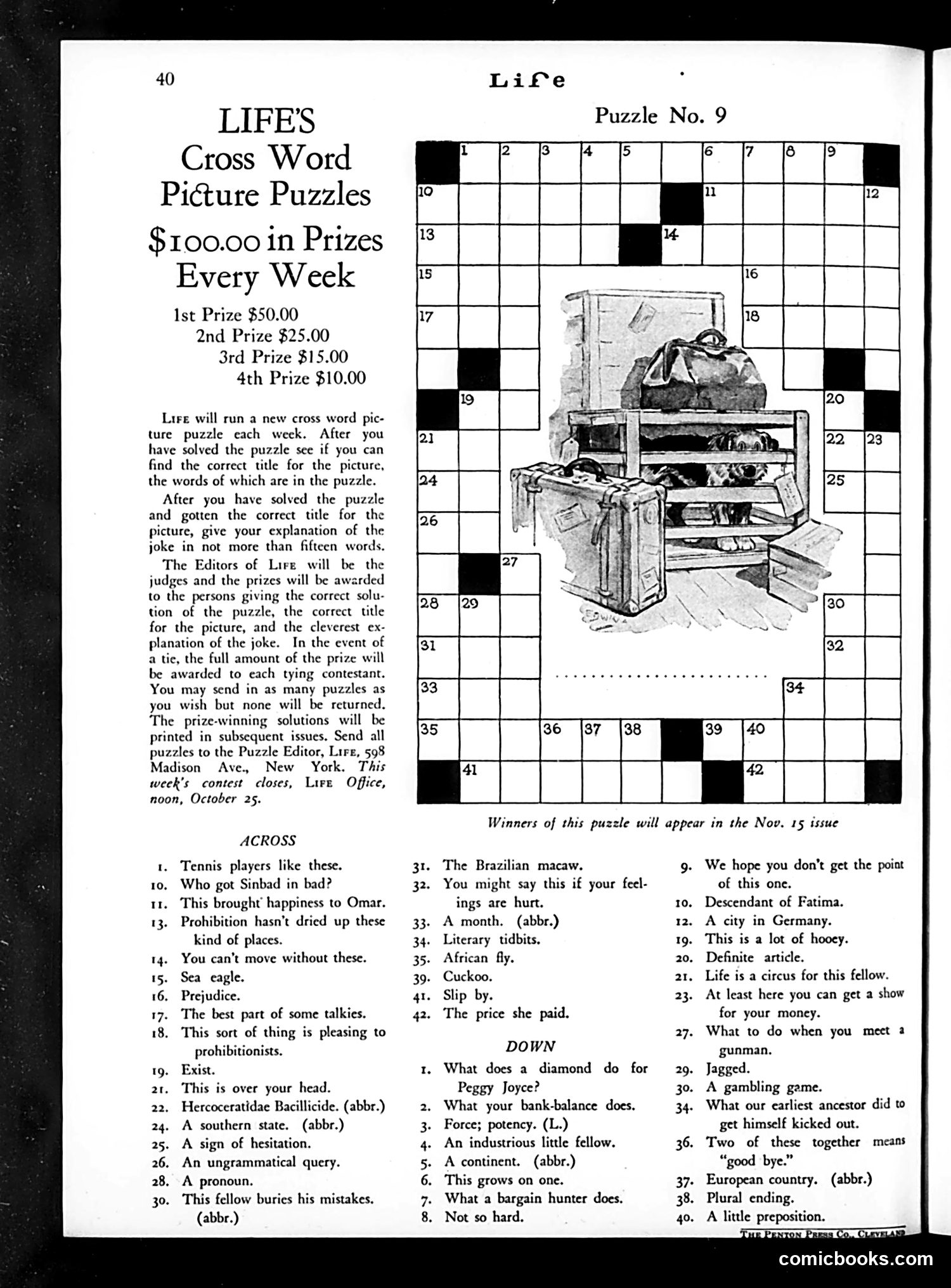
Life Magazine Puzzle Page Analysis This is not a political cartoon but rather a crossword picture puzzle contest page from Life magazine. The image shows a packed suitcase overflowing with travel items—representing the puzzle's hidden title that solvers must deduce from crossword clues. The page announces Life's weekly $100 prize competition ($50 first place) where readers solve a crossword puzzle, identify the picture's correct title (using words from the puzzle), and submit a fifteen-word joke explanation. The judges—Life's editors—award prizes for correct solutions plus the "cleverest" joke interpretation. This reflects early 1920s popular entertainment: crosswords were a national craze, and magazines competed for reader engagement through contests. The suitcase imagery likely relates to contemporary travel, leisure, or perhaps humorous commentary on luggage/packing—common satirical subjects of the era. Readers would mail solutions to Life's office by noon, October 25.
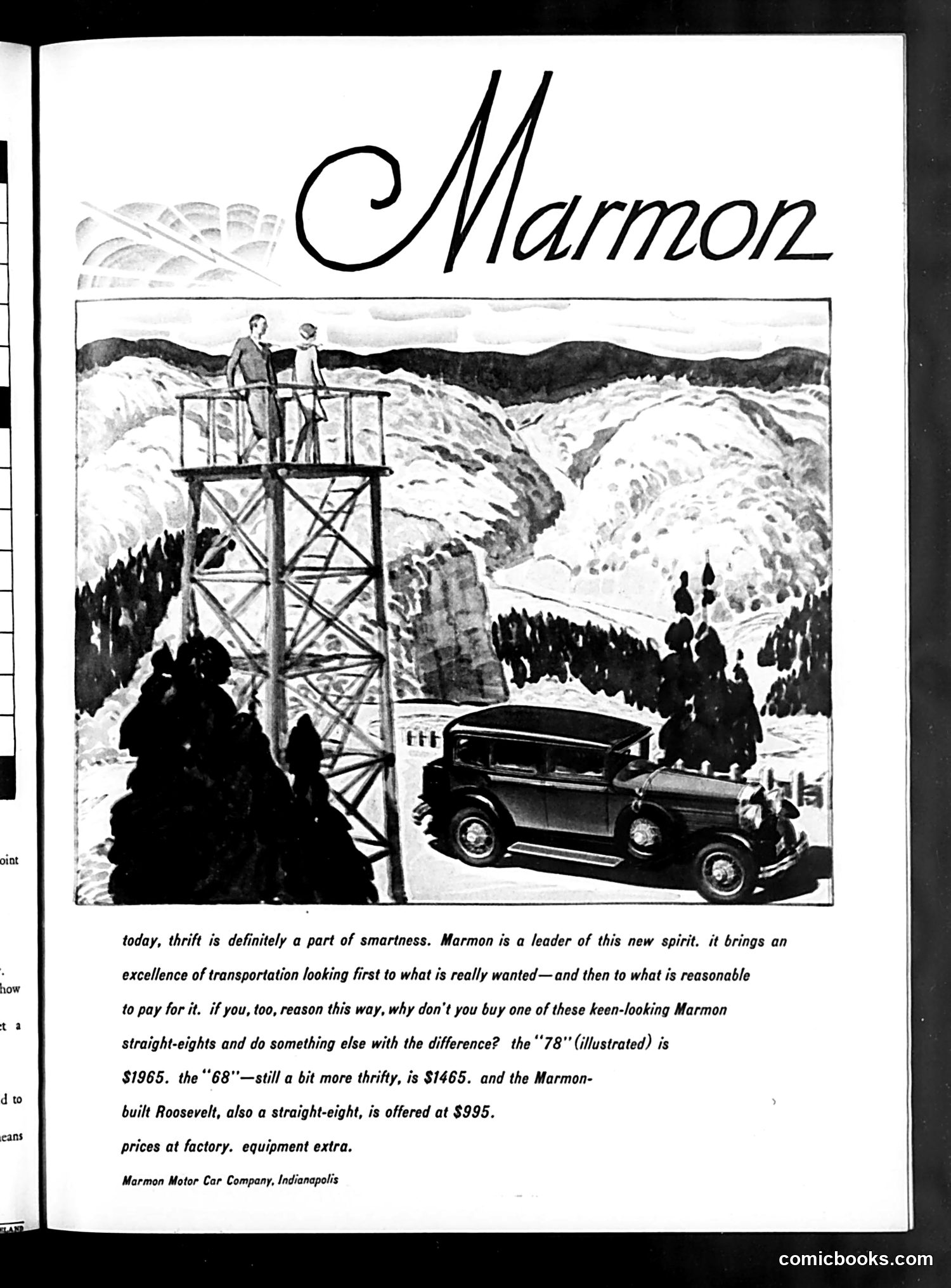
Marmon Automobile Advertisement This is an advertisement, not political satire. It's a vintage car ad for Marmon Motor Company (Indianapolis) promoting their automobiles during what appears to be the 1920s-30s era. The illustrated scene shows two men on an observation tower overlooking a snowy landscape with a Marmon automobile below—apparently meant to evoke a scenic tourist destination or overlook. The pitch appeals to economic consciousness ("thrift is definitely a part of smartness"), positioning Marmon vehicles as offering good value. Three models are priced: the "78" at $1,965, the "68" at $1,465, and the Marmon-built Roosevelt at $995. The message suggests buyers can afford nicer transportation while saving money compared to competitors. This reflects Depression-era marketing emphasizing affordability and practicality rather than luxury.
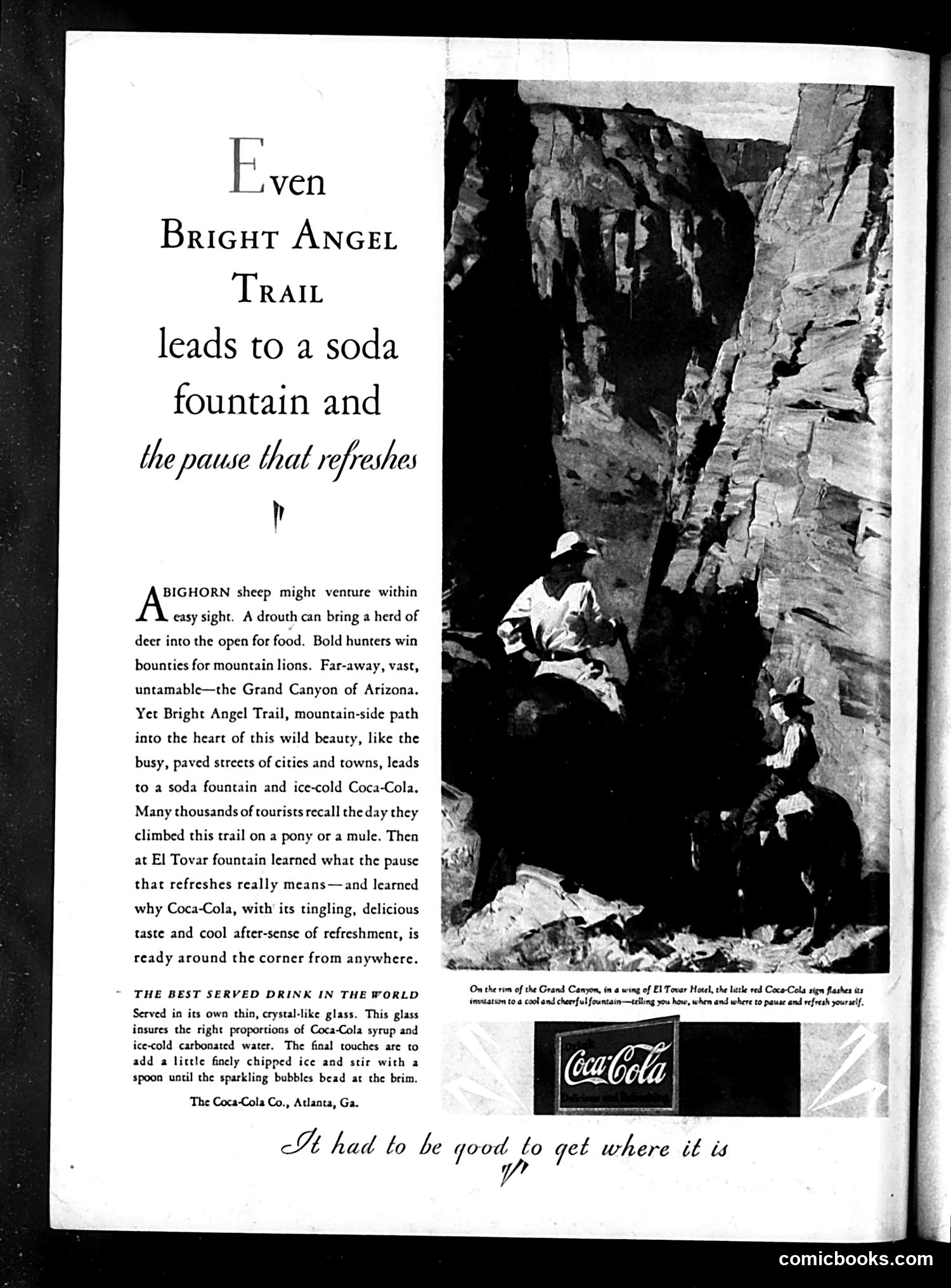
Analysis This is a Coca-Cola advertisement, not satire or political commentary. It uses the Grand Canyon's Bright Angel Trail—a famous tourist destination—as a setting to promote the drink. The ad's joke is mild and aspirational: even in the remote, wild Grand Canyon, accessible only by difficult mountain trail, Coca-Cola is waiting at El Tovar Hotel. The tagline "It had to be good to get where it is" implies the product's quality is proven by its ubiquity—you can find it *anywhere*, even in the untamed wilderness. The photograph shows tourists resting during their canyon hike, presumably anticipating refreshment. This reflects early 20th-century marketing: Coca-Cola positioned itself as an essential modern convenience accompanying Americans' leisure and exploration, blending frontier adventure with commercial comfort. The ad promises that civilization's pleasures (a cold soda) accompany even wilderness experiences.
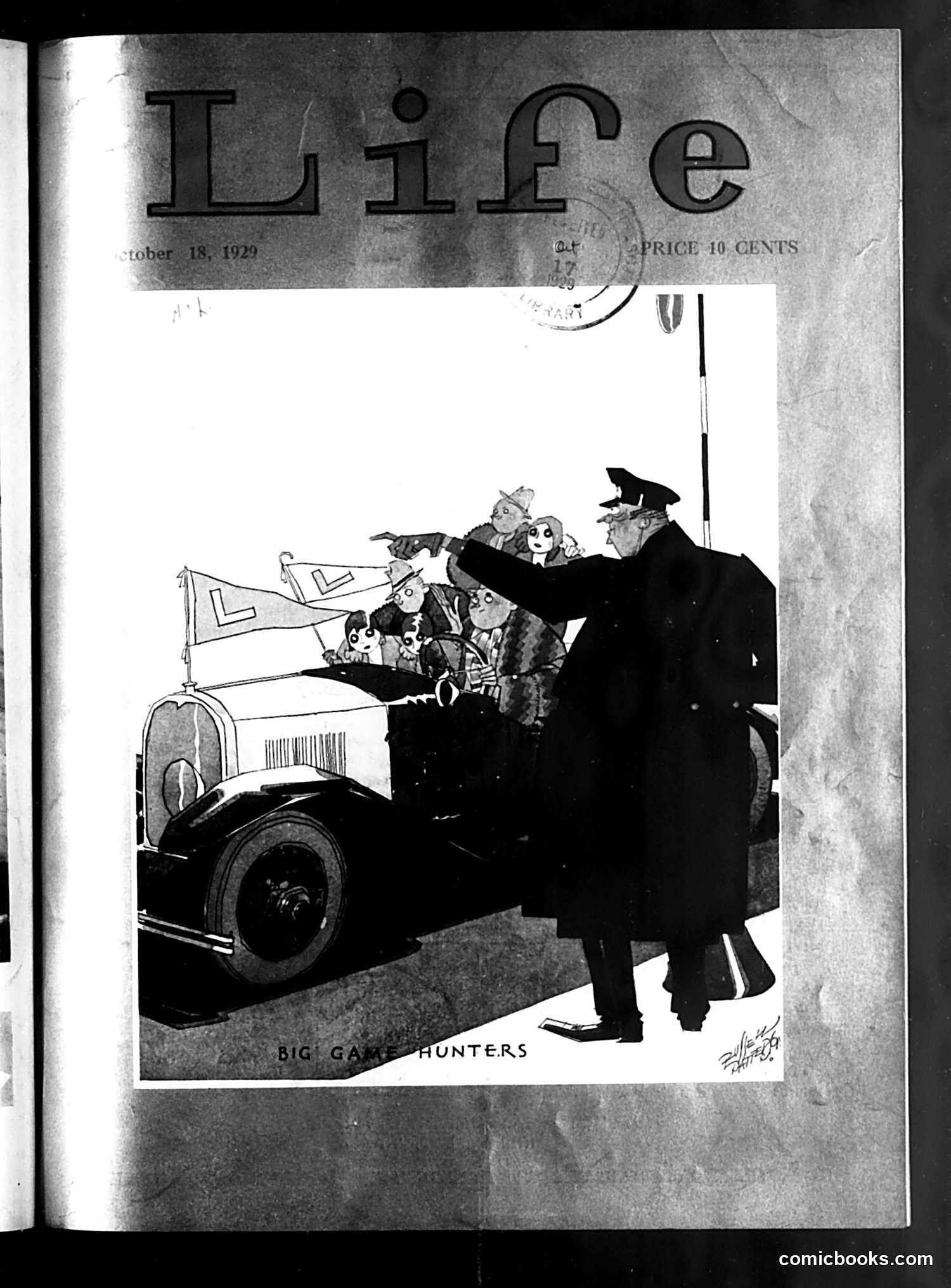
"Big Game Hunters" - Life Magazine, October 18, 1929 This cartoon satirizes wealthy individuals as "big game hunters" pursuing motorcar excursions. A well-dressed man in formal attire points commandingly while directing a group of fashionably-dressed passengers packed into an open automobile displaying a flag marked with what appears to be a hunting symbol. The satire likely mocks the leisure pursuits and conspicuous consumption of the wealthy during the prosperous 1920s. The "hunt" metaphor transforms a casual automobile outing into a grand expedition, humorously inflating the self-importance of the passengers. The crowded vehicle and formal hunting aesthetic suggest ironic commentary on how the wealthy dramatized or celebrated their recreational activities and social status through motorcar culture—a relatively new and prestigious form of entertainment in this era.
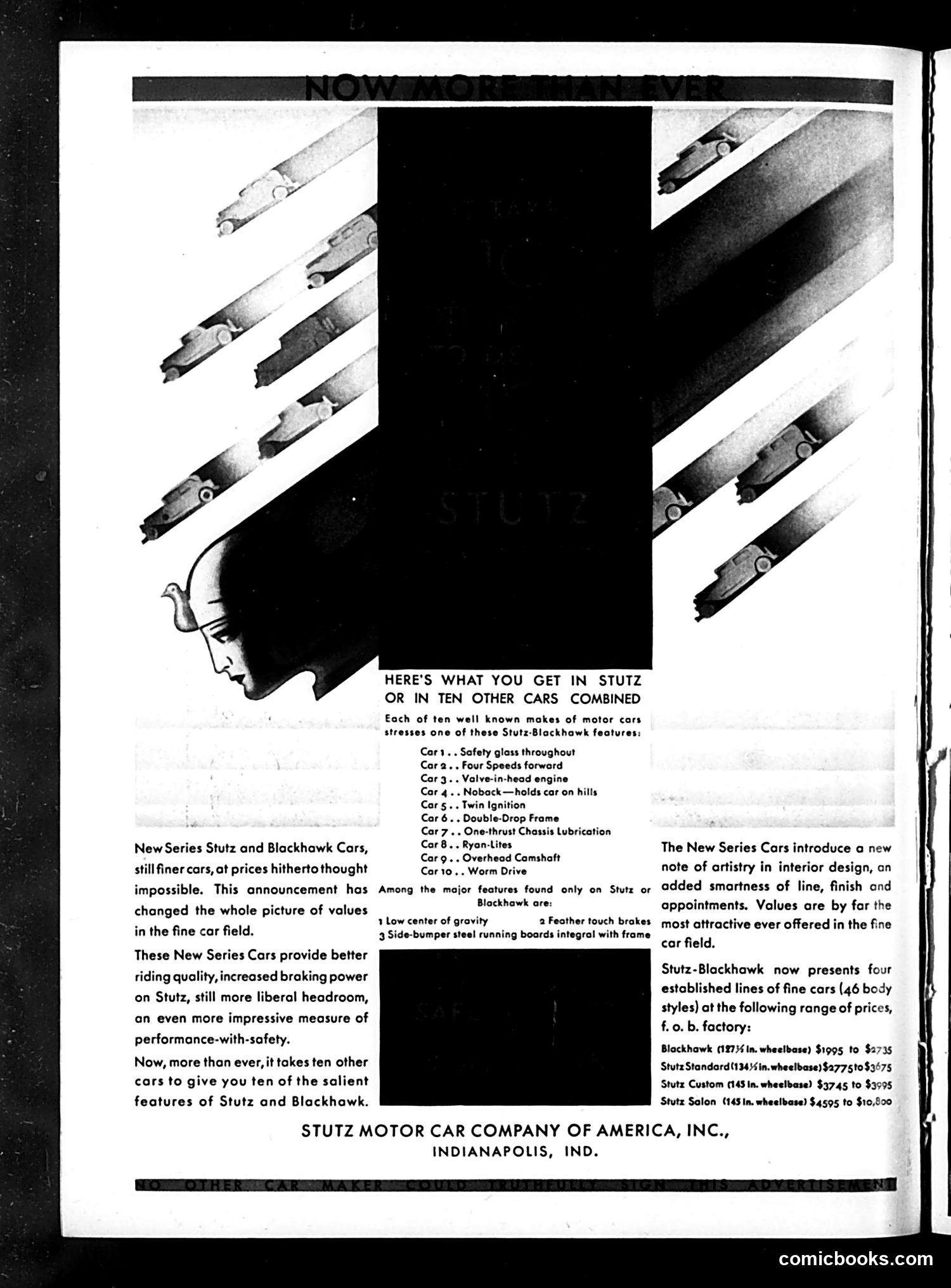
Analysis This page is advertising, not satire or political commentary. It's a full-page advertisement for Stutz and Blackhawk automobiles from the Stutz Motor Car Company of Indianapolis. The visual elements—a silhouetted head on the left and what appear to be car components or features arranged around it—serve as marketing graphics to illustrate the advertisement's central claim: that Stutz and Blackhawk cars combine ten desirable features that competitors offer separately. The text lists ten features (safety glass, four speeds forward, valve-in-head engine, etc.) found in competing vehicles, arguing that Stutz and Blackhawk uniquely bundle all these advantages together, plus three exclusive features (low center of gravity, feather-touch brakes, integrated running boards). The page concludes with pricing for four model lines ranging from $1,995 to $10,600. This is straightforward automotive marketing copy aimed at luxury car buyers, with no satirical intent.
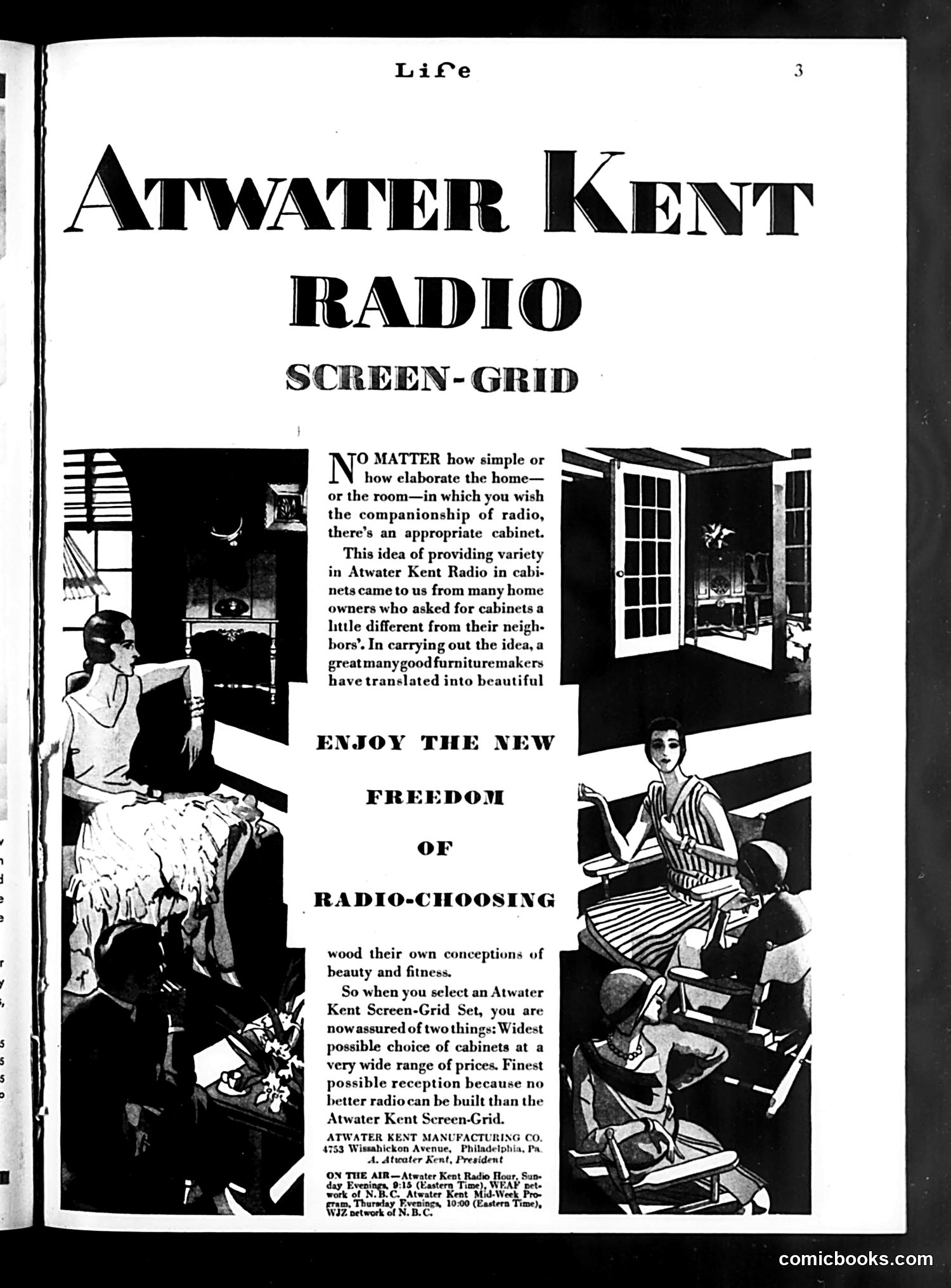
Analysis This is primarily a product advertisement for Atwater Kent Radio's "Screen-Grid" models, not a political cartoon. The page markets radio cabinets by emphasizing consumer choice and personalization. Two illustrated scenes show women in domestic settings enjoying radios in different cabinet styles—one simple, one more elaborate. The ad copy promises "the new freedom of radio-choosing," appealing to homeowners who want cabinets that distinguish their homes from neighbors'. The "satire" angle (if any) is gentle: the ad gently mocks conformity by suggesting Atwater Kent offers individuality through furniture styling options, while implicitly acknowledging that radio ownership itself was becoming standardized and expected in American homes during this era. The broader context: this reflects 1920s-30s radio's explosive popularity and the emerging consumer culture around personalized home furnishings. The ad targets middle-class women as domestic decision-makers.
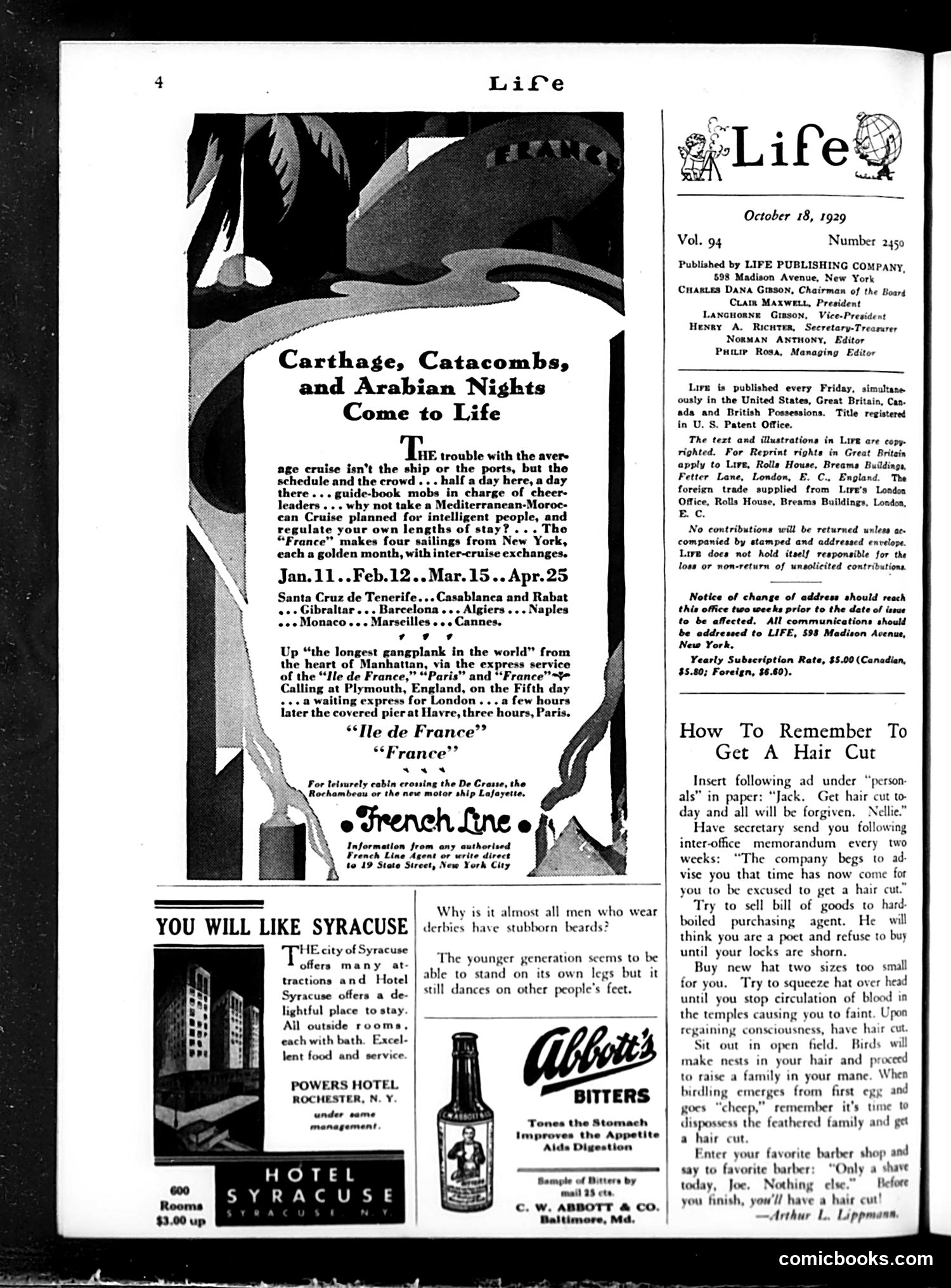
Life Magazine, October 18, 1929 This is primarily a travel advertisement page, not a political cartoon. The main content advertises Mediterranean cruise lines—the French Line's "Ile de France," "Paris," and "France" ships—promoting itineraries from New York to ports including Casablanca, Naples, and Marseilles. The page also includes: - Hotel advertisements for Syracuse and Rochester - Abbott's Bitters (a digestive tonic), a common patent medicine advertisement - A humorous advice column titled "How To Remember To Get A Hair Cut," satirizing office bureaucracy and modern efficiency—playing on the period's obsession with business systems and memo culture by suggesting absurdly complicated methods to remind employees about basic grooming. The humor targets corporate rigidity and the era's tendency to over-systematize everyday life. There are no political cartoons or major historical references visible on this page.
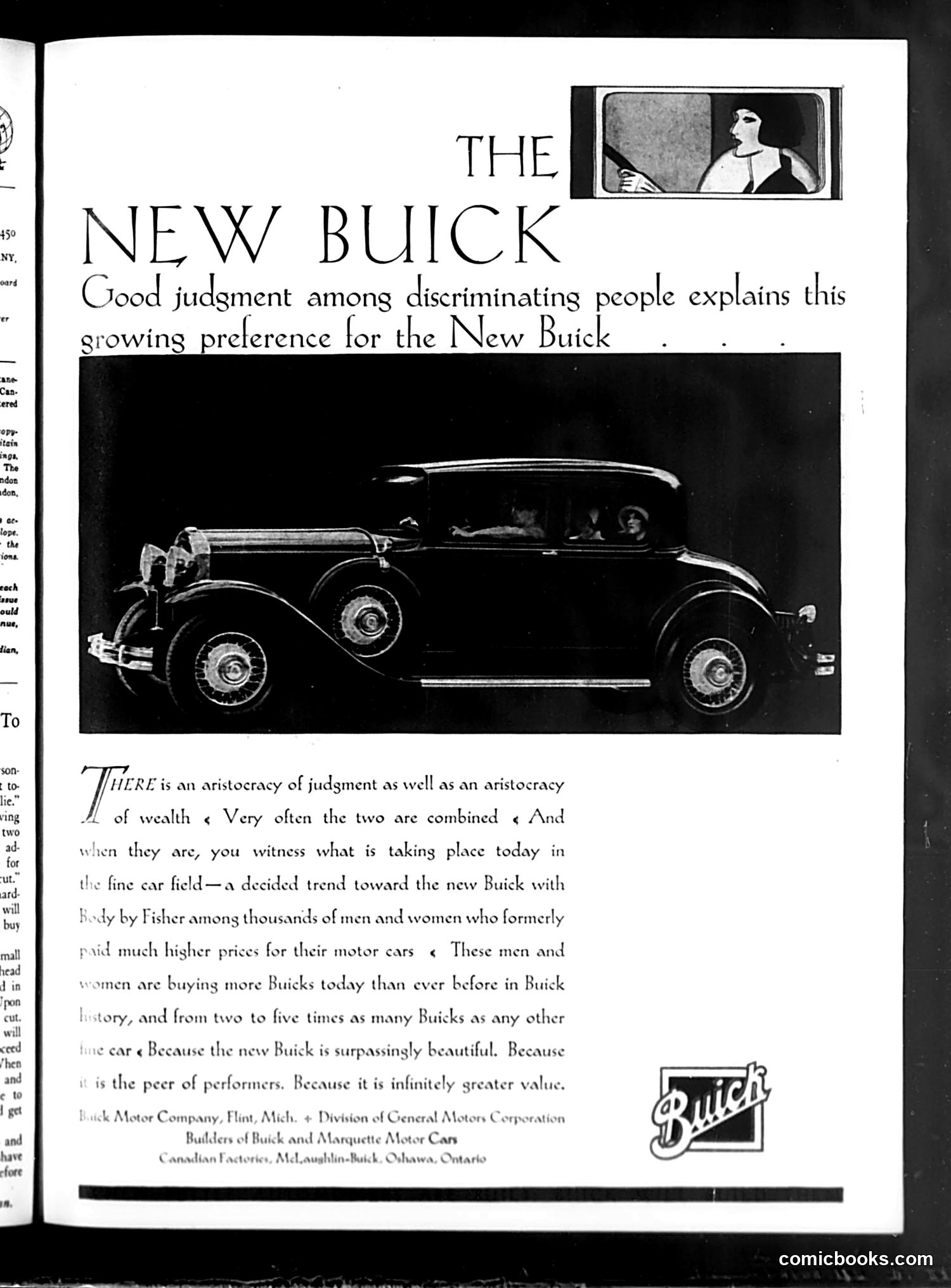
Advertisement Analysis This is not a political cartoon but a Buick automobile advertisement from Life magazine's early period (likely 1920s based on styling and design). The ad employs a social class appeal: it claims that "discriminating people" and those with "good judgment" are switching to the New Buick—specifically, wealthy individuals who "formerly paid much higher prices for their motor cars." The messaging suggests that buying a Buick is a mark of refined taste and wisdom, not merely wealth. The illustration shows a sleek, side-profile view of the automobile to emphasize its contemporary design. The small illustration at top depicts an elegant woman, reinforcing aspirational, upper-class appeal. This represents early automotive marketing strategy: positioning a mid-range car as the choice of the sophisticated and discerning, rather than emphasizing affordability. The irony (likely unintended by the advertiser) is that it flatters buyers for choosing a *less* expensive car by associating it with aristocratic judgment.