life
Life — October 18, 1929
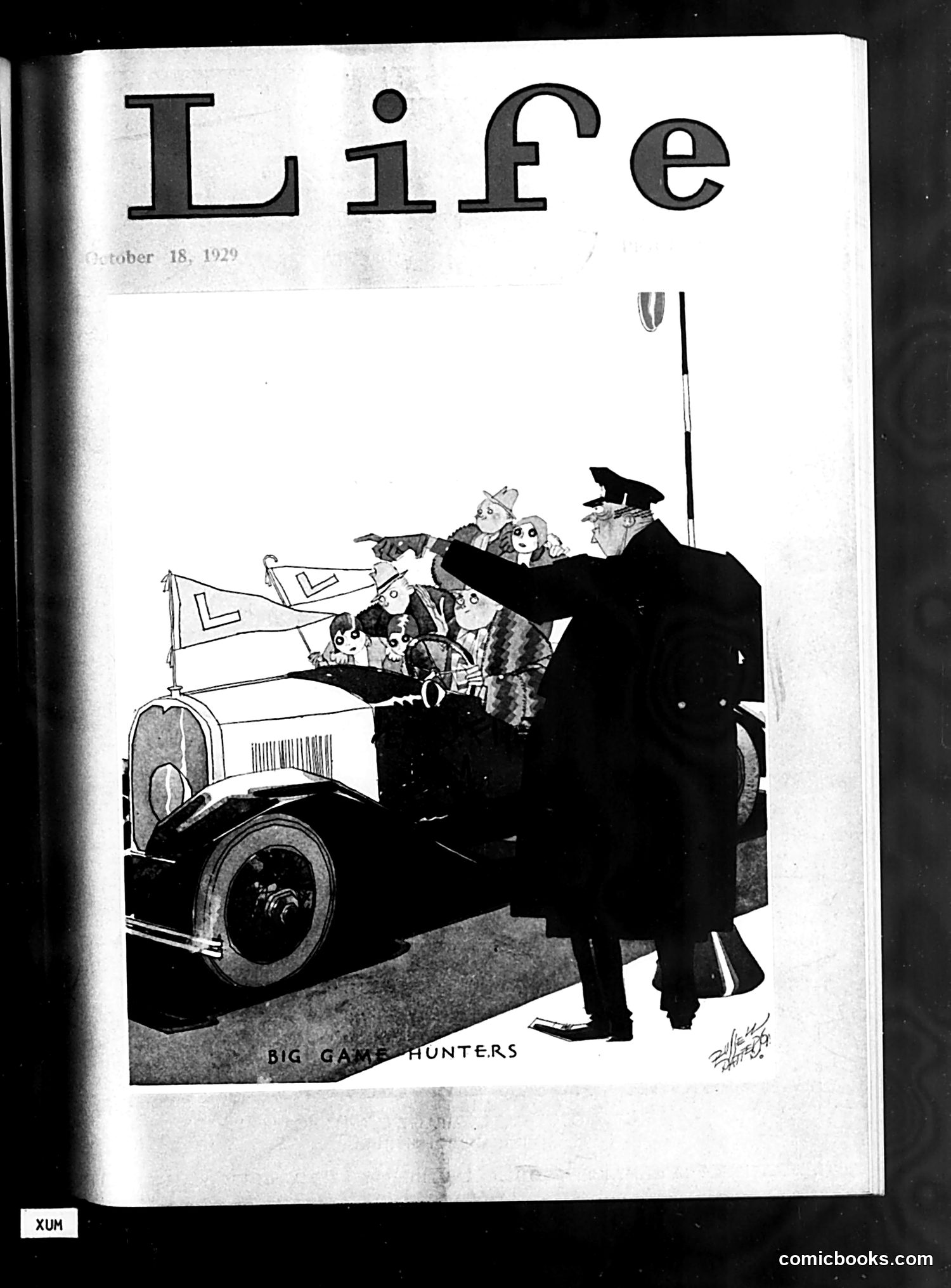
"Big Game Hunters" — Life Magazine, October 18, 1929 This cartoon satirizes wealthy individuals portrayed as "big game hunters." The illustration shows an elegantly dressed man in a coat and cap pointing authoritatively while several fashionably dressed people (appearing to be his family or associates) sit in an open-air automobile decorated with hunting flags bearing the letter "L." The satire likely mocks the pretensions of the wealthy during the immediate aftermath of the 1929 stock market crash (Black Tuesday occurred October 24, 1929—just days after this publication). The "hunting" metaphor suggests these privileged figures are still pursuing leisure and sport despite economic catastrophe unfolding around them, highlighting their disconnection from the financial devastation affecting ordinary Americans.
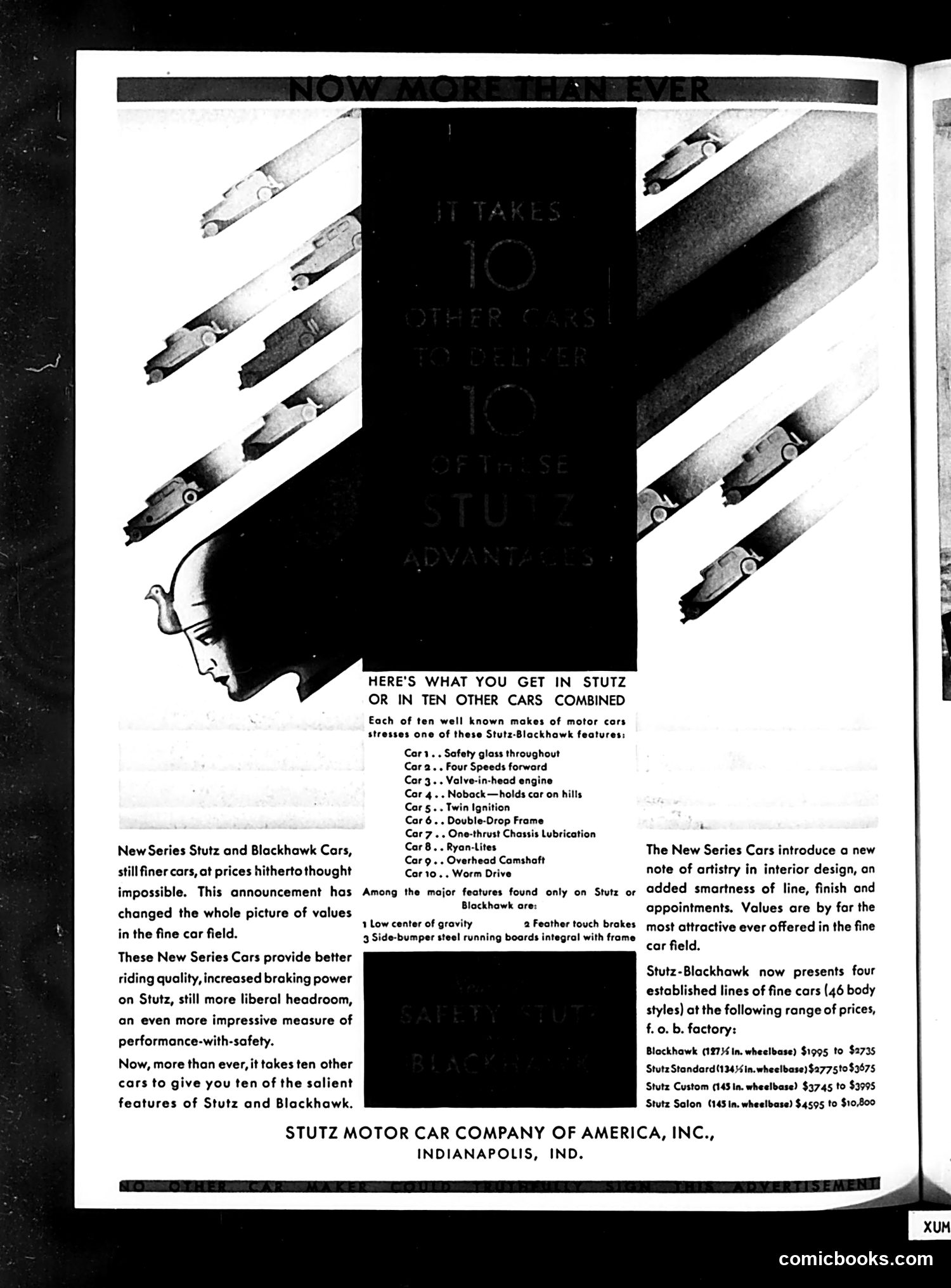
Analysis This is not a political cartoon or satire—it's a straightforward automobile advertisement for Stutz and Blackhawk motor cars from the Stutz Motor Car Company of Indianapolis. The page features: - Visual element: Stylized illustrations of car engines/mechanical components arranged around a silhouetted profile of a man's head, suggesting mechanical superiority or engineering prowess - Marketing message: Claims these "New Series" cars offer luxury ("finer cars") at previously impossible prices, emphasizing ten key mechanical features that rival ten competing vehicles combined - Product lines: Four models listed with prices ranging from $1,595 to $10,800 The "profile" design is purely decorative—not a caricature of any specific person. This is typical 1920s-30s automotive advertising emphasizing technical innovation and value proposition.
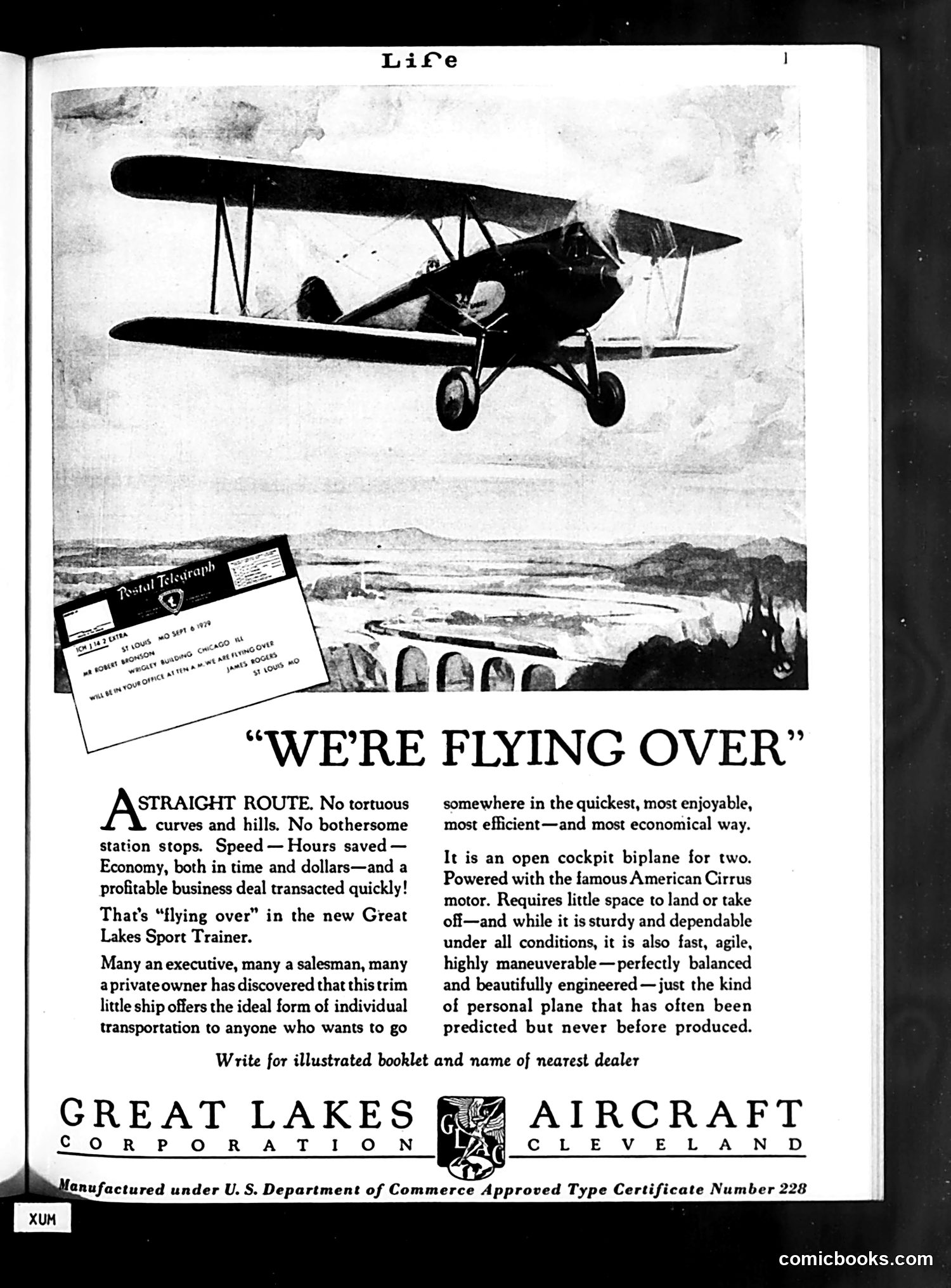
Analysis This is not a political cartoon or satire—it's a straightforward advertisement for the Great Lakes Sport Trainer aircraft, published in *Life* magazine. The page promotes a biplane designed for personal aviation. The ad emphasizes practical benefits: direct routing, speed, fuel economy, and time savings compared to ground transportation. It highlights the aircraft's features—open cockpit for two, American Cirrus motor, easy takeoff/landing requirements, and maneuverability. The "Postal Telegraph" label visible in the image appears to be a newspaper clipping element, possibly suggesting the plane's utility for urgent business communication. This represents early-1920s optimism about private aviation as accessible personal transportation, before such aircraft became impractical for most Americans.
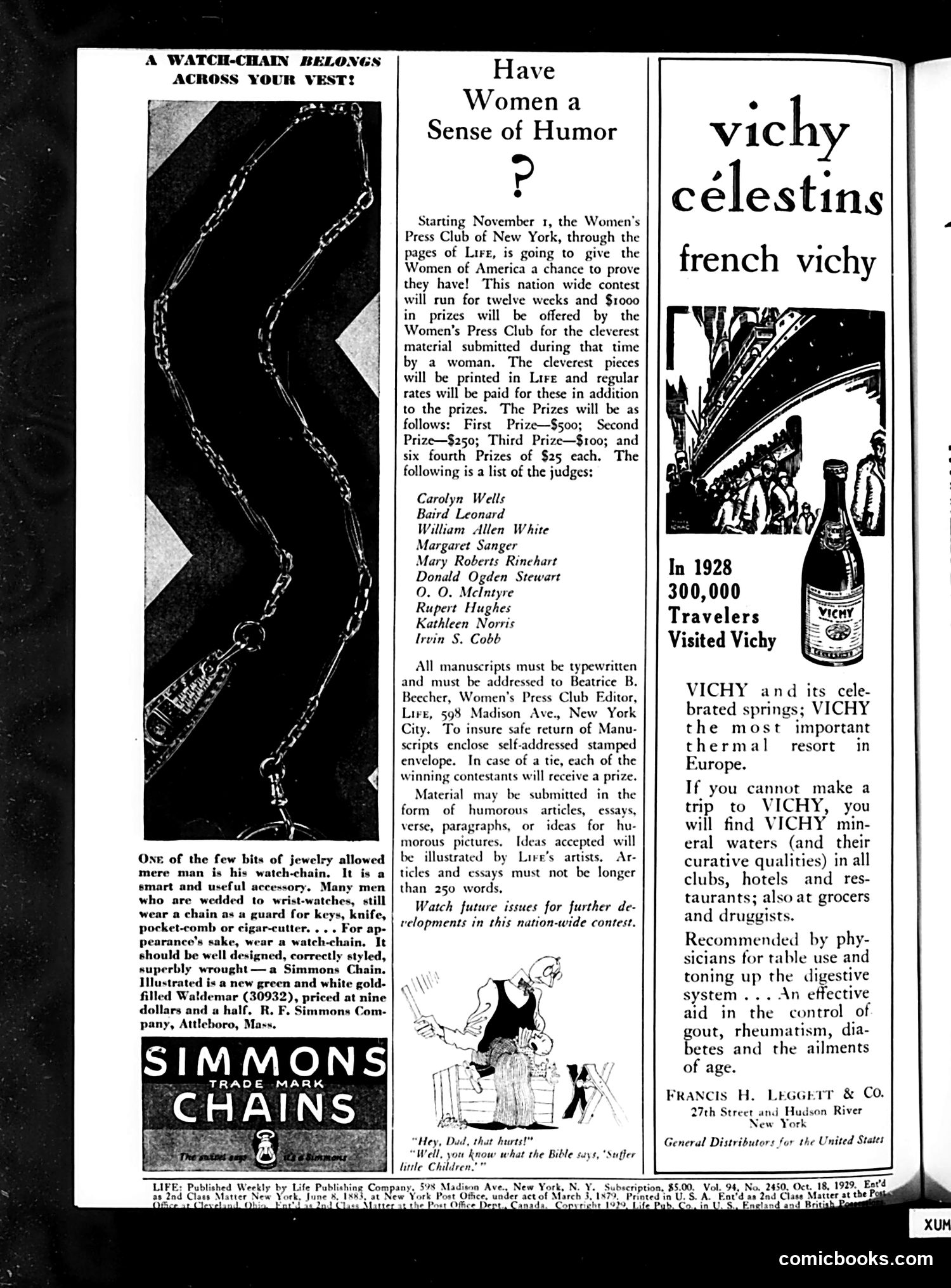
Page Analysis This page is primarily advertising and contest announcements rather than political satire. The main content includes: 1. Simmons Trade Park watch-chains (left): A jewelry advertisement emphasizing that watch-chains are appropriate masculine accessories, illustrated with an elegant chain design. 2. Women's humor contest (center): The Women's Press Club of New York is running a 12-week competition asking women to submit humorous material, with $1000 in prizes. The small cartoon at bottom ("Hey, that hurts!") appears to be an example of the type of humor sought. 3. Vichy advertisement (right): Promoting the French mineral water brand as a health tonic, noting 300,000 travelers visited Vichy in 1928. The page reflects 1920s consumer culture and women's growing participation in public discourse through organized clubs and contests.
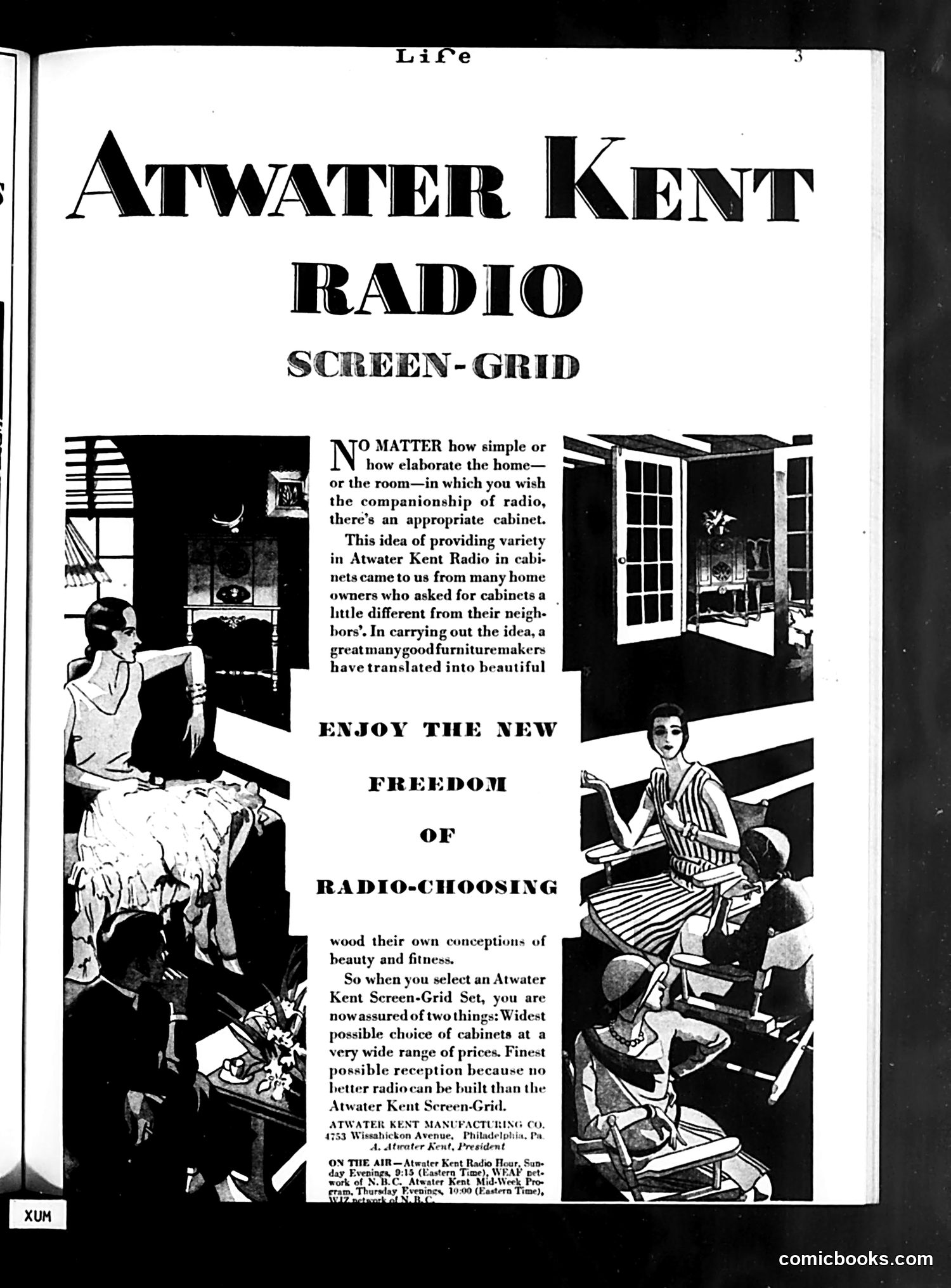
Analysis This is primarily advertising copy, not satire or political commentary. It's a product advertisement for Atwater Kent Radio Screen-Grid sets, published in *Life* magazine. The page promotes radio cabinets designed to complement various home décors. The illustrated figures (a woman at left, another at right) are generic lifestyle imagery showing consumers enjoying radio in domestic settings—not specific caricatures or political figures. The "sales pitch" emphasizes consumer choice: buyers can select from multiple cabinet styles and price points while receiving superior radio reception from Atwater Kent's technology. The phrase "new freedom of radio-choosing" is marketing language, not political satire. This reflects early 1920s-30s radio commercialization, when radios were luxury furniture items requiring attractive cabinetry for home display.
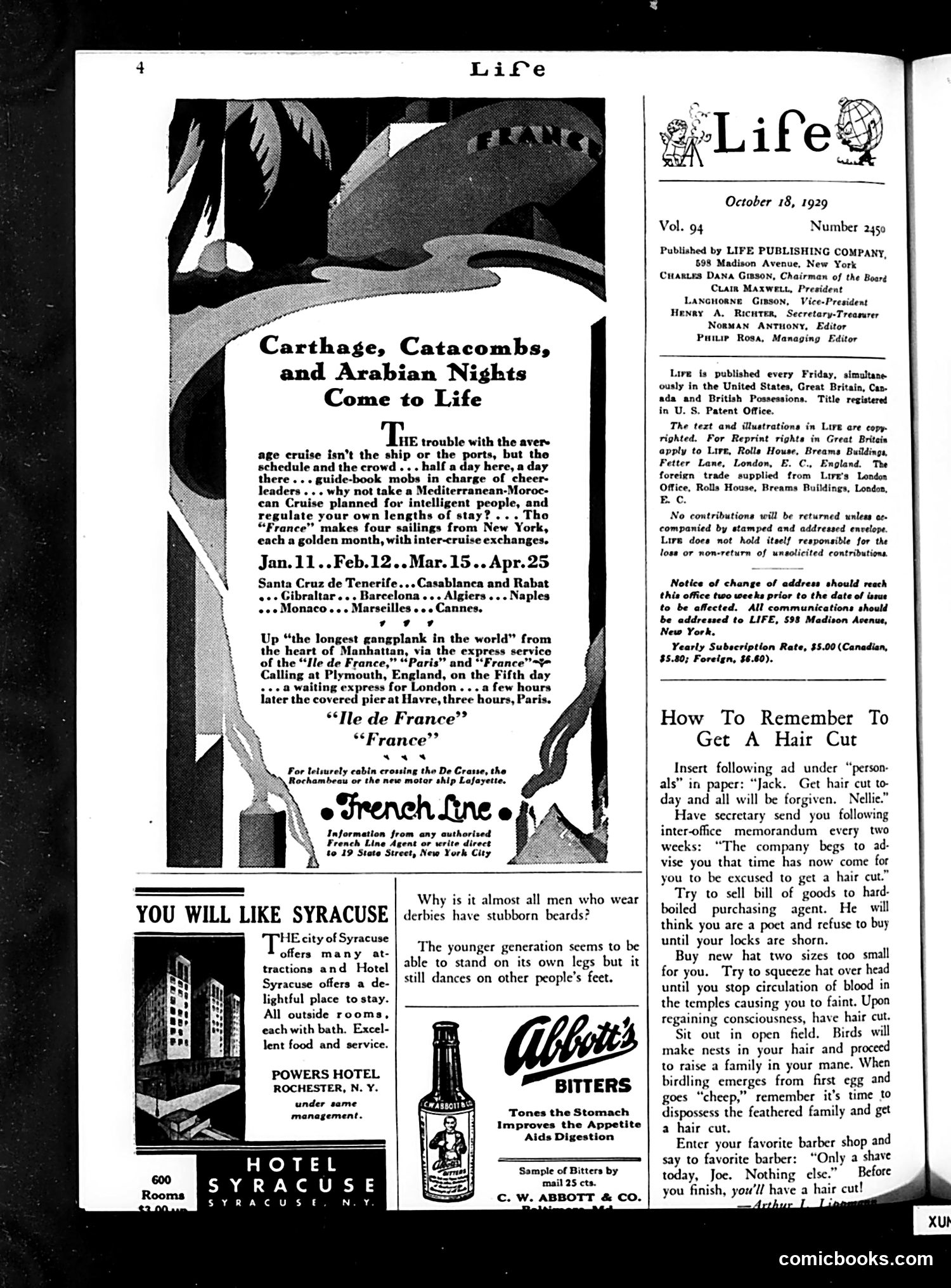
Analysis This page contains primarily advertisements with minimal editorial content. The main advertisement features a luxury cruise on the French Line, promoting Mediterranean travel to Carthage, Catacombs, and "Arabian Nights" destinations—appealing to wealthy American travelers seeking exotic experiences. The dates (Jan.11, Feb.12, etc.) advertise departure schedules. Secondary ads include the Powers Hotel in Rochester and Abbott's Bitters (a digestive tonic). The only potential satirical content is a brief humor piece titled "How To Remember To Get A Hair Cut," which employs absurdist comedy—suggesting increasingly ridiculous methods to remind oneself about haircuts (inserting office memos, squeezing the head until unconscious, etc.). This appears to be light-hearted domestic humor rather than political satire. The issue's date is October 18, 1929—notably just days before the stock market crash.
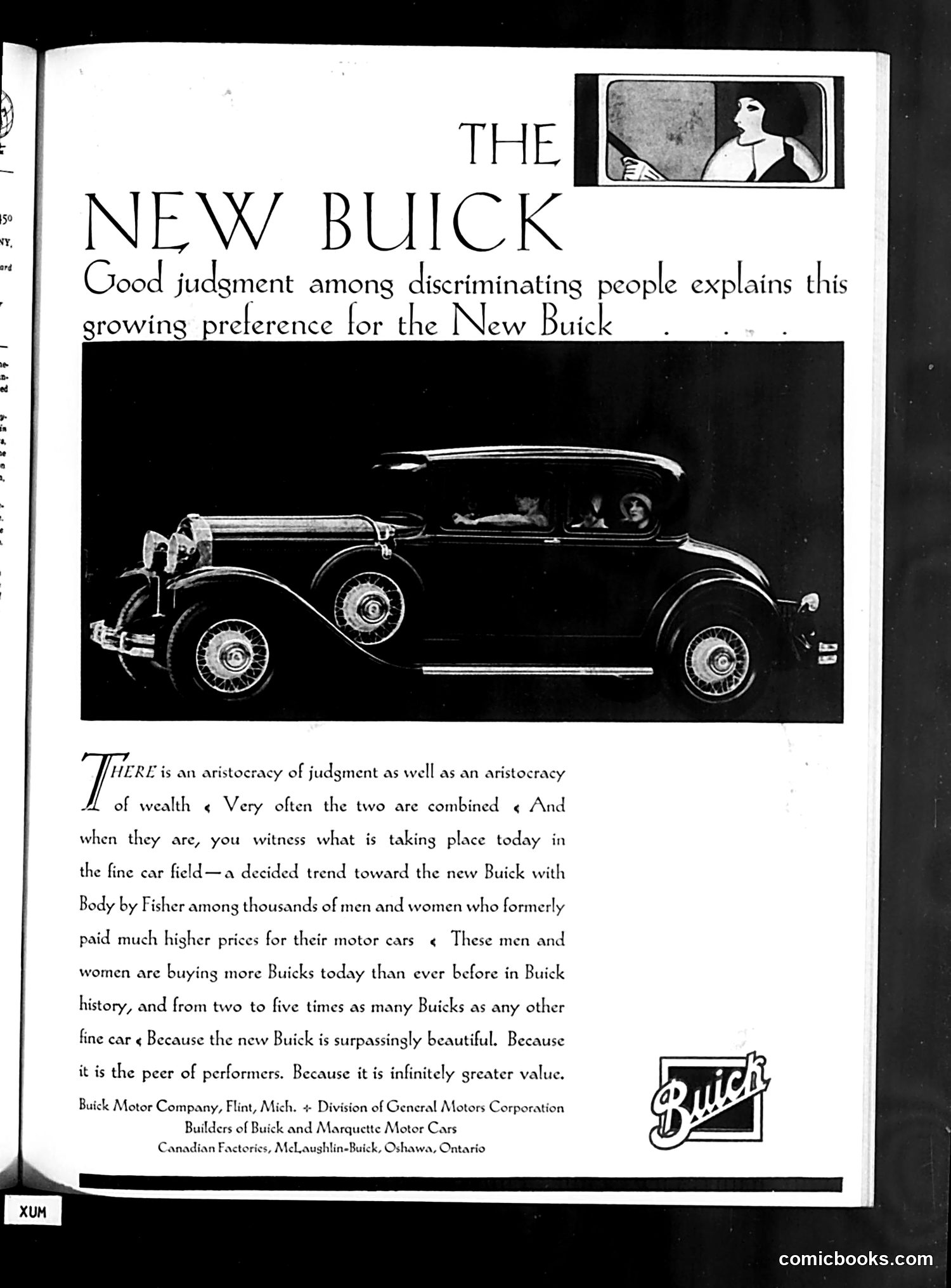
Analysis This is a Buick automobile advertisement, not a satirical cartoon. The page promotes "The New Buick" by appealing to wealthy, discriminating buyers. The ad's language reflects 1920s-30s class attitudes: it praises "an aristocracy of judgment as well as...wealth" and notes that wealthy people who once bought expensive foreign cars are now choosing Buick instead. The advertisement suggests that purchasing this car demonstrates refined taste and good judgment. The small illustration at the top right appears to show a well-dressed woman, reinforcing the car's association with luxury and sophistication. The large central image displays the automobile's sleek design against a dark background, emphasizing its aesthetic appeal. This represents period advertising that explicitly marketed products to elite consumers using language celebrating class distinction.
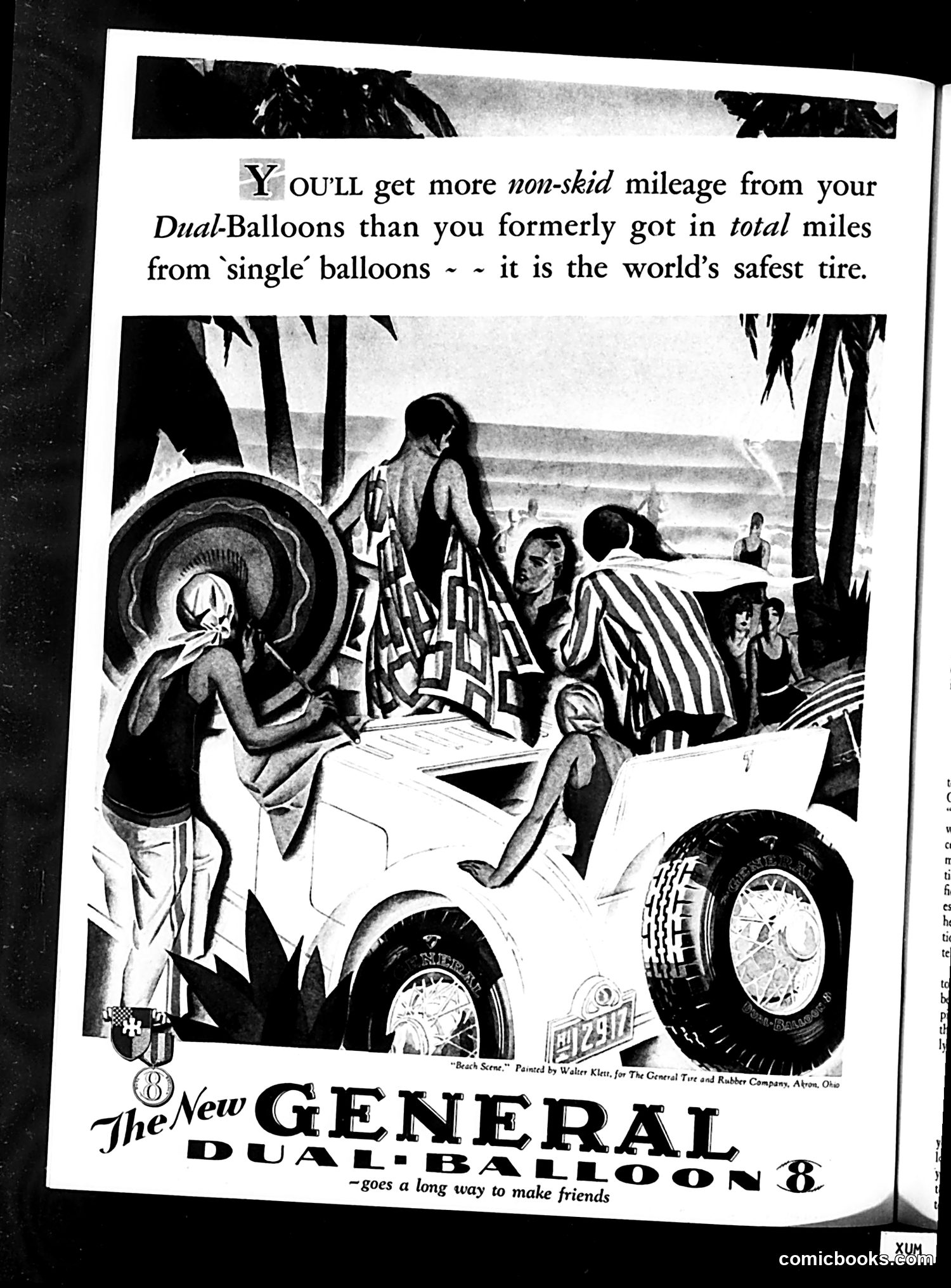
Analysis This is a vintage advertisement for General Dual-Balloon tires, not political satire. The ad claims Dual-Balloon tires deliver superior "non-skid mileage" compared to traditional single-balloon tires, marketing them as "the world's safest tire." The illustration depicts a beach scene with families enjoying leisure time near a parked car, emphasizing safety and reliability for family outings. The tagline "goes a long way to make friends" suggests that purchasing this tire brand signals good judgment to one's social circle. This reflects early-20th-century advertising strategy: associating consumer products with desirable lifestyles (leisure, family, safety) rather than emphasizing technical specifications alone. The "Dual-Balloon" technology appears to be a genuine tire innovation of that era.
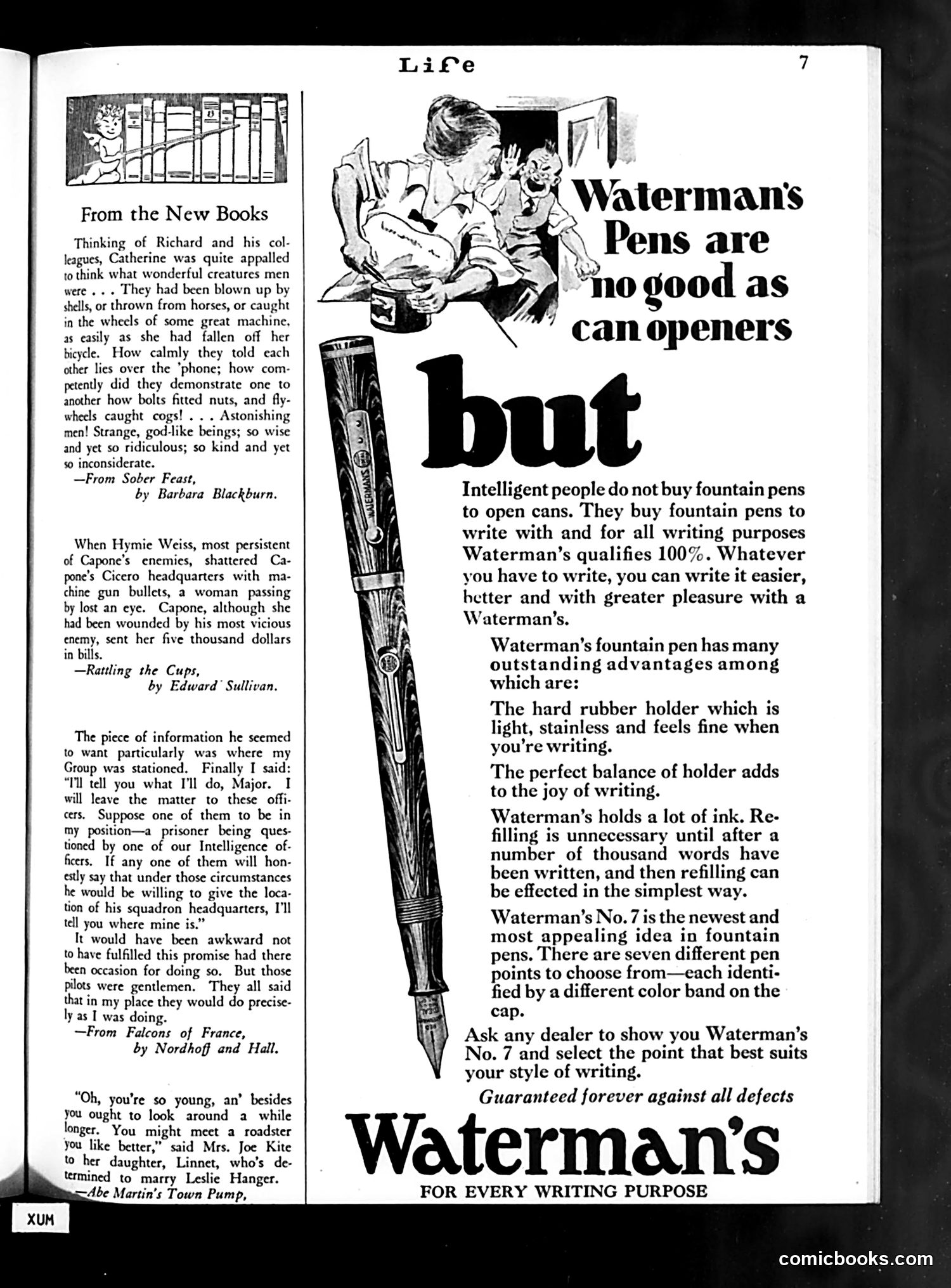
Analysis This page is primarily a Waterman's fountain pen advertisement (right side), not political content. The left side contains literary excerpts—"From the New Books"—quoting passages from novels including *Sober Feast* by Barbara Blackburn, *Rattling the Cups* by Edward Sullivan, and *Falcons of France* by Nordhoff and Hall. These are unrelated to satire or politics. The advertisement's humor is commercial rather than political: it satirizes the common misconception that fountain pens are merely tools for opening cans, arguing that "intelligent people" buy them for actual writing. The illustration shows someone attempting to use a pen as a can opener—a visual joke about misusing the product. This reflects early 20th-century advertising strategy: create humorous scenarios to highlight product superiority.
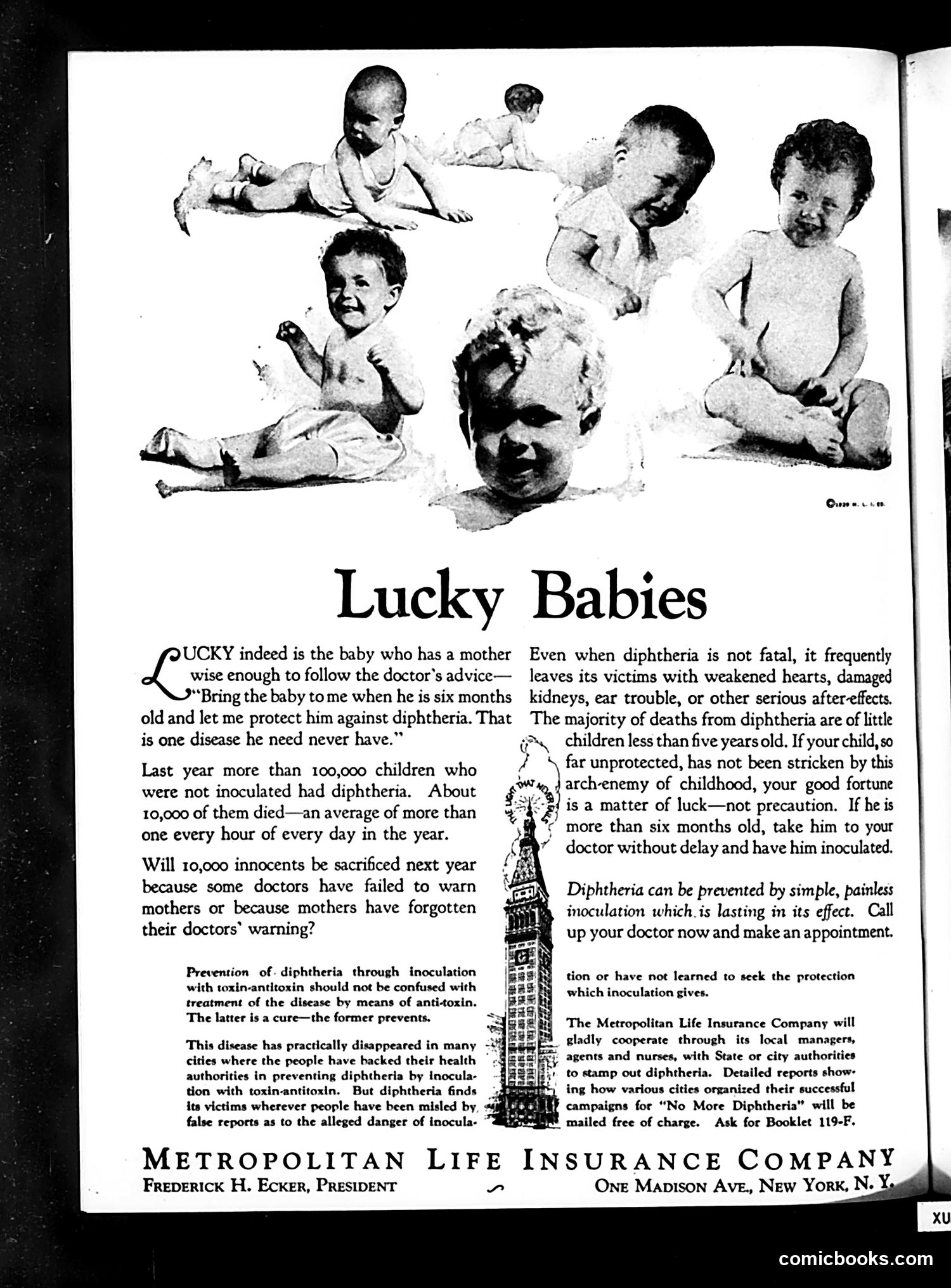
"Lucky Babies" - Metropolitan Life Insurance Advertisement This is a public health advertisement, not satire. Metropolitan Life Insurance Company sponsored this 1910s-era campaign promoting diphtheria inoculation for infants. The page presents six photographs of healthy babies to illustrate the concept of "luck"—arguing that babies who survive diphtheria without inoculation are merely fortunate, not protected by medical science. The text cites alarming statistics: over 100,000 uninoculated children contracted diphtheria annually, with roughly 10,000 deaths. The advertisement urges mothers to bring babies to doctors at six months for preventive inoculation, framing medical precaution as responsible parenting rather than optional. The Metropolitan Life company positioned itself as a public health advocate, offering free educational materials to normalize vaccination—a significant moment in early 20th-century American public health messaging.
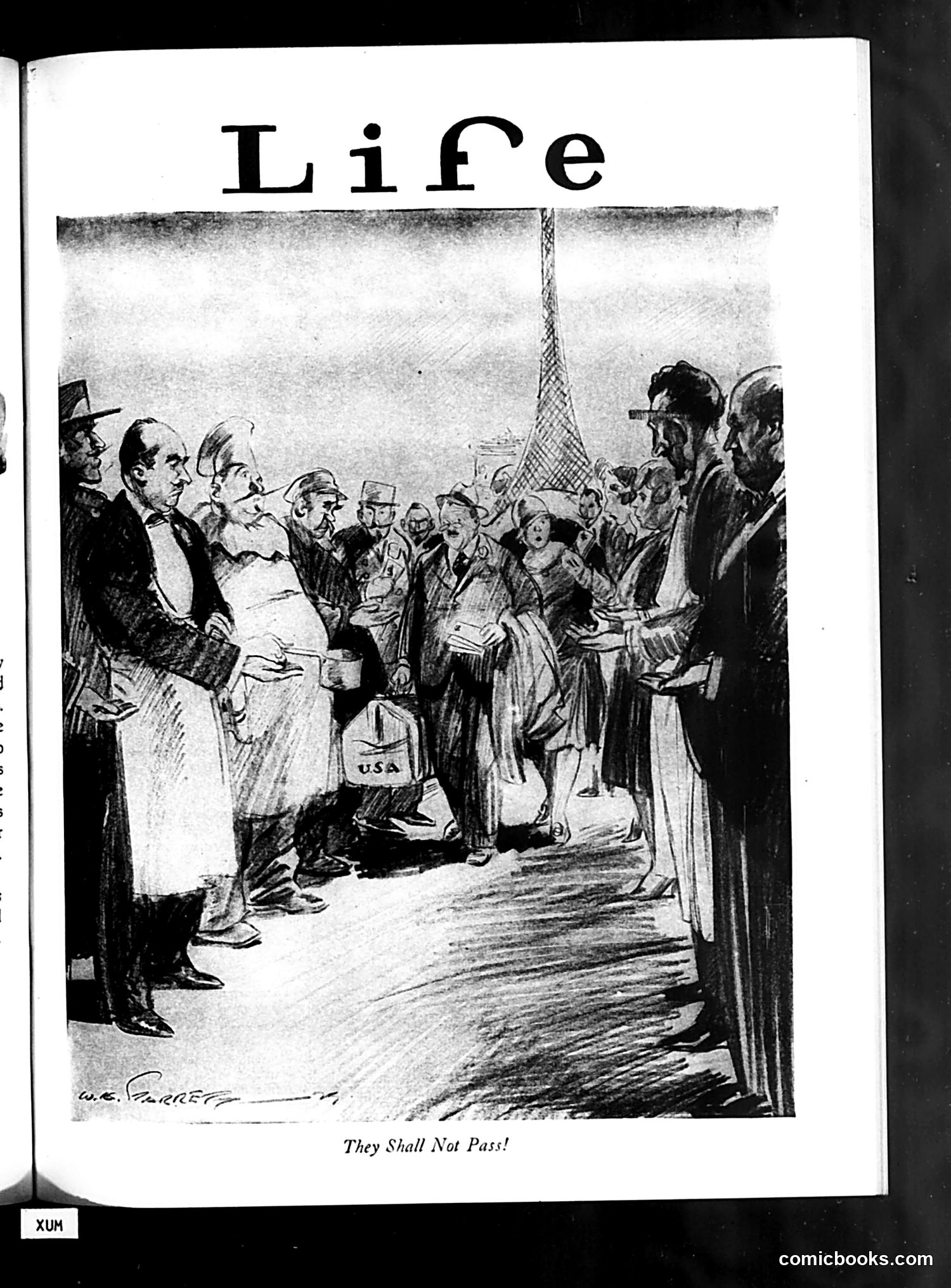
"They Shall Not Pass!" - Life Magazine Political Cartoon This editorial cartoon depicts immigration control at America's borders. A figure representing "USA" (marked on a bag) stands as a gatekeeper, blocking entry to a diverse crowd of immigrants and refugees. The title "They Shall Not Pass!" references the famous WWI phrase, comparing immigration restriction to military defense. The cartoon satirizes nativist immigration policy by framing newcomers as an invading force to be militarily repelled. The well-dressed official contrasts sharply with the depicted immigrants, emphasizing class and cultural divisions. The artist (signature visible but unclear) uses this comparison to critique the restrictionist sentiment of the era—likely from the 1920s-1930s period when strict immigration quotas were debated or implemented in America.
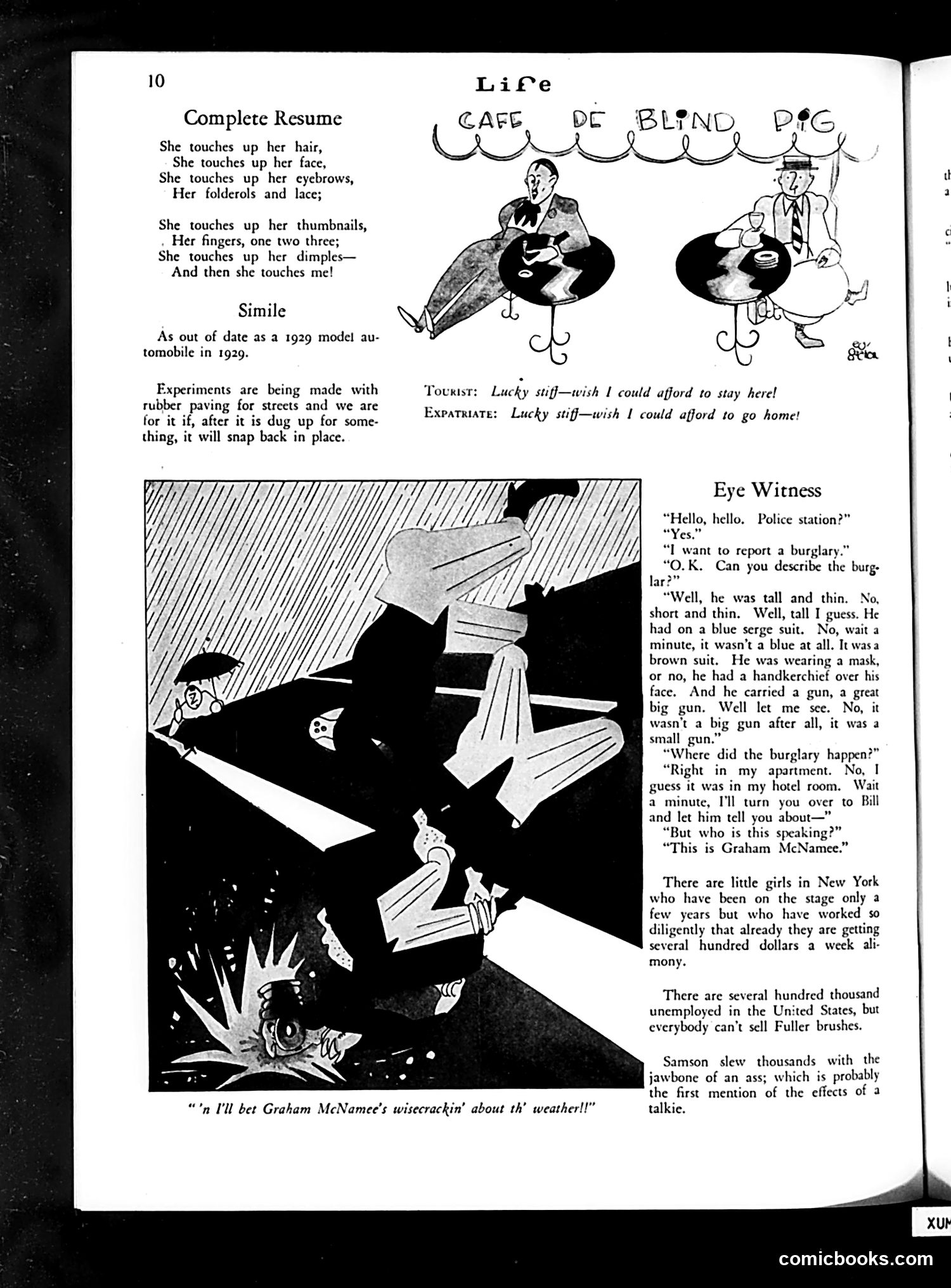
Analysis of Life Magazine Page This page contains three satirical pieces from Life magazine (a humor publication, not the photo magazine): 1. "Complete Resume" and "Simile": Light domestic humor about women's grooming routines and outdated cars. 2. "Café de Blind Pig" cartoon: Shows two men at a speakeasy during Prohibition, with one complaining he can't afford to stay while the other laments he can't afford to leave—satirizing the economic desperation of the Great Depression era. 3. "Eye Witness": A sketch of a police report involving a burglary, featuring detailed (and absurdly contradictory) descriptions from witness "Graham McName." This likely mocks radio reporters of the era known for overwrought, verbose commentary. The final paragraph references Samson's jawbone, connecting talkie (sound film) technology to biblical imagery—humor about early 1920s-30s innovation.
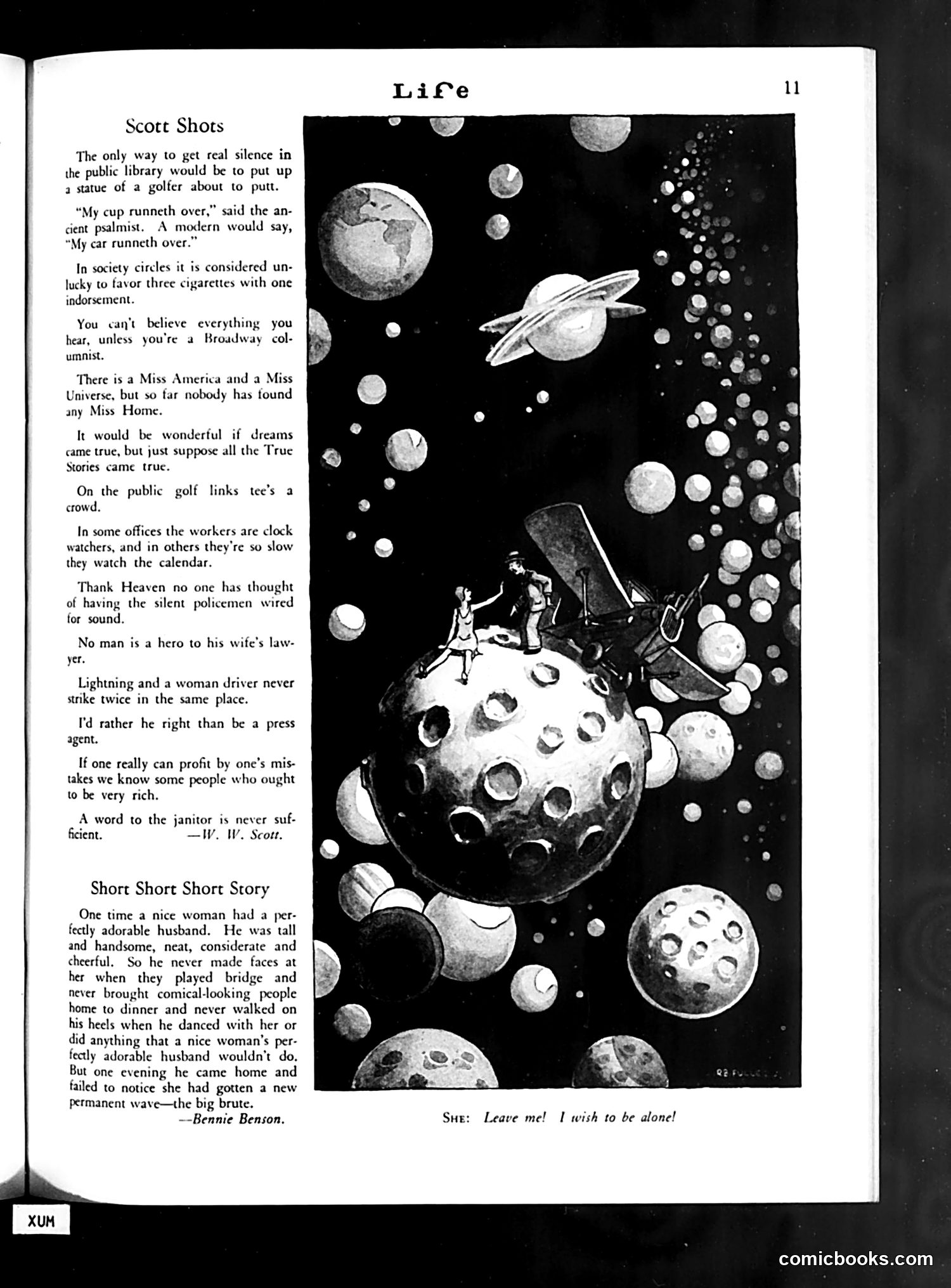
Analysis of Life Magazine Page 11 This page contains two distinct sections: a column of humorous observations titled "Scott Shots" by W.W. Scott, and below it a short story by Bennie Benson about a woman whose husband fails to notice she's gotten a permanent wave. The large illustration depicts a surreal space scene with a spacecraft and astronauts exploring a cratered lunar or planetary surface, surrounded by floating spheres. The caption reads "SHE: Leave me! I wish to be alone!"—a joke pairing the sci-fi fantasy with domestic marital discord. The satire juxtaposes cosmic exploration with relationship troubles, suggesting that even in futuristic scenarios, human relationship problems persist. The illustration's whimsical tone lightens what is essentially commentary on marital neglect and female frustration.
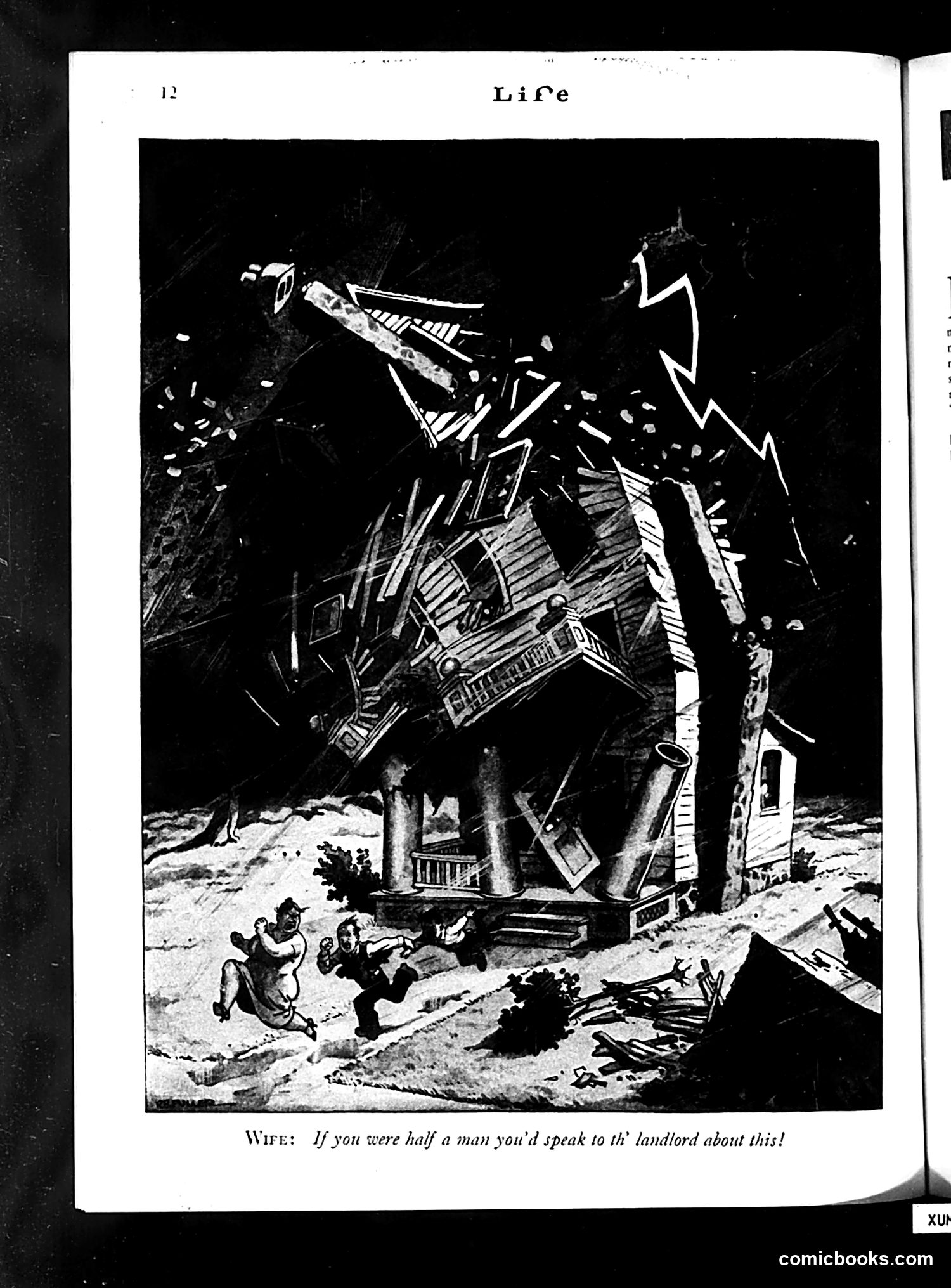
Analysis This is a single-panel cartoon depicting a domestic scene of marital discord. A severely dilapidated, collapsing house tilts precariously while a couple argues outside on sandy ground. The wife (labeled "WIFE" in the caption) admonishes her husband, saying: "If you were half a man you'd speak to th' landlord about this!" The humor satirizes working-class tenant housing conditions and gender dynamics of the era. The joke hinges on the wife's emasculating insult—implying her husband lacks courage to confront their landlord about the deplorable rental property. The crumbling structure itself visualizes their living conditions, while her taunt critiques his passivity regarding their circumstances. This reflects early-20th-century American concerns about tenement housing and landlord exploitation, common targets of *Life* magazine's social satire.
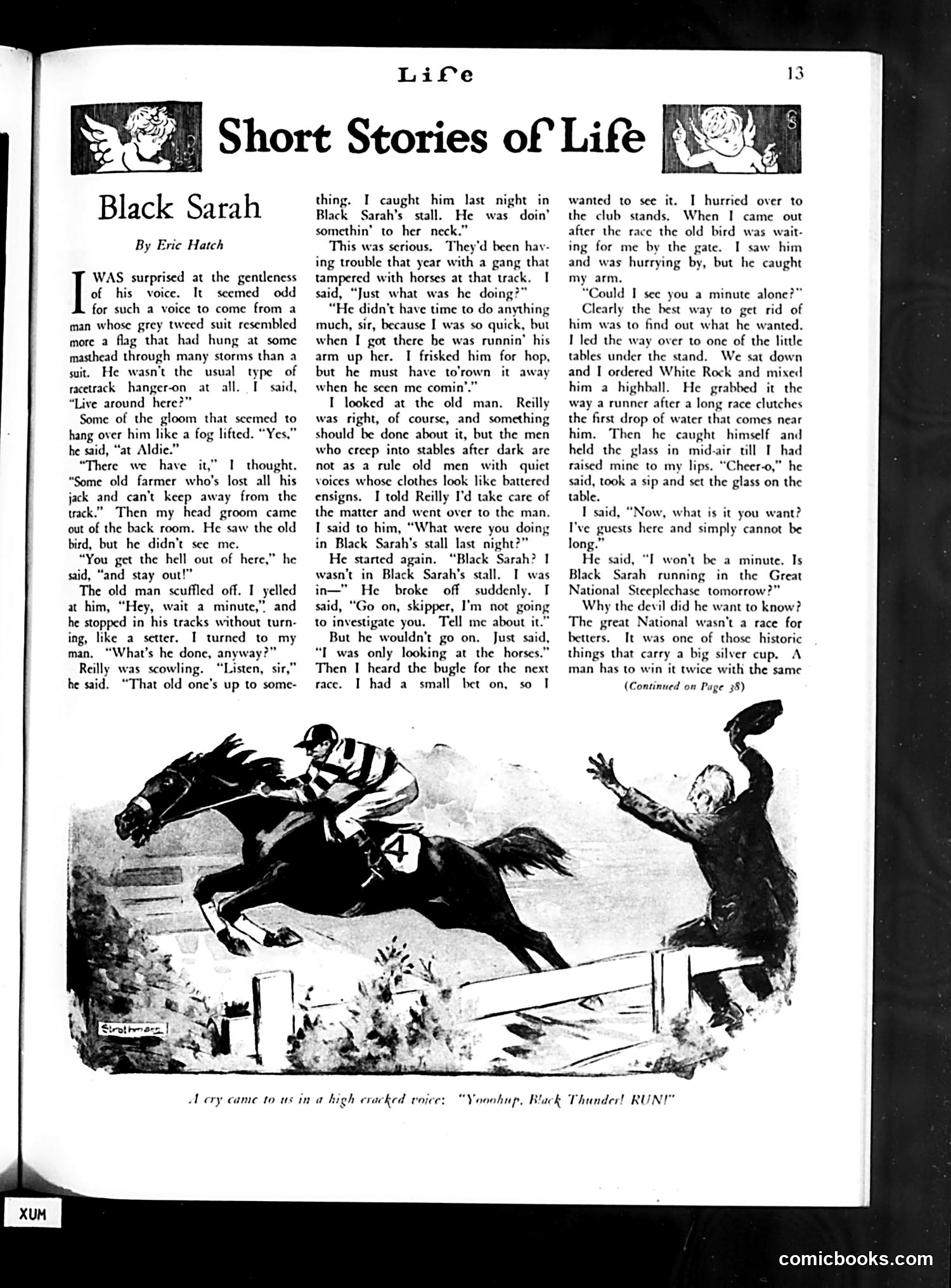
"Black Sarah" by Eric Hatch This is a short story (not political satire) about a horse race. The accompanying illustration shows a jockey on a horse numbered 4 jumping over a fence while someone on the right gestures excitedly. The story concerns an old man named Reilly who tends horses at a racing track. A young man arrives looking for a horse called "Black Sarah," which Reilly has hidden away. The narrative builds tension around whether Black Sarah will race in the National Steeplechase—a famous historic horse race requiring horses to jump obstacles. The illustration's caption reads: "A cry came to us in a high cracked voice: 'Yoohship, Black Thunder! RUN!'" This is fictional entertainment rather than social commentary or political satire.
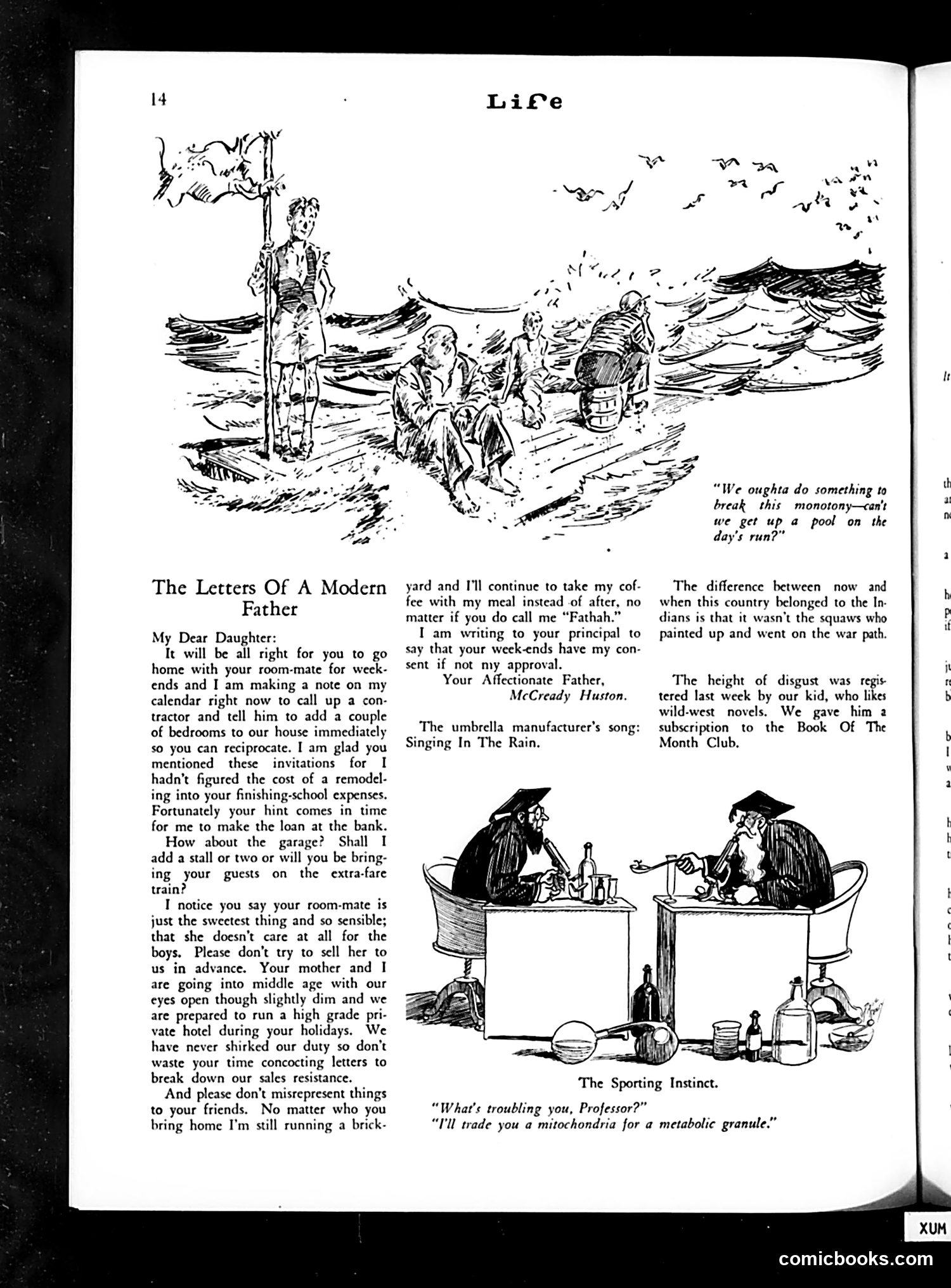
Analysis of Life Magazine Page 14 "The Letters Of A Modern Father" is a humorous letter from a father to his daughter about weekend visits home. The satire targets upper-middle-class anxieties: the father worries about expenses (bedrooms, finishing school), tries to appear progressive ("don't try to sell her to us in advance"), yet reveals his actual values—protecting the family's "brick-yard" business and sales resistance. The humor lies in the contradiction between his claimed modern thinking and his transparent self-interest. "The Sporting Instinct" cartoon depicts two academics in bathtubs conducting a scientific debate. The joke satirizes academic pretension: one professor trades "a mitochondria for a metabolic granule"—meaningless scientific jargon used to settle a trivial dispute. This mocks how scholars engage in heated intellectual combat over minute, often meaningless distinctions.
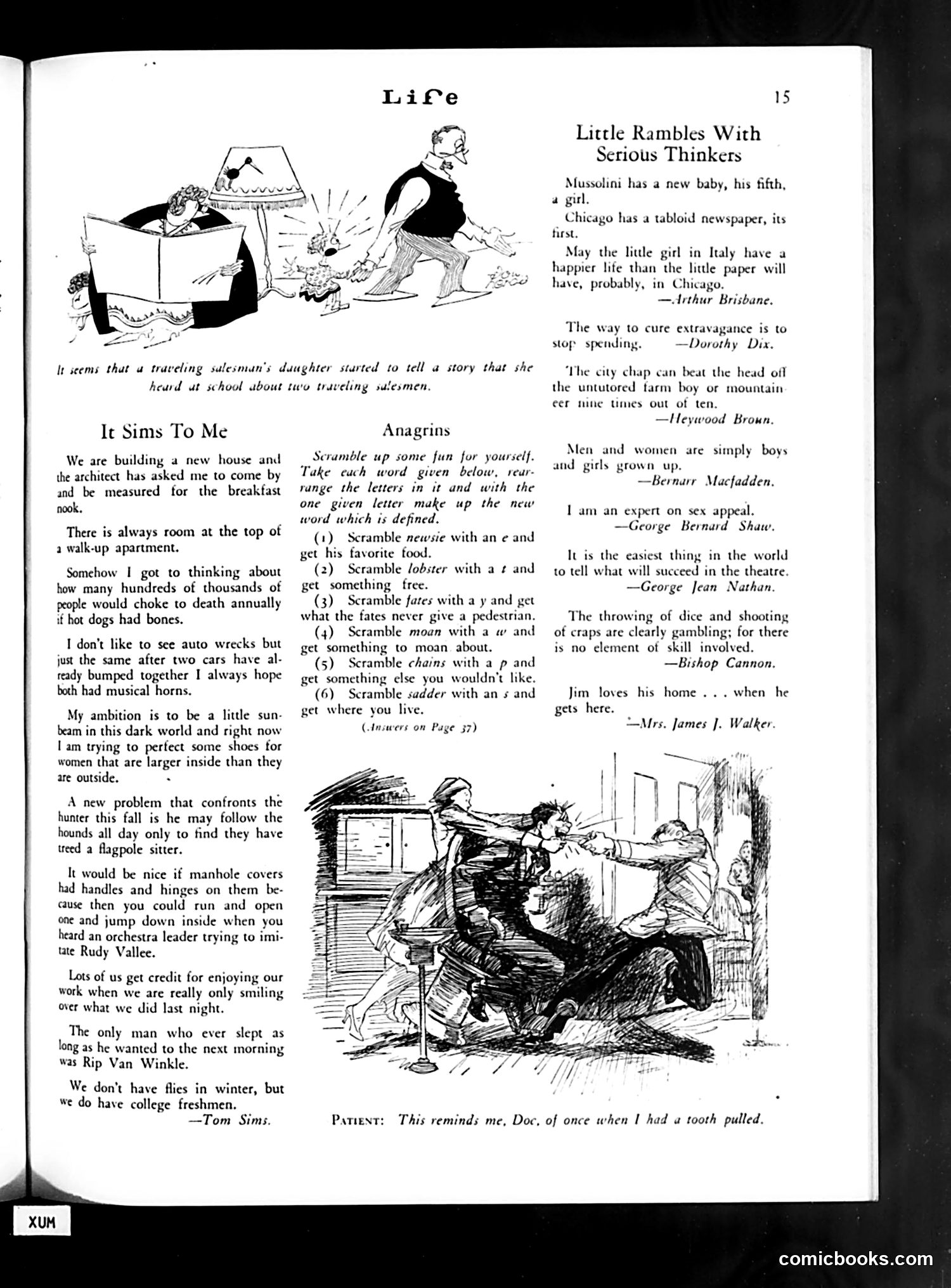
Analysis of Life Magazine Page 15 This page contains humorous editorial content rather than political cartoons. The top illustration shows a traveling salesman's daughter telling stories at school—a setup for the accompanying jokes and quips. The main sections include: - "It Sims to Me" by Tom Sims: Personal observations on building a house, auto wrecks, and sleeping habits (the Rip Van Winkle reference). - "Anagrins": Word puzzles where readers rearrange letters to form new words (e.g., "newbie" becomes "we bin"). - "Little Rambles With Serious Thinkers": Attributed quotes from various writers (Arthur Brisbane, Dorothy Dix, Heywood Broun) offering social commentary on topics like extravagance and gender relations. The bottom cartoon depicts a dentist and patient, with the patient's caption providing mild humor about tooth extraction.
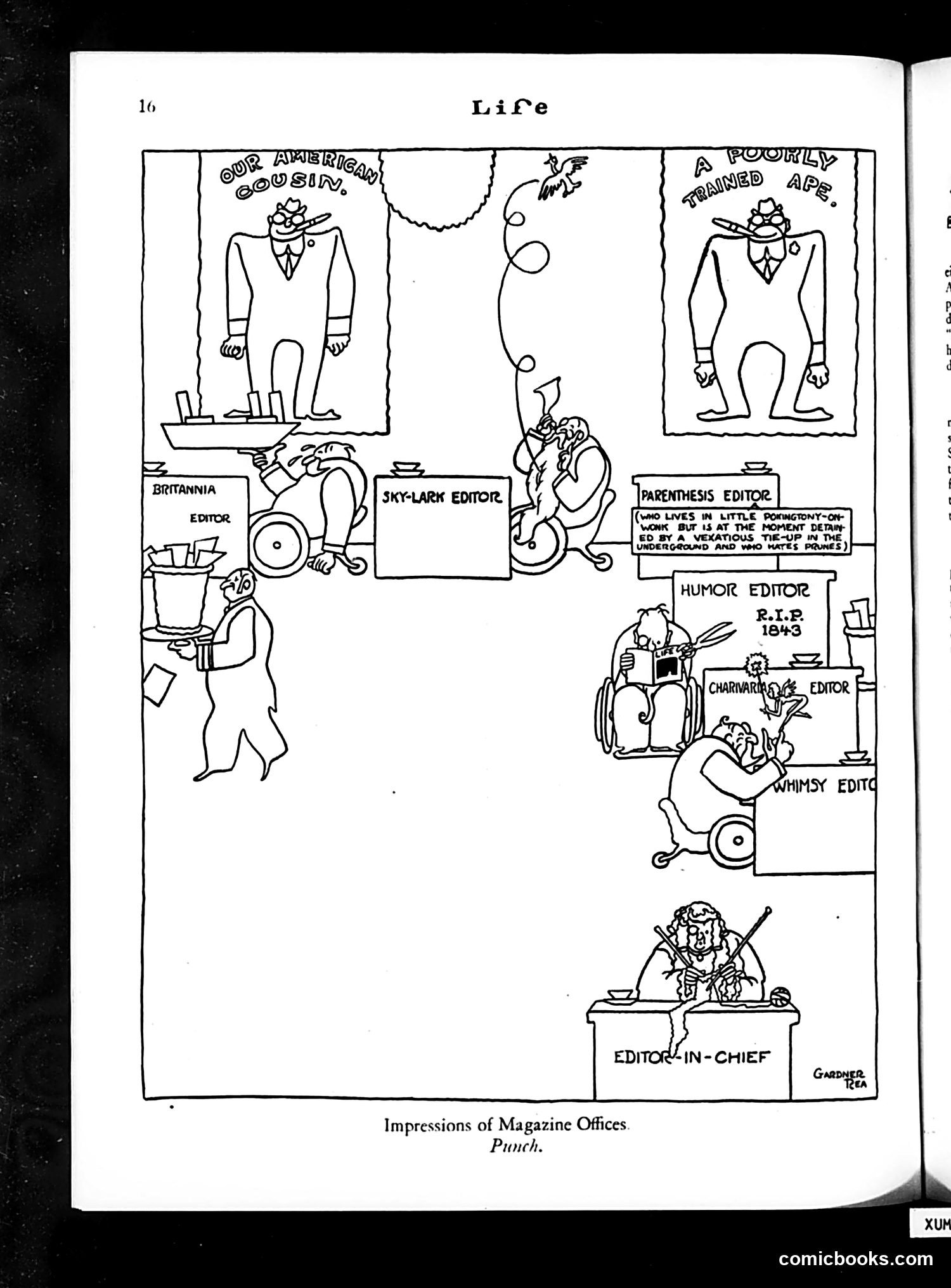
Magazine Office Satire from *Punch* This cartoon satirizes different editorial roles at a magazine office through exaggerated character types. It shows: - Britannia Editor: Depicted as a pompous, well-dressed figure representing the magazine's main editorial authority - Sky-Lark Editor: A bouncing, energetic character suggesting humor and levity sections - Parenthesis Editor: Described in text as managing obscure details in underground/basement work - Humor Editor: Marked "R.I.P. 1843," suggesting humor sections were considered dead or dying - Charnard & Whimsy Editors: Additional specialized roles for different content types - Editor-in-Chief: At bottom, overseeing all operations The satire mocks how magazines compartmentalize editorial functions into specialized, often ridiculous positions, with each editor physically struggling at their desks, suggesting the chaotic, exhausting nature of magazine production.
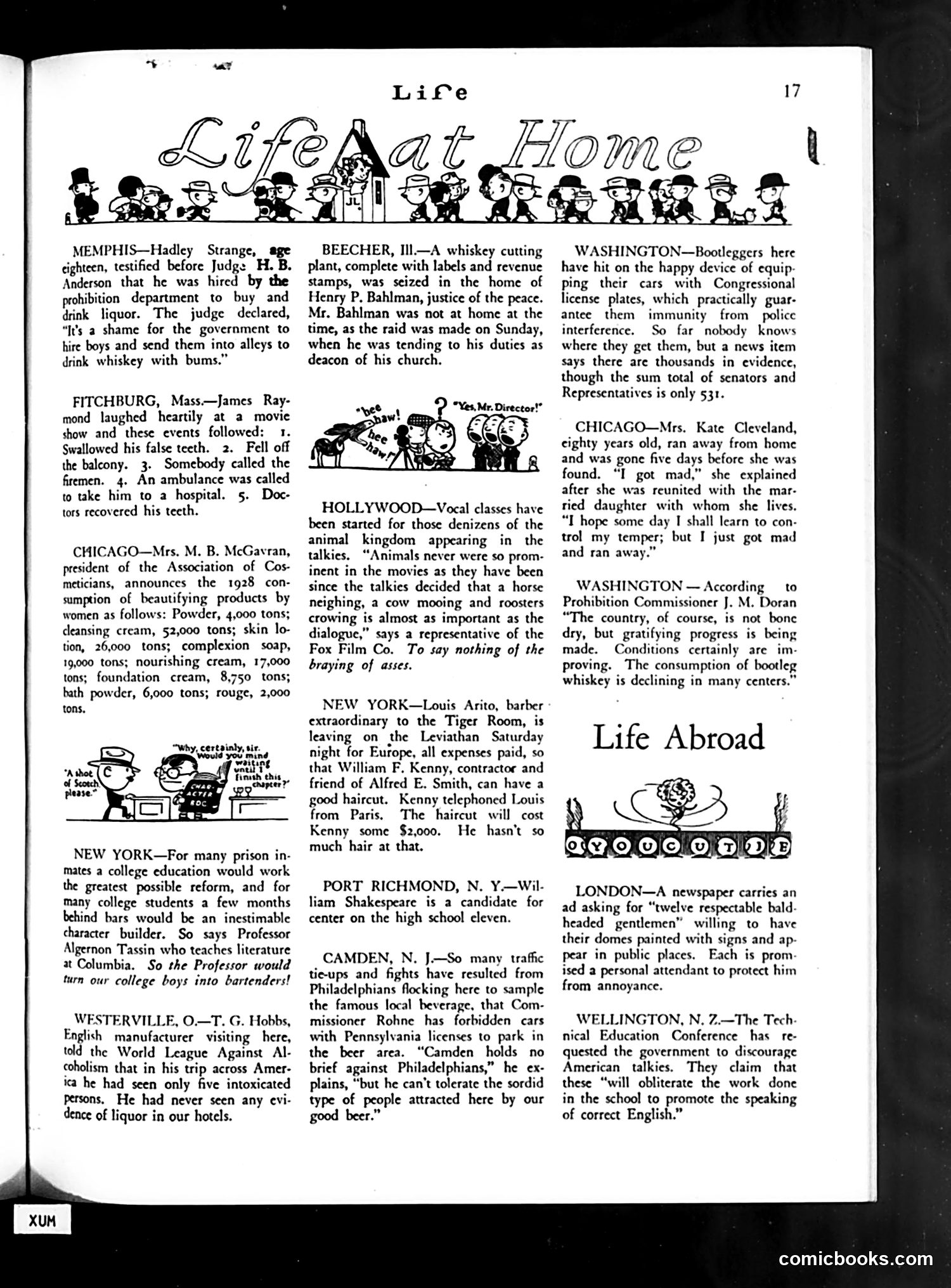
Analysis of Life Magazine Page 17 This page contains humorous anecdotes under "Life at Home" and "Life Abroad" sections rather than political cartoons. The small cartoon illustrations appear to be generic comic figures accompanying brief jokes. The anecdotes satirize Prohibition-era enforcement (a judge scolding someone for buying liquor), everyday mishaps (a man's false teeth falling during a movie), and social absurdities (vocal classes teaching animals to perform in talkies, a barber's expensive haircut, traffic problems from beer tourism in Camden). The "Life Abroad" section mocks British customs (painting bald men's heads with signs in public). Rather than targeting specific political figures or events, this humor focuses on contemporary social behaviors and the peculiarities of 1920s American life, including Prohibition enforcement and the recent advent of "talkies" (talking films).
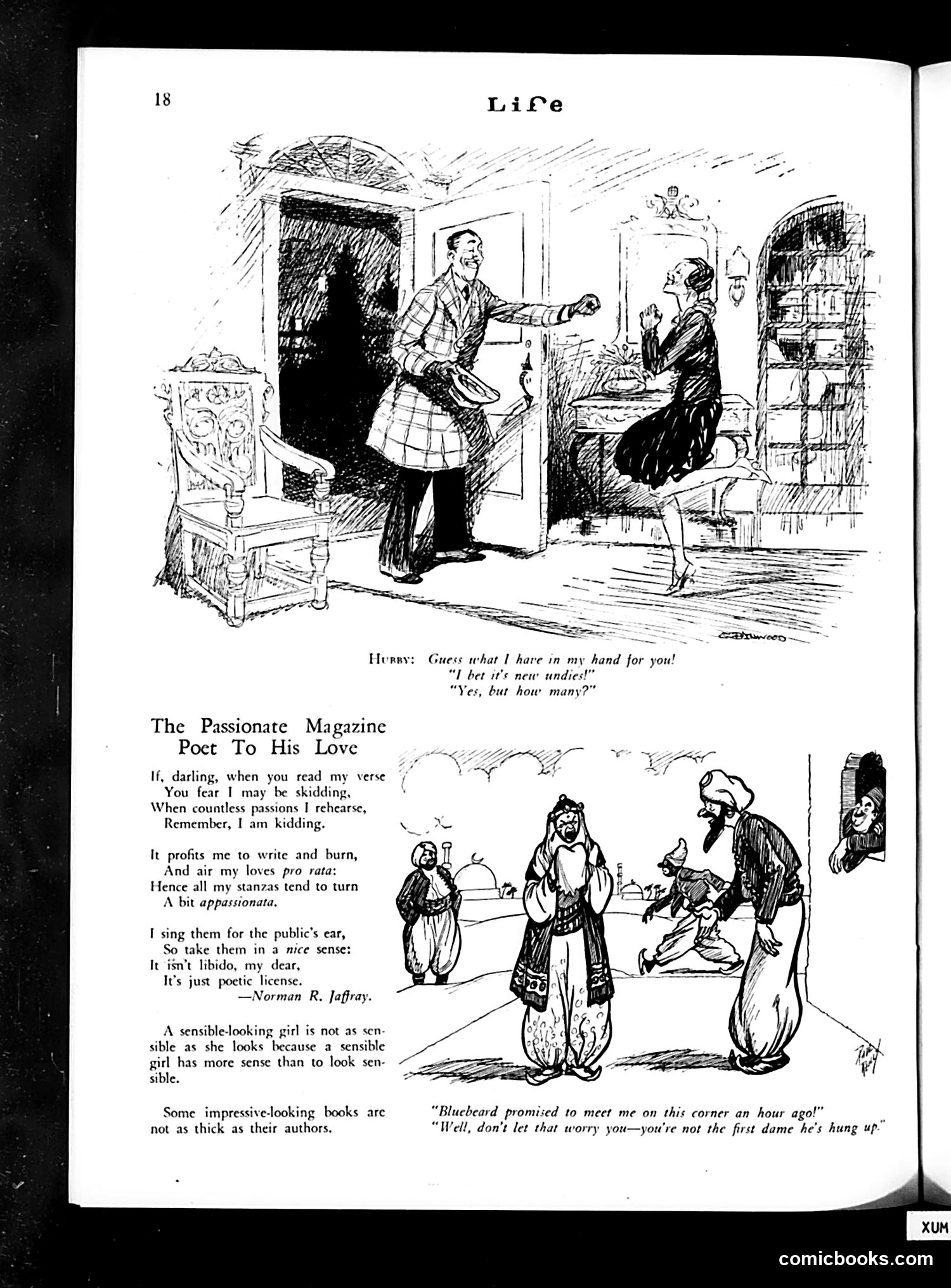
Analysis of Life Magazine Page 18 Top Cartoon: A domestic scene showing a man presenting something to a woman with the caption "Guess what I have in my hand for you!" She responds hopefully about "new undies," but he asks "Yes, but how many?" The joke satirizes marital economics—husbands presenting meager gifts while wives expect abundance. Bottom Section: "The Passionate Magazine Poet To His Love" is a humorous poem by Norman R. Jaffray mocking overwrought romantic poetry. It self-consciously admits to "skidding" (being insincere) while claiming poetic license. The second cartoon depicts what appear to be pirates or rough characters, with one saying a "Bluebeard" promised to meet him, adding dark humor about broken promises among disreputable types. Both pieces satirize romantic pretense and exaggeration in popular culture.
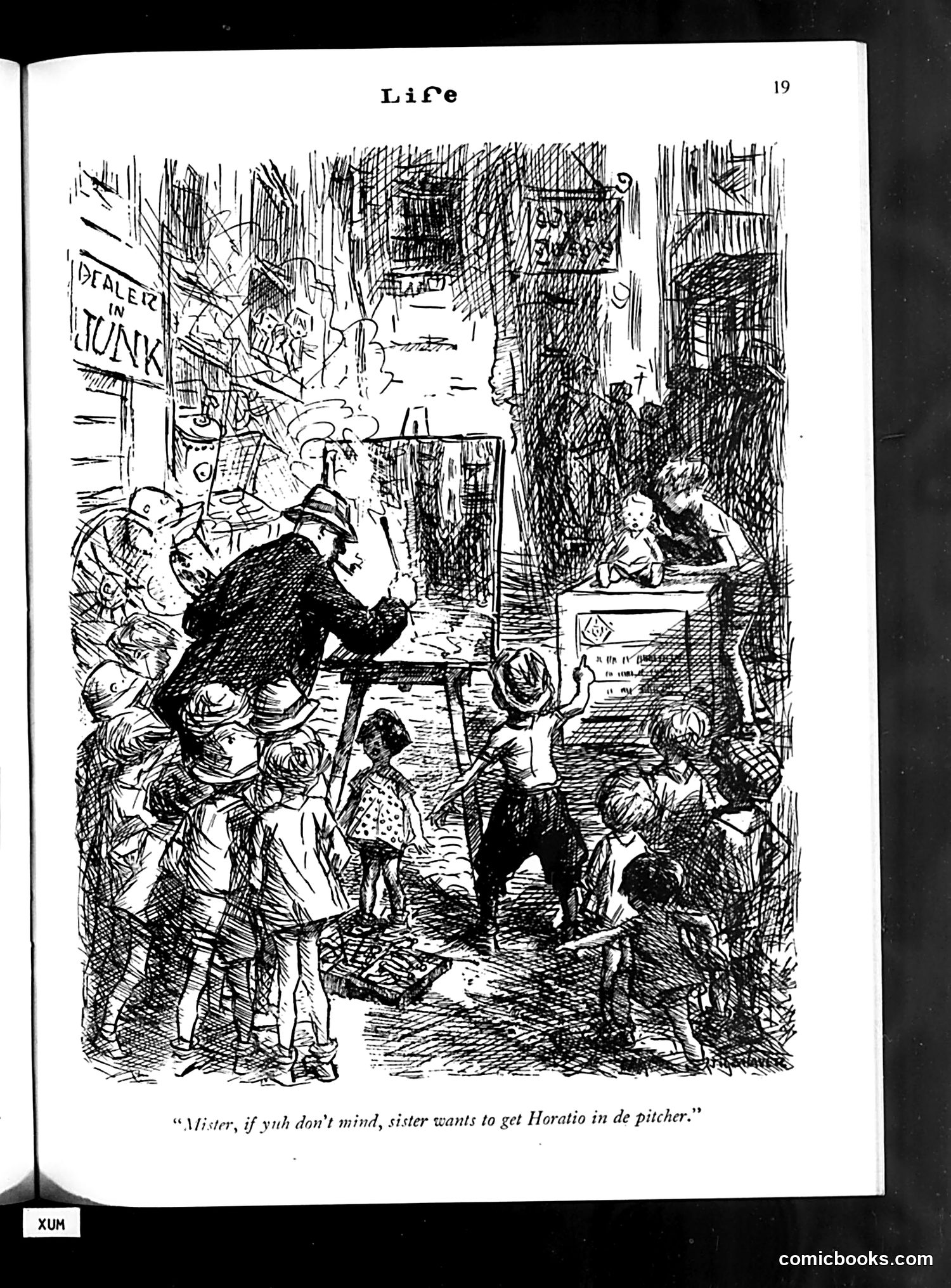
Analysis This single-panel cartoon depicts a street scene, likely from the early 20th century. A man in a bowler hat (appears to be a street vendor or performer) is being interrupted by a woman who wants her child "Horatio" included in a photograph or picture-taking session. The humor relies on the incongruity of naming a child "Horatio"—a classical, pretentious name—in what appears to be a poor urban neighborhood. The casual dialect ("yuh," "de") contrasts sharply with the grandiose name, suggesting either parental aspirations above their circumstances or satirizing immigrants' attempts at respectability through naming conventions. The cartoon gently mocks working-class pretension and the gap between social ambition and actual circumstances during this era.
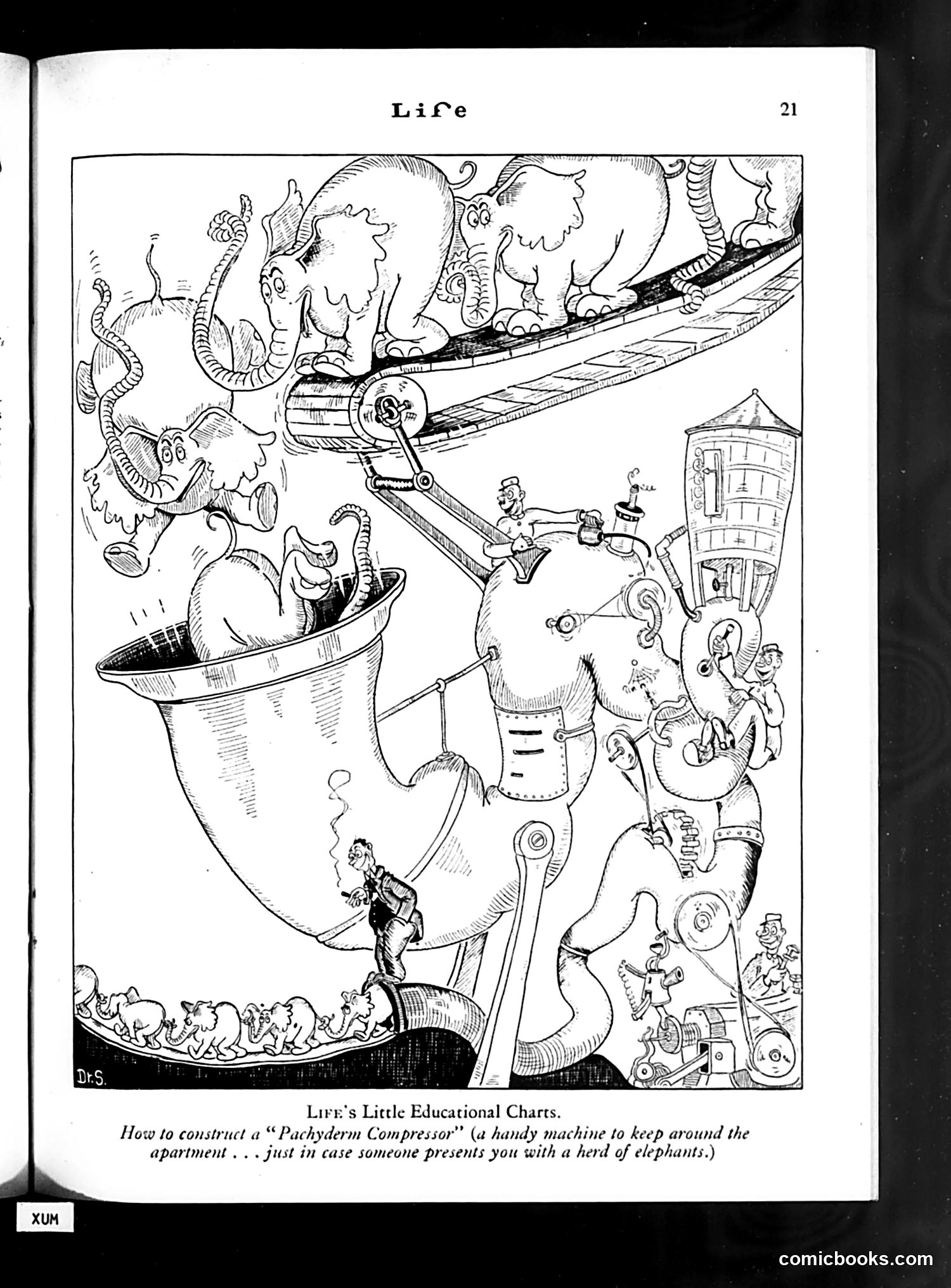
This is a humorous instructional diagram from *Life* magazine showing an absurdist contraption labeled a "Pachyderm Compressor." The illustration depicts a Rube Goldberg-style machine designed to compress elephants into manageable sizes using pulleys, gears, and mechanical components operated by tiny human figures. The joke targets the improbability of receiving "a herd of elephants" as a gift—an obviously ridiculous scenario presented as if it were a practical problem requiring an engineering solution. The satire mocks both the tendency toward over-engineering trivial matters and the absurdist humor popular in early 20th-century American comedy magazines. The detailed technical presentation of an entirely nonsensical device is the humor itself. The byline "Dr.S." suggests a fake "expert" authority.
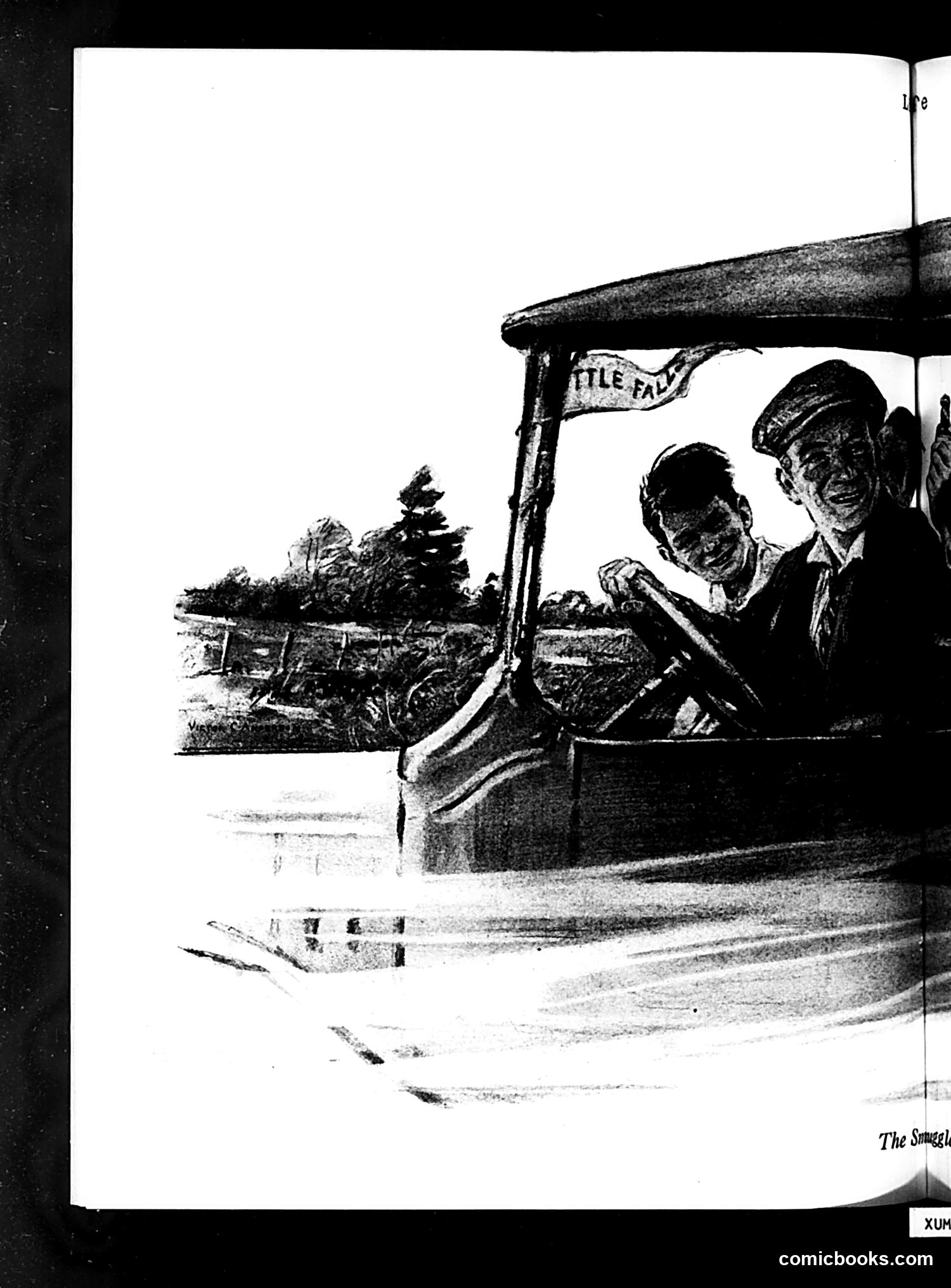
Analysis This appears to be a page from *Life* magazine featuring an illustration of two men in a boat or vehicle on water. The visible text fragment "The Smuggl..." suggests the cartoon concerns smuggling—likely alcohol smuggling during Prohibition (1920-1933). The two figures wear caps and appear to be depicted as working-class or criminal types engaged in illegal activity. The rural landscape and waterway setting is typical for depicting bootlegging operations that transported illegal alcohol across state lines or borders. Without more complete text or caption, I cannot identify the specific individuals being caricatured or pinpoint the exact event referenced. The satire appears to mock either smugglers themselves or—given *Life's* satirical bent—possibly authorities' inability to stop such operations.
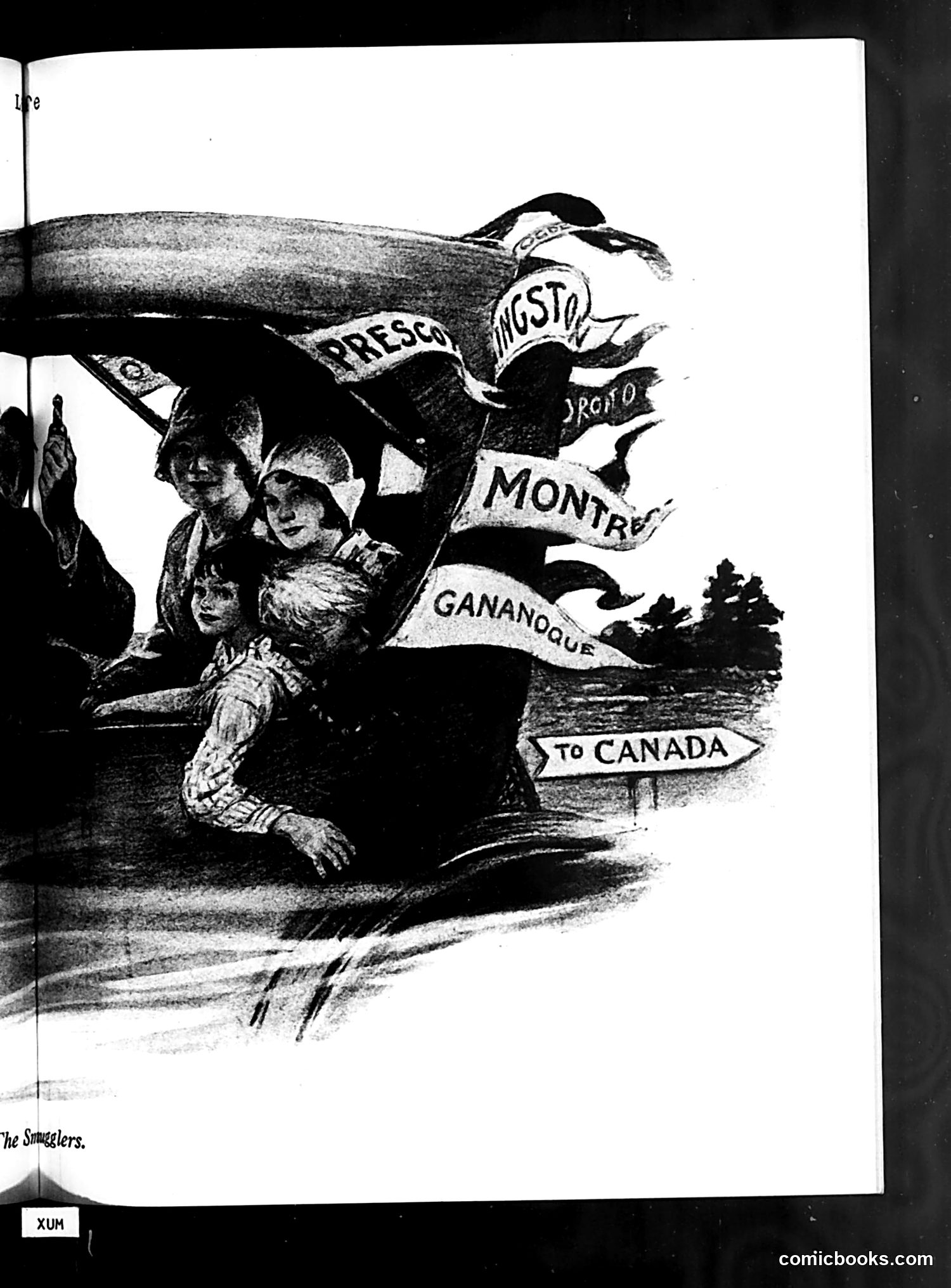
"The Smugglers" - Political Cartoon Analysis This appears to be a satirical cartoon titled "The Smugglers" depicting illegal immigration or smuggling into Canada. The illustration shows a large eagle (representing the United States) carrying a group of people in its talons toward Canada. Ribbons or banners label various locations: "PRESCOTT," "KINGSTON," "GANANOQUE," and "MONTREAL," all actual border towns along the U.S.-Canada boundary near the St. Lawrence River. The cartoon satirizes smuggling operations across the northern U.S.-Canadian border, likely referencing Prohibition-era bootlegging or illegal immigration. The eagle metaphor suggests U.S. involvement in transporting contraband or people northward. Without a date visible, the exact historical moment remains unclear, though border smuggling was a persistent issue throughout the early-to-mid 20th century.
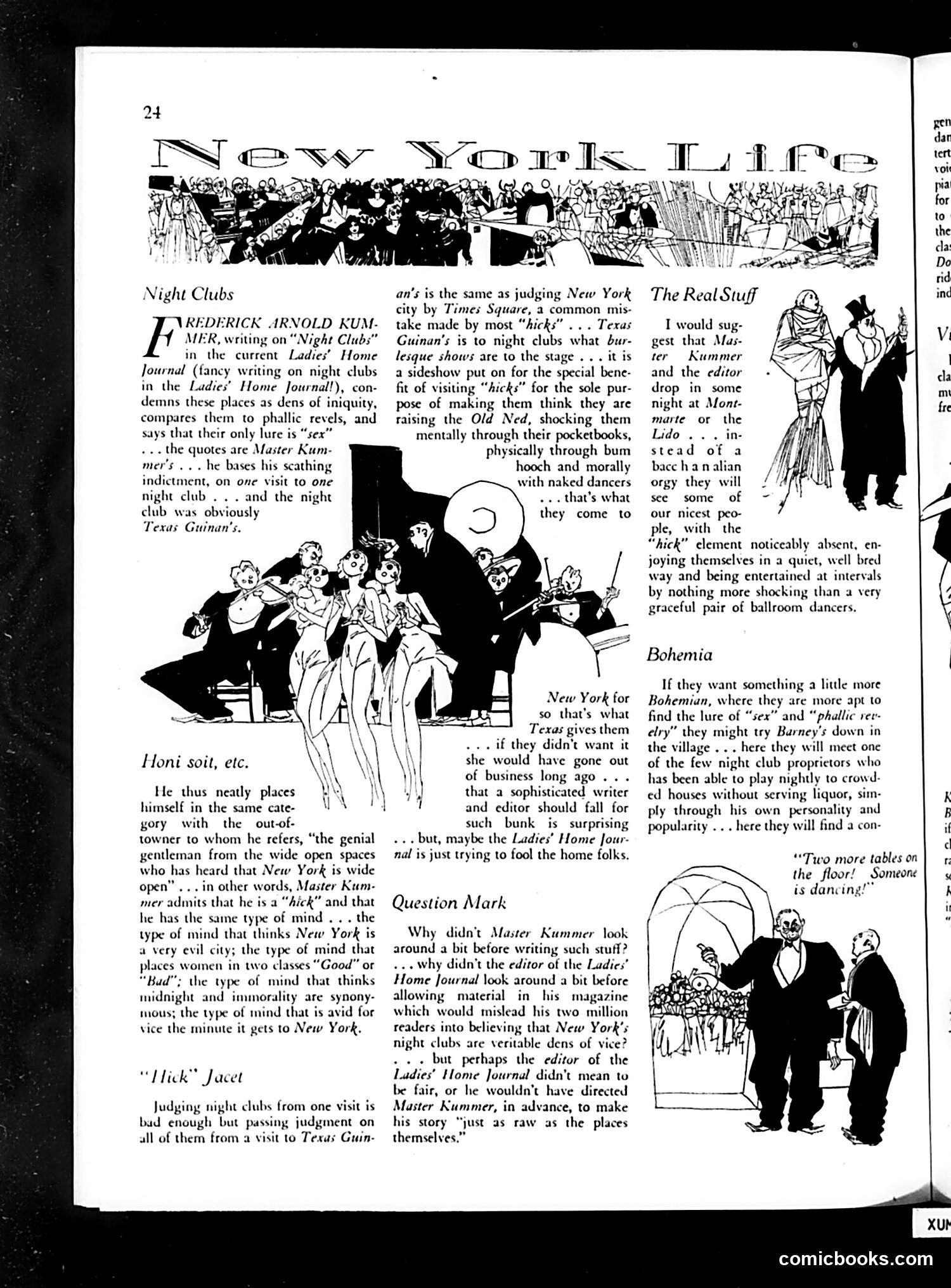
Life Magazine Satire: "Night Clubs" (Page 24) This page satirizes Frederick Arnold Kummer's moralistic article in *Ladies' Home Journal* condemning New York nightclubs as dens of vice. Life's editor argues Kummer is a hypocrite—a naive "hick" himself who visited only the infamous Texas Guinan's (a notorious speakeasy/cabaret known for catering to tourists seeking scandal) and generalized from that single, deliberately sensational venue. The satire attacks both Kummer and the *Ladies' Home Journal* editor for deliberately misleading their two million readers, suggesting the editor instructed Kummer to make the story "just as raw as the places themselves" for shock value rather than accuracy. Life counters by recommending more respectable establishments like Montmartre and the Lido, where "nice people" enjoy sophisticated entertainment—ballroom dancing, not naked dancers—proving nightlife wasn't inherently immoral. The piece defends 1920s urban culture against provincial moral panic.
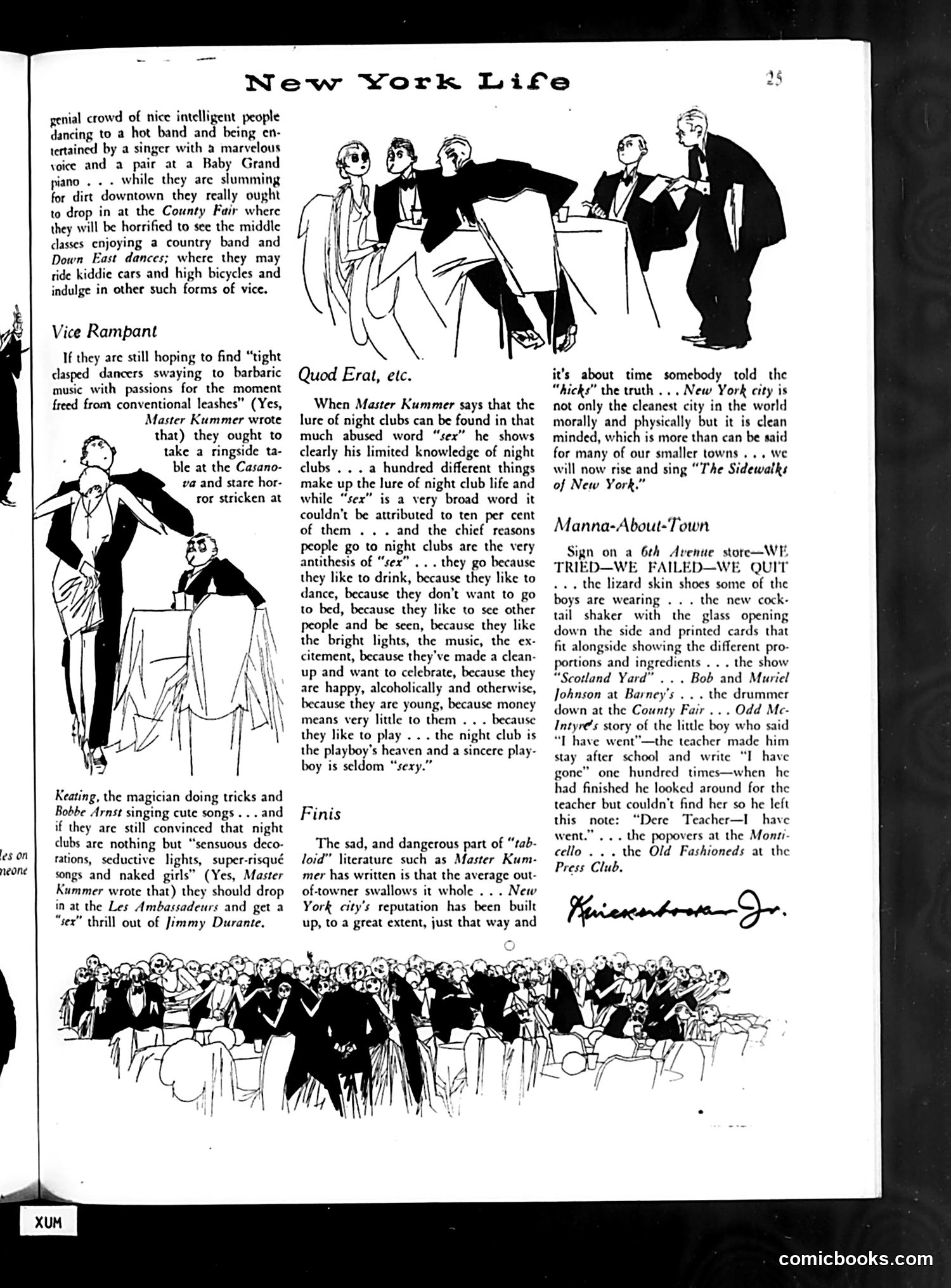
Explaining This Life Magazine Page This satirical piece by "Master Kummer" (a pseudonym) mocks New York City's reputation for vice and decadence—particularly night clubs—among both outsiders and sensation-seeking urbanites. The article argues that tabloid writers exaggerate NYC's seediness, claiming night clubs are actually wholesome entertainment venues driven by youth, camaraderie, and playfulness rather than sexual depravity. The author contends that "hicks" (rural visitors) believe tabloid myths portraying the city as morally corrupt. The cartoons show well-dressed socialites "slumming"—visiting lower-class venues to experience supposed depravity—while the text ridicules this behavior and defends New York's actual cleanliness and morality. The piece concludes by defending the city while poking fun at minor local details (grammar errors, cocktail shakers, restaurants). Essentially: this is 1920s satire defending NYC against exaggerated tabloid scandal-mongering that shaped the city's wild reputation.
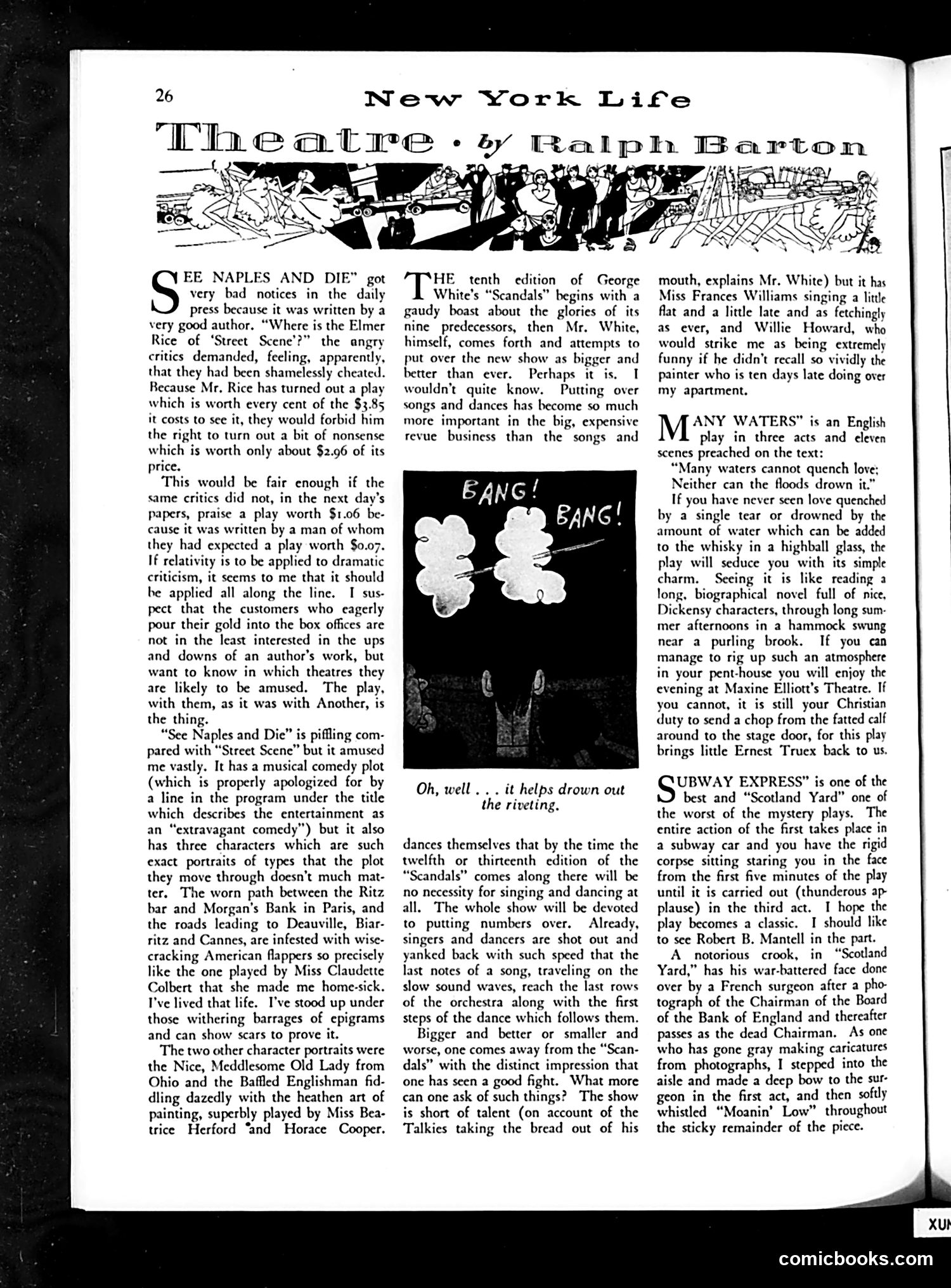
Analysis of This Theatre Review Page This is Ralph Barton's theatre column reviewing three Broadway productions. The cartoon (labeled "Oh, well...it helps drown out the riveting") shows two figures shouting "BANG! BANG!" and appears to satirize how modern revues use spectacle and noise to compensate for weak content. Barton critiques George White's "Scandals" (a long-running revue series) for prioritizing elaborate production and rapid-fire scene changes over actual talent. He notes that singers and dancers are rushed on and off so quickly that the audience hears the end of one song simultaneously with the beginning of the next dance—the noise literally drowns out the entertainment itself. The broader satire targets 1920s Broadway's shift from substance to spectacle, partly blamed on competition from "Talkies" (talking pictures) drawing away talent. Barton's complaint reflects period anxiety about theatre's declining artistic standards in the face of emerging mass media. The other reviews discuss "See Naples and Die" (praising its character types) and "Many Waters" (recommending it as agreeable escapism).
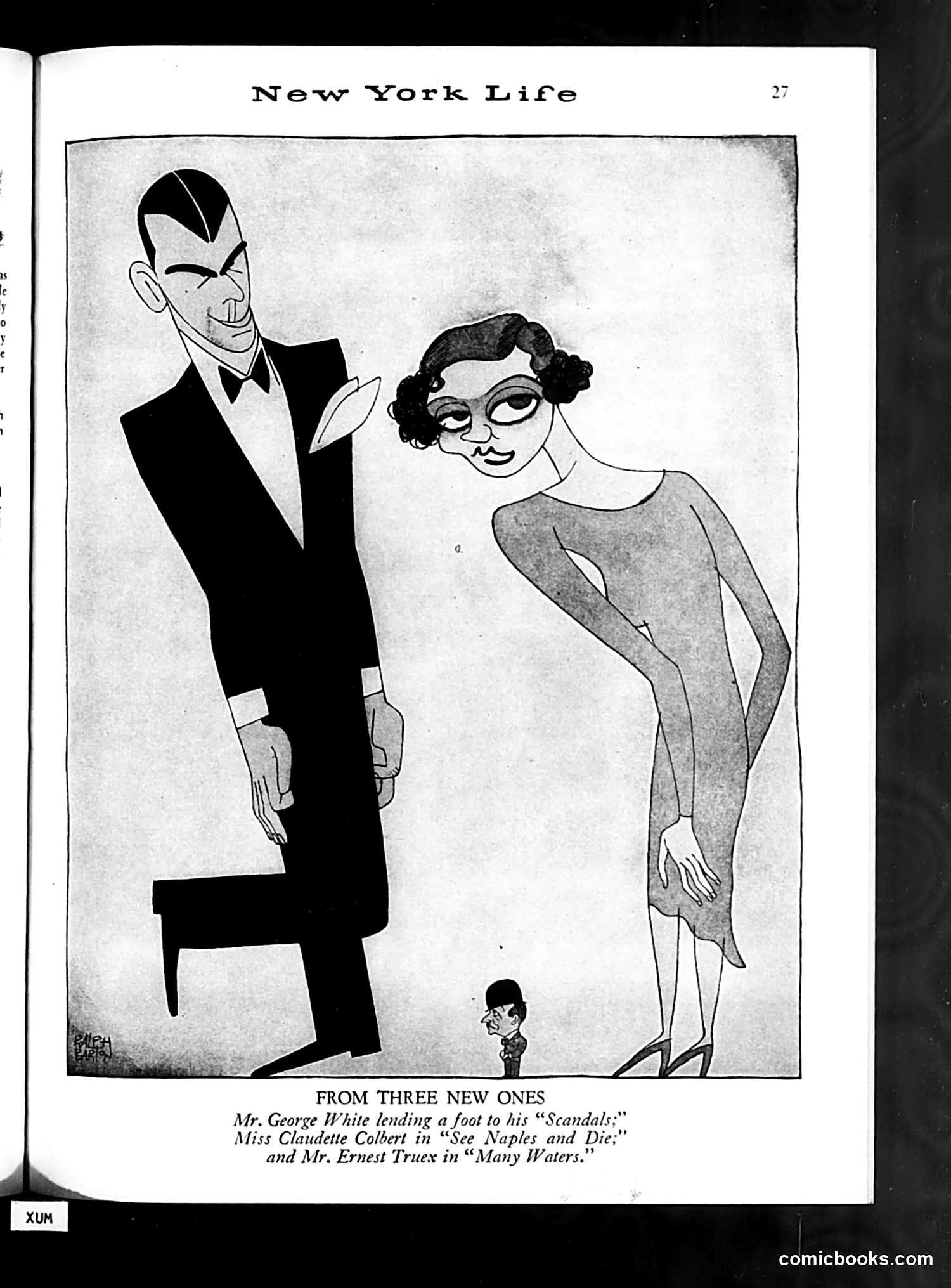
This is a caricature from *Life* magazine illustrating three theatrical productions. The tall, exaggerated figure on the left represents George White, a Broadway producer, "lending a foot" (a visual pun) to his "Scandals" revue—note his comically elongated leg. The woman represents actress Claudette Colbert in "See Naples and Die." The tiny figure at bottom appears to be Ernest Truex in "Many Waters." The satire uses distorted proportions typical of 1920s-30s caricature style to mock these theatrical personalities and productions. The humor relies on recognizing these show-business figures and appreciating the visual exaggeration as commentary on contemporary Broadway entertainment.
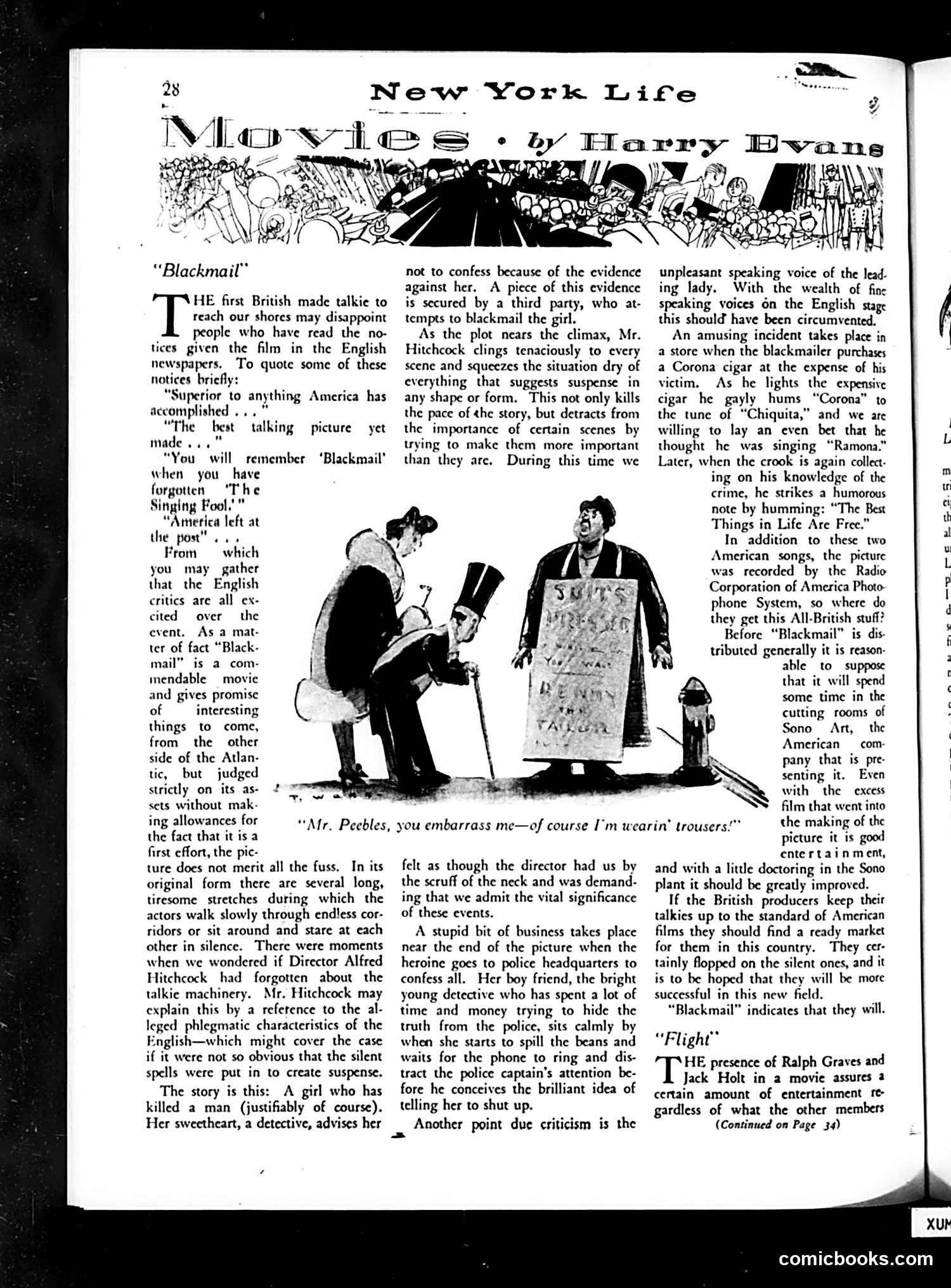
Analysis: "Blackmail" Film Review This page reviews Alfred Hitchcock's British talkie "Blackmail," the first British sound film to reach American shores. The critic mocks English reviewers' breathless praise while offering measured criticism. The Cartoon: The illustration shows a man in formal dress confronting another man with an embarrassing photograph or document, captioned with the man saying he's "wearin' trousers"—a joke about blackmail involving compromising evidence of improper dress or behavior. The Satire: The review criticizes Hitchcock for overextending scenes to create suspense, resulting in tedium. It also notes ironies undercutting the film's "British" authenticity: the lead actress has an "unpleasant speaking voice," and the soundtrack includes American songs and American recording equipment—undermining claims of British superiority that English critics had made. The overall tone mocks English critical pretension while acknowledging the film has merit, but lacks the polish American audiences expect.
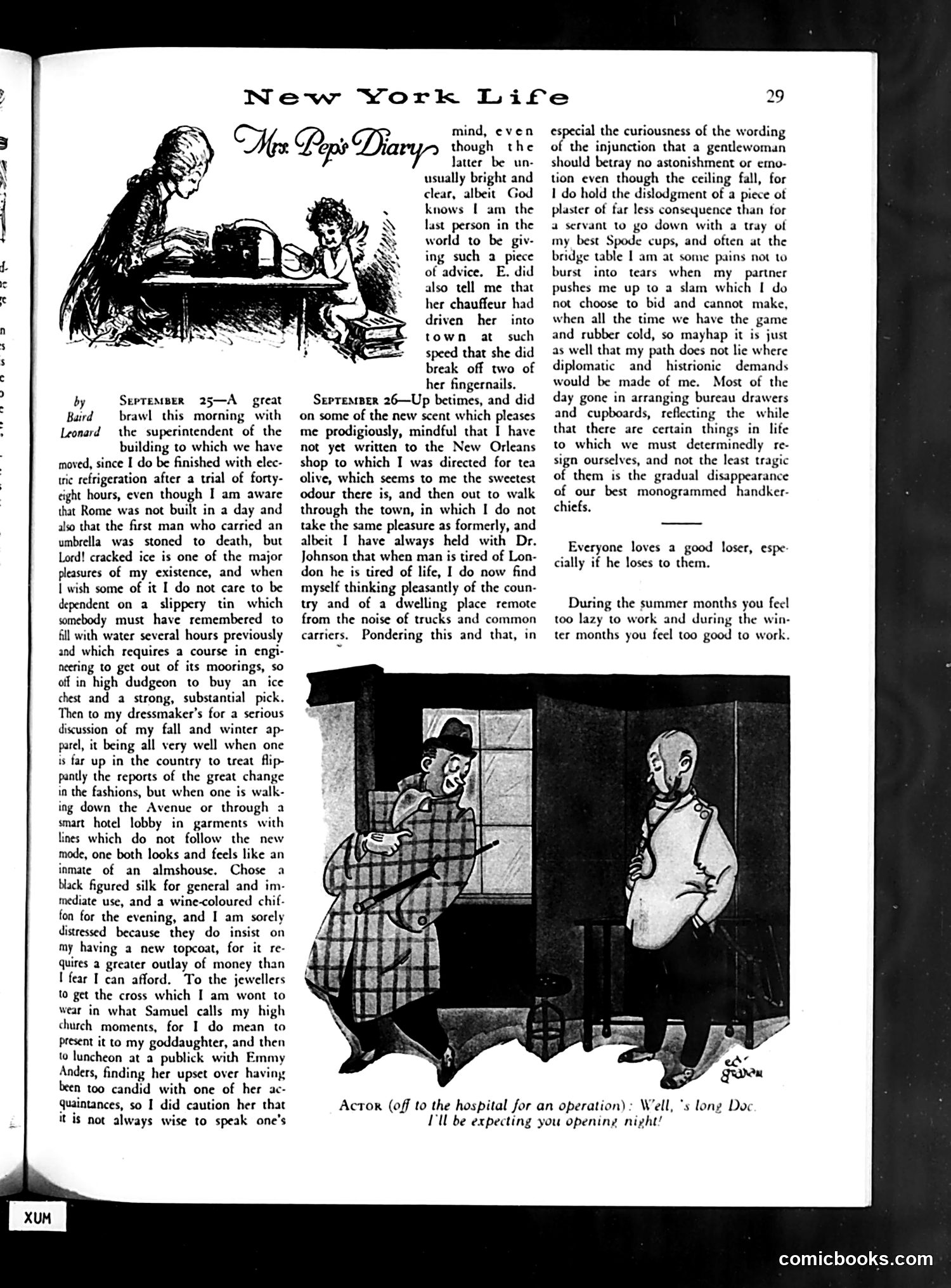
Analysis of This Page from Life Magazine This page presents "Mrs. Pep's Diary," a humorous diary column satirizing upper-class New York women's domestic complaints and social anxieties. The narrator frets over trivial matters with exaggerated earnestness: a broken refrigerator, new fashion requirements, expensive clothing purchases, and the disappearance of monogrammed handkerchiefs. The cartoon below depicts an actor heading to the hospital for surgery, joking to his doctor about opening "night"—a pun on theatrical "opening night." This references the actor's professional anxieties amid personal crisis. The satire targets genteel society's obsession with material concerns, fashion conformity, and maintaining appearances. The diary's affected tone—name-dropping (Samuel, Emmy Anders, Dr. Johnson)—mocks the pretensions of wealthy New Yorkers. The cartoons and text together ridicule both domestic preoccupations and entertainment industry vanity, embodying Life magazine's role as social satirist of the era's upper classes.
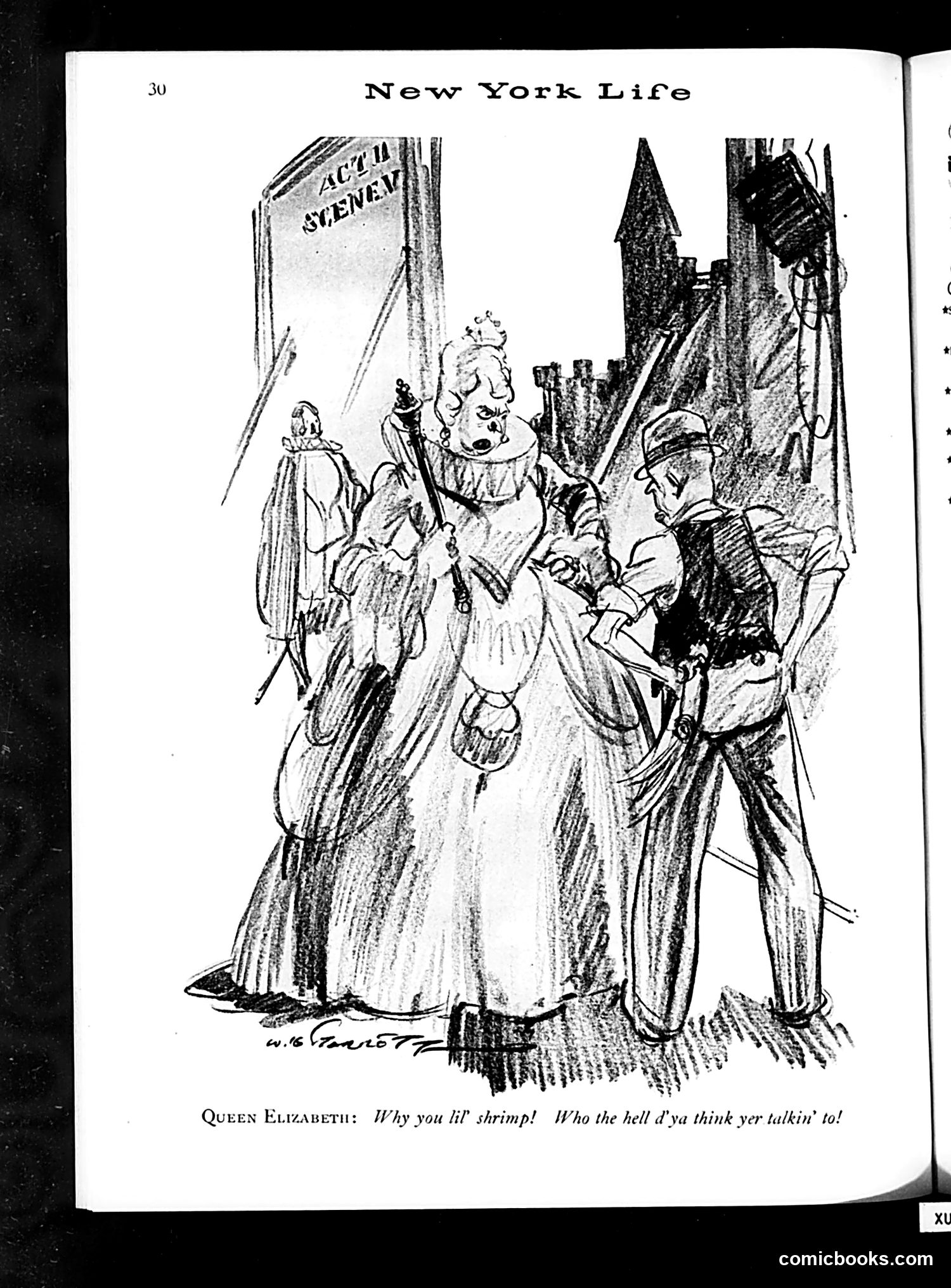
"Queen Elizabeth" Cartoon Analysis This is a satirical cartoon from *Life* magazine depicting Queen Elizabeth in an exaggerated, unflattering manner—portrayed as crude and aggressive rather than regal. She's shown in ornate royal dress confronting what appears to be a small uniformed figure (possibly a soldier or guard), whom she verbally attacks with coarse, working-class language ("Why you lil shrimp! Who the hell d'ya think yer talkin' to!"). The satire mocks British royalty by stripping away ceremonial dignity and revealing—or inventing—a crude, vulgar personality beneath the crown. This reflects American satirical tradition of deflating foreign aristocracy, suggesting the supposed "Queen" lacks the refined bearing expected of her station. The cartoon's humor relies on the jarring contrast between royal appearance and unrefined behavior.
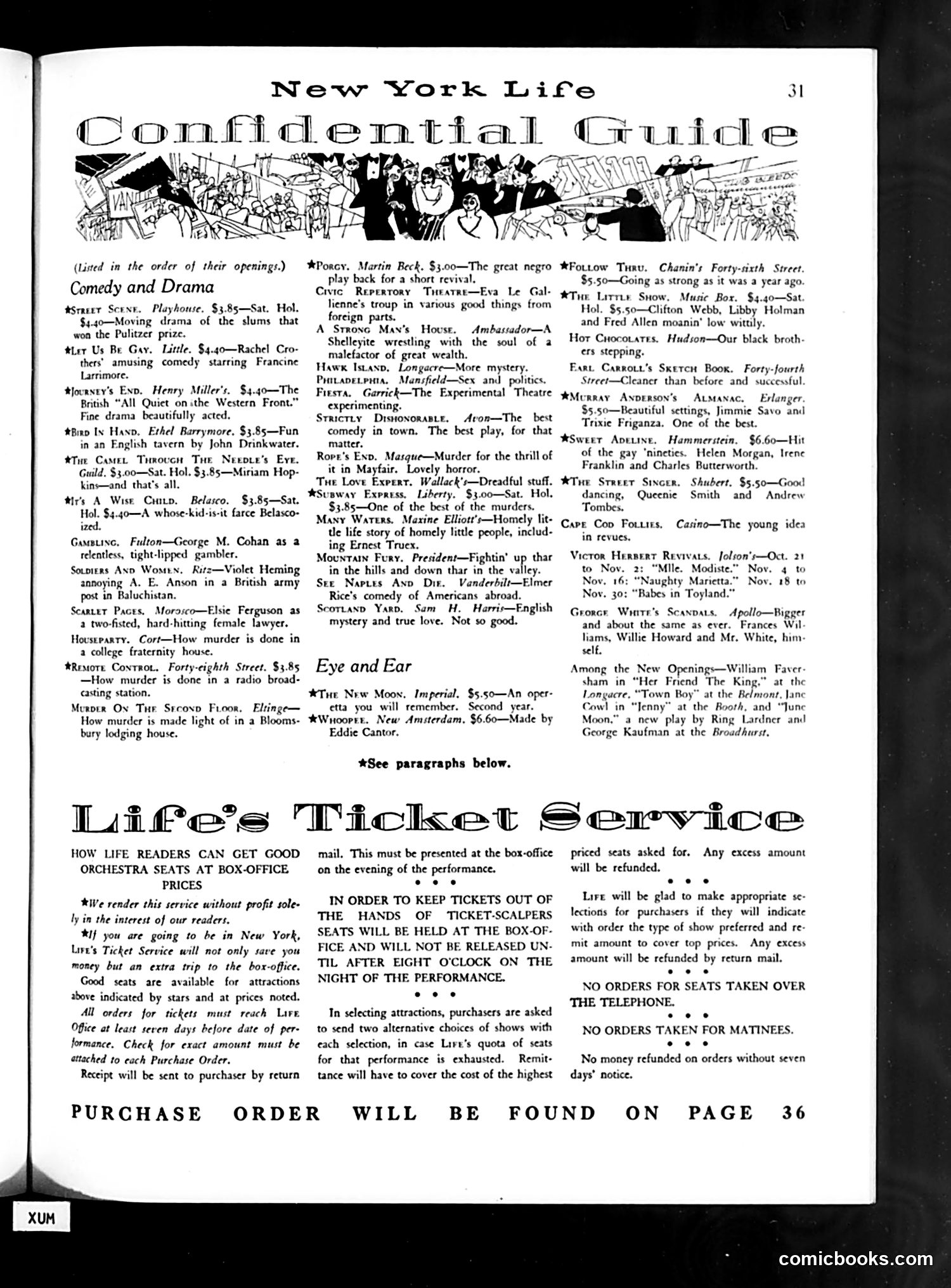
Analysis of This Life Magazine Page This is primarily a theatre listing and ticket service page, not a cartoon page. It contains no political satire or caricatures to analyze. The page lists New York theatrical productions circa the late 1920s, organized by genre (Comedy and Drama, then musicals/revues under "Eye and Ear"). Titles like *Street Scene* (noted as a Pulitzer Prize winner), *Porgy* (described as "the great negro play"), and *See Naples and Die* (Elmer Rice's comedy) reflect the era's theatrical offerings. The substantial section titled "Life's Ticket Service" explains how Life magazine readers could purchase theatre tickets at box-office prices without markup—a service Life provided "without profit solely for the benefit of our readers." The page reflects 1920s entertainment culture and Life's role as both satirical magazine and practical service provider to its urban, theatre-going readership.
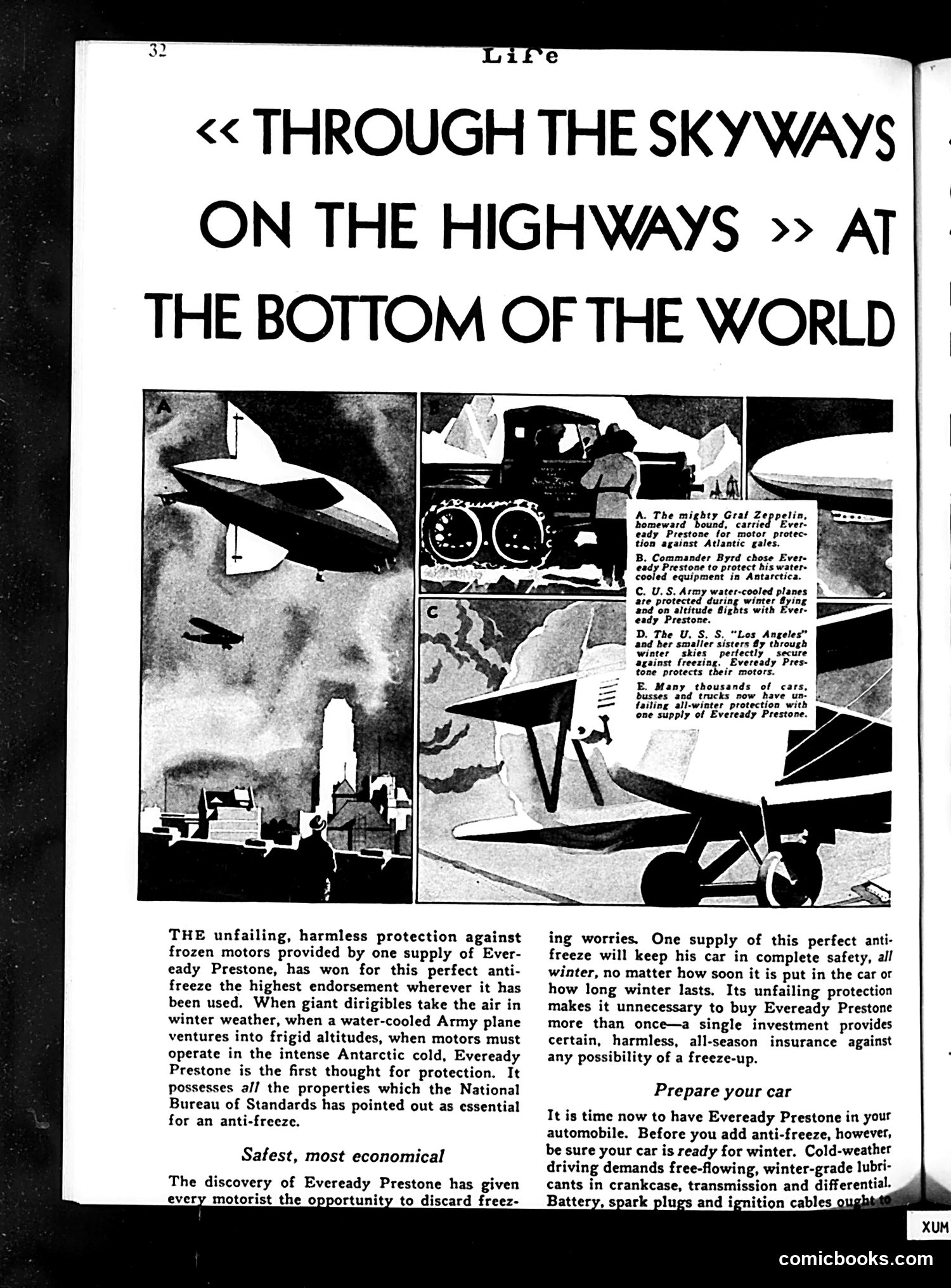
Eveready Prestone Advertisement This is primarily a product advertisement, not satire or political commentary. It promotes Eveready Prestone antifreeze by associating it with famous contemporary achievements and vehicles. The images showcase: - The Graf Zeppelin (German airship crossing the Atlantic) - Commander Byrd's Antarctic expedition (likely Richard Byrd's polar exploration) - U.S. Army water-cooled aircraft - USS Los Angeles (naval airship) - Ordinary cars and trucks The marketing strategy leverages these prestigious, cutting-edge ventures—representing human exploration and military/technological prowess—to suggest that Eveready Prestone is trustworthy enough for extreme conditions. The headline's poetic structure ("Through the skyways / On the highways / At the bottom of the world") reinforces this scope. This represents 1920s-1930s advertising technique: building consumer confidence by association with heroic achievement and progress. There is no political satire present.
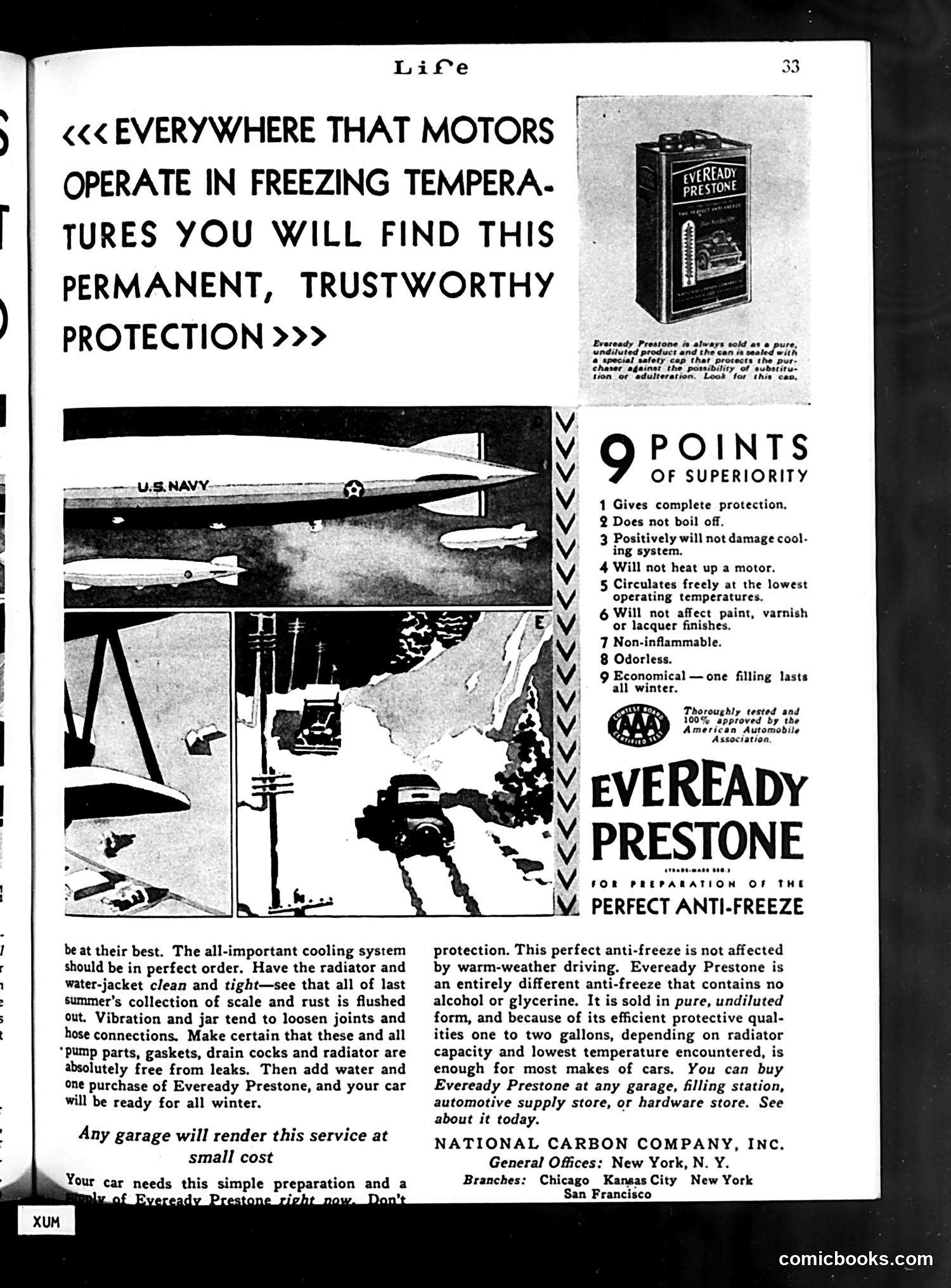
Analysis This is not a cartoon or satire—it's a full-page advertisement for Eveready Prestone antifreeze, likely from the 1930s-1940s based on styling. The imagery shows winter driving scenarios: a U.S. Navy vessel in arctic conditions, snow-covered landscapes, and vehicles operating in freezing temperatures. These visuals establish the product's necessity for cold-weather motor protection. The "9 Points of Superiority" list emphasizes practical benefits (won't boil off, doesn't damage engines, economical) while the seal-cap imagery appeals to consumer trust by claiming protection against product adulteration—a genuine concern in that era before modern regulation. The American Automobile Association approval seal adds credibility. The text encourages readers to purchase the antifreeze at garages or hardware stores for winter preparation. This is straightforward product advertising using environmental drama to justify necessity, not political or social satire.
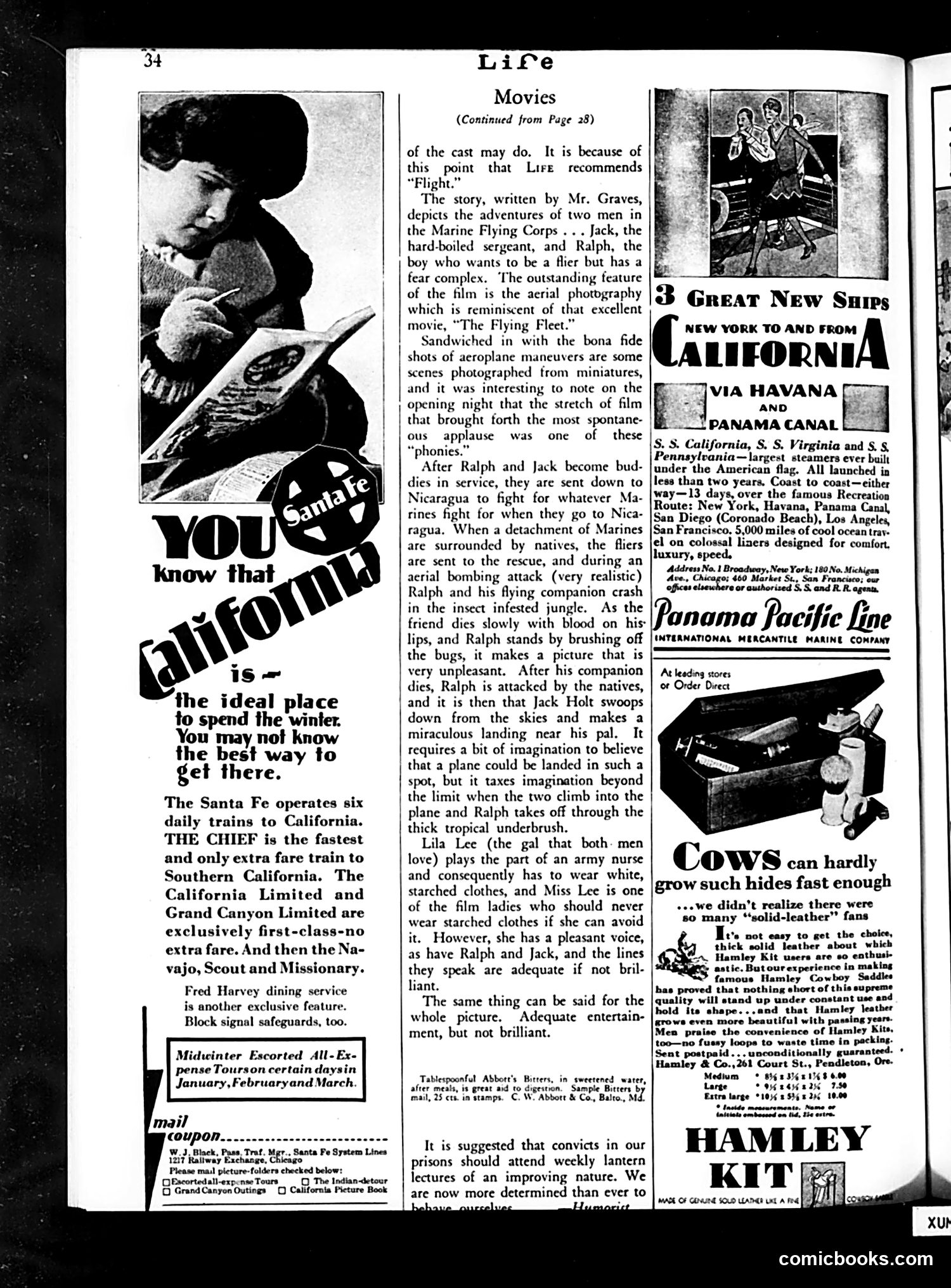
Analysis of This Life Magazine Page This page is primarily advertising and entertainment listings, not political satire. The left side features a Santa Fe Railway advertisement promoting California winter travel, highlighting their trains ("THE CHIEF," "California Limited") and Fred Harvey dining service—standard corporate marketing. The main text content reviews the film *"Flight,"* criticizing its uneven quality: while aerial photography impresses audiences, miniature shots (called "phonies") draw applause equally, and the plot—involving Marine pilots in Nicaragua rescuing comrades from natives—stretches credibility. The review notes adequate but uninspired performances by Jack Holt and Lila Lee. The right side contains shipping company ads (Panama Pacific Line) and a Hamley Kit leather goods advertisement. A small note at bottom suggests prisoners attend "improving" lantern lectures—a minor social commentary on prison reform. No political cartoons or caricatures appear on this page. It's a typical 1920s magazine spread mixing entertainment criticism with period advertisements.
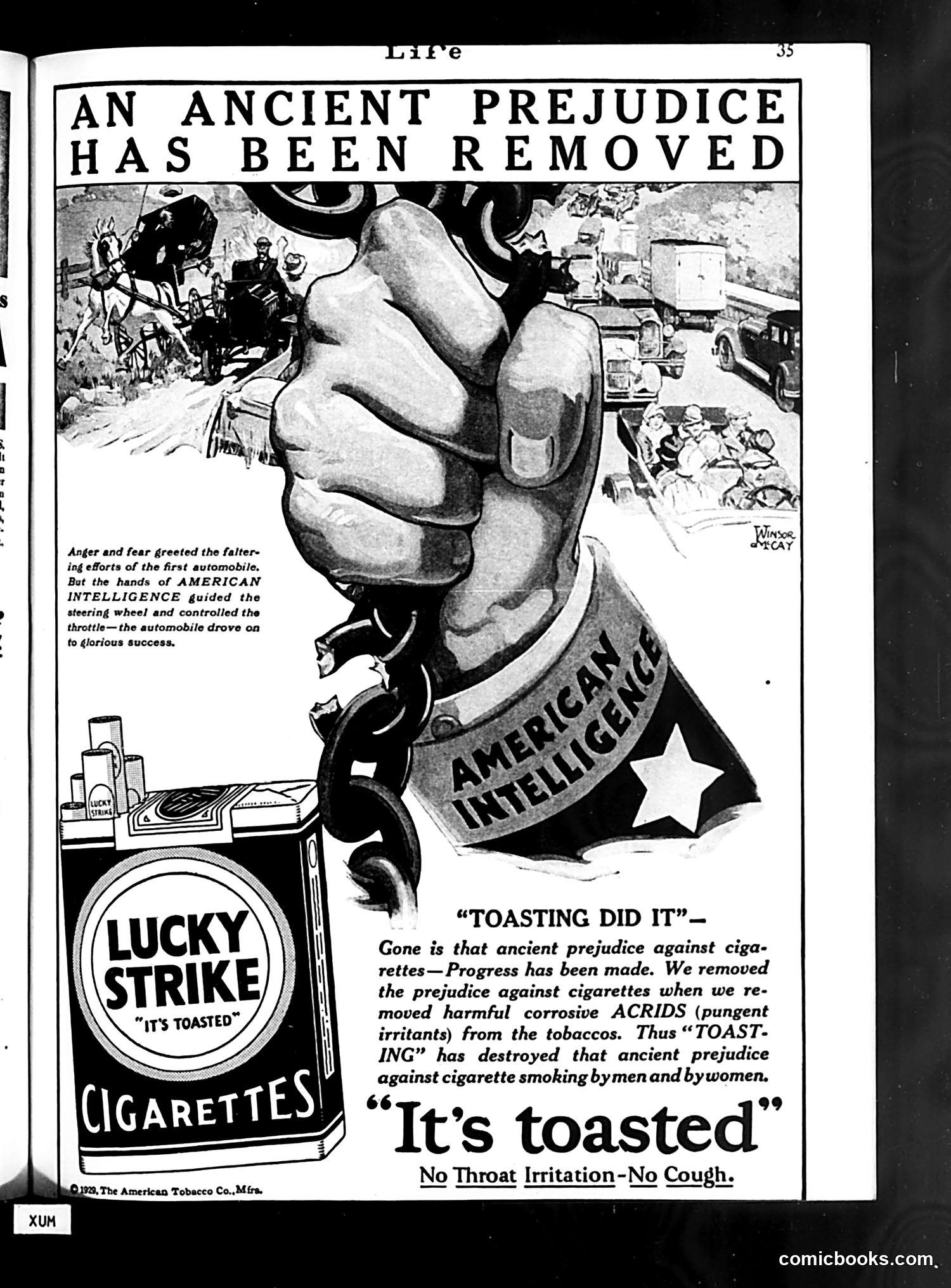
Analysis of Lucky Strike Advertisement (1929) This is a Lucky Strike cigarette advertisement, not political satire. It uses a metaphorical comparison to promote cigarettes as progress. The central image shows a giant fist labeled "AMERICAN INTELLIGENCE" crushing chains labeled "ancient prejudice." The surrounding vignettes depict the early automobile industry—vehicles and people—representing how American ingenuity overcame initial skepticism about new technology. The advertisement claims Lucky Strike's "toasting" process removes harmful "acrids" (irritants) from tobacco, thereby eliminating prejudice against cigarettes. By paralleling cigarette adoption to automobile acceptance, it frames smoking as inevitable progress driven by science and intelligence. The satire/irony for modern readers: The ad claims scientific advancement (toasting) has made cigarettes safe and socially acceptable—a claim later proven false. It weaponizes the language of progress and American innovation to market a product now known to be harmful. This exemplifies early 20th-century advertising's misleading health claims about tobacco.
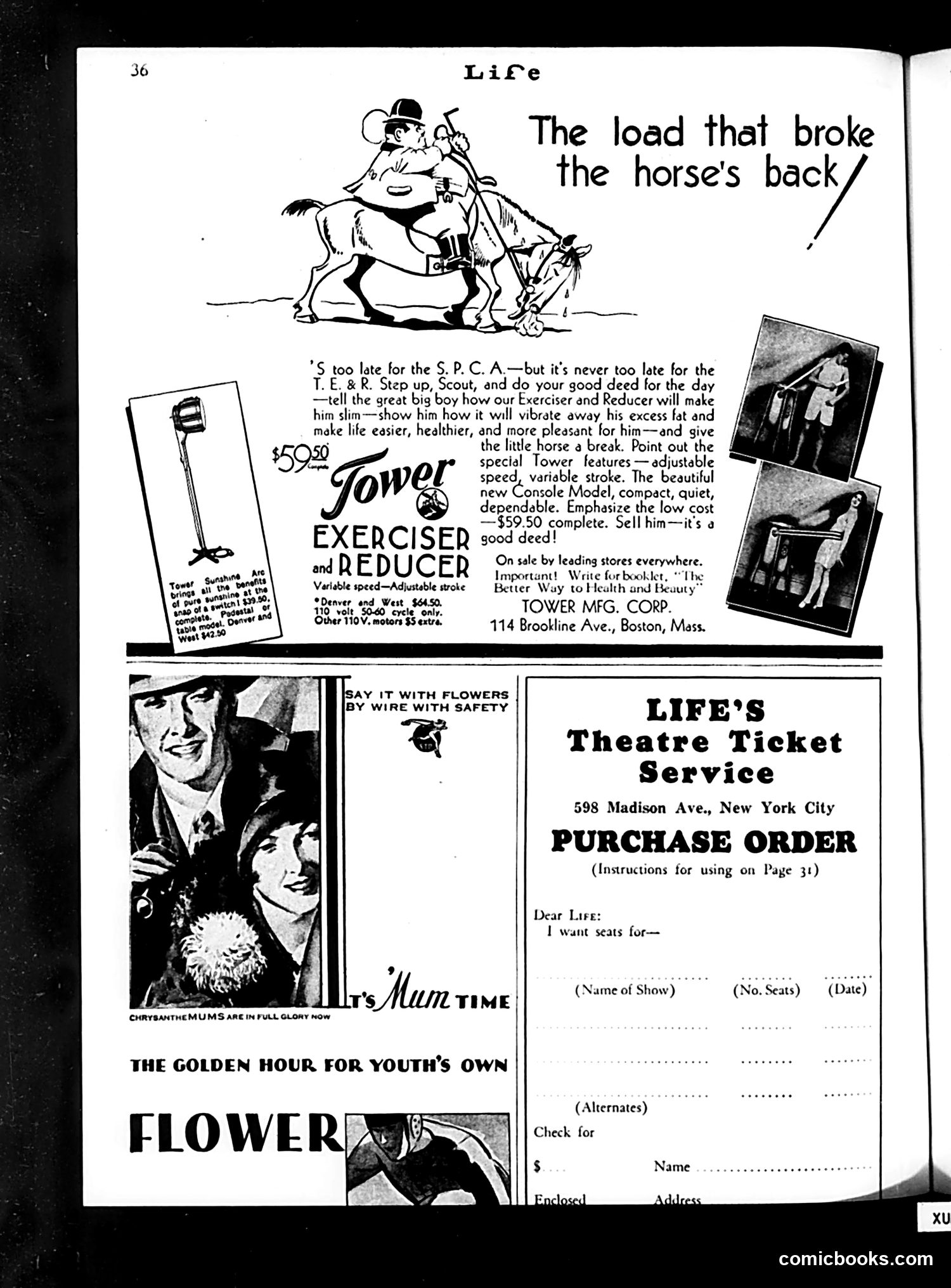
"The Load That Broke the Horse's Back" This cartoon satirizes overselling and aggressive marketing. A grotesquely overweight man sits on an exhausted horse, literally embodying the proverb "the straw that broke the camel's back." The joke is that the man is so heavy he's breaking the horse—a visual metaphor for excess. The text mockingly presents this as a sales pitch: a Boy Scout should convince this obese man to buy a Tower Exerciser and Reducer machine to lose weight and "give the little horse a break." The satire is that the advertisement itself is part of the problem—it's just another commercial trying to sell a solution to obesity rather than addressing the actual issue. The cartoon critiques consumer culture's approach: selling gadgets and devices rather than promoting genuine lifestyle change. The S.P.C.A. reference adds irony, joking it's "too late" for animal protection given the horse's plight.
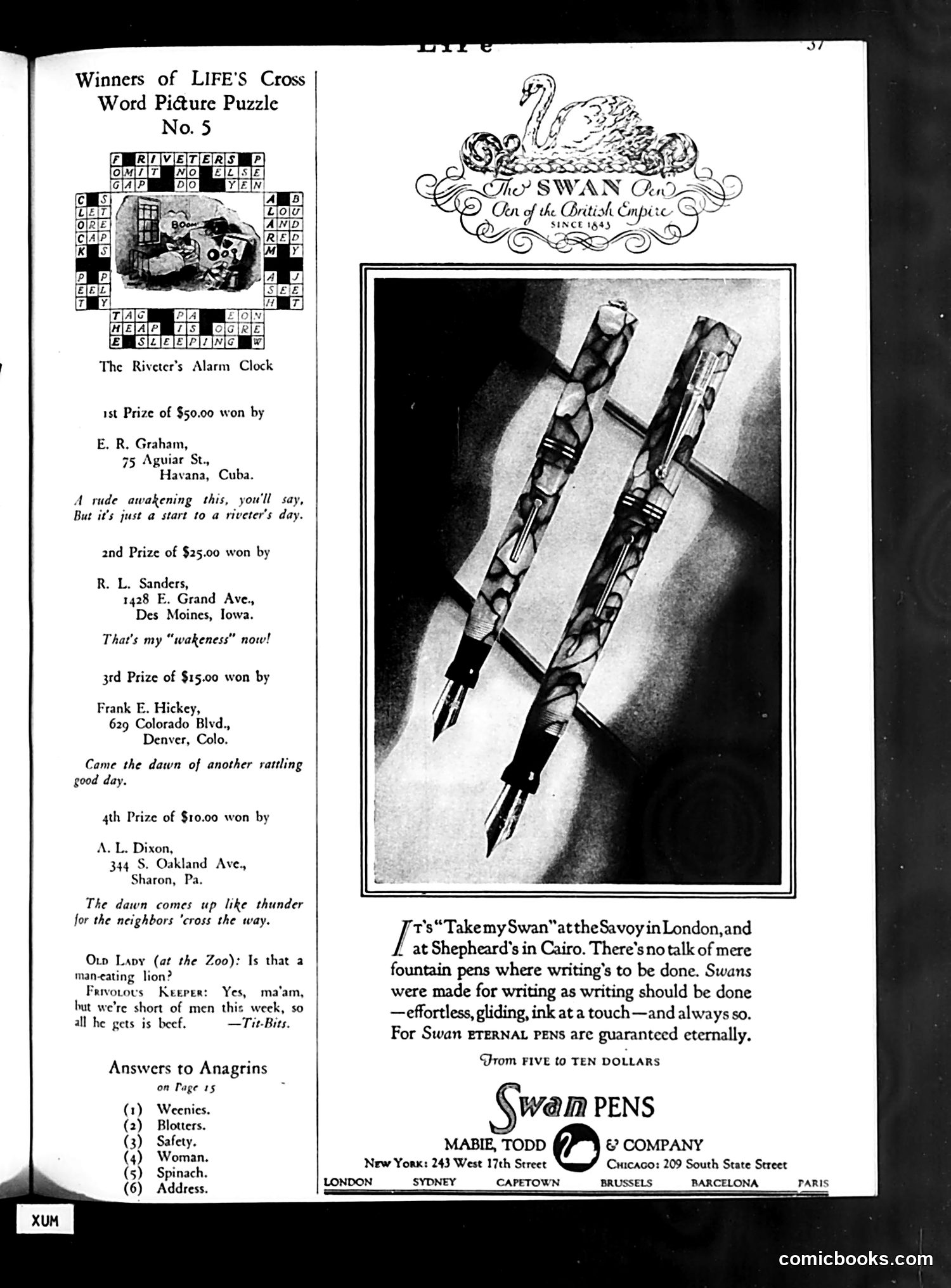
Page Analysis: Life Magazine Advertisement and Puzzle Winners This page primarily showcases puzzle contest winners for Life's "Cross Word Picture Puzzle No. 5," titled "The Riveter's Alarm Clock." The winning entries are humorous captions about a noisy industrial worker's early morning—referencing the cacophonous sounds of riveting work that disturb neighbors. The main content is a Swan Pens advertisement featuring two ornate fountain pens photographed against a hand. The ad emphasizes Swan's reputation as a premium writing instrument ("guaranteed eternally"), positioning them as the choice for serious writers. The tagline references locations—the Savoy in London and Shepheard's in Cairo—suggesting cosmopolitan sophistication. A brief joke at page bottom plays on wartime/postwar labor shortages: a zookeeper admits the man-eating lion gets beef because men are scarce that week. The page reflects early-to-mid 20th century advertising aesthetics and humor conventions.
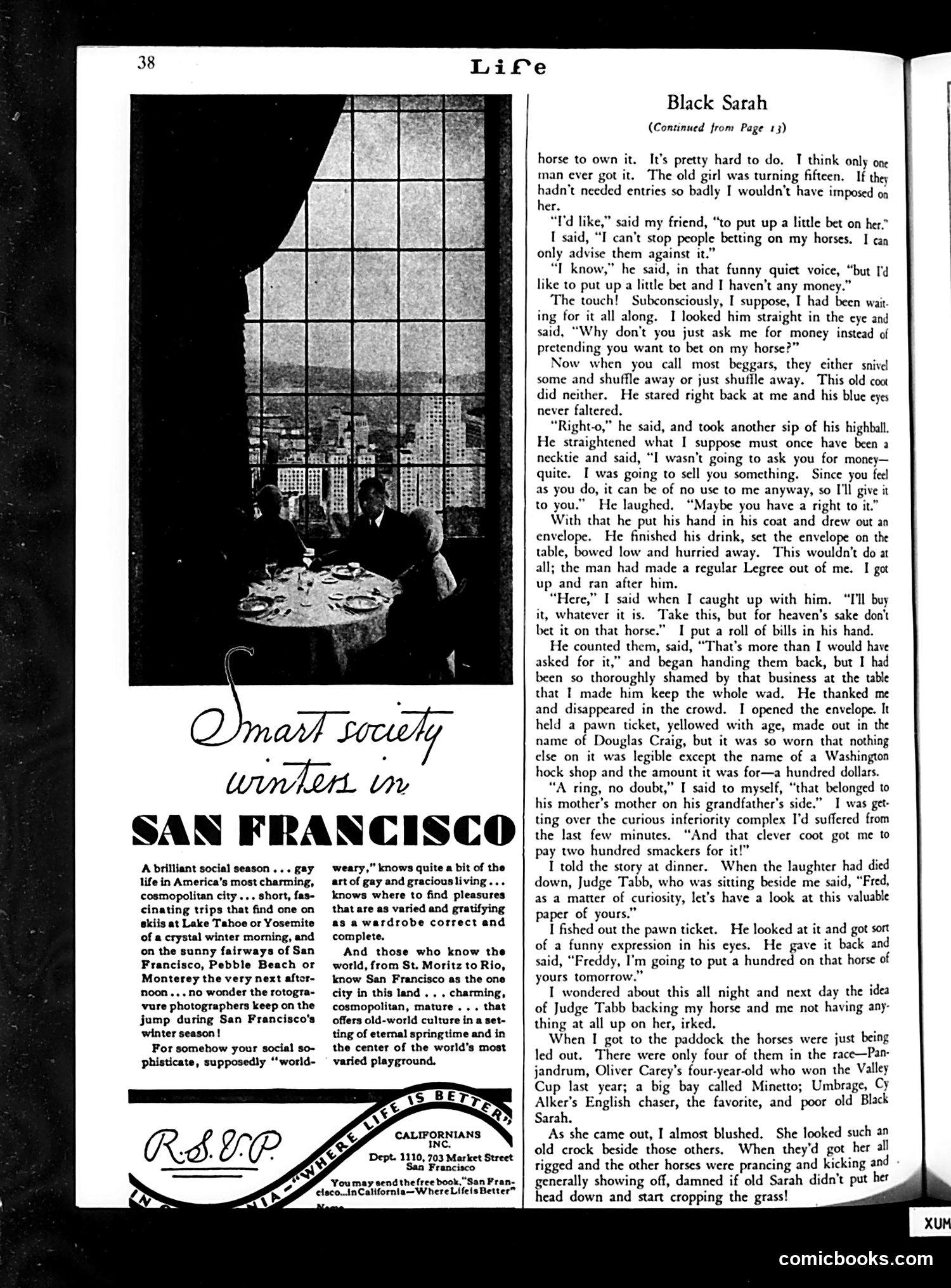
Analysis of Life Magazine Page 38 This page contains two distinct elements: a small illustration captioned "Smart society winters in San Francisco" advertising California tourism, and a serialized story titled "Black Sarah (Continued from Page 13)." The illustration depicts well-dressed diners at an elegant restaurant with a city skyline visible through large windows—a classic depiction of cosmopolitan sophistication meant to attract tourists. The story itself is a narrative about horse racing and social obligation. The narrator describes being pressured to enter an aging racehorse called "Black Sarah" in a race, and his subsequent encounter with a shabby man at dinner who sells him a mysterious pawn ticket for two hundred dollars. A judge overhears this and becomes interested in betting on the horse, creating an ironic situation where the narrator has no money wagered despite others' confidence in the animal. The satire appears gentle rather than cutting—poking fun at social pretension and the unpredictable nature of gambling rather than addressing major political issues. This appears to be entertainment fiction typical of Life's lighter content.
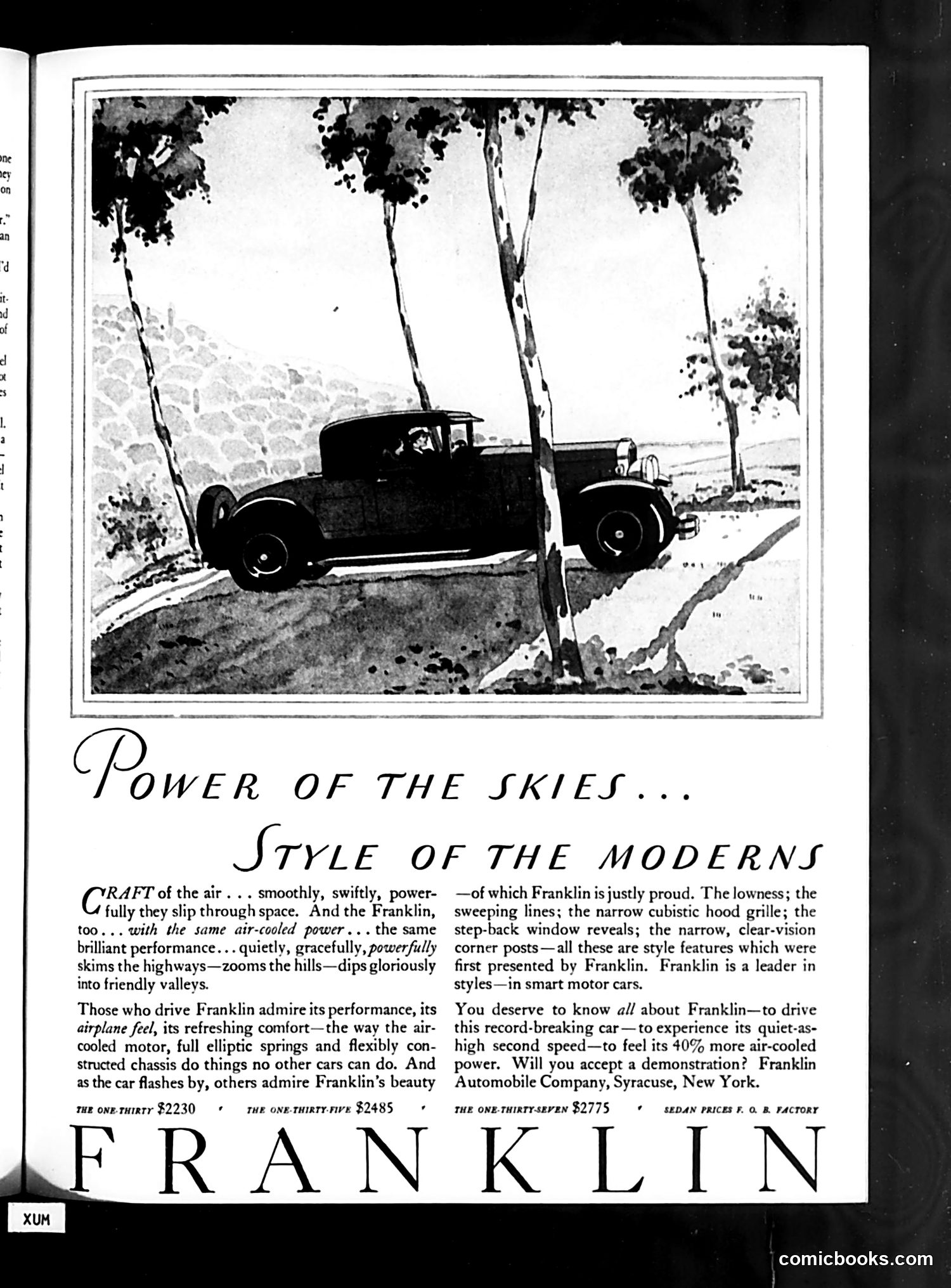
Franklin Automobile Advertisement This is not political satire but rather a luxury car advertisement from Life magazine. The page promotes Franklin automobiles by comparing them to aircraft—a cutting-edge comparison for the era. The ad emphasizes the Franklin's "air-cooled" engine (a distinctive feature), smooth performance, and modern styling. The photograph shows a Franklin sedan parked beneath tall trees, evoking elegance and sophistication. The copy stresses that the car offers airplane-like qualities: power, smoothness, and graceful handling. The "style of the moderns" reference positions Franklin as a design leader, featuring then-contemporary details like the "step-back window" and "cubistic hood grille." Pricing information ($2230-$2775) indicates this was an upmarket vehicle. This is essentially lifestyle advertising leveraging the glamour of aviation to sell automobiles to affluent readers.
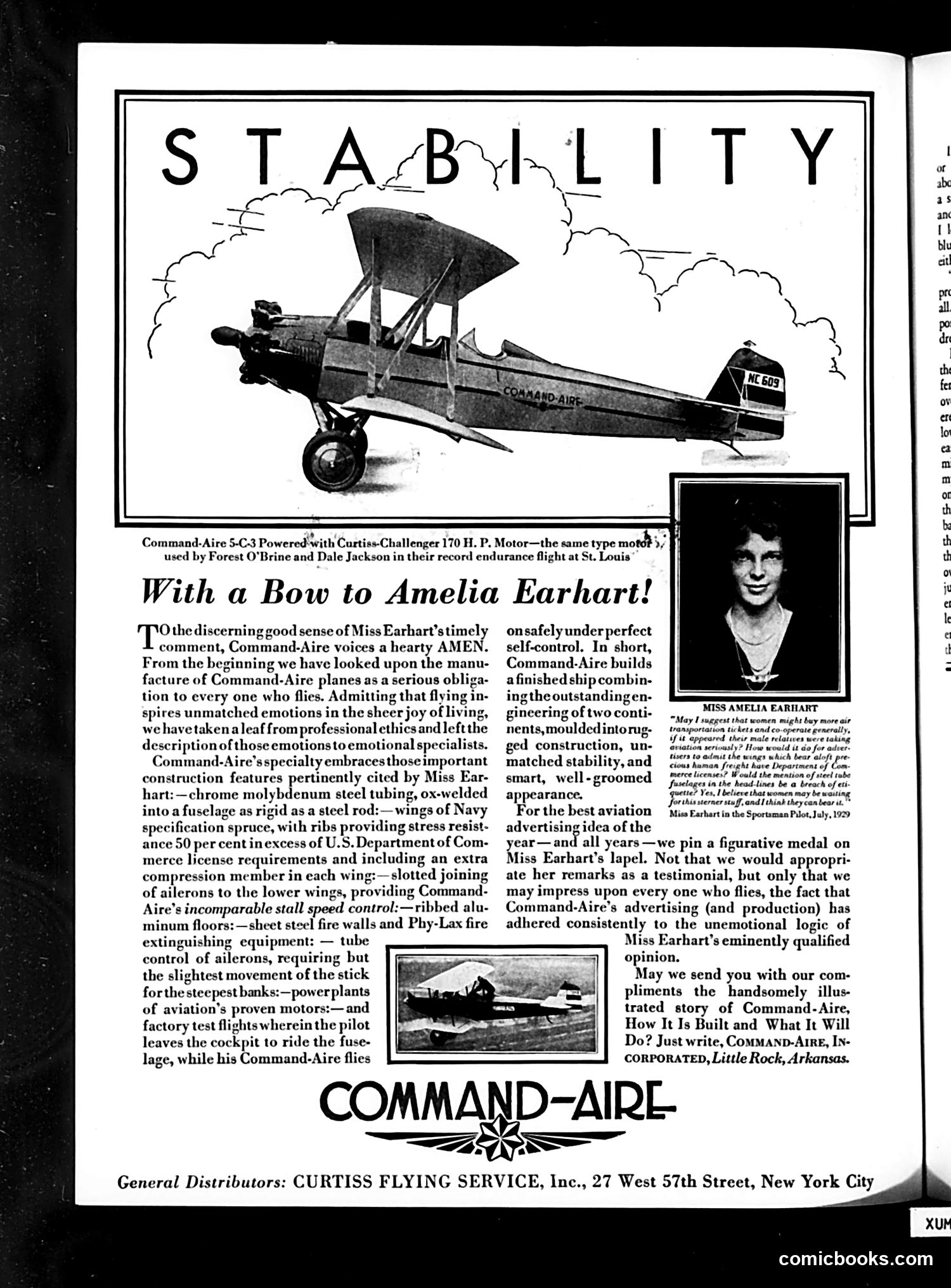
Analysis This is a Command-Aire aircraft advertisement, not satire or a political cartoon. It uses Amelia Earhart's endorsement to market planes. The ad quotes Earhart's published criticism (from July 1929 *Sportsman Pilot* magazine) urging aviation advertisers to emphasize engineering and safety specifications rather than emotional appeals. She argued women would support aviation more if it appeared serious and professional rather than romanticized. Command-Aire positions itself as heeding her advice by detailing technical features: steel tubing, wing specifications, fire safety equipment, and rigorous factory testing. The ad essentially claims moral high ground—they're the responsible manufacturer who listens to the era's most famous aviator. The portrait of Earhart and her direct quote serve as testimony to the company's serious approach. This was effective marketing in 1929, leveraging Earhart's considerable credibility and her contemporaneous critique of the aviation industry's marketing practices.
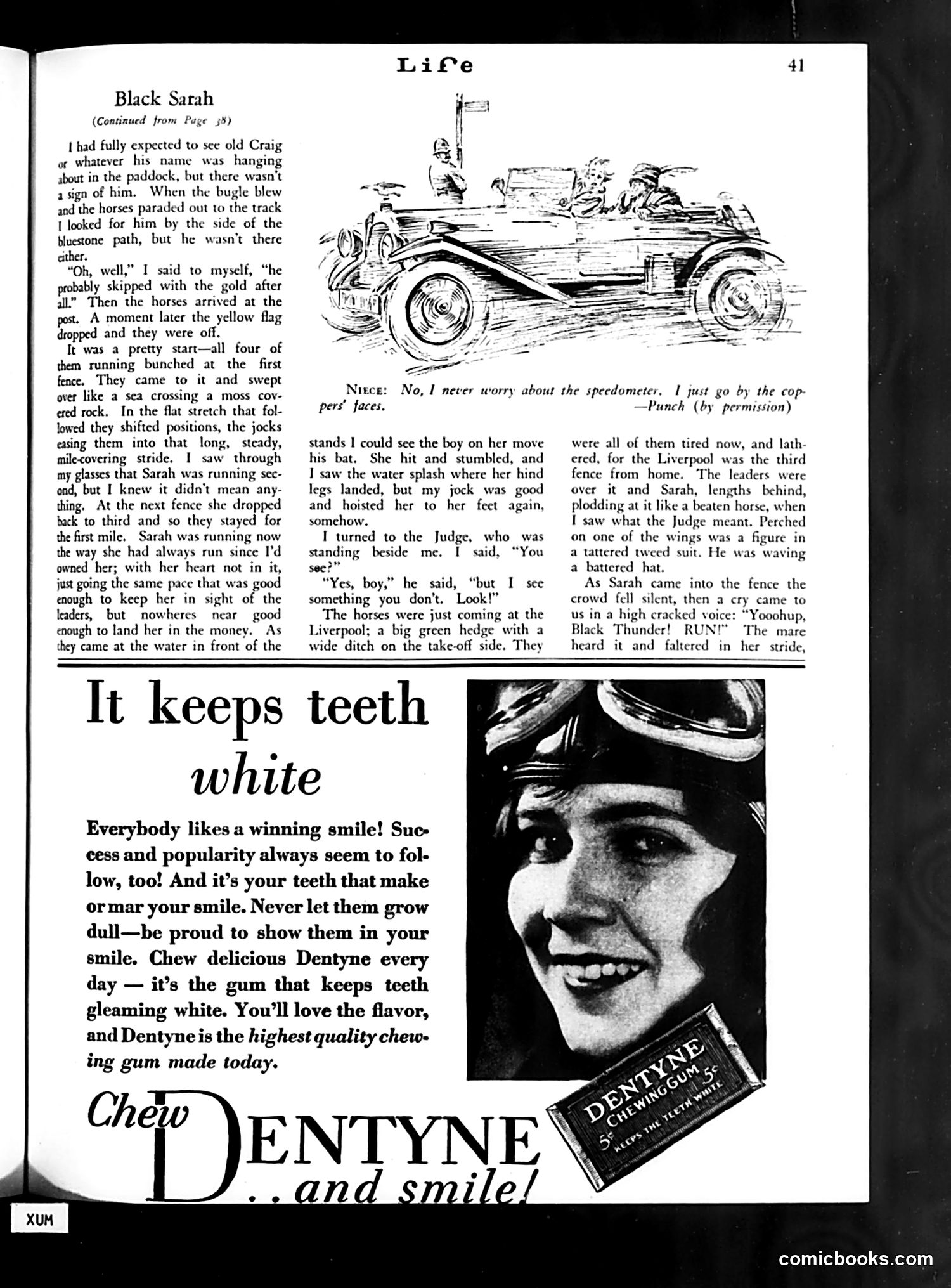
Page Analysis: "Black Sarah" and Dentyne Advertisement This page contains two distinct elements: "Black Sarah" (continued narrative): A horse-racing story where the narrator watches a horse named Sarah compete. The passage describes the race's progression at various fences. A key plot point emerges: a mysterious figure appears on the Liverpool fence—apparently "old Craig," whom the narrator believed had absconded with gold. Craig shouts encouragement to the horse, causing Sarah to falter mid-stride, suggesting his reappearance will alter the race's outcome. Dentyne Gum Advertisement: An unrelated full-page commercial promoting Dentyne chewing gum, emphasizing that it whitens teeth and enhances one's smile for social success. Features a woman's photograph and product packaging. The page structure—serialized fiction interrupted by advertising—was typical of *Life* magazine's mixed editorial and commercial content. The satirical or comedic elements, if any, are not apparent from this excerpt; it reads as straightforward narrative and marketing.
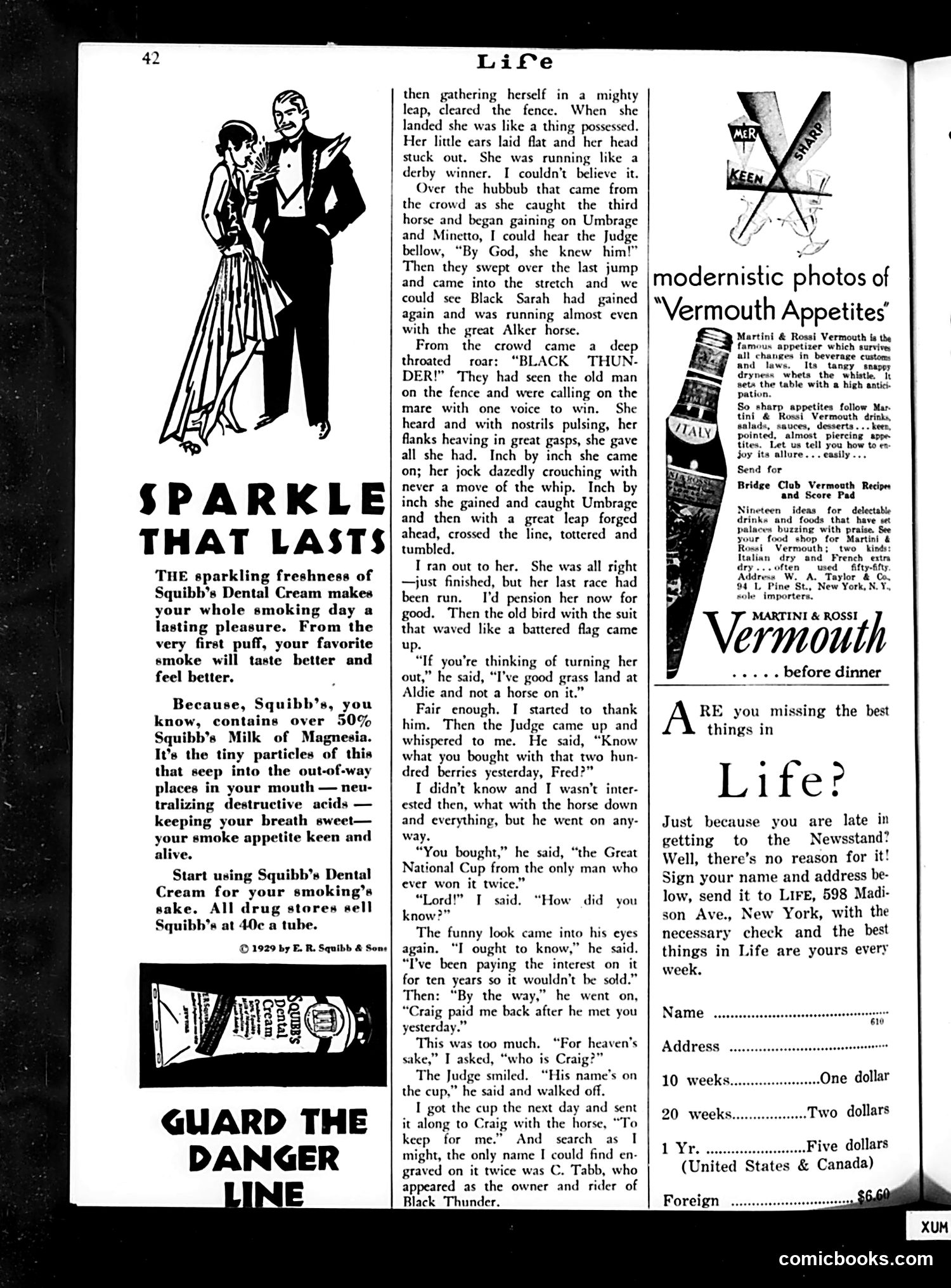
Analysis for Modern Readers This page contains primarily advertisements rather than political satire. The main visual element is an illustration promoting Squibb's Dental Cream, showing a well-dressed couple. The advertisement's pitch—that the toothpaste contains "Milk of Magnesia" to neutralize acids and keep breath fresh for smokers—reflects early 20th-century marketing that normalized smoking as a routine social activity. The claim that dental cream improves the "smoking experience" would strike modern readers as bizarre; today we associate smoking with dental damage. The page's dominant text is a horse-racing story (unrelated to satire), followed by ads for Martini & Rossi Vermouth, marketed as an "appetizer" to stimulate appetite before meals—reflecting Prohibition-era messaging that reframed alcohol as medicinal/functional rather than recreational. No political figures or satirical commentary are evident on this page. It represents Life magazine functioning primarily as an advertising vehicle, circa 1929.
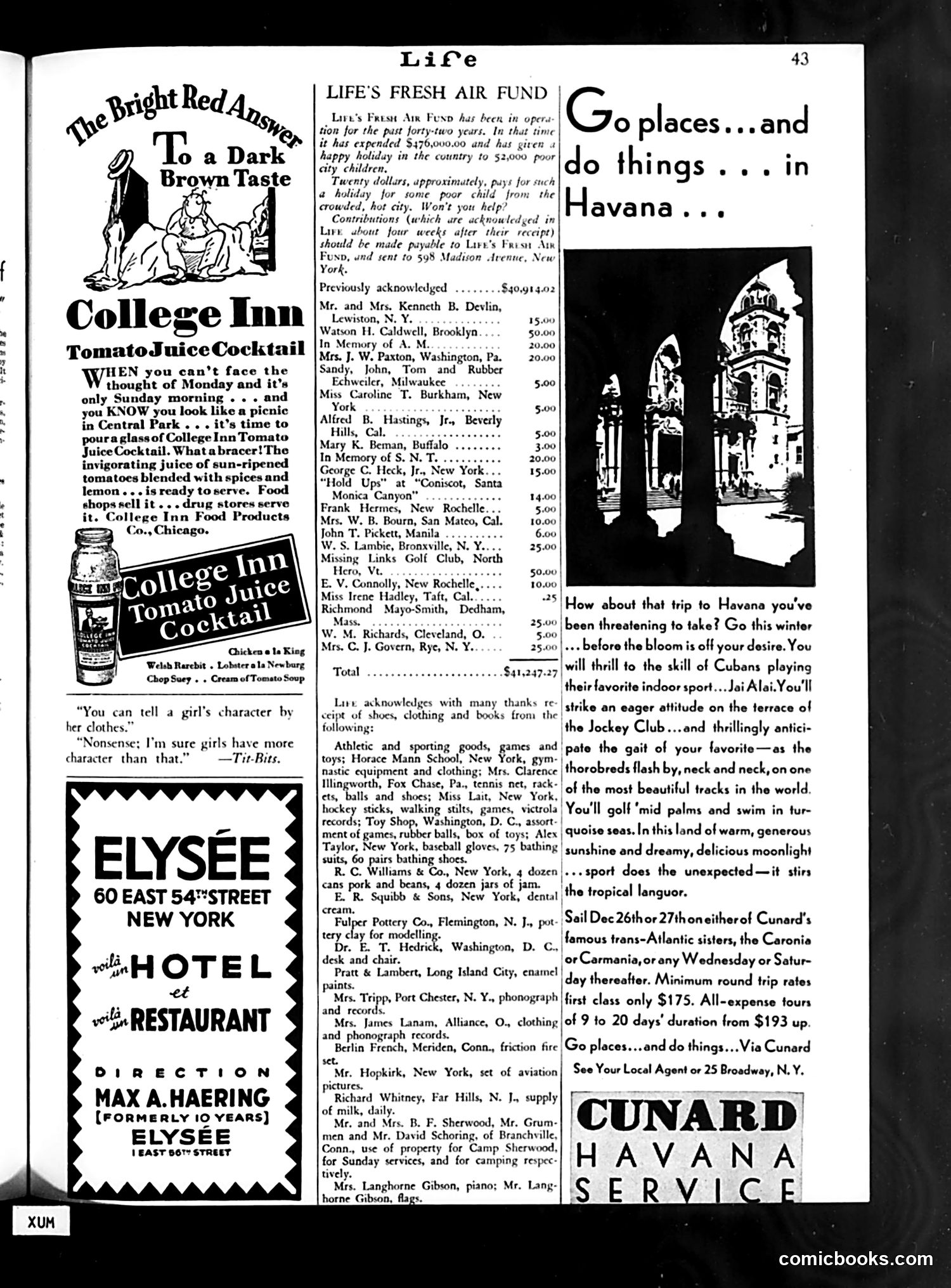
Analysis of Life Magazine Page 43 This page is primarily advertising and charitable fundraising, not political satire. The main content includes: 1. College Inn Tomato Juice Cocktail ad: A humorous advertisement depicting someone hungover on Monday morning, promoting tomato juice cocktails as a "bracer" (pick-me-up). The joke is relatable—people recognizing their own weekend excess. 2. Life's Fresh Air Fund: A charity appeal seeking donations to send poor city children to the countryside. It's presented as straightforward philanthropy, listing donors and amounts. 3. Hotel and travel advertising: The Elysée Hotel ad and a Cunard steamship ad promoting trips to Havana, Cuba—reflecting 1920s leisure travel for the wealthy. 4. A brief joke about judging girls' character by clothing—mild social commentary on superficiality. The page reflects 1920s American culture: urban leisure, charitable giving by the affluent, and the emerging travel industry. There's no significant political satire visible—it's primarily commercial and philanthropic content typical of Life magazine's mixed advertising/editorial format.
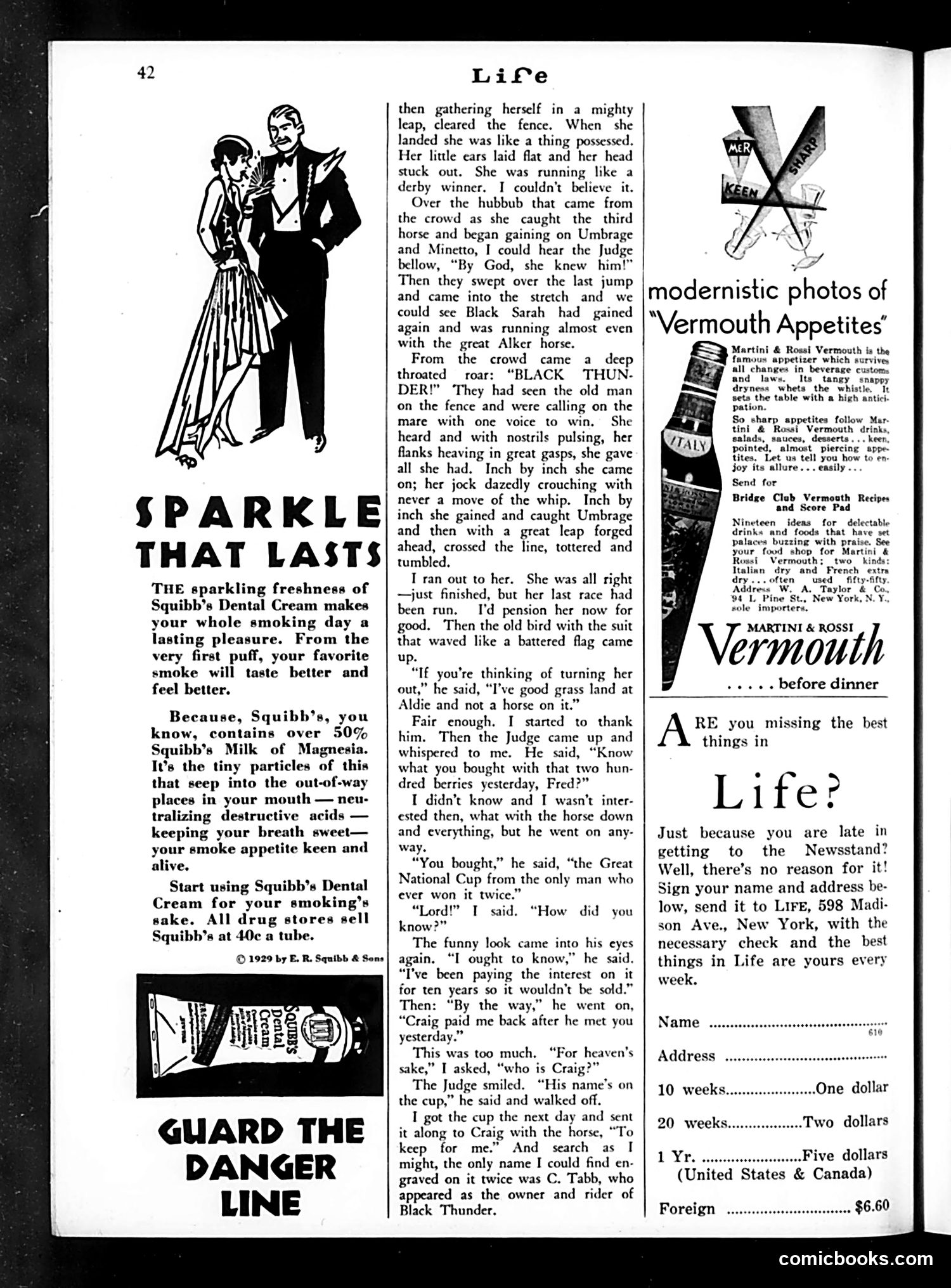
Analysis of Life Magazine Page 42 This page contains primarily advertising and fiction, not political satire. The main narrative concerns horse racing: a story about a mare named "Black Sarah" winning a race, with the protagonist discovering he has unknowingly purchased the famous "Great National Cup" trophy. The plot hinges on a character named Craig who appears to be "C. Tabb," suggesting a pun or wordplay element typical of Life's humor. The advertisements are for Squibb's Dental Cream (marketed as improving the smoking experience by neutralizing mouth acids) and Martini & Rossi Vermouth (an alcoholic aperitif). These ads reference 1920s consumer culture and—notably regarding Vermouth—likely allude to Prohibition-era drinking, though the ad euphemistically frames it as a pre-dinner appetite stimulant. The illustration shows a formally dressed couple in 1920s attire. There is no identifiable political cartoon or satirical commentary on this page.
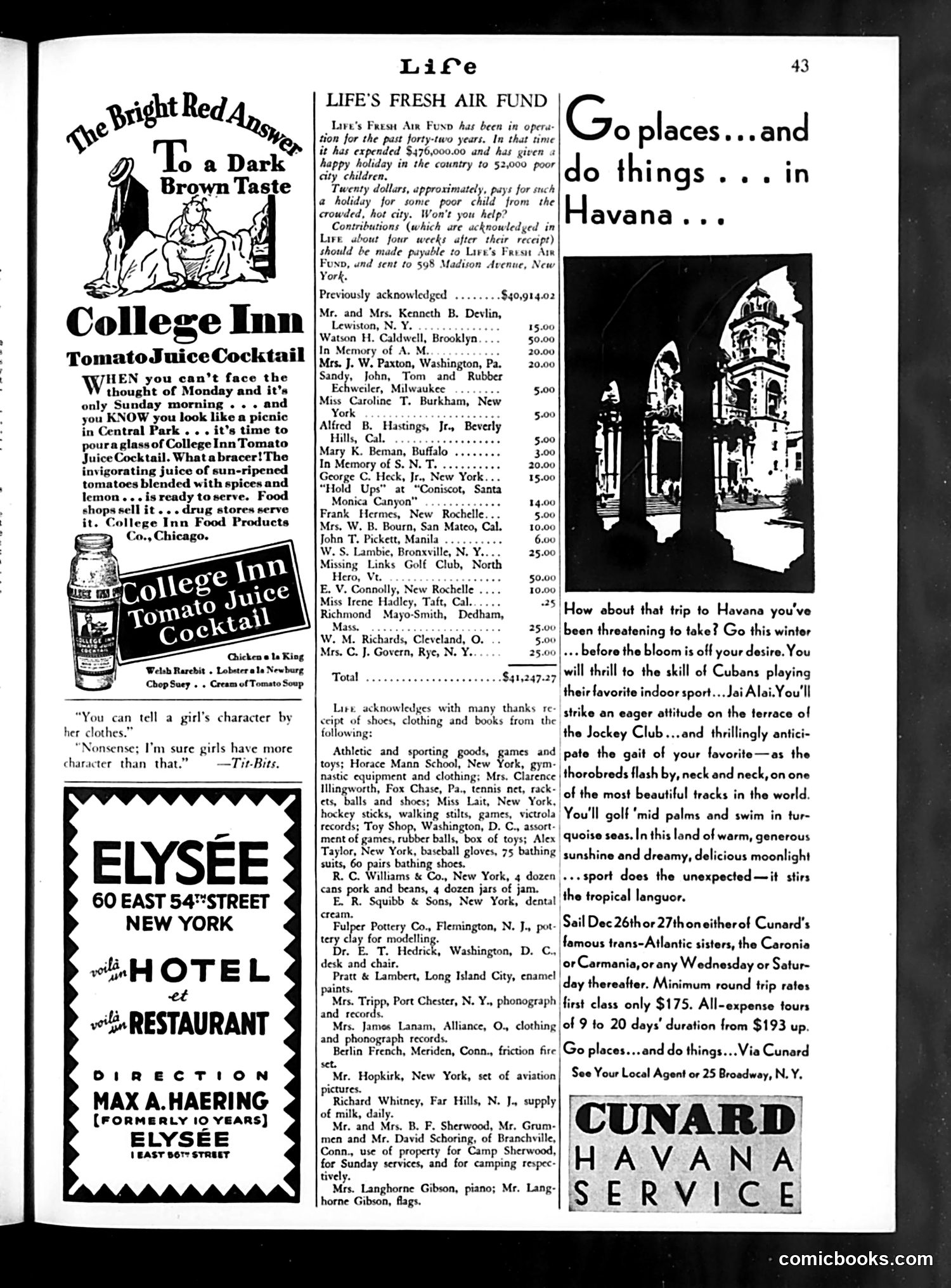
Analysis of This Life Magazine Page This page is primarily advertising and charity notices rather than satirical content. The cartoon "The Bright Red Answer to a Dark Brown Taste" is a lighthearted product advertisement for College Inn Tomato Juice Cocktail. It depicts a hungover or depressed figure (labeled with "dark brown taste") being revived by the drink, presented as a Sunday morning cure for weekend excess. The humor is straightforward: the bright red tomato juice offers both literal and figurative revival. The page also features Life's Fresh Air Fund, a genuine charitable campaign soliciting donations ($20 provides a poor city child a country holiday). The detailed list of contributors and donated items reflects early 20th-century philanthropic practices. Supporting advertisements include the Elysee Hotel and Restaurant in New York and a Cunard shipping line ad promoting winter travel to Havana—leisure activities for affluent readers. The small quote about judging "a girl's character by her clothes" is generic period humor, not satirizing anything specific.
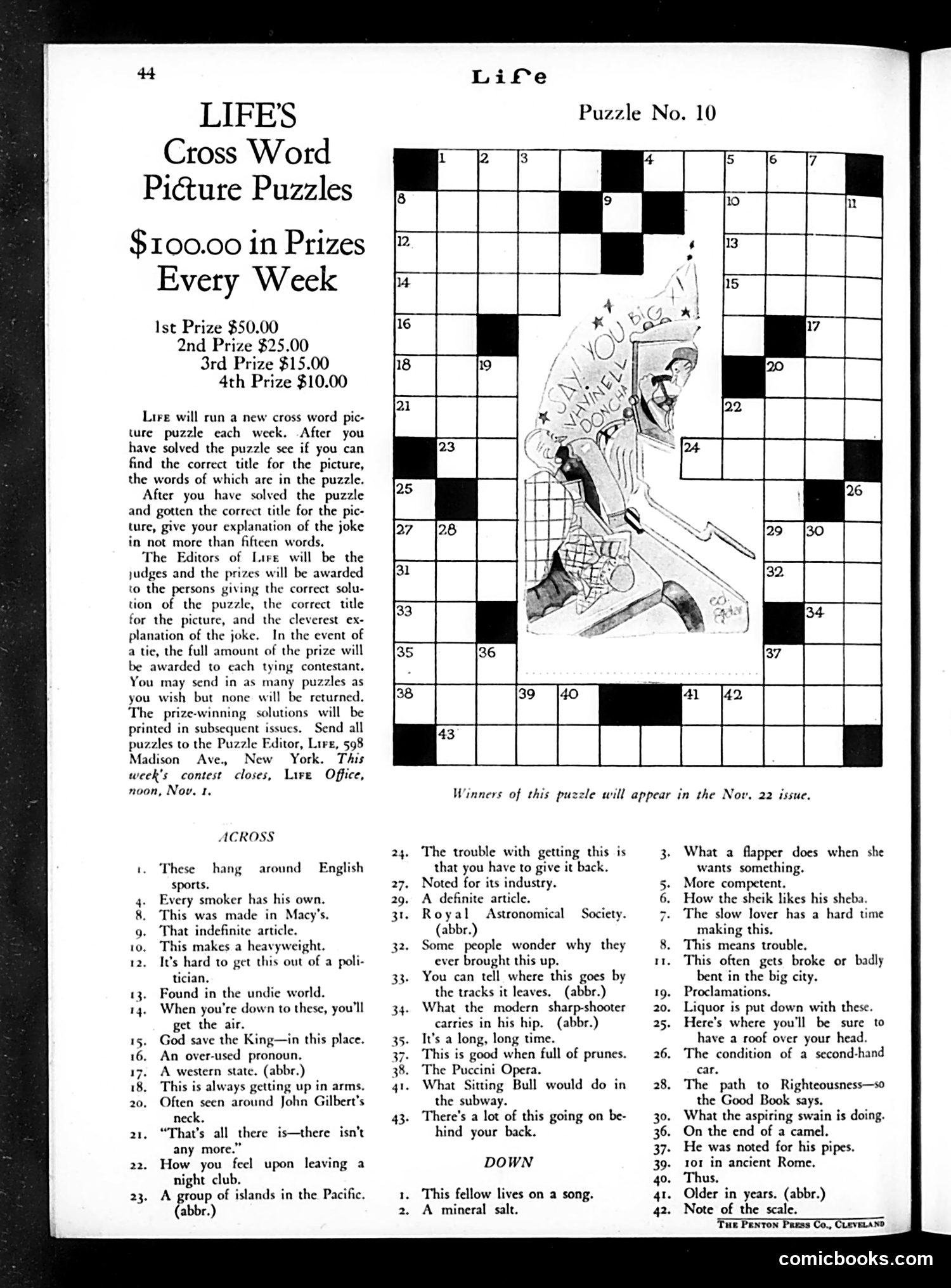
Life Magazine Crossword Picture Puzzle No. 10 This page is primarily a contest advertisement for Life magazine's weekly crossword-picture puzzle competition offering $100 in prizes. The central image shows a cartoon of what appears to be a flapper or young woman in 1920s dress, depicted in an energetic, playful pose—likely representing the modern, liberated "New Woman" of the Jazz Age era that Life frequently satirized. The puzzle itself requires solvers to: 1. Complete a crossword using the clues provided 2. Identify a hidden title for the picture (using words from the crossword) 3. Explain the joke in fifteen words or fewer The clues reference contemporary 1920s culture: flappers, "sheiks" (romantic suitors), John Gilbert (silent film star), Sitting Bull, and modern sharp-shooters—reflecting Life's focus on current social trends and figures of the day. This was a common engagement device for magazines, encouraging reader participation while promoting the publication.
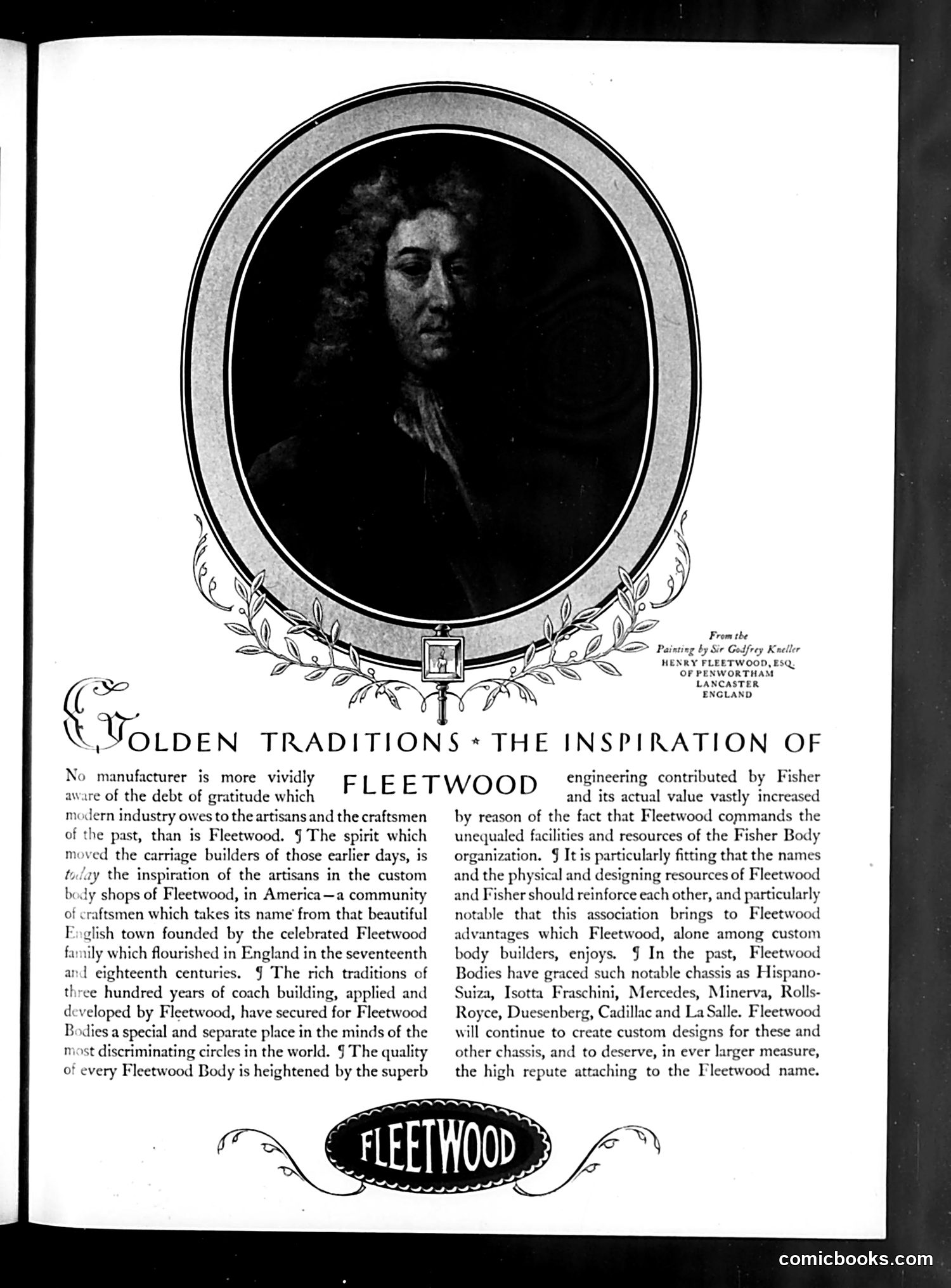
Fleetwood Advertisement (Not Political Satire) This is a luxury automobile advertisement, not political satire. It promotes Fleetwood Bodies, a custom car bodywork manufacturer, by invoking historical prestige. The portrait at top depicts Henry Fleetwood, Esq. of 17th-century England, attributed to Sir Godfrey Kneller. The ad uses this ancestral figure to establish legitimacy through a 300-year pedigree of English craftsmanship. The text argues Fleetwood Bodies inherits the quality standards of historical coachbuilding while partnering with Fisher Body (engineering). It emphasizes exclusivity by listing prestigious chassis they've customized—Rolls-Royce, Cadillac, Mercedes, etc. For modern readers: This represents vintage advertising strategy: selling expensive goods by claiming historical authenticity and association with old-money craftsmanship. The "golden traditions" framing positions luxury automobiles as continuation of artisanal heritage rather than mass-produced industrial products.
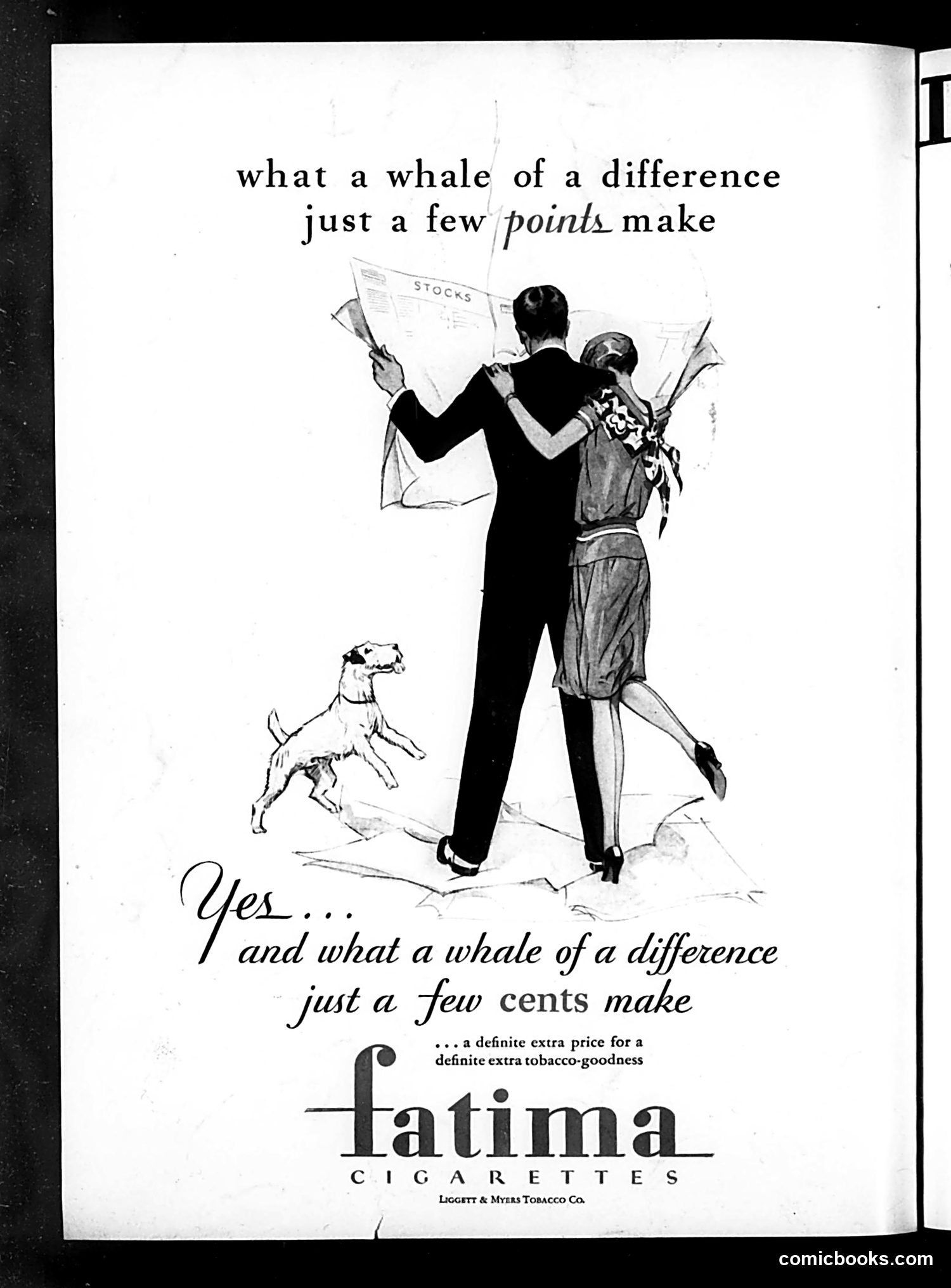
Analysis This is a cigarette advertisement for Fatima brand, not political satire. The "cartoon" depicts a well-dressed couple and small dog examining stock market reports—a visual pun playing on the phrase "what a whale of a difference." The ad's humor relies on a double meaning: just as small fluctuations ("points") matter greatly in stocks, small price differences ("cents") matter greatly in tobacco quality. The tagline promises that Fatima's slightly higher cost delivers noticeably superior tobacco. The phrase "whale of a difference" was common slang meaning "enormous difference." This appears to be a straightforward commercial message aimed at Depression-era consumers—reassuring them that premium cigarettes justified their extra expense through better quality, not mere branding.