life
Life — October 25, 1929
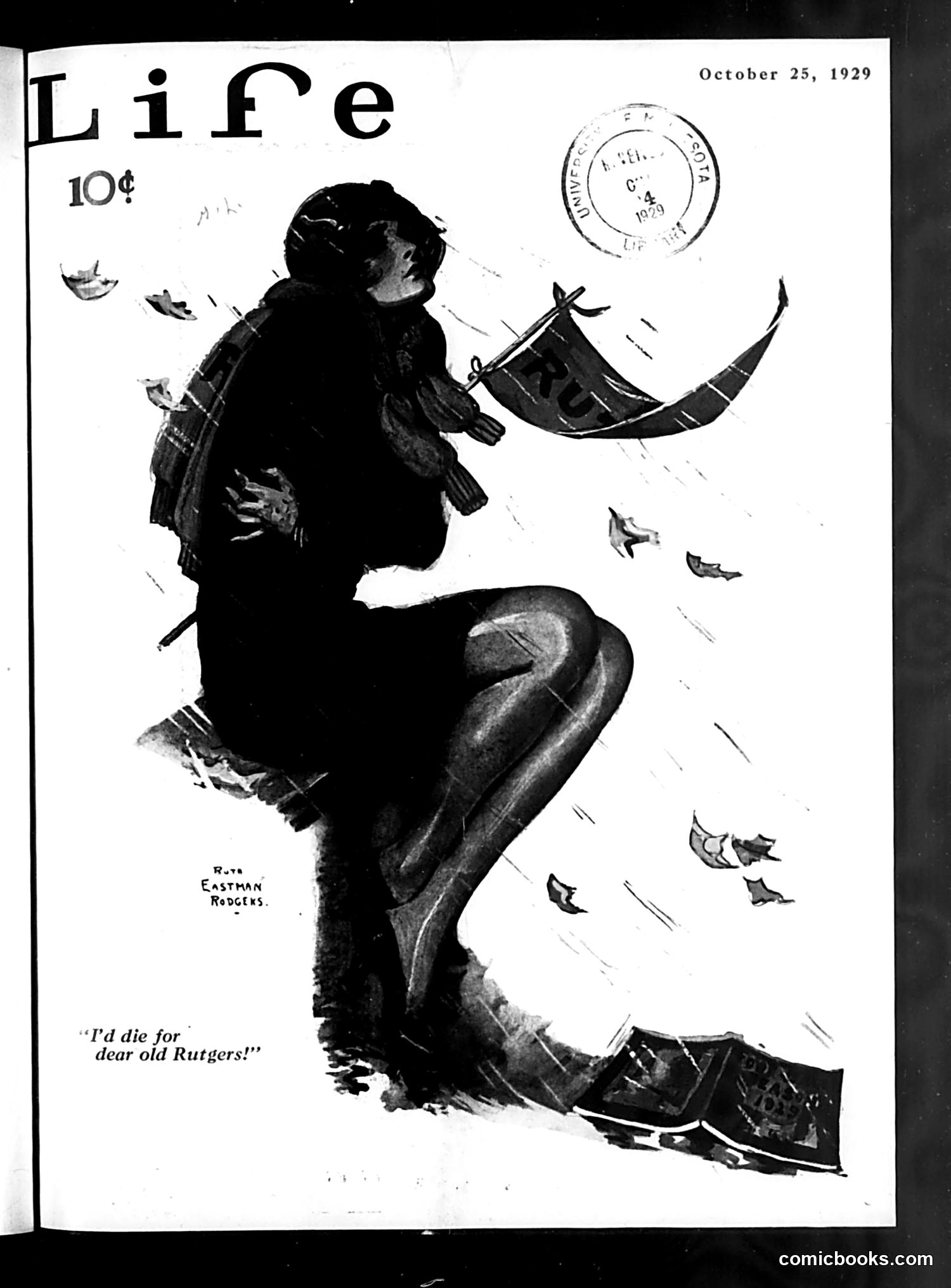
Life Magazine Cover, October 25, 1929 This cover by Ralph Barton depicts a figure in academic robes (likely representing Rutgers University, given the caption "I'd die for dear old Rutgers!") caught in a windstorm of falling papers and debris. The dramatic pose—legs kicked up, papers swirling—suggests chaos and upheaval. Context: This was published just days after Black Tuesday (October 29, 1929), the stock market crash that triggered the Great Depression. The swirling papers likely represent financial documents, stock certificates, and monetary chaos. The satire mocks college loyalty and institutional pride in the face of economic catastrophe—the figure's devotion to Rutgers seems absurdly trivial against the financial destruction engulfing the nation.
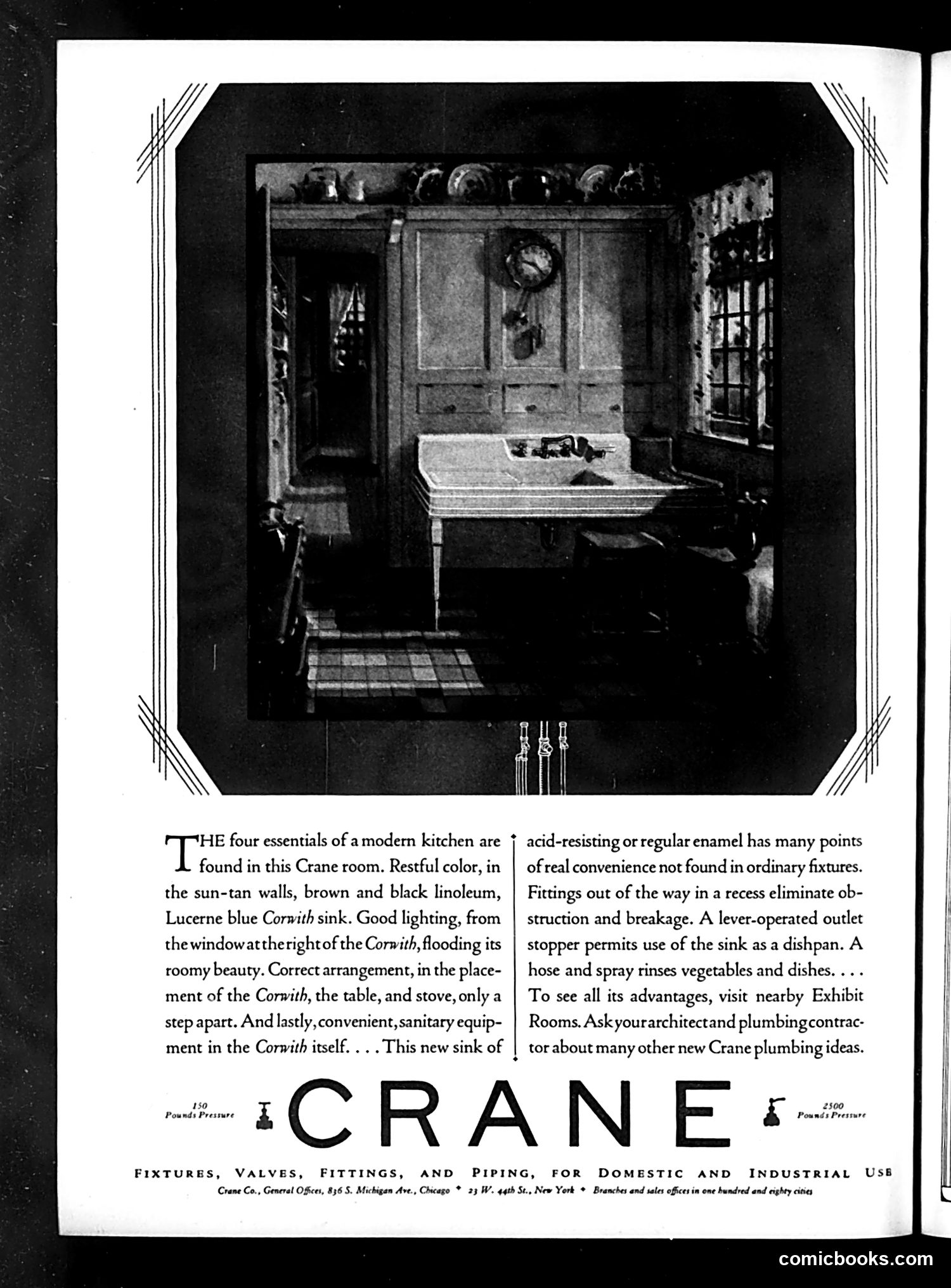
This page is primarily a product advertisement, not satirical content. It showcases a Crane plumbing company kitchen display, highlighting modern fixtures from what appears to be the early 20th century. The ad emphasizes four "essentials of a modern kitchen": aesthetic "restful color" (sun-tan walls, brown and black linoleum), functional design, good lighting from the window, and "convenient, sanitary equipment"—specifically a Crane Cornith sink. The text promotes the sink's practical features: acid-resistant enamel, recessed fittings to reduce obstruction, a lever-operated outlet stopper, and spray capabilities for rinsing dishes. This represents the era's marketing of kitchen modernization as a sign of progress and domestic convenience, likely targeting middle-class homeowners seeking up-to-date fixtures.
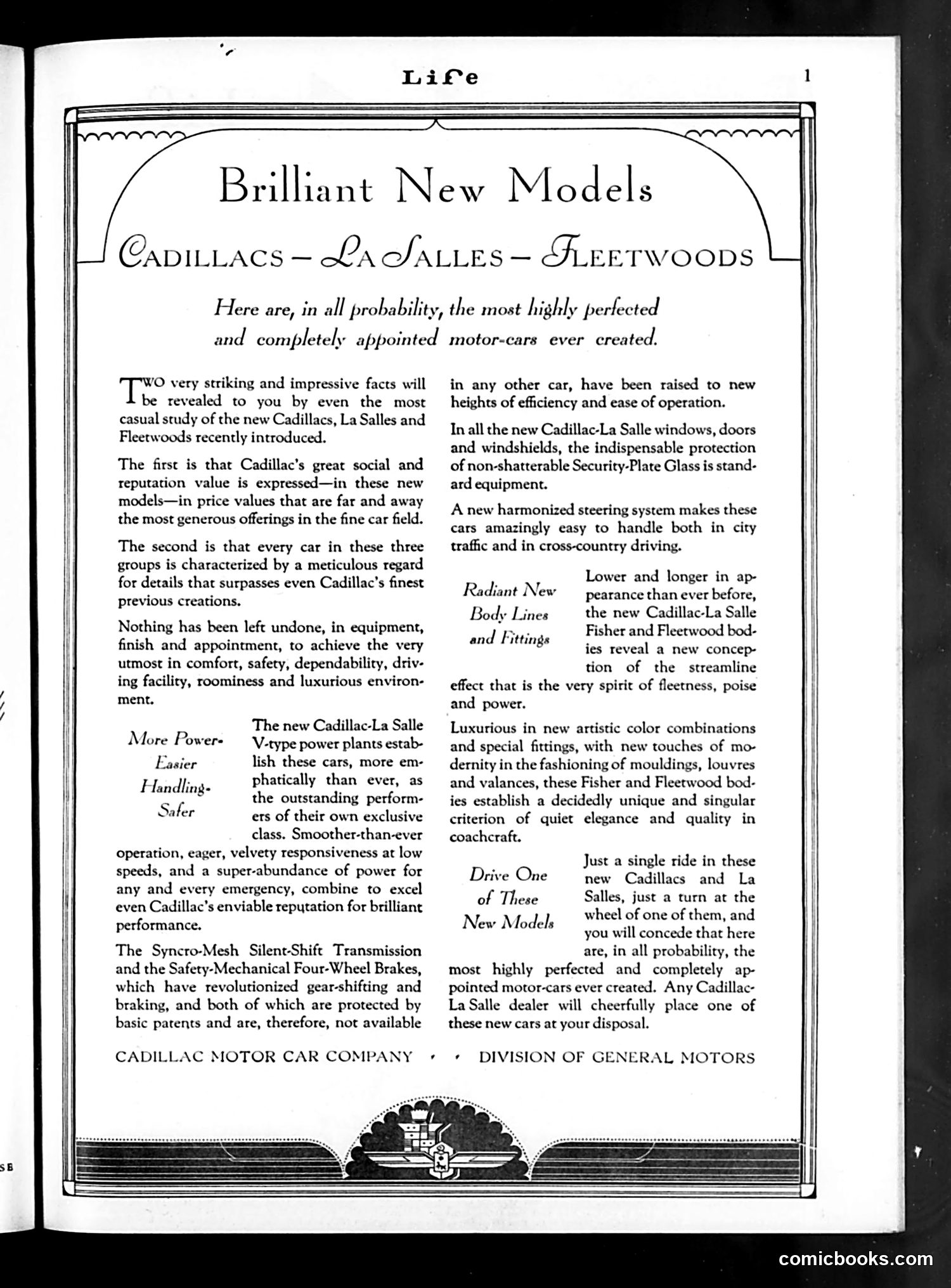
Analysis This page contains advertising, not satire or political commentary. It's a full-page advertisement for Cadillac, La Salle, and Fleetwood automobiles from the Cadillac Motor Car Company (a General Motors division). The ad promotes these as "the most highly perfected and completely appointed motor-cars ever created," emphasizing luxury features like safety glass, harmonized steering, and Fisher/Fleetwood body styling. It highlights technical innovations: V-type engines, Syncro-Mesh transmission, and four-wheel brakes. There are no cartoon figures, caricatures, or political references. The decorative border and typography are period design elements typical of 1920s-30s magazine advertising. This represents straightforward automotive marketing rather than satirical content.
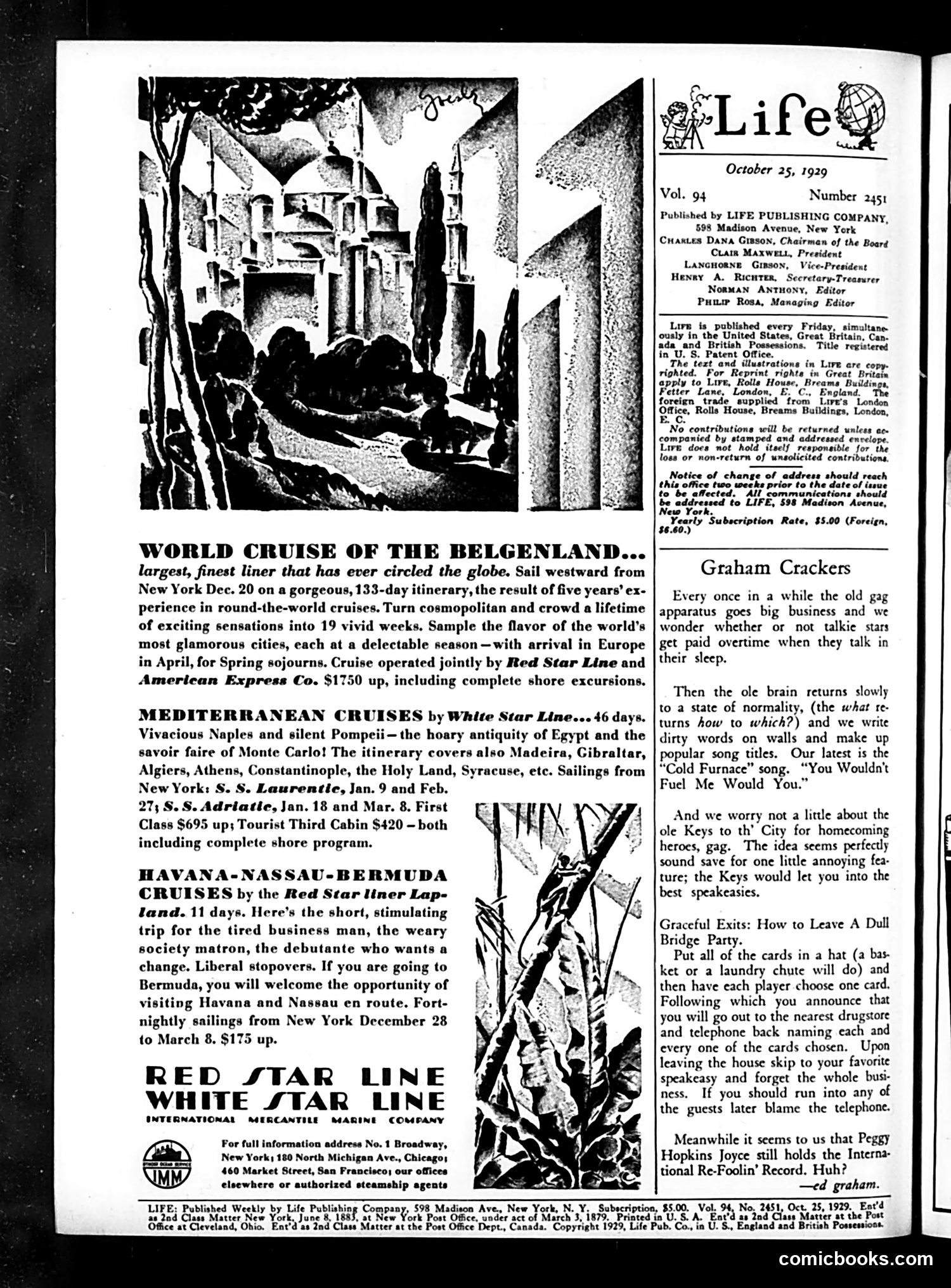
Analysis This page is primarily advertising for cruise lines (Red Star Line, White Star Line, Belgenland), not political satire. The left side features a dramatic illustration of what appears to be a Middle Eastern or North African street scene with architecture and figures—likely marketing imagery for the Belgenland's world cruise departing December 20, 1929. The right side contains a brief humor column titled "Graham Crackers" discussing comedians and entertainment. It references vaudeville acts, talkie stars' salaries, and mentions Peggy Hopkins Joyce, a 1920s celebrity known for publicity and multiple marriages. The humor is light observational comedy about show business, not political commentary. This is essentially a magazine page mixing travel advertisements with light entertainment gossip—typical Life magazine content from 1929.
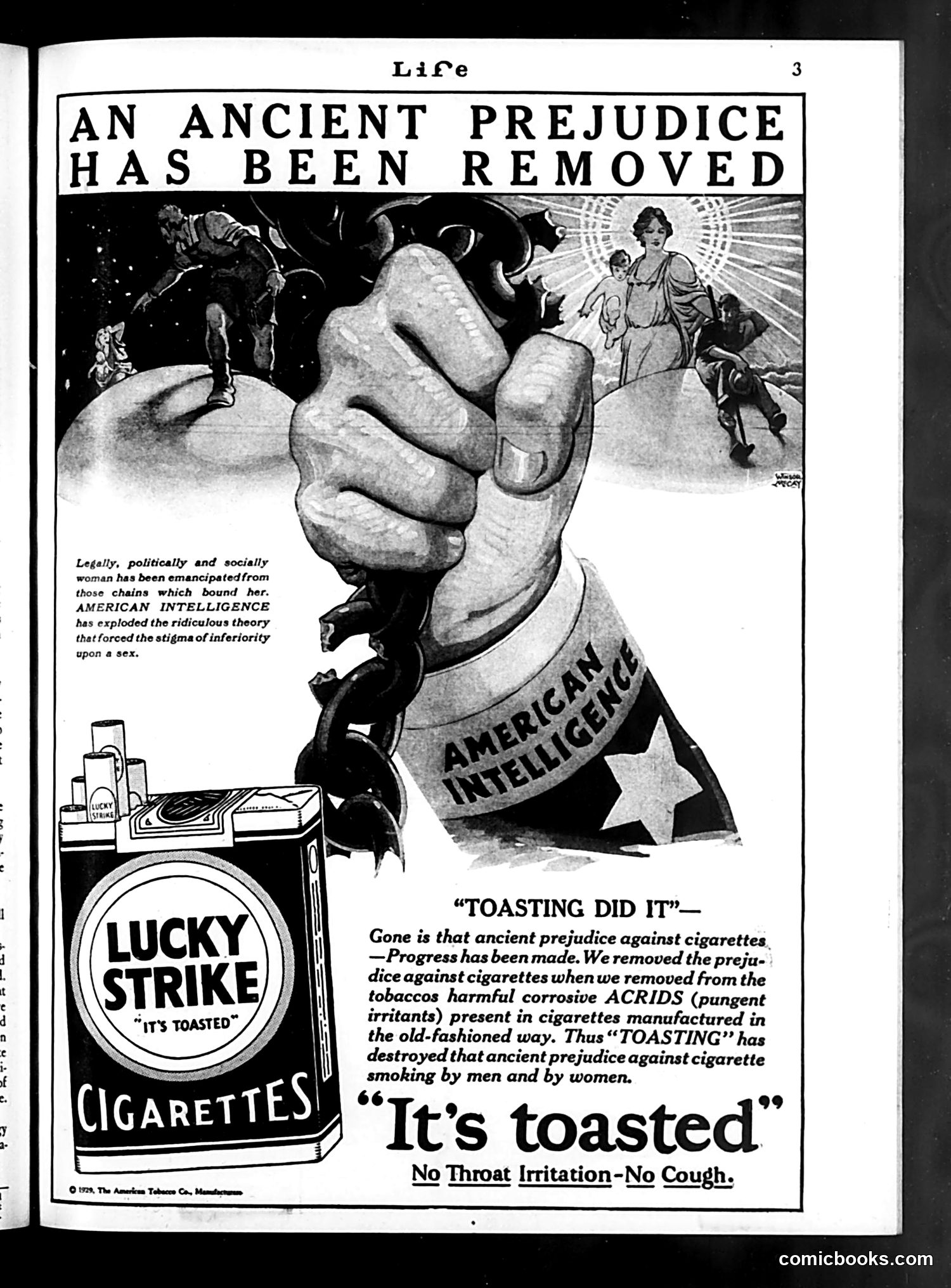
Analysis This is a Lucky Strike cigarette advertisement disguised as social commentary. The headline "An Ancient Prejudice Has Been Removed" uses a giant fist labeled "American Intelligence" to symbolically crush chains, suggesting progress toward women's equality. However, the actual message is commercial: Lucky Strike claims their "toasting" process removes harmful acids from tobacco, making cigarettes safe for both men and women to smoke. The advertisement cynically conflates women's liberation with cigarette consumption, implying that smoking represents modern emancipation. The irony—lost on contemporary readers but evident today—is that this marketing deliberately targets women by framing cigarettes as symbols of freedom, while obscuring tobacco's health dangers. It's propaganda dressed as progressive messaging.
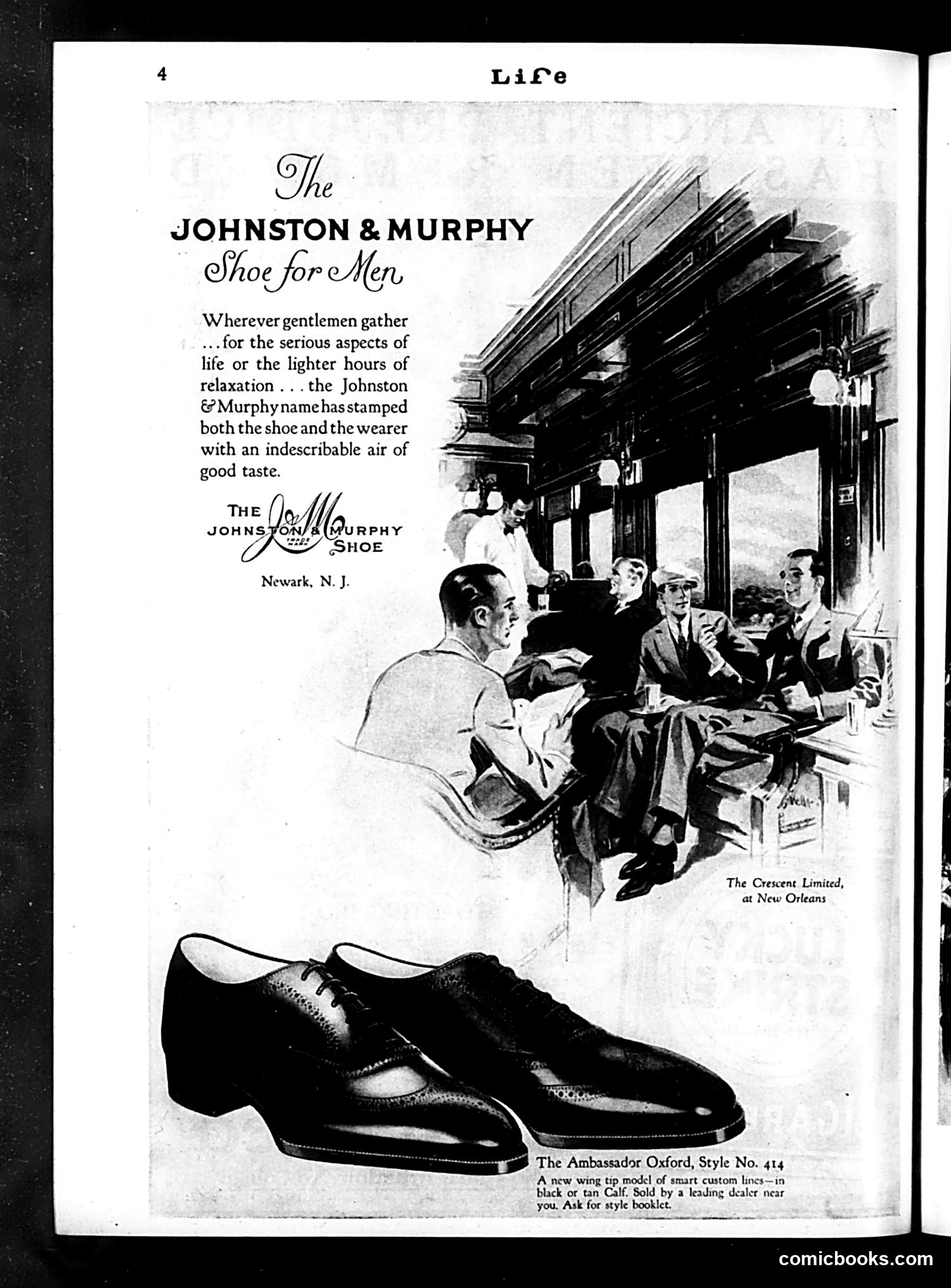
Johnston & Murphy Shoe Advertisement This page is primarily a commercial advertisement, not political satire. It promotes Johnston & Murphy shoes for men, manufactured in Newark, N.J. The ad features two components: 1. Illustrated scene: Gentlemen in business attire gathered in what appears to be an upscale social setting (identified as "The Crescent Limited, at New Orleans"), establishing the shoe brand's association with refined, leisured masculinity. 2. Product image: "The Ambassador Oxford, Style No. 414," displaying black oxford shoes with a wing-tip design. The marketing copy emphasizes how the Johnston & Murphy name conveys "an indescribable air of good taste" among gentlemen in both serious and recreational contexts. This is aspirational branding targeting middle-to-upper-class male consumers through appeals to social status and refinement.
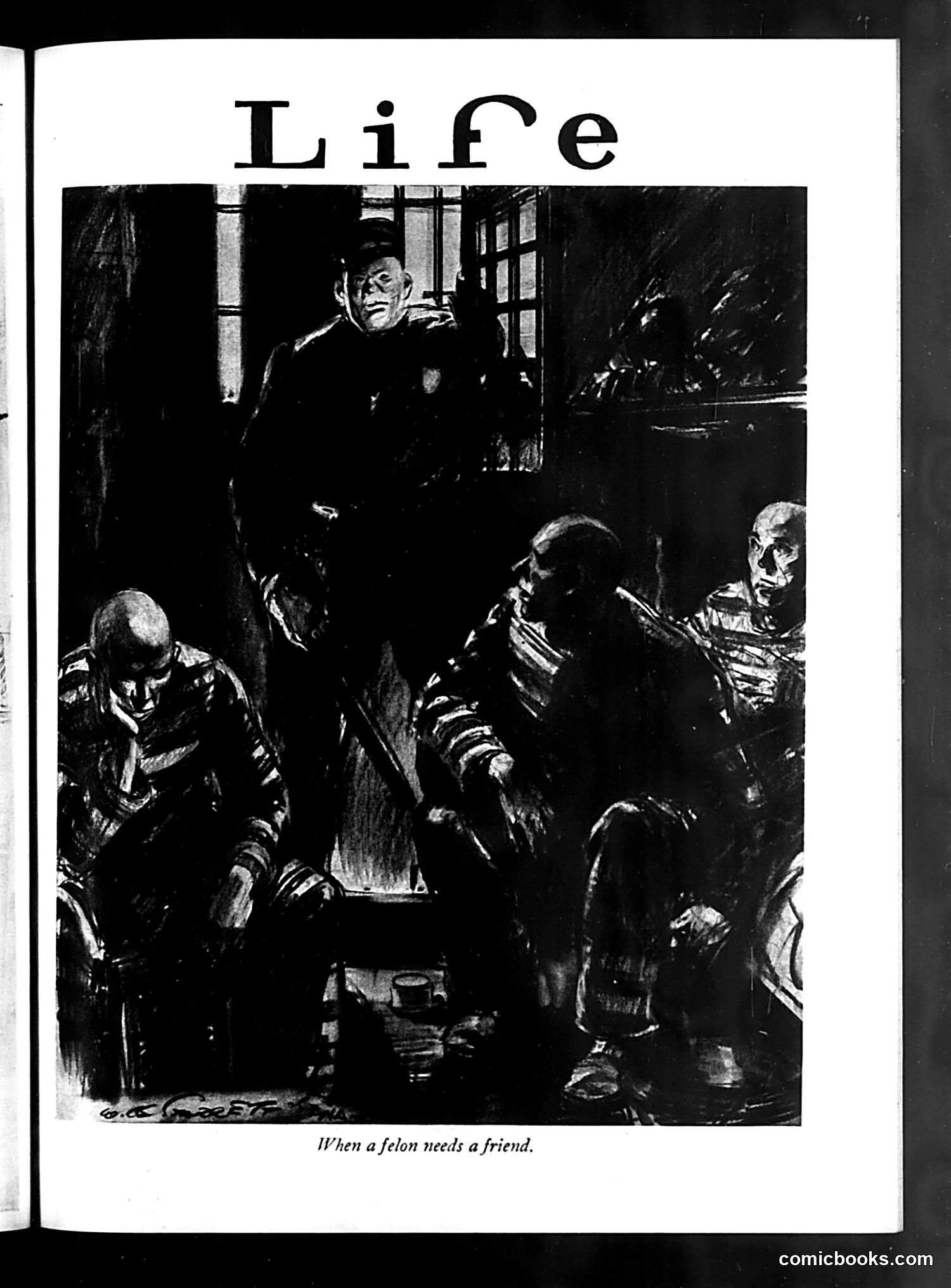
"When a Felon Needs a Friend" This Life magazine cartoon satirizes prison conditions or criminal justice. The image shows a stern authority figure (likely a warden or official) standing over several emaciated, roughly-dressed prisoners. The caption's darkly ironic title suggests commentary on the treatment of incarcerated people—implying that prisoners in this era received minimal care or support. The stark, expressionistic art style emphasizes the prisoners' gaunt, skeletal appearances, contrasting sharply with the well-dressed official overseeing them. This appears to be social satire criticizing either prison neglect, harsh treatment of inmates, or the inadequacy of support systems for the incarcerated. Without a visible date, the specific historical context remains unclear, though such critiques were common in early-to-mid 20th century American publications.
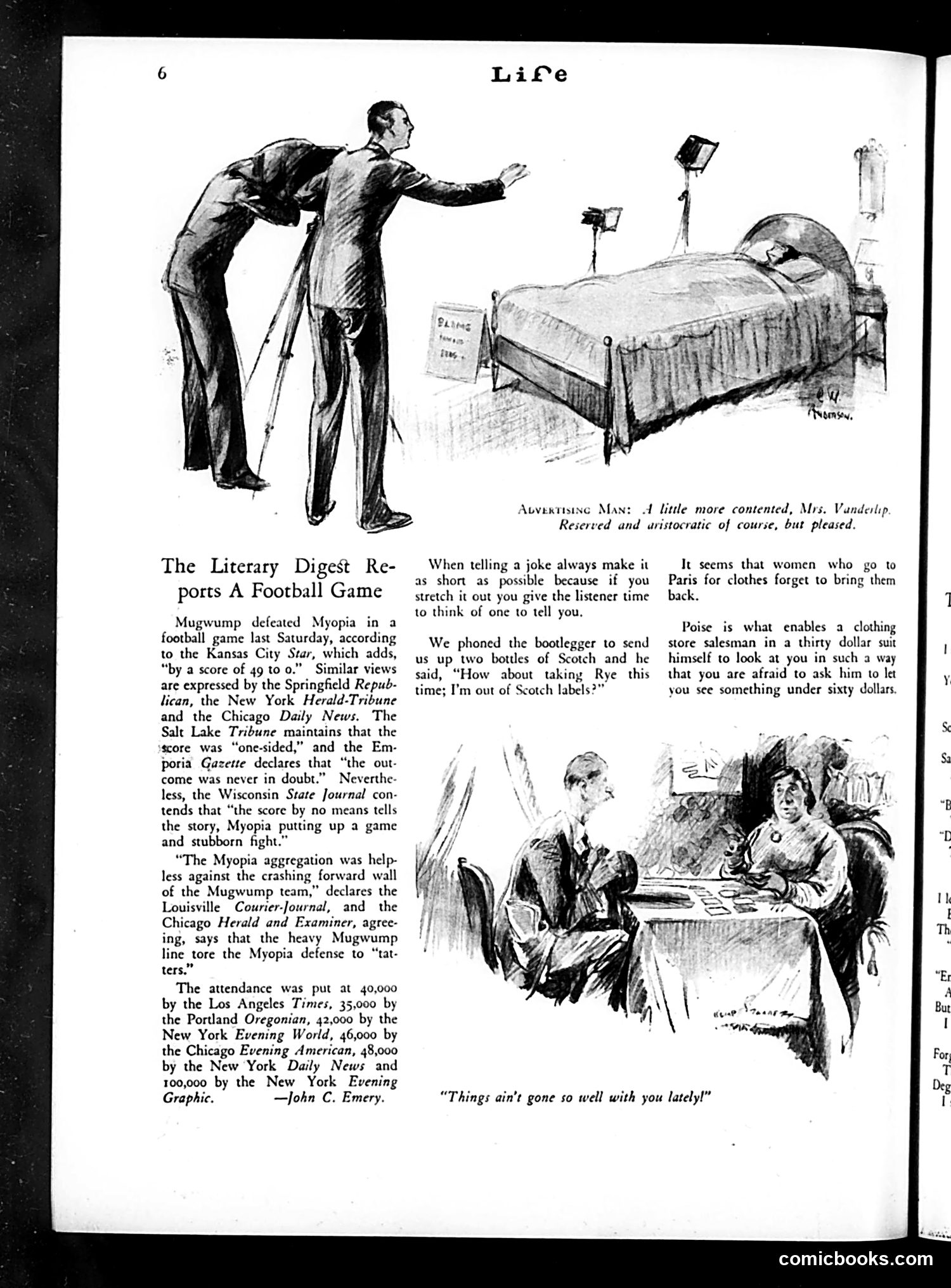
Analysis of Life Magazine Page 6 This page contains three distinct satirical pieces: 1. "The Literary Digest Reports A Football Game" (left column): A commentary on how newspapers exaggerate or sensationalize sports coverage. It humorously catalogs conflicting accounts of a Mugwump-versus-Myopia football game, showing how different papers reported wildly different scores and interpretations of the same event—satirizing unreliable journalism. 2. Top cartoon: An advertising man directing a bedroom scene with film lights, captioned about a reluctant but "pleased" Mrs. Vanderlip. This mocks invasive advertising practices and loss of privacy. 3. Bottom cartoon: Titled "Things ain't gone so well with you lately!"—shows what appears to be a couple in domestic discord, likely satirizing marital troubles or relationship decline in modern life. The page overall critiques journalism reliability, commercialism, and social complications of the era.
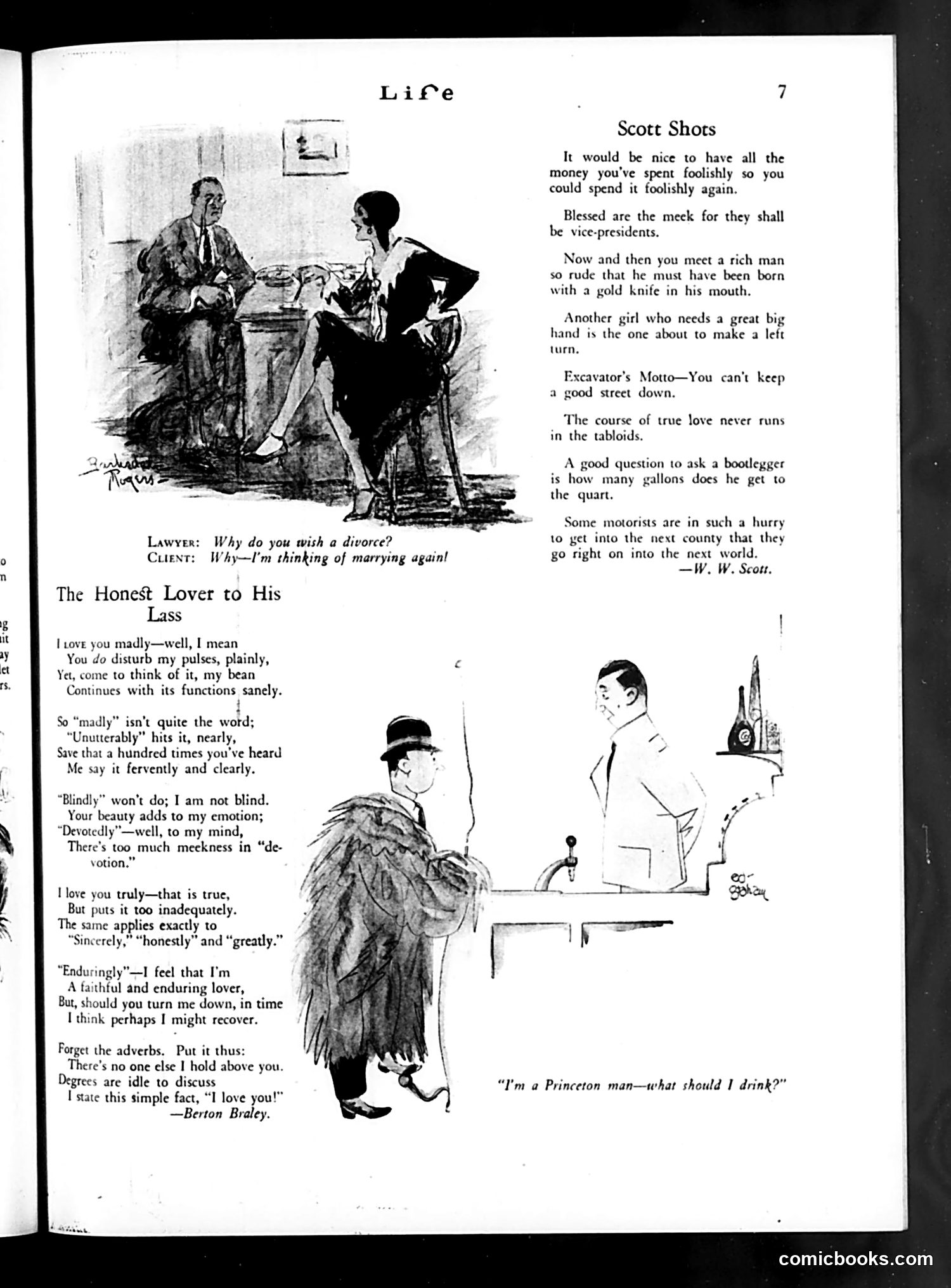
Analysis of Life Magazine Page 7 Top Cartoon: A lawyer asks a client why he wants a divorce; the client replies he's considering remarrying instead. The joke mocks the impulsiveness of romantic decisions—the man hasn't even finalized his first marriage's dissolution before contemplating another. "Scott Shots" Column: W.W. Scott's witty observations about wealth, romantic prospects, bootleggers, and motorists. Notable: references to bootleggers and "gallons to the quart" allude to Prohibition-era illegal alcohol trade and measurement deception—indicating this is from the 1920s Prohibition period. Bottom Cartoon: A man in shabby clothes asks a bartender what he should drink, identifying himself as "a Princeton man"—satirizing educated, wealthy men reduced to poverty, likely due to economic hardship or Prohibition's effects on their social standing.
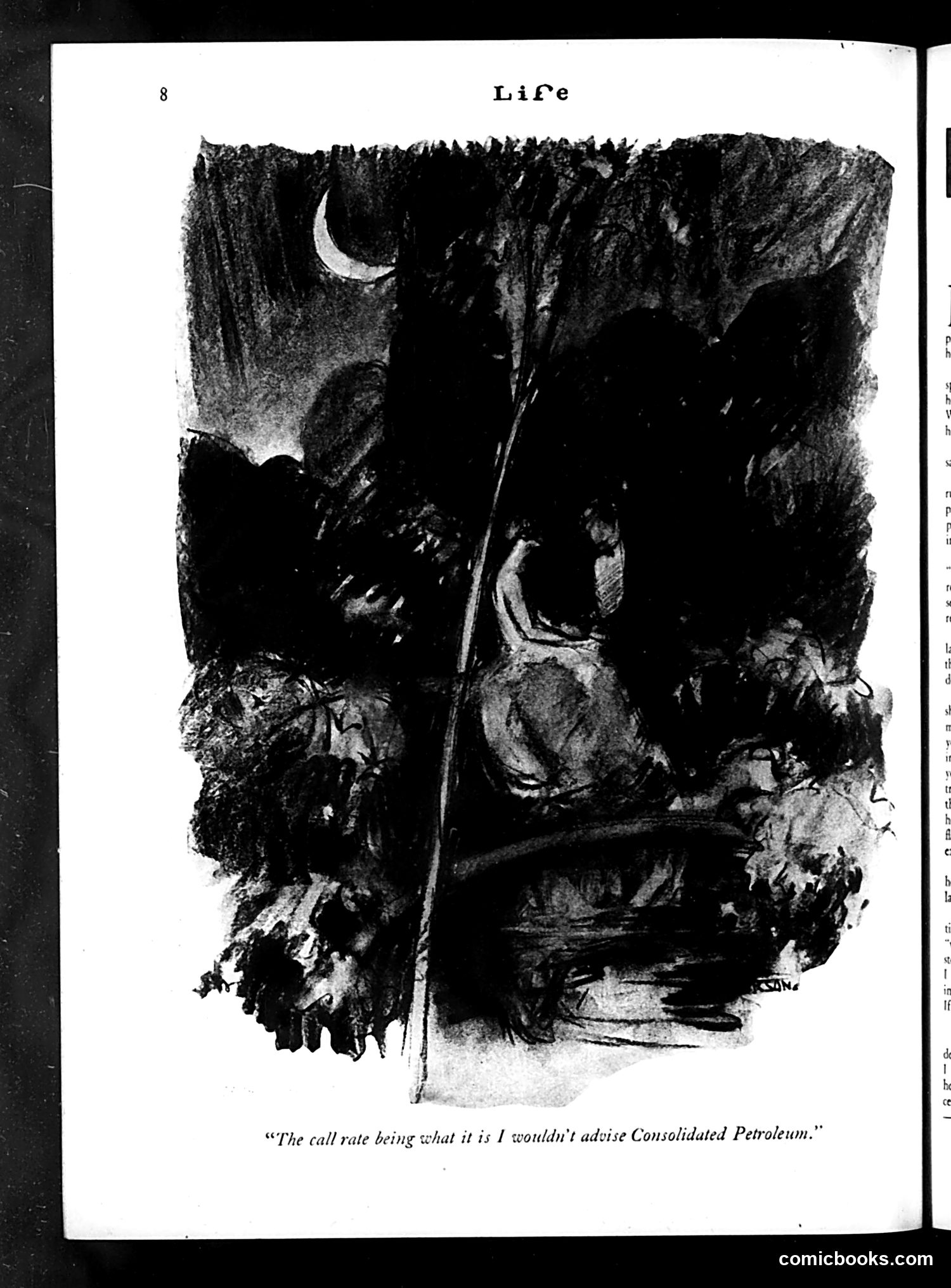
Political Cartoon Analysis This is a satirical illustration from *Life* magazine depicting a nighttime scene with dark, expressionistic shading. The caption reads: "The call rate being what it is I wouldn't advise Consolidated Petroleum." The cartoon appears to be financial satire, likely from the early 20th century. It shows figures in shadow discussing investment advice, with a crescent moon visible above. The speaker warns against investing in "Consolidated Petroleum" due to unfavorable call rates—financial terms relating to stock market borrowing costs. The darkness and ominous mood suggest the petroleum stock is a risky or failing investment. Without additional context about specific market conditions or Consolidated Petroleum's actual performance during publication, the precise historical event remains unclear, but the satire targets stock market speculation and dubious investment advice.
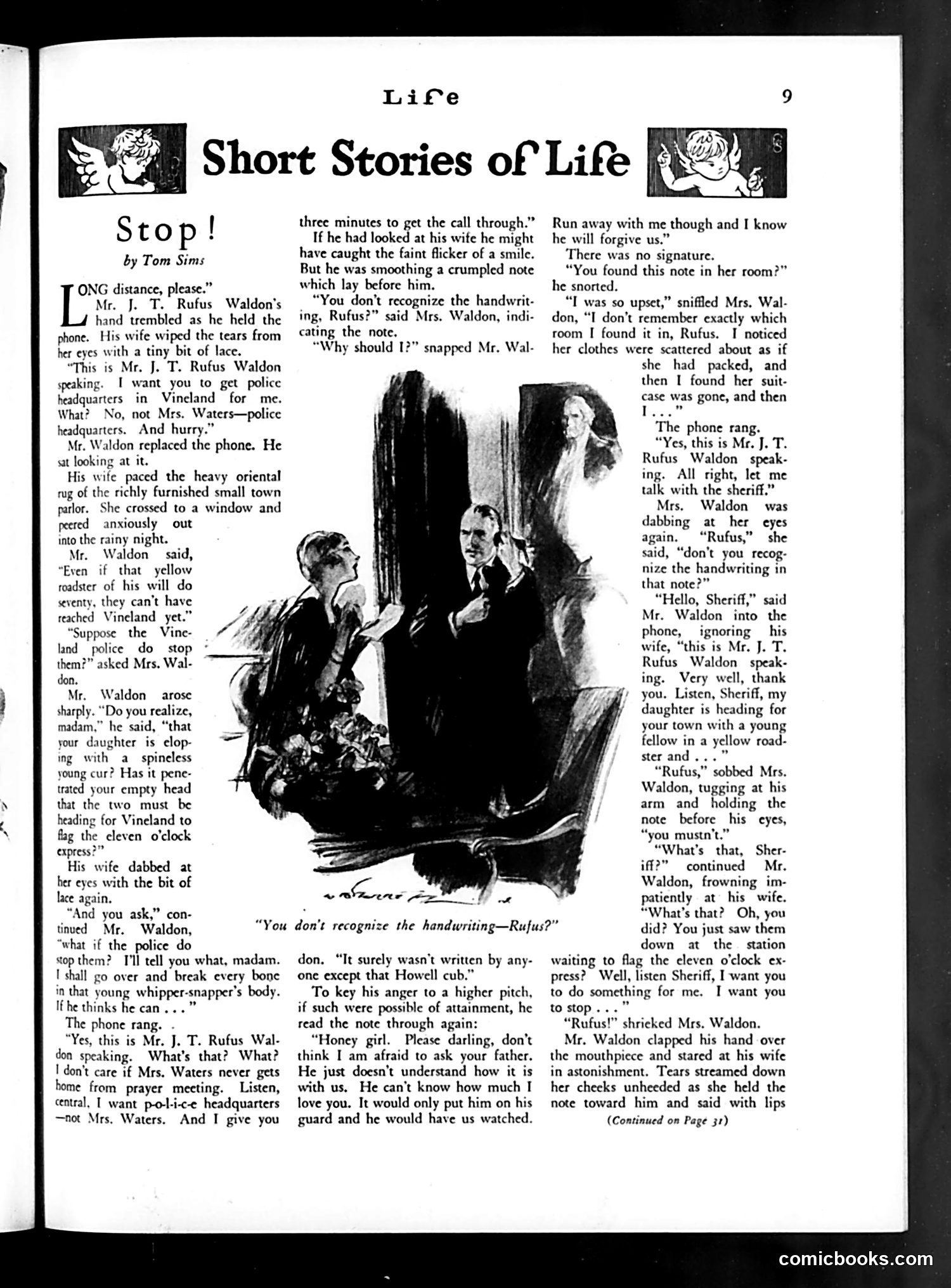
"Stop!" by Tom Sims This is a domestic drama rather than political satire. The story depicts Mr. J.T. Rufus Waldon receiving a long-distance phone call from his wife about their daughter eloping with a "spineless young cur." The wife is upset; Mr. Waldon wants police intervention in Vineland. The narrative centers on confusion over a handwritten note—the wife found it but can't identify the handwriting. Mr. Waldon reads it aloud to the sheriff, which becomes a crucial plot point (story continues on page 31). The illustration shows the couple at home during this tense phone conversation. This appears to be serialized fiction entertainment typical of *Life* magazine's "Short Stories of Life" section, not satire or social commentary.
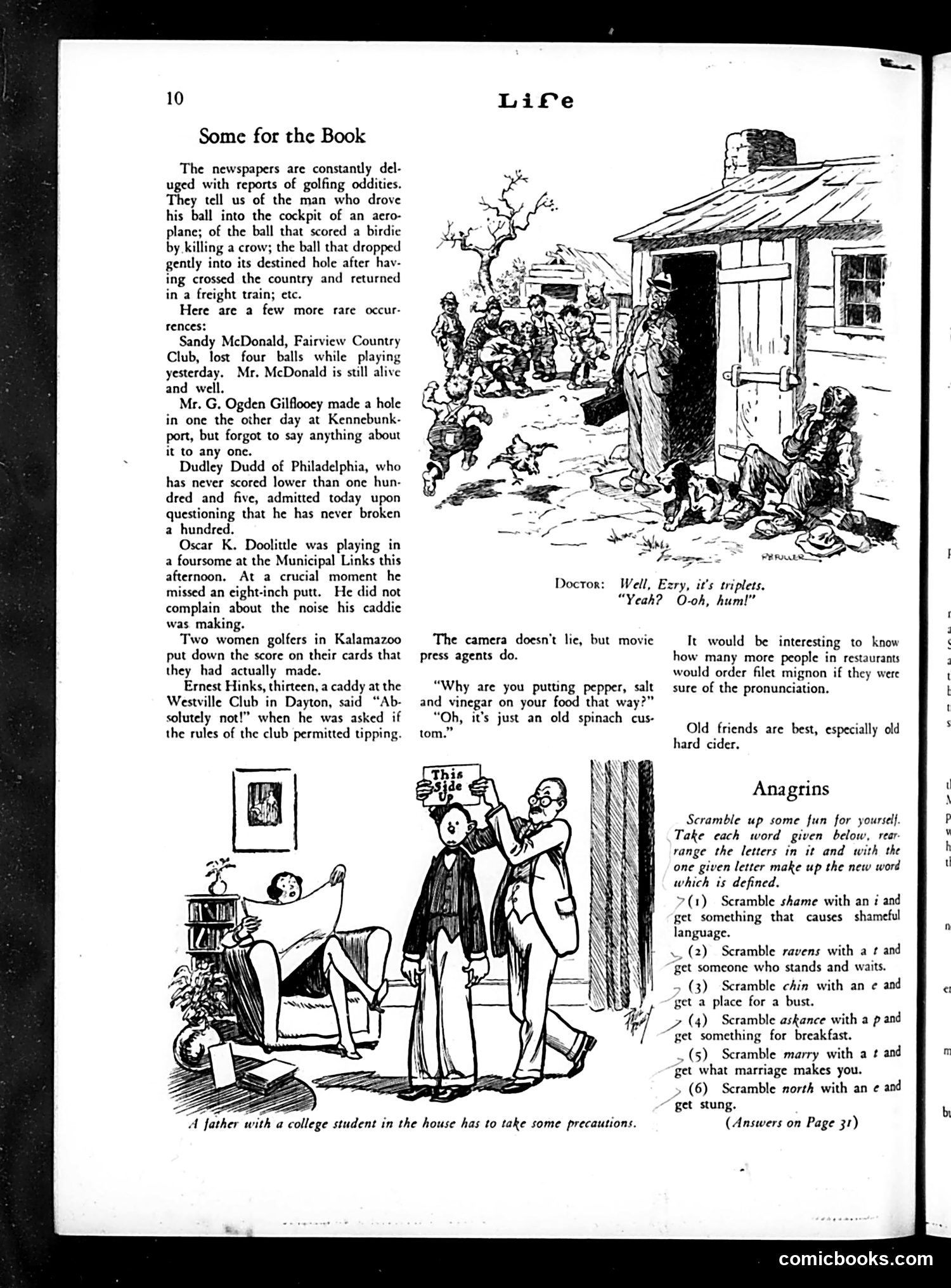
Analysis This page from *Life* magazine contains two distinct elements: "Some for the Book" presents humorous anecdotal reports from newspapers—quirky human-interest stories about golf mishaps, unusual achievements, and social faux pas. These are presented as lighthearted observations on everyday oddities. The cartoon (lower left) depicts a domestic scene where a father must manage a college-age son living at home. The caption warns fathers must "take some precautions," suggesting the humor lies in the generational tension and disruption a young adult student brings to household order and propriety—a relatable concern for middle-class readers when college students returned home. "Anagrins" is a word-puzzle game where readers rearrange letters to form new words with given definitions. The page reflects 1920s-era social commentary on changing family dynamics and educational access.
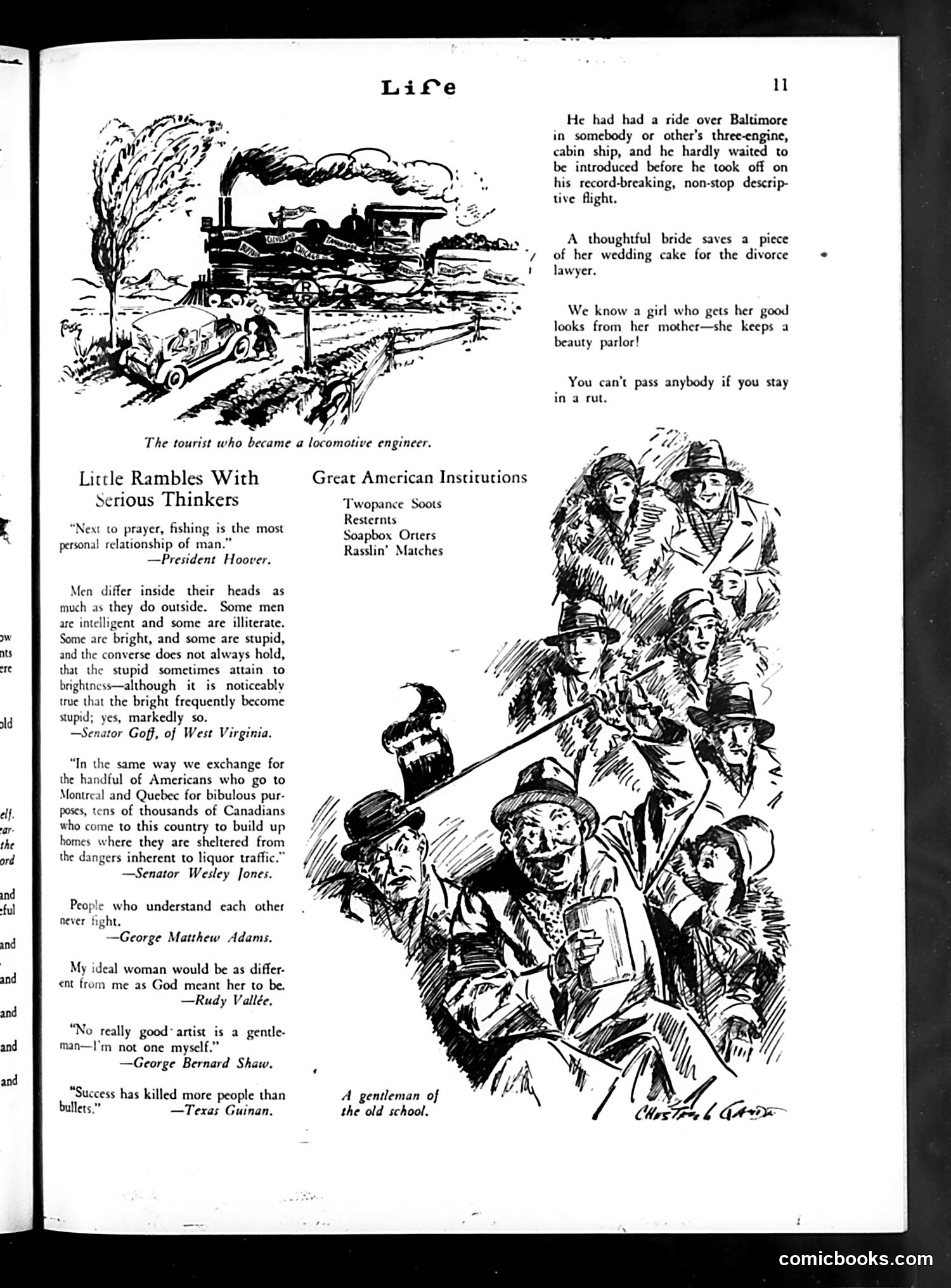
Analysis of Life Magazine Page 11 This page combines humorous quotes with two illustrations. The top illustration shows "The tourist who became a locomotive engineer"—a cartoon depicting someone's absurd career transformation, likely satirizing Americans' tendency to romanticize unconventional work or travel experiences. The lower illustration titled "A gentleman of the old school" depicts a group of men in old-fashioned dress and hats, apparently representing traditional or outdated social attitudes. The sketch style suggests nostalgia or mockery of Victorian-era manners. The quotations from politicians (Senator Goff, Senator Wesley Jones) and writers (Shaw, Adams) provide biting social commentary on human nature, intelligence, and success—typical of Life magazine's satirical approach to contemporary American society and institutions.
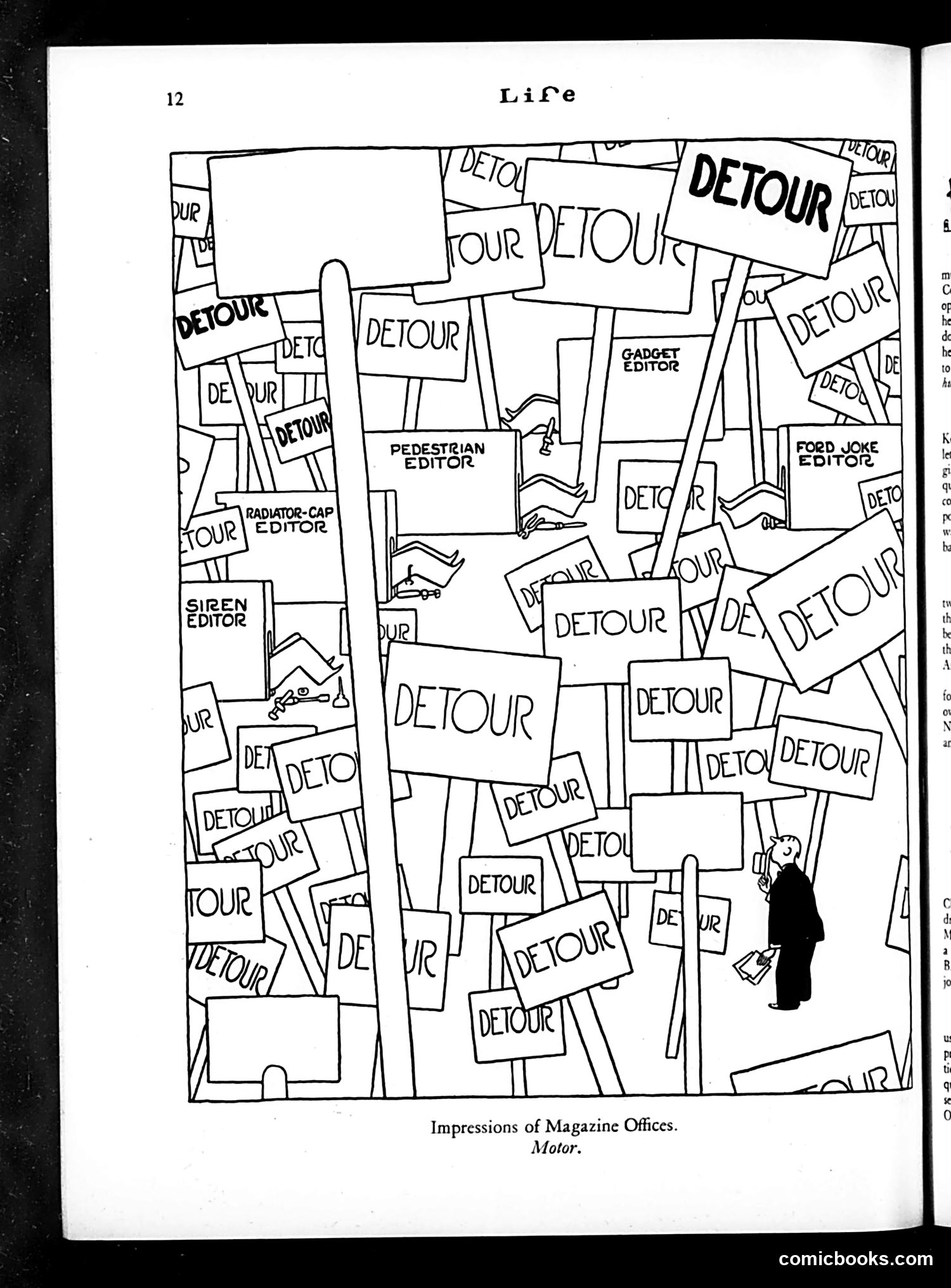
"Impressions of Magazine Offices. Motor." This cartoon satirizes the chaos of a magazine office—specifically *Motor* magazine—overwhelmed by "detour" signs. The humor works on multiple levels: literally, the office is congested with detour notices, suggesting bureaucratic obstruction and inefficiency. The labeled editorial positions (Gadget Editor, Pedestrian Editor, Radiator-Cap Editor, Siren Editor, Ford Joke Editor) are absurdist automotive-themed roles, mocking both the magazine's narrow focus and overwrought specialization common in publications. A lone figure navigates this bewildering maze, representing readers or contributors trying to accomplish something simple. The satire critiques how modern offices become paralyzed by red tape and procedural detours, making straightforward work impossible. This reflects early 20th-century anxiety about bureaucratic complexity in American institutions.
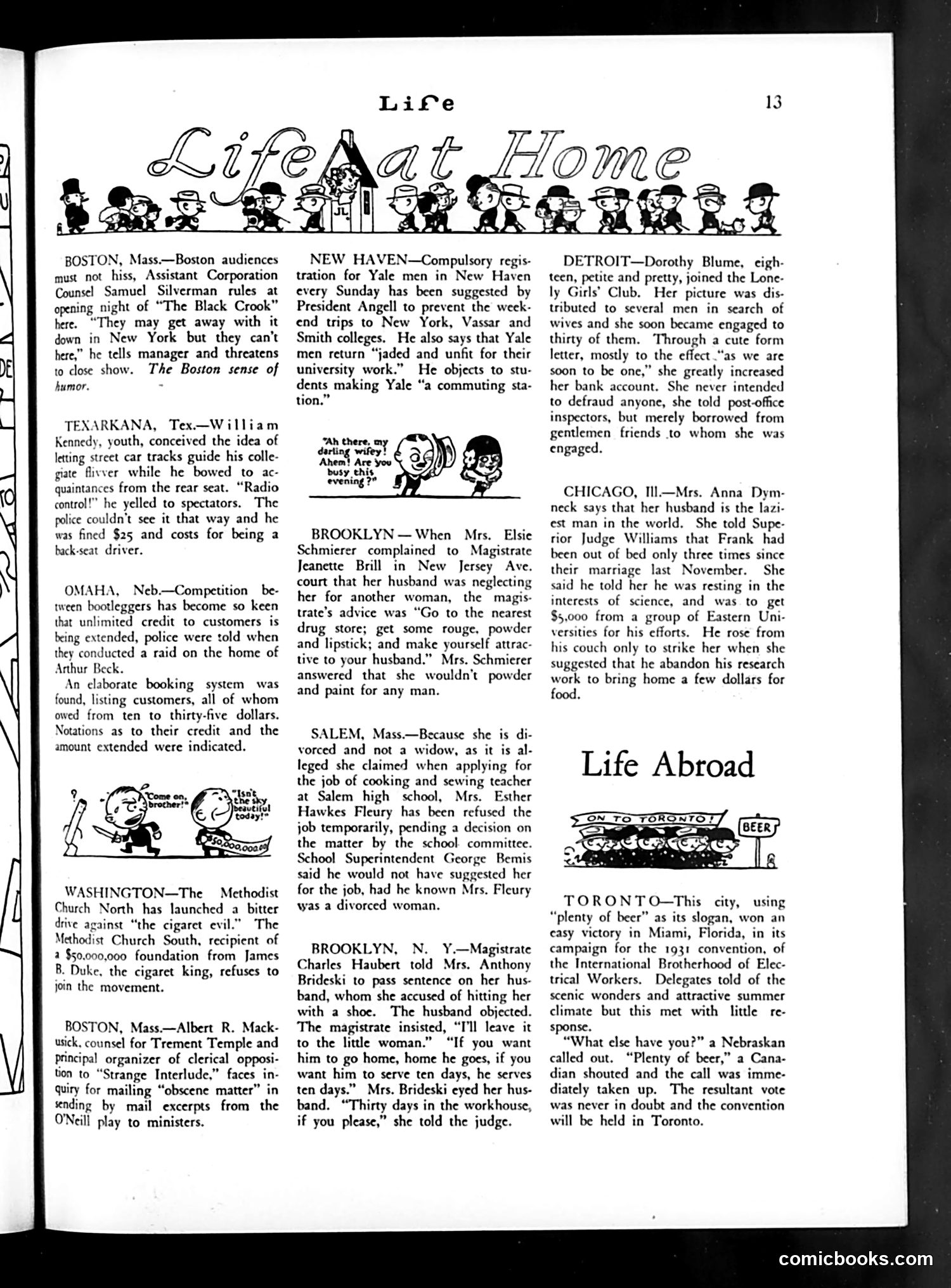
"Life at Home" and "Life Abroad" (Page 13) This page contains two small cartoon vignettes accompanying short news items about domestic social issues. The first cartoon (under "Texarkana, Tex.") shows a streetcar conductor yelling "Radio control!" at spectators, illustrating an anecdote about a man fined $25 for being a "back-seat driver"—someone who gives unwanted advice to the driver. The joke plays on the emerging term "radio control," treating the backseat commentary like unwanted broadcast interference. The second cartoon (under "Washington") depicts a figure refusing to join an anti-cigarette campaign, humorously resisting moral reform movements that were common in this era. The "Life Abroad" section reports on Toronto's successful beer campaign, reflecting post-Prohibition American interest in how other nations handled alcohol differently than the U.S.
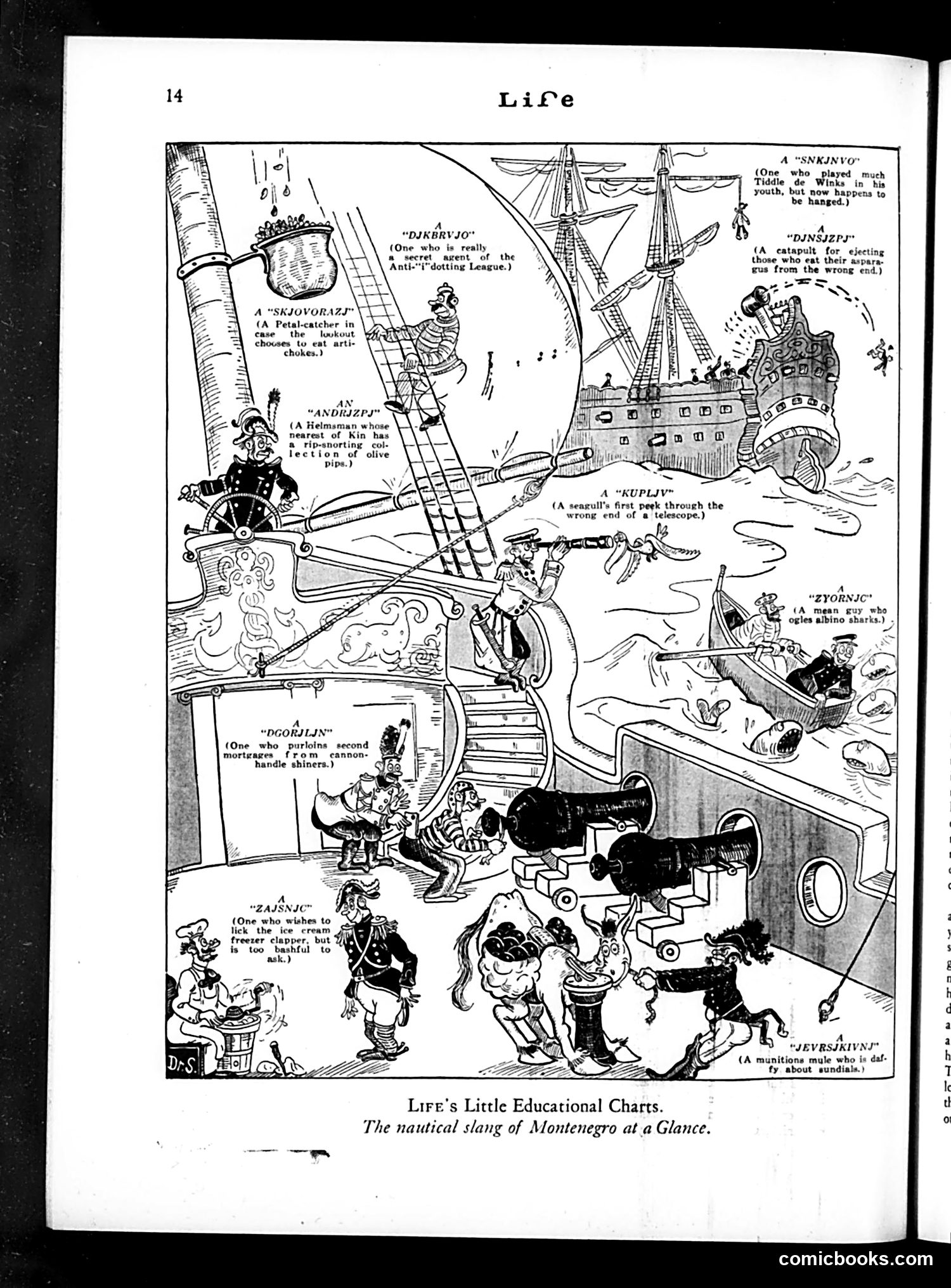
"The Nautical Slang of Montenegro at a Glance" This is a satirical educational chart depicting Montenegrin naval terminology through exaggerated caricatures and humorous scenes. Each labeled term (like "SNKINVO," "DIKERYJΟ," "ANDREZJP," etc.) appears to mock what are presented as absurd or comedic nautical practices of Montenegro—a Balkan nation. The cartoon ridicules Montenegro through stereotypical depictions of incompetent sailors, chaotic shipboard activity, and nonsensical naval traditions. The humor relies on early 20th-century Western condescension toward Balkan nations, presenting Montenegro as comically backwards and militarily ineffectual. This reflects period attitudes treating Balkan states as targets of mockery in American and European satire.
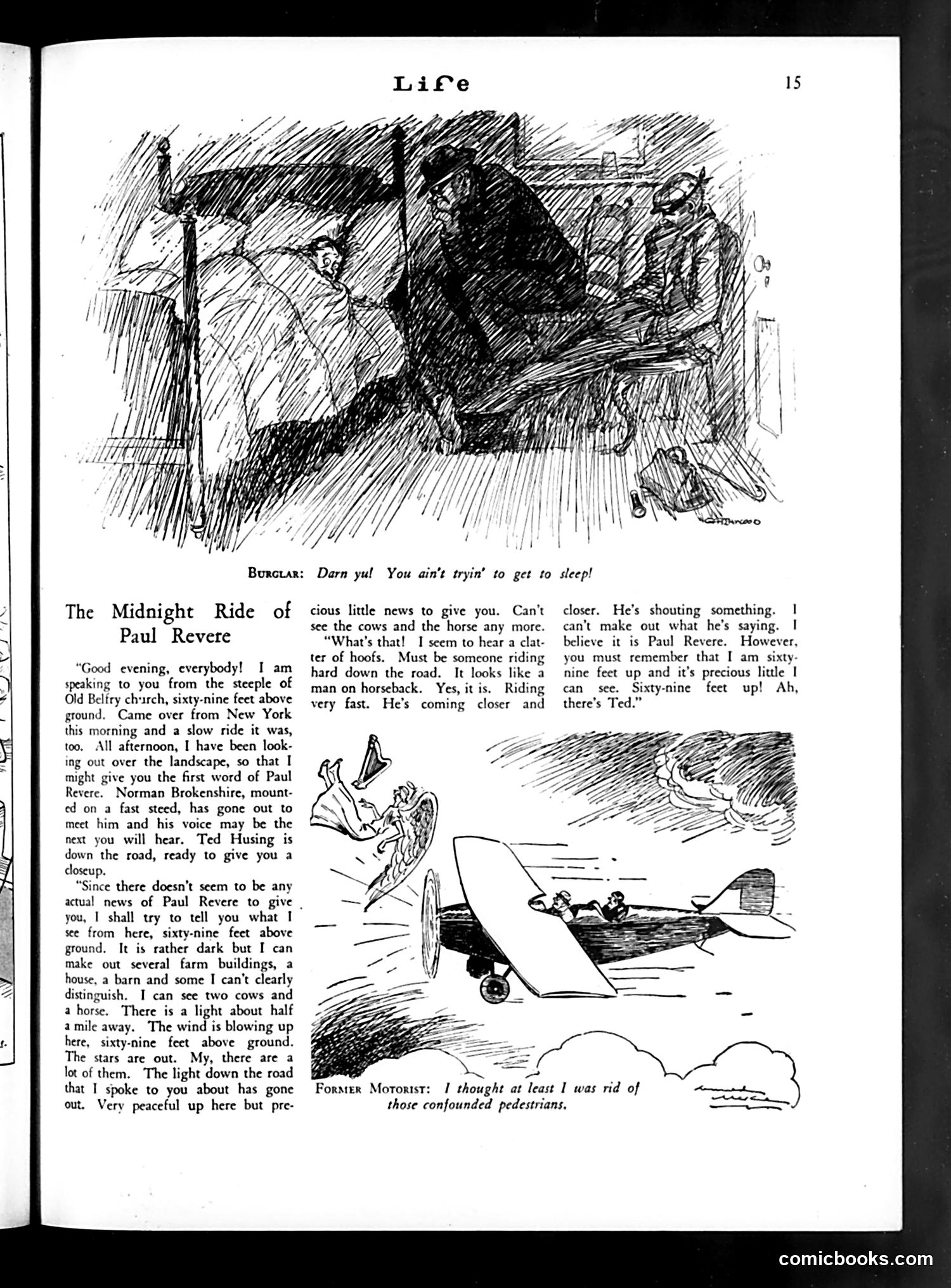
"The Midnight Ride of Paul Revere" — Life Magazine This page presents a humorous retelling of the famous American Revolutionary legend. The top cartoon shows a burglar interrupting someone's sleep, with the caption "Darn yul You ain't tryin' to get to sleep!" — a joke about unwanted nighttime intrusions. The main text parodies Paul Revere's midnight warning ride, but reimagines it as a contemporary motorist speeding down a road on a motorcycle or early automobile at "sixty-nine feet above ground," shouting warnings no one can understand. The bottom illustration shows the chaotic result: a confused pedestrian and overturned vehicle. The satire mocks both the romanticized historical narrative and modern traffic dangers, suggesting that contemporary "warnings" are equally garbled and ineffective as Revere's legendary ride.
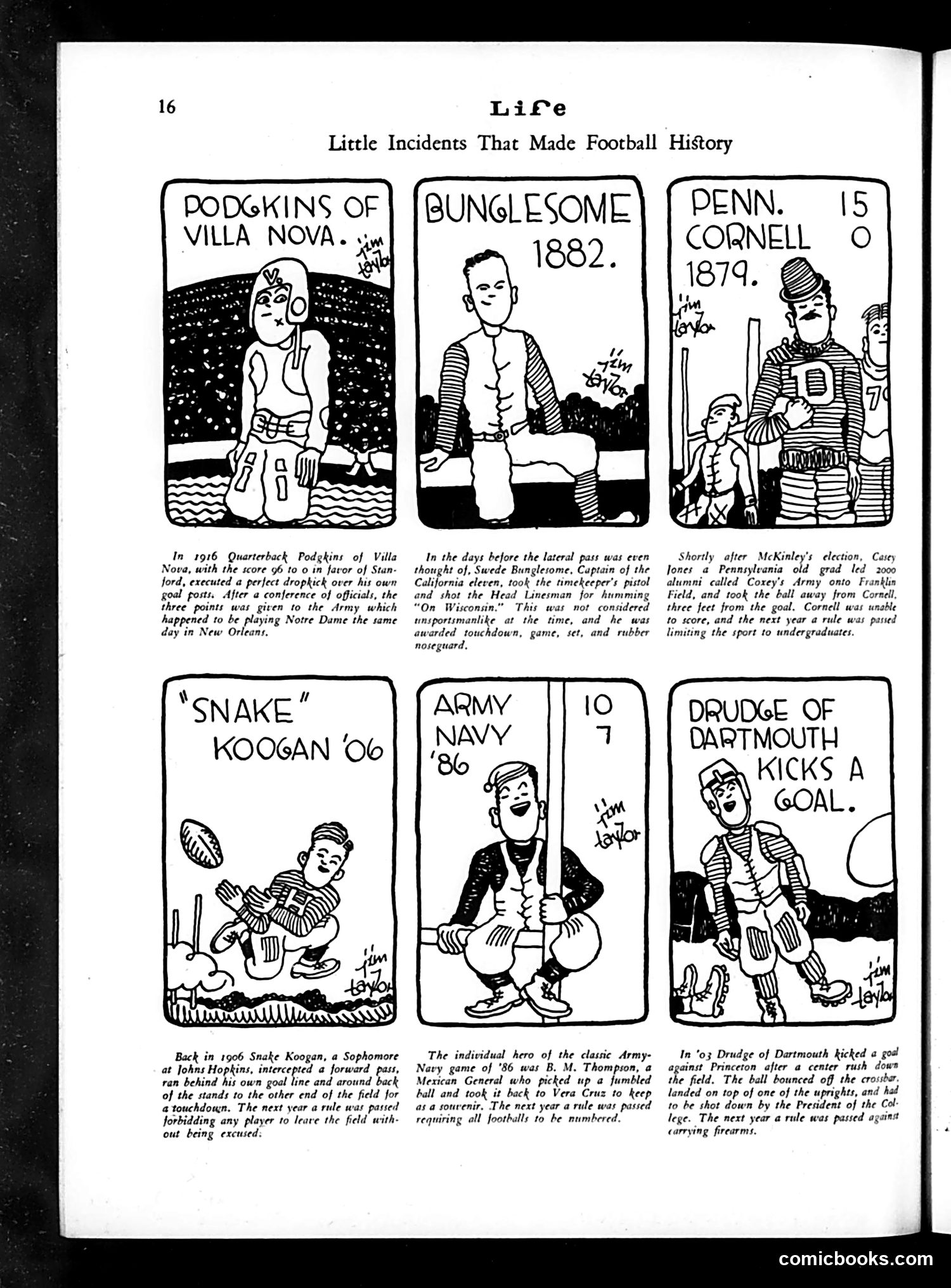
"Little Incidents That Made Football History" This page presents six comic panels satirizing early American college football through exaggerated historical anecdotes. Each depicts a famous figure associated with a football game or rule change: 1. Podkins of Villa Nova (1916): References a quarterback whose unconventional forward pass helped his team win 2. Bunglesome (1882): Shows a player who accidentally invented a tackling technique 3. Penn vs. Cornell (1879): Depicts an alumnus who removed the ball from the field 4. "Snake" Koogan (1906): A Johns Hopkins player who ran backwards around the field, leading to new rules 5. Army-Navy ('86): Shows B.M. Thompson, whose rule change required numbered footballs 6. Drudge of Dartmouth: A player whose goal-kicking led to new regulations The satire mocks football's rapid evolution and the colorful, often absurd stories surrounding its early rules.
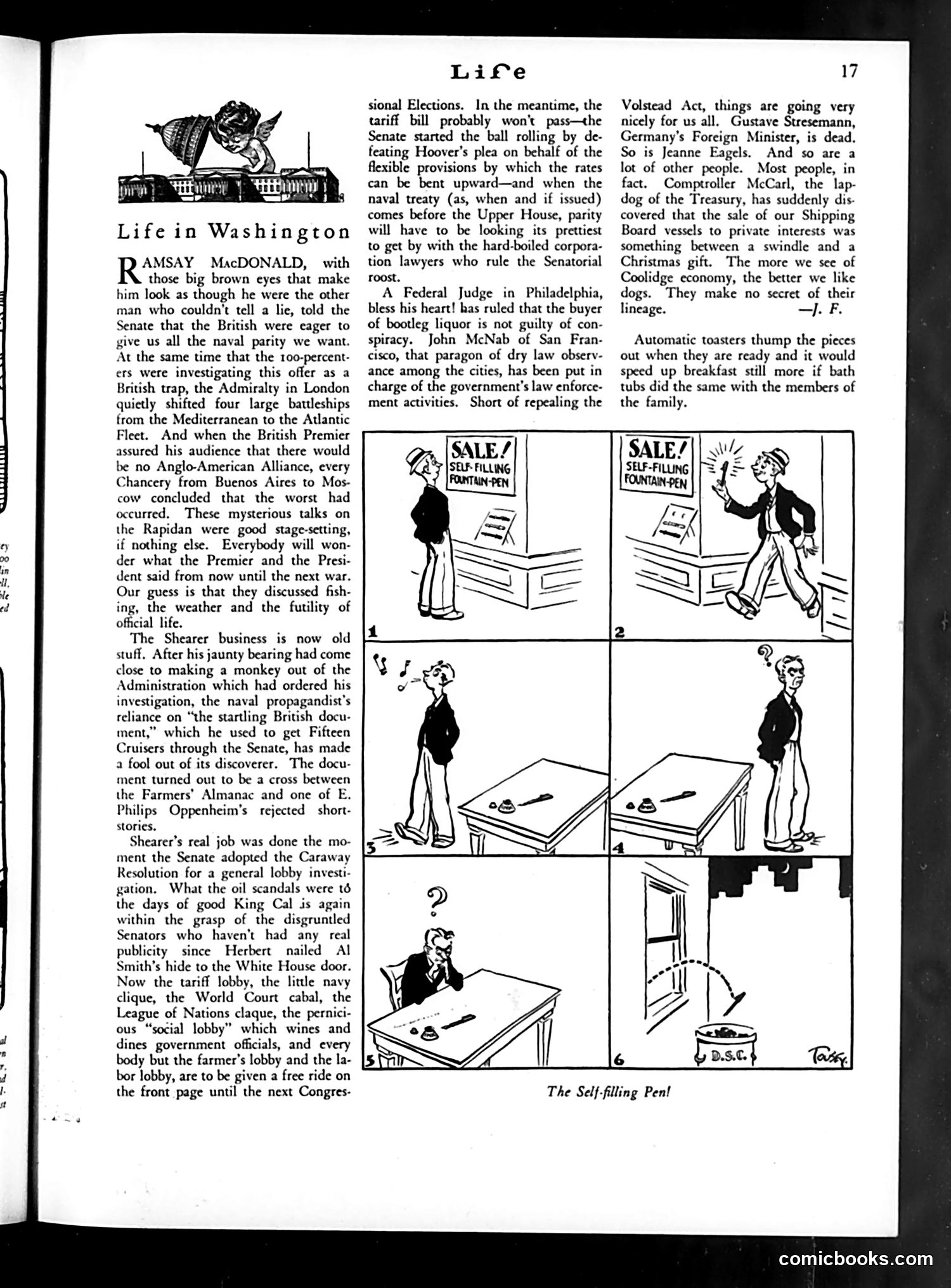
"The Self-Filling Pen" Cartoon Analysis This six-panel comic satirizes bureaucratic inefficiency in Washington government. A man attempts to purchase a self-filling fountain pen at a store display. Through panels 1-6, he encounters increasingly absurd obstacles: the salesman redirects him, he's sent between different counters, questioning officials multiply, and finally a door marked "B.S.C." (likely "Bureau of Something Complicated") appears to be his final destination. The satire targets how simple government transactions become needlessly complicated through red tape, jurisdictional confusion, and endless referrals between departments. The "self-filling pen" functions as an ironic title—suggesting automatic solutions—while the actual process requires manual navigation through bureaucratic maze. This reflects contemporary frustration with 1920s-era government expansion and administrative bloat.
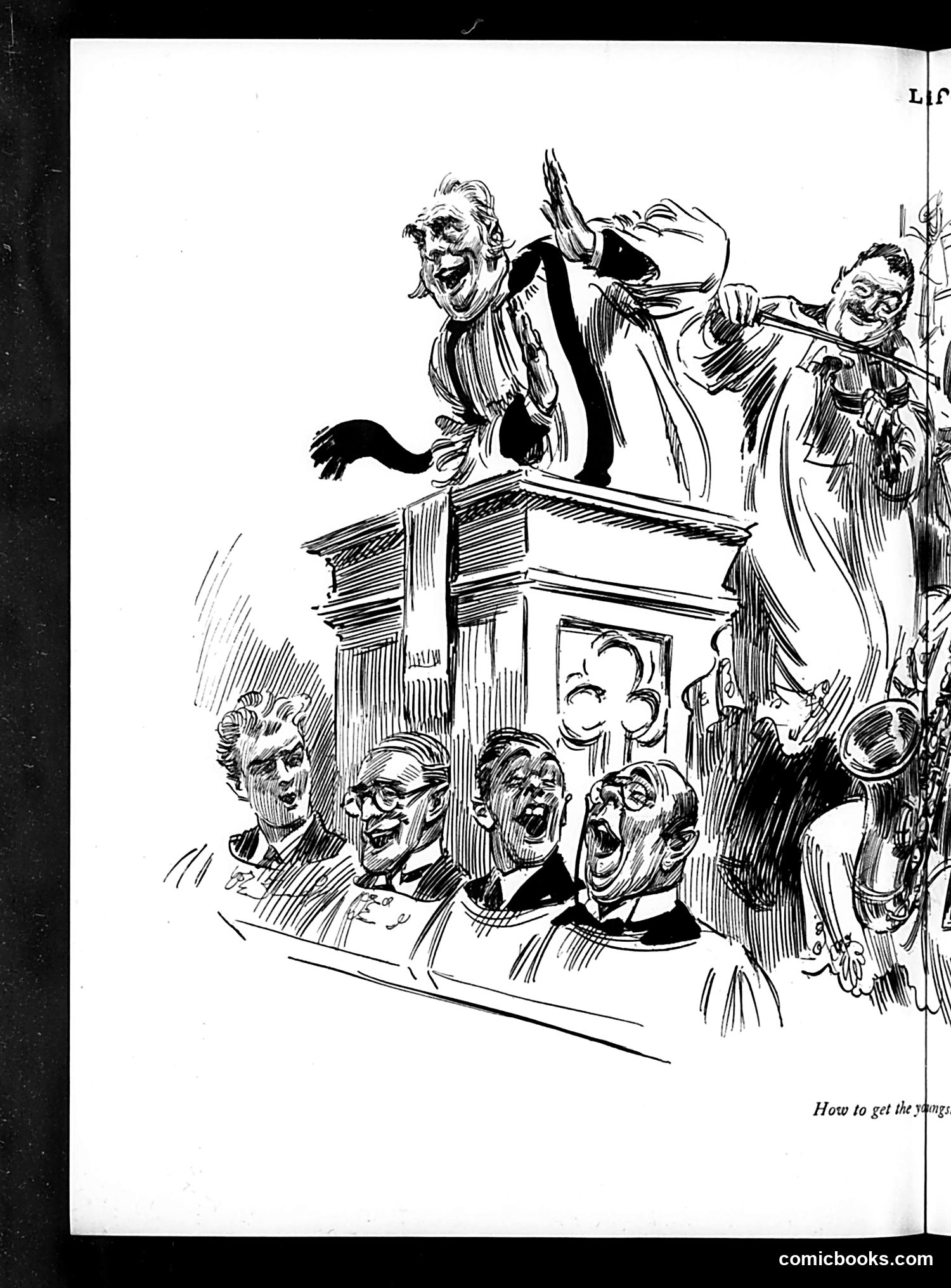
Analysis This political cartoon depicts a pulpit scene with exaggerated caricatured figures. Two men stand atop the pulpit—one gesticulating wildly, the other holding what appears to be a staff or pointer. Below, four men with open mouths appear to be singing or responding enthusiastically. The caption reads "How to get the young—" (text cut off), suggesting commentary on methods of attracting or influencing younger people or congregants. The style and caricature technique suggest this satirizes religious revival meetings or evangelical preaching popular in early 20th-century America. The exaggerated expressions and theatrical poses mock the emotional fervor of such gatherings. Without the complete caption and specific identifying details, the exact targets remain unclear, but the cartoon criticizes sensationalism in religious gatherings.
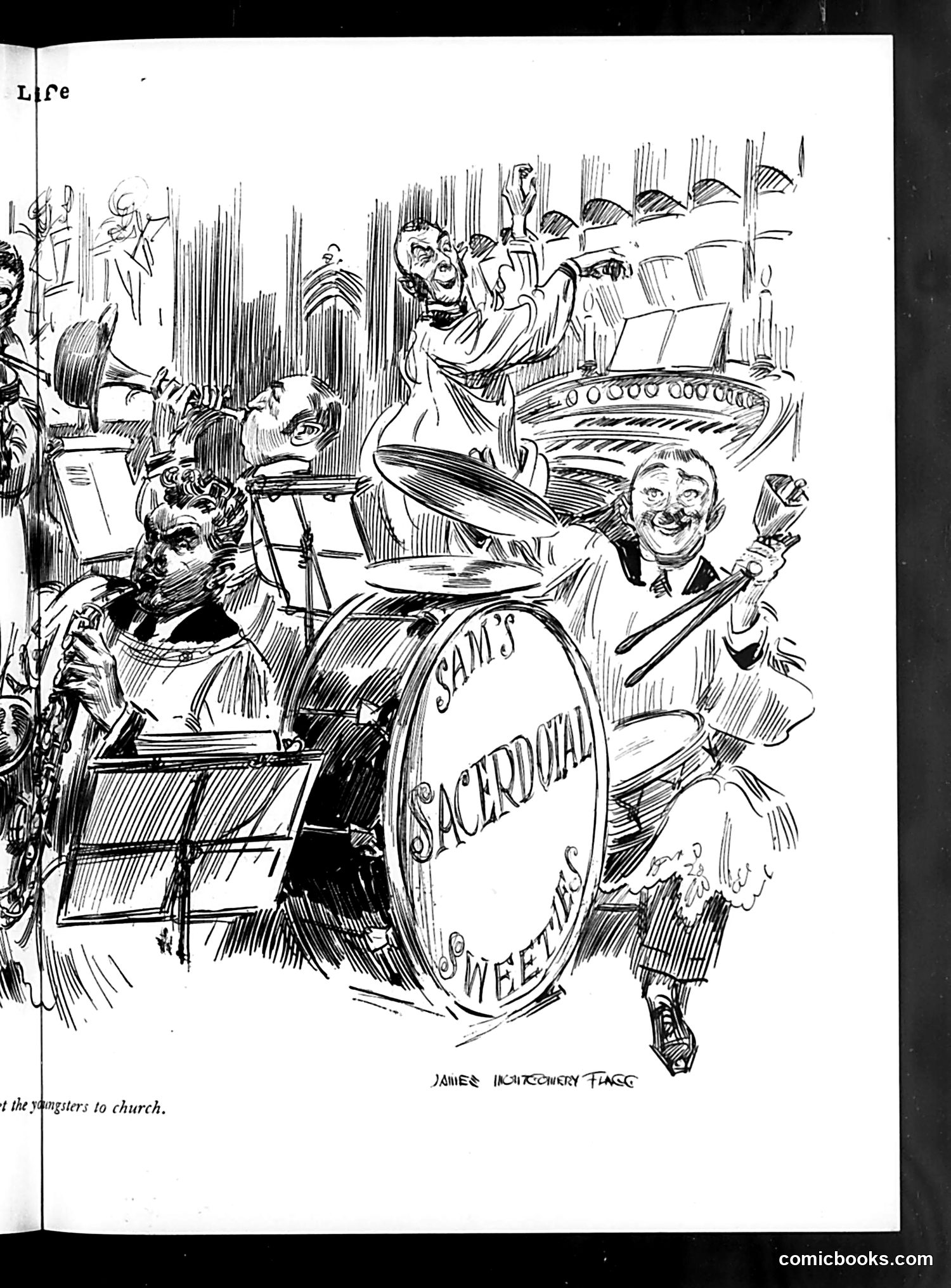
Political Cartoon Analysis This cartoon by James Montgomery Flagg depicts what appears to be a satirical commentary on bringing young people to church. The image shows a drum labeled "Sacerdotal Saints" (referring to priestly or religious figures) being operated by a smiling man in formal attire, with various figures dancing or being propelled along behind it—"the youngsters to church," as the caption suggests. The satire likely critiques how religious institutions use spectacle, entertainment, or manipulation to attract young congregants rather than genuine spiritual conviction. The drum as a mechanism suggests forced or artificial enthusiasm being drummed up. Flagg's exaggerated expressions and dynamic composition emphasize the satirical tone, mocking both religious institutions and the performative nature of getting youth engaged in organized religion during this era of American life.
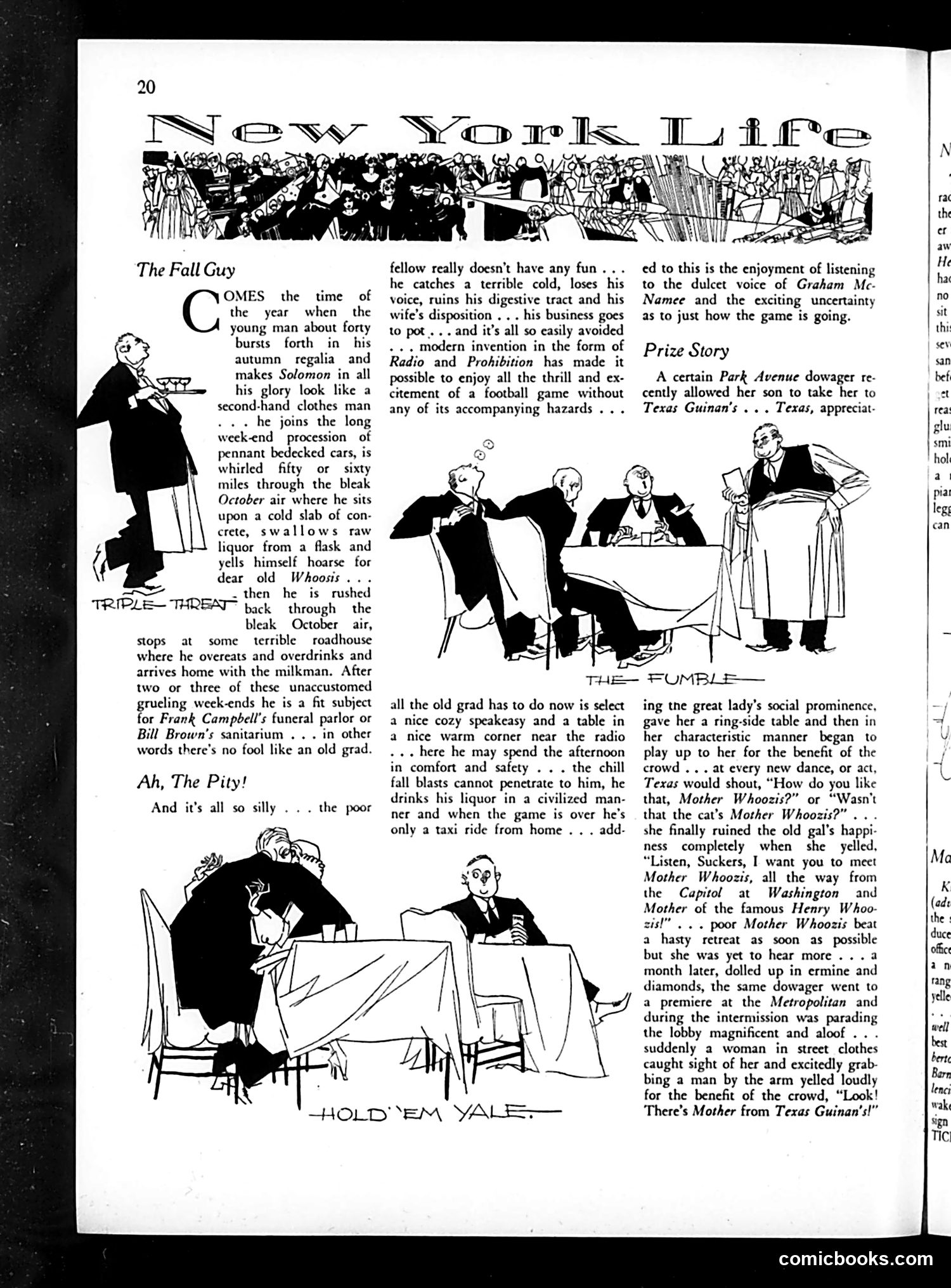
"The Fall Guy" - Life Magazine Satire Page This page satirizes 1920s college football culture and Prohibition-era entertainment. "The Fall Guy" mocks middle-aged alumni who exhaust themselves attending autumn football games—traveling in packed cars, drinking illegally from flasks, yelling themselves hoarse—only to arrive home sick and depleted. The satire's point: radio broadcasts and Prohibition have made this sacrifice obsolete. Modern fans can now enjoy games via radio commentator Graham McNamee (a famous sports broadcaster of the era) while safely ensconced in speakeasies, avoiding physical hardship and marital discord. "Prize Story" ridicules Texas Guinan, the notorious speakeasy hostess and nightclub personality known for flashy showmanship. A wealthy Park Avenue dowager's social pretensions are repeatedly undermined when Guinan publicly announces her as "Mother from Texas Guinan's"—reducing her dignified status to a mere speakeasy regular, a humiliation that haunts her even at high-society venues like the Metropolitan Opera.
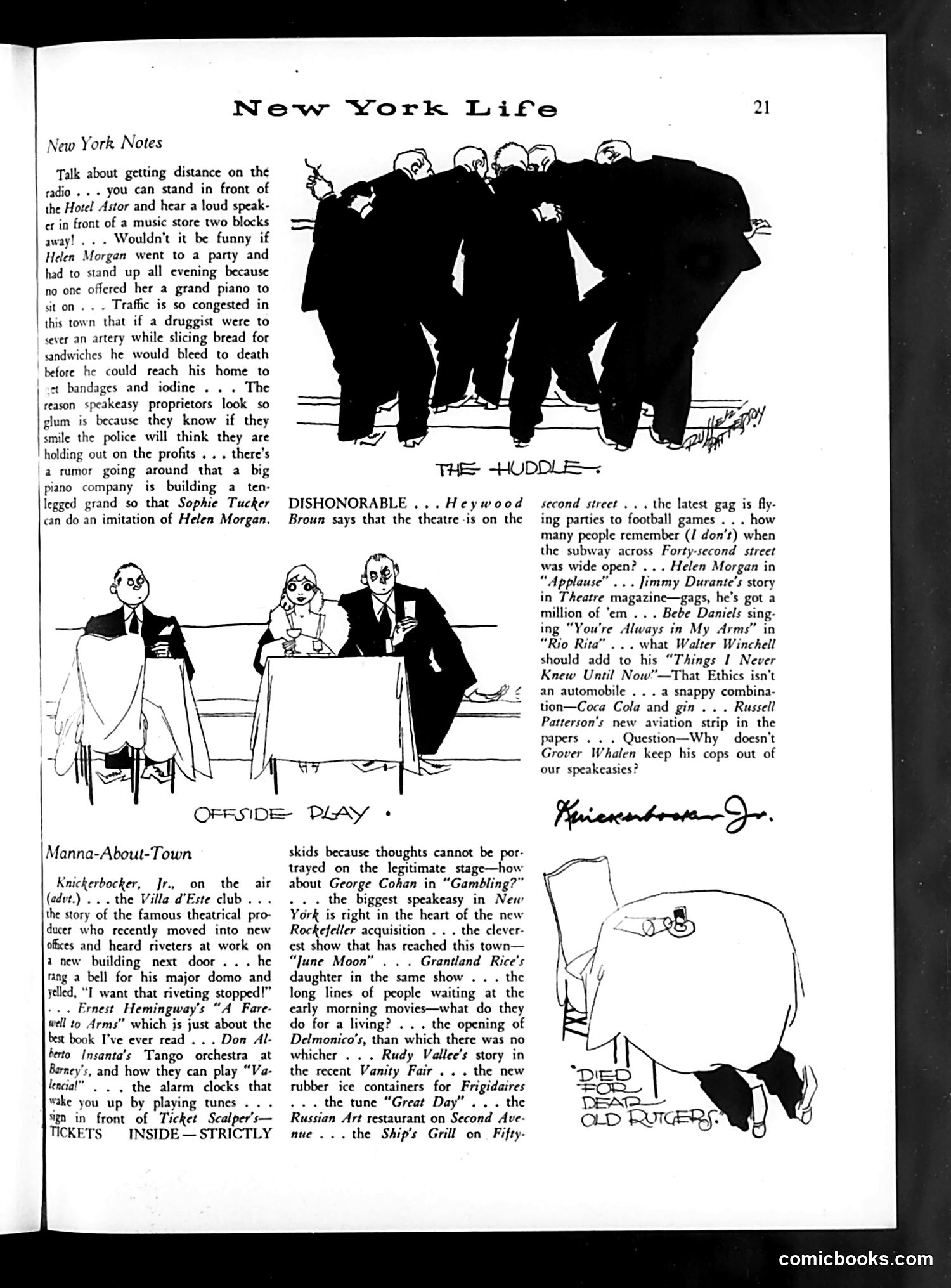
New York Life Page Analysis This page from *Life* magazine contains satirical observations about 1920s New York City. The cartoons mock contemporary social issues: "The Huddle" depicts men in suits huddled together conspiratorially—likely referencing Prohibition-era speakeasy operators or corrupt officials, given references in the text to speakeasies and police payoffs. "Offside Play" shows a dinner scene, apparently satirizing theater or social pretension. The text column "New York Notes" contains brief jokes about NYC life: radio volume, Helen Morgan (a famous singer of the era), traffic congestion, speakeasy owners' nervous demeanor around police, and a joke comparing Sophie Tucker to Helen Morgan. "Manna-About-Town" gossip includes references to contemporary celebrities (Ernest Hemingway, George Cohan, Jimmy Durante, Bebe Daniels), nightclubs, restaurants, and entertainment—typical society-page content. A final quip mocks Police Commissioner Grover Whalen for supposedly ignoring speakeasy violations. The page satirizes Prohibition-era hypocrisy, celebrity culture, and urban congestion with light, observational humor typical of 1920s *Life* magazine.
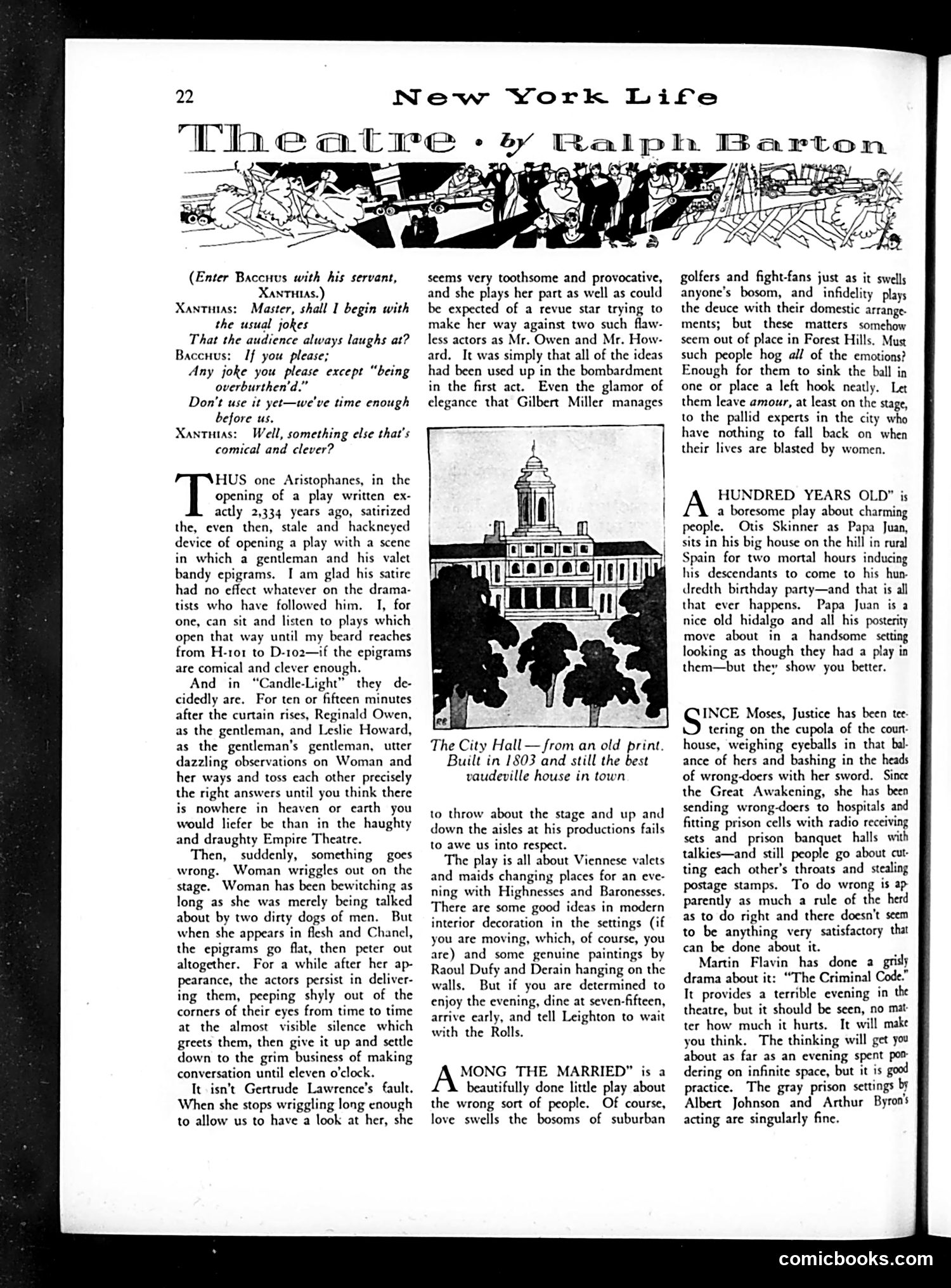
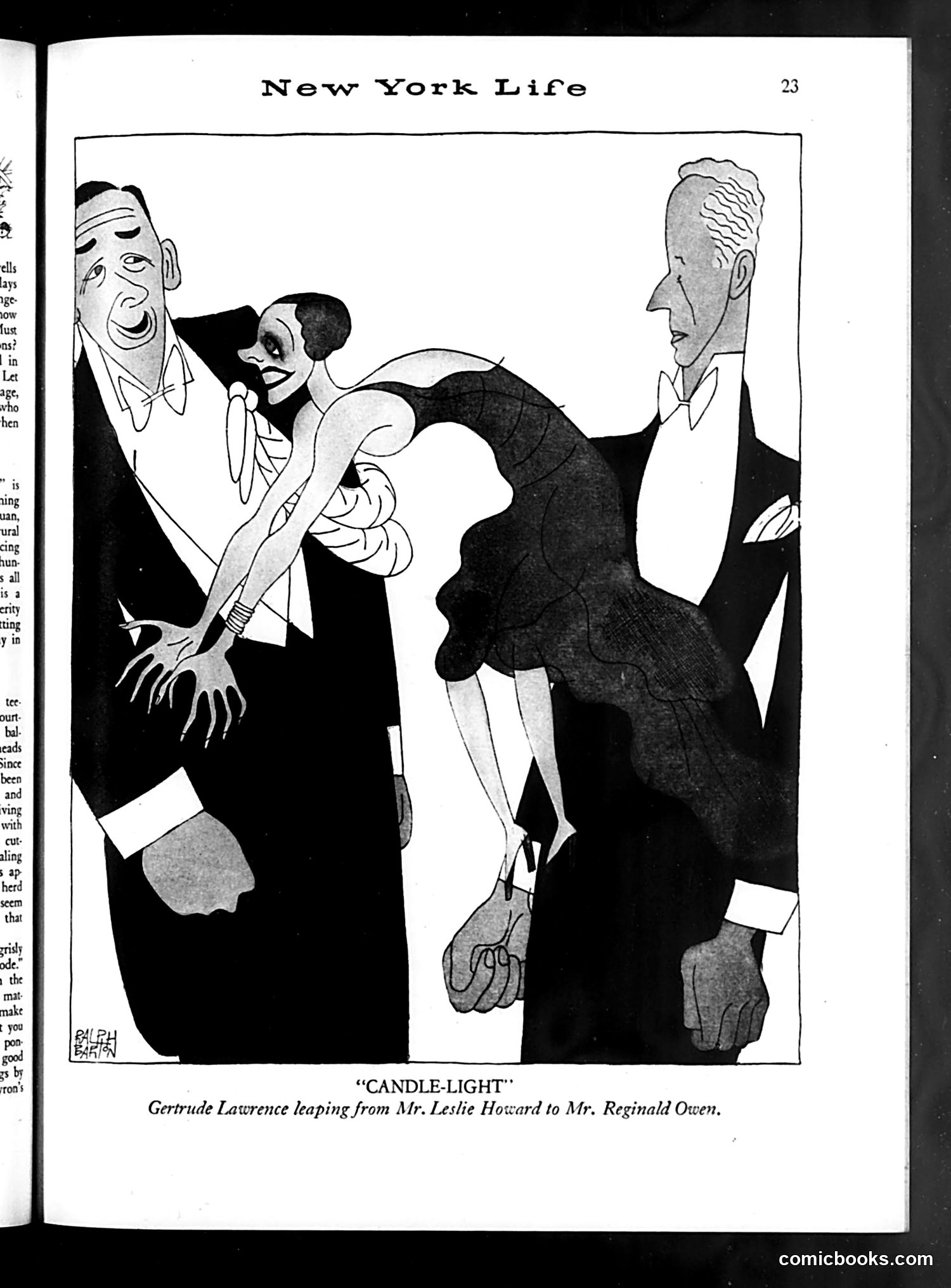
Theater Criticism in Life Magazine This page contains Ralph Barton's theater column reviewing several Broadway productions. Rather than a political cartoon, it's cultural satire through dramatic criticism. Barton opens by referencing Aristophanes' 2,334-year-old play—ancient Greek satire that mocked stale theatrical devices—to justify enjoying "Candle-Light," which opens with witty servant-and-master banter. He praises Reginald Owen and Leslie Howard's epigrams until actress Gertrude Lawrence appears, after which the dialogue flatters and the play loses momentum. He reviews other shows: "Among the Married" (about suburban infidelity in Forest Hills, which he finds undignified for golf-playing audiences) and "A Hundred Years Old" (featuring Otis Skinner, dismissed as tedious). The City Hall illustration is a sardonic caption calling it "still the best vaudeville house in town"—mocking the building's theatrical atmosphere. The satire targets Broadway's formulaic dramaturgy and audiences' pretensions, not political figures.
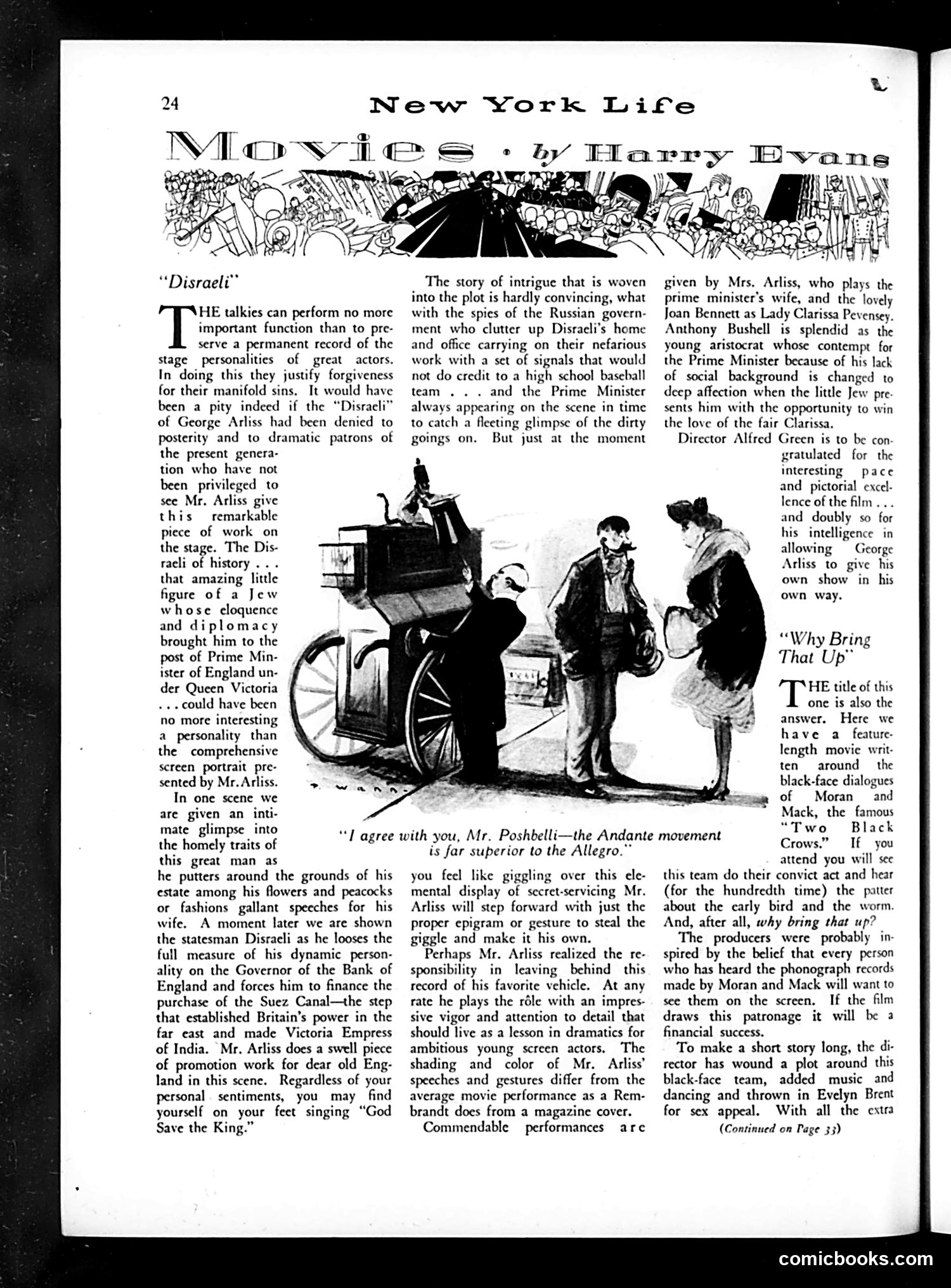
Analysis of This Life Magazine Page This page reviews two 1929 sound films ("talkies"). The main review celebrates "Disraeli," starring George Arliss as the 19th-century British Prime Minister Benjamin Disraeli. The critic praises Arliss's performance preserving a great stage actor's legacy on film, highlighting scenes of Disraeli as both a homely family man and powerful statesman orchestrating Britain's Suez Canal purchase. The accompanying illustration shows a scene where Arliss delivers a witty remark about music ("the Andante movement is far superior to the Allegro") that deflates an awkward spy-plot moment—exemplifying how his eloquent acting transcends the film's melodramatic espionage storyline. The secondary review briefly introduces "Why Bring That Up," featuring the blackface comedy duo Moran and Mack ("Two Black Crows"), known for vaudeville routines. The critic's sarcastic title suggests the film offers nothing new—recycled jokes about early birds and worms. The page exemplifies how early sound films were valued for preserving theatrical performances for posterity.
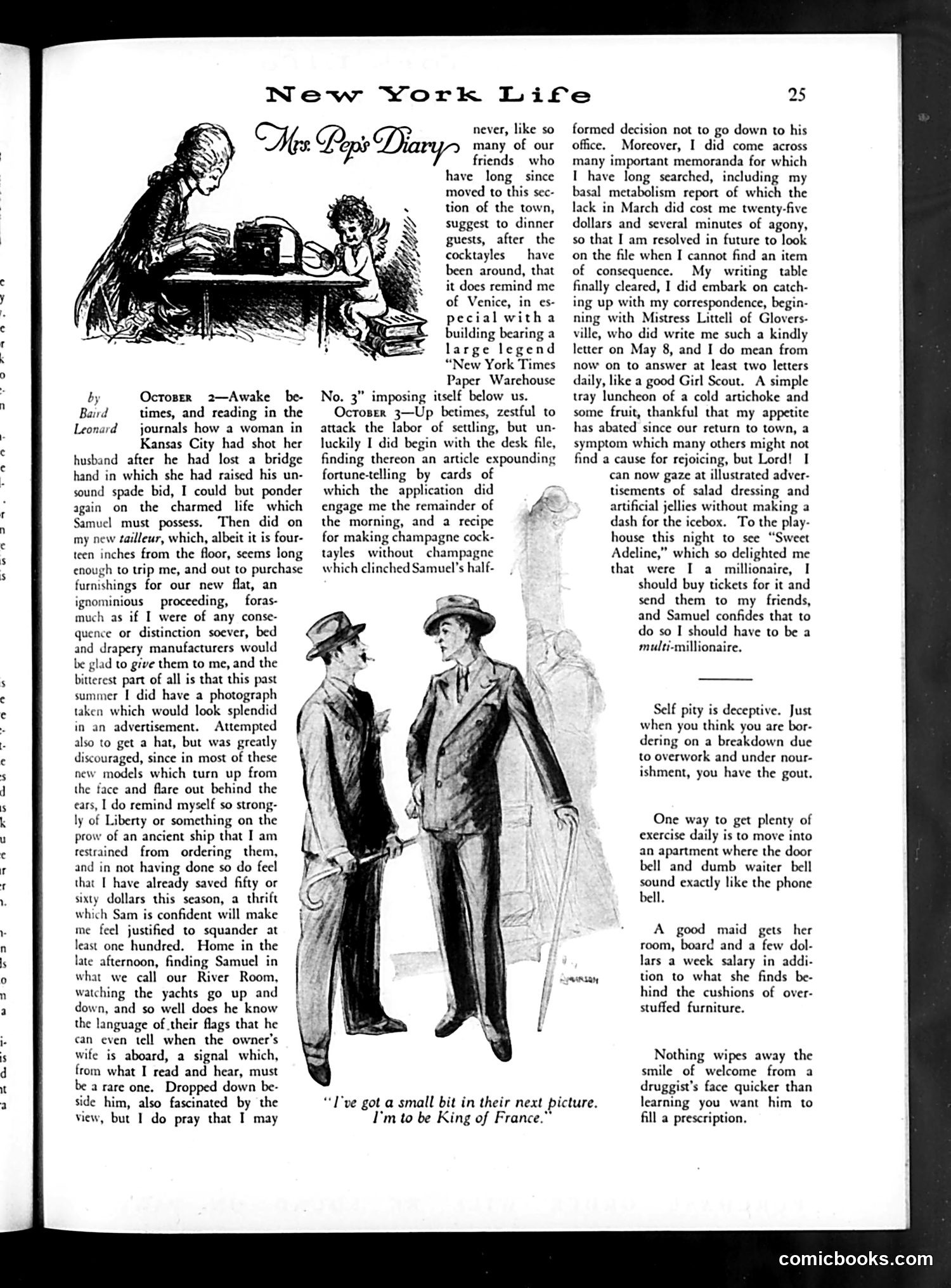
"Mrs. Pep's Diary" - New York Life Magazine This is a satirical diary column by "Leonard" (likely a pseudonym) written in the style of early 20th-century society writing. The humor targets upper-middle-class New York life through the narrator's self-aware observations. The cartoon illustrates a scene where one man tells another, "I've got a small bit in their next picture. I'm to be King of France"—likely mocking the pretensions of minor actors or society figures who inflate their minor roles into grandiose self-importance. The diary entries satirize: - Wife's concerns: Shopping for apartment furnishings while worrying about appearing too eager - Fashion criticism: Mocking new hat styles that resemble the Statue of Liberty - Class anxiety: Boasting about frugality (saving $50-60) while prepared to spend $100 - Social pretension: Fearing dinner guests will make Venice comparisons to their riverside view (spoiled by a "New York Times Paper Warehouse") The overall satire mocks the self-important musings and economic contradictions of affluent New Yorkers trying to appear distinguished while managing domestic life.
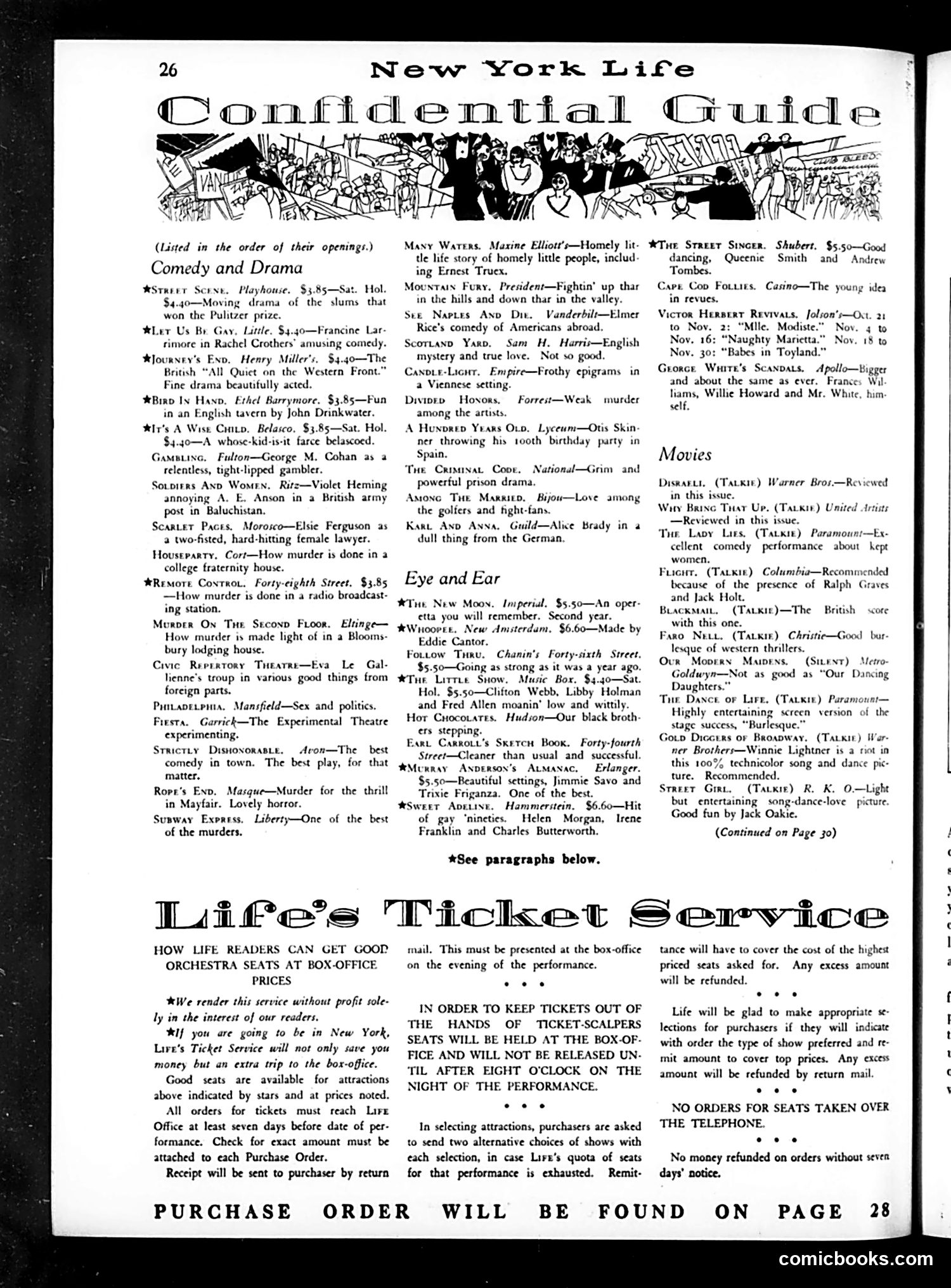
"New York Life Confidential Guide" - Page 26 Analysis This page is primarily a theater and entertainment listings guide, not a political cartoon. It's a directory of Broadway shows, movies, and ticket information for New York Life magazine readers. The content lists theatrical productions across categories: "Comedy and Drama" (stage plays like *Street Scene* and *Journey's End*), "Eye and Ear" (musicals and operettas), and "Movies" (silent and talkie films). Prices and theater names are provided. Notable entries reference contemporary hits: *All Quiet on the Western Front*, operettas like *The New Moon*, and early talking pictures marked with asterisks. References to performers like Ethel Barrymore, Fred Allen, and Helen Morgan situate this in the late 1920s theatrical scene. The decorative header illustration shows a crowded, stylized cityscape—typical Art Deco design for the era—but contains no satirical content. This is essentially entertainment consumer information, not political commentary.
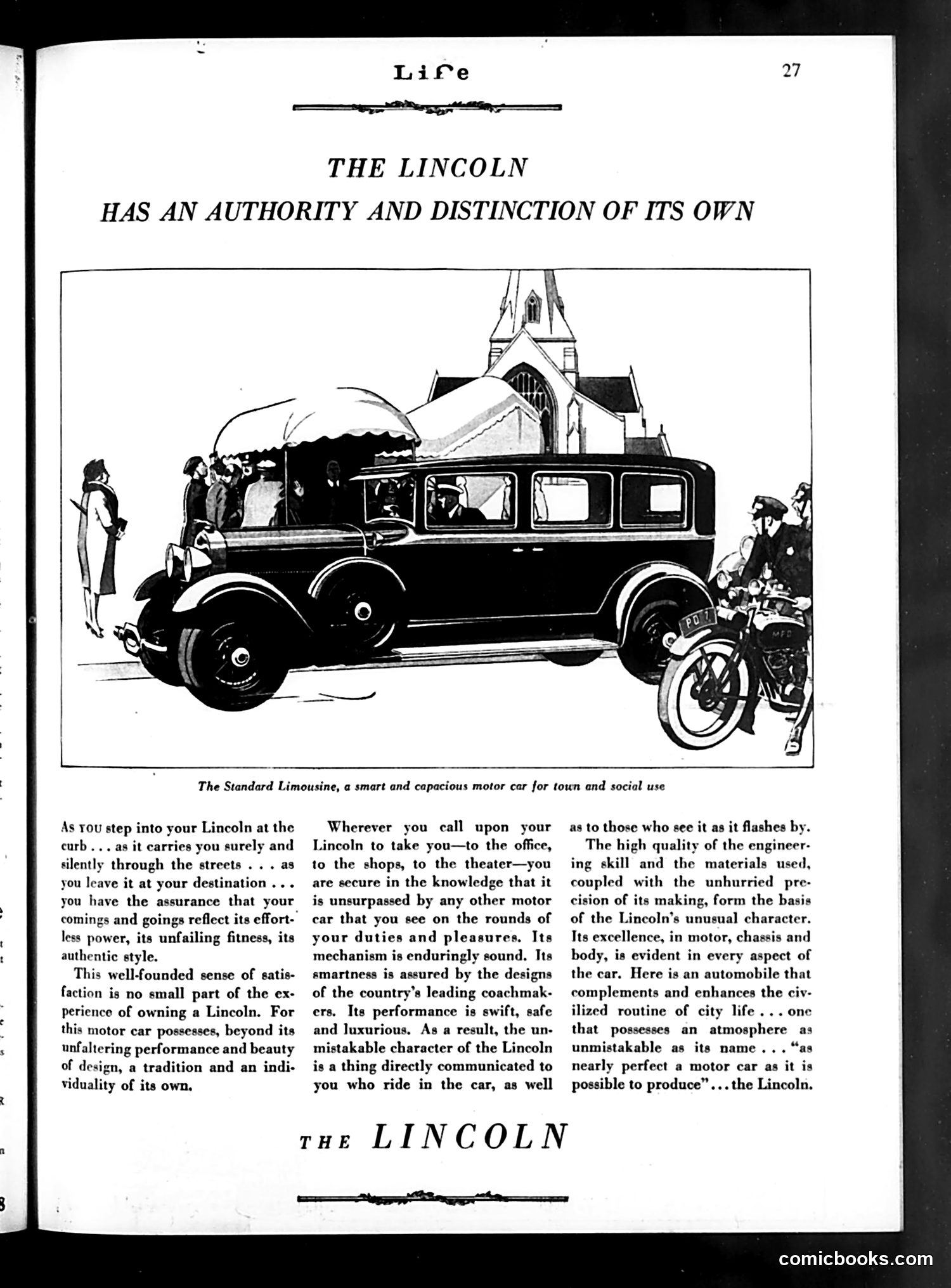
Analysis This is not a cartoon or satire—it's a straightforward automobile advertisement for the Lincoln motor car, presented as a full-page advertisement in *Life* magazine. The illustration depicts a 1920s-era Lincoln limousine (the "Standard Limousine") positioned prominently in an urban street scene, with well-dressed pedestrians and a motorcycle nearby, suggesting the car's appeal to affluent clientele. The accompanying text is pure marketing copy emphasizing luxury, reliability, engineering precision, and social distinction. Key sales points include: the car's "authority and distinction," its superior performance compared to competitors, its association with "country's leading coachmakers," and its role in enhancing "civilized routine of city life." There is no political or satirical content here—this represents typical 1920s-1930s automotive advertising aimed at upper-class consumers, emphasizing prestige and quality craftsmanship as justifications for premium pricing.
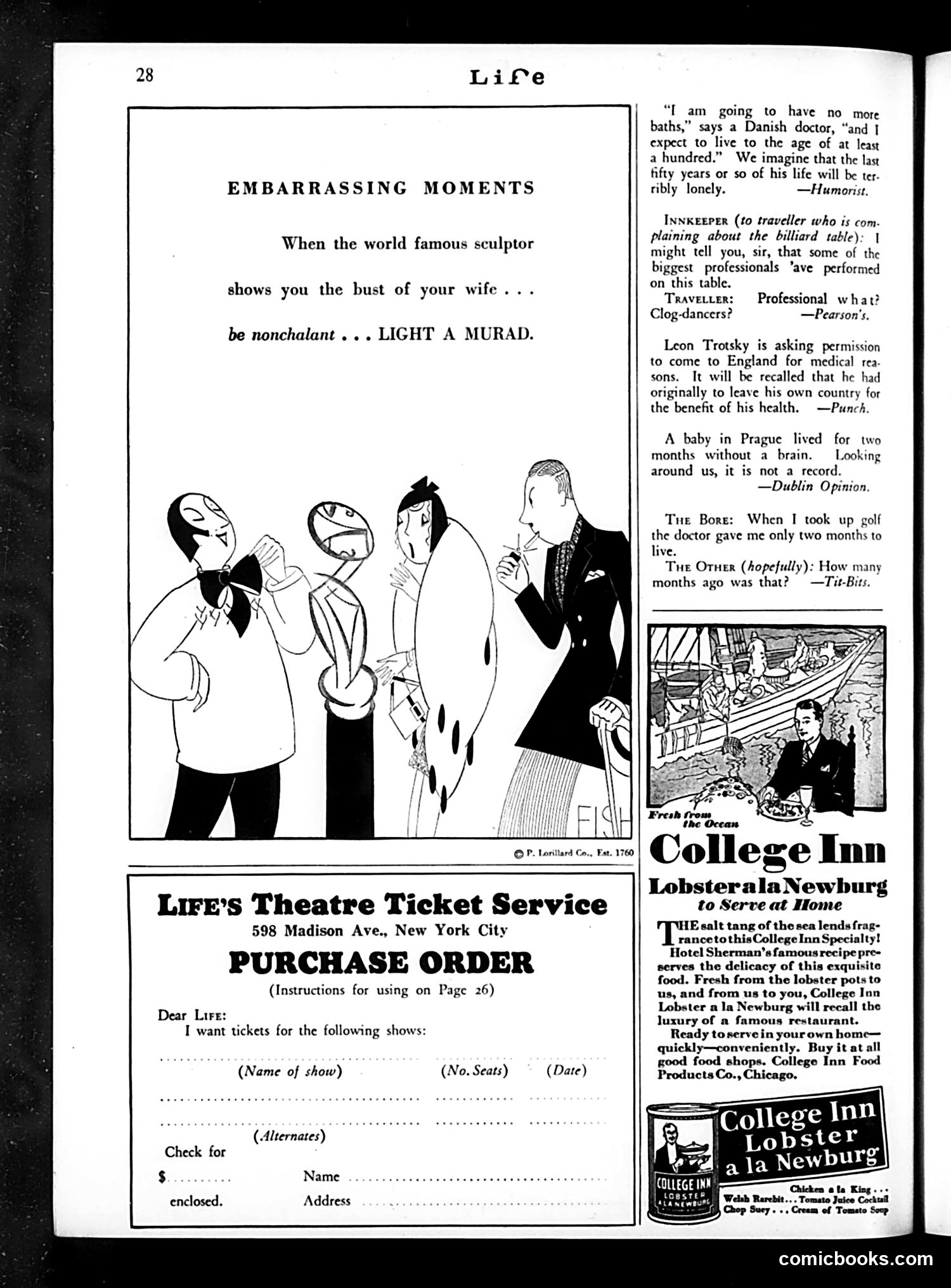
Explanation for Modern Readers This page combines a cigarette advertisement with humorous short jokes and food/ticket service ads typical of 1920s-30s *Life* magazine. Main Cartoon ("Embarrassing Moments"): A sculptor presents a bust of a man's wife to him. The joke is that the sculpture apparently looks unflattering or unattractive—the husband's mortified expression shows his discomfort. The caption advises lighting a Murad cigarette to appear "nonchalant" (unbothered), making this an advertisement disguised as social humor. The underlying satire mocks both men's vanity about their wives' appearance and advertising's absurd promise that smoking conveys sophistication. Side Jokes: Brief, reprinted quips from other publications mock doctors, travelers, and bores—typical period humor. References to Leon Trotsky and Prague suggest international awareness. Lower Section: Theatre ticket ordering service and a Lobster à la Newburg food advertisement—standard commercial content. The page reflects *Life*'s format: blending satire with advertising while presenting itself as sophisticated humor for educated readers.
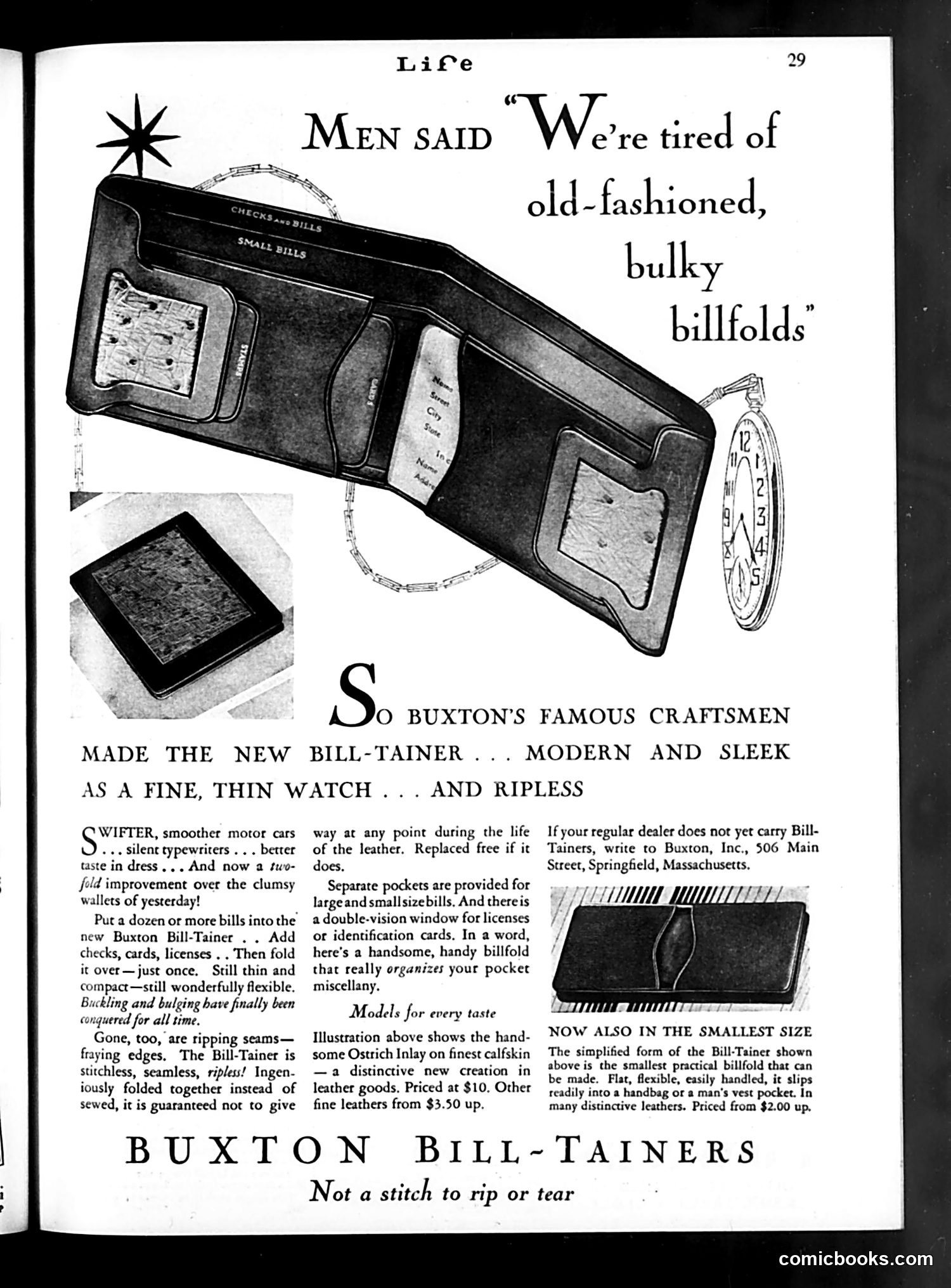
Buxton Bill-Tainers Advertisement This is a product advertisement, not political satire. It promotes Buxton's new "Bill-Tainer" wallets by framing them as modern improvements over outdated billfolds. The opening quote—"We're tired of old-fashioned, bulky billfolds"—presents consumer demand as the motivation. The ad connects the wallet to broader 1920s-30s modernization trends: smoother cars, silent typewriters, better fashion taste. The key selling points are that the Bill-Tainer is thin, flexible, stitchless, and won't tear or fray. It organizes bills, checks, cards, and IDs in separate pockets with a window for licenses. The design is described as elegant ("as a fine, thin watch"). Multiple price points and leather options ("Models for every taste") are offered, ranging from $2–$10, suggesting accessibility across class levels. The ad includes the manufacturer's Springfield, Massachusetts address for those whose local dealers lack stock. This reflects modernist consumer culture valuing efficiency, durability, and sleek design.
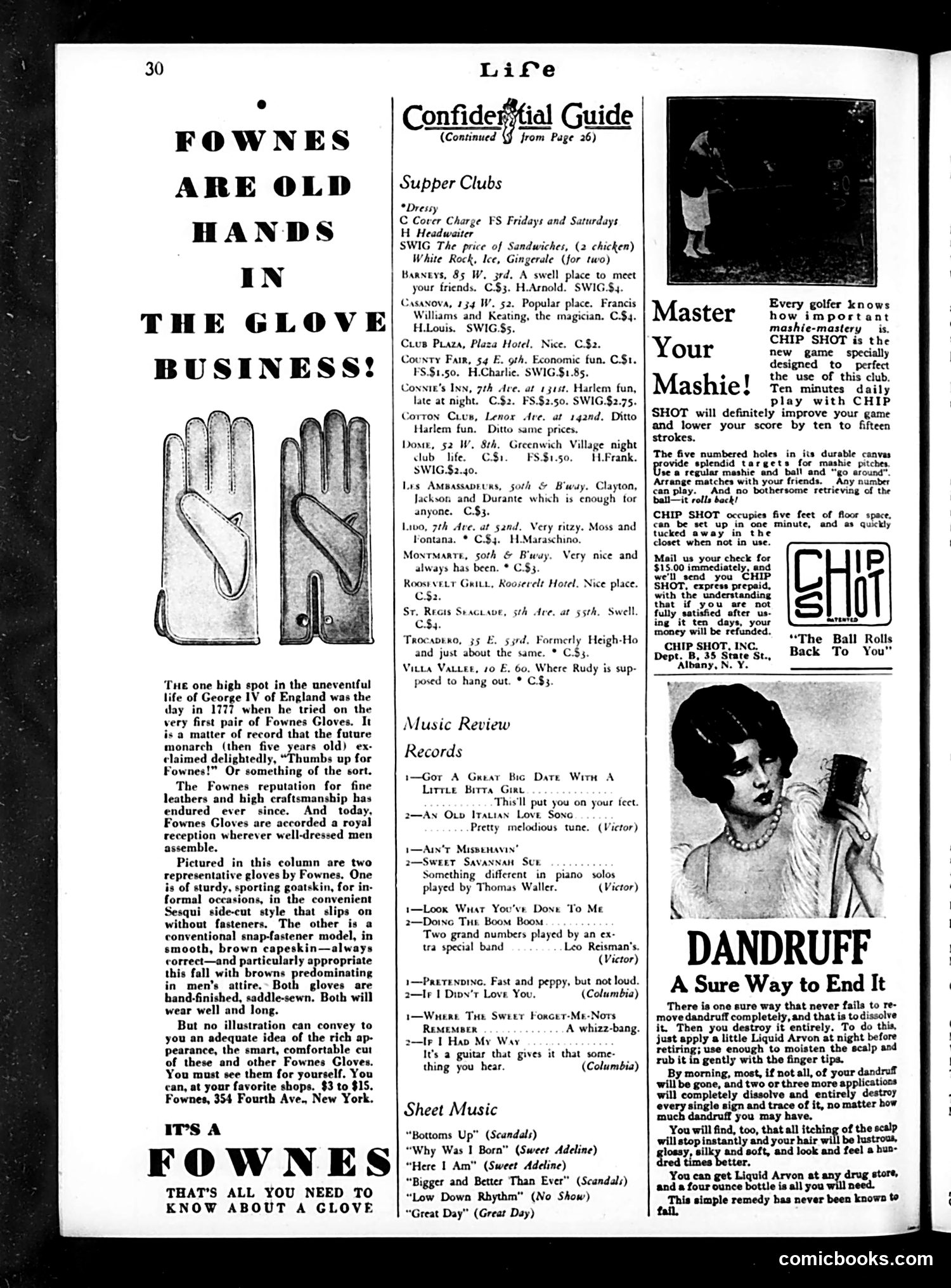
What This Page Means This is primarily advertising and entertainment listings from Life magazine circa late 1920s. The main advertisement features Fownes Gloves, a luxury leather glove manufacturer. The copy humorously claims that King George IV, as a five-year-old in 1777, exclaimed "Thumbs up for Fownes!" upon trying their gloves—an obvious fabrication designed to associate the product with royal prestige and long-standing quality. The joke is the absurdity of attributing modern brand loyalty to an eighteenth-century monarch. The page also contains listings for supper clubs (fashionable nightlife venues, some in Harlem), a music review of popular phonograph records, and advertisements for "Chip Shot," a miniature golf game marketed to golfers wanting to improve their "mashie" (a golf club) technique. The content reflects 1920s-30s urban entertainment culture, prosperity, and consumer marketing that used humor and fabricated testimonials to sell aspirational products.
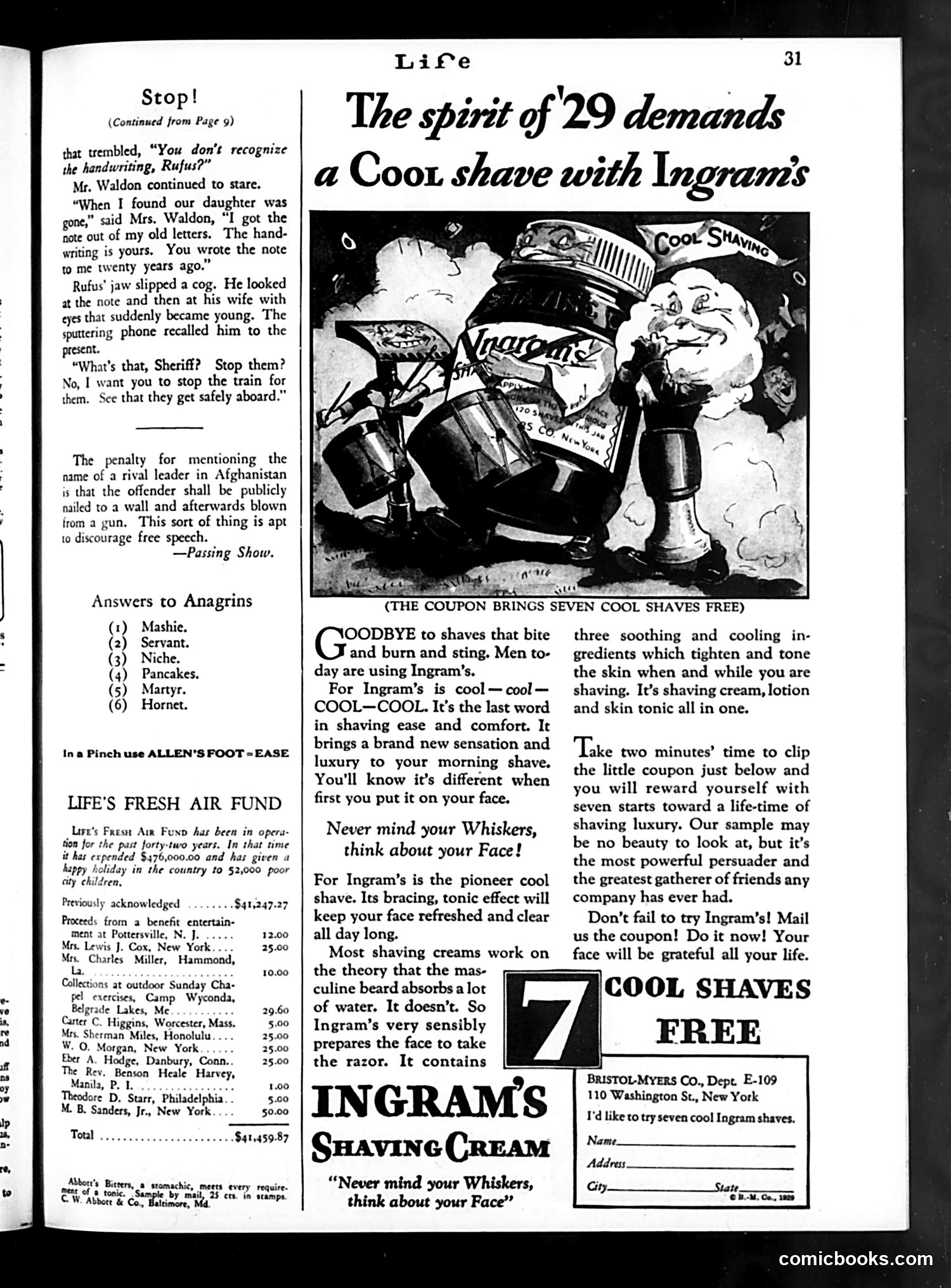
Analysis This page is primarily advertising, not political satire. The dominant content is a full-page ad for Ingram's Shaving Cream, featuring a cartoon of Santa Claus and what appears to be a gnome or elf character holding shaving products. The tagline "Never mind your Whiskers, think about your Face!" emphasizes the product's skincare benefits alongside shaving function. The page also contains: - A serialized story continuation ("Stop!") about a romantic reconciliation involving a train - "Answers to Anagrins" (word puzzles) - A charitable fund update (Life's Fresh Air Fund) - Minor product advertisements (Allen's Foot-Ease, Abbott's Bitters) The Christmas imagery in the shaving cream ad (referencing "the spirit of 29") likely dates this to late 1929. There is no political cartoon or social satire on this page—it's standard early-20th-century magazine content mixing fiction, puzzles, and advertisements.
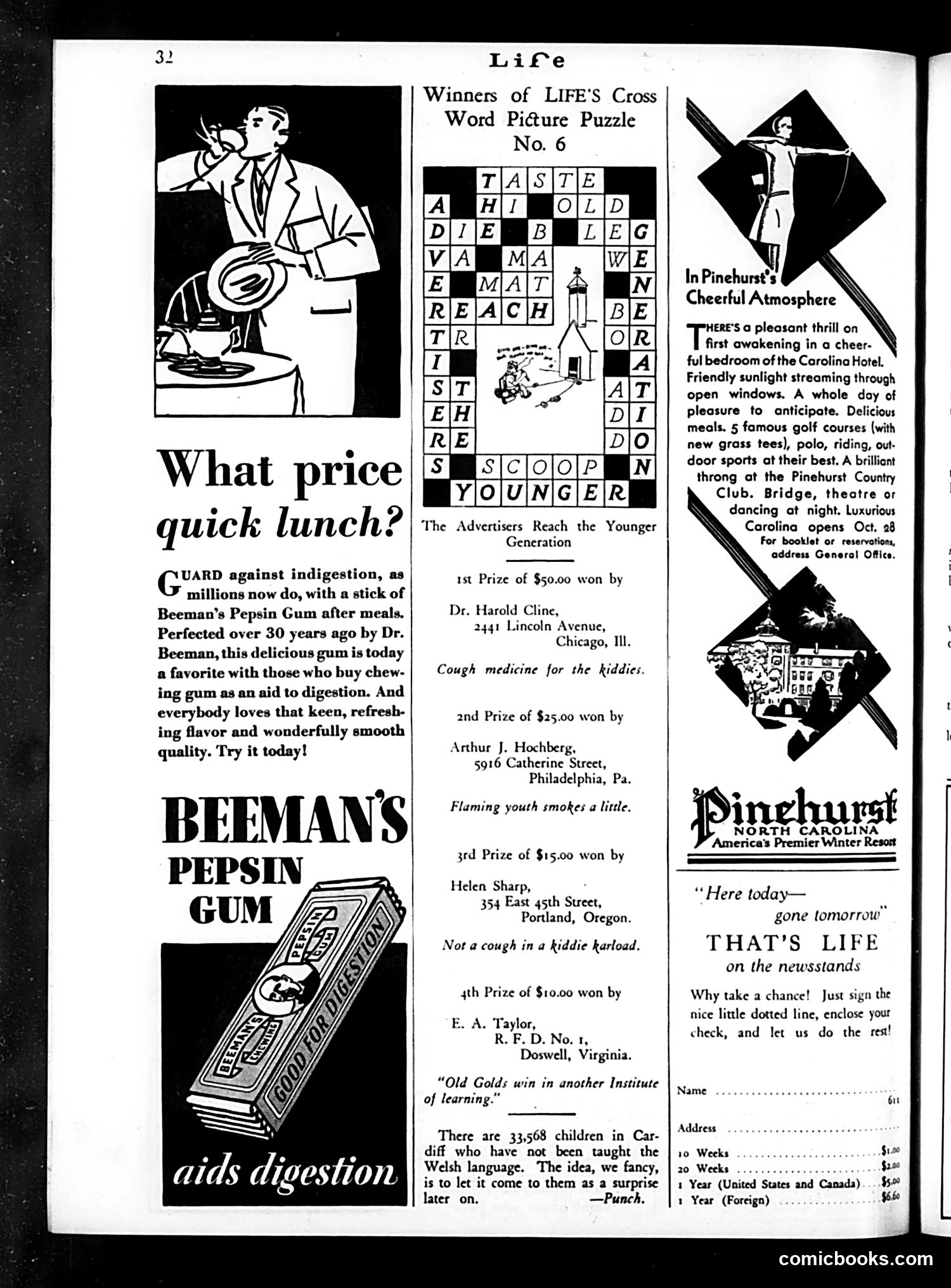
Life Magazine Page Analysis This page is primarily advertising and contest results, not political satire. The left side features a Beeman's Pepsin Gum ad—a digestive aid marketed as a post-meal solution for indigestion, reflecting early 20th-century belief in gum's medicinal properties. The center lists winners of Life's crossword puzzle contest, with humorous prize annotations: "Cough medicine for the kiddies" and "Flaming youth smokes a little" sarcastically reference the puzzle winners' prize categories. A brief Punch magazine excerpt jokes about Welsh children never learning their native language. The right side advertises Pinehurst, North Carolina's Carolina Hotel resort, promoting golf, dining, and social activities. The satirical element is minimal—mostly gentle mockery embedded in prize descriptions. This appears to be a typical interwar magazine page mixing commerce with light humor, targeting affluent readers interested in consumer goods and leisure travel.
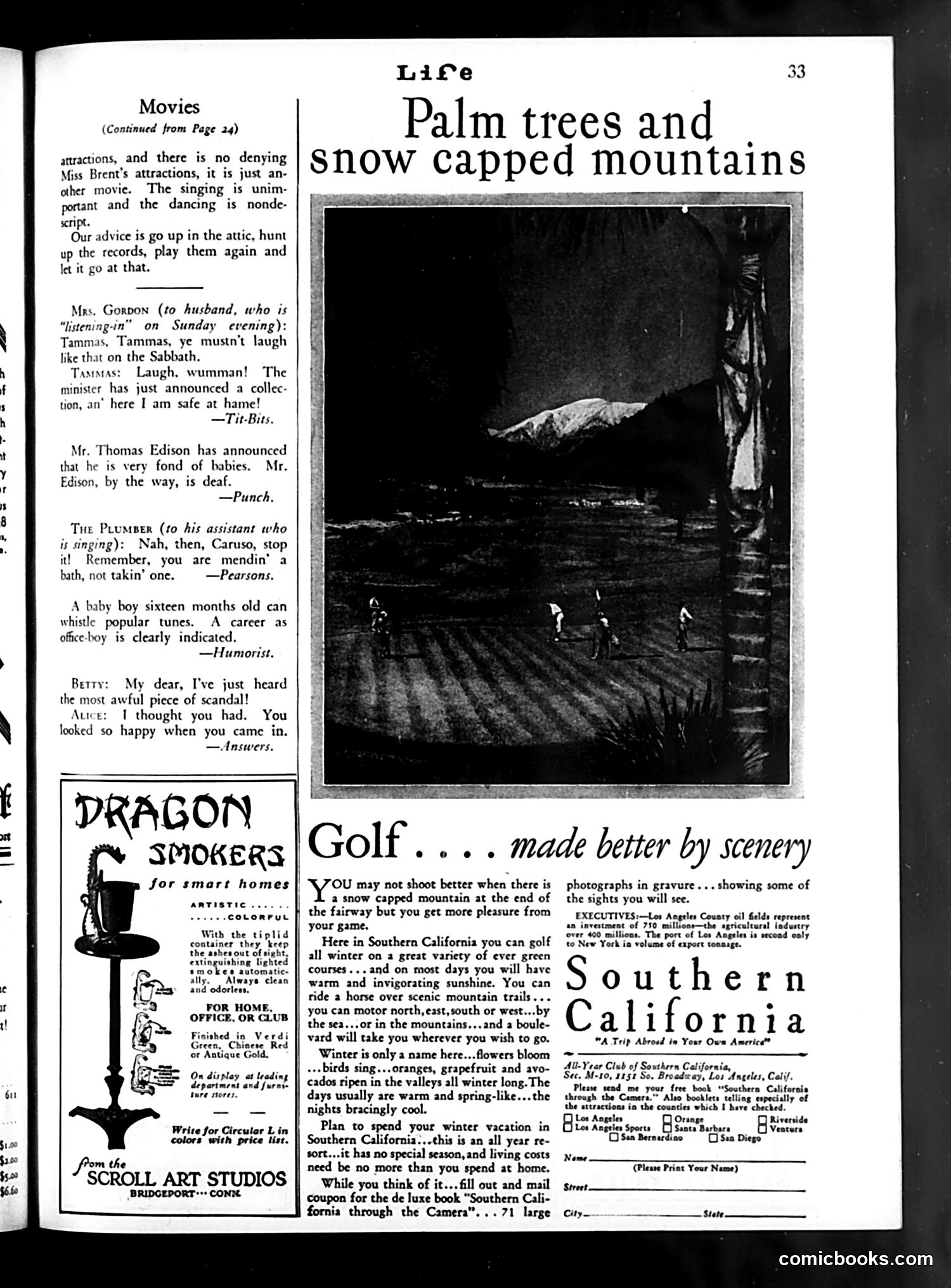
Analysis of Life Magazine Page 33 This page contains movie reviews (continued from page 24) and advertisements, not political cartoons. The movie section includes brief humorous anecdotes sourced from other publications (Tit-Bits, Punch, Pearsons, Humorist, Answers)—typical of Life's satirical reprinting of jokes. These are domestic humor bits: a wife chiding her husband for laughing on the Sabbath; a plumber mistaking a singing worker for someone bathing; observations about Edison's deafness and a baby's whistling ability. The page's dominant content is a Southern California tourism advertisement featuring a photograph of palm trees and snow-capped mountains with golfers. The ad emphasizes year-round golfing, pleasant weather, and scenic attractions—promoting California as a winter destination where "winter is only a name." A Dragon Smokers advertisement appears on the left, promoting an ornamental cigarette receptacle for "smart homes." There is no political satire on this page; it reflects early 20th-century consumer advertising and leisure culture.
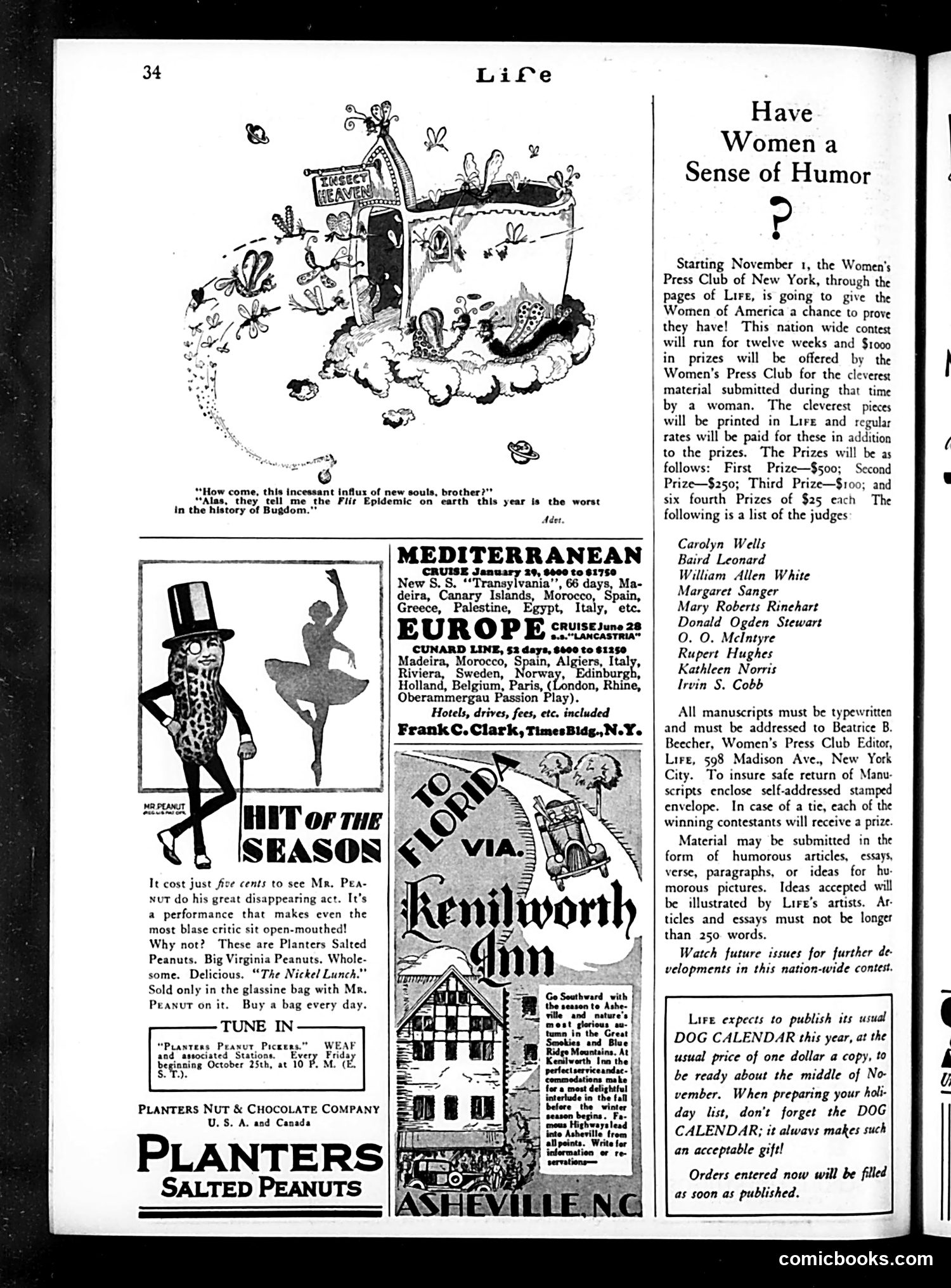
Explanation for Modern Readers The top cartoon satirizes the "Flit Epidemic"—a widespread pest infestation problem of the era. Two insects in "Bugdom" discuss the crisis: one asks why so many new souls keep arriving, and the other blames "the Flit Epidemic on earth this year is the worst in the history of Bugdom." This is an advertisement for Flit insecticide, using dark humor to pitch pest control by depicting insects worried about human extermination efforts. The page contains primarily advertisements (cruises, peanuts, hotels) and announces a humor writing contest by the Women's Press Club of New York, offering $1,000 in prizes to female writers. The contest reflects 1920s-era debate about whether women possessed comedic talent—a genuine social question at the time, now archaic and mildly offensive in its framing.
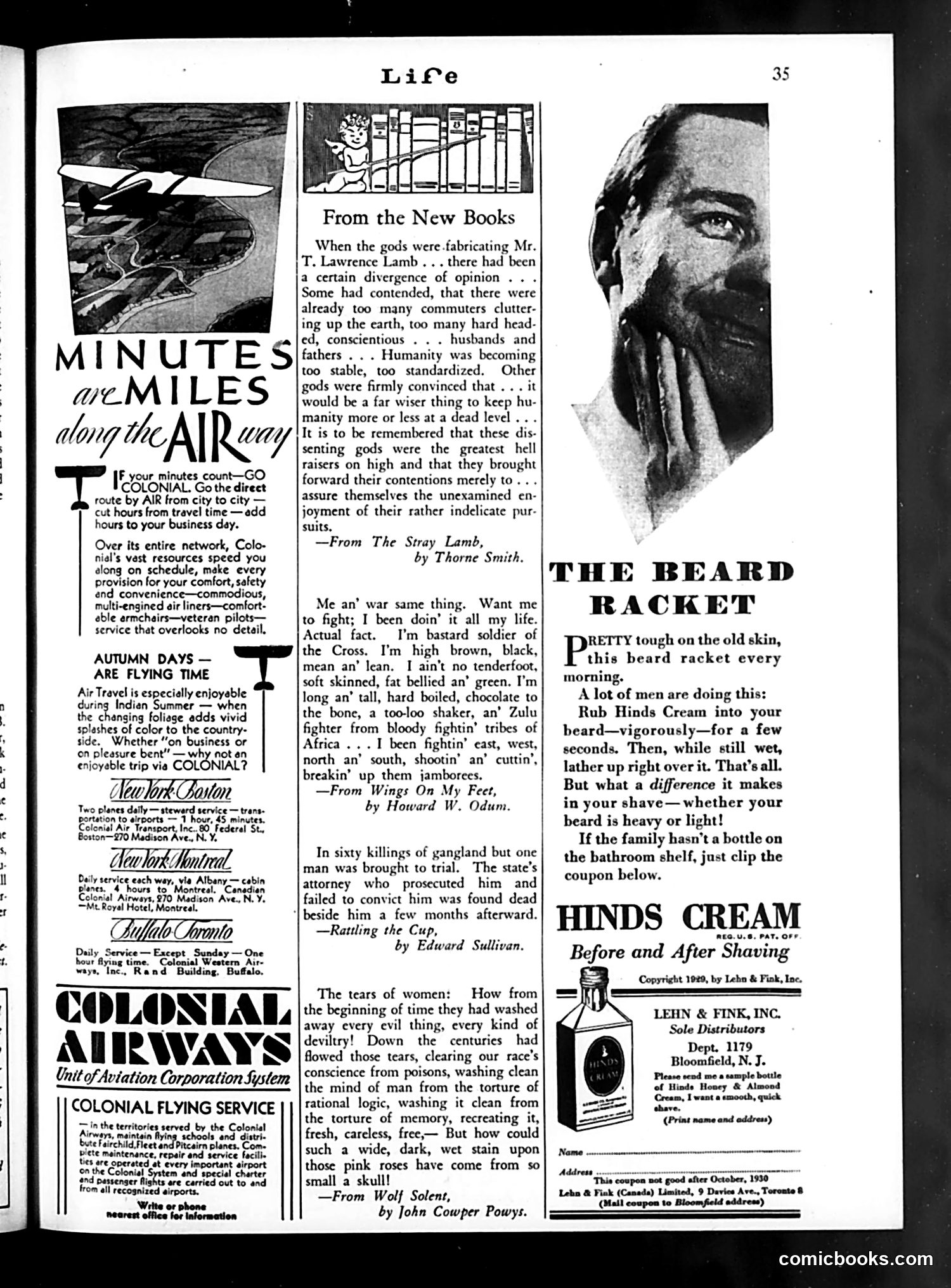
Analysis of Life Magazine Page 35 This page is primarily advertising and book excerpts, not political satire. The left side features Colonial Airways advertisements promoting air travel as time-saving for businessmen—a selling point during the 1920s-30s when flying was still novel. The copy emphasizes comfort and reliability to overcome public skepticism about aviation. The center column excerpts new books, including *The Stray Lamb* by Thorne Smith (a humorous fantasy novel) and passages about war, crime, and philosophy from other contemporary works. These literary quotes appear meant to entertain and intrigue readers. The right side advertises Hinds Cream, a shaving product, using before-and-after imagery and humor about beard maintenance. The ad plays on masculine vanity ("what a *difference* it makes") to sell grooming products. There is no political cartoon or satire on this page—it's a commercial/editorial mix typical of Life magazine's format during this era.
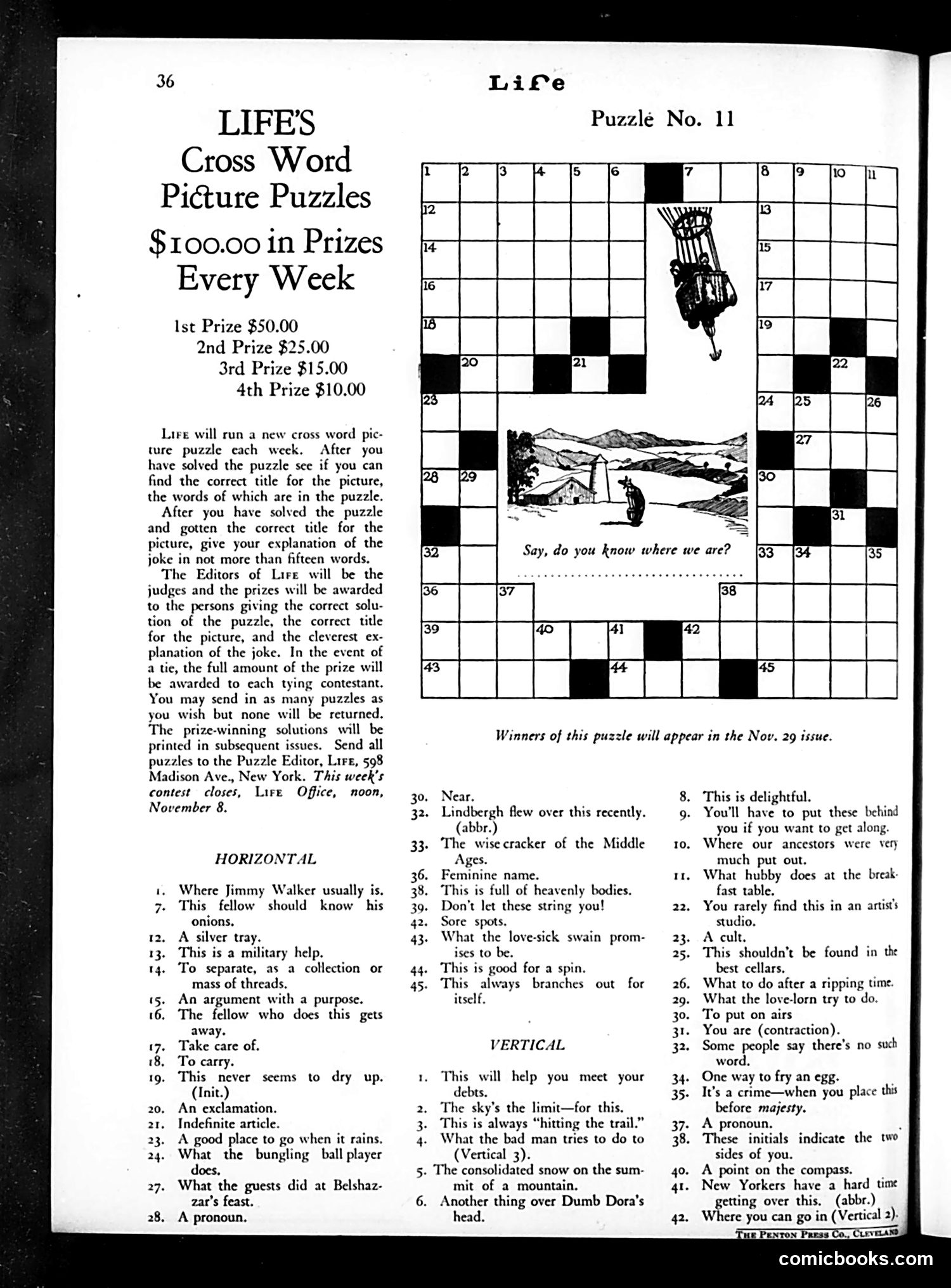
Life Magazine Crossword Picture Puzzle (November 1920s) This page advertises Life's weekly crossword picture puzzle contest, offering $100 in prizes. The format combines a traditional crossword with an embedded illustration—solvers must complete the crossword, then identify the correct title for the picture (whose words appear within the puzzle answers), and finally explain the joke in fifteen words or fewer. The illustration shows a rural farmhouse scene with the caption "Say, do you know where we are?" The clues reference contemporary figures and slang: "Jimmy Walker" (New York's mayor), "Lindbergh" (the aviator), and period expressions like "onions" (knowledge), "love-sick swain," and "bungling ball player." This was a popular entertainment format in Life during the 1920s crossword craze. Readers competed for cash prizes by demonstrating puzzle-solving ability and wit in explaining the joke—a common form of intellectual amusement for educated audiences of the era.
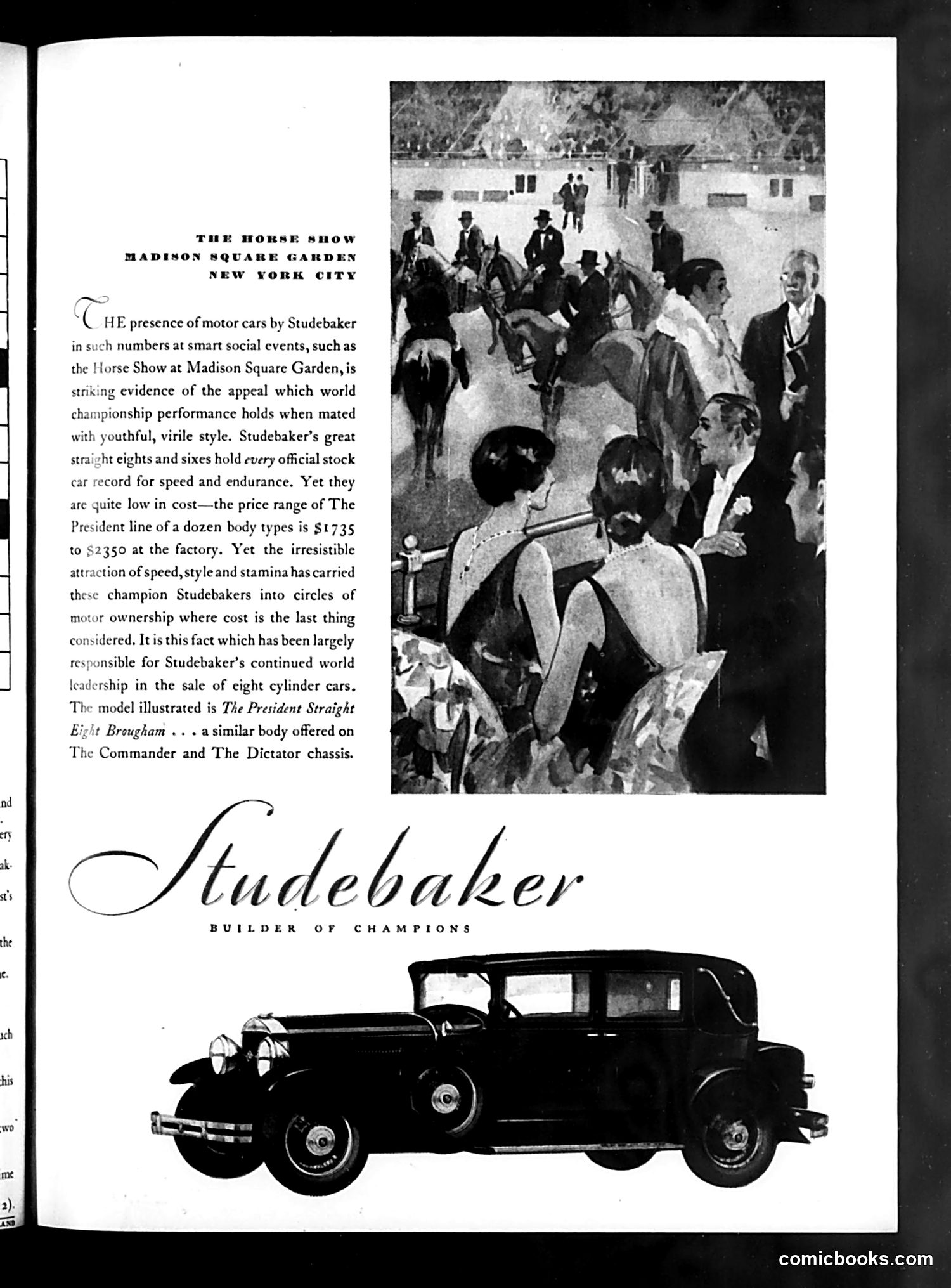
Analysis This is primarily a Studebaker automobile advertisement, not a political cartoon. The page advertises Studebaker cars by emphasizing their presence at the prestigious Horse Show at Madison Square Garden in New York City. The pitch: The ad argues that Studebaker's eight-cylinder cars are so appealing—combining "world championship performance" with "youthful, virile style"—that they've gained favor among wealthy elites who don't prioritize cost. The text notes the "President" model costs $1,735–$2,350, positioning it as affordable yet prestigious enough for high-society events. The photograph shows fashionably dressed spectators at the Horse Show, with horses and handlers visible, establishing the elite social setting where Studebaker cars supposedly belong. The car illustration displays *The President Straight Eight Brougham*, the featured model. The satire is subtle: advertising a mid-priced car as the vehicle of champions by associating it with old-money horsemanship—a tension between modern automotive achievement and traditional aristocratic markers.
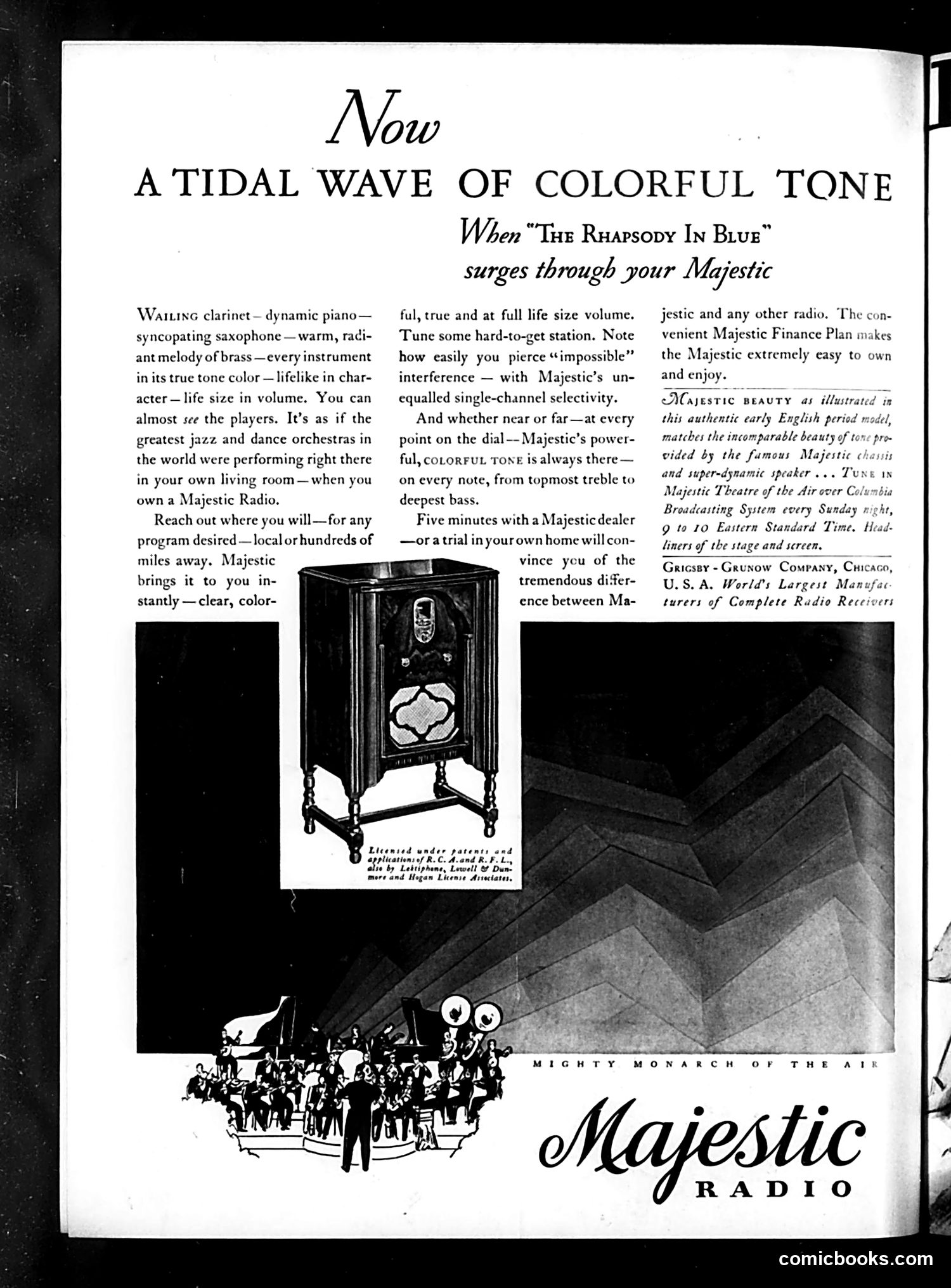
This is a Majestic Radio advertisement, not political satire. The page promotes a radio receiver by emphasizing its superior sound quality and reception capabilities. The ad uses evocative language about hearing "jazz and dance orchestras" perform "life size" in your living room—a selling point for 1920s-30s radio technology. It references "The Rhapsody in Blue" (Gershwin's famous composition) to convey artistic sophistication and tonal quality. Key marketing claims include: excellent selectivity (tuning distant stations), powerful "colorful tone" across all frequencies, and an affordable financing plan. The period furniture styling of the radio set itself is presented as fashionable home décor. The orchestra illustration at bottom reinforces the promise of live performance quality. This is straightforward consumer advertising leveraging entertainment and technology anxiety—the novelty of radio itself was the appeal for contemporary readers.