life
Life — November 1, 1929
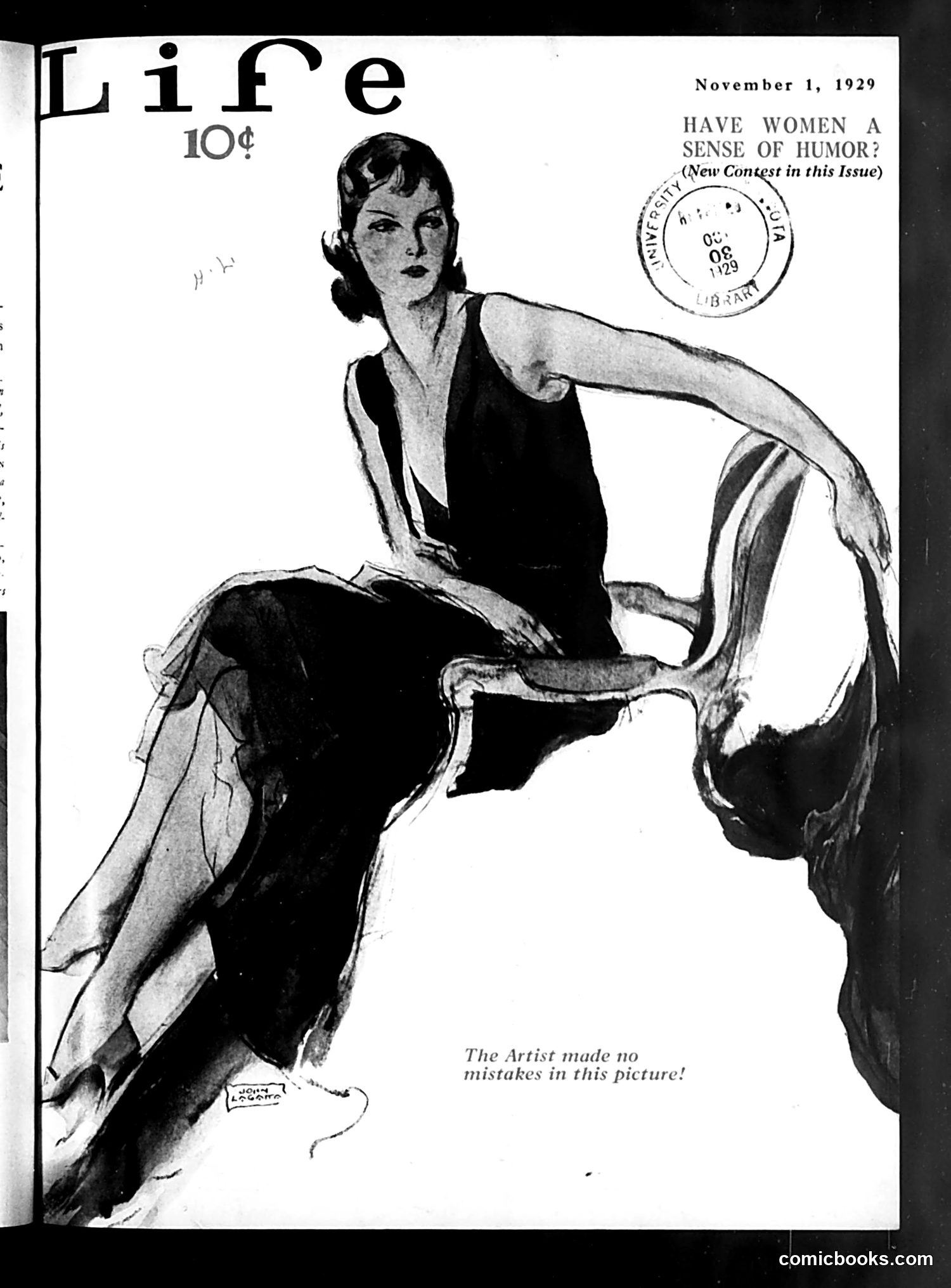
Life Magazine Cover, November 1, 1929 This is the cover of *Life* magazine's humor issue, featuring a stylized illustration of a woman in an elegant black halter dress seated in a chair. The image promotes a contest asking "HAVE WOMEN A SENSE OF HUMOR?" The caption "The Artist made no mistakes in this picture!" suggests the artwork is intentionally flawless—likely a joke about whether women could appreciate or understand the artistic joke being presented. This references 1920s-era stereotypes about women lacking humor or sophistication. The contest itself was likely a humor feature where readers submitted answers or observations about the image or topic. The ten-cent price reflects *Life*'s positioning as an accessible, middlebrow satirical publication of the era.
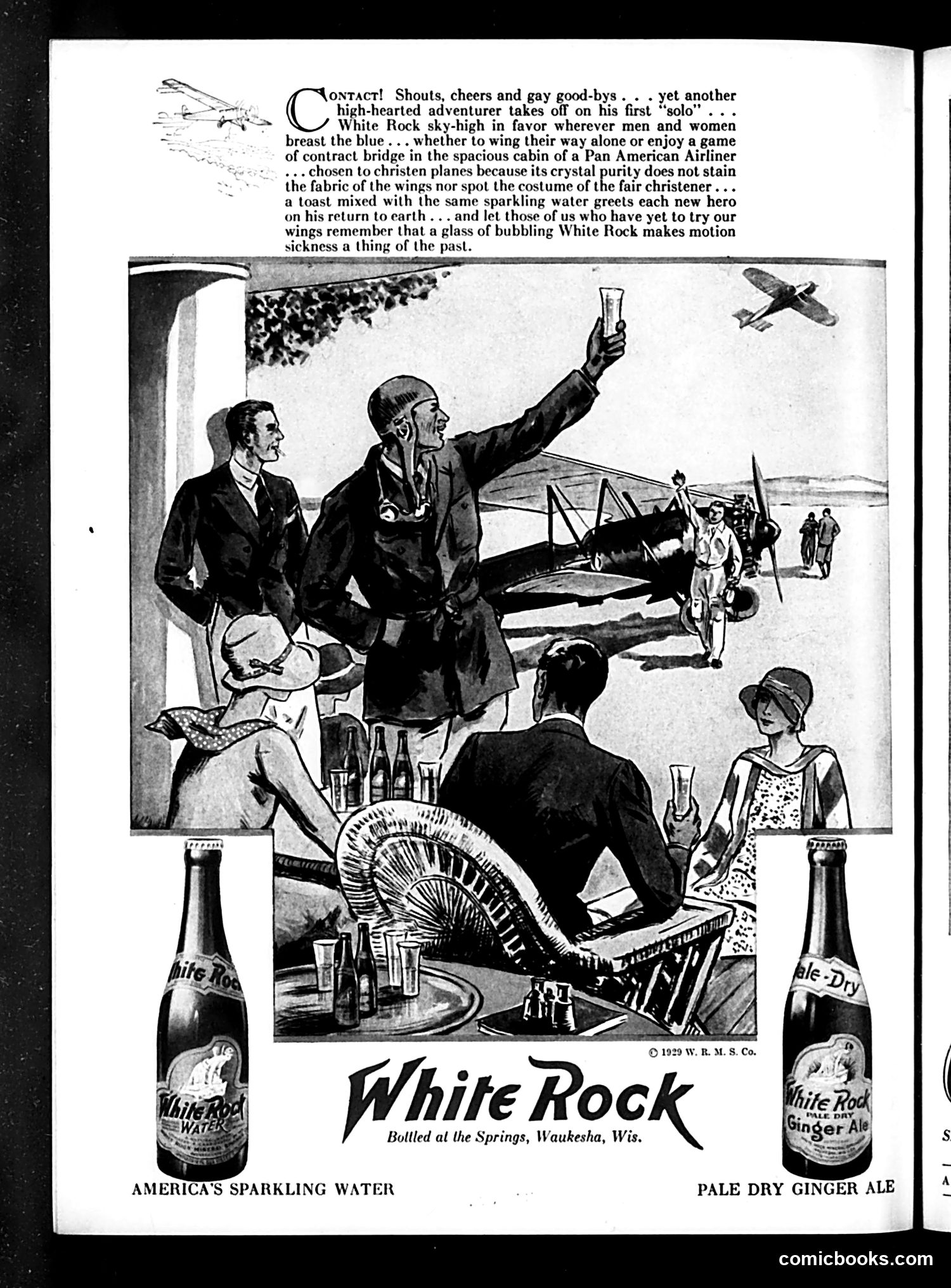
White Rock Advertisement (1929) This is primarily a beverage advertisement, not satire. The page promotes White Rock brand sparkling water and ginger ale, bottled in Waukesha, Wisconsin. The illustration depicts a celebratory aviation scene: well-dressed people toast a departing pilot with champagne glasses filled with White Rock products. An airplane flies overhead while others wave farewell on an airfield below. The accompanying text uses aviation imagery as aspirational marketing, comparing drinking White Rock to the thrilling novelty of early airplane travel—positioning the beverage as modern, exciting, and associated with daring adventure. The copyright date is 1929, placing this during the peak of 1920s enthusiasm for aviation as an exciting new technology. The advertisement capitalizes on this cultural moment to suggest White Rock embodies similar sophistication and excitement.
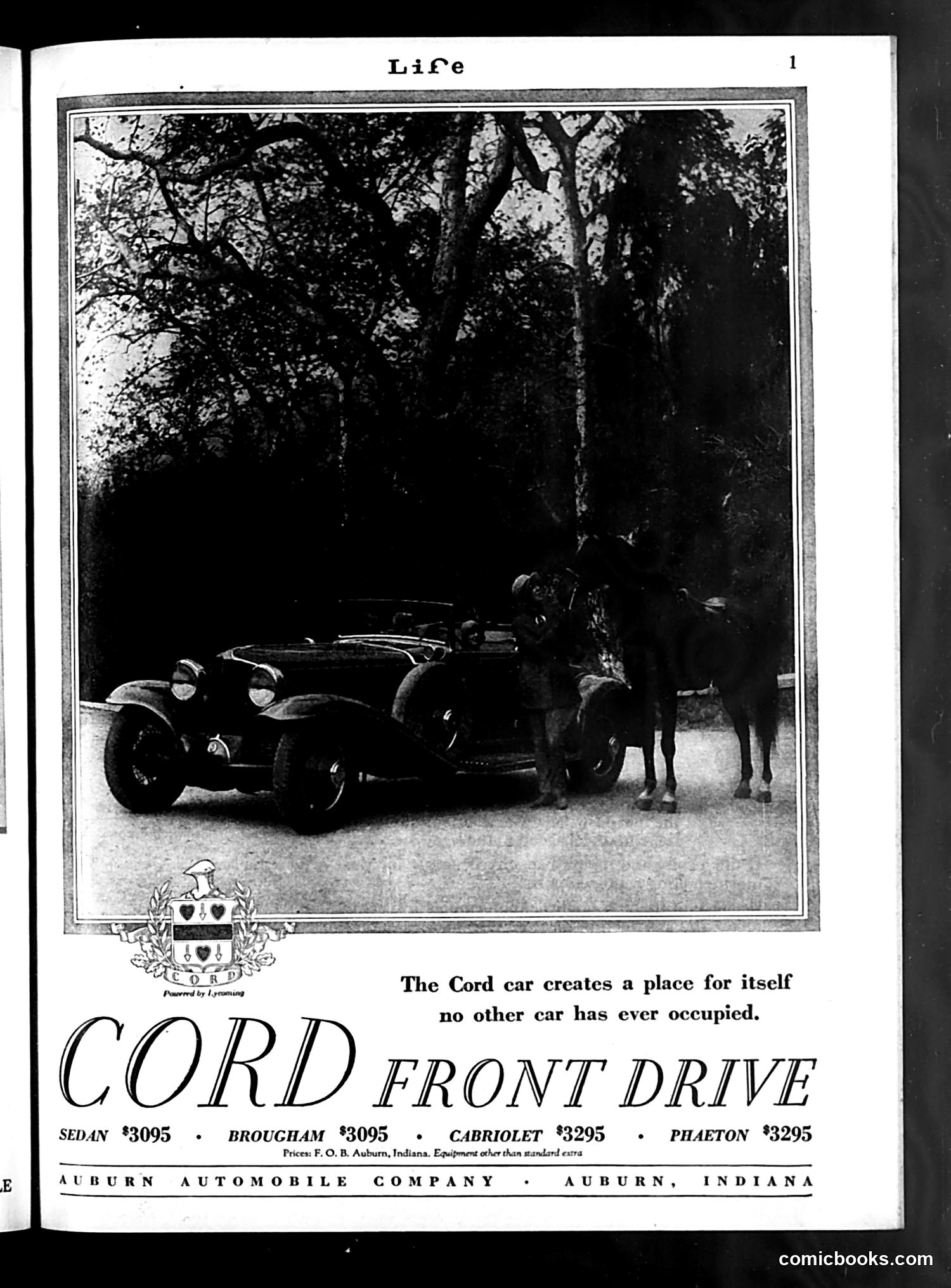
Analysis This page is primarily advertising, not satire or political commentary. It's a Cord automobile advertisement from the Auburn Automobile Company of Auburn, Indiana. The image shows a Cord car parked beneath trees with two men and a horse standing beside it. The advertisement's tagline claims "The Cord car creates a place for itself no other car has ever occupied." This is standard early automotive marketing rhetoric emphasizing the vehicle's unique qualities and superior design. The specific models listed (Sedan, Brougham, Cabriolet, Phaeton) and their prices ($3,095-$3,295) are typical product information from this era. There is no political cartoon, satire, or hidden meaning—simply a vintage car advertisement promoting Cord's "front drive" technology as a distinctive selling point.
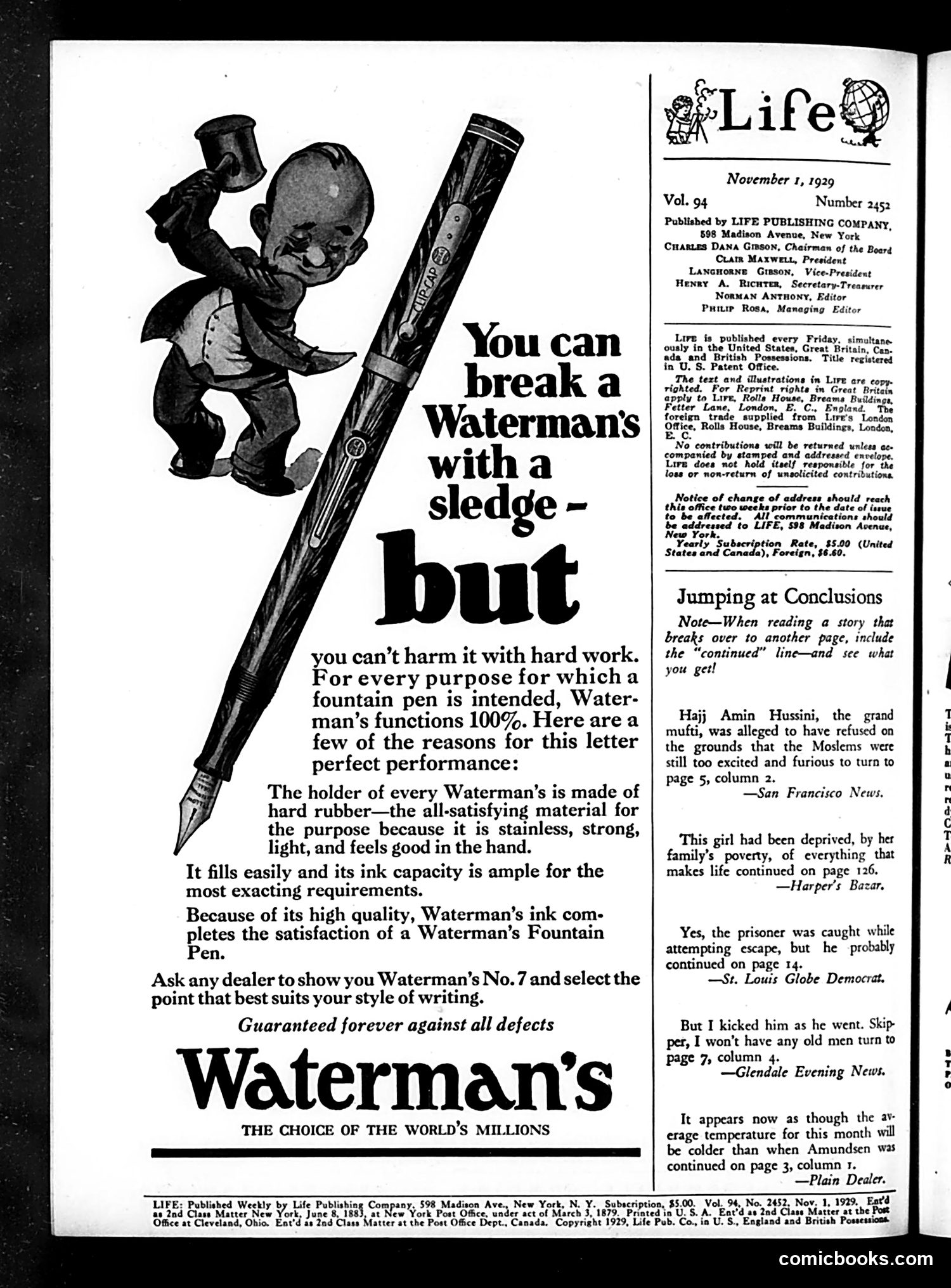
Waterman's Fountain Pen Advertisement This page is primarily a commercial advertisement for Waterman's fountain pens, not political satire. The left side features a cartoon of a cherub or baby figure wielding a sledgehammer against a large pen, illustrating the advertising claim that "you can't break a Waterman's with a sledge—but you can't harm it with hard work." The right column contains Life magazine's masthead and several brief editorial notes about stories continued elsewhere in the issue, including references to Hajj Amin Hussini and a prisoner escape. The cartoon serves product promotion rather than social commentary, emphasizing the pen's durability through hyperbolic humor typical of 1920s advertising.
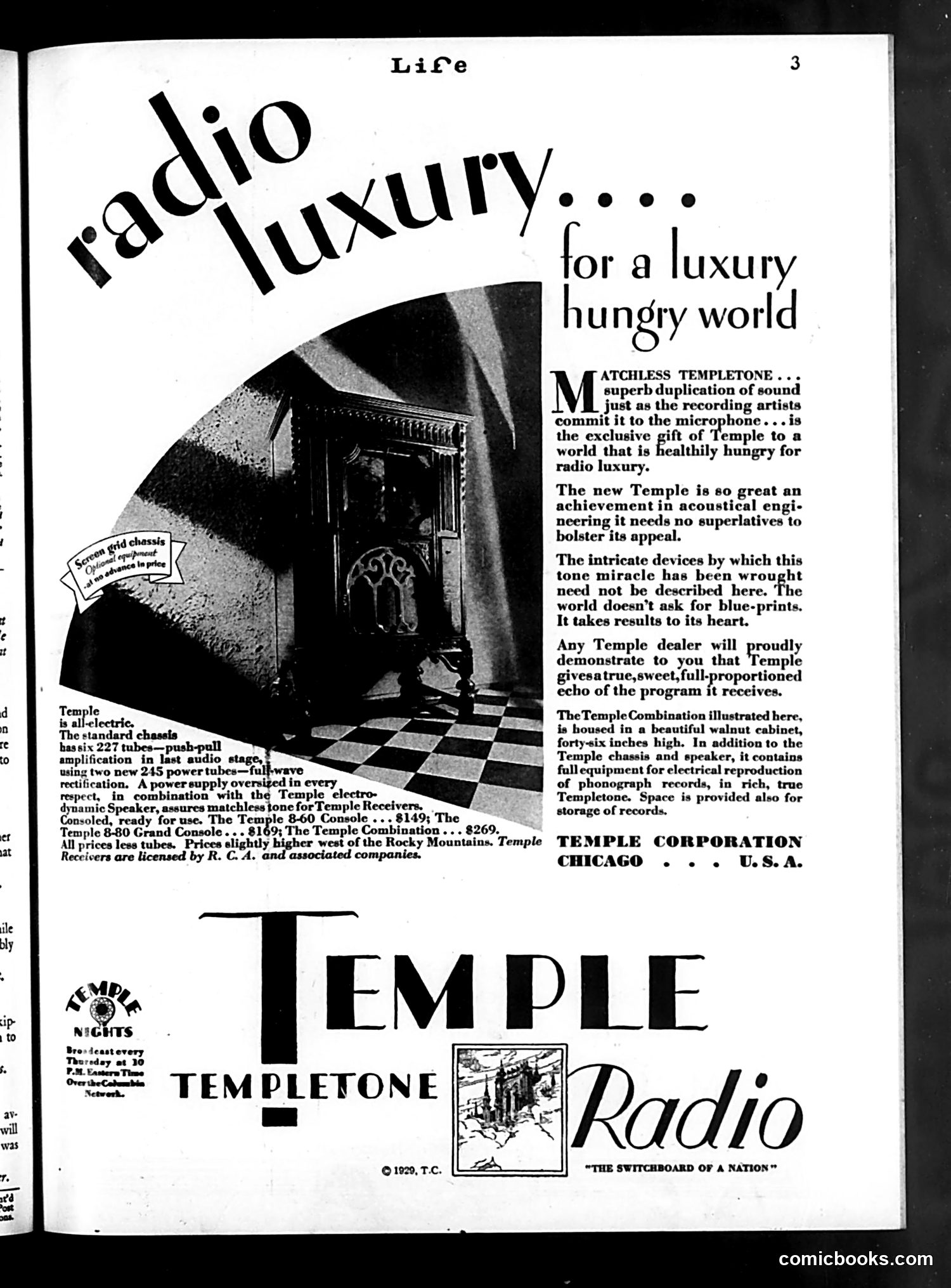
Analysis This page is primarily a product advertisement, not political satire. It promotes Temple Radio brand receivers from the Temple Corporation of Chicago. The ad uses the phrase "radio luxury for a luxury hungry world" to market high-end radio equipment. The copy emphasizes the Temple brand's technical superiority—particularly the "Matchless Templetone" pickup and advanced acoustical engineering. The image shows an ornate radio console housed in a walnut cabinet. The advertisement lists several Temple models with prices ($149-$269), noting that "Temple Receivers are licensed by R.C.A. and associated companies." This reflects the 1920s radio boom when radio sets were luxury consumer goods. The "luxury hungry world" phrasing suggests marketing to affluent buyers during what appears to be the prosperous pre-Depression era. There is no political cartoon or satirical content present.
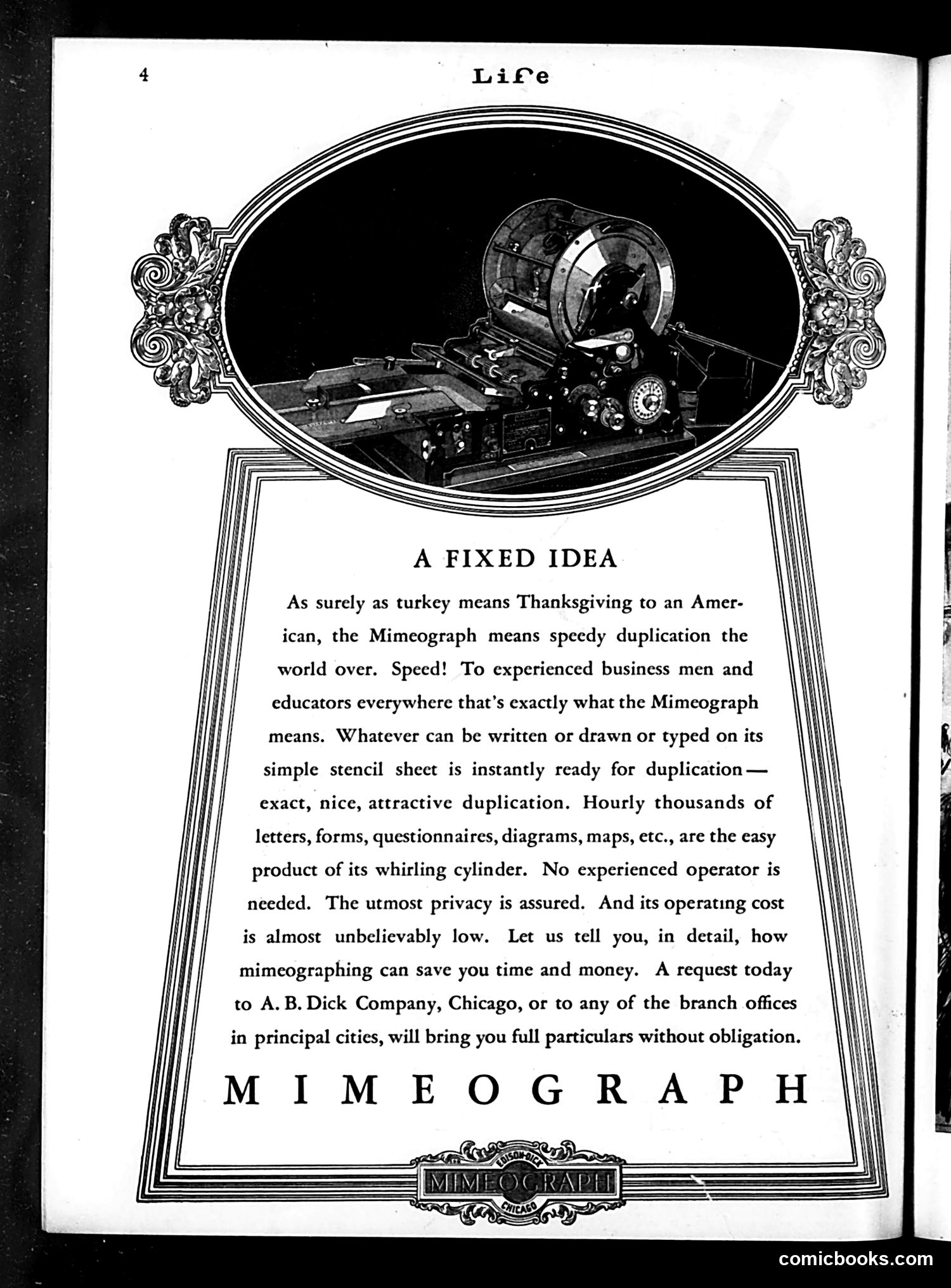
Page Analysis This is primarily a Mimeograph machine advertisement rather than a political cartoon. The page shows a ornate oval frame containing an image of an early mimeograph device with its characteristic rotating cylinder mechanism. The ad uses a humorous comparison ("As surely as turkey means Thanksgiving to an American") to establish the mimeograph as the standard tool for document duplication. It appeals to "experienced business men and educators" by emphasizing speed, ease of use, privacy, and low operating costs. The advertisement is placed in *Life* magazine, which was indeed a satirical publication during this era, but this particular page functions as commercial promotion rather than social or political satire. It represents early 20th-century office technology marketing.
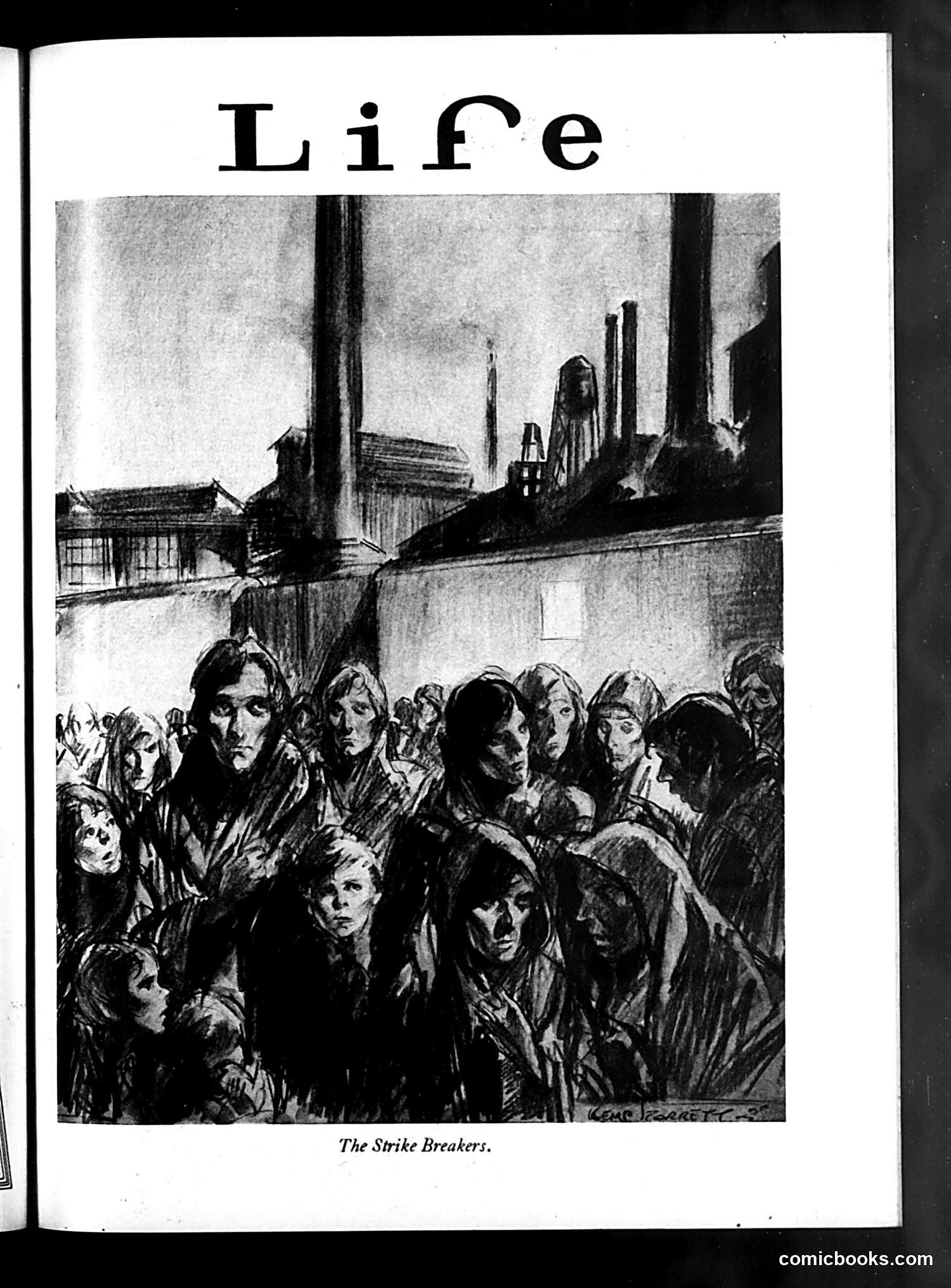
"The Strike Breakers" - Life Magazine This illustration depicts a crowd of working-class people, appearing downtrodden and impoverished, gathered before an industrial landscape with factory smokestacks and buildings. The caption "The Strike Breakers" suggests satire directed at laborers who crossed picket lines or undermined strikes. The artwork's dark, expressionistic style emphasizes the hardship and desperation of the figures—implying these individuals were driven by economic necessity rather than choice to break strikes. The composition critiques the system that forced workers into this position: rather than mocking the strike-breakers themselves, the satire appears directed at the economic conditions and power structures that made such desperate choices necessary. The looming industrial infrastructure dominates the scene, reinforcing themes of worker vulnerability to larger economic forces.
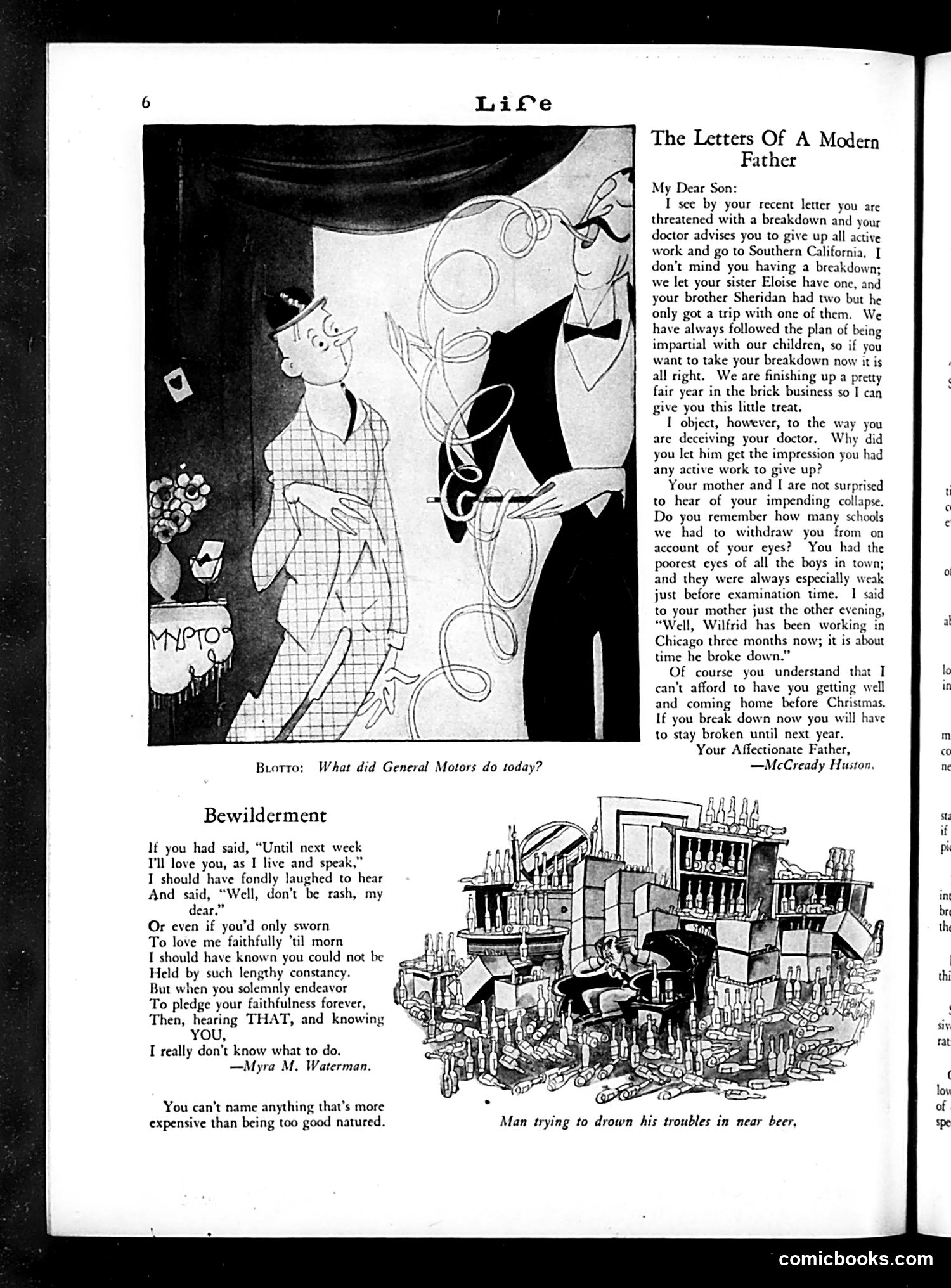
Analysis of Life Magazine Page 6 Top Cartoon ("Blotto"): A well-dressed man in formal attire is being questioned by a smaller, disheveled figure about General Motors' activities. The caption reads "What did General Motors do today?" This appears to be satirizing either corporate malfeasance or the public's obsession with tracking major corporations' business dealings during this era. "The Letters of a Modern Father": A paternalistic letter from a father denying his son's request for rest due to nervous breakdown, citing that other children have had similar issues. The tone mocks overly stern, unsympathetic parenting attitudes. "Bewilderment" Poem & Bottom Cartoon: A poem about confusion regarding moral commitment, paired with an illustration of a man drowning himself in beer bottles—satirizing escapism and alcohol abuse as responses to life's troubles.
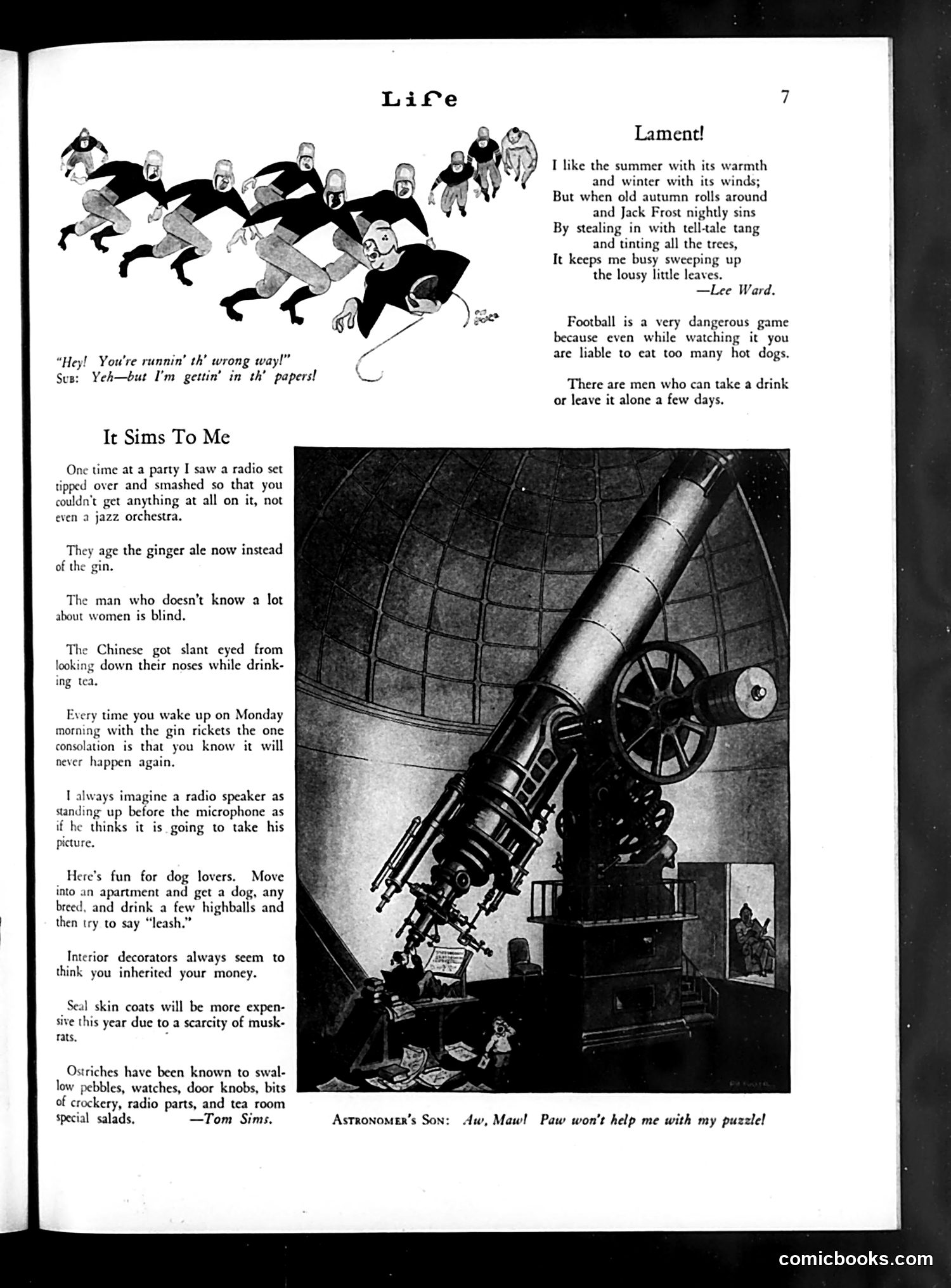
Analysis of Life Magazine Page 7 Top Cartoon: Shows football players running chaotically, with someone shouting "Hey! You're runnin' th' wrong way!" and another responding "Yeh—but I'm gettin' in th' papers!" This satirizes football players' apparent priority on getting newspaper publicity over actually playing the game correctly—mocking the era's sports celebrity culture. "It Sims to Me" Column: A humorous collection of observations by Tom Sims about everyday life, including jokes about radio sets being destroyed at parties, drinking habits, and interior decorating. Bottom Image: A cartoon titled "Astronomer's Son" showing a boy at a telescope with the caption "Aw, Maw! Paw won't help me with my puzzle!" The joke appears to play on the father being absorbed in stargazing rather than attending to domestic duties.
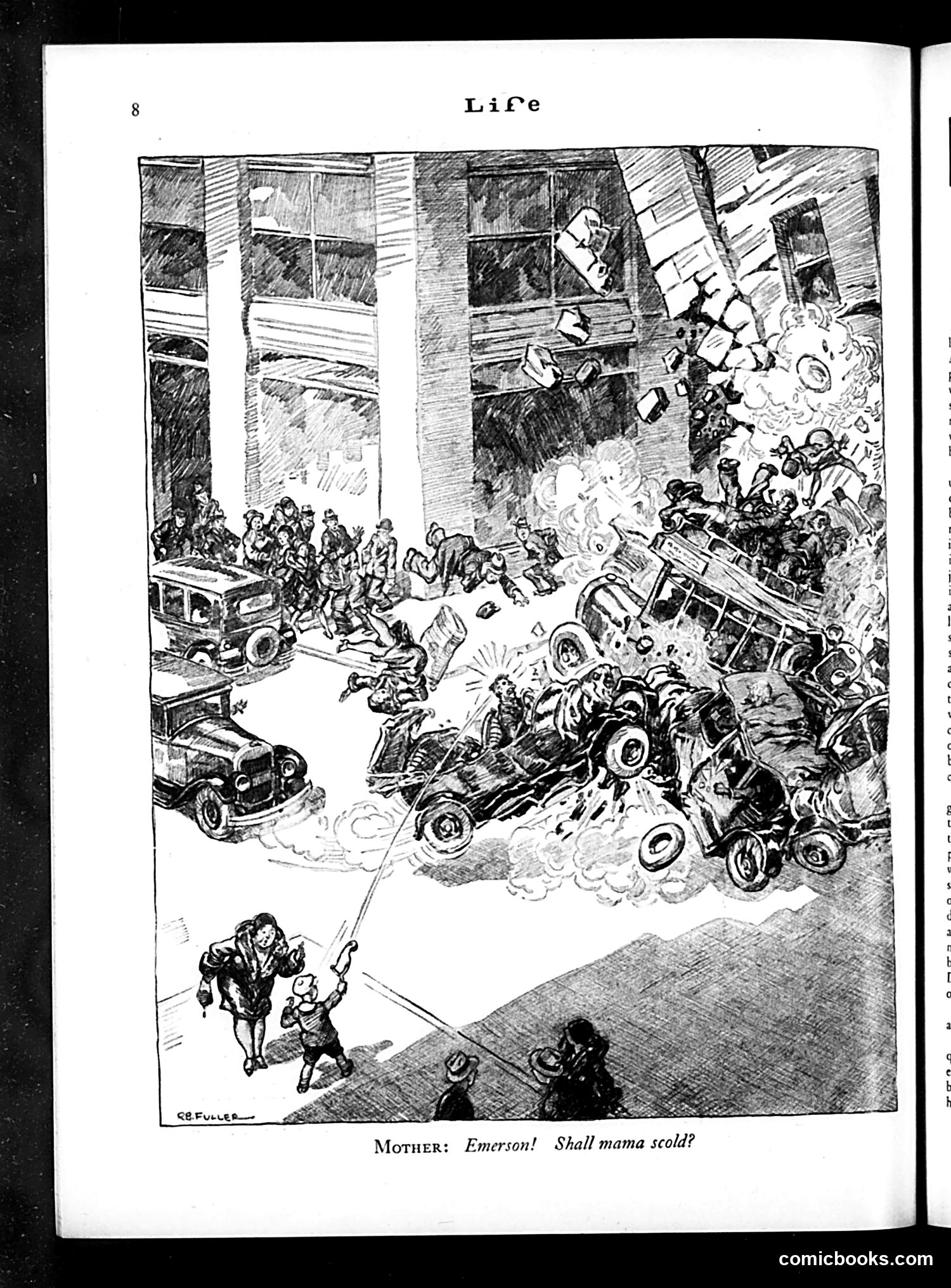
Analysis of Life Magazine Cartoon This cartoon depicts a chaotic street scene showing a major traffic accident involving multiple automobiles colliding and overturning beneath tall urban buildings. The explosion of vehicles and debris creates a disaster scene with numerous figures scattered around. The caption reads: "MOTHER: *Emerson!* Shall mama scold?" The satire appears to target early automotive culture and the dangers of reckless driving. The mother's mild, almost sarcastic question—asking whether she should merely "scold" for what is clearly a catastrophic multi-car pile-up—provides dark humor by treating a massive disaster as a minor infraction deserving light parental discipline. This undercuts the severity of the accident, satirizing both parental permissiveness and the dangerousness of unregulated early automobile traffic in crowded urban areas.
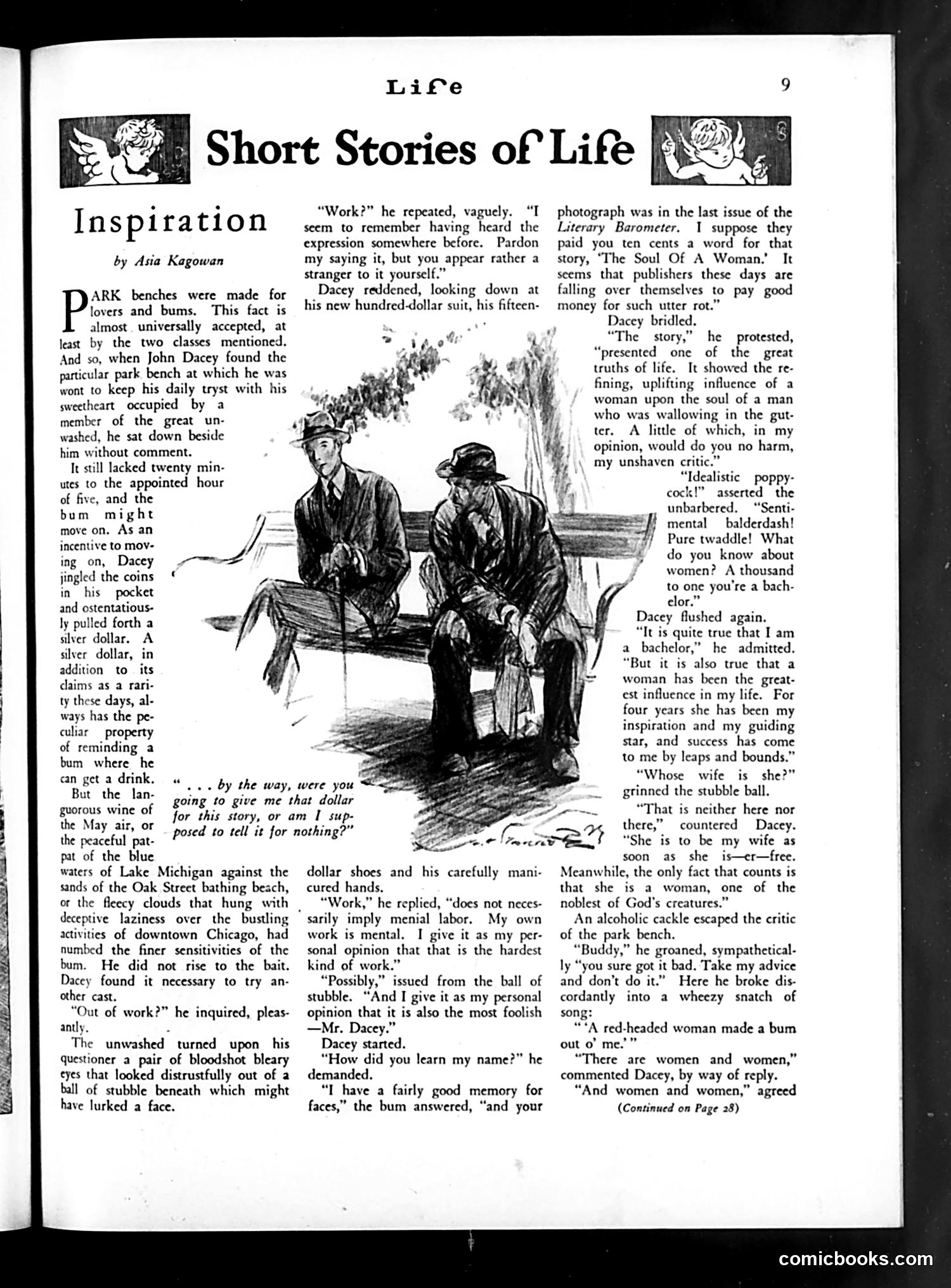
"Inspiration" by Ana Kagowan This short story depicts two men on a park bench—one well-dressed, one a vagrant. The narrative explores class and artistic inspiration through their dialogue. The well-dressed man (Dacey) is a writer seeking material. The vagrant (the "bum") initially offers to sell him a dollar for a story, but Dacey rejects this. Their conversation shifts to deeper themes: Dacey reveals that a woman has been his greatest inspiration for four years, and he credits her with his success. The satire critiques both artistic pretension and romantic idealization. The vagrant's crude observations about "women and women" deflate Dacey's sentimental language, suggesting that even humble people understand life's truths—undercutting the notion that inspiration requires refined sensibilities or romantic mythology.
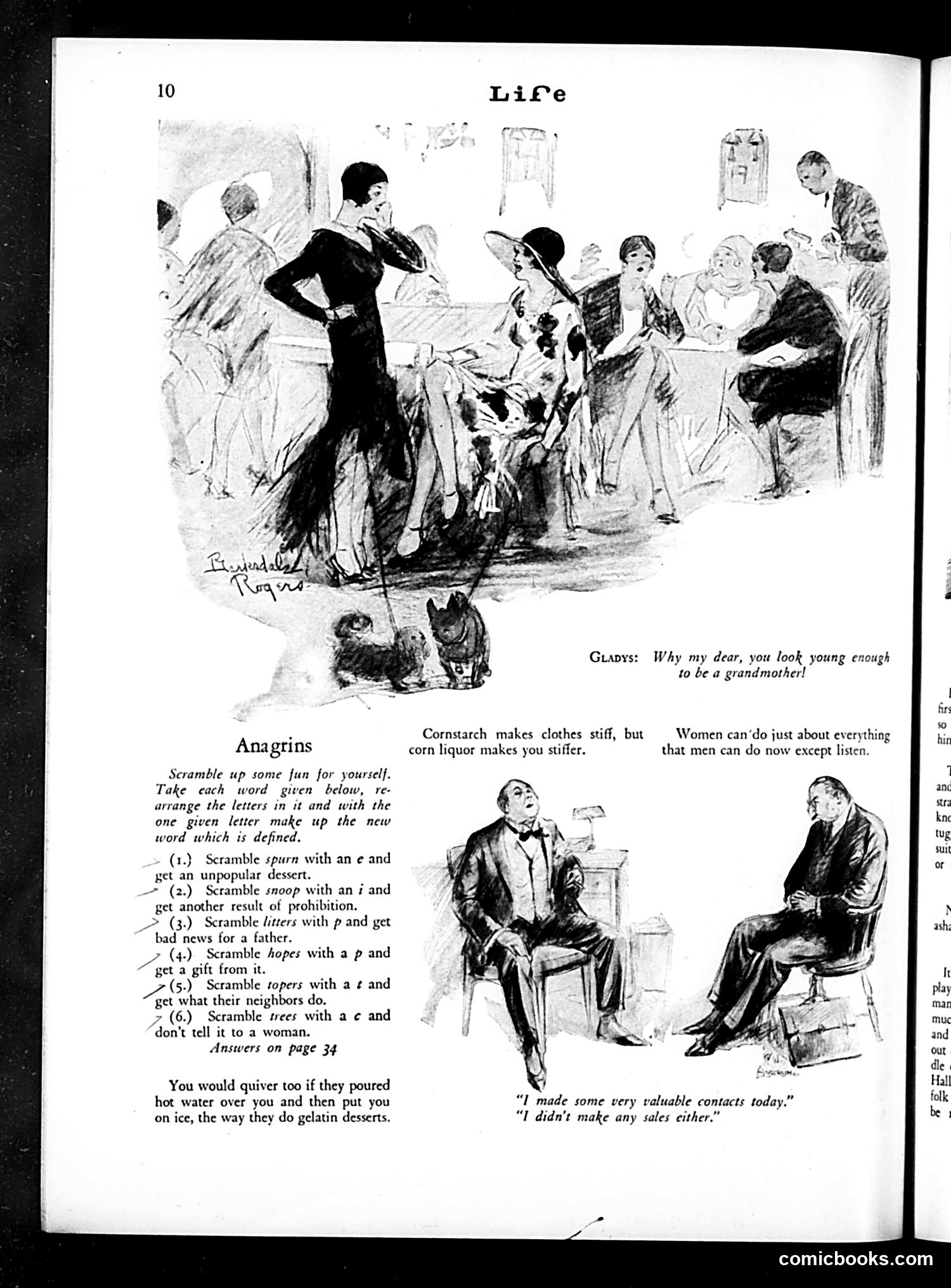
Analysis of Life Magazine Page 10 This page contains two distinct satirical cartoons from early 20th-century Life magazine. Top cartoon: Depicts a social gathering where a woman in fashionable dress is presented to others. The caption "Why my dear, you look young enough to be a grandmother!" is sarcastic commentary on women's appearance and vanity—likely mocking either cosmetic practices or unrealistic beauty standards of the era. Bottom cartoon: Shows two men in conversation. One claims "I made some very valuable contacts today" while admitting "I didn't make any sales either." This satirizes business culture and networking—poking fun at people who measure success by social connections rather than actual commercial results. The "Anagrins" word puzzle appears to be filler entertainment content typical of Life's format.
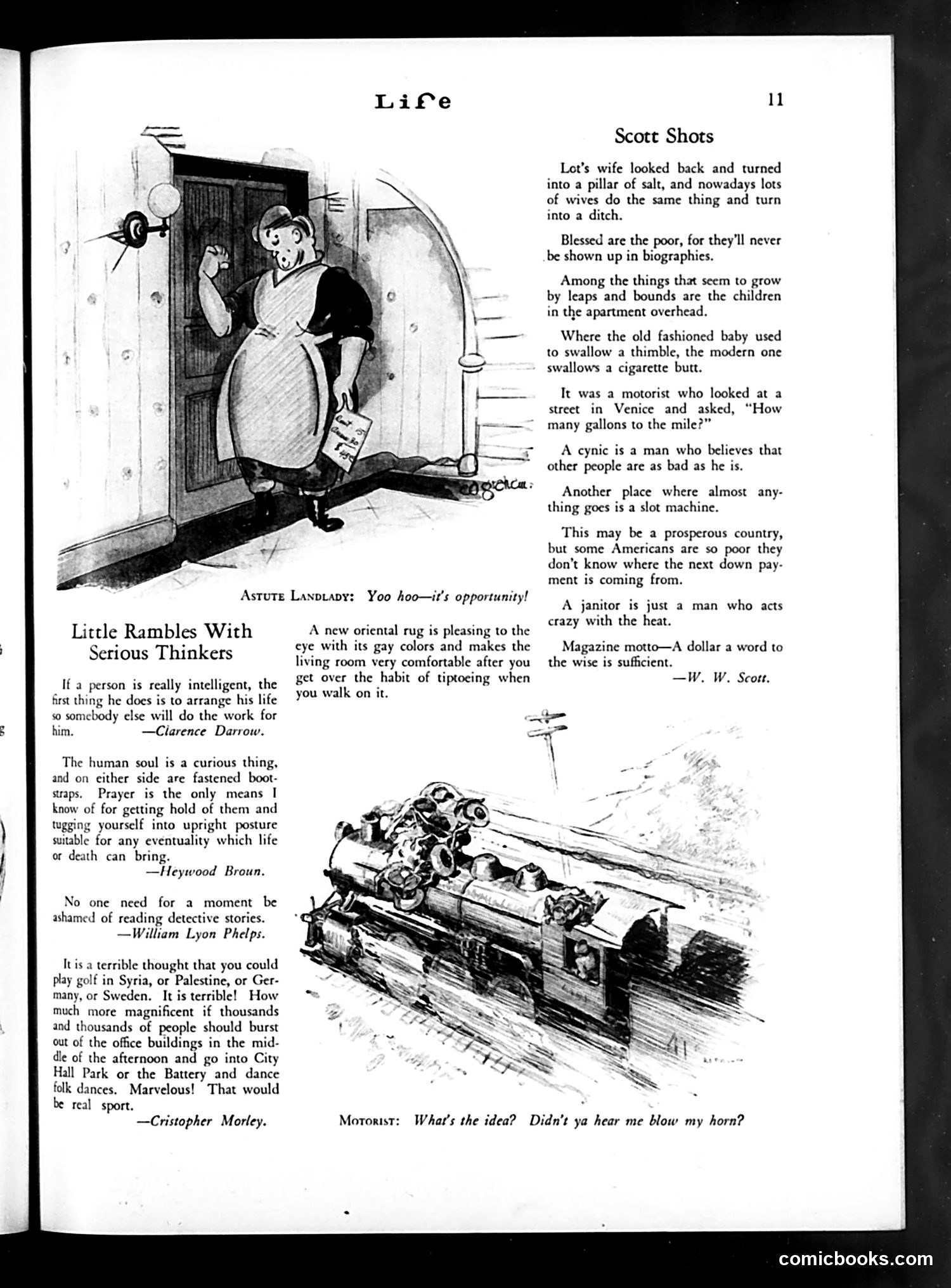
Analysis of Life Magazine Page 11 Top Cartoon: Titled "Astute Landlady: Yoo hoo—it's opportunity!" shows a landlord discovering a tenant with an enormous belly at the door. This satirizes housing shortages and perhaps pregnancy—the landlord sees financial opportunity in either eviction or exploiting desperate tenants. Column Section: "Little Rambles With Serious Thinkers" collects brief witty quotes about intelligence, prayer, golf, and office life from figures like Clarence Darrow and Heywood Broun. These are general social commentary rather than political satire. Bottom Cartoon: "Motorist: What's the idea? Didn't ya hear me blow my horn?" shows a motorist confronting what appears to be a sleigh driver. This satirizes modern impatience—early automobile drivers frustrated by slower transportation methods still common in this era.
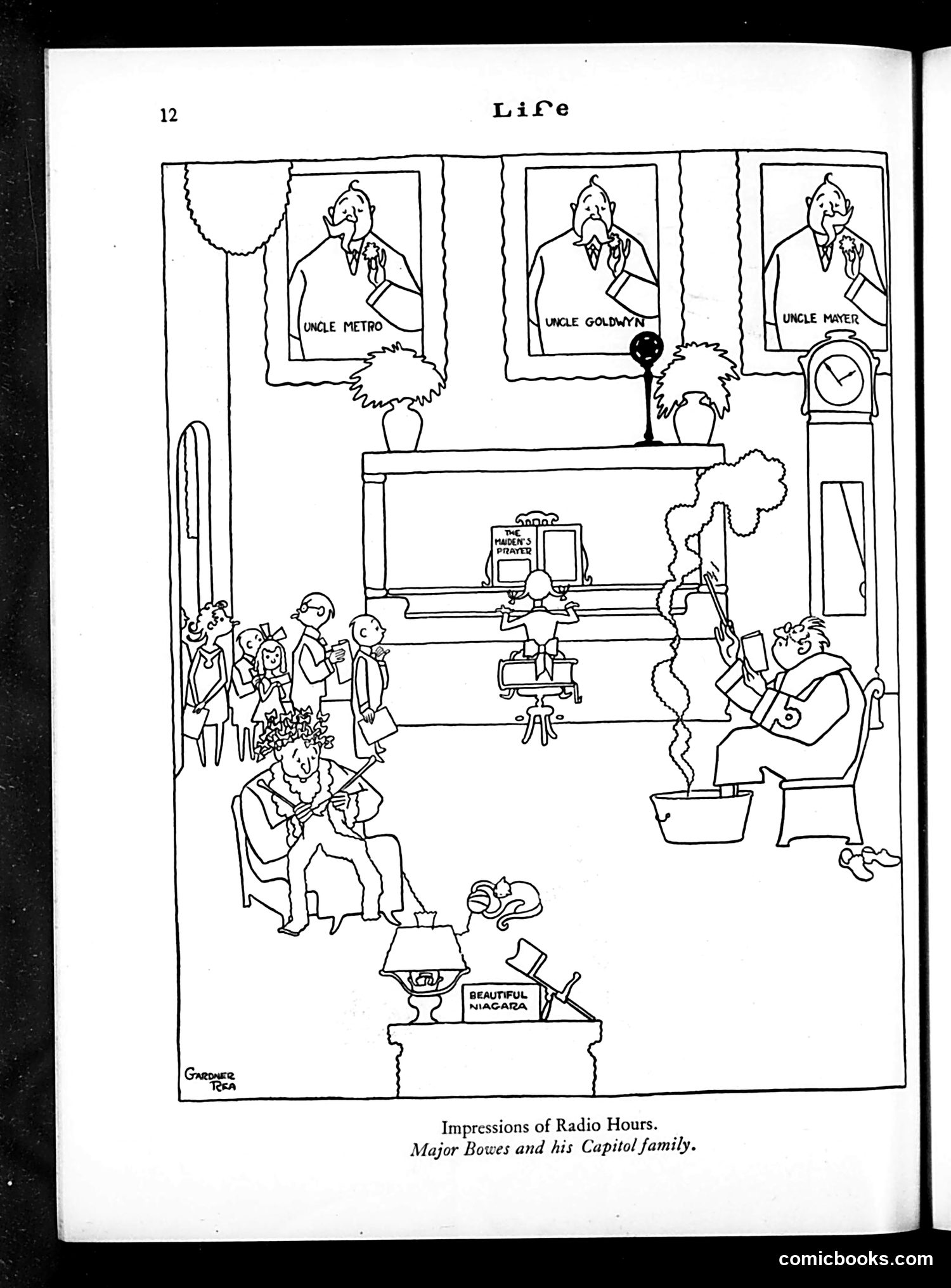
Explanation for Modern Readers This is a satirical cartoon from *Life* magazine titled "Impressions of Radio Hours: Major Bowes and his Capitol family." Key figures: Major Bowes (center, conducting) was a famous 1930s-40s radio personality who hosted an amateur talent show. The three portrait busts labeled "Uncle Metro," "Uncle Goldwyn," and "Uncle Mayer" reference Hollywood studio heads (Metro-Goldwyn-Mayer). The satire: The cartoon mocks how Major Bowes's radio show functioned as a talent pipeline for the film studios. The "Capitol family" audience members are being presented as potential recruits, while Bowes essentially auditions them for the studio executives. The potted plants and "Beautiful Niagara" advertisement parody the show's melodramatic presentation. The joke critiques how radio and Hollywood were interconnected industries exploiting amateur performers.
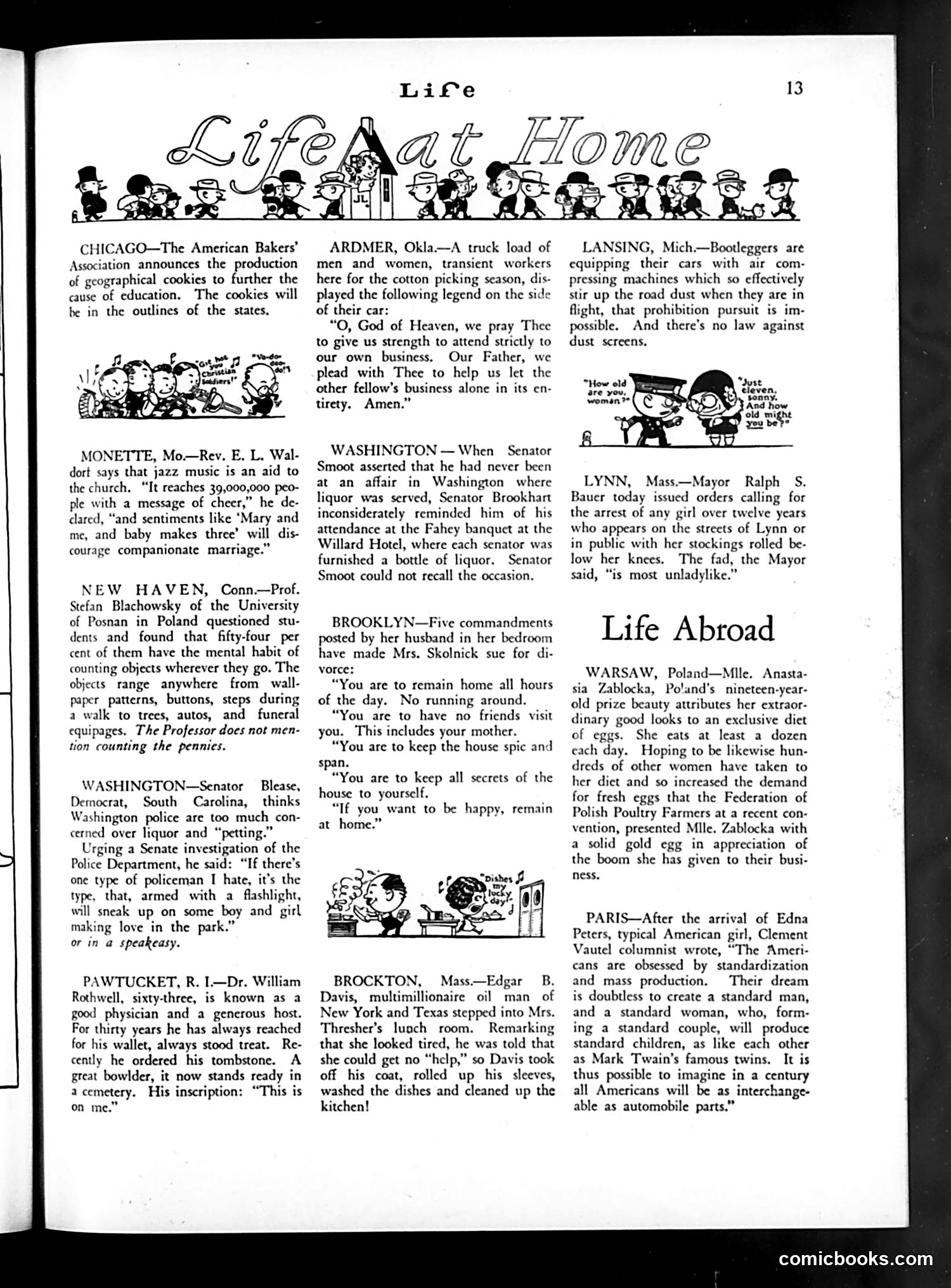
Life Magazine Page 13 Analysis This page contains satirical vignettes about American domestic life and social issues. The "Life at Home" section includes jokes about: - Chicago bakers producing geographical cookies for education - Cotton pickers in Oklahoma whose truck displays a prayer for business success—satirizing how working people invoke religion for economic protection - Michigan bootleggers installing air compressors to evade Prohibition enforcement - A Massachusetts mayor issuing an arrest warrant for a woman displaying stockings above her knees—mocking puritanical moral policing The "Life Abroad" section contrasts American materialism with European attitudes, including a Polish woman famous for her diet of eggs. Overall, the page satirizes American hypocrisy: bootleggers hide from laws, moralists police women's bodies, and business interests invoke faith conveniently. The tone suggests cynicism about American values during the Prohibition era.
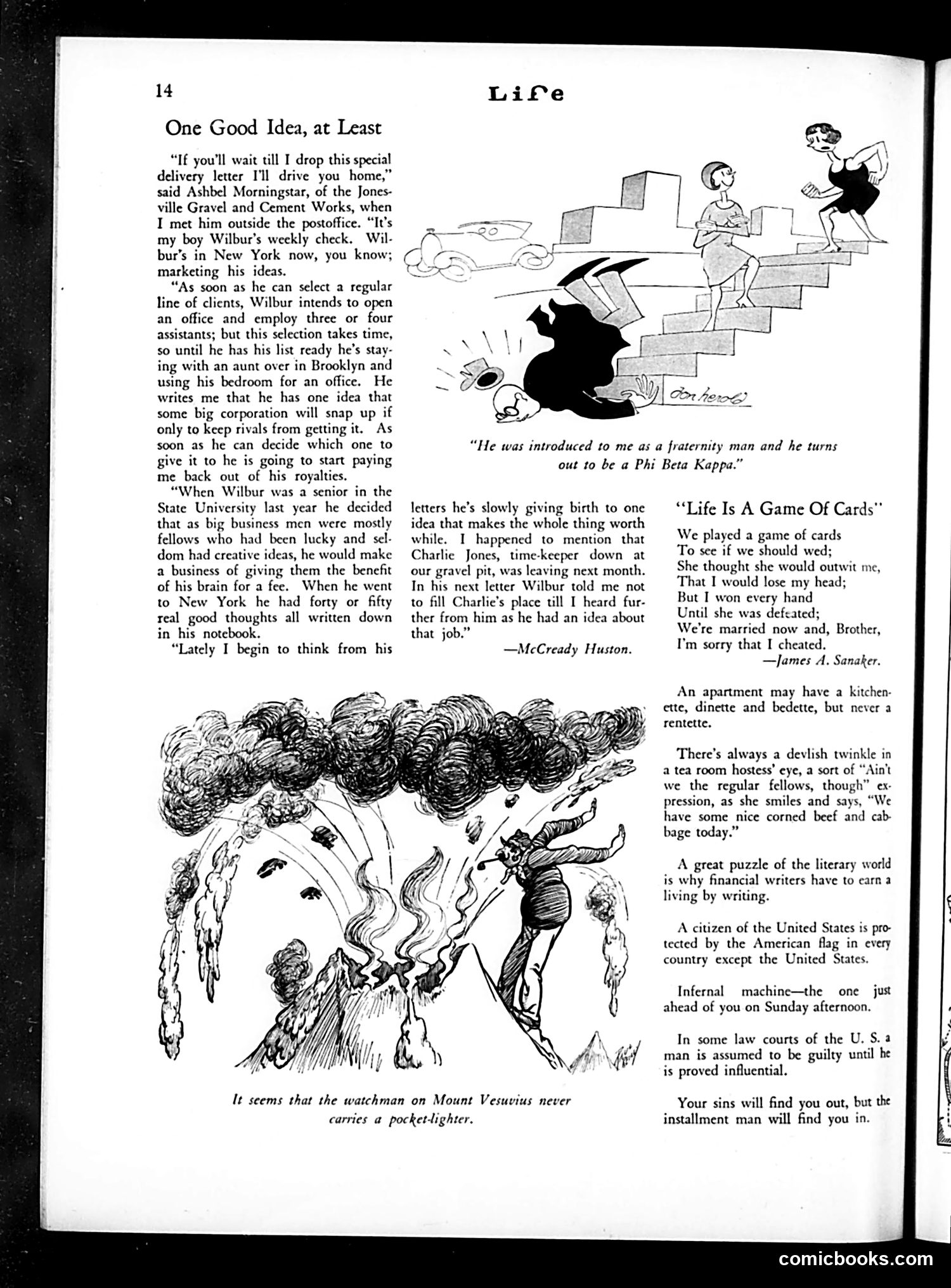
Page 14, Life Magazine: "One Good Idea, at Least" The upper cartoon depicts a man climbing stairs made of stacked papers/letters, with a car below. The caption states: "He was introduced to me as a fraternity man and he turns out to be a Phi Beta Kappa." This satirizes the assumption that fraternity members are intellectually inferior—the joke being that this particular fraternity man unexpectedly proved scholarly. The lower illustration shows a surreal, wind-swept figure with trailing elements, captioned "It seems that the watchman on Mount Vesuvius never carries a pocket-lighter." This appears to be a darker humor piece, likely referencing either volcanic activity or the phrase "pocket-lighter" as a colloquialism whose exact meaning isn't clear from the image alone. The page mixes social commentary with absurdist humor typical of early Life magazine.
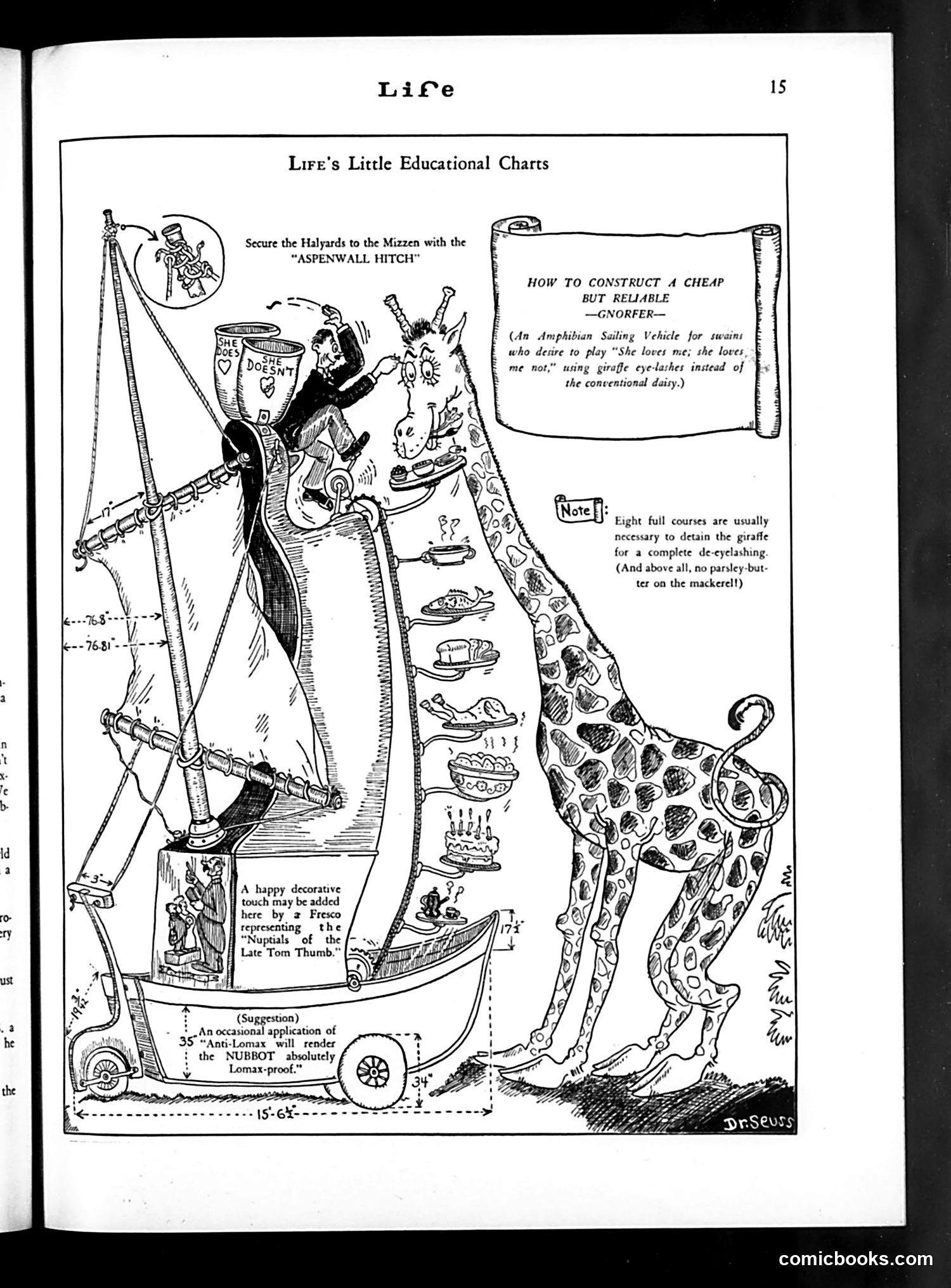
Analysis of Life Magazine Page 15 This is a Dr. Seuss cartoon titled "Life's Little Educational Charts," presenting absurdist instructional diagrams in his characteristic whimsical style. The left panel humorously illustrates "how to secure the Halyards to the Mizzen with the 'Aspenwall Hitch'"—a nautical knot with deliberately overcomplicated, nonsensical rigging that mocks overly technical instructional manuals. The right panel describes "How to Construct a Cheap but Reliable Grorfer"—an amphibian sailing vehicle for "insane" people who dislike conventional boats. The satirical note recommends "eight full courses" and mentions giraffe eye-lashes and parsley-butter, further emphasizing absurdity. Both charts mock technical jargon and instruction-manual pretension through impossible contraptions and pseudo-scientific language—a typical Seuss commentary on overcomplicated modern life and bureaucratic obfuscation.
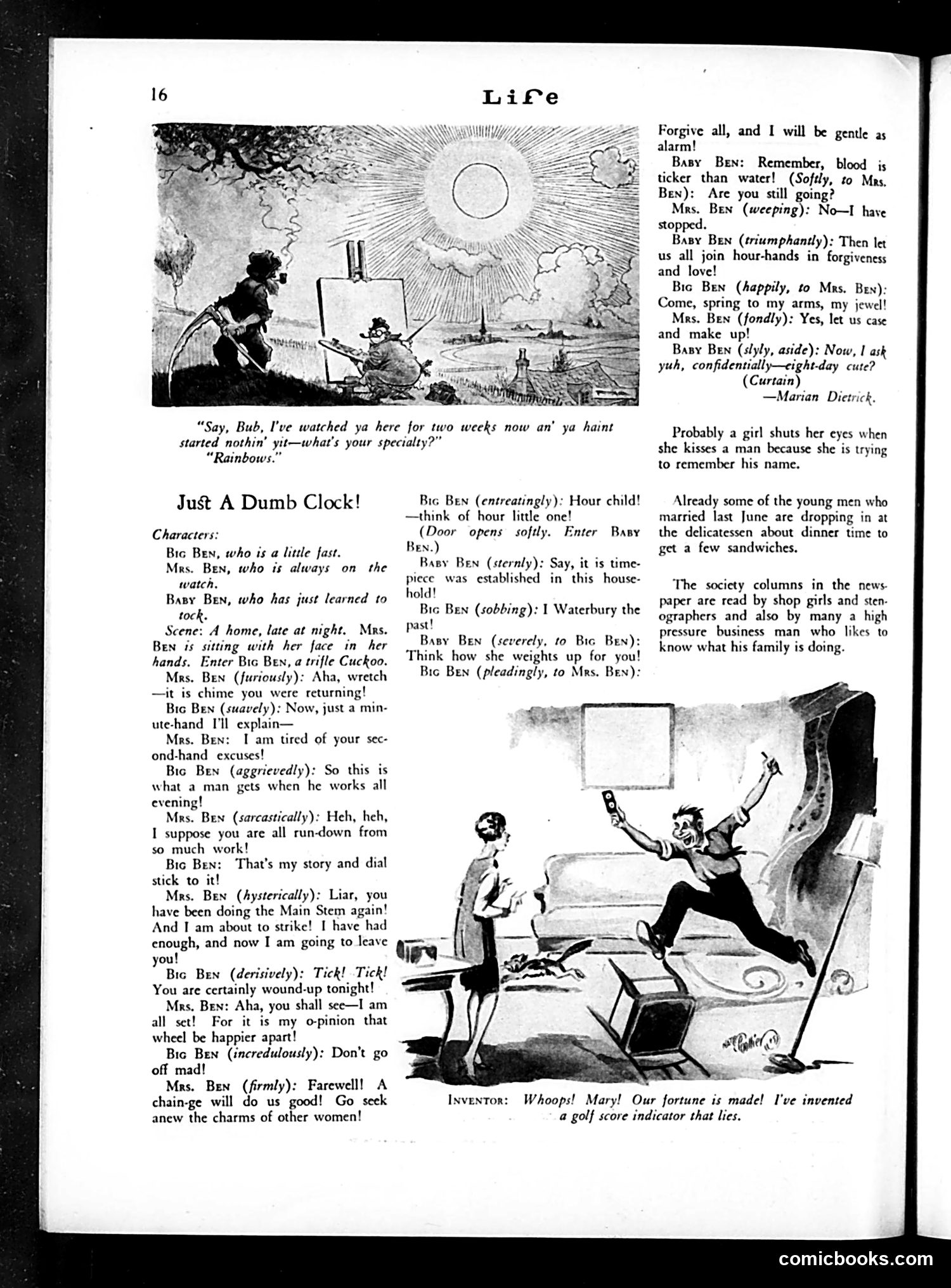
Analysis This page contains two separate pieces of satirical content from *Life* magazine: "Just A Dumb Clock!" is a domestic comedy sketch featuring married couple Big Ben and Mrs. Ben, with their baby. The humor relies on marital conflict tropes typical of the era—Mrs. Ben threatening to leave over Big Ben's excuses and work complaints, culminating in her sarcastic suggestion he seek "other women." The satire targets working men's domestic complaints and the traditional battle-of-the-sexes dynamic. "Inventor: Whoopi! Mary!" shows a man celebrating his invention of a "golf score indicator that lies"—a joke about golfers' notorious dishonesty regarding their scores. The satire mocks the vanity and dishonesty common among golf players, suggesting cheating at the sport was a recognizable social behavior worthy of comedic ridicule. Both pieces reflect early 20th-century gender and recreational culture assumptions.
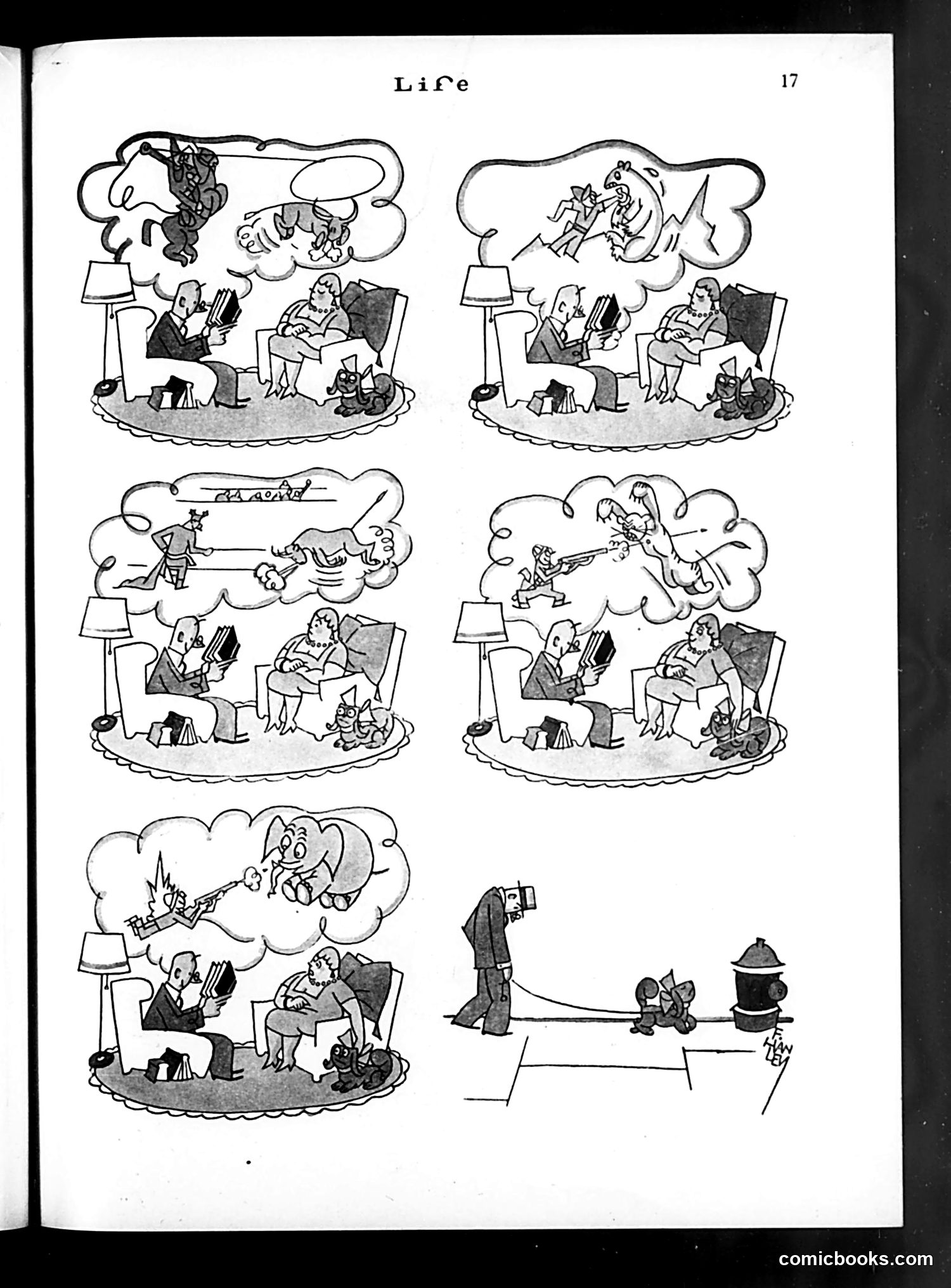
Page Analysis This page from *Life* magazine presents a six-panel comic sequence depicting a domestic scenario. The setting shows a couple in a living room with a lamp and furniture. The sequence appears to illustrate a escalating argument or conflict between them, shown through thought bubbles above their heads that grow increasingly dramatic and violent—progressing from mild disagreement to what appear to be exaggerated, fantastical imagined confrontations. The final panel shows a stark shift: a man operating a camera on a tripod, photographing small figures (possibly the couple) and a fire hydrant, suggesting this entire domestic drama was staged or filmed. The satire likely critiques either theatrical dramatization of ordinary marital disputes or the emerging culture of staged reality for entertainment purposes.
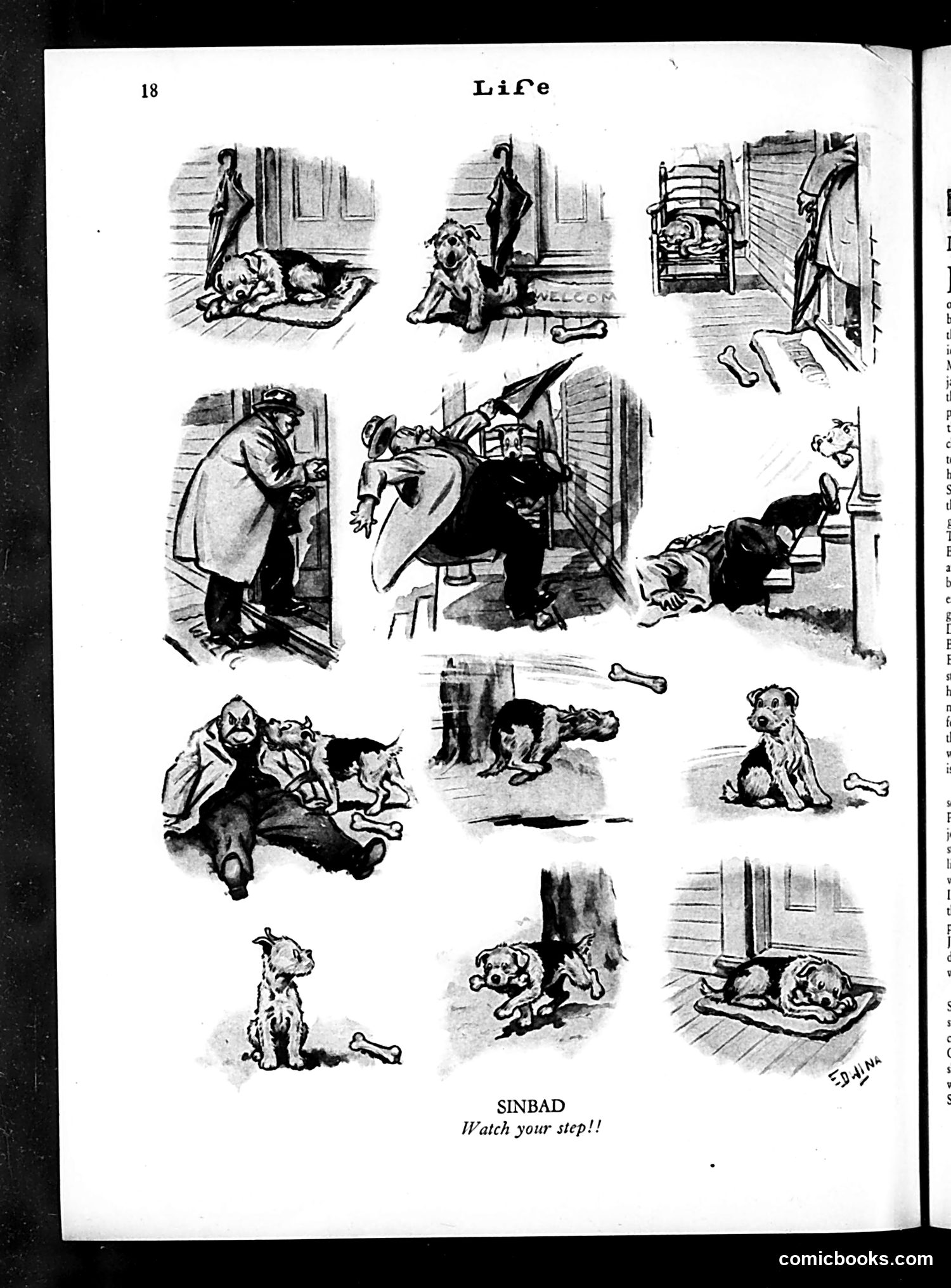
Analysis This page presents a comic strip titled "SINBAD: Watch your step!!" depicting various scenes of a man encountering dogs in different situations around what appears to be a residential or urban setting. The humor relies on visual gags showing the protagonist repeatedly interacting with dogs—some appearing friendly, others aggressive or mischievous. The repeated scenarios suggest escalating or varied comedic situations involving dogs as obstacles or nuisances in daily life. The title "Watch your step!!" suggests the central joke: the protagonist must navigate around dogs to avoid stepping on them or being attacked. This appears to be physical comedy centered on the recurring problem of encountering dogs in everyday spaces. The strip's satire or social commentary, if any, remains unclear from the image alone.
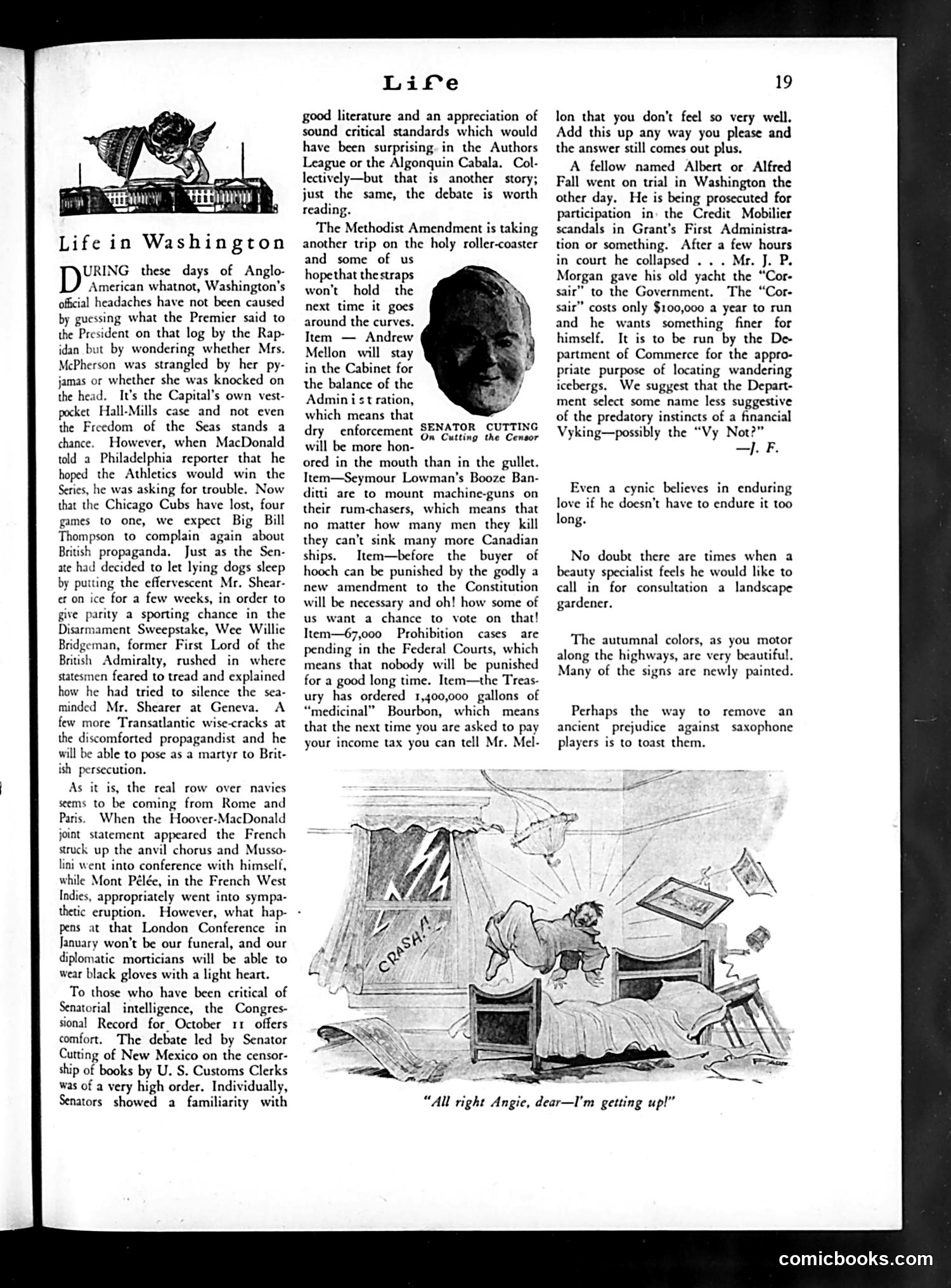
Life Magazine Cartoon Analysis This page satirizes Washington politics circa 1929. The main cartoon depicts a figure labeled "Corsair" (a pirate/privateer) being capsized—likely representing bootleggers or rum-runners during Prohibition enforcement. The text mocks multiple targets: the McPherson murder case consuming Washington gossip; British naval negotiators creating diplomatic friction; and especially Prohibition enforcement's hypocrisy. Senator Cutting of New Mexico receives praise for intelligent debate on book censorship. The satire's sharpest edge targets Andrew Mellon (Treasury Secretary), who keeps Prohibition "honored in the mouth than in the gullet"—meaning officials ignore violations. The piece notes Mellon ordered 1.4 million gallons of "medicinal" bourbon while prosecuting citizens, and references Albert Fall's trial (Teapot Dome scandal). The joke: Prohibition's absurd contradictions—67,000 pending cases, government stockpiling alcohol, armed rum-chasers operating freely—make all civic calculations meaningless.
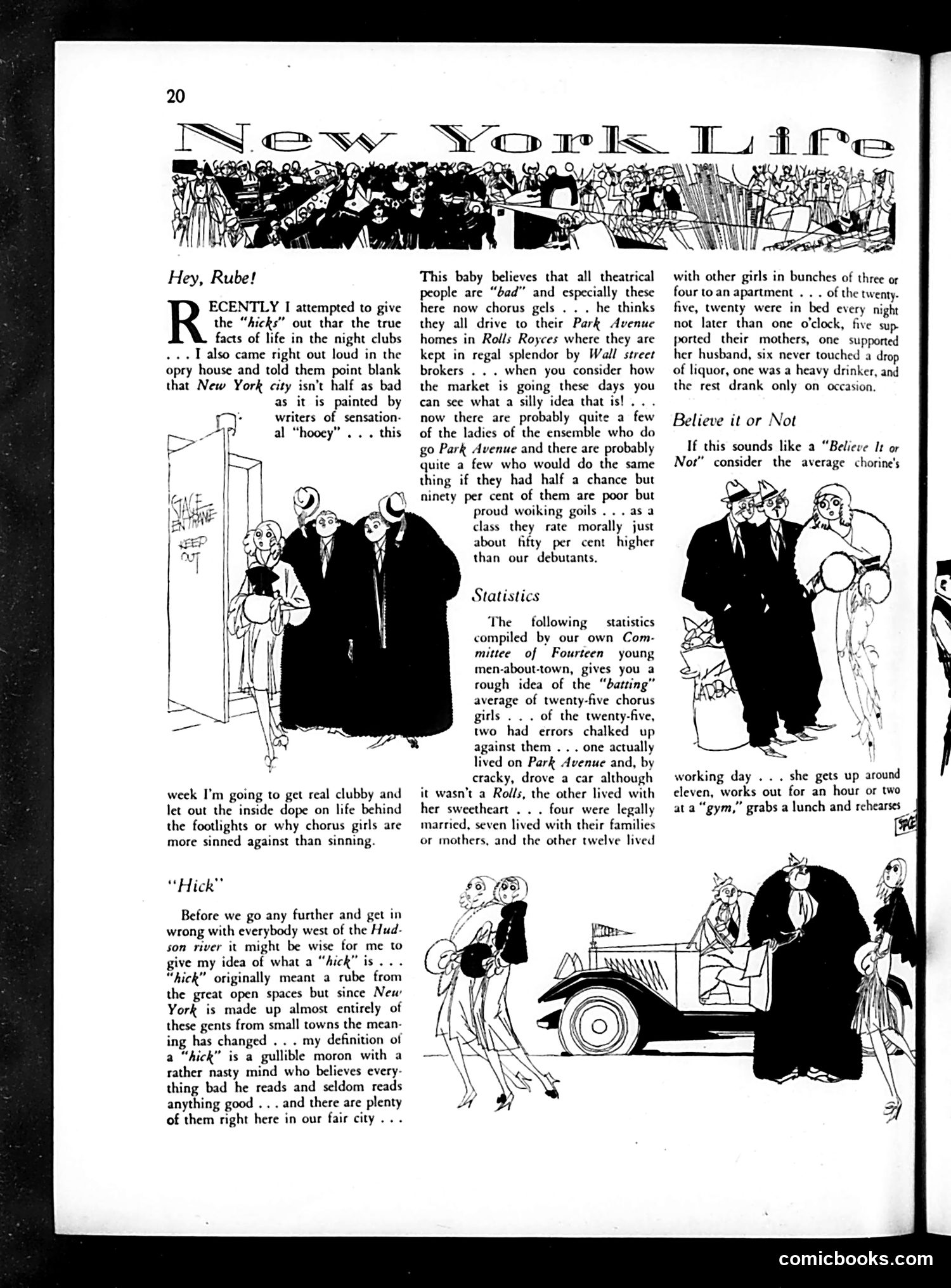
"New York Life" - Page 20 Analysis This satirical piece debunks rural stereotypes about Broadway chorus girls. The author addresses "hicks"—defined here as gullible people from small towns who believe sensational journalism portraying theatrical performers as immoral. The piece mocks the widespread assumption that chorus girls are kept in luxury by wealthy Wall Street brokers, driving Rolls Royces. The author argues this is absurd, especially given the economic climate ("consider how the market is going"). Statistics from a "Committee of Fourteen" (likely referencing a real moral watchdog group) show most chorus girls are actually respectable: they live modestly with other girls or family, maintain early bedtimes, support relatives, and rarely drink. Only two of twenty-five had questionable arrangements. The cartoons accompanying the text satirize the contrast between rural prejudices and urban reality—showing both disapproving "hicks" and actual chorus girls going about ordinary lives. The satire targets both rural moralism and sensationalist press that fuels these stereotypes.
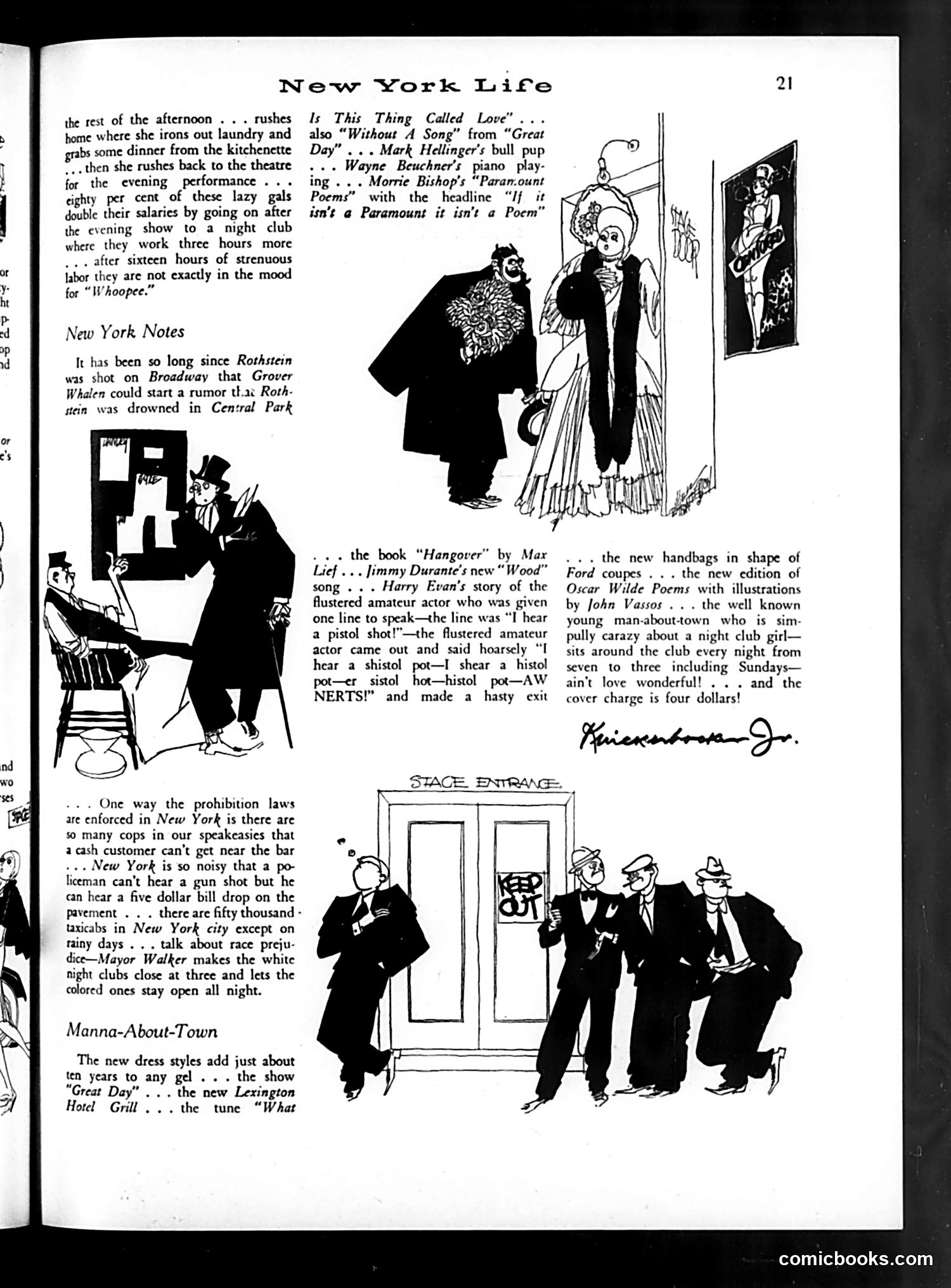
Explanation of Life Magazine Page: "New York Life" This page satirizes 1920s Manhattan nightlife and social conditions during Prohibition. The cartoons mock: Working Women's Exhaustion: The opening text criticizes female theatre performers who work grueling 16-hour days—performing evening shows, then rushing to nightclubs for additional hours to earn extra money. The satire questions their supposed laziness while documenting actual exploitation. Prohibition Enforcement Hypocrisy: References to speakeasies (illegal bars), police presence, and bribery ("five dollar bill drop") expose how Prohibition's enforcement was corrupt and selective. Notably, the text criticizes Mayor Walker for letting "colored" nightclubs stay open all night while closing white ones at 3 AM—highlighting racial discrimination in enforcement. Nightclub Culture: The "Manna-About-Town" section catalogs trendy shows, songs, and fashions, including satirical notes about a young man obsessed with nightclub girls, paying four-dollar cover charges nightly. The Cartoons: Show well-dressed men in top hats at speakeasies and nightclub entrances, depicting the era's glamorous but illicit social scene. The overall tone mocks both working-class desperation and wealthy indulgence during Prohibition.
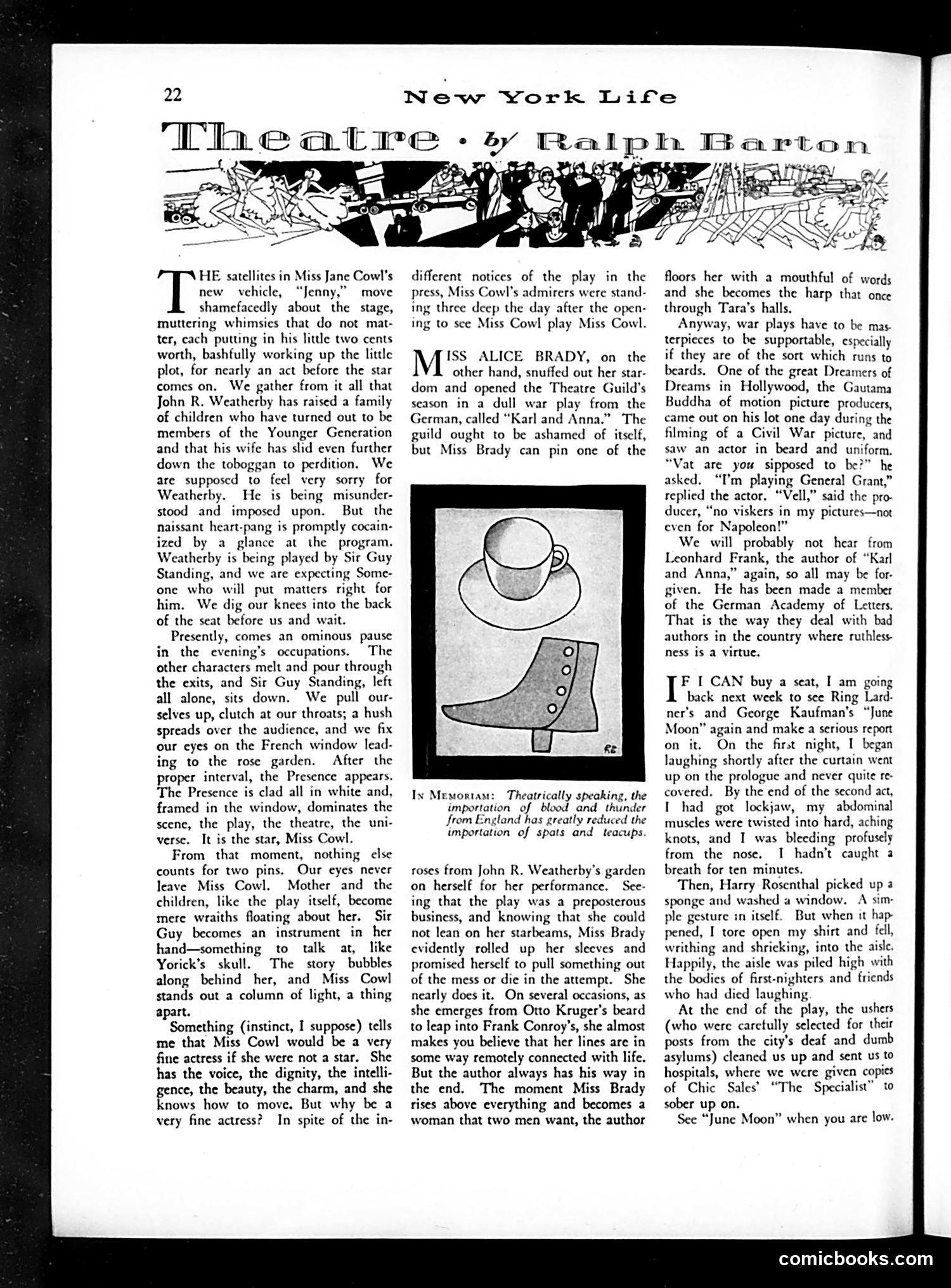
Theatre Review: Jane Cowl vs. Alice Brady This is Ralph Barton's theater column reviewing two Broadway productions. He contrasts two actresses' approaches to stardom: Jane Cowl in "Jenny" is criticized for prioritizing her star persona over the play itself. Barton notes that once she appears—dramatically framed in a white dress—nothing else matters; she becomes "a column of light, a thing apart." The review suggests she's talented ("very fine actress") but chooses instead to capitalize on her star status, which audiences come specifically to see her perform *as herself*, not as a character. Alice Brady, by contrast, abandoned her star status to perform in the Theatre Guild's German war play "Karl and Anna." Though the play is "dull" and "preposterous," Brady commits fully to the role, "rolling up her sleeves" to create something meaningful from poor material. Barton's satire celebrates Brady's artistic integrity while mocking Cowl's self-indulgent stardom—a commentary on the tension between artistic merit and celebrity appeal in 1920s theater.
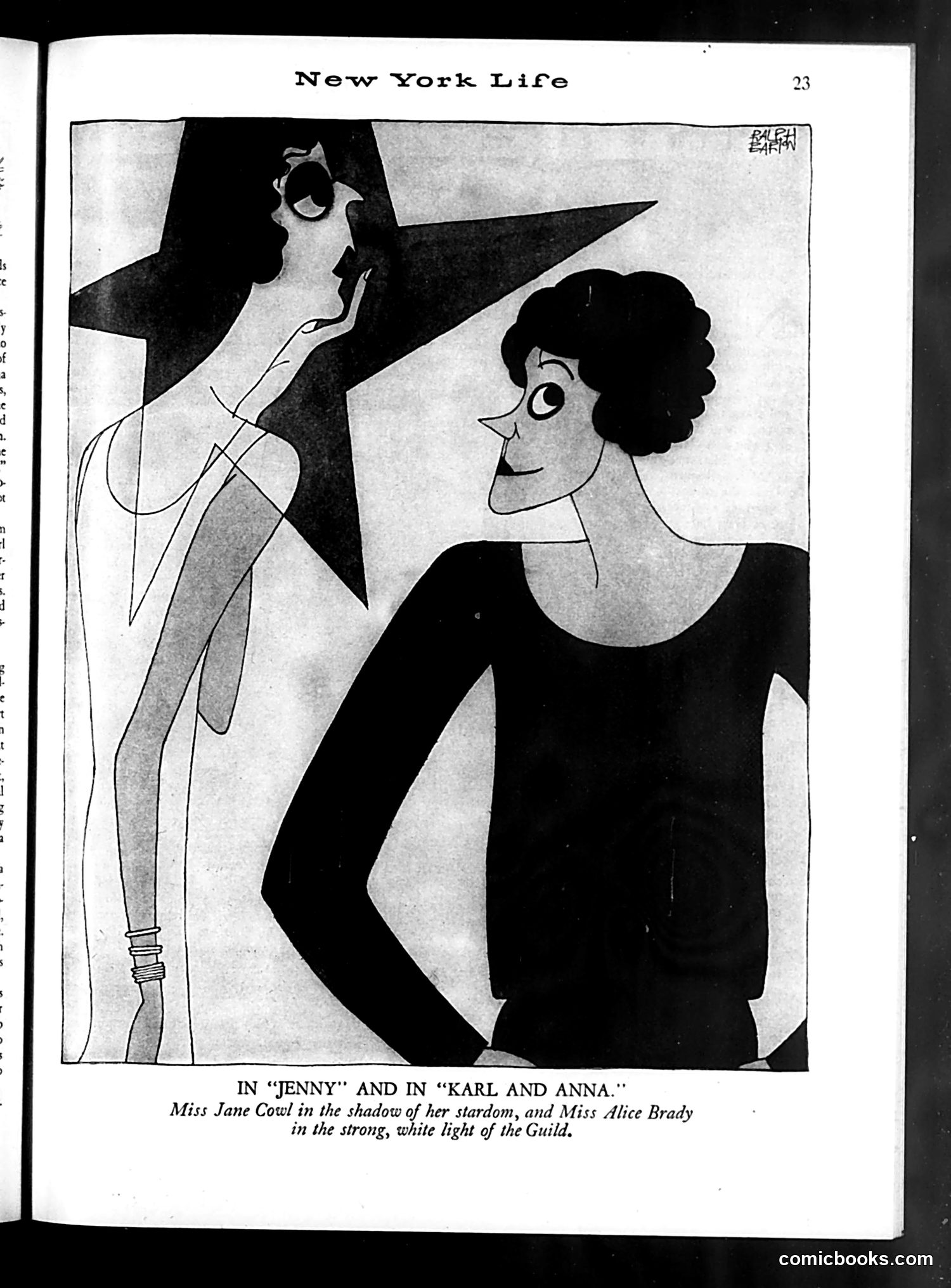
Analysis This is a theatrical advertisement or review from *Life* magazine page 23. It compares two actresses in stage productions: - Jane Cowl (left figure, shown in shadow/darkness) appears in a play called "Jenny" - Alice Brady (right figure, shown in bright light) appears in a play called "Karl and Anna," produced by "the Guild" The visual metaphor is explicit: Cowl is depicted literally in shadow, suggesting her career is in decline or overshadowed, while Brady is in "strong, white light," indicating prominence and success. The accompanying text reinforces this contrast—Cowl is "in the shadow of her stardom" (past glory fading), while Brady basks in the Guild's spotlight. This appears to be satirical commentary on the relative fortunes of these Broadway performers during this theatrical season.
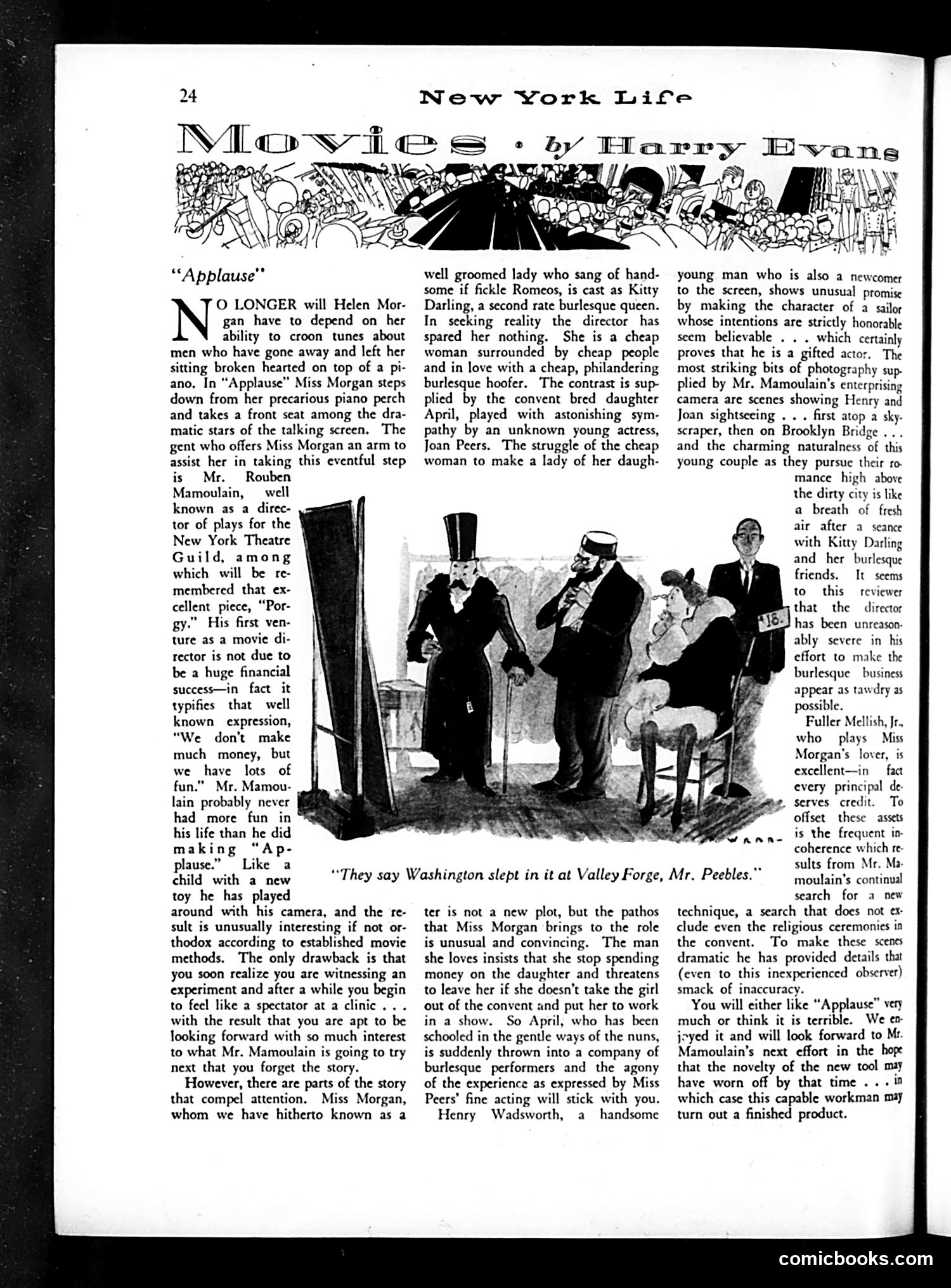
Analysis of Life Magazine Page on "Applause" This is a movie review by Harry Evans of the 1929 film "Applause," directed by Rouben Mamoulian and starring Helen Morgan. The single illustration shows four men in formal attire discussing something, with a caption referencing Valley Forge—likely a joke about the film's experimental cinematography or contrasting scenes. The review discusses Morgan's transition from singing in melodramas to dramatic acting in a gritty burlesque story. The critic praises Mamoulian's innovative camera work (including location shots atop skyscrapers and Brooklyn Bridge) but criticizes his excessive experimentation, which distracts from narrative coherence. The film contrasts a cheap burlesque performer (Morgan) with her convent-educated daughter, exploring class and morality—typical themes of early sound cinema exploring "realistic" subject matter previously avoided in silent films.
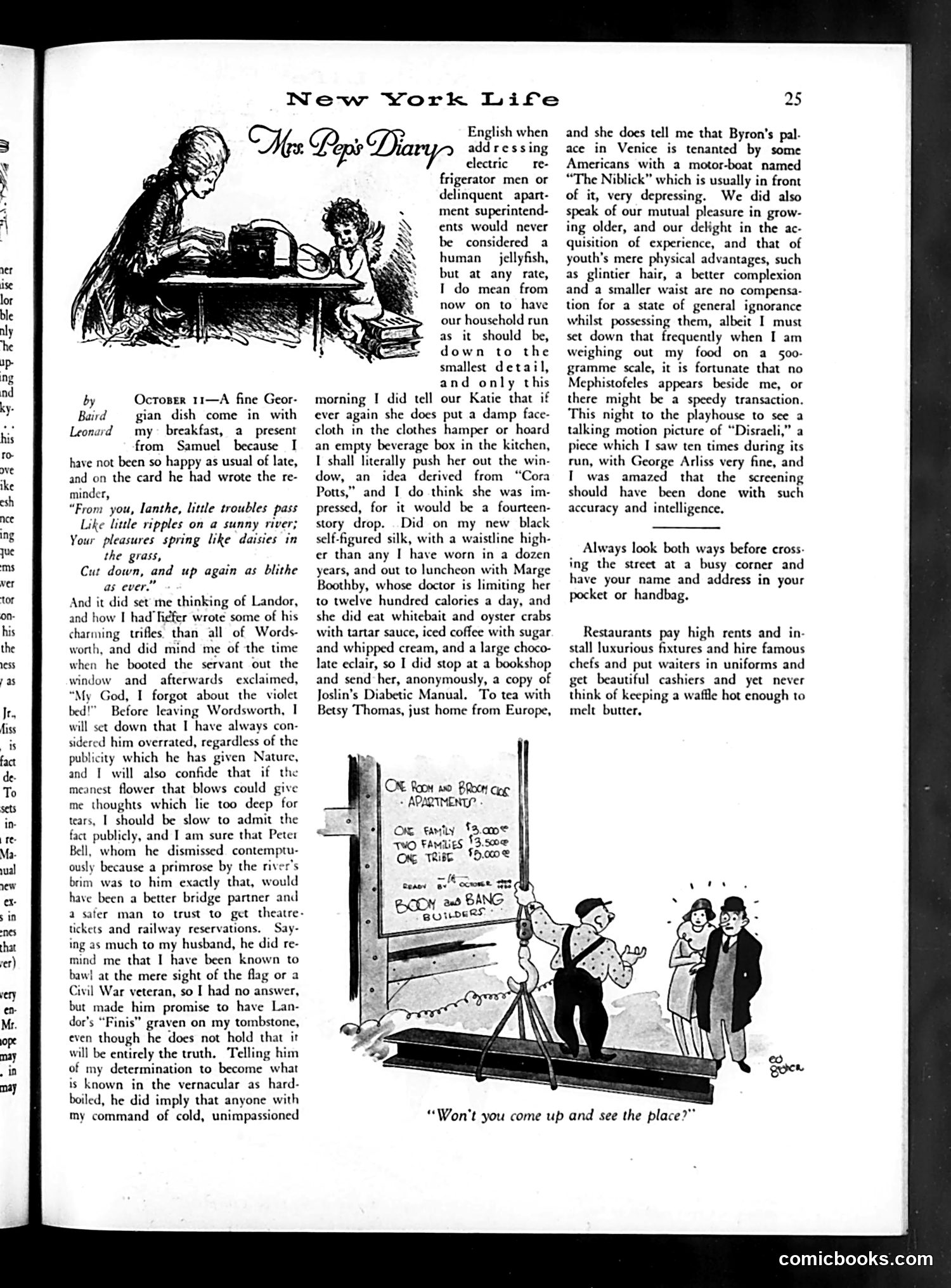
Analysis of "Mrs. Pep's Diary" Page This page contains a society column/"diary" essay by a wealthy New York woman discussing her social life, literary tastes, and household management. The accompanying cartoon depicts a tenement building with a sign advertising rental rooms, with working-class figures outside asking "Won't you come up and see the place?" The Social Satire: The juxtaposition is the point: the elaborate, self-satisfied diary of an upper-class woman obsessing over poetry, servants, dieting friends, and European gossip sits alongside a cartoon mocking cheap urban housing. The diarist's concerns (firing her maid Katie for minor infractions, anonymously sending a diabetic manual to a friend) reveal class obliviousness and casual cruelty. The cartoon's crude apartment-building sign and working-class people contrast sharply with the refined literary references (Byron, Wordsworth, Landor) cluttering the essay, highlighting the vast gulf between wealthy New Yorkers and ordinary tenement dwellers—each occupying the same city but entirely different worlds. The Point: Sharp class commentary through ironic juxtaposition—mocking both the pretensions of the wealthy and indifferent to working-class conditions.
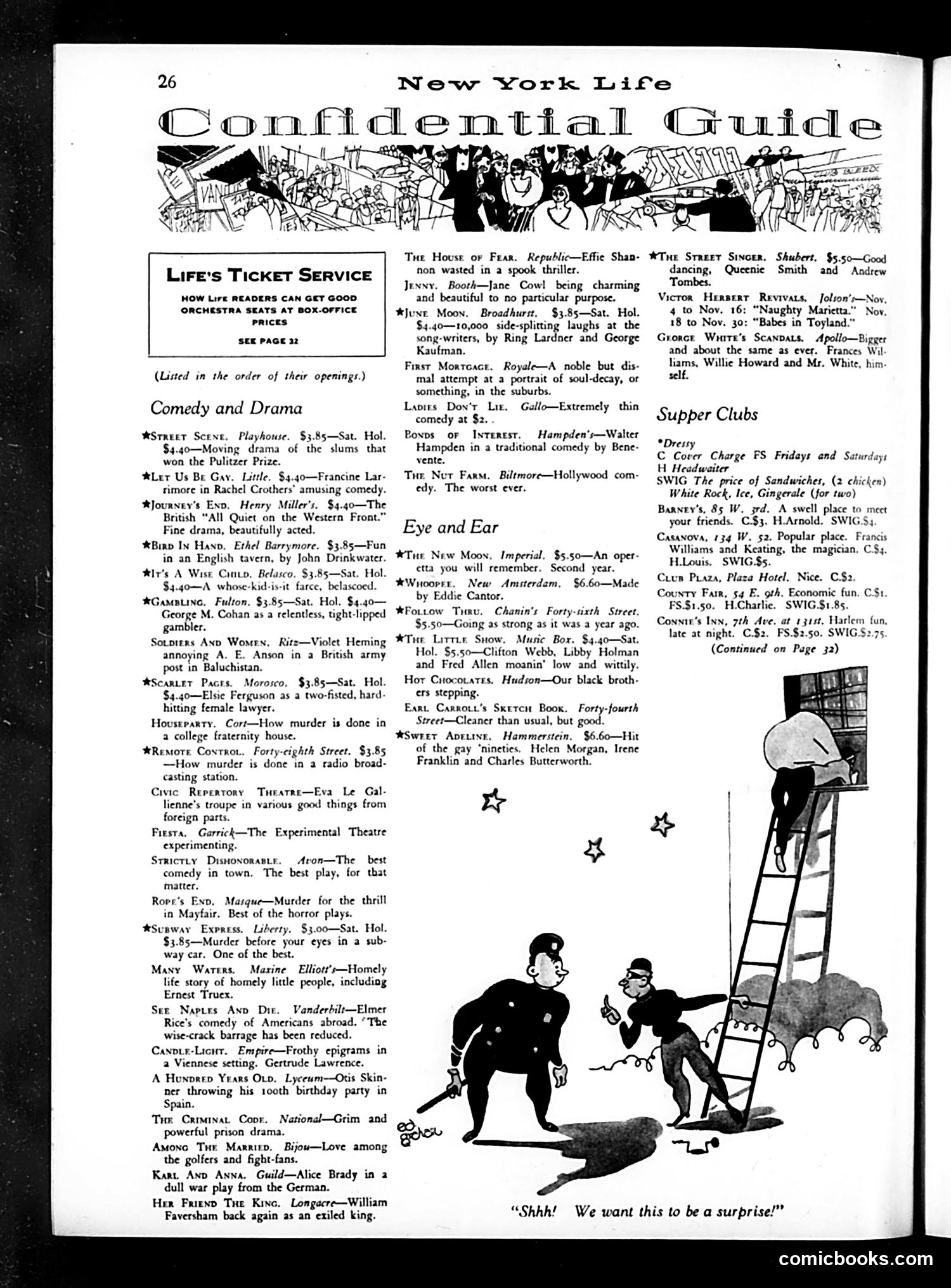
What This Page Means This is a theater guide listing New York City productions circa late 1920s. The main cartoon at bottom shows two men in bowler hats attempting to sneak someone up a ladder toward a window while saying "Shhh! We want this to be a surprise!" — a visual gag about surprise parties or secret entries. The page itself is largely utilitarian: theater listings organized by genre (Comedy/Drama, musicals under "Eye and Ear"), with prices and brief critical notes. Asterisks mark shows Life recommends. This was typical entertainment journalism of the era—practical information mixed with snappy commentary. The cartoon's humor is straightforward slapstick: the conspiratorial atmosphere, the awkward ladder-climbing, the exaggerated body language of men trying to be stealthy. It requires no political or social knowledge to understand—just visual comedy about secrecy and surprise.
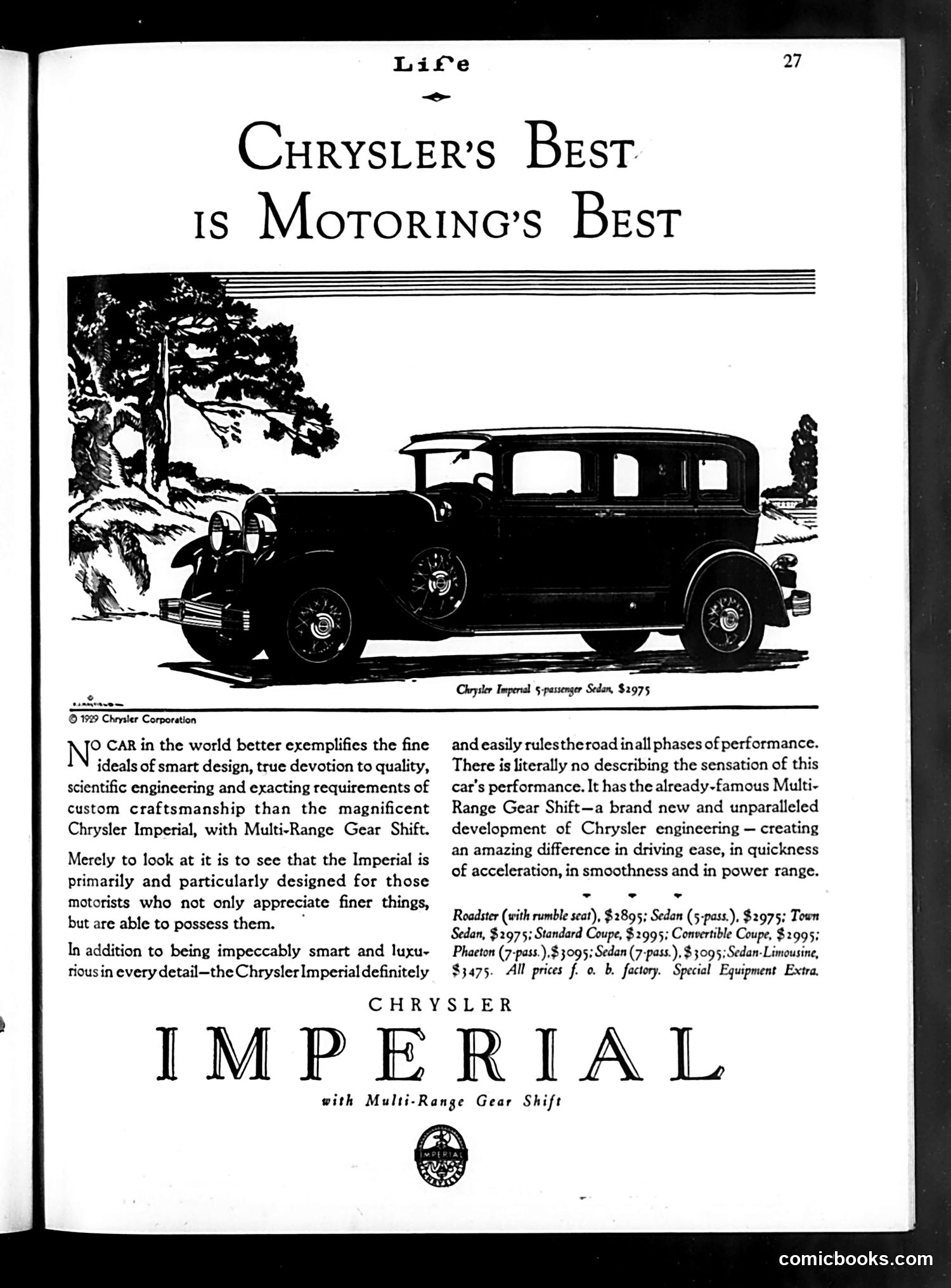
Analysis This is not a cartoon or satire—it's a full-page automobile advertisement for the Chrysler Imperial, dated 1929 (from the copyright notice). The page features a stylized illustration of the Imperial sedan alongside marketing copy that emphasizes luxury, engineering quality, and the new "Multi-Range Gear Shift" technology. The text positions the car as designed for affluent motorists who "appreciate finer things" and "are able to possess them"—appealing to class consciousness typical of 1920s advertising. The phrase "Chrysler's Best is Motoring's Best" is the advertising slogan. Various model variants and prices are listed, ranging from $2,895 to $3,475. This represents typical pre-Depression advertising rhetoric celebrating American automotive engineering and consumer luxury. There is no political satire or cartoon humor present—it's straightforward commercial content.
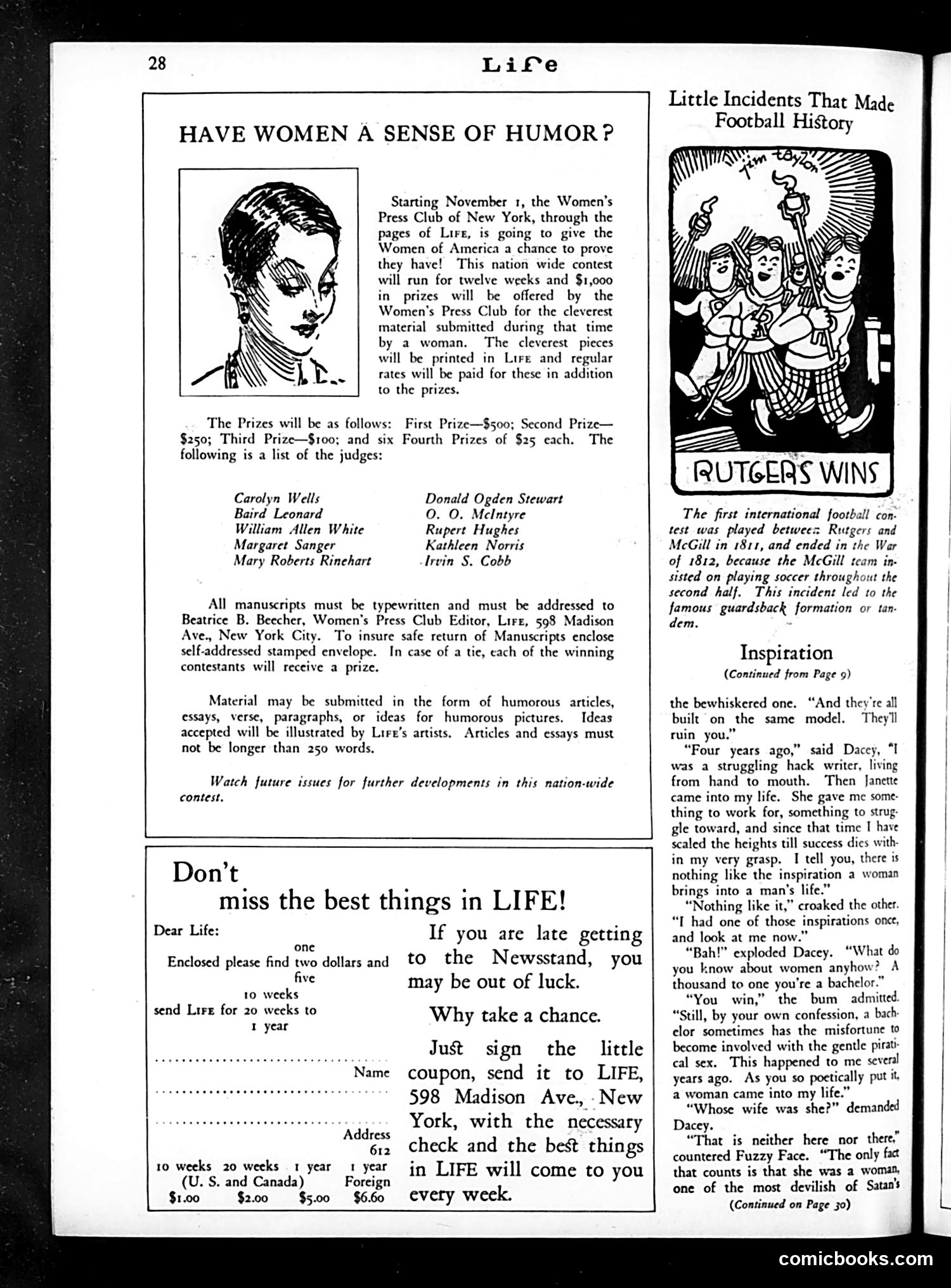
"Have Women a Sense of Humor?" — Life Magazine Contest This page announces a 1920s-era humor contest sponsored by the Women's Press Club of New York through *Life* magazine. The contest challenges women to prove they possess humor by submitting comedic material—articles, essays, verses, or cartoon ideas—competing for $1,000 in prizes over twelve weeks. The judges listed include prominent American writers and humorists of the era (Donald Ogden Stewart, Kathleen Norris, Irvin S. Cobb, etc.), lending credibility to the contest. The accompanying cartoon "Rutgers Wins" is absurdist satire: it falsely claims the first international football match (1811) between Rutgers and McGill sparked the War of 1812 because McGill insisted on "soccer" play. This mocks both exaggerated sports mythology and arbitrary historical "explanations." The contest itself reflects early 20th-century skepticism about women's comedic abilities—by framing proof of humor as novel and competitive, it implicitly acknowledges the stereotype that women lacked wit, while simultaneously creating space for women humorists to demonstrate otherwise.
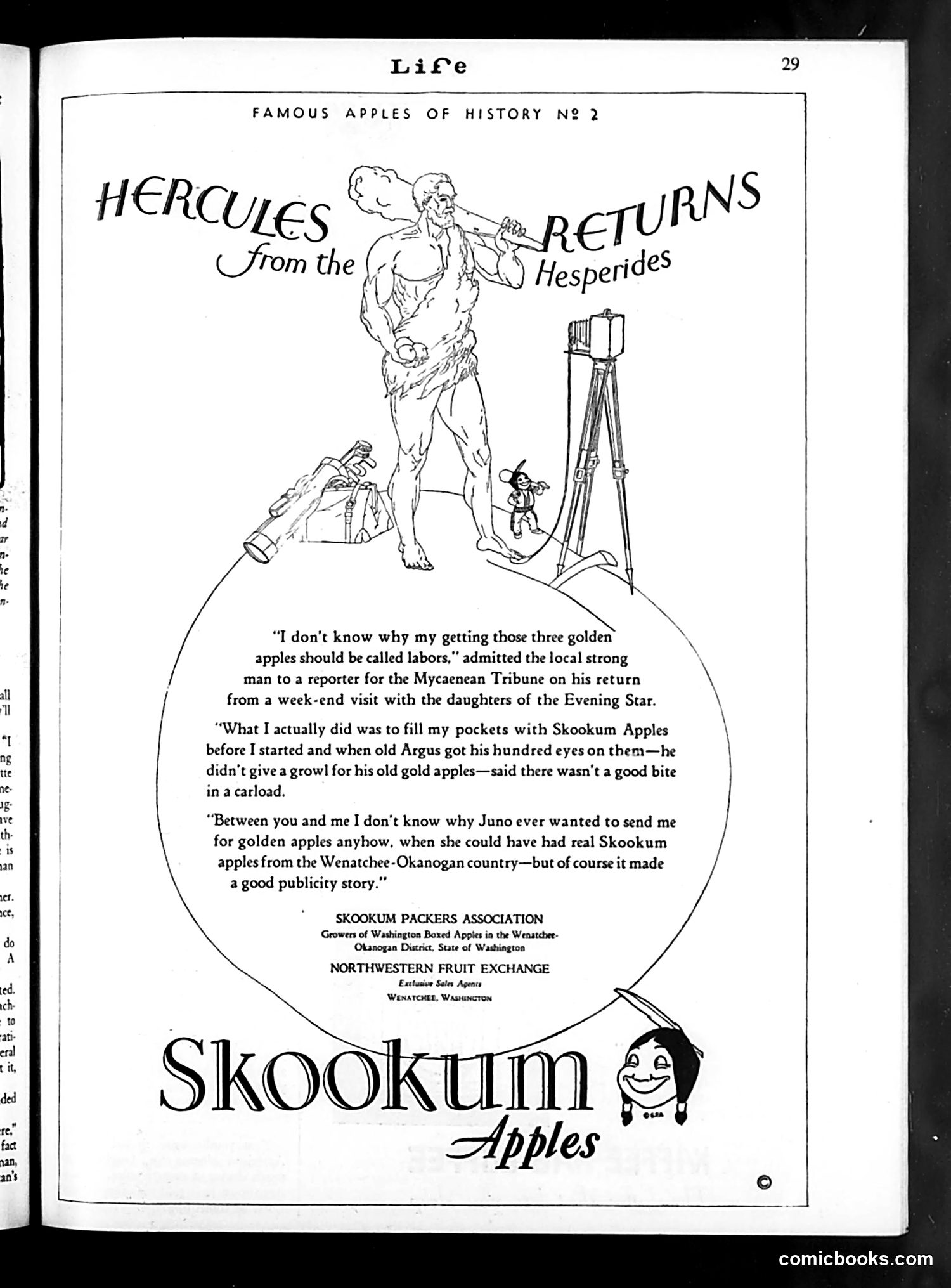
Analysis: "Hercules Returns from the Hesperides" This is a product advertisement disguised as classical mythology satire. The joke subverts the famous Hercules labor—stealing golden apples from the Hesperides—by having the hero admit the apples were worthless compared to "Skookum Apples" from Washington state. The strong man (Hercules) tells a reporter that Argus, the hundred-eyed guardian, ignored the mythological golden apples because they weren't edible, whereas Skookum Apples actually taste good. He suggests Juno could have simply ordered Washington apples instead of making a big production of the theft. The satire works by: deflating classical grandeur (the golden apples of legend) in favor of modern, practical American commerce. It's humorous self-aware advertising—acknowledging that the whole "labors" story was merely "good publicity" while promoting actual agricultural products from the Wenatchee-Okanogan region. This page is essentially an advertisement for Skookum brand apples masquerading as humor content.
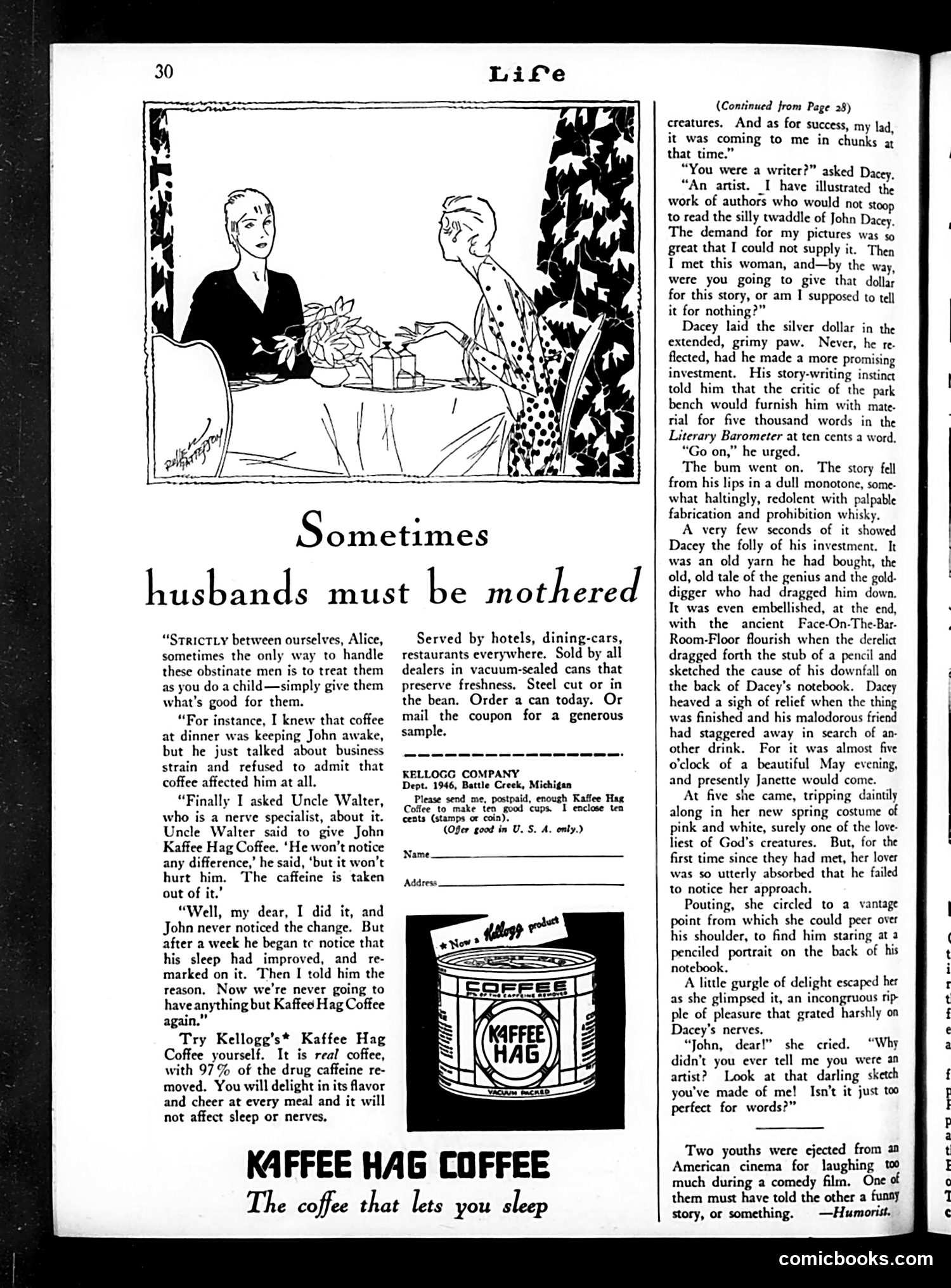
Analysis of This Life Magazine Page This page contains a Kaffee Hag Coffee advertisement disguised as social commentary. The cartoon depicts two women in conversation; one explains how she secretly replaced her husband's regular coffee with caffeine-free Kaffee Hag without telling him, then revealed the deception after he noticed improved sleep. The satire targets paternalistic attitudes toward marriage: the ad's premise is that wives must manipulate their "obstinate" husbands "like children," deceiving them "for their own good." This reflects early-20th-century gender dynamics where women were expected to manage household health through subtle control rather than honest communication. The accompanying story fragment (continued from page 28) about an artist and a park-bench character appears unrelated to the advertisement's message. The humor relies on readers accepting wives' right to deceive husbands as an acceptable domestic strategy—a notion modern readers would likely find troubling rather than amusing.
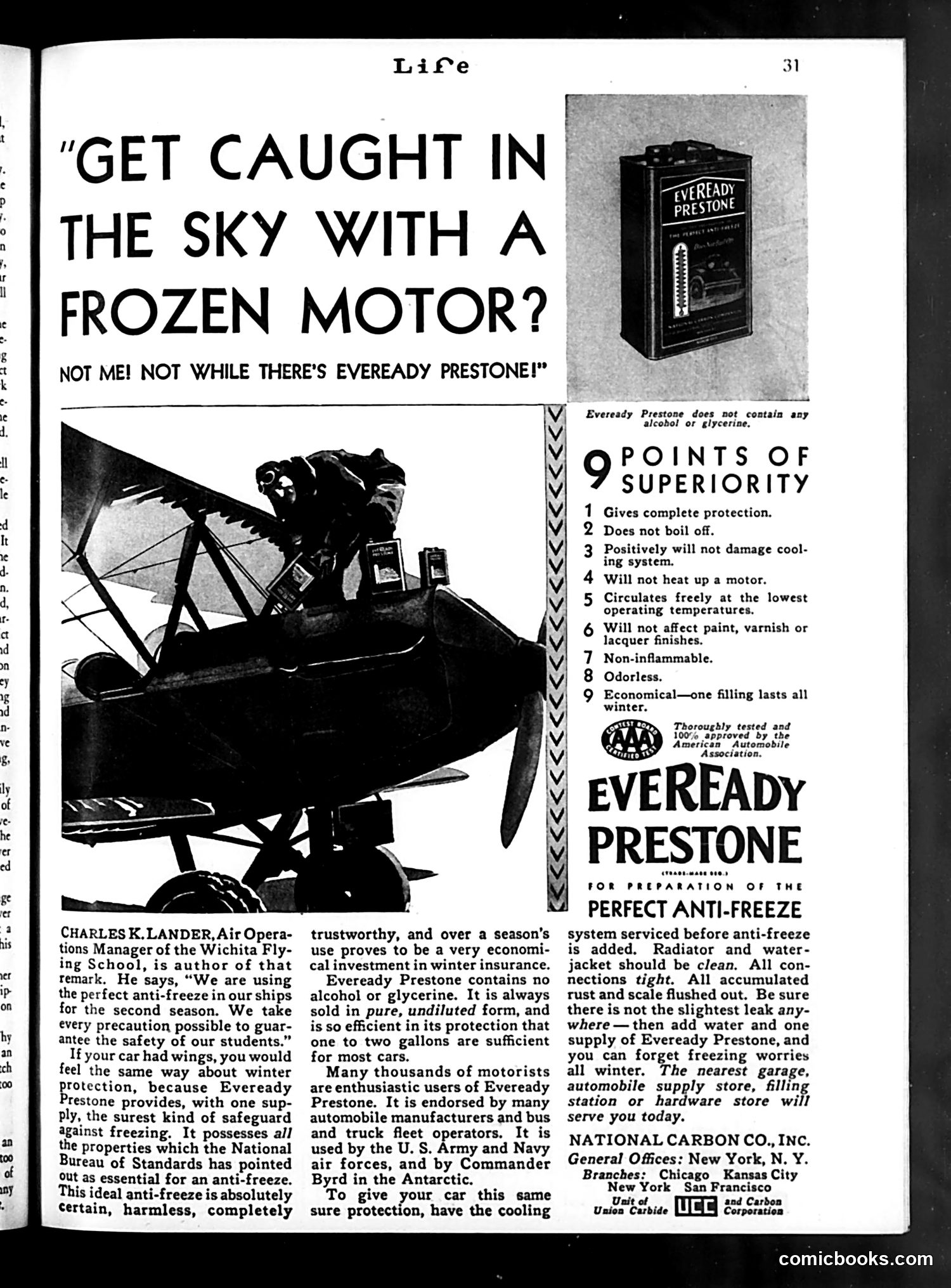
Advertisement Analysis This is primarily a commercial advertisement for Eveready Prestone anti-freeze, not political satire. The "cartoon" element is minimal—merely an illustration of an aircraft pilot. The ad uses a dramatic hook: a pilot testimonial warning about frozen motors causing aircraft to crash. Charles K. Lander, identified as Air Operations Manager of the Wichita Flying School, endorses the product for aviation use, lending credibility through professional authority. The appeal is fear-based: winter freezing poses genuine danger to both cars and planes. The solution—Eveready Prestone anti-freeze—is presented as essential protection. The ad emphasizes military/explorer endorsements (U.S. Army, Navy, Commander Byrd in Antarctica) to establish trustworthiness. The "9 Points of Superiority" list and AAA approval seal provide technical reassurance. This appears to be from the 1920s-30s era, when anti-freeze was still a relatively new automotive product requiring consumer education.
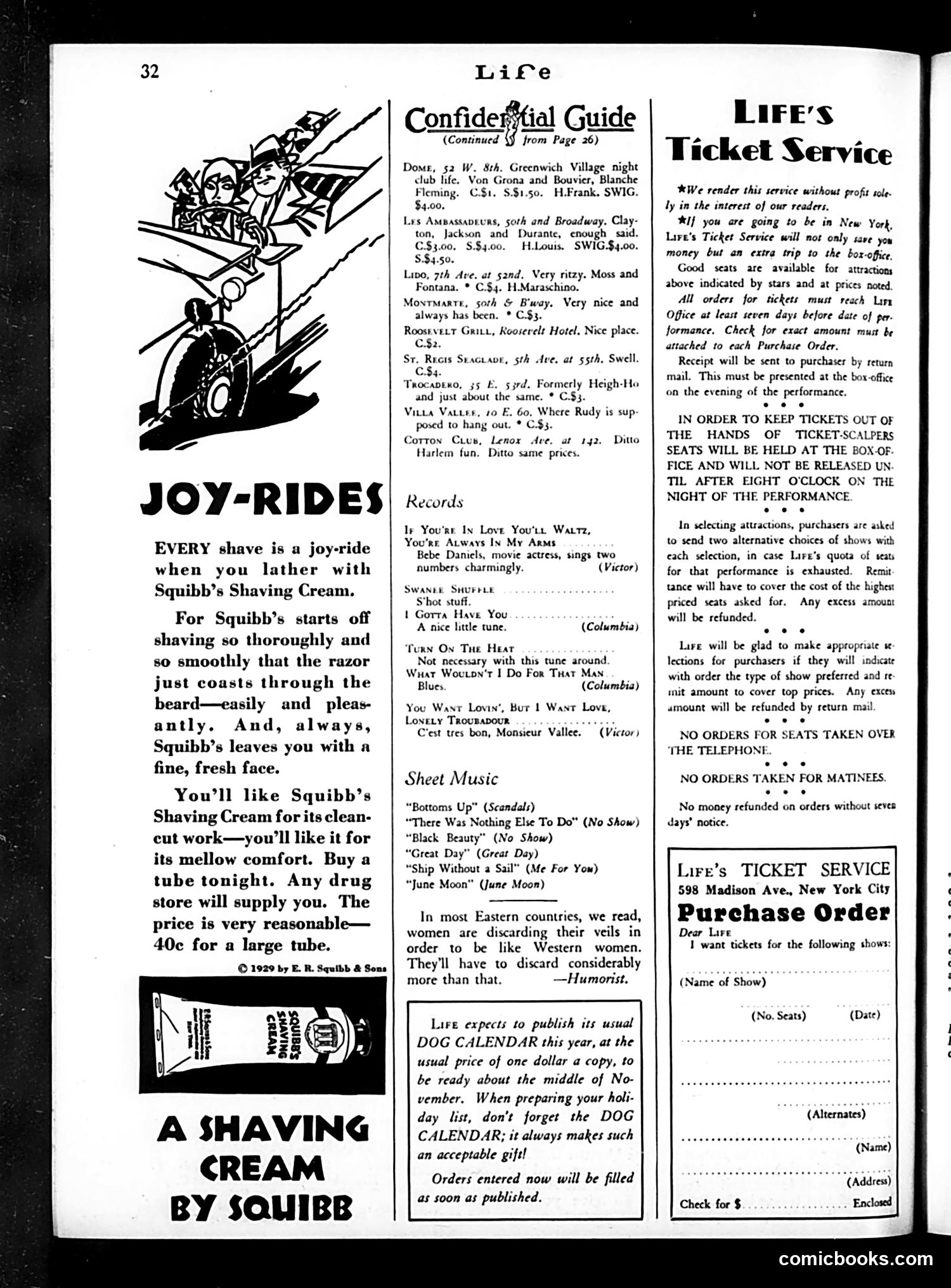
Analysis: Life Magazine Page 32 (c. 1929) This page is primarily advertising and service content, not political satire. The dominant feature is a Squibb's Shaving Cream advertisement using the playful "joy-rides" concept—a pun equating smooth shaving to the fun of an amusement park ride. The accompanying cartoon shows stylized figures on what appears to be a roller coaster, conveying excitement and pleasure. The remainder consists of: - "Confidential Guide": Entertainment listings for Manhattan nightclubs (Dome, Les Ambassadeurs, Lipo, etc.) with prices, reflecting 1920s Jazz Age nightlife culture - Records and Sheet Music: Contemporary popular recordings and theatrical music - Life's Ticket Service: A booking service offering theater seats to New York readers - A brief joke about women and veils in Eastern countries There is no significant political cartoons or satire on this page. It reflects 1929 consumer culture and entertainment availability for affluent urban readers.
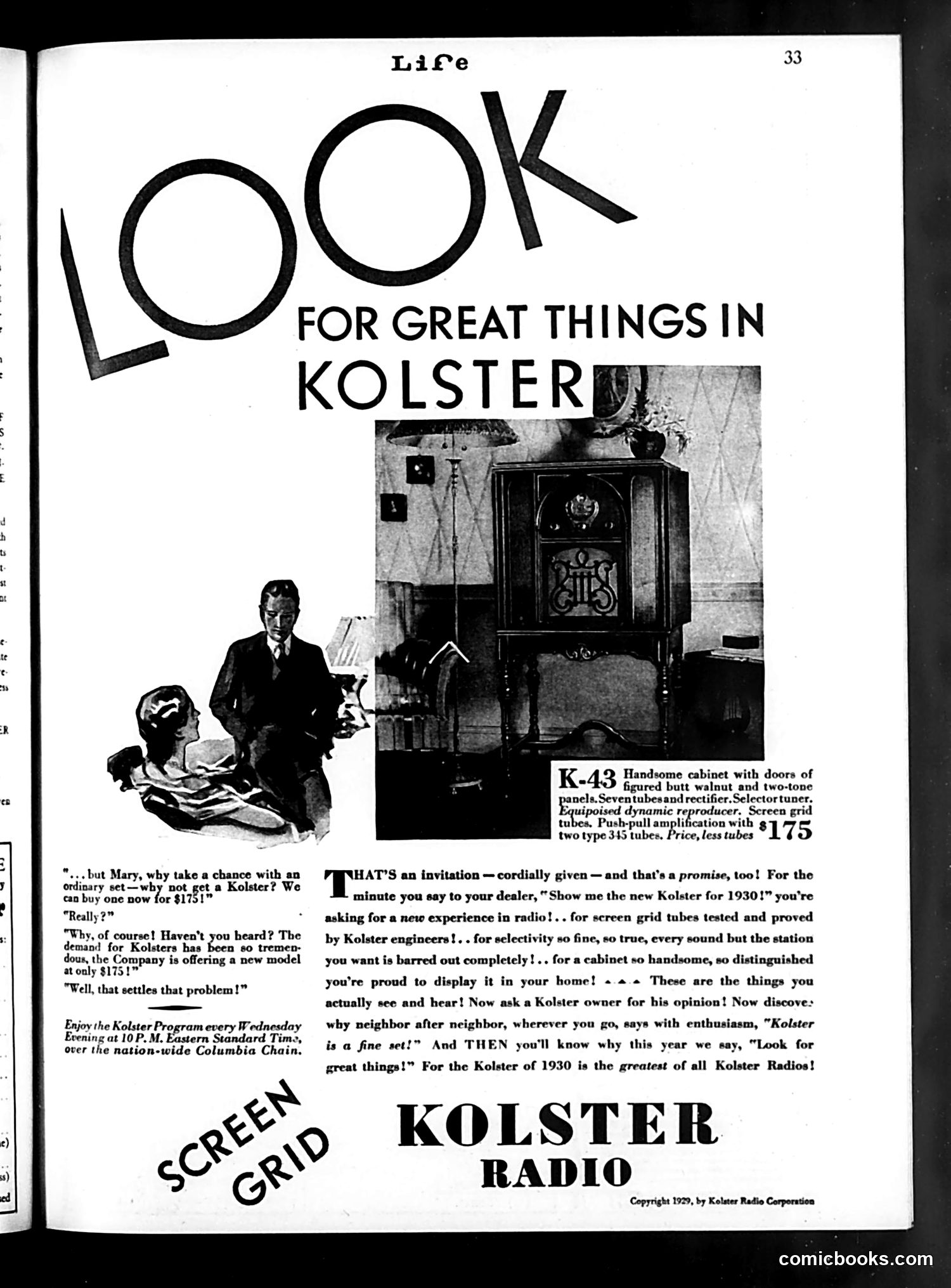
Analysis of Kolster Radio Advertisement (Life Magazine, 1929) This is primarily a product advertisement rather than political satire. The page promotes Kolster brand radios for 1930, using a humorous domestic dialogue as its hook. The cartoon shows a husband and wife discussing radio purchases. The husband convinces his reluctant wife ("Mary") to buy a Kolster by claiming the new model costs *less* ($175) than the previous version ($178)—a reversal of typical price increases that "settles" her objections about expense. The satire here is gentle and consumer-focused: it mocks ordinary purchasing hesitation and uses the counterintuitive price-drop as a comedic selling point. This reflects the radio boom of the late 1920s, when radios were major household purchases and manufacturers competed aggressively on price and features. The advertisement emphasizes Kolster's technical superiority ("screen grid tubes," "selectivity") and cabinet design, typical marketing language for luxury consumer goods during this pre-Depression period. The reference to their Wednesday evening radio program suggests sponsorship as marketing strategy.
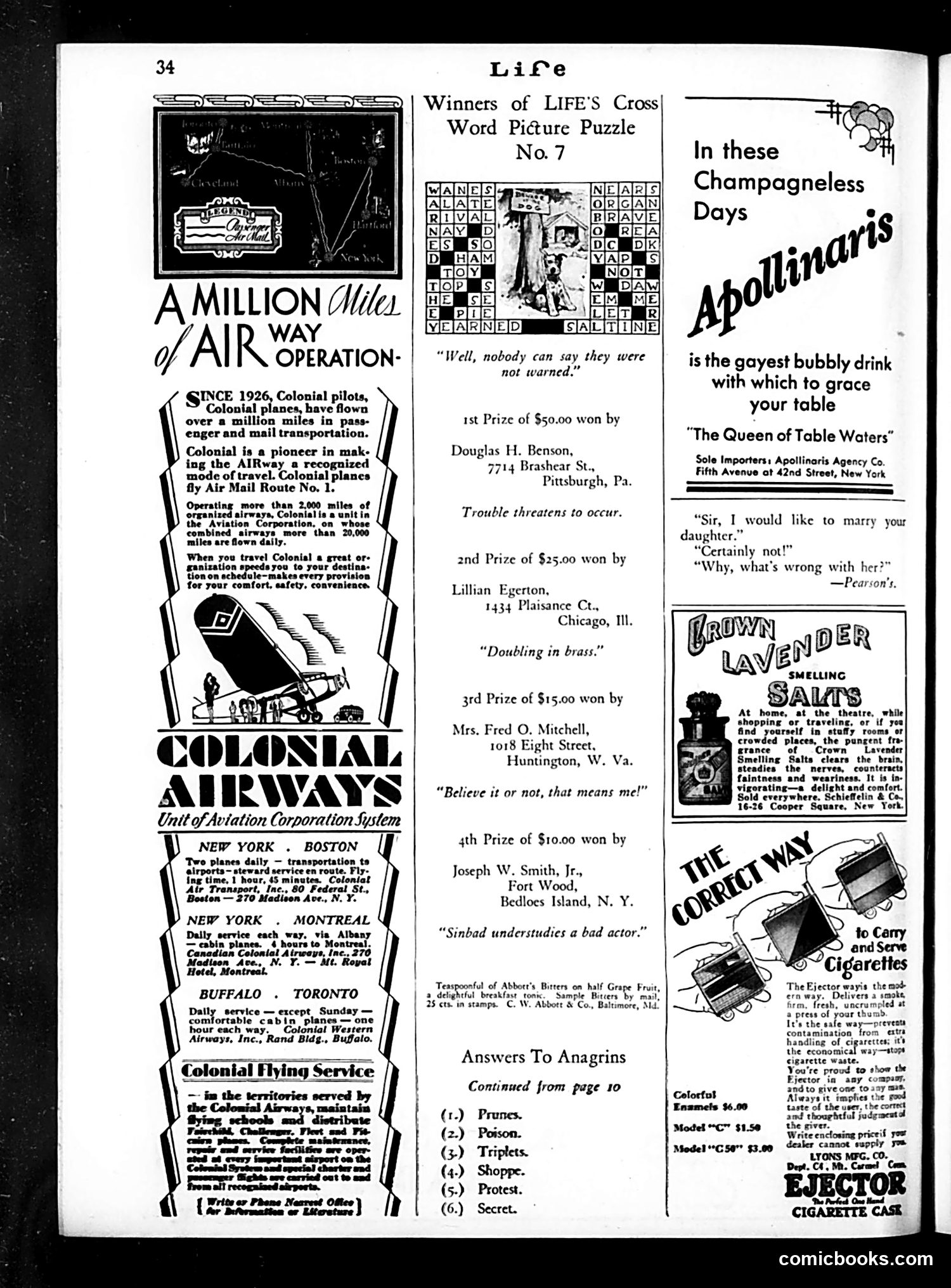
Analysis of Life Magazine Page 34 This page is primarily advertising and puzzle content, not political satire. The main elements are: Colonial Airways Advertisement: Promotes early commercial aviation (established 1926), emphasizing safety and reliability of air travel—still a novel concept. Routes connect major Northeast cities (New York, Boston, Montreal, Toronto, Buffalo). Word Picture Puzzle: A visual riddle contest with four prize-winning answers shown, featuring humorous captions like "Sinbad understudies a bad actor" and "Doubling in brass." Consumer Product Ads: Including Apollinaris sparkling water ("The Queen of Table Waters"), Crown Lavender smelling salts (for stuffy rooms and travel), and an Ejector cigarette case. The page reflects 1920s-30s consumer culture: aviation as luxury transportation, women's fashion accessories (smelling salts), and novelty smoking products. There is no political cartoon or satire—this is a typical Life magazine revenue page mixing entertainment puzzles with upscale product advertising.
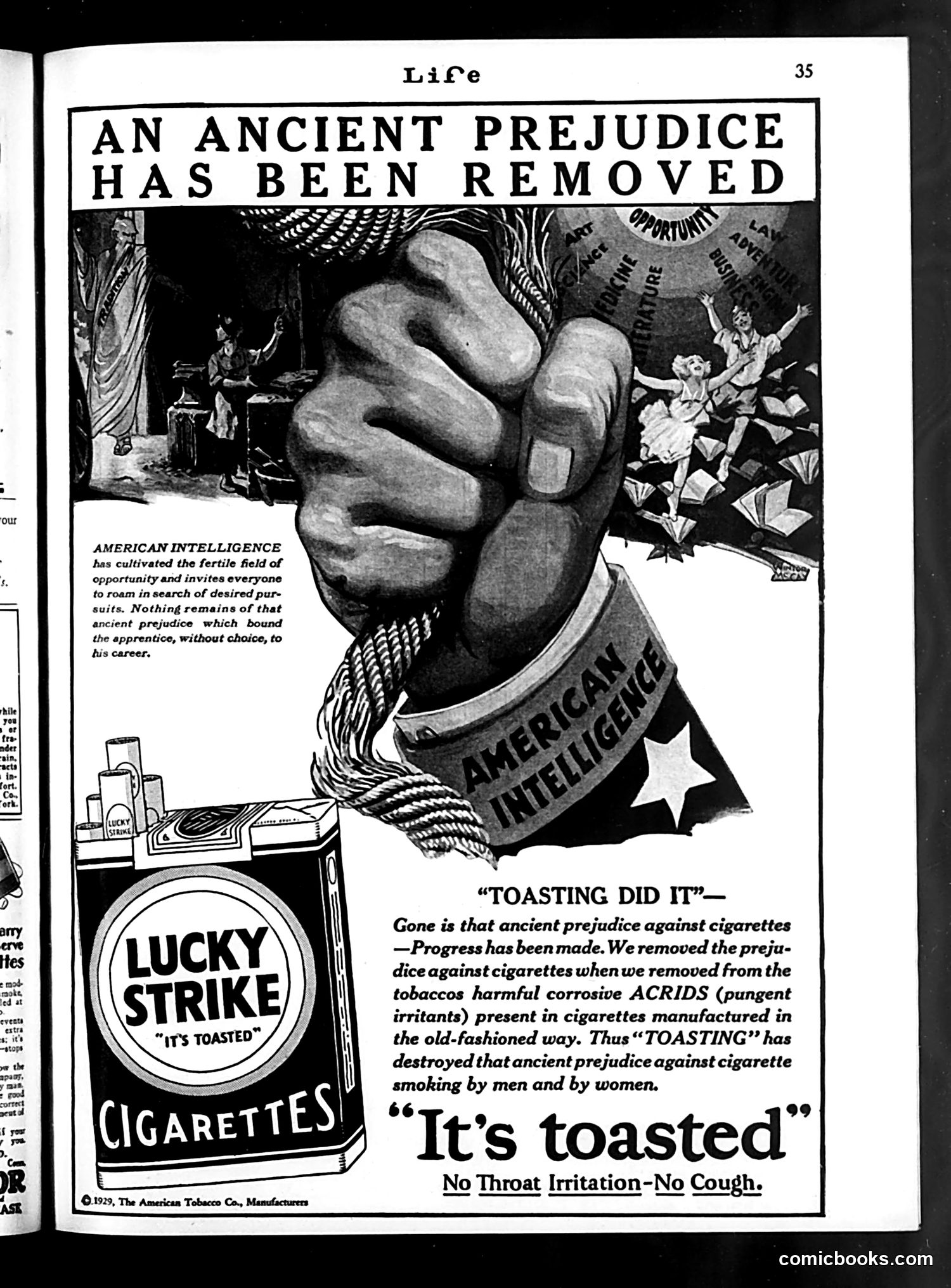
Analysis This is a Lucky Strike cigarette advertisement, not editorial satire. The page conflates two unrelated concepts to market cigarettes. The argument: The ad claims that American progress has removed "ancient prejudice" against cigarettes (just as it removed rigid apprenticeship systems). It argues that Lucky Strike's "toasting" process removes harmful "acrids" (irritants), thereby eliminating legitimate health concerns about smoking. The imagery: A large fist breaking chains represents liberation from old restrictions—visual shorthand for progress and freedom. The deception: The ad falsely equates social progress with product safety. While toasting may reduce some irritants, the core claim—that this process eliminates health risks—is misleading. The ad exploits patriotic language about American opportunity to rebrand health skepticism as outdated prejudice. For modern readers: This represents pre-regulation tobacco advertising that explicitly used pseudo-scientific claims and nationalist rhetoric to overcome public concern about cigarette dangers.
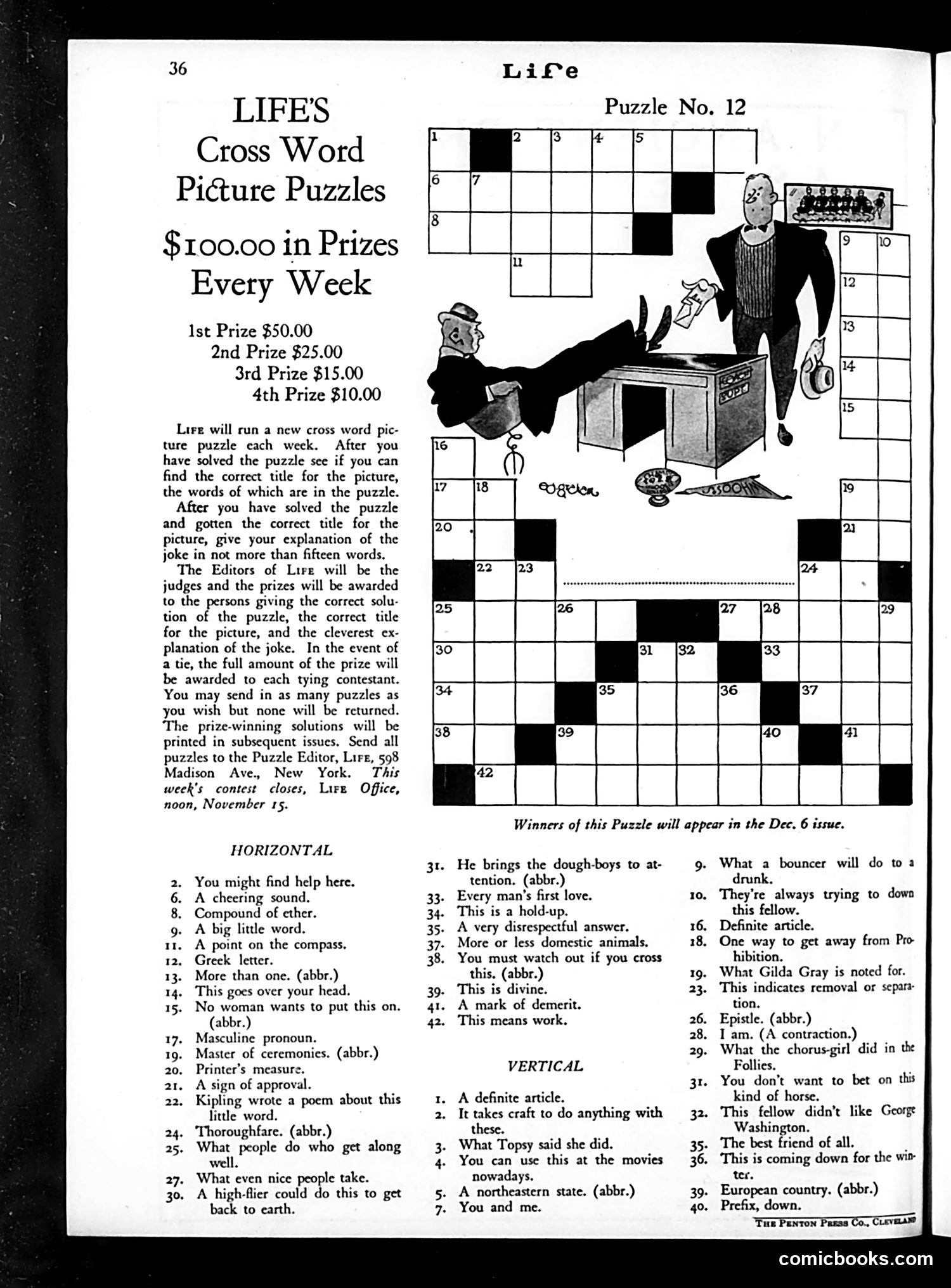
Life Magazine Puzzle Page Analysis This page presents Life magazine's weekly crossword-picture puzzle contest, a popular interactive feature offering $100 in prizes ($50 first place down to $10 fourth place). The illustration depicts a humorous scene of a man being ejected from a desk by another man—likely satirizing office politics or workplace conflict. The cartoon includes props suggesting clerical work (papers, desk). The puzzle itself integrates crossword clues with the picture's caption. Contestants had to: (1) solve the crossword, (2) identify the picture's correct title using crossword answers, and (3) explain the joke in 15 words maximum. Key context for modern readers: This reflects 1920s leisure culture and Life's role as a sophisticated humor magazine featuring interactive entertainment—precursor to modern puzzle competitions. References like "Gilda Gray" (a 1920s dancer) and Prohibition-era humor date the content. The contest encouraged reader engagement, a common magazine strategy of the era. The contest deadline was November 15, with winners announced December 6.
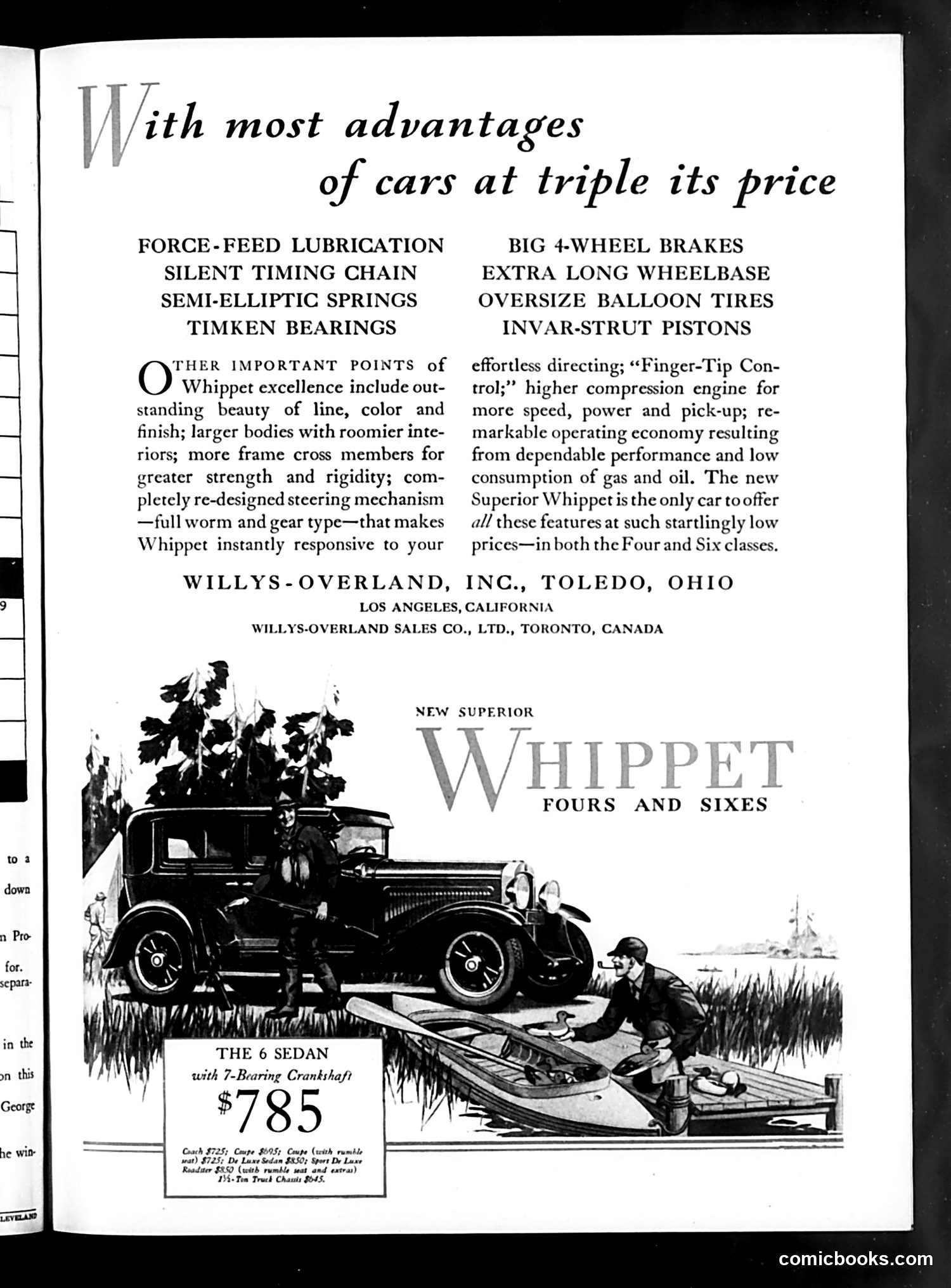
Advertisement Analysis This is not a cartoon or satire—it's a straightforward automobile advertisement for the Whippet, manufactured by Willys-Overland. The page promotes the "New Superior Whippet Fours and Sixes" as an affordable vehicle offering luxury features at competitive pricing. The headline claims customers get "most advantages of cars at triple its price," listing technical specifications (force-feed lubrication, silent timing chain, Timken bearings, etc.) to establish quality. The illustration shows a well-dressed man examining a sedan parked near water—an idealized lifestyle image common in 1920s car advertising. The 6 Sedan is priced at $785, presented as exceptional value. This is a commercial advertisement without political or satirical content—typical of Life magazine's mixed editorial and advertising pages from this era.
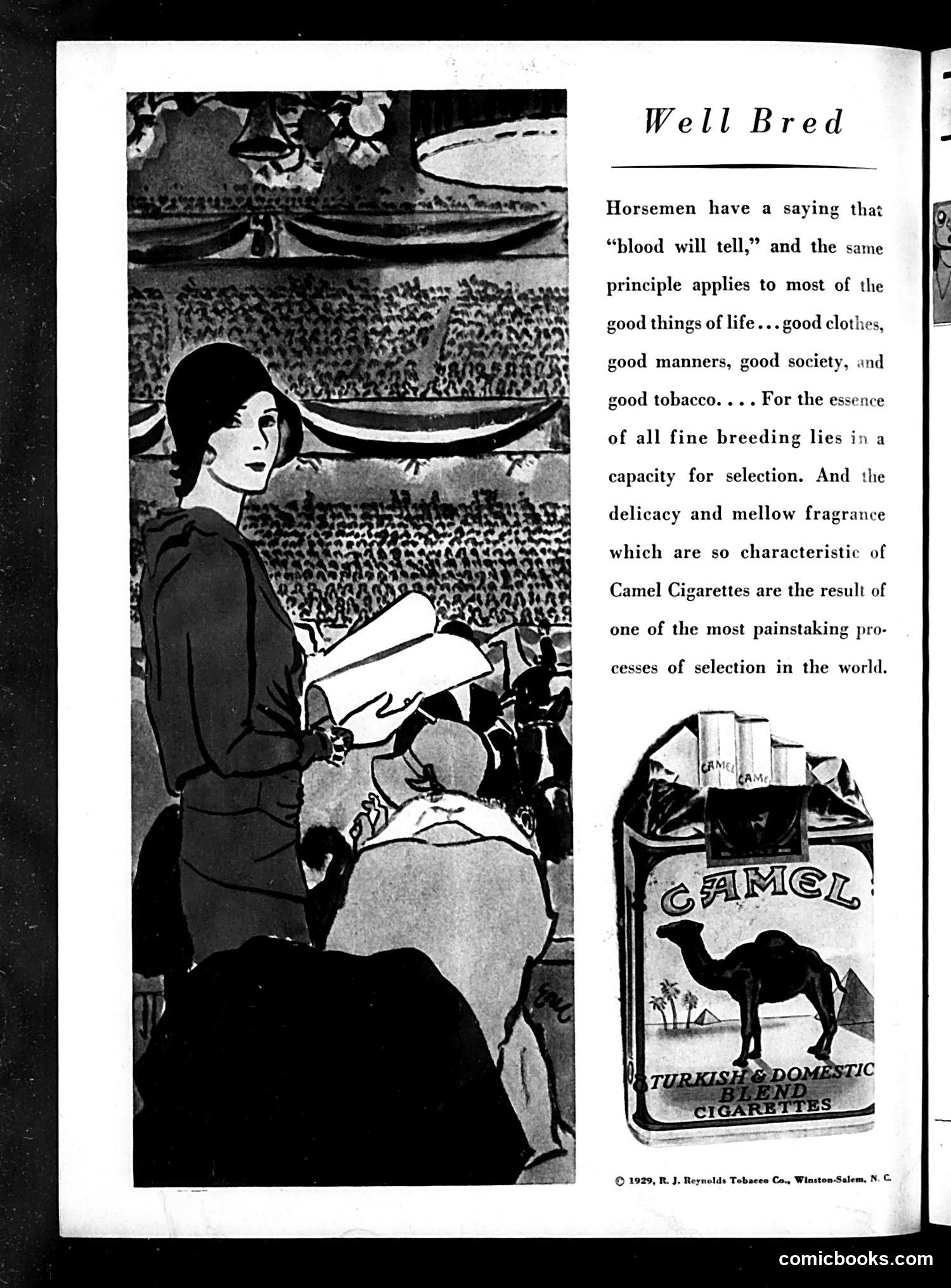
Analysis This is a Camel cigarette advertisement from 1929, not a political cartoon. The "satire" is the ad's own implicit humor. The page uses an upper-class social metaphor: "blood will tell" (a saying about breeding/pedigree in horses and people) is applied to cigarette selection. The elegantly dressed woman in the illustration represents refined taste and high society. The joke—likely unintentional for modern readers—is that the ad equates smoking cigarettes with moral and social refinement. It suggests that choosing Camel cigarettes demonstrates "good breeding," "delicacy," and discriminating taste, comparable to appreciating fine clothes or good manners. By today's standards, this reads as absurd marketing: framing an addictive, health-hazardous product as a marker of sophistication and character. The ad exemplifies how extensively cigarette companies once marketed to aspirational consumers by linking smoking to status and elegance.