life
Life — November 8, 1929
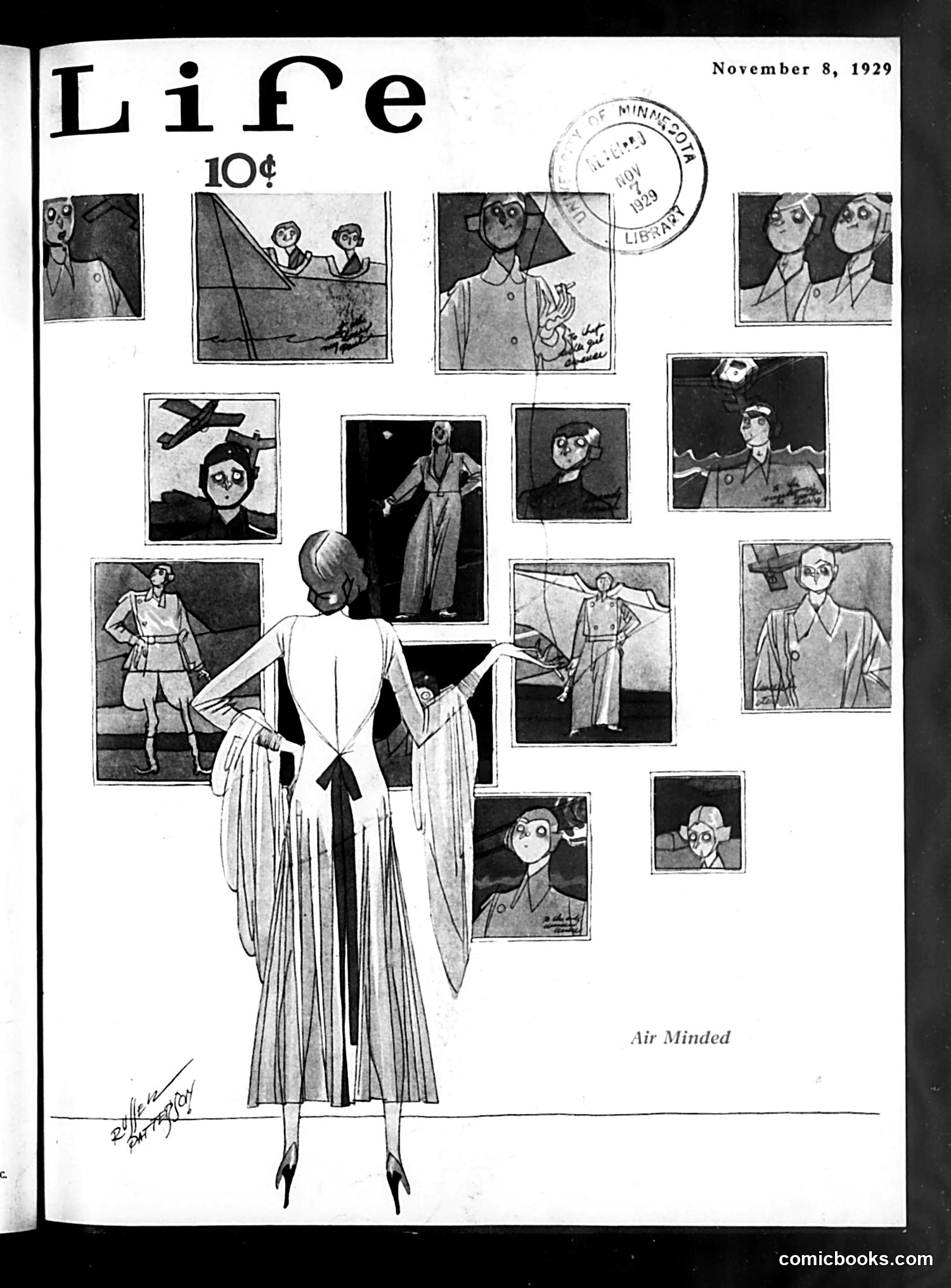
"Air Minded" - Life Magazine, November 8, 1929 This satirical cover depicts a woman viewing photographs of various aviators and aviation pioneers, titled "Air Minded." The woman, viewed from behind in an elegant 1920s gown, appears to be selecting or admiring these aerial figures like portraits in a gallery. The satire likely mocks the contemporary obsession with aviation celebrities and pioneers during the aviation boom of the late 1920s. Aviation was a glamorous, cutting-edge pursuit capturing public imagination. The "air minded" woman represents society's fascination with these aerial heroes, suggesting the era's trend of lionizing aviators as cultural icons—much as we today follow celebrity culture. The magazine's 10-cent price reflects this being published just weeks before the stock market crash of October 1929.
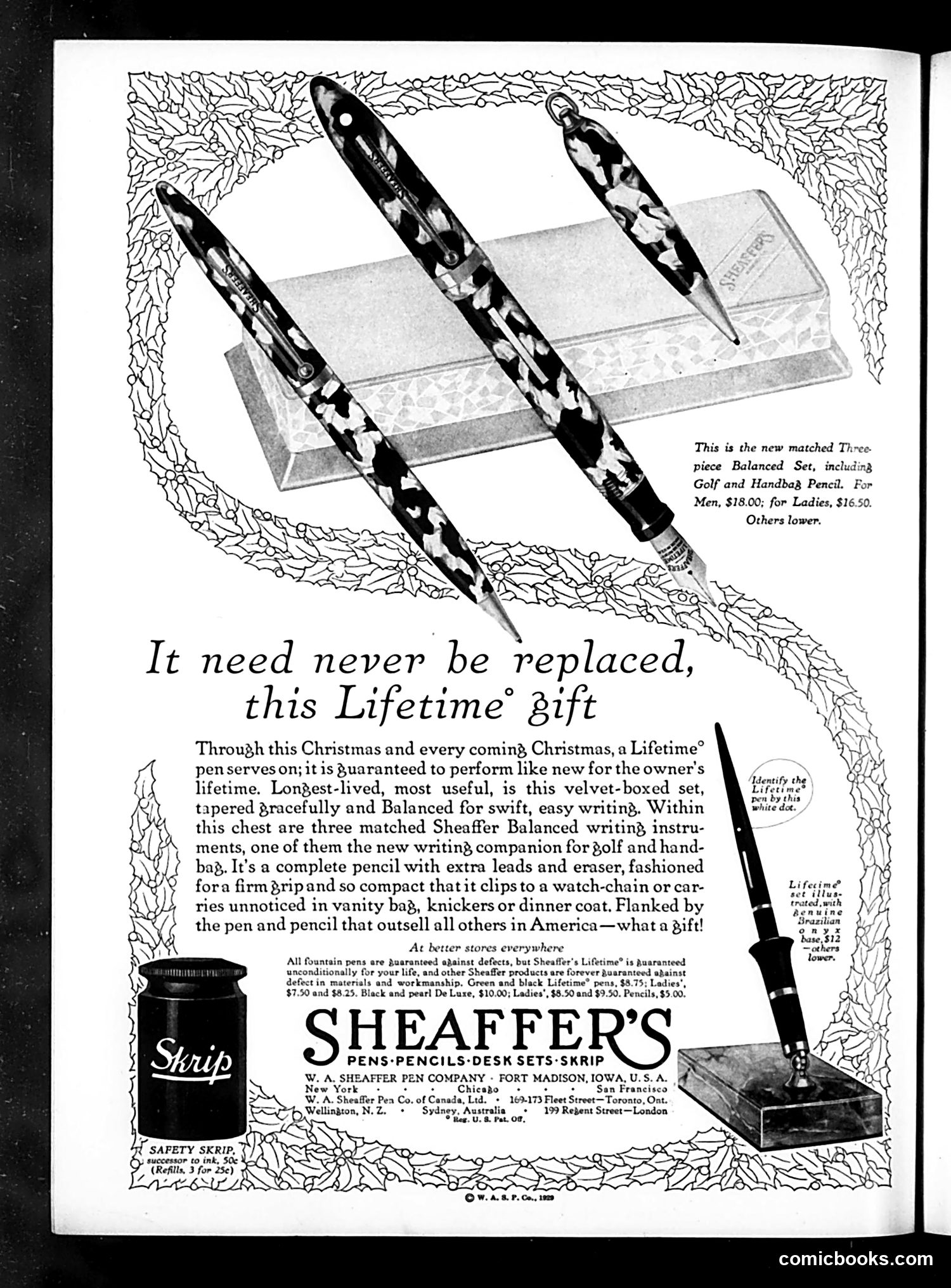
Analysis This is not a political cartoon or satire—it's a Sheaffer pen advertisement from what appears to be an early-to-mid 20th century *Life* magazine. The ad promotes Sheaffer's "Lifetime" fountain pen and pencil set as an ideal Christmas gift. The marketing pitch emphasizes durability ("need never be replaced," "guaranteed to perform like new for the owner's lifetime"). It highlights three matched writing instruments: a fountain pen, golf pencil, and handbag pencil, presented in an elegant box. The decorative leaf border and product imagery are typical advertising design of the era. There is no political commentary or satire present—this is straightforward commercial promotion emphasizing quality and longevity as selling points for luxury writing instruments.
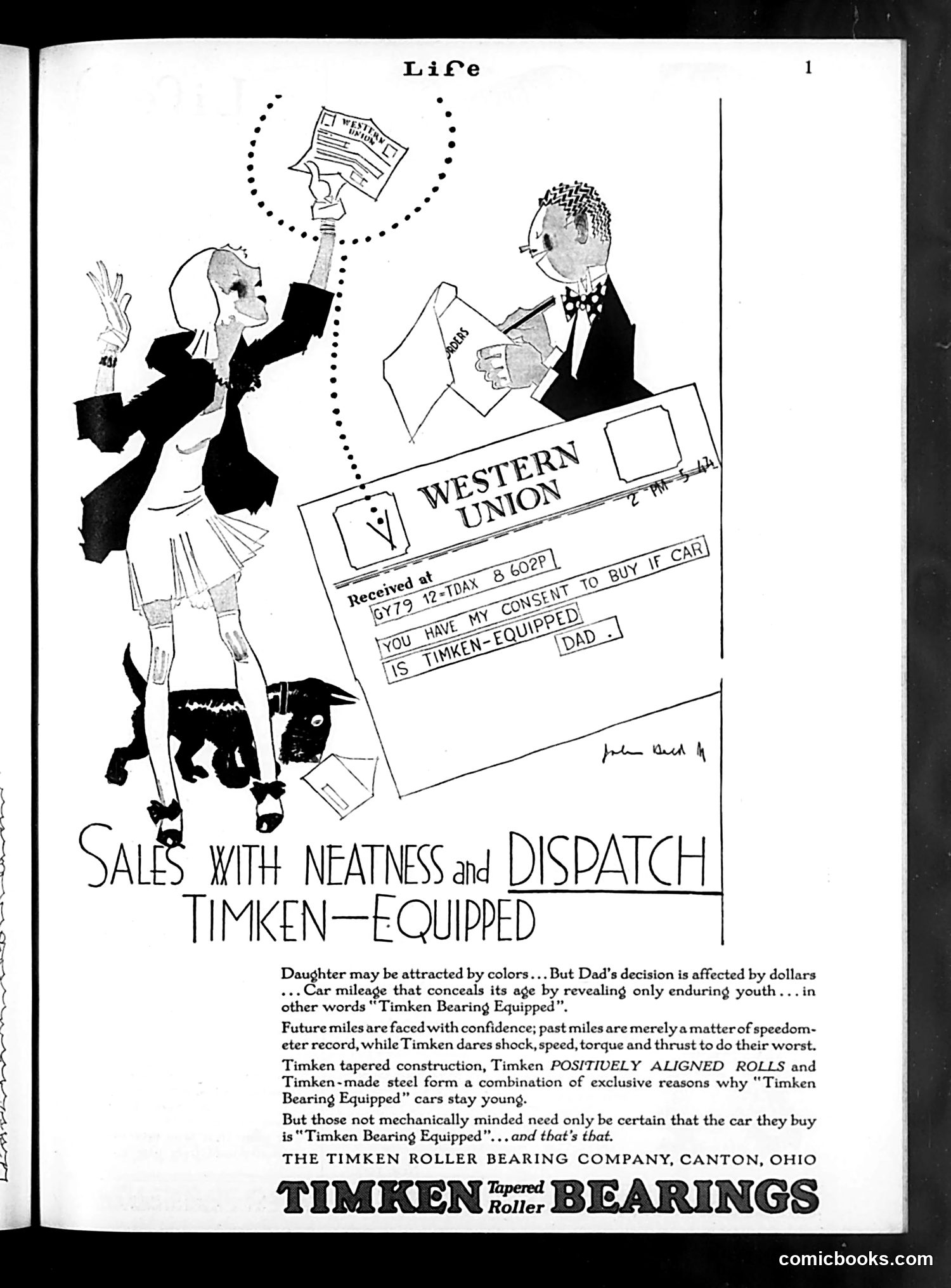
Analysis This is primarily a Timken Roller Bearings advertisement disguised as satirical commentary, not actual political satire. The cartoon depicts a young woman excitedly receiving a Western Union telegram from her father, agreeing to buy her a car—but only if it's "Timken-equipped." The joke targets fathers' purchasing decisions: while daughters may be attracted by a car's appearance, fathers focus on practical durability and reliability. The message suggests that cars with Timken bearings retain their value longer, appearing "young" despite age and mileage. The accompanying text emphasizes Timken bearings' engineering superiority—their alignment, construction, and durability—to persuade cost-conscious automobile buyers (typically male decision-makers in the 1920s-30s) that the investment protects their vehicle's longevity. This reflects period gender dynamics: daughters desire, fathers decide based on economics.
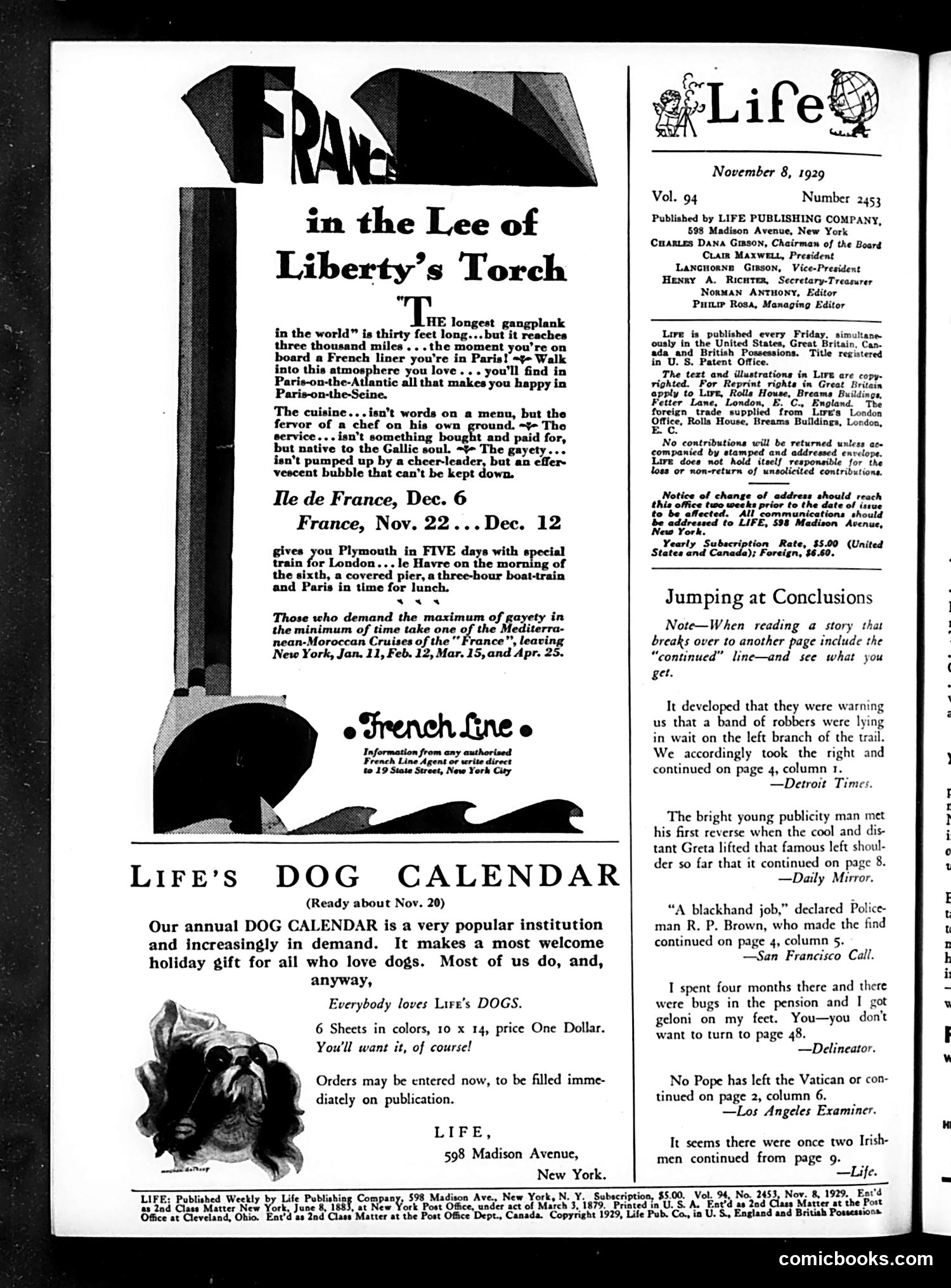
Analysis This page is primarily advertising and editorial content rather than political satire. The main feature advertises the French Line (a cruise ship company) offering Plymouth-to-Paris service in five days, positioning leisure travel to Europe as accessible and desirable. Below that is an advertisement for Life's Dog Calendar—an annual product featuring dog illustrations, priced at one dollar for six color sheets. The right column contains brief editorial notes about various stories ("Jumping at Conclusions"), including references to robberies, a publicity man, a policeman, and mentions of Vatican and Irish subjects—these appear to be cross-references directing readers to continued stories elsewhere in the magazine rather than standalone satirical commentary. The overall page emphasizes consumer products and travel opportunities available to American readers in November 1929.
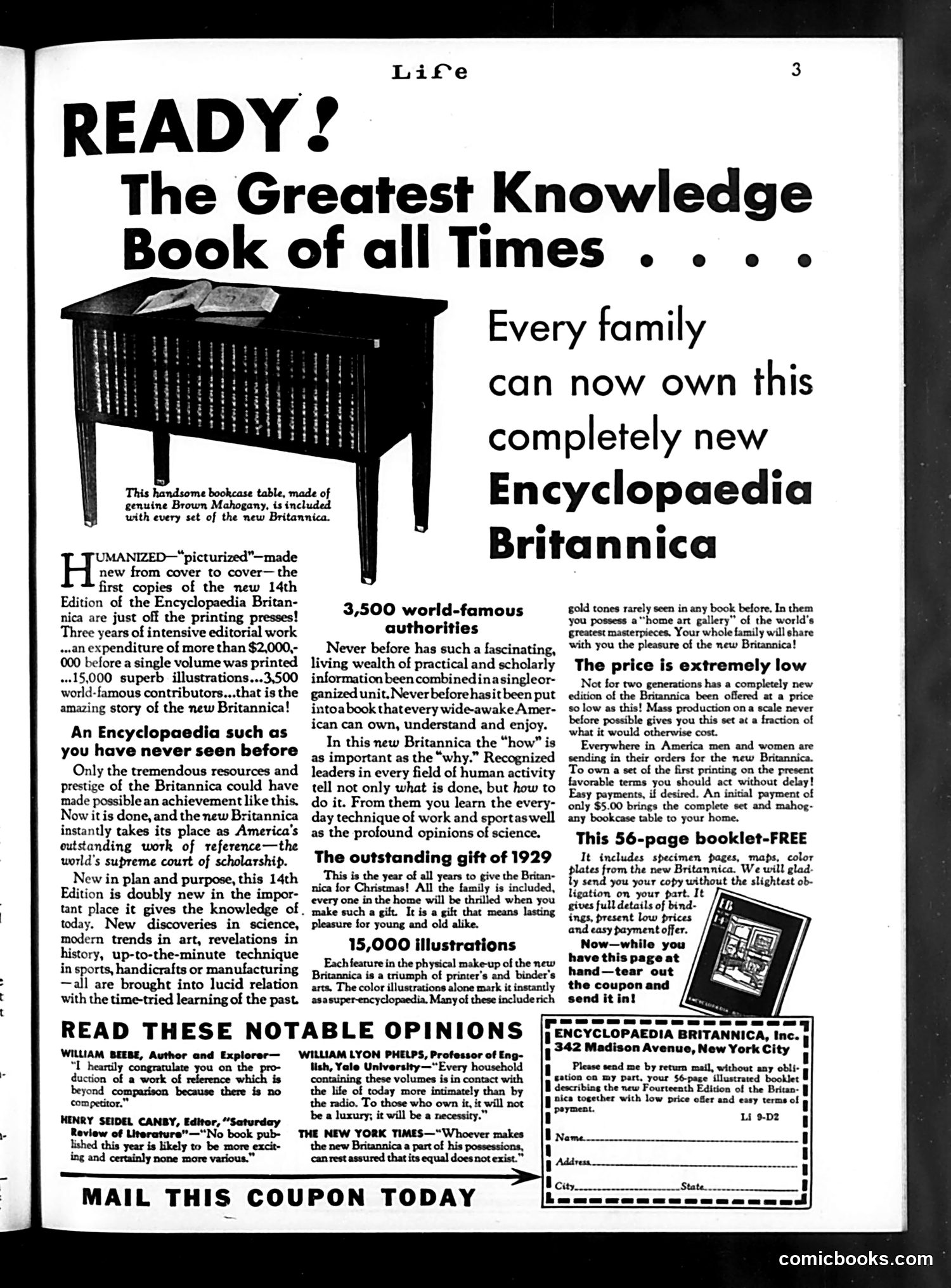
Analysis This page is primarily advertising, not a political cartoon. It promotes the 1929 14th Edition of Encyclopaedia Britannica, featuring testimonials from notable figures like William Lyon Phelps (Yale professor) and Henry Seidel Canby (Saturday Review editor). The advertising emphasizes the encyclopedia's comprehensiveness (3,500 authorities, 15,000 illustrations) and affordability through installment payments. There's a handsome mahogany bookcase table pictured as an incentive. The only potentially satirical element is the hyperbolic language—calling it "The Greatest Knowledge Book of all Times"—typical of 1920s advertising excess. The page reflects Depression-era marketing strategies targeting middle-class families wanting self-improvement and cultural prestige through home libraries. A coupon at bottom invites mail orders.
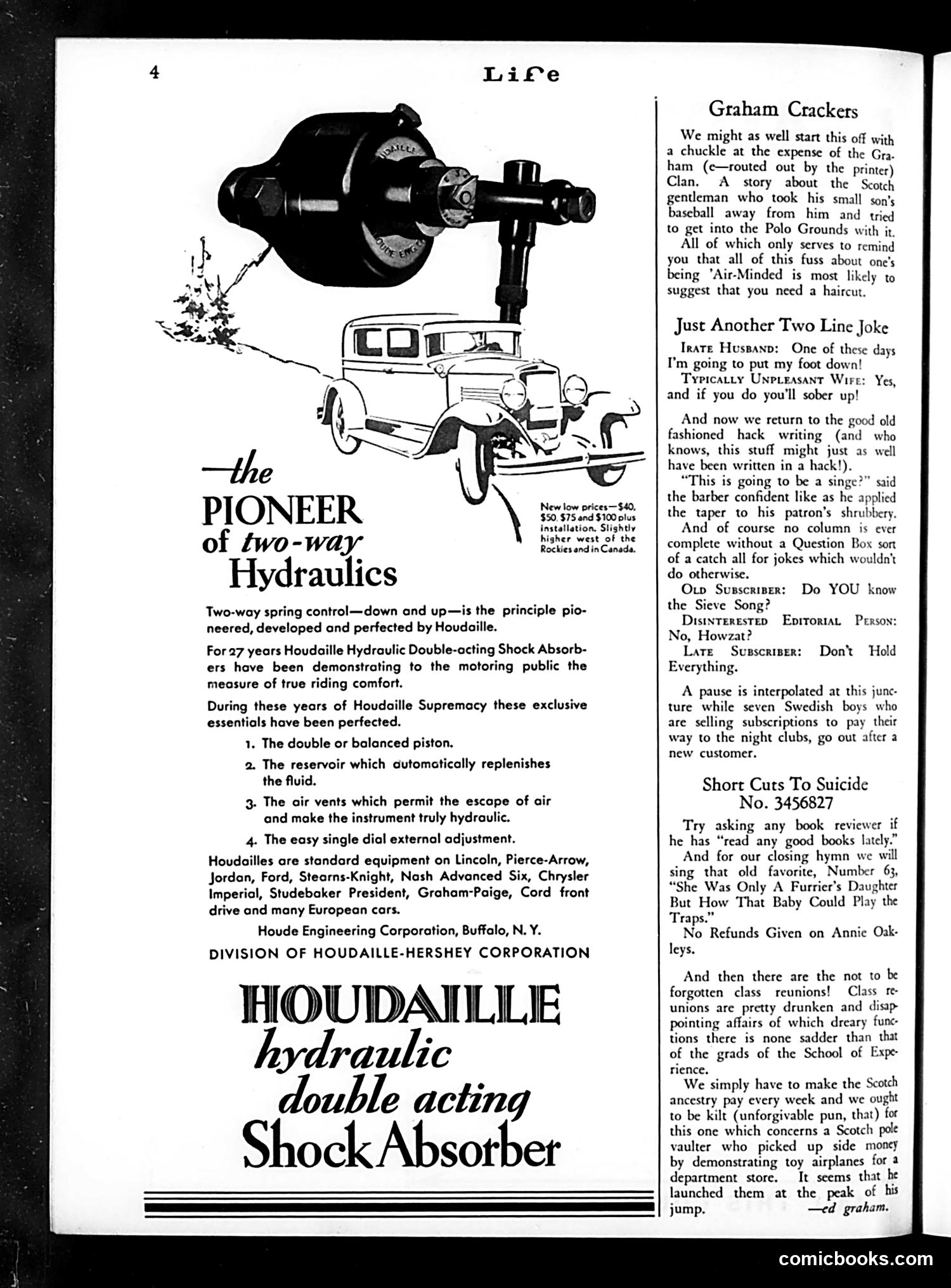
Page Analysis: Life Magazine, circa 1920s-1930s This page is primarily advertising for Houdaille hydraulic shock absorbers, showing a device being fired at a car to demonstrate its effectiveness. The ad emphasizes the "pioneer" status of two-way hydraulic technology for vehicle comfort. The right column contains humor pieces typical of Life magazine's satirical style: brief jokes about marriage ("irate husband" threatening to "put my foot down"), barber shop banter, and editorial commentary on forgotten class reunions and Scottish frugality. The humor is mild and domestic in nature—poking fun at marriage dynamics, professional pretension, and ethnic stereotypes (Scottish thriftiness) rather than political targets. This reflects Life's focus on social observation and consumer culture rather than hard-hitting political satire during this era.
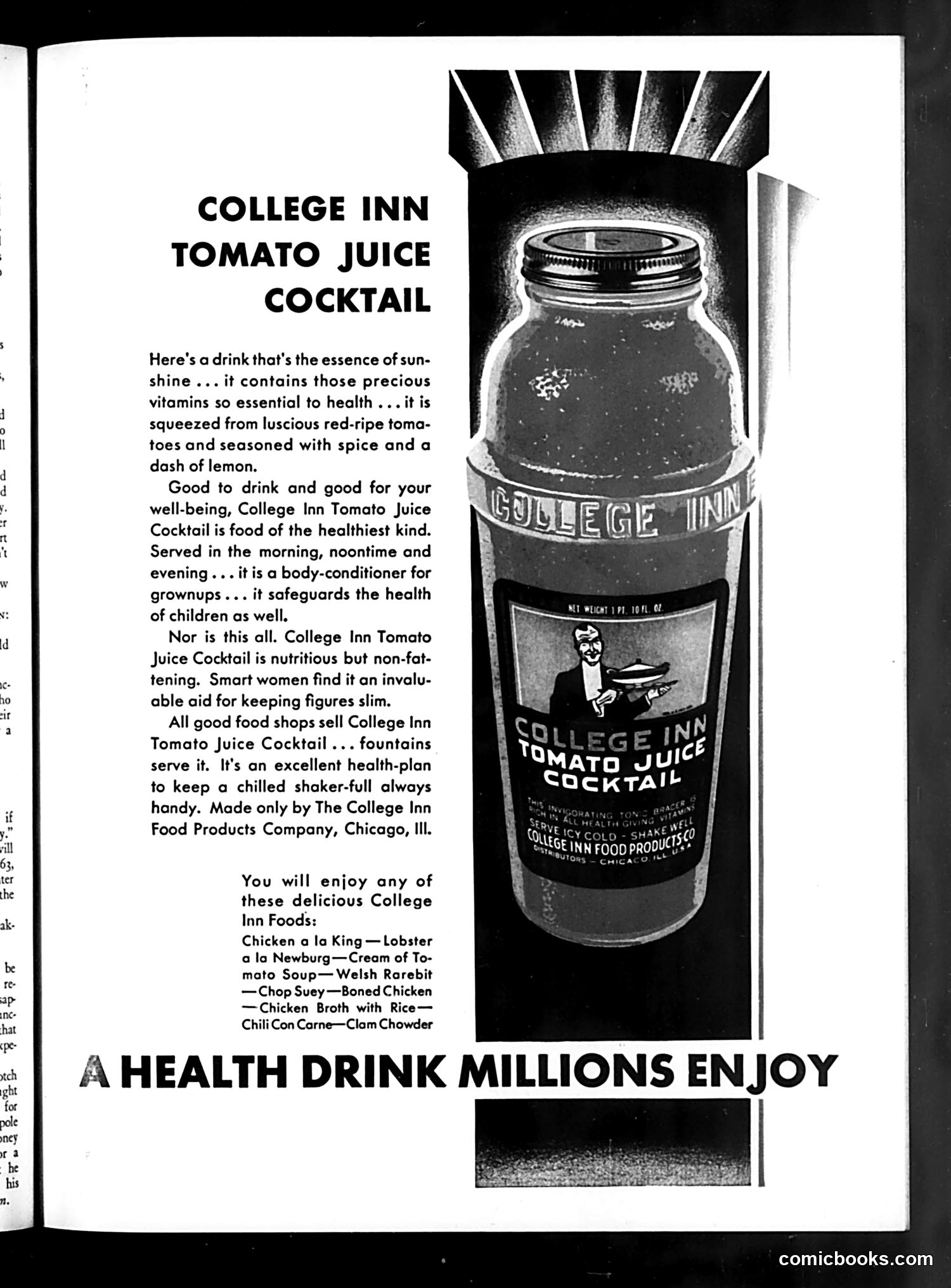
College Inn Tomato Juice Cocktail Advertisement This is a straightforward advertisement—not satire or political content—for College Inn brand tomato juice cocktail, made by College Inn Food Products Company of Chicago. The ad promotes tomato juice as a health drink, emphasizing its vitamins and nutritional value. It appeals to health-conscious consumers, particularly "smart women" watching their figures, by marketing the product as "non-fattening" and beneficial for "well-being" and "health." The bottom lists other College Inn food products (Chicken à la King, soups, chowders) to build brand recognition. The visual shows a large jar with the product label prominently displayed. This reflects mid-20th-century marketing that heavily emphasized health benefits and targeted weight-conscious audiences, particularly women.
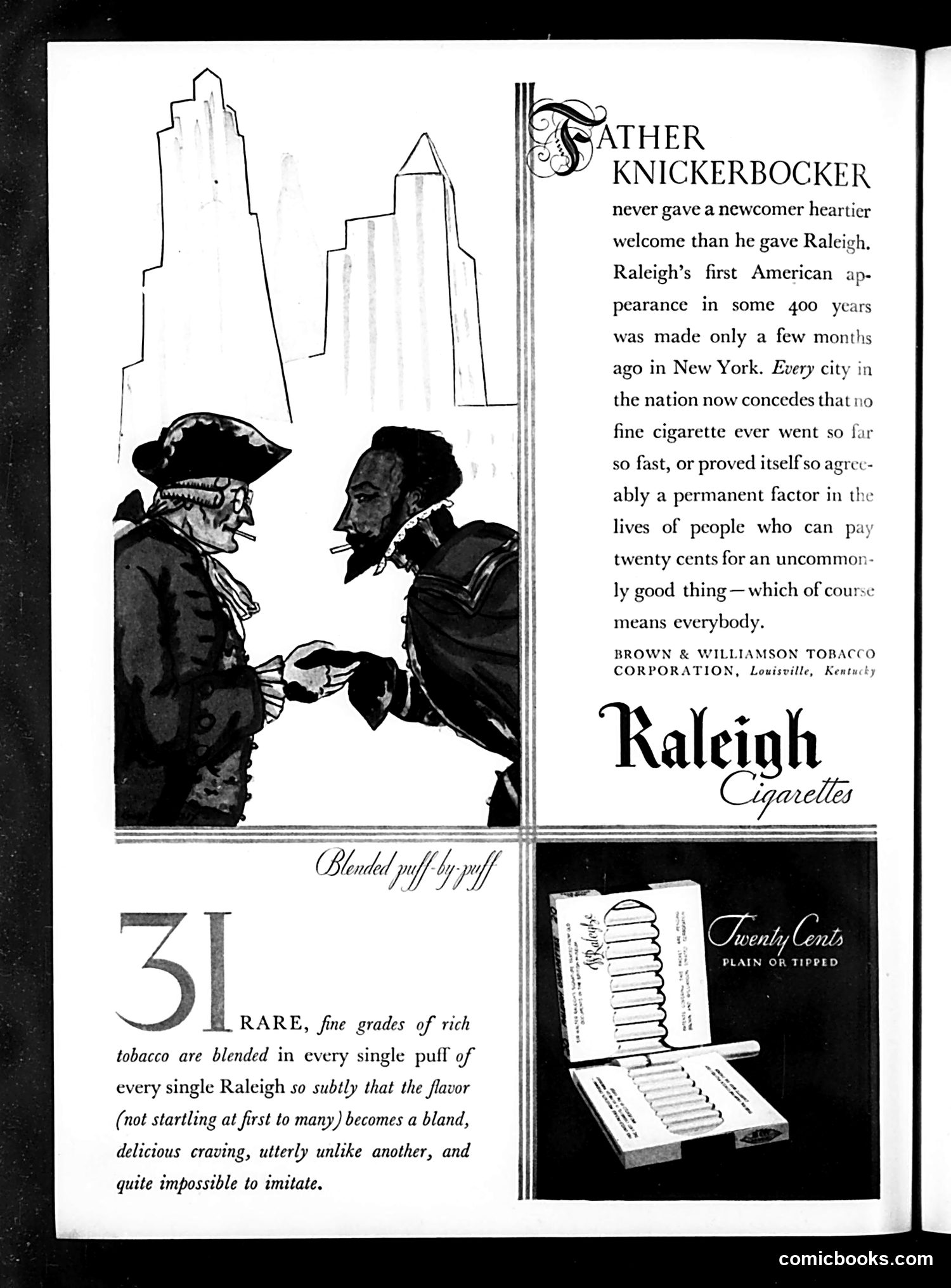
Analysis of Raleigh Cigarettes Advertisement This is a cigarette advertisement, not political satire. The page features two caricatured figures in 18th-century colonial dress (tricorn hats, period clothing) exchanging what appears to be a cigarette pack. The imagery invokes Sir Walter Raleigh, the historical figure associated with introducing tobacco to England. The ad's humor lies in anachronistic exaggeration—depicting ancient colonials as modern cigarette consumers. The text claims Raleigh's "first American appearance in some 400 years was made only a few months ago in New York," personifying the cigarette brand as Raleigh himself arriving as a newcomer. The sales pitch emphasizes a secret "blend" of 31 tobacco grades at twenty cents per pack. This was vintage early-20th-century advertising conflating historical prestige with consumer product appeal.
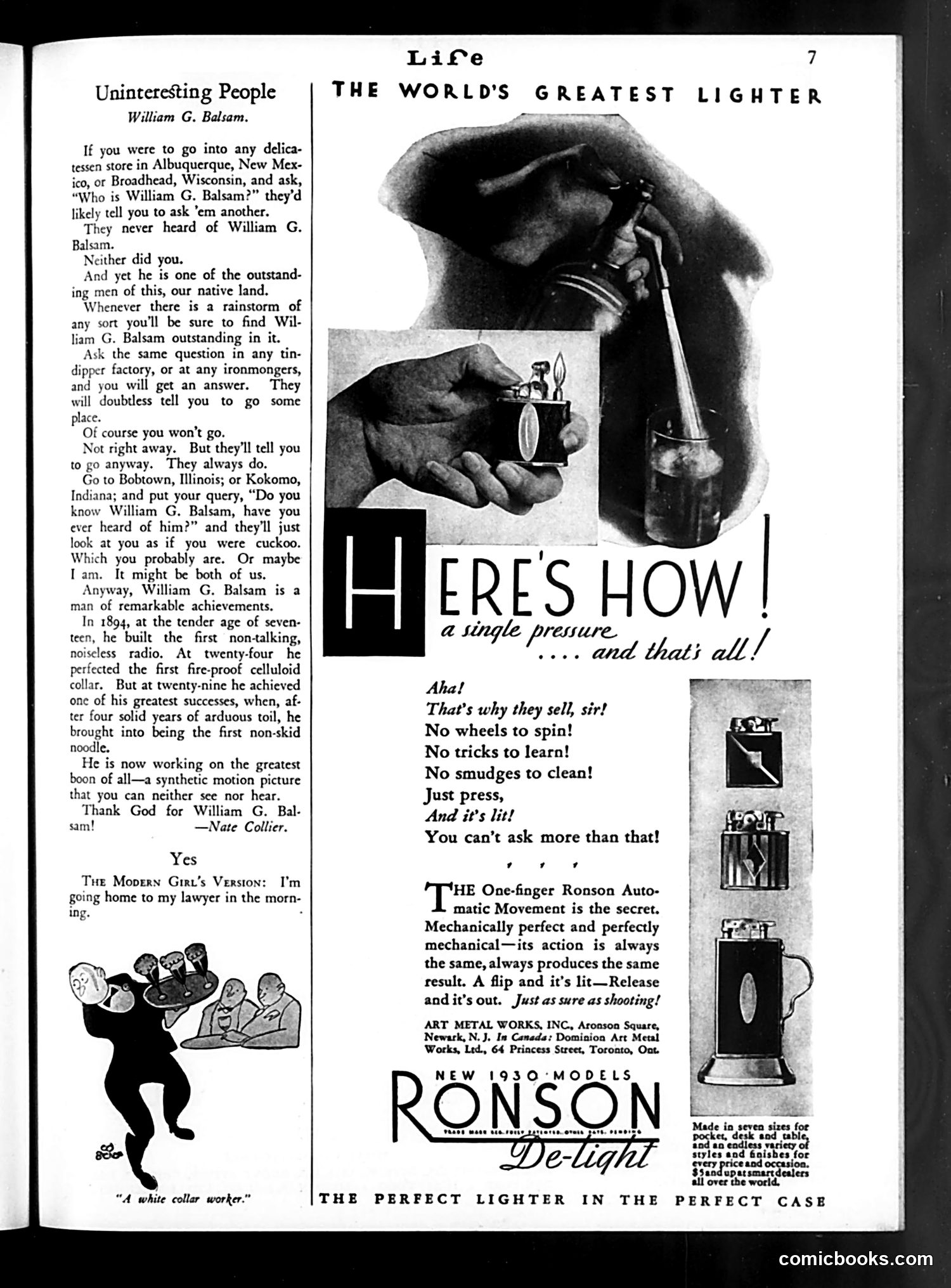
Analysis This page is primarily advertising for Ronson lighters, not political satire. The left column contains two unrelated items: a brief biographical piece about William G. Balsam (an obscure inventor of radio and other devices), and a single-panel cartoon titled "The Modern Girl's Version" showing a woman in silhouette carrying a large bag, captioned "A white collar worker." The cartoon's joke appears to be social commentary on modern working women—the woman is ironically described as a "white collar worker" despite visibly struggling with an enormous burden, suggesting satire about the reality of women's labor versus their professional status. The dominant content is the Ronson De-Light lighter advertisement, emphasizing its simplicity ("a single pressure...and that's all!") with product photos and detailed marketing copy.
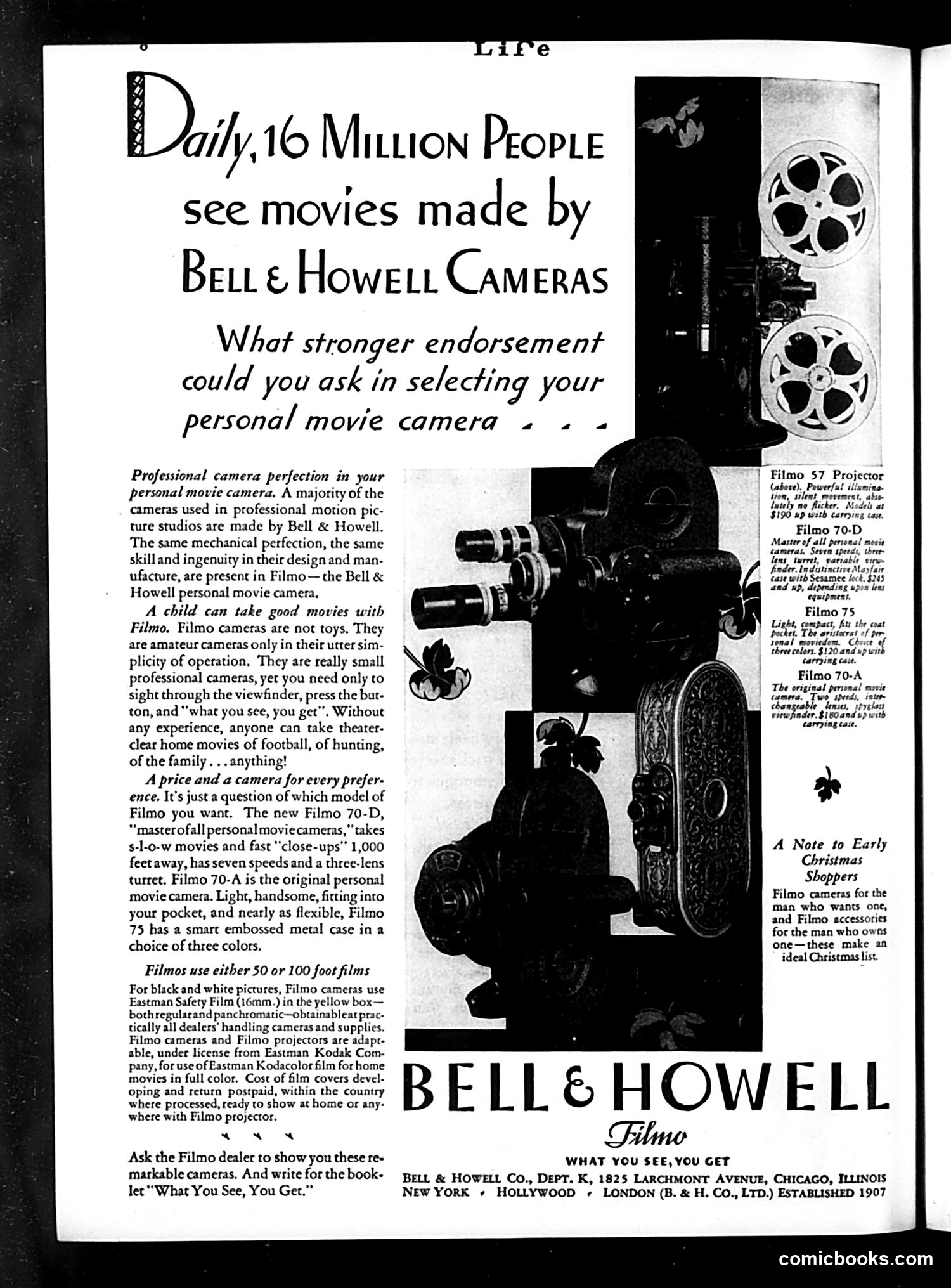
Analysis This is an advertisement, not a cartoon or satirical content. It's a Bell & Howell Filmo camera ad from *Life* magazine. The page promotes personal home movie cameras to average consumers. The main claim is that 16 million people daily watch movies shot on Bell & Howell equipment, positioning the brand as professional-grade yet accessible for amateurs. The imagery shows the actual camera equipment (reels, lenses, and the device itself) to demonstrate the product. The text emphasizes ease of use—"what you see, you get"—requiring no experience to film family activities or events. This reflects early 20th-century consumer culture, when home movie-making was becoming a novelty for middle-class households, positioning it as an aspirational, modern luxury.
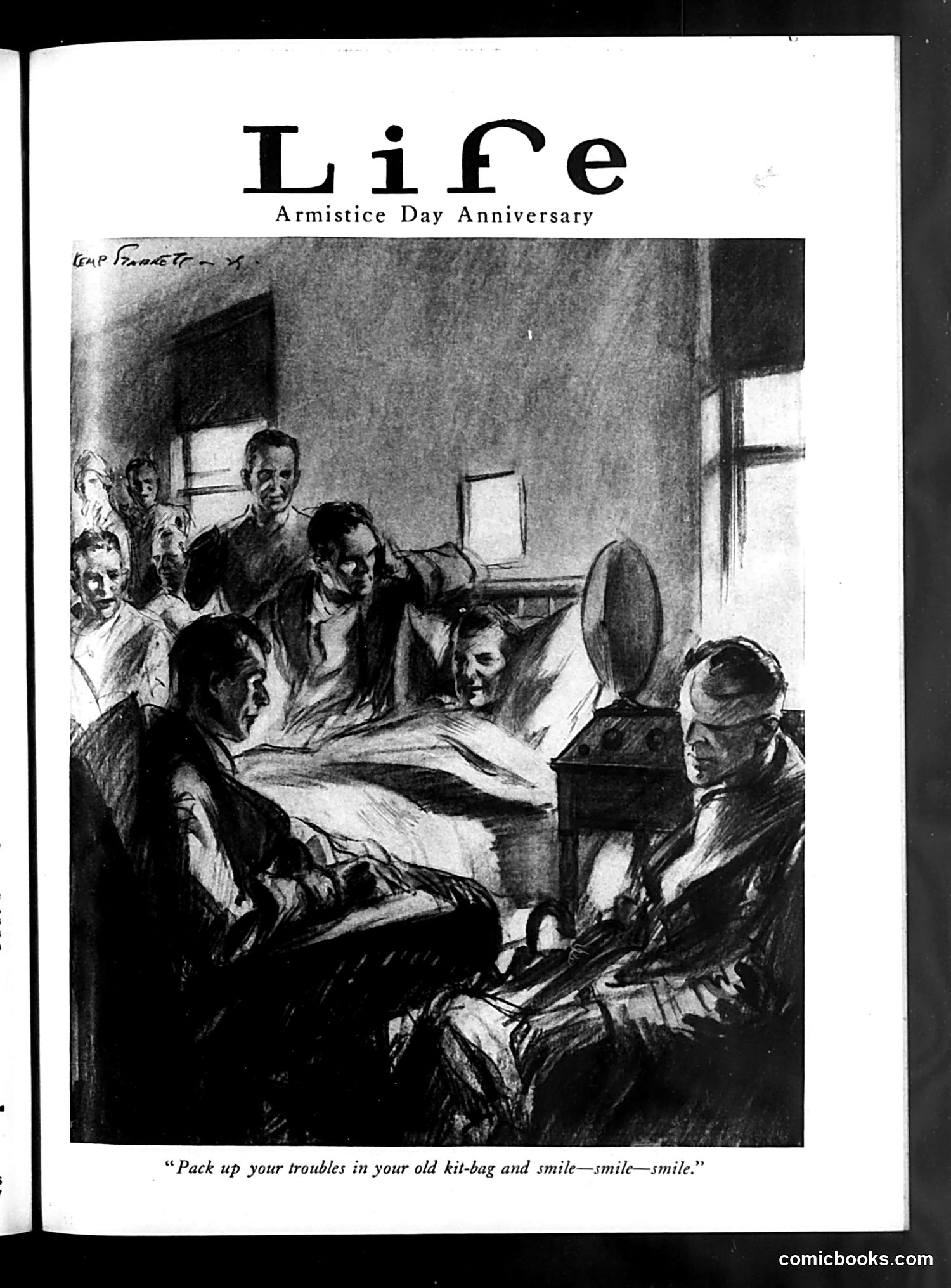
Analysis This is a Life magazine cover for an "Armistice Day Anniversary" issue—commemorating the November 11th end of World War I. The illustration shows soldiers or war-worn men in what appears to be a military hospital or barracks, packing belongings into a kit-bag. The caption reads: "Pack up your troubles in your old kit-bag and smile—smile—smile." This references the famous 1915 WWI song "Pack Up Your Troubles in Your Old Kit-Bag," a morale-boosting marching tune. The satire appears sardonic: the men are depicted with weary, worn expressions despite the cheerful lyrics' instruction to smile. The image captures post-war reality—soldiers returning home, their troubles far from packed away. The juxtaposition of the upbeat song title against their grim demeanor critiques the gap between wartime propaganda and soldiers' actual suffering and trauma.
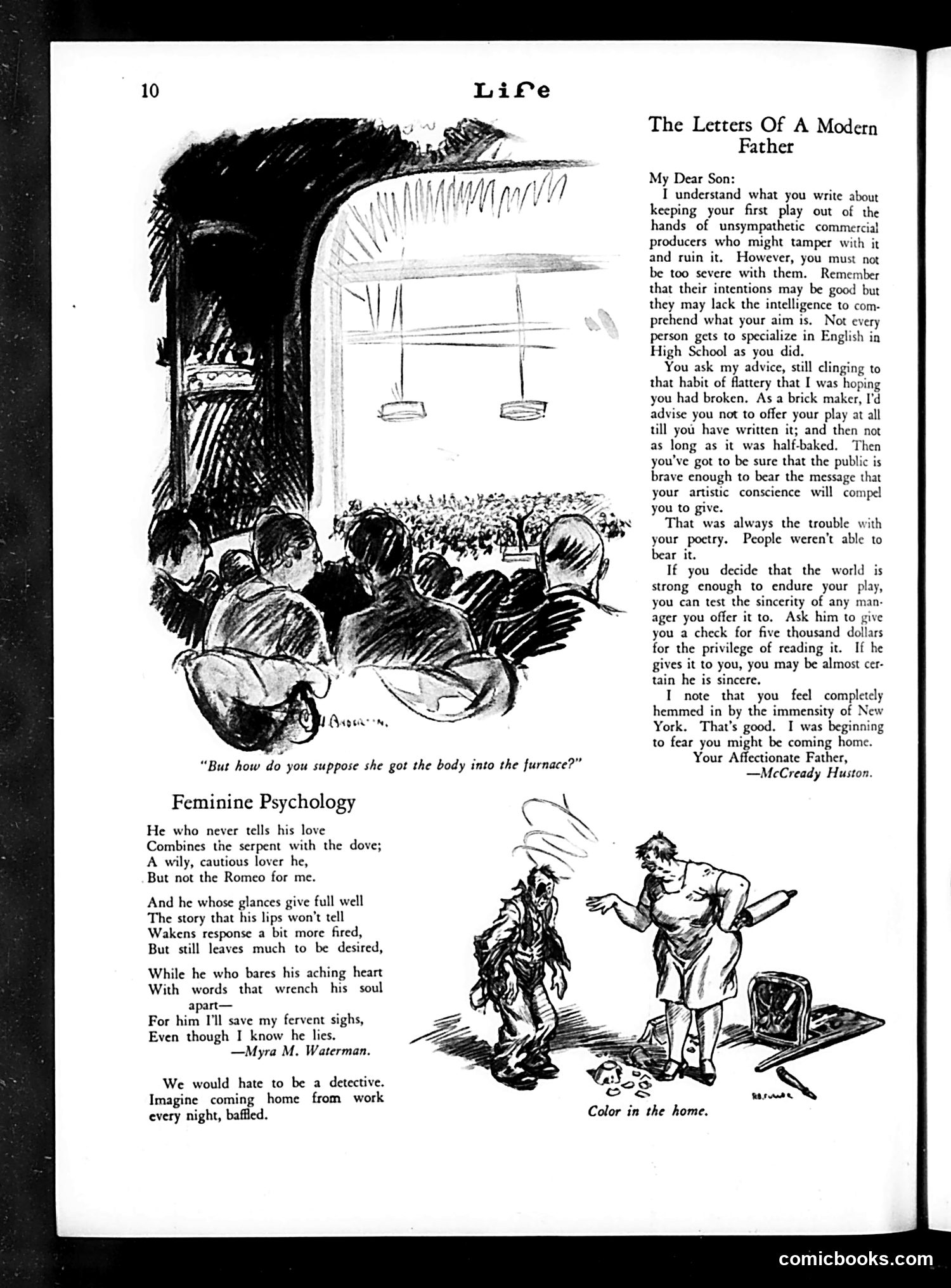
Analysis of Life Magazine Page 10 This page contains three satirical pieces: Top cartoon: Shows an audience watching a theatrical furnace scene. The caption "But how do you suppose he got the body into the furnace?" suggests dark comedy about either a murder mystery play or absurdist theater—likely mocking overly melodramatic or implausible stage productions. "Feminine Psychology" poem: By Myra M. Waterman, satirizes romantic/courtship dynamics. It mocks the preference for mysterious, emotionally distant men over straightforward romantics, suggesting women find emotional unavailability attractive. Bottom cartoon: Titled "Color in the home," depicts a man in apparent distress while a woman gestures dramatically with paint supplies, satirizing domestic conflict—likely about decorating disagreements between spouses or the disruption caused by home renovation projects. All content reflects 1920s-era social commentary on theater, gender relations, and domestic life.
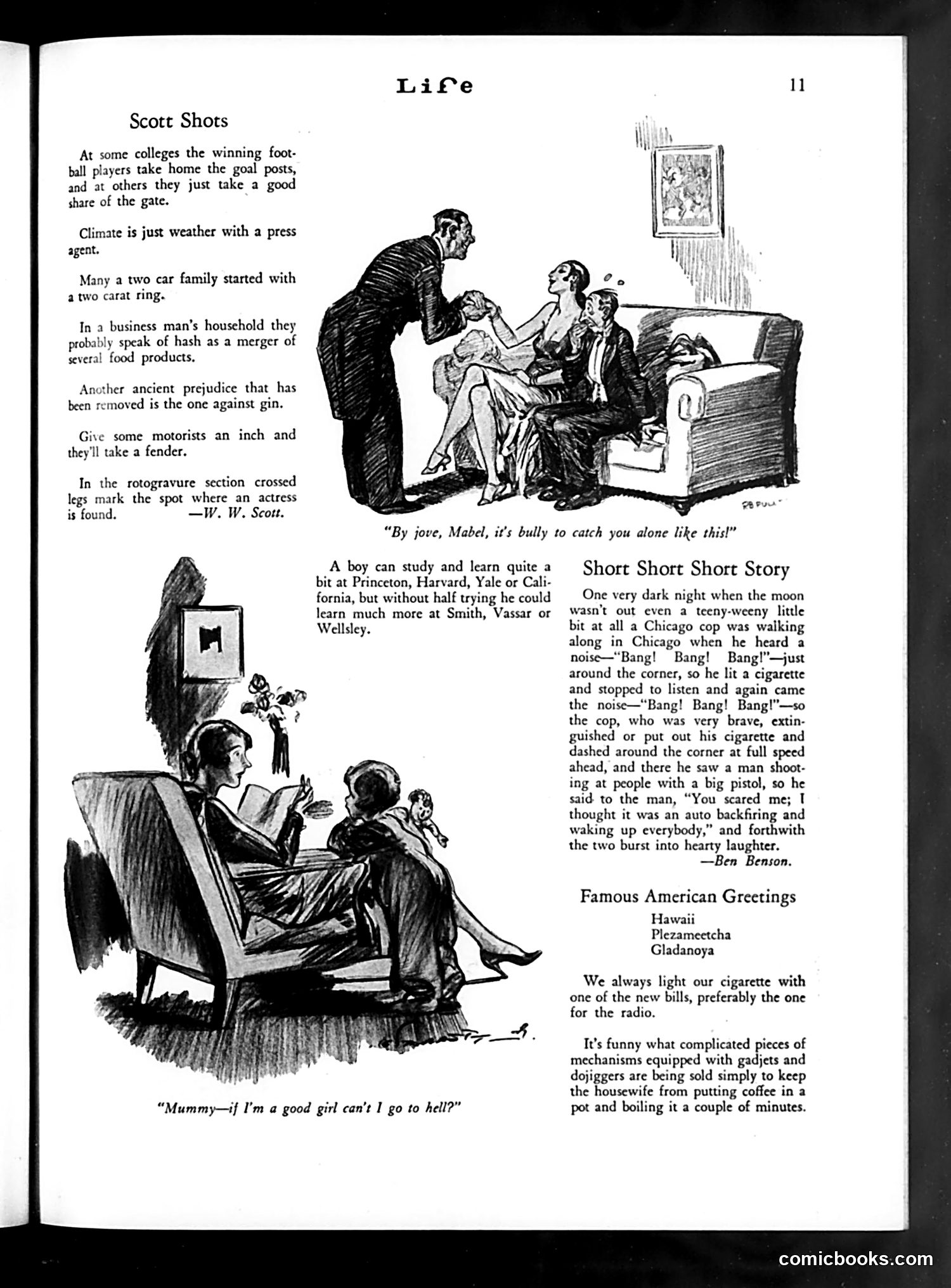
Analysis of Life Magazine Page 11 This page contains humor pieces and illustrations satirizing early 20th-century American life. The top cartoon shows a man apparently attempting to seduce a woman on a couch while others watch—the caption "By jove, Mabel, it's bully to catch you alone like this!" mocks seduction attempts and social pretense. The lower illustration, captioned "Mummy—if I'm a good girl can't I go to hell?", depicts a child questioning parental moral authority about damnation—likely satirizing rigid Victorian religious instruction. The "Short Short Story" mocks a Chicago police officer mistaking gunshots for firecracker sounds, highlighting urban chaos and law enforcement incompetence. Scattered short quips satirize motorists, academia, business jargon, and social conventions of the era.
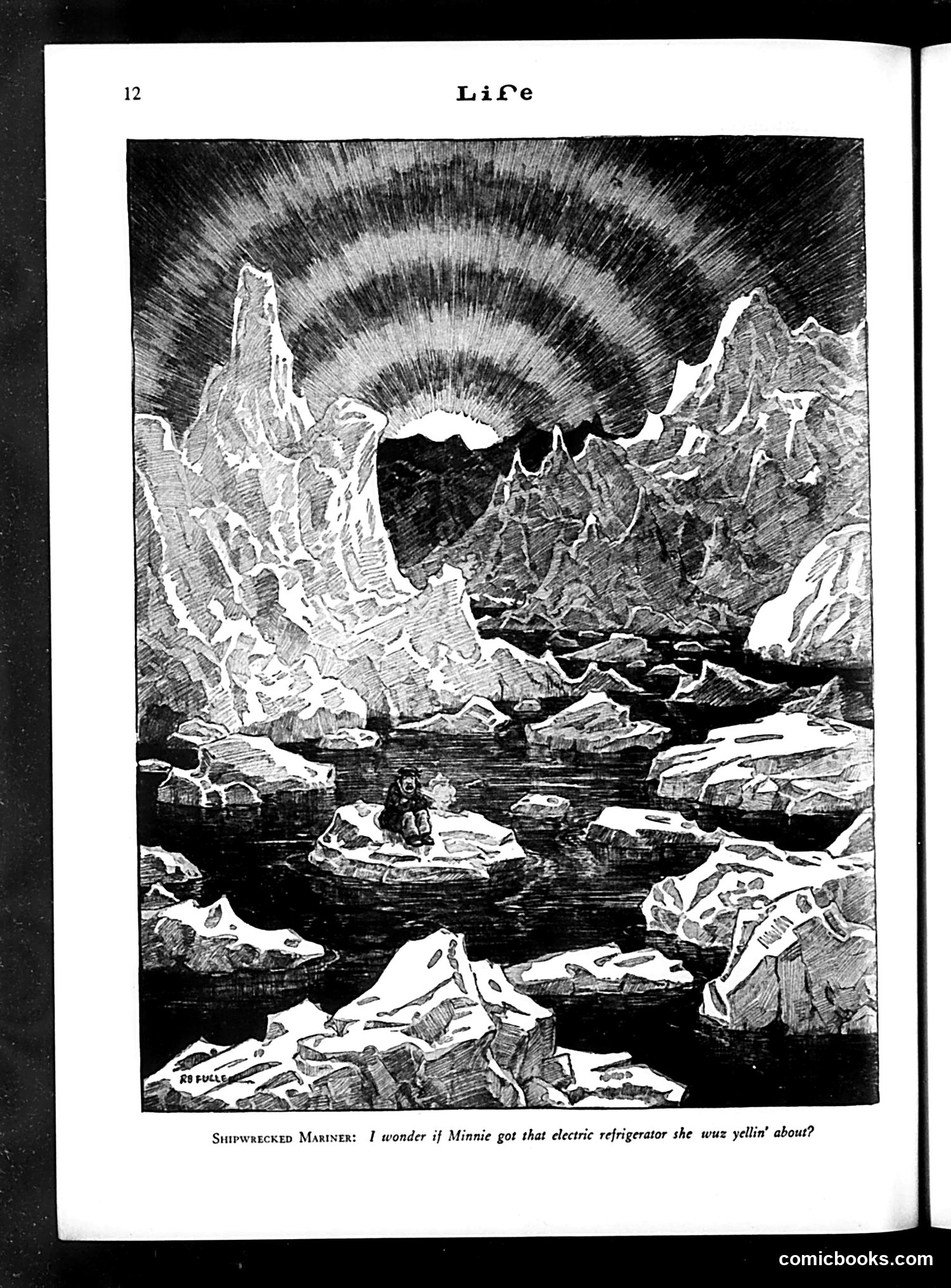
Analysis This is a single-panel cartoon from *Life* magazine depicting a shipwrecked mariner stranded on a rocky island surrounded by water. The mariner, sitting among boulders, expresses concern about an "electric refrigerator" that someone named "Minnie" was asking about. The humor relies on incongruity: a desperate castaway worried about a domestic appliance rather than survival. This likely satirizes either consumer obsession with modern conveniences or references a contemporary advertisement/product controversy. The phrase "I wonder if Minnie got that electric refrigerator she was yellin' about?" suggests the mariner's thoughts drift absurdly to home comforts despite dire circumstances. The artist's signature appears to be "RB Fullerton" or similar. Without additional context about the publication date, the specific "Minnie" reference remains unclear, though it may reference a popular character or advertisement contemporary to the issue.
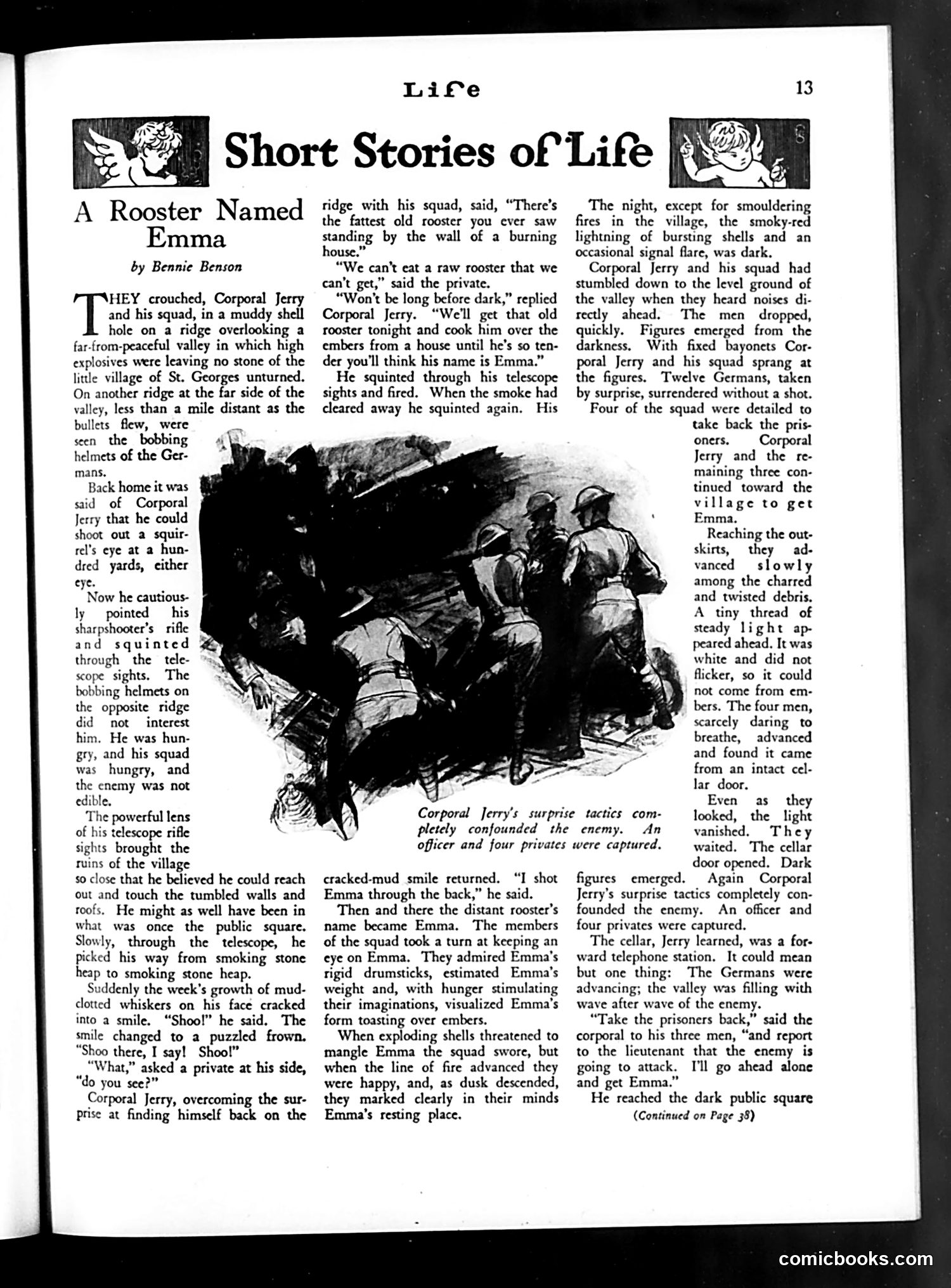
"A Rooster Named Emma" by Bennie Benson This page contains a short story rather than a political cartoon. The illustrated narrative follows Corporal Jerry and his military squad during what appears to be WWI, operating in a war-torn valley near a German-held village. The story's humor derives from a military misunderstanding: soldiers spot a rooster and, through a faulty telescope, mistake it for a German soldier. They nickname it "Emma." After elaborate tactical planning, the squad captures the bird, only to discover their enemy intelligence failure when the rooster's true identity becomes apparent. The satire gently mocks military incompetence and the fog of war—how miscommunication and poor observation create comic chaos among otherwise serious soldiers. It's light wartime humor for the home front.
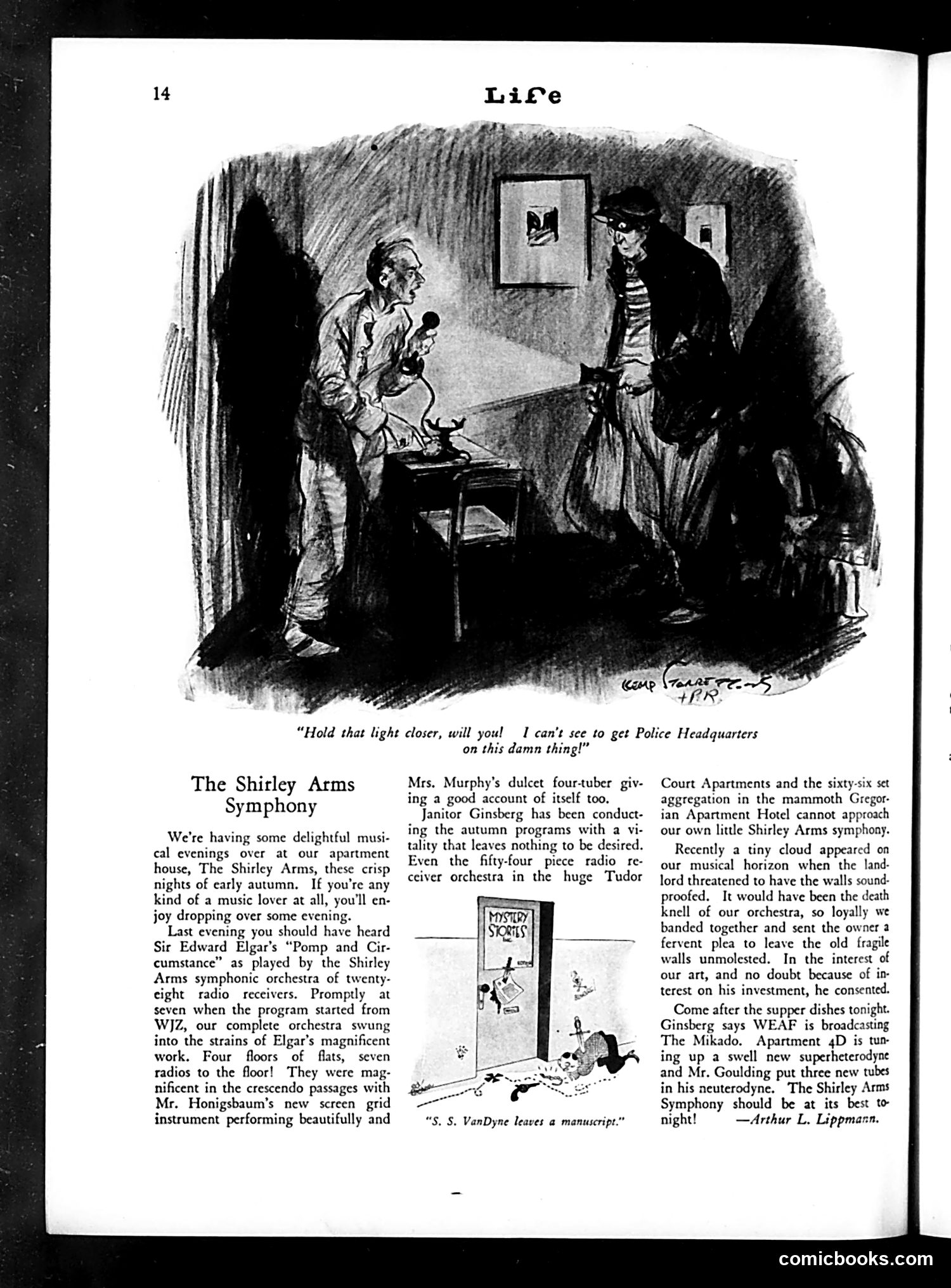
Explanation for Modern Readers The main cartoon depicts a man at a microphone struggling to broadcast to police headquarters while another man urges him to "hold that light closer" so he can see. The joke references the technical difficulties of early radio broadcasting—specifically the unreliable equipment and poor visibility conditions that made live radio transmission challenging in this era. The accompanying article, "The Shirley Arms Symphony," discusses a musical broadcast from a New York apartment building. It satirizes how radio orchestras operated from cramped urban spaces, and how the building's owner initially threatened to evict them over the noise, before eventually consenting for financial reasons. The humor lies in the contrast between high-art ambitions and shabby, improvised broadcasting conditions.
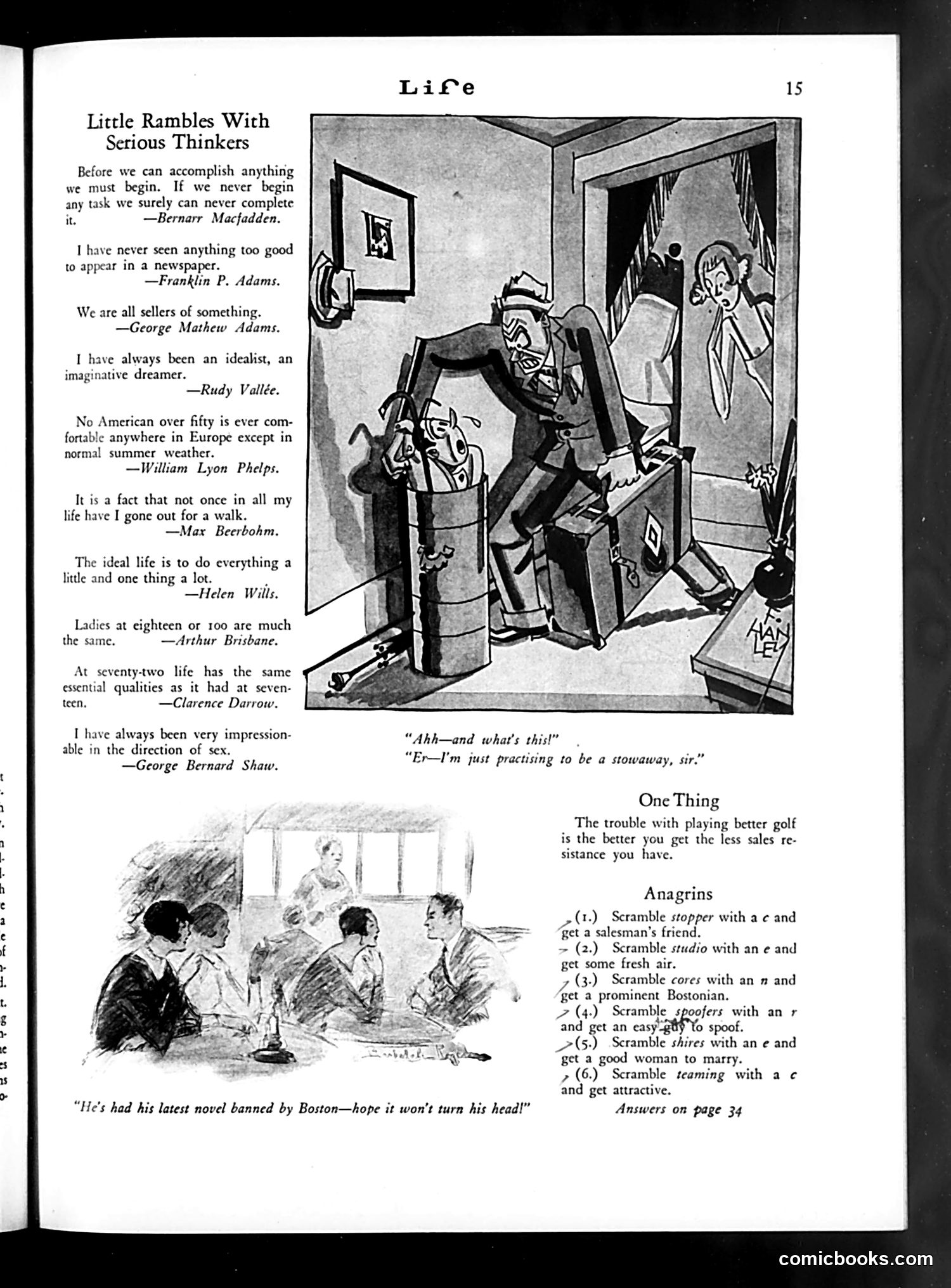
Analysis of Life Magazine Page 15 The page features two cartoon illustrations satirizing early 20th-century social situations. The upper cartoon depicts a man in formal attire encountering what appears to be a stowaway or intruder hiding in a room. The caption reads: "Ahh—and what's this!" / "Er—I'm just practicing to be a stowaway, sir." This jokes about someone literally rehearsing to become a stowaway, treating an absurd concept as legitimate practice. The lower cartoon shows well-dressed men in what appears to be a club or social setting, with the caption: "He's had his latest novel banned by Boston—hope it won't turn his head!" This satirizes the prestige and notoriety that Boston book-banning could grant an author, suggesting censorship paradoxically enhanced literary reputation. Both cartoons mock contemporary social attitudes and pretensions of the era.
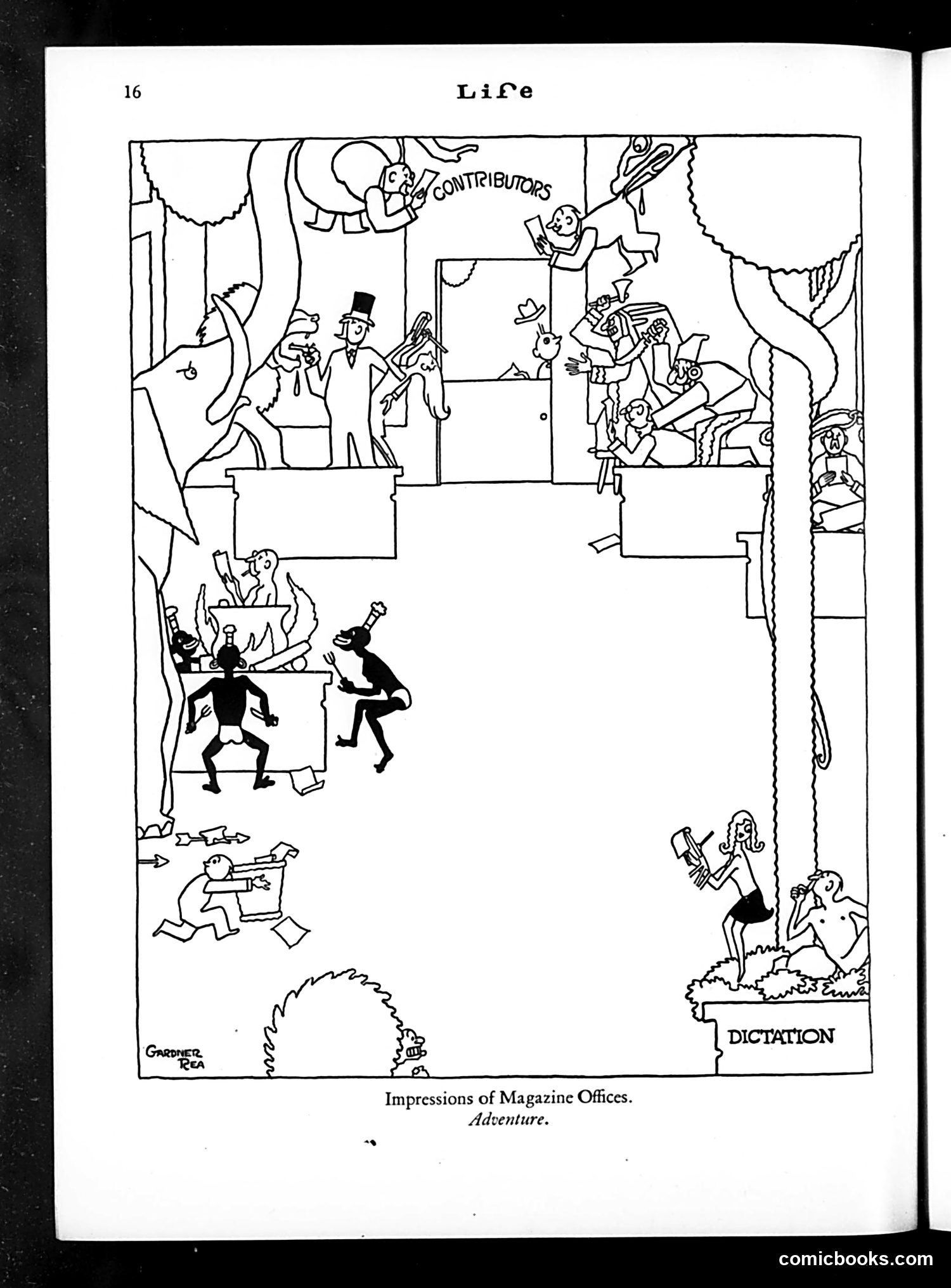
Analysis This is a satirical illustration titled "Impressions of Magazine Offices: Adventure" by Gardner Rea, depicting the chaotic interior of a magazine publishing office as a fantastical, multi-level structure. The cartoon shows various office activities rendered absurdly: people labeled "CONTRIBUTORS" occupy upper levels; a section labeled "DICTATION" appears in the lower right; figures are shown managing what appears to be manuscripts and paperwork in frenzied activity. The crowded, vertical layout satirizes the frenetic energy and hierarchical chaos of magazine production. The central empty space emphasizes how much effort goes into publishing with minimal actual accomplishment. The cartoon mocks the pretensions and disorder of magazine offices—portraying them as absurdly complicated enterprises where numerous people labor intensely on inherently mundane work. The satirical tone suggests the magazine industry, despite its apparent sophistication, is fundamentally ridiculous.
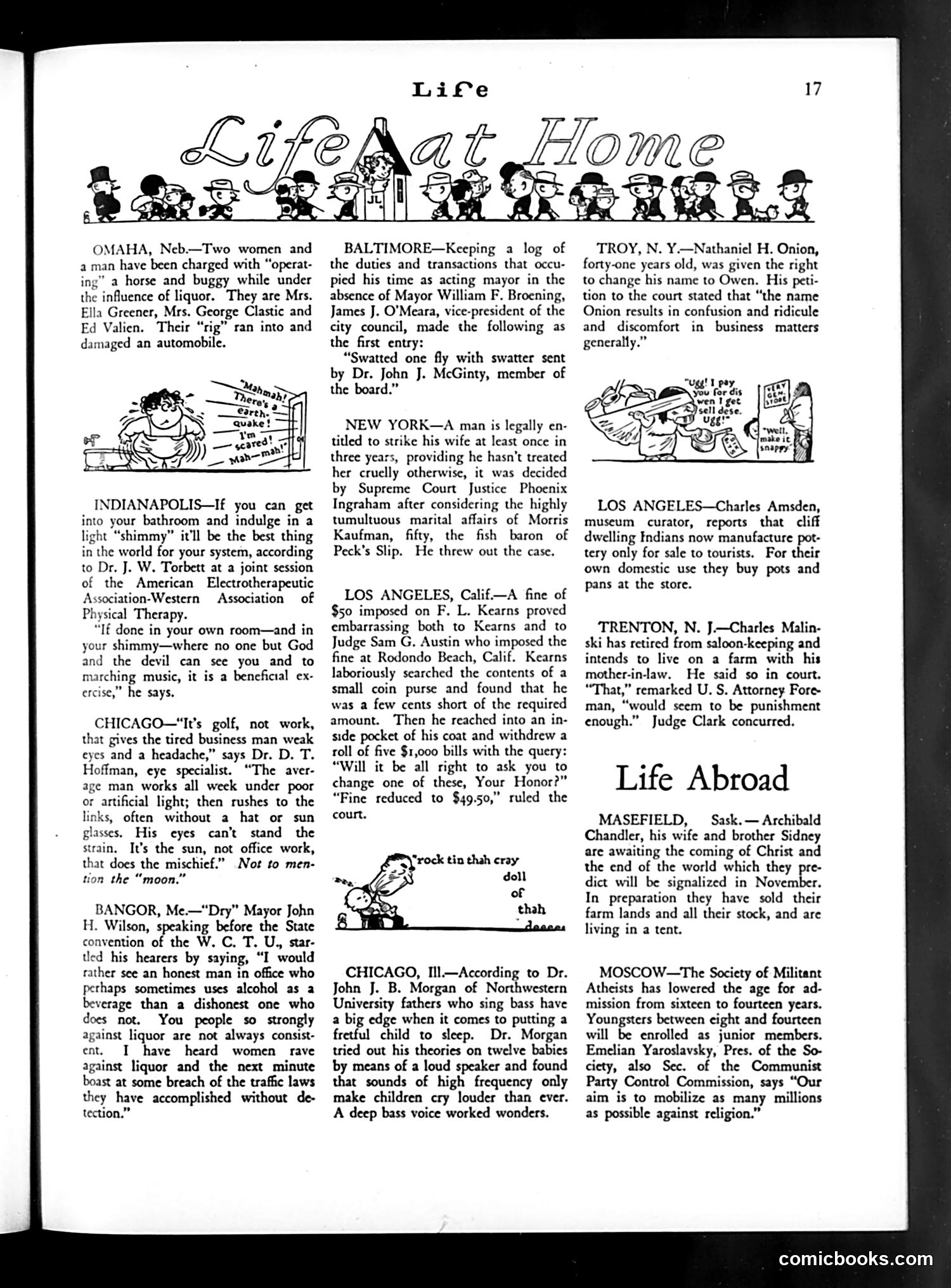
Life Magazine Page 17 Analysis This page contains brief humorous anecdotes under "Life at Home" and "Life Abroad" sections, typical of Life magazine's satirical format. The notable cartoon depicts a figure (labeled "rock tie thah cry doll of shah") appearing to represent a Middle Eastern or Asian ruler, shown in an exaggerated caricatured style. The accompanying text references Chicago physician Dr. John J. B. Morgan's theories about using low-frequency sounds to calm infants. The "Life at Home" section includes jokes about American social issues: a Baltimore mayor's log entry, a New York legal ruling about spousal rights, and commentary on business life. The "Life Abroad" section mentions religious apocalypticism in Saskatchewan and Soviet anti-religious campaigns. The humor relies on period stereotypes and references to contemporary social concerns now obscure without historical context.
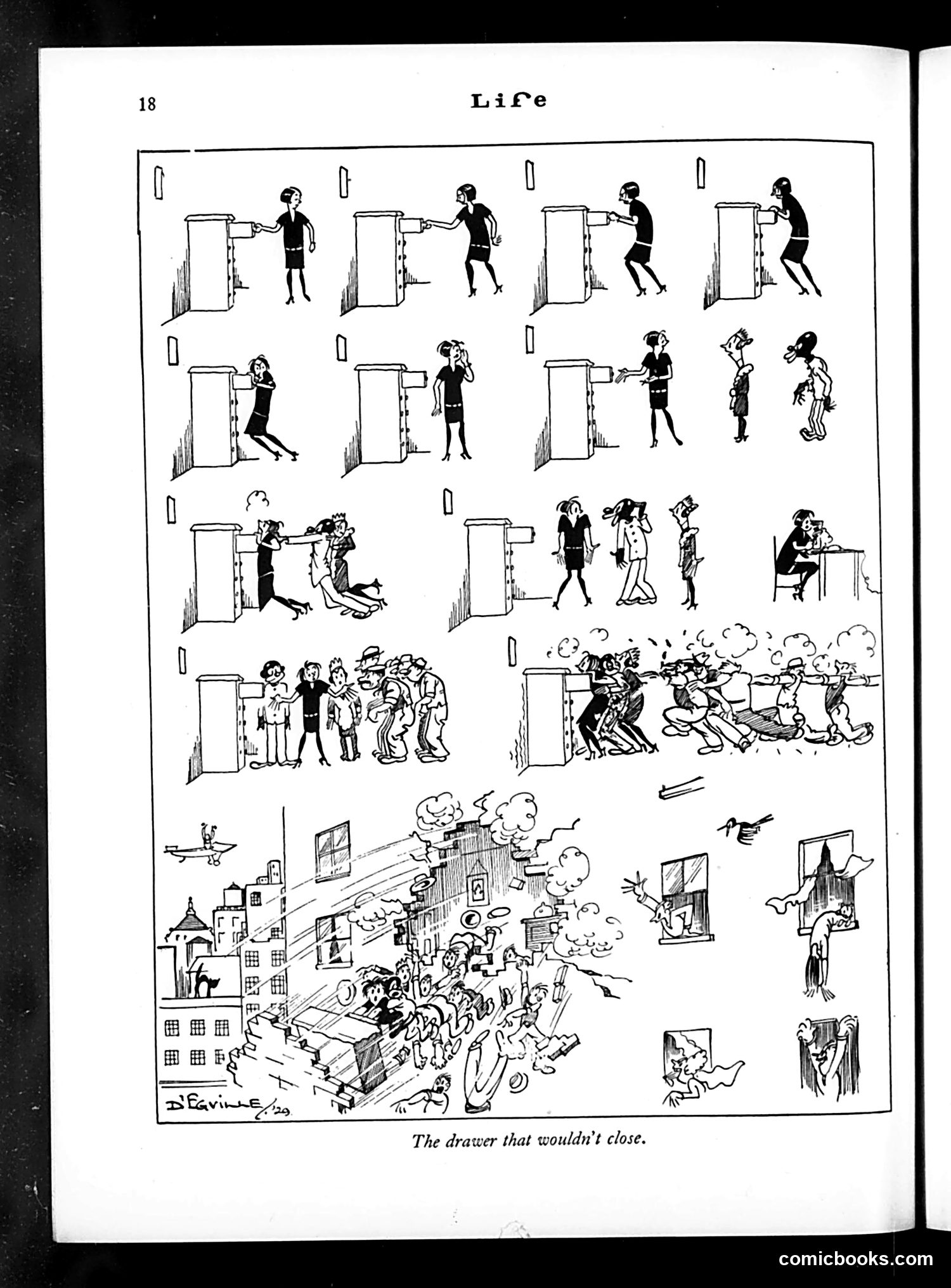
"The Drawer That Wouldn't Close" This cartoon satirizes urban overcrowding and housing crisis. The sequential panels (top) show a single person struggling with a stuck drawer, each panel revealing progressively more people crammed inside it. By the final panel, the drawer bursts open to release a chaotic flood of humanity onto city streets below. The satire critiques how cities pack ever-increasing populations into finite space—what should accommodate one person becomes stuffed with dozens. The "drawer" metaphor suggests people are treated as objects to be stored rather than humans needing adequate living conditions. The bottom cityscape shows the resulting urban chaos: overcrowded streets, congestion, and social disorder spilling from buildings. The cartoon warns of unsustainable population density and its inevitable breakdown of civic order.
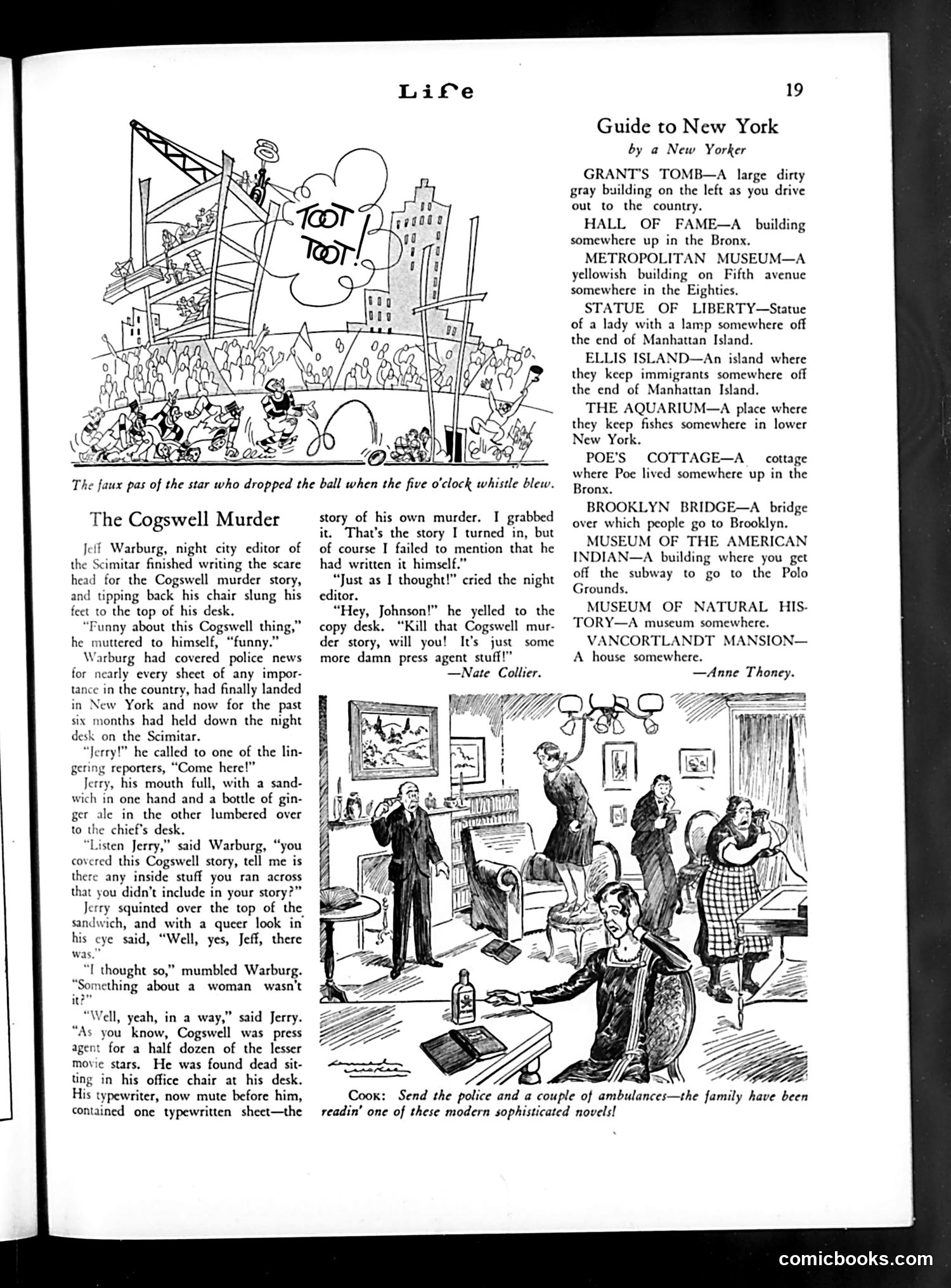
"The Cogswell Murder" - Satirizing Press Sensationalism This story satirizes yellow journalism and the newspaper industry's hunger for scandal. Jeff Warburg, a night editor at the *Scimitar*, pursues what seems like an exclusive murder story: Cogswell, a movie press agent, found dead with a typewritten confession in his typewriter. The satire's punch: when reporter Jerry admits Cogswell actually *wrote his own murder confession himself*, Warburg immediately kills the story as "damn press agent stuff"—dismissing it as a manufactured publicity stunt. The joke exposes how newspapers treated press agents' stories with cynical suspicion, viewing entertainment industry sources as inherently unreliable fabricators seeking attention. The cartoon below depicting a chaotic household scene appears unrelated to this story's commentary on media credibility and the blurred line between real news and press-agent manipulation in 1920s journalism.
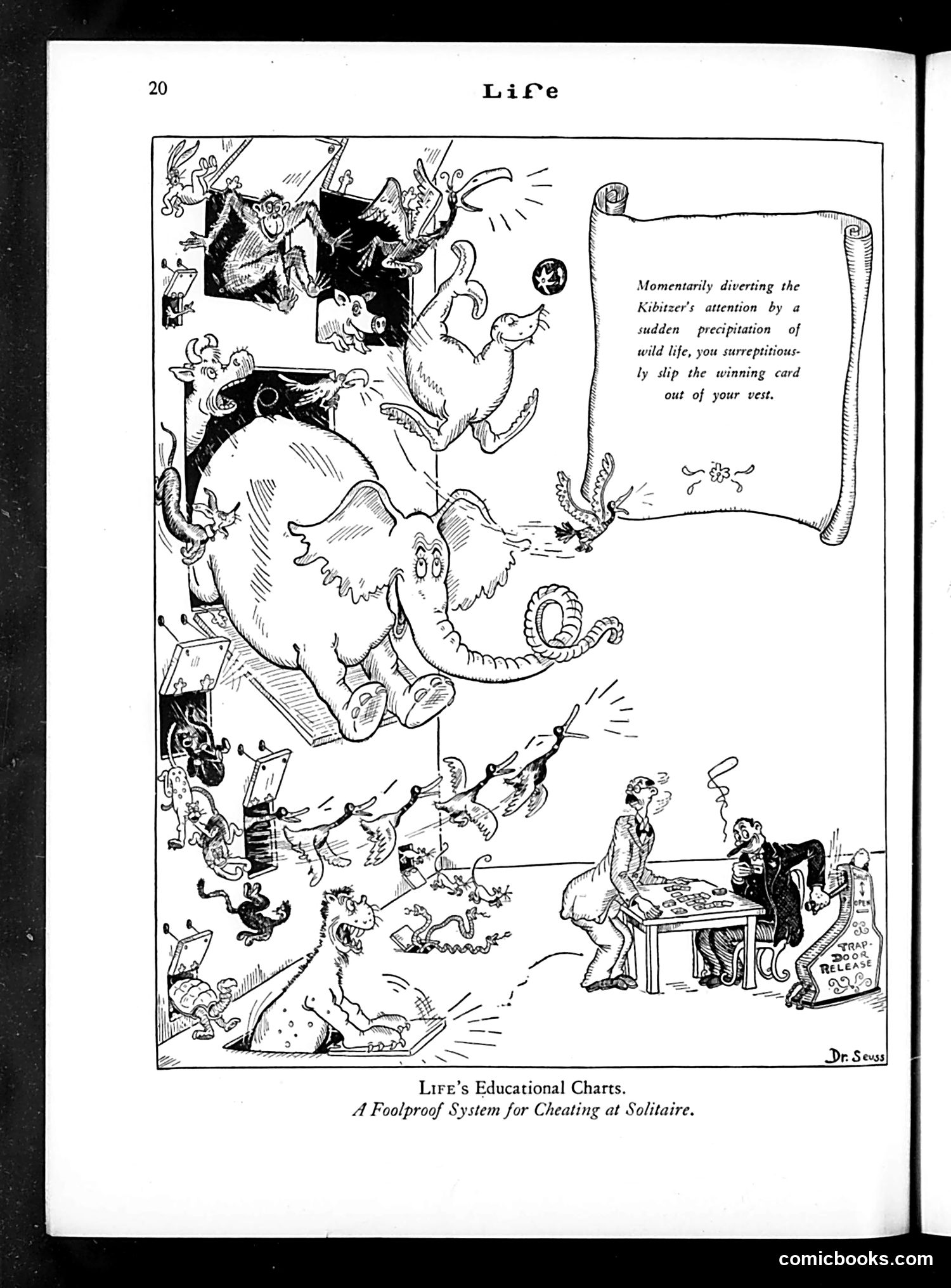
This Dr. Seuss cartoon from *Life* magazine satirizes cheating at solitaire through absurdist humor. The illustration depicts an elaborate, chaotic scheme where a player distracts an observer (the "kibitzer"—someone watching the card game) by releasing wild animals and creating mayhem, allowing them to secretly slip a winning card from their vest into the game. The joke mocks both the ridiculous lengths someone might go to cheat at a solitary card game and the foolishness of the cheater themselves. The title "A Foolproof System for Cheating at Solitaire" is ironic—the scheme is anything but foolproof, and cheating at a game played alone is inherently absurd. Seuss's signature whimsical creatures and exaggerated cartoon style emphasize the joke's nonsensical humor.
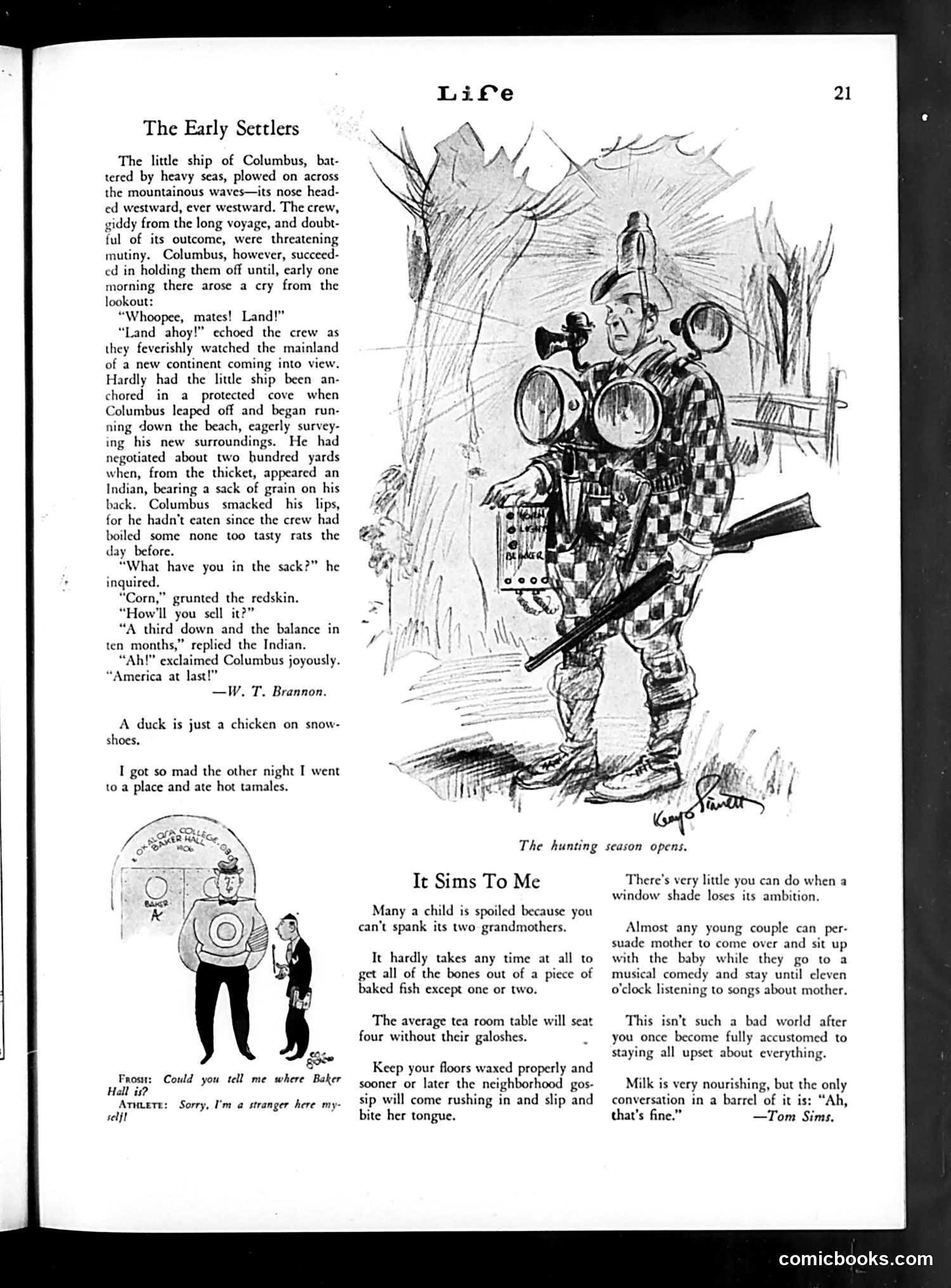
Page Analysis: Life Magazine, Page 21 This page contains three distinct humor pieces typical of early 20th-century Life magazine: "The Early Settlers" (top left): A comedic retelling of Columbus's arrival in America. The joke culminates when Columbus encounters a Native American selling corn on credit ("a third down and the balance in ten months"), prompting Columbus's exclamation "America at last!"—satirizing American capitalism and credit-based commerce as the true discovery, not the land itself. The cartoon (center-right): Shows a hunter laden with hunting equipment and game, captioned "The hunting season opens." This appears to be straightforward seasonal humor. "It Sims To Me" (bottom): A column of brief, observational one-liners about domestic life—spoiled children, fish bones, tea rooms, gossip, window shades, mothers, and milk. These are gentle social satire about everyday annoyances and human nature, typical of period humor columns. The page uses period stereotypes (the "redskin" Indian) and reflects early 20th-century attitudes while poking fun at American consumer culture and domestic life.
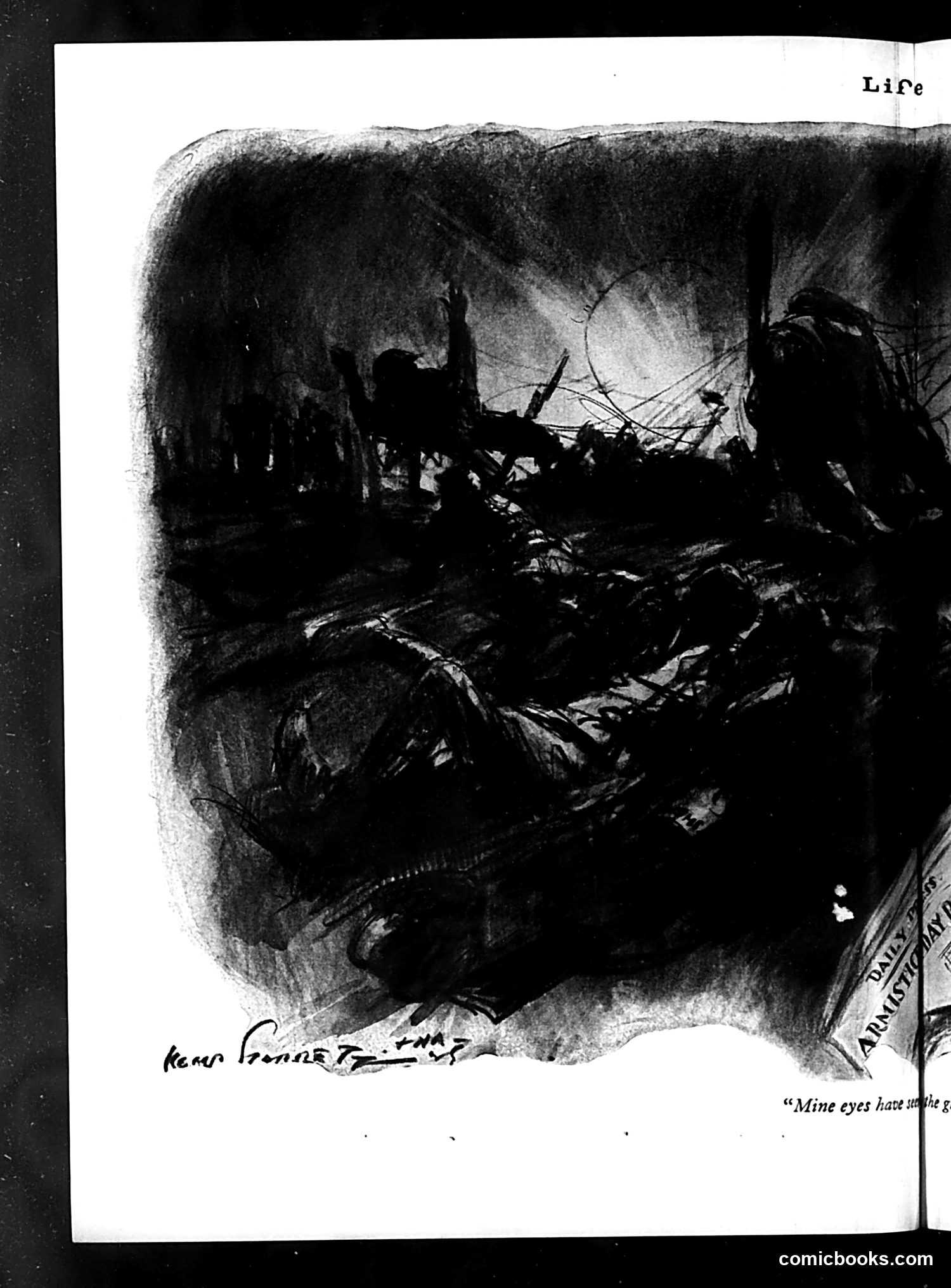
Analysis This appears to be a dramatic illustration from *Life* magazine showing a dark, shadowy scene with multiple figures in what seems to be an underground or cave-like setting. The composition is heavily rendered in black, creating a gothic or ominous atmosphere. The visible caption reads: "Mine eyes have..." (text cuts off), suggesting this illustrates a literary or theatrical quotation, possibly from a classic work. The artist's signature appears to read "Henri Pêne du Bois" or similar. Without the complete caption or surrounding article text, the specific satirical or political point remains unclear. The illustration's style and dramatic tone suggest it may reference a serious social commentary or adapt a famous literary scene, but the exact meaning—which figures are caricatured and what they represent—cannot be reliably determined from the image alone.
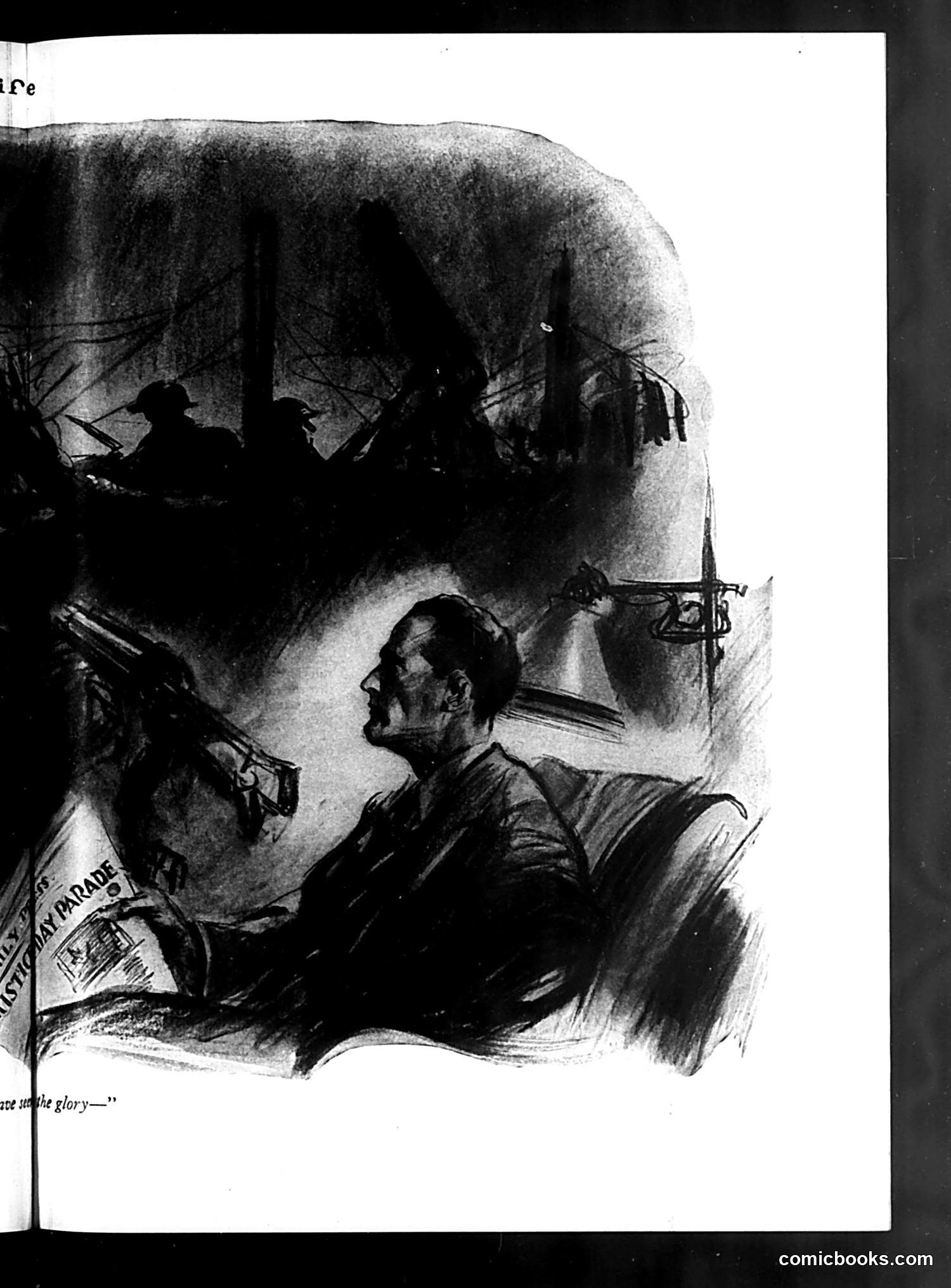
Analysis This appears to be a political cartoon from Life magazine's satirical section. The image shows a man in profile on the right, wearing what appears to be a military or official uniform with a visible patch or insignia. He gazes upward toward a shadowy, cloud-like formation above containing silhouetted figures with weapons or military equipment. The cartoon likely critiques military ambition, jingoism, or warmongering—suggesting a leader fantasizing about military glory or conquest. The contrast between the clear, detailed figure below and the murky, indistinct military scene above creates an ironic commentary on the gap between romantic idealization of war and its reality. However, without visible text identifying the specific figure or historical moment, I cannot definitively state which political leader or event this references.
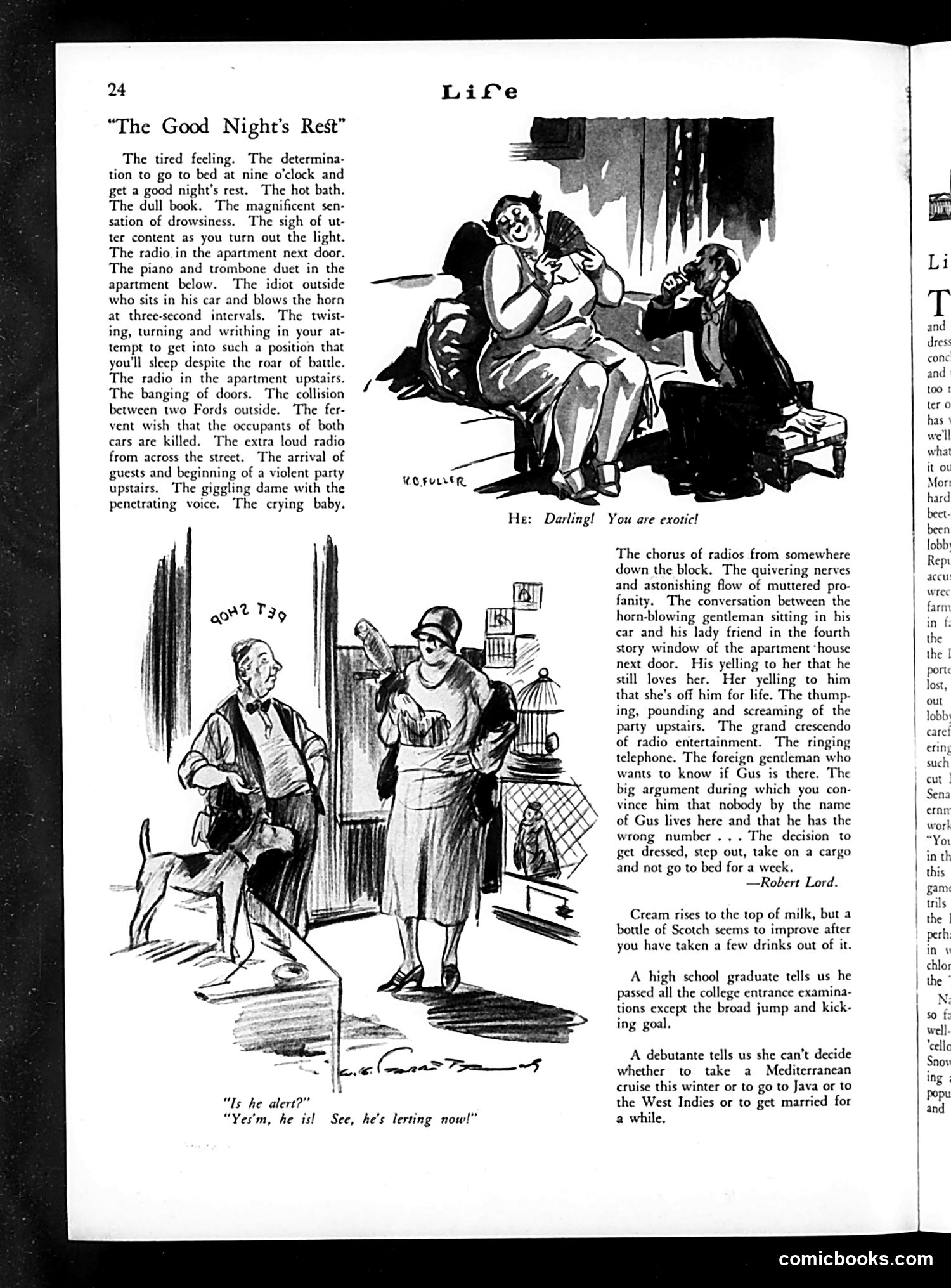
"The Good Night's Rest" - Life Magazine Satire This humorous piece satirizes the modern urban apartment dweller's impossible quest for sleep. The text catalogs a relentless cascade of nighttime disturbances: neighboring radios, piano-trombone duets, car horns, street fights, loud parties, crying babies, and ringing phones—all conspiring to prevent rest. The accompanying cartoons illustrate the chaos: one shows a couple attempting intimacy amid the noise ("You are exotic!"), while another depicts frustrated neighbors dealing with a drunken street musician. The satire targets early 20th-century urban congestion and noise pollution—a modern problem for contemporary readers dealing with crowded apartment living. The exaggerated catalog of interruptions builds comedic frustration, culminating in the protagonist abandoning sleep entirely to get drunk instead. The piece mocks both the impossibility of peaceful urban rest and the resigned, humorous acceptance of modern city life's chaos.
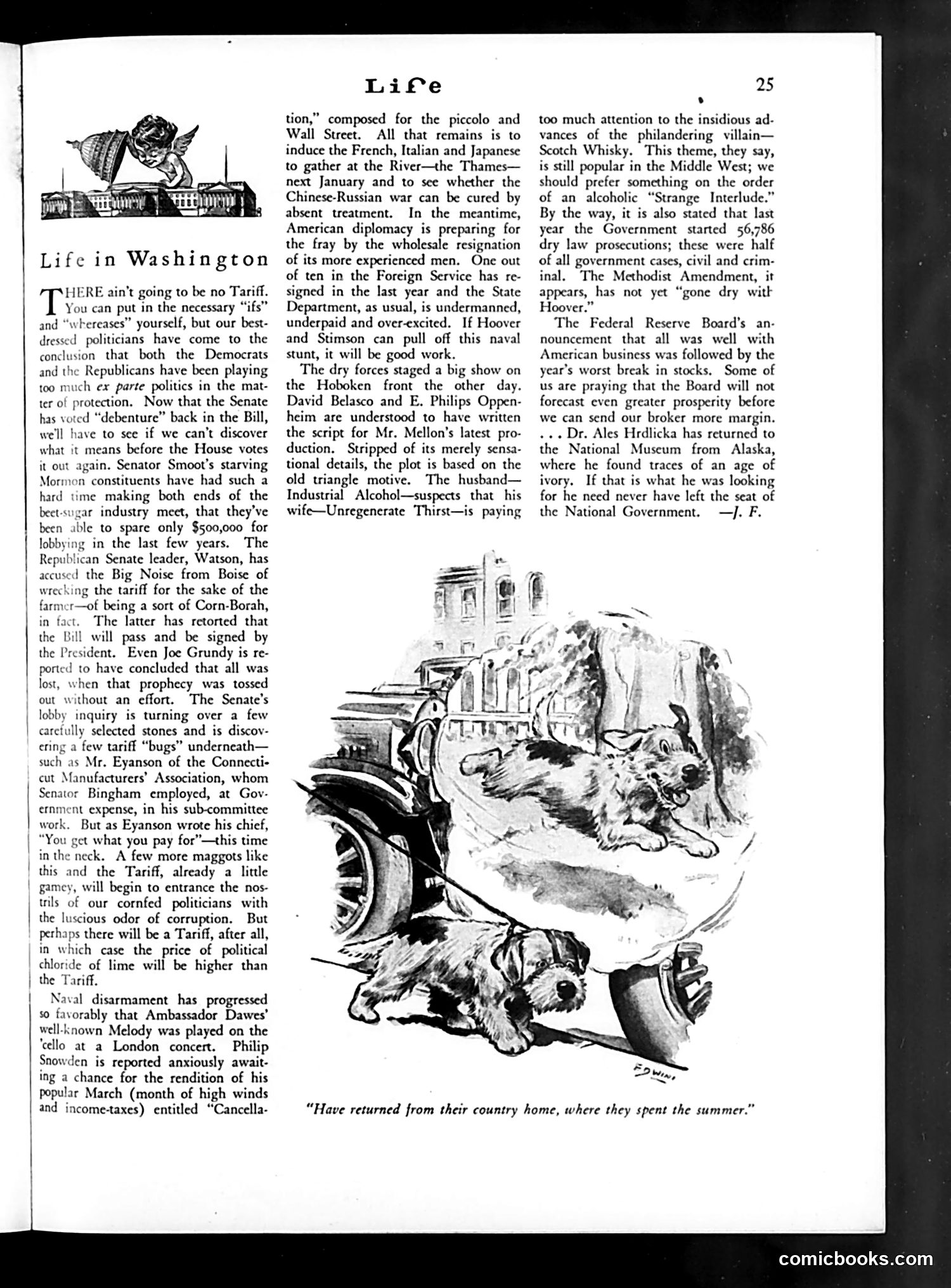
Life Magazine Satire Analysis This page from *Life* magazine contains political commentary on 1920s Washington, mocking legislative ineffectiveness and corruption. Main satirical column "Life in Washington" attacks tariff bill negotiations, naming Senator Smoot (whose Mormon constituents lobby heavily), Senator Watson, and others. It suggests the process is corrupt—lobbyists like "Eyanson of the Connecticut Manufacturers' Association" are being exposed. The metaphor of tariff as "gamey" and producing a "luscious odor of corruption" suggests politicians are complicit in bribery. The piece also mocks Prohibition's failure and Hoover's administration. It sarcastically compares Prohibition enforcement to theatrical productions, with industrial alcohol as a jealous husband, "Unregenerate Thirst" as his unfaithful wife, and Scotch Whisky as the rival—an obvious commentary that Americans continue drinking illegally despite Prohibition. The cartoon (caption: "Have returned from their country home, where they spent the summer") depicts dogs returning home, likely satirizing Washington politicians returning after summer recess. The overall thrust: Washington is corrupt, Prohibition is failing, and politicians are theatrical phonies.
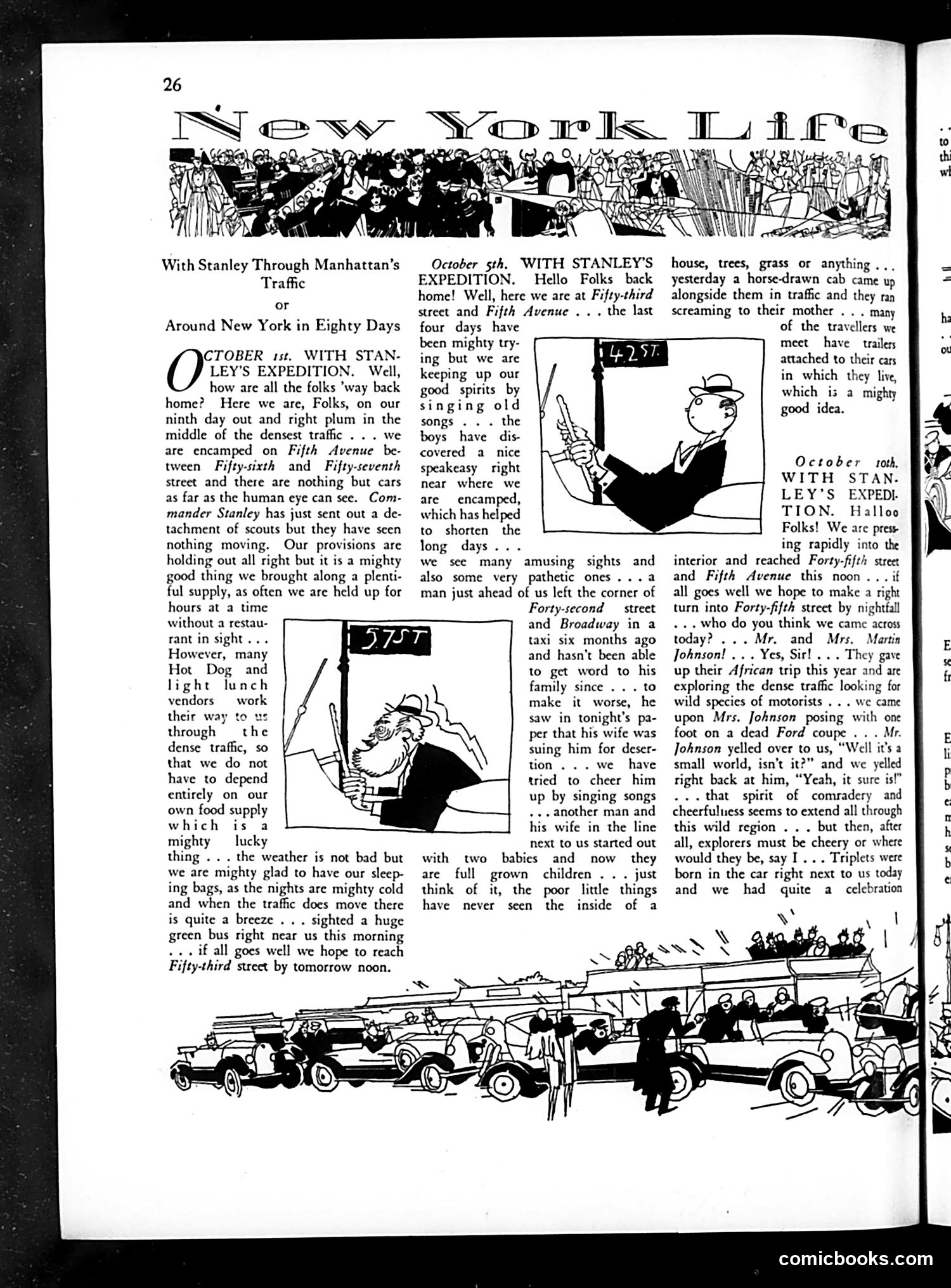
Life Magazine Satire: "Stanley Through Manhattan's Traffic" This satirical article uses a clever conceit: treating Manhattan's traffic congestion as an African expedition, mimicking explorer Henry Morton Stanley's famous journeys. The narrator, "Commander Stanley," leads an expedition that takes nine days to traverse several Manhattan blocks on Fifth Avenue. The satire mocks 1920s New York City's severe traffic problems by treating gridlocked streets as unexplored wilderness requiring supplies, scouts, and sleeping bags. The humor escalates through absurd anecdotes: a man stuck in traffic for six months whose wife sued him for desertion; a couple whose children were born and grew to adulthood in their car without ever seeing a house. The piece also references contemporary figures—the Johnsons (likely explorers Martin and Osa Johnson, known for African expeditions)—encountered in traffic, reinforcing the expedition metaphor. The overall message critiques how automobile congestion had become so severe that crossing Manhattan felt like a genuine expedition requiring the same preparation and endurance as African exploration.
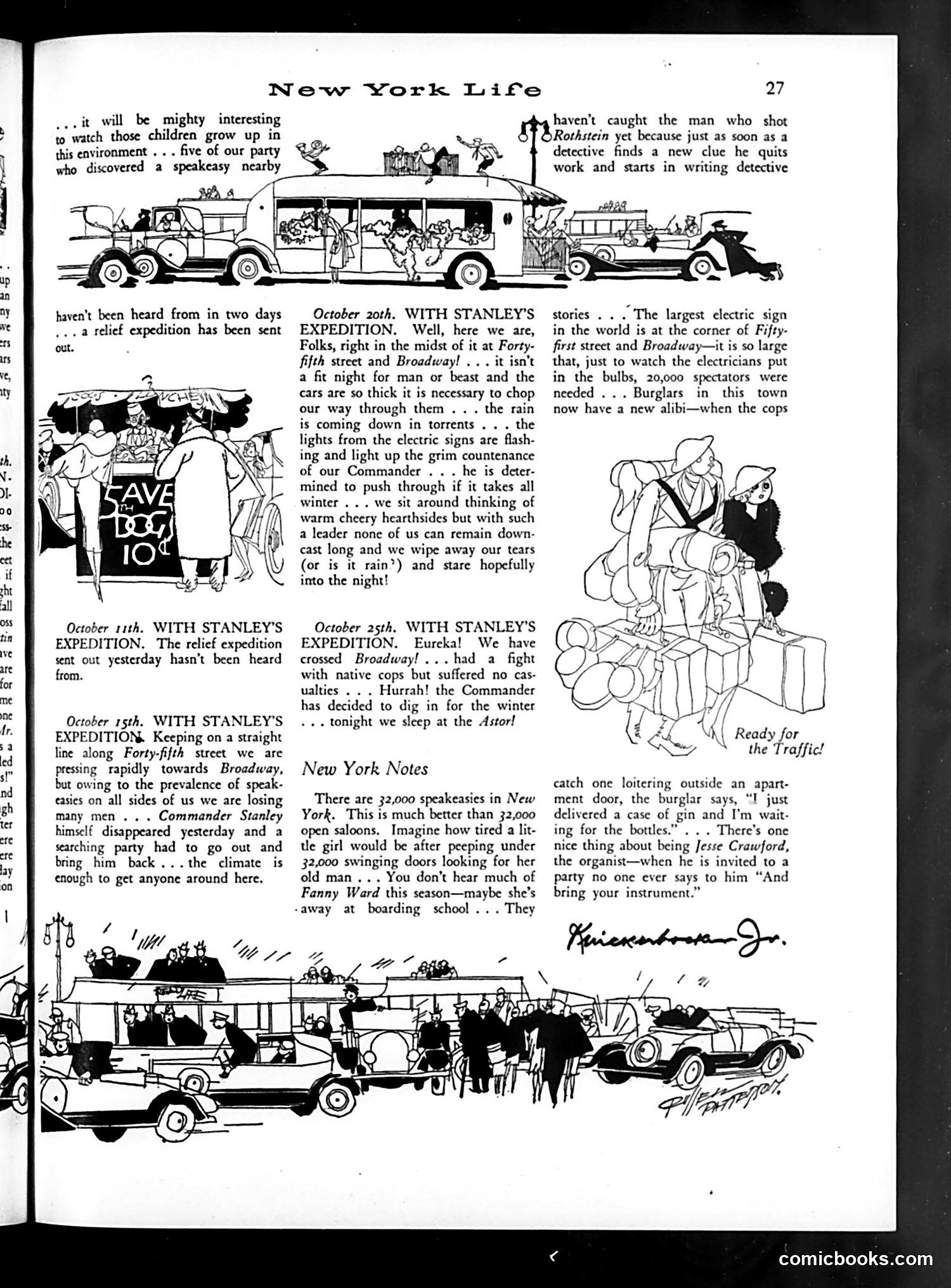
Explanation for Modern Readers This page satirizes Prohibition-era New York City through a mock-expedition narrative. The "Stanley's Expedition" framing parodies famous exploration accounts (likely referencing Henry Morton Stanley's African explorations), treating the journey from Forty-fifth Street to Broadway as a dangerous trek through hostile terrain. The satire targets speakeasies—illegal bars flourishing during Prohibition (1920-1933). The joke: explorers keep disappearing into speakeasies, losing party members to drinking rather than actual hazards. Crossing Broadway becomes an epic achievement requiring "fighting native cops," treating ordinary urban navigation as a heroic conquest. The accompanying "New York Notes" adds biting commentary: 32,000 speakeasies operate openly despite illegality; a murdered gambler (Rothstein) remains uncaught because detectives quit investigations to write detective fiction; and burglars use gin-delivery as an alibi—all highlighting Prohibition's absurd failure and widespread lawlessness. The cartoons mock both the era's rampant drinking culture and the government's inability to enforce the law.
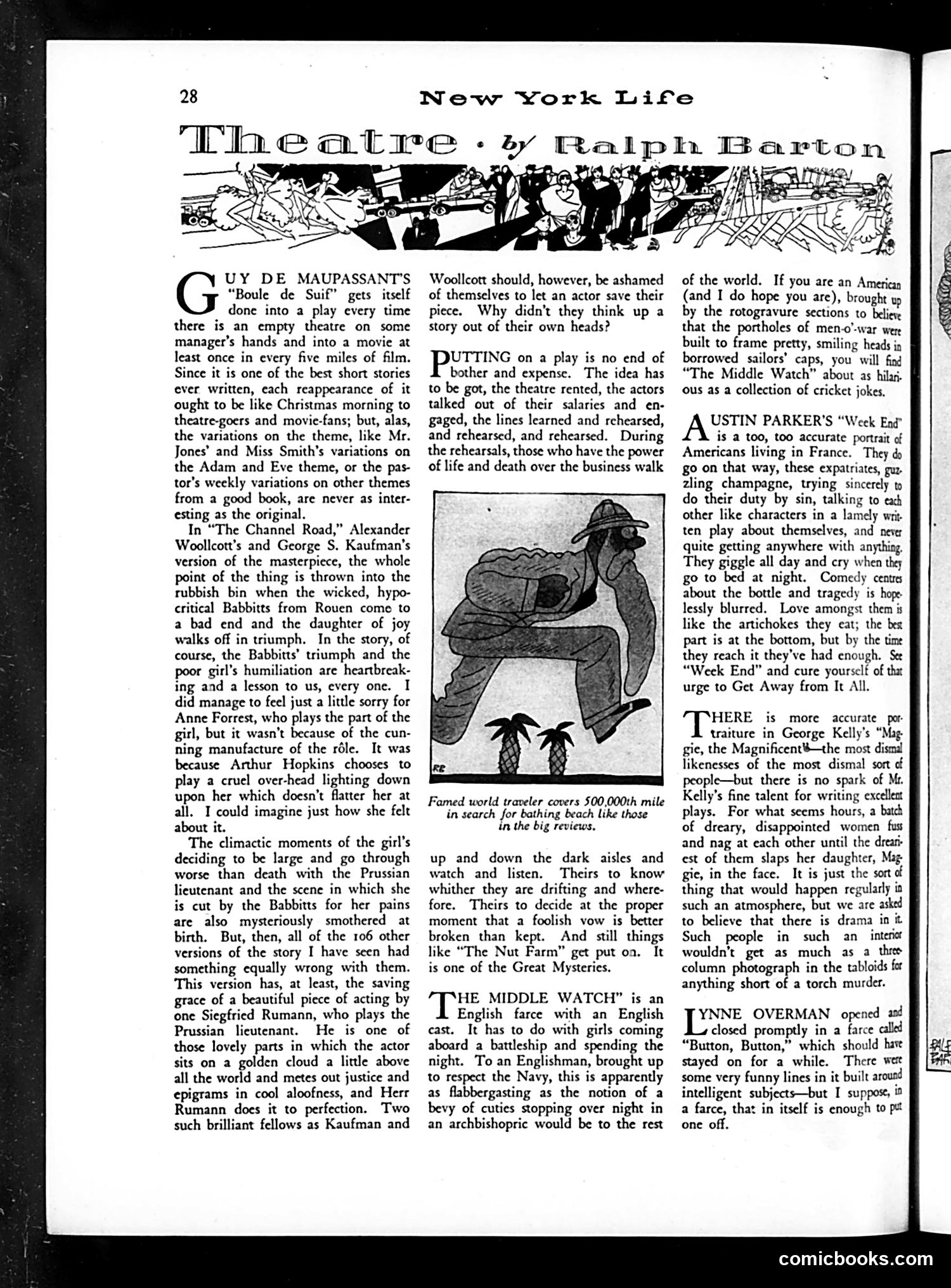
Theatre Review Page Analysis This page from *Life* magazine contains theatre reviews by Ralph Barton critiquing contemporary Broadway productions. The central illustration depicts a "famed world traveler" searching for an ideal bathing beach—a visual joke accompanying reviews of plays with frivolous or escapist premises. Key critiques include: "The Channel Road": Barton faults playwrights Kaufman and Woollcott for botching Guy de Maupassant's "Boule de Suif" by reversing the story's moral—having the prostitute triumph instead of suffer humiliation. He praises Siegfried Rumann's performance but questions why accomplished writers waste effort adapting literature rather than creating original work. "The Middle Watch": A British farce about girls boarding a battleship. Barton suggests English audiences find this scandalous, while Americans (conditioned by rotogravure photographs of sailors) would find it predictable and unfunny. The reviews reflect early 20th-century theatrical snobbery—dismissing commercial entertainment while acknowledging skilled performers occasionally redeem weak material.
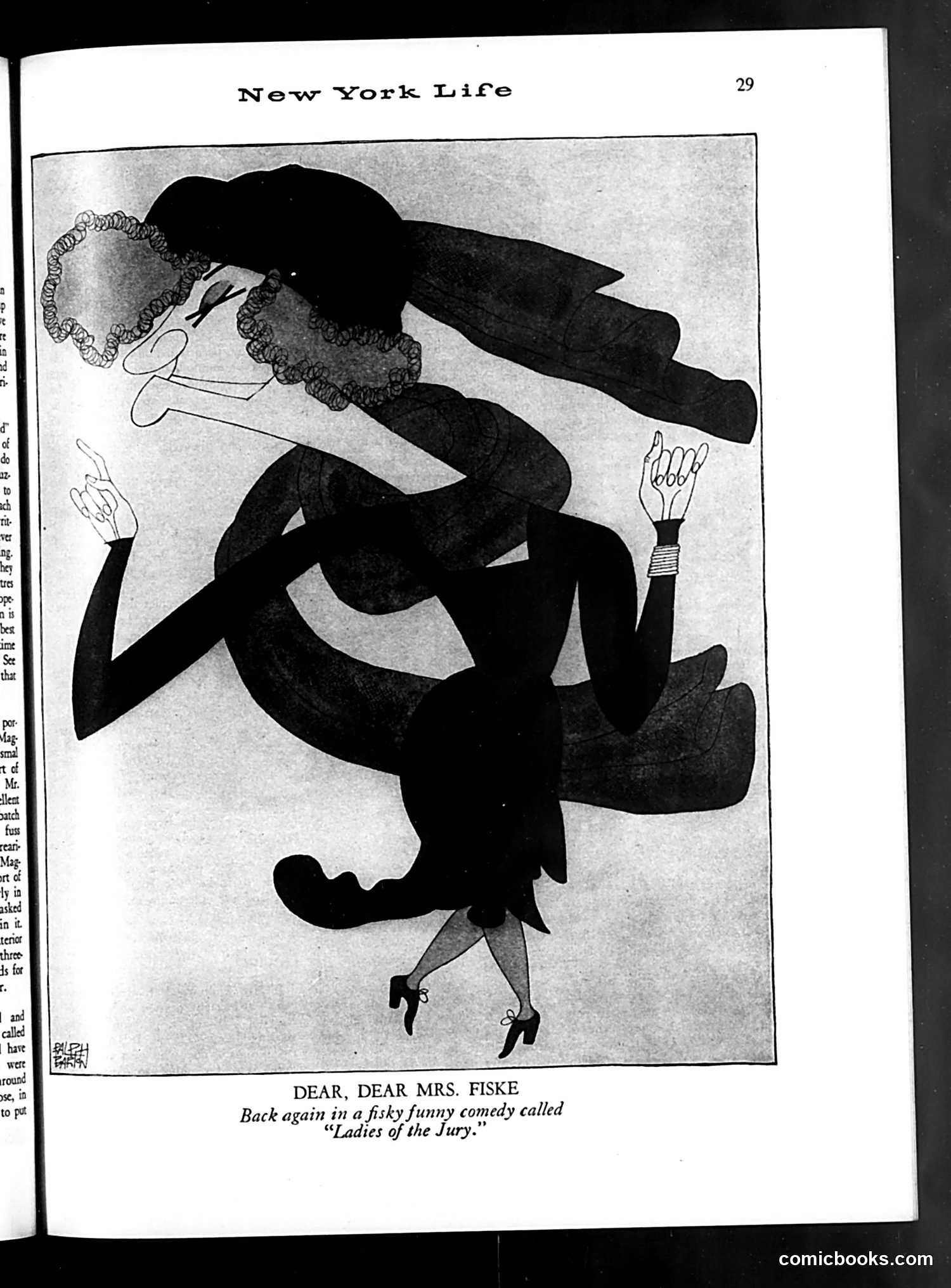
Explanation for Modern Readers This is a satirical illustration from *Life* magazine mocking Mrs. Fiske, a prominent stage actress of the early 20th century. The cartoon depicts her in an exaggerated, comedic pose—contorted with theatrical flair, wearing a black dress and hat with curled hair—appearing in the play *"Ladies of the Jury."* The humor relies on wordplay: "fisky funny comedy" puns on her surname "Fiske." The silhouette style and dramatic posturing mock both the theatrical melodrama of her performance and perhaps her reputation as an actress. The caption's "Dear, dear" tone suggests wry affection or gentle ridicule of her continuing stage presence and comedic roles during this period.
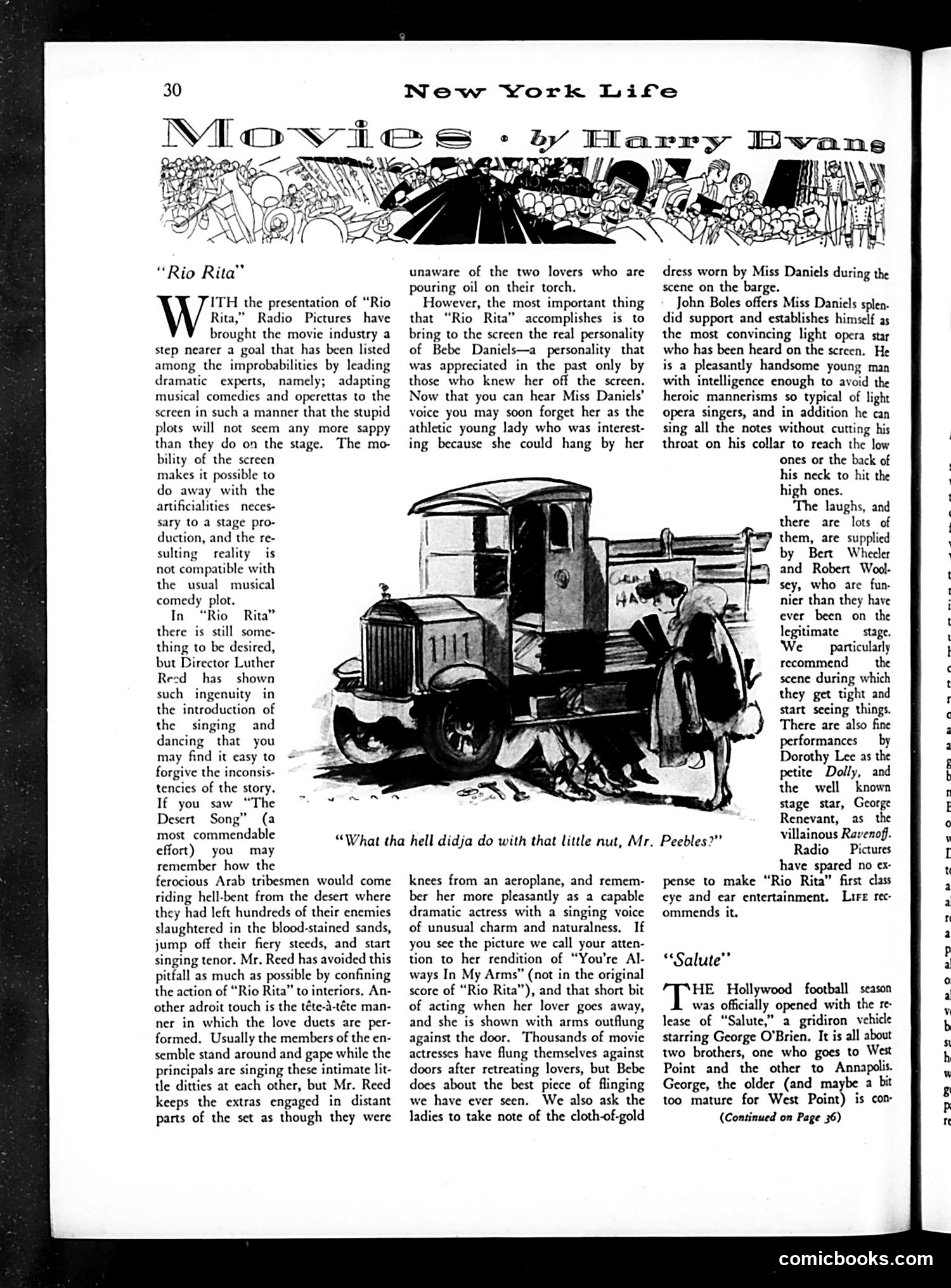
Movie Review: "Rio Rita" This is a film review by Harry Evans of the Radio Pictures musical comedy "Rio Rita," not political satire. The page discusses how the film successfully adapts stage operetta to screen by avoiding theatrical artificiality. The cartoon caption "What tha hell didja do with that little nut, Mr. Peebles?" illustrates a comedic scene from the film involving two characters and a vehicle, likely demonstrating the humor Evans praises. Evans praises star Bebe Daniels for bringing personality beyond her previous reputation as a stunt performer (he notes she "could hang by her knees from an aeroplane"). He highlights co-star John Boles as a convincing light opera performer and particularly recommends comic performers Bert Wheeler and Robert Woolsey, plus supporting cast members Dorothy Lee and George Renevant. The review's main point: the film succeeds by grounding musical numbers in realistic interior settings rather than absurd scenarios (he references "The Desert Song" where Arabs inexplicably burst into song after battle).
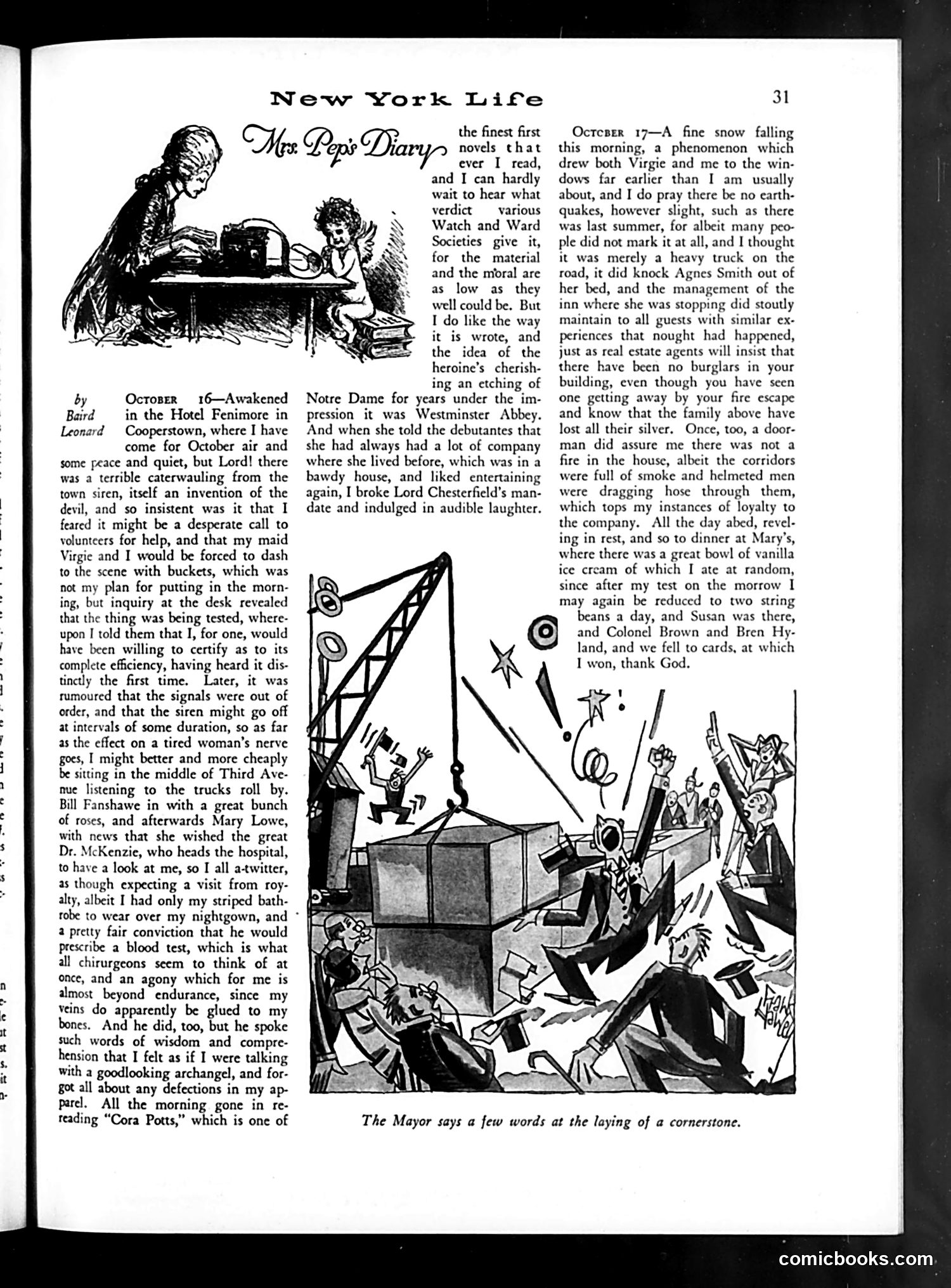
Mrs. Pep's Diary: A Society Woman's October Observations This is a humorous diary column featuring a wealthy, gossipy society woman's complaints about everyday annoyances in upstate New York. The satire targets upper-class affectation and overwrought sensibilities. The main cartoon depicts the laying of a cornerstone—likely for a public building—with civic officials and crowds present. The diarist's commentary mocks both trivial personal inconveniences (a town siren test, blood tests) and societal hypocrisies (real estate agents denying burglaries; hotel managers denying fires). She also critiques the "Watch and Ward Societies"—actual reform groups that policed morality and banned "indecent" literature. The irony: she praises the novel "Cora Potts" (apparently about a brothel) for its writing quality, despite its scandalous subject matter, implying such moral crusades are pretentious. The humor derives from her self-important tone contrasted with genuinely minor grievances, and her casual acceptance of societal deceptions by those "in service" to the wealthy.
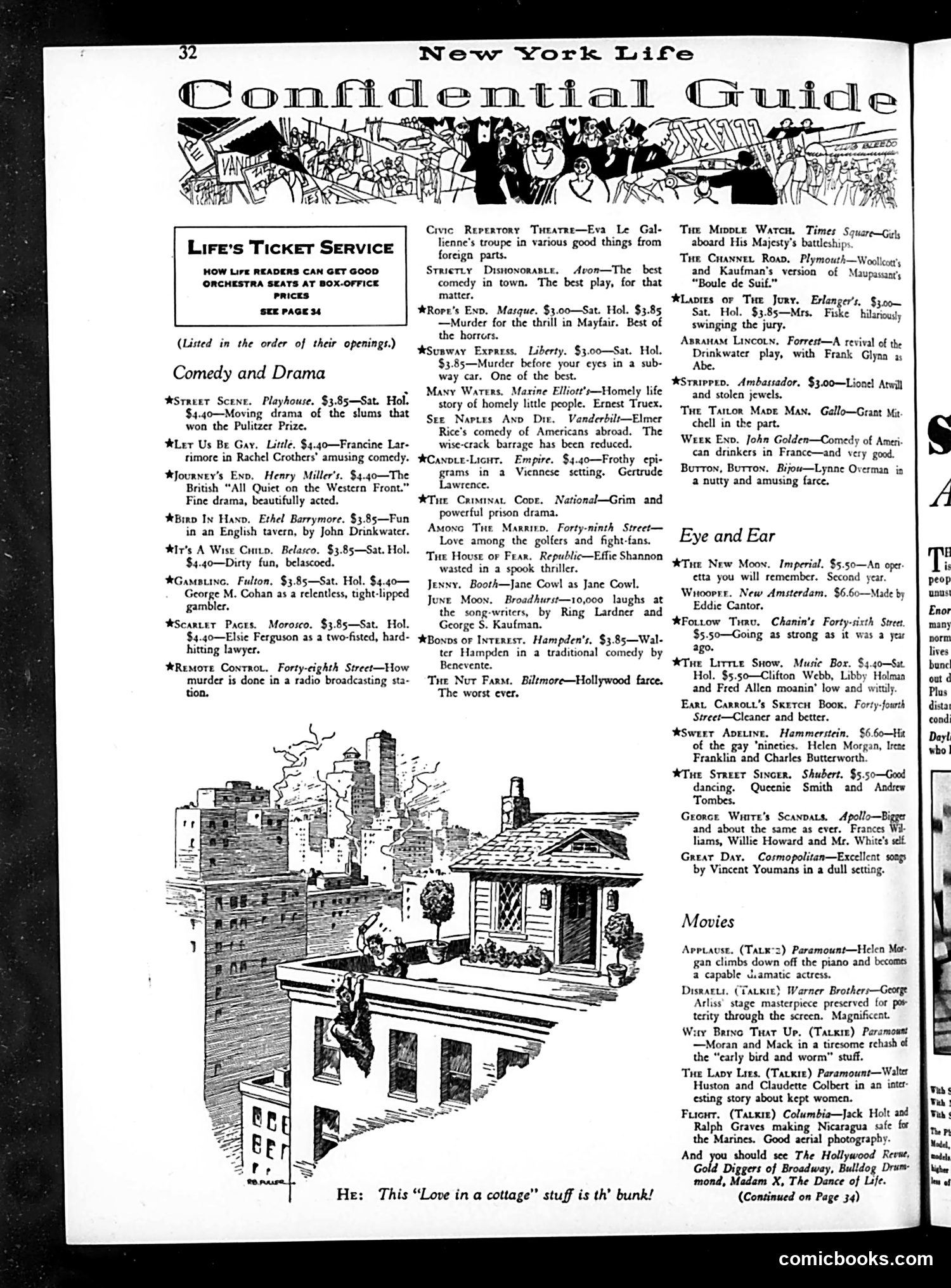
Confidential Guide Page Analysis This is a theater listing and review page from Life magazine's entertainment section—not a political cartoon. The page catalogs Broadway shows with brief critical summaries and ticket prices. The single cartoon at the bottom shows a man looking at a cottage, captioned "This 'Love in a cottage' stuff is th' bunk!"—a joke about the romantic ideal of simple living. It's likely referencing a theatrical production or common cultural sentiment about domesticity. The bulk of the page documents 1920s Broadway offerings: comedies, dramas, musicals, and movies. Notable entries include *All Quiet on the Western Front* (Pulitzer Prize winner), shows starring established performers like Elsie Ferguson and Jane Cowl, and operettas. The format—listings "in order of their openings"—served as a practical entertainment guide for readers seeking theater recommendations and box-office information.
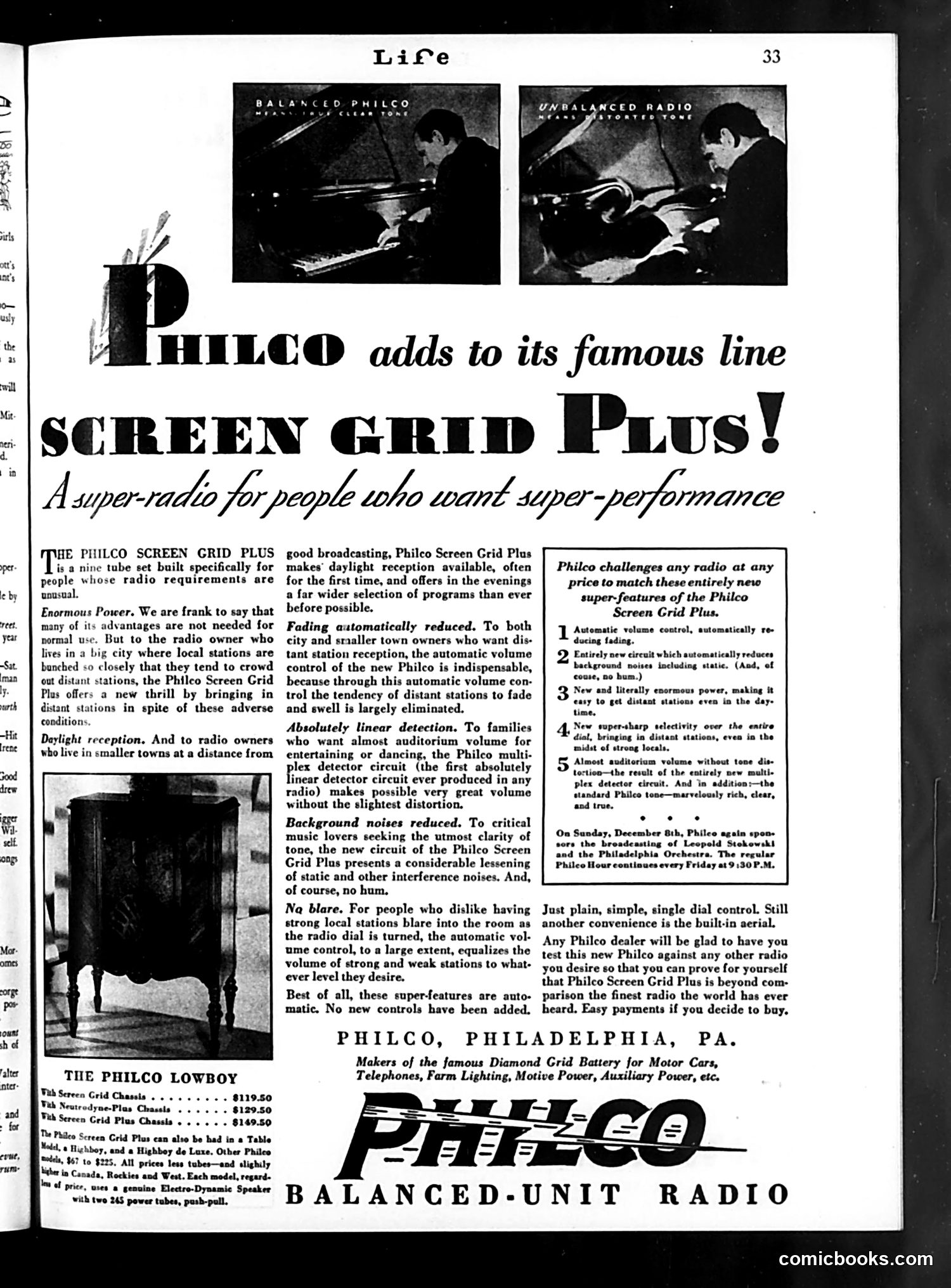
PHILCO SCREEN GRID PLUS ADVERTISEMENT This is a radio advertisement, not political satire. The page promotes Philco's new "Screen Grid Plus" radio receiver, marketed as a nine-tube set offering superior performance for various listening conditions. The two photographs at top compare "Balanced Philco" versus "Unbalanced Radio" reception—demonstrating the product's technical superiority through visual example. The advertisement targets different consumer demographics: city dwellers wanting to receive distant stations amid crowded local broadcasts, small-town radio owners seeking better daylight reception, and audiophiles demanding clarity without distortion or background noise. Key selling points include automatic volume control, reduced fading, linear detection technology, and simplified single-dial operation. The text emphasizes these are "automatic" features requiring no additional controls—a notable convenience claim for 1920s radio technology. Pricing information and dealer availability are provided at bottom, along with mention of various cabinet styles available.
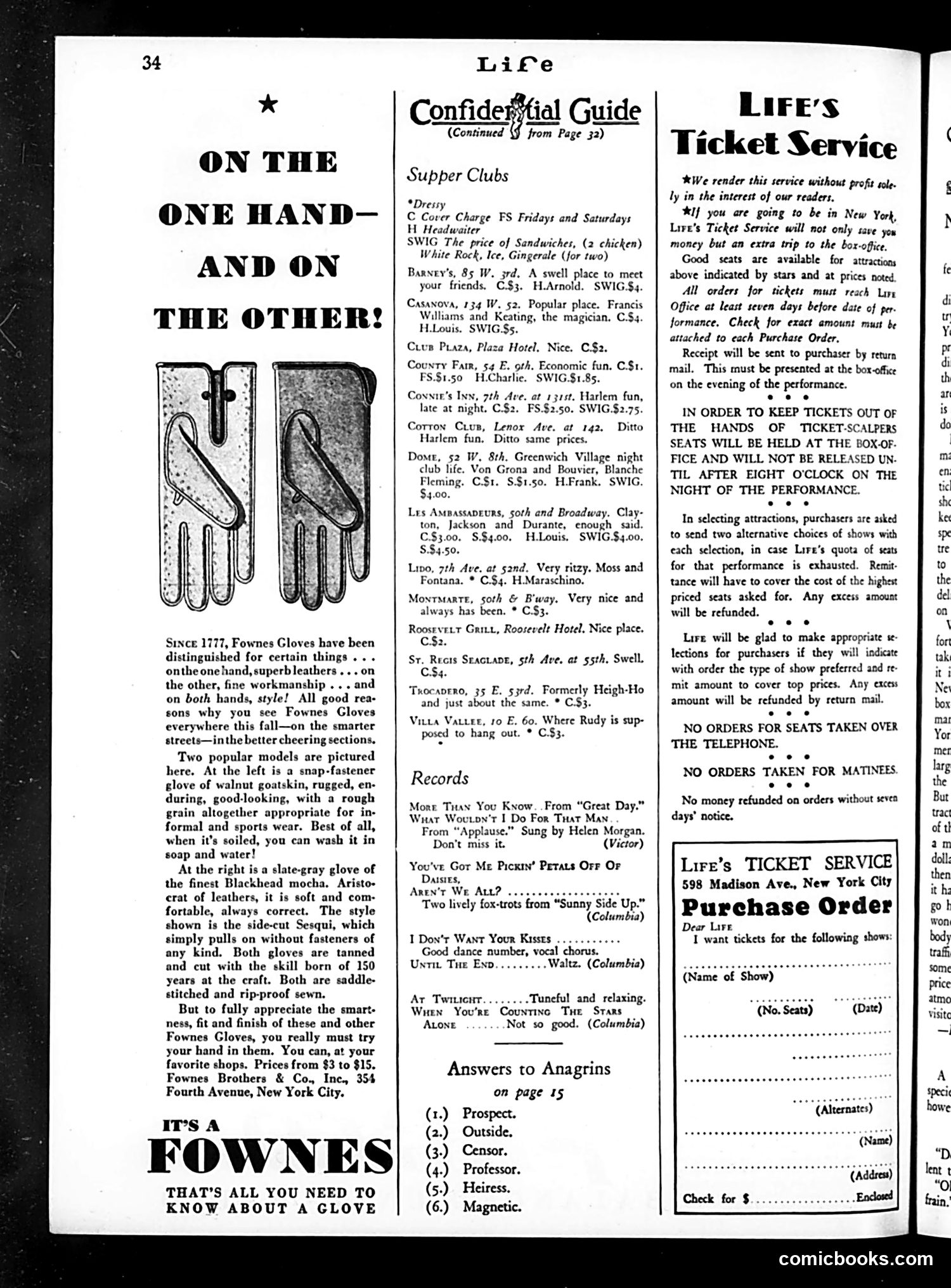
Fownes Gloves Advertisement This page is primarily a glove advertisement with accompanying service listings. The cartoon element—titled "On the One Hand—And on the Other!"—shows two hands modeling different Fownes glove styles to illustrate the brand's dual appeal: durability and elegance. The left glove (walnut goatskin) represents practicality—rugged, washable, suitable for sports. The right glove (slate-gray mocha leather) represents sophistication and formality. The wordplay on "hands" emphasizes the product while the visual comparison appeals to different consumer preferences. This reflects 1920s-30s marketing strategy: positioning quality gloves as essential accessories for both casual and formal occasions. The emphasis on 150 years of craftsmanship and price range ($3-$15) targets middle-to-upper-class consumers during the interwar period when quality leather goods signaled social status. The rest of the page contains *Life's* practical guides to nightclubs and ticket services—typical magazine content of the era.
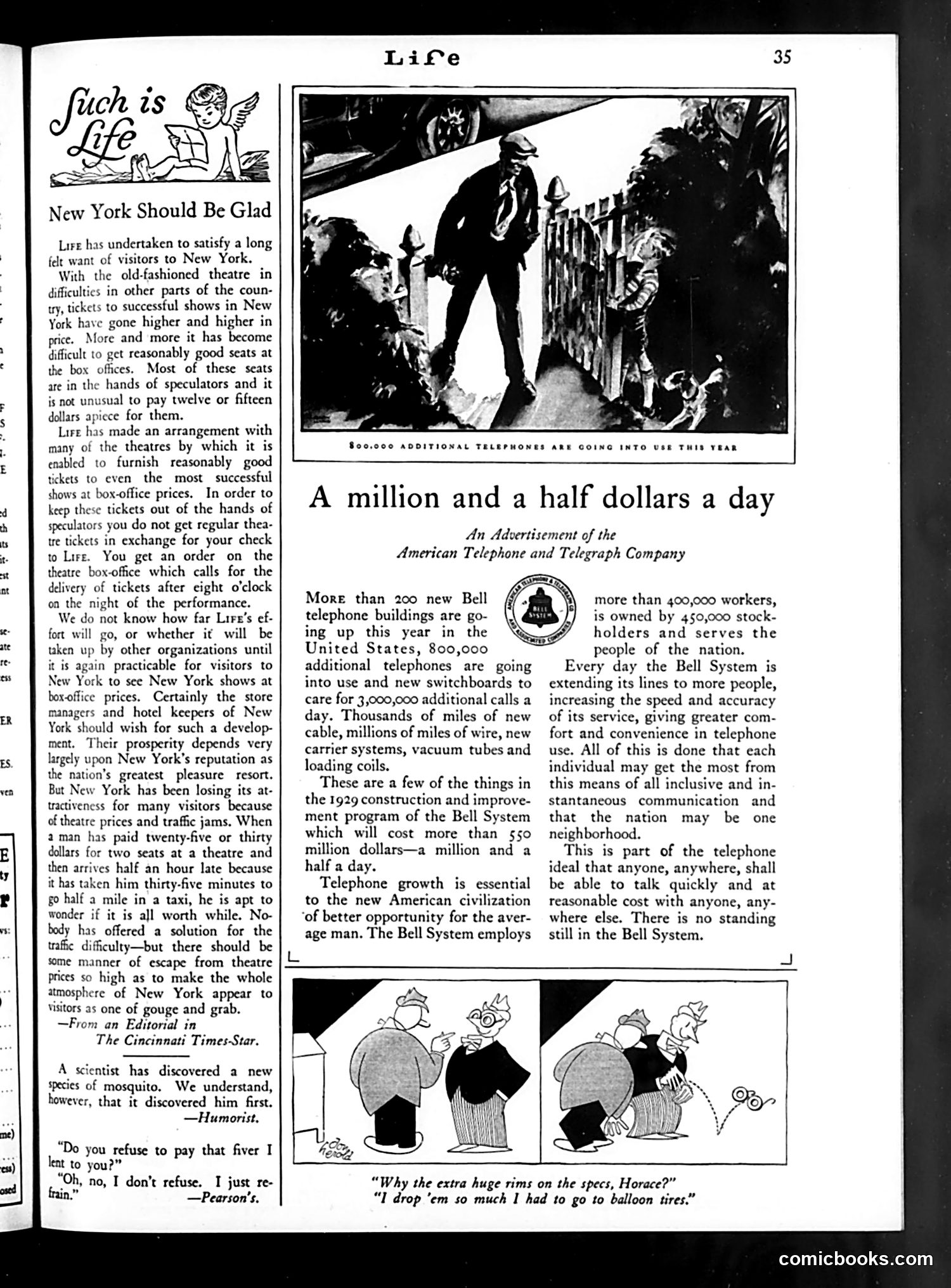
Analysis of Life Magazine Page 35 This page contains two distinct sections: Main Editorial Content: The left column discusses New York theater ticket scalping. Life magazine announces it's brokering affordable theater tickets directly from box offices (after 8 PM) to combat speculators who were reselling prime seats for $12-15—exorbitant prices for the 1920s. The editorial argues this serves New York's reputation as a tourist destination, which was being damaged by inflated prices and traffic congestion. Advertisement: The right side is a full Bell Telephone & Telegraph Company ad touting their massive 1929 expansion—$550 million annually ("a million and a half dollars a day"). It emphasizes infrastructure growth: new buildings, telephone lines, switchboards, and employment of 400,000+ workers. The messaging positions telephone expansion as essential to American progress and opportunity. Small Cartoon: At bottom, a comic strip shows someone complaining about oversized tires; the humor is visual/situational rather than political. The page essentially juxtaposes Life's consumer-advocacy effort against corporate growth advertising—a revealing snapshot of 1920s American capitalism and mass consumption.
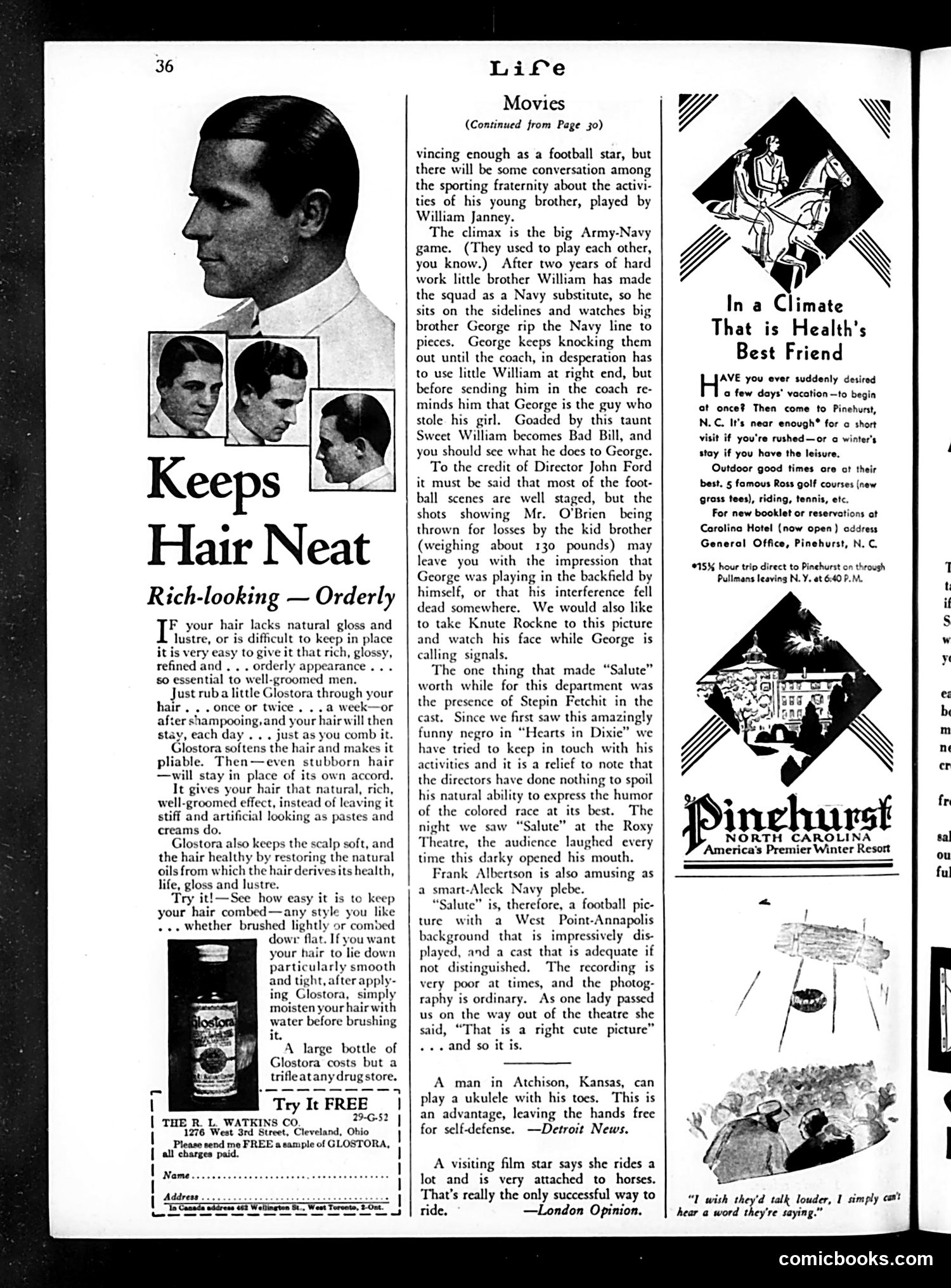
Page Analysis: Life Magazine, Movie Review This page contains a Glostora hair product advertisement and a movie review of "Salute," a 1929 football film starring George O'Brien. The review describes a plot about two brothers competing in an Army-Navy football game, with complications involving a stolen girlfriend. Director John Ford is credited with staging decent football sequences. The review praises character actor Stepin Fetchit, using period-appropriate (but today offensive) racial language typical of 1920s-30s publications. The critic notes Fetchit's comedic timing and "natural ability" at humor. The advertisement promotes Glostora hair product with claims about maintaining shine and orderly appearance—messaging reflecting 1920s-30s grooming standards emphasizing neatness and polish as markers of respectability for men. The page exemplifies how Life magazine mixed consumer advertising with entertainment criticism, while also documenting the casual racism embedded in media criticism of that era.
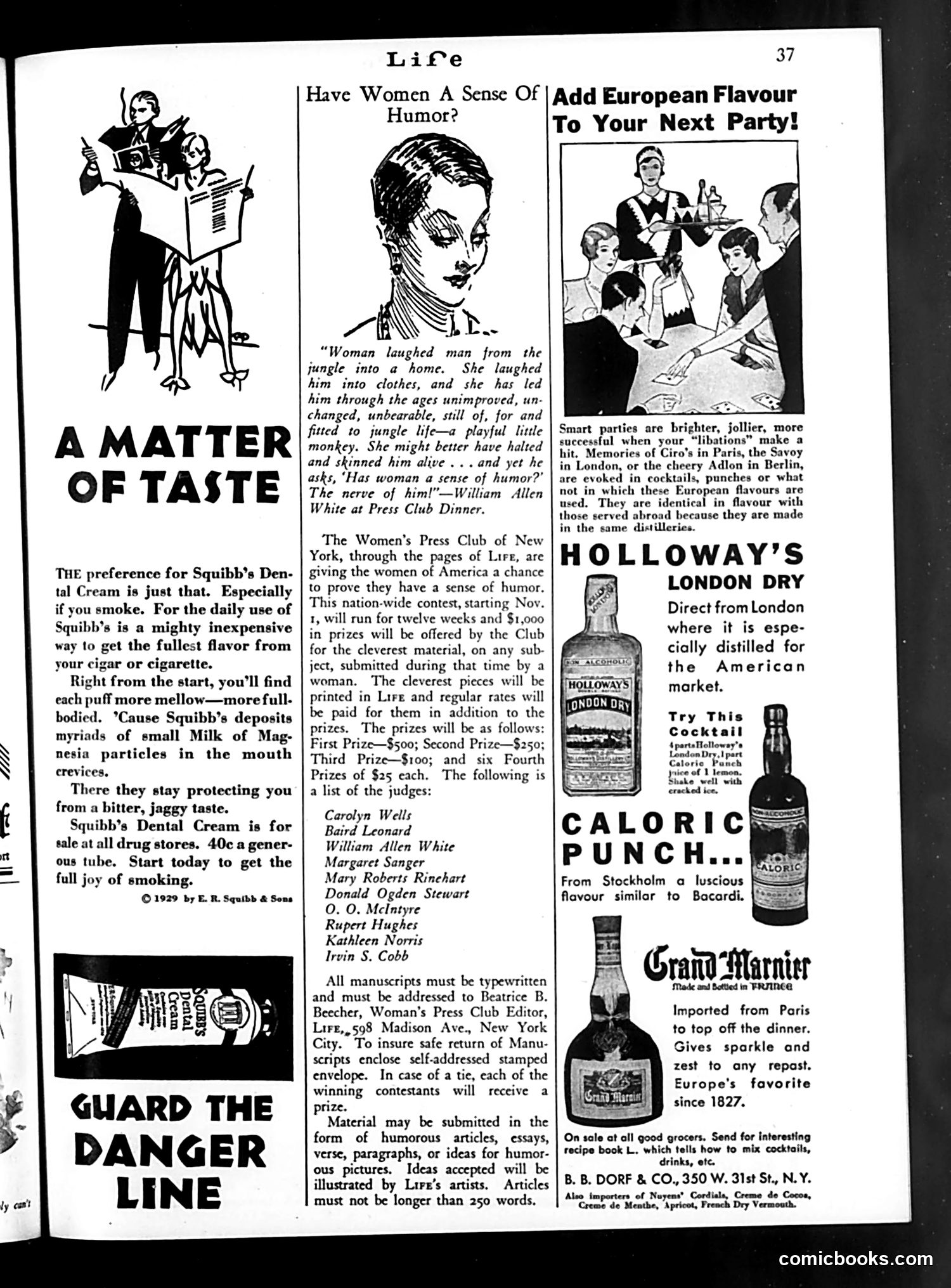
Life Magazine Page 37 (1929) Explained This page combines a satirical article with period advertising. Main Content: The Women's Press Club of New York announces a humor-writing contest for women, offering $1,000 in prizes. The contest was prompted by a quote from journalist William Allen White sarcastically questioning whether women have a sense of humor—claiming women merely "laughed man from the jungle into a home" but haven't improved him since. The club used his rhetorical jab as motivation to let women writers prove otherwise through submitted work. Judges include prominent literary figures of the era: Carolyn Wells, Margaret Sanger, Mary Roberts Rinehart, and others. Satirical Point: The article turns White's condescending remark into an opportunity for women to demonstrate wit and intelligence—a subtle feminist riposte within a male-dominated publication. Advertising: The page fills remaining space with liquor advertisements (Holloway's London Dry, Caloric Punch, Grand Marnier), typical for 1929 *Life*, plus a Squibb's dental cream ad promoting smoking pleasure.
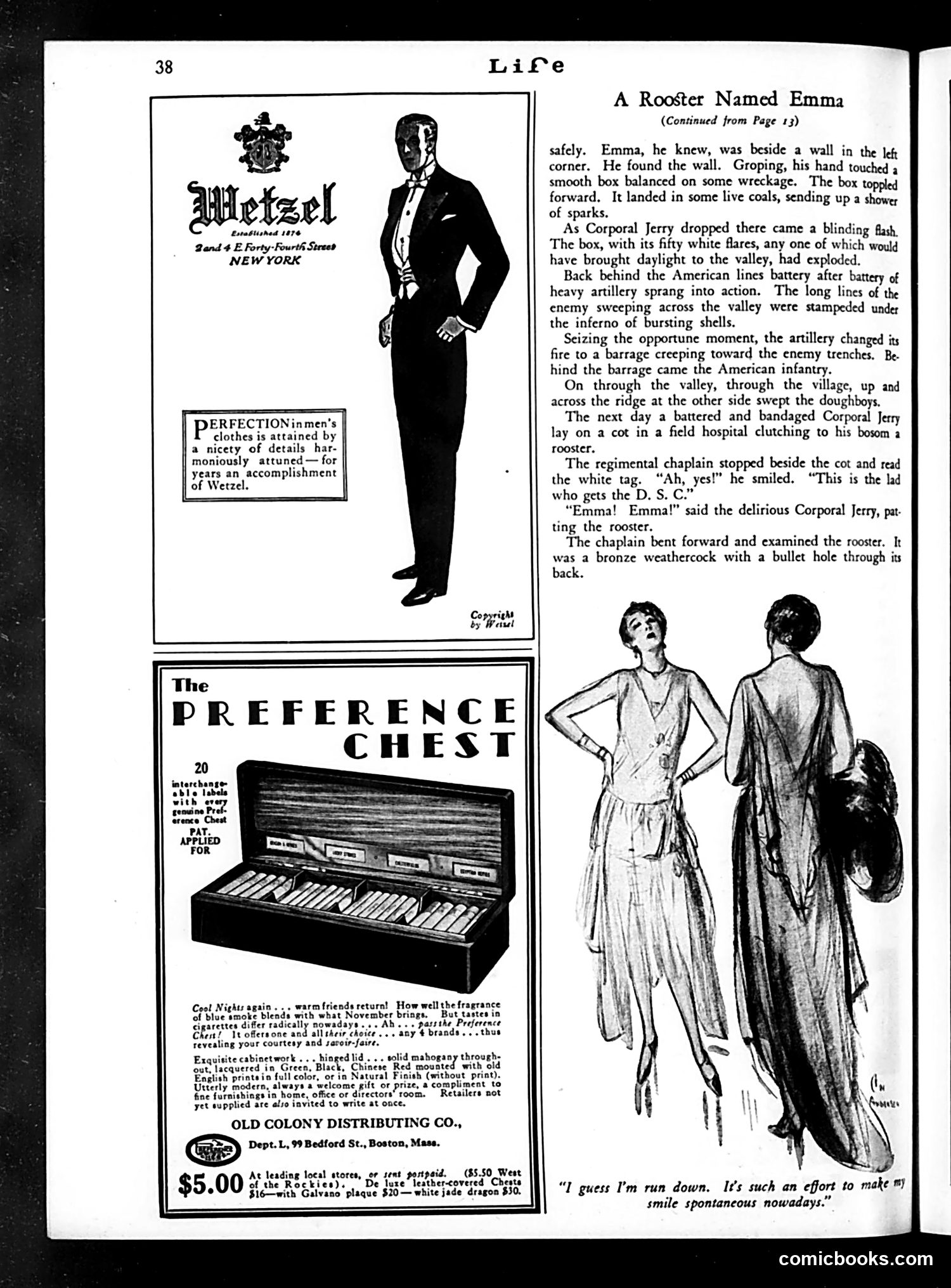
"A Rooster Named Emma" - Life Magazine Story This page continues a WWI narrative about Corporal Jerry and a rooster named Emma. During a battle, Jerry uses a box containing fifty white flares (likely signal flares) as a weapon, accidentally detonating it to blind the enemy and enable an American artillery and infantry offensive through a valley. The next day, hospitalized and delirious, Jerry clutches a rooster to his chest. A chaplain examines it and discovers it's actually a bronze weathercock—a decorative roof ornament with a bullet hole through it—not a living bird. The joke plays on Jerry's confusion and the surreal absurdity of battlefield trauma: he's bonded with and is protecting an inanimate object, mistaking it for the rooster that apparently accompanied him through combat. The story satirizes both the fog of war and shell-shock's psychological effects on soldiers.
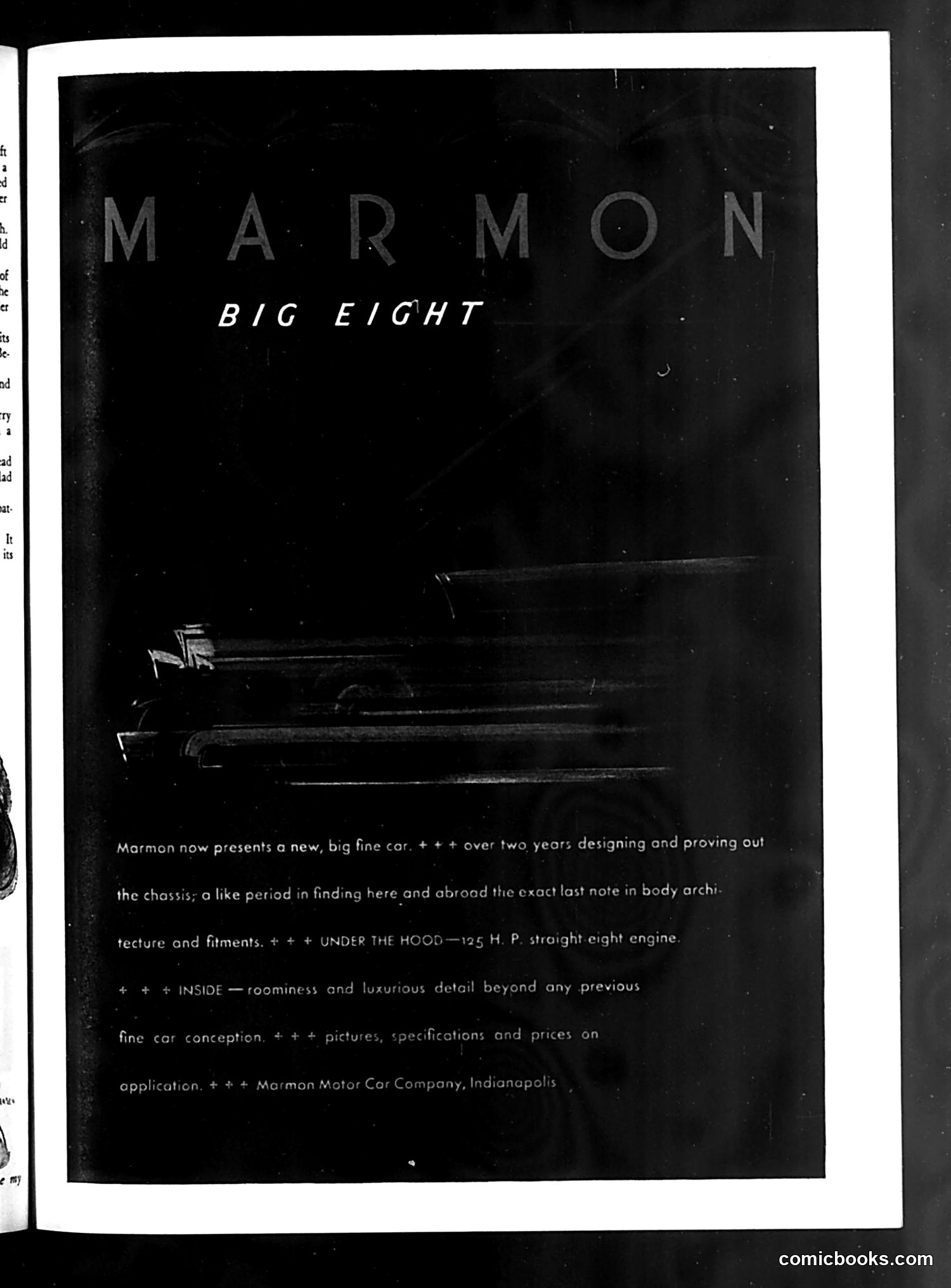
Analysis This is a vintage automobile advertisement, not political satire or a cartoon. It promotes the Marmon "Big Eight" car, manufactured by the Marmon Motor Car Company of Indianapolis. The ad emphasizes the car's development: two years designing the chassis and refining body architecture. Key selling points include a 125 horsepower straight-eight engine and interior luxury features ("roominess and luxurious detail beyond any previous fine car conception"). The dark, minimalist design with silhouetted cars creates an upscale, modern aesthetic typical of 1920s automotive advertising. There is no satirical content—this is a straightforward product promotion aimed at affluent buyers seeking a prestigious automobile.
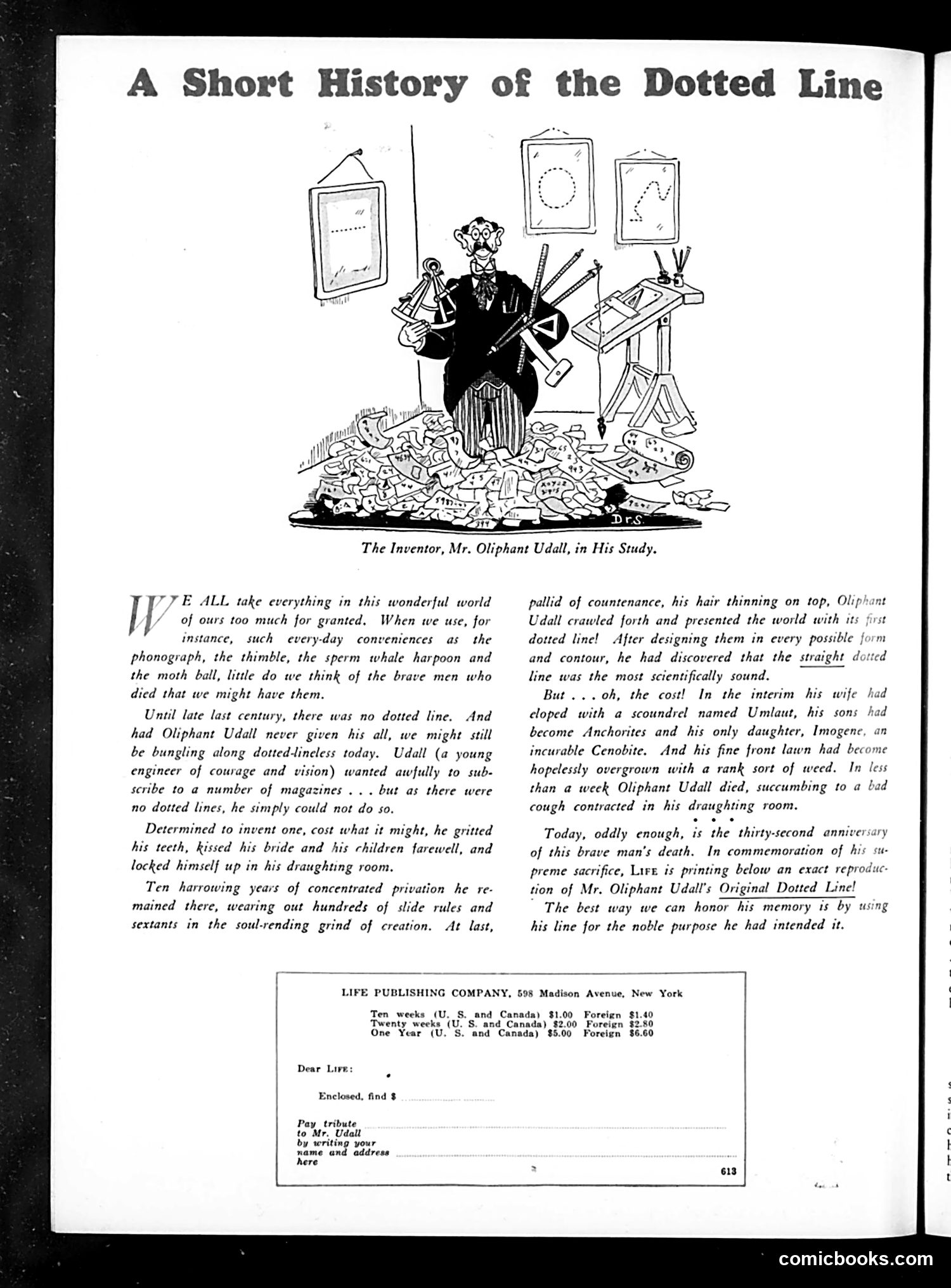
"A Short History of the Dotted Line" This is a satirical mock-heroic piece celebrating the "invention" of the dotted line by a fictional Mr. Oliphant Udall. The satire mocks both overly reverent historical narratives and the absurd veneration of trivial innovations. The cartoon depicts Udall surrounded by drawing instruments, having sacrificed everything—his family eloped, his children became monks, his lawn deteriorated—to perfect this mundane design element. He died shortly after completing his work. The joke lies in Life magazine's deadpan, grandiose treatment of something utterly insignificant (a dotted line used in magazine subscription coupons). By framing it as a noble sacrifice worthy of commemoration, the piece satirizes how society memorializes inventors and how magazines treat their own operational necessities as important achievements. The subscription form at the bottom—actually using dotted lines—completes the self-referential humor, showing Life literally using "Udall's invention" to solicit subscriptions.
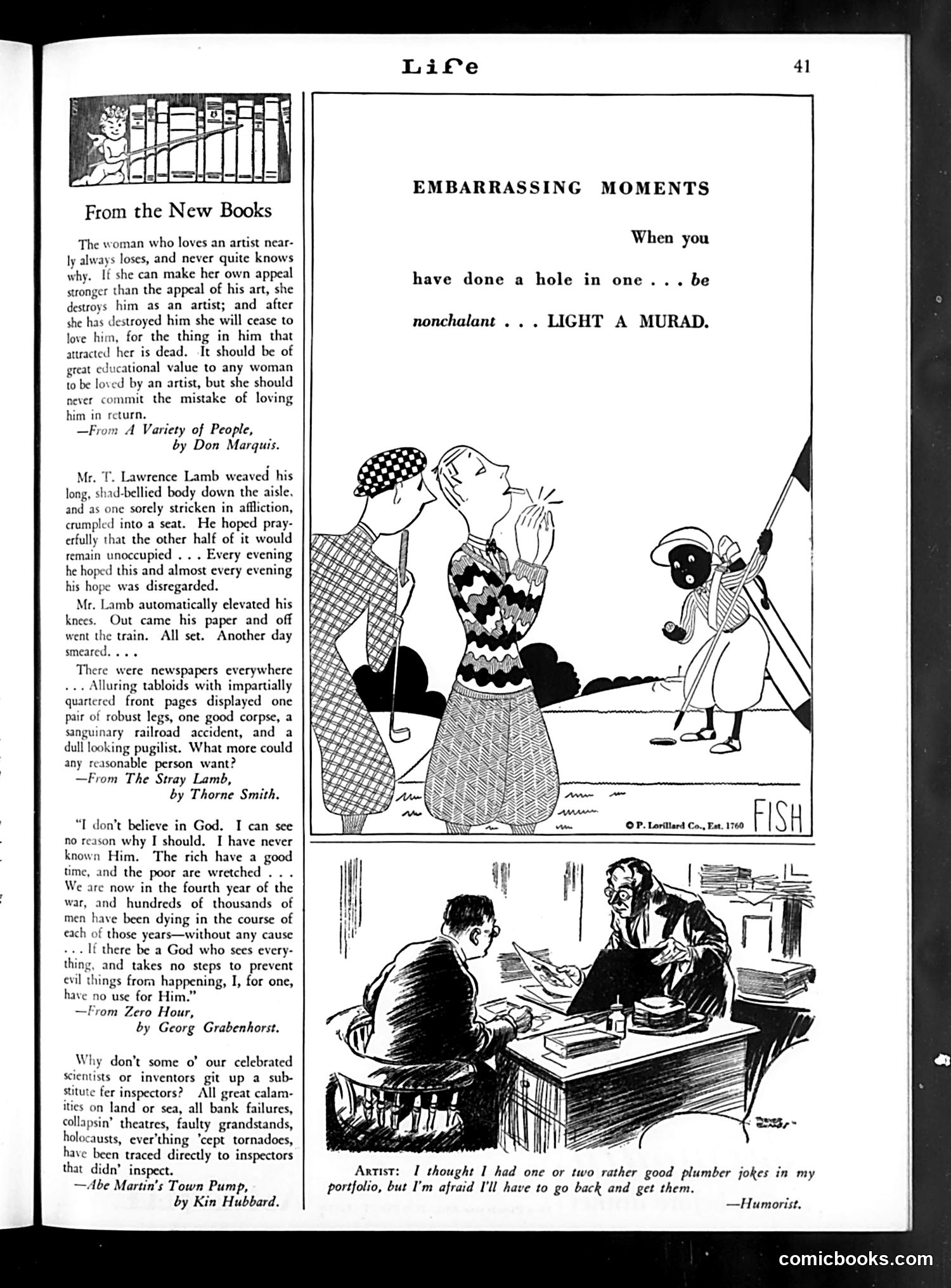
Explanation for Modern Readers This page contains two distinct cartoons satirizing early 20th-century social anxieties. Top cartoon: A golfer has just made a hole-in-one but responds with affected indifference while lighting a Murad cigarette. The joke mocks the pretense of nonchalance—the pressure to appear cool and unimpressed by achievement. It's also an advertisement disguised as humor, suggesting the product conveys sophistication. Bottom cartoon: An artist shows his portfolio to a potential client (appears to be a publisher or editor), apologizing that his "plumber jokes" aren't funny enough and he must retrieve better ones. The satire targets the commercial art world's demand for formulaic, crowd-pleasing humor over genuine creativity. The artist's desperation to please reveals how commercial pressure corrupts artistic integrity—a theme echoed in the page's literary excerpts about artists compromising their work. Both cartoons reflect anxieties about authenticity versus social performance in early 20th-century America.
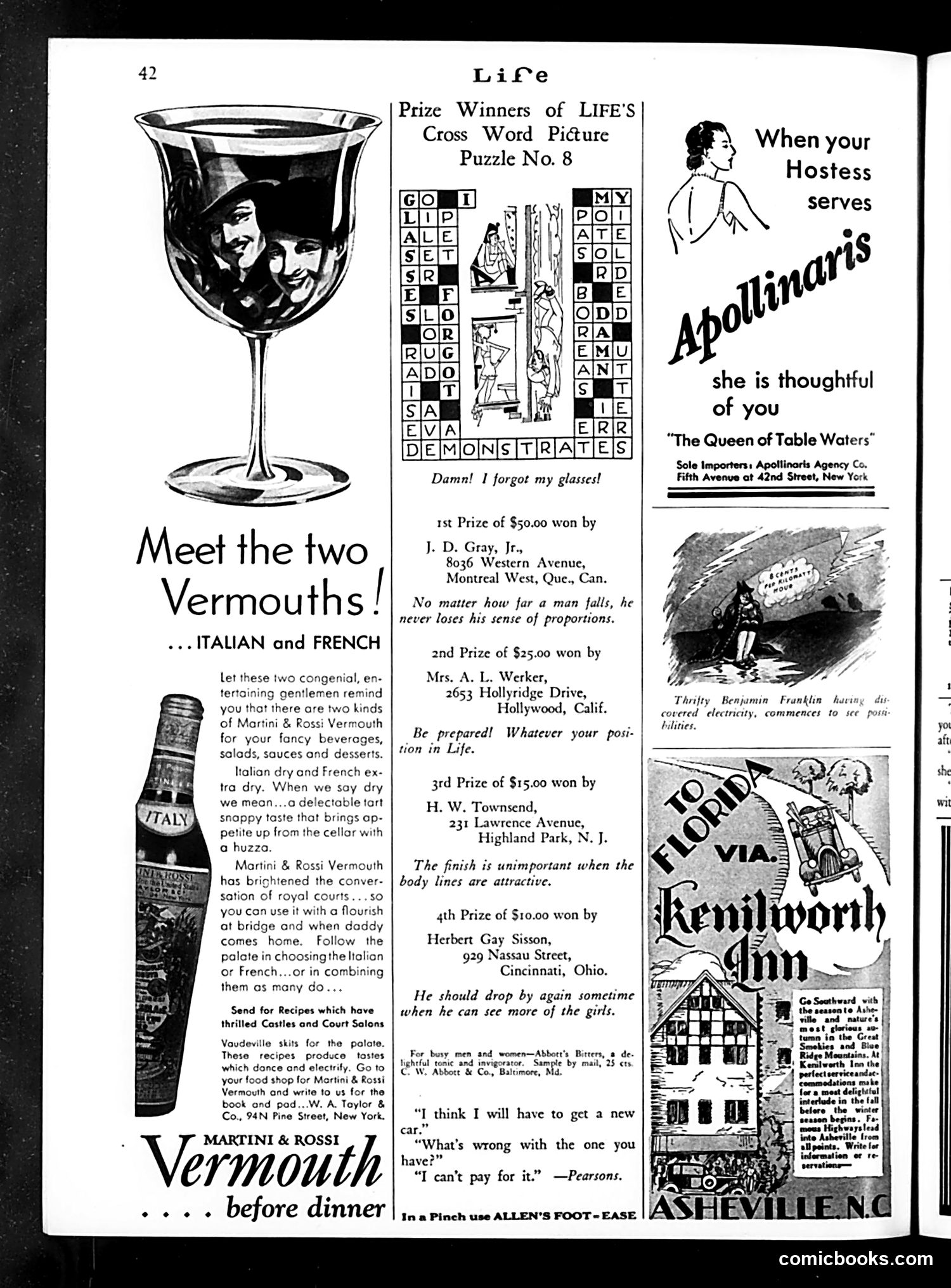
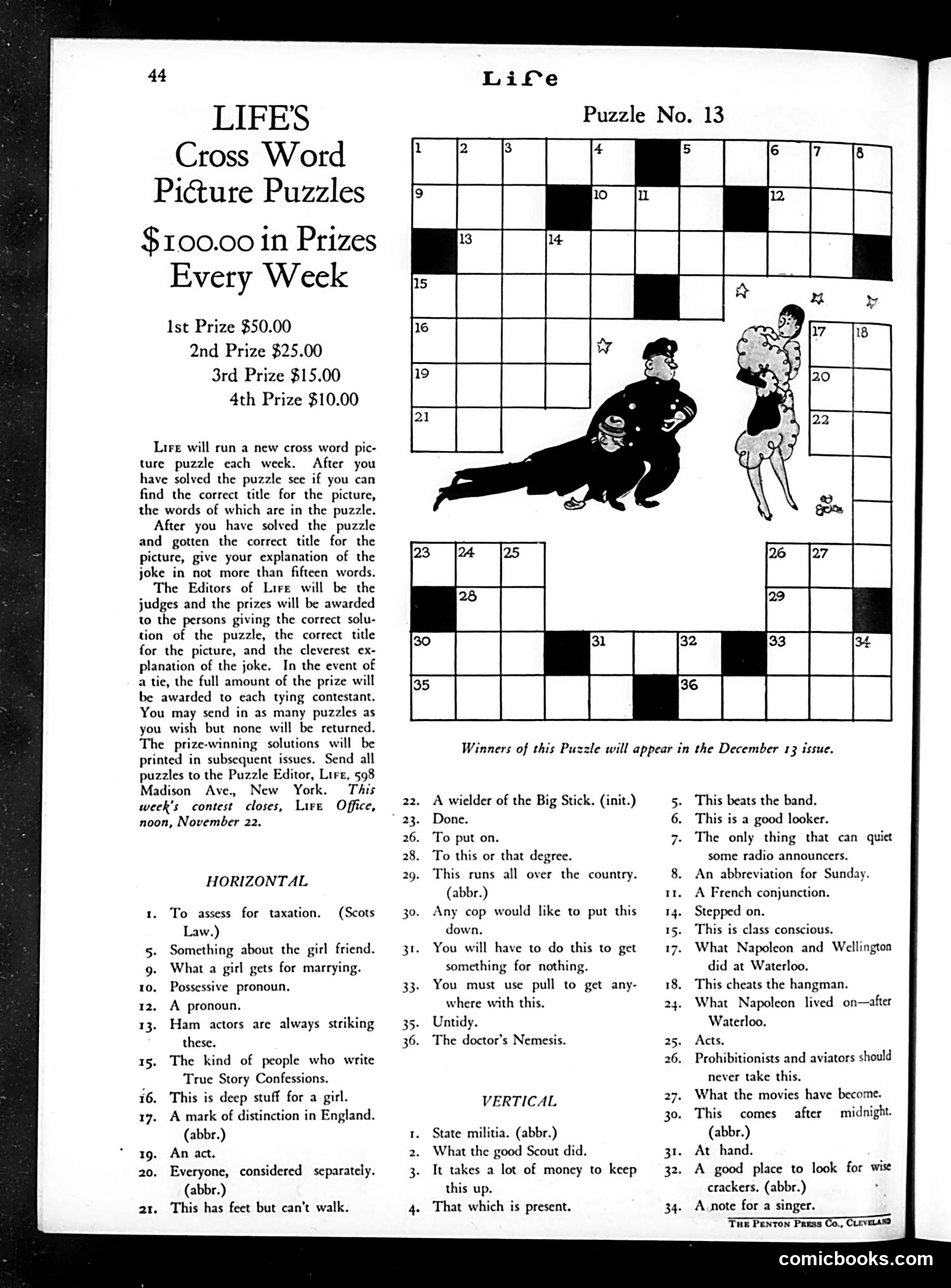
Life Magazine Page Analysis This page primarily contains advertisements and puzzle content rather than political satire. The main ad promotes Martini & Rossi Vermouth, personifying Italian and French varieties as "congenial, entertaining gentlemen" to market two drink options for cocktails and cooking. The copy uses period charm—referencing "royal courts" and "vaudeville"—to position vermouth as sophisticated. Below is a crossword puzzle contest with prize winners listed ($50–$10 awards), accompanied by humorous captions about proportions, appearance, and financial troubles ("I can't pay for it"). Additional advertisements include Apollinaris water ("The Queen of Table Waters"), the Kenilworth Inn in Asheville, and Abbott's Bitters tonic. A small cartoon shows Benjamin Franklin with electricity, suggesting commercial applications—typical period humor about progress and invention. The page reflects 1920s consumer culture: leisure, cocktails, puzzles, and aspirational lifestyle marketing rather than political commentary.
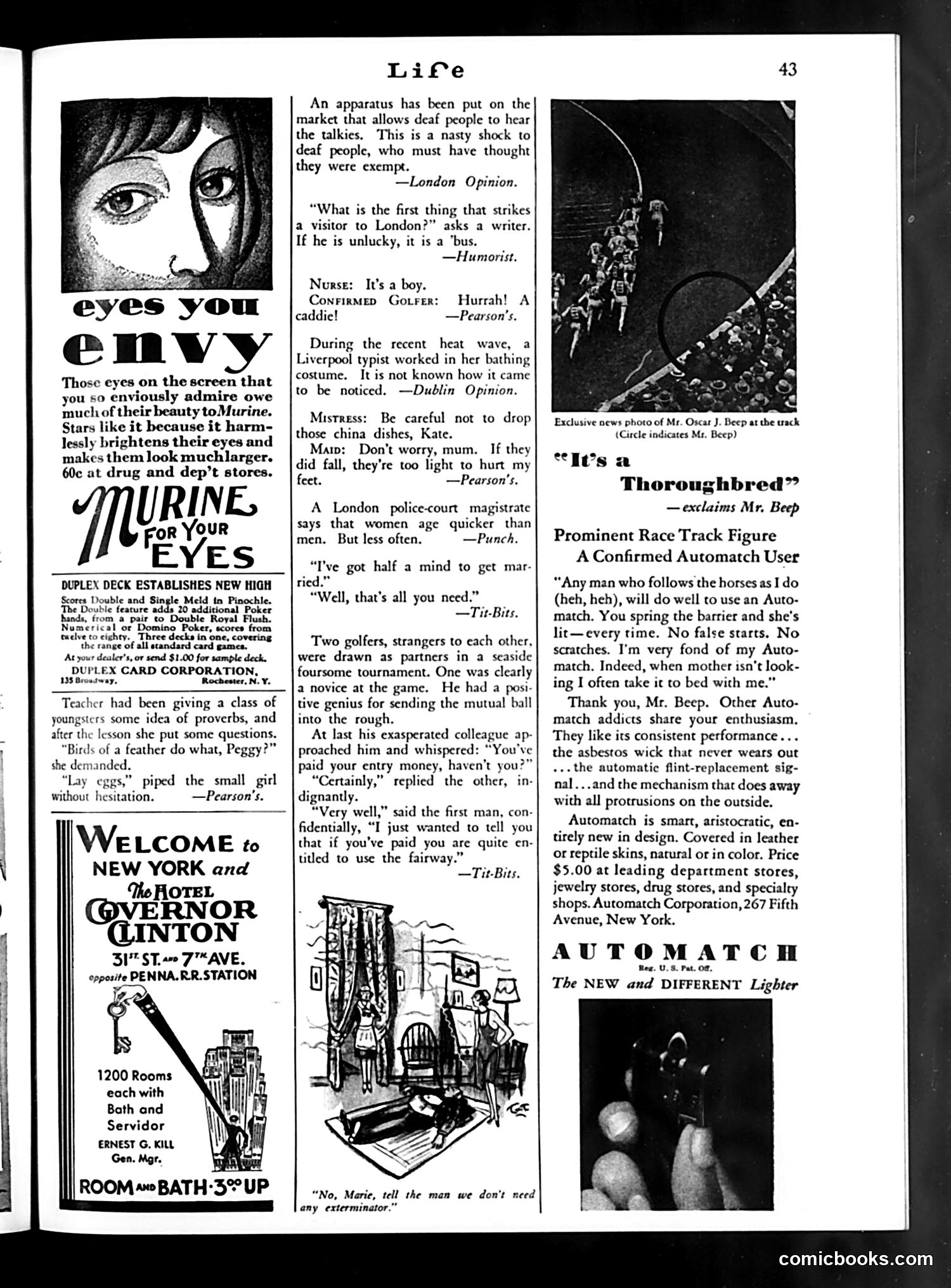
Life Magazine Page 43: Satire and Advertising This page from *Life* magazine combines British humor excerpts with American advertisements. The satirical shorts mock contemporary social absurdities: deaf people losing exemption from "talkies" (talking films), a child's innocent misunderstanding of proverbs, a typist's scandalous bathing costume, and a magistrate's observation about female aging. The central cartoon depicts a domestic scene where a woman tells a man "we don't need any exterminator"—likely satirizing paranoia about household pests or pest-control salesmen. The advertisements promote consumer products: Murine eye drops (claiming to enlarge eyes like movie stars), playing cards, a New York hotel, and notably the Automatch lighter. The Automatch ad features a horse-racing figure ("Mr. Beep") endorsing the product with sexual innuendo ("when mother isn't looking I often take it to bed with me")—typical mid-century advertising using suggestive humor to sell luxury goods to male readers.
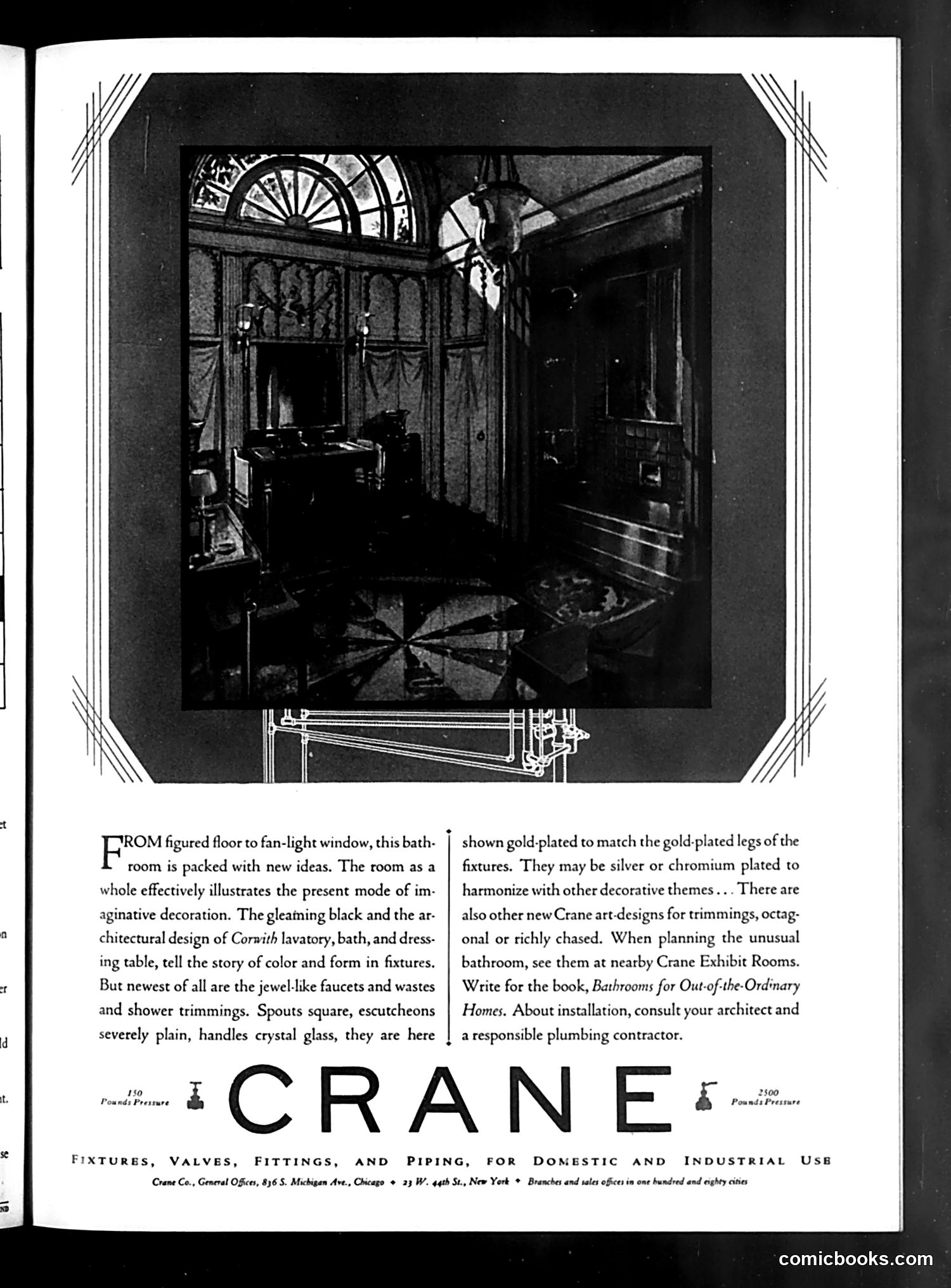
Analysis This is not a cartoon or satire—it's a straightforward advertisement for Crane plumbing fixtures from what appears to be a 1920s-1930s publication. The page showcases a modernist bathroom design featuring Crane brand products: lavatory, bath, dressing table, and decorative faucets/trimmings. The text emphasizes luxury details—gold-plating, crystal glass handles, and "jewel-like" fixtures—positioning these as high-end, imaginative home decoration for the affluent. The photograph displays the bathroom's sleek black fixtures and geometric Art Deco design, typical of the era's aspirational domestic modernism. There is no political commentary, caricature, or satirical intent visible. This is simply a period advertisement promoting bathroom fixtures as status symbols and design statements for "Out-of-the-Ordinary Homes."
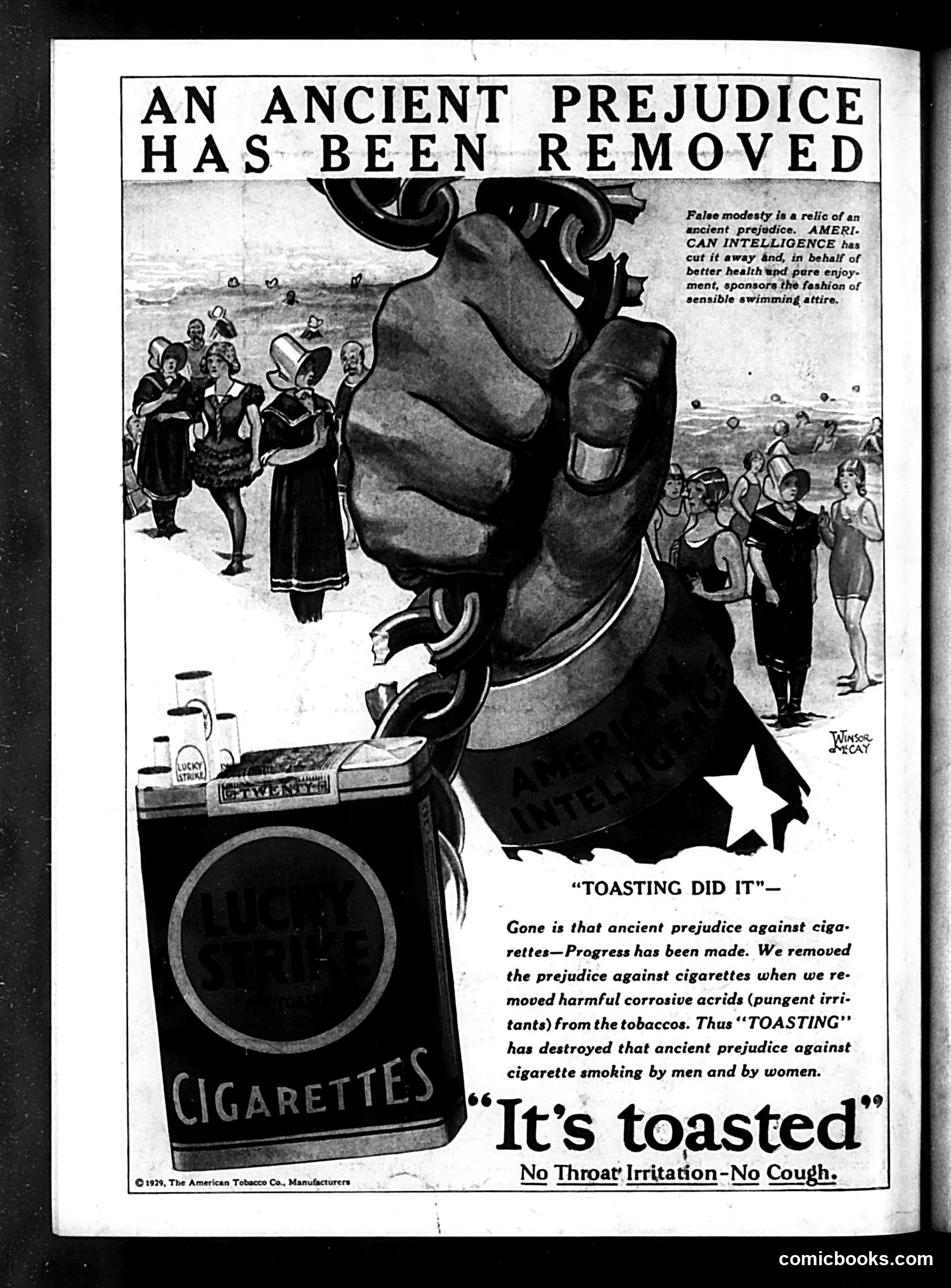
Historical Context This is a 1929 tobacco advertisement disguised as social commentary. The ad claims that "toasting" tobacco removes harmful irritants, thereby eliminating prejudice against cigarette smoking—particularly among women. The cartoon's upper section depicts women in increasingly revealing swimming attire, using the metaphor of removing "false modesty" as "ancient prejudice." This parallels the cigarette message: just as society has supposedly progressed by accepting less conservative swimwear, it has progressed by accepting cigarettes for women. The ad's core argument is scientifically false but rhetorically clever—it frames smoking as modern progress and health-conscious choice. By 1929, marketing cigarettes to women was still relatively novel, making this a direct effort to expand the female market. The imagery conflates social liberation with tobacco consumption, a propagandistic technique common in early 20th-century advertising before cigarette health dangers were widely acknowledged.