life
Life — November 22, 1929
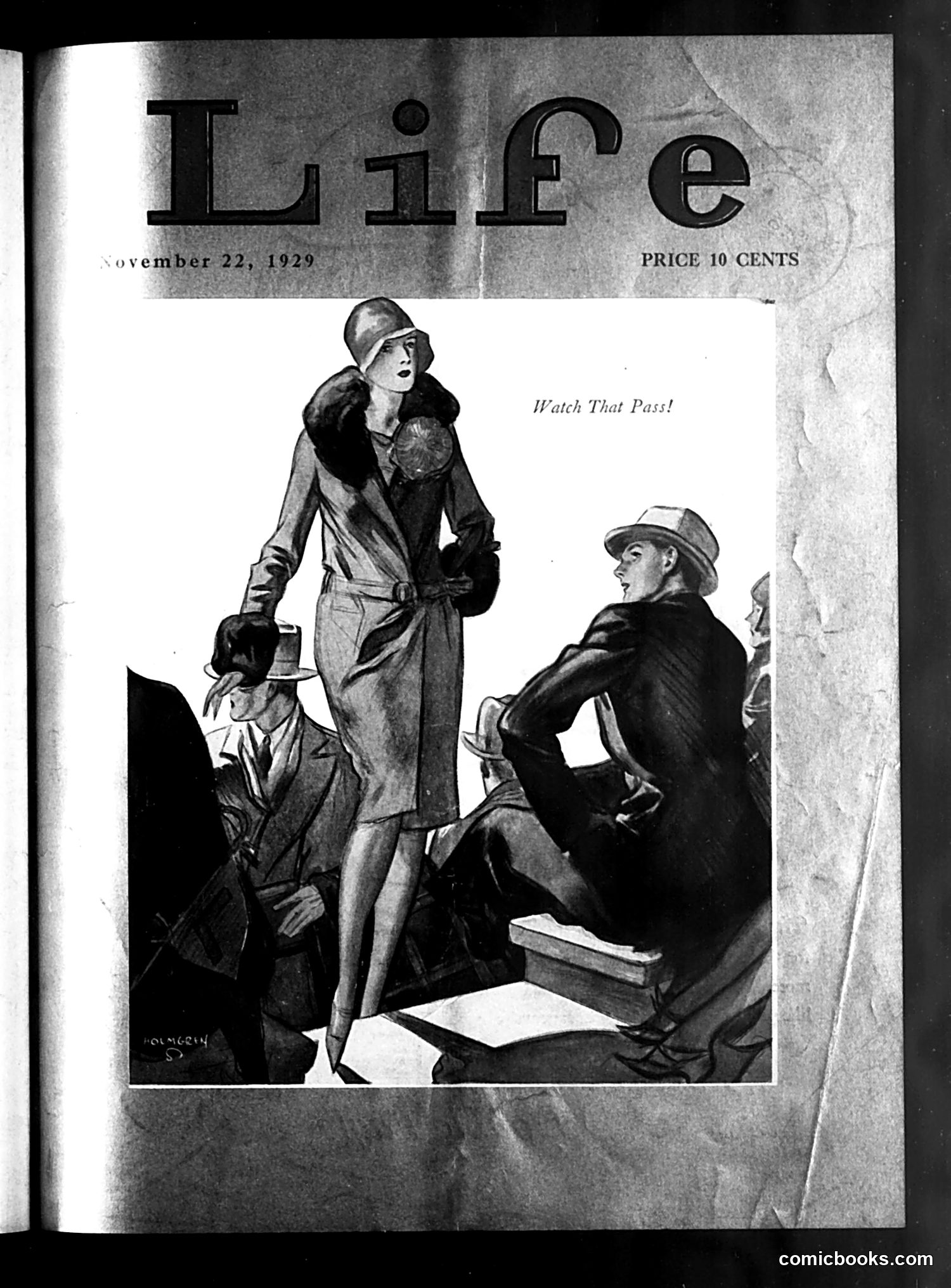
Analysis of Life Magazine Cover, November 22, 1929 This cover illustration, titled "Watch That Pass!", depicts a social situation from the Jazz Age. A stylishly dressed woman in a cloche hat and fur-collared coat stands prominently among seated men in suits and fedoras, who appear to be watching her intently. The satire likely comments on 1920s social dynamics—specifically the "modern woman" and flirtation customs of the era. The phrase "Watch That Pass!" suggests the men are monitoring or reacting to the woman's movements or behavior, possibly alluding to romantic advances or social maneuvering. This reflects contemporary anxieties about changing gender roles and courtship practices during the socially liberated 1920s.
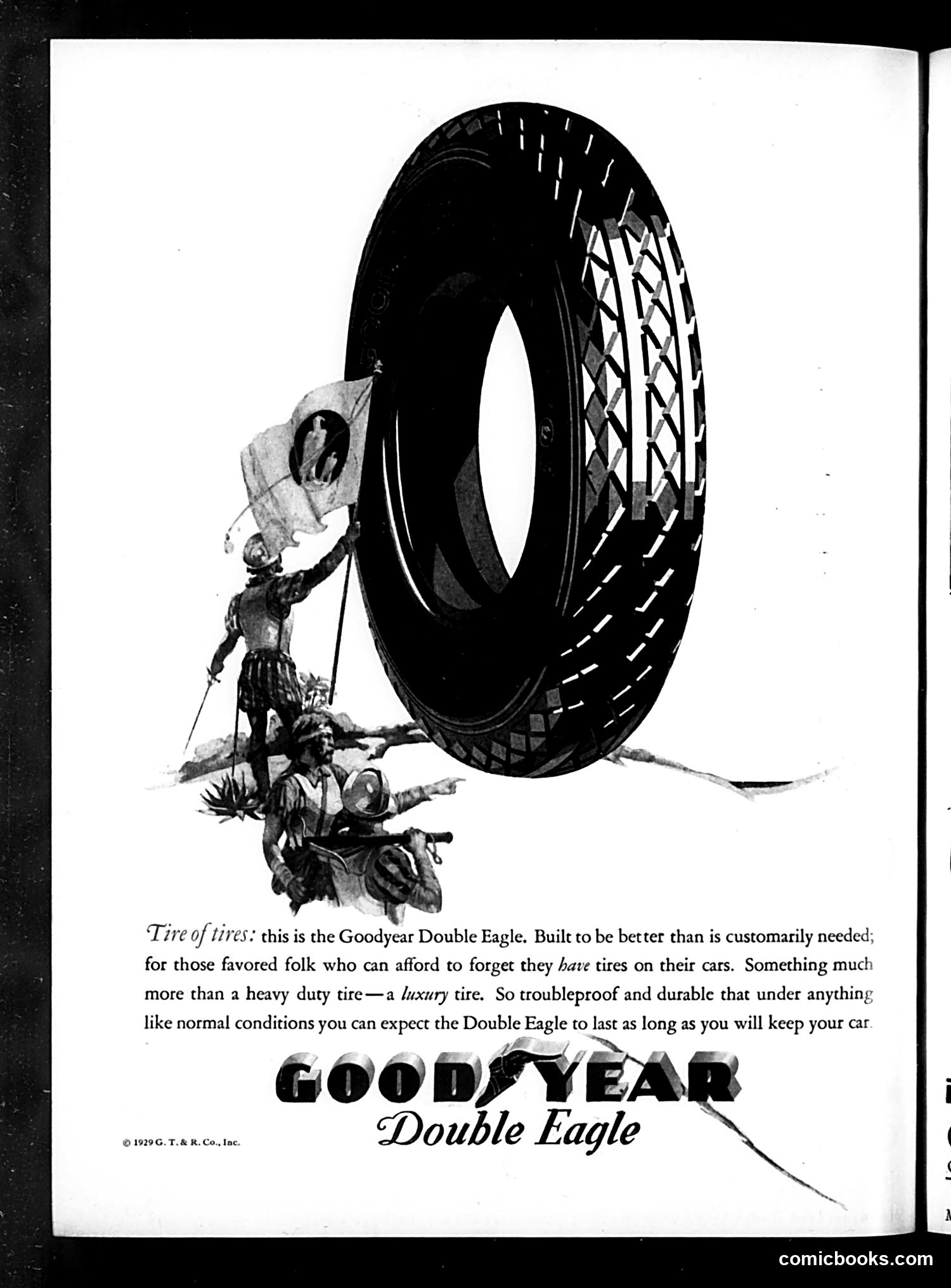
Analysis This is not a political cartoon but a 1929 Goodyear tire advertisement. The page depicts an enormous tire being inspected by tiny figures with surveying equipment, creating a humorous scale comparison to emphasize the tire's impressive size and quality. The ad copy markets the "Double Eagle" as a luxury tire for wealthy customers who can "afford to forget they have tires on their cars"—meaning it's so durable and reliable it requires no maintenance or worry. The phrase "tire of tires" opens the pitch, playing on words. The satirical element is gentle: the exaggerated scale mockingly suggests this tire is almost impossibly superior, suitable only for those wealthy enough to treat such engineering excellence casually. This reflects 1920s advertising's aspirational tone targeting affluent consumers.
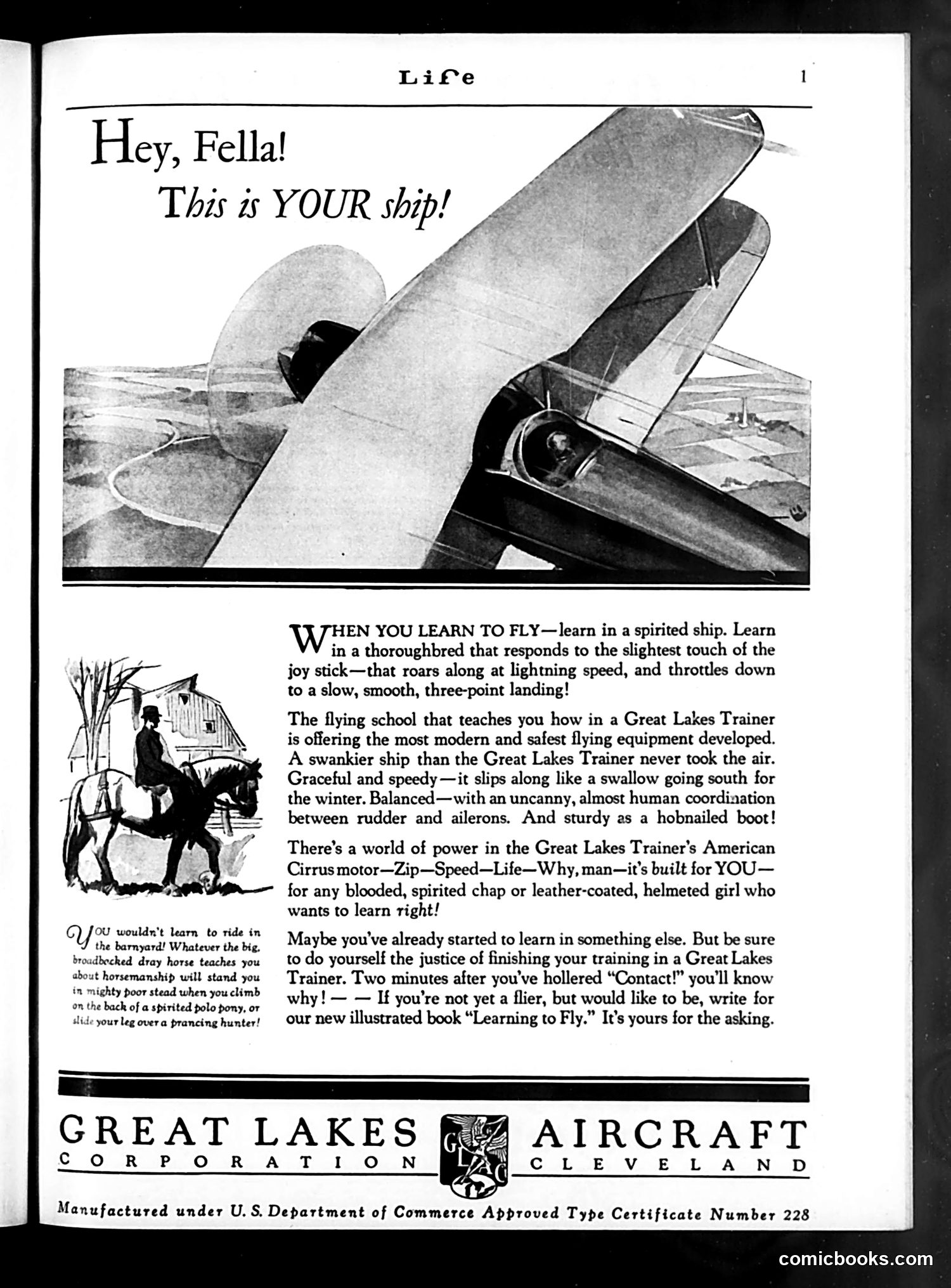
Analysis This page is primarily an advertisement, not satire or political commentary. It's a Great Lakes Aircraft Corporation ad promoting their "Great Lakes Trainer" aircraft for flight training. The ad uses playful comparative humor: it opens with "Hey, Fella! This is YOUR ship!" and includes a sidebar joke comparing learning to fly to learning to ride horses—suggesting flight training is now accessible to ordinary people, not just the elite. The rhetoric emphasizes the aircraft's modern features (responsive controls, smooth landing, durability) and appeals to aspiring pilots of all backgrounds, including women ("helmeted girl who wants to learn right"). This reflects 1920s-30s aviation optimism and the democratization of flying as a leisure/professional skill. The tone is encouraging and informal, marketing flight training as an achievable aspiration for everyday Americans.
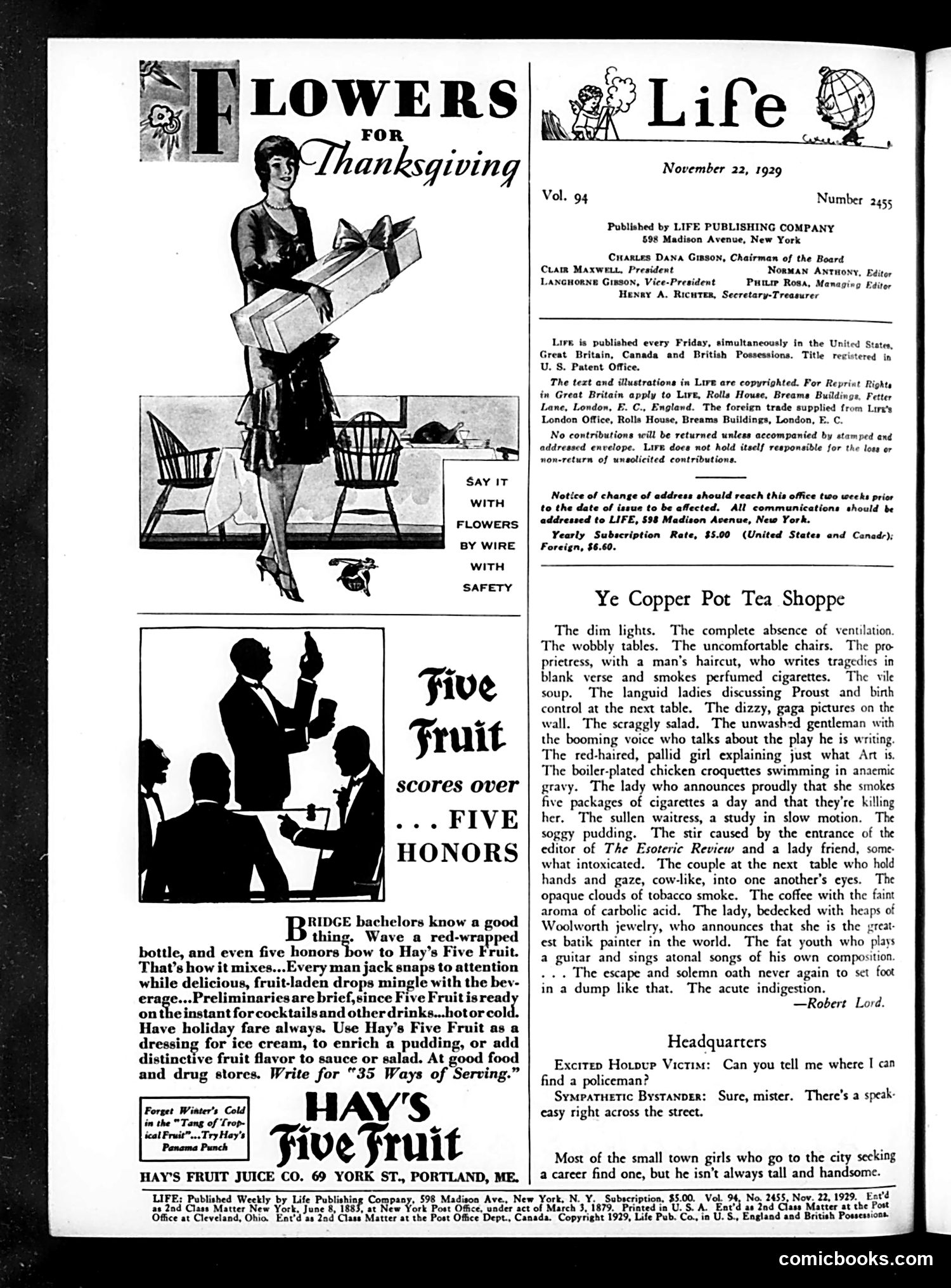
Analysis This page is primarily advertising content rather than political satire. The main visual elements are: 1. Left side: A Thanksgiving gift-giving advertisement featuring a woman with large wrapped boxes, promoting flowers "by wire with safety" as Thanksgiving gifts. 2. Center: A stylized silhouette advertisement for "Hay's Five Fruit" scoring "five honors," promoting the product for cocktails and holiday entertaining. 3. Right side: A satirical article titled "Ye Copper Pot Tea Shoppe" by Robert Lord, which mocks pretentious bohemian tea culture—describing uncomfortable venues where affected intellectuals, would-be artists, and poseurs gather. This is social satire targeting affectation rather than political commentary. The page reflects 1920s consumer culture and satirizes period social pretensions.
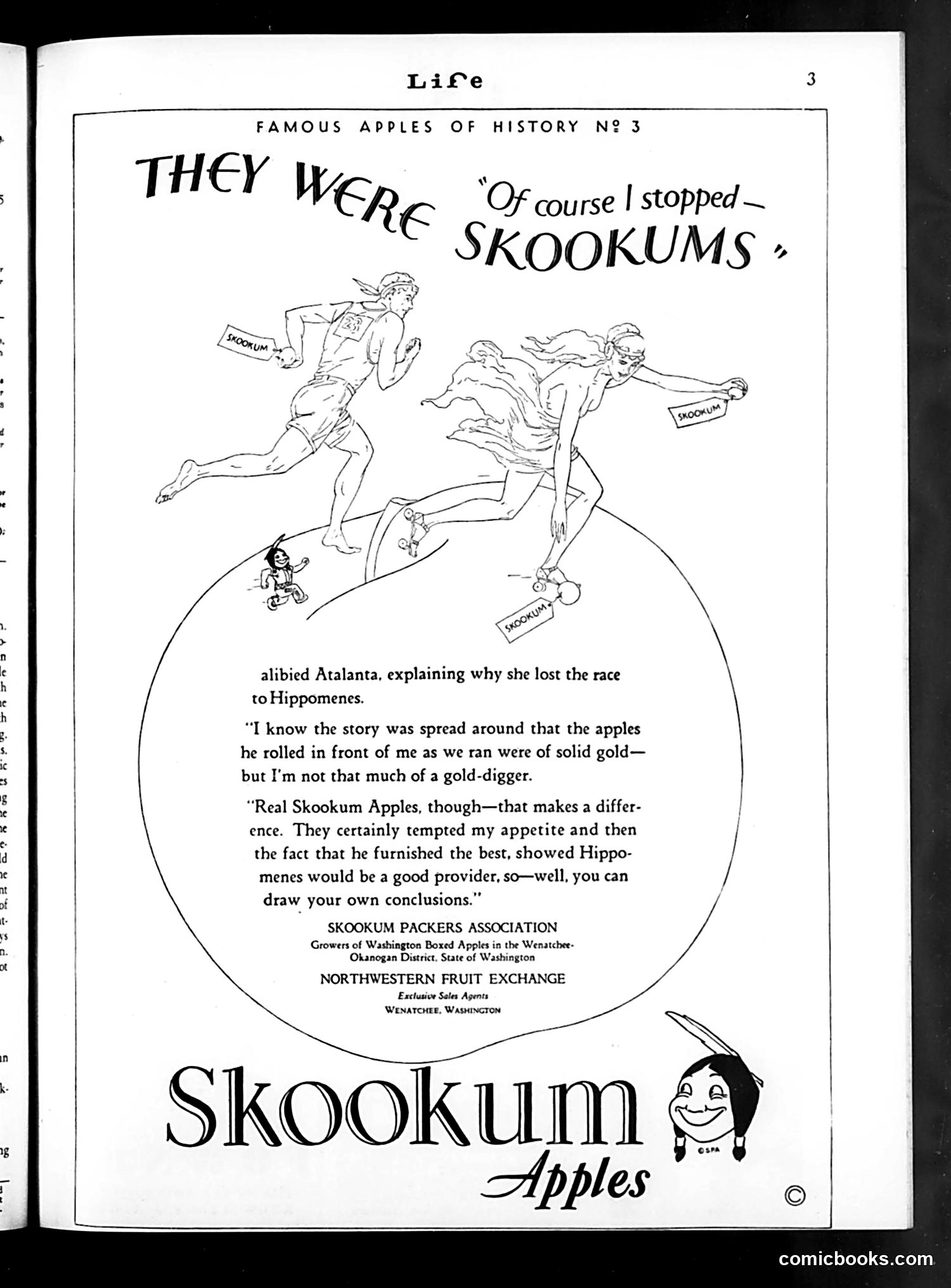
"Famous Apples of History No. 3: They Were Skookums" This is an advertisement for Skookum brand apples, disguised as humor content. The "famous apples" series parodies historical myths—here referencing Atalanta from Greek mythology, who lost a race to Hippomenes because she stopped to pick up golden apples he dropped. The ad's joke: Atalanta claims she stopped not for gold apples, but for genuine Skookum apples—which were so tempting that winning the race mattered less than eating quality fruit. This reversed the mythological narrative to promote the product's superior taste and appeal. The ad credits the Skookum Packers Association and Northwestern Fruit Exchange in Washington state. The cartoon style and satirical framing made advertising entertaining while promoting regional Washington apples to consumers.
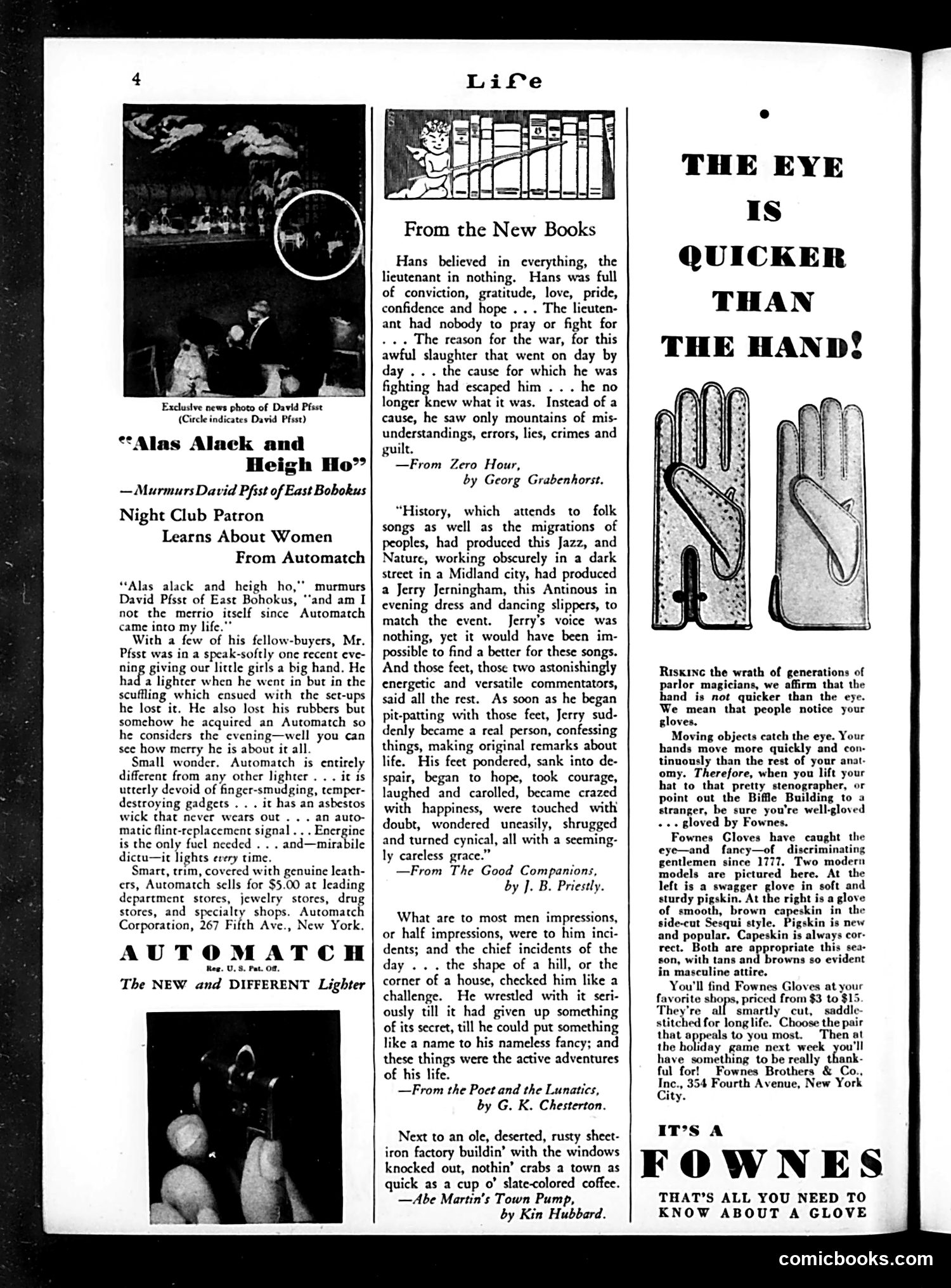
Content Analysis This page is primarily advertising and literary excerpts, not political satire. The left side features an Automatch lighter advertisement with a photo credited to David Pfist, and a section titled "Night Club Patron Learns About Women From Automatch" — a humorous vignette about the product. The right side contains two advertisements: one for Fownes Gloves (with illustrations of hands demonstrating the gloves' quality) and prominent text stating "THE EYE IS QUICKER THAN THE HAND!" — a sales pitch emphasizing visual appeal. The center includes literary excerpts from contemporary books like *Zero Hour* and *The Good Companions*, offering no political commentary. This is a typical 1920s-30s Life magazine page mixing commercial promotions with cultural content—no cartoon satire is present.
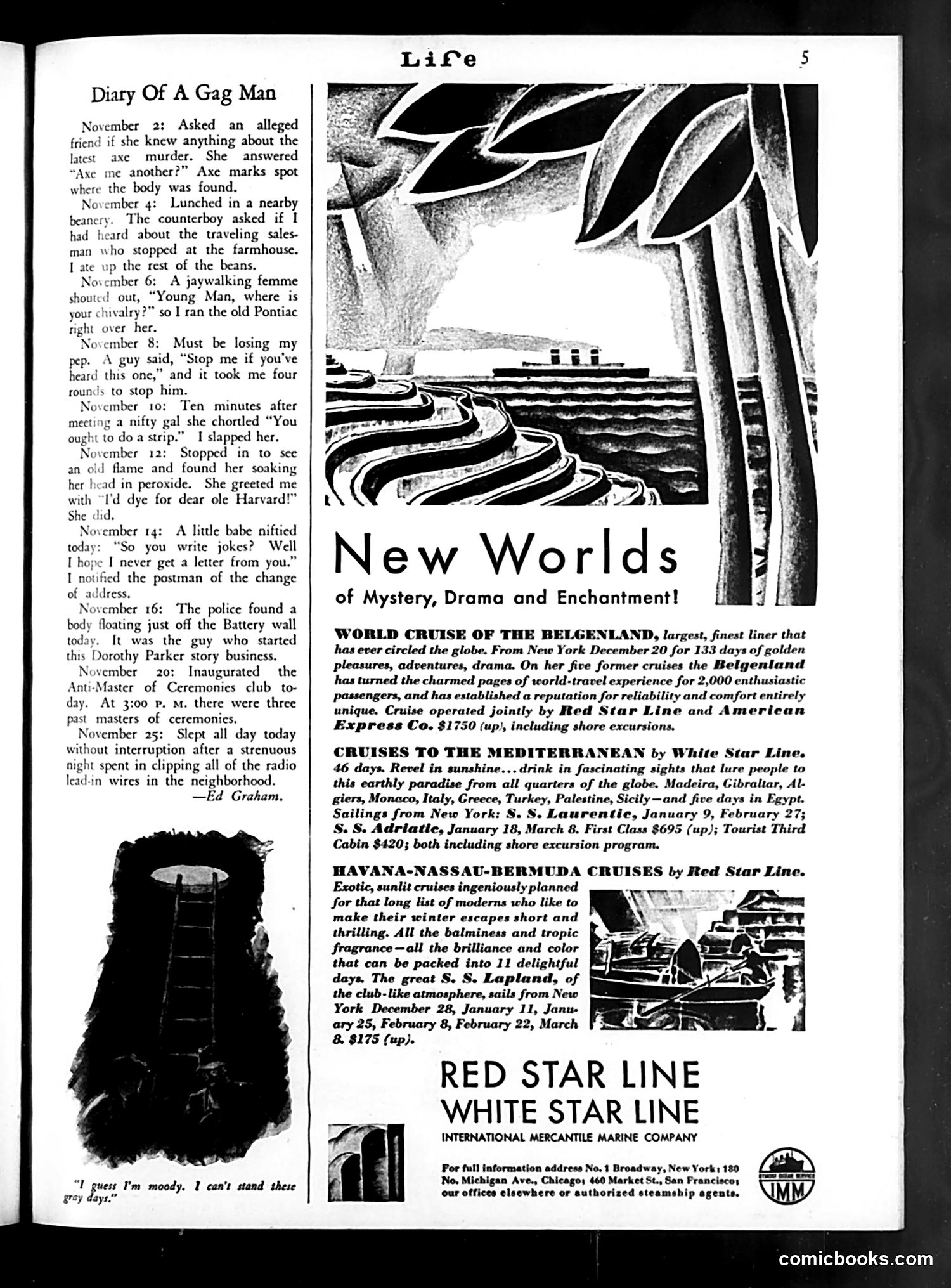
Analysis This page is primarily advertising for cruise lines (Red Star Line, White Star Line, and American Express Co.), occupying the right two-thirds of the page. On the left is "Diary of a Gag Man," a satirical column documenting a comedic writer's November misadventures. The entries mock various situations: a murder reference ("Axe me another?"), farm life, romantic pursuits, police encounters, and social embarrassments. The humor relies on wordplay and absurdist scenarios typical of 1920s-30s magazine comedy. Below the diary is a single-panel cartoon showing a dejected figure in what appears to be a confined space, with the caption "I guess I'm moody. I can't stand these grey days." This illustrates the gag-man's emotional state—likely referencing depression or seasonal melancholy. The content targets readers seeking lighthearted entertainment and travel opportunities.
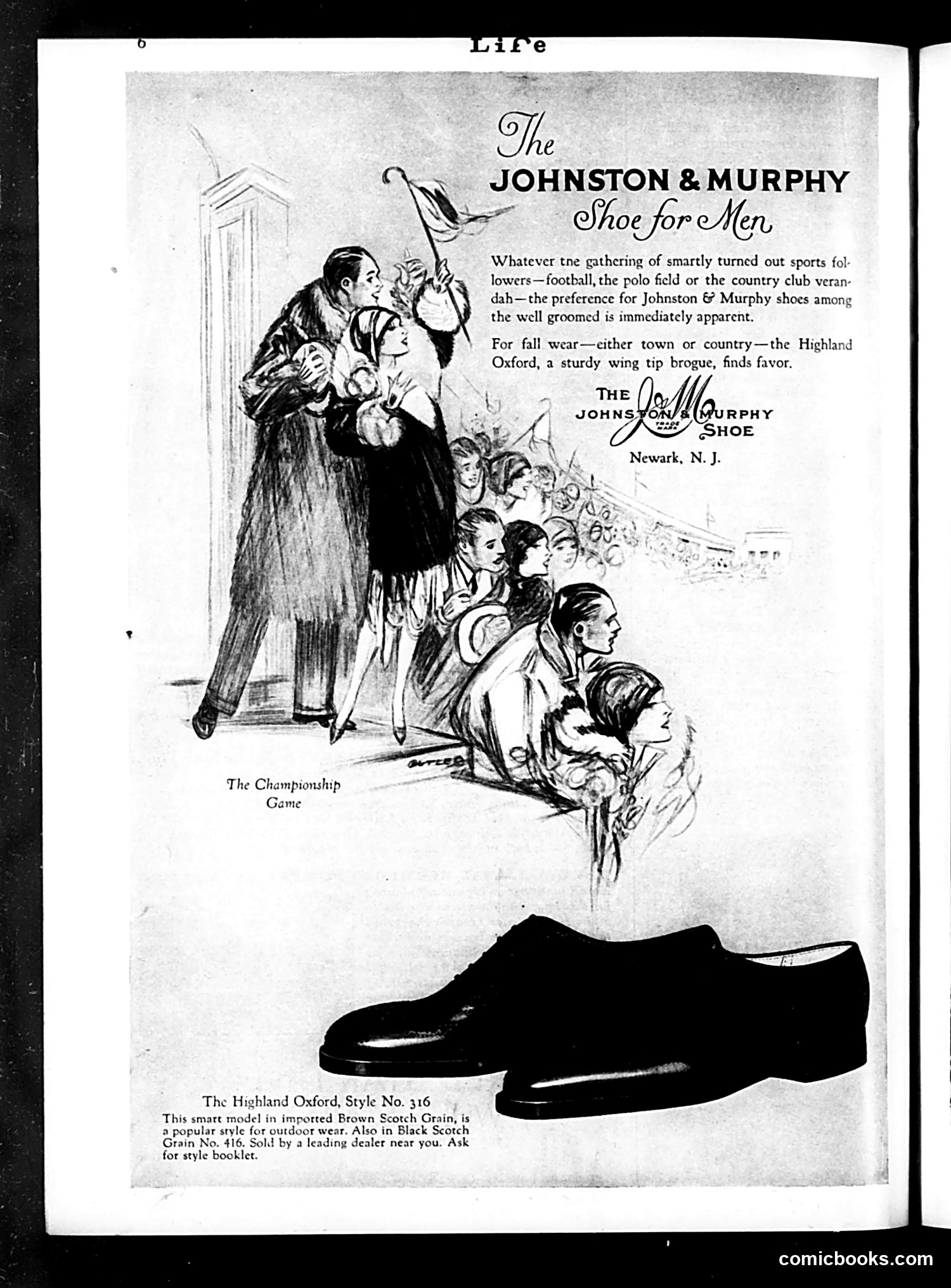
Johnston & Murphy Shoe Advertisement This is a straightforward advertisement, not political satire. The page promotes Johnston & Murphy shoes for men, manufactured in Newark, New Jersey. The illustration depicts "The Championship Game"—well-dressed gentlemen at a sporting event, with one man pointing enthusiastically at the action. The ad emphasizes that Johnston & Murphy shoes are preferred by "smartly turned out sports followers" at events like football, polo, and country clubs. The featured shoe is the Highland Oxford (Style No. 316), described as suitable for both town and country wear, available in brown and black scotch grain. The humor is gentle and aspirational rather than satirical—the ad associates wearing these shoes with belonging to an affluent sporting elite.
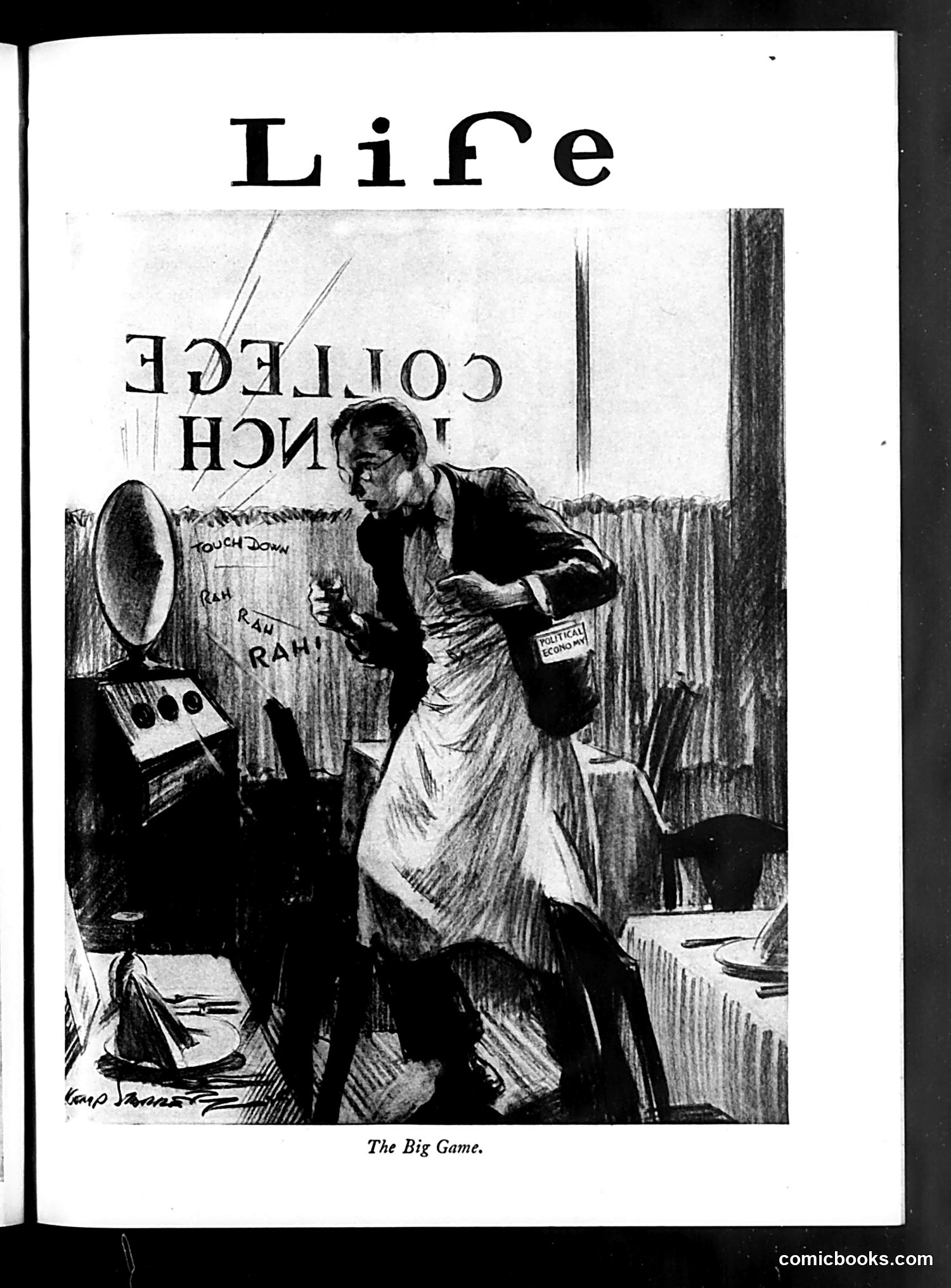
"The Big Game" - Life Magazine Cartoon This satirical cartoon depicts a man in business attire appearing to manipulate or control a woman in a dress like a puppet or doll. The setting suggests an office or commercial space, with visible text including "TOUCH DOWN," "RAH RAH," and what appears to be "AMERICAN" branding. The title "The Big Game" uses sports terminology as metaphor. The cartoon satirizes how women were treated as objects to be controlled or "played" in commercial and social contexts. The puppet-like pose, combined with the sports reference, suggests commentary on how women's autonomy was compromised in business dealings or romantic/social "games" of the era. The satire critiques male dominance and the objectification of women in early 20th-century American society.
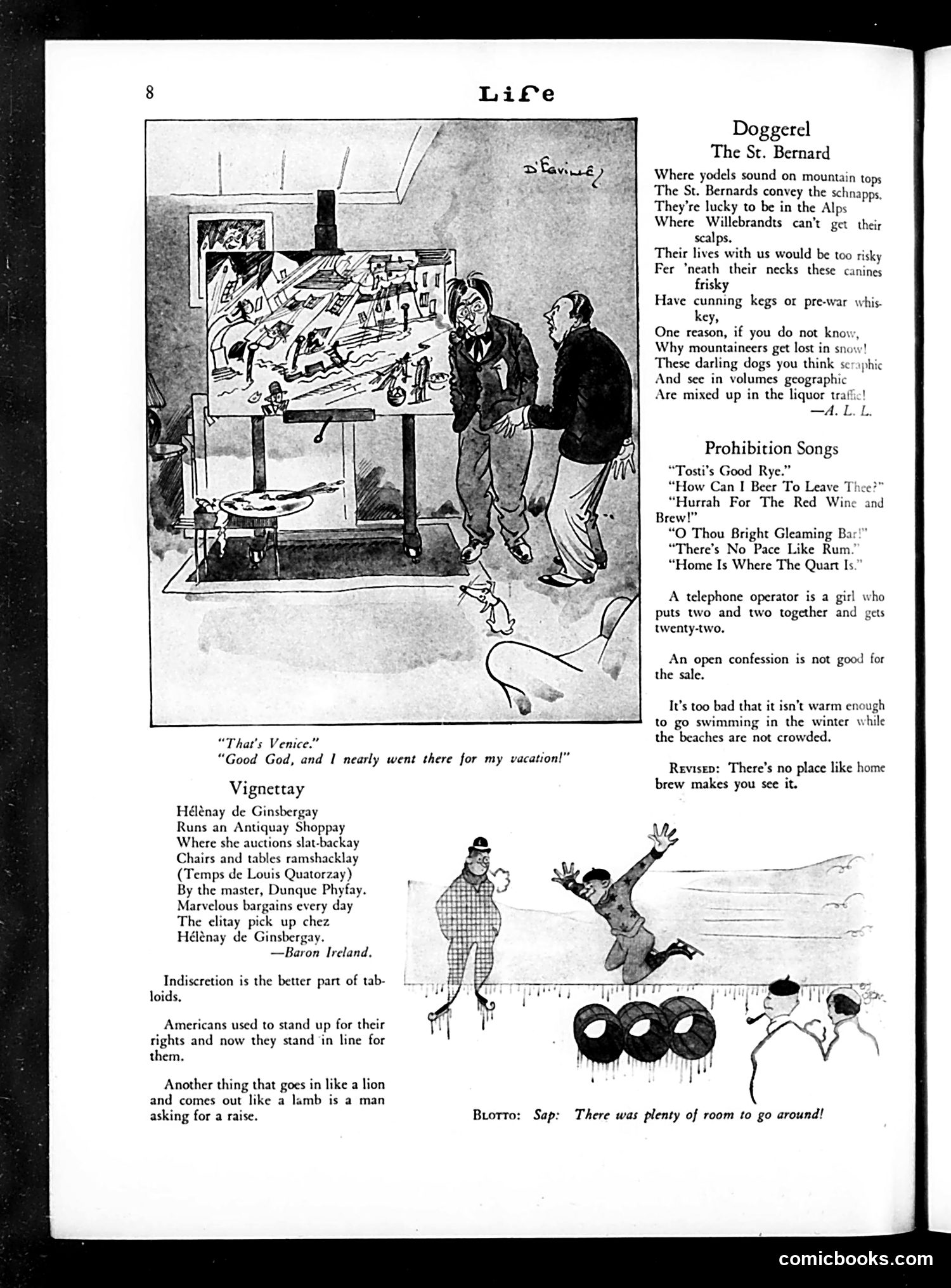
Analysis of Life Magazine Page 8 This page contains three separate satirical pieces typical of early 20th-century Life magazine humor: "That's Venice" (top cartoon): Two men view a cluttered, chaotic interior scene. The caption implies someone almost went there for vacation, suggesting the depicted mess is comparable to Venice's notorious overcrowding or disorder. "Vignettay" (middle): A poem about Hélénay de Ginsbergay's antiquary shop, mocking French-sounding names and implying disorganized commerce through references to "ramshackle" furniture auctions. "Blotto" (bottom cartoon): Depicts someone diving into what appears to be shallow water or snow, with onlookers. The caption "There was plenty of room to go around!" satirizes reckless behavior or poor judgment. The page represents Life's typical blend of social commentary through humor targeting contemporary leisure, consumer culture, and human folly.
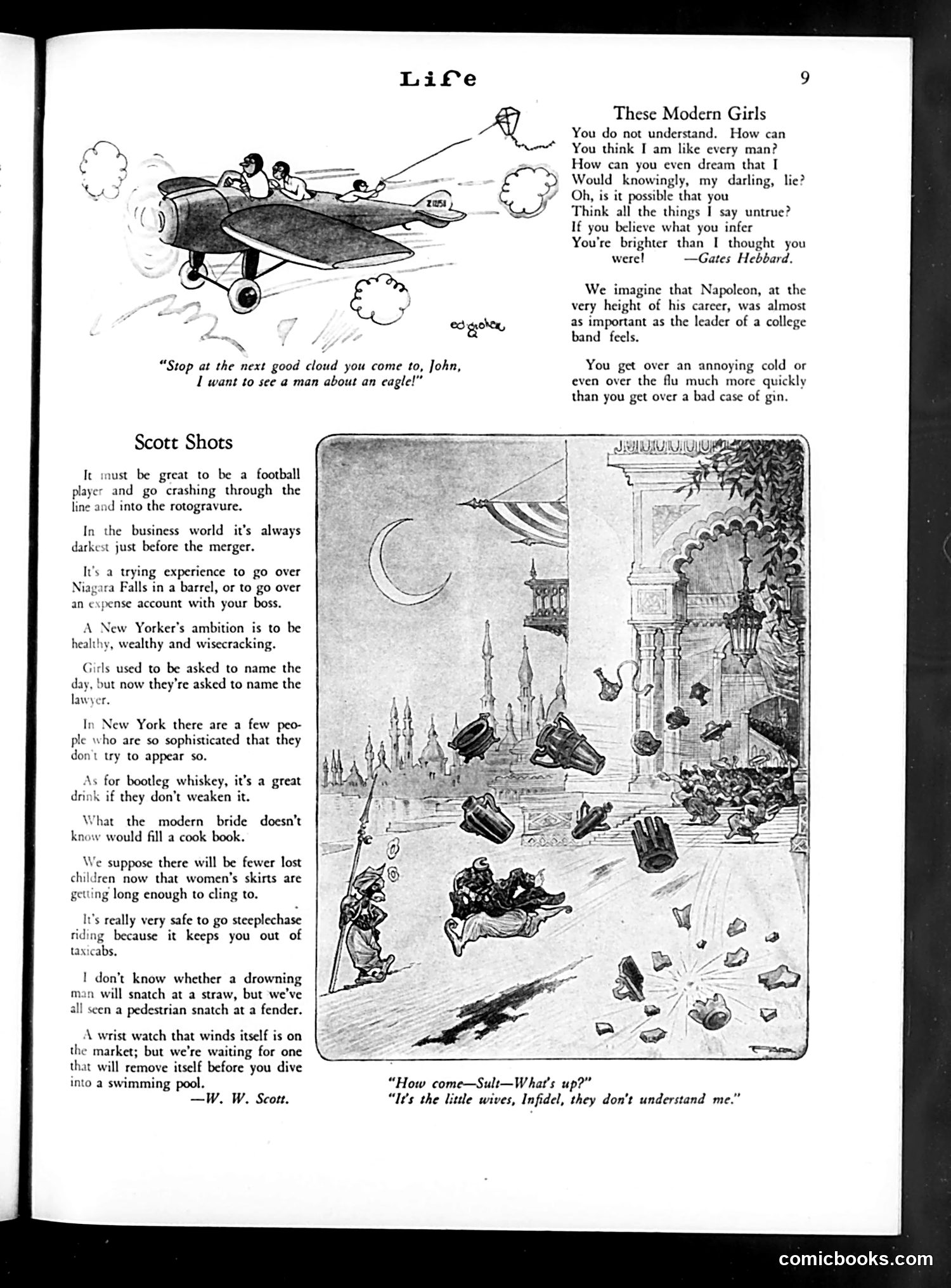
Page Analysis: Life Magazine, Page 9 Top Section - "These Modern Girls": A satirical poem by Gates Hebbard critiques modern women who claim independence but expect men to believe their stories uncritically. The accompanying airplane cartoon shows women piloting/riding in an aircraft, visually supporting the poem's theme about women's changing roles and ambitions. Bottom Section - "Scott Shots": W.W. Scott's humorous observations about contemporary life include jokes about business competitiveness, New York ambitions, marriage, and prohibition-era drinking. The large cartoon depicts chaotic Arabian/Orientalist architecture with figures and falling objects—likely satirizing exotic fantasies or possibly foreign affairs, though the specific reference is unclear from context alone.
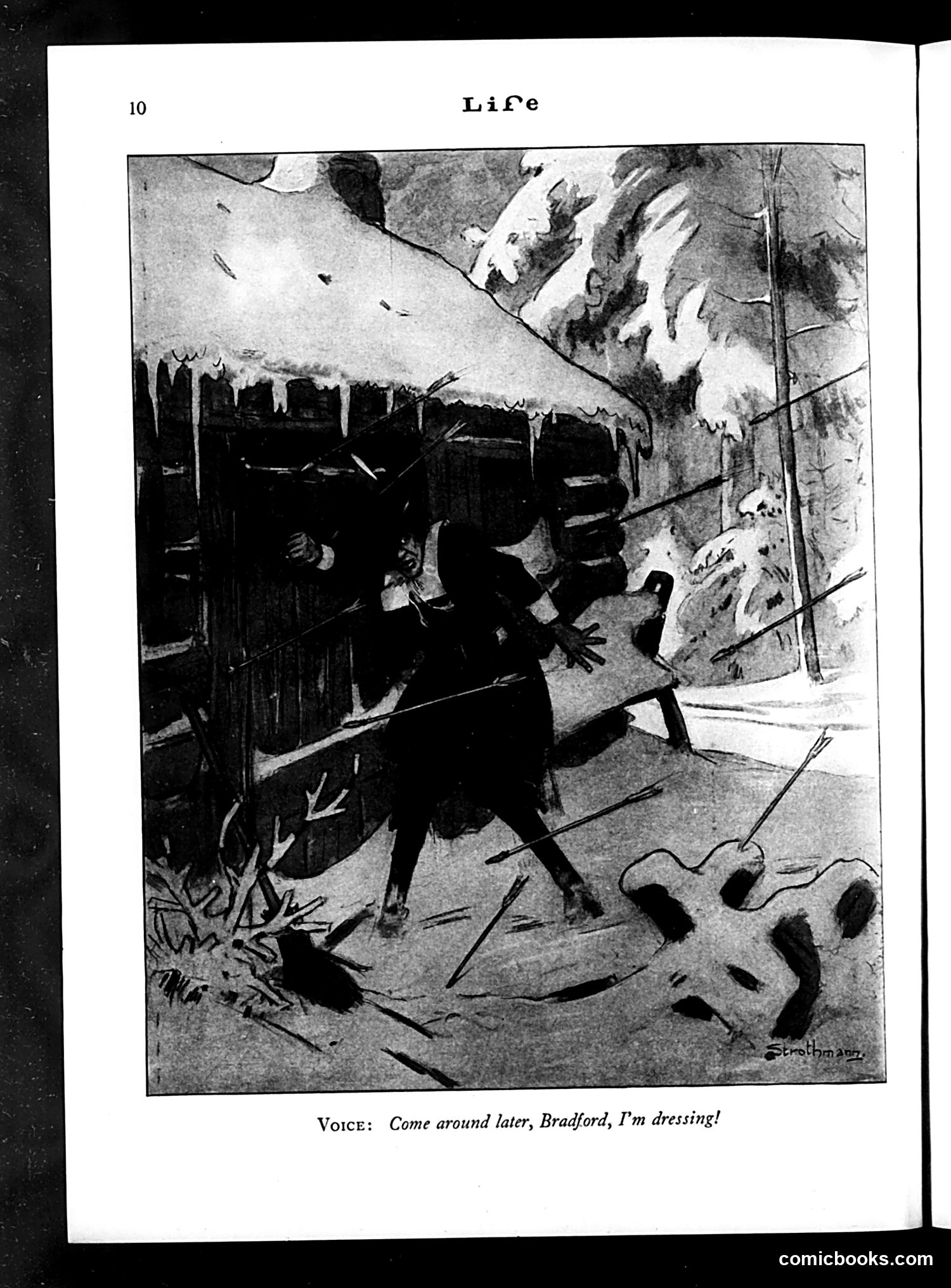
Analysis This is a satirical cartoon from *Life* magazine (page 10) depicting what appears to be a winter or ice-cave scene. A silhouetted figure is shown near an icy overhang with icicles, and the voice caption reads: "Come around later, Bradford, I'm dressing!" The cartoon satirizes social pretension or vanity—specifically, someone primping or getting ready despite being in crude, primitive circumstances (an ice cave). The humor lies in the contrast between the harsh environment and the speaker's concern with appearance and propriety. "Bradford" appears to be a contemporaneous name suggesting upper-class society. Without additional context about the magazine's date or current events referenced, the specific target of satire remains unclear, though it likely mocks affectation or class-consciousness among wealthy individuals.
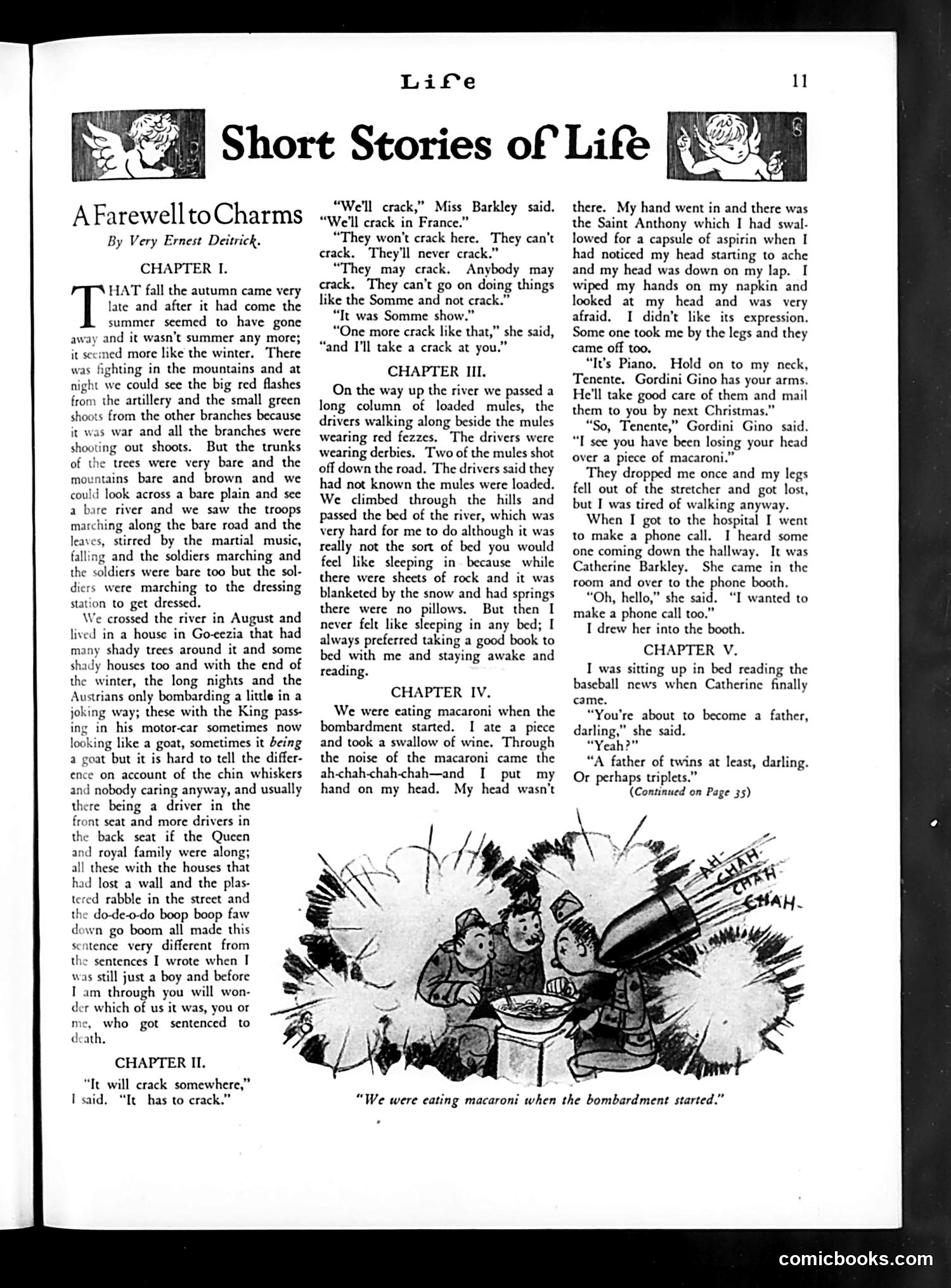
Analysis of "A Farewell to Charms" by Very Ernest Deitrick This appears to be a serialized short story rather than political satire. The narrative follows a soldier's experiences during wartime—crossing rivers, witnessing bombardments, and recovering in a hospital. The illustration depicts the moment described in Chapter IV: soldiers eating macaroni when artillery bombardment begins, with explosive effects shown around them. The story's title "A Farewell to Charms" and references to France, Austrian bombardment, and hospital recovery suggest this is likely set during World War I. The narrative provides a first-person account of combat experience and injury. This is literary content, not political commentary—a war memoir presented as serial fiction for Life magazine's readers.
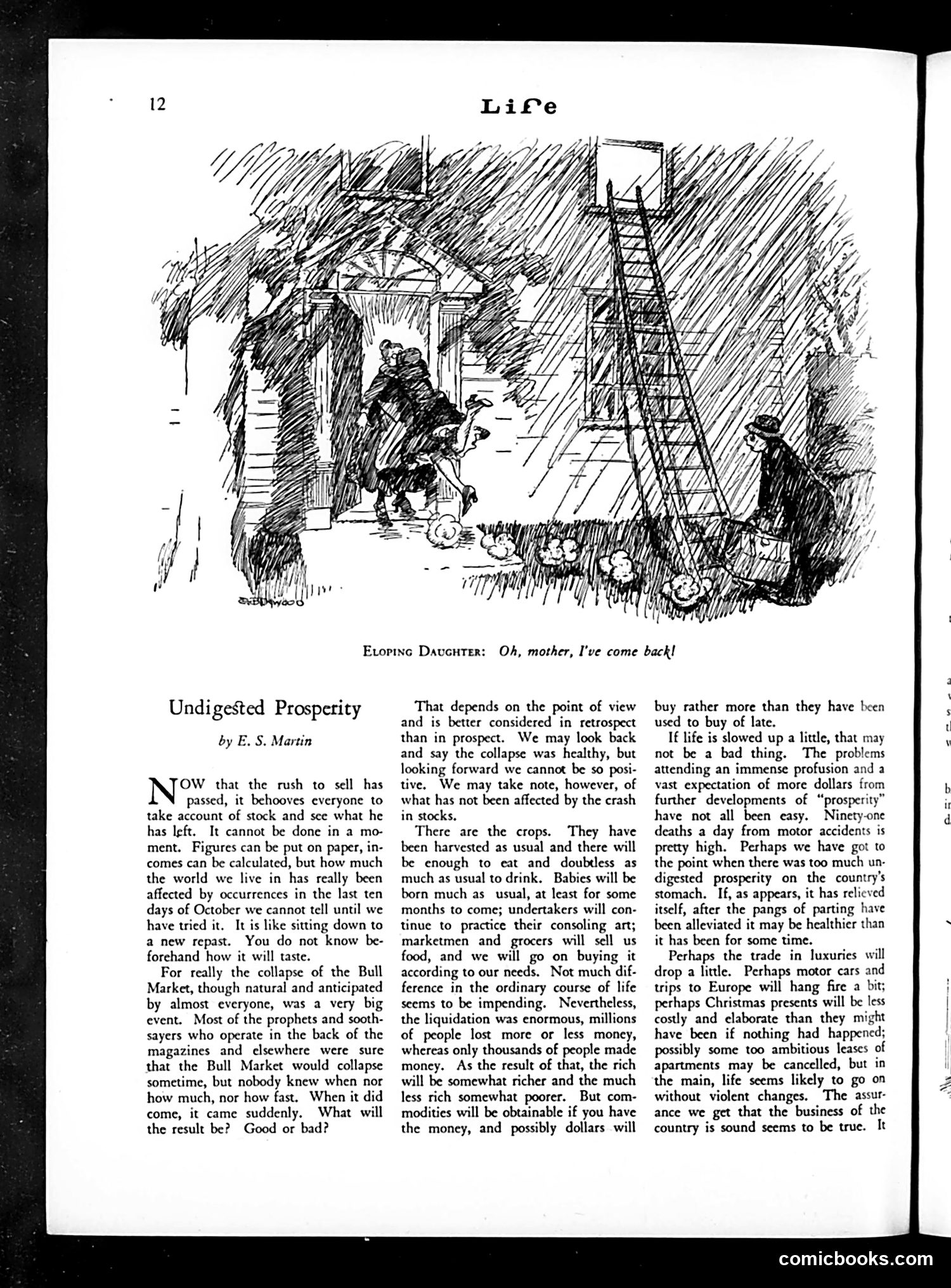
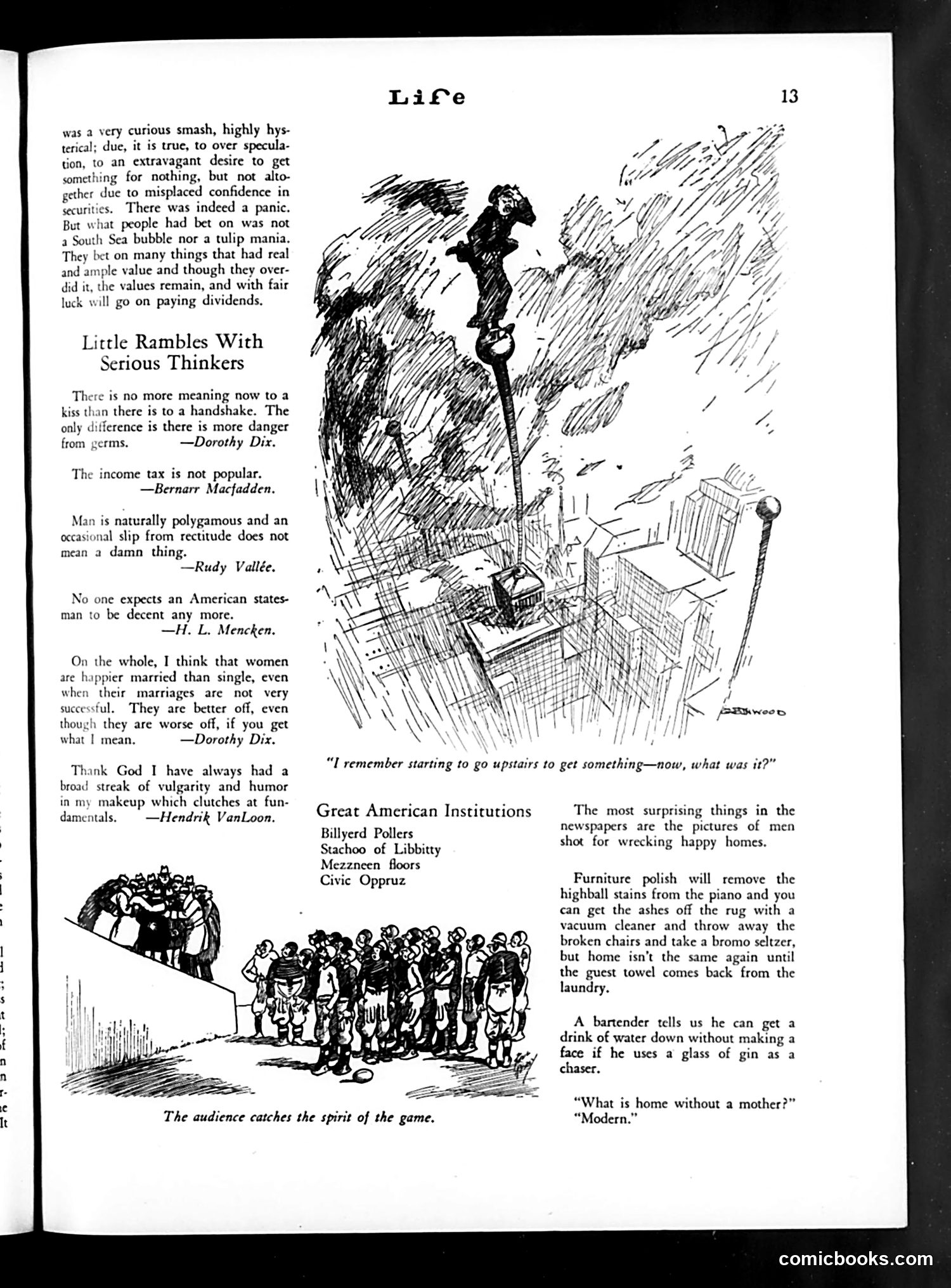
Analysis of Life Magazine Page 13 This page contains satirical commentary and illustrations typical of Life's social humor. The top cartoon depicts a figure on a tall pole during what appears to be windy or stormy conditions, captioned "I remember starting to go upstairs to get something—now, what was it?" This likely satirizes absent-mindedness or domestic distraction. Below, the "Great American Institutions" section lists institutions like "Bilked Pollers" and "Stachoo of Libbity" (appearing to mock misspellings or satirize civic institutions). The lower cartoon showing a crowd appears captioned about "the audience catches the spirit of the game," satirizing public behavior or mob mentality. The right column contains humorous observations about home life, furniture maintenance, and modern domesticity, typical of Life's satirical commentary on American middle-class culture.
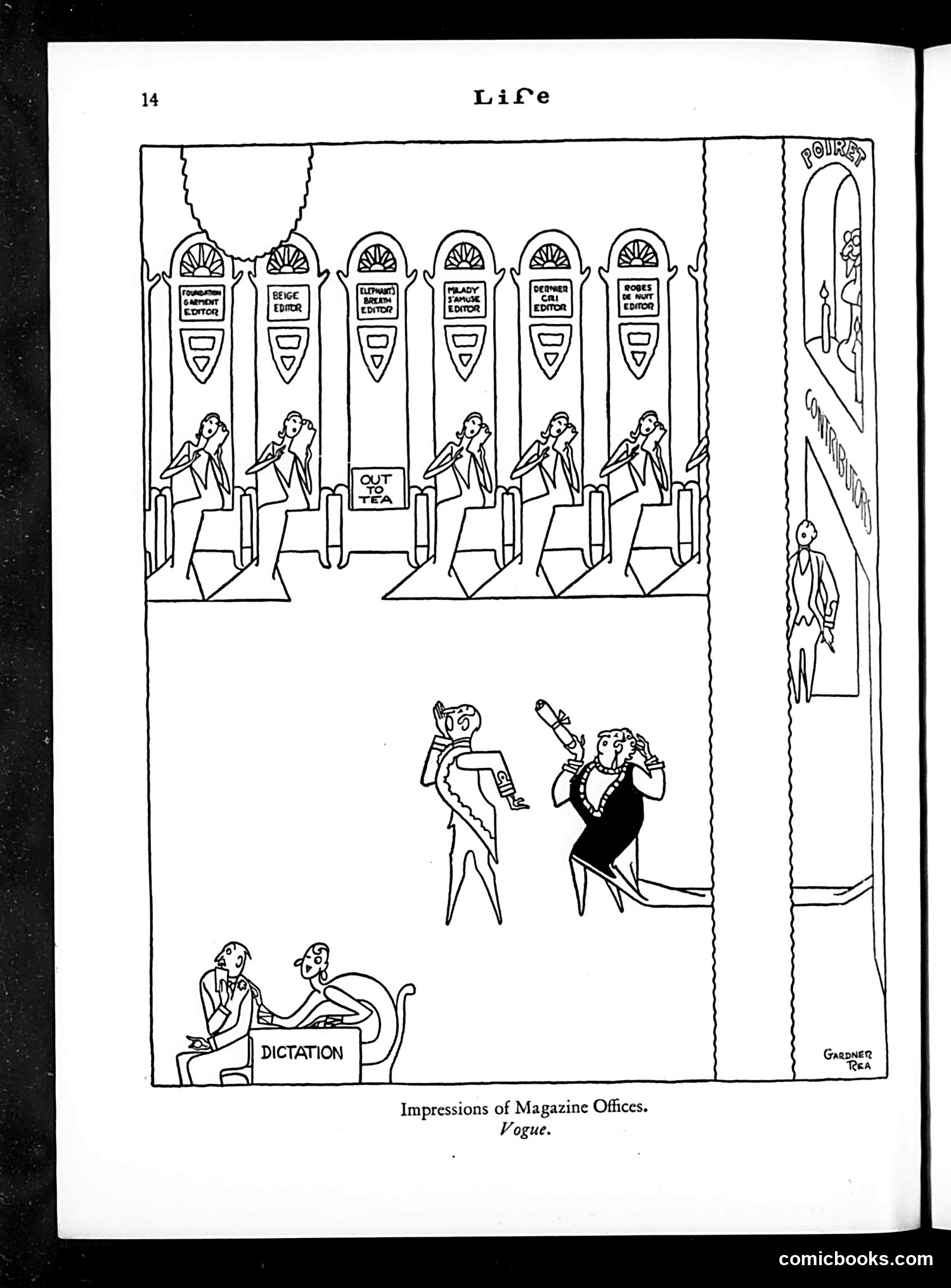
"Impressions of Magazine Offices: Vogue" This cartoon satirizes the Vogue magazine office hierarchy and workflow. At the top, six editors sit in ornate chairs beneath decorative fan-shaped emblems, each labeled with editorial titles (the text is small but indicates different editor positions). Below them, the cartoon depicts the actual work: a woman at a "DICTATION" desk taking notes, another woman wielding what appears to be a megaphone or speaker, and a third figure climbing or descending. The satire contrasts the pretentious, decorative appearance of editorial authority above with the chaotic, physically demanding labor required below to produce the magazine. The elaborate setting and formal titles suggest self-importance, while the frantic activity below mocks the reality of magazine production work.
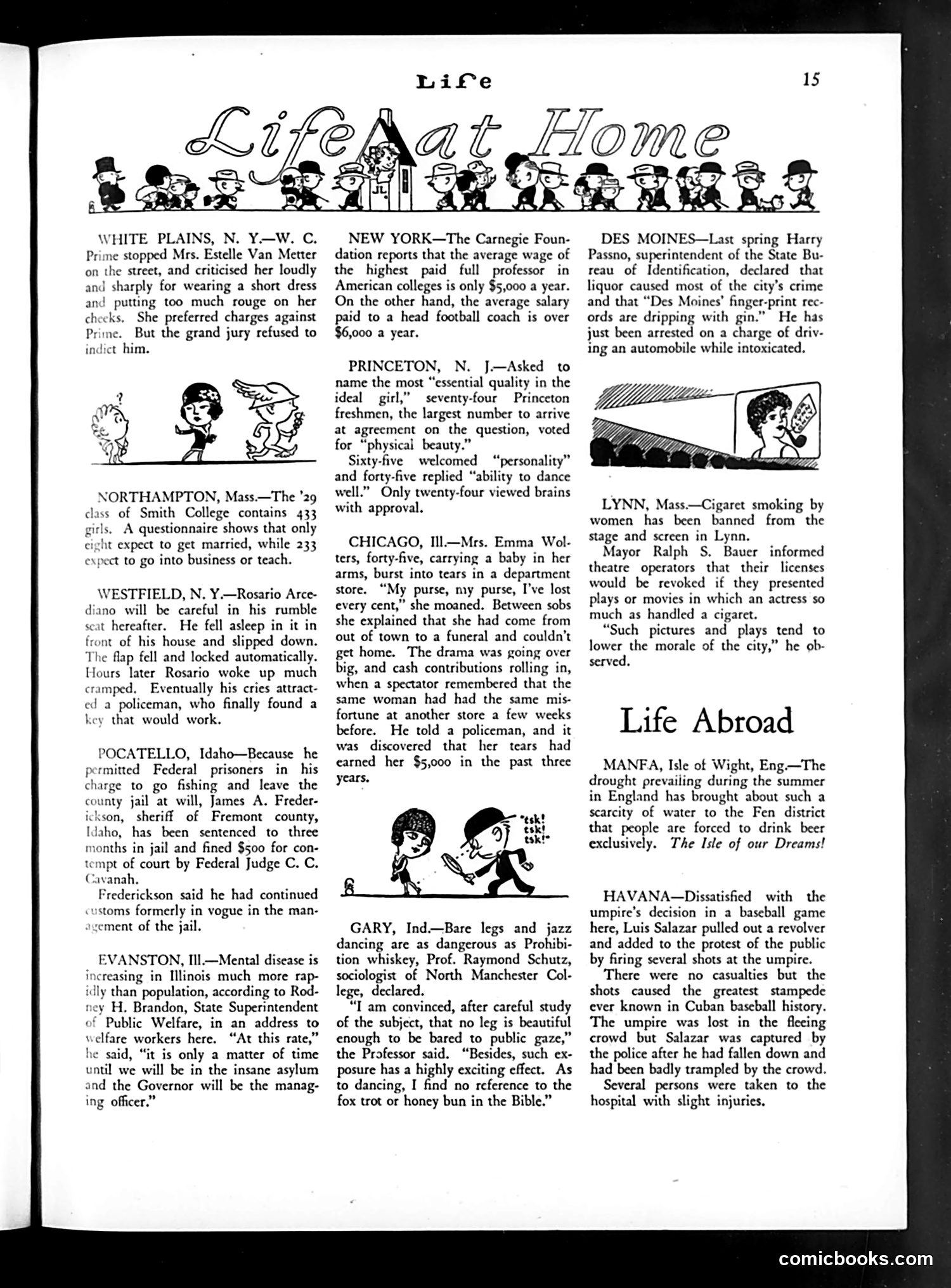
Life Magazine Page 15: Social Commentary This page contains brief satirical news items under "Life at Home" and "Life Abroad" sections, illustrated with small cartoons. The items mock contemporary social issues: a woman criticized for wearing a short dress and rouge; Princeton students' preferences for "physical beauty" in women; a Smith College questionnaire about career expectations; a woman's repeated misfortune losing her purse; and a county sheriff jailed for printing fraudulent fishing permits. One small cartoon shows a man and woman in conversation with speech bubbles reading "talk talk talk." The "Life Abroad" section includes a brief item about a Cuban baseball incident involving umpire Luis Salazar. These are typical of Life magazine's satirical approach—brief, gossipy observations on American social customs and absurdities, rather than sustained political cartoons. The humor relies on irony and social observation rather than visual caricature.
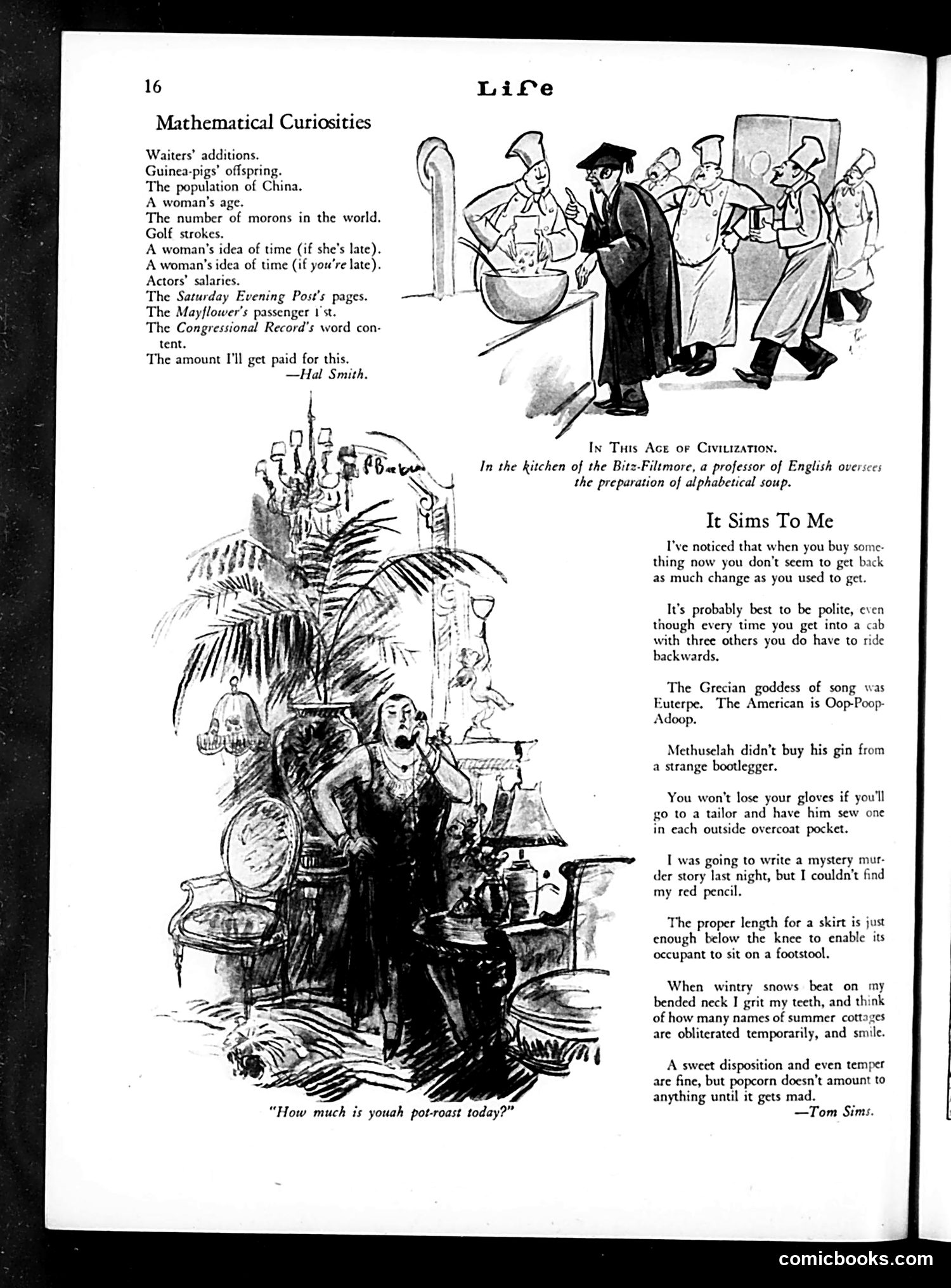
Analysis of Life Magazine Page 16 This page contains two distinct satirical sections: Top cartoon: Shows kitchen staff preparing "alphabetical soup" at the Ritz-Filmore hotel. The satire mocks pretentious dining—converting simple soup into something that sounds sophisticated through fancy naming. Bottom cartoon: Depicts what appears to be an ornate, cluttered interior with a figure asking "How much is yoash pot-roast today?" The elaborate setting contrasts with discussion of a humble, inexpensive dish, likely satirizing either inflation, the gap between fancy establishments and working-class food, or wartime scarcity. Right column: "It Sims To Me" contains miscellaneous social observations and mild complaints about everyday life (cab rides, shopping, tailors, fashion), typical of Life's gentle satirical commentary on American manners and customs.
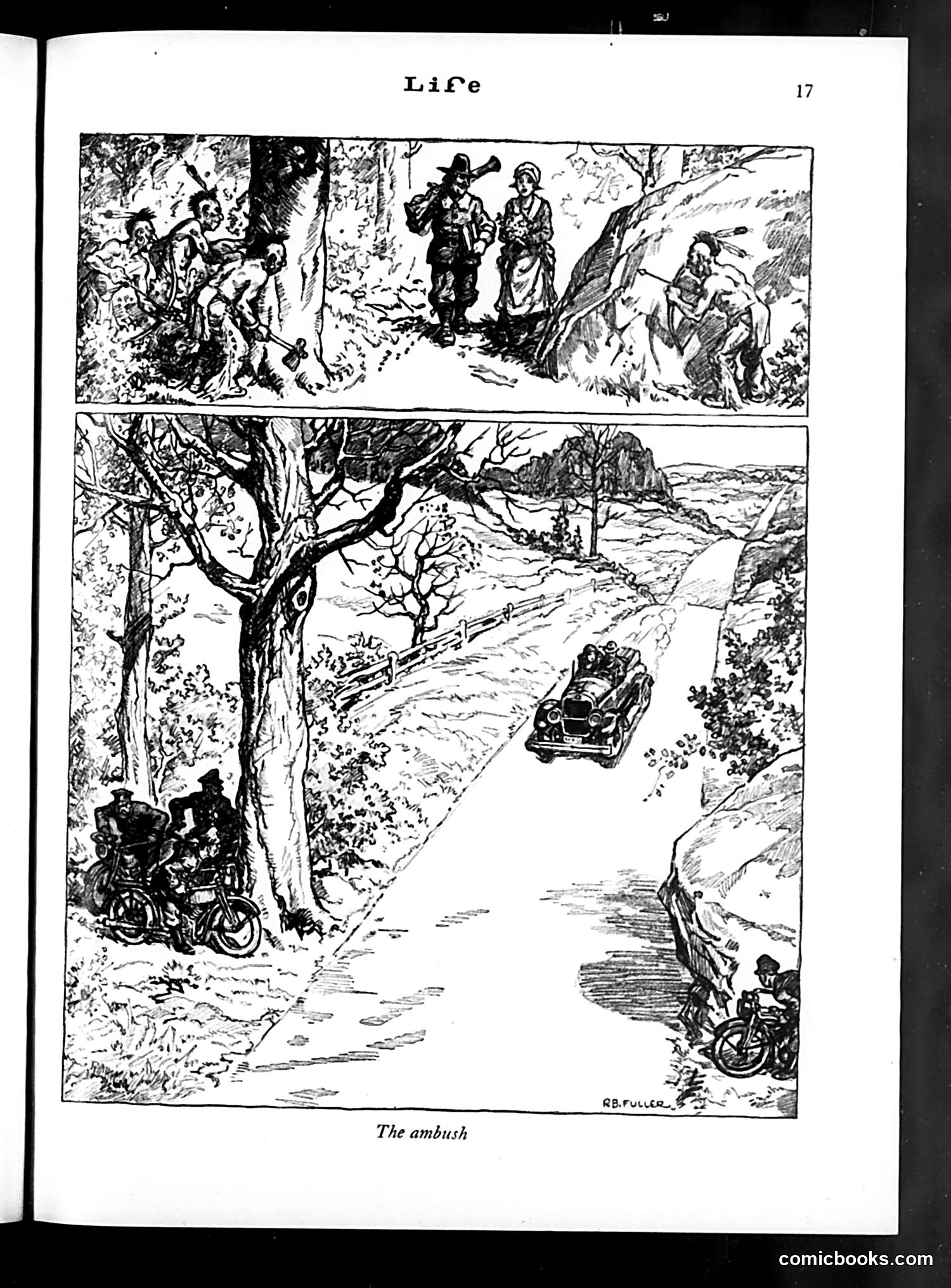
"The Ambush" - Life Magazine Cartoon Analysis This two-panel comic depicts an "ambush" scenario set in a rural landscape. The top panel shows armed figures (appearing to be soldiers or law enforcement) confronting civilians near trees and rocks. The bottom panel reveals the "ambush's" actual target: a motorcar traveling on a country road is being attacked by people on bicycles hiding behind trees and rock formations. The satire appears to mock early automobile culture—specifically, the tension between new motorists and traditional road users (cyclists, pedestrians). The comic inverts expectations by framing cyclists as the aggressors against the novel technology of automobiles. This likely reflects contemporary anxieties about automobiles' growing presence and their conflicts with older forms of transportation, presenting the "ambush" as humorous social commentary on technological disruption.
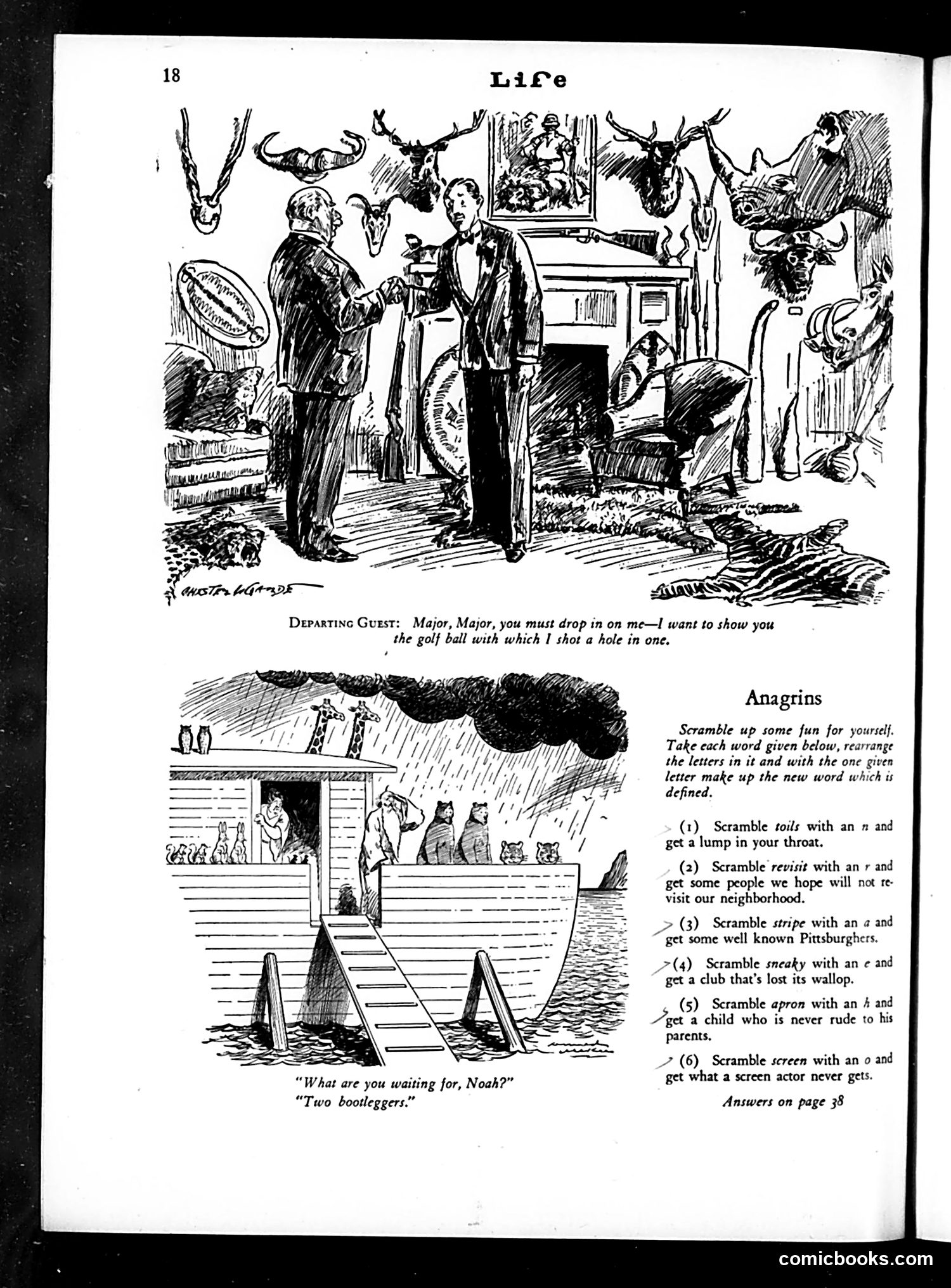
Analysis of Life Magazine Page 18 Top Cartoon: "Departing Guest" depicts a wealthy man in formal attire being urged by his host to view a golf ball that went into a hole-in-one. The room displays hunting trophies (animal heads) and luxury furnishings, suggesting upper-class recreation and conversation. The humor targets wealthy men's tendency to boast about golfing achievements—a status sport of that era. Bottom Section: "Anagrins" is a word puzzle game where readers rearrange letters to form new words with humorous definitions (like "toils" becoming "a lump in your throat"). The Noah's Ark illustration and "Two booleggerts" joke reference Prohibition-era bootlegging, though the connection appears tangential to the word game itself. Both items satirize leisure and wealth.
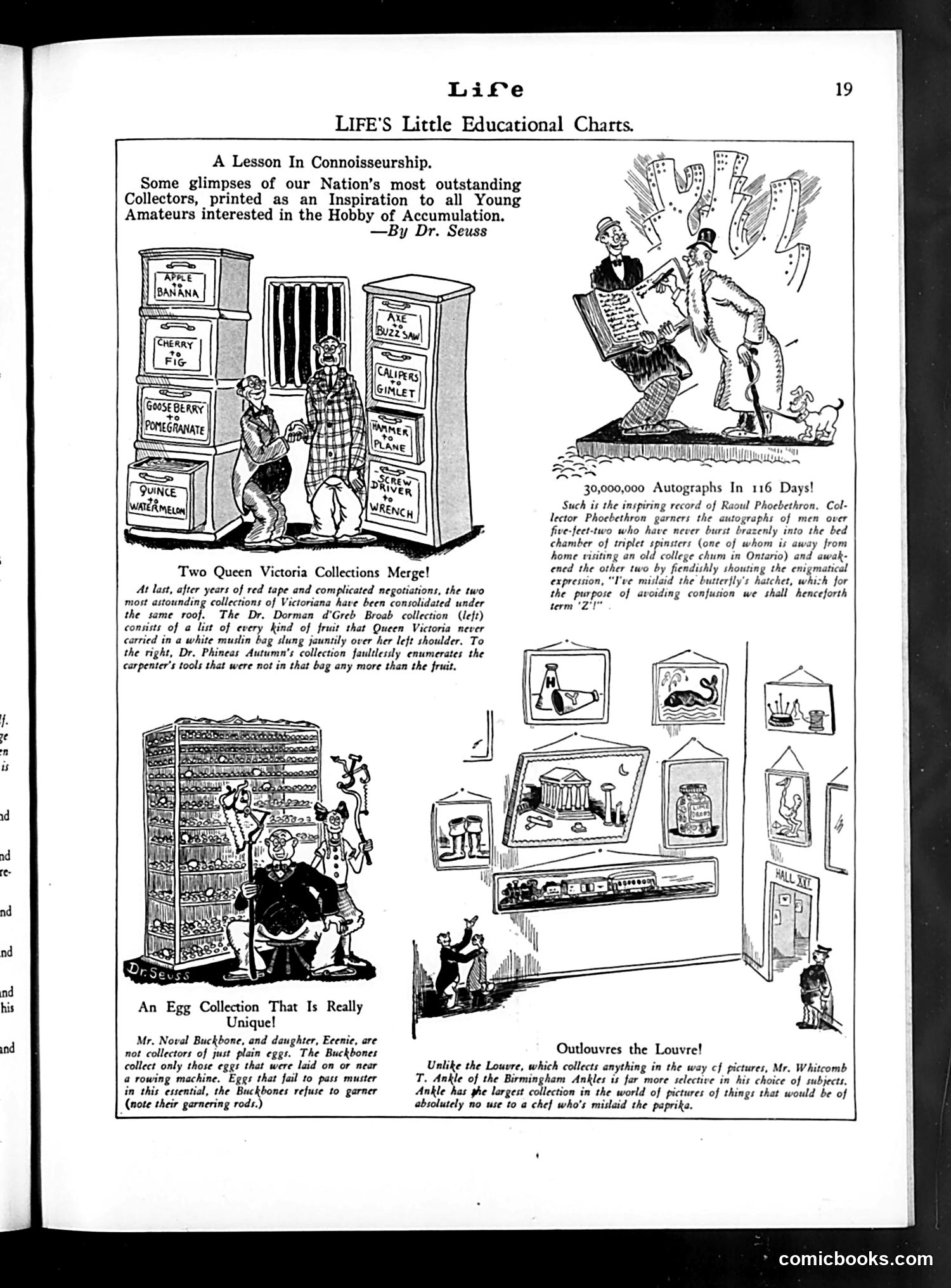
Life Magazine: "A Lesson in Connoisseurship" (Dr. Seuss) This satirical feature by Dr. Seuss mocks obsessive American collectors and the absurdity of collecting as a hobby. Each vignette ridicules collectors pursuing increasingly nonsensical specializations: The Queen Victoria Collections: Two scholars have merged their life's work—one cataloguing fruits Victoria never carried in a bag, the other listing carpenter's tools not in that bag. The joke: they've devoted themselves to documenting *absences* rather than actual objects. Raoul Phoebethron's Autographs: He collects signatures from men over 5'2" who never committed a specific bizarre crime, with deliberately obtuse criteria invented to obscure the collection's actual pointlessness. The Buckbone Egg Collection: They collect only eggs laid near rowing machines—another arbitrary, meaningless restriction. Whitcomb Ankle's Pictures: His collection shows things "absolutely no use to a chef who's mislaid the paprika"—pure uselessness. The satire critiques America's consumerist culture and the wealthy's compulsive accumulation of meaningless objects dressed up as refined hobbies. Seuss suggests that connoisseurship often masks shallow obsession.
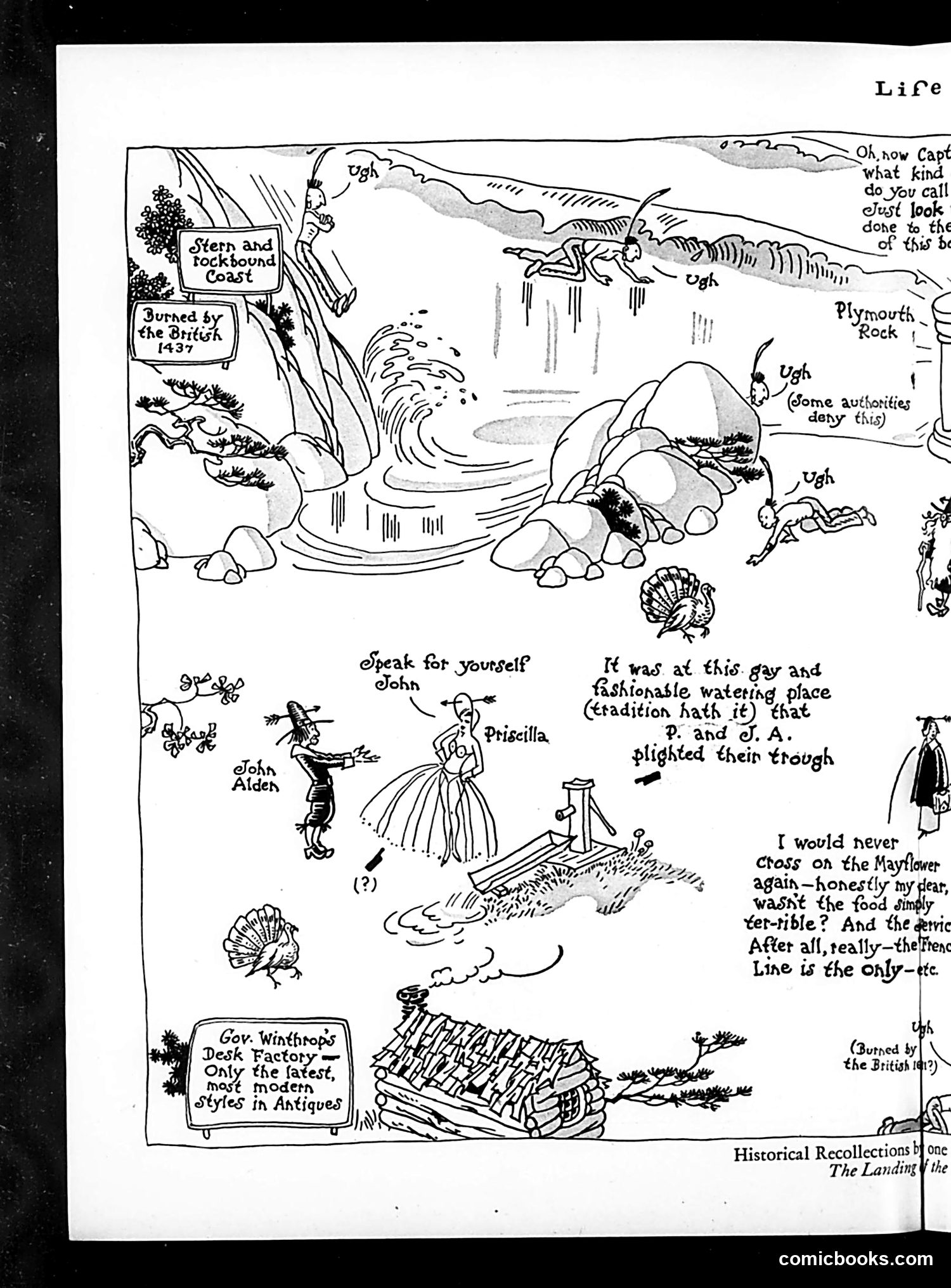
Analysis This cartoon satirizes the Pilgrims' landing and early colonial settlement. The upper panel shows the rocky Massachusetts coast ("Plymouth Rock," "Stern and rockbound Coast") with period-appropriate commentary mocking the harsh conditions. The lower panel depicts a social scene at a fashionable watering place (seaside resort), where characters identified as "John Alden" and "Priscilla" reference the famous Pilgrim love story ("Speak for yourself, John"). A woman complains about the Mayflower voyage's terrible food and service. The satire targets nostalgic romanticism about Pilgrim history. While Americans revered the Pilgrims as noble founders, Life mocks how people selectively remember this history—celebrating it as glorious while the actual experience was brutal. The inset boxes about burned ships and Gov. Winthrop's "desk" add period historical details treated as precious "antiques." The joke: colonial hardship gets sanitized into charming tradition once safely in the past.
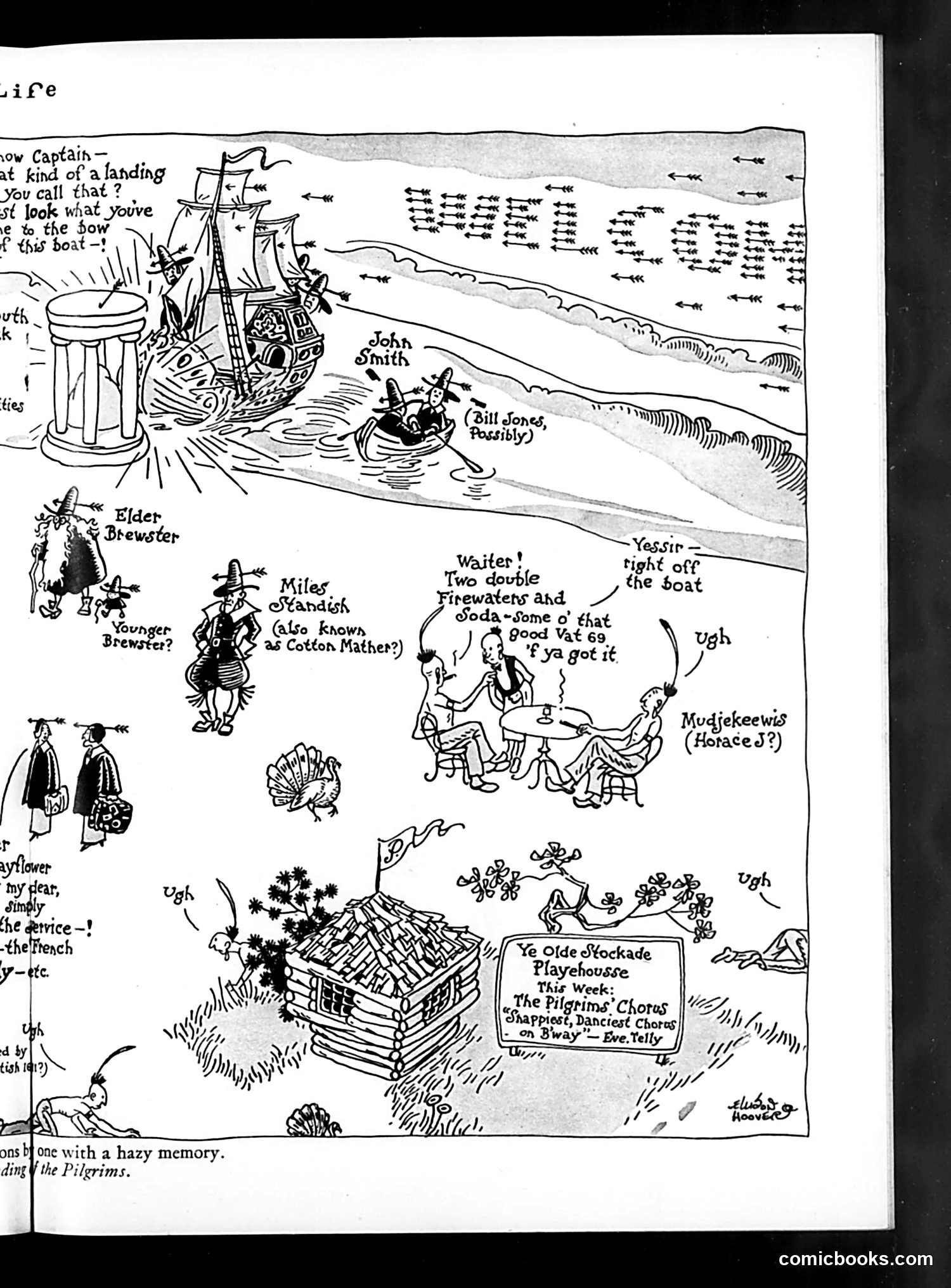
Historical Context of This Life Magazine Cartoon This is a satirical scene depicting the Pilgrims' landing at Plymouth Colony, but reimagined as a rowdy colonial tavern scene. The cartoon mocks the romanticized historical narrative of the Pilgrims by showing them as ordinary, drinking men engaged in casual conversation. Key figures include: - John Smith and Bill Jones (possibly) arriving by boat - Elder Brewster and Younger Brewster (actual Pilgrim names) - Miles Standish (historical Pilgrim military leader) - Mudjekeewis (likely a Native American reference) The satire ridicules the "hazy memory" of Pilgrim history—suggesting Americans have sanitized or forgotten the settlers' actual behavior. References to "Vat 69" (whiskey) and double "Firewaters" emphasize drinking culture. The "Ye Olde Stockade Playhouse" advertisement jokes that even theatrical productions sanitize this history. The overall point: the dignified Pilgrims of historical memory were actually rough frontiersmen, and popular culture whitewashes their reality.
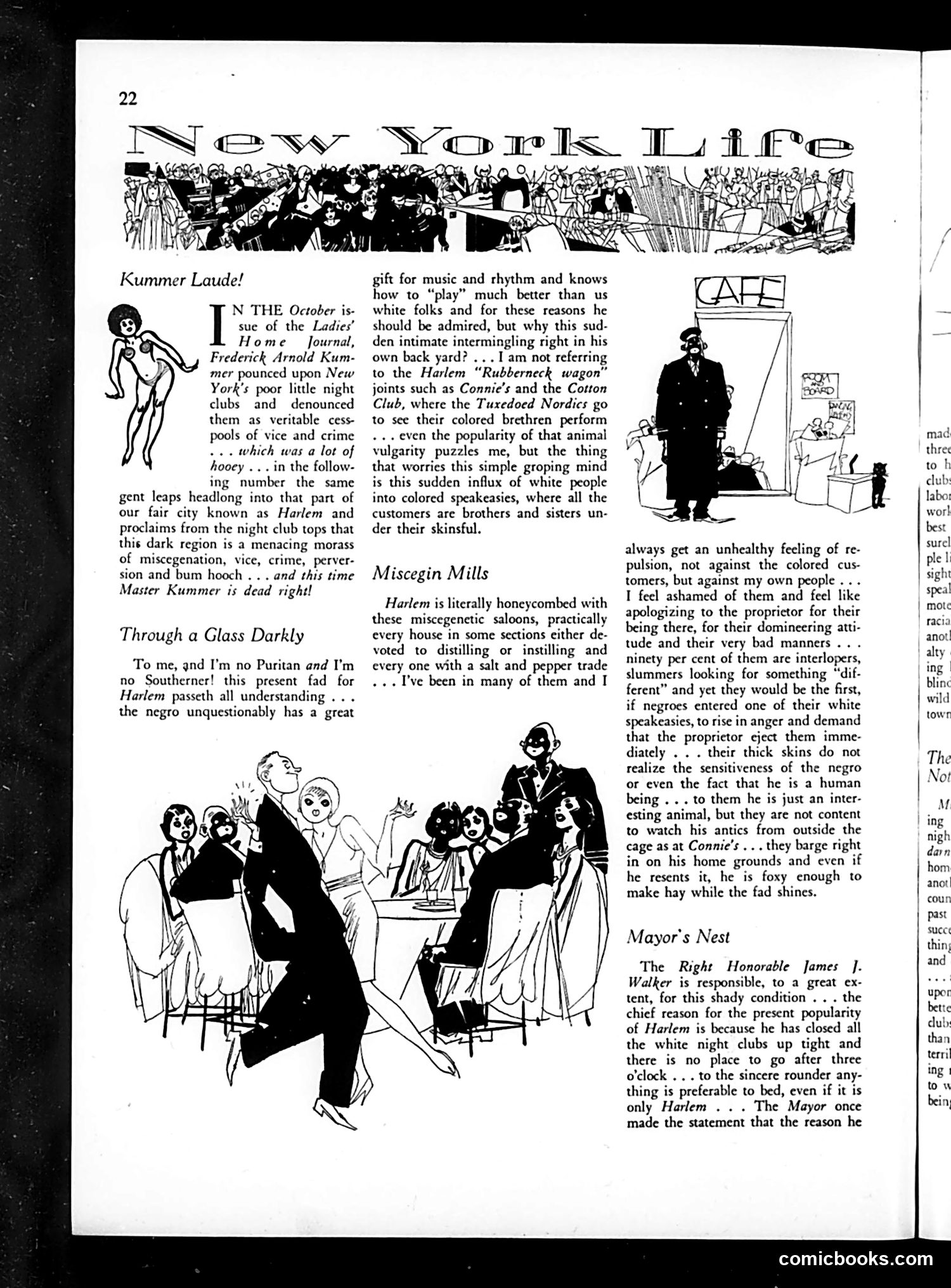
Analysis of Life Magazine Page 22 This 1920s Life magazine page satirizes New York City's Harlem nightclub scene and racial attitudes of white New Yorkers. The author criticizes Frederick Arnold Kummer, a writer who condemned Harlem clubs as "cesspools," arguing Kummer is hypocritically correct this time. The piece expresses condescending disapproval of white "slummers" visiting Black-owned speakeasies—framing it as voyeurism and disrespect. The author claims white patrons view Black entertainers as "interesting animals" rather than equals, and would demand Black patrons' removal from white clubs. Mayor James J. Walker is blamed for Harlem's popularity by closing white nightclubs, forcing after-hours revelers into Harlem venues. The cartoons show social gatherings in these clubs. The satire reflects 1920s racial paternalism—the author claims to admire Black musical talent while opposing interracial socializing in Black spaces, revealing the era's deeply contradictory attitudes toward race and segregation.
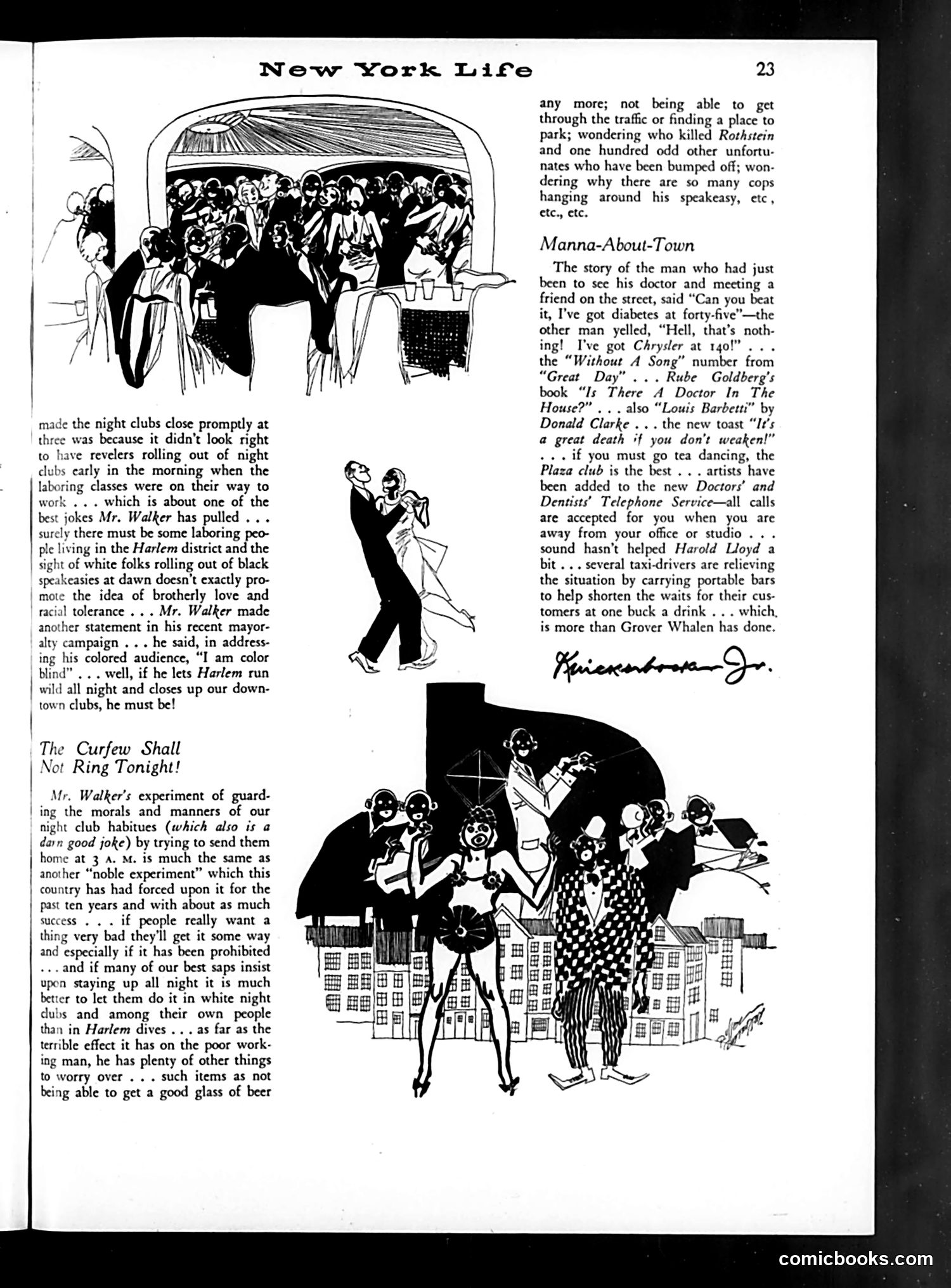
Political Satire Analysis: Life Magazine Page 23 This page satirizes New York Mayor Jimmy Walker's 1920s policies through two pieces: "The Curfew Shall Not Ring Tonight!" mocks Walker's 3 a.m. nightclub closing mandate as hypocritical racial theater. The author argues the rule is unenforced in Harlem (a Black neighborhood) while targeting downtown white establishments—contradicting Walker's claim to be "color blind." The piece compares this to Prohibition, suggesting both well-intentioned laws fail because people ignore them anyway. "Manna-About-Town" is a gossip column listing trendy NYC references: the Broadway show "Great Day," cartoonist Rube Goldberg, nightclubs like the Plaza, and comedian Harold Lloyd. The Chrysler/diabetes joke plays on material prosperity amid social problems. The cartoons illustrate crowded nightlife and revelry. The satire targets Walker's performative moralism while acknowledging deeper urban issues—crime (Rothstein murder), Prohibition's failure, and working-class economic struggles—render his nightclub rules absurdly trivial.
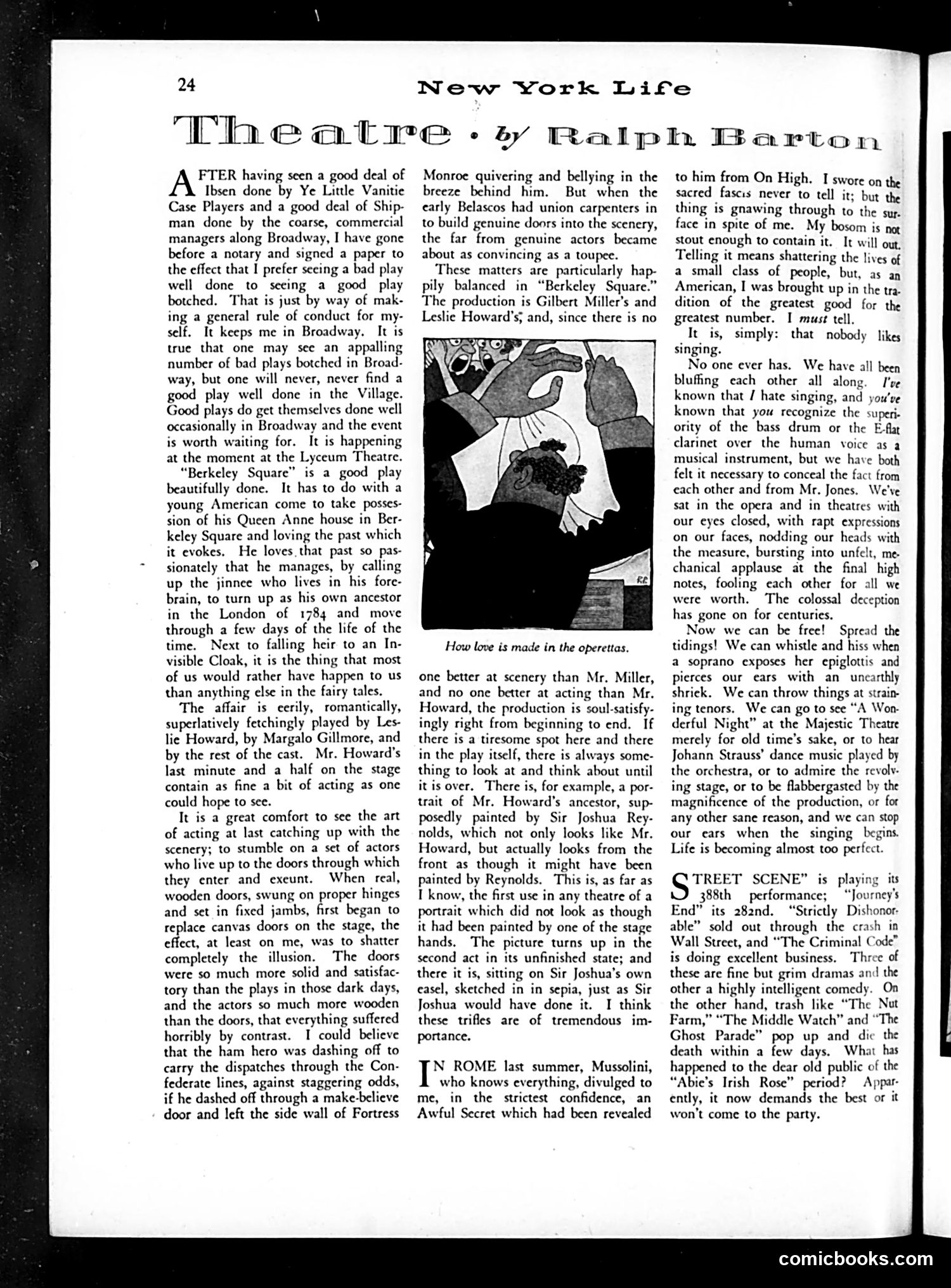
Analysis of This Theatre Column This is a theatre review by Ralph Barton in Life magazine (page 24), focused on Broadway productions. The illustration shows a stylized profile of a woman's face with dramatic features, captioned "How love is made in the operettas"—a satirical jab at operetta conventions. Barton reviews "Berkeley Square," praising its production quality and Leslie Howard's acting. His key argument: well-executed mediocre plays beat poorly-done good ones. He critiques the Village theatre scene while defending Broadway. The operetta illustration satirizes theatrical artificiality—the exaggerated, unrealistic way emotions are portrayed in that genre. Barton himself satirizes theatre history, noting how realistic stage doors (introduced by producer David Belasco in early 20th century) paradoxically *worsened* illusion because actors weren't skilled enough to match the improved scenery. The piece is essentially sophisticated theatre criticism using gentle satire about artistic compromise and technical production values.
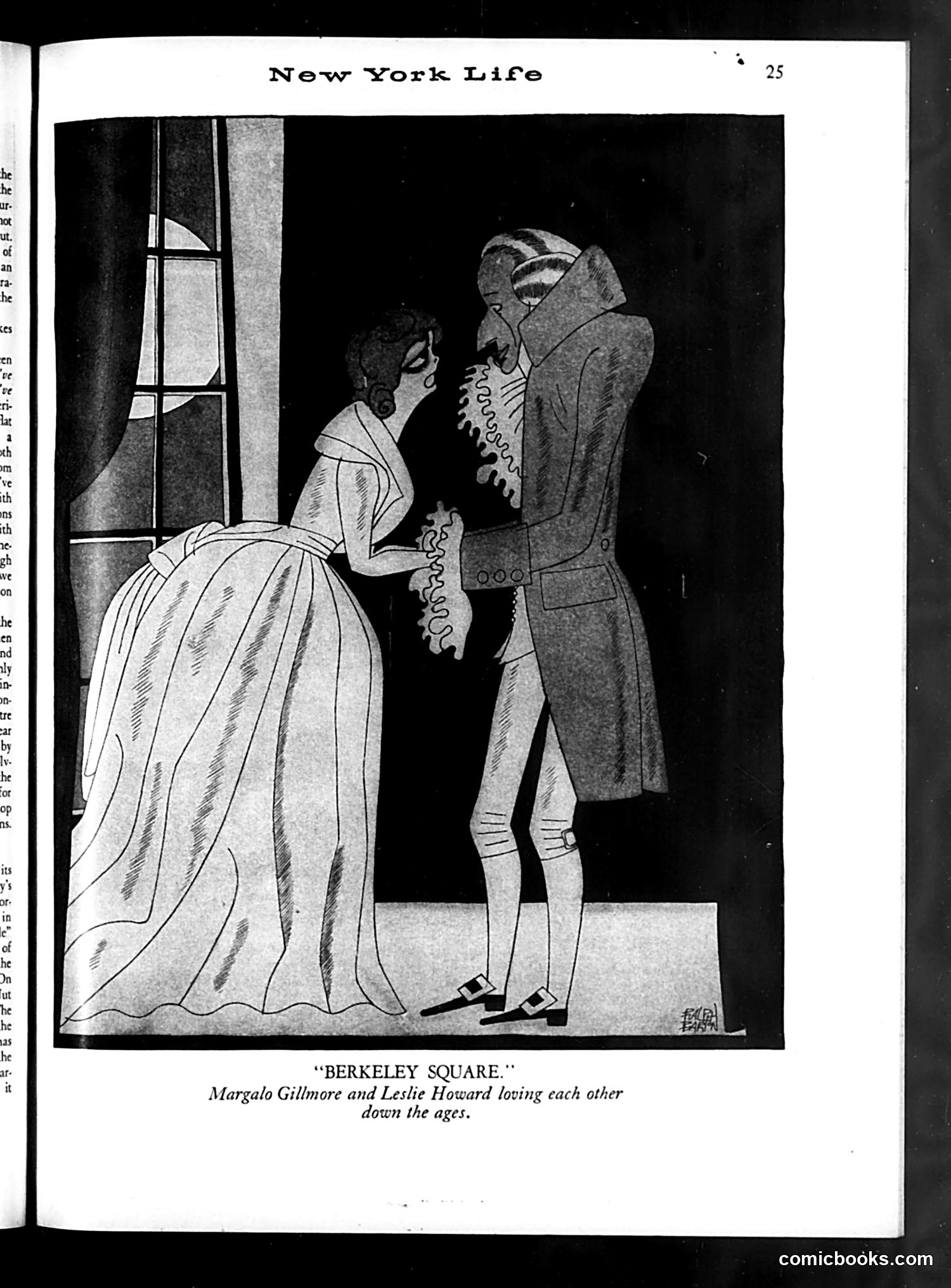
Analysis This is an illustration from Life magazine promoting the theatrical production "Berkeley Square." The caption identifies the actors as Margalo Gillmore and Leslie Howard, who are shown in an intimate romantic pose. The drawing depicts a woman in an elegant gown and a man in a coat embracing by a window. The phrase "loving each other down the ages" suggests the play's plot involves romance spanning different time periods or a timeless quality to their connection. This appears to be promotional material rather than satirical commentary—Life frequently featured such theatrical advertisements and illustrations during this era. The artwork showcases the glamorous aesthetic typical of 1920s-30s theatrical promotion, designed to entice readers to attend the show.
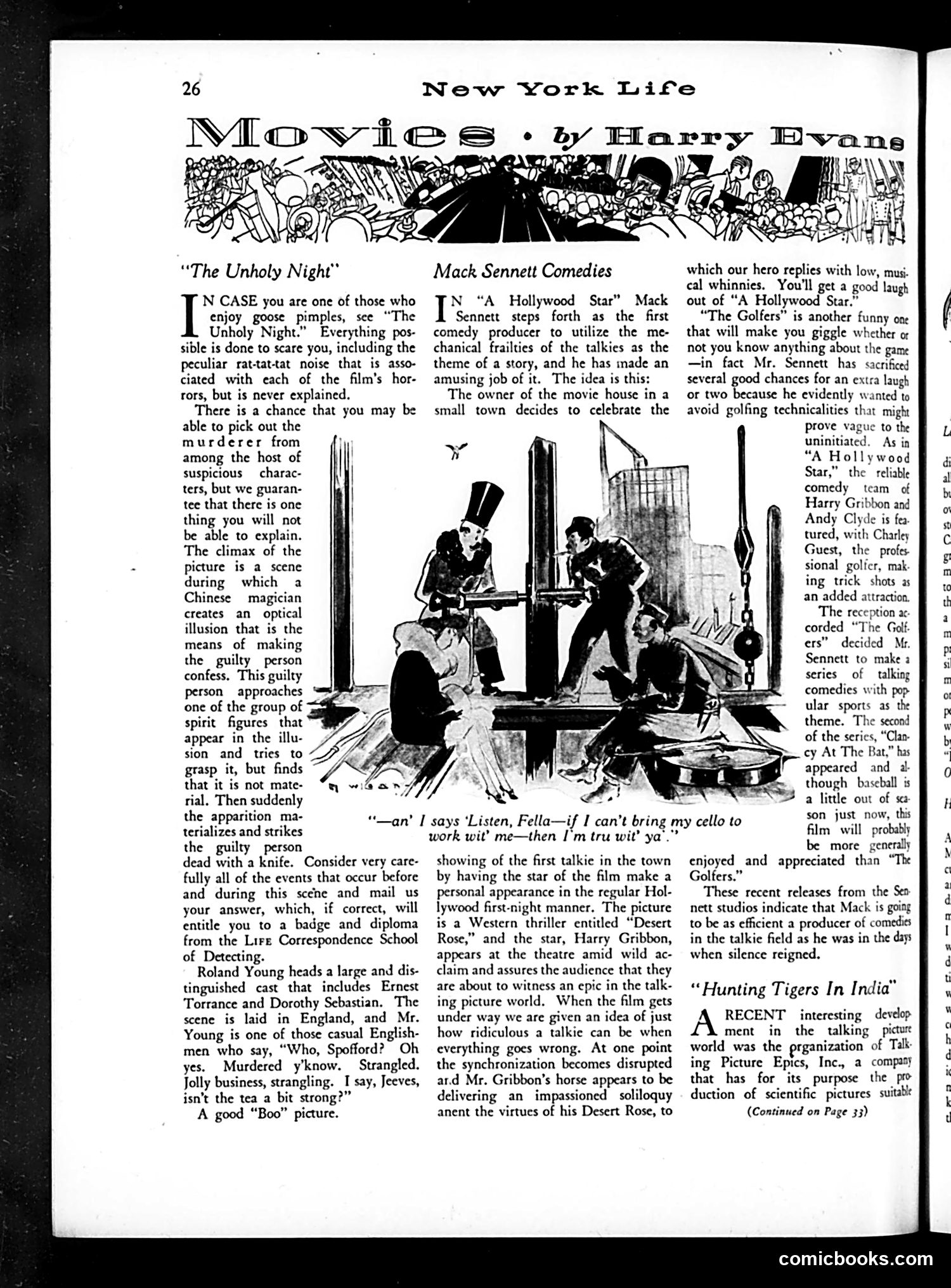
Analysis for Modern Readers This page reviews early talking pictures (talkies)—a revolutionary but technically problematic film technology of the late 1920s. "The Unholy Night" is a conventional horror film featuring a murder mystery with a supernatural climax involving a Chinese magician's optical illusion. The Mack Sennett comedies satirize the *technical failures* of early sound films. The humor derives from synchronization problems: in "A Hollywood Star," a horse's mouth moves while a man speaks, creating unintended comedy. In "The Golfers" and "Clancy at the Bat," Sennett deliberately exploits sports themes while avoiding technical jargon that might confuse audiences unfamiliar with sound technology. The joke in the illustration shows an argument about bringing a cello to work—likely illustrating how dialogue sounds absurd when poorly synchronized or recorded. The satire: These reviews mock how new sound technology, intended to enhance realism, instead created laughable mishaps. Sennett cleverly monetized these failures as intentional comedy rather than technical embarrassments.
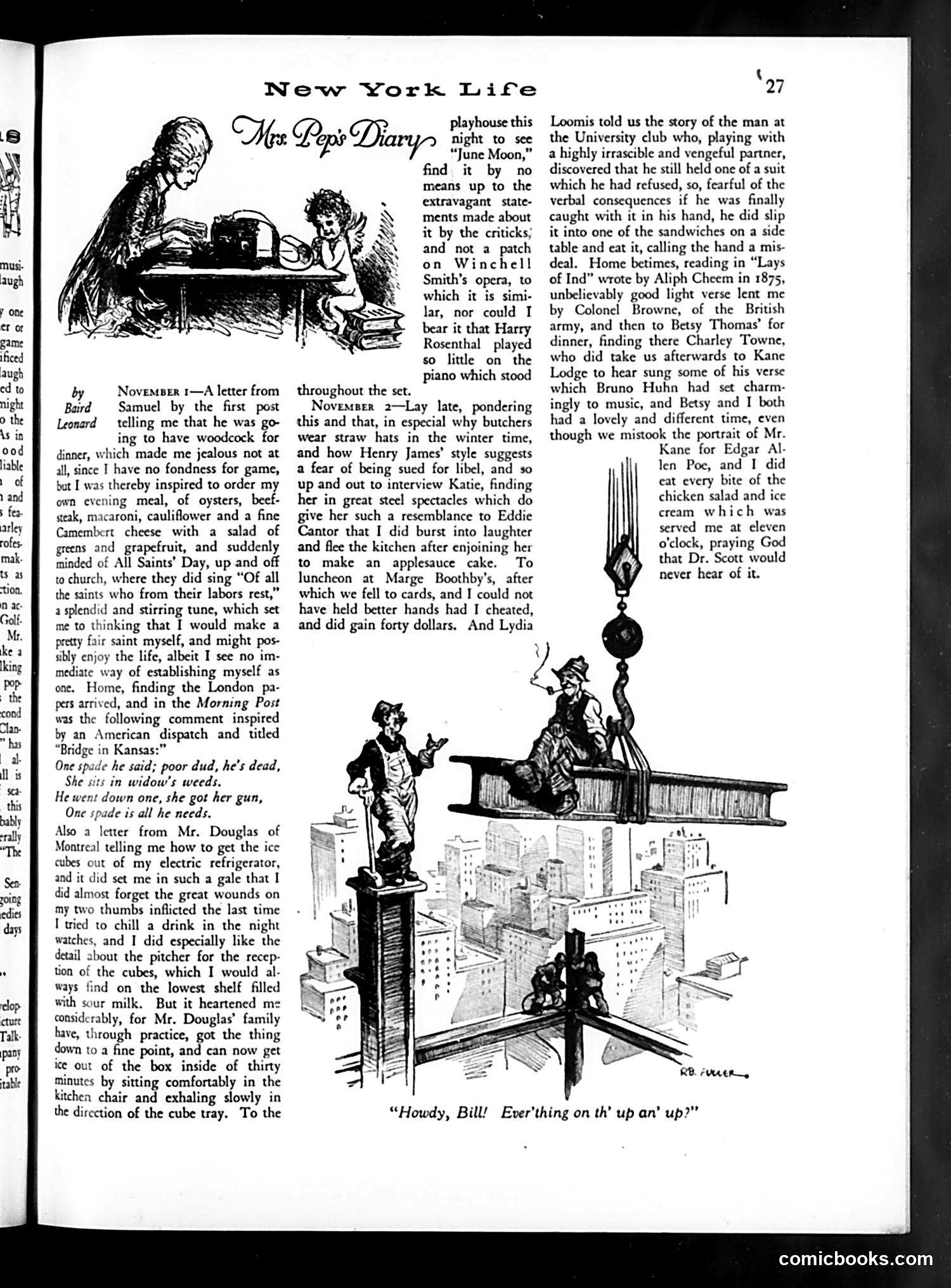
"Mrs. Pep's Diary" - November 1-2 Entry This is a humor column styled as a society diary entry by "Baird Leonard." The text satirizes upper-class New York life through witty, mundane observations: jealousy over a friend's woodcock dinner, attendance at the theater production "June Moon," card games where the narrator conveniently wins forty dollars, and social dinners with named acquaintances. The main cartoon below depicts two figures on/around tall city buildings with the caption "Howdy, Bill! Ever'thing on th' up an' up?" It appears to contrast rural/folksy speech ("Howdy") with an urban setting, likely satirizing either rural Americans visiting the city or the incongruity of casual friendliness amid metropolitan life. The style and context suggest this mocks either Prohibition-era dealings or general urban culture circa the 1920s-30s. The diary's anecdotes—like Mr. Douglas's humorous refrigerator ice-cube extraction method—gently mock both technological modernity and sophisticated society's pretensions.
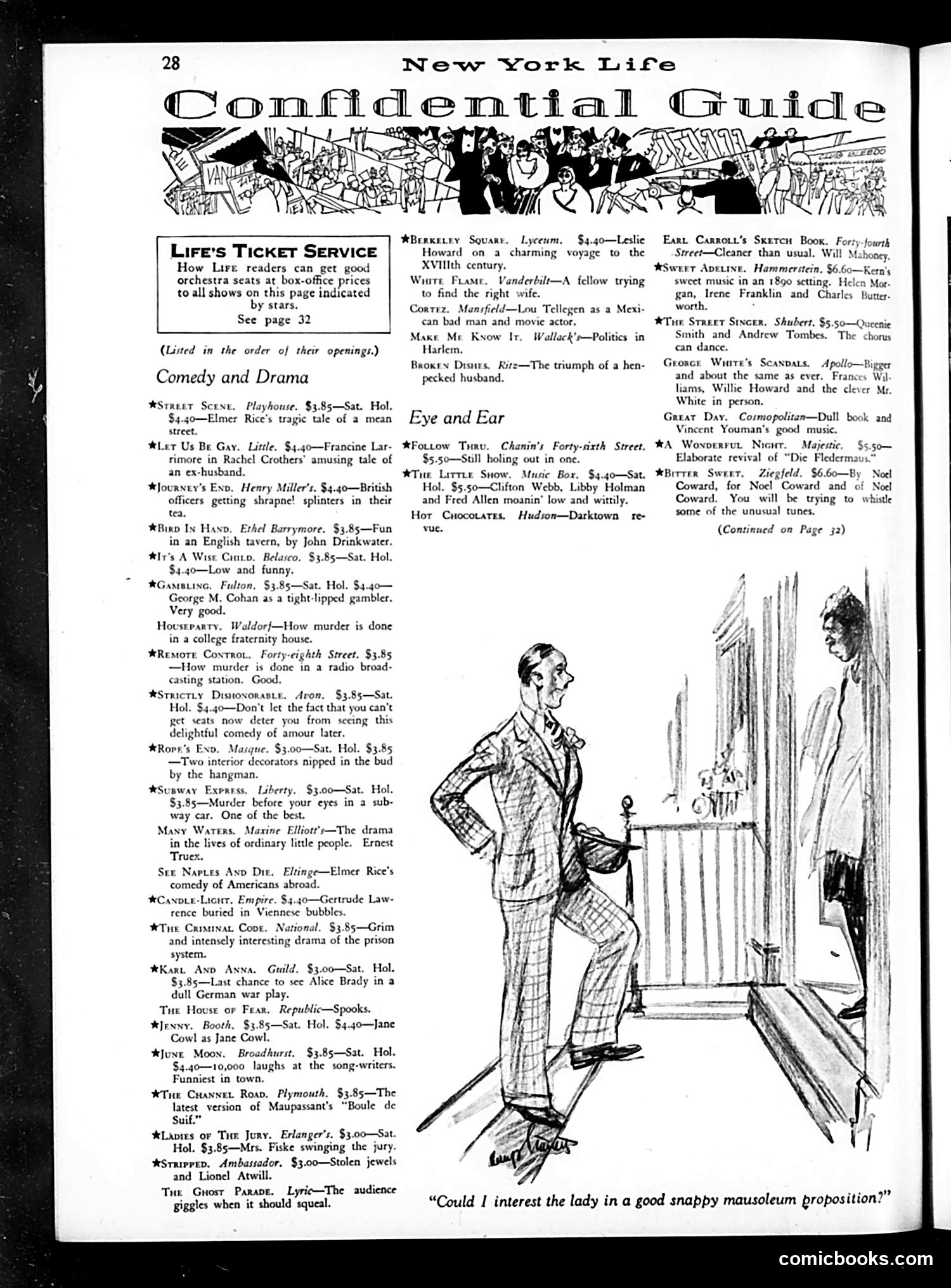
Understanding This Page This is a theater listings and reviews page from *Life* magazine, not a political cartoon. The page catalogs Broadway shows with ticket prices and brief critical commentary. The single cartoon at bottom shows a man in a suit speaking to a woman behind a curtain, with the caption "Could I interest the lady in a good snappy mausoleum proposition?" The joke: This is a cynical gag about aggressive salesmanship. The man is attempting to pitch a mausoleum (burial tomb) as though it were a desirable commodity—treating death-care as high-pressure sales fodder, much like any other product. It satirizes American consumer culture and the funeral industry's commercialization of mortality, presenting the absurdity of marketing death itself as enthusiastically as one might sell a luxury item. The cartoon reflects 1920s skepticism toward commercialism and hard-sell tactics infiltrating every aspect of American life.
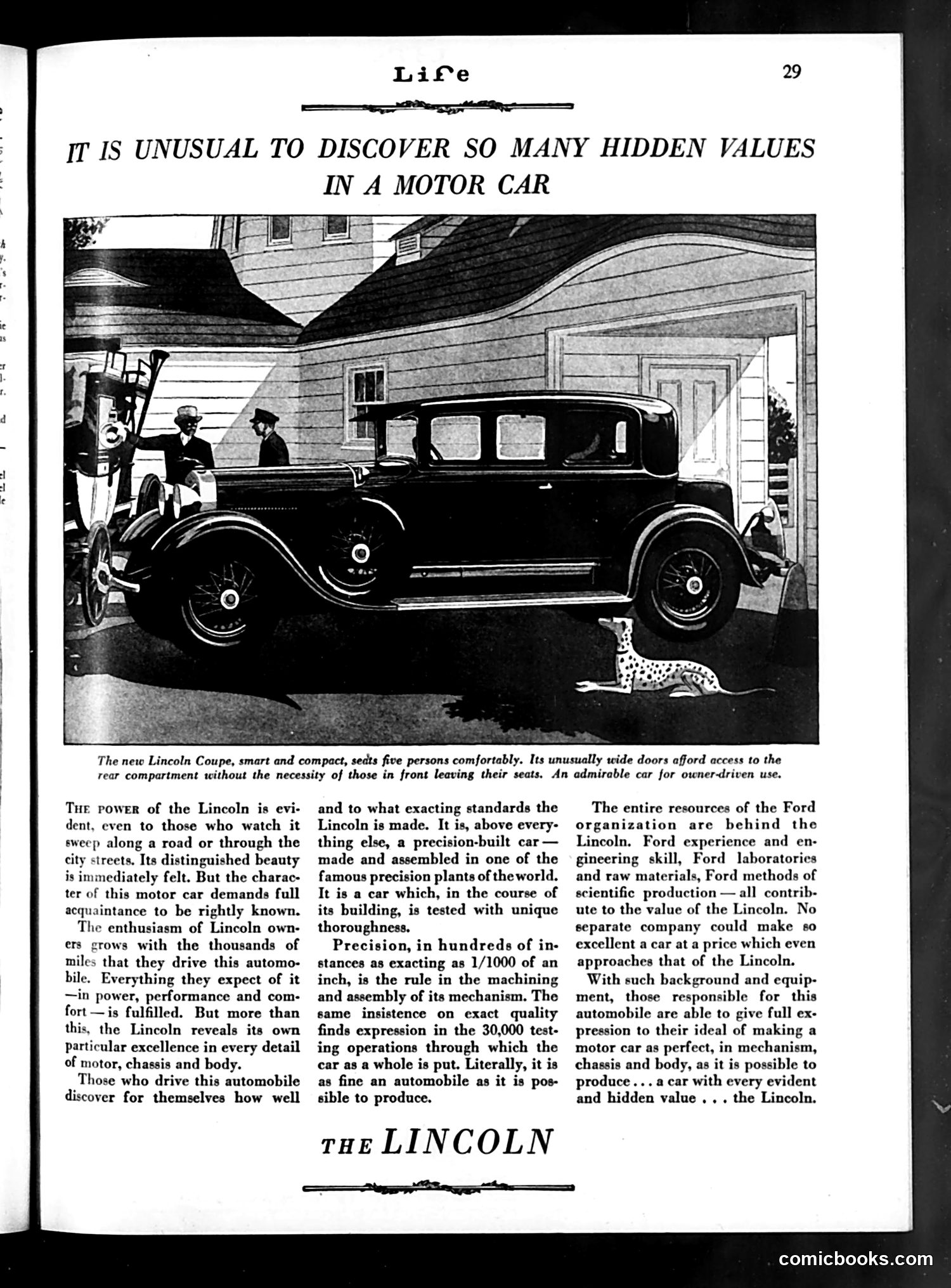
Analysis This is not a cartoon but rather a Lincoln automobile advertisement disguised as editorial content in Life magazine—a common early 20th-century advertising practice. The image shows a 1920s Lincoln Coupe parked in a residential driveway, with well-dressed figures and a dog nearby, emphasizing affluence and domestic comfort. The text employs luxury marketing rhetoric, emphasizing precision engineering (claiming tolerances to 1/1000 of an inch and 30,000 testing operations) to justify the car's premium price. The key sales pitch: Lincoln offers Ford's manufacturing resources and expertise at a competitive price point compared to other luxury brands. For modern readers, the notable element is the transparent conflation of advertising with editorial—the phrase "it is unusual to discover so many hidden values" frames commercial claims as objective discovery rather than marketing spin. This reflects pre-regulation advertising standards where such blending was acceptable.
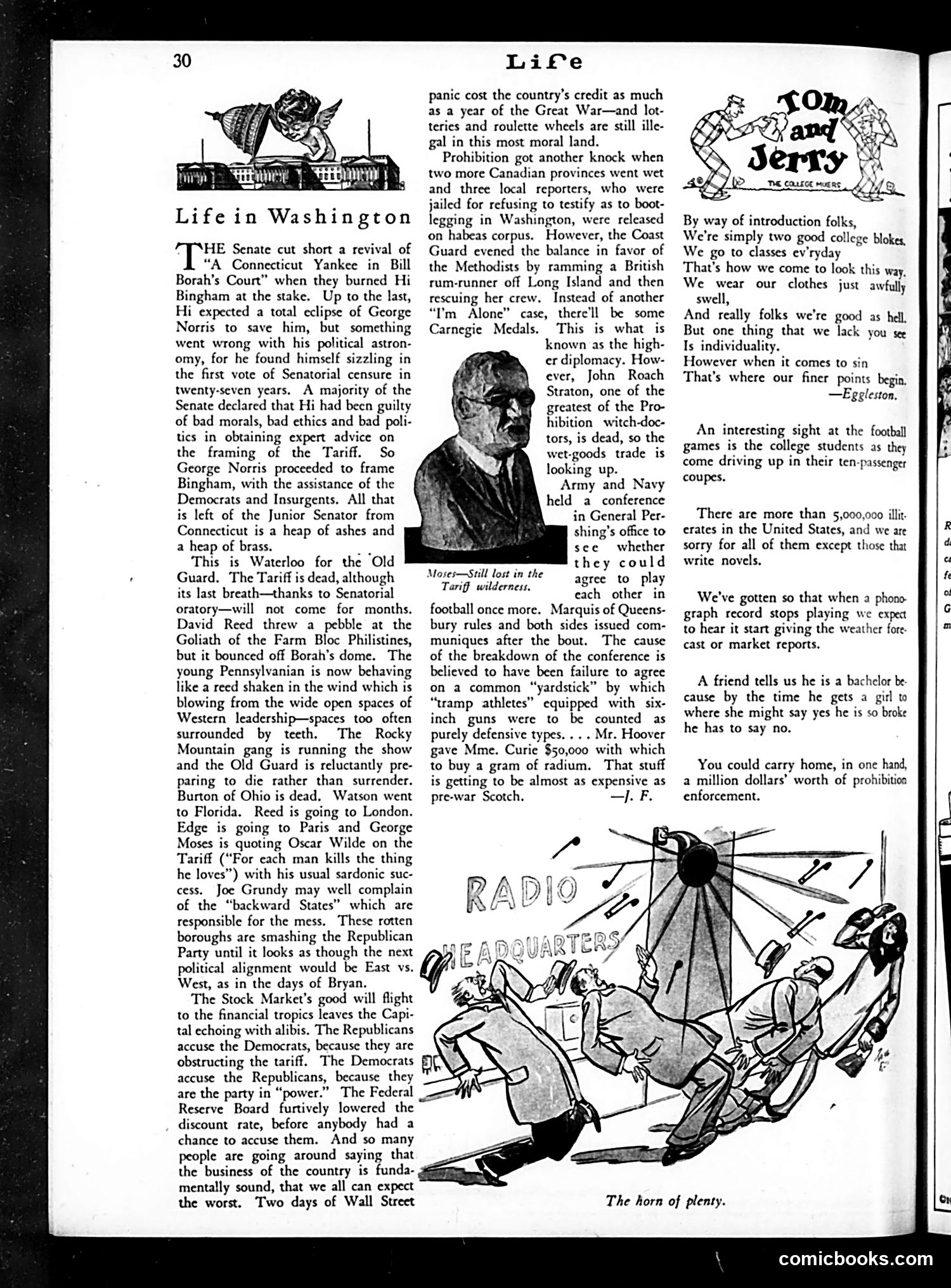
Political Satire from Life Magazine This "Life in Washington" column satirizes 1920s Republican Party infighting over tariff policy. Senator Hiram Bingham of Connecticut was recently censured by the Senate (first such censure in 27 years) for unethical conduct regarding tariff advice—depicted here as his political execution ("burned...at the stake"). The satire identifies key figures: George Norris (an insurgent Republican who led the censure), William Borah (a Western Progressive), and other establishment Republicans like David Reed and George Moses. The piece portrays Western insurgent Republicans (the "Rocky Mountain gang") as ascendant, while the traditional "Old Guard" crumbles, predicting future East-vs.-West political realignment. The column mocks broader 1920s anxieties: stock market instability, Prohibition enforcement inconsistencies (Canadian rum-running, the "I'm Alone" incident), and mutual political finger-pointing over economic troubles. The tone is sardonic—suggesting the country's "fundamentally sound" business claims herald "the worst."
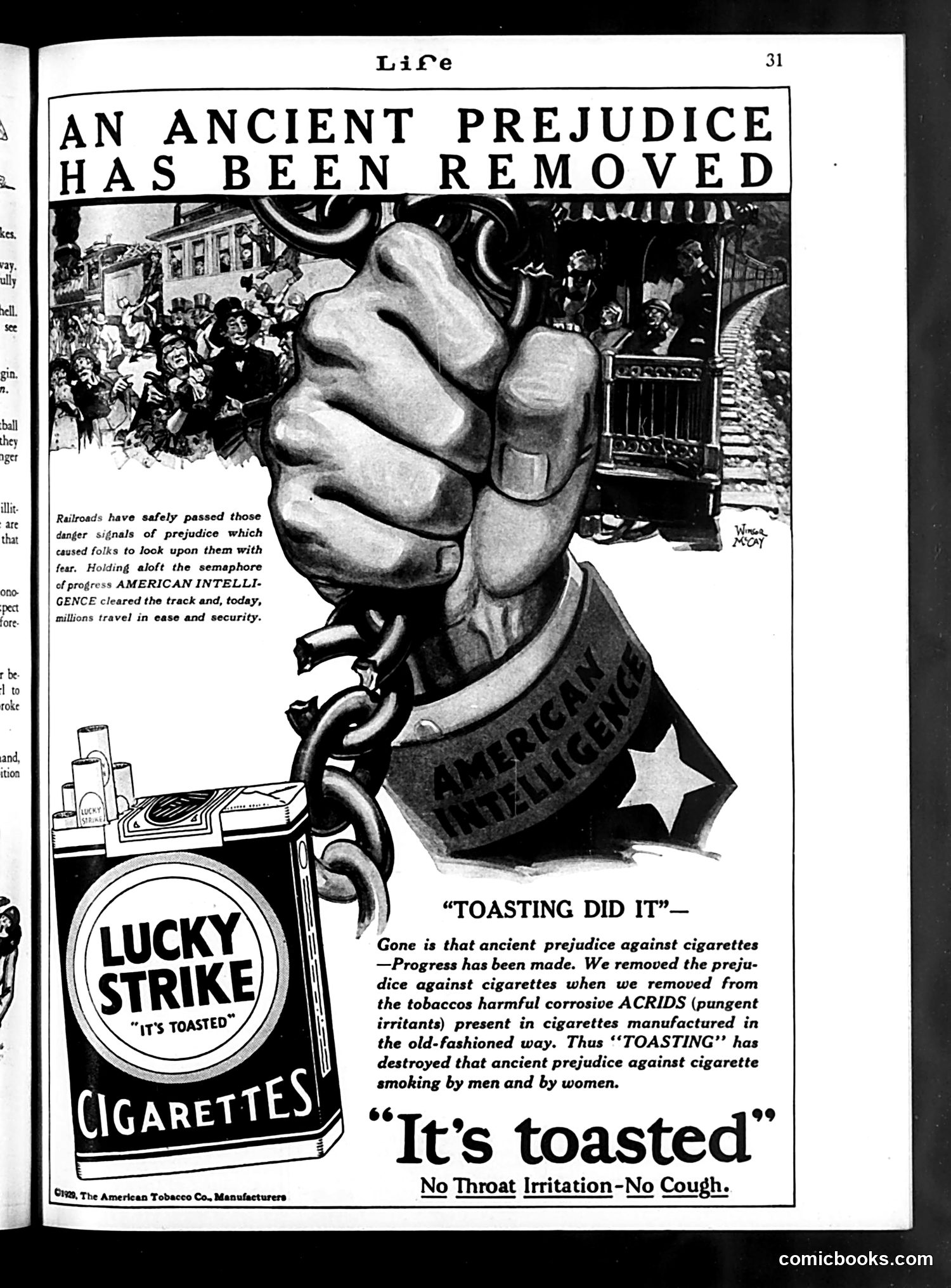
Analysis This is a Lucky Strike cigarette advertisement, not satire or political commentary—it's straightforward commercial messaging from The American Tobacco Company. The ad uses a metaphor comparing cigarette acceptance to railroad progress. A giant fist labeled "American Intelligence" breaks chains of prejudice, paralleling how railroads overcame early public fear. The visual suggests removing barriers to progress through innovation. The "toasting" claim is the product's key selling point: Lucky Strike claims their heat-treatment process removes harmful "ACRIDS" (irritants), thereby eliminating the old prejudice against smoking. The tagline "No Throat Irritation—No Cough" promises health benefits. By modern standards, this is striking propaganda: it frames cigarette smoking as "progress" and uses pseudo-scientific language ("ACRIDS") to suggest health safety—claims we now know to be false. But in this era, such advertising was standard and unregulated. The page demonstrates how commercial messaging shaped public perception of tobacco as sophisticated and beneficial.
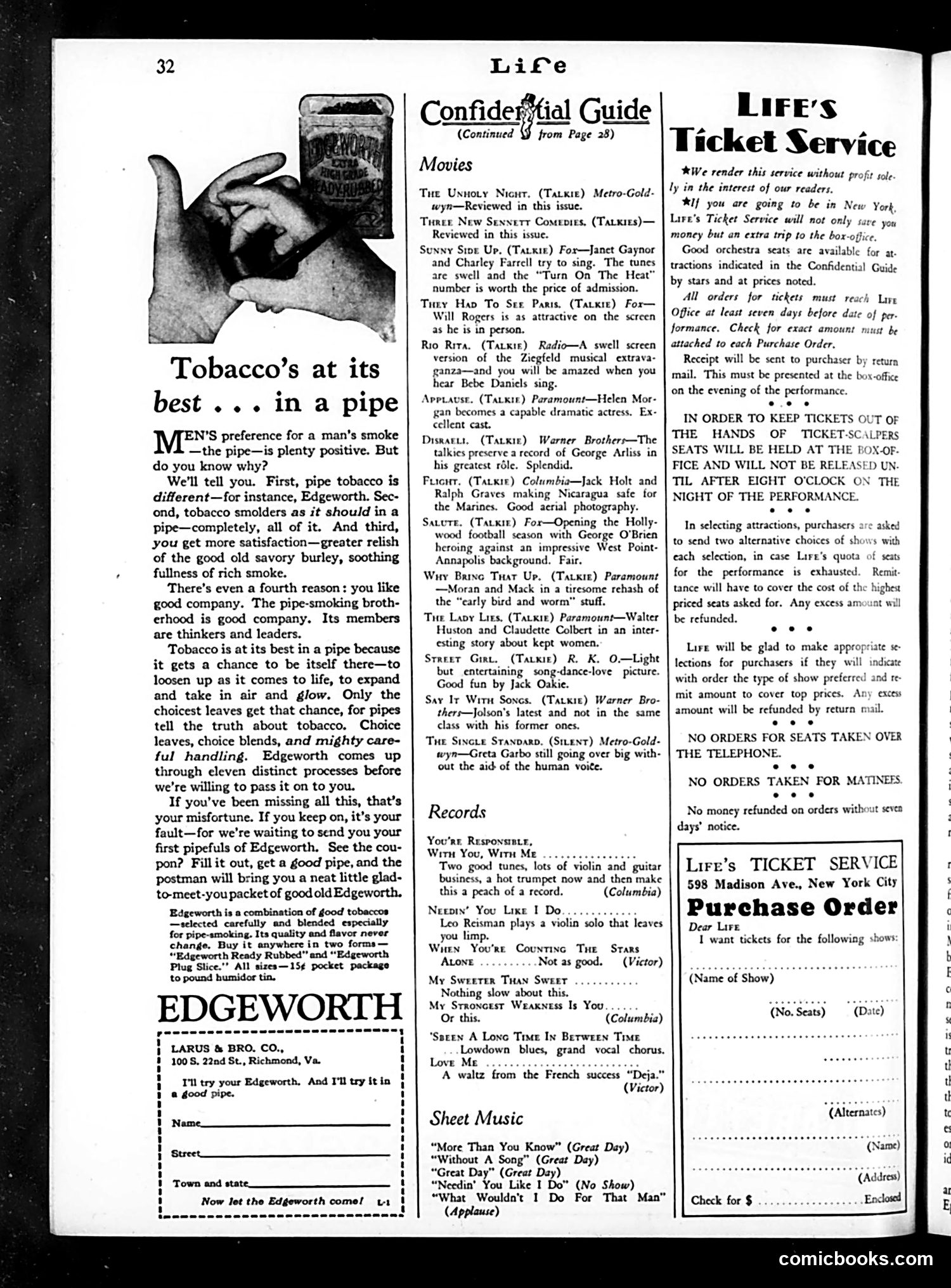
Edgeworth Tobacco Advertisement Analysis This page is primarily a tobacco advertisement for Edgeworth pipe tobacco, not political satire. The large illustration shows a hand holding a pipe—a visual metaphor emphasizing the product. The ad's argument appeals to masculine identity: pipe smoking attracts "thinkers and leaders" and represents "good company." It positions pipe tobacco as superior because pipes force complete combustion and reveal tobacco quality—a technical claim meant to justify premium pricing. The text uses aspirational messaging common to 1920s advertising, suggesting that choosing Edgeworth signals intellectual and social status. The coupon at bottom invites readers to sample the product. The page also includes unrelated content: movie reviews (for early talkies), record reviews, and Life's ticket-booking service. This reflects the magazine's mixed entertainment focus rather than political commentary.
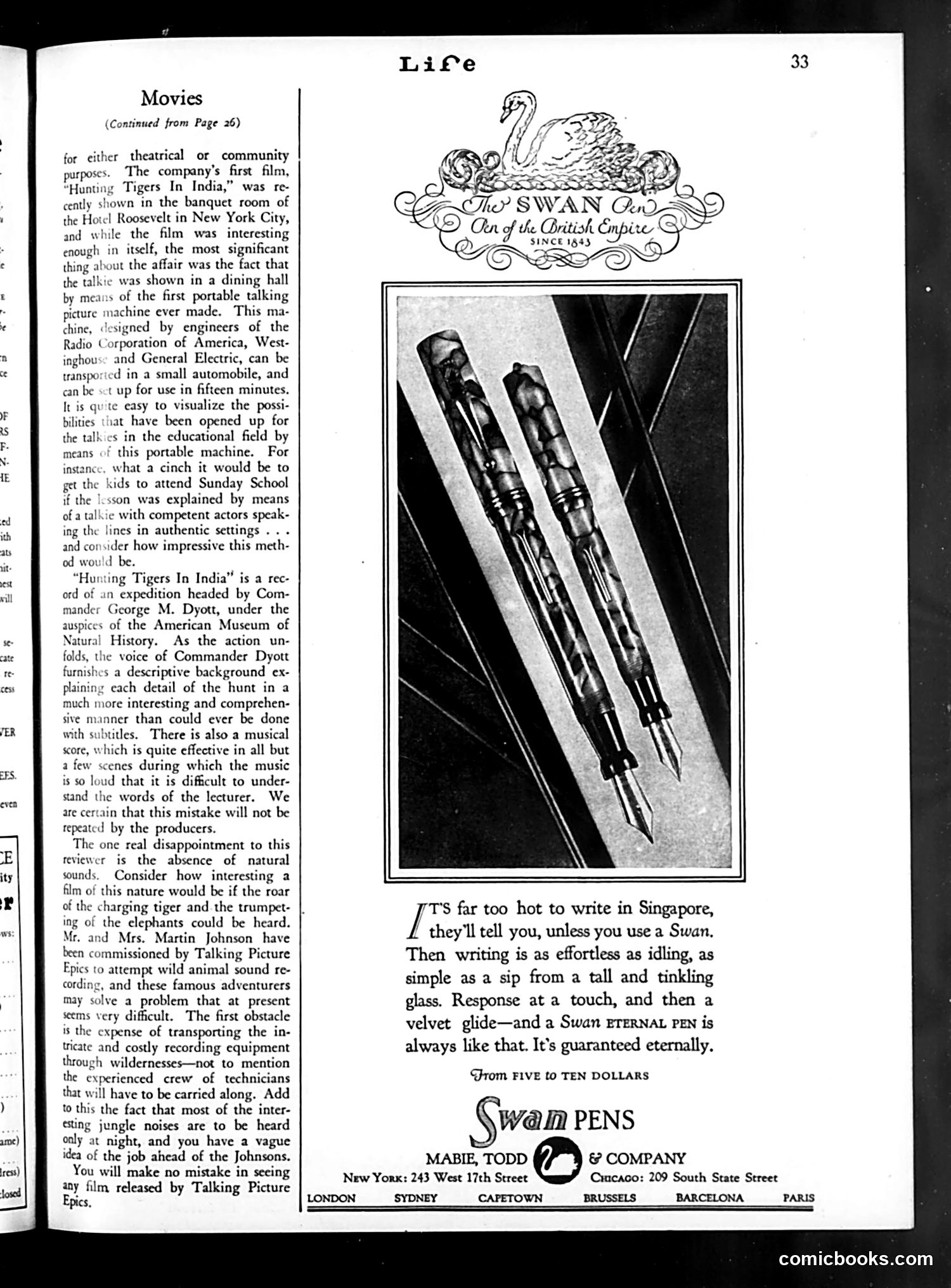
Page 33 of Life Magazine: Movies and Swan Pens Advertisement This page is primarily a film review continued from page 26, discussing early "talkie" (sound) films and their educational potential. The main content reviews "Hunting Tigers in India," a 1929 expedition film narrated by Commander George M. Dyott. The notable element is a full-page advertisement for Swan Pens featuring an image of two elegant fountain pens. The ad uses tropical heat as its selling point—writing in Singapore's climate is unbearable unless you use a Swan pen, which operates effortlessly. The copy emphasizes the pen's reliability and smooth "velvet glide," positioning it as a luxury writing instrument priced between five and ten dollars. This is not political satire but rather a straightforward commercial advertisement typical of Life magazine's advertising content during this era. The juxtaposition of a serious film review with an elegant luxury goods ad reflects Life's mixed editorial and commercial format.
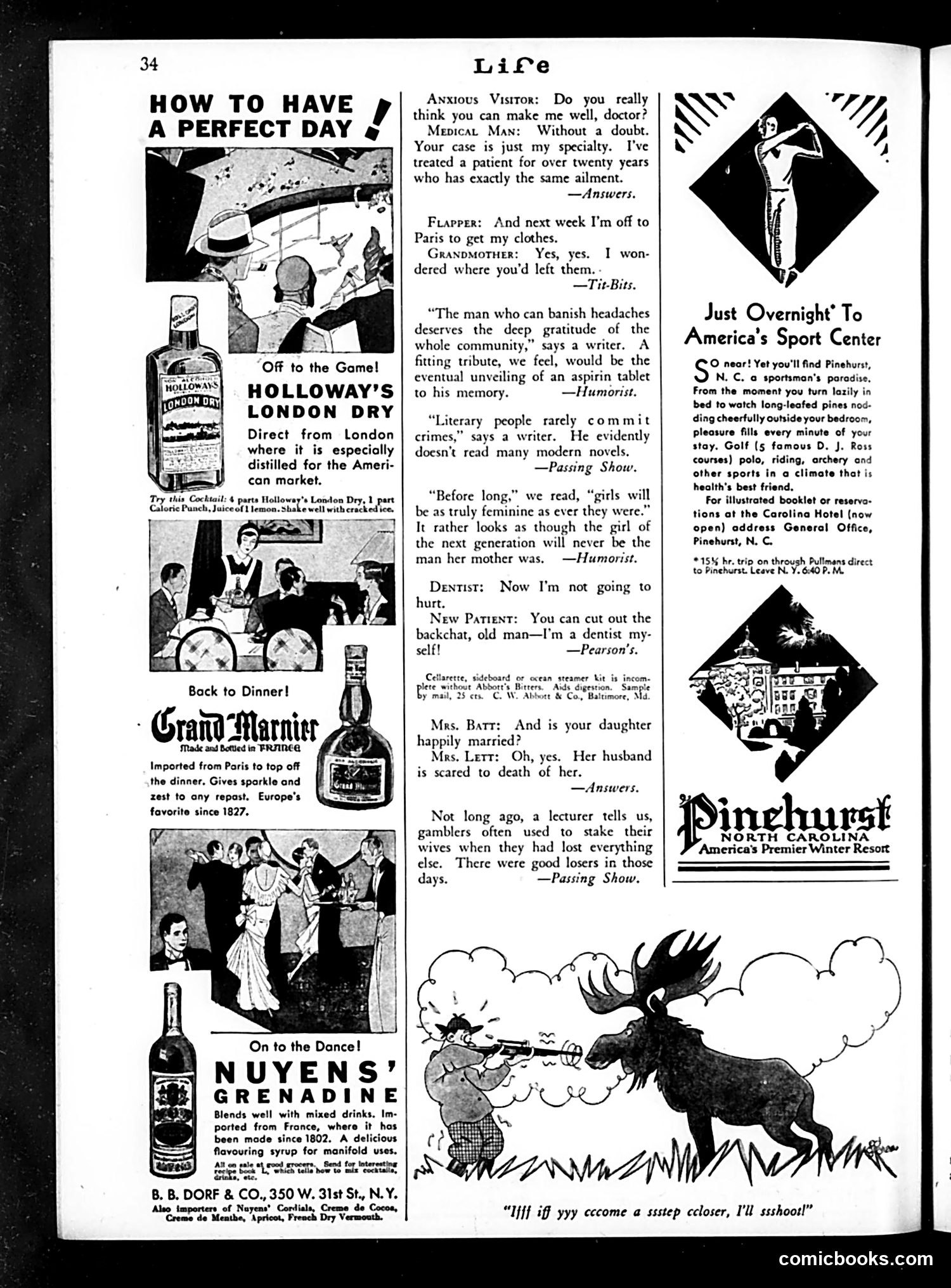
Analysis of Life Magazine Page 34 This page is primarily advertising for imported alcoholic beverages, framed around "How to Have a Perfect Day"—a satirical lifestyle sequence showing leisure activities (game, dinner, dance) paired with liquor endorsements: Holloway's London Dry gin, Grand Marnier, and Nuyens' Grenadine. The center column contains short joke excerpts from various humor publications (Answers, Tit-Bits, Pearson's), representing typical period comedy: a doctor's dubious credentials, a grandmother's sarcasm about lost clothing, observations on modern girls losing femininity, and a dentist's comeuppance. The right side advertises Pinehurst, North Carolina, a winter resort emphasizing golf and leisure sports. The bottom cartoon shows a crude caricature of a person with exaggerated features threatening to shoot, captioned with intentional speech impediment ("ssstep," "ssshoot"). This appears to be casual, offensive stereotyping typical of 1920s-era humor magazines, though the specific target is unclear from context alone. Overall: a period advertisement and humor compilation page with now-dated attitudes.
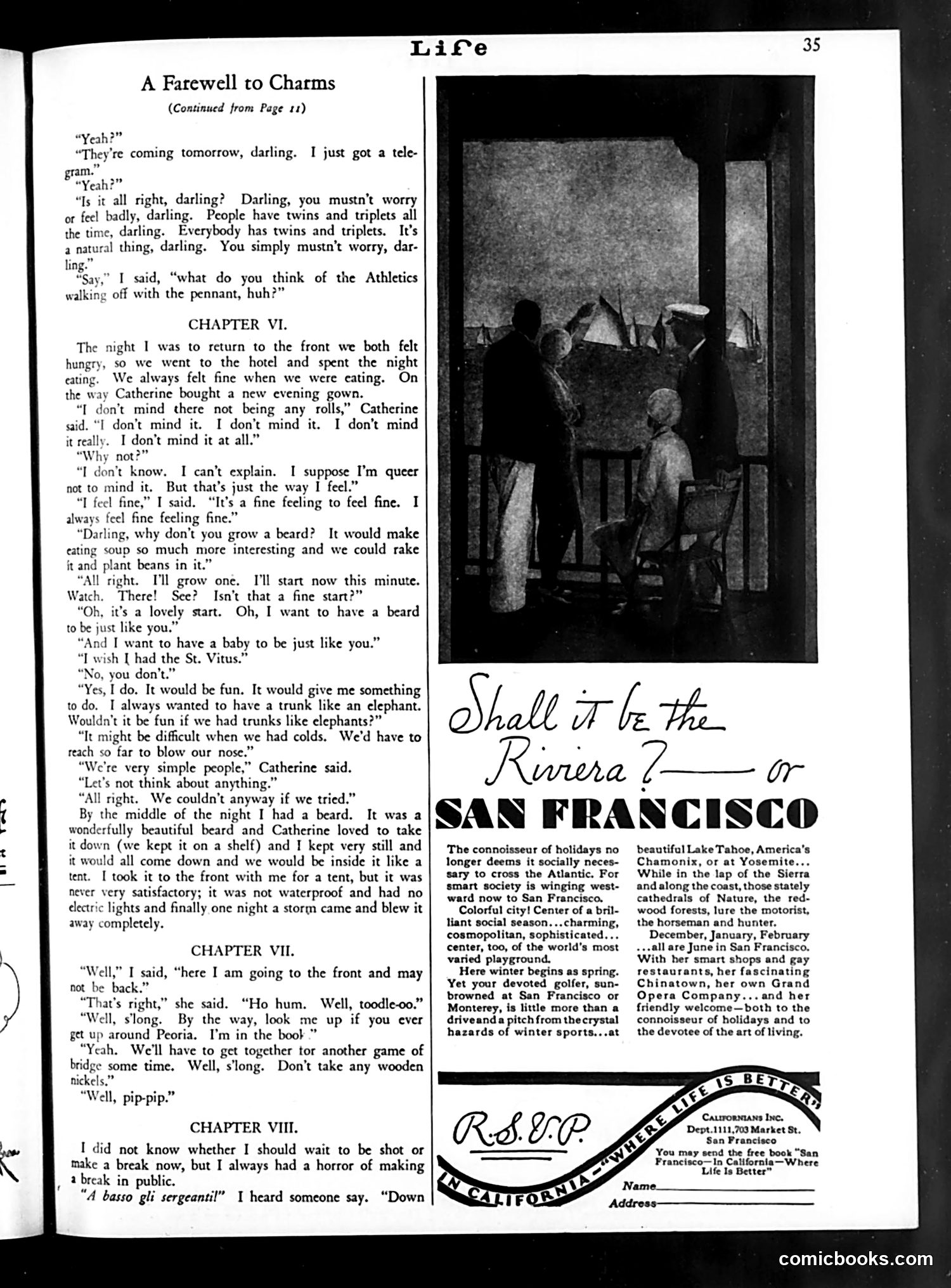
"A Farewell to Charms" - Life Magazine Page Analysis This page presents an excerpt from what appears to be Ernest Hemingway's *A Farewell to Arms* (serialized in Life). The text depicts a couple's absurdist, darkly humorous farewell conversation before the male character returns to World War I combat. The satire operates through stream-of-consciousness dialogue that deflates emotional gravity: the woman casually receives news of pregnancy ("Yeah?"), they obsess over trivial matters (soup-eating, beard-growing, St. Vitus disease), and their goodbye is a flippant exchange of slang ("toodle-oo," "pip-pip"). The joke is anti-romantic: instead of grand emotional declarations before wartime separation, the couple engage in nonsensical banter about hypothetical elephant trunks and removable beards kept on shelves. This reflects Hemingway's modernist style—using mundane dialogue and deflated emotion to convey the psychological numbing of war-era relationships. The accompanying San Francisco travel advertisement provides ironic contrast: while the couple faces separation and war, the ad promotes carefree leisure tourism.
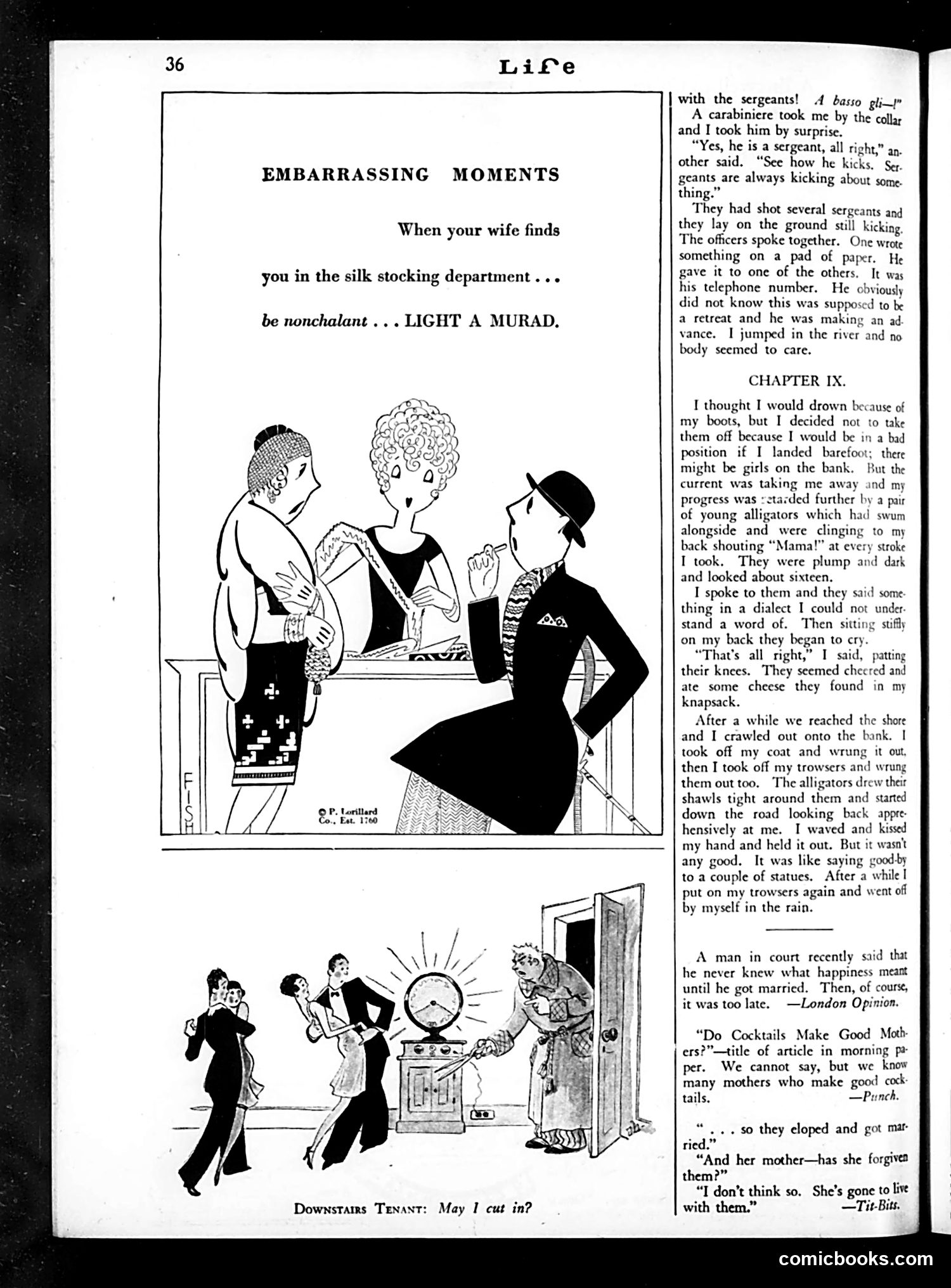
Explanation for Modern Readers This page from *Life* magazine contains two distinct humorous pieces: "Embarrassing Moments" (top cartoon): Shows a man caught shopping in the women's silk stocking department by his wife. The joke plays on mid-century gender norms—men weren't supposed to be in ladies' departments, suggesting either infidelity or cross-dressing. The advice to "be nonchalant" and "light a Murad" (a cigarette brand) is the satirical "solution" to this social embarrassment. "Downstairs Tenant" (bottom cartoon): A tenant interrupts a couple dancing, asking "May I cut in?"—a dated dating custom where men could literally tap another man's shoulder to dance with his female partner. The joke mocks this quaint social practice. The page also includes a serialized adventure narrative and various witty editorial snippets mocking marriage and cocktails. The tone reflects 1920s-30s middle-class anxieties about gender roles, courtship customs, and matrimony—all presented through light satire typical of *Life*'s sophisticated humor magazine style.
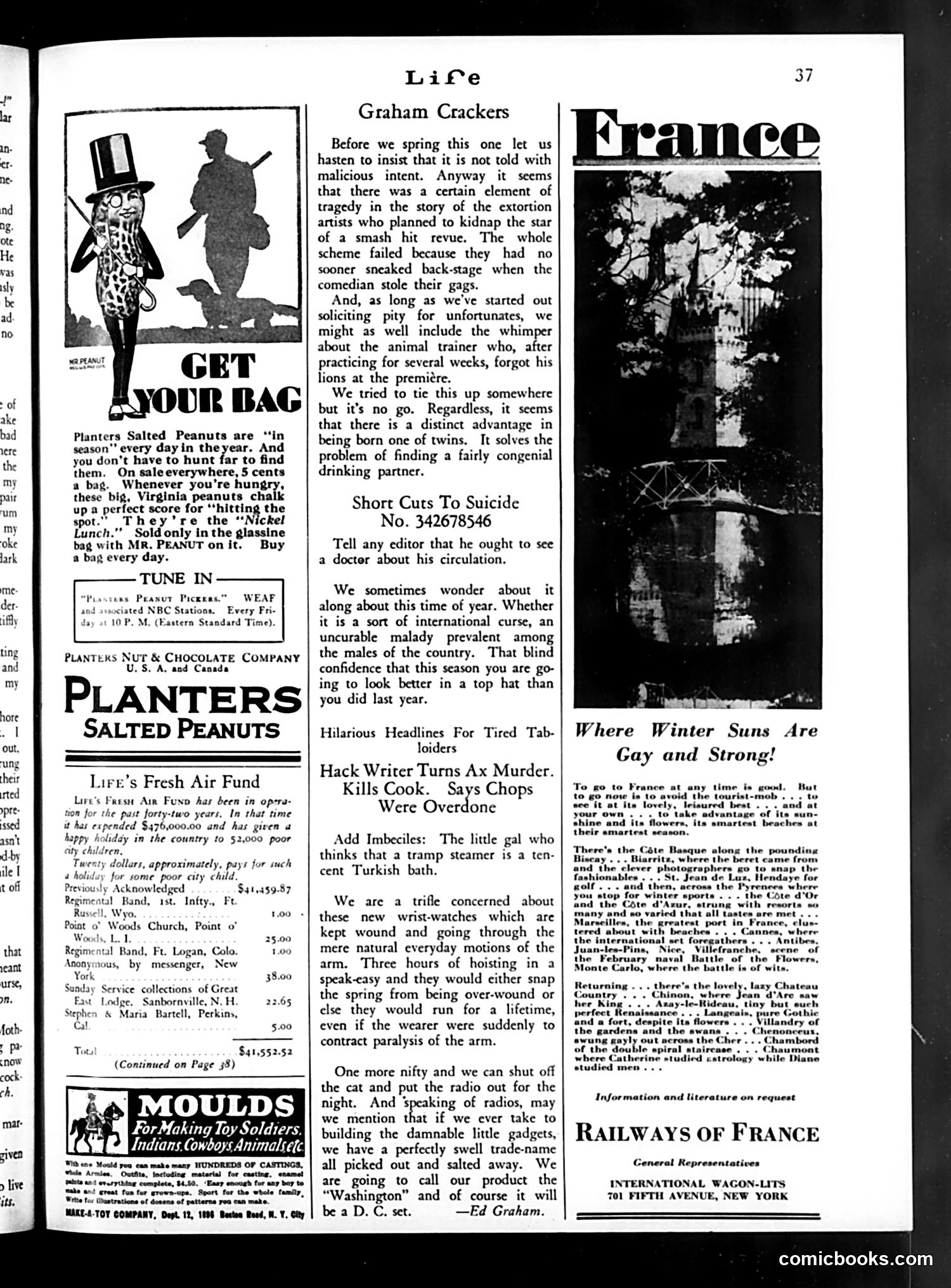
"Graham Crackers" Humor Column Analysis This is a humor column by Ed Graham from Life magazine featuring short, disconnected satirical observations—typical of 1920s-30s comedy writing style. The jokes target: 1. Theater/entertainment world: Extortion artists planning to kidnap a Broadway star fail because backstage comedians steal their punchlines—satirizing both crime and show business competitiveness. 2. Twins as drinking companions: A non-sequitur joke suggesting twins naturally make good bar buddies (congenial drinking partners), poking fun at social assumptions. 3. Editors' circulation problems: A dark humor "suicide tip" suggesting editors should see doctors about their poor newspaper circulation. 4. Seasonal fashion vanity: Men's blind confidence they'll look better in top hats this year than last—mocking cyclical male fashion insecurity. 5. Wristwatch mechanics: Absurdist humor about self-winding watches potentially breaking from speakeasy dancing or running forever if the wearer gets paralyzed. The column's scattered, rapid-fire format mirrors vaudeville patter. The "speakeasy" reference dates this to Prohibition era.
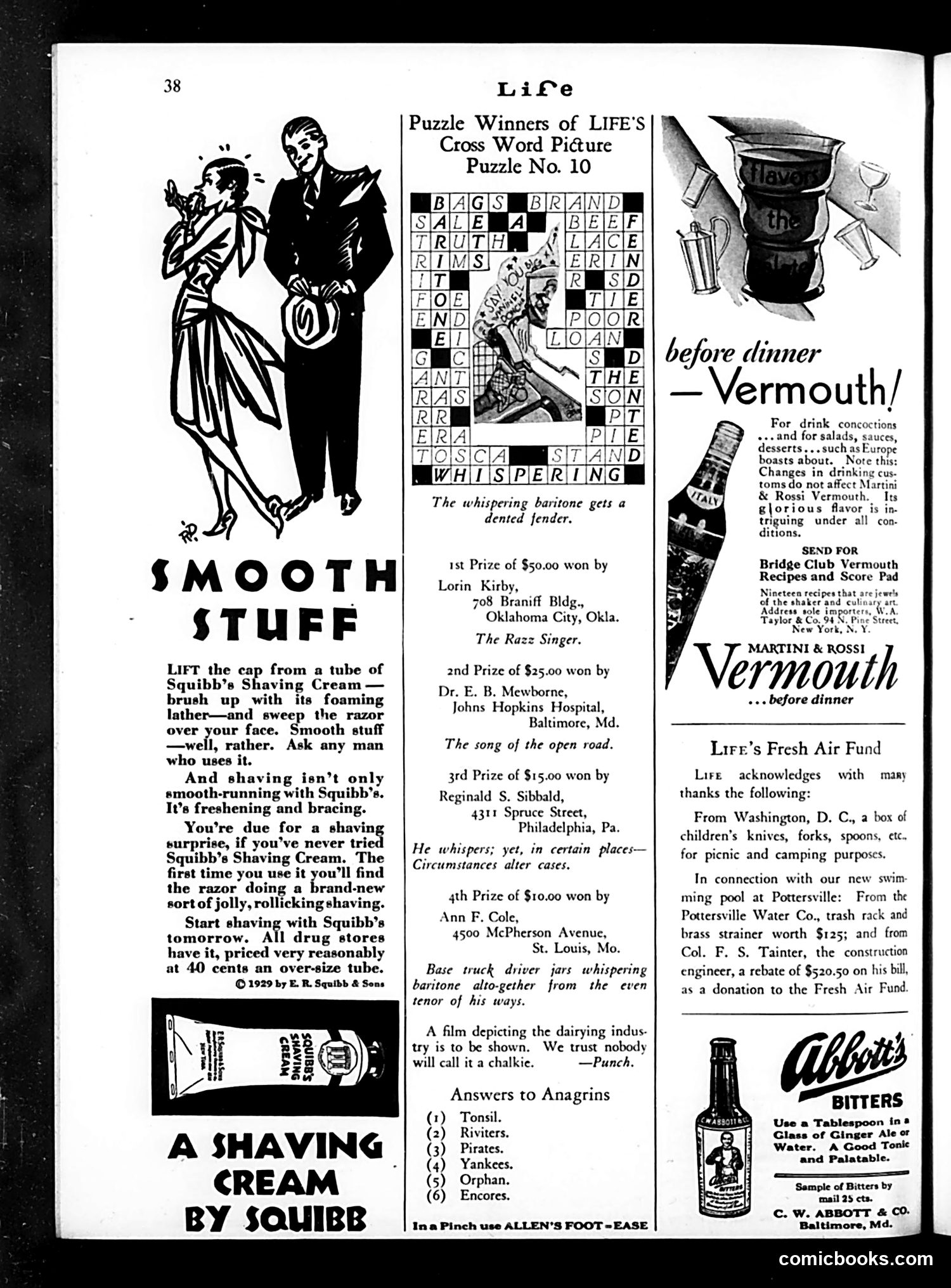
Analysis of Life Magazine Page (1929) This page primarily contains advertisements and puzzle contest results, not political satire. The main cartoon features a well-dressed couple in 1920s attire with the caption "SMOOTH STUFF"—advertising Squibb's Shaving Cream. The illustration is decorative rather than satirical, depicting fashionable socialites to appeal to consumers. The page includes puzzle winners from Life's crossword picture puzzle, with humorous clue answers referencing 1920s popular culture: "The Razz Singer" (likely referencing Al Jolson's recent film) and "The Song of the Open Road" (a contemporary song reference). The remaining content comprises beverage and health product advertisements—Martini & Rossi Vermouth, Abbott's Bitters, and Allen's Foot-Ease—typical of Life magazine's revenue model in this era. A small note about Life's Fresh Air Fund (a charitable initiative) appears as well. This is fundamentally an advertising-heavy magazine page with minimal satirical content.
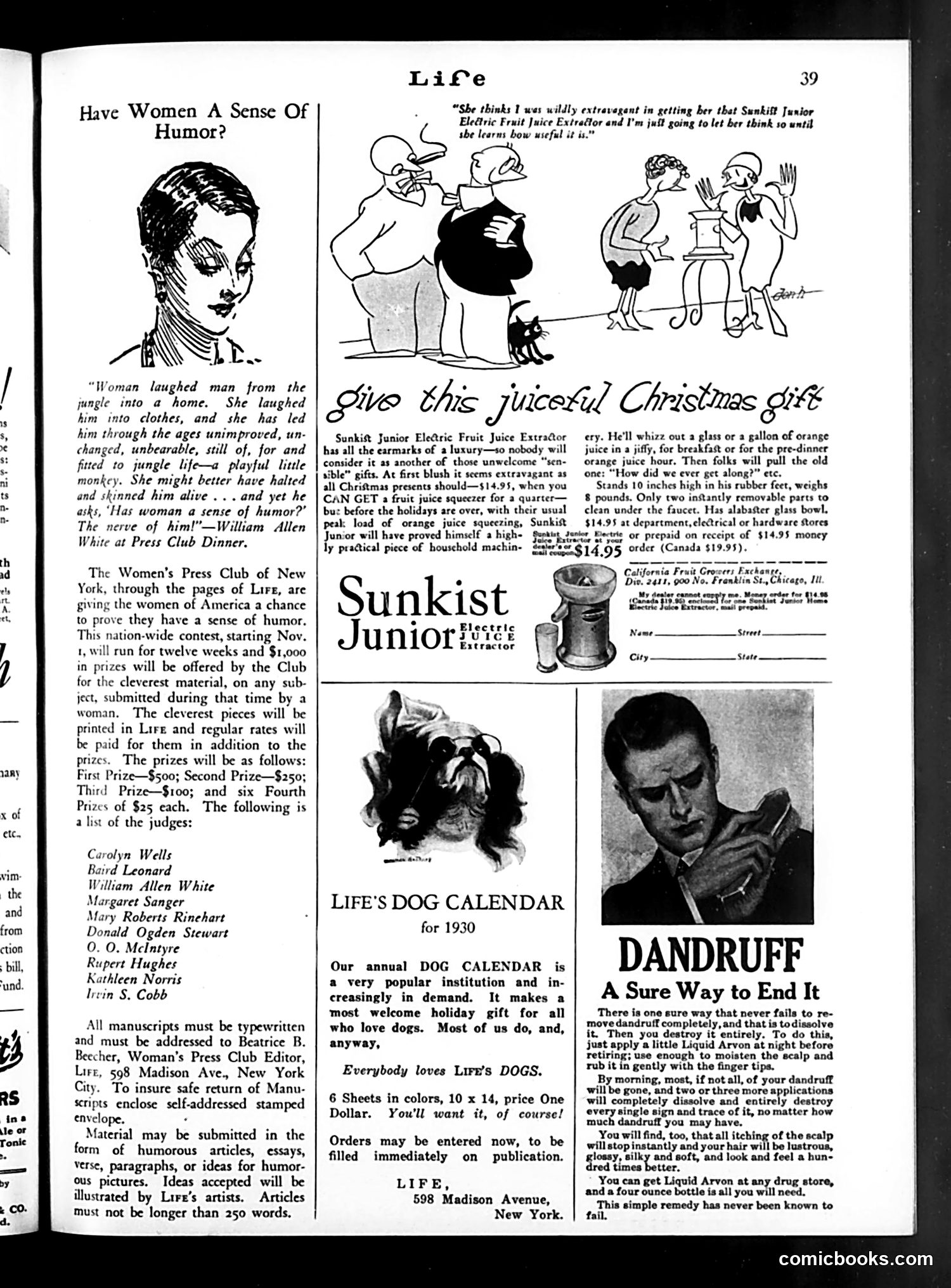
Explaining This Life Magazine Page (circa 1930) Main Article: "Have Women A Sense Of Humor?" This page announces a humor-writing contest by New York's Women's Press Club, offering $1,000 in prizes. The contest was prompted by columnist William Allen White's rhetorical jab at a press dinner, sarcastically asking "Has woman a sense of humor?" after critiquing women's historical role (using dated, misogynistic language about "civilizing" men from savagery). The Women's Press Club's response: prove they do have humor by submitting funny pieces. The judges include prominent writers like Margaret Sanger and Mary Roberts Rinehart—validating women's comedic credibility through established female authors. The Cartoons show domestic scenarios typical of 1930s advertising humor: husbands downplaying wives' intelligence or agency (the fruit juicer ad plays on a husband letting his wife think he's extravagant when actually buying a "practical" appliance). This page essentially documents women asserting their right to humor and wit in a male-dominated literary establishment.
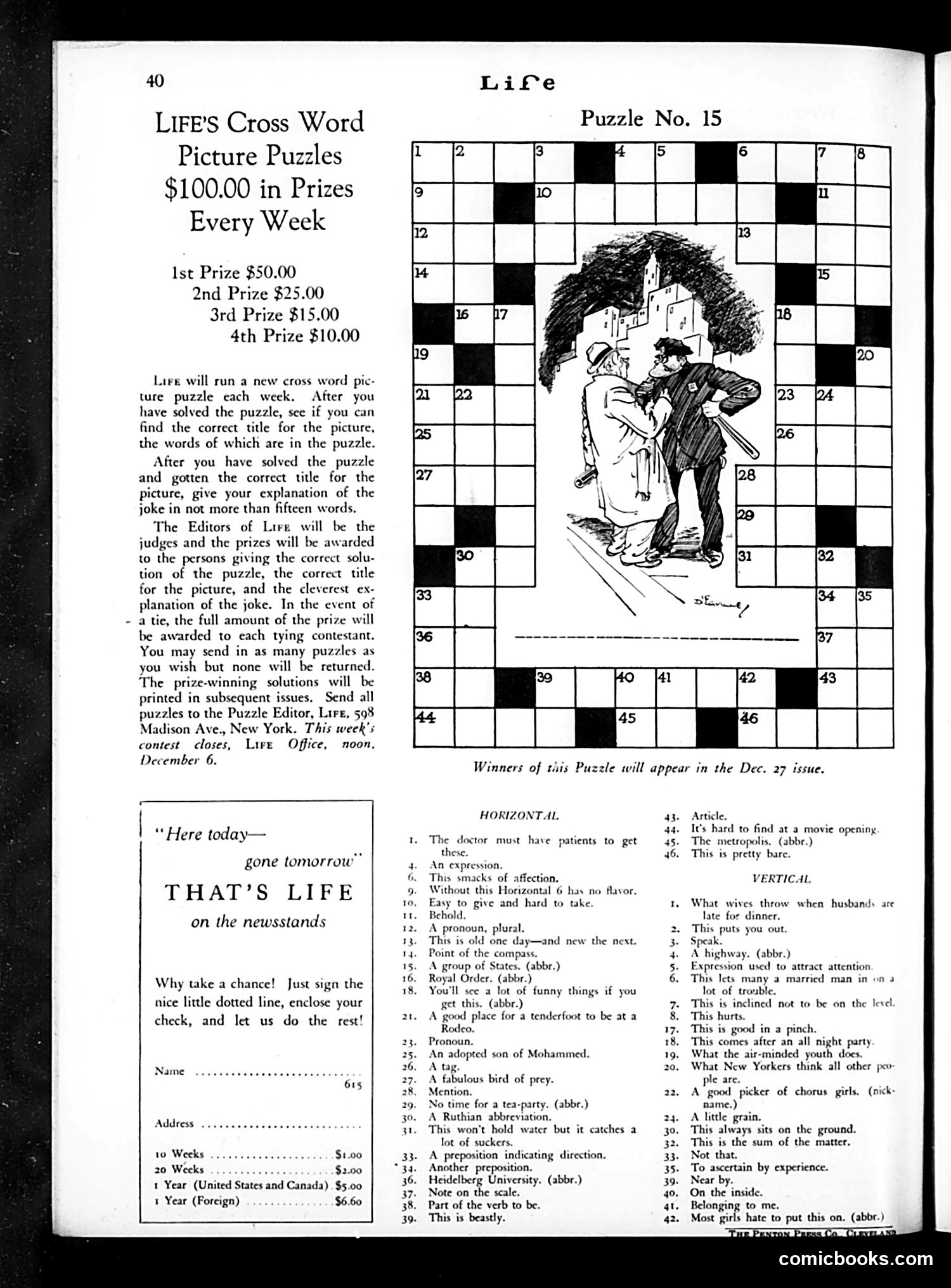
Life Magazine Puzzle Page Analysis This page features Life's weekly crossword picture puzzle contest, not a political cartoon. The central image shows a couple in early 20th-century dress beneath an ivy-covered building—a man in a suit helping or catching a woman in a long dress and hat. The puzzle mechanism is straightforward: solvers must complete the crossword, then identify the picture's title (using words from the solved puzzle) and explain the joke in fifteen words or fewer. Winners receive cash prizes ($50 to $10). The clues are typical of period humor—playful double-entendres and wordplay. For instance, vertical clue 6 references "married man in a lot of trouble," and clue 20 notes what "New Yorkers think all other people are." This page is primarily promotional and contest-based rather than satirical content. It advertises Life's subscription rates and demonstrates the magazine's engagement strategy: regular contests designed to boost both circulation and reader participation during the early-to-mid 20th century.
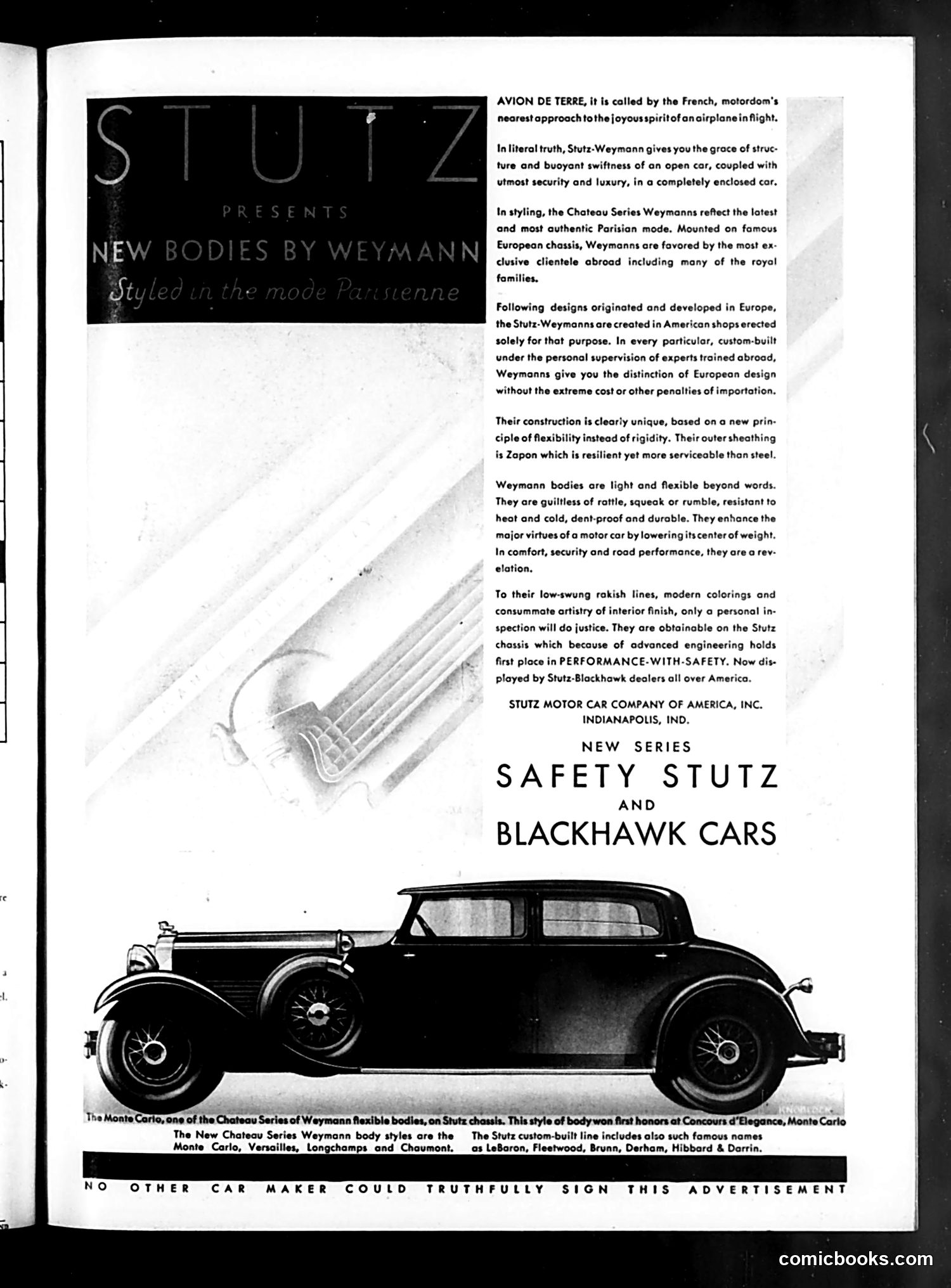
Analysis of This Page This is not a cartoon or satire page—it's a luxury automobile advertisement for Stutz-Weymann and Blackhawk cars from the 1920s-1930s era. The ad promotes the "Avion de Terre" (French for "land airplane"), positioning the vehicle as combining open-car freedom with enclosed luxury. Key selling points emphasize European sophistication: Weymann bodies are flexible rather than rigid, use "Zapon" sheathing instead of steel, and feature Parisian styling favored by European royalty. The pitch targets wealthy Americans seeking imported prestige without actual importation costs—these are American-made cars built under European supervision. The final line—"NO OTHER CAR MAKER COULD TRUTHFULLY SIGN THIS ADVERTISEMENT"—is a boastful claim to exclusivity. The small illustration shows the Monte Carlo model. This represents period advertising's appeal to aspirational luxury consumers through European cachet and technical innovation.
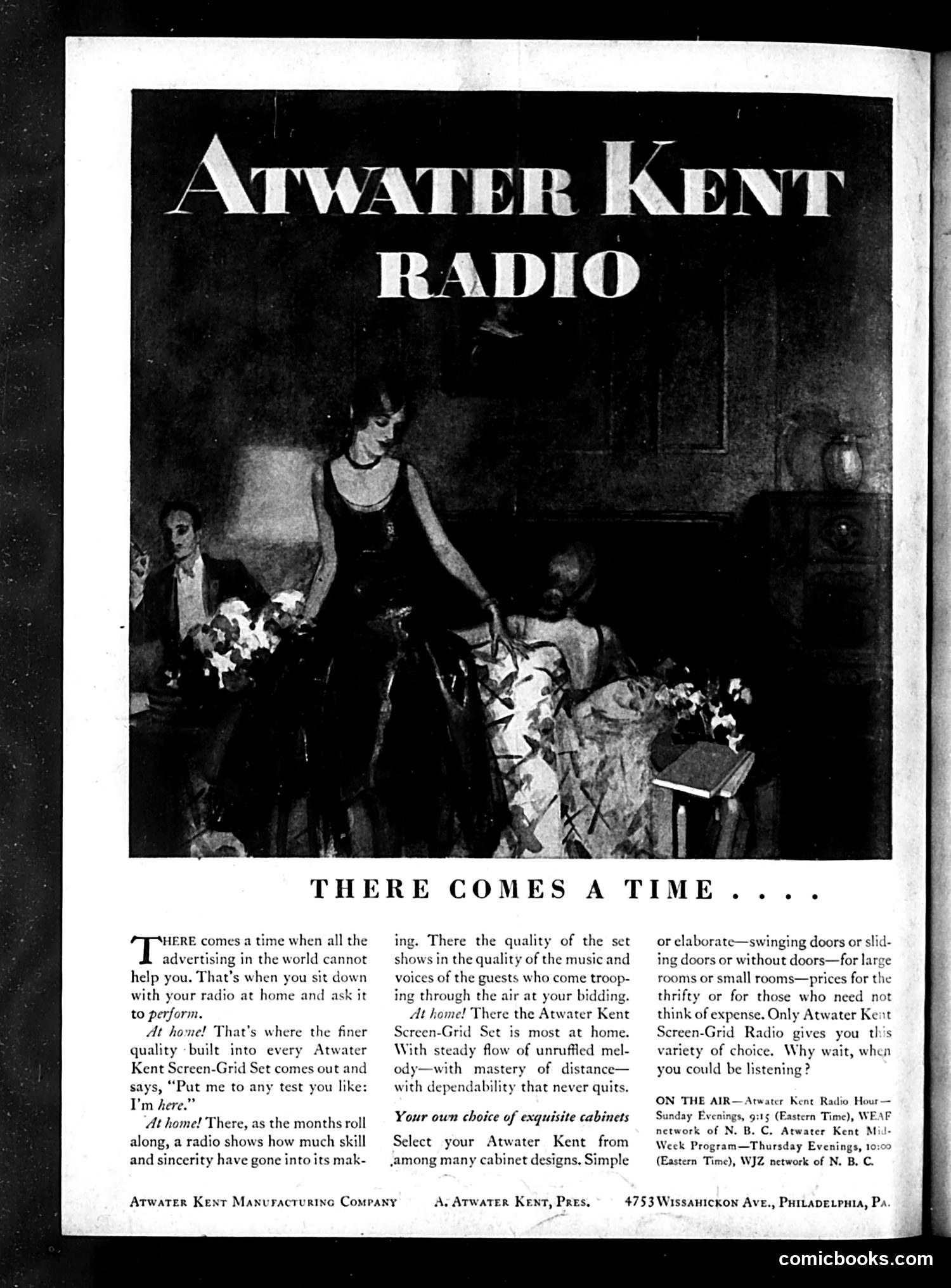
Analysis This is a radio advertisement, not political satire. It promotes Atwater Kent Screen-Grid radios to 1920s-30s consumers. The image shows a domestic scene: a woman in elegant dress entertaining guests in a home, with a radio set visible. This illustrates the advertisement's core message: quality radios perform best in home settings, where their sound quality and reliability become apparent over time. The text emphasizes that advertising alone cannot prove a radio's worth—only personal home use demonstrates its dependability and musical fidelity. The ad highlights the radio's "mastery of distance" (receiving distant stations clearly) and offers customizable cabinet designs for different room sizes and budgets. The bottom mentions Atwater Kent's sponsored radio programs on NBC networks, leveraging the medium itself to advertise radios—a common marketing strategy of the era when home radio listening was becoming a central family activity.