life
Life — December 6, 1929

I can see this is a page dated "December 6th 1926" from Life magazine, but the image quality is too poor to read any text or identify specific cartoon content with confidence. The page appears heavily darkened or damaged, making it impossible to discern individual figures, captions, or the satirical subject matter clearly enough to explain accurately to a modern reader. To properly analyze the political cartoon(s) or content, I would need a higher-quality scan or a clearer version of this page. Without being able to read text or see details distinctly, I cannot identify which political figures, events, or social issues are being referenced or what the satire intends.
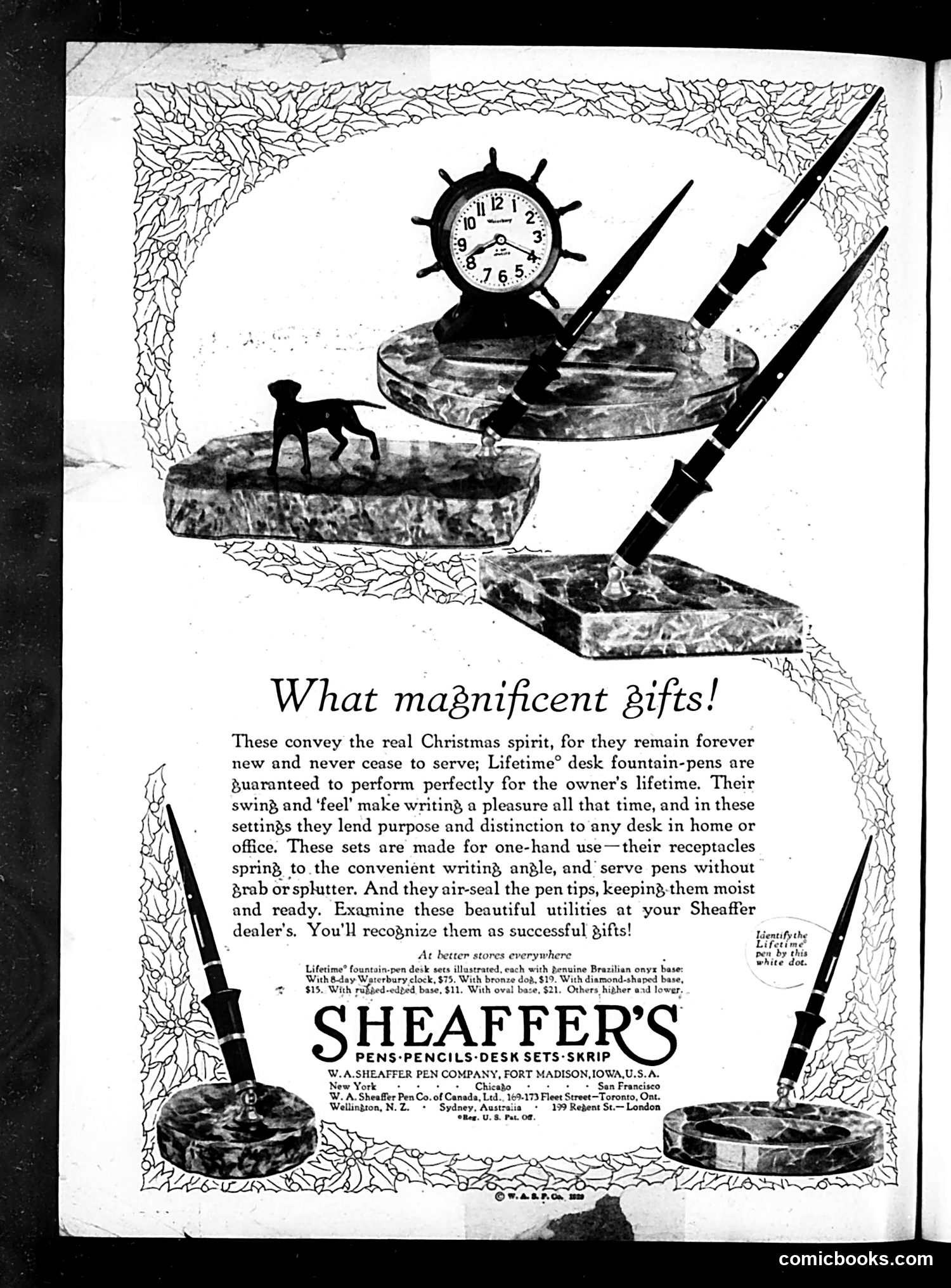
Analysis This is primarily a Sheaffer pen company advertisement, not satirical content. The page promotes "Lifetime" desk fountain-pen sets as Christmas gifts. The imagery depicts decorative desk sets featuring: - A ship's wheel-shaped clock - A hunting dog figurine - Writing implements arranged on marble-like bases The ad's rhetoric emphasizes permanence ("remain forever new," "guaranteed to perform perfectly for the owner's lifetime") and status—these sets supposedly "lend purpose and distinction to any desk in home or office." The ornamental leaf border and nautical/sporting motifs (clock wheel, hunting dog) suggest aspirational, upper-class aesthetics typical of 1920s-30s luxury goods marketing. There is no satire or political commentary; this is straightforward commercial advertising.
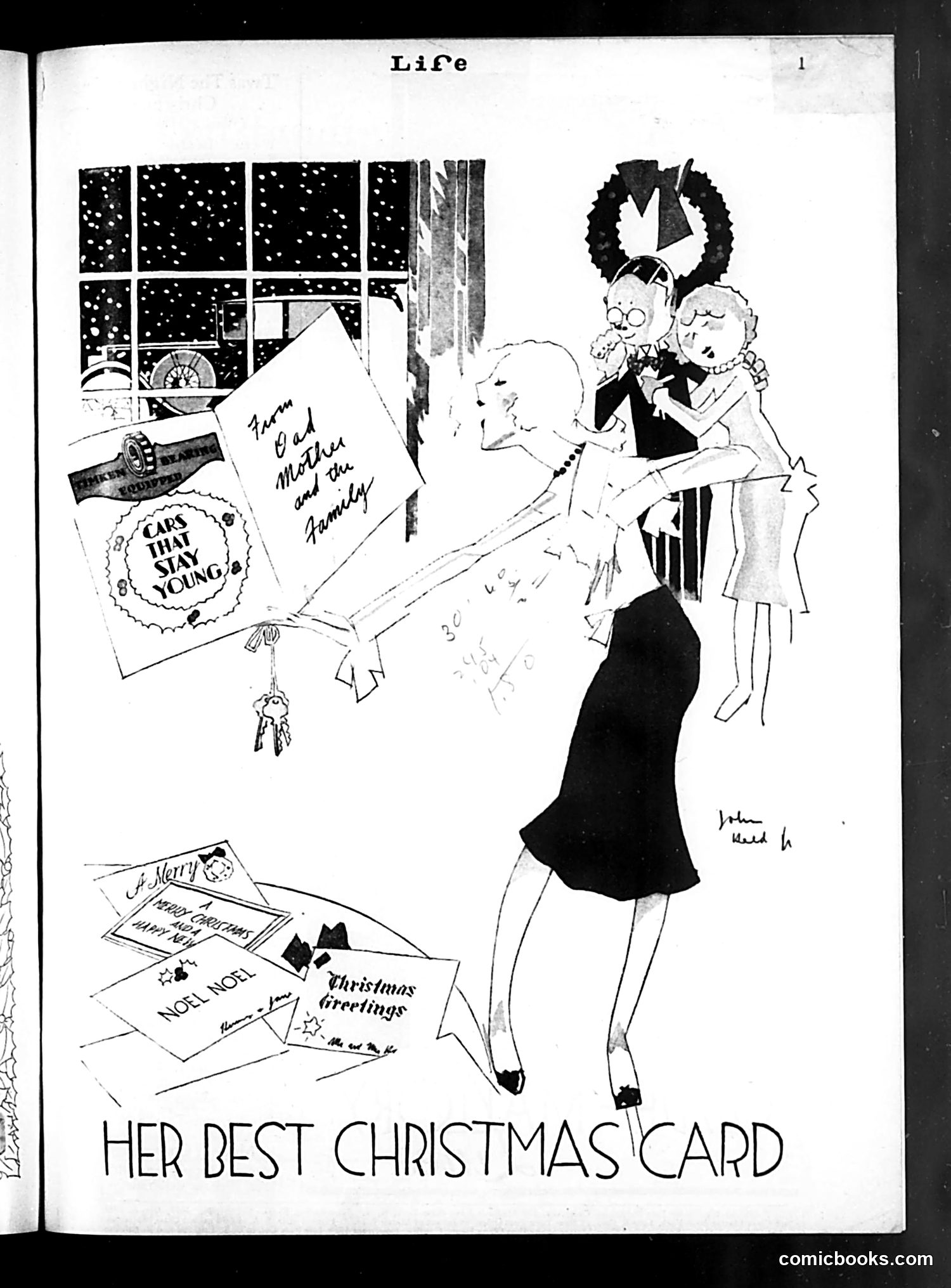
"Her Best Christmas Card" This satirical cartoon from *Life* magazine depicts a woman holding two young children while surrounded by Christmas cards and holiday greetings. The visible cards reference family-focused messaging like "For God and Mother and the Family" and standard holiday wishes. The satire appears to comment on how a woman's "best Christmas card" is essentially her children themselves—that motherhood and family represent the ultimate expression of domestic virtue and social value. This reflects early-to-mid 20th century cultural attitudes celebrating motherhood as a woman's primary role and greatest achievement. The snowy window, formal dress, and idealized presentation reinforce the sentimentalized vision of domesticity the cartoon is gently mocking through its central conceit.
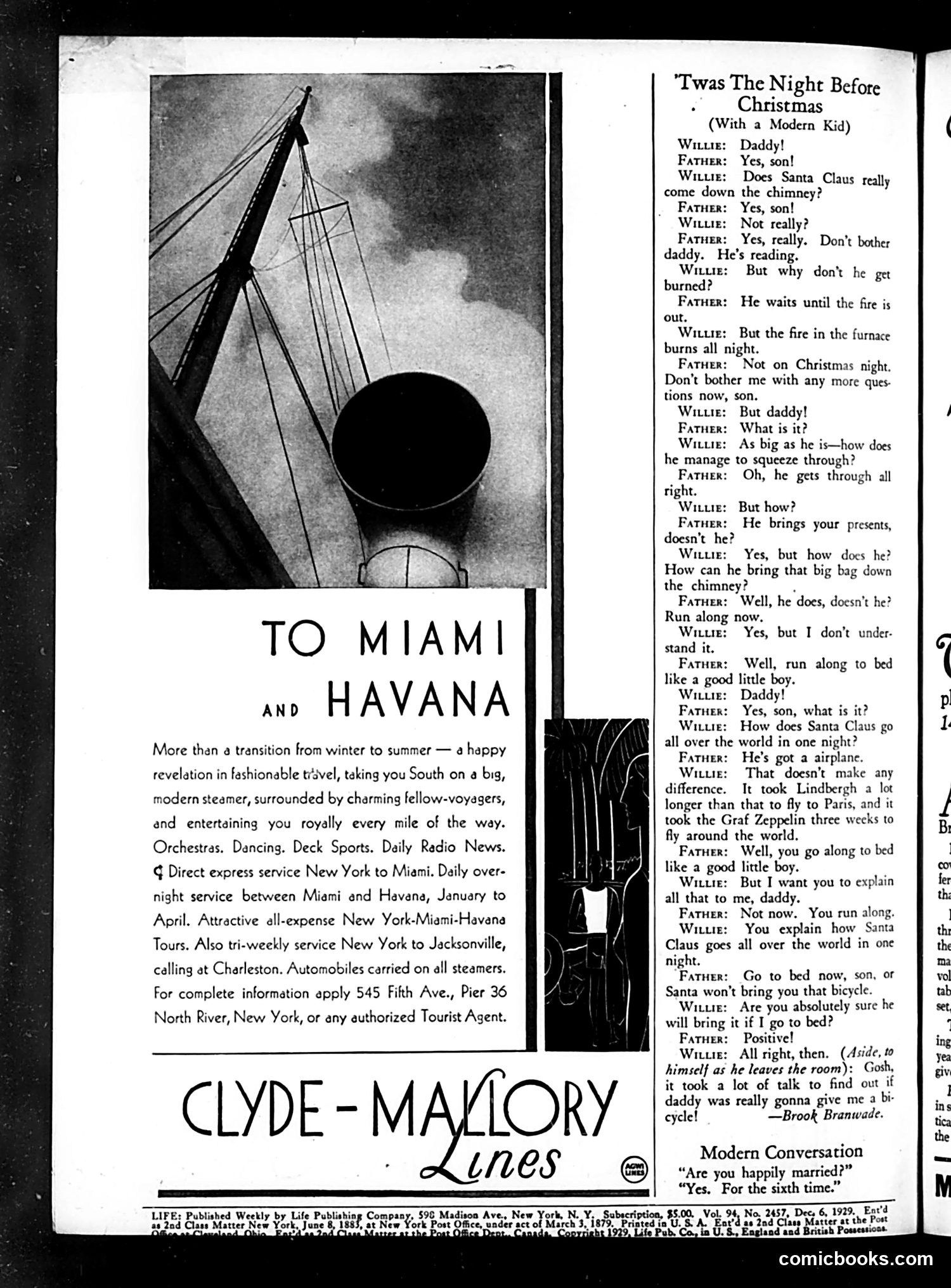
Content Analysis This page is primarily advertising for the Clyde-Mallory Lines shipping company, promoting travel to Miami and Havana with an image of a steamship. The right side contains "'Twas The Night Before Christmas (With a Modern Kid)" — a humorous dialogue between a father and son named Willie. The satire targets modern children's skepticism about Santa Claus. Willie peppers his father with practical, logical questions: How does Santa fit down chimneys? How does he visit everywhere in one night? How will he transport a bicycle? The father's exasperated responses ("Don't bother me," "Run along to bed") satirize the generational gap between parents raised on simple faith and 1920s children armed with rational thinking and scientific knowledge. The joke is that modern kids have lost childhood wonder through reason and information.
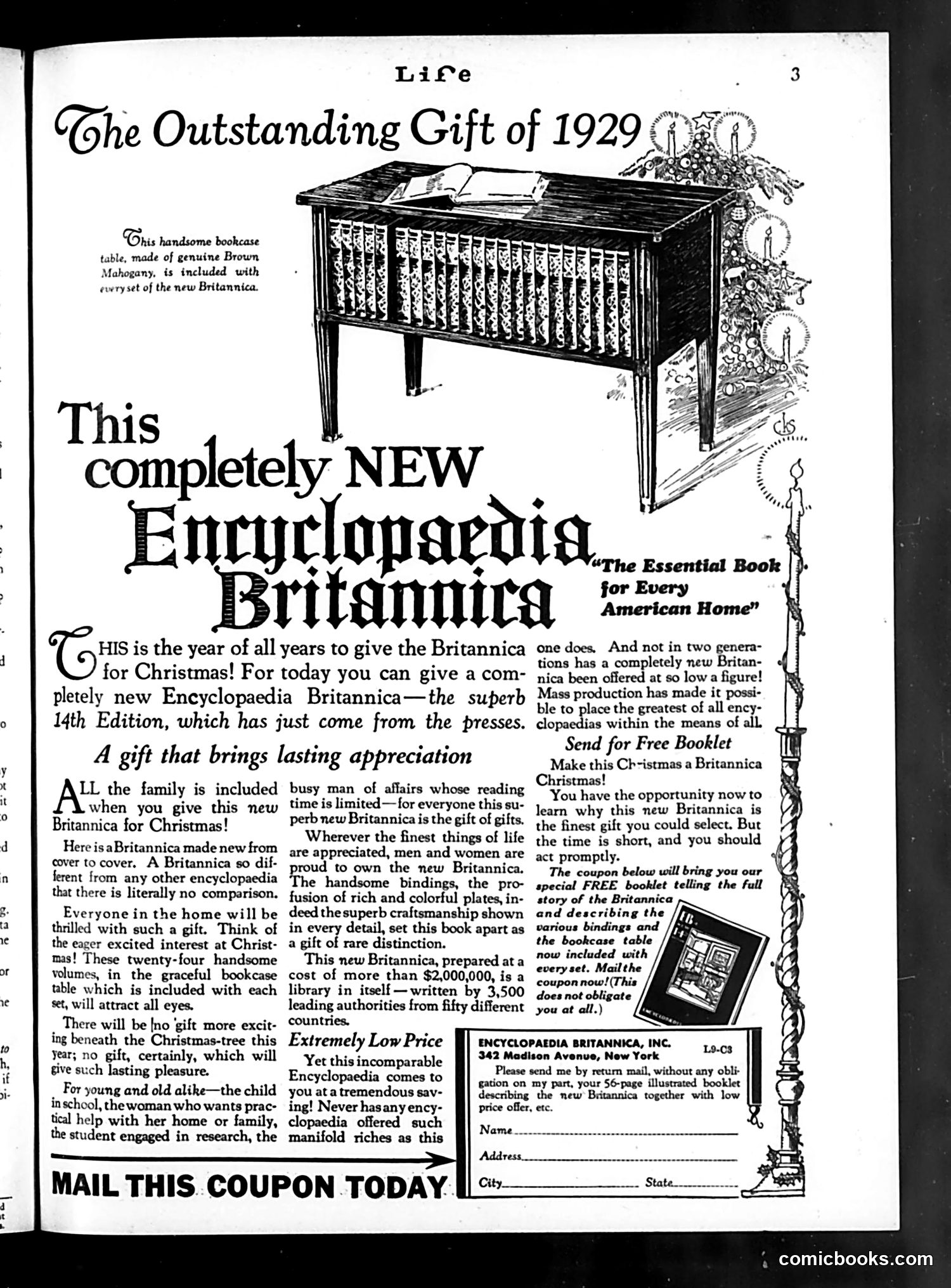
Analysis This page is primarily advertising, not satire or political commentary. It promotes the 1929 edition of the Encyclopedia Britannica as "The Outstanding Gift of 1929." The advertisement emphasizes that this is the "superb 14th Edition, which has just come from the presses"—highlighting its newness and comprehensiveness. The accompanying illustration shows an elegant mahogany bookcase table designed to display the encyclopedia set. The marketing pitch targets middle-class American families, positioning the encyclopedia as a prestigious gift that benefits "everyone in the home," from busy professionals to schoolchildren needing research help. The extremely low price mentioned and the free booklet offer suggest this was a competitive, aggressive sales campaign during the pre-Depression period, when such reference works were luxury items for most households.
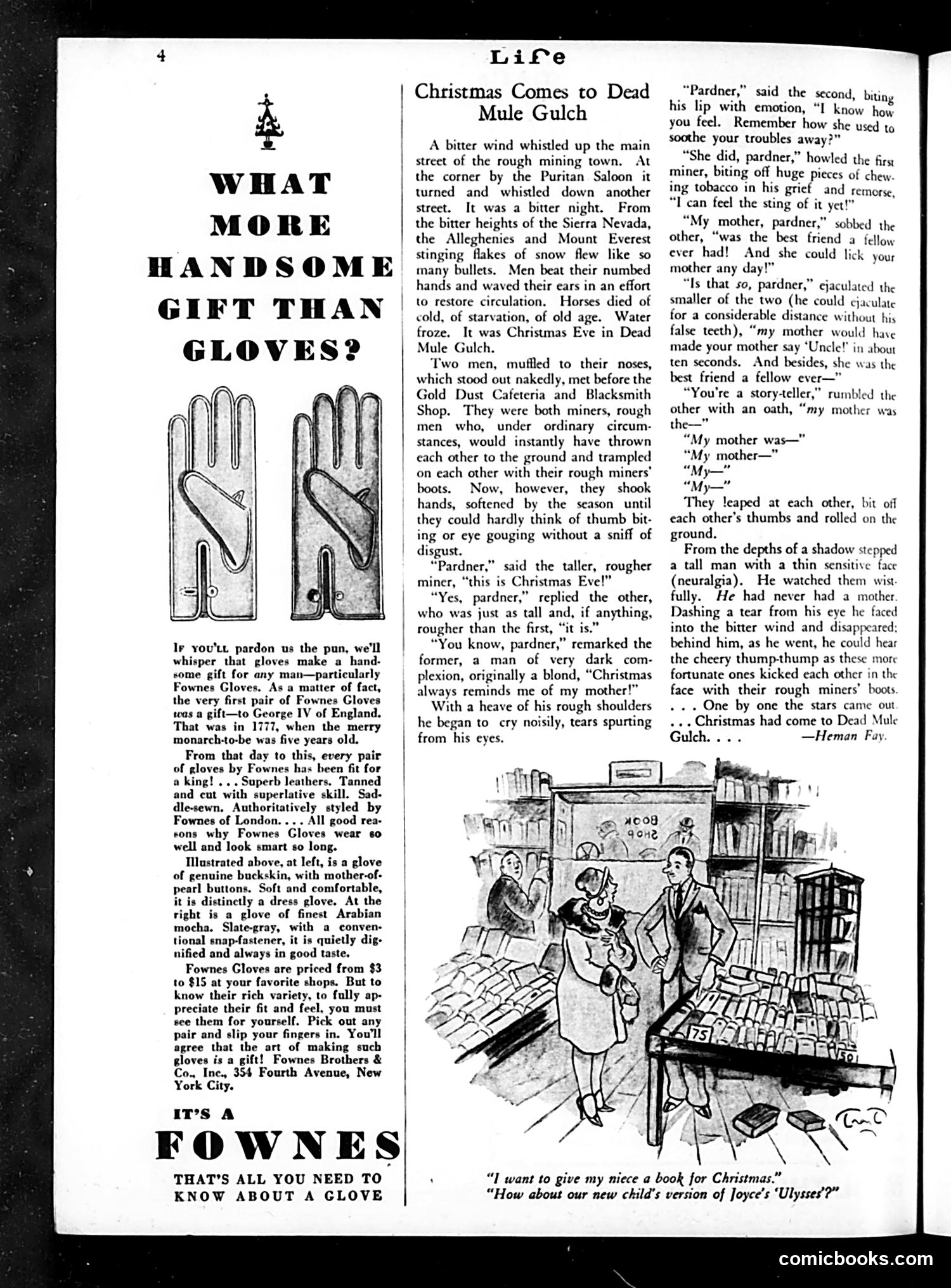
Analysis This page combines advertising with fiction. The left side advertises Fownes Gloves—a luxury brand established in 1777—arguing gloves make an ideal gift. The ad emphasizes quality and pricing ($3-$15). The right side presents a short story titled "Christmas Comes to Dead Mule Gulch" by Herman Fay. It depicts two rough miners in a Western mining town on Christmas Eve bonding emotionally over shared memories of their mothers. The narrative explores how hardened men—who would normally fight—become sentimental when reminded of maternal love and loss. The accompanying illustration shows what appears to be a general store or trading post. The story illustrates a common early-20th-century sentimental theme: that even tough frontier characters possess hidden emotional depths, particularly regarding family bonds.
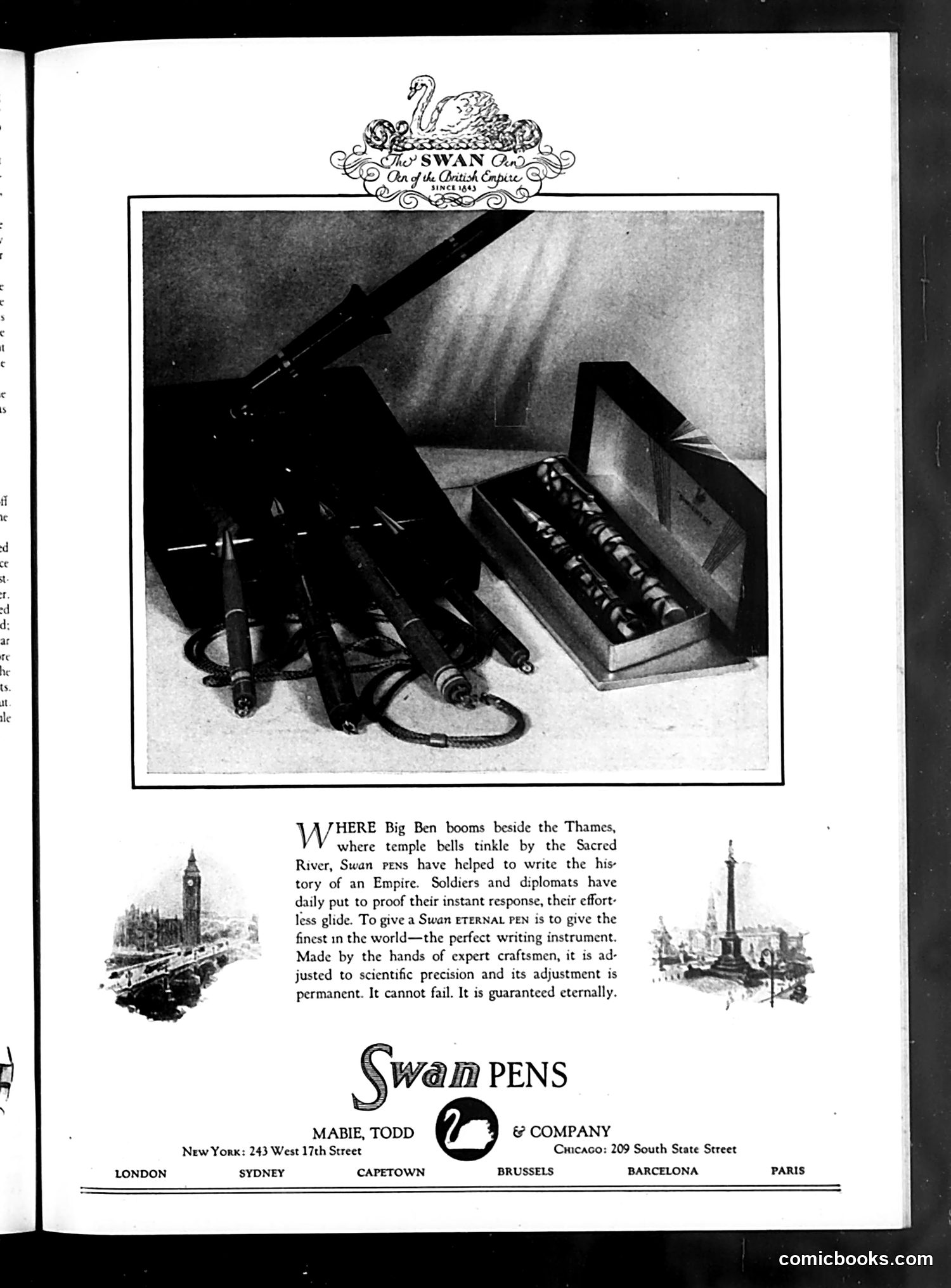
Swan Pens Advertisement This is a vintage advertisement, not a political cartoon. It promotes Swan brand fountain pens manufactured by Mabie, Todd & Company, with offices in London, Sydney, Capetown, Brussels, Barcelona, and Paris. The ad appeals to British imperial pride and authority: it references "Big Ben" and the Thames, mentions that "soldiers and diplomats" rely on Swan pens for official correspondence, and emphasizes the pen's precision and reliability—qualities associated with Empire administration. The photograph shows military or diplomatic implements (possibly binoculars or similar instruments) alongside an open pen box, suggesting these are tools of imperial governance and power. The copy promises the pen "is guaranteed eternally," positioning it as a dependable instrument for maintaining British authority worldwide.
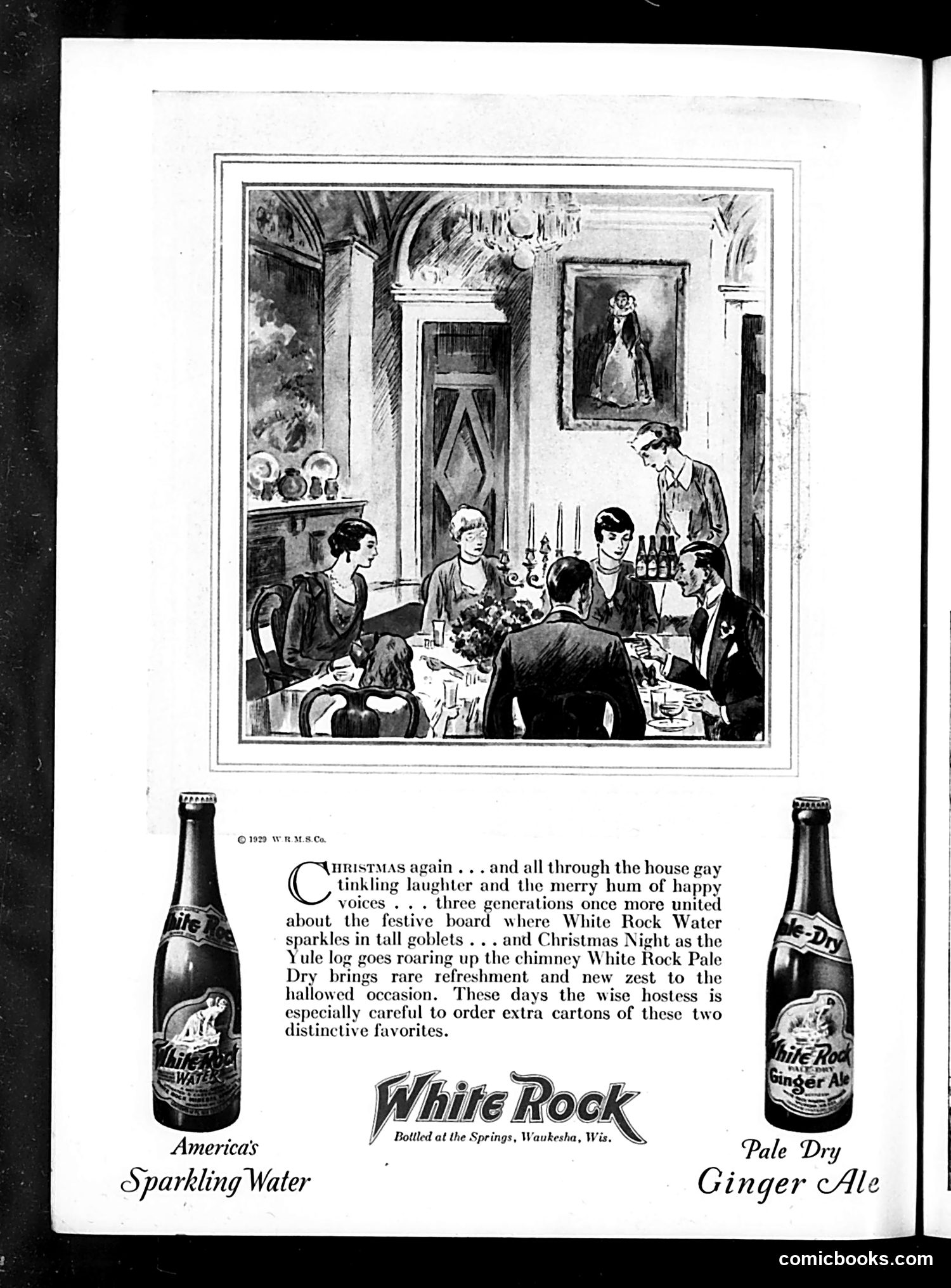
Analysis This is primarily a beverage advertisement, not political satire. It advertises White Rock brand products—Sparkling Water and Pale Dry Ginger Ale, bottled in Waukesha, Wisconsin. The illustration depicts an elegant Christmas dinner scene with multiple generations gathered around a formal table in a well-appointed dining room. The text emphasizes tradition and family unity during the holidays. The ad's appeal is nostalgic and aspirational: it associates White Rock beverages with refined, prosperous domesticity and multi-generational holiday celebration. The 1929 copyright date (visible as "© 1929") places this during the Jazz Age, when such beverages were marketed as sophisticated alternatives—particularly relevant given Prohibition's context. The page is essentially commercial content, not editorial commentary.
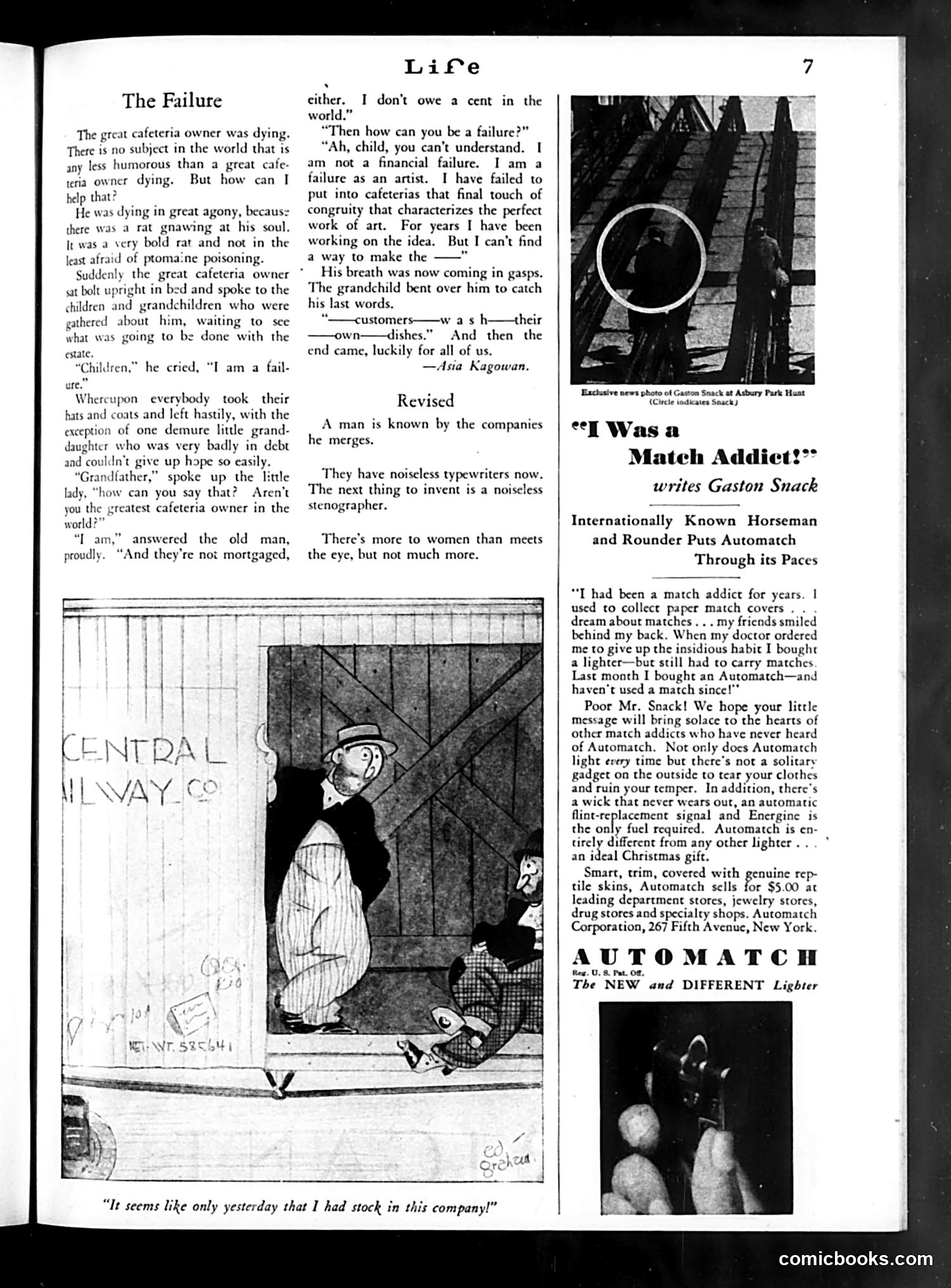
Analysis of Life Magazine Page 7 This page contains two distinct items: "The Failure" (left): A satirical short story about a dying cafeteria owner who considers himself an artistic failure, unable to perfect his vision despite years of work. The granddaughter's mercenary response—asking only about debts and mortgages—satirizes both the grandfather's impractical idealism and younger generations' financial pragmatism. "I Was a Match Addict!" (right): An advertisement disguised as a testimonial from someone named Gaston Snack, claiming he overcame match-collecting compulsion by switching to Automatch lighters. This humorous ad mocks both consumer product testimonials and the concept of trivial "addictions," while promoting Automatch as a practical, reusable alternative. Both pieces employ gentle satire of early 20th-century American values and consumer culture.
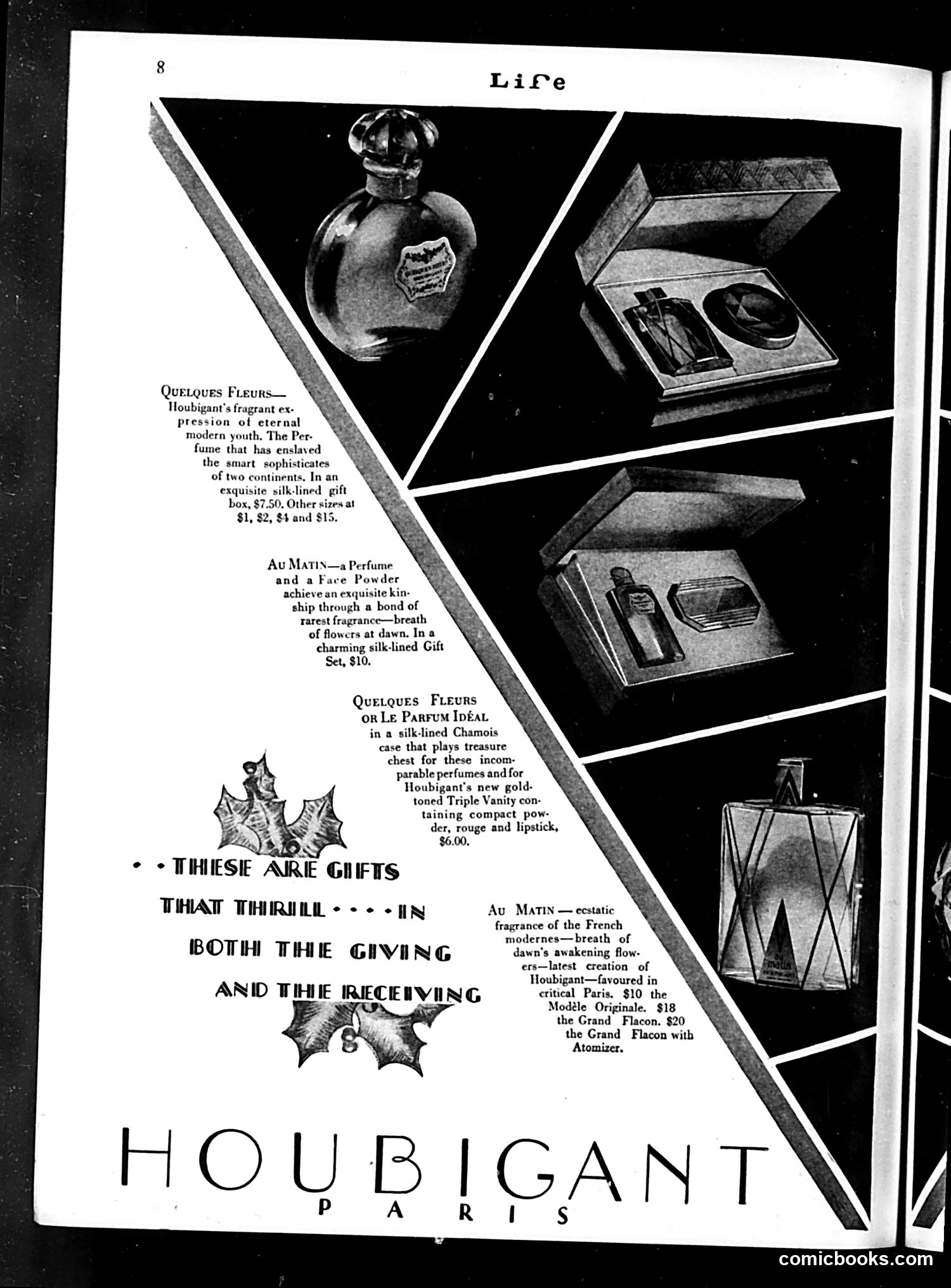
Analysis This page is primarily advertising, not political satire. It features a full-page advertisement for Houbigant, a French perfume and cosmetics company. The ad showcases luxury gift sets containing perfumes ("Quelques Fleurs," "Au Matin," "Le Parfum Idéal") and face powder products, with prices ranging from $1 to $20. The products are displayed in elegant packaging. The decorative holly leaves and text about "gifts that thrill in both the giving and the receiving" indicate this is a holiday shopping advertisement, likely from a pre-Christmas issue of *Life* magazine. The French branding and emphasis on sophistication reflect the era's association of French products with luxury and modernity. There is no political cartoon or social satire present on this page.
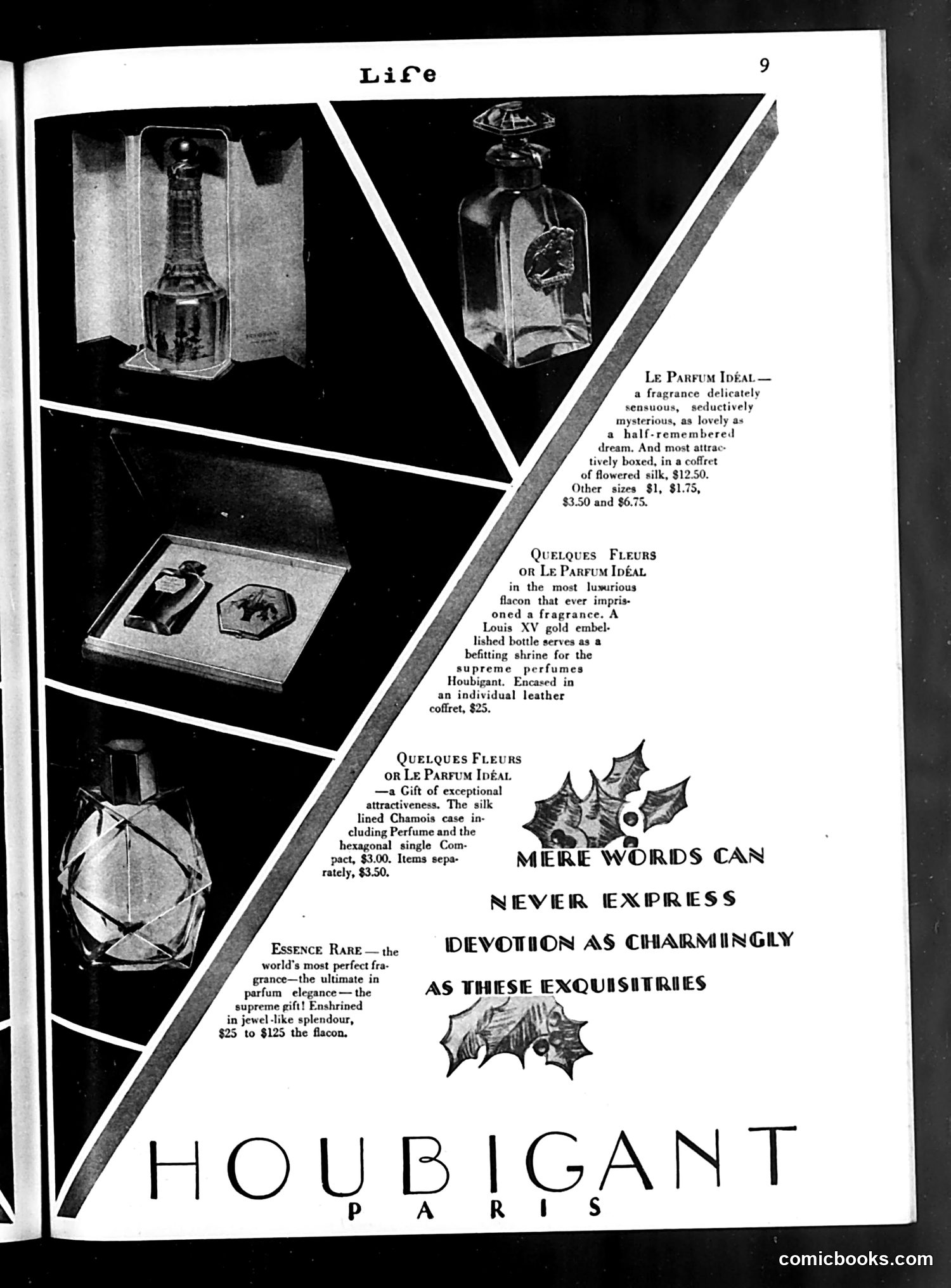
This is primarily a perfume advertisement page from Life magazine, not a political cartoon. The page showcases luxury fragrances by Houbigant, a Paris-based perfume house, featuring four products: 1. Le Parfum Idéal - described as delicately mysterious 2. Quelques Fleurs or Le Parfum Idéal - presented in luxurious packaging with gold embellishment 3. Another Quelques Fleurs variant in silk-lined Chamois case 4. Essence Rare - claimed as "the world's most perfect fragrance" The ad uses poetic language emphasizing elegance and exclusivity, targeting wealthy consumers. The accompanying tagline—"Mere words can never express devotion as charmingly as these exquisitries"—suggests gifts for romantic occasions. This reflects early-20th-century luxury marketing to affluent audiences.
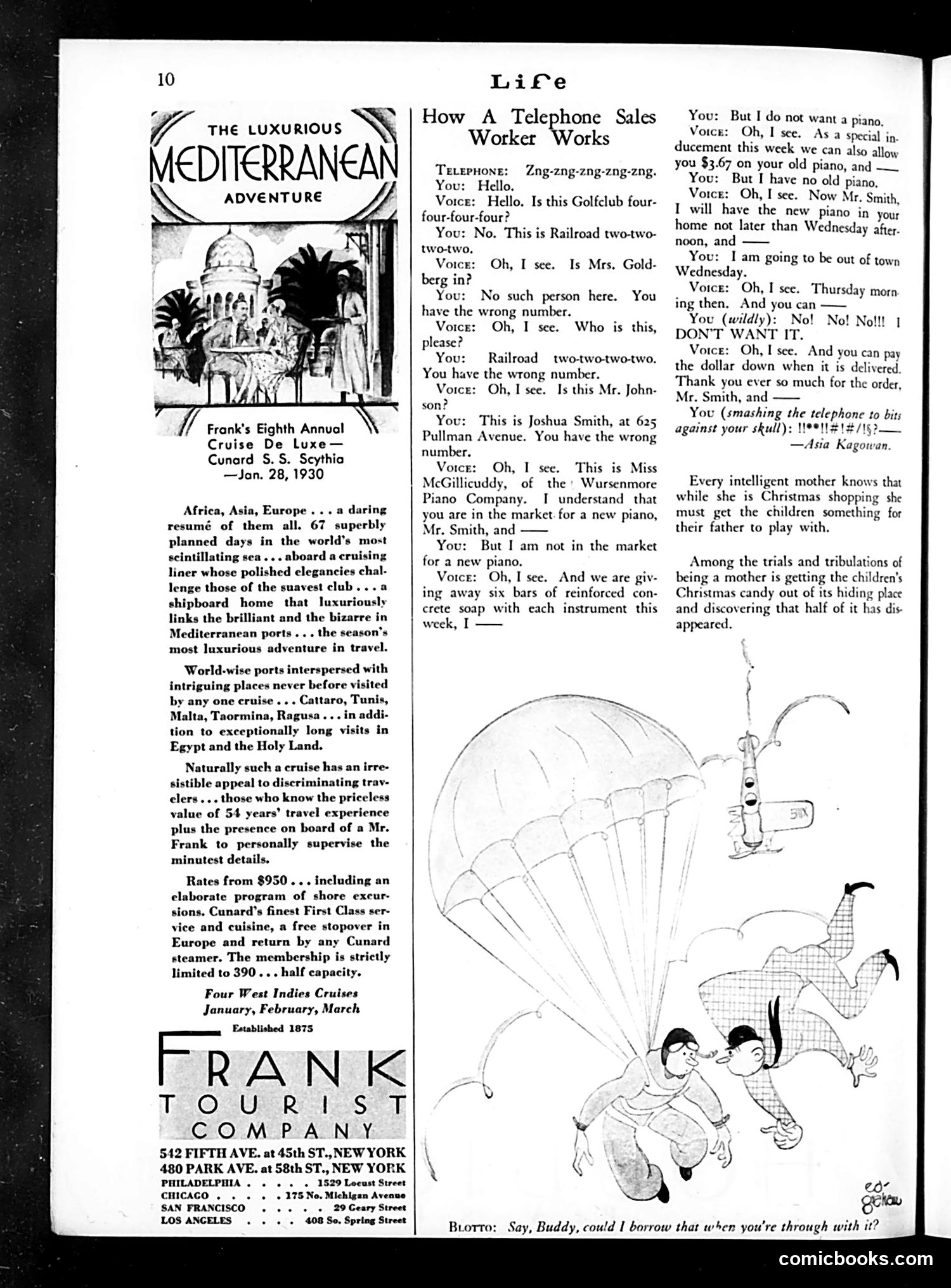
Analysis of Life Magazine Page (Page 10) This page contains two distinct elements: Left side: An advertisement for Frank's Tourist Company promoting Mediterranean cruises on the Cunard S.S. Scythia, departing January 28, 1930. It emphasizes exotic ports (Egypt, Holy Land, North Africa) and luxury amenities. Right side: A satirical piece titled "How A Telephone Sales Worker Works" depicting a frustrated telephone conversation where a customer (Mr. Smith) repeatedly gets wrong numbers while trying to order a piano. The humor lies in the salesperson's exhausted politeness as the customer keeps calling back, ultimately expressing rage by smashing the telephone against his skull. Bottom: A cartoon showing two children with a parachute, captioned about borrowing one "when you're through with it" — likely satirizing children's wishful thinking or borrowing culture. The page reflects 1930s consumer culture and office humor.
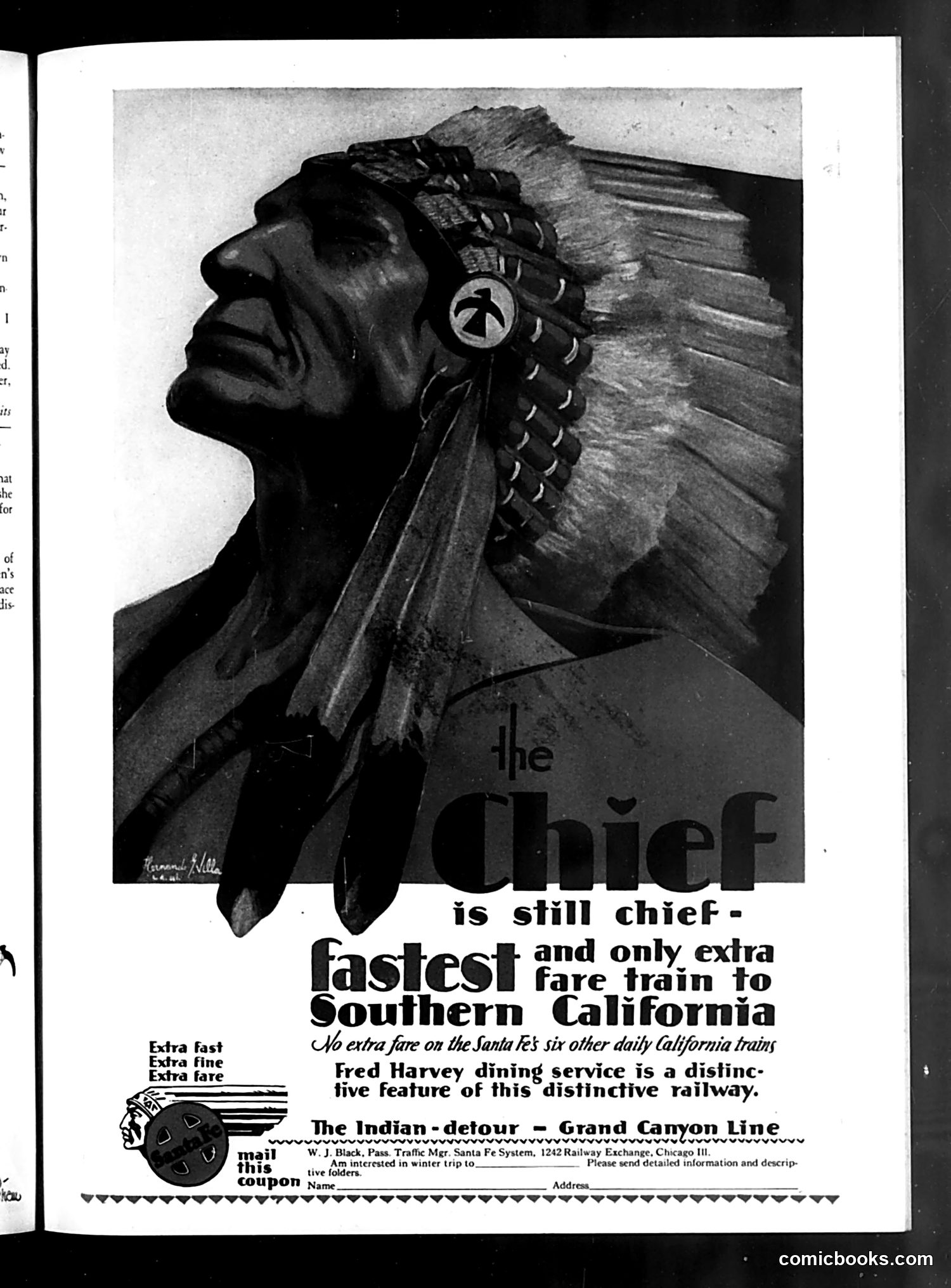
Analysis This is primarily a railroad advertisement, not a political cartoon. It promotes "The Chief," described as the "fastest and only extra fare train to Southern California" operated by the Santa Fe railway system. The image depicts a Native American man in profile wearing a traditional feathered headdress, positioned as a visual metaphor for the train's name. The advertisement emphasizes luxury amenities: "Extra fast / Extra fine / Extra fare" and highlights the Fred Harvey dining service as a distinctive feature. The "Indian-detour—Grand Canyon Line" reference suggests the route's scenic appeal. A mail-in coupon at the bottom invites reader interest in winter travel information. This reflects early 20th-century marketing practices using romanticized Native American imagery to brand commercial products.
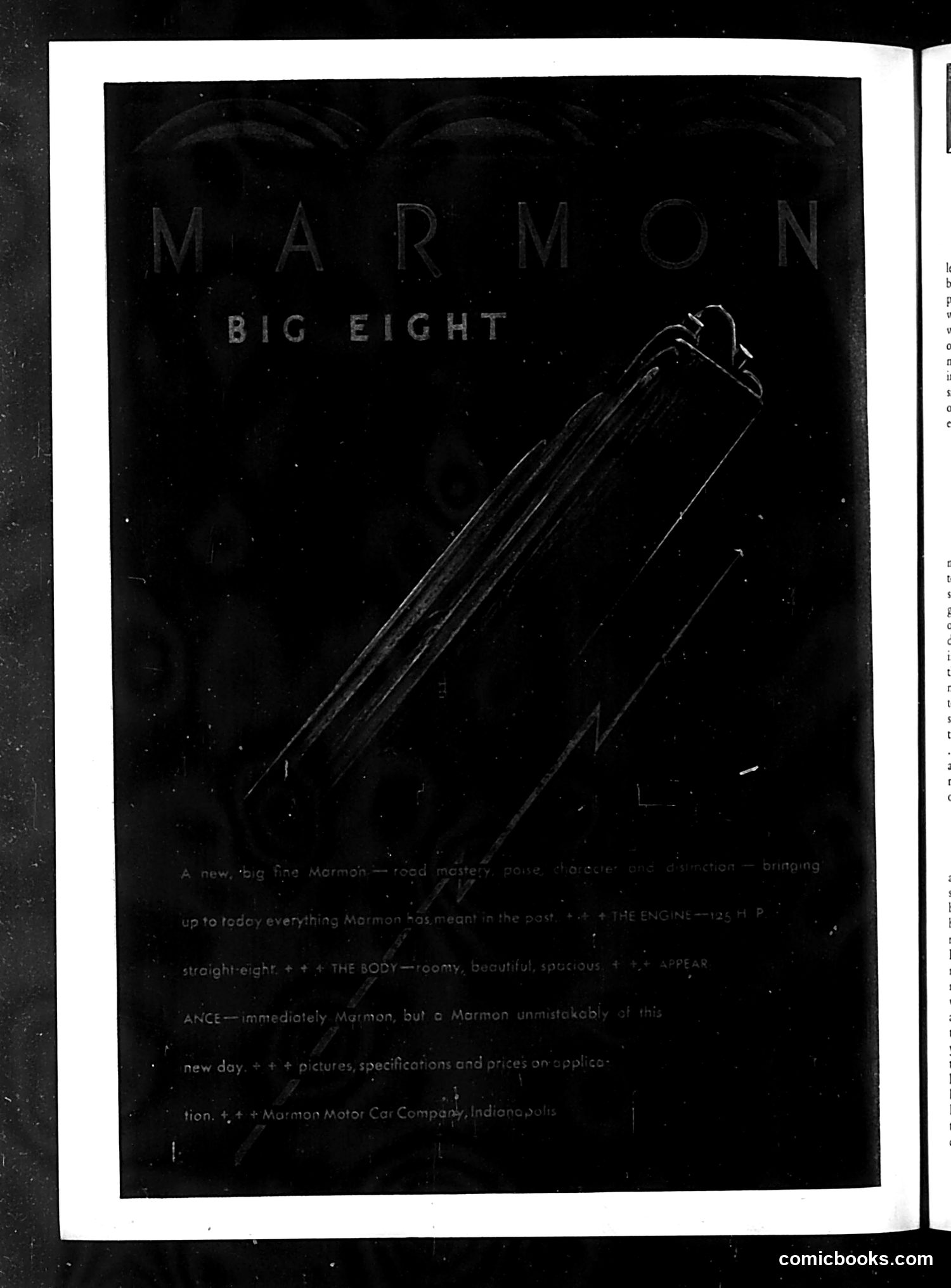
Marmon Big Eight Advertisement This page is a car advertisement, not political satire. It promotes the Marmon Big Eight automobile, featuring an illustration of the car's chassis and mechanical components against a dark background. The ad emphasizes the vehicle's engineering features: "THE ENGINE," "THE BODY—roomy, beautiful, spacious," and promises that "a new, big fine Marmon—[with] road mastery, poise, direction—bringing up to today everything Marmon has meant in the past." The text suggests Marmon was repositioning itself as a modern competitor, claiming its new model combines traditional reliability ("everything Marmon has meant") with contemporary design and comfort. The dramatic presentation of mechanical parts appeals to buyers interested in automotive engineering quality—a significant marketing angle during the early automotive era when mechanical innovation was a major selling point.
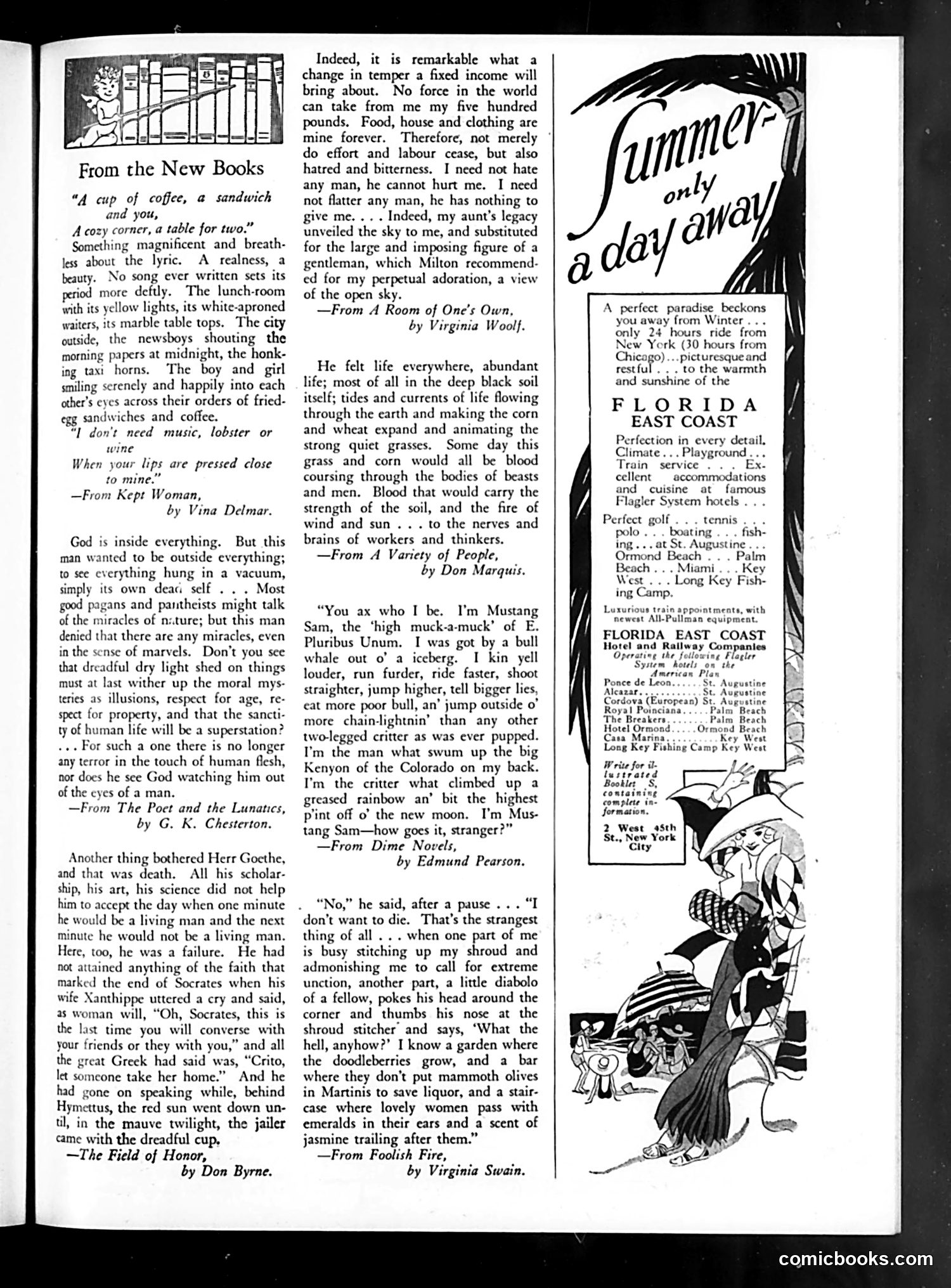
Analysis of Life Magazine Page This page contains literary excerpts and a travel advertisement rather than political satire. The left column features "From the New Books" — passages from various contemporary novels by authors including Virginia Woolf, Vina Delmar, C.K. Chesterton, Don Marquis, Edmund Pearson, Don Byrne, and Virginia Swain. These excerpts showcase different literary styles and themes popular in the era. The right side features a Florida East Coast tourism advertisement with an illustrated cartoon of a cowboy character (labeled "Mustang Sam") promoting vacation destinations. The ad emphasizes climate, accommodations, and attractions like golf, polo, and fishing along Florida's coast. This is primarily a book and travel promotion page, not satirical commentary.
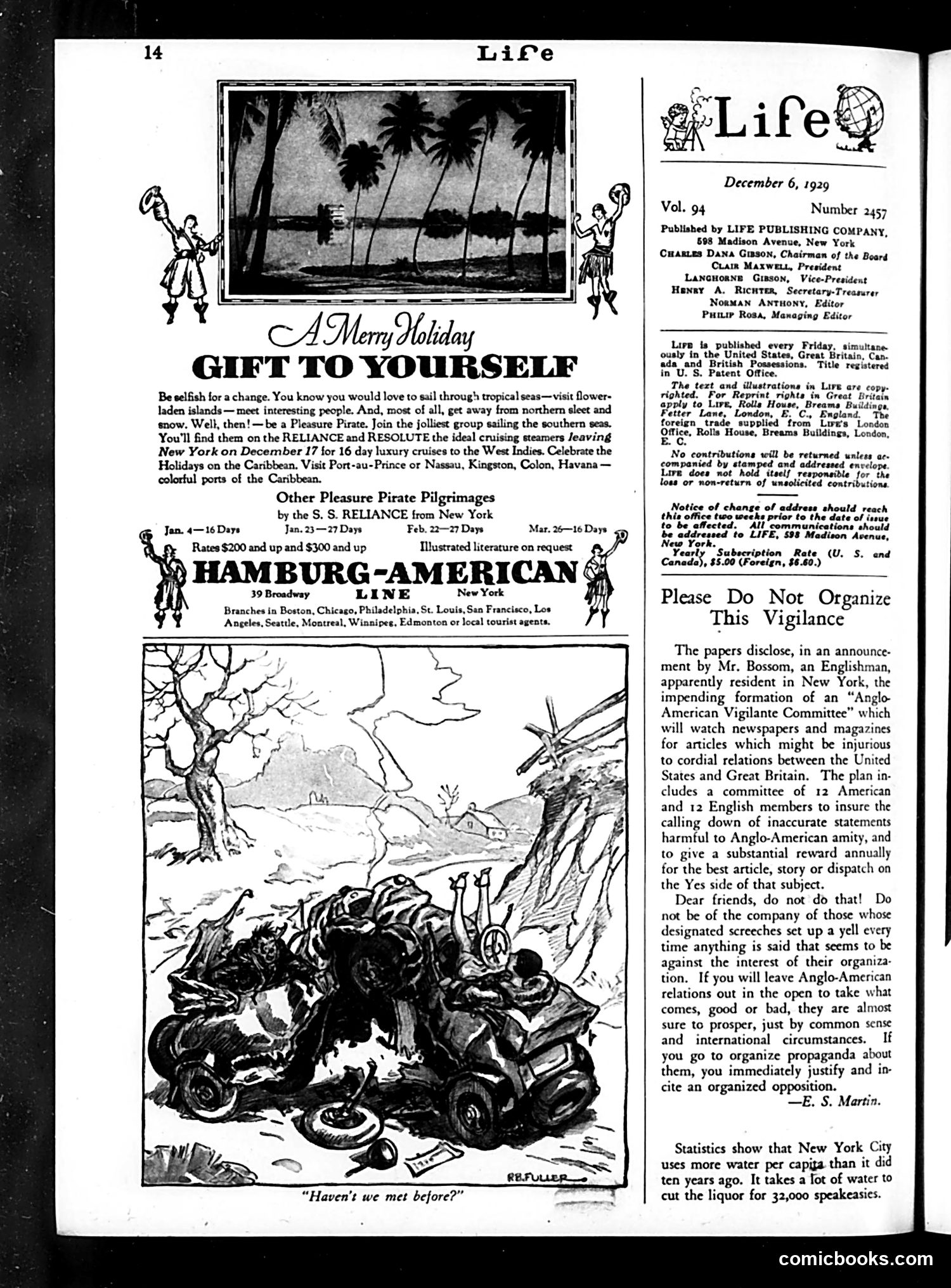
Analysis of Life Magazine, December 6, 1929 This page is primarily advertising and editorial content rather than political satire. The main cartoon depicts a wrecked automobile with the caption "Haven't we met before?" — likely satirizing the frequency of car accidents in 1920s America, a growing social concern as automobile ownership expanded rapidly. The upper half features cruise ship advertisements (Hamburg-American Line), promoting tropical vacations as holiday gifts. The right column contains an editorial titled "Please Do Not Organize This Vigilance," warning readers against joining an "Anglo-American Vigilante Committee" that would monitor Anglo-American relations. This reflects 1920s anxieties about organized propaganda efforts and international tensions between the U.S. and Britain. The page reflects Depression-era concerns about safety, consumerism, and international relations.
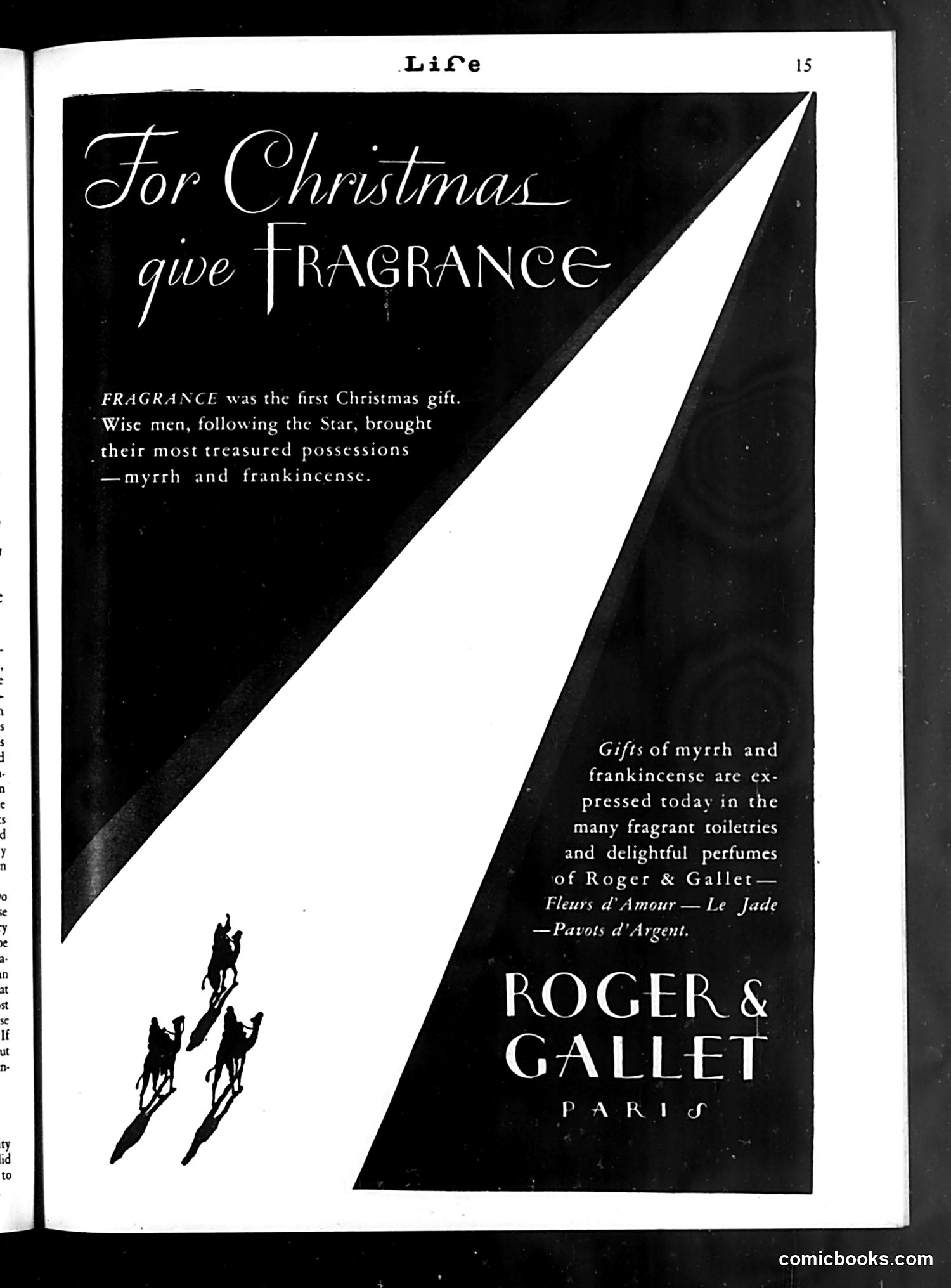
This is a vintage advertisement rather than satirical content. It's a full-page ad for Roger & Gallet, a Paris-based fragrance and toiletries company. The ad uses Christian imagery to market luxury perfumes. It references the biblical nativity story—the Wise Men bringing myrrh and frankincense as gifts to Jesus—to suggest that fragrance is a prestigious, meaningful Christmas gift with ancient tradition behind it. The visual shows the Star of Bethlehem as a geometric design with silhouettes of the three kings and camels approaching it, creating an elegant, minimalist composition. The ad promotes specific Roger & Gallet products: *Fleurs d'Amour*, *Le Jade*, and *Pavots d'Argent*. This appears to be from the 1920s-1930s era based on the typography and design style.
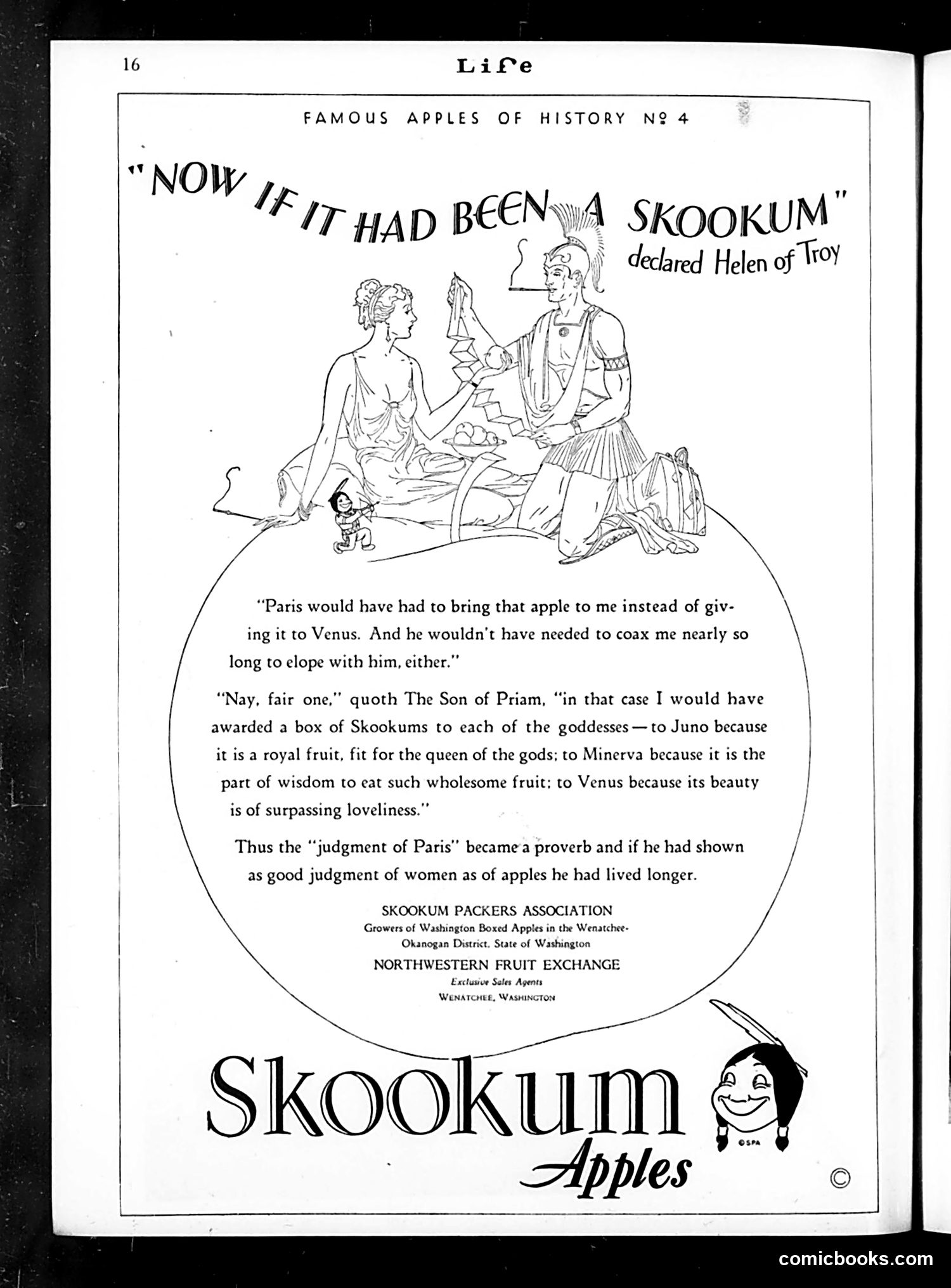
Analysis This is a Skookum brand apple advertisement disguised as satirical content, titled "Famous Apples of History #4." The ad humorously reimagines the Judgment of Paris (classical mythology) with a twist: Helen of Troy suggests Paris should have awarded the golden apple to her instead of Venus—thereby avoiding the Trojan War. Paris responds by saying he'd have given *Skookum apples* to all three goddesses instead, resolving the conflict through fruit rather than beauty contests. The joke mocks the original myth's absurdity while promoting Skookum apples as superior to the legendary golden apple. The advertisement credits the Skookum Packers Association (Washington state apple growers) and the Northwestern Fruit Exchange as sellers. The small figure depicted appears to be a Native American character—a common, now-offensive branding choice of the era—used as the brand mascot.
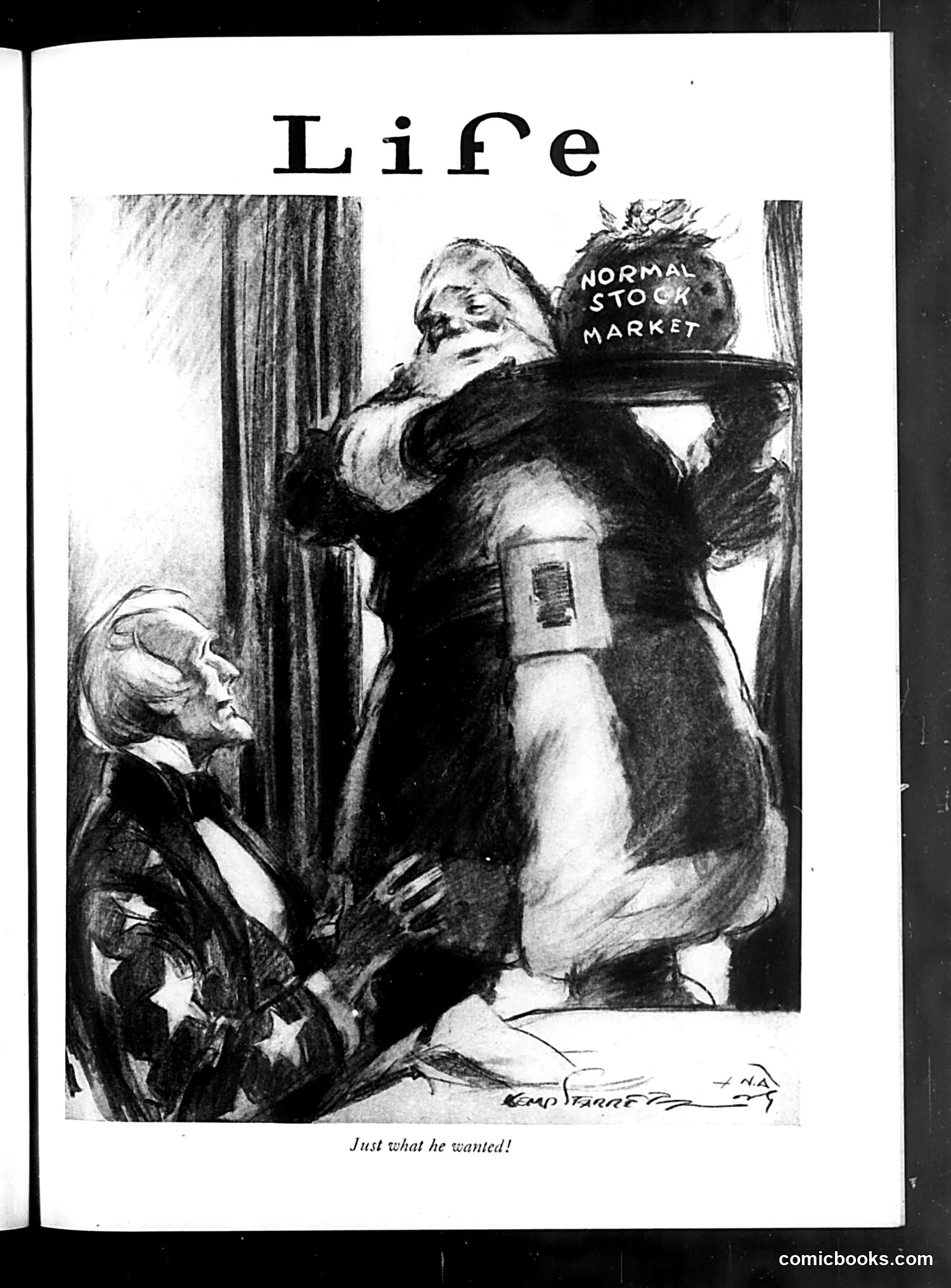
Life Magazine Cartoon Analysis This is a satirical cartoon titled "Just what he wanted!" depicting a financial/market scenario. A well-dressed man (likely representing a wealthy investor or financier) holds a large bag labeled "NORMAL STOCK MARKET" while a smaller, older figure in formal dress below appears distressed or reacting to this development. The satire appears to comment on stock market manipulation or inequality—suggesting that someone in power has obtained exactly what they desired (the "normal" market conditions) while others suffer the consequences. The cartoon likely references early 20th-century concerns about market control by wealthy elites and unfair financial practices that harmed ordinary citizens. The style and subject matter are consistent with *Life* magazine's tradition of mocking financial corruption and economic disparity.
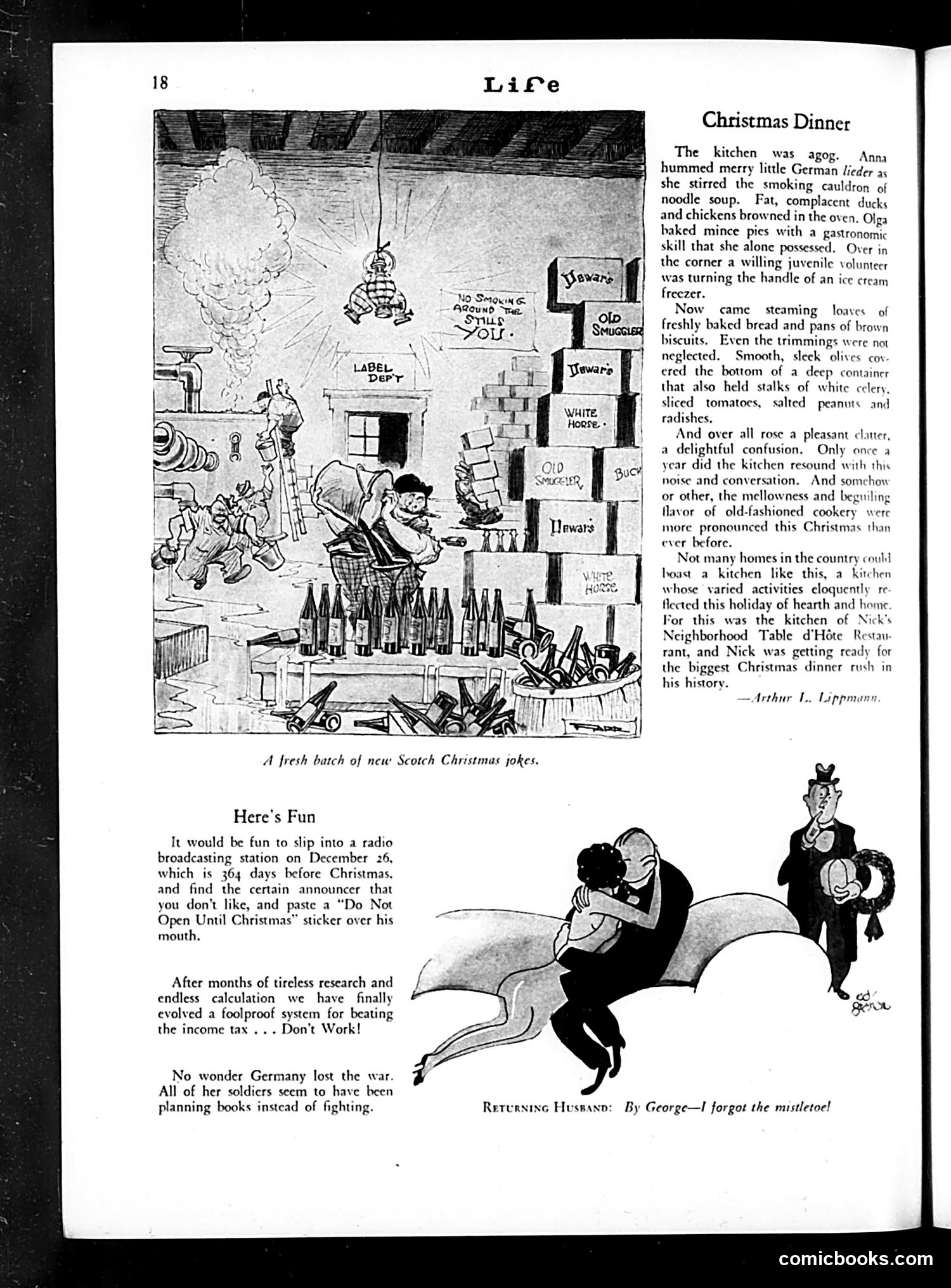
Analysis of Life Magazine Page 18 "Christmas Dinner" (top): A humorous illustration of a chaotic restaurant kitchen preparing for Christmas dinner service. The detailed sketch shows cooks, hanging decorations, labeled storage containers, and bottles arranged on a table, with the caption describing it as "a fresh batch of new Scotch Christmas jokes." The accompanying article by Arthur L. Lippmann celebrates the kitchen's organized chaos and festive preparations. "Here's Fun" (bottom): A satirical section offering absurdist humor. One joke suggests mailing "Do Not Open Until Christmas" stickers to radio announcers 364 days before Christmas. Another mocks post-war Germany, claiming soldiers lost the war because they were "planning books instead of fighting." The bottom cartoon shows a returning husband with a mistress, captioned "I forgot the mistletoe!"—a domestic infidelity joke playing on holiday customs.
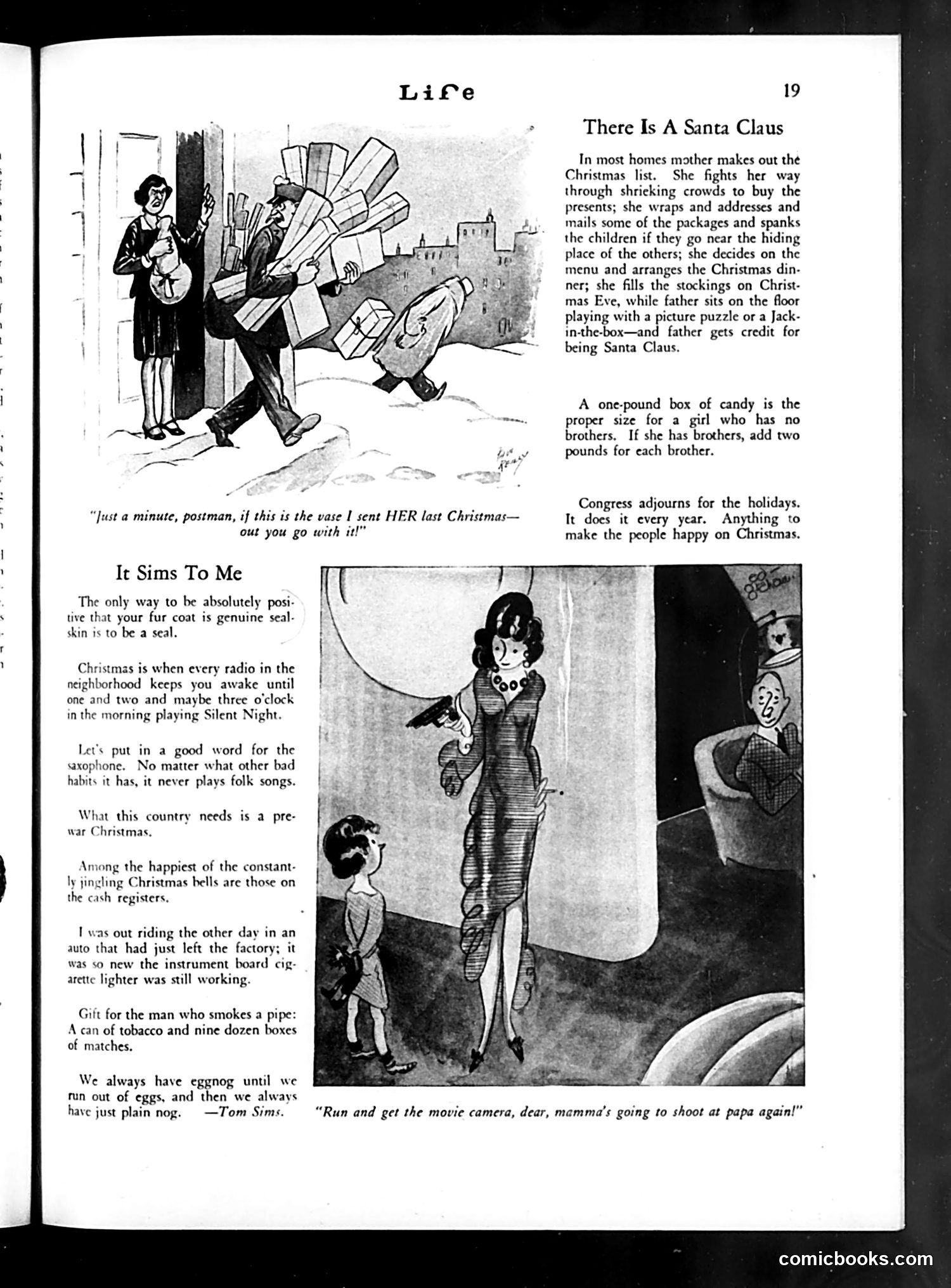
Life Magazine Page 19 Analysis This page contains two satirical pieces about Christmas customs circa the early-to-mid 20th century. "There Is A Santa Claus" critiques gender roles: mothers perform nearly all Christmas labor—shopping crowds, wrapping, mailing, cooking, filling stockings—while fathers get credit as "Santa Claus" for minimal participation (playing with toys). The joke highlights the unfairness of this arrangement. "It Sims To Me" is a humor column by Tom Sims offering satirical observations about modern Christmas: radios playing "Silent Night" all night, cash register bells being the happiest Christmas sound, pre-war nostalgia, and consumer culture. The bottom cartoon shows a woman about to shoot a man with a movie camera—a visual pun on "shoot" meaning both filming and gunfire, suggesting domestic frustration. Together, the page satirizes consumerism, gender dynamics, and how Christmas customs had become commercialized and exhausting, particularly for women, in American society.
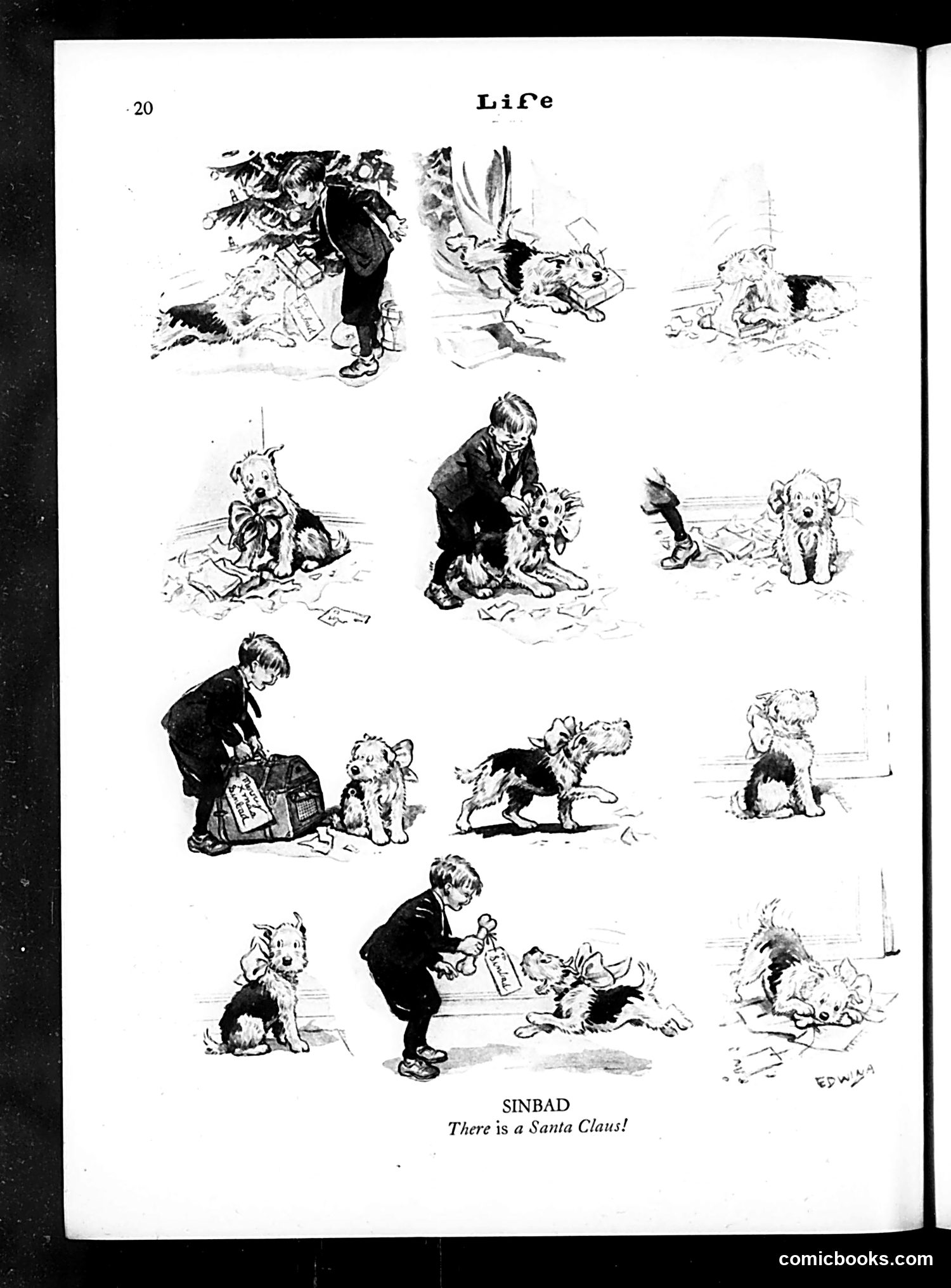
"Sinbad: There is a Santa Claus!" This page features a series of illustrated vignettes depicting a young boy (Sinbad) with various dogs in different scenarios. The boy appears to be discovering or interacting with dogs in playful, mischievous situations—unpacking them from luggage, feeding them, playing with them, and creating general chaos. The title "There is a Santa Claus!" suggests the cartoon's joke: the boy has received dogs as an extravagant (and impractical) Christmas gift, leading to comedic pandemonium. The satire appears to mock both excessive gift-giving and parental indulgence during the holiday season. The growing number of dogs in successive panels emphasizes the escalating chaos of this "wonderful" present. This reflects early 20th-century *Life* magazine's frequent satirization of bourgeois excess and family life.
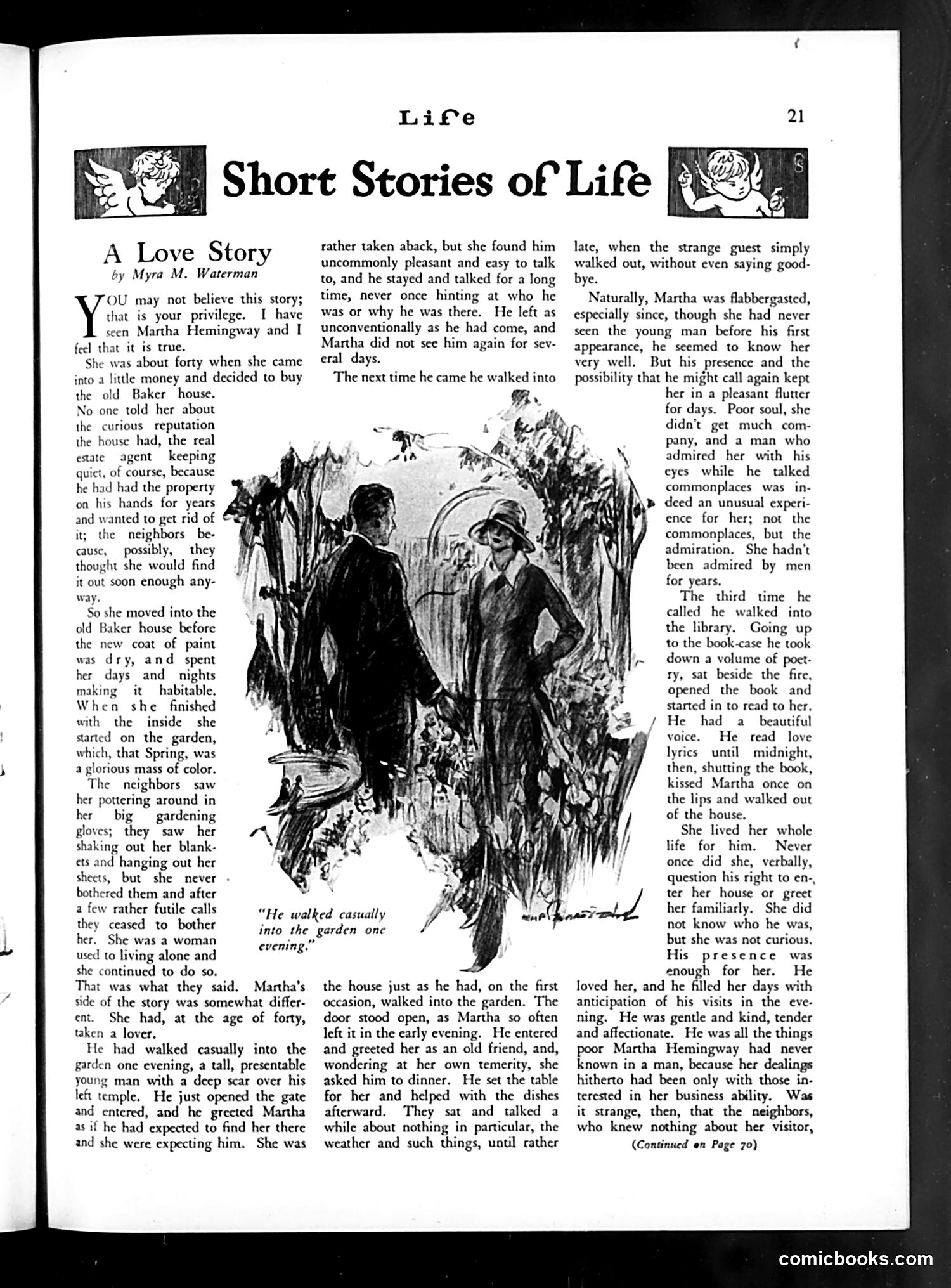
"A Love Story" by Myra M. Waterman This page presents a romantic short story, not political satire. The narrative follows Martha Hemingway, a solitary forty-year-old woman who purchases an old house with a mysterious reputation. A mysterious tall man with a facial scar begins appearing uninvited in her home—walking casually into her garden and house as if he belongs there. The illustration depicts their first meeting: the man greeting Martha in her garden. The story establishes a romantic tension through his familiarity with her despite being a stranger, his gentlemanly behavior (helping with dinner, reading poetry), and Martha's acceptance of his presence without question or investigation into his identity. The narrative explores themes of companionship, loneliness, and romantic vulnerability in early 20th-century life. There is no political content or satirical intent—this appears to be sincere sentimental fiction typical of *Life* magazine's literary offerings.
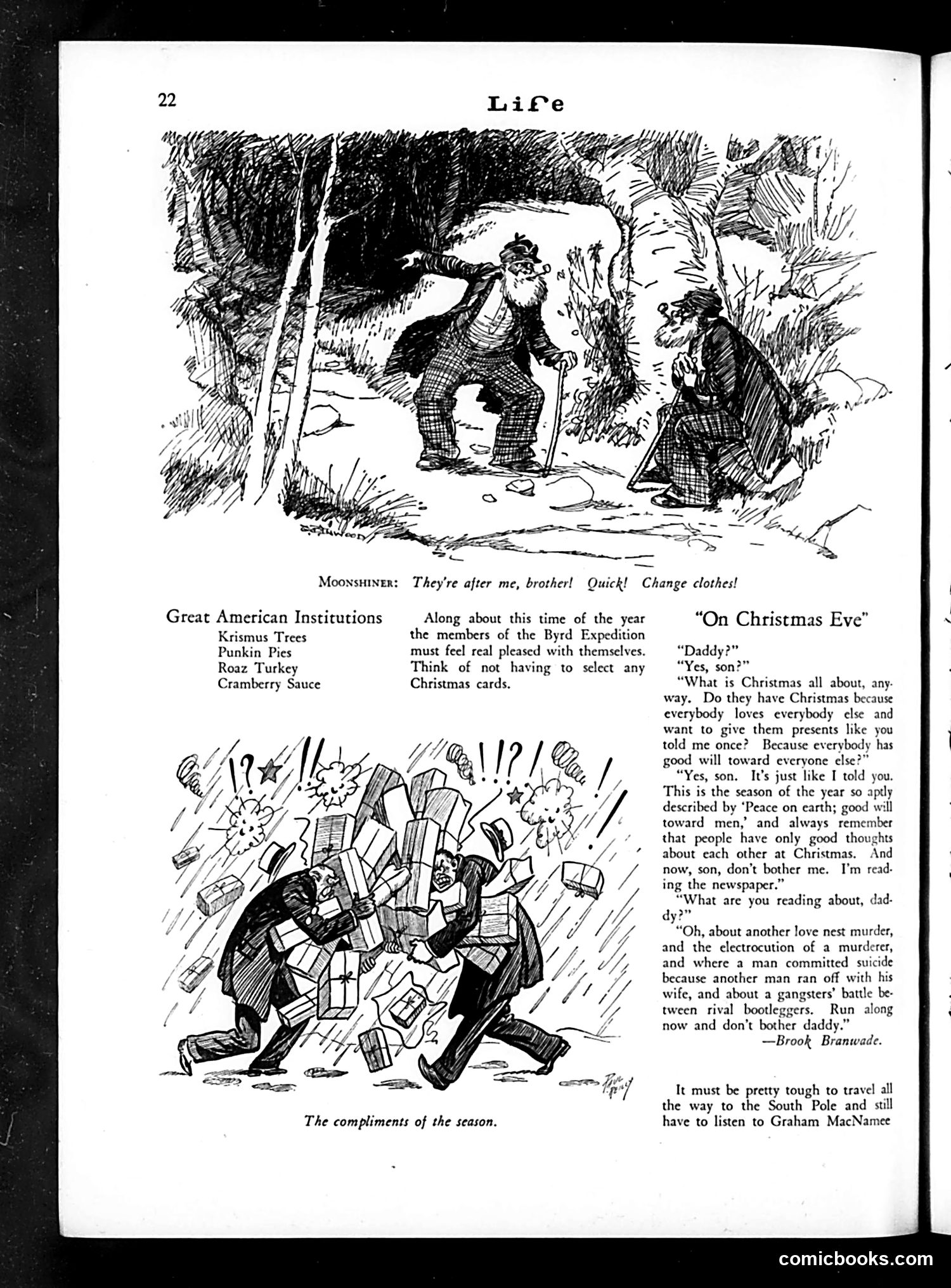
Analysis of Life Magazine Page 22 Top Cartoon: A moonshiner flees from authorities, declaring "Great American Institutions" include things like Christmas trees and turkey—but notably *not* law enforcement. This mocks how bootleggers and moonshiners operated openly during Prohibition, treating their illegal enterprise as a normalized American tradition. Bottom Cartoon: Two figures bury themselves under Christmas presents labeled "The compliments of the season." This satirizes commercialization—the gap between Christmas's stated spiritual values and the materialistic gift-giving frenzy. "On Christmas Eve" Essay: A father lectures his son about Christmas being about universal goodwill and peace, then immediately returns to reading the newspaper filled with murder, suicide, and gang violence. The satire is cutting: it exposes the hypocrisy between the idealized Christmas message and the brutal reality of 1920s American life—the era's actual "compliments of the season." South Pole Reference: Likely refers to Rear Admiral Richard Byrd's Antarctic expedition (1928-30), humorously suggesting even polar explorers couldn't escape modern mass media.
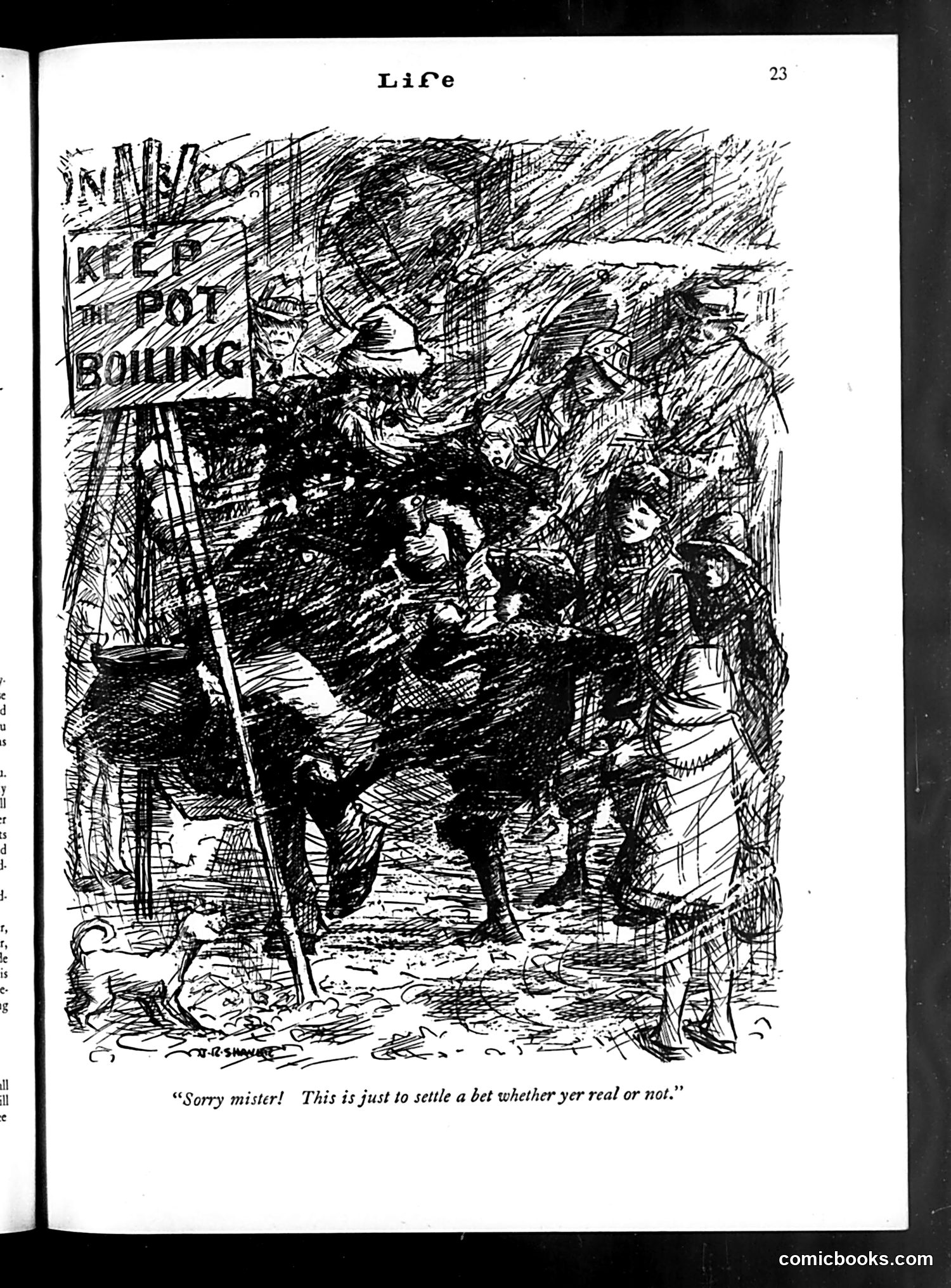
Analysis This is a single cartoon from *Life* magazine (page 23). The sketch shows what appears to be a street scene with multiple figures gathered around a central action. A sign reading "KEEP POT BOILING" is visible in the upper left. The caption reads: "Sorry mister! This is just to settle a bet whether yer real or not." The cartoon appears to satirize street life or working-class culture, likely depicting someone testing whether another person is genuine or an imposter through some form of physical confrontation or "proof." The "keep pot boiling" reference suggests maintaining social turmoil or activity. The crude, energetic line work is typical of early-to-mid 20th century *Life* magazine cartooning. Without clearer visual identification of the figures or additional context, the specific satirical target—whether social commentary on authenticity, class, or particular contemporary events—remains unclear from the image alone.
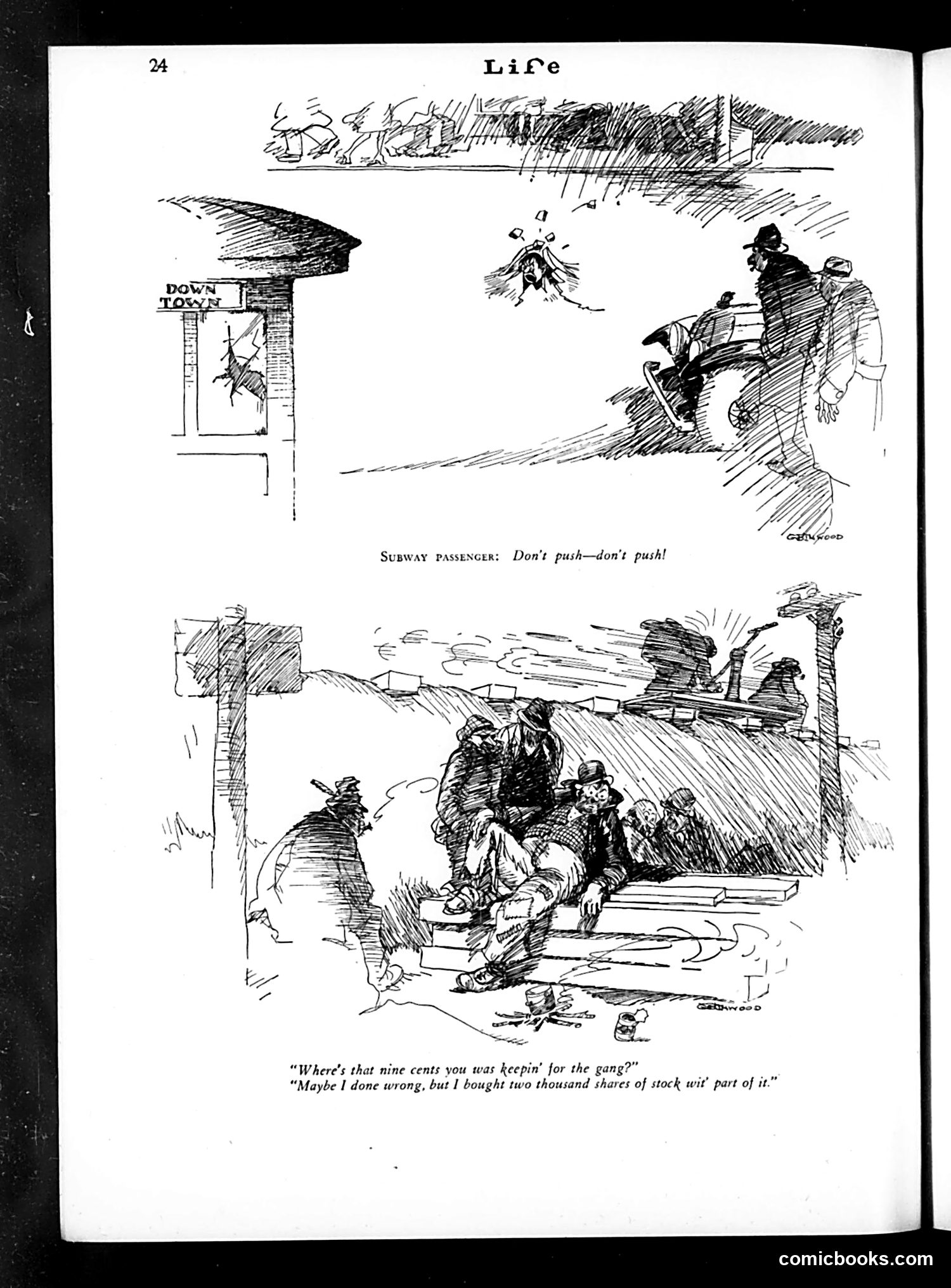
Analysis of Life Magazine Page 24 This page contains two satirical cartoons about early 20th-century urban life. The top cartoon depicts crowded subway passengers, with the caption "Don't push—don't push!" mocking the chaos of public transit. The bottom cartoon shows what appears to be street gang members confronting one of their own. One demands money the gang member was supposed to keep; the accused explains he spent it buying stock shares instead. The satire targets working-class immigrants or poor urban youth who suddenly attempt to participate in stock market speculation—likely referencing the gambling-like fever of early stock-buying culture. The humor derives from the incongruity: a gang member trying to become an investor, suggesting naïveté about both organized crime expectations and financial markets. This reflects contemporary anxiety about working-class speculation during periods of market boom.
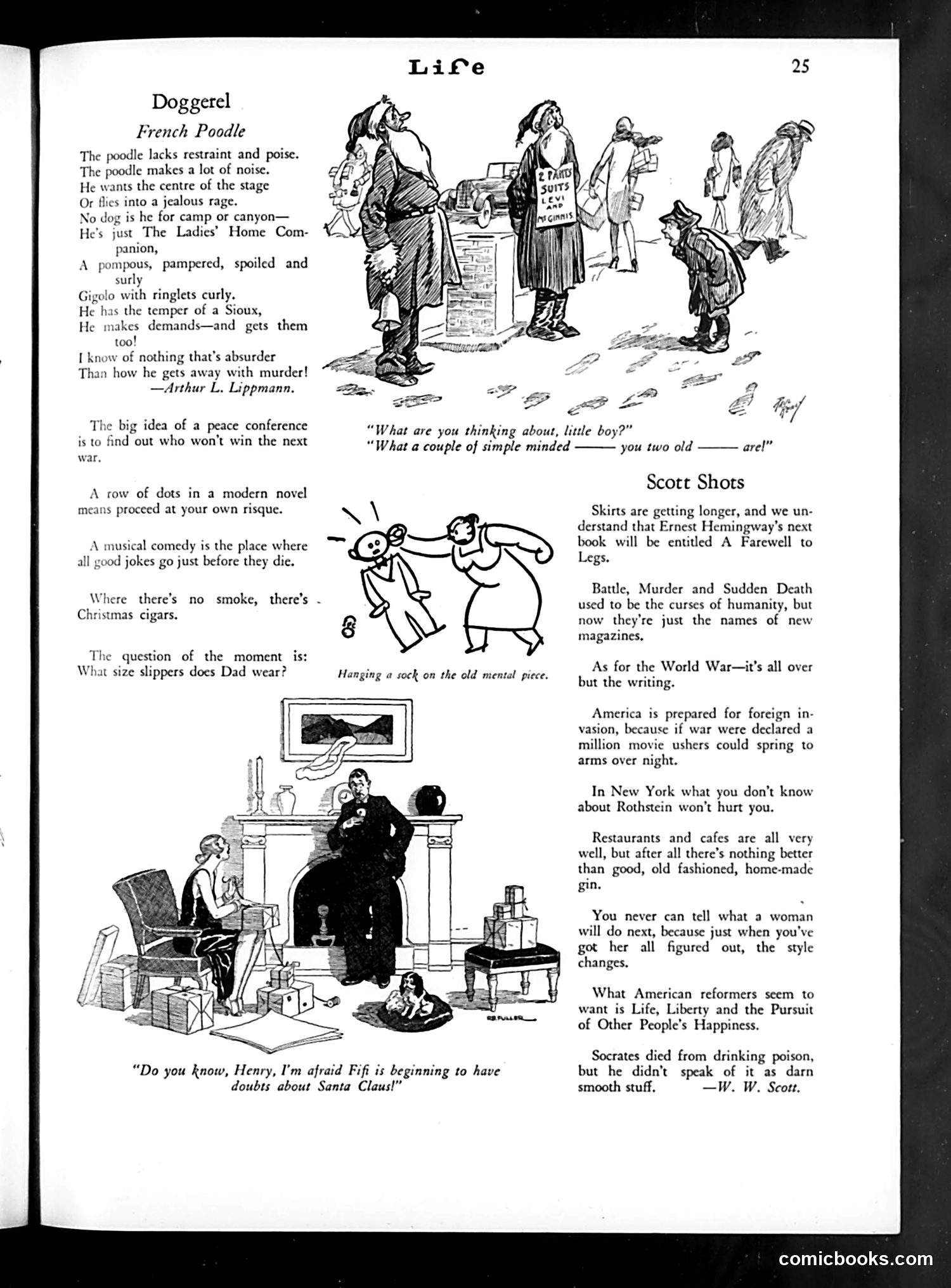
Political & Social Satire in Life Magazine This page contains satirical humor targeting 1920s American culture and current events. The "Doggerel" section mocks French poodles as pampered, demanding "Ladies' Home Companion" dogs—likely critiquing the fashion-obsessed leisure class. The cartoons and "Scott Shots" column satirize post-WWI America: peace conferences that accomplish nothing, modern literary trends (modernist novels with ellipses), entertainment industry decline, Prohibition-era gin, changing women's fashions, and social hypocrisy. References include Hemingway (whose "A Farewell to Arms" is parodied as "A Farewell to Legs"), and Rothstein (likely the famous 1920s gambler Arnold Rothstein, whose scandals were newsworthy in New York). The humor is gentle social observation—mocking consumer culture, literary pretension, and American optimism about avoiding future wars—typical of Life's satirical stance toward the Jazz Age bourgeoisie.
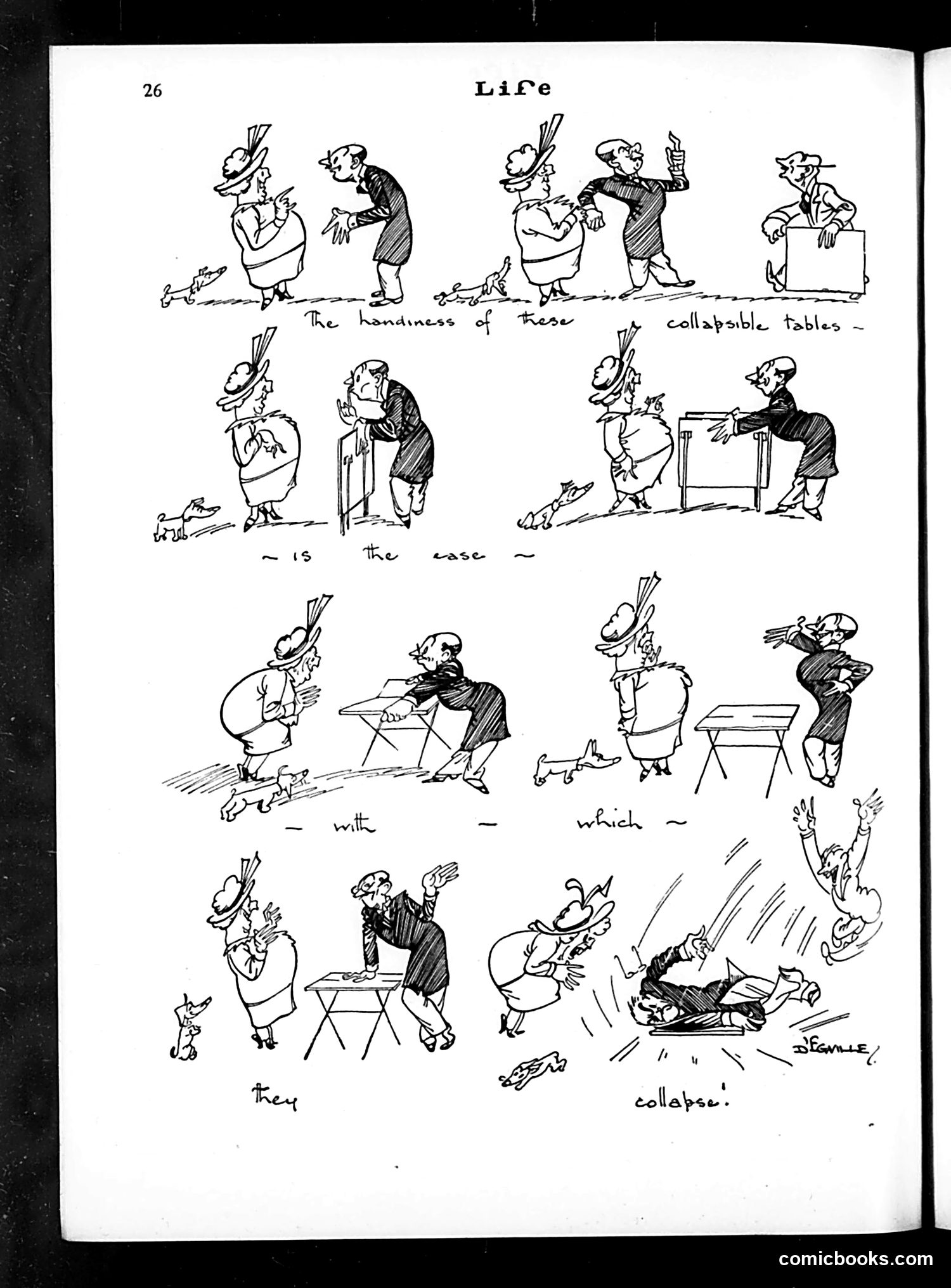
Analysis of "The Handiness of These Collapsible Tables" This is a humorous instructional comic strip demonstrating the practical advantages—and inevitable failures—of collapsible tables. The sequence shows a portly man with a distinctive hat attempting to use a folding table across various scenarios: entertaining guests, working at it, and ultimately experiencing a catastrophic collapse that sends him flying. The satire targets the false promise of convenience goods: while marketed as ingeniously "handy," the tables prove unreliable and potentially dangerous. The final panel's dramatic tumble suggests the joke is on consumers who trust such flimsy furniture. The small dog appearing throughout adds comic relief and emphasizes the table's instability even under minimal weight. This reflects early-20th-century skepticism toward mass-produced, affordable home goods marketed with exaggerated claims of practicality.
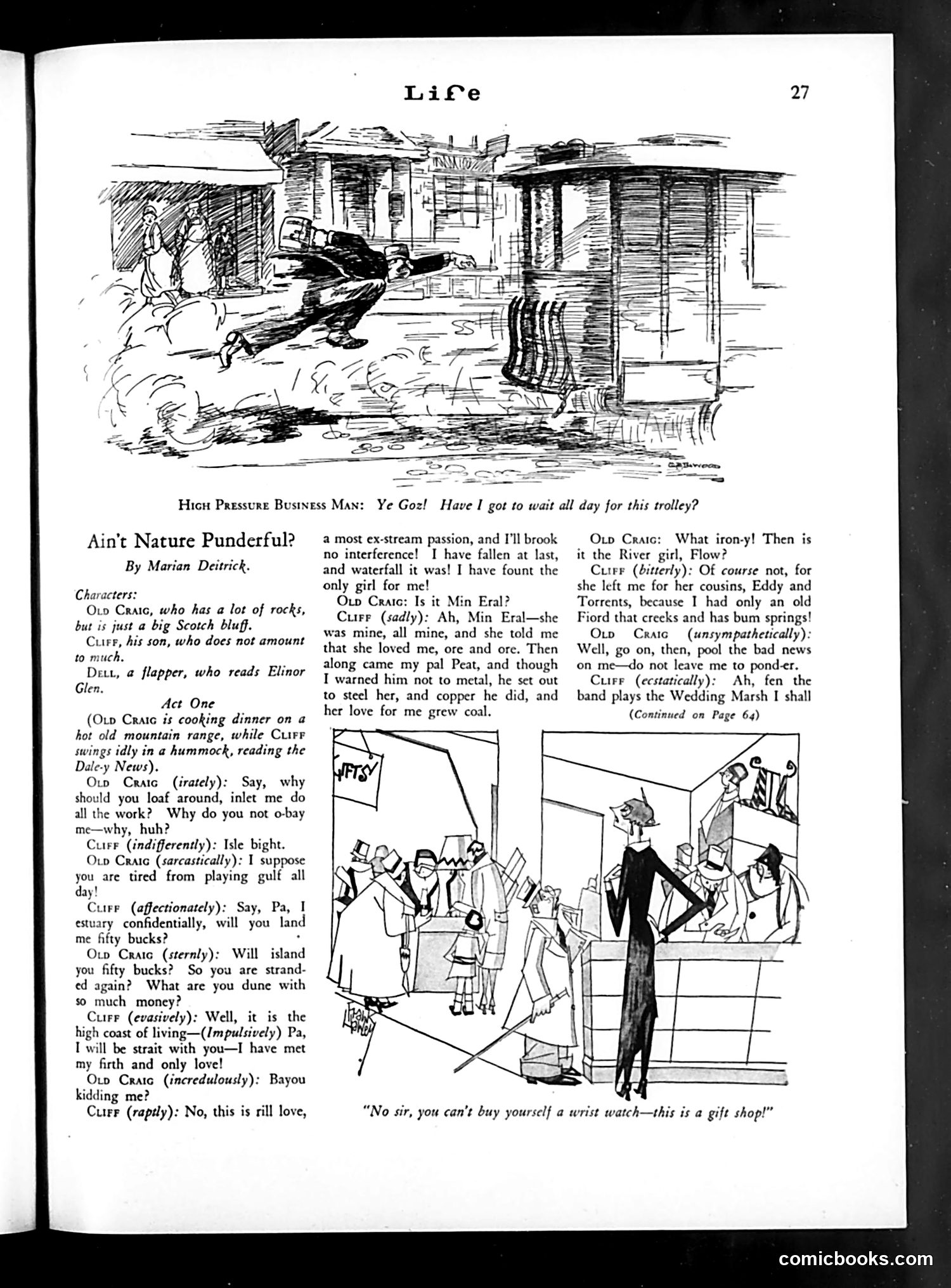
Analysis of Life Magazine Page 27 This page presents two distinct pieces of humor: Top Cartoon: A satirical jab at urban impatience. A businessman complains about waiting for a trolley while a man struggles with a handcart. The humor mocks the "high pressure business man" culture—his entitled frustration over minor delays despite others doing actual labor. Main Content: "Ain't Nature Punderful?" is a comedic play script where nearly every word is a pun based on geographical/geological terms (Cragg, Mineral, Peat, Metal, River/Flow, Fiord, etc.). Old Cragg is a stereotypical stingy Scottish father ("big Scotch bluff"), and his son Cliff pursues romance while requesting money. The script's humor derives entirely from forced wordplay rather than plot—a style of "punderful" comedy popular in early 20th-century magazines. Bottom Cartoon: A gift-shop scene poking fun at commercial culture and gender expectations, suggesting women buy expensive watches as gifts while men cannot purchase them for themselves—commentary on consumer behavior and social conventions.
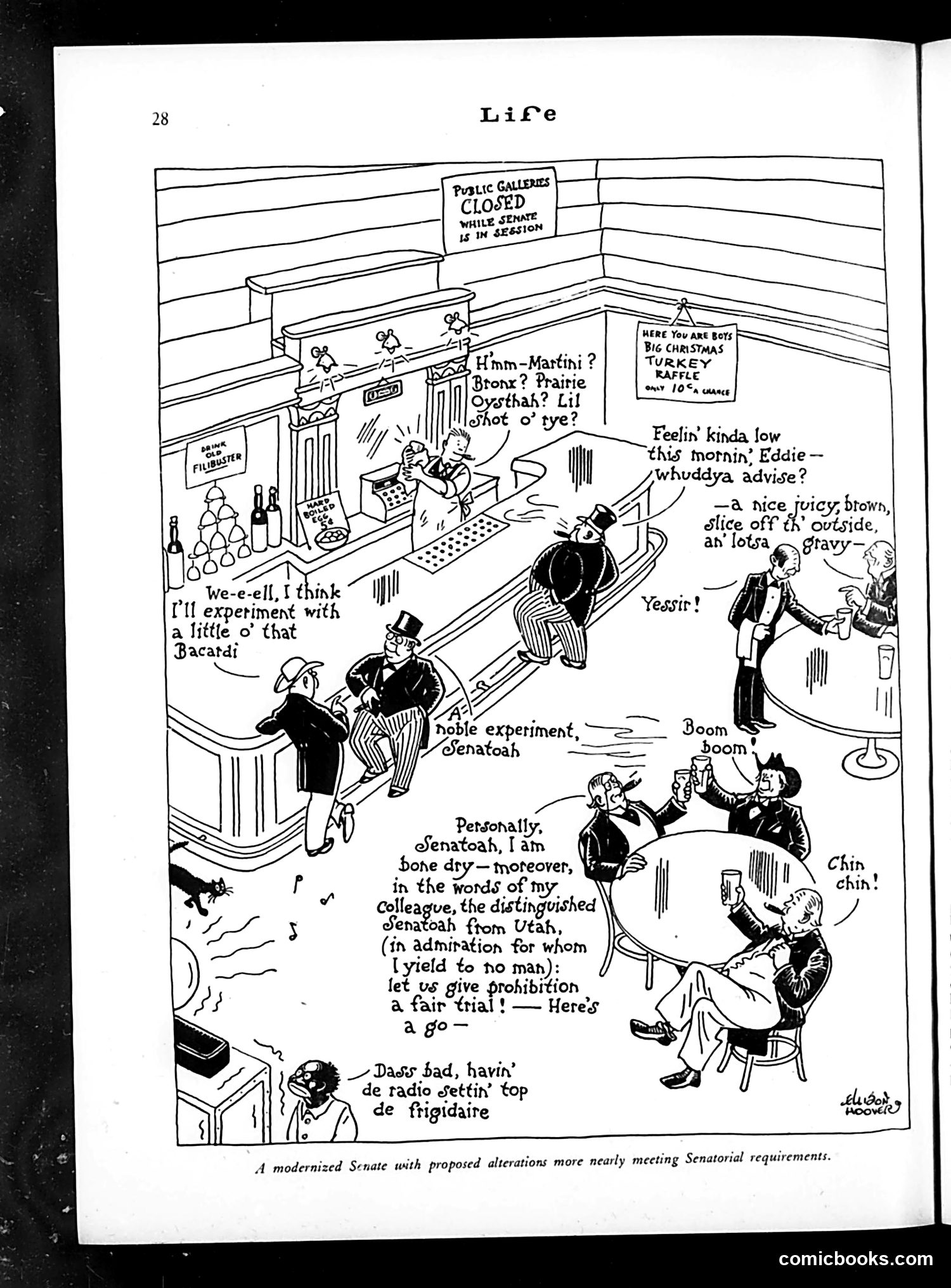
Political Cartoon Analysis: "A Modernized Senate" This Life magazine cartoon satirizes Prohibition-era Senate hypocrisy. The setting is a "modernized" Senate chamber equipped like a speakeasy—with a bar, bottles, cocktails, and servers—mocking senators who publicly championed Prohibition while privately drinking. The figures are generic senators engaged in drinking and carousing while one delivers a sanctimonious speech about giving Prohibition "a fair trial." References include: - "Noble experiment": period term for Prohibition (1920-1933) - Senator from Utah: likely referencing actual Utah senators known for temperance advocacy - Various cocktails and toasts (Martini, Bronx, Prairie Oyster) represent illegal drinking - The radio and refrigerator are modern 1920s luxuries The joke: senators publicly supported Prohibition while secretly violating it—the cartoon exposes this widespread moral contradiction among lawmakers who imposed alcohol bans on ordinary citizens while enjoying secret bars themselves. The caption's irony underscores how the Senate needed "alterations" to meet actual "Senatorial requirements" (drinking).
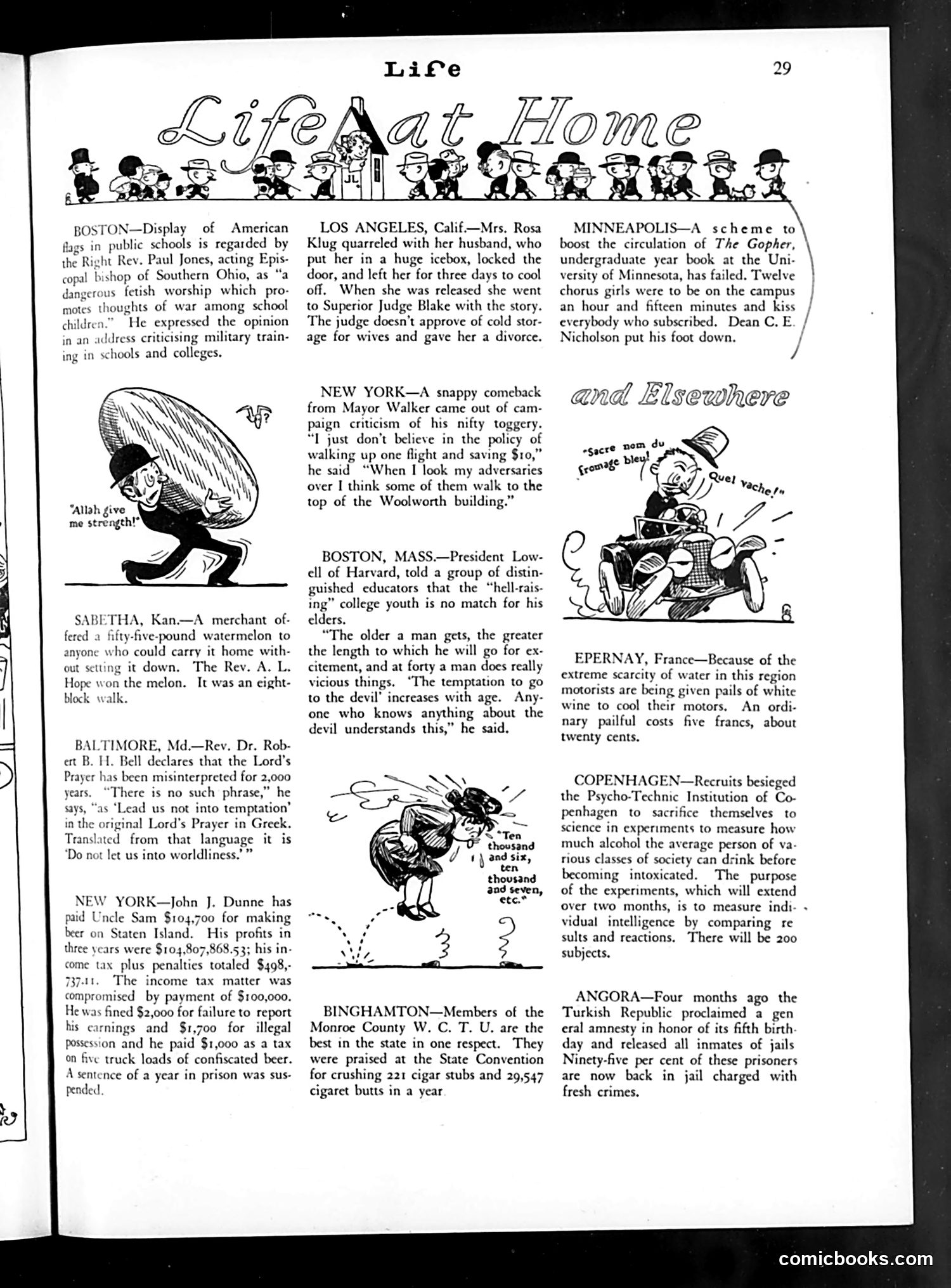
Life Magazine "Life at Home and Elsewhere" - Page Analysis This page collects brief humorous news items from across America and Europe, typical of Life's satirical format. The cartoons illustrate specific stories: Left cartoon: Shows a man struggling under a massive watermelon, captioned "Allah give me strength!" — this illustrates the Kansas story of Rev. A.L. Hope winning a 55-pound watermelon he had to carry eight blocks without setting it down. Right cartoon: Depicts a man in a vehicle, representing Mayor Jimmy Walker's witty response to criticism about his expensive clothing. Walker quipped that rather than saving $10 by climbing stairs, his adversaries likely take elevators to the Woolworth Building—a jab at their own extravagance. The stories satirize various American quirks: clergy debating flag patriotism and prayer translation, Prohibition-era bootleggers' massive profits versus penalties, a husband literally putting his wife in an icebox, and a university's failed scheme to boost yearbook sales using chorus girls as incentive. The international items mock European peculiarities: using wine instead of water for car coolant in France, and Danish experiments measuring alcohol tolerance for "science."
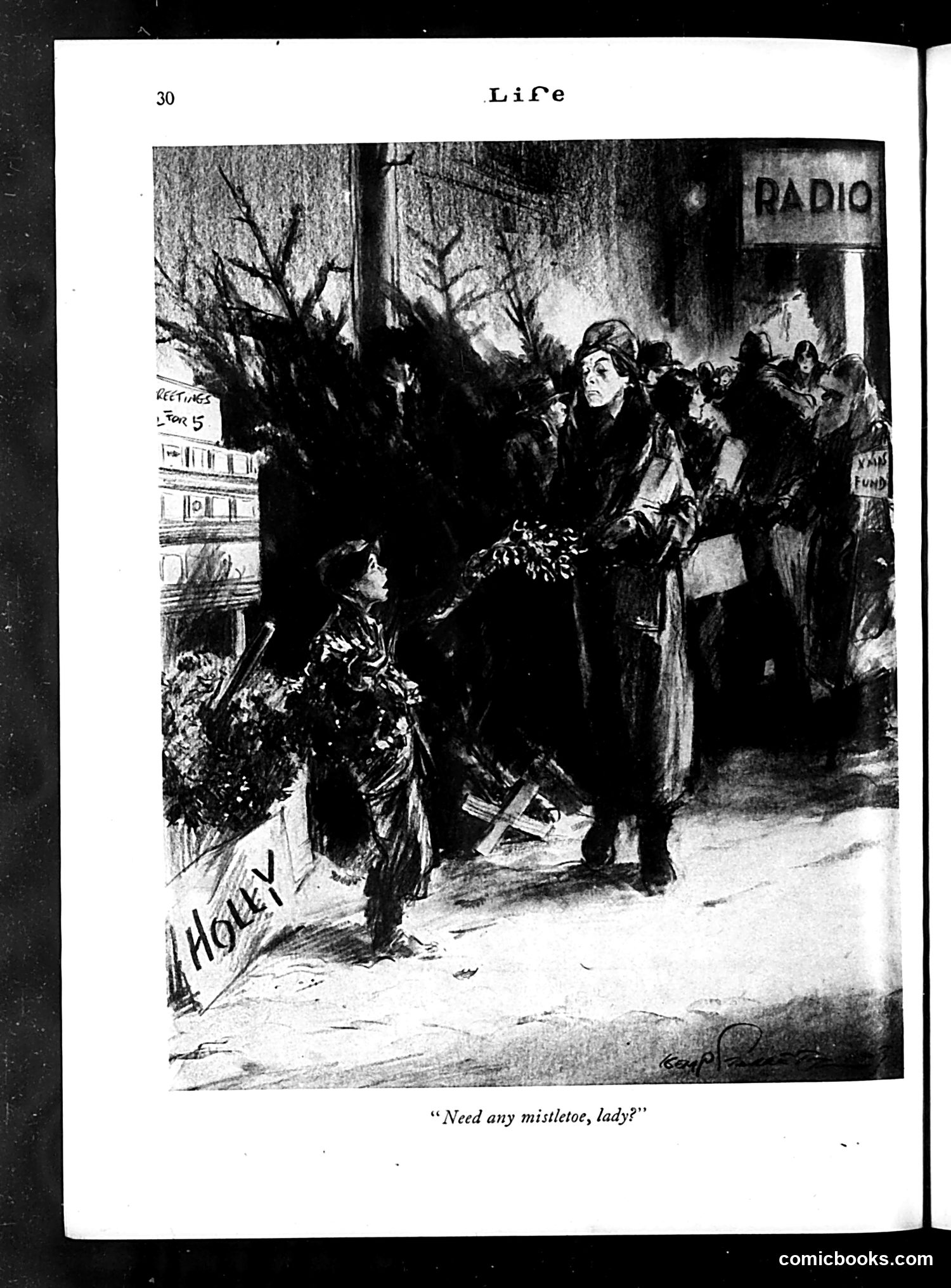
"Need any Mistletoe, Lady?" This cartoon satirizes holiday street commerce and flirtation. A young male vendor (likely homeless or street-poor, given the context of Depression-era Life magazine) offers mistletoe to an elegantly dressed woman passing by. The "HOLLY" sign and bare winter trees establish the Christmas season. The joke operates on multiple levels: the vendor's cheeky proposition uses the mistletoe's traditional association with kissing as a sales pitch, while also mocking class dynamics—the contrast between the woman's obvious wealth and his desperate economic circumstances. The satire gently critiques both the commercialization of Christmas sentimentality and the vulnerability of the poor during the holiday season. The cartoon captures pre-WWII American social conditions with characteristic Life magazine wit.
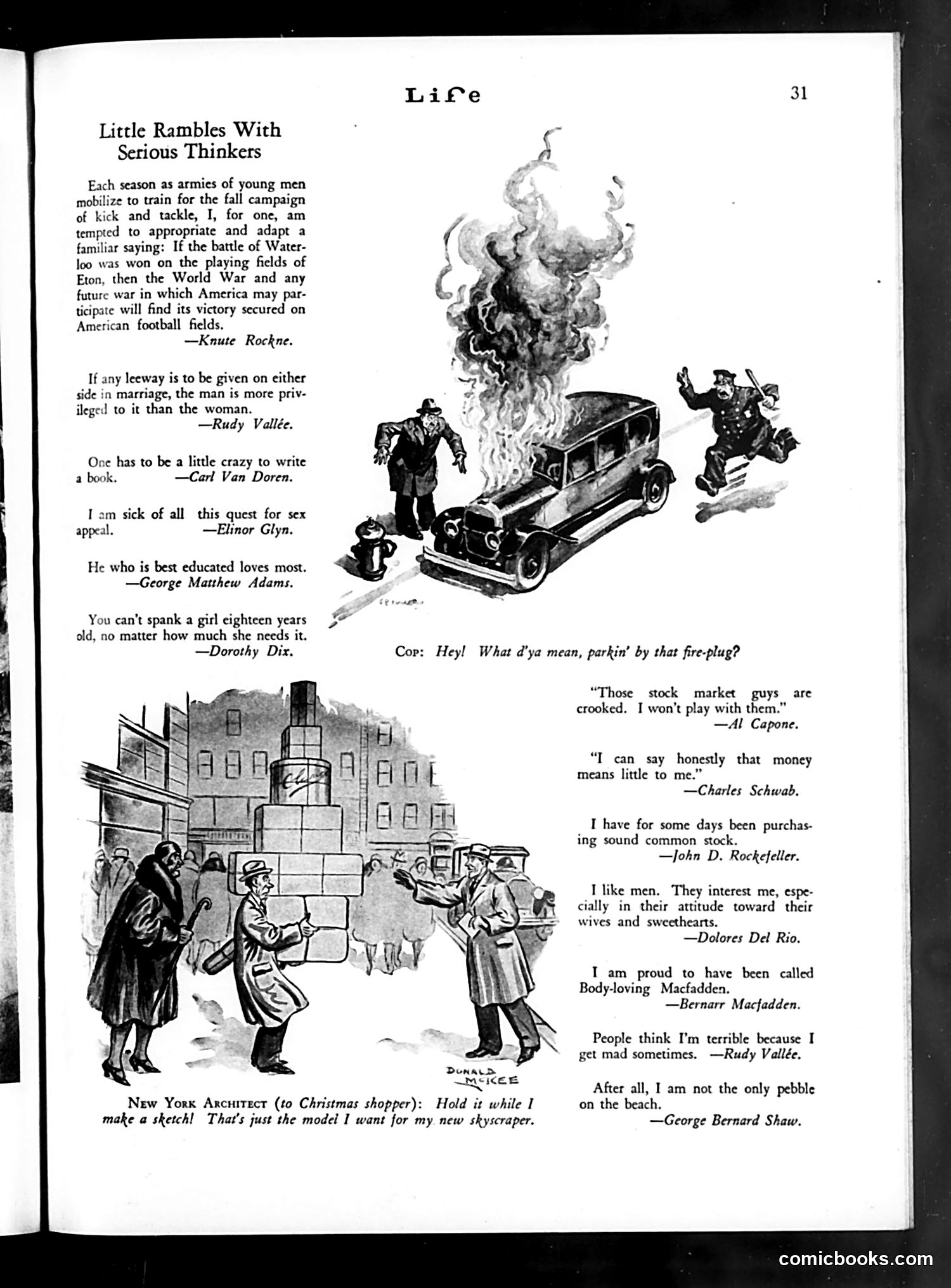
"Little Rambles With Serious Thinkers" This page is a satirical column featuring quotations attributed to famous 1920s figures—celebrities, industrialists, athletes, and public personalities. The humor lies in ironic juxtapositions: Al Capone (notorious gangster) claims stock traders are crooked; Charles Schwab (wealthy industrialist) says money means nothing to him; John D. Rockefeller (oil magnate) announces he's buying common stock. The two cartoons illustrate absurdist scenarios: a cop confronts a driver parked by a fire hydrant; a New York architect sketches a woman as a model for a skyscraper. The satire mocks celebrity hypocrisy and the gap between public personas and reality. Famous quotes are presented deadpan to expose contradictions—wealthy men disclaiming materialism, notorious criminals lecturing morality. It's social commentary on 1920s wealth inequality, celebrity culture, and public deception.
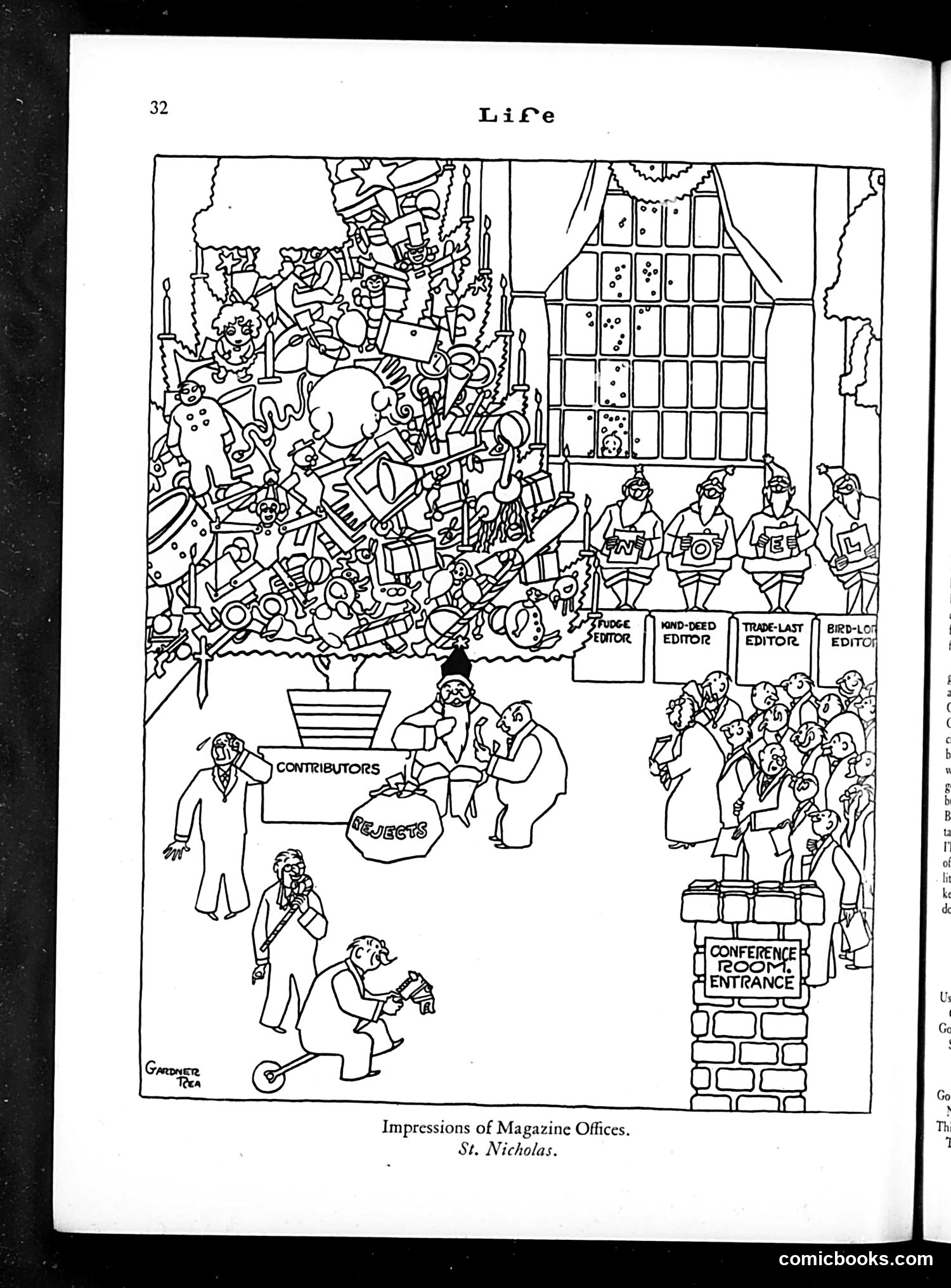
"Impressions of Magazine Offices: St. Nicholas" This is a satirical cartoon depicting the chaotic inner workings of *St. Nicholas* magazine's editorial offices. The cartoon shows: Key labeled areas: - "Contributors" and "Subjects" (chaotic piles) - Four editors at desks: "Judge Editor," "Kind-Deed Editor," "Trade-Last Editor," and "Bird-Lore Editor" - A "Conference Room Entrance" - Staff members in various states of activity The satire: The cartoon mocks the magazine's editorial process as absurdly disorganized—contributors and subjects literally pile up, multiple specialized editors work simultaneously, and general pandemonium reigns. The crowded, busy scene suggests *St. Nicholas* (a children's/family magazine) manages its operations through controlled chaos rather than efficient systems. The cartoonist is Gluydette York (visible signature).
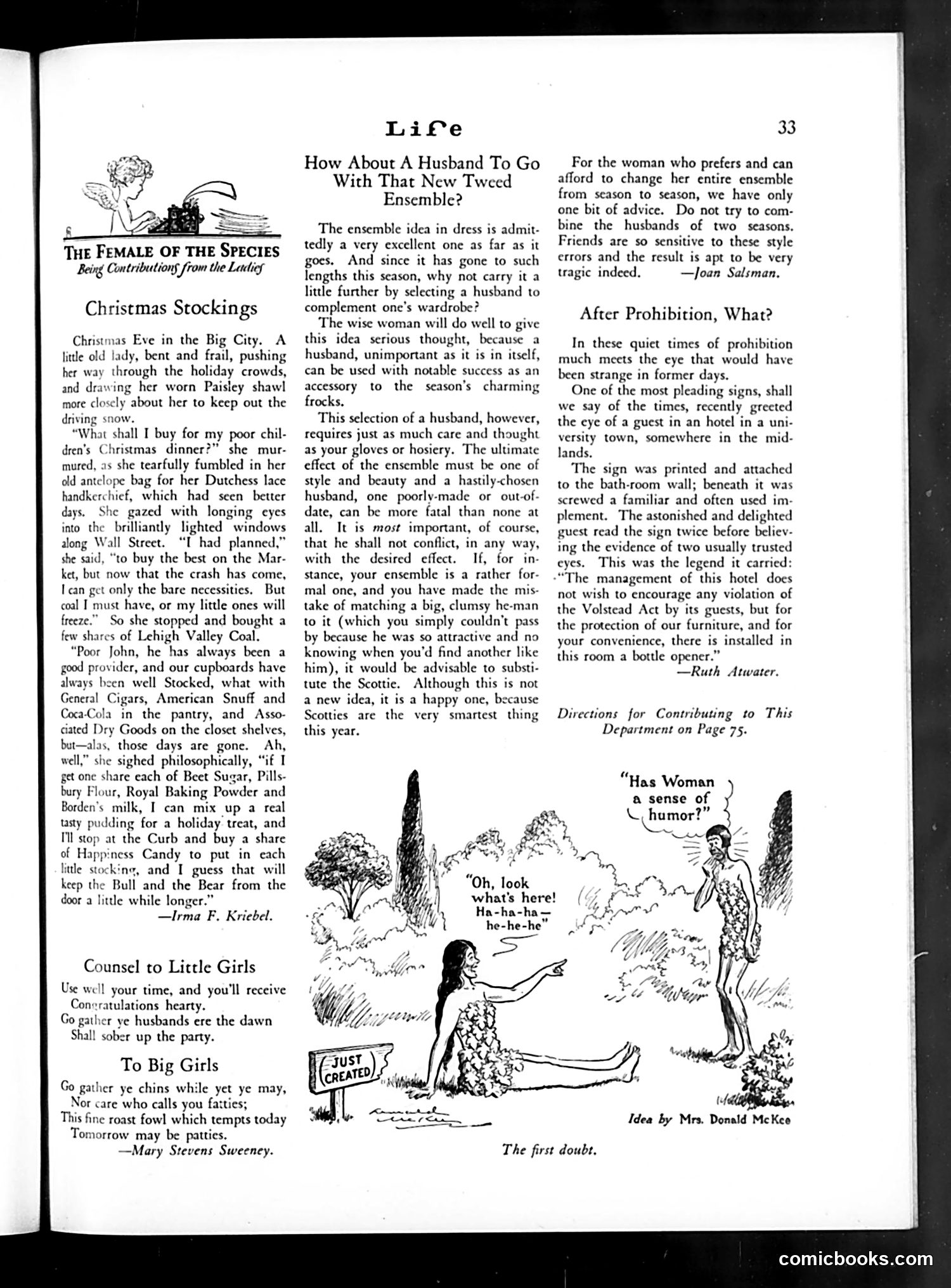
Satire Explained for Modern Readers This page from *Life* magazine contains satirical commentary on 1920s American society, likely from the post-1929 crash period. "Christmas Stockings" mocks poverty during economic hardship by depicting an elderly woman buying stocks (Lehigh Valley Coal, General Cigars, Coca-Cola shares) instead of actual food for her children's Christmas dinner—a dark joke about how financial investments had become absurdly prioritized over basic necessities. "Husband To Go With That New Tweed Ensemble" satirizes materialism and shallow consumerism by treating husbands as mere fashion accessories to be "matched" with seasonal wardrobes. The joke suggests wives should select husbands for aesthetic compatibility rather than genuine relationship qualities—a biting critique of treating marriage as styling. The cartoon ("The first doubt") depicts a newly-created woman figure confidently presenting herself, with a man laughing. The caption "Has Woman a sense of humor?" sarcastically questions whether this artificial creation possesses humanity, likely referencing contemporary debates about women's roles and rights during the 1920s. All pieces employ satirical exaggeration to critique consumerism, materialism, and superficiality in Jazz Age society.
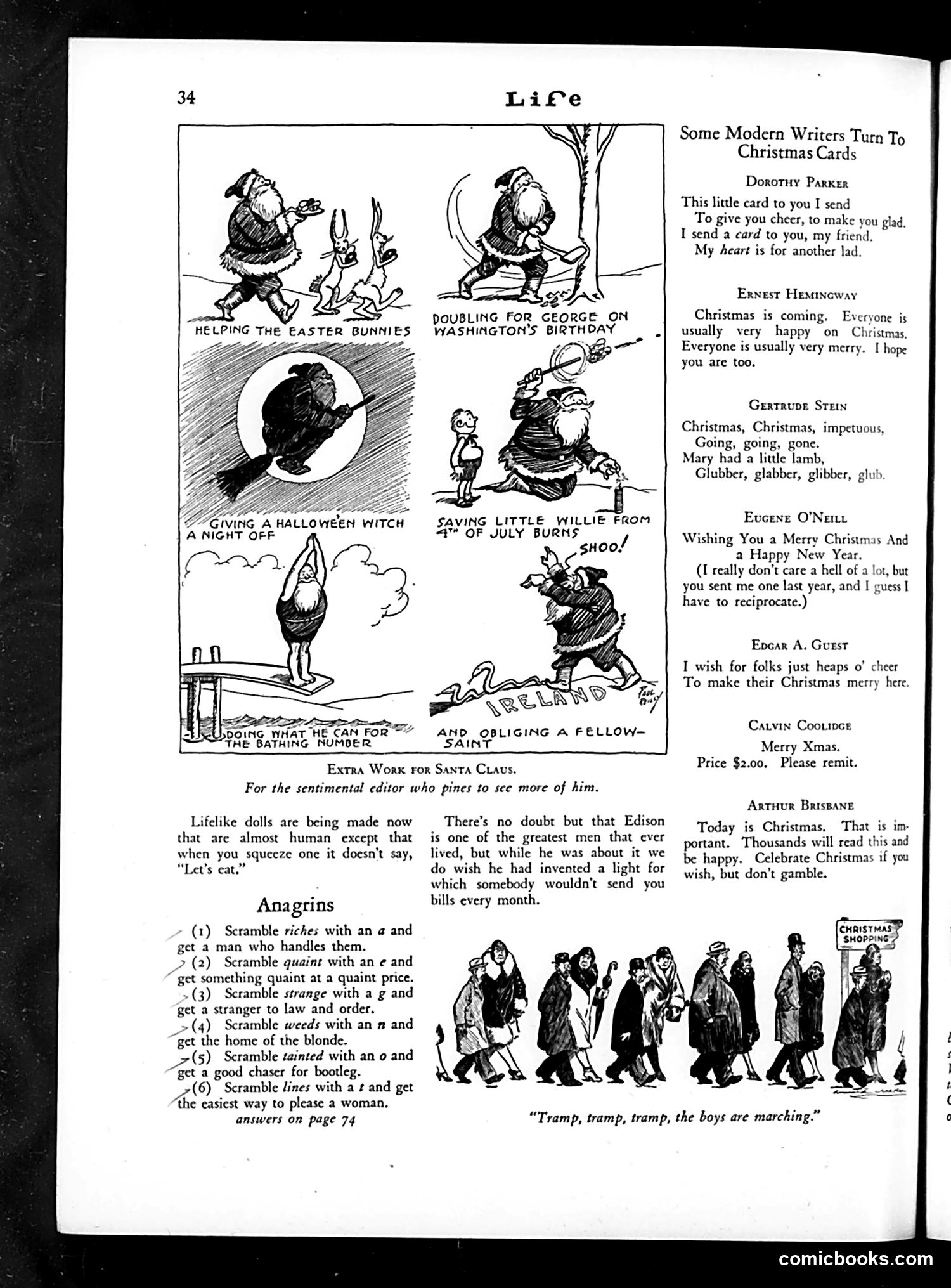
Analysis of Life Magazine Page 34 This page satirizes Santa Claus as an overworked figure juggling multiple secular duties—not just Christmas delivery but also impersonating George Washington on his birthday, rescuing children from Fourth of July accidents, and helping saints. The cartoons mock how commercial and civic obligations have expanded Santa's role beyond gift-giving. The "Christmas Cards by Modern Writers" section parodies famous early 20th-century authors' characteristic styles. Dorothy Parker's card features her sardonic wit about unrequited love; Hemingway's mimics his sparse, repetitive prose; Gertrude Stein's employs her experimental word-play; and O'Neill's includes cynical asides. These caricature each writer's distinctive literary voice applied to greeting-card platitudes. The bottom illustration shows holiday shoppers as marching soldiers, using the Civil War song reference to suggest the frenzy and militaristic intensity of Christmas shopping.
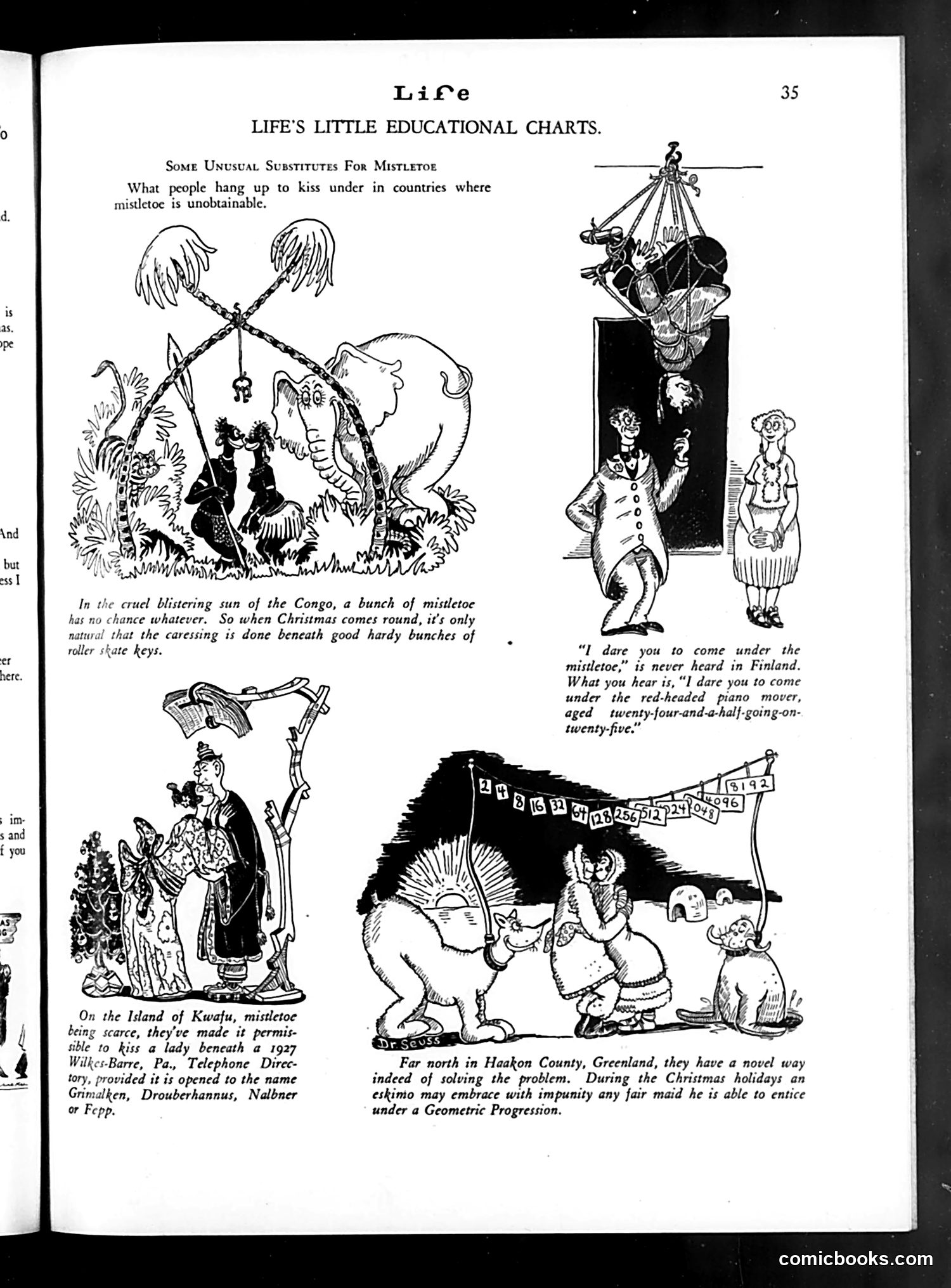
Life Magazine Satire: Mistletoe Substitutes This page satirizes Christmas mistletoe traditions by imagining absurd "substitutes" in fictional locations where mistletoe supposedly doesn't grow. The humor relies on increasingly ridiculous replacements: a 1927 Wilkes-Barre telephone directory (with comically obscure names), a red-headed piano mover in Finland, and a "Geometric Progression" (a mathematical concept) in Greenland. The final illustration shows an Inuit figure embracing someone under what appears to be mathematical symbols. The satire mocks both the universality of mistletoe customs and period-specific details (the dated phone directory reference, ethnic stereotypes about Finns and Greenland natives). The joke depends on readers finding the notion of kissing under random objects or abstract mathematical concepts absurd—implying that mistletoe's grip on Christmas tradition is so strong that cultures would resort to nonsensical alternatives rather than abandon the practice entirely.
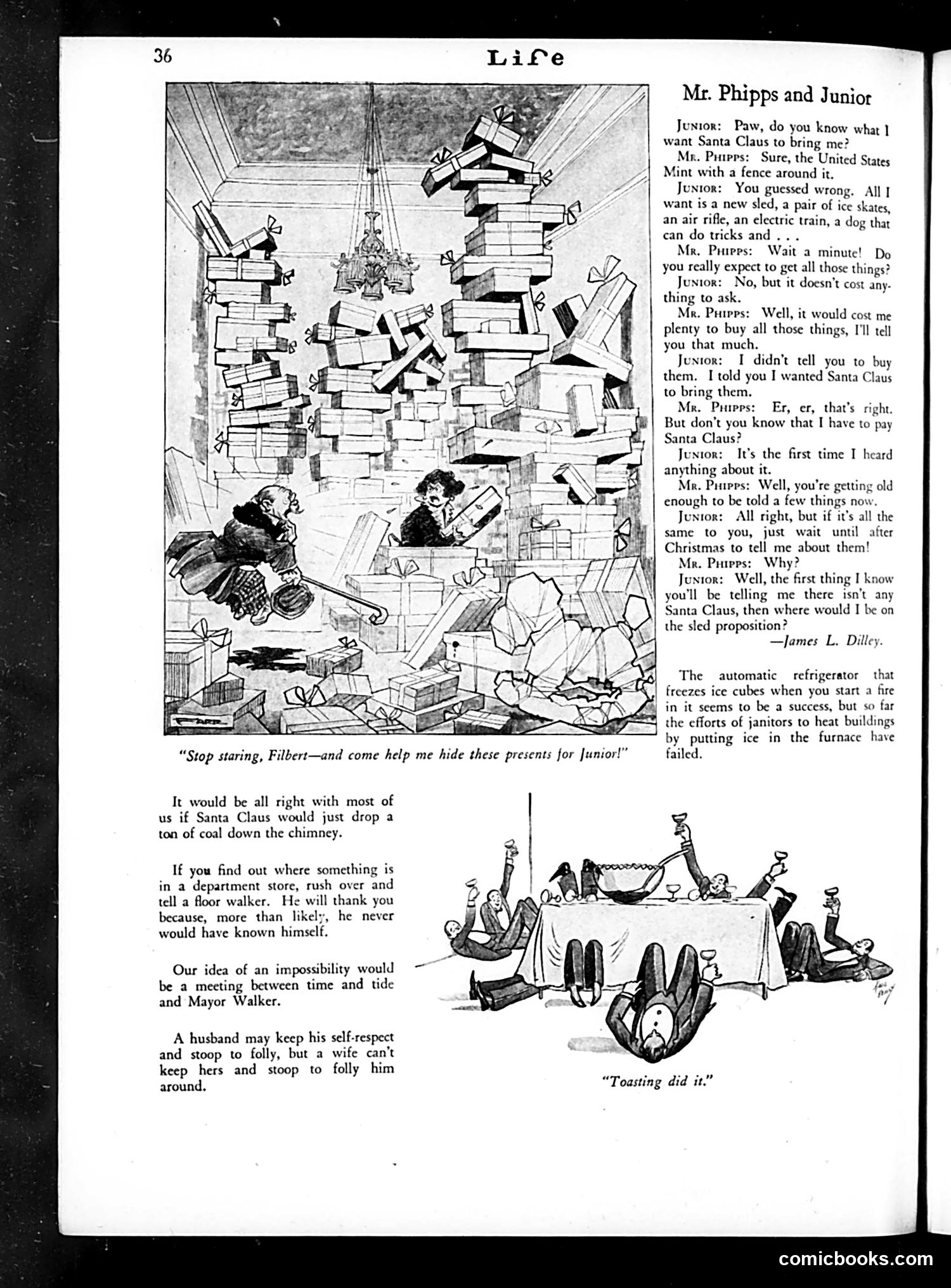
"Mr. Phipps and Junior" Explanation This is a humorous dialogue between a father and son about Christmas gift expectations. Junior asks Santa for multiple expensive toys (sled, ice skates, air rifle, electric train, dog), and when his father protests the cost, Junior cleverly distinguishes between wanting Santa to bring them versus asking his father to buy them. The joke hinges on Junior's innocent but pointed logic: he's telling Santa, not his father—implying fathers shouldn't have to pay for Santa's generosity. The satire targets parental economics during what appears to be the Depression or post-WWI era, when such toy lists were financially burdensome. Junior's final twist—threatening to stop believing in Santa if his father keeps talking about costs—reveals the child's shrewd manipulation: maintain the Santa fiction to preserve gift-giving magic. The other cartoon and brief humorous observations on the page use similar domestic comedy to mock everyday absurdities and social observations.
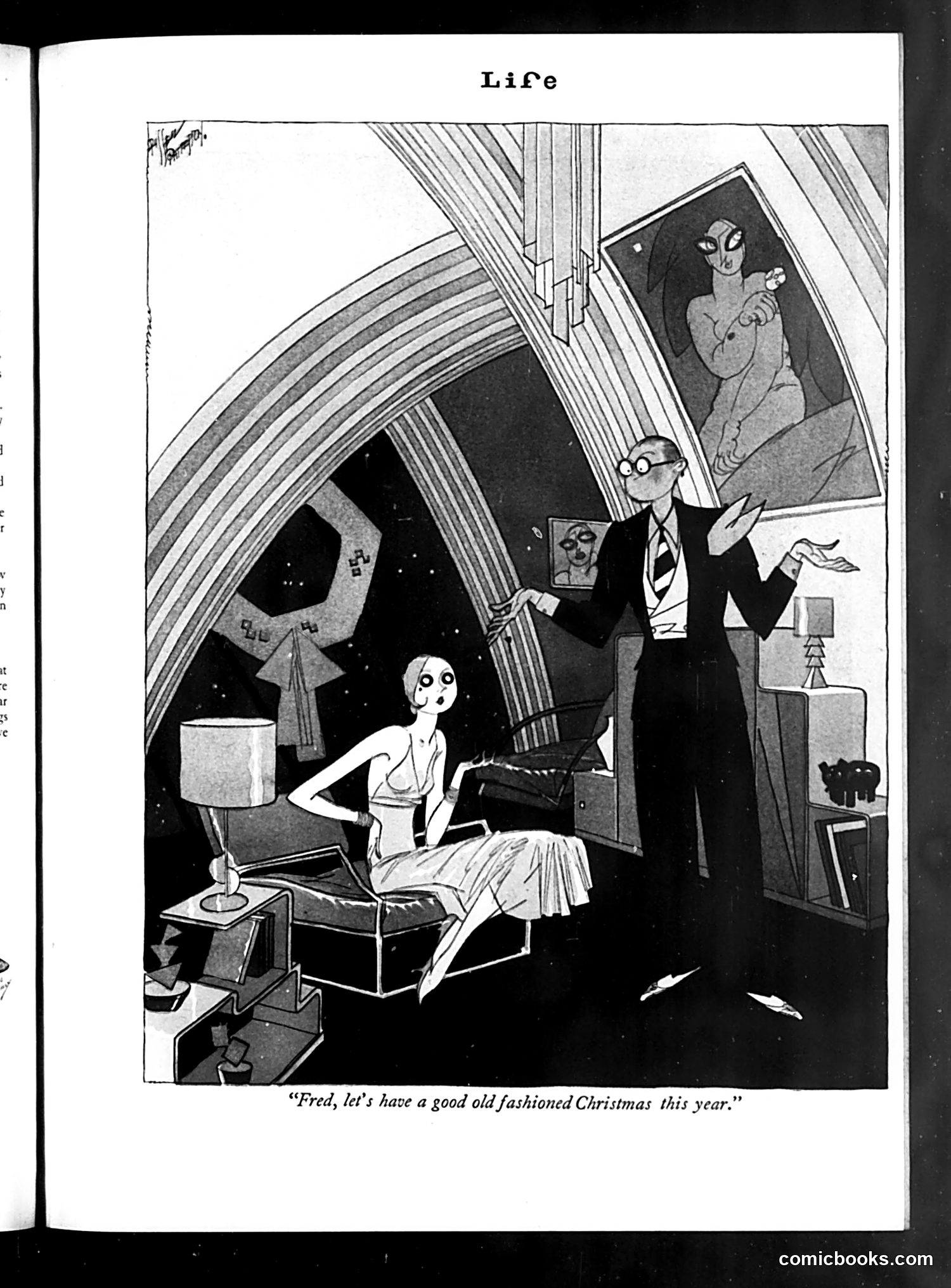
Life Magazine Cartoon Analysis This is a single-panel cartoon satirizing modern consumerism and artificial living standards. A woman sits on a bed in a futuristic, ultra-modernist apartment (note the curved architectural elements, streamlined furniture, and stylized décor), proposing a "good old fashioned Christmas" to her husband Fred. The satire works through contrast: the couple lives in an aggressively contemporary, artificially designed space that represents the opposite of tradition. The woman's suggestion for old-fashioned simplicity is therefore ironic—she exists in a world of modernity and excess, making authentic rusticity impossible or laughable. The cartoon likely mocks 1920s-30s aspirational middle-class culture, where people adopted futuristic aesthetics while simultaneously romanticizing an idealized past.
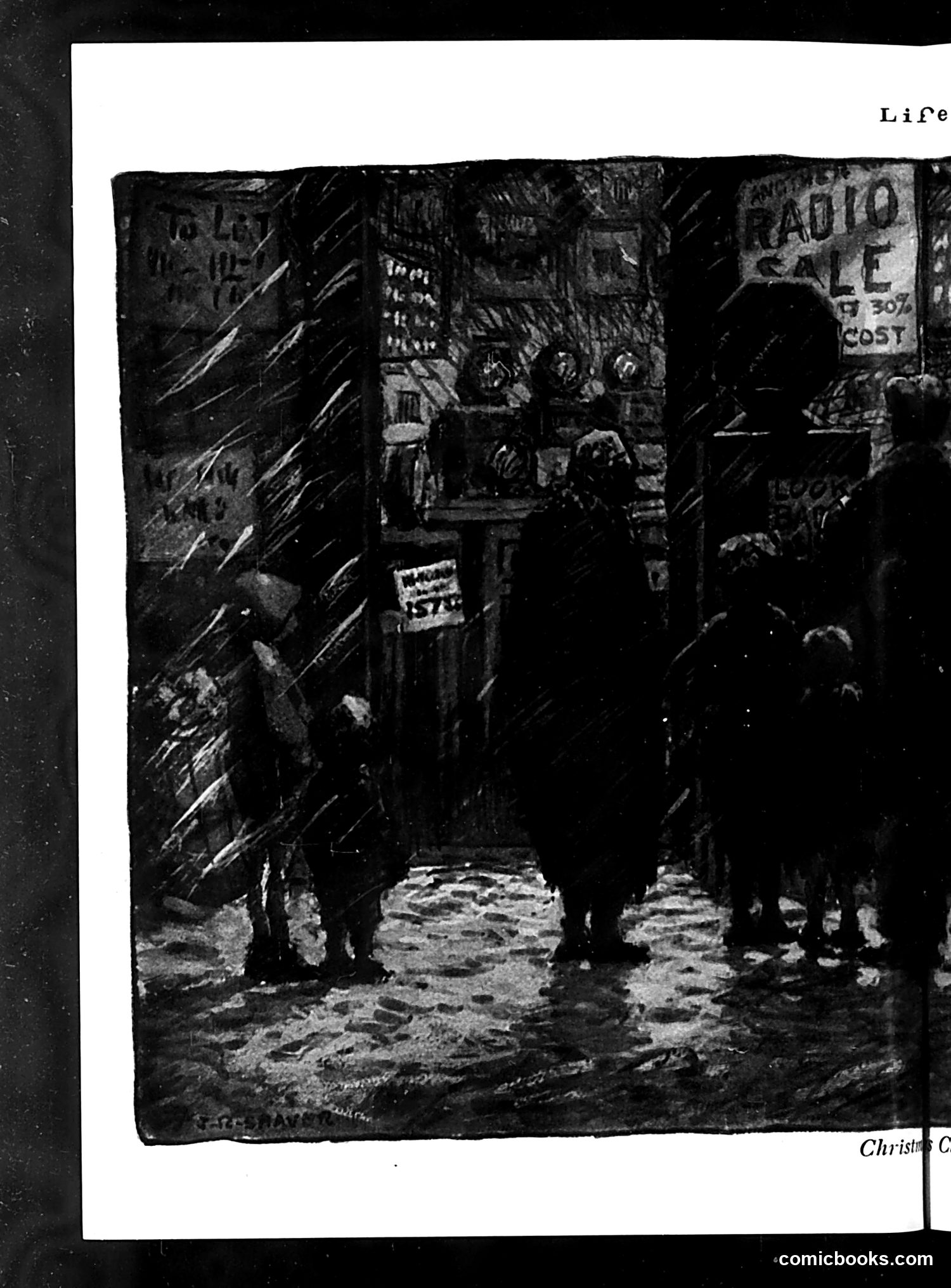
Analysis This is a black and white photograph rather than a cartoon, showing a rainy street scene with several people standing outside what appears to be a shop or storefront. A visible sign reading "RADIO" and "SALE" with "30%" and "COST" text is evident on the right side. The image appears to document an urban scene, possibly depicting people shopping or gathering during a sale event. However, without clearer context from accompanying article text or captions (which are not legible in this reproduction), the specific satirical point or social commentary Life magazine intended is unclear. The photograph may be illustrating consumer behavior, urban life, or retail practices of its era, but the exact satirical intent cannot be confidently determined from the visual evidence alone.
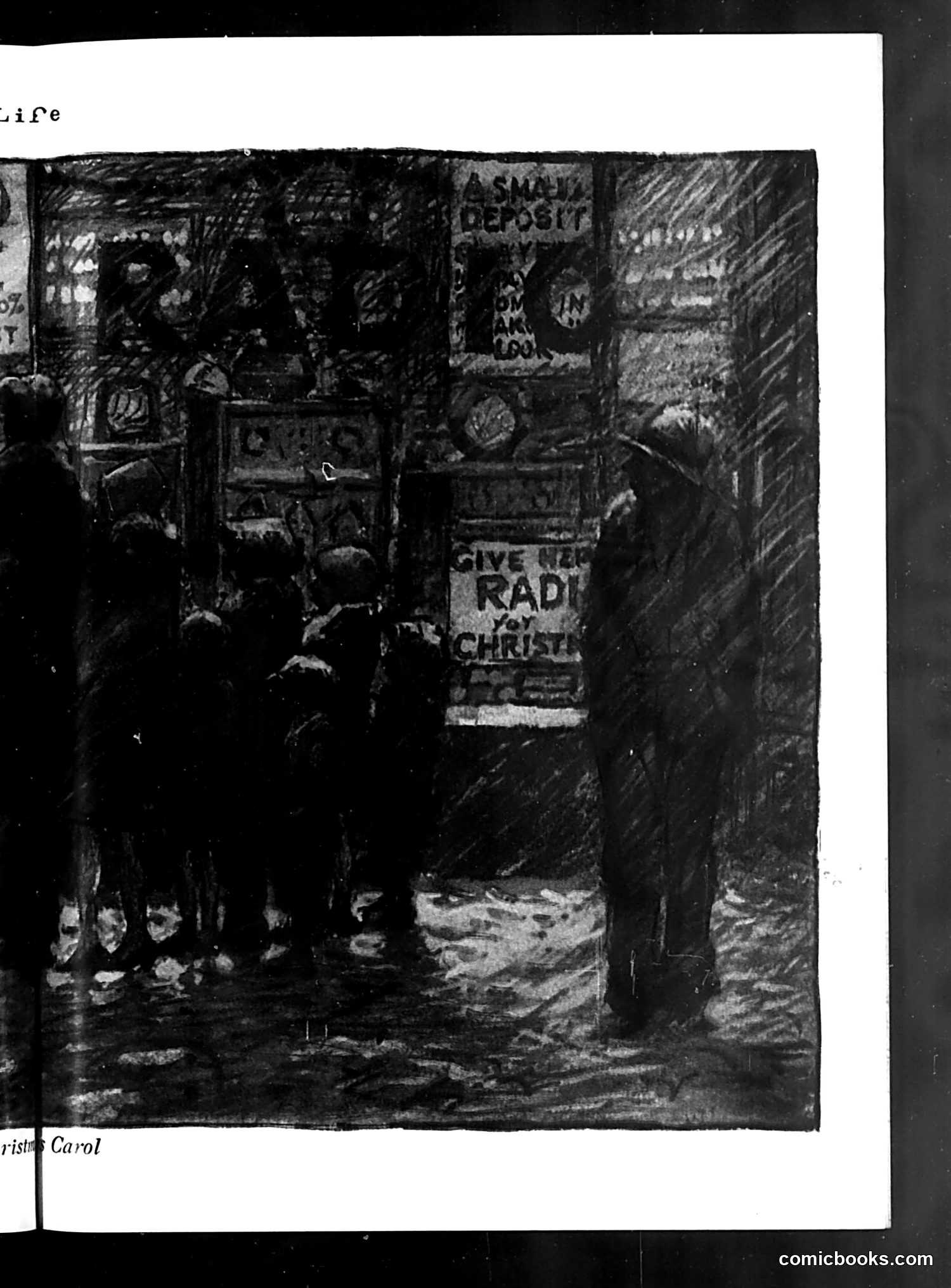
Analysis This page shows a dark, grainy photograph of what appears to be a street scene or storefront, likely from early-to-mid 20th century urban America. Visible text includes references to "RADI[O]" and "CHRIST," along with various posters and signage on buildings. The image quality and composition suggest documentary or photojournalistic work rather than traditional cartooning. Without clearer visibility of specific figures or readable text, the exact satirical subject remains unclear. The page appears to be titled "Life" (visible at top), but the specific social or political commentary intended is not definitively determinable from this reproduction. The image may be documenting urban poverty, religious messaging, or consumer culture, but asserting a specific satirical point would require speculation beyond what the source clearly supports.
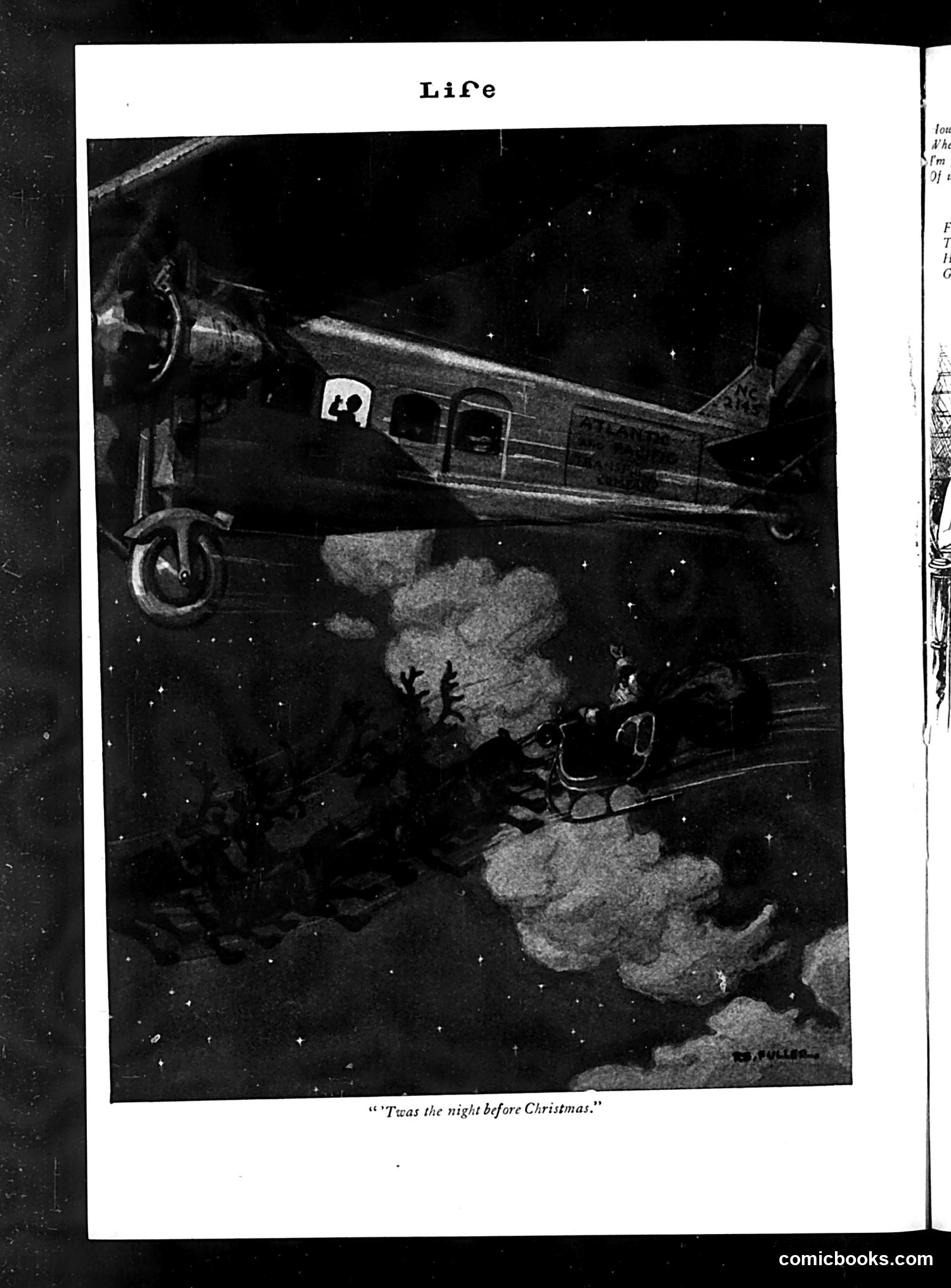
"Life" Magazine Page Analysis This page from *Life* magazine presents a Christmas-themed illustration titled "'Twas the night before Christmas." The image depicts what appears to be children looking up at an airplane (marked with the number 3) flying overhead at night, with clouds visible below. The satire likely references the modernization of Christmas imagery and childhood wonder in an aviation age—replacing traditional Santa's reindeer sleigh with contemporary airplane technology. The children's upward gaze suggests awe at this modern "delivery system." The specific airplane and number may reference a contemporary aviation event or company of the era, though without additional context, the exact reference remains unclear. The overall joke appears to be updating the classic poem for a mechanized, modern America.
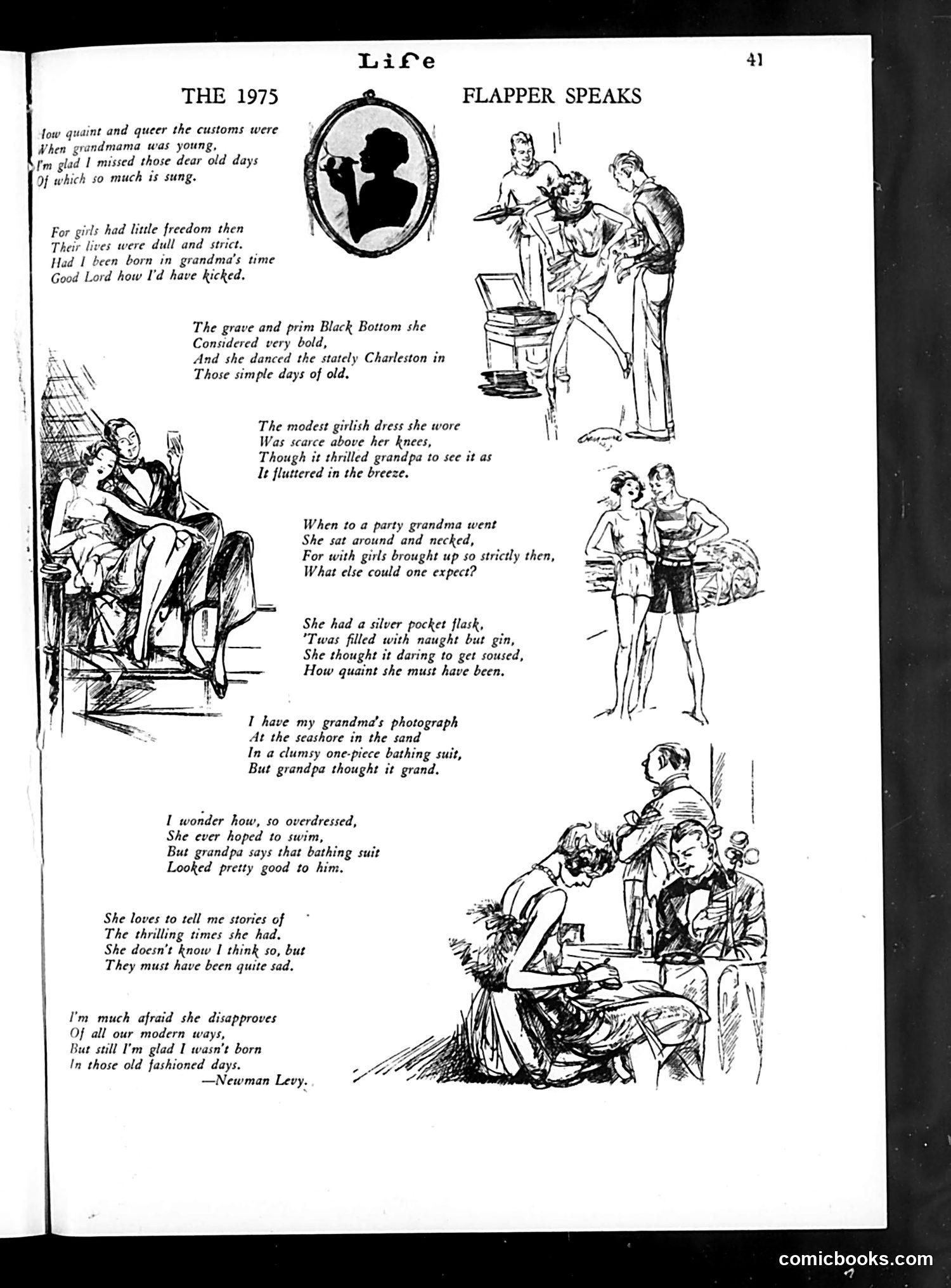
"The 1975 Flapper Speaks" This poem by Newman Levy satirizes the generational gap between 1920s flappers and their Victorian-era grandmothers. A modern young woman reflects on her grandmother's era, mocking what she sees as quaint restrictions: girls had no freedom, wore modest dresses, and considered modest rebellion (like the Charleston dance or wearing a one-piece bathing suit) daringly transgressive. The satire cuts both ways. The speaker celebrates her own modern freedom while simultaneously portraying her grandmother's "thrilling times" as actually quite dull and sad—suggesting the older generation's excitement was based on artificially imposed constraints. The illustrations show period scenes of flapper life and courtship. The poem's message: progress has genuinely liberated young women, making earlier generations' modest transgressions seem almost pathetic in retrospect. The grandmother disapproves of modern ways, but the granddaughter is relieved she wasn't born into such repressive times.
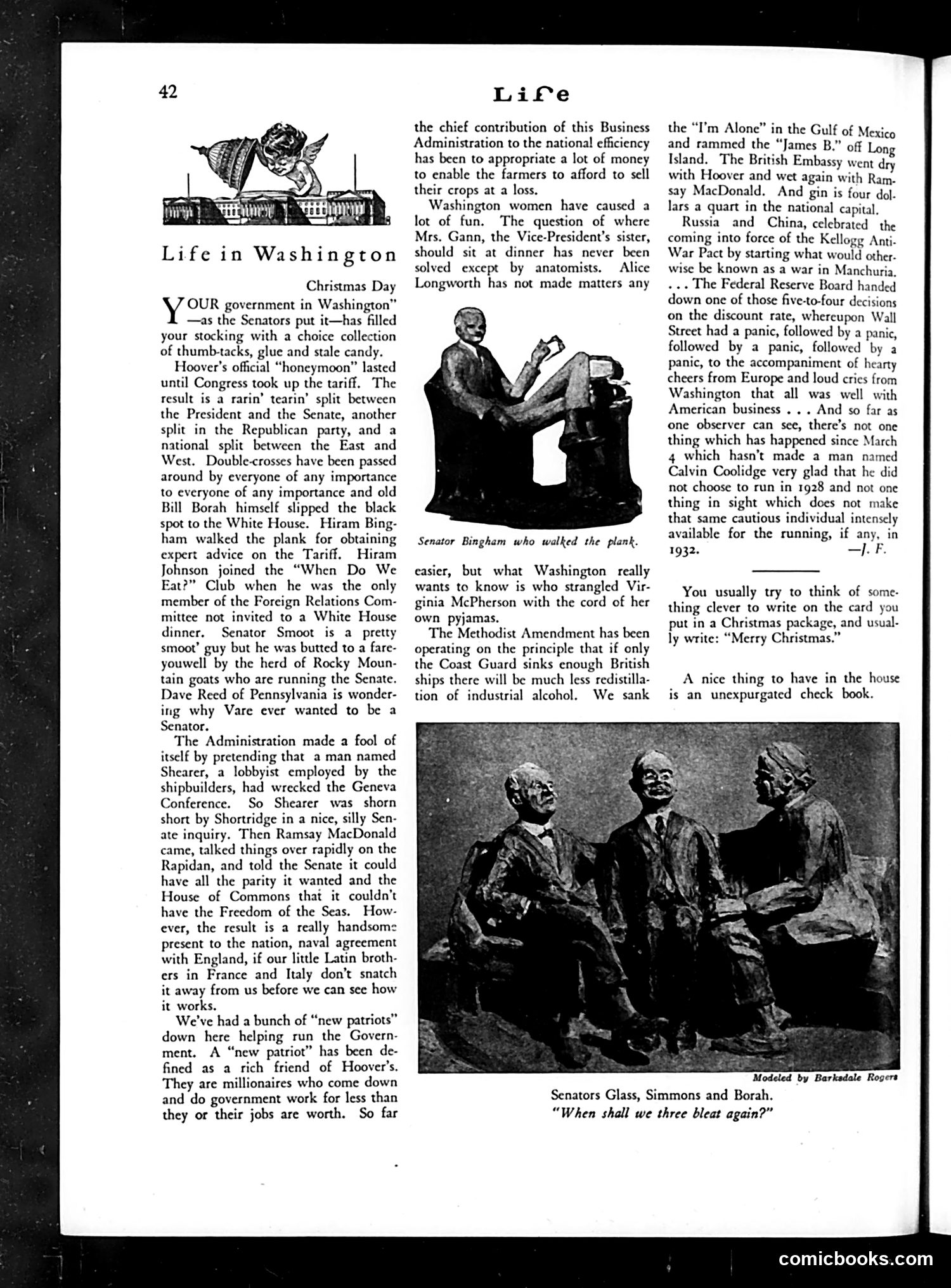
Life Magazine's "Life in Washington" (Page 42) This is satirical commentary on President Hoover's first year (1929), presented as a disappointing "Christmas stocking" of political failures. The text catalogs various Washington scandals and mishaps: Key figures and references: - Senator Hiram Bingham "walked the plank" for seeking expert tariff advice - Senator Hiram Johnson snubbed from White House dinners - Senator Smoot criticized for tariff handling - The "Shearer affair"—a shipbuilder lobbyist blamed for Geneva Conference failure - Ramsay MacDonald (British PM) negotiating naval agreements - Mrs. Gann controversy (Vice-President's sister's dinner seating protocol) - Prohibition enforcement: ships "I'm Alone" and "James B." sunk for smuggling - Kellogg Anti-War Pact ironically signed as Russia/China fight in Manchuria The satire: Despite Hoover's "Business Administration" promises, his honeymoon with Congress fractured over tariffs, creating chaos. The cartoon mocks both administrative incompetence and the absurdity of Washington politics—ultimately suggesting Calvin Coolidge (Hoover's predecessor) looks better in retrospect.
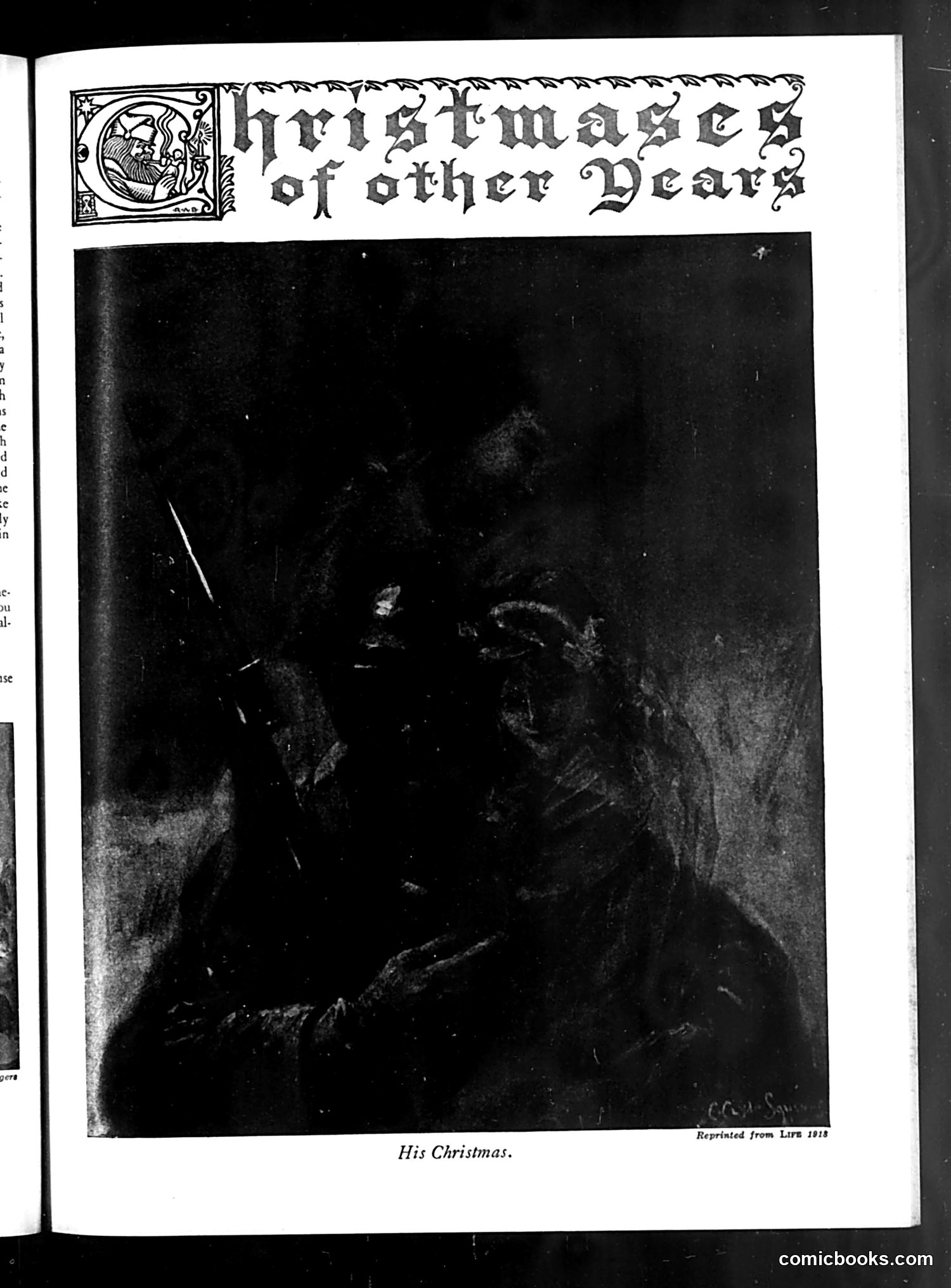
Analysis This page from *Life* magazine (reprinted from 1918) shows a dark, dramatic illustration titled "His Christmas." The image depicts what appears to be a somber wartime scene with shadowy figures, likely referencing World War I and its human cost during the Christmas season. The satirical intent appears to critique the contrast between the idealized notion of Christmas celebration and the grim reality of warfare. The "Christmas of other Years" heading suggests nostalgia for peacetime holidays, while this illustration presents a stark counter-image—possibly showing soldiers, casualties, or the devastation of war during what should be a season of peace and joy. The 1918 date confirms this reflects WWI's final year, when American forces were actively engaged in Europe.
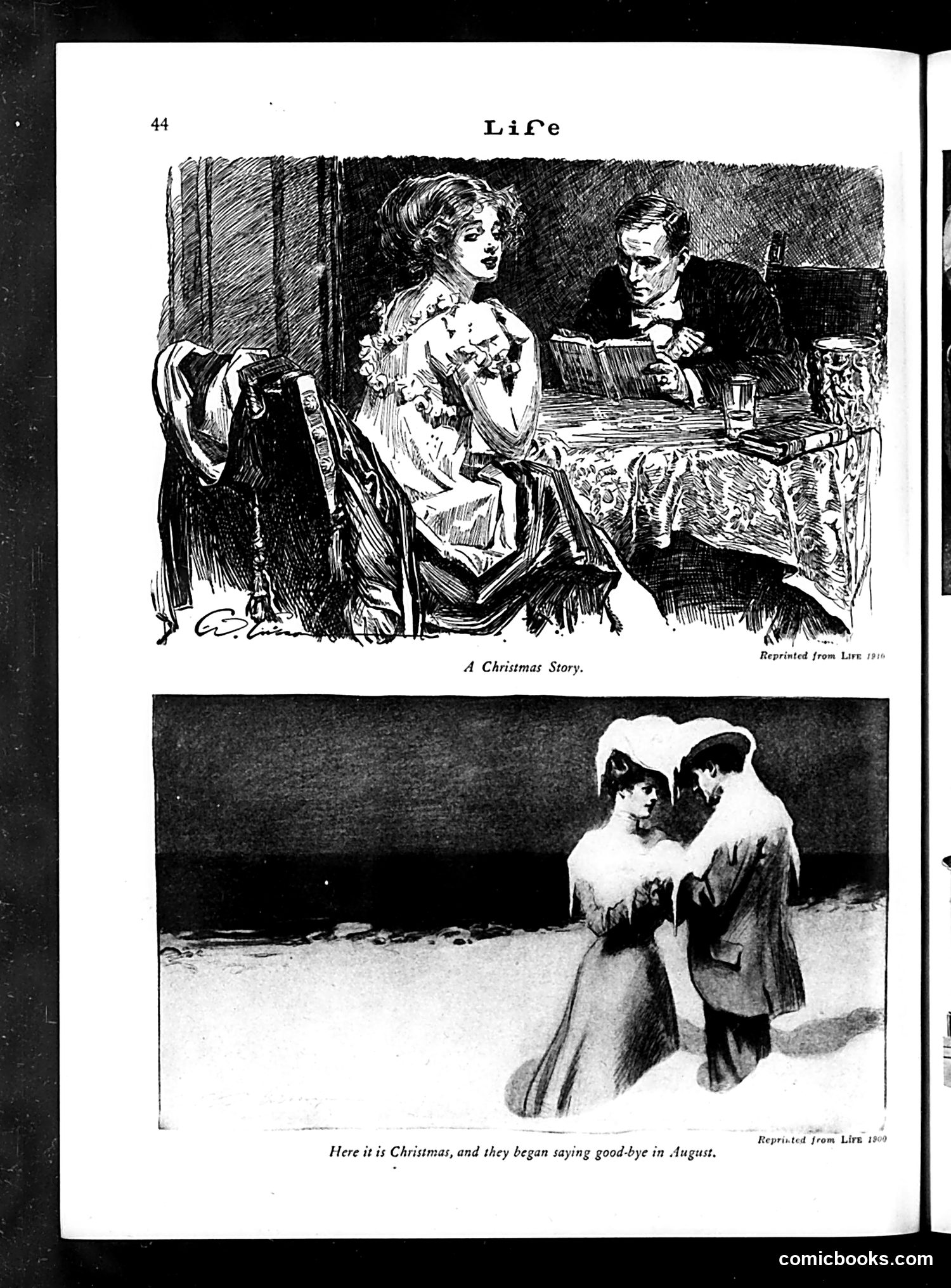
"A Christmas Story" - Life Magazine Page Analysis This page presents two illustrations about Christmas romance, both reprinted from Life's early 1900s issues. The top sketch shows an indoor domestic scene where a woman in an elegant dress sits beside a man reading, suggesting an intimate moment between a couple during the holiday season. The bottom photograph depicts a couple in winter clothing meeting outdoors in snow, with the caption "Here it is Christmas, and they began saying good-bye in August." The satire targets the melancholy or bittersweet nature of holiday romance—specifically, the contradiction of celebrating Christmas (a joyful season) while saying goodbye to a loved one. The August reference suggests either a temporary separation or relationship ending timed awkwardly with the festive season. The humor lies in this poignant juxtaposition: instead of Christmas bringing couples together in happiness, these illustrations show romance tinged with sadness or impending loss. It's sentimental humor about the gap between holiday sentiment and romantic reality.
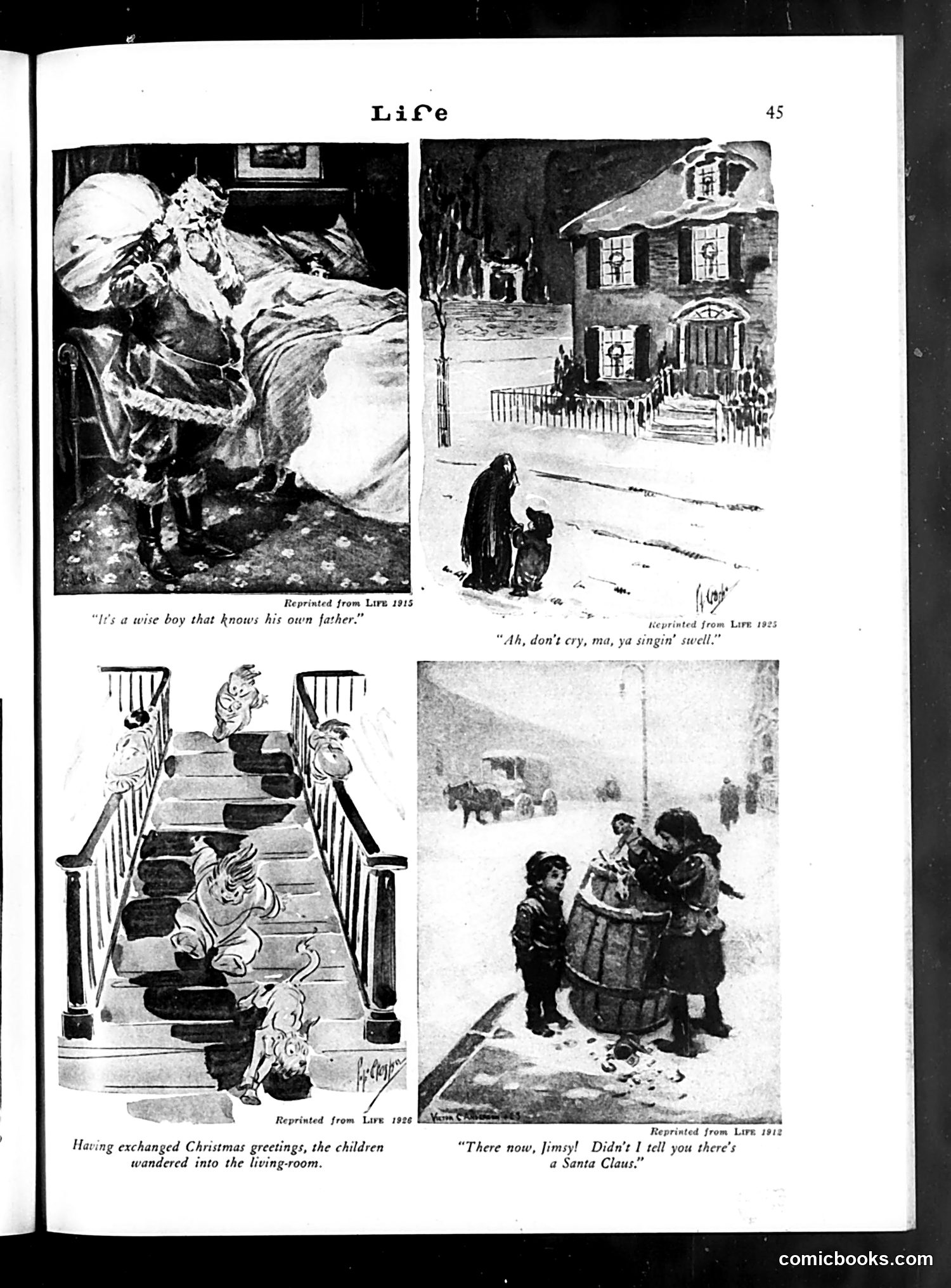
Life Magazine Page Analysis This page collects four reprinted cartoons from Life magazine (1912-1926), all depicting domestic and family scenarios with gentle humor: Top left: A somewhat crude sketch captioned "It's a wise boy that knows his own father"—likely a joke about paternity uncertainty or illegitimacy, using an old proverb. Top right: A woman and child outside a house in winter, with the caption "Ah, don't cry, ma, ya singin' swell"—appears to show urban poverty or hardship, with a child attempting to comfort a distressed mother through performance. Bottom left: Children on a staircase with the caption about exchanging Christmas greetings—a humorous domestic scene showing children's behavior during holidays. Bottom right: Children gathered around an adult in snow, captioned "There now, Jimsy! Didn't I tell you there's a Santa Claus?"—depicting a parent consoling or deceiving a child about Santa's existence. The page emphasizes working-class and family life, mixing sentiment with mild social commentary typical of Life's satirical approach during the early 20th century.
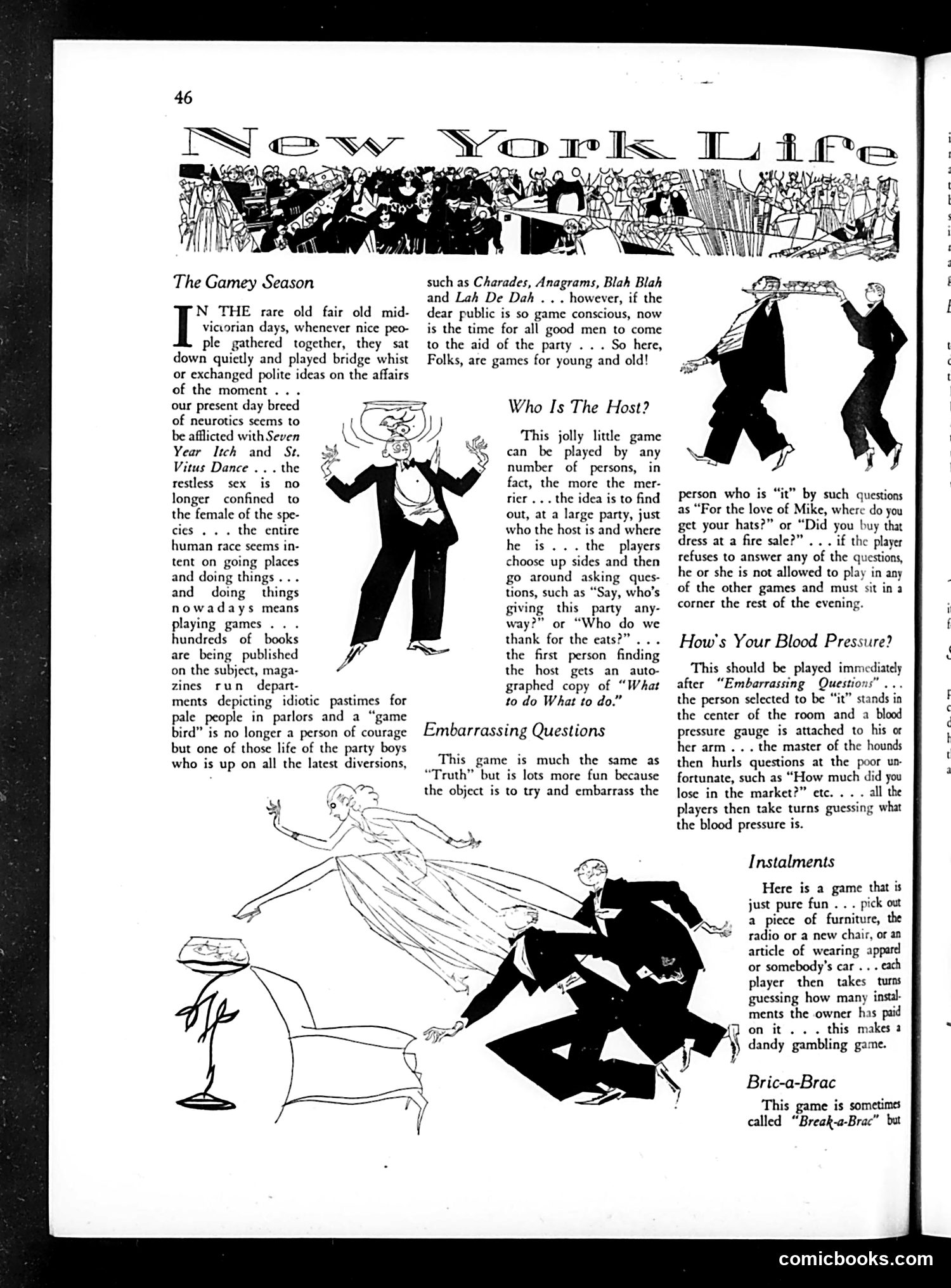
"The Gamey Season" — Life Magazine Party Games Satire This page satirizes the modern obsession with parlor games as a cure for contemporary restlessness. The author contrasts idealized "Mid-Victorian days" when people played bridge quietly with the current "neurotic" era, where everyone compulsively plays games. The illustrated games mock 1920s-30s party culture: "Who Is The Host?" ridicules shallow socializing; "Embarrassing Questions" and "How's Your Blood Pressure?" parody the anxiety-inducing nature of modern entertainment; "Instalments" jokes about Depression-era financial struggles by turning debt into a betting game; "Bric-a-Brac" suggests people gamble on household goods they've bought on credit. The cartoons show frenetic party-goers in exaggerated poses, emphasizing the frantic, undignified behavior the author criticizes. The satire suggests modern society has abandoned decorum for shallow amusement and financial recklessness dressed up as fun.
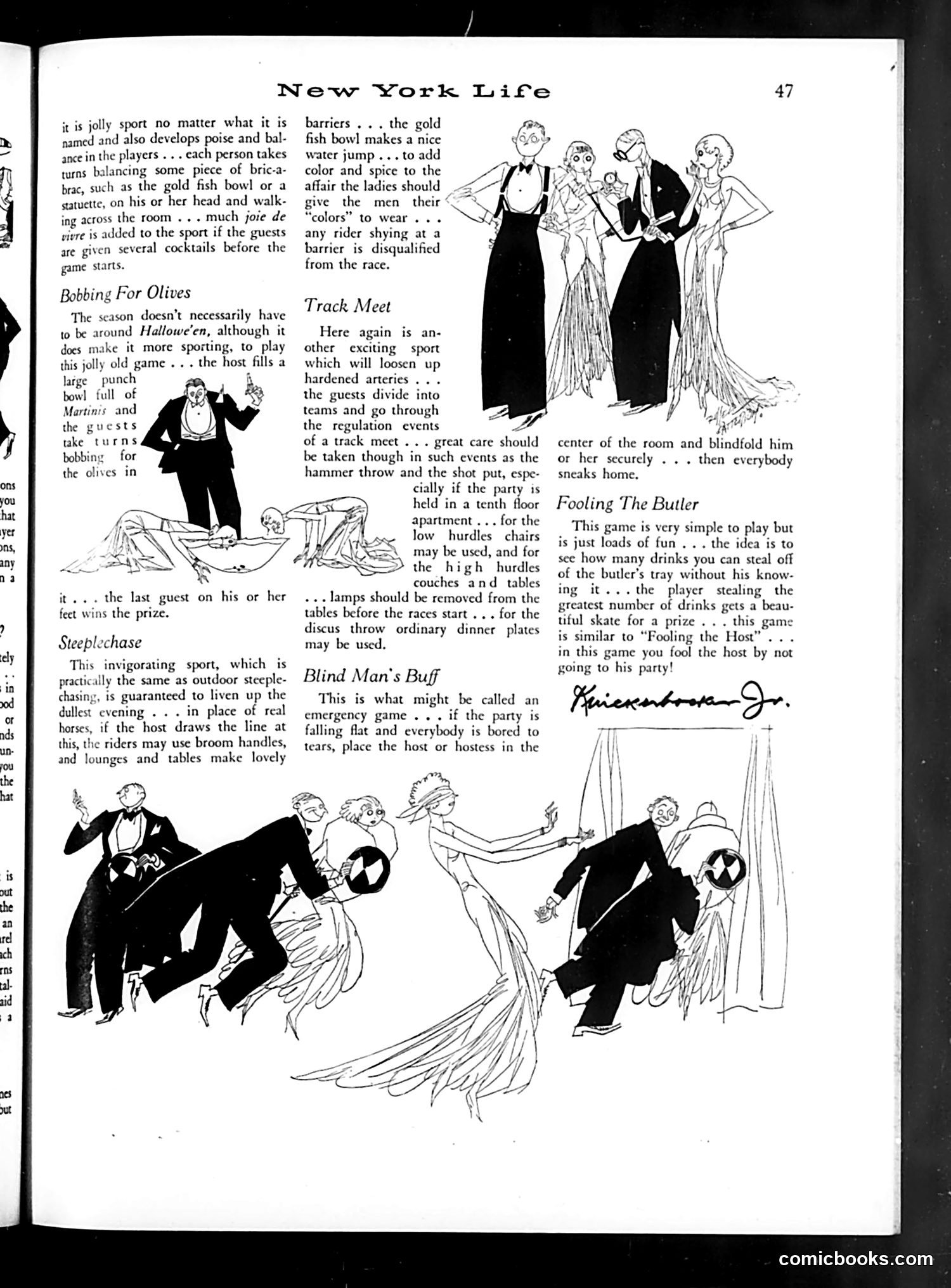
"New York Life" Party Games Satire This page from *Life* magazine satirizes wealthy 1920s-era cocktail party entertainment through absurdist "games" that mock both the frivolous leisure activities and heavy drinking culture of the era's upper classes. The cartoons illustrate increasingly ridiculous parlor games: guests balance household objects while intoxicated; they bob for olives in martini bowls; they perform a steeplechase using furniture as obstacles; and they compete in track events indoors with dinner plates as discuses. The final joke—"Blind Man's Buff" where guests blindfold the host then sneak home—and "Fooling the Butler" (stealing drinks) target servant-class dynamics while poking fun at guests' behavior. The satire's point: wealthy hosts desperately manufacture entertainment through increasingly dangerous, alcohol-fueled stunts. The repeated emphasis on cocktails and the butler stealing joke critique both upper-class excess and the pretension of treating reckless drunkenness as sophisticated sport.
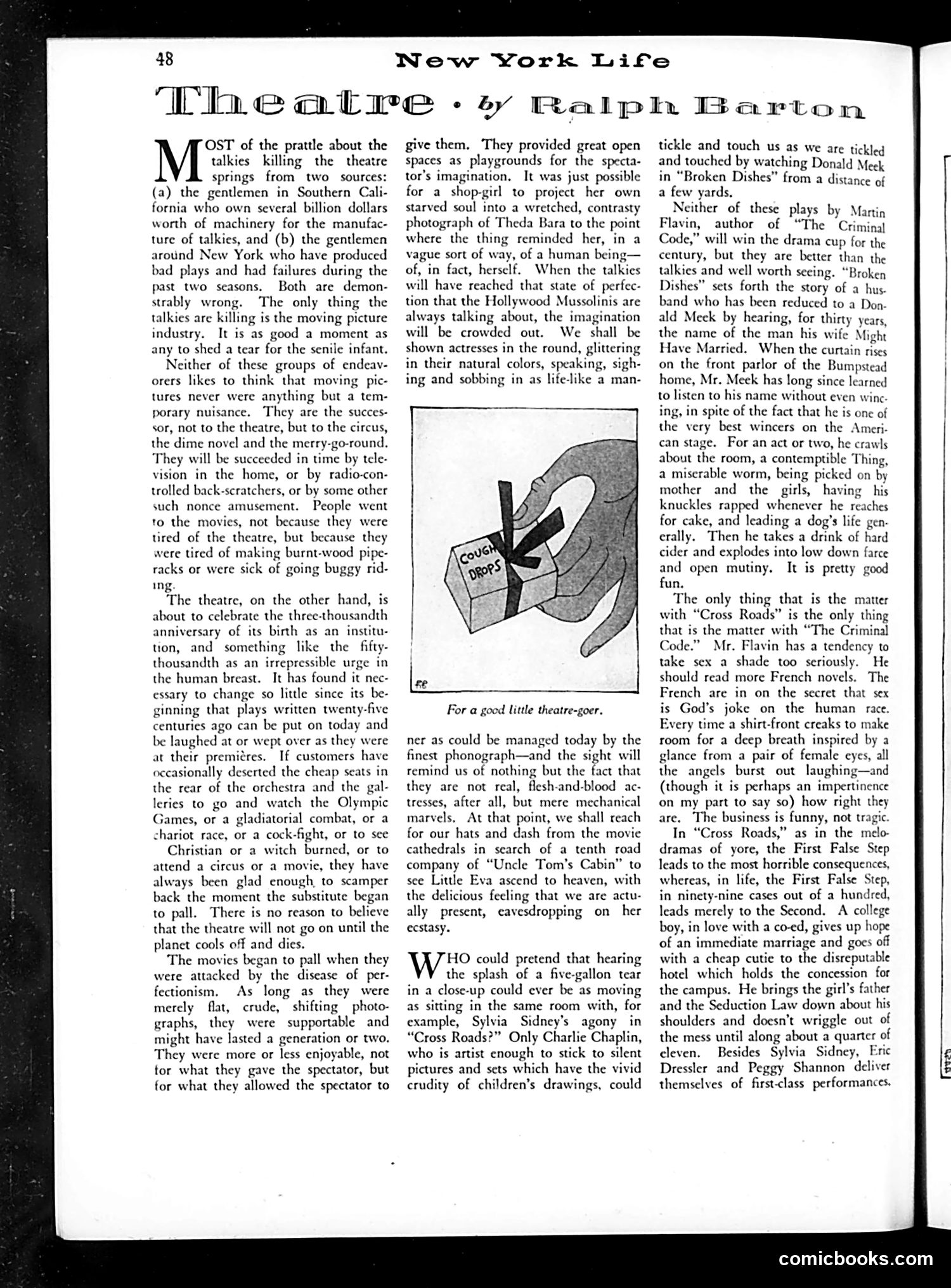
Analysis of This Theatre Critique by Ralph Barton This is a satirical essay arguing that movies, not theatre, are dying. The cartoon shows a hand labeled "BROKEN DISHES" — likely representing the sentimental, low-quality theatrical fare of the era. Barton's main points: Movies are merely a temporary entertainment fad (like circuses and dime novels), destined for replacement by television or radio devices. Theatre, by contrast, has survived 3,000 years because it fulfills a fundamental human urge. The satire targets Hollywood's pursuit of "perfectionism" — as films become technically perfect with sound and realistic imagery, audiences will lose their ability to project imagination onto them. Early silent films succeeded *because* they were crude, allowing viewers to imaginatively fill gaps. Once talkies become too realistic, audiences will flee back to live theatre's inherent imperfection and authentic human presence. The "Broken Dishes" plays referenced represent cheap, sentimental theatre — yet even these will seem preferable to over-polished mechanical movie performances.
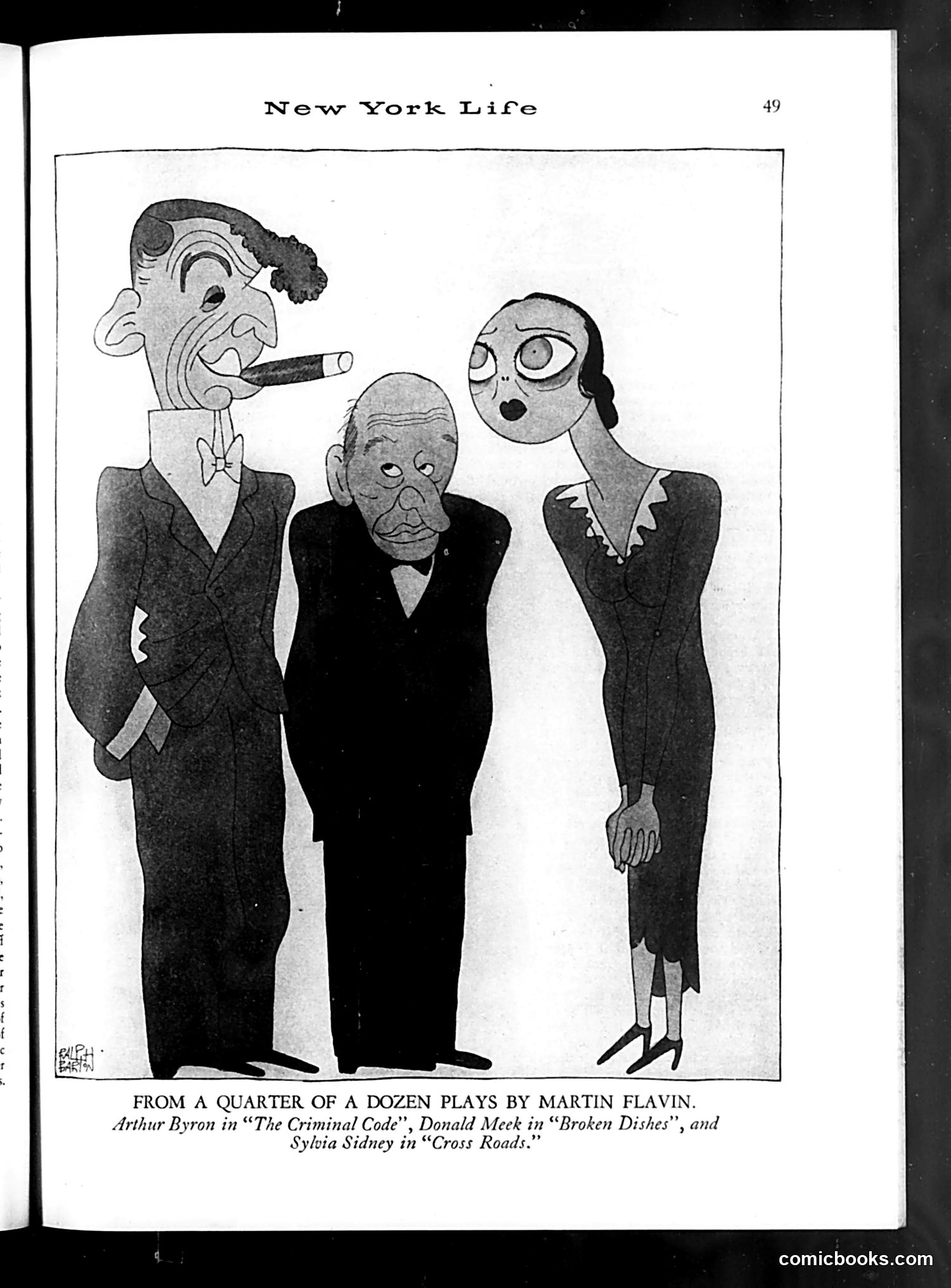
Analysis This is a theatrical illustration from Life magazine, not a political cartoon. It depicts three actors in caricatured style, representing characters from plays by Martin Flavin: Arthur Byron ("The Criminal Code"), Donald Meek ("Broken Dishes"), and Sylvia Sidney ("Cross Roads"). The exaggerated facial features—the left figure's grotesque expressions and cigar, the center figure's wrinkled severity, the right figure's wide-eyed shock—are characteristic of 1920s-30s theatrical caricature. These distortions mock or highlight the dramatic character types each actor portrays, likely criminals, domestic trouble, and emotional turmoil respectively. The satire appears directed at contemporary stage melodrama rather than politics, satirizing the overwrought emotionalism typical of the era's theatrical productions.
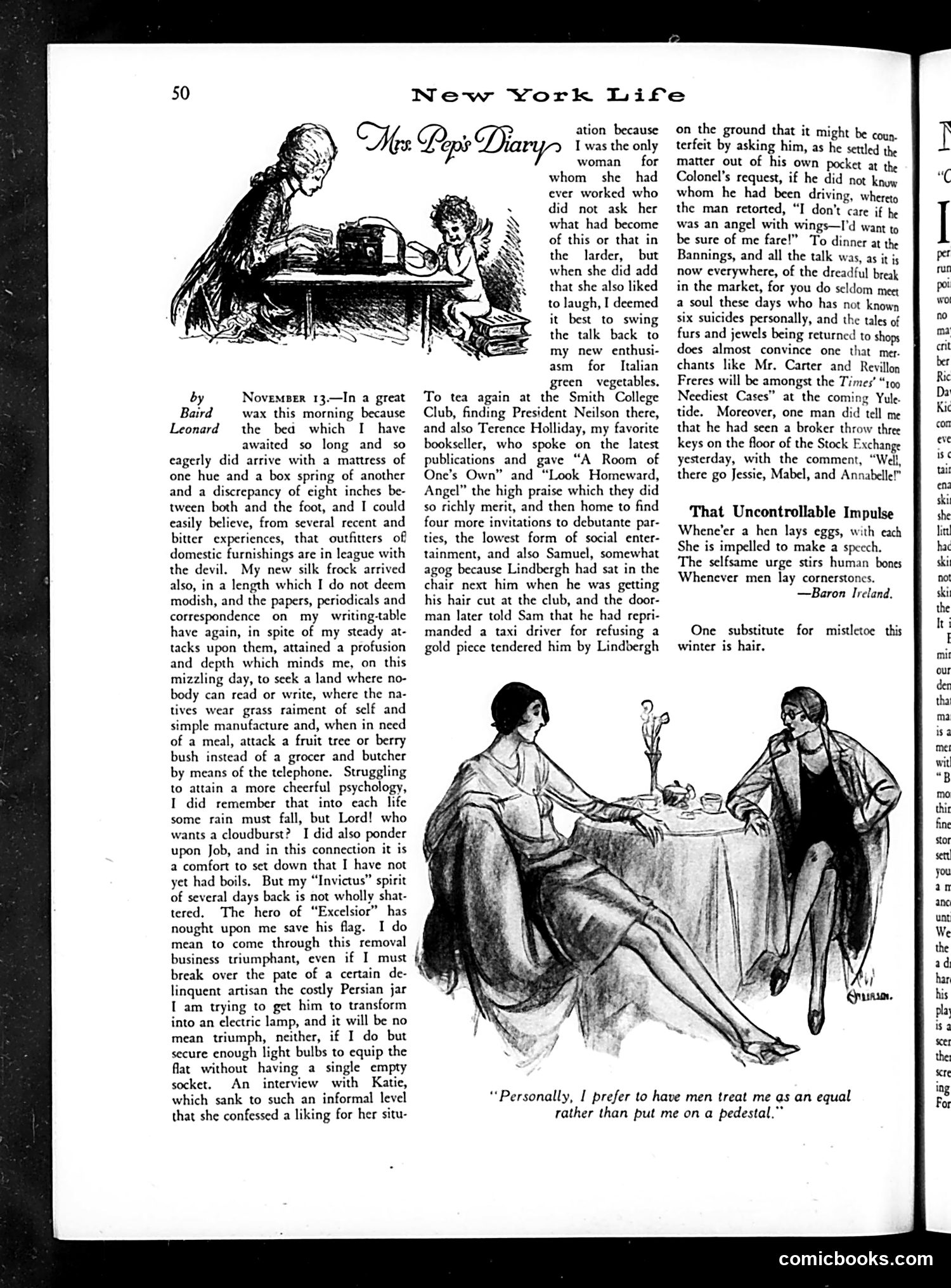
"Mrs. Pops Diary" - November 13th Entry This is a satirical diary entry by humorist Leonard capturing upper-class Manhattan life during the 1929 stock market crash. The unnamed narrator complains about domestic frustrations (a mismatched bed, an incorrectly hemmed dress) while dropping references to Lindbergh (the aviator celebrity of the era) and Virginia Woolf's "A Room of One's Own." The social satire peaks in the final paragraphs: everyone at dinner obsessively discusses the market collapse, exaggerating personal knowledge of suicides and financial ruin. The darkly comic punchline—a broker throwing stock certificates onto the floor, naming them after women ("Jessie, Mabel, and Annabelle!")—satirizes how financial catastrophe has consumed all conversation and reduced human relationships to mere commodities. The illustration shows two fashionable women in contemporary dress, their body language suggesting the gossipy, self-absorbed tone of high-society chatter depicted in the text.
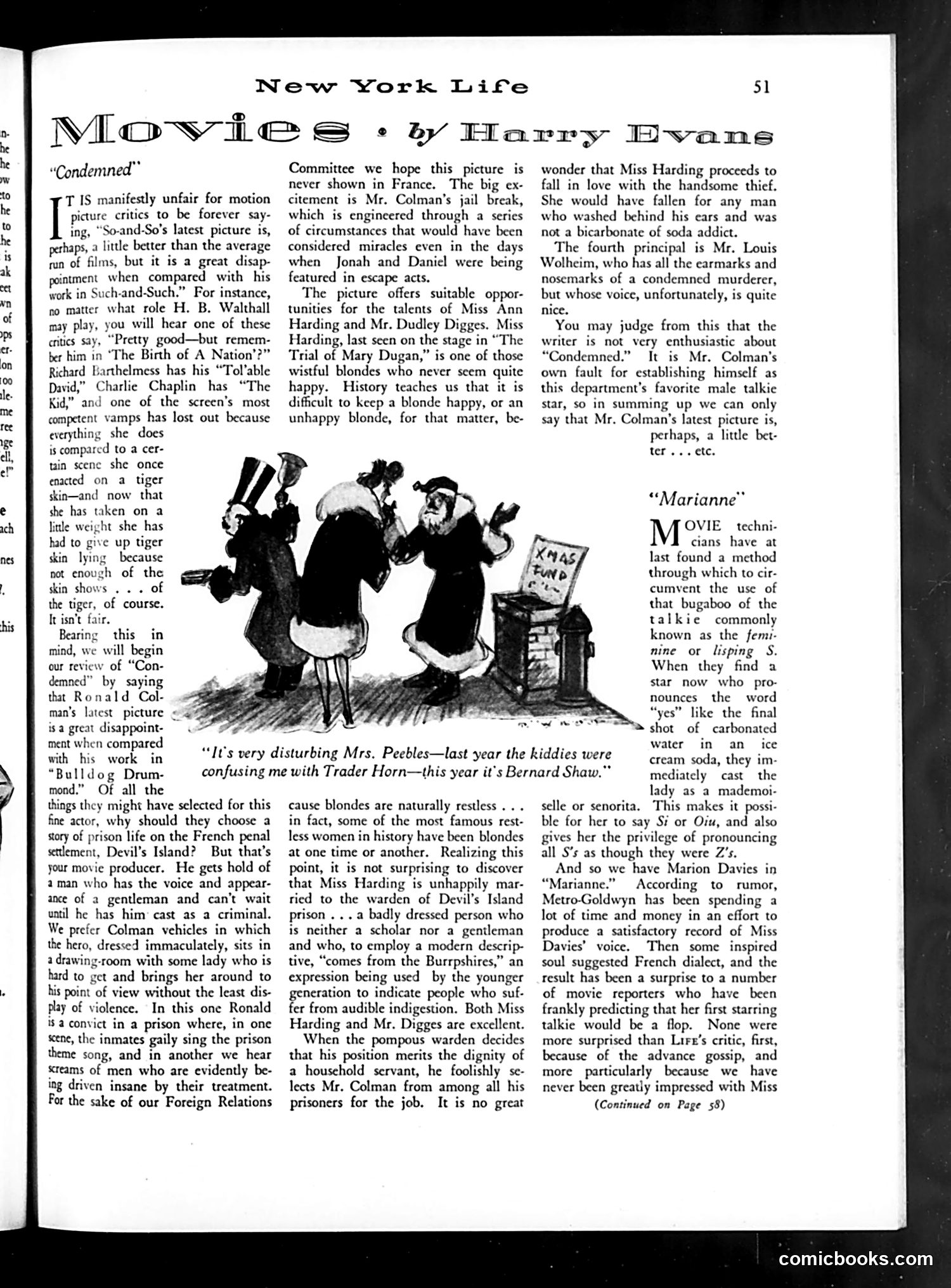
Analysis of This Life Magazine Movie Review Page This page contains a satirical film review by Harry Evans of Ronald Colman's prison drama "Condemned," plus a cartoon about an actress's typecast identity. The Main Cartoon shows a woman (likely an actress) complaining to someone about being confused with different movie roles year to year—previously with "Trader Horn" and now with "Bernard Shaw." The joke is that she's become so identified with her film characters that audiences can't separate her from them in public life. The Review's Satire critiques critics who unfairly judge actors by comparing every new role to their most famous past performances (Chaplin's "The Kid," Barthelmess's "Tol'able David"). Evans then ironically applies this same criticism to Colman's "Condemned," calling it disappointing compared to his earlier "Bulldog Drummond." The Political Reference: The reviewer mentions hoping the film isn't shown in France "for the sake of our Foreign Relations Committee"—suggesting the movie's brutal depiction of Devil's Island prison could damage diplomatic relations with France, which operated that notorious penal colony. The overall tone mocks both critics' unfair standards and Hollywood's questionable choices in casting and subject matter.
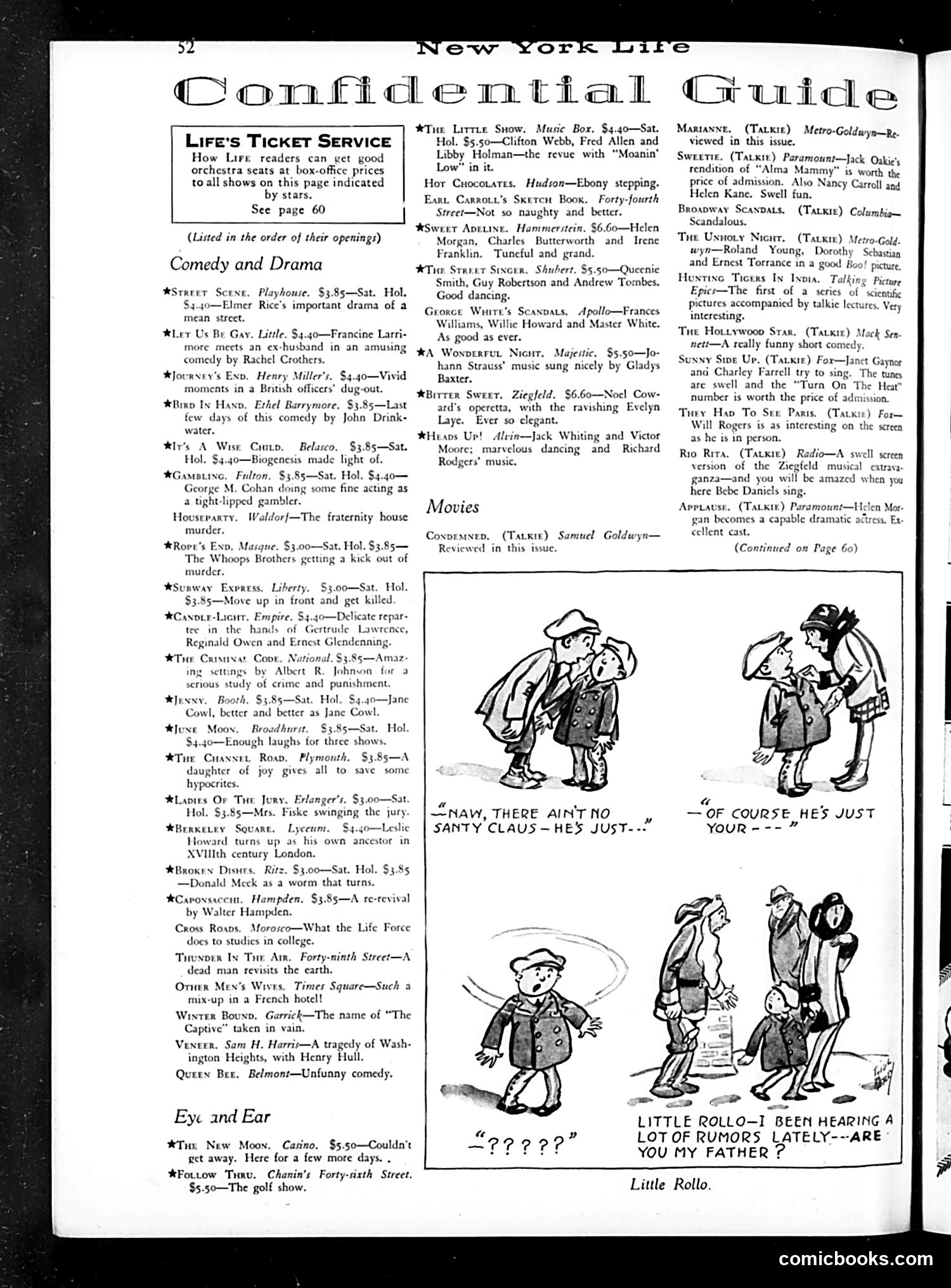
"Little Rollo" Comic Strip Analysis This is a humorous children's comic depicting a common domestic scene. A father figure is caught in an awkward moment trying to convince a child (Rollo) that Santa Claus doesn't exist—or rather, fumbling through the explanation. The child has apparently been hearing rumors about Santa's authenticity, and the father struggles to articulate the truth. The humor derives from the father's stammering ("Naw, there ain't no Santy Claus—he's just...") and the child's confused response ("Of course he's just yours?"), creating a comedic miscommunication. The final panel shows the child repeating back what he's heard about Santa being questioned, asking if his father is really Santa. The joke captures the awkward parental moment of disillusionment—the difficulty adults face explaining childhood mythology to growing children. It's gentle, relatable domestic humor typical of Life magazine's comic offerings in this era (appears to be 1920s-30s based on the page design).
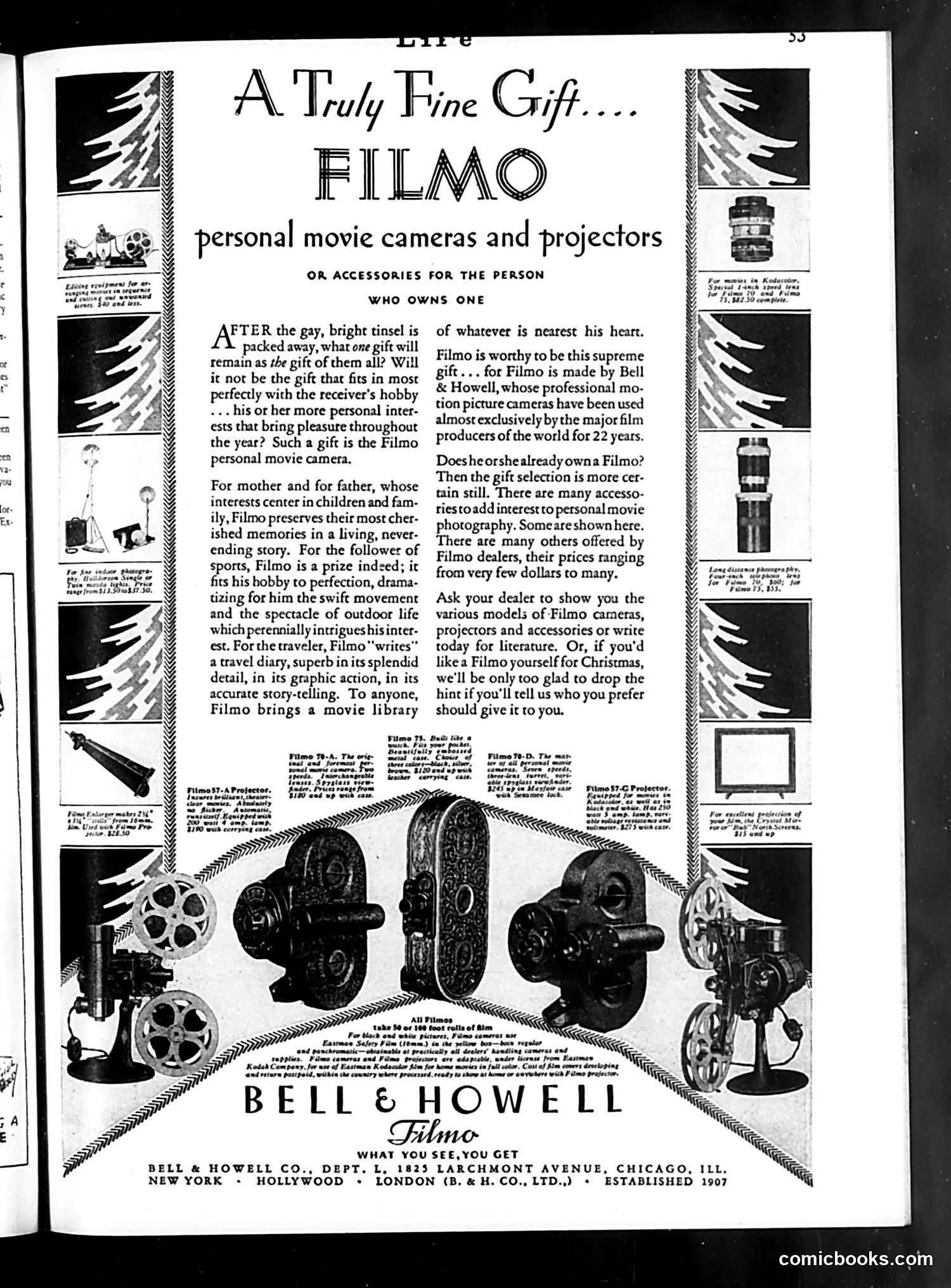
Analysis of Page Content This is not a cartoon or satirical piece—it's a full-page advertisement for Filmo personal movie cameras and projectors, manufactured by Bell & Howell. The ad promotes Filmo as an ideal Christmas gift for various audiences: families wanting to preserve memories, sports enthusiasts, and travelers. It emphasizes Bell & Howell's credibility by noting their professional motion picture cameras have been used by major film studios for 22 years. The page includes product images of different camera and projector models arranged around the borders, with technical specifications and pricing details. The layout and copy reflect 1920s marketing strategy—positioning consumer film equipment as a luxury good for affluent hobbyists. There is no political satire or social commentary. This is straightforward commercial advertising from Life magazine's revenue stream.
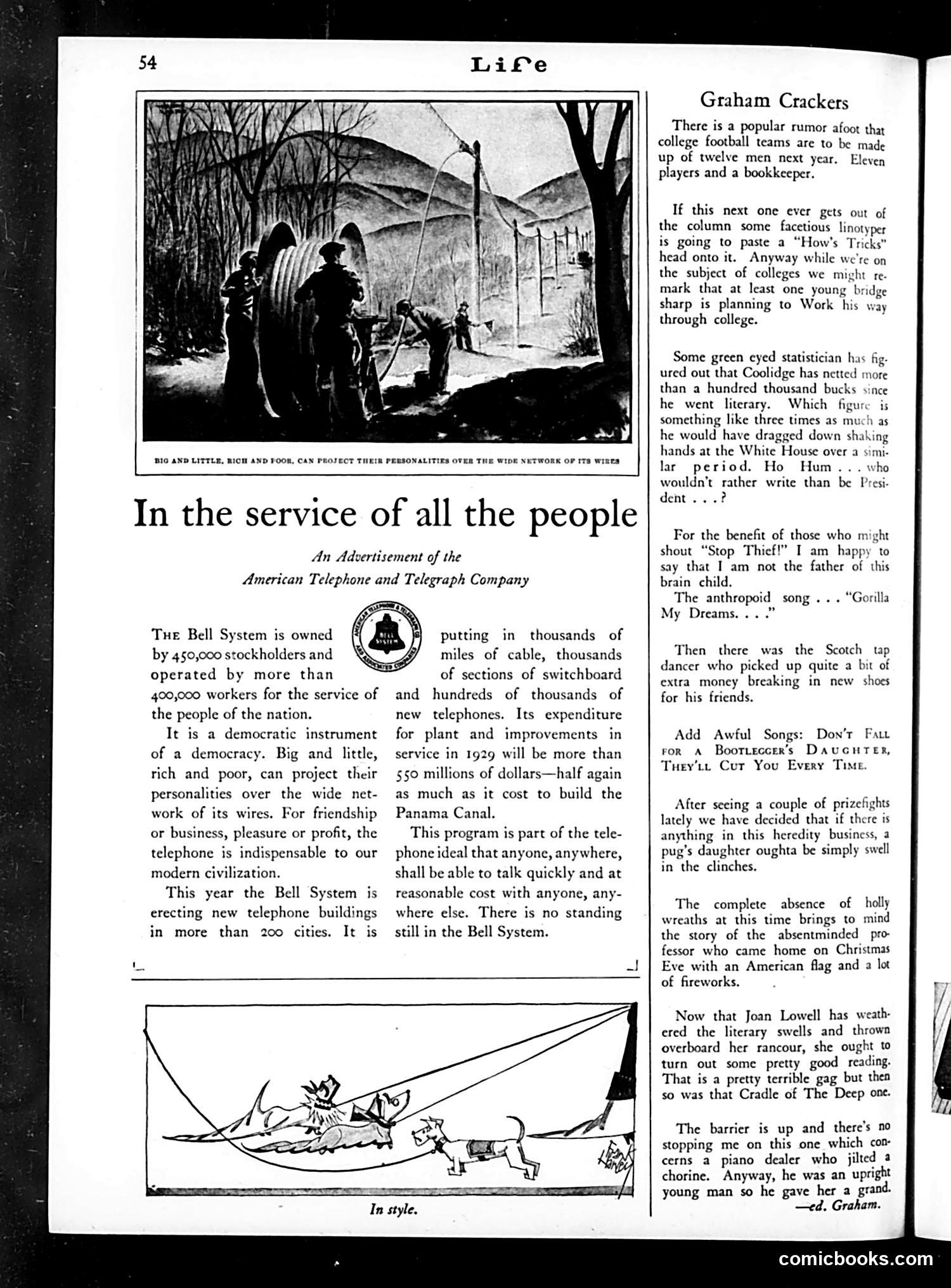
Life Magazine Page Analysis This page combines a Bell System advertisement with a humor column by Graham (likely Graham Crackers, a regular Life contributor). The Advertisement The top half showcases AT&T's telephone monopoly as a democratic utility serving "big and little, rich and poor." It promotes Bell's 1929 expansion—erecting buildings in 200+ cities, laying thousands of miles of cable—spending $550 million (comparable to Panama Canal construction costs). The message: universal telephone access represents progress and democratic equality. The Cartoons & Humor Column The bottom contains two small satirical drawings and a jokes column mocking: - College football (needing a "bookkeeper" on the team) - Calvin Coolidge profiting more from writing than his presidential salary - Prizefighting genetics - Recent literary celebrities The humor is lighthearted social commentary typical of 1920s Life magazine—deflating pretensions and poking fun at contemporary figures and trends without sharp political bite.
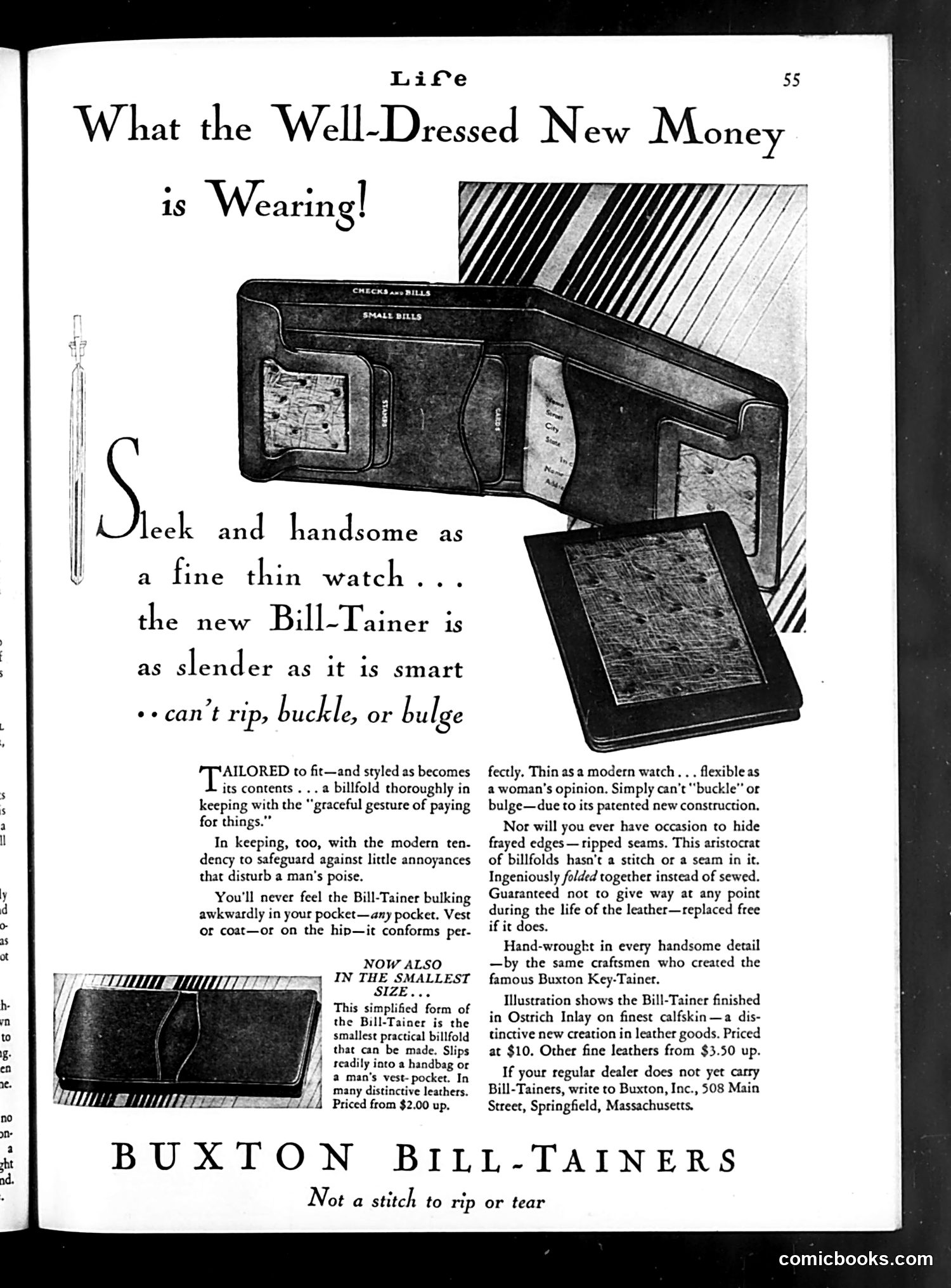
Analysis This is a product advertisement, not satire or political commentary. It promotes the Buxton Bill-Tainer billfold/wallet. The page's heading—"What the Well-Dressed New Money is Wearing!"—uses mild social satire typical of *Life* magazine's advertising section. The phrase "new money" is a tongue-in-cheek reference to newly wealthy people concerned with appearing refined and fashionable, positioning the wallet as aspirational accessory. The ad's humor lies in treating a billfold with mock-seriousness as fashion: it's "sleek and handsome as a fine thin watch," "flexible as a woman's opinion" (a period-typical gender joke), and guarantees the wearer won't appear bulky or uncouth. The tagline "Not a stitch to rip or tear" emphasizes durability as a selling point. The product costs $10 (expensive for the era), with smaller versions from $2. There is no political cartoon or social commentary beyond gentle class-consciousness marketing.
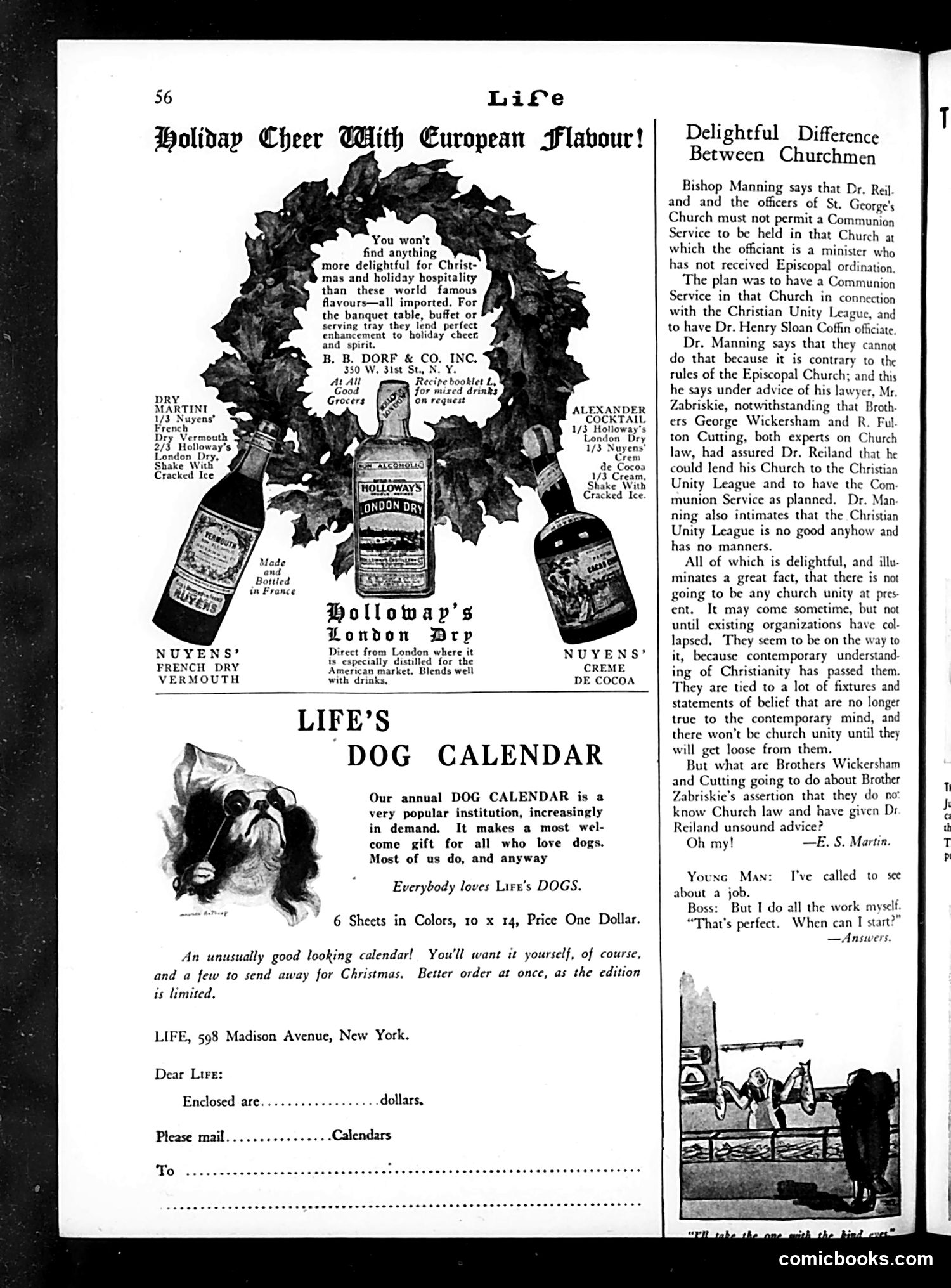
Life Magazine Page Analysis This page contains liquor advertisements alongside a brief editorial commentary on ecclesiastical dispute. The Advertisements: The top half promotes imported European spirits—Nuyens French Dry Vermouth and Holloway's London Dry Gin—marketed as sophisticated holiday gifts. Below is a dog calendar advertisement (a recurring Life feature). The Editorial Commentary: "Delightful Difference Between Churchmen" satirizes a dispute among Episcopal Church leaders. Bishop Manning prohibited Dr. Reiland from allowing Dr. Henry Sloan Coffin to conduct a Communion Service at St. George's Church because Coffin lacked Episcopal ordination. Manning invoked church law despite assurances from prominent church law experts George Wickersham and R. Fulton Cutting that the arrangement was permissible. The author (E. S. Martin) mocks this rigid denominationalism, suggesting institutional churches are so bound to outdated doctrines that genuine ecumenical unity remains impossible. The satire highlights the absurdity of prioritizing episcopal credentials over Christian fellowship and unity efforts.
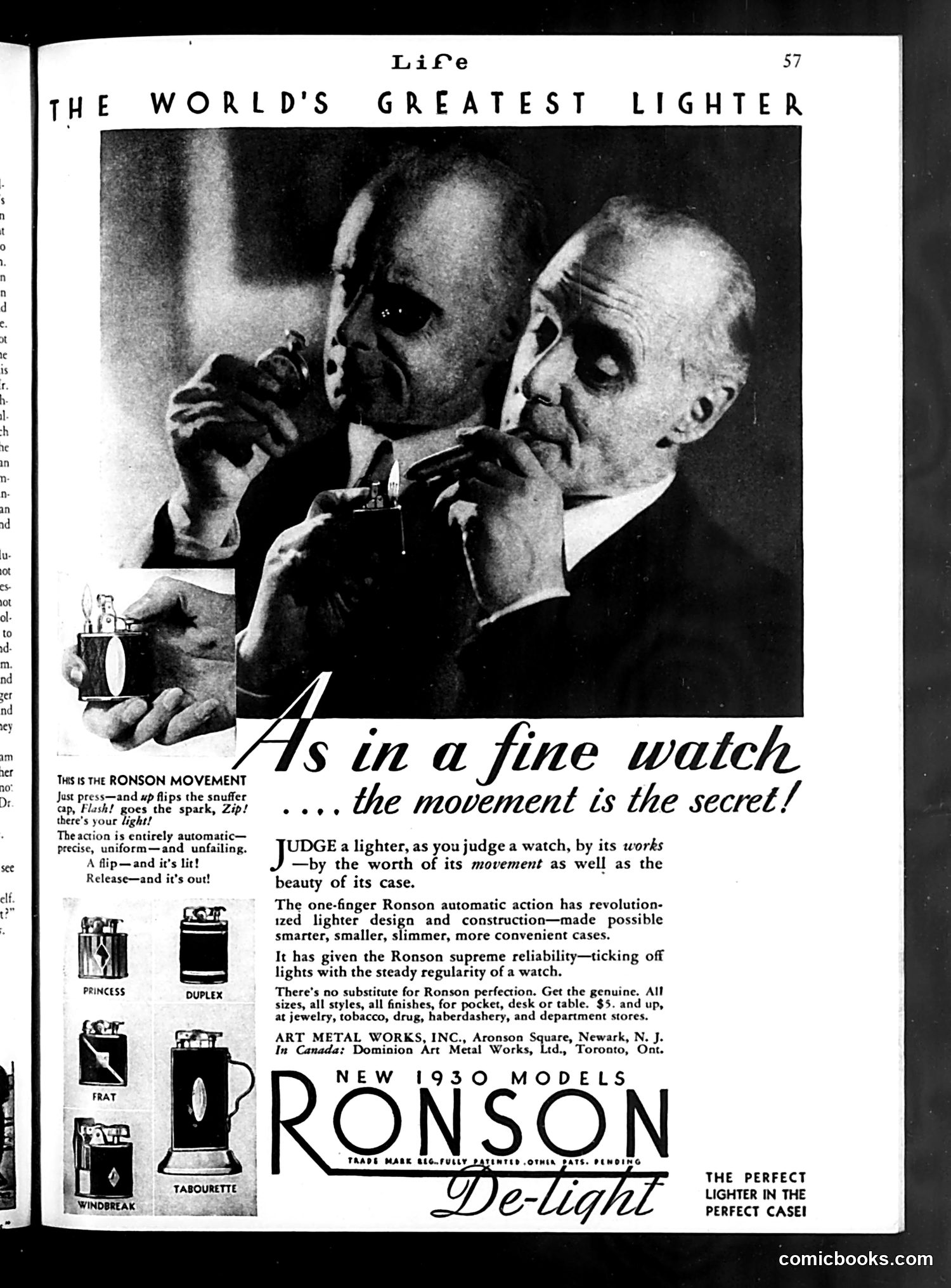
Ronson Lighter Advertisement (circa 1930) This is a full-page product advertisement, not political satire. It promotes Ronson's new 1930 lighter models. The image shows two men demonstrating the lighter's operation—one holding it, the other lighting it. The ad's central conceit compares lighter quality to watch quality: "Judge a lighter...by its works...by the worth of its movement as well as the beauty of its case." The "movement" metaphor—borrowed from watchmaking—emphasizes precision engineering. Ronson's one-finger automatic mechanism is presented as revolutionary, making lighters "smarter, smaller, slimmer." The ad showcases five 1930 models (Princess, Duplex, Frat, Windbreak, Tabourette) and emphasizes reliability: "ticking off lights with the steady regularity of a watch." This reflects 1930s consumer culture, where mechanical sophistication and brand prestige commanded premium prices ($3–$5, significant money then). The ad targets affluent buyers through upscale retail placement.
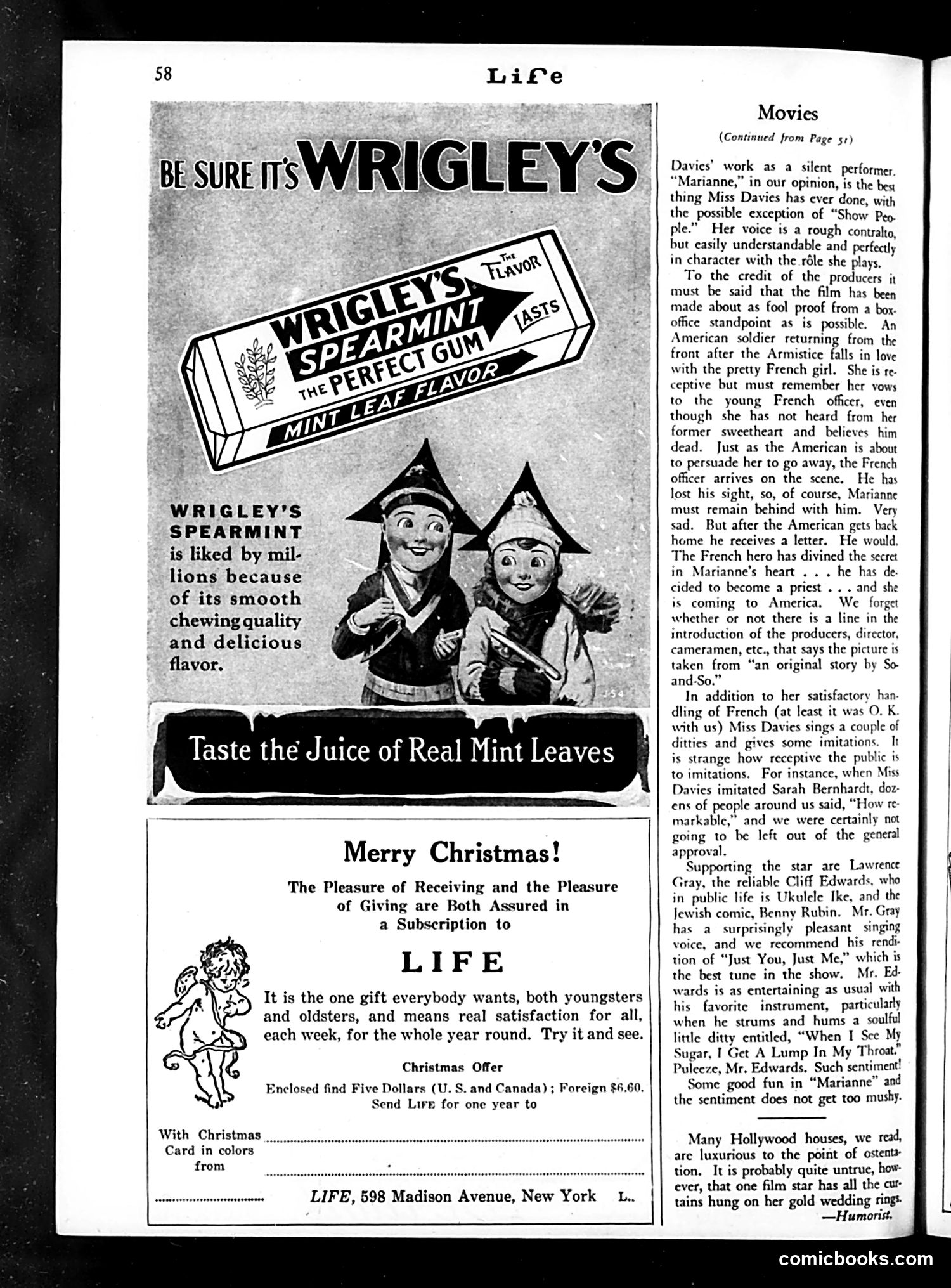
Analysis of Life Magazine Page 58 This page mixes advertising and film criticism typical of 1920s Life magazine. The Wrigley's gum advertisement features cheerful gnome-like figures promoting spearmint as "the perfect gum" with "mint leaf flavor" — standard product marketing of the era. The main content is a movie review of "Marianne," starring Marion Davies. The critic praises Davies's silent-film performance as her best work, though notes her speaking voice is rough. The plot synopsis describes a sentimental postwar romance: an American soldier loves a French woman already promised to a blinded French officer, who nobly becomes a priest so she can pursue American happiness. The review is somewhat satirical about Hollywood sentimentality — the melodramatic plot ("fool proof from a box-office standpoint") and audiences' gullibility (applauding Davies's Sarah Bernhardt imitation as "remarkable"). Supporting players mentioned include "Ukulele Ike" (Cliff Edwards) and Benny Rubin. The page concludes with a Life magazine subscription Christmas offer, positioning the weekly publication as an ideal gift for all ages.
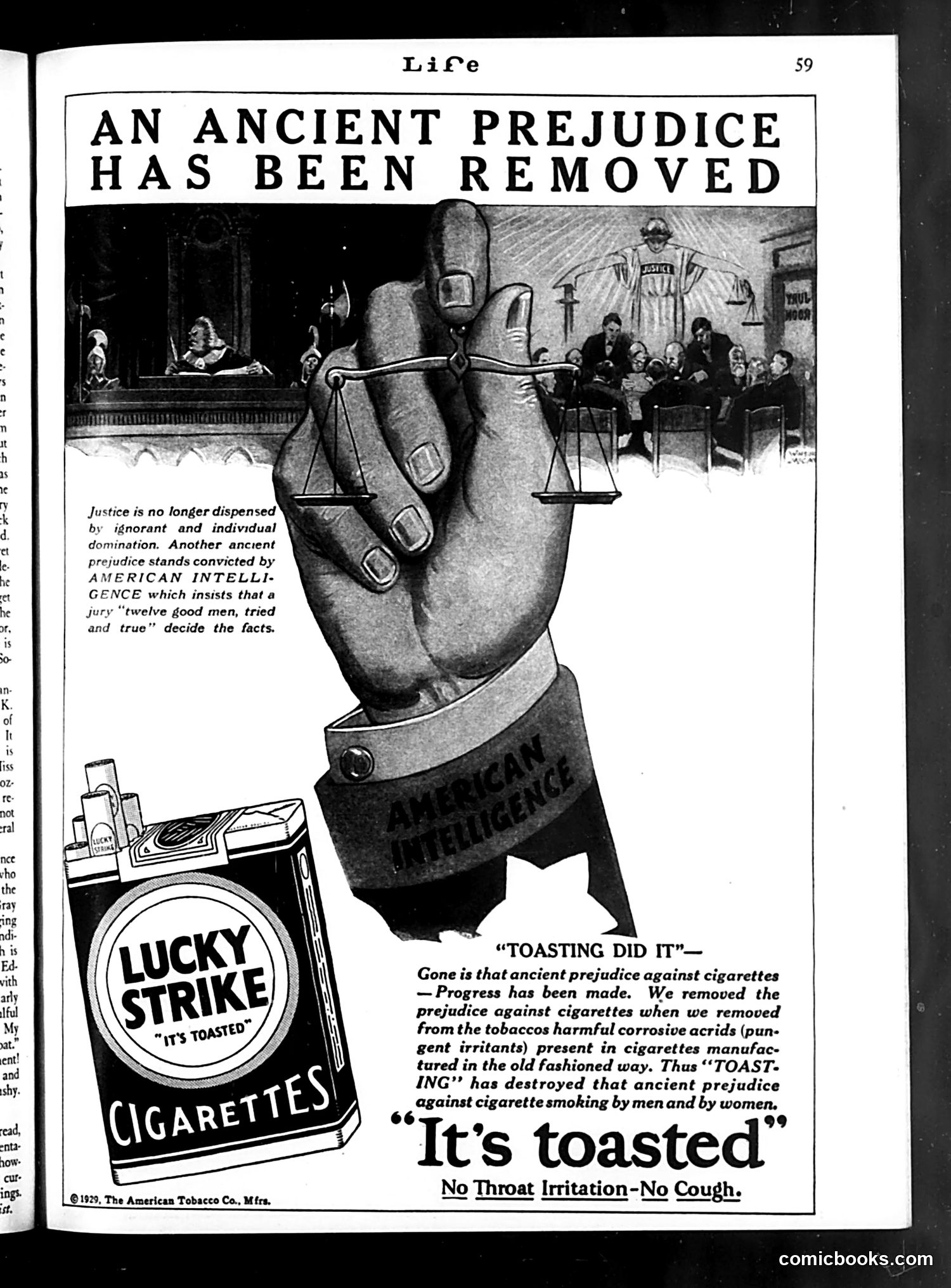
Political/Social Satire Analysis This is primarily a Lucky Strike cigarette advertisement disguised as social commentary, not political satire. The ad's central claim uses a false analogy: just as "American intelligence" has removed the prejudice against jury trials by ignorant individuals (replacing it with reasoned deliberation by twelve jurors), Lucky Strike claims to have removed prejudice against cigarettes through their "toasting" process, which allegedly removes harmful irritants. The imagery of a giant hand holding balanced scales of justice is meant to invoke judicial authority and progress. The courtroom scene in the background reinforces this parallel. The satirical framing is ironic: the ad presents cigarette smoking as scientifically justified progress, appealing to modern rationality and gender equality ("men and by women"). This was typical 1920s advertising rhetoric—wrapping commercial products in language of social advancement and scientific legitimacy, a practice now recognized as deliberately misleading marketing.
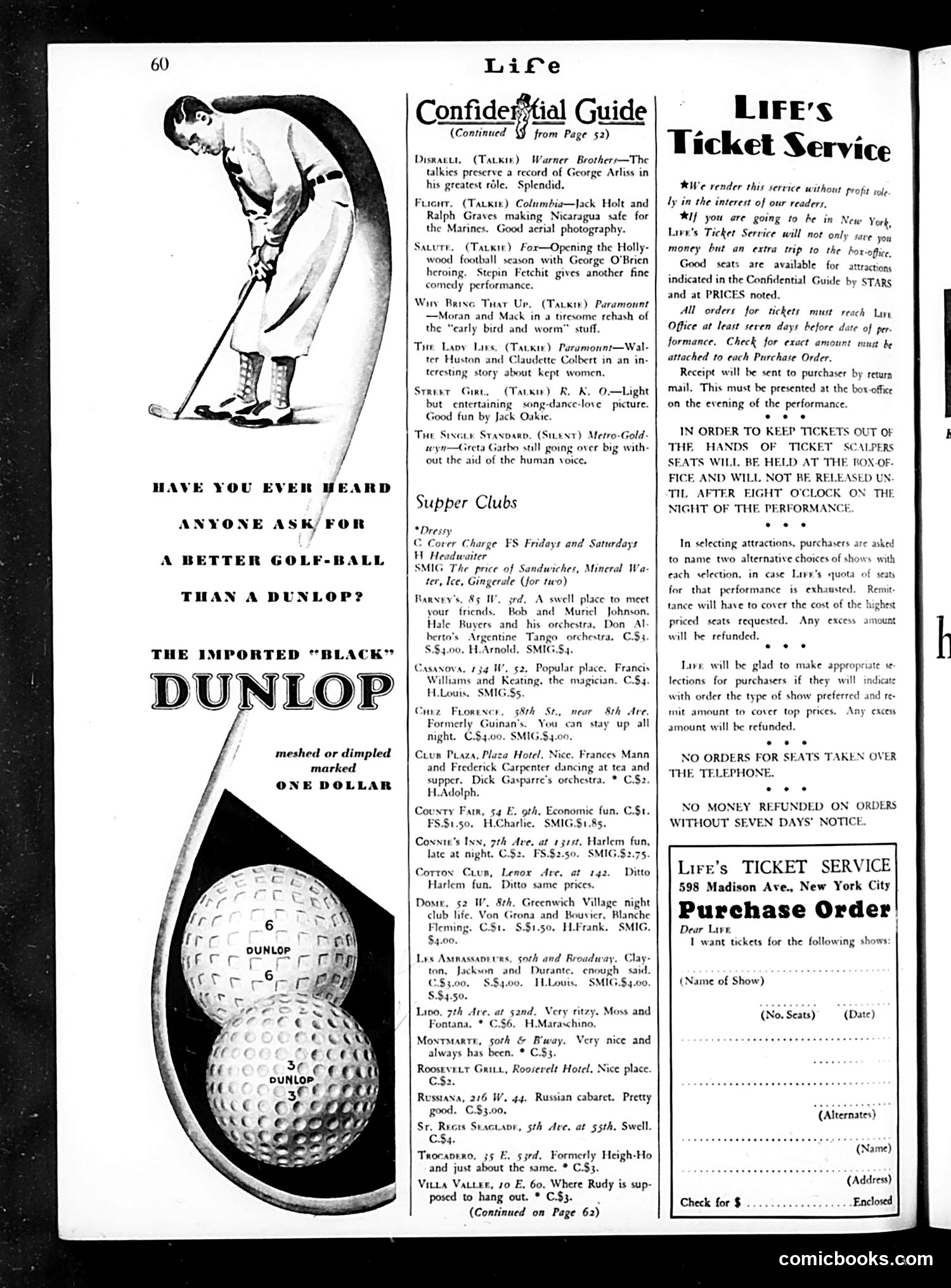
What This Page Means to Modern Readers This page contains a golf-ball advertisement (left) and entertainment/ticketing content (right) from Life magazine's 1920s-era "Confidential Guide." The Golf-Ball Ad: A straightforward product advertisement for Dunlop golf balls. The rhetorical question "Have you ever heard anyone ask for a better golf-ball than a Dunlop?" is classic period advertising—asserting the product's superiority through a claim no one disputes it. The dimpled design and one-dollar price point are highlighted as selling points. The Entertainment Section: Lists current Broadway shows (with talkie films noted), supper clubs in Manhattan, and a ticket-ordering service. Notable is the casual racism visible in period reviews (mentioning "Stepin Fetchit" as comedy relief, references to "Nicaragua" and "Marines"). The supper clubs section reflects 1920s New York nightlife culture, including Harlem venues. The Ticket Service: Life magazine offered readers convenient advance booking—a service eliminating scalpers by holding seats until 8 PM show night, requiring seven days' advance notice.
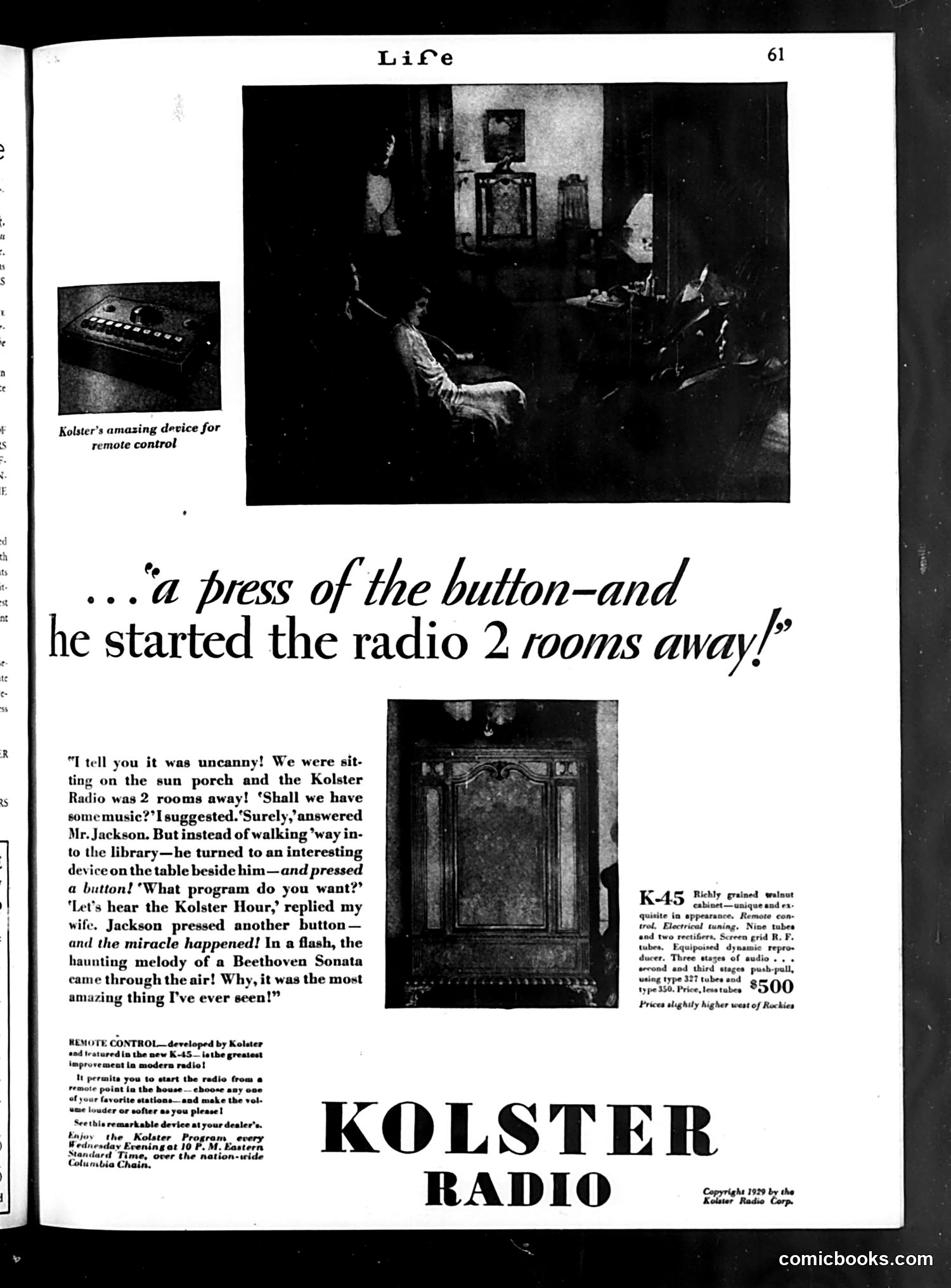
Kolster Radio Advertisement (1929) This is primarily a product advertisement, not political satire. It promotes Kolster's new K-45 radio model featuring "remote control"—a revolutionary innovation for 1929. The advertisement dramatizes the technology's wonder through a domestic scenario: a guest marvels that Mr. Jackson can operate a radio in another room by simply pressing buttons on a small device, rather than walking to the library. The miraculous moment—Beethoven's Sonata appearing "through the air"—emphasizes how magical this convenience seemed to contemporary readers. The "amazing device for remote control" shown in the upper left appears to be an early wireless remote (though the exact mechanism is unclear from the image). For modern readers, this captures how revolutionary electronic convenience was in the late 1920s. What we take for granted—wireless remote operation—was marketed as genuinely astonishing consumer innovation. The tone reflects period advertising's breathless excitement about new technology entering American homes.
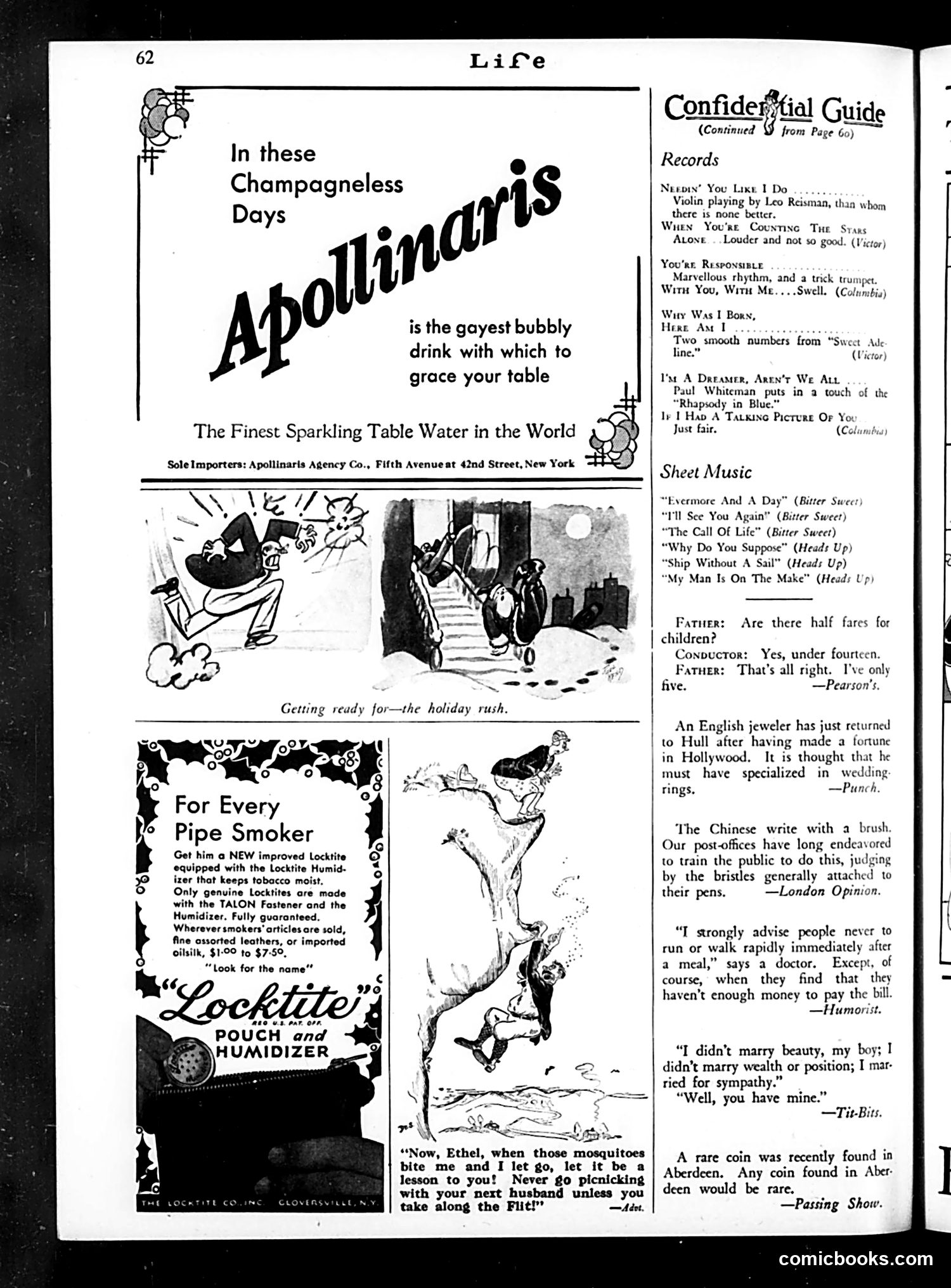
Page Analysis: Life Magazine (circa 1920s) This page combines advertisements with a humor section. The main cartoon depicts a husband threatening his wife about mosquitoes during a picnic, warning her never to remarry without bringing Flit insecticide. The joke plays on marital discord—he's implying she'll remarry after his death, and the mosquitoes (his bites) serve as a humorous stand-in for general marital complaints. The page reflects "Champagneless Days," referring to Prohibition (1920-1933), when alcohol was banned in America. The Apollinaris sparkling water ad attempts to position itself as a festive substitute for champagne at elegant dinners. The "Confidential Guide" section offers record and sheet music recommendations, celebrity gossip, and brief humorous anecdotes from other publications. One joke mocks a conductor's logic about child fares; another references an English jeweler's sudden Hollywood fortune—satirizing the era's gold-rush mentality toward the film industry.
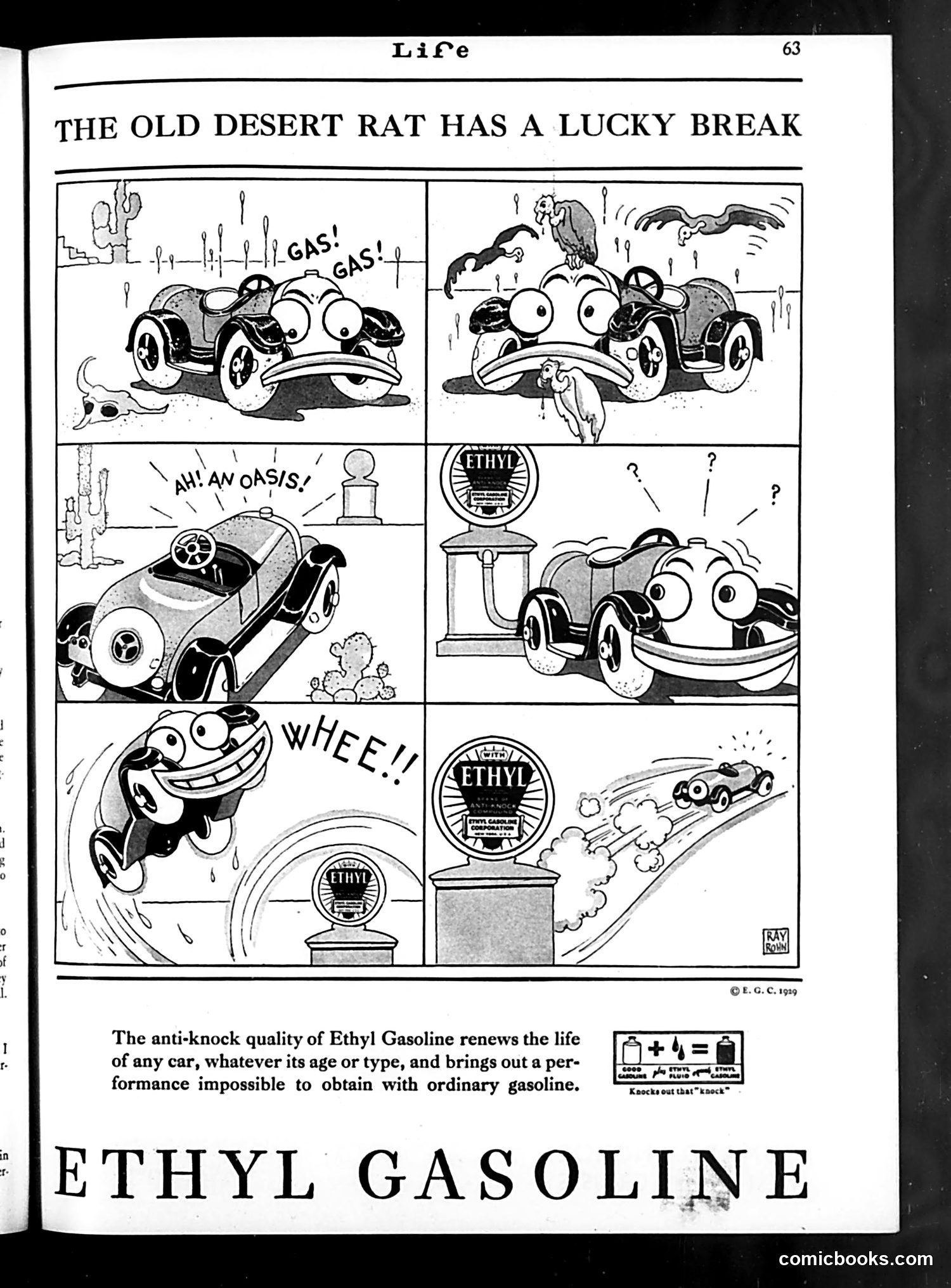
Analysis This is a product advertisement disguised as comic storytelling for Ethyl Gasoline, a real 1920s-30s fuel additive. The narrative: An old, worn-out car (the "desert rat") runs out of gas in the desert. The driver discovers an Ethyl Gasoline pump at an oasis. After refueling, the car is dramatically revitalized—it zooms away with renewed power and speed. The satire/advertising angle: The comic anthropomorphizes the car with an expressive face to humorously convey that Ethyl's anti-knock additive transforms even decrepit vehicles into high-performing machines. The "lucky break" is finding Ethyl fuel. This is not political satire but rather commercial advertising using comic strip format—a common Life magazine strategy. The humor relies on the car's exaggerated expressions and the fantastical claim that one fuel change creates miraculous performance improvements. Modern readers might recognize this as hyperbolic marketing comparable to today's dubious product claims.
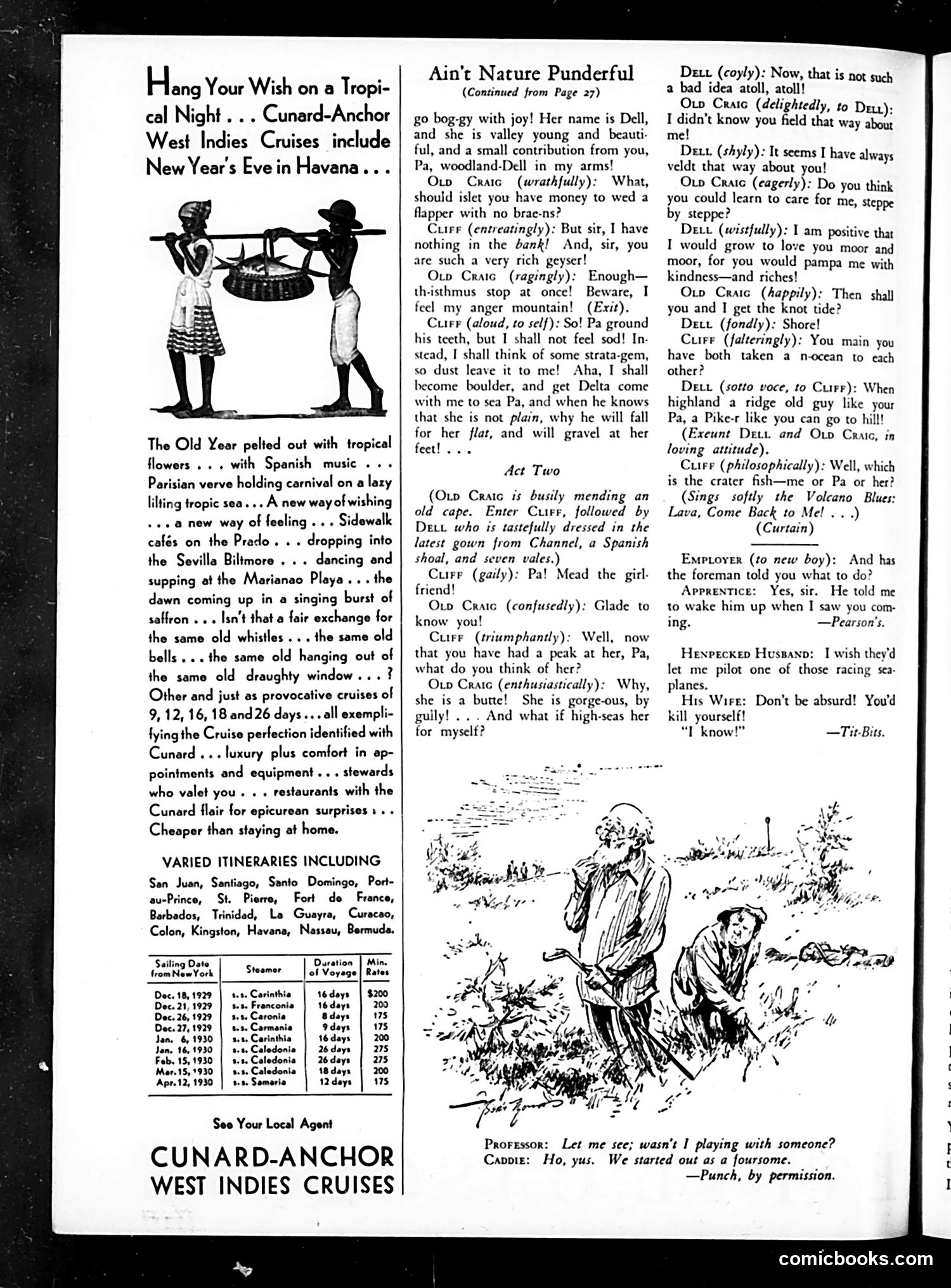
Explanation for Modern Readers This page contains two distinct elements: LEFT SIDE: Cruise Ship Advertisement A Cunard-Anchor luxury cruise advertisement promoting Caribbean vacations departing late 1929-early 1930, emphasizing romantic tropical settings (Havana, Barbados, etc.) as an escape from harsh winter weather and ordinary life. RIGHT SIDE: Pun-Based Comedy Sketch "Ain't Nature Punderful" is a theatrical dialogue where every word is a geography/geology pun. Characters named "Cliff," "Old Craig" (crag?), "Dell," and "Devt" speak entirely in mountain/landscape terminology: "bog-gy," "valley," "strata-gem," "boulder," "gravel," "butte," "gorge-ous," "veldt," "moor," "pampa," "steppe," "highland," etc. The plot—a young man seeks permission to marry his girlfriend—is undermined by the forced geographic wordplay. This style of punning was apparently popular in 1920s-30s humor publications. Modern readers would find it labored rather than amusing. The bottom cartoon is unrelated satire about class pretension and leisure.
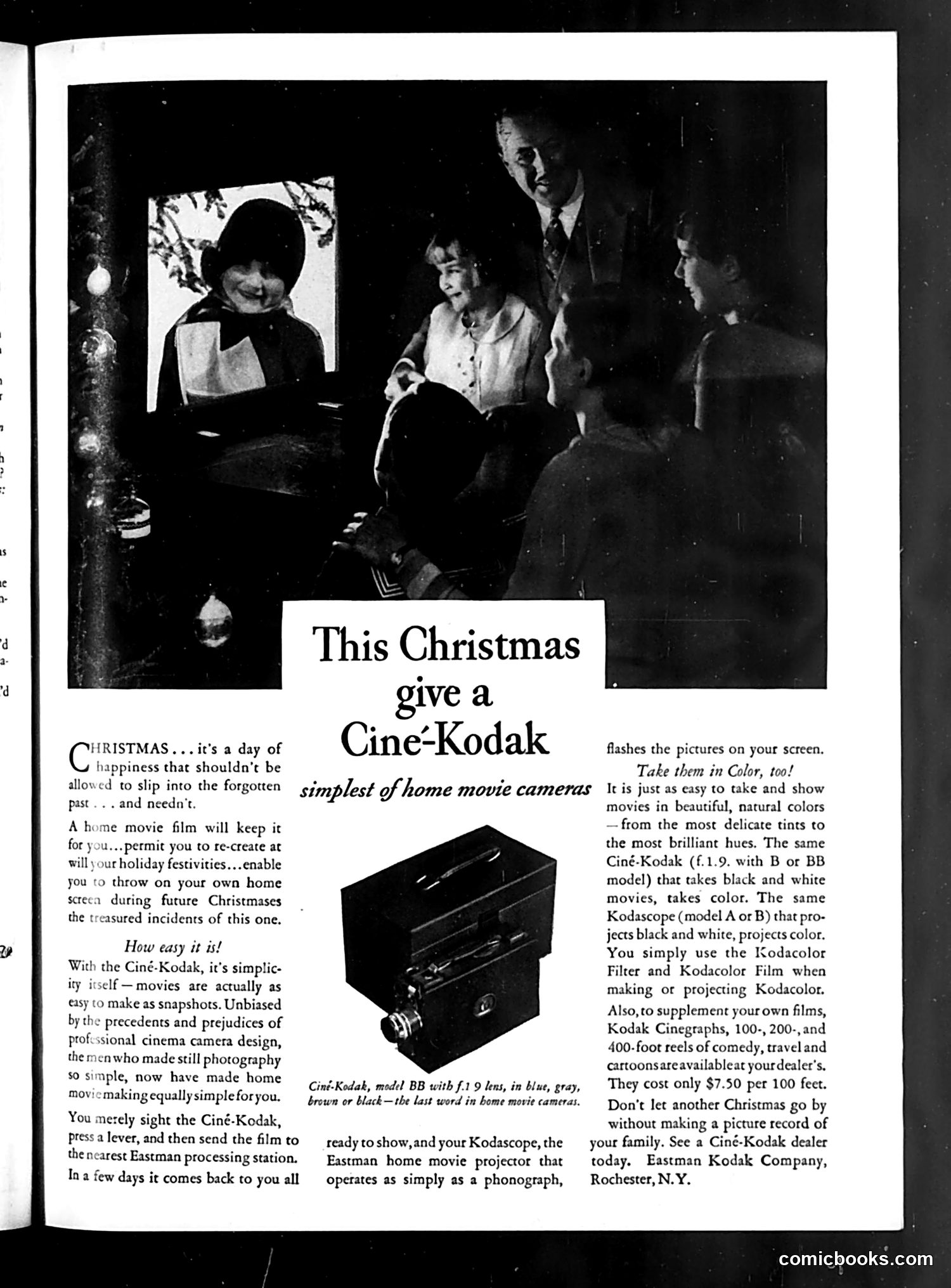
Analysis This is a Kodak advertisement, not satire or political commentary. It promotes the Ciné-Kodak home movie camera as a Christmas gift. The photograph shows a family gathering around a home movie projection—the aspirational lifestyle the ad sells. The copy emphasizes simplicity: users just "sight" the camera, press a lever, mail film to Eastman for processing, and project results using a Kodascope projector "as simply as a phonograph." Key selling points include: - Preservation of cherished holiday memories - Color film capability (then novel for consumers) - Affordability ($7.50 per 100 feet) - Ease rivaling still photography For modern readers: this reflects mid-20th-century consumer culture's enthusiasm for domestic technology and home documentation—precursor to today's ubiquitous video recording. The aspirational family scene typifies period advertising's emphasis on nuclear family happiness and leisure.
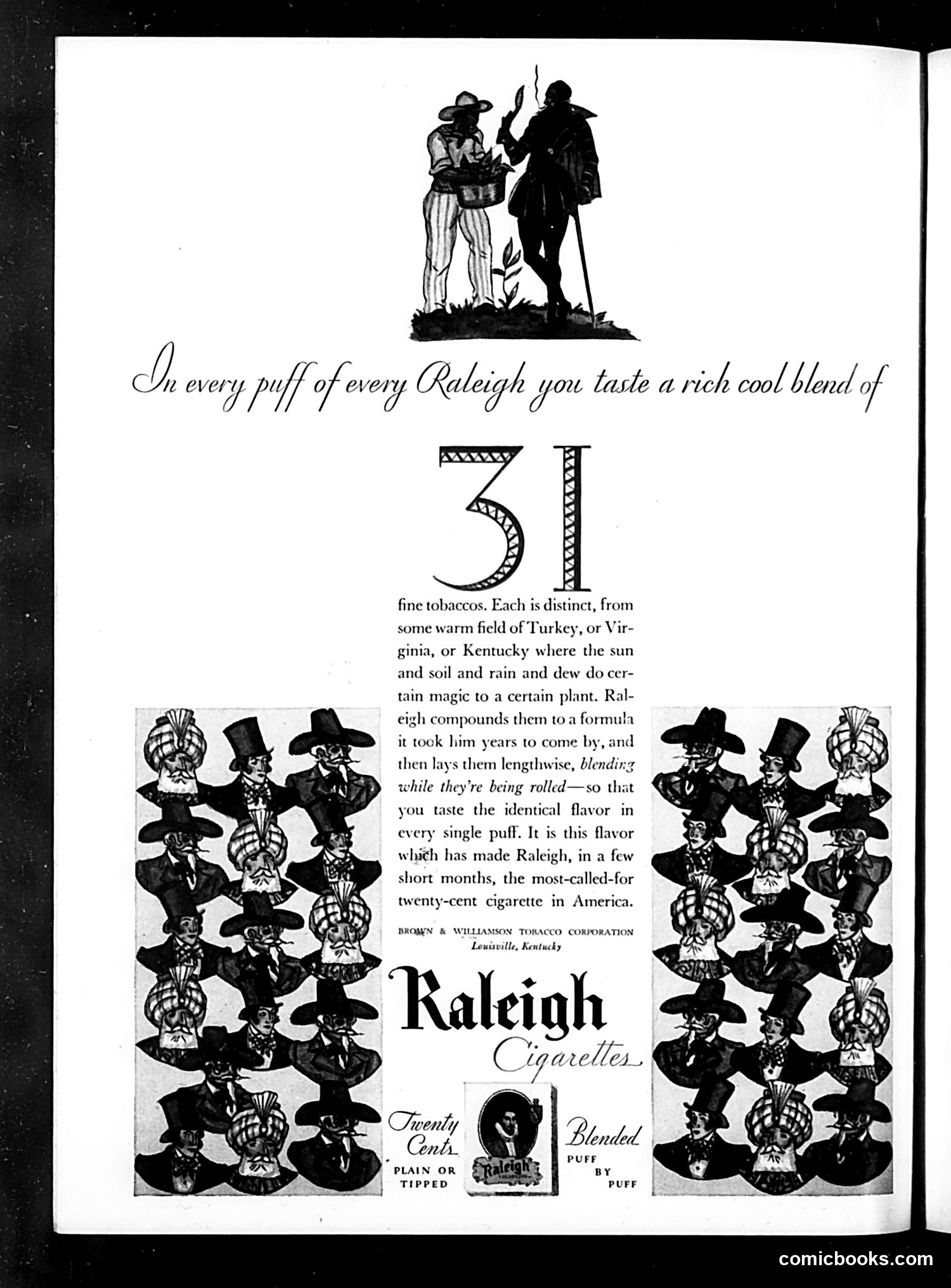
Raleigh Cigarettes Advertisement This is primarily a cigarette advertisement, not political satire. The page promotes Raleigh cigarettes as a "twenty-cent" luxury brand. The imagery features: - A silhouette at top showing a cowboy and a vampire-like figure (likely evoking adventure and exotic mystique) - Repeated illustrations of men in formal attire and top hats surrounding the product, suggesting sophistication and broad appeal The text emphasizes Raleigh's "31 fine tobaccos" blended together, claiming consistent flavor throughout smoking. The advertisement positions the cigarette as newly popular and desirable. For modern readers: This reflects early 20th-century tobacco marketing before health warnings, using imagery of worldliness (Turkey, Virginia, Kentucky) and masculinity to sell cigarettes as an affordable luxury product.
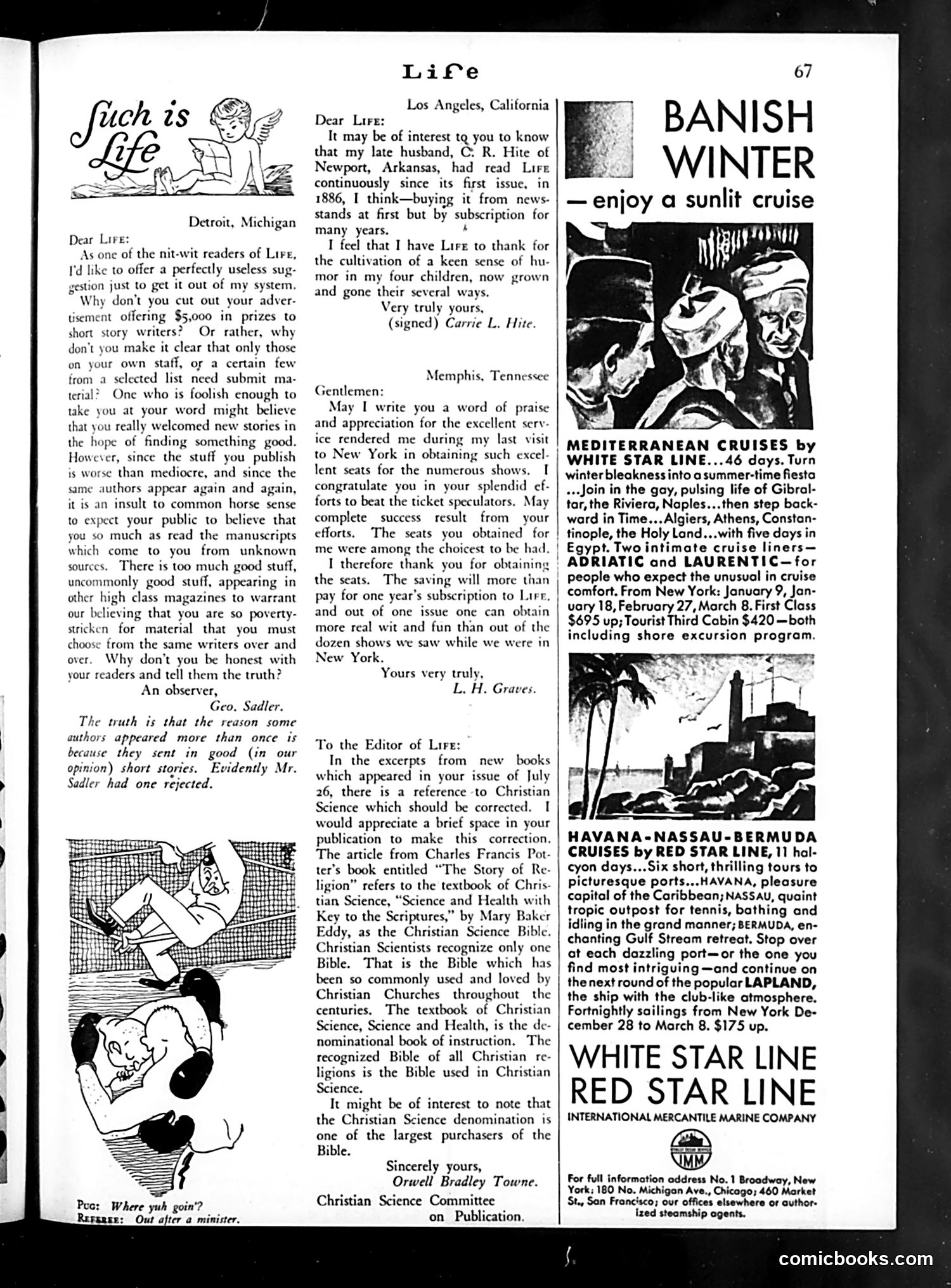
Life Magazine Page Analysis This page consists primarily of reader letters to the editor rather than political cartoons, reflecting Life's satirical commentary through correspondence. The main content includes: 1. A critical letter from Detroit questioning Life's "$5,000 short story contest," accusing the magazine of only accepting submissions from staff or pre-approved writers while claiming to welcome unknown authors. Life's editor dismissively replies the writer likely had a story rejected. 2. A nostalgic letter from Memphis praising Life's humor and thanking the magazine for helping obtain theater tickets in New York. 3. A correction letter from the Christian Science Committee, objecting to a previous article's characterization of their textbook as a "Bible," clarifying that Christian Scientists recognize only the traditional Christian Bible as scripture. The small cartoon at bottom left shows two figures in conversation ("Where yuh goin'? / Out after a minister"), apparently satirizing ministers, though context is unclear. The page primarily functions as advertisements and reader engagement rather than editorial satire.
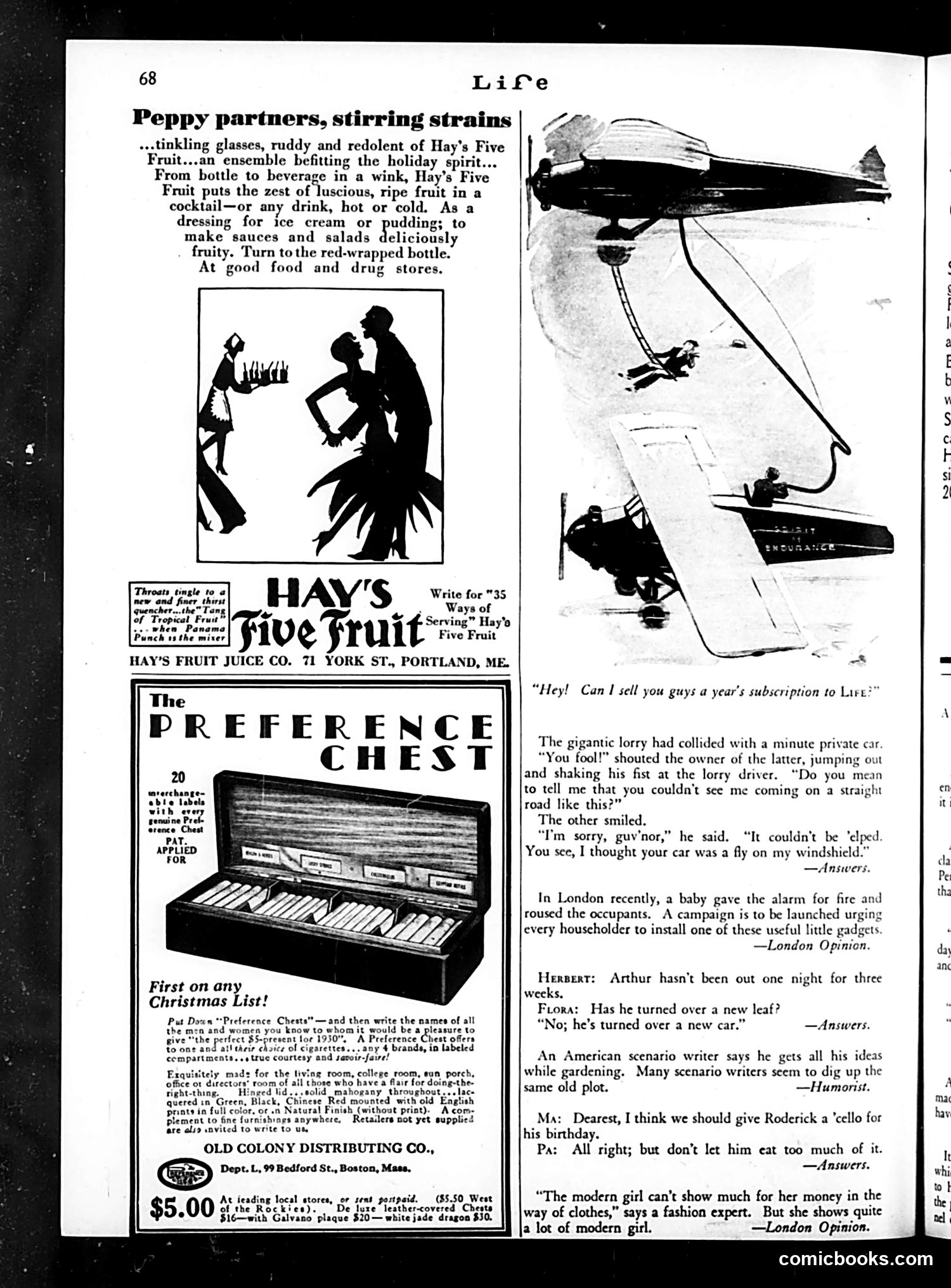
Life Magazine Page 68 Analysis This page consists primarily of advertisements and humorous anecdotes rather than political cartoons. The ads promote Hay's Five Fruit (a cocktail/beverage mixer) and a Preference Chest (a mahogany cigarette dispenser marketed as a luxury Christmas gift for 1930). The humor section contains several brief jokes typical of 1920s-30s Life magazine: - A lorry driver jokes that a tiny car looked like a fly on his windshield - A London fire safety notice about baby alarms - Domestic humor about a man staying home (turning over a new car rather than reforming) - A joke about scenario writers recycling old plots - Parent banter about buying their son a cello as a birthday gift - A quip about modern girls showing more skin than fashion sense These anecdotes reflect contemporary concerns (traffic safety, fire prevention, automobile culture) and social attitudes of the era, particularly regarding gender and materialism, delivered through brief, punchy jokes rather than visual satire.
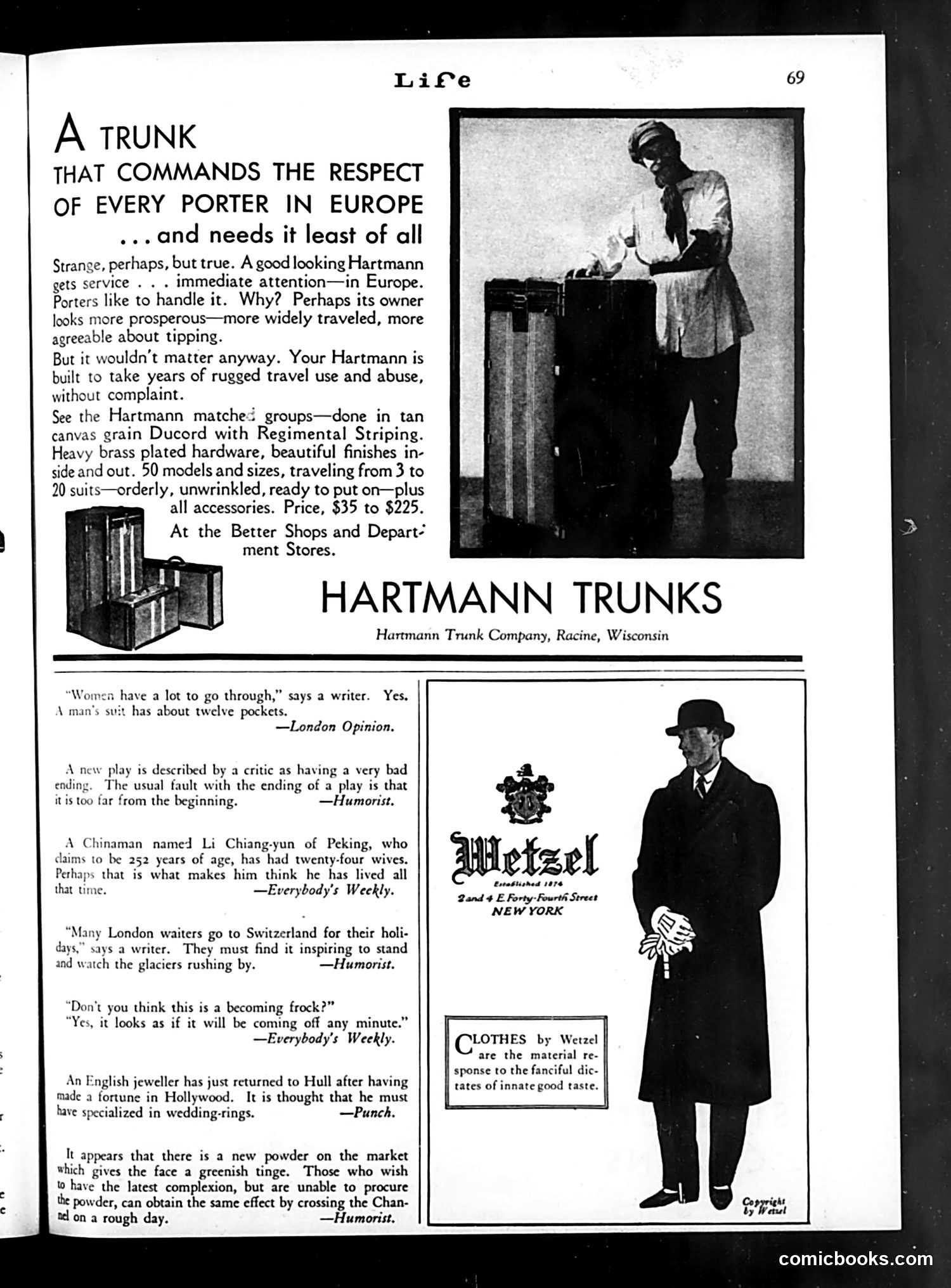
Page Analysis: Life Magazine, Page 69 This page contains a Hartmann Trunks advertisement (top two-thirds) and miscellaneous humor snippets (bottom third). The Advertisement The trunk ad uses satirical flattery: a "good-looking Hartmann" trunk supposedly commands respect from European porters, implying the luggage's appearance makes its owner seem prosperous and generous with tips. The joke is that the trunk *actually* needs this respect least—it's built so durably it can survive rough handling without damage. The ad showcases the product's matched sets, hardware quality, and range of sizes/prices ($35-$225). The Humor Snippets These are brief, sourced quips from various publications (London Opinion, Punch, Humorist, Everybody's Weekly): - A crack about men's suit pockets vs. women's burdens - Jokes about theatrical bad endings, a 252-year-old Chinese man with 24 wives, London waiters in Switzerland - Flirty innuendo about a woman's "becoming frock" coming off - A jeweler's Hollywood success attributed to specializing in wedding rings - A joke about seasickness creating a greenish complexion These represent typical early 20th-century magazine humor—mildly risqué, class-conscious, and internationally focused.
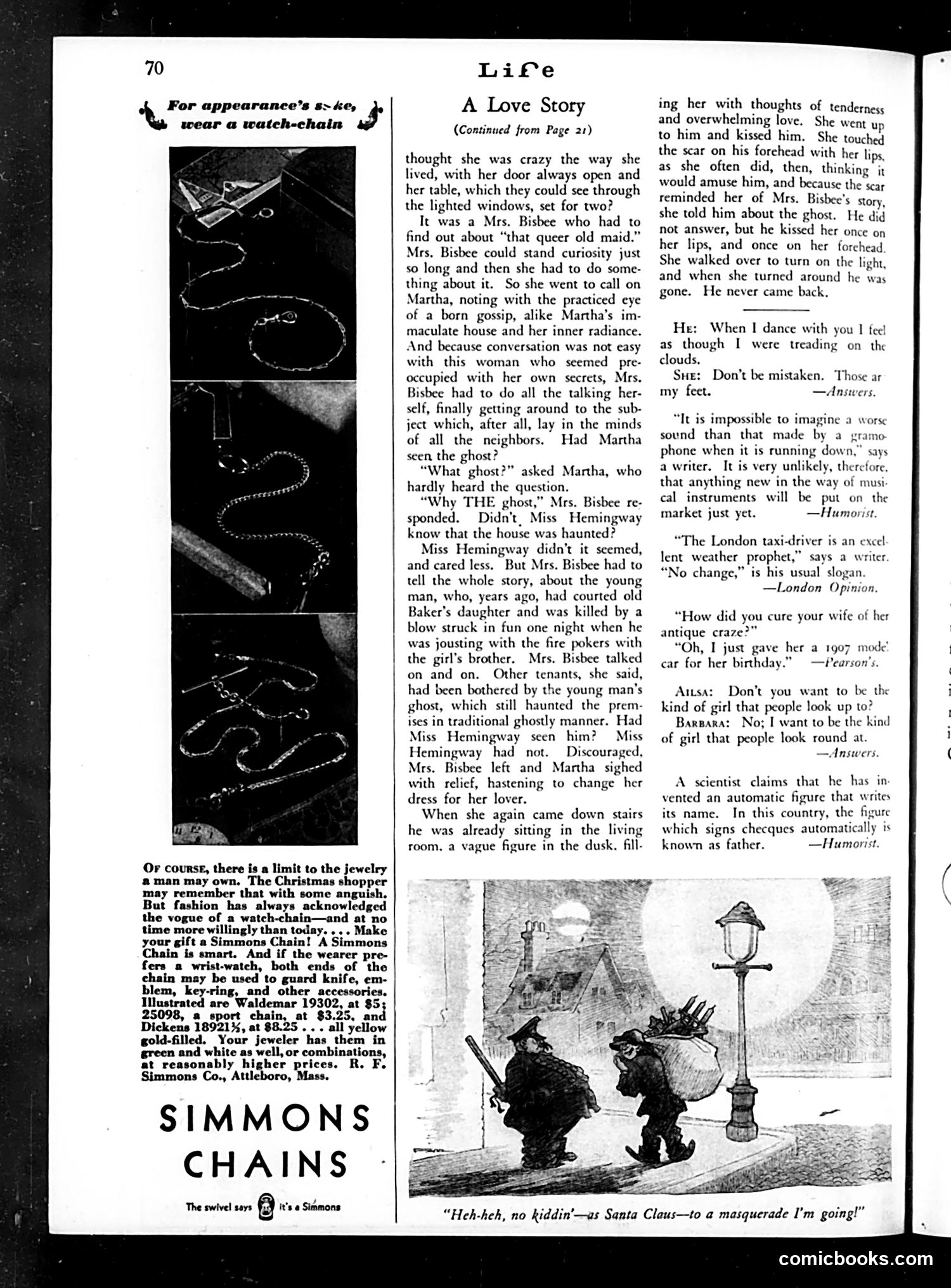
Analysis for Modern Readers This page contains two distinct elements: The Advertisement (Left): A Simmons Chains jewelry ad promoting watch chains as fashionable accessories. The text emphasizes that watch chains are socially prestigious and practical for securing multiple items (knives, emblems, key-rings). This reflects early 20th-century men's fashion conventions—watch chains were status symbols worn visibly across the vest. The Story & Humor Section (Right): A serialized romantic story concludes with a supernatural twist: Martha's lover appears to be the ghost from Mrs. Bisbee's gossip—a young man killed years ago. When Martha turns on the light, he vanishes, implying he was a specter all along. Below are brief humorous quotes mocking gramophones, London taxi drivers' weather predictions, and wives' antique-collecting habits—typical period humor about domestic quirks and modern technology's annoyances. The overall page reflects Life magazine's mix of advertising, serialized fiction, and light satirical commentary on contemporary social behavior and technology.
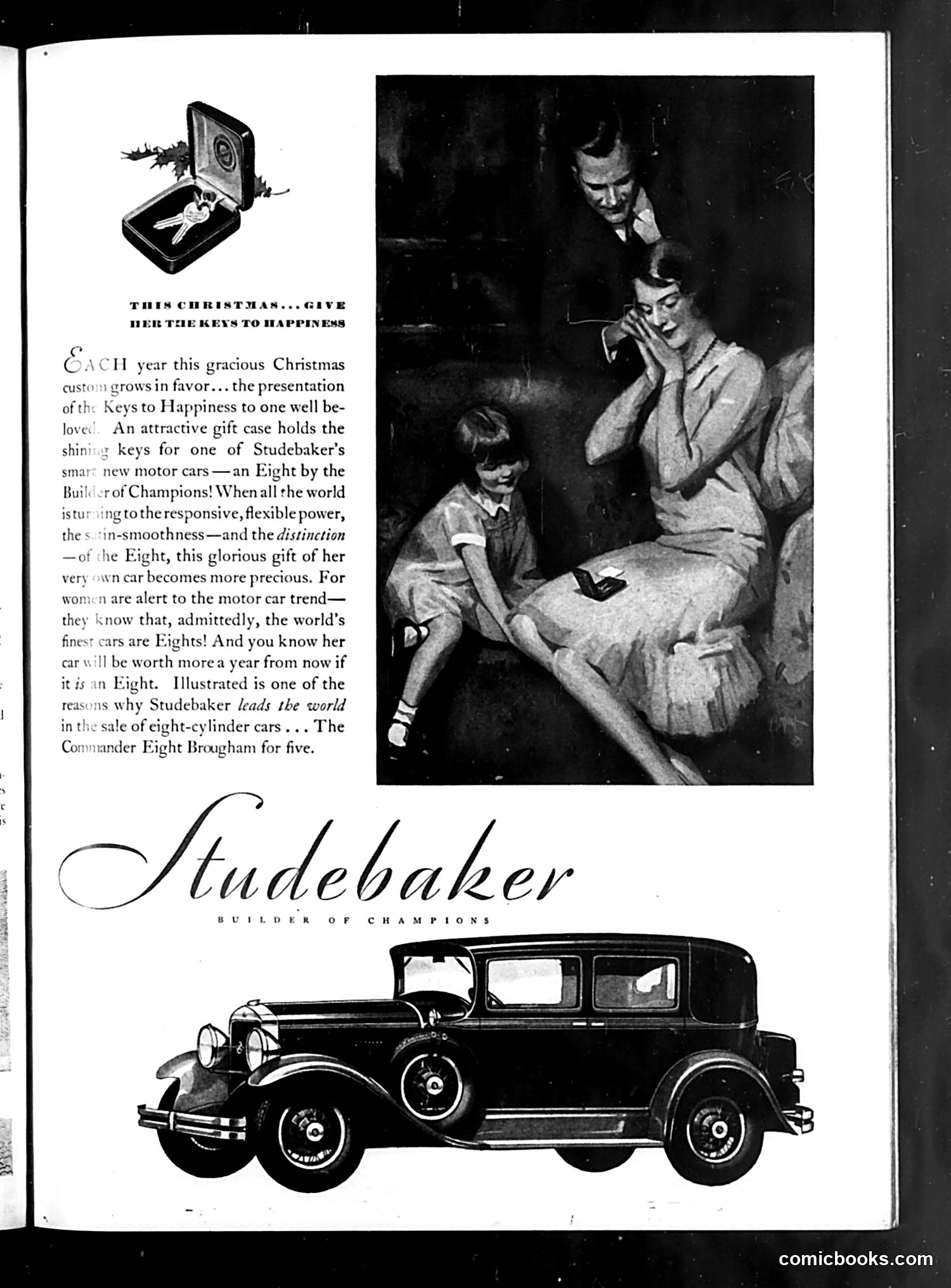
Studebaker Advertisement (circa 1920s-1930s) This is not satire or political commentary—it's a straightforward automobile advertisement masquerading as editorial content, a common practice in early Life magazine. The ad promotes Studebaker's "Eight" (eight-cylinder engine) as a Christmas gift. A photograph shows a well-dressed woman and children admiring car keys presented in an attractive case—the "Keys to Happiness." The copy appeals to women as consumers, asserting they understand automotive trends and recognizing that "the world's finest cars are Eights." It argues that gifting a Studebaker Eight will increase in value over time, making it a sound investment. The tagline "Builder of Champions" emphasizes Studebaker's reputation. The specific model shown is the Commander Eight Brougham. This reflects early automotive marketing targeting affluent households, positioning the car as both a luxury good and a family asset.
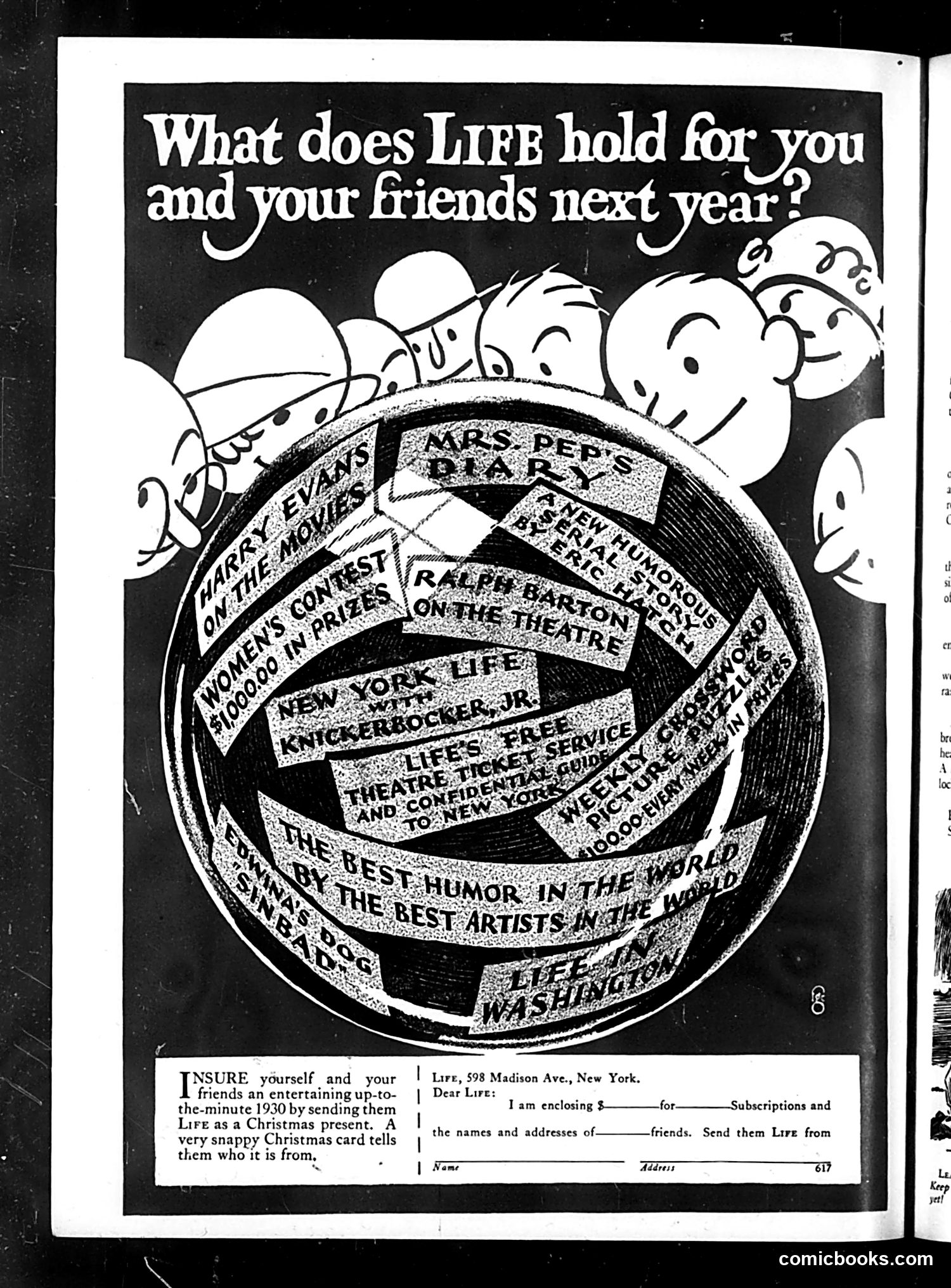
Analysis of Life Magazine Advertisement (circa 1930) This is a subscription advertisement for *Life* magazine, not a political cartoon. The central image shows a large globe or sphere wrapped in ribbon strips, each listing entertainment offerings: theater tickets, Knickerbockers Jr., best artists, humor, and other cultural attractions. The cartoon figures above (appearing to be simplified human heads) peek over the globe, suggesting youthful anticipation. The ad's pitch is straightforward: give *Life* magazine subscriptions as Christmas gifts to entertain friends throughout 1930 with "up-to-the-minute" content and cultural access. The text includes a mail-in coupon for purchasing subscriptions. This reflects 1930s consumer culture—when magazine subscriptions were common, aspirational gifts meant to signal sophistication and access to entertainment during the Great Depression era.
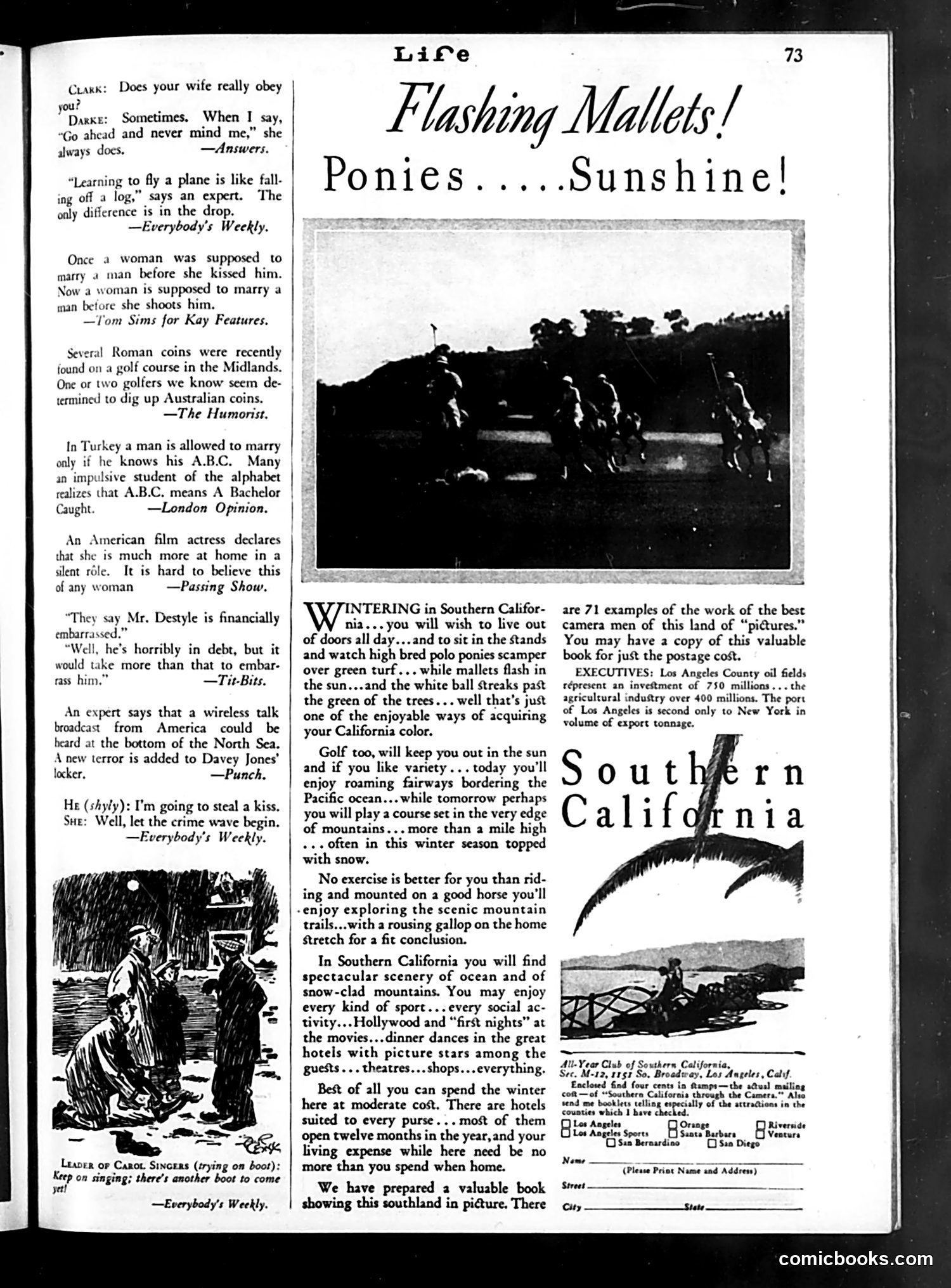
Analysis of Life Magazine Page 73 This page is primarily advertising content for Southern California tourism, alongside a collection of brief satirical one-liners typical of Life magazine's humor section. The cartoons and jokes mock contemporary social conventions: marital obedience, aviation dangers, changing courtship norms (women now "shoot" men rather than kiss before marriage), and gender stereotypes in cinema. One recurring theme critiques women's autonomy—an actress claims competence in silent roles (implying women are better silent), yet the joke suggests this is implausible. The main feature is a Southern California travel advertisement emphasizing outdoor leisure: polo, golf, horseback riding, and winter activities in scenic mountain and ocean settings. It highlights the region's economic importance (oil fields, agriculture, shipping) and promises affordable winter vacations with celebrity encounters and entertainment. A small illustration shows polo players—the "flashing mallets" referenced in the headline—representing the aspirational lifestyle being marketed to readers. The page reflects 1920s attitudes toward gender, leisure, and regional promotion.
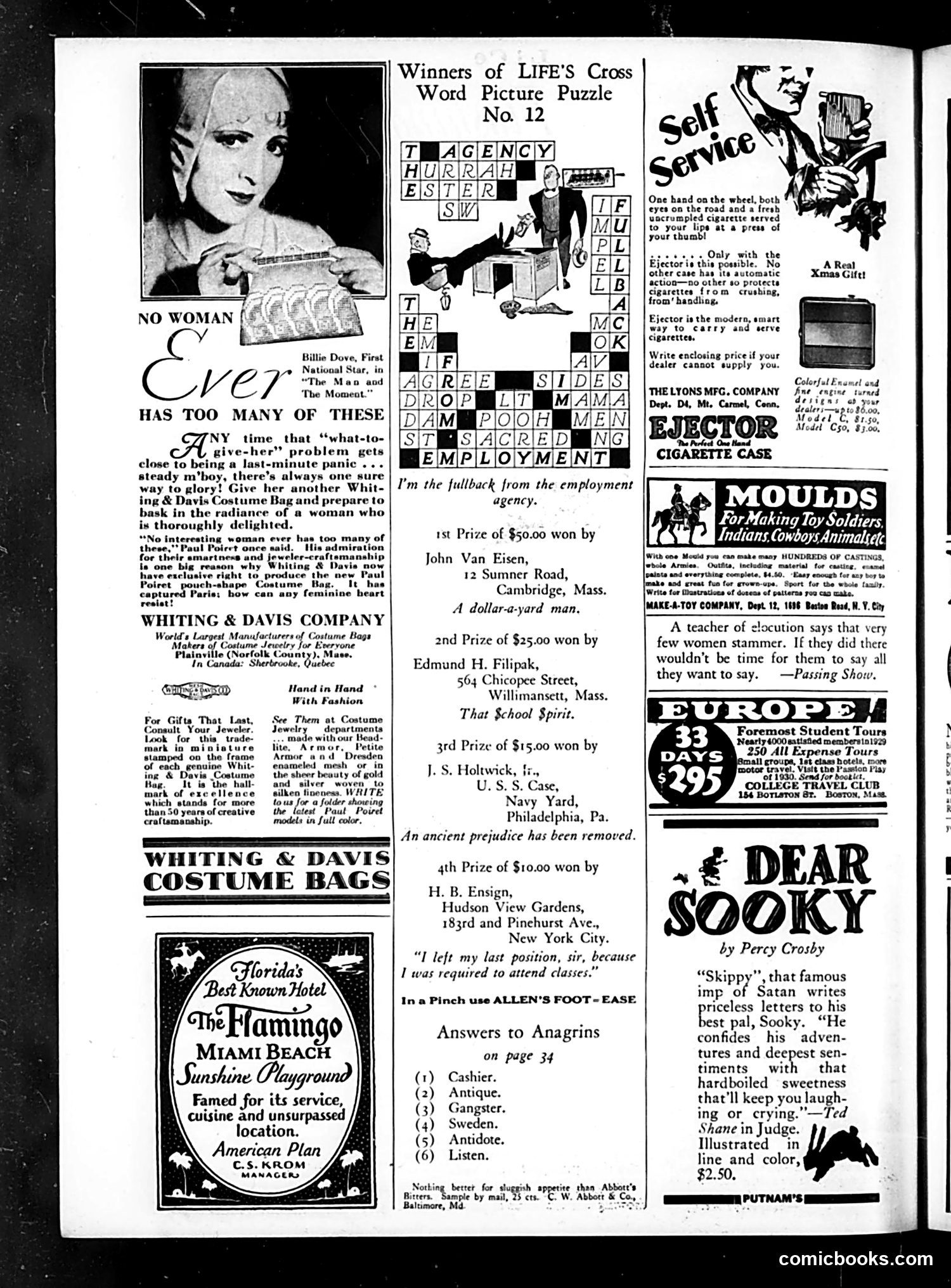
Analysis for Modern Readers This page is primarily advertising and puzzle content from Life magazine, with limited satirical editorial material. The main cartoon (top center) shows a "fullback from the employment agency"—a visual pun depicting a large football player representing job placement services. The joke plays on "fullback" (football position) and the agency's role in "backing" employment searches. Notable advertisements include: - Whiting & Davis Costume Bags: luxury gift items for women, featuring designer Paul Poiret references - Ejector Cigarette Case: emphasizes automatic cigarette dispensing as modern convenience - Dear Sooky comic strip promotion The puzzle winners solved a crossword featuring Billie Dove, a silent film actress, alongside employment-related clues. Social context: The ads reflect 1920s consumer culture targeting middle/upper-class gift-giving (especially "what to give her"), while employment agency humor likely references post-WWI job market volatility. The emphasis on "modern" automatic devices reflects era optimism about technology.
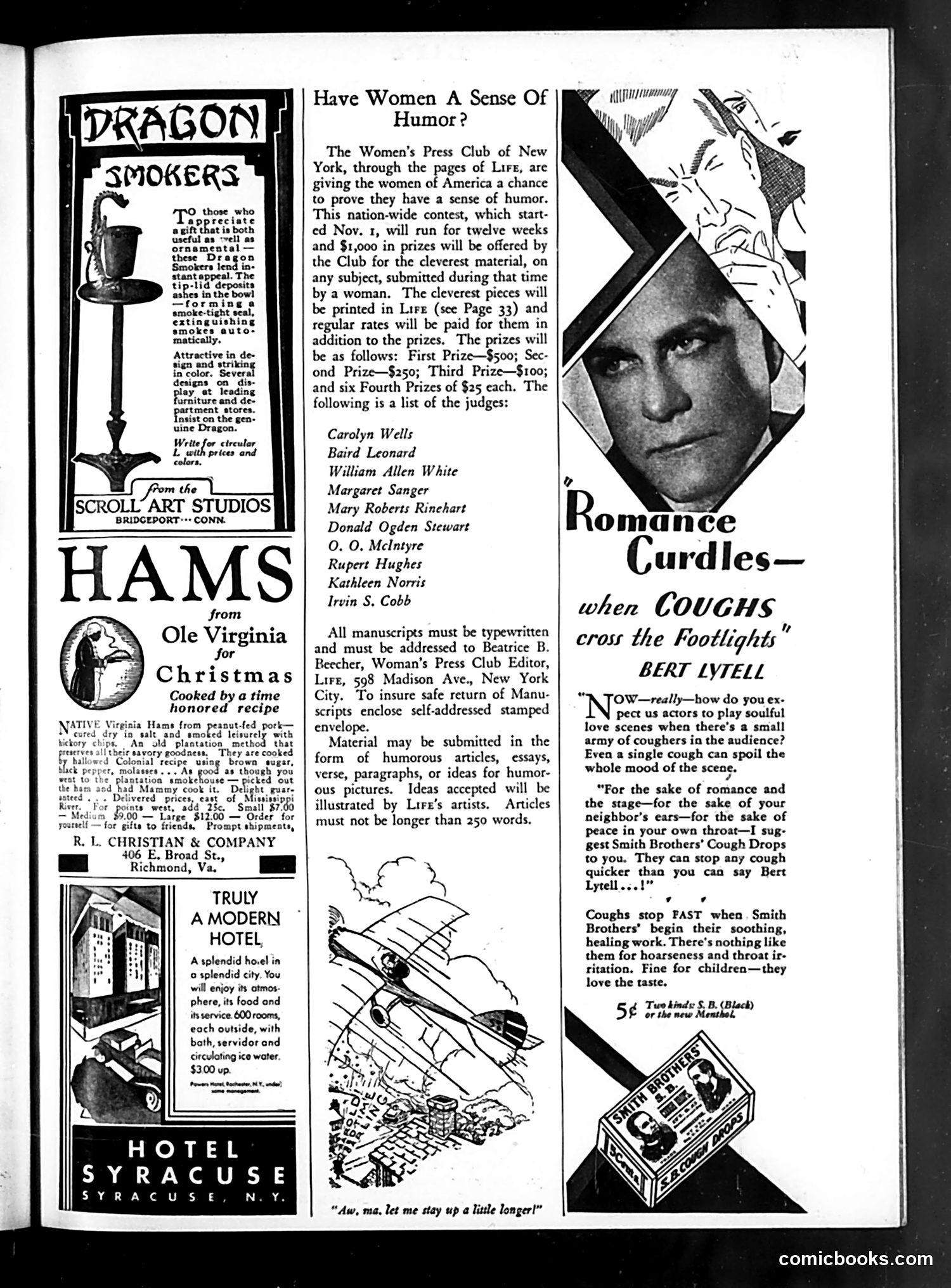
Analysis This page combines advertisements with content about a women's humor contest sponsored by Life magazine and the Women's Press Club of New York. The main article announces a 12-week national competition (starting Nov. 1) offering $1,000 in prizes for the cleverest humorous material submitted by women. The judges listed are prominent literary figures of the era: writers like Carolyn Wells, William Allen White, and Mary Roberts Rinehart. This reflects the magazine's implicit question in the headline: "Have Women A Sense Of Humor?"—a contemporary social debate about whether women possessed comedic ability. The surrounding advertisements (Dragon smokers, Virginia ham, a Syracuse hotel, cough drops) are period-typical commercial content. The cough drop ad notably features actor Bert Lytell complaining that audience coughs ruin romantic theater scenes—a mundane consumer pitch unrelated to the contest content. The page reflects 1920s attitudes questioning women's intellectual capabilities, while simultaneously platforming prominent female writers and inviting women to prove their wit publicly.
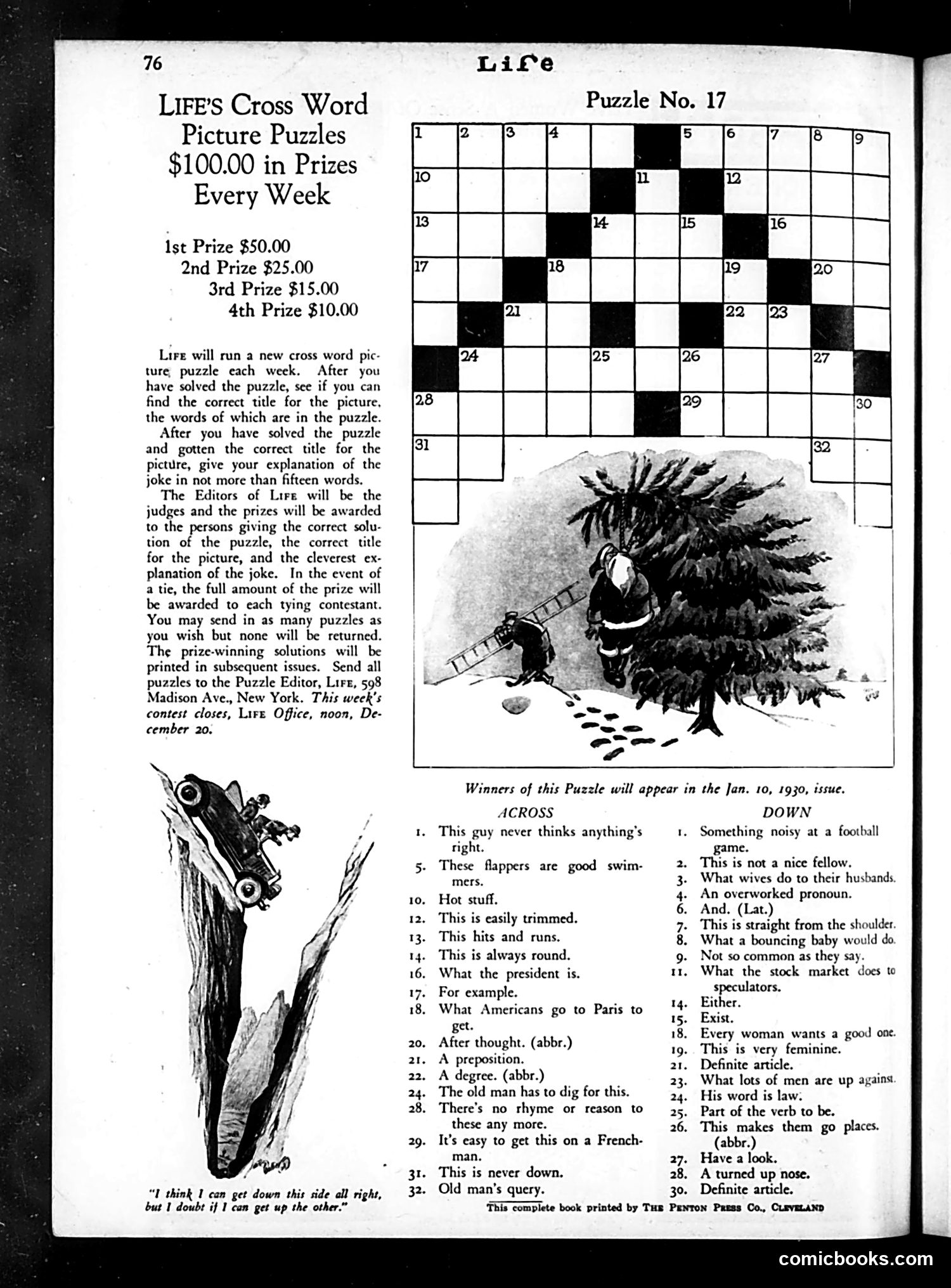
Life Magazine Crossword Puzzle Page This page presents Life magazine's weekly crossword picture puzzle contest with $100 in prizes. The central image shows a cartoon of a man on a ladder against a tree, with the caption "I think I can get down this side all right, but I doubt if I can get up the other." The humor appears to reference a common predicament—the difficulty of climbing down versus up, or more broadly, getting oneself into situations easier than getting out of them. This likely resonates with 1920s-30s audiences as commentary on poor decision-making or being trapped by one's own choices. The puzzle itself is a hybrid crossword-picture game where solvers must: solve the crossword clues, identify the cartoon's correct title (using words from the puzzle solution), and explain the joke in fifteen words or fewer. Winners receive prize money, with solutions published in the January 10, 1930 issue. This was typical of Life's interactive entertainment during the Depression era.
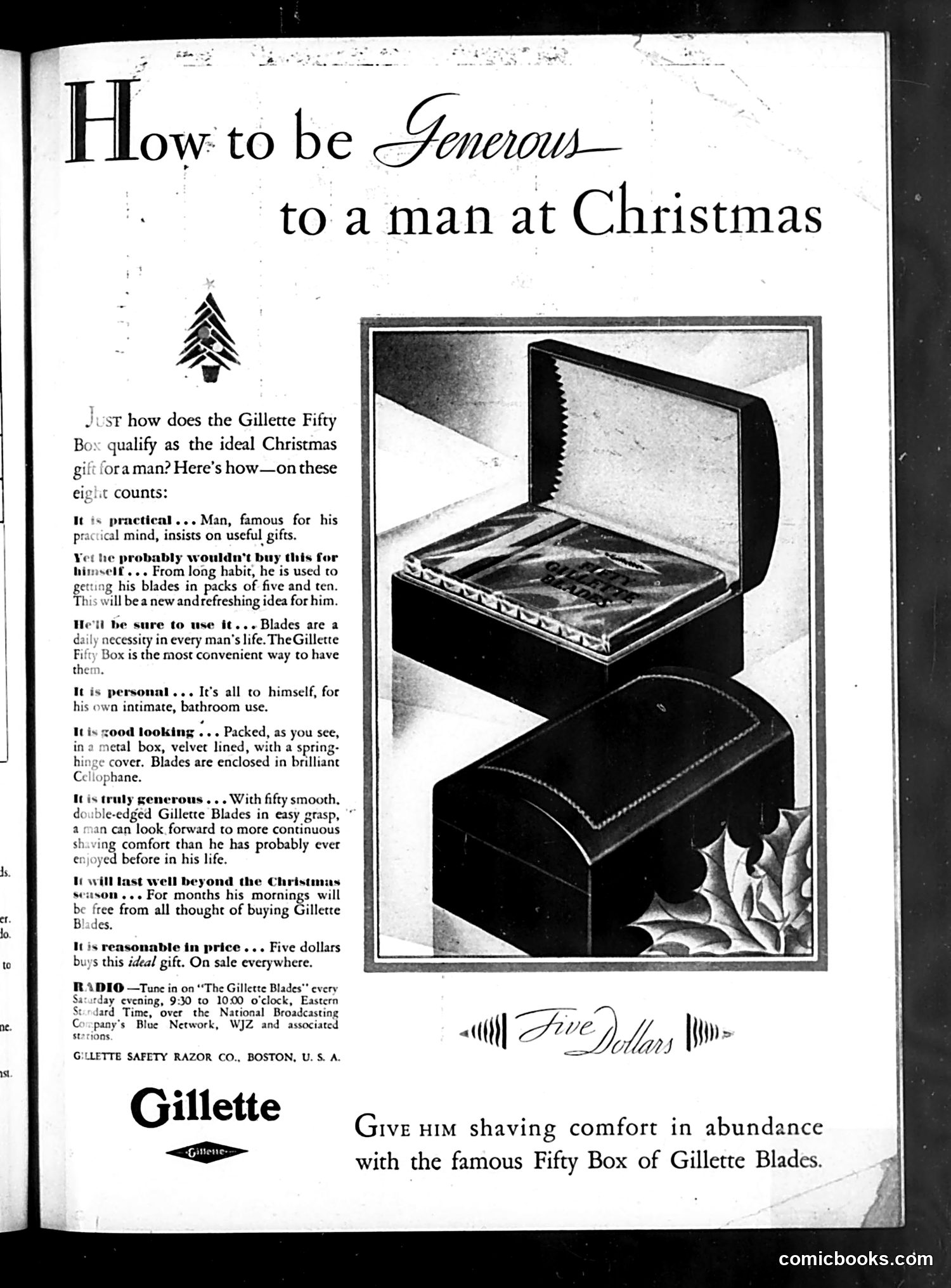
Analysis This is a Gillette razor blade advertisement, not political satire. The page promotes the "Gillette Fifty Box" as an ideal Christmas gift for men. The ad uses a clever rhetorical strategy: it frames the product as meeting eight criteria for "generosity" to a man at Christmas. The points argue that while men won't buy this for themselves (due to habit), they'll appreciate receiving it because: - It's practical and useful - It provides months of daily convenience - It's personal/intimate - The packaging is attractive - It offers shaving comfort superior to what men typically experience - The $5 price point seems reasonable The image shows the velvet-lined metal box containing fifty razor blades—positioned as an upscale, gift-worthy presentation of an everyday necessity. This reflects early-20th-century advertising strategy: convincing gift-givers that mundane products can be "generous" gifts when properly packaged and marketed. The satire here, if any, is subtle—gently poking at male consumer habits and gift-giving conventions—but primarily this is straightforward product advertising disguised as consumer advice.
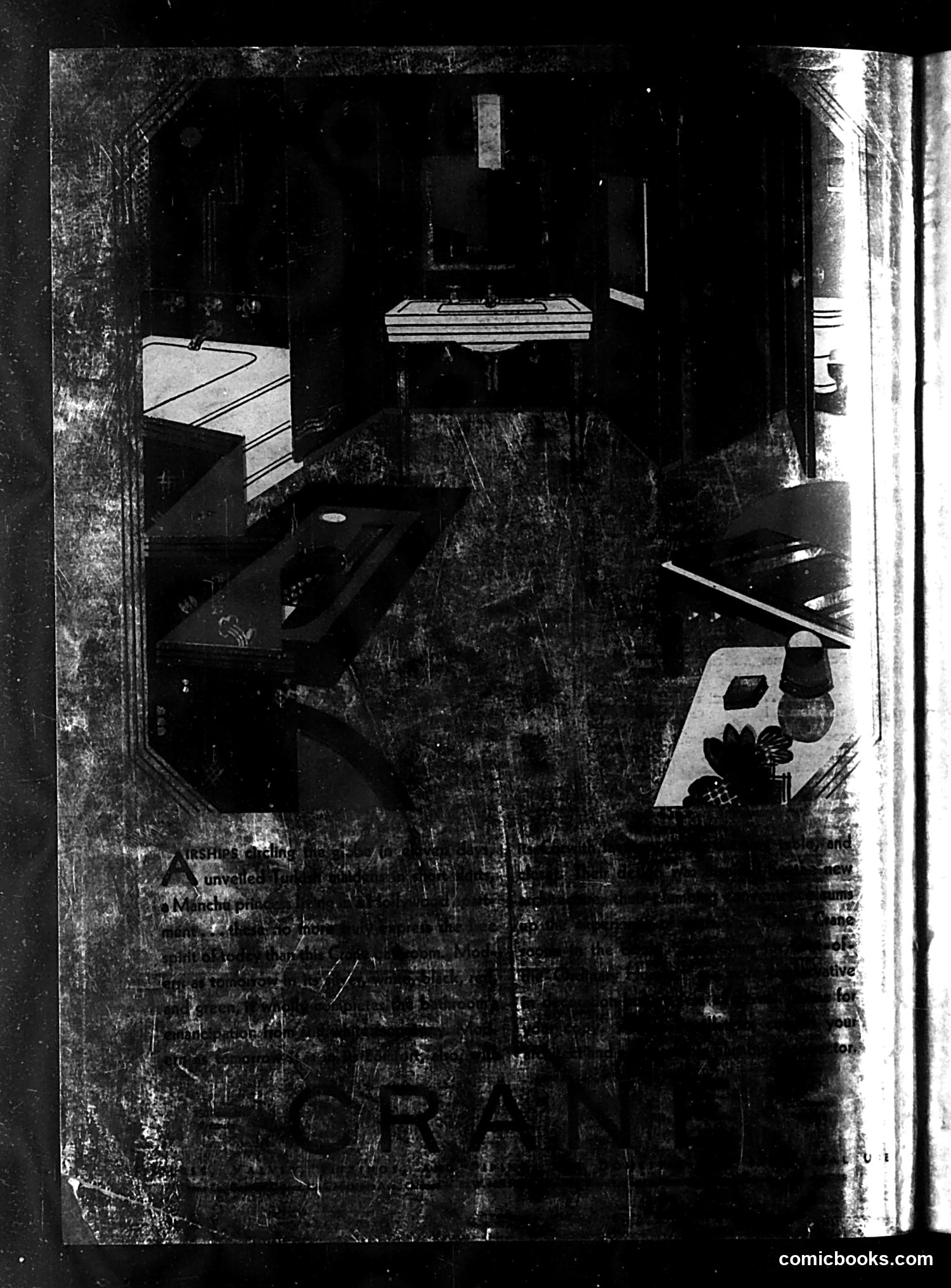
I can see this is a black and white photograph of what appears to be a bathroom interior, taken from above at an angle. The image shows a sink on the left, a toilet in the center-back, and what looks like a bathtub or fixture on the right. There's a window on the right side letting in bright light. However, I cannot reliably read the OCR'd text on the page due to image quality and distortion. Without being able to clearly see any cartoon illustrations, caricatures, or legible text, I cannot identify specific political or social references, figures being satirized, or the satirical point being made. The page appears degraded and the text is largely illegible in this reproduction. I'd need a clearer version to provide accurate historical analysis.