life
Life — December 13, 1929
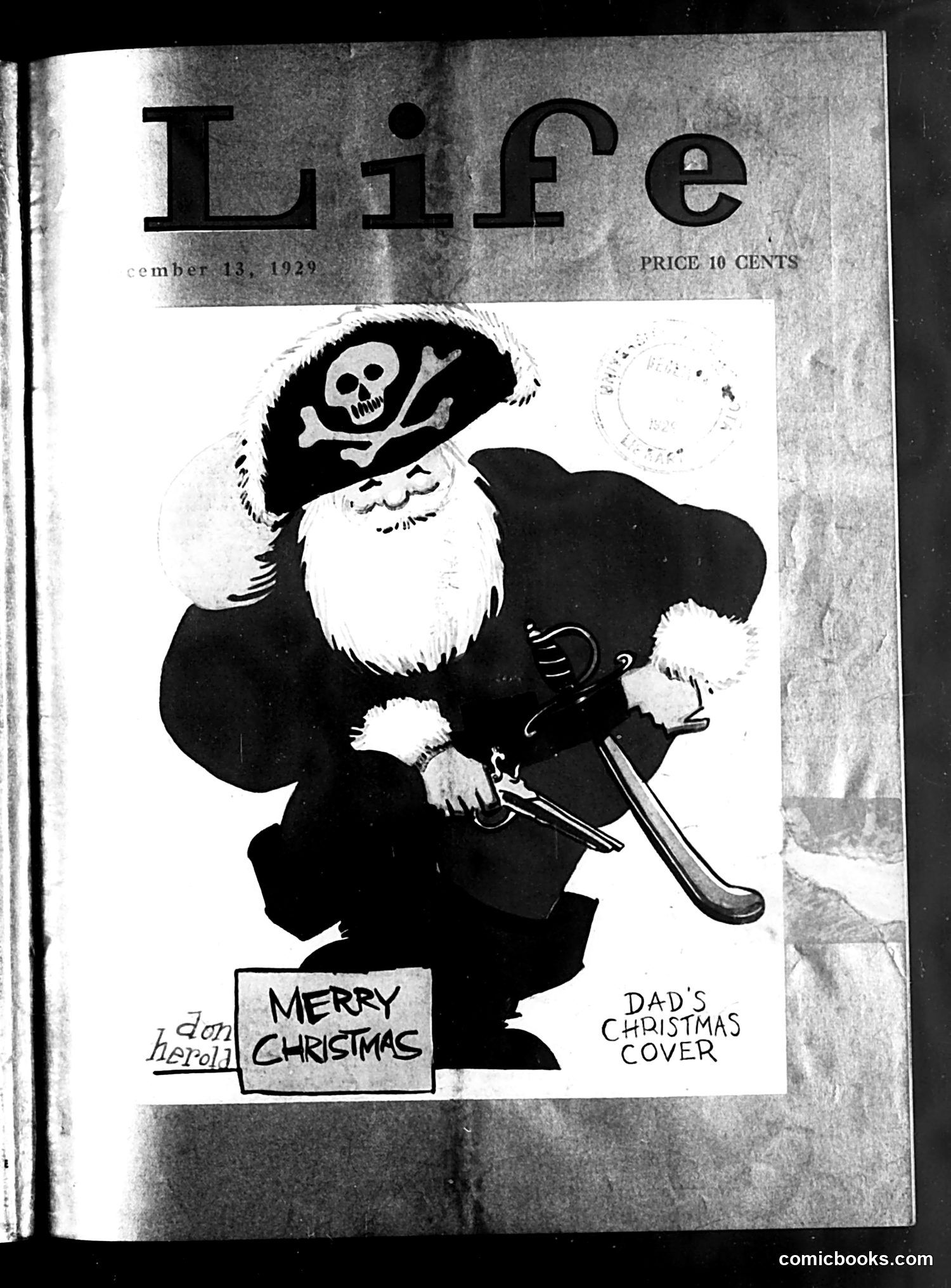
Life Magazine Cover Analysis (December 13, 1929) This is a Christmas cover featuring a pirate character with a skull-and-crossbones hat, holding a gun and knife. The figure has a large white beard and wears dark clothing trimmed with white fur—evoking both a pirate and a corrupted Santa Claus. The caption reads "Dad's Christmas Cover" and "Merry Christmas," suggesting satirical commentary on American fathers or male authority figures. Given the publication date (December 1929), this appears to reference the recent stock market crash and economic devastation of the Great Depression's onset. The pirate imagery likely satirizes wealthy businessmen or "robber barons" who plundered the economy, presenting them as villainous rather than jolly holiday figures.
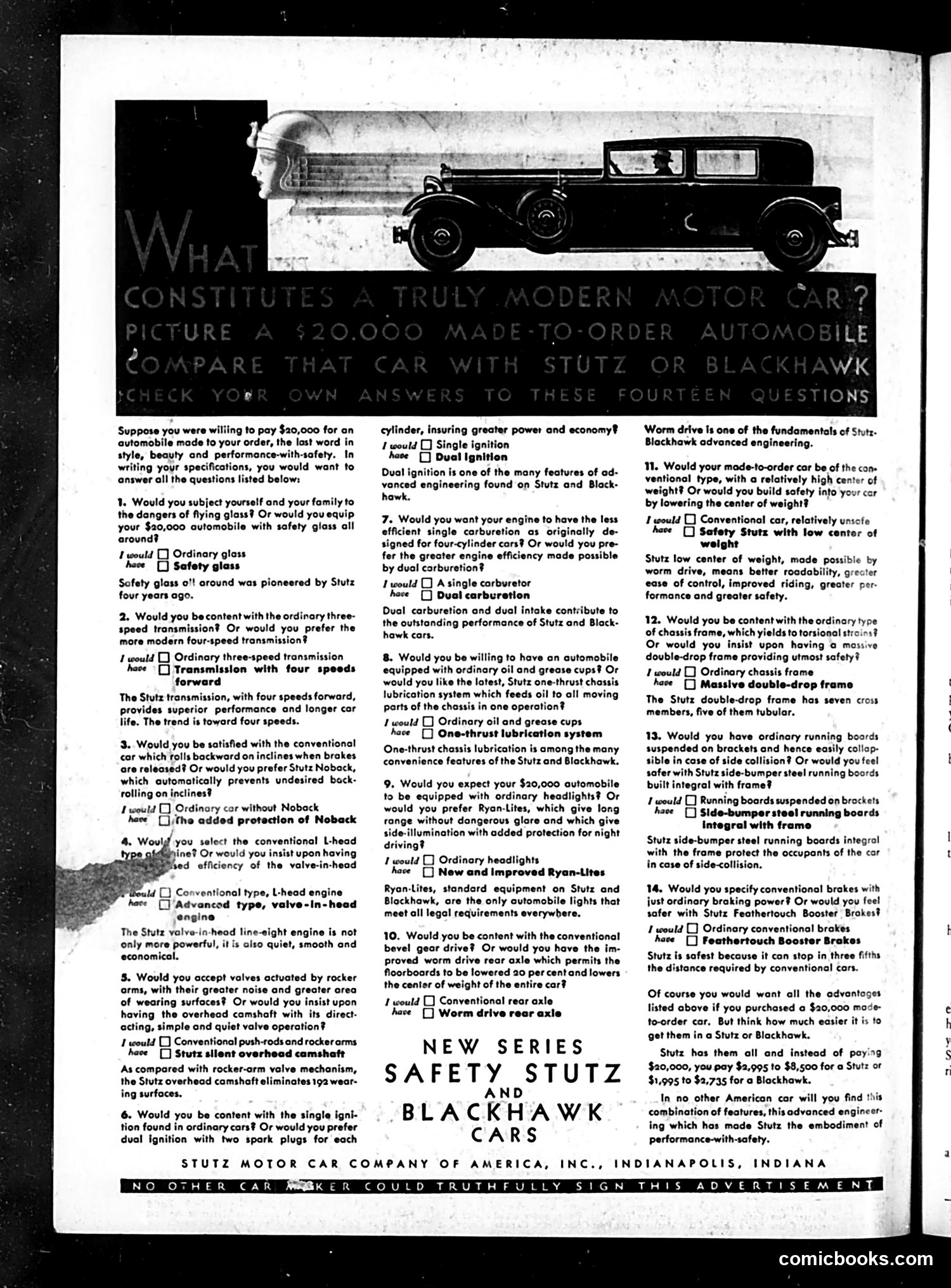
Analysis This page is primarily advertising, not satire or political commentary. It's a Stutz Motor Car Company advertisement for their "Safety Stutz" and "Blackhawk" automobile lines. The ad uses a rhetorical device—14 leading questions—to persuade readers that these cars embody modern engineering superiority. Questions address safety features (safety glass, bumpers, braking systems) and performance innovations (worm drive, valve-in-head engines, lubrication systems). The illustration shows a sleek 1920s automobile in profile alongside a profile of a man's head, visually linking the car's modern design to contemporary ideals of efficiency and progress. The tagline emphasizes exclusivity: "No other car maker could truthfully sign this advertisement," suggesting competitors cannot match these safety and performance claims.
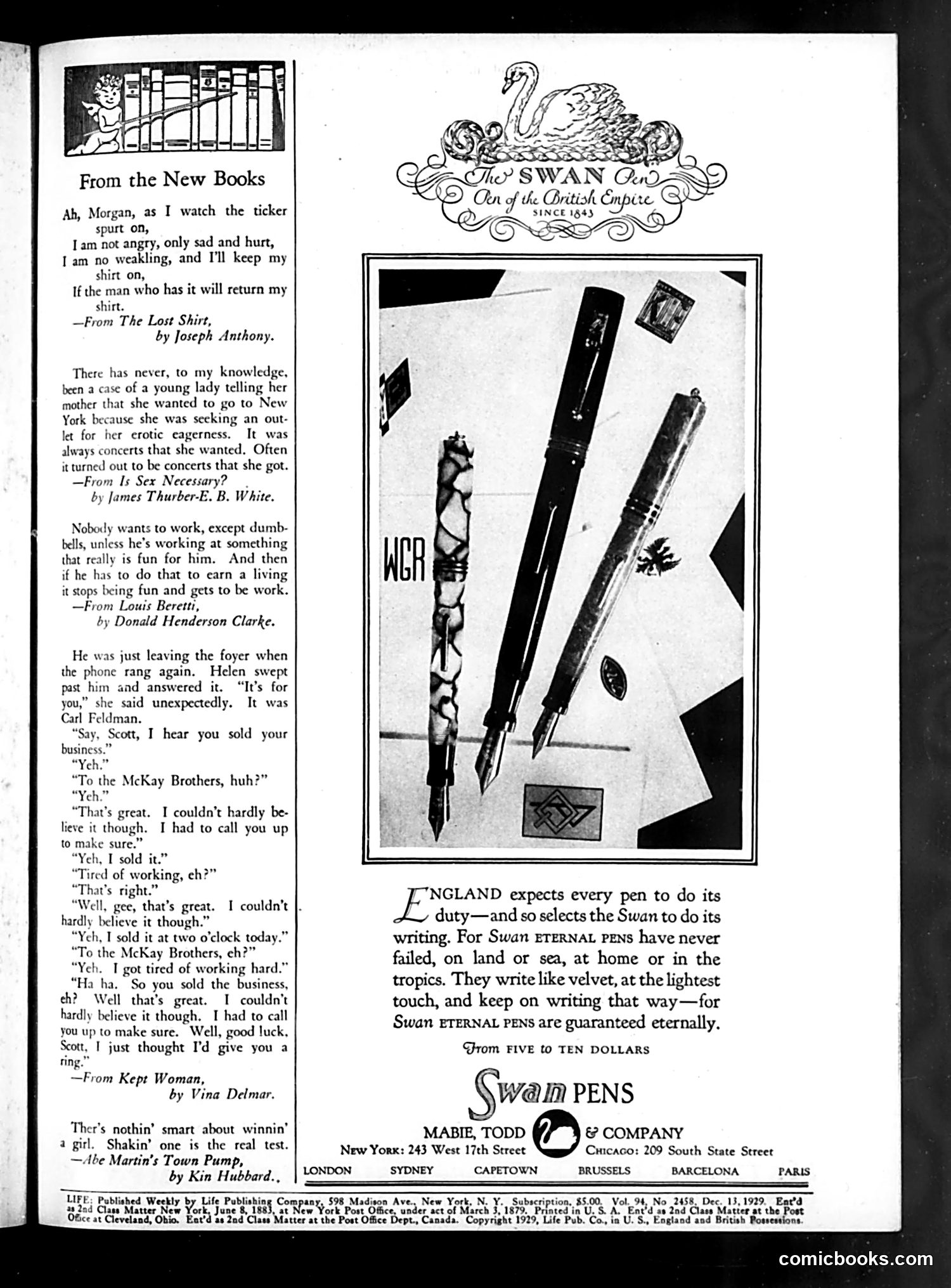
Analysis This page is primarily advertising, not political satire. The left column contains literary excerpts under "From the New Books"—quotes from contemporary novels by Joseph Anthony, James Thurber, Donald Henderson Clarke, and others. These are brief, anecdotal passages meant to entice readers to purchase the books. The right side features a Swan Pens advertisement. The image shows writing instruments and an inked drawing, with text emphasizing Swan pens' reliability "on land or sea, at home or in the tropics." The ad targets British imperial pride ("England expects every pen to do its duty"). There is no political cartoon here. This is a typical Life magazine page blending literary promotion with commercial advertising, common in early-20th-century American magazines.
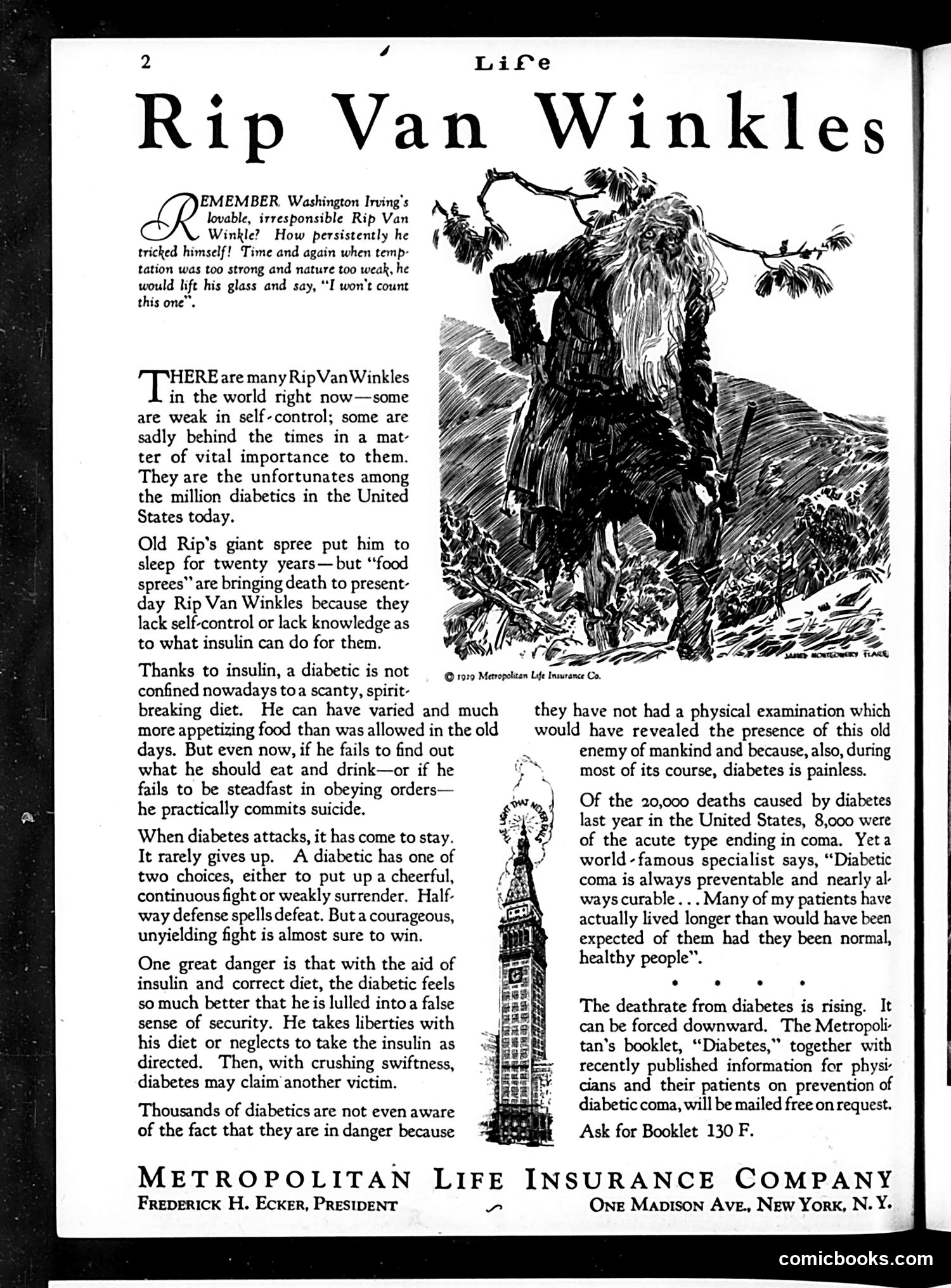
"Rip Van Winkles" - Diabetes Awareness This is primarily an advertisement for Metropolitan Life Insurance Company's diabetes information booklet, disguised as editorial content. The page references Washington Irving's "Rip Van Winkle"—a man who slept for 20 years and awoke unchanged. The metaphor compares diabetics who ignore their condition to Rip Van Winkle: they dangerously delay treatment, pretending the disease doesn't exist. The text warns that insulin had recently become available (context suggests early 1920s), offering new hope. However, many diabetics remain unaware they have the disease or neglect insulin treatment, effectively committing "suicide" through non-compliance. The illustration depicts an aged, weathered figure—representing the passage of time and deterioration caused by untreated diabetes. This was public health messaging: highlighting insulin's life-saving potential while shaming patient negligence and ignorance about the disease.
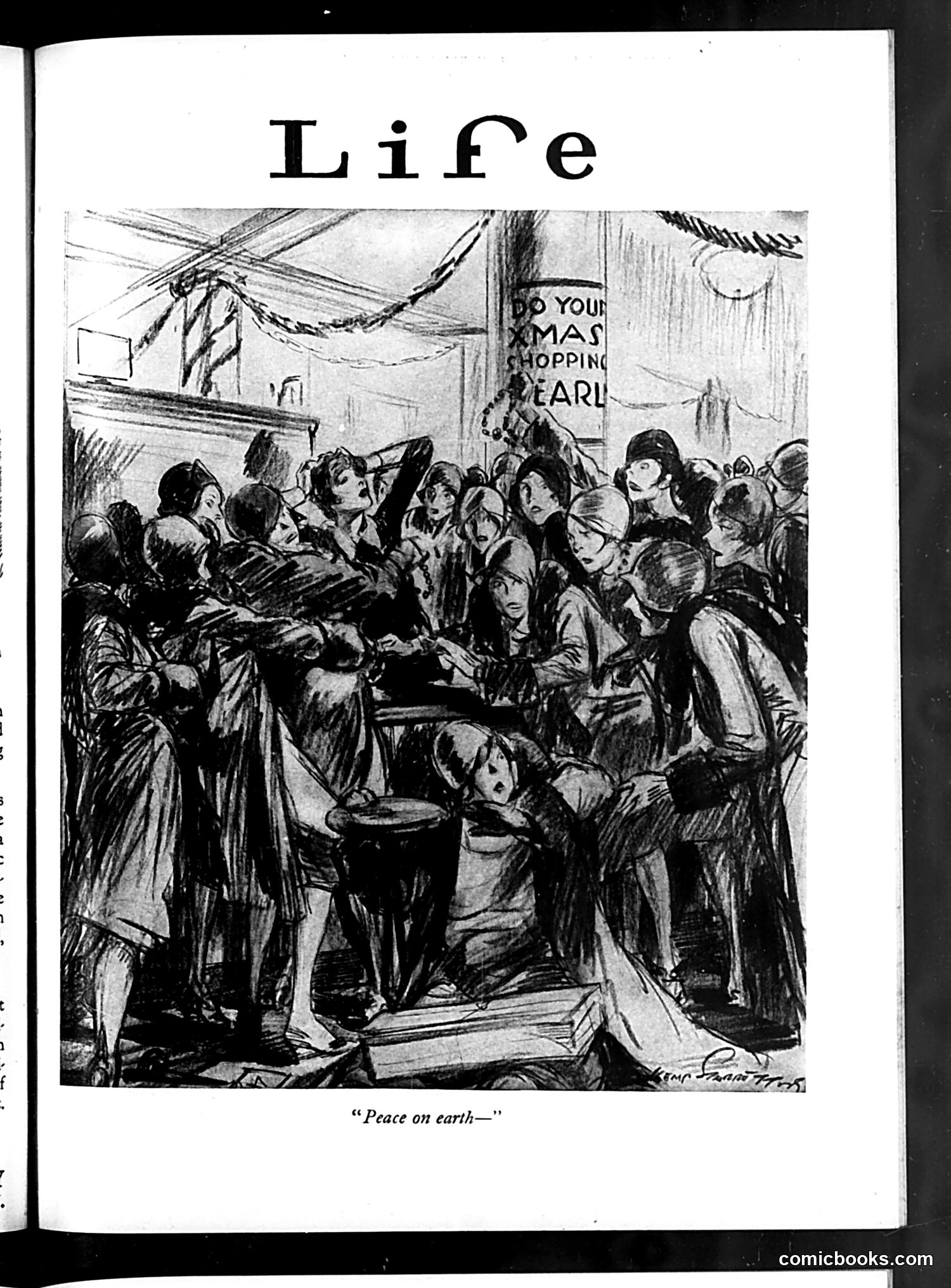
Analysis of "Peace on earth—" This Life magazine page shows a Christmas-themed political cartoon depicting poor, hungry people gathered around what appears to be a soup pot or meager food source during winter hardship. The phrase "Peace on earth—" sarcastically references the Christian Christmas greeting while the image documents urban poverty and deprivation. The cartoon appears critical of economic inequality, likely created during the Depression era or a period of significant social hardship. A partial sign visible reads "XMAS SHOPPING" and "PEARL," suggesting a commercial district contrasting sharply with the destitute figures shown. The satire juxtaposes the holiday's spiritual message of peace with the grim reality of citizens struggling to survive, critiquing the gap between Christmas ideals and actual living conditions for America's poorest residents.
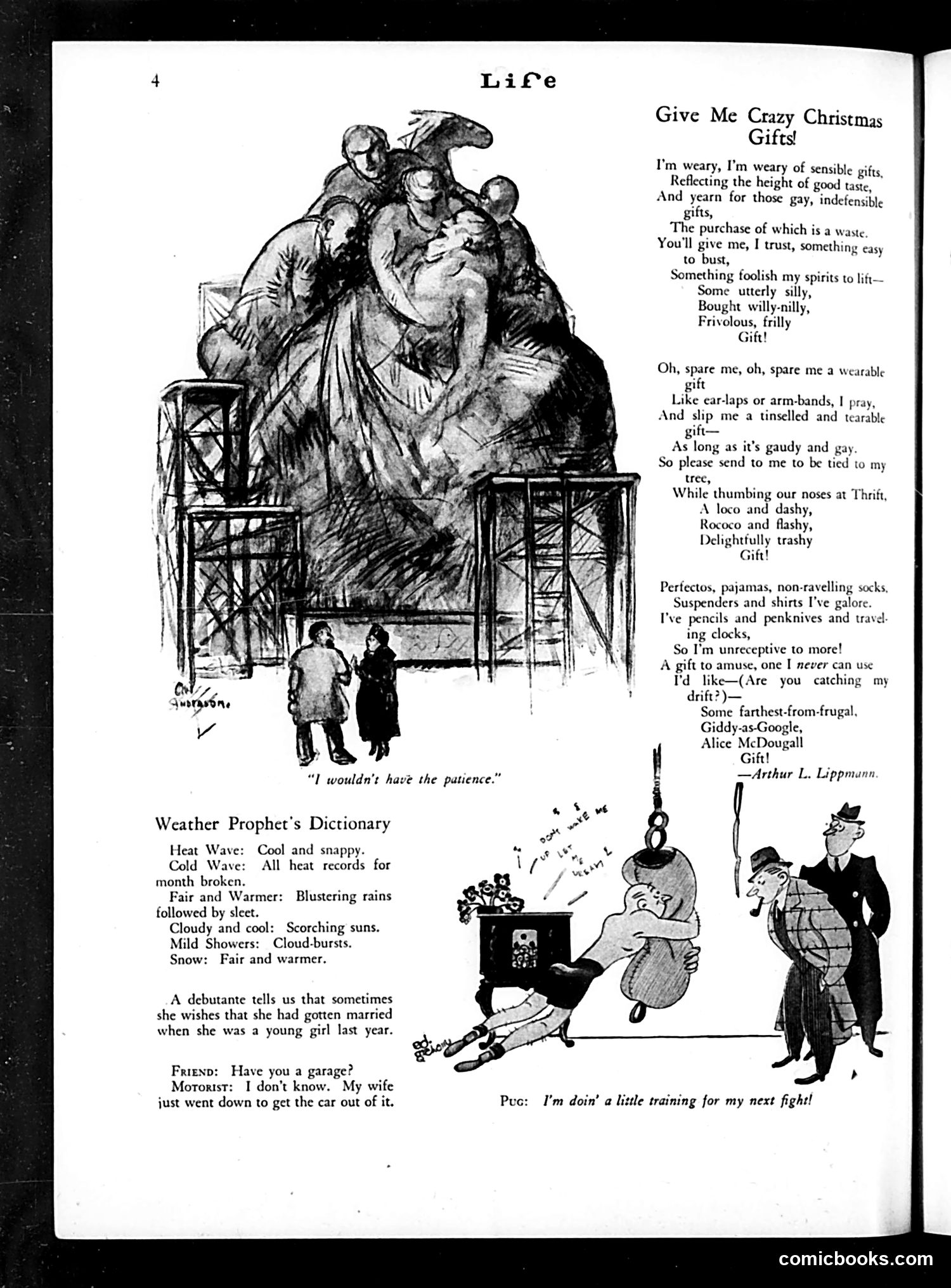
Analysis of Life Magazine Page This page contains three distinct pieces of early 20th-century satire: "Give Me Crazy Christmas Gifts" (poem by Arthur L. Lippmann): A humorous complaint rejecting practical gifts (suspenders, socks, pajamas) in favor of absurd, frivolous ones—poking fun at both excessive consumerism and gift-giving conventions. "Weather Prophet's Dictionary": A satirical glossary inverting actual weather predictions (e.g., "Heat Wave" means "cool and snappy"), mocking the unreliability of weather forecasters—a timeless target. Bottom illustrations: Two brief jokes—one about a motorist whose wife retrieved their car from a garage, another showing a boxer in training. These are generic humor rather than political commentary. The page reflects Life's role as a satirical humor magazine targeting middle-class American society and everyday frustrations.
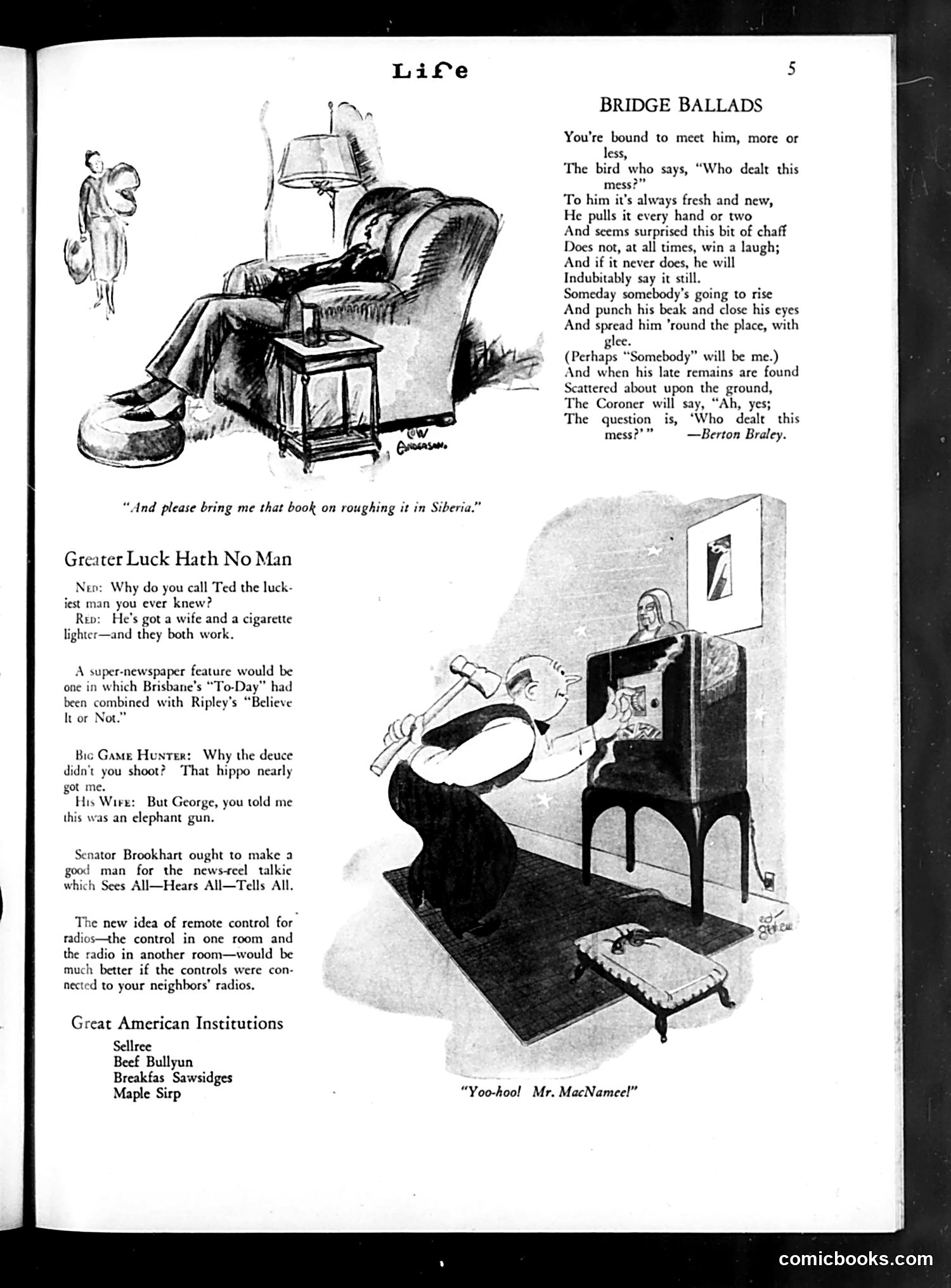
Life Magazine Page 5 Analysis This page contains three satirical items from Life magazine: "Bridge Ballads" (top right) is a poem by Berton Bradley mocking a recurring complaint—someone repeatedly complaining "Who dealt this mess?" about a bad bridge hand. The joke suggests this person will eventually commit violence over cards. "Greater Luck Hath No Man" features brief comic dialogues poking fun at everyday situations: a man nicknamed "the luckiest man" because his wife and cigarette lighter both work, and a hunter claiming an elephant gun caused a hippo incident his wife disputes. The lower cartoon shows a man shooting at a television set with the caption "Yoo-hoo! Mr. MacNamee!"—likely referencing a popular radio/TV personality, suggesting frustration with broadcast content, a timely joke as television was becoming prevalent. The page also lists "Great American Institutions" (Sellree, Beef Bullyun, etc.)—apparently humorous mock-serious endorsements.
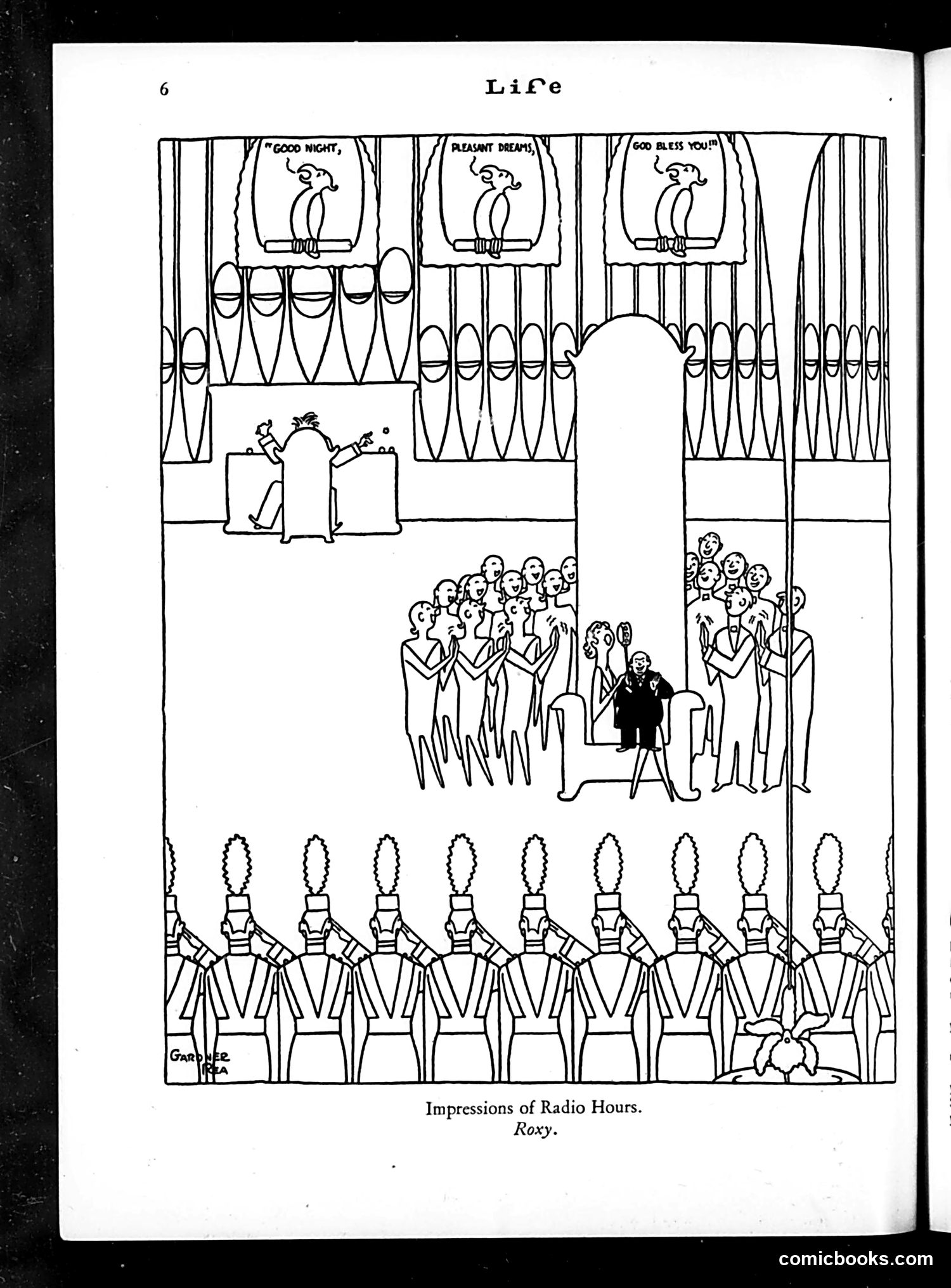
"Impressions of Radio Hours" by Roxy This cartoon satirizes early radio broadcasting, likely from the 1920s-30s when radio was a new entertainment medium. The title references "Roxy," probably Samuel "Roxy" Rothapfel, a famous theater impresario. The satire depicts the contrast between radio's broadcast image and reality: performers in the upper balconies say pleasant things like "Good night" and "Pleasant dreams," while below, a conductor leads what appears to be a large chorus or orchestra. The bottom section shows elaborately dressed figures (possibly Radio City Music Hall-style dancers), highlighting the disconnect between the refined entertainment supposedly being broadcast versus the theatrical machinery required behind the scenes. The joke mocks the artificiality and spectacle of early commercial radio programming.
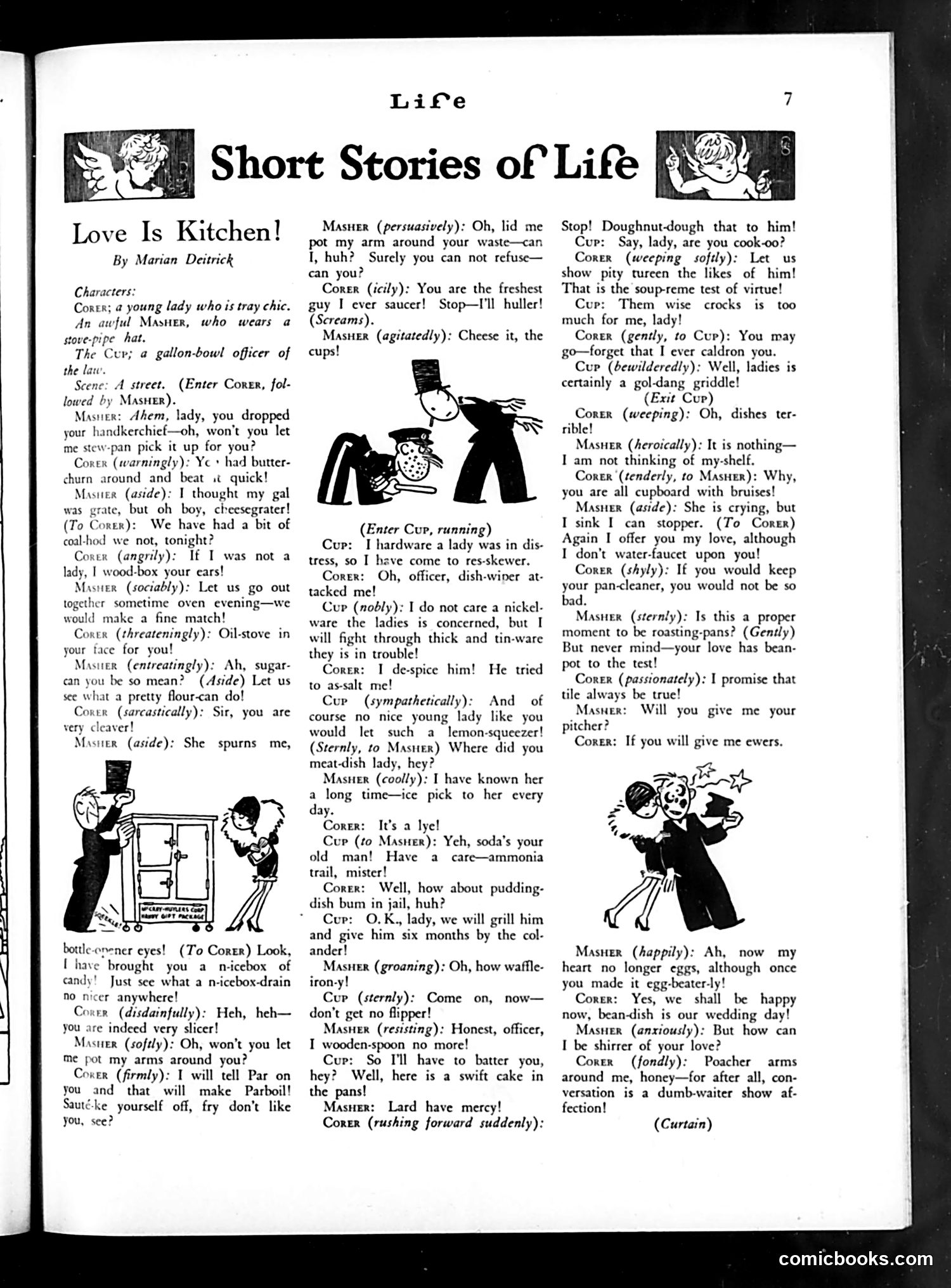
"Love Is Kitchen!" — A Domestic Comedy This is a one-act play script satirizing early 20th-century marriage dynamics. The humor centers on a young couple's domestic disputes over household management, particularly cooking and kitchen duties. The plot involves Corer (a young woman) and Master (her husband) quarreling over a dropped handkerchief and ruined dinner preparations. A Cup character and visiting Officer complicate matters. The satire mocks the era's strict gender roles—the wife's domestic incompetence and the husband's exasperation—while gently poking fun at class pretensions ("meat-dish lady," references to servants). The final punchline about "bean-dish" as a wedding day suggests satirizing both marital discord and snobbish attitudes about social status through food. The cartoon illustrations show the physical comedy of the kitchen chaos.
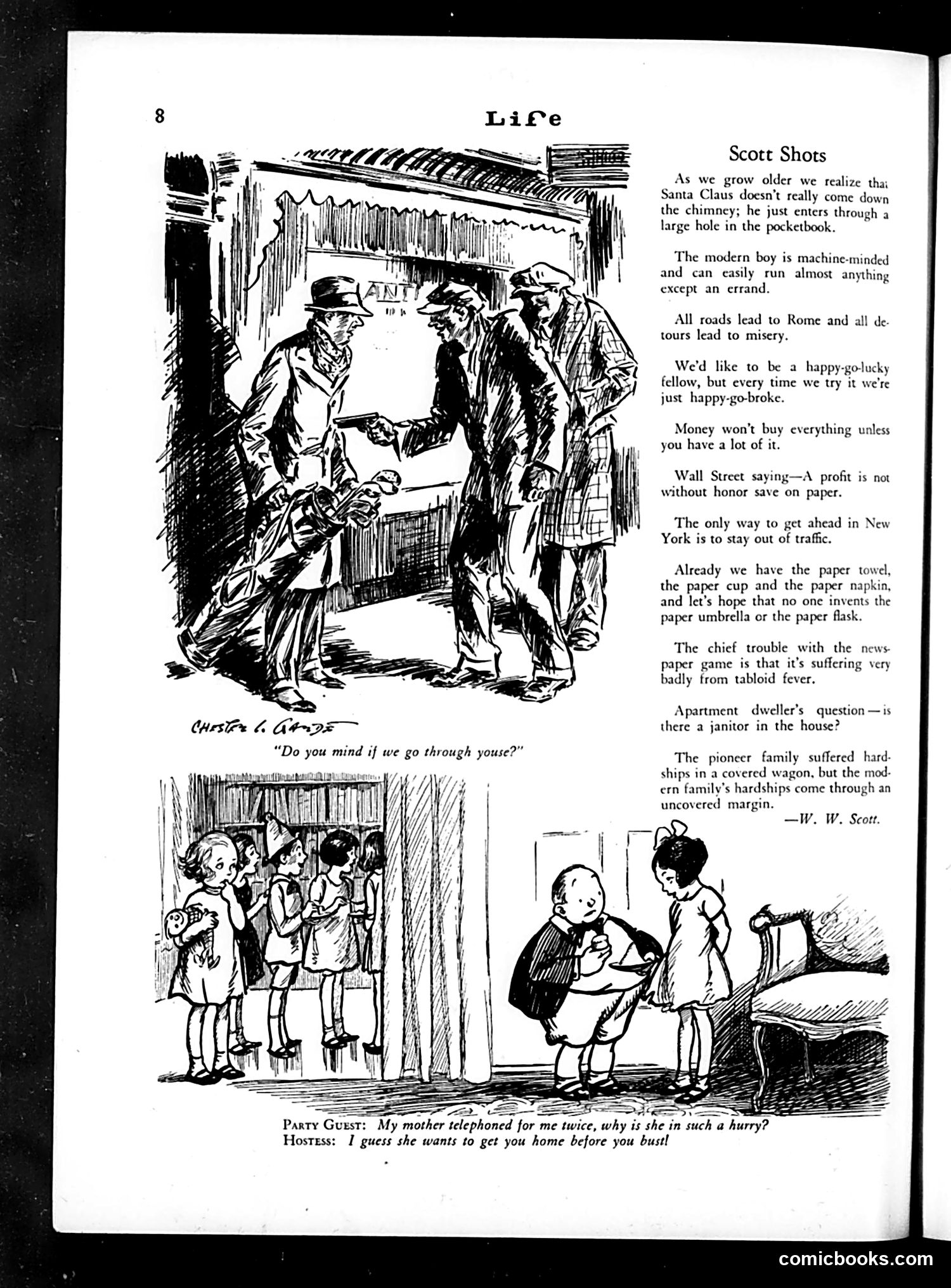
Scott Shots: Satirical Observations This page from *Life* magazine presents two cartoons by Chester A. Gould illustrating humorous social commentary: Top cartoon: Three men in hats appear to be conducting some kind of transaction or negotiation. The caption "Do you mind if we go through you?" suggests they're either pickpockets or salesmen attempting to access someone's pocketbook—a visual pun on the phrase's double meaning. Bottom cartoon: Children at a party while a hostess speaks to a young guest. The caption indicates the guest's mother called twice asking him to come home before he "busts"—likely referring to overeating at the party. The accompanying "Scott Shots" text offers cynical one-liners about modern life: observations on Santa Claus, boys being "machine-minded," money, Wall Street, New York traffic, and other contemporary social frustrations typical of satirical humor from this era.
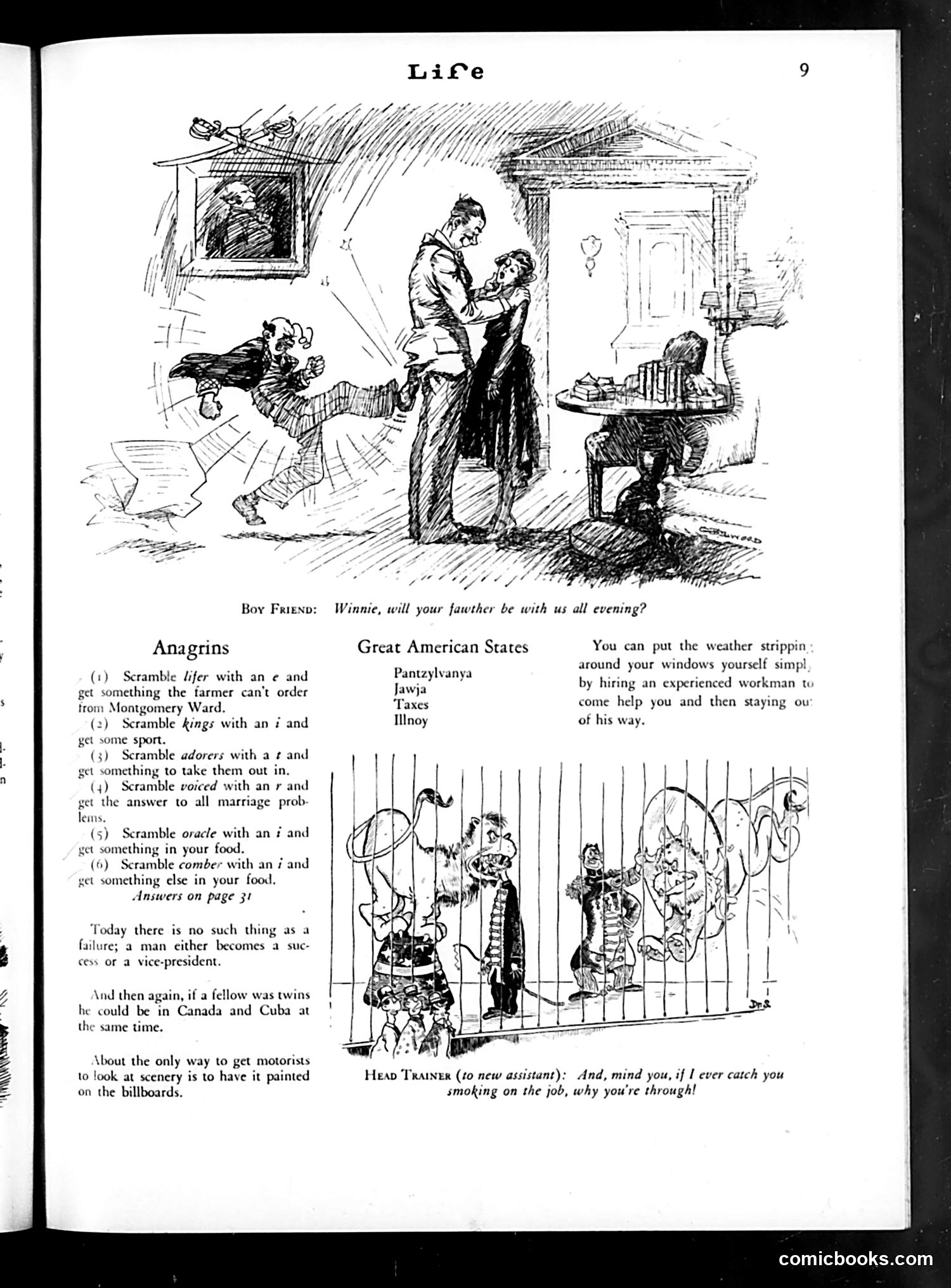
Analysis of Life Magazine Page 9 The top cartoon depicts a domestic scene where a boy asks his friend "Winnie, will your father be with us all evening?" — a joke about parental supervision during a visit. The bottom cartoon shows a "Head Trainer" scolding a new assistant about smoking on the job at what appears to be a horse stable or training facility. The humor lies in the stern warning and threat of dismissal for workplace misconduct. The page also includes word puzzles labeled "Anagrins" and "Great American States" — standard puzzle features common to Life magazine's format. The weather-stripping advertisement provides practical domestic advice about hiring workers for home improvement. These elements represent typical early 20th-century middle-class American humor and domestic life concerns.
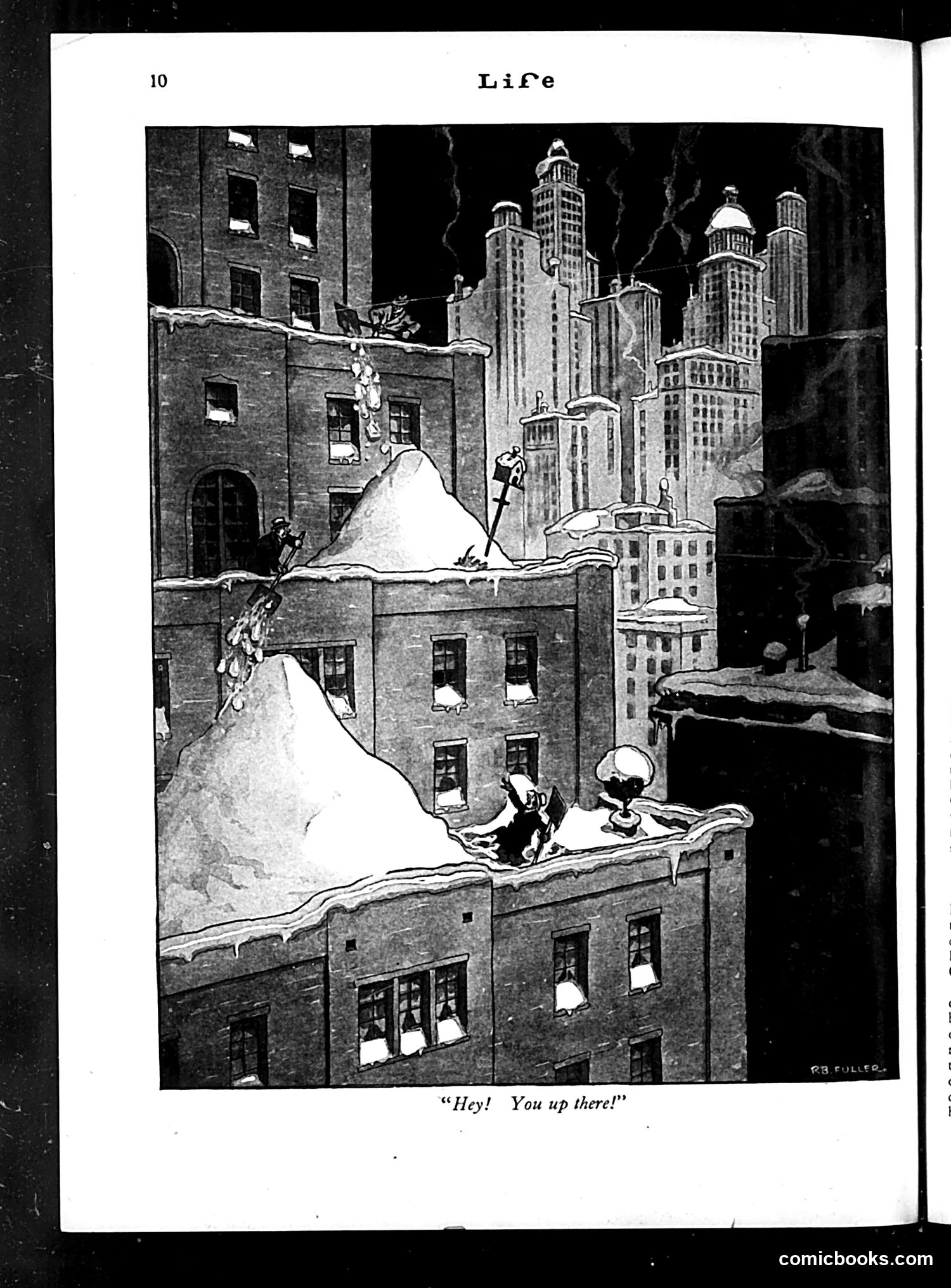
"Hey! You up there!" This cartoon depicts children playing in urban rooftops during winter, building what appears to be a large snow structure or fort on tenement building rooftops. The illustration contrasts cramped, modest apartment buildings in the foreground with grand skyscrapers visible in the background—a visual commentary on economic inequality in the city. The caption "Hey! You up there!" suggests the children are calling to someone, likely playing a game. The satire appears to critique how poor urban children must make do with rooftops as playgrounds while wealth and grand architecture tower nearby. This reflects early 20th-century concerns about living conditions for working-class families in crowded tenement districts versus the luxury available to the wealthy.
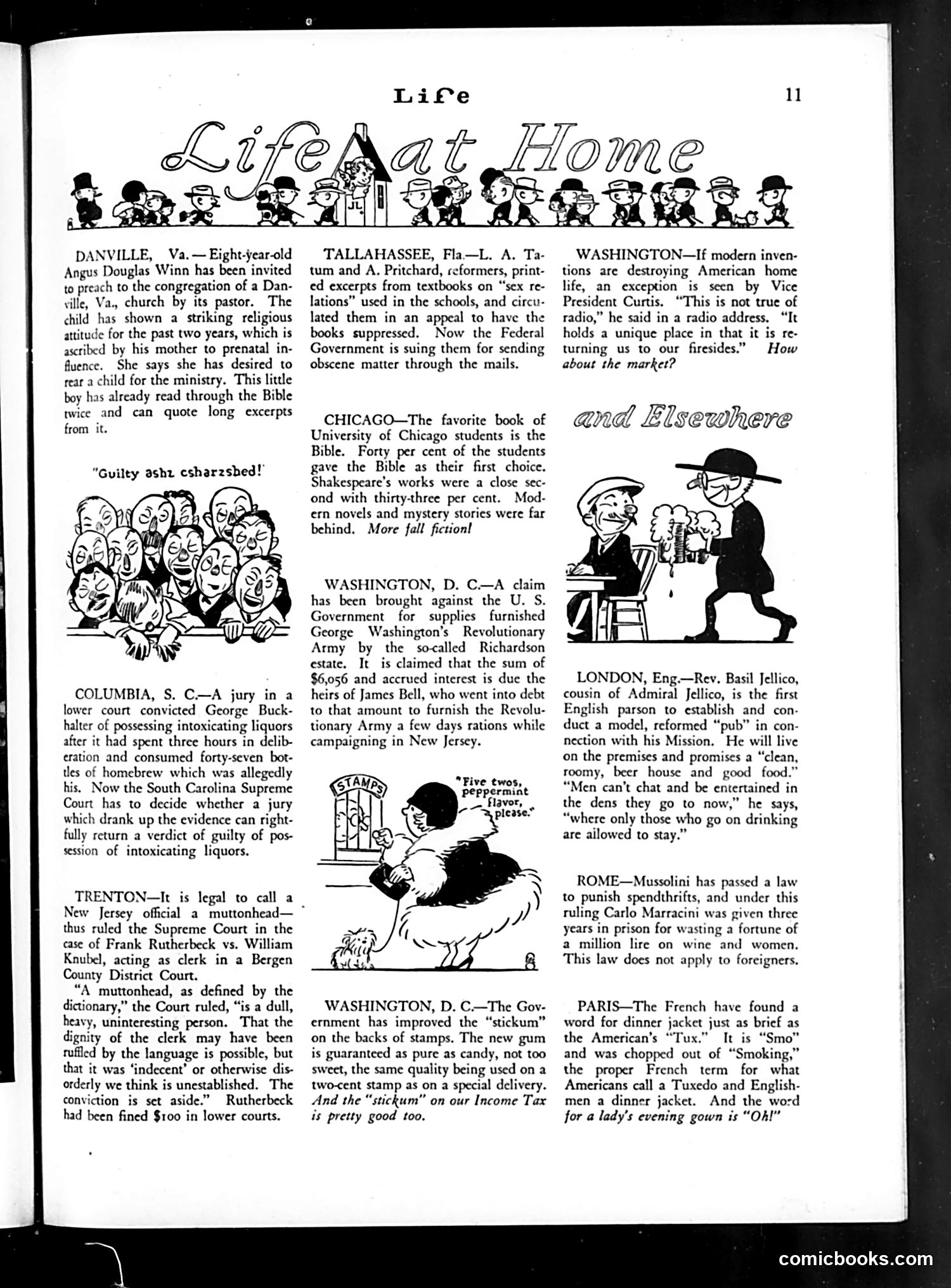
Analysis of Life Magazine Page 11 This page contains brief humorous news items and small cartoons rather than major political satire. The content includes: "Guilty ash eshartshed!" — A cartoon showing a group of faces with exaggerated expressions, likely depicting people reacting to some scandal or embarrassment, though the specific reference is unclear. The stamp/postage cartoon shows a figure at a window marked "STAMPS" requesting "Peppermint Flavor, please" — satirizing the improved "stickum" on stamps mentioned in accompanying text. The joke is that someone is treating a postage stamp like candy, commenting on the new gum formula used on stamps. The remaining items are brief news snippets from various American and international locations, presented as amusing or absurd current events rather than political commentary.
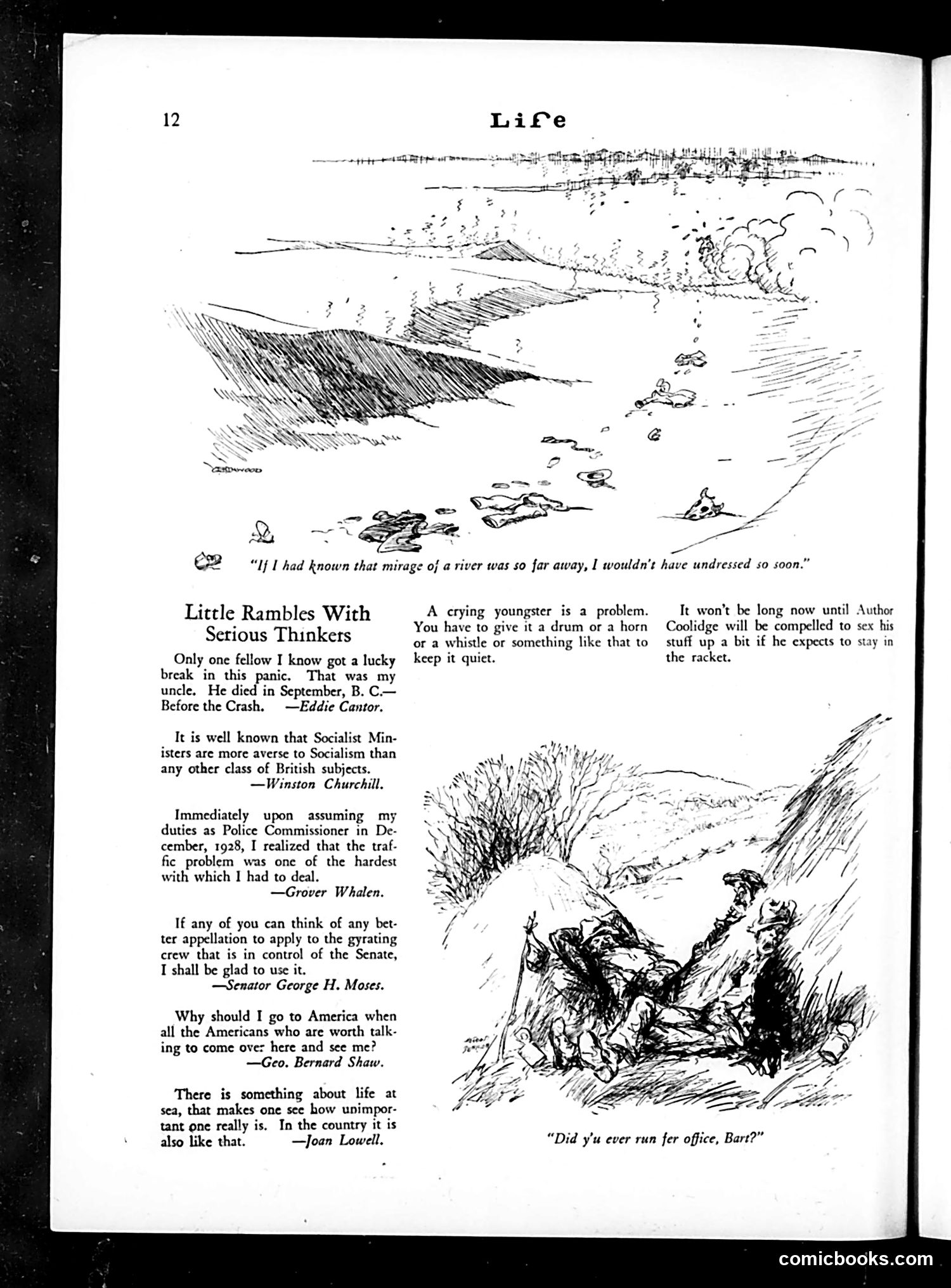
Analysis of Life Magazine Page 12 This page contains two sketch-illustrated cartoons with accompanying humorous quotes from public figures. The top cartoon shows a desert mirage scene with the caption: "If I had known that mirage of a river was so far away, I wouldn't have undressed so soon." This is a visual gag about false expectations. The bottom cartoon depicts someone falling down a hillside, captioned: "Did y'u ever run for office, Bart?" This appears to be a political joke—the tumbling figure represents the rough-and-tumble nature of political campaigning. The page includes satirical quotes from notable figures like Winston Churchill, Grover Whalen, and Senator George H. Moses, commenting on contemporary politics, socialism, and American governance. These snippets mock various political positions and figures of the era without specific visual caricature.
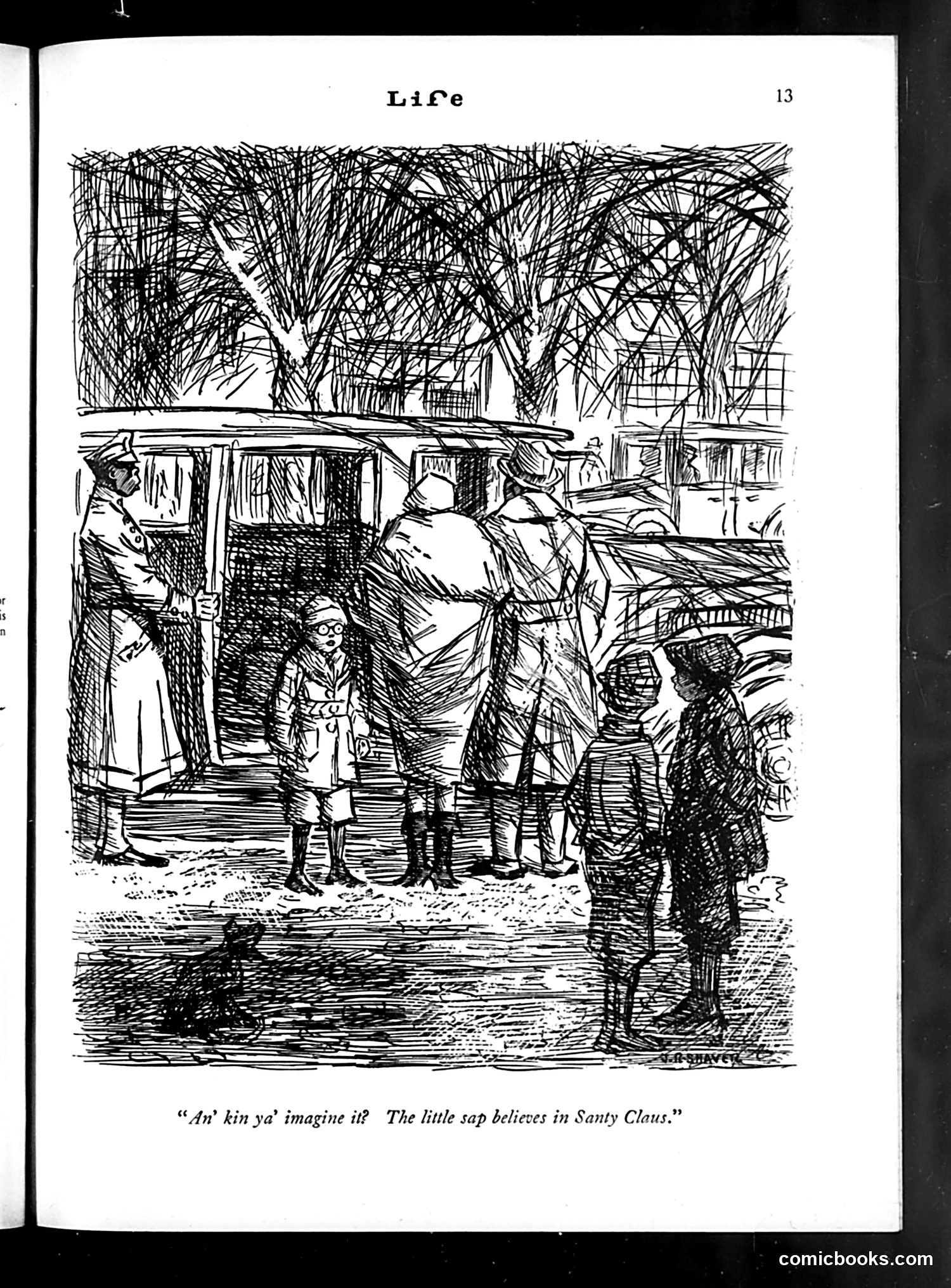
Cartoon Analysis This single-panel cartoon depicts a street scene with adults and children gathered around what appears to be a public transit vehicle (streetcar or bus). The caption reads: "An' kin ya' imagine it? The little sap believes in Sandy Claus." The joke centers on class and childhood innocence. An adult—likely a working-class parent or guardian—is mocking a child for still believing in Santa Claus, presenting this belief as naive or foolish ("little sap"). The urban setting and public transportation suggest a working-class neighborhood where such cynicism about childhood traditions was common. The humor derives from the contrast between the sentimentality of Santa Claus belief and the harsh realism of street life, reflecting early 20th-century attitudes toward poverty and lost innocence among urban children.
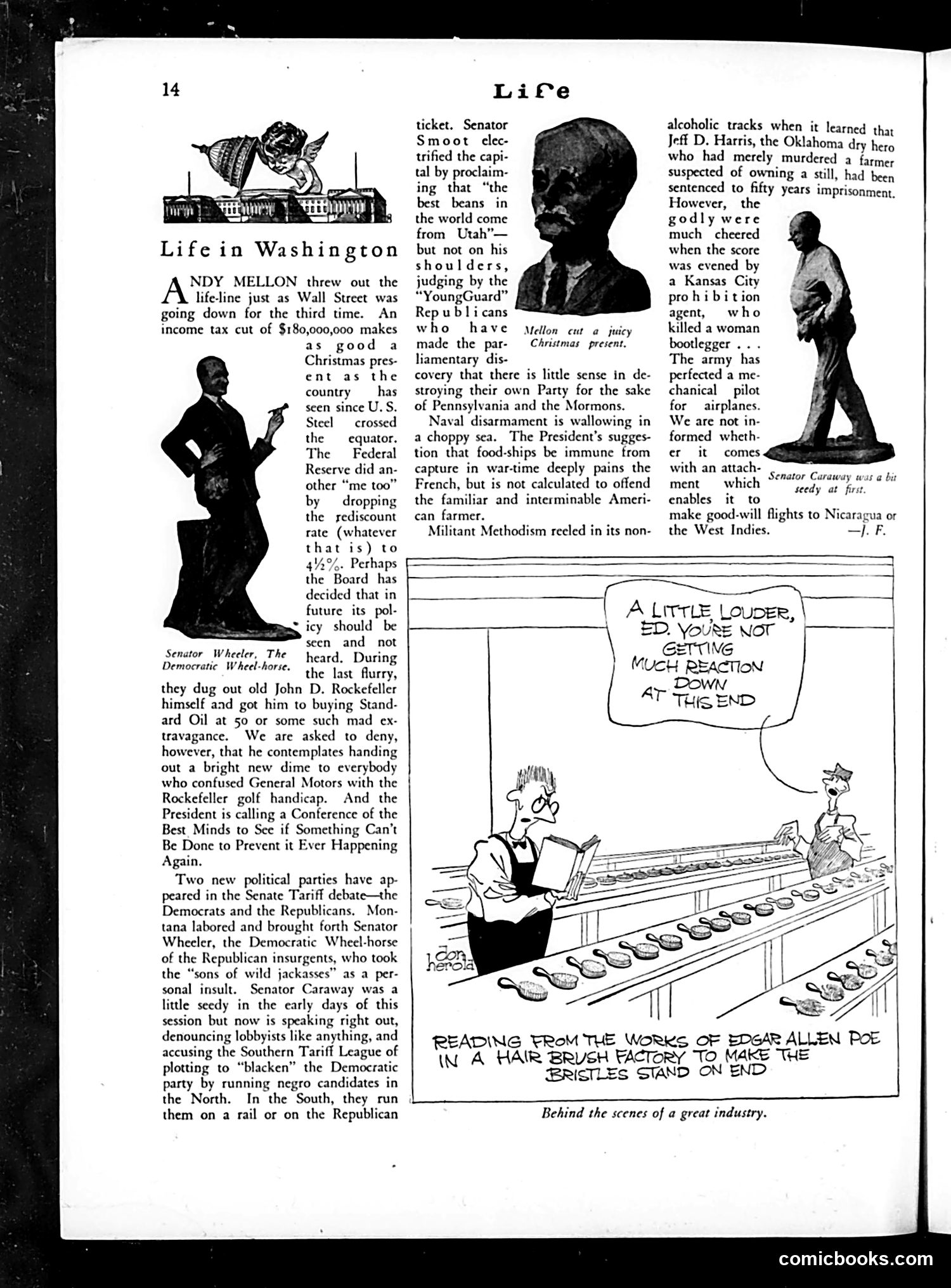
Page 14 of Life Magazine - Political Satire This page contains "Life in Washington," a satirical column about U.S. politics. Key references include: Text content: - Andy Mellon's income tax cut of $180,000,000 - Senator Wheeler (labeled "The Democratic Wheel-horse"), a Democratic insurgent criticizing Republican tariff policy and lobbying practices - Discussion of Pennsylvania and Mormon political influence - References to Prohibition enforcement and various political scandals Main cartoon: Shows a factory worker reading Edgar Allan Poe in a hairbrush factory, with a supervisor warning him this won't be well-received by management. The satire mocks working-class intellectualism and corporate anti-intellectualism. The page satirizes 1920s political corruption, tax policy disputes between parties, and class tensions—reflecting Progressive Era concerns about corporate power versus democratic reform.
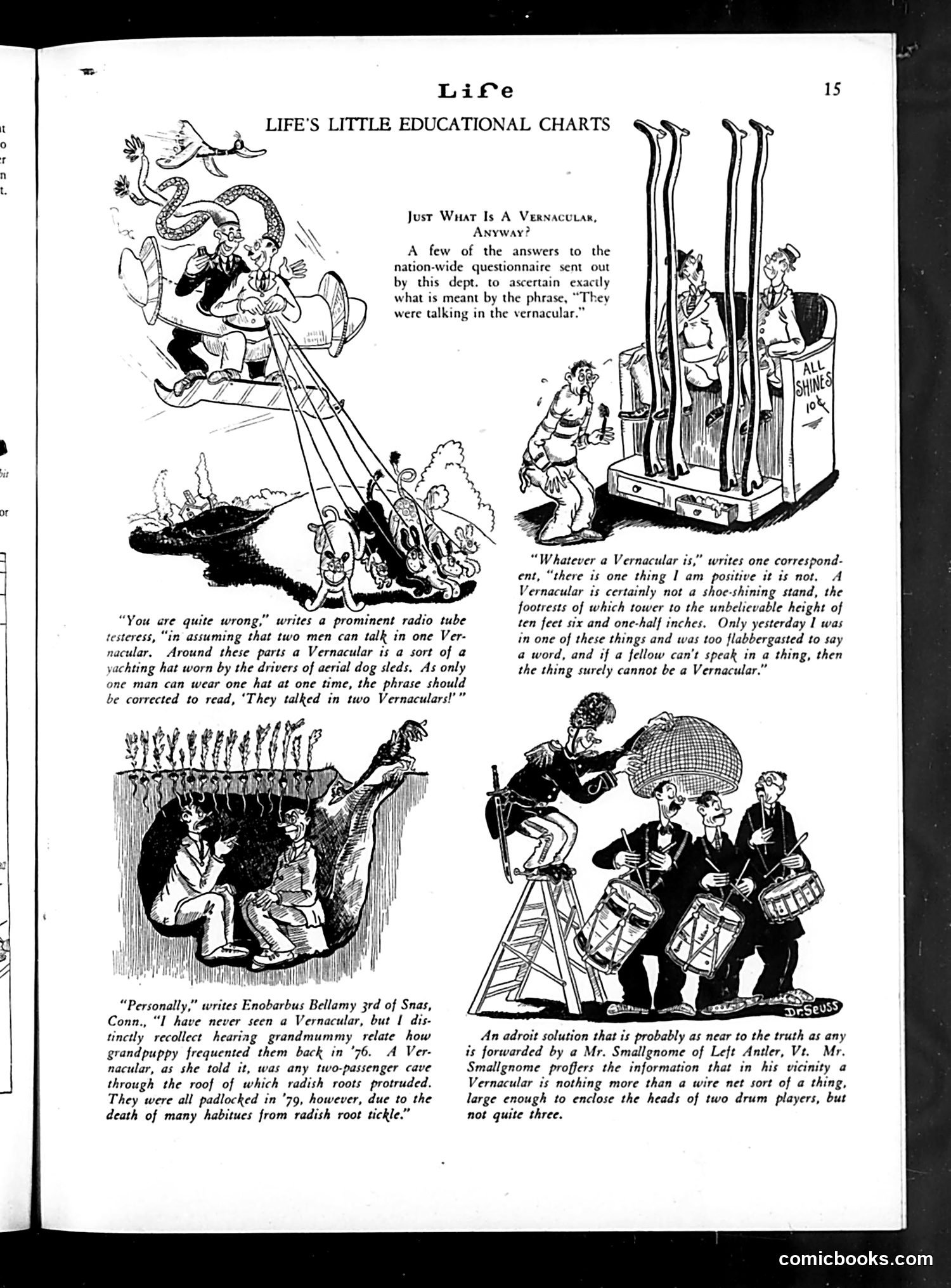
"Life's Little Educational Charts: Just What Is A Vernacular, Anyway?" This page satirizes confusion over the word "vernacular" through humorous reader responses to a Life magazine questionnaire. The cartoons mock various interpretations: 1. Top left: Shows people being "hung" from a vernacular (misinterpreting it as an execution device). 2. Top right: Depicts a shoe-shining stand, suggesting someone thought "vernacular" meant a physical structure. 3. Bottom left: References a grandmother's anecdote about hearing the term in 1756, confusing historical context. 4. Bottom right: Shows musicians with drums, proposing a vernacular is "a wire net sort of thing" large enough for two drum players. The satire targets public ignorance of vocabulary and the absurd reasoning people employ when unfamiliar with terminology.
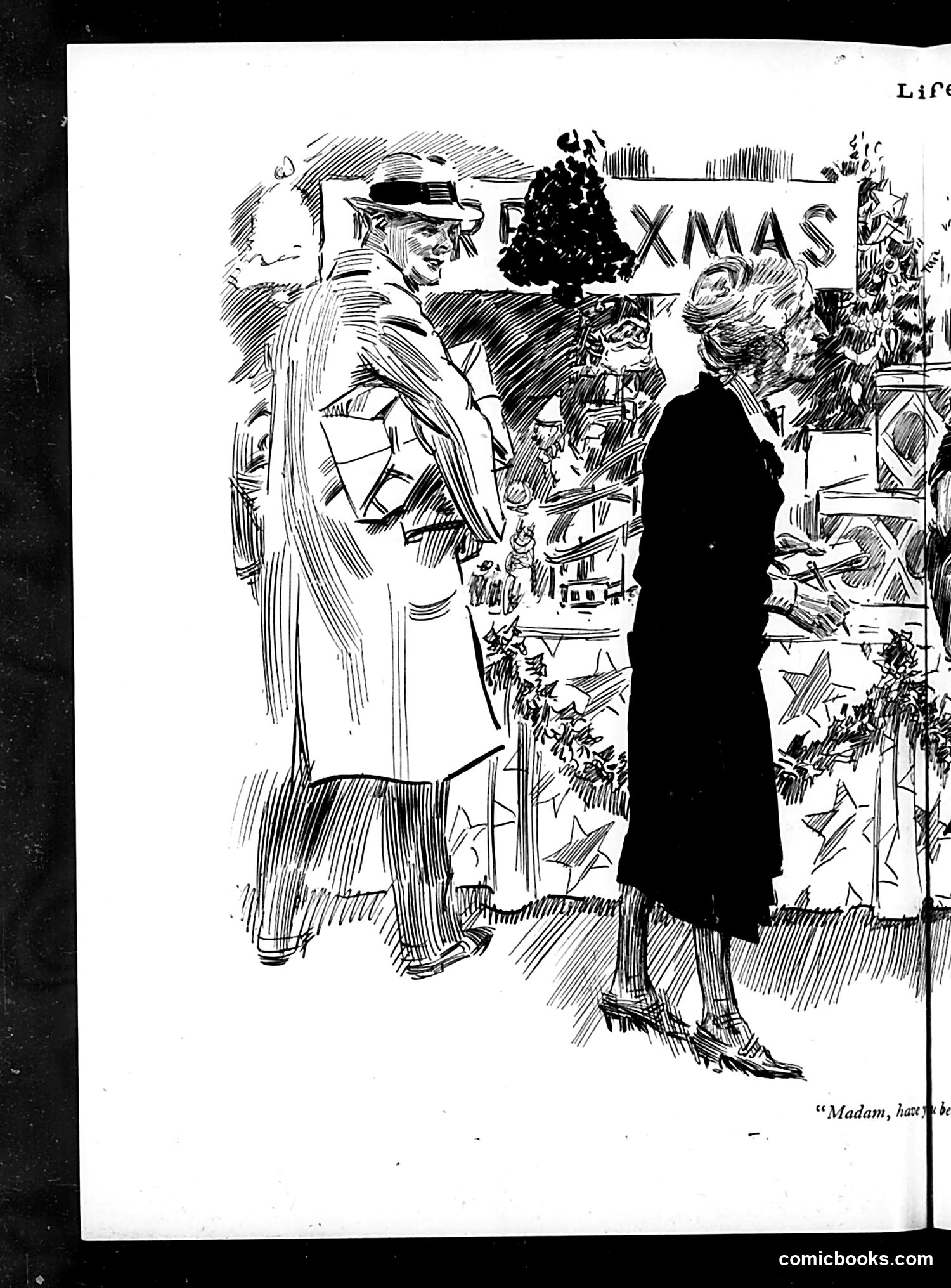
Analysis of Life Magazine Christmas Cartoon This is a Christmas-themed cartoon showing two figures viewing holiday decorations. On the left, a man in a coat and hat looks back over his shoulder at an elaborate Christmas display featuring a decorated tree, the word "XMAS," ornaments, and festive decorations. A woman in a dark coat stands on the right, silhouetted in black. The partially visible caption begins "Madam, hast..." suggesting dialogue between the figures. Without the complete caption text, the specific satirical point is unclear. However, this appears to be commentary on Christmas commercialization or holiday shopping practices—typical subjects for Life magazine's social satire. The contrast between the ornate display and the figures' reactions likely contains the joke, though the exact meaning requires the full caption to determine with confidence.
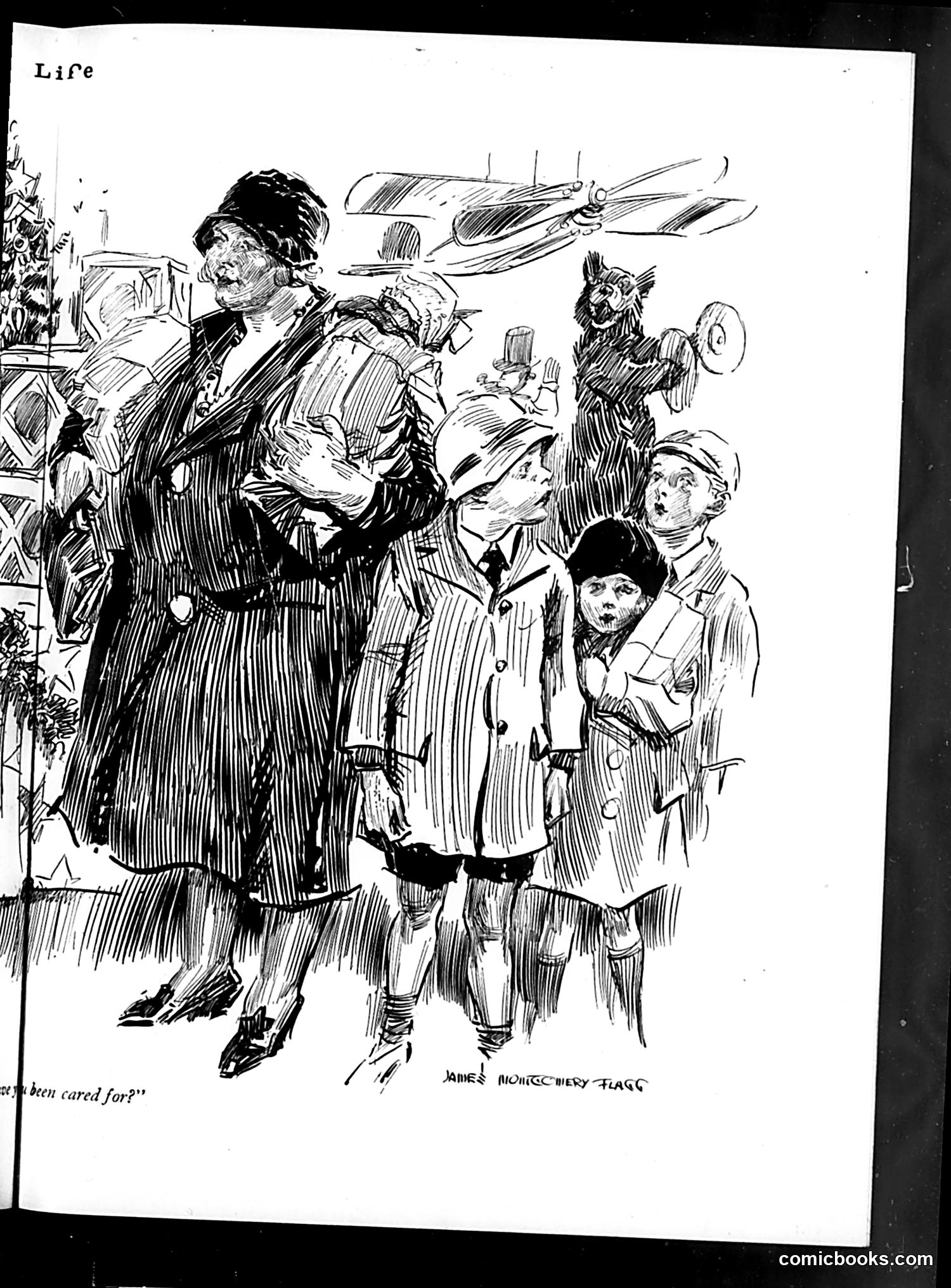
Political Cartoon Analysis This Life magazine cartoon satirizes American military preparedness or intervention, likely from the early 20th century. The central figure—a tall military or political leader—is depicted with exaggerated features holding or displaying what appears to be military equipment (planes visible above). Surrounding him are smaller figures representing civilians or children, appearing distressed or concerned about being "cared for" (suggested by the visible partial text "en cared for?"). The satire likely critiques how military expansion or war preparation affects ordinary citizens, particularly children. The contrast between the imposing authority figure and vulnerable civilians suggests commentary on the human cost of military policies or the militarization of society. The artist is James Montgomery Flagg, a prominent American illustrator and cartoonist of that era.
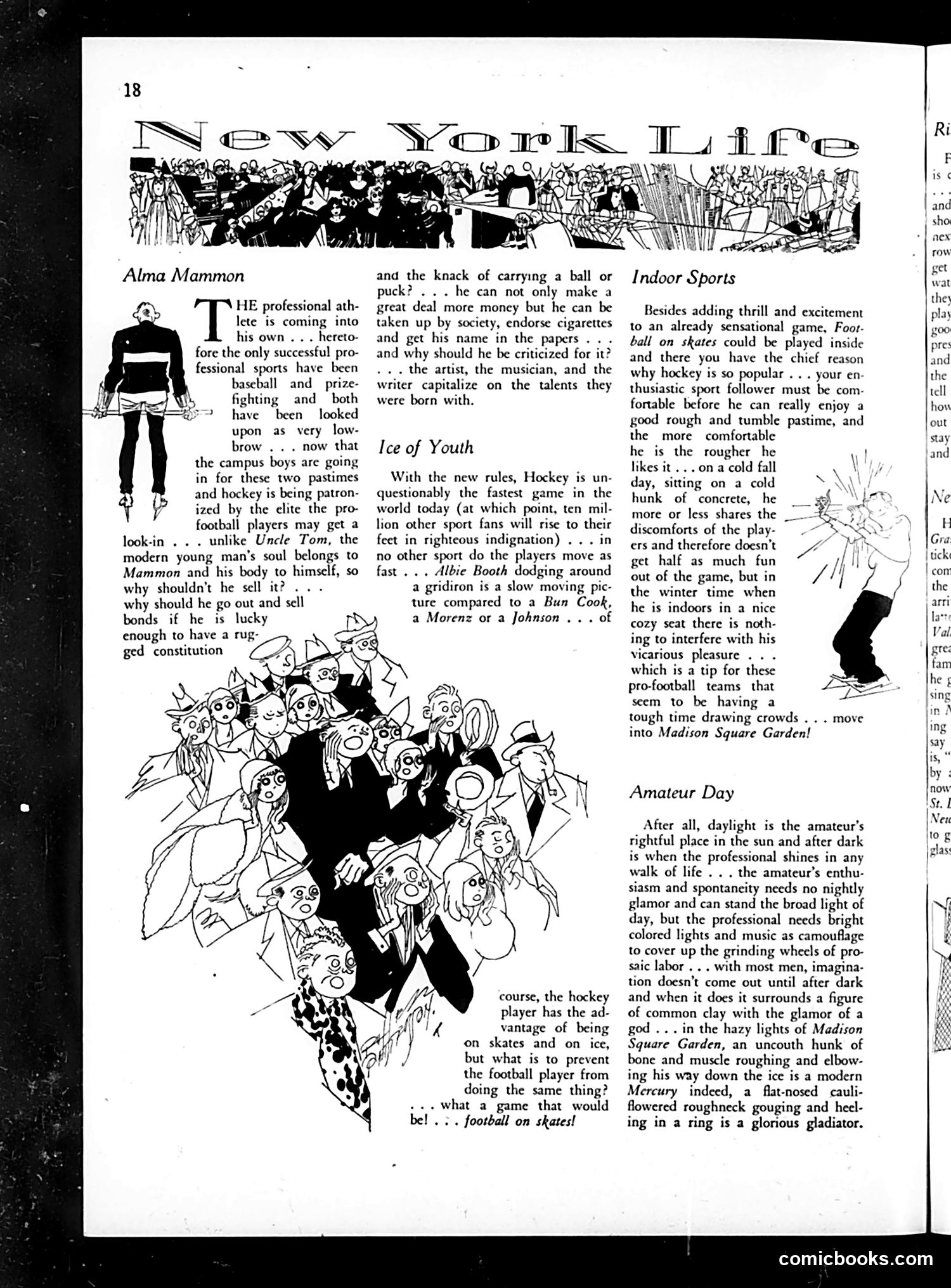
Analysis of "New York Life" Page 18 This page discusses professional athletics and recreational sports in what appears to be the 1920s-30s era. The main article, "Alma Mammon," uses satire to critique how professional athletes—particularly in baseball and boxing—have become celebrities and commercial products, earning money through endorsements and publicity rather than pure athletic skill. The accompanying cartoon depicts a crowded group of people surrounding what appears to be a central figure, likely representing the commercialization of sports stardom. The article contrasts this with amateur sports like ice hockey and indoor skating at Madison Square Garden, which the author celebrates as genuine, unpretentious recreation unmarred by professional glamor and commercial exploitation. The satire suggests that professionalization has corrupted the purity of athletic competition.
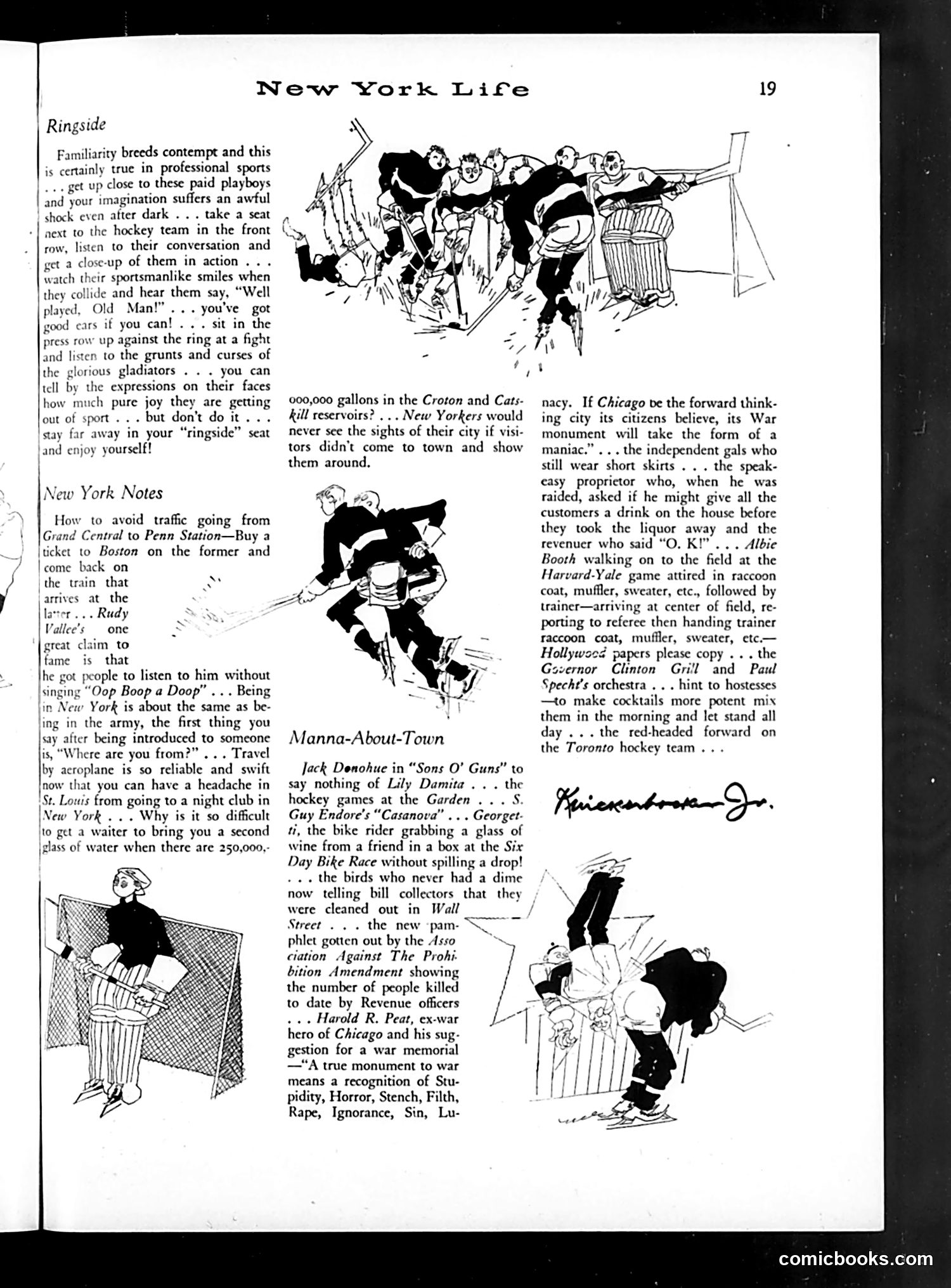
Explanation for Modern Readers This page from *Life* magazine combines sports commentary with New York City social observations, typical of the publication's satirical approach. The "Ringside" section satirizes how proximity destroys romance: attending live sports events reveals athletes aren't glamorous heroes but crude, cursing competitors. The cartoon shows rowdy spectators at a hockey game. The joke is that fans should stay distant and preserve their idealized fantasy rather than witness the unglamorous reality. The "New York Notes" contains humorous one-liners mocking NYC life—traffic, Rudy Vallée's fame despite untalented singing, the obsession with asking newcomers "Where are you from?", and the irony that tourists see more of New York than residents do. "Manna-About-Town" references contemporary entertainment (theater, hockey games, the Six Day Bike Race) and Prohibition-era speakeasies being raided by Revenue officers. It mentions Harold Peat's controversial suggestion that a war memorial should commemorate war's horrors rather than glorify it—apparently a provocative idea in the 1920s. The page's charm lies in its insider observations of 1920s urban American culture.
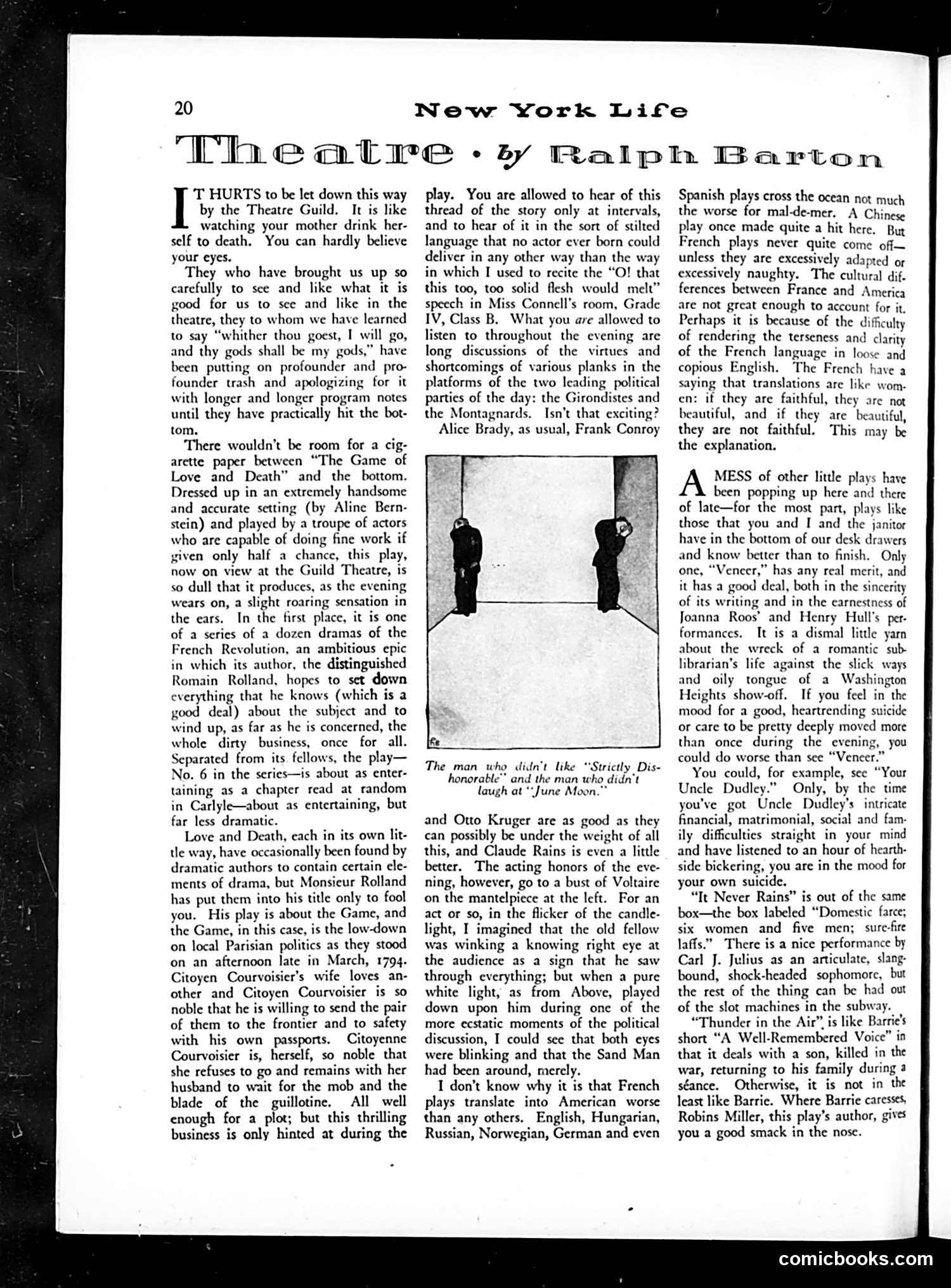
Theater Review: "Love and Death" at the Guild Theatre Critic Ralph Barton reviews a French Revolutionary drama by Romain Rolland, performed by the Theatre Guild. The play concerns Parisian politics in March 1794, featuring a noble couple willing to sacrifice themselves—but Barton finds this plot buried beneath tedious political lectures about the Girondistes and Montagnards (actual revolutionary factions). The accompanying photograph shows two actors in the production. Barton praises the cast (Alice Brady, Frank Conroy, Otto Kruger, Claude Rains) and the set design, but condemns the play itself as intellectually numbing—worse than discussing a Carlyle history chapter. His sharpest jab: a bust of Voltaire on stage becomes the evening's most engaging "actor," appearing to wink knowingly at the audience's suffering. The review satirizes pretentious theatrical ambition masking hollow substance.
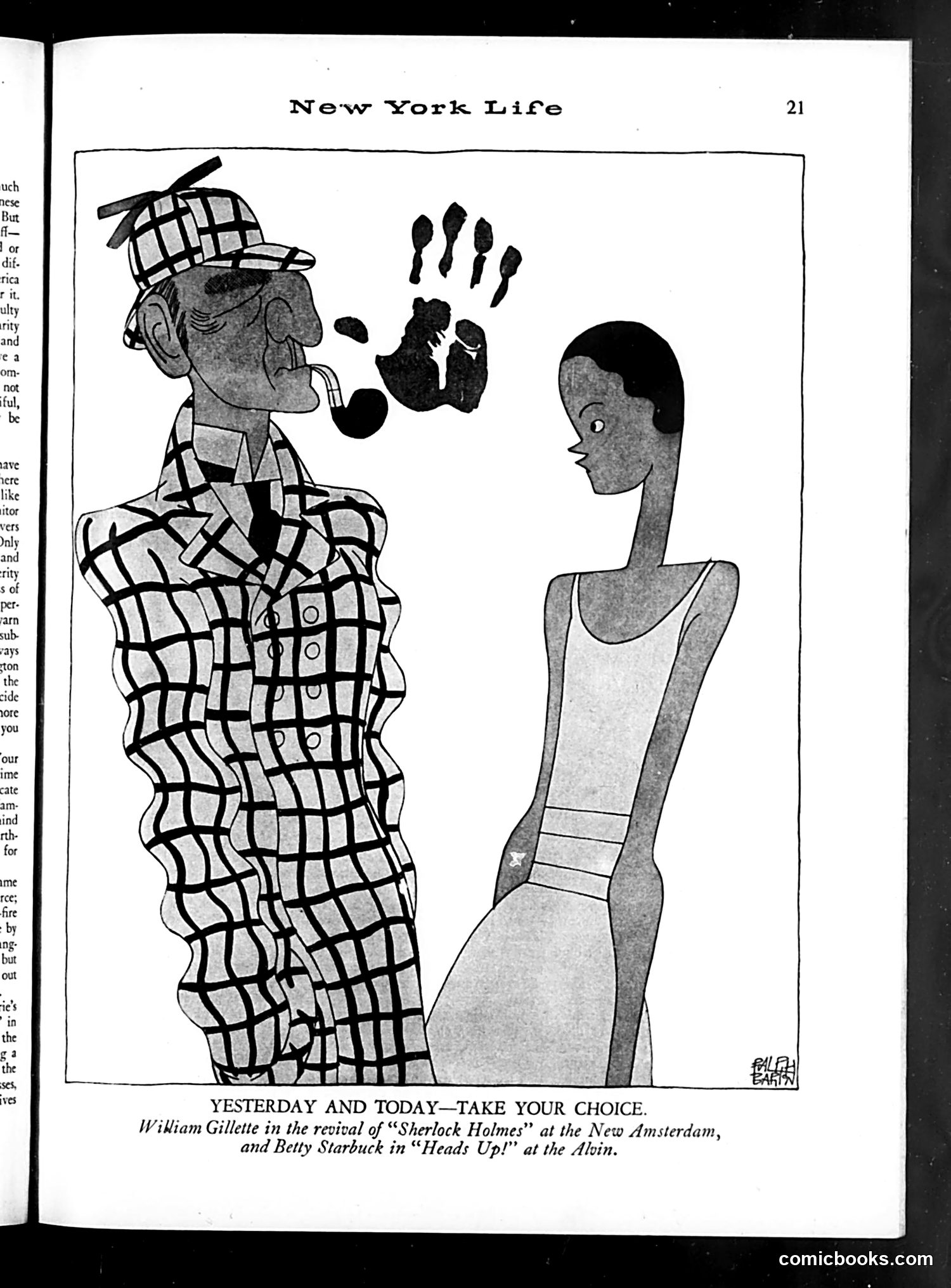
Cartoon Analysis This satirical illustration contrasts two theatrical styles of the era. On the left, an exaggerated figure in a heavily patterned plaid suit with a deerstalker cap represents William Gillette's old-fashioned "Sherlock Holmes" revival at the New Amsterdam—the Victorian detective tradition. On the right, a sleek, modern woman in a simple dress represents Betty Starbuck in the contemporary musical "Heads Up!" at the Alvin. The caption's "Take Your Choice" presents a stark visual comparison: outdated, ornate formality versus streamlined modernity. This reflects 1930s cultural debates between traditional theatrical conventions and emerging modern entertainment styles. The humor lies in the exaggerated contrast between yesterday's busily decorated excess and today's minimalist elegance.
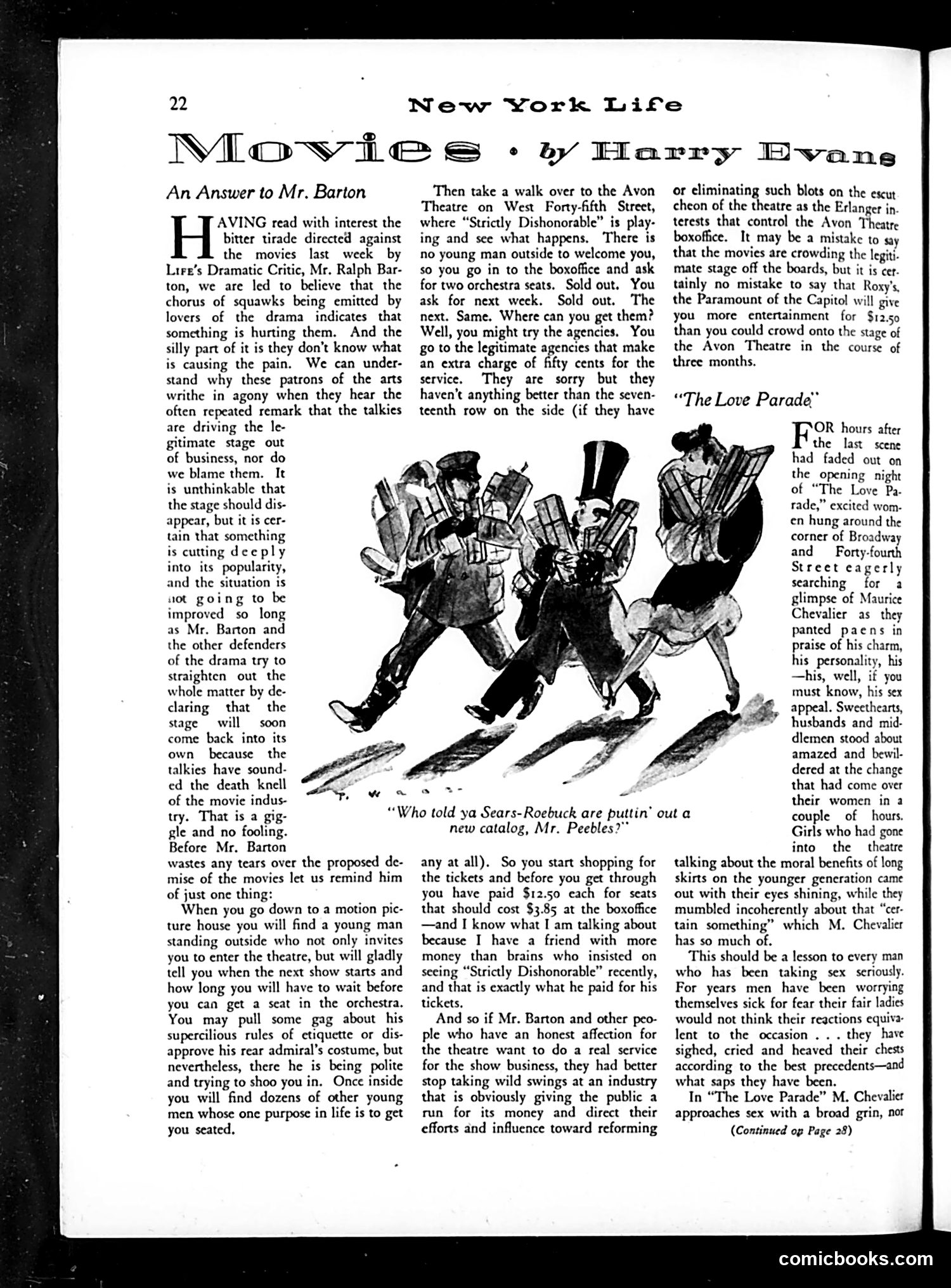
Analysis of This Life Magazine Page This 1920s page responds to theater critic Ralph Barton's attacks on talking pictures ("talkies"), defending cinema against claims it's destroying live theater. The Cartoon The illustration shows three men in formal wear struggling with shopping bags labeled "Sears-Roebuck," depicting the frustration of ticket-hunting. The caption—"Who told ya Sears-Roebuck are puttin' out a new catalog, Mr. Peebles?"—is a nonsensical non-sequitur joke, typical of 1920s humor style. The Argument The author argues theater defenders are wrong about movies' impact. Instead, he blames the Erlanger interests—a real theatrical monopoly controlling venues like the Avon Theatre—for theater's decline. His specific complaint: Broadway box offices charge exorbitant prices ($12.50 vs. $3.85), forcing patrons to scalpers charging fifty-cent premiums for poor seats. The Point Rather than talkies killing theater, theatrical monopolies' exploitative pricing practices are pushing audiences toward movies, which offer better entertainment value. Reform the theater business itself, not the competition.
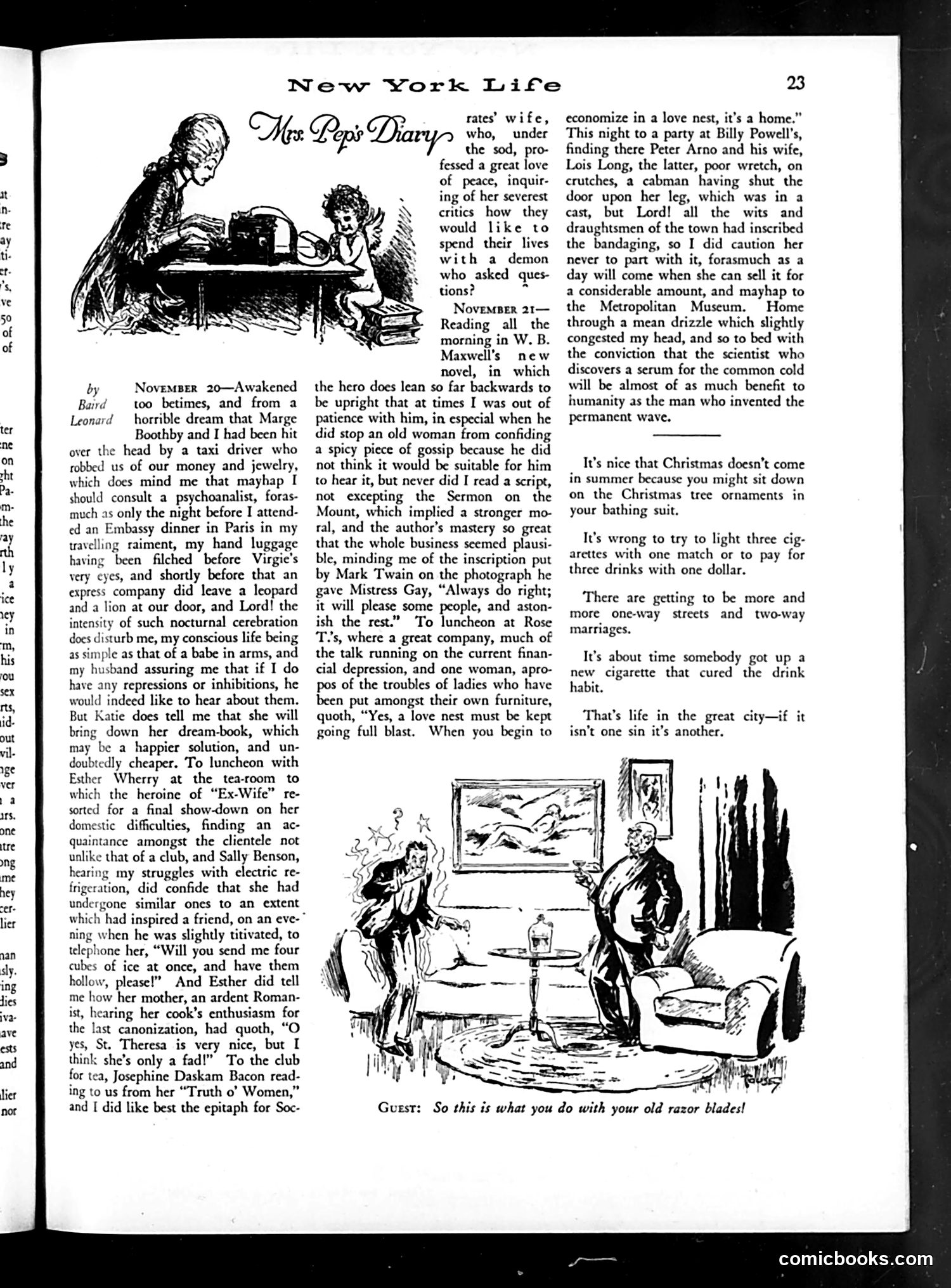
"Mrs. Pep's Diary" - New York Life, November 1929 This is a satirical society column parodying the breathless, name-dropping diary format popular in 1920s magazines. The author (bylined "Baird Leonard") mocks wealthy New York social circles through deliberately overwrought prose—mixing trivial complaints (electric refrigeration troubles) with pseudointellectual references (Freudian psychology, Mark Twain) and casual references to famous contemporaries like Peter Arno (the cartoonist) and Lois Long (the real-life *New Yorker* writer, here humorously depicted on crutches). The cartoon below shows a dinner party guest asking about an old razor blade—a visual punchline about pointless sophistication and absurd conversation topics among the idle wealthy. The satire targets the affectation and moral posturing of Manhattan's elite during the economic depression, particularly their obliviousness to broader hardship. The diary format itself—pretending profound experiences (dream analysis, moral philosophy) are trivial matters—is the joke.
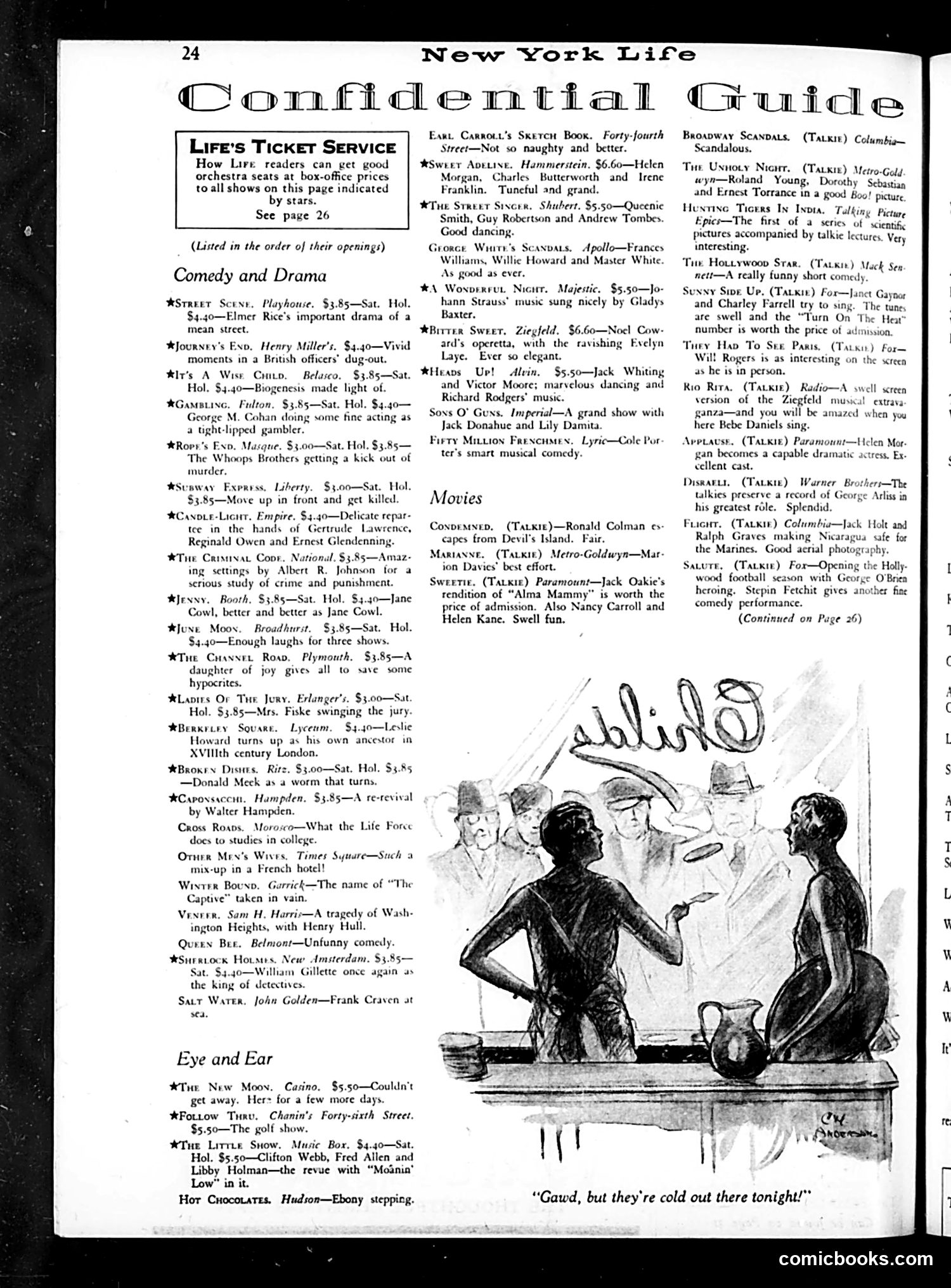
Cartoon Analysis The cartoon depicts two scantily-clad figures on what appears to be a beach or seaside setting, with the caption "Gawd, but they're cold out there tonight!" The joke is a simple visual gag playing on the contrast between appearance and reality. The figures are drawn nearly naked, suggesting warm-weather leisure, yet complain of cold—the humor lies in their inadequate dress for the conditions they're experiencing. This reflects 1920s entertainment culture: the page itself is a "Confidential Guide" to Broadway shows and films. The cartoon's cheeky tone and suggestive imagery were typical of *Life* magazine's satirical style during the Jazz Age, when such content pushed social boundaries regarding propriety and public decency—though by modern standards it's quite tame. The humor assumes readers find the figures' discomfort amusing given their exposure.
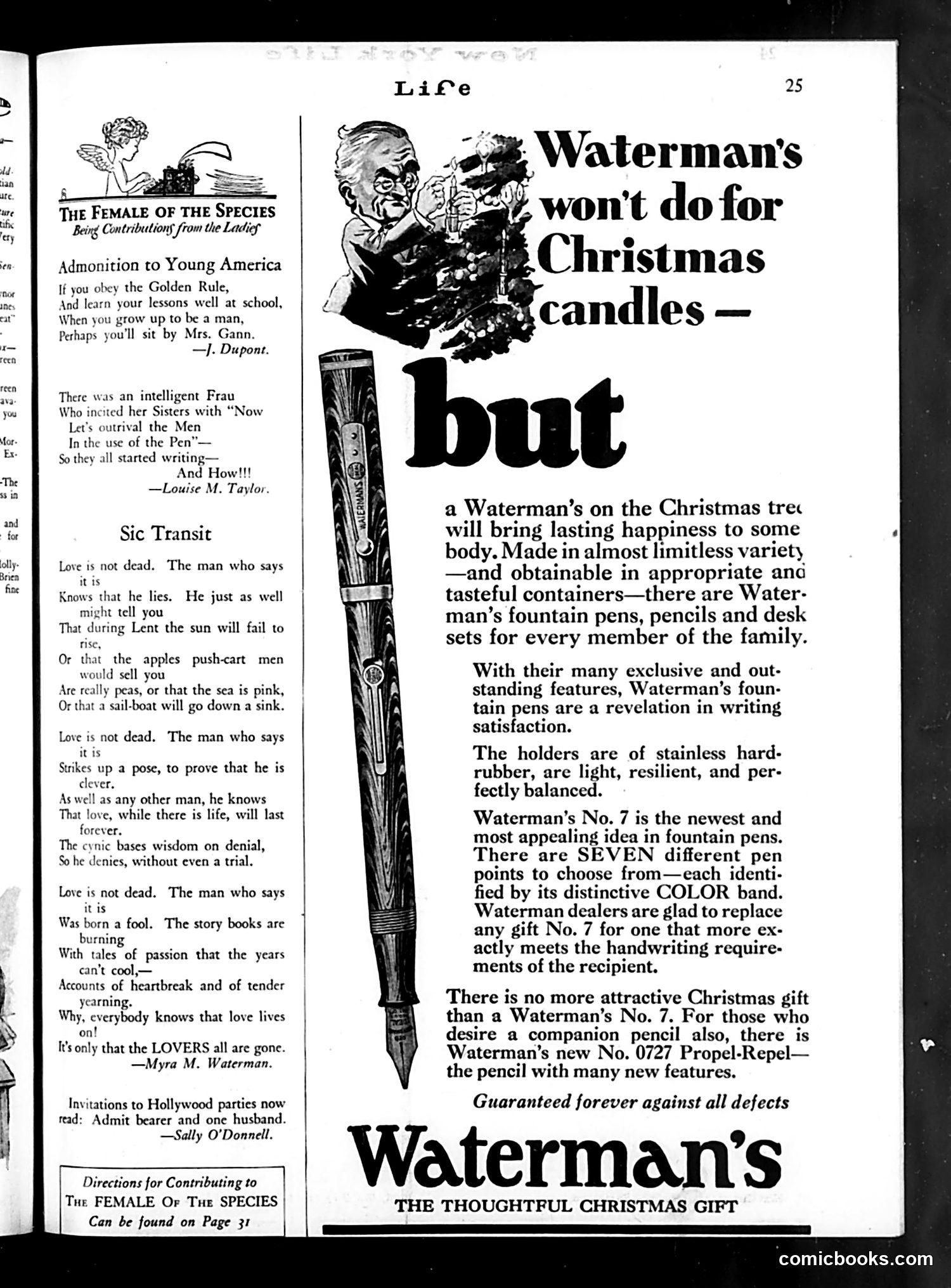
"The Female of the Species" — Life Magazine Page Analysis This page consists primarily of a Waterman's fountain pen advertisement (dominant right side) alongside satirical poems and quips celebrating women's intellectual and social advancement. The left-side content mocks outdated assumptions about women through short, witty verses. References include: - A "Frau" who encouraged women to rival men in writing - Commentary on "Love is not dead" (likely responding to contemporary claims that modern women had become unromantic) - A joke about Hollywood party invitations now requiring husbands as "bearers" The satire targets the tension between women's growing educational/professional participation and traditional gender expectations. The poems celebrate women's literacy and agency while gently mocking those who resist these changes. The advertisement cleverly capitalizes on this theme: Waterman's pens are pitched as appropriate gifts for "every member of the family"—implying women now use writing instruments professionally, not merely decoratively. This positions the luxury pen as modern and progressive.
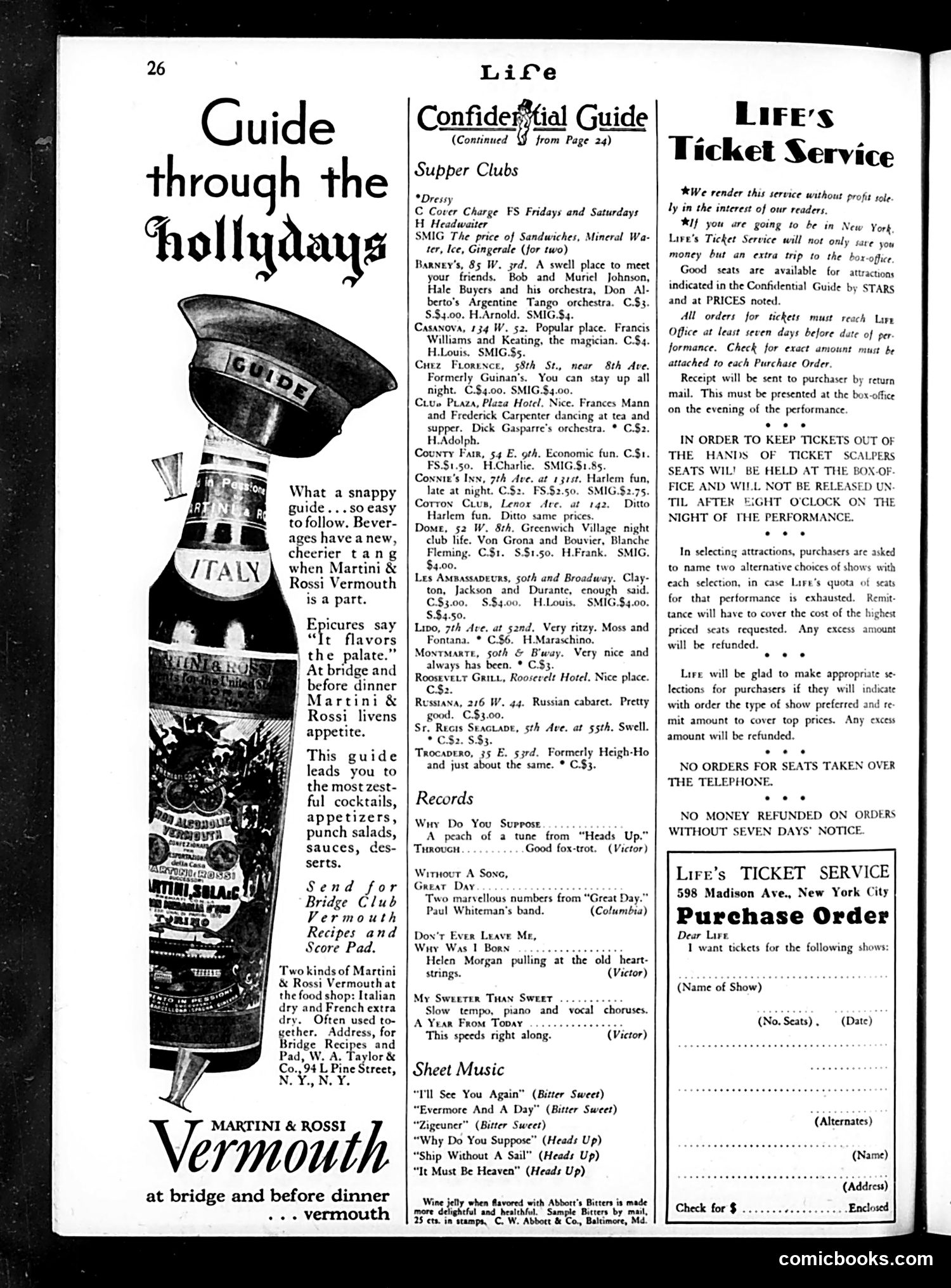
Understanding This Life Magazine Page This page is primarily advertising and entertainment listings, not political satire. It contains: Left side: A Martini & Rossi vermouth advertisement dressed as a holiday "guide," using the bottle as a visual centerpiece. The ad promises that vermouth makes cocktails and social occasions more enjoyable—typical 1920s luxury advertising. Center: A "Confidential Guide" to New York City supper clubs—speakeasies and nightclubs operating during Prohibition. Venues like Cluez Florence (formerly Guinan's) are listed with prices, orchestras, and atmosphere details. This is coded language: the guide helps readers find illegal drinking establishments. References to Harlem venues indicate the era's jazz club culture. Right side: Life's ticket service advertisement and record/sheet music recommendations from contemporary Broadway shows ("Heads Up," "Bitter Sweet"). The page reflects 1920s urban entertainment culture during Prohibition, when such guides helped navigate the underground nightclub scene.
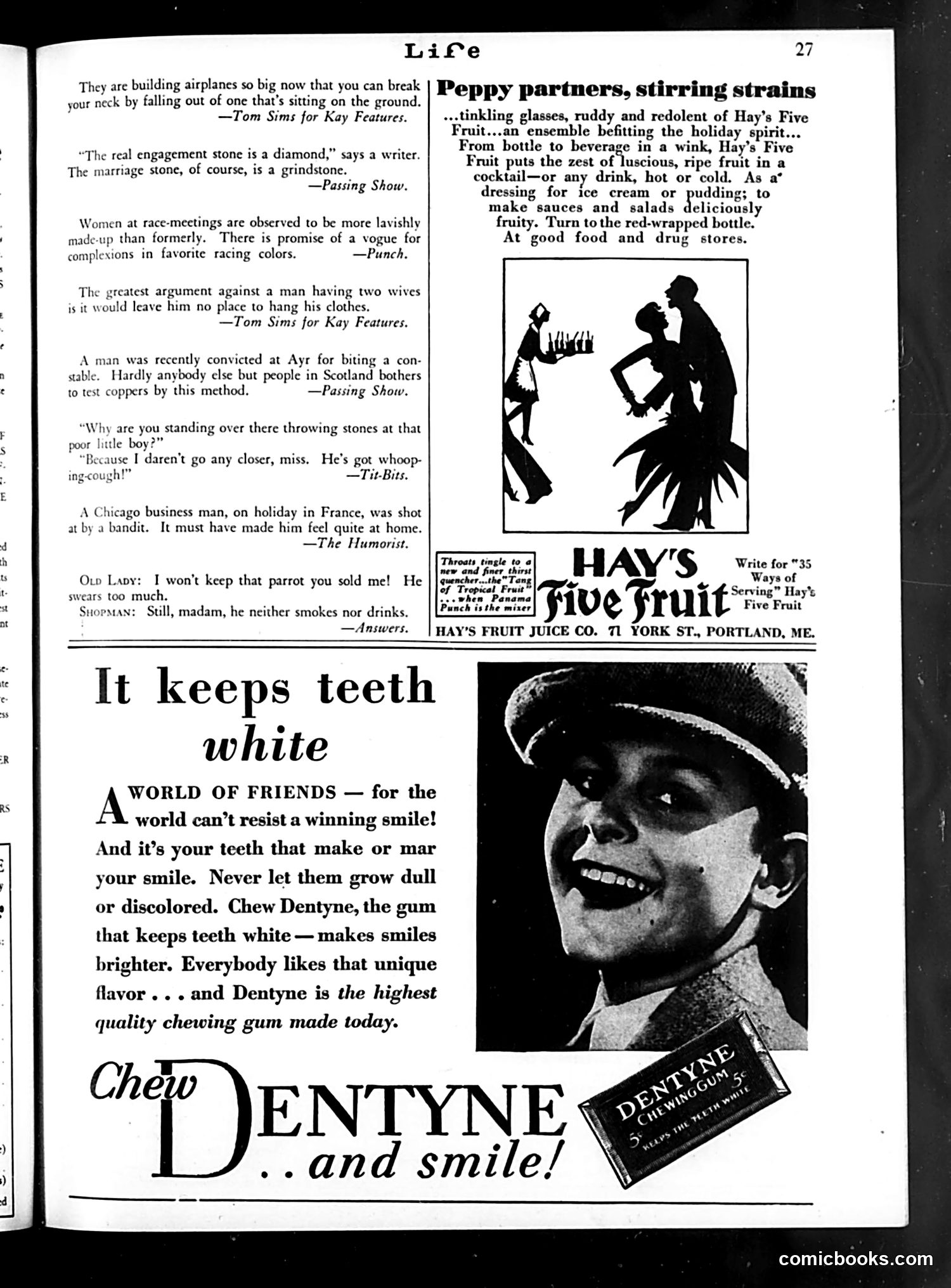
Analysis of Life Magazine Page 27 This page consists primarily of advertisements rather than editorial cartoons. The two main ads are: 1. Hay's Five Fruit (top right): A silhouetted illustration of a couple dancing, advertising a fruit juice product that can be used as a cocktail mixer or food topping. The ad appeals to holiday entertaining. 2. Dentyne Chewing Gum (bottom half): Features a smiling man in a baseball cap, promoting dental hygiene through chewing gum. The copy uses the slogan "A world of friends—for the world can't resist a winning smile," emphasizing that white teeth improve social appeal. The remainder consists of brief humorous quotes from various publications (Punch, Tit-Bits, Answers, The Humorist), covering typical early 20th-century joke subjects: marriage, Scottish customs, childhood mischief, and parrot behavior. These are generic wit rather than topical satire. The page reflects 1920s-30s consumer culture and advertising aesthetics.
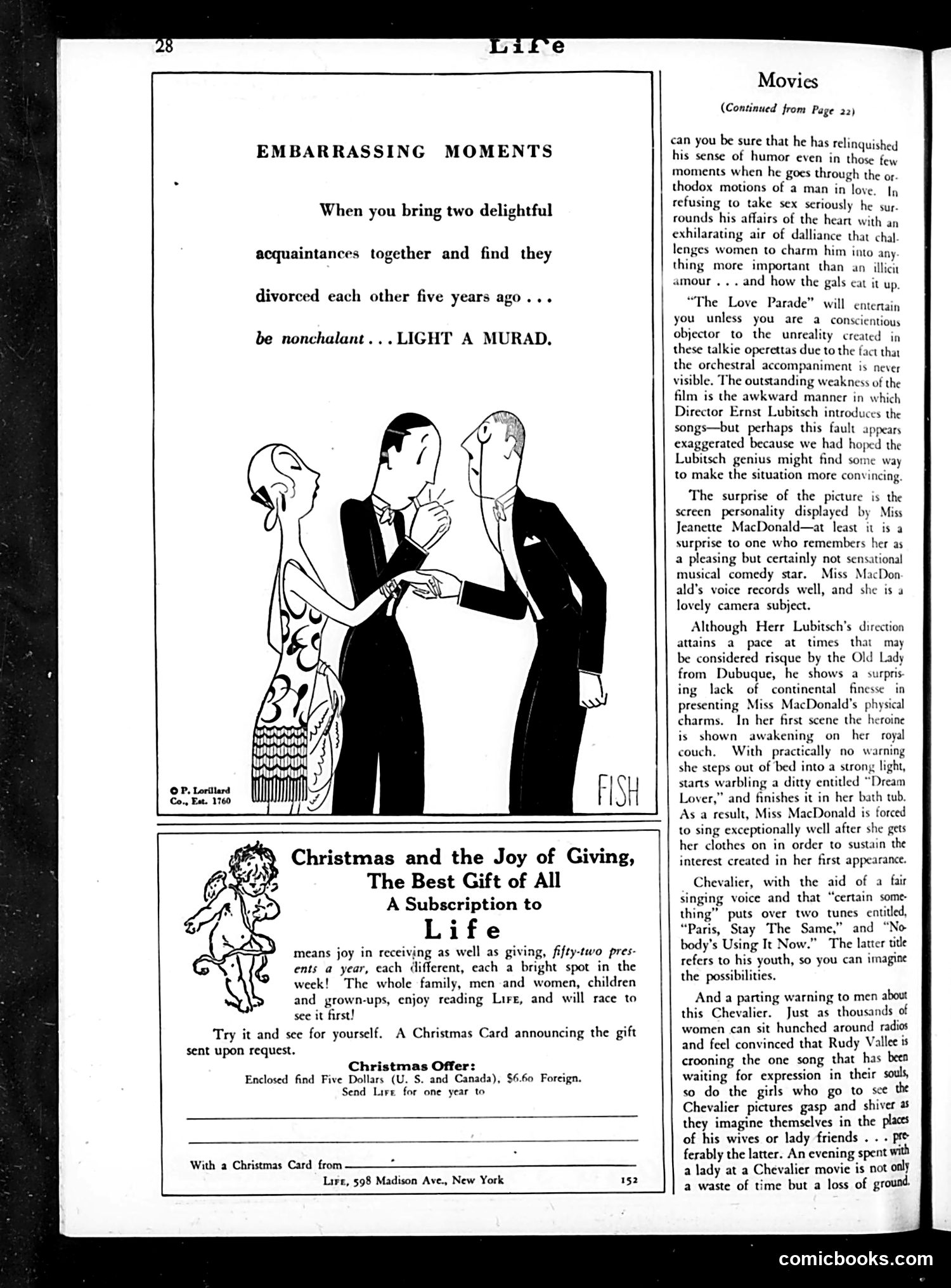
"Embarrassing Moments" Cartoon Analysis This single-panel cartoon by Fish illustrates a social awkwardness of the era: encountering two people who divorced each other years earlier. The cartoon shows a formally dressed man caught between two ex-spouses, presumably at a social gathering. His advice: "be nonchalant... LIGHT A MURAD" (a cigarette brand). The humor relies on the assumption that divorce was socially scandalous enough to create genuine embarrassment—meeting divorced parties together would be mortifying for all involved. The cartoon suggests lighting a cigarette as a way to compose oneself through the uncomfortable situation. The page primarily contains movie reviews of early sound films ("talkies"), particularly critiquing *The Love Parade* and its star Maurice Chevalier. The reviews note technical weaknesses in how songs are introduced and comment on the emerging screen presence of Jeanette MacDonald.
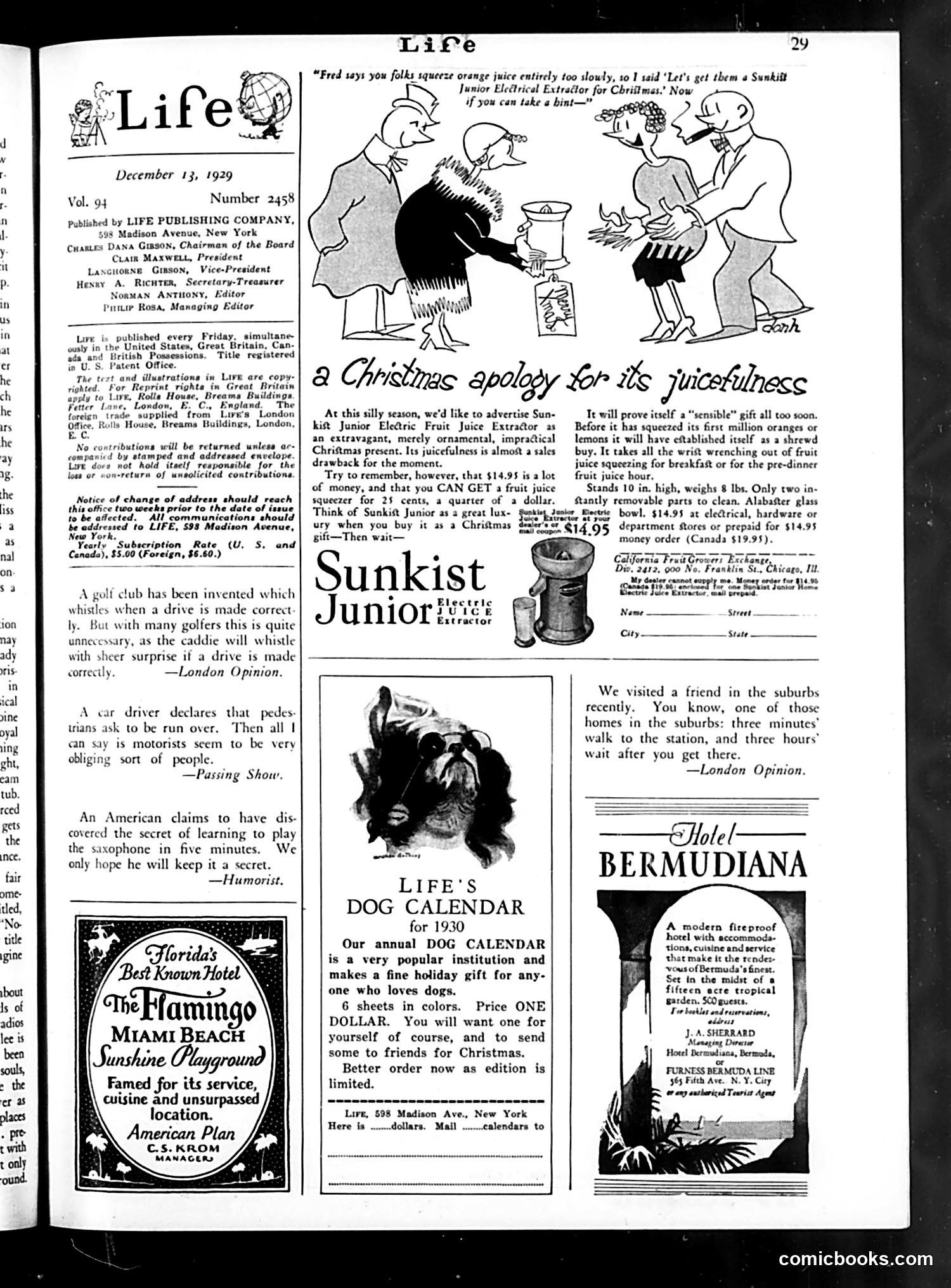
Cartoon Analysis: "A Christmas Apology for Its Juicefulness" This is primarily an advertisement disguised as satire for the Sunkist Junior Electric Fruit Juice Extractor ($14.95). The cartoon depicts a man pitching the device to friends as a Christmas gift, with the humorous premise that he's apologizing for its practicality. The satire plays on 1920s consumer culture: wealthy gift-givers felt obligated to give impractical, purely ornamental presents to appear generous. A humble 25-cent manual juicer was too utilitarian to seem like a luxurious gift. The ad's joke is that the Sunkist Junior *seems* like an extravagant luxury item (justifying its high price), but it actually proves its worth immediately by eliminating tedious hand-squeezing—making it "sensible" despite the gift-giver's ironic apology for its usefulness. The cartoon's style and the ad's tongue-in-cheek copy reflect Life magazine's satirical approach to American consumer aspirations during the prosperous pre-Depression era.
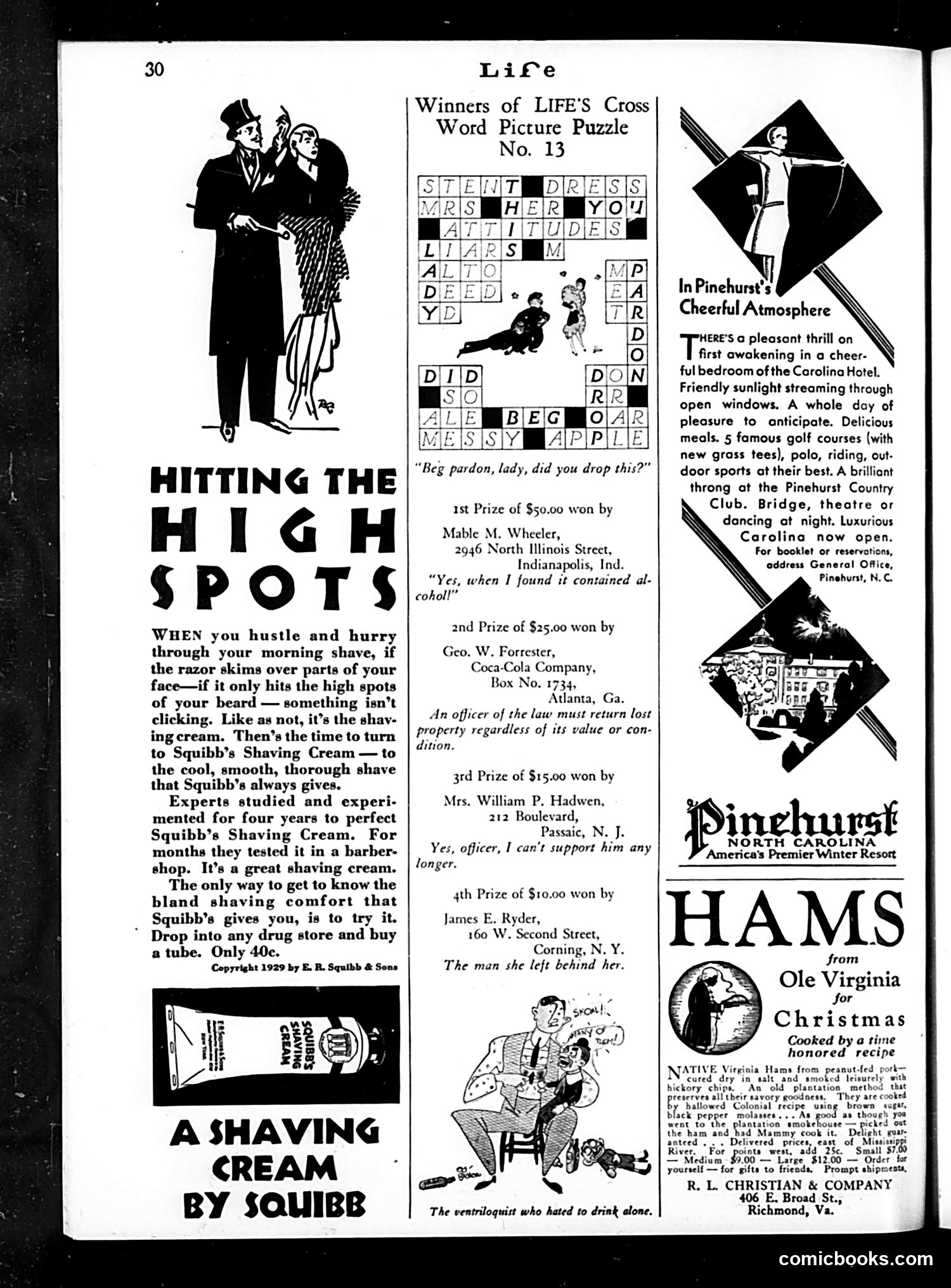
Analysis of Life Magazine Page Content This page is primarily advertising and contest results rather than political satire. The main content includes: Squibb Shaving Cream advertisement: A pun-based ad using "hitting the high spots" (missing patches during shaving) to promote thorough coverage. It emphasizes four years of expert development and barber-shop testing. Life's Cross Word Picture Puzzle winners: Four prize-winning entries with humorous captions. The top winner's joke references Prohibition—finding a flask and refusing to return it because it contains alcohol. Another winner jokes about a woman abandoning her unemployed husband ("the man she left behind her"), reflecting Depression-era anxieties. Tourism and ham advertisements: Pinehurst resort promotion and Ole Virginia ham sales complete the page. The puzzle answers satirize contemporary concerns: Prohibition enforcement, economic hardship, and female independence—but these are incidental to the advertisements dominating the layout.
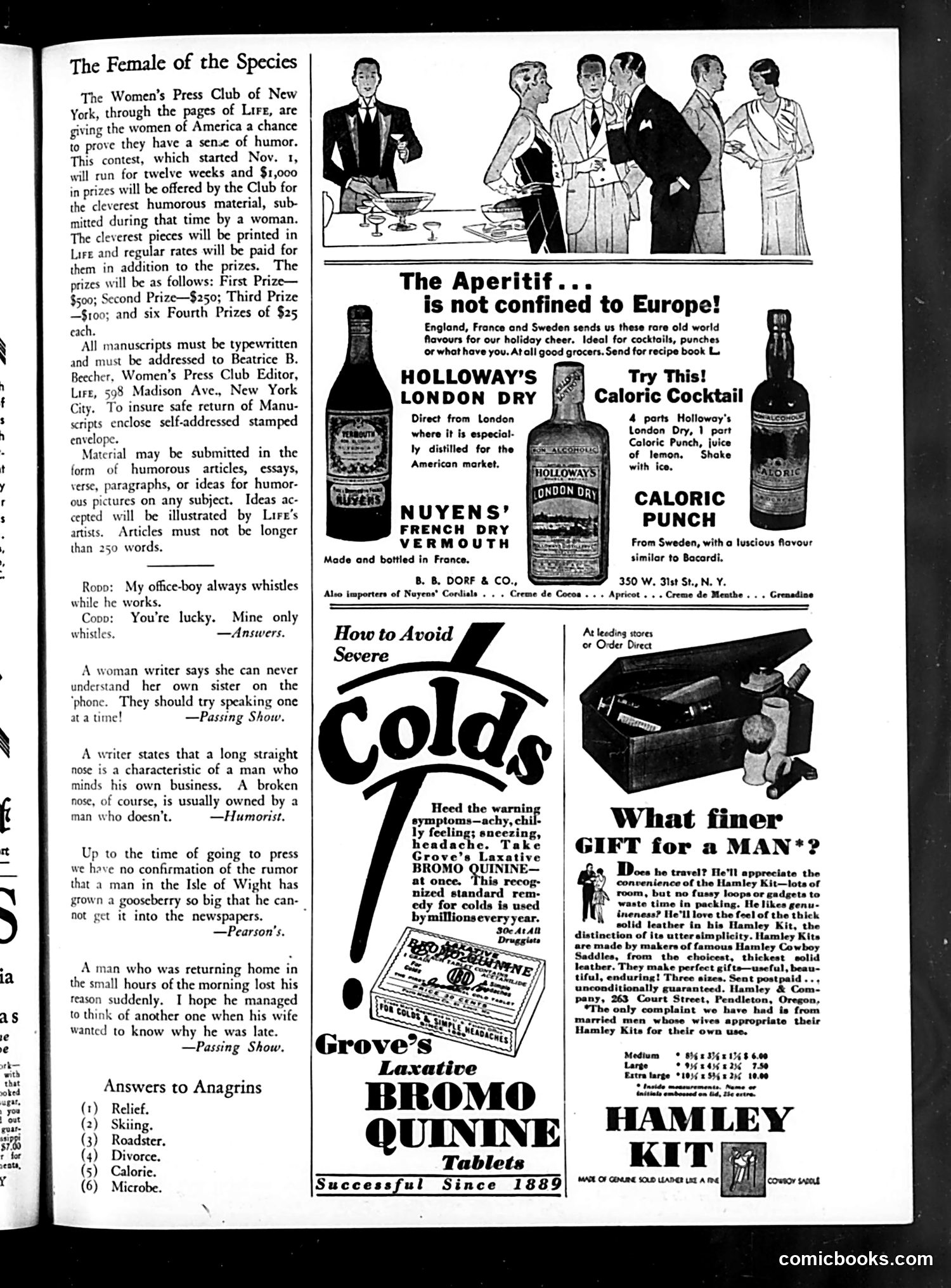
Analysis of Life Magazine Page Content This page is primarily advertising and humor content rather than political satire. The main feature is a Women's Press Club humor contest offering $1,000 in prizes for women to submit funny material—articles, essays, verse, or cartoon ideas—to *Life* magazine. This reflects early 20th-century attitudes about women's capacity for humor; the contest's very existence (and the framing "The Female of the Species") suggests humor writing was considered a novelty or challenge for women to prove themselves in. The page includes several reprinted one-liner jokes from other publications (*Answers*, *Passing Show*, *Humorist*, *Pearson's*), mostly mild domestic humor about office boys, sisters, noses, and husbands returning late. The advertisements feature aperitifs, cold remedies (Grove's Bromo Quinine), and Hamley travel kits—typical 1920s-30s consumer goods marketed with period-appropriate copy emphasizing quality and practicality. There is no identifiable political cartoon or caricature on this page.
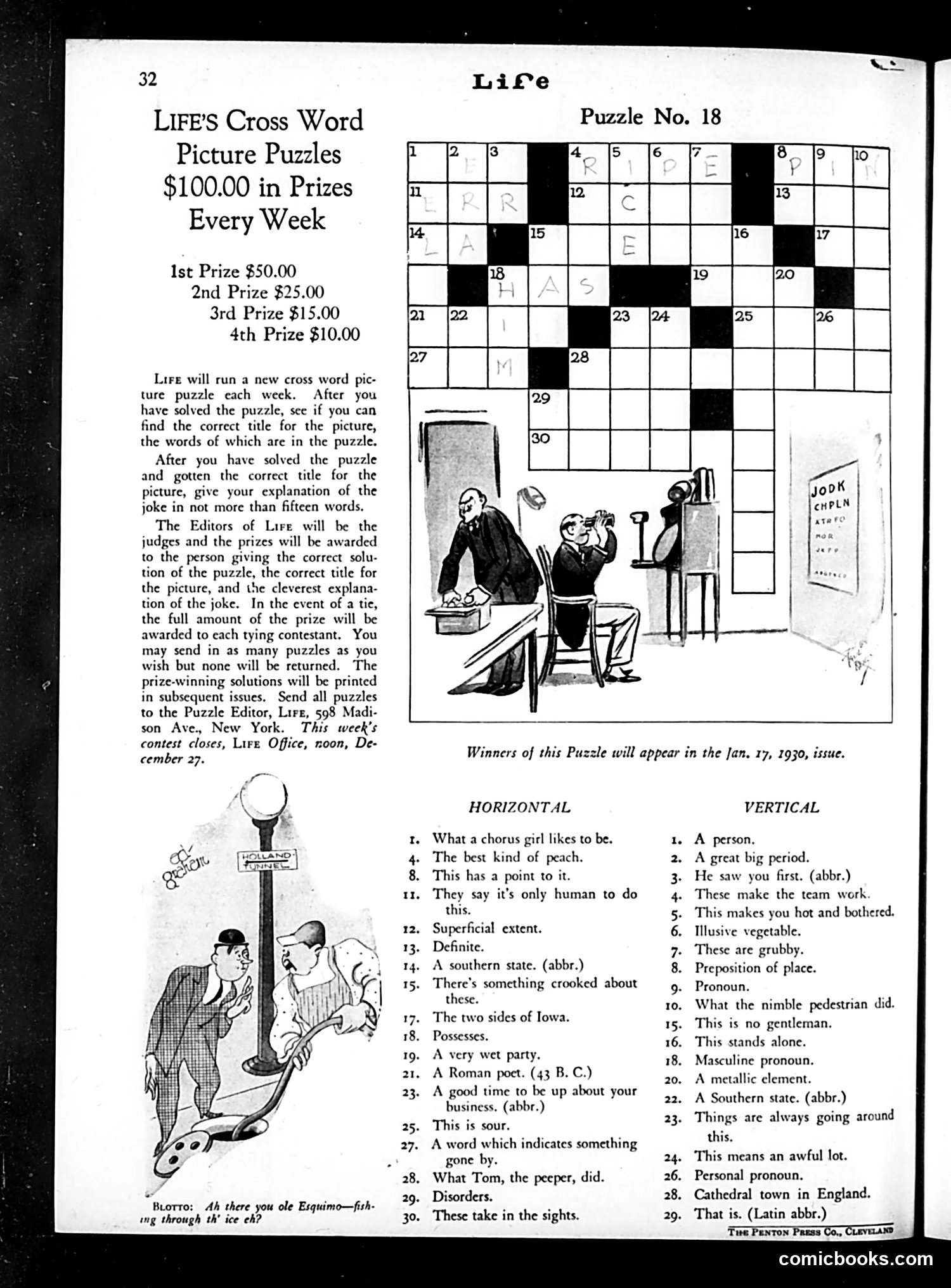
Life Magazine Crossword Picture Puzzle, December 1929 This page announces Life's weekly crossword picture puzzle contest offering $100 in prizes. Readers must solve a crossword, identify the picture's title from the puzzle's answers, and explain the joke in fifteen words or fewer. The main cartoon below shows two men in a comedic situation. The caption reads: "Ah there you ole Esquimo—fishing through th' ice eh?" This appears to be a visual pun or mistaken-identity joke, likely playing on ethnic stereotypes common to 1920s-30s American humor. The puzzle itself is relatively straightforward—a standard crossword with clues like "A chorus girl likes to be" and "The two sides of Iowa"—typical wordplay for the era. The contest format was competitive: multiple correct entries would share the full prize equally. This represents an early example of interactive magazine content, predating modern reader engagement strategies.
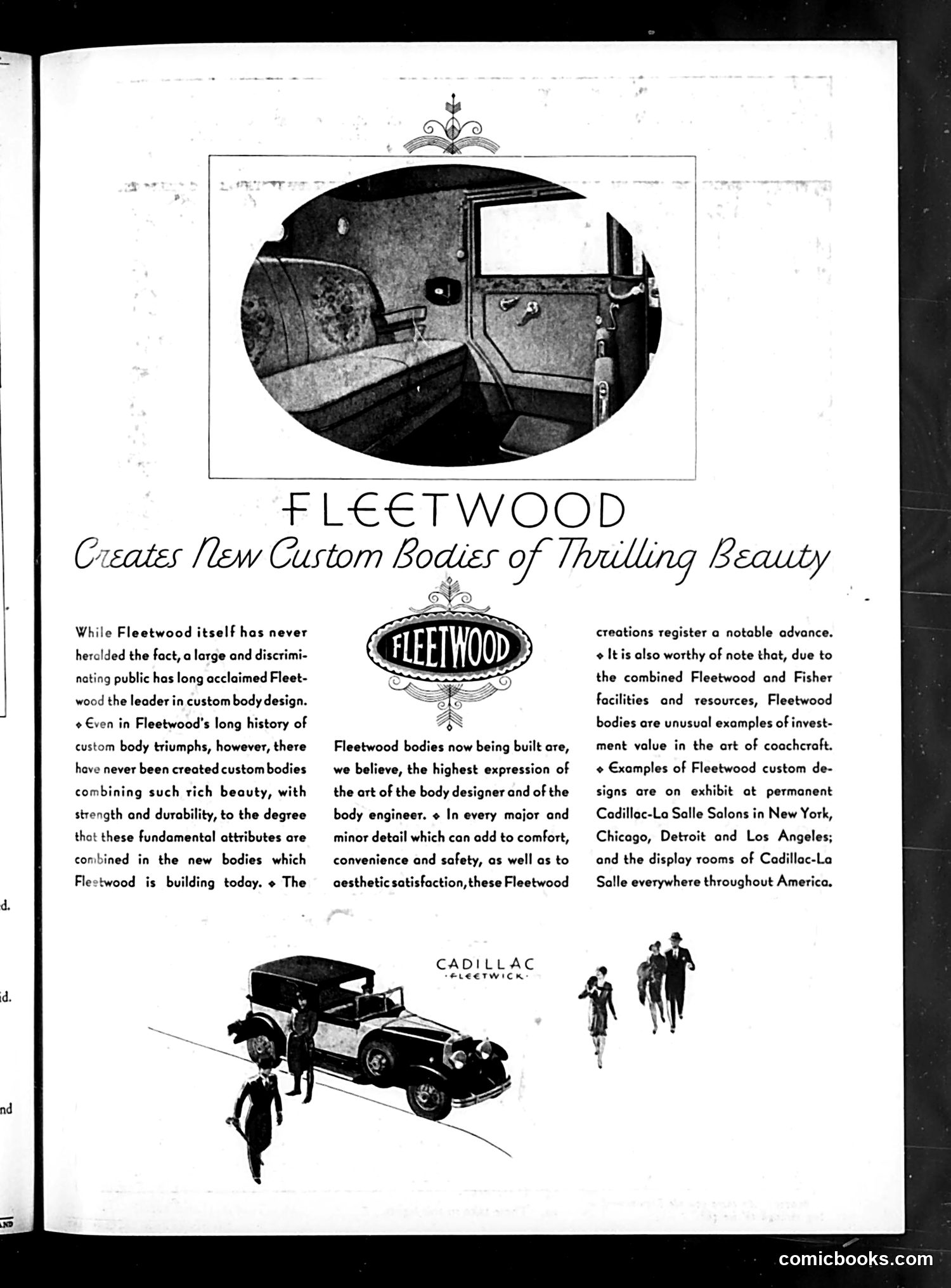
Analysis This is a Fleetwood automobile advertisement, not political satire. Fleetwood was a luxury car body manufacturer that customized Cadillac and La Salle vehicles. The page promotes Fleetwood's custom body design services, emphasizing that their new bodies represent the "highest expression of the art" combining beauty, strength, and durability. The text claims these are superior to previous designs and highlight comfort, convenience, and safety features. The imagery shows an elegant car interior (top oval photo) and a Cadillac sedan below with well-dressed figures, reinforcing the luxury market positioning. The advertisement notes that Fleetwood bodies are on display at Cadillac-La Salle showrooms nationwide. This appears to be from the 1920s-1930s era when custom coachwork on luxury chassis was standard practice for wealthy buyers. There is no cartoon or satire present—this is straightforward high-end advertising.
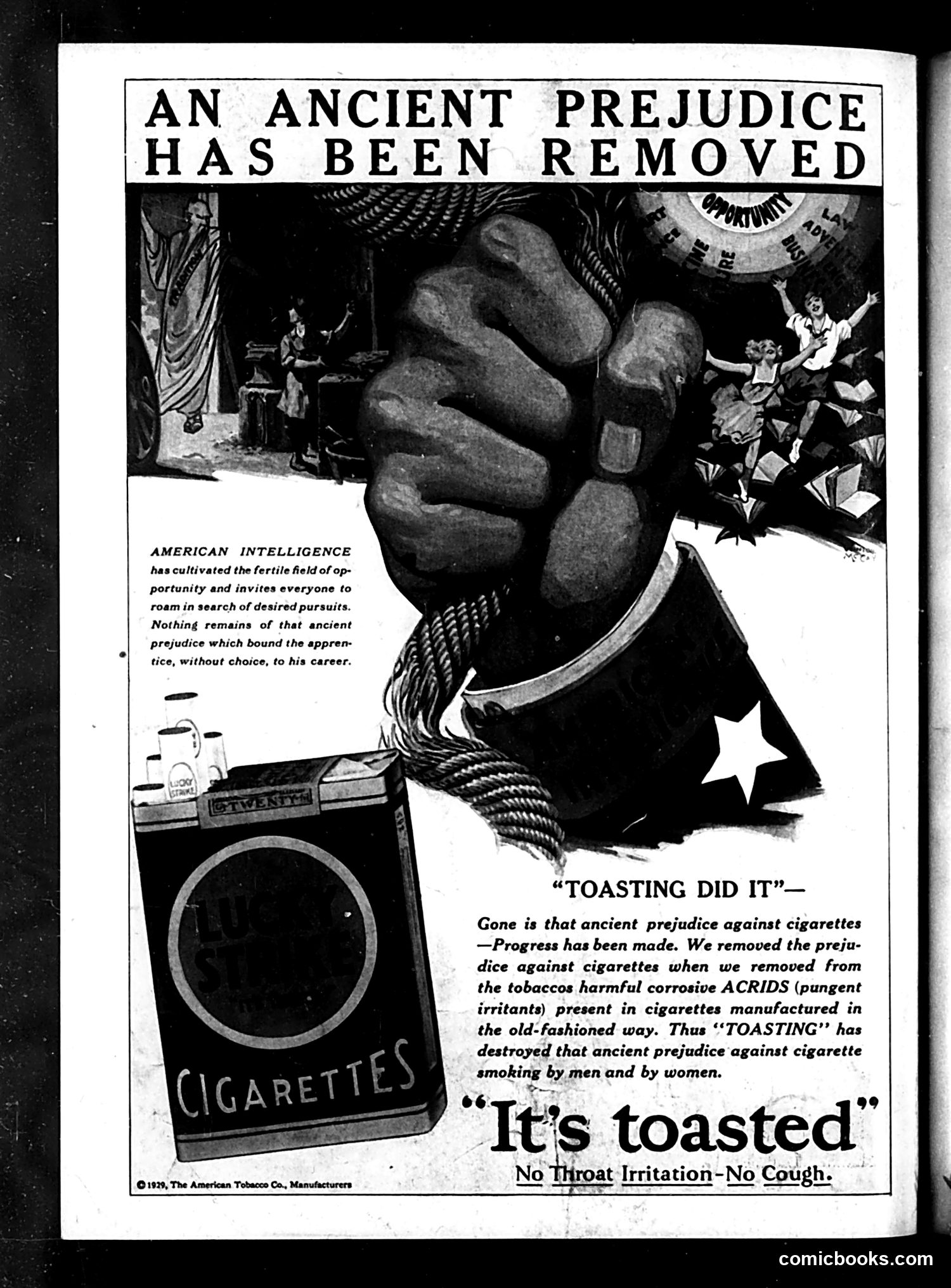
Analysis: "An Ancient Prejudice Has Been Removed" This is a cigarette advertisement, not political satire. The American Tobacco Company uses the framing device of "progress" and "removed prejudice" to market toasted cigarettes. The ad equates social progress (apprentices gaining career freedom) with cigarette acceptance. It claims that removing harmful "ACRIDS" through a "toasting" process eliminated prejudice against smoking—particularly among women, who apparently faced social resistance to cigarette use. The imagery of a fist breaking chains symbolizes liberation, deliberately conflating industrial innovation with human freedom. The central cigarette pack and claims of "No Throat Irritation—No Cough" constitute the actual sales pitch. Modern context: This exploits early-20th-century optimism about technology and progress to normalize a dangerous product, while suggesting that health concerns ("ancient prejudice") have been scientifically solved. It's essentially misinformation marketing presented as enlightenment.