life
Life — December 20, 1929
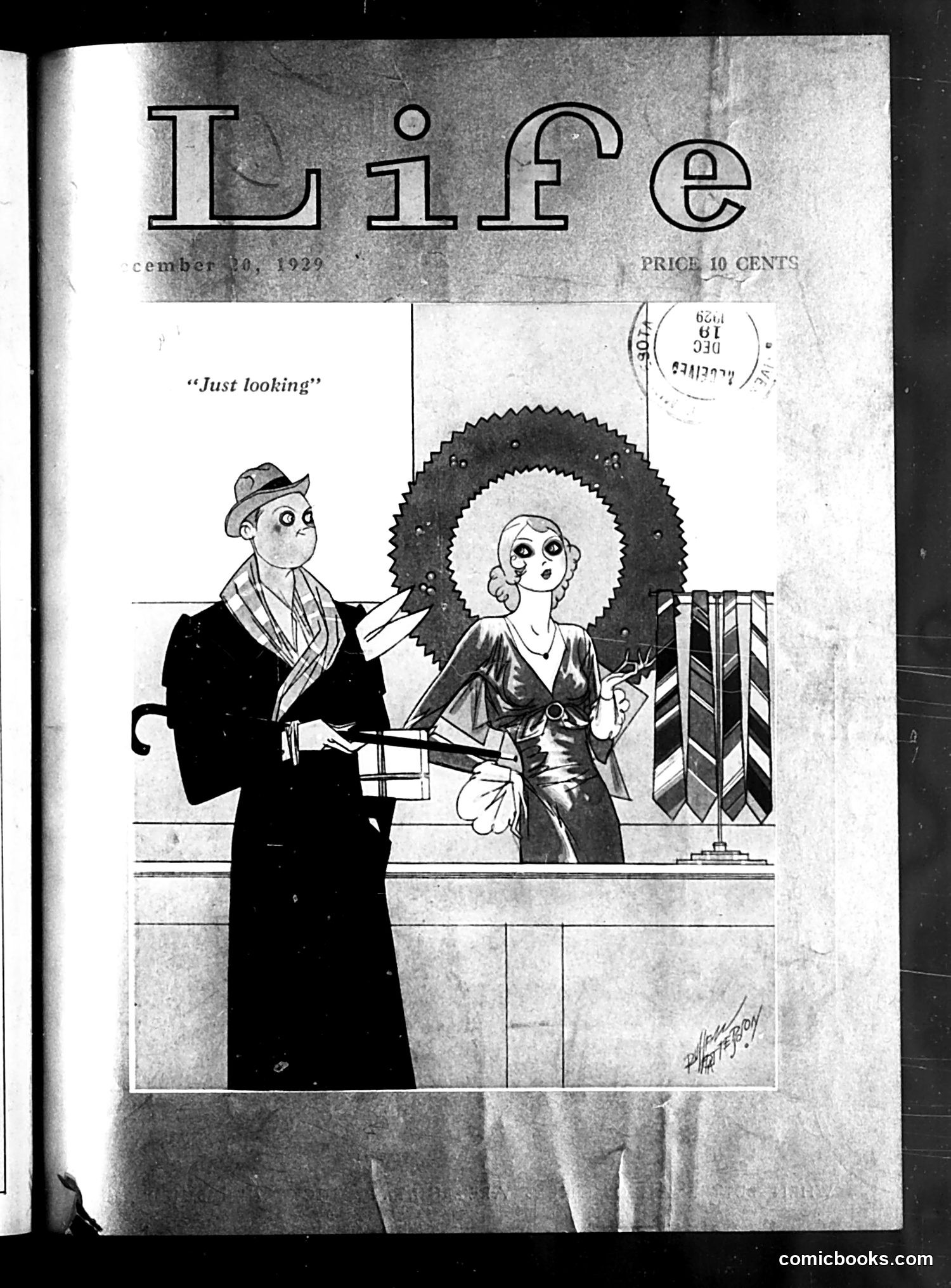
Life Magazine, December 20, 1929 This cartoon's caption "Just looking" presents a satirical scene from a shop window display. A well-dressed man in a bowler hat and overcoat points toward merchandise while addressing a fashionably dressed woman wearing a large fur coat and hat. The setting appears to be a retail storefront with items displayed behind glass. The satire likely critiques consumer behavior and pretense during the period immediately following the 1929 stock market crash. The phrase "just looking" suggests window shopping or feigned interest without purchasing intent—a pointed commentary on Americans browsing goods they could no longer afford after the financial collapse. The couple's stylish appearance contrasts ironically with economic hardship, highlighting the disconnect between appearance and actual financial capacity during the Great Depression's early stages.
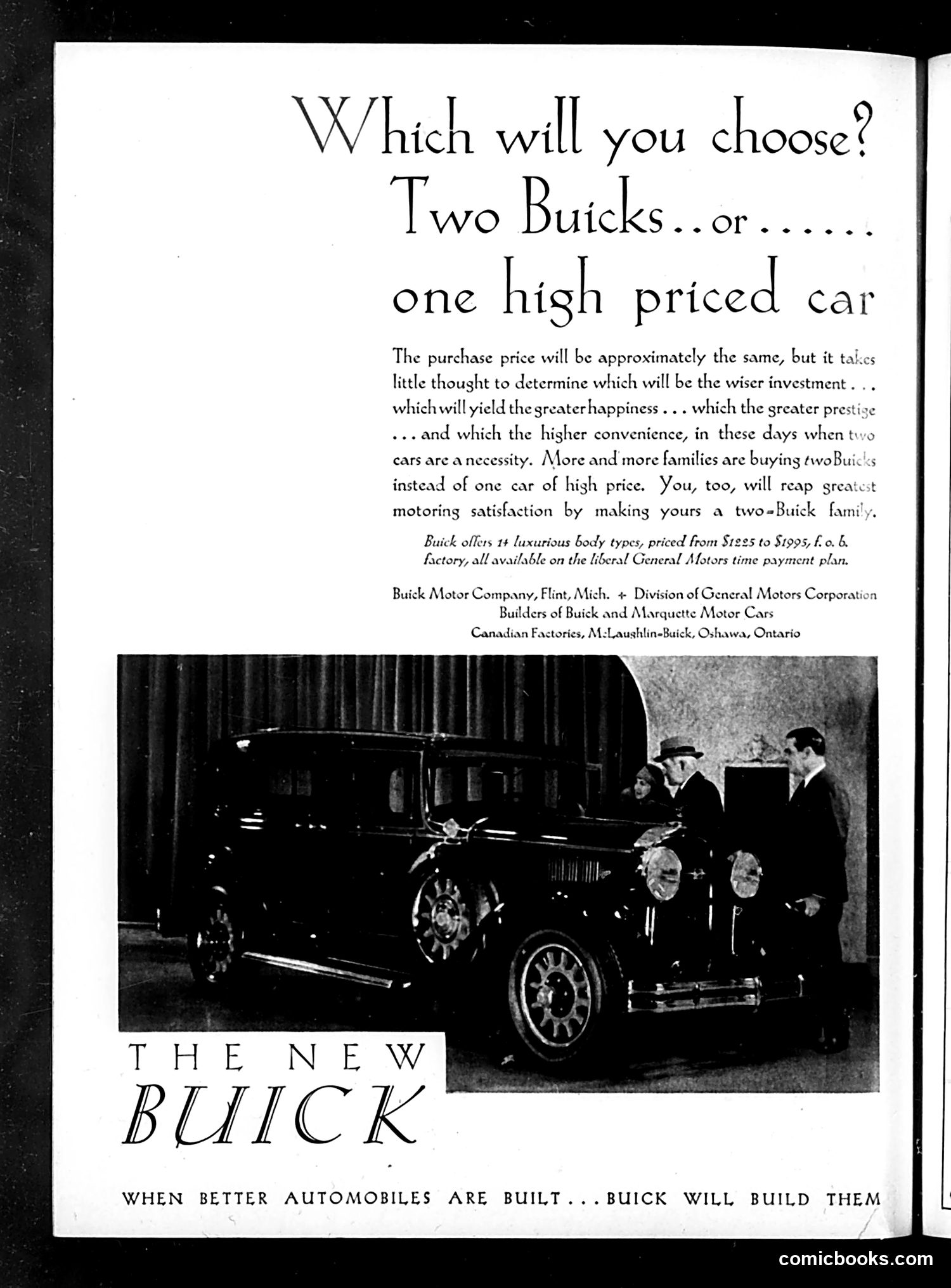
This is a Buick automobile advertisement, not satire or political commentary. The page presents a marketing argument: given similar purchase prices, why buy one expensive car when two moderately-priced Buicks offer greater practicality? The advertisement addresses a specific consumer concern of the era—the growing need for multiple vehicles in American families. It appeals to middle-class buyers by positioning two Buicks as a smarter investment than one luxury automobile, promising superior "happiness," "prestige," and "convenience." The photograph shows a well-dressed family examining a Buick, reinforcing aspirational messaging. The tagline—"When better automobiles are built... Buick will build them"—was Buick's actual slogan. This reflects post-WWI American car-buying trends and the rise of multi-car household ownership.
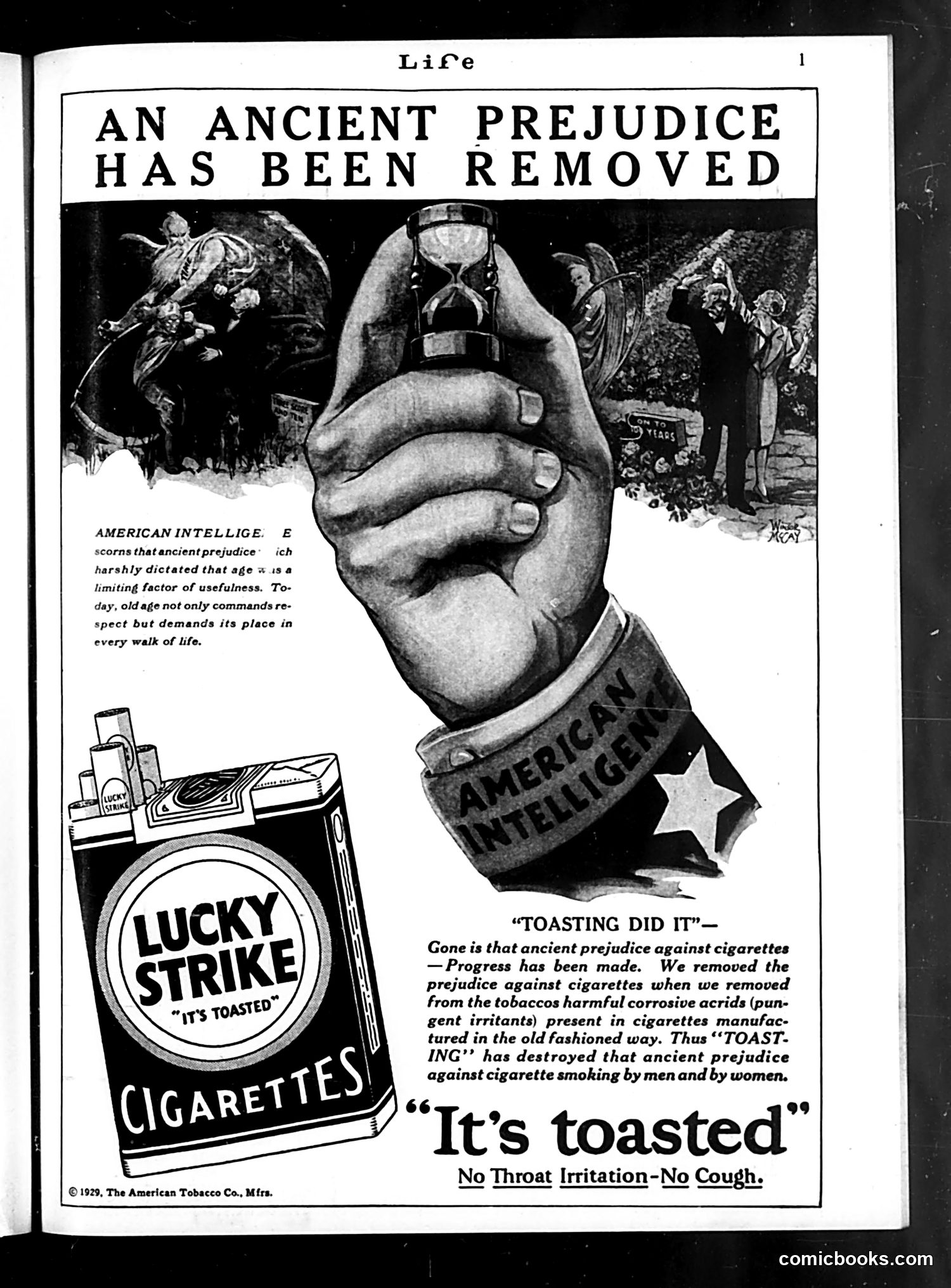
Analysis This is a Lucky Strike cigarette advertisement, not satire or political commentary. The page uses the headline "An Ancient Prejudice Has Been Removed" to claim that the tobacco industry's "toasting" process eliminates harmful irritants previously associated with cigarettes. The imagery shows a hand holding a gas mask—the "ancient prejudice" being the belief that cigarettes cause throat irritation and cough. By removing this concern through toasting, Lucky Strike argues it has made smoking safe and socially acceptable "by men and by women." This represents early 20th-century tobacco marketing that falsely claimed health benefits. The "American Intelligence" branding attempts to associate the product with progress and modernity. The advertisement is misleading propaganda, not genuinely satirical content.
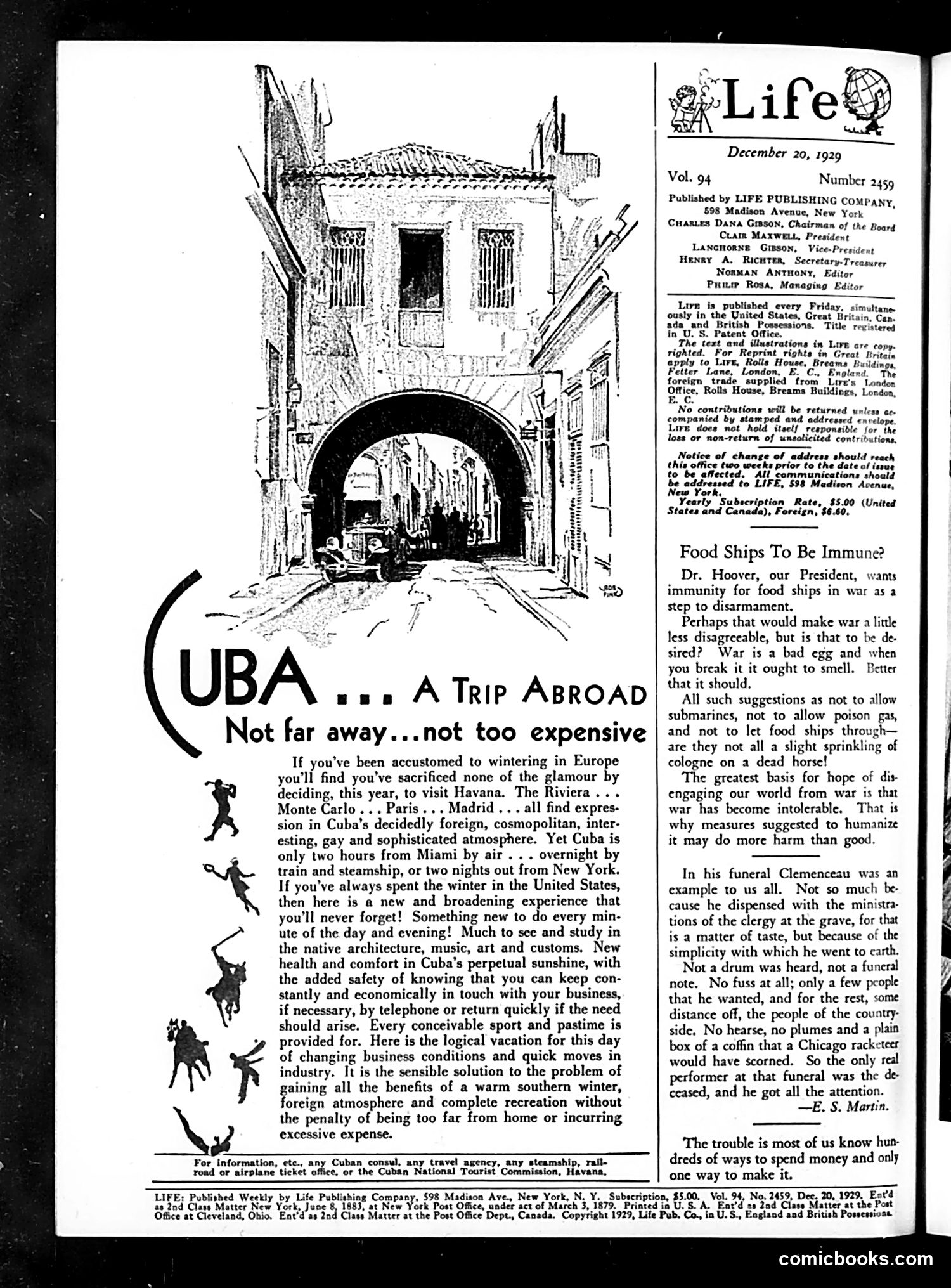
Life Magazine, December 20, 1929 The Cuba Advertisement: This is a travel advertisement promoting Cuba as an affordable winter vacation destination. It emphasizes Cuba's accessibility—only two hours from New York by air or train—and its appeal as a sophisticated alternative to European travel. The silhouettes show people engaged in leisure activities (dancing, sports). The pitch stresses business convenience: vacationers can stay connected via telephone and return quickly if needed, making it an ideal "sensible solution" for taking a warm winter break without sacrificing professional obligations. The Editorial: The commentary critiques President Hoover's proposal to grant immunity to food ships during wartime as a disarmament measure. The author dismisses this as naive, arguing war itself is inherently brutal and that protecting supply lines won't meaningfully reduce conflict's horrors.
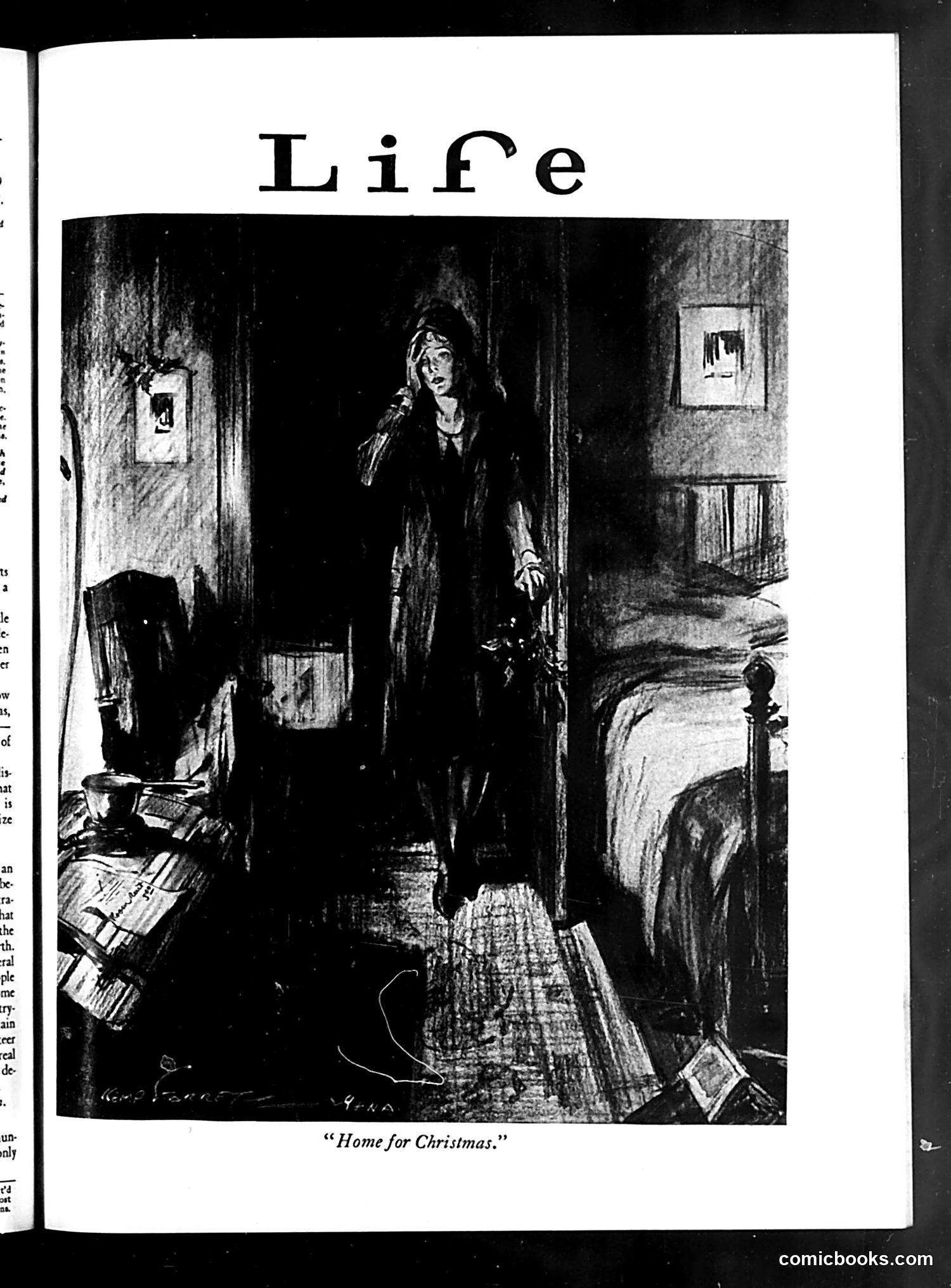
Analysis This page from *Life* magazine features an illustration titled "Home for Christmas" showing a somber domestic scene. A figure in dark clothing stands in a modest bedroom, with a bed visible on the right and a chair on the left. The sparse furnishings and austere setting suggest modest or impoverished circumstances. The caption's ironic title—"Home for Christmas"—paired with the melancholic mood suggests social commentary on economic hardship during what appears to be a period of American financial difficulty, likely the Great Depression era. The contrast between the holiday sentiment and the grim domestic reality emphasizes the gap between celebratory ideals and harsh lived experience for struggling Americans. The satire critiques the disconnect between seasonal expectations and actual conditions facing working-class families.
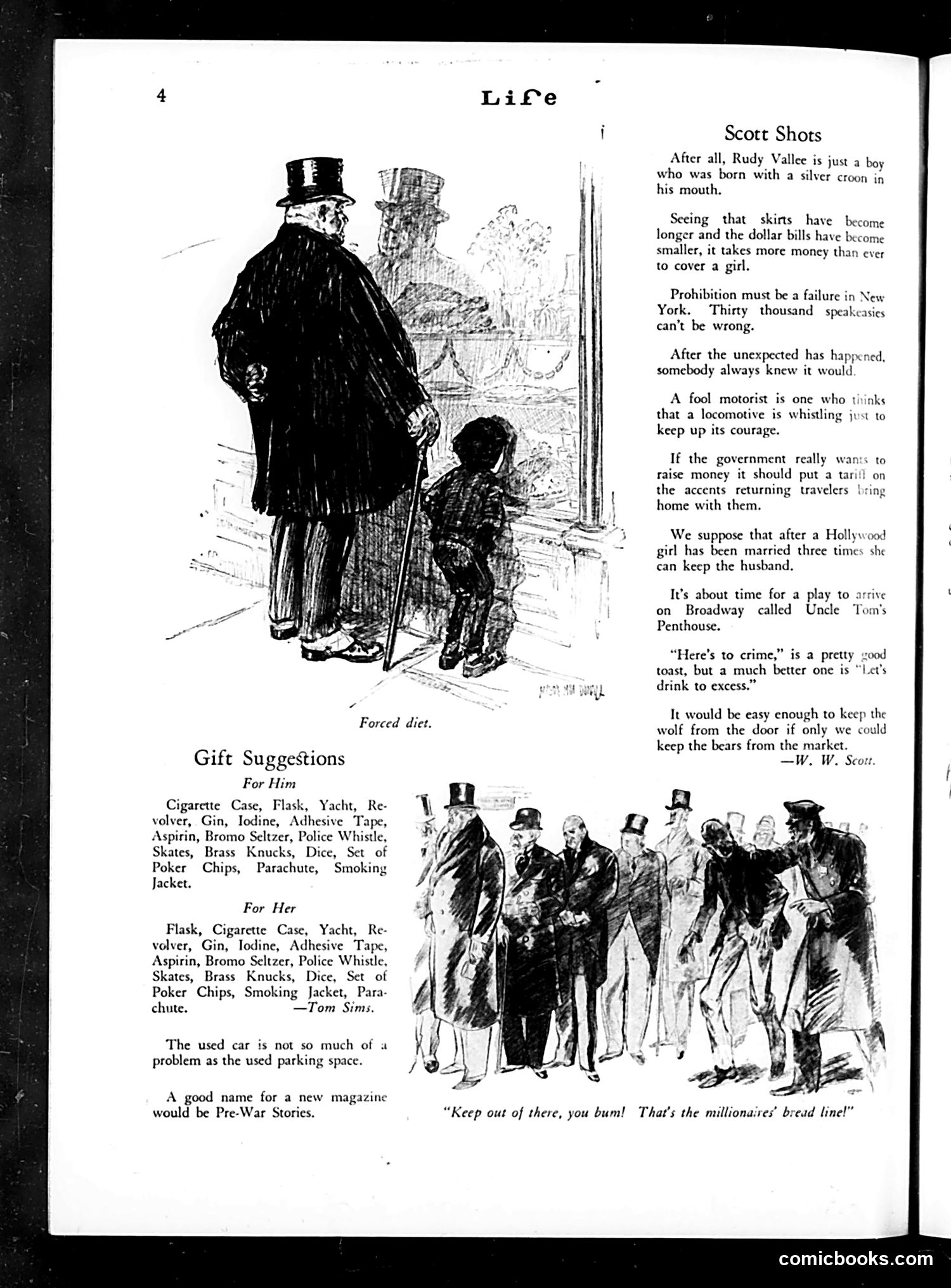
Analysis of Life Magazine Page 4 This page contains satirical commentary by Scott Shorts and includes two cartoons. The first, titled "Forced diet," shows an elegantly dressed adult and child, likely satirizing wealth inequality during economic hardship—the "forced diet" referring to deprivation despite the adult's obvious affluence. The second cartoon depicts well-dressed men (likely wealthy businessmen or "millionaires") with the caption "Keep out of there, you bum! That's the millionaires' bread line!"—a pointed reference to bread lines during economic crisis, mocking the hypocrisy of wealthy individuals protecting their resources while poor citizens queue for basic sustenance. The "Gift Suggestions" section humorously lists identical items for both men and women, reflecting contemporary social commentary on gender equality or consumerism.
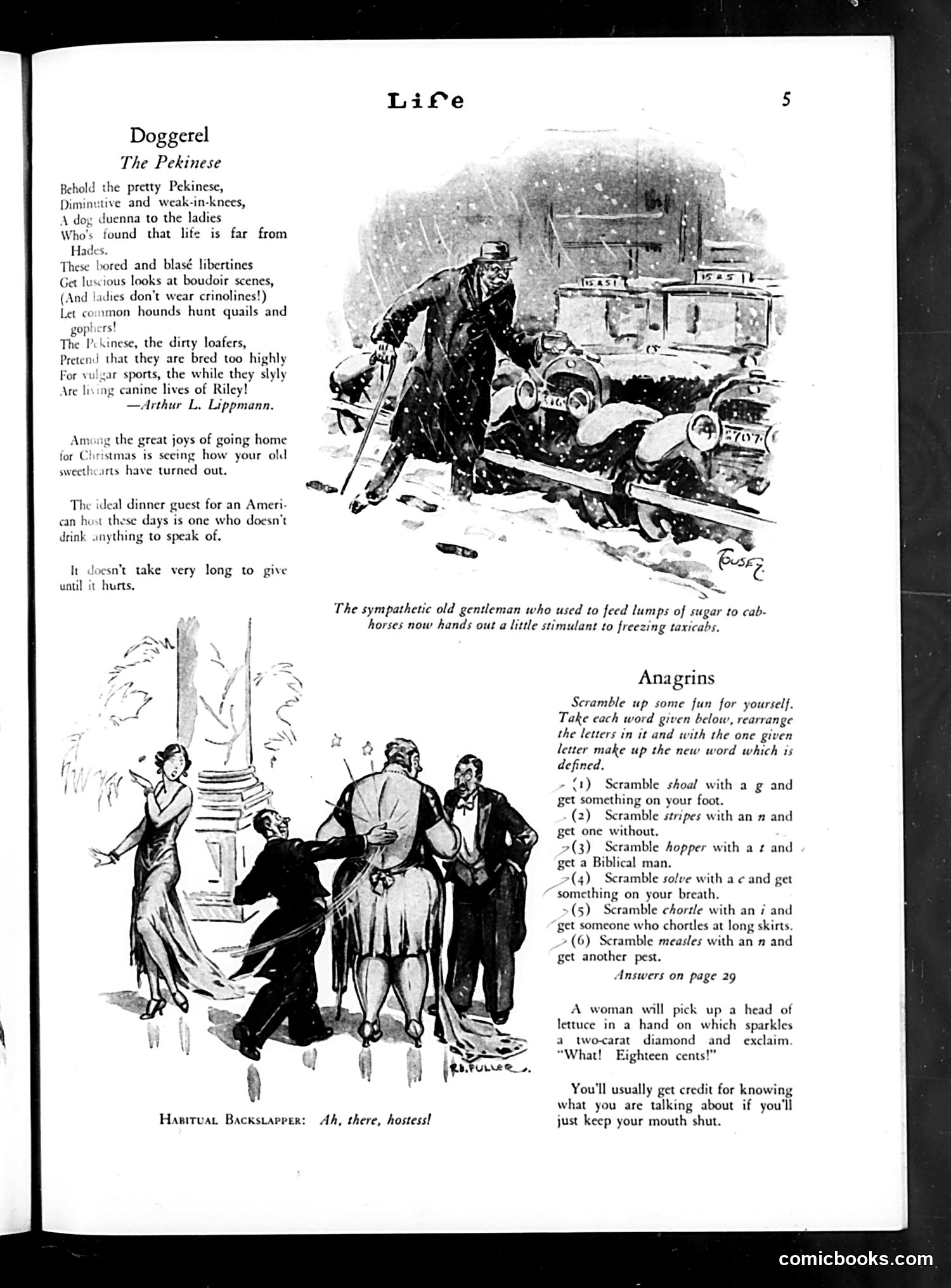
Analysis of Life Magazine Page 5 This page contains three distinct pieces of satirical content: "Doggerel: The Pekinese" (poem by Arthur L. Lippmann) mocks small lap dogs as impractical status symbols for wealthy women, contrasting them with working hunting dogs. Top cartoon depicts an elderly gentleman helping a woman stuck in snow near a frozen taxi—satirizing changing social roles and the decline of chivalry in modern times, as automobiles replace horses. "Habitual Backslapper" cartoon ridicules a gregarious social type who inappropriately touches and overfamiliarizes with acquaintances in public settings. "Anagrins" is a word puzzle game where readers rearrange letters to form new words, described in the accompanying definitions. The page reflects 1920s-era concerns about changing manners, technology's social impact, and class-based humor about pet ownership and social behavior.
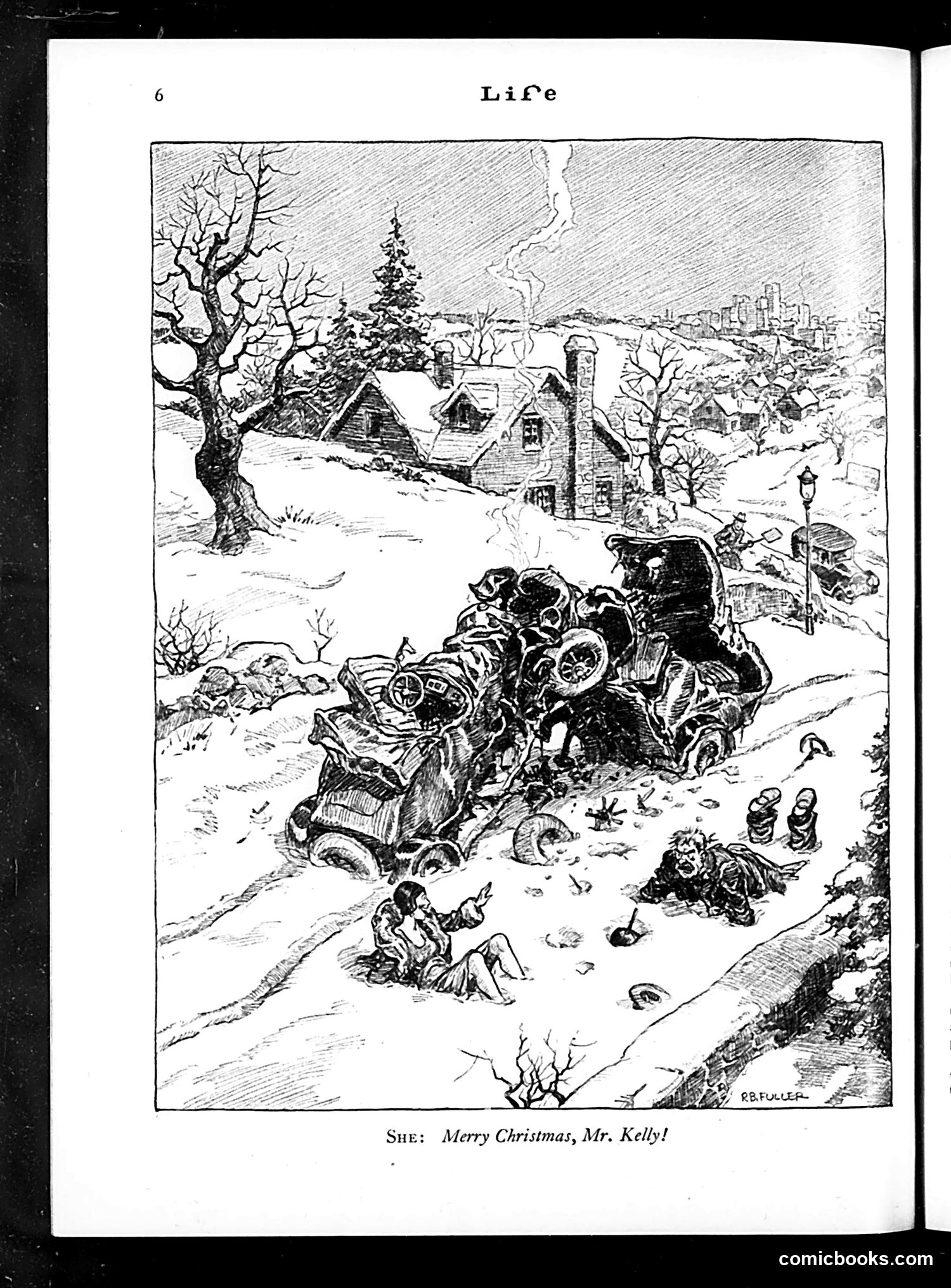
Analysis This is a single-panel cartoon titled "Merry Christmas, Mr. Kelly!" showing a winter scene with a wrecked automobile piled with mechanical parts and debris in the foreground. The vehicle appears deliberately constructed or assembled from scrap materials rather than being a conventional car. The cartoon likely satirizes a specific public figure named Kelly, though without additional context it's unclear whether this references a politician, businessman, or other notable person from Life magazine's era. The wreckage and chaotic assembly suggest incompetence, failure, or mismanagement—the "joke" being a sarcastic Christmas greeting directed at someone whose endeavors have spectacularly fallen apart. The snowy rural setting with houses and a distant city contrasts the destruction in the foreground, emphasizing the disaster.
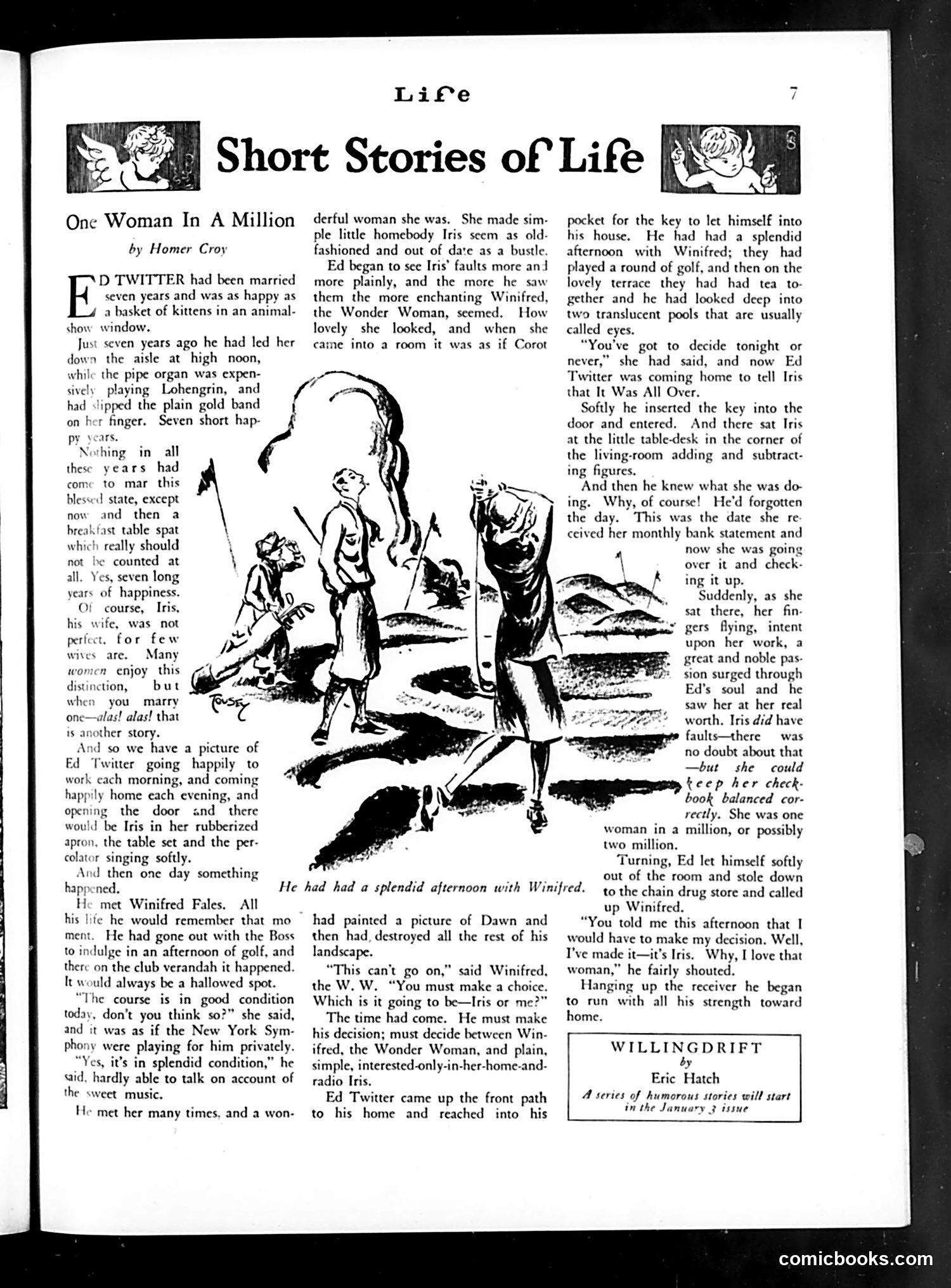
"One Woman in a Million" by Homer Cray This story illustrates a common early-20th-century marital scenario: Ed Twitter, a comfortable husband, has grown complacent in his marriage to Iris. He meets an attractive woman named Winifred Fales and must choose between his plain, domestic wife and this exciting "Wonder Woman." The satire targets the male fantasy of trading up for a more glamorous partner. The illustration shows Iris as an ordinary homemaker while Winifred represents sophistication and allure. The story's ironic title—"One Woman in a Million"—sarcastically suggests Iris's supposedly unremarkable nature, though the narrative reveals her actual value: her fidelity and domestic competence that Ed nearly overlooks while chasing excitement.
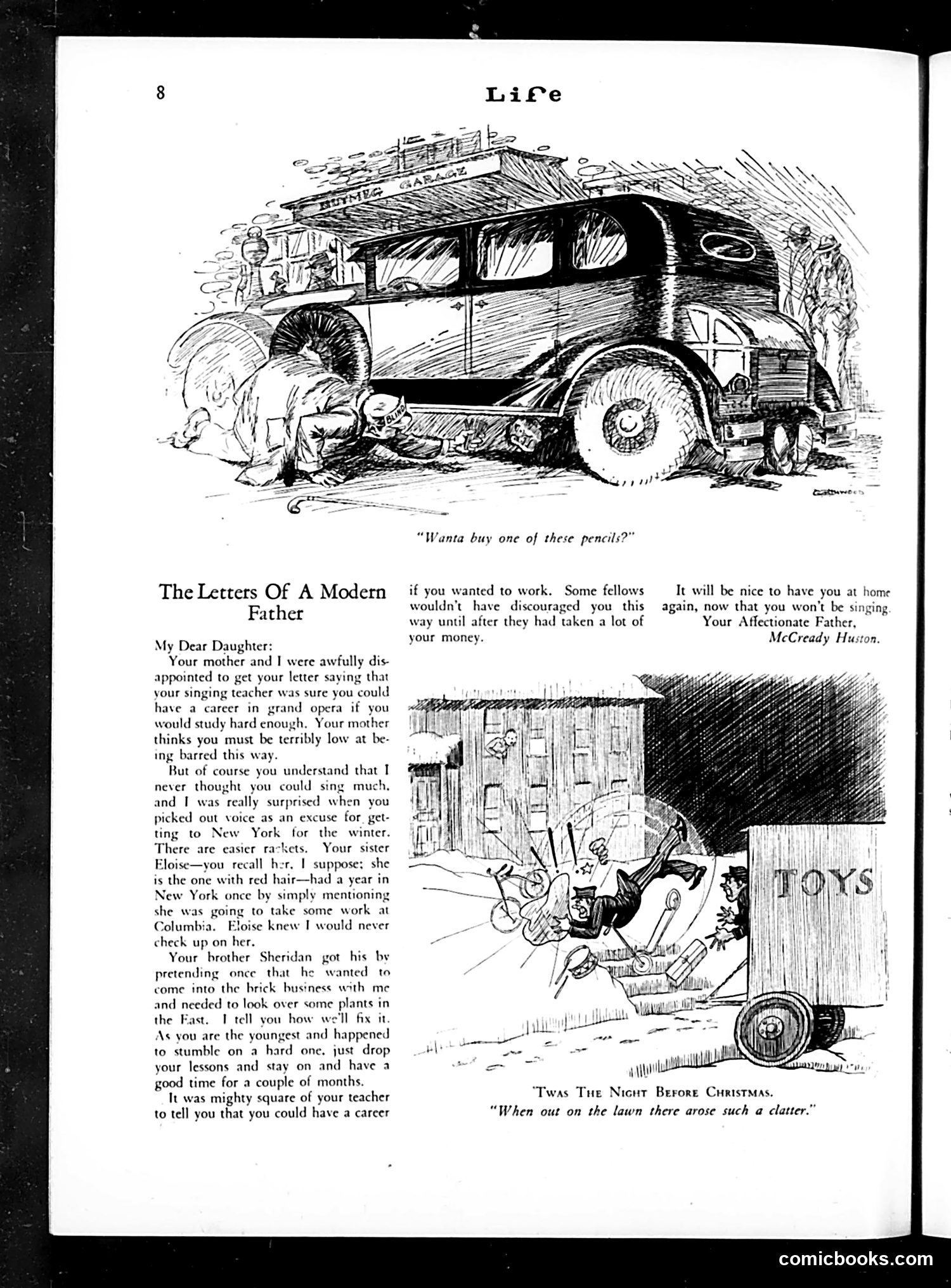
Analysis of Life Magazine Page 8 This page contains "The Letters of a Modern Father," a humorous piece where a father writes to his daughter about her disappointed opera ambitions. The satire mocks both the daughter's unrealistic career expectations and parental condescension—the father suggests she should abandon dreams of grand opera, noting that even her sister Eloise succeeded through mentioning Columbia University rather than actual talent. The top cartoon shows a car salesman pitching pencils with the caption "Wanta buy one of these pencils?"—likely satirizing Depression-era hustle and makeshift entrepreneurship. The bottom illustration, "Twas the Night Before Christmas," depicts children destroying toys on Christmas Eve, captioned with chaos erupting "when out on the lawn there arose such a clatter." Together, these pieces humorously critique American ambition, class mobility, and consumer culture.
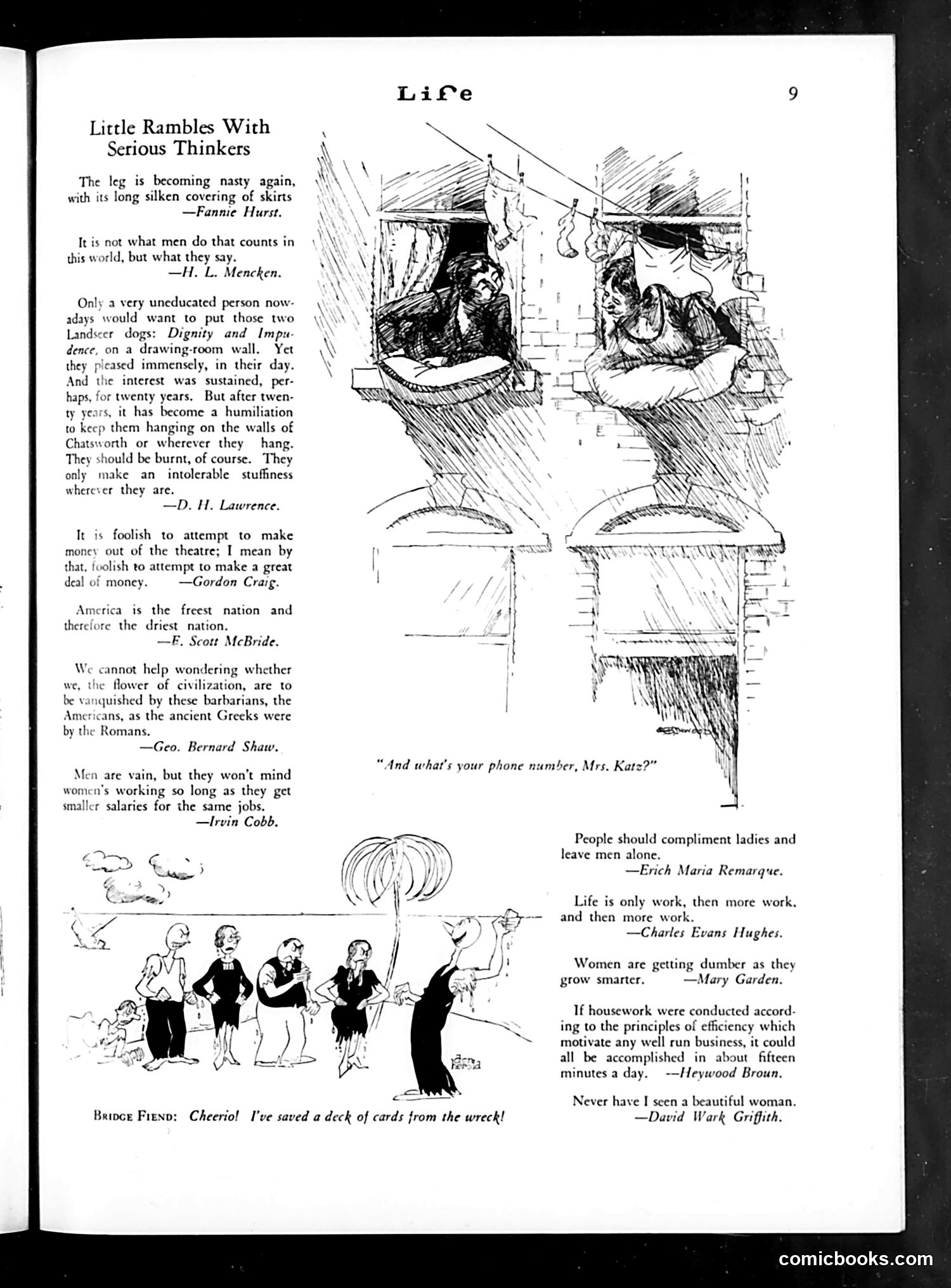
Analysis of Life Magazine Page 9 This page combines philosophical quotes with satirical cartoons. The upper cartoon depicts two figures in what appears to be an attic or upper room, with the caption "And what's your phone number, Mrs. Katz?" — likely satirizing the modern intrusion of technology into private spaces or the awkwardness of collecting personal information. The lower cartoon shows a group of people gathered around a palm tree, with the caption "Bridge Friend: Cheerio! I've saved a deck of cards from the wreck!" This appears to mock upper-class priorities during an emergency—suggesting frivolous bridge players would prioritize their card game even after a disaster. The accompanying quotes from various authors address themes of gender, labor, beauty, and civilization, typical of Life's satirical commentary on contemporary social issues.
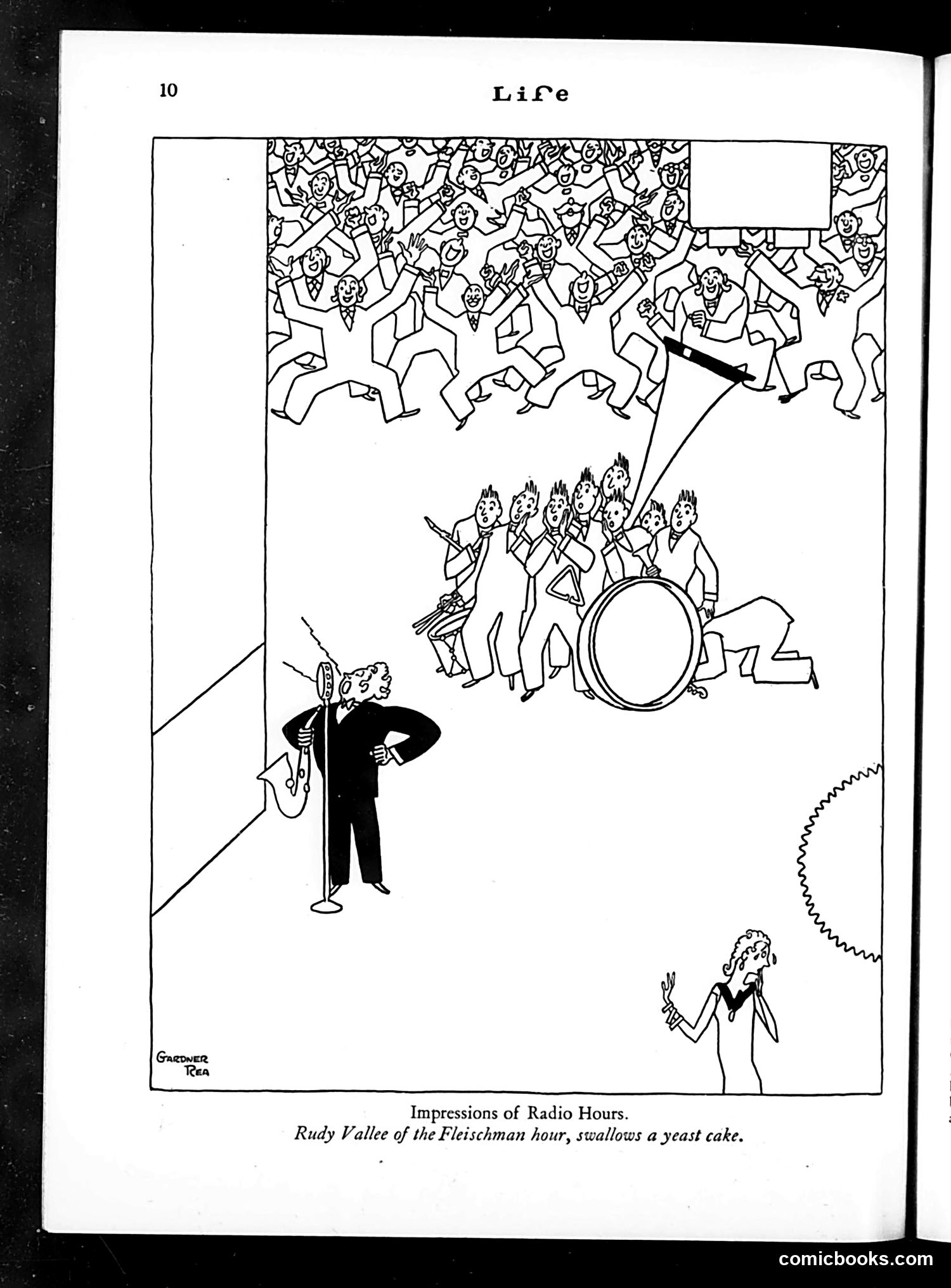
"Impressions of Radio Hours" This cartoon satirizes early radio broadcasting, specifically mocking "Rudy Vallee of the Fleischman hour," a popular 1920s-30s radio program. The image shows a conductor addressing a large, enthusiastic studio audience above, while below, a lone listener sits eating cake—humorously depicting the contrast between the broadcaster's grand performance before a live crowd and the solitary domestic experience of the radio audience member. The satire suggests the disconnect between radio's theatrical presentation (designed for imagined masses) and the actual isolated listener experience. Rudy Vallee was a famous crooner of the era, and the "Fleischman hour" was a sponsored program. The yeast cake reference likely alludes to the show's commercial sponsor, Fleischman's yeast.
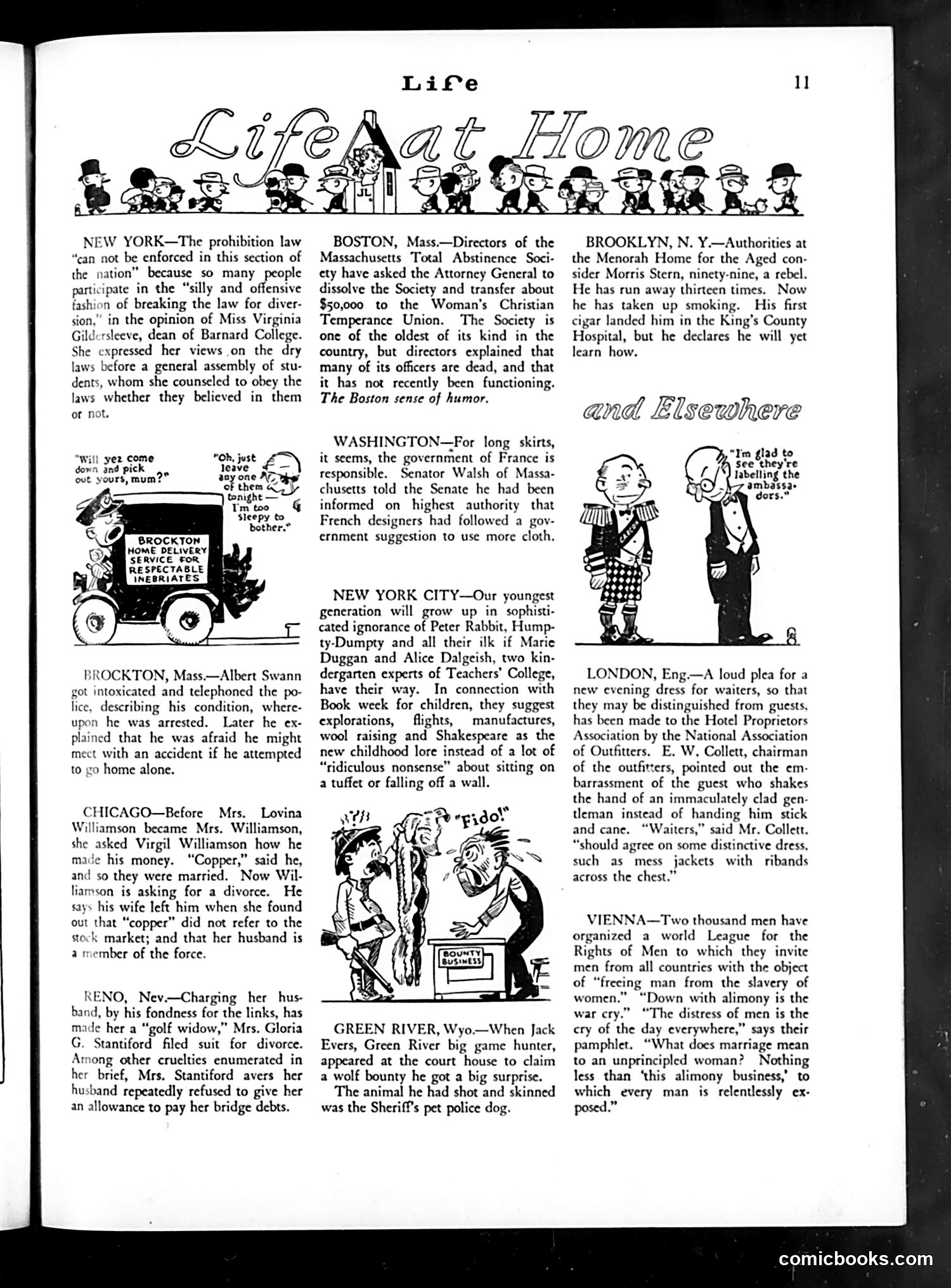
Analysis of Life Magazine Page 11 This page collects humorous anecdotes from various American cities under the heading "Life at Home and Elsewhere." The visible cartoon depicts a woman in a car labeled "BROCKTON SHOULD ENFORCE RESPECTABLE INHERITS" speaking to a man, with dialogue about coming "out yourself, mum?" The humor appears to target class anxieties and inheritance disputes. Other brief items satirize contemporary social issues: prohibition law enforcement difficulties in New York, fashion debates about women's skirt length involving France and the U.S. Senate, and concerns about children's literature and education. Additional anecdotes mock divorce proceedings, gender relations, and marriage customs internationally. The cartoons use exaggeration and ironic juxtaposition to lampoon middle-class propriety and social conventions of the era.
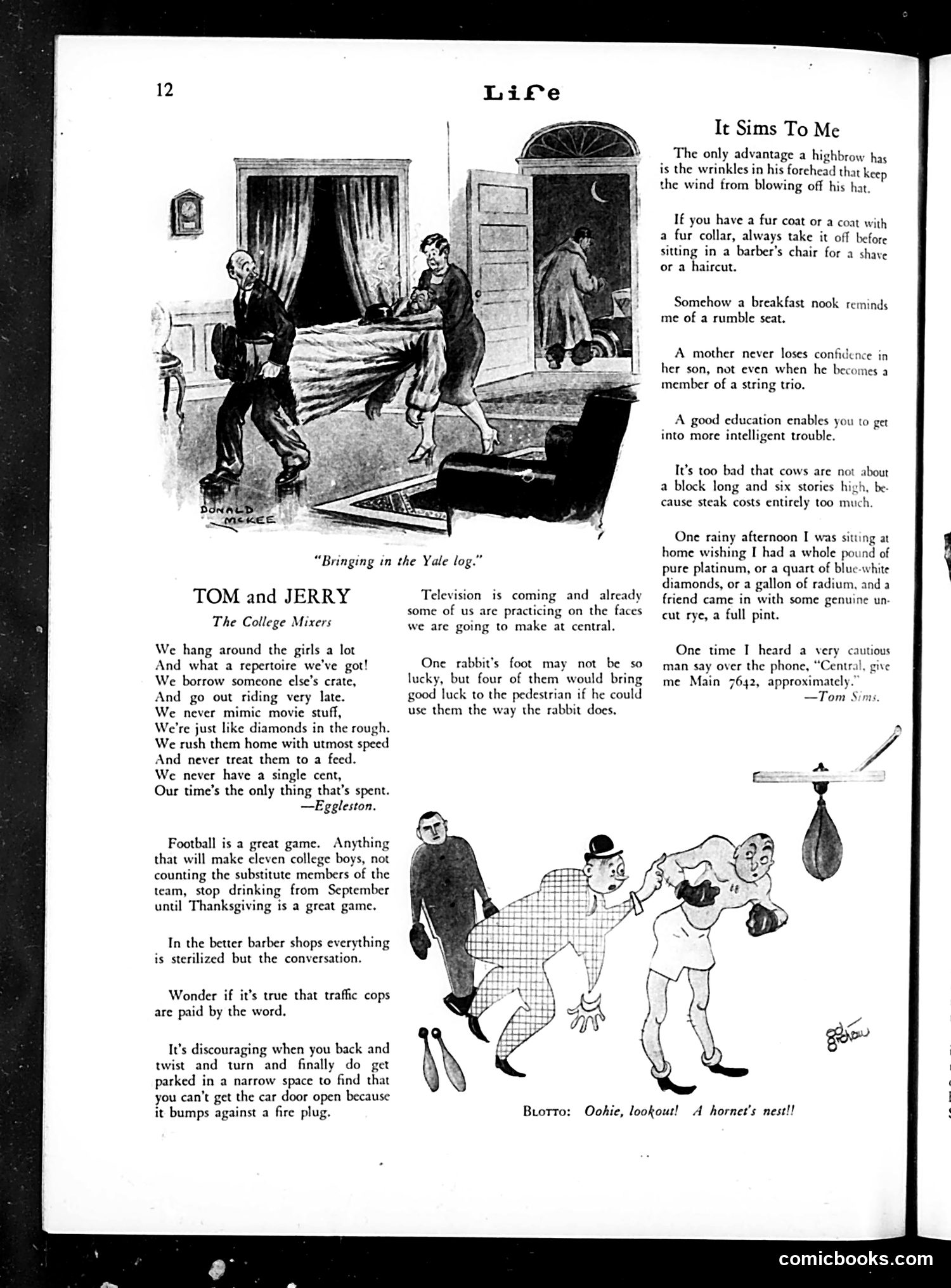
Page 12 Analysis: Life Magazine Humor Section This page contains several humor pieces typical of Life magazine's satirical content: "Tom and Jerry: The College Mixers" features a poem about college students' social behavior—borrowing cars, dating girls, and living carelessly. The accompanying illustration shows young people in what appears to be a bedroom or dormitory setting, likely depicting the casual social mixing the poem describes. "It Sims To Me" is a humor column with observations about highbrows, barber chairs, education, and everyday absurdities (like cows being too short for profitable steaks). The bottom cartoon shows men playing a boxing/punching bag game, with the caption "Ookie, lookout! A hornet's nest!!" This appears to be simple slapstick humor about unexpected consequences. The page reflects 1920s-30s college culture and everyday urban life observations aimed at a general American audience.
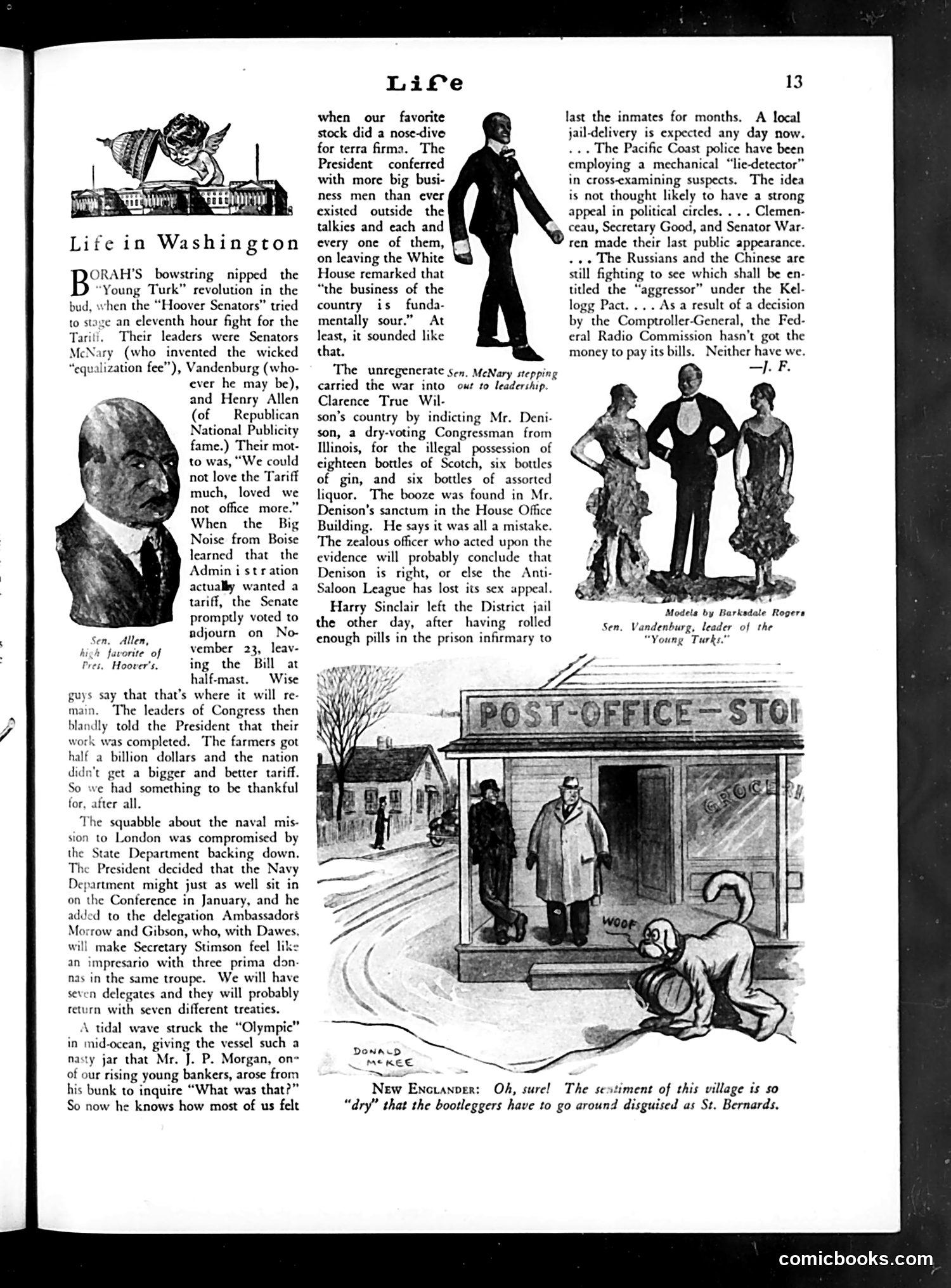
"Life in Washington" - Political Satire This page satirizes early 20th-century Washington politics and Prohibition enforcement. The main article discusses Senator Vandenburg (photo shown) and the "Young Turk" faction attempting political reform against entrenched interests. The cartoon at bottom, titled "New Englander," depicts bootleggers operating brazenly near a post office—mocking Prohibition's failure. The caption's dry humor ("the settlement is so 'dry' that the bootleggers have to go around disguised") underscores how widespread illegal alcohol sales were, even in supposedly law-abiding areas. The silhouetted figure in the middle section appears to reference political leadership navigating scandals (possibly the Denison bootleg liquor scandal mentioned in text). Overall, the page criticizes both political corruption and Prohibition's unenforceable nature.
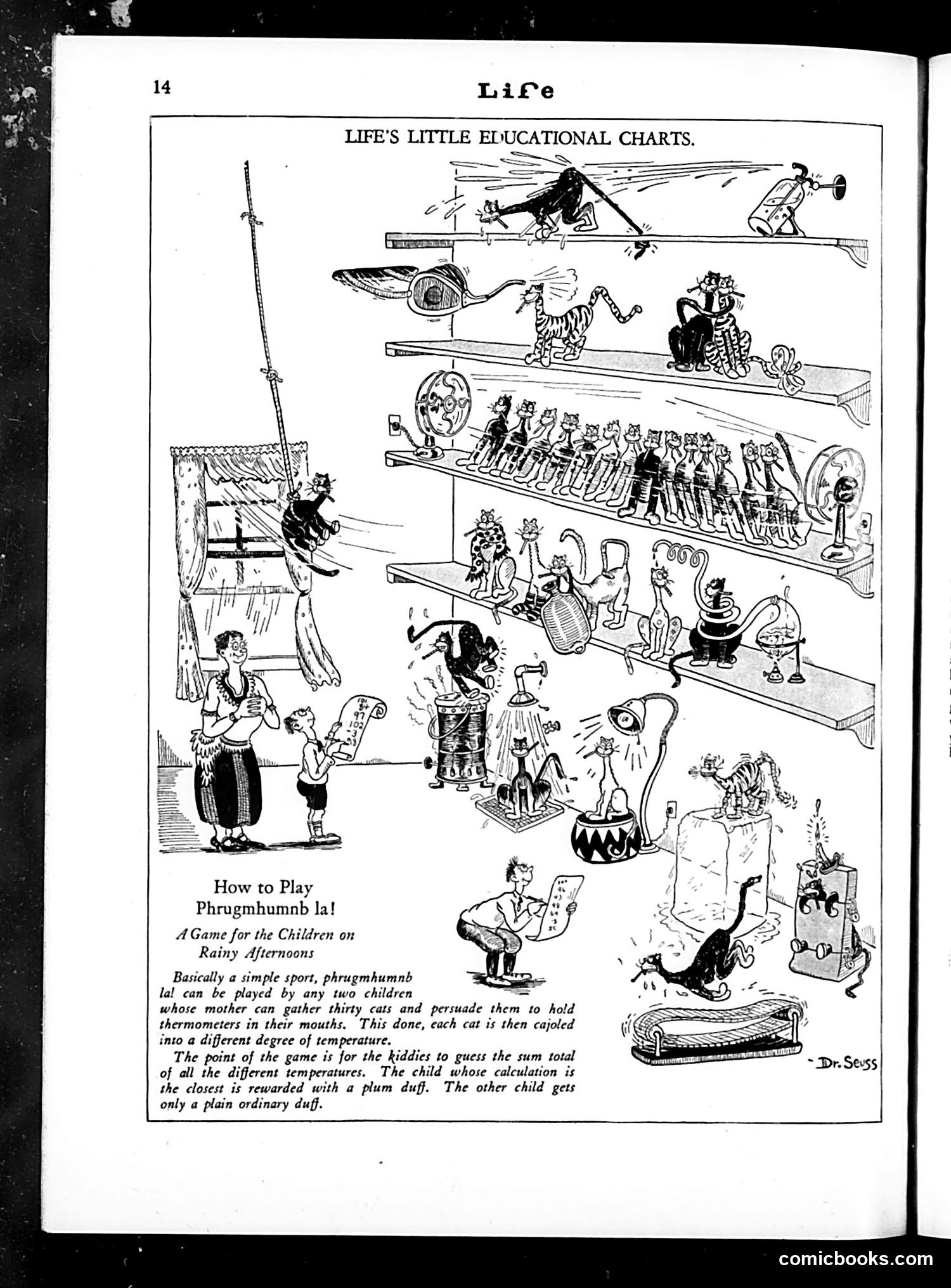
"How to Play Phrugmhumb la!" - Life Magazine Educational Chart This is a whimsical, nonsensical "educational chart" by Dr. Seuss (signed lower right) satirizing elaborate children's games and overly complicated instructions. The game described is absurd: children gather thirty cats, place thermometers in their mouths, then guess the sum of all temperatures to win a "plum duff" dessert. The illustration shows increasingly ridiculous contraptions and scenarios—mechanical devices, cauldrons, performers—none logically connected to the stated game. The satire targets the period's trend toward overcomplicated children's entertainment and pseudo-scientific "educational" games. By presenting an impossible, farcical game as serious instruction, Seuss mocks how adults often obscure simple fun with pretentious complexity, offering parents and readers ironic commentary on children's pastimes.
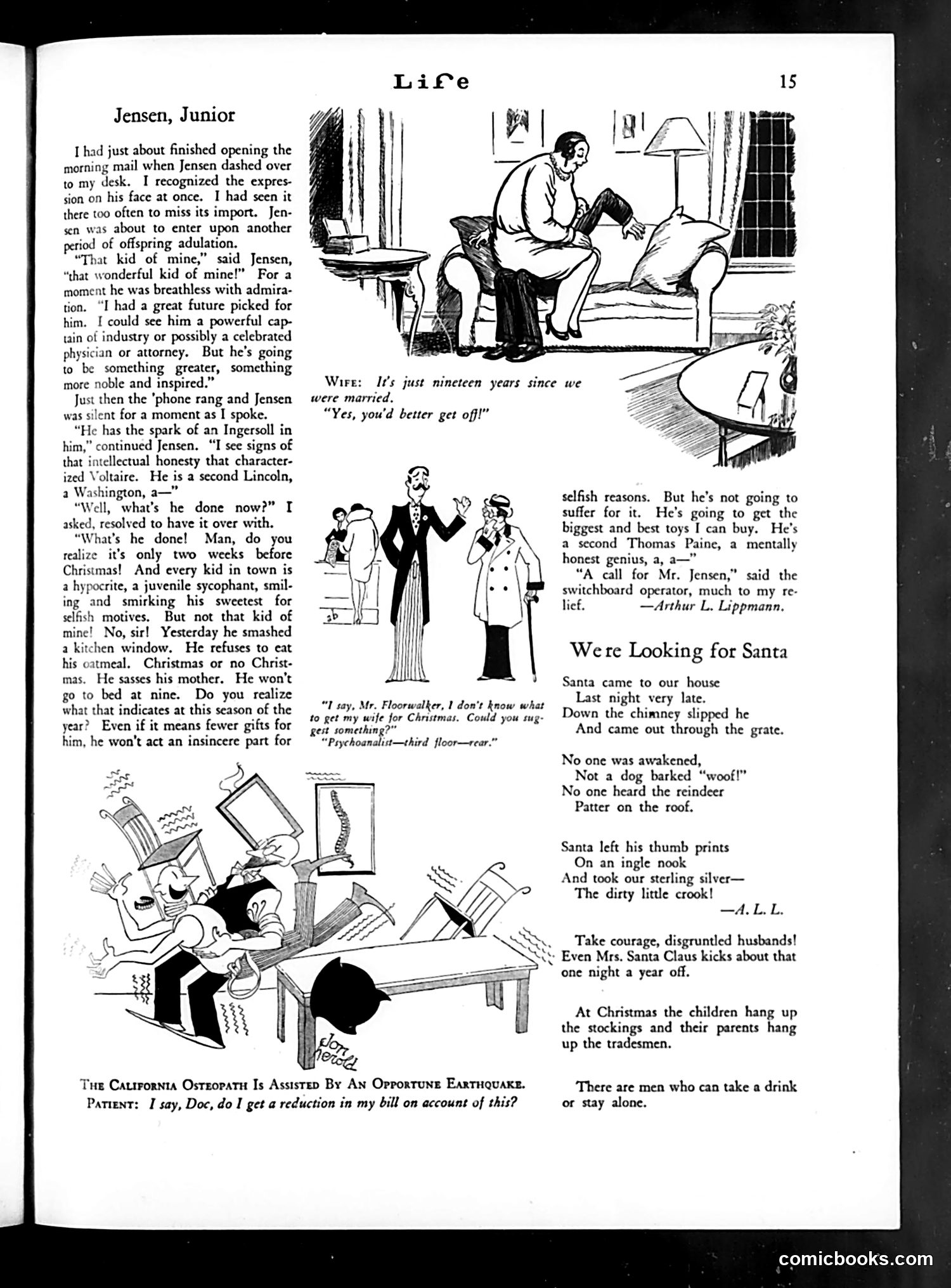
Analysis of Life Magazine Page 15 This page contains three separate pieces of satirical humor: 1. "Jensen, Junior" — A story about a father's disappointment with his gifted son, who refuses to eat meals, go to bed, or participate in Christmas traditions. The father compares him to Ingersoll and Lincoln, but the boy acts as a "juvenile sycophant" with selfish motives. The satire mocks both precocious children and parents' inflated expectations. 2. "The California Osteopath" — A cartoon joke where a patient asks for a bill reduction because an earthquake "assisted" the doctor's treatment, satirizing medical practices and opportunistic billing. 3. "We're Looking for Santa" — A humorous poem about Santa stealing the family's silver, mocking the Christmas tradition and suggesting even Santa Claus isn't above theft. All three pieces use gentle domestic satire typical of early 20th-century Life magazine humor.
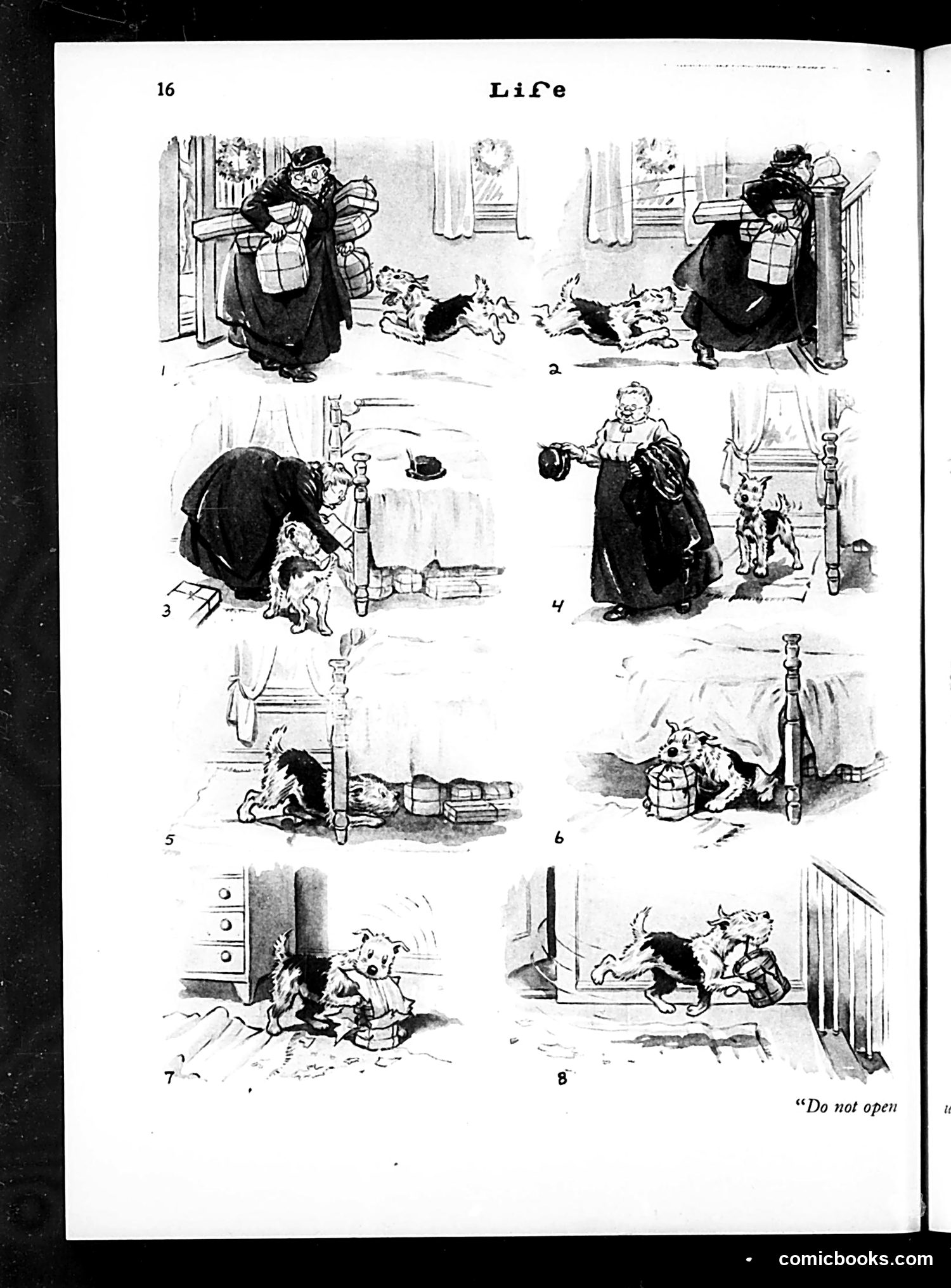
Analysis of Life Magazine Page 16 This appears to be a sequential comic strip depicting a domestic conflict between a woman and a man over a dog or small animal. The narrative progresses through eight panels: Panels 1-2 show the couple arguing, with the woman holding the pet and the man gesturing dismissively. Panels 3-8 show escalating chaos as the animal runs around the house, creating mischief—knocking over objects, scattering items, and generally causing destruction. The final panel shows the animal at a door with text reading "Do not open"—suggesting ironic commentary on domestic conflict. The satire likely mocks marital disputes over pets or household management, showing how disagreements lead to actual household chaos. It's a humorous commentary on domestic life and the consequences of conflict.
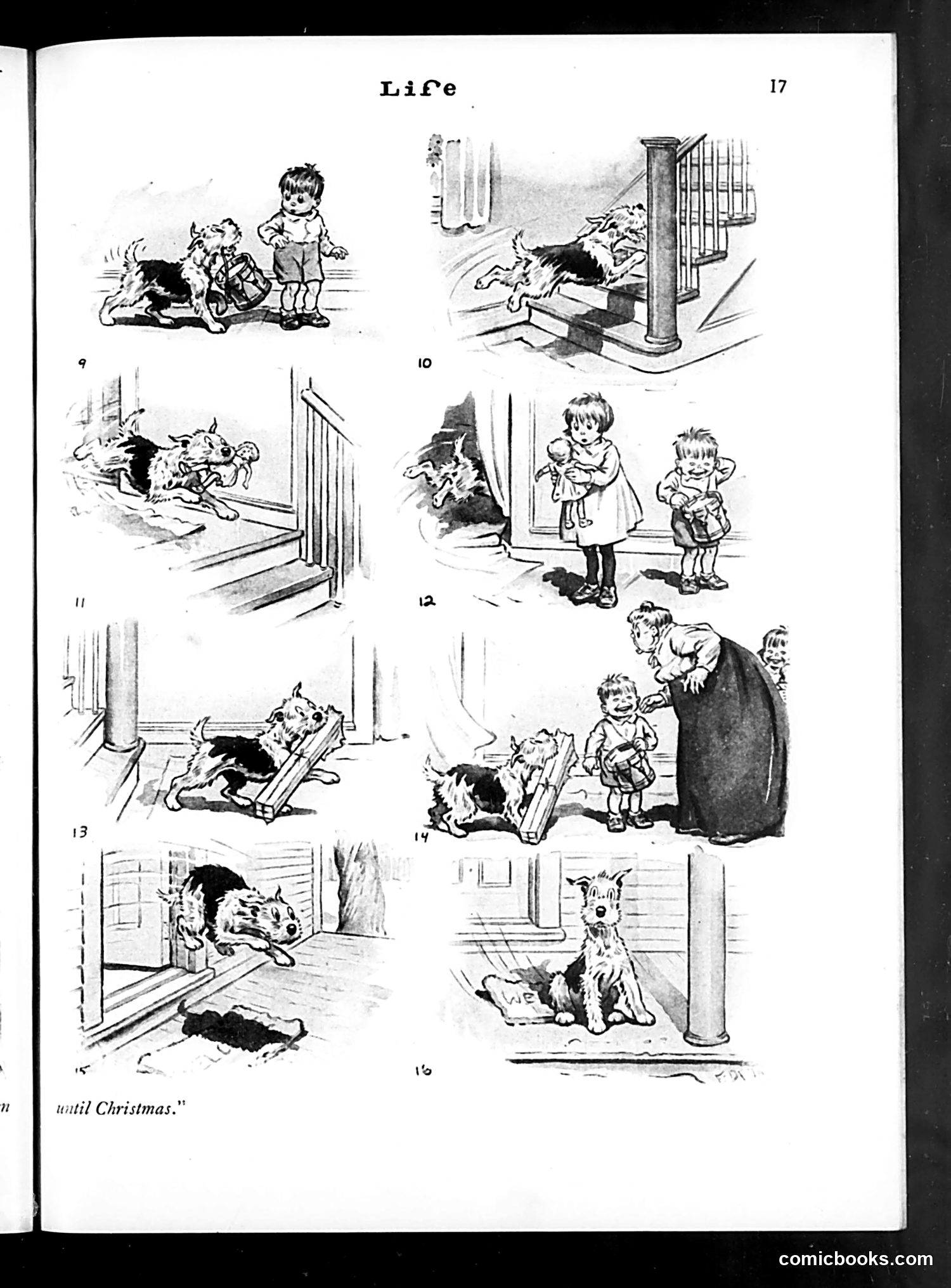
Analysis of Life Magazine Page 17 This page presents a sequential comic strip depicting a dog's increasingly destructive behavior in a household, culminating in the caption "until Christmas" (visible at bottom left). The narrative shows: children playing with a dog (panel 9), the dog damaging furniture and stairs (panels 10-11), the dog creating havoc indoors (panels 13), and finally children and an adult discovering the destruction (panels 12, 14). The final image (panel 16) shows the dog sitting obediently, suggesting temporary reform before Christmas. The satire targets the common domestic scenario of a misbehaving family pet whose destructive antics must be tolerated temporarily during the holiday season. It's humorous commentary on the inevitable chaos dogs introduce to households, and the implicit agreement families make to endure such behavior during sentimental occasions like Christmas.
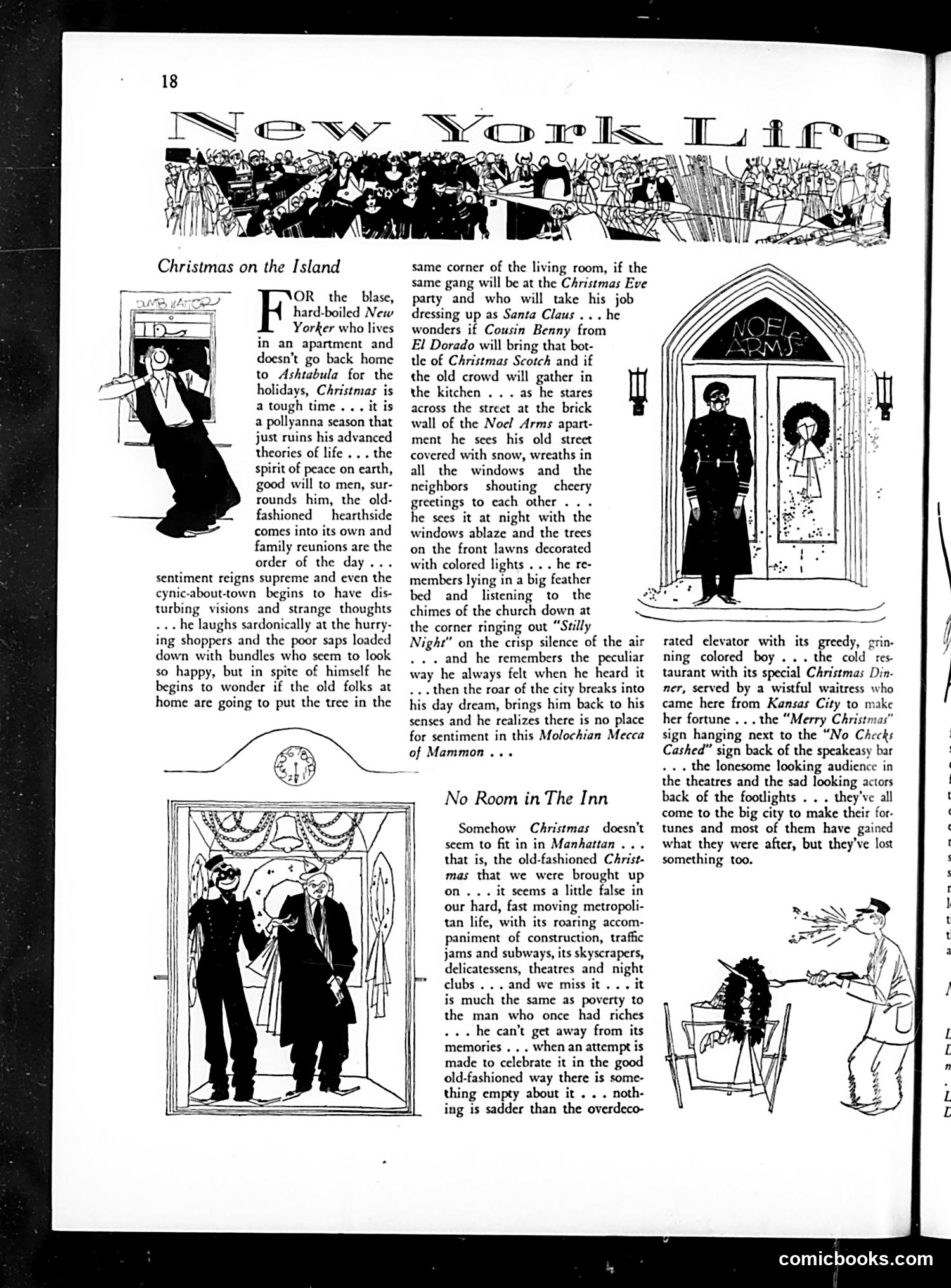
"New York Life" - Christmas in the City This page satirizes Christmas celebrations in 1920s Manhattan. The first section, "Christmas on the Island," mocks the sentimental nostalgia of a hardened New Yorker who romanticizes small-town Christmas traditions while living in a cramped apartment. The satire highlights the disconnect between idealized rural Christmas memories and urban reality. The second section, "No Room in The Inn," continues this theme by suggesting Christmas feels hollow in Manhattan's fast-paced, commercialized environment. The illustration shows people in a crowded hotel or apartment lobby, emphasizing how the city's impersonal bustle undermines traditional Christmas warmth. The cartoons target the contrast between sentimental Christmas ideals and modern urban alienation.
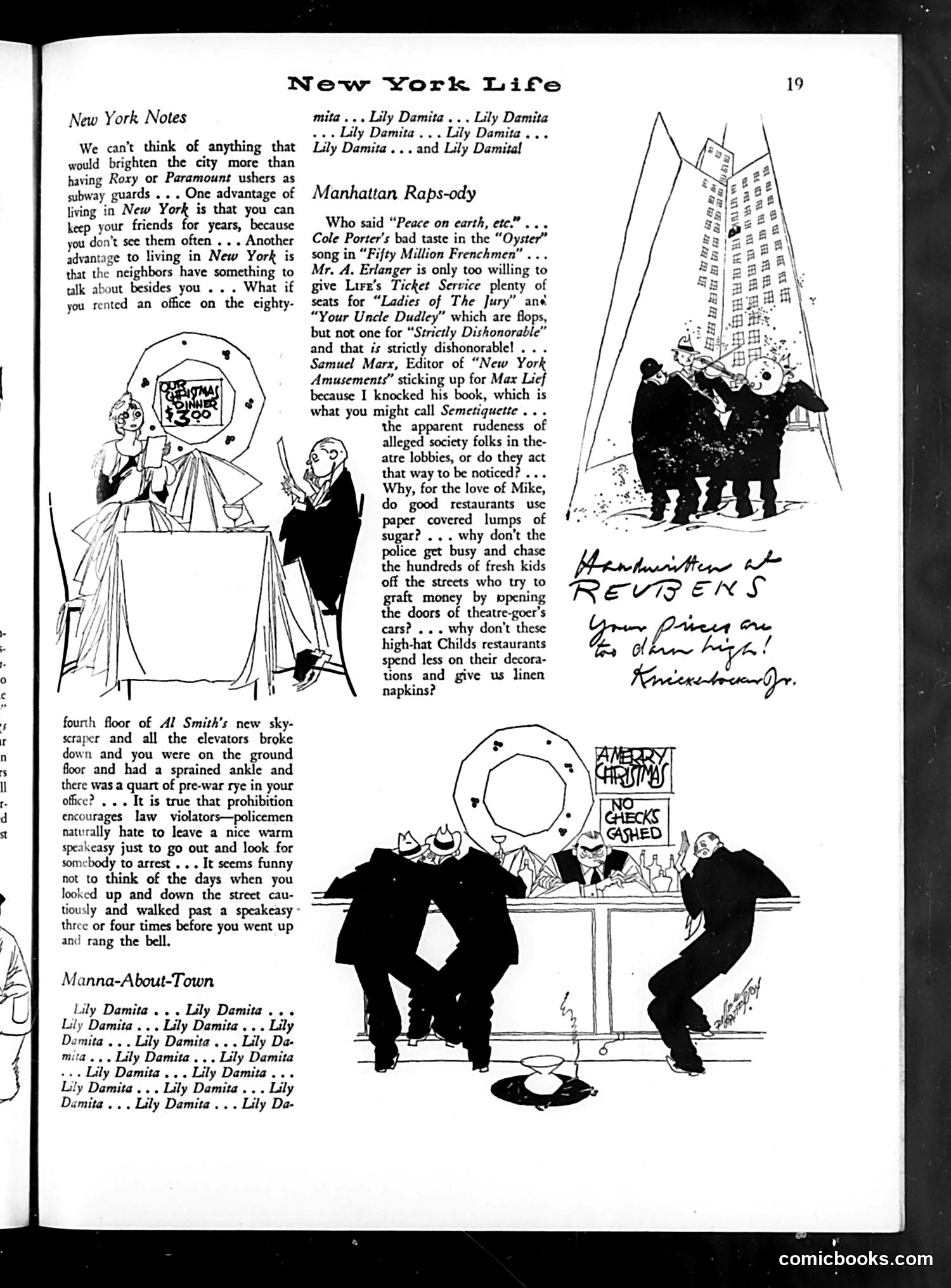
Analysis of Life Magazine Page 19 This page contains satirical commentary on 1920s New York City life. "New York Notes" offers humorous observations about urban living, Prohibition, and speakeasies. It references Al Smith's new skyscraper (the Empire State Building era), pre-war rye whiskey, and the irony that Prohibition (then in effect) encourages both lawbreaking and police corruption—officers allegedly prefer staying warm in speakeasies to enforcement. "Manna-About-Town" repeatedly mentions Lily Damita, a silent film actress, reflecting contemporary gossip-column obsession with celebrities. "Manhattan Raps-ody" critiques theater world figures: composer Cole Porter's song choices in "Fifty Million Frenchmen," theater manager A. Erlanger's ticket practices, and editor Samuel Marx. It also satirizes social rudeness in theater lobbies, restaurants' poor service practices (paper sugar packets, inadequate napkins at Childs restaurants), and street hustlers targeting theatergoers. The illustrations show period-appropriate New York scenes: restaurant dining and street-level urban life. This is essentially a gossip/humor column targeting Manhattan's entertainment and restaurant scenes.
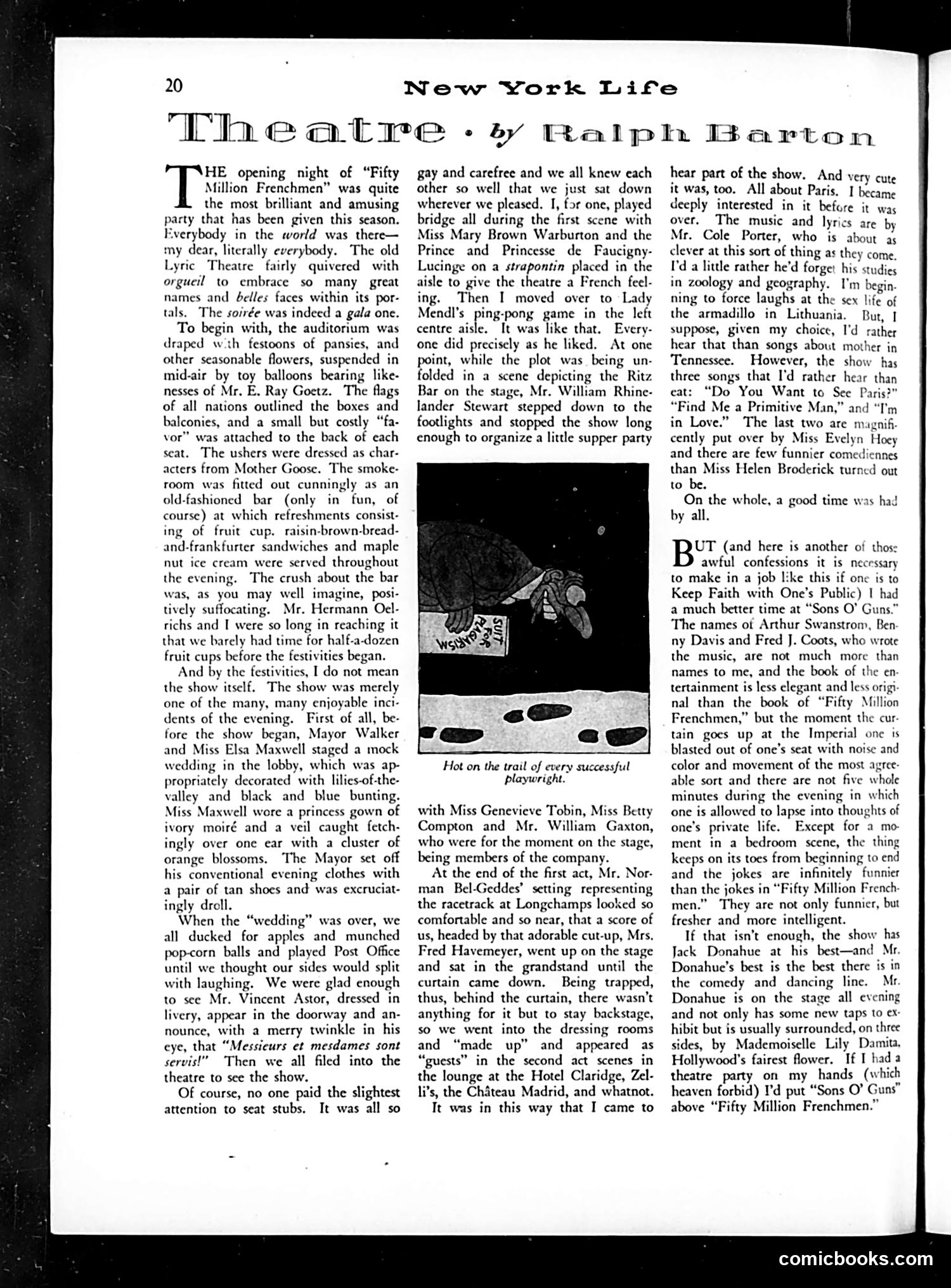
Theatre Review: "Fifty Million Frenchmen" by Ralph Barton This is a satirical theatre review of the 1929 musical "Fifty Million Frenchmen," written by Ralph Barton in the persona of a society insider. The humor targets wealthy New York elites' self-absorption and social pretension. The satire works by inverting expectations: the opening night party itself—with its elaborate decorations, celebrity guests (Mayor Jimmy Walker, Vincent Astor, Elsa Maxwell), and games—becomes more important than the actual theatrical performance. The narrator describes audience members playing bridge during the show, organizing supper parties on stage with actors, and treating the theatre as a social playground rather than a venue for entertainment. The illustration shows footprints, likely referencing the casual, disruptive behavior of privileged attendees treating the theatre irreverently. Barton mocks how the wealthy ignore social conventions ("no one paid the slightest attention to seat stubs") and prioritize their own amusement over respect for performers or other audience members. The piece satirizes Roaring Twenties excess and the frivolous self-regard of Manhattan's upper class.
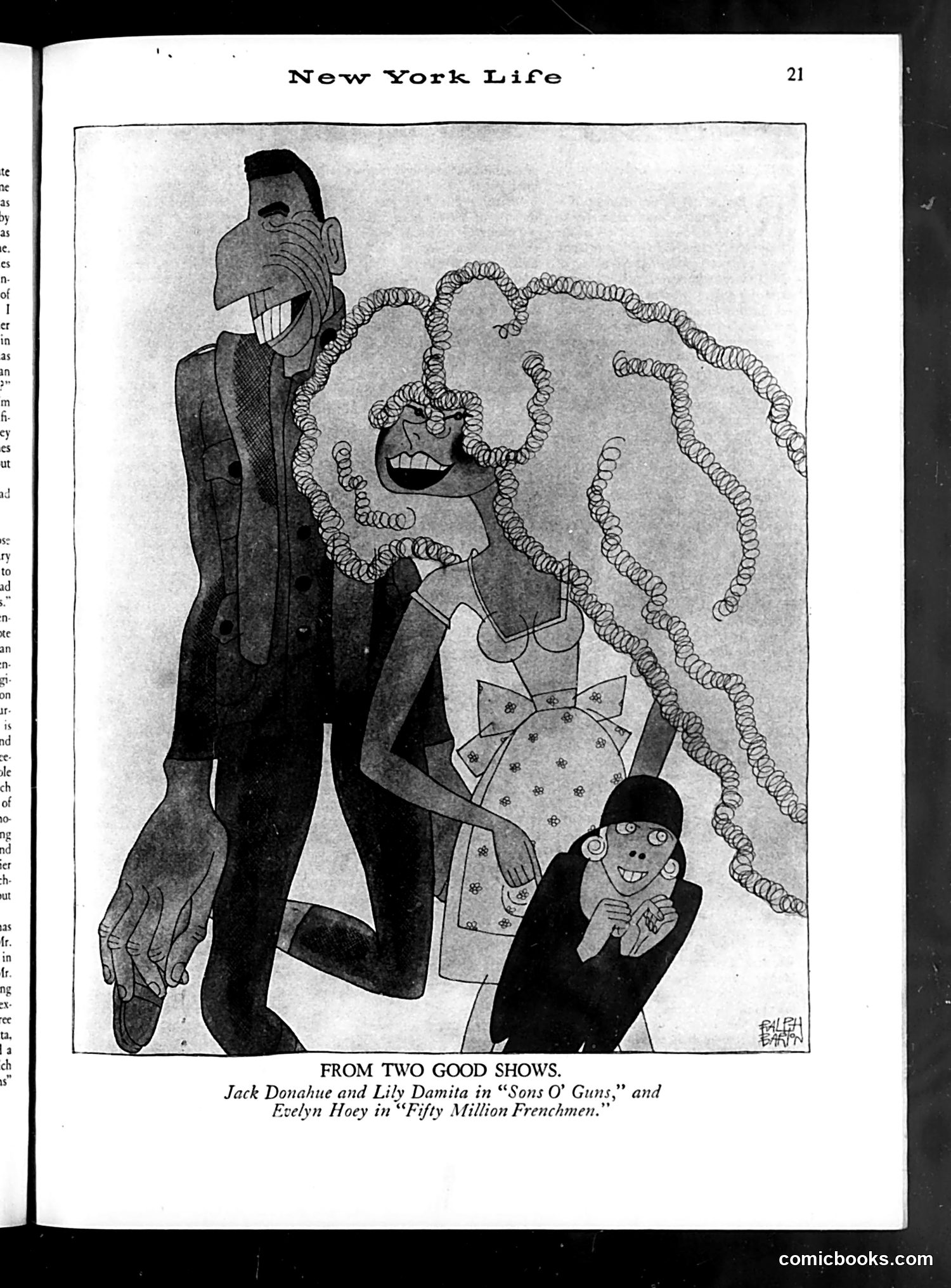
Analysis This is a theatrical illustration from Life magazine featuring caricatures of performers from two Broadway shows of the late 1920s: "Sons O' Guns" and "Fifty Million Frenchmen." The exaggerated cartoon depicts Jack Donahue and Lily Damita as grotesquely caricatured figures with elongated features, alongside Evelyn Hoey. The style employs the theatrical humor typical of Life's entertainment coverage—mocking the performers' appearances and stage personas in an affectionate but pointed way. The coiled rope or hair-like element likely references comedic staging or props from these productions. Without additional context about these specific shows' plots or these performers' notable characteristics, the precise satirical targets remain unclear, though the humor appears rooted in the exaggerated physicality and visual gags of 1920s stage comedy.
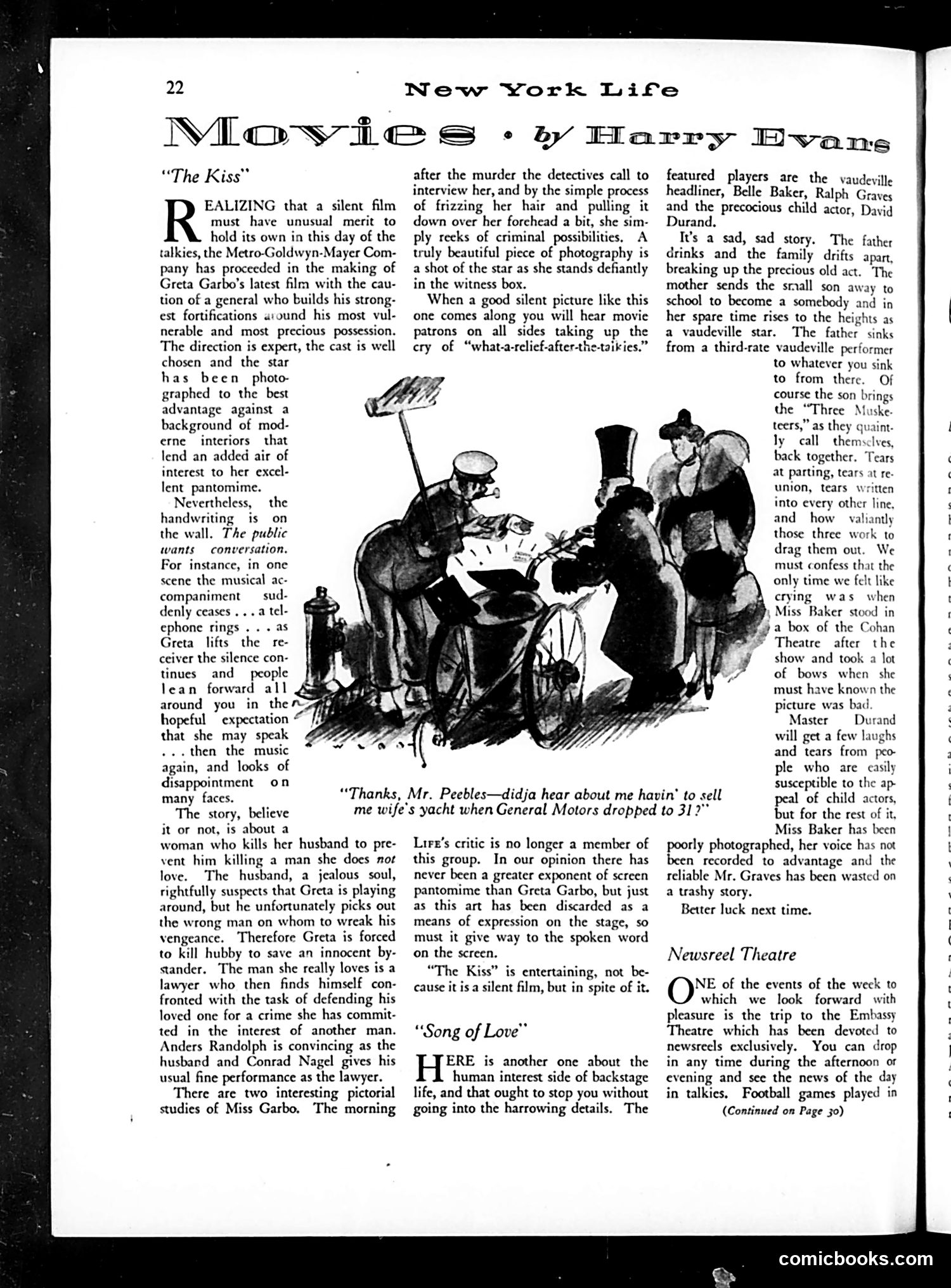
Movie Reviews: "The Kiss" and "Song of Love" This page reviews two films starring Greta Garbo and Belle Baker. The central cartoon depicts a man bragging to a friend about selling his wife's yacht after General Motors stock dropped—likely referencing the 1929 stock market crash that decimated American wealth. The main critique concerns the transition from silent to "talking" films. The reviewer argues that while Garbo excels at pantomime, silent cinema is becoming obsolete as audiences demand dialogue. "The Kiss," though well-made, struggles against audience expectations for sound. The cartoon humorously illustrates how the economic crisis affected even wealthy Americans, contextualizing the era's financial upheaval and the public's shift in entertainment preferences during the early talkie era.
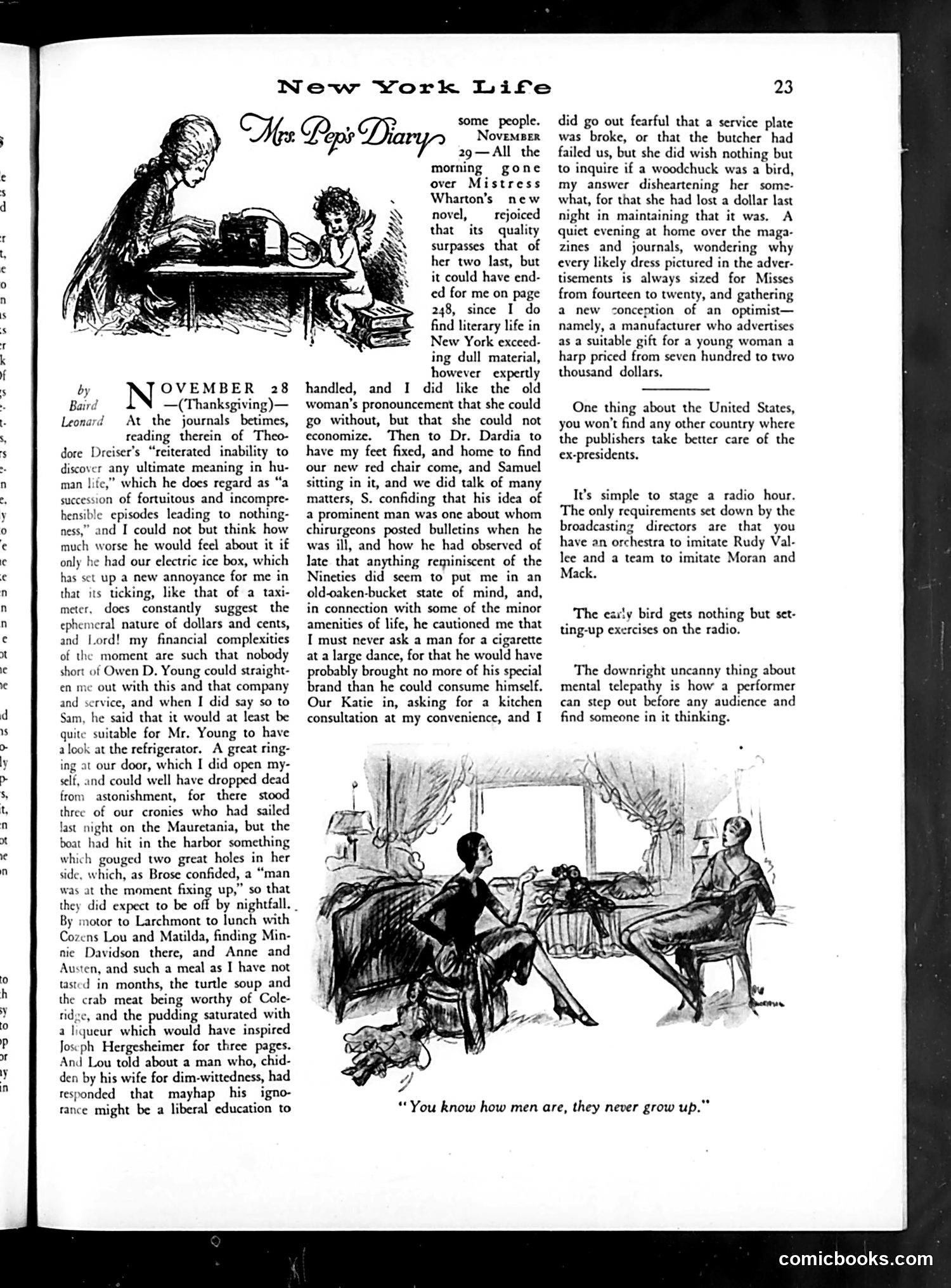
"Mrs. Pep's Diary" - November 28-29 Entry This is a society column diary entry by Baird Leonard, appearing in *Life* magazine around Thanksgiving. The accompanying illustration shows a woman in conversation with a man, with the caption "You know how men are, they never grow up." The diary recounts leisurely upper-class activities: discussing Theodore Dreiser's pessimism, attending a Thanksgiving dinner with the Mauretania ocean liner (damaged in harbor), and various social calls. References include Edith Wharton's new novel, a visit to "Dr. Dardia" for foot care, and servant interactions—typical concerns of wealthy New York society. The satire targets the triviality and self-absorption of this social set. The illustration's caption—suggesting men's eternal immaturity—mocks romantic attitudes toward masculine behavior. The diary's focus on minor domestic annoyances (electric ice box "ticking"), gossip, and fashionable concerns satirizes the emptiness of this world, contrasting with Dreiser's philosophical despair mentioned at the start. The humor lies in presenting these superficial preoccupations as if they were significant life events.
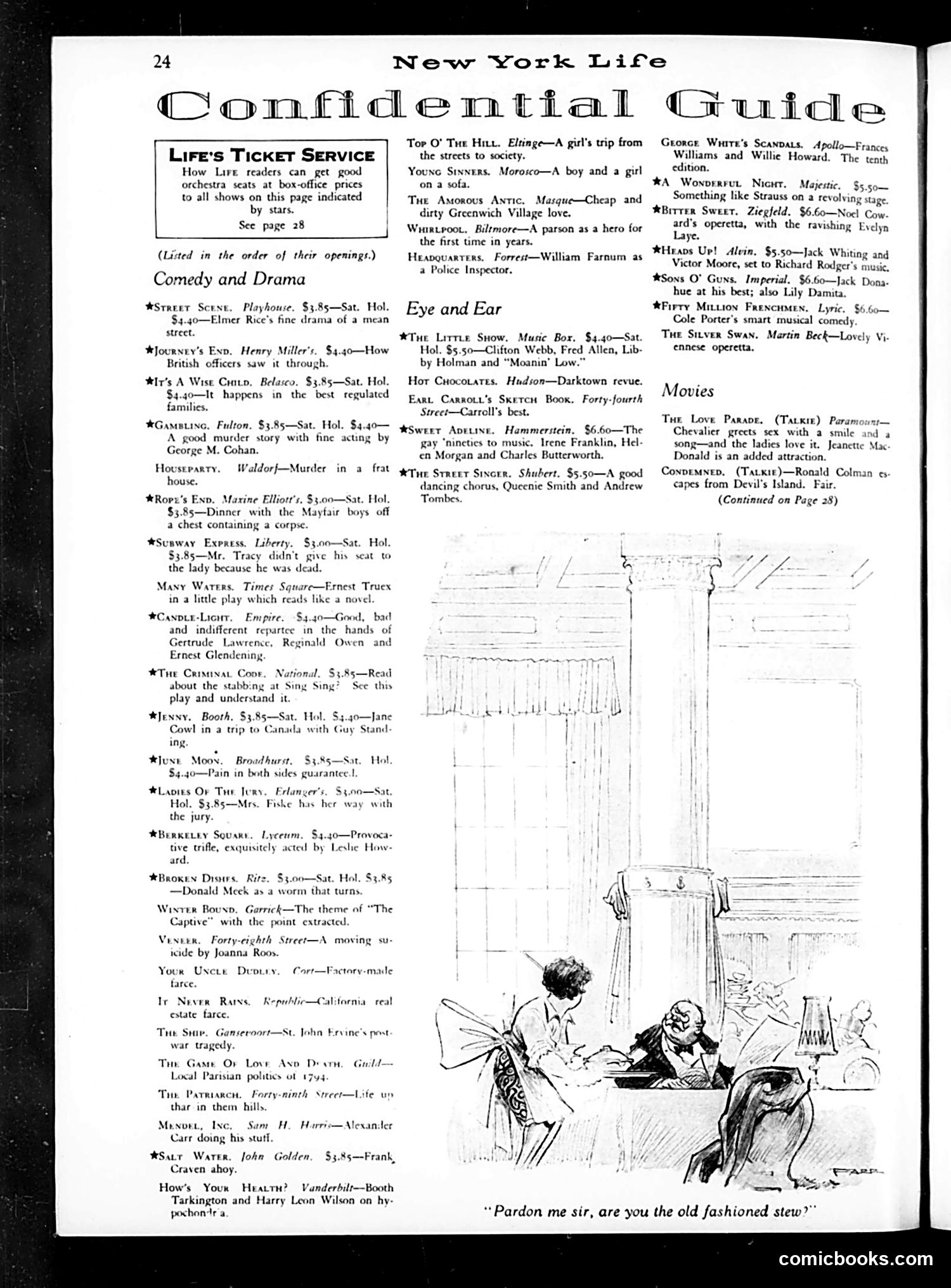
Explanation for Modern Readers This page is a theater guide listing Broadway shows currently running, with prices and brief descriptions. The cartoon at the bottom depicts a domestic scene: a woman serving food to a man at a table, with the caption "Pardon me sir, are you the old fashioned stew?" The joke plays on the phrase "old fashioned"—the woman is literally asking if he wants traditional stew, but the humor likely references changing domestic customs or gender roles of the 1920s era. The illustration's style and the man's appearance suggest he may represent a conservative or traditional type being gently mocked for preferring outdated things. The guide itself reflects 1920s popular entertainment, listing comedies, dramas, musicals, and "eye and ear" performances (music and revue shows), with asterisked titles offering discounted tickets through *Life* magazine's service.
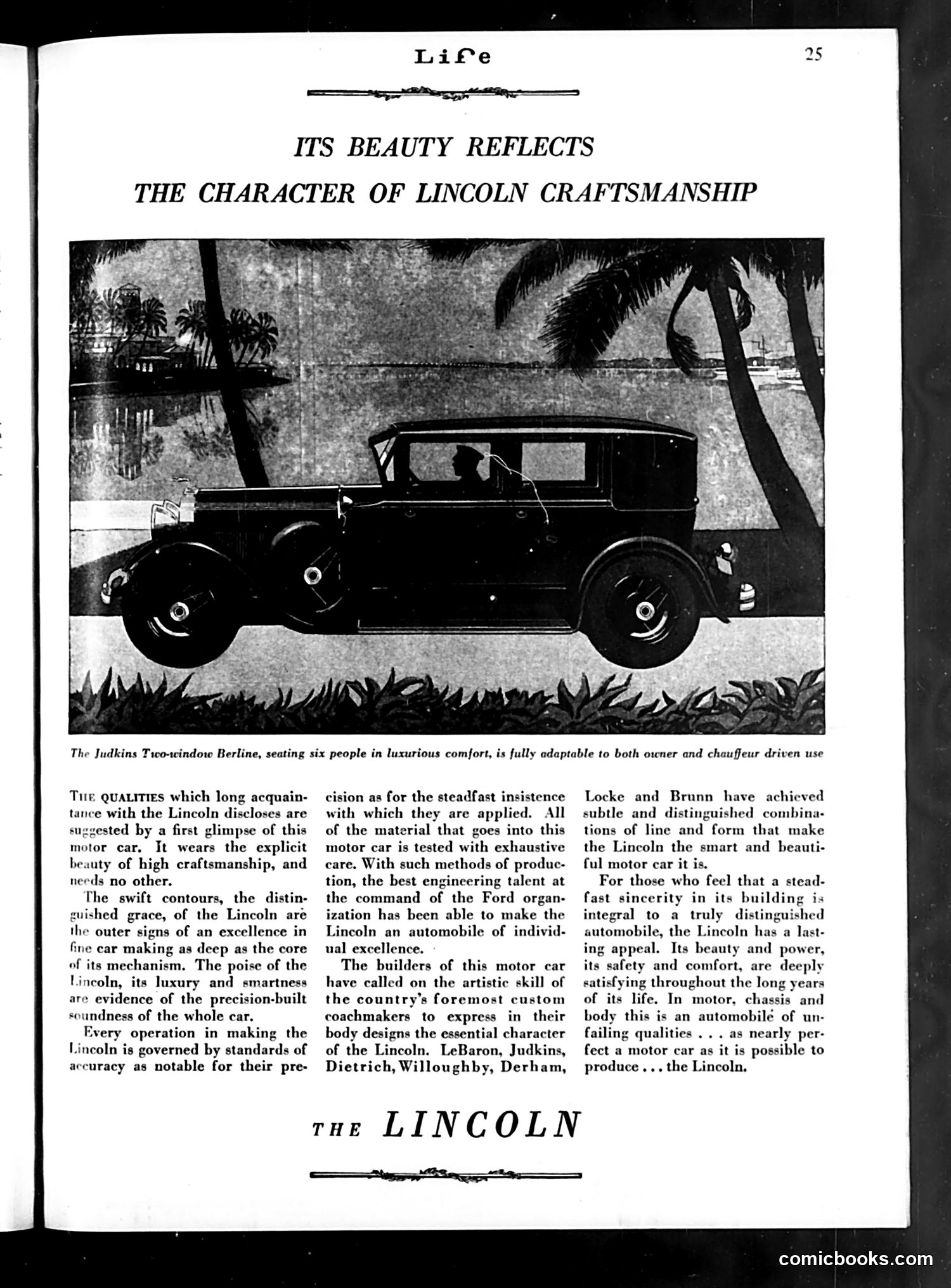
Analysis This is not a cartoon or satire—it's a straightforward automobile advertisement for the Lincoln motor car, which was a luxury brand owned by Ford. The page features a photograph of a Lincoln Judkins Two-window Berline (a high-end sedan) and promotional text emphasizing craftsmanship, precision engineering, and luxury. The ad names prestigious custom coachmakers (LeBaron, Judkins, Dietrich, Willoughby, Derham, Locke, Brunn) who designed the body, positioning Lincoln as a car for discerning buyers who value quality and reliability. The text's repeated emphasis on "precision," "accuracy," "excellence," and "sincerity in building" suggests this is marketing to wealthy consumers during an era when automobiles were luxury items. The tropical setting in the photograph (palm trees visible) evokes leisure and affluence. This is typical Life magazine content from the 1920s-era advertising mixed with editorial material.
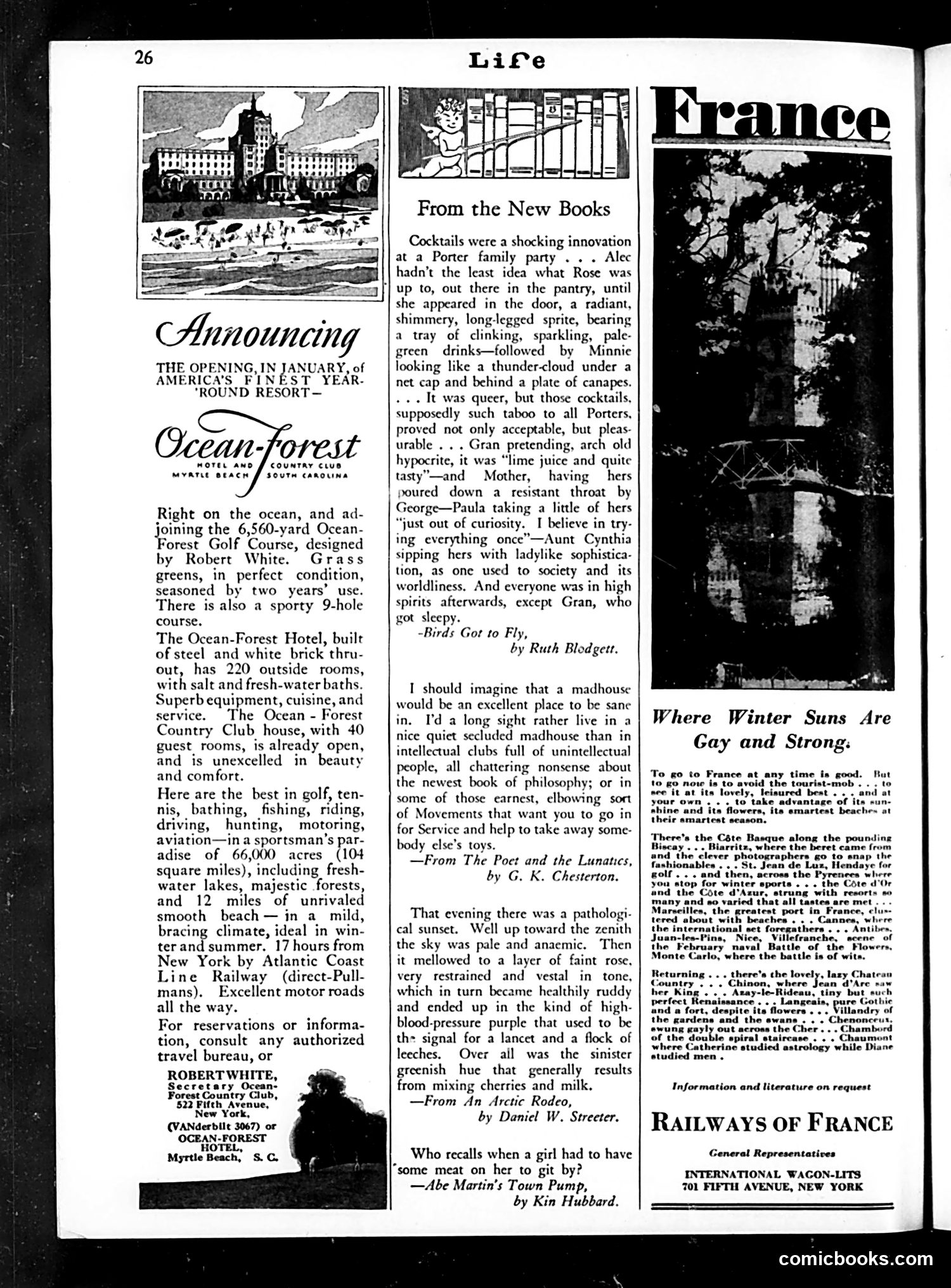
Life Magazine Page Analysis This page is primarily advertising and literary content, not political satire. The main feature announces the opening of Ocean-Forest, a luxury resort in Myrtle Beach, South Carolina—a high-end country club with golf, hotel, and recreational facilities aimed at wealthy American tourists. The "From the New Books" section provides satirical social commentary about Prohibition-era attitudes. The passage mocking cocktails at a "Porter family party" humorously captures the hypocrisy of the era: supposedly strict families secretly enjoying forbidden drinks while maintaining social pretense. References to "Gran" pretending the cocktails are merely "lime juice" and Mother drinking reluctantly reflect real 1920s social tension around alcohol consumption during Prohibition. The literary excerpts (by Ruth Blodgett, G.K. Chesterton, Daniel Streeter, and Kin Hubbard) offer broader social observation—critiquing intellectual pretension, commenting on changing beauty standards, and satirizing social movements. The France tourism advertisement at right emphasizes leisure travel for the wealthy. Overall: lifestyle journalism for affluent readers, not political cartooning.
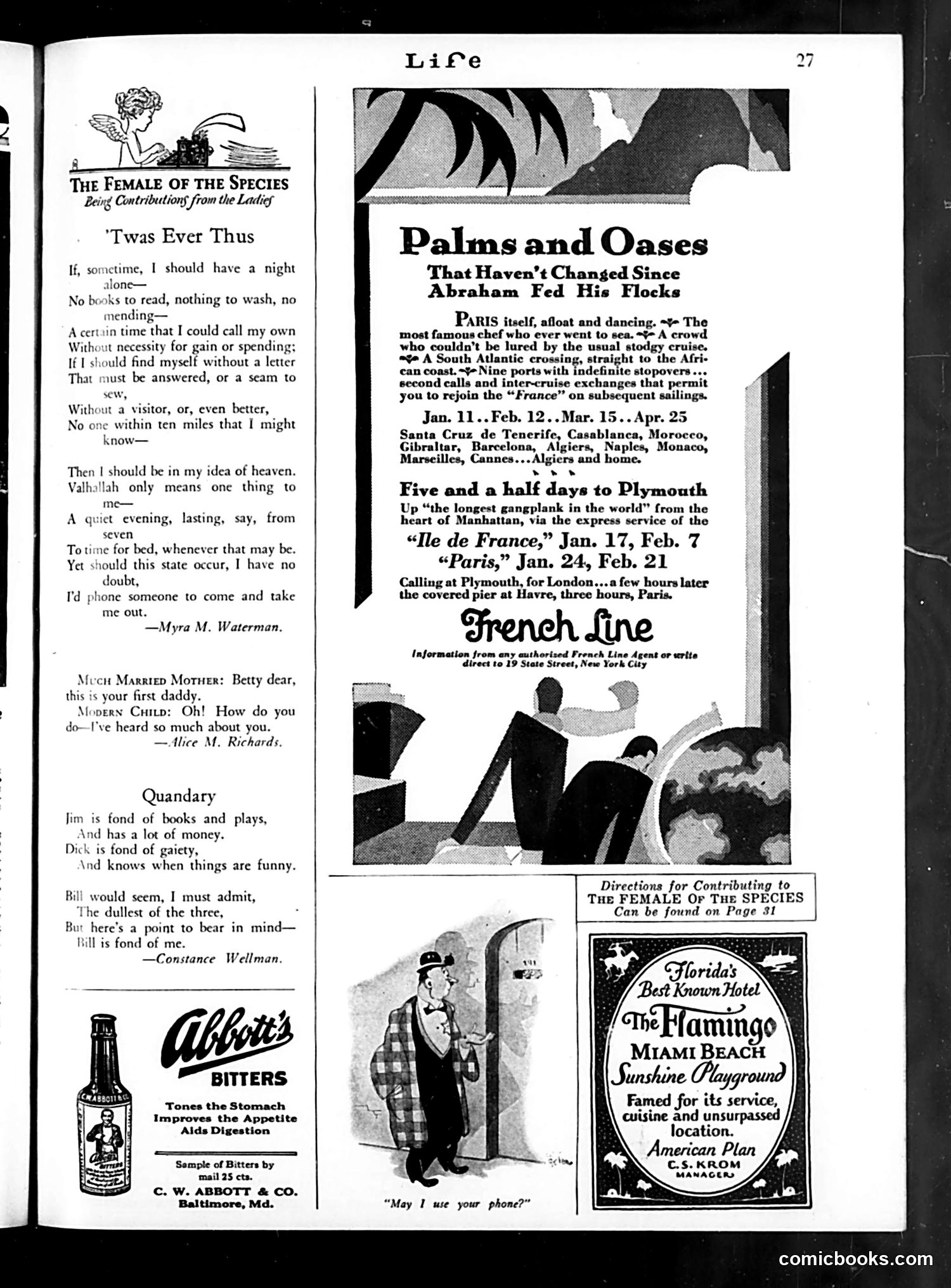
"The Female of the Species" — Life Magazine Page Analysis This page presents satirical poetry contributions from female readers about modern women's lives and romantic dilemmas, typical of *Life* magazine's humor section. Key pieces: "'Twas Ever Thus" (Myra M. Waterman) jokes about female restlessness—a woman fantasizes about having a rare evening alone with no obligations, yet admits she'd immediately phone someone to go out rather than actually enjoy solitude. The satire targets women's contradictory desires and social conditioning. "Much Married Mother" presents generational disconnect: a modern child addresses her biological father formally as a stranger, highlighting how divorce or absent fathers were becoming notable social topics. "Quandary" (Constance Wellman) uses three male archetypes to satirize women's romantic choices—Jim (cultured, wealthy) and Dick (charming, fun) are less attractive than Bill (dull but devoted), mocking women's tendency to overlook personality for reliability. The remainder is advertisements (French Line cruises, Abbott's Bitters, The Flamingo hotel), typical of magazine pages from this era.
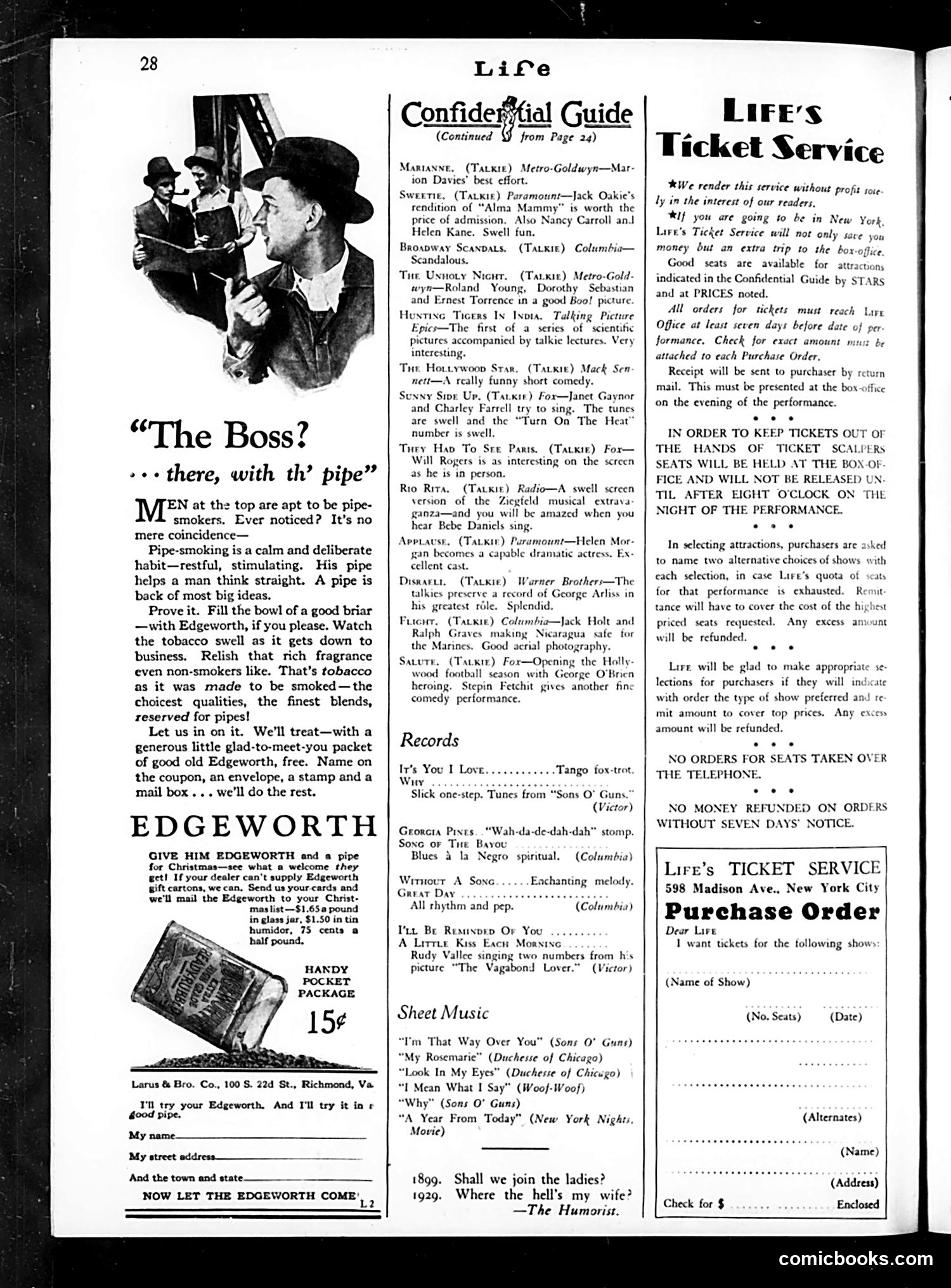
"The Boss?... there, with th' pipe" This page is primarily advertising for Edgeworth pipe tobacco, using a common early-20th-century marketing trope: the association of pipe-smoking with masculine authority and intellectual capability. The cartoon shows well-dressed men, with the caption claiming that successful businessmen ("men at the top") are pipe-smokers—implying pipe-smoking aids serious thinking and decision-making. The ad argues that pipe-smoking is a "calm and deliberate habit" that helps men "think straight." This is satirical self-promotion: by claiming pipe-smoking produces leadership qualities, Edgeworth positions its product as essential to professional success. The accompanying purchase order form and movie/music reviews are standard Life magazine content from this era (appears to be late 1920s, given talkie film references). The humor lies in the transparent logic: buy our pipes, become a boss.
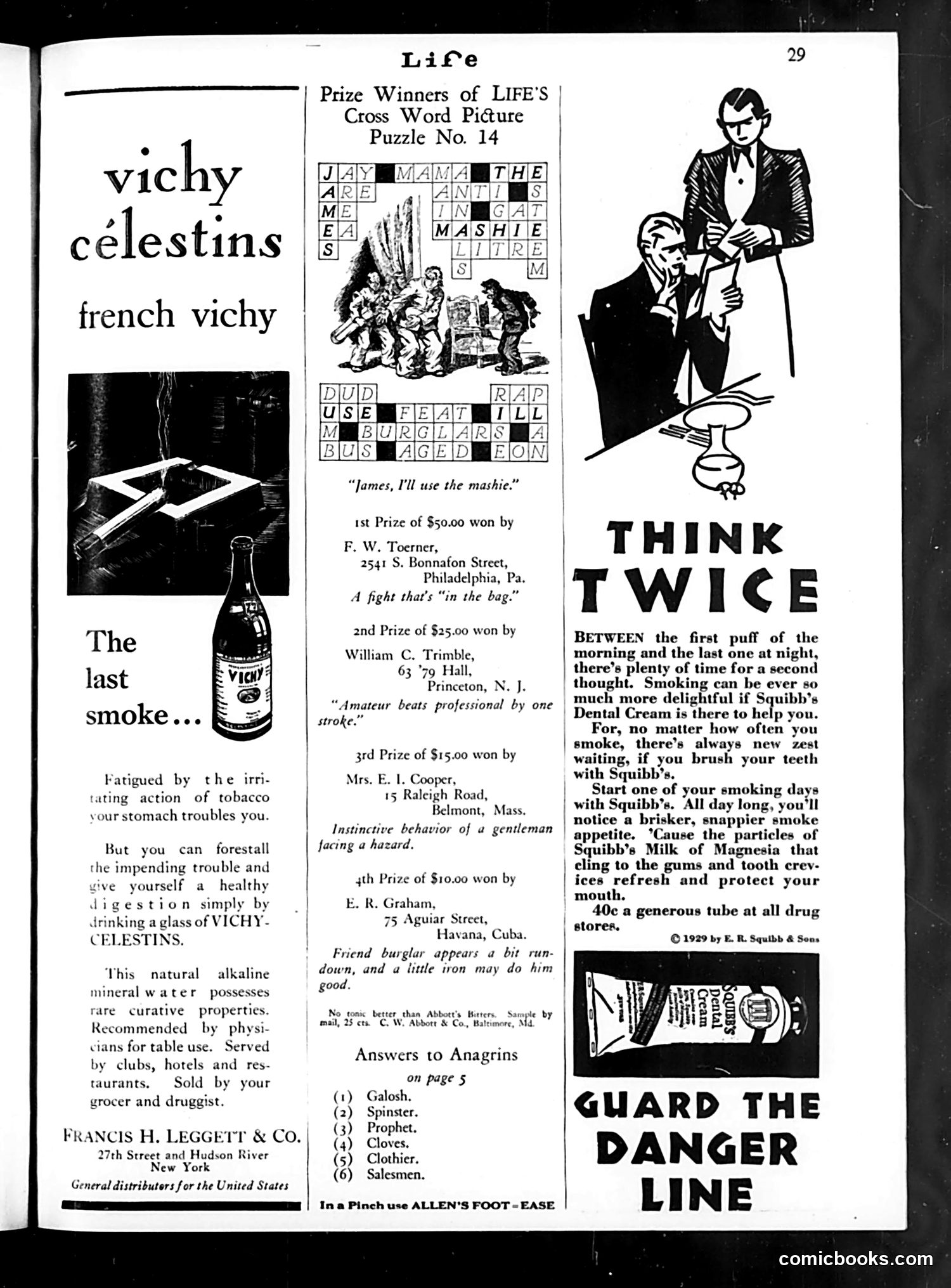
Analysis of Life Magazine Page 29 This page is primarily advertising and puzzle content, not political satire. The main elements are: Left side: An ad for Vichy Célestins mineral water, claiming it cures stomach troubles caused by tobacco smoking—a remedial product marketed to smokers concerned about digestive health. Center: A crossword puzzle contest with winners listed, featuring golf-themed clues ("mashie" is a golf club; "in the bag" means a sure victory). Right side: An ad for Squibb's Dental Cream and Milk of Magnesia, suggesting smokers brush their teeth to enjoy cigarettes more pleasantly and protect their gums. The implicit message: Rather than quit smoking, these ads normalize it while offering products to mitigate its effects—reflecting 1929 attitudes when smoking's dangers were not yet widely acknowledged. The "Think Twice" headline ironically encourages smokers to smoke *more* mindfully by using these products, not to reconsider smoking itself.
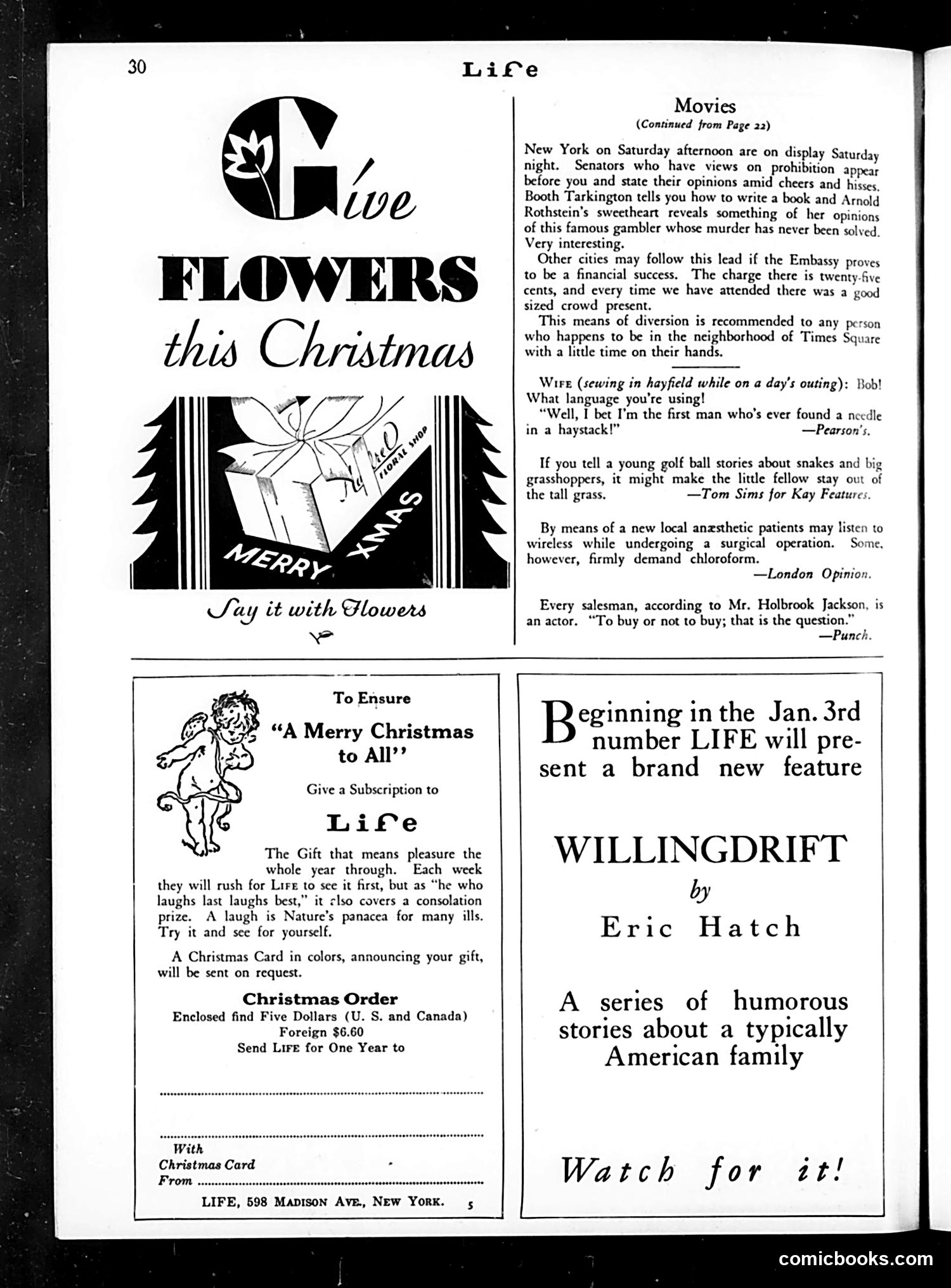
Life Magazine Page 30: Analysis This page is primarily advertising and promotional content rather than political satire. The main elements are: 1. "Live Flowers this Christmas" ad: A decorative Christmas promotion urging readers to give flowers as gifts, with the slogan "Say it with Flowers"—a period advertising phrase encouraging floral gift-giving. 2. Life subscription offer: A Christmas gift promotion selling yearly subscriptions ($5 domestic, $6.60 foreign), emphasizing that Life provides humor and consolation throughout the year. 3. Movie column snippets: Brief, lighthearted observations about contemporary films and entertainment, including references to Booth Tarkington and Arnold Rothstein (a famous gambler of the era). 4. "Willingdrift" announcement: A preview of an upcoming humorous serial by Eric Hatch about a typical American family—standard magazine content promotion. The page contains no political cartoons or satire. It's typical early-20th-century magazine advertising blended with entertainment content.
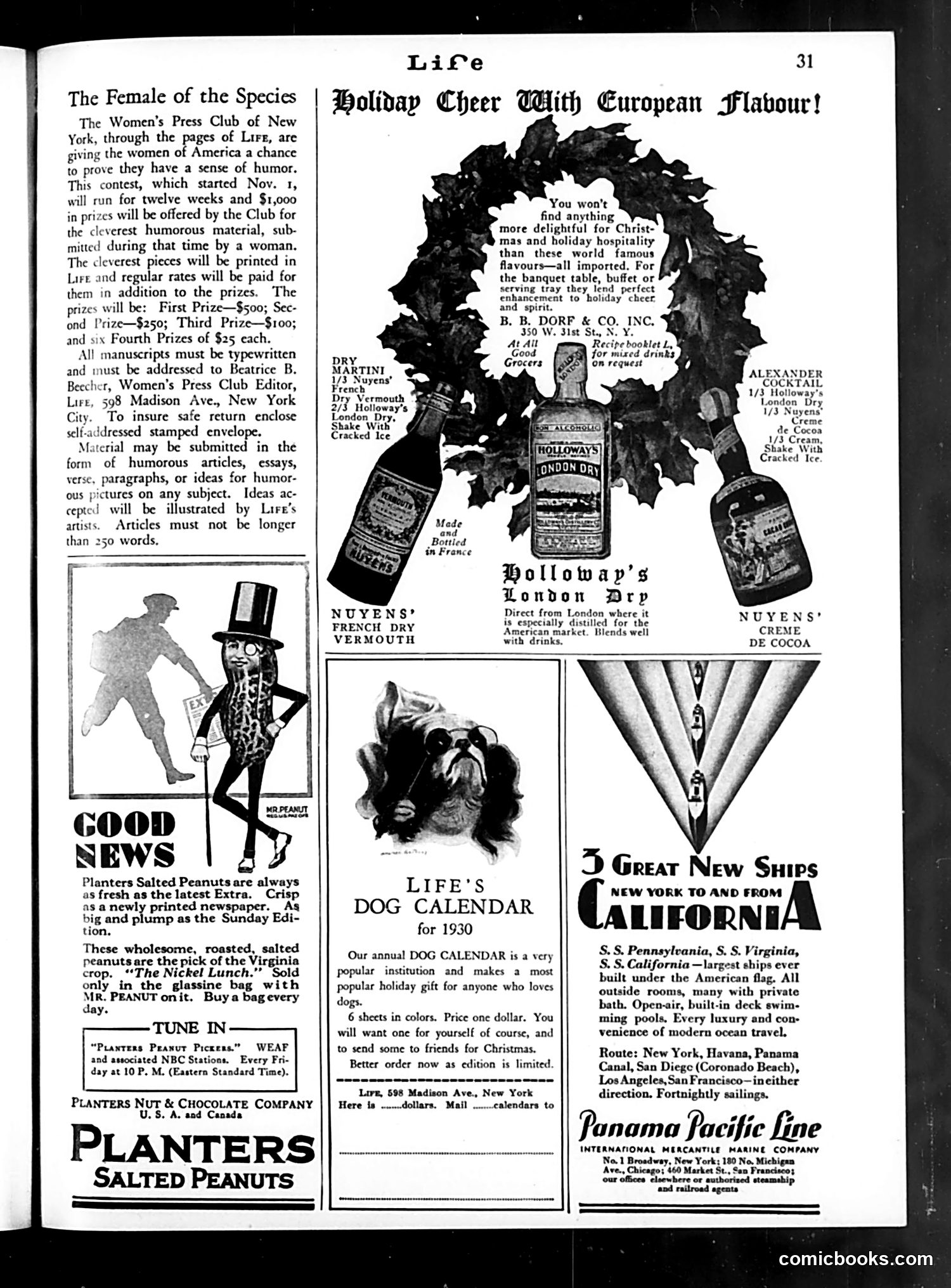
Page Analysis: Life Magazine, circa 1930 This page is primarily advertising rather than editorial satire. The top announces a Women's Press Club humor contest offering $1,000 in prizes—notably positioning this as women proving they possess humor, a patronizing framing typical of the era. The cartoons are minimal: a small "Good News" illustration shows a stylized figure promoting Planters Peanuts (featuring the brand's mascot Mr. Peanut). The bulk of the page features liquor and luxury travel advertisements, including: - European spirits (Martini, vermouth, cocoa liqueurs) marketed as "holiday cheer" - A dog calendar promotion - Ship advertisements for California voyages Context for modern readers: This represents Prohibition-era America (ending December 1933), when advertising alcohol was technically illegal but magazines circumvented restrictions through coded language and imported product emphasis. The "European flavour" appeal reflects post-WWI cosmopolitan aspirations among American elites.
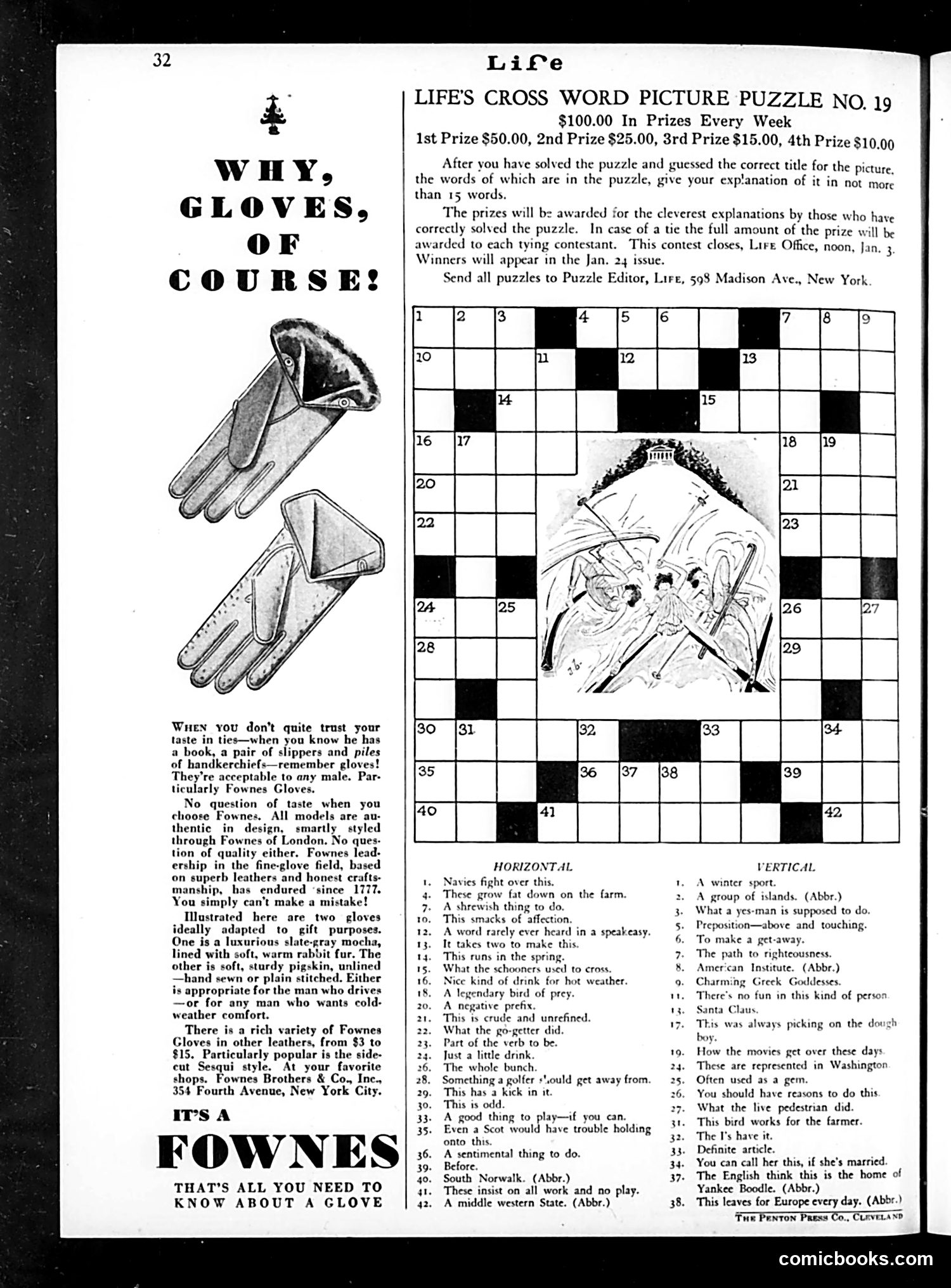
Life Magazine Content Analysis This page combines a Fownes Gloves advertisement with a crossword puzzle contest. The left side features an illustrated advertisement depicting two leather gloves and persuasive copy suggesting gloves as a safe, tasteful gift choice for men—particularly when you're uncertain about the recipient's preferences. The ad emphasizes Fownes' reputation since 1777, quality materials, and price range ($3-$15). The right side presents "Life's Cross Word Picture Puzzle No. 19," a common feature offering $100 in weekly prizes. Solvers must complete the crossword grid and write a brief explanation (under 15 words) of the picture's meaning. The central illustration appears to show a classical or mythological scene but is difficult to identify precisely from the reproduction. This represents typical 1920s-30s magazine content: combining advertisements with reader-engagement puzzles and contests to maintain circulation and advertising revenue.
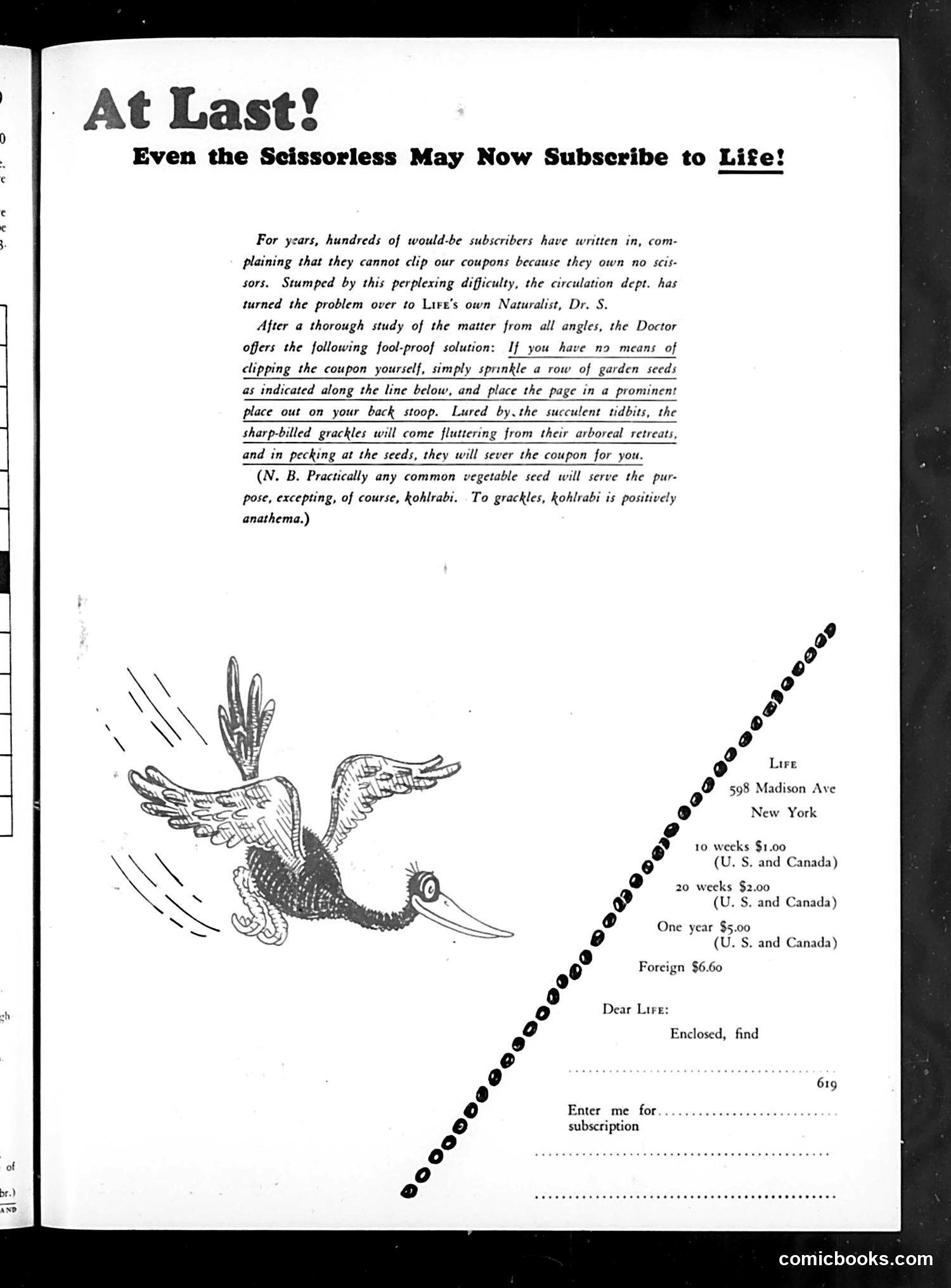
Life Magazine Subscription Advertisement This is a humorous advertisement for *Life* magazine's subscription service. The joke is absurdist satire about a practical problem: readers without scissors cannot clip the magazine's subscription coupon. The "solution" proposed by the fictional "Dr. S." (Life's Naturalist) is deliberately ridiculous: sprinkle garden seeds along the coupon's dotted line, leave the page outside on your back stoop, and allow sharp-billed grackles (common birds) to peck at the seeds—thereby severing the coupon as they feed. The humor works on multiple levels: it's a mock-scientific explanation for an obviously silly "problem," anthropomorphizes the birds as helpful subscribers, and treats an everyday inconvenience as worthy of elaborate naturalistic study. The note about kohlrabi adds absurdist detail—apparently toxic to grackles and thus useless for the scheme. The illustration shows a grackle in flight. This satirizes both magazine advertising conventions and the Depression-era culture of clipping coupons from publications.
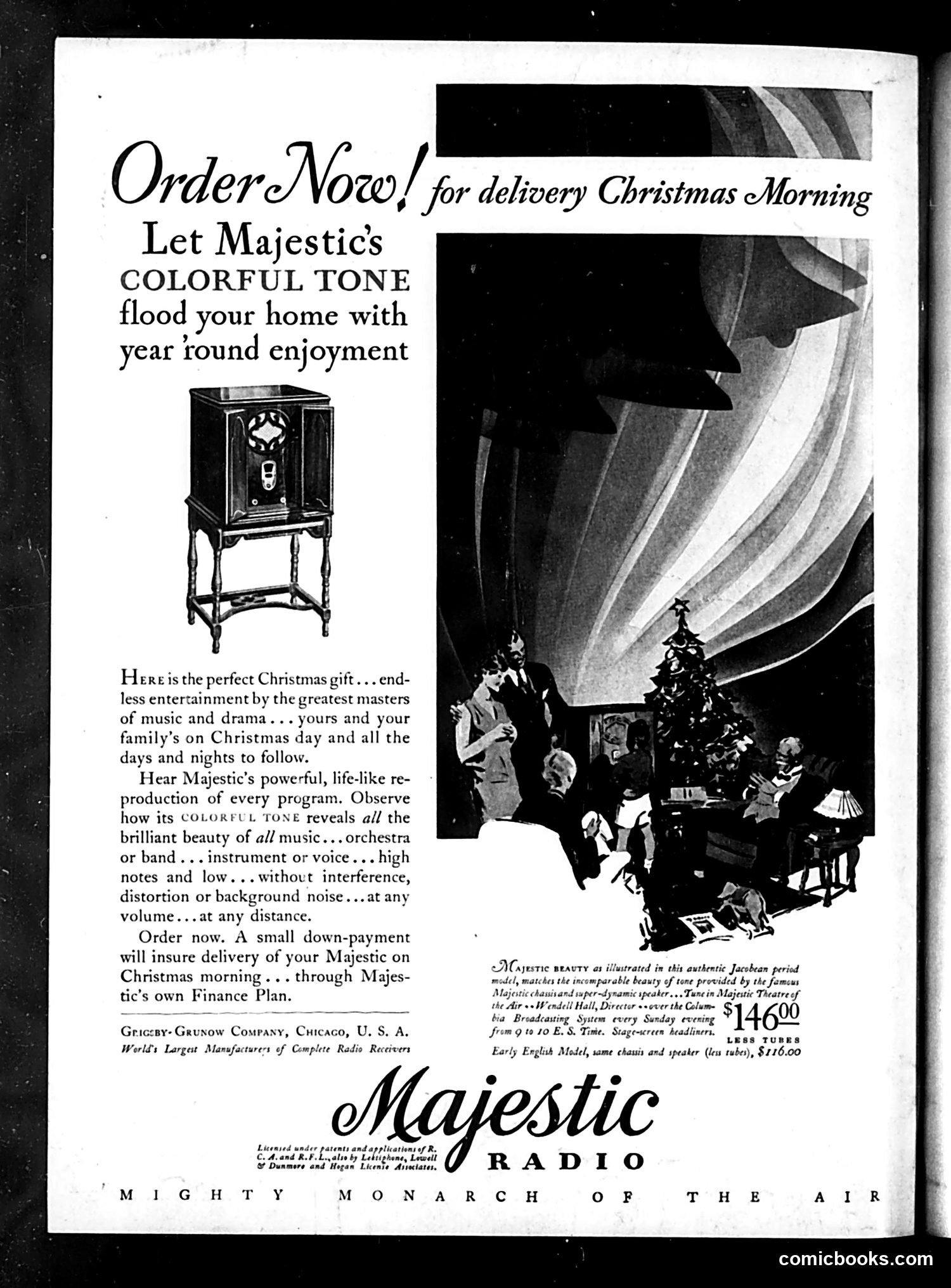
Analysis This is primarily a radio advertisement, not a political cartoon. The page promotes Majestic brand radios as Christmas gifts. The ad features an illustration of a family gathered around a radio set on Christmas morning, with a decorated tree visible. The messaging emphasizes the radio's "Colorful Tone" technology and superior sound quality—a selling point during the early radio era when audio fidelity varied significantly. The social context: this advertisement reflects 1920s-30s consumer culture when radios were luxury items and major Christmas purchases. The image of the family enjoying "endless entertainment" together speaks to radio's role as the primary home entertainment medium before television. The Majestic model shown costs $146 (a substantial sum for the era), with financing available. The ad also mentions Majestic's radio program broadcast on CBS, leveraging media tie-ins for marketing. This is commercial advertising rather than satire—no political figures or jokes are present.