life
Life — December 27, 1929
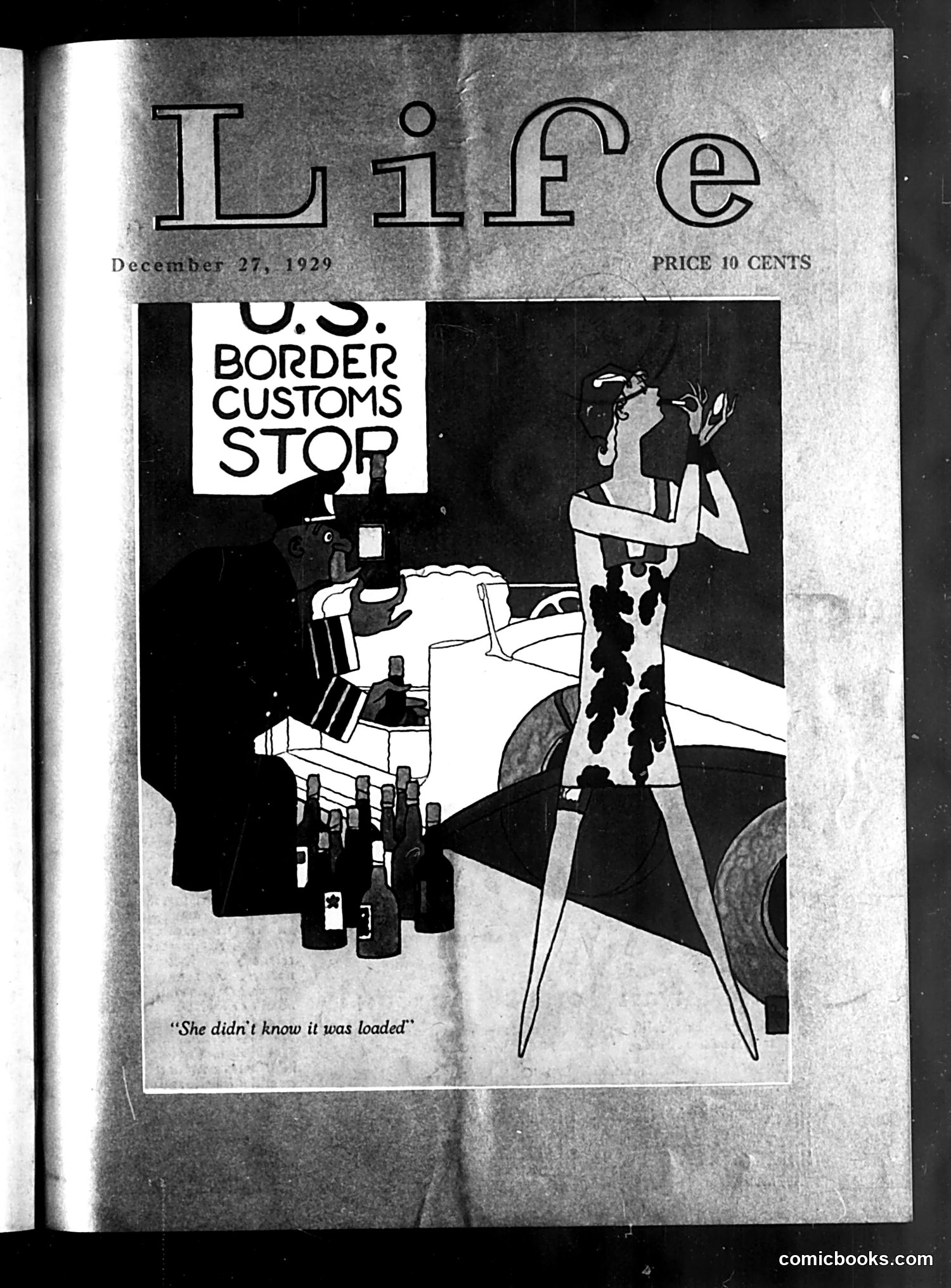
Life Magazine Cover Analysis (December 27, 1929) This satirical cover addresses Prohibition-era smuggling at the U.S.-Mexico border. The illustration depicts a stylishly dressed woman at a U.S. Border Customs stop, apparently caught smuggling alcohol across the border. The numerous bottles visible in the lower left—along with the caption "She didn't know it was loaded"—suggests she was unknowingly transporting contraband liquor, likely hidden in her vehicle or luggage. The satire targets the absurdity and widespread violation of Prohibition laws (1920-1933). The fashionable woman represents upper-class Americans who casually participated in illegal alcohol smuggling, viewing it as socially acceptable despite federal law. The "didn't know" excuse mocks the implausible denials common among caught smugglers. This reflects public skepticism about Prohibition's enforceability.
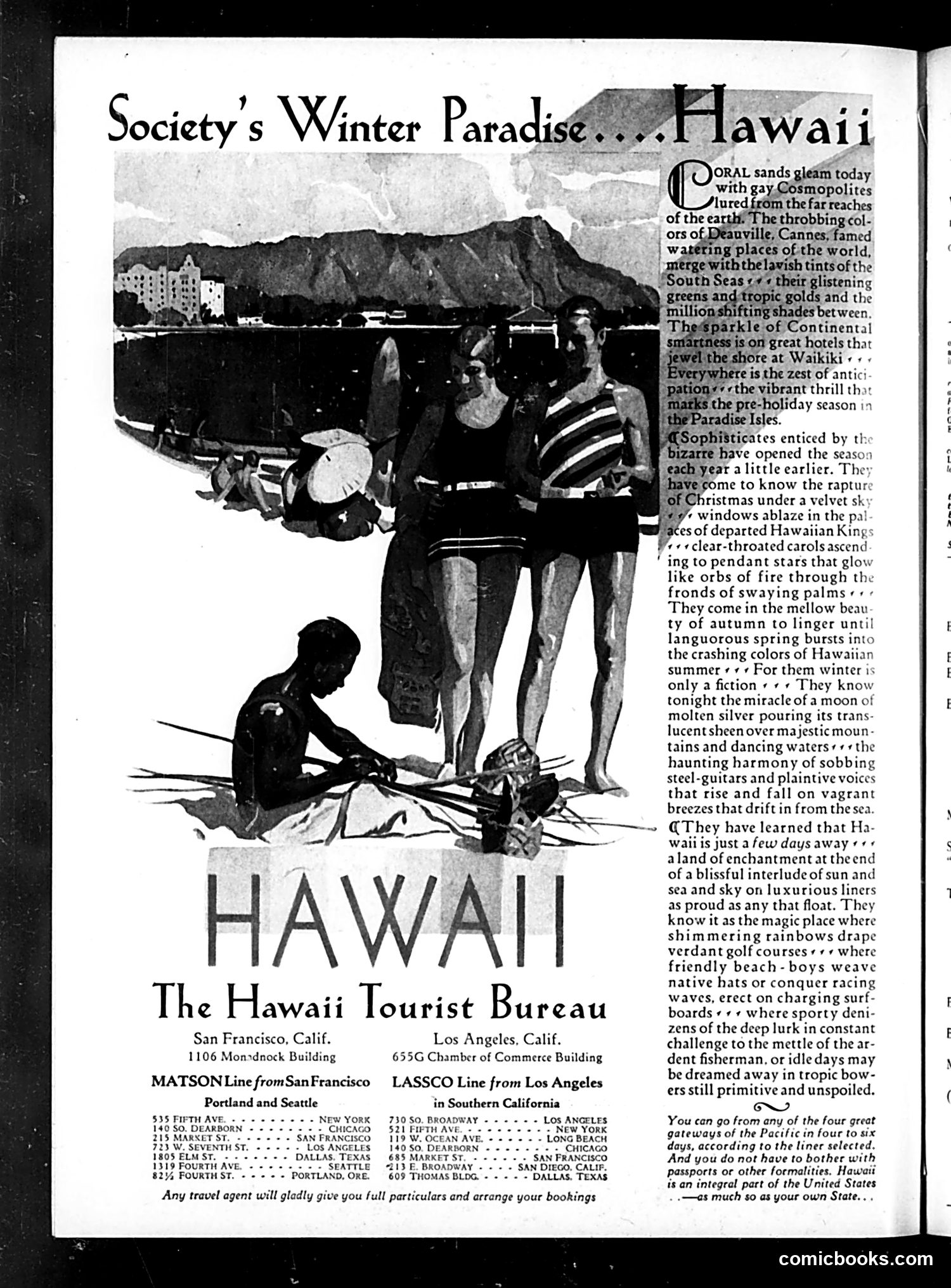
Analysis This is primarily a tourism advertisement, not satirical content. The Hawaii Tourist Bureau placed this full-page ad in Life magazine promoting Hawaii as a winter destination for wealthy Americans. The imagery shows tourists in swimwear enjoying beach activities—surfing, swimming, and socializing—with Diamond Head visible in the background. The text uses romantic language ("winter paradise," "enchantment") to market Hawaii as an escape from cold northern winters. The advertisement emphasizes Hawaii's accessibility via Matson and Lassco shipping lines from California ports, positioning it as an exclusive luxury destination. The prose romanticizes Hawaiian culture ("swaying palms," "Hawaiian Kings") while framing it primarily as an exotic playground for Continental sophisticates seeking pre-holiday leisure. This reflects early 20th-century American tourism marketing that treated Hawaii as an American resort destination.
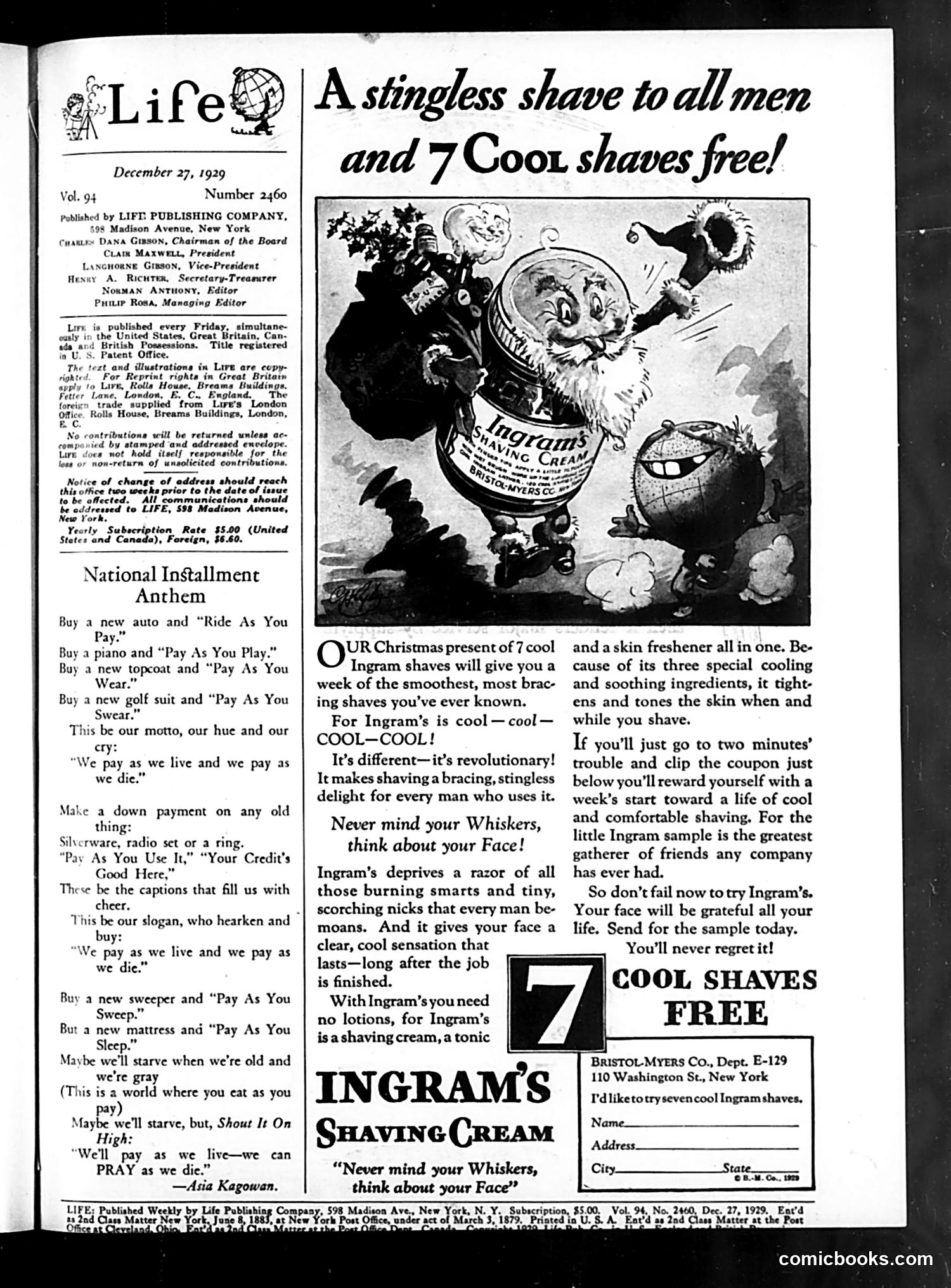
Analysis This page is primarily a commercial advertisement, not satire or political commentary. The central image promotes Ingram's Shaving Cream, featuring a cartoonish Santa Claus-like figure emerging from a shaving cream jar, surrounded by decorative clouds and flourishes. The ad's appeal is comedic rather than satirical: it promises "7 Cool shaves free" as a Christmas promotion, emphasizing the product's cooling and soothing properties. The slogan "Never mind your Whiskers, think about your Face" attempts humor by suggesting the cream's skin benefits matter more than beard thickness. The surrounding page content includes a satirical poem about installment buying ("Pay As You Live") and general Life magazine editorial material—typical 1929 magazine filler accompanying advertisements.
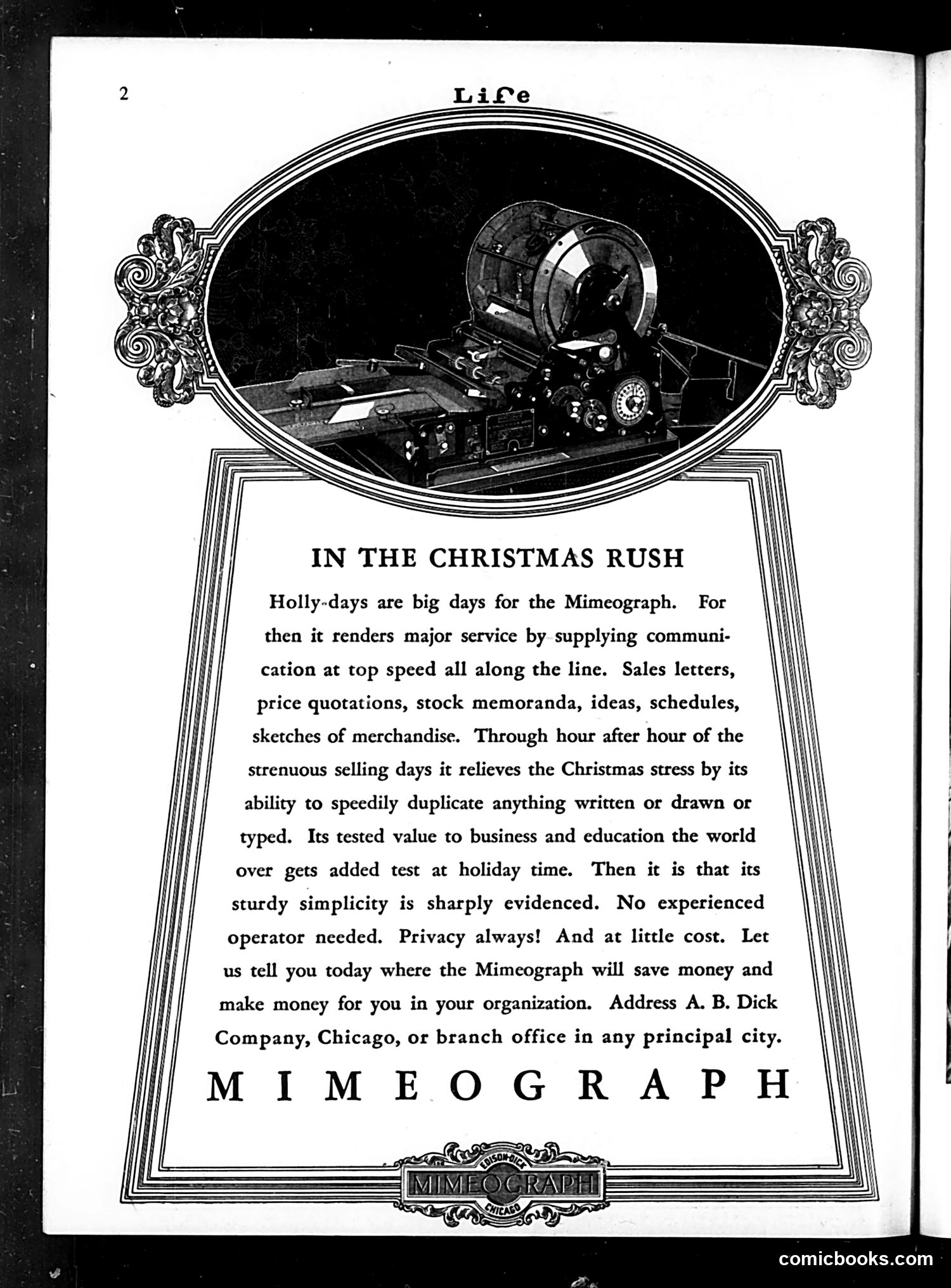
Analysis This is primarily a product advertisement, not satirical content. It promotes the Mimeograph machine during the Christmas shopping season. The ad emphasizes the machine's practical value for businesses during holiday rush periods—duplicating sales letters, price quotes, memos, and sketches quickly and cheaply. The appeal targets commercial organizations needing efficient communication without hiring experienced operators or expensive services. The ornate frame and the image of the mimeograph device itself are typical of early 20th-century advertising design. The text stresses "sturdy simplicity," cost-effectiveness, and privacy—standard sales claims for office equipment. There is no political satire or caricature present. This is straightforward commercial promotion for A.B. Dick Company's mimeograph technology, positioned as a holiday-season business solution.
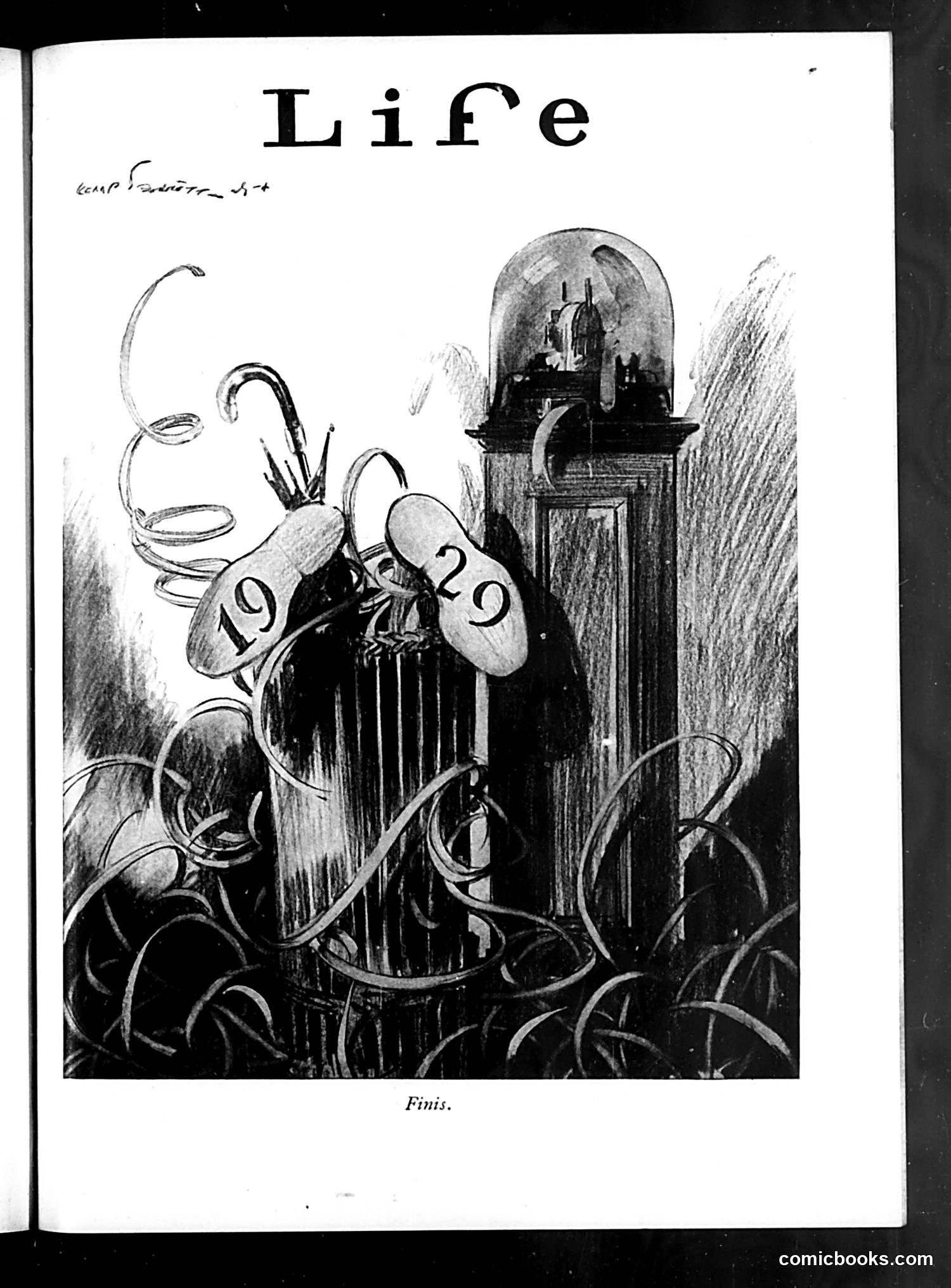
Analysis of "Life" Magazine Cartoon Page This appears to be the final page of a 1929 *Life* magazine satire titled "Life," marked "Finis" (Latin for "The End"). The central image depicts a grim reaper-like skeletal figure clutching two large pocket watches labeled "19" and "29"—representing 1919 and 1929. The figure stands amid withered plants or vines, with an ominous tower or building looming behind. The cartoon likely satirizes the decade spanning 1919-1929, suggesting mortality, decay, or finality. Given the 1929 date coincides with the stock market crash, this probably comments on the end of the prosperous "Roaring Twenties" and warns of the economic catastrophe beginning. The imagery conveys that this ten-year period—marked by excess and speculation—has reached its inevitable, dark conclusion.
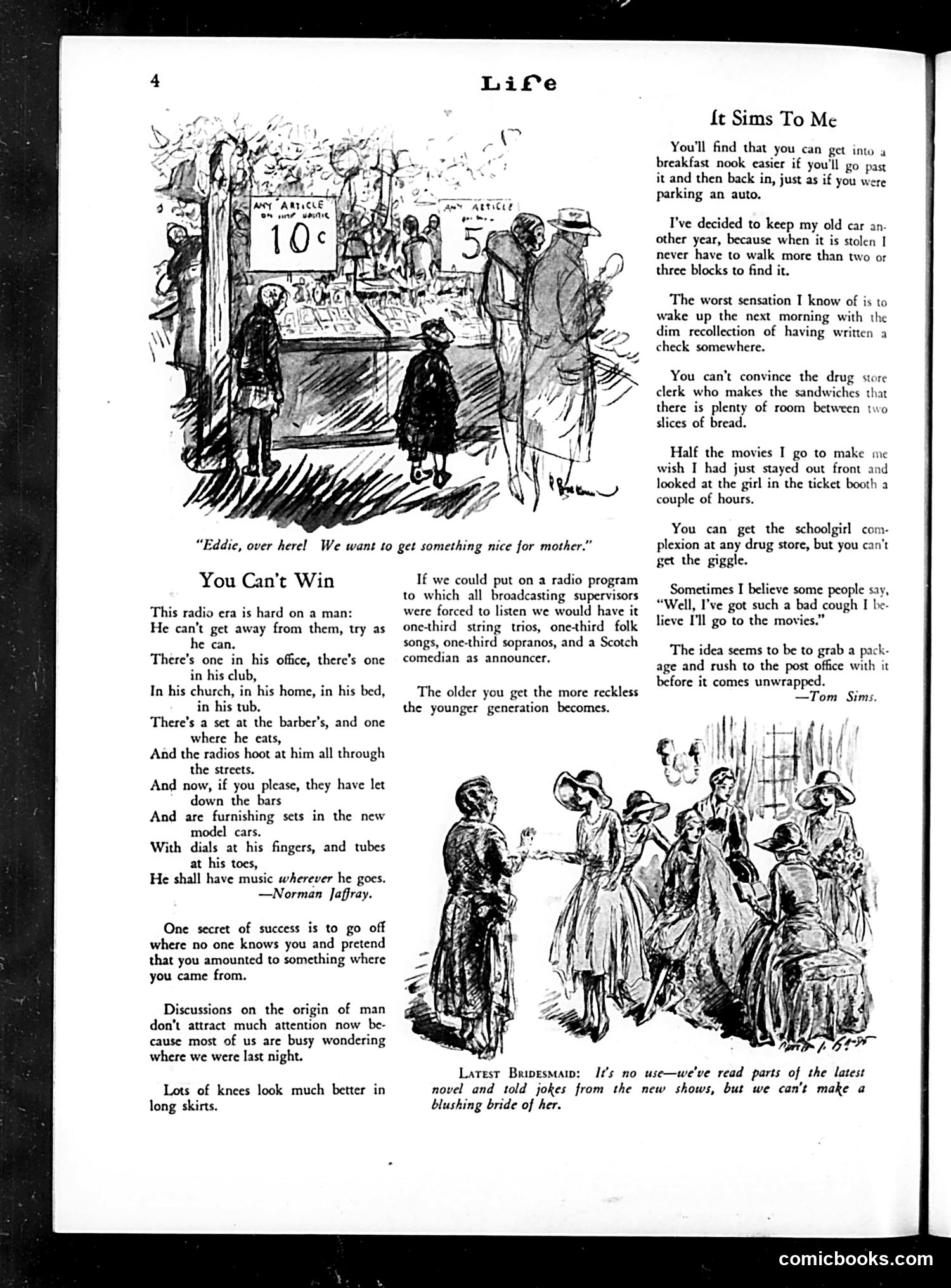
Analysis of Life Magazine Page 4 This page contains two separate satirical pieces from early 20th-century Life magazine. "You Can't Win" (poem by Norman Jaffray) satirizes how radios have inescapably invaded modern life—in offices, homes, churches, barbershops, and streets. The joke is that a man cannot escape radio broadcasts anywhere, with "dials at his fingers" giving him "music wherever he goes." It's social commentary on the ubiquity of new technology. "It Sims To Me" (by Tom Sims) offers humorous observations about everyday annoyances: difficulty finding parked cars, check-writing anxiety, overstuffed sandwiches, and inattentive movie-ticket sellers. The cartoon illustration shows people at what appears to be a newsstand or shop. Both pieces humorously complain about modern inconveniences and changing social customs of the era.
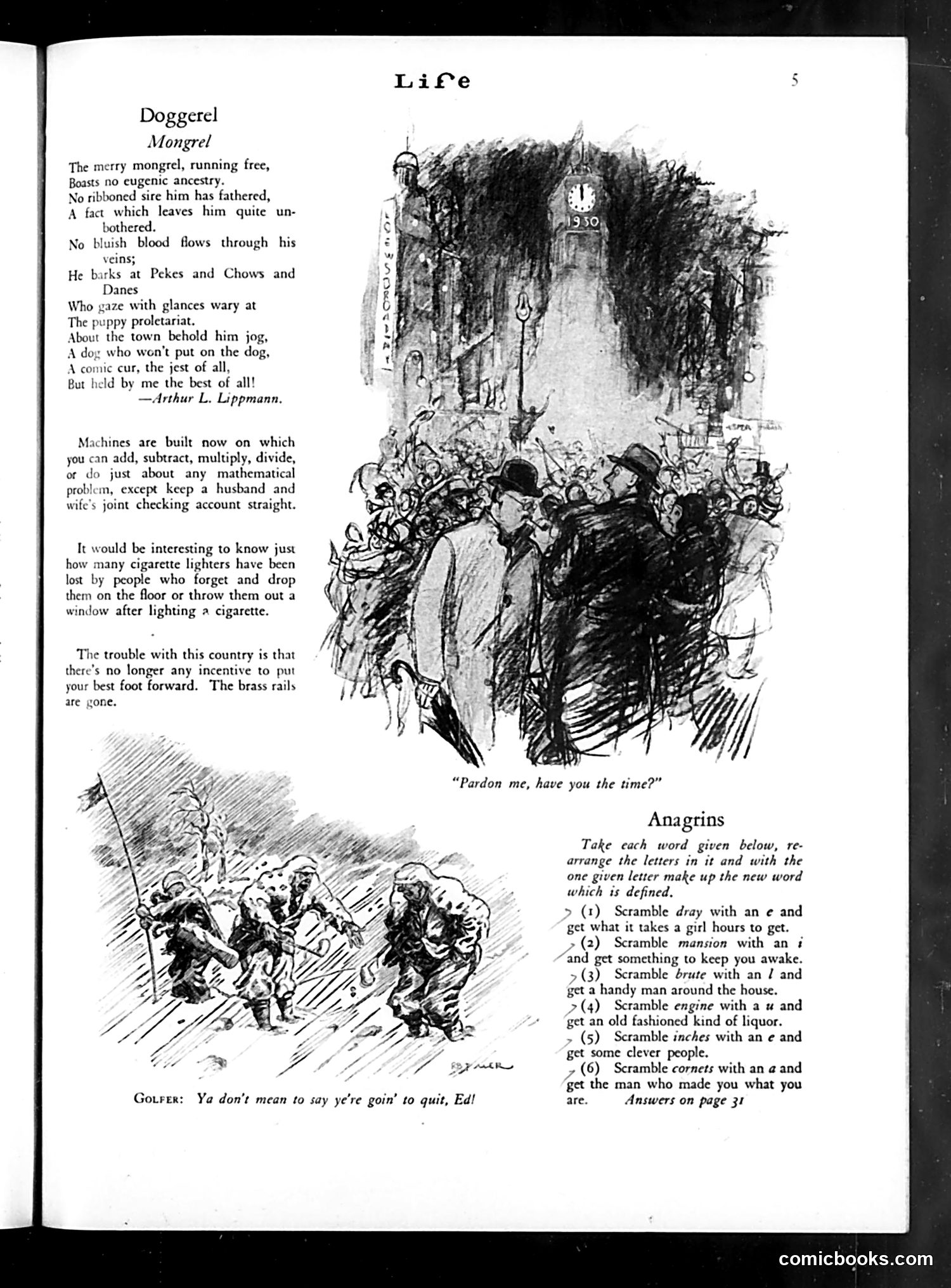
Analysis of Life Magazine Page 5 This page contains two satirical cartoons and humorous commentary typical of Life magazine's style. The top cartoon depicts a crowded urban street scene with the caption "Pardon me, have you the time?" - satirizing how pedestrians are too busy or distracted to notice each other in modern city life. The bottom cartoon shows golfers in bad weather with dialogue "Ya don't mean to say ye're goin' to quit, Ed!" - mocking golfers' dedication to the sport despite terrible conditions. The page also includes a poem titled "Doggerel/Mongrel" by Arthur L. Lippmann about a mongrel dog's freedom from pedigree constraints, and commentary on modern conveniences and lost incentives in contemporary society. The anagrams puzzle provides wordplay entertainment typical of the magazine's recreational content.
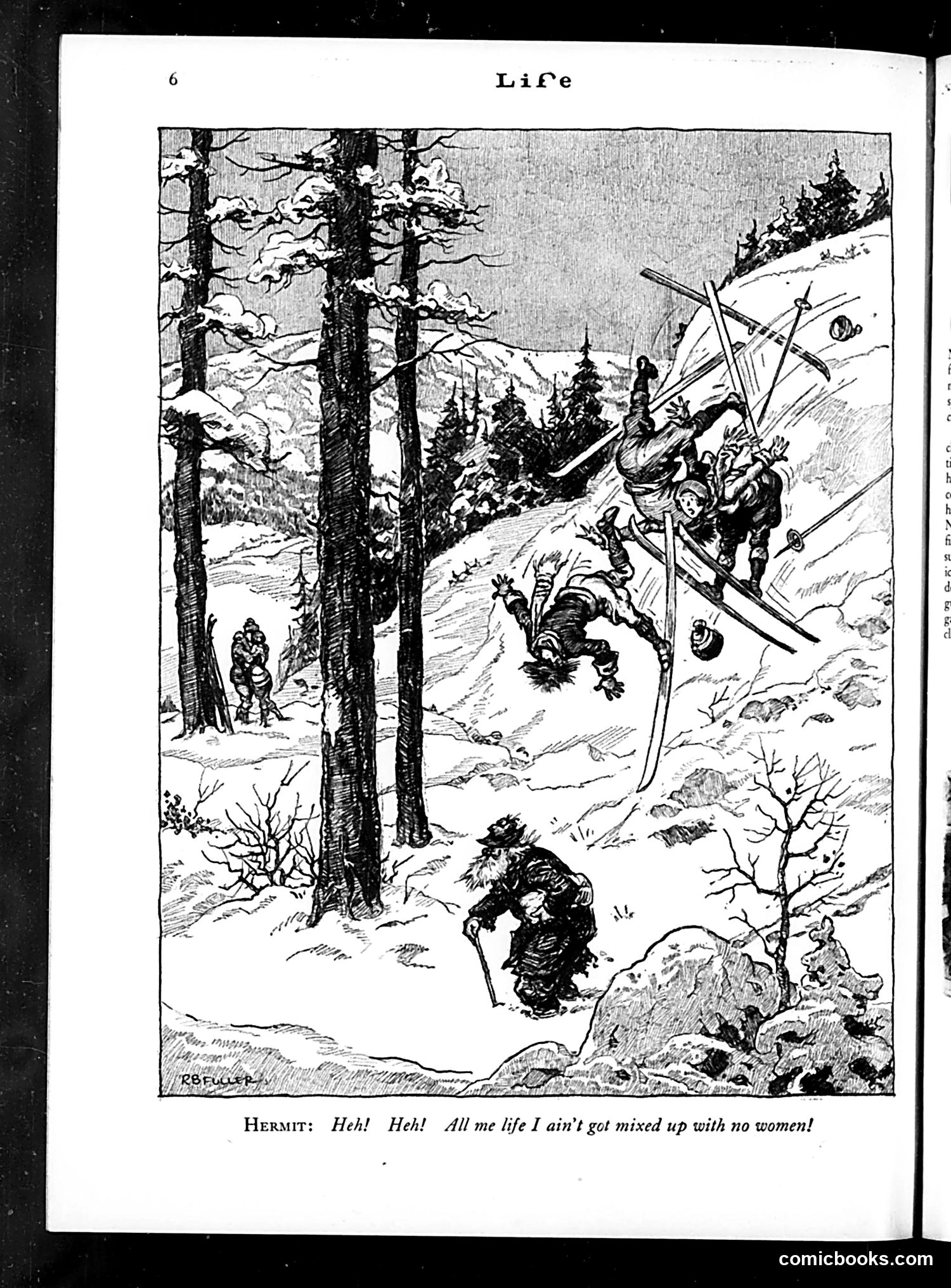
Explanation of the Cartoon This is a winter mountain scene depicting a hermit character who has apparently encountered a group of skiers. The hermit's caption—"Heh! Heh! All me life I ain't got mixed up with no women!"—is a humorous complaint about unwanted female company invading his isolated solitude. The joke plays on the stereotype of the misogynistic hermit whose entire purpose for living remotely is to avoid women. The irony is that modern recreational activities like skiing have brought women into previously remote mountain areas, making his isolation impossible. The cartoon satirizes both the isolated man's outdated attitudes and the changing landscape of early-to-mid 20th century leisure activities, where skiing was becoming a popular mixed-gender sport accessible to urban populations.
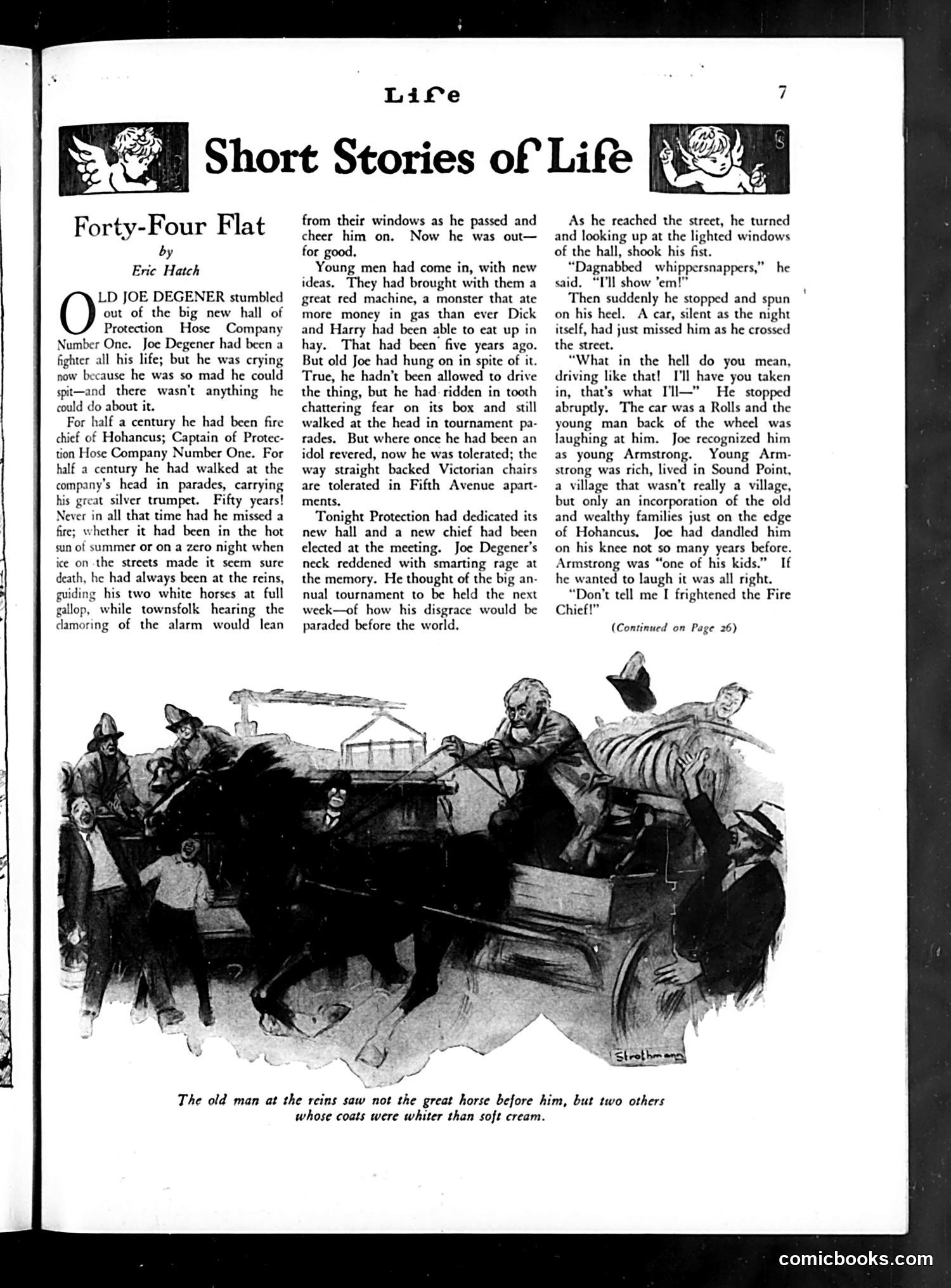
"Forty-Four Flat" by Eric Hatch This short story opening depicts Joe Degener, a veteran firefighter who has served with the Protection Hose Company Number One for half a century. The narrative establishes him as an old-timer resentful of modernization: the company has replaced its proud fire station with a new hall, new equipment (a gas-powered machine replacing horses), and new leadership—changes that humiliate him. The illustration shows horses and firefighting equipment, capturing the story's tension between traditional horse-drawn firefighting and modern mechanization. The satire gently mocks Joe's resistance to progress while sympathizing with his displacement—a common early-20th-century American anxiety about industrialization replacing established workers and traditions.
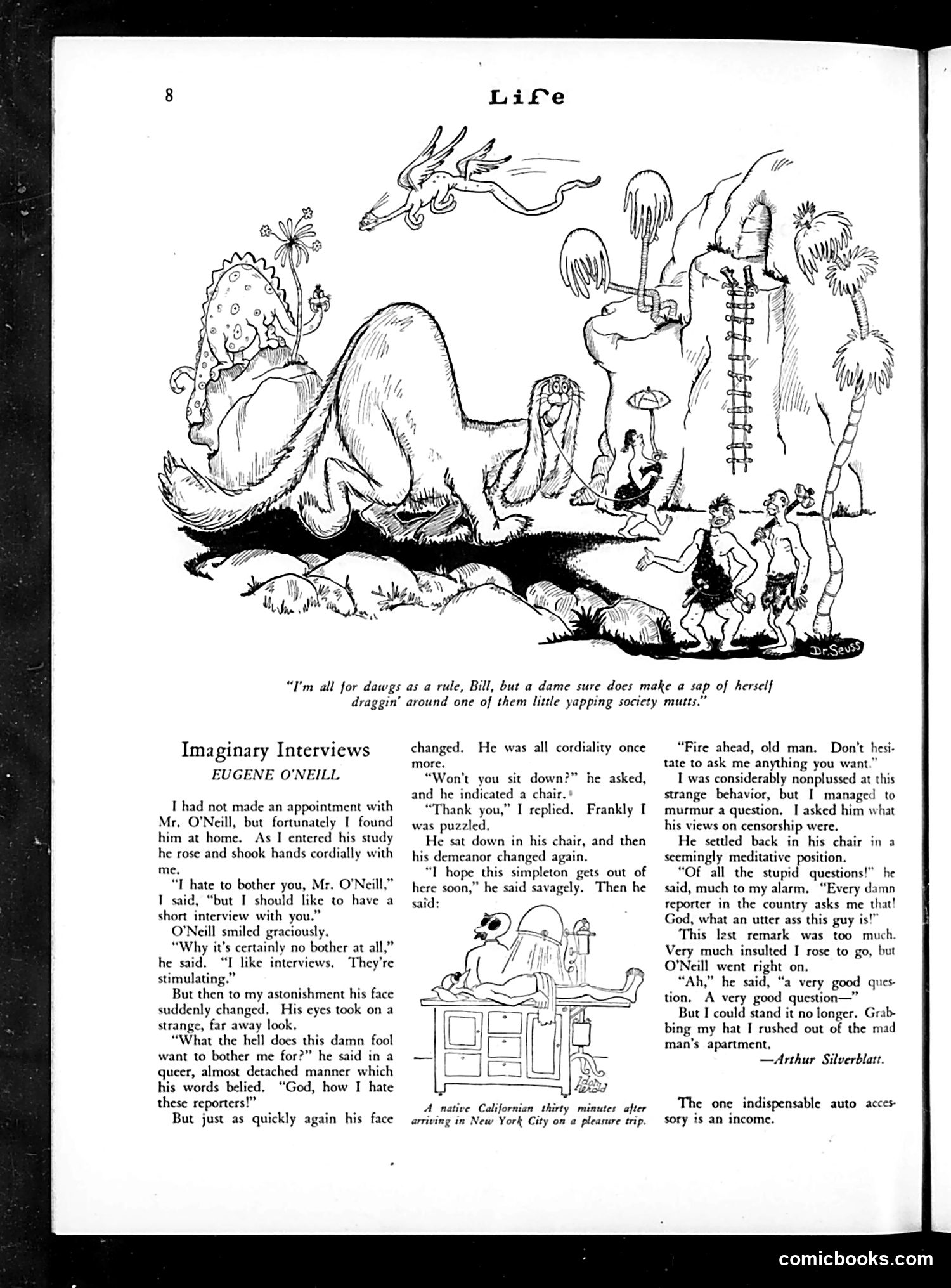
Analysis of Life Magazine Page 8 Top Cartoon (Dr. Seuss): This whimsical illustration depicts fantastical creatures and humans coexisting in an alien landscape. The caption jokes about a dame making "a sap of herself draggin' around" dachshunds in society. This appears to be satirizing upper-class women's obsession with fashionable small dog breeds as status symbols. "Imaginary Interviews" Section: The featured interview with Eugene O'Neill (the famous American playwright) presents him as irritable and hostile toward reporters. O'Neill complains about journalists bothering him, expressing contempt for the press. The satire mocks both O'Neill's curmudgeonly nature and the invasive celebrity interview culture of the era. The small illustration accompanying shows a Californian arriving in New York City.
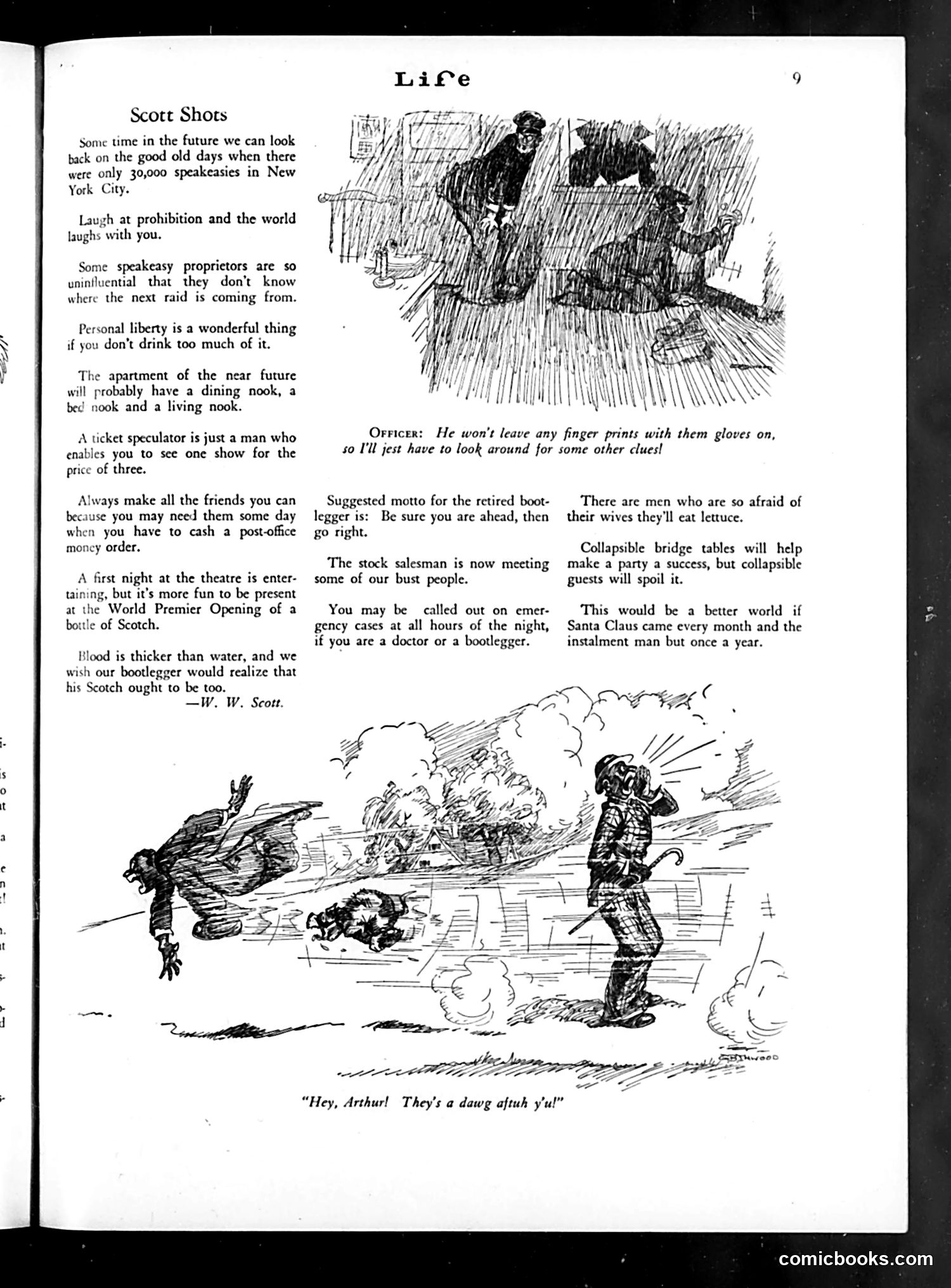
Analysis of Life Magazine Page 9: "Scott Shots" This page contains humorous short observations by W. W. Scott about urban life and future predictions, paired with two cartoons. The top cartoon depicts a police officer confronting what appears to be a woman in a speakeasy (an illegal bar during Prohibition). The caption reads: "He won't leave any finger prints with them gloves on, so I'll just have to look around for some other clues!" This satirizes how speakeasies operated openly despite Prohibition, with law enforcement either complicit or unable to enforce the law. The bottom cartoon shows someone being blown by an explosion, with the caption "Hey, Arthur! They's a dawg afish y'd!" The humor appears to derive from dialectal speech and slapstick misfortune. The "Scott Shots" text offers witty commentary on contemporary life: speakeasies, apartment design, theater culture, and bootleggers—reflecting 1920s urban concerns.
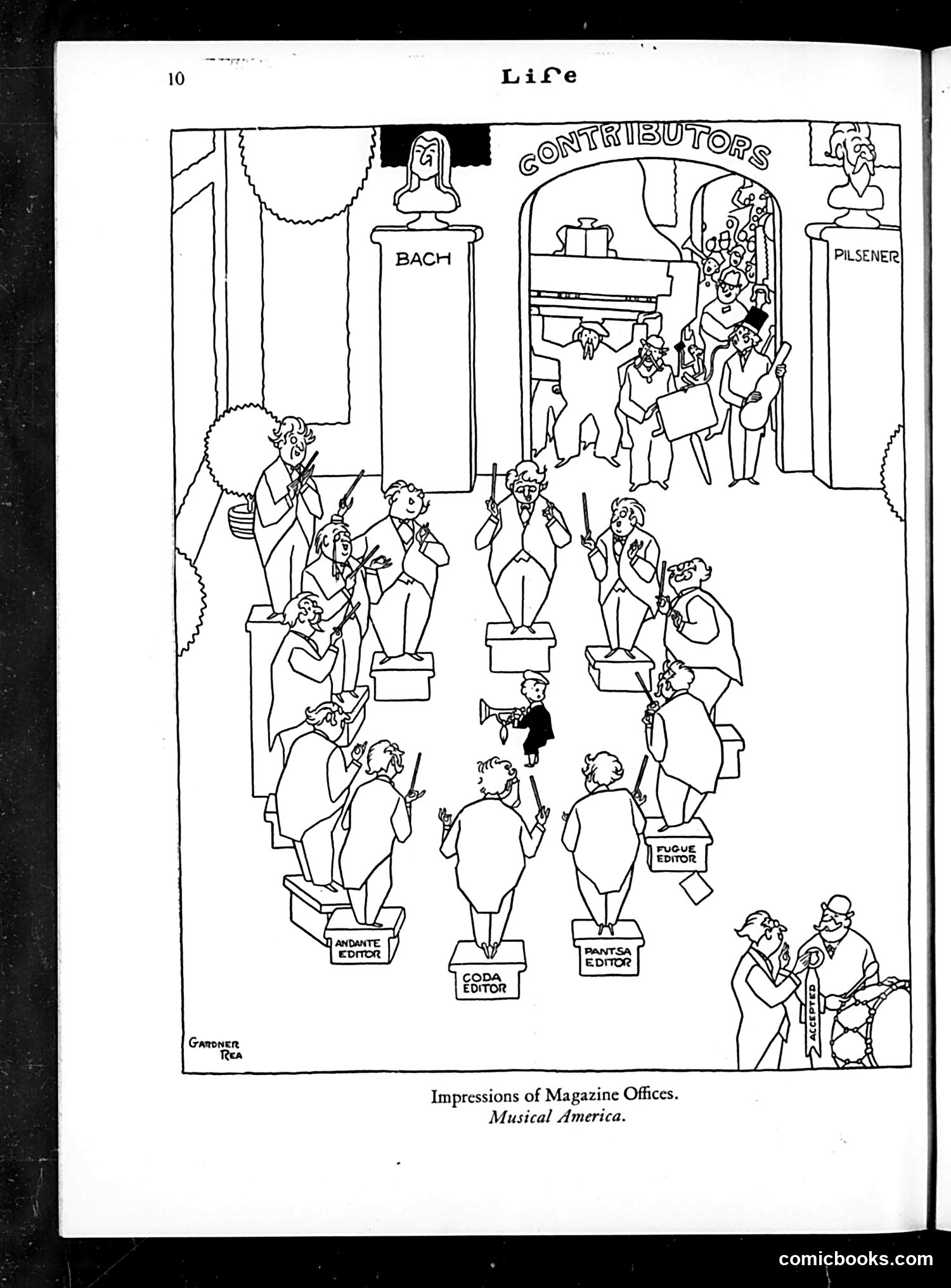
"Impressions of Magazine Offices: Musical America" This satirical cartoon depicts the hierarchy of a musical magazine's editorial offices. The illustration shows various staff members positioned on pedestals of different heights, labeled with their roles: "Andante Editor," "Rondo Editor," "Fugue Editor," and "Mantissa Editor" among others. At the top are busts of classical composers Bach and Pilsener, suggesting these figures represent the magazine's cultural authority. The "Contributors" section shows a crowded room of musicians performing at a piano, implying the influx of submissions. The joke satirizes magazine editorial hierarchy and the pretentious classical music world—using musical terminology (andante, rondo, fugue) for editorial positions, mocking how such publications adopt grandiose language to organize their mundane administrative structures.
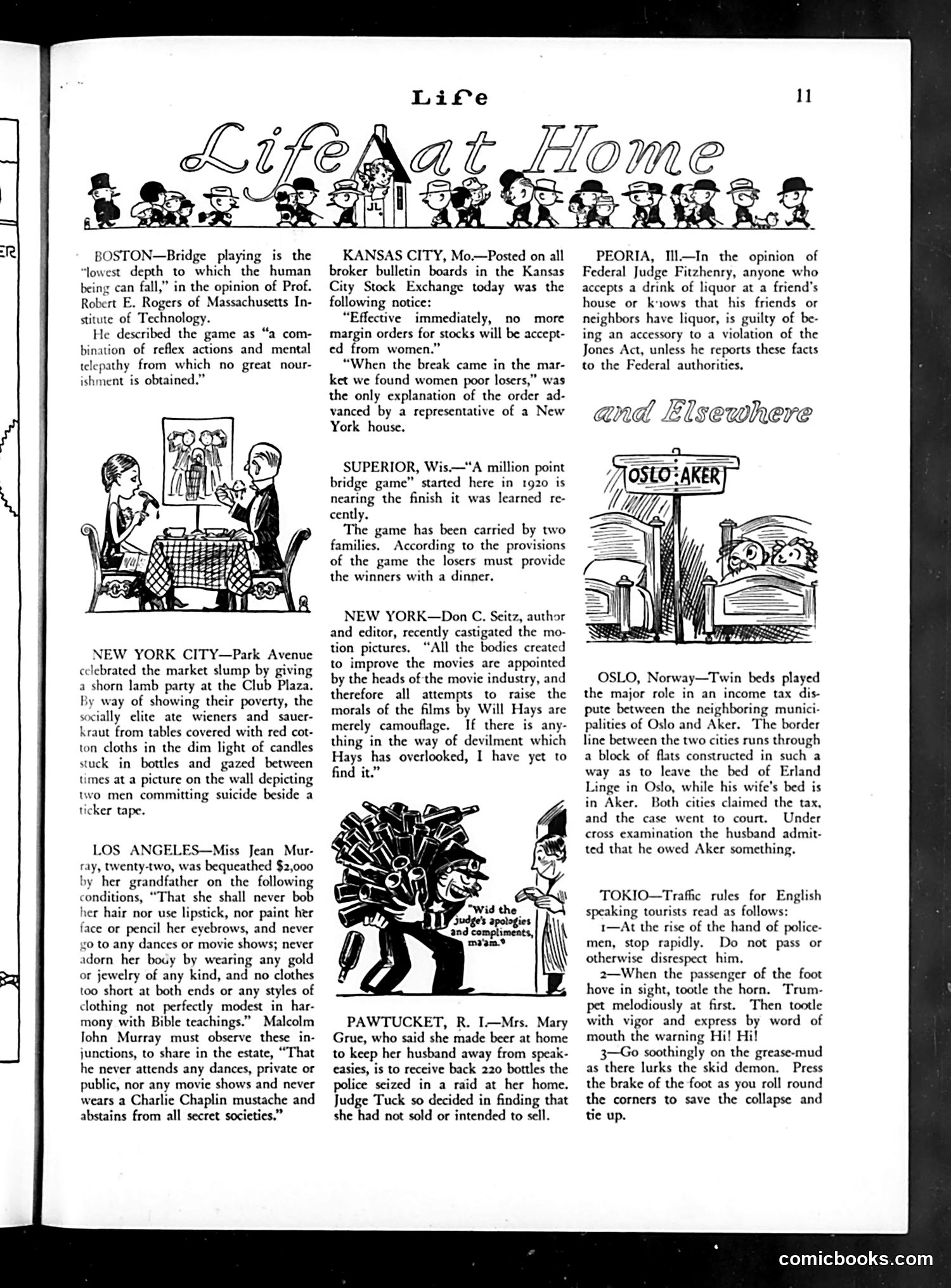
Analysis of Life Magazine Page 11: "Life at Home and Elsewhere" This page is a satirical compilation of brief news items with humorous illustrations. The cartoons mock various social oddities: 1. Bridge players (top left): Shows two people playing cards, illustrating Boston's bridge-playing craze. 2. Movie morality (center): Depicts a figure labeled "Will Hays" (movie industry censor) policing film content, satirizing Hollywood's attempts to control movie morality through self-regulation. 3. Traffic rules (bottom right, "Oslo/Aker"): Illustrates a humorous border dispute between neighboring Norwegian cities over a shared bed, mocking absurd municipal jurisdictions. The items document peculiar social trends and regulations from American and international locations, using visual humor to satirize human behavior and bureaucratic absurdity.
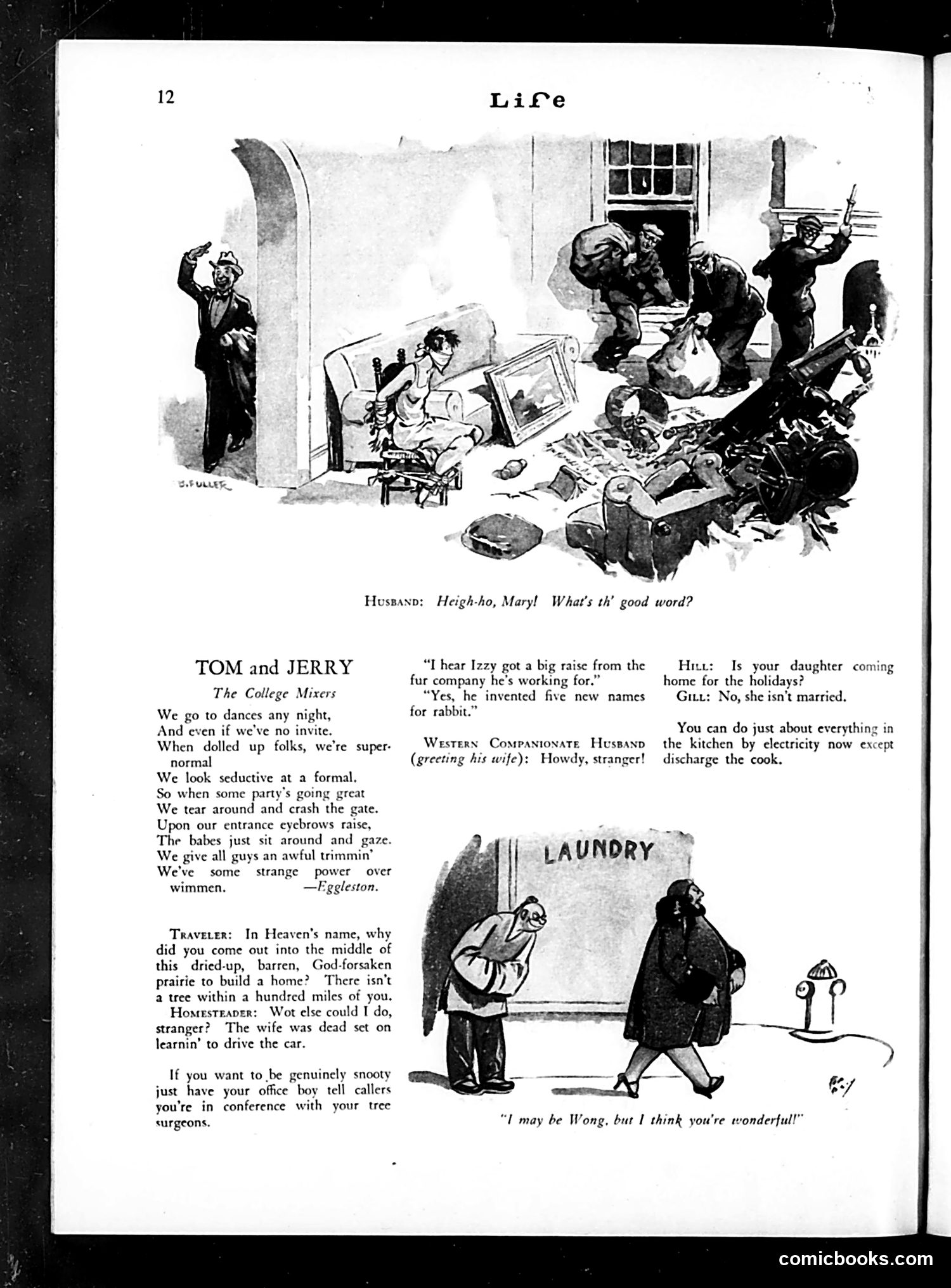
Analysis of Life Magazine Page 12 This page contains three satirical pieces mocking contemporary social behaviors: Top cartoon: A chaotic domestic scene where a husband asks his wife "What's th' good word?" amid destruction—overturned furniture, scattered belongings, and multiple figures in disarray. The satire targets marital discord and household chaos, likely referencing post-WWI domestic disruptions or changing gender roles. "Tom and Jerry" poem: Mocks college social culture—dancing uninvited, gate-crashing, and boisterous behavior. The satire is straightforward: critiquing young people's reckless, disruptive social conduct and their perceived power over women. Bottom cartoon: A man carrying laundry compliments a woman ("I may be Wong, but I think you're wonderful!"). This relies on ethnic humor—the pun on the surname "Wong" reflects early 20th-century casual racial stereotyping common to the era's satire.
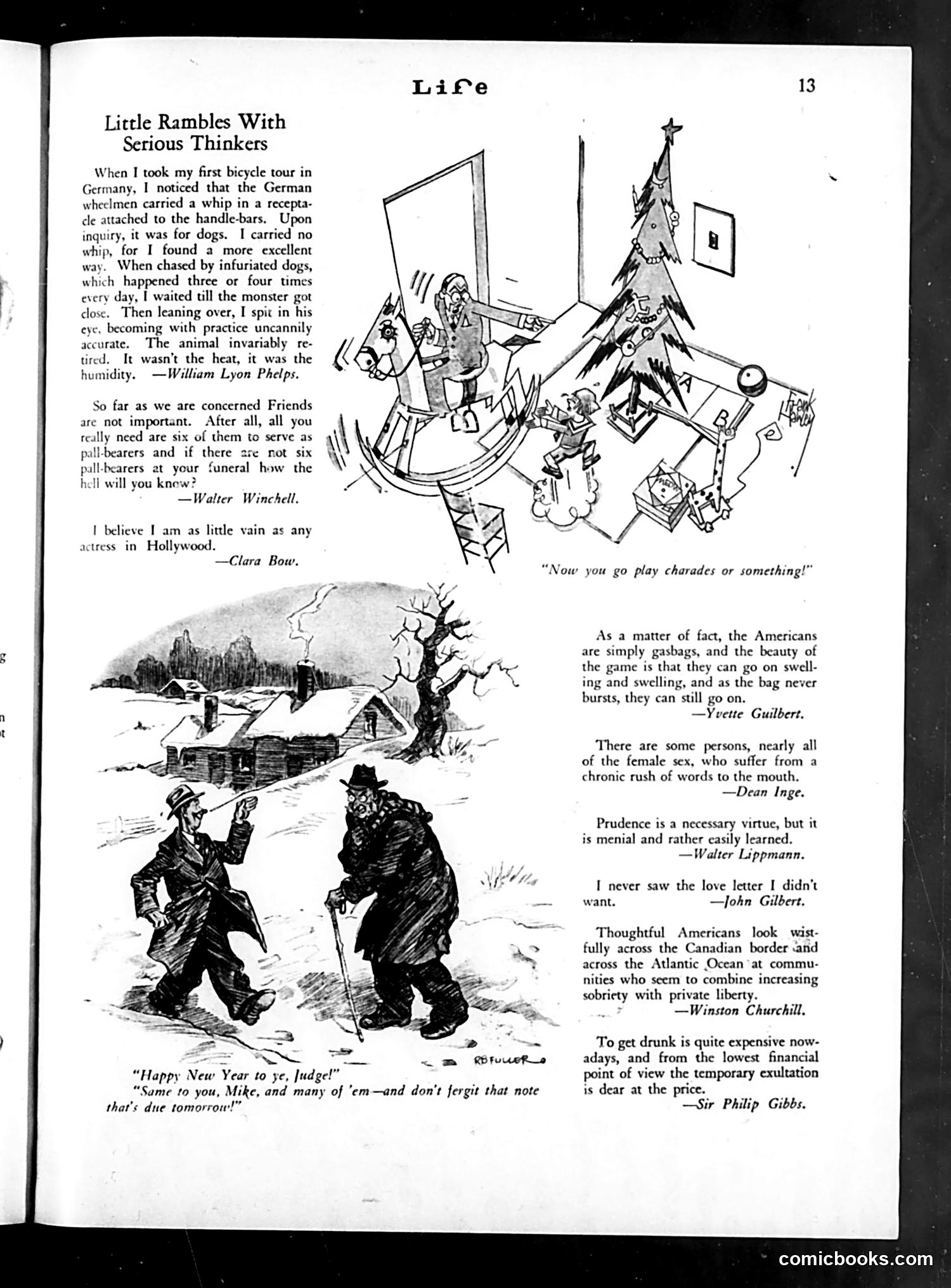
Analysis of Life Magazine Page 13 This page contains humorous quotes attributed to celebrities (William Lyon Phelps, Walter Winchell, Clara Bow, Yvette Guilbert, Dean Inge, Walter Lippmann, John Gilbert, Winston Churchill, Philip Gibbs) on various social topics. The two illustrations show: (1) A chaotic Christmas morning scene with children and toys, captioned "Now you go play character or something!" — satirizing how parents use entertainment to occupy children. (2) A winter scene of two men exchanging New Year's greetings in the snow, with a joke about remembering to pay back a debt ("don't forget that note that's due tomorrow"). The page mixes celebrity commentary on American character, manners, and current social observations with domestic humor typical of 1920s-era satirical magazine content.
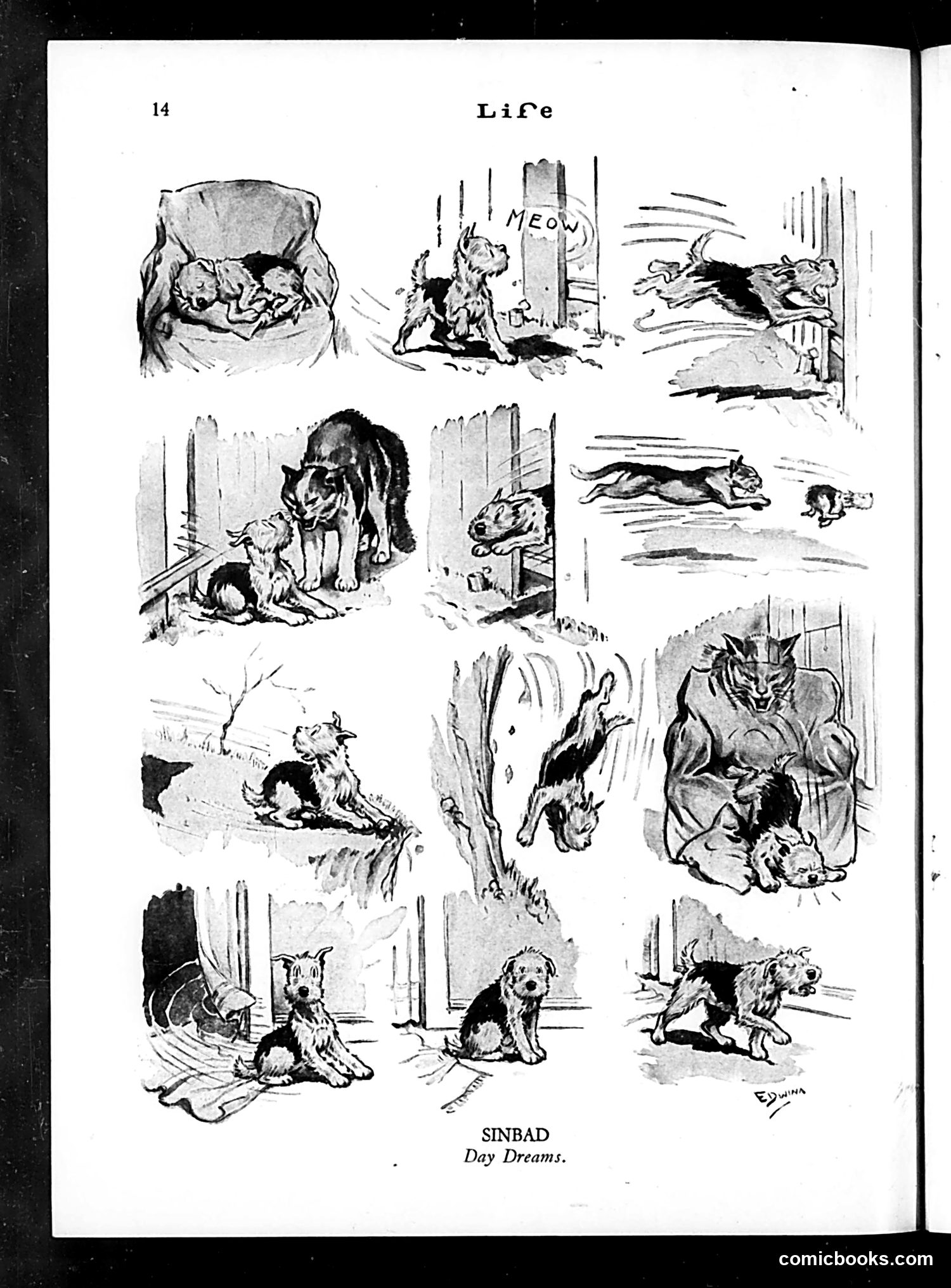
SINBAD: Day Dreams This page presents a series of sketches titled "Sinbad: Day Dreams," depicting various animals—primarily cats and dogs—in different scenarios and poses. The illustrations appear to be character studies or behavioral vignettes rather than political satire. The sketches show domestic pets in anthropomorphic situations: a cat meowing at a post, dogs running, a large dog confronting a smaller one, cats appearing menacing or dramatic, and dogs in various indoor domestic settings. The style is loose, expressive line-work typical of early 20th-century satirical illustration. Without additional context or clearer captions for individual panels, the specific satirical intent remains unclear. The piece may be a humorous commentary on pet behavior or animal personalities, but the exact social or political references—if any—are not evident from the visible image alone.
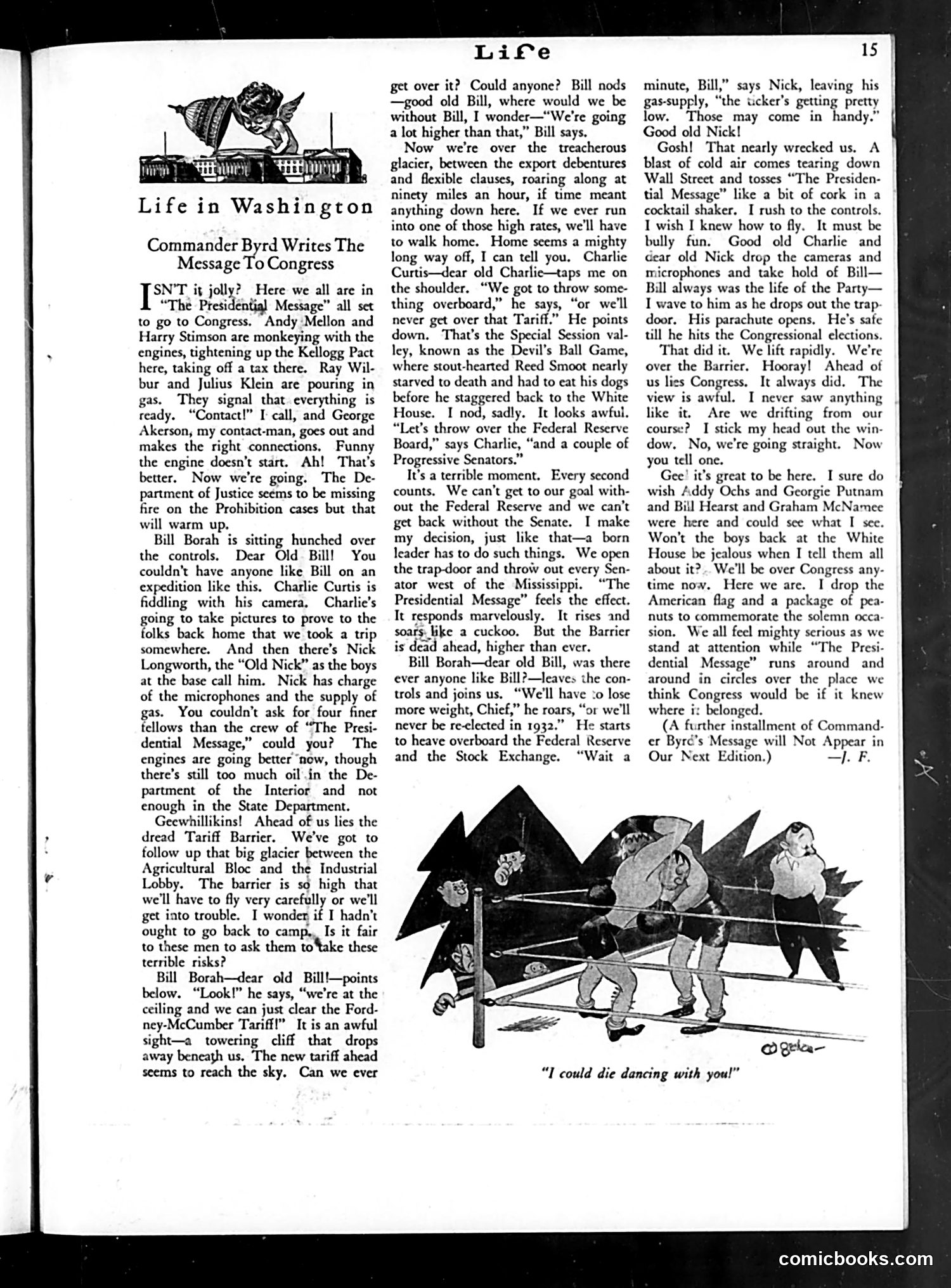
Life Magazine Page Analysis This page satirizes Commander Byrd's Congressional testimony about his Antarctic expedition. The article mocks the drama of presenting an exploratory message to Congress while various political crises (tariff debates, Federal Reserve issues, Prohibition cases) demand attention. The cartoon below depicts members of Congress struggling with film equipment and cameras—literally tangled in the apparatus of documenting Byrd's achievement. The caption "I could die dancing with you!" suggests the absurdity of Congress prioritizing the glamorous Antarctic story over serious legislative business. The satire criticizes Congress for being distracted by spectacle (Byrd's expedition footage) when serious economic and political matters require focus. The tangled figures represent how sensationalism literally entangles government priorities.
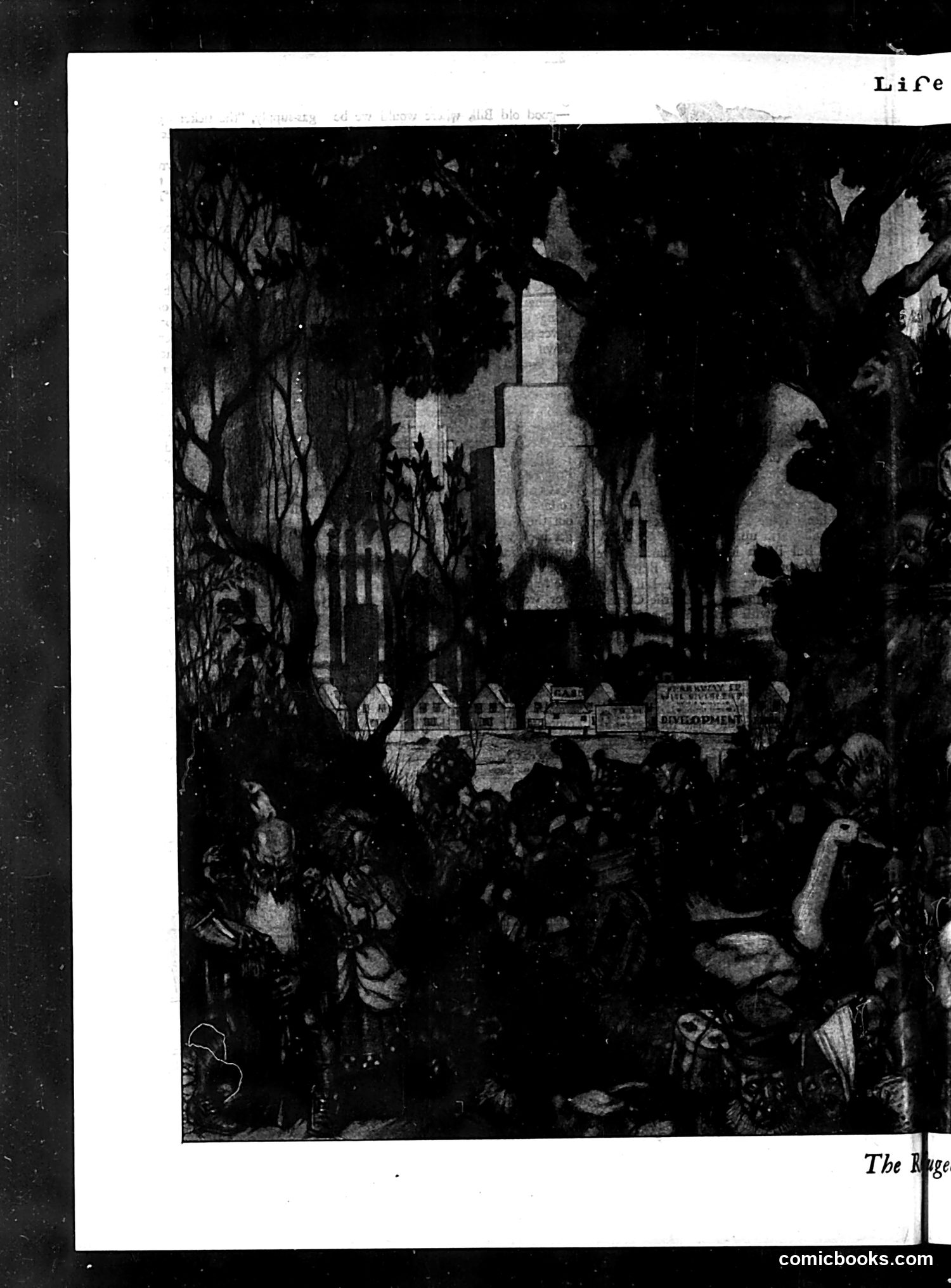
Analysis This page from *Life* magazine shows a nighttime urban scene with crowds gathered around what appears to be a theatrical or ceremonial event. The image is titled "The Ruse" (visible at bottom right), suggesting deception or trickery is the satirical subject. The scene depicts formal figures on an elevated platform or stage, with elaborate architecture and foliage framing the composition. A large crowd of common people fills the foreground, watching intently. Without clearer visibility of specific caricatures or additional OCR text, the precise political target remains unclear. However, the composition suggests satire about public spectacle, mass manipulation, or the gap between official ceremony and popular experience—common *Life* magazine themes of social commentary. The theatrical staging implies criticism of performative politics or staged public events designed to deceive observers.
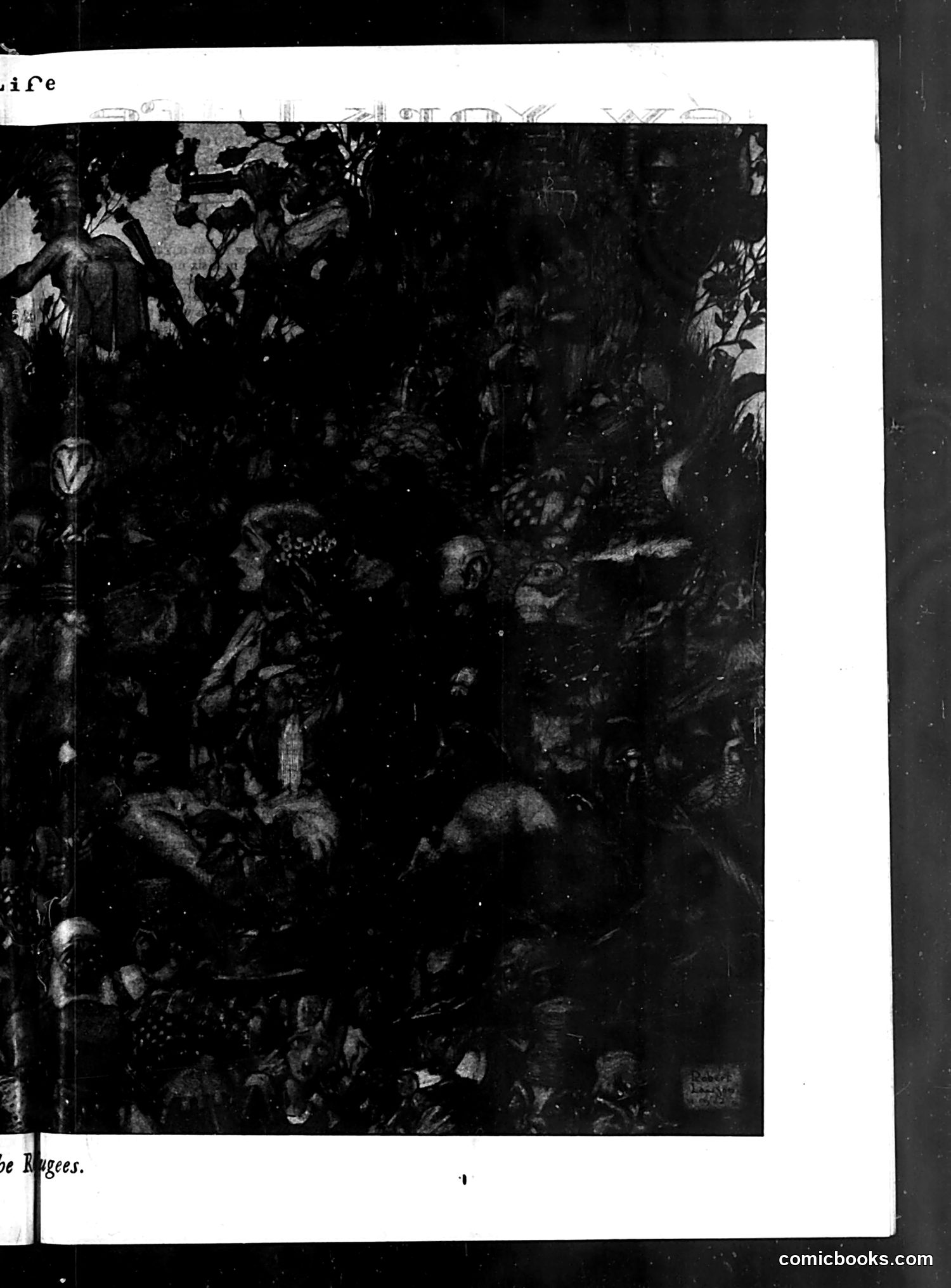
I can see this is a dark, densely detailed engraving or illustration showing what appears to be a chaotic scene with multiple figures in period dress (possibly 18th or 19th century based on the clothing styles visible). The image quality is quite poor due to reproduction, making specific identification difficult. The text fragments visible at top and bottom are incomplete ("ife" at top, "ogees" at bottom), preventing me from determining the cartoon's specific title or subject. Without clearer text or caption identifying the figures and context, I cannot reliably explain what political or social satire this represents. The crowded composition and dramatic rendering suggest this is likely a satirical scene of some consequence, but asserting specific identities or references would require speculation rather than evidence from the visible page.
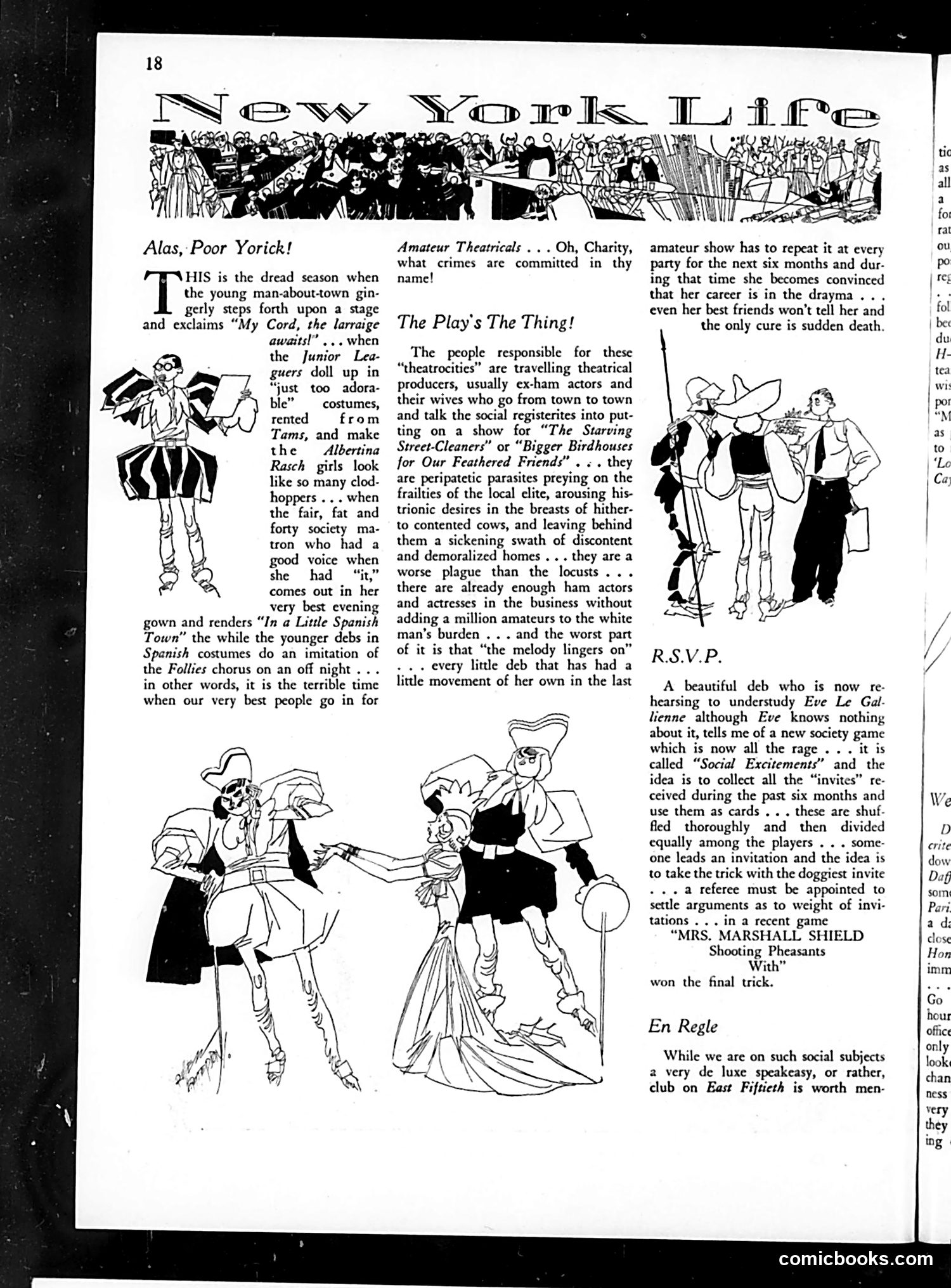
New York Life Social Commentary This page satirizes high-society theatrical pretensions and social games among New York's elite. "Alas, Poor Yorick!" mocks amateur theatrical productions where wealthy socialites perform in rented costumes, comparing their efforts unfavorably to professional actors. The section criticizes how these amateur shows proliferate despite the city already having sufficient professional talent. "The Play's The Thing" targets traveling theatrical producers who exploit local social elites by staging shows in their communities, turning performances into vehicles for amateur participation that generate "discontent and demoralized homes." "R.S.V.P." describes a new society game called "Social Excitement" using collected party invitations as playing cards—mocking how seriously the wealthy take their social calendars and competitive socializing. The illustrations depict exaggerated, elongated figures in fashionable dress, emphasizing the artificiality of these social performances.
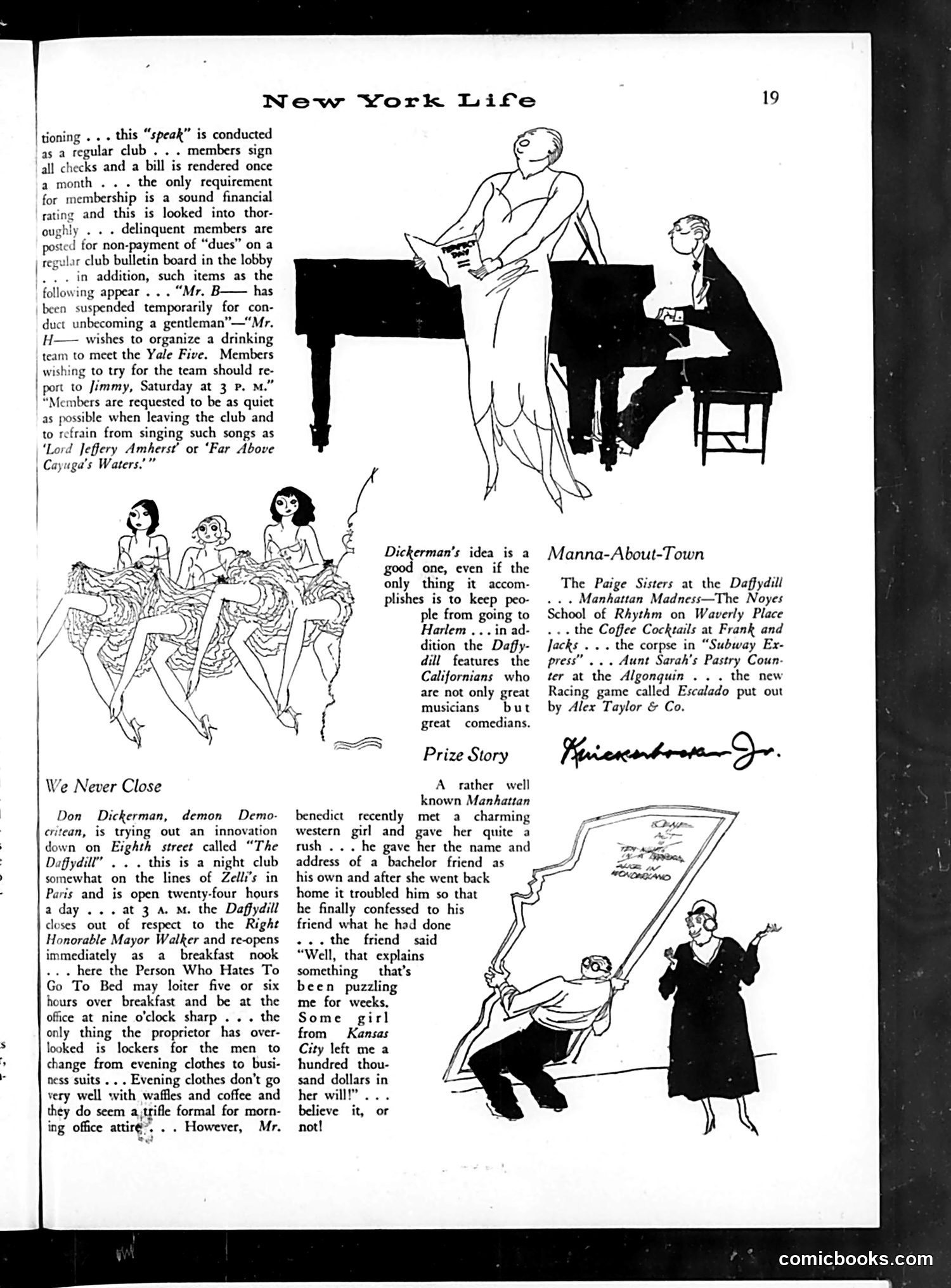
"We Never Close": Prohibition-Era Speakeasy Satire This page satirizes 1920s New York nightlife during Prohibition. Don Dickerman has opened "The Daffydill," a speakeasy (illegal bar) on Eighth Street modeled after Paris's Zelli's, operating 24 hours except for a humorous "closing" to respect Mayor Walker—then immediately reopening as a breakfast nook. The satire highlights the absurdity of speakeasy culture: members sign checks and pay monthly "dues"; delinquent patrons are publicly shamed on bulletin boards; sophisticated pretense masks obvious lawbreaking. The accompanying illustrations show jazz musicians and dancers—referencing the era's association of speakeasies with jazz and loose morality. The "Prize Story" sidebar features a separate comedic anecdote about romantic deception, unrelated to the main content but typical of the magazine's satirical gossip format. The overall tone mocks both speakeasy hypocrisy and the wealthy Manhattan social scene that patronized them.
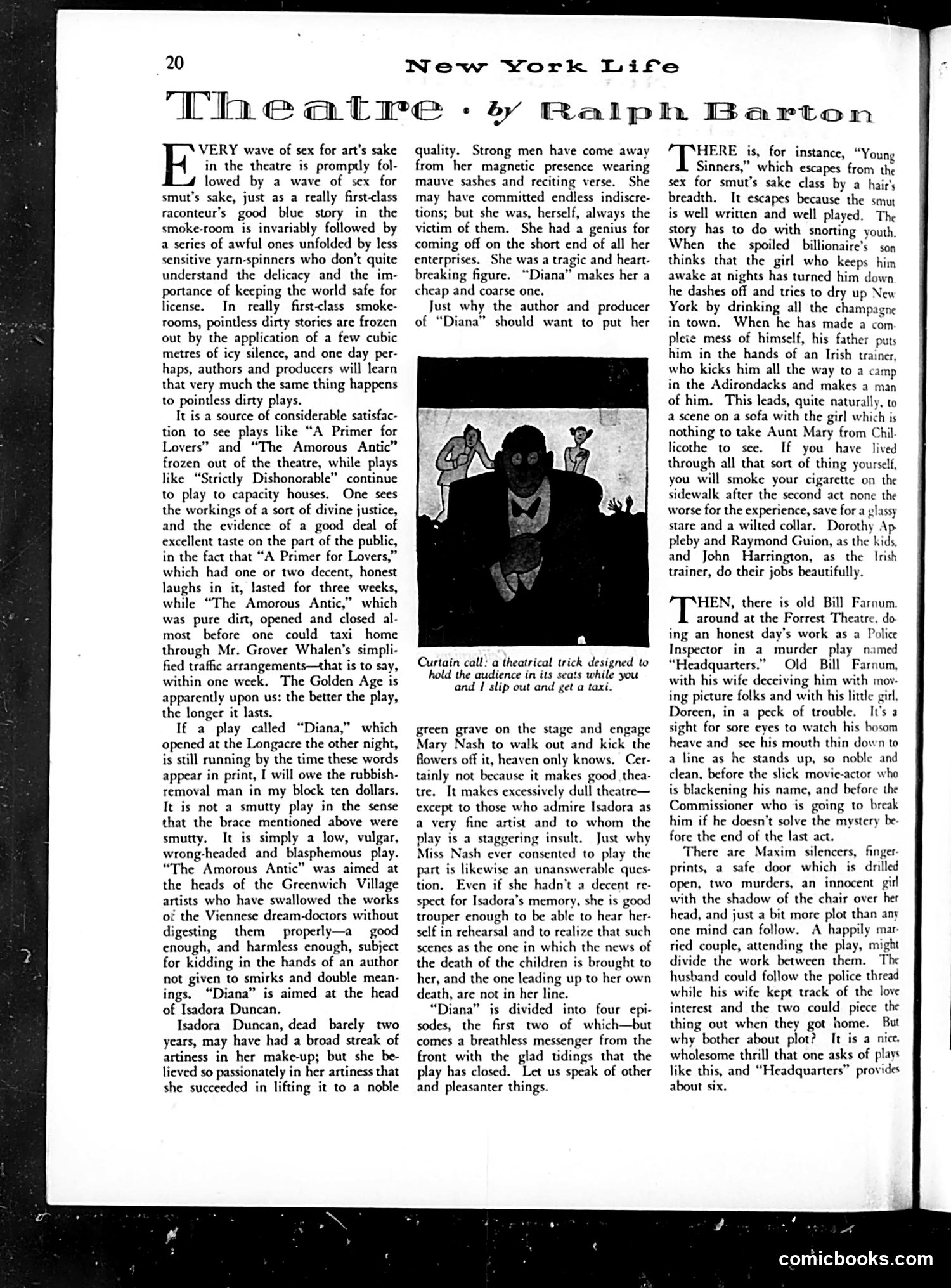
Theater Critique: Ralph Barton on Broadway Plays This is a theater review criticizing a Broadway play called "Diana." The author argues the play disrespectfully mocks the recently deceased dancer Isadora Duncan (who died about two years prior), portraying her as "cheap and coarse" rather than recognizing her genuine artistic legacy. The review contrasts "Diana" with other contemporary plays, praising ones with actual merit ("Strictly Dishonorable") while mocking explicitly vulgar productions ("The Amorous Antic") that closed quickly. The author questions why actress Mary Nash would accept a role that desecrates Duncan's memory, especially scenes depicting her children's deaths—a real tragedy in Duncan's life—treated for laughs rather than pathos. The small cartoon illustrates a theatrical "trick": keeping audiences seated through the curtain call so they'll purchase taxi rides afterward (referencing NYC Police Commissioner Grover Whalen's traffic reforms). The piece defends artistic integrity against cheap mockery.
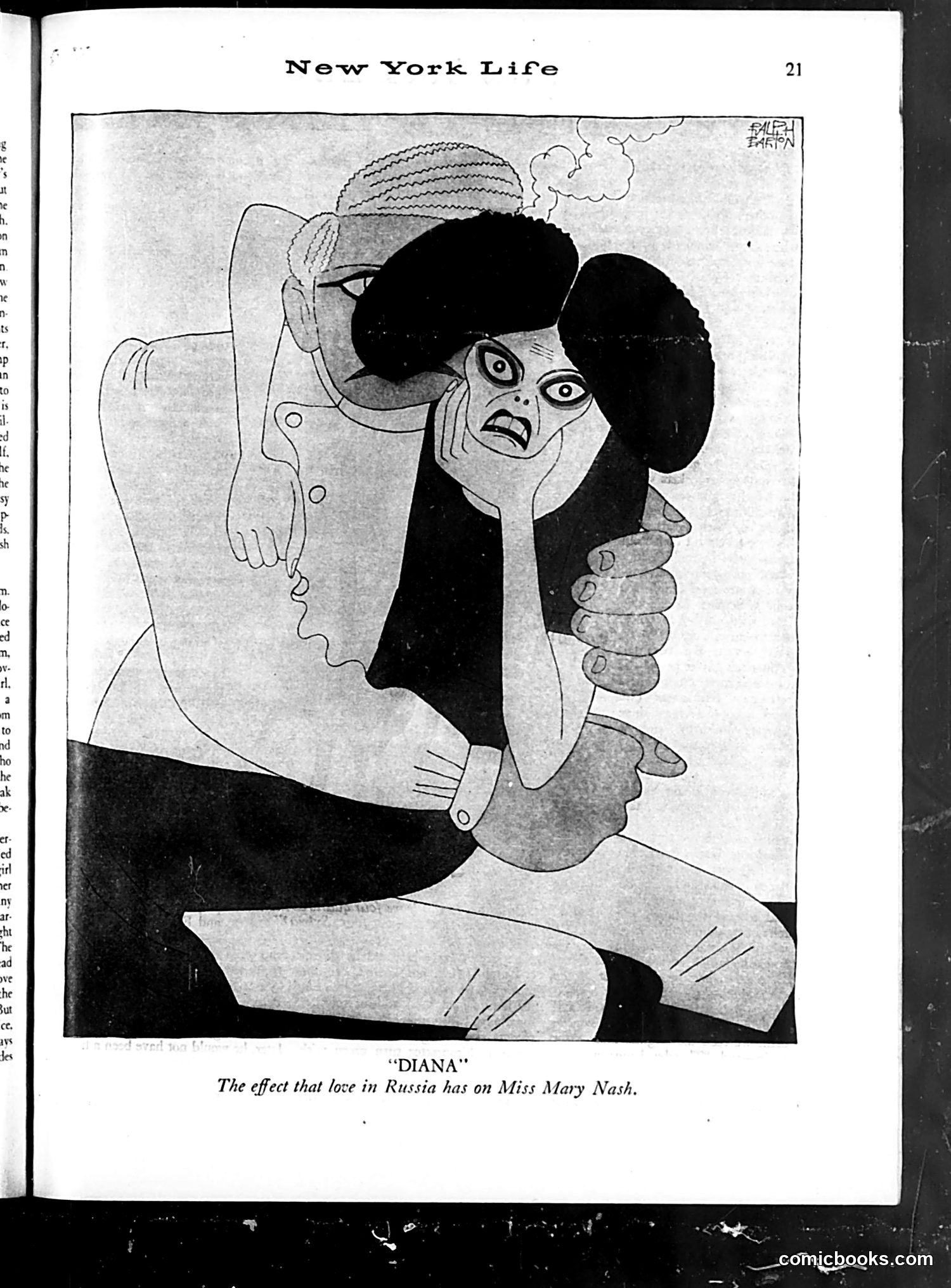
Analysis This is a satirical cartoon from *Life* magazine titled "Diana," captioned "The effect that love in Russia has on Miss Mary Nash." The image depicts a woman with an exaggerated, distorted expression—wild eyes, prominent facial features, and an anguished appearance. She's shown holding a telephone receiver, suggesting communication or news from Russia. The satire targets: Miss Mary Nash (likely a public figure of the era) and her romantic involvement with someone or something Russian. The cartoon mocks how this Russian connection has allegedly affected her mental state and appearance, exaggerating her into a grotesque, disturbed figure. This reflects post-WWI American anxiety about Russia and Bolshevism, treating Russian romantic entanglements as socially corrupting or psychologically damaging. The cartoon employs caricature and distortion as vehicles for political and social ridicule.
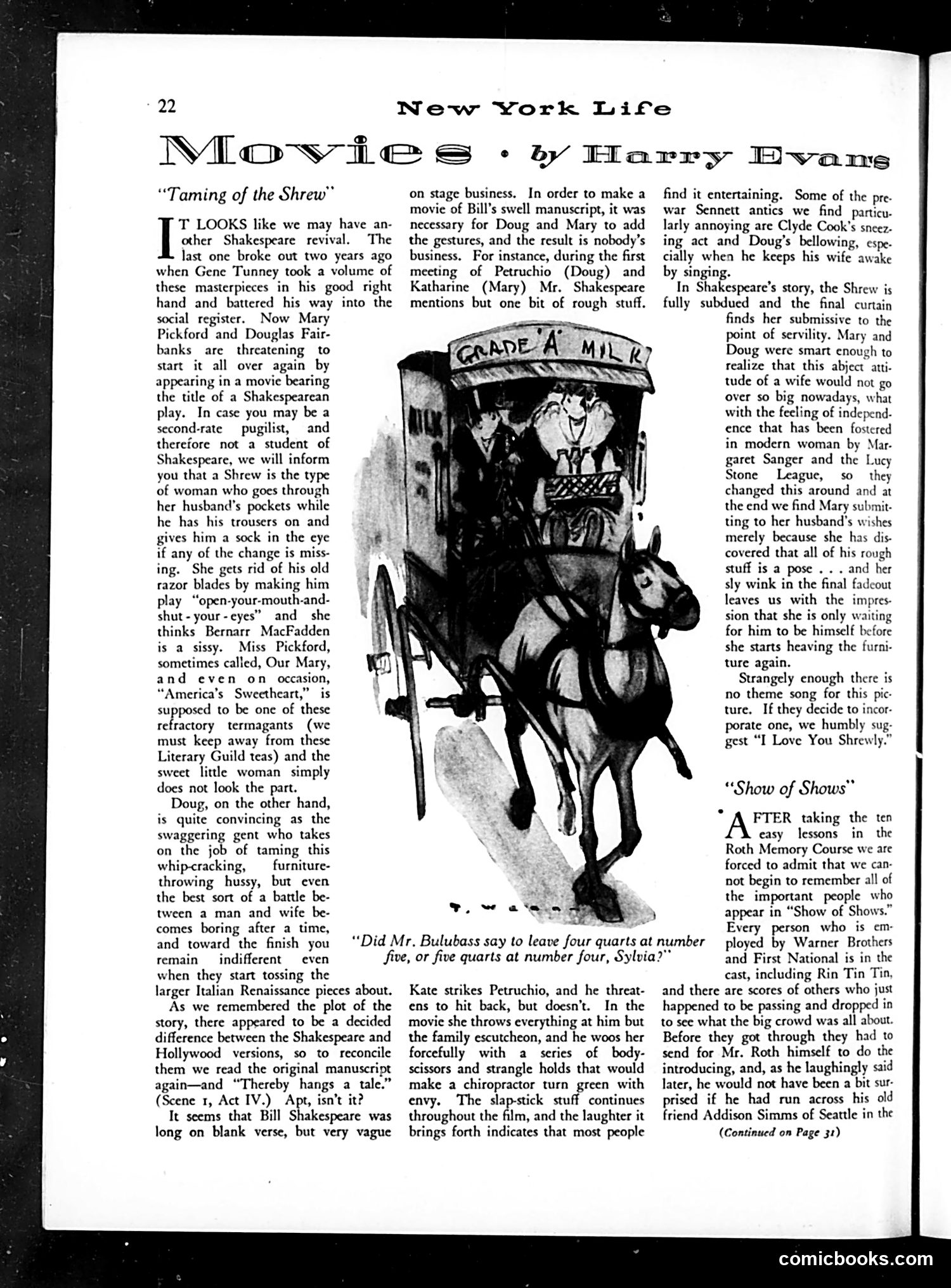
"Taming of the Shrew" Film Review - Life Magazine This is a film review by Harry Evans of Mary Pickford and Douglas Fairbanks's movie adaptation of Shakespeare's "Taming of the Shrew." The cartoon shows a horse-drawn milk cart, illustrating the article's opening joke: Gene Tunney (the boxer) recently sparked a Shakespeare revival by carrying a volume of the plays, and now Pickford and Fairbanks threaten to start another by filming this play. Evans defines a "shrew" as a domineering wife who rifles her husband's pockets and emasculates him. He notes Pickford doesn't look the part, while Fairbanks convincingly plays the taming husband. The review praises the film's slapstick additions to Shakespeare's minimal stage business but critiques some Sennett-style antics as annoying. Notably, Evans applauds the filmmakers for modernizing the ending: instead of showing the wife's complete submission (as Shakespeare does), they imply she's only pretending compliance—a wink suggesting she'll resume control once her husband drops the act. This reflects contemporary women's independence movements (Margaret Sanger, Lucy Stone League).
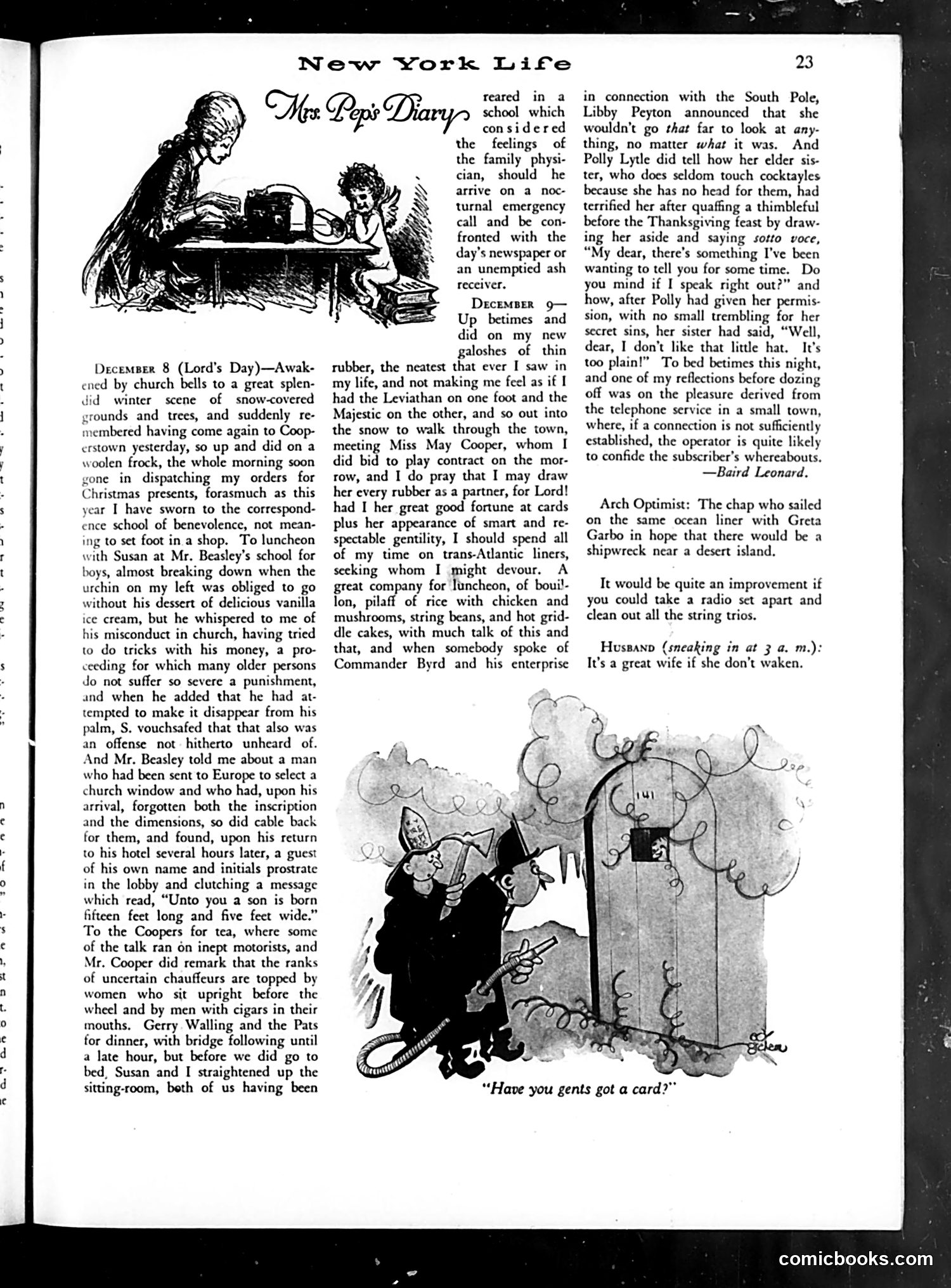
Analysis of "Mrs. Pep's Diary" Page This page from *Life* magazine presents a satirical society diary entry mocking upper-class domestic life. The text describes trivial social activities—tea parties, bridge games, shopping for Christmas presents—written in affected, overwrought language ("forasmuch," "sotto voce"). The humor targets pretentious behavior: women criticizing motorists while being poor drivers themselves; elaborate concern about maintaining drawing rooms for unexpected doctor visits; and the climactic "joke" where a woman's dramatic confession about her sister's hat turns out to be petty fashion criticism rather than a serious secret. The cartoon below—showing a figure in clouds asking "Have you gents got a card?"—likely satirizes spiritualism or afterlife obsessions, popular among wealthy society women of the era. Overall, the satire mocks privileged women's superficiality, social anxiety, and affected speech patterns characteristic of 1920s-30s high society mockery in *Life* magazine.
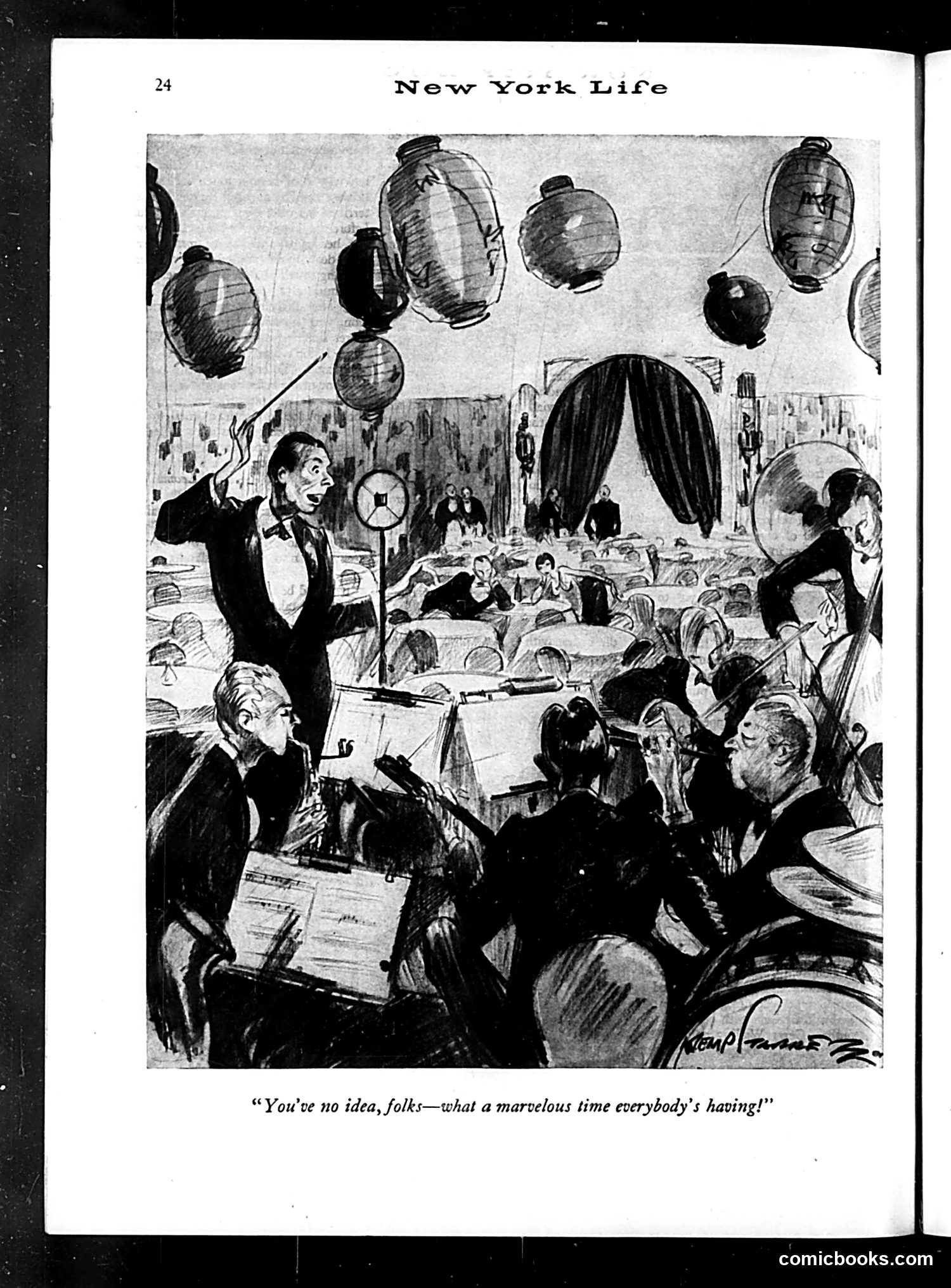
Cartoon Analysis This is a satirical illustration from *Life* magazine depicting a formal dinner or banquet. A well-dressed man (likely a host or promoter) gestures enthusiastically to the audience while speaking the caption: "You've no idea, folks—what a marvelous time everybody's having!" The visual irony is the key: the diners appear somber, constrained, and uncomfortable in formal attire. The elaborate decorations—hanging lanterns overhead—seem excessive and absurd. The scene satirizes social pretense and dishonesty: the host's exuberant claims about the event's success directly contradict the guests' obvious displeasure and stiffness. This mocks upper-class social events, performative enthusiasm, and the gap between public claims and private reality—a recurring *Life* magazine theme about urban sophistication and social hypocrisy.
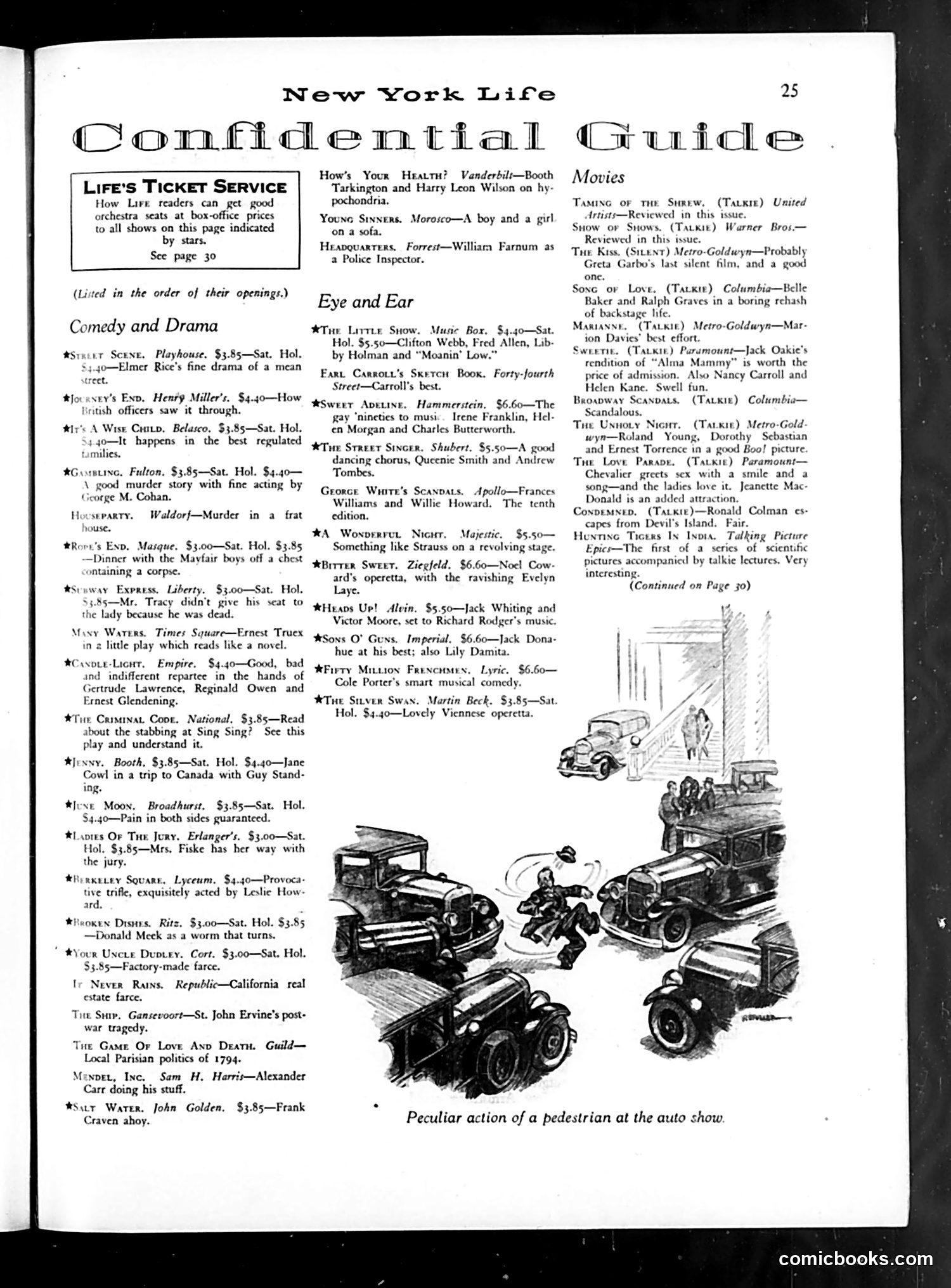
Analysis of Page 25: New York Life Confidential Guide This page is primarily a theater and entertainment listing for New York City productions, not political satire. It functions as a guide to Broadway shows, movies, and venues available to *Life* magazine readers. The small illustration at bottom—"Peculiar action of a pedestrian at the auto show"—depicts a humorous scene of a man appearing startled or falling near automobiles at what seems to be an auto exhibition. This is a visual gag about automobile safety or the novelty of motor vehicles, likely meant to amuse readers unfamiliar with cars or to comment on pedestrian hazards from increasing automotive traffic—a relevant concern in the 1920s era. The page itself isn't satirical but rather a service feature: listings of theatrical productions with prices, starring actors, and brief plot descriptions. The asterisks indicate shows where *Life* readers could obtain discounted tickets through the magazine's "Ticket Service."
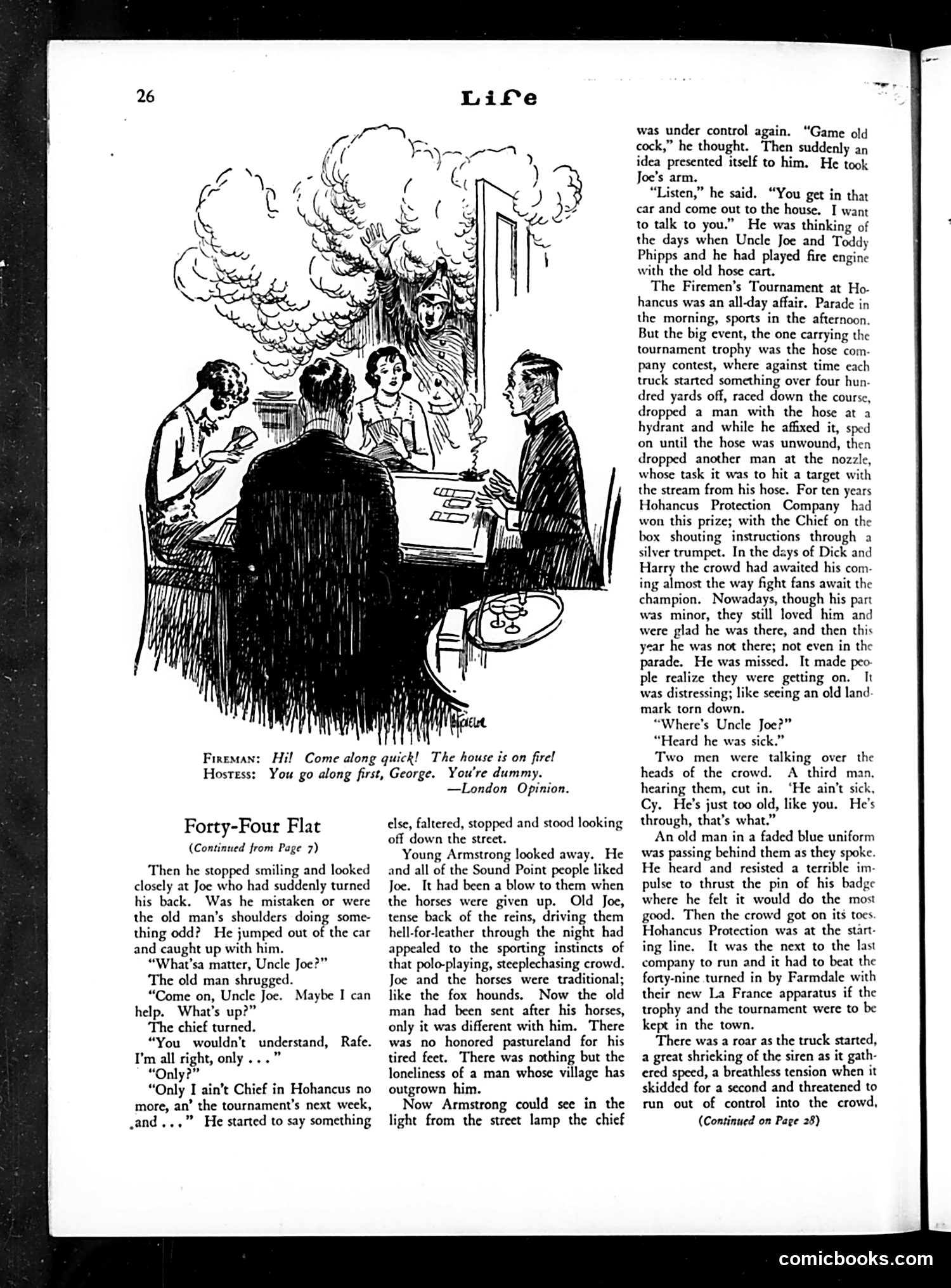
Explanation for Modern Readers This page contains two distinct pieces: The Cartoon (top): A London Opinion cartoon depicting a social role reversal—a fireman urgently summons a woman to evacuate her burning house, but she insists *he* go first because in the card game they're playing, he's the "dummy" (the player whose hand is exposed and doesn't play actively). The joke mocks upper-class priorities: even during a fire emergency, these people are too absorbed in their game to abandon it. The Story ("Forty-Four Flat"): A sentimental narrative about an aging fire chief, "Uncle Joe," who has been retired from active duty. He's deeply demoralized—his village has modernized (lost its horses), and he's been replaced. Young Armstrong recognizes Joe's pain and invites him to reconnect, remembering their childhood playing with the old hose cart. The story explores themes of obsolescence, aging, and loss of status in a modernizing America. Both pieces reflect early 20th-century anxieties about progress and tradition.
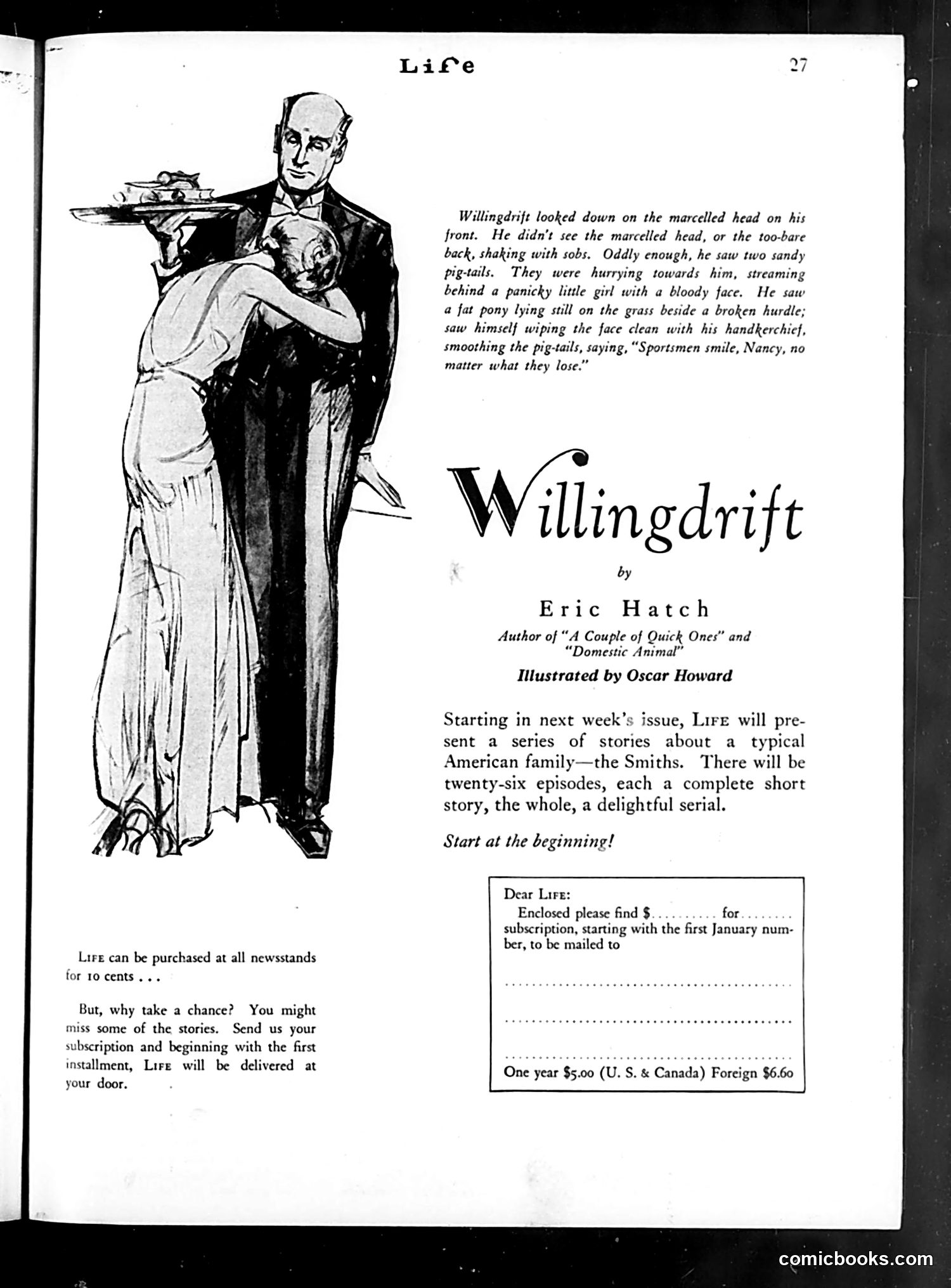
Explanation for Modern Readers This page announces a new serialized fiction series called "Willingdrift" by Eric Hatch, illustrated by Oscar Howard. The accompanying illustration shows a formal man in a tuxedo holding a serving tray, appearing refined and detached. The excerpt depicts a character named Willingdrift in a moment of dissociation: while physically present at what appears to be a formal dinner (suggested by the "marcelled head" and "too-bare back"), he mentally retreats into memories of childhood—seeing pig-tailed girls and a dead pony instead of the present scene. The final line ("Sportsmen smile, Nancy, no matter what they lose") hints at emotional repression and the stiff upper-class restraint expected of gentlemen. The page is primarily a subscription advertisement for *Life* magazine's new serial. It pitches readers to subscribe rather than risk missing installments at newsstands. The satire likely targets upper-class emotional coldness and the contrast between refined exterior and buried trauma—themes apparently central to the series.
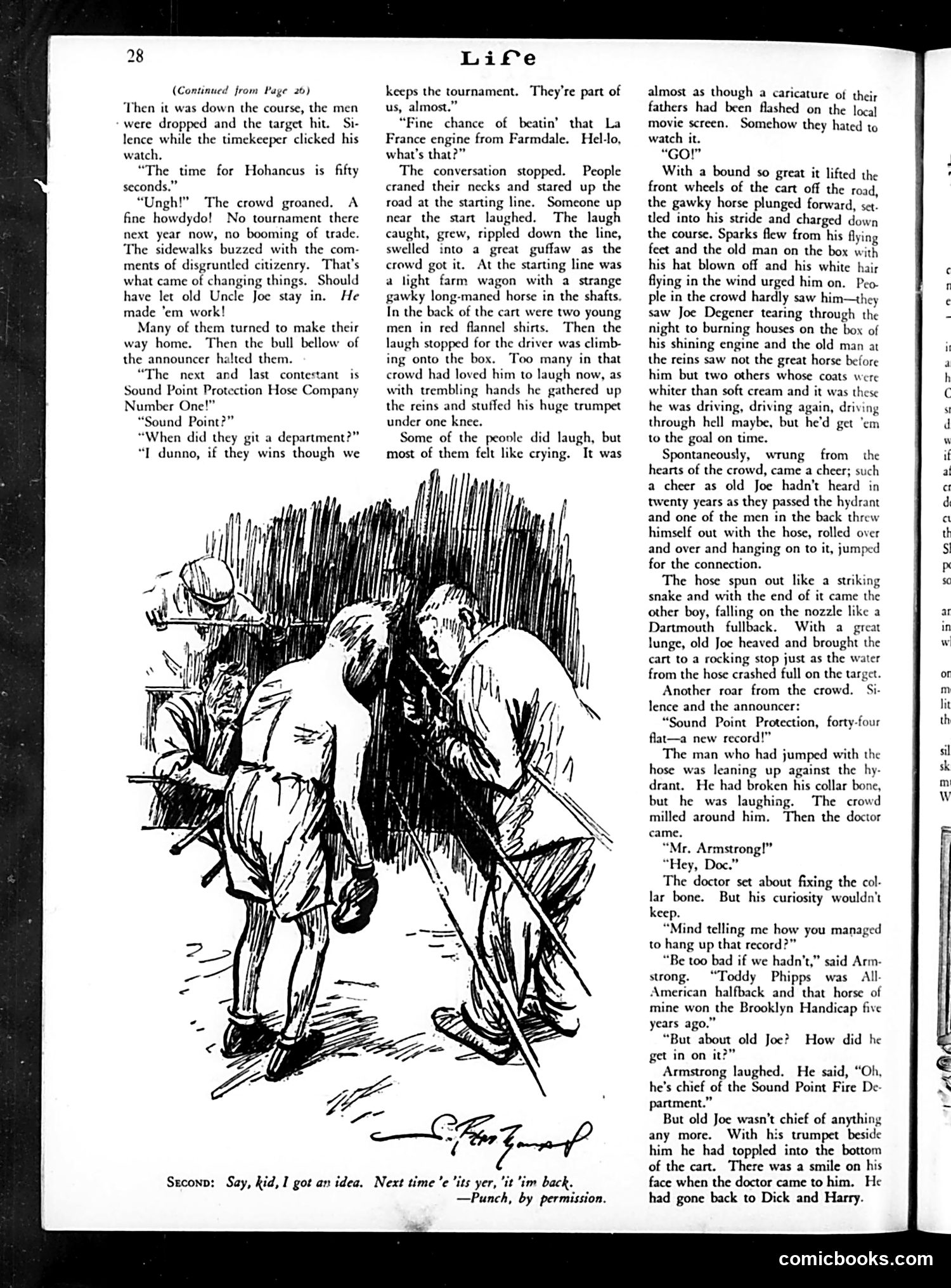
Explanation for Modern Readers This appears to be a serialized story about a firefighting competition between towns. The narrative centers on Joe Degener, an elderly retired firefighter, who enters the contest driving an old farm wagon pulled by a single horse—a comically makeshift alternative to modern motorized fire engines. The satire contrasts old versus new: younger firefighters using a "La France engine from Farmdale" (an actual fire engine brand) versus this antiquated volunteer approach. The crowd's emotional reaction—initially laughing, then moved to tears recognizing Joe's dignity and effort—suggests nostalgia for simpler times and traditional civic virtue. The elderly man's triumph (setting a "new record" of forty-four seconds) celebrates old-fashioned determination over technological progress, resonating with early 20th-century anxieties about modernization displacing traditional values and respected community figures.
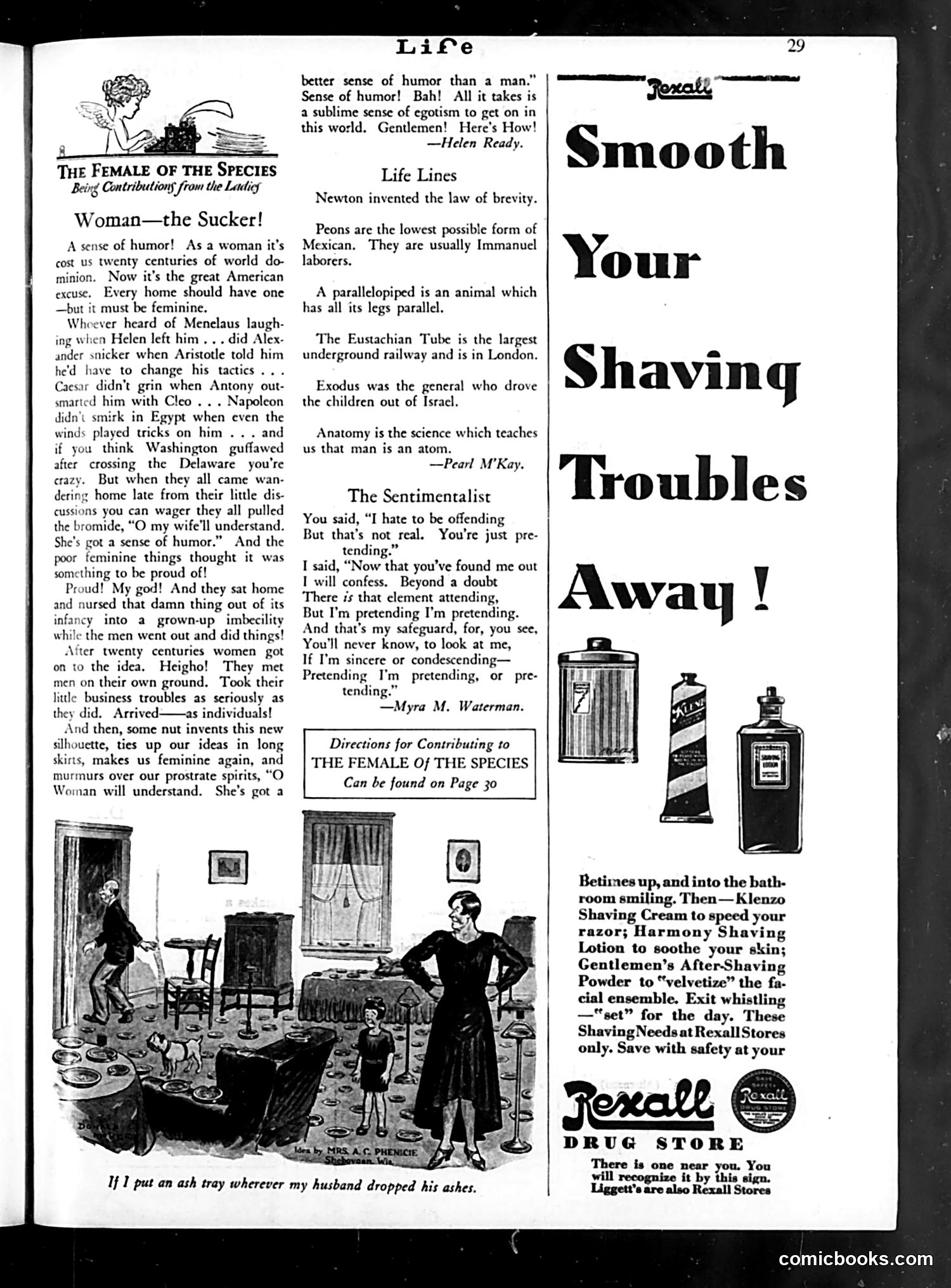
"Woman—the Sucker!" Analysis This is a satirical essay by Helen Ready critiquing women's acceptance of being told they have a "sense of humor"—framed as a virtue that keeps them subordinate. The Argument: Ready argues that throughout history, powerful men (Menelaus, Caesar, Napoleon, Washington) never found their defeats funny, yet when returning home, they flattered their wives by saying "she'll understand—she's got a sense of humor." Women internalized this "compliment" for twenty centuries, treating it as something to be proud of, when it actually enabled their subjugation. The Satire: Ready attacks the double standard: when women finally gained ground as individuals in the modern era, society re-imposed femininity through fashion ("long skirts") and the same old flattery about humor. She exposes "sense of humor" as code for female gullibility and ego-stroking that serves male interests. Context: This reflects 1920s feminist frustration with post-suffrage setbacks and the commodification of "femininity." The accompanying cartoon shows a woman amid domestic chaos, illustrating the gap between ideology and reality. The rest of the page contains light humor pieces and a Rexall shaving products advertisement.
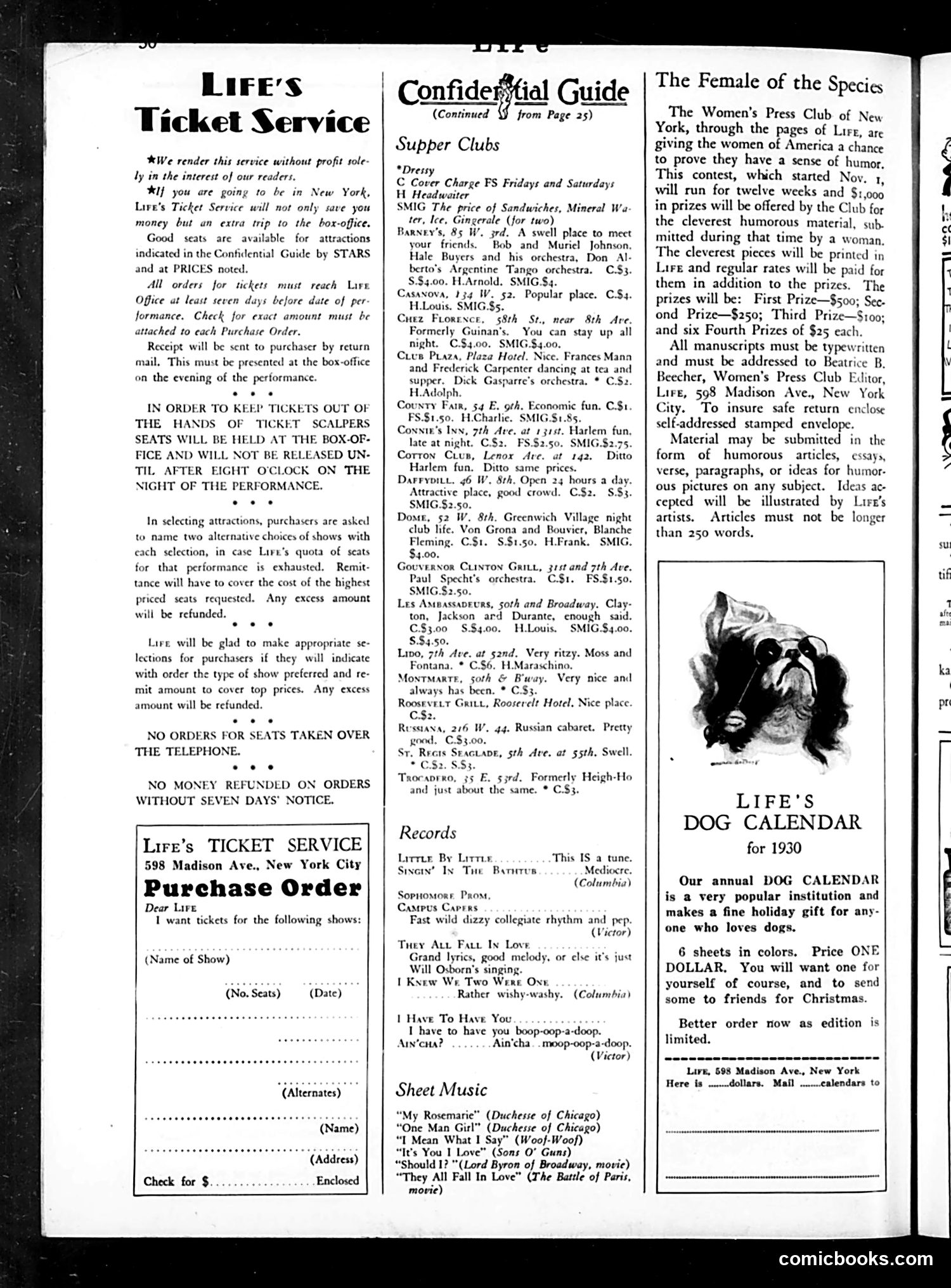
Understanding This Life Magazine Page This page from Life magazine (circa 1929) is primarily service journalism and advertising rather than satire or political commentary. The left column presents Life's ticket service — a practical offering allowing readers to purchase Broadway theater seats by mail from Life's office, avoiding scalpers and box-office trips. The detailed terms reflect 1920s concerns about ticket fraud. The center section is a "Confidential Guide" listing New York supper clubs with pricing details (cover charges, minimum drink costs). These venues — like Connie's Inn in Harlem, the Cotton Club, and Greenwich Village spots — reveal the era's nightlife geography and segregated entertainment culture. The right side advertises Life's Dog Calendar for 1930 (a gift item) and lists sheet music available for purchase, including period songs like "One Man Girl." The illustration shows a dog's head — likely a terrier — related to the calendar advertisement. This is fundamentally consumer-focused content: theater access, dining guides, and merchandise — the magazine's service to affluent urban readers.
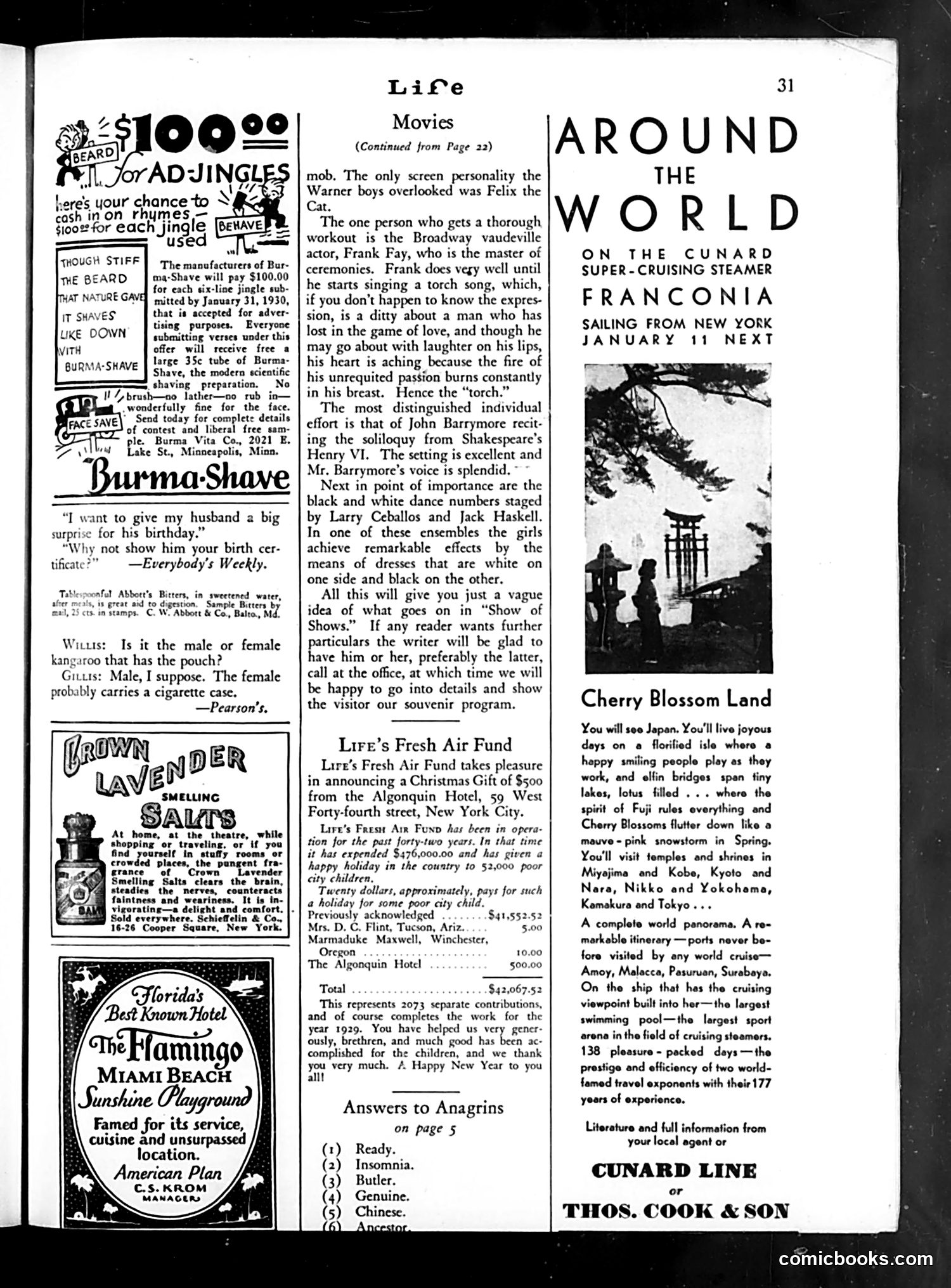
Analysis for a Modern Reader This page is primarily advertising and announcements rather than political satire. The page contains: 1. Burma-Shave jingle contest (left): The company offers $100 per accepted six-line advertising jingle, deadline January 31, 1930. This references Burma-Shave's famous roadside advertising campaign. 2. Humor items: Brief jokes from newspapers—including one about kangaroos and cigarette cases (mocking women's fashion accessories), and a wife-birthday joke—typical of 1920s magazine filler. 3. Product advertisements: Crown Lavender Salts, Abbott's Bitters (digestive aid), and The Flamingo Hotel in Miami. 4. Movie review (right): Discusses Warner Bros.' "Show of Shows," noting performances by Frank Fay and John Barrymore. 5. Life's Fresh Air Fund announcement: Reports charitable donations totaling $42,067.52 for poor children's holidays. No political cartoons or satire appear on this page—it's a typical 1929 Life magazine section mixing ads, jokes, and charitable announcements.
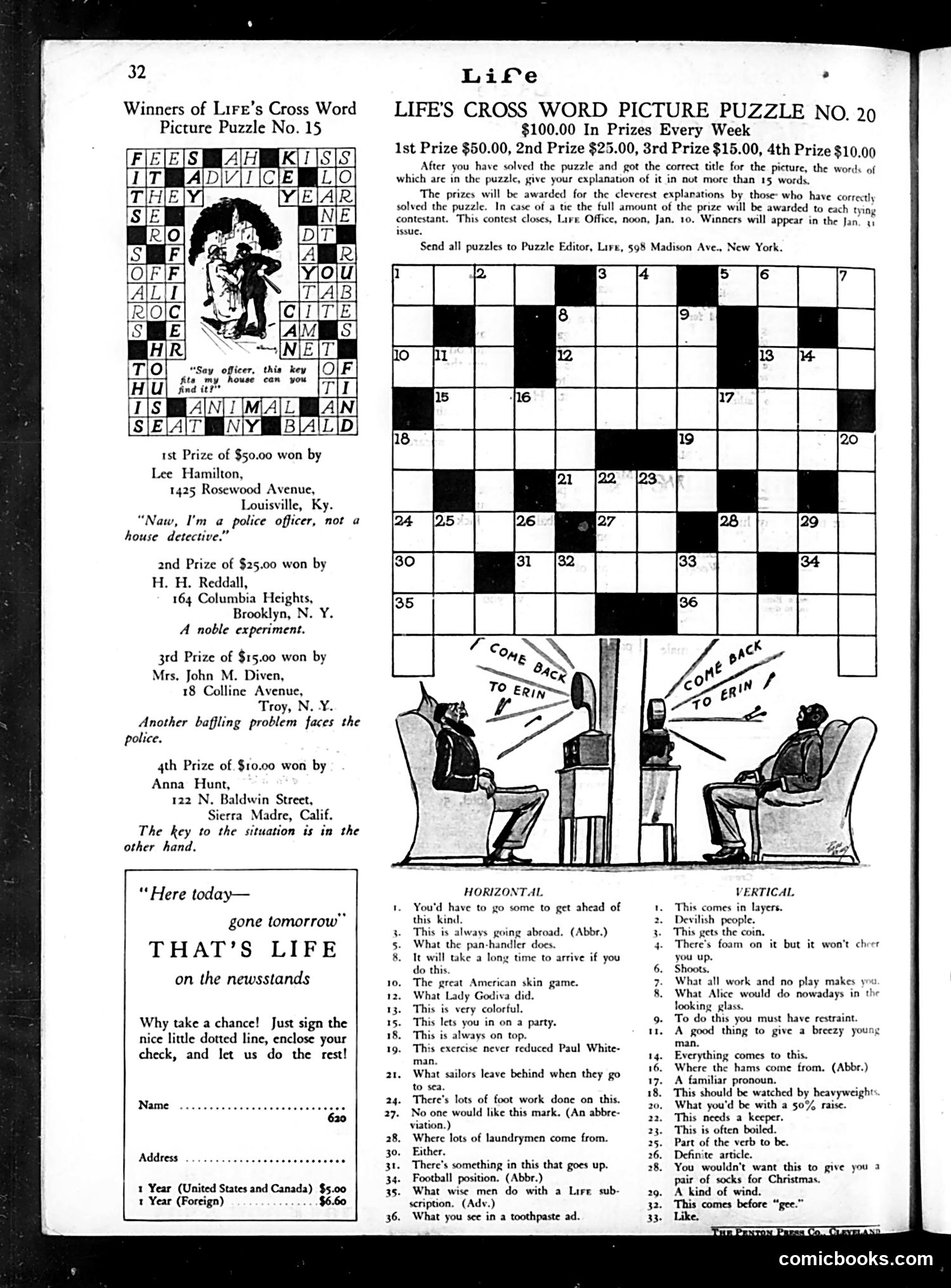
Life Magazine Crossword Puzzle Page Analysis This page features Life magazine's crossword puzzle contest—a popular 1920s-30s entertainment format. The top half shows winners of "Puzzle No. 15" with their humorous solutions. The central joke involves a person asking a police officer to unlock their house, then offering him a key. The officer responds: "Naw, I'm a police officer, not a house detective"—a satirical jab at Prohibition-era police corruption. The implication is that house detectives (private security) were complicit in illegal activities, making them distinct from (supposedly honest) police officers. This reflects public skepticism about law enforcement during Prohibition. The cartoon below shows two figures in chairs with speech bubbles saying "Come back to Erin" and "Come back to Erin!"—appearing to reference Irish immigration nostalgia, though context is unclear. The page concludes with "Puzzle No. 20," offering $100 in weekly prizes for solving crossword clues and explaining the resulting picture in 15 words or fewer.
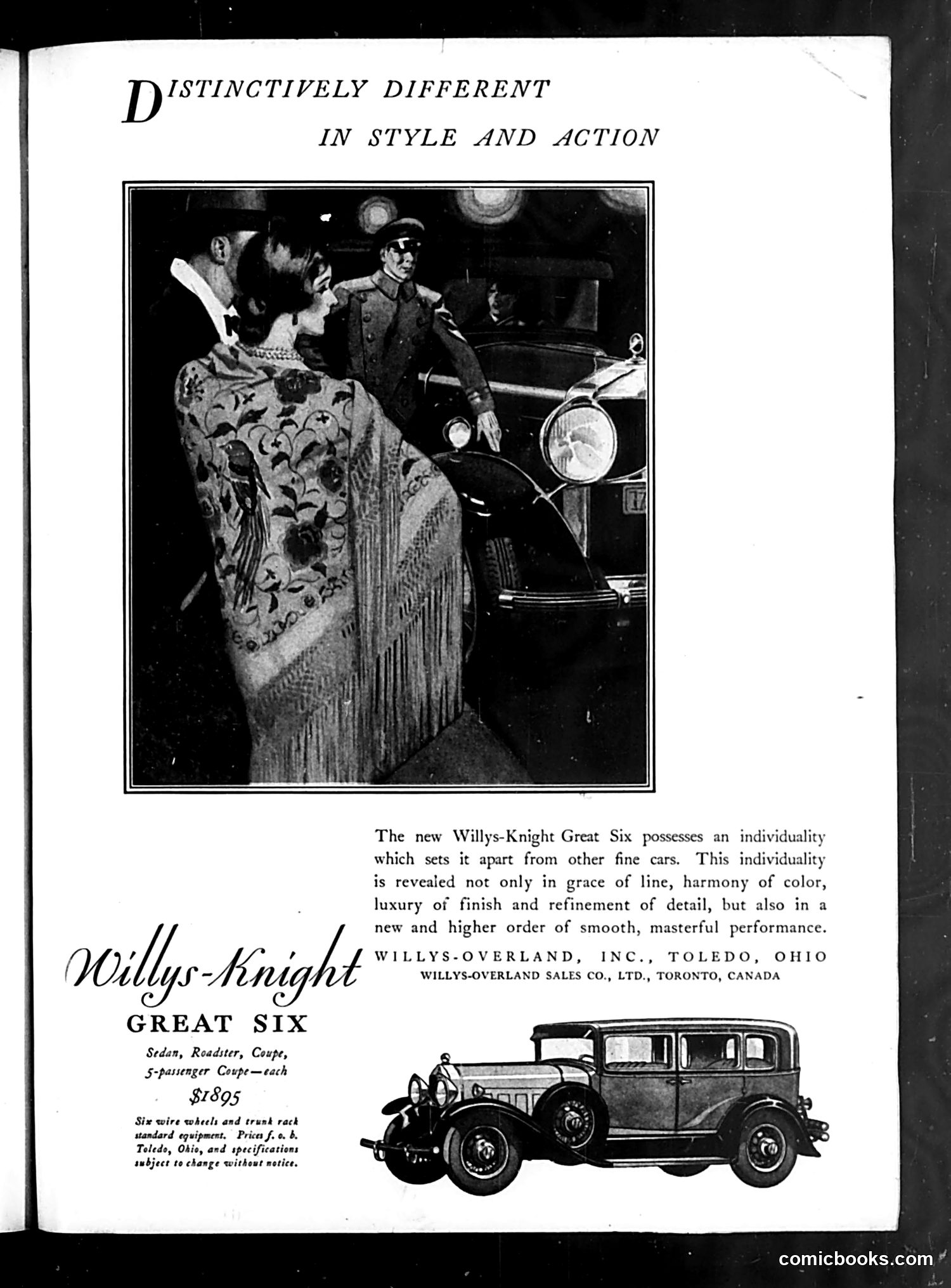
Analysis This is automobile advertising, not political satire. The page promotes the Willys-Knight Great Six, priced at $1,895. The upper photograph shows a elegantly dressed woman in a fringed shawl examining the car with male companions—a typical marketing image associating the vehicle with luxury and sophistication. The headline "Distinctively Different in Style and Action" emphasizes the car's exclusivity. The ad's copy claims the vehicle offers "individuality" and "smooth, masterful performance" that distinguishes it from competitors. The lower illustration shows the sedan model itself. For modern readers: This reflects 1920s-era marketing strategy targeting affluent buyers by linking automobiles to glamour, refinement, and status. The emphasis on "smooth" performance likely references the car's engine technology, a selling point of the era. There is no satirical content—this is straightforward commercial advertising from Life magazine's revenue stream.
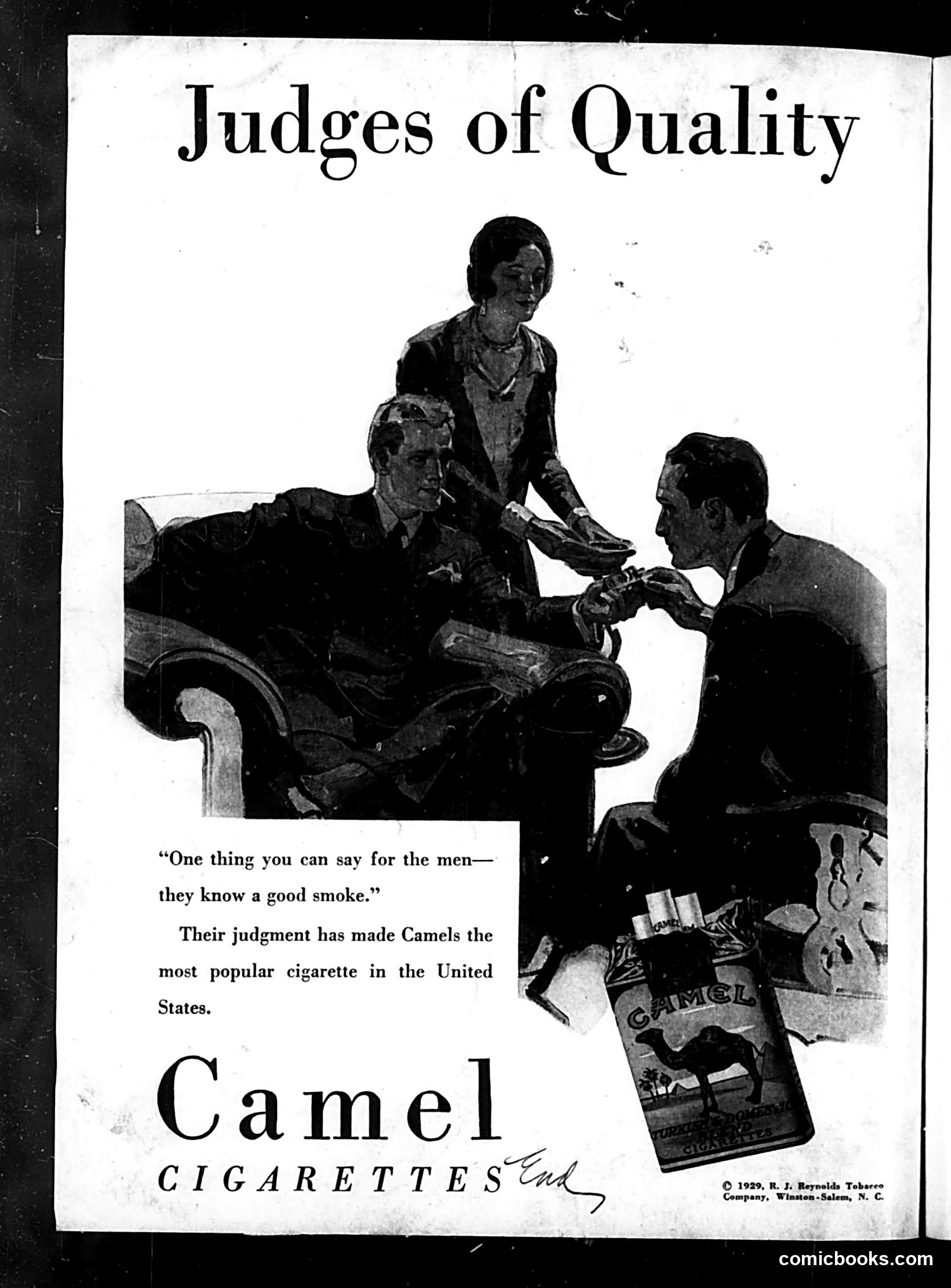
Camel Cigarettes Advertisement (1929) This is a cigarette advertisement, not political satire. It depicts three people in 1920s attire examining and discussing cigarettes, with a woman serving/presenting them. The ad's appeal relies on the idea that men's collective judgment—their supposed expertise in evaluating quality—has made Camels the most popular cigarette. The "judges of quality" framing suggests that male smokers are discerning consumers whose preferences validate the product. The image emphasizes social approval and masculine authority as marketing tools. This reflects 1920s advertising tactics that associated smoking with sophistication and good taste, before health warnings existed. The copyright date (1929) places this before widespread public knowledge of smoking's health dangers.

I can see this is a page from Life magazine, but the image quality and reproduction make it extremely difficult to discern specific content. The page appears to be mostly blank or very faintly printed, with only scattered marks and possibly some handwritten notations visible in the center and lower portions of the page. Without being able to read clear text or see distinct cartoon illustrations, I cannot reliably identify specific figures, political references, or the intended satire. The page may be a title page, advertisement, or contain content that hasn't reproduced clearly in this scan. To provide accurate historical context as requested, I would need a clearer image where the cartoon artwork and caption text are legible.