life
Life — January 3, 1930
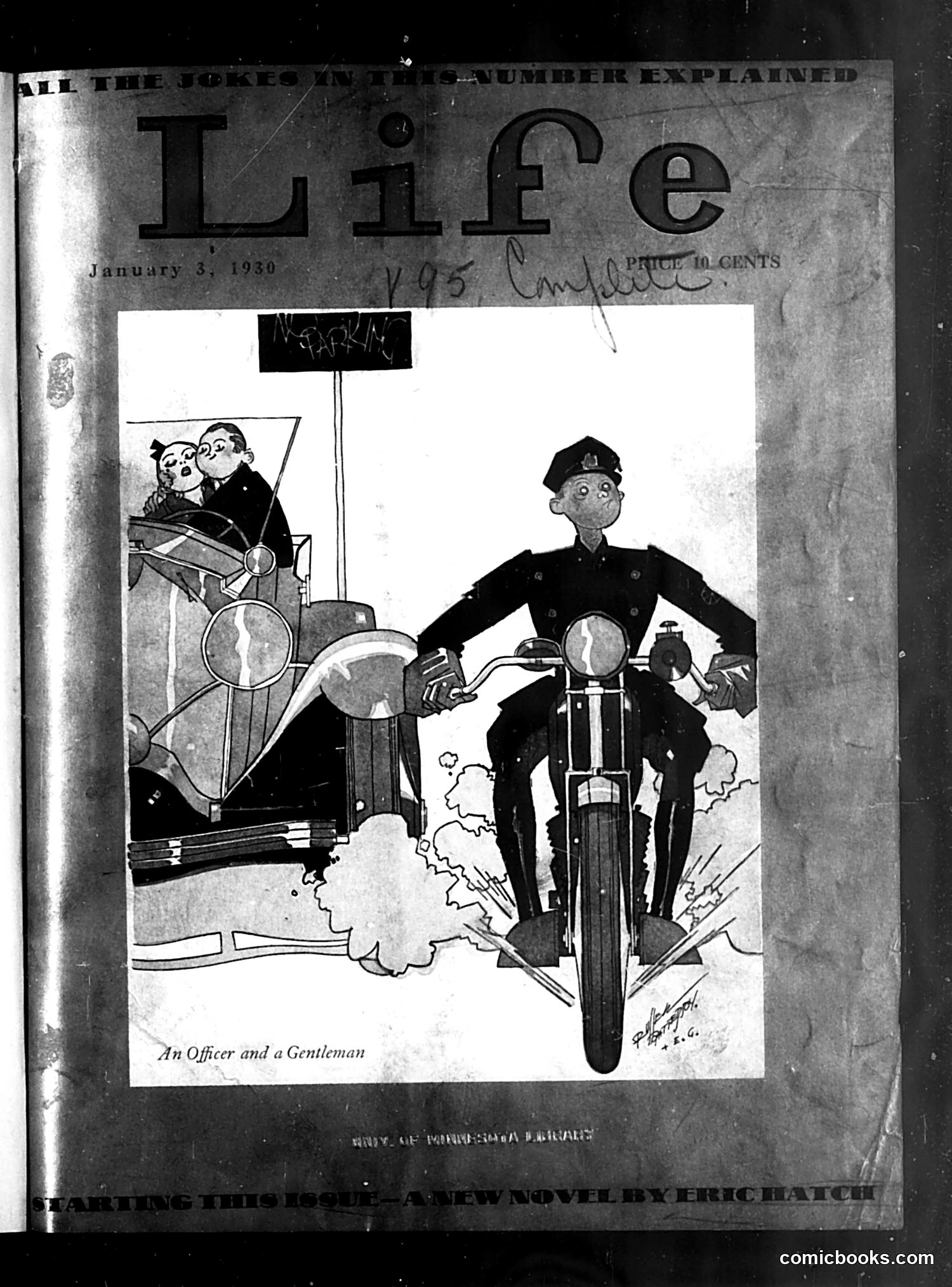
Analysis of Life Magazine Cover, January 3, 1930 This cover illustrates "An Officer and a Gentleman"—likely referring to the contrast between law enforcement and civilian conduct. The policeman on a motorcycle represents authority, while the elegantly-dressed gentleman in the car represents wealth and status. The satire appears to critique class-based justice: despite the officer's presence, the wealthy motorist seems confident or untroubled, suggesting that affluent individuals face different treatment than ordinary citizens when it comes to traffic laws or other violations. This reflects 1930s concerns about whether wealthy Americans could evade consequences that poorer citizens couldn't. The handwritten annotation and magazine's subtitle ("All the Jokes of the Number Explained") indicate this was a humorous puzzle-style publication.
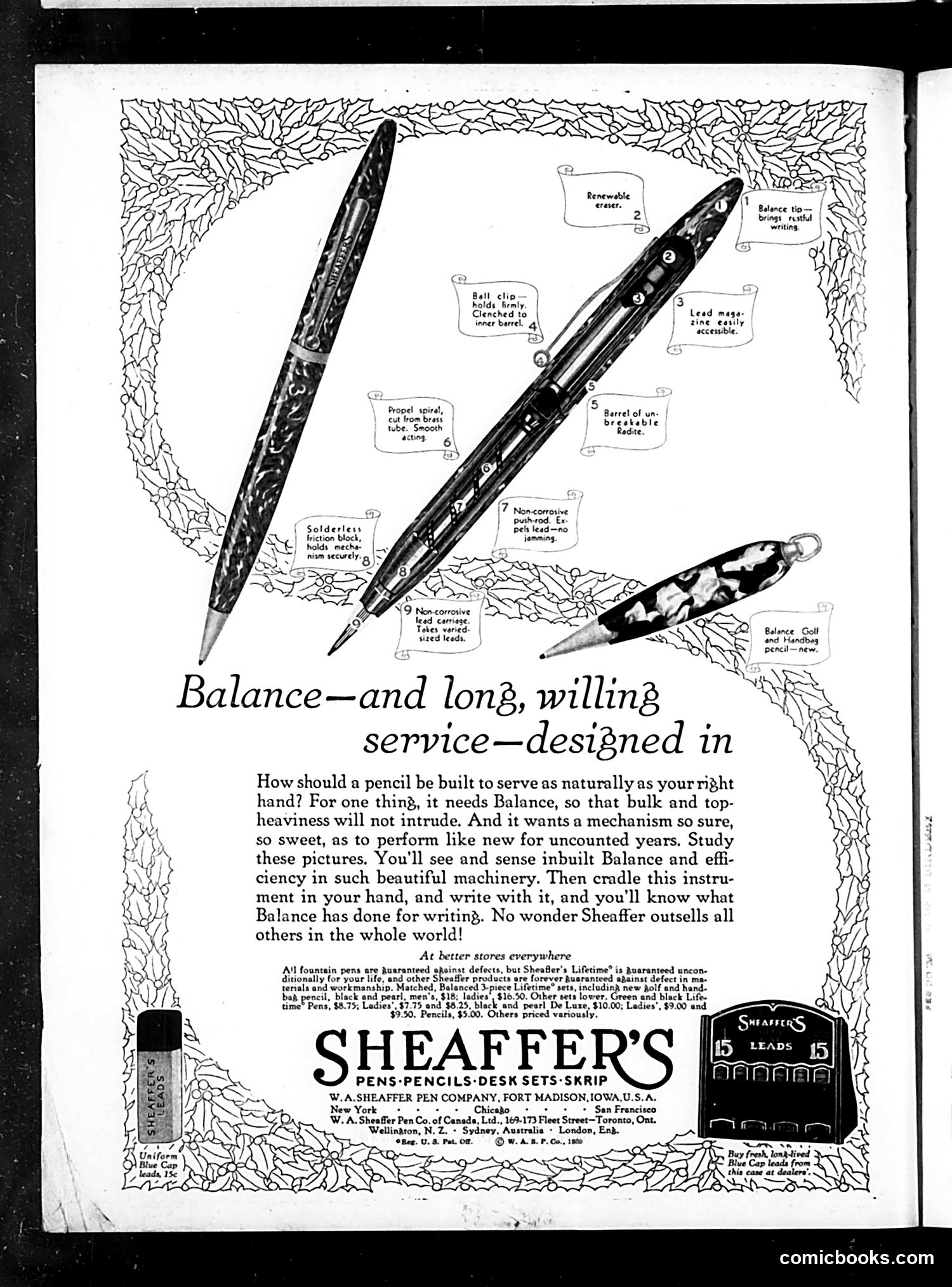
Analysis This is not a cartoon or satirical content—it's a straightforward advertisement for Sheaffer's fountain pens and pencils. The page shows three writing instruments with detailed mechanical annotations highlighting their features: balance, durable construction, and smooth writing performance. The ad emphasizes engineering quality through labeled callouts identifying components like "ball slip," "lead cage," and "non-corrosive materials." The accompanying text celebrates the "Balance" design principle, arguing that a well-engineered pen should feel natural in hand and perform reliably for years. The ad promises Sheaffer pens outperform competitors. This represents typical early-to-mid 20th century product advertising, targeting consumers who valued durability and mechanical precision in everyday writing instruments—before ballpoint pens became standard.
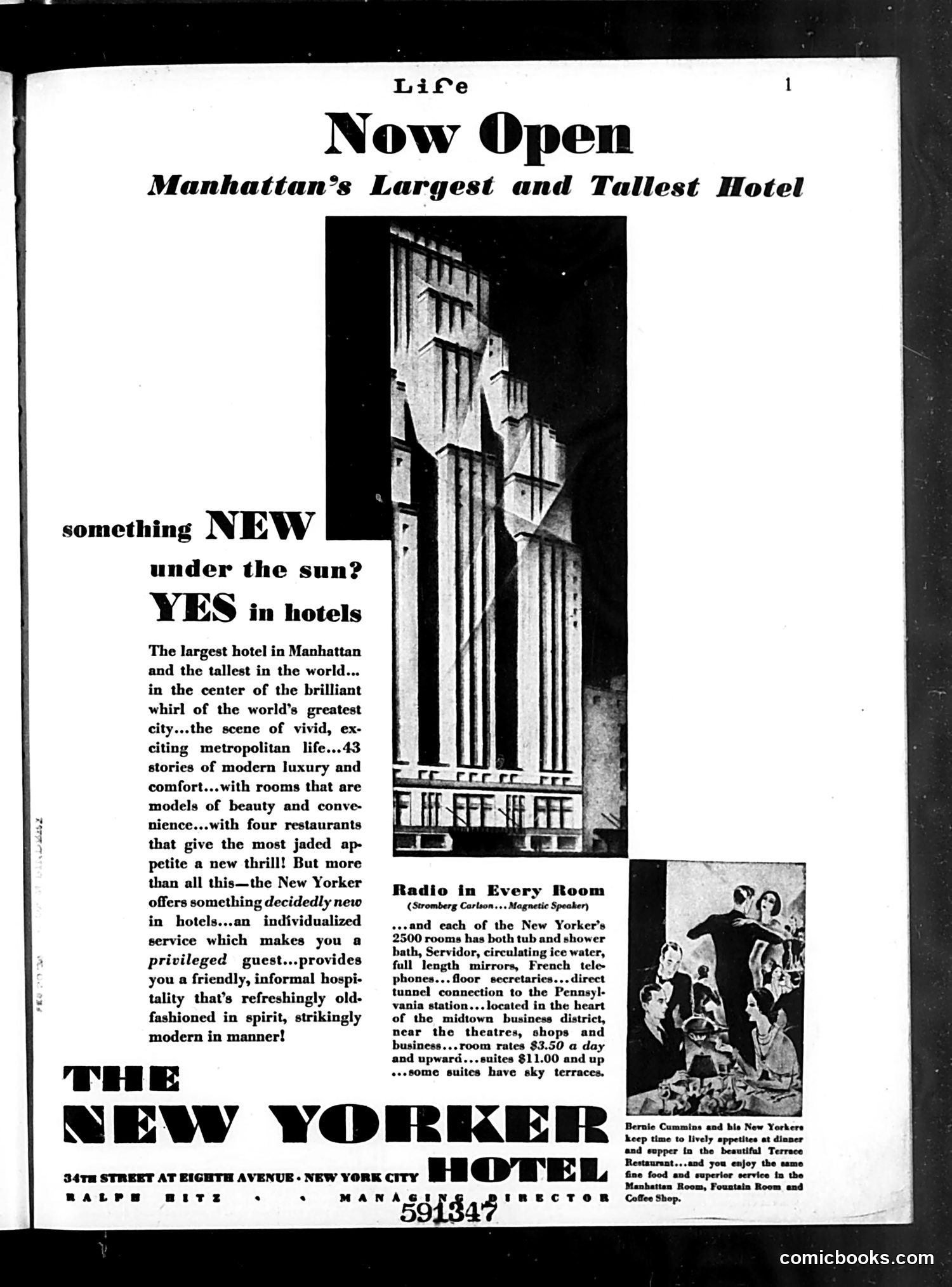
Analysis This page is primarily an advertisement, not political satire. It announces the opening of the New Yorker Hotel in Manhattan, described as "the largest hotel in Manhattan and the tallest in the world." The ad emphasizes novelty and luxury features: 43 stories, 2,500 rooms with modern amenities (radios, private baths, circulating ice water), four restaurants, and sky-terrace suites. Room rates start at $3.50 daily. The right image shows people socializing, likely depicting the hotel's entertainment venues—the caption mentions enjoying "Herold Comedies" at the Terrace Restaurant. The appeal is to comfort-seeking travelers and the aspirational middle class, positioning the hotel as offering "something decidedly new" in hospitality. This reflects 1930s marketing emphasizing technological progress and urban sophistication.
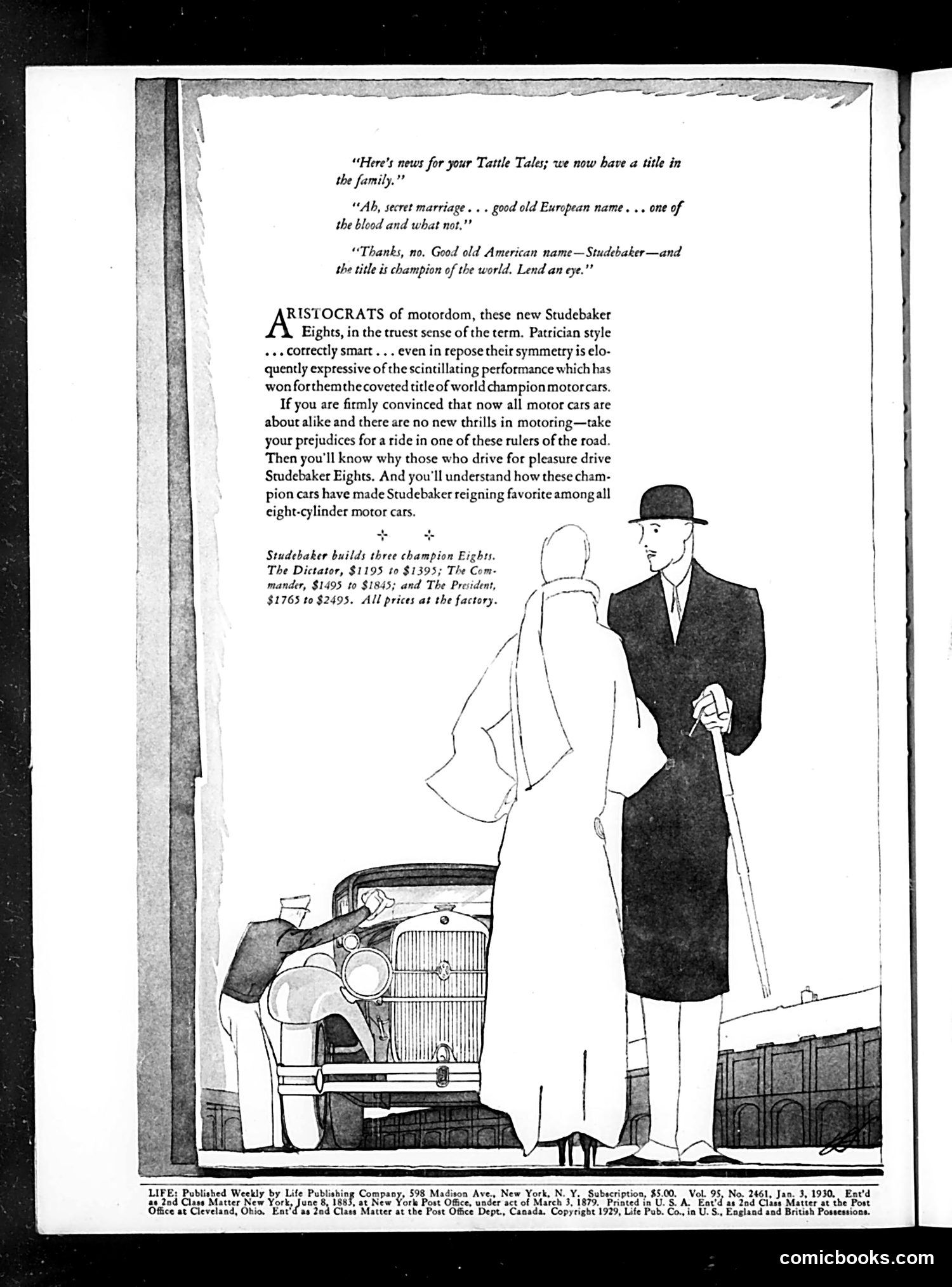
Studebaker Advertisement, Life Magazine (1930) This is a car advertisement, not political satire. It depicts a wealthy couple admiring a Studebaker Eight automobile. The dialogue jokes that acquiring the car gives them a "title in the family"—playing on the woman's apparent aristocratic bearing and the man's formal attire (bowler hat, cane). The ad's humor relies on class aspiration: owning this luxury vehicle supposedly elevates one's social status to "aristocrat" level. The copy emphasizes the car's performance credentials and championship racing titles, positioning it as superior to other eight-cylinder competitors. The piece targets affluent, status-conscious buyers of the late 1920s-early 1930s, when automobile ownership signaled wealth and refinement. Prices ranged from $1,195 to $2,495.
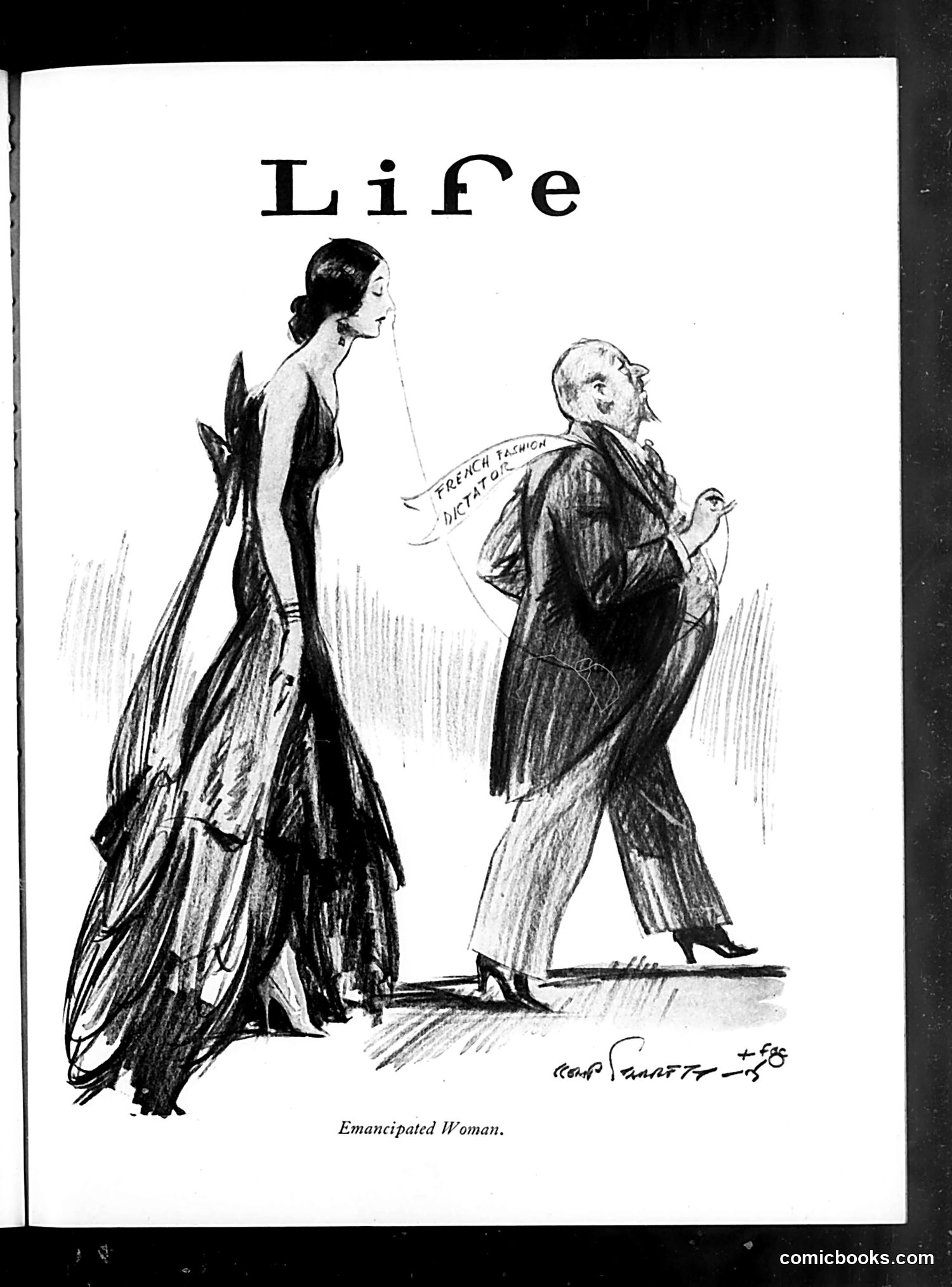
Analysis of "Life" Magazine Cartoon: "Emancipated Woman" This satirical cartoon critiques the early women's liberation movement. The elegantly dressed woman on the left represents the "New Woman" or feminist advocate, depicted with exaggerated fashionable clothing and a trailing scarf labeled "French Fashion Dictator." The man on the right, appearing bewildered and holding what looks like a leash or string, represents the traditional male figure seemingly controlled or confused by women's emancipation. The satire suggests that women's liberation movements of the era were frivolous, driven by fashion trends rather than substantive ideology. The "French Fashion Dictator" label mocks the association of women's independence with European fashionability, implying the movement was superficial rather than a genuine social movement. The cartoon reflects contemporary male anxieties about changing gender roles.
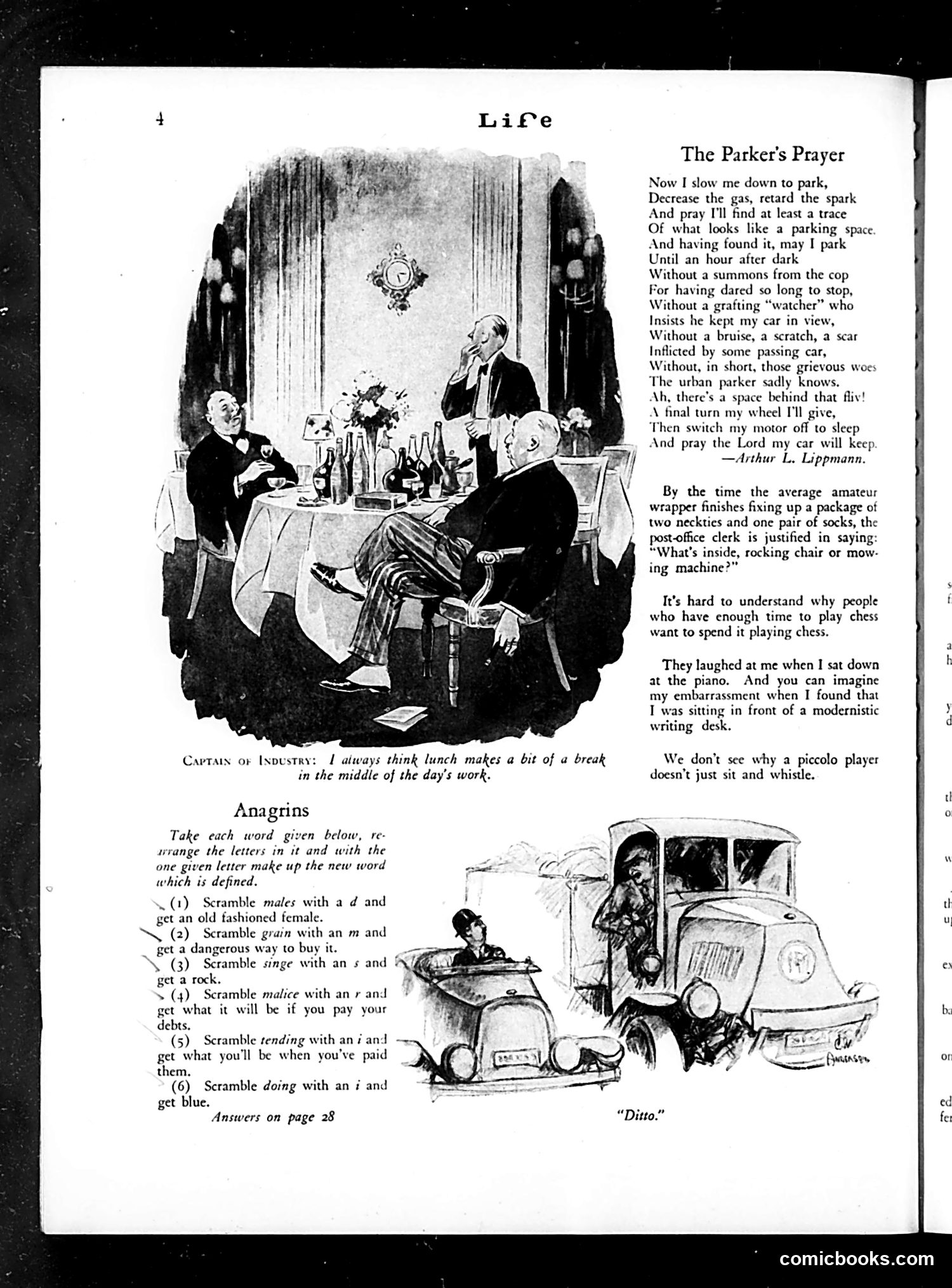
Analysis of Life Magazine Page 4 "The Parker's Prayer" is a humorous poem by Arthur L. Lippmann satirizing the frustrations of urban parking in the early-to-mid 20th century. The poem treats parking spot-hunting as a religious supplication, asking for divine intervention to find available space without traffic violations or vehicle damage. This reflects growing anxieties about automobile congestion in American cities. "Captain of Industry" cartoon depicts well-dressed businessmen at lunch, with one remarking that lunch provides "a bit of a break in the middle of the day's work"—satire on how even brief respites structure industrial-era labor. "Dino" cartoon shows a small car being swallowed by a larger automobile, likely satirizing traffic dangers or vehicle size disparities. The page mixes humor with social commentary on modern urban life.
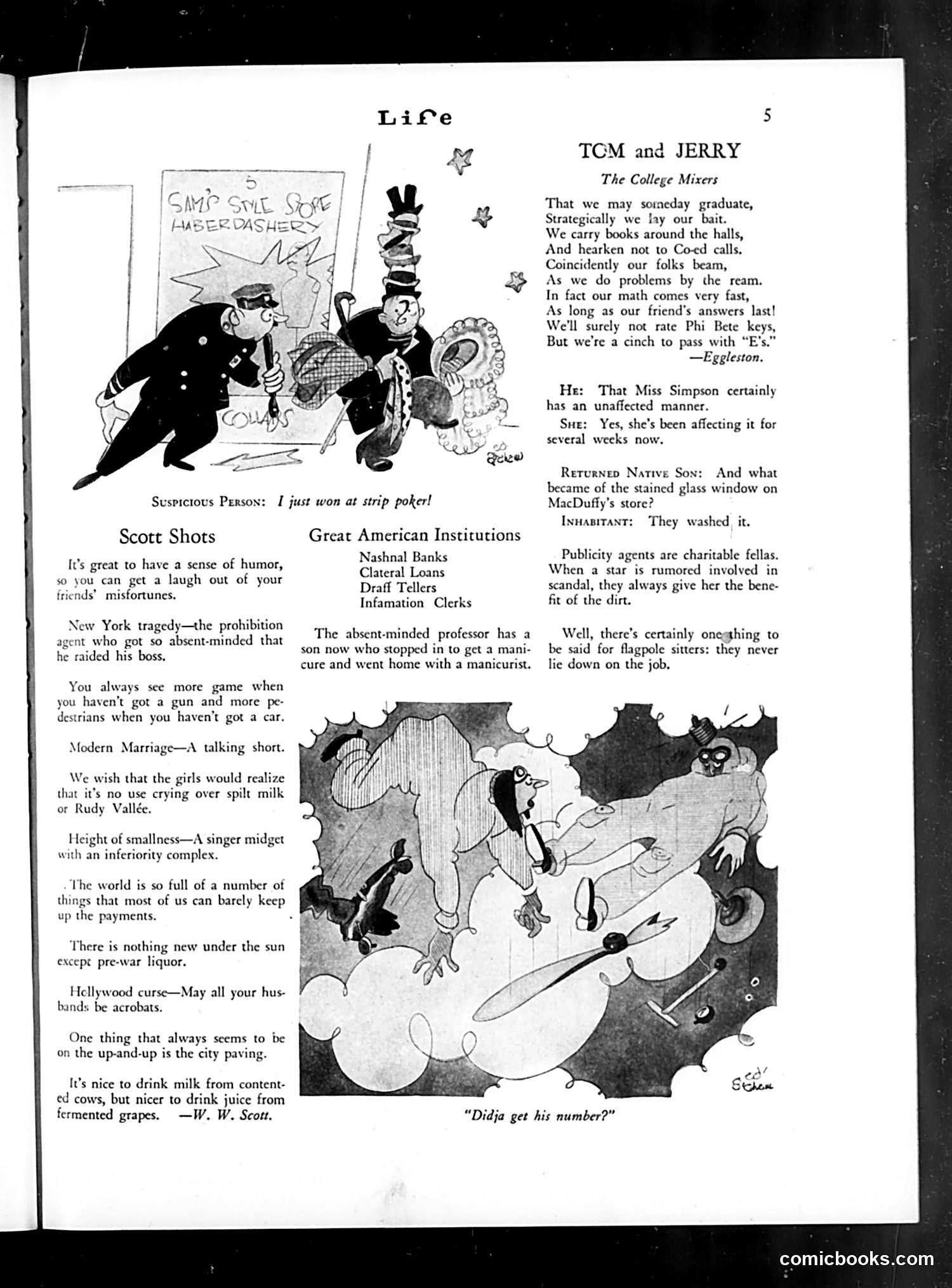
Analysis of Life Magazine Page 5 Top Cartoon ("Suspicious Person"): Two caricatured figures—one appearing to be a police officer or authority figure, the other in formal dress—confront someone over a sign reading "SAMP SYLE STORE / HABBERDASHERY" (likely a haberdashery shop). The joke appears to reference strip poker, suggesting illicit gambling activity discovered during a raid. Scott Shots Section: Brief satirical quips about American life—prohibition enforcement, absent-minded professors, modern marriage, and social absurdities. These are observational humor typical of 1920s magazine humor. Bottom Cartoon ("Didja get his number?"): Depicts what appears to be a traffic accident or confrontation between a car and pedestrian, with the caption suggesting someone asking for the vehicle's license plate—likely mocking the growing concern over automobile accidents in this era.
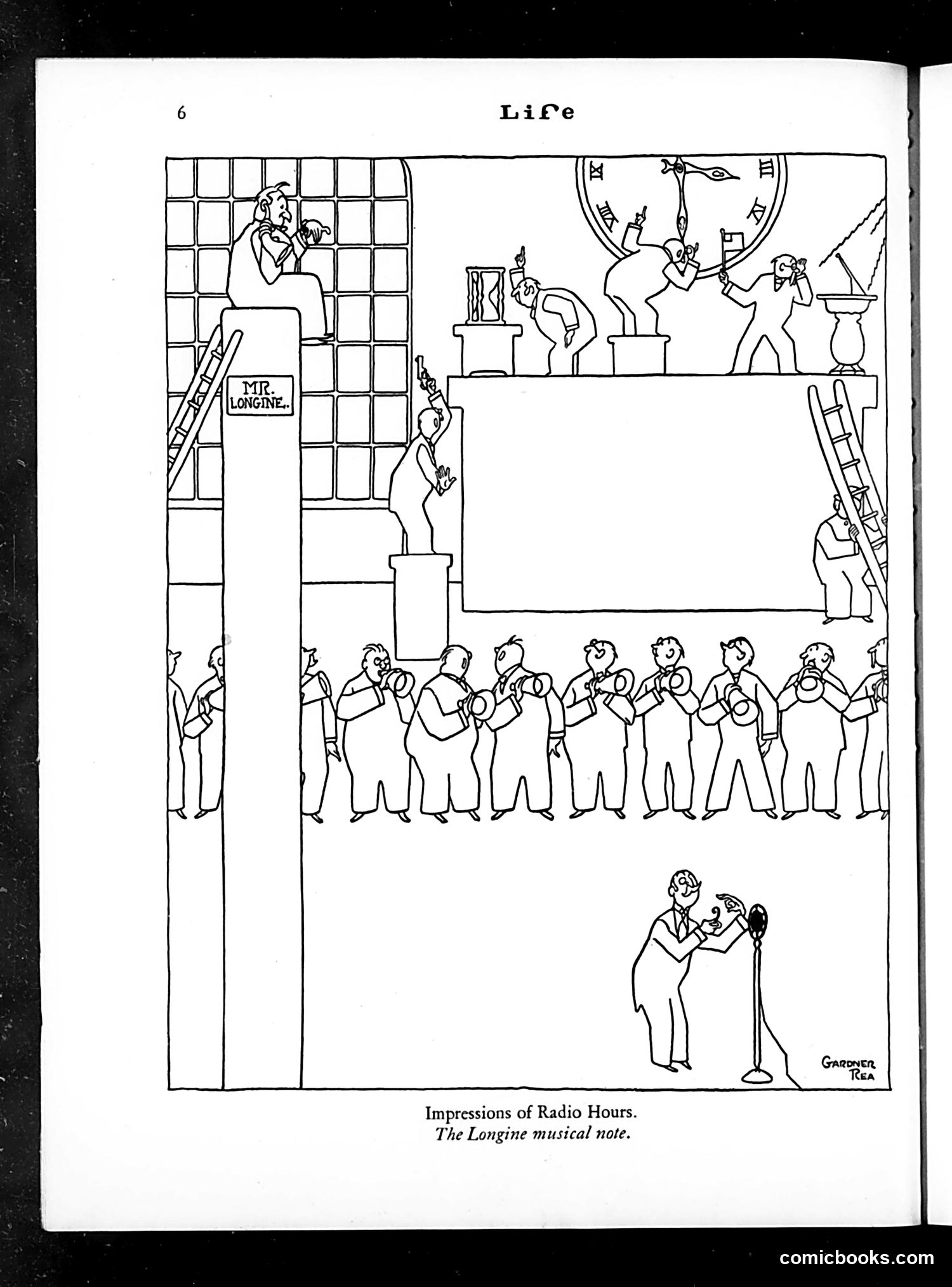
Analysis of "The Longine Musical Note" This single-panel cartoon satirizes early radio broadcasting. The illustration shows a tall building labeled "M'r LONGINE" with multiple levels of activity: - At ground level: an audience of men holding megaphones - Multiple stories above: performers and musicians at various heights - At the top: a large clock face - Ladders connecting the levels - Bottom right: a conductor or announcer at a microphone The title "Impressions of Radio Hours" suggests this depicts the chaotic, multi-layered nature of radio production in the early broadcasting era. "Longine" likely references Longines watches, suggesting the satirical connection between timekeeping and radio broadcasting schedules. The absurd vertical stacking of activities mocks the complexity and somewhat disorganized nature of early radio operations.
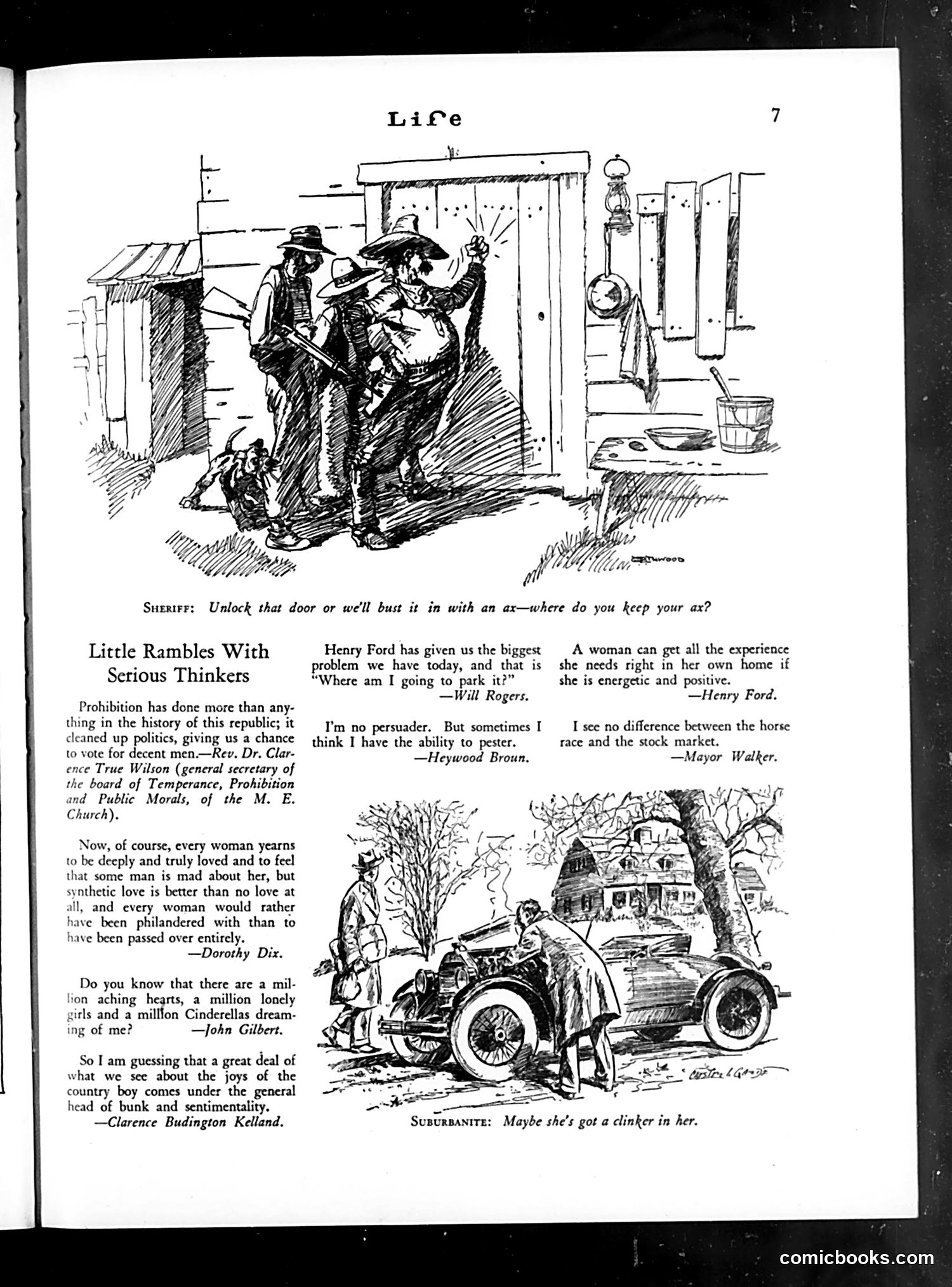
Analysis of Life Magazine Page 7 This page contains two cartoons and quotations addressing Prohibition and women's social roles. The top cartoon depicts a sheriff confronting men in what appears to be an illegal drinking establishment ("bust it in with an ax"), satirizing Prohibition enforcement challenges. The lower cartoon shows a woman with a broken-down car and a man, captioned "Maybe she's got a clinker in her"—a sexist joke implying women are mechanically incompetent or unreliable (a "clinker" meaning something defective). The surrounding quotations from public figures like Henry Ford, Will Rogers, and others debate Prohibition's effects and women's capabilities. The page generally mocks Prohibition's difficulty in enforcement while reinforcing stereotypes about women's limitations, reflecting 1920s-era cultural tensions around both alcohol regulation and changing women's roles.
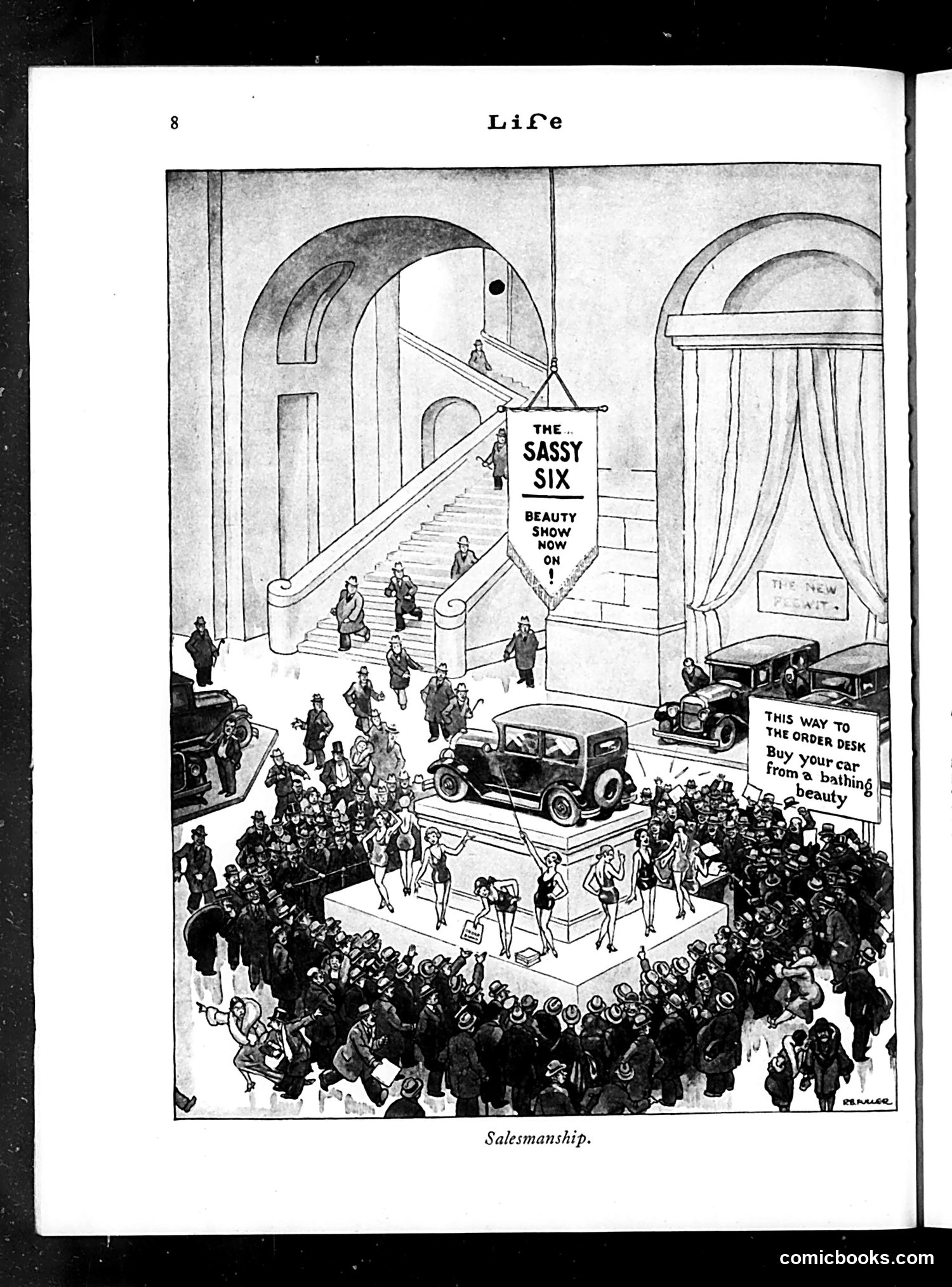
Analysis This is a satirical cartoon titled "Salesmanship" depicting a grand, Art Deco-style lobby or showroom. The central spectacle features "The Sassy Six"—a beauty show being promoted—with scantily-clad women displayed on a platform as the main attraction. Massive crowds surround them, while automobiles are prominently positioned in the scene. The satire targets aggressive 1920s marketing tactics: retailers used any eye-catching gimmick—here, a beauty pageant—to draw crowds and sell unrelated products (cars). The sign reads "Buy your car from a bathing beauty," mocking how companies exploited novelty and sex appeal to move merchandise, regardless of actual product relevance. The cartoon critiques both the brazenness of such advertising and public eagerness to swarm around spectacle for consumption.
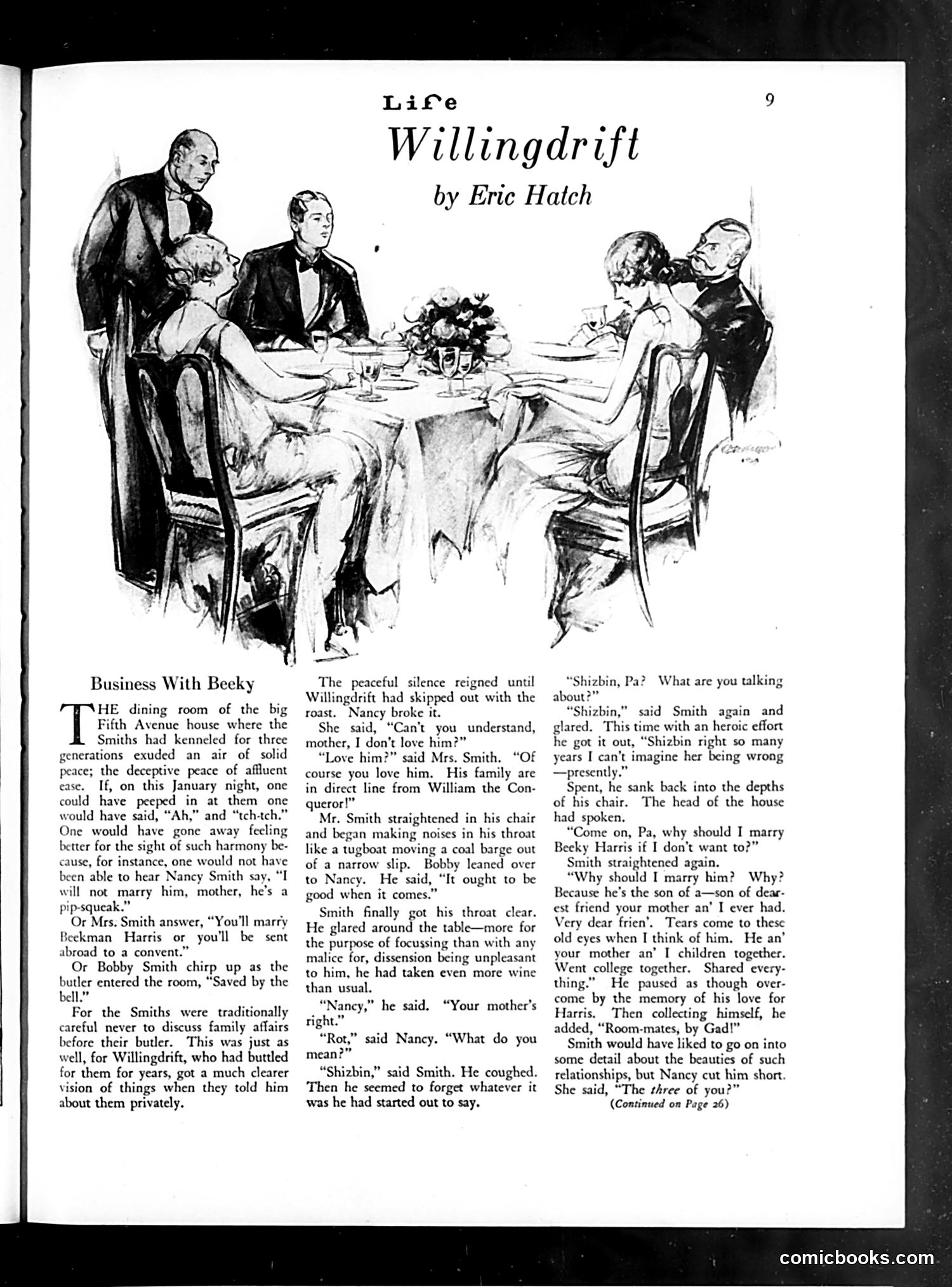
"Willingdrift" by Eric Hatch - Page Analysis This is a short story illustration, not political satire. The piece depicts an upper-class dinner scene centered on family conflict over marriage. The narrative concerns Mr. and Mrs. Smith's disapproval of their son Bobby's intended marriage to Nancy Harris. The conflict hinges on class differences—Nancy's family background apparently troubles the Smiths, who come from old money ("traditionally credited users to discuss family affairs before their butler"). The humor is social satire about rigid class consciousness among the wealthy. Bobby defends Nancy against his parents' snobbery, while his father makes dismissive remarks. The story explores tension between romantic love and parental social expectations—a common 1920s-30s literary theme about generational values regarding marriage and class. The illustration captures the strained dinner conversation that reveals these tensions.
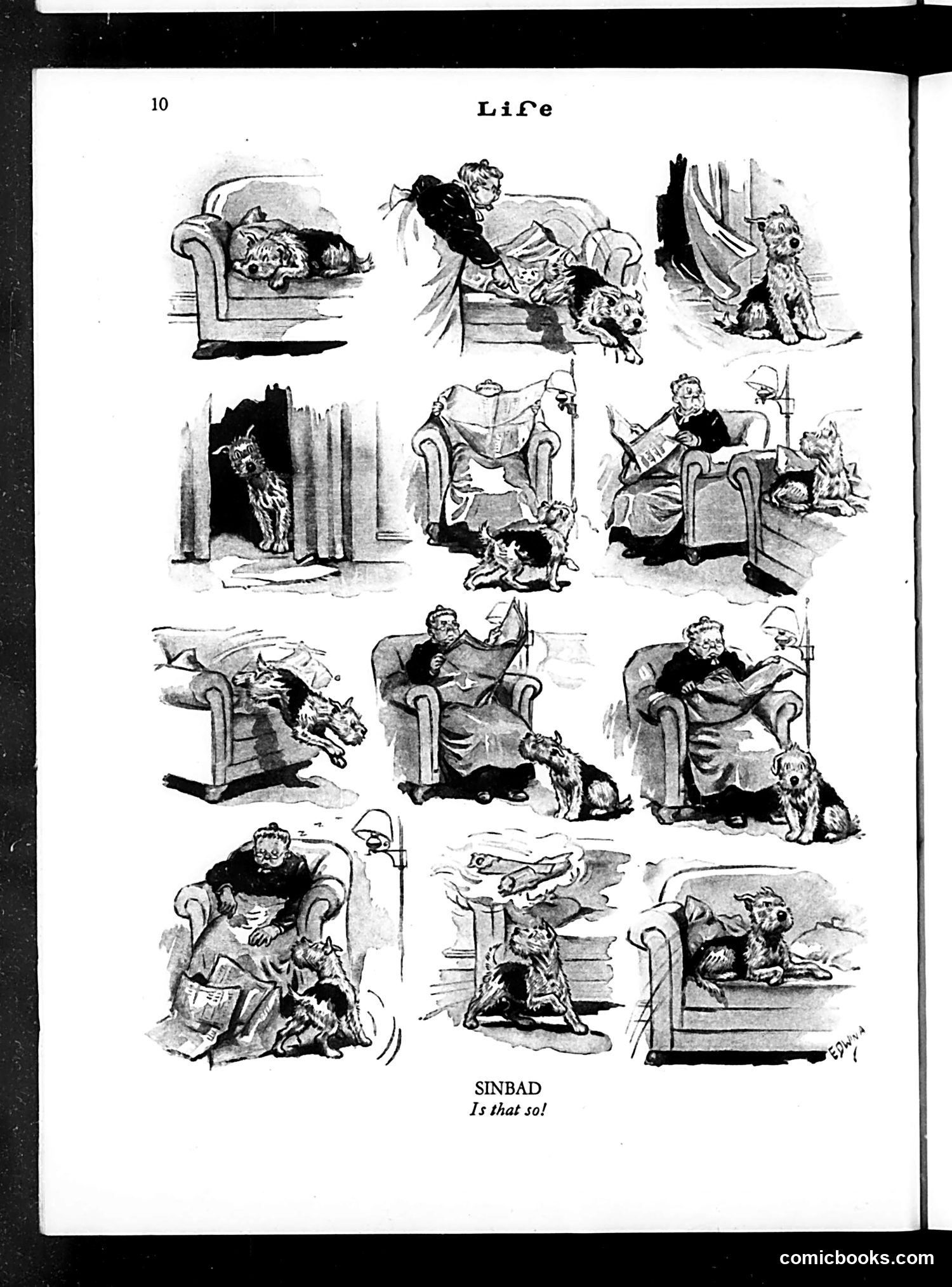
Analysis This page from *Life* magazine presents a comic strip titled "SINBAD: Is that so!" depicting a series of scenes where a man (Sinbad) interacts with various dogs in domestic settings—primarily armchairs and furniture. The humor appears to center on the dogs' mischievous behavior: they're shown jumping on furniture, stealing items, creating chaos, and generally disrupting the household. The caption "Is that so!" suggests Sinbad is responding incredulously to claims about the dogs' conduct. This is domestic satire about pet ownership frustrations rather than political commentary. The strip mocks the gap between how people imagine their dogs will behave versus actual canine chaos in the home—a relatable theme for contemporary readers with pets.
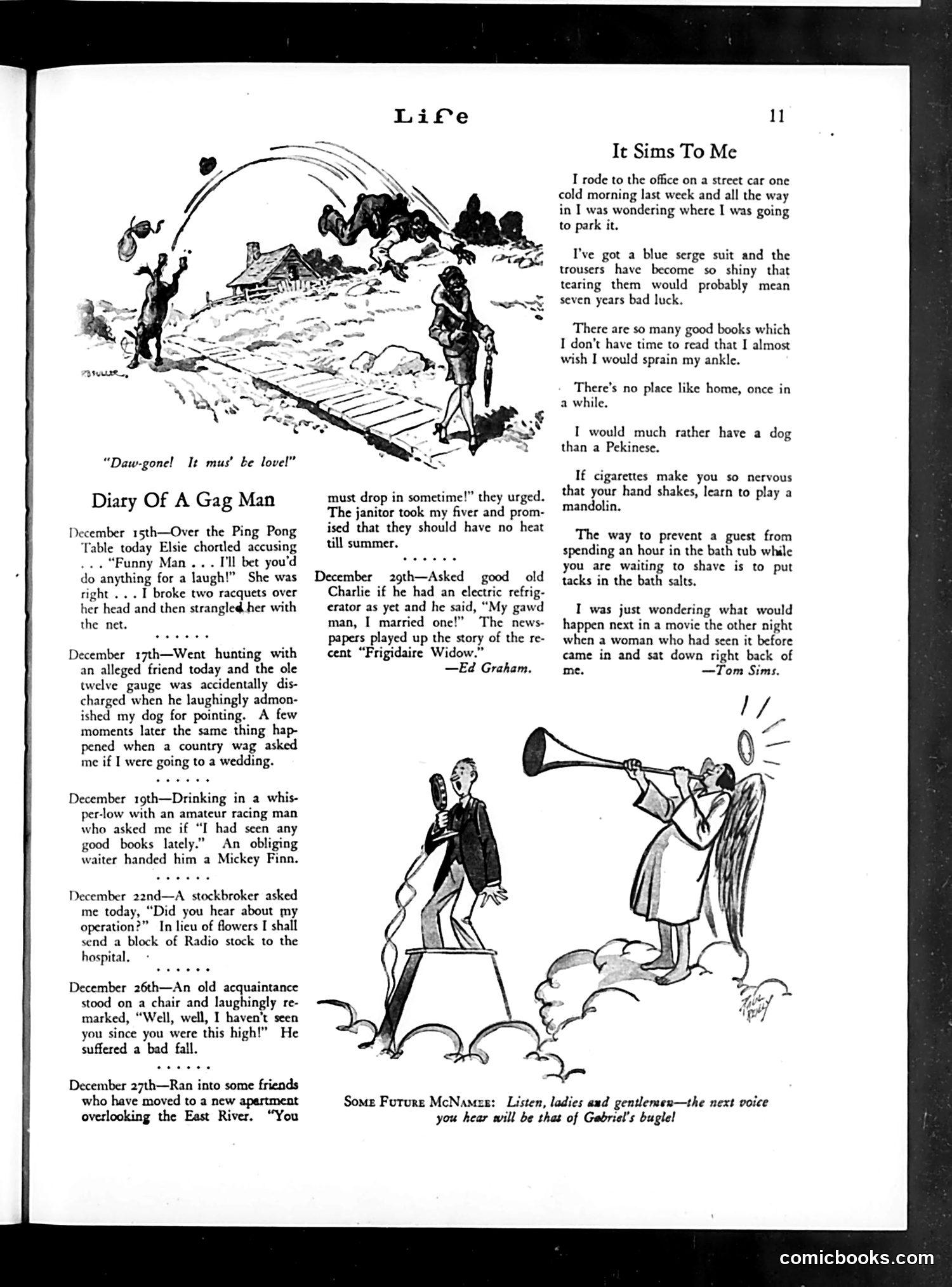
Page Analysis: Life Magazine, Issue 11 This page contains two separate humor pieces: "Diary of a Gag Man" (left) presents fictional diary entries from December describing comic mishaps—hunting accidents, awkward social encounters, and workplace absurdities. It's self-referential humor about the difficulty of generating comedy material. "It Sims to Me" (right, by Tom Sims) offers observational humor about everyday annoyances: parking concerns, clothing care, unread books, homesickness, and social awkwardness. The accompanying cartoon shows a woman with a megaphone disturbing someone—illustrating one of life's minor irritations. Both pieces represent *Life*'s signature style: gentle satire of middle-class American life rather than hard political commentary. The humor targets relatable frustrations rather than current events or public figures.
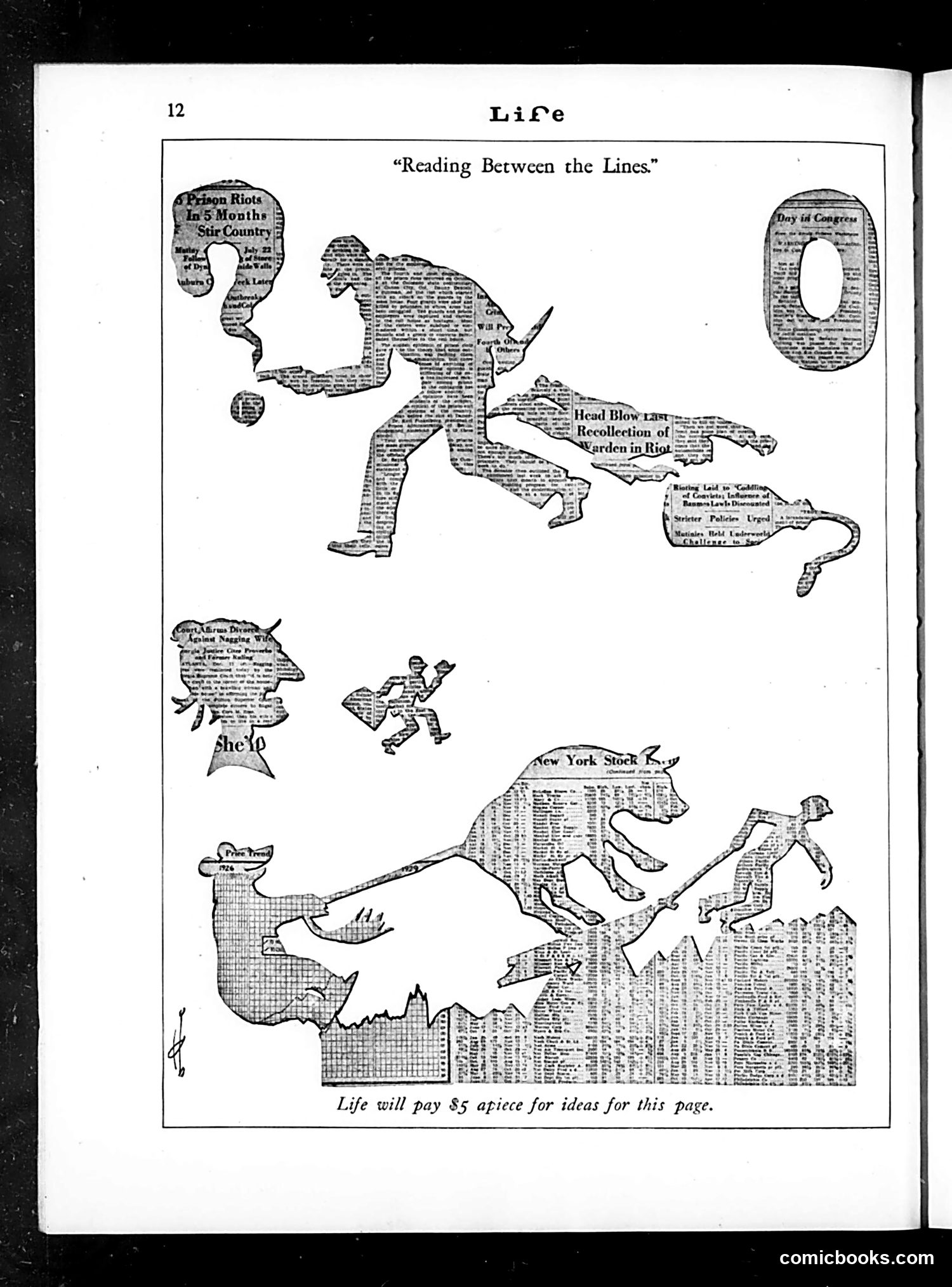
"Reading Between the Lines" This satirical composite uses human and animal figures filled with newspaper text to mock current events. The central figure appears to be a man in an aggressive pose, filled with articles about "Prison Riots in 5 Months Stir Country" and "Day in Congress." Other figures include a question mark (suggesting confusion or uncertainty), a bull labeled "New York Stock [Exchange]," and various smaller figures. At bottom left is a cow labeled "The Voter." The satire suggests that newspapers, politics, financial markets, and the voting public are intertwined—all composed of the same sensational reporting and turbulent events. The title implies readers must "read between the lines" to understand deeper truths beyond surface headlines about riots, congressional activity, and market volatility.
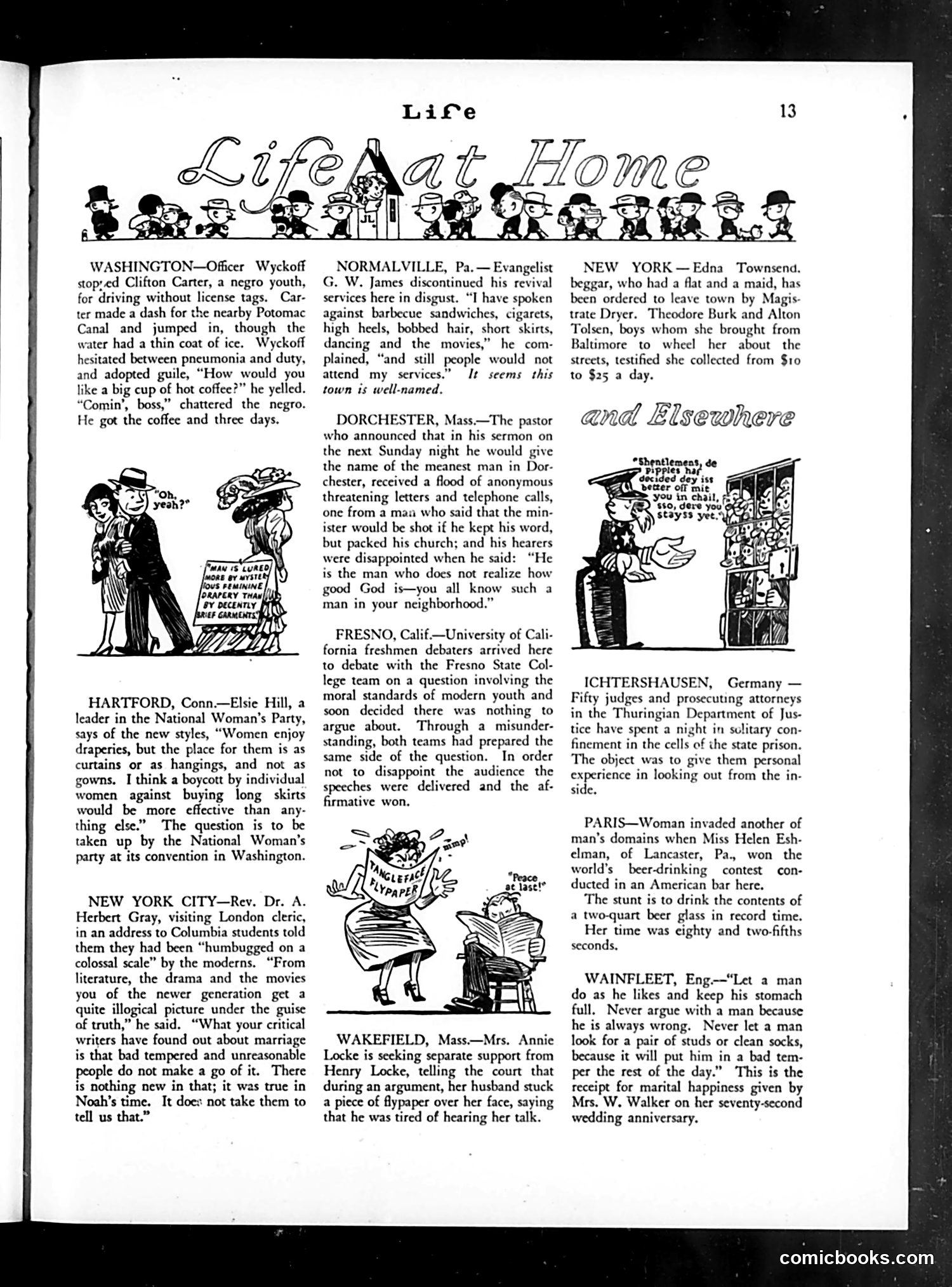
Analysis of "Life at Home and Elsewhere" (Page 13) This page contains brief humorous anecdotes about domestic and social situations from various American and international cities, accompanied by cartoon illustrations. The cartoons mock everyday scenarios: a Washington officer confronting a Black youth about coffee; a Hartford woman advocating for shorter skirts against traditional fashion; a New York clergyman addressing marriage misconceptions. One prominent cartoon depicts a woman in an academic gown labeled "Unelected Suffrage," suggesting commentary on women's voting rights debates of the era. Another shows figures in what appears to be a social/domestic dispute. The international items (Germany, France, England) provide light satirical observations about foreign customs. The overall tone is gentle, middle-class humor targeting fashion, morality, gender relations, and social propriety—typical of *Life* magazine's satirical approach to contemporary American life.
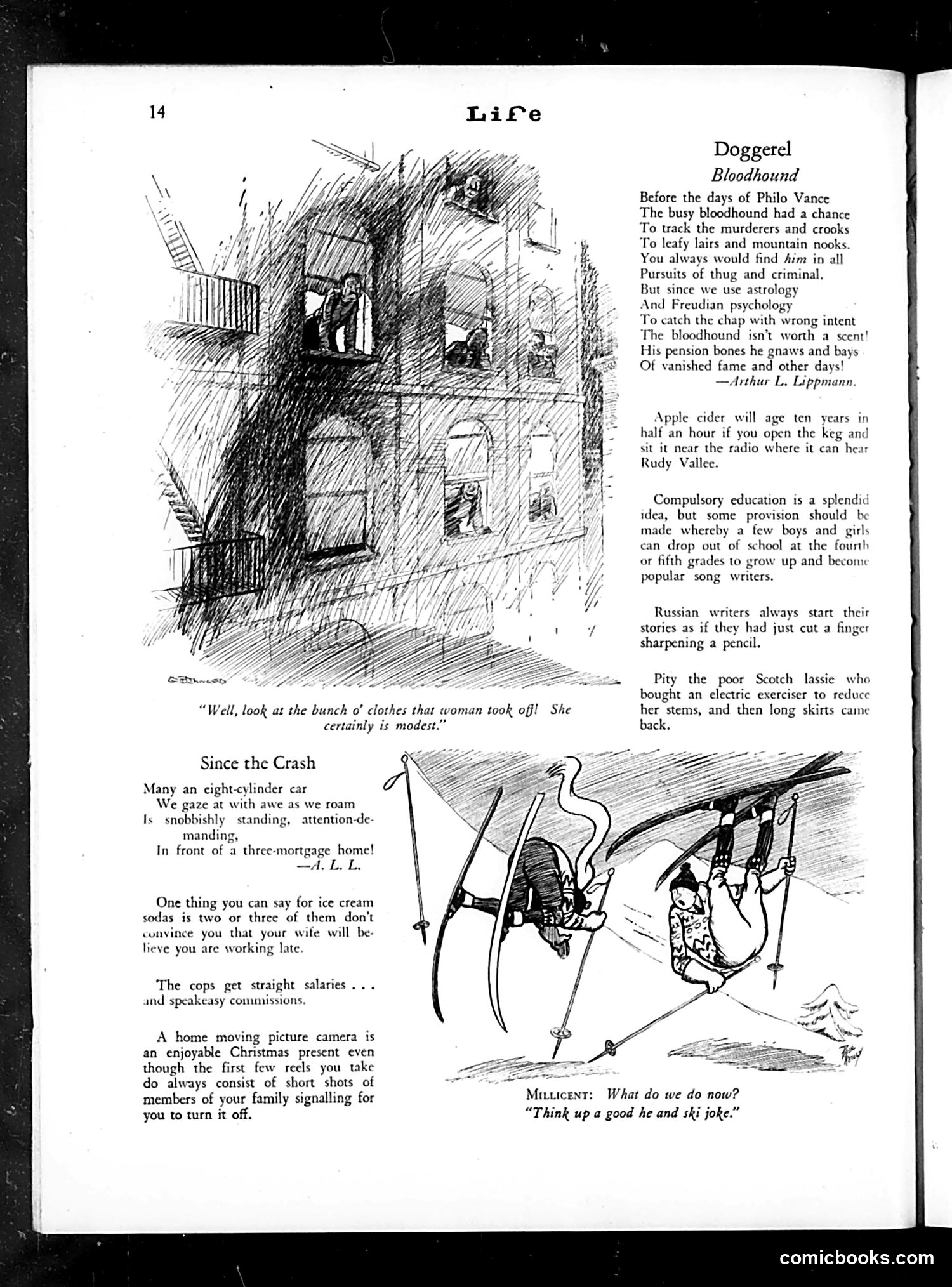
Analysis of Life Magazine Page 14 This page contains several humorous short pieces and illustrations satirizing early 20th-century American life. The top section, "Doggerel: Bloodhound," mocks detective work and astrology—suggesting that modern psychology and astrology have made old-fashioned bloodhound tracking obsolete and worthless. "Since the Crash" references the 1929 stock market crash, offering cynical observations about post-Depression life: people gawking at expensive cars they can't afford, the reliability of ice cream sales, police corruption, and the modest value of home movie cameras as Christmas gifts. The bottom illustration shows skiers with the caption "What do we do now? Think up a good lie and ski joke"—satirizing skiers' tendency to exaggerate their exploits and bore others with repetitive humor. All pieces employ dark humor about economic hardship and social pretension.
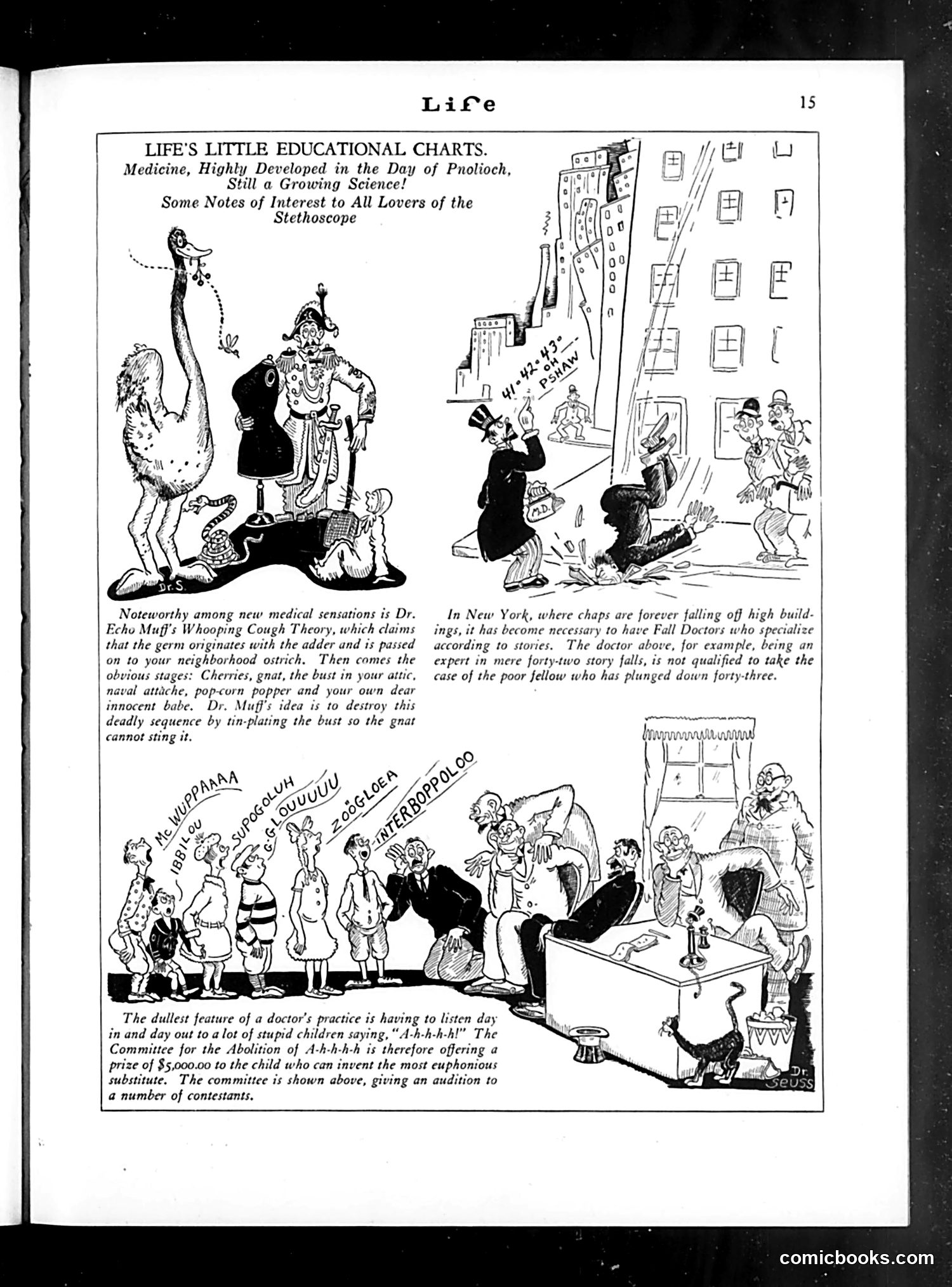
Analysis of Life Magazine Page 15 This satirical page mocks contemporary medical practices through four cartoon vignettes: Top left: Dr. Muff's "Germ Theory" claims disease originates in the udder of neighborhood cows, proposing to destroy gnats by tin-plating their rear ends—obvious pseudoscience presented as legitimate medicine. Top right: A New York doctor specializes in treating injuries from falling buildings, treating poor patients who've jumped from high-rise tenements. Bottom: The "dullest feature" of medical practice is doctors listening to children say "Ah-h-h" all day. A committee offers a $5,000 prize for inventing a better substitute. The satire targets medical incompetence, absurd theories, and the tedium of actual practice—suggesting early-20th-century medicine lacked credible scientific grounding and doctors pursued ridiculous remedies and specializations.
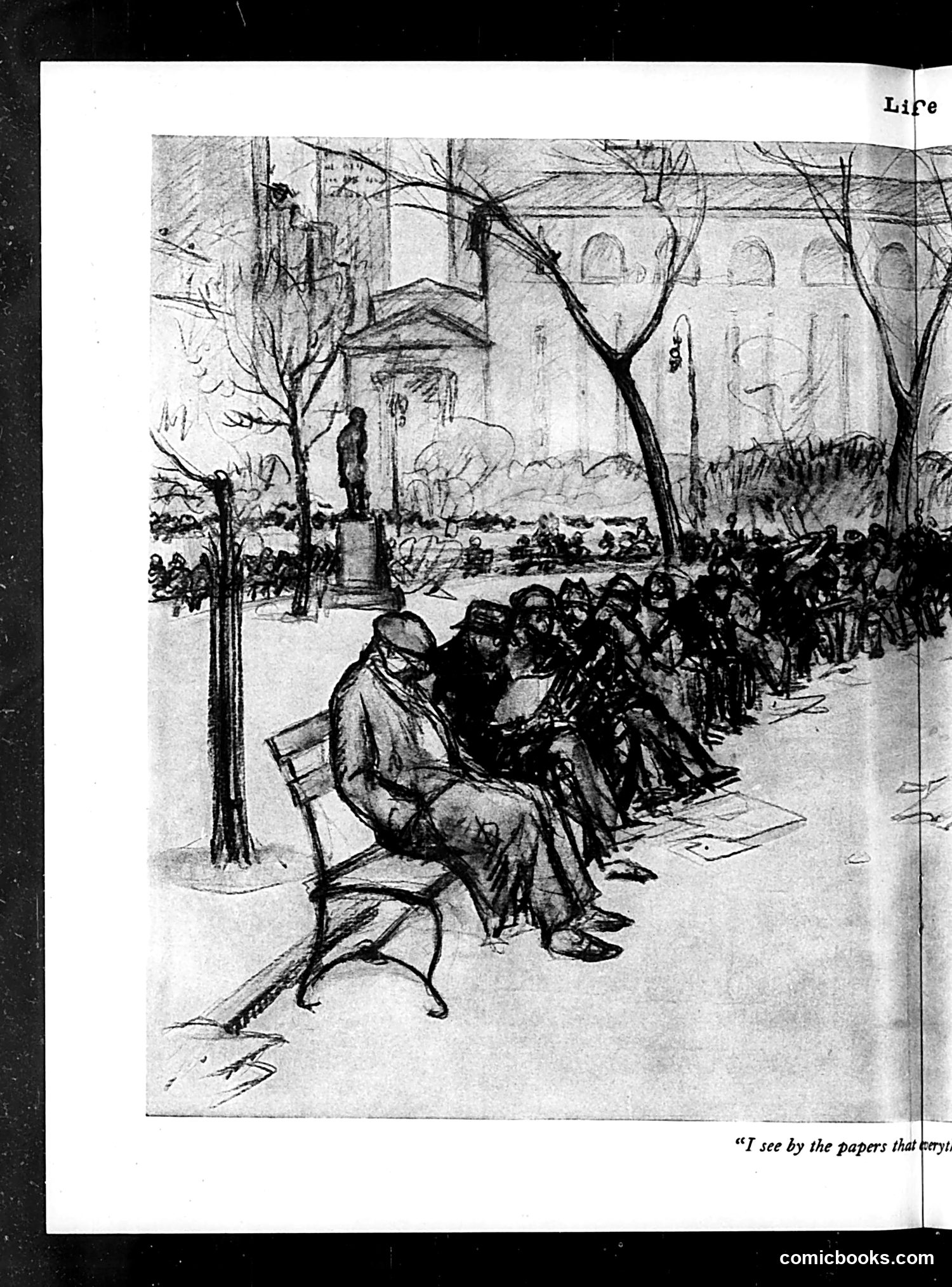
Analysis This illustration depicts a long line of people sitting on benches in what appears to be a public square or plaza, with bare winter trees and a classical building (possibly a courthouse or government building) in the background. A statue stands prominently in the middle distance. The partial caption at bottom reads: "I see by the papers that ery..." (text cuts off). The image appears to satirize unemployment or public welfare lines, showing numerous figures waiting—likely during an economic downturn. The formal architectural setting and statue suggest this is commenting on civic institutions' inadequate response to economic hardship. Without the complete caption, the specific political target remains unclear, though Life magazine frequently criticized government handling of poverty and unemployment during economic crises. The satire likely mocks the contrast between grand civic monuments and citizens' actual suffering.
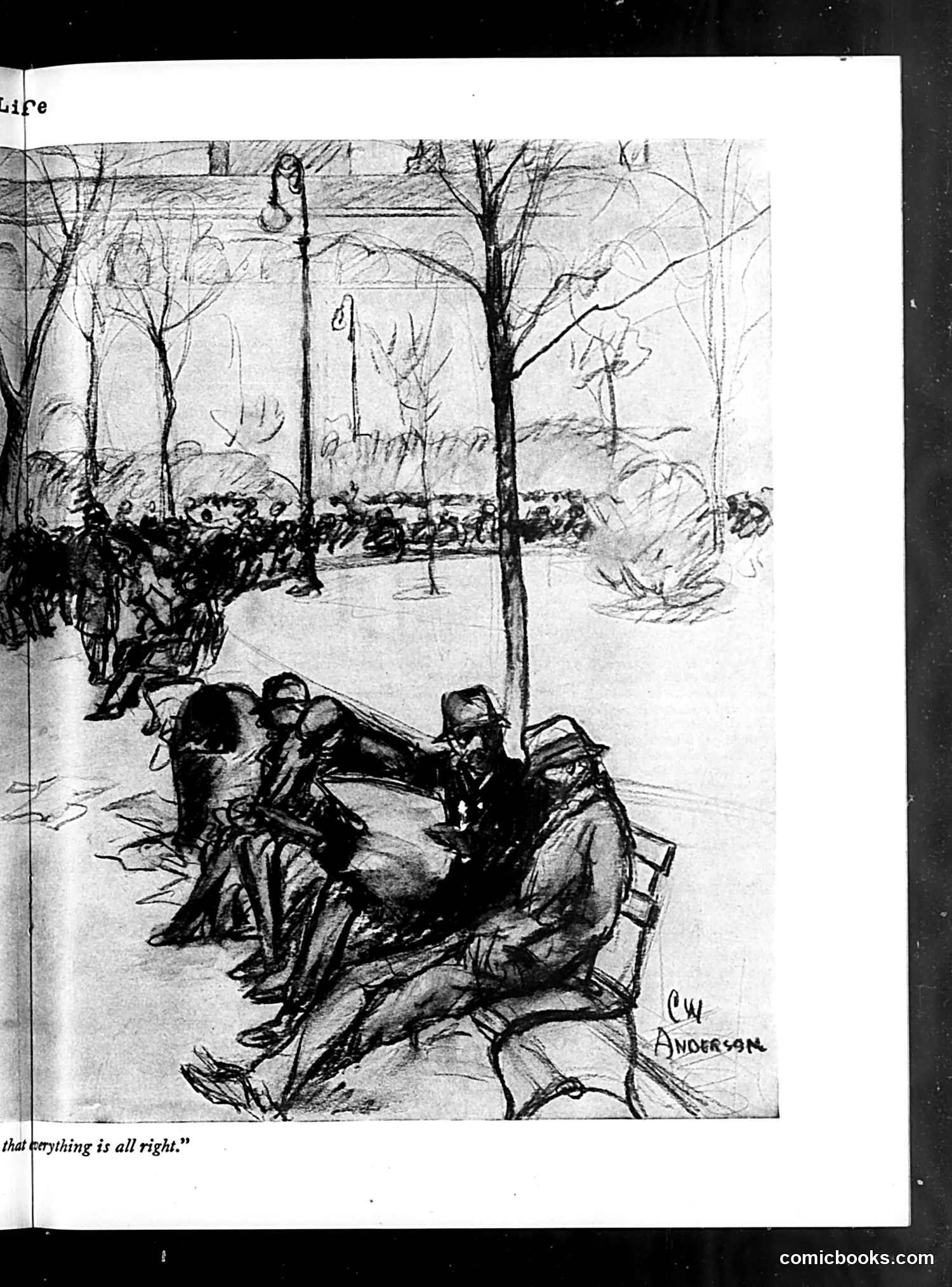
Analysis This sketch by C.W. Anderson depicts a scene of men sitting outdoors in winter, appearing to be soldiers or workers resting in a bare landscape with leafless trees. The caption reads "that everything is all right." The image appears to be satirizing wartime conditions or military life, likely from the WWI era given Life magazine's timing and subject matter. The contrast between the caption's reassurance ("everything is all right") and the soldiers' exhausted, huddled postures in harsh winter conditions suggests ironic commentary—the men clearly appear worn down despite official optimism about their situation. The sketch style and composition emphasize the soldiers' weariness rather than morale, creating satire through this visual contradiction between what authorities claim and what soldiers actually experience.
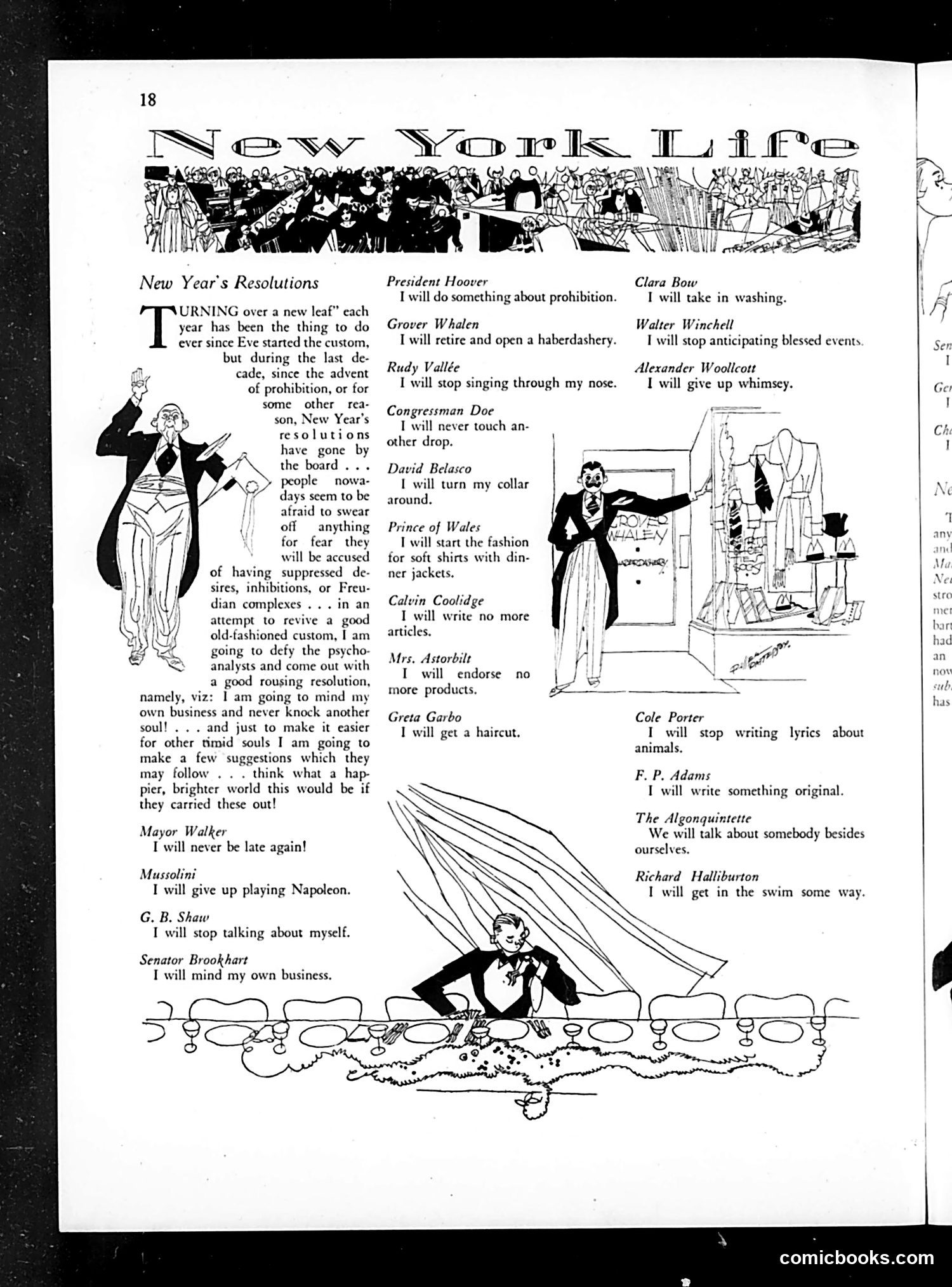
New Year's Resolutions This satirical page mocks famous public figures of the era by imagining their New Year's resolutions. The humor relies on each person's known characteristics or current scandals: - President Hoover will address prohibition (a major political issue) - Greta Garbo will get a haircut (playing on her private persona) - Calvin Coolidge will write articles (referencing his post-presidency work) - Cole Porter will stop writing about animals (likely referencing specific songs) - G.B. Shaw will stop self-promotion (the famous playwright's known vanity) - Mussolini will quit playing Napoleon (mocking his imperial ambitions) The bottom illustration shows a man dining amid empty bowls, possibly referencing economic hardship or excess during Prohibition. The satire works by inverting what these figures are actually known for, creating humor through obvious impossibility.
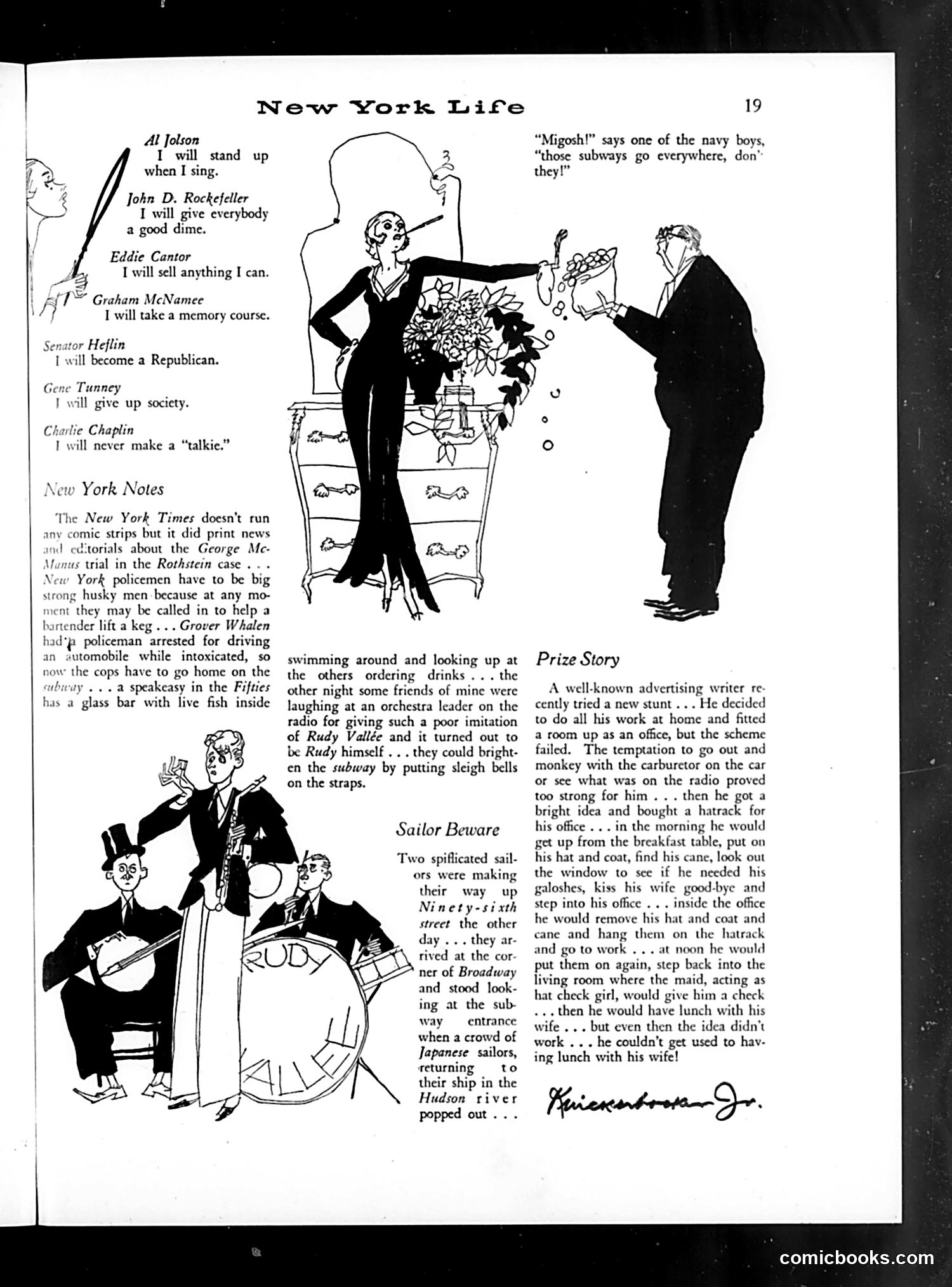
New York Life, Page 19 This page mixes humorous predictions with satirical New York notes. The top section shows celebrities' "New Year's resolutions"—likely from the 1920s, based on references to Al Jolson (early sound film star), Charlie Chaplin (who famously resisted "talkies"), and Rudy Vallée (popular crooner). These are tongue-in-cheek reversals of their public personas: Jolson will *stand* when singing, Chaplin will never make a talkie (ironic, as he eventually did), etc. The "New York Notes" section lampoons 1920s city life: Prohibition speakeasies with live fish bars, subway oddities, Grover Whalen's police enforcement, and a Japanese sailor being amazed that NYC subways go "everywhere." The "Prize Story" mocks the impracticality of working-from-home—an advertising writer's elaborate charade (hatrack "office") fails because he can't resist his car's engine and radio. The punchline: he *still* can't adjust, particularly to lunch with his wife, suggesting marital satire.
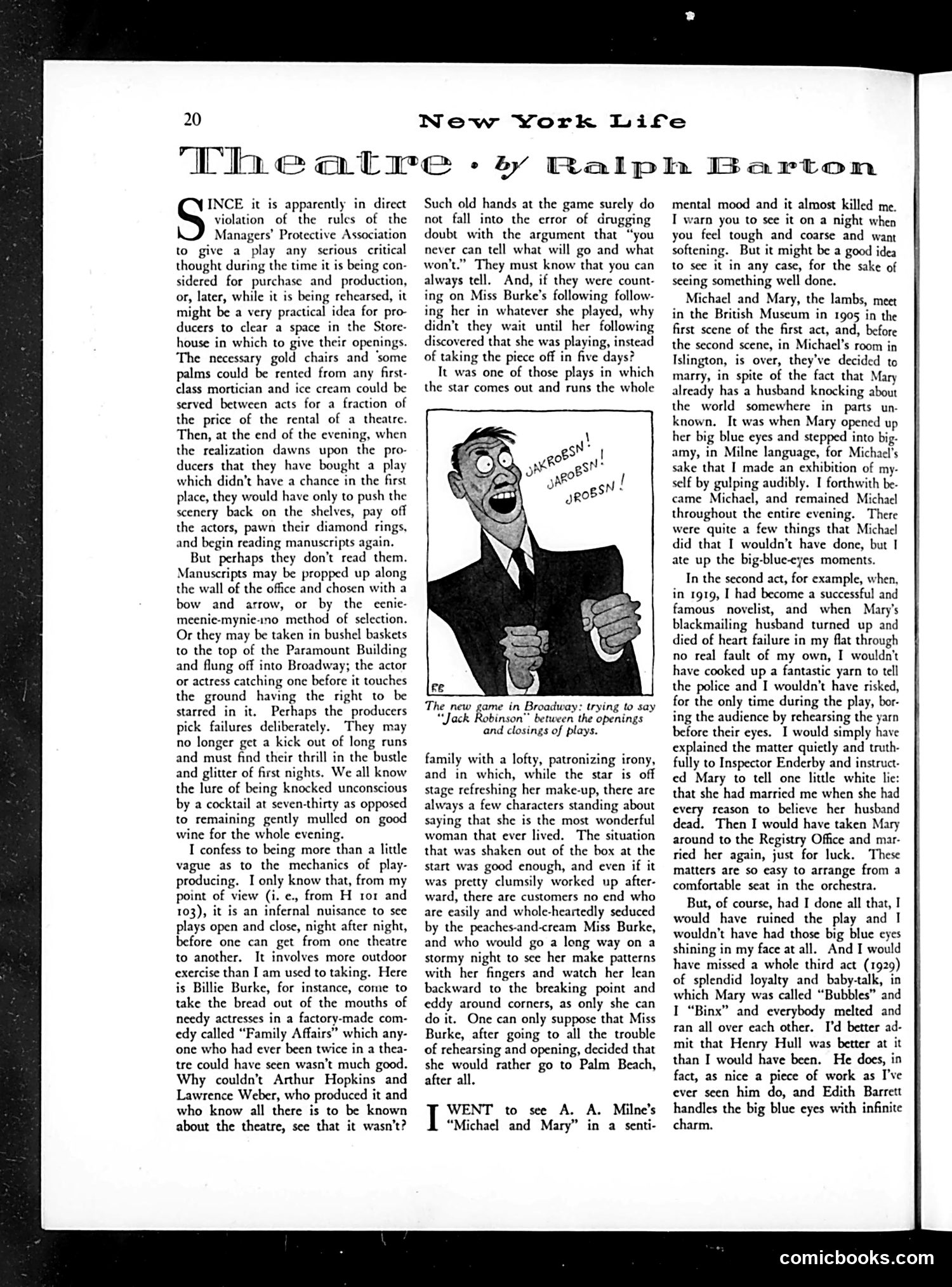
Theatre Satire by Ralph Barton This is satirical commentary on Broadway's theatrical production failures. The cartoon shows a man exclaiming "JABBERWOCKY!" — likely representing a producer or critic reacting to poorly chosen plays. Barton's essay mocks producers for their apparent inability to recognize bad scripts before investing in them. He specifically criticizes "Family Affairs," a play starring actress Billie Burke that closed after five days. The author sarcastically suggests producers select scripts randomly (by bow-and-arrow or "eenie-meenie-mynie-ino") rather than through actual critical judgment. The cartoon's caption jokes that Broadway moves so fast you can barely say "Jack Robinson" between a play's opening and closing. The satire targets the theatrical establishment's incompetence: producers who should know better keep mounting doomed shows, wasting money and actors' time. Barton presents this as an annoying inconvenience to theatergoers who must constantly chase shows between venues.
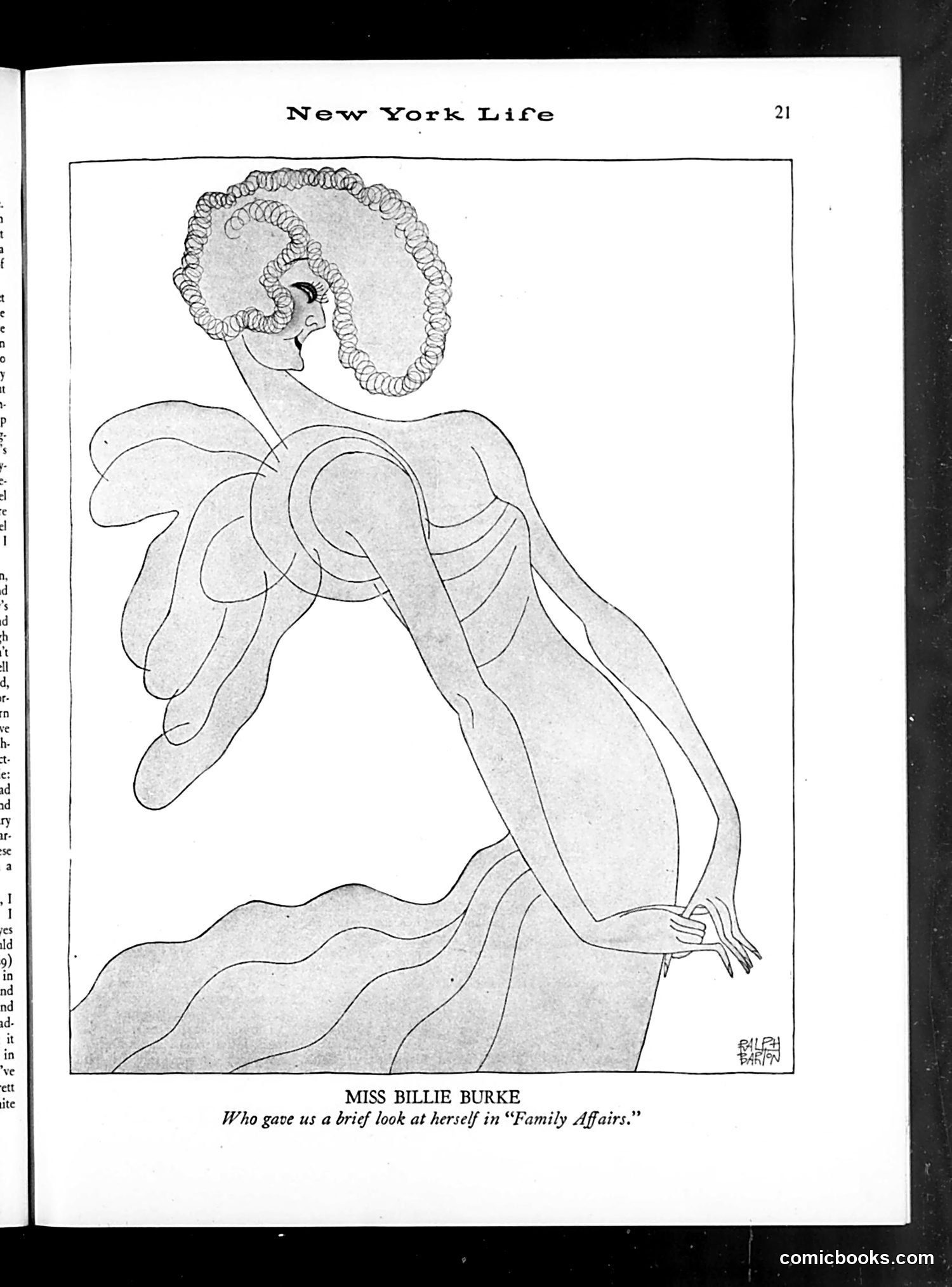
Analysis This page from *Life* magazine features an art deco-style illustration of Miss Billie Burke, likely a theatrical or film performer of the early 20th century. The caption indicates she appeared in a production called "Family Affairs." The drawing is a stylized portrait emphasizing fashionable 1920s aesthetics—elaborate curled hair, elongated figure, flowing drapery, and decorative linework typical of the era's illustration style. This appears to be a celebrity feature or theater review rather than political satire. The artist's signature is visible in the lower right. Without knowing the specific context of "Family Affairs," the precise satirical point remains unclear, though the illustration's exaggerated, somewhat theatrical style might gently mock contemporary fashion or performance conventions.
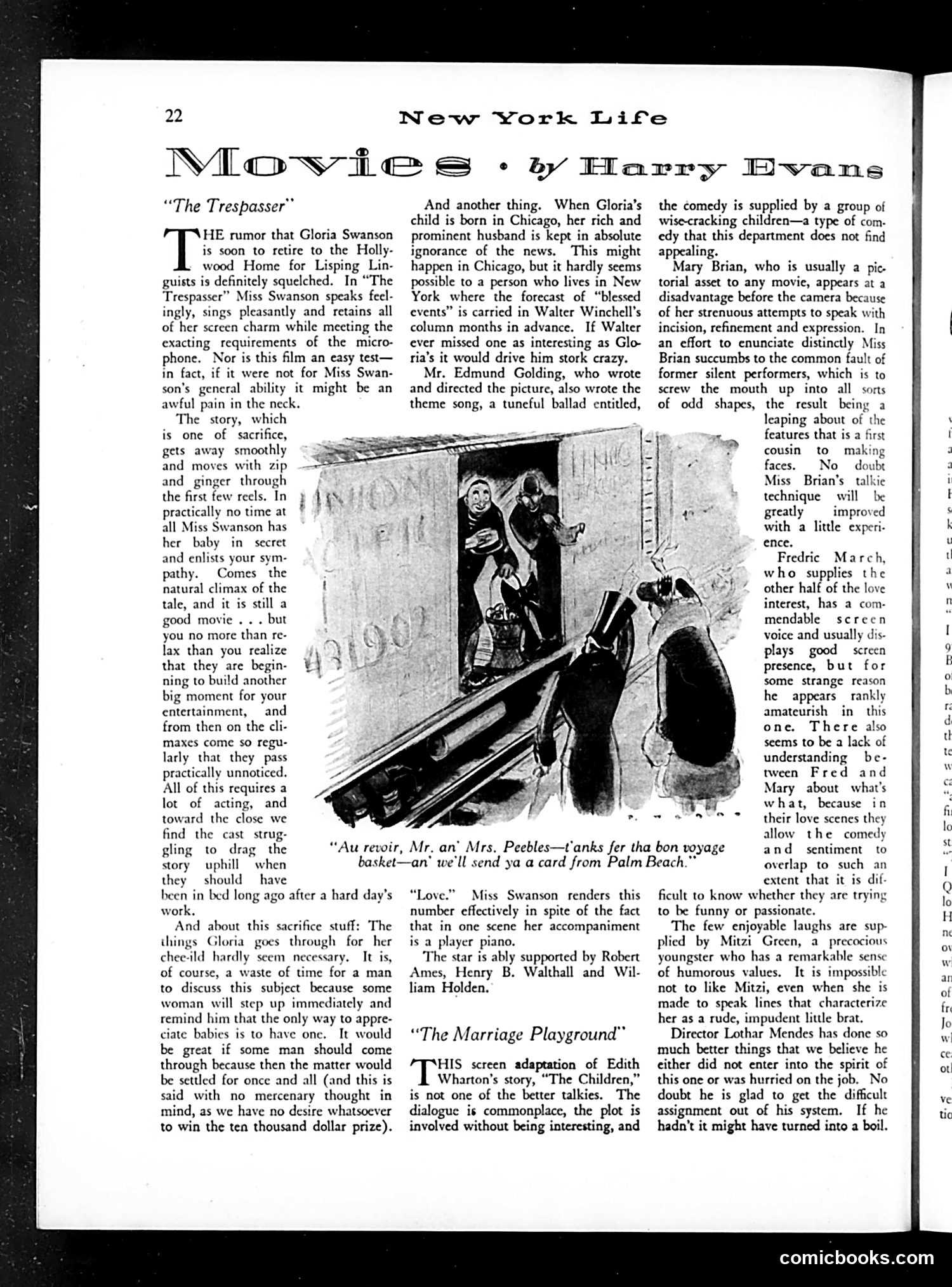
"The Trespasser" & "The Marriage Playground" Reviews This page contains film reviews by Harry Evans for two 1929 sound films. The main illustration shows a scene from "The Trespasser" starring Gloria Swanson—a silent film star now speaking in talkies (sound films). Evans reviews Swanson's transition to sound positively, noting she "speaks feelingly" and "sings pleasantly," dismissing rumors she'd "retire" due to difficulties with dialogue. He critiques the film's plot structure for relying too heavily on manufactured dramatic climaxes. The second review addresses "The Marriage Playground," adapted from Edith Wharton's story. Evans finds it mediocre, with commonplace dialogue. He criticizes Mary Brian's over-articulation—a common problem among former silent actors adjusting to sound, where excessive mouth movements created distracting facial contortions. Fredric March receives praise for his "commendable screen voice." The reviews capture the era's transition anxiety: established stars proving themselves capable of speaking roles, while some performers struggled with vocal technique.
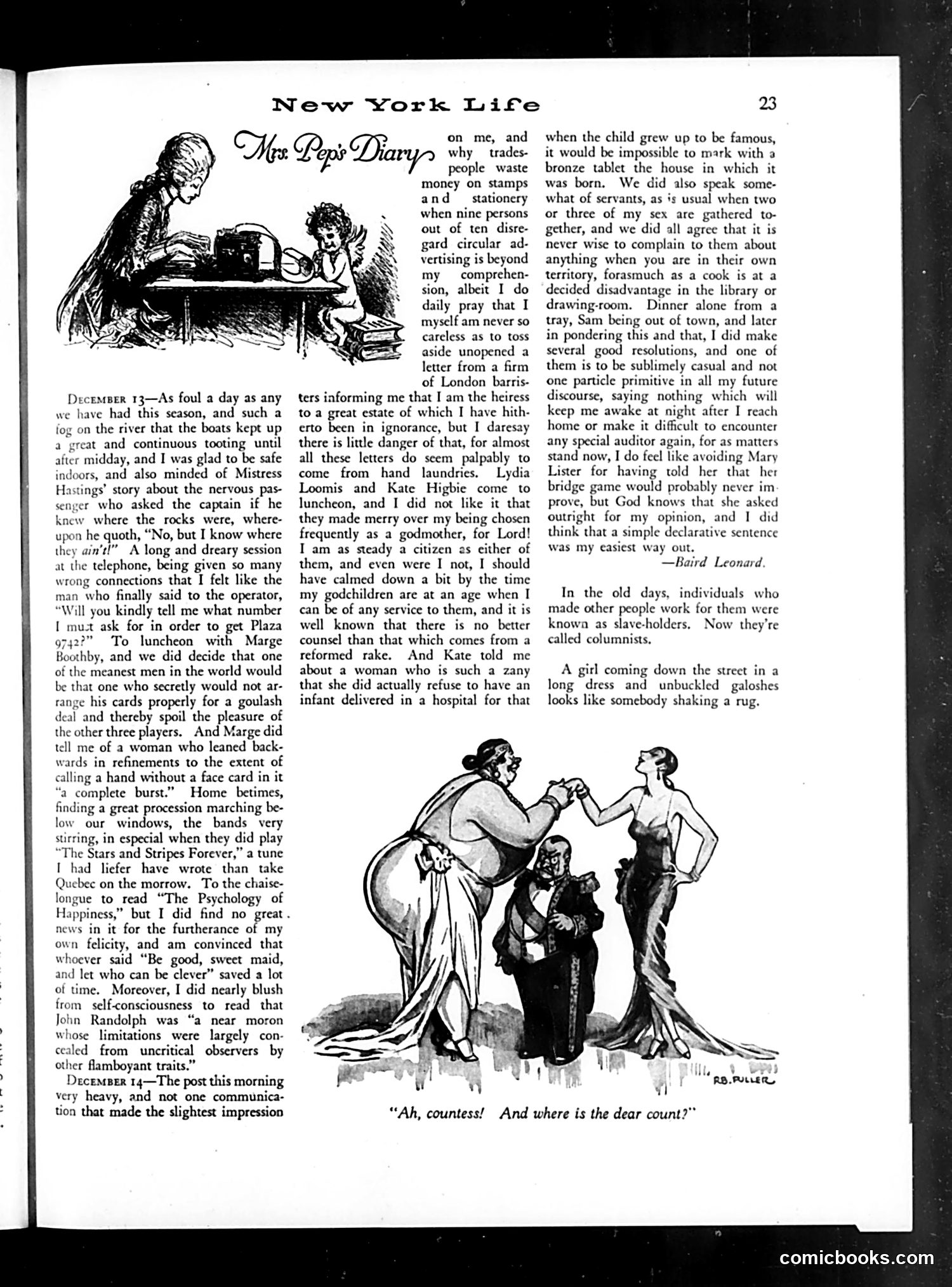
Analysis of "Mrs. Pep's Diary" Page This page presents a satirical society diary column mixed with a single cartoon. The diary entries (December 13-14) mock upper-class social life through mundane observations—complaining about fog, telephone mishaps, and card games—presented with exaggerated pretension. The cartoon below depicts a wealthy woman (labeled "countess") with an infant, confronting a nurse or attendant who asks "And where is the dear count?" The joke references the preceding diary text about a woman who refused hospital delivery because if her child became famous, she couldn't mark the birthplace with a bronze tablet. The cartoon extends this absurd vanity: the countess apparently cares more about the child's prestigious associations than the father's presence. The satire targets wealthy women's superficiality, social climbing, and disconnection from practical reality—typical Life magazine mockery of the leisure class.
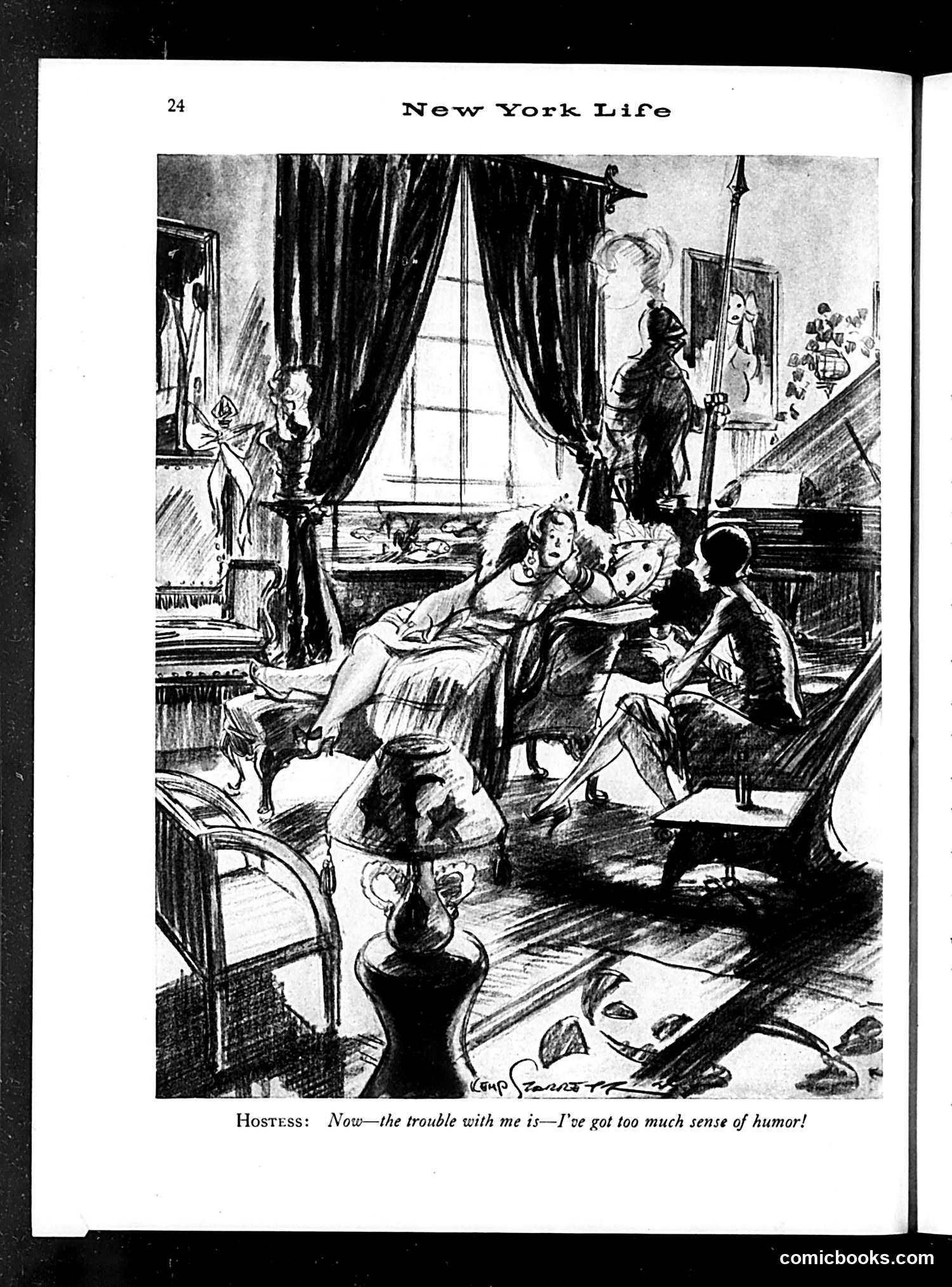
Explanation for Modern Readers This is a single-panel cartoon from *Life* magazine showing a social scene in what appears to be a wealthy home. A reclining woman addresses her hostess with the caption: "Now—the trouble with me is—I've got too much sense of humor!" The satire targets upper-class social pretension. The woman's complaint—that her *excessive* sense of humor is somehow a *problem*—is absurd and self-aggrandizing. She's essentially bragging about her wit while framing it as a personal flaw, a transparent attempt at false modesty that reveals her vanity. The elegant interior and fashionable figures emphasize this is commentary on wealthy, sophisticated society. The joke exposes how the wealthy use affected self-deprecation as a form of social posturing, claiming traits they consider desirable while maintaining a veneer of humble complaint.
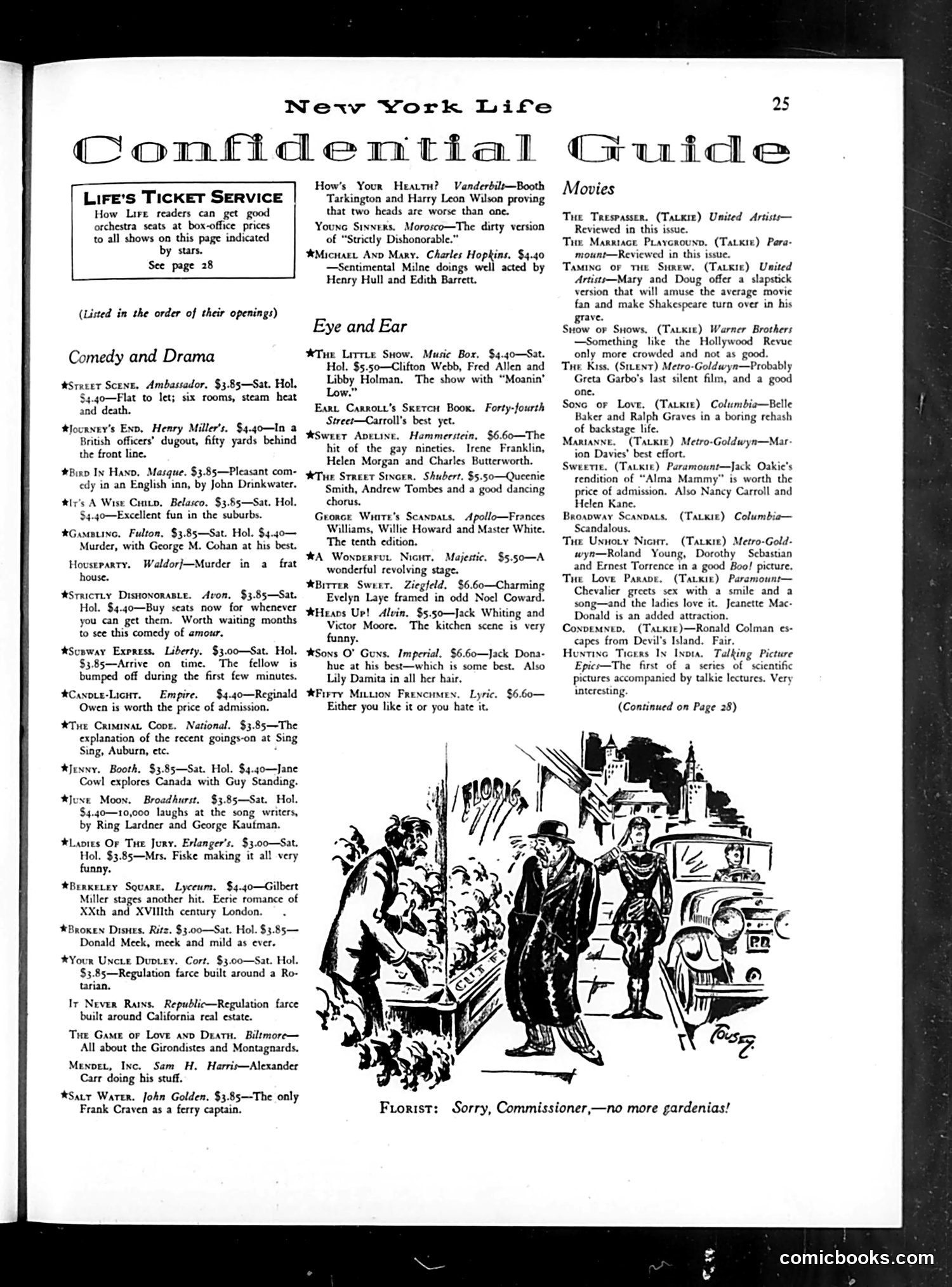
Analysis of Life Magazine Page 25 This page is a theater and entertainment guide for New York City, not primarily a political cartoon. The single cartoon at the bottom depicts a florist being accosted by an angry figure (labeled "Commissioner") demanding "no more gardenias!" The joke appears to reference wartime flower rationing or restrictions—likely from WWI era, given the page's theatrical listings. The Commissioner represents government authority enforcing scarcity measures, while the florist represents civilian merchants frustrated by regulations. The humor lies in the absurdity of specifically rationing gardenias, a luxury item, suggesting bureaucratic overreach. The bulk of the page comprises theater listings with prices, cast members, and satirical one-line plot descriptions aimed at New York sophisticates—typical of Life magazine's entertaining guide format rather than explicit political commentary.
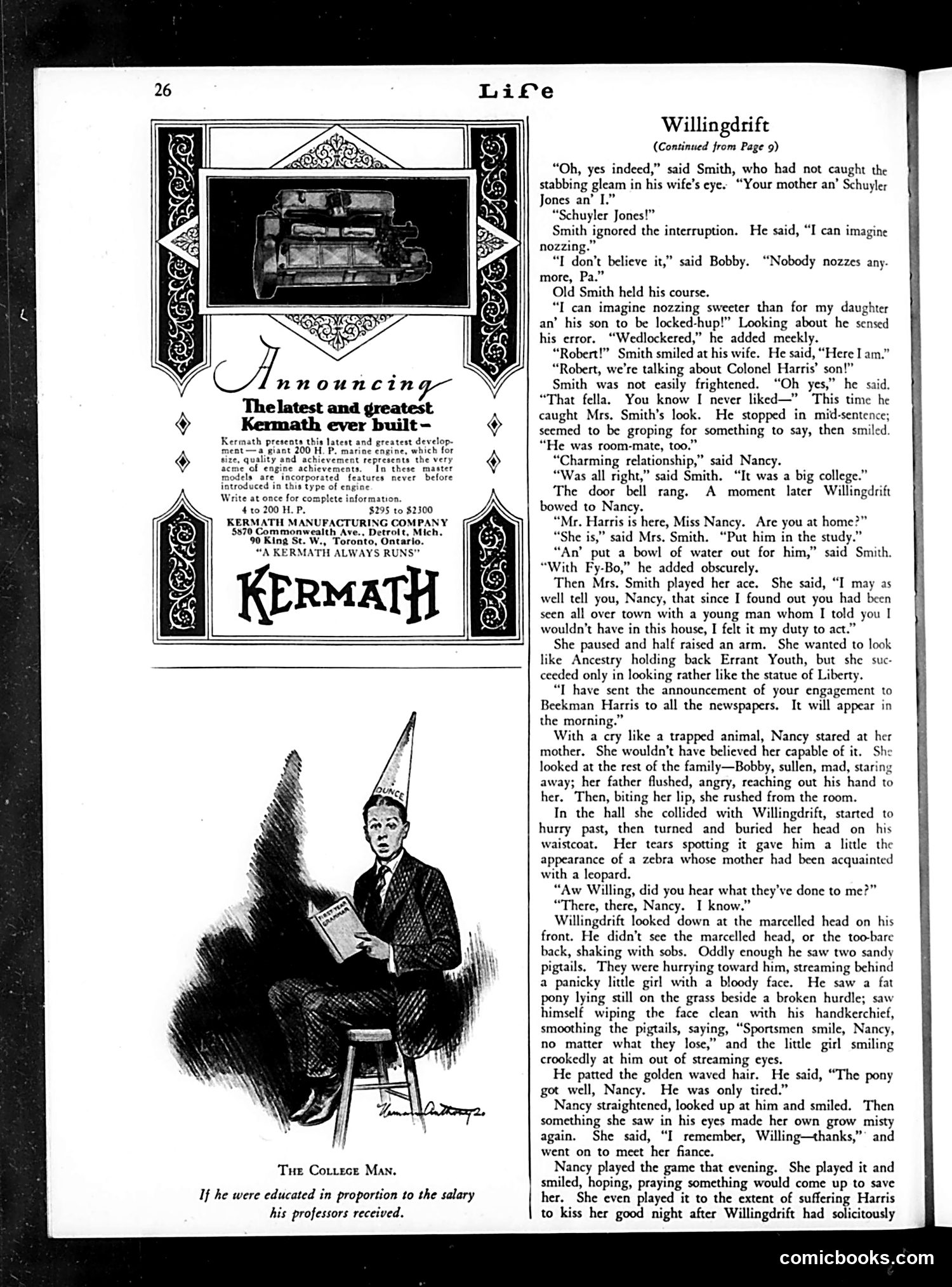
Analysis of Life Magazine Page 26 This page contains a serialized story called "Willingdrift" (continued narrative) and a Kermath automobile advertisement. The Story: A dramatic domestic scene unfolds in the Smith household. Nancy's mother announces she has sent Nancy's engagement to Beekman Harris to the newspapers without Nancy's consent—a controlling action meant to force the relationship. Nancy is distraught; her family appears divided (father angry, brother sullen). She flees and encounters Willingdrift in the hall, who comforts her while experiencing a nostalgic memory of Nancy as a child after a pony accident. The Satire/Point: The narrative appears to be a sentimental romance examining themes of parental interference, duty versus desire, and youthful innocence versus adult complications. The humor is mild domestic comedy—the father's malapropism "Wedlockered" for "wedlock," his awkward attempts at conversation. The Advertisement: A full-page Kermath engine ad featuring "The College Man"—a pointed-hat wearing figure reading—with text joking that college men are "educated in proportion to the salary his professors received," mocking academic value.
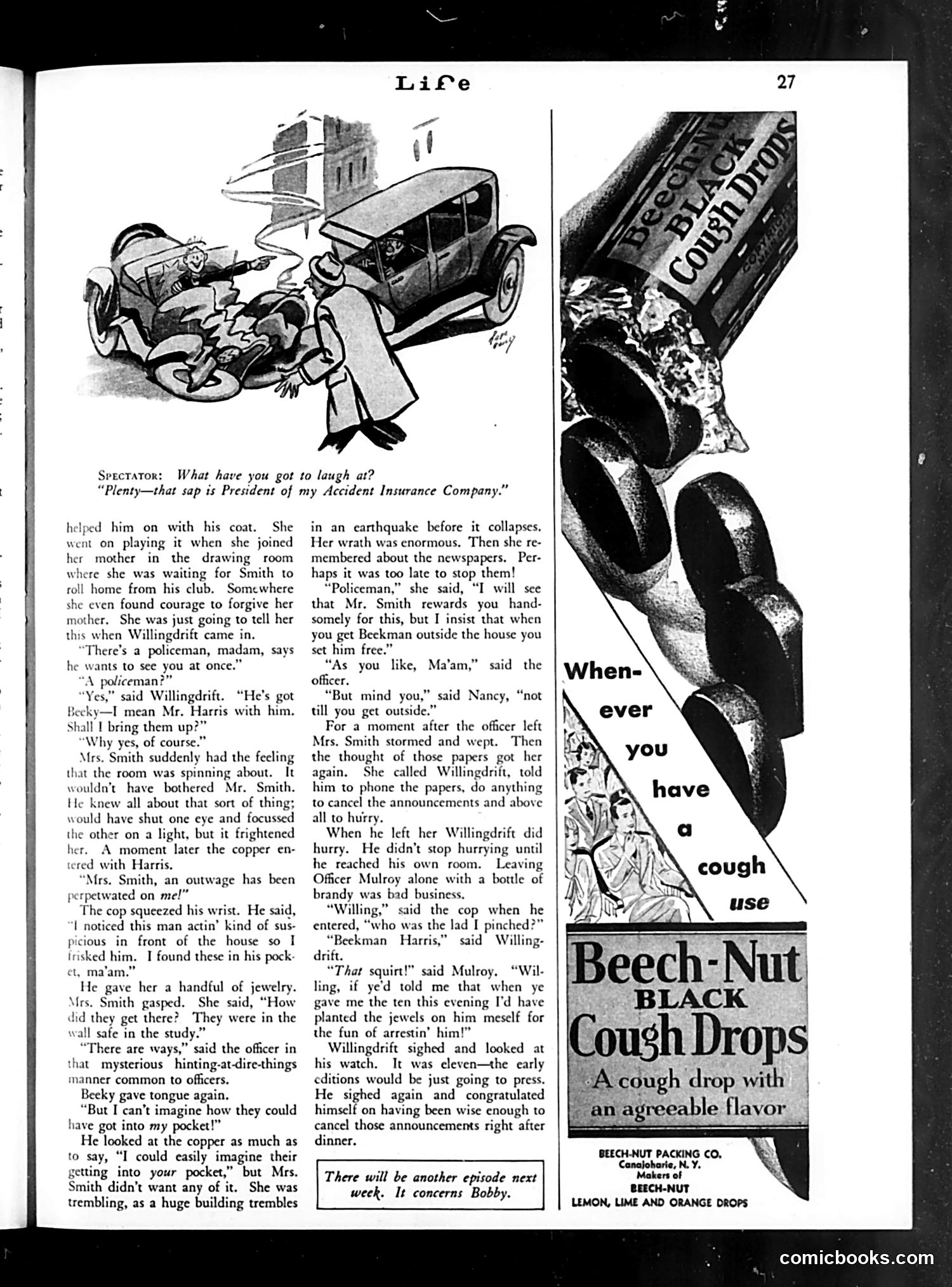
Cartoon Analysis: Life Magazine, Page 27 The left cartoon satirizes accident insurance fraud. A man has been hit by a car—shown dramatically crumpled beneath the vehicle—while a well-dressed spectator laughs. The joke: the spectator finds it hilarious that the injured man is president of an accident insurance company, creating ironic comeuppance. The satire mocks both the insurance industry (suggesting fraudulent or predatory practices) and the poetic justice of misfortune befalling an executive profiting from others' accidents. The page also contains serialized fiction about jewel theft and police corruption. A stolen necklace is planted on an innocent man (Beckman Harris) by a corrupt policeman bribed with ten dollars. The narrative emphasizes the officer's willingness to frame anyone for amusement, satirizing police dishonesty and the ease of manufacturing false evidence. The right side features a Beech-Nut cough drops advertisement.
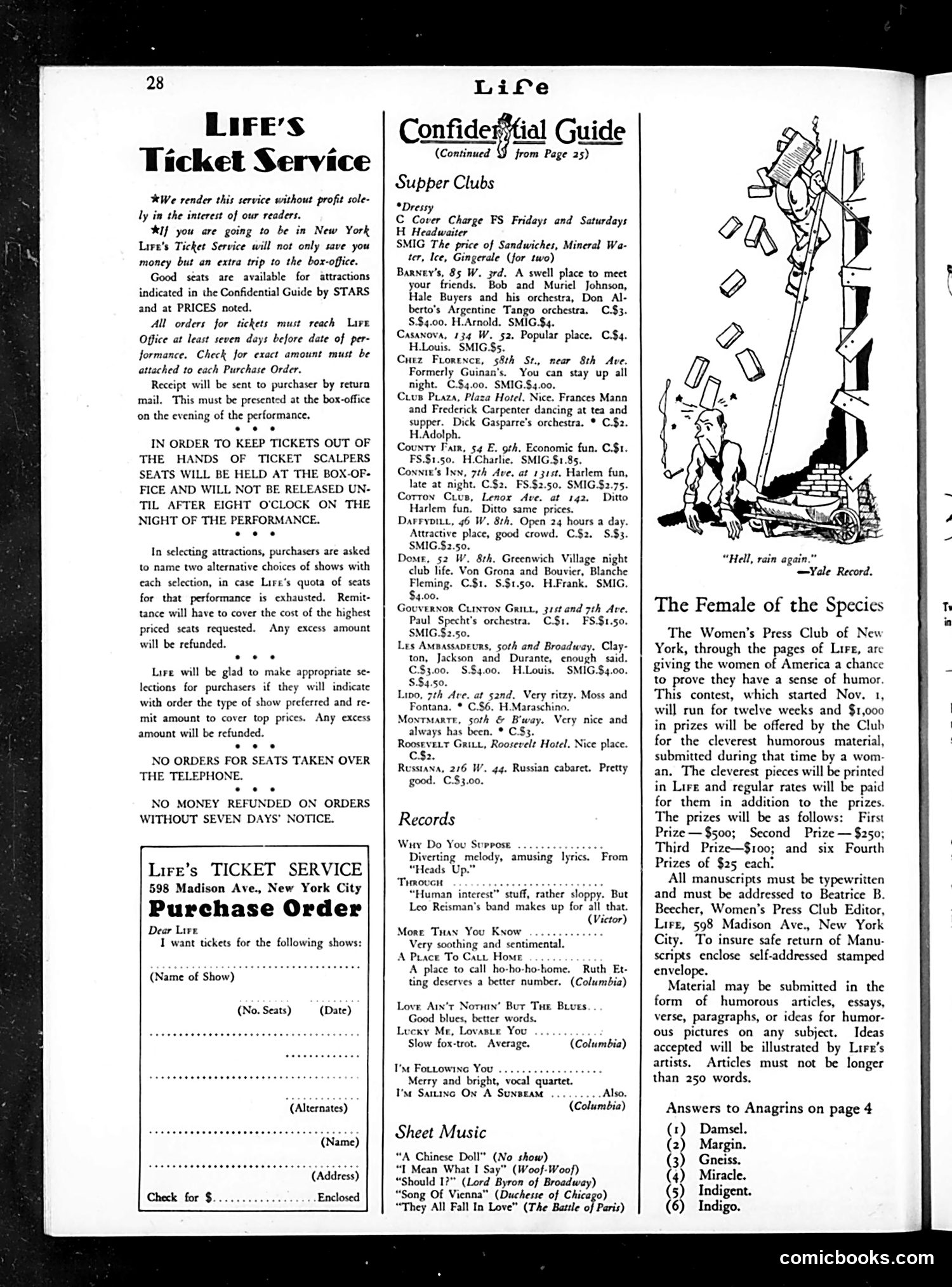
Analysis of This Life Magazine Page This page is primarily administrative and advertising content rather than political satire. It contains: 1. Life's Ticket Service (left column): A practical service allowing readers to purchase Broadway theater tickets by mail, with detailed ordering instructions and terms. This addresses ticket scalping by holding seats until 8 PM on performance night. 2. "Confidential Guide" (center): A listing of NYC supper clubs with cover charges, headwaiters' names, and orchestras—including Harlem venues like Connie's Inn and Cotton Club, reflecting the Jazz Age nightlife scene. 3. The cartoon (top right): A small illustration captioned "Hell, rain again—*Yale Record*" showing a figure climbing a drainpipe in rain, likely a college humor joke about avoiding detection (possibly sneaking out). 4. "The Female of the Species" (right): An announcement of a humorous writing contest for women, with $1,000 in prizes. The page reflects 1920s entertainment culture and Life magazine's service-oriented approach to its readership rather than political commentary.
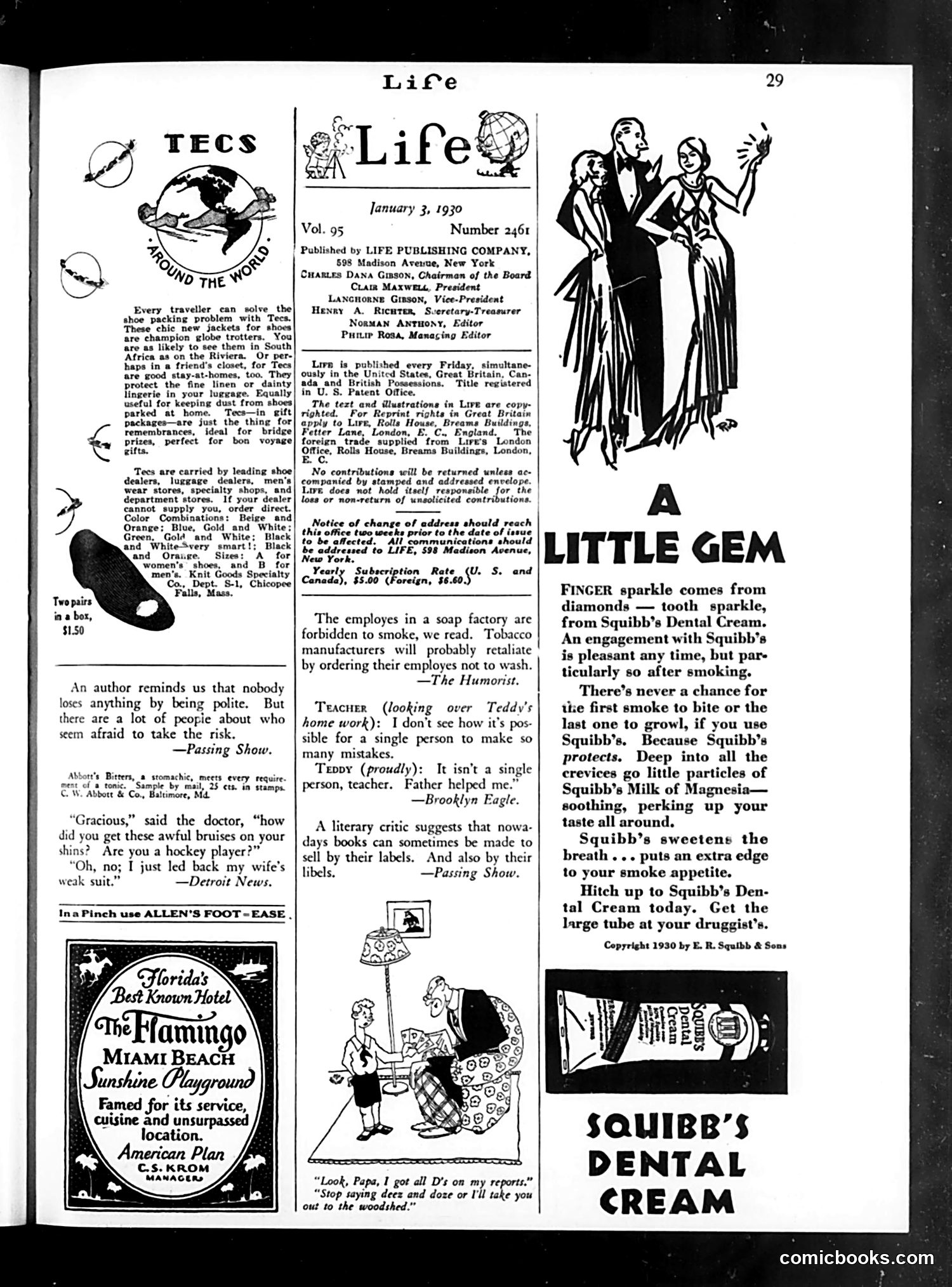
Life Magazine, January 3, 1930 - Page Analysis This is primarily a magazine contents/advertising page rather than political satire. The page features: Main cartoon: A domestic scene showing a father and children, with a child reporting school grades. The joke plays on ethnic dialect humor common to 1930s comedy—the child says "deez and doze" (attempting "these" and "those"), and the father threatens the "woodshed" as punishment. This reflects period attitudes about correcting immigrant or working-class speech patterns. Advertisements: The page is dominated by product ads (Squibb's Dental Cream, Tecs shoe bags, Allen's Foot-Ease, The Flamingo hotel) typical of Life's revenue model. Humorous snippets: Brief jokes about politeness, hockey injuries, and book publishing fill margins—standard filler material. No significant political content is visible. The humor is domestic and commercial rather than satirical commentary on current events.
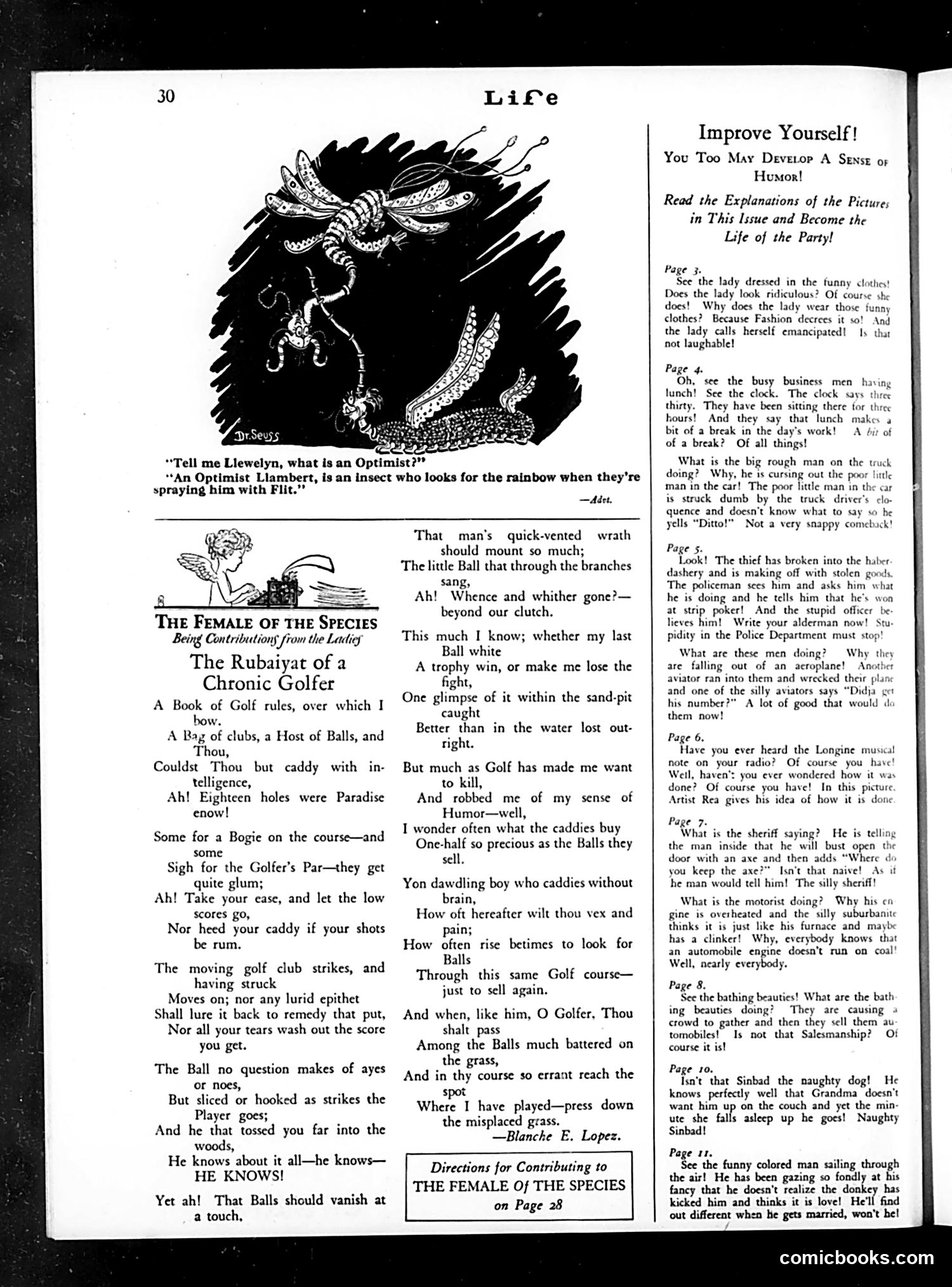
Explanation for Modern Readers This is a 1920s *Life* magazine page mixing humor with social commentary. The top cartoon jokes about "Flit" (a popular insecticide spray brand), defining an optimist as an insect seeking rainbows while being sprayed—a darkly funny advertisement-based gag. The main content is "The Rubaiyat of a Chronic Golfer," a parody of Omar Khayyam's philosophical poem, applying its existential tone to golf obsession. It satirizes golfers' frustration with lost balls, incompetent caddies, and the sport's emotional toll ("robbed me of my sense of Humor"). The right column mocks various social groups—fashionable women, businessmen, traffic situations, aviators—in deliberately crude humor labeled "Improve Yourself!" This reflects 1920s satire's approach: identifying target groups and explaining why they're ridiculous, assuming readers would find it amusing rather than offensive. The humor depends on period-specific references (Flit ads, golf culture, fashion norms) largely lost today.
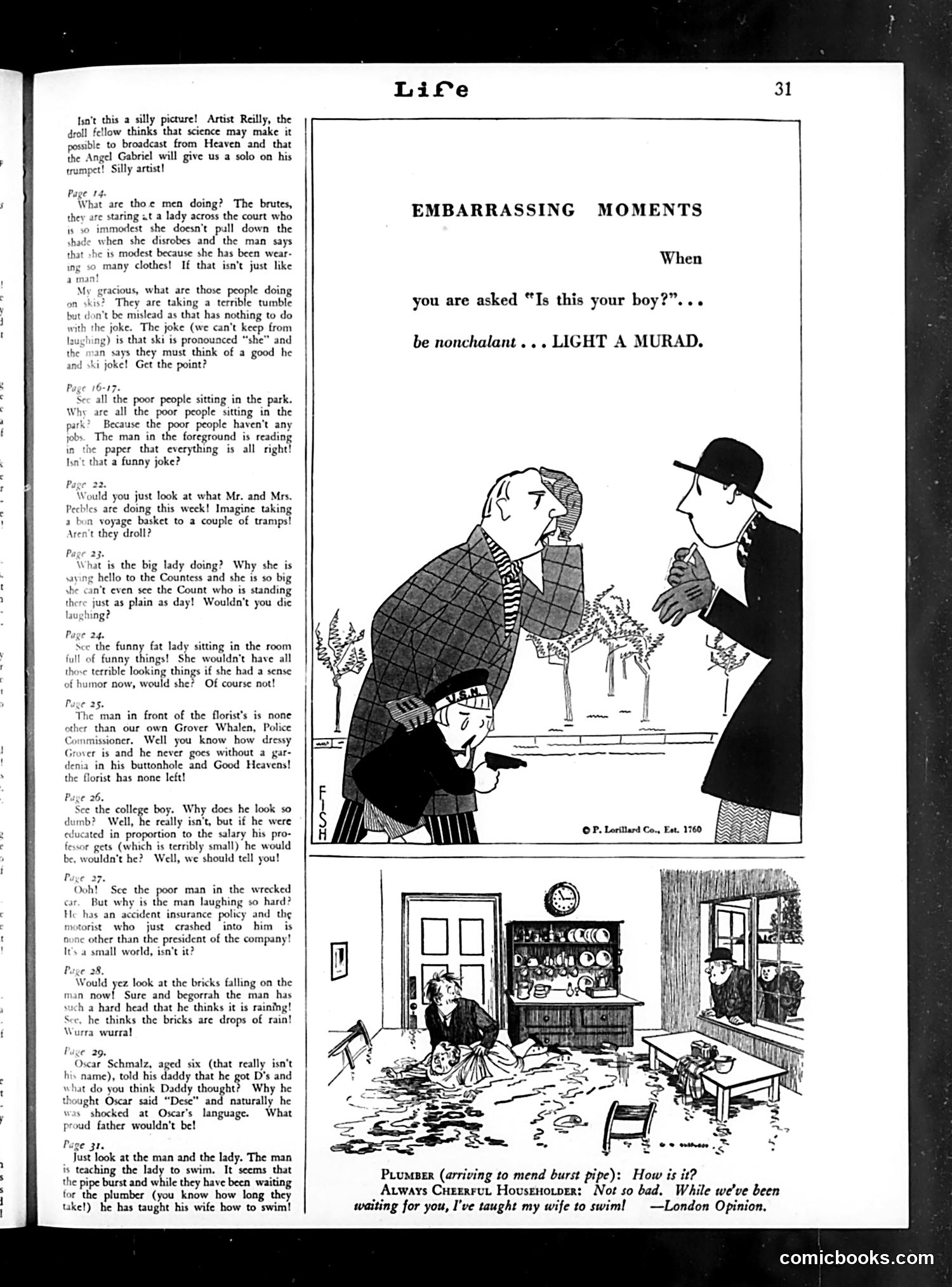
"Embarrassing Moments" - Life Magazine Page 31 This page features two cartoons satirizing social awkwardness and masculine pretense. Top cartoon: A man caught in an embarrassing situation—asked if a child is his son—is advised to "light a Murad" (a cigarette brand). The joke mocks masculine posturing: smoking supposedly projects nonchalance to deflect from social discomfort. Bottom cartoon: A plumber arrives to fix a burst pipe. The homeowner boasts he's taught his wife to swim during the wait—a absurd, self-aggrandizing claim meant to impress. The plumber's deadpan response ("How is it?") undercuts the man's pretension. Both cartoons target male vanity and the ridiculous lengths men go to maintain appearances of competence or sophistication, even in trivial or embarrassing moments. The humor relies on recognizing the transparent desperation behind these gestures.
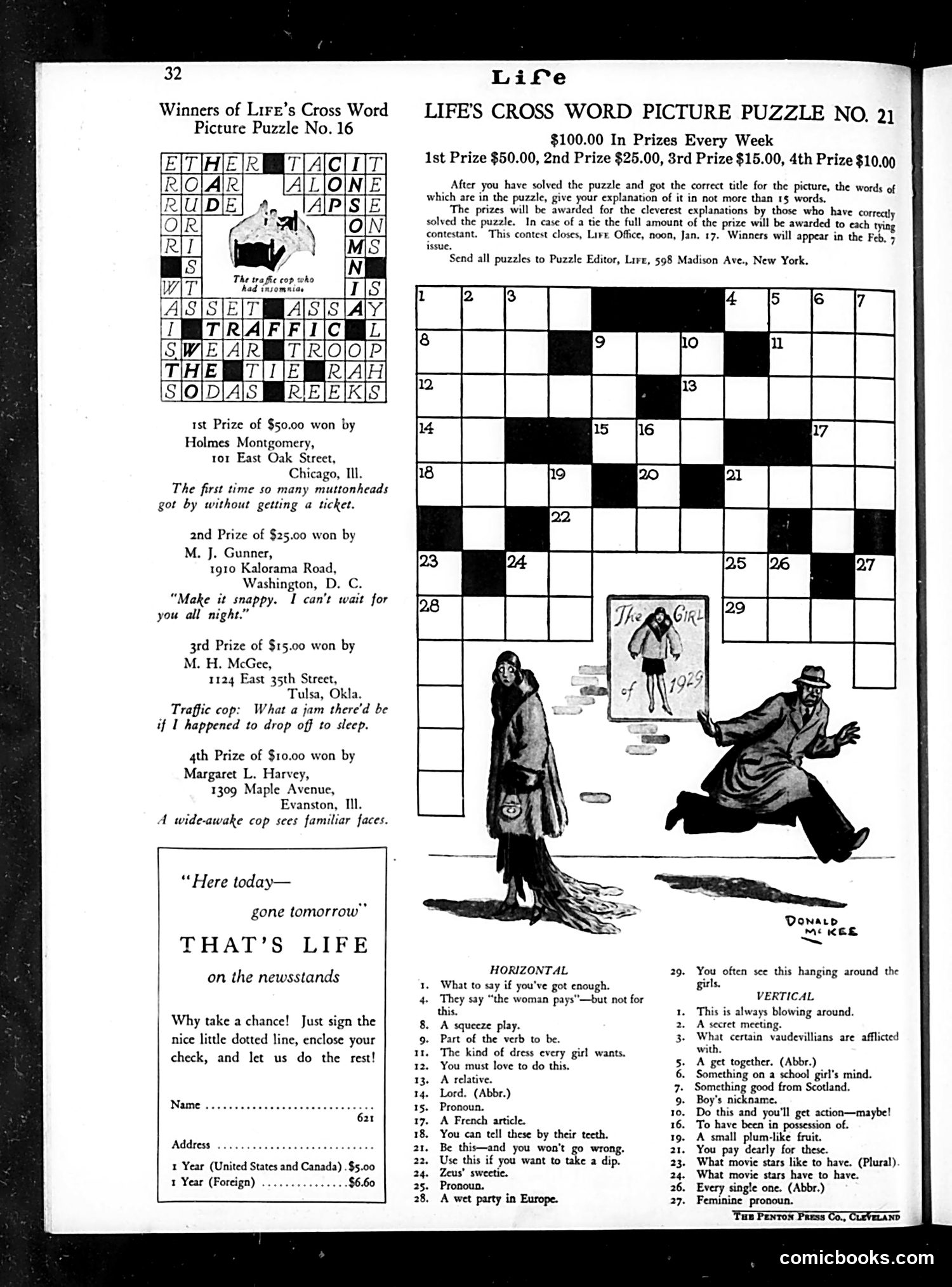
Life Magazine Cross-Word Puzzle Page This page is primarily a puzzle contest, not political satire. It features Life magazine's weekly cross-word picture puzzle competition offering $100 in prizes. The small cartoon at top left shows a traffic cop with insomnia—a light joke about a sleepy policeman worrying that if he dozed off, traffic chaos would ensue. The humor relies on the irony that a cop is supposed to maintain order, yet acknowledges his own vulnerability to fatigue. Below are the winning explanations from the previous puzzle, each with humorous observations about everyday situations: muttonheads evading tickets, a cop's impatience, and a traffic officer recognizing repeat offenders. The lower illustration depicts a woman in 1920s attire ("The Girl of 1929") with a man in a suit fleeing or gesturing wildly—likely commenting on modern dating or courtship customs of the era, though the specific reference isn't entirely clear without solving the associated puzzle. The page functions as entertainment and reader engagement rather than editorial commentary.
"The New Marmon Big Eight" This appears to be an automobile advertisement rather than a political cartoon. The page promotes the Marmon Big Eight, a luxury car manufactured by the Marmon Motor Car Company. The image shows a stylized, dramatic photograph of the vehicle's front end, emphasizing its distinctive headlights and grille design against a dark background. The ad uses theatrical lighting and composition typical of 1920s-30s automotive marketing. The faint body copy (largely illegible in this reproduction) likely emphasizes the car's engineering features and performance capabilities—standard messaging for luxury automobiles of this era competing in an upscale market. This is not satirical content but rather a straightforward commercial appeal to affluent readers of *Life* magazine.
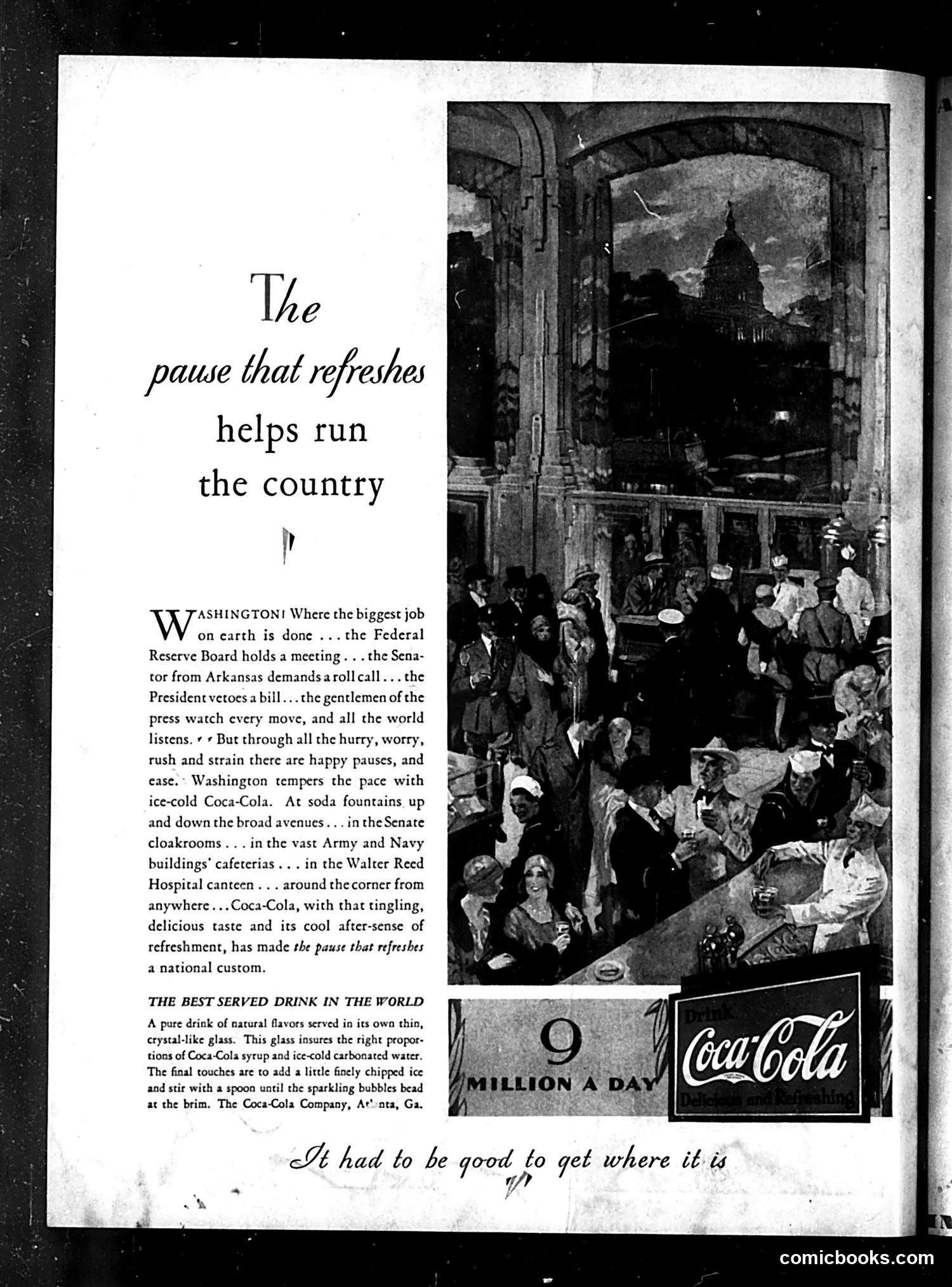
Analysis of This Coca-Cola Advertisement This is a Coca-Cola advertisement, not political satire. The page uses the machinery of American government—Federal Reserve meetings, Senate roll calls, presidential vetoes, press scrutiny—as a backdrop to promote Coca-Cola as a national institution. The advertisement's conceit is that despite Washington's intense workload and stress ("hurry, worry, rush and strain"), Coca-Cola provides necessary mental refreshment across all government and military spaces: Senate cloakrooms, cafeterias, hospitals. The phrase "the pause that refreshes" anchors the pitch: that a Coke break is essential to keeping the country running smoothly. The image shows crowds at what appears to be a government or public building, suggesting Coca-Cola's ubiquitous presence in American civic life. This reflects mid-20th-century advertising strategy: associating a consumer product with patriotism and national function to position it as practically indispensable to American governance and daily life.