life
Life — January 17, 1930
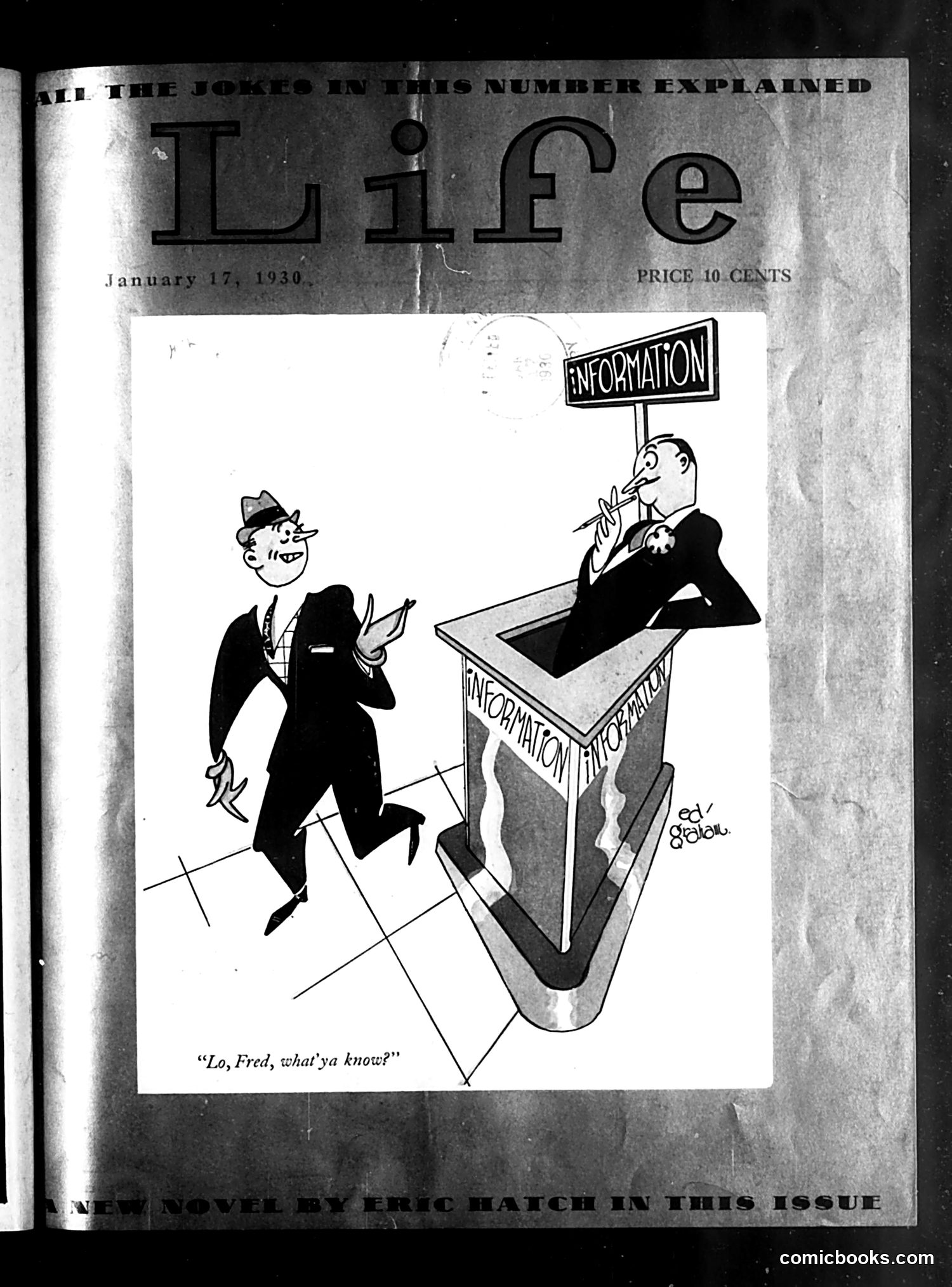
Analysis of Life Magazine Cover (January 17, 1930) This cartoon satirizes the era's obsession with information and publicity. A man emerging from a large megaphone-labeled "INFORMATION" box asks another man, "Lo, Fred, what'ya know?" — suggesting that the first figure has literally just climbed out of the information apparatus itself. The joke targets how information had become a commodity and spectacle in the 1920s-30s, with mass media, advertising, and public relations proliferating. The cartoon mocks the disconnect between actual knowledge and the constant stream of manufactured "information" flooding public discourse. By literally embedding a man inside an information dispenser, the artist suggests people are drowning in or consumed by the information age rather than genuinely informed.
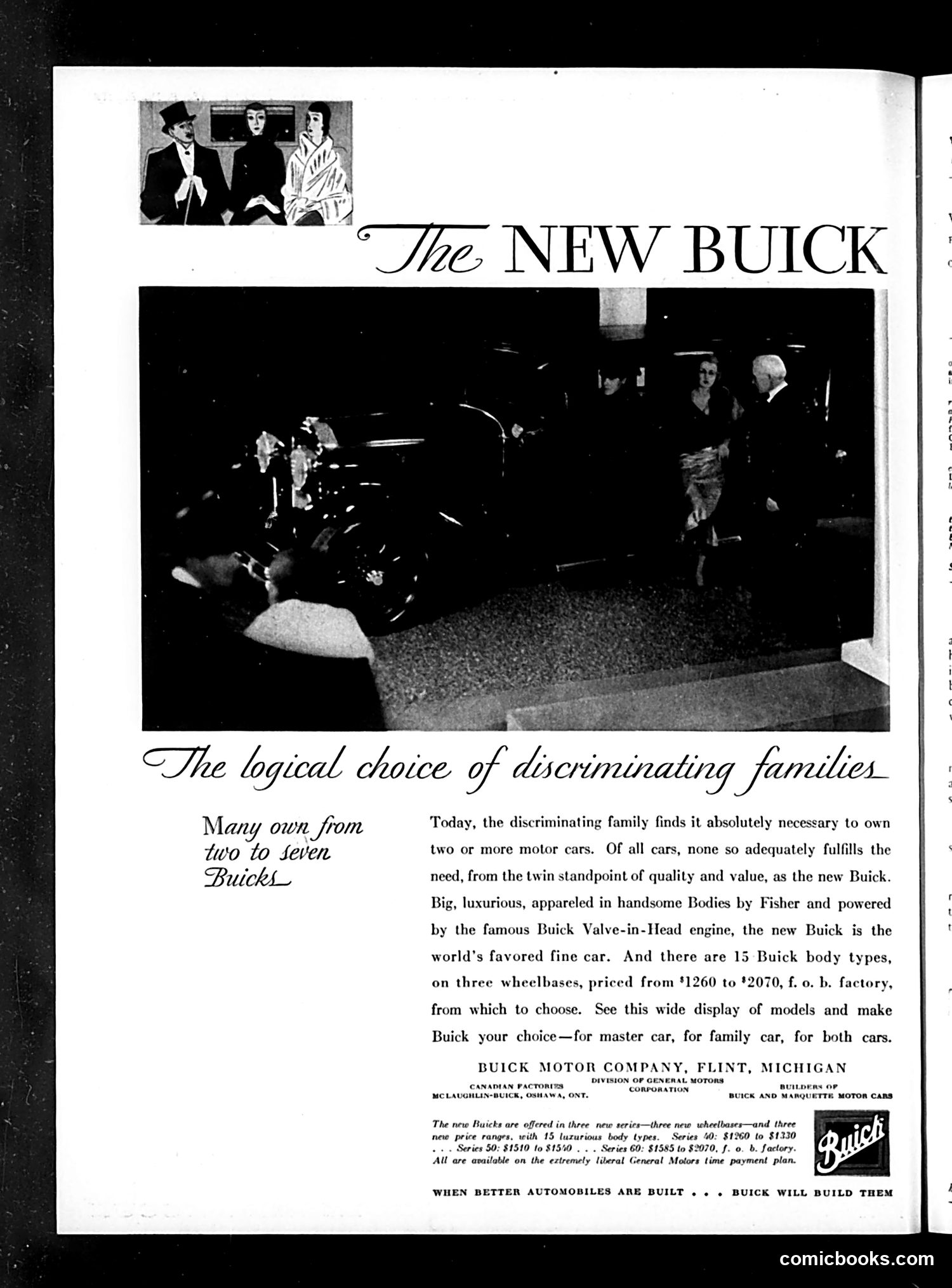
Analysis This is primarily a Buick automobile advertisement, not satirical content. The page shows a promotional layout for "The New Buick" from Buick Motor Company in Flint, Michigan. The small illustration at top depicts three well-dressed figures (appearing to represent affluent consumers) examining or discussing a vehicle—a common advertising trope suggesting sophisticated taste and endorsement. The advertisement's headline—"The logical choice of discriminating families"—appeals to middle-to-upper-class readers by suggesting Buick ownership signals refinement and good judgment. The text emphasizes the car's luxury features, Fisher bodies, and valve-in-head engine as justification for the premium pricing ($1,260-$2,070). This represents typical 1920s-era automotive advertising strategy: linking product consumption to social status and family values rather than purely mechanical specifications.
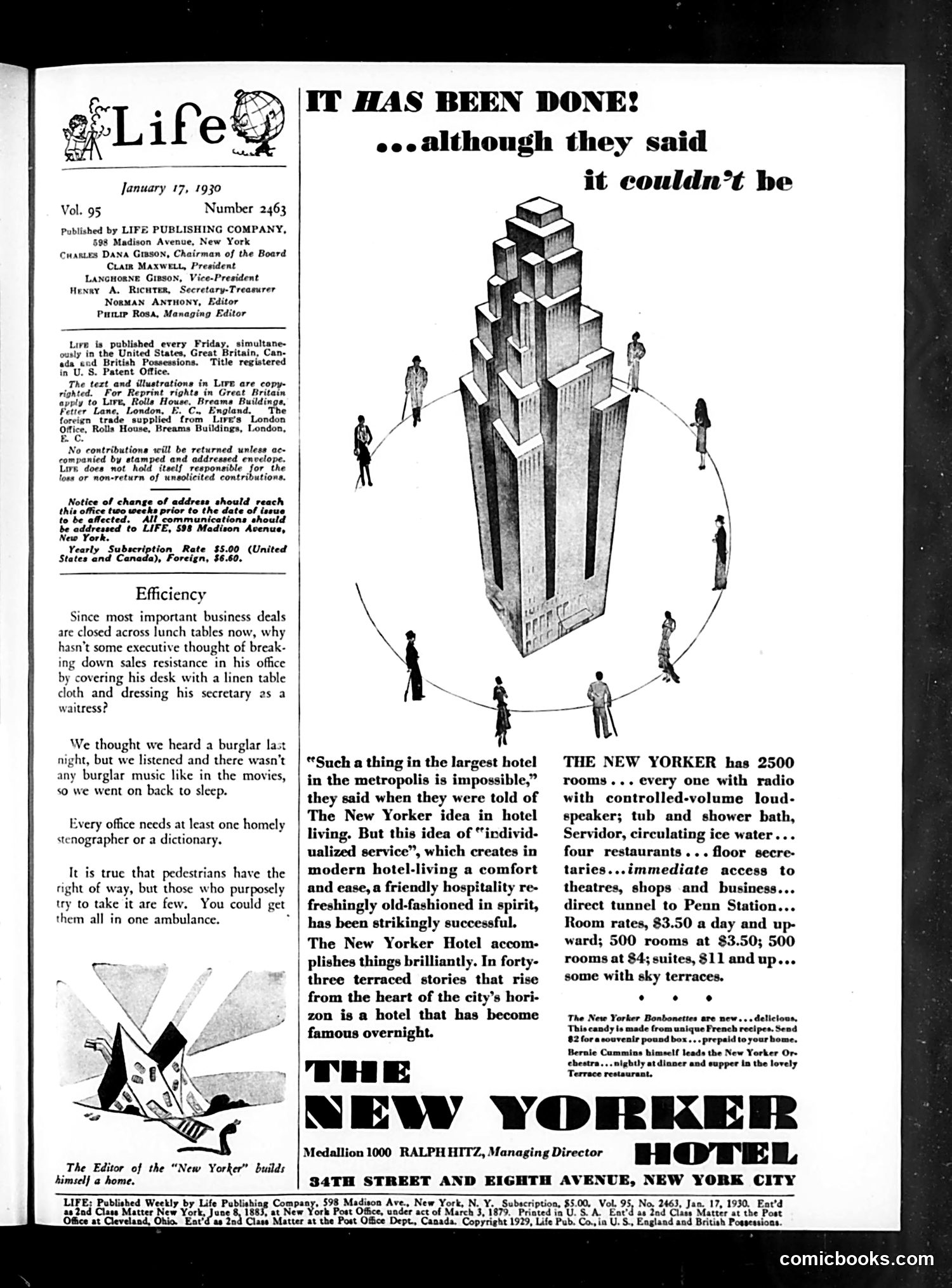
Page Analysis: Life Magazine, January 17, 1939 This page is primarily an advertisement for The New Yorker Hotel, with a small humor section above it. The main cartoon shows a tall Art Deco skyscraper surrounded by tiny figures, captioned "Such a thing in the largest hotel in the metropolis is impossible," they said when told of The New Yorker idea in hotel living." The satire: The ad humorously claims the hotel achieved something "impossible"—offering individualized service and modern comfort in a massive 43-story building. The small figures circling the enormous tower emphasize the hotel's impressive scale while suggesting skeptics doubted such personal attention could exist in such a large structure. The page is essentially a playful advertisement leveraging self-deprecating humor to promote the hotel's innovative service model.
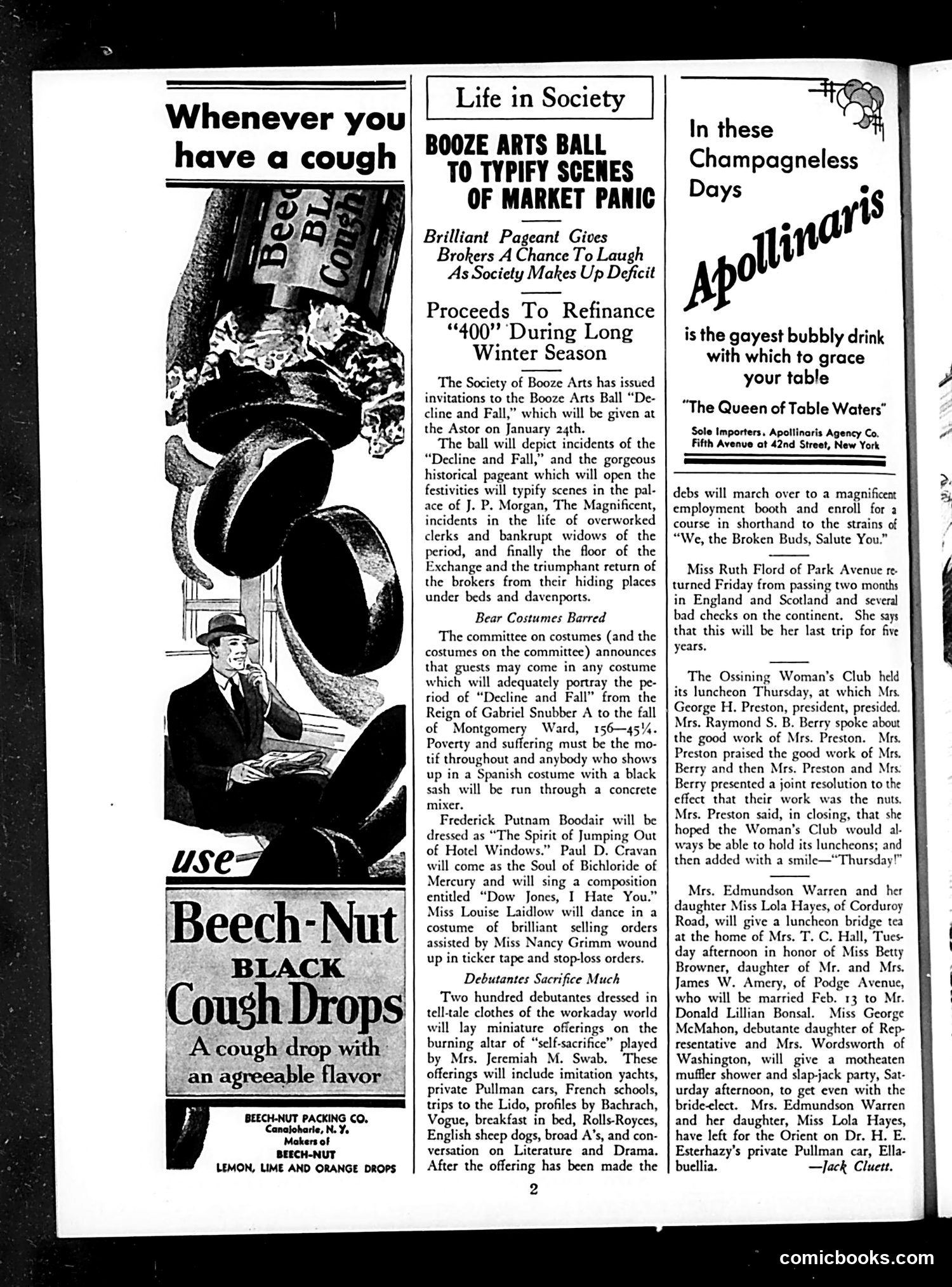
Page Analysis This page mixes satire with advertising. The left side features a cough-drop ad using humor: a man sits beneath a towering bottle of "Beech-Nut Black Cough Drops," suggesting the product's effectiveness through exaggerated scale. The center satirizes high society through the "Booze Arts Ball"—a charity pageant depicting "Decline and Fall." The satire appears to mock wealthy New Yorkers' lavish fundraising during economic hardship (likely the 1920s stock market context referenced as "market panic"). Guests would wear historical costumes representing financial ruin, the irony being that the privileged are playacting poverty. The right side contains society notices about debutantes, weddings, and club luncheons—standard upper-class announcements. The Apollinaris advertisement promotes champagne as fashionable. Overall, the page reflects 1920s class consciousness and satirizes wealth disparity.
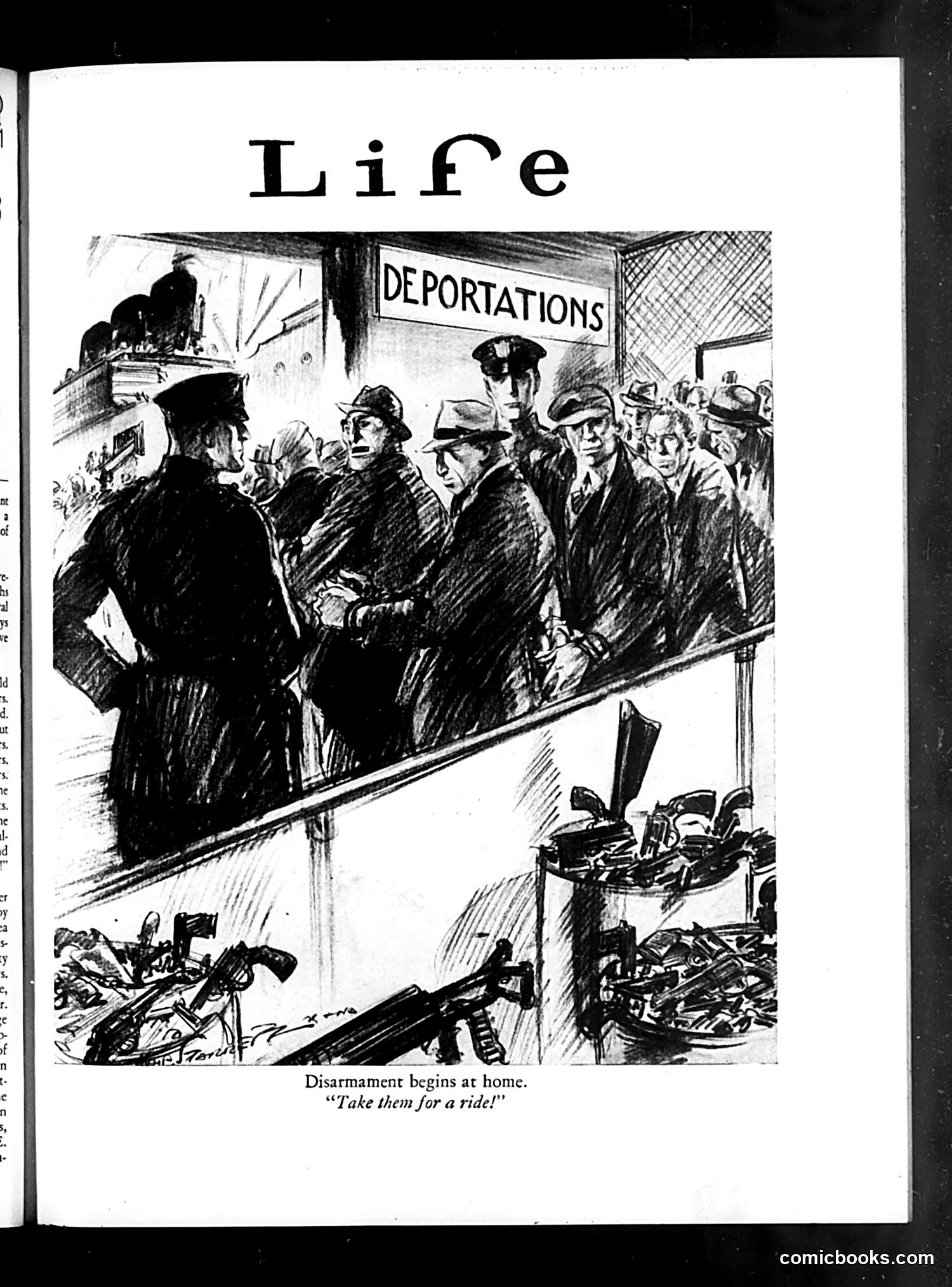
Analysis This Life magazine page satirizes early 20th-century military disarmament efforts. The cartoon depicts a "Deportations" scene—a government office where civilians are being processed. The caption "Disarmament begins at home" with the ironic suggestion "Take them for a ride!" is dark political satire. The piled weapons in the foreground contrast with the crowd of ordinary people being deported. The joke targets the contradiction between official disarmament policies (reducing military weapons) and actual government actions—apparently forcibly removing citizens rather than genuinely pursuing peace. This likely references either pre-WWI pacifist debates or post-WWI deportation policies (the U.S. conducted deportations of "radical" immigrants in the 1920s). The satire mocks the hypocrisy of claiming peaceful intentions while using authoritarian methods against the population.
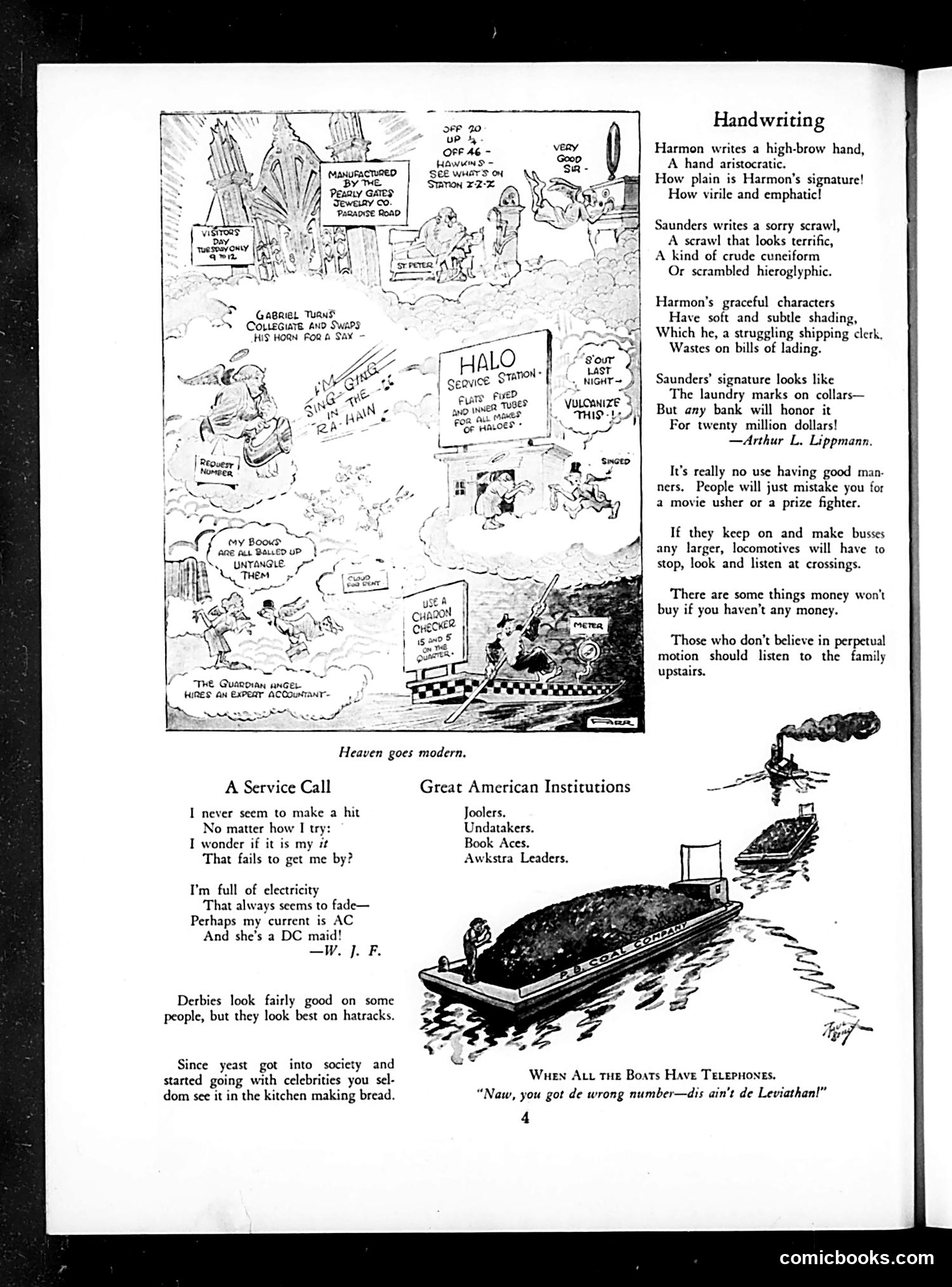
Analysis of Life Magazine Page This page satirizes modern American life through multiple sketches and commentary. The main cartoon titled "Heaven goes modern" depicts various contemporary institutions and services, mocking their inefficiency and commercialism. References include "Halo Service Station," "Gabriel Turned Your Luggage and His Honor For a Day," and "The Guardian Angel Here on Expert Accountant" — suggesting even heavenly concepts have been commodified. The "Handwriting" section critiques business correspondence styles, contrasting "Harmon's" refined penmanship against "Saunders' " crude scrawl, with commentary by Arthur L. Lippmann about mistaken identity and social class. Additional satirical pieces mock electricity's unreliability ("A Service Call") and include a humorous afterthought about yeast becoming fashionable in society. The overall tone ridicules America's obsession with modernization, efficiency, and commercialism infiltrating all aspects of life.
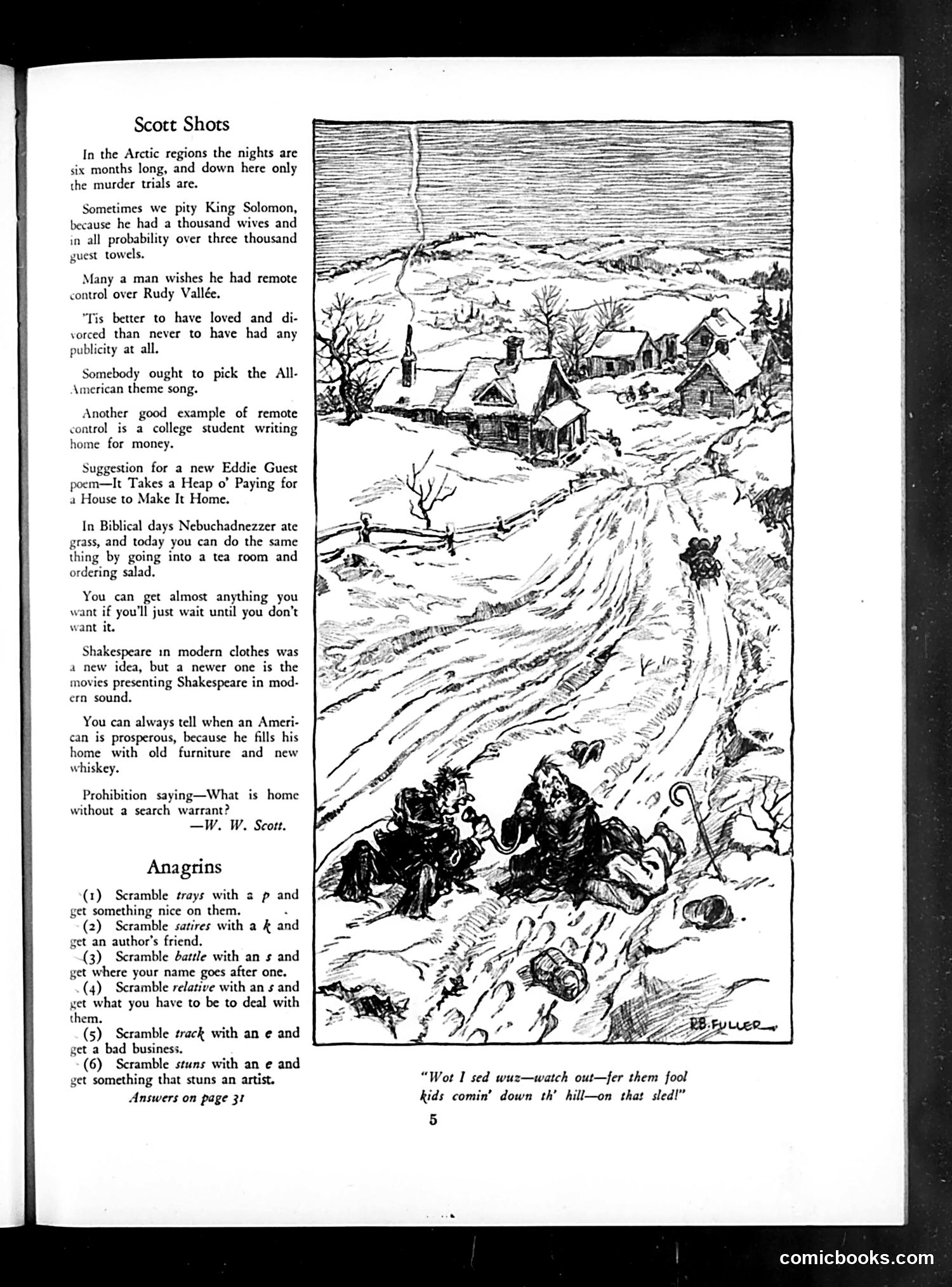
"Scott Shorts" - A Satirical Commentary Page This page from *Life* magazine contains humorous social observations titled "Scott Shorts," followed by a winter landscape illustration showing two figures sledding down a snowy hill toward houses below. The "Scott Shorts" section offers brief satirical jabs at American society and culture—commenting on polygamy (King Solomon), divorce, remote living, college students, biblical references, consumerism, Shakespeare adaptations, and prosperity. The final prohibition-era quip about home furnishings and whiskey suggests the piece dates to the 1920s-early 1930s. Below is an "Anagrins" word puzzle section with scramble instructions. The sledding illustration's caption—"Wet I sed wuz—watch out—fer them fool kids comin' down th' hill—on that sled!"—depicts rural American vernacular and suggests dangers of winter recreation for children.
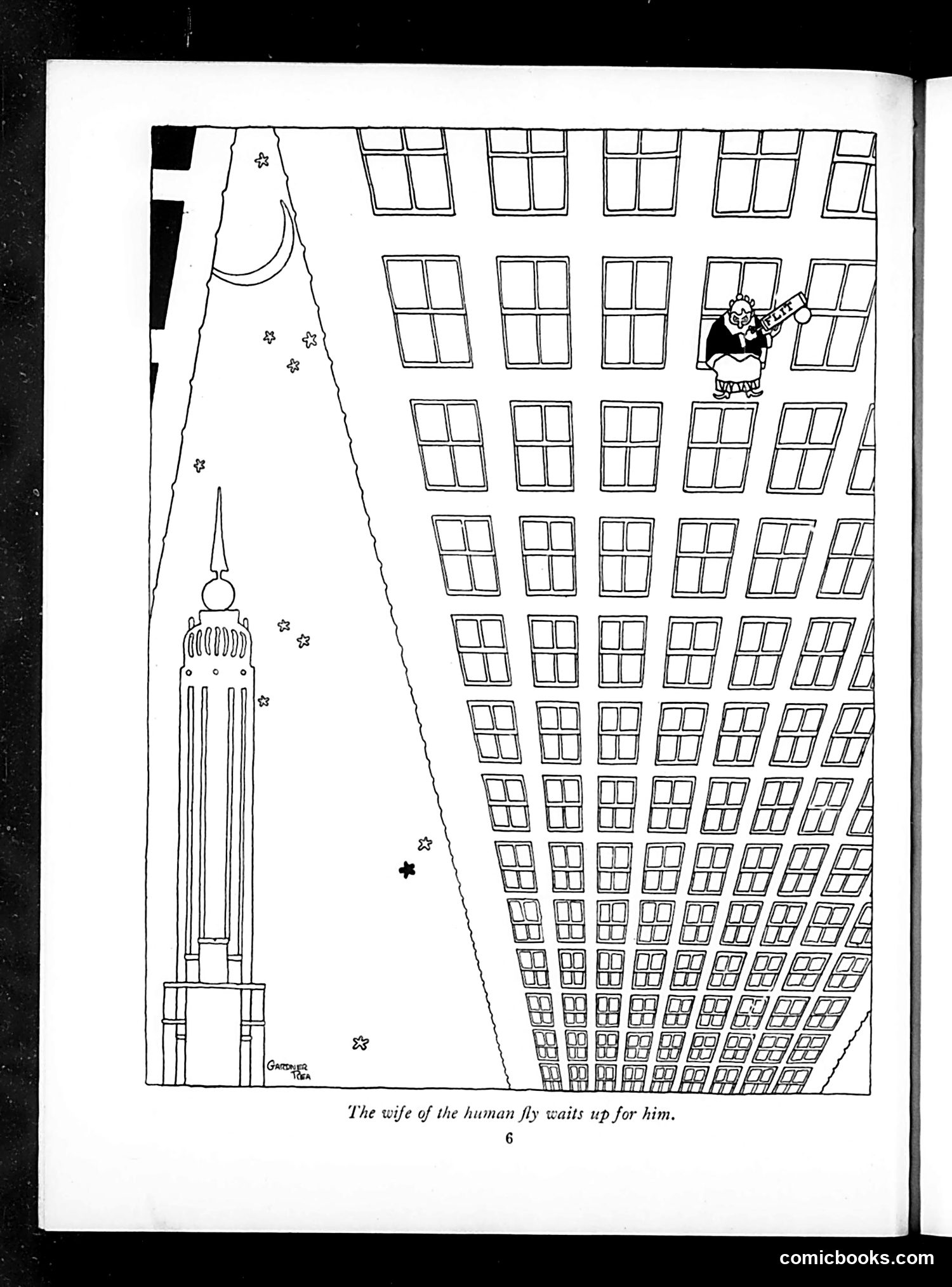
Analysis This is a single-panel cartoon depicting a surreal, science-fiction scenario. The caption reads: "The wife of the human fly waits up for him." The cartoon shows a woman looking out a window of a tall building (resembling the Empire State or similar Art Deco skyscraper), while a man in formal attire clings to the building's exterior wall among its many windows. The night sky with stars surrounds them. The joke plays on the contemporary "human fly" phenomenon—daredevil performers who literally climbed the exteriors of buildings, a popular stunt act in the early-to-mid 20th century. The satire depicts the domestic anxiety such a dangerous occupation would create for a spouse, imagining her waiting anxiously while he performs his death-defying climbs. It's absurdist humor treating an impossible profession as mundane reality.
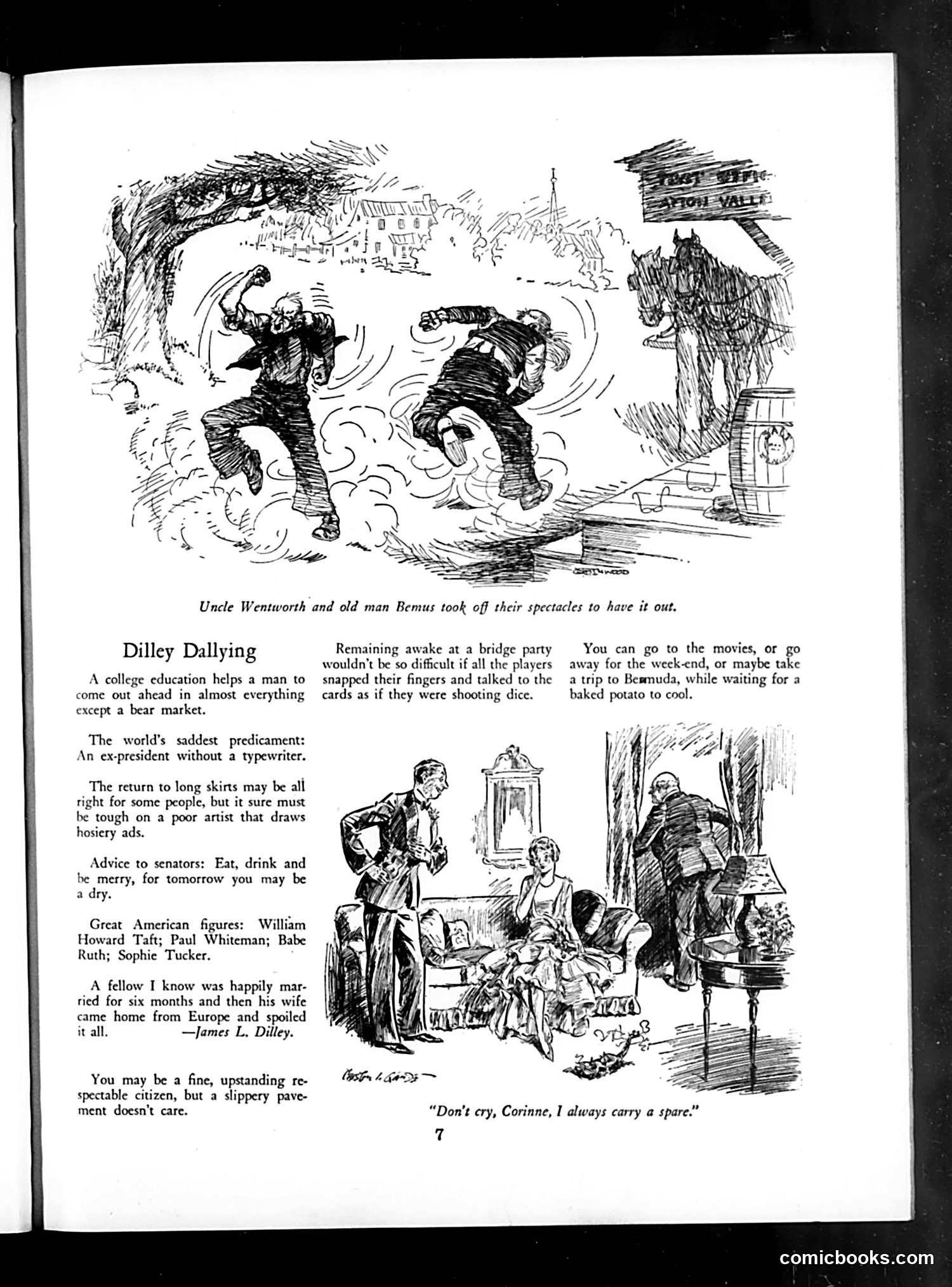
Analysis of "Dilley Dallying" Page This page contains humor pieces and cartoon illustrations by James L. Dilley for *Life* magazine. The top cartoon depicts two men fighting energetically while onlookers watch—captioned "Uncle Wentworth and old man Bemus took off their spectacles to have it out," suggesting elderly men removing glasses before a brawl, a humorous trope about fights. The main content consists of satirical observations about American life, including jabs at ex-presidents without typewriters, long skirts' impact on artists, and senators' behavior. The lower illustration shows a domestic scene with the caption "Don't cry, Corinne, I always carry a spare," likely a joke about infidelity or marital discord. These are general social satires rather than specific political commentary—mocking contemporary mores, fashion, and human foibles.
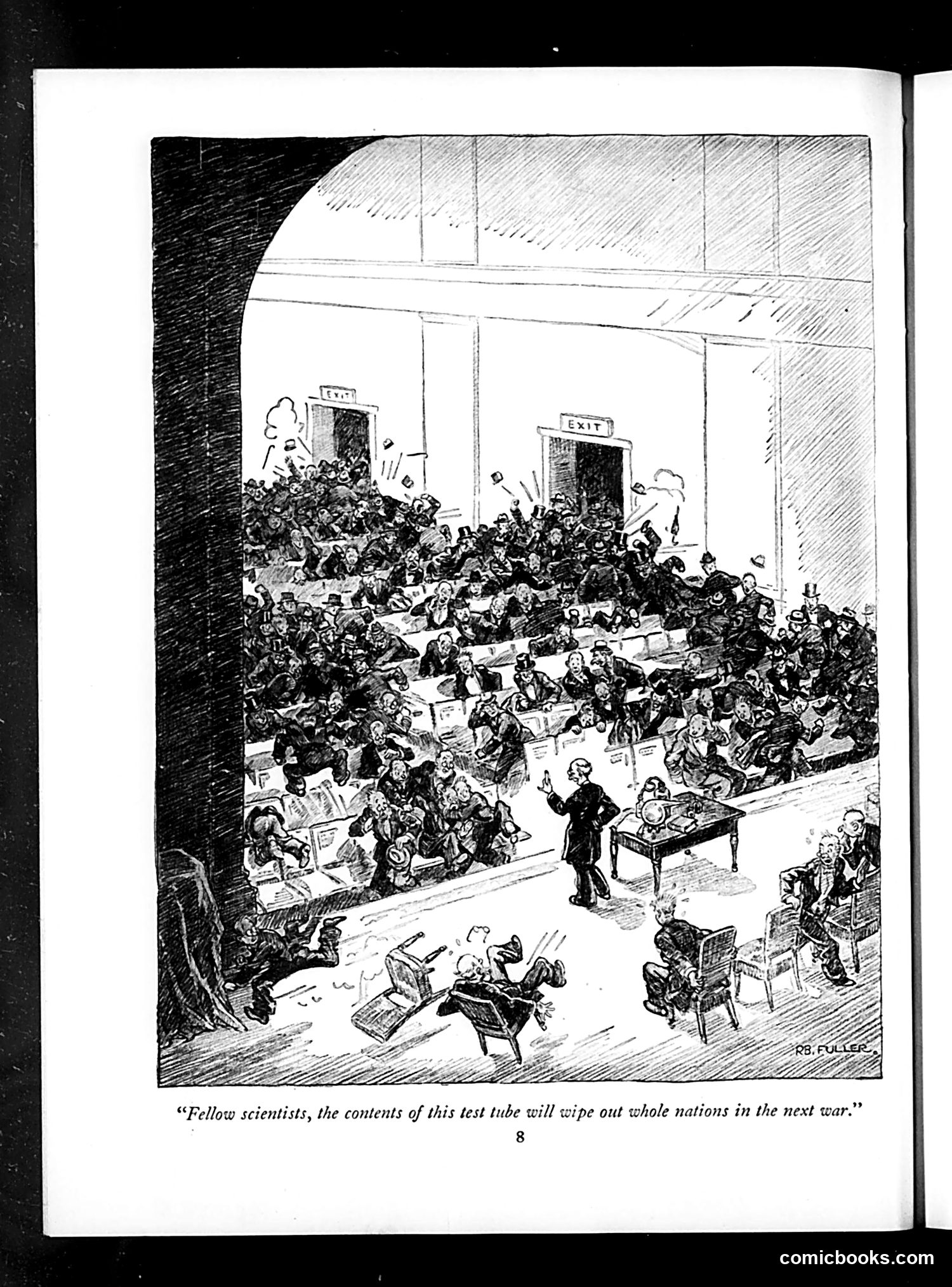
Explanation for Modern Readers This cartoon satirizes scientific meetings and weapons development anxiety. A speaker addresses a crowded auditorium of scientists, declaring: "Fellow scientists, the contents of this test tube will wipe out whole nations in the next war." The satire works on multiple levels: it mocks both the grandiose rhetoric of scientists promoting their work and the widespread fear—likely from the interwar or early WWII period—that scientific advancement would inevitably produce devastating new weapons. The packed auditorium suggests both the era's fascination with science and growing public dread about its military applications. The artist (signed "R. FULLER") presents this as darkly comic absurdity: a scientist essentially bragging about apocalyptic potential to an audience that seems both horrified and mesmerized. The cartoon reflects contemporary anxieties about scientific progress outpacing ethical restraint.
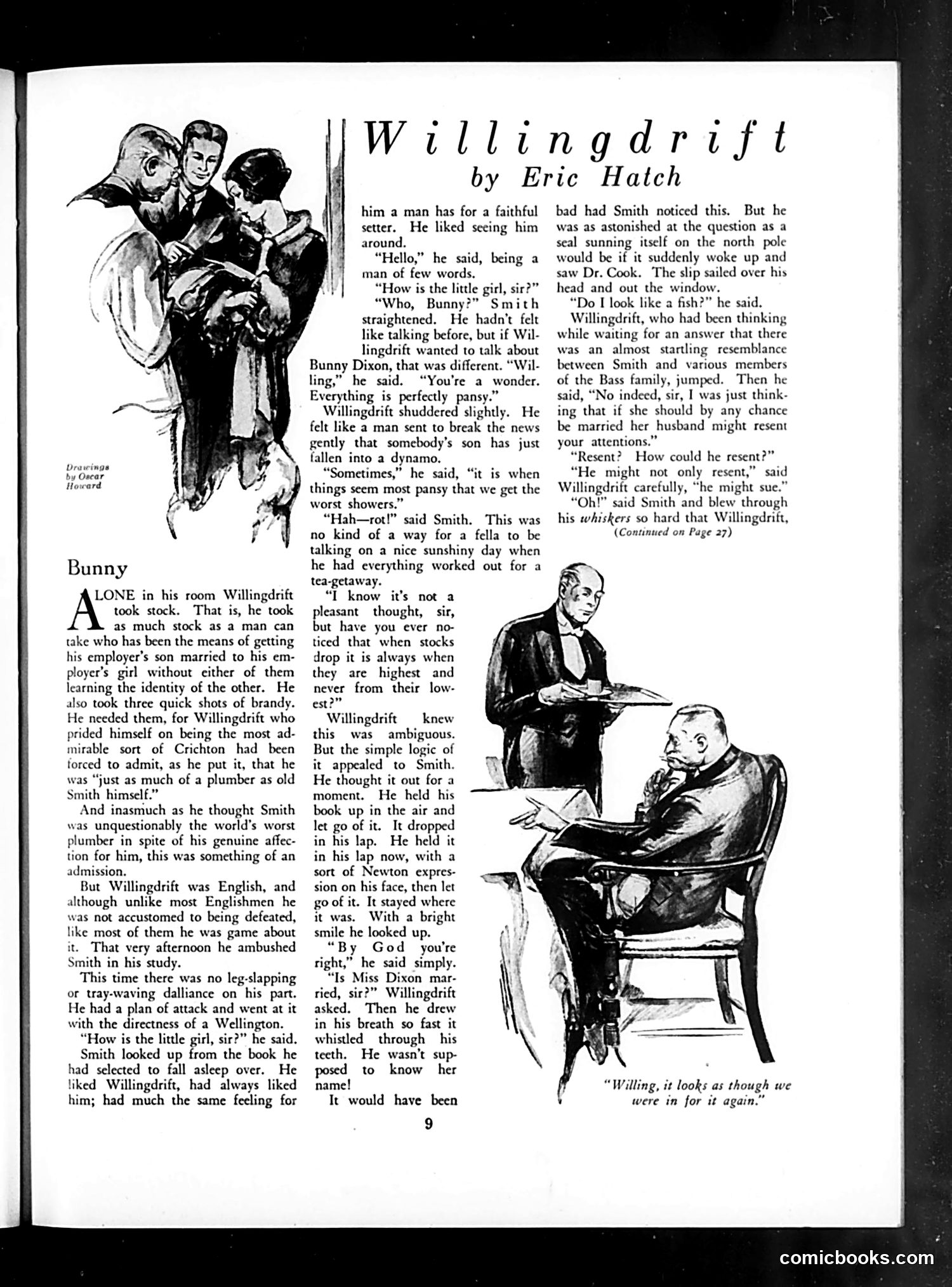
"Willingdrift" by Eric Hatch This is a short story (not political satire) about a man named Willingdrift navigating romantic and social complications. The narrative describes his attempt to arrange his employer's son's marriage to the employer's daughter without the parties involved knowing each other's identities. The story plays on themes of class ambition and social maneuvering—Willingdrift positions himself as the "most admirable sort of Crichton" (referencing the "admirable Crichton," a perfect servant). The humor derives from his overconfidence in orchestrating others' affairs and the ironic complications that ensue when his plans unravel. The illustrations show character interactions and domestic scenes. This appears to be light fiction rather than political commentary.
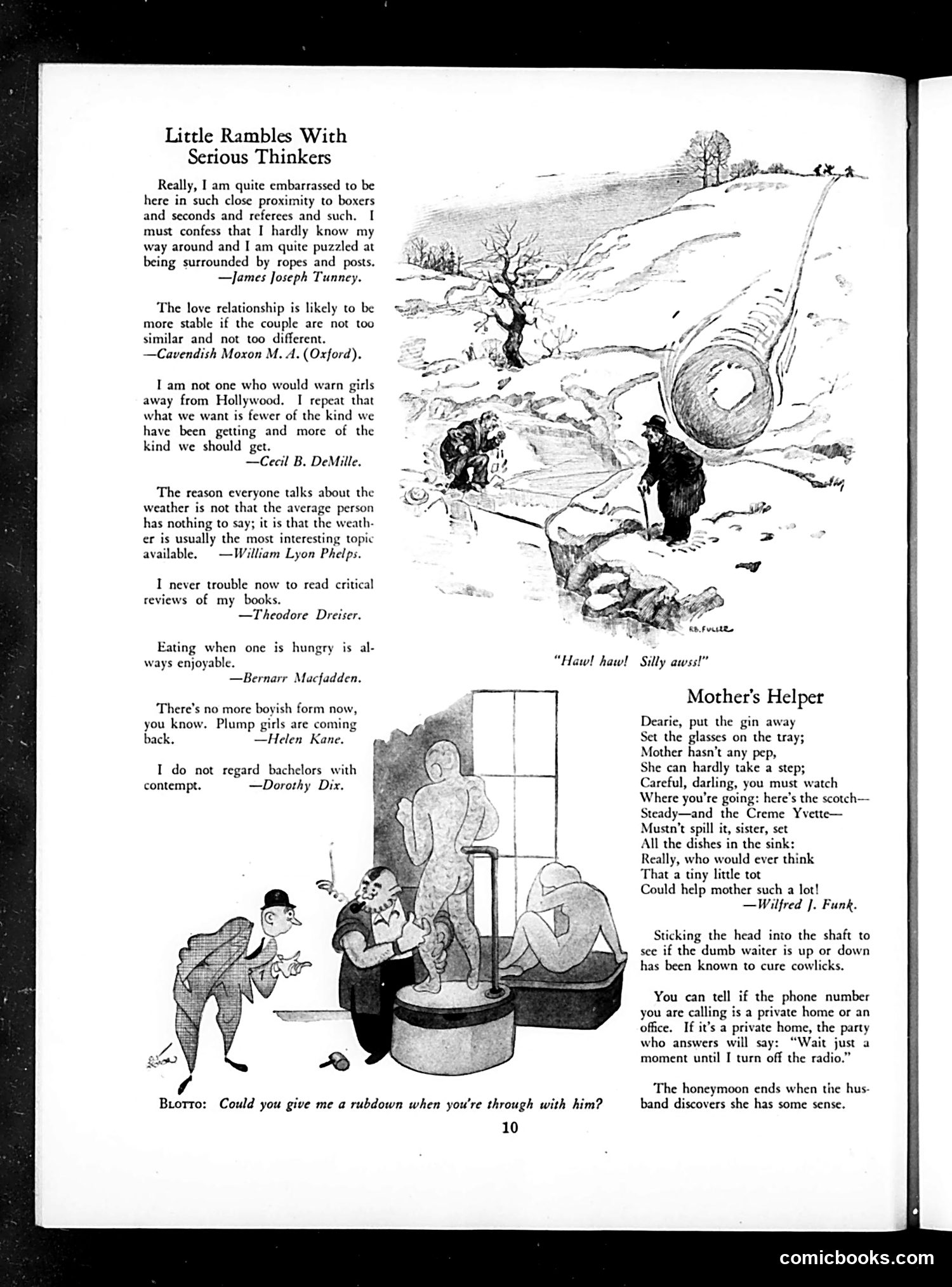
Analysis of Life Magazine Page 10 This page contains a collection of brief satirical quotes ("Little Rambles With Serious Thinkers") paired with two cartoons. The upper cartoon depicts two figures in a snowy landscape with a large spherical object, captioned "Haul! haul! Silly awls!" The humor appears visual rather than textually explained. The lower cartoon shows a small man confronting a large woman in an interior setting, with the caption "Could you give me a rubdown when you're through with him?" — suggesting domestic/relationship humor about physical size disparity. The "Mother's Helper" poem on the right offers satirical advice to a daughter helping with household tasks, poking fun at the tedium of domestic work and the challenges of childcare. The scattered quotations mock various public figures' pretentious or mundane observations about life.
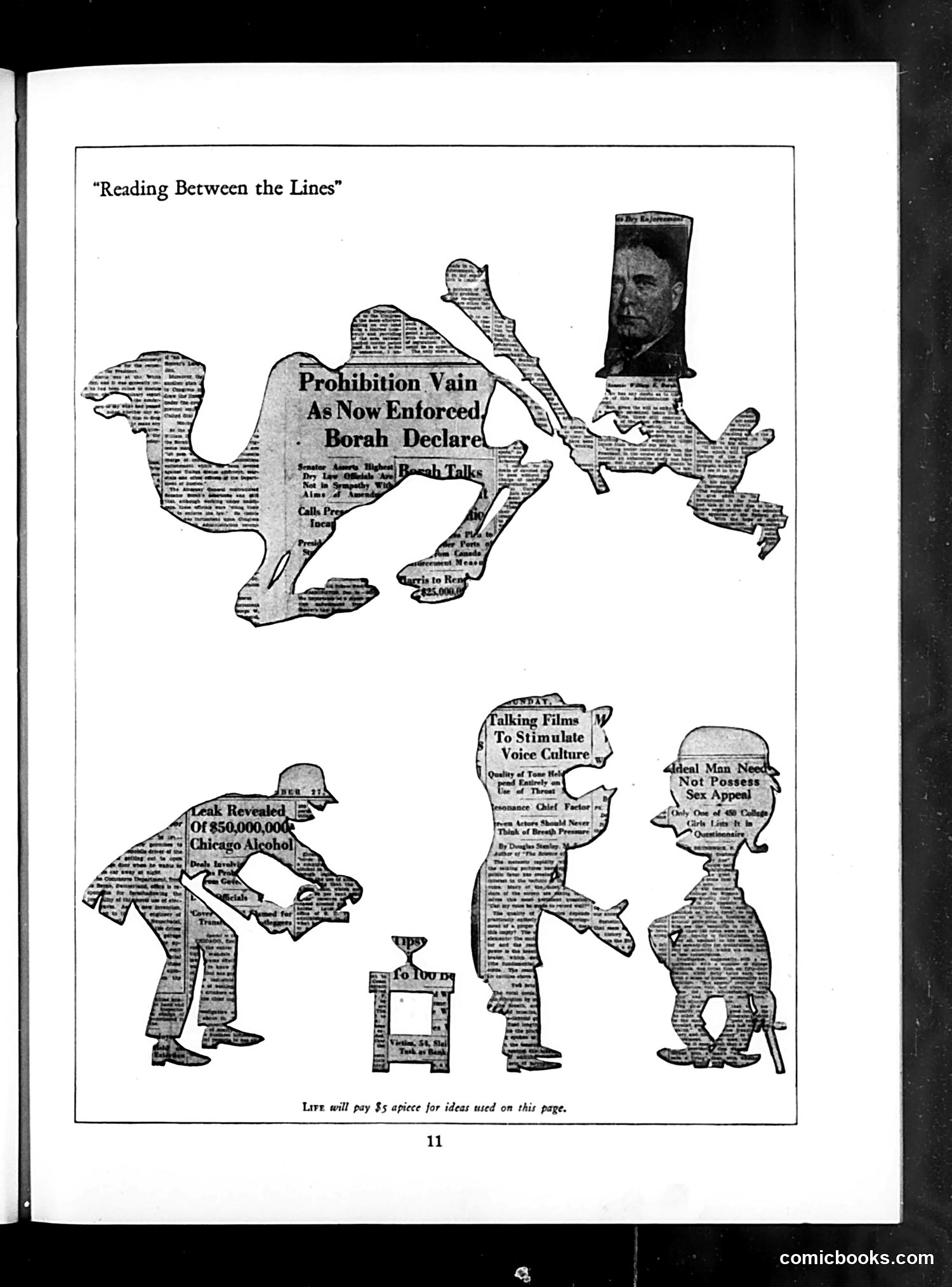
"Reading Between the Lines" Analysis This is a satirical collage using silhouettes filled with newspaper text—a visual pun on "reading between the lines." The figures represent contemporary issues from the Prohibition era: 1. Top: A camel labeled "Prohibition Vain As Now Enforced, Borah Declare"—likely referencing Senator William Borah's statement on Prohibition's ineffectiveness. 2. Bottom figures address: - "Leak Revealed Of $500,000,000 Chicago Alcohol" - "Talking Films To Stimulate Voice Culture" - "Ideal Man Need Not Possess Sex Appeal" The satirical point: by filling human figures with actual news headlines, Life suggests that public figures and institutions are literally *composed* of contradictory claims and hollow rhetoric. The note "Life will pay $5 apiece for ideas used on this page" indicates reader submissions were solicited.
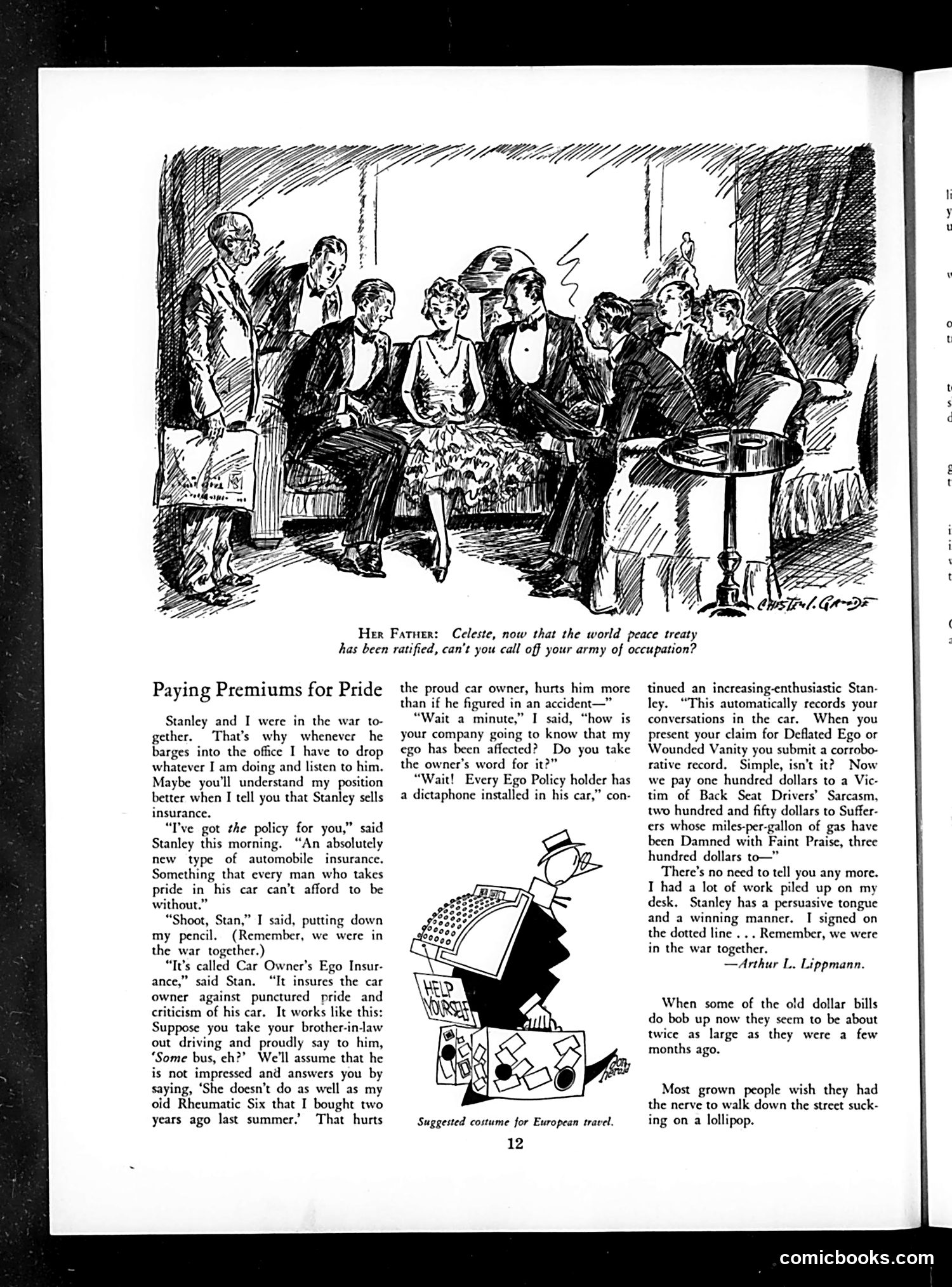
Analysis The main cartoon depicts a formal social gathering where a woman sits centrally among well-dressed men in what appears to be a post-WWI setting (referenced in the dialogue). The caption quotes a woman asking her father to "call off your army of occupation" now that "the world peace treaty has been ratified." The satire: This jokes about post-war occupation forces remaining in Europe after the 1919 peace treaty. The woman's complaint equates her father's control over her social life to military occupation—a humorous domestic parallel to the actual political situation of Allied troops stationed in defeated territories. The accompanying article, "Paying Premiums for Pride," discusses automobile insurance and pride-related car damage claims, using war metaphors ironically. The context assumes readers recognize the recent WWI armistice and subsequent occupation debates as contemporary political issues.
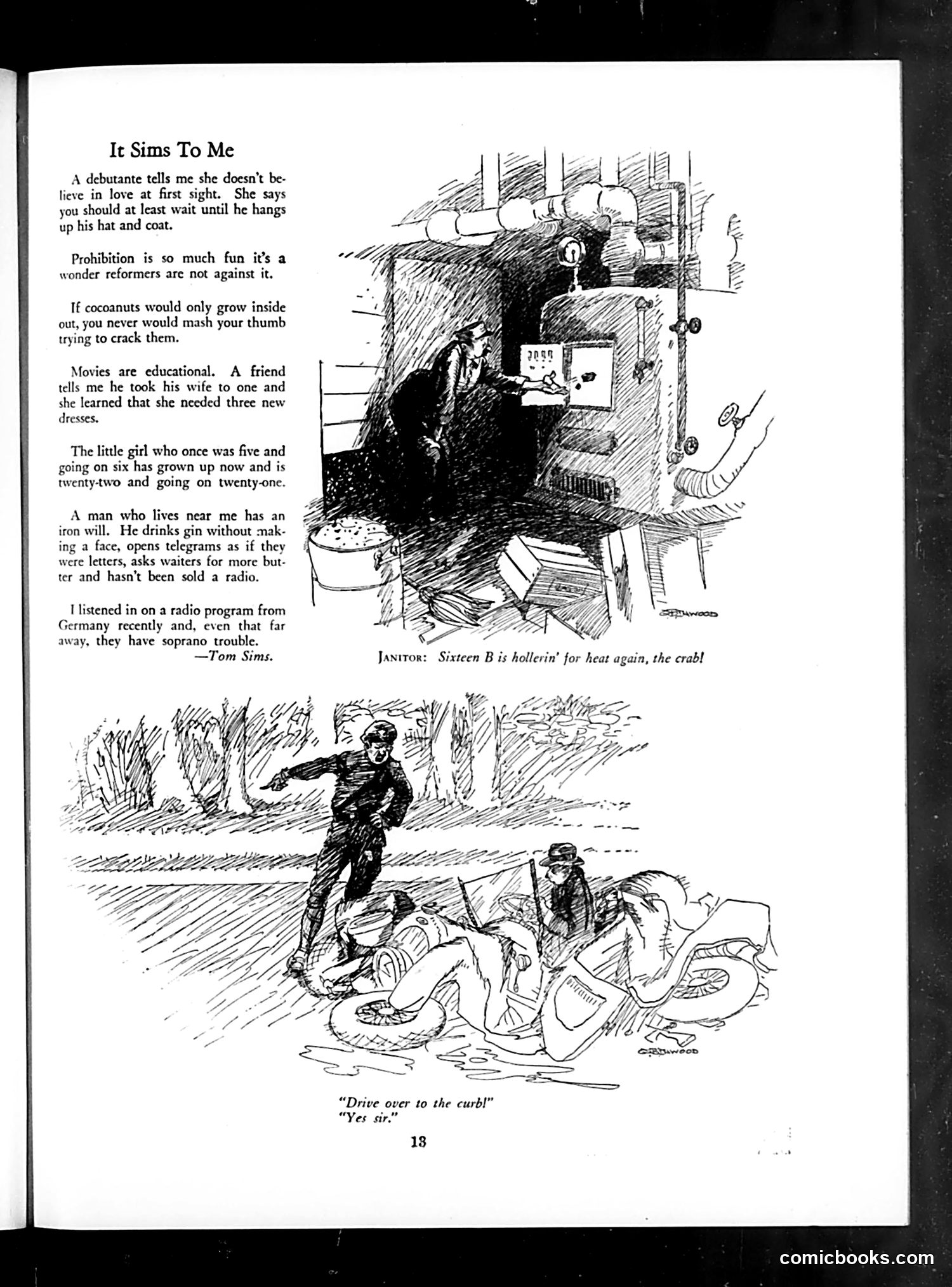
"It Sims To Me" - Page 18 This page contains satirical observations by Tom Sims on modern life, accompanied by two editorial cartoons. The top cartoon depicts a janitor or building superintendent tending to a furnace or heating system, illustrating Sims's quip about a man living nearby who drinks gin casually and opens telegrams indifferently—commentary on changing social norms and casualness about serious matters. The bottom cartoon shows people driving recklessly or carelessly, with the caption "Drive over to the curb!" / "Yes sir!"—likely satirizing dangerous or absurd driving habits and poor road safety practices of the era. The written observations mock various contemporary customs: skepticism about "love at first sight," Prohibition's supposed appeal, coconut-cracking difficulty, movies' educational value, and changing fashion trends. The final reference to German radio programs and "soprano trouble" appears to be contemporary topical humor.
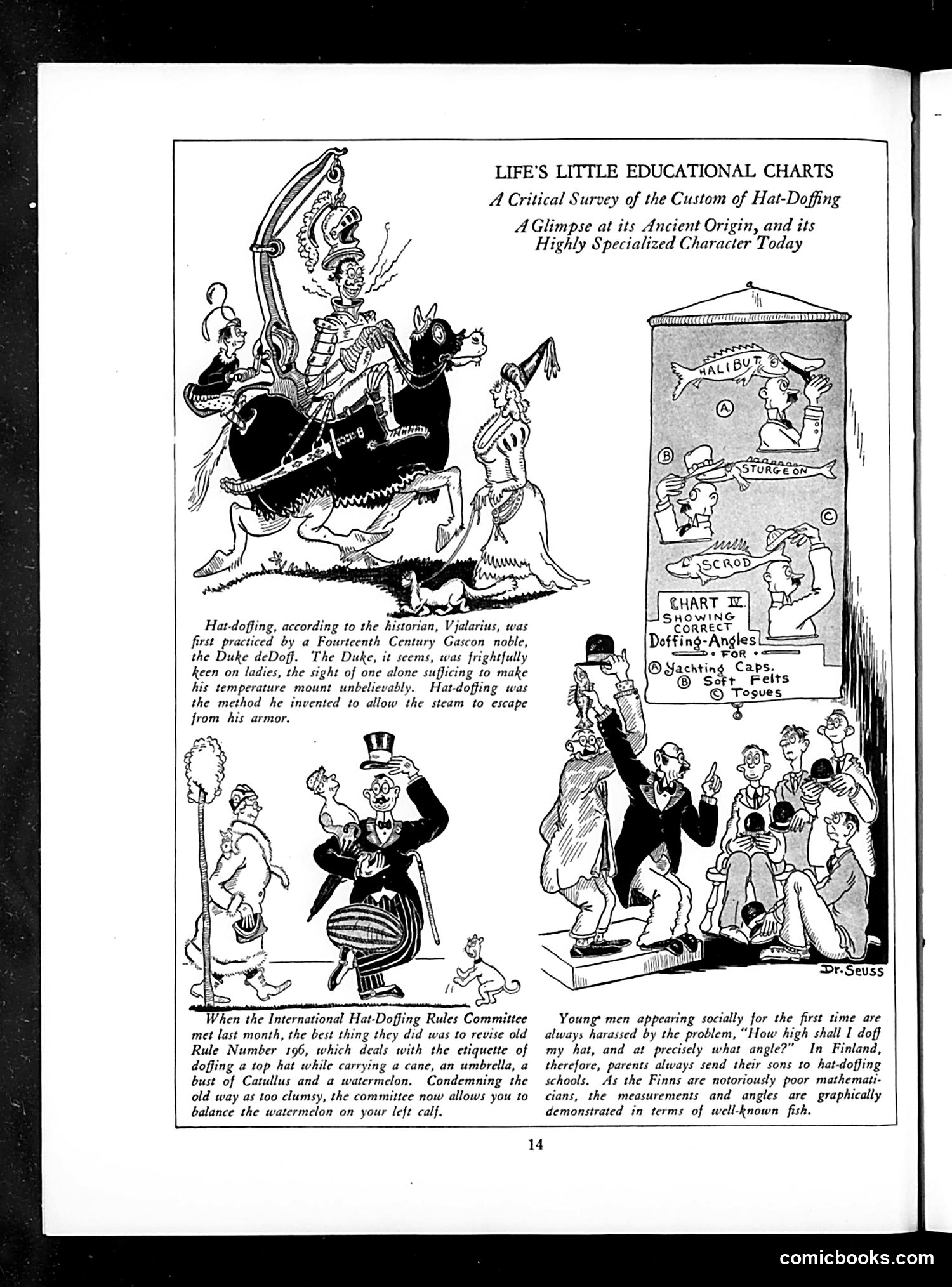
Hat-Doffing: A Satirical Educational Chart This page satirizes the formal social custom of hat-doffing (removing one's hat as a greeting or sign of respect). The cartoons mock its elaborate rules and impracticality. The top illustration shows a nobleman on horseback with an ornate feathered hat, surrounded by figures demonstrating various doffing poses—the joke being that proper hat etiquette required complex, exaggerated gestures. "Chart IV" (right) humorously diagrams correct hat angles using fish measurements, poking fun at how the Finnish supposedly taught this skill using mathematical precision. The bottom scene depicts young men at a social gathering struggling with the mechanics of hat-removal, suggesting the custom created genuine social anxiety and awkwardness for participants. The satire targets the absurdity of rigid social conventions disconnected from practical reality.
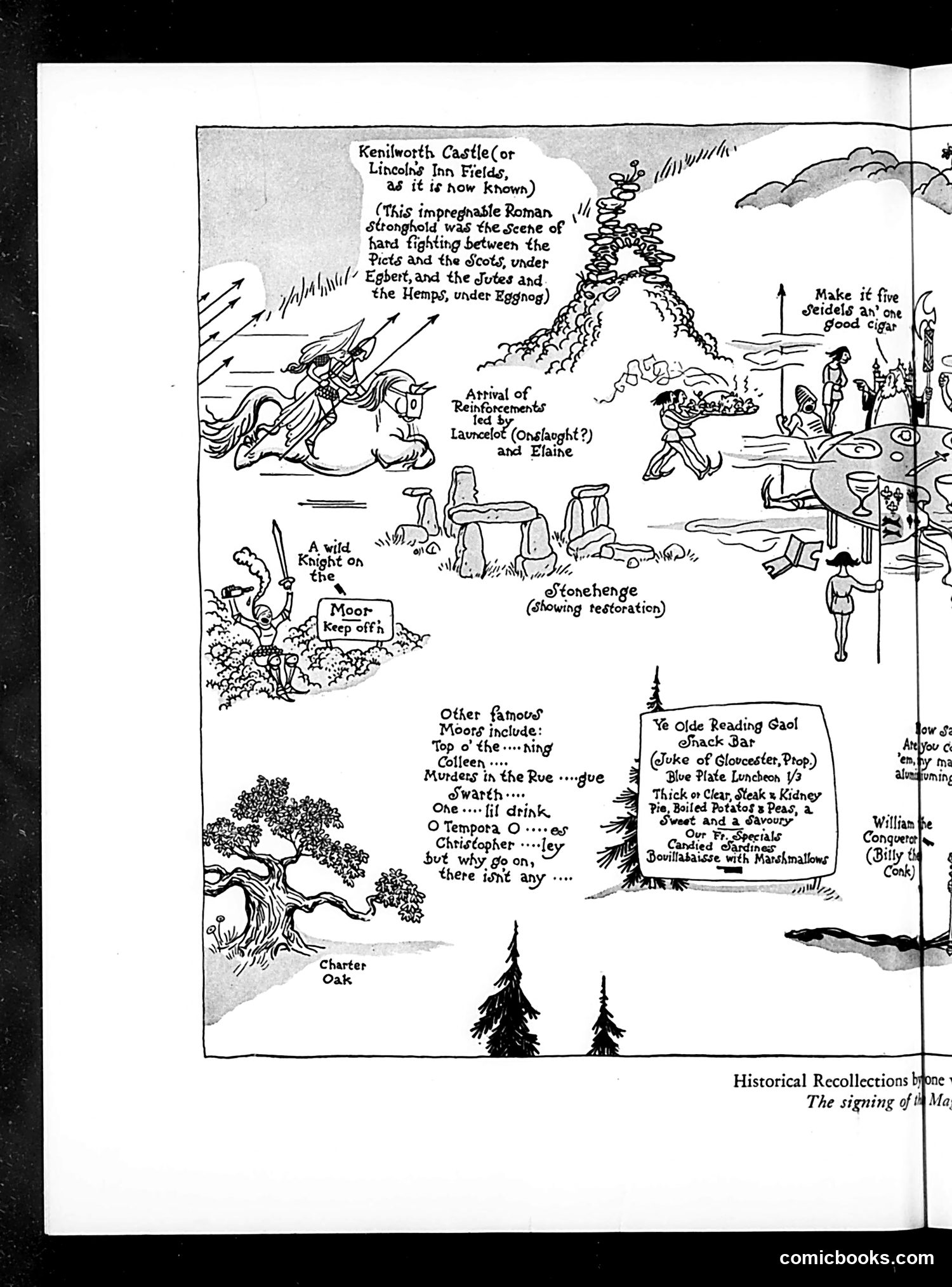
Analysis This is a humorous historical/tourist map of English landmarks and legends. The page depicts Kenilworth Castle and surrounding locations with whimsical illustrations of famous historical events and figures. Key elements include: - Kenilworth Castle at top, noted as a Roman stronghold and site of battles between Picts, Scots, and various historical groups - Stonehenge with a note about restoration - Charter Oak (a famous tree) - "Ye Olde Reading Gaol" - a joke establishment listing mock period foods and entertainments - Various moors with humorous knight and character illustrations The satire gently mocks both tourist attractions and romanticized medieval nostalgia popular in the period. The fake "gaol" menu and whimsical character drawings suggest light mockery of how historical sites were commercialized and sentimentalized for visitors seeking "authentic" period experiences.
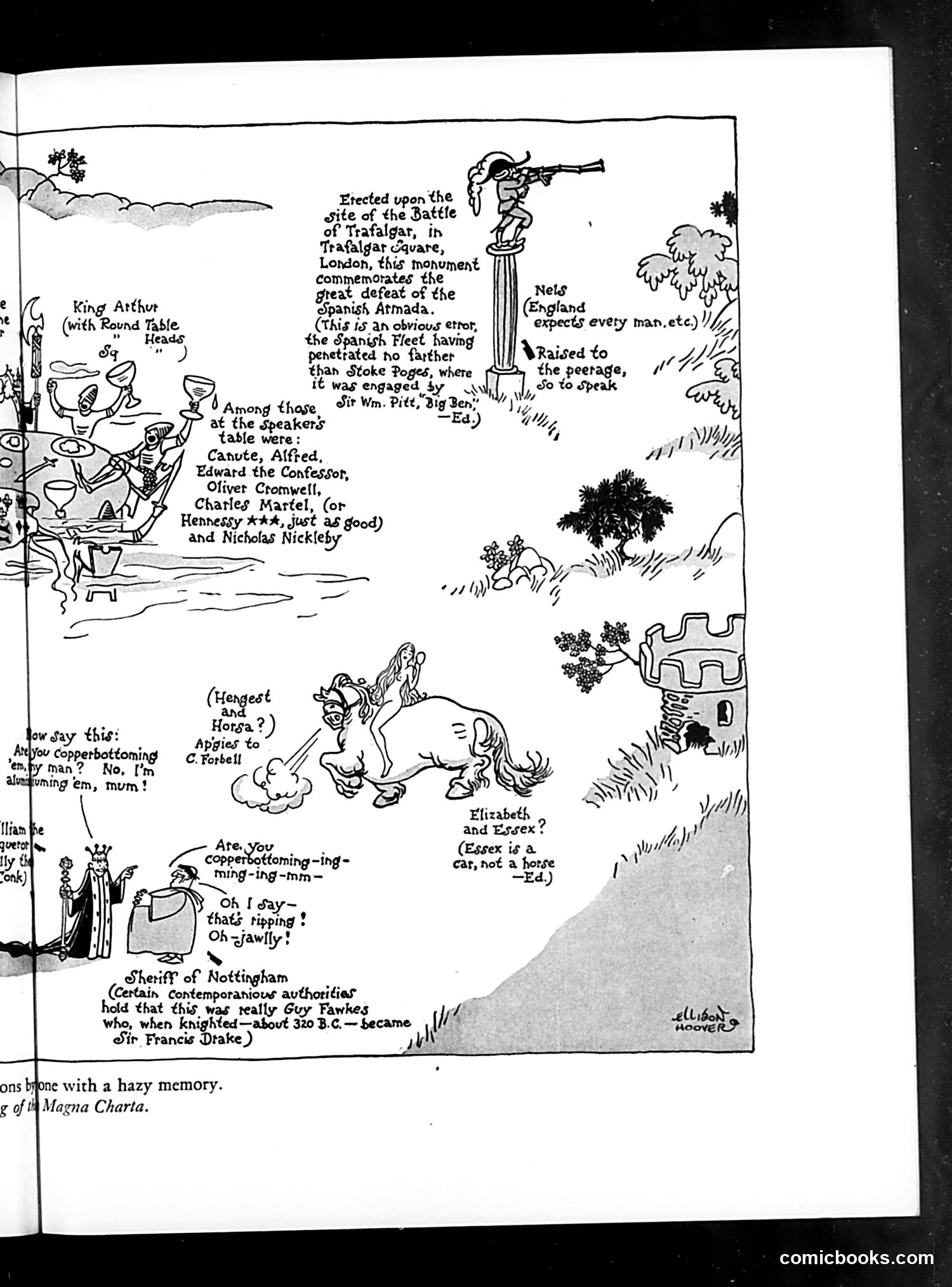
Explanation for Modern Readers This page satirizes historical English figures gathered at Trafalgar Square to commemorate the defeat of the Spanish Armada. The top panel shows King Arthur with various legendary and historical British figures including Canute, Alfred, and Oliver Cromwell, presented as speakers at the event. The lower panels mock specific historical figures: the Sheriff of Nottingham references Guy Fawkes (with an editor's note suggesting someone confused him with Sir Francis Drake), while "Elizabeth and Essex" appears to be a humorous misidentification of a cat. The satire targets confusion about English history and the tendency to invoke historical figures without accuracy. The cartoonist (signed "Hobson") uses anachronistic gatherings and mistaken identities to joke about how commemorative events often garble the very history they celebrate.
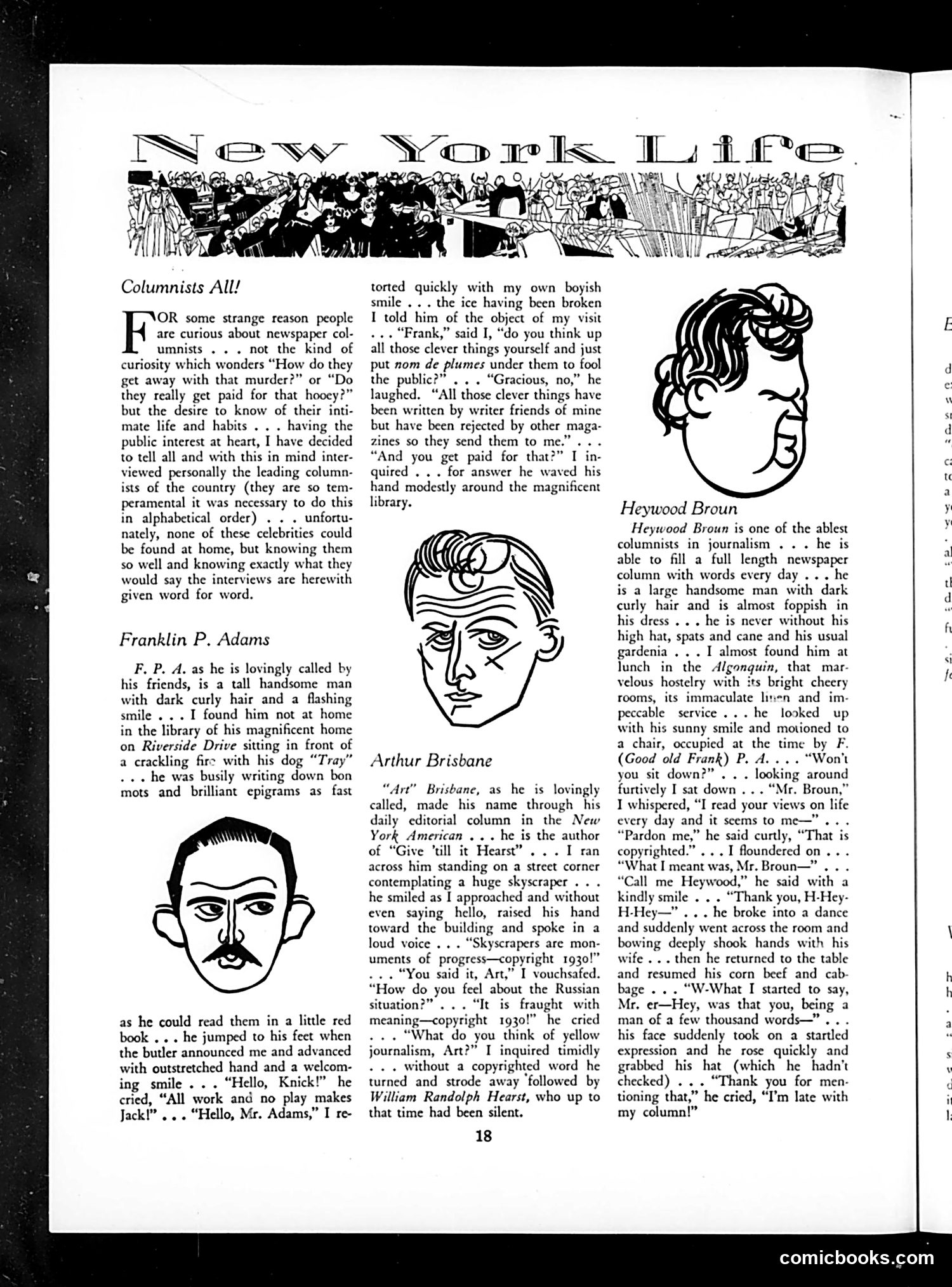
Columnists All! This page profiles famous newspaper columnists of the era, featuring illustrated portraits and biographical sketches. The columnists discussed include Franklin P. Adams, Arthur Brisbane, and Heywood Broun—prominent figures in American journalism known for writing regular opinion pieces. The satire targets the public's curiosity about these "celebrity" columnists, joking that people wonder how columnists "get away with that nonsense" or "get paid for that hooey." The piece humorously suggests these writers submit rejected ideas to magazines, implying columnists recycle material. Each profile offers witty, gossipy observations—Adams has a dog named "Tray," Brisbane writes copyright notices obsessively, Broun is described as habitually cordial and philosophical. The humor derives from mocking these influential but somewhat pretentious journalistic personalities.
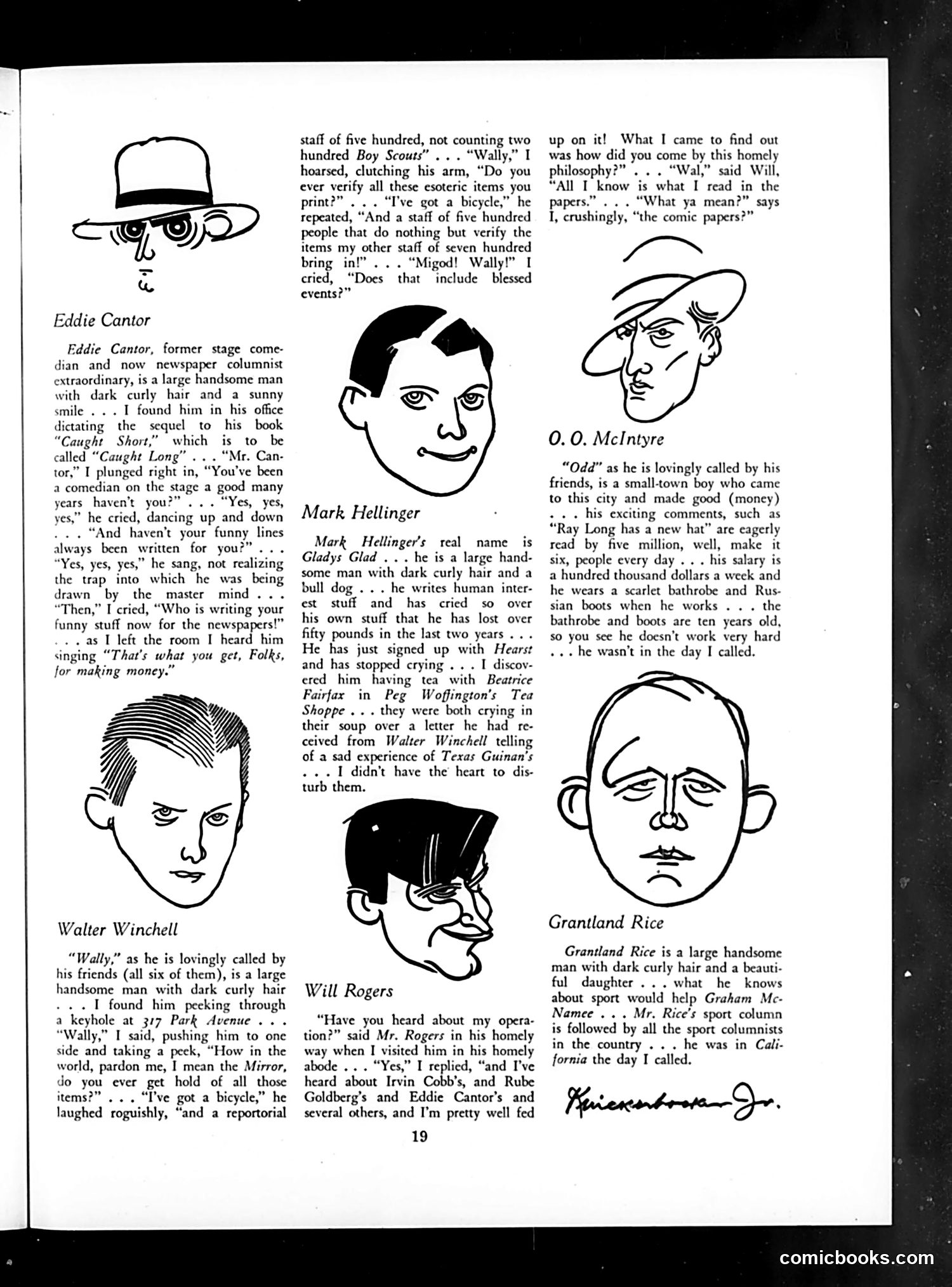
Life Magazine Profile Page: Celebrity Journalists and Columnists This page profiles six prominent American newspaper columnists and entertainment figures from the 1920s Jazz Age. Through humorous caricatures and satirical biographical sketches, it mocks their public personas and professional pretensions. The satire targets: - Eddie Cantor and others for profiting from entertainment while claiming artistic integrity - Walter Winchell (the gossip columnist) for his dubious sourcing—the joke is he admits his "staff" consists of a bicycle and Boy Scouts, yet somehow verifies everything - Mark Hellinger for his melodramatic sentimentality in human-interest reporting - Will Rogers for his "homespun philosophy" that amounts to just reading newspapers - O.O. McIntyre for his inflated salary versus actual work output - Grantland Rice (sports columnist) for similar pretentiousness The consistent joke: these celebrated figures are vain, eccentric, and less substantive than their reputations suggest. The repeated description "large handsome man with dark curly hair" undercuts their individualism through formulaic characterization.
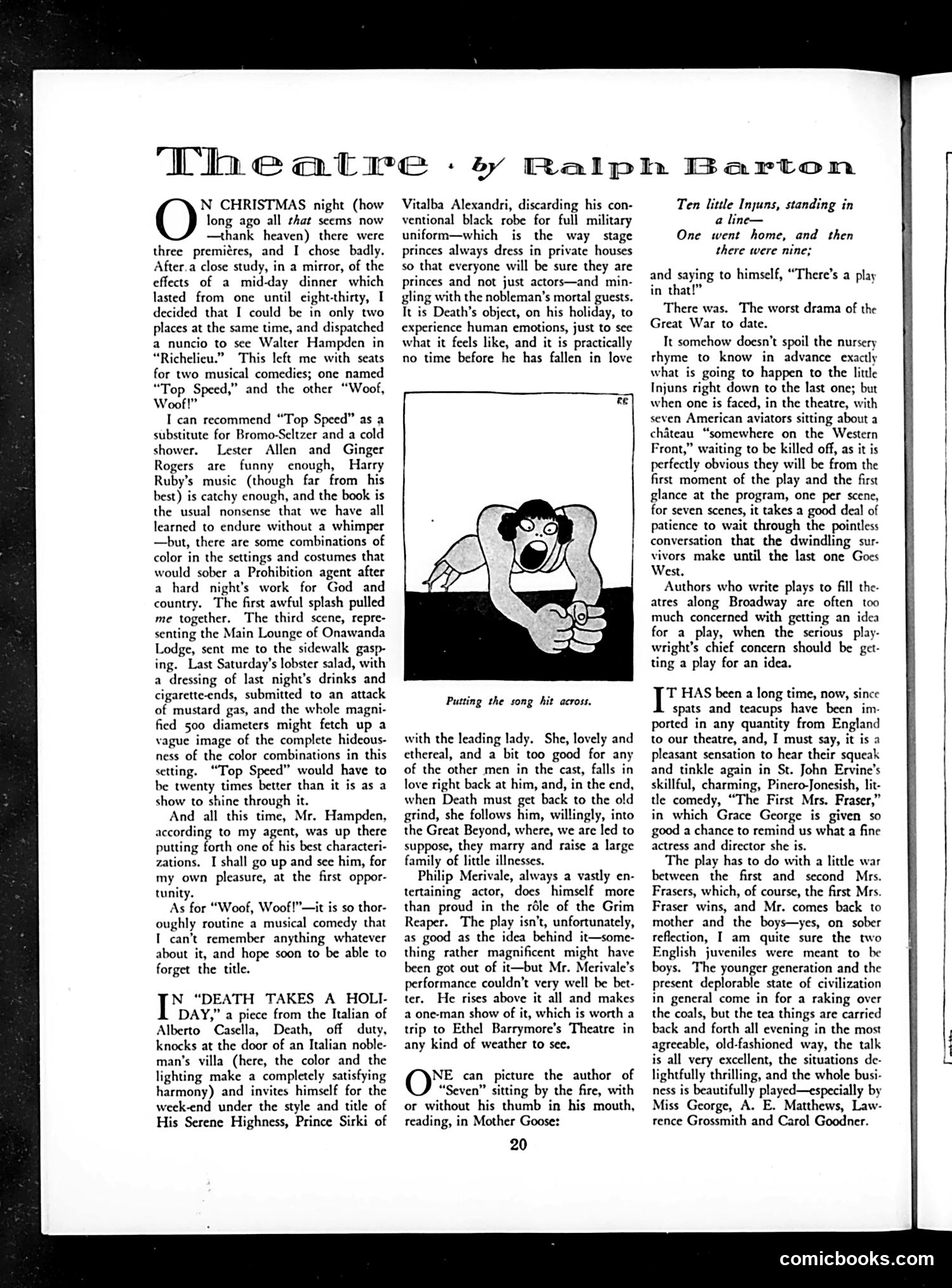
Theatre Column Analysis This is Ralph Barton's theater review column from Life magazine, featuring three Broadway play reviews rather than political cartoons. The single illustration shows a character "putting the song hit across" from the musical "Woof, Woof!"—likely depicting a performer in an exaggerated pose for comedic effect. The reviews discuss: - "Top Speed" (musical comedy with Ginger Rogers): Barton praises the performers but savagely critiques the garish set design and colors, using vivid metaphors about indigestion to convey how visually assaulting the production is. - "Richelieu" (dramatic play with Walter Hampden): Mentioned briefly as the show Barton actually attended. - "Death Takes a Holiday" (Italian play): Barton praises actor Philip Merivale's performance as Death, though finds the play itself mediocre despite its compelling premise. The content is straightforward theater criticism, not political satire—typical of Life's arts coverage during this period.
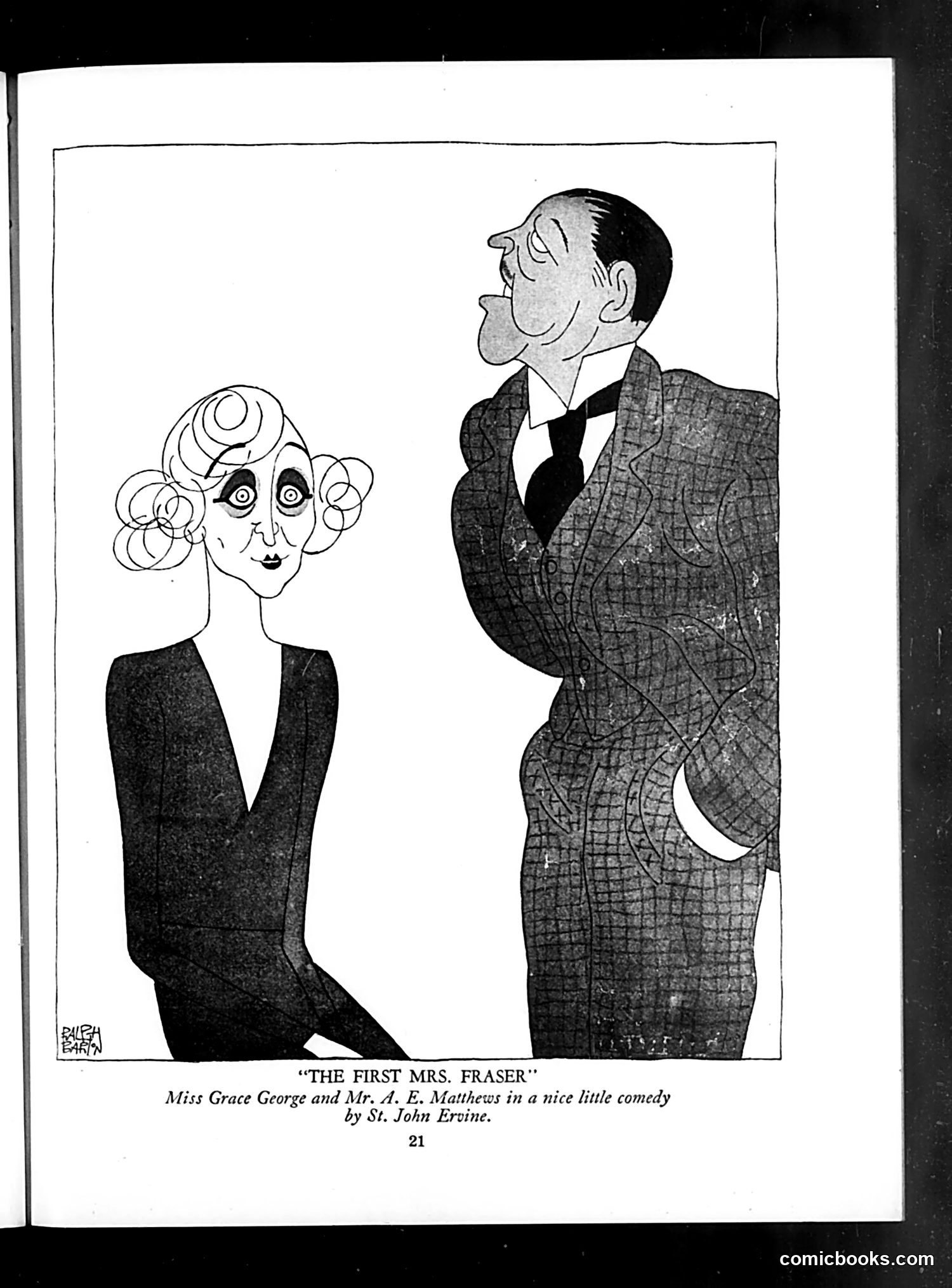
"The First Mrs. Fraser" This page advertises a theatrical comedy titled "The First Mrs. Fraser" by St. John Ervine, featuring actors Miss Grace George and Mr. A. E. Matthews. The cartoon illustrates the two performers in character: a woman with distinctive curled hair on the left and a man in a suit on the right, both drawn in exaggerated caricature style typical of early 20th-century theatrical illustrations. The humor appears to derive from their contrasting appearances and the implied domestic or romantic scenario suggested by the play's title. Without additional context about the specific plot, the satire likely plays on social conventions or relationship dynamics of the era. This represents Life magazine's practice of promoting Broadway productions through illustrated commentary.
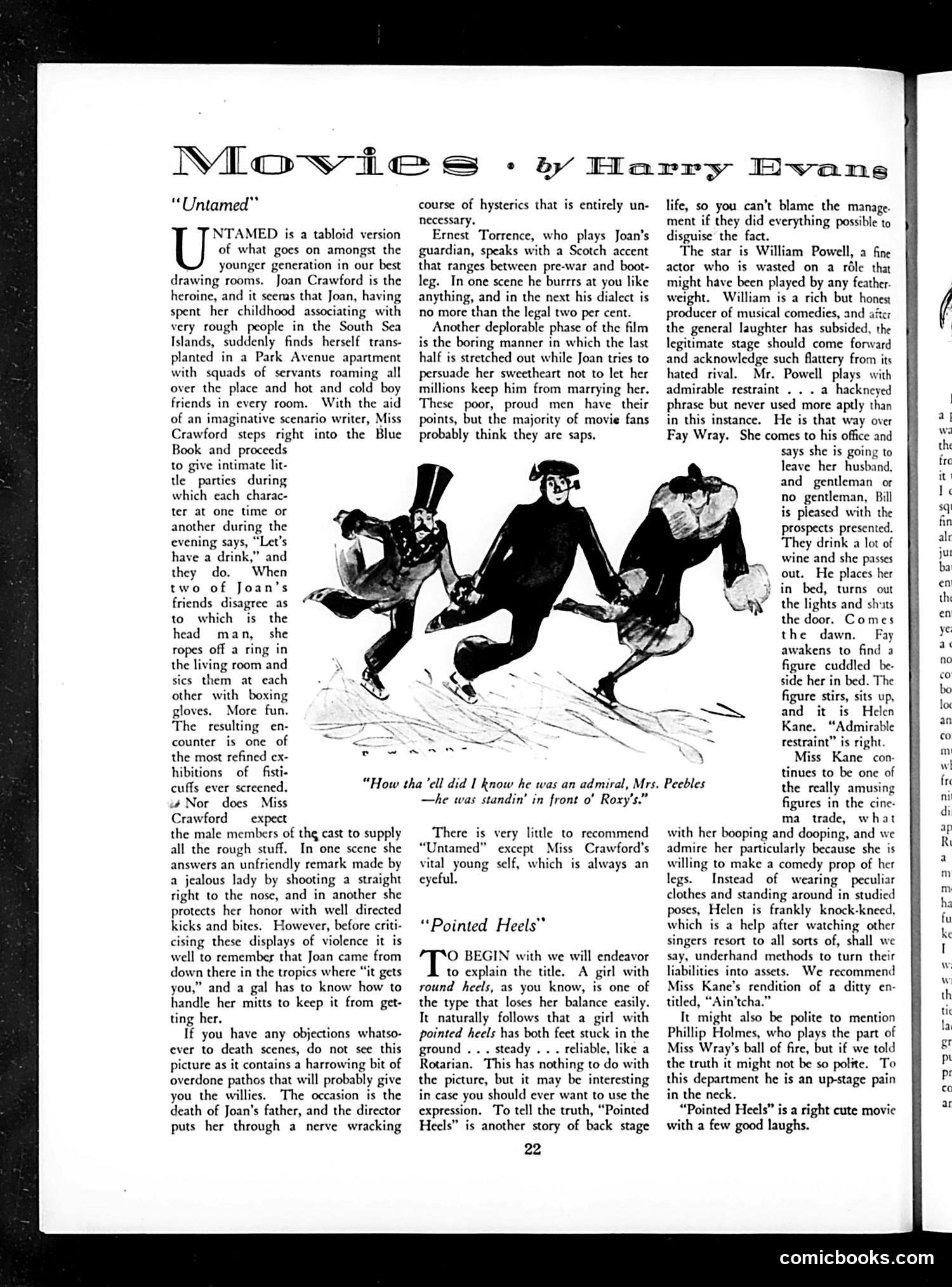
Movie Reviews by Harry Evans - Life Magazine This page contains two film reviews from Life magazine's "Movies" column. The satirical commentary targets both the films and 1920s social attitudes they depict. "Untamed" reviews Joan Crawford's film about a wealthy Park Avenue socialite raised in the South Seas. Evans mocks the film's logic: Crawford's rough upbringing supposedly justifies her violent behavior—shooting a woman in the nose, kicking and biting rivals, and literally boxing guests in her living room. The satire lies in treating these absurd plot points as character motivation. Ernest Torrence's inconsistent Scottish accent also draws ridicule. "Pointed Heels" reviews a backstage musical comedy. Evans sarcastically explains the title's slang meaning (girls with "round heels" lack balance; those with "pointed heels" are steady). He dismisses William Powell's role as beneath his talent, sarcastically praising Powell's "admirable restraint" while implying the film is forgettable. Both reviews use humor to expose the shallow plots and questionable logic of contemporary silent films.
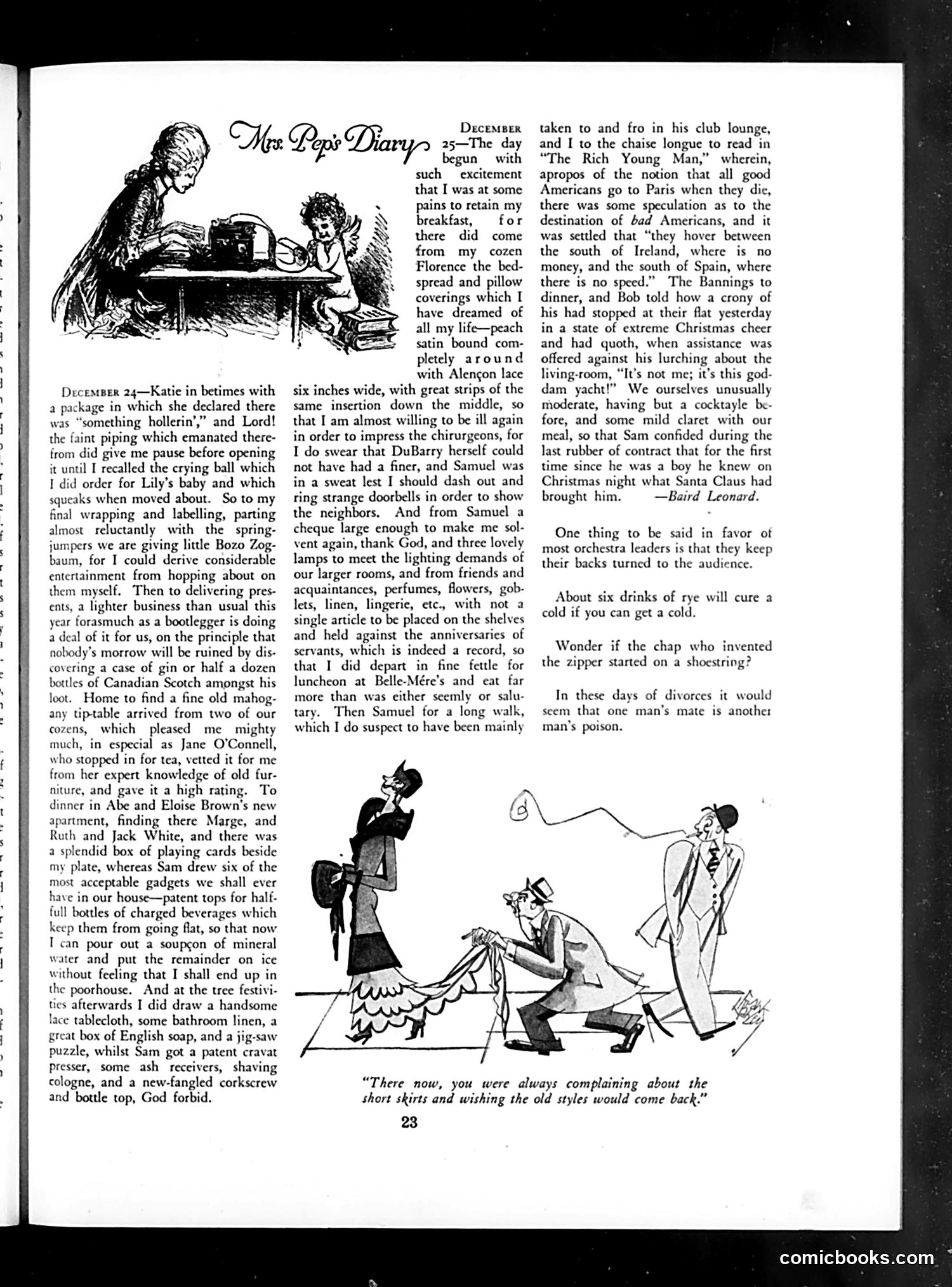
"Mrs. Pep's Diary" - December 1920s Entry This page features a society gossip column disguised as a personal diary, typical of Life magazine's satirical commentary on upper-class American life. The entries chronicle Christmas gift-giving and social gatherings among wealthy urbanites. The cartoon at bottom satirizes changing fashion: a woman complains about short skirts (modern style) while men respond she previously wanted old styles back—mocking the fickleness of fashion complaints across generations. The diary itself subtly ridicules Prohibition-era hypocrisy: mentions of "bootleggers," "Canadian Scotch," and "charged beverages" highlight how the wealthy openly circumvented alcohol bans. References to luxury goods (Alençon lace, imported furniture) and casual spending satirize the economic excess of the Jazz Age, particularly among those insulated from ordinary Americans' struggles. The tone is gossipy and intimate, inviting readers to feel part of this exclusive world while simultaneously mocking its shallow preoccupations and moral contradictions.
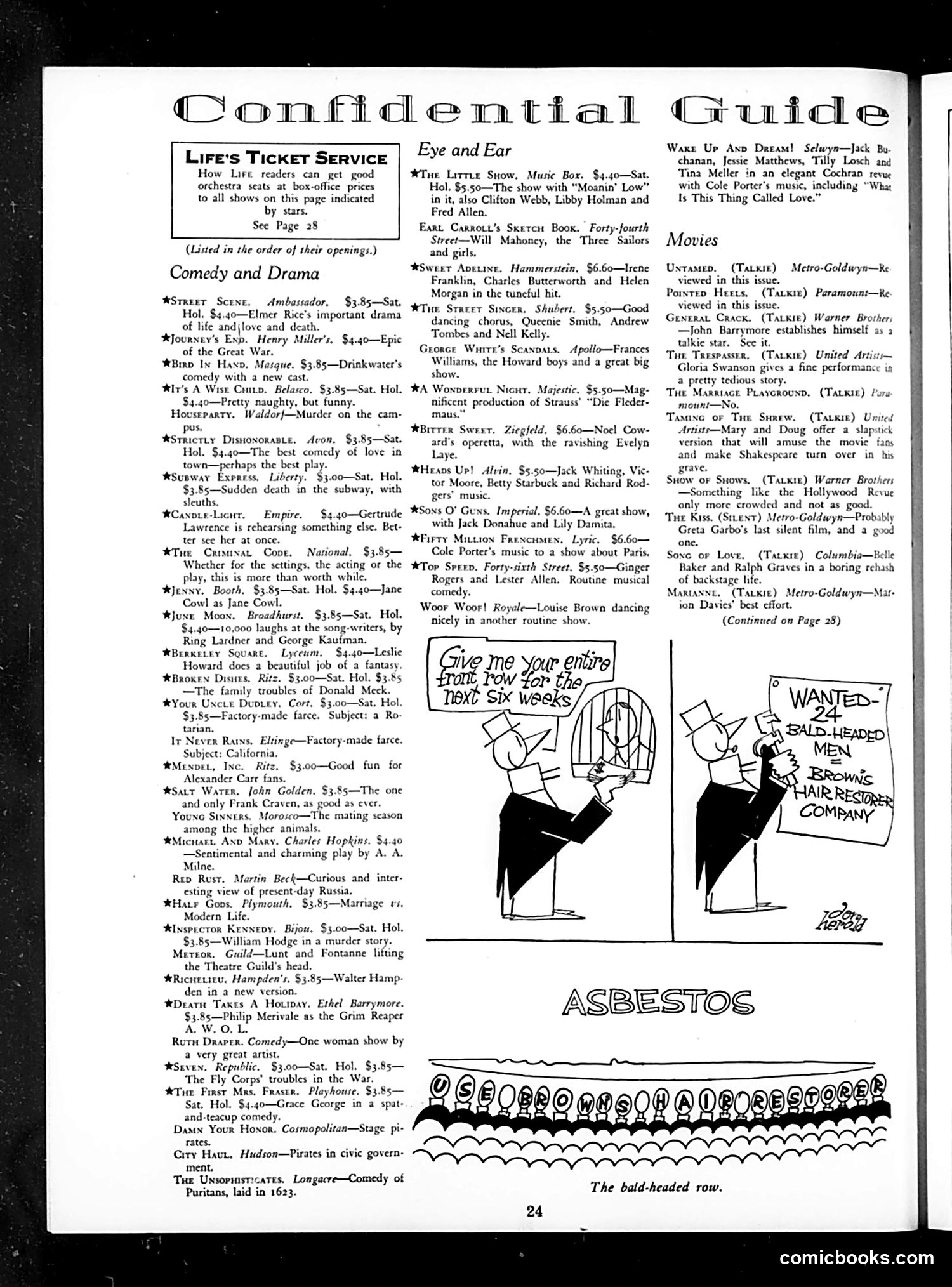
Cartoon Analysis: "Bald-Headed Row" Advertisement This page is primarily a theater listing and advertisement section from Life magazine. The small cartoon at bottom shows two figures: one man holding a sign reading "WANTED—24 BALD-HEADED MEN" for "Brown's Hair Restorer Company," while another man eagerly hands him his entire "front row for the next six weeks." The satire: The joke plays on desperation—both the hair-loss industry's need for visible "before" subjects and men's willingness to sacrifice theater tickets (valuable commodities in the 1920s) for a chance at hair restoration. "Bald-headed row" was a period term for the front orchestra section where bald men were conspicuous. The cartoon mocks both male vanity and the dubious promises of patent hair-loss remedies, common targets of Life's satirical humor during this era.
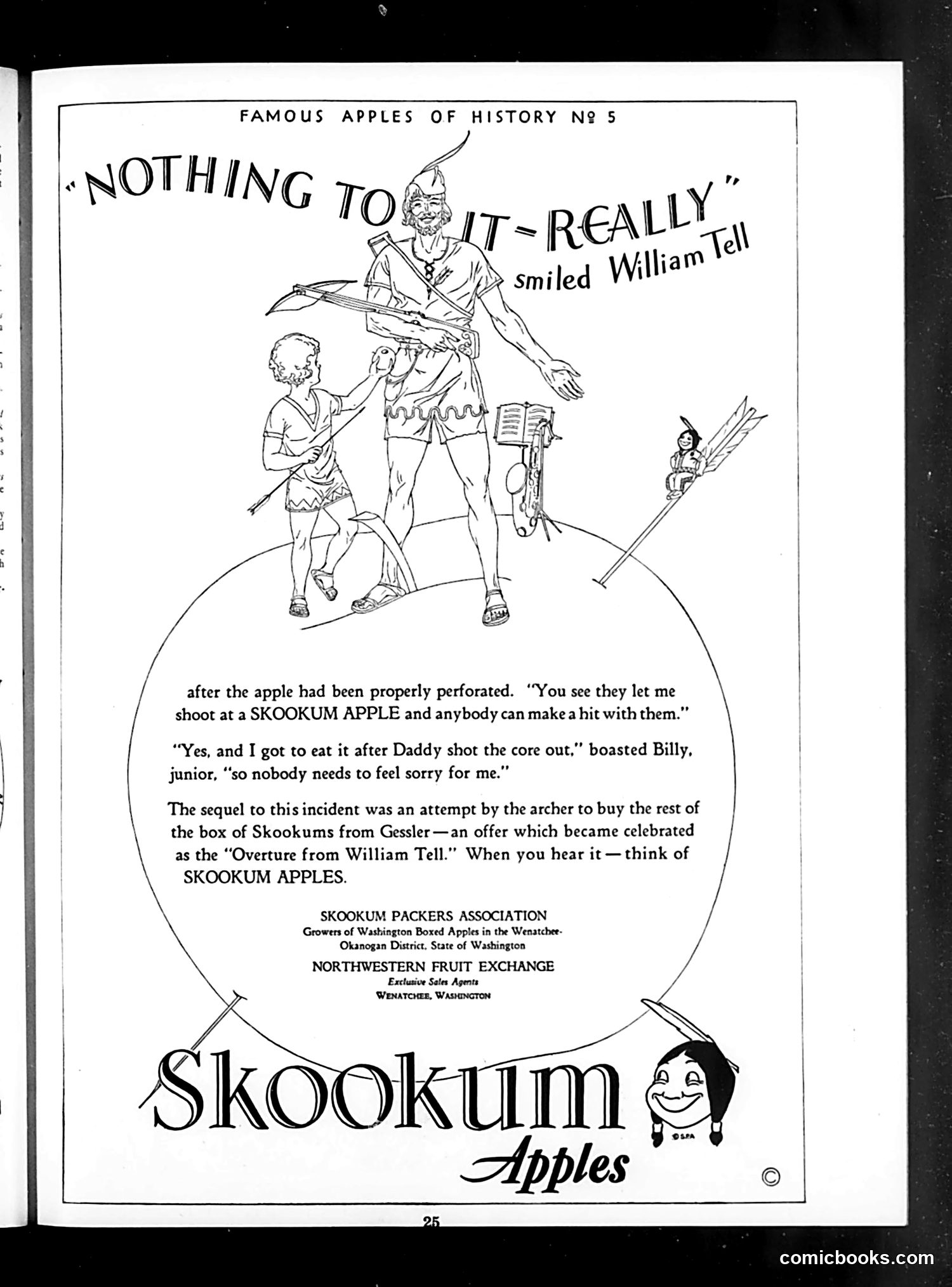
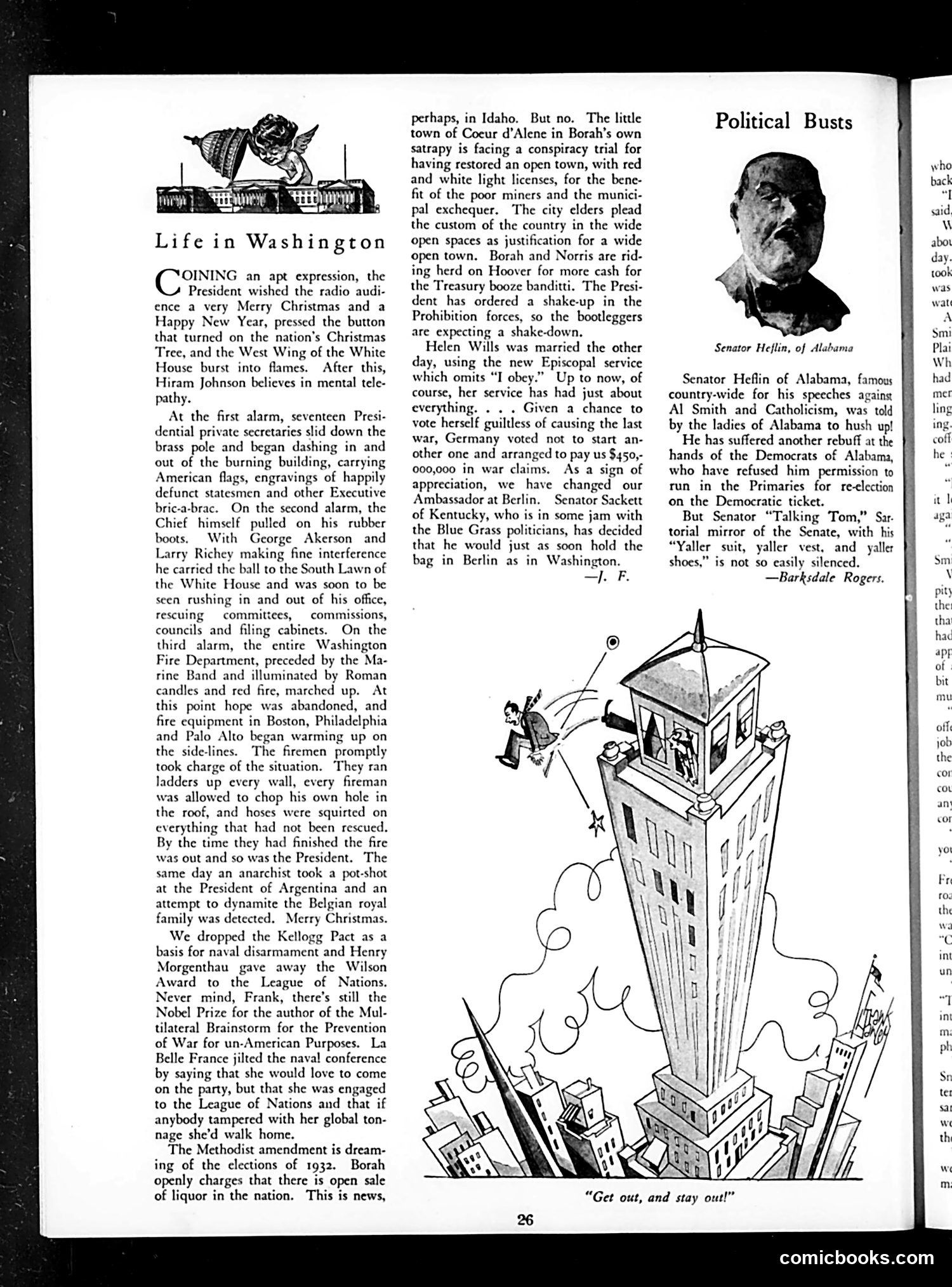
Political Satire from Life Magazine This page combines two satirical pieces from Life magazine, likely from the early 1930s. "Life in Washington" mockingly describes absurd political events: the White House catching fire after the President's Christmas broadcast, followed by comic chaos involving presidential staff, the Fire Department, and bureaucratic bungling. The text then satirizes actual political failures—dropped disarmament pacts, France's unreliability at naval conferences, and hypocrisy about Prohibition (Senator Borah publicly attacks liquor sales while his own Idaho town operates legally as a "wide open" licensed district). The cartoon depicts a tall building (likely representing government or a public institution) with people on top operating radio transmission equipment while figures below appear to be in distress—a visual metaphor for chaotic leadership or broadcasting interference with governmental stability. "Political Busts" introduces Senator Heflin of Alabama, a prominent anti-Catholic crusader, though the text cuts off before revealing the satirical point about him. The satire targets governmental incompetence, political hypocrisy regarding Prohibition enforcement, and the era's prominent political figures.
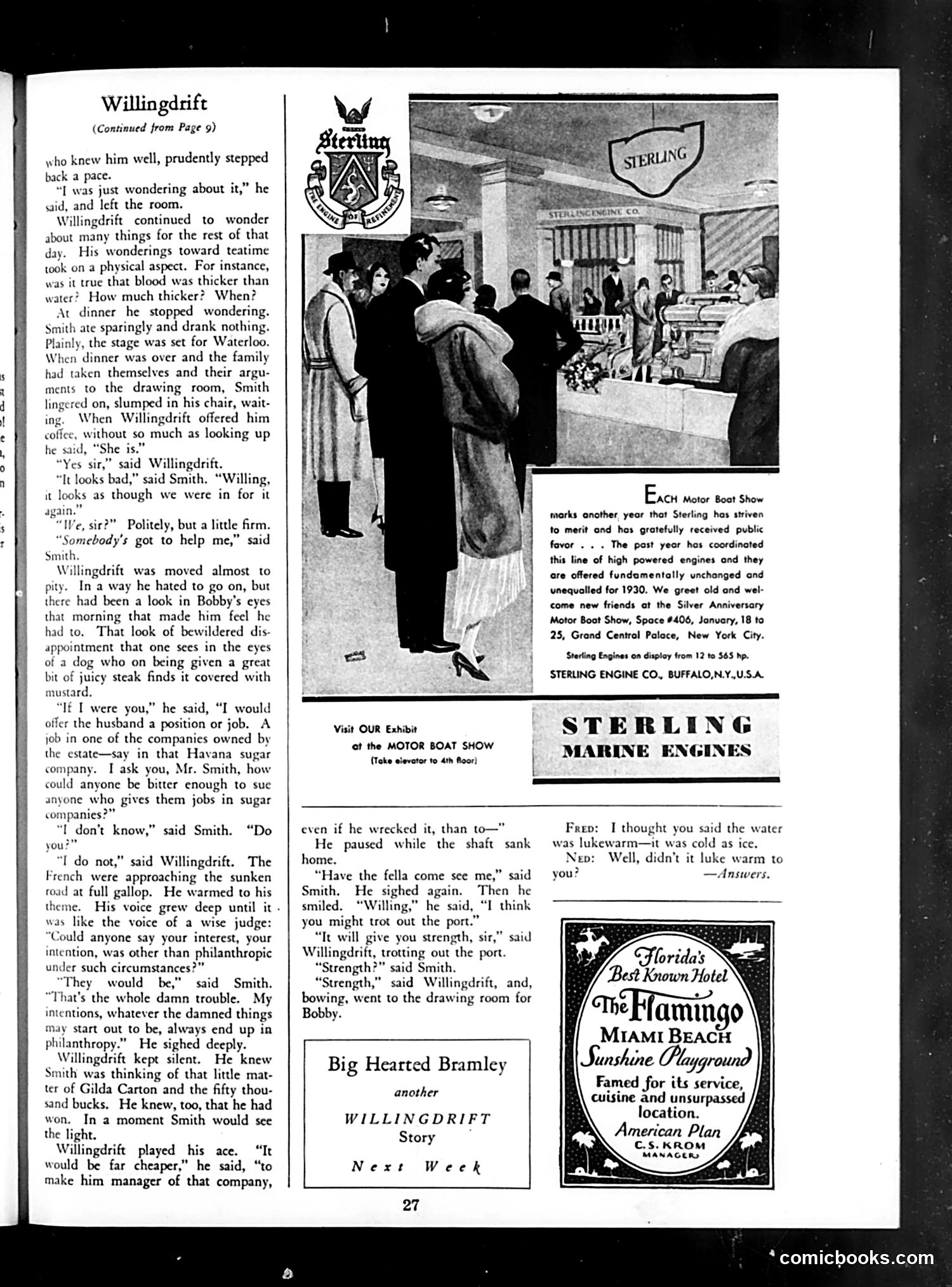
Page 27: Life Magazine Content Analysis This page contains the conclusion of a serialized story called "Willingdrift," a domestic comedy about a man named Smith navigating family conflict. The narrative centers on Smith's marital troubles—apparently involving someone named Bobby and romantic complications with "Gilda Carton"—and how the protagonist Willingdrift subtly manipulates Smith into reconciliation by suggesting he offer a job to the estranged party, framing it as philanthropic rather than appeasement. The page is primarily advertising-heavy, featuring Sterling Marine Engines and The Flamingo Hotel in Miami Beach. A small humor item at the bottom plays on a pun about "lukewarm" water. The "Willingdrift" story promises continuation next week under the heading "Big Hearted Bramley," suggesting it's part of Life's regular satirical fiction offerings of the era.
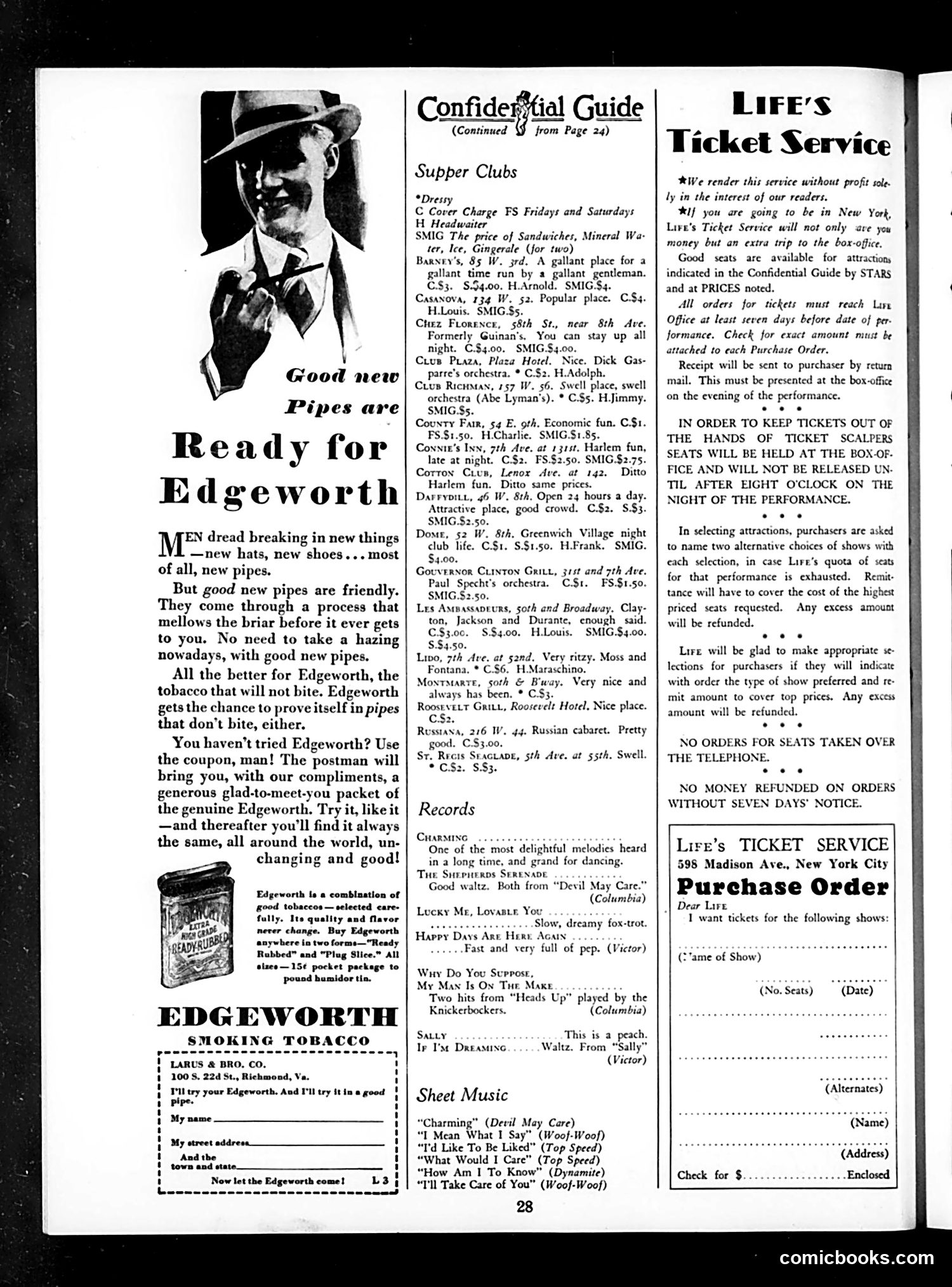
This Page Explained for Modern Readers This is primarily advertising and service listings, not political satire. The main content includes: Edgeworth Tobacco Ad (left): A pipe tobacco advertisement emphasizing that Edgeworth's new pre-mellowed pipes are "friendly" and don't require the traditional painful "hazing" of breaking in a new pipe. It's a straightforward product pitch using relatable humor about the annoying experience of smoking new pipes. "Confidential Guide" (center): A listing of 1920s New York supper clubs with cover charges, prices, and headwaiters' names—essentially a speakeasy/nightclub directory from the Prohibition era. Records and sheet music listings follow. Life's Ticket Service (right): A mail-order ticket purchasing service for theatrical performances. There is no political cartoon or satire on this page. The Edgeworth ad is the only illustration, showing a man smoking. This appears to be a typical Life magazine page from the late 1920s, mixing entertainment advertising with lifestyle services.
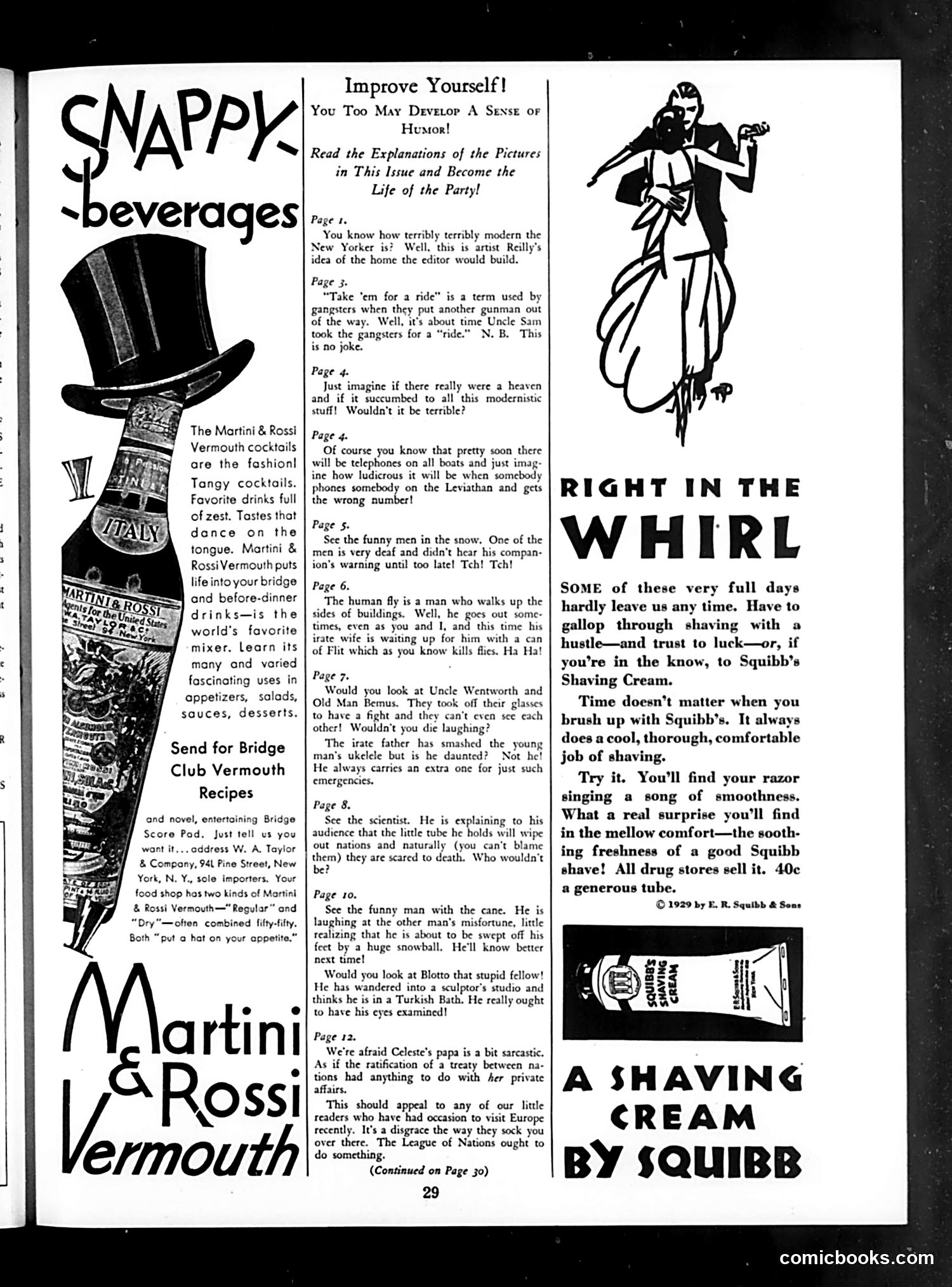
Life Magazine Page Analysis (circa 1929) This page is primarily advertising interspersed with humor captions. The left side promotes Martini & Rossi Vermouth and Squibb's Shaving Cream; the right features satirical cartoon descriptions. The humor targets 1920s modern life anxieties: modernistic architecture ("the New Yorker" editor's home), organized crime ("gangsters" and taking them for a "ride"—a period euphemism for murder), technological disruption (telephones on ocean liners), and scientific progress (a scientist's destructive "tube"). There's also gentle physical comedy (deaf men fighting, a "human fly" and his irate wife with insecticide, confused characters). The page reflects post-WWI anxieties about rapid social change, crime waves during Prohibition, and mechanization—themes Life magazine addressed through gentle satire aimed at middle-class readers. The product ads position consumer goods as solutions to modern stress.
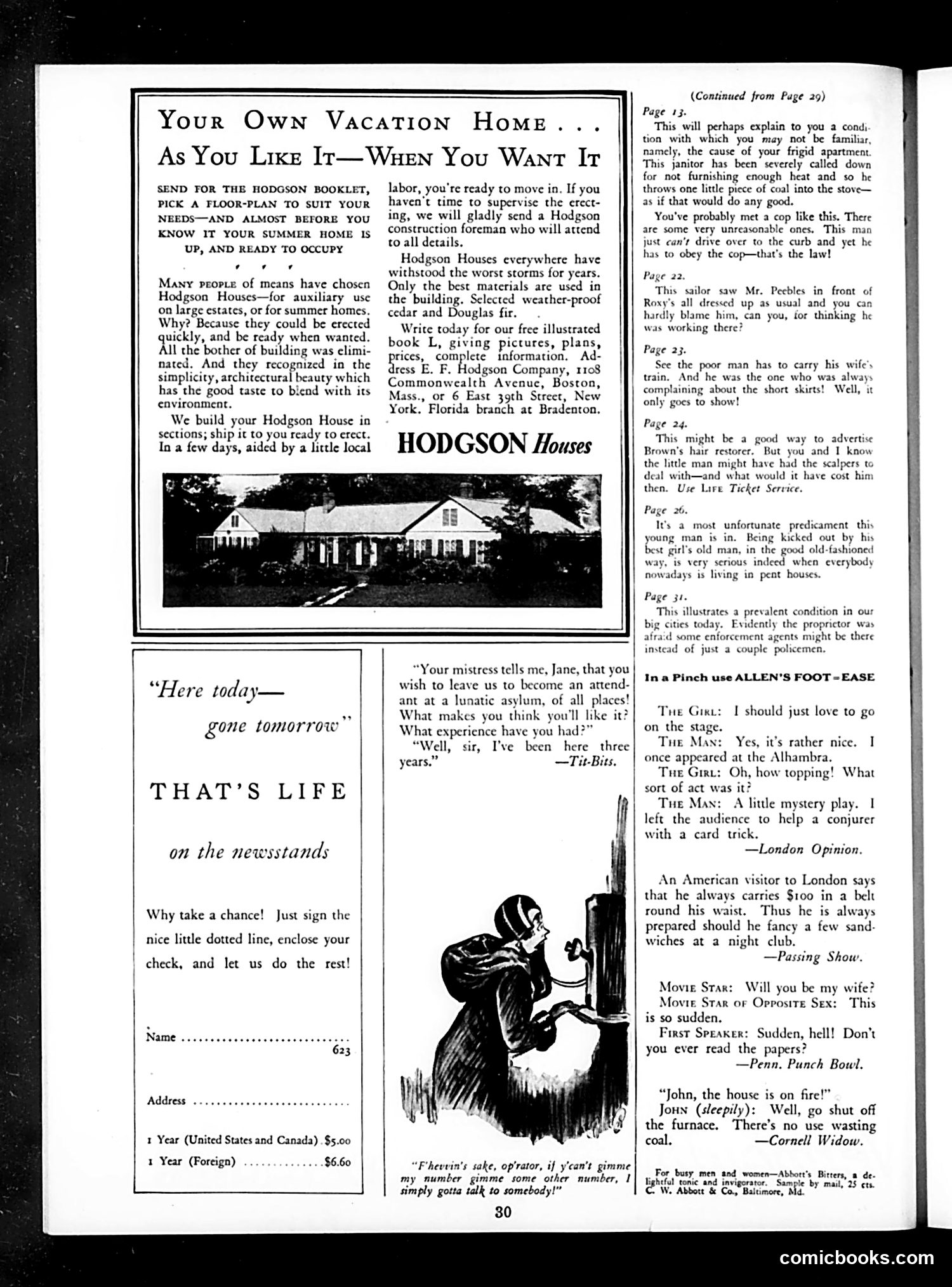
Analysis of Life Magazine Page This page from *Life* magazine is primarily advertising and filler content, not political satire. The main content includes: 1. Hodgson Houses advertisement: Promotes prefabricated homes shipped in sections and assembled on-site—a modern convenience for summer homes or estate cottages. 2. "That's Life" subscription pitch: A tongue-in-cheek ad encouraging magazine subscriptions by playing on life's transience ("here today—gone tomorrow"). 3. Short humorous anecdotes: These brief jokes satirize everyday social annoyances—an unreasonable landlord depriving tenants of heat, an overzealous police officer, a woman complaining about her husband carrying her train, an asylum job applicant with questionable judgment, and a drunk telephone operator. 4. Small cartoon illustration: Shows a disheveled figure using a phone, supporting one of the anecdotes. The humor targets minor social frustrations and human folly rather than political figures or major events. This appears to be a typical humor magazine page from the early-to-mid 20th century, emphasizing light entertainment and consumer products.
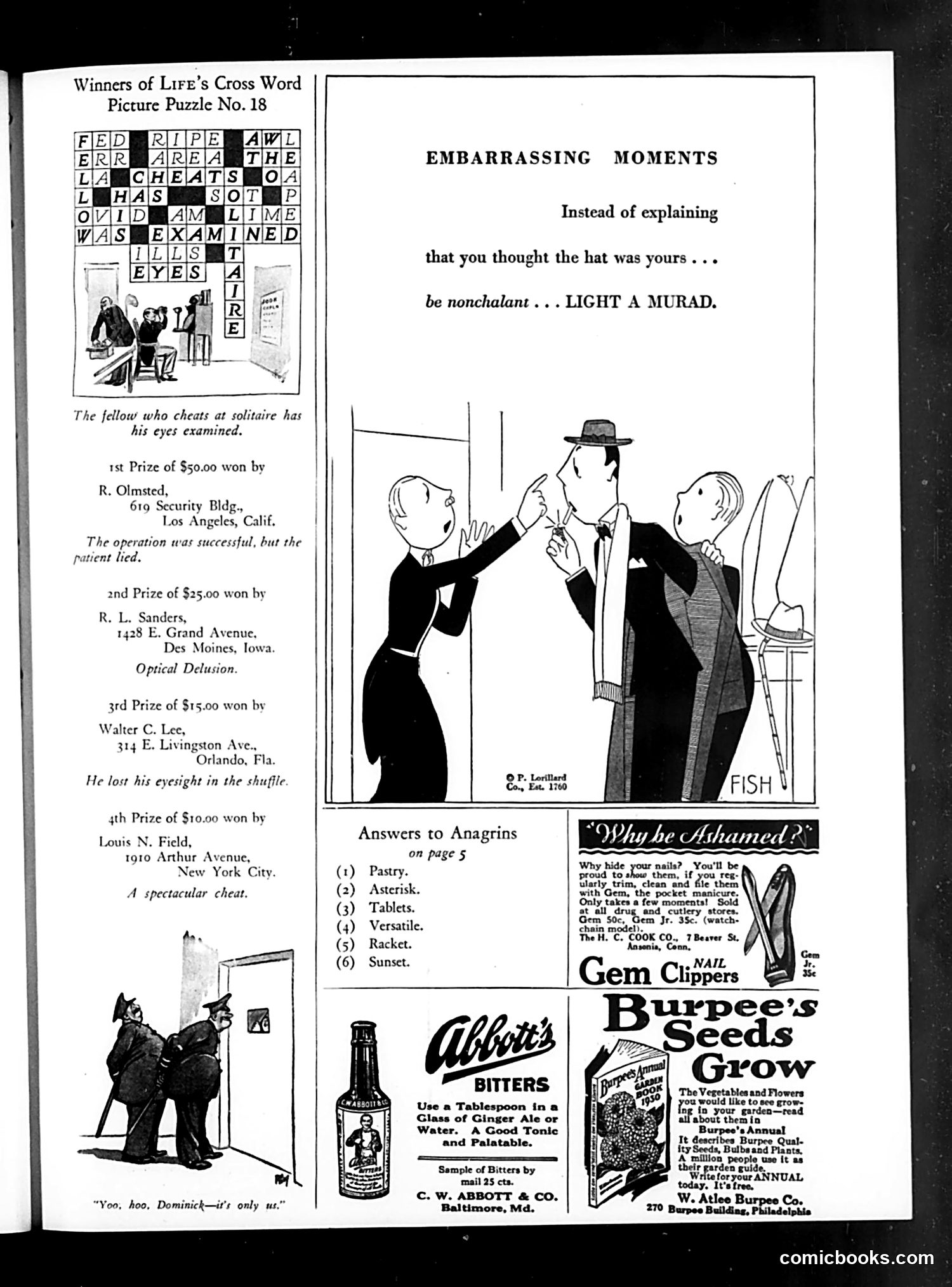
Explanation for Modern Readers This page contains two main cartoon sections. The left side shows Life magazine's crossword puzzle contest winners, with humorous captions connecting each prize to eye-related themes (fitting since the puzzle was "picture" based). The jokes play on puns: "Optical Delusion," "He lost his eyesight in the shuffle," "A spectacular cheat." The main cartoon titled "Embarrassing Moments" depicts a social etiquette tip: if you accidentally take someone else's hat, don't awkwardly explain the mistake—instead, act casual and light a Murad cigarette (an advertisement). The humor assumes smoking projects confidence and nonchalance that masks embarrassment. The page is primarily advertising: Gem nail clippers, Abbott's Bitters (a patent medicine/tonic), and Burpee seeds. This was standard for Life—mixing editorial content with paid ads. The overall tone reflects early 20th-century attitudes about masculinity, social composure, and consumer products as solutions to social anxiety.
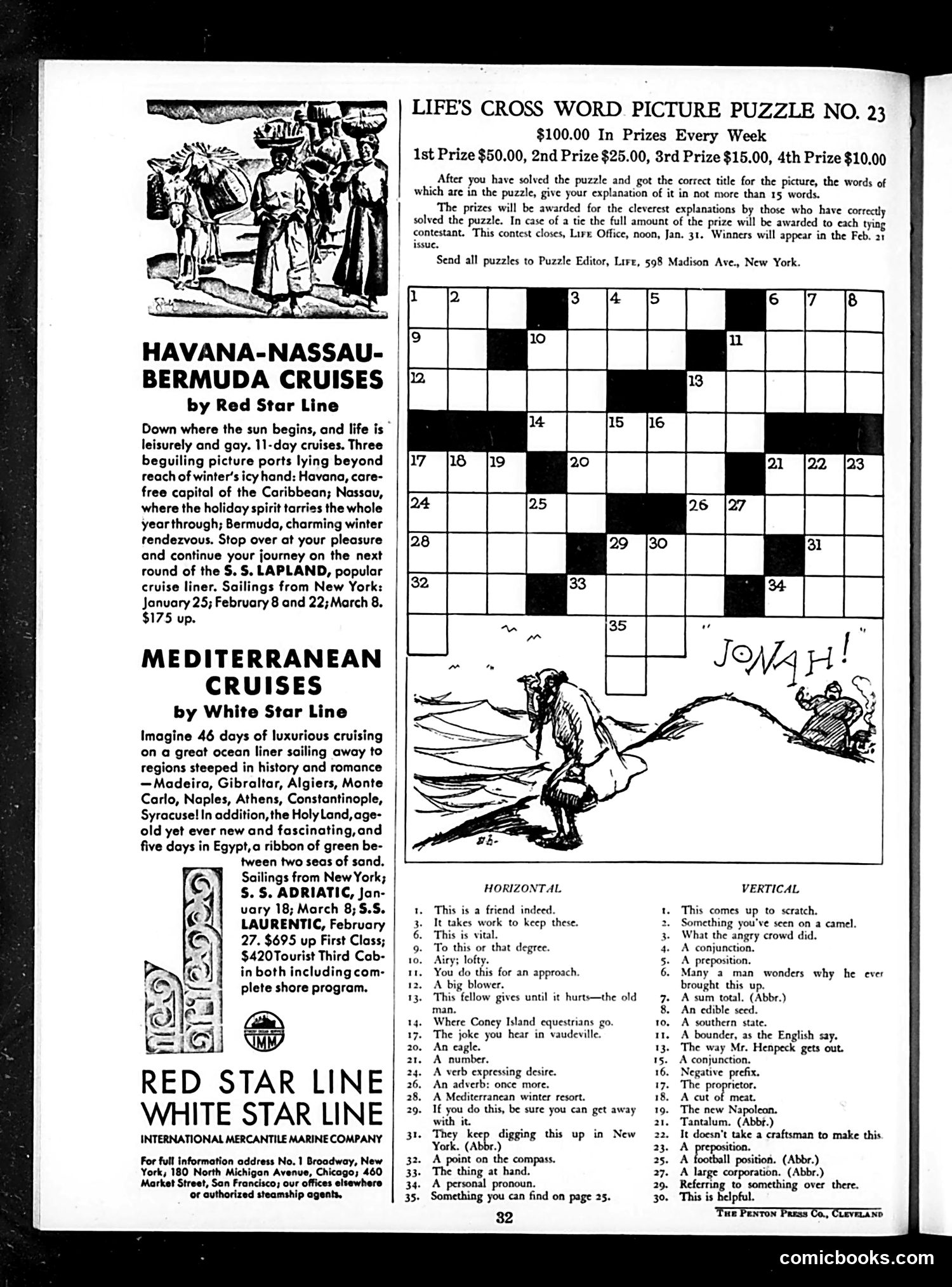
Analysis of Life Magazine Page No. 23 This page is primarily advertising and a crossword puzzle contest, not political satire. The top half features luxury cruise advertisements from Red Star Line and White Star Line, promoting vacations to exotic destinations (Havana, Bermuda, Mediterranean ports, Egypt). These ads reflect the 1920s-30s leisure culture available to wealthy Americans. The main content is Life's crossword puzzle contest No. 23, offering $100 in weekly prizes. The puzzle includes a cartoon illustration of a man (labeled "JONAH!") being expelled from a whale—the biblical reference to Jonah and the whale. Solvers must determine the picture's title in 15 words or fewer to compete for prizes. The clues themselves contain period humor (references to Coney Island, vaudeville, "the new Napoleon") but are straightforward wordplay rather than satire. This represents Life's entertainment function during an era when crossword puzzles were a popular leisure activity.
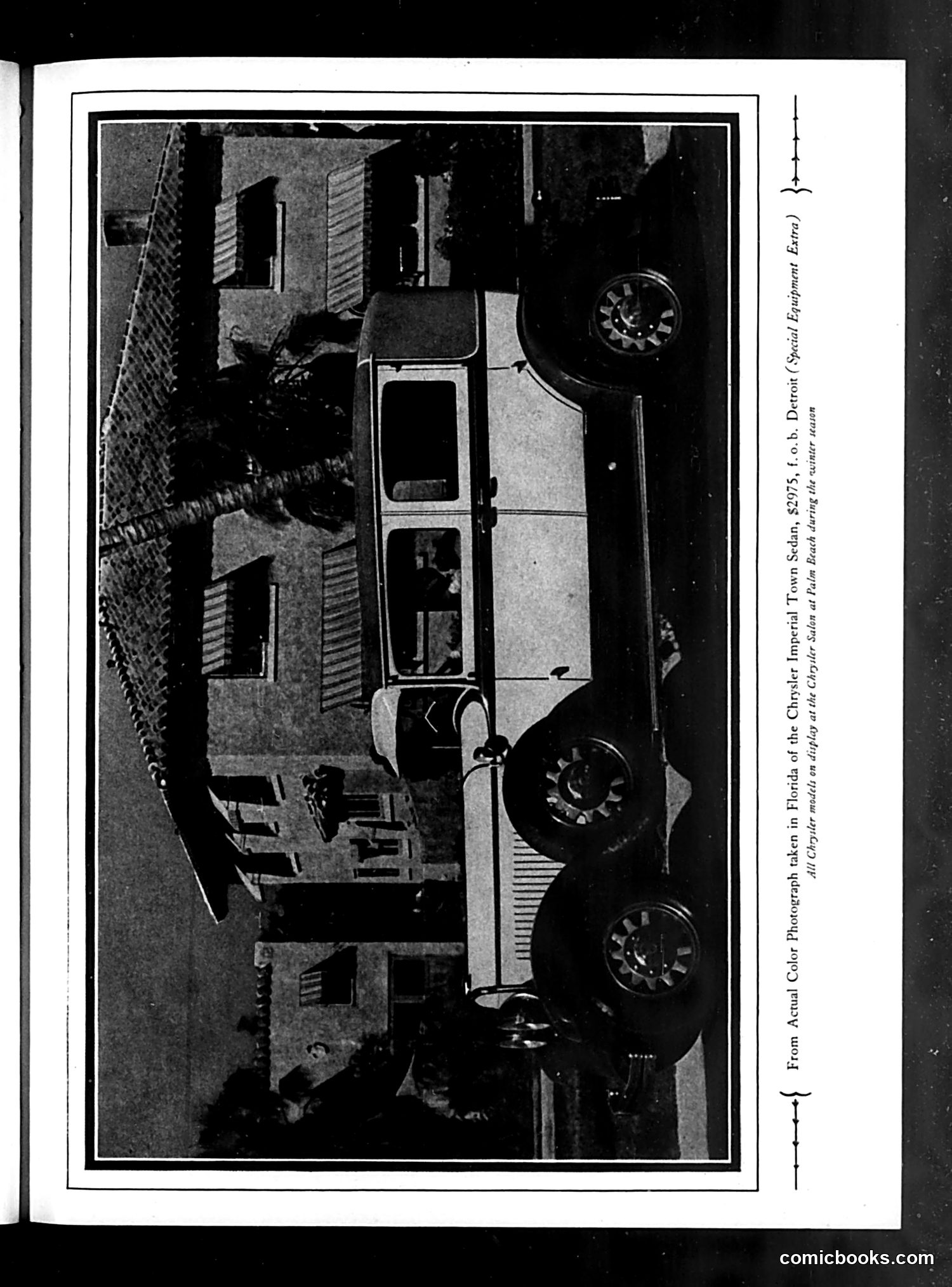
I cannot reliably interpret this page. The image appears to be a black-and-white photograph of an Imperial Taxi Sedan, shown rotated 90 degrees, displaying the vehicle's interior and exterior design. However, the OCR text is heavily corrupted and largely illegible—it appears to be inverted or scrambled text that doesn't form coherent English words or sentences. Without clear, readable text accompanying the photograph, I cannot identify the satirical point, any political references, or what joke or commentary this was meant to convey to contemporary Life magazine readers. The caption reference to "$2975, f.o.b. Detroit" suggests this may be a product advertisement rather than a political cartoon, but I cannot confirm the intended meaning or context with confidence.
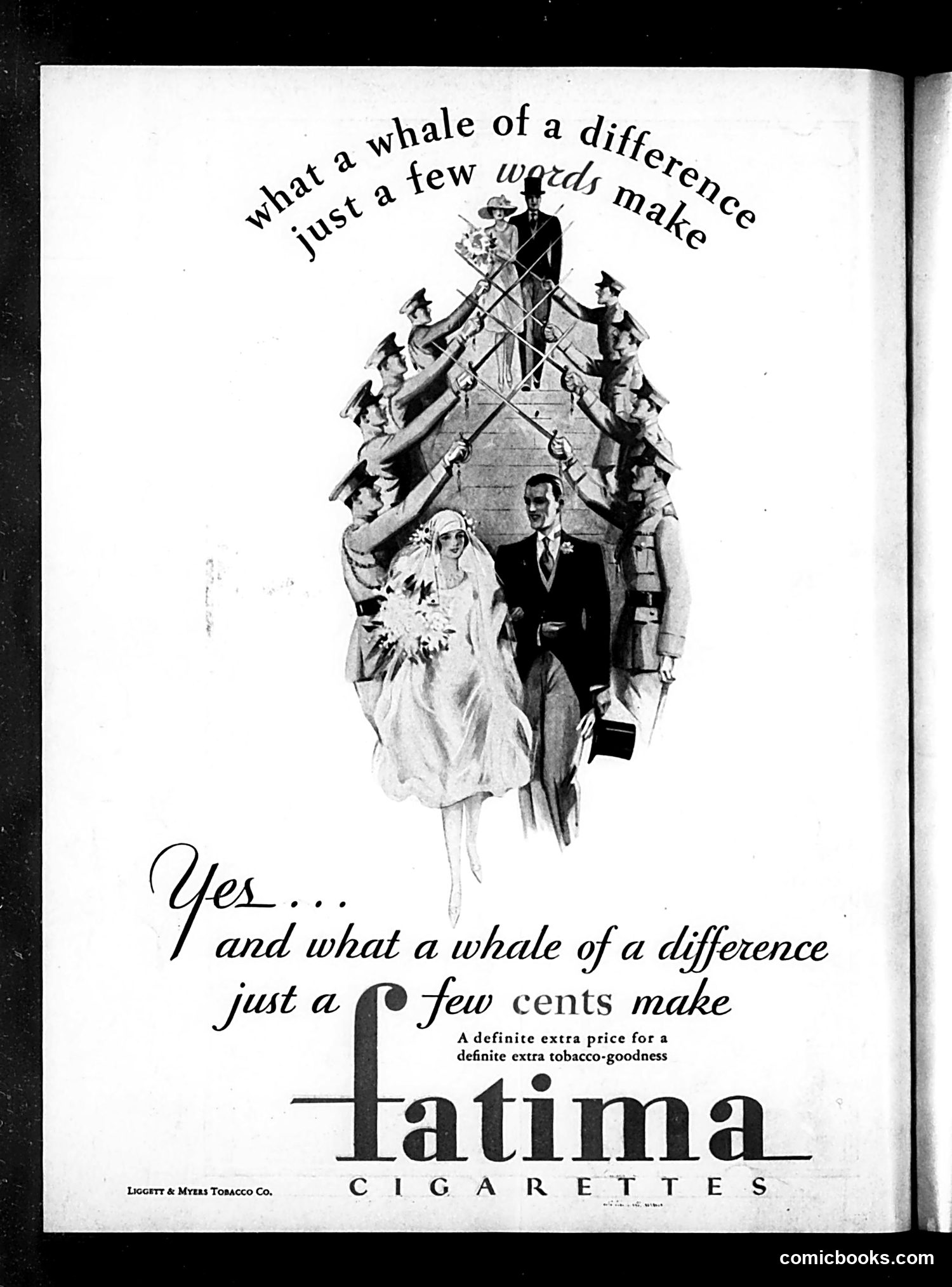
This is a cigarette advertisement for Fatima brand cigarettes by Liggett & Myers Tobacco Co., not political satire. The ad uses the phrase "what a whale of a difference just a few cents make" to justify premium pricing for their product. The illustration depicts a bride and groom ascending what appears to be a ship's rigging or ladder, surrounded by sailors and military figures. The wedding imagery suggests that small price differences matter greatly in significant life purchases—the ad implies that spending extra cents on quality tobacco is as worthwhile as investing in a major life event. This reflects early 20th-century advertising rhetoric emphasizing that minor cost increases yield substantial quality improvements, particularly for luxury consumer goods like premium cigarettes.