life
Life — January 24, 1930
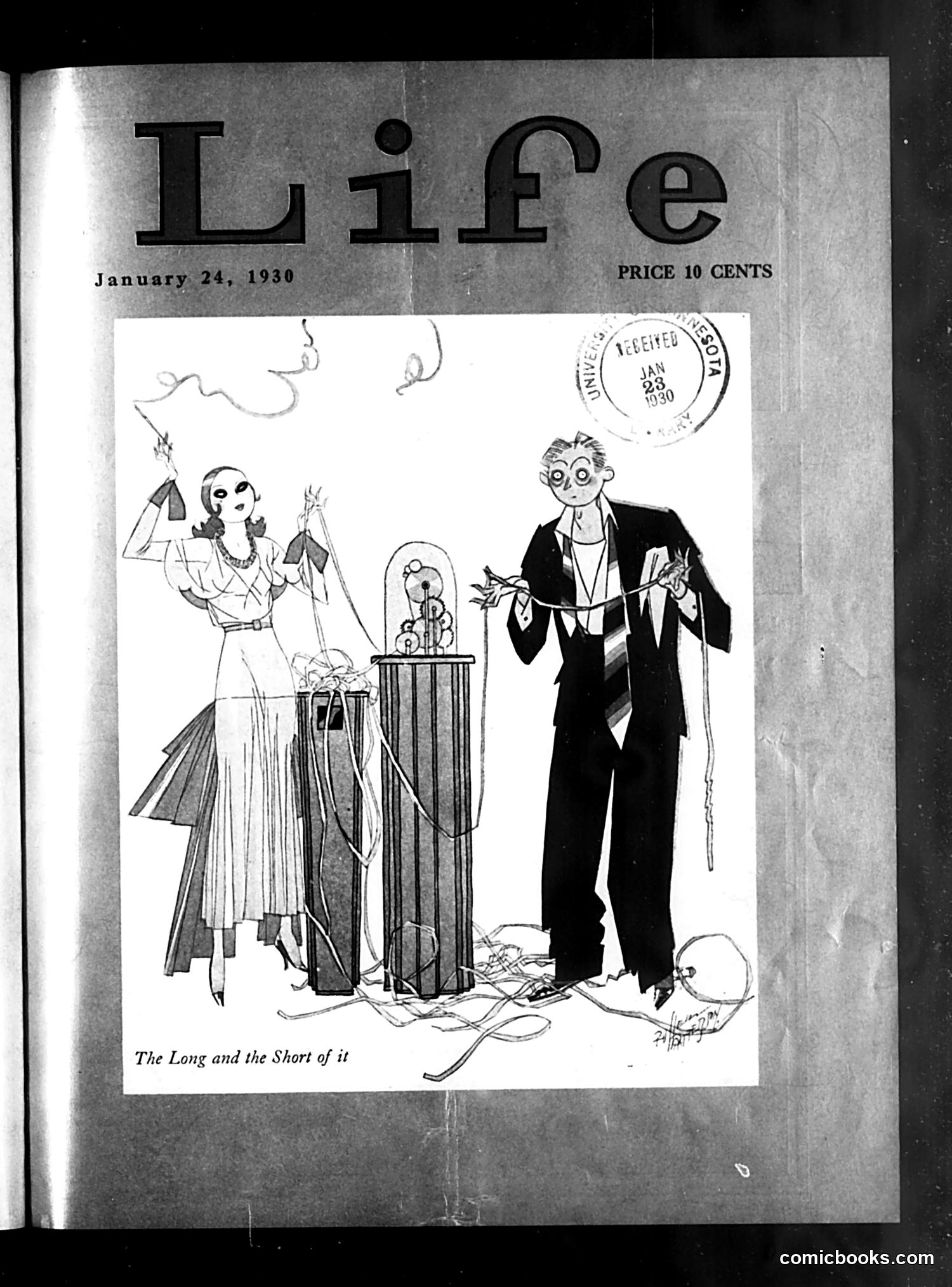
"The Long and the Short of It" - Life Magazine, January 24, 1930 This cartoon satirizes height differences in romantic or social pairings, a common topic for 1930s humor. The illustration shows a tall, thin man in formal wear and a shorter woman in a fashionable dress, surrounded by tangled string or yarn—likely representing the complications and awkwardness of their height disparity. The title "The Long and the Short of It" is a pun: it refers both to their physical heights and to the phrase meaning "the essential point" or "the bottom line." The cartoon mocks how such mismatched couples navigate everyday interactions, with the visual chaos of the tangled strings emphasizing the comedic confusion their size difference creates. This reflects 1930s social commentary on courtship and physical compatibility.
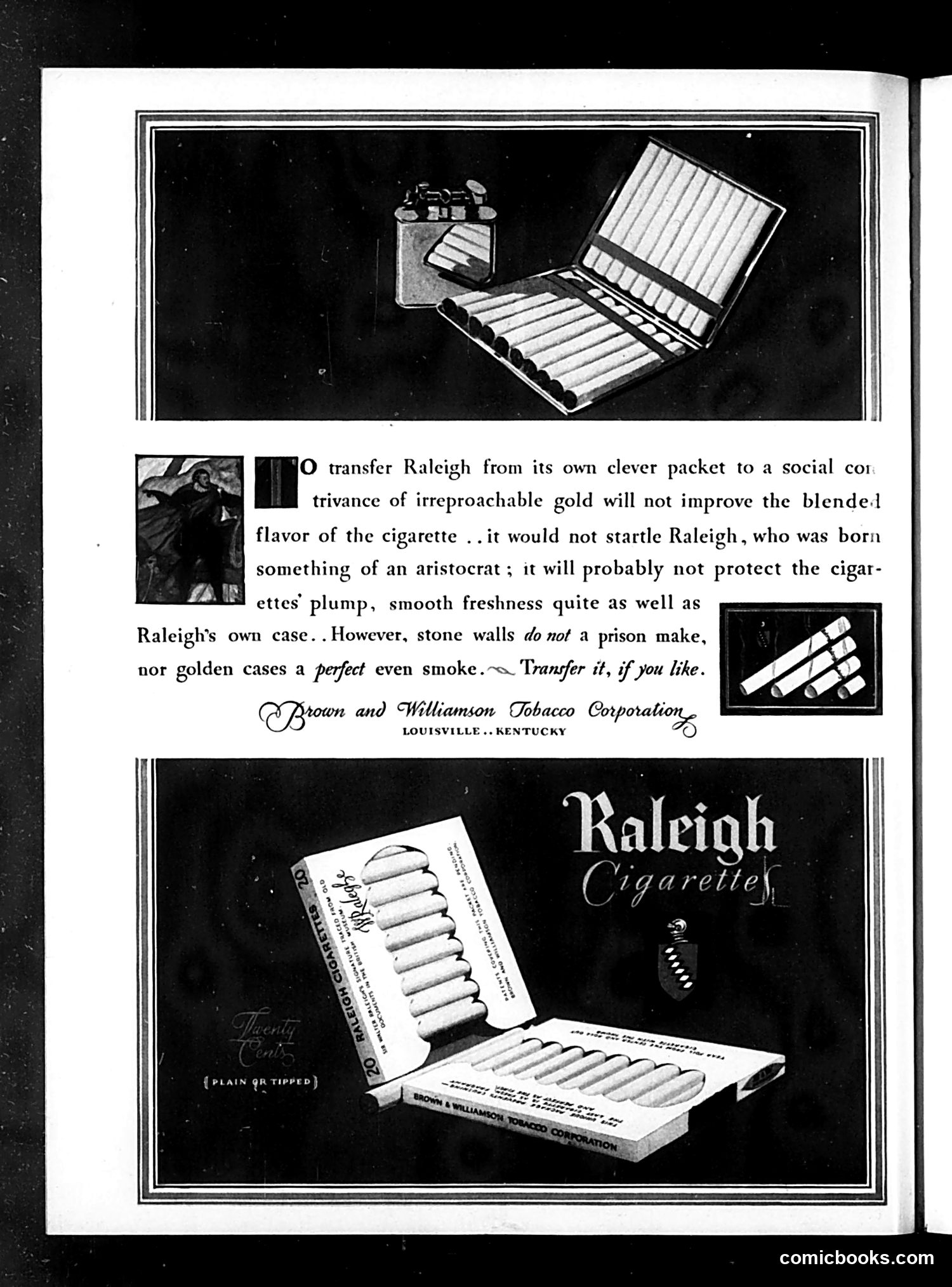
Analysis This page is primarily advertising for Raleigh cigarettes by Brown and Williamson Tobacco Corporation (Louisville, Kentucky), not political satire. The ad's joke plays on the brand's luxurious packaging. The text suggests transferring Raleigh cigarettes from their elegant gold case to a plain case wouldn't improve the smoke—implying the brand's quality speaks for itself, not its fancy packaging. The phrase "stone walls do not a prison make, nor golden cases a *perfect* even smoke" mocks the idea that expensive cases guarantee superior smoking experience. The ad emphasizes that Raleigh offers a quality smoke regardless of packaging, positioning it as an aristocratic choice for discerning smokers. This is straightforward product marketing using gentle humor about conspicuous consumption rather than political commentary.
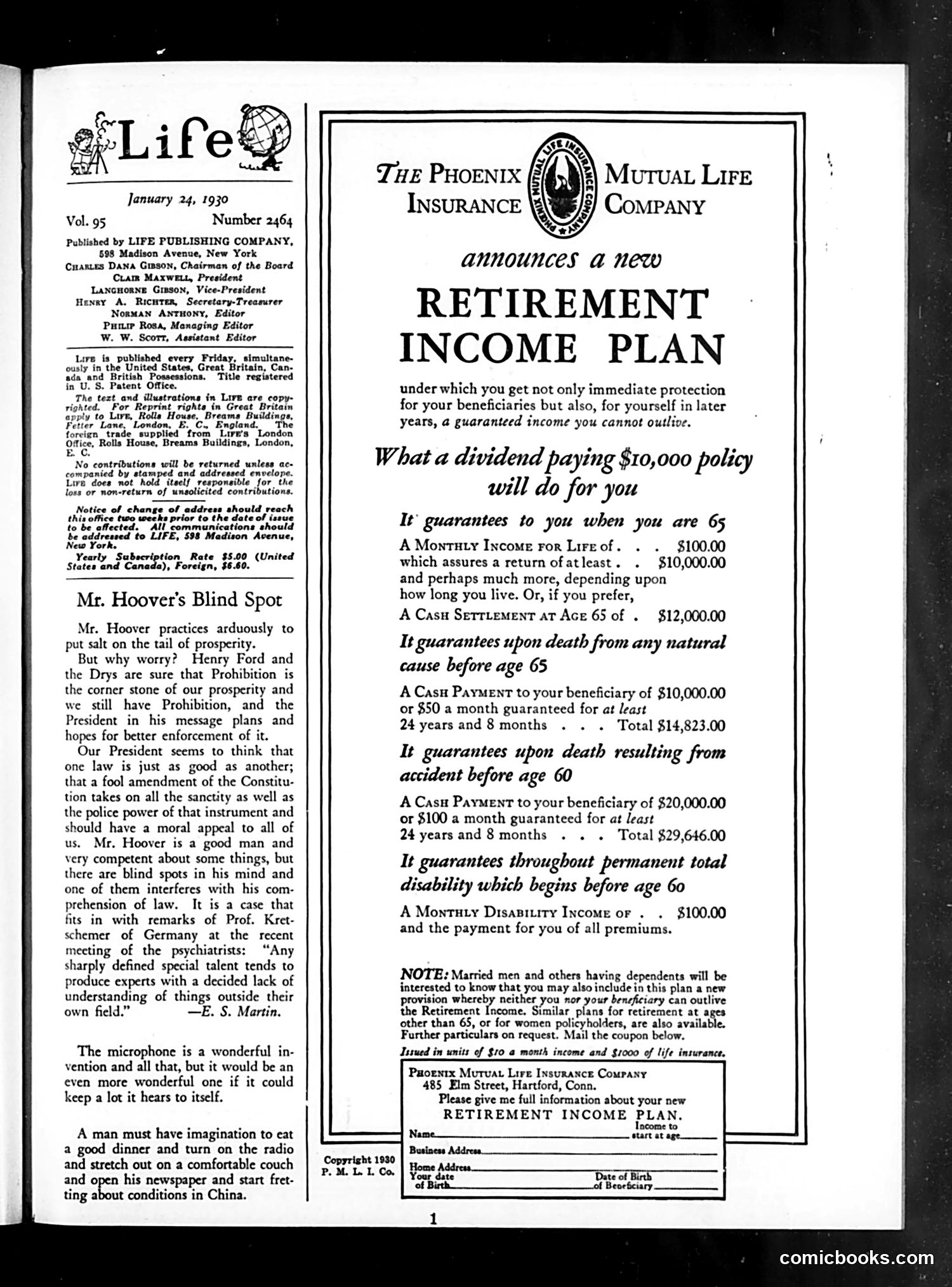
Page Analysis This page is primarily a Life magazine advertisement for Phoenix Mutual Life Insurance's new "Retirement Income Plan" (1939). The ad occupies most of the right side. The left side contains an editorial piece titled "Mr. Hoover's Blind Spot," which appears to criticize Herbert Hoover's political philosophy. The author argues Hoover has "blind spots" regarding law and governance, sarcastically suggesting he believes one law is as good as another and that fools' constitutional amendments are acceptable. The piece seems to critique Hoover's stance on Prohibition and his general approach to enforcing laws. The brief final paragraph makes an unrelated observation about radio and newspapers. This is primarily content and advertising, not a political cartoon.
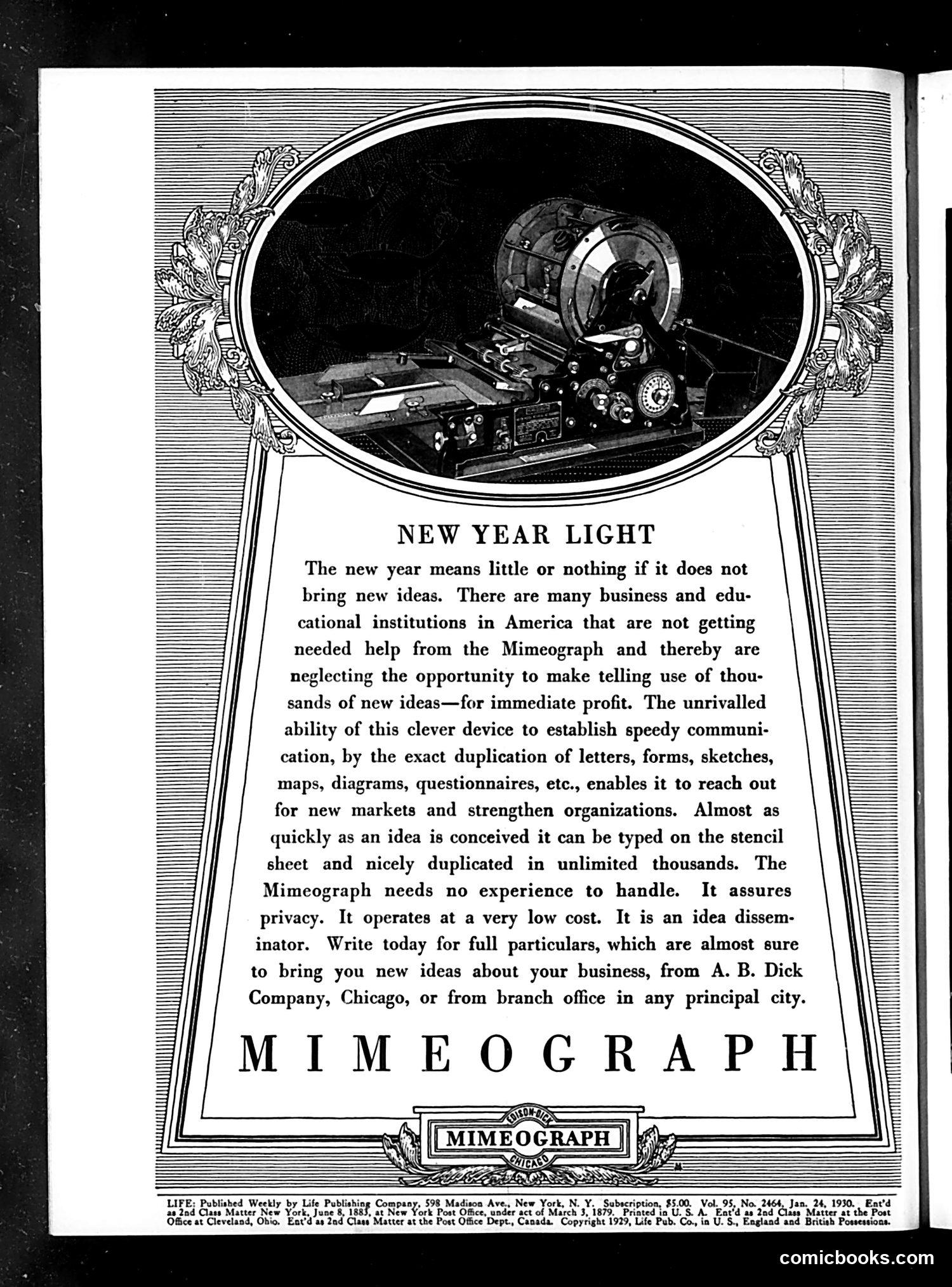
Content Analysis This page is primarily an advertisement, not a political cartoon. It promotes the Mimeograph machine, a document-copying device manufactured by the A.B. Dick Company of Chicago. The ad's headline "NEW YEAR LIGHT" frames the mimeograph as a modern business solution for the new year. The pitch argues that American businesses and educational institutions are missing opportunities by not using mimeographs to duplicate and distribute documents—letters, forms, maps, diagrams—quickly and affordably. The image shows the mimeograph device itself. The advertisement emphasizes speed, low cost, and ease of operation as selling points for expanding business reach and organizational strength. This reflects early-20th-century enthusiasm for new office technology as a path to business efficiency and profit.
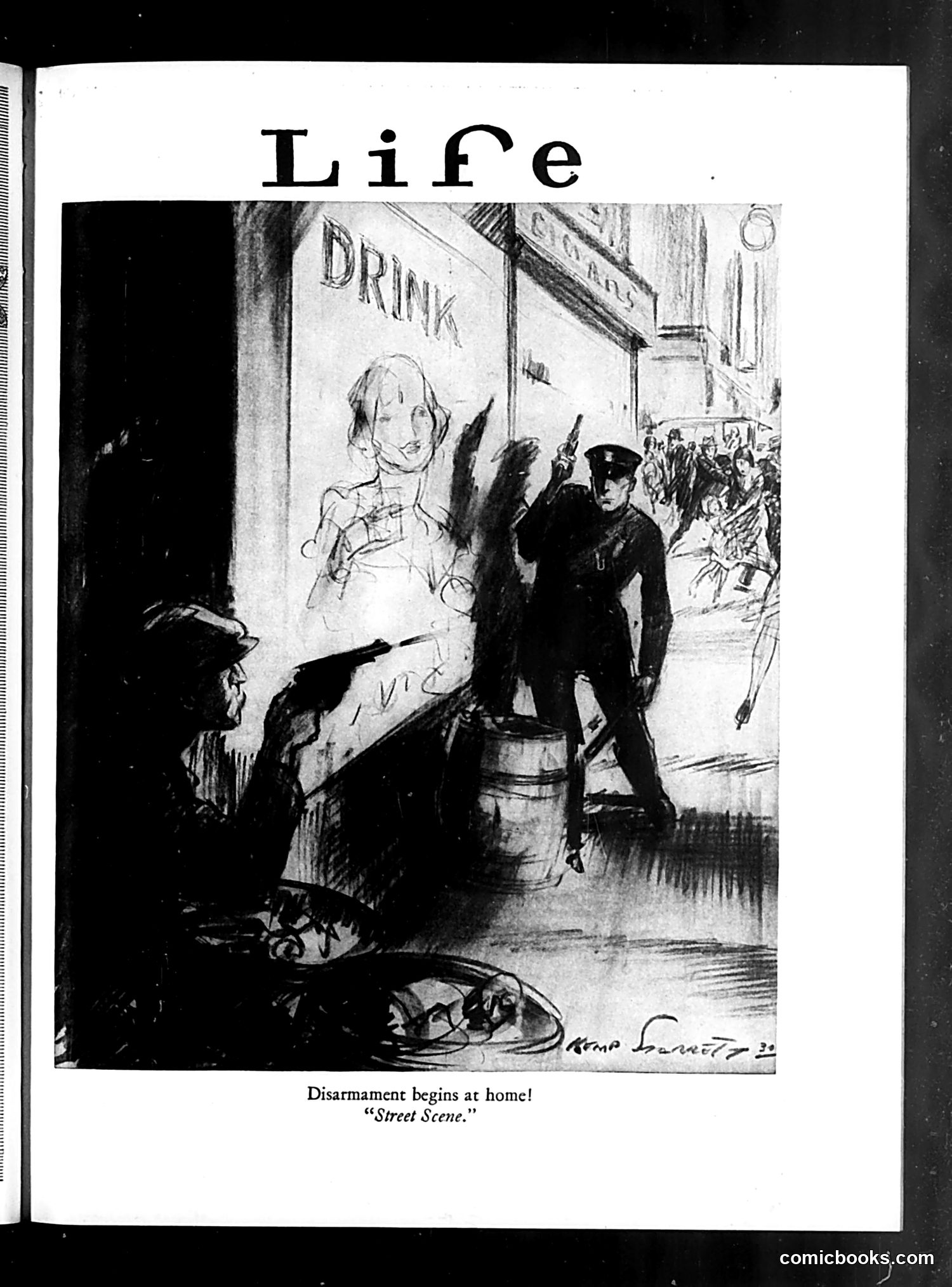
Analysis This Life magazine page satirizes early 20th-century disarmament debates. The cartoon depicts a uniformed military officer confronting a street artist who has drawn anti-military propaganda on a wall—specifically, a caricatured figure labeled "DRINK" above text reading "DRINK." The caption "Disarmament begins at home! 'Street Scene'" suggests ironic commentary: true disarmament efforts must start with eliminating domestic social problems (represented by the drinking figure and street poverty) rather than focusing on international military reduction. The officer's confrontational stance toward the artist implies authorities suppress grassroots criticism of militarism while ignoring underlying social issues. The satire critiques how governments tout disarmament policies as solutions while neglecting the poverty and social decay visible on their own streets.
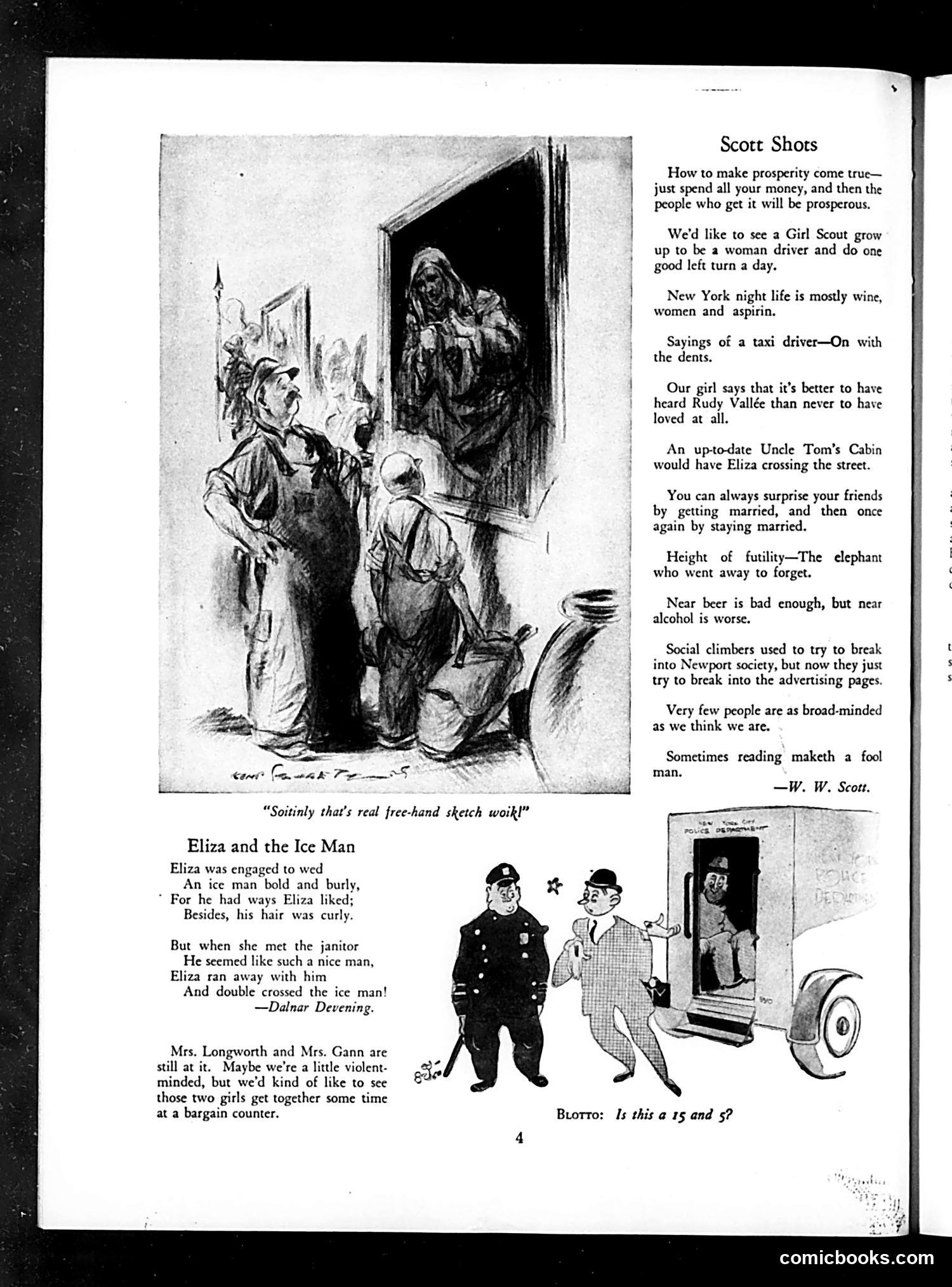
Scott Shorts & "Eliza and the Ice Man" This page contains humor columns and verses by W.W. Scott, plus a poem by Dalnar Deecning. "Eliza and the Ice Man" is a humorous poem about a woman engaged to marry an ice vendor, but who runs away with the janitor instead. The verse plays on class assumptions and romantic irony—she abandons her respectable fiancé for someone of lower social standing. The top cartoon shows what appears to be people viewing artwork or a sketch, with someone commenting on its quality as "real free-hand sketch work"—likely satirizing art criticism or pretension. Scott's "Shorts" are brief satirical observations on contemporary American life: Girl Scouts, New York nightlife, taxi drivers, marriage, wealth, and social climbing. The final item notes that "reading maketh a fool man," mocking intellectual pretension.
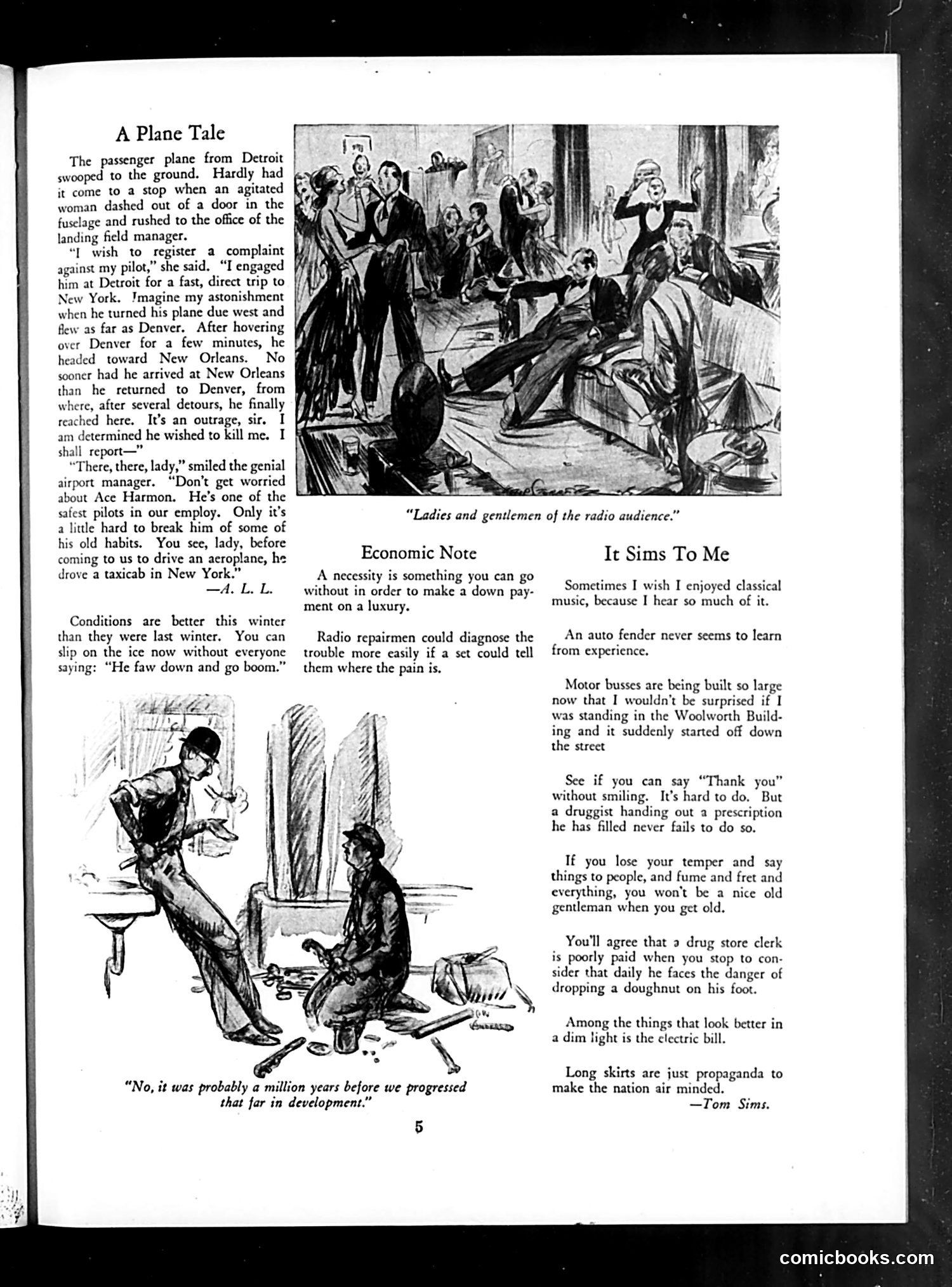
Explanation for Modern Readers This page contains three distinct pieces: 1. "A Plane Tale" (top): A humorous anecdote about an erratic pilot named Ace Harmon who, hired for a direct Detroit-to-New York flight, inexplicably detoured to Denver and New Orleans before returning. The joke satirizes unpredictable, dangerous early aviation practices when pilot accountability was minimal. 2. Lower cartoon: Shows two figures (appears to be a plumber and worker) with the caption "No, it was probably a million years before we progressed that far in development"—likely mocking slow technological advancement or incompetent workmanship. 3. "It Sims To Me" (right): A humor column by Tom Sims offering social observations about modern life (buses, drugstores, politeness)—light satirical commentary on everyday behavior and commercialism.
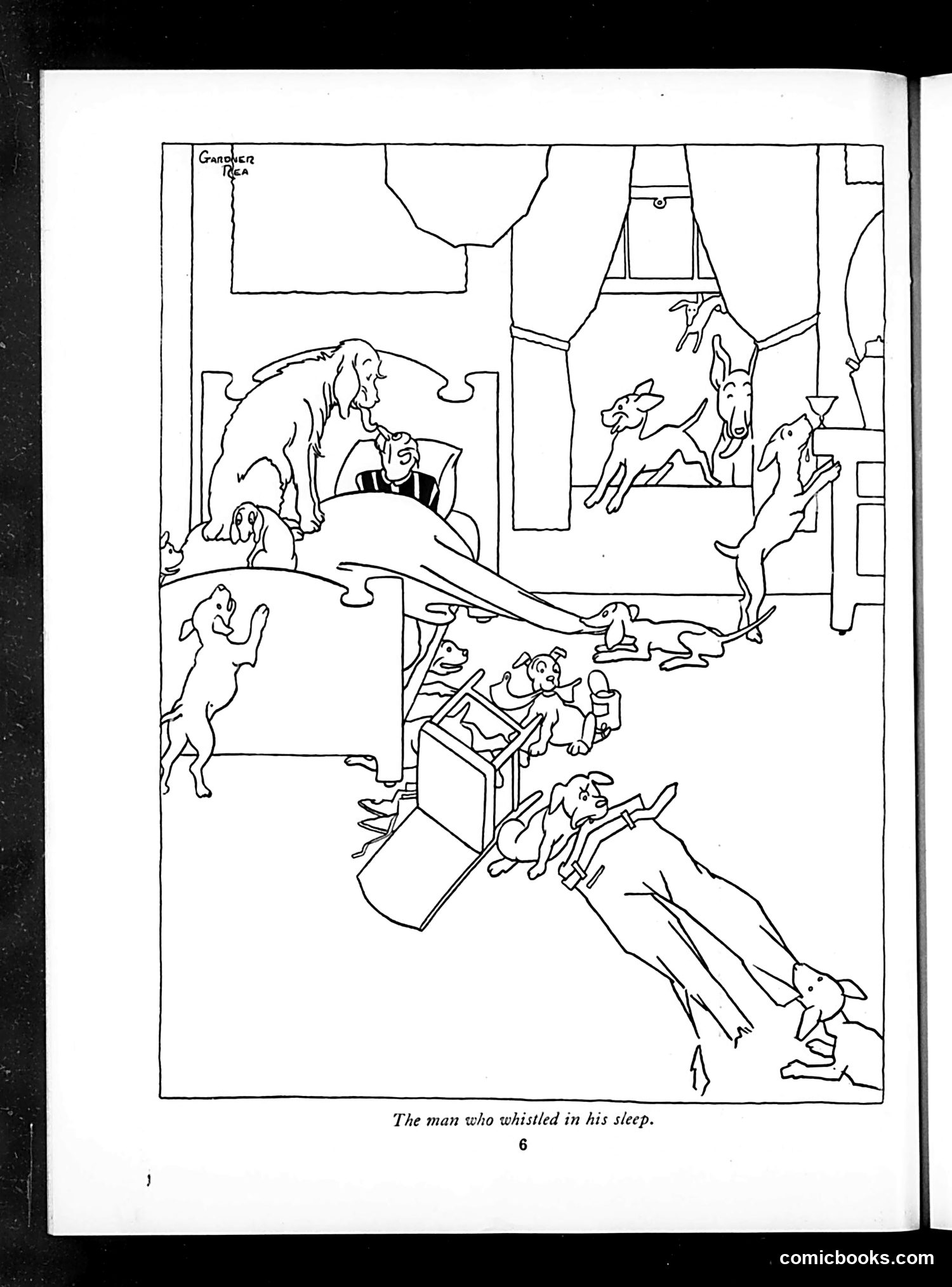
Analysis This is an illustration titled "The man who whistled in his sleep" (page 6). The cartoon depicts a chaotic household scene where a sleeping man in bed is whistling, causing numerous dogs throughout the home to become wildly agitated and misbehave. Dogs are jumping on furniture, running through rooms, and generally creating mayhem in response to the whistling sound. The satire appears to be about unintended consequences—how a seemingly innocent action (whistling while asleep) can trigger disproportionate chaos. It's a humorous commentary on how one person's behavior can inadvertently disrupt an entire household, likely poking fun at domestic life and the unpredictable nature of family (or in this case, pet) dynamics. The joke relies on the visual humor of widespread disorder stemming from one simple act.
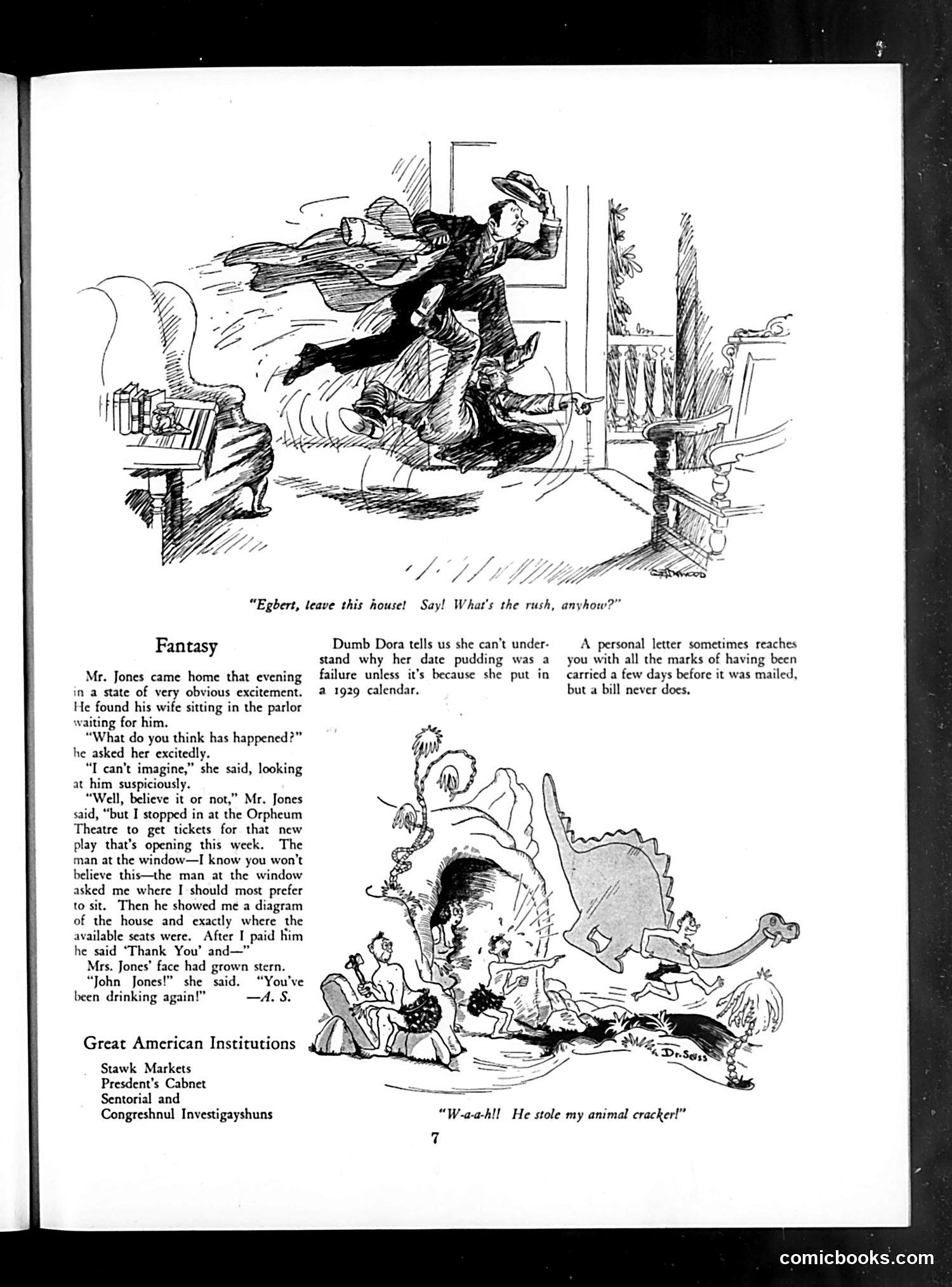
Analysis This page contains two satirical pieces from *Life* magazine: "Fantasty" (top story): A humorous domestic anecdote where Mr. Jones claims to have obtained theater tickets from a man at the Orpheum who provided a diagram of available seats. His wife suspects he's fabricated this story, calling him out for drinking. The humor lies in the absurdity of receiving such detailed assistance from a stranger—a mild satire on either gullibility or marital deception. "Great American Institutions": A list mockingly labeling "Stark Markets," "President's Cabinet," "Senatorial and Congressional Investigayshuns" as supposedly great American institutions—satirizing their actual ineffectiveness or corruption. The two cartoons illustrate these pieces with exaggerated, slapstick imagery typical of early 20th-century comic illustration.
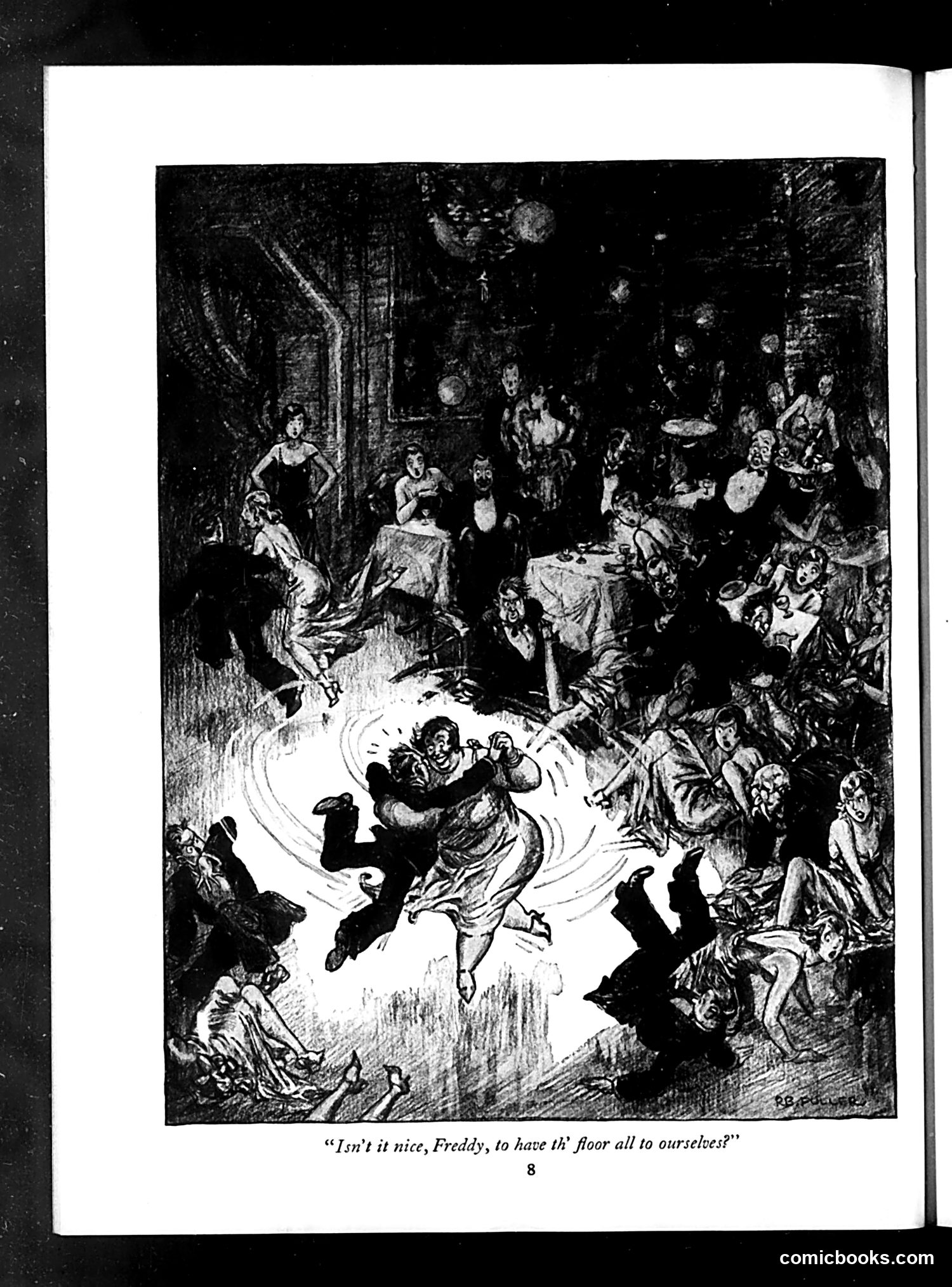
Analysis This is a single-panel cartoon depicting a crowded ballroom or dance scene. The caption reads: "Isn't it nice, Freddy, to have th' floor all to ourselves?" The satire is visual irony: two figures dance in the center on what appears to be an empty, glowing floor, while they're actually surrounded by a large crowd of onlookers pressing in from all sides. The joke comments on a couple's self-absorption or delusion—they believe they have privacy and exclusivity ("all to ourselves") despite being in a packed, public venue with numerous spectators watching them. This reflects early 20th-century social commentary about vanity, obliviousness, or the illusion of privacy in crowded modern social spaces. The crowded, chaotic rendering emphasizes the contrast between the dancers' perception and reality.
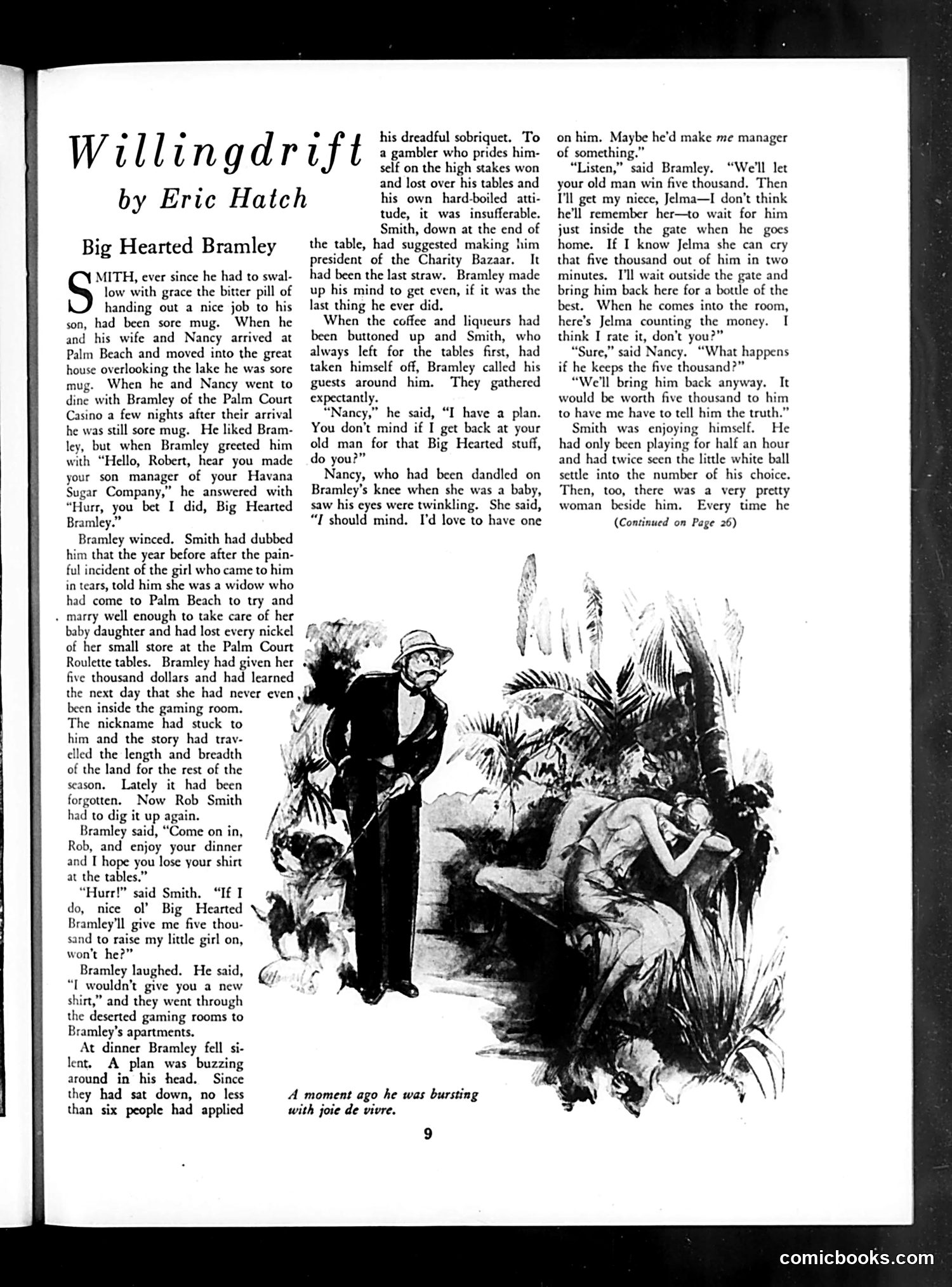
"Willingdrift" by Eric Hatch - Page Analysis This is a short story page, not a political cartoon. The narrative concerns "Big Hearted Bramley," a wealthy Palm Beach resident who gambles at an exclusive club. Rob Smith, a club employee, attempts to manipulate Bramley by fabricating a sob story about a fictional widow and orphaned daughter needing five thousand dollars, hoping to extract money from the generous gambler. The accompanying illustration shows a man in a hat meeting a woman in tropical surroundings, depicting the moment Bramley is "bursting with joie de vivre"—presumably when Smith's scheme is about to be executed. This is straightforward fiction rather than social satire or political commentary. The story examines greed, deception, and generosity among the wealthy leisure class.
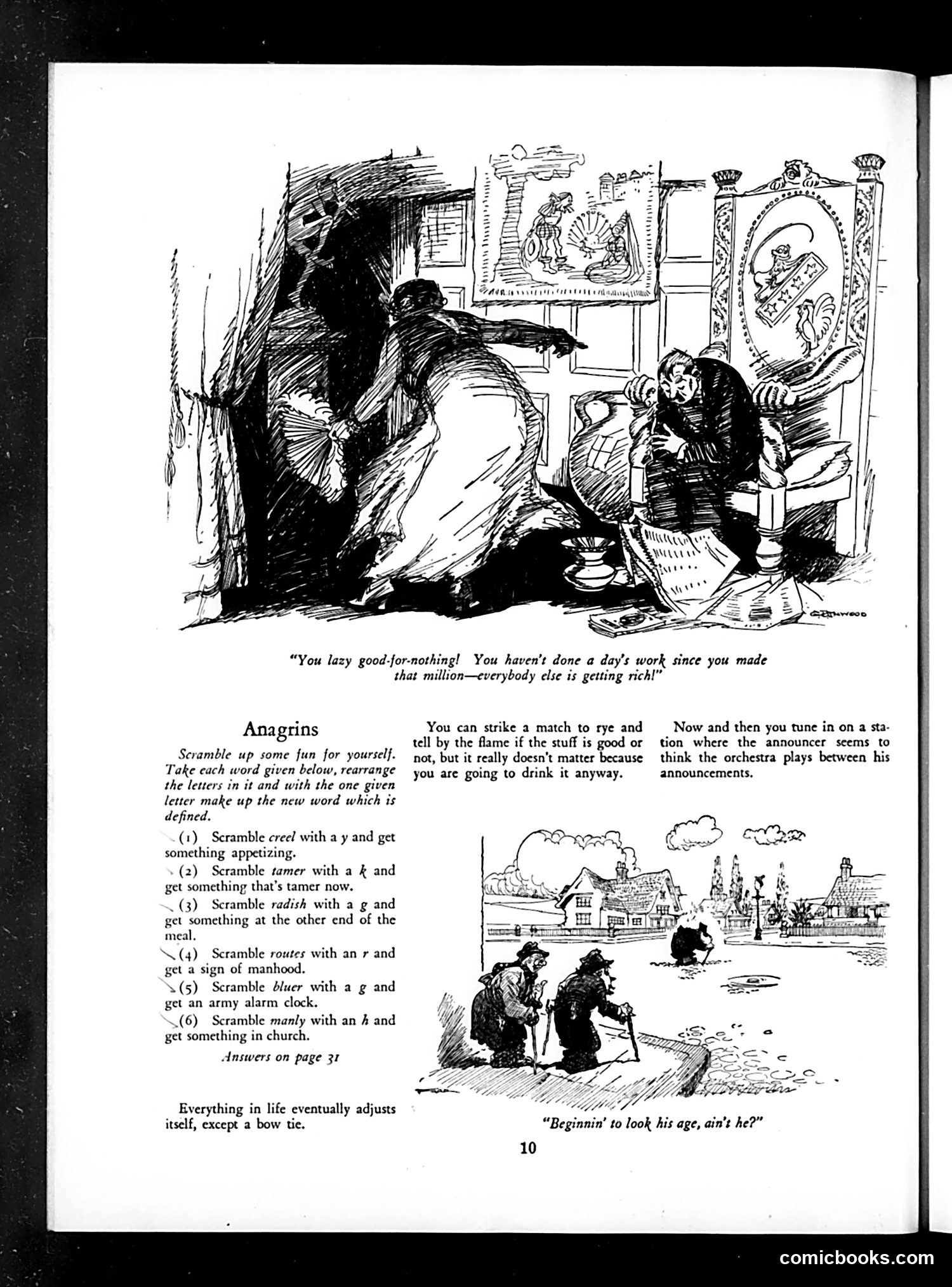
Cartoon Analysis The top cartoon depicts a wealthy, rotund man lounging in luxury while being scolded by what appears to be his wife or family member. The caption criticizes his idleness: "You lazy good-for-nothing! You haven't done a day's work since you made that million—everybody else is getting rich!" The satire targets nouveau riche indolence during what appears to be an economic boom period. The man's massive wealth has freed him from productive labor, yet he's still criticized for not participating in the general prosperity around him. The joke exposes the contradiction: he's already rich, yet society expects continuous wealth-building regardless. The page also includes "Anagins" (anagrams), a word puzzle game, and another cartoon below showing working-class figures, demonstrating Life magazine's mix of humor, satire, and entertainment content typical of early 20th-century American humor magazines.
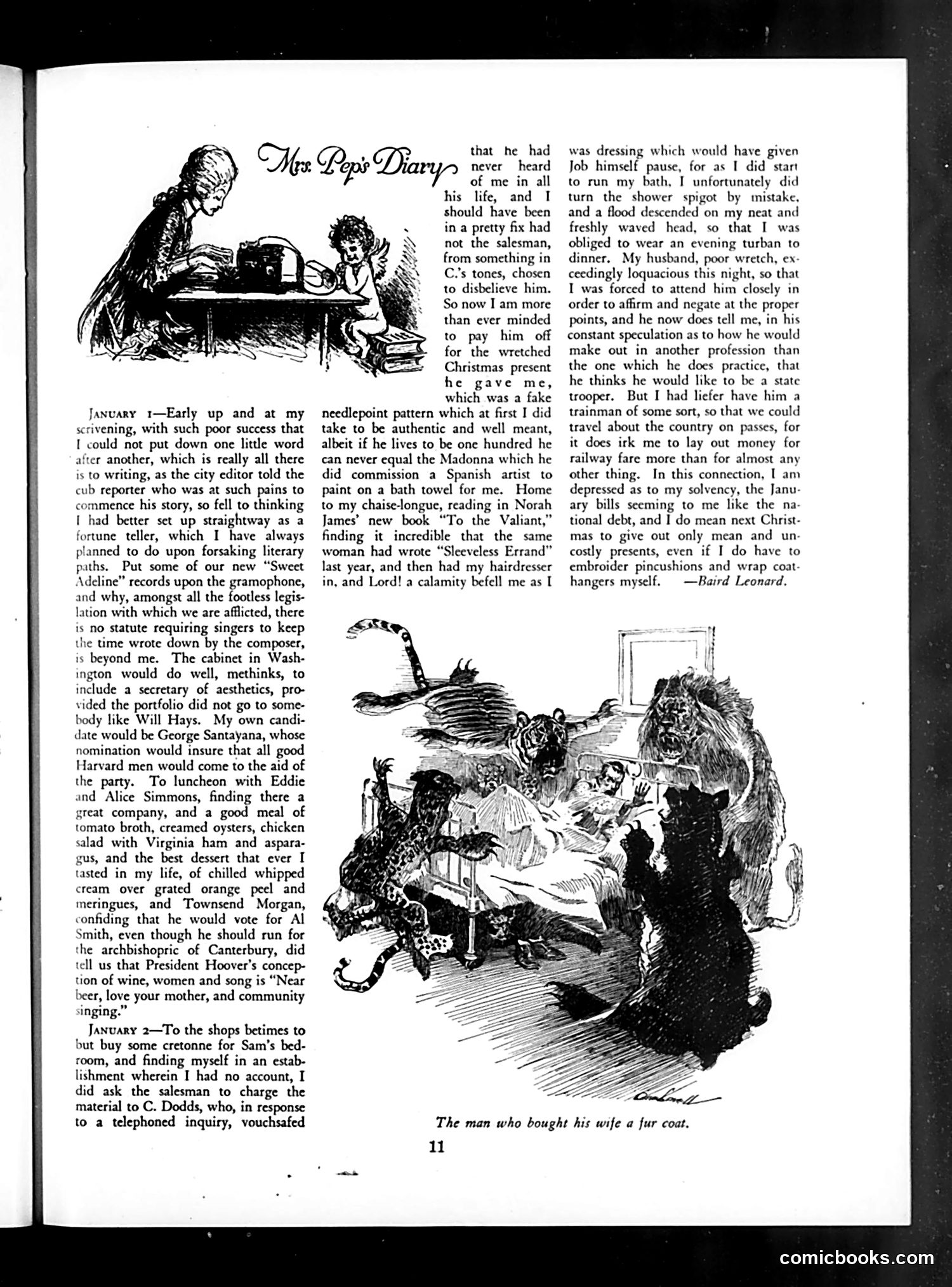
Mrs. Peps Diary Analysis This is a society gossip column illustrated with humorous sketches. The main cartoon shows "The man who bought his wife a fur coat"—depicting what appears to be a man presenting an elaborate fur stole to a woman, with various animals and creatures surrounding them in a chaotic, satirical scene. The accompanying diary text (dated January 1-2) contains upper-class social commentary—references to needlepoint patterns, Christmas gifts, hairdressers, and socializing with wealthy acquaintances. The humor relies on mocking pretentious behavior and the absurdities of fashionable society. The fur coat cartoon likely satirizes both conspicuous consumption and the somewhat ridiculous nature of such expensive gifts as status symbols among the wealthy during this era.
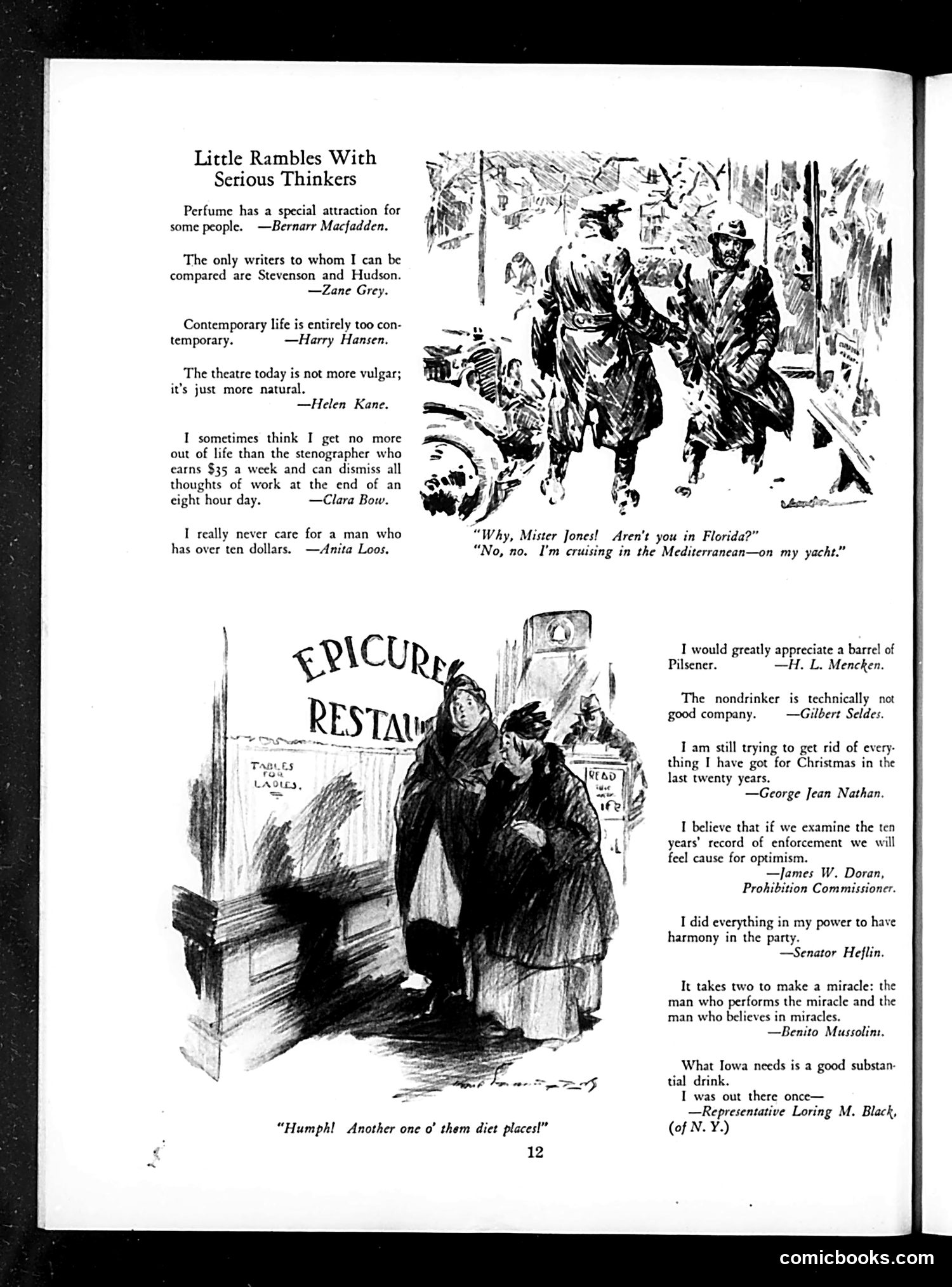
Analysis of Life Magazine Page 12 This page presents "Little Rambles with Serious Thinkers"—a satirical column of witty quotes attributed to notable figures (Bernard Macfadden, Zane Grey, Harry Hansen, Helen Kane, Clara Bow, Anita Loos, and others). The two cartoons illustrate period concerns: Top cartoon: Shows well-dressed people encountering someone claiming to cruise the Mediterranean on a yacht—likely satirizing wealthy pretension during the Jazz Age. Bottom cartoon ("Humph! Another one o' them diet places!"): Depicts the Epicure Restaurant entrance, mocking the era's diet-obsession trend. The figure's dismissive tone suggests skepticism toward trendy wellness claims. The page reflects 1920s-30s cultural preoccupations: celebrity culture, class aspiration, and the emerging diet/wellness industry—all treated with pointed humor.
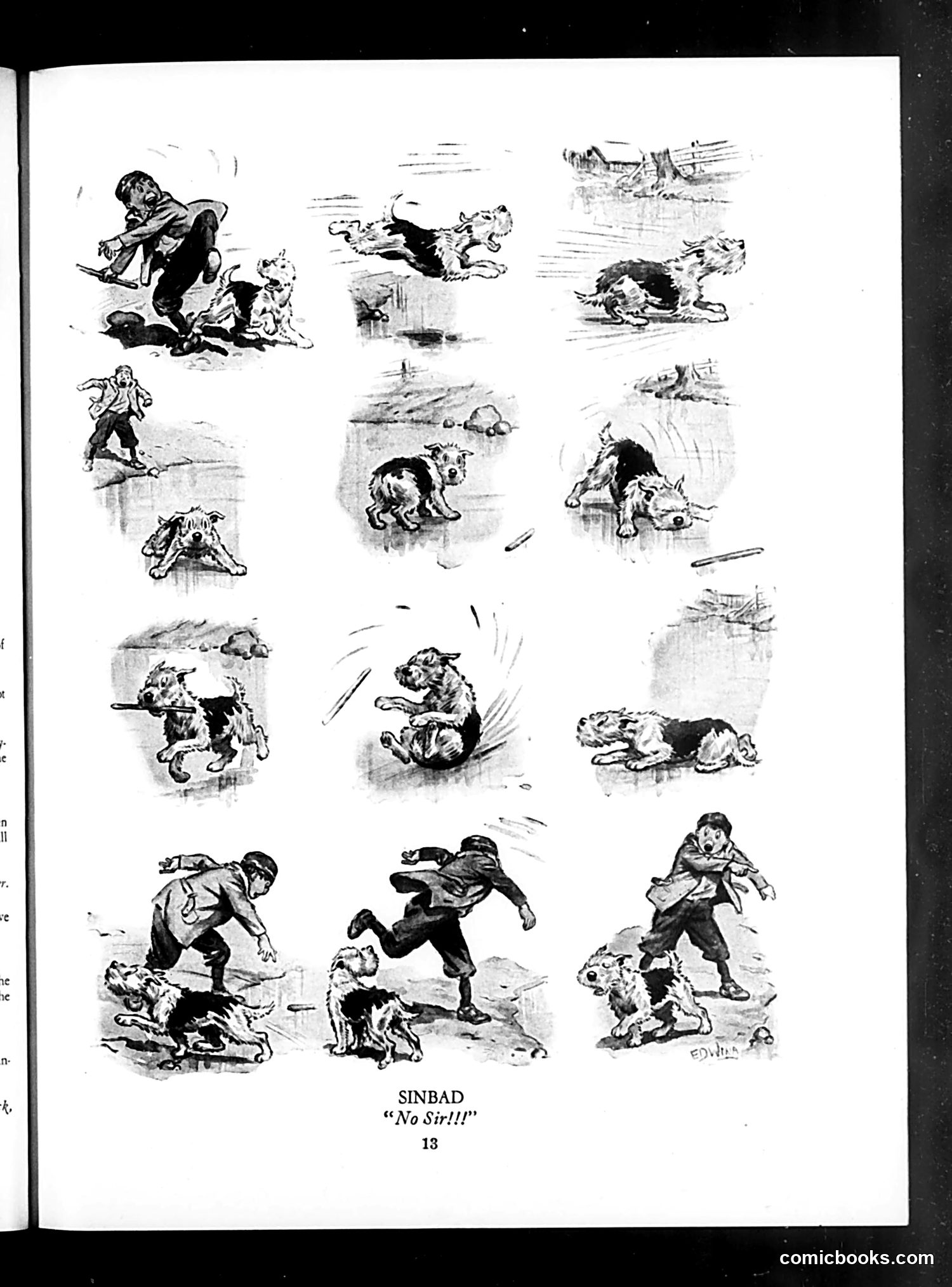
"Sinbad: No Sir!!!" This page contains a series of sketch studies depicting interactions between a man and a dog, labeled as being from "Sinbad" with the caption "No Sir!!!" The drawings appear to be character studies or storyboard sketches showing various poses and reactions—the man alternately commanding, gesturing at, or reacting to the dog's movements and behaviors. The repeated "No Sir!!!" caption suggests this illustrates a comedic scenario where the dog refuses obedience or repeatedly misbehaves despite the man's attempts at discipline or training. Without additional context about what "Sinbad" refers to (likely a comic strip or story), the specific satirical or social commentary—if any—remains unclear from the image alone.
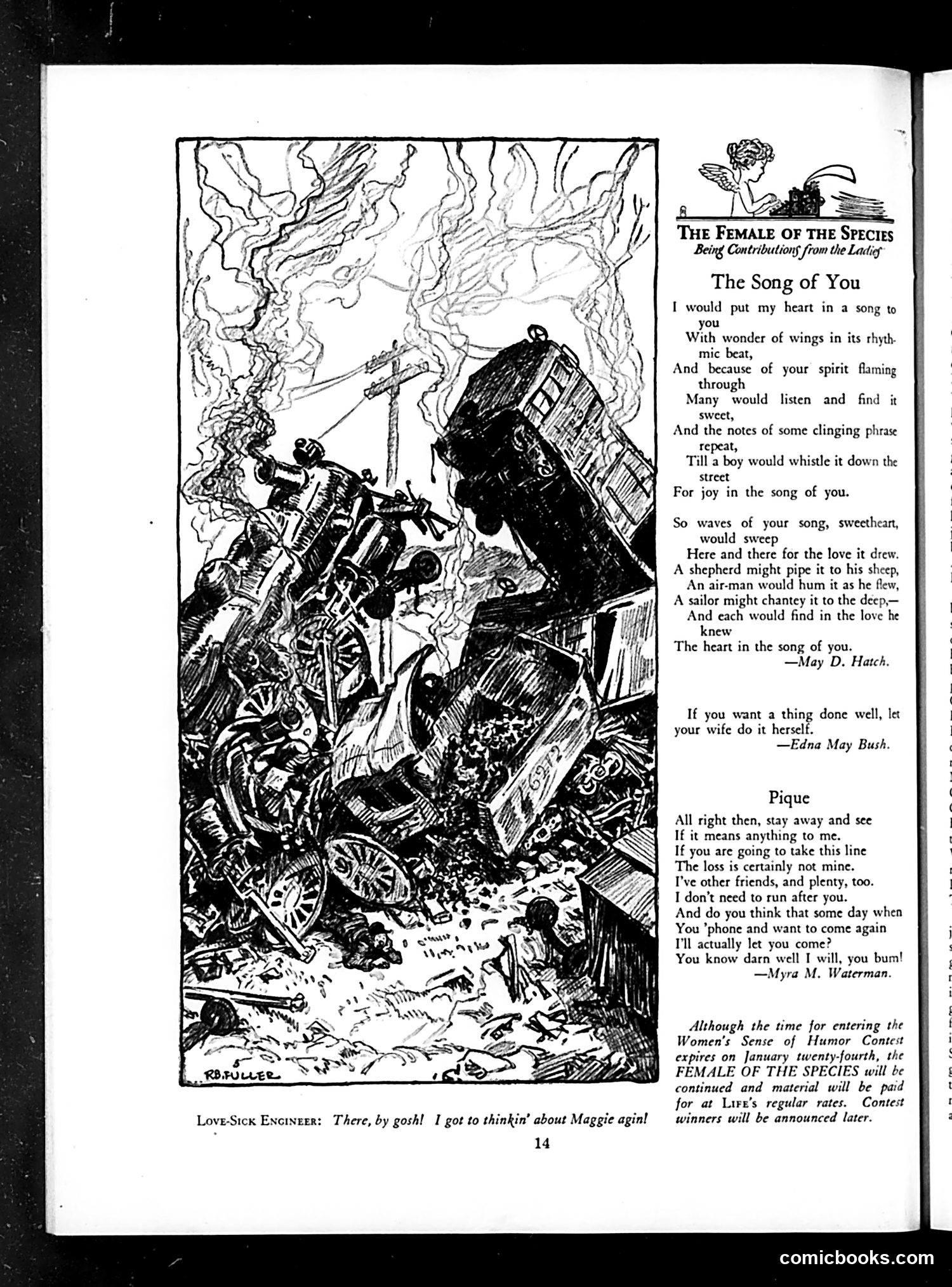
"The Female of the Species" - Life Magazine Page This page from *Life* magazine features three poems/quotes under the heading "The Female of the Species: Being Contributions from the Ladies." The accompanying cartoon depicts an engineer amid mechanical wreckage, apparently distracted by thoughts of a woman named Maggie. The caption reads: "Love-Sick Engineer: There, by gosh! I got to thinkin' about Maggie agin!" The satire targets romantic distraction in the workplace—specifically, how male workers' focus on women compromises their professional competence and safety. The poems below reinforce this theme, presenting women's perspectives on male behavior, relationships, and devotion. The overall point appears to be gentle mockery of both genders: men's helpless romantic obsessions and women's calculated awareness of their own power over men.
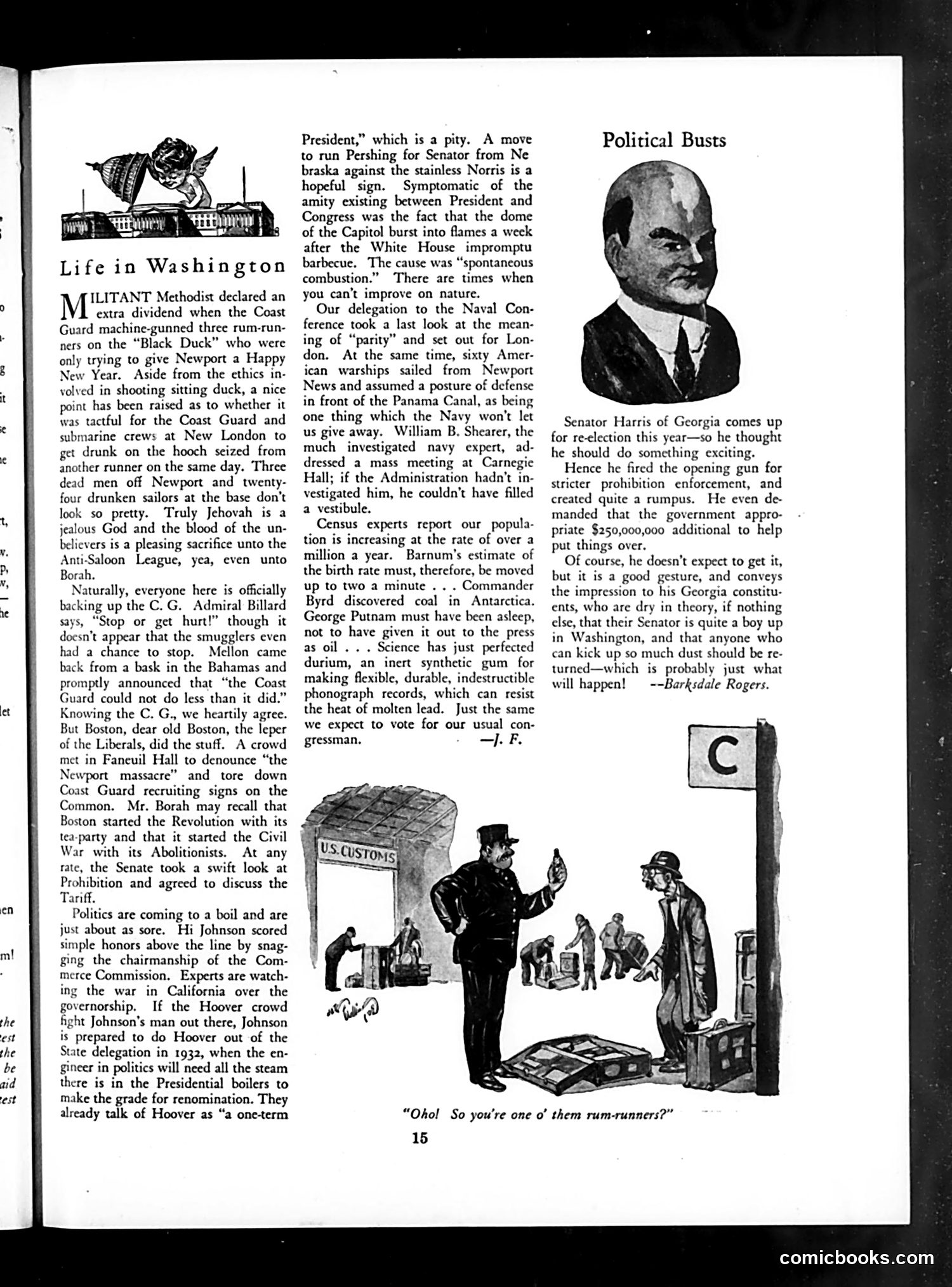
Political Busts and "Life in Washington" The page contains two sections. On the left, "Life in Washington" discusses Prohibition-era politics, including Coast Guard enforcement and Congressional scandals. The text references Senator Harris of Georgia positioning himself for re-election by demanding stricter alcohol prohibition enforcement and additional federal funding. On the right, "Political Busts" features a portrait (identity unclear from image alone) and discusses similar Prohibition themes. The main cartoon depicts a U.S. Customs official confronting what appears to be smugglers or bootleggers with contraband, with the caption "Oho! So you're one of 'them rum-runners?" The cartoon satirizes Prohibition enforcement failures and the prevalence of illegal alcohol smuggling during this era.
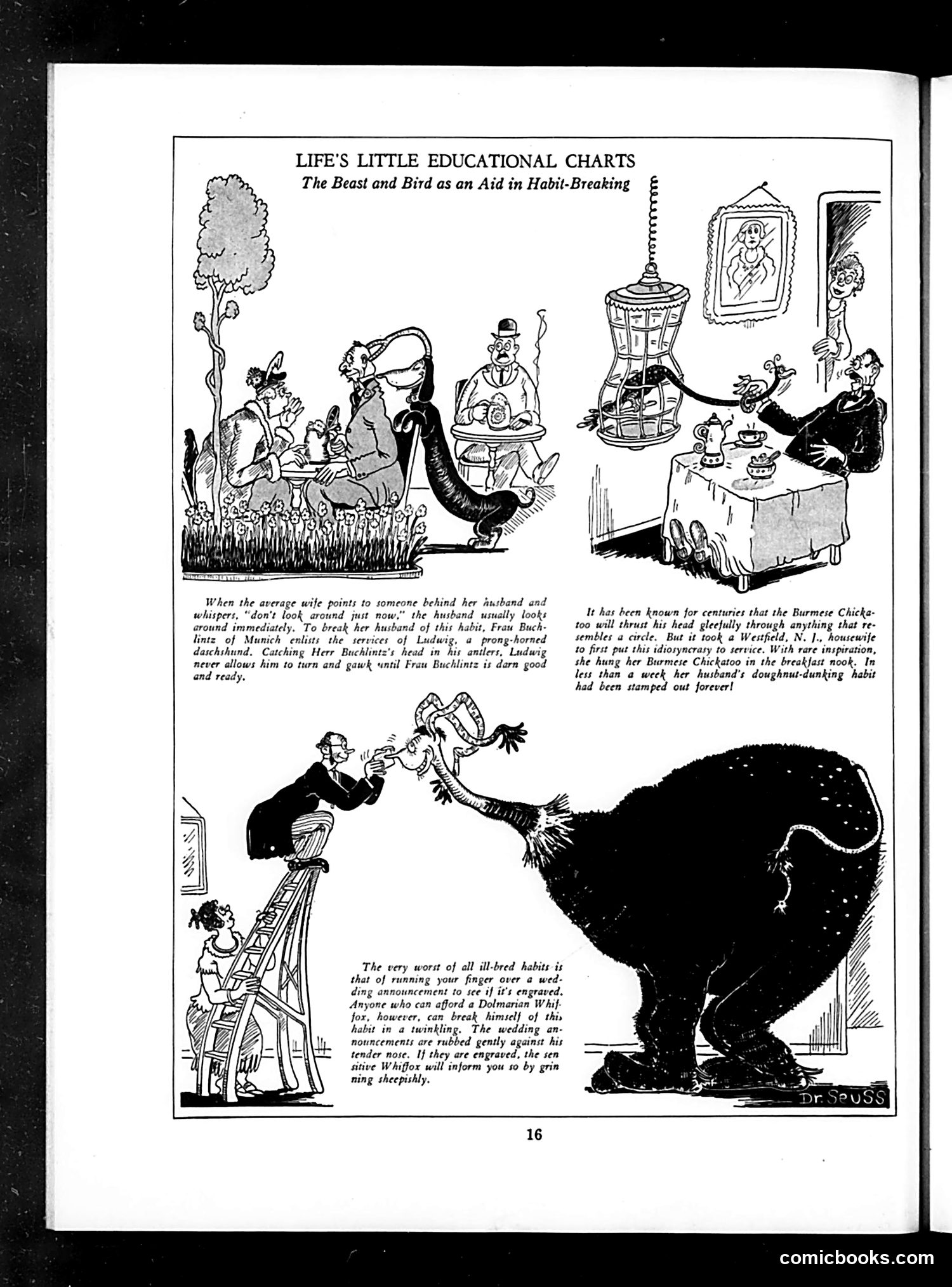
Analysis: "The Beast and Bird as an Aid in Habit-Breaking" This satirical chart illustrates humorous "cures" for bad habits using animals as deterrents: 1. Top section: A wife points accusingly at her husband while an ostrich, dachshund, and Burmese chicken are deployed to discourage his habits—apparently nail-biting and other vices. 2. Bottom section: A man on a ladder encounters an angry ostrich, illustrating how the bird "breaks" the habit of running fingers over engaged women's heads (a flirting behavior). The final panel features a large silhouetted bird, with text warning that one "ill-bred habit" is running fingers over a dog—though even an ostrich can break this behavior. This is satirical advice on etiquette and courtship, mocking Victorian-era social anxieties about genteel behavior through absurdist animal imagery. Dr. Seuss's distinctive style suggests this is likely early 20th-century humor about propriety.
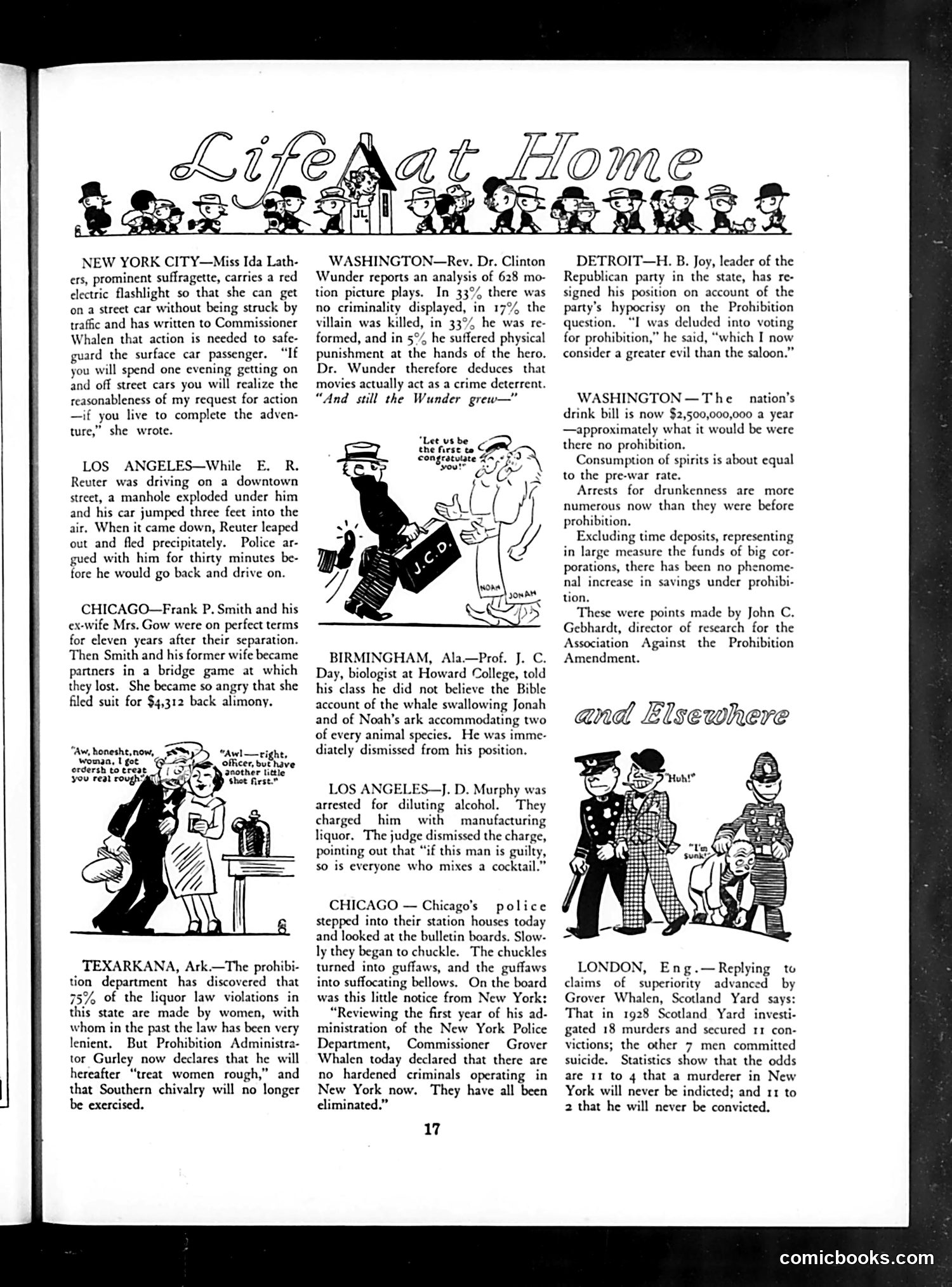
"Life at Home and Elsewhere" — Prohibition-Era Satire This page contains humorous news briefs mocking Prohibition enforcement and its social consequences (circa 1920s). The cartoons satirize: 1. Chicago cartoon (left): A couple's marital breakdown over bridge games, illustrating how Prohibition-era tensions affected domestic life. 2. Center cartoon: A police officer arresting someone for alcohol violations, captioned "Let us be the first to congratulate you"—sarcastically mocking Prohibition's ineffectiveness and police hypocrisy. 3. Right cartoon ("and Elsewhere"): Characters labeled "Hoik" and others appear to reference various Prohibition-related social disruptions. The brief from Washington notes Prohibition costs society $2.5 billion yearly while failing to reduce drunkenness or increase savings. The overall tone mocks Prohibition as unenforceable and socially destructive.
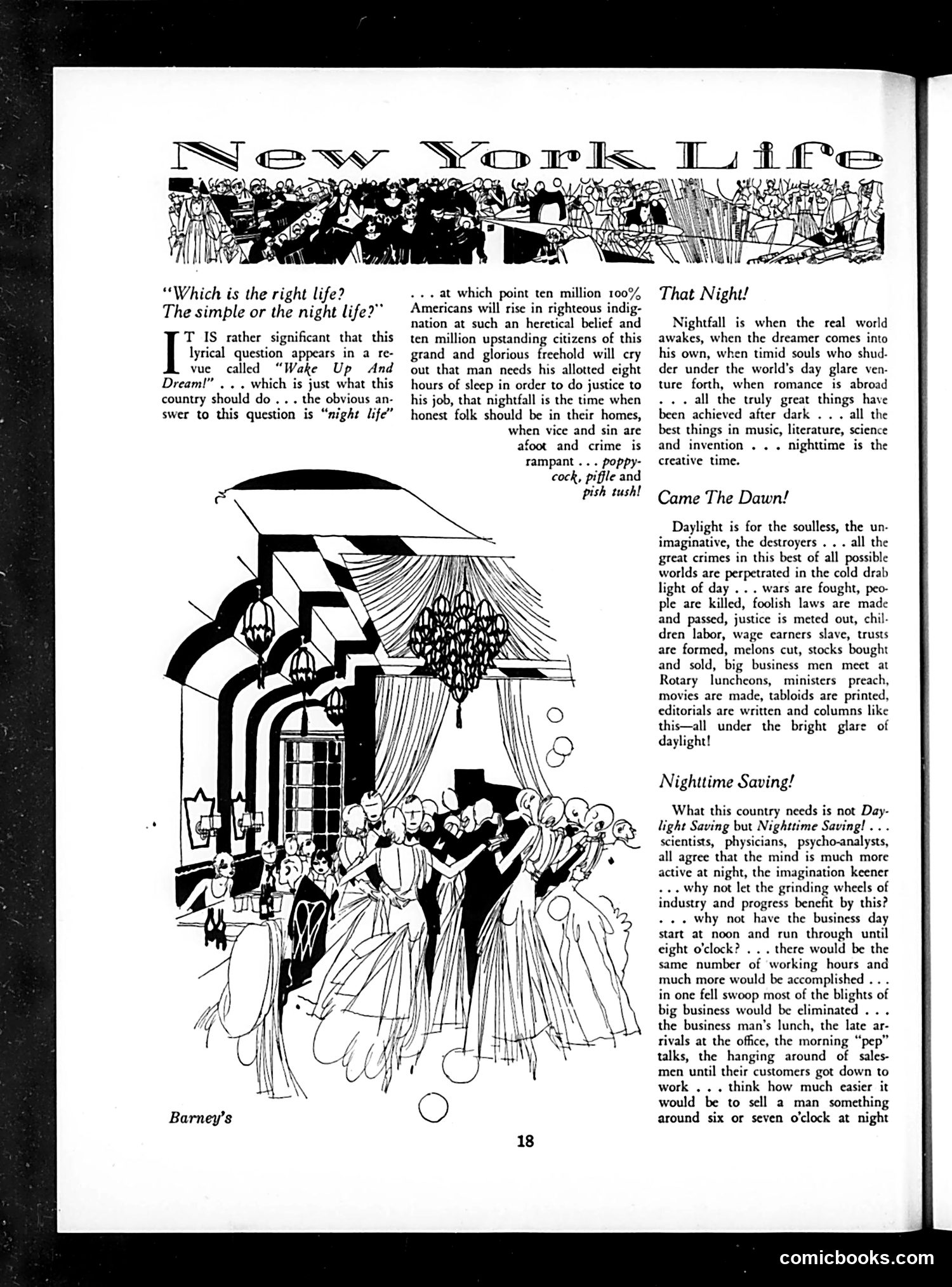
Analysis This page from *Life* magazine argues satirically for "Nighttime Saving"—an inversion of Daylight Saving Time. The text presents three perspectives: "That Night!" romanticizes nighttime as when "truly great things" happen in art, science, and culture. "Came The Dawn!" sarcastically catalogs daytime as when mundane or corrupt activities occur—wars, crimes, business dealings, and Rotary luncheons. "Nighttime Saving!" proposes shifting work hours to night, claiming this would boost productivity and eliminate business inefficiencies like long lunches and office socializing. The accompanying illustration shows a nighttime gathering at what appears to be Barney's (a department store), depicting elegant nightlife. The satire critiques American business culture and daily routines by suggesting that flipping the schedule would somehow solve systemic problems—a tongue-in-cheek commentary on efficiency obsessions and the romanticization of artistic nighttime culture versus prosaic daytime commerce.
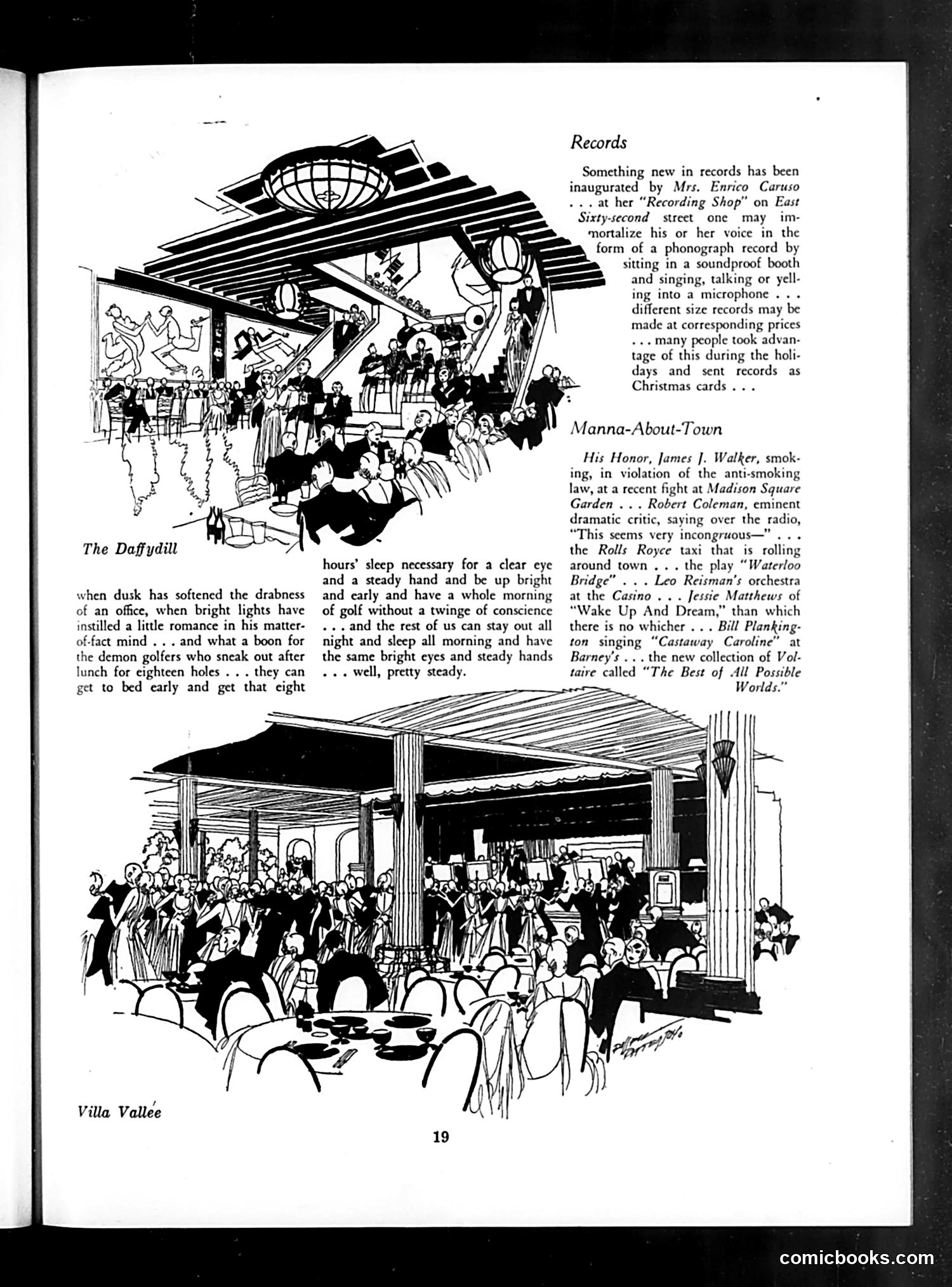
Content Analysis This page from *Life* magazine contains three distinct satirical items: "The Daffydill" mocks the practice of installing office lighting to create romantic ambiance. The joke targets the hypocrisy: golfers sneak out early to sleep eight hours guilt-free, while others stay out all night yet claim the same alertness—"well, pretty steady" being the sarcastic punchline about impaired judgment. "Records" announces Mrs. Enrico Caruso's new recording service on East 62nd Street, where customers could make phonograph records of their voices. The satire lies in people sending these recordings as Christmas cards—a pretentious, newfangled novelty. "Manna-About-Town" is a gossip column listing prominent figures and cultural events, including Mayor James J. Walker smoking at Madison Square Garden in violation of anti-smoking law (hypocritical behavior by city leadership), along with mentions of plays, orchestras, and performers of the era. The illustrations show establishments where these activities occurred—social venues representing Manhattan's entertainment scene.
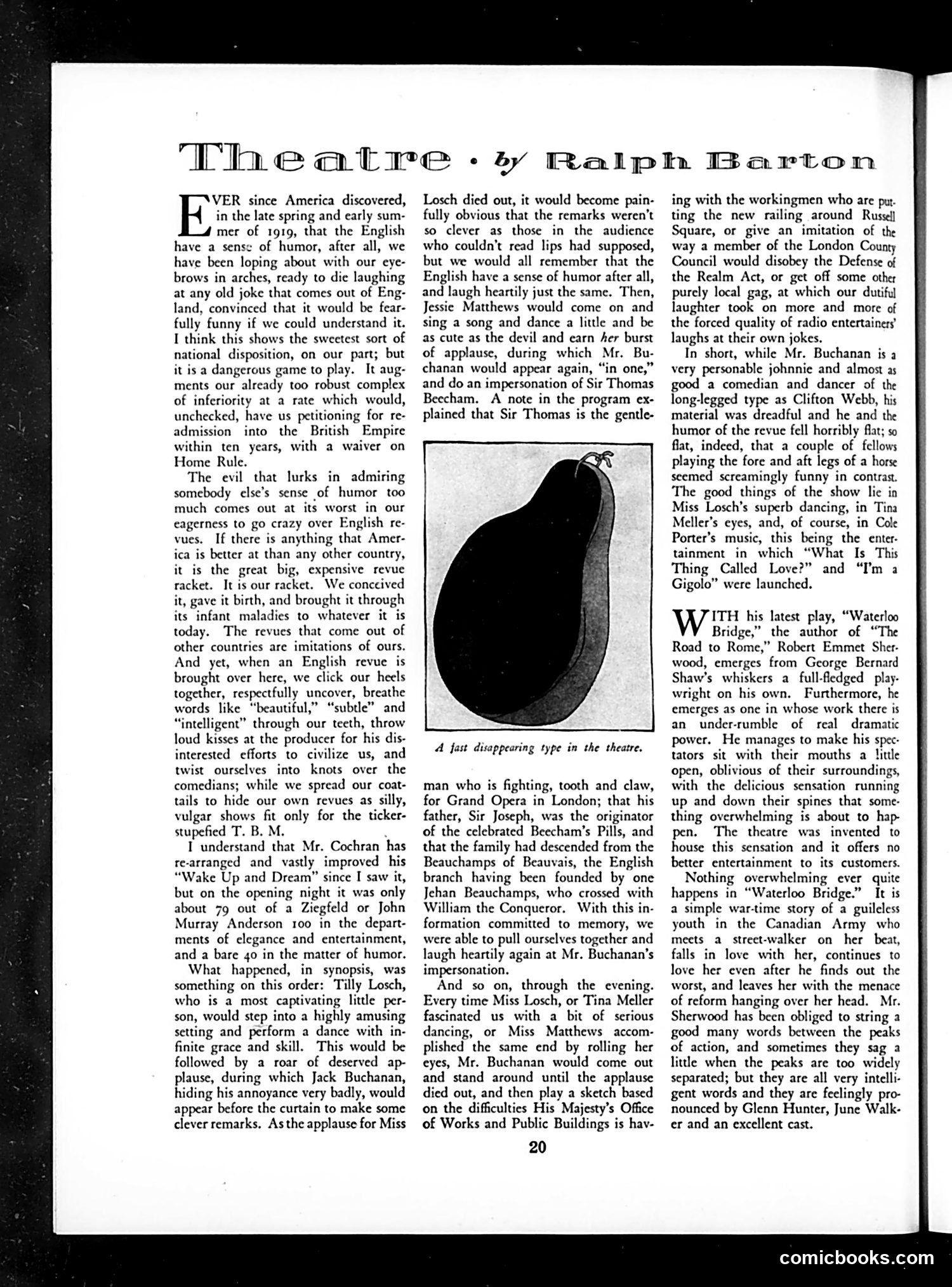
Theatre Review: Ralph Barton on English Revues (1919) This is a theater critique by Ralph Barton analyzing American audiences' newfound reverence for English entertainment. The central joke: Americans have recently discovered the English have humor (circa summer 1919) and now irrationally worship anything British, while dismissing their own superior theatrical traditions. Barton satirizes the specific revue "Wake Up and Dream," featuring performers Tilly Losch, Jack Buchanan, and Jessie Matthews. He argues the show is mediocre—barely 40% funny—yet American audiences laugh dutifully at Buchanan's weak jokes simply because they're English. The cartoon shows a silhouette labeled "A fast disappearing type in the theatre," likely referencing Sir Thomas Beecham (mentioned in the text), representing outdated theatrical conventions. Barton's real target: American cultural inferiority complex. He contends Americans invented the modern revue format but now desperately seek British approval, willing to embarrass themselves intellectually to seem cultured.
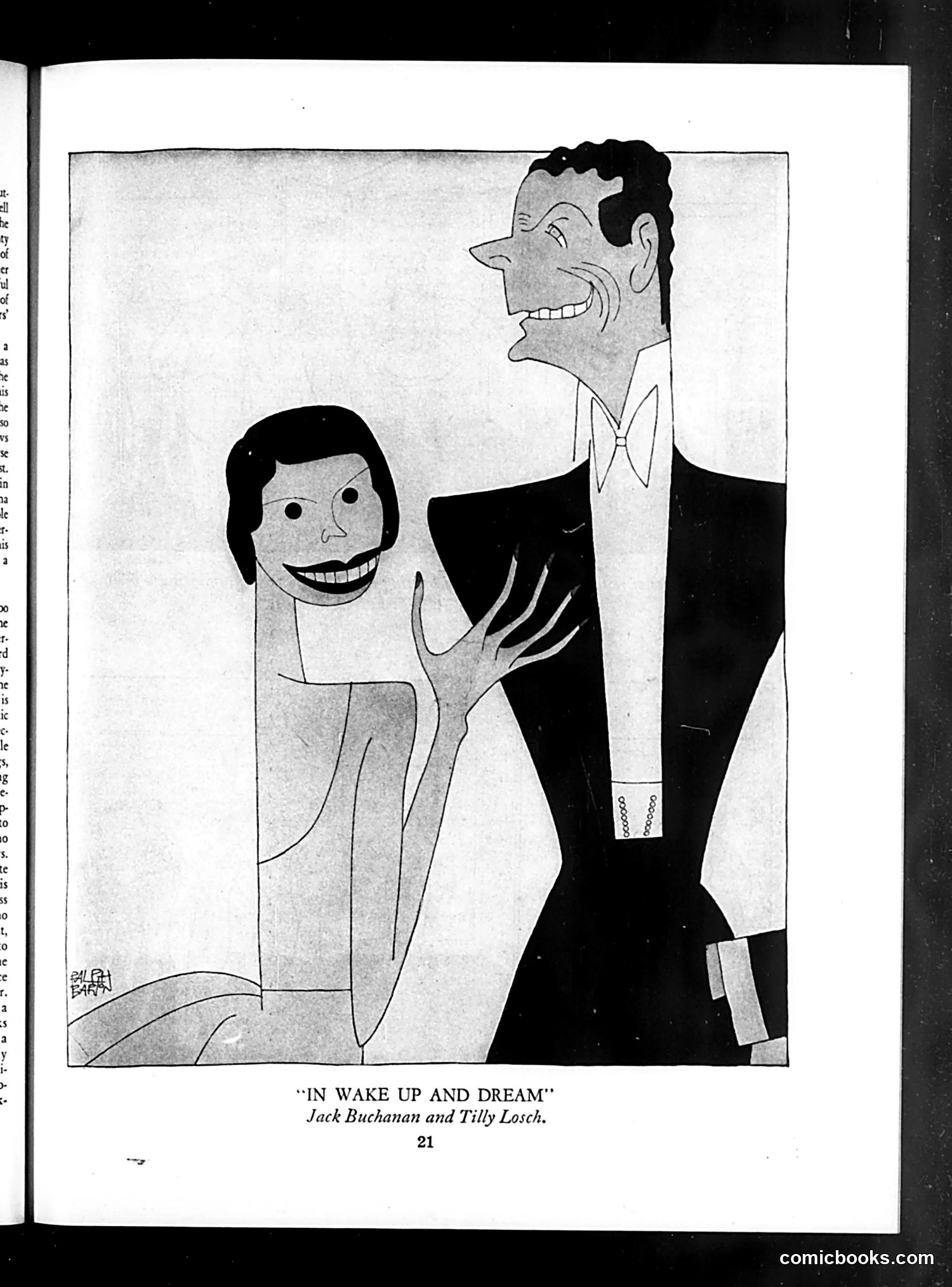
"In Wake Up and Dream" This is an illustration from Life magazine promoting the theatrical production "Wake Up and Dream," featuring performers Jack Buchanan and Tilly Losch. The cartoon depicts two figures in an exaggerated, caricatured style typical of early-to-mid 20th century entertainment journalism. The man (Buchanan) is shown in formal evening wear with an enormous grin, while the woman (Losch) appears smaller and is positioned beside him with similarly exaggerated facial features. The style reflects Life's satirical approach to entertainment coverage—using caricature to highlight performers' distinctive qualities or personality traits. Without additional context about the production itself, the specific satire remains unclear, though the illustration likely aimed to humorously promote the show to Life's readers.
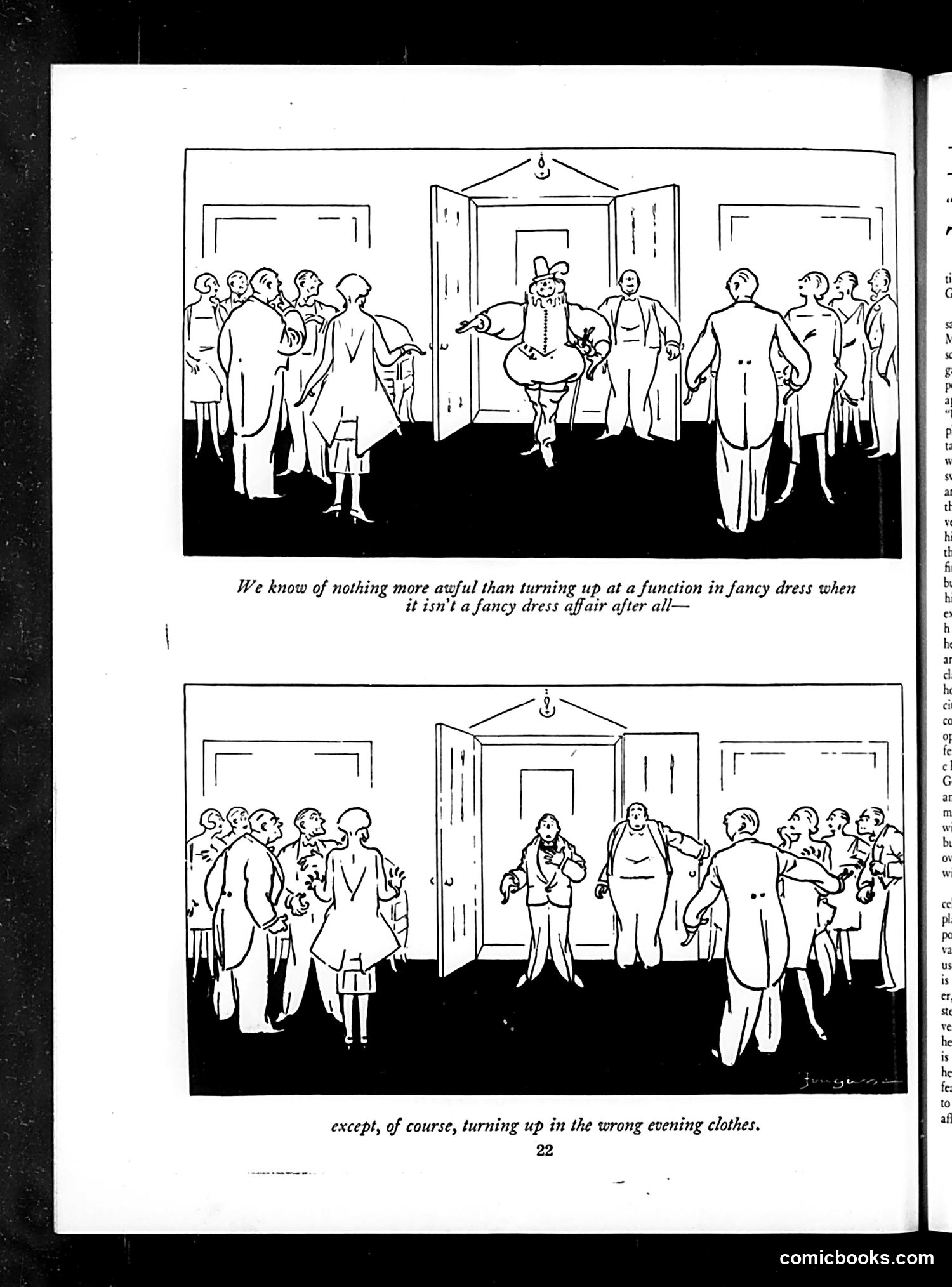
Analysis This is a two-panel satirical cartoon about social embarrassment at formal events. The top panel shows a man in elaborate fancy dress costume (appearing to be dressed as a jester or similar character) arriving at what he assumes is a costume party, only to find everyone else in normal evening wear. The caption notes this is "awful." The bottom panel delivers the punchline: the reverse scenario—a man arriving in ordinary clothes while everyone else is dressed formally for an actual fancy dress ball. The satire mocks the anxiety of social miscalculation: either overdressing absurdly or underdressing severely creates equal embarrassment. This reflects early-to-mid 20th century etiquette concerns about proper dress codes for social functions. The humor relies on the universal fear of social missteps and the rigid formality standards of the era's upper-middle-class social life.
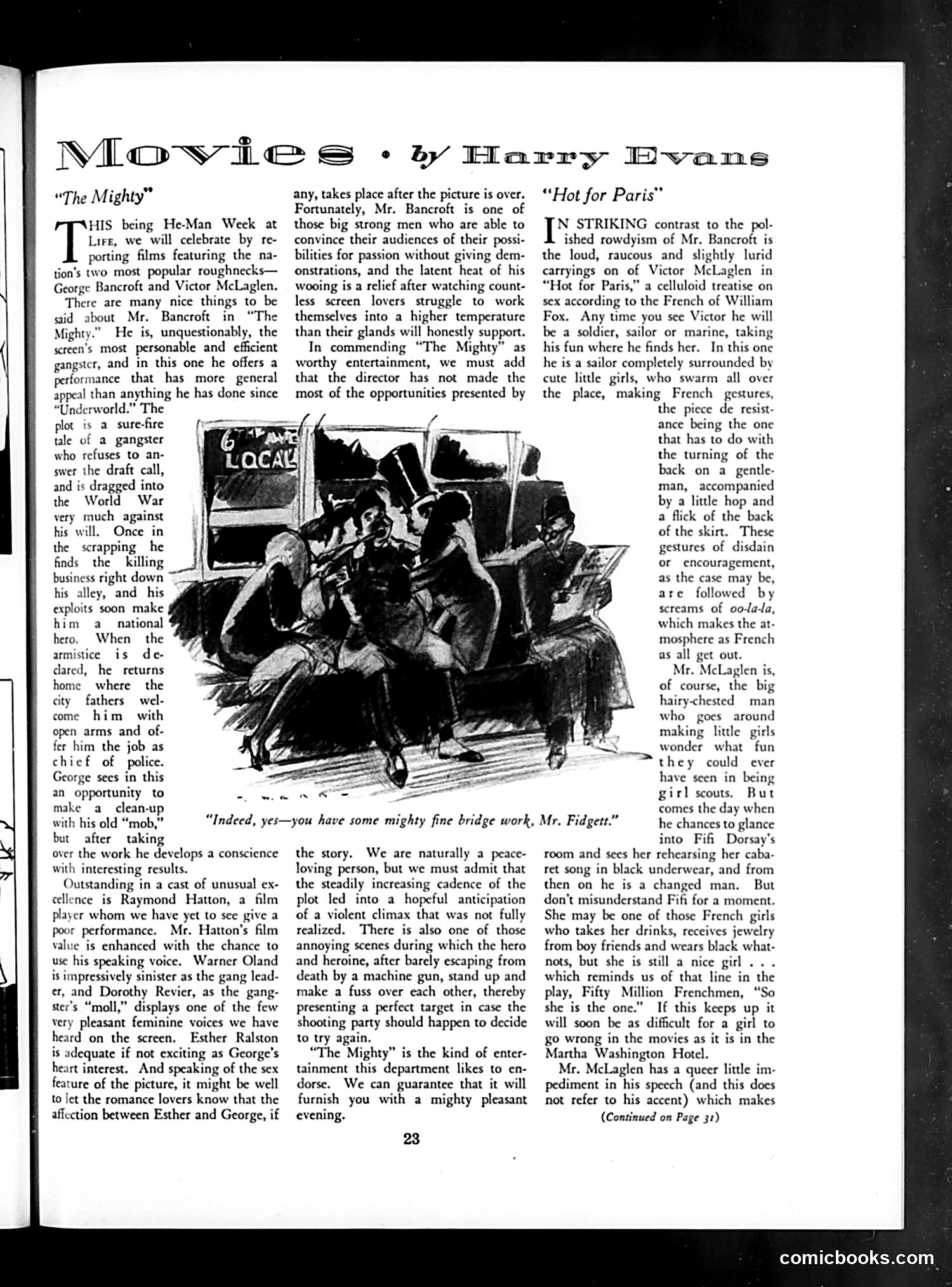
Movie Reviews by Harry Evans, Life Magazine This page contains two film reviews from Life's "He-Man Week," celebrating masculine action stars George Bancroft and Victor McLaglen. "The Mighty" stars Bancroft as a gangster who evades the WWI draft, discovers he enjoys combat, becomes a war hero, and returns home to become police chief—then exploits his position. Evans praises Bancroft's screen presence and the film's pacing, though criticizes the director for not fully developing the violent climax. "Hot for Paris" features McLaglen as a sailor surrounded by French girls making exaggerated gestures. Evans contrasts McLaglen's "loud, raucous" style with Bancroft's more restrained masculinity. The small cartoon (captioned "Indeed, yes—you have some mighty fine bridge work, Mr. Fidgett") appears unrelated to the reviews—likely a separate humor piece about dentistry or construction. The reviews reflect 1920s attitudes toward war narratives and masculine performance styles in early sound cinema.
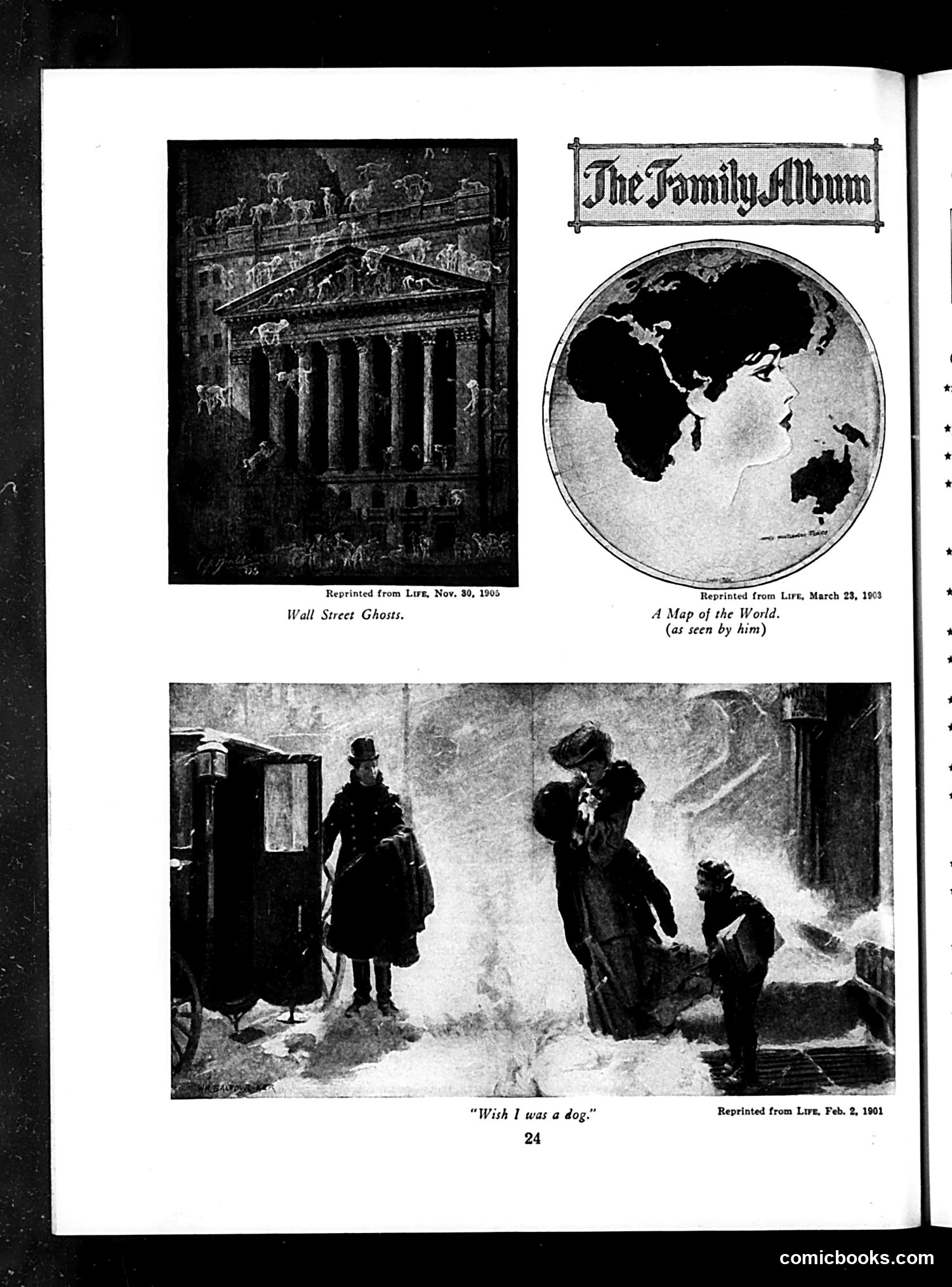
Analysis of Life Magazine Page 24 This page collects three satirical cartoons from Life magazine's archives: 1. "Wall Street Ghosts" (1905): Shows a classical building (likely the Stock Exchange) haunted by ghostly figures, satirizing financial corruption or moral bankruptcy in American finance. 2. "A Map of the World (as seen by him)" (1903): A distorted world map where certain regions appear disproportionately large or small—likely mocking the perspective of a wealthy American businessman who sees the world only through economic or imperial interests rather than geographical reality. 3. "Wish I was a dog" (1901): Depicts impoverished urban figures, seemingly suggesting that even animals have better lives than struggling poor people in industrial cities. All three cartoons employ dark humor to critique Gilded Age excess, financial malfeasance, and urban poverty—common Life magazine themes of early 1900s American social commentary.
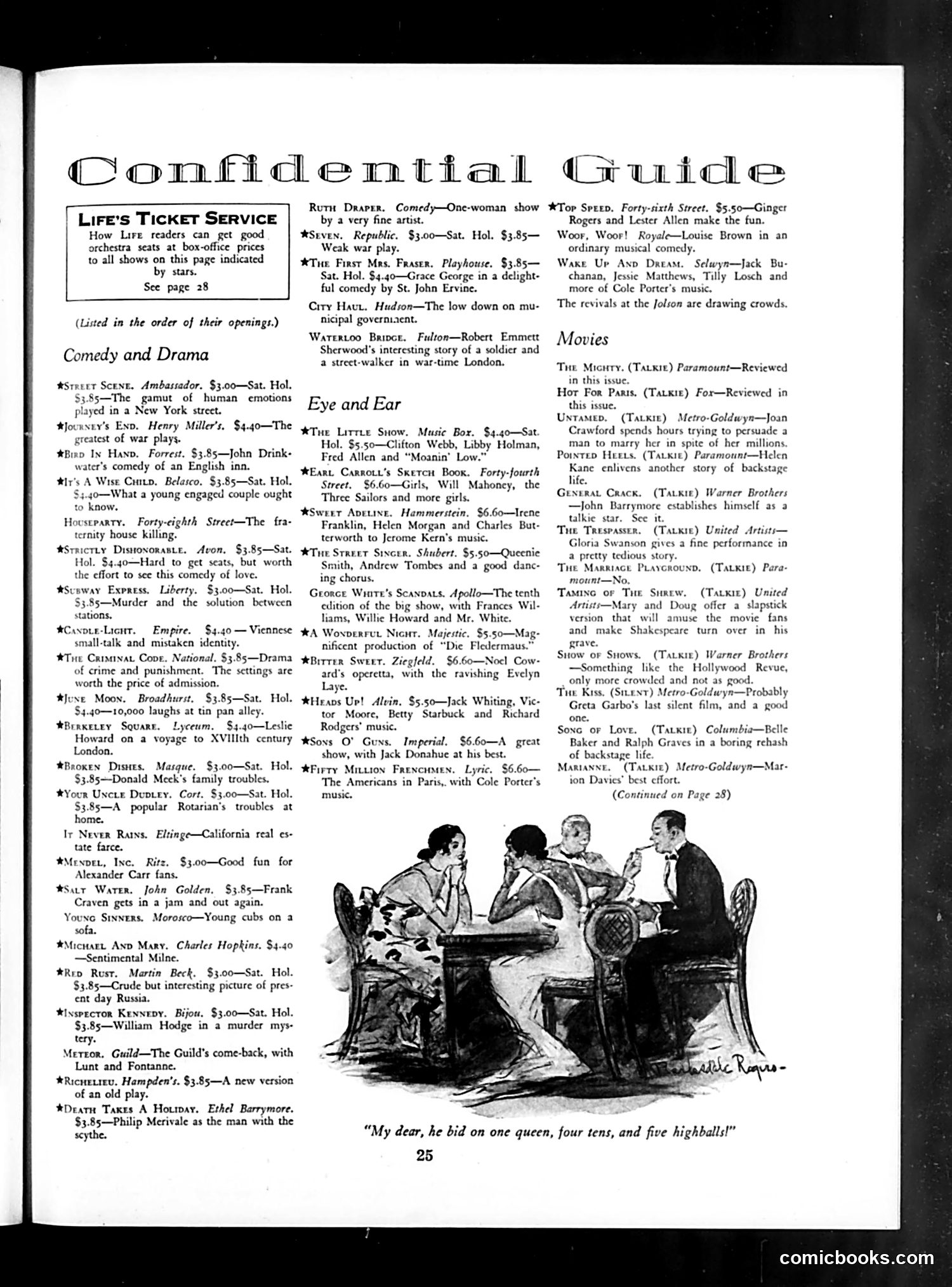
Confidential Guide: Life Magazine Theater Listings This page is primarily a theater guide for Life magazine readers, not a political cartoon. It lists Broadway shows opening in what appears to be the 1920s, organized by category (Comedy/Drama, Eye and Ear—musicals). The asterisks indicate shows where Life readers could obtain discounted orchestra seats through a ticket service. Prices range from $1.00 to $6.60, with Saturday/holiday premiums noted. The small illustration at the bottom shows three men at what appears to be a card table, with the caption "My dear, he bid on one queen, four tens, and five highballs!"—a joke about bridge players and drinking, reflecting Prohibition-era social humor. This is essentially a service page for theatergoers, not satirical political content. The only humor appears in that single cartoon illustrating casual entertainment culture of the period.
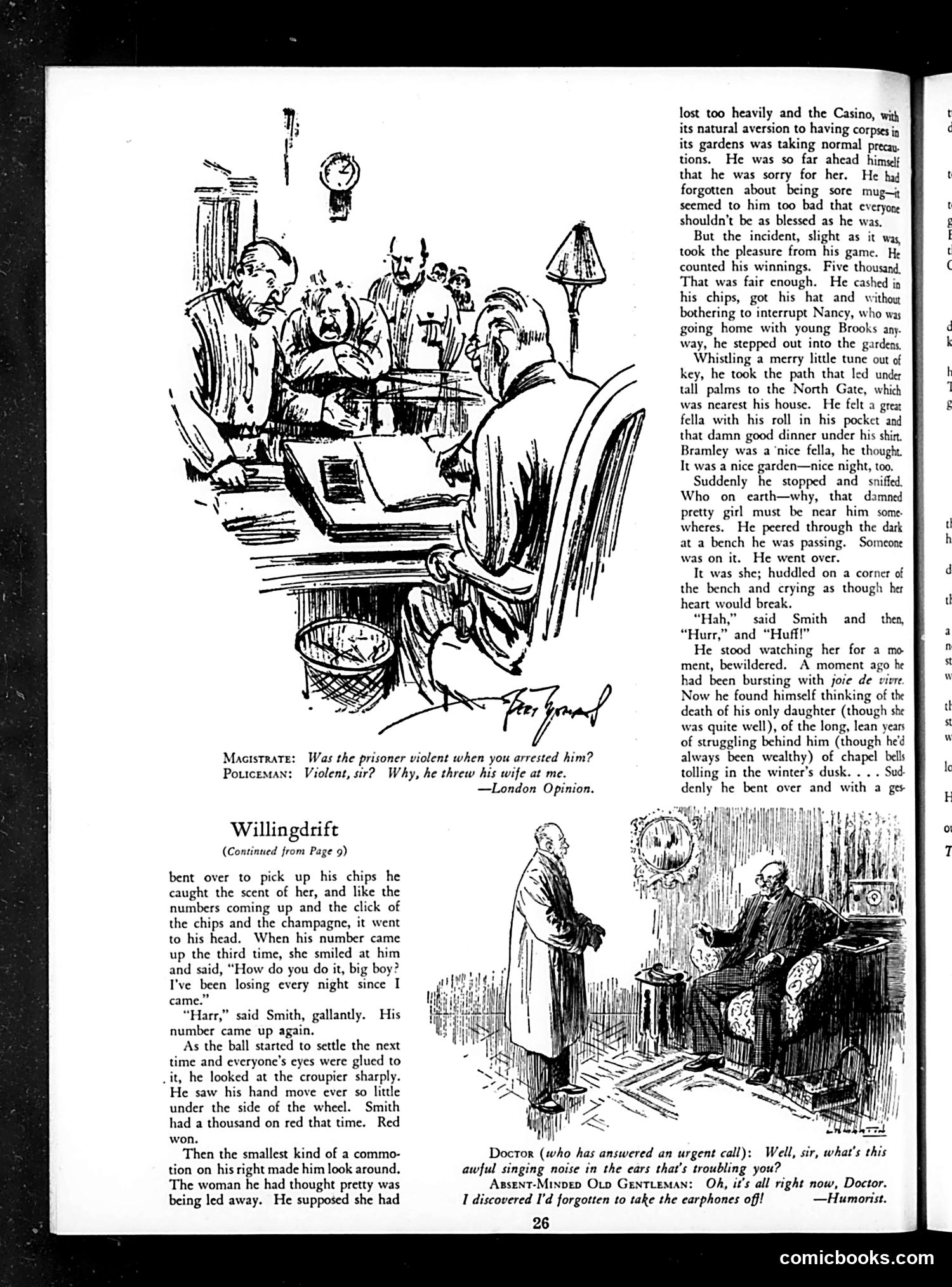
Analysis: Life Magazine Page Top Cartoon (London Opinion): A satirical joke about domestic violence. A magistrate questions a policeman about arresting a violent prisoner. The punchline—"he threw his wife at me"—presents spousal abuse as comedic material. This reflects early 20th-century attitudes normalizing violence against women as a subject for humor. Bottom Cartoon (Humorist): A doctor asks an elderly gentleman about ringing in his ears. The man realizes he simply forgot to remove his earphones (likely a telephone receiver device). It's a gentle joke about modern technology confusion among older people. "Willingdrift" Story: A fictional narrative (continued from earlier) about a man named Smith who gambles at a casino, wins heavily, then encounters a distressed woman who lost money there. Despite his good fortune, witnessing her despair dampens his mood—a brief moral moment before he discovers her crying in the garden.
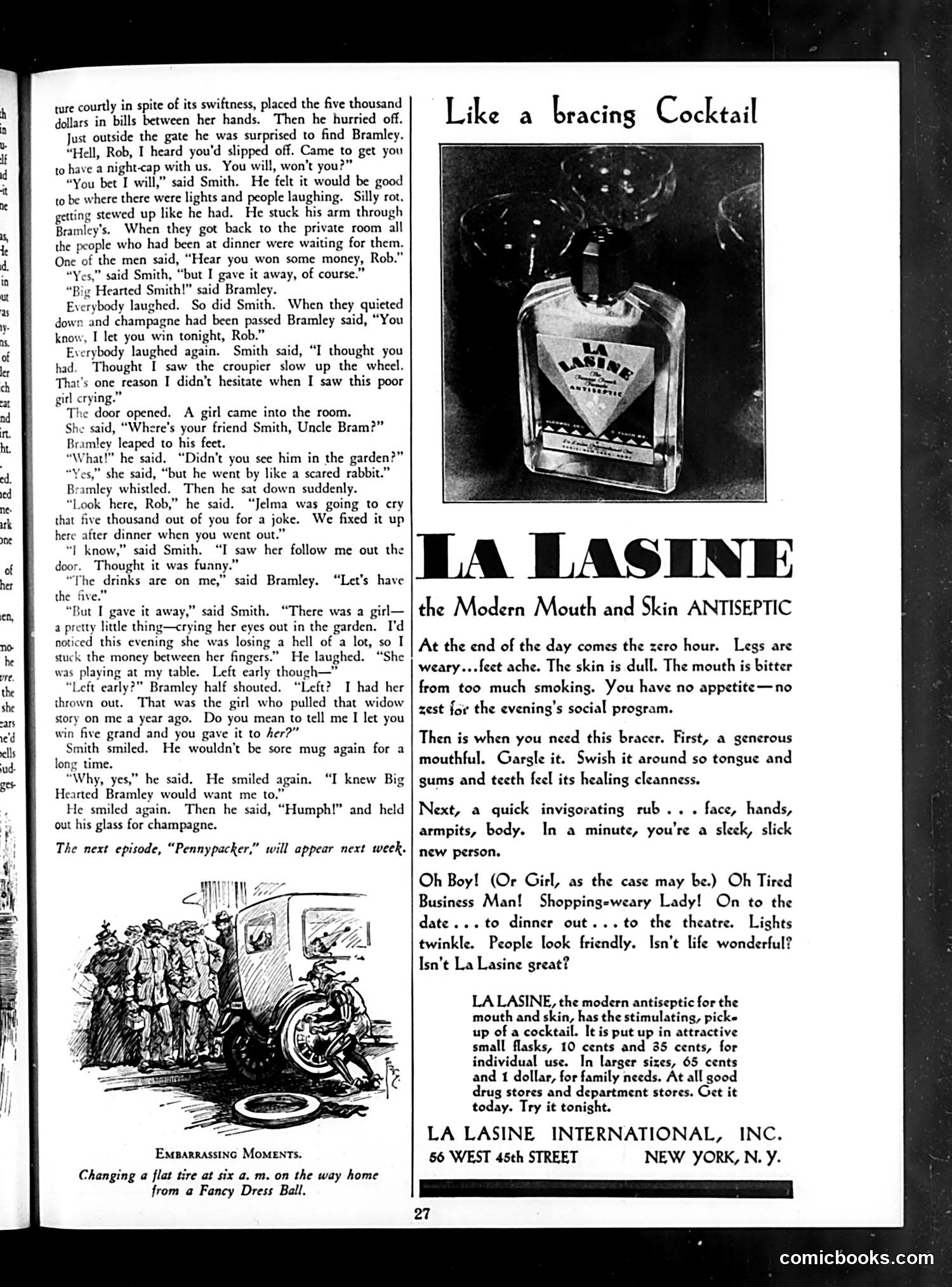
Analysis of This Life Magazine Page The Story Content (Left Side): This is a serialized fiction installment about characters Smith and Bramley at what appears to be a gentlemen's gambling club. Smith wins five thousand dollars at cards and impulsively gives the money to a crying girl he encounters in the garden—unaware she was part of an elaborate prank Bramley had orchestrated to trick him into losing money. The joke backfires when Smith's generous impulse actually helps someone genuinely in need (apparently a woman who had been "thrown out" previously). The satire mocks upper-class masculine posturing: Bramley's elaborate scheme is undone by Smith's accidental genuine kindness, making him appear noble despite himself. The Advertisement (Right Side): "La Lasine" antiseptic mouthwash is marketed as a restorative "cocktail for the mouth"—a product promising to refresh tired businesspeople and shoppers for evening social activities. The ad conflates personal hygiene with social rejuvenation, appealing to 1920s anxieties about appearing vital and attractive after a taxing day. The small illustration humorously depicts a car breakdown as an "embarrassing moment."
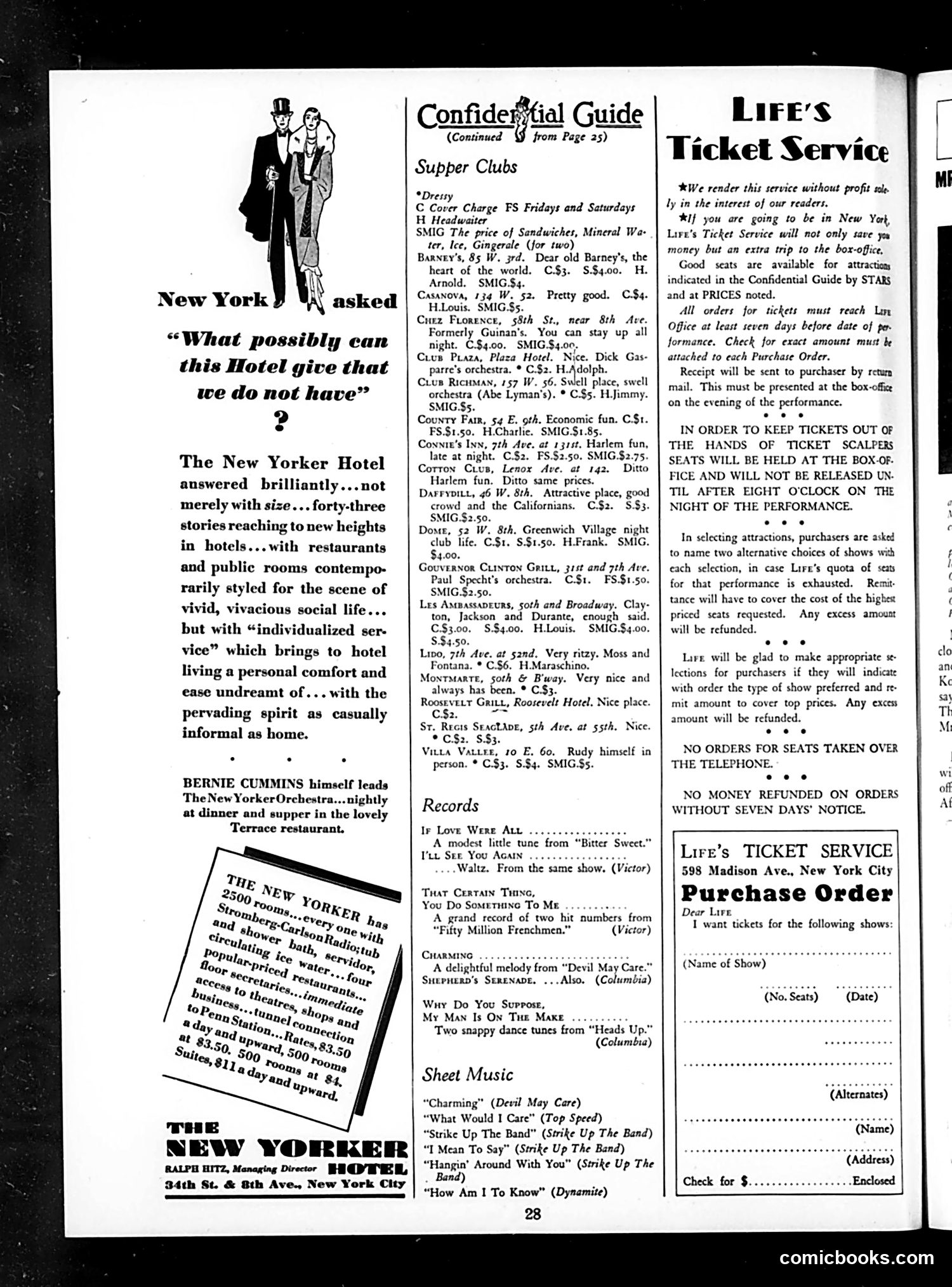
Life Magazine Page Analysis This page is primarily advertising and service content rather than satire or political cartoon. The main elements are: The New Yorker Hotel Advertisement (left): A straightforward hotel ad answering the rhetorical question "What possibly can this hotel give that we do not have?" The advertiser claims superiority through size (43 stories), modern design, and crucially, "individualized service"—emphasizing personal comfort over mere luxury. Bernie Cummins's orchestra at the Terrace restaurant is highlighted as a draw. Life's Ticket Service (right): A practical reader service offering to purchase theater tickets without profit, saving readers money and trips to box offices. Confidential Guide sections (center): Listings of supper clubs with cover charges and prices, plus records and sheet music recommendations—typical 1920s-30s entertainment guides. The page reflects the era's sophistication: upscale nightlife venues, jazz orchestras, and modern hotel amenities targeting affluent New York audiences. There is no discernible political satire or cartoon present—this is straightforward commercial and lifestyle content.
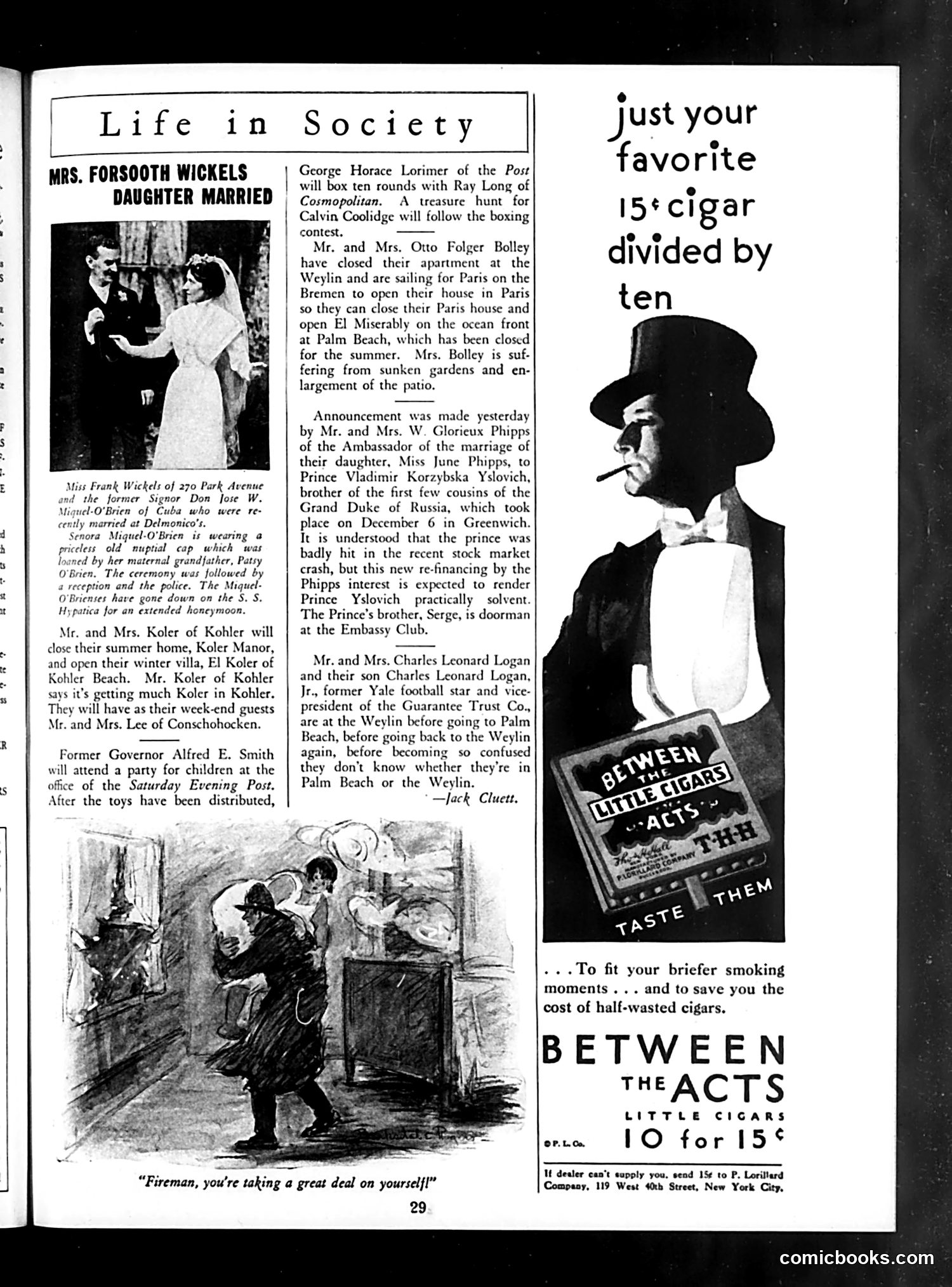
Understanding This Page from Life Magazine This page contains society gossip satire and advertisements, likely from the 1920s-1930s. The "Life in Society" column mocks wealthy New York socialites through absurdist humor. The jokes include: - A woman marrying someone with an absurdly complicated hyphenated name (Miquel-O'Brien) - The Bolley family opening and closing multiple houses in illogical sequence, with the wife suffering from "sunken gardens" - A Russian "prince" saved from stock-market losses through a marriage to a wealthy American heiress (Miss Phipps)—satirizing fortune-hunting European nobility and naïve American wealth The humor targets the pretentiousness and circularity of high society life: the wealthy constantly traveling between identical estates, marrying foreign aristocrats of dubious legitimacy, and displaying conspicuous consumption. The cartoon shows a fireman supposedly "taking a great deal on himself"—likely implying overreach or presumption. The cigar ad is straightforward 1920s-era marketing for "Between the Acts" cigars as affordable, quick smokes.
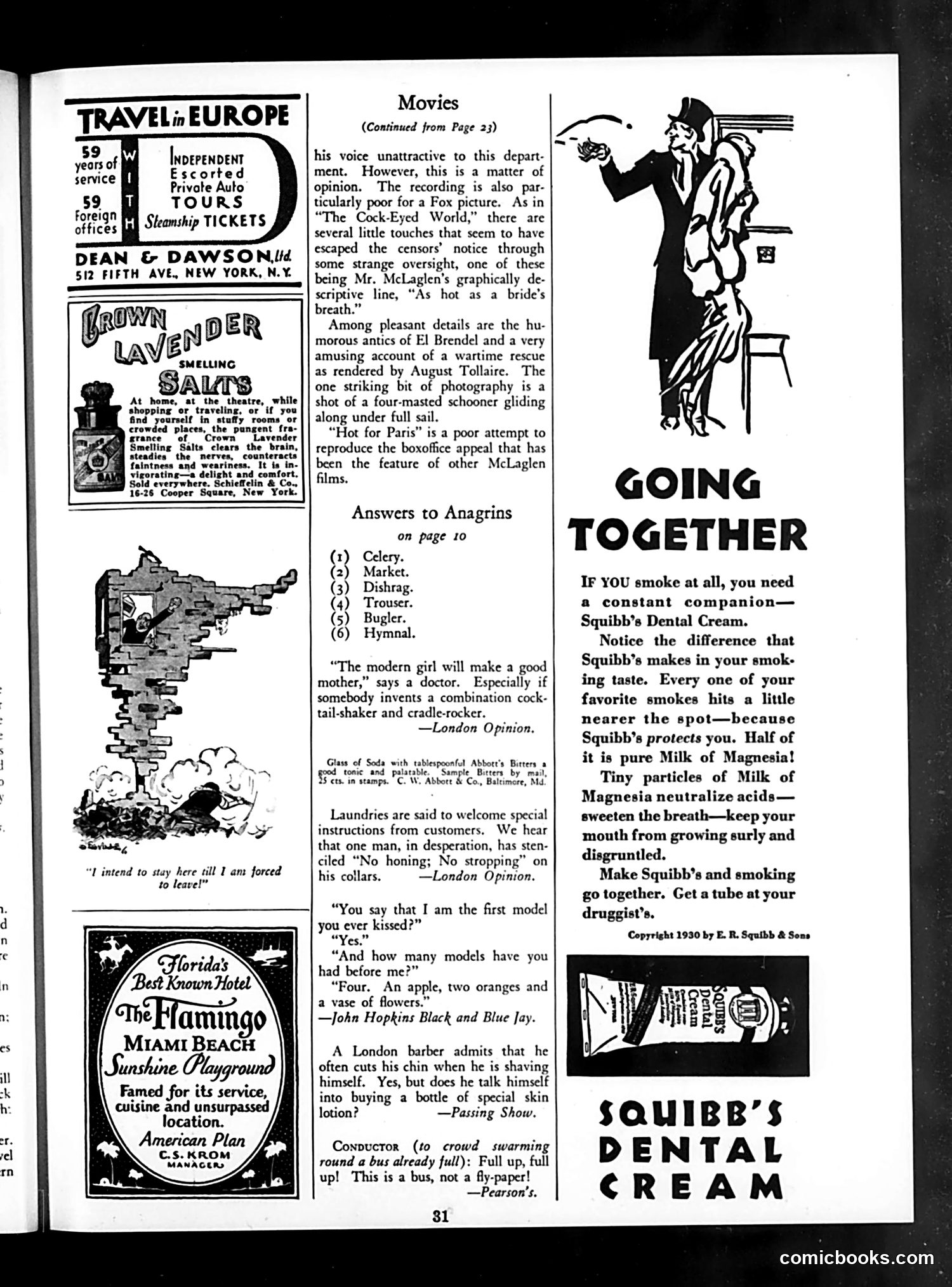
Analysis of Page 81 This page is primarily advertising and filler content rather than satirical cartoons. The main elements are: Advertisements: Travel services, smelling salts, a Miami hotel, and prominently, Squibb's Dental Cream (which uses the phrase "Going Together" as a marketing hook). Movie Review Section: Brief critical commentary on Fox films, mentioning actor McLaglen and films like "The Cock-Eyed World" and "Hot for Paris." The reviewer critiques poor recording quality and censorship oversights. Humor Fillers: The "Answers to Anagrins" section and scattered jokes from *London Opinion* and other sources—mostly gentle observations about modern life (girls making good mothers if someone invents a cocktail-shaker cradle, barber mishaps, etc.). These are generic period humor, not satirizing specific political figures or events. The Cartoon: A small illustration shows a figure clinging to a ship's rigging with caption "I intend to stay here till I am forced to leave!"—likely referencing travel/vacation themes matching the advertising context. Overall, this is a typical magazine filler page of 1930 Life magazine, mixing ads with light humor and entertainment reviews.
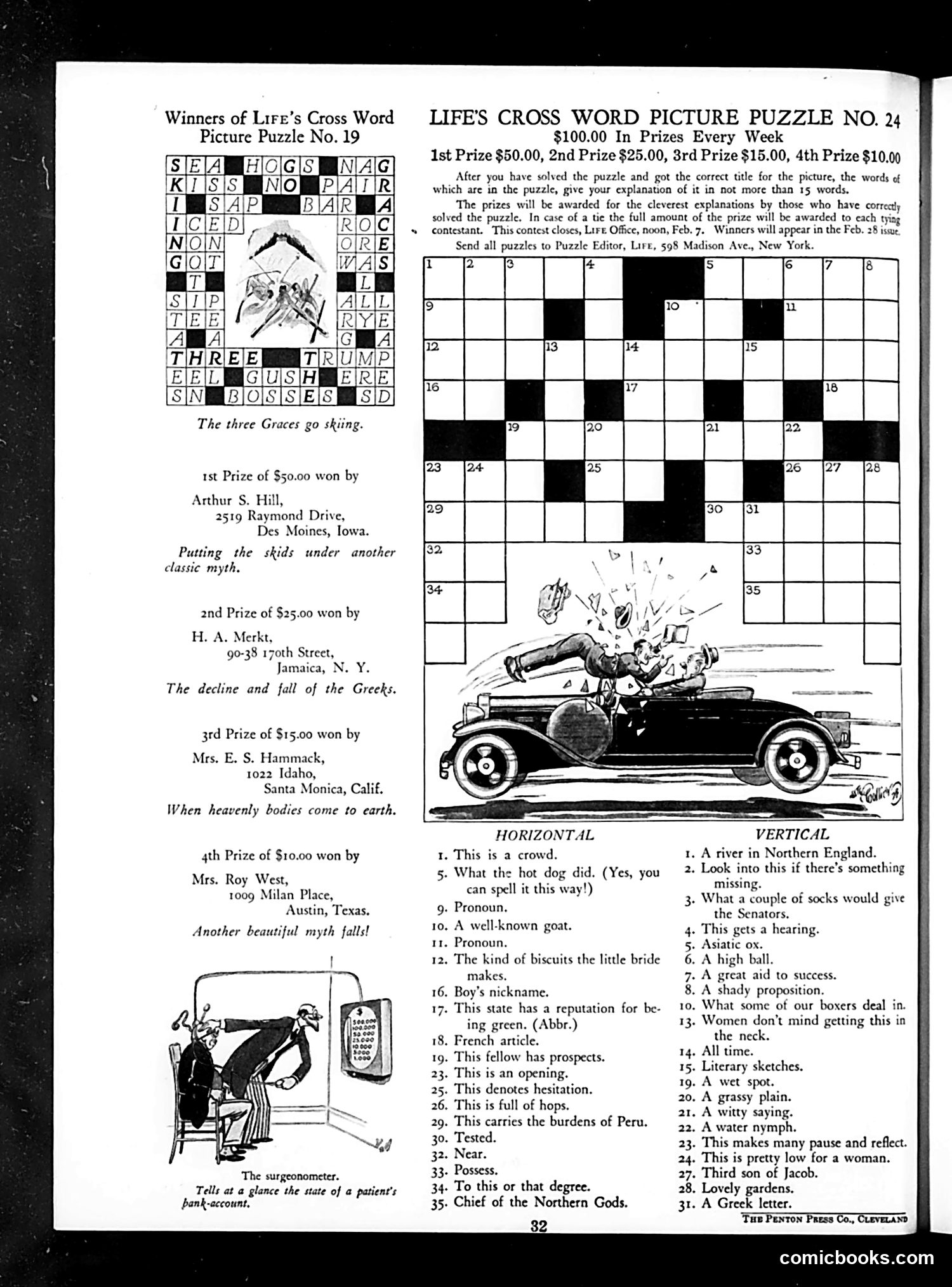
Life Magazine Cross-Word Puzzle Page (circa 1920s) This page showcases Life's weekly puzzle contest with satirical cartoon commentary. The main content includes: Top section: Winners of the previous week's puzzle, each captioned with classical mythology jokes updated to modern times—"The three Graces go skiing," "The decline and fall of the Greeks," "When heavenly bodies come to earth." This reflects 1920s humor mocking Greek and Roman myths through contemporary activities. Large cartoon (right): Shows a car crash with debris flying, likely representing chaos or misadventure—possibly satirizing the automobile's social impact. Bottom cartoon: Depicts "The surgeonometer," a device measuring "a patient's bank-account," satirizing medical practice or perhaps insurance concerns of the era. The puzzle itself is a standard crossword combined with an illustration—readers must solve it, then explain the picture in under 15 words to win cash prizes. This was popular entertainment during the Depression era, combining intellectual challenge with potential financial reward.
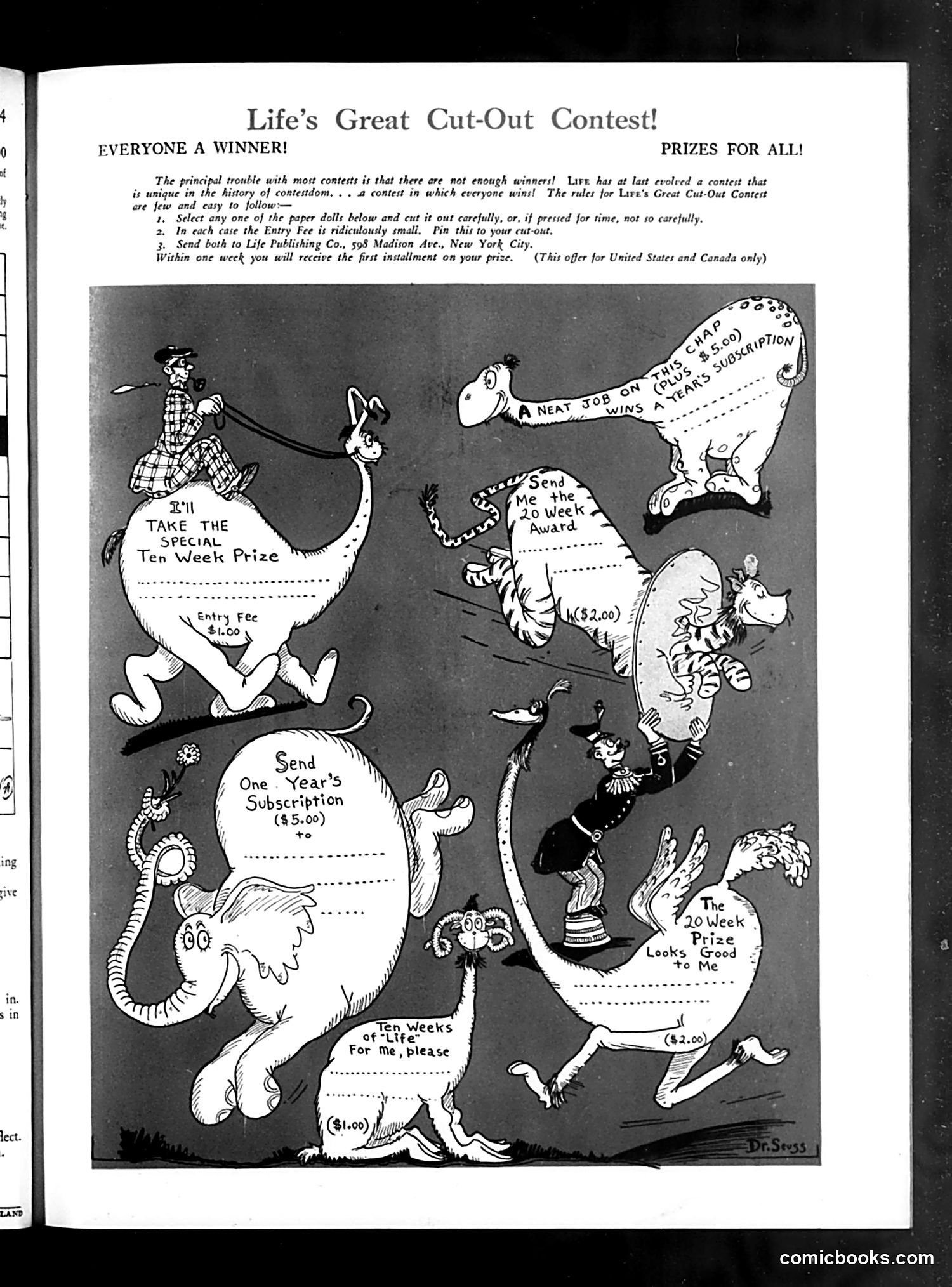
Life's Great Cut-Out Contest Explanation This is a satirical *advertisement* for a fake contest, likely from the 1920s-30s. The humor relies on mocking real contests and mail-in promotions that were popular at the time. The joke: Life magazine advertises a "contest" where "everyone wins"—but the catch is that participants must pay entry fees ($1.00-$2.00) to receive prizes that are merely subscriptions to *Life itself*. The prizes advertised (10-week and 20-week subscriptions, a one-year subscription) are what the magazine wants to sell anyway. The cartoon, drawn in Dr. Seuss's distinctive style, depicts absurd paper-doll creatures holding signs describing these "prizes." The satire mocks both the gimmicky contests that flooded American magazines and readers' willingness to pay for the privilege of receiving a magazine subscription disguised as a prize. The phrase "everyone a winner" is the central joke—yes, everyone wins, but they win by paying for what the company wanted to sell them originally.
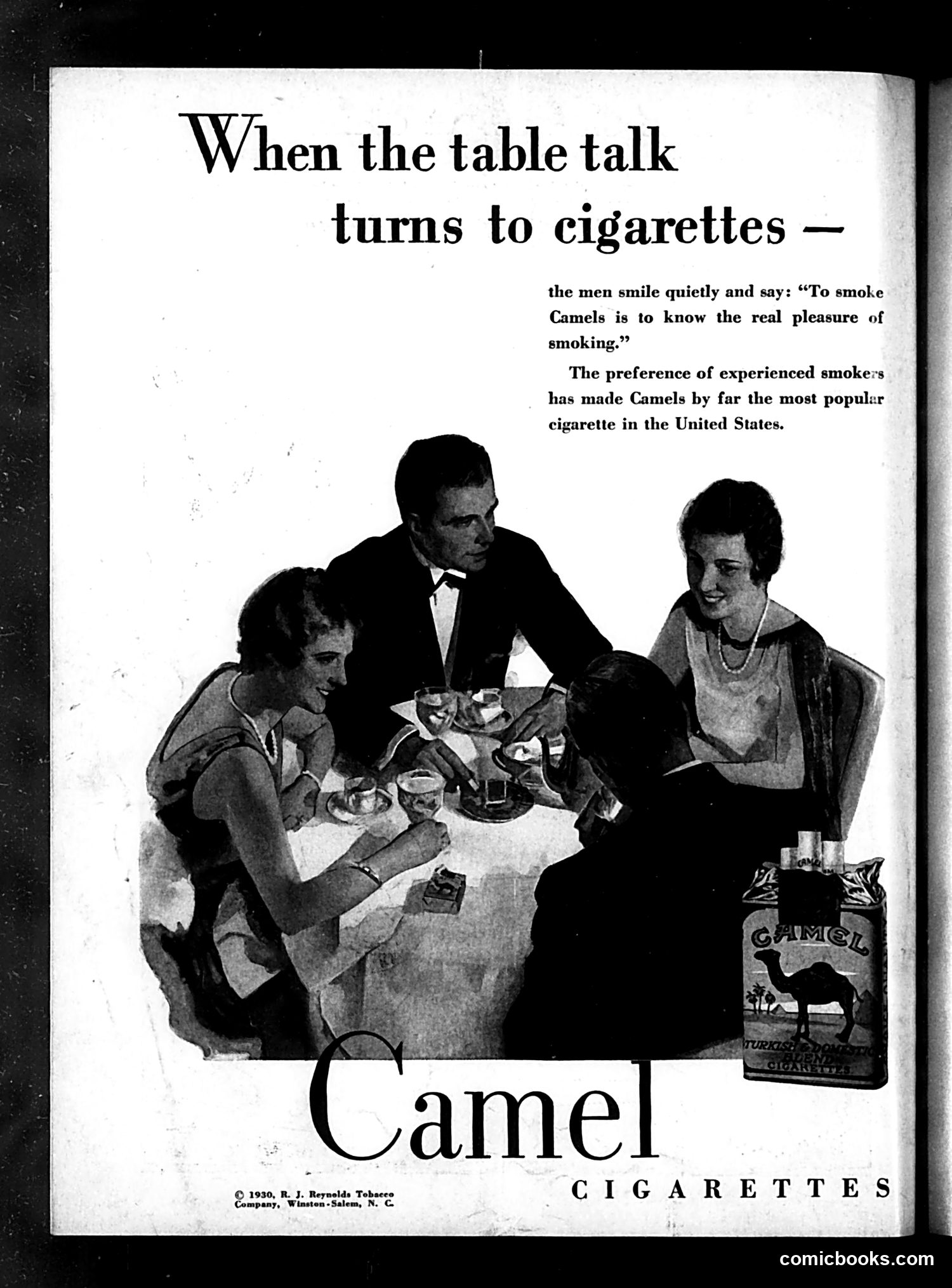
This is a Camel cigarettes advertisement from 1930, not political satire. It depicts three well-dressed people at a dinner table engaged in casual conversation. The ad's message claims that experienced smokers prefer Camels as "the most popular cigarette in the United States." The appeal targets social aspiration—the elegant setting and refined company suggest that smoking Camels signals sophistication and good taste. The phrase "real pleasure of smoking" emphasizes quality to justify the brand choice. By modern standards, the ad is notable for its casual promotion of cigarettes without health warnings, reflecting pre-regulation advertising practices. The gender dynamics (two women, one man) also reflect 1930s social conventions about mixed-company dining.