life
Life — January 31, 1930
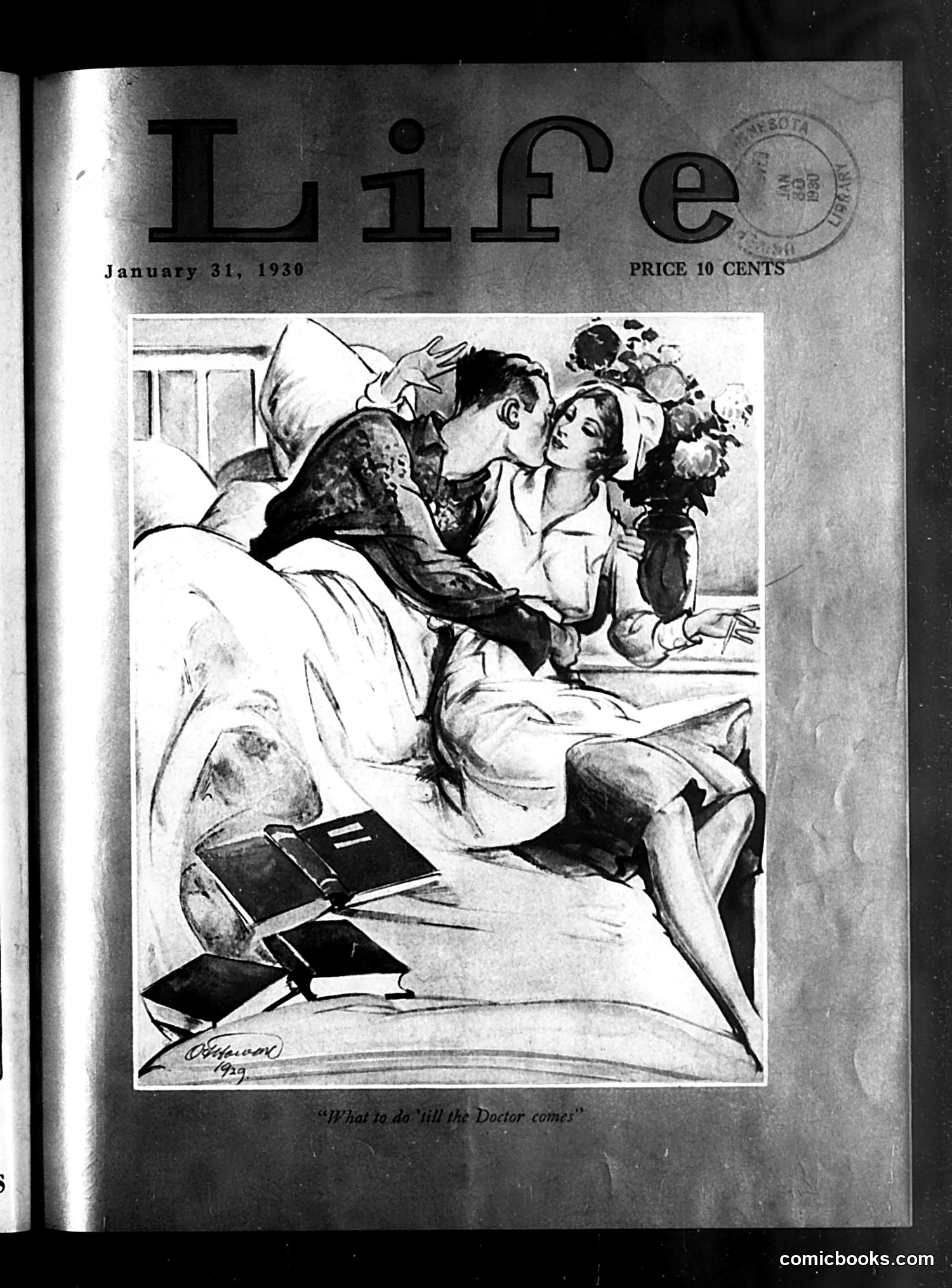
Analysis of Life Magazine Cover, January 31, 1930 This is a suggestive romantic illustration rather than political satire. The caption "What to do 'till the Doctor comes" plays on the double entendre typical of Life magazine's humor in this era—the couple in bed appears to be engaging in flirtation or intimacy while awaiting a physician's visit. The illustration reflects 1930s attitudes toward romance and propriety, where such "naughty" innuendo was considered sophisticated humor for the magazine's adult readership. The scattered medical books on the bed floor may reference health/medical topics of concern to readers, but the primary joke relies on the suggestive situation rather than political commentary. This represents Life's characteristic blend of risqué humor and genteel presentation during the early Depression era.
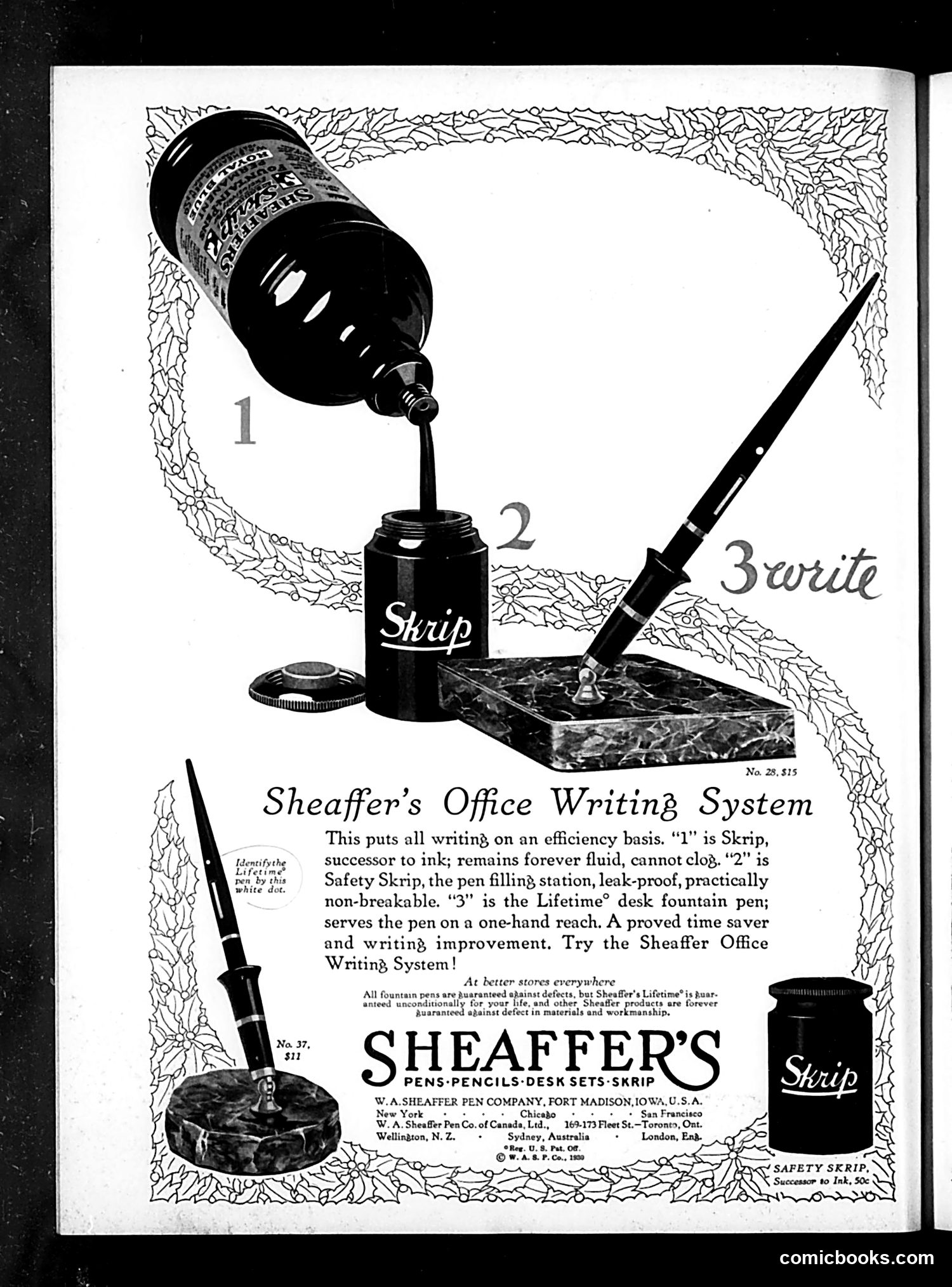
Analysis This is not a political cartoon or satire—it's a straightforward product advertisement for Sheaffer's Office Writing System, published in *Life* magazine. The page advertises three items: 1. "Skip" ink bottle 2. "Safety Skip" pen-filling station 3. A "Lifetime" desk fountain pen The numbered diagram (1-2-3) demonstrates the system's efficiency for office work. The decorative leaf border is typical 1920s-30s design. The ad emphasizes practical benefits: leak-proof design, convenience ("one-hand reach"), durability ("Lifetime"), and time-saving for busy offices. The tagline promises "efficiency basis" for workplace writing tasks. This represents early 20th-century advertising aimed at professional office workers, before ballpoint pens became standard.
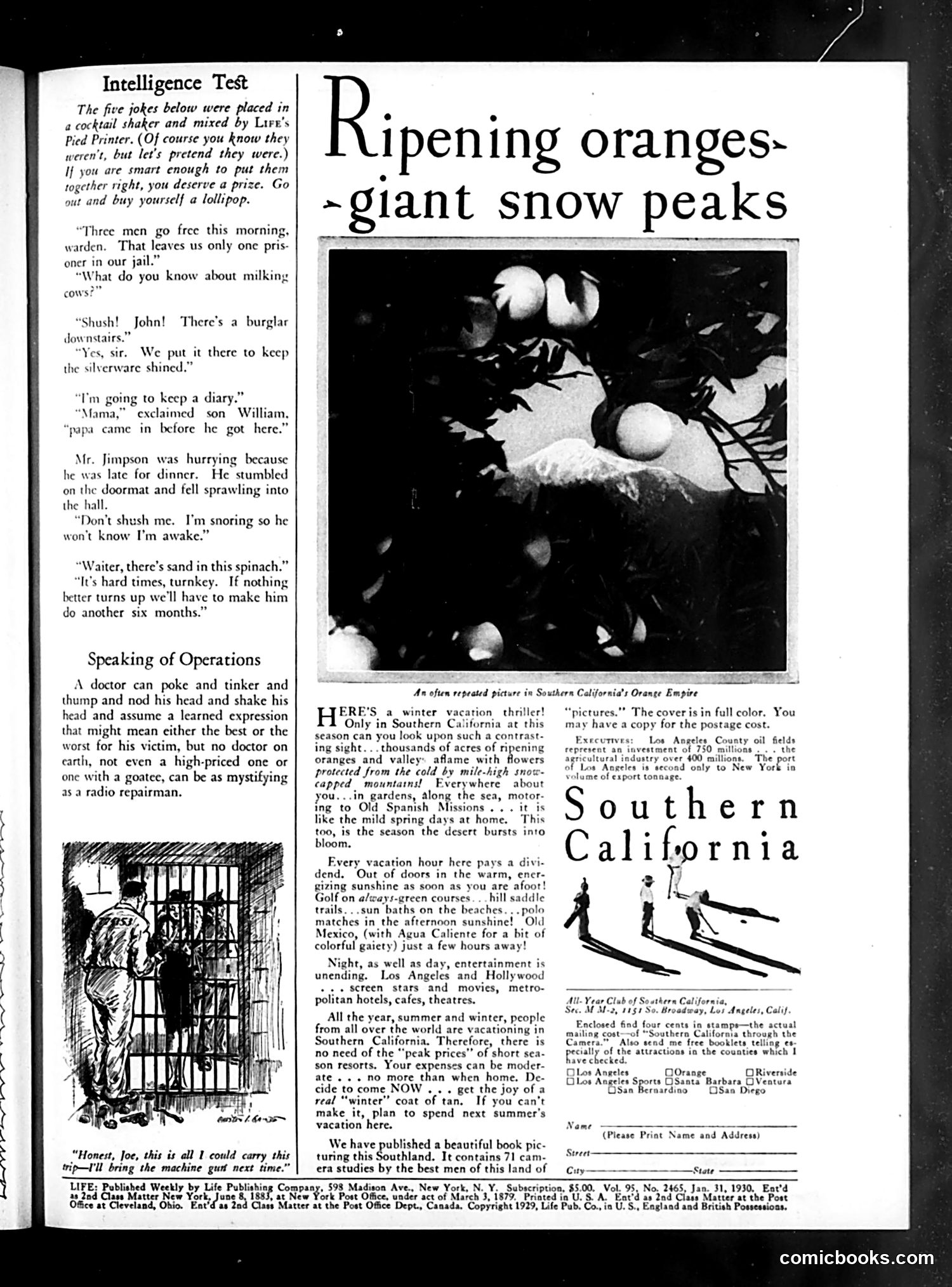
Analysis This page contains two distinct sections: Left side: An "Intelligence Test" section presents a series of short anecdotes (about three men escaping jail, a burglar scare, Mr. Jimpson arriving late, etc.) designed as riddles or logic puzzles for readers to solve. The accompanying sketch shows a guard at a prison cell door. This appears to be lighthearted entertainment rather than political satire. Right side: A travel advertisement for Southern California, featuring an photograph of ripe oranges on trees and promotional text about winter vacation opportunities—golfing, beaches, skiing nearby. The page includes contact information for the All Year Club of Southern California. Neither section contains recognizable political cartoons or figures. The content is primarily recreational: puzzles for entertainment and tourism marketing.
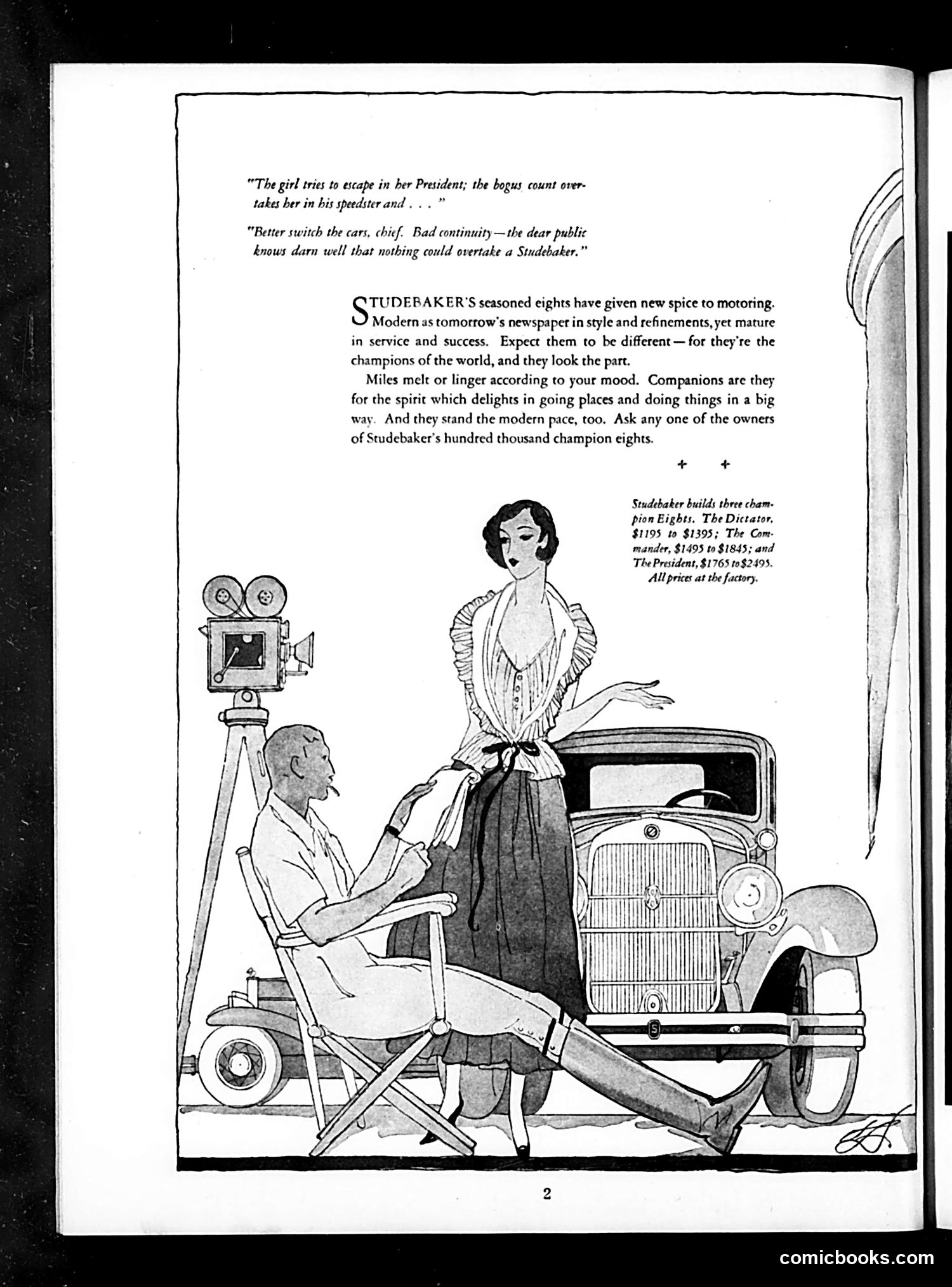
Studebaker Advertisement with Satirical Frame This is primarily a Studebaker automobile advertisement dressed up as satire. The opening quotes mock a melodramatic film scene—a "President" (likely referencing a Studebaker model) being overtaken by a faster vehicle, with commentary on "continuity" and "Sidelakers." The main illustration depicts a film director shooting a scene with an actress and a Studebaker automobile, presenting the car as modern, stylish, and successful—"champion eighths" in the automotive world. The text emphasizes the Studebaker's modern design and reliability, listing four model types with prices ranging from $1,193 to $2,495. The "satire" is thin—it's essentially using Hollywood film production imagery to sell cars as glamorous and contemporary consumer products to 1920s readers.
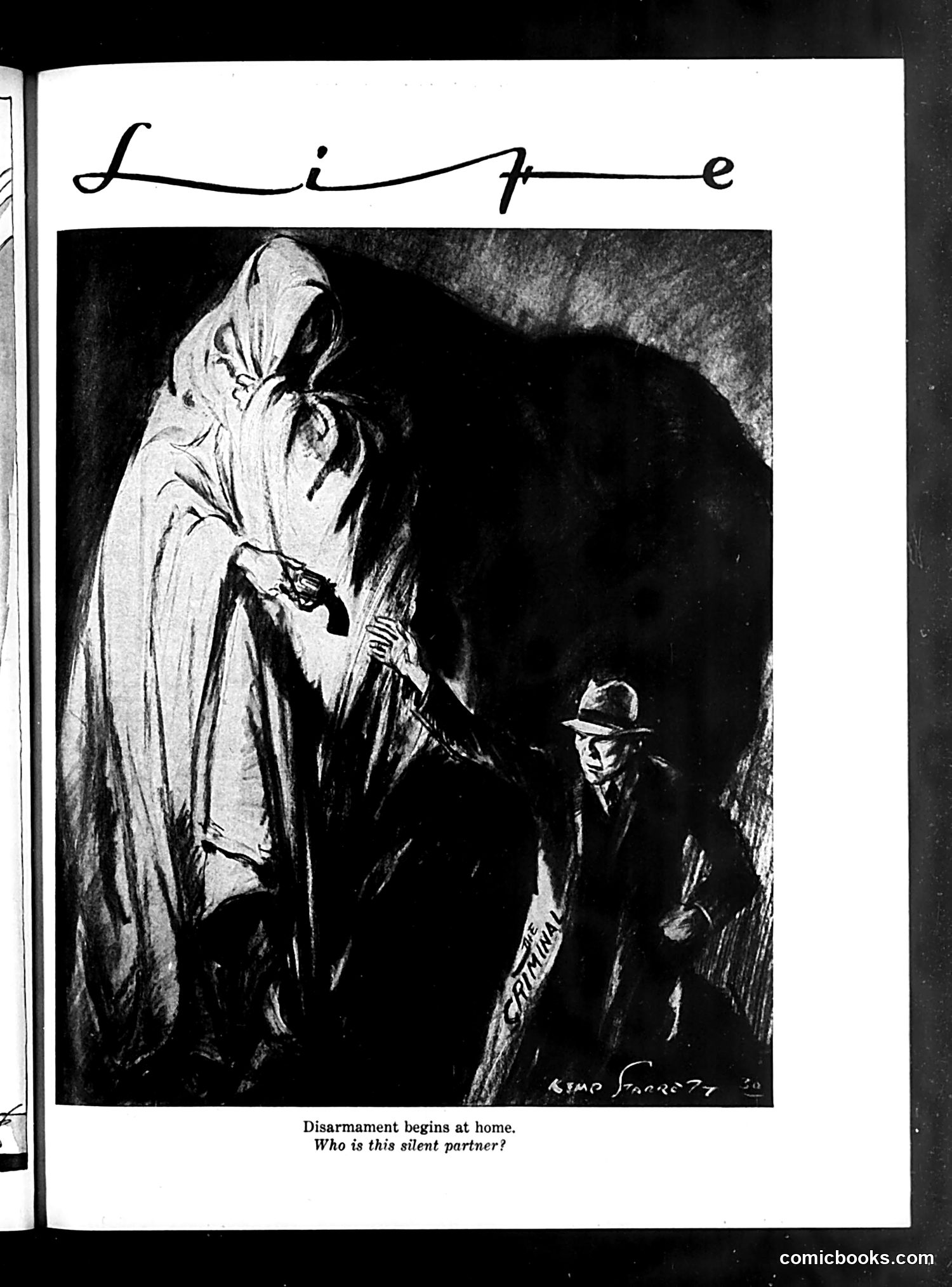
Analysis of "Life" Magazine Cartoon Page This political cartoon depicts a cloaked figure presenting a weapon to a smaller man in a hat, illustrating the caption "Disarmament begins at home. Who is this silent partner?" The satire critiques domestic gun violence and the failure of disarmament efforts. The "silent partner" likely represents an unnamed force—possibly government inaction, the arms industry, or societal indifference—that enables violence despite public disarmament rhetoric. The ghostly, shrouded figure suggests death or violence itself as an accomplice to the smaller figure (appearing to represent ordinary citizens or perhaps a specific political leader). The cartoon's message: true disarmament must address root causes at home before international peace efforts succeed. The "silent partner" metaphor suggests complicity in allowing violence to persist.
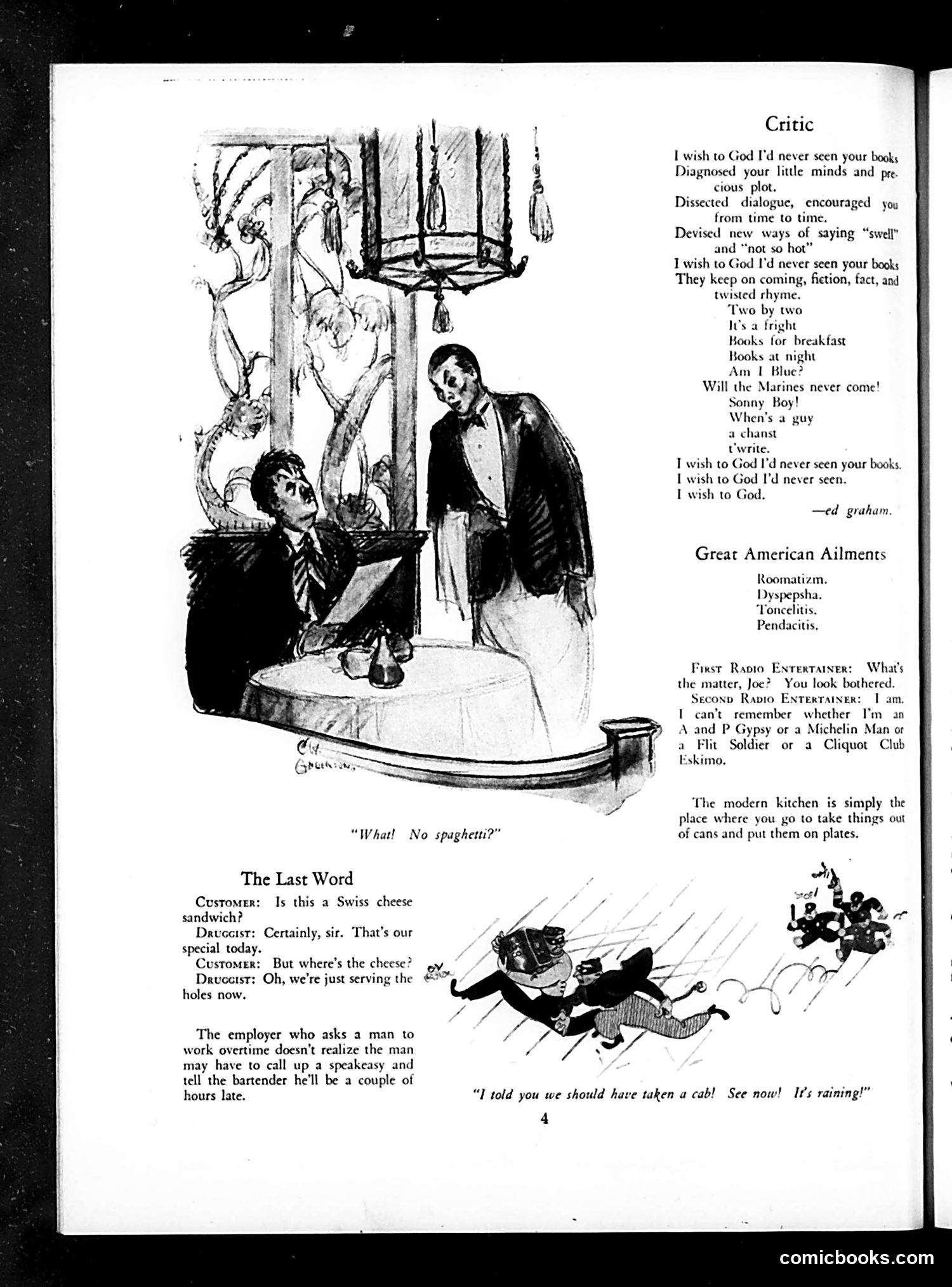
Analysis This page from Life magazine contains three separate satirical pieces: "Critic" (top right): A poem by ed graham mocking popular fiction and authors, listing book titles like "Am I Blue?" and "Sonny Boy!" The critic wishes he'd never seen these books, suggesting contempt for commercial, lowbrow literature of the era. "The Last Word" (bottom left): A dialogue joke where a druggist serves a customer "Swiss cheese sandwiches" but has run out of cheese—they're just serving "the holes now." It satirizes commercial shortcuts and business dishonesty. "Great American Ailments": A brief list mocking contemporary afflictions like "Roomatizm" and "Dyspepsia." The bottom cartoon shows a figure in rain with text about taking a cab, appearing to comment on workplace dynamics or commuting frustrations. These represent typical Life magazine humor: social criticism through wordplay and visual gags targeting commercial culture, poor writing, and business practices.
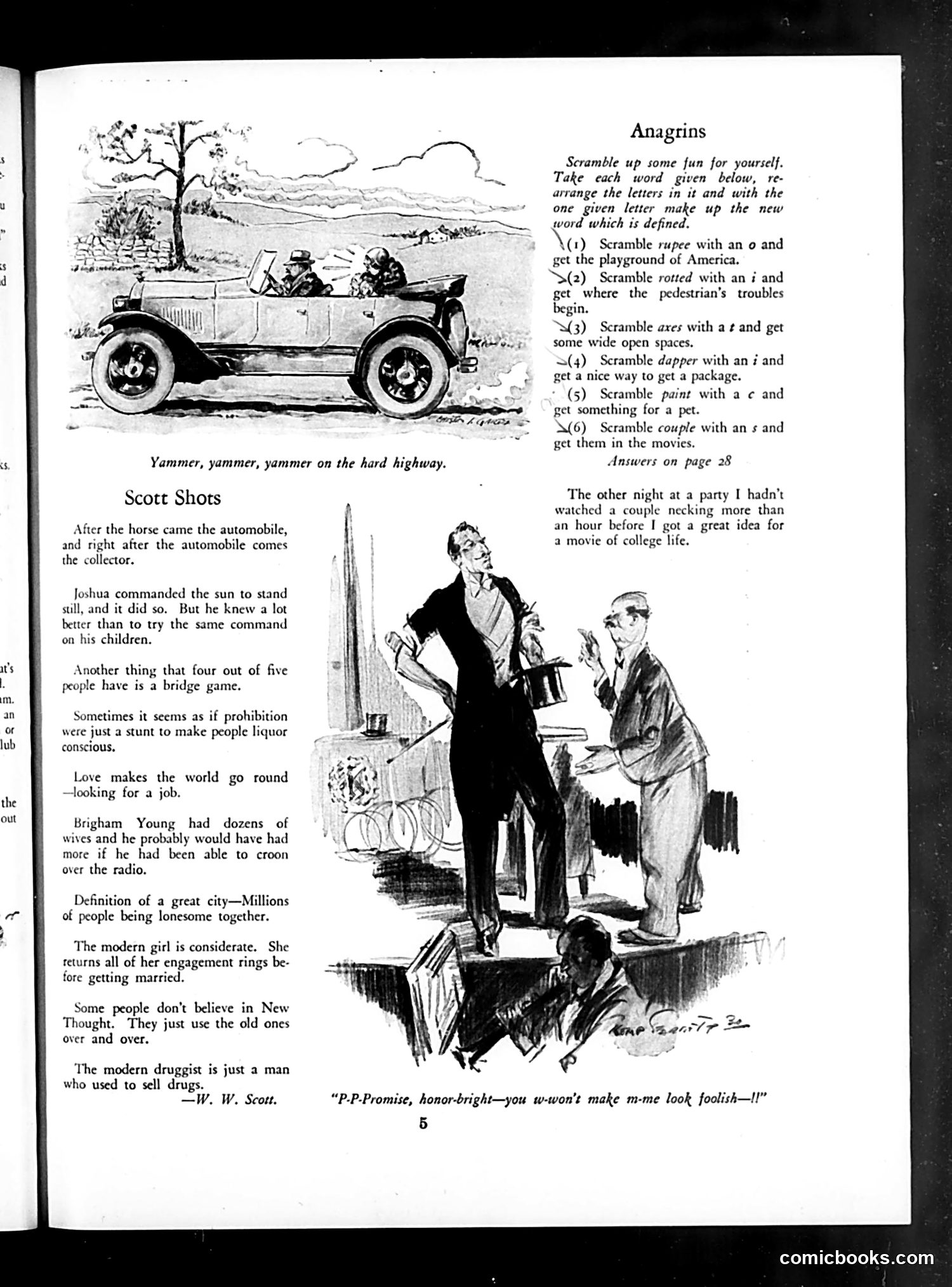
Analysis This page contains Scott Shots, a collection of short satirical observations by W.W. Scott (credited at bottom). These are brief, cynical quips about American society rather than a narrative cartoon. The single illustration depicts a man in formal attire speaking to two workers, with the caption: "P.P.Promise, honor-bright—you u-won't make m-me look foolish—!!" The cartoon satirizes someone (likely a politician or public figure) attempting to buy silence or complicity from workers, stammering nervously as he makes promises. The joke suggests corruption, backroom deals, or hypocrisy—someone worried about their public image pressuring others to keep secrets. The short quips below mock various American institutions: automobiles replacing horses, prohibition, marriage, Brigham Young's polygamy, and modern druggists—reflecting 1920s concerns.
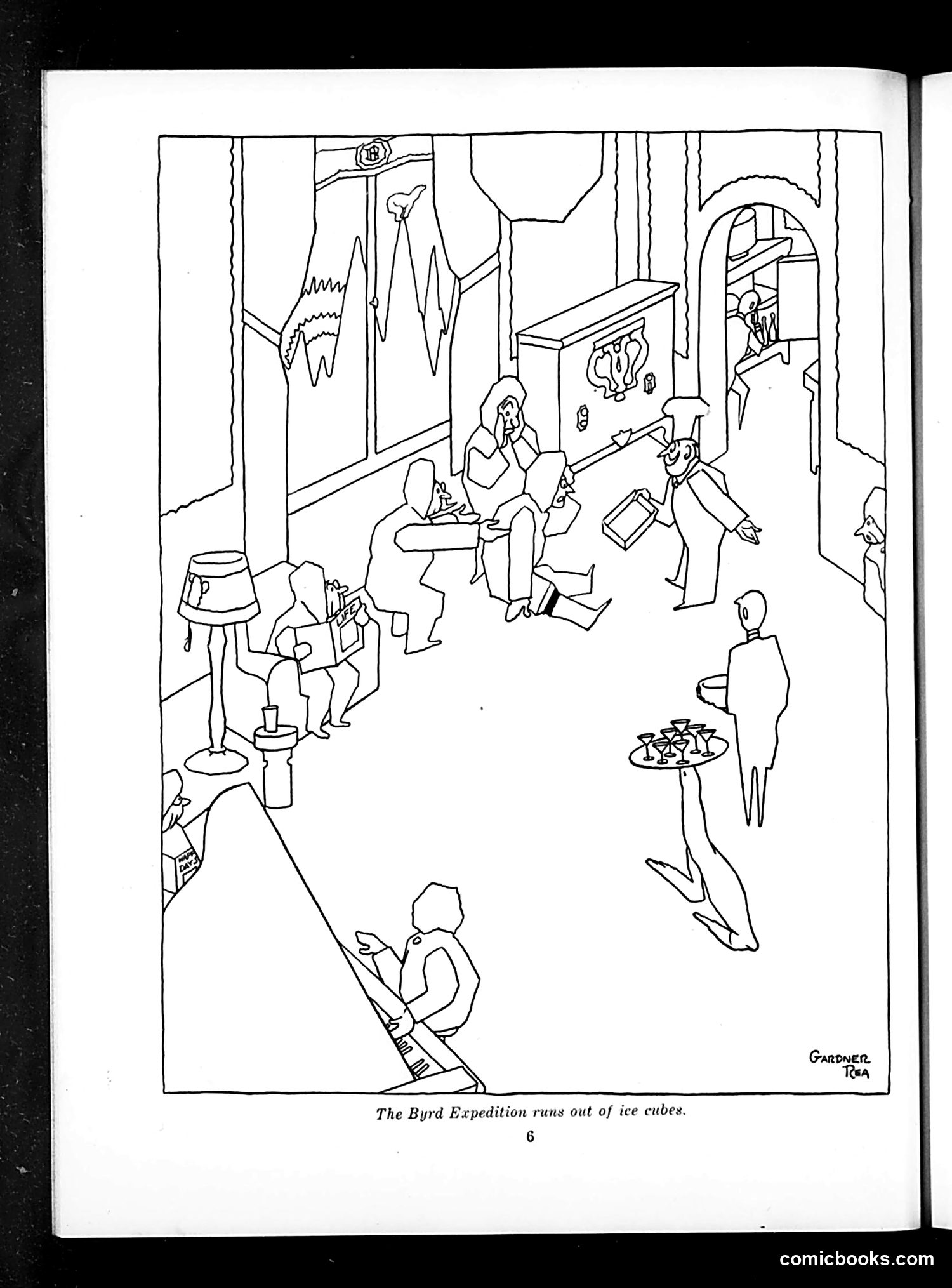
"The Byrd Expedition Runs Out of Ice Cubes" This cartoon by Gardner Tead satirizes Admiral Richard E. Byrd's Antarctic expedition (likely the 1928-1930 expedition, one of the earliest major Antarctic ventures). The joke plays on the absurd notion that explorers on an ice-covered continent would run out of ice—a humorous commentary on expedition logistics and planning. The cartoon depicts what appears to be an expedition party in dire straits, with figures scrambling inside a building. The humor derives from the ironic incongruity: explorers surrounded by unlimited ice yet facing supply shortages. This likely mocks either Byrd's expedition's actual supply problems or satirizes the expedition's ambitious but potentially poorly-planned nature, which was a subject of public discussion during this period of polar exploration.
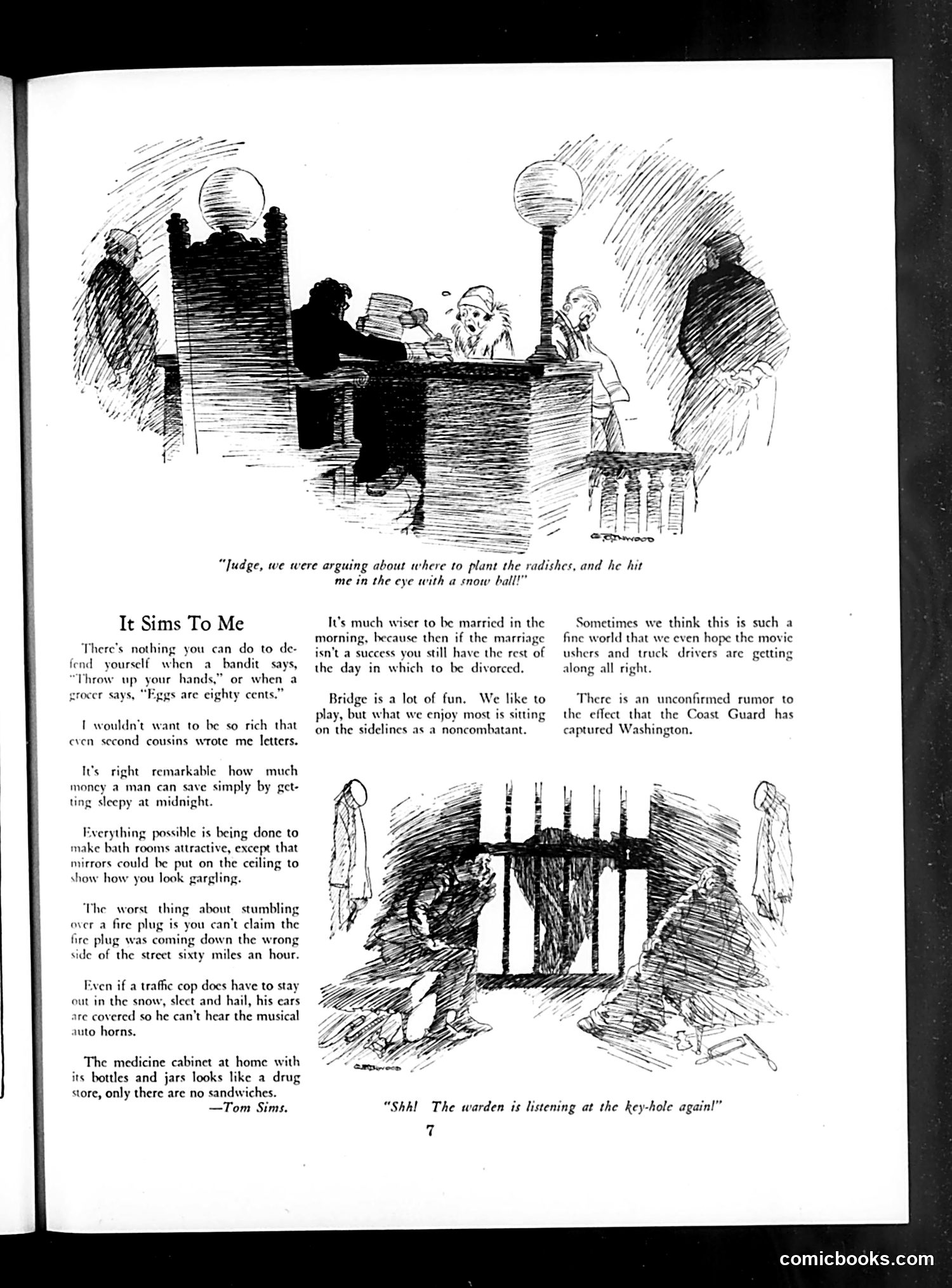
Analysis of "It Sims To Me" Page This is a humor column by Tom Sims from *Life* magazine. The top cartoon shows a courtroom scene where someone complains to a judge about being hit with a snowball during an argument about planting radishes—a absurdist joke about petty domestic disputes. The text below consists of brief satirical observations about everyday American life: marriage timing, bridge as entertainment, bathroom mirrors reflecting unflattering angles, the cost of electricity left on, fire plugs blocking street parking, traffic cops in snow, and home medicine cabinets resembling pharmacies. The bottom cartoon depicts a prison or jail with a guard listening at a keyhole, captioned "Shal The warden is listening at the key-hole again!"—suggesting paranoia or surveillance concerns. The humor is gentle, observational satire about mundane modern inconveniences and social absurdities.
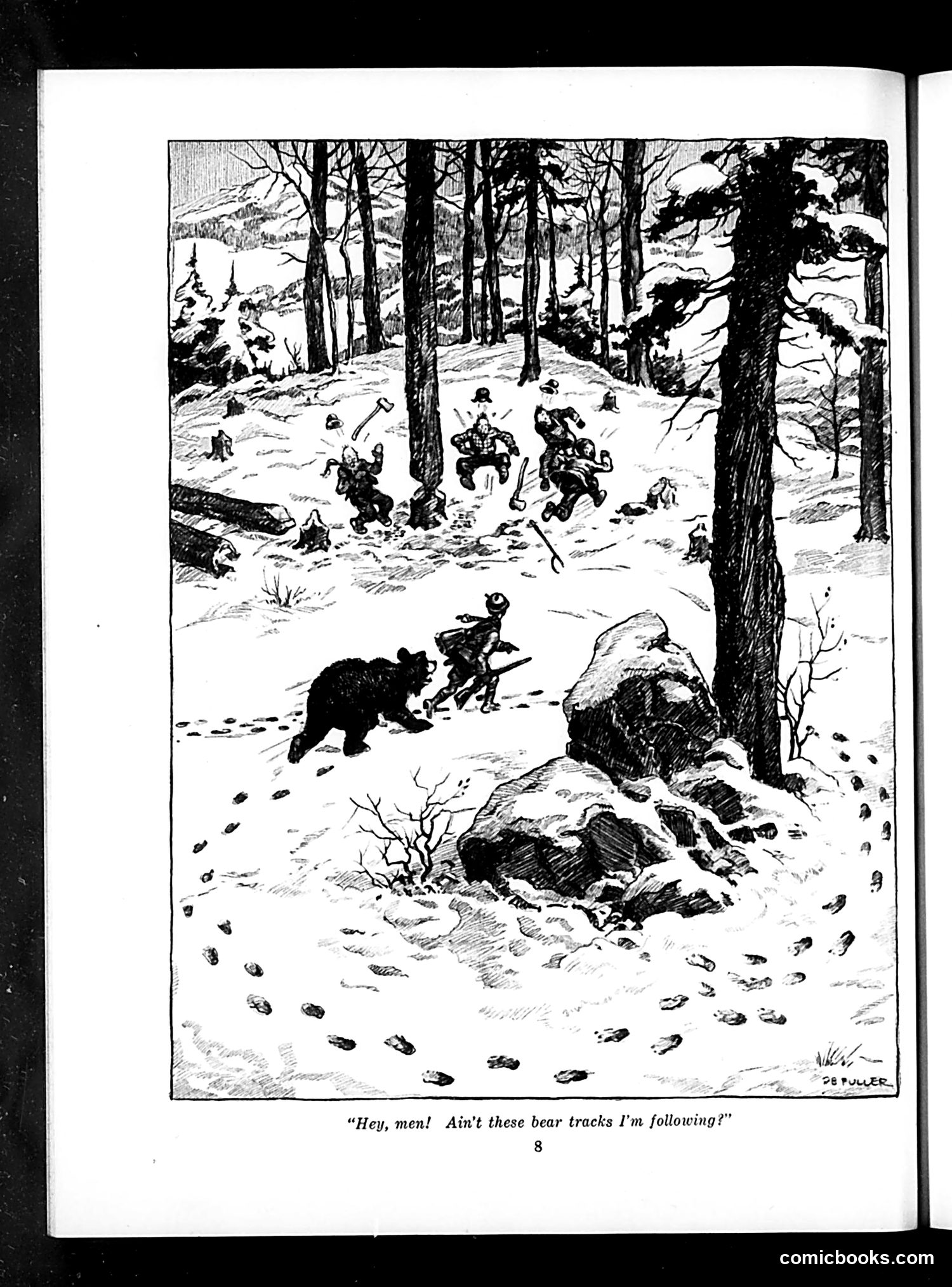
Analysis This is a humorous wilderness illustration showing a hunter following animal tracks in snow, unaware that he's actually trailing a bear—visible in the foreground left. The hunter's dialogue, "Hey, men! Ain't these bear tracks I'm following?" suggests he's confidently (and incorrectly) identifying the tracks while other hunters wait in the background. The joke is ironic situational humor: the hunter believes he's skillfully tracking a bear, when in fact the bear is right there, and he's walking directly toward danger while remaining oblivious. This plays on common sporting/hunting mishaps and the gap between hunters' self-perceived competence and actual situational awareness. The cartoon is signed "Fuller" and appears to be a full-page illustration rather than political satire—it's entertainment humor typical of *Life* magazine's content during the early-to-mid 20th century.
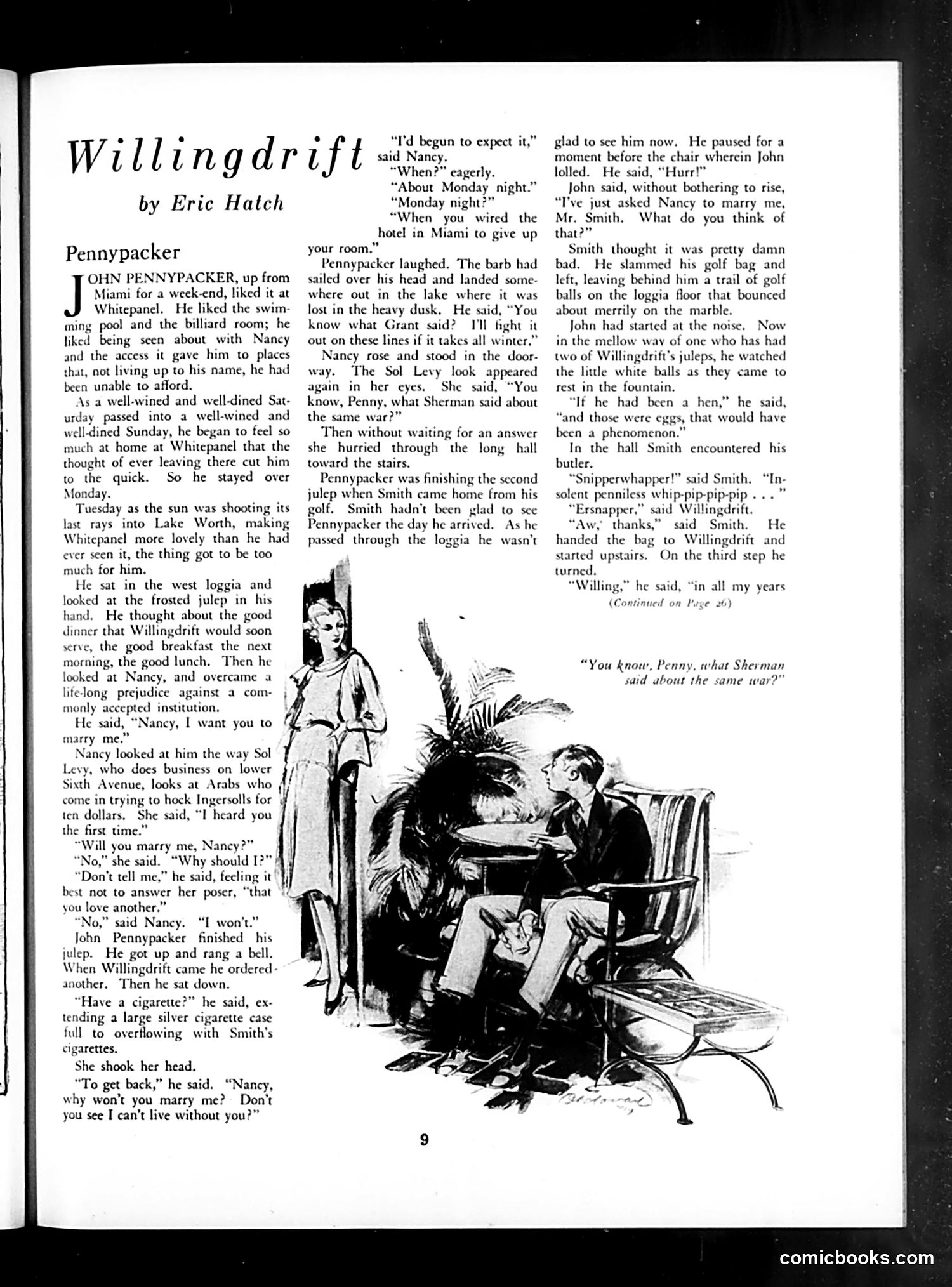
Analysis of "Willingdrift" by Eric Hatch This is a humorous short story, not political satire. The narrative concerns John Pennypacker, a wealthy man from Miami who proposes marriage to Nancy while visiting Whitepapel. Nancy repeatedly refuses him, citing his inability to live within his means—he's wealthy but perpetually broke. The illustration shows the domestic scene of Pennypacker's proposal attempt. The story's satire targets upper-class excess and romantic persistence: Pennypacker assumes wealth entitles him to Nancy's affection, yet his financial irresponsibility undermines his position. The humor derives from Nancy's practical rejection of romantic grand gestures when the suitor cannot manage basic finances. This reflects 1920s-30s social commentary on wealth without substance.
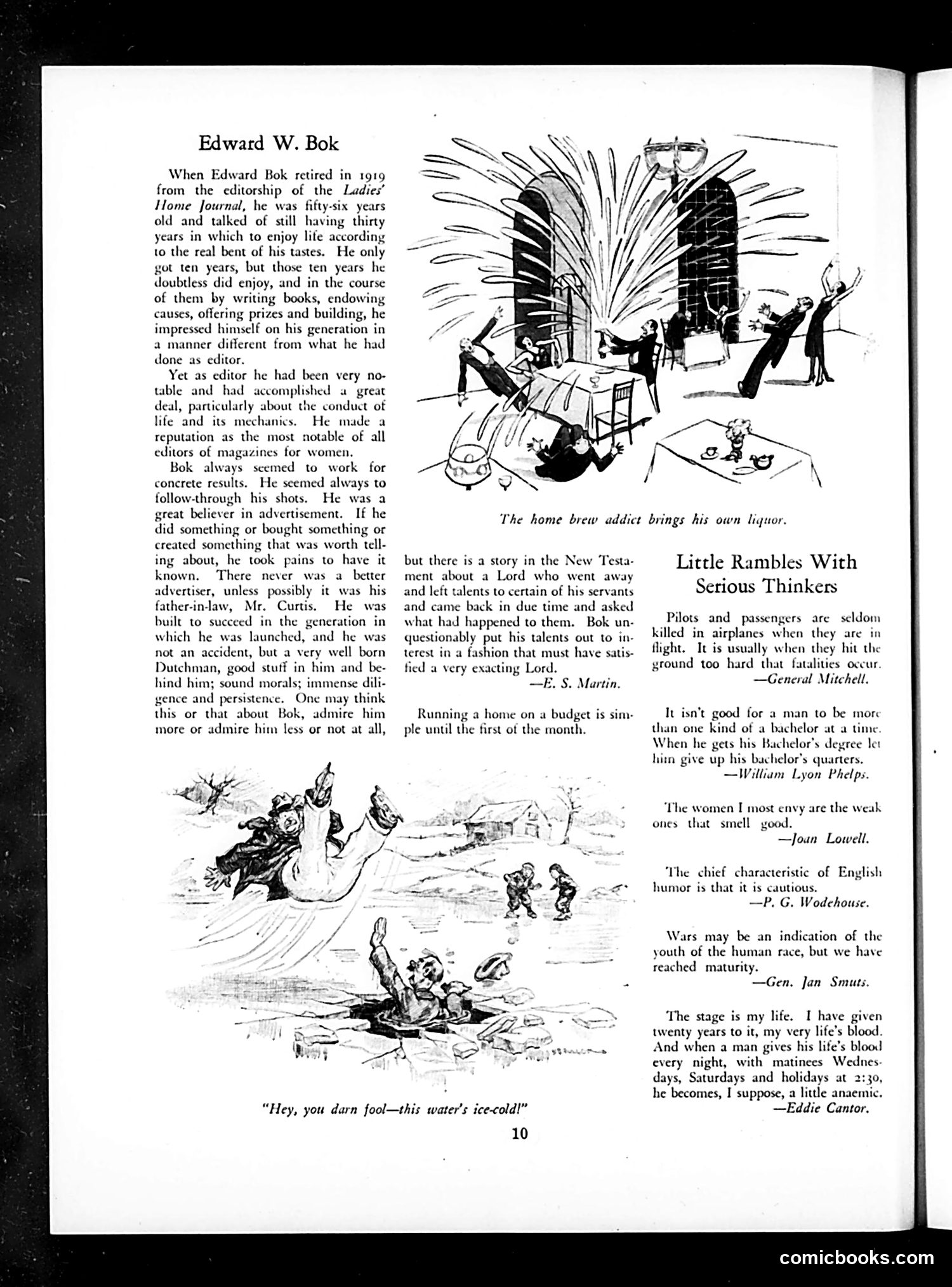
Edward W. Bok and "Little Rambles With Serious Thinkers" This page celebrates Edward W. Bok, editor of *Ladies' Home Journal*, who retired in 1919 after 30 years. The upper cartoon satirizes his domestic focus—showing a chaotic home scene with the caption "The home brew addict brings his own liquor," likely referencing Prohibition-era tensions. The lower section, "Little Rambles With Serious Thinkers," presents witty quotations from public figures (General Mitchell, William Lyon Phelps, Joan Lowell, P.G. Wodehouse, and others) on topics like bachelorhood, humor, war, and theater. The skating scene cartoon illustrates one quote with the caption "Hey, you darn fool—this water's ice-cold!" The page celebrates Bok's editorial legacy of combining practical home advice with cultural commentary.
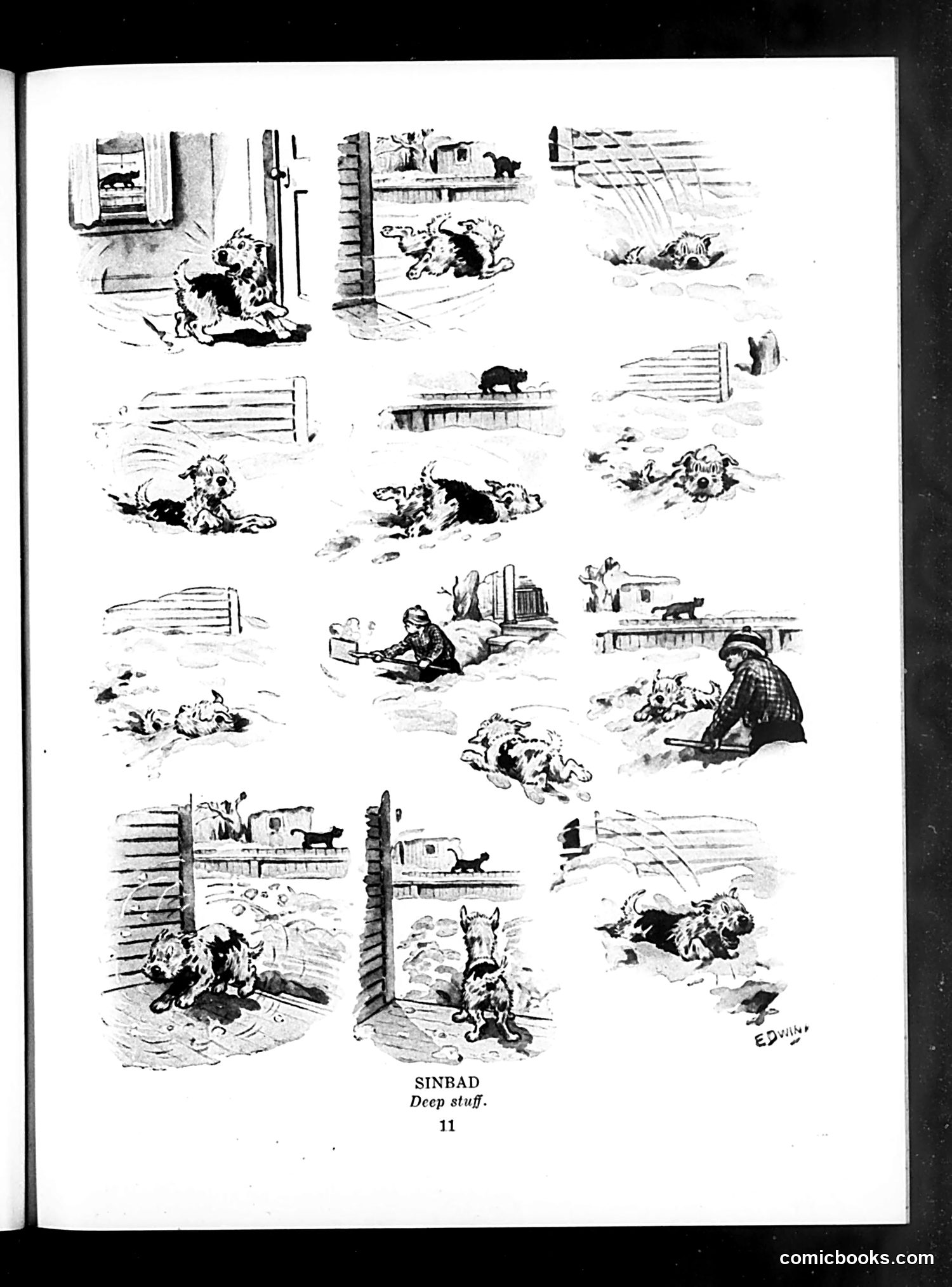
Analysis of "Sinbad: Deep Stuff" This page presents a series of cartoon sketches depicting a dog (labeled "Sinbad") in various predicaments and adventures. The sketches show the dog engaging in mischief—digging, fighting, stealing food, interacting with people and other animals, and getting into trouble around farm settings and buildings. The title "Deep stuff" appears to be a humorous reference, likely playing on the dog's name (Sinbad the Sailor's famous adventures) while depicting mundane, comedic situations. The satire seems to mock the contrast between grand adventure narratives and the actual petty troubles a mischievous dog encounters in everyday life. The cartoons demonstrate slapstick humor typical of early Life magazine's style, using visual gags rather than complex political commentary.
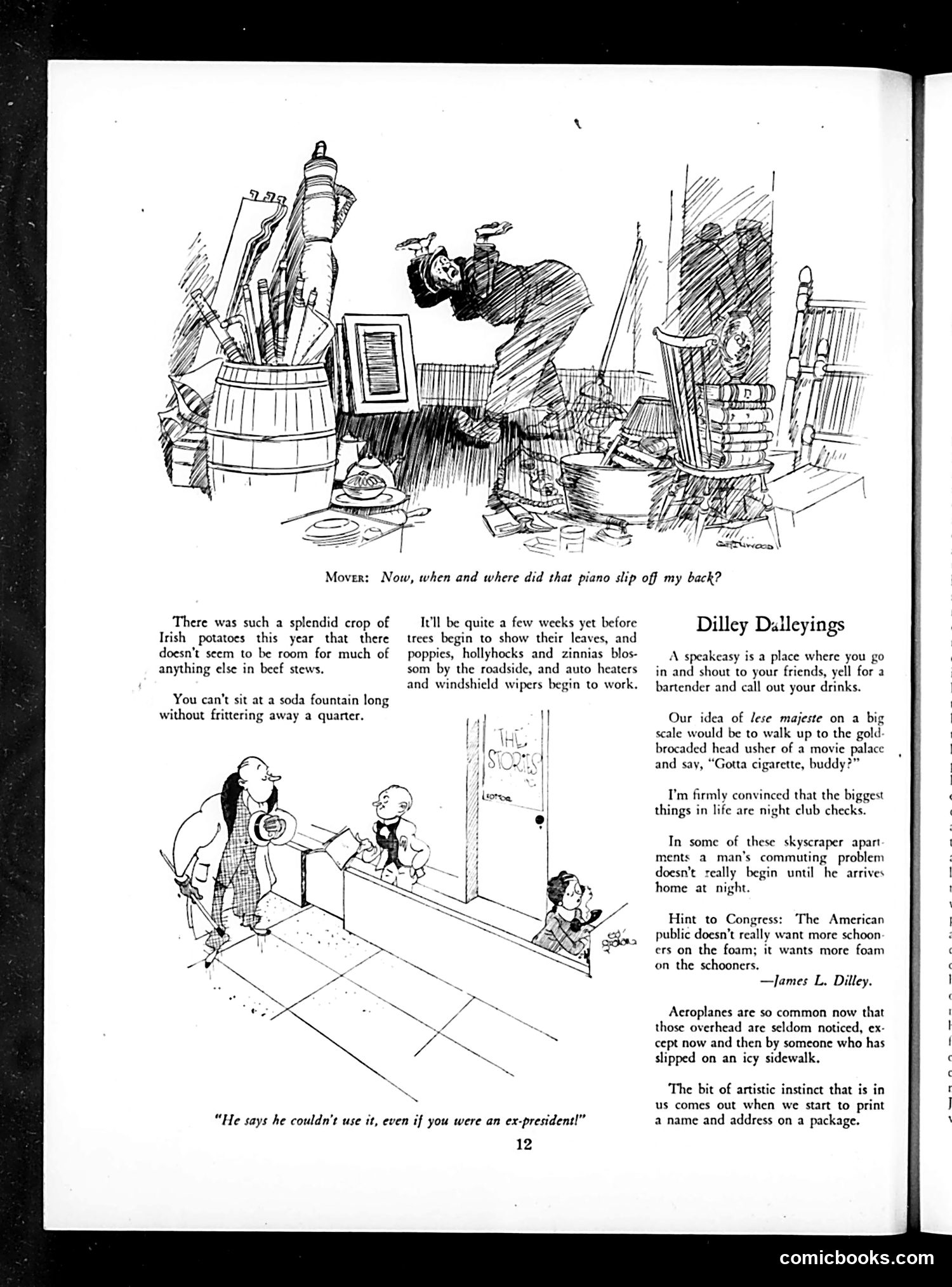
Explanation for Modern Readers This page contains two unrelated cartoon/humor sections: Top cartoon: A moving company worker asks a homeowner "Now, when and where did that piano slip off my back?" The joke plays on the phrase "slip off my back" (meaning something doesn't bother you) as literal physical mishap—the piano actually fell during the move. Bottom cartoon: Shows people on what appears to be a residential street or building entrance. The caption reads "He says he couldn't use it, even if you were an ex-president!" The humor likely references Depression-era inability to use something valuable, with the ex-president reference emphasizing universal poverty regardless of status. The right column contains brief social observations by James L. Dilley about American life (speakeasies, night clubs, commuting, etc.)—typical of *Life* magazine's satirical commentary on contemporary society.
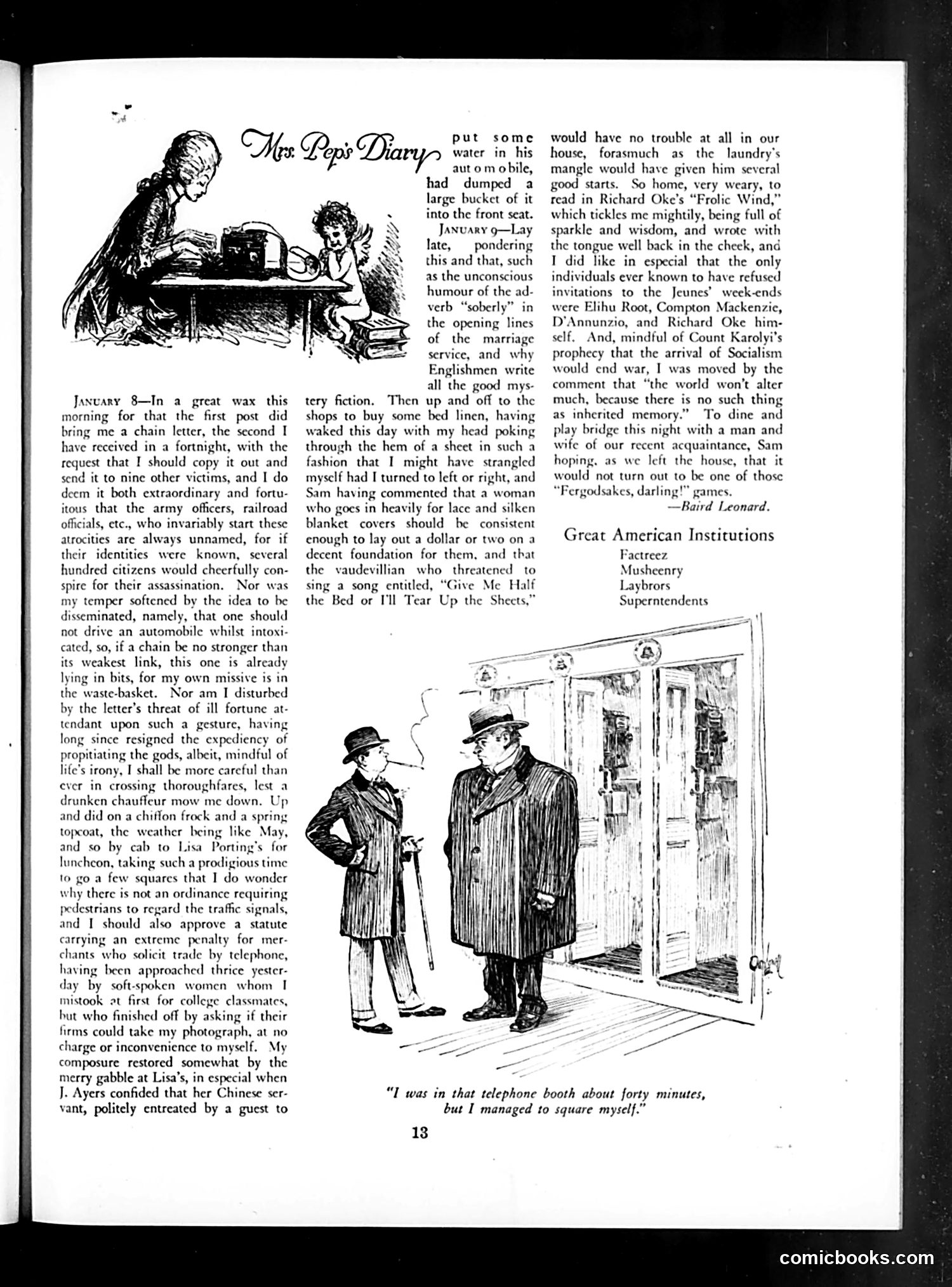
Analysis of Page 13, Life Magazine This page contains Mrs. Peps's Diary, a humorous personal column with two illustrated sections. The top sketch depicts a woman at a writing desk with a child, establishing the domestic diary format. The bottom illustration, captioned "I was in that telephone booth about forty minutes, but I managed to square myself," shows two men in overcoats outside what appears to be an early telephone booth—a novelty public amenity. The joke satirizes how people might use public telephone booths for extended personal conversations, then awkwardly justify the behavior to others. The humor derives from the emerging social awkwardness around new telephone technology and public etiquette in what appears to be the early 20th century, when shared telephone access was still unfamiliar to most Americans.
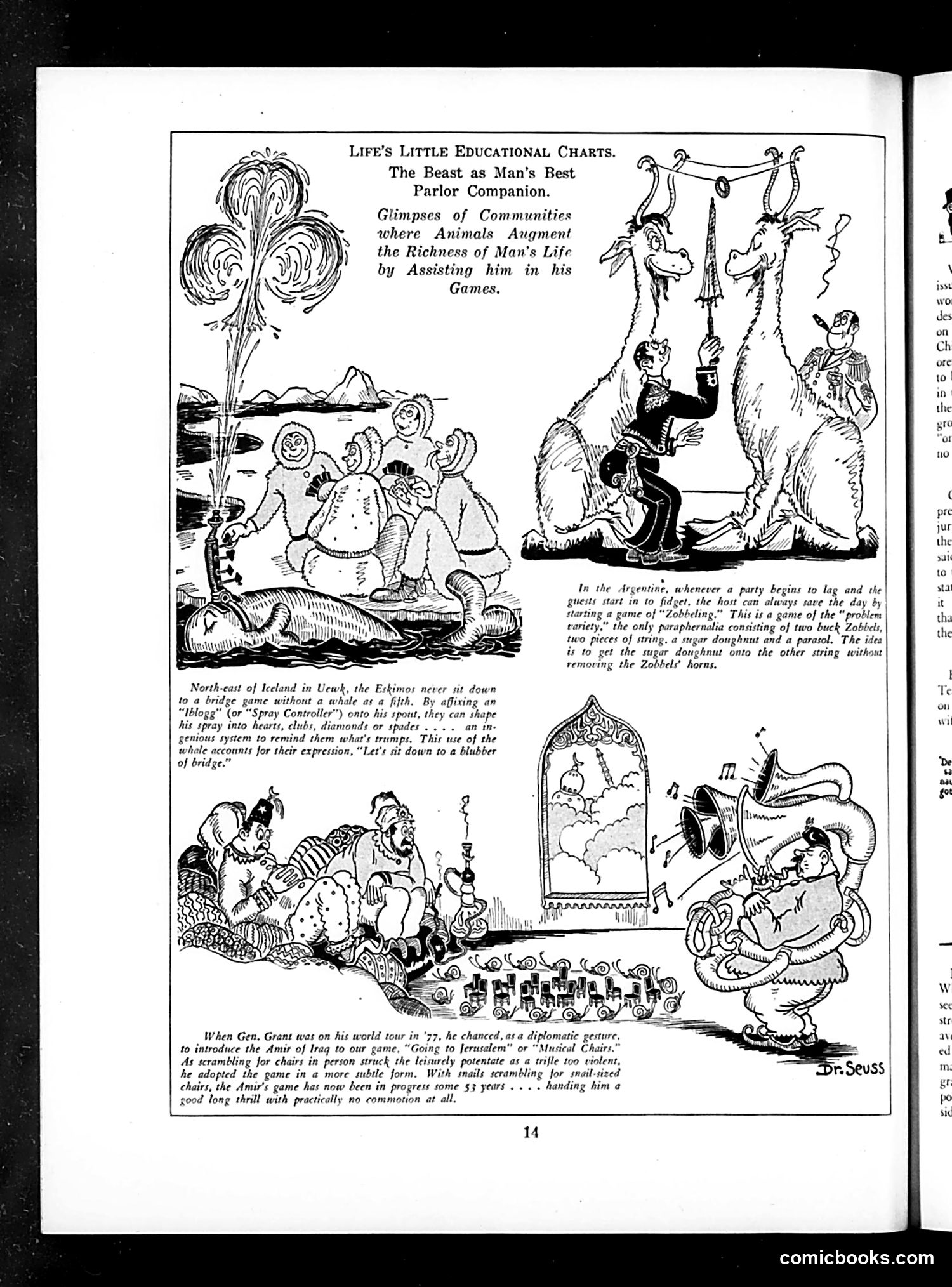
"Life's Little Educational Charts: The Beast as Man's Best Parlor Companion" This page, illustrated by Dr. Seuss, satirizes unusual animal-based parlor games and entertainment. The four vignettes mock eccentric leisure activities where animals participate in human pastimes: 1. Top left: Eskimos play bridge with a whale and bird 2. Top right: People swing on monkeys like playground equipment 3. Bottom left: General Grant introduces "Going to Jerusalem" or "Musical Chairs" using frogs 4. Bottom right: A phonograph-like device with a figure The satire targets wealthy Americans' obsession with exotic pets and peculiar entertainment trends of the era. By depicting absurd scenarios where animals become active participants in parlor games, Seuss mocks both the pretentiousness of upper-class recreation and the era's casual attitude toward animal welfare. The humor relies on the obvious impracticality and ridiculousness of these scenarios.
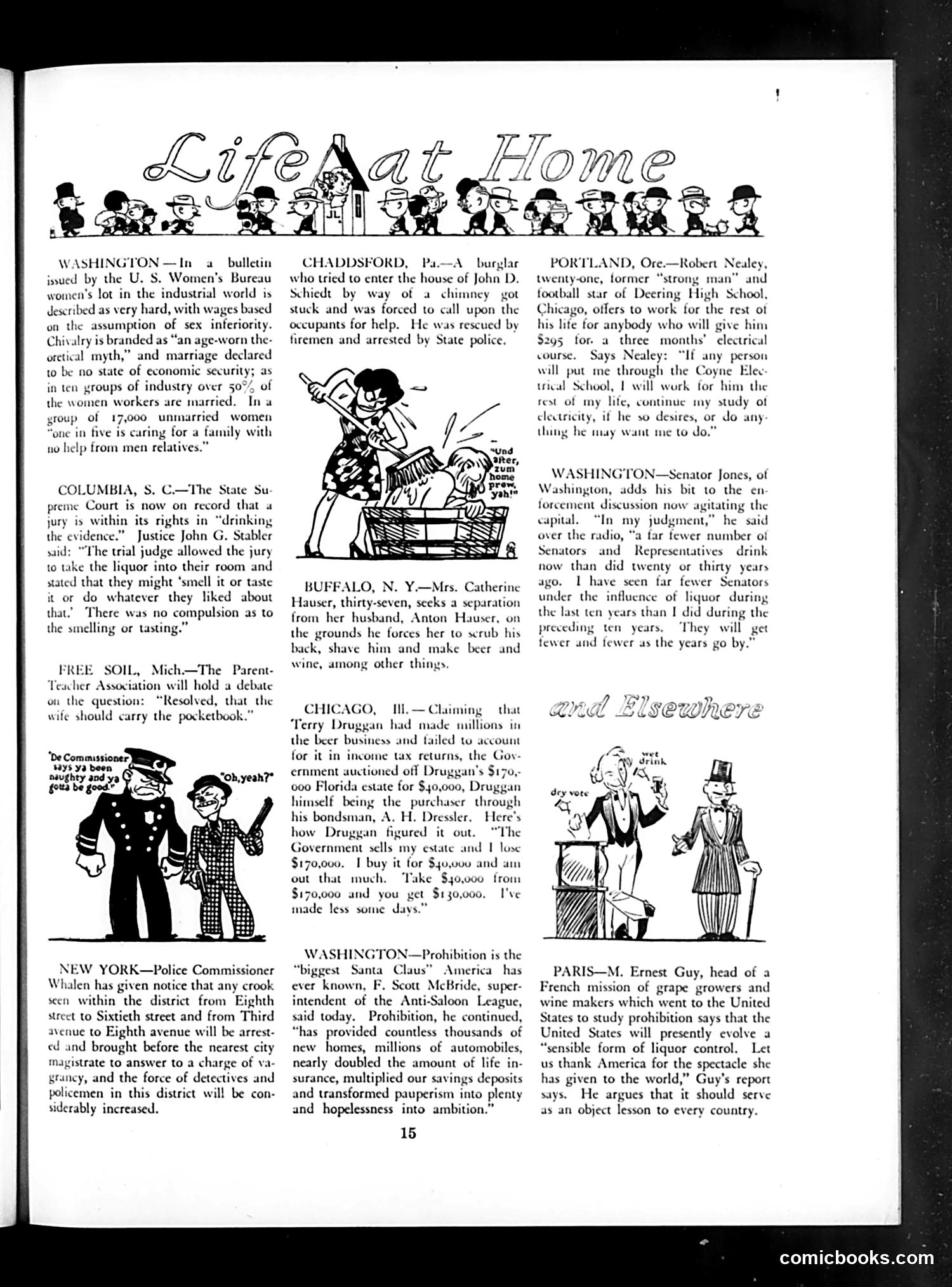
Life Magazine Page Analysis This page satirizes Prohibition-era America through multiple news briefs and cartoons. The top cartoon depicts a woman sweeping while a man asks "Oh, yeah? Well how'll I know the dirt'll be good?" — mocking the absurdity of Prohibition enforcement and black-market quality concerns. The "And Elsewhere" cartoon shows a man drinking while a woman votes, contrasting wet (pro-alcohol) and dry (anti-alcohol) positions on Prohibition. The text items cover related scandals: Terry Druggan's beer business tax evasion, Senator Jones' claim that fewer Senators drink than decades prior, a woman seeking separation to escape her husband's forced beer-making, and French grape growers' concerns about American Prohibition's market impact. The overall message critiques Prohibition's failure to eliminate drinking while creating crime and hypocrisy among elites.
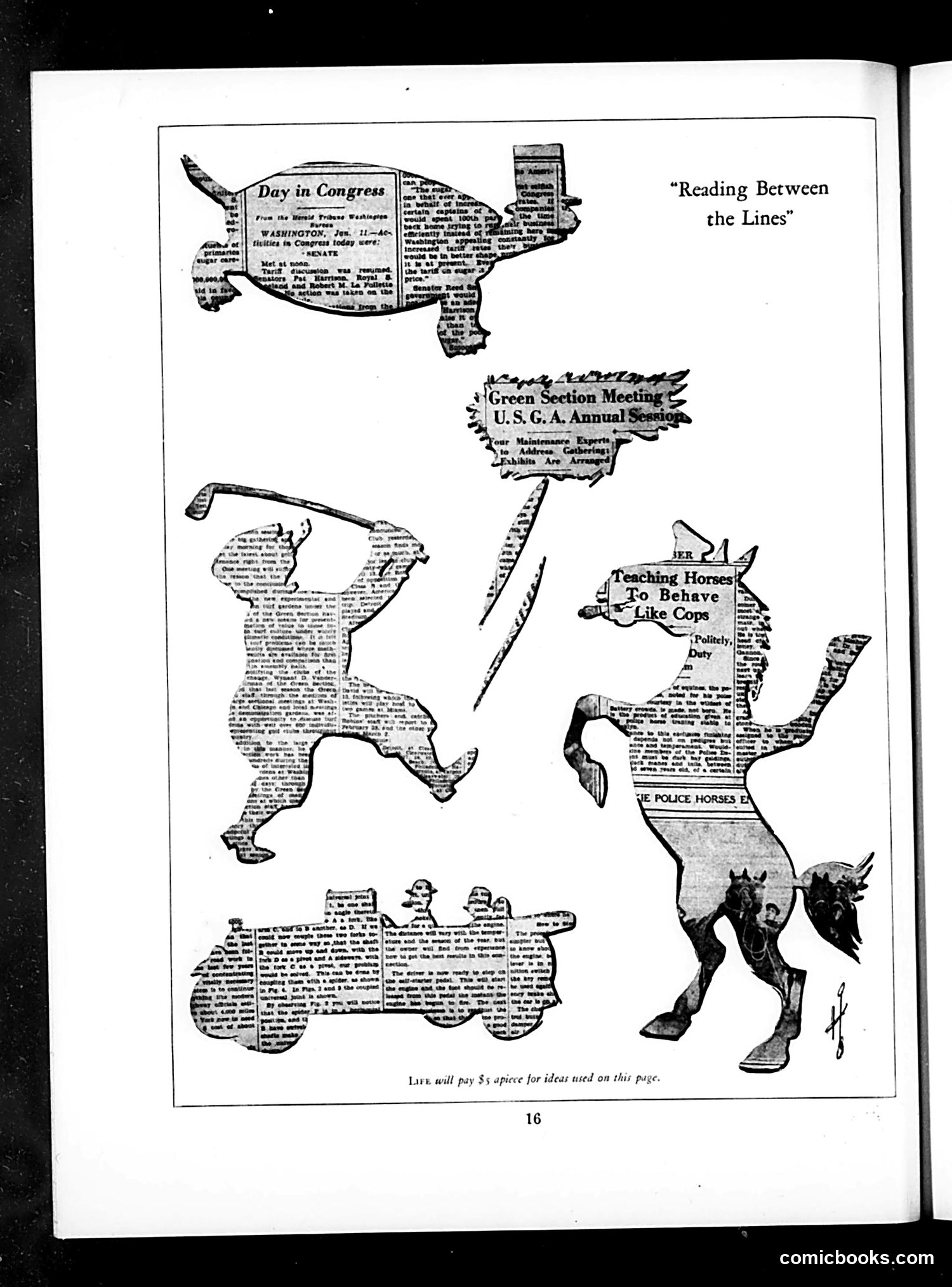
Political Cartoon Analysis: "Reading Between the Lines" This page features several shaped newspaper clippings forming animals and objects—a satirical technique where real congressional news and commentary are literally cut into symbolic forms. Key elements visible: - A fish labeled "Day in Congress" containing Washington legislative news - A horse-shaped clipping about "Teaching Horses To Behave Like Cops" (likely critiquing police conduct or training) - A police horse illustration at bottom right - A "Green Section Meeting U.S.G.A. Annual Session" clipping - An automobile-shaped clipping The satire uses newspaper text itself as the medium, suggesting these issues are constructed from media narratives. The animals/vehicles may represent institutions or political figures being satirized through the juxtaposition of their shapes with actual legislative content. The note at bottom states "Life will pay $5 apiece for ideas used on this page," indicating this was reader-contributed satire.
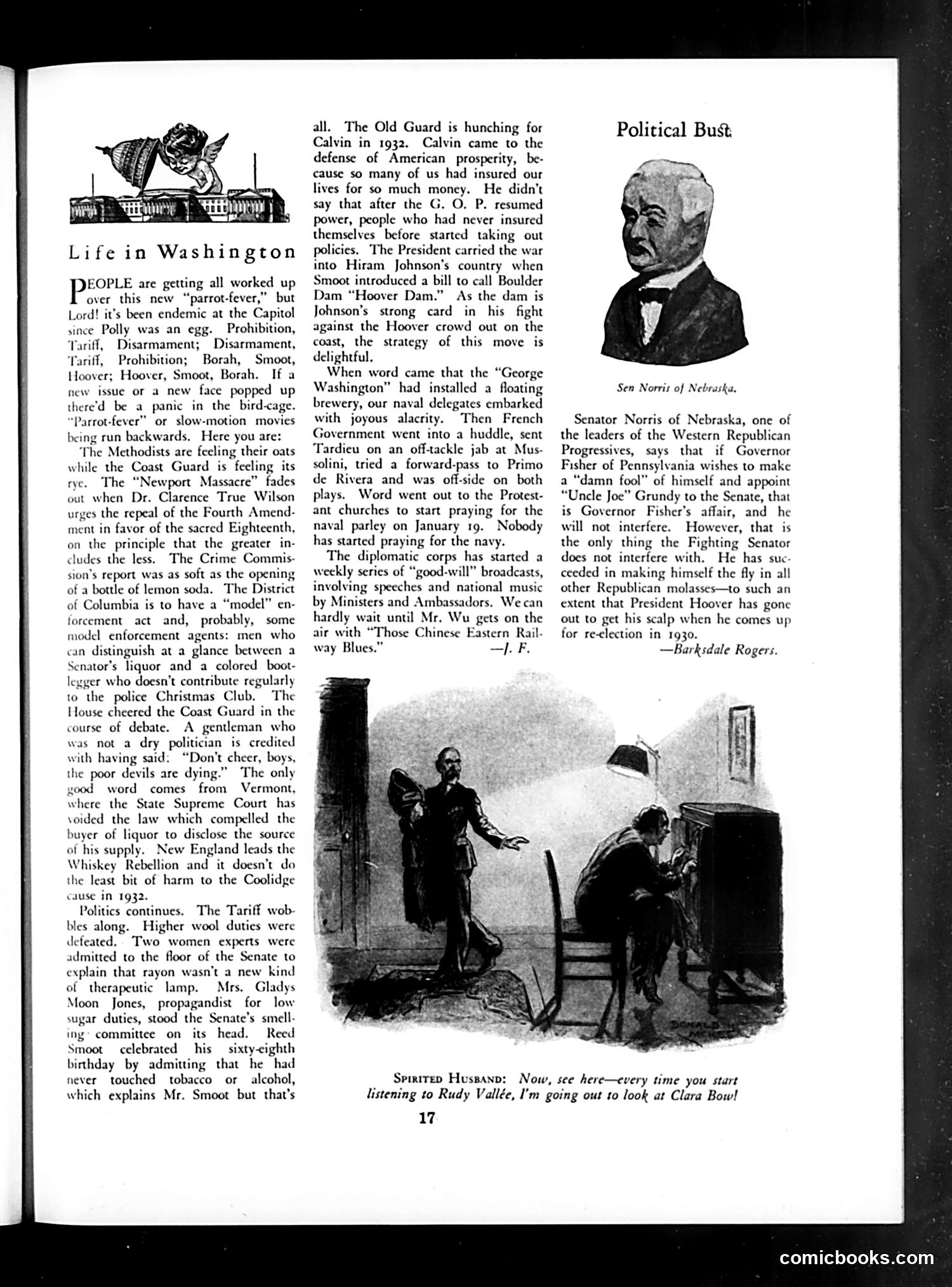
Political Cartoon Analysis This page contains two distinct pieces: "Life in Washington" (left column): Political commentary on 1920s-30s Washington scandals, referencing Prohibition, the Teapot Dome scandal, and various congressional figures including Senator Norris and Reed Smoot. The text satirizes political chaos and hypocrisy. "Political Bust" (top right): A portrait of Senator Norris of Nebraska, with commentary praising his independence from Republican party pressure regarding President Hoover's re-election prospects in 1930. "Spirited Husband" (bottom): A cartoon showing a man leaving home while his wife listens to "Rudy Vallée" on the radio, looking at "Clara Bow"—satirizing the era's celebrity culture and wives' entertainment distractions. The humor hinges on marital discord caused by entertainment obsessions. The page reflects 1920s-30s concerns: Prohibition, political corruption, celebrity culture, and evolving domestic dynamics.
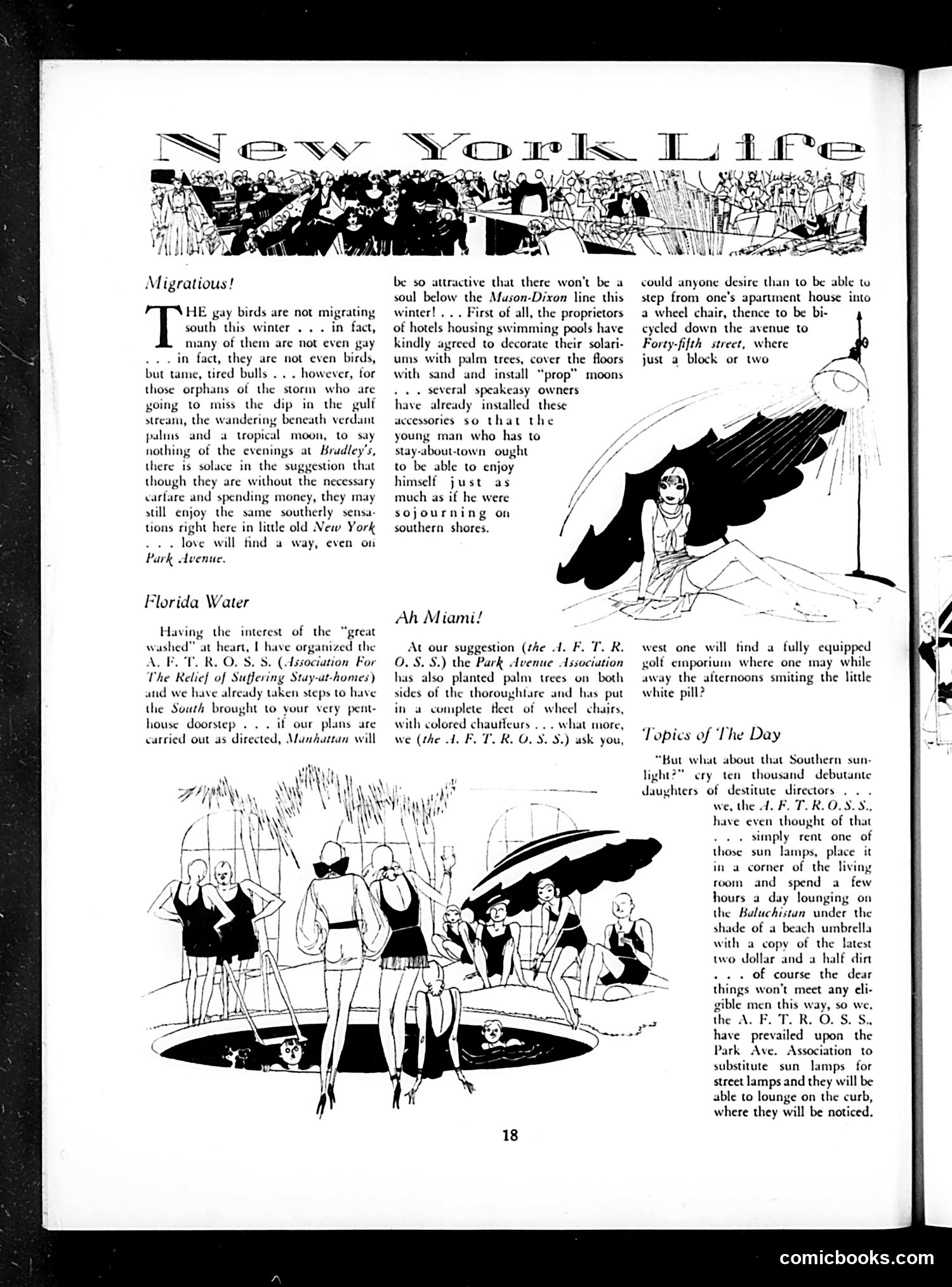
Analysis of "New York Life" Page 18 This satirical page targets wealthy New Yorkers during winter by mocking their efforts to maintain summer leisure despite cold weather. "Migratious!" ridicules the "gay birds" (socialites) who claim to stay in New York but actually seek southern warmth. The joke: they lack money for genuine migration but pretend to enjoy winter life on "Park Avenue." "Florida Water" and "Ah Miami!" sections describe absurd solutions—artificial pools with decorative palm trees, "prop moons," and sun lamps—allowing the wealthy to simulate southern climates indoors. The accompanying illustrations show women in beach attire under umbrellas indoors. The satire targets the pretense and conspicuous consumption of the privileged class: they're too invested in appearing sophisticated to simply admit wanting to escape winter, inventing ridiculous substitutes instead.
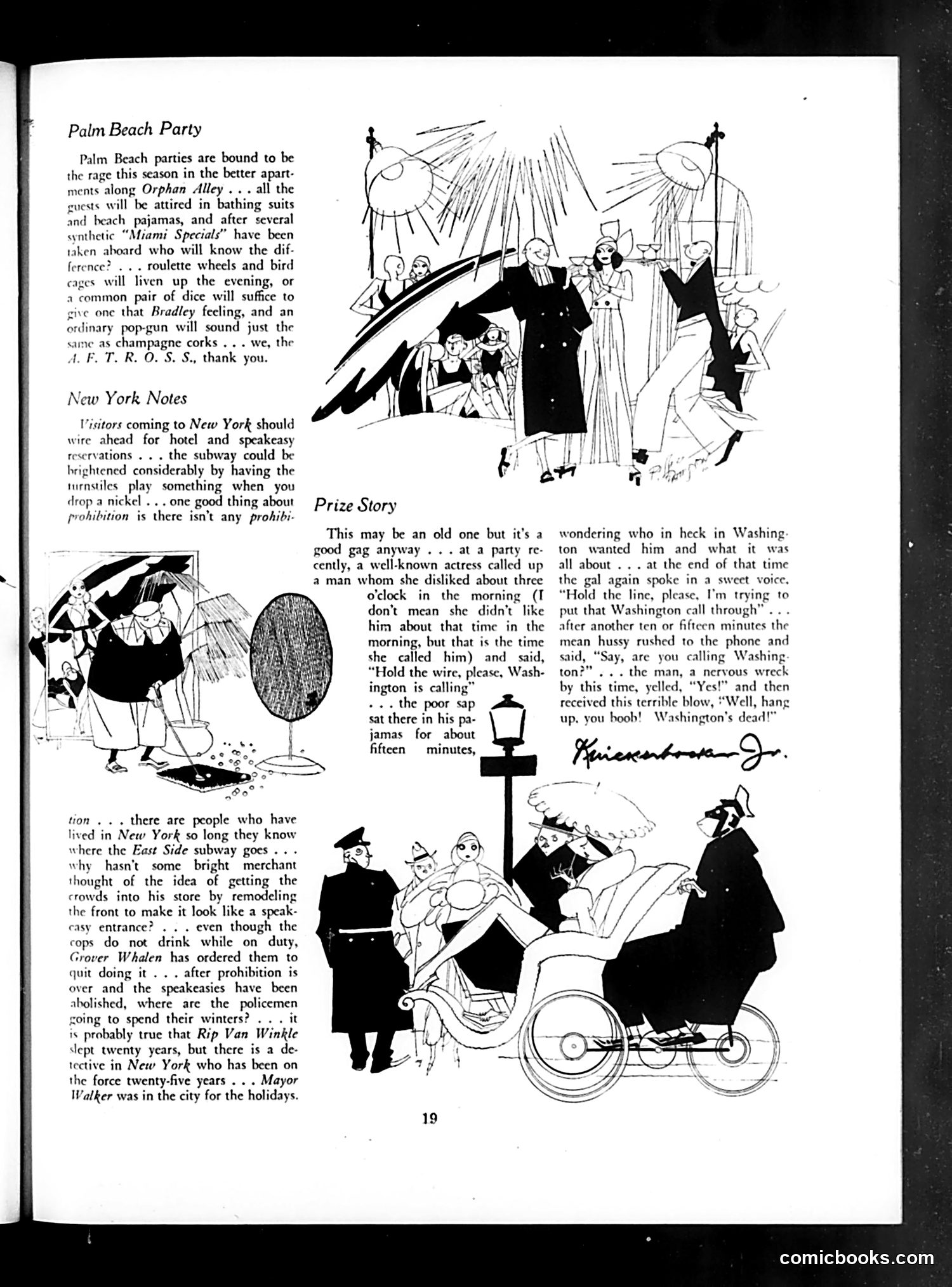
Explanation for Modern Readers This page from *Life* magazine satirizes Prohibition-era New York social life (circa 1920s). "Palm Beach Party" mocks wealthy apartment dwellers pretending to have elegant seaside parties using cheap substitutes—fake cocktails instead of champagne, gambling with dice and bird cages instead of proper entertainment. The joke is that guests won't notice the difference once drunk. "New York Notes" are brief satirical quips about NYC life during Prohibition, including the absurdity that "there isn't any prohibition" (speakeasies were openly operating despite the law), and jokes about corrupt police and the city's famous police commissioner Grover Whalen. "Prize Story" recounts a prank: a woman calls an unlikeable man at 3 a.m., pretending Washington is calling. She keeps him holding the line for 15 minutes with this deception. When he finally asks if he's calling Washington, she replies that Washington is dead—meaning President George Washington, a cruel joke after wasting his time. All three pieces mock Jazz Age excess, hypocrisy around Prohibition enforcement, and urban frivolity.
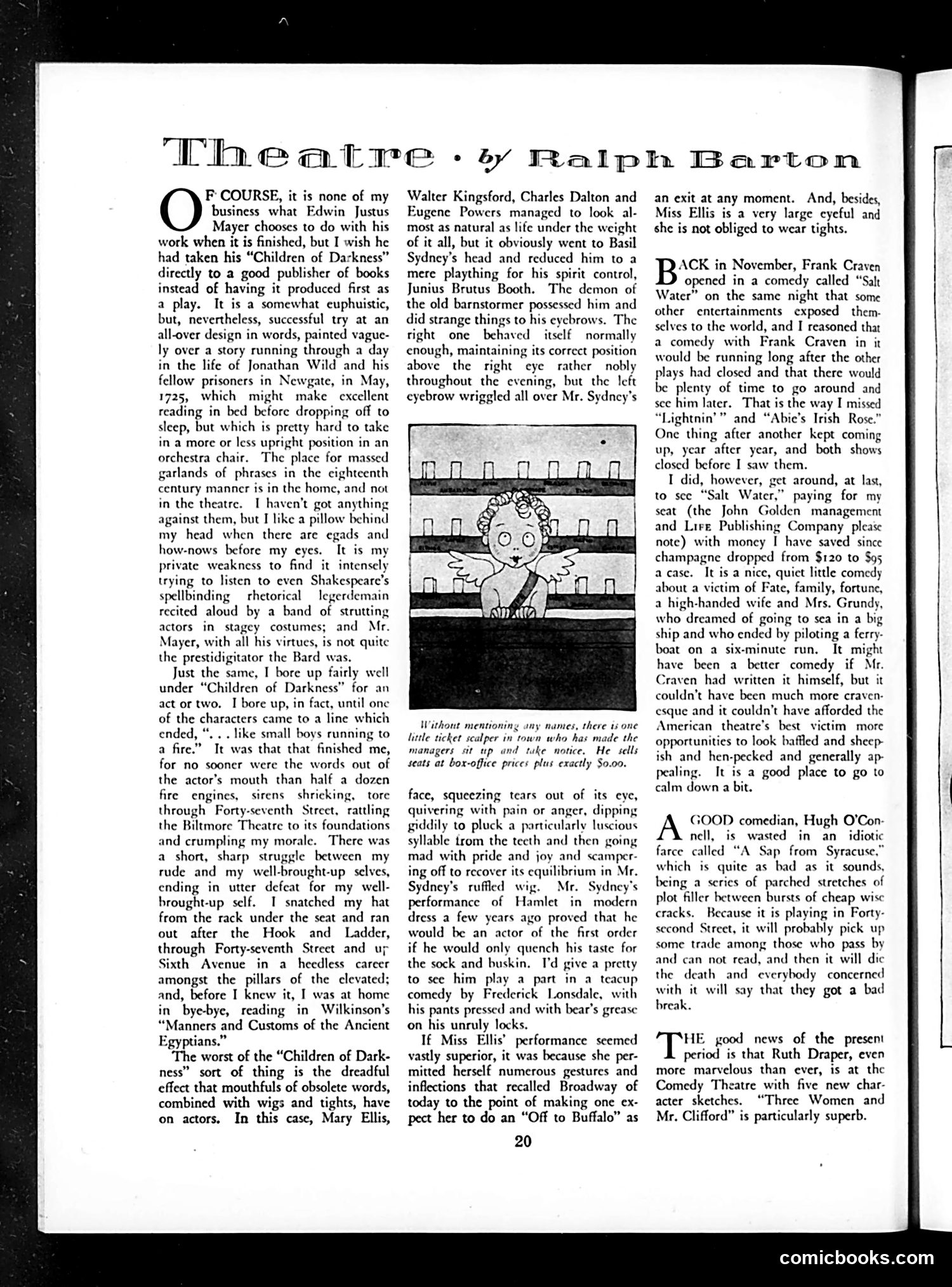
Theatre Review by Ralph Barton - Life Magazine This is a theatre review column criticizing the production of "Children of Darkness" by Edwin Justus Mayer. The main illustration shows a cherubic figure against a building facade—likely representing the play itself or theatrical artifice. Key points: The reviewer argues the play's elaborate 18th-century language and style work better as literature than stagecraft. He critiques actor Basil Sydney's over-the-top performance, particularly his uncontrollable left eyebrow "wiggling all over" his face—exaggerated physical acting typical of outdated "ham" theatre style. The satire: Barton mocks actors who adopt affected mannerisms and stagey costumes when playing period pieces, and suggests Sydney would be better in contemporary comedies (like those by Frederick Lonsdale) where he wouldn't resort to such theatrical excess. A sidebar joke mockingly praises a ticket scalper who charges box-office prices plus exactly $0—honest dealing, apparently rare in theatre.
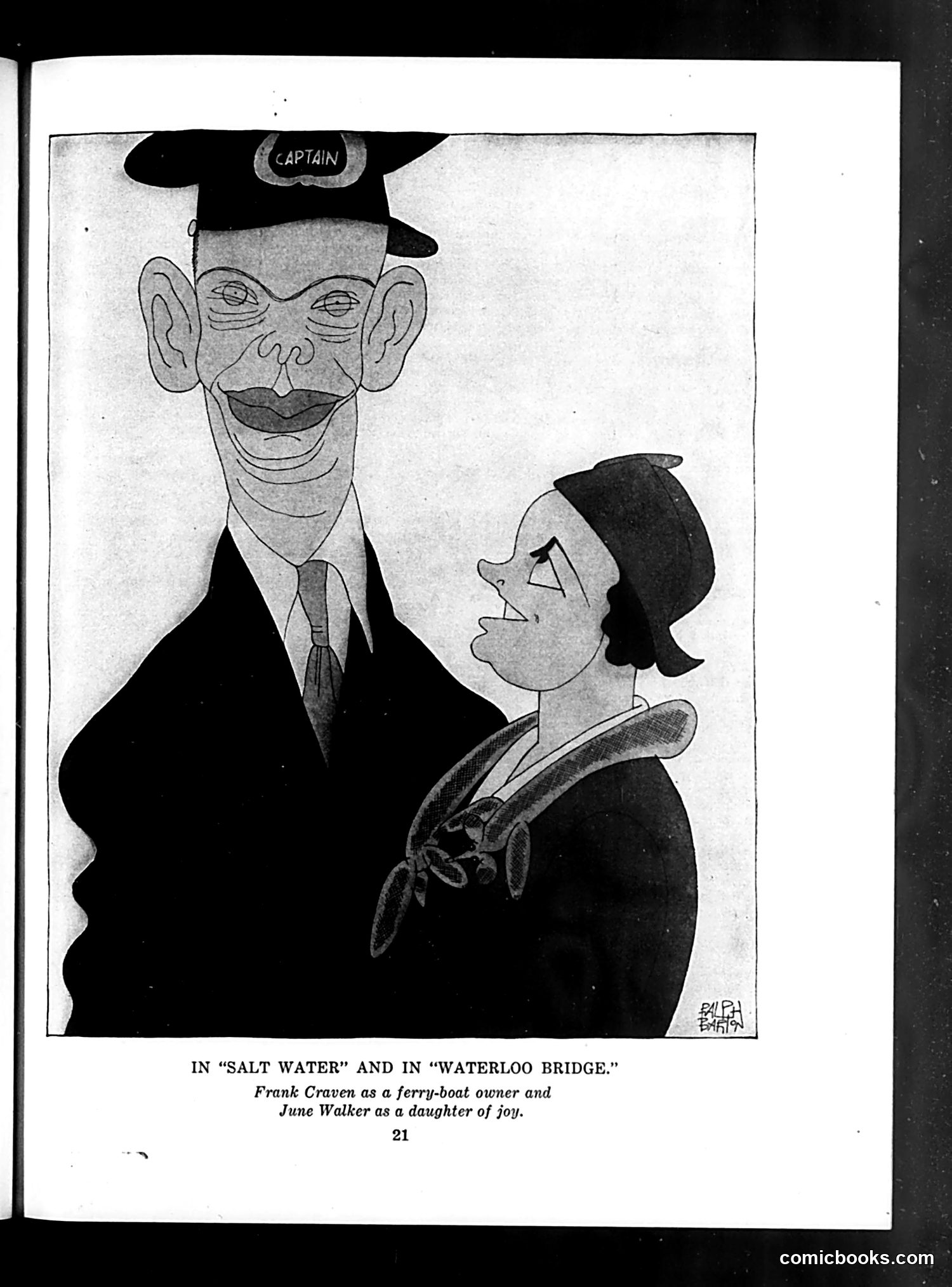
Page 21: Life Magazine Theatrical Review This page reviews two films featuring actors Frank Craven and June Walker. The illustration shows a tall, grinning ferry-boat captain (Craven) with exaggerated features standing beside a woman (Walker) in profile, holding flowers. The caption describes Walker's character as "a daughter of joy"—a period euphemism for a sex worker or woman of loose morals. The joke plays on the contrast between Craven's respectable role as a ferry-boat owner and Walker's morally questionable character. The cartoon style and theatrical context suggest this is a humorous review mocking the melodramatic or sensational plot elements common in early cinema. The satirical tone typical of Life magazine likely aims gentle ridicule at these films' moral conventions and character archetypes.
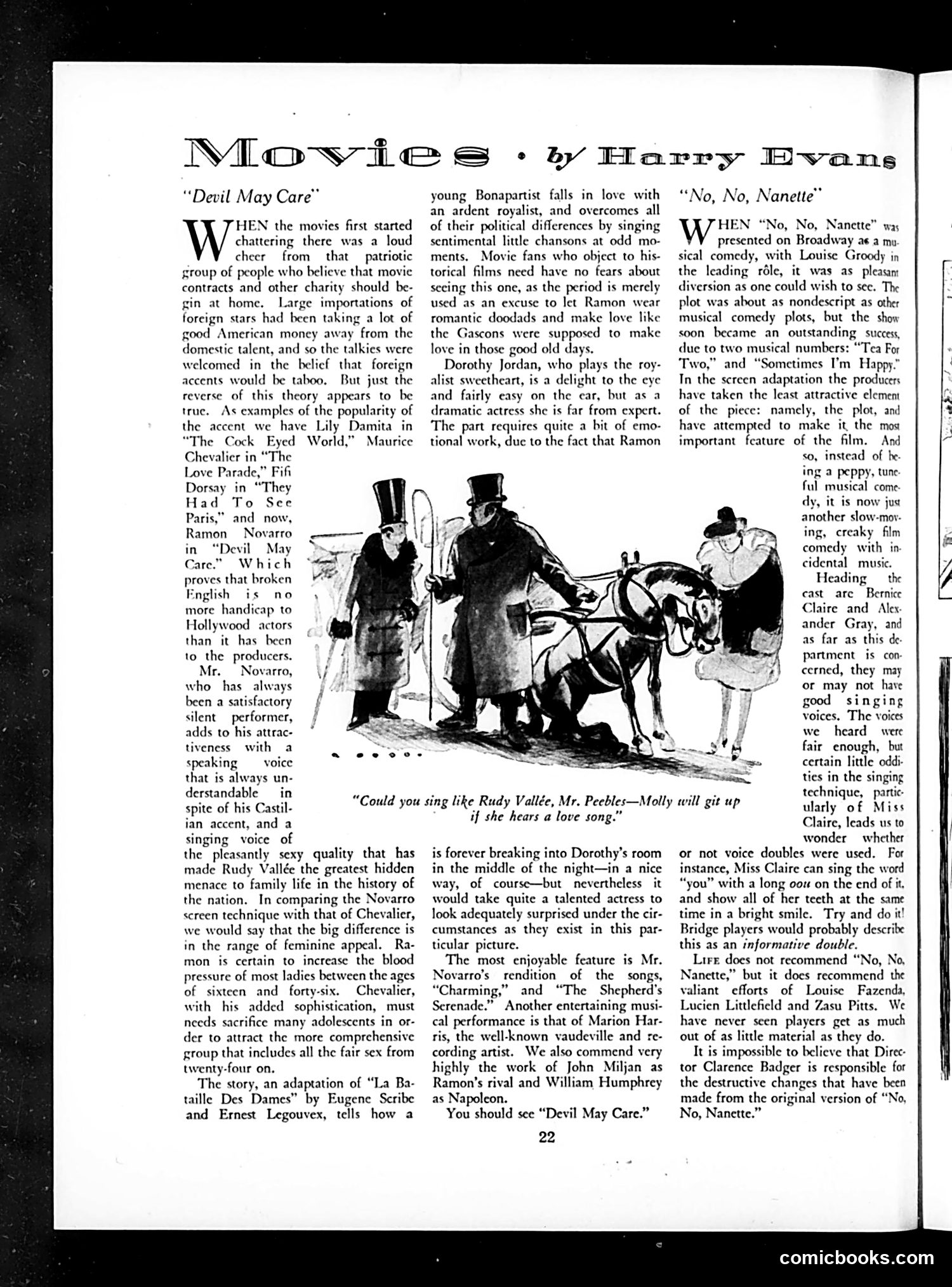
"Devil May Care" and "No, No, Nanette" - Life Magazine Movie Reviews This page contains two film reviews by Harry Evans critiquing early "talkie" movies. The cartoon illustrates a key debate of the era: foreign-accented actors in sound films. The satire: The opening section mocks American protectionists who welcomed talking pictures, believing foreign accents would be "taboo" and protect domestic talent. Instead, accented performers like Maurice Chevalier and Ramon Novarro thrived. The cartoon caption—"Could you sing like Rudy Vallée, Mr. Peebles—Molly will git up if she hears a love song"—jokes that Vallée's crooning voice had seductive power over women, undercutting romantic male performers' appeal. The point: Despite nativist hopes, foreign stars remained bankable. The reviews assess Novarro's charm and singing ability favorably, while noting co-star Dorothy Jordan's weak dramatic performance. The second review dismisses "No, No, Nanette" as plot-thin, saved only by its musical numbers—a common complaint about early musicals adapted from stage shows.
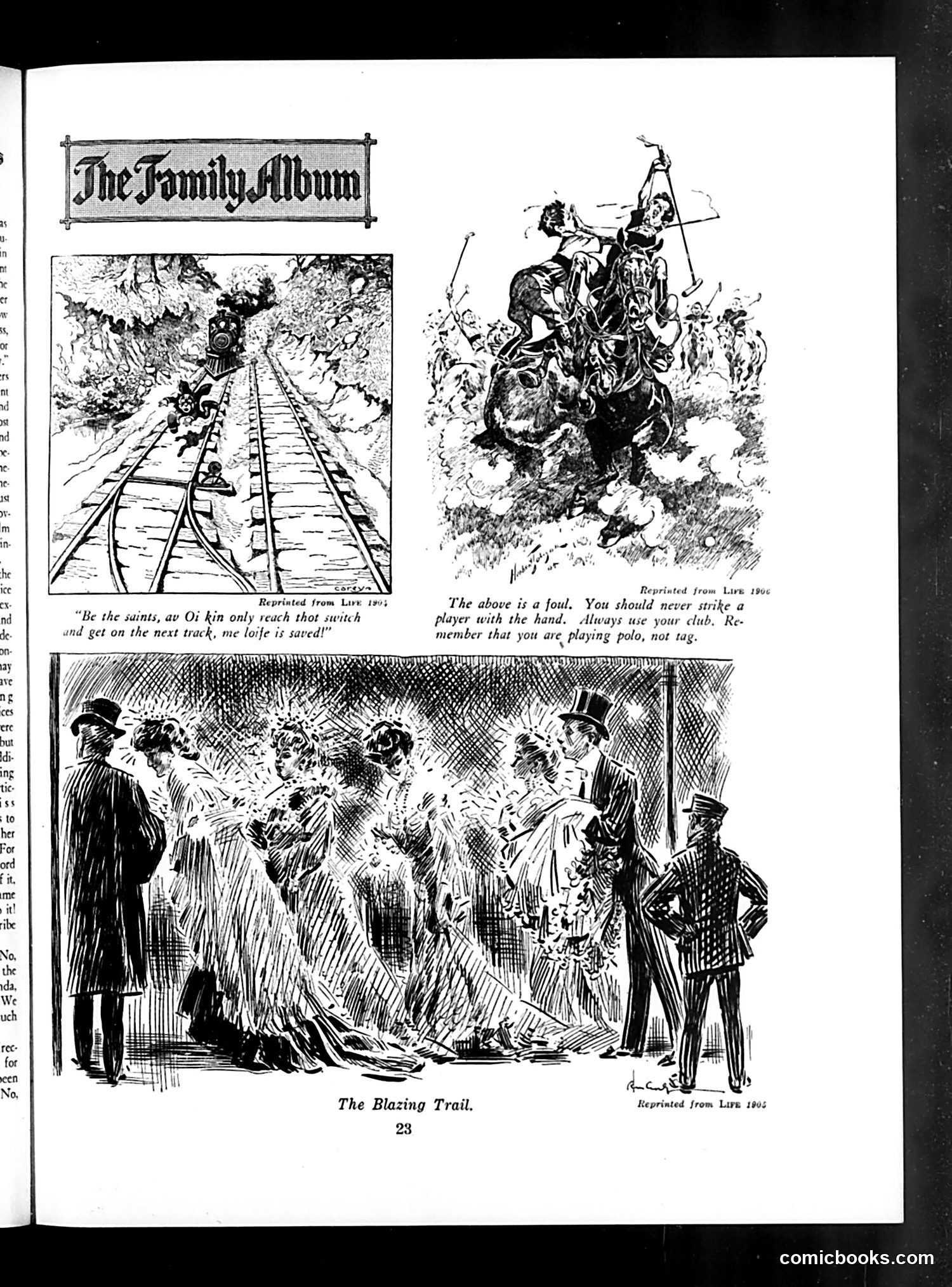
"The Family Album" Page Analysis This page from *Life* magazine (circa 1905-1906) contains three illustrations satirizing different subjects: 1. Top left: An Irish immigrant (indicated by dialect: "Be the saints, av Oi") on railroad tracks, humorously suggesting his survival depends on switching tracks—likely satirizing Irish workers' dangerous conditions on American railroads. 2. Top right: A polo scene captioned as "a foul," mocking upper-class sport etiquette. The joke warns against hitting a player with your hand during polo, sarcastically suggesting readers might confuse polo with "tag"—satirizing the genteel pretensions of wealthy polo players. 3. Bottom: "The Blazing Trail" depicts a formal social gathering, likely satirizing fashionable society events or romantic encounters among the upper classes. The page exemplifies *Life*'s trademark approach: juxtaposing class commentary (immigrant labor dangers, wealthy leisure) with gentle mockery of social conventions.
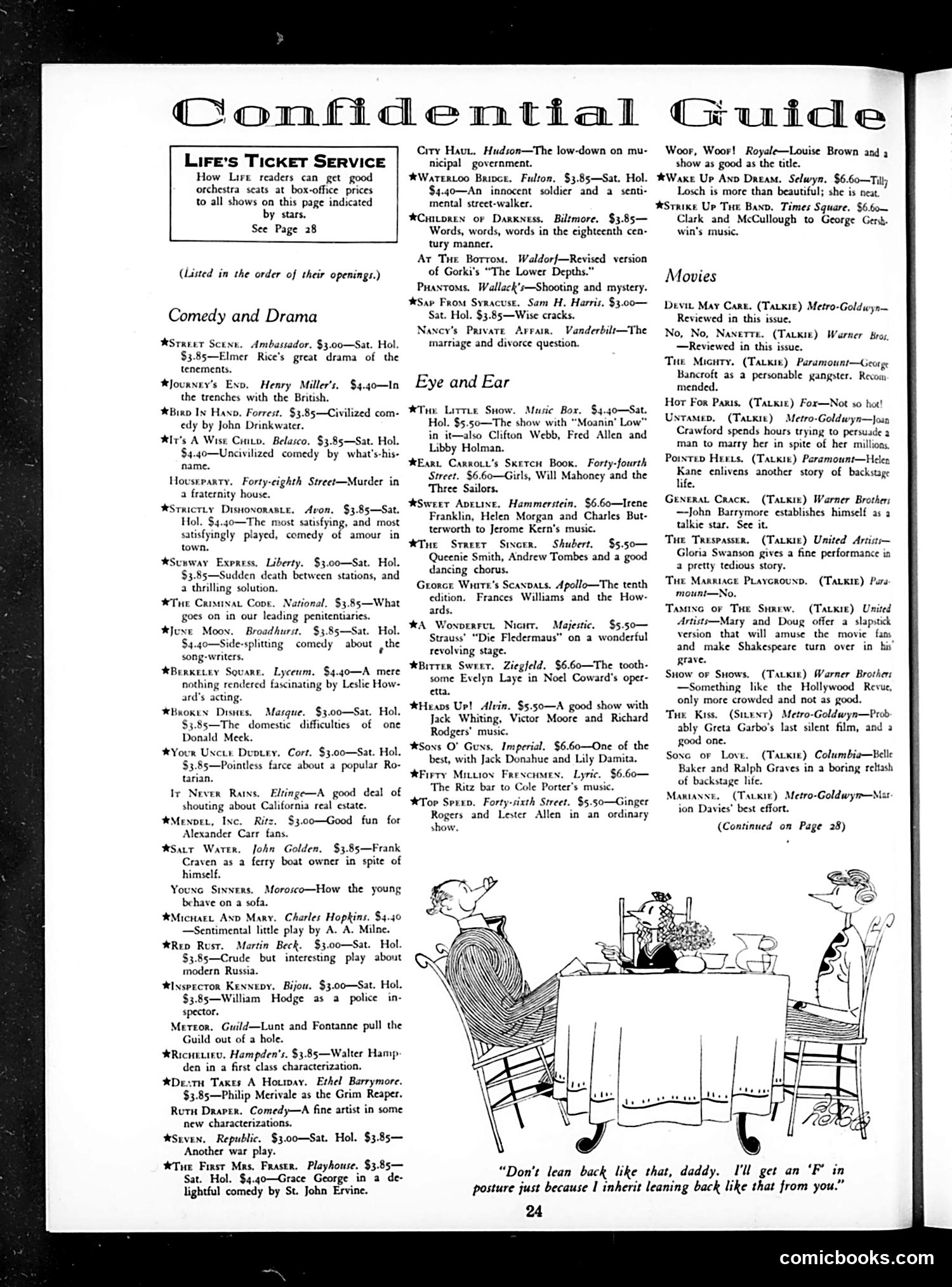
Cartoon Analysis: Life Magazine Page 24 This page is a theater guide and review section, not a political cartoon. It lists Broadway shows with brief satirical descriptions and ticket prices. The single cartoon at the bottom depicts a domestic scene: a child sitting at a table, leaning back in a chair while speaking to an adult (likely a parent). The child says: "Don't lean back like that, daddy. I'll get an 'F' in posture just because I inherit leaning back like that from you." The joke: It's a humorous commentary on heredity versus parental influence. The child claims poor posture is inherited rather than a learned bad habit, ironically using pseudo-scientific "inheritance" language to deflect blame from parental modeling. The satire targets how children rationalize misbehavior by blaming genetics rather than admitting they copy their parents' habits. It's gentle family humor typical of 1920s Life magazine.
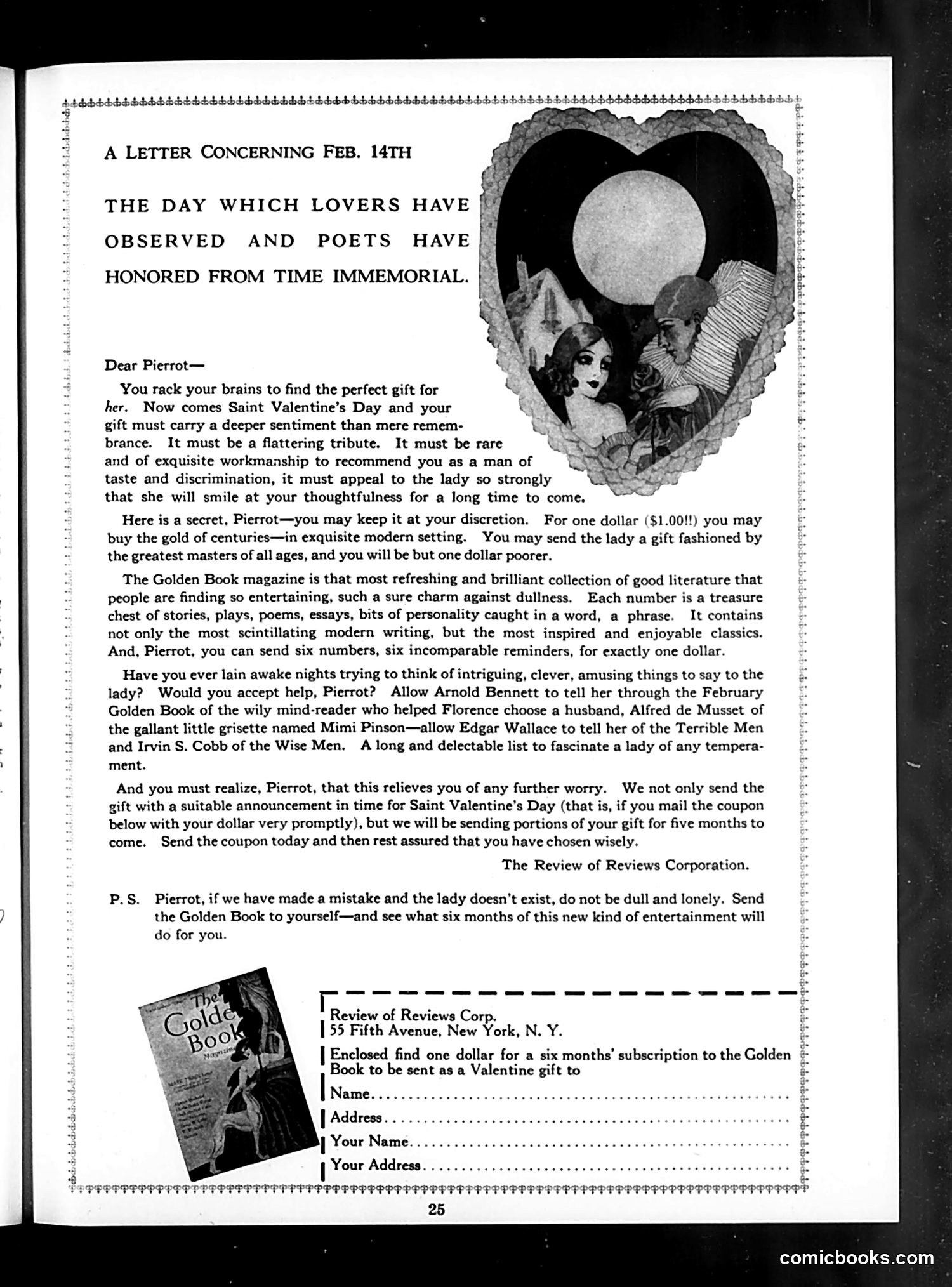
A Valentine's Day Advertisement with Comic Device This is primarily a Valentine's Day advertisement for *The Golden Book* magazine, using the theatrical character "Pierrot" (the lovesick clown from commedia dell'arte tradition) as a comedic device. The satire targets the anxiety of gift-giving: Pierrot struggles to find something meaningful for his beloved, so the ad pitches a magazine subscription as the perfect solution—literary works by famous authors like Arnold Bennett, Edgar Wallace, and Irvin S. Cobb will impress her. The humor lies in the tongue-in-cheek P.S., which mocks lonely men by suggesting they buy the subscription for *themselves* if the lady doesn't exist—a gentle jab at the desperation of solitary readers seeking entertainment and companionship through literature. The heart-shaped illustration featuring Pierrot and his lady reinforces the Valentine's theme. This is fundamentally commercial satire masquerading as romantic advice.
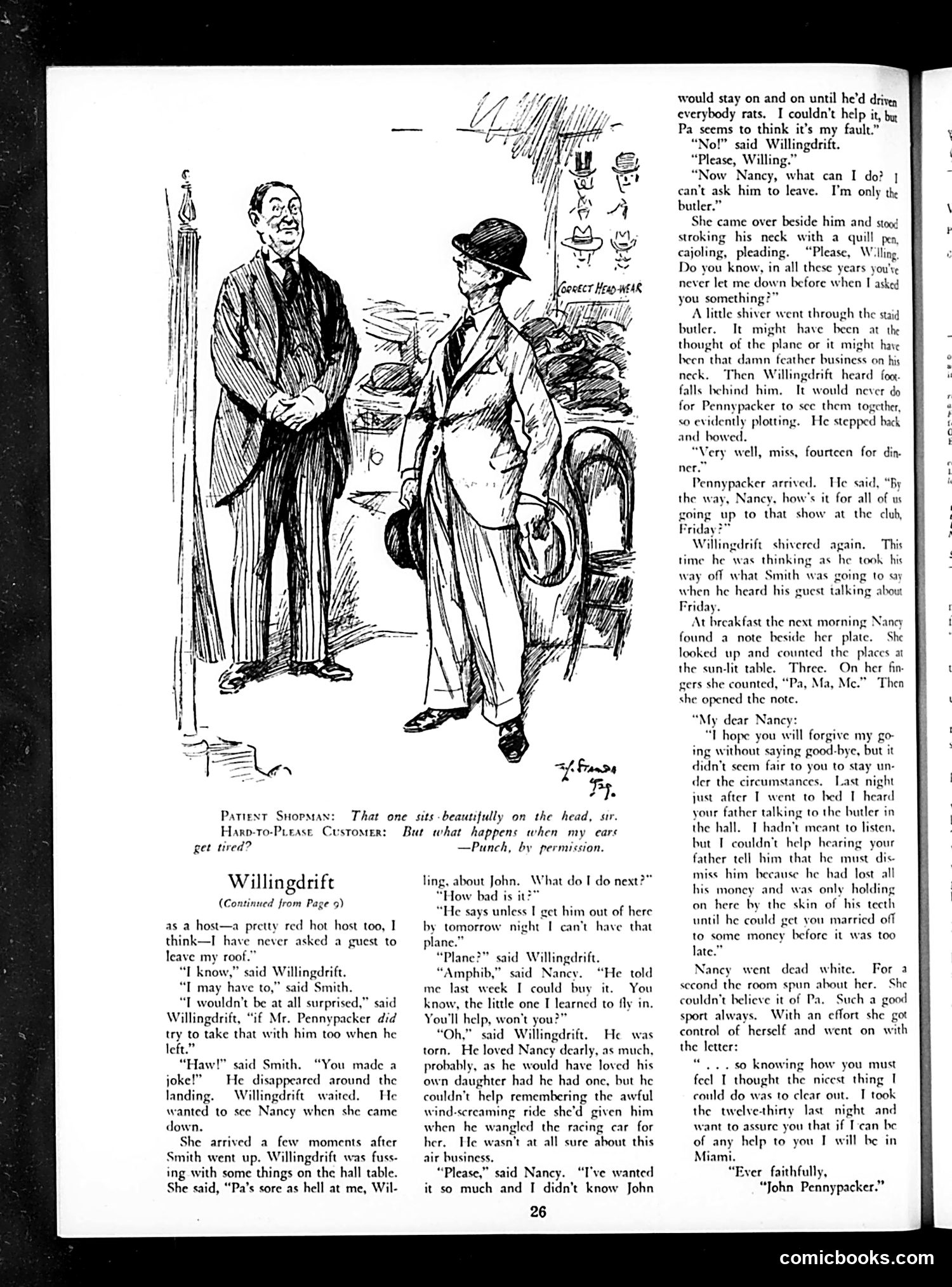
Analysis of "Willingdrift" Page This is a serialized story (continued from page 9) about a butler named Willingdrift and his relationships with the household he serves. The small inset cartoon at bottom left, credited to *Punch*, is unrelated satire about a barber and customer discussing ear fatigue. The main narrative concerns Nancy asking Willingdrift to help her acquire an amphibious airplane—a gift her father promised. Her suitor John's extended stay has annoyed her father. Willingdrift overhears that Nancy's father, Mr. Smith, is financially ruined and pressuring Nancy to marry money to save the family. A guest named Pennypacker is also present. The story explores themes of class loyalty, financial desperation among the gentry, and the butler's emotional attachment to Nancy—common upper-class anxieties of the 1920s-30s era. Willingdrift, despite his position's limitations, becomes entangled in family crises. The narrative examines servant discretion and the complicated dynamics between employers and their staff during economic uncertainty.
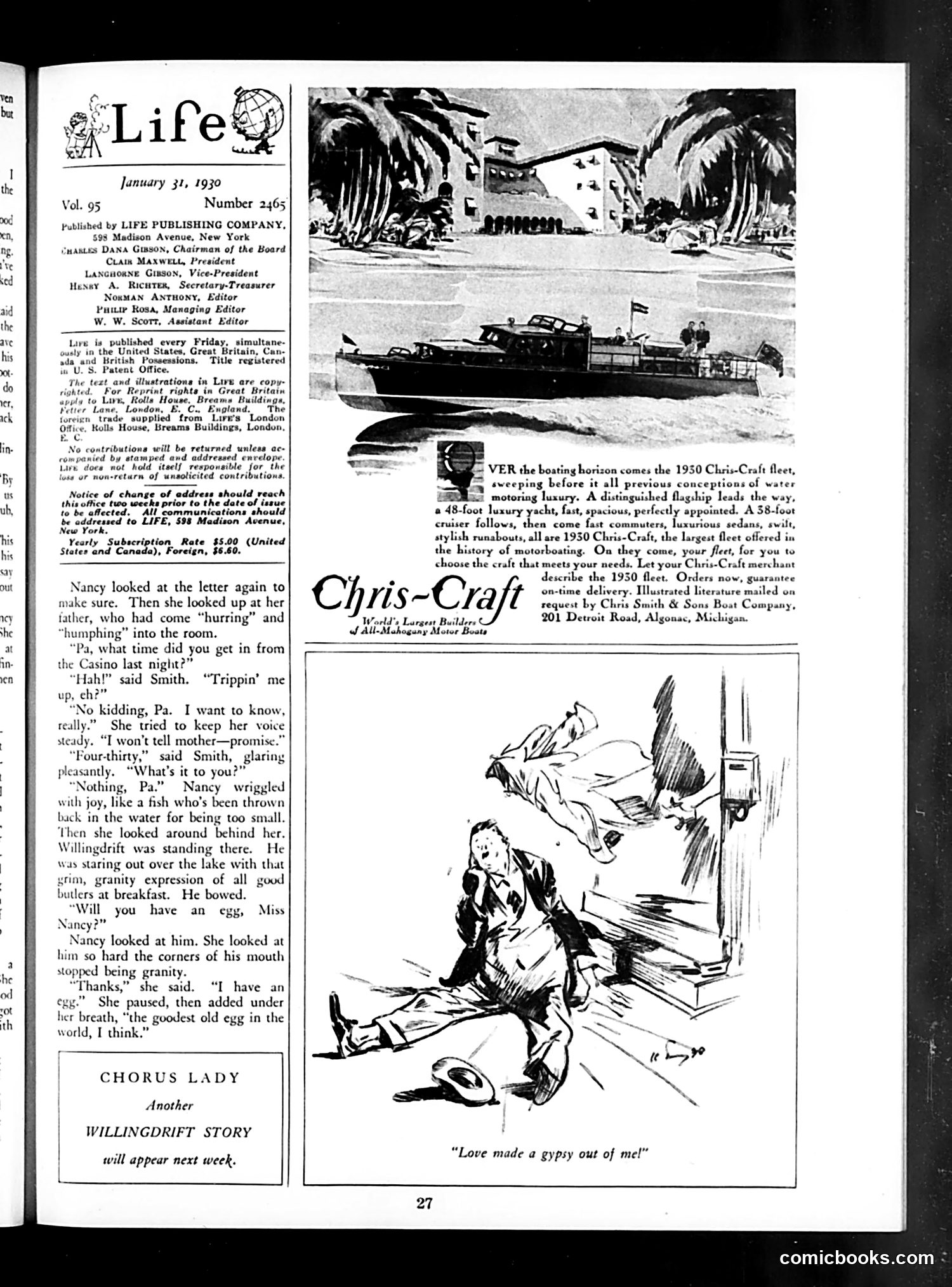
Life Magazine, January 31, 1930 — Page Analysis This page contains a short humorous story excerpt featuring characters Nancy, her father Smith, and the butler Willingdrift. The narrative depicts Nancy cleverly extracting information from her father about his late-night casino visit by promising secrecy from her mother—a domestic comedy playing on family dynamics and marital discretion. The accompanying cartoon illustration shows a woman in fashionable 1930s dress who has apparently been transformed by romantic entanglement ("Love made a gypsy out of me!"), depicted in a disheveled, comedic state. The page's primary content is a full-page advertisement for Chris-Craft motorboats, promoting their 1930 fleet of luxury yachts and speedboats. The ad emphasizes the range of craft available, from large flagships to smaller runabouts, positioning Chris-Craft as the industry leader. The humor and advertising reflect 1930 affluent leisure culture—betting at casinos and recreational boating were markers of wealth and social status during the pre-Depression era.
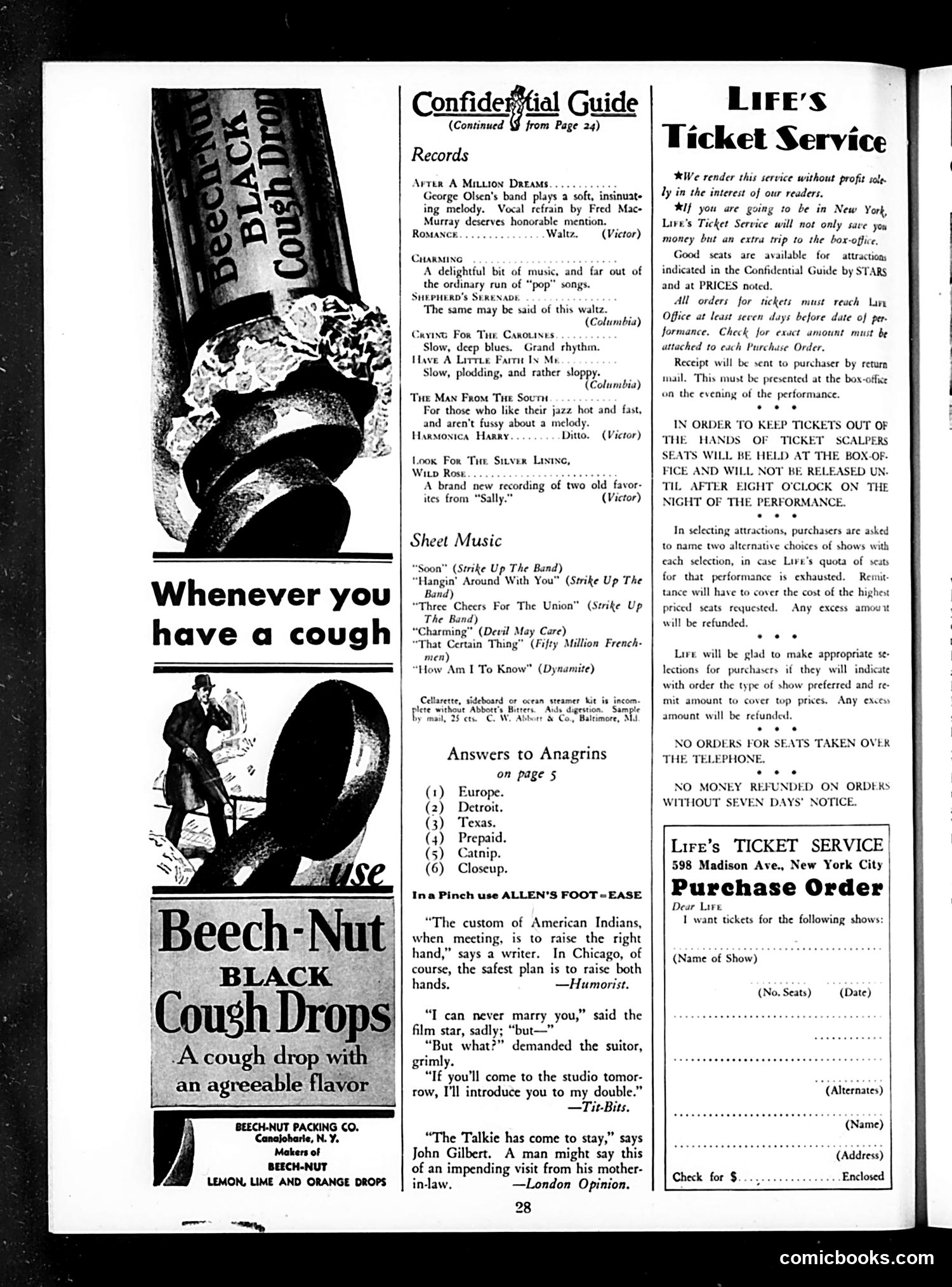
Analysis of Life Magazine Page This page is primarily advertising and service information, not political satire. The main content includes: Left side: A Beech-Nut cough drops advertisement featuring an illustration of a man coughing, with the slogan "Whenever you have a cough." Center: A "Confidential Guide" continuing from page 24, listing music and sheet music reviews—typical entertainment coverage for Life magazine in what appears to be the 1920s-30s era. Right side: Life's Ticket Service advertisement explaining how readers can purchase theater tickets through the magazine. Bottom center: Brief humorous anecdotes ("Answers to Anagrins") with mild social humor—one jokes about Chicago crime ("raise both hands"), another plays on film star dating, and a third quips about talkies and unwelcome in-laws. There are no identifiable political cartoons or caricatures of specific figures on this page. It represents standard magazine content mixing entertainment coverage with commercial services.
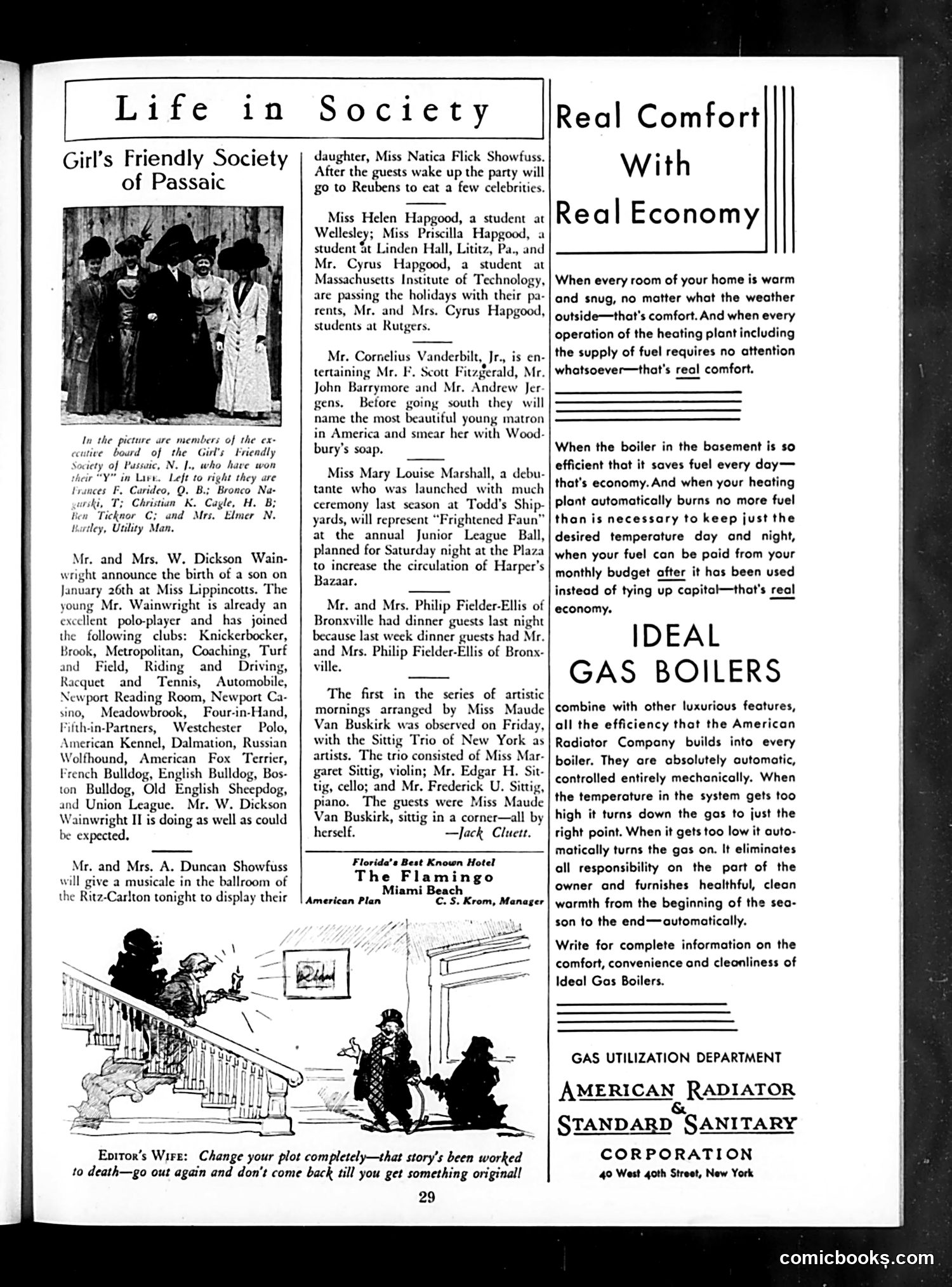
What This Page Means This is a satirical "Life in Society" column mocking the absurdities of wealthy socialites. The humor lies in exaggerated descriptions of trivial upper-class activities presented as newsworthy. Key satirical targets: - A newborn described as already belonging to dozens of exclusive clubs before he can walk—mocking inherited privilege and club culture - A debutante "launched" at Todd's Shipyards (absurd venue) to boost *Harper's Bazaar* circulation—exposing how social events serve commercial interests - Dinner guests visiting solely because they were recently hosts—ridiculous reciprocal obligation - An "artistic morning" where the hostess sits alone in a corner while famous musicians perform—highlighting hollow pretense and loneliness masquerading as sophistication - The editor's note at bottom: demands "originality" after satirizing repetitive, empty high-society rituals The cartoon undercuts the glamorous image by revealing wealthy society as mechanically artificial, where status-seeking replaces genuine connection. This reflects 1920s-30s critiques of superficial upper-class life, contrasting conspicuous consumption with meaningful activity.
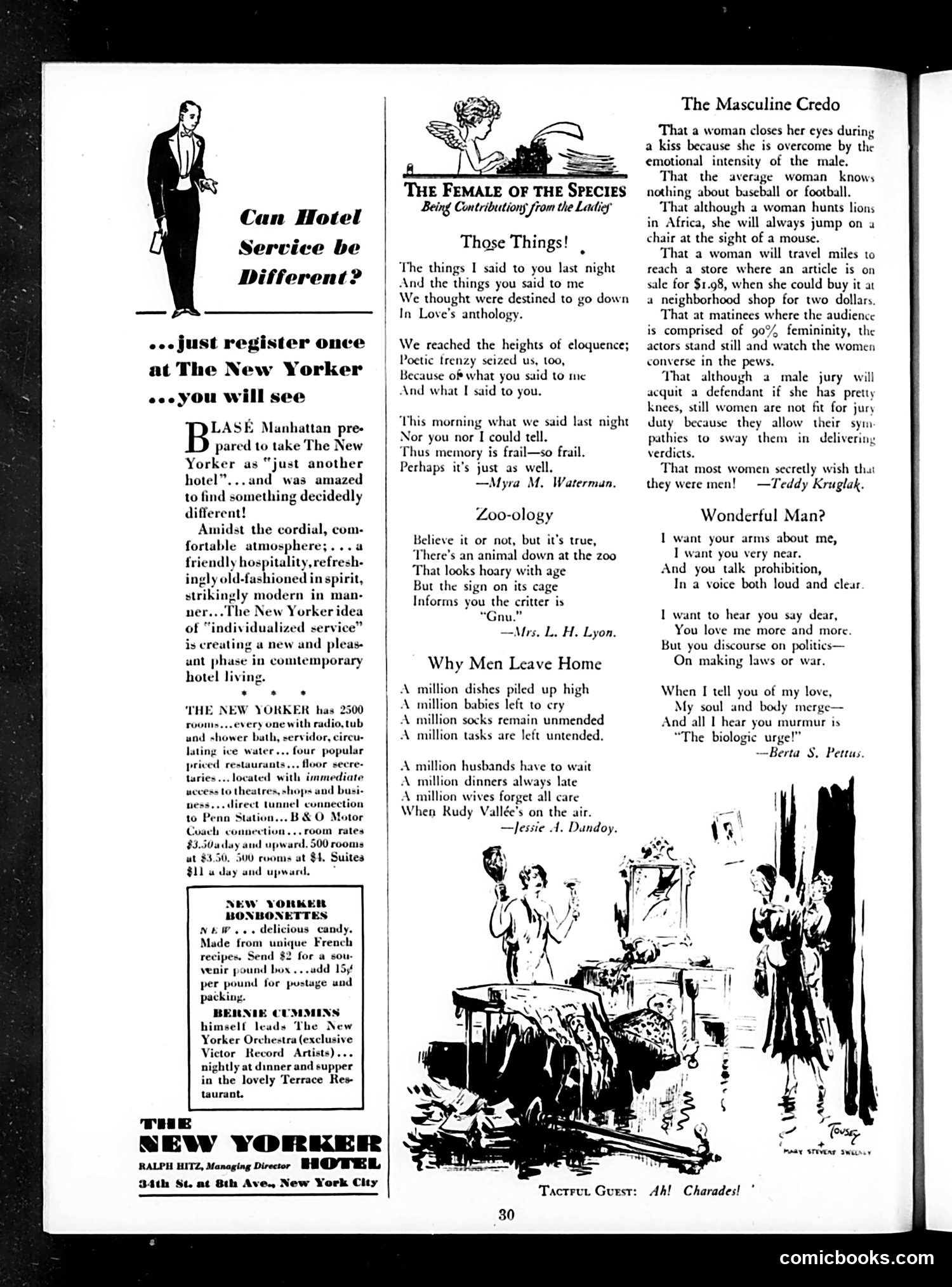
Life Magazine Page Analysis This page from Life magazine is a humorous collection aimed at female readers, titled "The Female of the Species: Being Contributions from the Ladies." The satirical pieces mock gender stereotypes and romantic/domestic dynamics of the era: "Those Things!" — A poem about how couples' passionate declarations of love seem meaningless the next morning, suggesting romantic sentiment is fleeting. "Why Men Leave Home" — A comedic list blaming wives for domestic negligence (unwashed dishes, unmended socks) while they're distracted by radio star Rudy Vallée, stereotyping women as frivolous and irresponsible homemakers. "The Masculine Credo" — Sarcastically lists male myths about women (they faint at mice despite hunting lions, they're illogical jurors, they secretly wish to be men), exposing contradictory male assumptions. "Wonderful Man?" — A poem about a woman trying to express romantic love while her partner pedantically discusses prohibition and the "biologic urge," mocking male intellectual posturing over genuine emotion. The page satirizes both male stereotypes of women and female stereotypes of men, reflecting 1920s-30s debates about gender roles and domesticity.
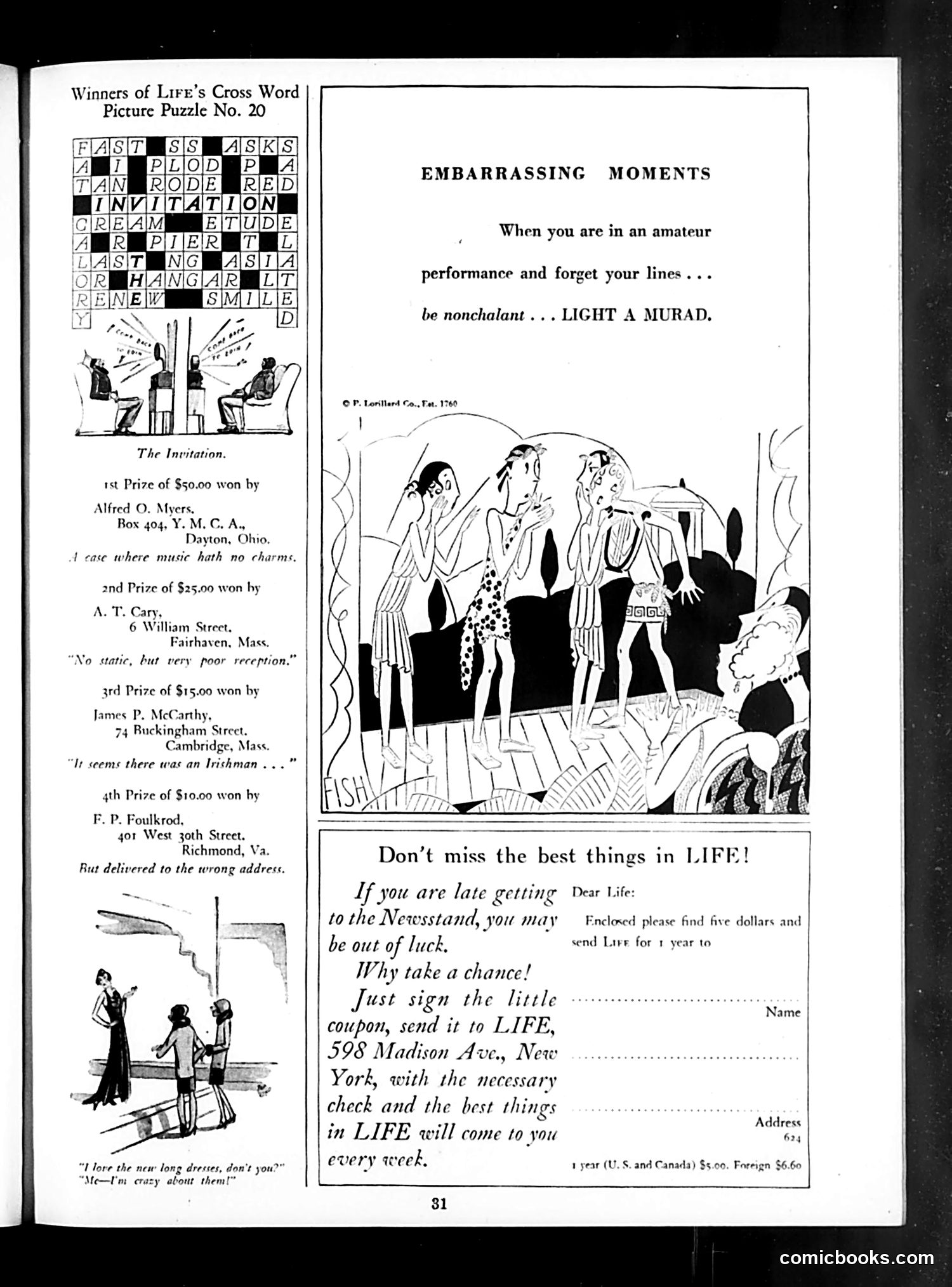
Page 81 Explanation This page contains a crossword puzzle contest results, an advertisement for Murad cigarettes, and a subscription pitch for *Life* magazine. The "Embarrassing Moments" section depicts a social scenario: a woman on stage during an amateur theatrical performance has forgotten her lines. The advertisement's advice—to "be nonchalant" and "light a Murad"—suggests smoking a cigarette as a way to appear composed and confident during an awkward situation. This reflects early 20th-century cigarette marketing that associated smoking with sophistication and poise. The lower section mocks the risk of missing *Life* magazine issues if you don't subscribe, using humorous quotes about fashion ("long dresses") to suggest you'll miss important cultural content. The puzzle results show winners in various cities, with humorous captions suggesting why their answers were correct—references to poor radio reception, Irish humor, and wrong addresses delivered.
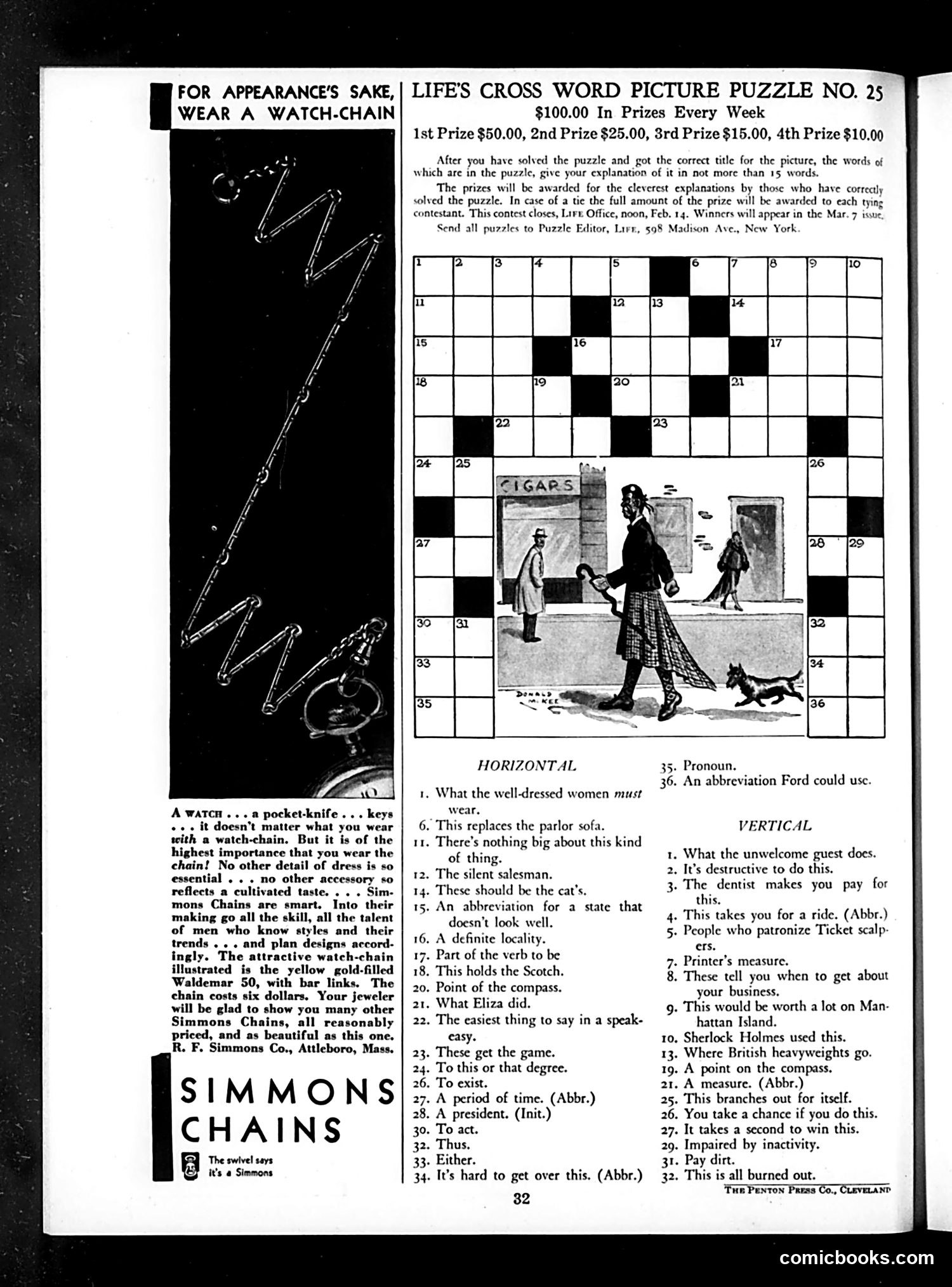
Life Magazine Page Analysis This page combines two distinct elements: a Simmons Chains advertisement and a crossword puzzle contest. The Advertisement The ad uses social satire to promote watch chains as essential fashion accessories. It argues that wearing a watch chain signals respectability and cultivated taste—that "no other detail of dress is so essential." This reflects 1920s-30s class consciousness, where visible accessories signaled social status. The ad ironically suggests that *what* you carry matters less than *displaying* a chain, mocking the performative nature of fashion and social pretense. The Puzzle This is a rebus-style crossword where solvers must identify the picture's title, then explain it in 15 words for prize money ($50 first prize). The illustration depicts a street scene with a woman walking a dog past a cigar shop—likely depicting some recognizable scenario or social commentary, though the specific reference is unclear from the image alone. The puzzle format was typical Life magazine entertainment, combining word games with visual storytelling and reader participation contests.
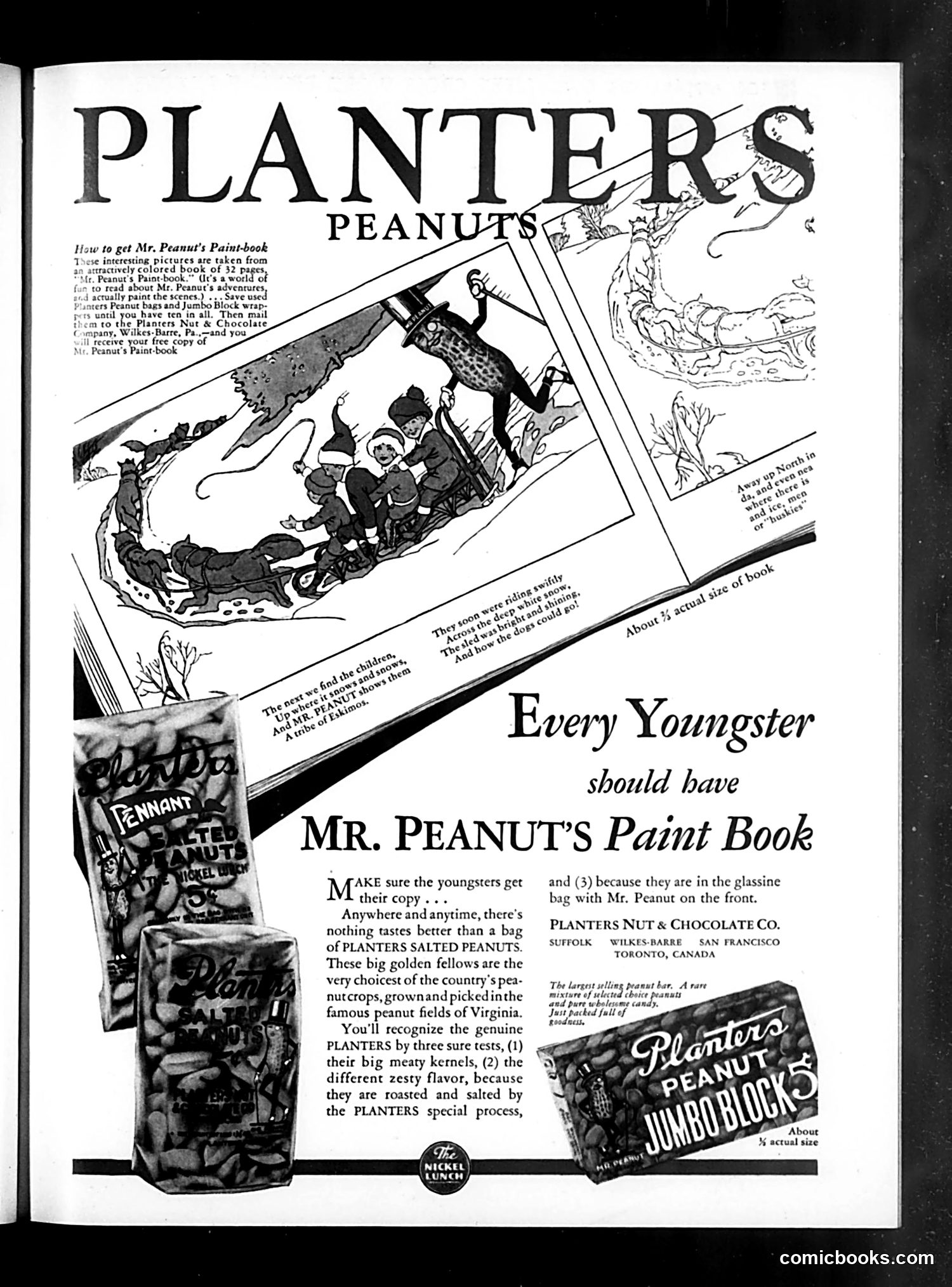
Analysis This is primarily a Planters peanut company advertisement, not political satire. The page promotes Mr. Peanut's Paint-book—a free 32-page coloring book offered to children who collect Planters product wrappers. The main illustration shows children sledding or playing in winter, drawn in a style typical of early 20th-century advertising art. The cartoon itself contains no satire or political commentary; it simply depicts wholesome childhood activity to appeal to parents. The advertisement emphasizes product authenticity ("three sure tests") and brand recognition through Mr. Peanut's mascot character—a monocled, top-hatted peanut figure visible on packaging. The page also shows Planters' product line: salted peanuts, and what appears to be their "Jumbo Block" candy bar. This reflects early advertising strategy: building brand loyalty among children through free collectible items tied to purchases.
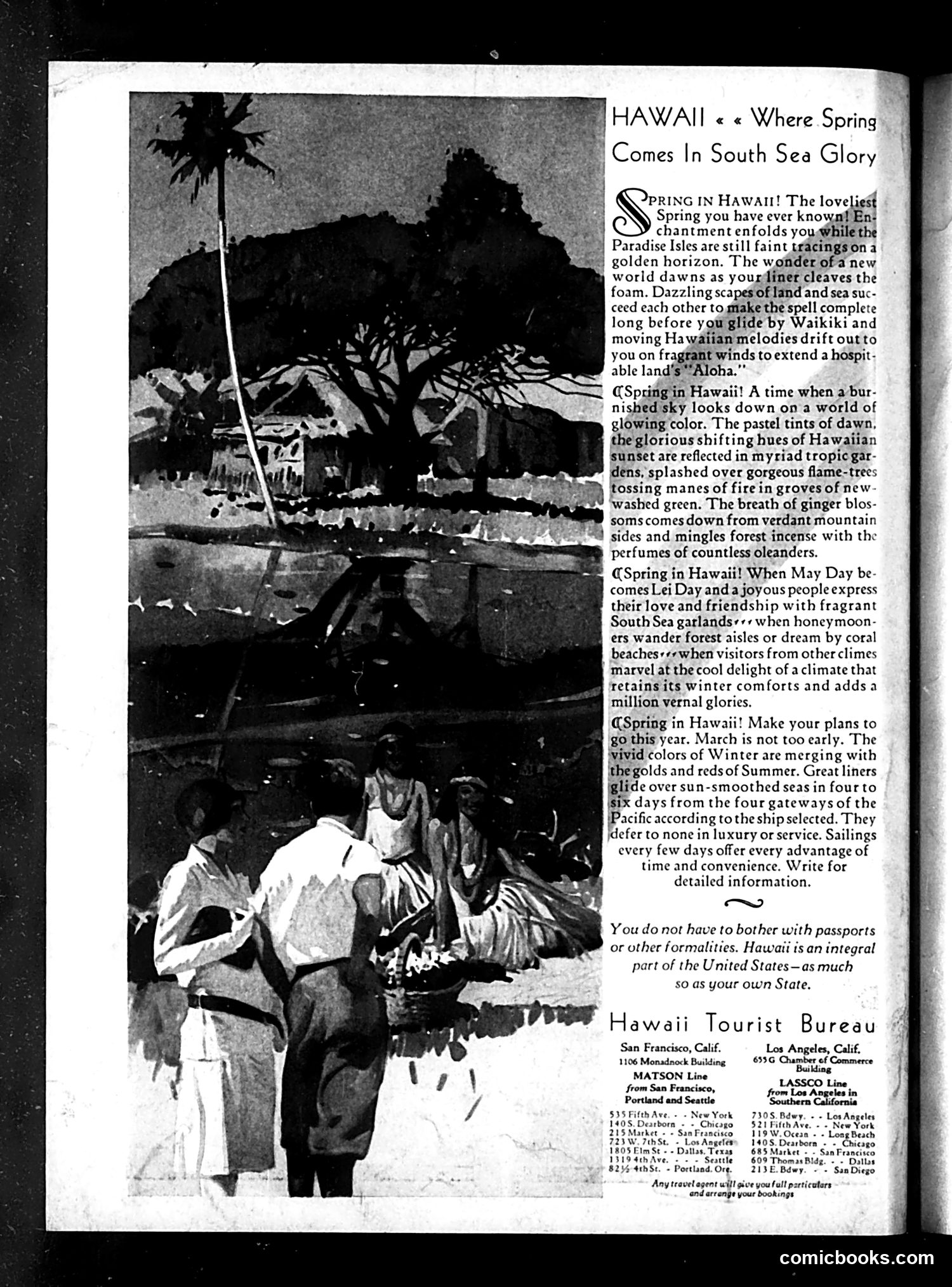
Analysis This is not a cartoon or satirical piece—it's a tourism advertisement for Hawaii from the Hawaii Tourist Bureau, likely from the 1920s-1930s based on the style. The page features romantic, flowery prose promoting spring travel to Hawaii, emphasizing: - Exotic natural beauty (tropical gardens, sunsets, ginger blossoms) - Cultural elements (Hawaiian music, Lei Day, "Aloha") - Convenience of ocean liner travel (4-6 days from Pacific ports) - The reassurance that Hawaii is "an integral part of the United States" requiring no passports The accompanying photographs show scenic Hawaiian landscapes and what appear to be local residents in traditional dress. For modern readers: This represents early 20th-century tourism marketing that exoticizes Hawaii while simultaneously emphasizing American sovereignty—a colonial-era sales pitch that treats the islands as an accessible American destination rather than an independent culture. The imagery and language reflect how Hawaii was marketed to mainland Americans during the pre-statehood era.