life
Life — February 7, 1930
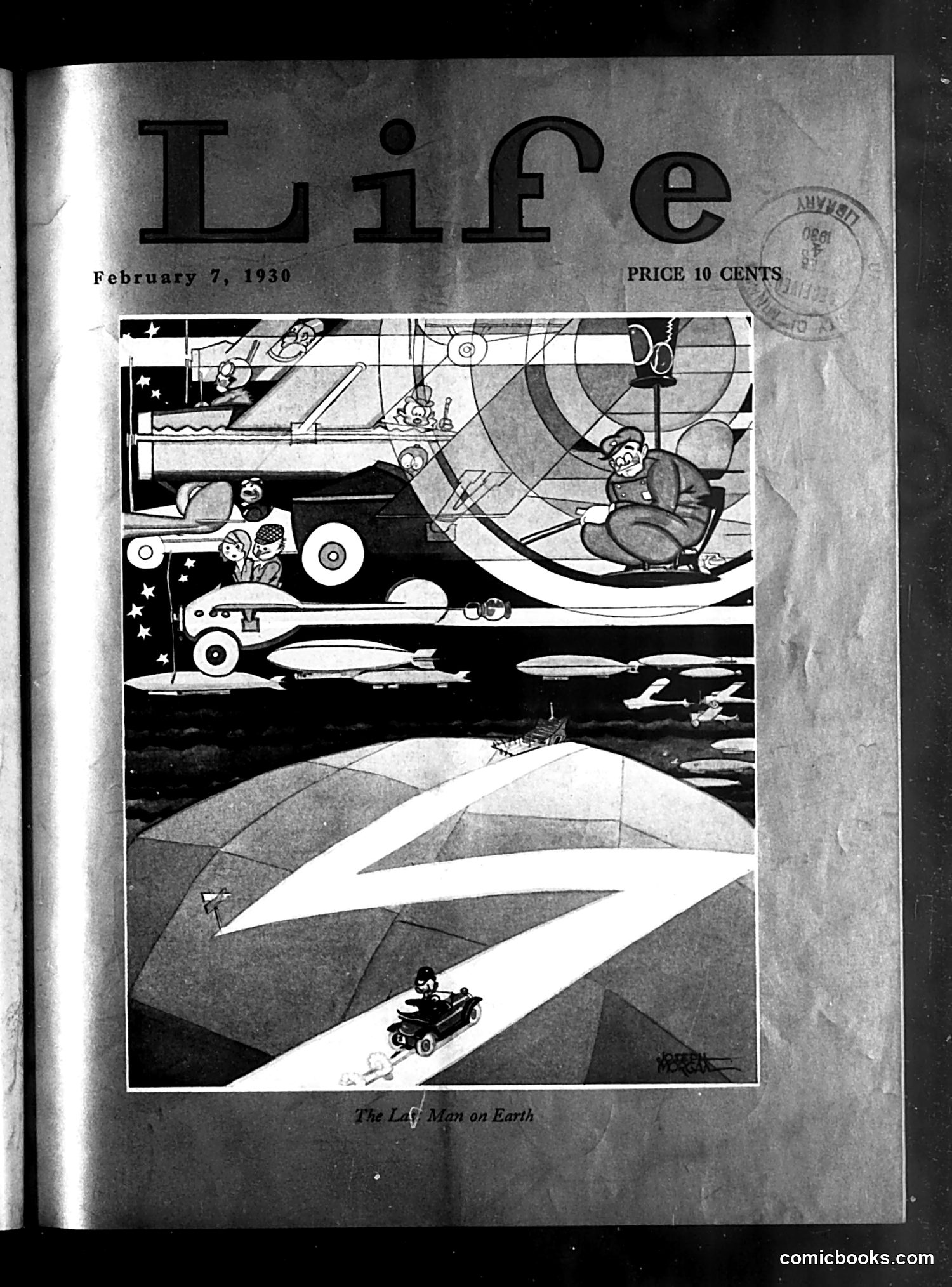
"The Last Man on Earth" This February 1930 cartoon depicts a futuristic dystopian scenario where only one man remains on Earth. The illustration shows him navigating an abandoned landscape with robotic or mechanical beings, flying vehicles, and industrial infrastructure above. The satire likely reflects 1930s anxieties about technological advancement, mechanization, and social change during the Great Depression era. The "last man" concept suggests fears that modernization and industrialization might eliminate humanity or render individual humans obsolete. The crowded upper panels showing bustling automated activity contrast sharply with the lonely figure below, emphasizing isolation amid technological progress. This represents period concerns about whether rapid technological change would ultimately benefit or destroy human civilization—a recurring theme in early 20th-century satirical magazines.
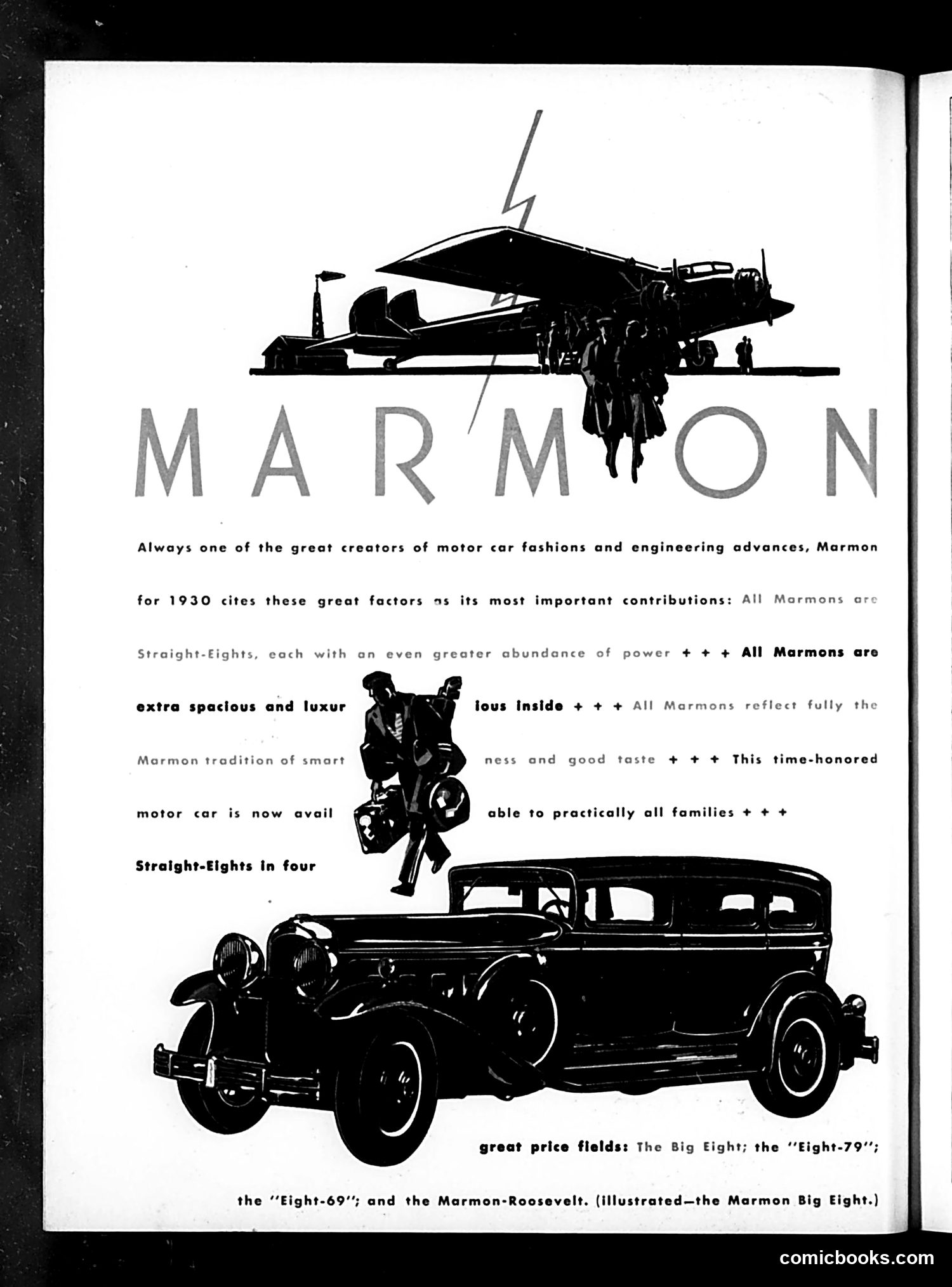
Analysis This is not a political cartoon or satire — it's a straightforward advertisement for Marmon automobiles from 1930. The page promotes Marmon's 1930 car lineup, emphasizing their "Straight-Eight" engines with abundant power. Key selling points include luxury, spaciousness, and affordability ("available to practically all families"). The imagery shows a Marmon sedan and features a stylized airplane at the top, likely evoking modernity and engineering prowess — suggesting Marmon cars embody cutting-edge technology comparable to aviation advances. The ad names specific models: the Big Eight, Eight-79, Eight-69, and Marmon-Roosevelt. There is no satire present; this is earnest promotional content from the pre-Depression automotive market.
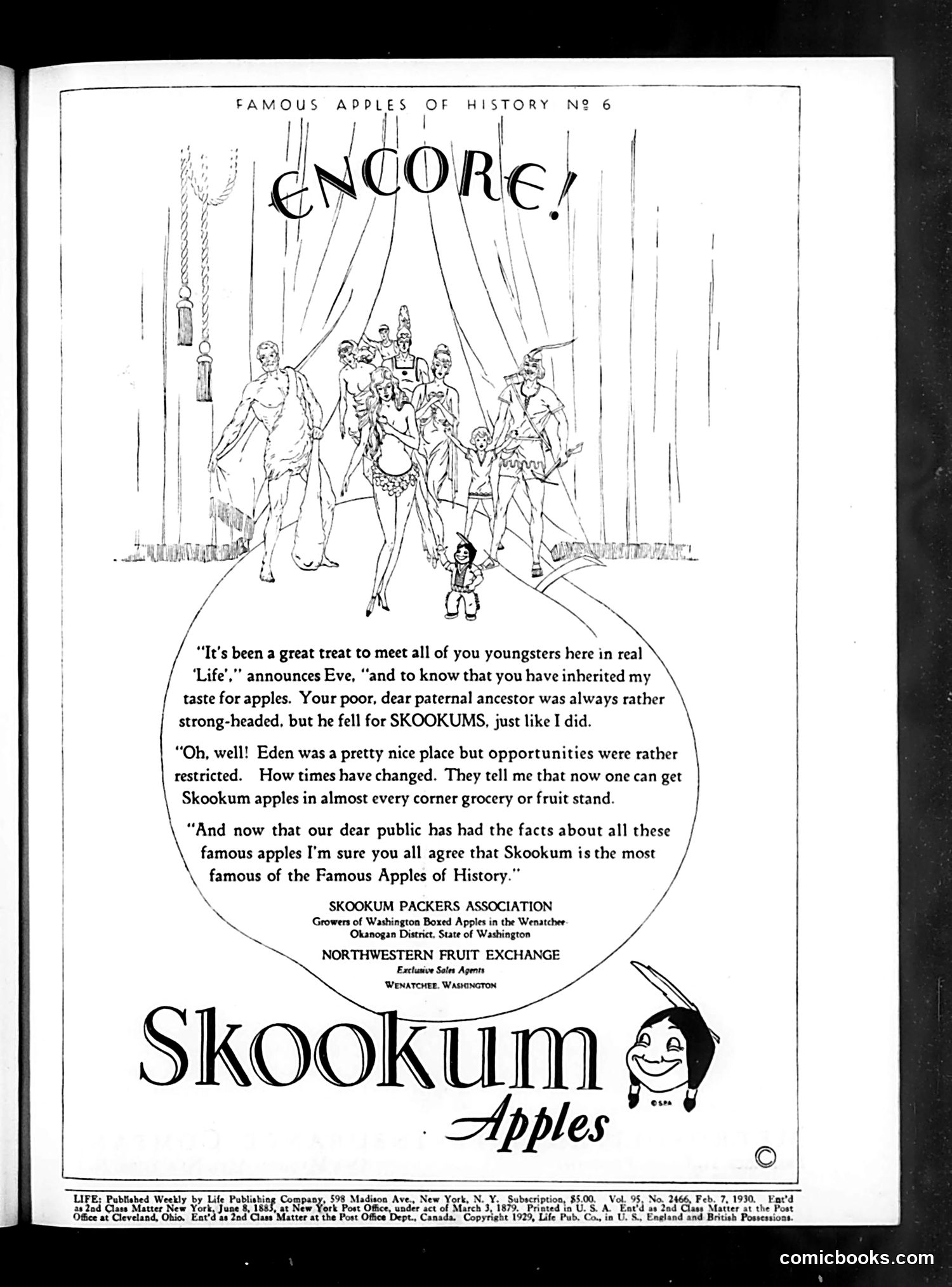
Analysis This is primarily an advertisement disguised as satirical content from Life magazine (February 7, 1928). The page presents "Famous Apples of History No. 6" and features Eve from the Biblical Garden of Eden meeting modern descendants who've "inherited her taste for apples." Eve acknowledges that while Eden offered limited opportunities, modern grocers now stock Skookum apples everywhere—positioning the product as progress. The satire is gentle: it humorously compares commercial apple availability to humanity's evolution from paradise. The "Famous Apples" series appears to use historical/mythological figures to frame Skookum apples as culturally significant. The joke: Modern convenience has surpassed Eden itself. This is marketing wrapped in classical mythology, appealing to 1920s readers' appreciation for both wit and product promotion.
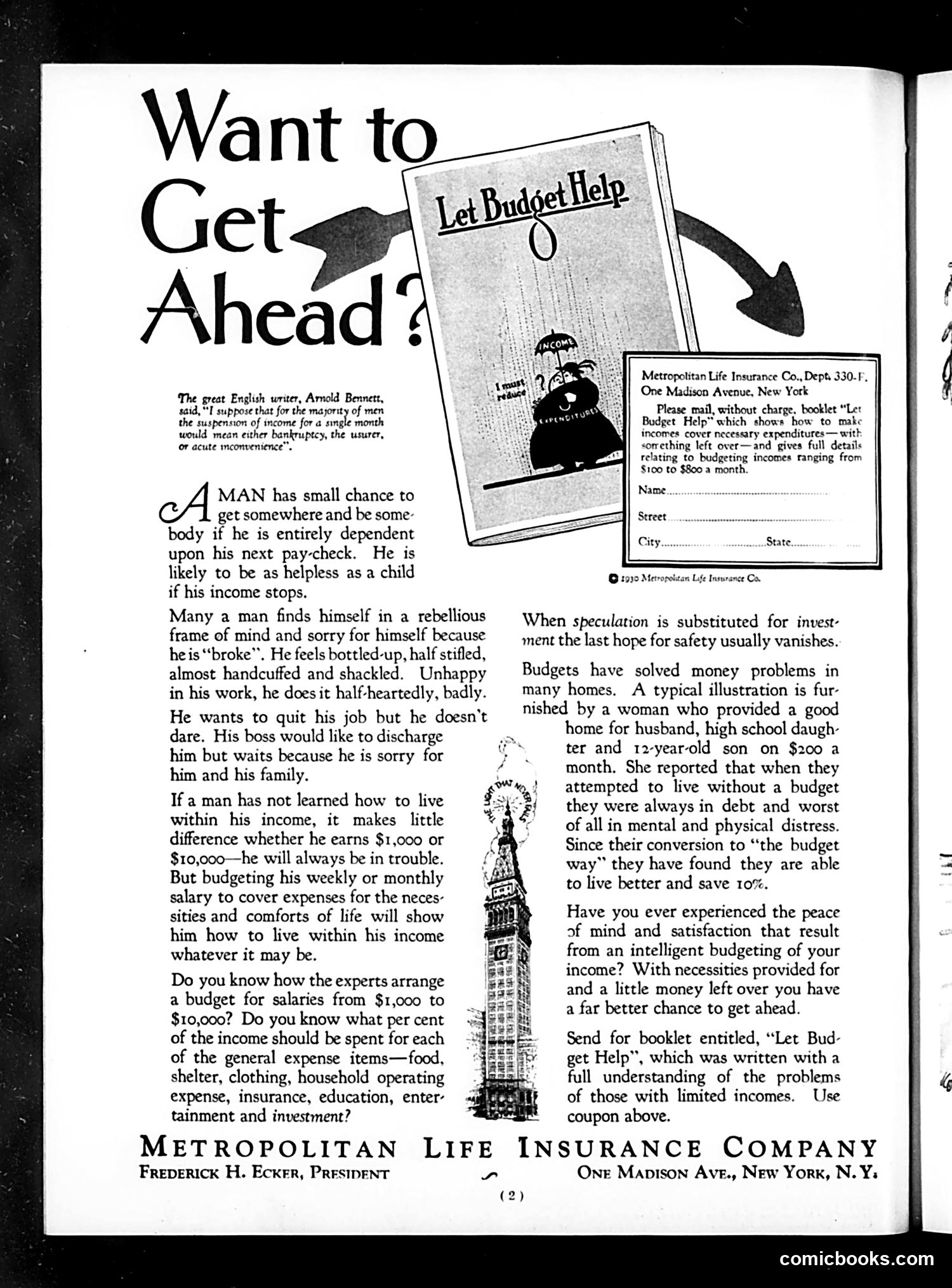
Analysis This page is primarily advertising, not satire. Metropolitan Life Insurance Company presents a sponsored article promoting personal budgeting as a solution to financial instability. The content argues that men dependent on paychecks lack security and peace of mind. The advertisement promotes "Let Budget Help," a free booklet claiming to teach readers how to allocate income across necessities (food, shelter, clothing, insurance, education, entertainment, investment). A anecdote describes a family of four living on $200/month who found budgeting relieved "mental and physical distress." The page uses Arnold Bennett's epigraph about income management to lend credibility. The embedded coupon allows readers to request the booklet from Metropolitan Life's New York office. This represents early 20th-century corporate public relations—positioning insurance companies as benevolent educators addressing working-class financial anxiety.
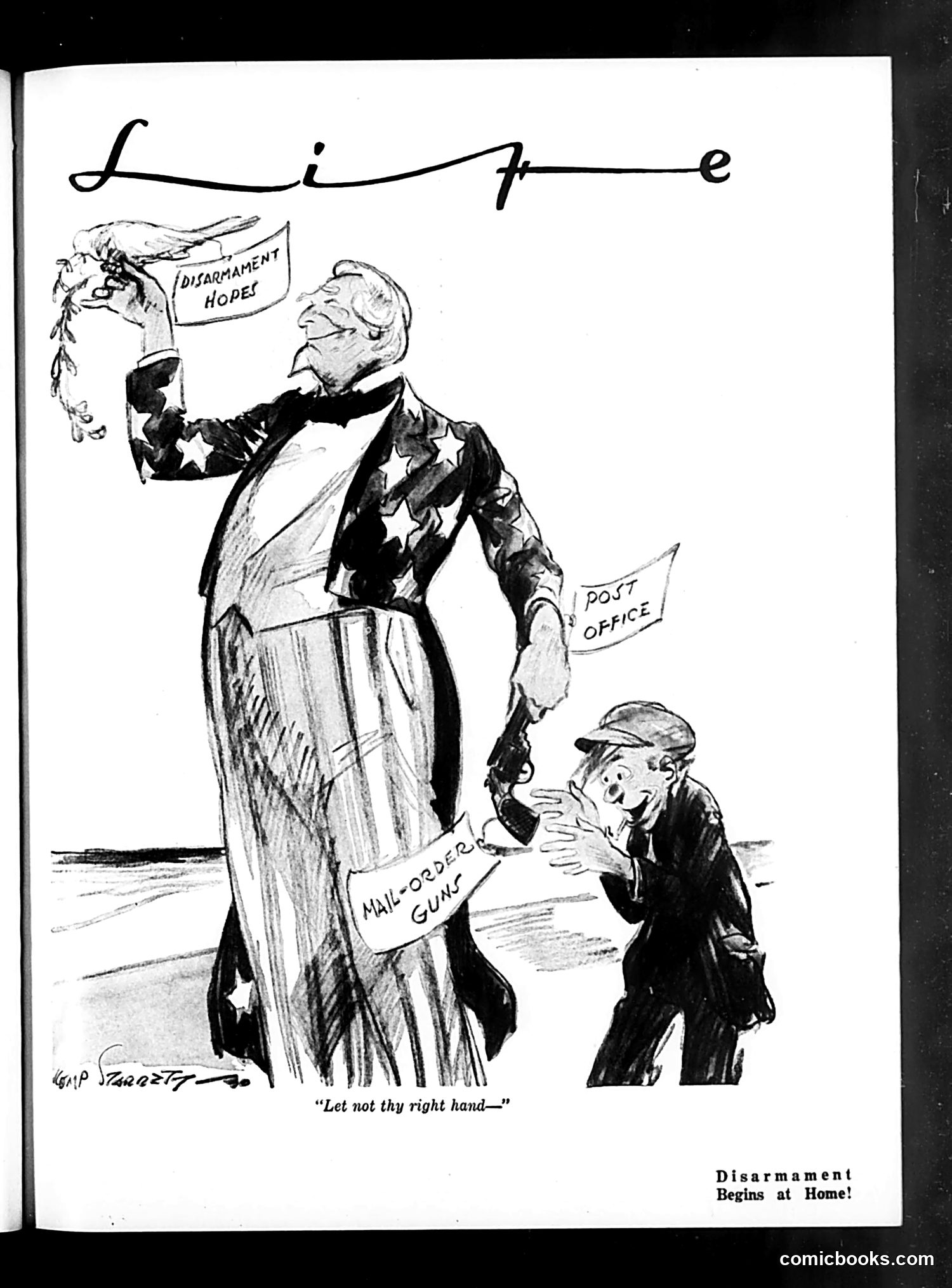
Political Cartoon Analysis: "Life" Magazine This cartoon satirizes American disarmament policy, likely from the 1920s-30s era. Lady Liberty (representing America) holds a banner reading "Disarmament Hopes" while discarding wilted flowers. She displays a "Post Office" sign and carries a "Mail Order Guide," suggesting America's commercial interests. A small figure (possibly representing a concerned citizen or another nation) reaches toward her, captioned "Let not thy right hand—," referencing the Biblical phrase about concealing charitable acts. The satire suggests America publicly advocates disarmament while privately pursuing commercial gain and postal expansion—the right hand doesn't know what the left is doing. The "Disarmament Begins at Home!" footer implies American hypocrisy about peace while maintaining other priorities.
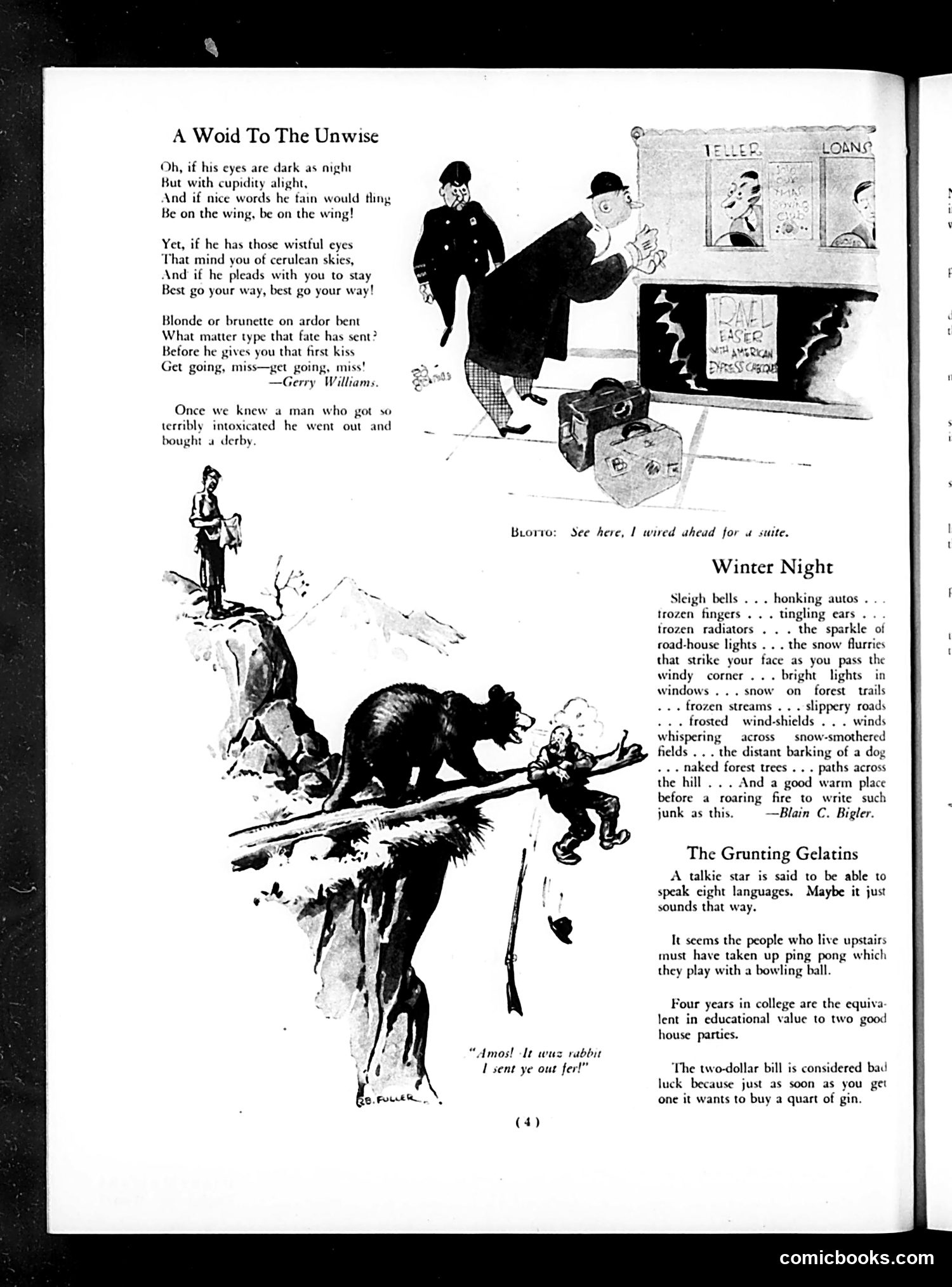
Analysis of Life Magazine Page This page contains three separate pieces of humor and satire: "A Word to the Unwise" (top): A poem about romantic advice, with an accompanying cartoon showing a man at a "Money Lender" office with suitcases, apparently having borrowed money for romantic pursuits. The satire mocks impulsive young men who spend recklessly on women. "Winter Night" (right): A poetic description of winter imagery by Blain C. Bigler—straightforward literary content, not satirical. "The Grunting Gelatins" (bottom right): A humorous piece mocking wealthy people ("upstairs" residents) for playing ping-pong loudly, and making sardonic comments about college parties and cheap dates. It's lighthearted social satire about class differences and social customs. The bottom illustration depicts a bear and hunter in a wilderness scene with the caption "Amos! It wuz rabbit I sent ye out fer!"—a humorous country/rural joke about mistaken identity.
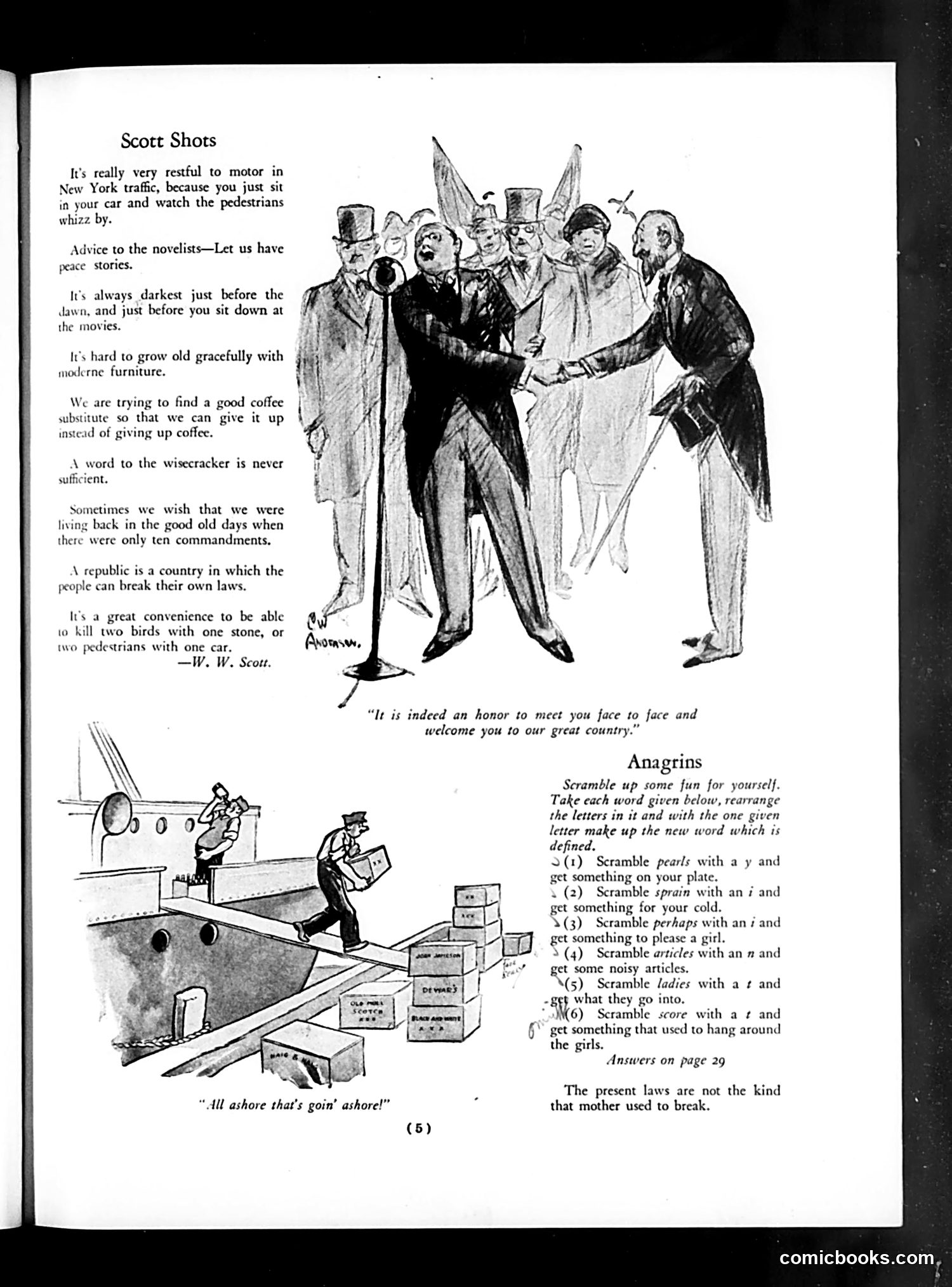
Scott Shots & Anagrins Page Analysis Scott Shots (top) presents short satirical observations by W.W. Scott on modern American life. The accompanying cartoon shows men in formal dress and top hats greeting a central figure with exaggerated ceremony—likely depicting diplomatic protocol or political formality. The caption reads: "It is indeed an honor to meet you face to face and welcome you to our great country," suggesting satire of insincere official welcomes or hollow diplomatic courtesies. The observations mock various contemporary issues: traffic congestion, furniture modernization, coffee substitutes (likely wartime rationing), and legal systems. Anagrins (bottom) is a word-puzzle game where readers rearrange letters to form new words with defined meanings—a common magazine entertainment feature requiring no topical knowledge to solve.
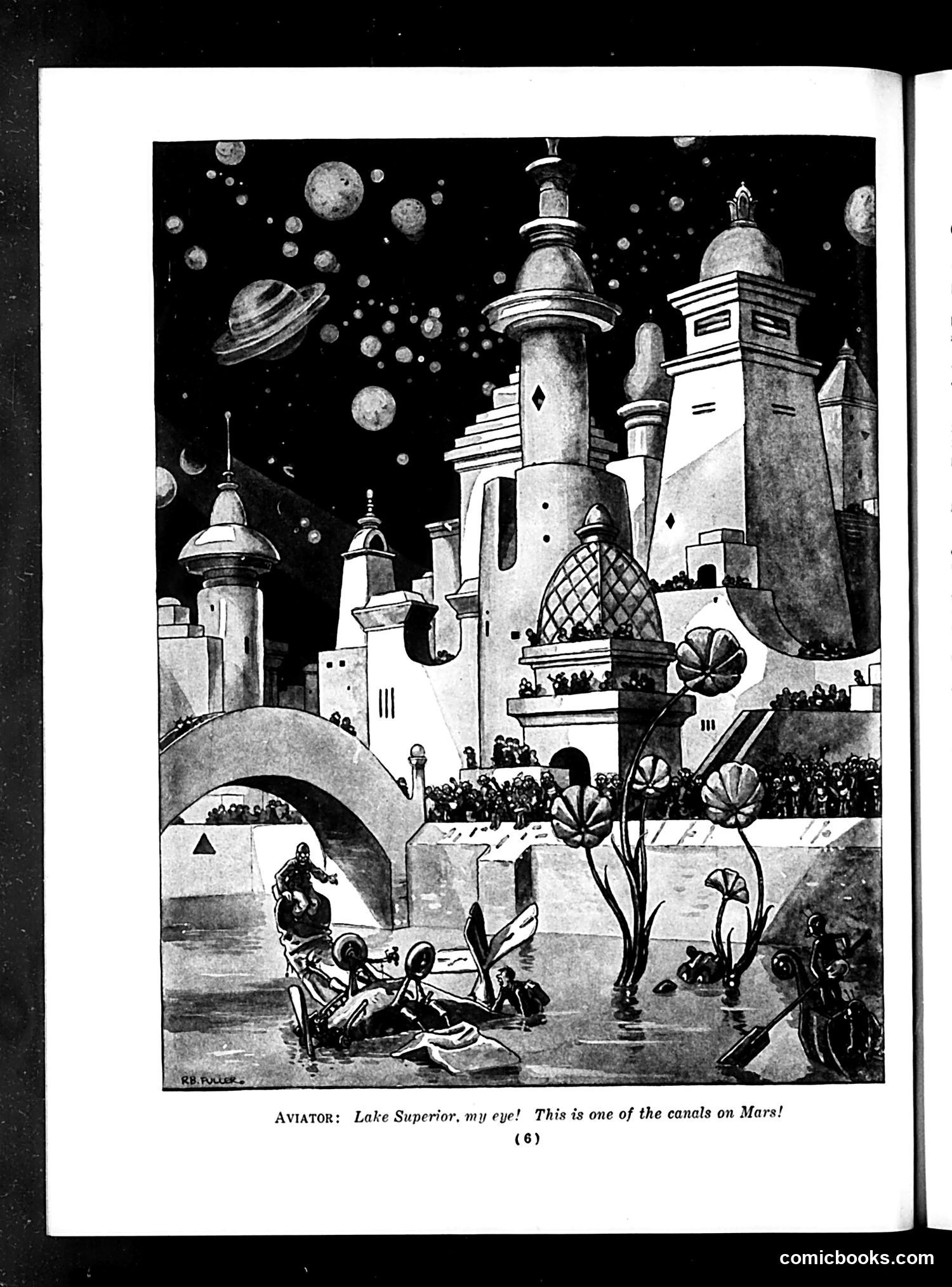
Analysis This is a science fiction illustration depicting an imaginary Martian city. The caption reads: "AVIATOR: Lake Superior, my eye! This is one of the canals on Mars!" The satire targets contemporary astronomical speculation about Mars. In the early 20th century, astronomers (notably Percival Lowell) claimed to observe "canals" on Mars, theorizing an advanced alien civilization existed there. This illustration humorously imagines what such canals might look like—complete with futuristic architecture, crowds of inhabitants, and alien vegetation. The joke plays on the aviator's skepticism: he's so amazed by this fantastical Martian landscape that he dismissively compares it to Lake Superior, suggesting the canal system is so elaborate it seems impossible, even compared to Earth's massive freshwater lake. The artwork reflects early 20th-century optimism about space exploration and popular fascination with extraterrestrial life.
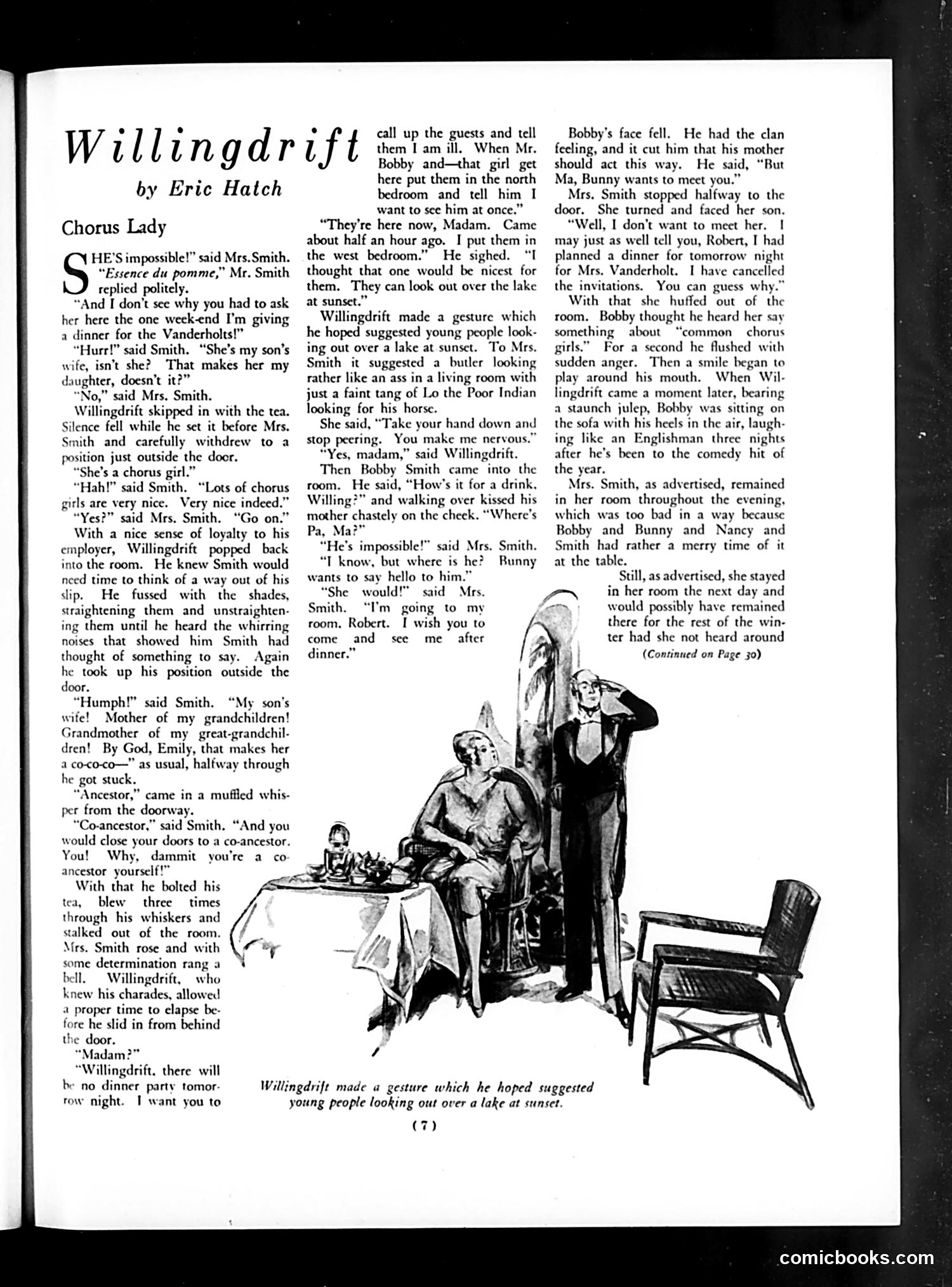
"Willingdrift" by Eric Hatch This is a fictional short story rather than political satire. The narrative concerns a society hostess (Mrs. Smith) preparing a dinner party for wealthy guests, including people named the Vanderhilts and references to "Bunny," "Bobby," and "Nancy." The accompanying illustration shows three figures in what appears to be a drawing room—two women and a man in formal attire. The story itself focuses on domestic comedy: guest management, social hierarchies, and character interactions typical of upper-class social gatherings. There is no apparent political commentary or identifiable real-world figures being caricatured. This is entertainment fiction for Life magazine's readers, likely appealing through humor about recognizable social situations among the affluent.
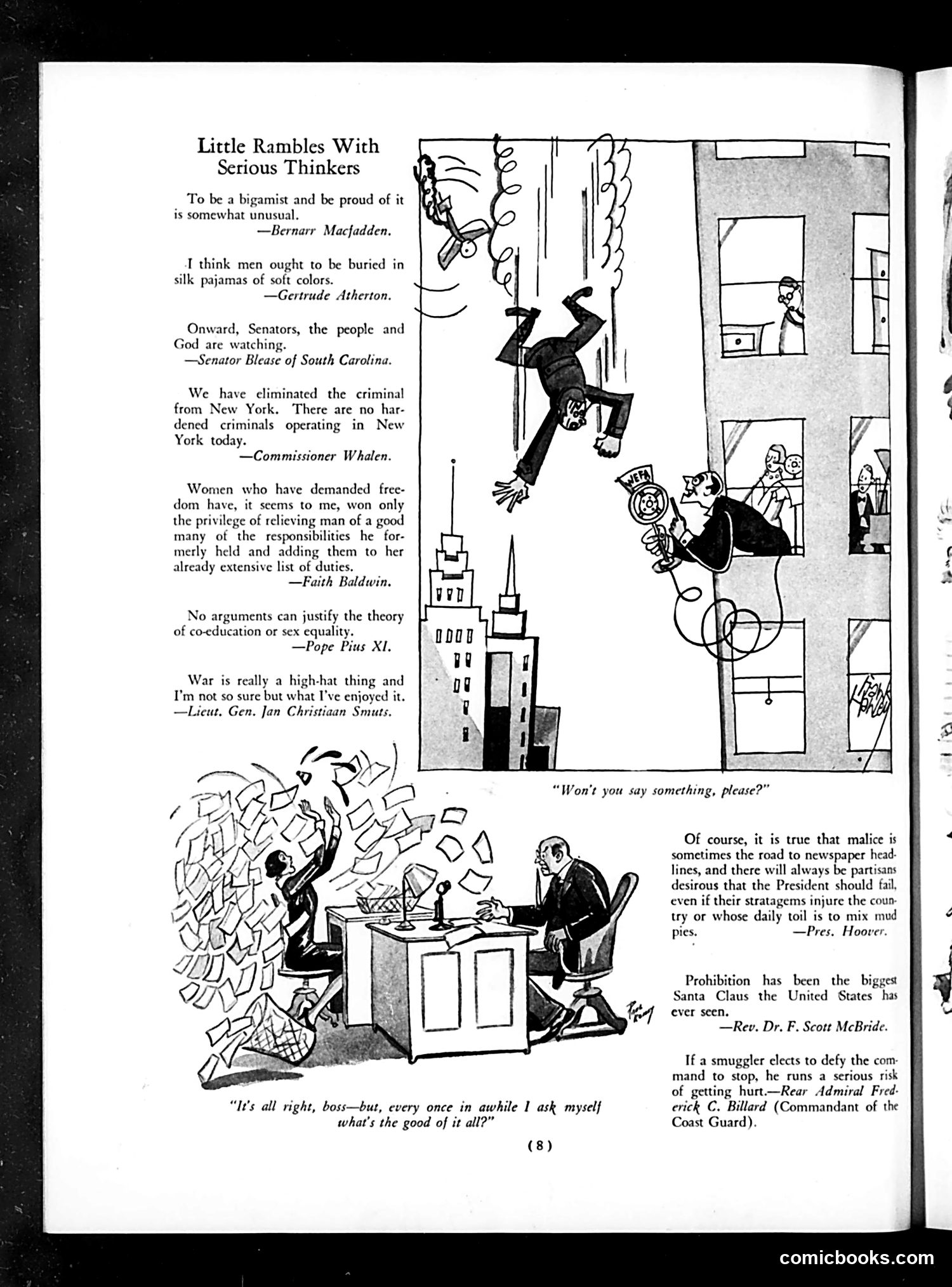
Analysis of Life Magazine Page 8 This page presents satirical quotes and two political cartoons from what appears to be the Prohibition era (the Rev. Dr. F. Scott McBride quote about Prohibition as "the biggest Santa Claus" dates this roughly to the 1920s-early 1930s). Top cartoon: A man falls from a tall building while another man below holds what appears to be a target or shield, asking "Won't you say something, please?" — satirizing bureaucratic inaction during chaos. Bottom cartoon: Two men sit at a desk surrounded by stacks of papers, with one asking his boss "It's all right, boss—but, every once in awhile I ask myself what's the good of it all?" — mocking the futility of paperwork-heavy government administration, likely related to Prohibition enforcement's notorious inefficiency and corruption.
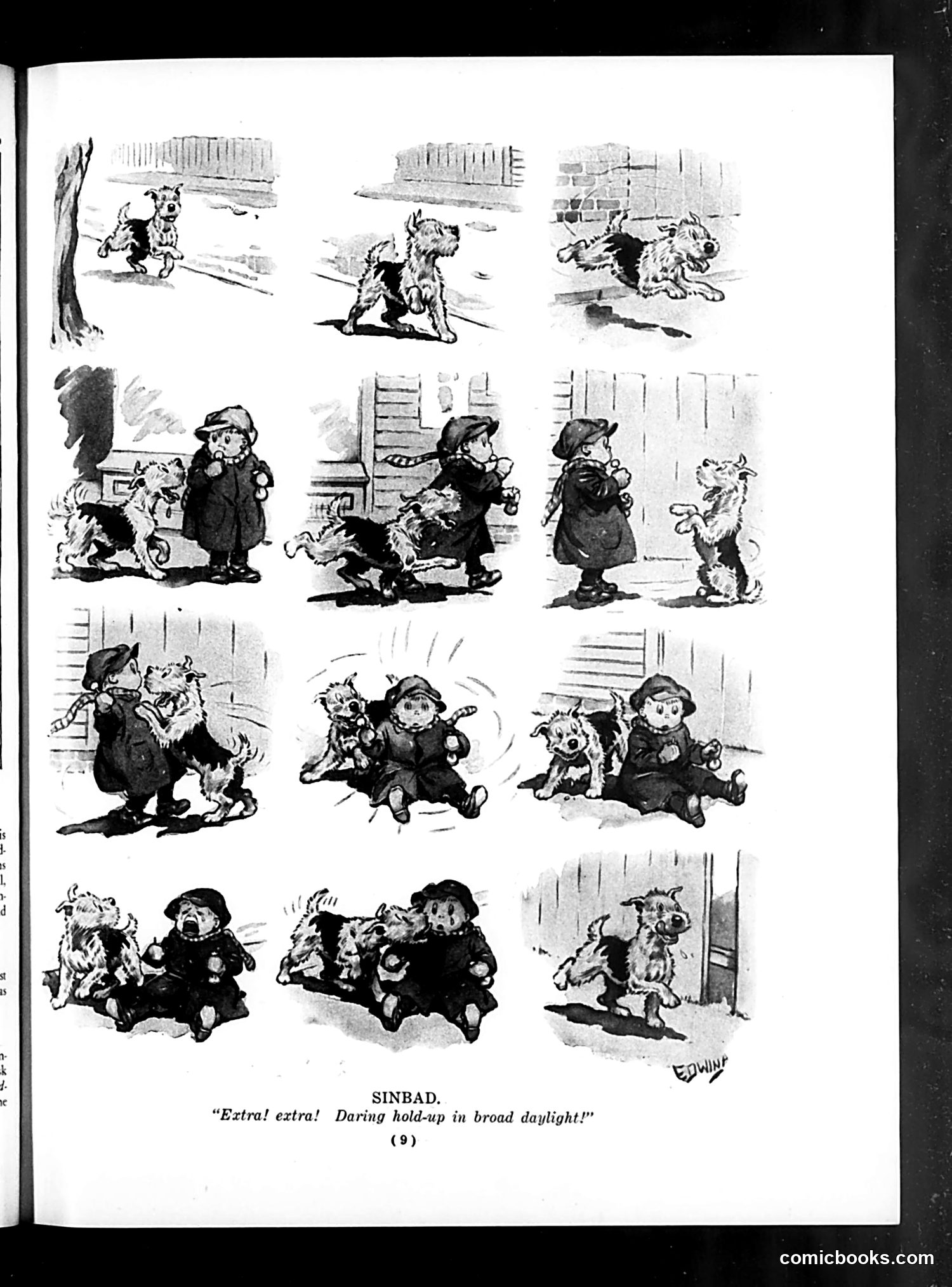
Sinbad Comic Strip Analysis This appears to be a sequential comic strip titled "SINBAD" showing a narrative about a "daring hold-up in broad daylight." The strip depicts what seems to be a criminal robbery scenario rendered in early 20th-century illustration style. The panels show interactions between what appear to be a criminal character and civilians, progressing through various dramatic moments of confrontation. The cartoonish style and exaggerated expressions suggest satirical or comedic treatment of crime themes popular in period entertainment. Without additional context about the specific date or publication issue, the exact satirical target remains unclear, though the headline's emphasis on "broad daylight" suggests commentary on urban crime or lawlessness as a contemporary social concern worthy of humorous treatment.
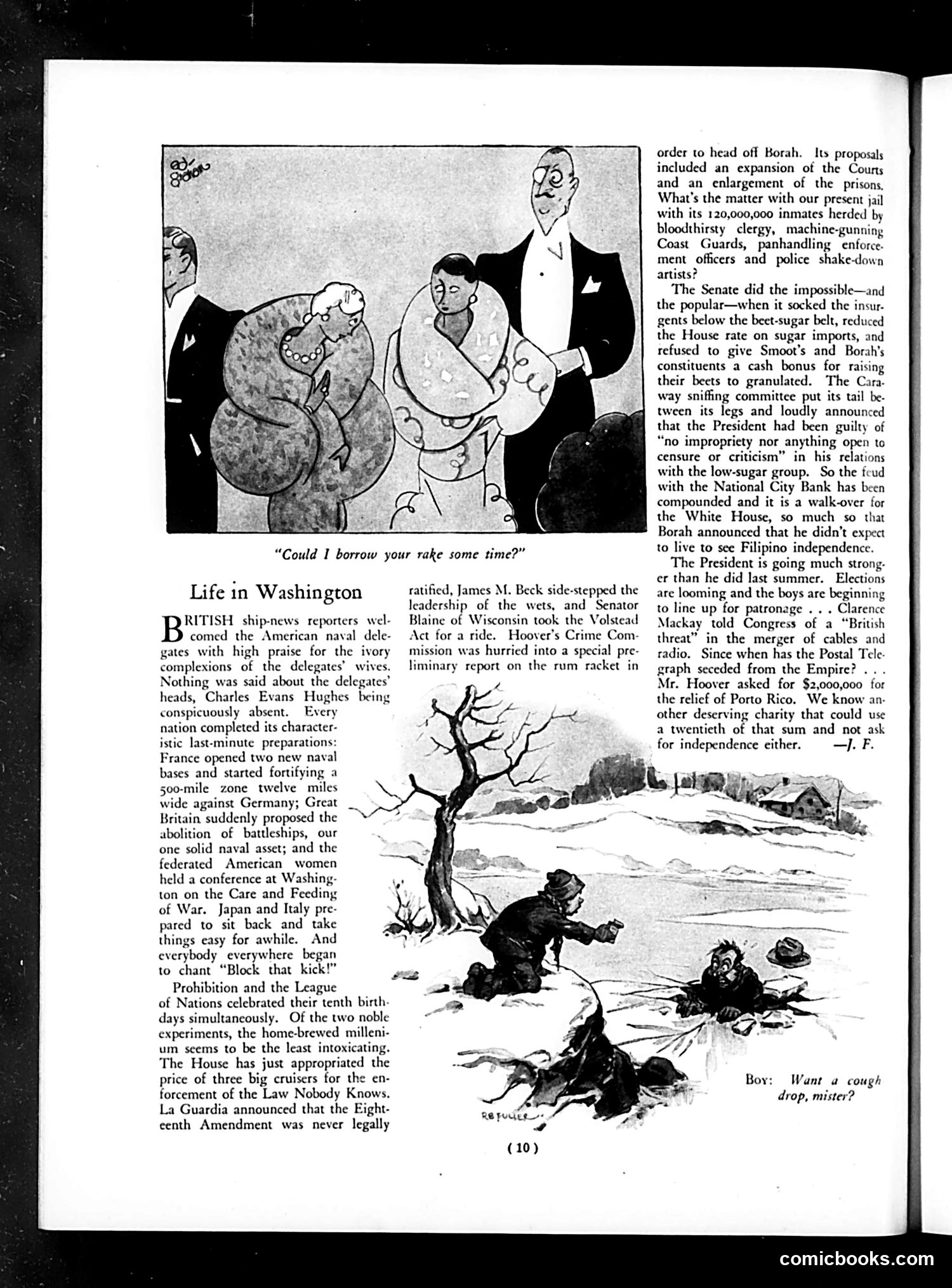
Political Cartoon Analysis: "Life in Washington" The top cartoon satirizes political corruption and favoritism in Washington. Three portly figures in formal dress (likely politicians or bureaucrats) are shown with distended bellies containing money and valuables. One asks to "borrow your rake some time?"—a crude visual pun suggesting they're literally stuffed with ill-gotten gains they want to redistribute among themselves. The accompanying text discusses legislative absurdities: the Senate blocking sugar import duties, investigations into presidential impropriety, and debates over relief funds for Porto Rico. The bottom sketch shows impoverished citizens during what appears to be winter hardship, contrasting sharply with Washington's self-serving elite. The overall message: while ordinary Americans suffer, Washington politicians gorge themselves on corruption and trivial partisan squabbles.
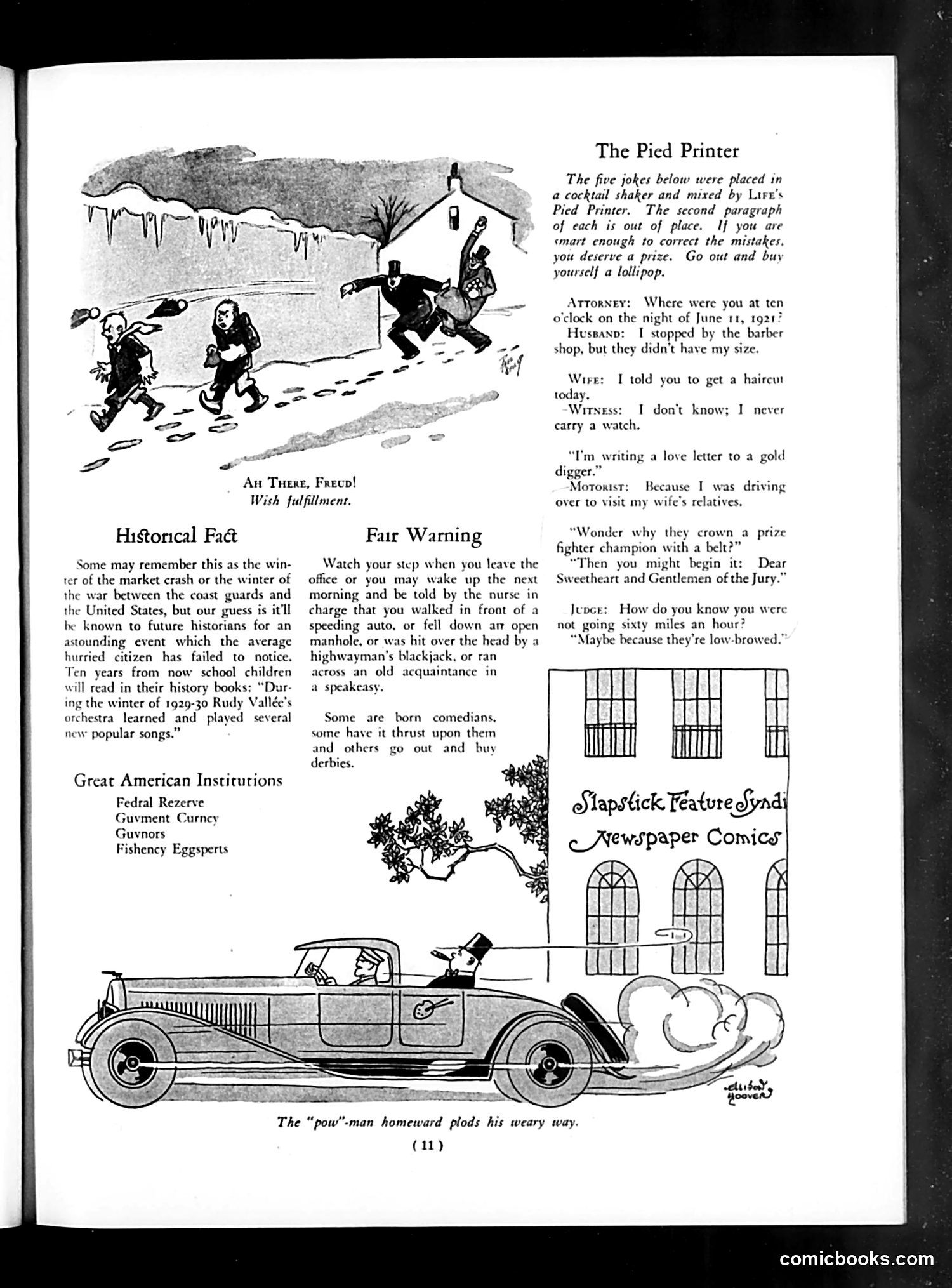
"The Pied Printer" Page This page contains a cocktail-mixing puzzle where readers must correct five intentionally misplaced joke paragraphs. The jokes themselves are relatively mild domestic humor from the 1920s era—a husband stopped at a barber shop, a motorist visiting relatives, and a judge questioning speeding drivers. Below are two illustrated sections: "Historical Fact" mentions the winter of 1929-30 (likely referring to market crash effects), and "Fair Warning" offers cautionary anecdotes about everyday accidents. At the bottom is a cartoon of a car with the caption "The 'pow'-man homeward plods his weary way," appearing to pun on "pow" (power/speed) and a tired driver. The overall page mixes light humor with gentle social commentary about modern life hazards during the early Depression era.
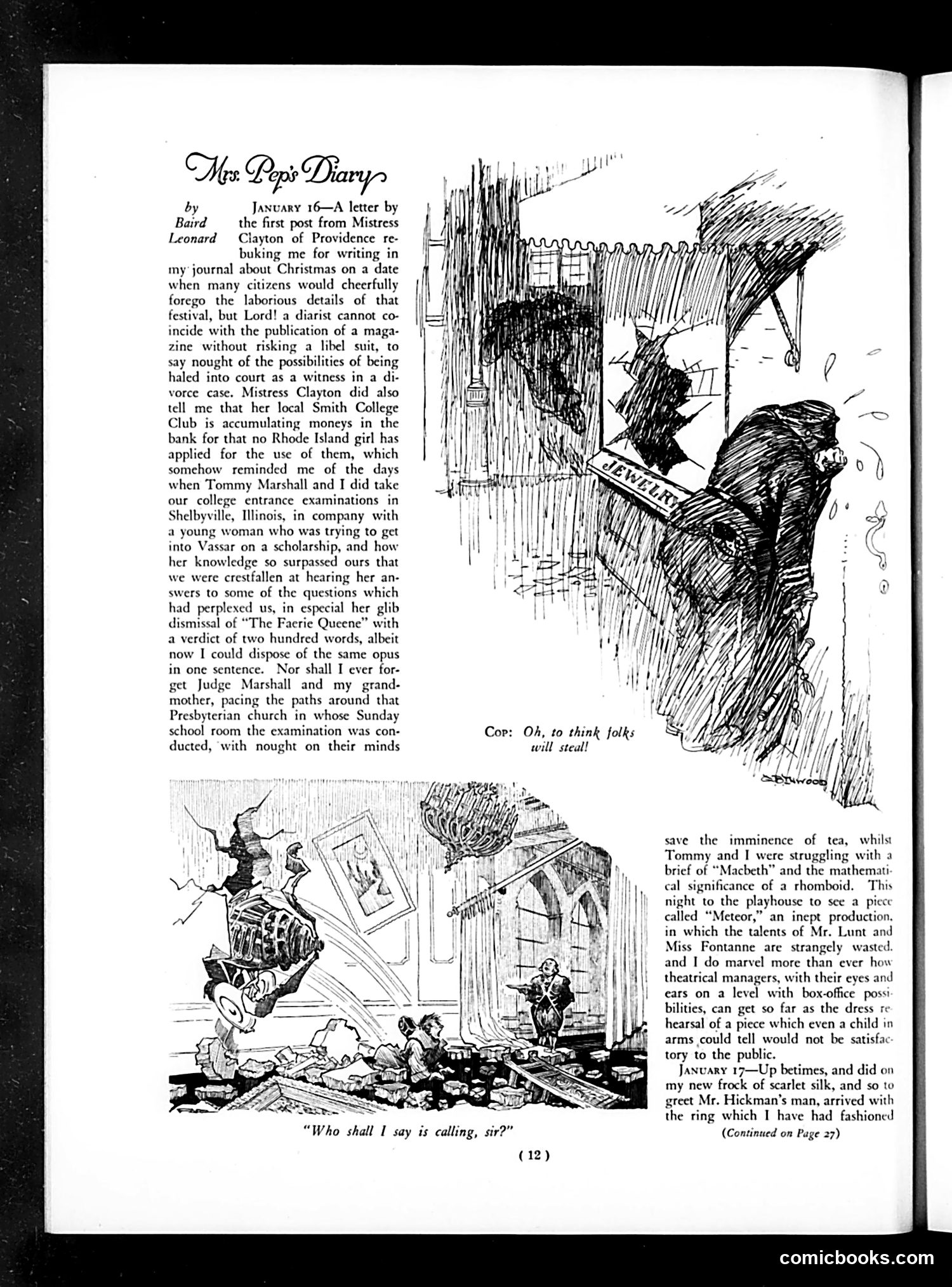
"Mrs. Pep's Diary" - Page Analysis This is a humorous diary entry by Baird Leonard dated January 16, satirizing social pretension and theatrical gossip. The text mocks Mistress Clayton of Providence for rebuking the author about writing in magazines, while the diary itself chronicles local scandals—including the Smith College Club's fundraising and a young woman's failed Vassar scholarship attempt. The accompanying illustrations are comedic vignettes: the upper cartoon shows someone sneaking/burglarizing ("Oh, to think folks will steal!"), while the lower image depicts theatrical chaos ("Who shall I say is calling, sir?"), satirizing amateur theatrical productions and their incompetence. The content targets early 20th-century New England society's hypocrisy regarding propriety, gossip, and cultural ambitions.
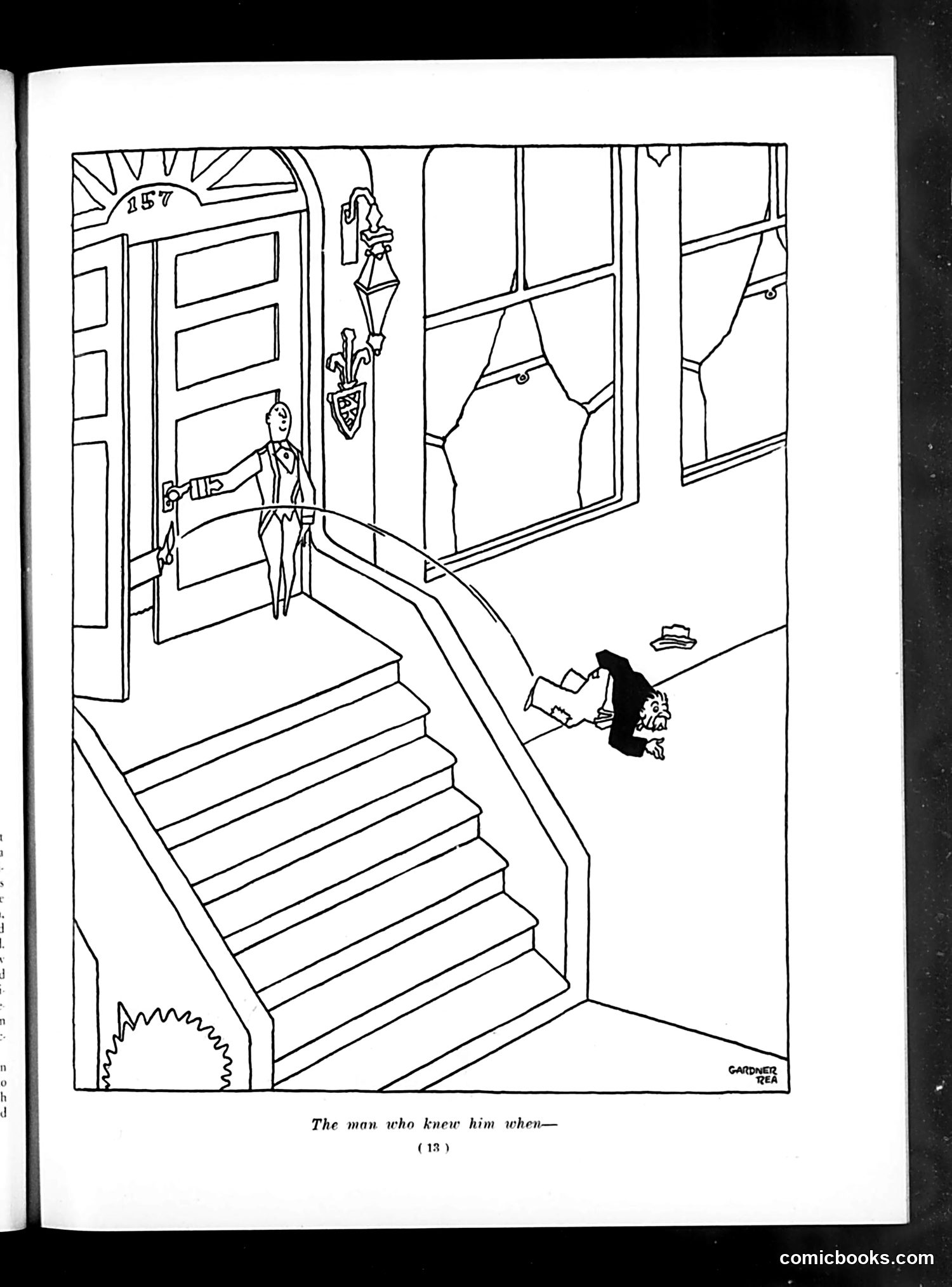
"The Man Who Knew Him When—" This cartoon shows a shabby, poorly-dressed man who has apparently collapsed or fallen on the steps of an elegant building (marked "1857"). A well-dressed doorman or official stands at the entrance, seemingly dismissing or ignoring him. The caption "The man who knew him when—" suggests a satirical commentary on social climbing or sudden wealth/status change. The implication is that the distinguished person now in the fancy building has forgotten or disowned an acquaintance from his poorer past. The date "1857" on the building and the contrast between the two figures' appearances emphasize the theme of social mobility and the tendency of the newly successful to distance themselves from their origins or old associates. It's a critique of social pretension and ingratitude.
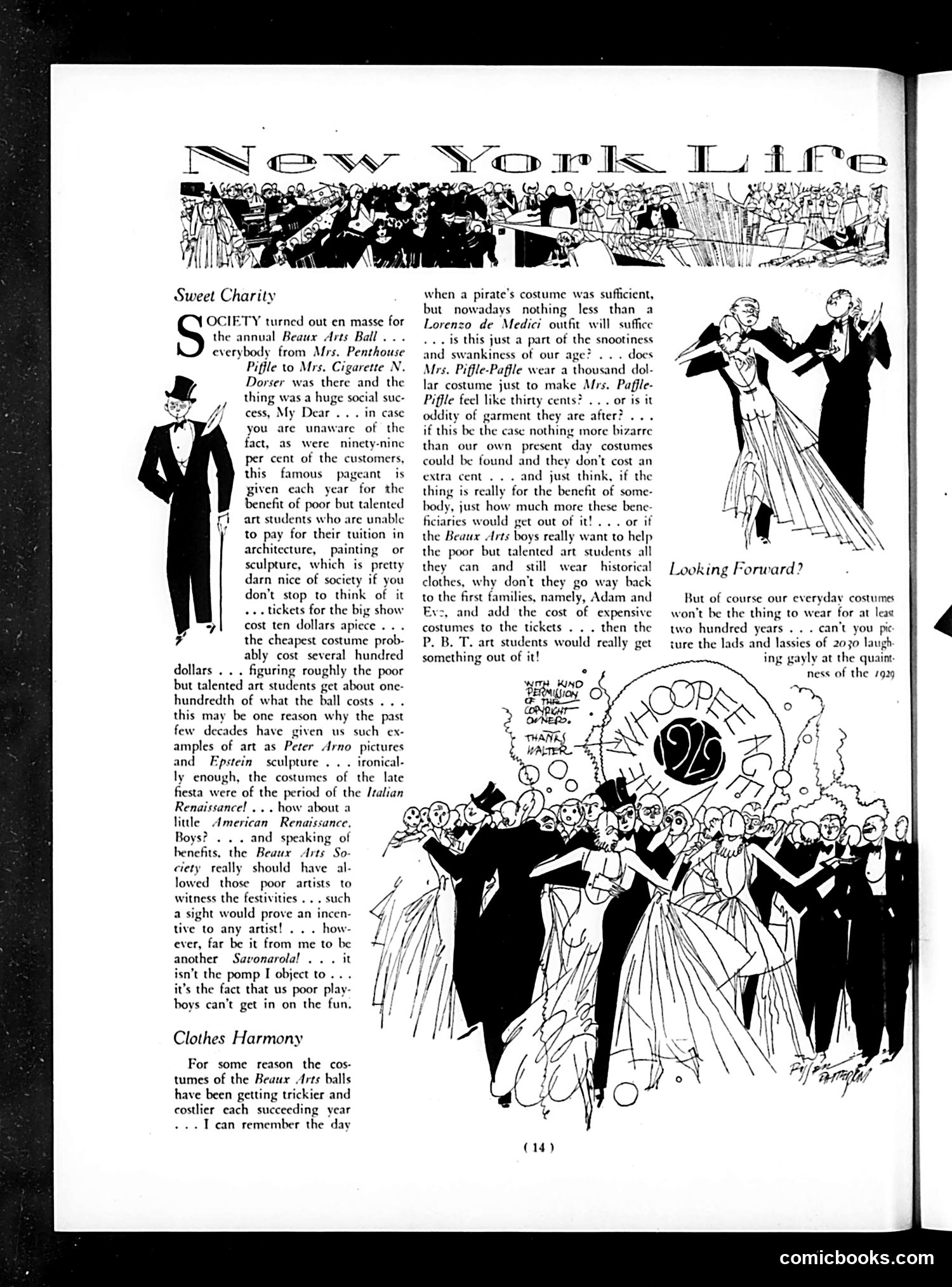
Analysis of "New York Life" Page This page satirizes the annual Beaux Arts Ball, a costume charity event for poor art students. The left column critiques the extravagance: wealthy society members spend lavishly on historically-themed costumes (referencing Italian Renaissance and Napoleonic eras) while the ball supposedly benefits struggling artists. The author questions the disconnect—why not donate the costume money directly to students, or have artists themselves attend in historical dress? The right illustration shows the 1929 ball itself: elegantly-dressed revelers in formal attire and period costumes celebrating. The satire's point: wealthy society uses charitable events primarily for entertainment and social display, with minimal actual benefit reaching intended beneficiaries—a critique of performative charity that remains relevant today.
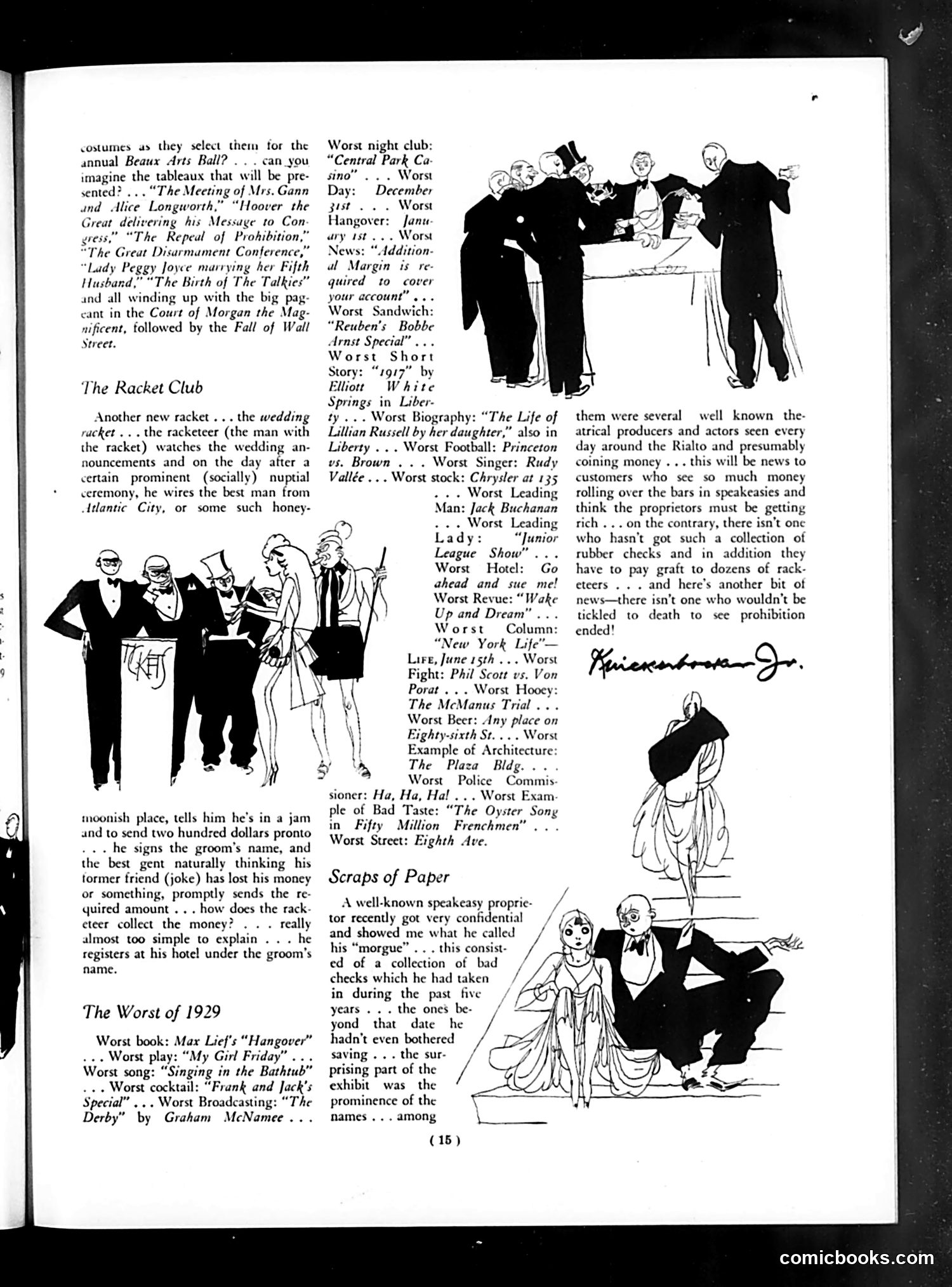
Analysis of Life Magazine Page This page contains two sections critiquing 1929 entertainment and nightlife. "The Racket Club" (top) satirizes an exclusive wedding venue frequented by wealthy, socially prominent clients. The illustration shows well-dressed patrons at what appears to be a high-society event. The text implies the establishment caters to the city's elite, though it hints at some undisclosed scandal or impropriety. "The Worst of 1929" (middle-right) is a year-end roundup mocking popular entertainment: terrible books, songs, broadcasts, and cocktails. Notable targets include "Hangover" by Max Lieff and Graham McNamee's broadcasting. "Scraps of Paper" (bottom) describes a speakeasy proprietor displaying bad checks from clients—a humorous reference to Prohibition-era illegality and the financial irresponsibility of patrons. The illustrations use caricature to mock upper-class excess and popular entertainment mediocrity.
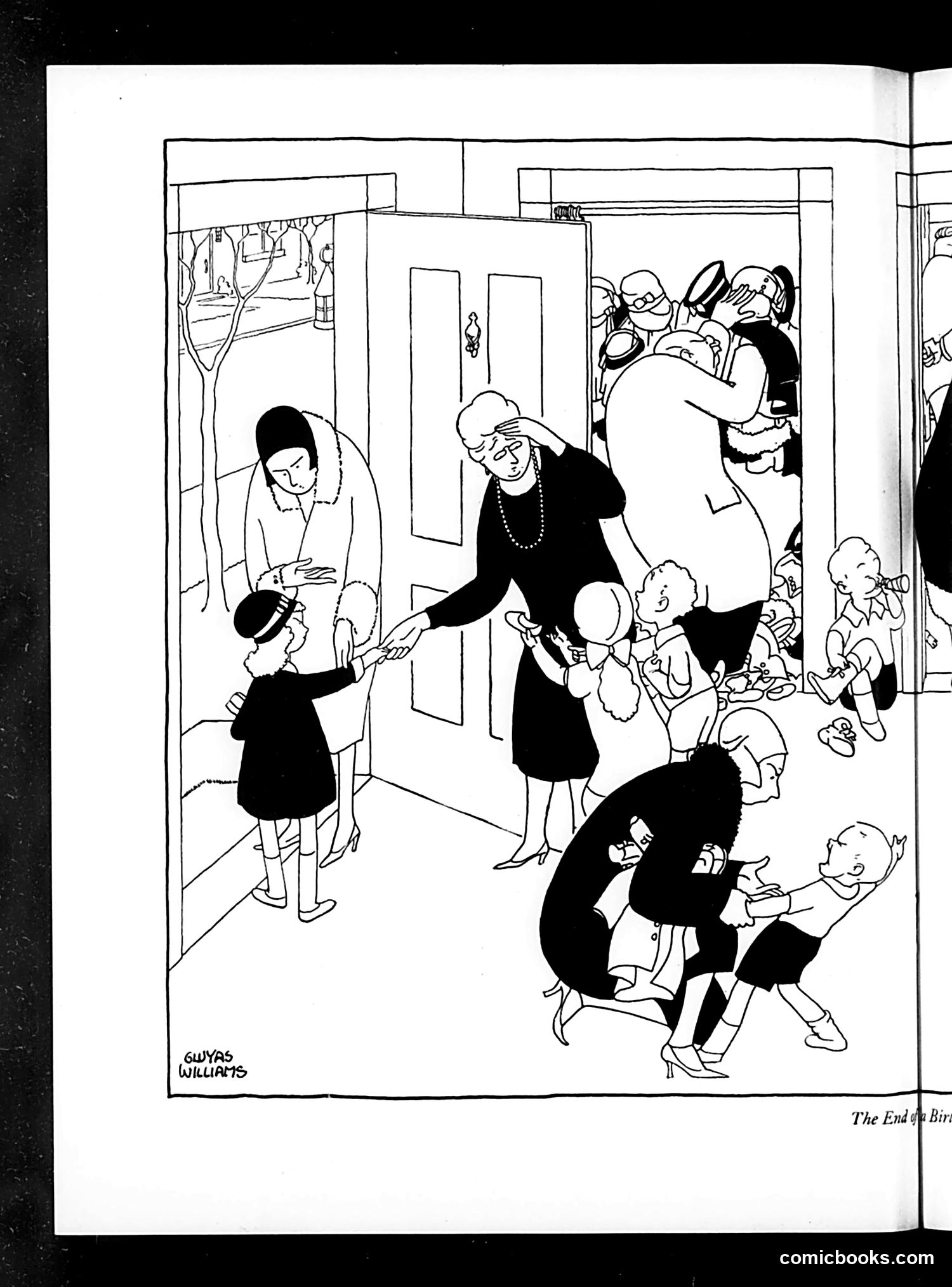
Analysis of "The End of Bir" (Guyas Williams cartoon) This cartoon by Guyas Williams depicts a crowded interior scene—likely a nursery or children's facility—where multiple women (possibly caregivers or nurses) interact with numerous small children. The title "The End of Bir[th]" suggests social commentary about childcare or population management. The composition emphasizes chaos: children scattered throughout, multiple adults managing them simultaneously. Without additional context from Life magazine's publication date, the specific satirical target remains unclear. It could address: - Overcrowding in institutional childcare - Women's workforce participation post-WWI - Birth rate concerns The cartoon appears to critique either the conditions of institutional childcare or anxieties about modern child-rearing practices, though the exact social commentary requires the original article's context.
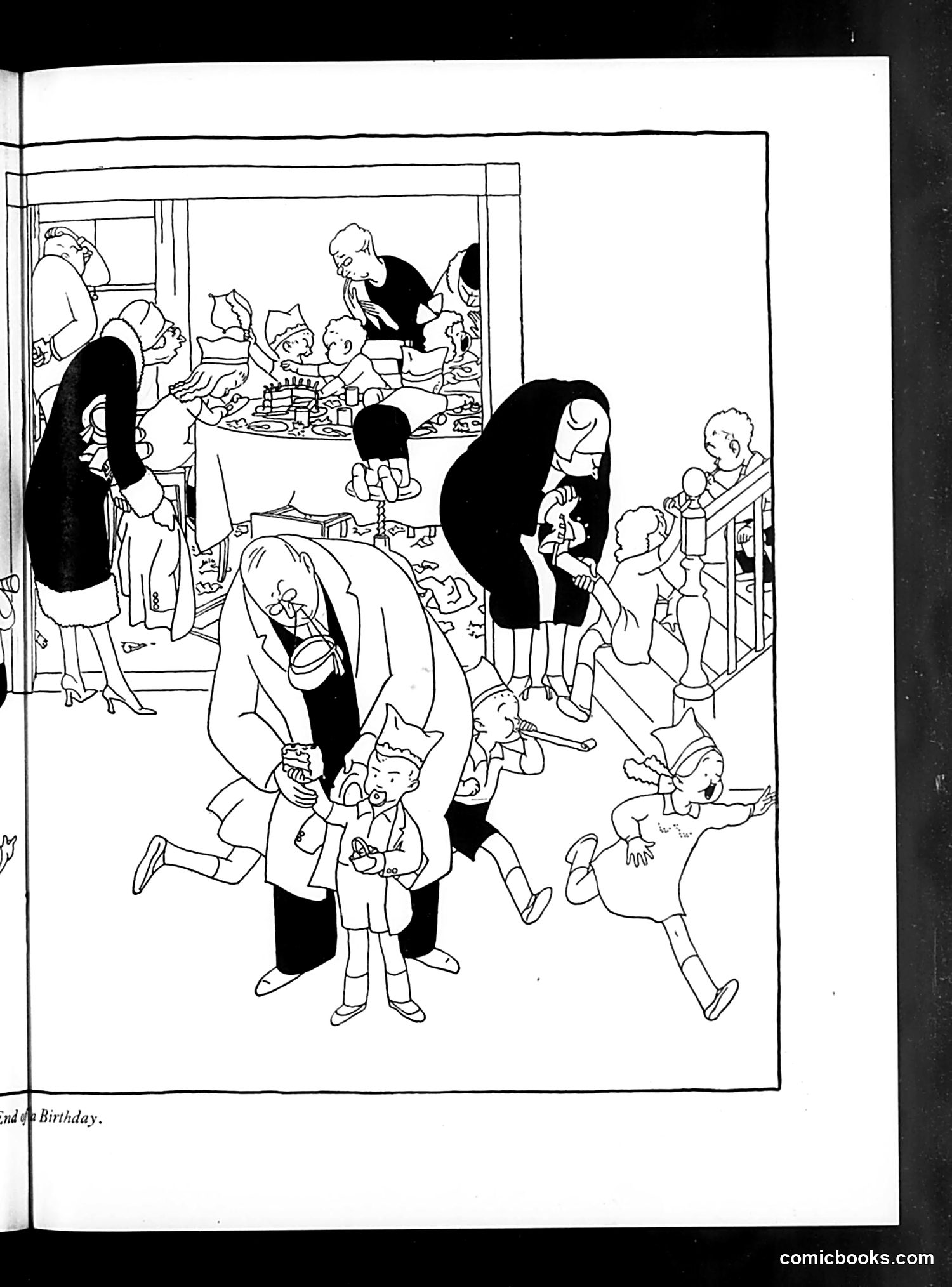
Analysis This illustration depicts a chaotic children's birthday party. The caption at bottom reads "End of Birthday," suggesting this shows the conclusion of such an event. The satire appears to target the excessive, overstimulated nature of children's parties—particularly among middle and upper-class families. The scene shows complete pandemonium: children running wild, adults attempting damage control, toys scattered everywhere, and general disorder. The well-dressed adults (particularly the women in dark coats) seem overwhelmed and exhausted by the mayhem they've created or permitted. The humor lies in the contrast between the refined, respectable appearance of the hosts and the utter chaos they cannot contain. This likely satirizes early 20th-century parenting trends and the cultural anxiety around children's entertainment and supervision among affluent families.
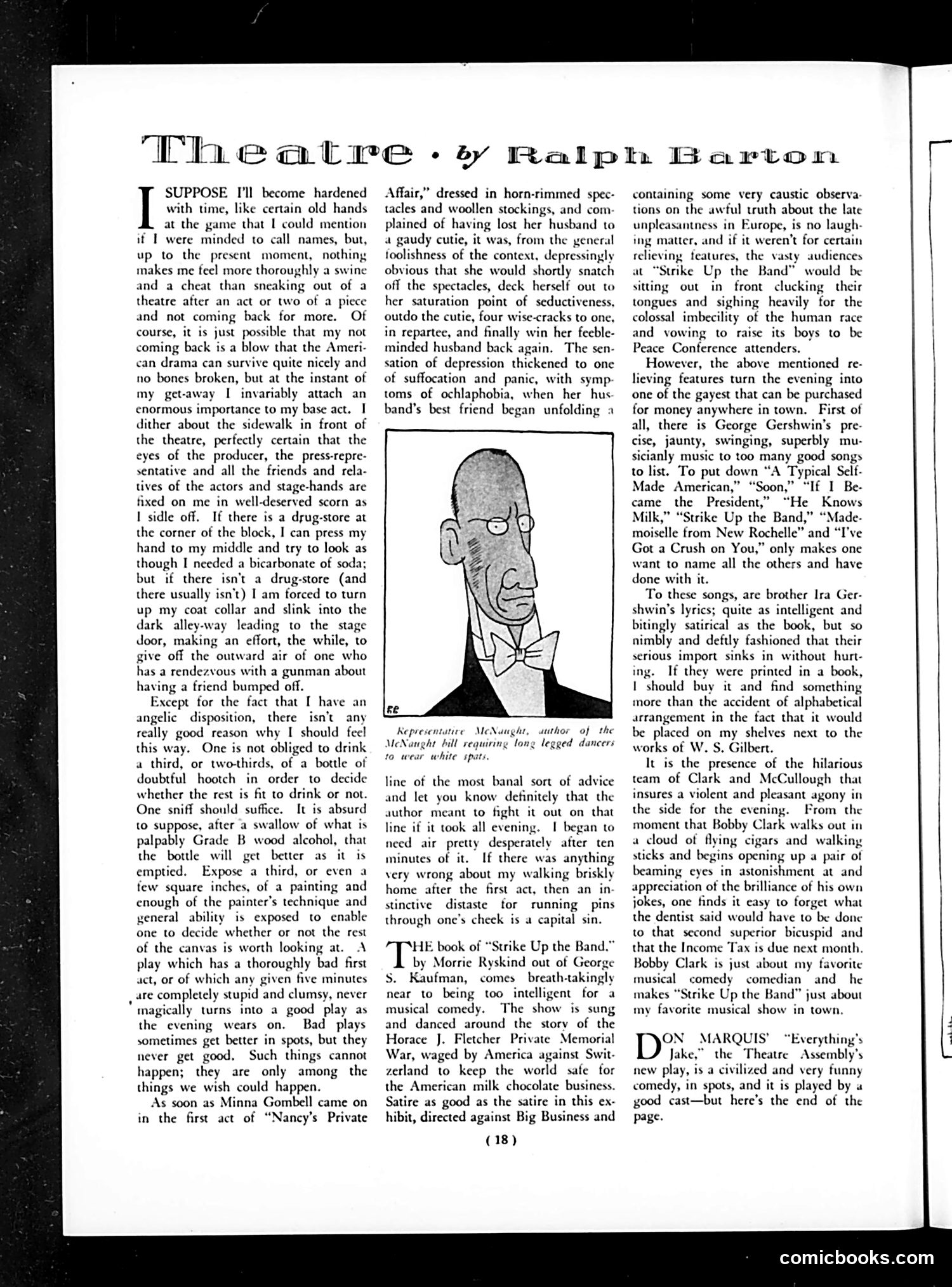
Analysis of "Theatre" by Ralph Barton This is a theater review column by Ralph Barton featuring a caricature of a bald man wearing glasses and formal attire. The caption identifies him as "Representative McKnight, author of the 'Midnight bill requiring long-legged dancers to wear white spats.'" The cartoon satirizes legislative overreach into entertainment. McKnight apparently proposed legislation regulating dancers' clothing—specifically requiring white spats. Barton mocks this as absurd interference with theatrical freedom, using exaggerated facial features to ridicule the politician's prudishness. The surrounding text reviews current Broadway shows, including mentions of "Nancy's Private Affair," "Strike Up the Band," and "Everything's Jake," critiquing both their merits and excesses. The satire targets government censorship and moral regulation of theater during what appears to be the 1920s-30s era.
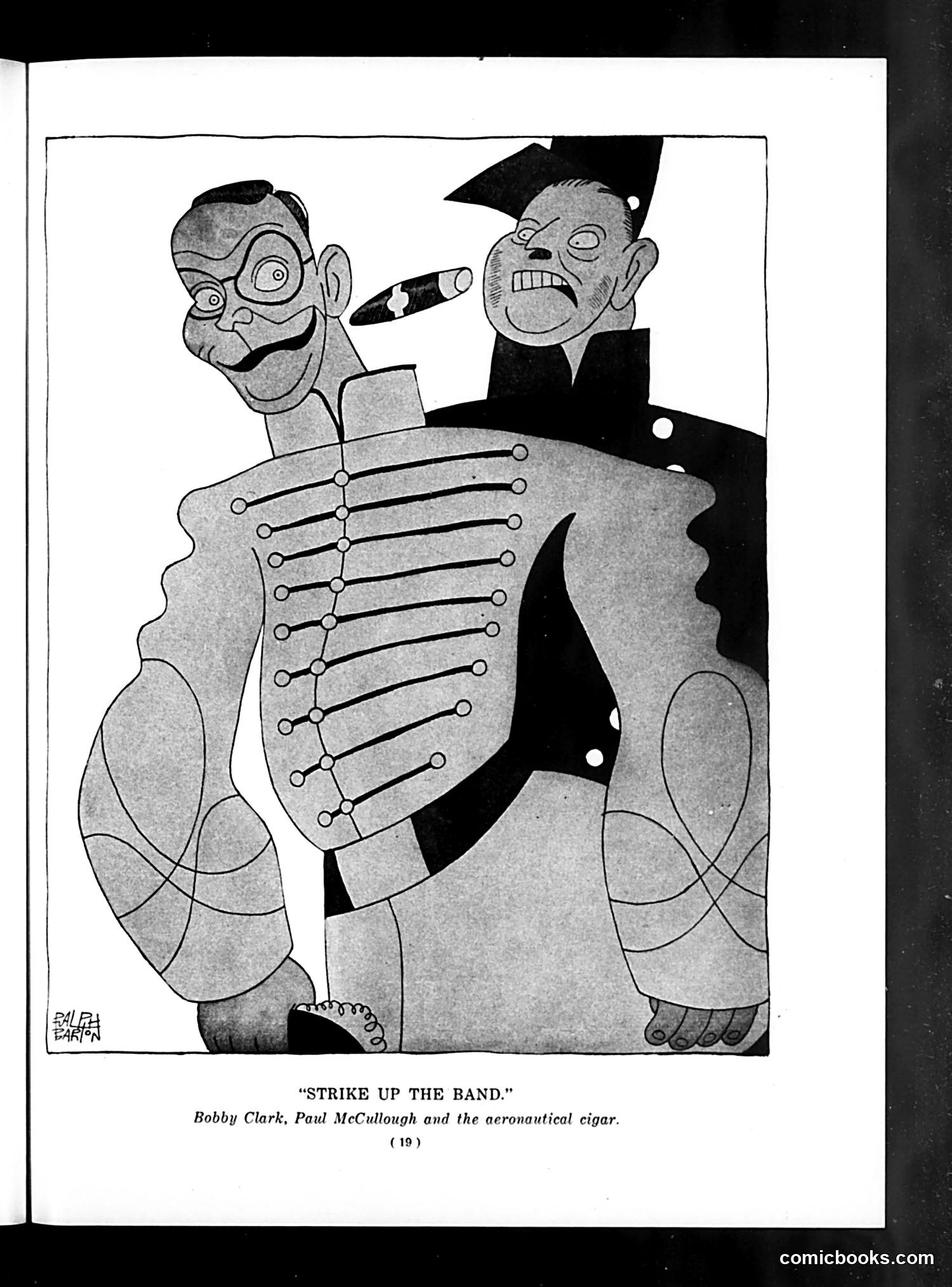
"Strike Up the Band" - Life Magazine Cartoon This political cartoon depicts two caricatured figures in military dress uniforms with exaggerated facial features. The figure on the right holds what appears to be a cigar labeled "aeronautical." According to the caption, this references Bobby Clark and Paul McCullough—likely vaudeville performers or comedians of the era—alongside "the aeronautical cigar," suggesting a joke about emerging aviation technology or perhaps a commercial product. The military uniforms and the phrase "Strike Up the Band" suggest satire about military pageantry or showmanship. The grotesque caricature style was typical of early 20th-century Life magazine's satirical approach, though the specific historical reference to these figures and the "aeronautical cigar" remains unclear without additional context about contemporary events or advertisements.
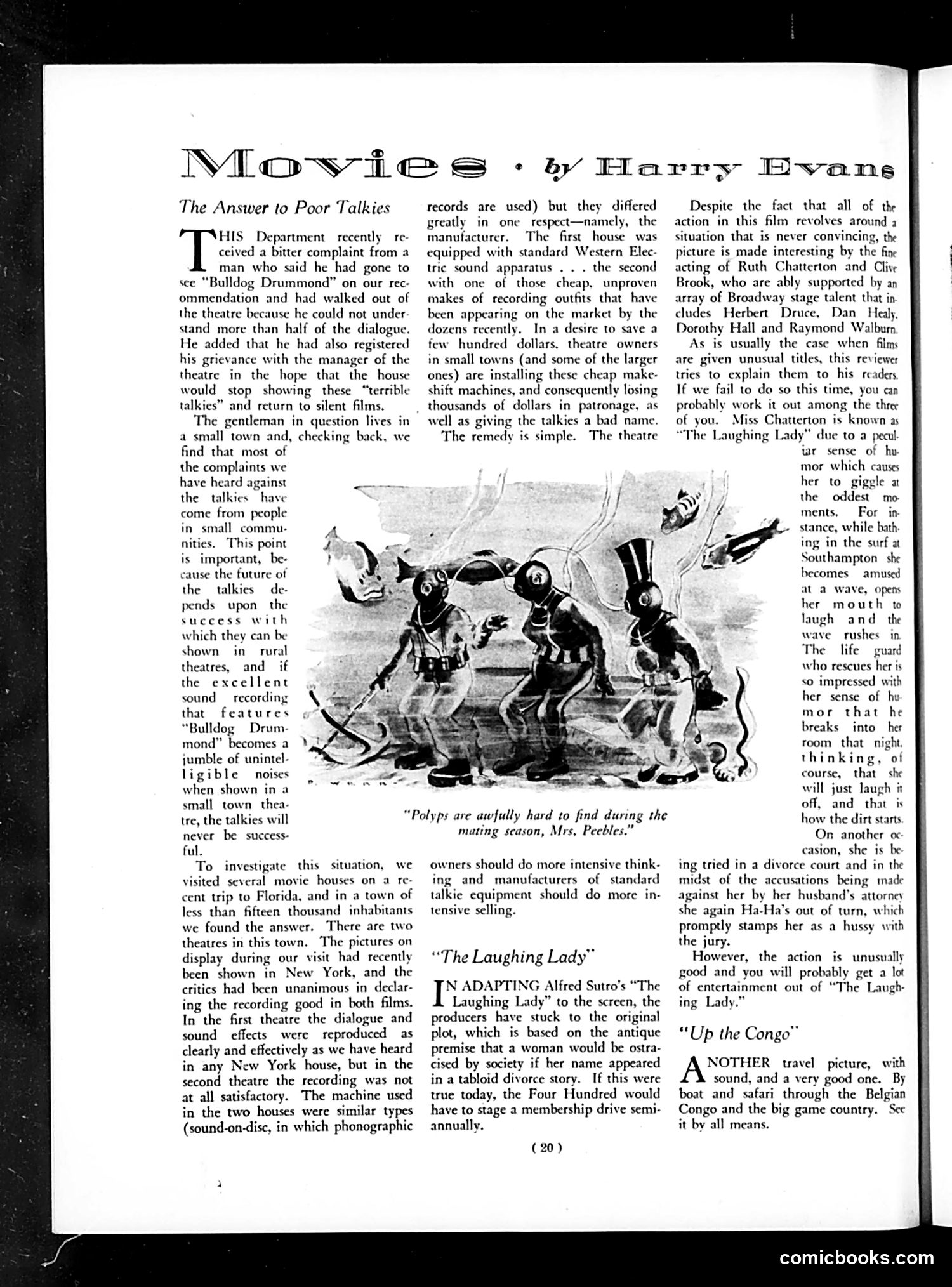
Analysis of This Life Magazine Movie Review Page This page from Harry Evans's "Movies" column addresses the early "talkie" era's technical problems. The main article criticizes inferior sound equipment in small-town theaters: theater owners installing cheap, off-brand recording machines (rather than standard Western Electric equipment) to save money, resulting in unintelligible dialogue that damages both patronage and the talkies' reputation. The cartoon depicts what appears to be early sound recording equipment malfunction—figures struggling with audio equipment during what the caption suggests is a recording session about marine polyps, humorously illustrating the technical chaos when inferior machinery fails. The secondary reviews cover "The Laughing Lady" starring Ruth Chatterton and Clive Brook, where Evans satirizes the film's outdated plot premise (a woman ostracized for appearing in tabloid divorce coverage), noting this wouldn't happen in 1920s high society anymore. The review uses gentle humor while praising the actors' performances.
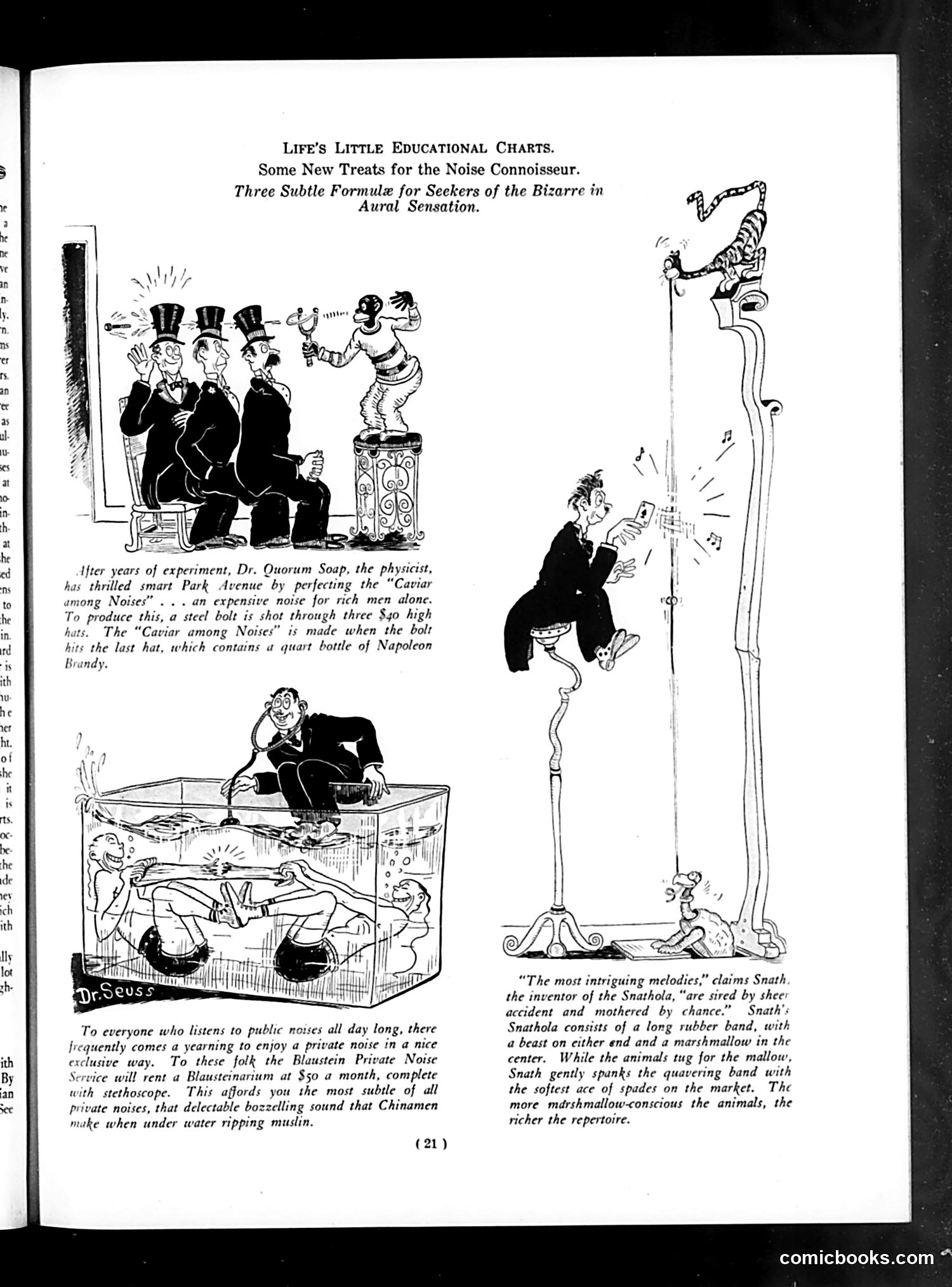
Life Magazine Satire: "Treats for the Noise Connoisseur" This is early-20th-century satirical commentary on wealthy Manhattan's absurd consumption habits. The page mocks the rich through three invented "noise services": 1. Dr. Quorum Soap's "Caviar among Noises": A physicist creates an expensive, exclusive sound for the wealthy elite—a steel bolt shot through three expensive hats containing Napoleon Brandy. The satire: wealthy people will pay for anything if it's exclusive and expensive, even mere noise. 2. Snath's Snathola: An absurd musical device using a rubber band, animals, and a marshmallow, played with a spade. The joke mocks pretentious claims about art's "accidental" origins. 3. Blaustein Private Noise Service: For $50/month, wealthy noise-lovers can rent a stethoscope to hear the "delectable bozzelling sound" of Chinese workers underwater ripping muslin. The satire targets Park Avenue's obsessive consumption, conspicuous spending, and the commercialization of even the most trivial experiences into luxury commodities.
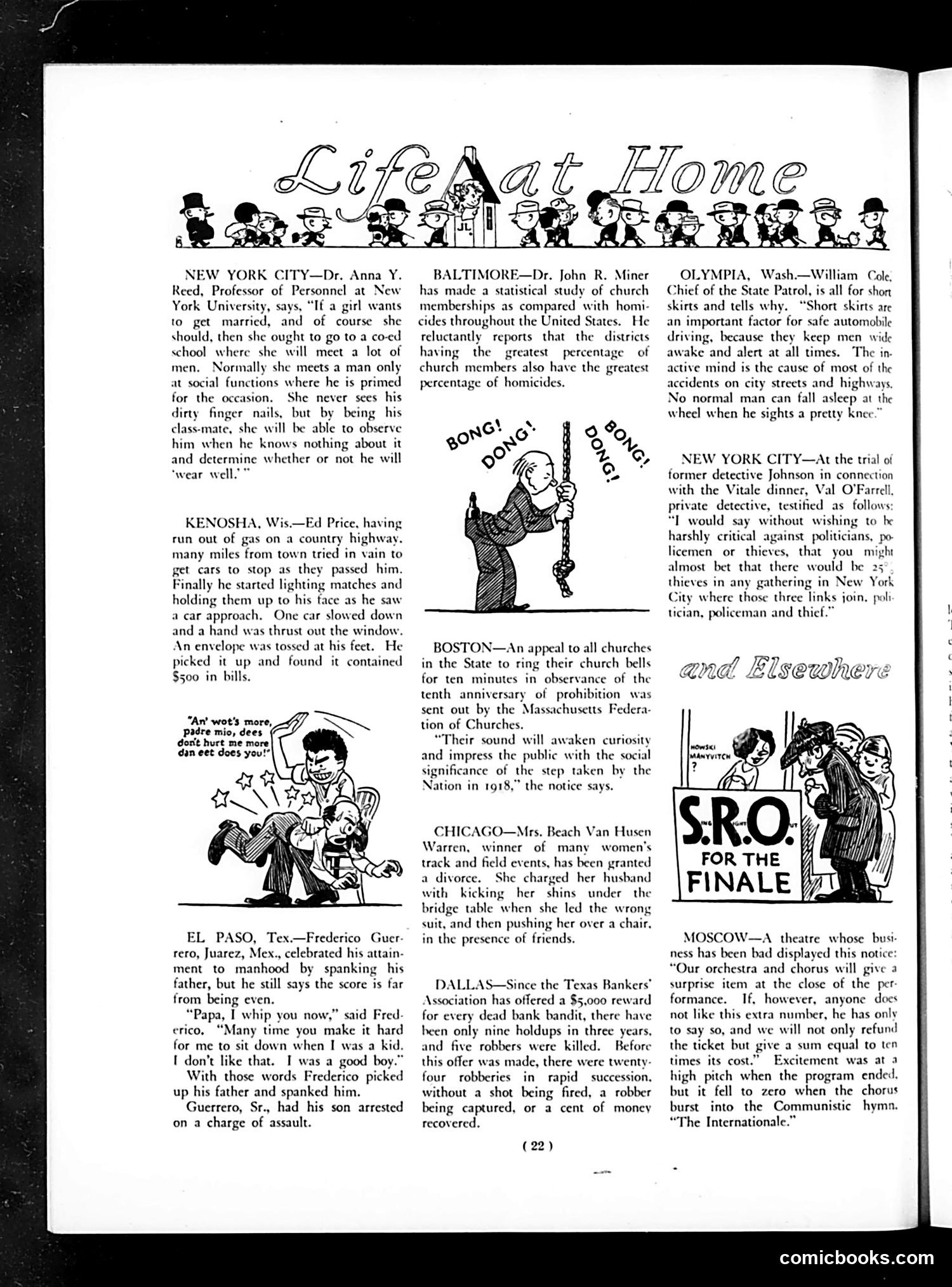
"Life at Home" Page Analysis This page from *Life* magazine is a humor column collecting brief, absurd anecdotal stories from around America and abroad. The cartoons and items satirize American social attitudes of the 1920s-1930s. Key satire points: The opening item mocks courtship advice—a professor recommends co-ed schools so women can observe men "when he knows nothing about it," reducing marriage compatibility to surveillance. A large cartoon depicts a man spanking his father (from the El Paso story), inverting traditional discipline hierarchies for comic effect. The pieces collectively ridicule: gender relations (the bridge-table divorce over shin-kicking; short skirts as driver safety), American optimism (the $500 charity envelope), religious hypocrisy (churches with high membership *and* homicide rates), Prohibition-era sentimentality, and political corruption (the final item suggesting politicians, police, and thieves are indistinguishable). The Moscow theater notice provides sardonic foreign commentary on artistic decline under changed circumstances.
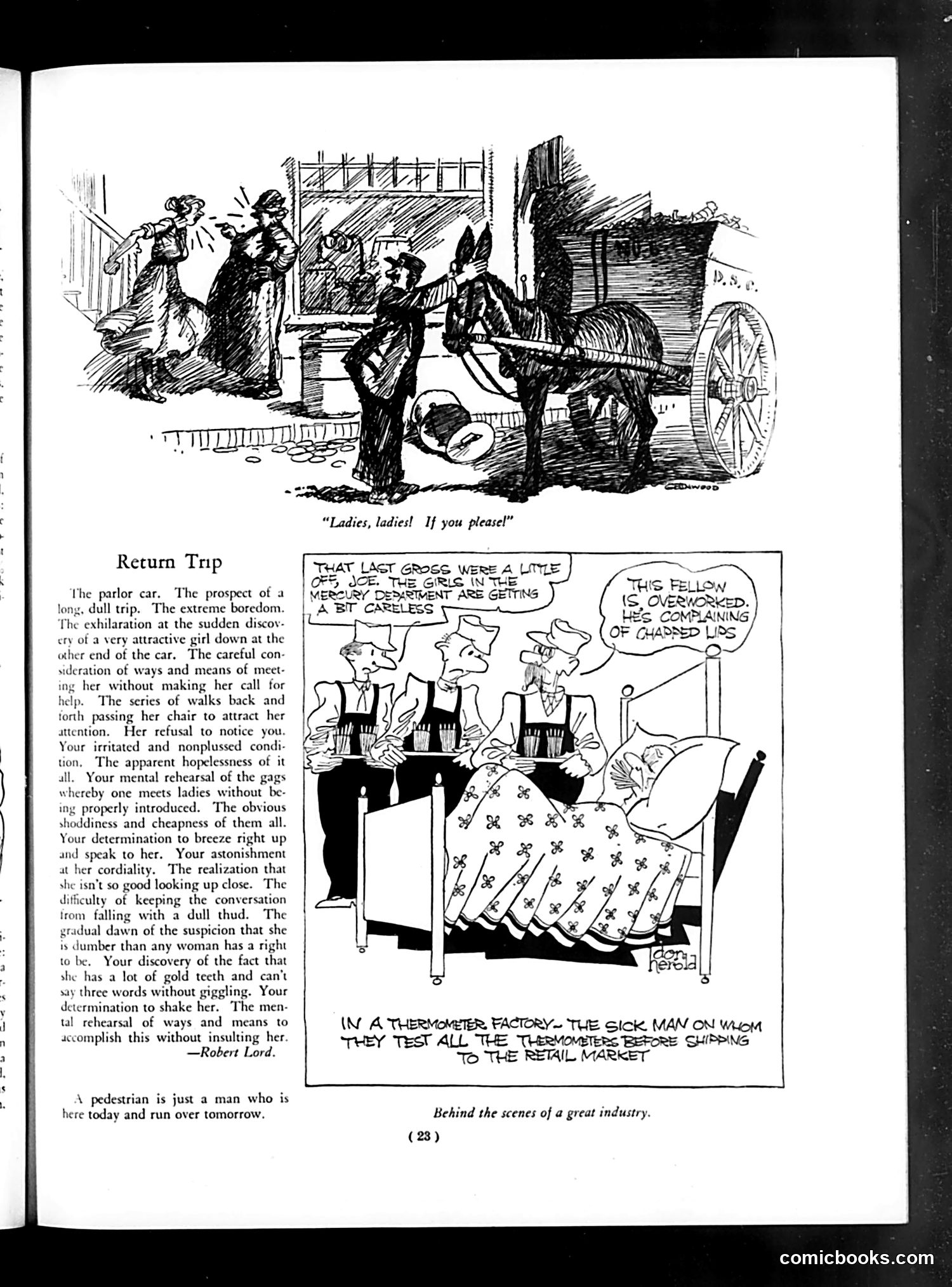
"Return Trip" - Life Magazine Satire This page contains two distinct satirical pieces about social awkwardness and industrial processes. The upper cartoon humorously depicts the failed romantic encounter on a train—a gentleman's futile attempts to meet an attractive woman, his growing realization of her actual unattractiveness ("gold teeth," dimness, giggling), and his desperate exit strategy. Robert Lord's accompanying text mirrors this arc, chronicling male fantasy versus disappointing reality in courtship. The lower cartoon mocks factory quality control, specifically thermometer manufacturing. Three factory workers discuss a "sick man" being tested as a thermometer before retail sale—a darkly absurd image suggesting workers are so careless they're literally using a human as a quality-control device. The caption "Behind the scenes of a great industry" delivers the ironic punchline. Both pieces exemplify *Life* magazine's satirical style: exposing human vanity, romantic delusion, and industrial negligence through comic exaggeration.
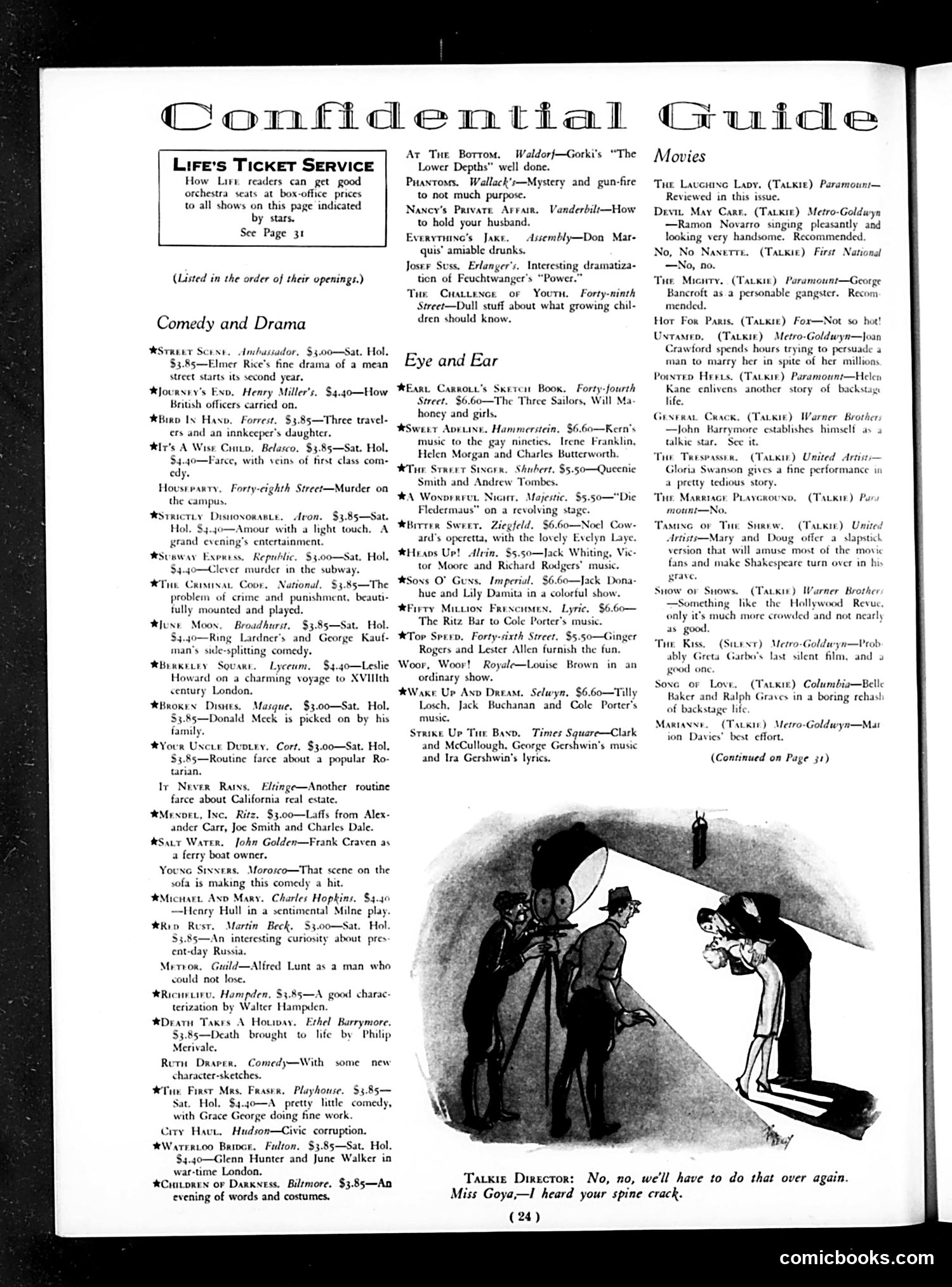
Cartoon Analysis The cartoon depicts a scene between a "Talkie Director" (sound film director) and what appears to be an actress or performer named "Miss Goya." The director, drawn in exaggerated theatrical style with top hat and formal dress, is shown recoiling or gesturing emphatically while saying "No, no, we'll have to do that over again. Miss Goya—I heard your spine crack." The joke: This satirizes the early "talkie" (sound film) era's obsession with perfect audio recording. The director is so focused on capturing pristine sound that he can literally "hear" the actress's physical movements—even her spine cracking—through the sensitive microphones. The context: By the late 1920s, silent films were being replaced by sound pictures, which required actors to remain relatively still to avoid microphone noise. The cartoon mocks both the technical fragility of early sound recording and directors' neurotic demands for absolute silence and stillness during takes. This page is primarily a theater/entertainment guide from Life magazine, with one satirical cartoon commenting on contemporary film industry anxieties.
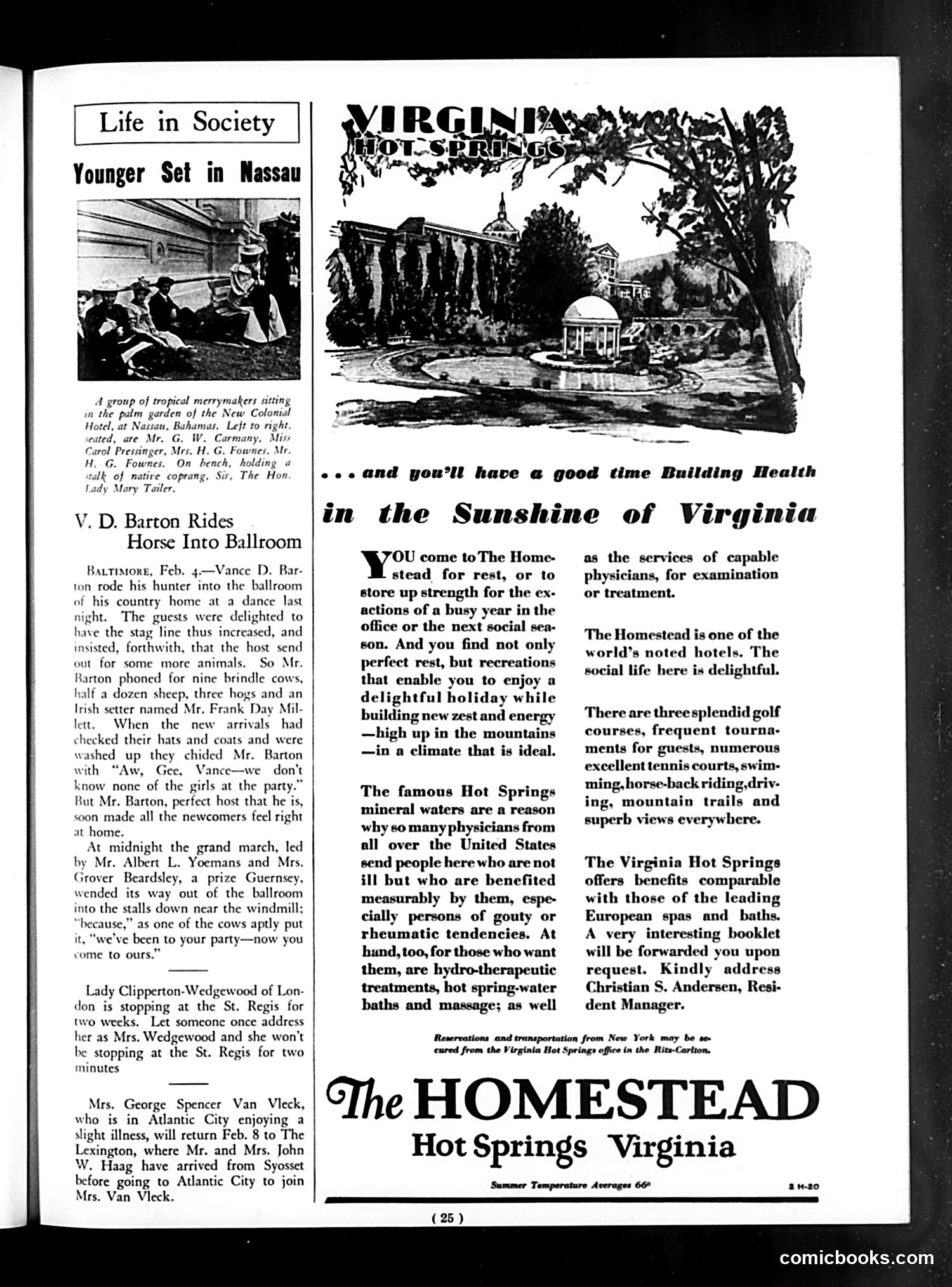
"V.D. Barton Rides Horse Into Ballroom" This is a humorous anecdote—not political satire—mocking the absurd behavior of wealthy socialites. The joke: a Baltimore gentleman named Vance D. Barton rides his horse into his ballroom during a dance. When guests compliment this stunt, he takes it literally and phones for nine cows, sheep, hogs, and a setter to join the party. The animals "complain" they don't know any girls, so Barton escorts them to the stables instead. The satire targets the frivolous, eccentric behavior of the upper class during the Jazz Age—their willingness to disrupt normal social conventions for amusement. The anthropomorphized animals serve as comedic devices exposing how absurd both the host's behavior and guests' enabling of it are. It's gentle mockery of wealthy leisure culture and its lack of restraint. The rest of the page is social gossip and a resort advertisement, not satire.
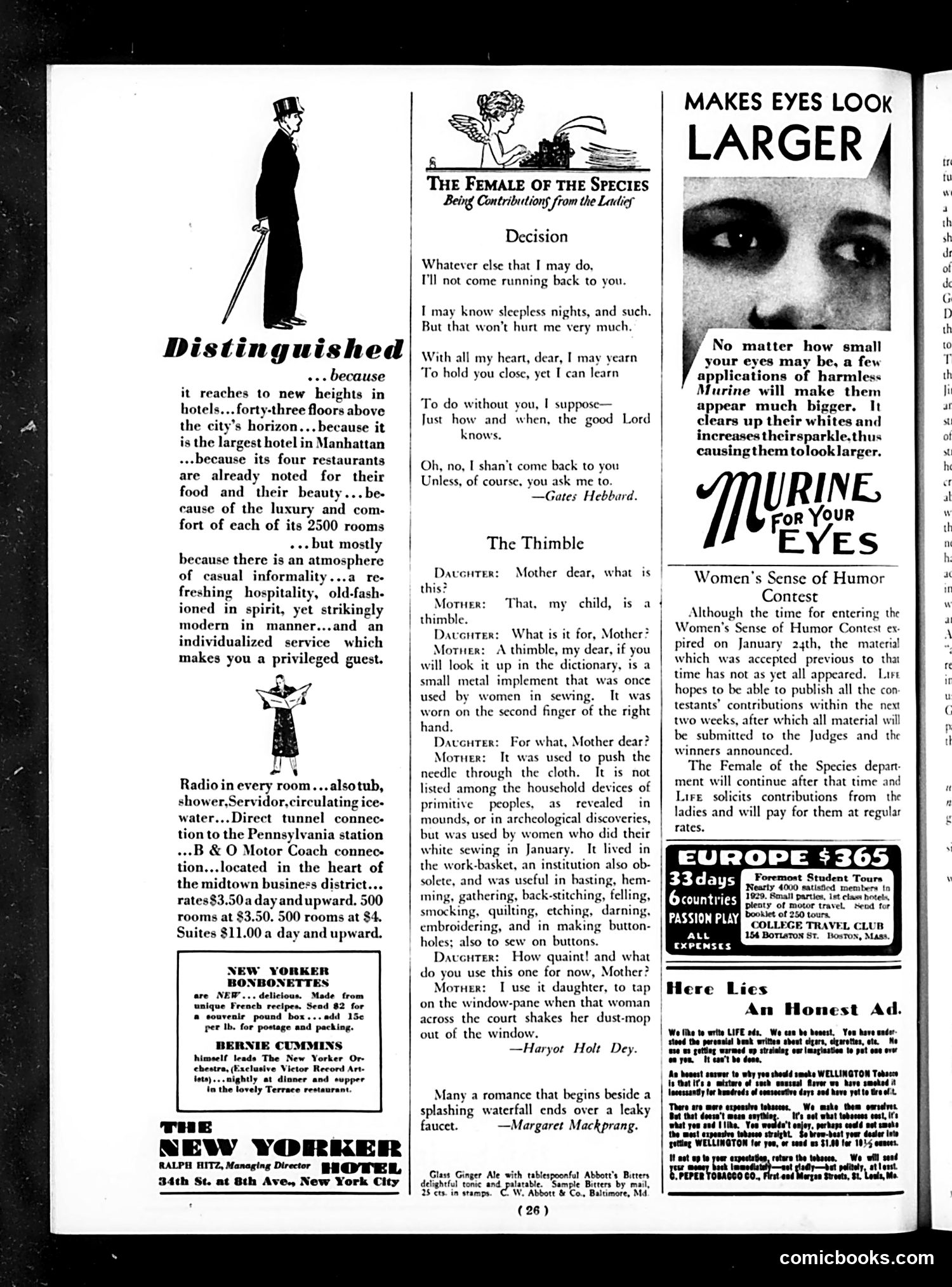
Page Analysis: Life Magazine Satirical Content This page combines advertising with humor contributions. The left side advertises the New Yorker Hotel, emphasizing its modernity and size—"the largest hotel in Manhattan." The center features "The Female of the Species," a humor section where women contributors submit work. The "Decision" poem humorously portrays a woman rejecting a man's advances with emotional independence—a notable satirical stance for the era, mocking both romantic melodrama and traditional female dependency. "The Thimble" dialogue lampoons outdated domesticity: a mother explains this sewing tool to her daughter, cataloguing forgotten needlework skills (hemming, quilting, darning), only to reveal she now uses it to tap on windows—a comic deflation of women's traditional domestic expertise rendered absurd and useless in modern life. The right side advertises Murine eye drops, promising to make eyes "appear much bigger"—typical early cosmetic marketing aimed at women's insecurity. Overall, the page satirizes both modern commercialism and the displacement of traditional "women's work" in contemporary society.
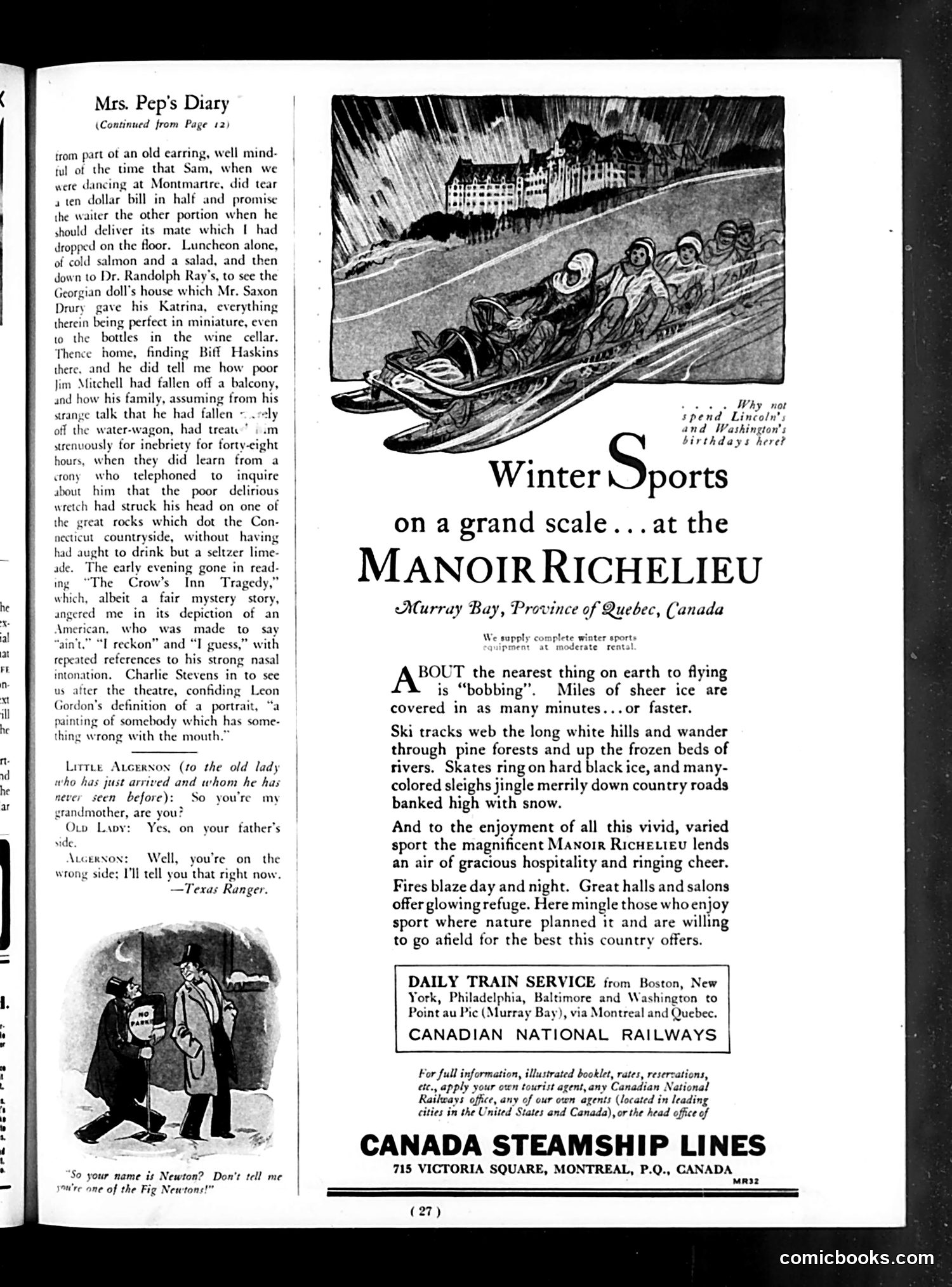
Content Analysis This page combines humor and advertising from *Life* magazine. "Mrs. Pep's Diary" (top left) is a satirical society column featuring social gossip and witty anecdotes. The recurring humor involves upper-class affectation and mishaps—particularly the story of Jim Mitchell, whose family mistakenly assumed his delirious state resulted from drunkenness ("fallen off the water-wagon"), when he'd actually suffered a head injury. The column mocks both the family's quick judgment and literary depictions of Americans using exaggerated dialect ("ain't," "I reckon"). The cartoon at bottom left shows a small boy greeting an elderly woman, confusing her identity—he assumes she's "one of the Fig Newtons," a cookie brand. The joke plays on homonymic confusion between the surname "Newton" and the commercial product. The right half is a travel advertisement for Manoir Richelieu, a Canadian resort promoting winter sports (skiing, skating, sledding). The illustrated bobsled image and descriptive text emphasize luxury hospitality and accessible winter recreation near Montreal and Quebec. The page blends period-appropriate satire of wealthy American society with commercial promotion targeting affluent leisure travelers.
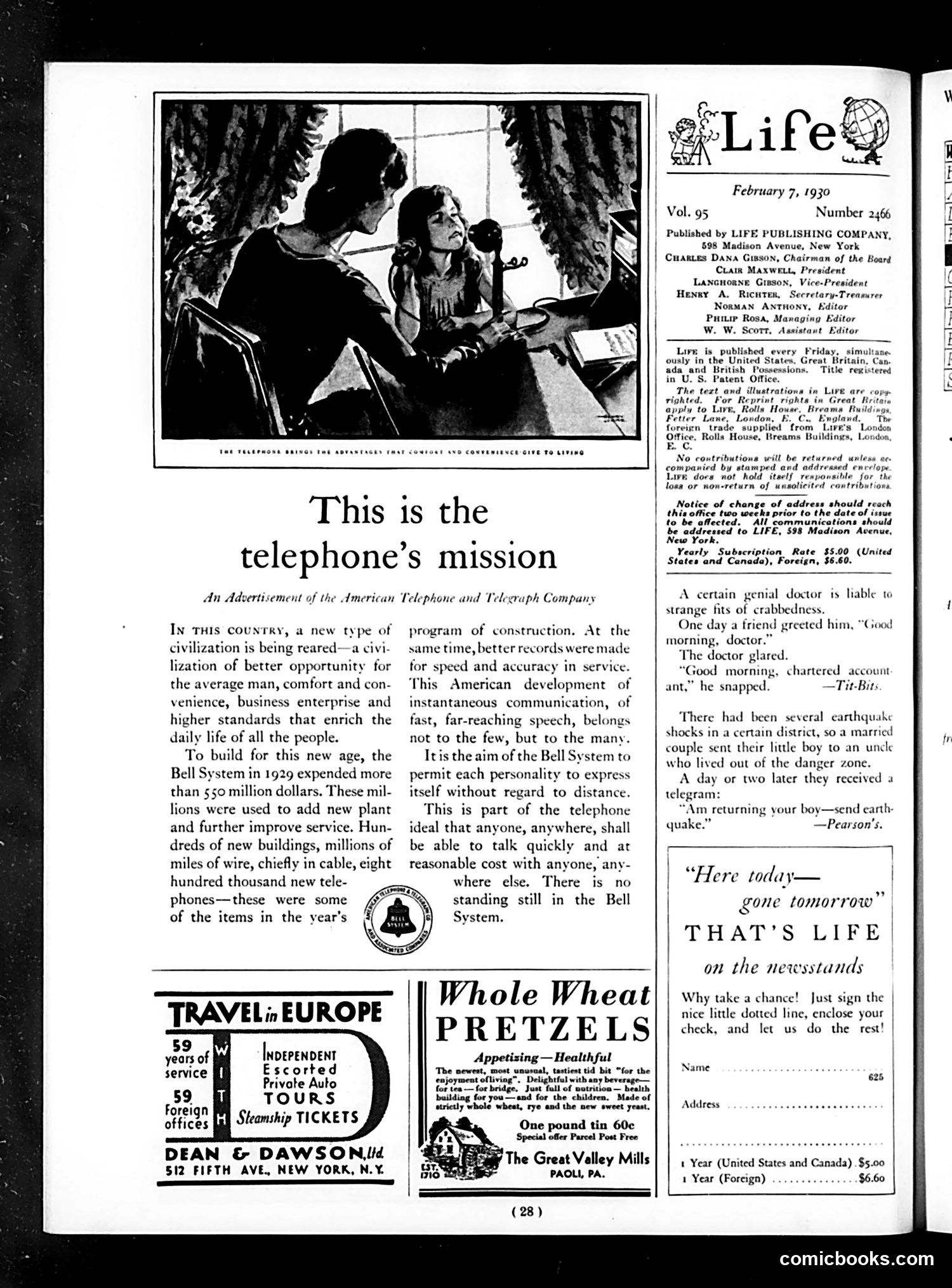
"This is the Telephone's Mission" This page is primarily a Bell System advertisement dressed as editorial content. The large photograph shows people using telephones, illustrating the ad's central message: that the telephone brings civilization, opportunity, and convenience to ordinary Americans. The text celebrates Bell's 1929 expenditure of $550 million on infrastructure—new buildings, cables, and 800,000 new phones—framing telephone service as democratizing technology available "not to the few, but to the many." The pitch emphasizes that anyone, anywhere can now communicate affordably and quickly, promoting telephone service as essential to modern American progress and daily life. The accompanying advertisements (travel services, pretzels, subscription offers) are typical magazine filler from this era. The humorous anecdotes in the right column are unrelated to the main advertisement.
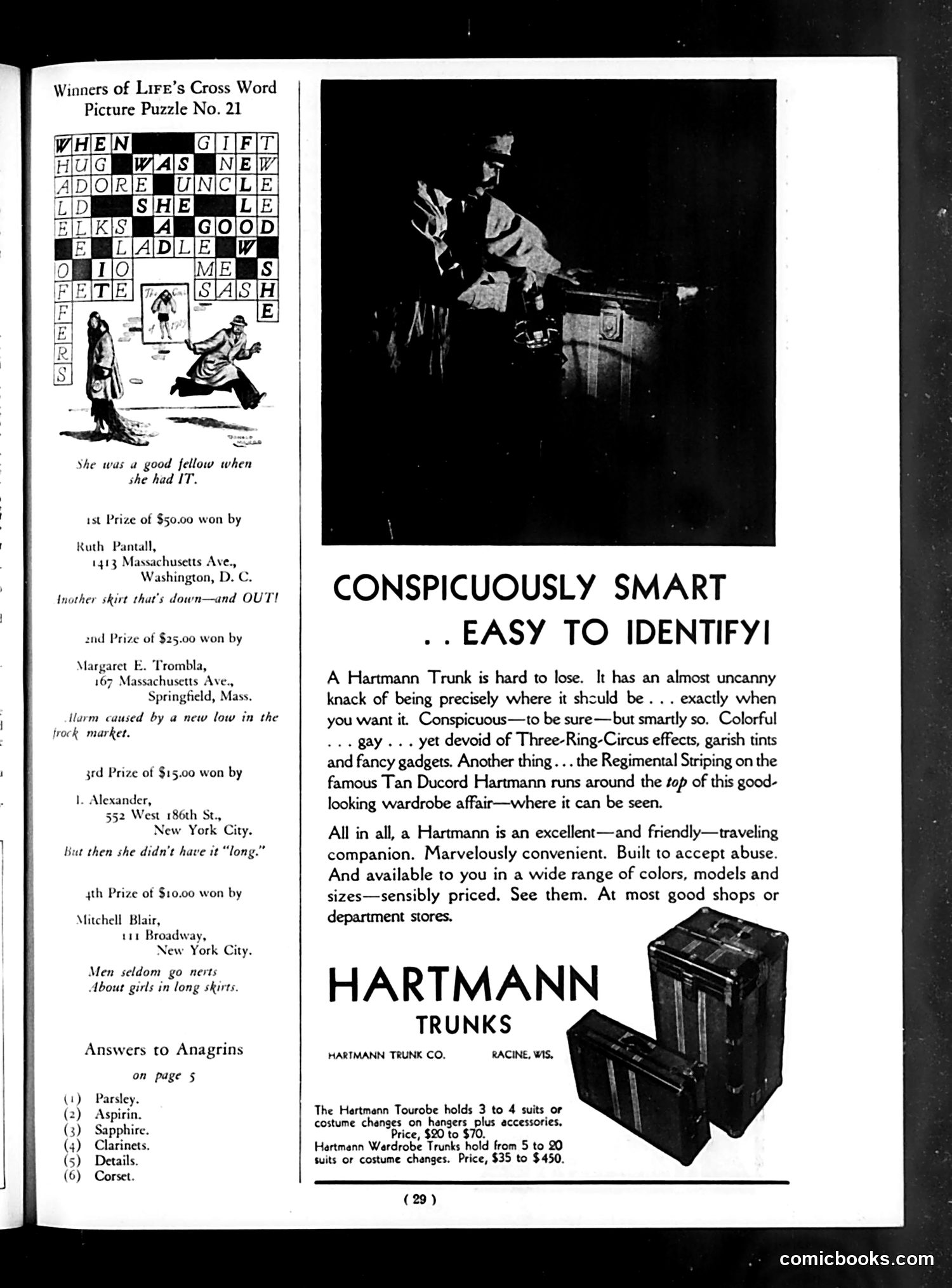
Life Magazine Page Analysis This page combines a crossword puzzle contest with advertising. The left side shows Life's "Cross Word Picture Puzzle No. 21" with winners announced. The cartoon illustrates the puzzle's theme: a woman in a short skirt, with captions like "She was a good fellow when she had IT" and "Another skirt that's down—and OUT!" The humor references the 1920s fashion trend of women wearing progressively shorter hemlines—a significant social change that scandalized conservatives. The joke suggests women with short skirts were more fun-loving ("good fellows"), while the phrase "down and out" puns on both falling hemlines and social impropriety. The right side is a Hartmann Trunk advertisement exploiting the same 1920s context: travelers (particularly women with modern wardrobes) need conspicuous, colorful luggage for their expanded clothing needs—implied to include those controversial short skirts.
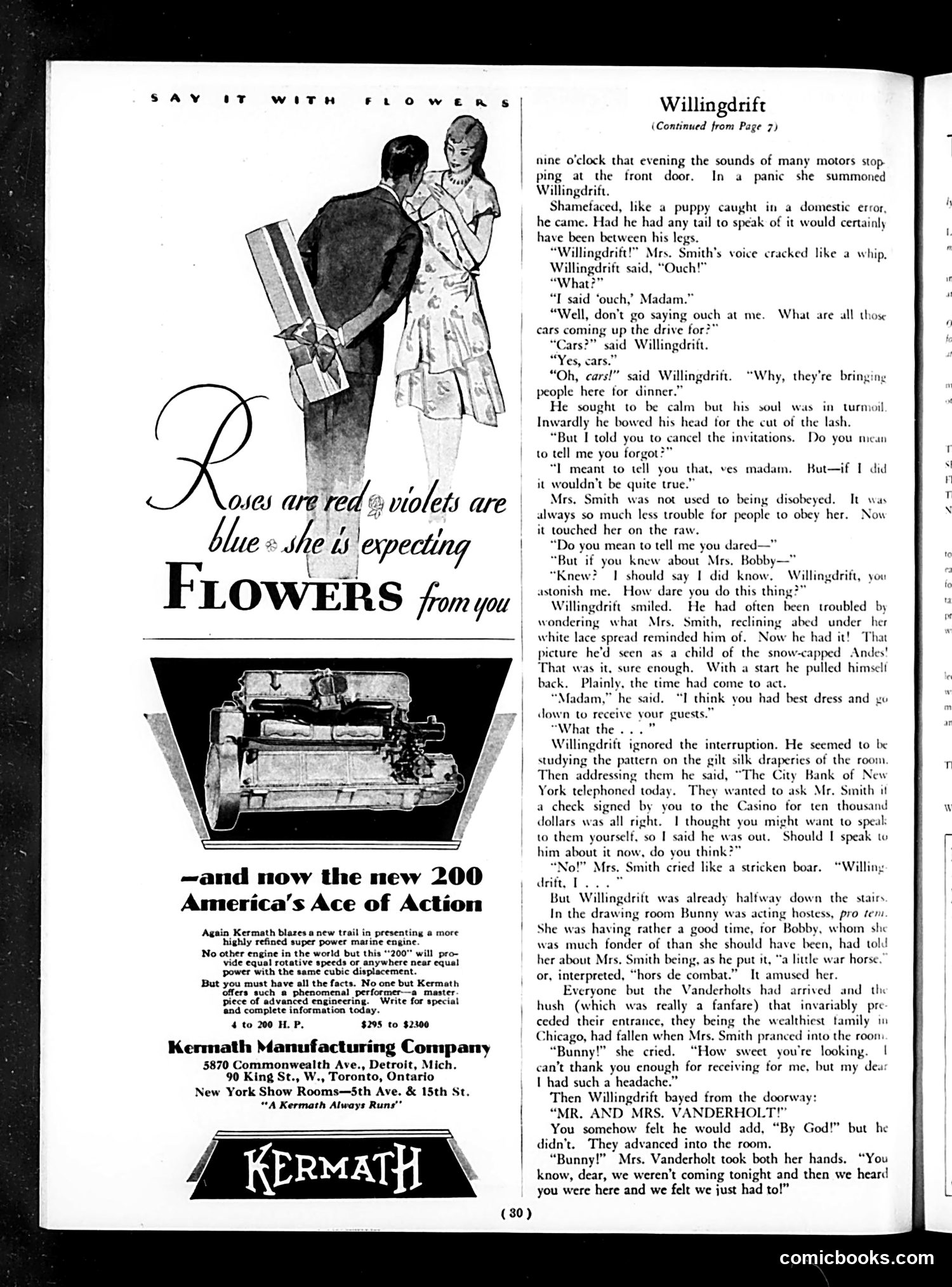
Page Analysis This page contains two distinct elements: Left side: A flower delivery advertisement for Kermath marine engines, using the romantic verse "Roses are red, violets are blue, she is expecting flowers from you" to pitch the new Model 200 engine to male readers. The ad targets masculine consumers by framing gift-giving as masculine action and "power." Right side: Continuation of a short story titled "Willingdrift" about a servant who blackmails his employer, Mrs. Smith. The plot involves Willingdrift canceling dinner invitations against orders, then threatening to reveal that Mrs. Smith fraudulently signed a check to the Casino (a gambling establishment) unless she obeys him. The servant uses knowledge of her financial misconduct as leverage to assert control over his typically domineering employer. The juxtaposition is typical of Life magazine's format: literary fiction alongside period advertising. The story satirizes class dynamics and domestic power structures of the era.
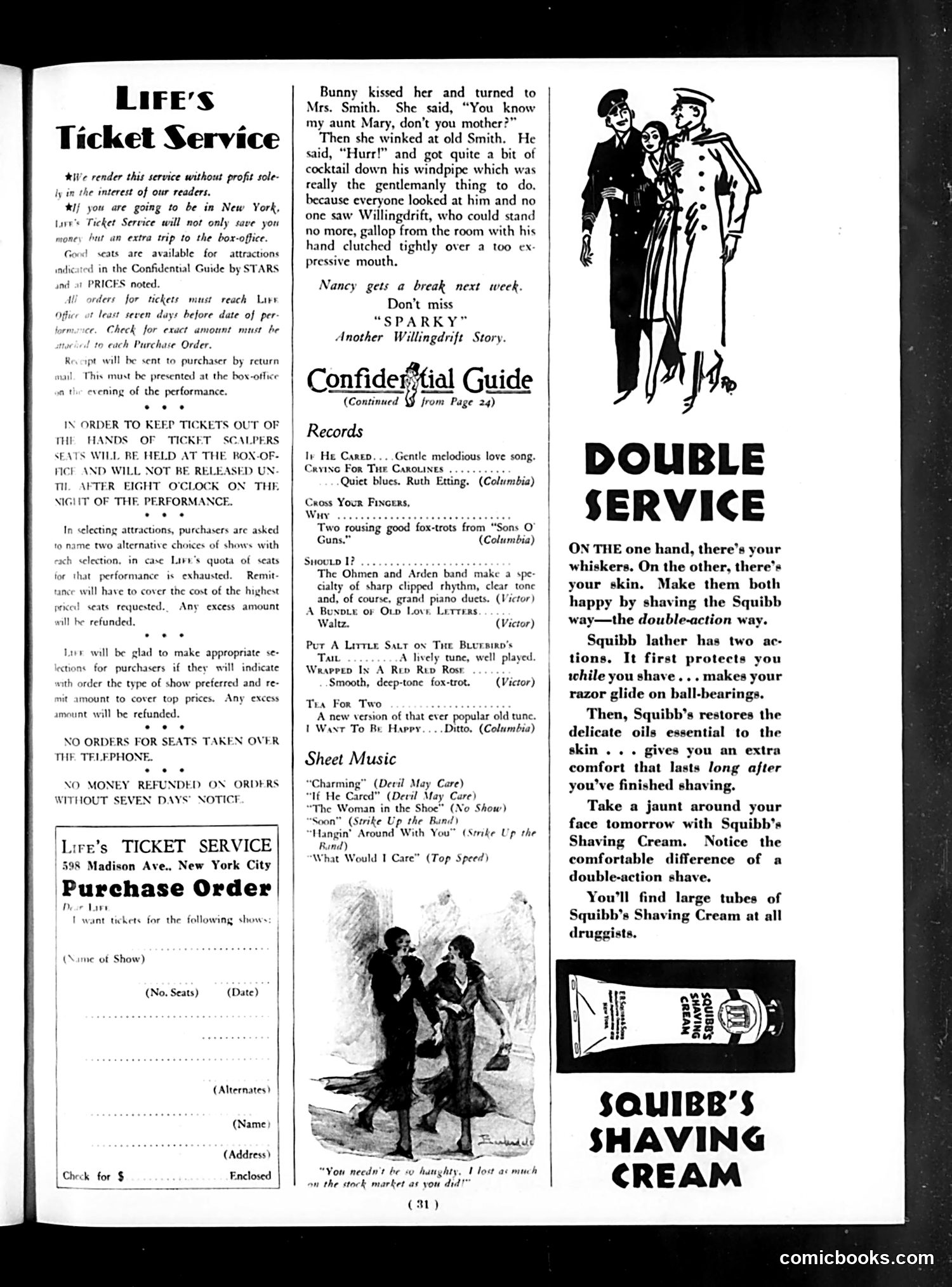
Analysis of This Life Magazine Page This page is primarily practical service and advertising content rather than political satire. The main elements are: 1. Life's Ticket Service (left column): A genuine subscription service offering Broadway theater tickets by mail to readers, with detailed ordering instructions and a purchase order form. 2. "Confidential Guide" continuation: A brief story snippet about characters named Bunny, Mrs. Smith, and Willingdrift—a domestic comedy involving a woman winking at an older man, causing him to choke on his cocktail. This appears to be serialized fiction rather than satire. 3. Records and Sheet Music listings: Contemporary 1920s-era popular music recommendations. 4. Squibb Shaving Cream advertisement (right): A full-page ad using the "double-action" concept—lather protects skin while shaving, then cream restores oils afterward. The single cartoon shows two men and a woman in 1920s attire with a caption about stock market losses, a light joke referencing the era's financial speculation. This is primarily a service/entertainment/advertising page rather than political commentary.
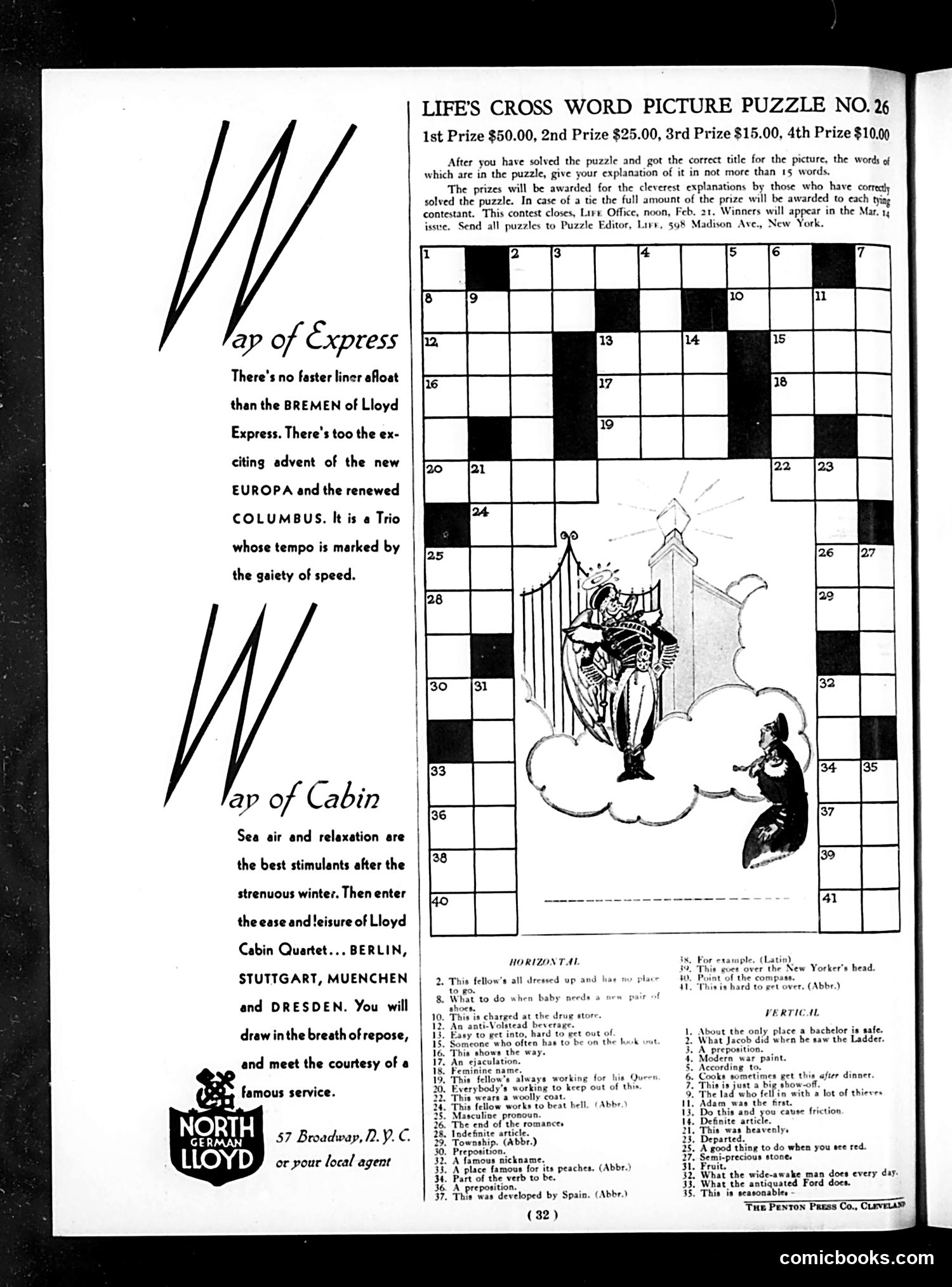
Analysis of Life Magazine Page No. 26 This page contains primarily advertising and a crossword puzzle contest, not political satire. The advertisements promote German ocean liners (Bremen, Europa, Columbus) operated by North German Lloyd—emphasizing speed and luxury travel. A second ad highlights cabin accommodations on ships named Berlin, Stuttgart, Munich, and Dresden. The main content is Life's crossword picture puzzle #26, a competition offering cash prizes ($50 first place) for solving a rebus-style puzzle and providing a brief explanation (max 15 words). The puzzle illustration depicts a figure on clouds interacting with another figure below, though the specific meaning requires solving the crossword itself. The clues reference contemporary topics: Prohibition ("anti-Volstead beverage"), automobiles, and period slang—typical of 1920s-30s Life magazine content. This is essentially a puzzle game page, not editorial commentary.
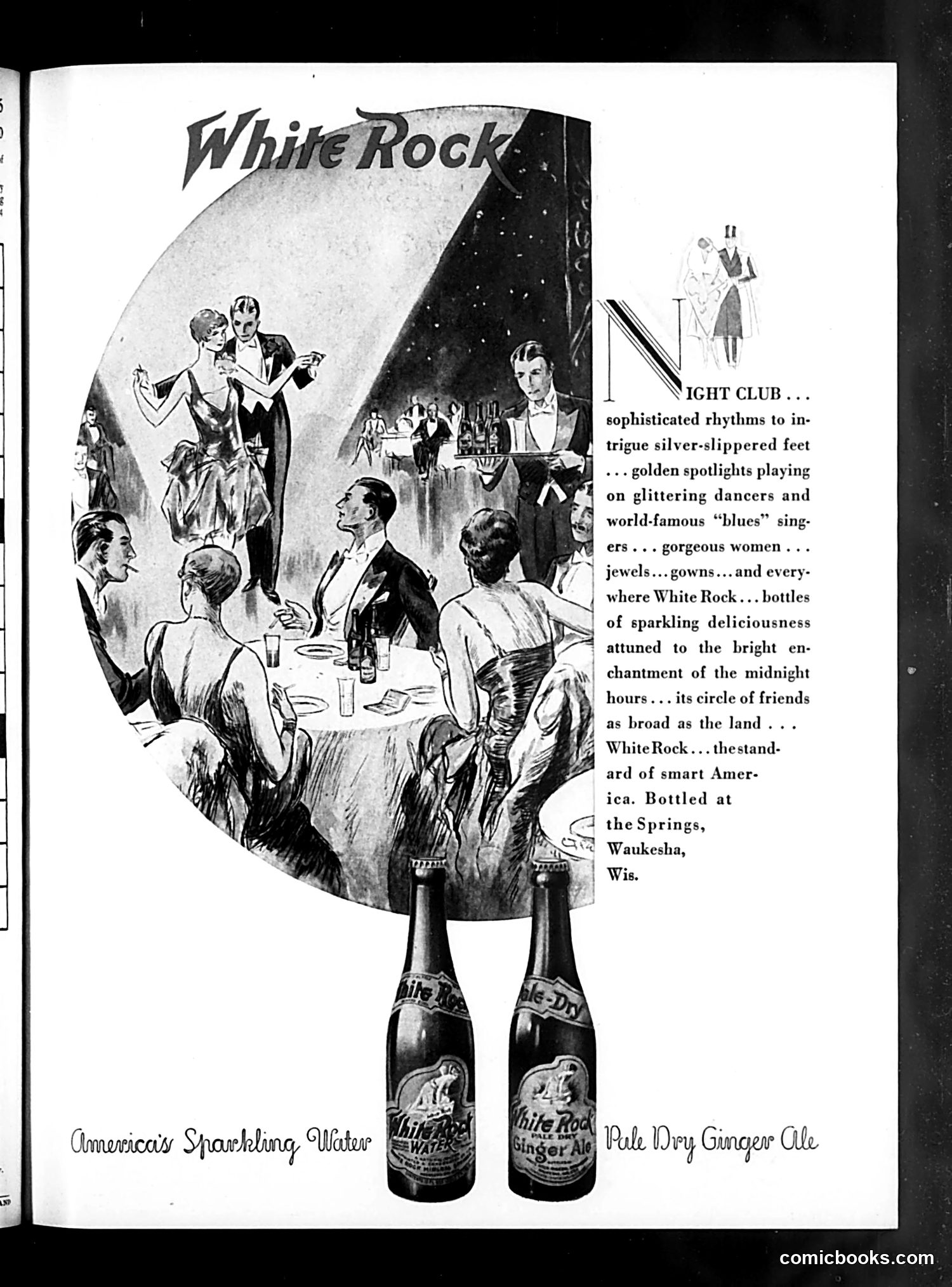
Analysis This is a full-page advertisement, not political satire. It promotes White Rock beverages (sparkling water and ginger ale) bottled in Waukesha, Wisconsin. The illustration depicts a glamorous 1920s nightclub scene—the "Jazz Age"—showing well-dressed patrons dining and dancing under spotlights. The imagery associates White Rock with sophistication, luxury, and fashionable entertainment: "gorgeous women," "jewels," "gowns," "blues singers," and "glittering dancers." The text emphasizes that White Rock is "the standard of smart America," positioning the product as essential to elegant nightlife. The two bottles at the bottom anchor the aspirational messaging. Context for modern readers: This reflects Prohibition-era advertising (1920s-early 1930s), when alcohol was banned. Non-alcoholic beverages like ginger ale and sparkling water were marketed with the glamour typically associated with cocktail culture, allowing advertisers to suggest sophistication without selling actual alcohol.
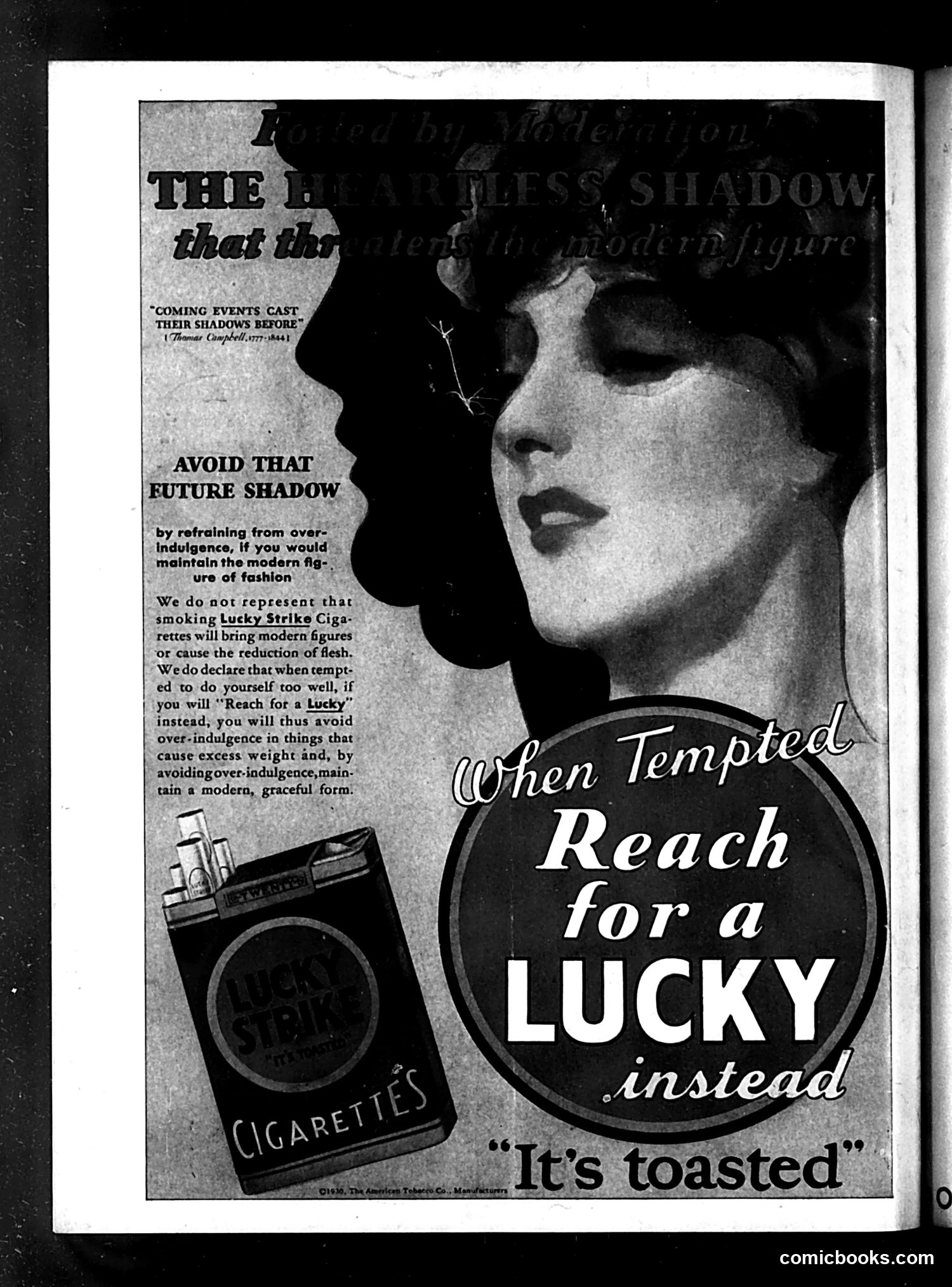
Analysis This is a Lucky Strike cigarette advertisement, not political satire. The page uses a cautionary message about weight and modernity to sell cigarettes. The ad features a woman's silhouette profile with the headline "Avoid That Future Shadow"—warning against becoming heavy. The pitch: instead of indulging in food, "reach for a Lucky" cigarette instead. This positions smoking as appetite suppression and a tool for maintaining the fashionable, slim "modern figure." The quote at top ("Coming events cast their shadows before") frames weight gain as an avoidable future consequence of overeating. For modern readers: This represents a starkly different advertising era when cigarettes were marketed with health-adjacent claims (appetite control, figure maintenance) rather than warnings. The casual suggestion that smoking prevents overeating would be unthinkable in contemporary advertising.