life
Life — February 14, 1930
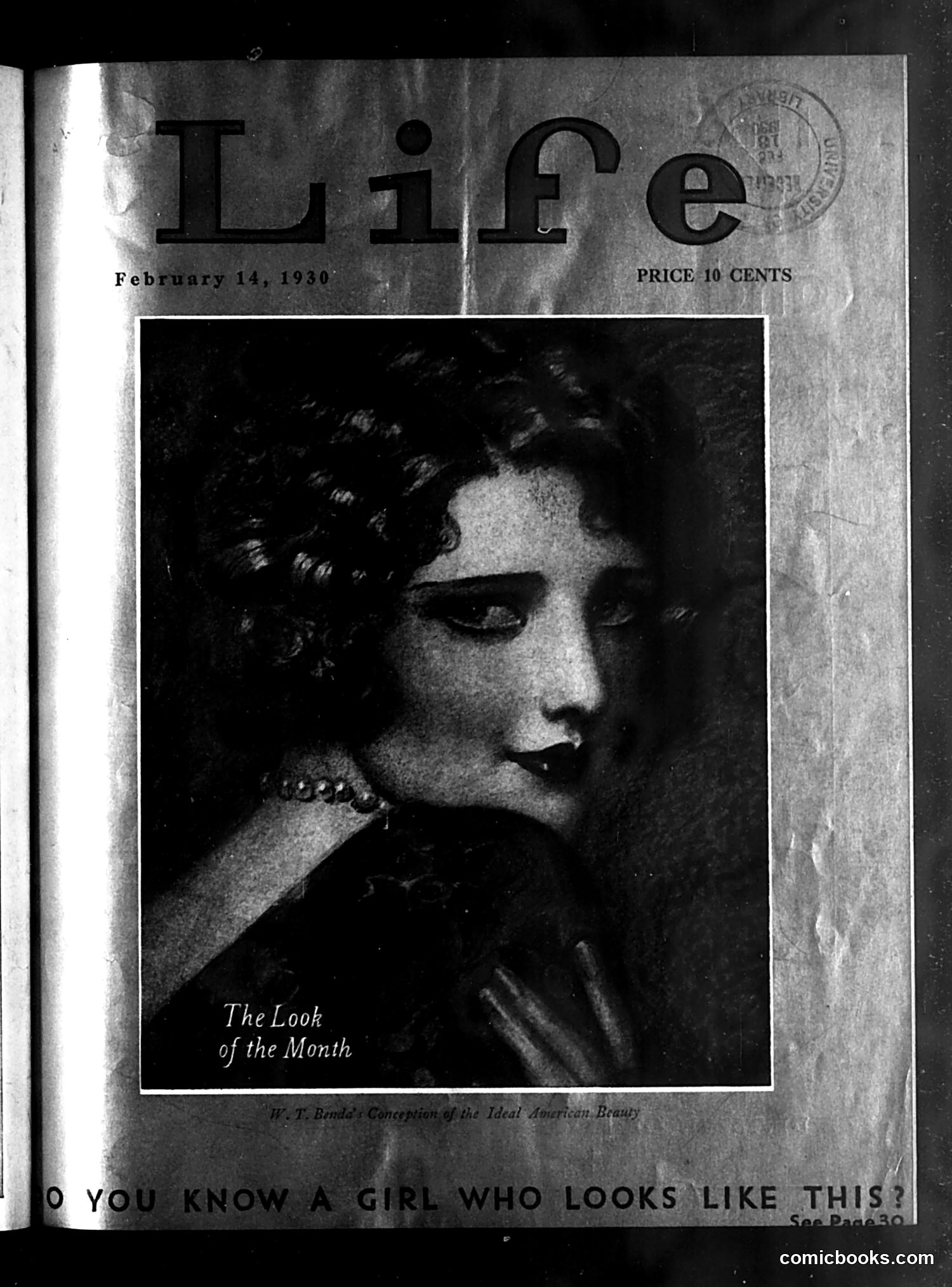
Life Magazine, February 14, 1930 This is a cover featuring a portrait labeled "The Look of the Month" credited to "W. T. Benda: Conception of the Ideal American Beauty." The image shows a woman in profile with 1920s-style finger waves and what appears to be pearl jewelry, exemplifying the fashionable aesthetic of that era. The headline "DO YOU KNOW A GIRL WHO LOOKS LIKE THIS?" suggests this represents the contemporary ideal of feminine beauty—likely reflecting both advertising conventions and social expectations of the period. Rather than political satire, this appears to be a lifestyle/fashion-focused magazine cover typical of Life's content in 1930, priced at 10 cents. The "satire" may lie in Life's characteristic gentle mockery of beauty standards and modern consumer culture.
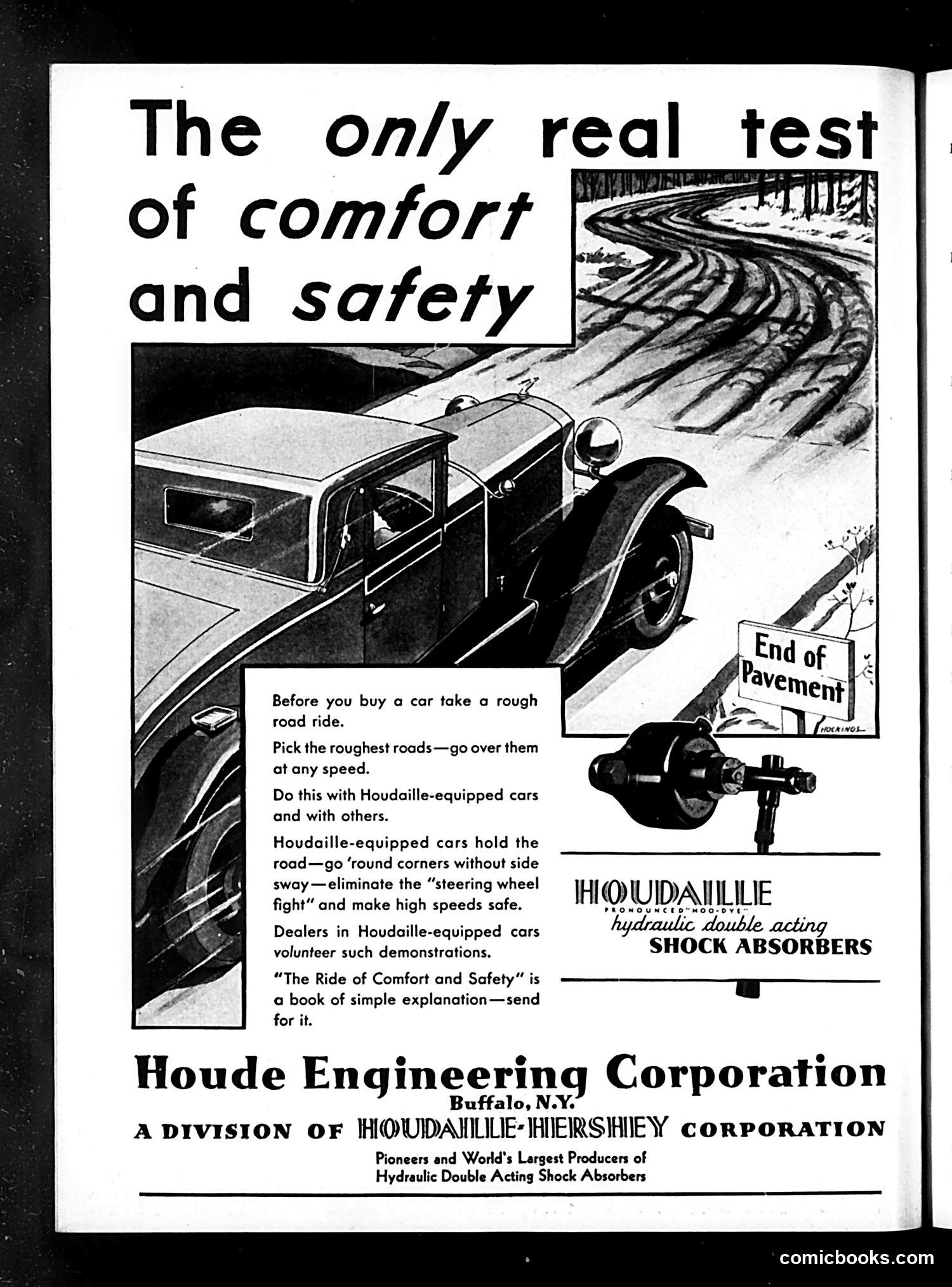
Analysis This is not a cartoon or satire page — it's a straightforward advertisement for Houdaille shock absorbers, a real automotive component. The ad uses a demonstration concept to advertise product superiority: it shows a car on a rough, rutted road (marked "End of Pavement"), claiming that Houdaille-equipped vehicles can safely navigate poor road conditions at high speeds because their hydraulic shock absorbers eliminate steering wheel vibration and improve handling on rough terrain. The text invites potential buyers to test-drive rough roads themselves and suggests dealers would volunteer such demonstrations. A technical diagram of the shock absorber appears at bottom right. This represents early automotive advertising emphasizing suspension technology as a safety and comfort feature — a practical sales pitch rather than satire.
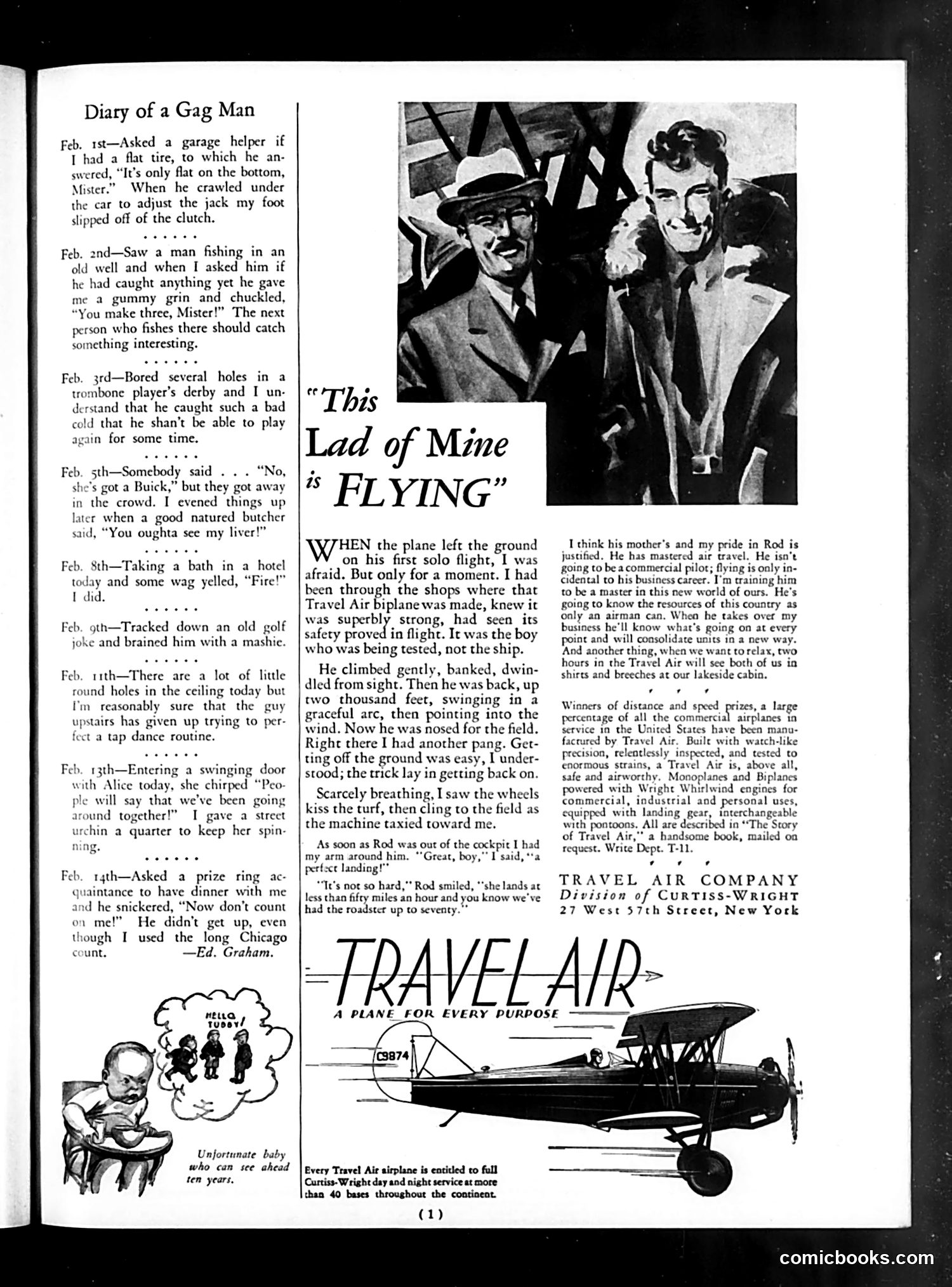
Analysis of This Page from Life Magazine This page combines humor with aviation advertising from the early commercial aviation era (likely 1920s-30s based on the aircraft design). "Diary of a Gag Man" (left column) is a humor column featuring brief comedic anecdotes—flat tires, fishing mishaps, musical instrument damage—typical of Life's light satirical content. "This Lad of Mine is FLYING" (center/right) celebrates a young pilot's first solo flight. The narrative emphasizes the pride and anxiety of parents witnessing aviation as an emerging commercial industry. The Travel Air advertisement below promotes commercial aircraft as practical business tools, claiming widespread service across the continent. The overall page reflects 1920s-30s American culture: aviation's novelty as both thrilling and reassuring, parents' mixed emotions about technological progress, and corporate efforts to normalize air travel as routine transportation.
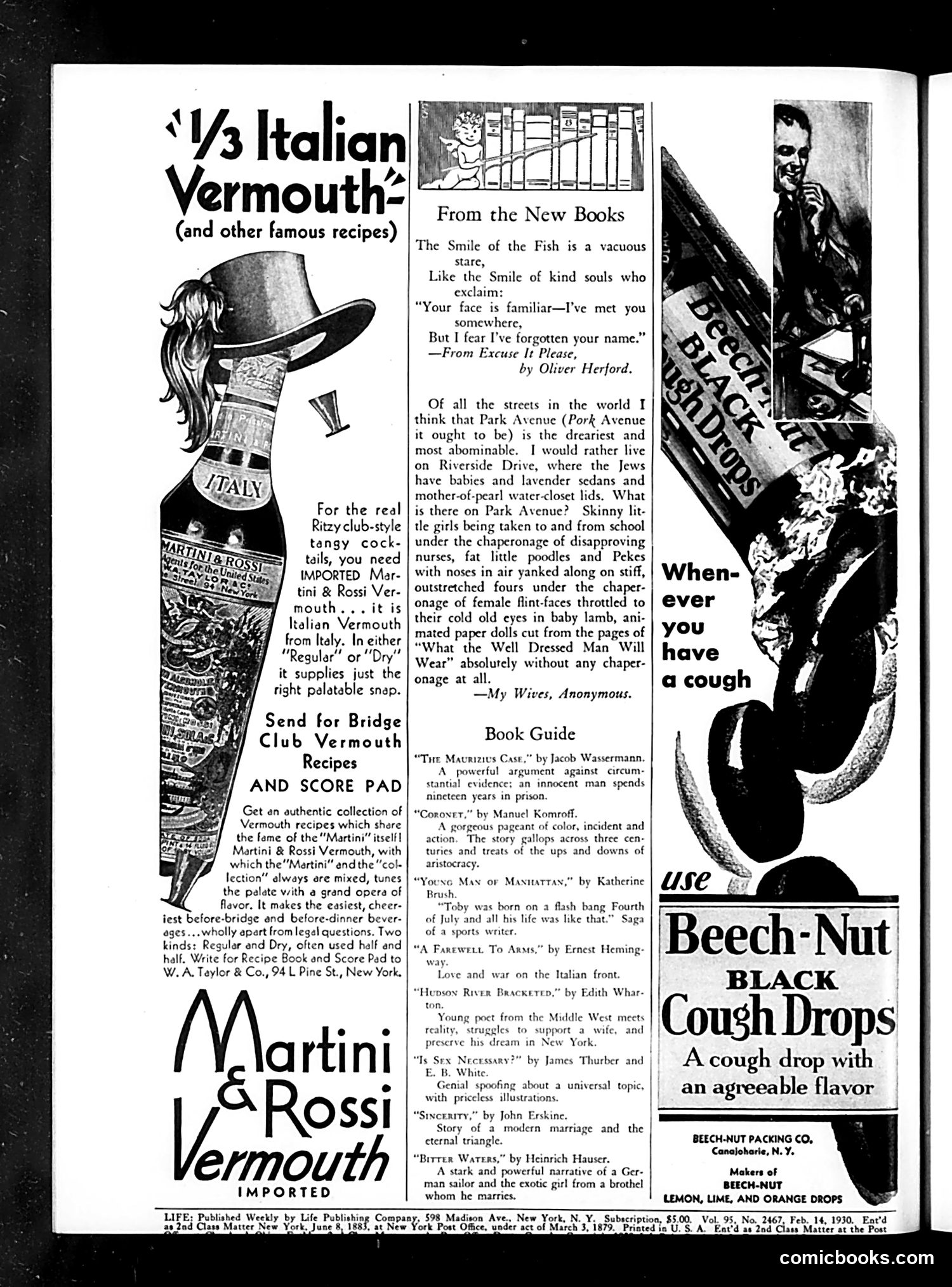
Analysis This page is primarily advertising, not political satire. The left side advertises Martini & Rossi Vermouth through a stylized bottle illustration labeled "ITALY," promoting Bridge Club cocktail recipes. The copy emphasizes the product's Italian authenticity and palatability for social gatherings. The center contains a "Book Guide" reviewing recent publications, including works by Oliver Herford and Katherine Brush—typical literary commentary for *Life* magazine's educated readership. The right side advertises Beech-Nut Black Cough Drops, featuring an illustration of someone coughing, with marketing copy emphasizing the product's "agreeable flavor." The page reflects 1930s consumer culture and advertising conventions. There is no political cartoon or satire present—it's a standard magazine page mixing product advertisements with book reviews.
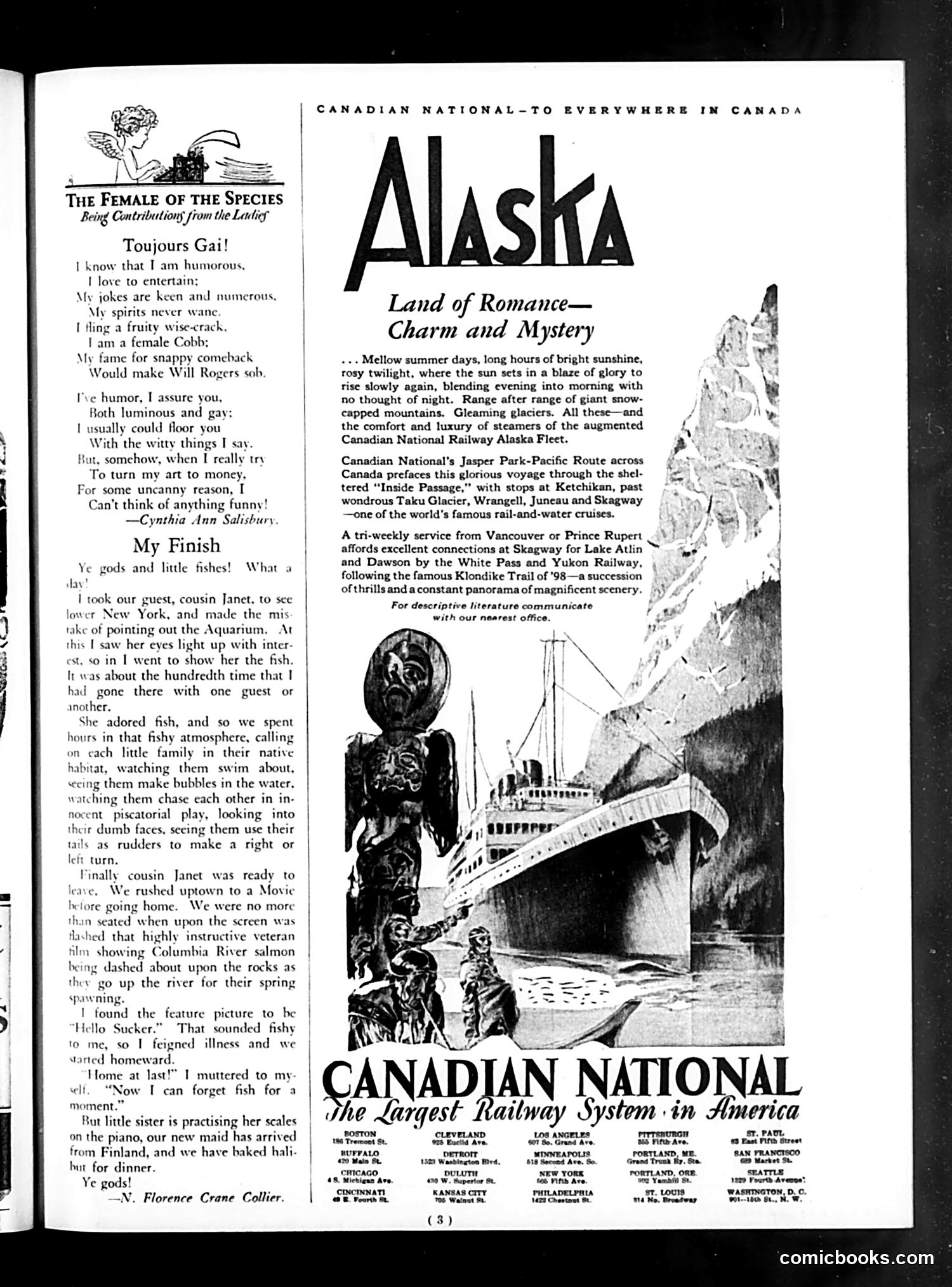
Page Analysis This page is primarily advertising, not satire or political commentary. The left column features "The Female of the Species," a humorous poem by Florence Crane Collier about a woman's wit and charm, ending with an anecdote about taking a guest to see fish and a movie ("Hello Sucker"). The dominant right side is a Canadian National Railway advertisement promoting Alaska travel. It depicts a steamship navigating mountains and glaciers, advertising the scenic "Inside Passage" route connecting Vancouver or Prince Rupert to Alaska, with connections via the White Pass and Yukon Railway. The advertisement emphasizes romance, mystery, and natural grandeur—typical early 20th-century travel marketing. There is no political cartoon or satirical content on this page.
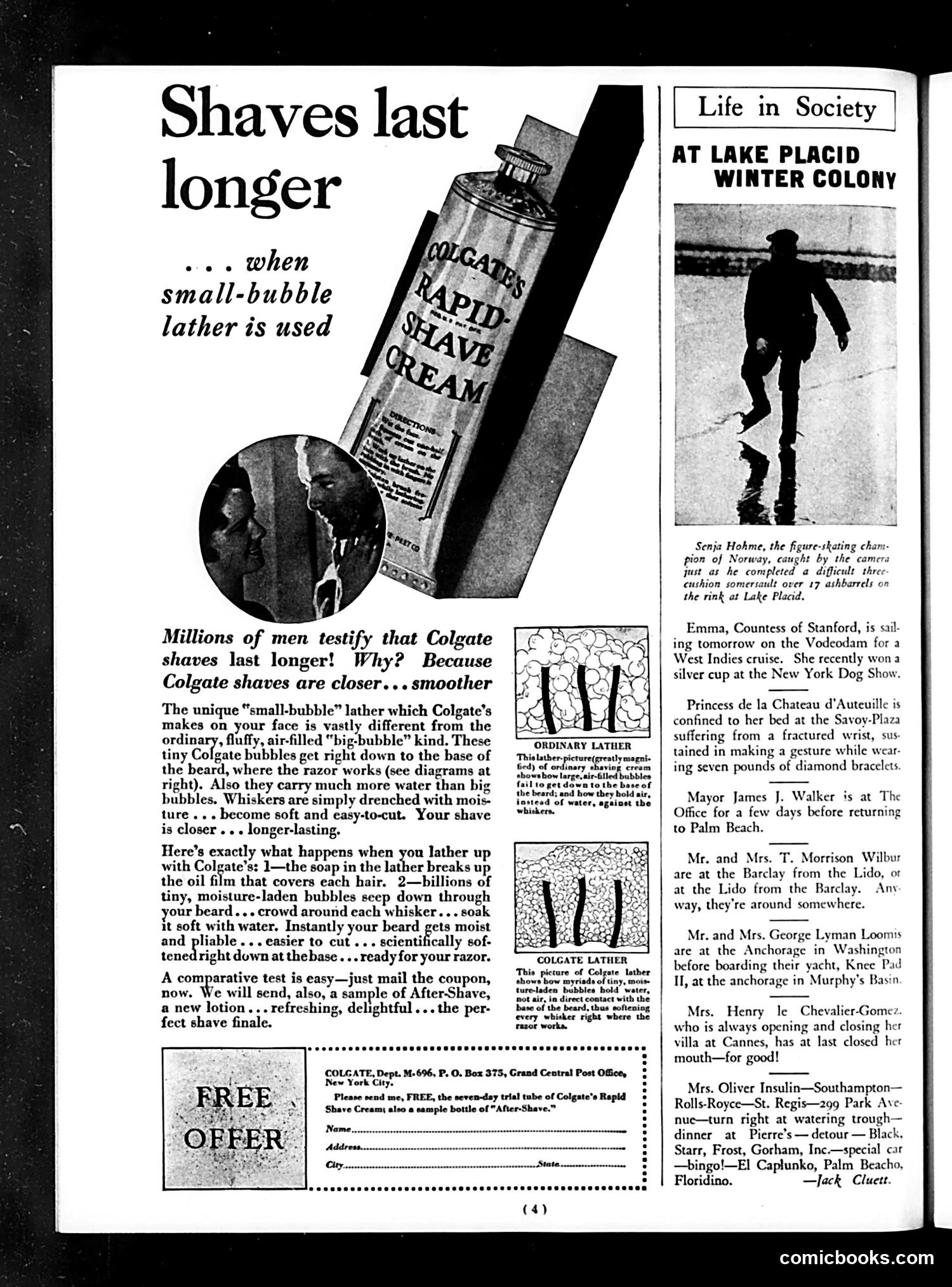
Analysis This page is primarily a Colgate shaving cream advertisement, not satirical content. The left side features a large product ad claiming Colgate's "small-bubble lather" creates superior shaves that last longer than competitors. The ad includes comparative diagrams showing how Colgate's bubbles differ from "ordinary lather"—a marketing claim rather than satire. The right column, titled "Life in Society," contains brief social notes about wealthy individuals' travels and activities (countesses, princes, mayors), typical of the magazine's society page coverage. These appear to be genuine society announcements, not satirical commentary. The page functions as advertising revenue for *Life* magazine, blending commercial content with genuine society reporting rather than containing political or social satire.
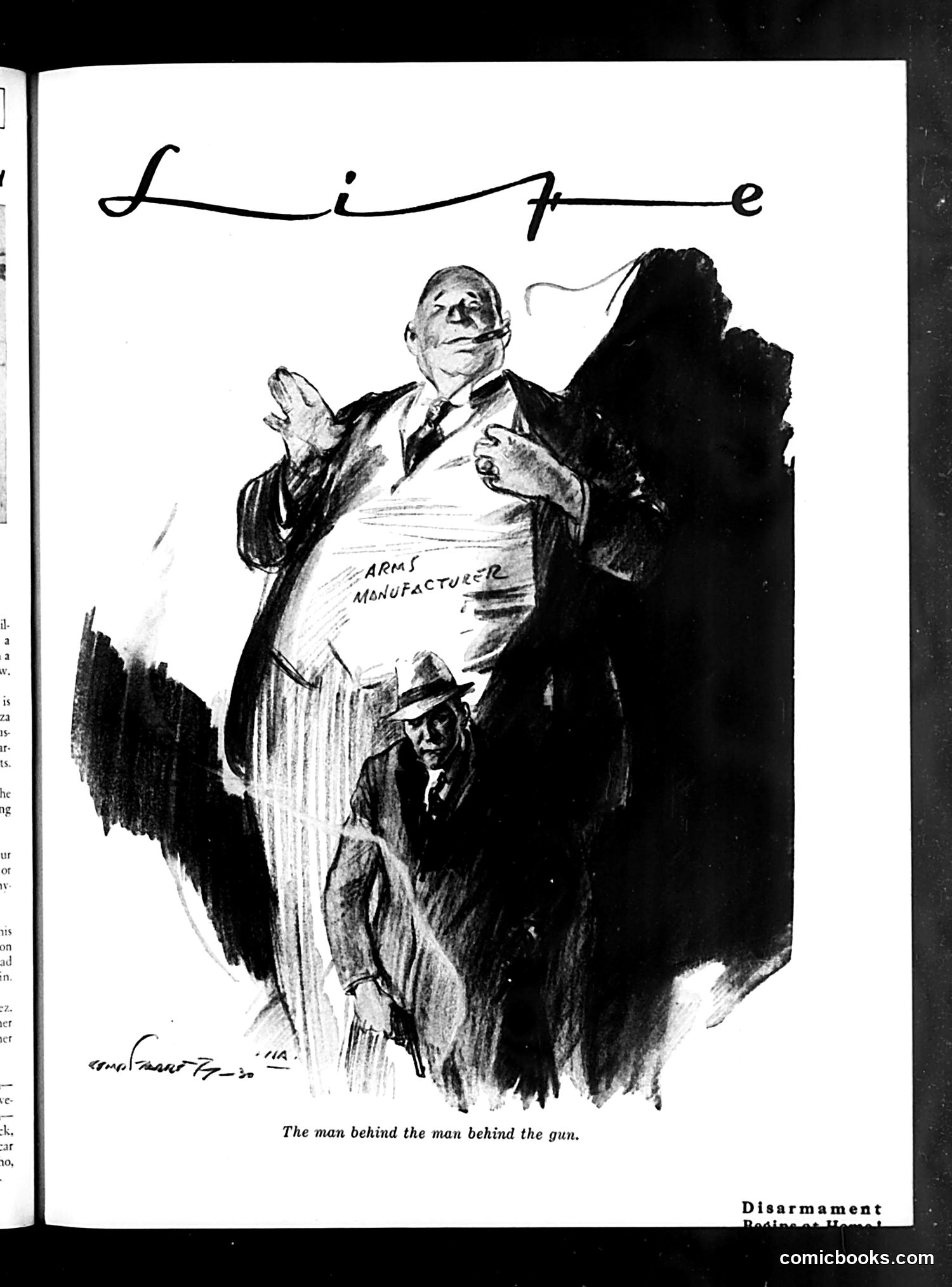
Political Cartoon Analysis: "The Man Behind the Man Behind the Gun" This satirical cartoon depicts arms manufacturers' influence on military policy during the World War I era. The central figure—a portly man labeled "Arms Manufacturer"—literally stands behind a military officer, suggesting corporate control of military decisions. A smaller figure (appearing to be a politician or government official) stands beneath them, completing the chain of influence suggested by the caption. The cartoon critiques how weapons manufacturers profited from and potentially drove military policy, rather than elected officials or military leadership making independent decisions. The title's wordplay emphasizes hidden power structures: corporations manipulate the visible authority figures who ostensibly control warfare. This reflects early 20th-century anxieties about "merchants of death"—industrialists accused of promoting conflict for profit.
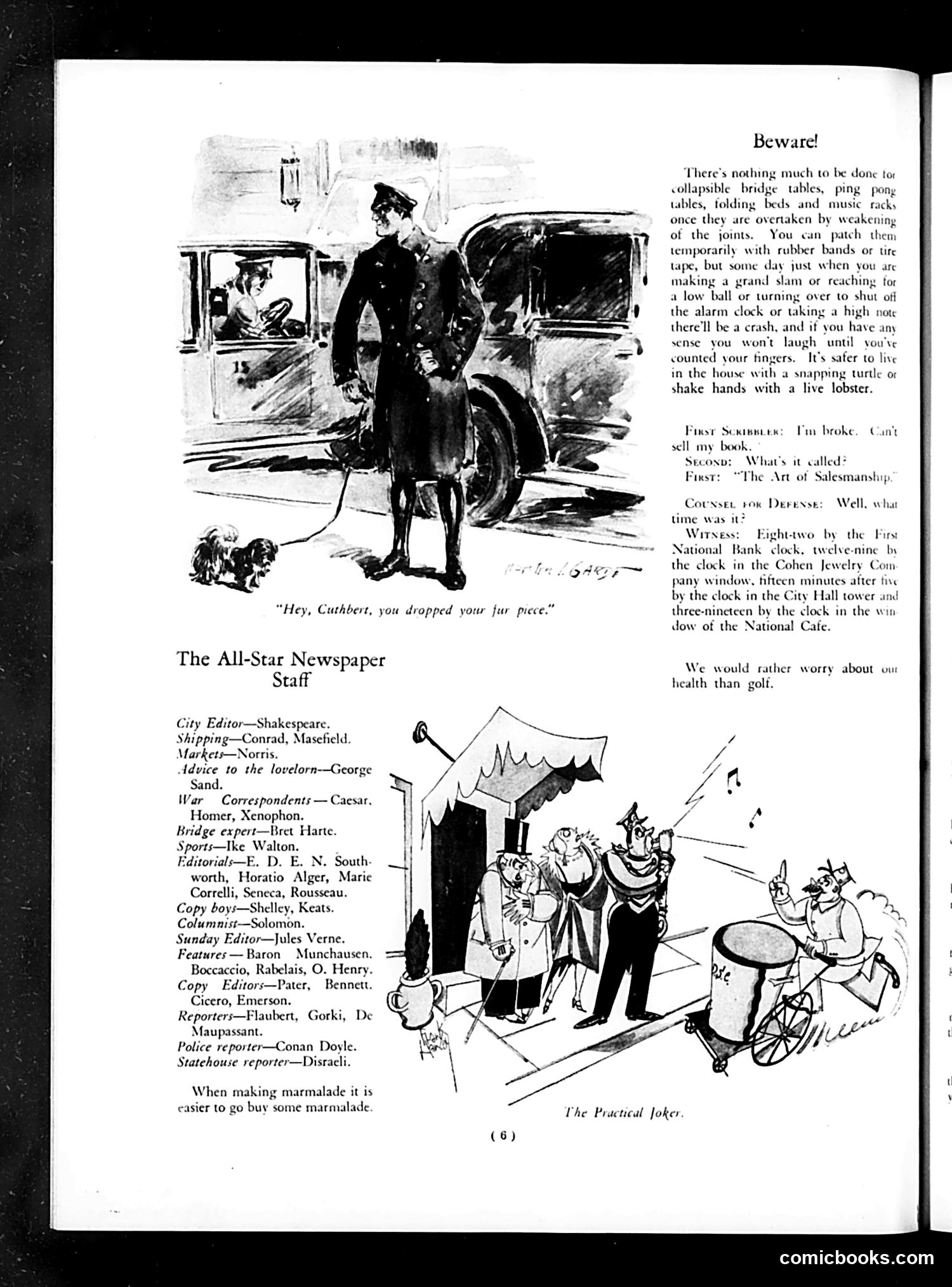
Analysis of Life Magazine Page This page presents satirical content about newspaper work and collapsible furniture hazards. Top Cartoon ("Hey, Cuthbert, you dropped your fur piece"): Shows a woman in a car observing a man outside with a small dog, playing on the double meaning of "fur piece"—both a fur garment and the literal small furry animal. "The All-Star Newspaper Staff": A humorous roster of positions filled with literary and historical figures (Shakespeare, Caesar, Homer, Conan Doyle, etc.), satirizing the pretentiousness or complexity of newspaper organization. "The Practical Joker" (bottom right): Illustrates the article's warning about collapsible furniture—showing furniture and objects breaking or malfunctioning, humorously depicting common household accidents from poorly-maintained items. The page combines light social satire with practical domestic humor typical of Life magazine's style.
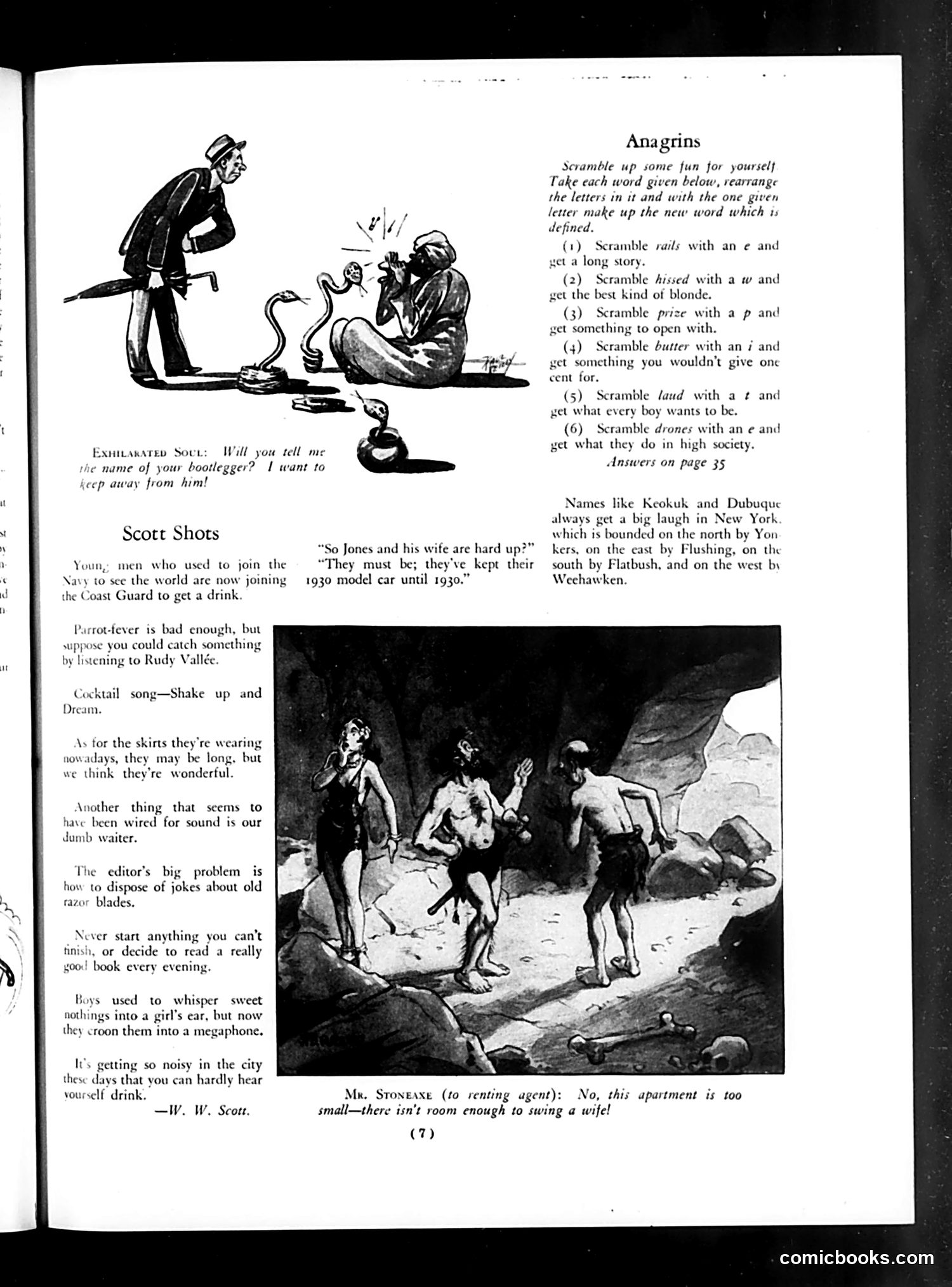
Analysis of Life Magazine Page This page contains two distinct sections: "Scott Shots" (left column): A humor column by W.W. Scott offering brief satirical observations about contemporary life—Navy recruiting, cocktails, women's fashion, dumb waiters, razors, book reading habits, and urban noise. These are disconnected quips rather than political satire, reflecting typical 1930s lifestyle complaints. "Anagrins" (top right): A word puzzle game where readers rearrange letters to form new words with humorous definitions. Illustration (bottom): A caveman-style cartoon with a real estate agent showing an apartment to a primitive couple. The caption jokes that the apartment is too small "to swing a wife"—playing on the common phrase "can't swing a cat," updated with domestic humor about cramped living conditions. The overall page represents lighthearted satirical commentary on 1930s American life.
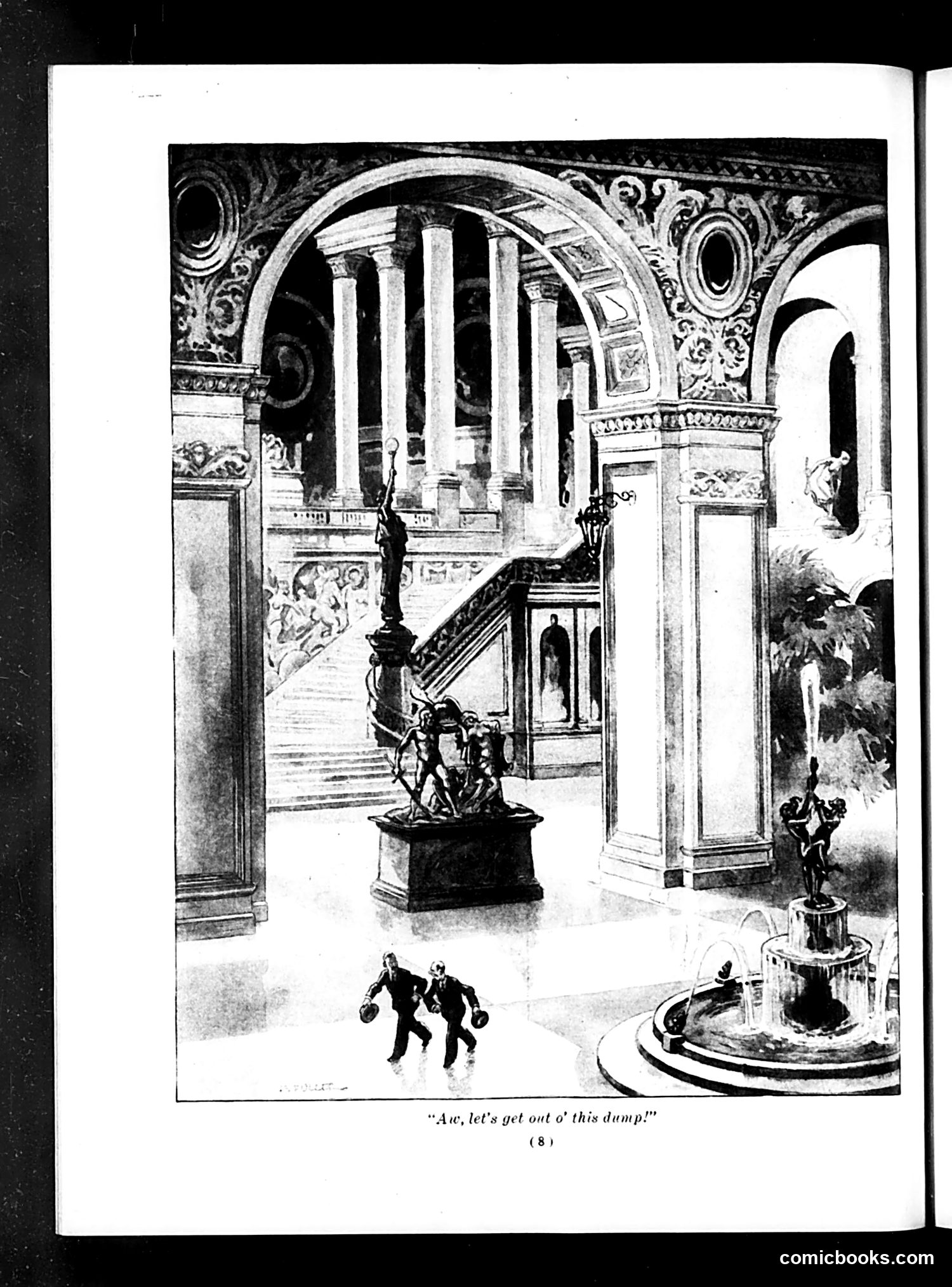
Analysis This is a single cartoon illustration showing an ornate interior space with classical architecture—grand columns, decorative arches, and statuary. Two figures in dark suits are depicted running or fleeing through the space. The caption reads: "Aw, let's get out of this dump!" The satire appears to mock wealthy or elite individuals who dismiss or disparage grand, culturally significant buildings as unimpressive. The contrast between the obviously magnificent classical architecture and the figures' contemptuous dismissal suggests commentary on philistinism—the attitude of people with money but no appreciation for art or cultural heritage. Without additional context about the publication date, I cannot identify which specific building or individuals are targeted, but the joke hinges on ridiculing this particular brand of ignorant snobbery.
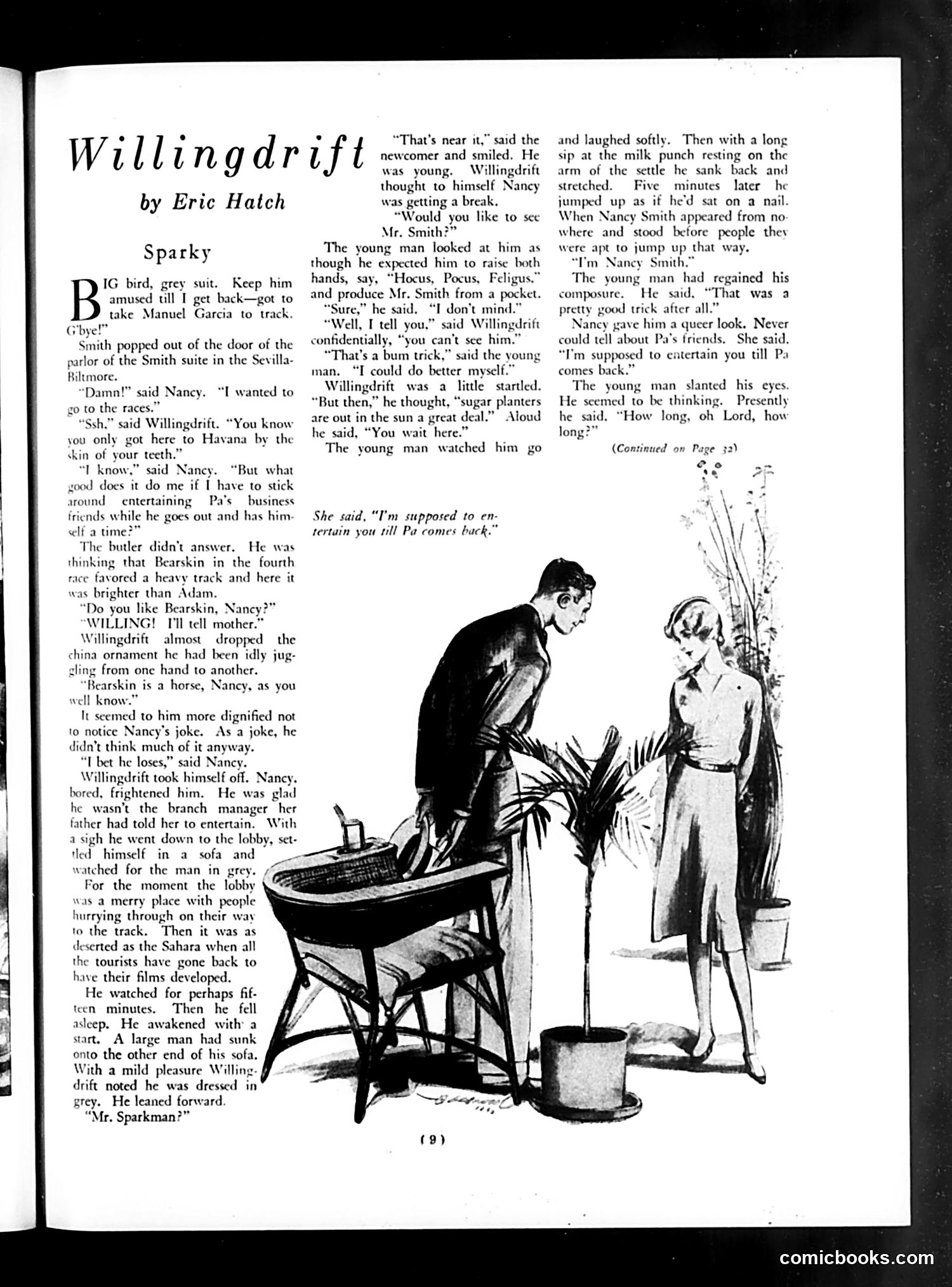
"Willingdrift" by Eric Hatch This page presents a short story rather than political satire. The narrative follows a young man named Willingdrift who encounters Mr. Smith at a racing venue. Nancy, a woman present, expresses frustration about entertaining business associates while Mr. Smith attends the races. The illustration shows a man in formal dress speaking with a woman near what appears to be a baby carriage or settee. The story appears to be a domestic comedy about social obligations and romance, common themes in Life magazine's fiction during this era. No political figures or events are referenced. This is entertainment content—light social humor about everyday urban life, class interactions, and courtship—typical of Life's popular fiction offerings for general readers.
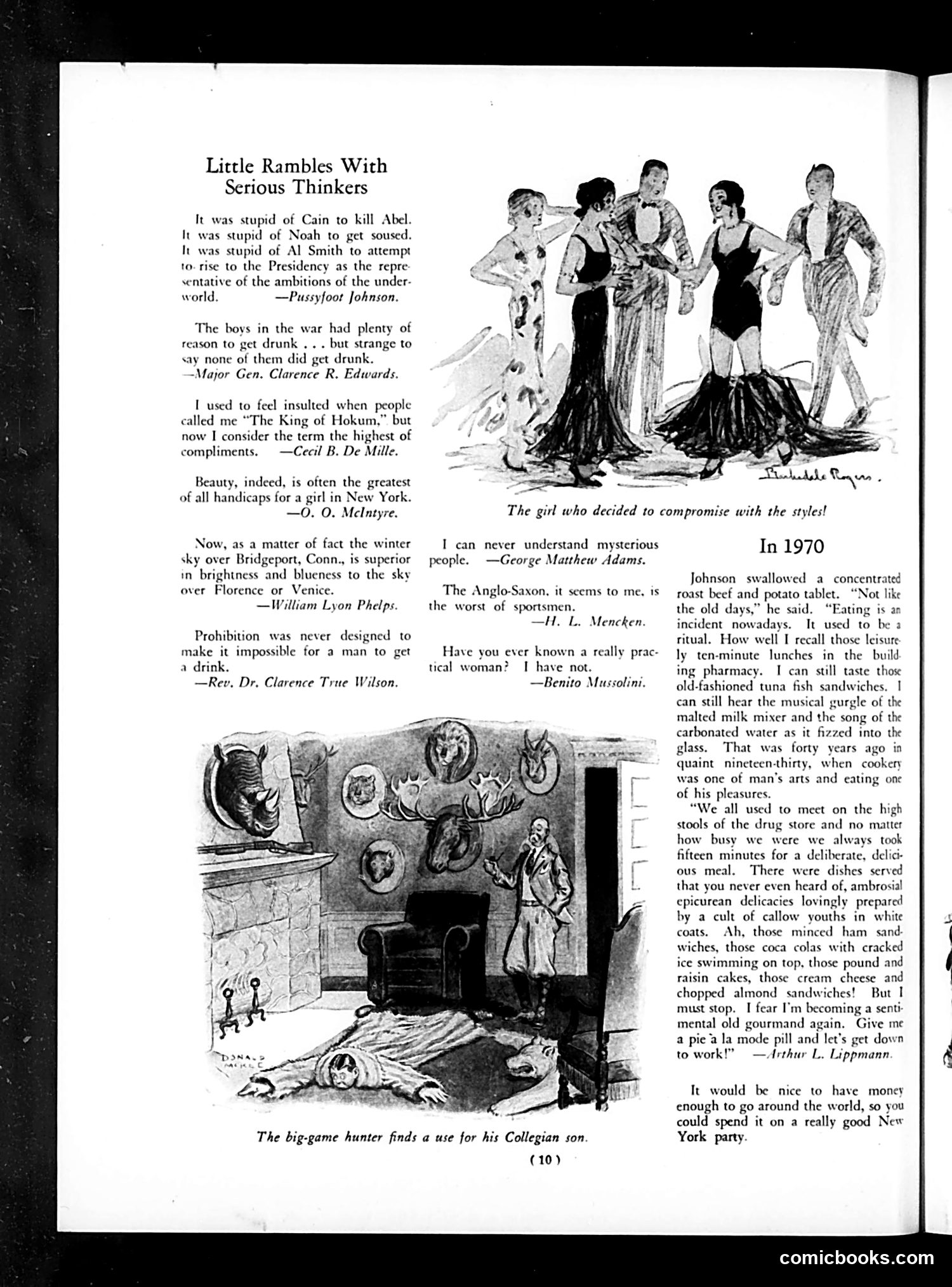
"Little Rambles With Serious Thinkers" This page presents satirical quotes attributed to famous figures (Farplay Johnson, Major Gen. Clarence R. Edwards, Cecil B. DeMille, O.O. McIntyre, William Lyon Phelps, Rev. Dr. Clarence True Wilson, George Matthew Adams, H.L. Mencken, and Benito Mussolini). The top cartoon shows fashionable people, captioned "The girl who decided to compromise with the style!" — likely mocking women's fashion choices during an era of changing dress codes. The lower cartoon depicts a hunter presenting dead game, captioned "The big-game hunter finds a ue for his Collegian son" — a joke about unemployed young men from wealthy families being useful only as trophies or burdens. The "In 1970" section is nostalgic commentary on 1930s dining culture and pleasures, written in melancholic retrospect.
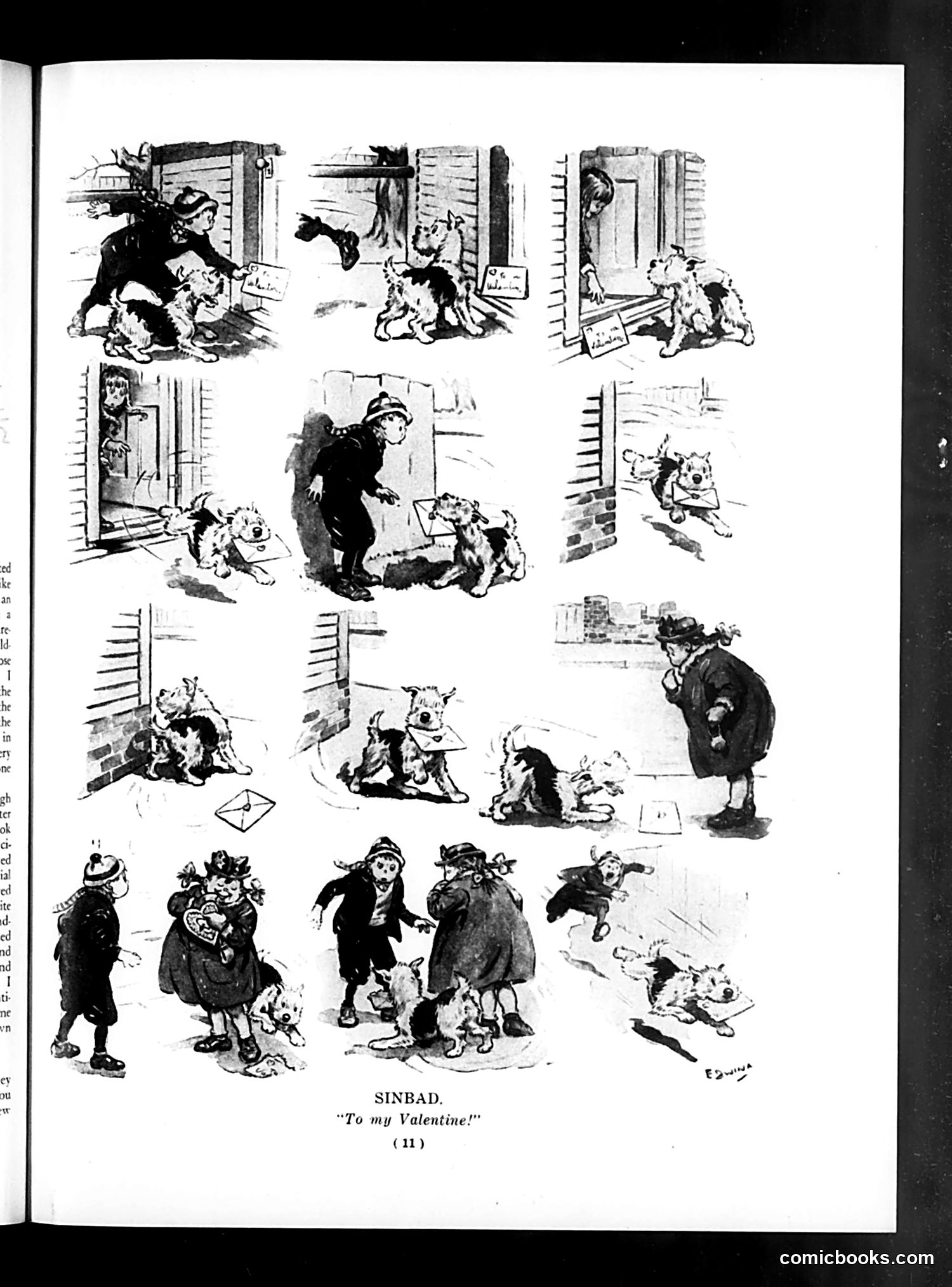
"Sinbad: To my Valentine!" — Analysis This is a comic strip sequence titled "Sinbad" subtitled "To my Valentine!" The strip depicts what appears to be a romantic or comedic story involving a man in formal attire (possibly Sinbad, a character) interacting with small dog characters across multiple panels. The narrative progresses through various scenes showing the man's interactions with the dogs in different settings—doorways, streets, and domestic spaces. The Valentine's Day subtitle suggests this is a humorous take on romantic gestures or courtship. The cartoonist (signature visible) uses the Sinbad character—likely referencing the legendary sailor—in an everyday, domestic context rather than exotic adventure scenarios, creating comedy through the unexpected juxtaposition of a fantastical figure in mundane romantic situations with animals.
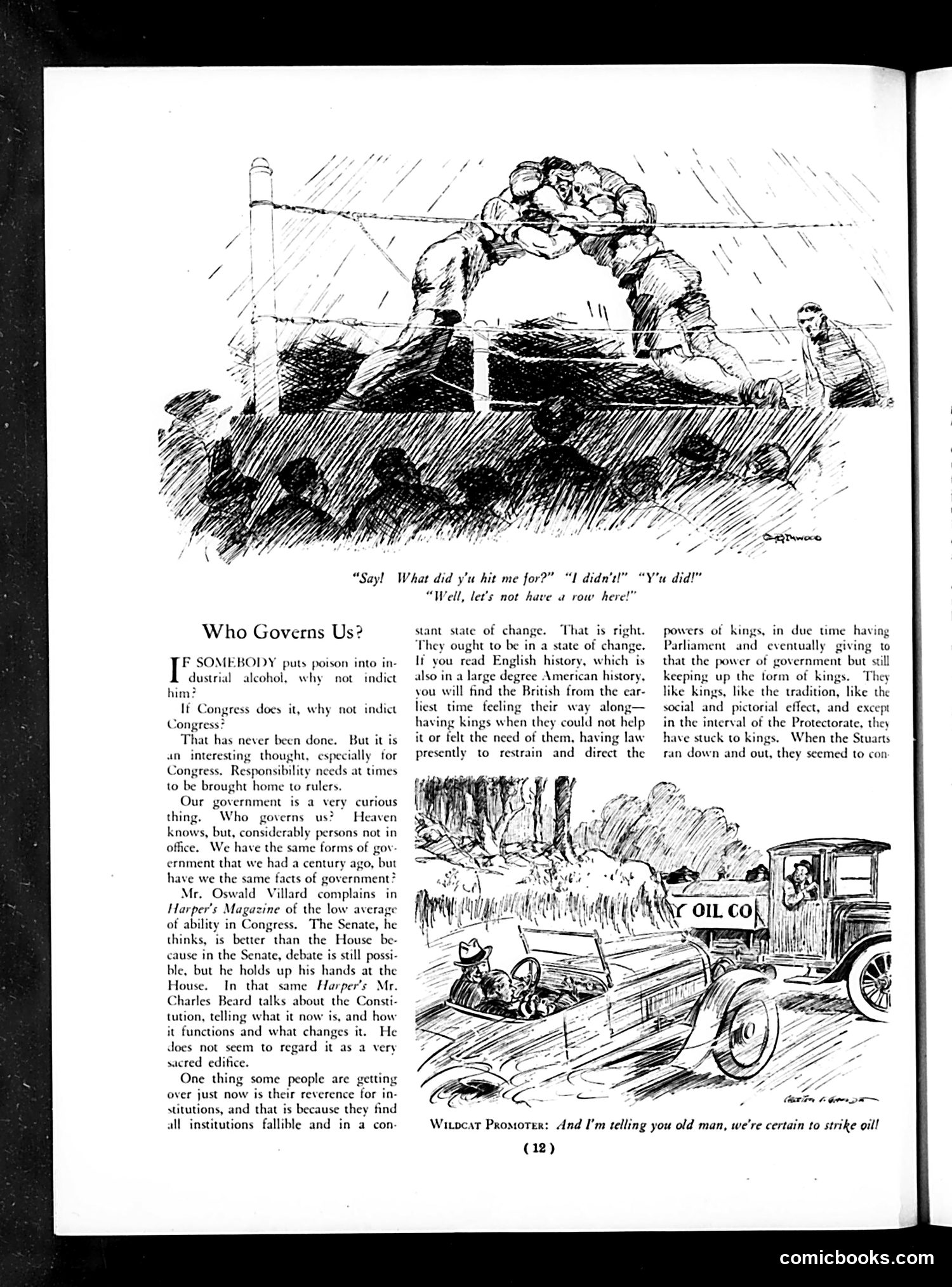
Analysis of Page 12, Life Magazine Top Cartoon: A boxing match scene where one fighter hits another, prompting the exchange: "Say! What did yu hit me for?" / "I didn't!" / "Yu did!" / "Well, let's not have a row here!" This appears to be political satire about denial and conflict avoidance among government figures. Main Article: "Who Governs Us?" questions the actual effectiveness of Congress and governmental institutions. It references critiques by Oswald Villard and Charles Beard about Congressional dysfunction, suggesting senators and representatives lack real power or accountability. The tone is skeptical about whether American government actually functions as intended. Bottom Cartoon: Shows an oil company truck alongside a wrecked vehicle, captioned "Wildcat Promoter: And I'm telling you old man, we're certain to strike oil!" This satirizes oil speculation and fraud targeting vulnerable people.
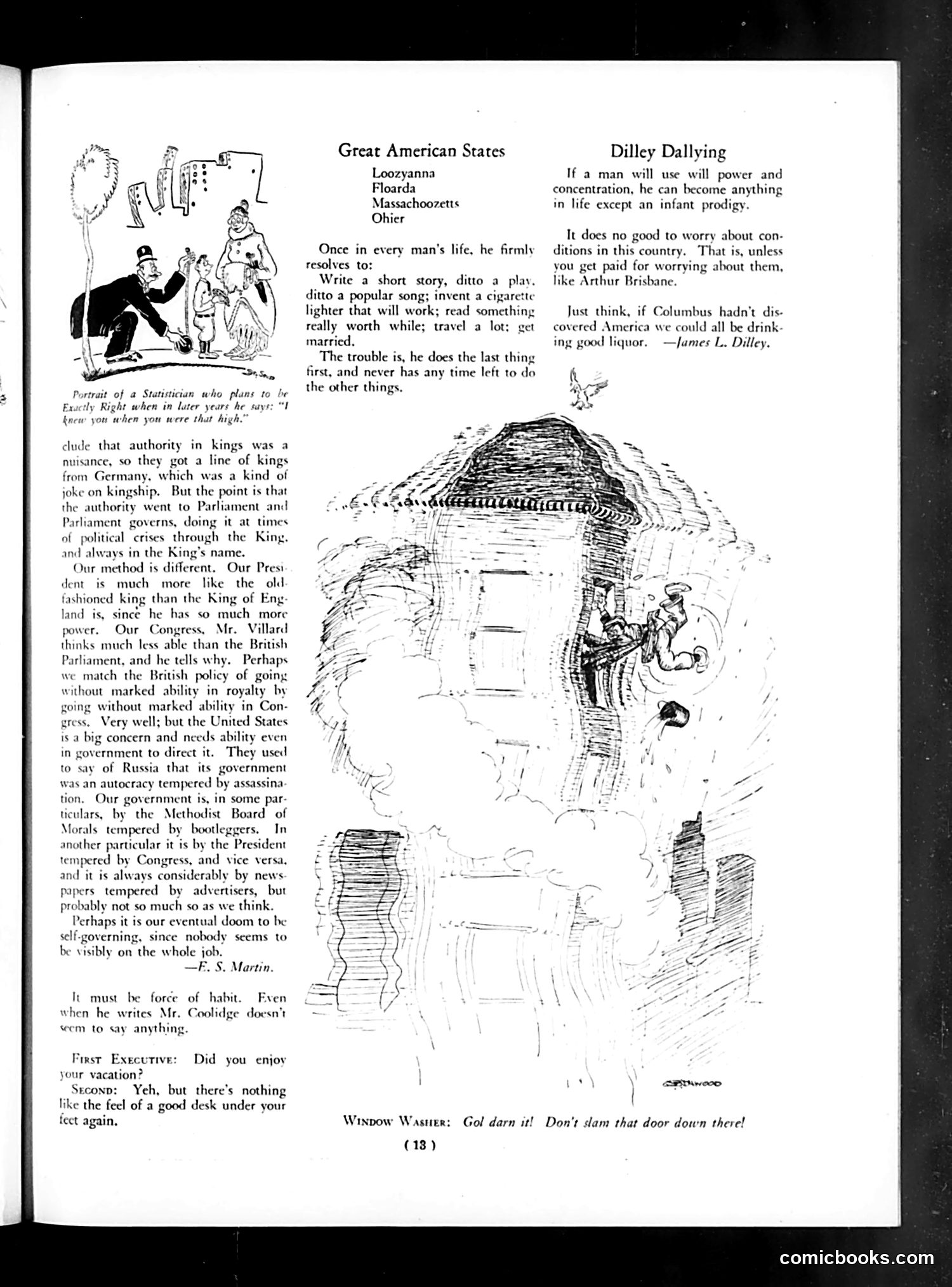
Political Satire from Life Magazine This page contains two distinct sections: "Great American States" (top left): A brief humorous piece listing states (Loozyanna, Florida, Massachusoozetts, Ohio) with a cartoon showing a statistician planning his future. The joke appears to be that despite grand plans, he'll end up married first—unable to pursue other ambitions. "Dilley Dallying" (right): A column of brief satirical quotes, including a jab at Columbus and drinking, attributed to James L. Dilley. "Window Washer" (bottom): A cartoon showing workers on a large building facade with dialogue: "Gol darn it! Don't slam that door down there!" The humor derives from the absurdity of slamming a door affecting workers on an exterior scaffold. The page demonstrates Life's characteristic blend of observational humor about American life and workplace comedy.
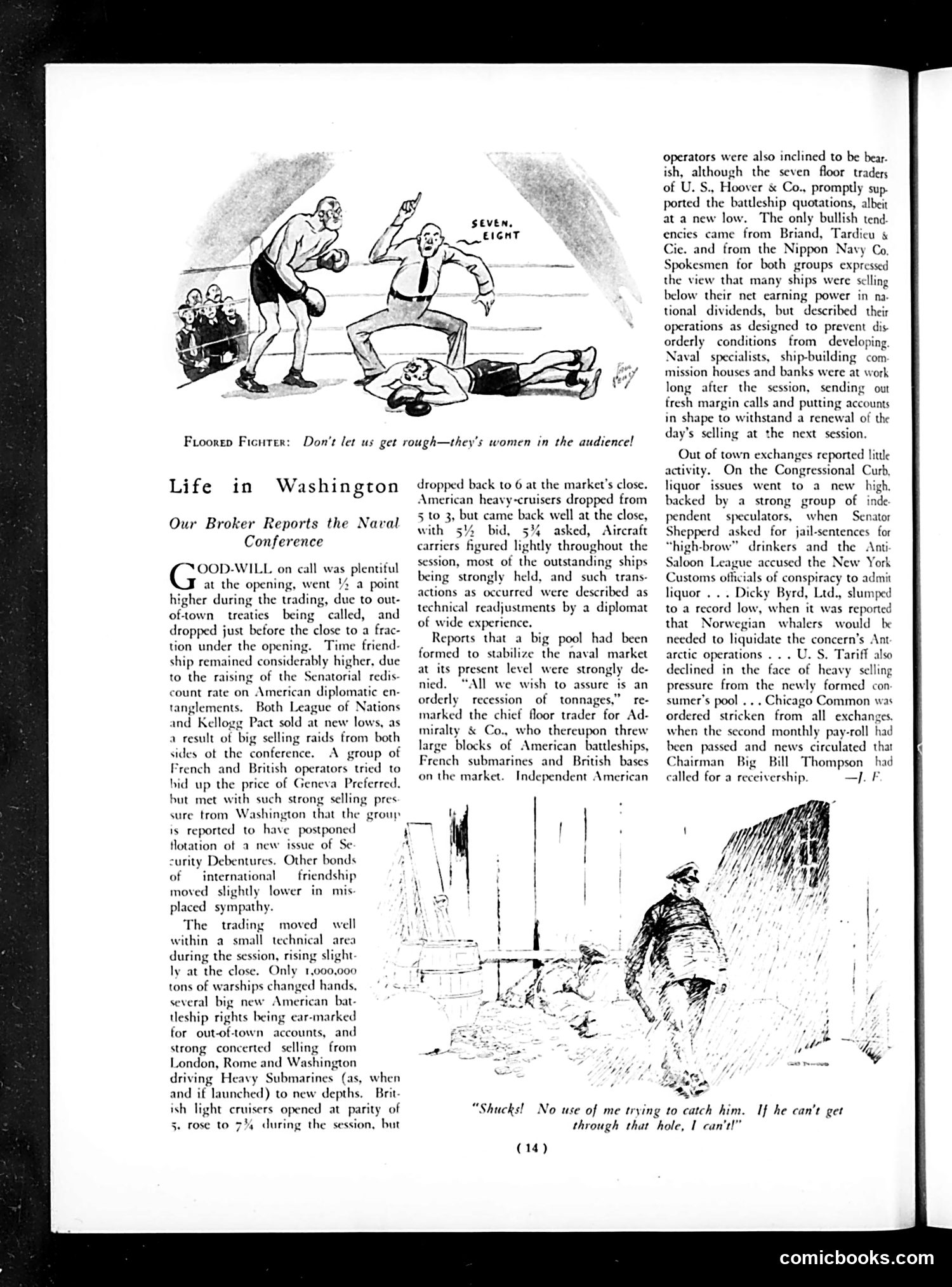
Analysis of This Life Magazine Page This page contains two satirical cartoons about Washington D.C. during what appears to be a naval conference (referenced in the article title "Life in Washington: Our Broker Reports the Naval Conference"). Top cartoon ("Floored Fighter"): Shows a boxing match where one fighter has knocked down his opponent. The caption warns "Don't let us get rough—they're women in the audience!" This satirizes anxieties about decorum and propriety, suggesting that aggressive negotiations or conflict might occur but must be restrained due to female observers present—reflecting early 20th-century social expectations about masculine behavior. Bottom cartoon: Depicts a person attempting to catch another through a hole, with the caption "Shuck! No use of me trying to catch him. If he can't get through that hole, I can't!" The meaning remains unclear from the visible context. Both cartoons appear to comment satirically on diplomatic proceedings and Washington society.
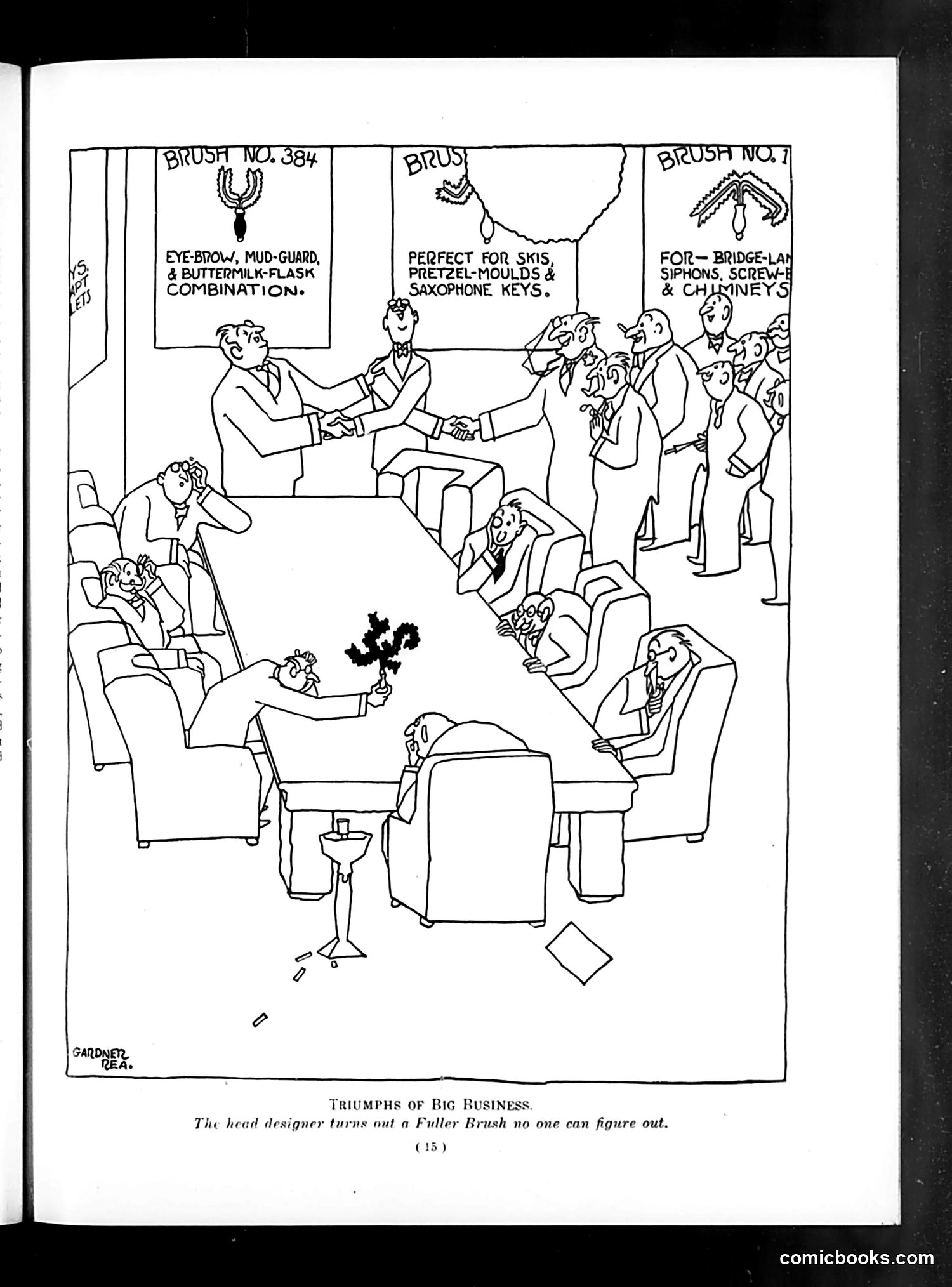
Analysis This is a satirical cartoon titled "Triumphs of Big Business," depicting a business meeting where a designer presents a "Fuller Brush" product. The caption reads: "The head designer turns out a Fuller Brush no one can figure out." The cartoon mocks corporate product design by showing three brush variants at top (labeled as serving specific purposes: eyebrow/mud-guard/buttermilk-flask combination; skis/pretzel-moulds/saxophone keys; and bridge-lamps/stenographers/chimneys). The joke satirizes how manufacturers overcomplicate products by adding unnecessary features to appear innovative, creating devices so multifunctional they become useless. The Fuller Brush Company was a real door-to-door brush company, making this a pointed critique of 1920s-30s American business culture's tendency toward absurd product differentiation and marketing gimmicks rather than genuine utility.
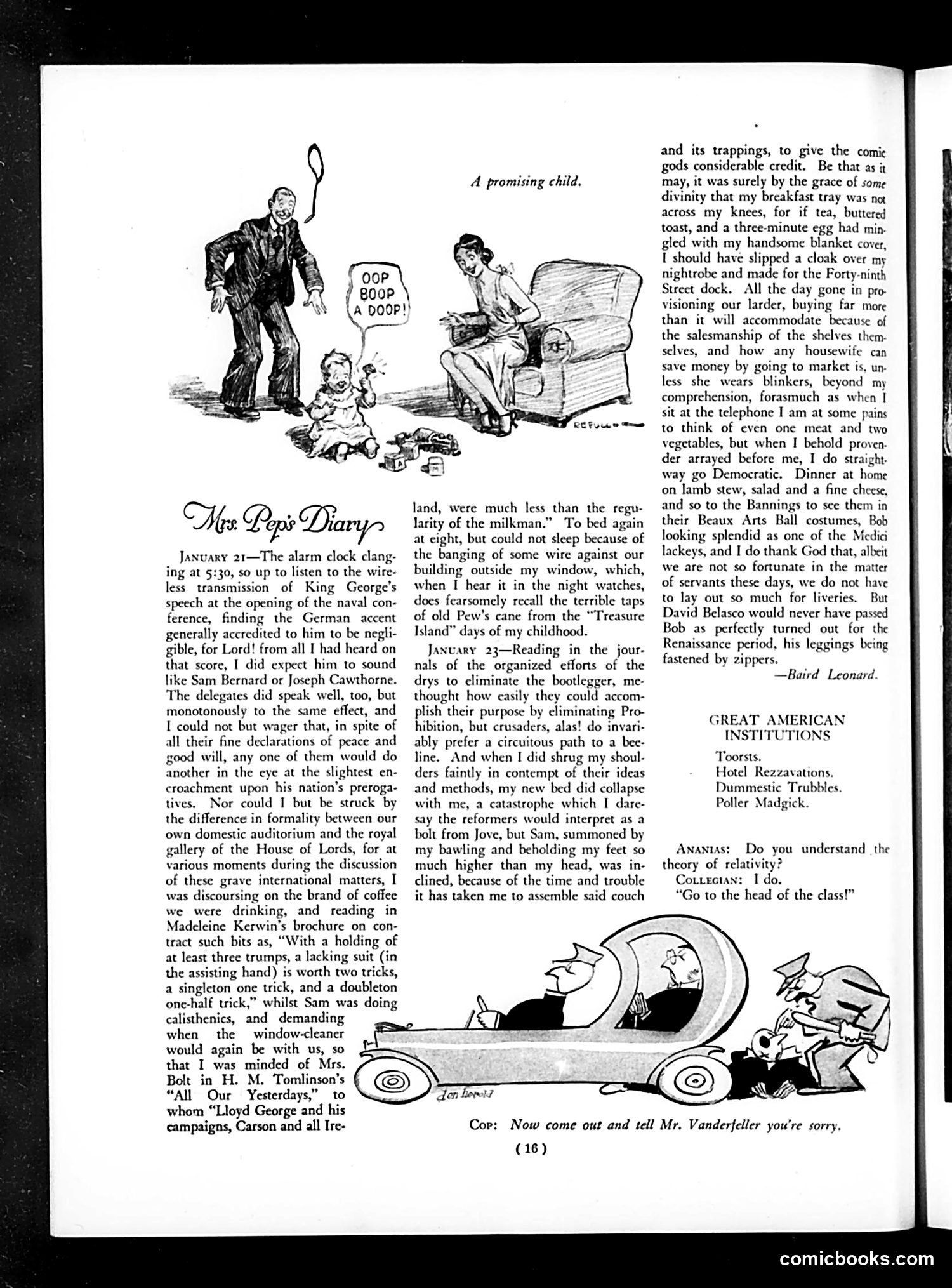
Analysis of Life Magazine Page This page contains Mrs. Pep's Diary, a humor column about domestic life. The dated entries (January 21 and 23) recount mundane household frustrations: listening to King George's speech on wireless radio, dealing with a collapsing bed, and arguments about bootleggers and Prohibition reform. The cartoon at bottom depicts a car accident where someone apologizes to "Mr. Vanderbilt" — a joke about the wealthy Vanderbilt family's prominence. The humor lies in the absurdity of prioritizing an apology to a wealthy person over actual concern for the crash. The "Great American Institutions" section is a satirical list-poem mocking social absurdities (toasts, reservations, domestic troubles, etc.). Overall, this page satirizes upper-middle-class domestic anxieties and social pretensions of the 1920s era.
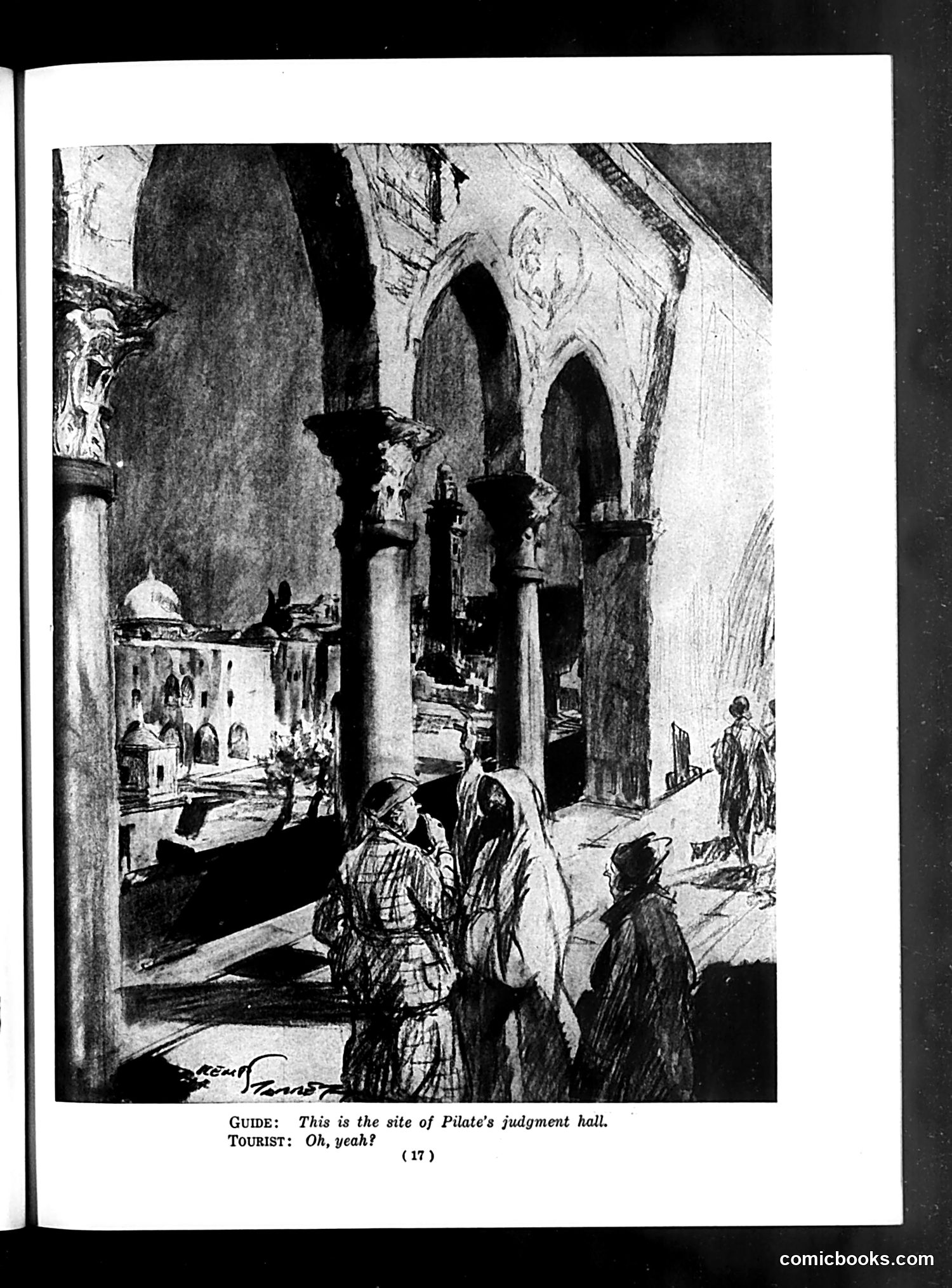
Explanation for Modern Readers This is a satirical comic strip depicting tourists visiting what the guide identifies as "Pilate's judgment hall"—the biblical location where Pontius Pilate judged Jesus. The tourist's response "Oh, yeah?" suggests skepticism or indifference. The satire appears to mock tourist culture and commercialization of religious/historical sites. By presenting a sacred biblical location as a casual tourist attraction with a tour guide, the cartoonist critiques how religious history becomes trivialized entertainment. The tourist's blasé reaction further emphasizes this—even at sites of profound spiritual significance, modern visitors treat them as routine checkboxes on a sightseeing itinerary rather than meaningful pilgrimage destinations. The humor relies on the contrast between the site's religious importance and tourists' apathetic engagement.
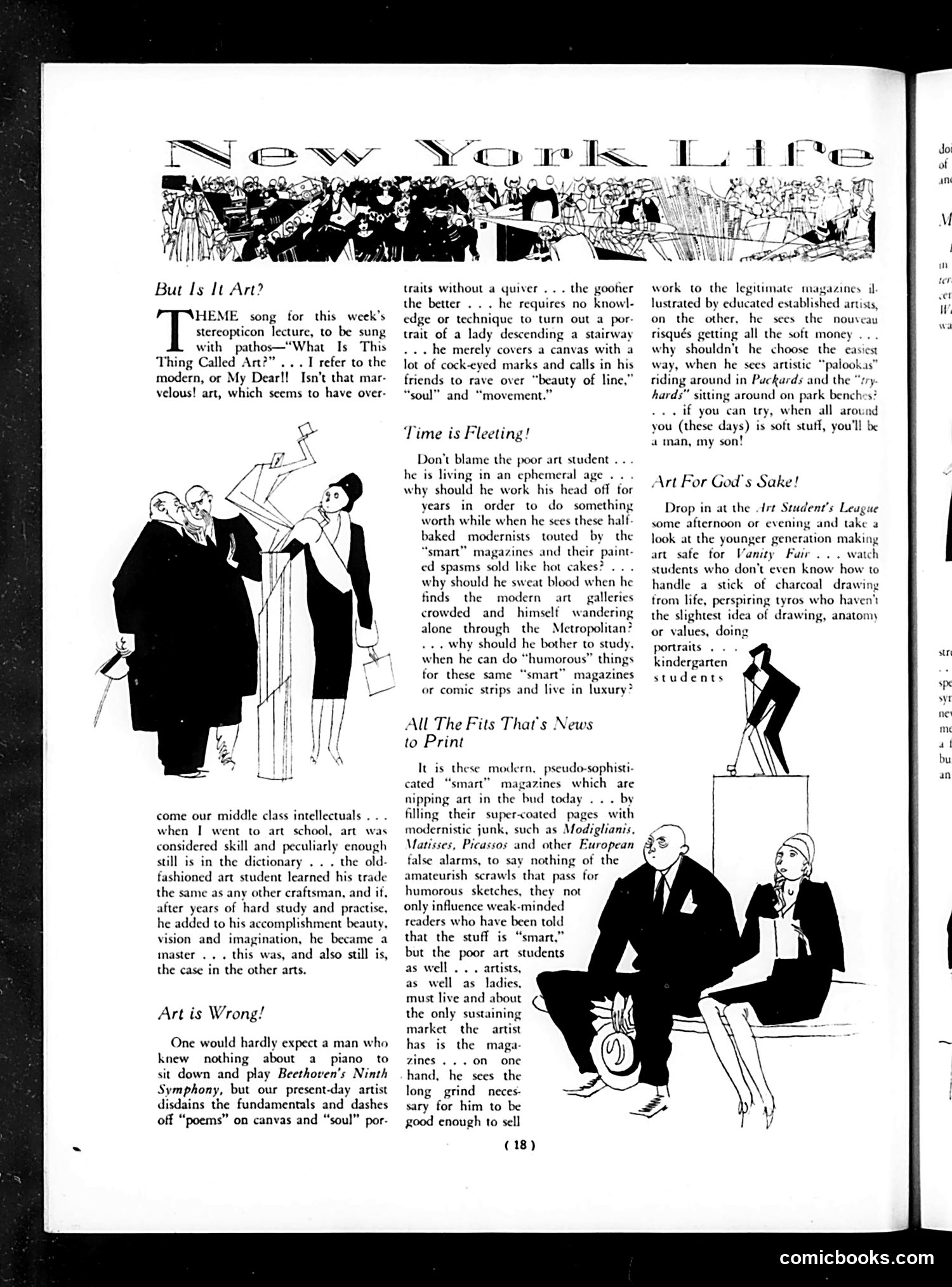
Analysis: "New York Life" - Art Criticism Page This page satirizes the art world's pretensions and class divisions circa the 1920s-30s. The article mocks "smart" magazines (Vogue, Vanity Fair, others) that promote modernist art movements like Modigliani and Picasso to wealthy readers while dismissing serious art students as impractical dreamers. The cartoons illustrate the tension: working-class art students struggle in poverty trying to create meaningful work, while affluent patrons and magazines profit by fetishizing European modernism as sophisticated consumption. The satire suggests art has become a luxury commodity divorced from artistic merit—magazines choose "easy way" commercial palaces over genuine artistic vision. The piece critiques both shallow magazine culture and the gatekeeping that divides "legitimate" art from struggling practitioners.
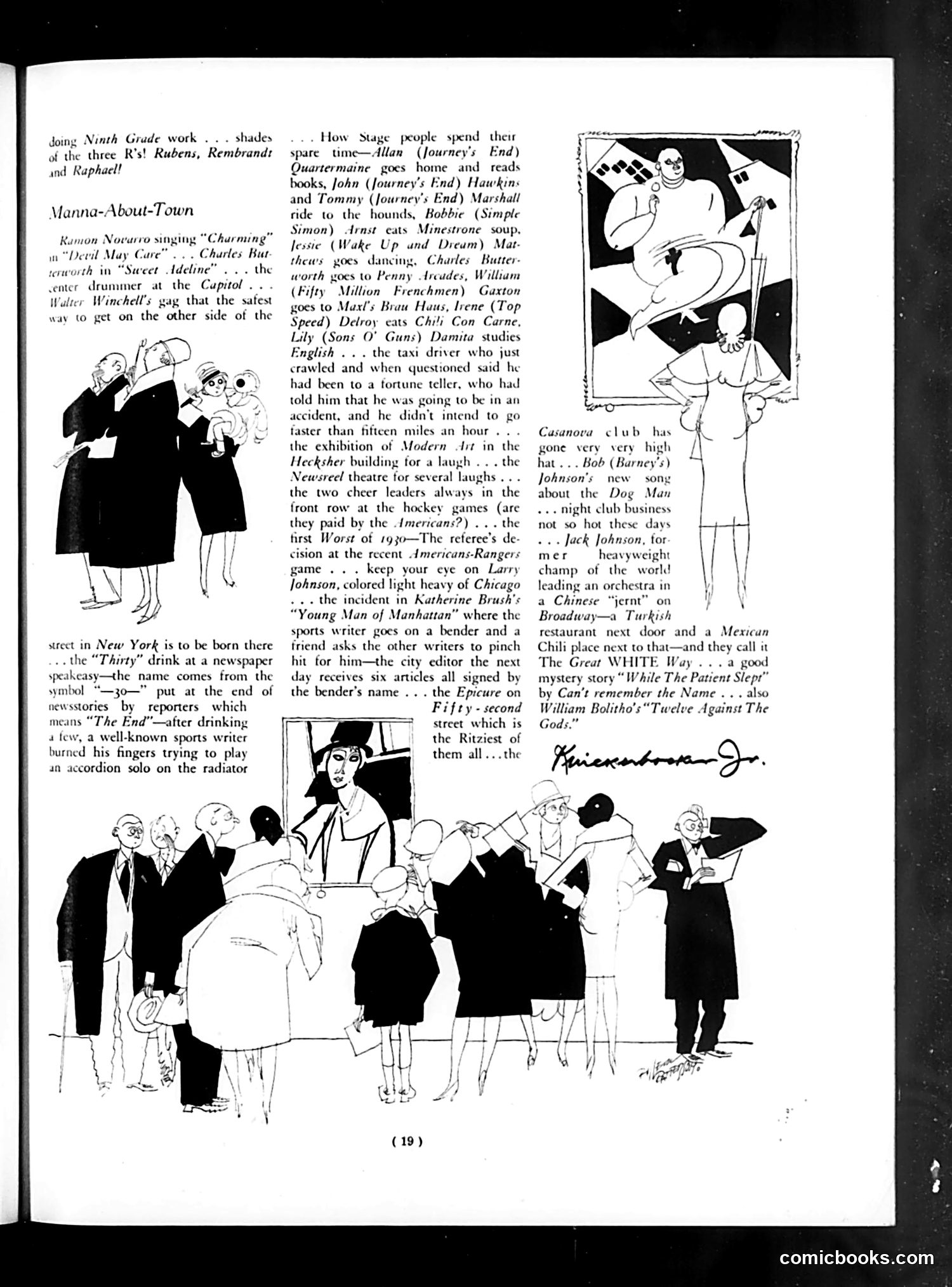
Analysis of Life Magazine Page This is a "Manna-About-Town" gossip column typical of Life's satirical coverage of 1930s New York nightlife and entertainment. The cartoons illustrate various social observations and celebrity tidbits. The top illustration depicts well-dressed men and women in formal attire, likely representing the social elite or theater crowd. The bottom cartoon shows a dinner party scene, appearing to satirize high-society dining customs. The text references Broadway performers (actors from shows like *Journey's End* and *Simple Simon*), nightclub culture, and 1930s social trends. References include Jack Johnson (the former heavyweight boxing champion) now conducting an orchestra on Broadway, the Casanova club's pretentiousness, and speakeasy culture (the "Thirty" drink). The column mocks both celebrity vanity and New York's class divisions—noting the contrast between a Turkish restaurant next to a Mexican chili place alongside Broadway's "Great White Way," satirizing the area's mixed character despite its glamorous reputation.
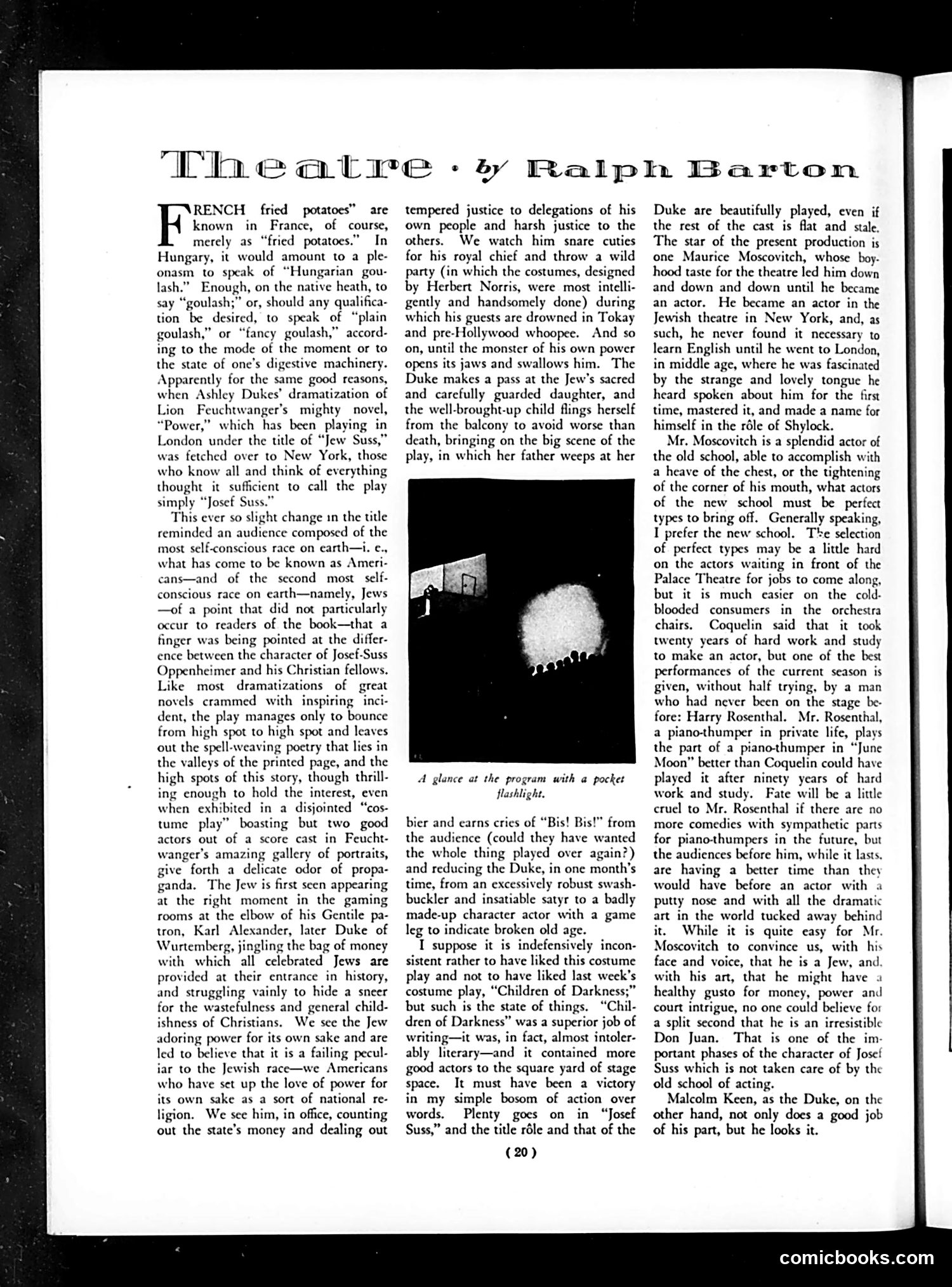
Theatre Review by Ralph Barton (Life Magazine) This is a theatre review critiquing the American production of "Josef Suss," a dramatization of Lion Feuchtwanger's novel "Power." The review examines how the play's retitling and presentation invoke Jewish stereotypes. Barton argues the American production emphasizes the protagonist's Jewishness in ways the original novel didn't, presenting a Jewish character who loves power, manipulates gentiles, and schemes for wealth—classic antisemitic tropes. He notes the irony that Americans (and Jews themselves) comprise the "self-conscious" audience most likely to notice this pointed finger at Jewish difference. The review criticizes the play as "propaganda" that suggests Jewish moral failings are racial characteristics, while Americans have built their entire nation on the same love of power the play condemns as peculiarly Jewish. The photograph shows a stage scene from the production. This reflects 1920s-30s theatre criticism grappling with antisemitic stereotyping in contemporary drama.
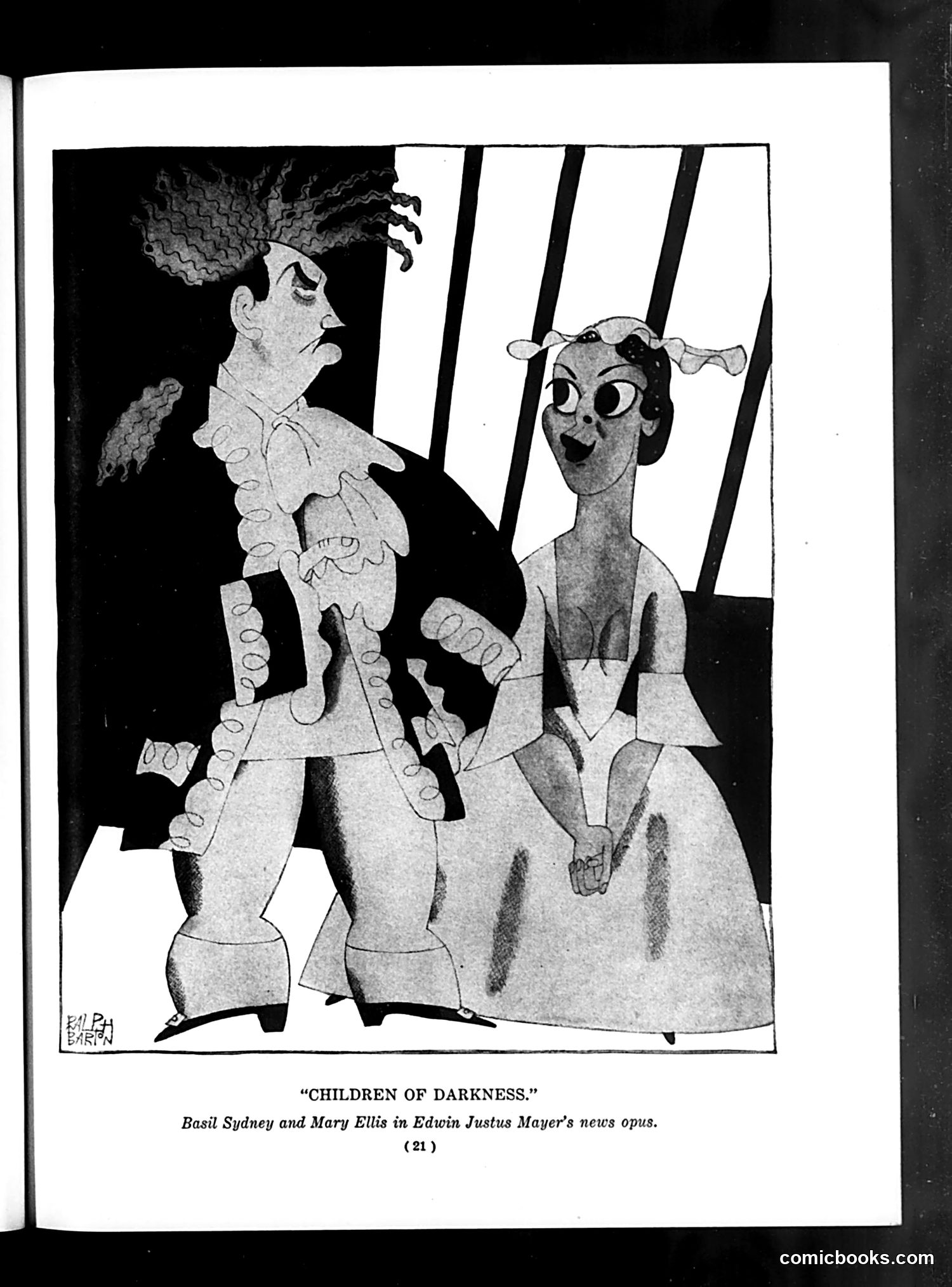
This is a theatrical review illustration for Edwin Justus Mayer's play "Children of Darkness," featuring actors Basil Sydney and Mary Ellis. The cartoon uses exaggerated caricature typical of early 20th-century Life magazine's theatrical commentary. The male figure displays grotesque facial features and elaborate period costume with decorative elements, while the female character reacts with exaggerated surprise or delight. The stark black-and-white contrast and distorted proportions are characteristic of satirical theater criticism from this era, likely mocking either the actors' performances, the play's dramatic style, or both. The illustration serves as entertainment commentary rather than political satire, typical of Life's theatrical coverage.
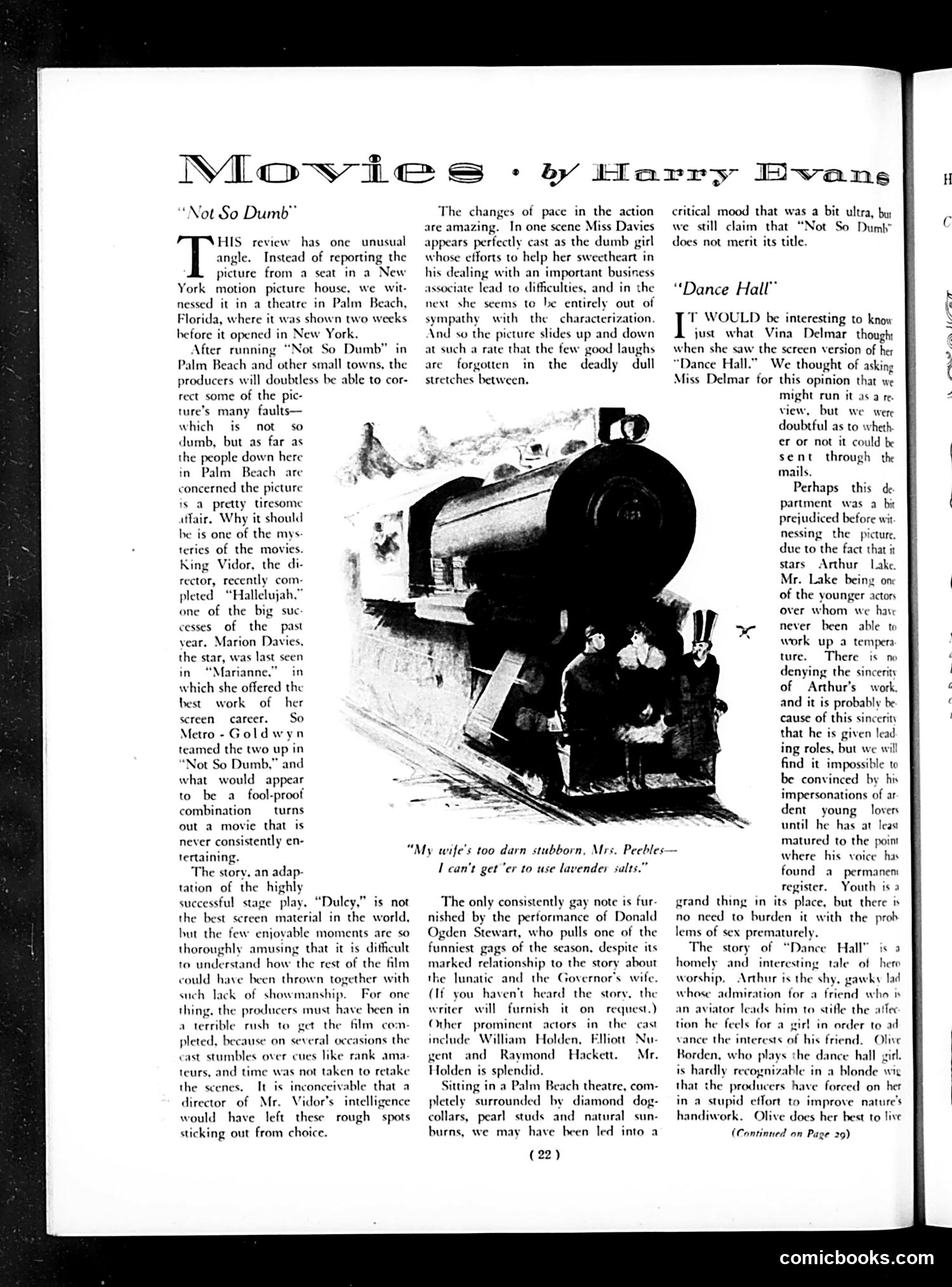
Film Review Analysis: Life Magazine This page contains two movie reviews by Harry Evans from Life magazine's "Movies" column, likely from the late 1920s. "Not So Dumb": Evans reviews Marion Davies' film directed by King Vidor, adapted from the stage play "Duley." The reviewer critiques the uneven pacing and inconsistent characterization despite Davies being "perfectly cast" in some scenes. He praises Donald Ogden Stewart's comedic performance as the film's only consistently entertaining element. Evans notes the production appeared rushed, with actors flubbing lines. "Dance Hall": The second review addresses Vina Delmar's adaptation, criticizing lead actor Arthur Lake's performances. The reviewer expresses skepticism about Lake's abilities, though acknowledges his sincerity, suggesting the studio casts him despite limited talent. The cartoon caption shows a domestic scene with lavender salts—a period toiletry product—illustrating marital stubbornness referenced in one film's plot.
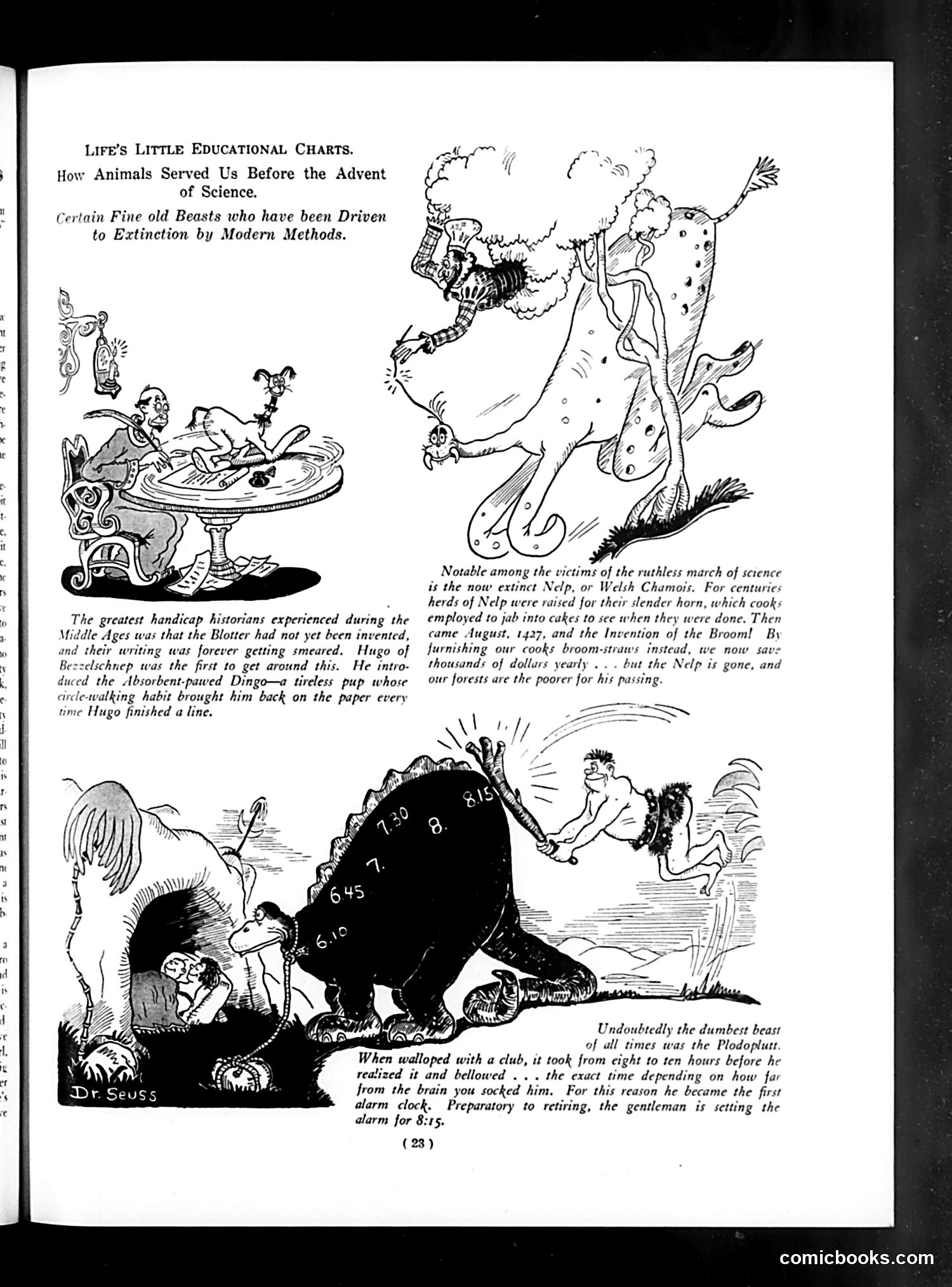
Analysis of Dr. Seuss's "Educational Charts" Page This is a humorous mock-educational feature by Dr. Seuss satirizing pseudo-scientific explanations for extinct animals. The joke relies on inventing absurd, fictional creatures and fabricating ridiculous historical "purposes" they supposedly served. The three examples: 1. The Absorbent-pawed Dingo: A nonsensical explanation for how medieval scribes prevented ink smearing—before the blotter was invented—by using a dog that walked in circles. 2. The Nelp (Welsh Chamois): Cooks allegedly used its horn to test cake doneness until 1427, when the broom was "invented," making the animal obsolete. 3. The Plodoplutt: An "alarm clock" animal so stupid it took 8-15 hours to react to being hit with a club—the delay depending on how far from its brain you struck it. The satire targets both credulous pseudo-historical narratives and the idea that science has "ruthlessly" replaced useful animals. It's absurdist humor playing with causation and technological "progress."
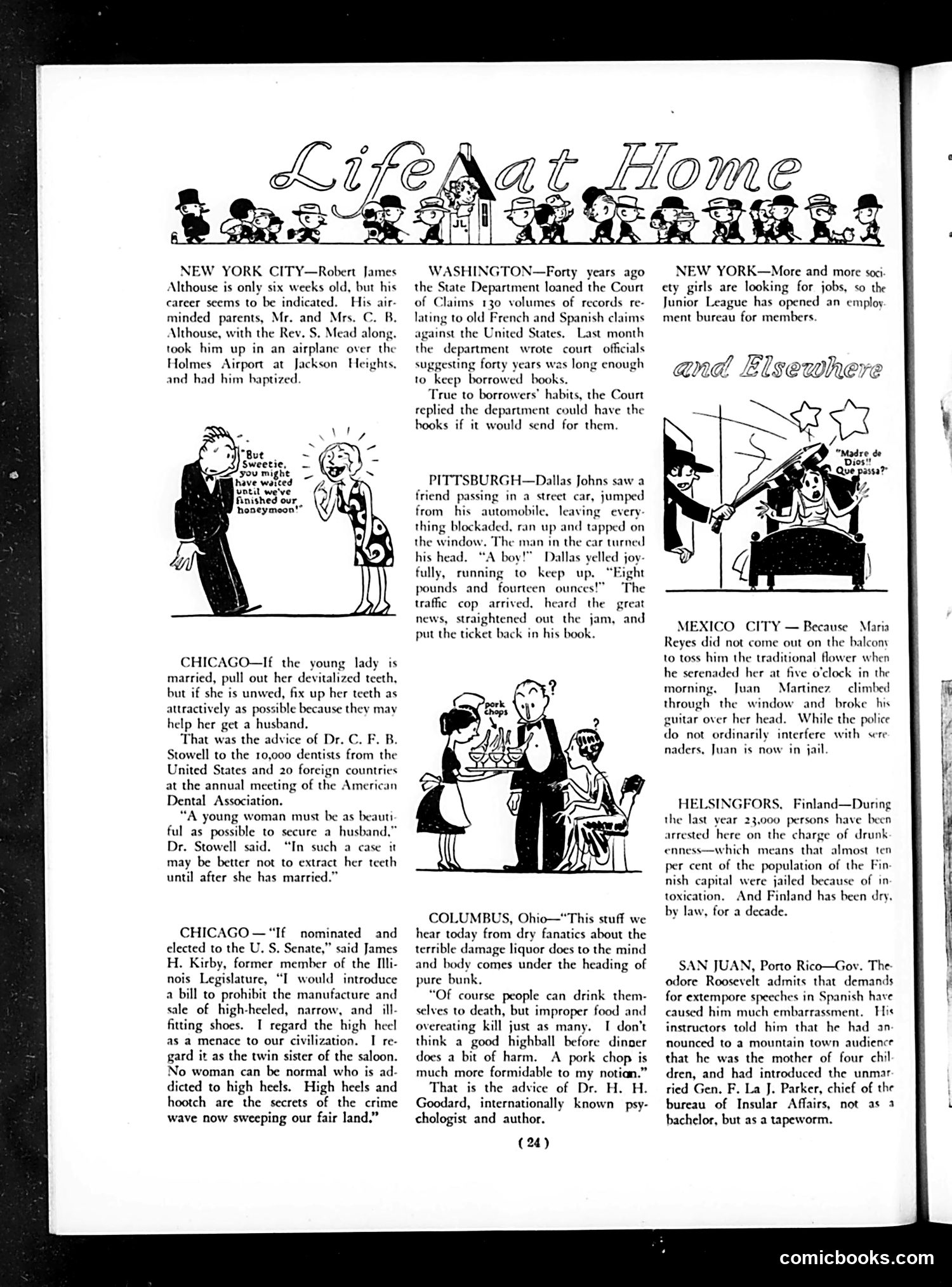
Life Magazine Satire Page Analysis This page collects humorous anecdotes mocking various social attitudes and experts of the era (appears to be 1920s-30s, given Prohibition references). Key satirical targets: - Dr. Stowell's dental advice: A dentist recommends unmarried women get attractive teeth to find husbands, but married women should have them extracted—mocking both dental professionals and gender-based beauty standards. - High heels as social menace: A politician equates high-heeled shoes with saloons and crime waves—absurd moral panic typical of the era. - Dr. Goodard on alcohol: An "internationally known psychologist" dismisses Prohibition rhetoric, claiming highballs are harmless—satirizing expert opinions contradicting dry laws. - Finland's prohibition failure: The anecdote notes 23,000 arrests for drunkenness despite a decade of mandatory sobriety, mocking Prohibition's effectiveness. The cartoons and short items collectively ridicule expert pomposity, rigid morality, and the gap between stated ideals and reality during Prohibition-era America.
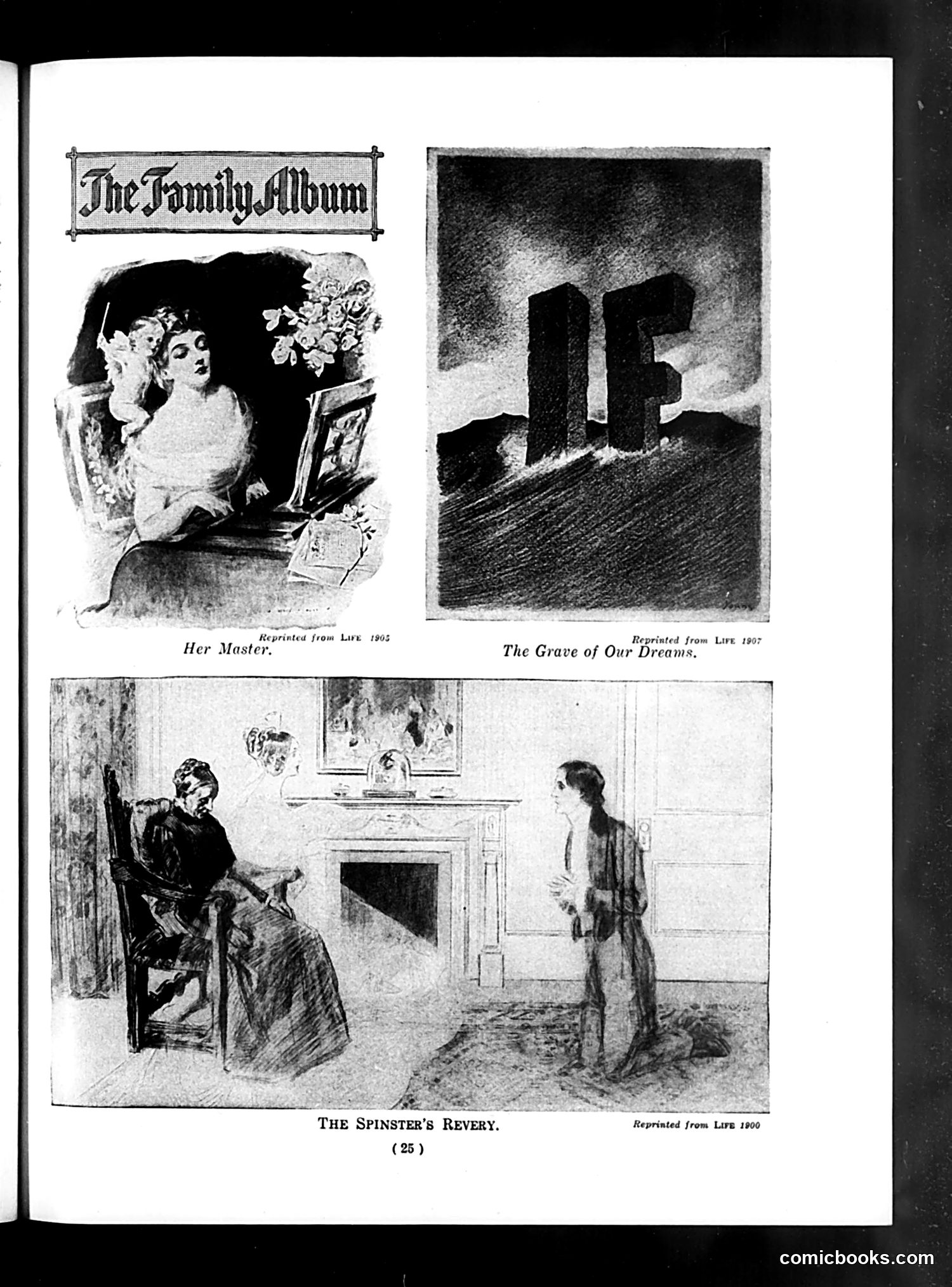
"The Family Album" Page Analysis This page collects three reprinted illustrations from *Life* magazine (1900, 1905, 1907), likely commenting on women's changing social roles and romantic prospects. "Her Master" shows a woman reading, surrounded by romantic imagery—suggesting idealized notions of love and male dominance. "The Grave of Our Dreams" depicts two grave markers, implying the death of romantic aspirations. "The Spinster's Revery" appears most pointed: an older unmarried woman sits while a younger woman enters, suggesting the fate awaiting unmarried females—social obsolescence and isolation. The satire targets period anxieties about spinsterhood as a shameful condition, while implicitly mocking both women's limited options (marriage as destiny) and the sentimentality surrounding romance. These pieces reflect early 1900s anxieties about marriage, aging, and women's roles in transitional times.
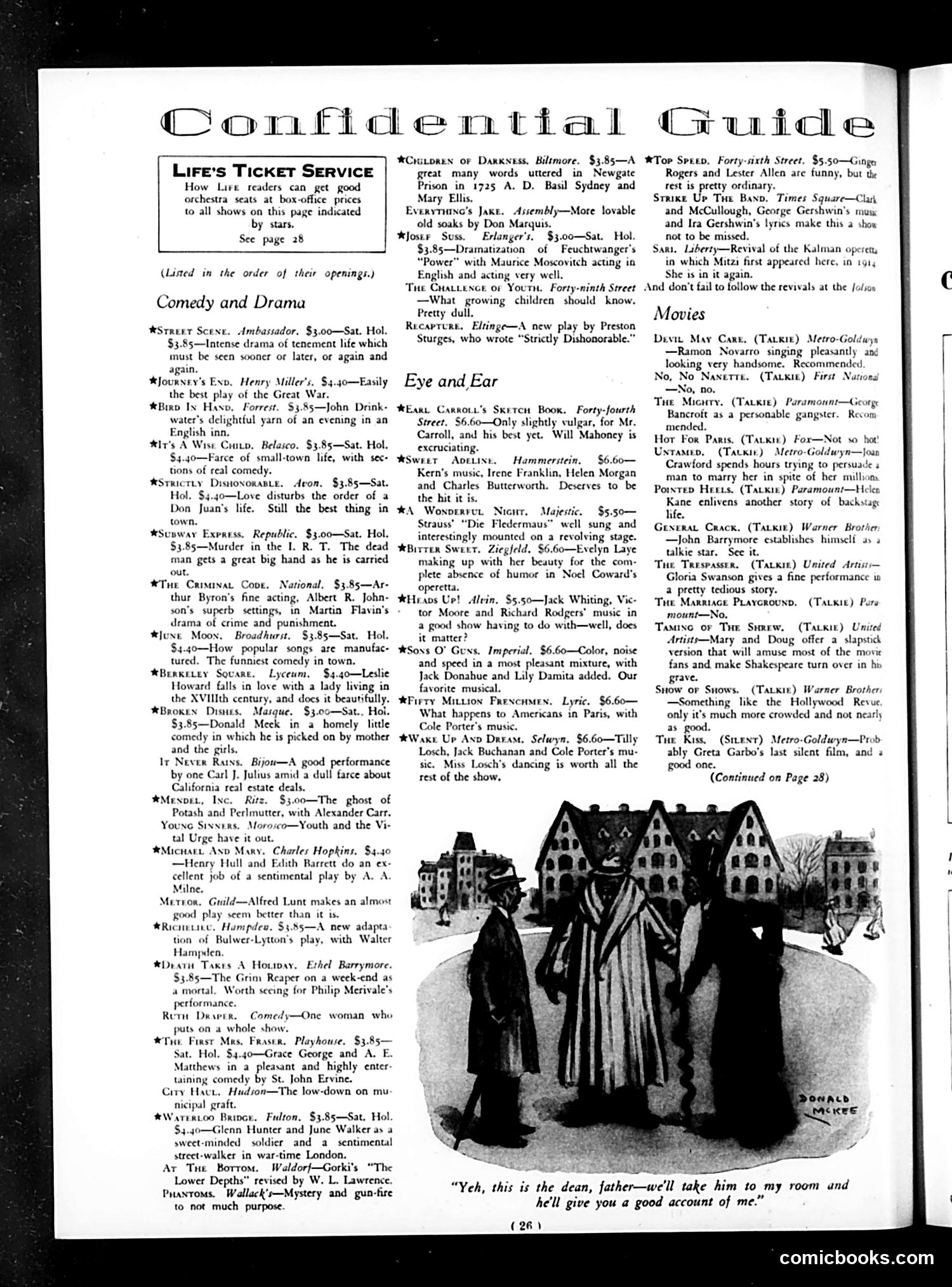
Analysis of This Life Magazine Page This is primarily an entertainment guide and theater review page from Life magazine (a 1920s satirical publication), not a political cartoon page. The main content consists of: 1. Life's Ticket Service box (top left): A practical service allowing readers to purchase theater seats at box-office prices for shows reviewed in the magazine. 2. Theater reviews organized by category (Comedy and Drama, Eye and Ear [music/performance]): Brief, witty critiques of Broadway productions, with asterisks marking shows offering discounted tickets. Reviews are characteristically snappy and irreverent—typical of Life's satirical voice. 3. The illustration (bottom): A Dorgan cartoon depicting what appears to be a scene of aristocratic or criminal intrigue, with the caption "Yeah, this is the dean, father—we'll take him to my room and he'll give you a good account of me." The humor likely satirizes class pretension or authority figures. The page exemplifies Life's role as cultural arbiter of 1920s entertainment, blending practical service with satirical commentary on contemporary theater.
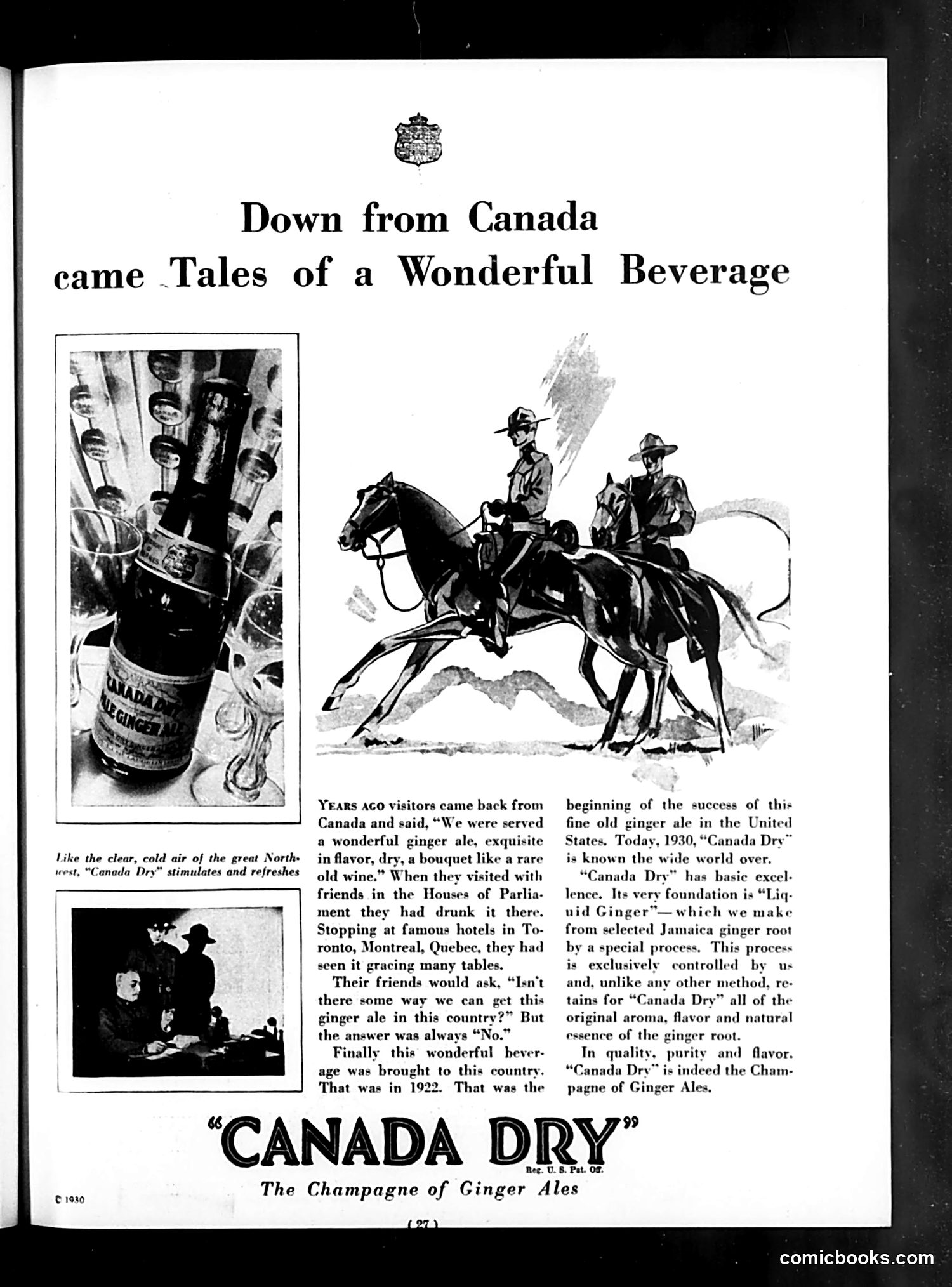
"Canada Dry" Advertisement (1930) This is a product advertisement, not political satire. It promotes Canada Dry ginger ale to American consumers by establishing its prestige through a nostalgic narrative. The page depicts two scenes: Canadian mounted police or frontier figures on horseback (evoking Canadian wilderness and authority), and what appears to be a formal parliamentary or hotel setting. These images create an association between the product and Canadian sophistication and respectability. The marketing story claims that American visitors to Canada discovered this superior ginger ale at Parliament buildings and luxury hotels, then brought tales of it home—but couldn't obtain it domestically until 1922. By 1930 (publication date), it's now "known the wide world over." The tagline—"The Champagne of Ginger Ales"—positions it as premium. The emphasis on Jamaica ginger root and exclusive manufacturing appeals to quality-conscious consumers. This reflects 1920s-30s marketing strategy: exploiting Prohibition-era demand for sophisticated non-alcoholic beverages by associating ginger ale with worldly elegance and imported prestige.
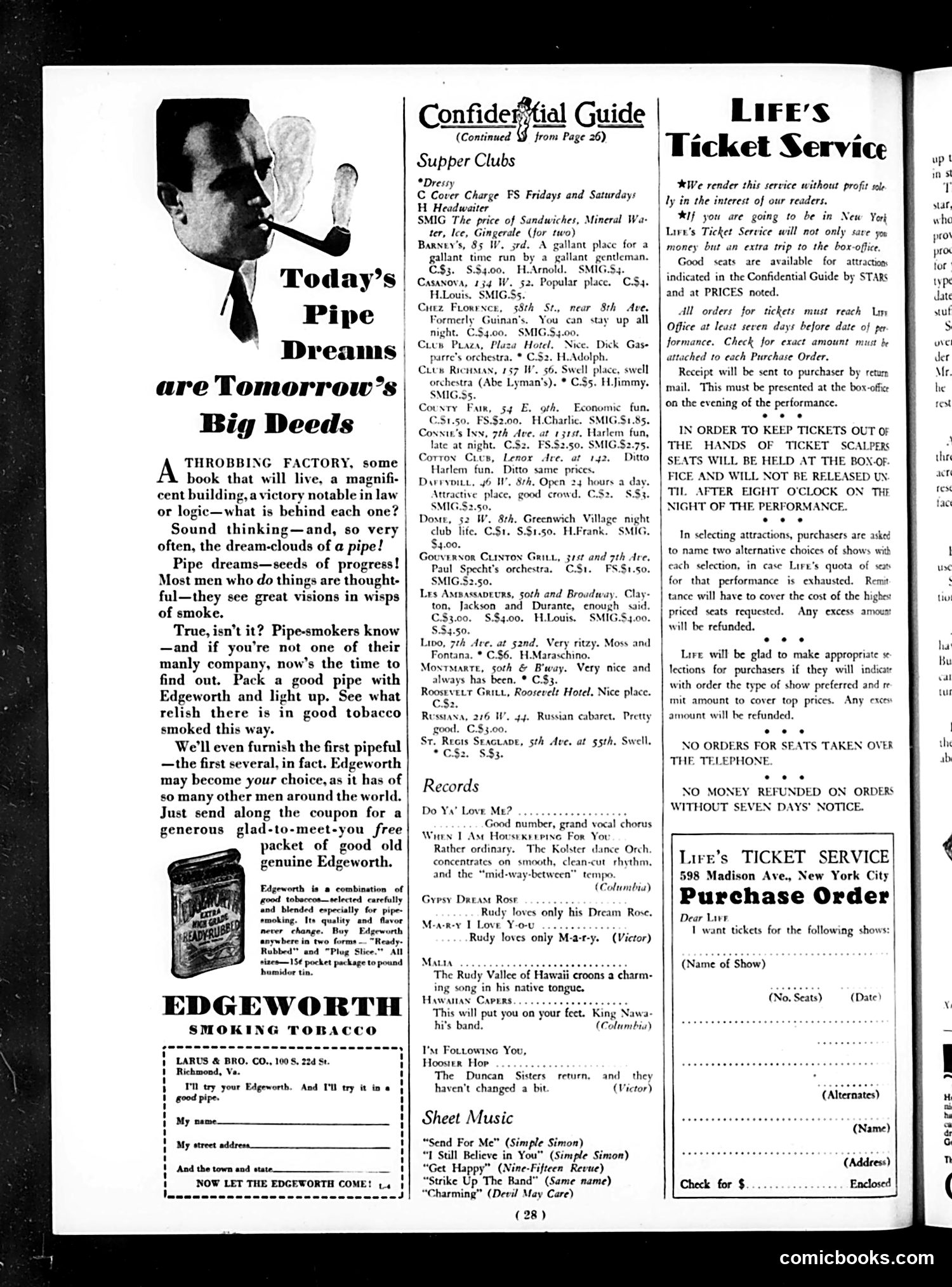
Analysis for Modern Readers This page is primarily advertising, not political satire. The dominant feature is a full-page Edgeworth tobacco advertisement featuring a stylized profile of a man with a pipe. The ad's messaging reflects 1920s masculine idealization: pipe-smoking is associated with visionary thinking, progress, and business success. The copy claims "pipe dreams—seeds of progress," arguing that thoughtful men who accomplish things are pipe-smokers. This is straightforward product marketing leveraging aspirational imagery rather than satire. The rest of the page contains a "Confidential Guide" listing nightclubs and supper clubs (with cover charges and headwaiter names), plus record and sheet music listings—typical *Life* magazine content from this era. No political cartoon or social satire is present. The page reflects period attitudes about masculinity and consumption, but serves primarily as commercial content.
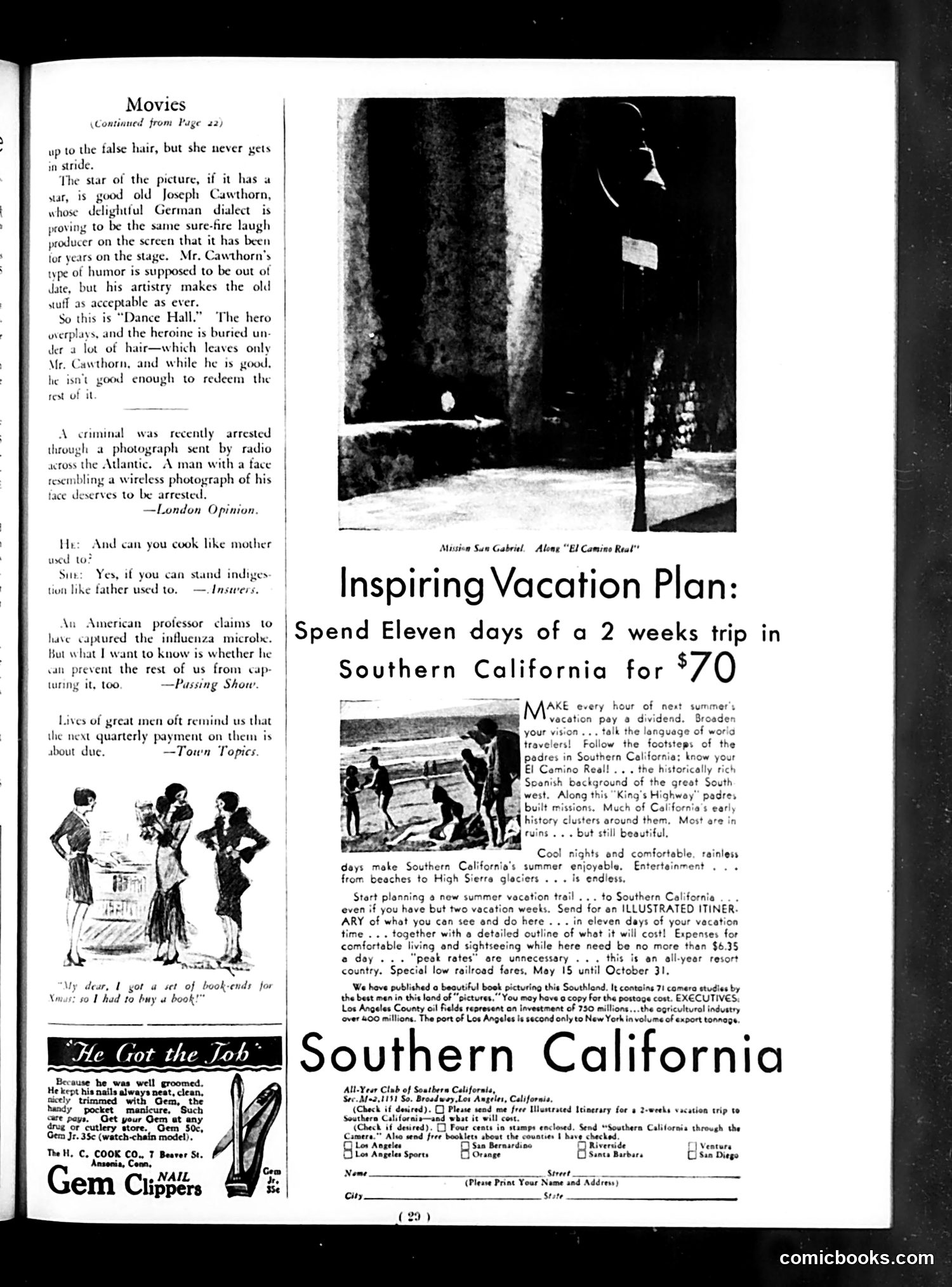
Life Magazine Page Analysis This page is primarily advertising and travel promotion, not political satire. The dominant content is a Southern California tourism advertisement ("Inspiring Vacation Plan") promoting an eleven-day trip for $70. The scattered jokes and brief items at top left are typical Life magazine filler humor—light observations about everyday life. Notable: a London Opinion quip about a criminal arrested via "wireless photograph" (early radio transmission), and domestic humor about cooking and influenza prevention. The only cartoon is a small sketch showing three women discussing "book-ends," a consumer goods joke unrelated to politics. The page reflects 1920s advertising culture: promoting automobile tourism, emphasizing Southern California's Spanish mission heritage ("El Camino Real"), and highlighting the region's economic assets (oil, agriculture, ports). The advertisement targets middle-class vacation planners, offering accessible leisure travel—a growing cultural phenomenon of the era. This is primarily commercial content, not editorial commentary or political cartooning.
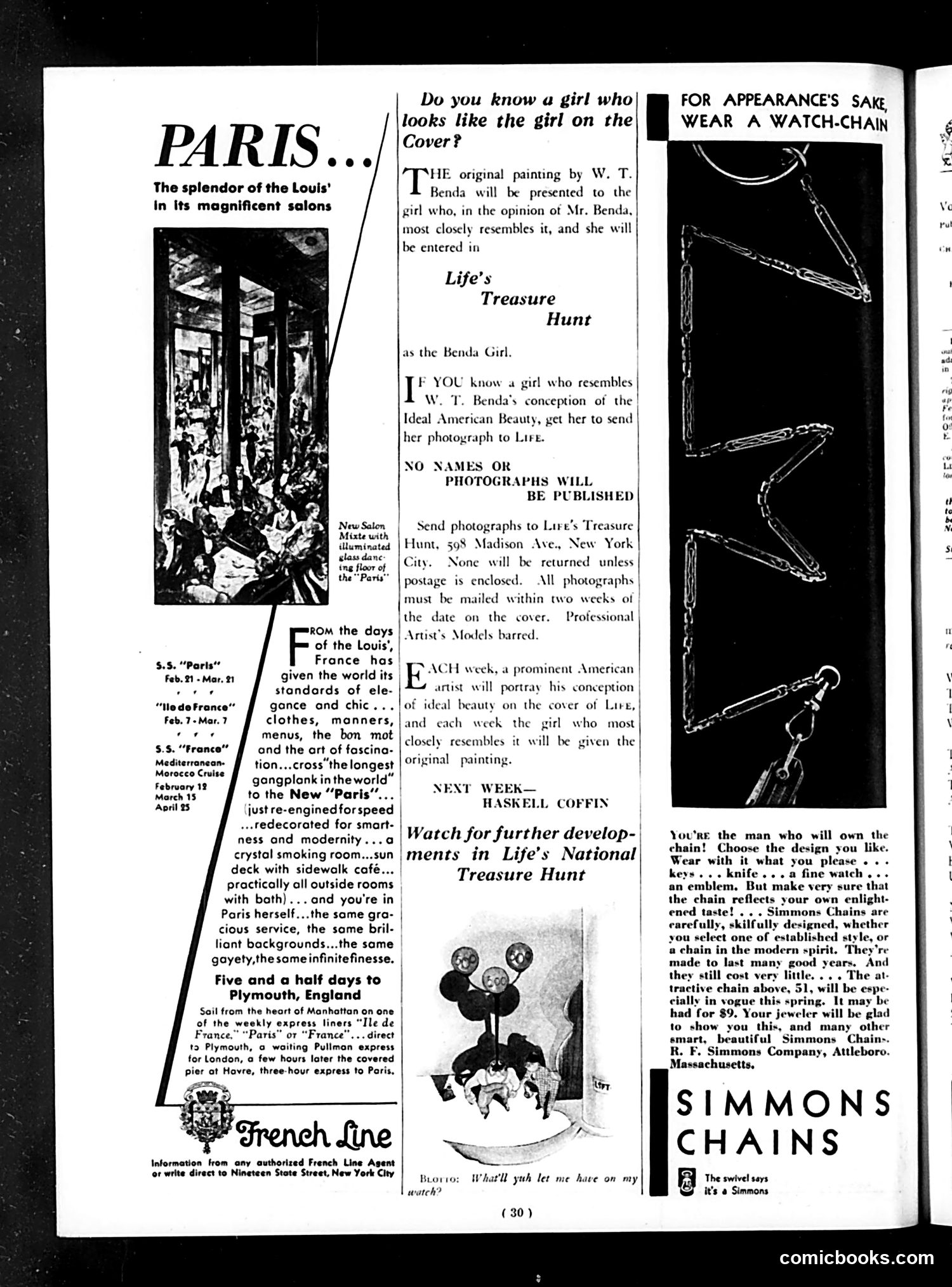
Page Analysis: Life Magazine Advertisement and Contest This page combines travel advertising with a beauty contest promotion typical of 1920s-30s magazines. Main Content: The French Line shipping company advertises its luxury ocean liner "Paris," emphasizing Parisian elegance and sophistication ("standards of elegance and chic"). The ad appeals to wealthy Americans seeking continental culture, listing amenities and transit times from New York to Paris. The "Treasure Hunt" Contest: Life magazine runs a beauty pageant where readers submit photographs of women resembling artist W.T. Benda's painting of the "Ideal American Beauty." The winner receives the original painting. This reflects the era's fascination with standardized beauty ideals and contests—the magazine offers a prize for conformity to one man's artistic vision of female attractiveness. Simmons Chains Advertisement: A jewelry ad selling watch chains, using masculine appeal ("You're the man who will own the chain") and price accessibility ($9). Social Context: These ads reveal 1920s-30s consumer culture: aspirational Parisian sophistication for the wealthy, beauty standardization for women, and affordable luxury goods for men. The contest itself reflects period attitudes toward women's value and appearance.
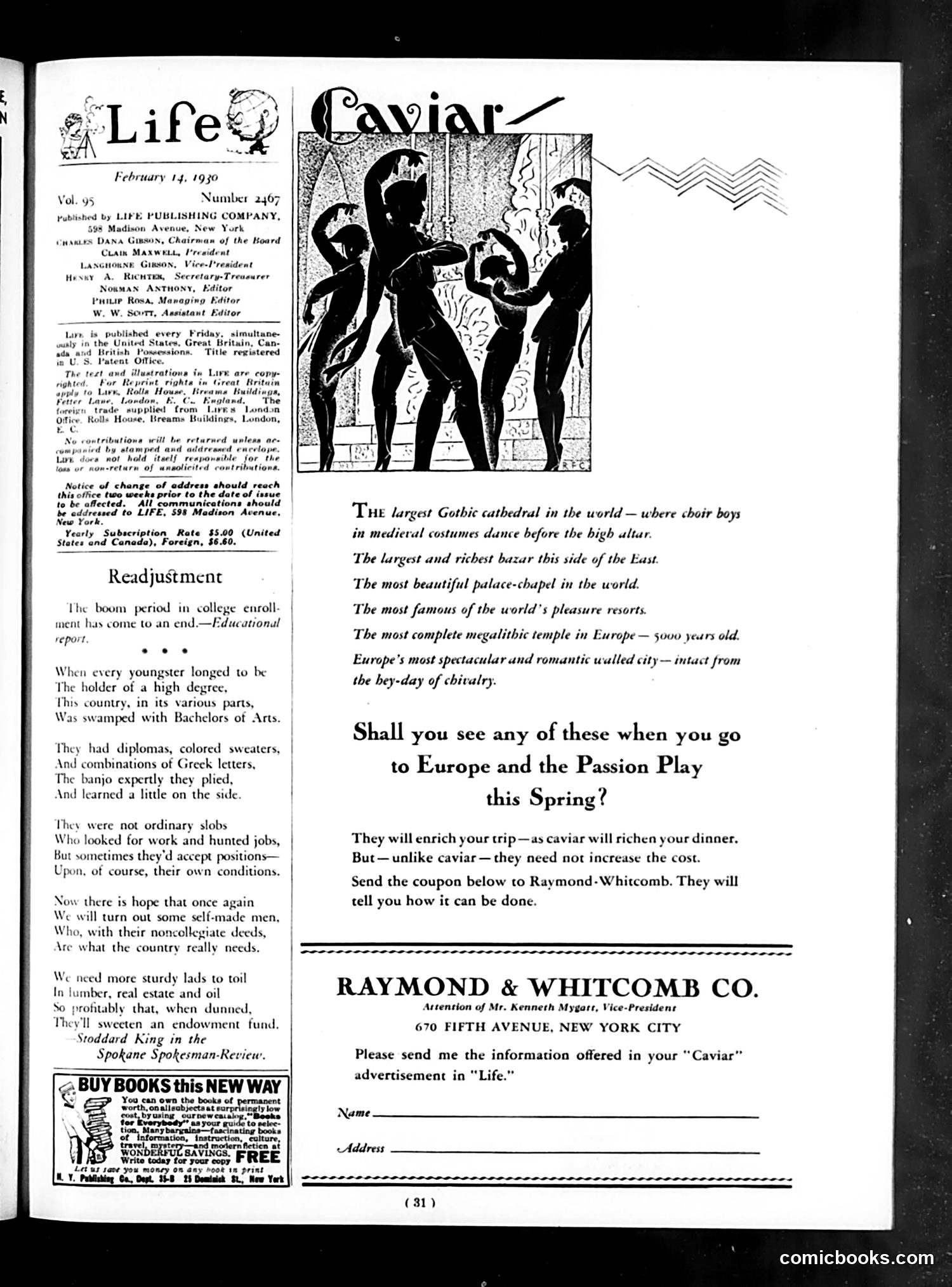
Life Magazine, February 14, 1930 This page combines editorial commentary with travel advertising. The main content is a satirical poem titled "Readjustment" critiquing the overproduction of college graduates during the 1920s boom. The poem laments that too many young Americans earned degrees in liberal arts but lack practical skills or work ethic, arguing the country instead needs "sturdy lads" for manual labor in lumber and oil industries. The accompanying advertisement promotes European travel through Raymond-Whitcomb travel agency, listing famous sites (Gothic cathedrals, bazaars, temples, walled cities) and the "Passion Play"—likely the Oberammergau production in Bavaria. The caviar metaphor suggests these luxuries will "enrich" a trip without increasing cost. Together, the page reflects post-1920s economic anxiety: oversupply of educated but unemployable graduates coinciding with marketing escapist European vacations to the affluent.
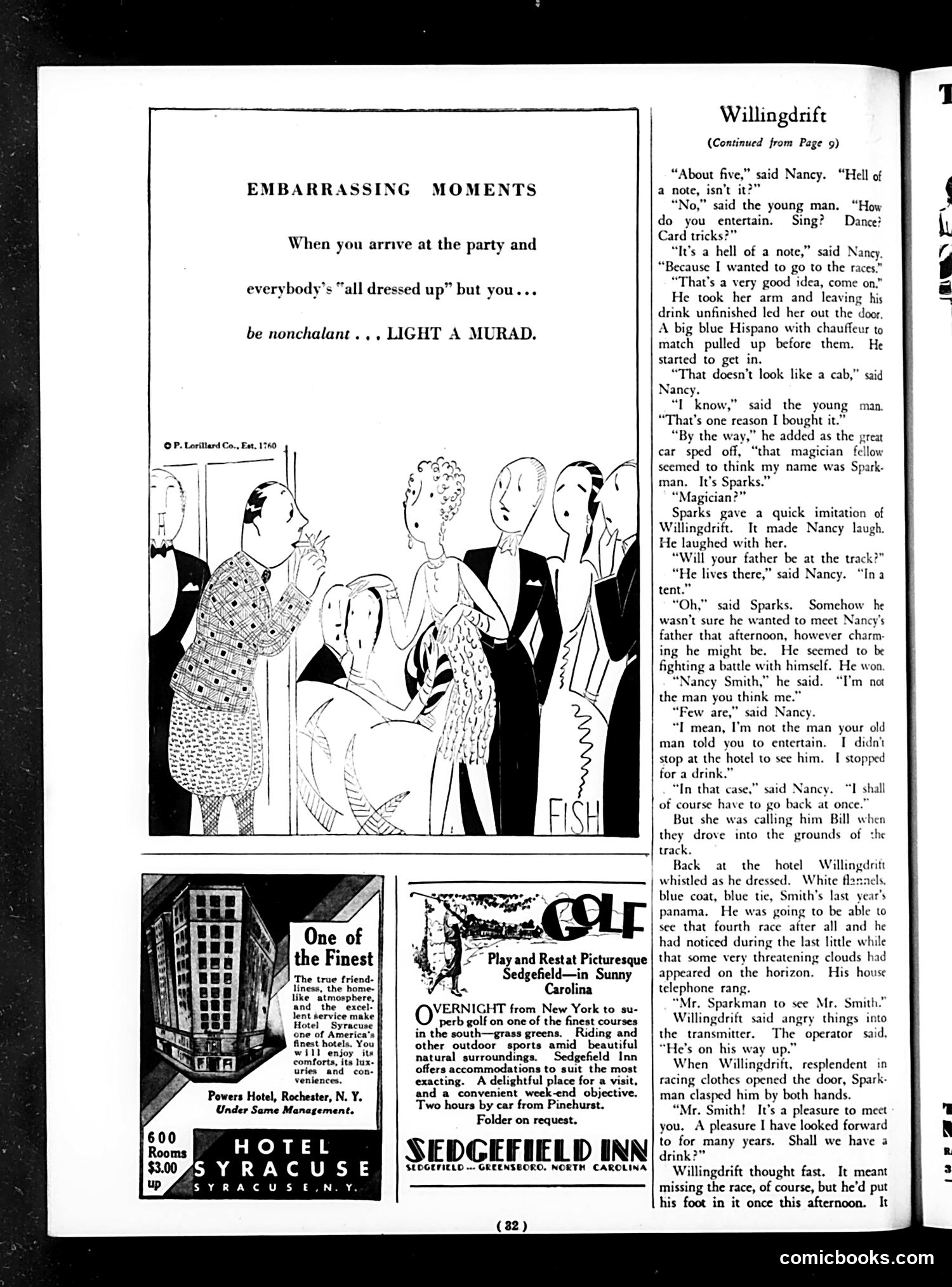
Analysis for Modern Readers This page contains a cigarette advertisement disguised as etiquette advice (top left) and the continuation of a serialized short story called "Willingdrift" (right column). The cartoon shows a social embarrassment scenario: arriving underdressed to a formal party. The "solution" is to light a Murad cigarette and act nonchalant—implying that smoking projects confidence and sophistication, thereby masking social awkwardness. This was typical early-20th-century advertising, using aspirational lifestyle messaging to sell tobacco. The story excerpt describes a young woman (Nancy) meeting a mysterious stranger (Sparks) at a society party. He whisks her away in his expensive car to the racetrack instead of entertaining her conventionally. The narrative suggests romantic intrigue and class dynamics typical of period fiction serialized in *Life* magazine. The page also includes hotel advertisements, reflecting *Life*'s mix of editorial content and paid advertising.
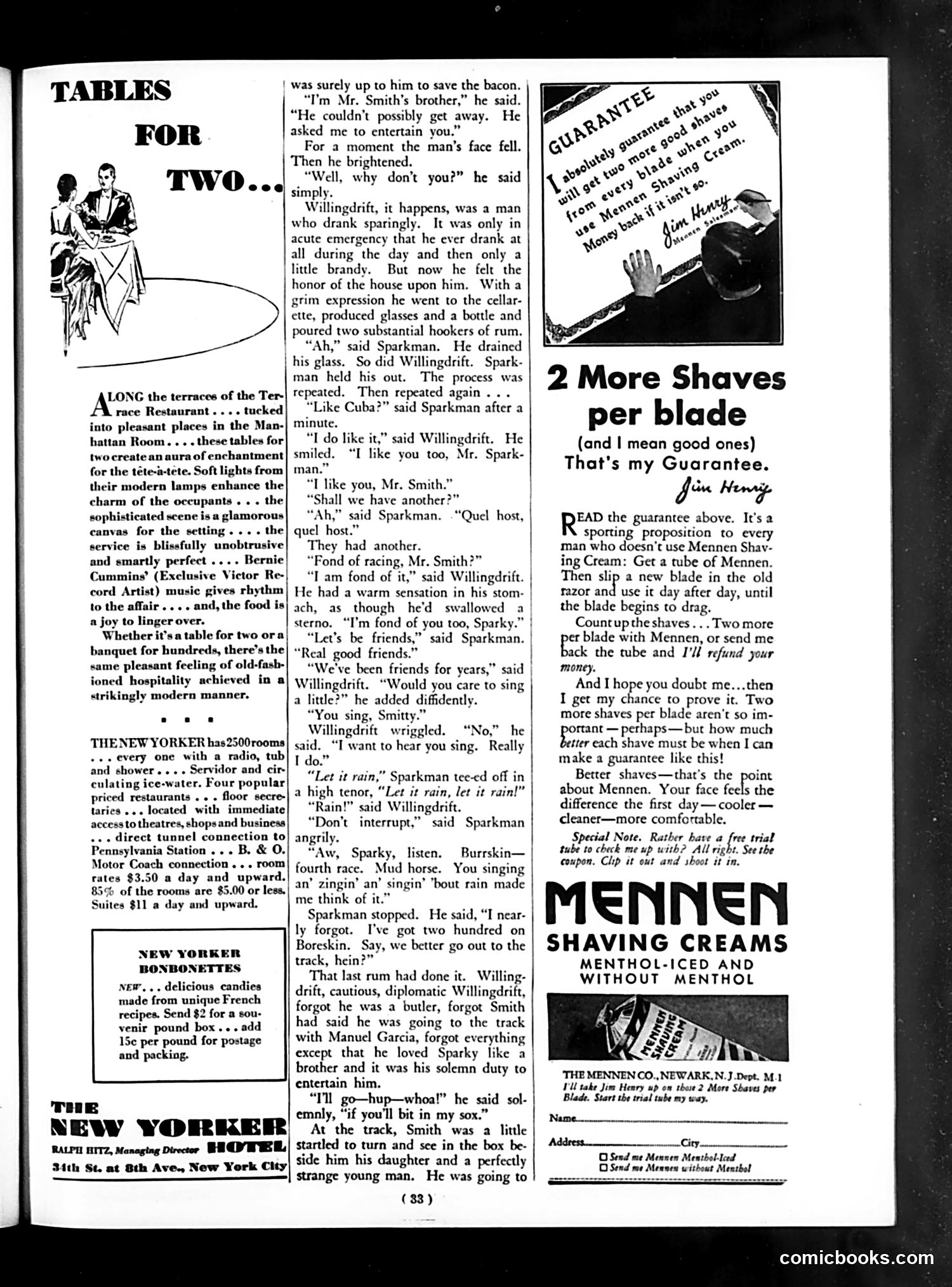
"Tables for Two" Story Analysis This page features a humorous short story about social class and hospitality gone awry. Willingdrift, a butler, must entertain Mr. Sparkman—a guest his employer Mr. Smith was supposed to host but couldn't. The satire centers on Willingdrift's attempt to maintain "diplomatic" butler composure while being pressured into drinking rum with Sparkman. As they drink repeatedly, Willingdrift's formal restraint collapses. He abandons his duties (forgetting Smith's plans to go to the racetrack with someone else) and becomes emotionally effusive—declaring Sparkman his dear friend and agreeing to accompany him to the track instead. The joke mocks the thin veneer of class distinction: alcohol and forced sociability strip away Willingdrift's professional detachment, revealing he's fundamentally the same as his "better." The story satirizes both rigid class hierarchies and the false camaraderie created by drinking.
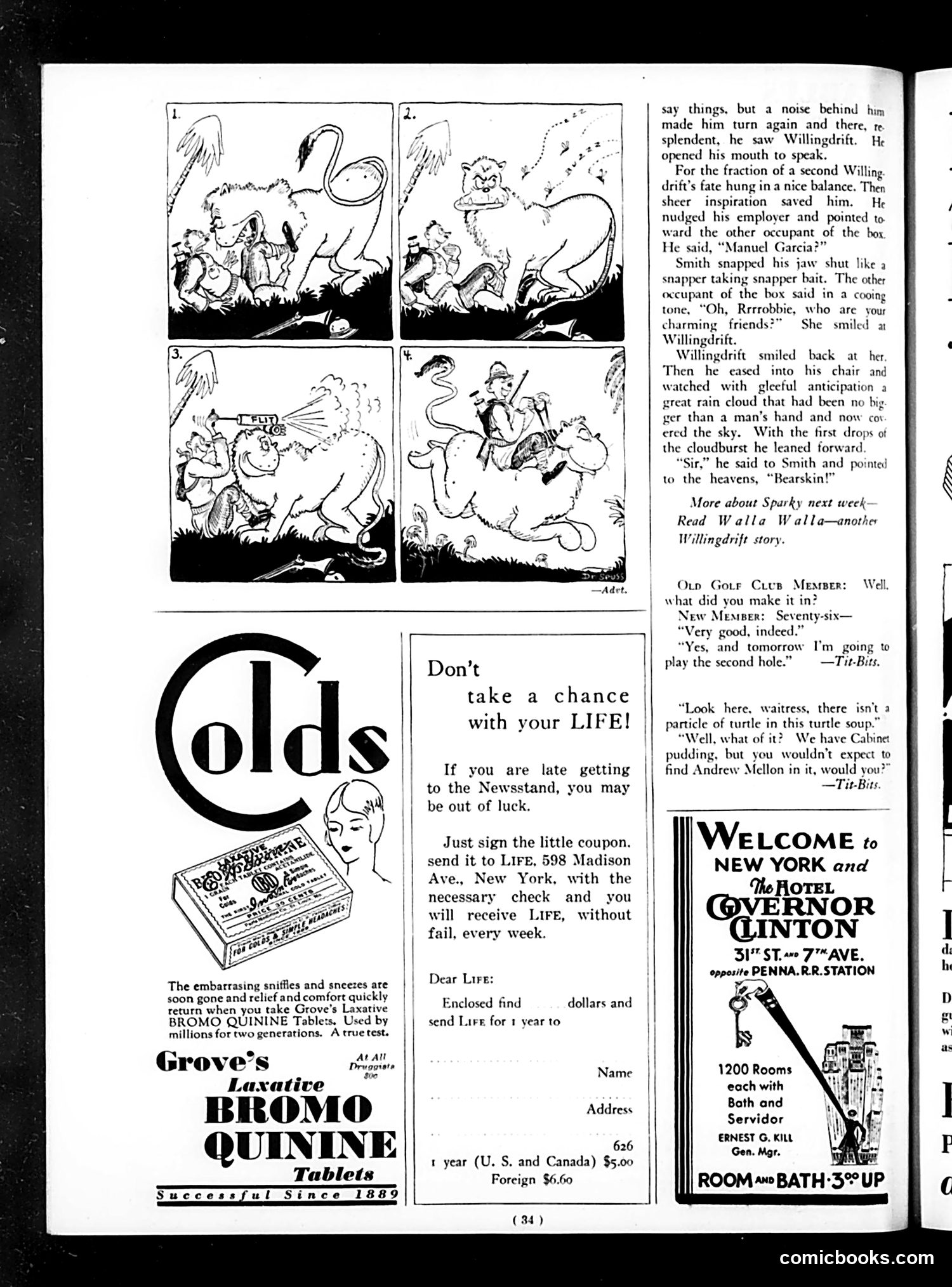
Page Analysis This page is primarily advertising and subscription material from Life magazine, with a small comic strip at the top. The four-panel comic strip (panels 1-4) appears to depict a humorous narrative involving small figures and a large dog or similar animal. The text references characters named "Willingdrift" and "Smith," with dialogue suggesting Willingdrift cleverly deflects an awkward social situation by redirecting attention—first by asking "Manuel Garcia?" (likely a famous person of the era to distract Smith), then by pointing to an approaching rainstorm and exclaiming "Bearskin!" The joke's specific reference is unclear without more context. The page also contains: - A Grove's Bromo Quinine advertisement promoting laxative tablets - A Life magazine subscription promotion encouraging readers to subscribe to avoid missing issues - Hotel and golf club advertisements - Miscellaneous jokes in small print, including references to turtle soup and Andrew Mellon (Treasury Secretary under Coolidge) The overall content reflects early-to-mid 20th century magazine formatting, mixing editorial cartoons with commercial appeals.
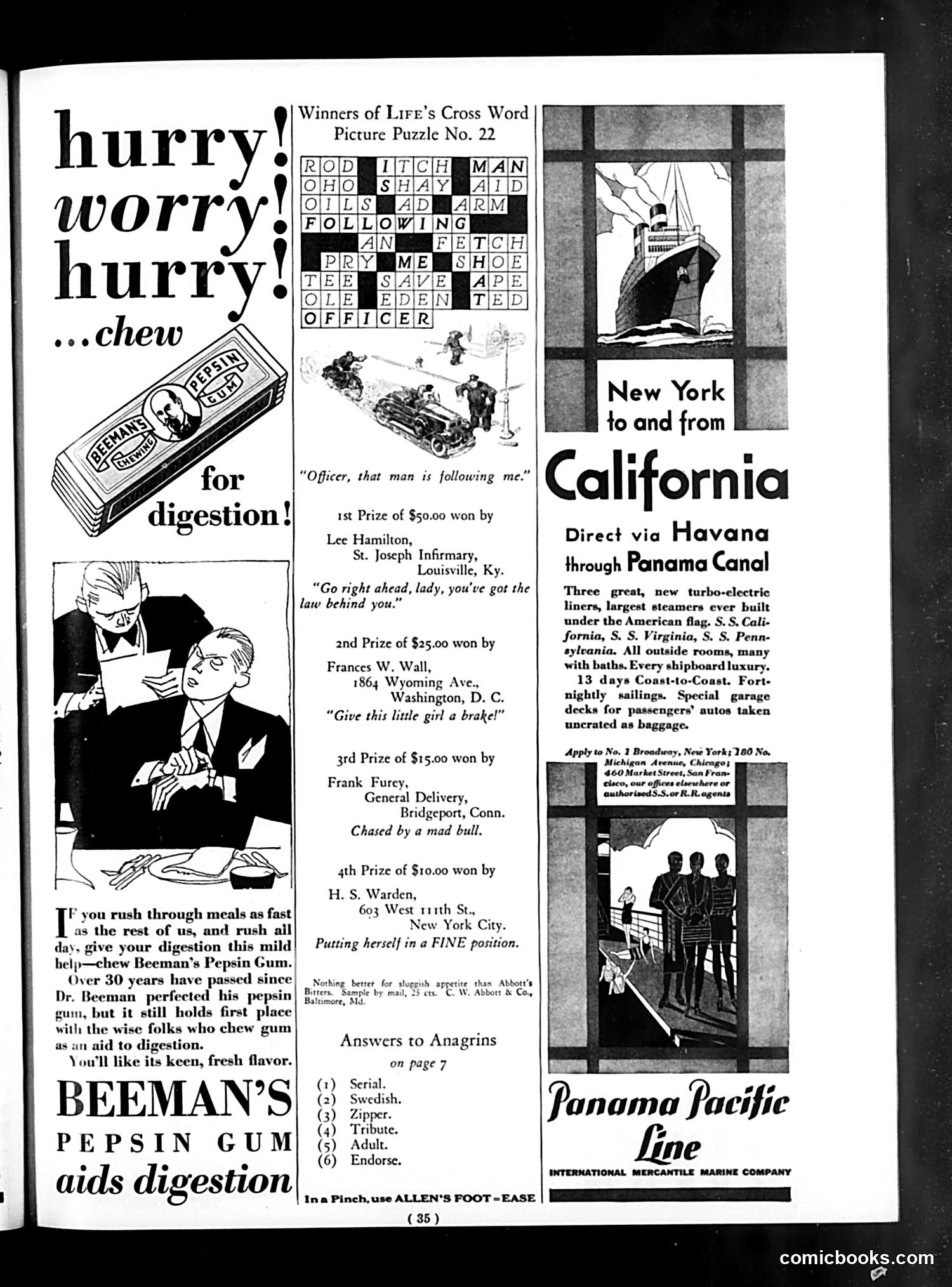
Life Magazine Page Analysis This page is primarily advertising content with minimal editorial satire. It features: Left side: Beeman's Pepsin Gum ad using the "hurry! worry! hurry!" motif—capitalizing on modern anxiety about rushed lifestyles and digestion. The accompanying cartoon shows a man and woman during a meal, humorously suggesting gum aids digestion for busy Americans. Center: Results of Life's crossword puzzle contest with winners listed and their prize-winning puzzle captions (comedic one-liners like "Officer, that man is following me"). Right side: Panama Pacific shipping line advertisement promoting luxury steamship travel from New York to California via Havana and the Panama Canal, emphasizing the novelty of new "turbo-electric" vessels and leisurely 13-day passage. The page reflects 1920s consumer culture—targeting modern, mobile Americans concerned with efficiency, comfort, and leisure travel. The ads assume readers are rushed, digestively troubled, and affluent enough for luxury cruises.
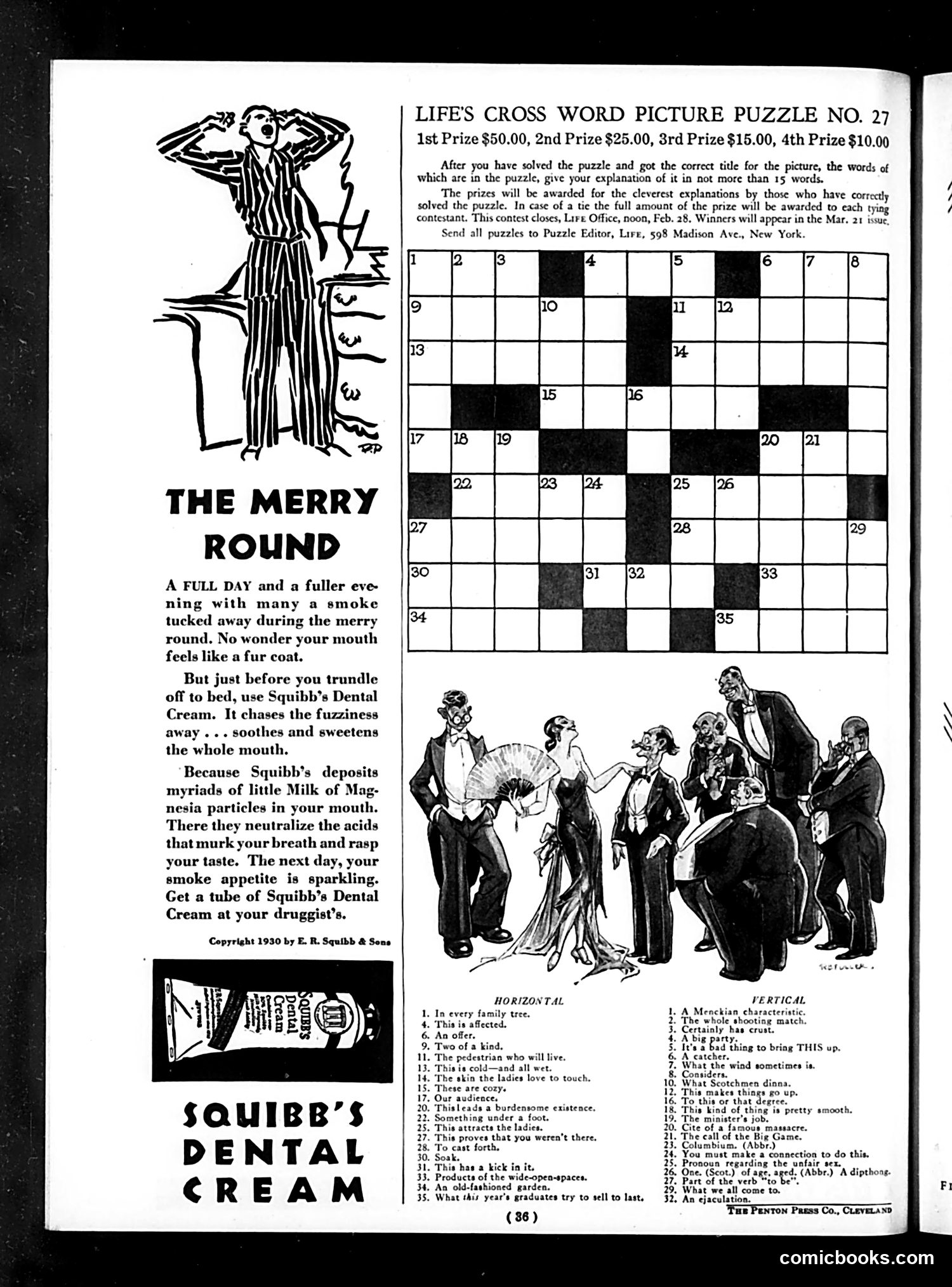
"The Merry Round" – A 1930 Life Magazine Page This page combines a crossword puzzle contest with a Squibb's Dental Cream advertisement. The illustration shows well-dressed people at what appears to be a social gathering or party—"the merry round" of the title. The satire is straightforward: the ad humorously acknowledges that heavy smoking and socializing leave one's mouth feeling unpleasant ("like a fur coat"), then pitches dental cream as the solution. The clever premise is that Squibb's contains "Milk of Magnesia particles" that neutralize acids from smoking, so users can resume smoking with a clear conscience the next day. The crossword puzzle (featuring clues about social life, smoking, and parties) serves as the contest hook—solve it, explain the picture in 15 words, and win prizes up to $50. This reflects 1930s attitudes: smoking was ubiquitous at social events, considered sophisticated rather than harmful, and dental products marketed themselves as enabling continued smoking rather than discouraging it.
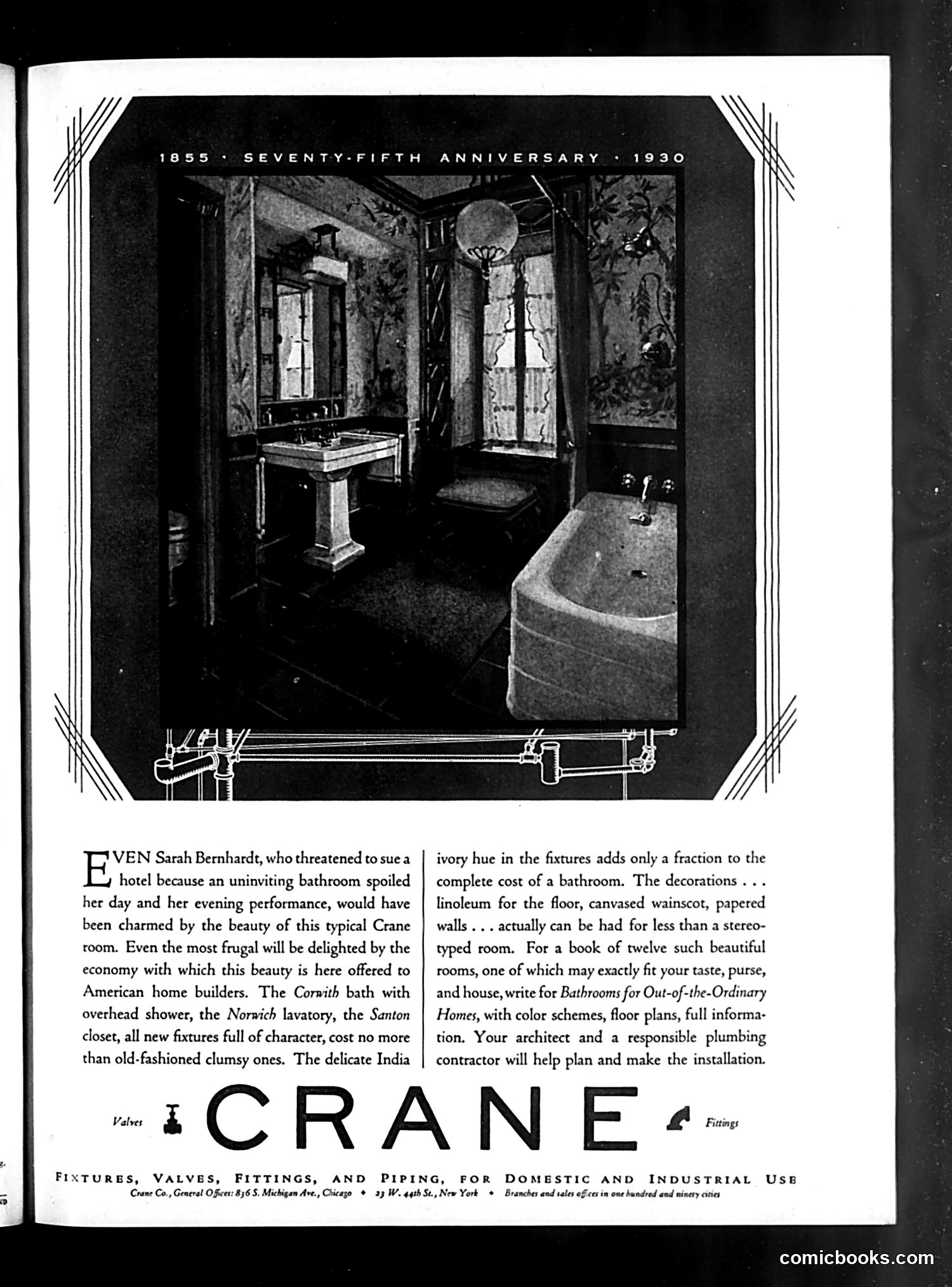
Analysis This is a Crane plumbing fixtures advertisement, not a political cartoon. It commemorates Crane's 75th anniversary (1855-1930). The ad references Sarah Bernhardt, the famous French actress, to establish credibility through a celebrity anecdote. It notes that even the notoriously demanding Bernhardt would appreciate a well-designed bathroom—implying Crane's fixtures meet high aesthetic standards. The social point: The ad targets middle-class American homebuilders by arguing that beautiful, modern bathroom fixtures needn't be prohibitively expensive. This was significant in 1930, as indoor plumbing was still becoming standard in American homes rather than a luxury. The photograph shows a luxurious bathroom with decorative panels, modern fixtures, and careful styling—meant to inspire consumers while the text assures them such elegance is financially achievable. This reflects early 20th-century marketing: aspirational design democratized through affordable mass production.
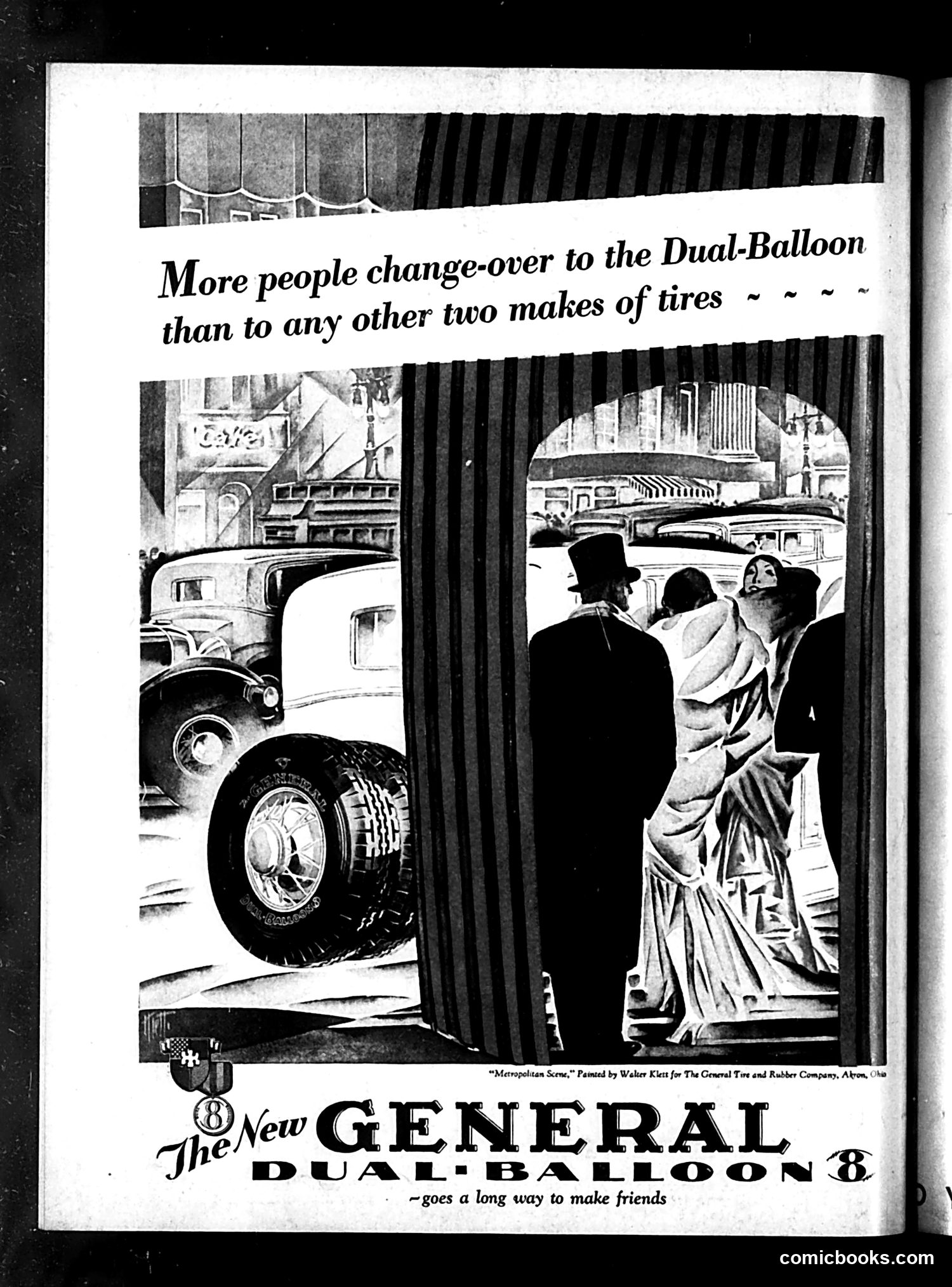
This is an advertisement for General's "Dual-Balloon" tires, not a political cartoon. The ad claims more people switch to General's tires than to any other two competing brands combined. The imagery shows a street scene with well-dressed men in suits and hats examining a car's prominent tire. The "Metropolitan Scene" painting style suggests urban sophistication and reliability. The tagline "goes a long way to make friends" implies that owning these superior tires confers social status. This is straightforward commercial advertising from what appears to be the 1930s-40s era, emphasizing tire quality and market dominance to appeal to middle-class car owners concerned with both performance and status.