life
Life — February 21, 1930
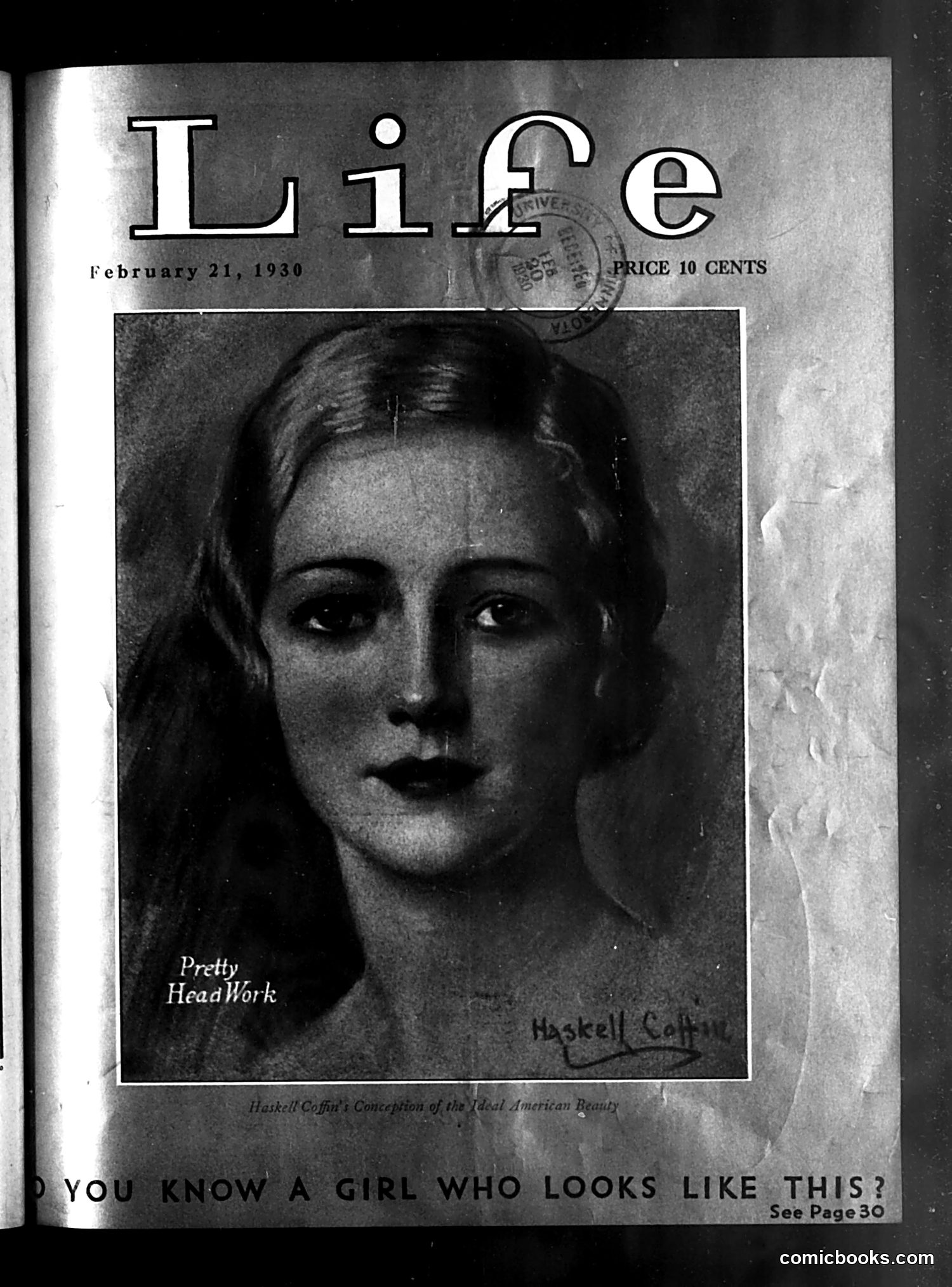
Life Magazine Cover Analysis (February 21, 1930) This cover features a portrait labeled "Pretty Headwork" with attribution to "Haskell Coffin," a prominent illustrator of the era. The caption "YOU KNOW A GIRL WHO LOOKS LIKE THIS? See Page 30" is typical of Life's satirical format—inviting readers to identify someone matching the depicted type. The image appears to showcase an idealized "American Beauty" standard of the 1930s: defined features, carefully styled hair, and a contemplative expression. Rather than mocking a specific person, this likely satirizes the period's aesthetic ideals and beauty standards. The "pretty headwork" phrase suggests commentary on fashion, styling, or perhaps the superficiality of appearance-focused culture during the Depression era. Without seeing page 30, the specific joke remains unclear.
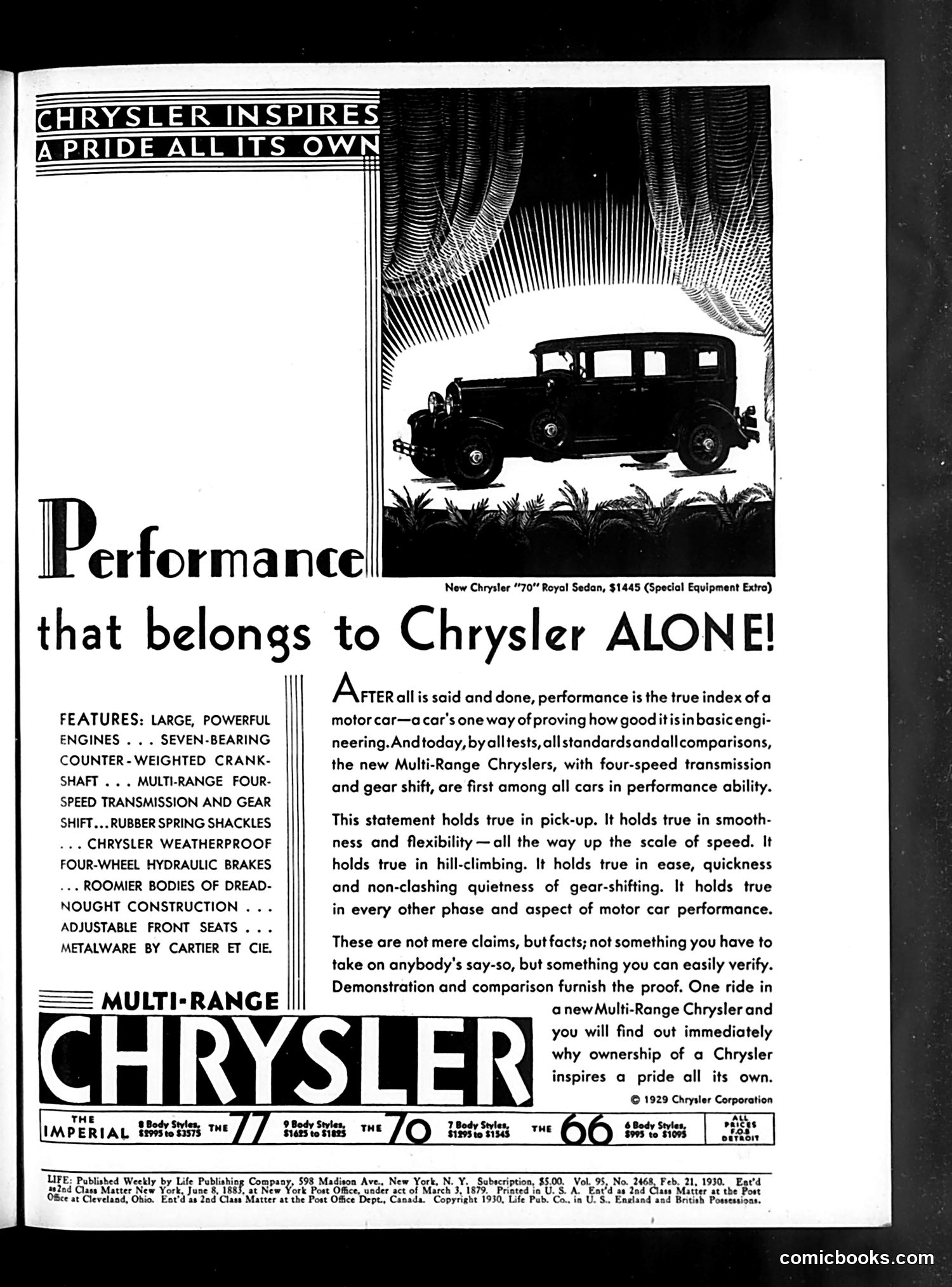
This is a Chrysler automobile advertisement, not a political cartoon or satire. It appeared in *Life* magazine (February 21, 1930, per the footer). The ad promotes Chrysler's "Multi-Range" vehicles, featuring the "70" Royal Sedan model ($1,445). The imagery—a silhouetted car against a dramatic radiating background—uses Art Deco styling typical of 1920s-30s advertising aesthetics. The text emphasizes Chrysler's engineering superiority, claiming their four-speed transmission and performance features are "first among all cars." This reflects genuine 1920s automotive competition, when transmission technology and engine power were major selling points. The ad's tone is characteristic of Depression-era marketing: asserting verifiable "facts" rather than mere claims, inviting consumer testing and comparison—suggesting manufacturers needed to build consumer confidence during economic uncertainty.
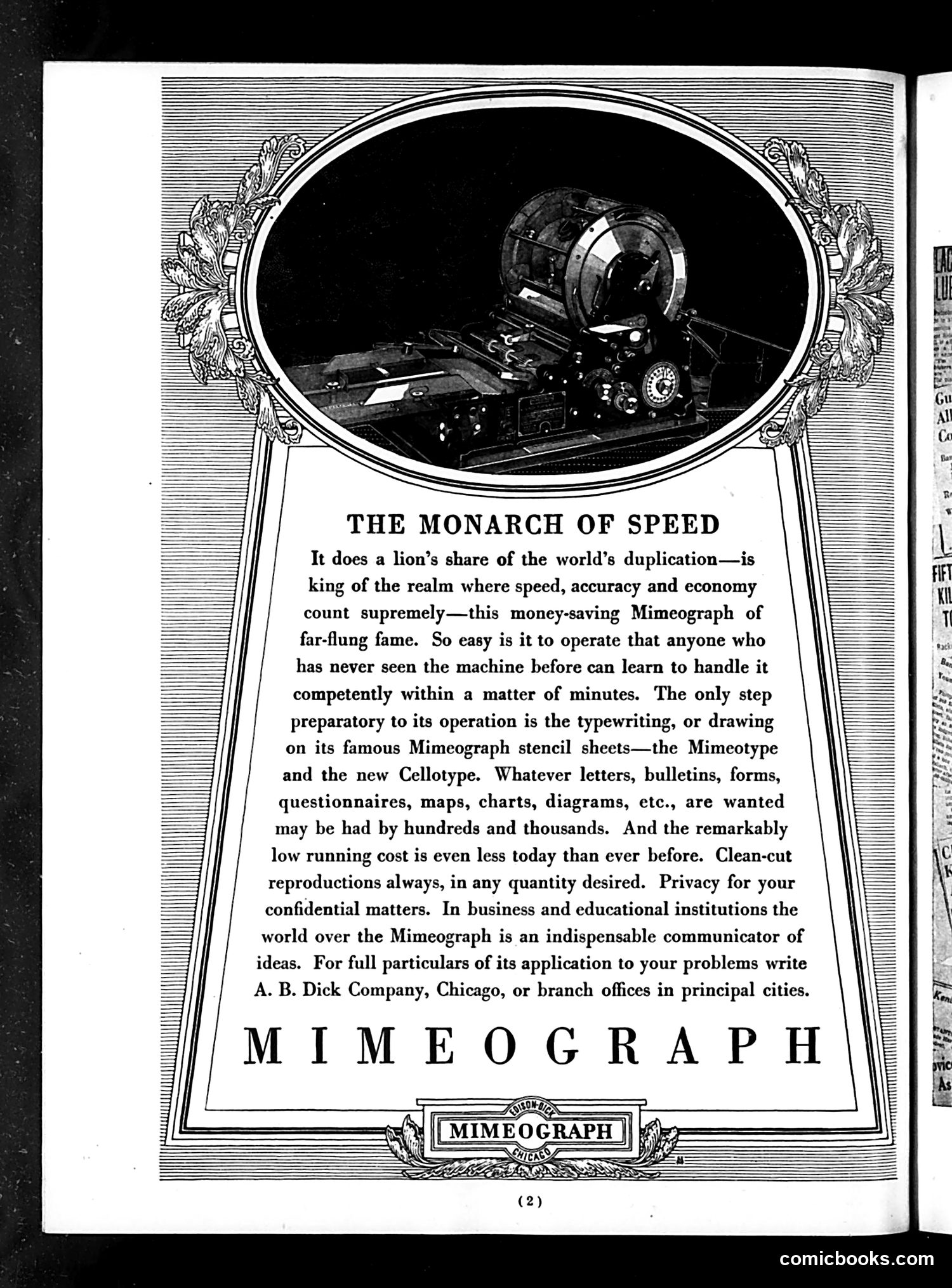
Analysis This page is primarily an advertisement, not satirical content. It promotes the Mimeograph machine manufactured by A.B. Dick Company of Chicago. The ad uses the phrase "The Monarch of Speed" as a marketing slogan, emphasizing the machine's efficiency in duplicating documents. The text highlights practical benefits: ease of operation, low cost, and ability to produce "clean-cut reproductions" of letters, bulletins, forms, maps, and charts in large quantities. The decorative border and oval frame containing a photograph of the actual mimeograph machine are typical design elements of early 20th-century advertising. This represents straightforward business promotion rather than political satire or editorial commentary—demonstrating how Life magazine integrated advertising alongside editorial content.
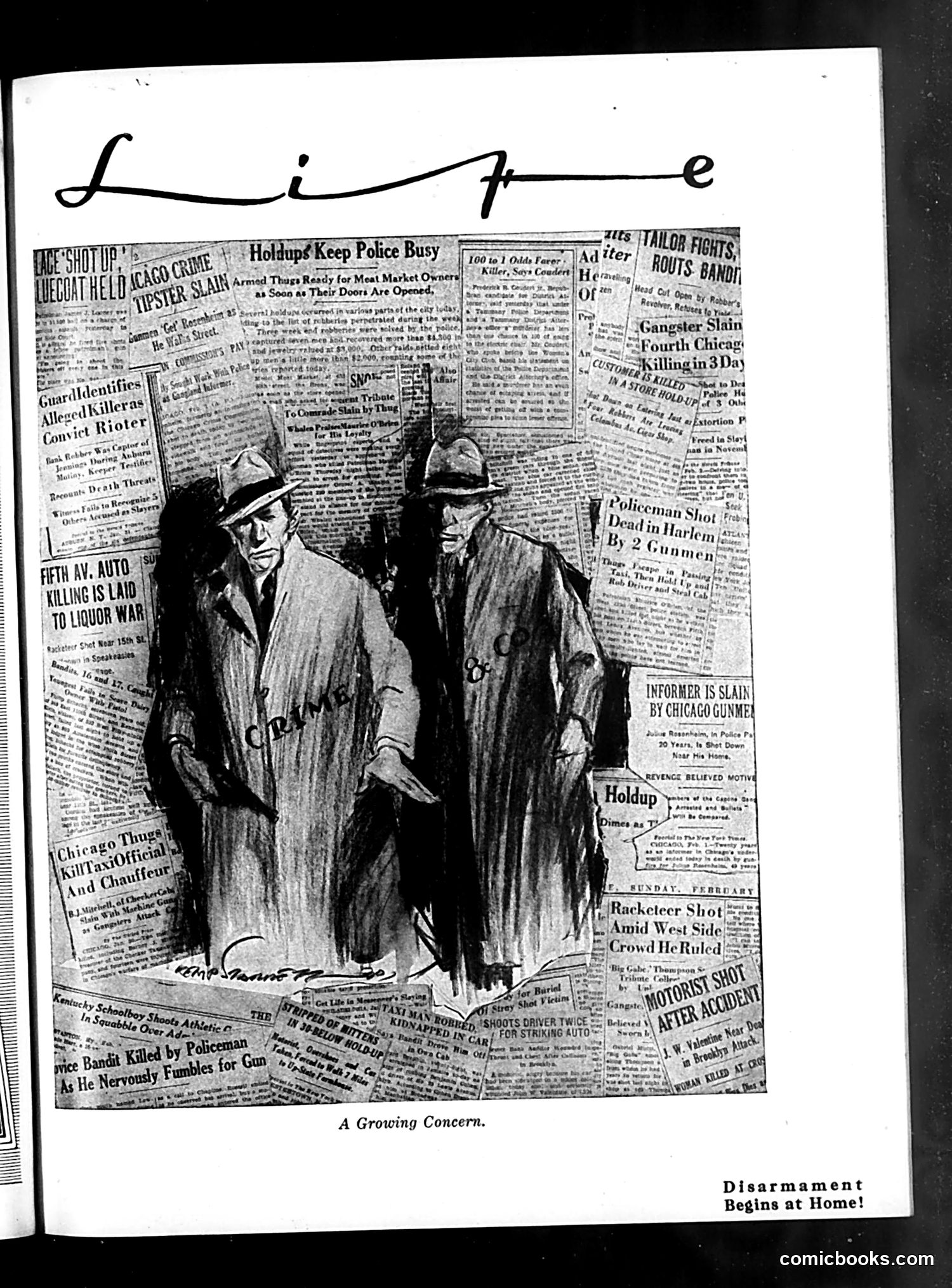
"A Growing Concern" - Life Magazine Cartoon This satirical cartoon depicts two men in overcoats and fedoras standing against a backdrop of crime headlines. The illustration critiques what the caption frames as "A Growing Concern" — appearing to reference the escalating organized crime and gang violence during Prohibition era Chicago. The newspaper clippings behind them feature sensational headlines about murders, holdups, and police shootings ("Policeman Shot Dead in Harlem," "Gangster Slain," "Informer is Slain by Chicago Gunmen"). The two figures likely represent either gangsters or corrupt officials, positioned ominously against this violent backdrop. The overall message appears to satirize how organized crime had become endemic to American urban life, treated almost as a normalized "concern" rather than exceptional criminality. The bottom caption "Disarmament Begins at Home!" suggests ironic commentary on civic violence overshadowing international peace efforts.
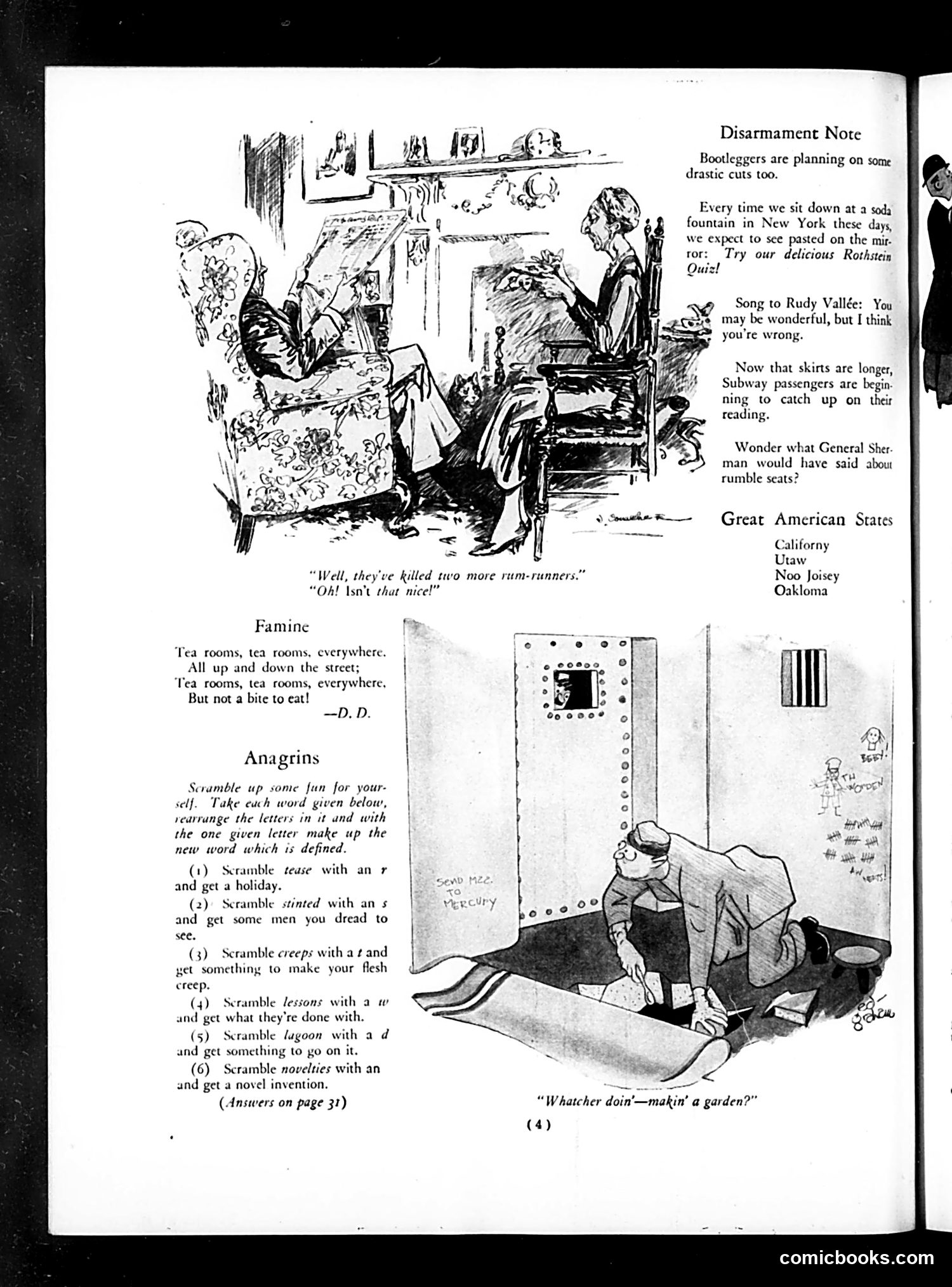
Analysis of Life Magazine Page Top Cartoon ("Well, they've killed two more rum-runners"): This satirizes Prohibition-era enforcement. Two figures discuss bootleggers being killed, treating deaths casually ("Isn't that nice!"). The satire criticizes both the violence of alcohol prohibition and society's indifference to it. "Disarmament Note" Section: Mocks proposed military disarmament, suggesting bootleggers face "drastic cuts" too—equating criminal enforcement with military cutbacks. "Famine" Poem: Laments that tea rooms are everywhere but offer nothing to eat—likely commenting on trendy but insubstantial social establishments of the era. "Anagrins" Word Game: A puzzle feature unrelated to political satire. Bottom Cartoon: Shows someone in a prison cell ("makin' a garden")—unclear specific reference without more context.
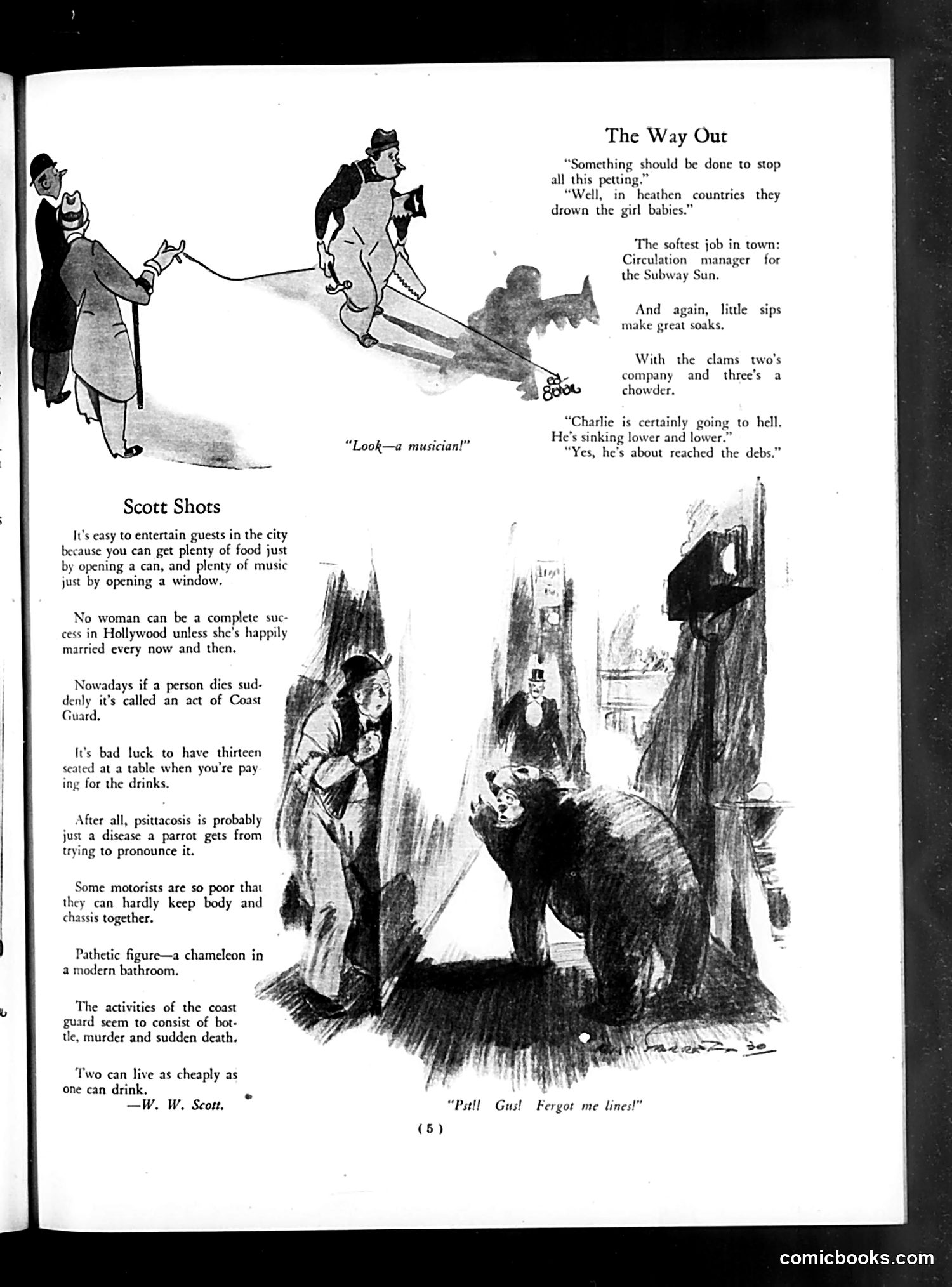
Analysis of Life Magazine Page This page contains two distinct pieces of humor: "The Way Out" (top): A cartoon showing men with a dog and fishing rod, with commentary about dealing with unwanted children through drowning—a dark reference to infanticide practices in "heathen countries." The accompanying jokes mock various social problems: petty crime, subway management, debt, and romantic/marital dissolution. "Scott Shots" (bottom): A series of brief satirical observations by W.W. Scott mocking contemporary urban life—difficult entertainment, Hollywood success, sudden death terminology, expensive dining, disease pronunciation difficulties, motorists' poverty, bathroom design, and coast guard duties. The illustration depicts what appears to be a drowning victim or rescue scenario ("Pull! Gus! Forgot me line!"), darkly complementing the text's grim humor about mortality and social dysfunction.
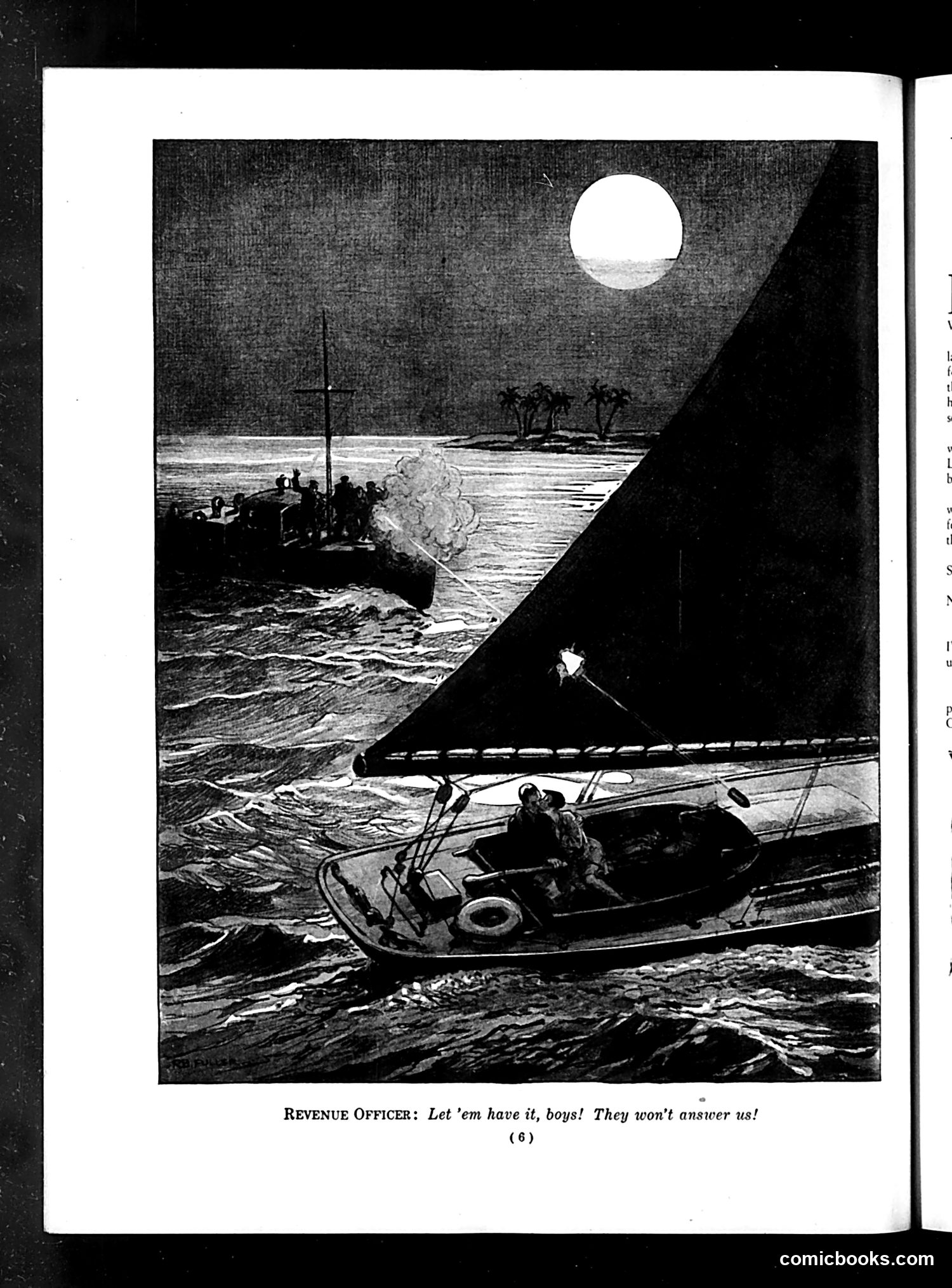
Political Context This illustration depicts a naval military scene with a satirical caption. The image shows a small boat in the foreground (in silhouette) near a larger vessel, with moonlight illuminating a distant shoreline where palm trees are visible and another ship appears to be under fire or explosion. The caption reads: "REVENUE OFFICER: 'Let 'em have it, boys! They won't answer us!'" This appears to be satirizing enforcement efforts—likely depicting revenue officers or coast guard pursuing smugglers or illegal traders who refuse to respond to official hails. The dramatic nighttime setting and military action suggest commentary on Prohibition-era smuggling or customs enforcement, common satirical subjects in Life magazine during the 1920s-1930s. The humor lies in the aggressive pursuit of those evading revenue laws.
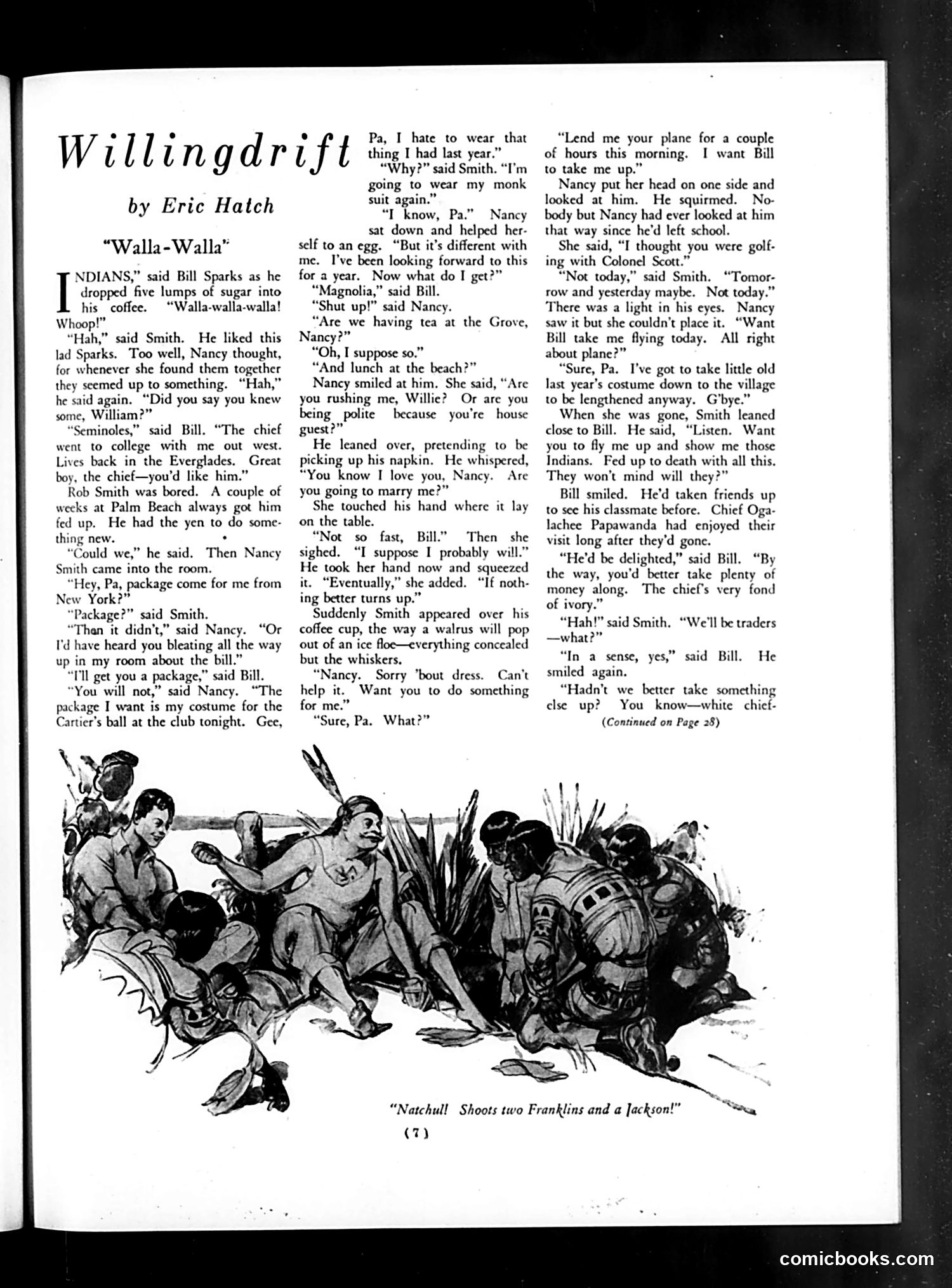
"Willingdrift" by Eric Hatch This page contains the opening of a short story rather than political satire. The narrative follows Bill Smith and his wife Nancy, who are planning social activities—a costume ball, tea at the Grove, and a beach lunch. Bill wants to borrow Nancy's plane to impress visiting Native American chief Ogalathe and show him local Indian sites. The illustration at bottom depicts what appears to be Native Americans in traditional dress (feathered headdresses visible), captioned "Nutchull Shoots two Franklins and a Jacknot!" The story exemplifies early 20th-century American attitudes toward Native Americans as exotic curiosities for entertainment and display—treating them as tourist attractions rather than as people.
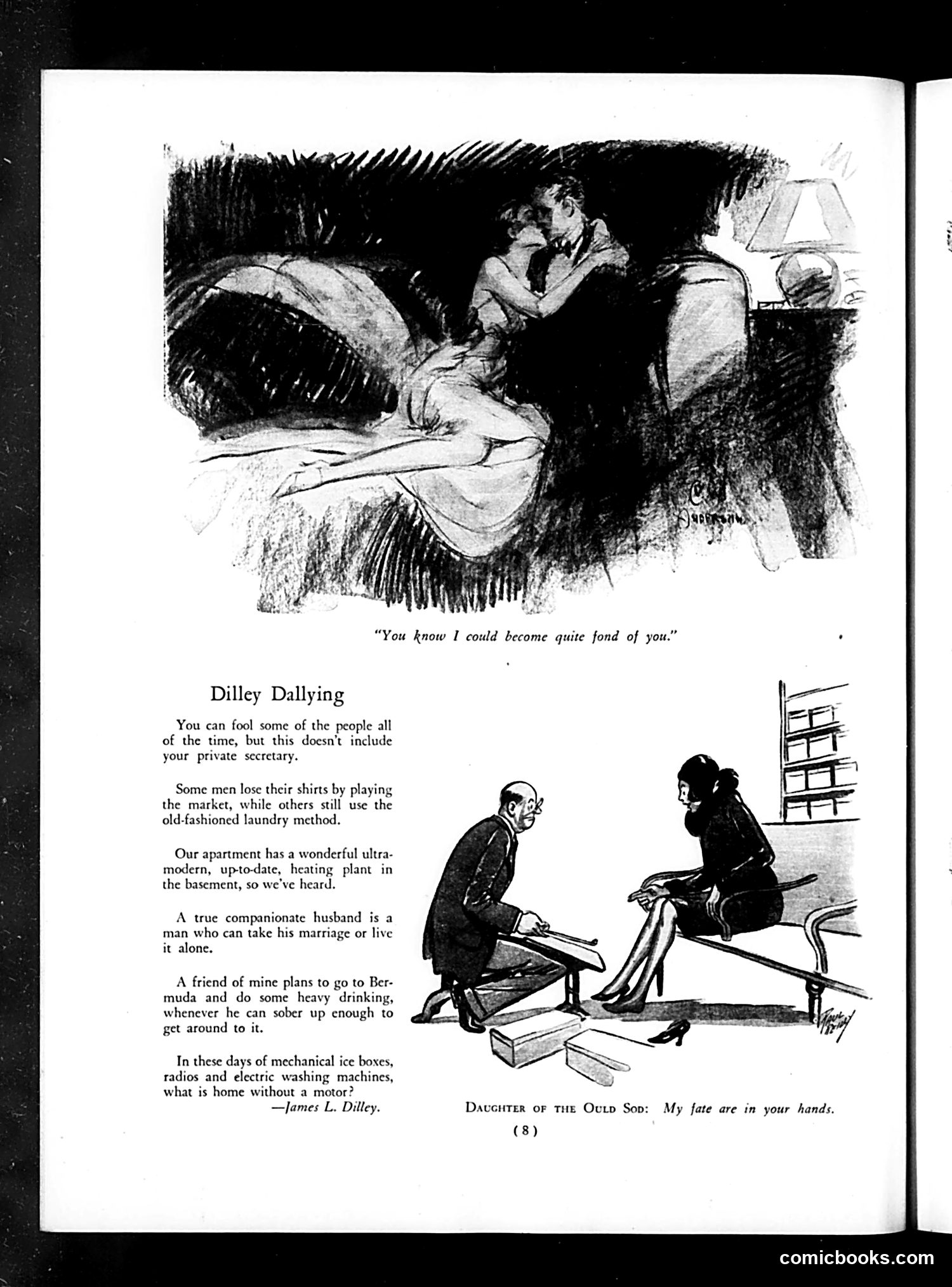
"Dilley Dallying" - Life Magazine Satire This page contains a satirical piece by James L. Dilley critiquing modern marriage and domestic life. The top illustration shows an intimate bedroom scene with the caption "You know I could become quite fond of you"—sarcastically suggesting emotional connection in marriage. The text below uses humorous observations about marriage dynamics: men losing money in markets, the importance of heating systems in apartments, and "companionate husbands" who accept their marriages casually. A closing anecdote mocks excessive drinking in Bermuda. The lower cartoon depicts a couple—likely husband and wife—in a contentious domestic moment, with the woman saying "My fate is in your hands," suggesting marital tension or role reversal anxieties. Overall, the satire targets early 20th-century anxieties about modern marriage, domestic technology, and shifting gender relations.
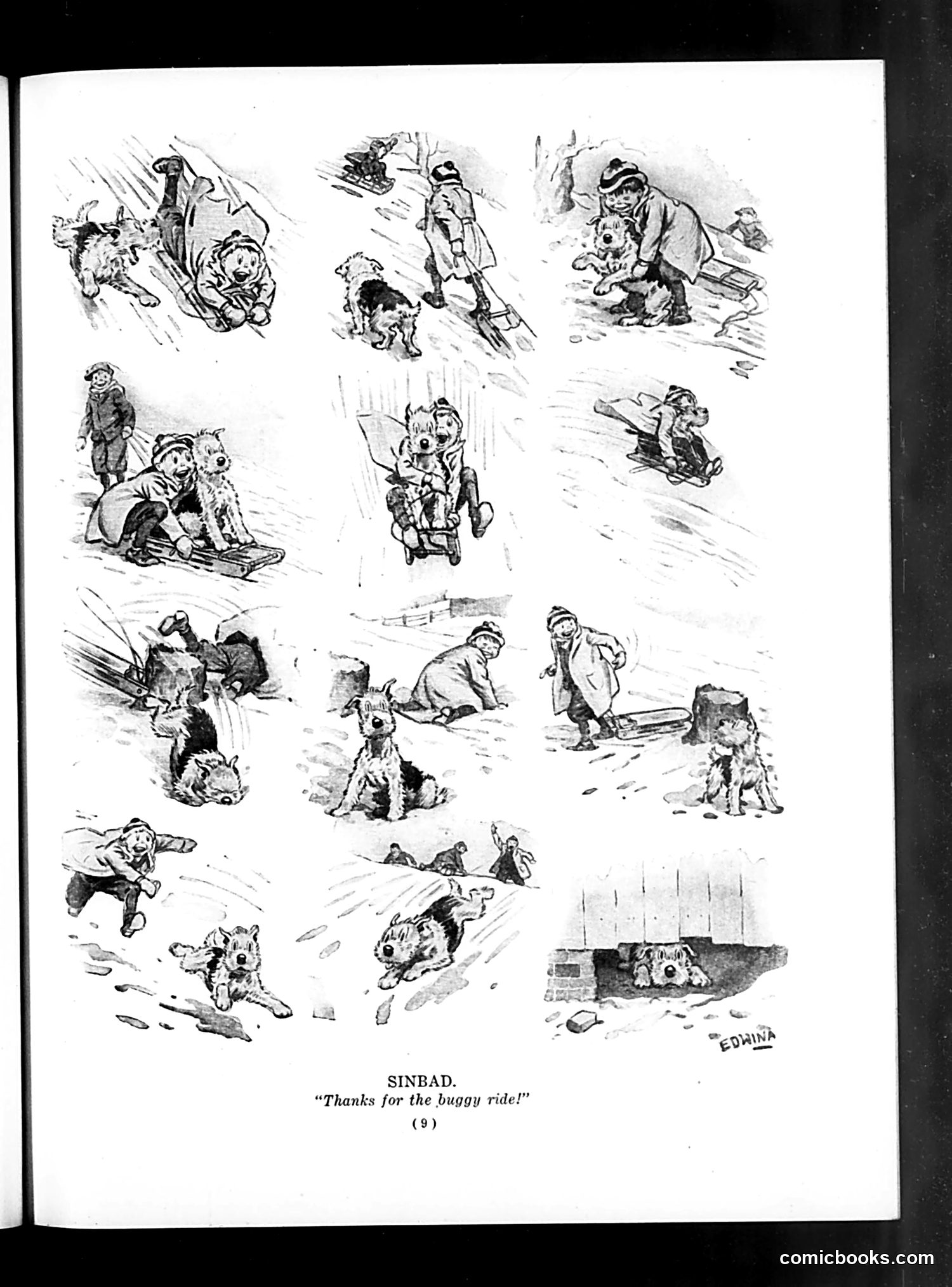
Sinbad: "Thanks for the buggy ride!" This is a humorous strip of sketches depicting Sinbad the Sailor—the famous character from Arabian folklore—experiencing various mishaps and adventures involving a dog-drawn buggy or cart. The cartoon shows sequential vignettes of slapstick comedy: Sinbad tumbling, the dog pulling the cart, collisions, and general chaos. The title's gratitude ("Thanks for the buggy ride!") is clearly ironic—the scenes depict anything *but* a pleasant journey. The strip appears to be satirizing the famous traveler's tales associated with Sinbad's legend by reimagining his adventures in mundane, comedic circumstances. The humor relies on physical comedy and the absurdity of the legendary seafarer reduced to riding in a dog-cart disaster. The artist is signed "EDHNA" (or similar).
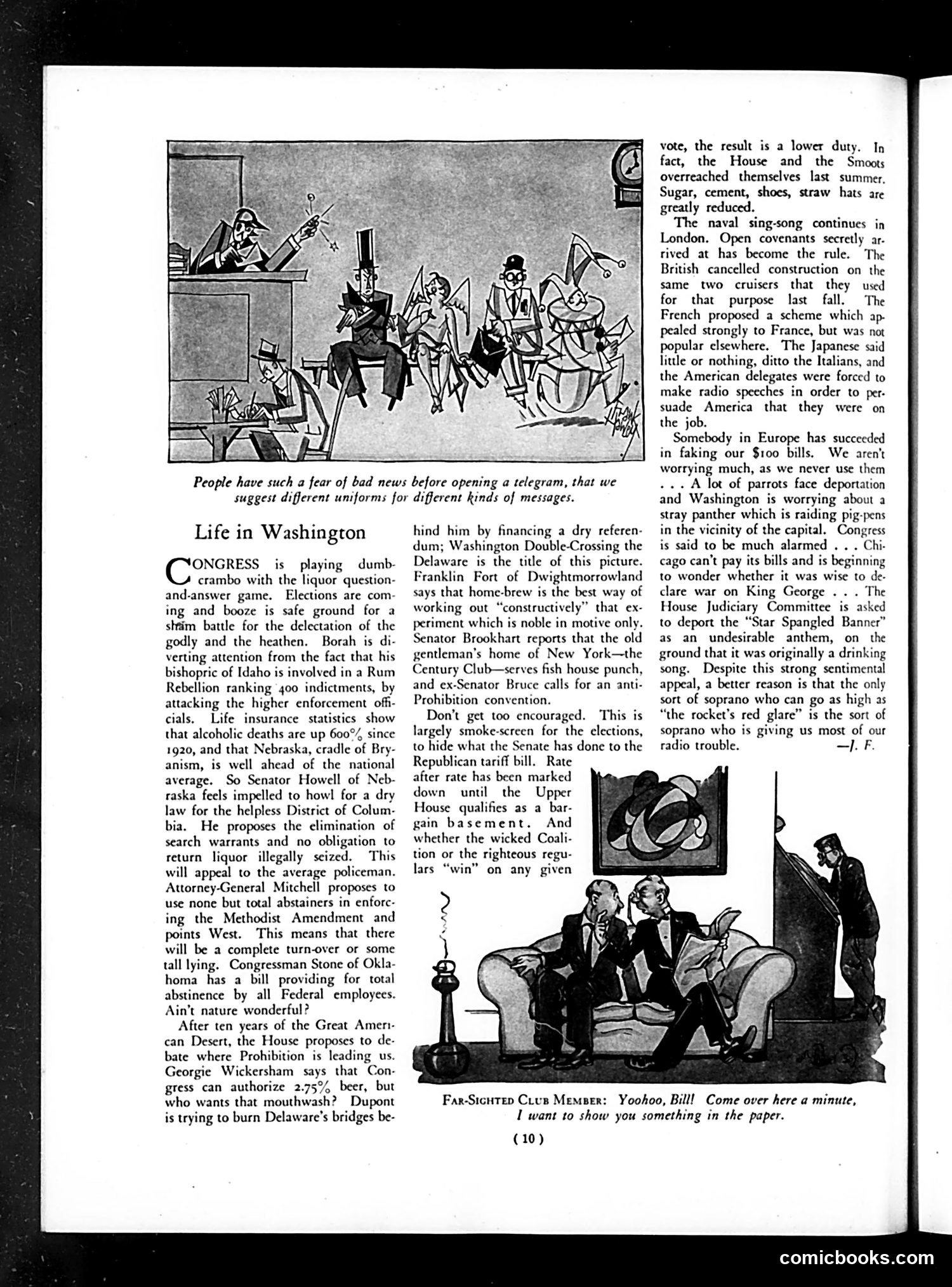
"Life in Washington" - Political Satire, circa 1920s The top cartoon depicts Congress as chaotic musicians playing discordant instruments—satirizing legislative dysfunction. The article critiques Congressional dysfunction around Prohibition enforcement, tariff debates, and political gridlock. The bottom cartoon shows a "Fax-Sighted Club Member" approaching two men reading a newspaper, wanting to share information. The caption's joke plays on "fax-sighted" (inability to see facts clearly), mocking club members who mishear or misunderstand news. The broader article mocks Congressional hypocrisy: members debate Prohibition while some propose legalizing beer; they argue over tariffs; and leadership appears more concerned with political theater than governance. References to Senator Brookhart and various proposals suggest early 1920s legislative debates. The satire targets Washington's apparent incompetence and contradictions.
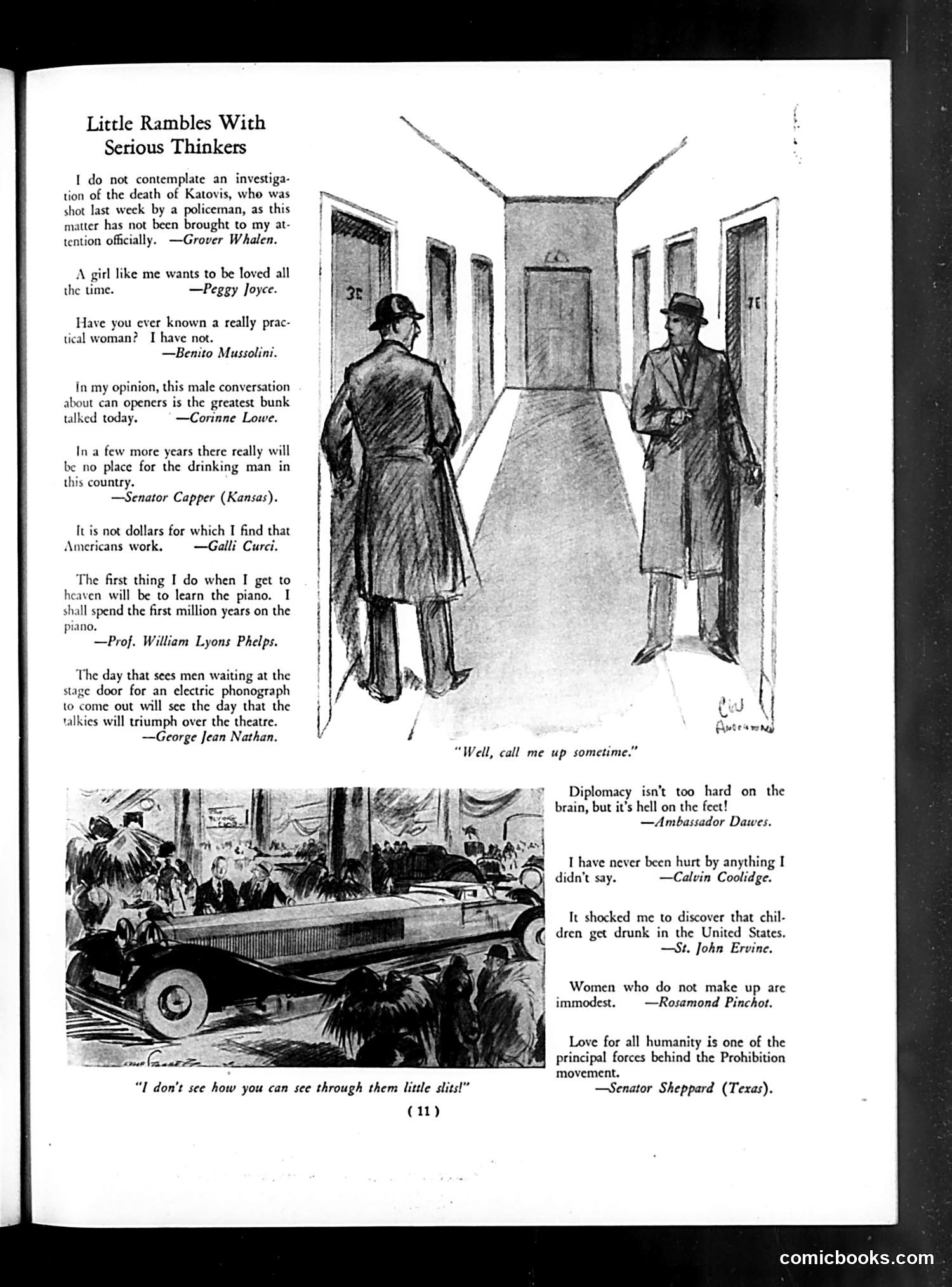
"Little Rambles With Serious Thinkers" This page collects sardonic quotes attributed to famous figures (Peggy Joyce, Benito Mussolini, Calvin Coolidge, etc.). The top cartoon shows two men in an elevator or hallway with the caption "Well, call me up sometime"—likely satirizing superficial social pleasantries. The lower illustration depicts a crowded formal event with the caption "I don't see how you can see through them little dirts!"—apparently mocking pretentious social gatherings where visibility (literal or figurative) is obscured. The quotes themselves are deliberately absurd or contradictory statements attributed to their named speakers, creating humor through incongruity. This format—pairing celebrities' names with ridiculous or cynical remarks—satirizes public figures' actual statements and the magazine's satirical treatment of contemporary society during the 1920s-30s.
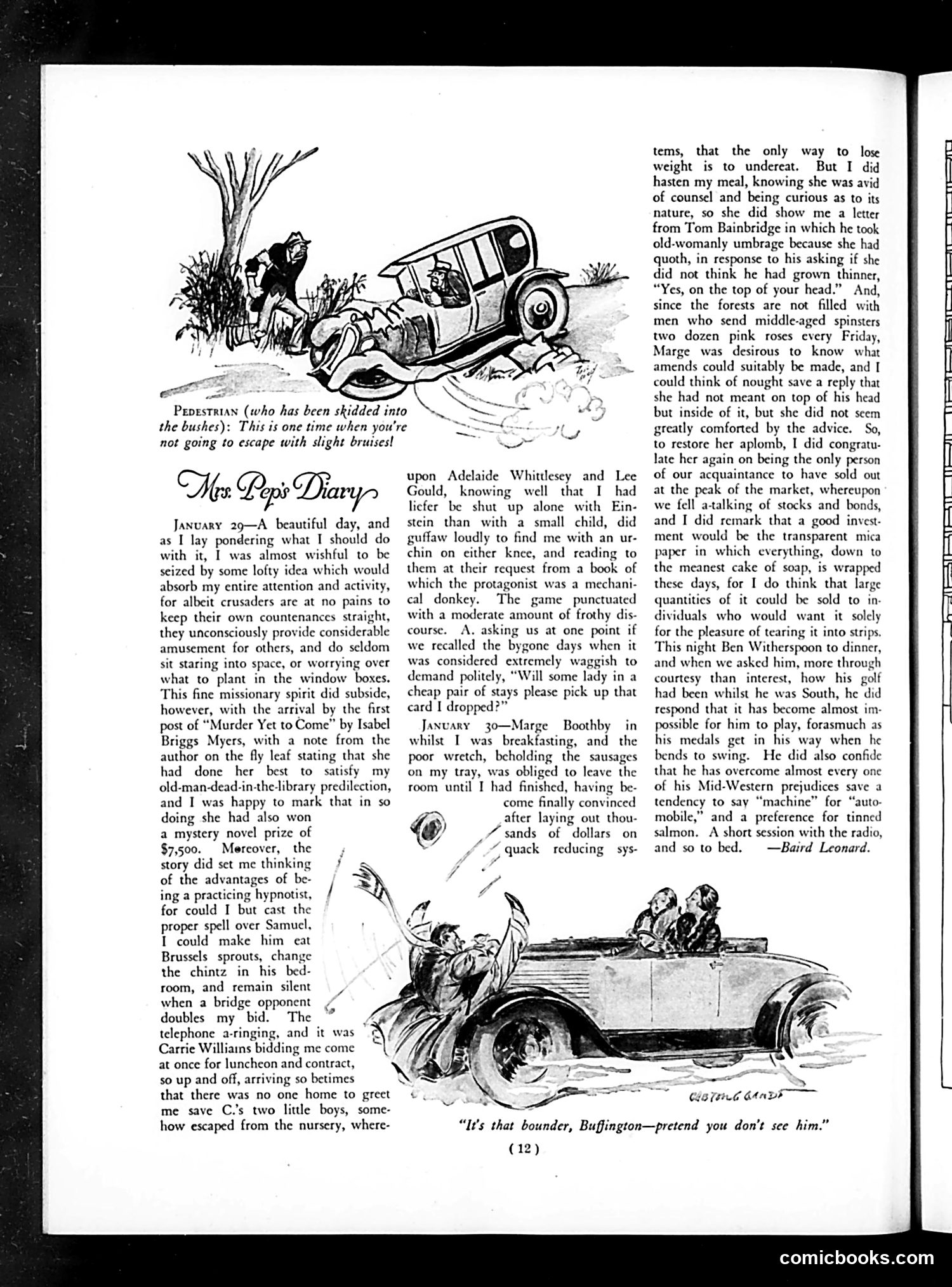
Mrs. Pep's Diary - Analysis This is a diary entry page from Life magazine featuring humorous domestic observations. The two illustrations depict car accidents—one showing a vehicle crashed into bushes with the caption about "slight bruises," and another showing a car overturned with the line "It's that bounder, Buffington—pretend you don't see him." The satire targets early automotive era mishaps and the social awkwardness they created. The humor lies in understated responses to serious accidents—treating crashes as minor inconveniences while worrying about social propriety (ignoring an acquaintance involved in a wreck). The diary entries themselves mock genteel domestic life, featuring trivial concerns like weight loss and rose deliveries. "Mrs. Pep" appears to be a satirical society character commenting on upper-class pretensions and superficiality during the 1920s automobile age.
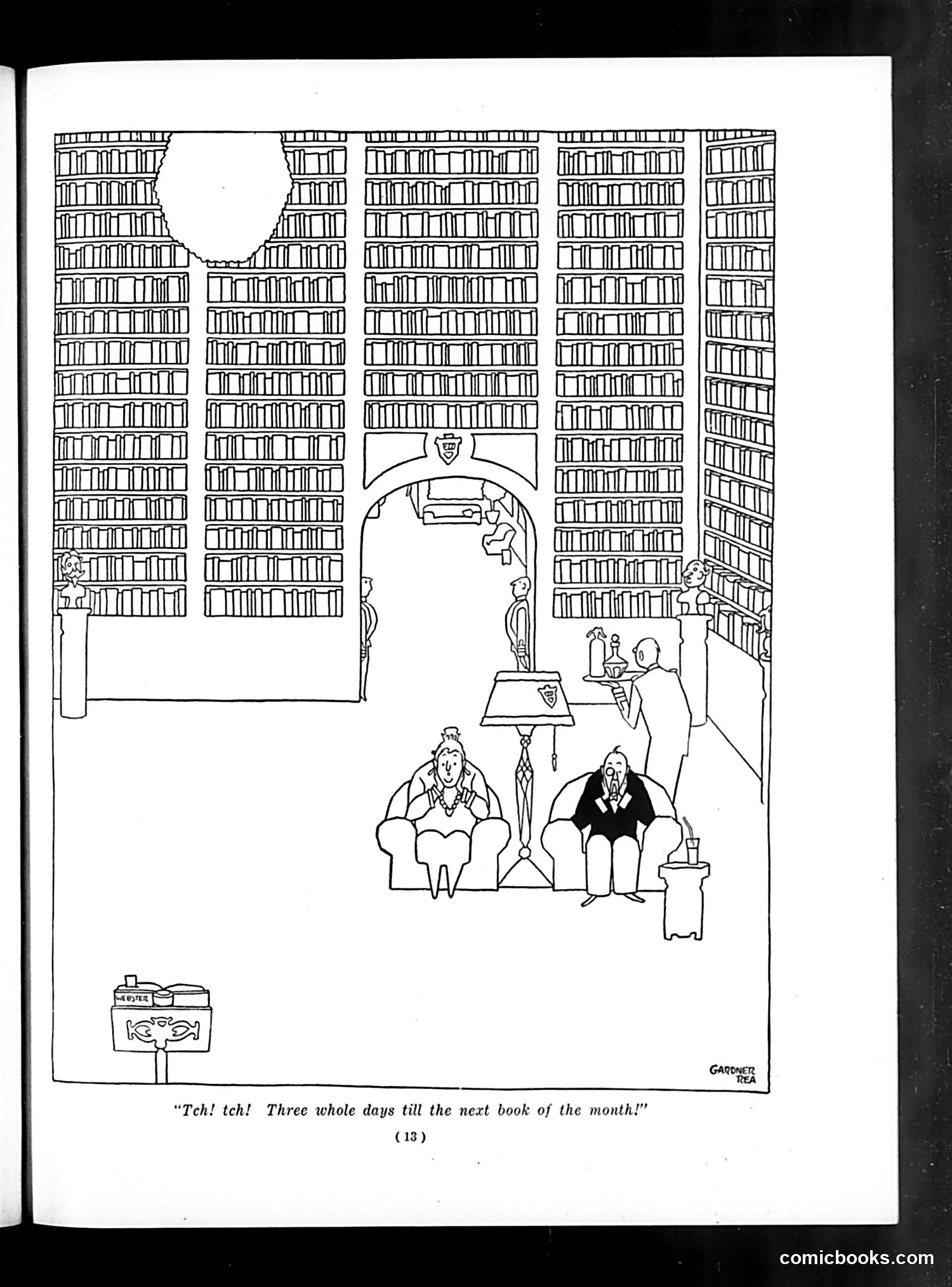
Cartoon Analysis This single-panel cartoon depicts two people sitting in an ornate library surrounded by tall bookshelves. One figure expresses frustration to the other, saying "Tch! tch! Three whole days till the next book of the month!" The satire targets the "Book of the Month Club," a popular subscription service that delivered selected books monthly to members. The cartoon mocks subscribers' dependence on the club's curated selections—suggesting they've become so reliant on receiving their monthly book that the three-day wait for the next one feels unbearable. The wealthy, comfortable setting emphasizes how this leisure activity reflects affluent readers' consumer habits. The joke satirizes both subscription culture and passive reading preferences among the educated classes who let others choose their literature.
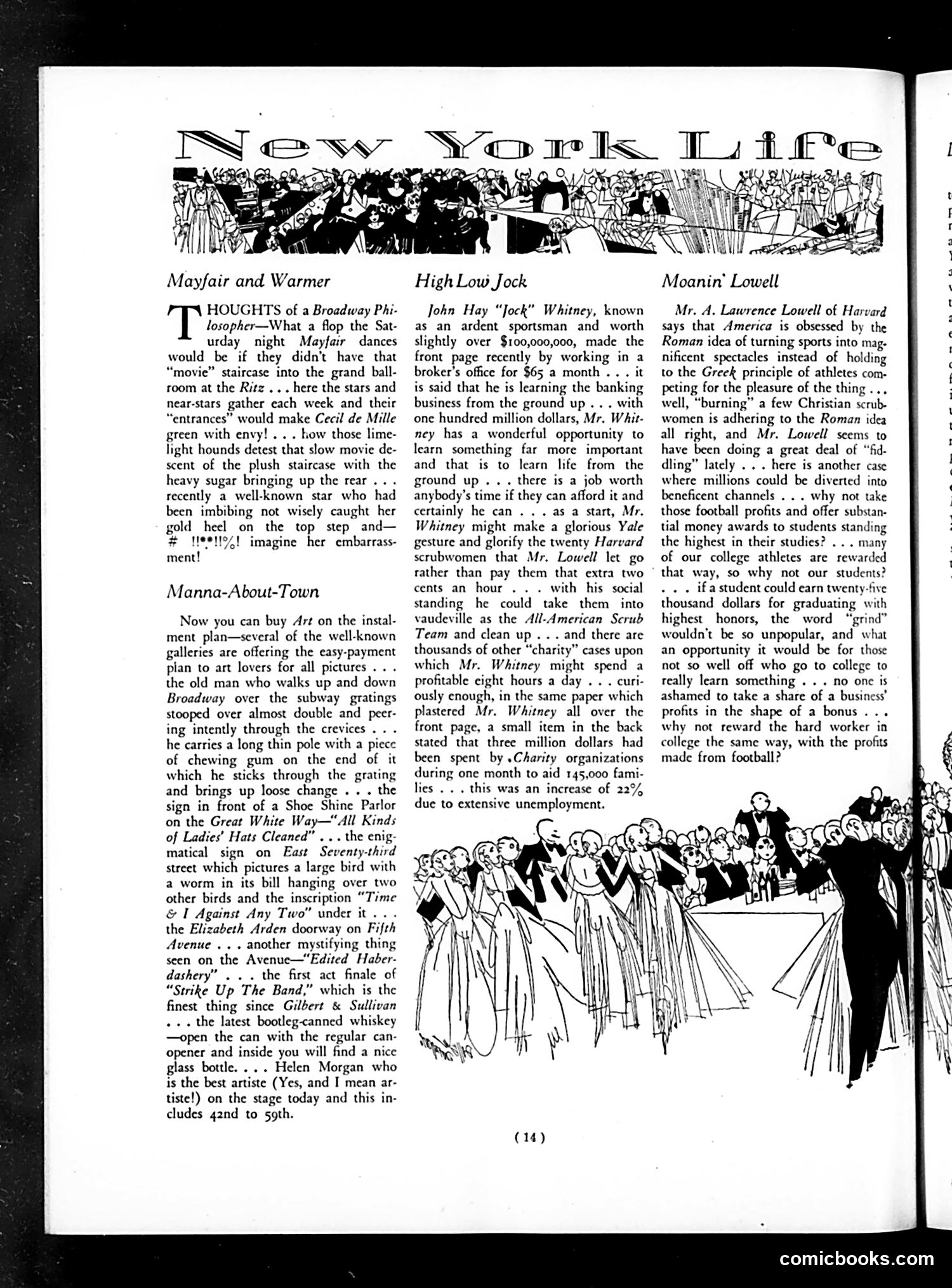
Analysis of New York Life Page 14 This page contains three separate satirical columns about 1920s Manhattan society and culture, rather than a unified political cartoon. "Mayfair and Warmer" mocks the spectacle of Broadway's "movie" stars entering grand ballrooms through elaborate entrances—criticizing the excessive theatricality of high society. "High Low Jock" satirizes John Hay "Jock" Whitney, a wealthy sportsman worth $100 million, who apparently learned banking by working as a broker's clerk. The satire questions whether wealth translates to actual knowledge or competence. "Moanin' Lowell" criticizes A. Lawrence Lowell of Harvard for opposing athletic compensation while endorsing the "Roman idea" that profits should fund academics rather than reward student-athletes—exposing apparent hypocrisy about how college money is distributed. The accompanying illustration shows an elegant social gathering, likely depicting the society scene referenced in the text.
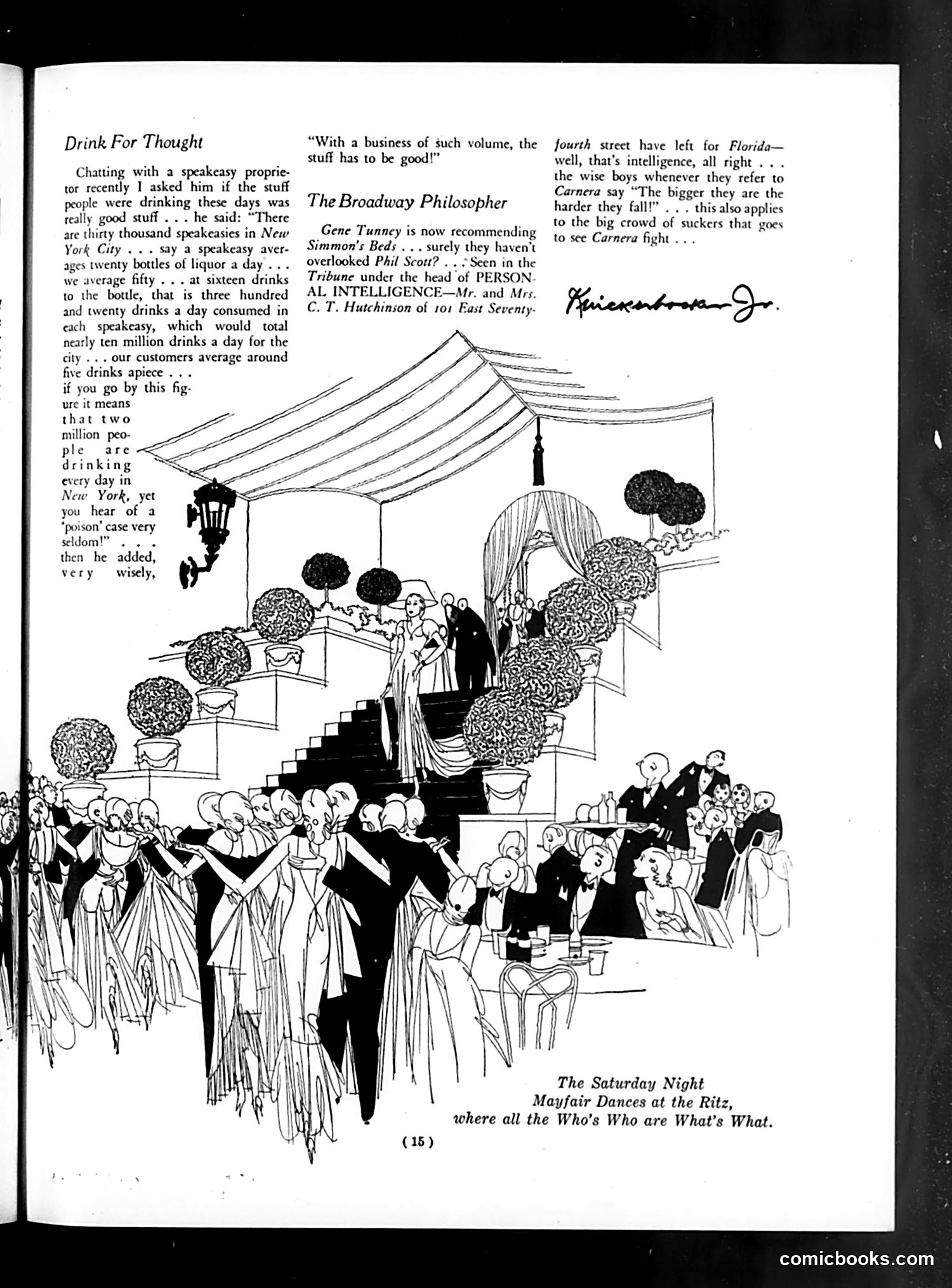
Analysis This page contains two distinct sections: "Drink For Thought" (left column): A speakeasy proprietor discusses drinking statistics in Prohibition-era New York City, noting establishments serve approximately two million drinks daily. The piece sardonically concludes that widespread drinking proves the public's wisdom—an ironic jab at both Prohibition's failure and the hypocrisy of "respectable" citizens frequenting illegal bars. "The Broadway Philosopher" (right): Gene Tunney (heavyweight boxer) is mentioned recommending someone's bed, with brief celebrity gossip items about Phil Scott and others. Main illustration (center): An elegant speakeasy scene showing well-dressed patrons at a Mayfair Dance at the Ritz. The caption notes these are society's elite ("Who's Who"). This satirizes the contrast between Prohibition's intent and wealthy New Yorkers openly flouting the law in fashionable venues.
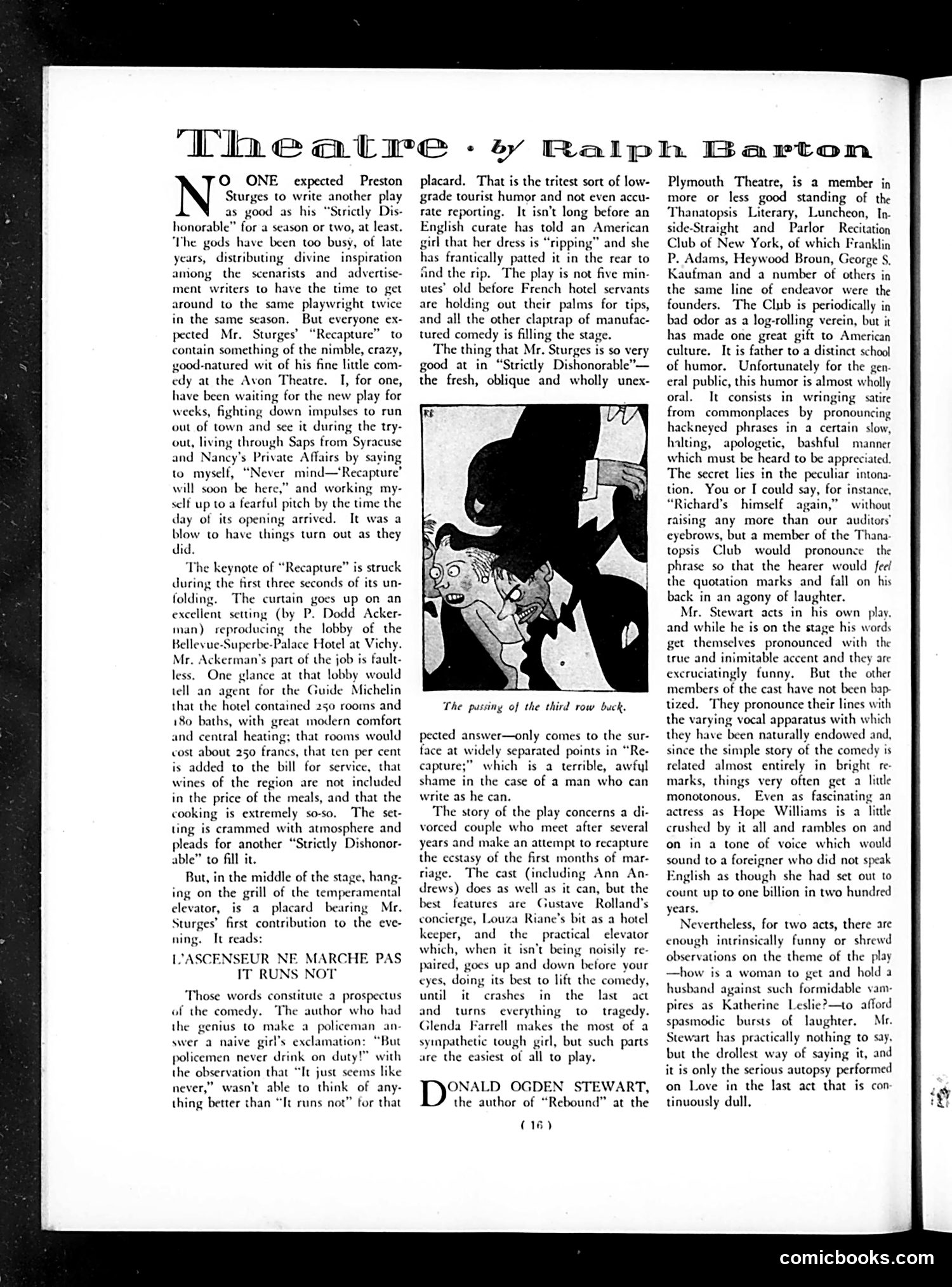
Theater Review by Ralph Barton This is a theater review column, not a political cartoon. The illustration shows a silhouetted figure in what appears to be a theater box or balcony, labeled "The passing of the third row back." The review discusses Preston Sturges' play "Recapture," staged at the Plymouth Theatre. Barton critiques the production's humor as shallow, relying on "hackneyed phrases" and forced intonation rather than genuine wit. He praises actor Gustave Rolland's comedic timing but notes most cast members lack polish, pronouncing lines with "varying vocal apparatus." The "third row back" reference likely alludes to theater seating hierarchy—a commentary on the play's middling quality, fit for less-premium seats rather than prime viewing positions. The satire targets the play's pretensions to comedy despite mediocre execution.
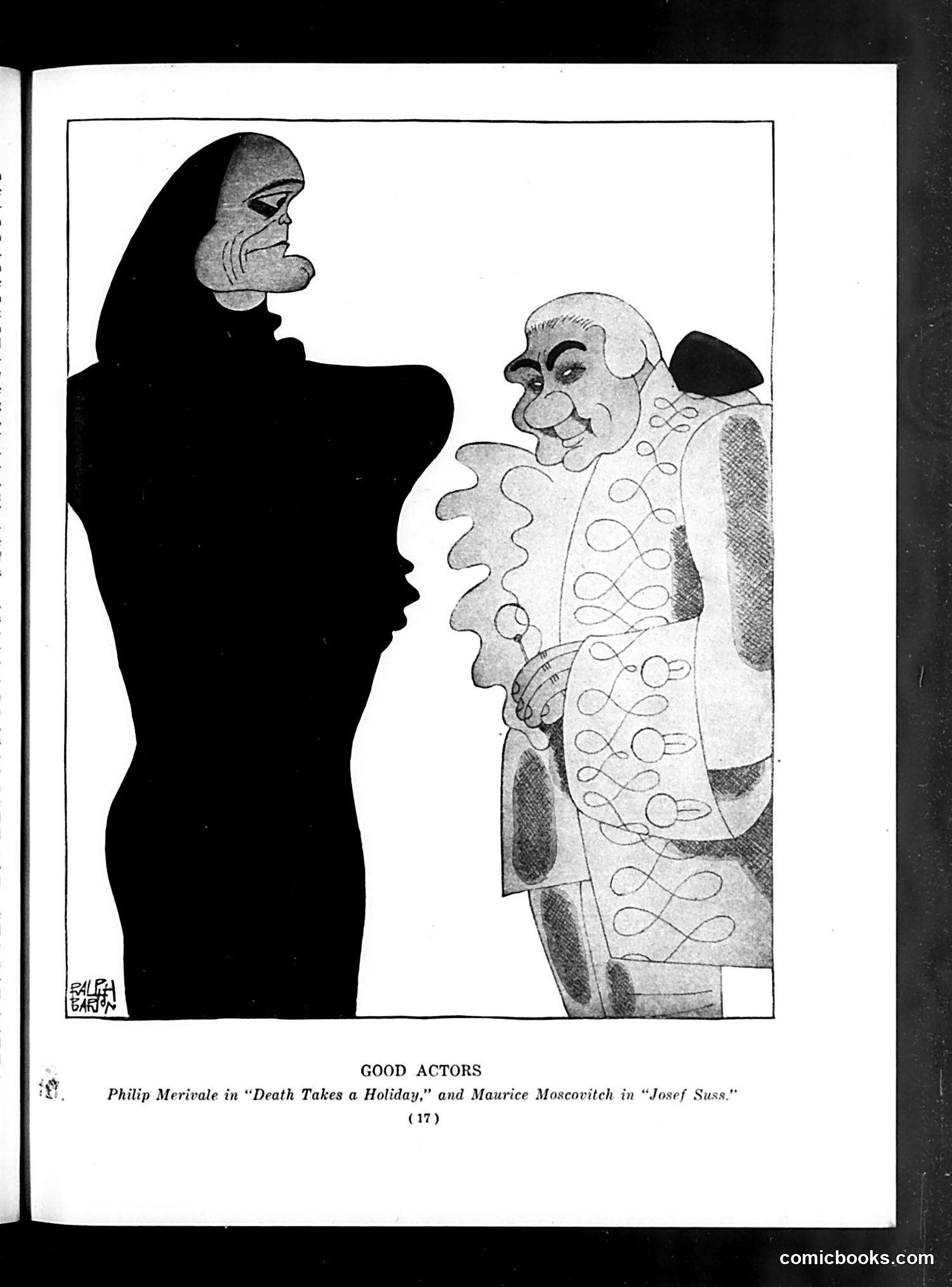
Page Analysis: "Good Actors" This page features a cartoon illustration labeled "Good Actors," crediting Philip Merivale in "Death Takes a Holiday" and Maurice Moscovitch in "Josef Suss." The image shows two figures in silhouette and caricature form—a tall, elegant woman in black (likely representing Merivale's role) and a character in patterned clothing with exaggerated facial features representing Moscovitch. The cartoon appears to be satirizing these actors' performances or stage presence, using physical caricature to comment on their theatrical work. The page likely appeared in Life magazine's arts/entertainment section, providing satirical commentary on contemporary theater productions of that era. The specific films or plays referenced suggest this dates to the early-to-mid 20th century.
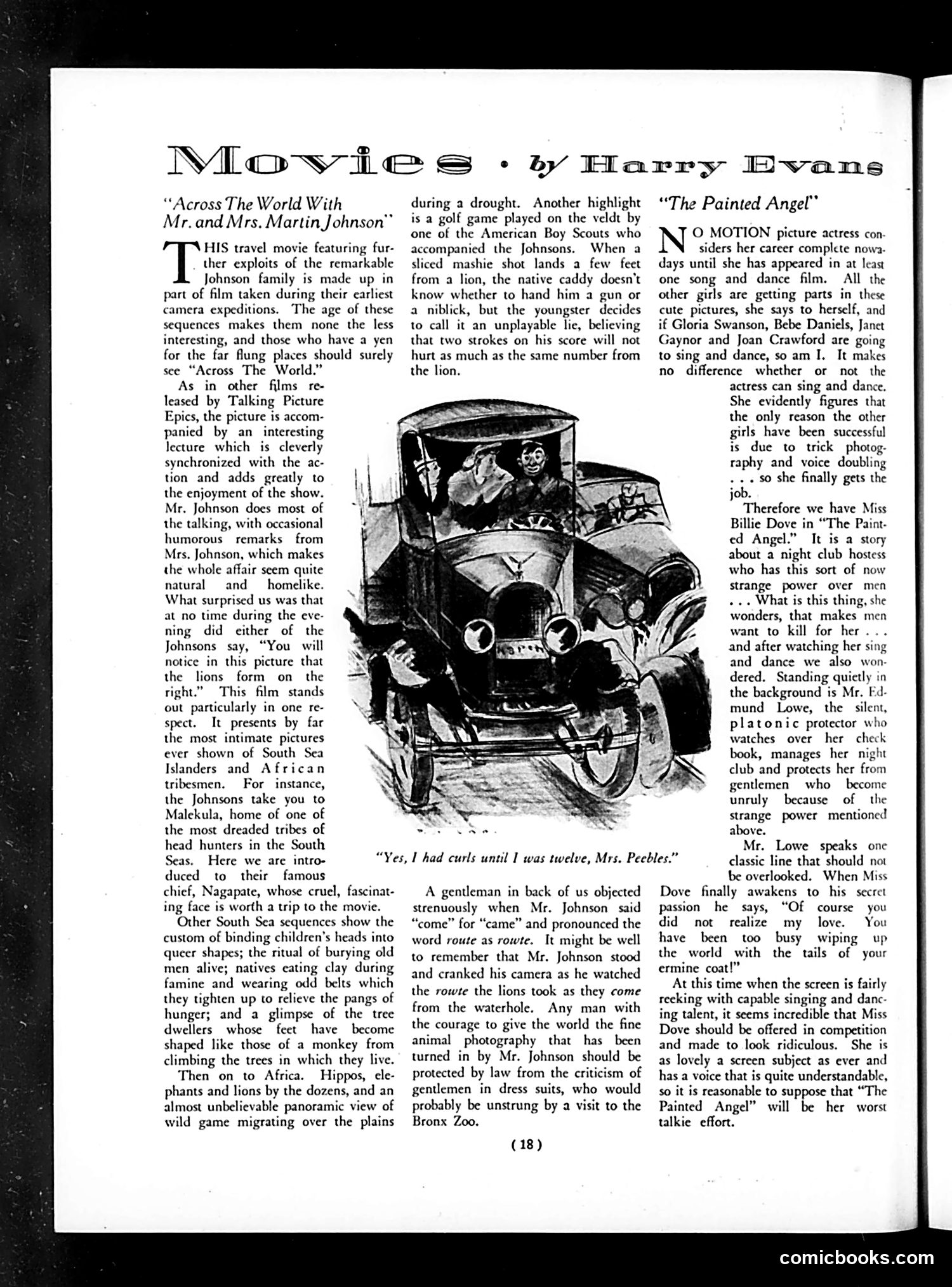
Movie Reviews by Harry Evans This page reviews two films: "Across the World with Mr. and Mrs. Martin Johnson" and "The Painted Angel." Johnson Film: The review praises the Johnsons' camera expedition footage, describing intimate South Sea and African sequences—lion hunts, native rituals, animal photography. The illustration shows their vehicle. Evans notes the film is "accompanied by an interesting lecture" and appreciates Mr. Johnson's humorous remarks and Mrs. Johnson's contributions, calling it "homelike" and natural despite the exotic subject matter. "The Painted Angel": Evans critiques actress Billie Dove's performance as a night club hostess with mysterious power over men. He sarcastically suggests her singing and dancing are so poor that her "worst talkie effort" will damage her career, implying silent films concealed her limited talents.
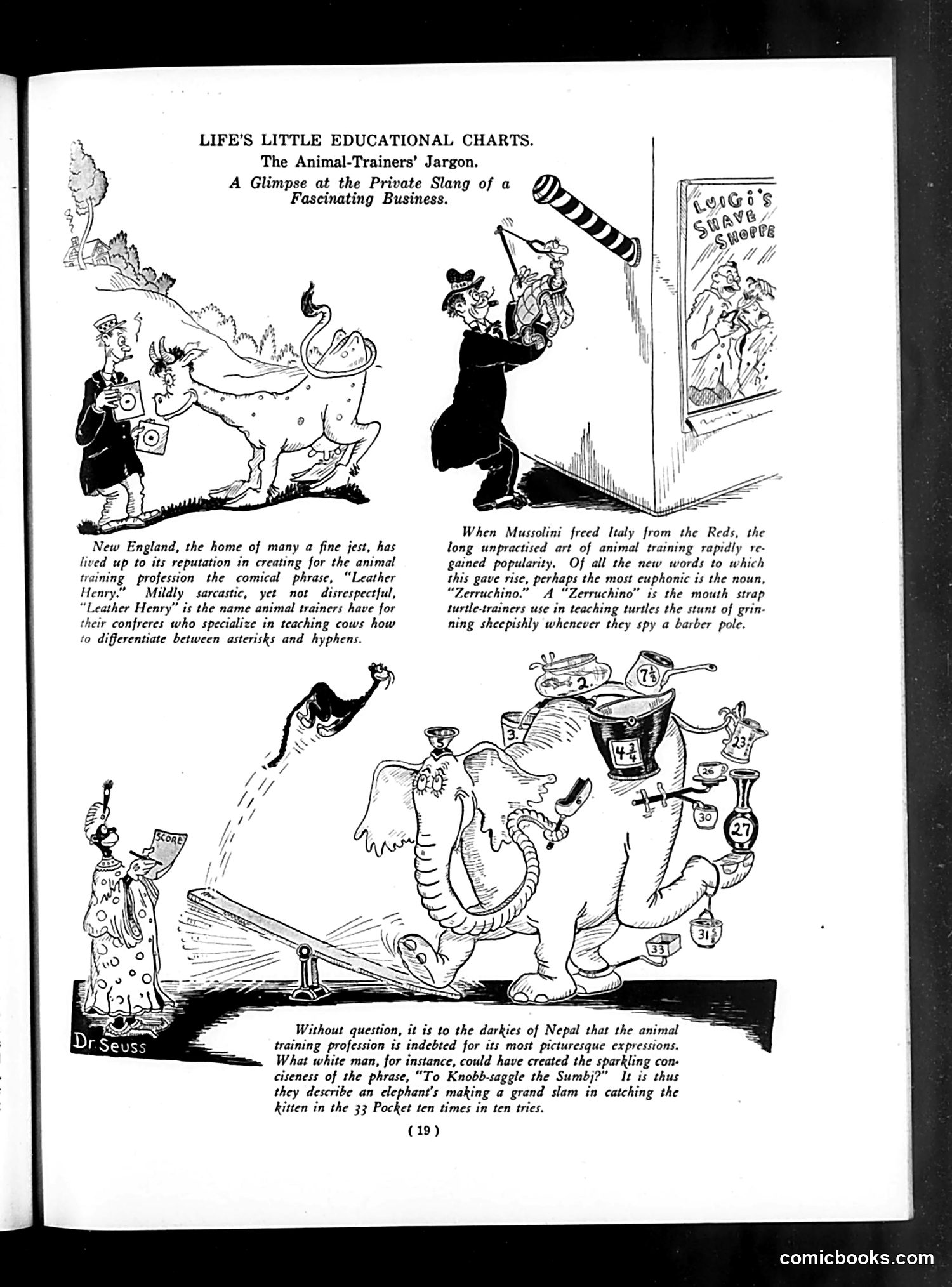
Analysis This is a satirical "educational" piece mocking animal trainers' supposed jargon. The humor works through absurdist invention rather than genuine profession terminology. Key elements: - "Leather Henry": A made-up New England term supposedly for trainers who teach cows to distinguish punctuation marks—obviously ridiculous and the joke itself. - "Zerruchino": Attributed to post-Mussolini Italy, referring to a mouth strap for teaching turtles to grin at barber poles—pure nonsense presented as fact. - "To Knobb-saggle the Sumbj": Credited to "Nepal" trainers, describing an elephant catching a kitten in a "33 Pocket" ten times—gibberish framed as exotic expertise. The satire targets how people exoticize or romanticize unfamiliar professions by inventing elaborate jargon. The Dr. Seuss illustrations (signed lower left) reinforce the absurdist tone. The page gently mocks both animal trainers and readers' credulity.
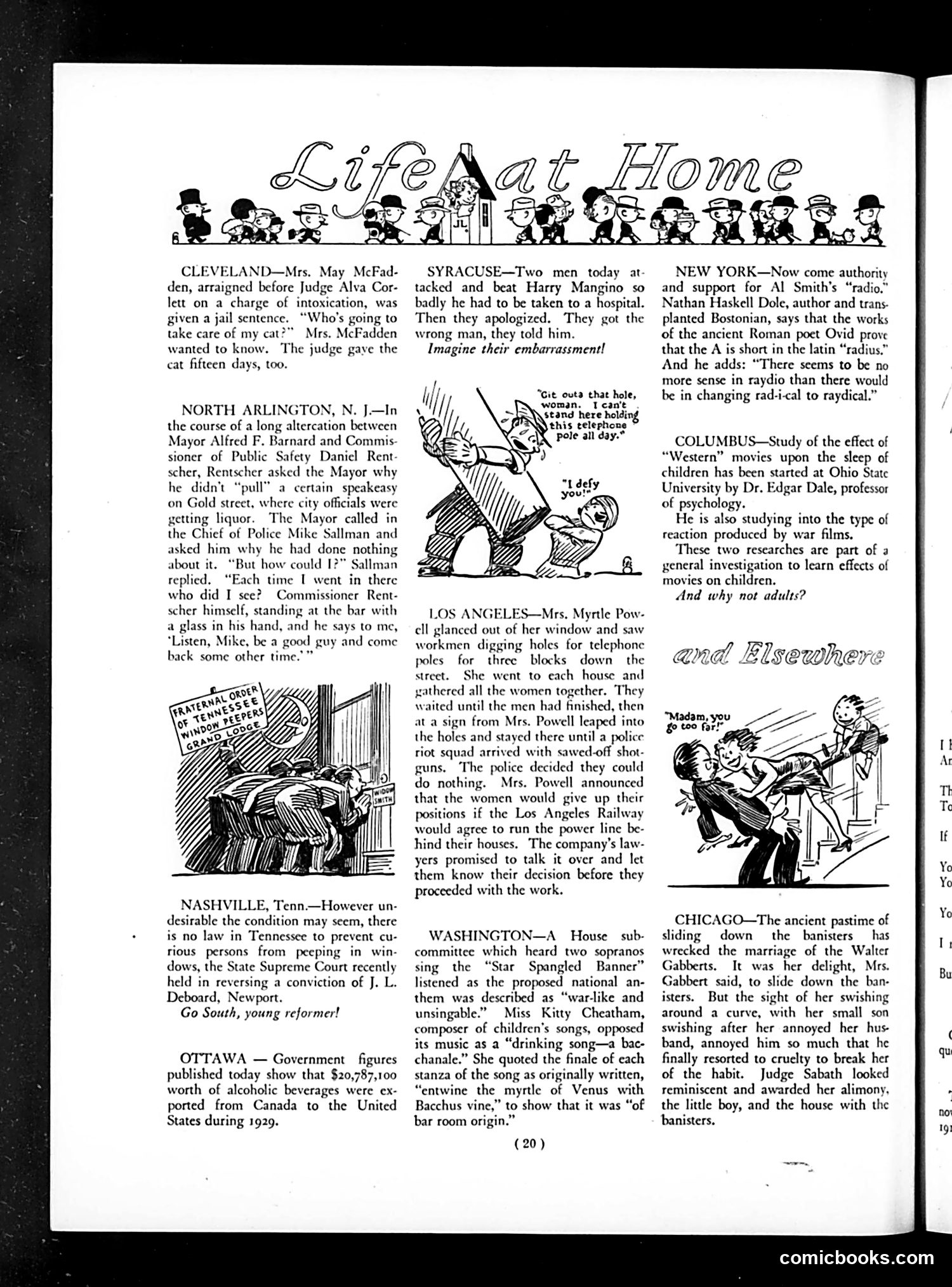
"Life at Home" — A 1930 Satirical Roundup This page collects humorous anecdotes from across America, satirizing Prohibition-era contradictions and social absurdities. Key targets include: Prohibition hypocrisy: The North Arlington story mocks law enforcement—a police chief caught repeatedly at a speakeasy with the commissioner. The Ottawa export figure ($20.7M of alcohol to the US in 1929) underscores the legal farce of Prohibition itself. Legal absurdities: A Tennessee court ruling permits window-peeping; a judge sentences a cat to jail alongside its owner. Gender activism: The Los Angeles women's protest against telephone pole work demonstrates organized female resistance to city planning decisions. Minor cultural debates: A congressman questions whether "The Star-Spangled Banner" is too "drinking-song-like"; scholars debate whether "radius" should be pronounced "raydio." The overall tone is gentle mockery of everyday American contradictions during the Prohibition era—highlighting the gap between laws and enforcement, and ordinary citizens' creative workarounds.
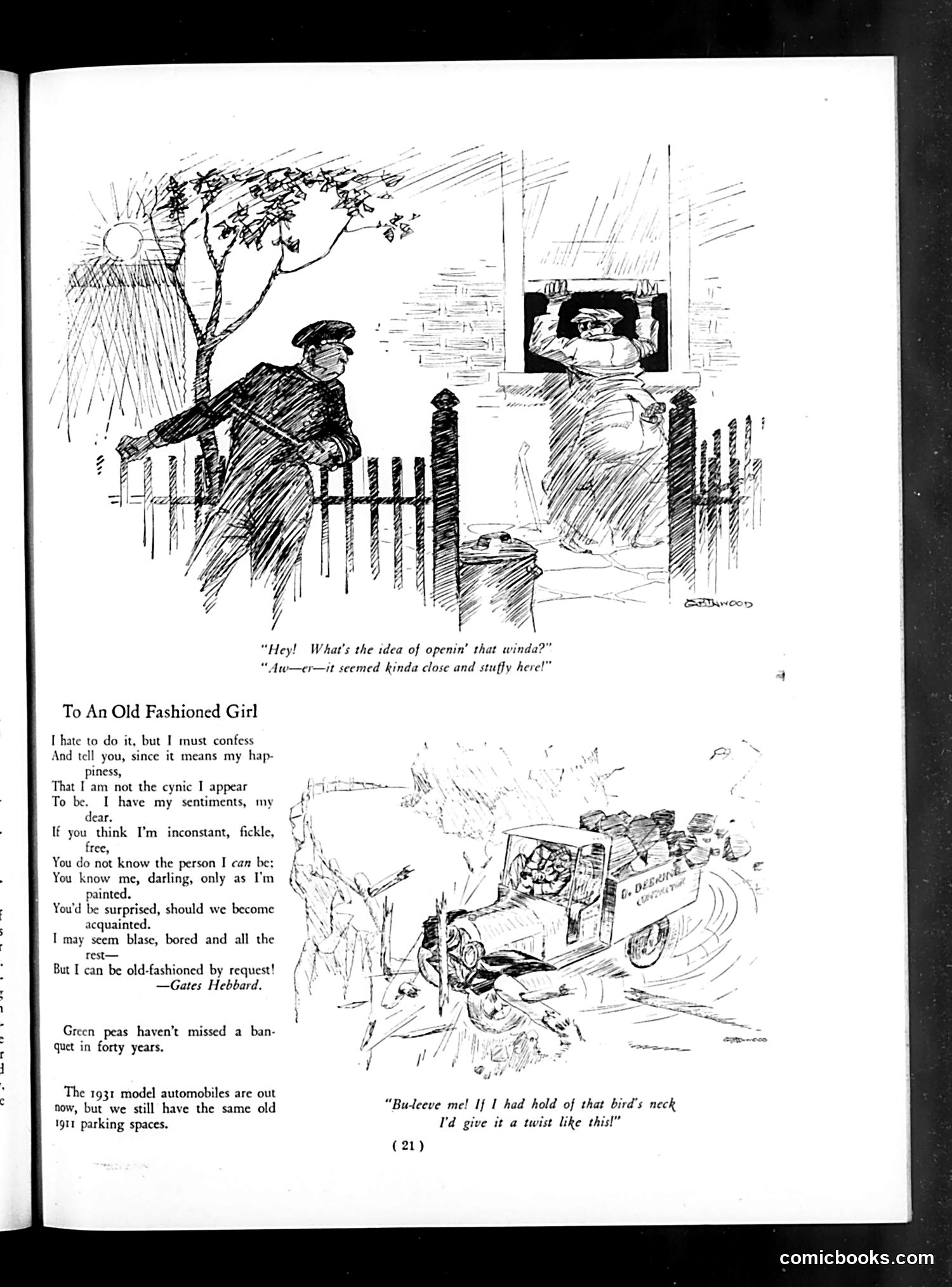
Explanation for Modern Readers This page contains two separate cartoons satirizing early 1930s social attitudes. Top cartoon: A man and woman argue about opening a window. The joke critiques the common practice of airing out stuffy indoor spaces—humorously suggesting that modern sensibilities about fresh air versus comfort haven't changed in decades. Bottom cartoon: A car swerves to avoid a bird. The caption suggests violent road-rage—the driver threatens to wring the bird's neck. This satirizes both reckless driving behavior and the crude aggression of motorists, likely reflecting 1930s concerns about automobile safety and driver conduct. Poem ("To An Old Fashioned Girl"): The accompanying verse by Gates Hebbard is sentimental romance writing, contrasting with the cartoons' cynical humor. It expresses a man's desire to appear modern and detached while secretly harboring traditional romantic sentiments. The page juxtaposes gentle nostalgia (the poem) against modern anxieties (cars, ventilation, social change) typical of Life magazine's satirical approach.
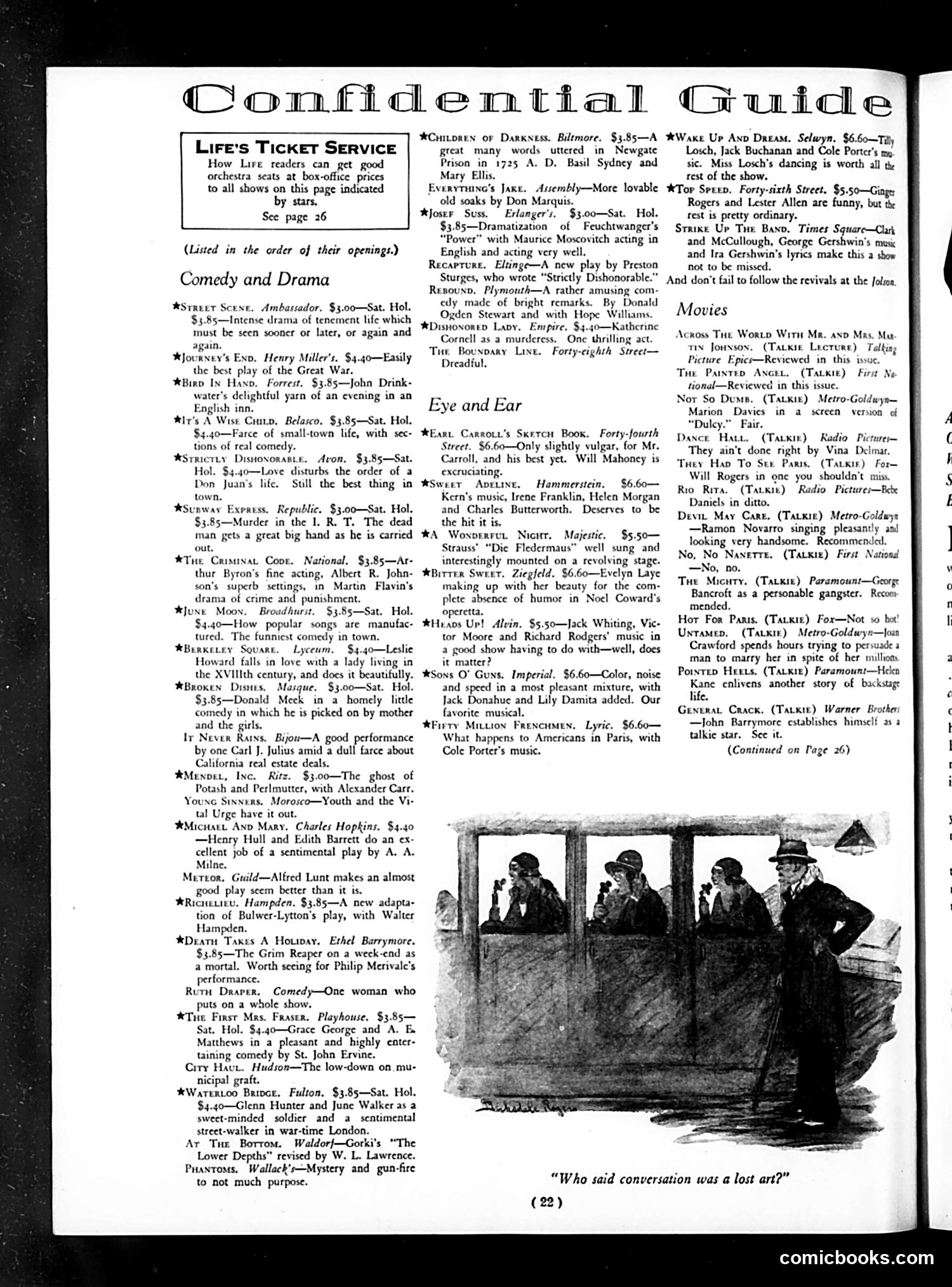
Cartoon Analysis The cartoon depicts four men in what appears to be a theater box or viewing area, with the caption "Who said conversation was a lost art?" The Joke: This is a commentary on theater etiquette—specifically, audience members talking during performances. The four figures are clearly having an animated conversation while presumably watching a show, suggesting they represent the type of patrons who chat loudly during theatrical productions, disrupting other audience members' enjoyment. The Context: This page is from Life magazine's "Confidential Guide" to Broadway theaters and shows. The cartoon appears designed as light social satire about contemporary theater-going habits—a gentle ribbing of audiences who prioritized socializing over watching the performance. Modern Parallel: This reflects an enduring complaint about cinema and theater etiquette that remains relevant today (talking in movies, phone use, etc.). The "lost art" reference suggests conversation as a cultural value, making ironic fun of people who exercise it at inappropriate times.
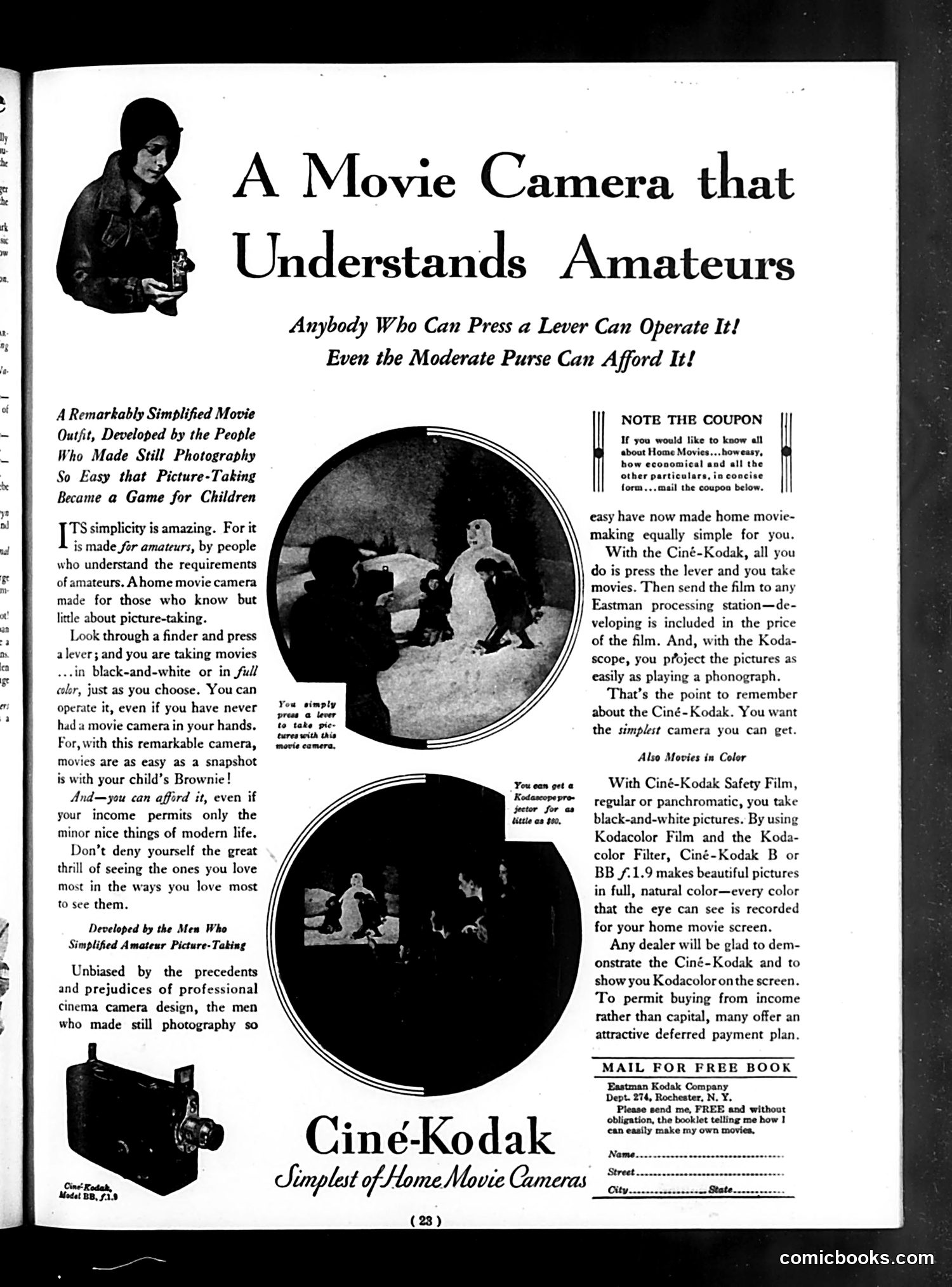
Analysis This is primarily a Kodak advertisement, not political satire. It promotes the Ciné-Kodak home movie camera, targeting amateur filmmakers. The page emphasizes democratizing film technology—making it as accessible as still photography (which Kodak had already simplified with the Brownie camera). The advertising copy stresses ease ("anybody who can press a lever"), affordability for middle-income families, and the emotional appeal of recording loved ones. The circular photographs show people using the camera casually indoors, reinforcing the message that no expertise is required. The small camera image demonstrates the device's compact design. This reflects 1920s-30s consumer culture: positioning leisure activities and technology as accessible to ordinary Americans. The "deferred payment plan" mention acknowledges economic concerns of the era. There is no political cartoon or satire present—this is straightforward commercial persuasion aimed at middle-class consumers aspiring to home movie-making.
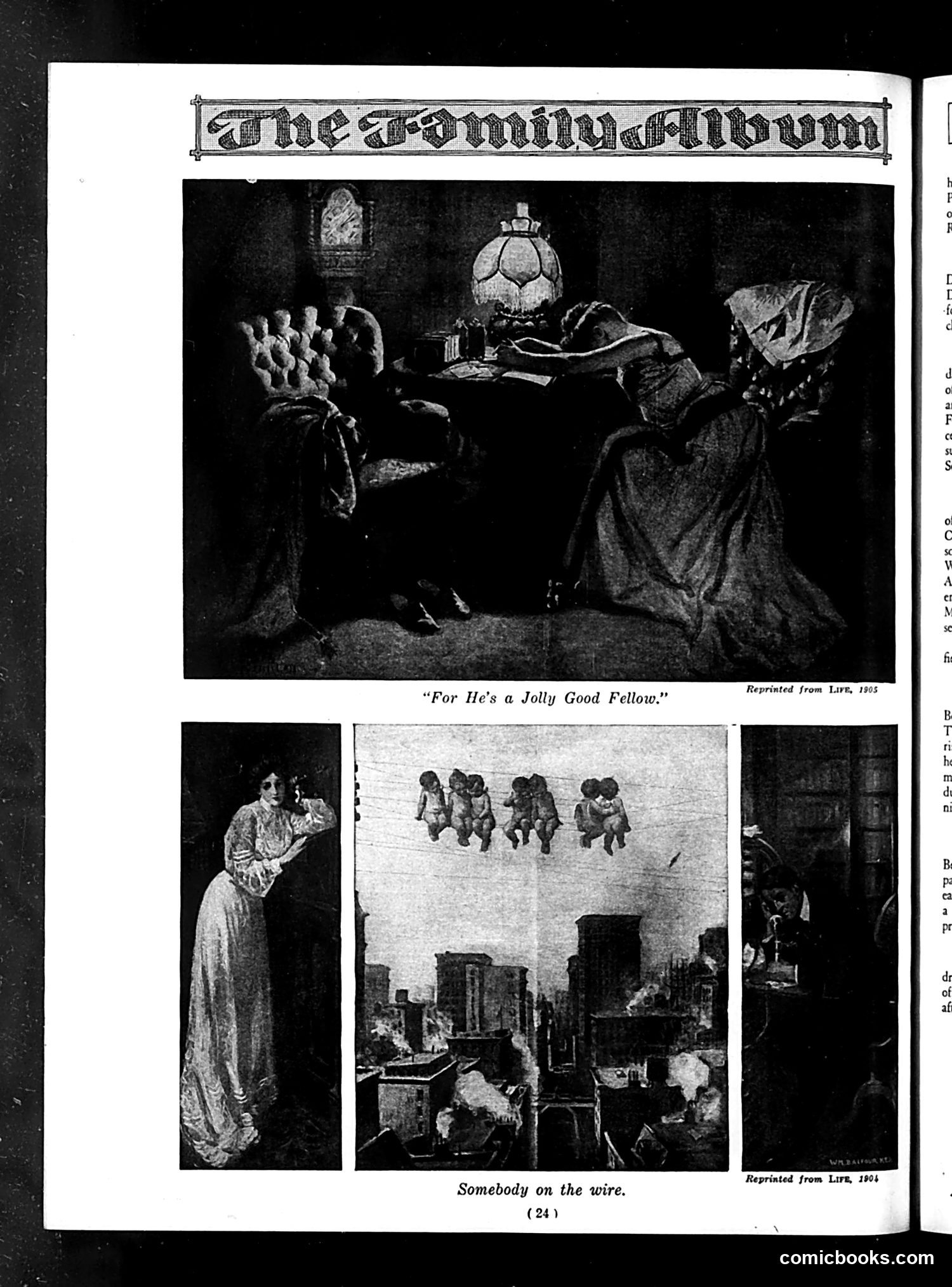
This page from *Life* magazine contains two separate satirical illustrations, both reprinted from earlier issues (1904-1905). The top image, titled "For He's a Jolly Good Fellow," depicts two women in period dress toasting with a large glowing orb between them in a darkened room—likely satirizing spiritualism or séances, which were popular fashionable pursuits among wealthy women of that era. The bottom illustration, "Somebody on the wire," shows a woman in flowing robes on the left and a cityscape with small figures hovering above it in the center, suggesting early wireless communication technology or telephone imagery. The joke appears to mock the novelty and social implications of new communication technology. Both pieces use visual exaggeration and surreal imagery typical of *Life*'s satirical style to comment on contemporary fads and modern technologies.
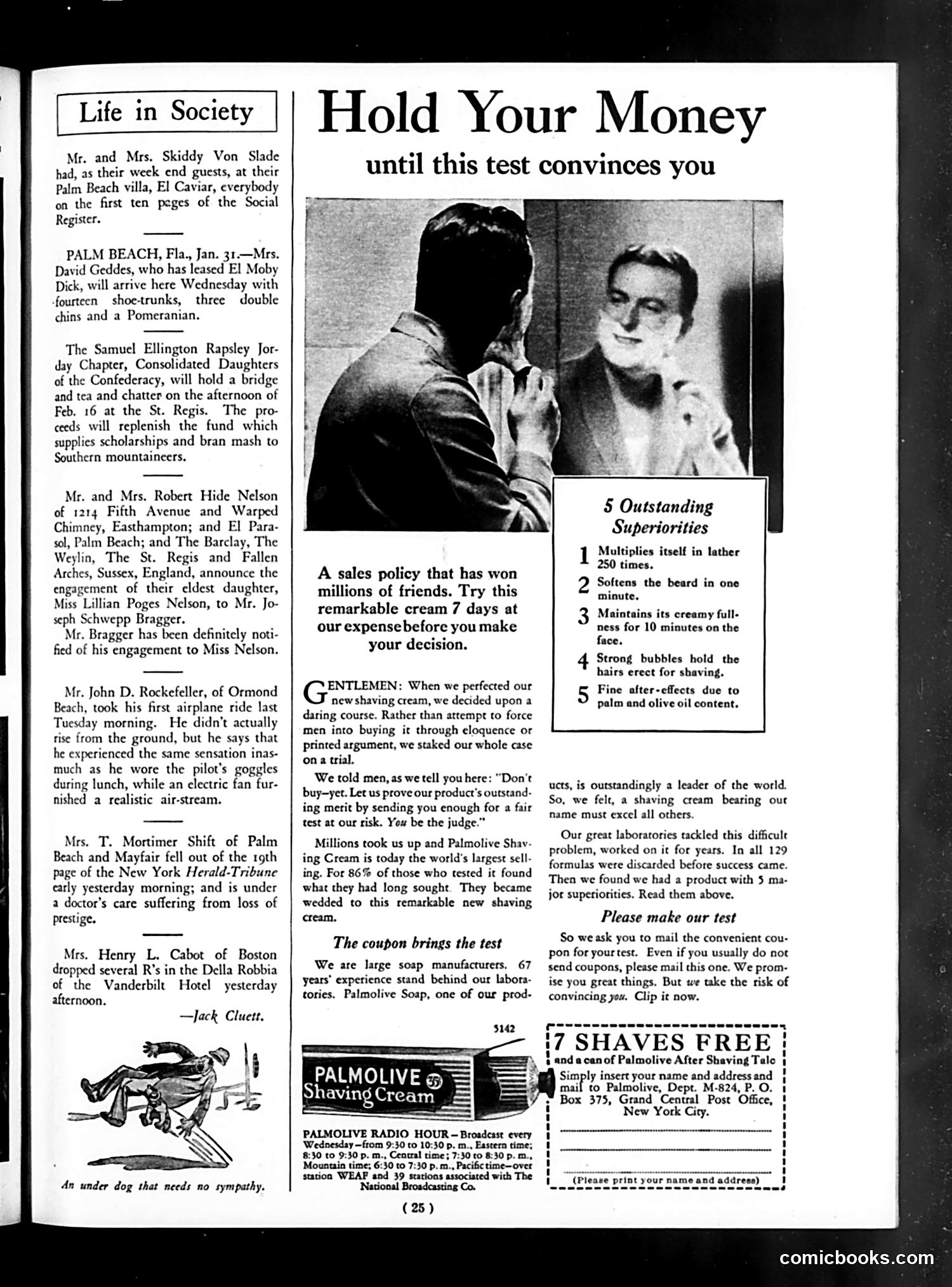
Analysis for Modern Readers This page contains two distinct elements: "Life in Society" Column (left side): Satirical society gossip mocking wealthy elites. The humor targets pretentious wealthy people and their absurd concerns—a woman arriving with "three double chins," someone's engagement announced despite not being consulted, a Rockefeller who got airplane-ride sensations from goggles and a fan. The satire particularly mocks social climbing and the obsession with appearing in the "Social Register." References to Palm Beach, Fifth Avenue, and the Vanderbilt Hotel signal Old Money pretension. The final item about someone "dropping R's" mocks affected upper-class speech affectations. Palmolive Shaving Cream Advertisement (right side): A period advertisement employing a common early 20th-century sales tactic—offering free samples to build consumer confidence. The ad emphasizes scientific development (129 formulas tested) and lists product benefits, using a coupon mechanism to generate trial usage. This represents standard vintage advertising strategy before mass television marketing. The juxtaposition is typical of *Life* magazine's format mixing satire with commercial content.
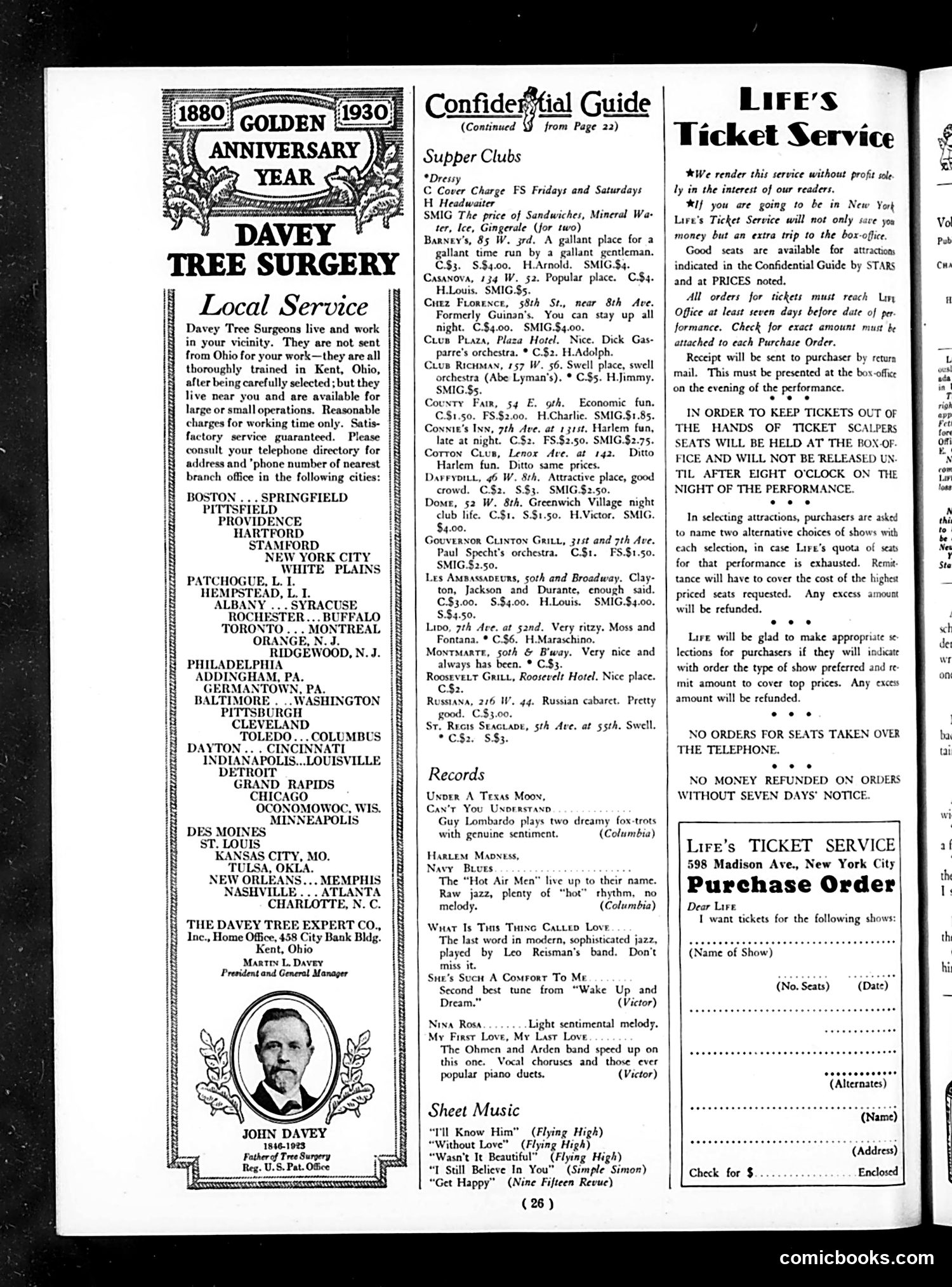
Page Content Analysis This page is primarily advertising and service information, not political satire or editorial cartooning. The left side advertises Davey Tree Surgery (celebrating its 50th anniversary, 1880-1930), listing branch offices across America. It includes a portrait of founder John Davey (1846-1923). The center column continues a "Confidential Guide" listing 1920s nightclubs and supper clubs in New York and other cities—establishments like Casanova, Club Richman, and Connie's Inn (a famous Harlem venue). Each entry notes cover charges, headwaiter names, and orchestras. This reflects the Prohibition era (1920-1933) when such establishments thrived despite alcohol being illegal. The right side advertises Life's Ticket Service for Broadway theater seats, with a mail-order form. The "Records" and "Sheet Music" sections review popular songs from contemporary Broadway shows. This is essentially a service/entertainment guide for wealthy urban readers, offering practical information about nightlife, theater access, and tree care—not political commentary.
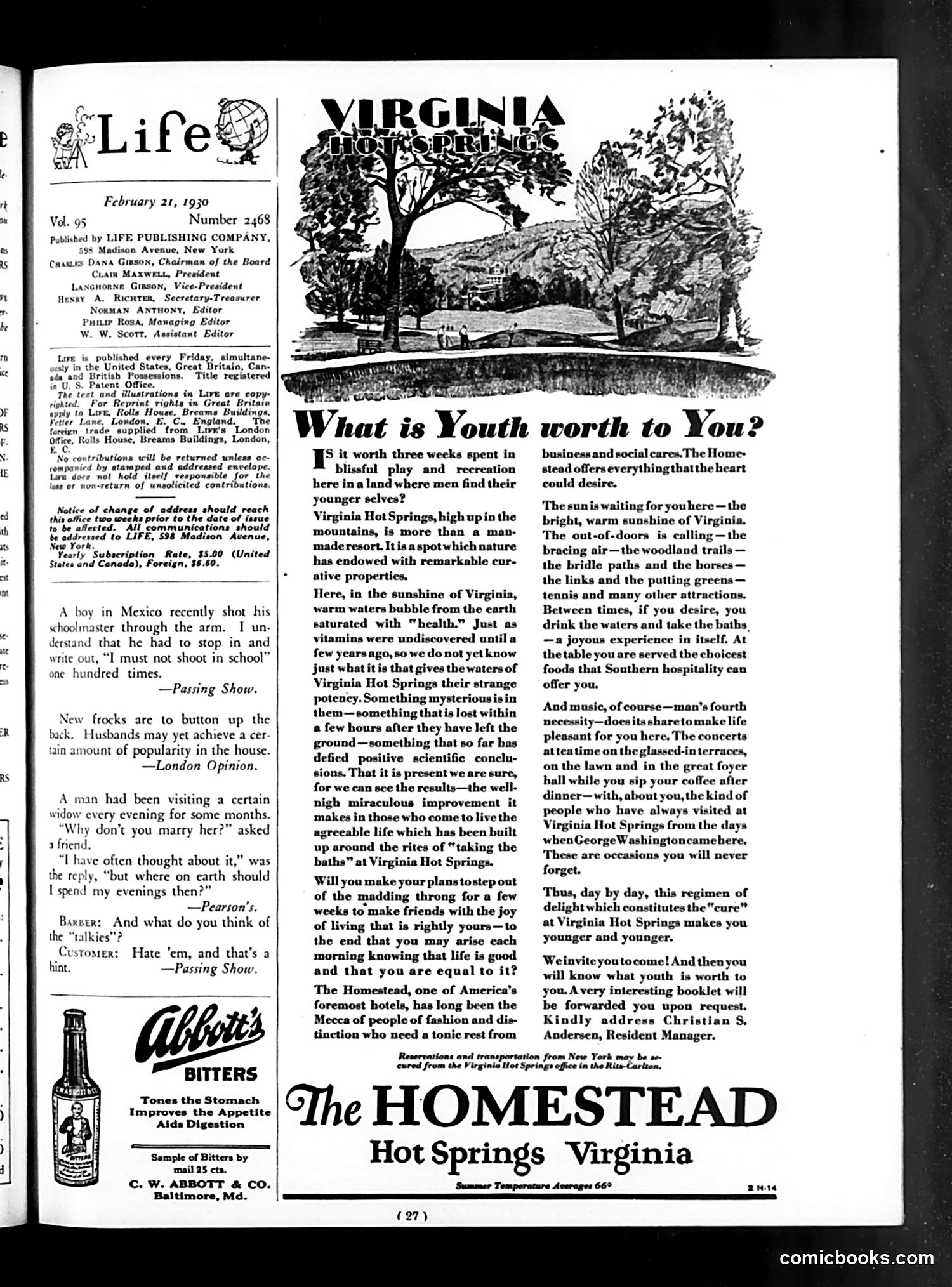
This page is primarily an advertisement for The Homestead resort at Virginia Hot Springs, Virginia, not a political cartoon. The content includes a rhetorical essay ("What is Youth worth to You?") promoting the spa's purported health benefits from its mineral waters. The text emphasizes the resort's appeal to wealthy, fashionable guests seeking rest and rejuvenation, claiming the waters have mysterious curative properties (though admittedly not scientifically proven). The page also contains several brief humorous anecdotes from other sources—jokes about a Mexican schoolboy shooting his teacher, changing dress fashions, a man avoiding marriage, and opinions on "talkies" (talking pictures/early sound films). An advertisement for Abbott's Bitters appears at the bottom left. This is a straightforward promotional magazine page with advertising and light humor rather than political satire.
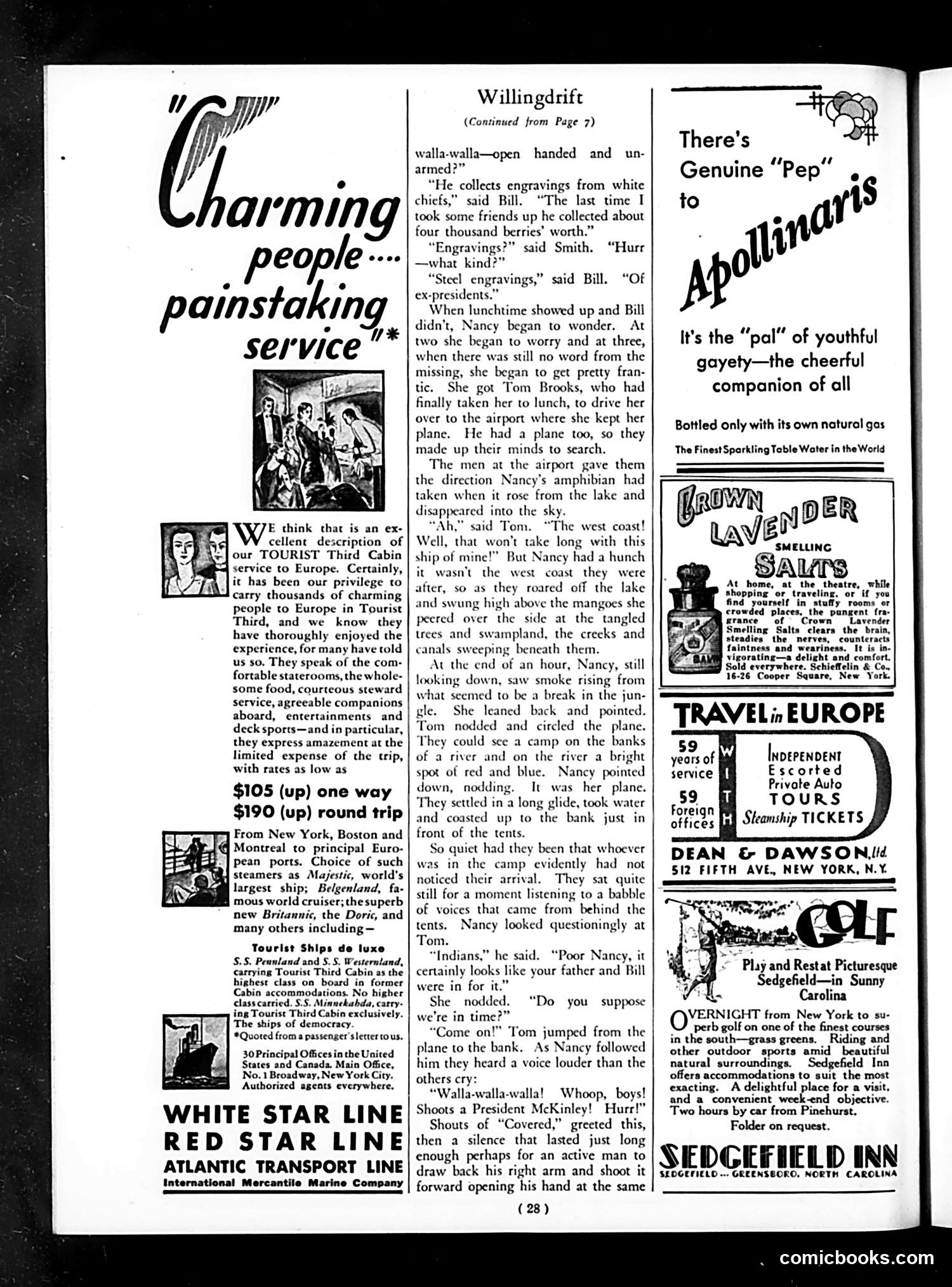
Explanation for Modern Readers This page is primarily advertising and serialized fiction, not political satire. The left side features ads for steamship lines (White Star, Red Star, Atlantic Transport) promoting affordable "Tourist Third Cabin" passage to Europe—marketing budget travel to ordinary Americans. The right side continues a serialized adventure story titled "Willingdrift" about Nancy, who searches for her missing father and friend Bill in what appears to be a remote jungle location. The narrative involves planes, indigenous peoples ("Indians"), and comedic misunderstandings—Bill apparently engaging in mock-aggressive play ("Shoots a President McKinley!") with local inhabitants who collect "steel engravings of ex-presidents." The sidebar ads include Apollinaris sparkling water and travel services. This is entertainment and commerce, not political commentary. The casual racial language and stereotypes reflect 1920s-era attitudes but aren't the page's satirical purpose.
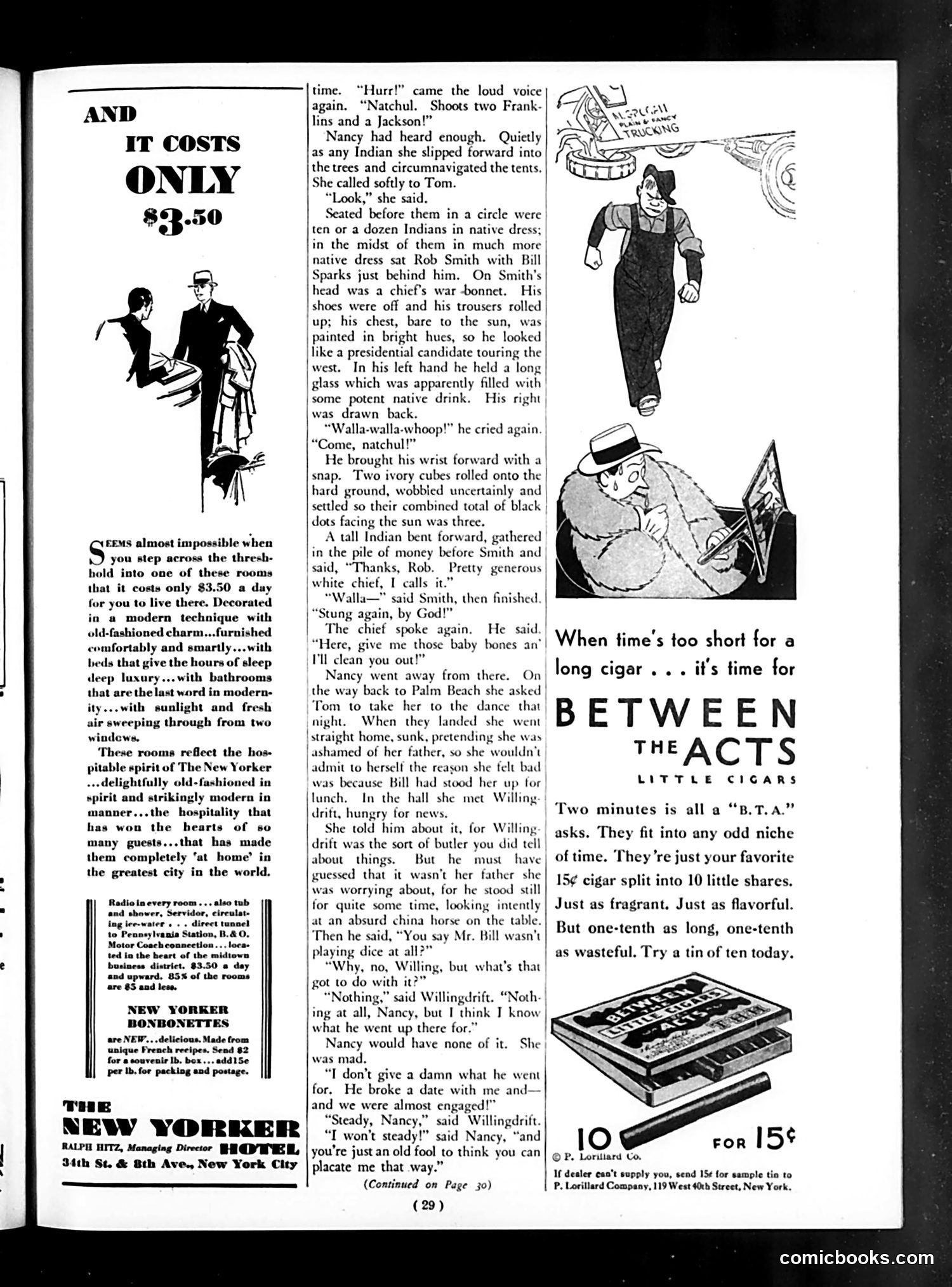
Analysis of This Life Magazine Page This page contains a serialized fiction narrative (continued from a previous page) about a young woman named Nancy discovering her romantic interest, Rob Smith, gambling with Native Americans while dressed in offensive stereotypical "native" costume—painting his chest, wearing a war bonnet, and drinking from what appears to be alcohol. The satire targets the casual racism and primitivist stereotyping common in 1920s-30s popular fiction. The accompanying New Yorker Hotel advertisement (left side) ironically emphasizes genteel hospitality and modernity while the story depicts wealthy white Americans engaging in crude racial mockery. The juxtaposition creates unintentional satire: the hotel promises "old-fashioned charm" and "hospitality," yet contemporary attitudes reflected in the fiction reveal casual cruelty toward Indigenous peoples. A Between the Acts cigar advertisement (right) represents typical period product placement. The overall page reflects Life magazine's satirical function—documenting contemporary American behavior, attitudes, and contradictions of its era.
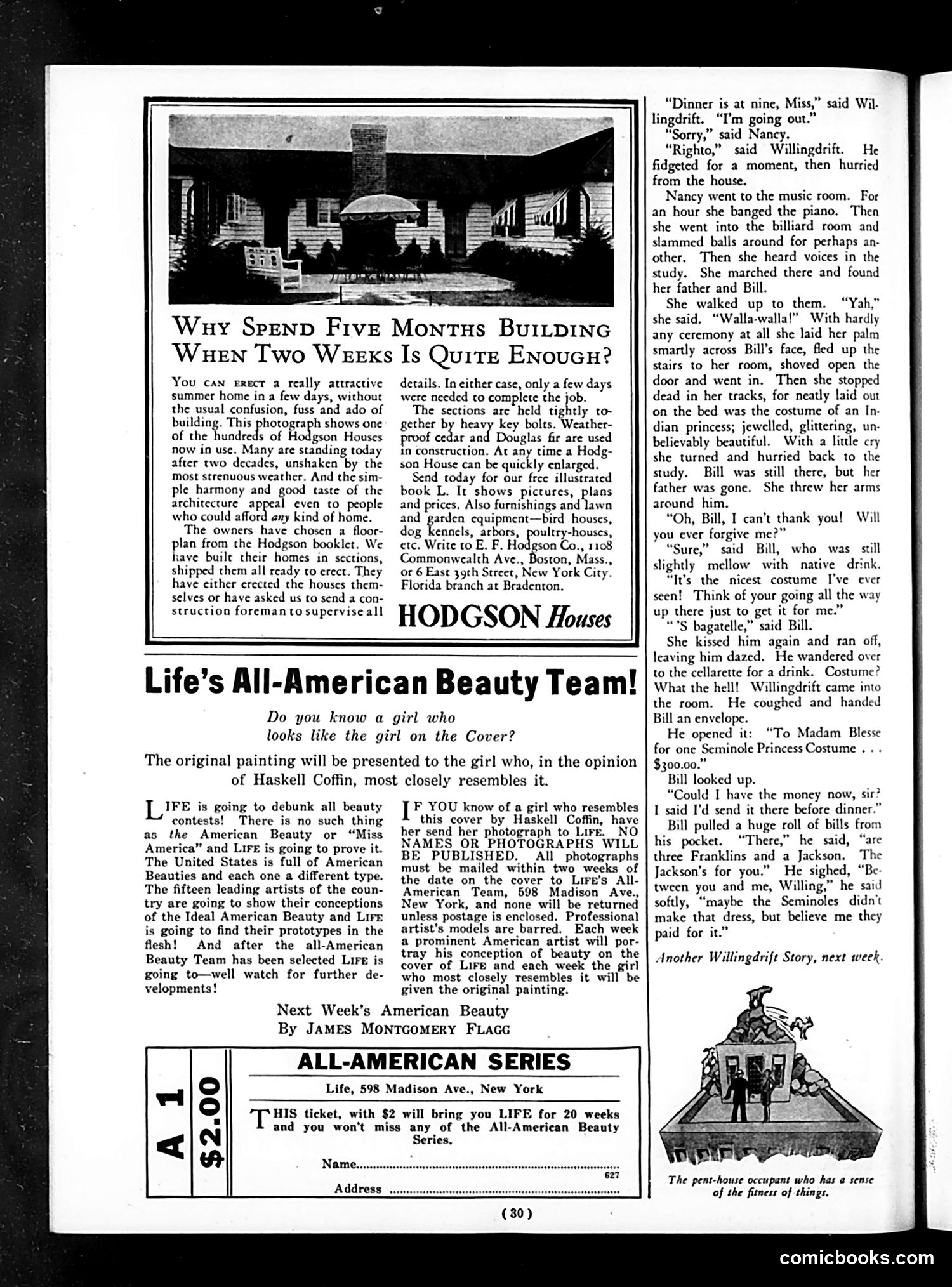
Life Magazine Page Analysis This page contains three distinct elements: an advertisement, a beauty contest promotion, and a serialized story. The Hodgson Houses ad sells prefabricated homes—a practical 1920s innovation allowing quick assembly in "two weeks" versus traditional five-month construction. The "All-American Beauty Team" contest is Life's satirical debunking of singular "beauty standards." Rather than crowning one "Miss America," Life challenges the notion that beauty has one ideal type. Readers submit photographs of girls resembling artist Haskell Coffin's cover painting. Each week, different artists will depict their conception of beauty, and Life will find real-life matches. This mocks conventional beauty pageants by suggesting American beauty is diverse, not monolithic. The serialized "Willingdrift Story" depicts a romantic domestic drama: Nancy receives an elaborate Indian princess costume from Bill, implying he cares for her. The narrative emphasizes upper-class leisure activities (piano, billiards) and emotional manipulation typical of period serialized fiction. The page reflects 1920s consumer culture, modern marketing, and evolving attitudes toward femininity and standardization.
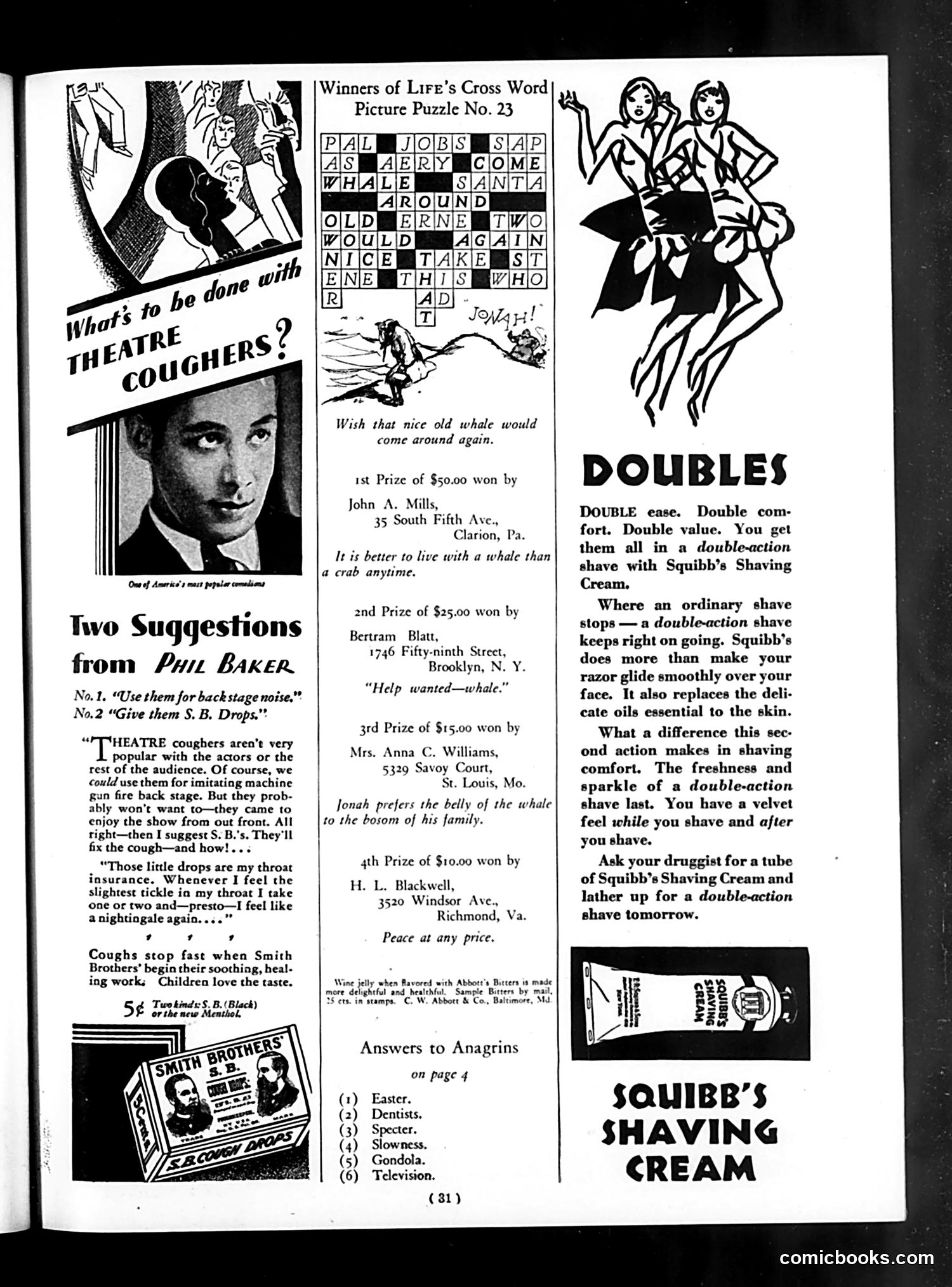
Analysis for Modern Readers This page combines period advertising with social commentary typical of *Life* magazine's satirical approach. The Main Cartoon: Comedian Phil Baker suggests solutions to "theatre coughers"—audience members disrupting performances. His suggestions: use coughs for sound effects, or give them S.B. Drops (Smith Brothers cough drops). Baker endorses the drops as "throat insurance," implying chronic coughers should medicate themselves before attending shows. The humor targets both inconsiderate audiences and the social expectation that one should manage minor ailments to avoid bothering others. The Crossword Puzzle: Features whale-related clues and answers, with winners' names listed—a typical *Life* engagement feature. The Advertisements: Squibb's Shaving Cream and Smith Brothers Cough Drops dominate the page, using celebrity endorsement and comparative marketing ("double-action") tactics common to early 20th-century advertising. The page reflects period anxieties about public behavior and consumer culture, presenting commercial products as solutions to social etiquette problems.
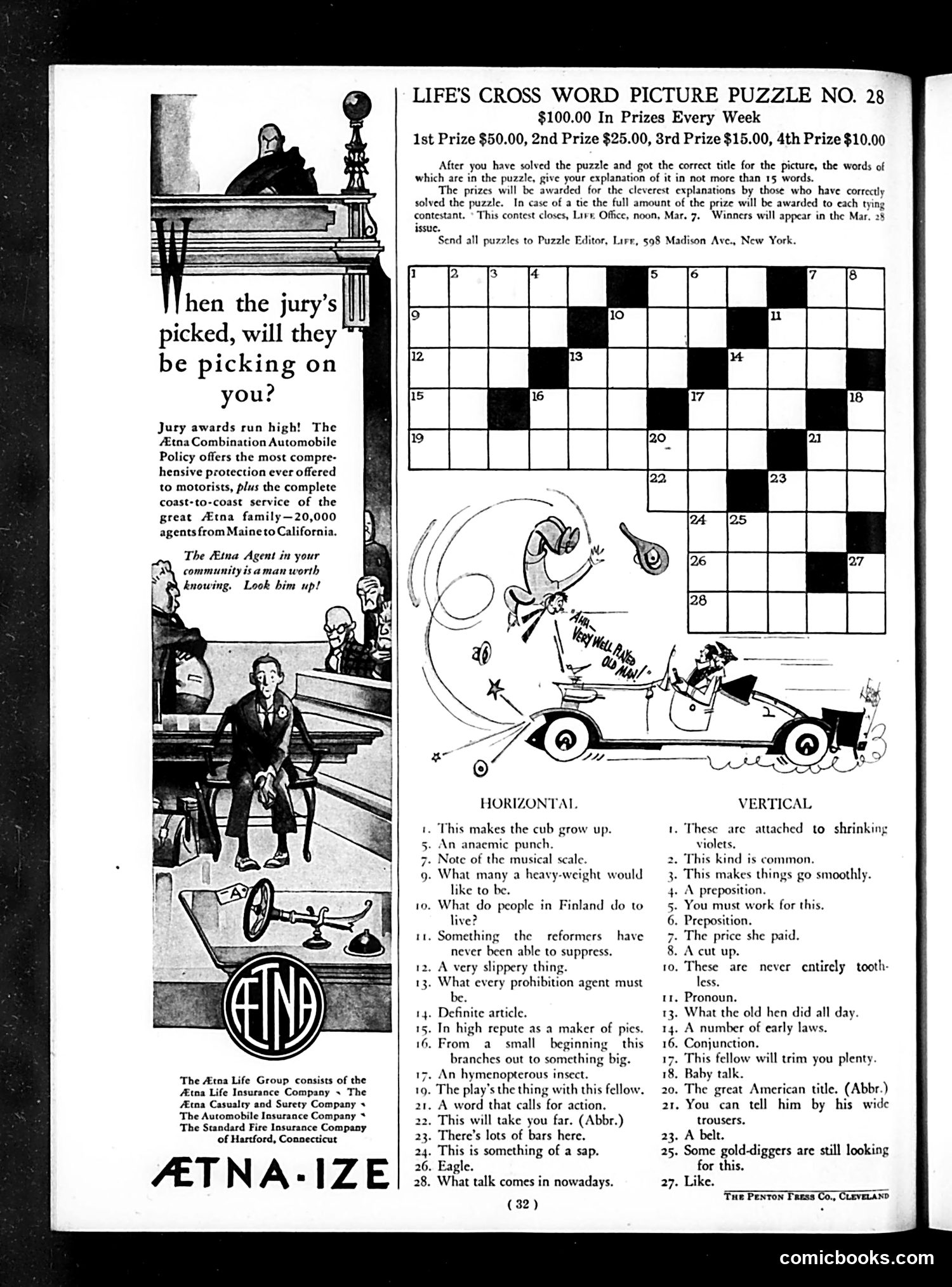
Content Analysis This page contains primarily advertising and a crossword puzzle contest, not political satire. The left side features an Ætna Insurance advertisement using a courtroom/jury scene to promote automobile insurance. The tagline—"When the jury's picked, will they be picking on you?"—humorously suggests that without proper insurance coverage, a motorist might face financial liability if sued. The ad emphasizes Ætna's nationwide network and comprehensive protection. The main content is Life magazine's Puzzle No. 28, a crossword-picture puzzle contest offering $100 in weekly prizes. Solvers must complete the puzzle, identify the resulting picture, and write a 15-word explanation. The clues are typical wordplay of the era (referencing Prohibition agents, "gold-diggers," and contemporary slang). The cartoon illustration at bottom-center shows a comedic car scene, likely related to the puzzle's solution, though the specific reference is unclear without solving it. This is primarily commercial puzzle entertainment, not political commentary.
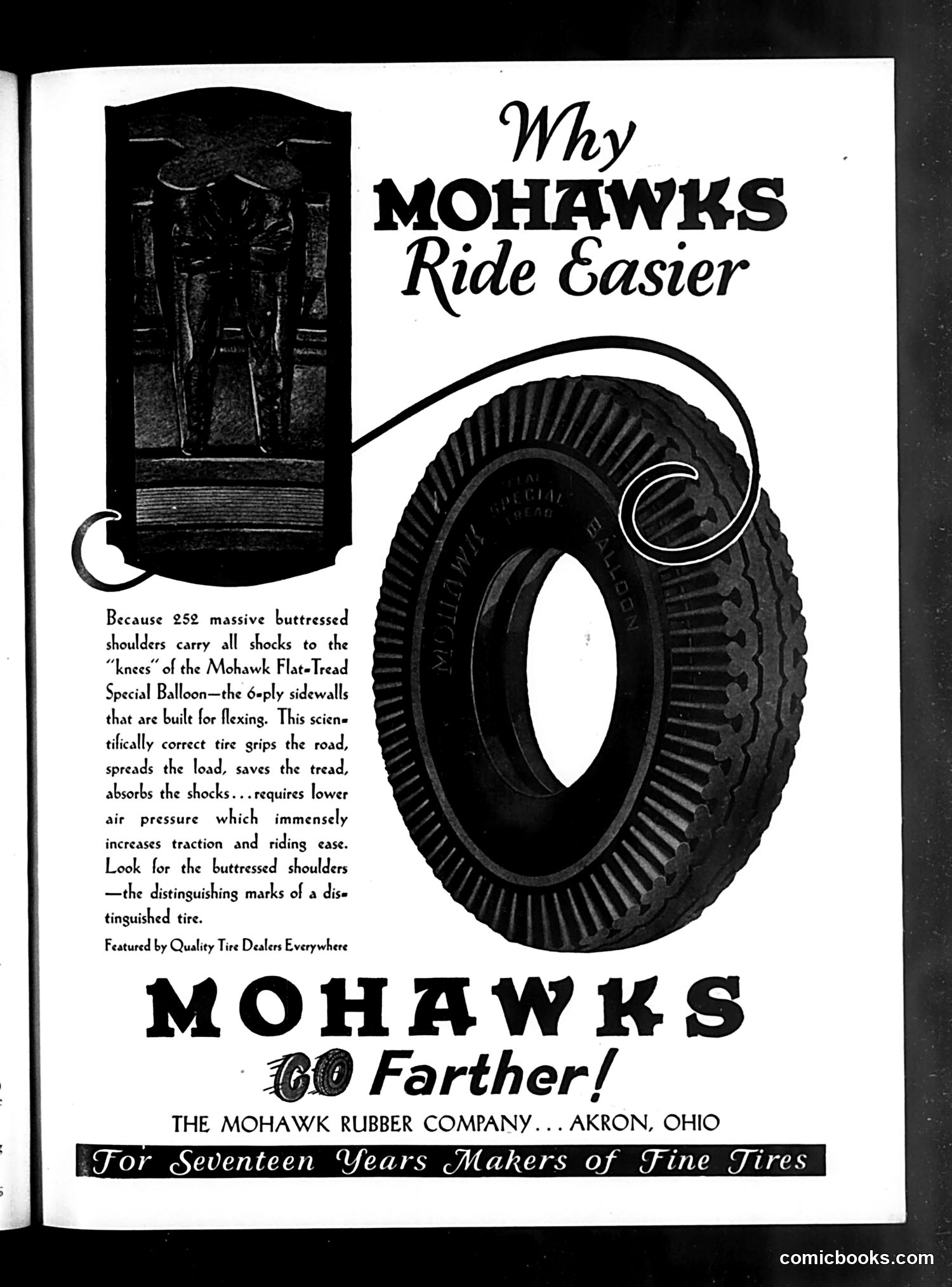
Analysis This is advertising, not satire or political content. It's a vintage tire advertisement for Mohawk brand tires, manufactured by the Mohawk Rubber Company in Akron, Ohio. The page promotes the "Flat-Tread Special Balloon" tire, emphasizing its technical features: buttressed (reinforced) shoulders that absorb shocks, flexible sidewalls, and improved tread grip. The ad claims these design features reduce air pressure needs while increasing traction and riding comfort. The left panel shows a cross-section diagram of the tire's internal structure. The headline "Why MOHAWKS Ride Easier" and slogan "Go Farther!" are standard sales pitches. The phrase "For Seventeen Years Makers of Fine Tires" establishes brand credibility. There is no cartoon, satire, or political commentary—this is straightforward early-20th-century product marketing emphasizing engineering innovation to appeal to automotive consumers.
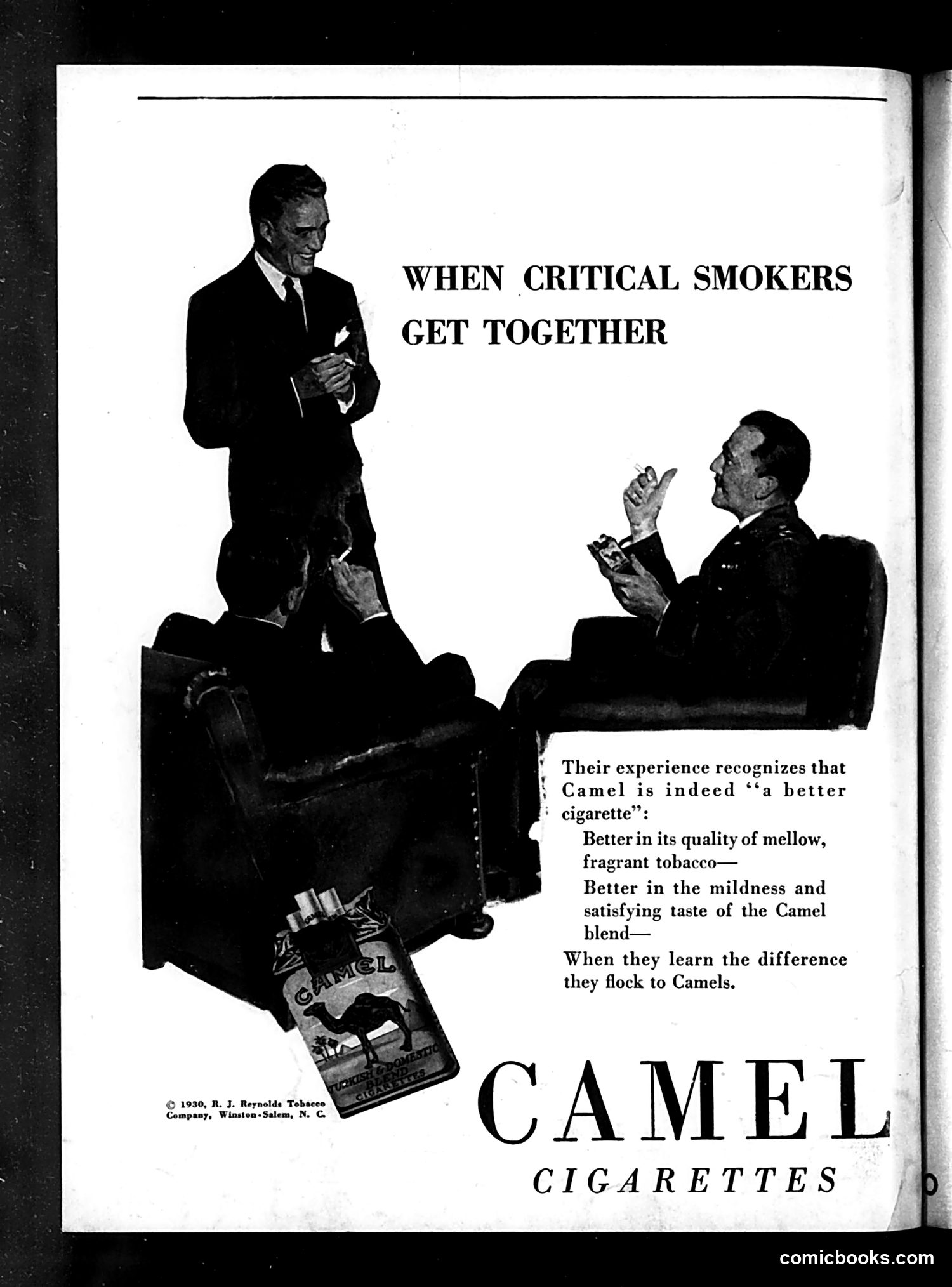
Analysis This is a 1930 Camel cigarette advertisement, not satire or political commentary. The page depicts three well-dressed businessmen in conversation, with the headline "When Critical Smokers Get Together." The "joke" or selling point is that discerning smokers—those who consider themselves knowledgeable critics—recognize Camel's superior quality in tobacco blend, mildness, and taste. The implication is that once sophisticated smokers experience Camel, they convert to the brand. The advertisement uses aspirational imagery (professional men in suits) and appeals to vanity ("critical smokers," "learn the difference") rather than humor. By 1930 standards, this was straightforward persuasive advertising leveraging social status and connoisseurship. No specific political figures or events are referenced—it's simply a product advertisement from the era before cigarette health warnings became mandatory.