life
Life — February 28, 1930
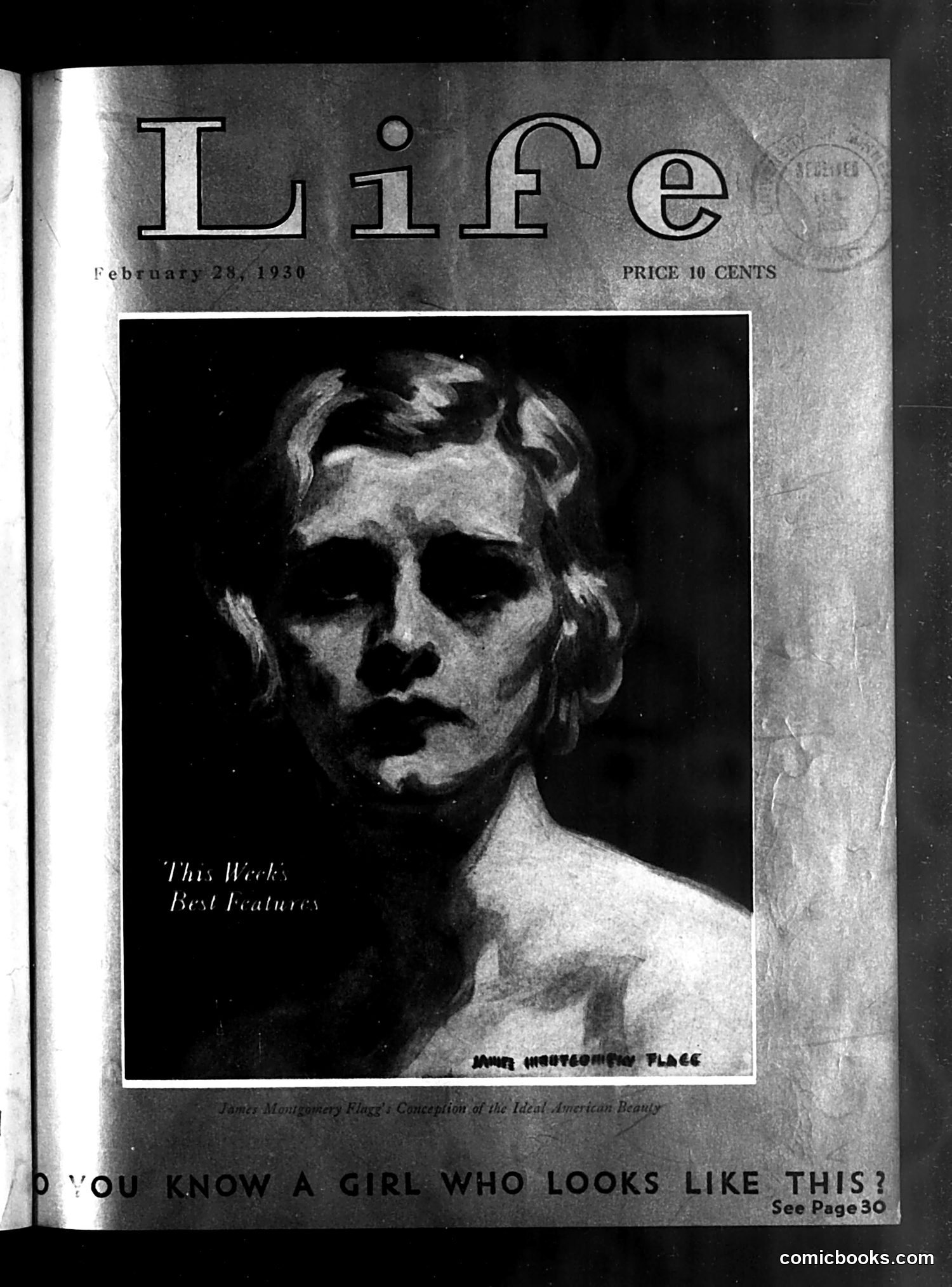
Life Magazine, February 28, 1930 This is primarily a magazine cover featuring a sculptural artwork, not a political cartoon. The image shows a classical-style bust or sculpture titled "James Montgomery Flagg's Conception of the Ideal American Beauty," created by an artist credited as "Ann [Horton?] Place." The cover's tagline—"DO YOU KNOW A GIRL WHO LOOKS LIKE THIS?"—appears to be a lighthearted contest or reader-engagement prompt, encouraging viewers to identify women matching this idealized beauty standard. The "This Week's Best Features" notation suggests this artwork was featured content in the issue. This reflects 1930s popular culture's preoccupation with defining and celebrating standardized beauty ideals, presented here through classical artistic tradition.
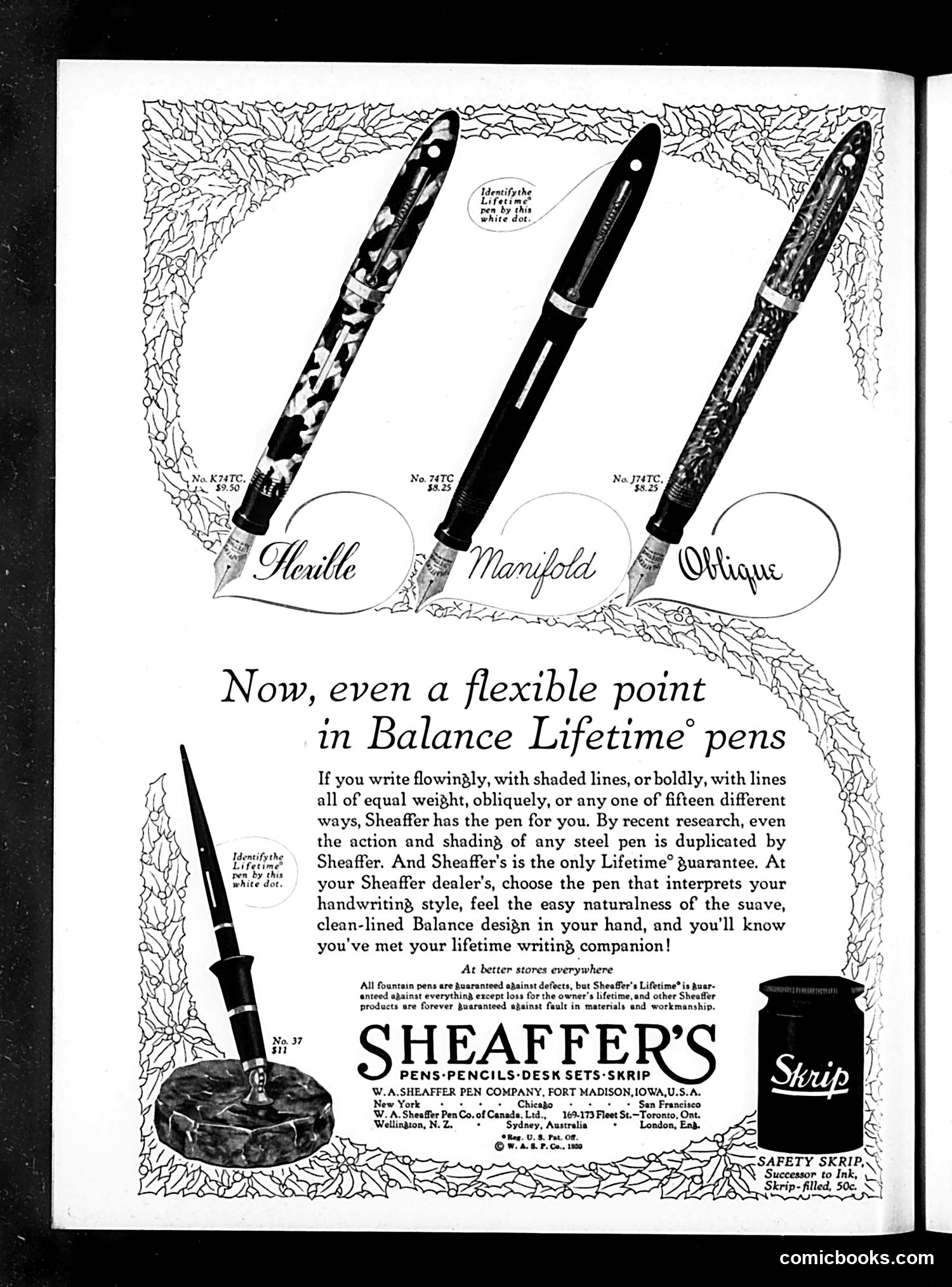
Analysis This is not a political cartoon or satirical content—it's a product advertisement for Sheaffer fountain pens, specifically their "Balance Lifetime" line. The page displays three pen styles (Flexible, Manifold, and Oblique) with decorative leaf illustrations and an ornamental inkwell. The advertisement emphasizes that Sheaffer pens accommodate different writing styles—whether "flowingly, with shaded lines, or boldly, with lines all of equal weight." The text claims Sheaffer's steel pens duplicate the action of other brands and offers a lifetime guarantee. The ad encourages readers to visit dealers to find a pen matching their handwriting style. This represents typical early-to-mid 20th century *Life* magazine advertising content rather than editorial satire.
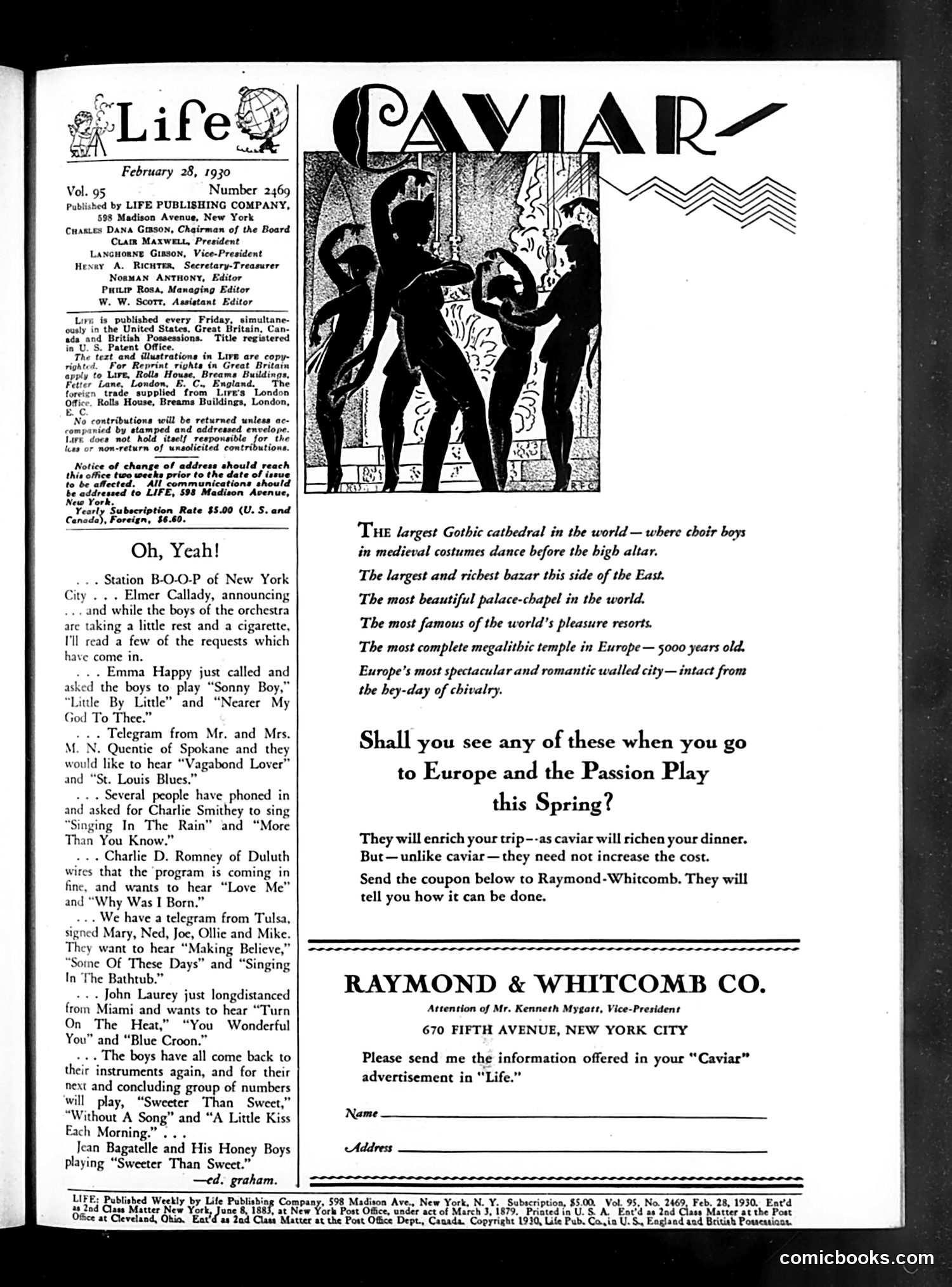
"Caviar" Advertisement Page, Life Magazine, February 28, 1930 This page is primarily a commercial advertisement for Raymond & Whitcomb Co.'s European travel services, not political satire. The large illustration depicts silhouetted figures in formal dress viewing what appears to be a Gothic cathedral interior—likely representing tourists on a European tour. The ad uses luxury marketing language, promoting European attractions: cathedrals, bazaars, palaces, temples, and the "Passion Play." The caviar reference is metaphorical—suggesting these travel experiences are luxury enhancements to one's life, comparable to caviar enriching dinner. The left column contains unrelated reader requests to station BOOP-P for musical performances, showing typical magazine content of the era. This is essentially a full-page travel advertisement with accompanying program notes.
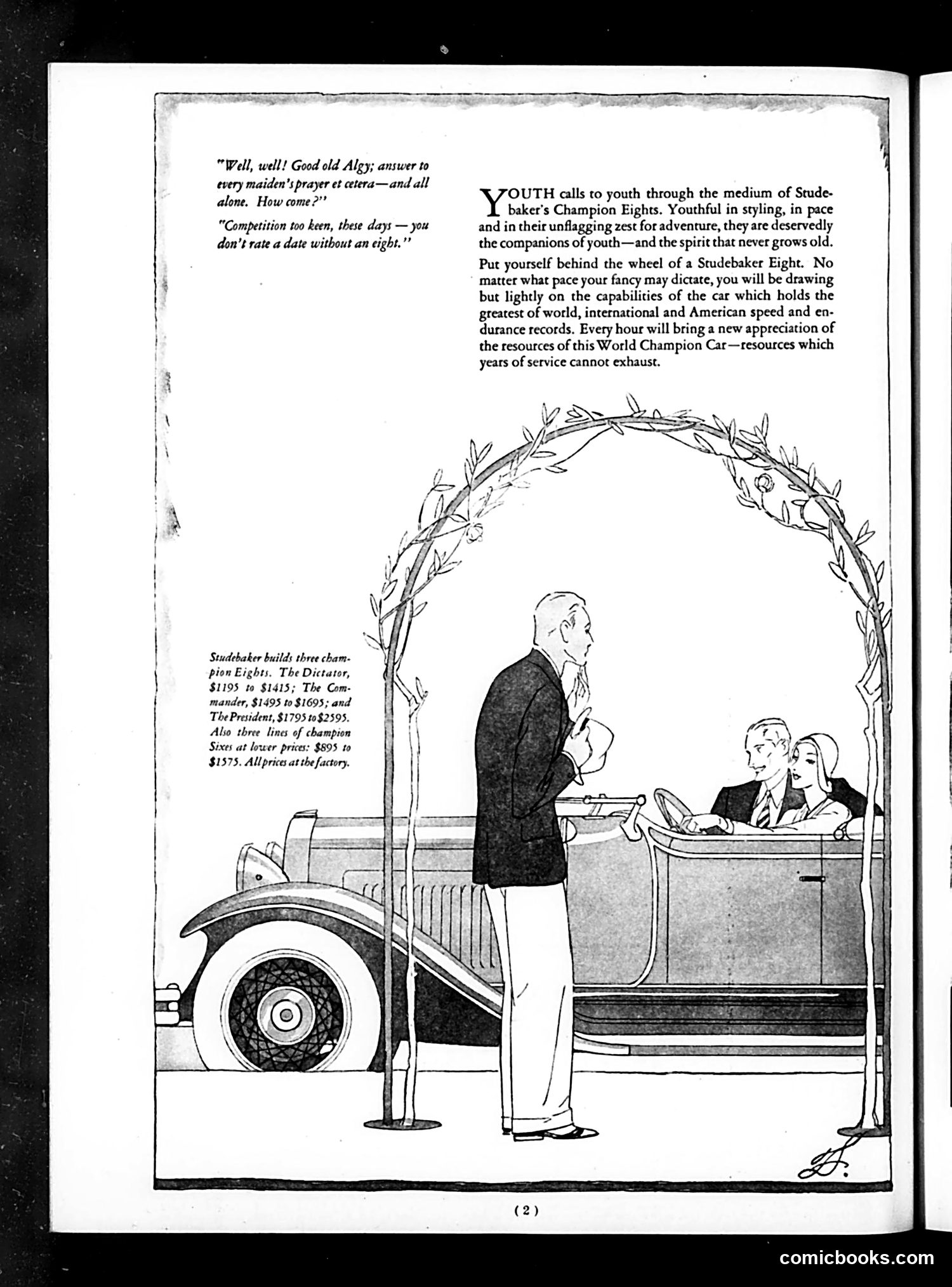
Analysis of Life Magazine Page This page is primarily advertising for Studebaker automobiles, not political satire. The cartoon illustrates a young man presenting a Studebaker Eight automobile to what appears to be his parents or guardians. The Social Context: The ad targets youth, emphasizing that Studebaker cars embody youthful energy and adventure. The scene depicts a formal presentation—the young man appears proud, while the adults seem impressed or skeptical. The Marketing Message: The text appeals to young people's desire for independence and excitement, while reassuring parents about the car's reliability and durability. Three Champion Eight models are listed with prices ($1,195-$2,395), positioning them as accessible luxury vehicles. This represents 1920s-era advertising that blended automotive promotion with aspirational lifestyle messaging.
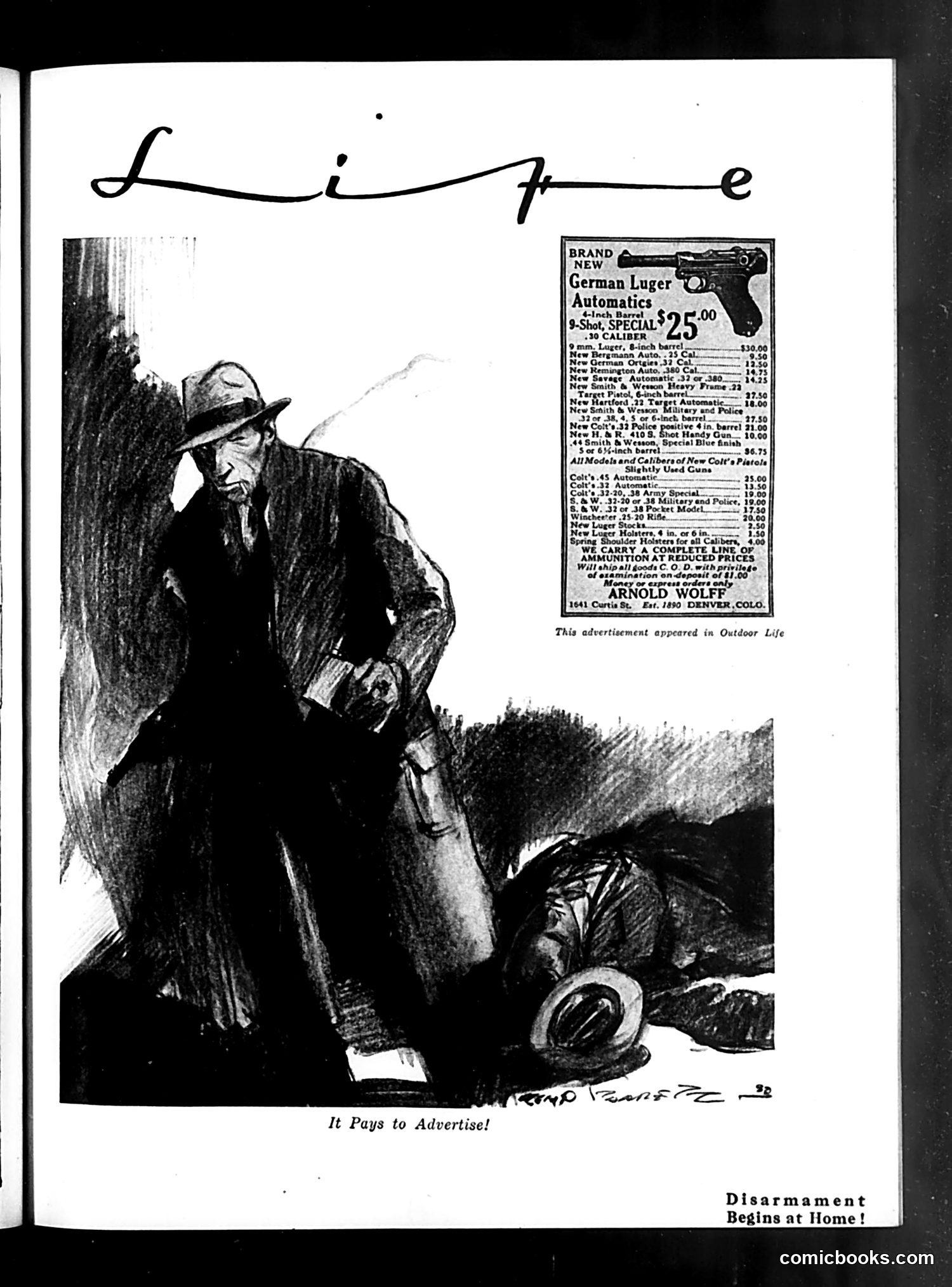
Analysis This page is primarily an advertisement for firearms, not political satire. The illustration depicts a man in Western attire standing over a fallen figure, with the caption "It Pays to Advertise!" The ad, placed by Arnold Wolff of Denver, Colorado, promotes a German Luger automatic pistol priced at $25.00, along with listings for various other firearms and ammunition. The phrase "It Pays to Advertise!" is a cynical double meaning—it suggests that advertising the weapon effectively leads to sales, while the violent imagery implies it "pays" (succeeds) in actual use. The accompanying text "Disarmament Begins at Home!" appears ironic, suggesting personal weaponry while nominally addressing disarmament concerns of the post-WWI era. This reflects early 20th-century attitudes toward firearms marketing and regulation.
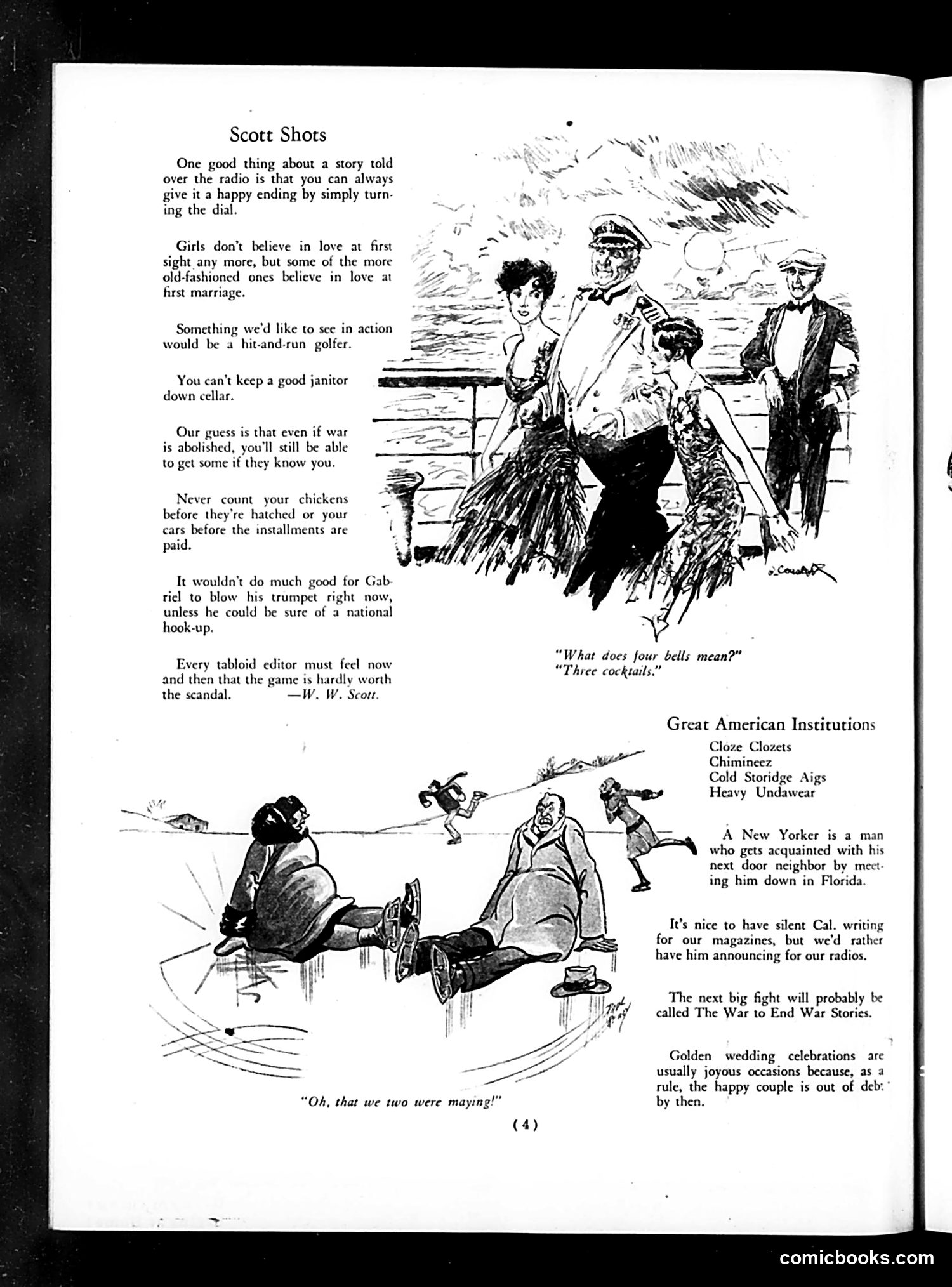
Scott Shots - Life Magazine Satire Page This page contains brief humorous observations and two cartoon illustrations. Top cartoon: Shows people at what appears to be a social gathering or ship setting. The caption "What does four bells mean?" "Three cocktails" jokes about nautical signals being confused with drinking culture—likely reflecting 1920s-30s social attitudes toward alcohol. Bottom cartoon: Depicts two people sliding on ice with the caption "Oh, that we two were maying!" This appears to be romantic/nostalgic humor—"maying" (springtime courtship) contrasts absurdly with their winter activity, suggesting wistful thinking about romance during mundane moments. The "Scott Shots" section includes satirical one-liners about radio storytelling, janitors, war, chickens, and journalism—typical of Life magazine's gossipy, observational humor targeting contemporary American institutions and social pretensions.
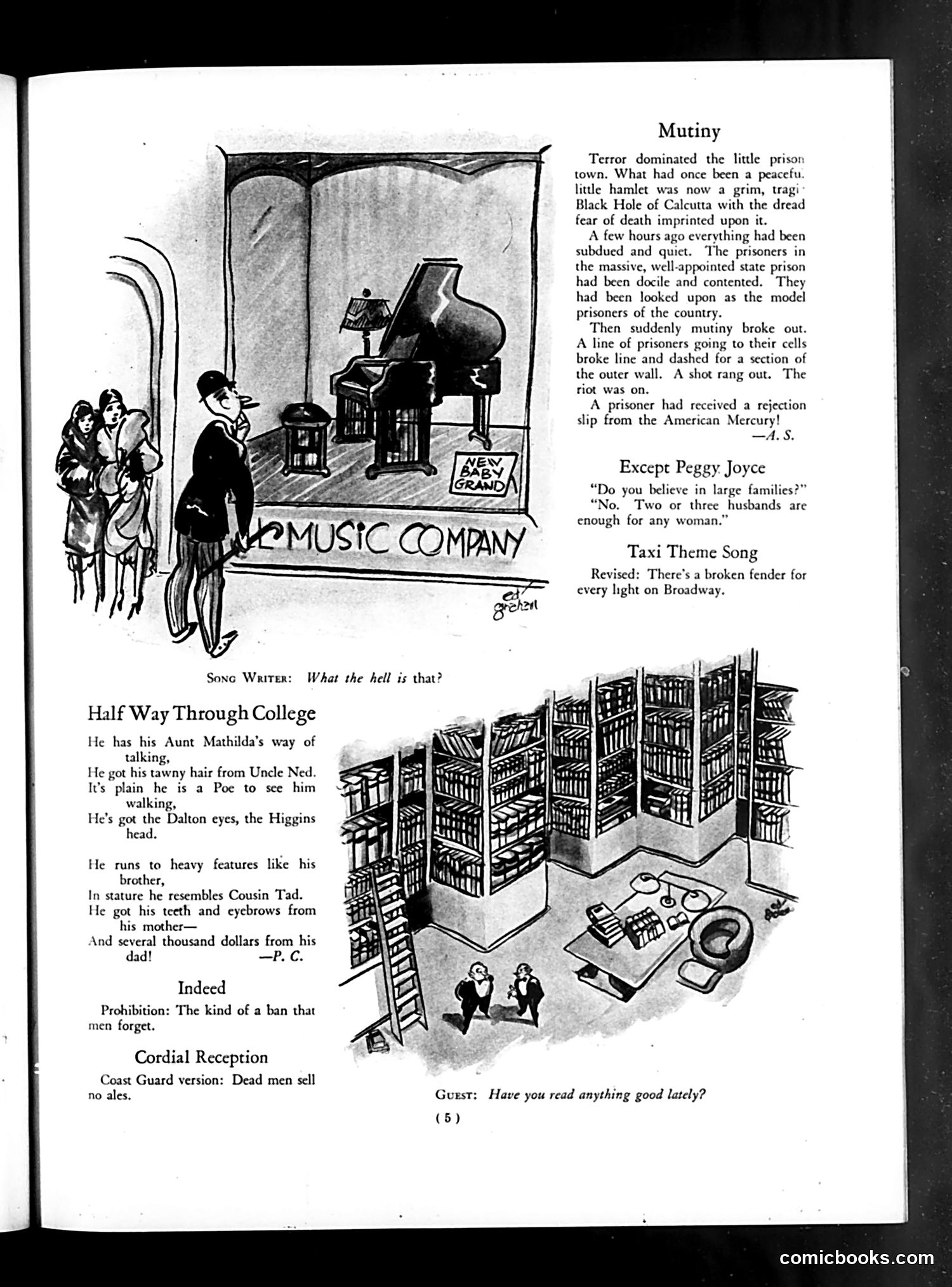
Analysis of Life Magazine Page This page contains several short humor pieces and satirical cartoons typical of Life's format. The top cartoon shows people outside a music company storefront listening to a piano, with a songwriter asking "What the hell is that?" — mocking poor composition. The text pieces mock various subjects: a prison uprising ("Mutiny"), family size attitudes ("Excerpt Peggy Joyce"), Broadway conditions ("Taxi Theme Song"), and college inheritance ("Half Way Through College"). The large illustration depicts a library or archive scene, with a guest asking "Have you read anything good lately?" — apparently satirizing the overwhelming volume of available literature or the difficulty of finding quality reading material. These represent typical Life magazine humor: brief, punchy observations on contemporary culture, entertainment, and social customs aimed at educated urban readers.
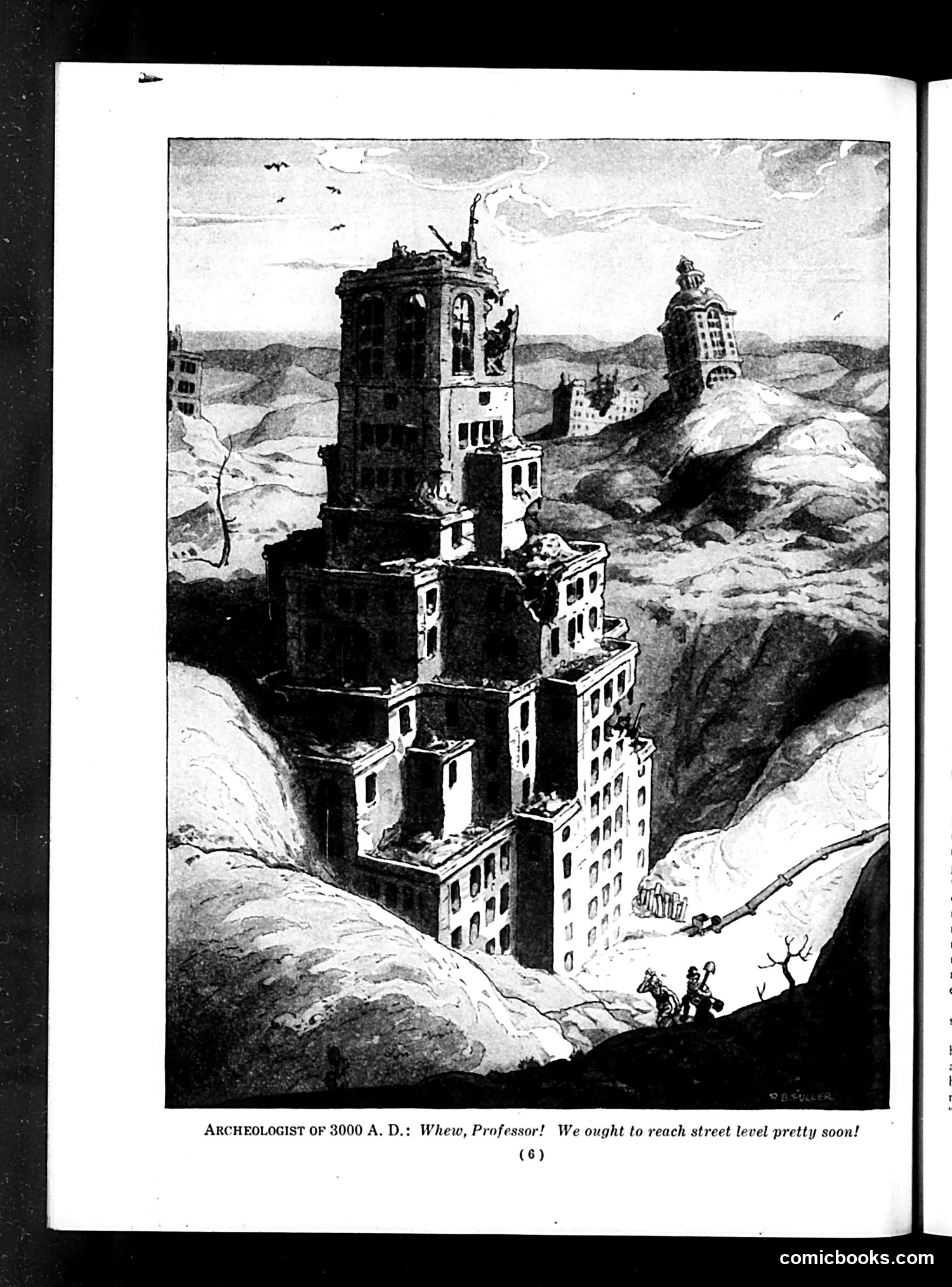
Analysis of "Archeologist of 3000 A.D." This satirical cartoon depicts an imaginary future where an archaeologist from the year 3000 A.D. excavates what appears to be a modern skyscraper buried deep underground. The joke comments on urban congestion and building density in early 20th-century cities. The caption—"Where, Professor! We ought to reach street level pretty soon!"—suggests that by the year 3000, buildings will have sunk so far below ground due to continued construction and development that "street level" becomes archaeological. The satire mocks the contemporary trend of ever-taller buildings and densely-packed urban development, implying this construction boom would eventually bury cities beneath newer construction. It's commentary on unchecked urban growth and verticalization.
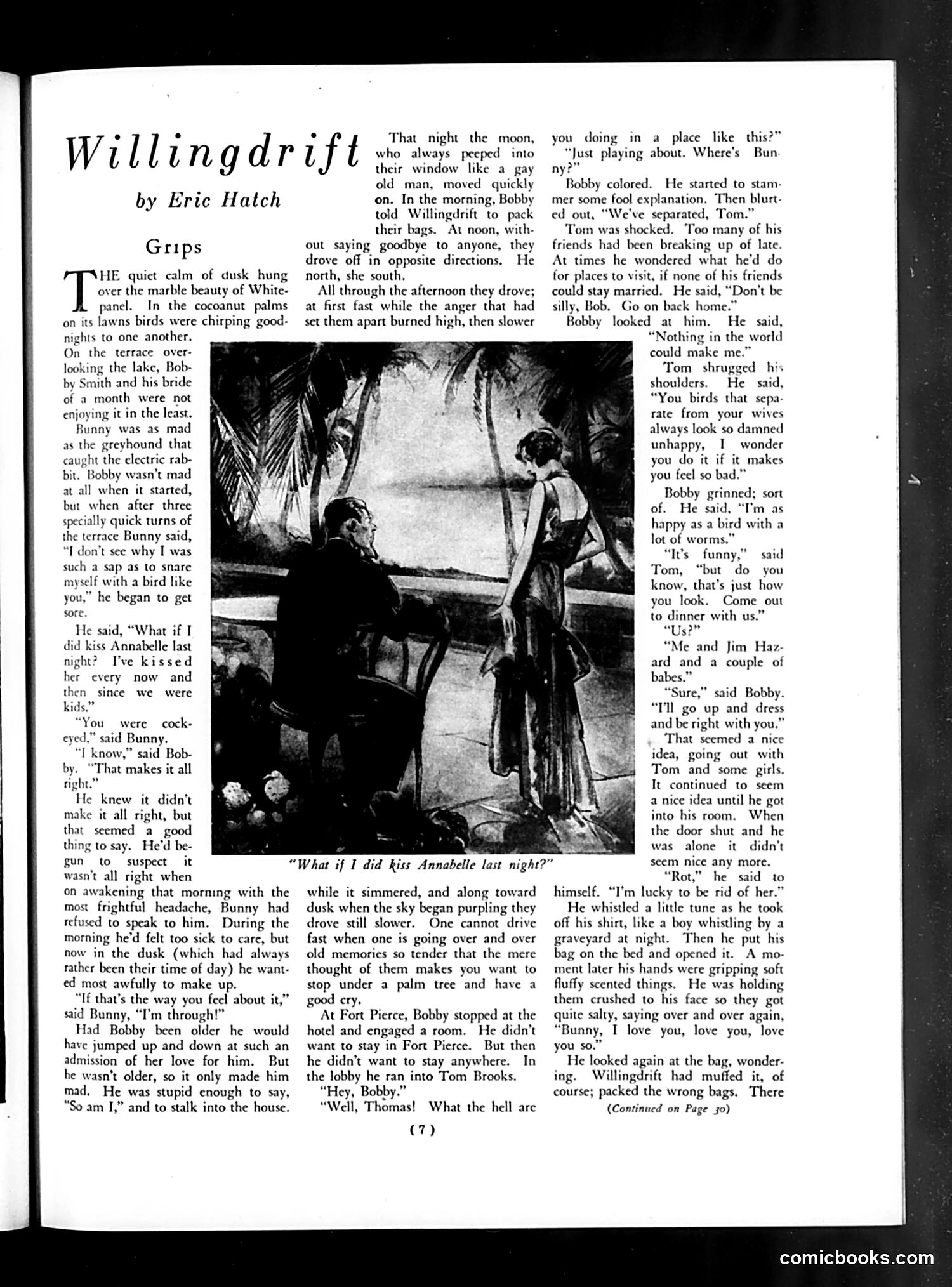
"Willingdrift" by Eric Hatch This page contains the opening of a short story, not a political cartoon. The narrative follows Bobby Smith and his bride on their honeymoon at a tropical location (White-pansel, with coconut palms). The story's humor derives from marital discord: Bobby's friend Bunny teases him about kissing his wife, which irritates Bobby. Their argument escalates into a quarrel that causes them to separate and drive in opposite directions. The narrative explores the tension between newlywed romance and male friendship dynamics. The illustrated scene shows the couple in conversation near palm trees. The story appears to be a lighthearted domestic comedy exploring early marriage complications, rather than containing political or social satire. It continues on page 20.
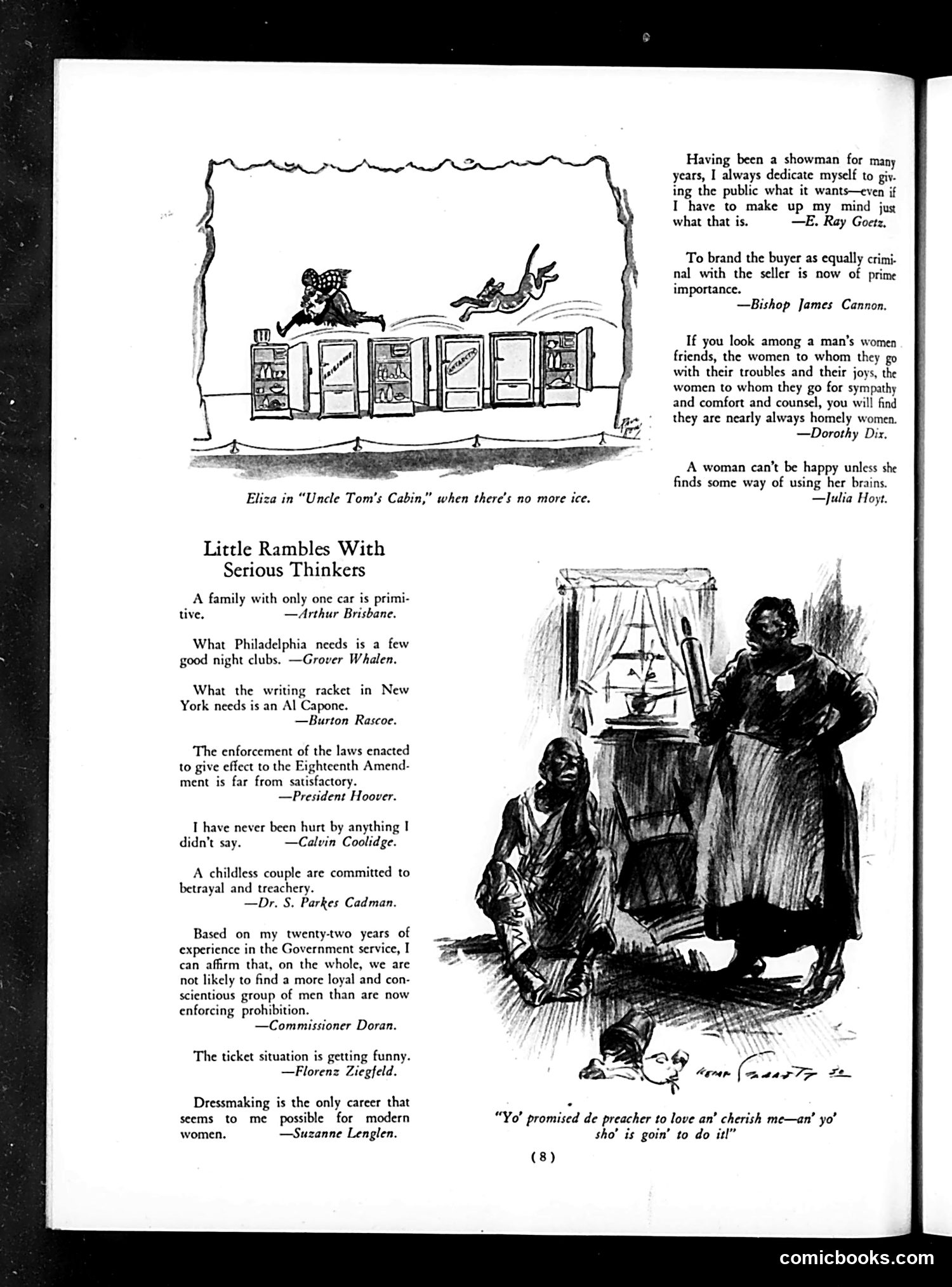
Analysis of Life Magazine Page 8 This page contains two illustrations with social commentary. The top cartoon shows "Eliza in 'Uncle Tom's Cabin'" during a scene with no ice, referencing the famous literary work about slavery. Below is a section titled "Little Rambles With Serious Thinkers" featuring quotes from public figures on contemporary issues. These include commentary on Prohibition (Commissioner Doran defending enforcement), taxi regulation (Florenz Ziegfeld on "ticket situation"), women's careers (Suzanne Lenglen on dressmaking), and various social observations from figures like President Hoover and Calvin Coolidge. The bottom illustration depicts what appears to be a sermon scene, with text in dialect: "Yo' promised de preacher to love an' cherish me—an' yo' sho' is goin' to do it!" The satire mixes high literary references with period social issues and public figures' opinions.
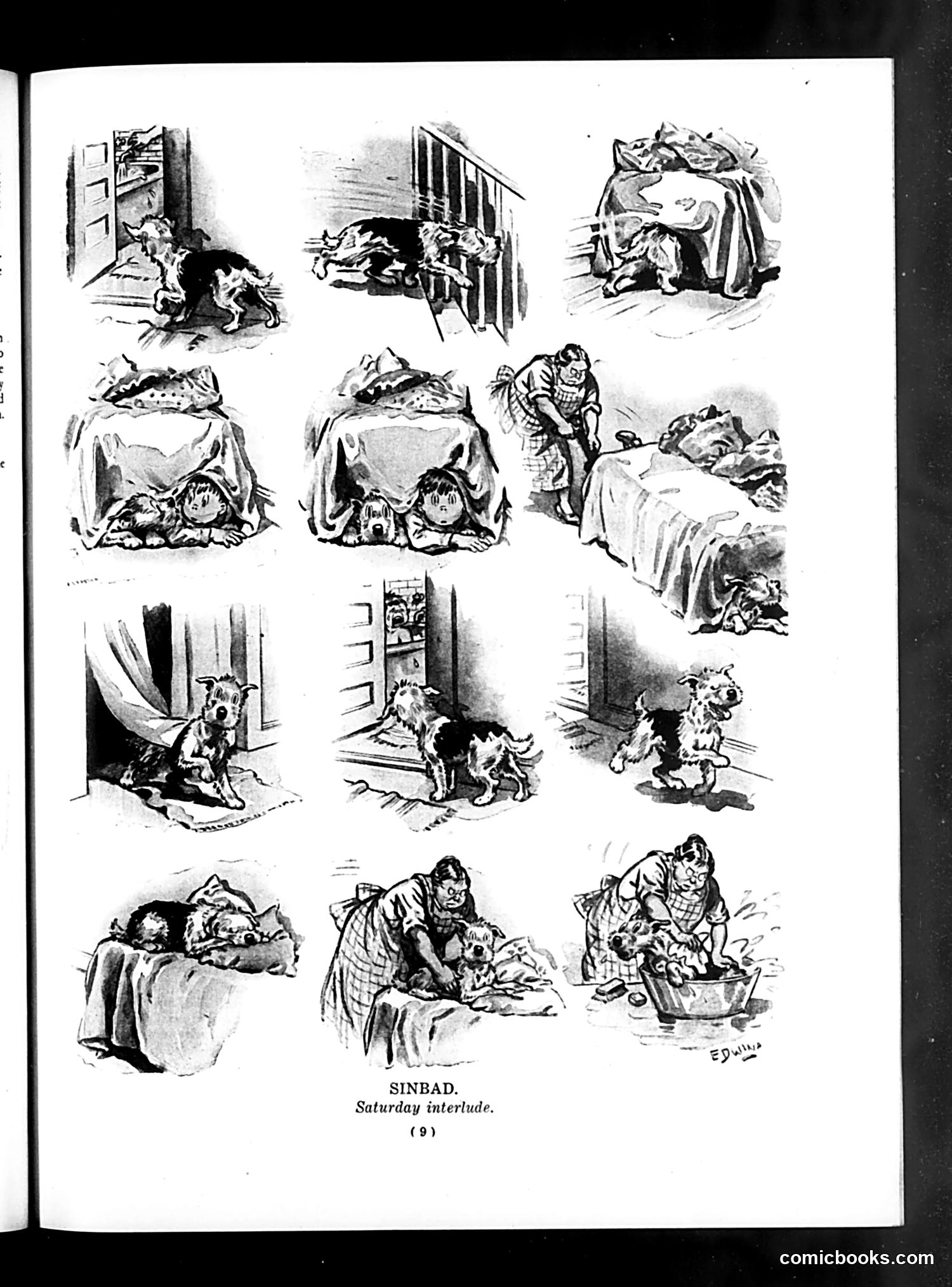
Sinbad: Saturday Interlude This page presents a series of twelve comic vignettes depicting scenes from "Sinbad" — likely referring to the classic Arabian Nights character Sinbad the Sailor. The sketches illustrate various episodes of adventure and misadventure, featuring the protagonist interacting with different characters and situations. The scenes appear humorous rather than serious, showing Sinbad in domestic or comedic circumstances: hiding under blankets, interacting with other figures, bathing, and engaging in slapstick situations. The title "Saturday interlude" suggests this was a light, entertaining comic break from the magazine's usual satirical political content. The artist signature reads "EDMUND" (likely Edmund Duffy or similar). This represents Life magazine's occasional shift toward pure comedy and literary adaptation rather than political commentary.
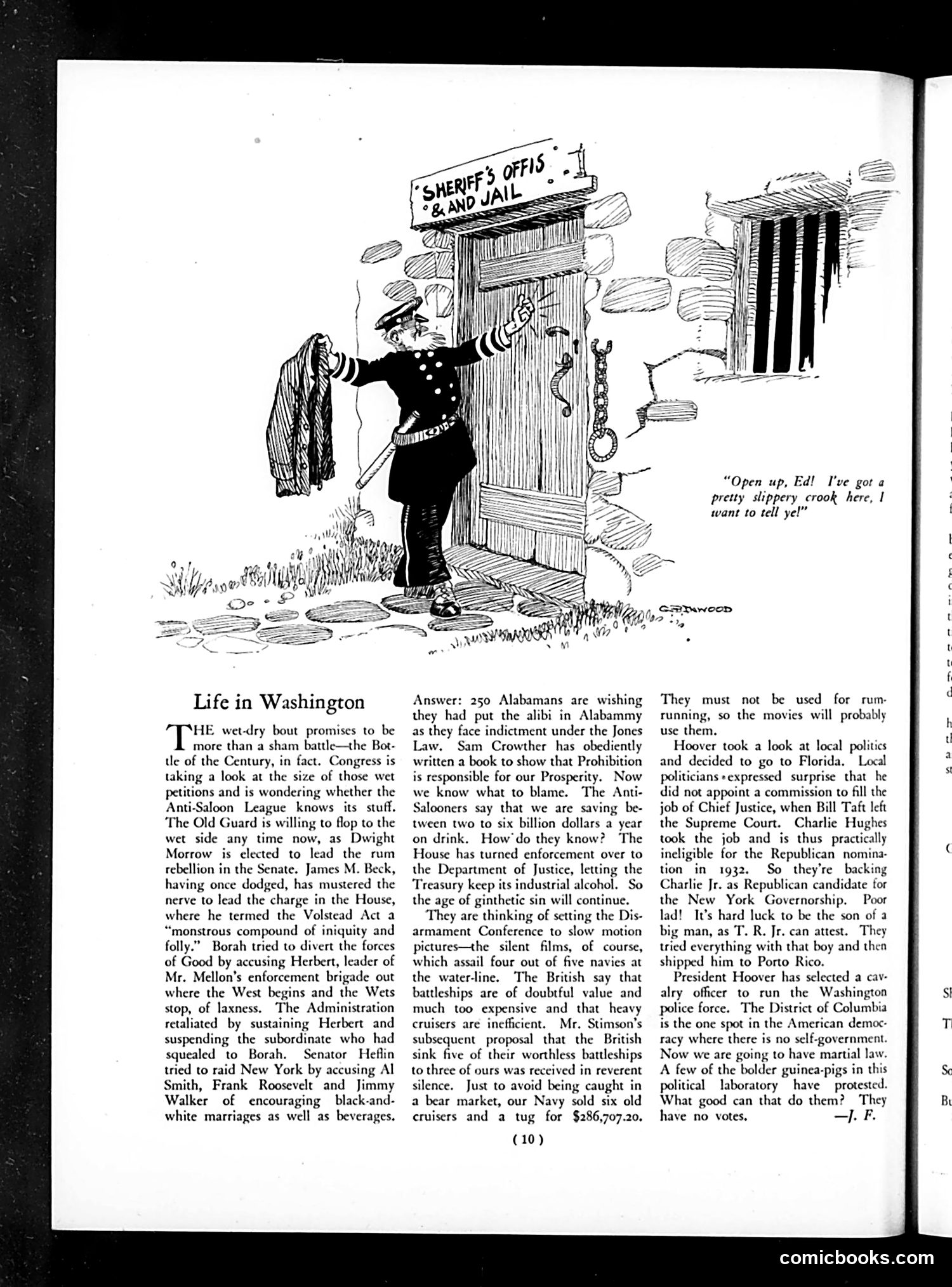
Political Cartoon Analysis: "Life in Washington" The cartoon depicts a sheriff opening a jail cell door, telling a prisoner: "Open up, Ed! I've got a pretty slippery crook here, I want to tell ye!" This satirizes Prohibition enforcement corruption. The text discusses how the Anti-Saloon League and enforcement officials turned a blind eye to industrial alcohol theft and trafficking, essentially colluding with criminals. The "slippery crook" likely references a specific corrupt official or bootlegger who escaped justice through official negligence. The joke: law enforcement itself operates like a criminal enterprise—the sheriff casually warns imprisoned criminals about incoming corruption, suggesting jails house the petty violators while actual organized crime operates freely with official complicity. This reflects early 1920s Prohibition-era skepticism about government enforcement capabilities and widespread corruption.
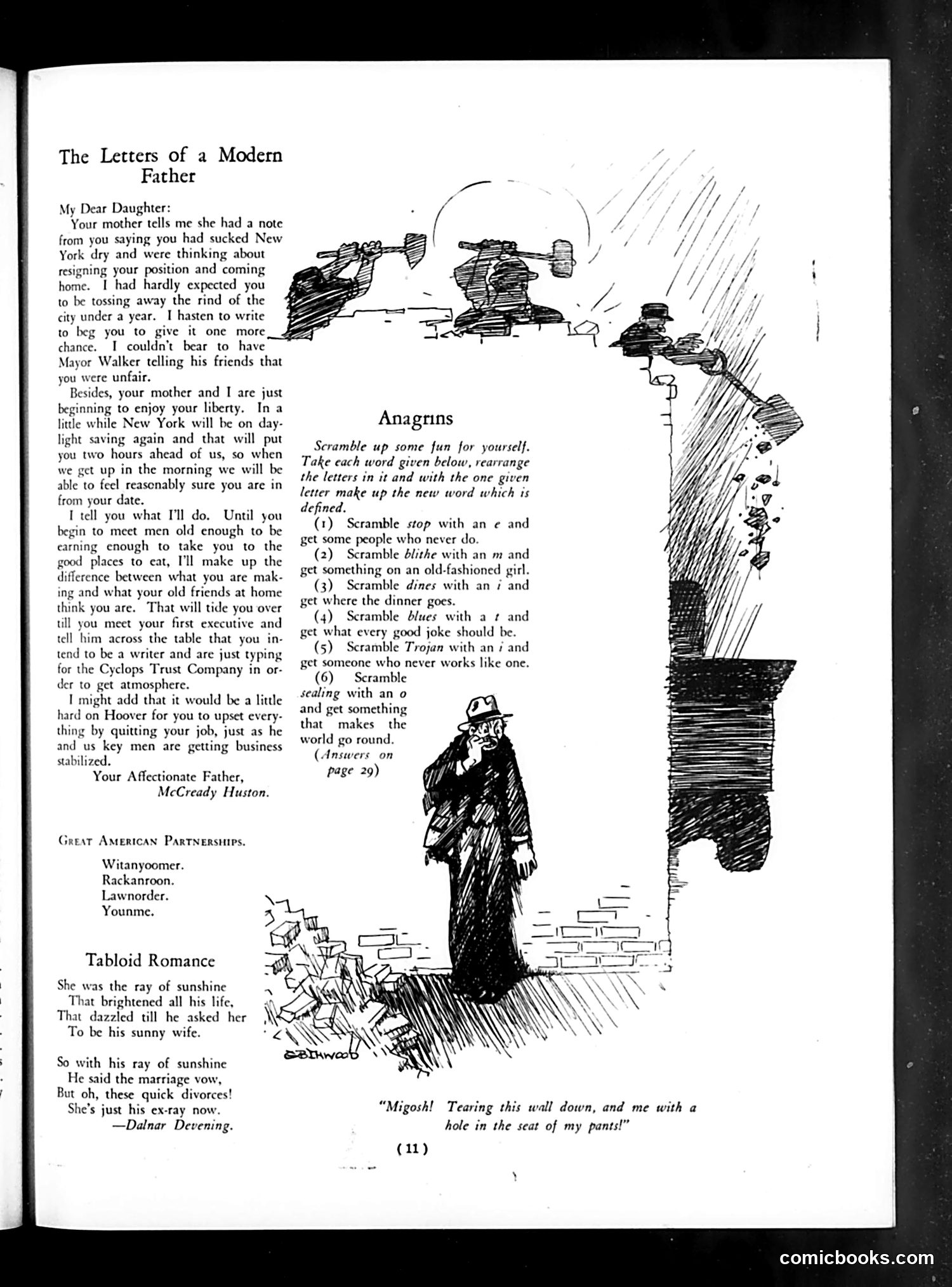
Analysis of Page 11 This page contains three distinct satirical pieces: "Letters of a Modern Father" presents a father's letter to his daughter about leaving New York City for work. The satire mocks upper-class paternal advice and the disconnect between generations—the father reassures her about her position while somewhat condescendingly offering guidance about meeting "men old enough to be earning" and "good places to eat." "Anagrums" is a word puzzle game where readers rearrange letters to form new words, offering humorous definitions (e.g., "scramble *stop* with an *e*" to get "people who never do"). "Tabloid Romance" (credited to Dalnar Deeming) satirizes sensationalized newspaper romance stories and quick divorces, mocking the era's tabloid culture with cynical commentary on marriage. The large illustration depicts a man in old-fashioned dress tearing through a wall, with text referencing damage to his pants—likely visual humor unrelated to the written content.
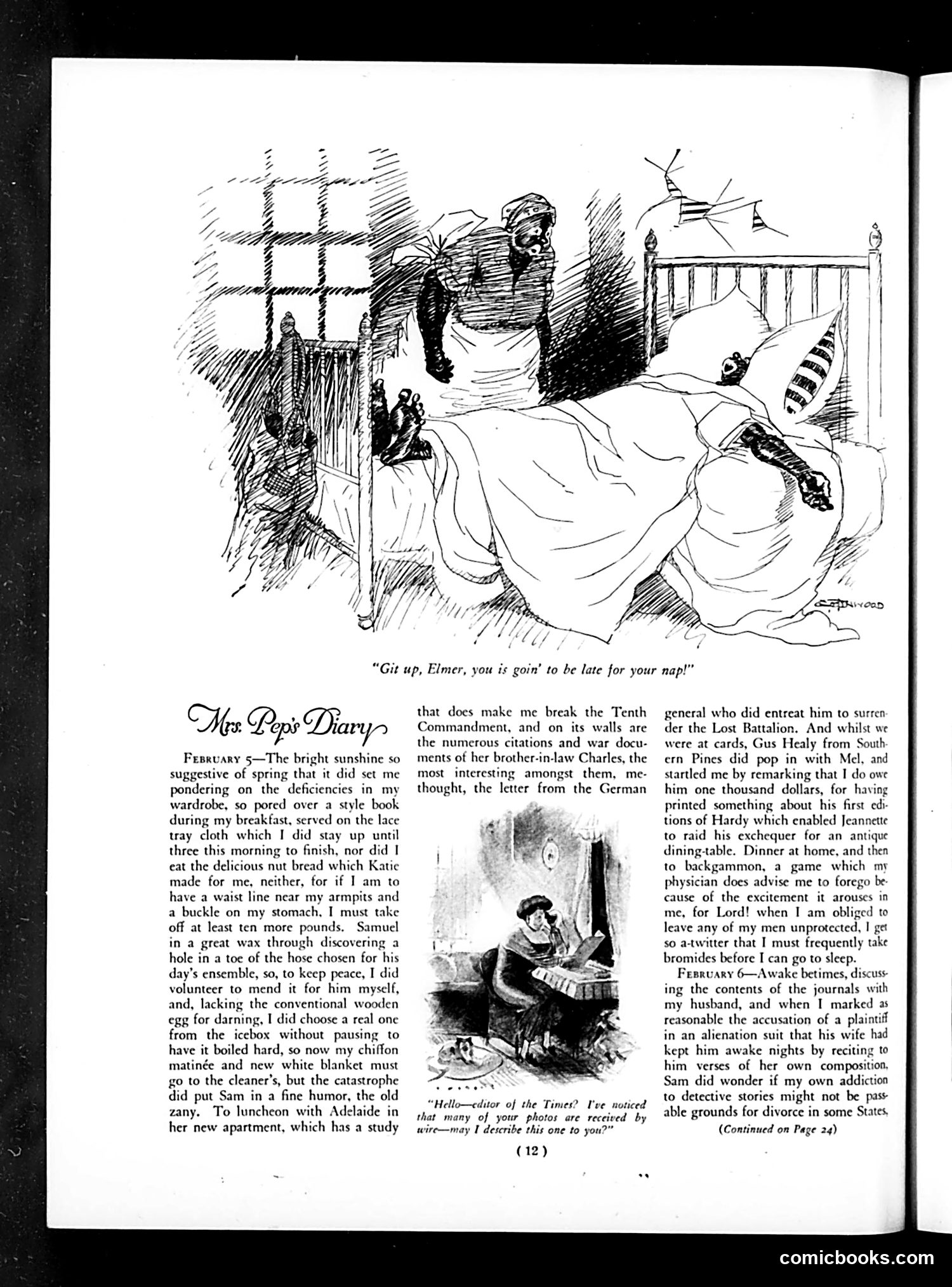
Content Analysis This page contains "Mrs. Peps's Diary," a serialized humor column presenting a woman's domestic observations during wartime (references to the "Tenth Commandment," German letters, and a "Lost Battalion" indicate WWI era). The top cartoon shows a woman in bed being awakened by a man, with the caption "Git up, Elmer, you is goin' to be late for your nap!" This is satirizing laziness or shirking—likely mocking either a soldier avoiding duties or a civilian escaping work responsibilities during wartime. The diary entries contain gossipy, domestic complaints: weight gain, servant issues, divorce rumors among acquaintances, and marital observations. The humor relies on depicting upper-class female preoccupations as trivial against the serious backdrop of war, a common satirical strategy of the period. The smaller illustration shows a figure reading, likely accompanying the diary text.
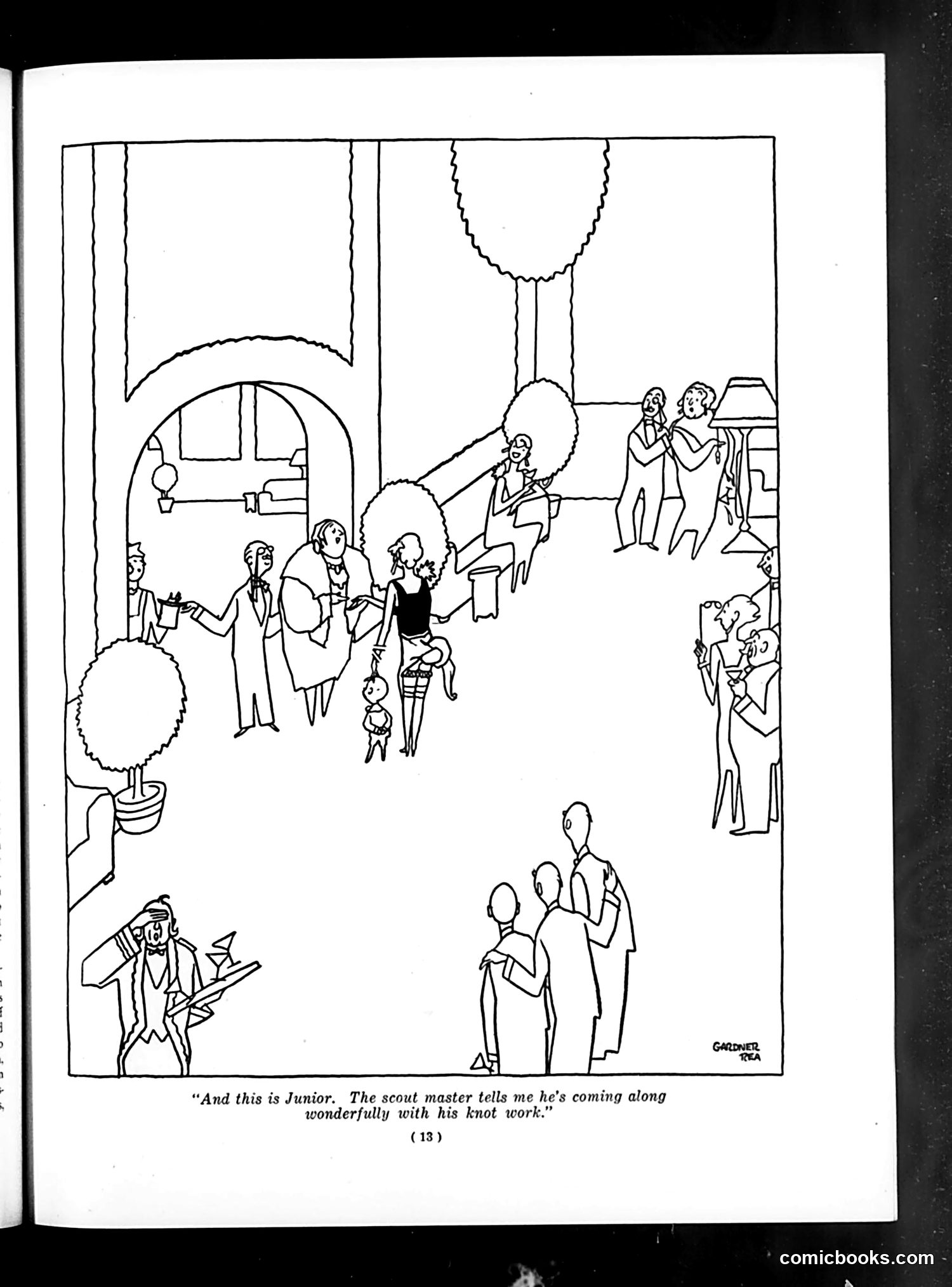
Cartoon Analysis This single-panel cartoon by Gardiner Rea depicts a formal indoor social gathering—likely a high-society event or party—with numerous well-dressed attendees. The caption reads: "And this is Junior. The scout master tells me he's coming along wonderfully with his knot work." The satire targets parental pride in trivial accomplishments. A parent is apparently introducing their son "Junior" to other guests, boasting that the scout master reports the boy is progressing "wonderfully" at knot-tying—a basic, elementary Boy Scout skill. The joke mocks how parents inflate minor achievements into significant accomplishments worthy of social announcement, treating mundane scout-craft competencies as noteworthy character development. The formal setting emphasizes the absurdity of discussing such a simple skill at a sophisticated gathering.
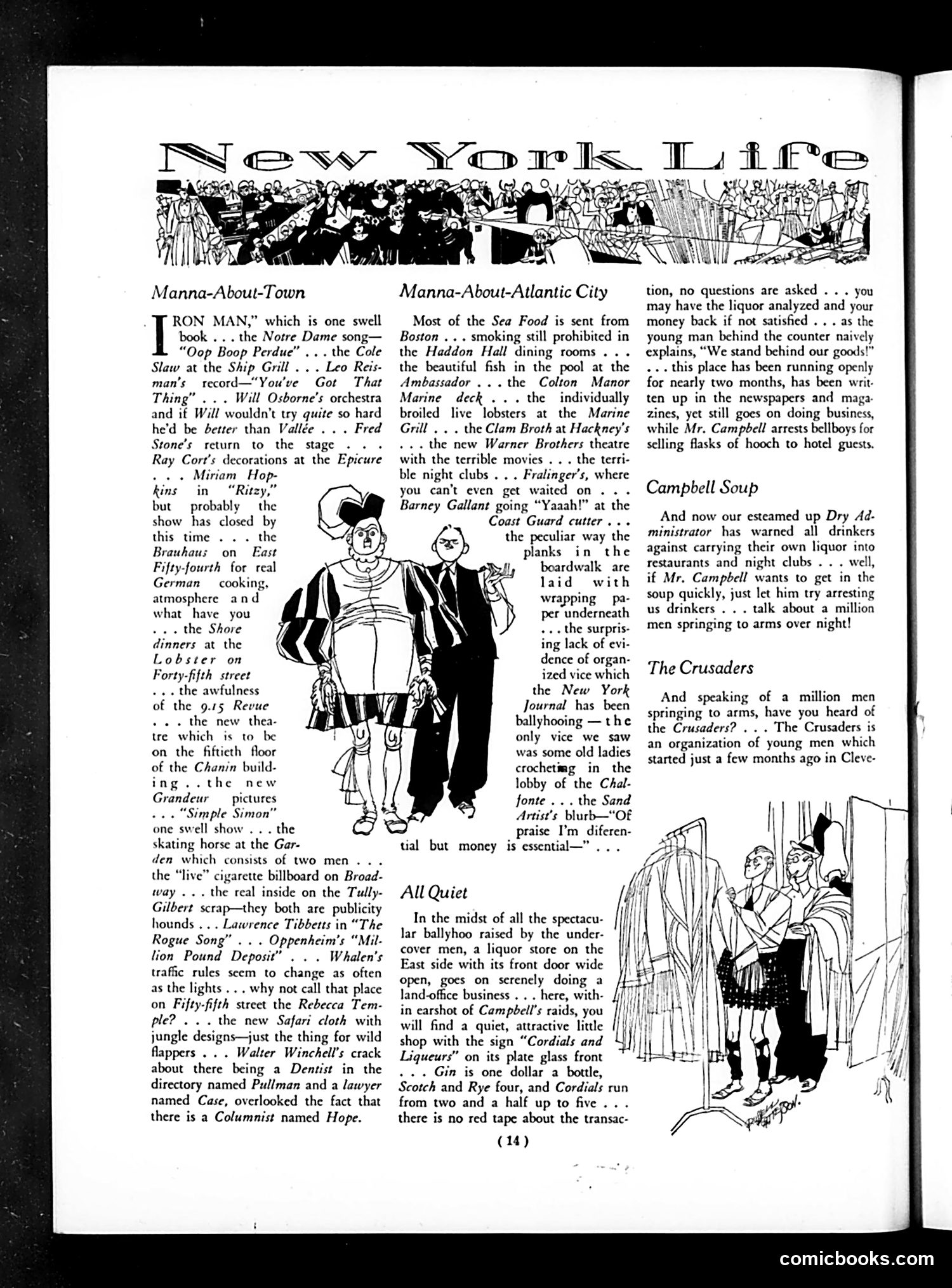
"New York Life" Page Analysis This page from *Life* magazine contains three satirical sections about New York City nightlife and social establishments during Prohibition era (indicated by references to "liquor" being smuggled and sold illicitly). Main cartoon (center): Shows a rotund man and woman in formal attire, likely satirizing wealthy New Yorkers patronizing illegal speakeasies and restaurants serving contraband alcohol. Text sections discuss: - Popular restaurants and entertainment venues operating despite Prohibition - The absurdity of illegal liquor sales ("no red tape about the transaction") - A youth organization called "The Crusaders" (likely a real temperance/moral reform group) - Humorous references to specific establishments and their prices The satire mocks both the hypocrisy of "respectable" society frequenting illegal establishments and the futility of Prohibition enforcement. The illustration of people entering what appears to be a speakeasy (right side) reinforces this theme.
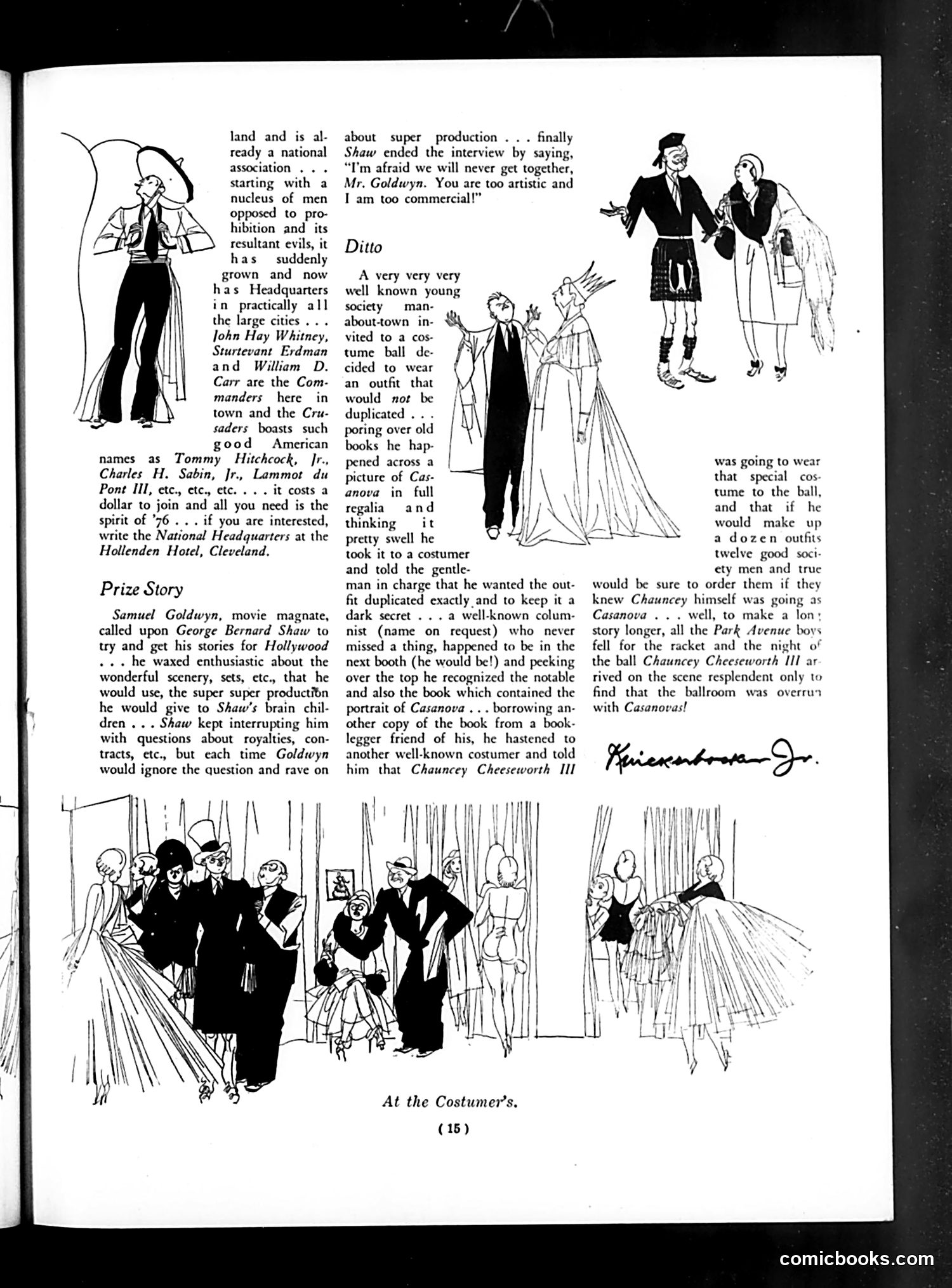
"Prize Story" - Life Magazine Page Analysis This page satirizes Hollywood's commercialism and artistic pretension through a fictional account of filmmaker Samuel Goldwyn. The narrative mocks Goldwyn's approach to adapting literature for film: he interviews playwright George Bernard Shaw about adapting his work, but Goldwyn dismisses Shaw's artistic concerns, saying "You are too artistic and I am too commercial." The accompanying illustrations show wealthy society figures attending a costume ball, apparently inspired by the adapted work. The satire targets the gap between highbrow literary adaptation and lowbrow commercial entertainment—Goldwyn wants to profit from prestigious material while ignoring the original author's vision. It's a critique of how Hollywood diluted artistic works for mass-market appeal and profit.
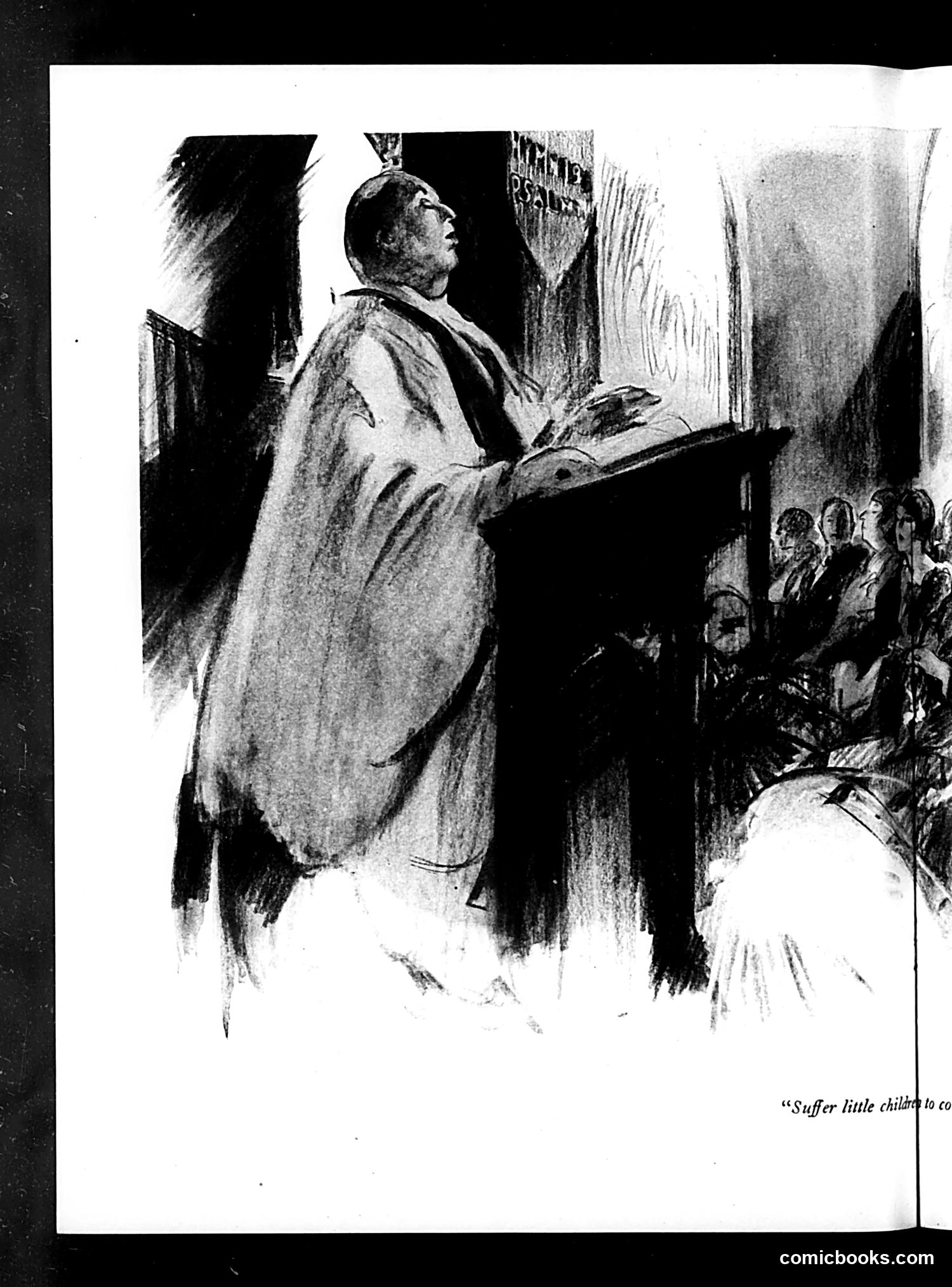
Analysis This appears to be a religious or moral satire from Life magazine. The image shows a figure in robes (likely a clergyman or religious authority) standing at a pulpit, addressing an audience. The visible caption fragment reads "Suffer little children to co[me]..." — a biblical reference to Jesus's instruction to allow children to approach him. The satire likely critiques hypocrisy in religious institutions or sermons. The contrast between the dignified speaker and the actual audience (shown in shadows on the right) suggests commentary on the gap between religious rhetoric and practice, or perhaps on how religious figures preach moral virtue while their actual conduct differs. Without seeing the full caption or surrounding context, the specific target remains unclear, though the tone suggests mockery of institutional religion or a particular clergyman's preaching.
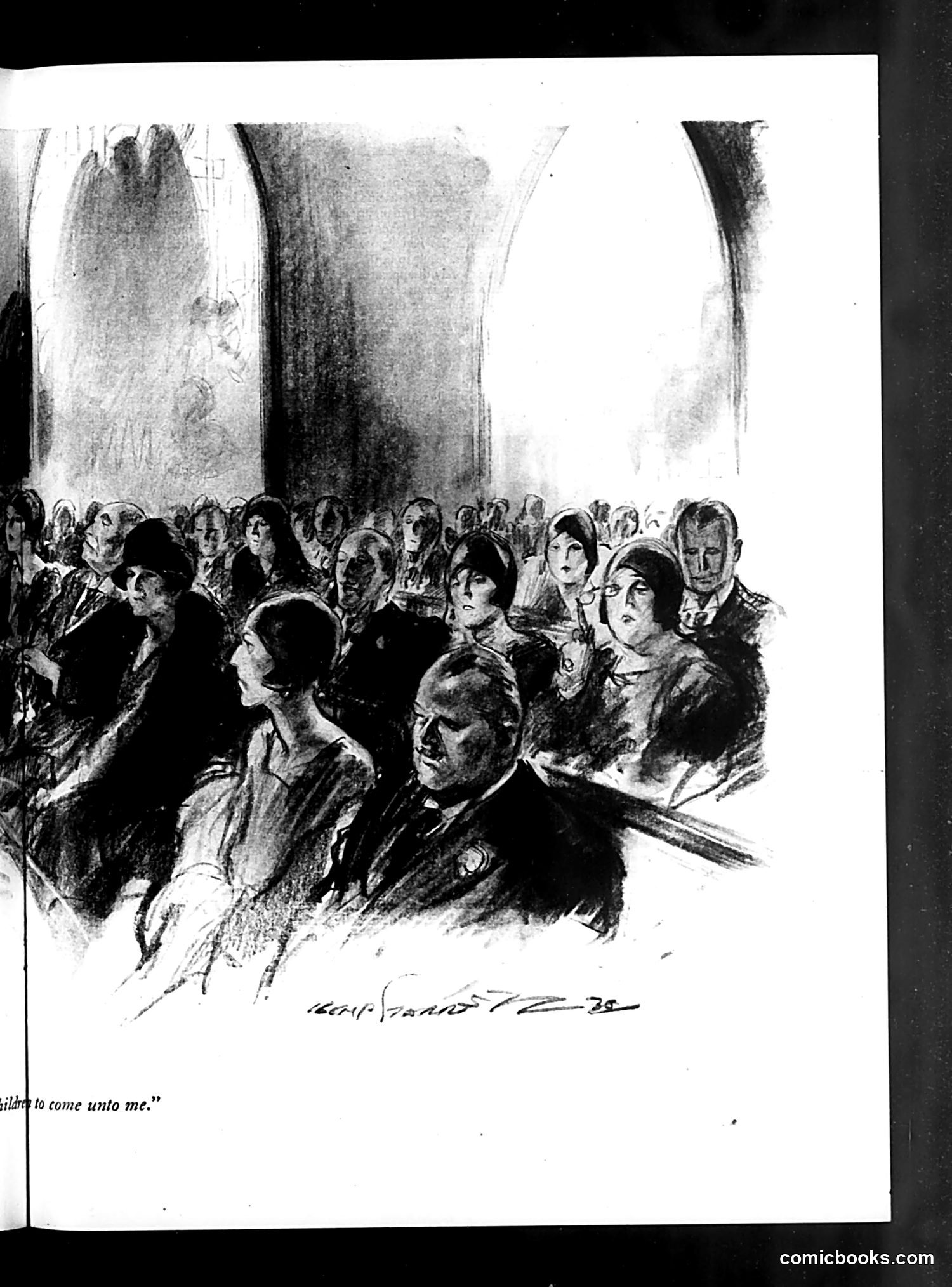
Analysis This sketch depicts a courtroom or legal proceeding scene. A large crowd of figures—many wearing head coverings suggesting women—fills the background, while in the foreground a stern-faced man in formal dress (possibly a judge or official) presides. The visible text fragment reads "...ildren lo come unto me," likely referencing the Biblical passage "suffer the little children to come unto me," suggesting this cartoon comments on child welfare or custody matters. The artist's signature appears dated (possibly 1920s based on style). Without additional context from the page's title or surrounding articles, the specific case or political issue cannot be definitively identified, though the composition emphasizes authority versus a vulnerable, waiting crowd—typical of Life magazine's social commentary approach.
Analysis of Life Magazine Theatre Review Page This page contains a theatre review by Ralph Barton critiquing several Broadway plays from what appears to be the 1920s era. The review discusses productions including "Out of a Blue Sky," "Dishonored Lady," "The Boundary Line," and others. The illustration shows a stylized nighttime urban scene with a tall building and what appears to be a truck or vehicle, rendered in a stark, modernist style typical of 1920s graphic design. The reviews are largely negative, with Barton sarcastically praising minor performances while criticizing weak plots, poor direction, and dull writing. He particularly criticizes how playwrights construct artificial dramatic situations and rely on star performances to carry otherwise mediocre material—a common complaint about commercial theatre of that period. The satire targets theatrical mediocrity and audience gullibility rather than specific political figures.
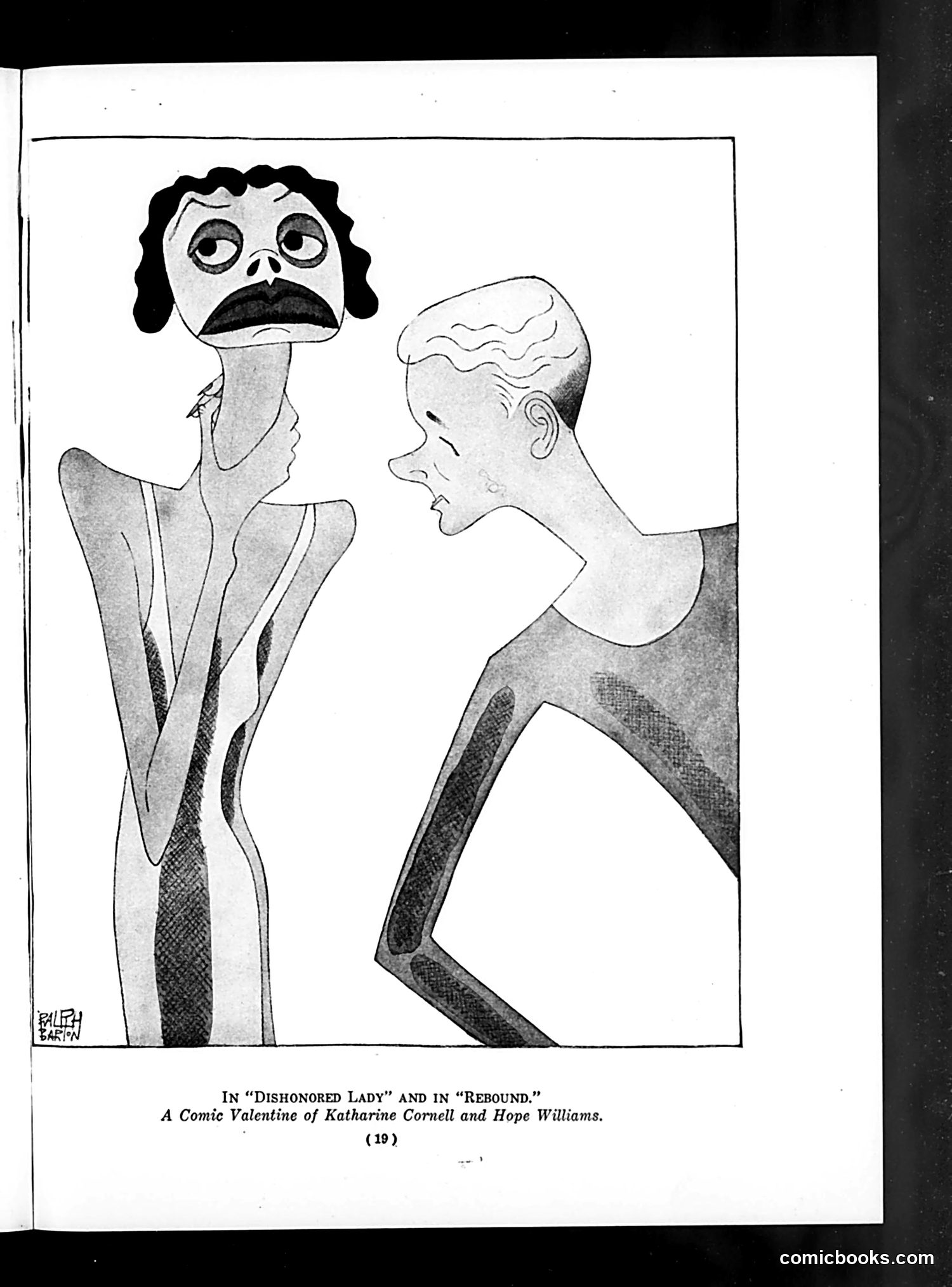
Page Analysis This page features a satirical illustration mocking two actresses: Katharine Cornell and Hope Williams. The cartoon depicts exaggerated, unflattering caricatures presented as "a comic valentine"—a playful insult disguised as affection, common in Life magazine's humor. The left figure shows a woman with an extremely elongated neck, prominent mustache, and theatrical expression, while the right shows a bald man in profile. The caption references two films: "Dishonored Lady" and "Rebound," suggesting both actresses appeared in these productions. The satire likely critiques their performances or public personas, using grotesque physical exaggeration typical of early 20th-century theatrical caricature. The "valentine" framing makes the mockery seem playful rather than malicious, though modern viewers would find the caricature style offensive.
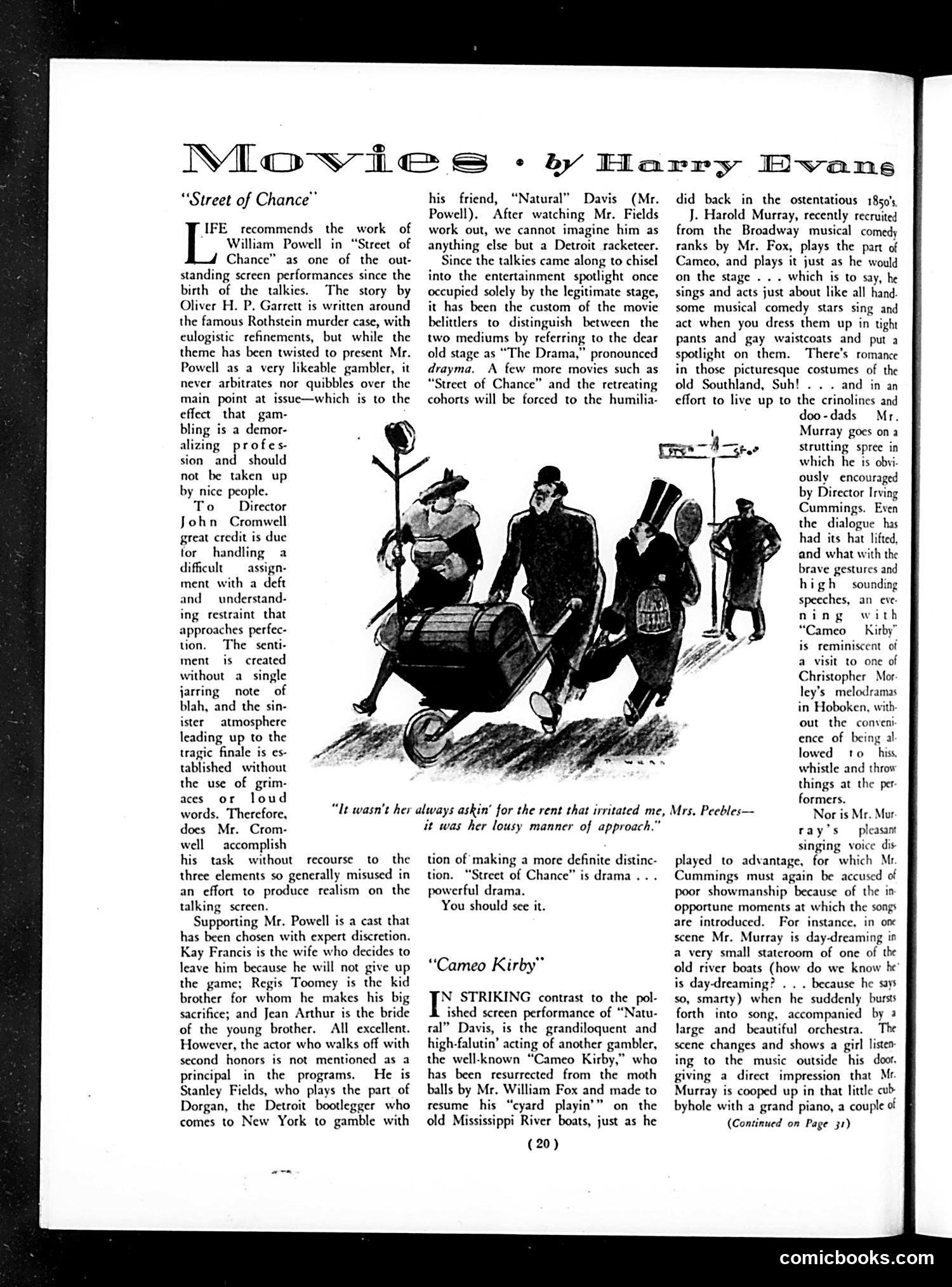
Movie Reviews from Life Magazine This page contains two film reviews by Harry Evans critiquing early "talking" movies (talkies). "Street of Chance" receives praise for William Powell's performance as a gambler. Evans commends director John Cromwell for handling the morality-tale plot—about gambling's corrupting influence—with restraint and atmosphere rather than melodramatic excess. He argues the film demonstrates that movies can achieve the dramatic power of legitimate theater, challenging stage-theater critics who dismiss cinema. "Cameo Kirby" is panned as overwrought. The review criticizes actor J. Harold Murray for performing like a Broadway musical-comedy star rather than a film actor—overacting with exaggerated gestures and theatrical delivery in his 1850s riverboat gambler role. Evans suggests director Irving Cummings encouraged this excessive, stagy performance. The cartoon illustrates a landlord-tenant dispute, unrelated to the reviews.
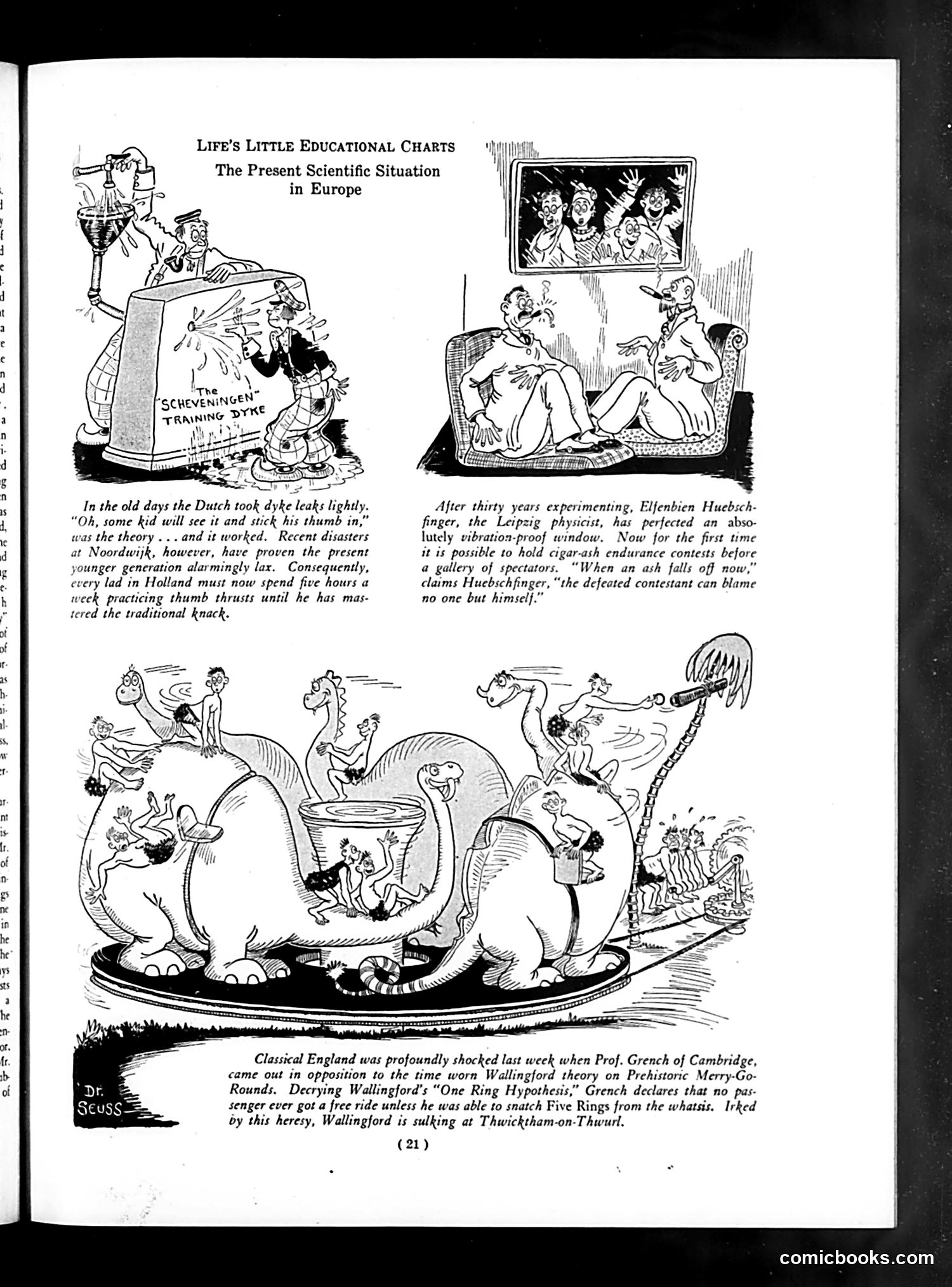
Analysis for Modern Readers This is a satirical "educational chart" mocking European scientific pretensions. The page contains three absurdist jokes: Dutch Dyke Training: Ridicules Holland's response to recent flooding disasters (Noordwijk) by claiming boys now practice thumb-thrusts—mocking the famous folk tale of the boy who plugged a dyke with his thumb. The Vibration-Proof Window: Satirizes pedantic German physics by inventing "Elfenbien Huebsch-finger," a Leipzig physicist who created a window so stable it enables cigar-ash endurance contests. This mocks over-specialized, trivial scientific achievement. The Merry-Go-Round Theory: Parodies academic feuds between English professors "Grench" and "Wallingford" who debate prehistoric carousel mechanics with completely fabricated theoretical positions—lampooning scholarly disputes over trivial or nonsensical topics. The cartoon style and absurdist humor target European scientific arrogance and academic pomposity in the early 20th century. All names appear invented; no real scientists are identified.
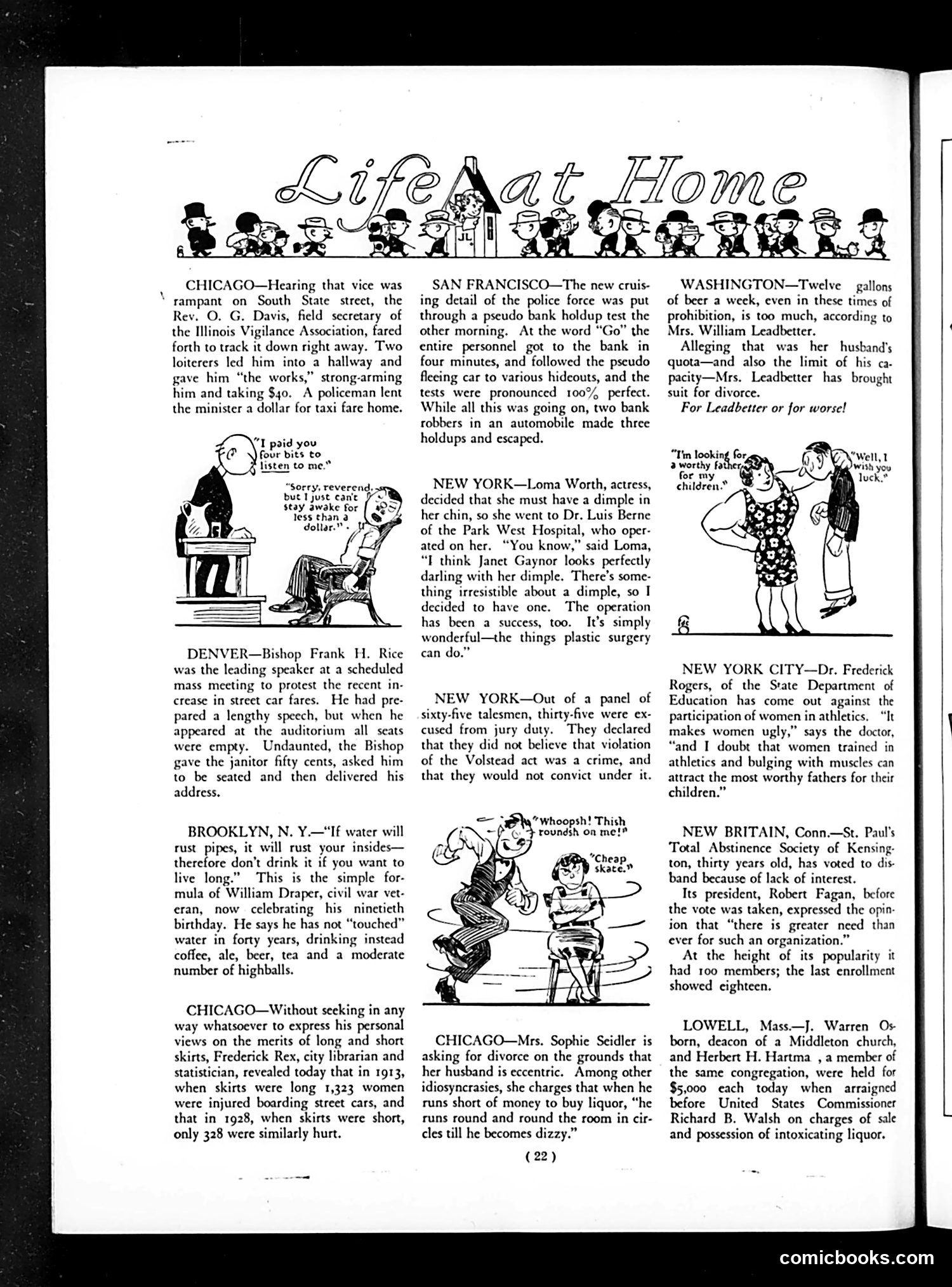
"Life at Home" — Brief Analysis This 1928 *Life* magazine page uses humorous anecdotes to satirize contemporary American absurdities and contradictions. Key satirical points: Prohibition-era hypocrisy: Multiple items expose the failure of Prohibition (1920-1933). A jury panel refuses to convict Volstead Act violations; a man spends 12 gallons weekly on alcohol; divorce cases cite alcohol-related marital discord. Institutional incompetence: Police successfully perform a drill while actual bank robberies occur simultaneously; a bishop preaches to an empty hall. Misplaced values: An actress undergoes cosmetic surgery purely to imitate a celebrity; a doctor opposes women's athletics as "making them ugly" (absurd reasoning that women's appearance matters more than health). Absurd logic: A Civil War veteran claims drinking anything but alcohol for 40+ years extends his life. The cartoons use small illustrations and snappy captions to mock social pretension, gender attitudes, and the era's widespread disregard for Prohibition law. The humor assumes readers recognized these trends as ridiculous.
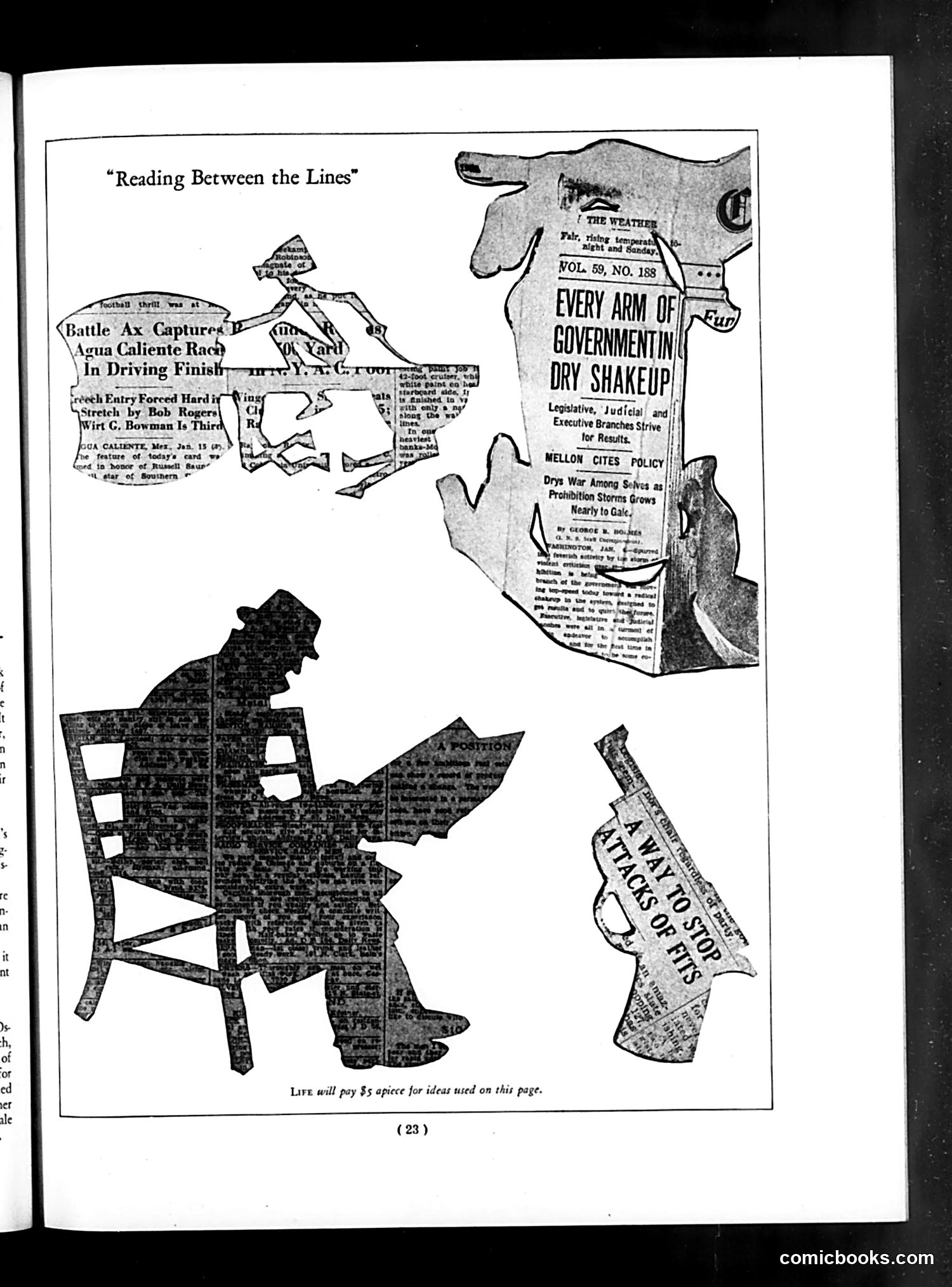
"Reading Between the Lines" Analysis This Life magazine page uses silhouette cartoons to satirize political conflicts of the Prohibition era. The images depict: Top right: A newspaper masthead labeled "The Weather" alongside text about government branches fighting for results—satirizing institutional gridlock. Center left: A figure in a chair, likely representing a political leader amid bureaucratic struggle. Right side: References to "Mellon cites policy" and "Drys war among selves as prohibition storms grow"—Andrew Mellon (Secretary of Treasury) appears mentioned regarding Prohibition enforcement divisions. The overall theme mocks how different government branches and Prohibition advocates quarrel internally while the policy itself creates chaos. The silhouettes' abstract, contorted forms visually reinforce the confusion and conflict. The caption "Lire will pay $5 apiece for ideas used on this page" indicates this was reader-submission content, making it crowdsourced political commentary.
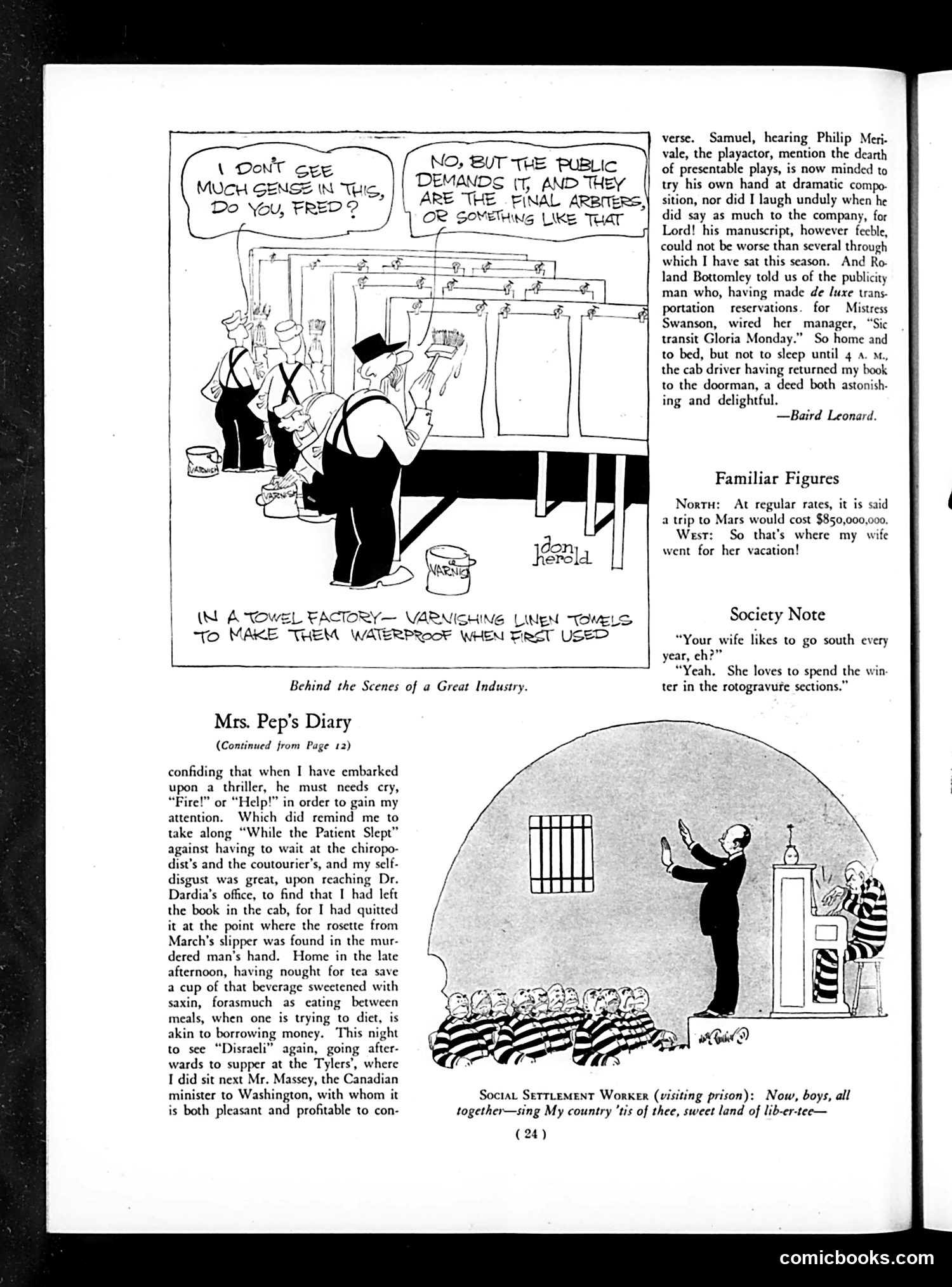
Explanation of Page Content This page contains three separate satirical pieces from Life magazine: Top cartoon ("Behind the Scenes of a Great Industry"): Two men discuss theatrical censorship. One complains about lacking "much genius," while the other notes the public and censors are "final arbiters"—satirizing how commercial and censorial pressures constrain artistic quality in theater. "Familiar Figures" jokes: Brief one-liners mocking modern life—a husband's joke that his wife went to Mars (implying she spent exorbitantly), and another about a wife who only goes south to read rotogravure sections in newspapers. Bottom cartoon: A social settlement worker (charity organization staff member) leads prisoners in singing patriotic songs, ironically captioned as visiting "sweet land of lib-er-tee." This mocks the naive optimism of Progressive-era charitable programs attempting to reform criminals through patriotic sentiment. "Mrs. Pep's Diary": Continues a serialized humorous column about an upper-class woman's trivial social activities and reading habits.
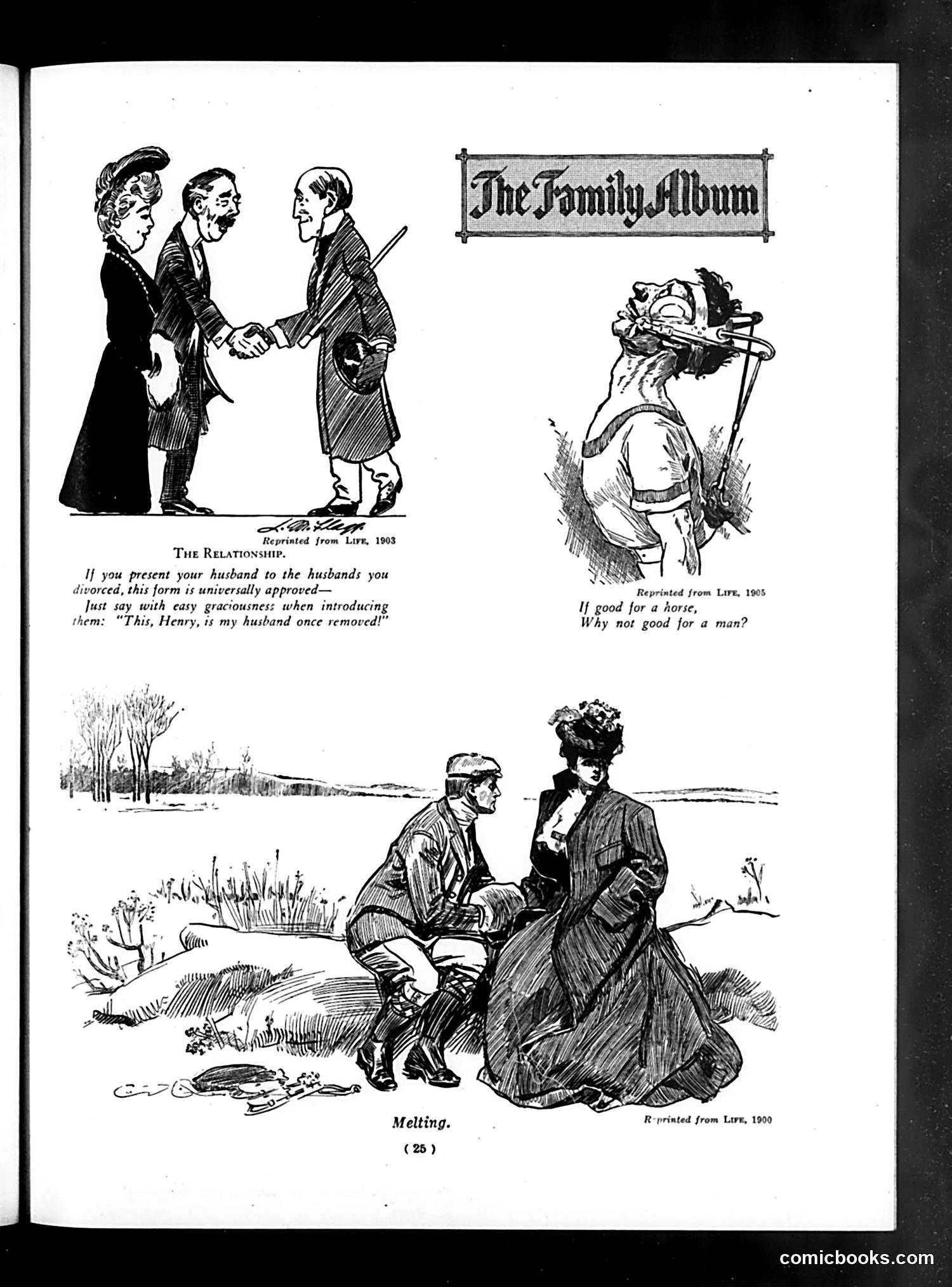
"The Family Album" Page Analysis This page collects three satirical cartoons from *Life* magazine (1900-1905) mocking social conventions and relationships: 1. "The Relationship" (1903): Jokes about divorced women introducing current husbands to ex-husbands using the euphemism "husband once removed"—a play on the genealogical term. The satire targets the awkwardness of divorce in an era when it was scandalous. 2. Top right (1905): A woman shoeing a horse with the caption "Why not good for a man?" This appears to mock women taking on traditionally male roles or suggests ironic commentary on marital "discipline." 3. "Melting" (1900): Shows a couple outdoors, with the title suggesting romantic reconciliation or emotional softening between estranged partners. Overall, these cartoons satirize early-20th-century marriage customs, divorce stigma, and changing gender dynamics—topics considered risqué enough for satirical treatment in a humor magazine of that era.
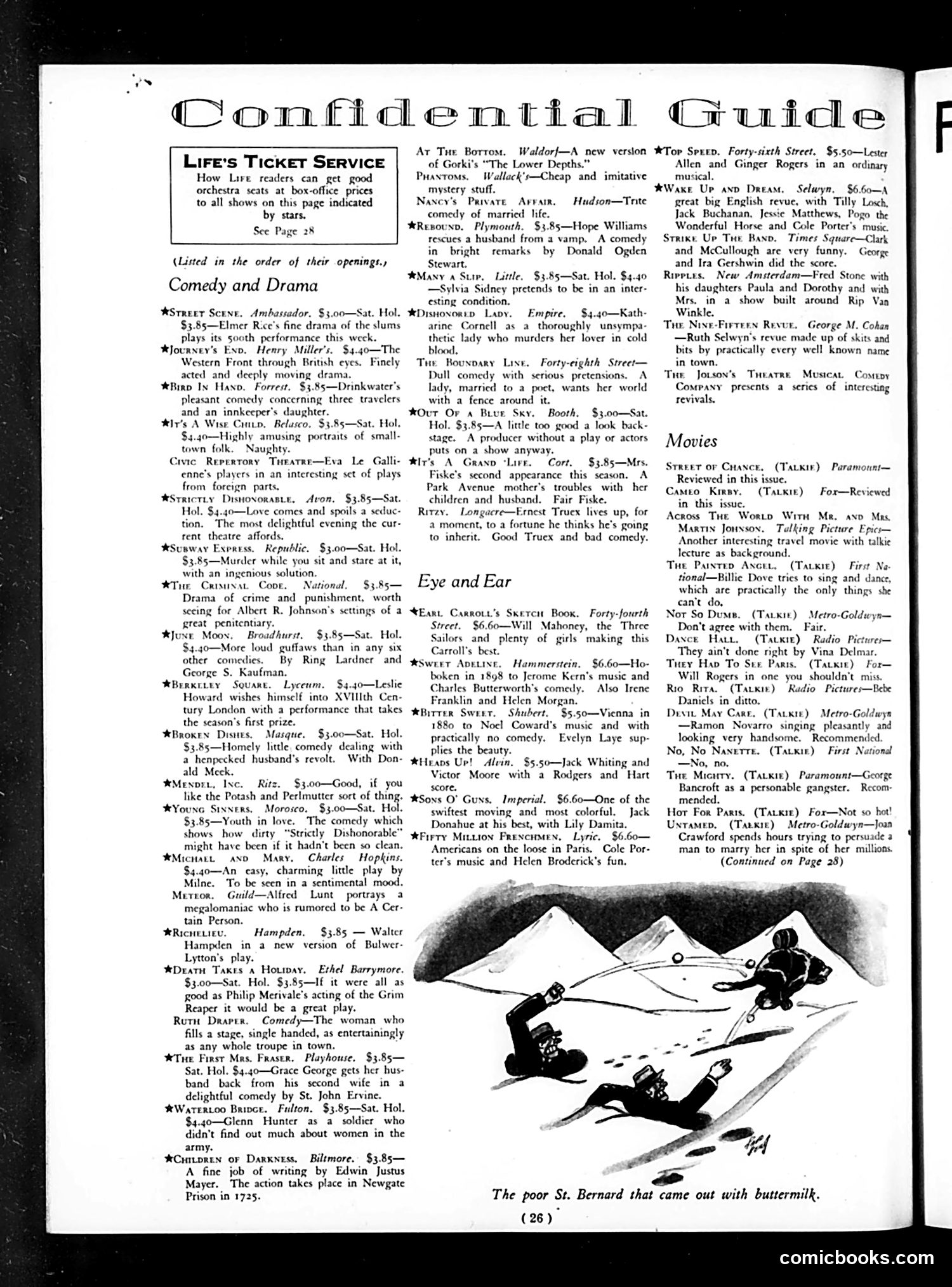
Confidential Guide Page Analysis This page is primarily a theater listing and review guide for Life magazine readers, not a political cartoon. It contains: 1. Life's Ticket Service: Information about obtaining discounted orchestra seats to Broadway shows 2. Theater Reviews: Organized by genre (Comedy/Drama, Eye and Ear, Movies), listing approximately 30+ productions with brief critical descriptions, venues, and prices. Shows marked with asterisks (*) qualify for Life's ticket discount. 3. A Single Cartoon: At bottom right, captioned "The poor St. Bernard that came out with buttermilk"—an illustration showing a dog in snow with skiers, apparently making a visual pun about St. Bernard rescue dogs and dairy products. The page reflects 1920s Broadway culture and serves as practical entertainment journalism rather than political satire. The cartoon is a light gag unrelated to the theater listings.
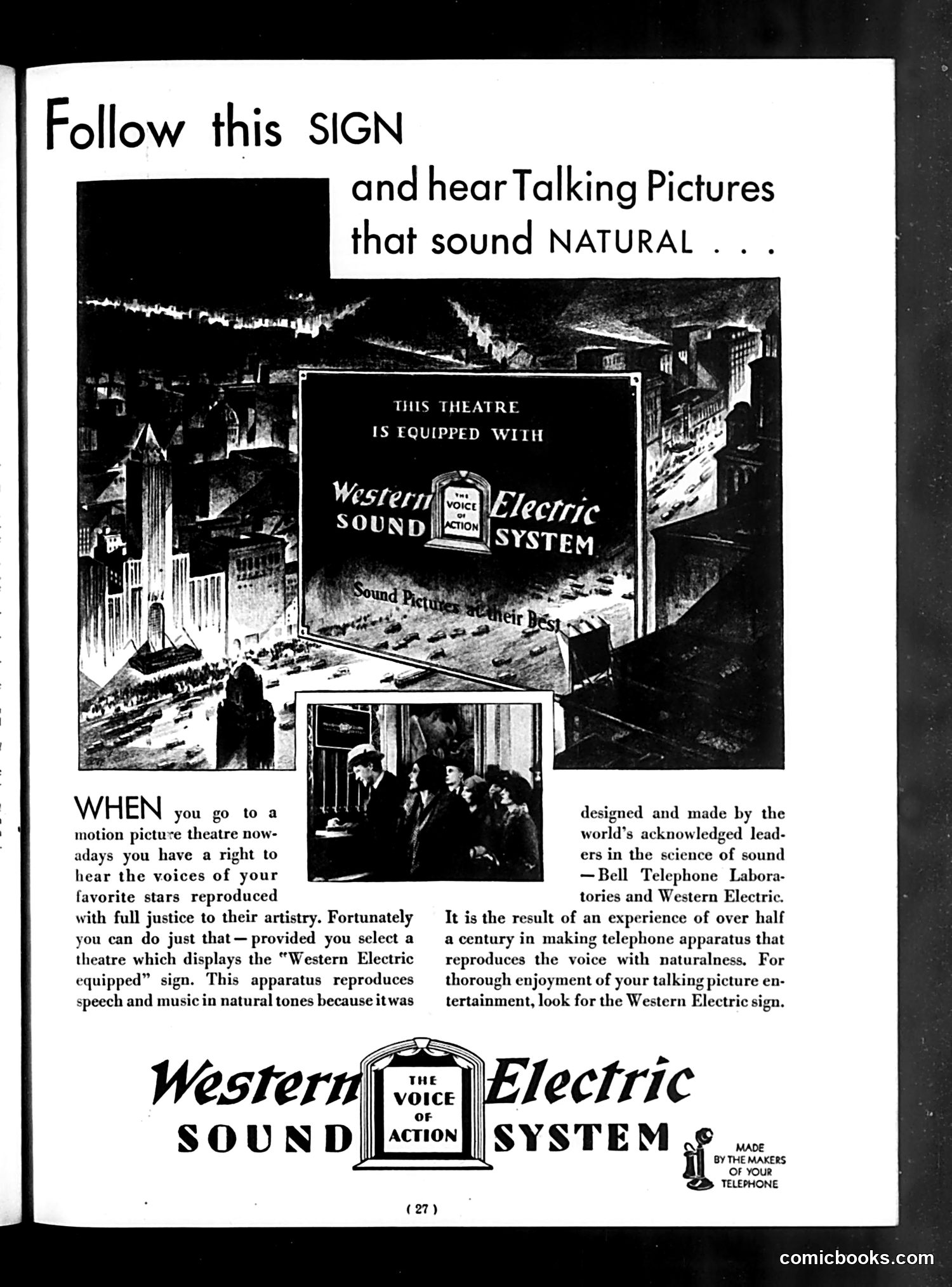
Western Electric Sound System Advertisement This is a full-page advertisement, not satire or political commentary. It promotes the Western Electric Sound System for movie theaters during the early "talking pictures" era (when synchronized sound was newly introduced to cinema). The ad emphasizes that moviegoers deserve to hear actors' voices with "naturalness"—a key concern when sound technology was still experimental and often produced poor audio quality. The page directs audiences to look for the "Western Electric equipped" sign before selecting a theater. The advertisement leverages the credibility of Bell Telephone Laboratories and Western Electric, established telephone companies, to assure audiences that their sound reproduction technology is scientifically reliable. The lower image shows what appears to be a theater lobby or interior with patrons. The satirical angle, if any, is subtle: it's essentially arguing that without proper equipment, your movie experience is diminished—a consumer advisory disguised as public service information. For modern readers, it documents how sound quality in cinema was once a *selling point* requiring explicit branding.
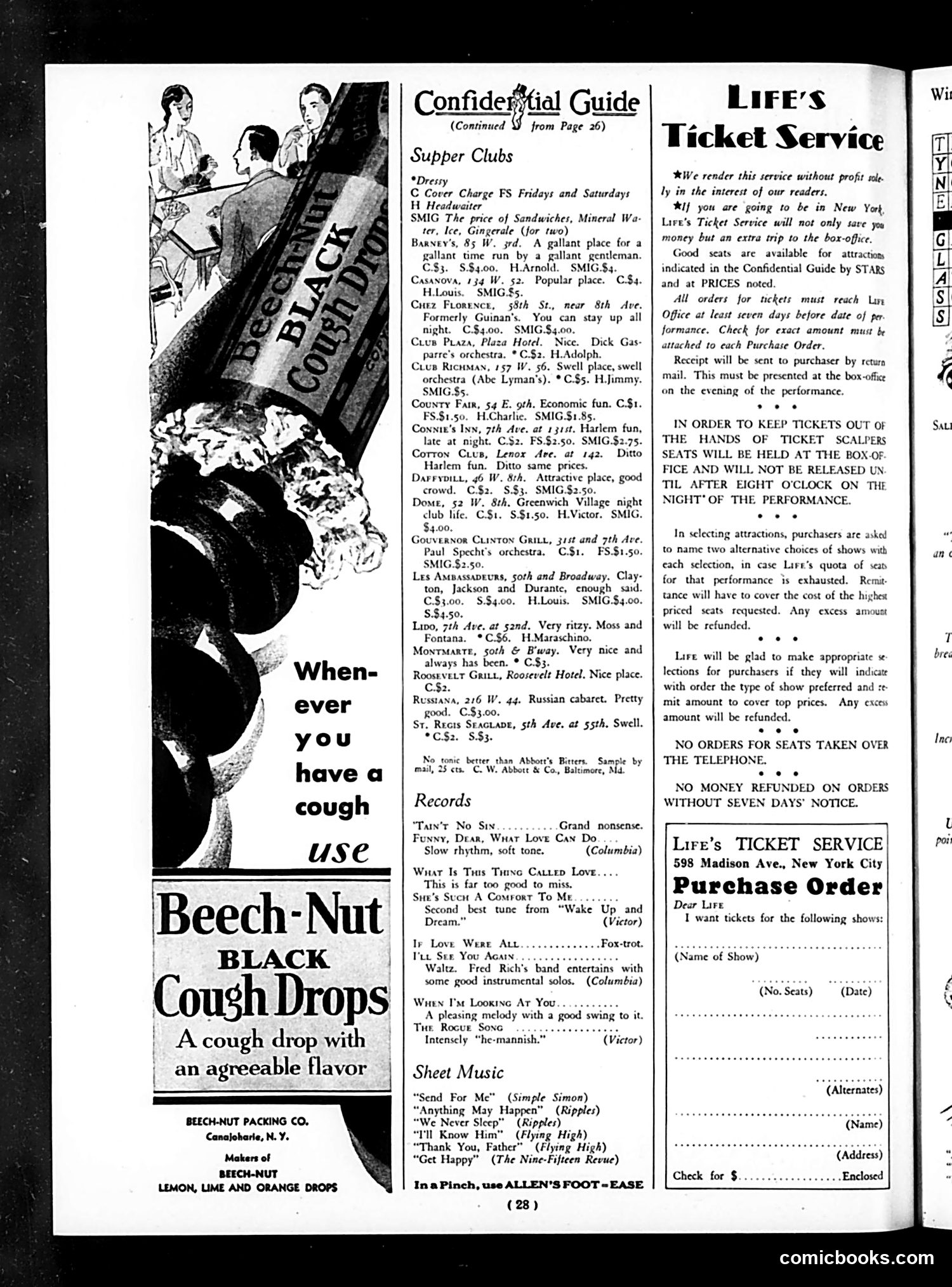
Life Magazine Page Analysis This page is primarily advertising and service content, not political satire. The main elements are: Left side: A Beech-Nut cough drops advertisement featuring an illustration of well-dressed people in what appears to be a social setting, with the tagline "Whenever you have a cough use Beech-Nut BLACK Cough Drops." Center: A "Confidential Guide" listing New York supper clubs (nightspots) with details about cover charges, headwaiters, and prices—reflecting 1920s-30s Prohibition-era entertainment venues. Notable venues include Harlem clubs (Connie's Inn, Cotton Club), Greenwich Village spots, and upscale establishments. Also listed: phonograph records and sheet music recommendations. Right side: Life magazine's ticket service order form for Broadway and theatrical attractions. This page captures the entertainment culture of the Jazz Age, showing where affluent readers could spend evenings during Prohibition, though there's no satirical commentary evident.
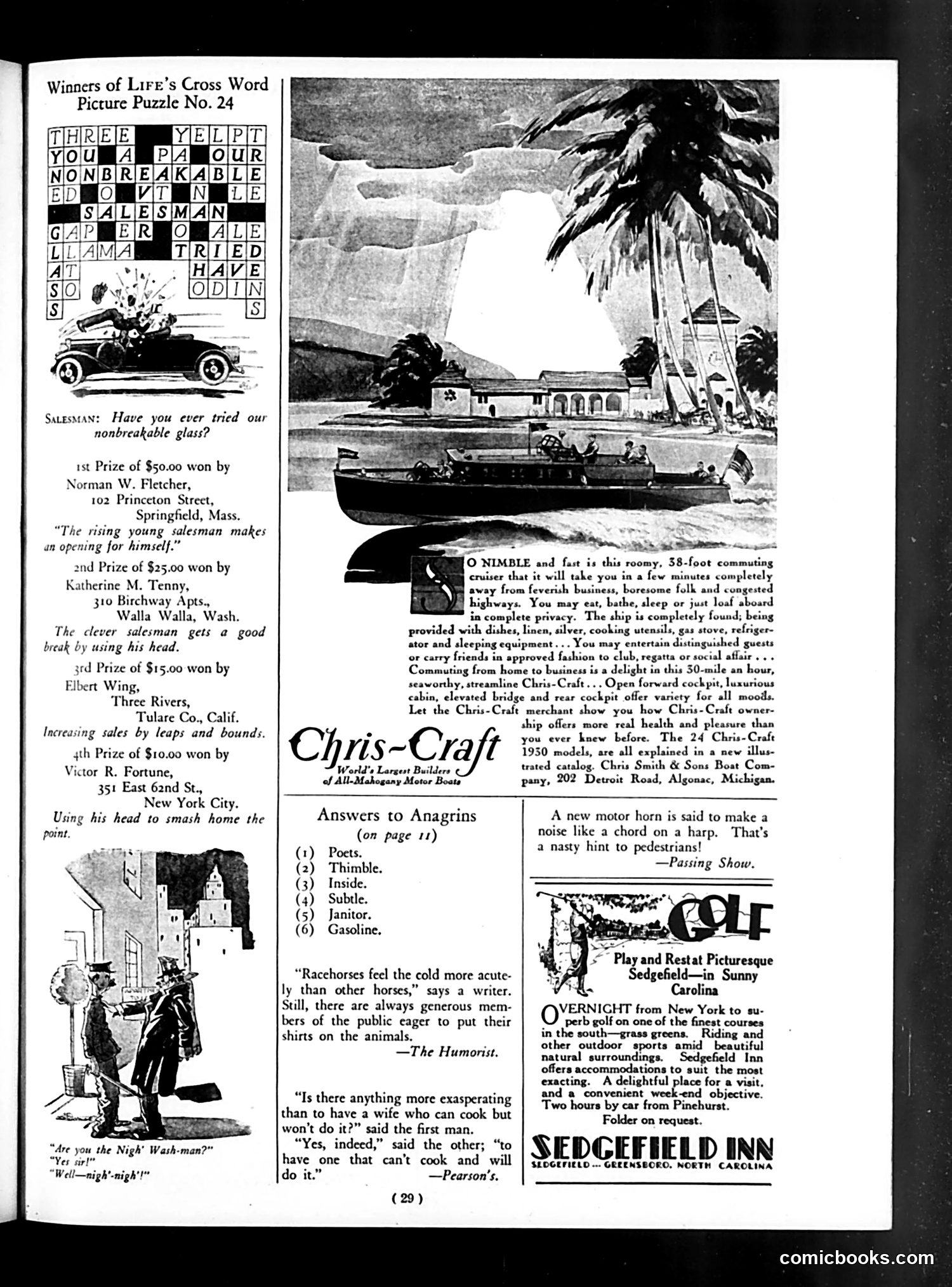
Life Magazine Page Analysis This page showcases Life's crossword puzzle contest winners (top left), featuring a sales-themed visual puzzle. The humor centers on salesmanship clichés: "The rising young salesman makes an opening for himself" (accompanied by a car crashing through), "The clever salesman gets a good break by using his head," and "Using his head to smash home the point"—all playing on the double meaning of "head" and physical/commercial success. Below are period humor snippets about racehorses, wives' cooking abilities, and a car horn joke—typical light satirical commentary for the era. The bulk of the page is advertising: a Chris-Craft motorboat promotion emphasizing leisure and escape from "feverish business," and a Sedgefield Inn golf resort ad. These ads reflect 1920s-30s aspirational marketing targeting affluent readers seeking luxury recreation and status symbols. The page is primarily commercial rather than satirical.
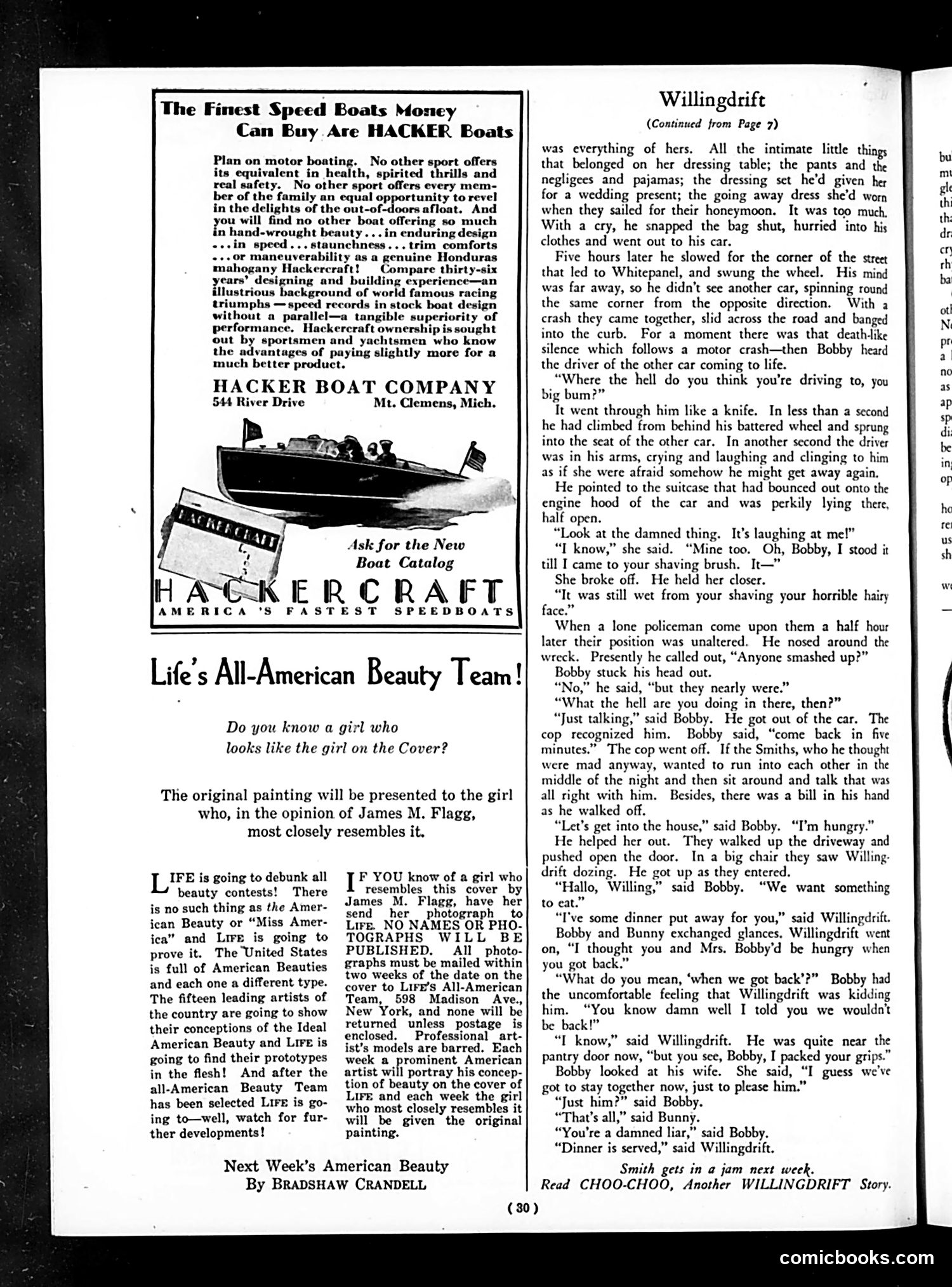
Page Analysis: Life Magazine This page contains primarily advertising and a beauty contest announcement, with a fictional story continuation. The Hacker Boat Company ad (top left) promotes luxury speedboats, emphasizing their superior craftsmanship and performance for affluent sportsmen. The "Life's All-American Beauty Team" section (center-right) announces a contest where readers submit photographs of women resembling the cover girl painted by James M. Flagg. Life claims to "debunk all beauty contests" by proving America has many types of beauties, not one ideal. The magazine promises to feature fifteen artists' interpretations of ideal American beauty weekly, with winners receiving the original paintings. This reflects 1920s-era magazine culture celebrating feminine beauty as entertainment and commercial content. The "Willingdrift" story (right column) continues a serialized narrative about a character named Bobby involved in a car accident and apparent romantic reconciliation—typical of period magazine fiction.
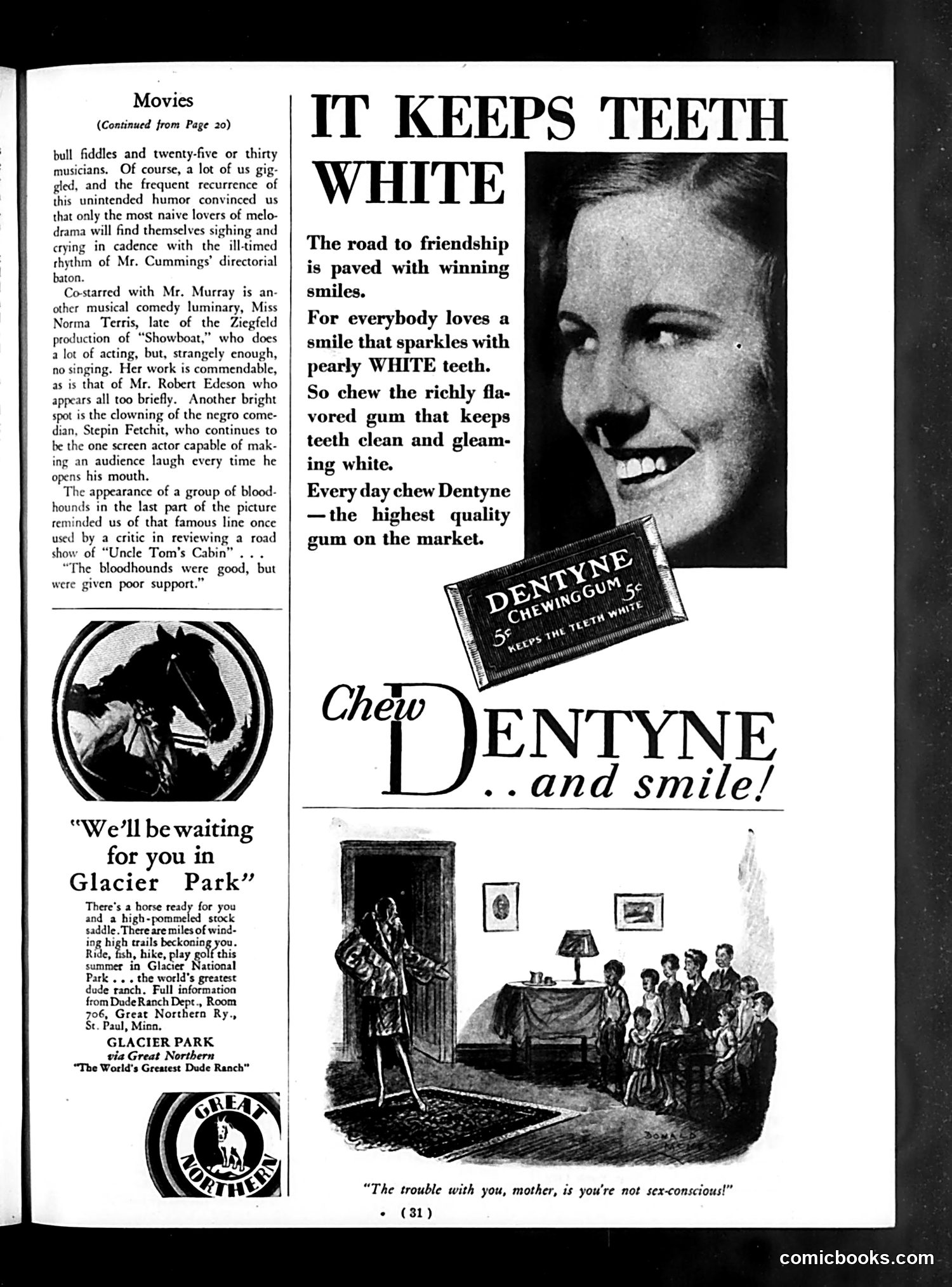
Analysis of Page 31 This page is primarily advertising, not satire or political commentary. The top section continues a movie review from the previous page, critiquing a musical film with actors Norma Terris and Robert Edeson. The review uses period-appropriate (though offensive) language mentioning "the negro comedian, Stepin Fetchit," a real performer known for comedic roles in early cinema. The bulk of the page features two advertisements: 1. Glacier Park dude ranch ad promoting vacation activities in Montana 2. Dentyne chewing gum ad (the main focus), using the tagline "Chew Dentyne...and smile!" The ad emphasizes white teeth as essential to winning smiles and friendship The small cartoon at bottom appears unrelated—a domestic scene with the caption "The trouble with you, mother, is you're not sex-conscious!"—likely a separate cartoon feature. There is no significant political satire present; this is a standard magazine page mixing movie criticism with commercial advertising typical of the era.
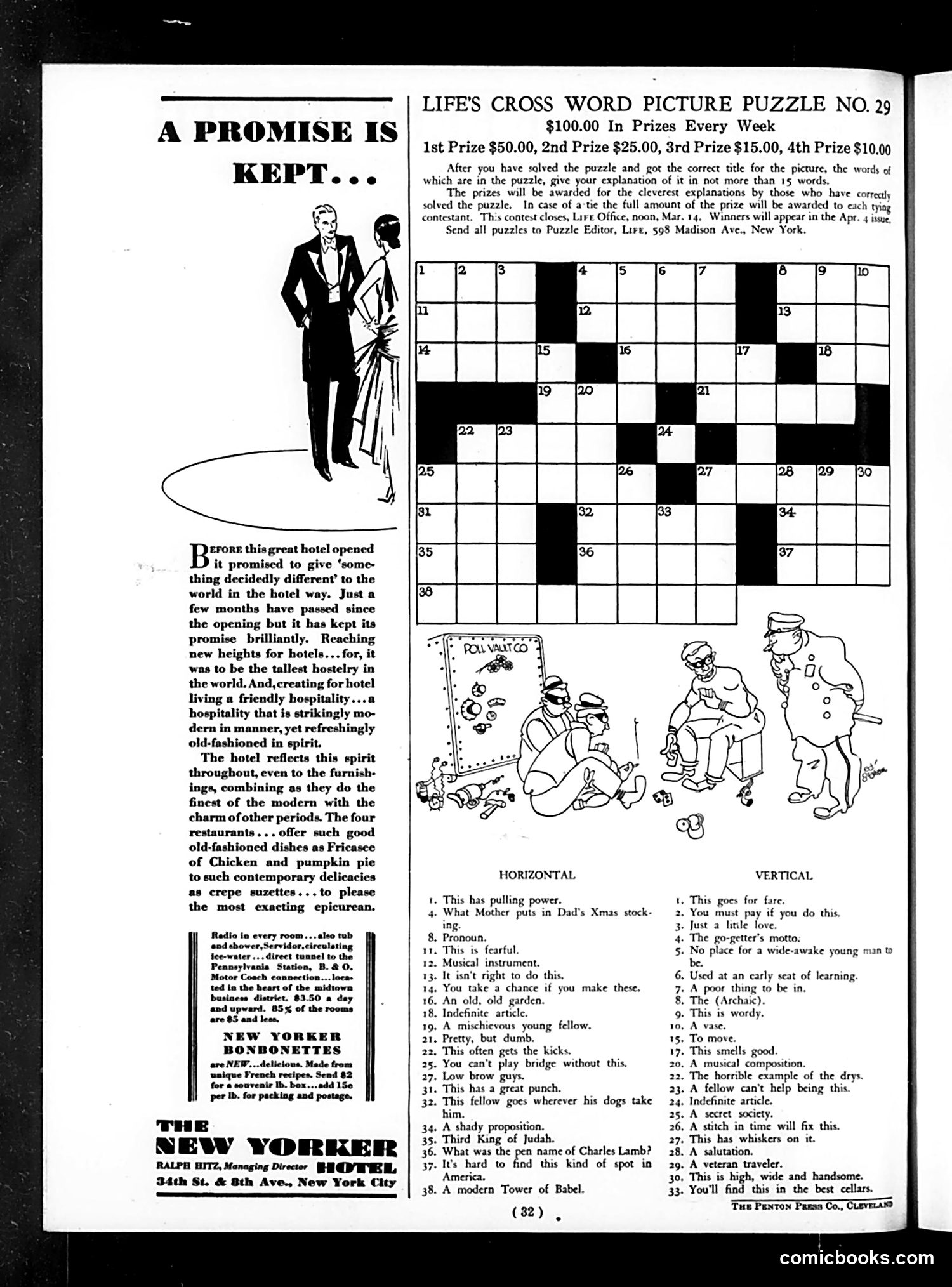
Analysis This page is primarily advertising and puzzle content, not political satire. The main feature is a hotel advertisement for the New Yorker hotel (operated by Ralph Hitz), emphasizing it as "the tallest hostelry in the world" that combines modern amenities (radio in every room, direct tunnel to Pennsylvania Station) with old-fashioned hospitality and cuisine. The ad includes a cartoon illustration of well-dressed guests and bellhops, reflecting 1920s-30s era luxury hotel culture. Below is a crossword puzzle contest offering $100 in weekly prizes. The cartoon showing people playing games relates to hotel entertainment. Historical context: This appears from *Life* magazine's golden age as a humor/satire publication (pre-WWII). The New Yorker hotel reference and Art Deco styling suggest early 1930s. The advertising reflects Depression-era luxury hotel competition in Manhattan, marketing leisure and modernity as desirable escapes. No political satire is evident here—this is straightforward commercial content and entertainment puzzles typical of the era's magazines.
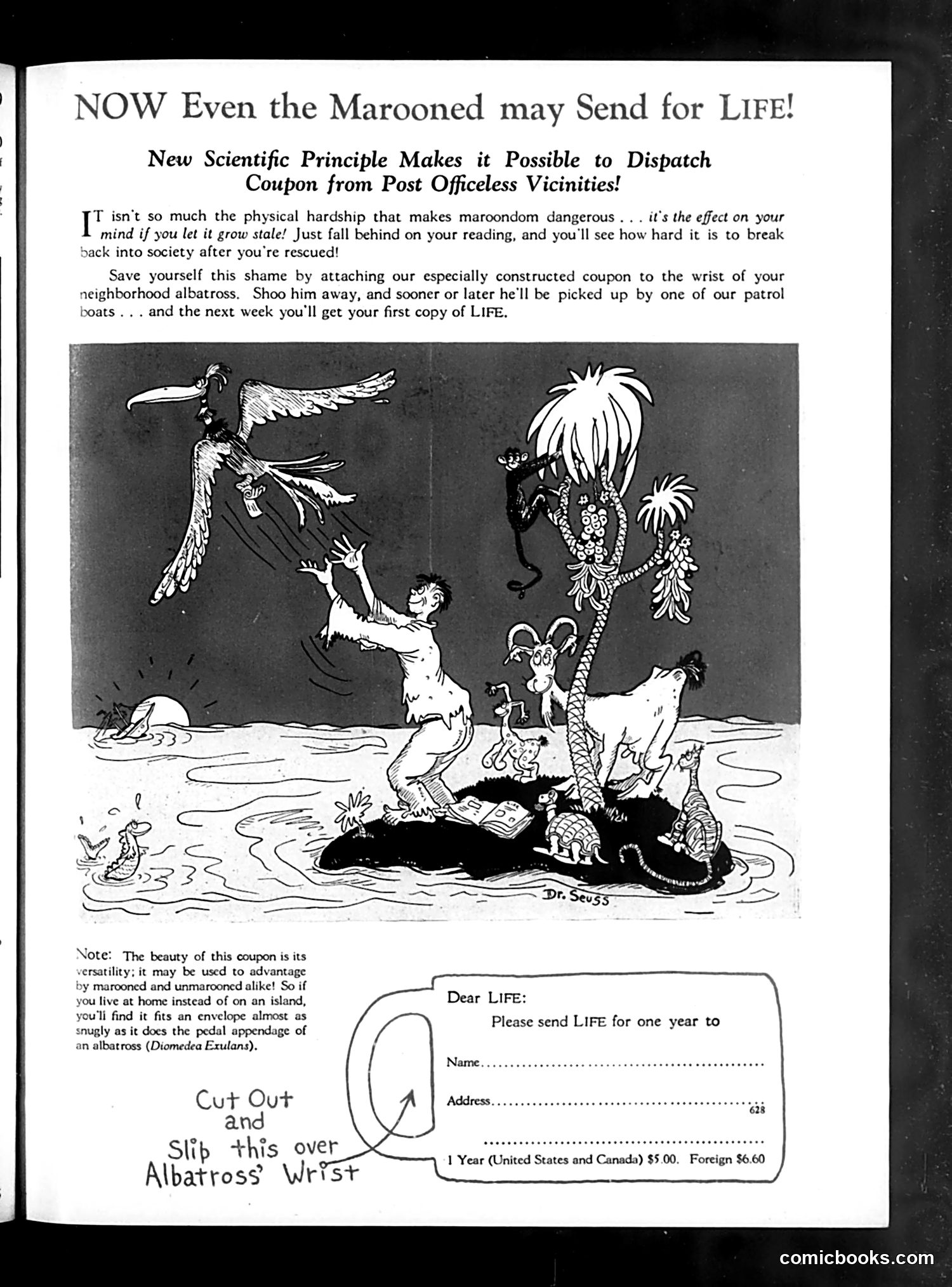
Life Magazine Subscription Advertisement (circa 1920s-30s) This is a humorous subscription coupon advertisement for *Life* magazine, illustrated by Dr. Seuss. The satire plays on the anxiety of isolation and cultural irrelevance: the fear that being "marooned" (stranded) without access to current reading material causes mental deterioration and social embarrassment upon rescue. The joke proposes an absurd solution—attaching a subscription coupon to an albatross's leg, mimicking real historical practices of using seabirds to carry messages from remote locations. The cartoon depicts castaways on an island with fantastical creatures (characteristic of Seuss's style), treating the albatross as a postal service for the unreachable. The ad's underlying message: staying current with *Life* magazine's humor and social commentary is essential to remaining mentally sharp and socially functional. The coupon's "versatility" note gently mocks readers by suggesting even homebound people might feel equally isolated without it.
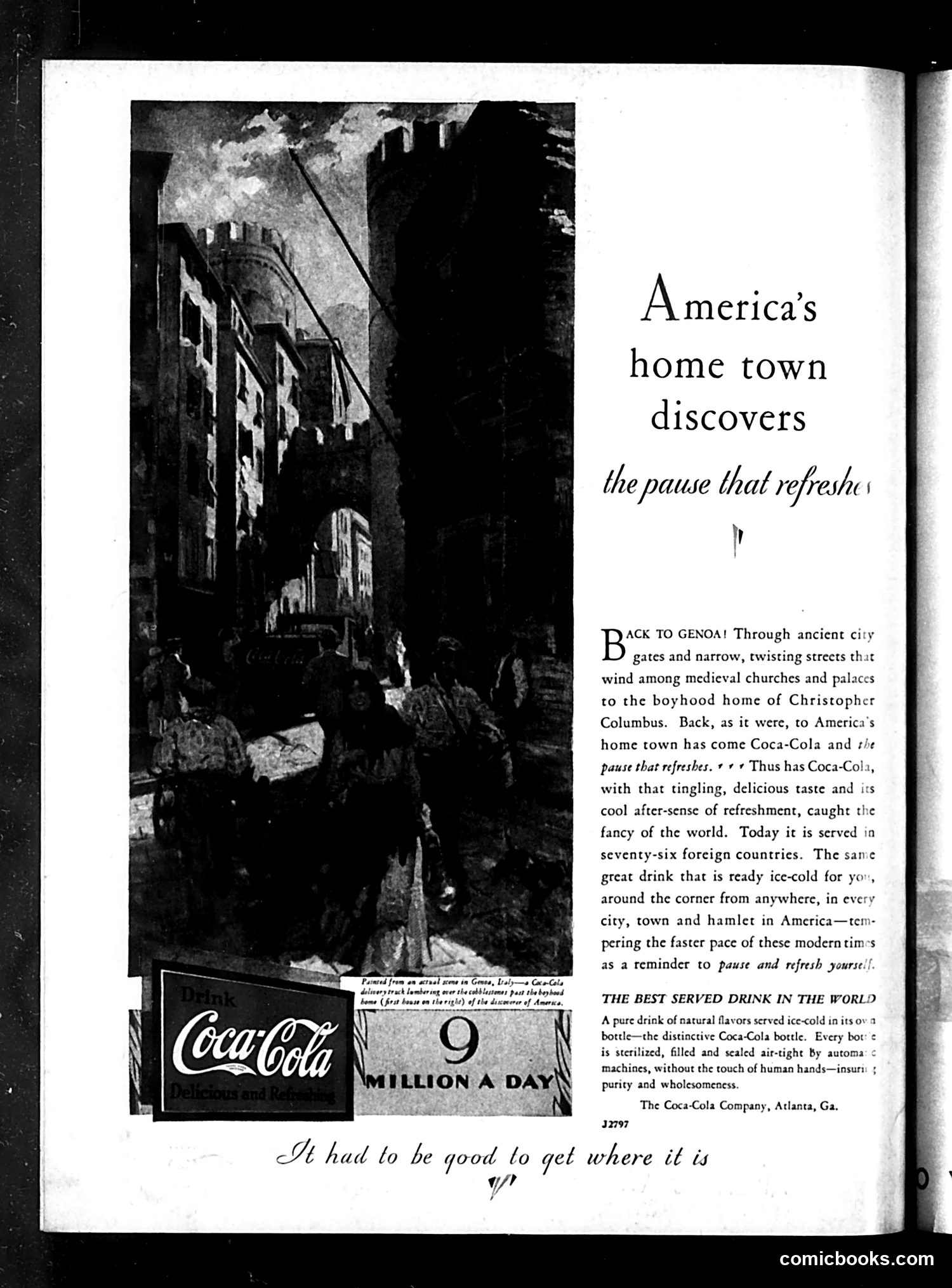
Analysis This is a Coca-Cola advertisement, not political satire. The page uses Life magazine's platform to promote the drink by connecting it to American heritage and global reach. The imagery shows a medieval European street scene (Genoa, Columbus's birthplace), establishing a nostalgic link between America's origins and Coca-Cola's international expansion. The text claims the beverage is now served in "seventy-six foreign countries," positioning it as a symbol of American modernity and progress conquering the old world. The "pause that refreshes" is Coca-Cola's actual slogan, presented as a counterbalance to modern life's "faster pace." The advertisement emphasizes hygiene and automation—bottles "sterilized, filled and sealed air-tight by automatic machines"—addressing early-20th-century concerns about food and drink safety. The tagline "9 Million a Day" boasts consumption figures. This represents corporate advertising using nationalist and nostalgic imagery to market a consumer product during an era of American commercial expansion abroad.