life
Life — March 7, 1930
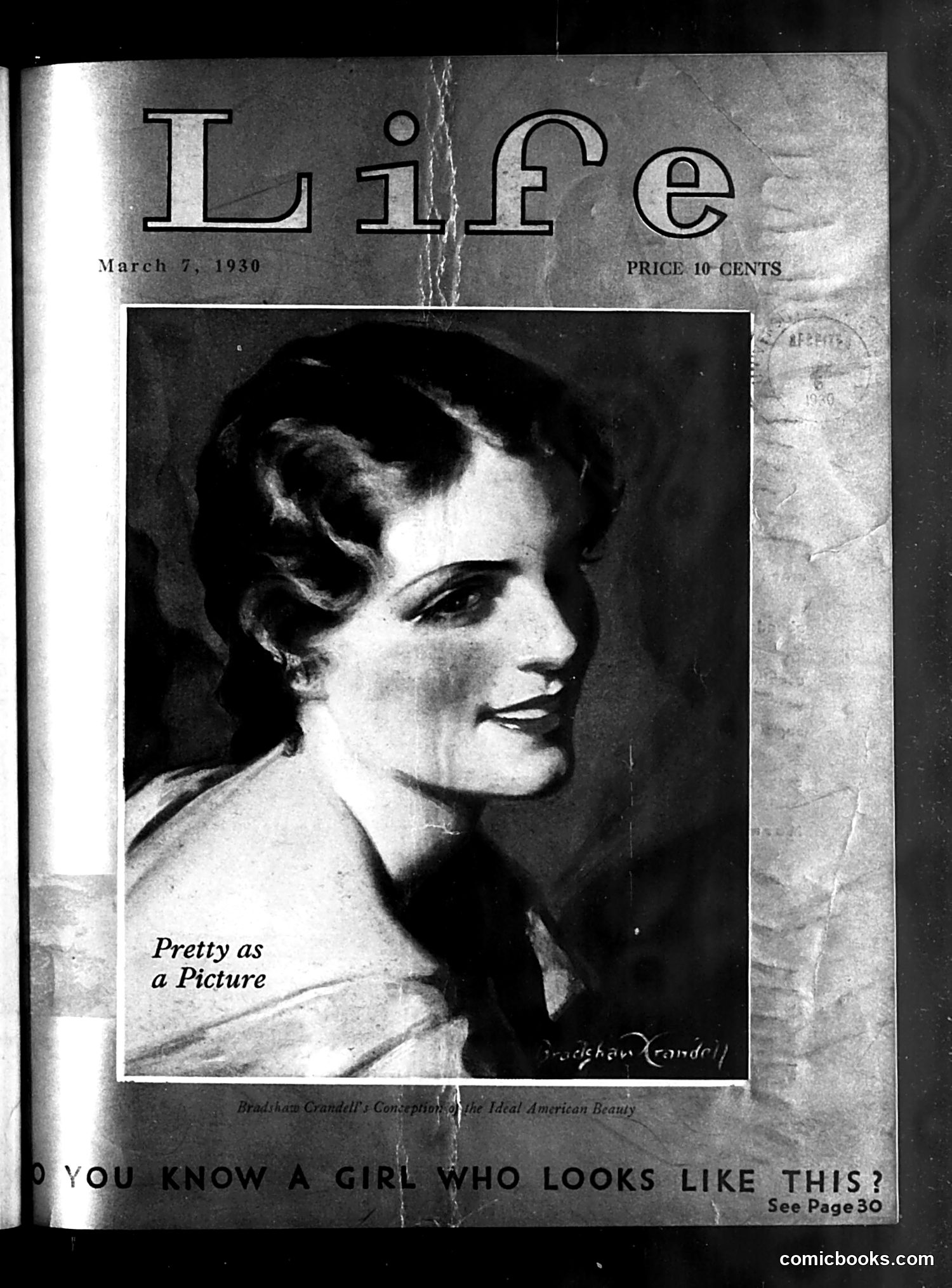
Life Magazine, March 7, 1930 This cover features a portrait labeled "Pretty as a Picture" with the credit "Bradshaw Crandell's Conception of the Ideal American Beauty." Rather than satirizing a specific person or event, this appears to be a beauty standard feature typical of Life magazine's era. The accompanying question "DO YOU KNOW A GIRL WHO LOOKS LIKE THIS?" suggests an interactive reader engagement element, directing viewers to page 30. The image reflects 1930s aesthetic ideals—the woman's wavy hair, defined eyebrows, and profile pose exemplify popular beauty conventions of the Depression era. This was characteristic content for Life when it functioned partly as an illustrated lifestyle magazine alongside its famous satirical cartoons and commentary.
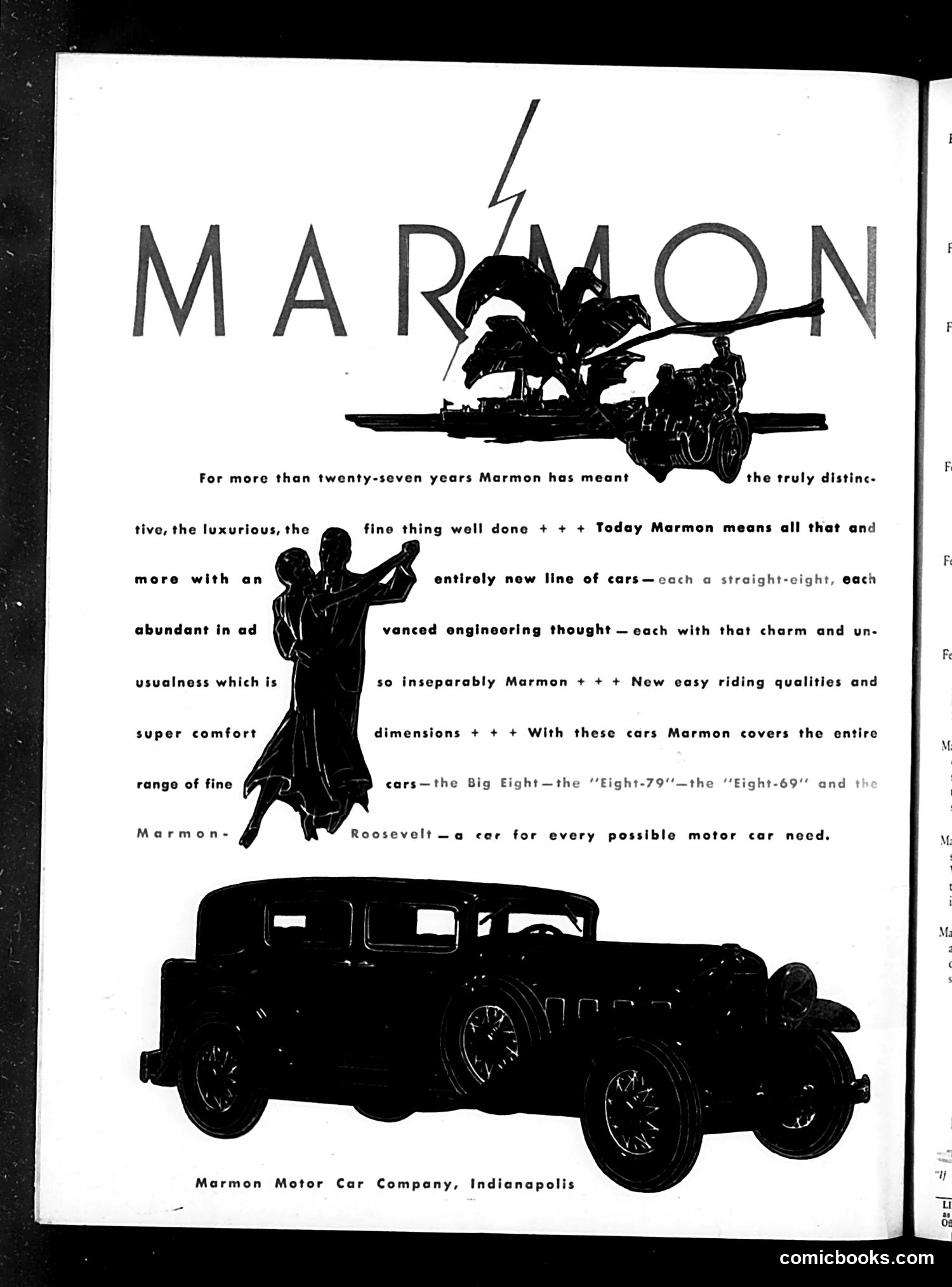
This is primarily a Marmon Motor Car Company advertisement, not political satire. The page promotes Marmon automobiles through aspirational imagery and copy rather than commentary or humor. The ad features an Art Deco-style illustration of an elegantly dressed couple in a dynamic pose, emphasizing luxury and sophistication. The text claims Marmon has maintained "distinctive" status for 27 years, now offering "an entirely new line of cars" with "advanced engineering" and "charm and unusualness." Models mentioned include the "Big Eight," "Eight-79," "Eight-69," and "Marmon-Roosevelt," described as covering "every possible motor car need." The bottom shows a photograph of an actual Marmon sedan. This represents typical 1920s-30s automobile marketing emphasizing elegance, engineering innovation, and social prestige rather than satire or political commentary.
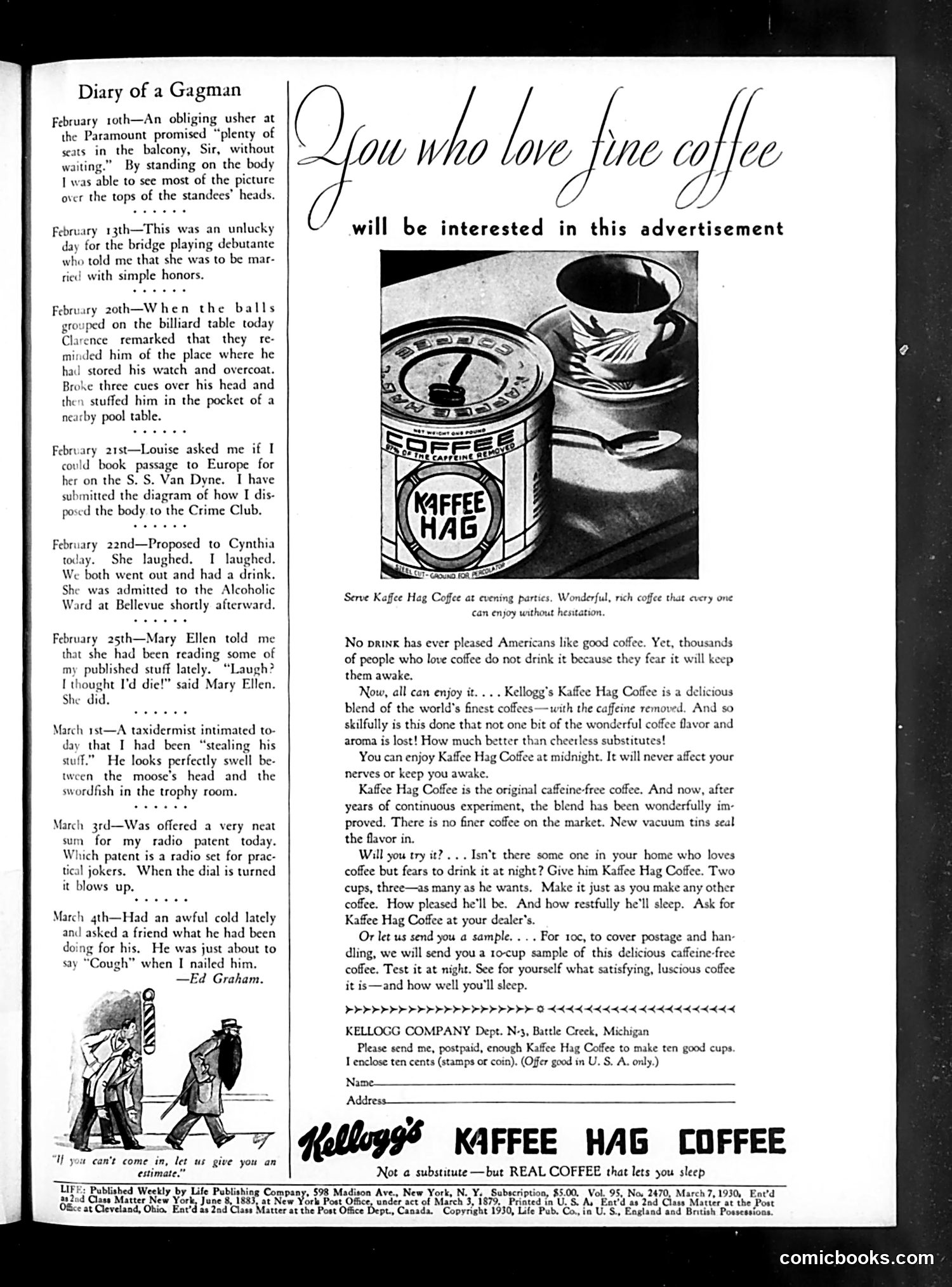
Analysis: "Diary of a Gagman" Page This page combines a humorous diary column with a Kaffee Hag Coffee advertisement. The left side presents comedic anecdotes from February-March (year unclear from image), including stories about theater ushering, billiards mishaps, and romantic proposals—typical light humor for Life magazine's satirical "gagman" column. The small cartoon at bottom left shows two figures, one saying "If you can't come in, let us give you an estimate!"—appearing to joke about a barber or tradesman soliciting business. The right side is primarily a full advertisement for Kaffee Hag (caffeine-free coffee), featuring product images and marketing copy emphasizing that the coffee won't keep one awake. This reflects 1930s consumer advertising conventions targeting middle-class American readers concerned with sleep quality.
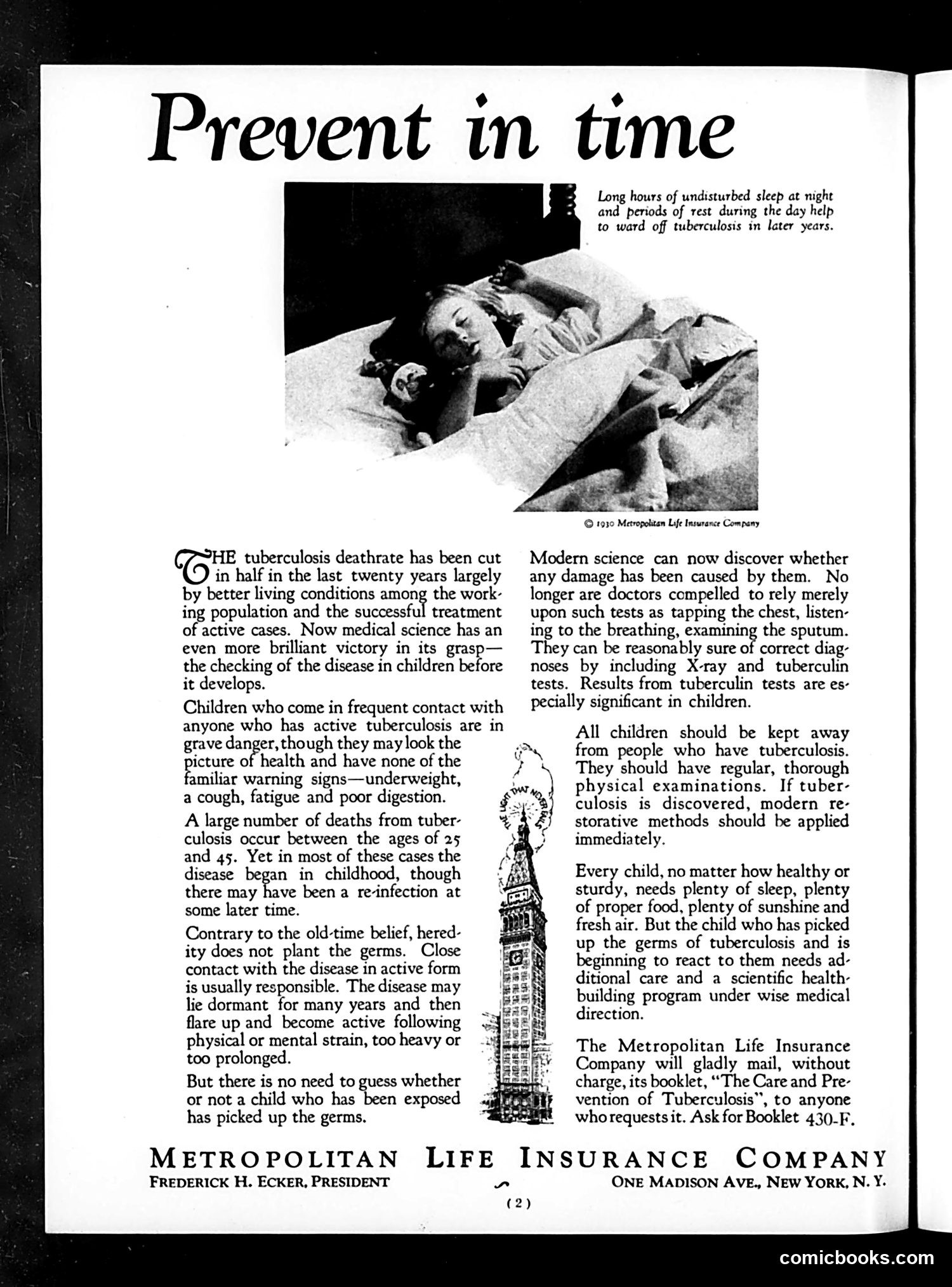
Analysis This is not a satirical cartoon page, but rather a public health advertisement by the Metropolitan Life Insurance Company from approximately 1930 (copyright mark visible). The page promotes tuberculosis prevention through proper sleep, rest, and medical vigilance. The image shows a sleeping child—illustrating the text's emphasis that "long hours of undisturbed sleep at night and periods of rest during the day help to ward off tuberculosis in later years." The accompanying text explains that tuberculosis deaths have declined due to improved living conditions and medical advances. It urges parents to keep children away from infected individuals and ensure regular physical examinations. The decorative building illustration (likely Metropolitan Life's headquarters) reinforces the company's authority on health matters. This represents early 20th-century corporate health promotion through life insurance marketing.
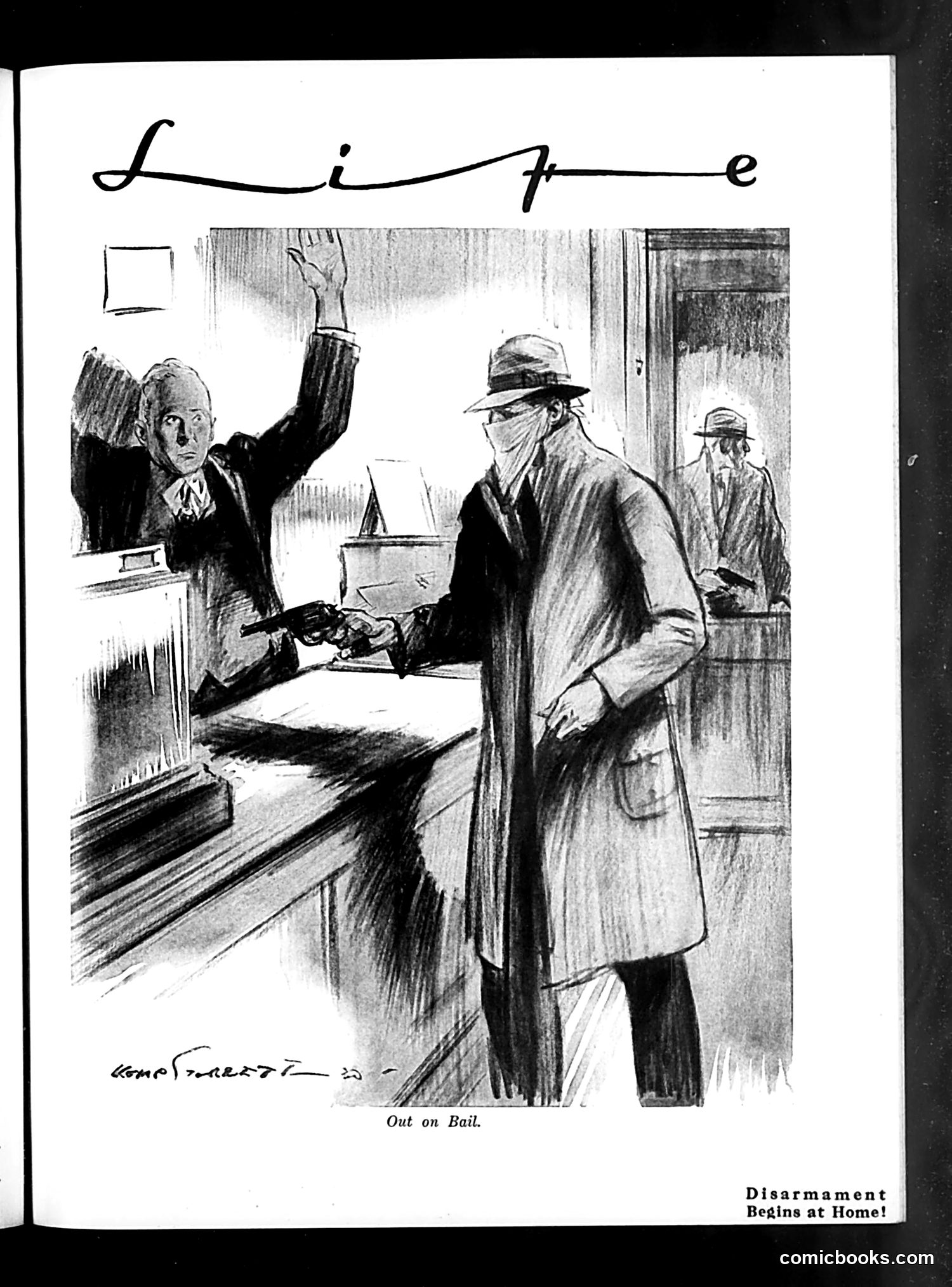
Analysis of "Out on Bail" Cartoon This cartoon satirizes post-WWI disarmament efforts. The title "Disarmament Begins at Home!" indicates the satirical thrust. A bald man at a window or counter raises his fist triumphantly while handing over what appears to be weapons or ammunition to a man in a hat and coat. A third figure waits in the background. The satire suggests that while governments publicly championed disarmament treaties, citizens were privately profiting by selling weapons. The "disarmament begins at home" caption ironically undercuts the official message—implying that true disarmament requires personal sacrifice, yet ordinary people continue illicit arms dealing for profit. This reflects post-WWI skepticism about whether peace initiatives could succeed when financial incentives for weapons trafficking remained strong.
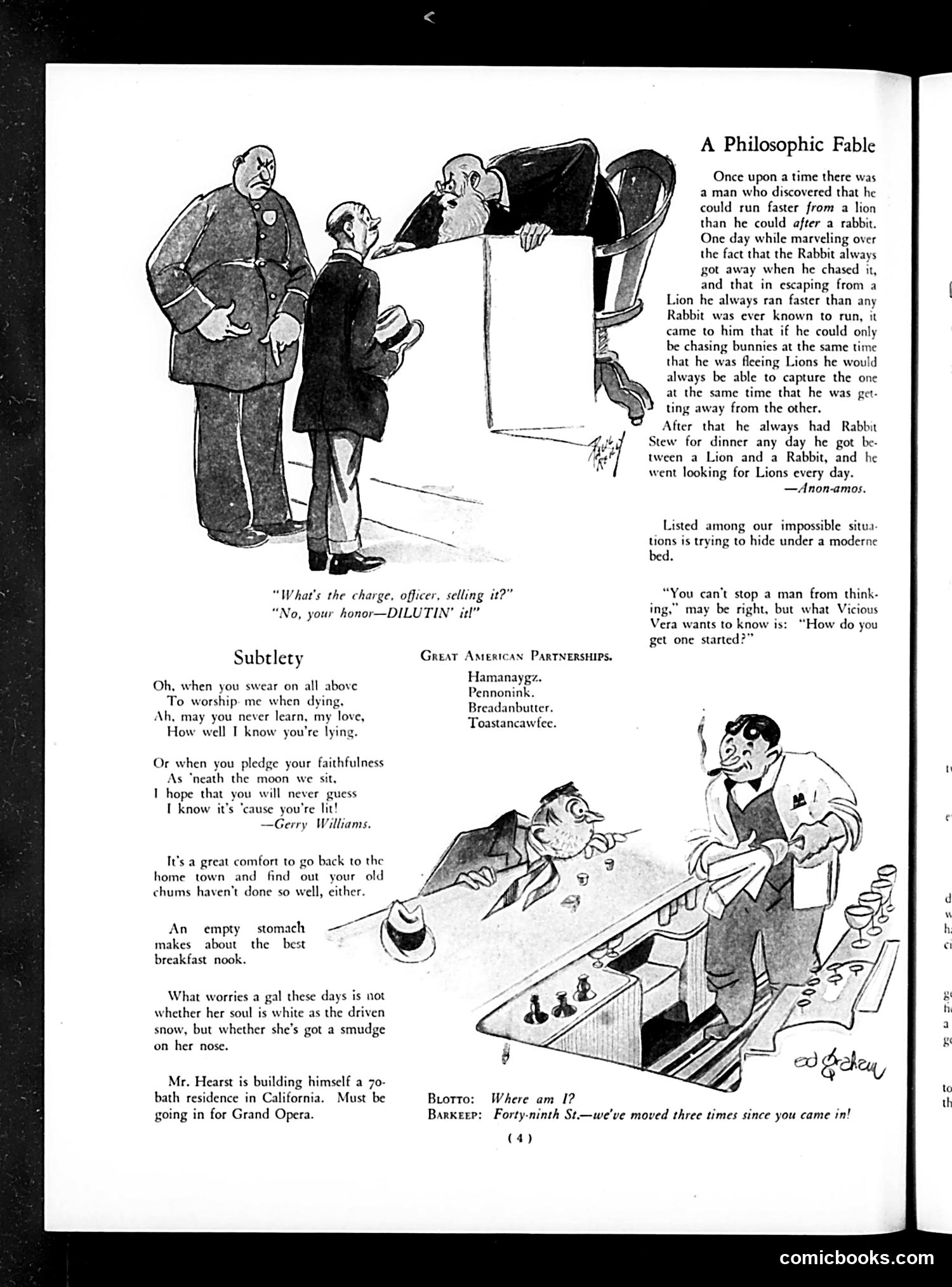
Analysis of Life Magazine Page Top Cartoon - "Subtlety": A police officer charges a man with "diluting" something (likely alcohol during Prohibition). The humor rests on the officer's demand for honesty while the charge itself—"DILUTIN' it"—uses crude language that ironically undermines his authority. This satirizes Prohibition-era enforcement and the gap between official propriety and street-level corruption. Middle Section - "Great American Partnerships": Lists humorous paired names suggesting business partnerships, likely poking fun at contemporary business figures or practices. Bottom Cartoon - "Blotto/Barkeep": Shows two men at what appears to be a speakeasy or bar during Prohibition, with chess pieces visible. The joke involves relocating addresses frequently—a common experience for illegal establishments.
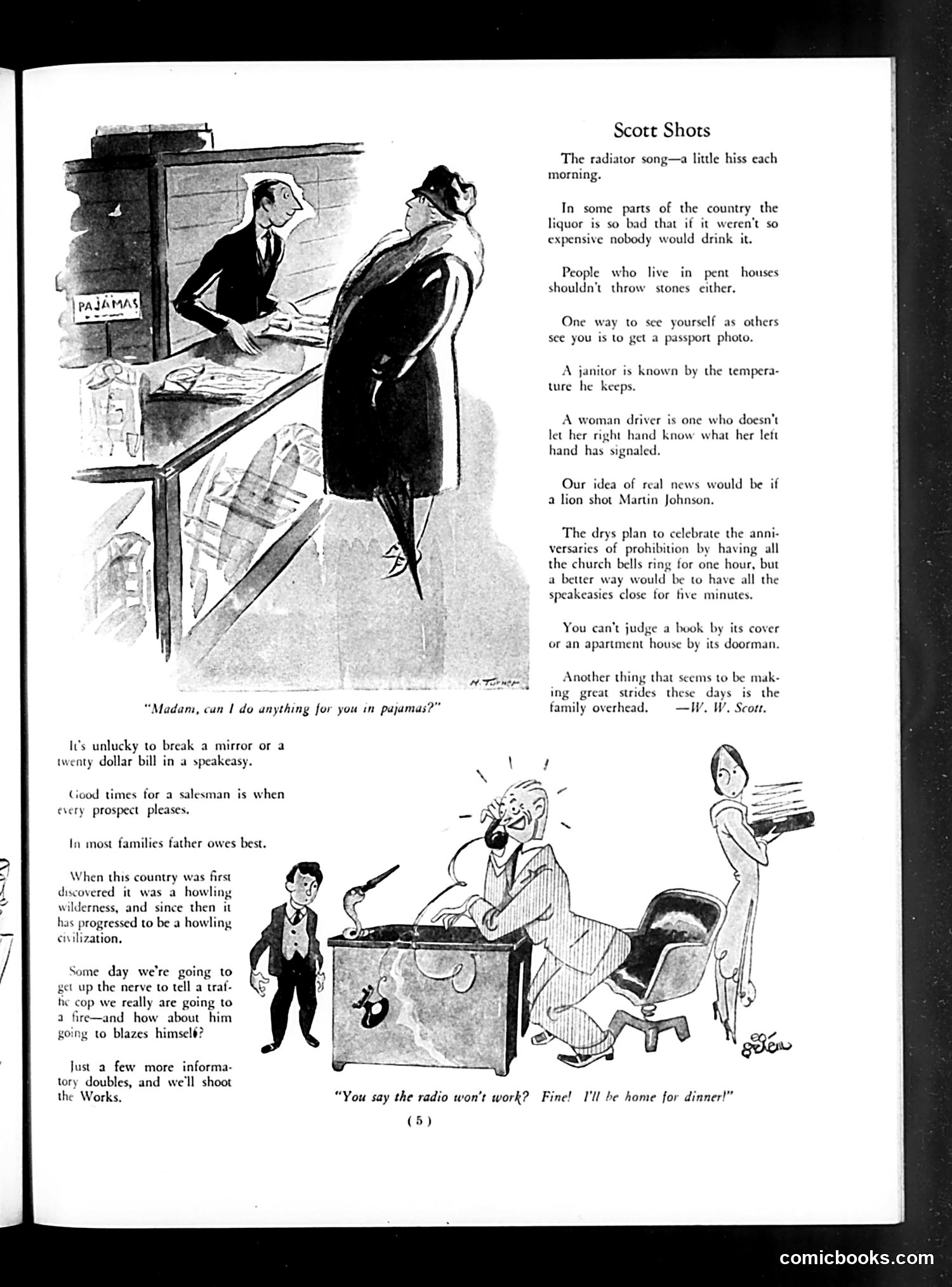
Scott Shots - Life Magazine Satire Page This page contains humorous one-liners and cartoon vignettes by W.W. Scott satirizing American life, likely from the Prohibition era (references to "speakeasies" and "church bells ring" celebrating prohibition anniversaries). Top cartoon: A woman in pajamas approaches a hotel desk clerk, asking "Madam, can I do anything for you in pajamas?" — a joke playing on double meaning (the garment vs. the location). Bottom cartoon: A frustrated man with a broken radio tells his wife "You say the radio won't work? Fine! I'll be home for dinner!" — satirizing how radio was becoming a household fixture, with the husband using radio-listening as an excuse to avoid coming home. The scattered aphorisms mock social pretense, gender relations, and American manners of the period.
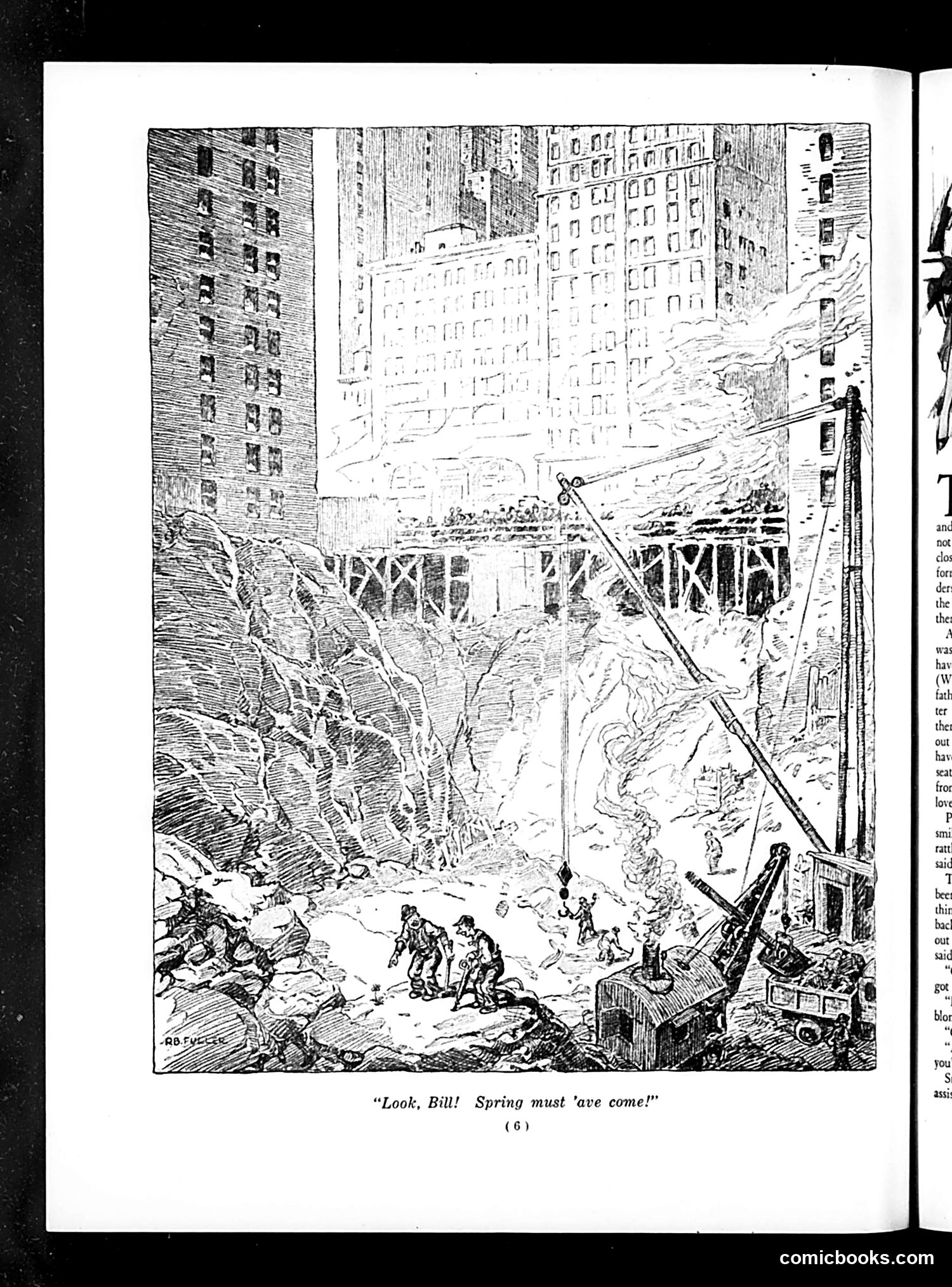
Analysis of "Look, Bill! Spring must 'ave come!" This is a satirical illustration depicting an urban construction site in a city canyon formed by tall buildings. The cartoon shows workers and construction equipment in what appears to be an excavation or demolition pit, with wooden scaffolding and cranes visible above. The caption's working-class British dialect ("'ave" for "have") suggests commentary on urban development and labor. The "spring has come" reference appears ironic—rather than natural renewal, the image shows industrial disruption and construction chaos replacing nature. The crowded tenement buildings looming overhead emphasize the cramped urban environment where "spring" means construction season and disruption for working-class residents, not renewal or relief. The satire critiques industrial urban development's impact on city dwellers.
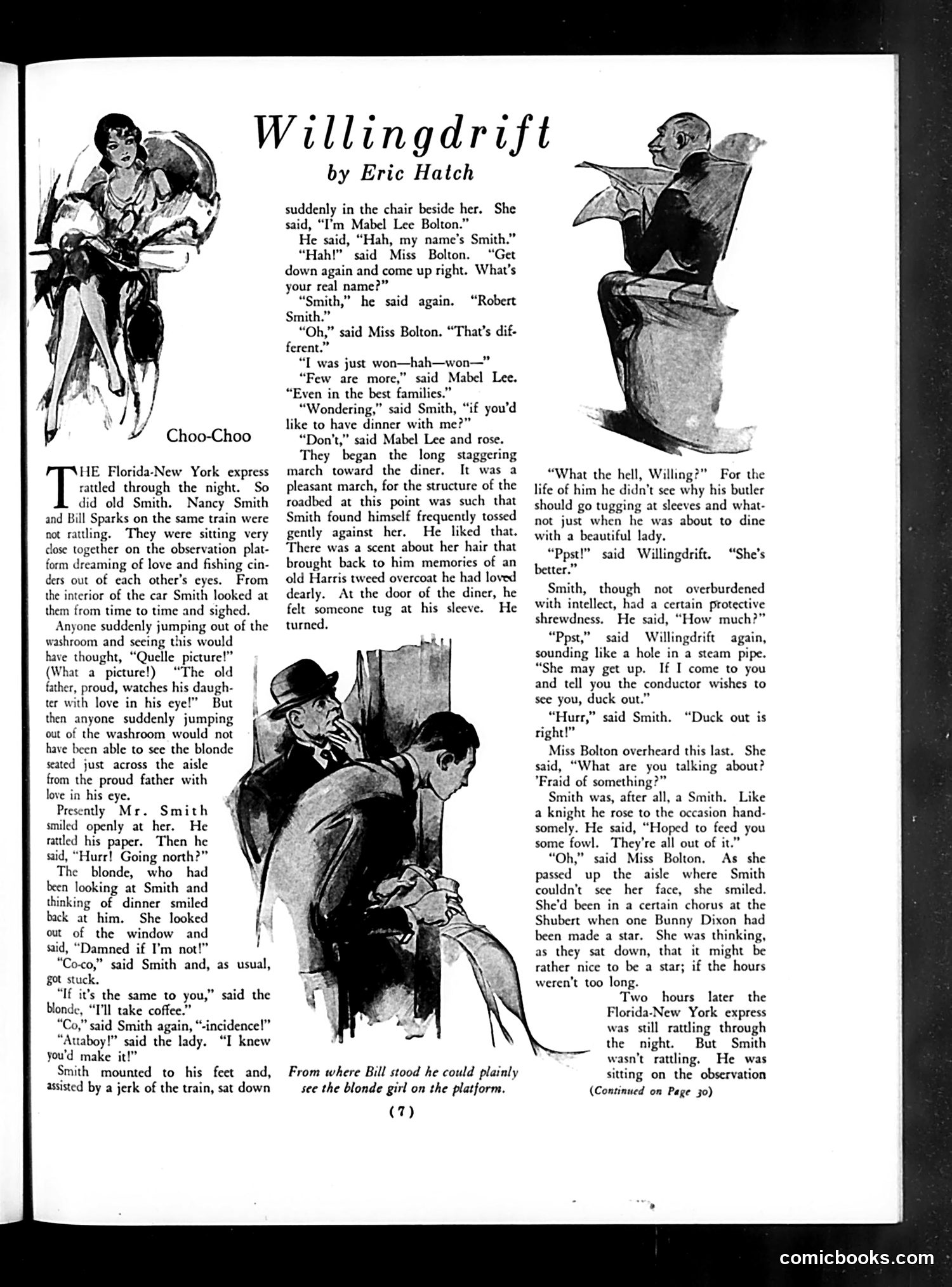
"Willingdrift" by Eric Hatch This is a short story illustration, not political satire. The narrative follows Mr. Smith and his daughter Nancy traveling by train, where Smith encounters a blonde woman named Mabel Lee Bolton. The story depicts romantic confusion and social awkwardness: Smith pretends his name is simply "Smith" rather than "Robert Smith," while Miss Bolton playfully challenges his honesty about his identity. The accompanying illustrations show the train interior and characters interacting. The humor derives from romantic misunderstanding and class-conscious social performance typical of 1920s-30s American fiction—characters adopting false personas to impress potential romantic interests. This reflects period anxieties about authentic identity versus social pretense among the middle class.
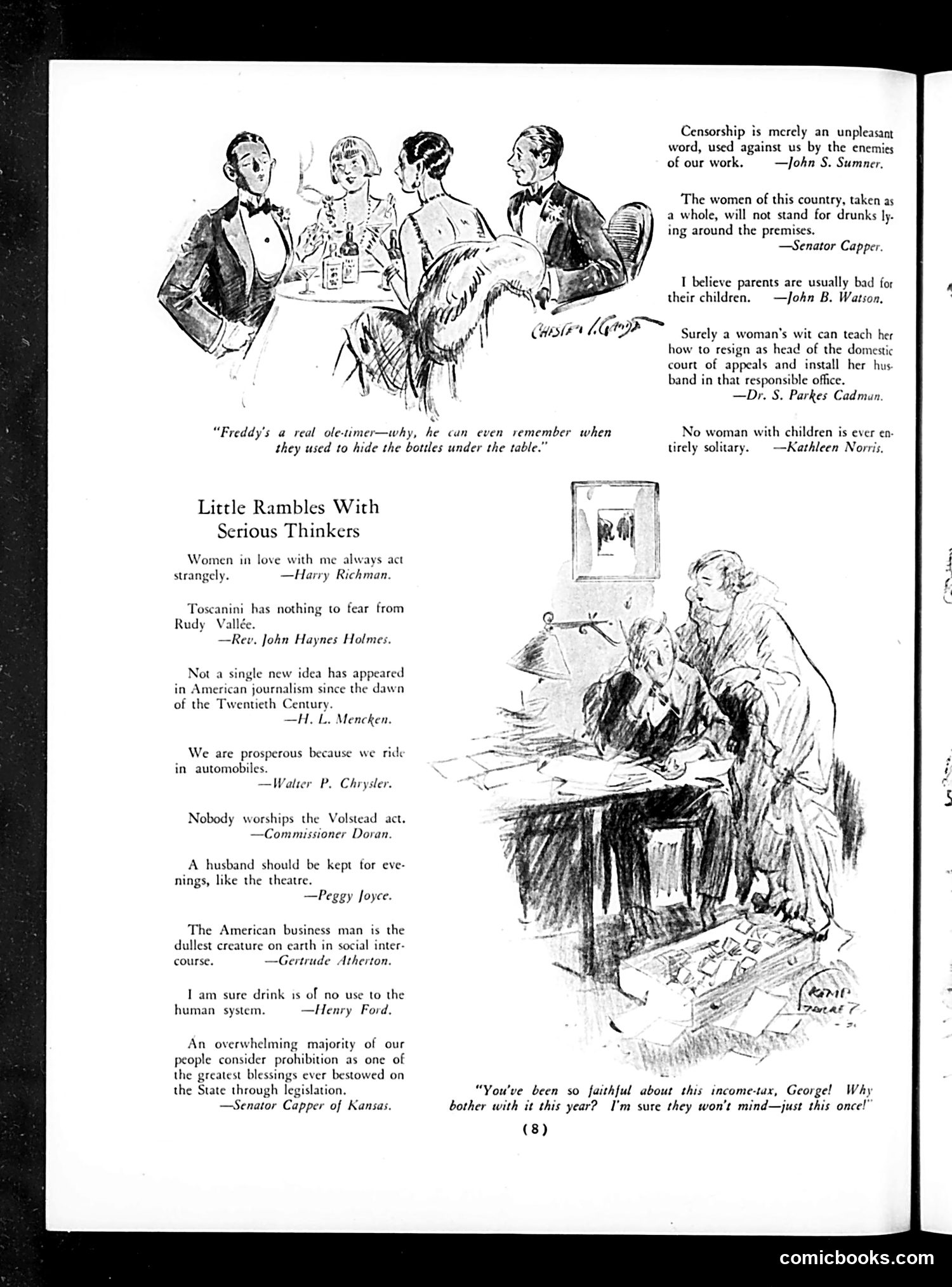
Analysis of Life Magazine Page This page contains satirical quotes and two illustrations mocking early 20th-century social attitudes. Top illustration: Shows well-dressed men at dinner with bottles, accompanying a quote about hiding liquor bottles—likely referencing Prohibition-era drinking habits and hypocrisy. Section title: "Little Rambles With Serious Thinkers" introduces celebrity quotes presented ironically. The quotes mock various prominent figures' statements on topics like women, business, automobiles, and prohibition. They appear designed to expose contradictions or absurdity in these public figures' pronouncements. Bottom illustration: Depicts a man at a desk discussing "income tax" with a woman, suggesting anxiety about new federal income taxation (introduced in 1913). The page satirizes both celebrity pomposity and contemporary anxieties about social change, taxation, and women's roles in American society during this era.
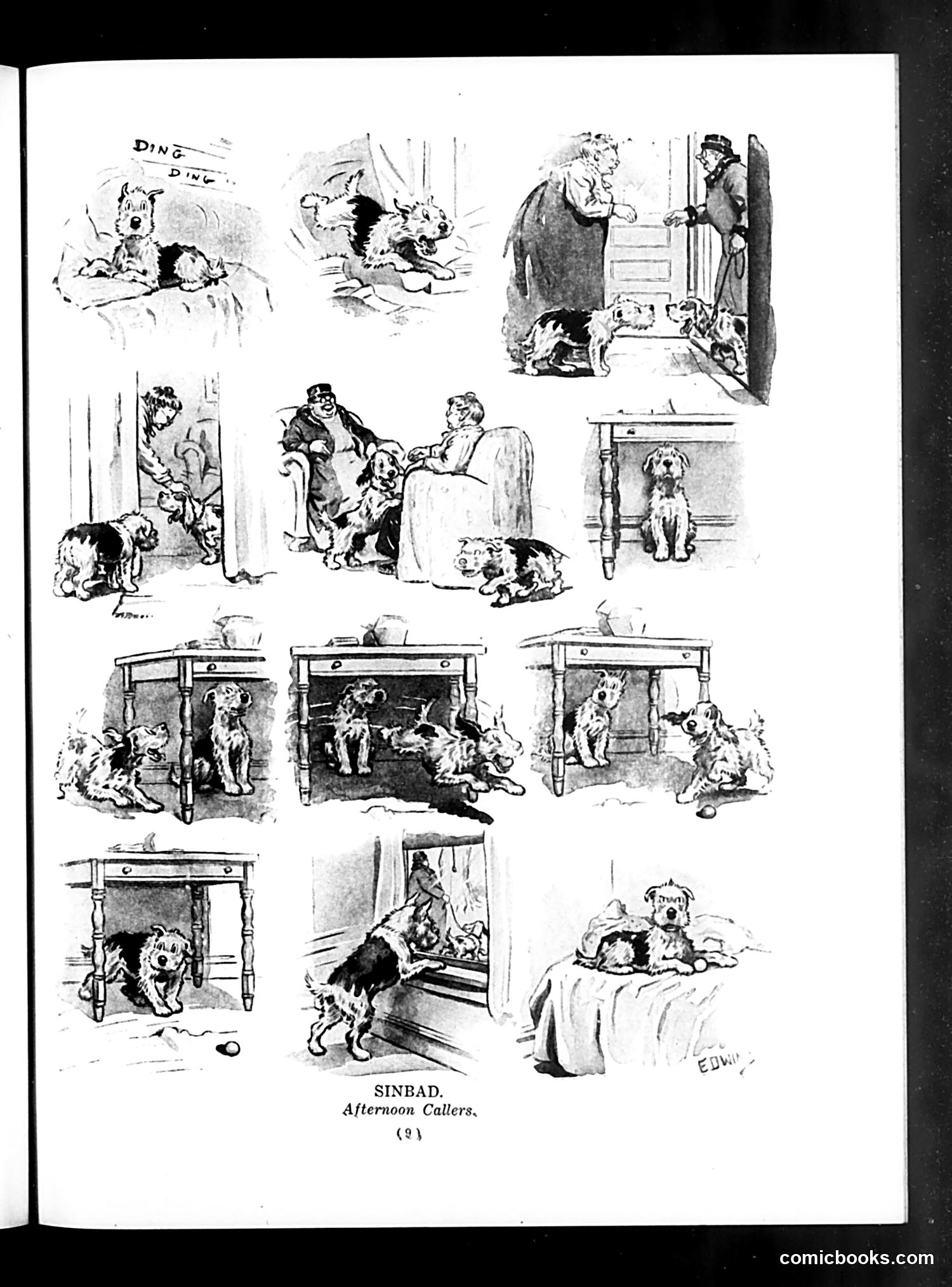
"Sinbad: Afternoon Callers" This appears to be a comic strip or illustration series depicting a dog named Sinbad receiving various visitors throughout an afternoon. The sequential panels show different human callers arriving at what seems to be a home, with Sinbad the dog reacting to each visitor in different ways—sometimes excited, sometimes wary or mischievous. The humor appears to derive from the dog's varied responses to different types of callers: tradespeople, family members, and others making typical "afternoon calls" at a Victorian-era household. Each panel shows Sinbad's personality and behavior shifting based on who arrives. This is gentle domestic humor focused on the dog character's antics rather than political satire, typical of early 20th-century Life magazine's lighter content.
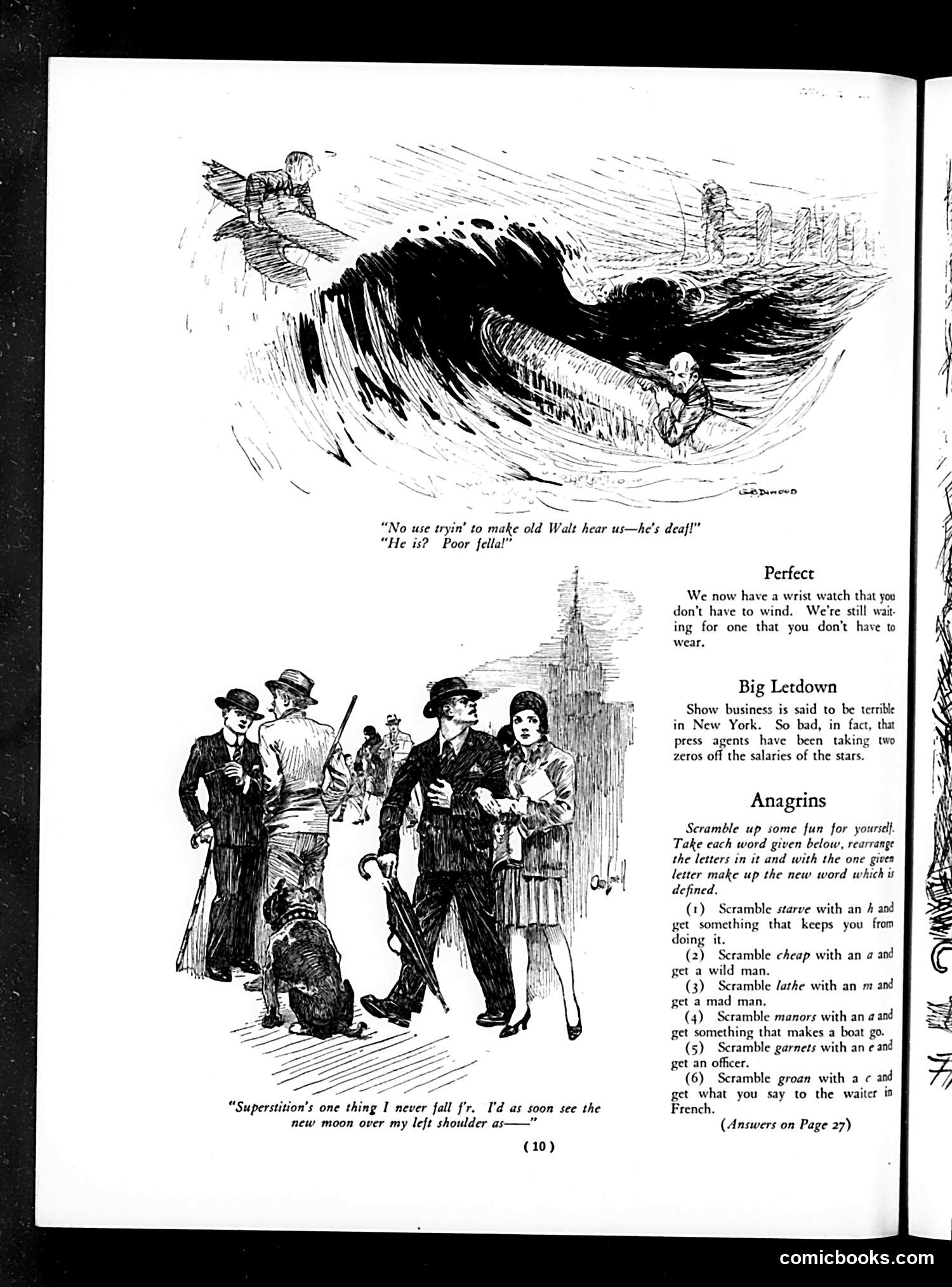
Page Analysis This page contains two distinct elements: Top cartoon: A surreal illustration depicting a large wave or whirlwind with figures caught within it. The caption reads: "No use tryin' to make old Walt hear us—he's deaf!" / "He is? Poor fella!" This appears to reference someone named Walt (likely Walt Disney, given Life magazine's era) and satirizes either his deafness or his alleged inability/unwillingness to listen to complaints or suggestions. Bottom section: A street scene showing well-dressed men in top hats with a dog, captioned about superstition and the moon passing over one's left shoulder—a lighthearted joke about folk beliefs. The right column contains three brief humor items: "Perfect" (about a wristwatch), "Big Letdown" (mocking New York business conditions), and "Anagrins" (a word puzzle game for readers). This appears to be a typical humor/satirical page from Life magazine's golden age.
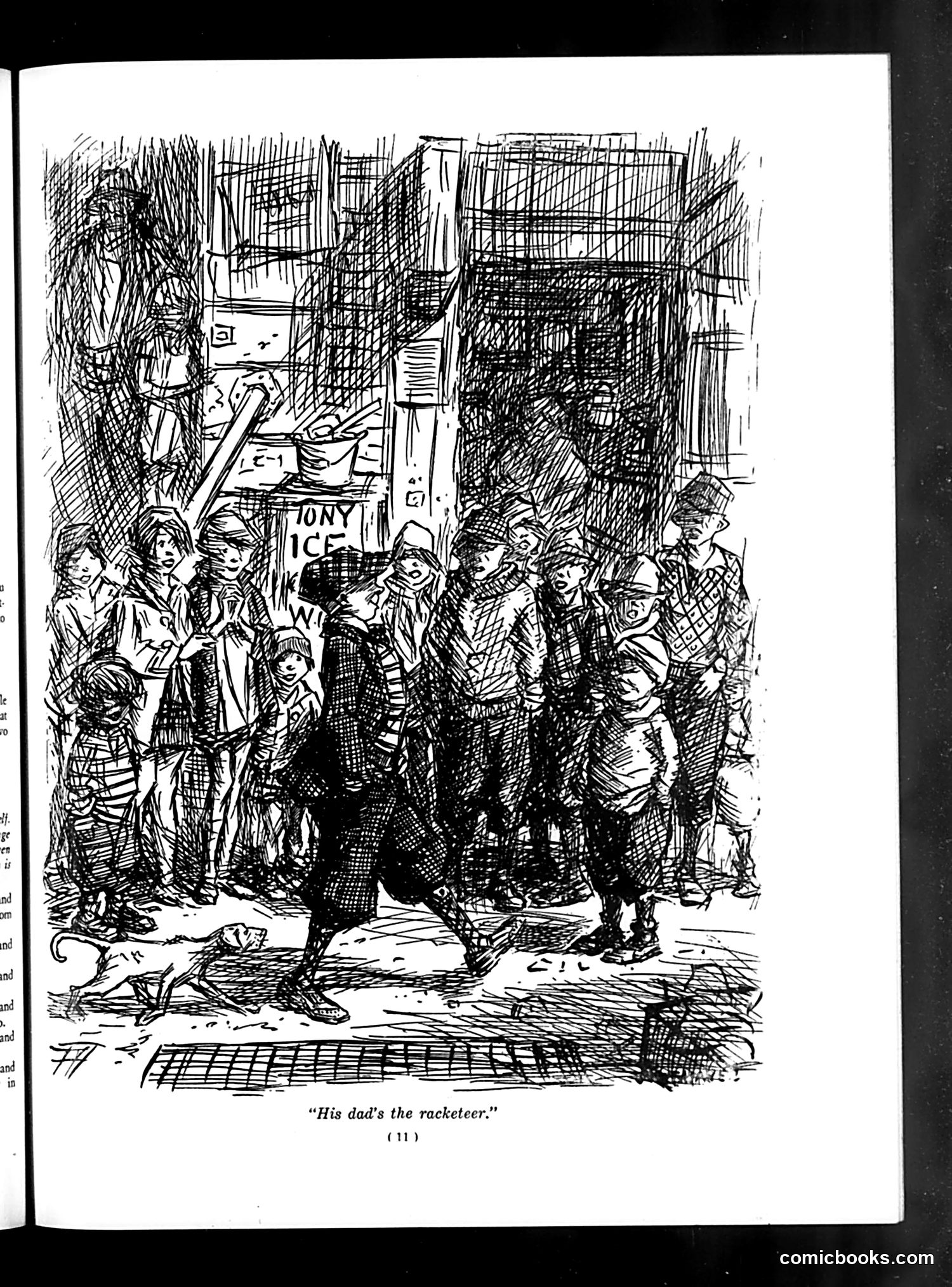
Caption and Context The caption reads: "His dad's the racketeer." This appears to be a social commentary cartoon from early 20th-century Life magazine depicting a street scene with numerous children and adults gathered around what seems to be an ice vendor or street merchant (marked "TONY ICE"). The satire appears to target organized crime and its prevalence in urban neighborhoods, specifically suggesting that criminal activity ("racketeering") was so commonplace that children openly identified their fathers' illicit occupations. The crowded, chaotic urban setting and the casual, matter-of-fact nature of the statement suggest social commentary on how organized crime had become normalized in city life, particularly in immigrant communities. The satirical point is that such criminal enterprise was openly acknowledged among the populace.
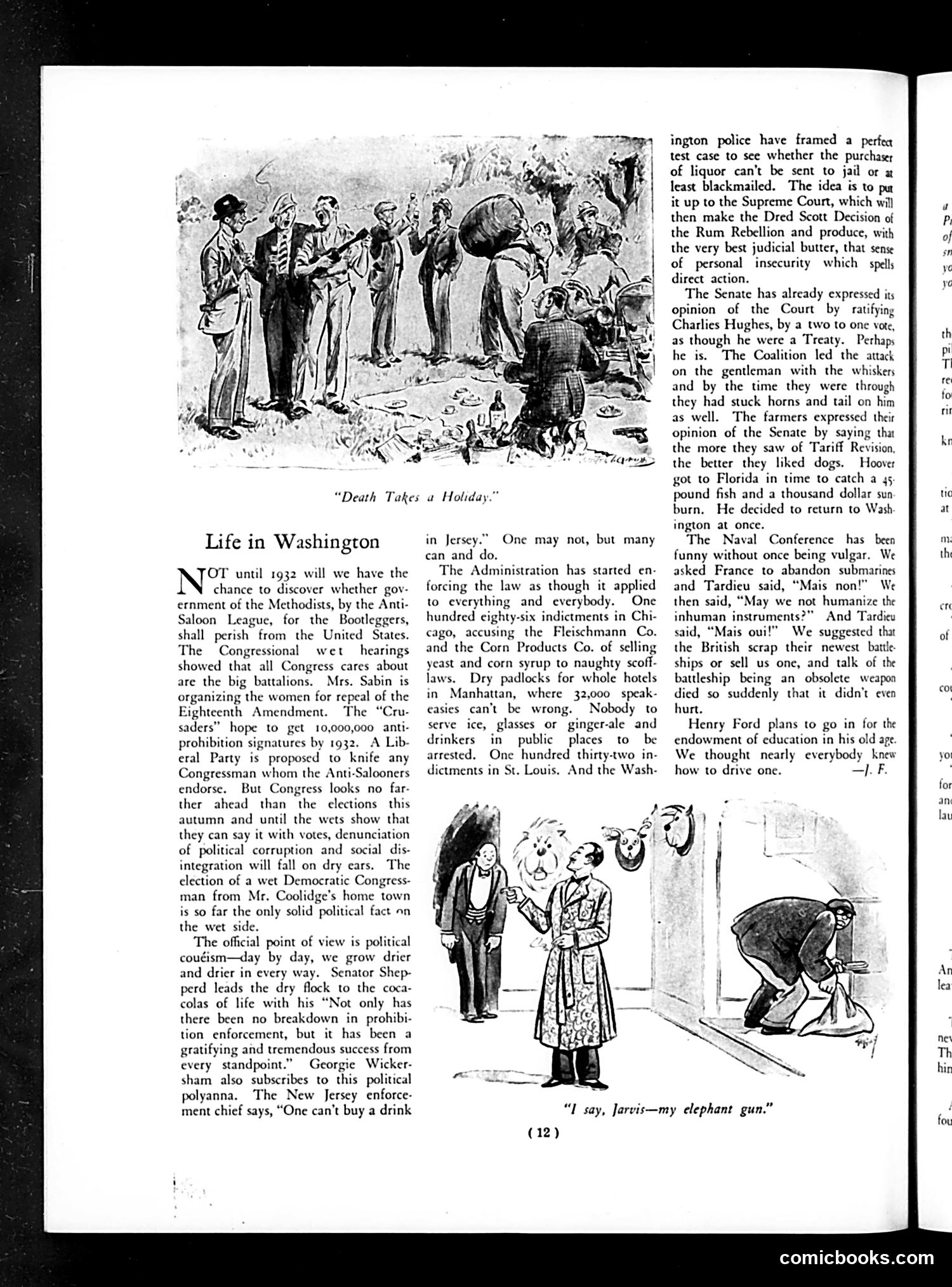
Political Cartoon Analysis: "Life in Washington" This 1932 page satirizes Prohibition enforcement and political corruption. The top cartoon, "Death Takes a Holiday," depicts officials conducting raids on liquor operations with heavy-handed enforcement that the text suggests is arbitrary and inconsistent. The bottom cartoon, captioned "I say, Jarvis—my *elephant gun*," shows a woman displaying hunting weapons to a man, likely satirizing the impotence of law enforcement against widespread bootlegging. The "elephant gun" reference suggests using disproportionate force against an unstoppable problem. The accompanying text discusses Congressional hypocrisy: politicians publicly support Prohibition while private corruption flourishes. It notes that Prohibition hasn't worked despite strict enforcement, and that political leaders like Senator Shepherd contradict their own stated principles—"dry in every way" publicly while enabling illegal activity.
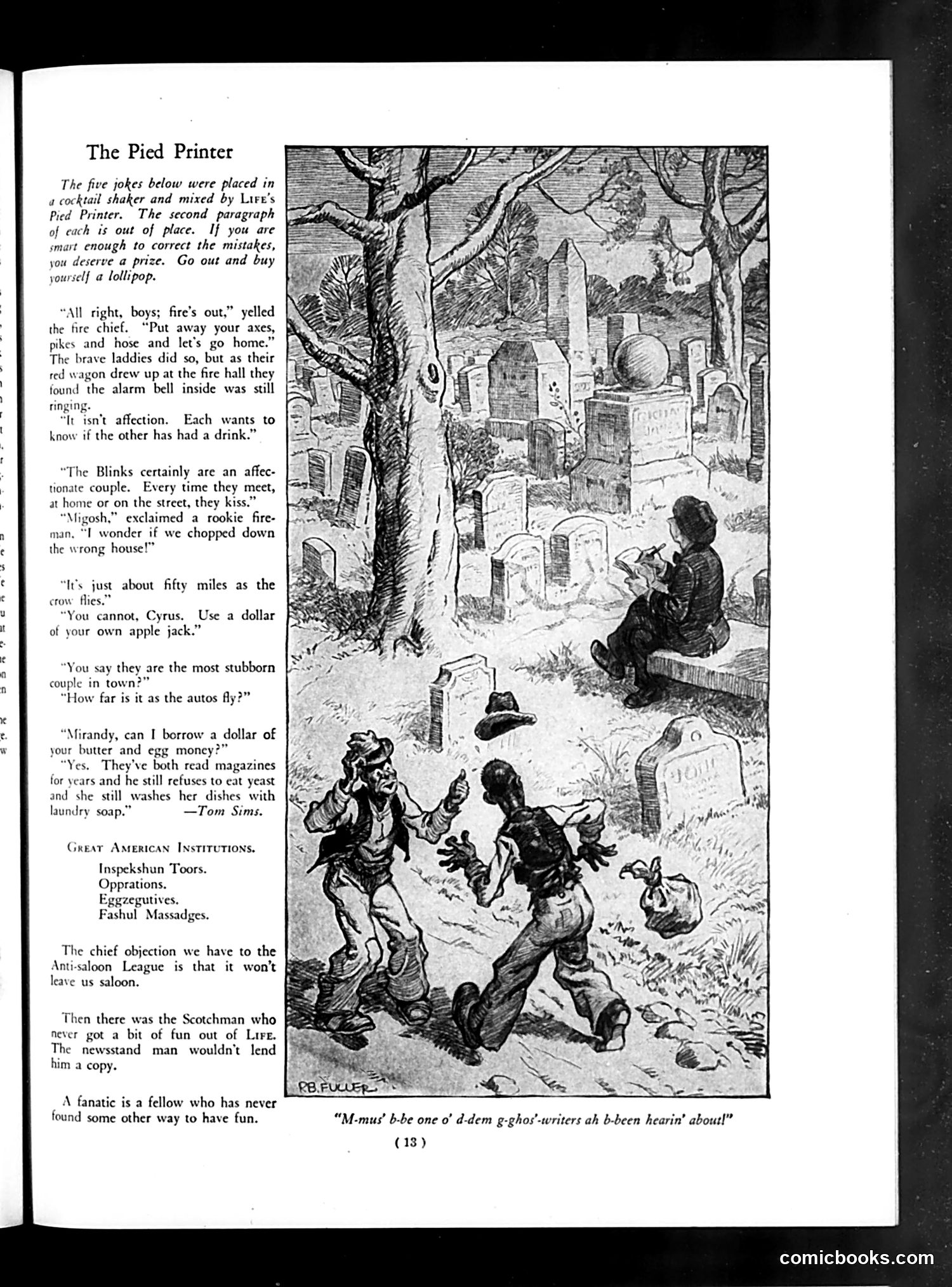
"The Pied Printer" — Life Magazine Satire This page presents five jokes "mixed by Life's Pied Printer" with intentional errors for readers to correct. The accompanying illustration depicts figures in a cemetery, apparently illustrating one of the jokes about an "affectionate couple" (the Blinks) who kiss frequently. The jokes target early 20th-century social types: firefighters, stubborn married couples, and Scottish penny-pinchers. References include the "Anti-saloon League" and contemporary institutions like "Inspeckshan Toors" and "Fashal Massadges." The satirical format—presenting flawed jokes readers must correct—mocks popular humor while poking fun at specific social groups and moral reform movements of the era. The cemetery setting adds dark humor to the domestic comedy.
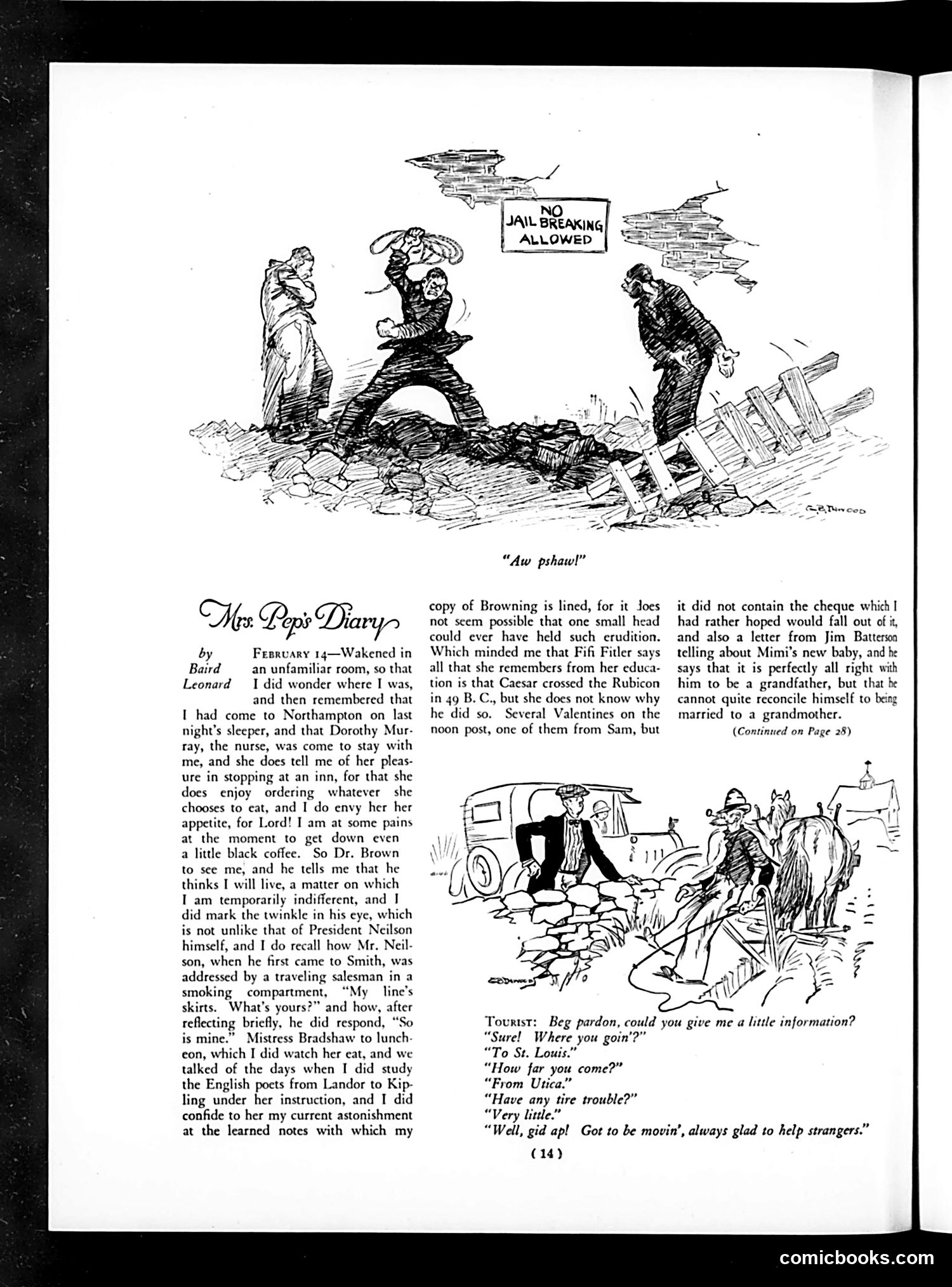
Political Cartoon Analysis The top cartoon depicts three men in suits examining rubble beneath a sign reading "NO JAIL BREAKING ALLOWED," with what appear to be prison buildings or walls in the background. The caption reads "Aw pshaw!" The satire appears to address prison security failures or escape attempts—likely referencing a contemporary jail break incident. The men's dismissive body language and the caption suggest officials downplaying or denying the seriousness of the breach, despite clear evidence of destruction around them. The lower section is unrelated text: "Mrs. Pep's Diary" by Baird Leonard, a humorous diary entry dated February 14, alongside a separate cartoon about a tourist asking directions. Without more specific historical context, I cannot identify which particular jail break incident this references.
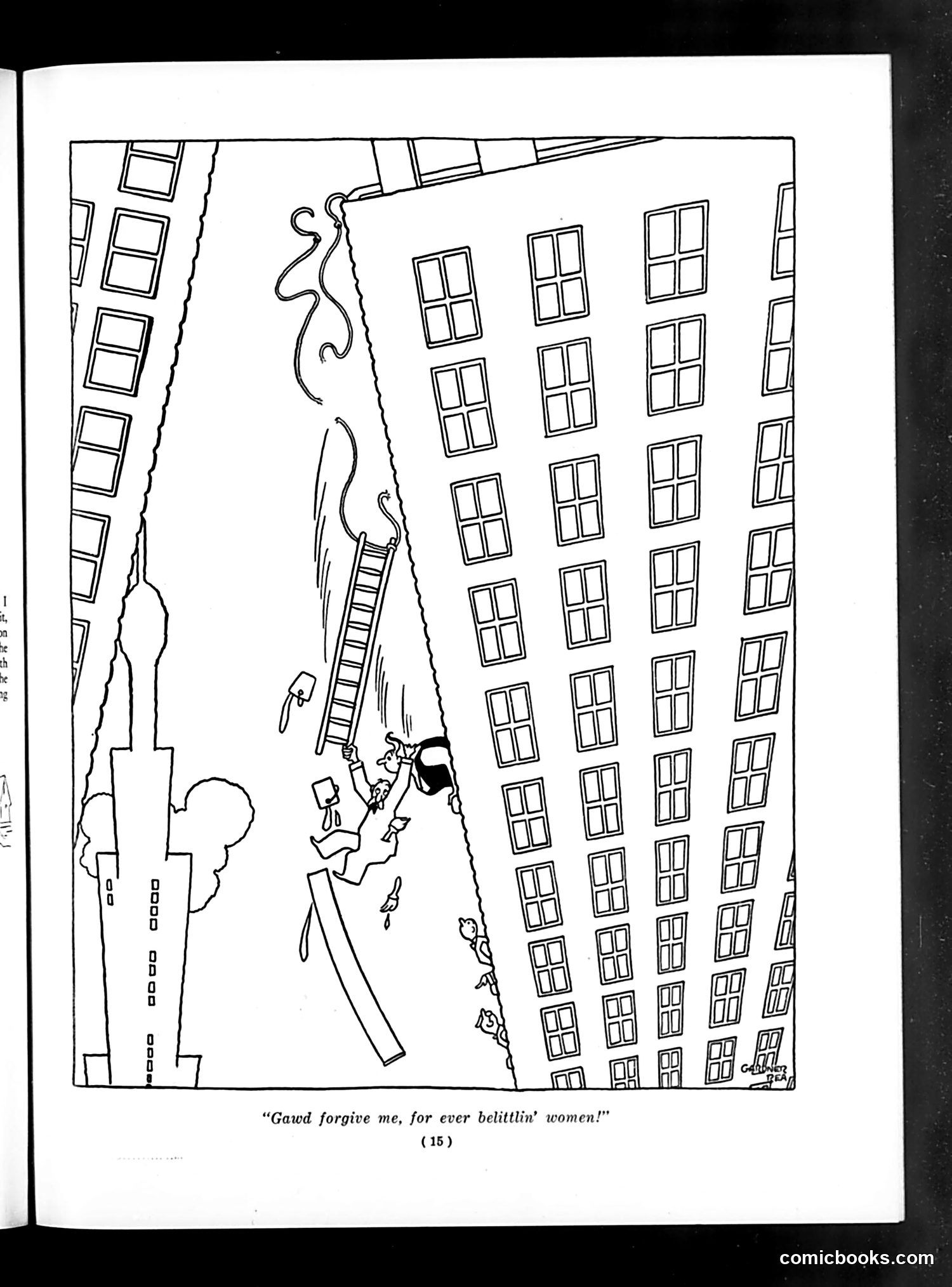
Cartoon Analysis This single-panel cartoon depicts a dramatic urban disaster: a tall building is collapsing or being destroyed, with figures trapped inside and on ladders desperately escaping the wreckage. The caption reads: "Gaved forgive me, for ever belittlin' women!" The joke appears to satirize male attitudes toward women, suggesting that a man facing death or catastrophe suddenly realizes he mistreated women and seeks divine forgiveness. The dark humor contrasts the man's casual sexism (implied by "belittlin' women") with the gravity of his mortal peril, implying it takes a life-threatening disaster to make him recognize his misogyny. This reflects early-to-mid 20th century *Life* magazine's satirical commentary on gender relations and male behavior.
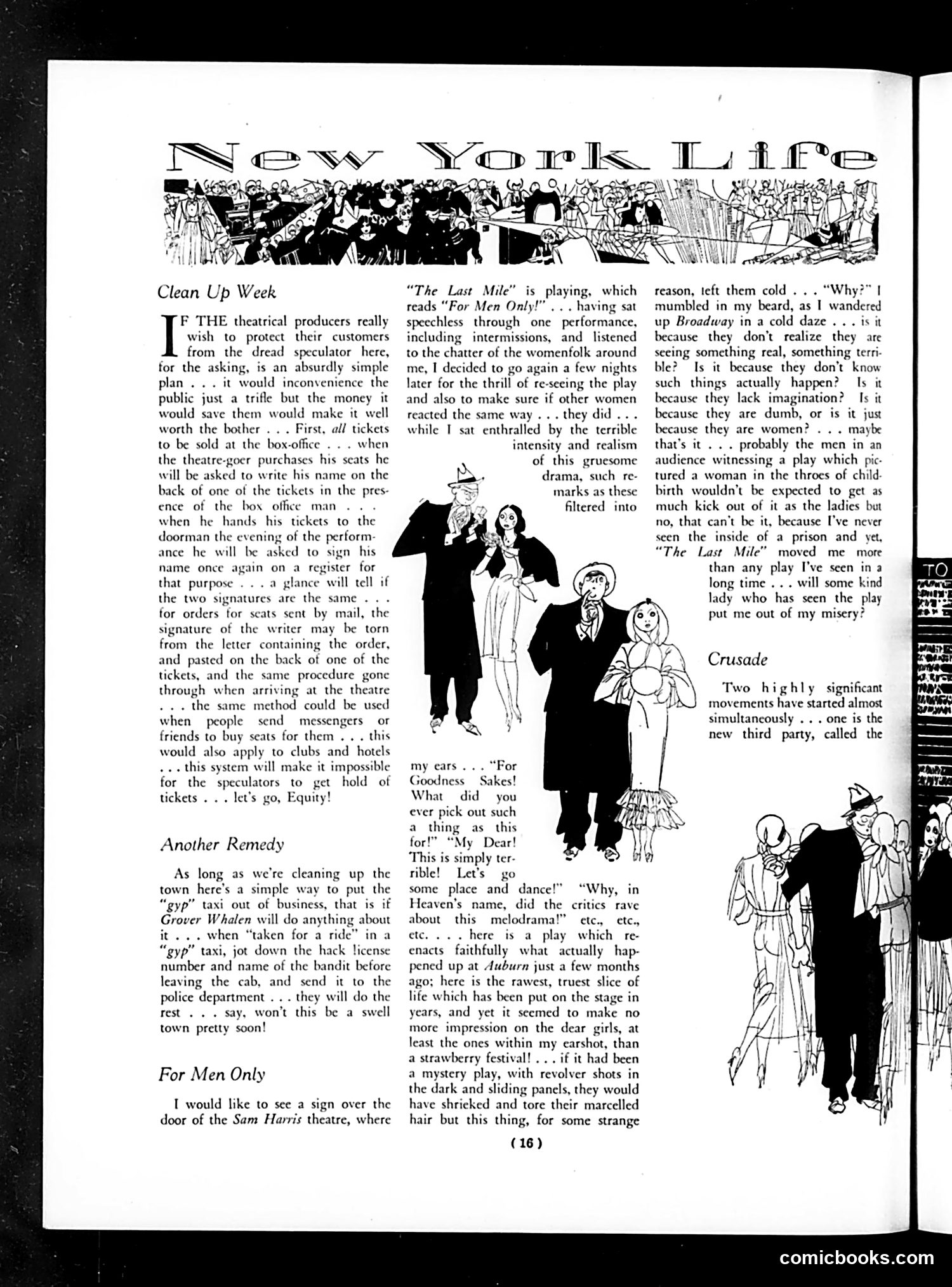
Analysis of "New York Life" Page This page from *Life* magazine contains three satirical opinion pieces about theater and urban life, accompanied by illustrative drawings rather than political cartoons. "Clean Up Week" mocks theatrical producers' ticket-selling schemes, suggesting they use dubious methods (having patrons sign registers multiple times) to prevent ticket speculation and protect profits. "Another Remedy" proposes eliminating unlicensed "gypsy" taxi cabs through a police system involving jotted license numbers. "For Men Only" and "Crusade" discuss theater criticism—particularly praising "The Last Mile" as an intense, realistic drama about prison life that moved the author more than typical melodramas, while critiquing critics' reactions to other plays. The pieces reflect urban concerns of their era: consumer fraud, taxi regulation, and theatrical standards.
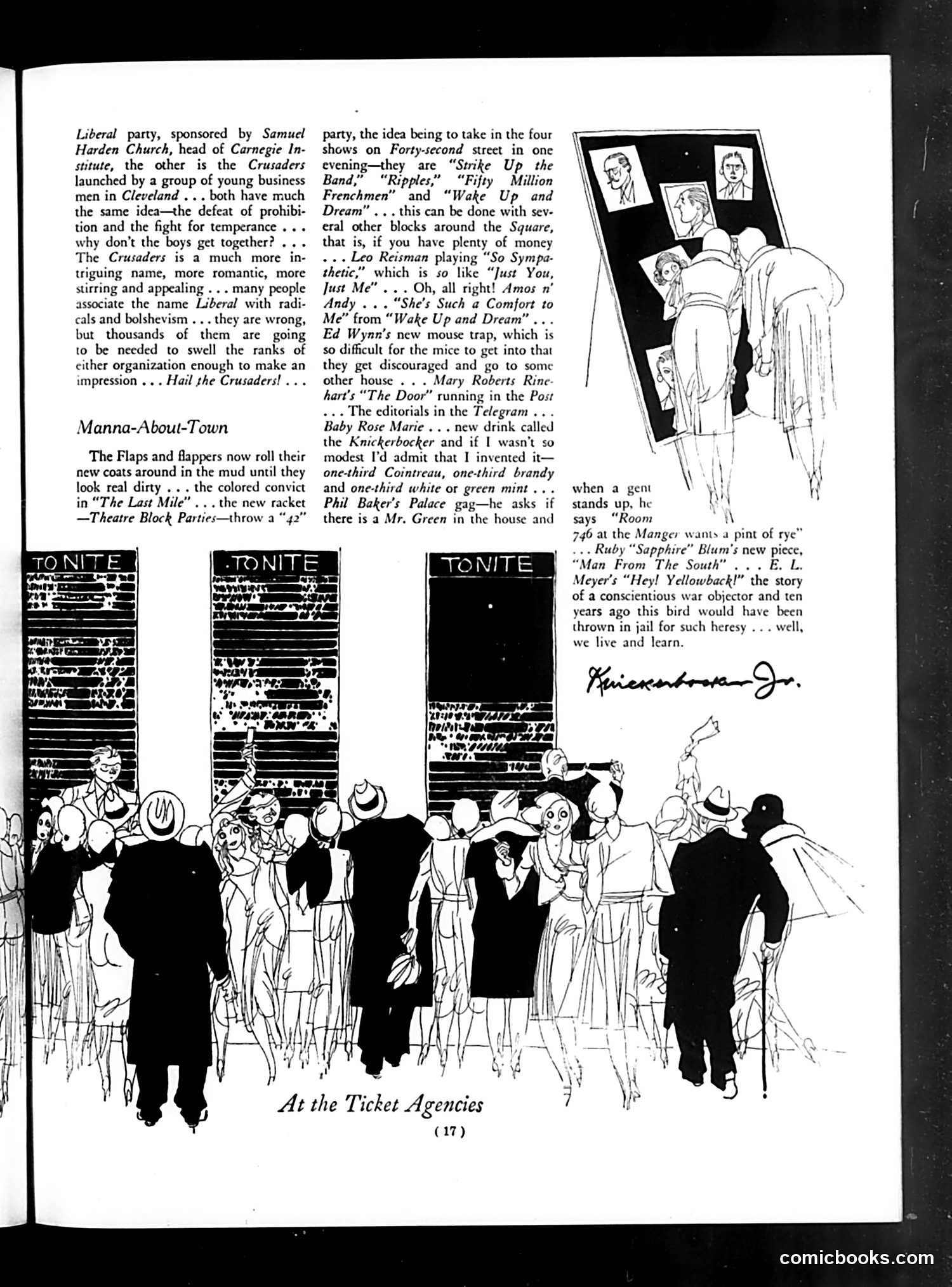
Analysis of Life Magazine Page This page discusses Broadway theatrical offerings and entertainment venues. The main illustration, captioned "At the Ticket Agencies," depicts crowds of people queuing at theater ticket windows marked "TONITE" (Tonight). The text above discusses several shows, including "Wake Up and Dream," "The Last Mile," and references to performances by actors like Leo Reisman and Mary Roberts Rinehart. There's mention of a drink called "Knickerbocker" and various theatrical productions. The satire appears to target the popularity of Broadway entertainment—the crowded ticket agencies suggest high demand for shows. The illustration's style humorously exaggerates the masses seeking tickets, implying both the entertainment industry's appeal and perhaps the somewhat frenzied nature of New York theater-going culture during this period. The page is signed by what appears to be the cartoonist/illustrator, suggesting professional commentary on contemporary entertainment trends.
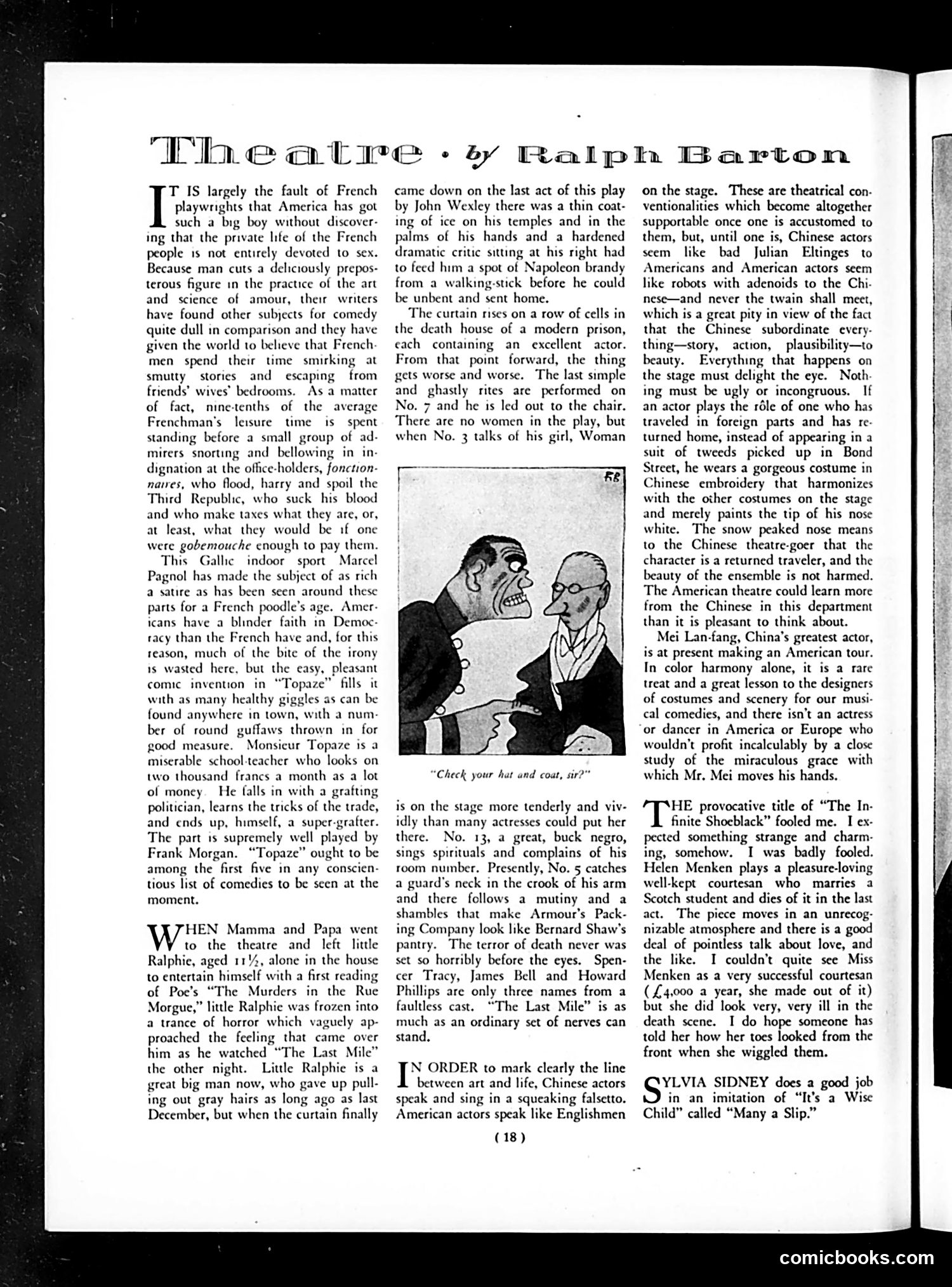
Theatre Review Analysis This is Ralph Barton's theatre review column critiquing contemporary plays. The accompanying illustration shows two exaggerated male faces in conversation with the caption "Check your hat and coat, sir?"—likely mocking theatrical conventions or audience behavior. Barton discusses several Broadway productions, including plays with titles like "Topaze," "The Murders in the Rue Morgue," and "The Infinite Shoeblack." He praises Chinese theatre performer Mei Lan-lang's grace and criticizes American theatre's artificiality by comparison. The review also mentions actor Frank Morgan's performance and critiques the quality of various shows, particularly their reliance on crude comedy ("healthy giggles") rather than sophisticated satire. Barton appears to be advocating for more refined theatrical standards in American drama.
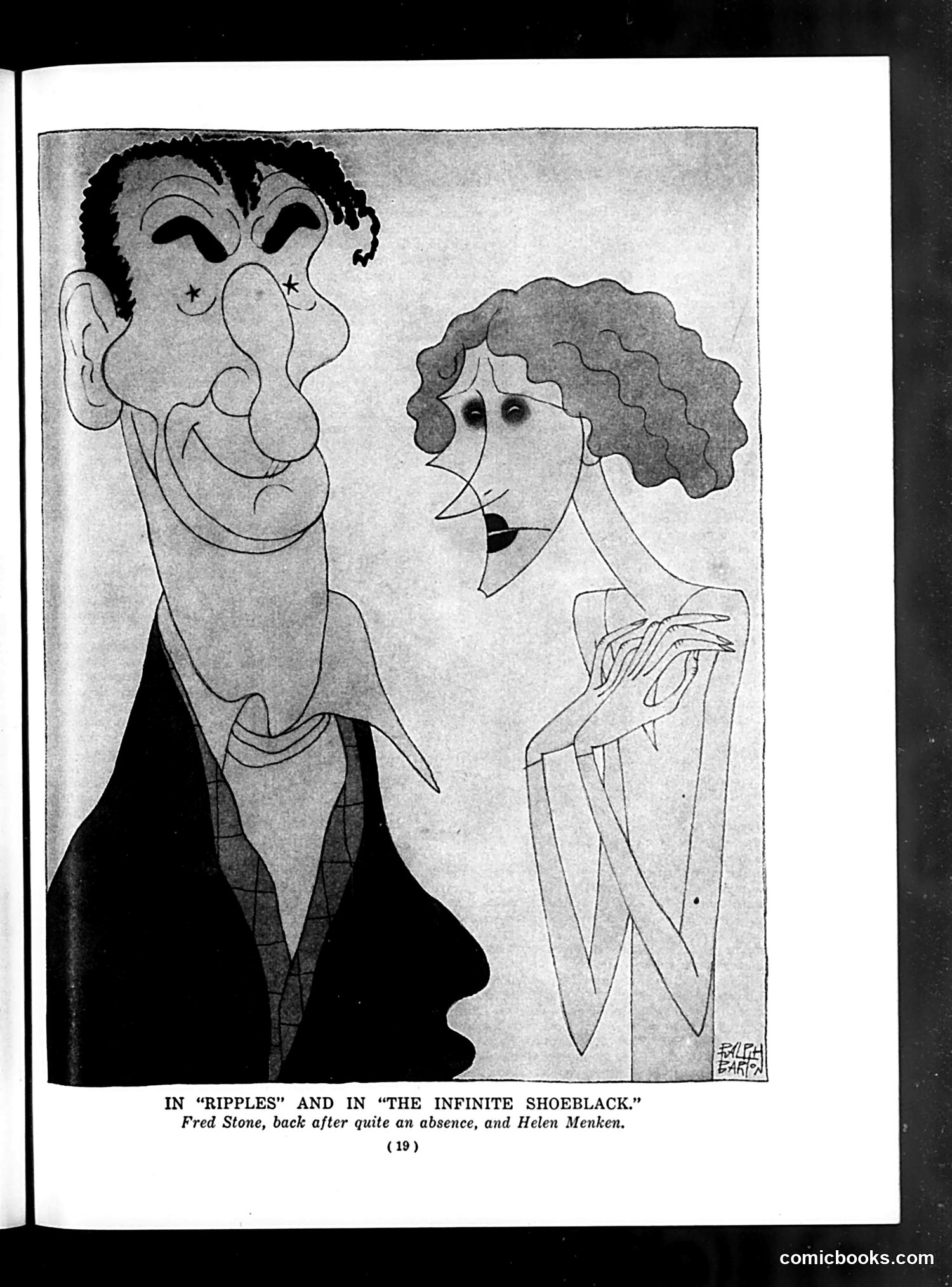
Analysis This page features a caricature illustration accompanying theater reviews. The caption identifies the subjects as Fred Stone and Helen Menken, appearing in the productions "Ripples" and "The Infinite Shoeblack." The exaggerated caricature style is typical of Life magazine's theatrical commentary—the male figure (Stone) displays grotesquely bulbous features while the female figure (Menken) is drawn more conventionally. This was standard satirical practice in early 20th-century entertainment journalism. The "shoeblack" reference likely alludes to a character type or comedic role in one of these productions. The cartoon serves as a humorous preview or review of these theatrical offerings, using visual exaggeration to entertain readers familiar with these performers and their current stage work.
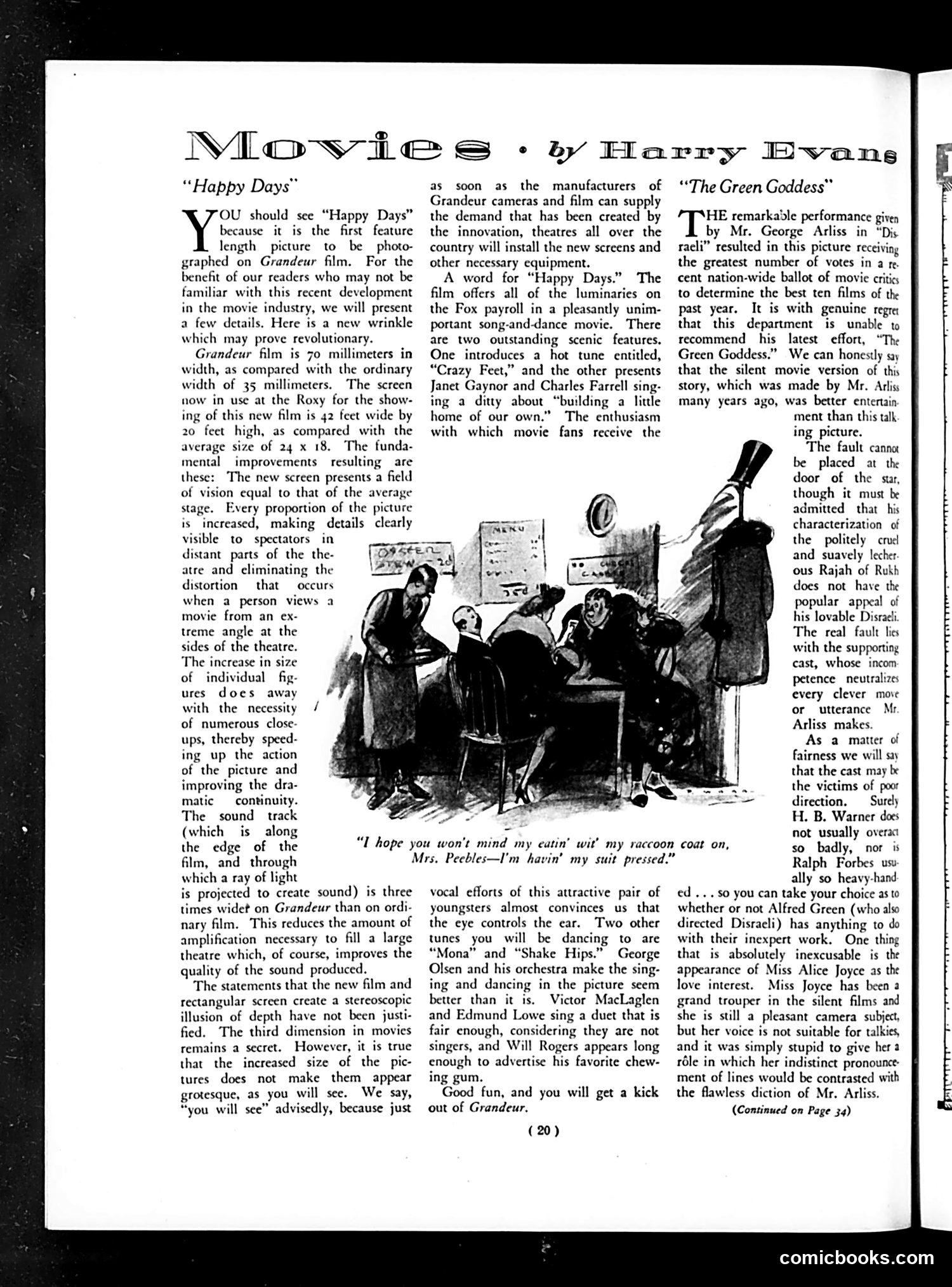
Movie Reviews from Life Magazine This page reviews two films using Harry Evans's critical eye. The main illustration depicts a scene from "Happy Days," showing elegantly dressed patrons at what appears to be a theater or social venue. The caption's humor relies on 1920s class humor: a wealthy man in a raccoon coat (a status symbol of the era's nouveaux riches) casually eats while his suit is being pressed—a detail that would have amused readers familiar with the affectations of newly moneyed people trying to display sophistication. The reviews themselves discuss Fox's new "Grandeur" wide-screen film technology (70mm versus standard 35mm), treating it as genuinely revolutionary. "Happy Days" earns cautious praise as entertainment, while "The Green Goddess" disappoints Evans, who preferred George Arliss's earlier silent version of the story. The tone is urbane and somewhat dismissive of popular taste, typical of Life's satirical approach to mass culture.
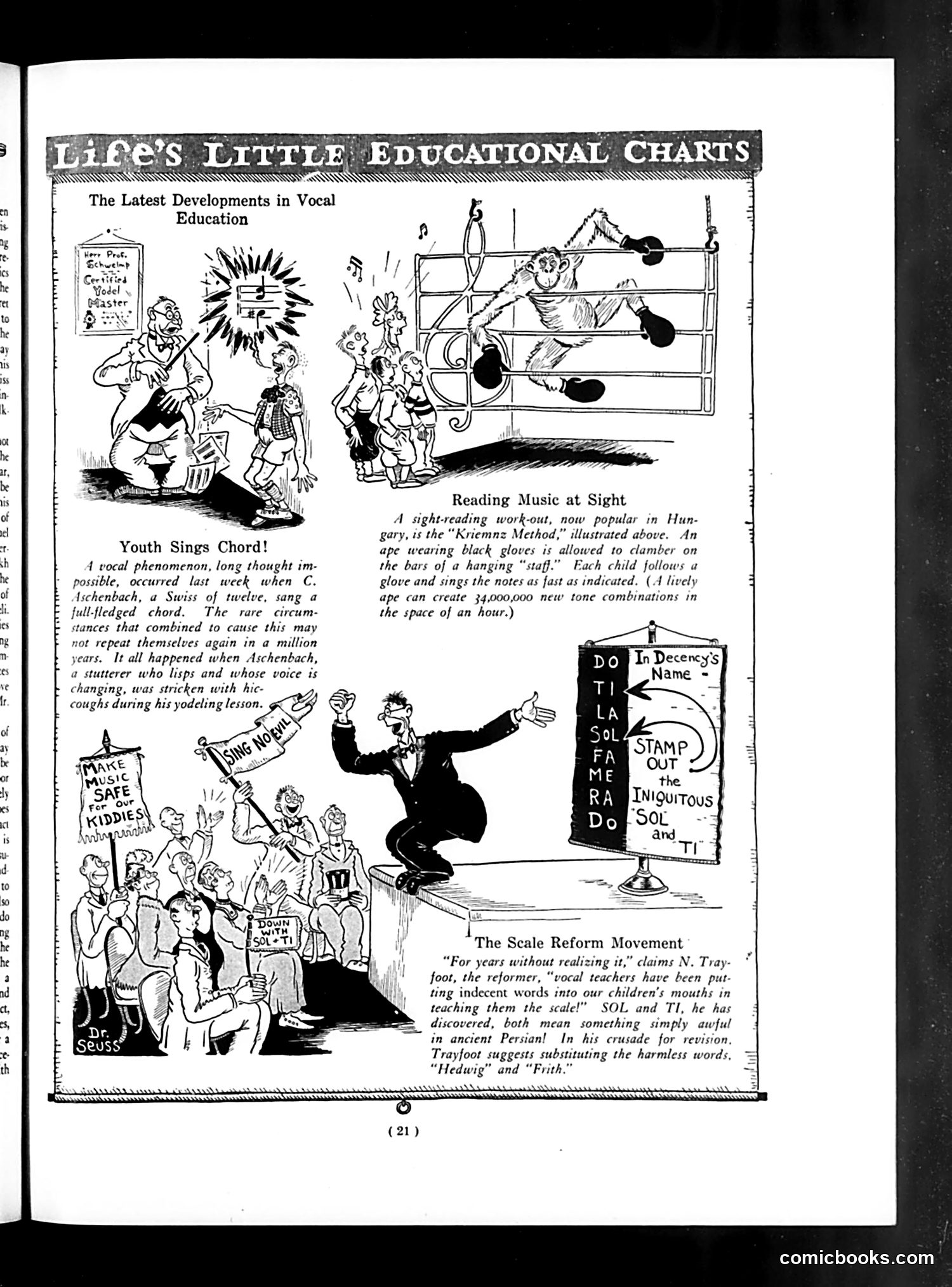
Life Magazine's Vocal Education Satire This page mocks contemporary music education fads and pedagogical pretension through three absurdist scenarios: "Youth Sings Chord" ridicules claims of miraculous musical breakthroughs by describing an implausible accident where a stuttering, lisping boy produces a chord during hiccoughs—a one-in-a-million fluke presented as educational progress. "The Kriemnz Method" satirizes the Hungarian "modern" approach of having children sight-read notes by following an ape's movements on a musical staff. The implication is that this supposedly innovative technique is literally animal-level instruction, yet it's treated as serious pedagogy. "The Scale Reform Movement" ridicules linguistic overcorrection: a reformer discovers that musical notes SOL and TI allegedly mean "indecent" things in Persian, so he proposes replacing them with "Hedwig" and "Frith"—a laughable solution to a non-existent problem. The cartoons mock educational faddism, false expertise, and the pretentious repackaging of dubious methods as scientific progress.
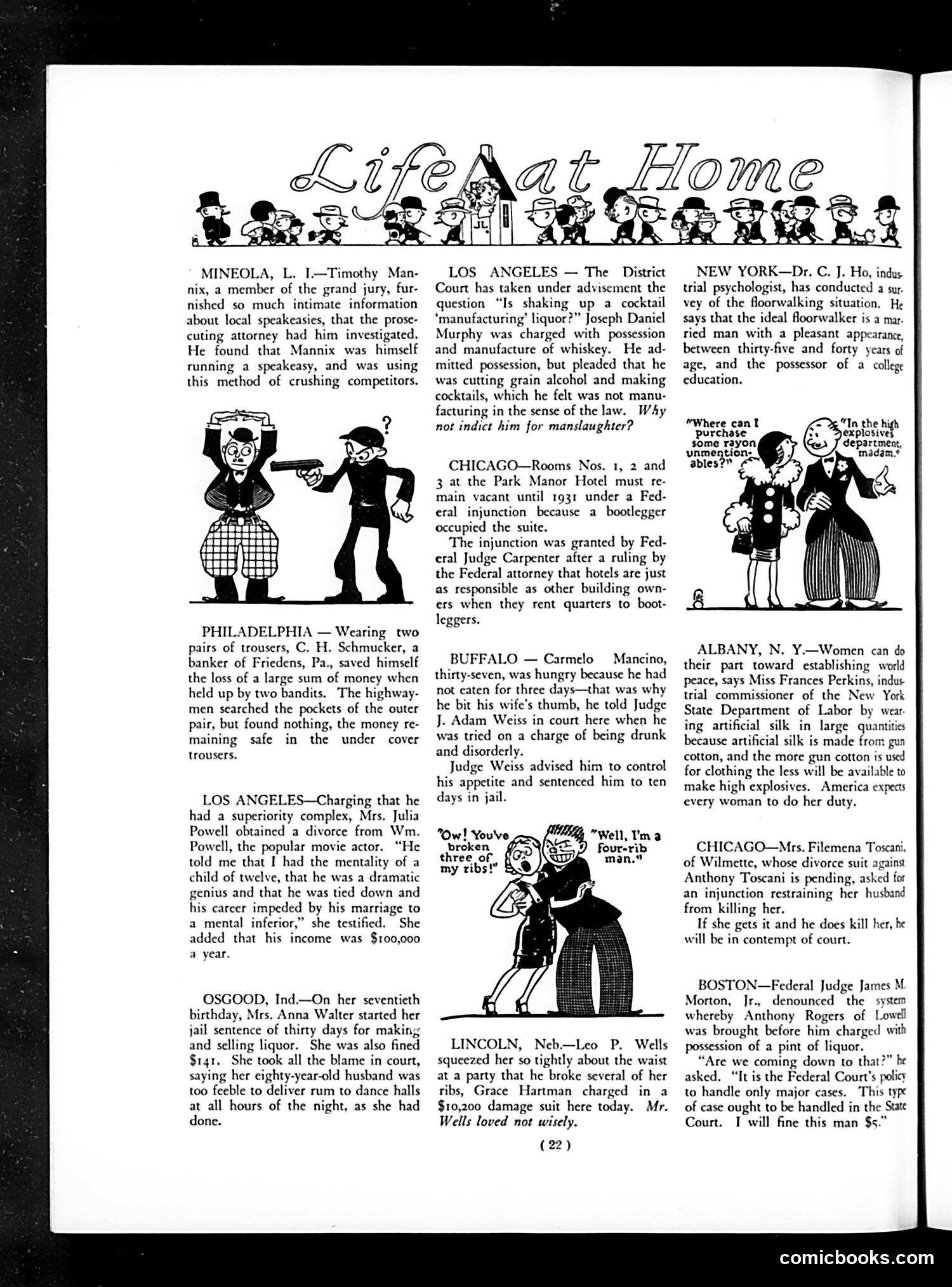
Understanding This Page from Life Magazine (Prohibition Era) This is a "Life at Home" humor column from the Prohibition era (1920s-early 1930s), presenting absurd legal cases as social satire. The page mocks the chaos created by Prohibition alcohol laws. Key targets: - Hypocrisy: A grand juror running his own speakeasy while exposing competitors - Prohibition's absurdities: Legal debates over whether mixing cocktails counts as "manufacturing" liquor; hotel owners held responsible for bootlegger tenants; the argument over trousers hiding contraband money - Domestic dysfunction: A woman serving jail time for her husband's bootlegging; a divorce citing "superiority complex"; an injunction preventing someone from killing their spouse The cartoons show exaggerated domestic and criminal figures, reinforcing the comic tone. The satire's message: Prohibition created farcical situations where enforcement was inconsistent, the law seemed ridiculous, and ordinary people engaged in petty crimes with absurd consequences.
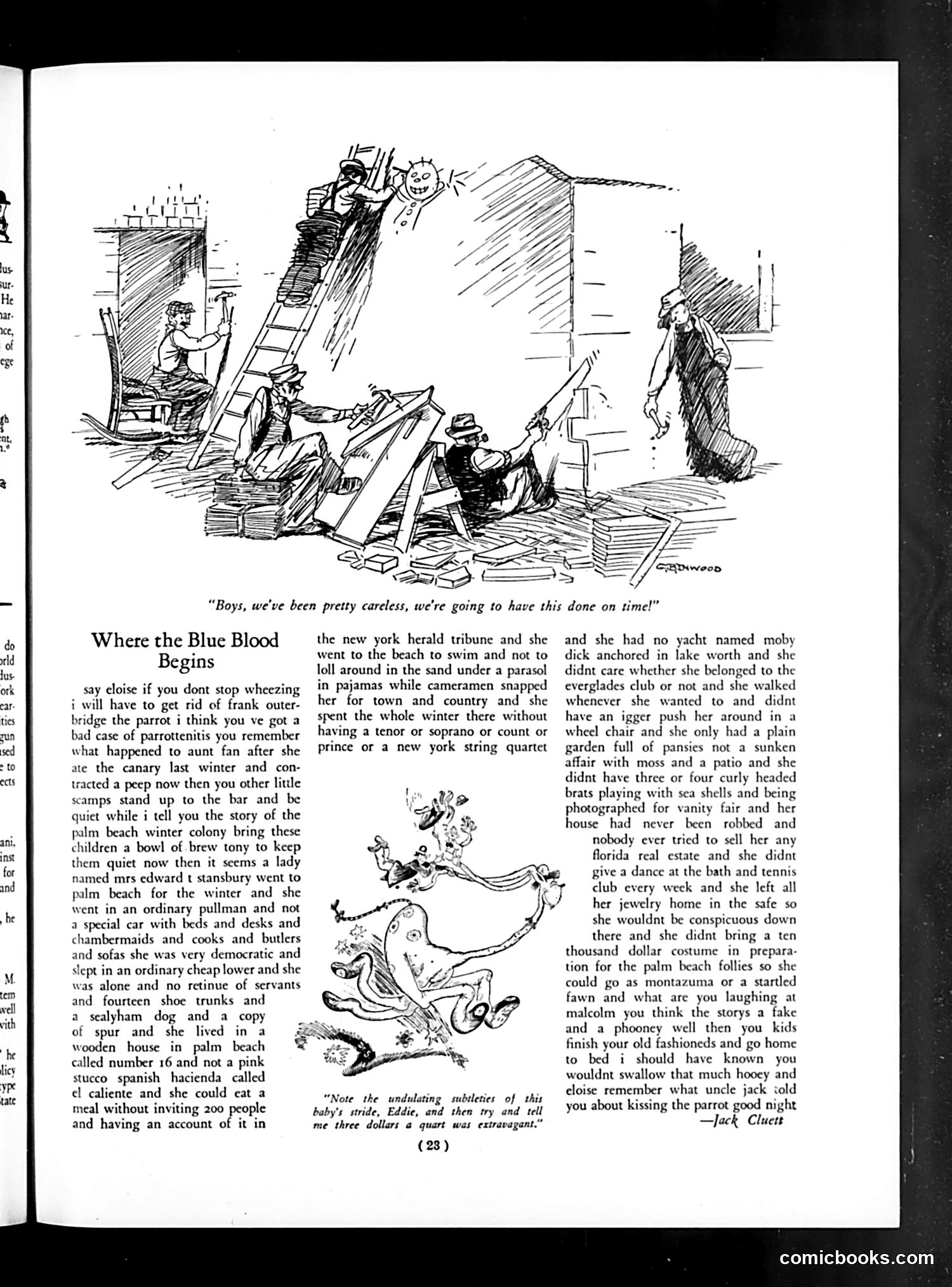
"Where the Blue Blood Begins" This satirical piece mocks the pretensions of wealthy Palm Beach society during the Jazz Age. The setup (top cartoon) shows workers being rushed to complete construction, with the caption humorously suggesting they'll "have this done on time"—likely referencing the frantic pace of building in the booming Florida resort. The main story is a tongue-in-cheek narrative about Mrs. Edward T. Stansbury, a wealthy woman who scandalized Palm Beach by *not* performing expected luxury behaviors: she traveled by ordinary Pullman, lived in a modest wooden house (#16), swam rather than posed for photographers, and didn't host constant parties or flaunt jewelry. The satire targets the artificial conspicuousness of the wealthy elite—their need to be photographed, their yacht ownership, their exclusive club memberships, their expensive costumes for charity events. The narrator sarcastically presents her restraint as so implausible that even children won't believe it, exposing how absurdly performative and wasteful high society had become.
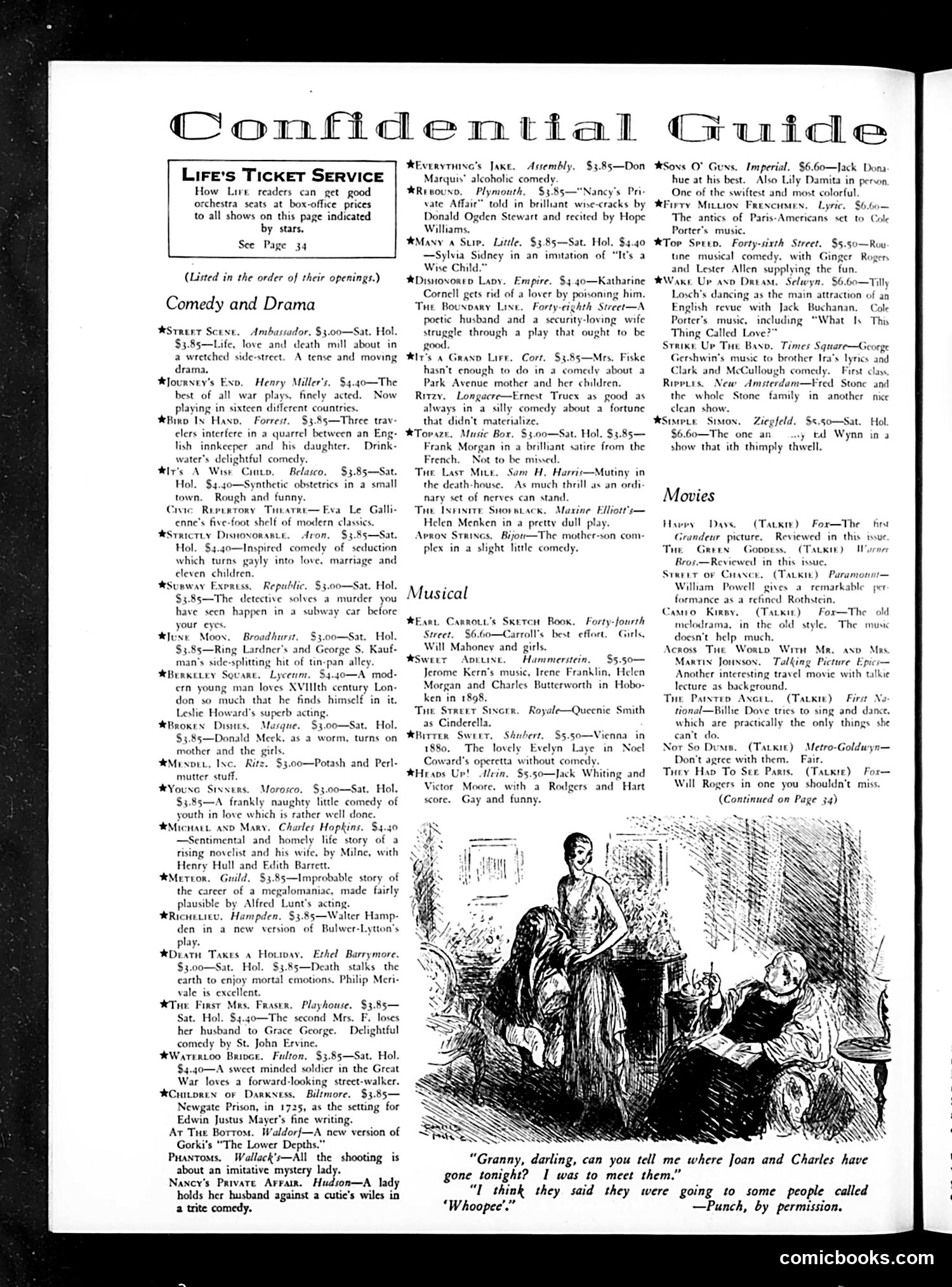
Analysis of Life Magazine Page This page is primarily a theater listing and review guide for Broadway shows, not a political cartoon. The "Confidential Guide" heading frames it as Life magazine's curated recommendations for theatergoers seeking good orchestra seats at standard box-office prices. The content includes brief, often sarcastic plot summaries and cast notes for approximately 30 plays and musicals—comedies, dramas, and musicals ranging from serious war plays (*Journey's End*) to light comedies (*It's a Wise Child*). The single cartoon at bottom depicts a grandmother asking a child where "Joan and Charles" have gone, with the child replying they went to "some people called 'Whoopee'"—a joke referencing the popular musical *Whoopee* listed above, playing on the phrase's double meaning (both the show title and an exclamation of fun). The page's function is entertainment guidance rather than satire—it's a service feature helping readers navigate 1920s New York theater.
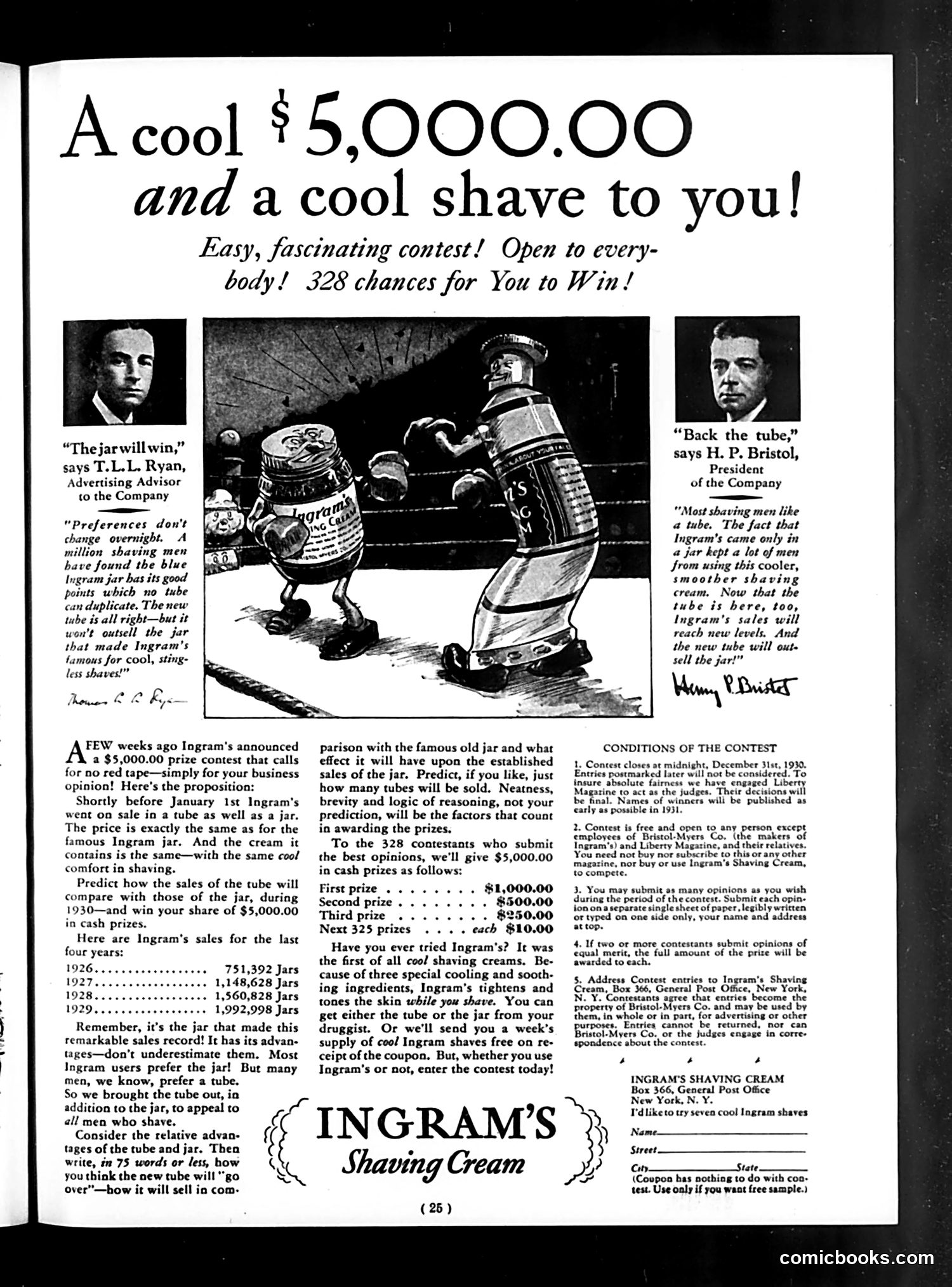
Ingram's Shaving Cream Contest Advertisement This is primarily a product advertisement, not political satire. Ingram's, a shaving cream manufacturer, is announcing a $5,000 prize contest asking consumers to predict whether their newly-introduced tube packaging will outsell their traditional jar. The page features testimonials from company executives (T.L.L. Ryan and H.P. Bristol) taking opposite positions—one backing the jar's established success, the other predicting the tube will dominate. This reflects a genuine 1930 business question: whether modern tube packaging would displace the familiar jar format. The cartoon imagery (anthropomorphized jars/tubes) humorously illustrates this product competition. Sales figures (showing dramatic jar growth 1926-1929) support the jar's track record, yet the contest invites public prediction on the tube's future performance. This represents early consumer marketing strategy—leveraging customer opinions while generating contest participation and brand engagement.
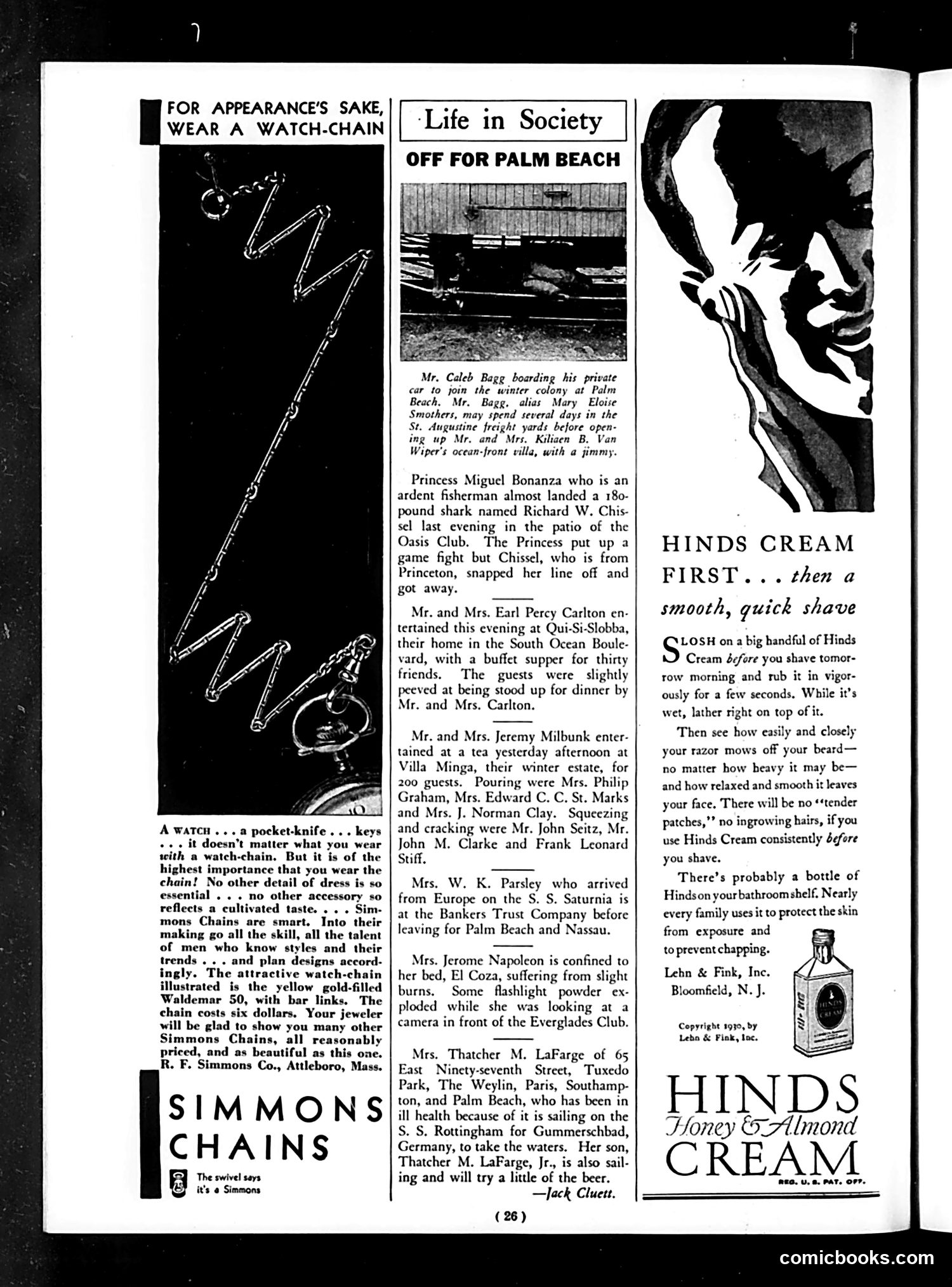
"Life in Society: Off for Palm Beach" This satirical society column mocks the wealthy elite vacationing in Palm Beach during the Jazz Age. The humor lies in thinly veiled innuendo about the column's subjects—using false names that suggest their true identities while describing scandalous behavior. Key jokes include: "Mr. Caleb Bagg" (apparently someone's alias) boarding a private railcar, with a note that he may need to break into ("open up with a jimmy") a villa before the owners arrive; "Princess Miguel Bonanza" fishing for a man ("Richard W. Chissel") who gets away; guests being "stood up for dinner"; and Mrs. LaFarge's extensive list of residences, satirizing the wealthy's transient lifestyle. The column presents gossip as society news, using coded language and absurd names to suggest infidelity, theft, and general moral looseness among the rich—standard satire of privileged excess during this period.
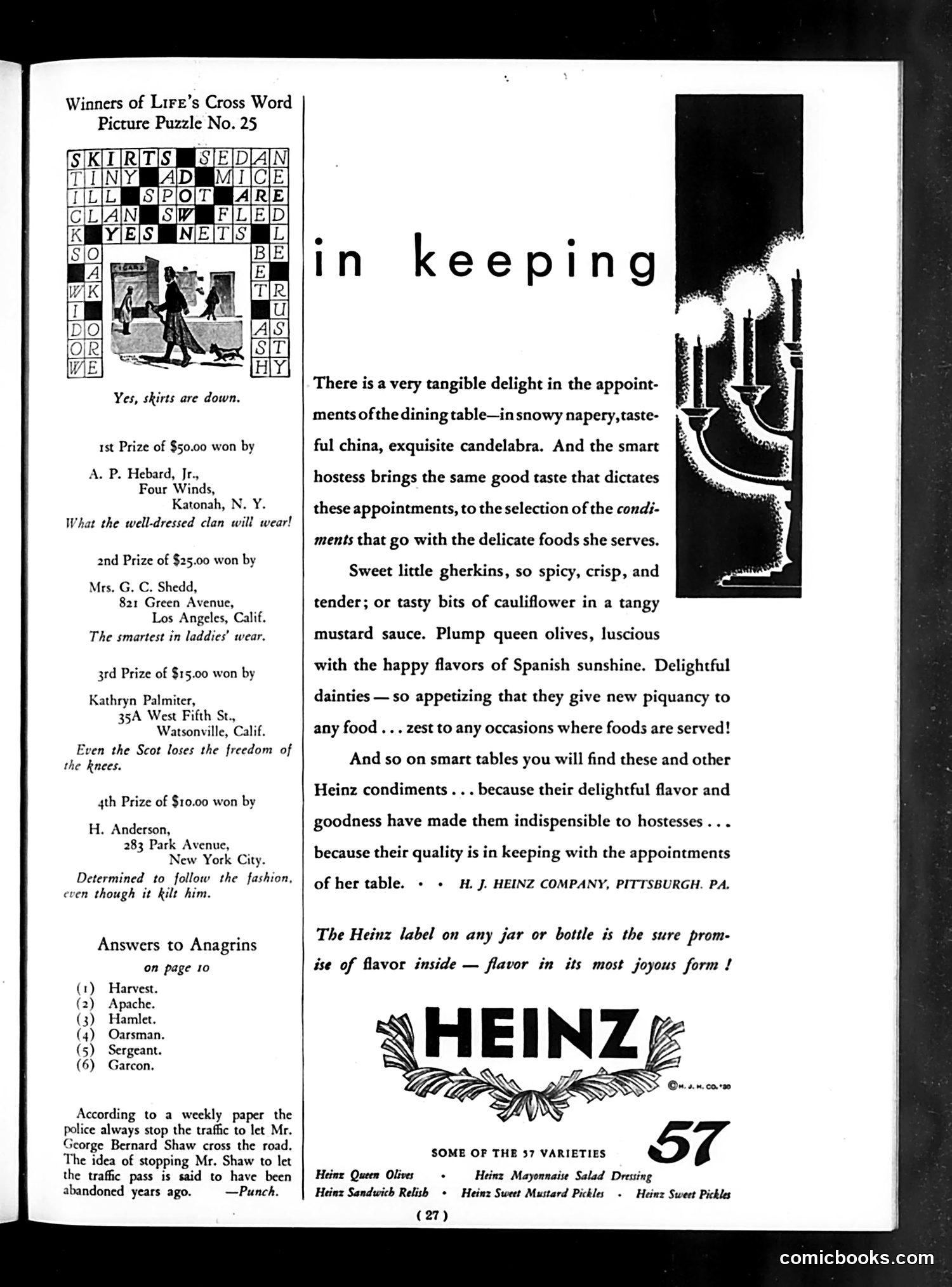
Life Magazine Page Analysis This page combines puzzle winners with a Heinz condiments advertisement. The left column announces crossword puzzle contest winners, with humorous commentary on each prize winner's fashion choices—specifically the contemporary trend of longer skirts ("skirts are down"). The jokes reference how this fashion change affects different groups: wealthy society women, children's clothing, and Scottish men who traditionally wear kilts. A brief satirical note about playwright George Bernard Shaw jokes that police stopped traffic for him so regularly they eventually abandoned the practice—a jab at his celebrity status and the absurdity of such deference. The right side is a full-page Heinz advertisement emphasizing refined table settings and condiments as markers of good taste and hospitality. The elegant illustration of a candelabra reinforces this messaging of sophistication. The ad targets hostesses concerned with maintaining proper standards for entertaining—typical 1920s marketing to women managing households.
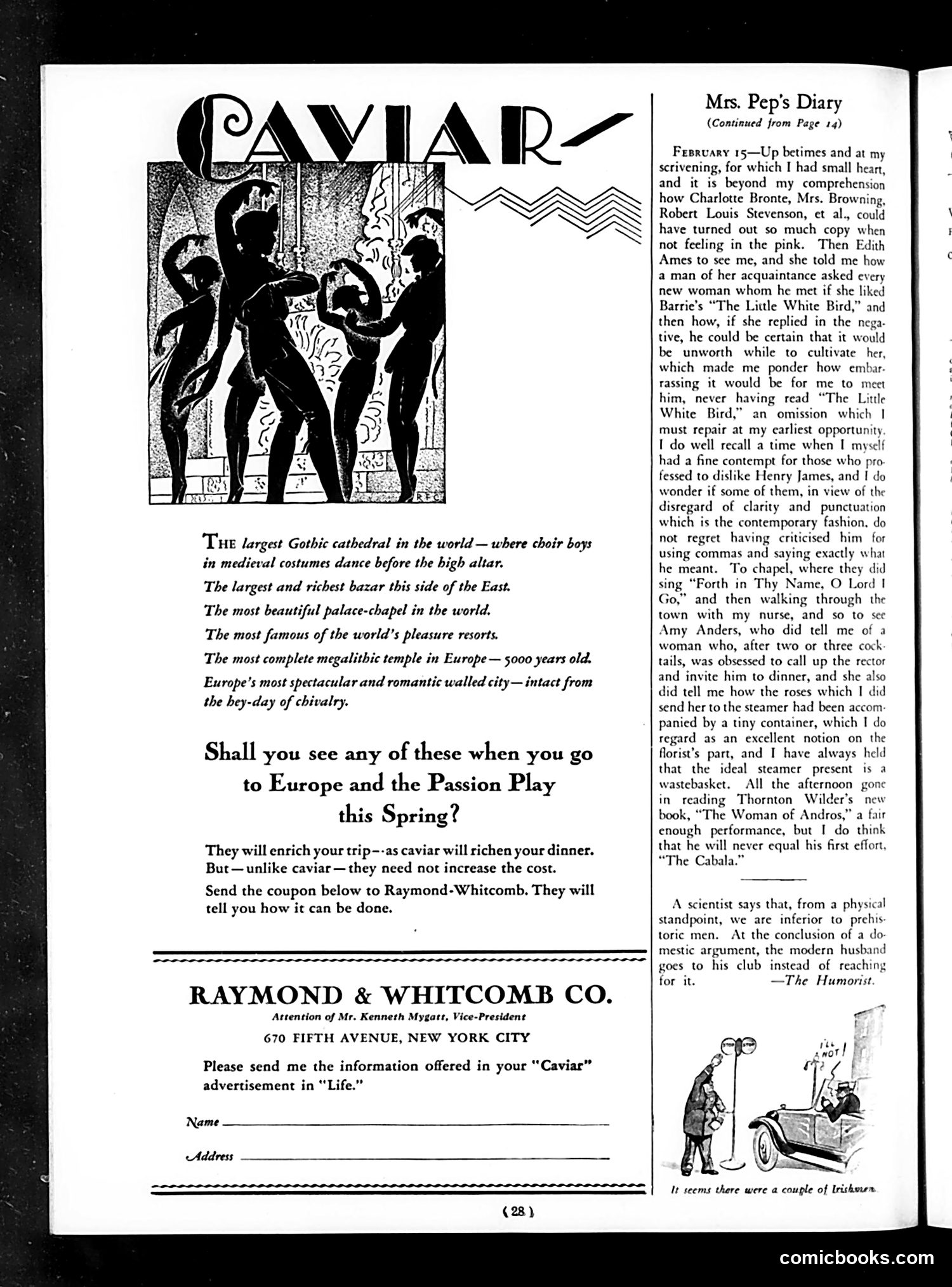
Analysis of Life Magazine Page Content This page combines a travel advertisement with society humor and literary commentary. The Main Advertisement (left side): Raymond & Whitcomb travel company promotes European tours, including the Passion Play. The caviar woodcut illustration depicts nude figures in an ornate setting, using luxury goods as a metaphor—the copy promises that European attractions will "enrich your trip" like caviar enriches dinner, but "need not increase the cost." Mrs. Pep's Diary (right side): A gossipy society column satirizing literary pretension. It mocks a man who judges women by whether they've read J.M. Barrie's "The Little White Bird," and self-deprecatingly notes the writer's own omission of reading it. The piece also gently criticizes earlier literary snobbism about Henry James while reviewing Thornton Wilder's "The Woman of Andros." The Bottom Cartoon: A brief humorous item about an Irish couple in an automobile suggests domestic conflict resolved through the husband escaping to his club rather than domestic confrontation. The page reflects 1920s American upper-class concerns: travel, literary sophistication, and gender dynamics.
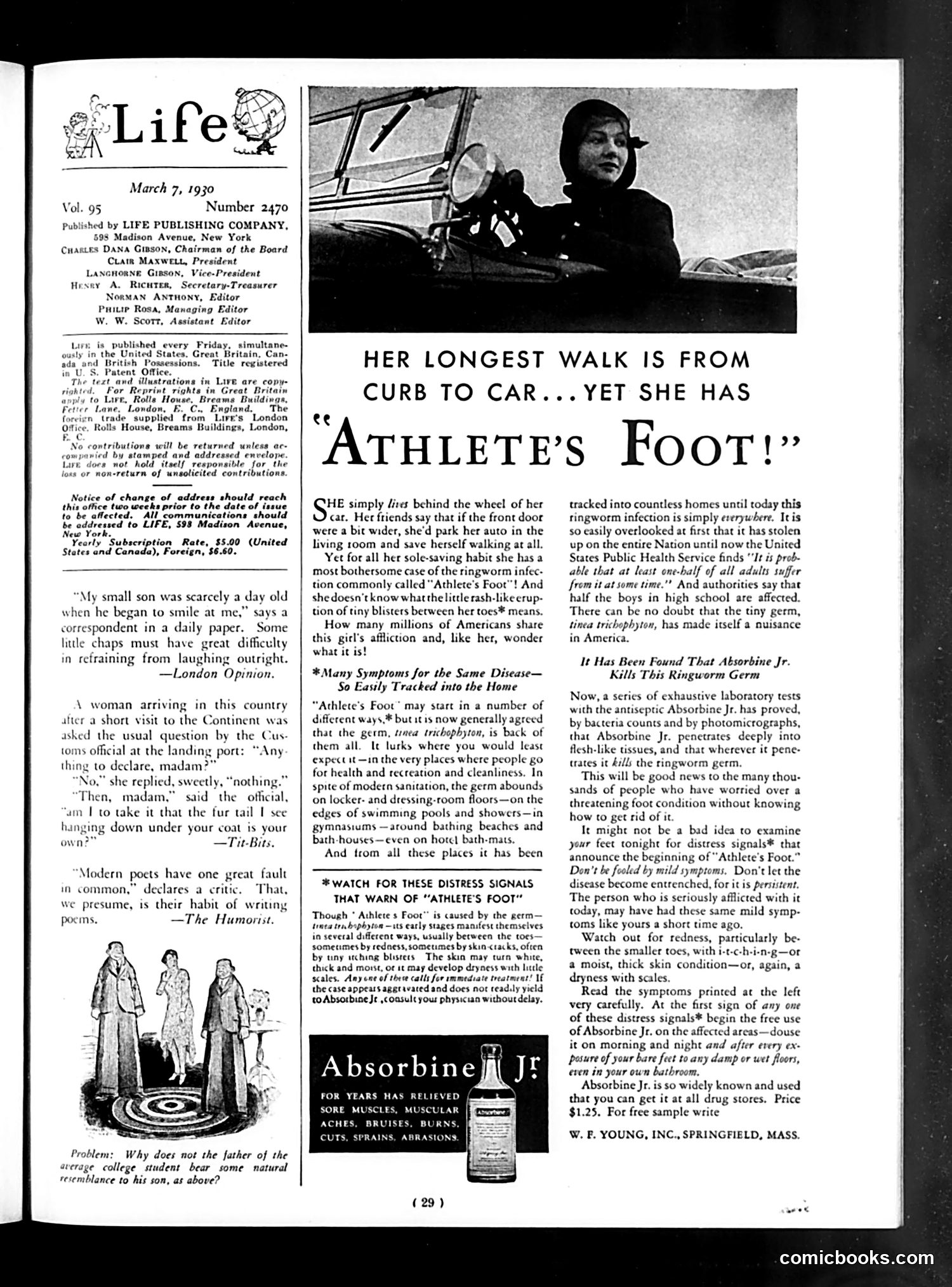
Life Magazine, March 7, 1930: "Athlete's Foot" Advertisement This page is primarily a medical advertisement for Absorbine Jr., a patent medicine treatment for ringworm infection ("Athlete's Foot"). The main article satirizes the irony of modern sedentary life: a wealthy woman who barely walks (driving everywhere, her friends joke she'd park in her living room) yet suffers from this fungal infection commonly associated with athletes and active people. The piece explains that despite modern sanitation, the tinea trichophyton germ thrives in public bathing areas, pools, gymnasiums, and hotel bathrooms—places even inactive people encounter. It lists "distress signals" (redness, blisters, white patches) to watch for and promotes the advertised remedy. The page includes unrelated humor items (London Opinion jokes about infants and customs declarations) typical of Life's satirical format. This reflects 1930s concerns about hygiene and fungal infections while marketing a commercial solution to anxious readers.
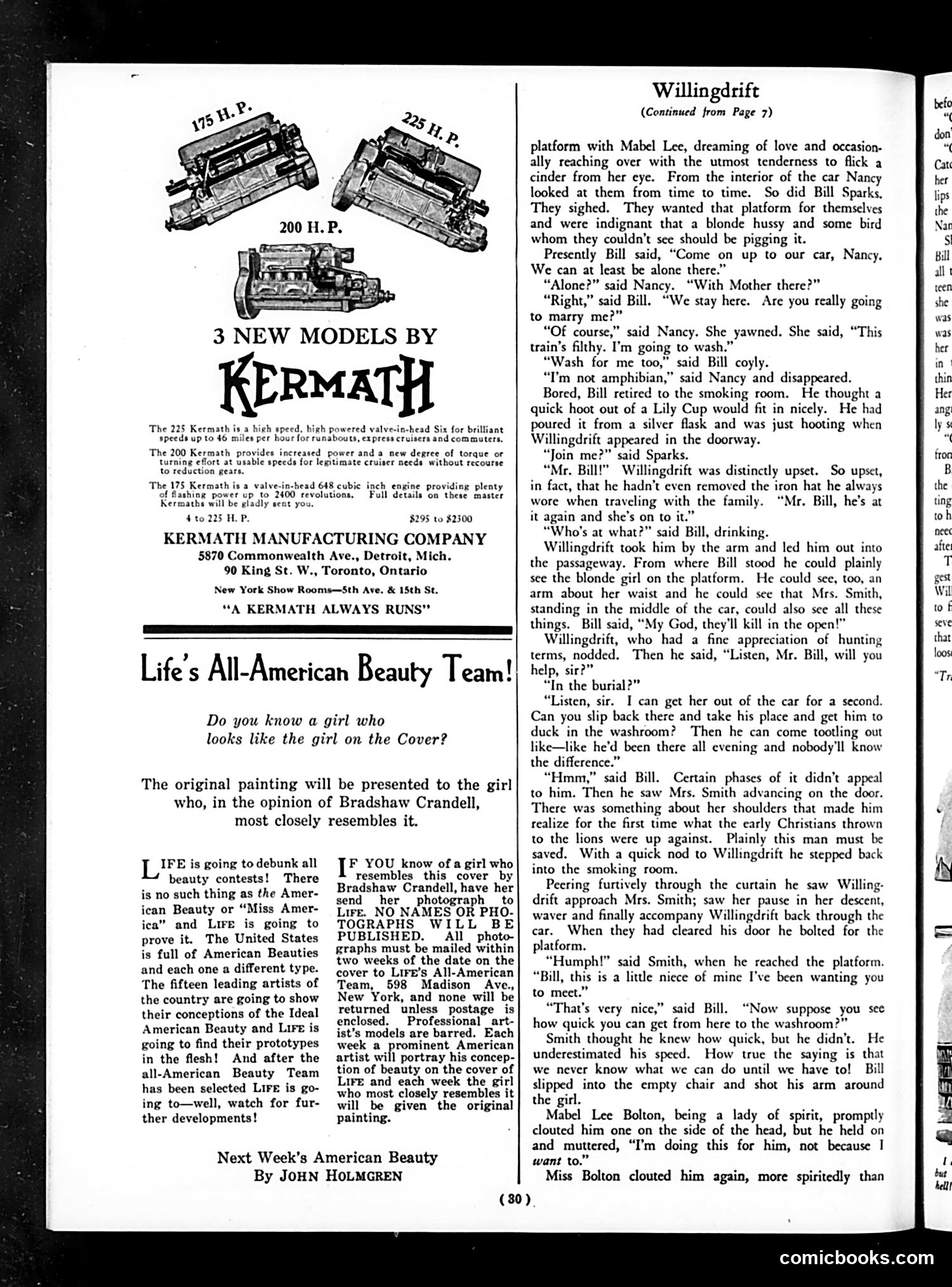
Analysis for Modern Readers This page contains two distinct sections: a Kermath boat engine advertisement and the continuation of a serialized story titled "Willingdrift." The Advertisement (Top Left): Shows three marine engine models with increasing horsepower, marketing them as reliable for pleasure cruisers and commercial vessels—typical 1920s-30s advertising. "Life's All-American Beauty Team" (Center/Left): This announces Life magazine's satirical campaign *debunking* beauty pageants. The magazine claims there's no single "American Beauty"—the country has many types of beauties. They're soliciting photographs from readers whose appearance matches cover artwork by artist Bradshaw Crandell, with the winning "prototype" receiving the original painting. This mocks the era's obsession with standardized beauty contests and ideals. "Willingdrift" (Right): A serialized romantic comedy about train passengers. The excerpt shows romantic entanglement and social comedy—a couple (Bill and Nancy) with Nancy's mother, another couple (Mabel Lee and someone unnamed), and a servant named Willingdrift discovering Bill's infidelity. The page reflects 1920s-30s Life magazine's mix of satire, advertising, and serialized fiction.
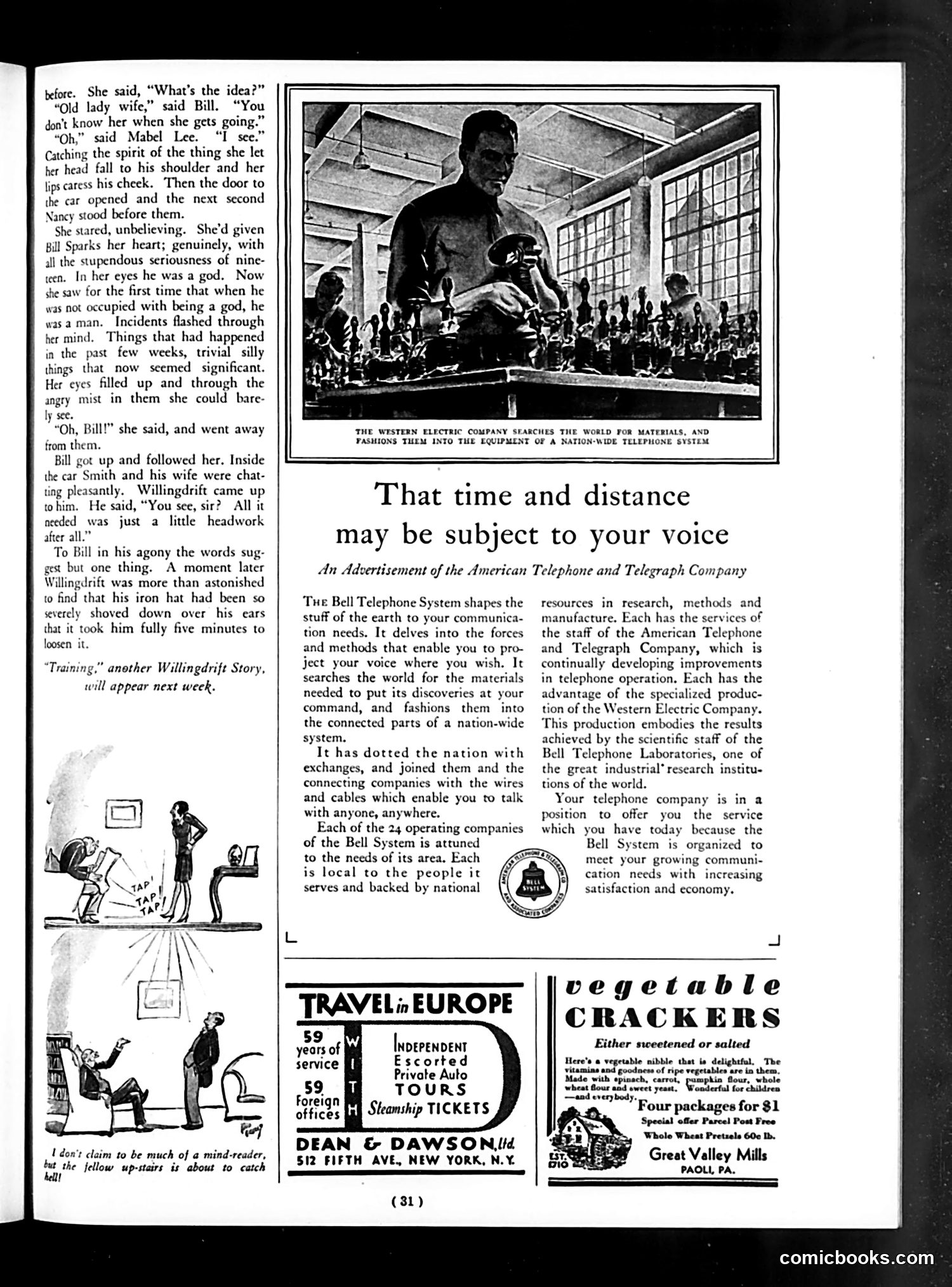
Analysis of Life Magazine Page This page combines a serialized romance story with period advertisements. The main narrative depicts a romantic triangle: Bill Sparks, his young girlfriend Nancy (who views him as godlike), and Mabel Lee. Bill flirts with Mabel to test Nancy's reaction, but Nancy discovers the deception and leaves heartbroken. Bill pursues her, while a character named Willingdrift—apparently offering relationship advice—gets his hat violently shoved down by the enraged Bill. The humor relies on early-20th-century gender dynamics: the young woman's naive devotion, masculine competitiveness, and physical comedy as emotional outlet. The advertisements reflect 1920s consumer culture: Bell Telephone's corporate pride in nationwide infrastructure, travel services, and health-conscious "vegetable crackers" marketed to families. The Western Electric Company image shows industrial manufacturing scale—emphasizing modern technological progress.
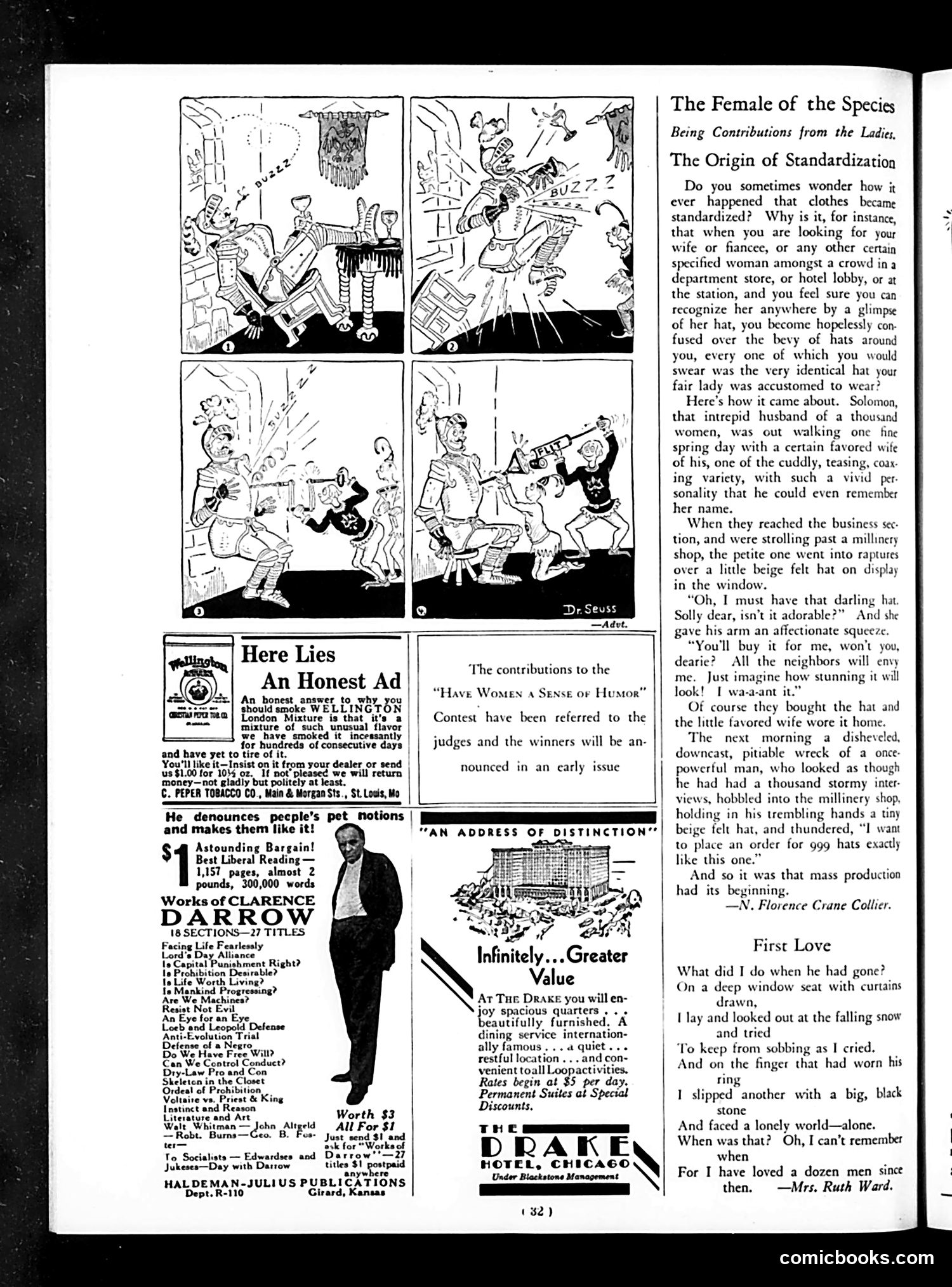
Political Context and Satire Analysis This page from *Life* magazine presents satirical commentary on 1920s American culture, organized around "The Female of the Species" theme. The Main Cartoon (top four panels by Dr. Seuss) depicts domestic chaos—a husband appears overwhelmed by his wife's demanding behavior and fashion obsessions, illustrated through exaggerated, energetic line-work characteristic of Seuss's style. "The Origin of Standardization" essay satirizes how women's fashion became homogenized. It humorously attributes mass-produced hats to Solomon's solution: after his wife demands an identical beige hat, he orders 999 more to avoid future confusion. The piece mocks both female consumerism and marital dynamics—depicting wives as materialistic and husbands as hapless providers. Advertisements for tobacco, books (Clarence Darrow's collected works), and hotels fill the lower half, representing typical *Life* magazine monetization. "First Love" (bottom right) is a sentimental poem about lost romance, providing tonal contrast to the satirical content above. The page reflects 1920s anxieties about standardization, consumer culture, and evolving gender roles in post-war America.
Analysis: "The Masculine Credo II" This satirical piece mocks conventional 1930s male attitudes toward women by listing them as absurd "credos." The central column presents deliberately contradictory standards: a man's stubbornness shows "determination," while a woman's is "pig-headed"; women supposedly can't drive due to nervousness, yet excel in college through manipulating instructors; they lack humor entirely. The humor depends on readers recognizing these as exaggerated but widely-held prejudices of the era. The piece attacks the double standards and logical inconsistencies men used to justify women's subordination—particularly relevant as women had only recently gained voting rights (1920). Surrounding content includes humorous "quotations" mocking marriage and romantic ideals (a parody of Omar Khayyam ends "I could do without / The bread and you!"), reinforcing the satirical theme. The page otherwise contains hotel and product advertisements, typical of Life magazine's revenue model.
Content Analysis: Life Magazine Page (c. 1920s-1930s) This page is primarily advertising and service content, not political satire. The dominant feature is a Lifebuoy Shaving Cream advertisement with a photograph of a man's face emphasizing smooth skin—typical consumer marketing of the era promoting the product's lubricating properties to prevent "tenderface" (razor irritation). The remainder comprises: - A "Confidential Guide" to music records and sheet music (popular songs from films and bands) - A movie review of what appears to be an exotic adventure film involving a British Rajah - Life's Ticket Service: a reader service offering theater ticket purchases for New York shows The only potentially satirical element is the brief quote at page bottom from *Everybody's Weekly* about financial uncertainty—a mild social commentary, not sharp satire. This is essentially a magazine service/advertisement page with light entertainment guidance, reflecting 1920s-30s consumer culture and leisure interests.
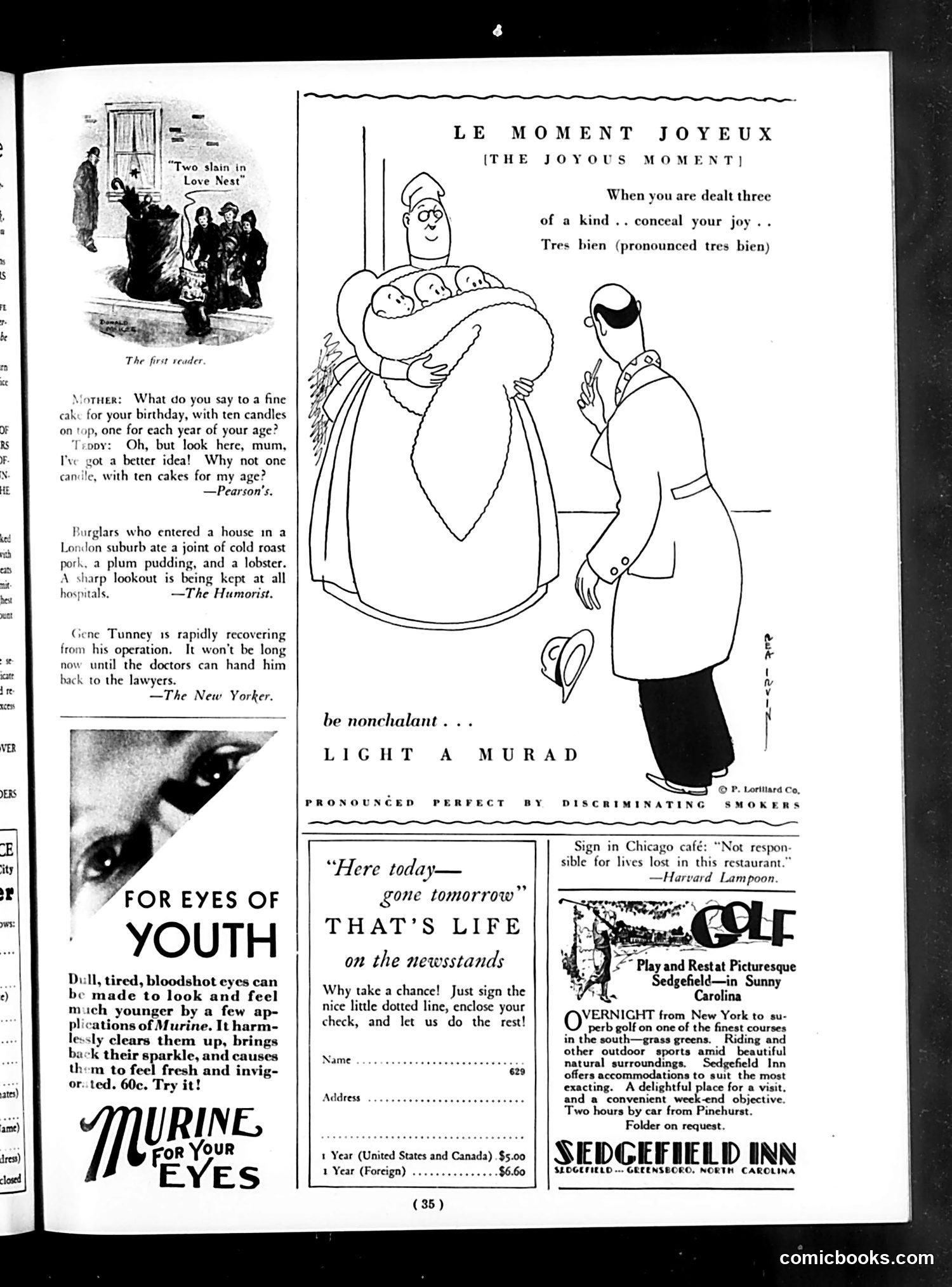
Analysis of Life Magazine Page This page contains several short humorous items typical of 1920s satirical magazines: The cartoons/jokes mock: - Over-literal thinking (a child suggesting ten cakes instead of ten candles for birthdays) - Crime and lawlessness (burglars casually eating stolen food; a restaurant disclaimer about deaths) - Boxer Gene Tunney's legal troubles (a joke suggesting lawyers will soon "claim" him after his medical recovery) The main illustration shows a portly man concealing joy while being dealt cards—accompanying the French phrase "le moment joyeux" (the joyous moment). The joke satirizes maintaining a poker face: when winning at cards, one must hide excitement to avoid appearing foolish. The advertisements for Murine eye drops and Murad cigarettes, plus the Sedgefield Inn resort, reflect 1920s consumer culture. The page reflects post-WWI American humor: cynical about crime, legal systems, and human nature, with an emphasis on witty one-liners and social observation rather than political commentary.
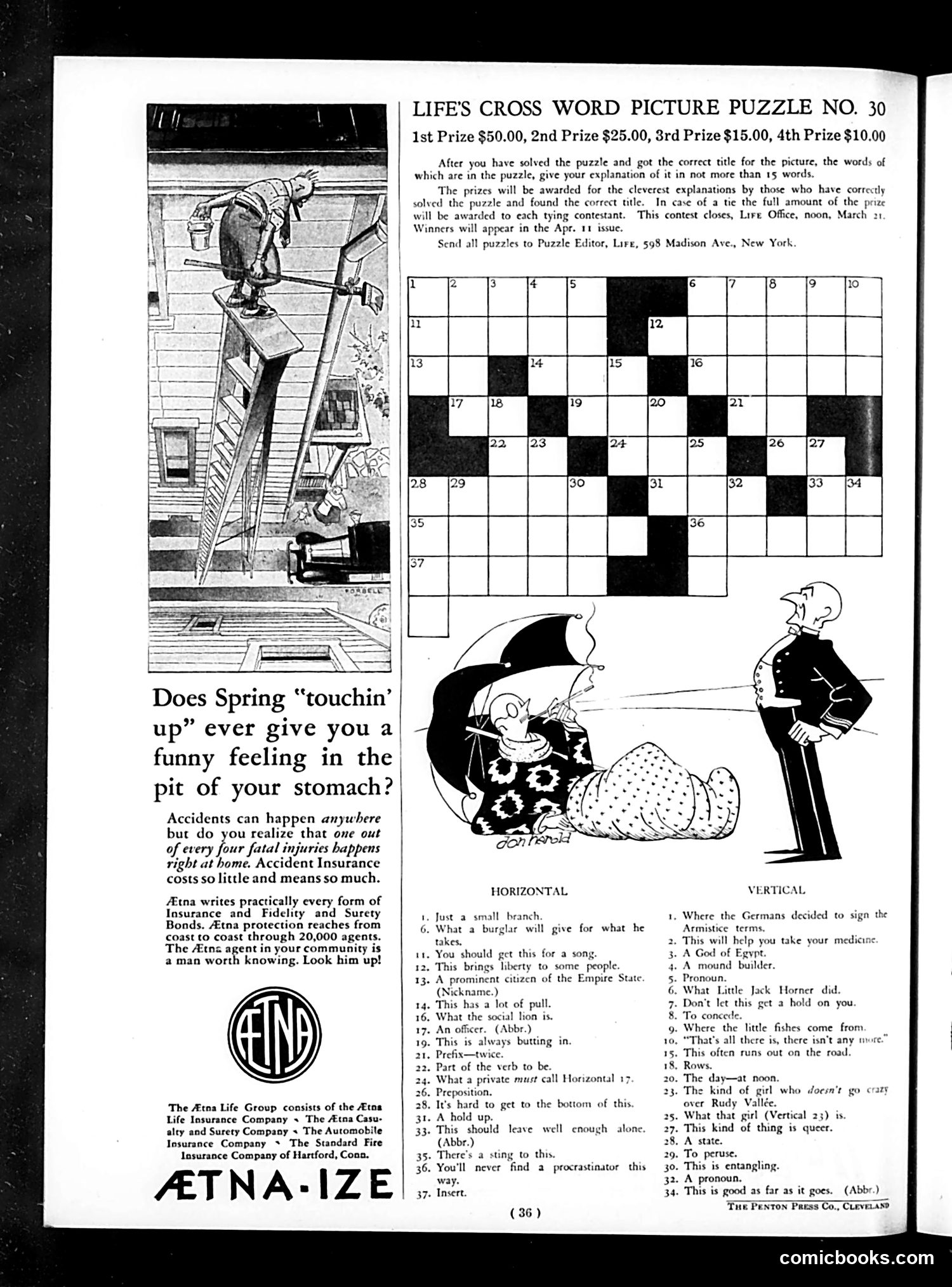
Life Magazine Crossword Puzzle Page Analysis This is primarily a crossword puzzle contest page from Life magazine, not political satire. The main content is "Life's Cross Word Picture Puzzle No. 30"—a competition offering prizes ($50-$10) for correctly solving the puzzle and providing the best explanation (under 15 words) of the resulting picture. The image shows a spring-themed illustration of a painter on a ladder doing renovations, which appears to relate to the caption "Does Spring 'touchin' up' ever give you a funny feeling in the pit of your stomach?" This is a mild joke about spring cleaning or home improvement work causing physical discomfort. The page also includes an Aetna insurance advertisement promoting accident insurance, playing on home safety concerns. The crossword clues reference contemporary culture (Rudy Vallée appears in one clue), but the page is essentially a puzzle/game with advertising—not political commentary or satire.
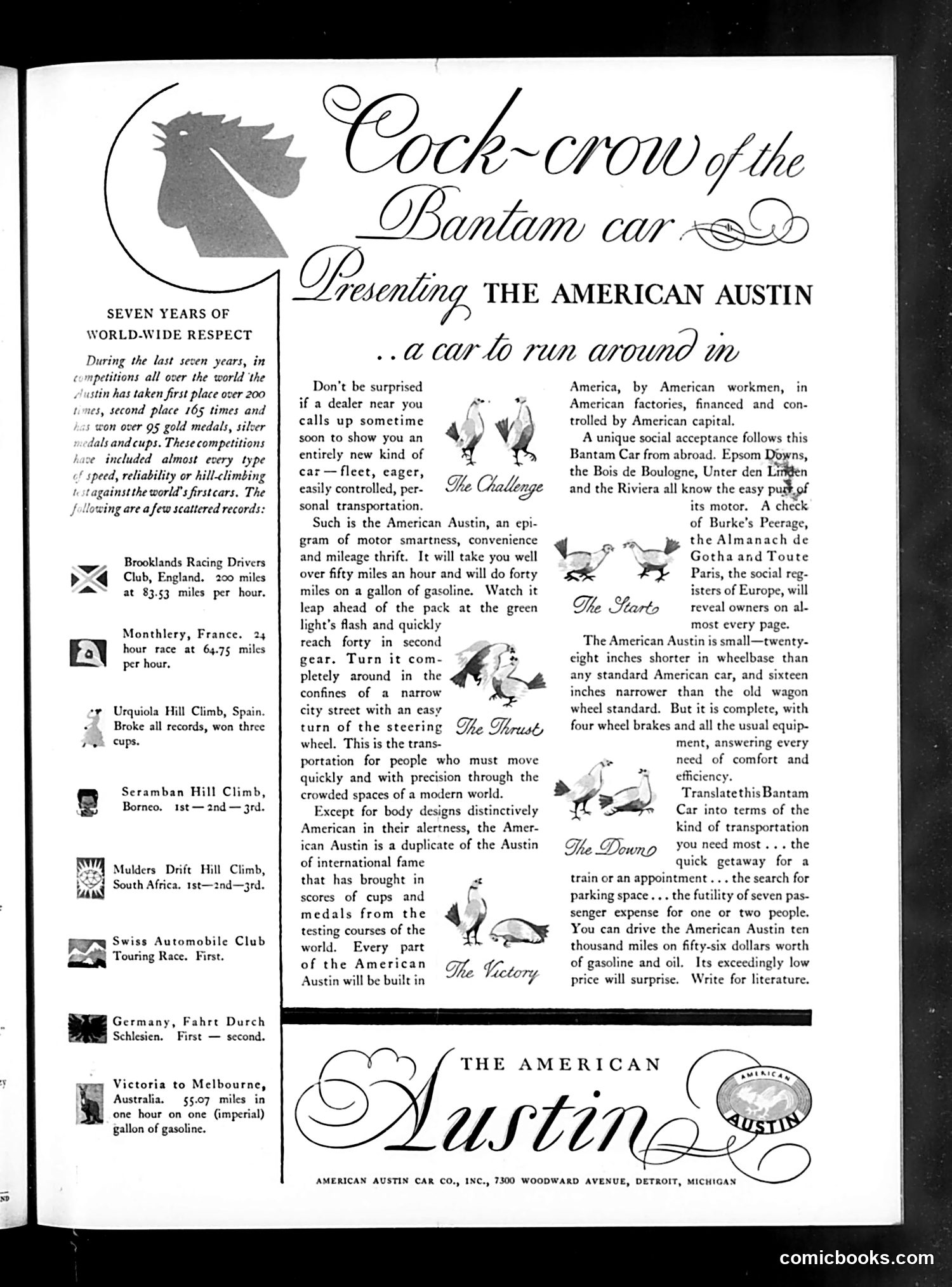
"Cock-crow of the Bantam car" This is primarily an advertisement for the American Austin, a small, economical car manufactured in Detroit. The decorative illustrations of roosters ("cock-crow") are visual puns on the car's "Bantam" name—bantam roosters being small breeds. The ad emphasizes the car's European racing pedigree (listing seven years of competition wins worldwide) while stressing it's now "financed and controlled by American capital" and built by American workers. This appeals to nationalist sentiment during a period of American industrial competition. The "unique social acceptance" section humorously suggests European aristocrats (referencing Burke's Peerage and the Almanach de Gotha) drive this car, lending it prestige. The practical benefits highlighted—quick acceleration, tight turning radius, fuel efficiency (40 miles per gallon), and low cost—target urban drivers needing affordable, maneuverable personal transportation for modern city life.
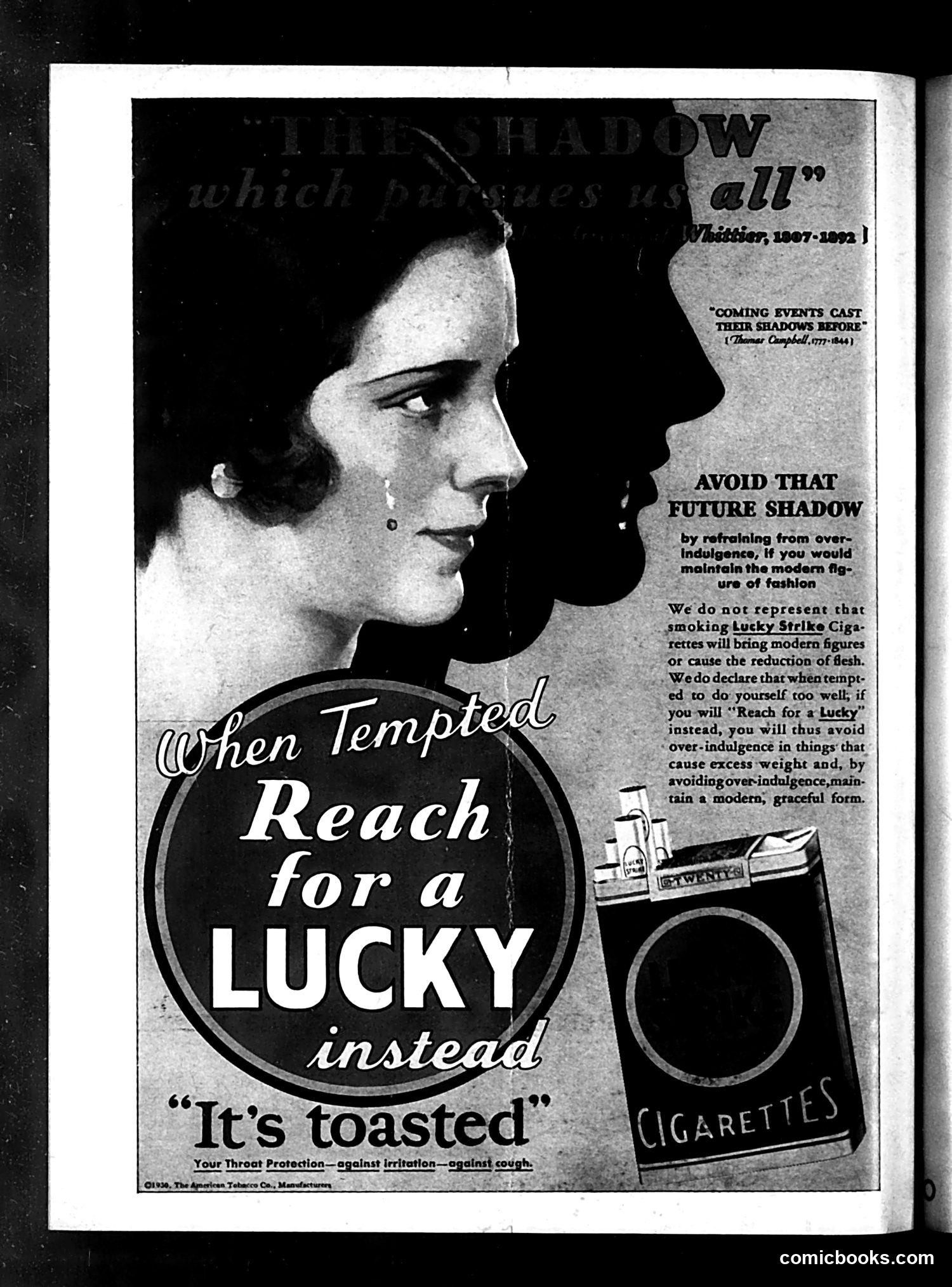
Analysis This is a Lucky Strike cigarette advertisement, not political satire. The page uses a "before and after" visual trope: a woman's profile shown alongside a silhouette of a heavier future self, with the shadow labeled "THE SHADOW which pursues us all." The ad's pitch targets weight-conscious consumers, particularly women, by claiming that reaching for a Lucky Strike instead of food prevents overeating and maintains a "modern, graceful form." The text explicitly disclaims that smoking causes weight loss, but argues it substitutes for snacking. This represents 1930s marketing that exploited body image anxiety—particularly female anxiety about weight—to promote cigarettes as a dietary aid. Modern readers should recognize this as both ethically problematic (linking smoking to beauty standards) and medically false. The ad's defensive disclaimer suggests the company anticipated criticism even then.