life
Life — March 14, 1930
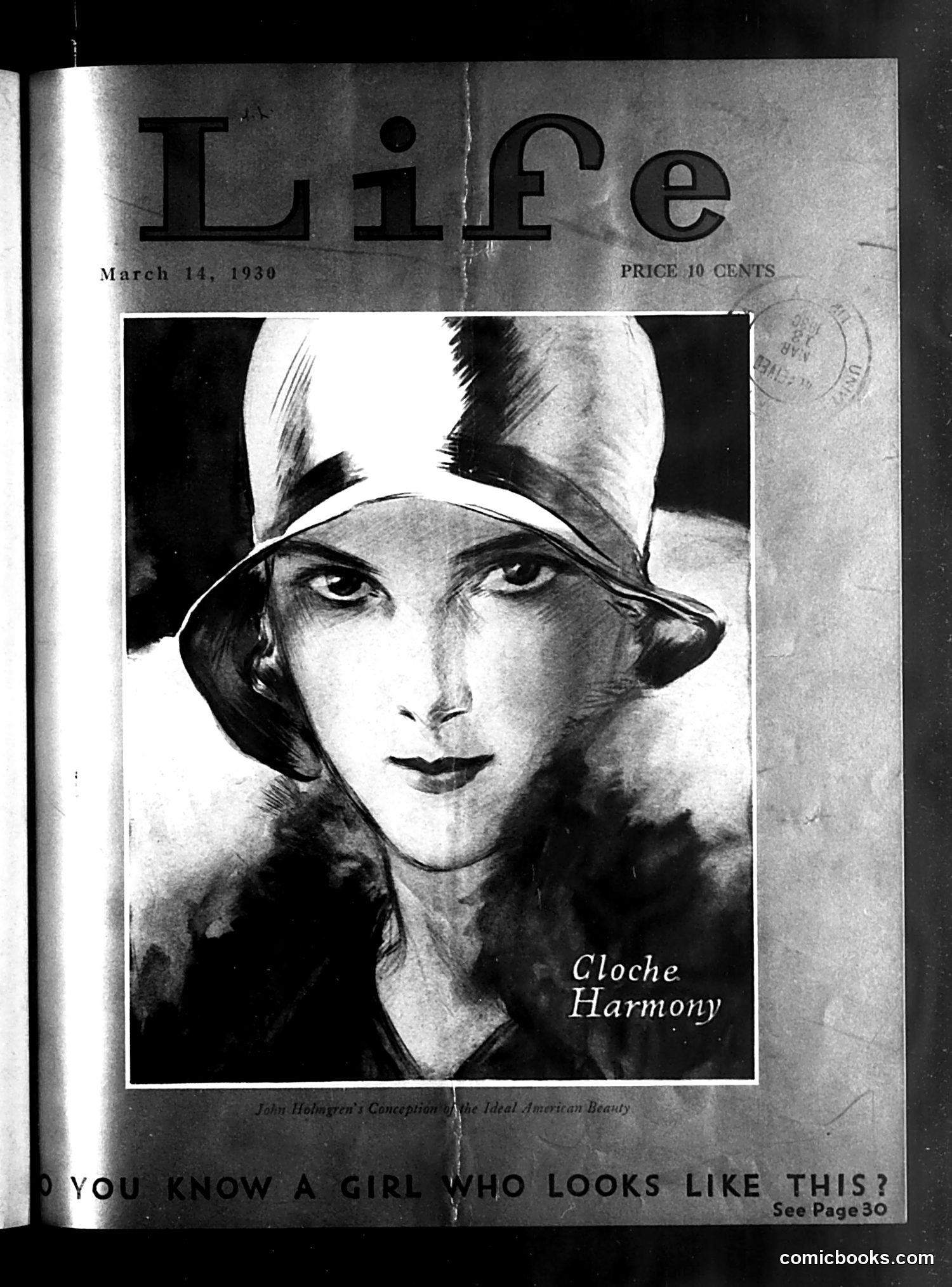
Life Magazine Cover Analysis - March 14, 1930 This is a magazine cover, not political satire. It features a woman wearing a distinctive cloche hat (the tight, close-fitting hat style popular in the 1920s-30s) with a headband. The cover credits "John Holmgren's Conception of the Ideal American Beauty." The caption "DO YOU KNOW A GIRL WHO LOOKS LIKE THIS?" with a reference to Page 30 suggests this is part of a beauty or fashion feature rather than political commentary. The "Cloche Harmony" subtitle likely refers to coordinating fashion elements. This represents typical Life magazine content of the era—fashion, beauty standards, and lifestyle coverage aimed at a general readership. The 10-cent price indicates this is from the Great Depression period.
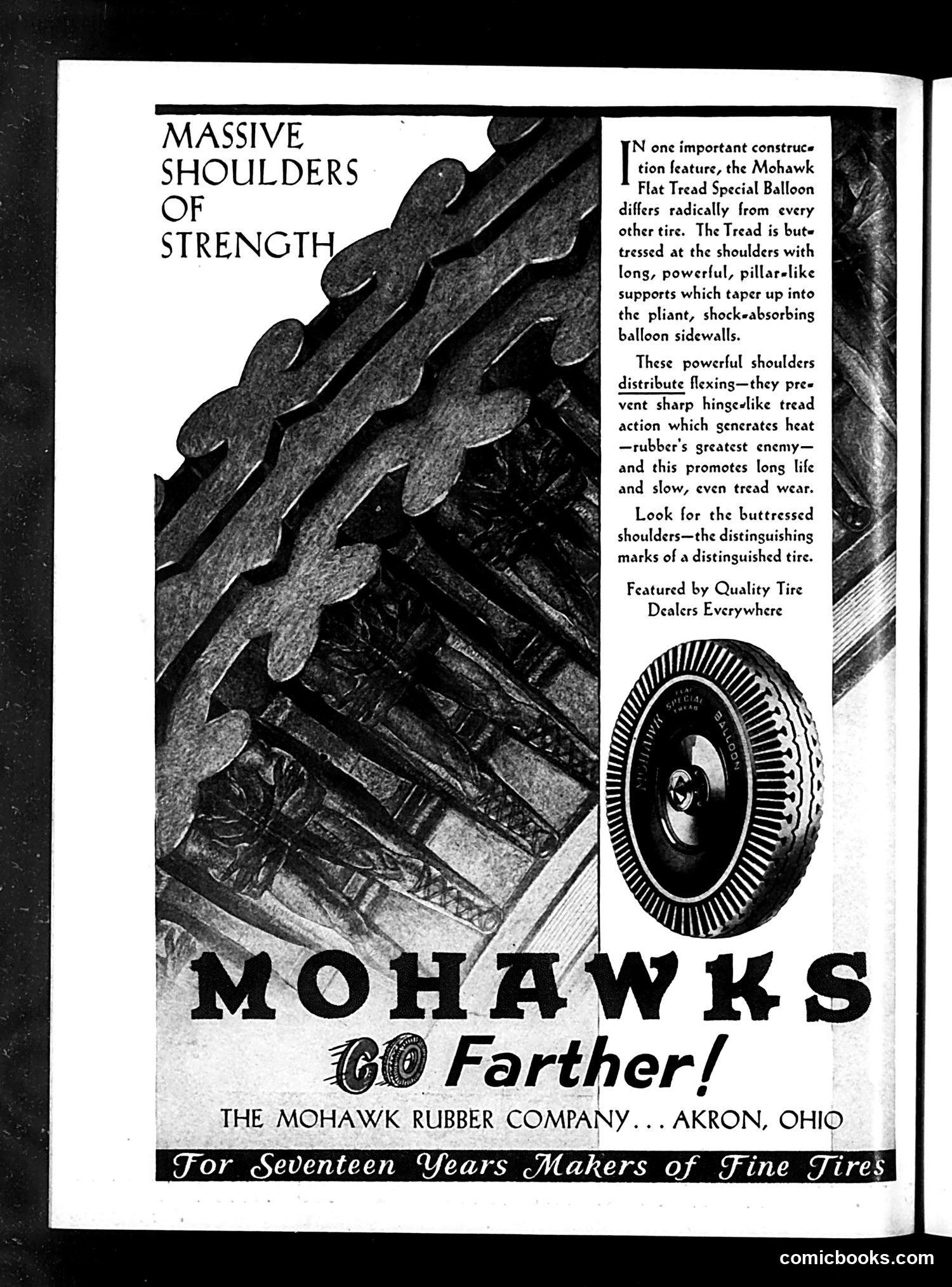
Analysis This is advertising, not satire or editorial content. It's a full-page Mohawk Rubber Company tire advertisement from an early 20th-century Life magazine. The ad promotes Mohawk "Flat Tread Special Balloon" tires by highlighting their "buttressed shoulders"—reinforced sidewalls designed to prevent heat buildup and extend tire life. The close-up photograph shows the tire's tread pattern and construction details. The tagline "Go Farther!" emphasizes durability and longevity. The company claims seventeen years of tire-manufacturing experience. There are no political references, caricatures, or satirical elements. This is straightforward product marketing using technical specifications and visual evidence to convince readers of quality—a common advertising approach of the era before modern consumer skepticism.
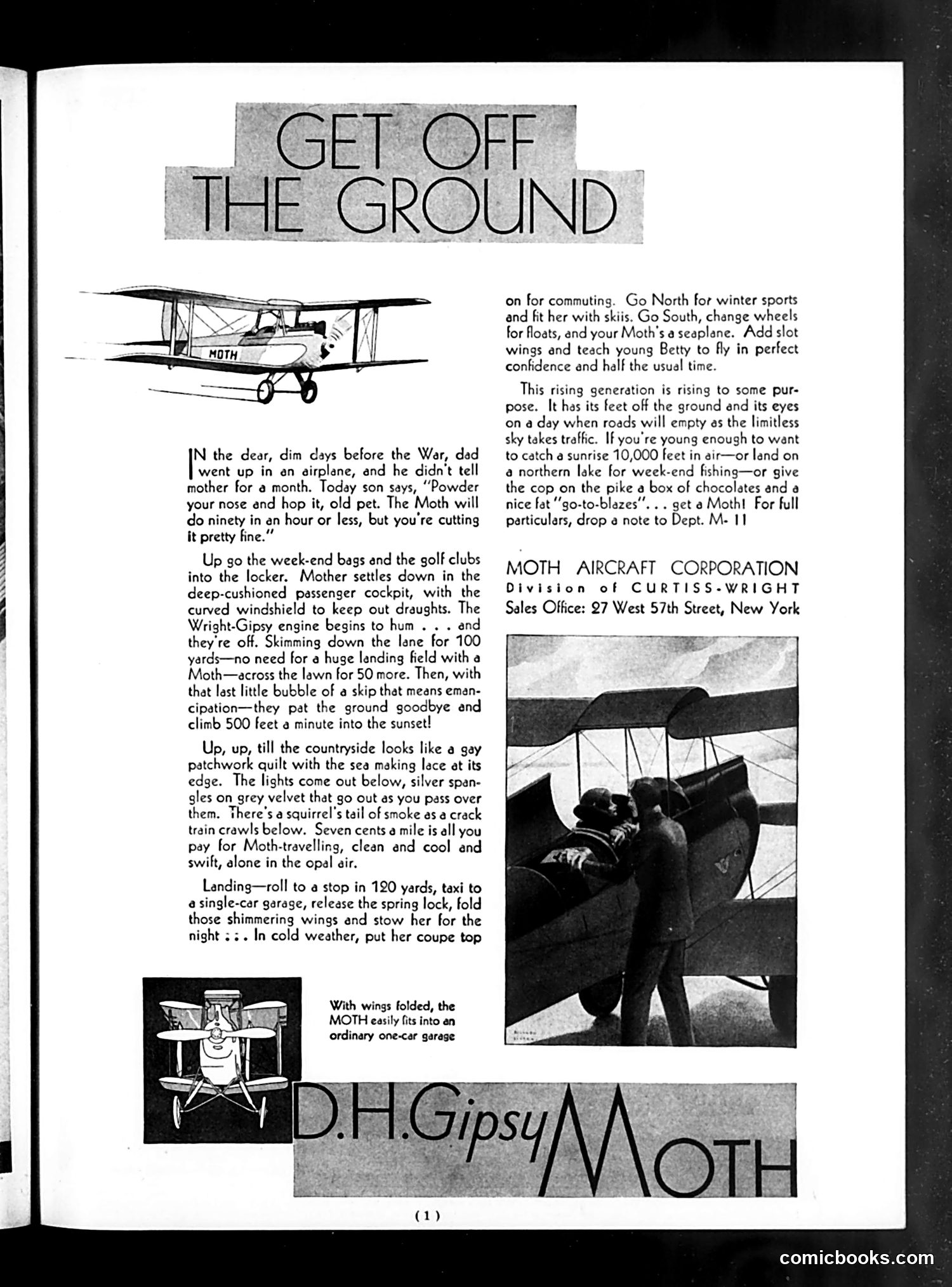
Analysis of "Get Off the Ground" - Moth Aircraft Advertisement This page is primarily a commercial advertisement, not political satire. It promotes the D.H. Gipsy Moth aircraft, manufactured by Moth Aircraft Corporation (a division of Curtiss-Wright), with sales offices in New York. The ad uses nostalgic, whimsical copy addressing post-WWI aviation enthusiasm. It describes recreational flying—weekend trips, winter sports access, casual travel—positioned as accessible luxury for the affluent. The "Gipsy Moth" name and illustrations emphasize the aircraft's compact, foldable design that fits in a standard garage. The tone suggests this targets wealthy leisure travelers of the 1920s-early 1930s era, when private aviation was novel and aspirational. The copywriting emphasizes speed (500 feet/minute climb), practicality, and adventure rather than any political message.
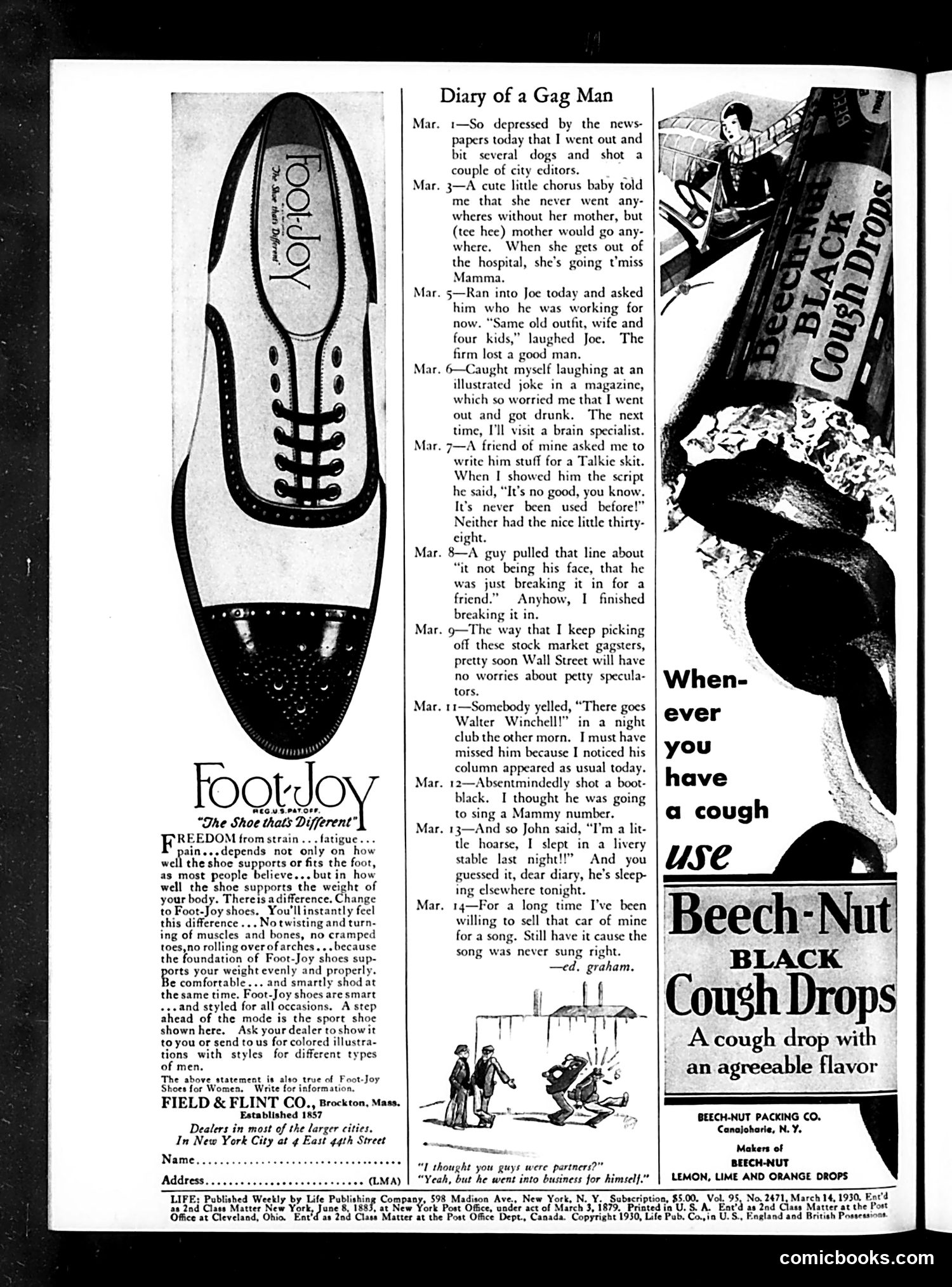
Page Analysis: Life Magazine (circa 1930) This page combines satirical content with period advertising. The left side features "Diary of a Gag Man"—entries from March documenting a comedy writer's daily mishaps and observations, including depression-era references (shooting newspaper editors' dogs, stock market anxiety). The humor relies on absurdist incongruity typical of 1920s-30s magazine comedy. The right side shows a Footjoy shoe advertisement emphasizing orthopedic design, alongside a Beech-Nut cough drops ad. The small cartoon caption ("I thought you guys were partners?") appears to reference business conflict, likely reflecting Depression-era economic uncertainty. Overall, the page mixes disposable gag humor with product advertisements, reflecting Life's format as a humor magazine carrying commercial endorsements.
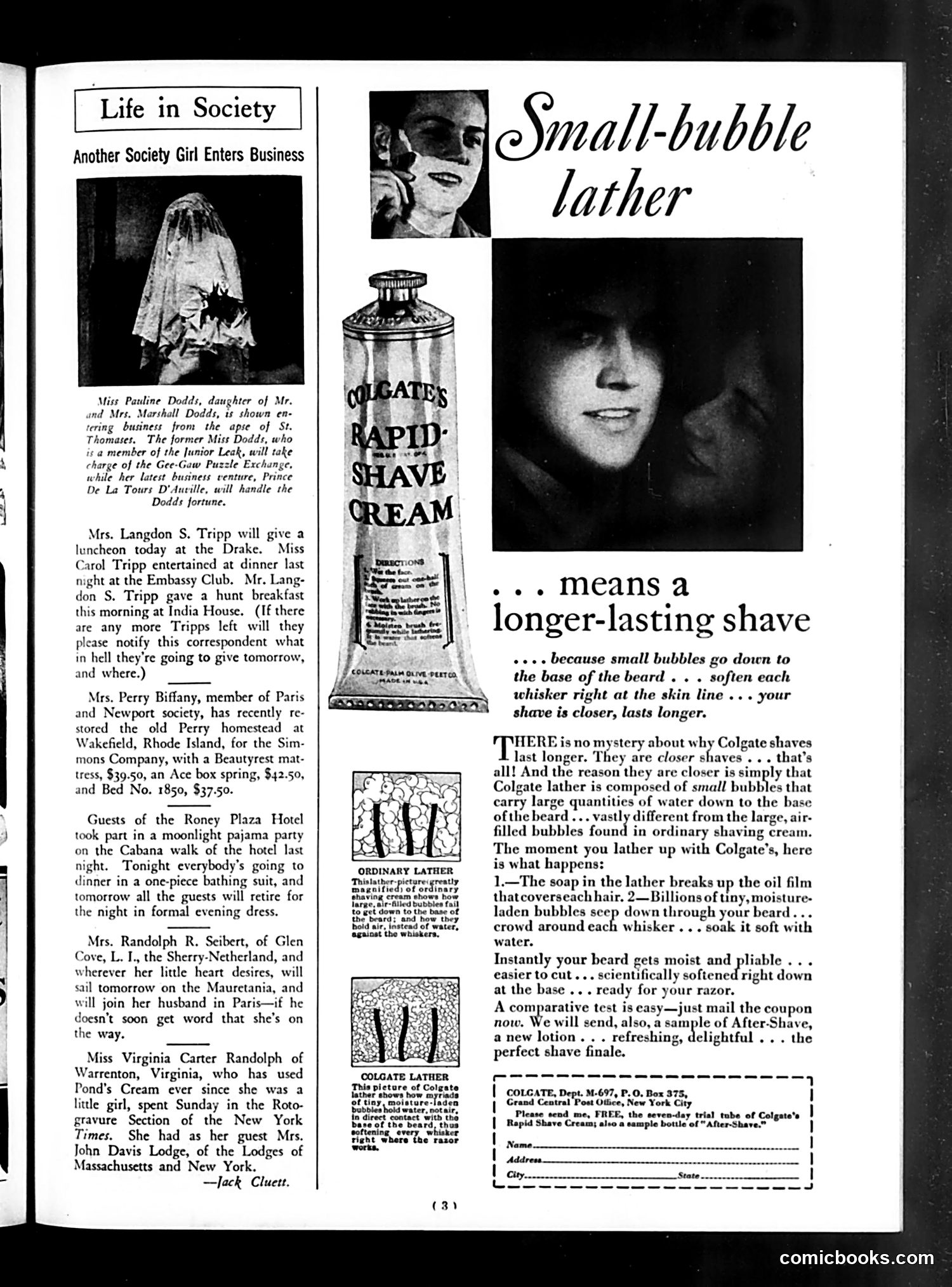
Analysis This page is primarily a Colgate's Rapid Shave Cream advertisement, not satire. The right side features a large product ad explaining that small bubbles in the lather penetrate deeper than ordinary shaving cream, producing a "longer-lasting shave." The left column contains "Life in Society" — a regular gossip/society section listing social events and activities of wealthy individuals (luncheons, hotel visits, boat trips). This was typical magazine content documenting the leisure activities of the upper class. There is no political cartoon on this page. The images are purely commercial: a product photograph of the shaving cream tube and diagrams comparing ordinary versus Colgate lather bubbles. The page represents advertising integrated into editorial content, common in mid-20th-century magazines.
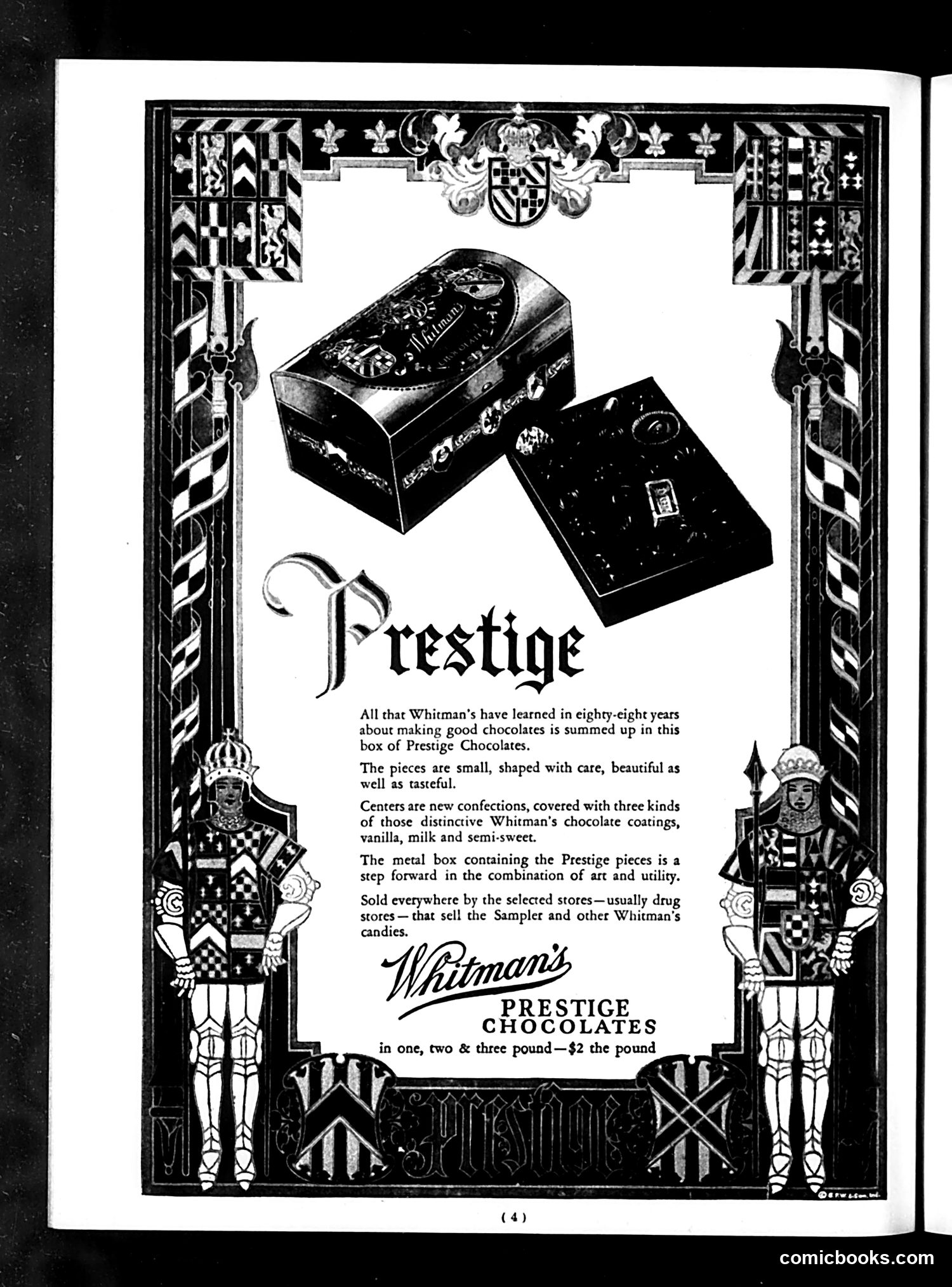
Analysis This page is primarily an advertisement, not satire or political commentary. It promotes Whitman's Prestige Chocolates, a real American candy brand. The ad emphasizes luxury and heritage: "All that Whitman's have learned in eighty-eight years about making good chocolates is summed up in this box." The ornate border—featuring heraldic crests, crowned figures, and medieval-style decorative elements—creates an impression of Old World sophistication and prestige (hence the product name). The two decorated boxes shown are presented as premium gift items. The ad targets affluent consumers, with pricing at "$2 the pound"—substantial for the era. This is marketing, not editorial content—there is no political meaning or satirical intent here.
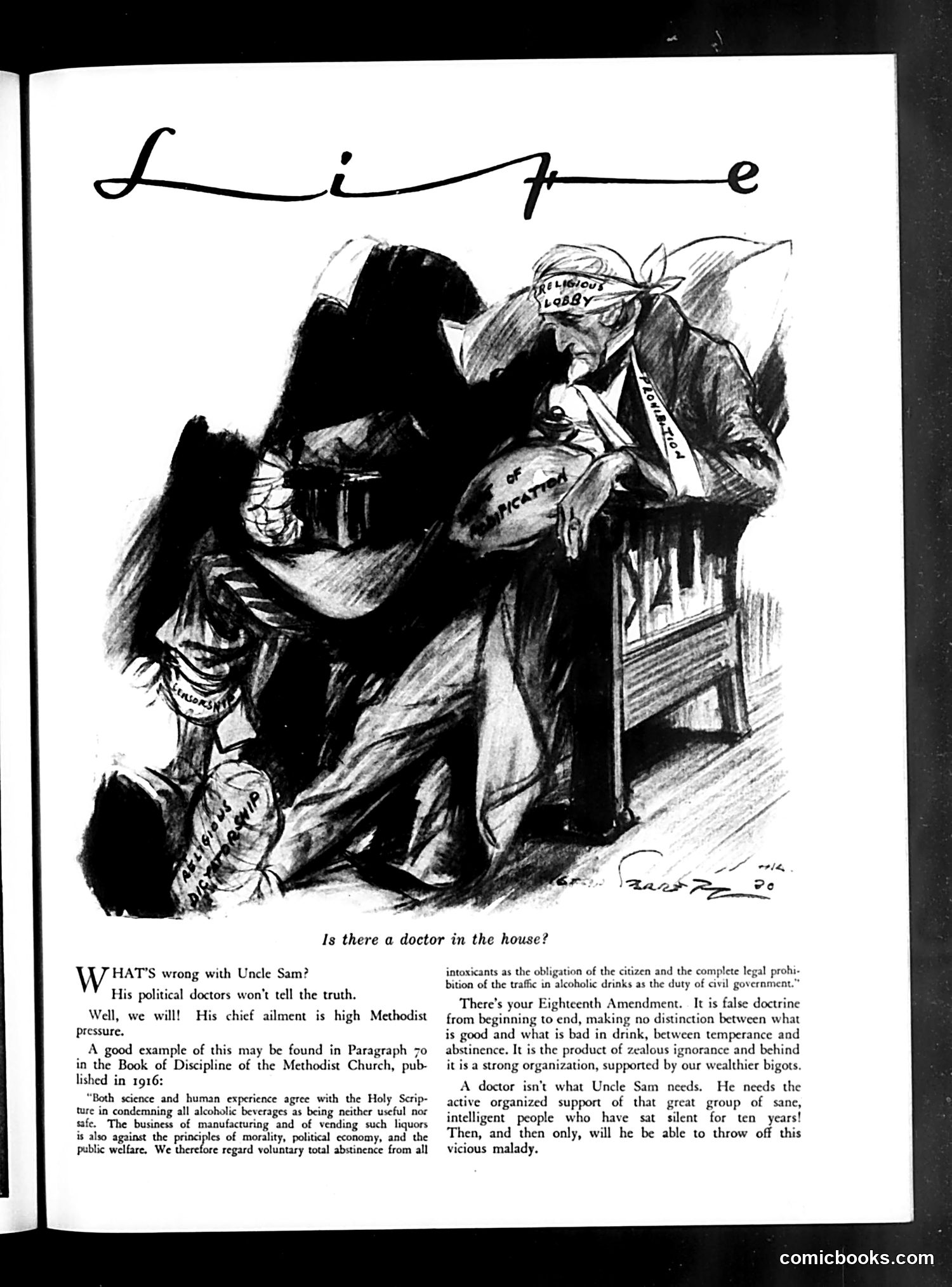
Explanation of "Is There a Doctor in the House?" This political cartoon satirizes Uncle Sam's inability to address America's "high Methodist pressure"—a reference to the Methodist Church's prohibition stance and temperance advocacy. The image shows Uncle Sam as a sick patient being examined by a doctor figure labeled with Methodist doctrine. The article criticizes Methodist "political doctors" for diagnosing the nation's problems while promoting total abstinence from alcohol, citing Paragraph 70 of the Methodist Book of Discipline. The satire's point: the Methodist Church, though well-intentioned and supported by "wealthy bigots," oversimplifies complex social and economic issues by reducing them to the alcohol question. The author argues Uncle Sam needs practical solutions, not ideological medicine, and that only organized support from "sane, intelligent people" can cure America's "vicious malady."
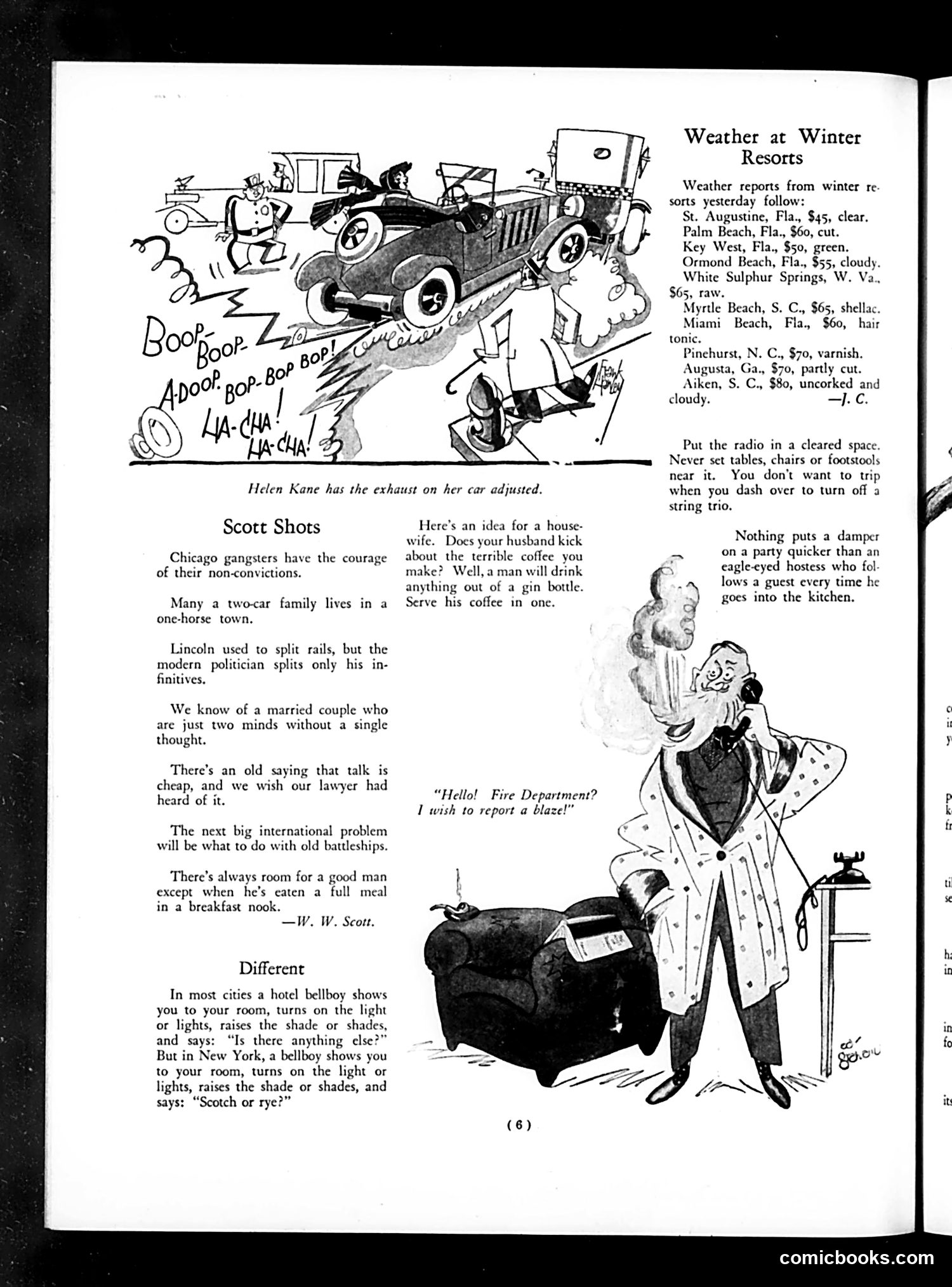
Analysis of Life Magazine Page (undated) This page contains three separate humor pieces typical of Life magazine's satirical style: 1. "Weather at Winter Resorts": A cartoon showing cars honking loudly on a road, with the caption "Helen Kane has the exhaust on her car adjusted." This references Helen Kane, the 1920s-30s performer famous for her "boop-boop-a-doop" catchphrase. The joke satirizes her distinctive vocal style by comparing it to car horn noise. 2. "Scott Shots": A column of humorous one-liners about social observations—marriage, politicians, lawyers—typical of magazine filler humor. 3. "Different": A cartoon contrasting hotel bellhop behavior between cities. The punchline plays on ethnic/regional stereotypes: a New York bellhop asks "Scotch or rye?" (implying drinking) versus other cities. The cartoon reflects dated assumptions about regional characteristics. All content reflects early-20th-century American humor conventions and stereotypes.
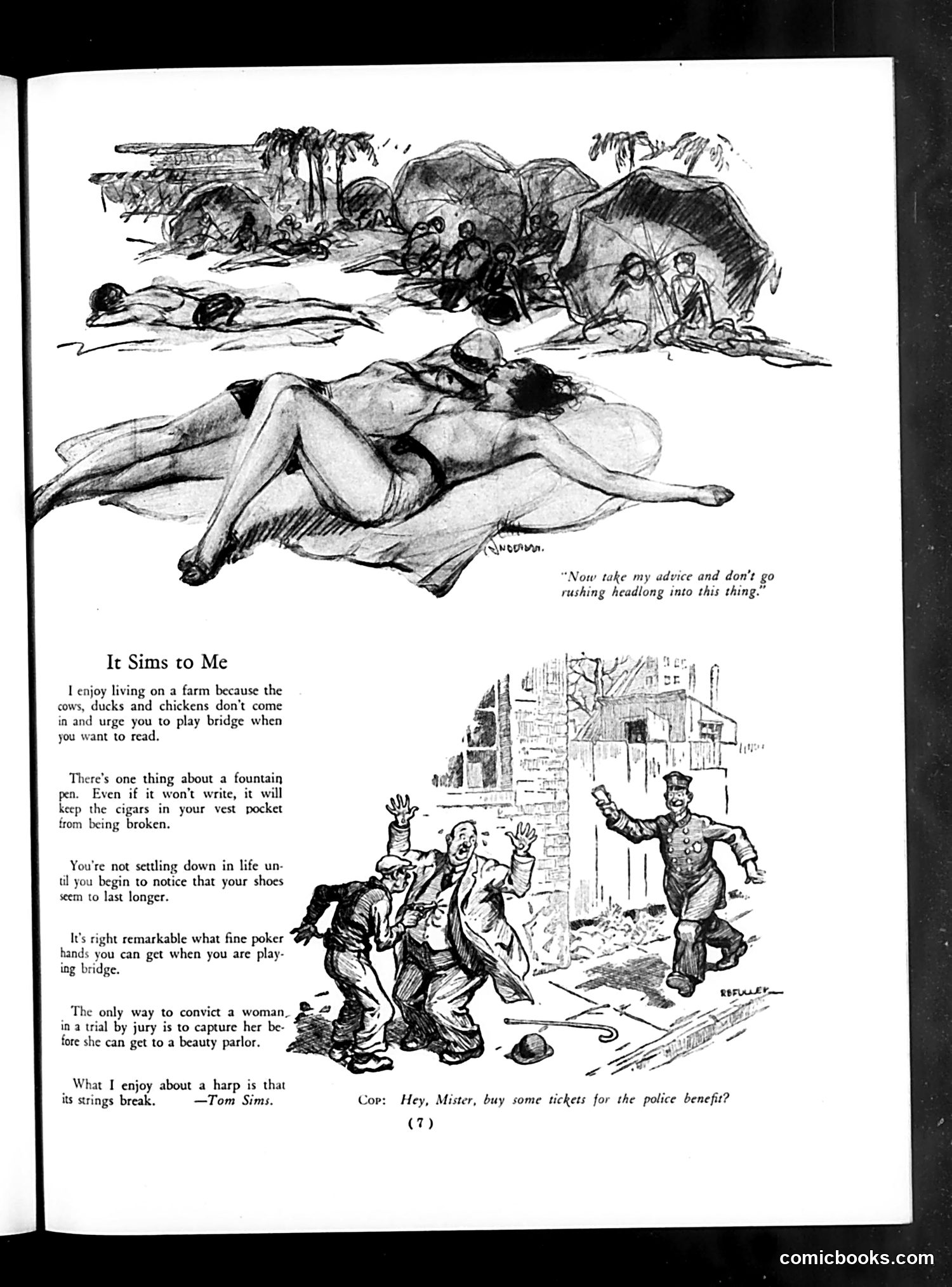
Analysis of Life Magazine Page This page contains two distinct pieces: Top Illustration: A suggestive beach scene with the caption "Now take my advice and don't go rushing headlong into this thing." The drawing depicts intimate physical contact, using double entendre humor typical of early 20th-century satirical magazines. "It Sims to Me" Column: Attributed to Tom Sims, this is a humorous essay about life observations—farming, fountain pens, poker hands, convicting women, and harps. It's gentle observational comedy rather than pointed satire. Bottom Cartoon: Shows a street scene where a cop solicits a man to buy police benefit tickets. The humor plays on corrupt police practices—officers pressuring citizens for "donations" under the guise of charity fundraising, a recognized social problem of the era. Both pieces reflect Life's satirical approach to American social conditions and human behavior.
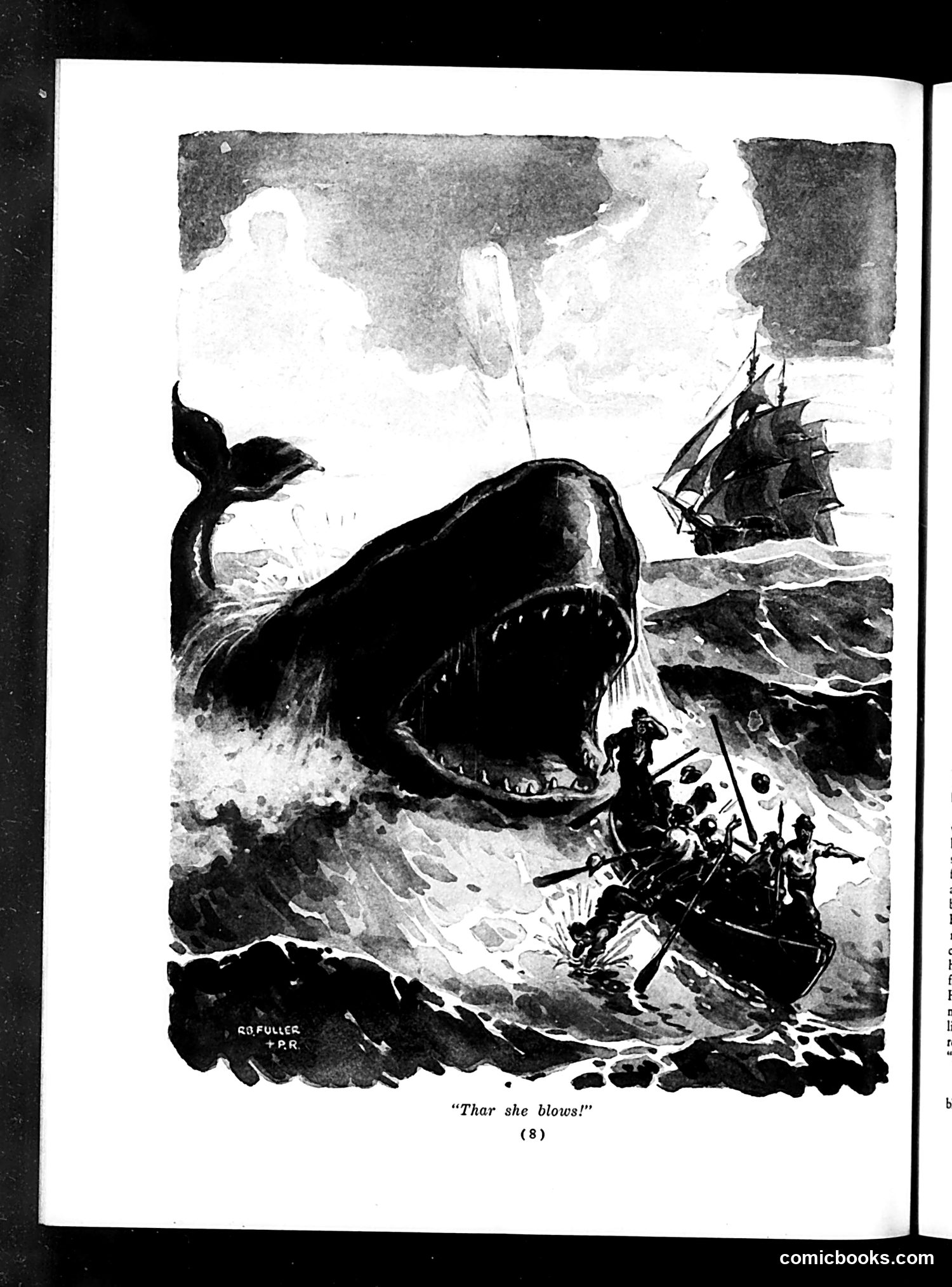
Analysis This illustration, signed by S.D. Fuller, depicts a dramatic whaling scene with the caption "Thar she blows!" (a whaler's call upon spotting a whale). The image shows sailors in a small boat confronting an enormous whale with its mouth wide open, while a sailing ship appears in the background. The artwork appears to be a straightforward adventure illustration rather than political satire. It captures a moment of maritime danger and excitement that would have appealed to *Life* magazine's readers. The dramatic composition and dynamic action—the whale's threatening posture, the sailors' precarious position, the churning sea—emphasize the peril and excitement of 19th-century whaling. Without additional context from surrounding text, this seems primarily an entertainment illustration celebrating maritime adventure rather than satirizing specific political or social figures.
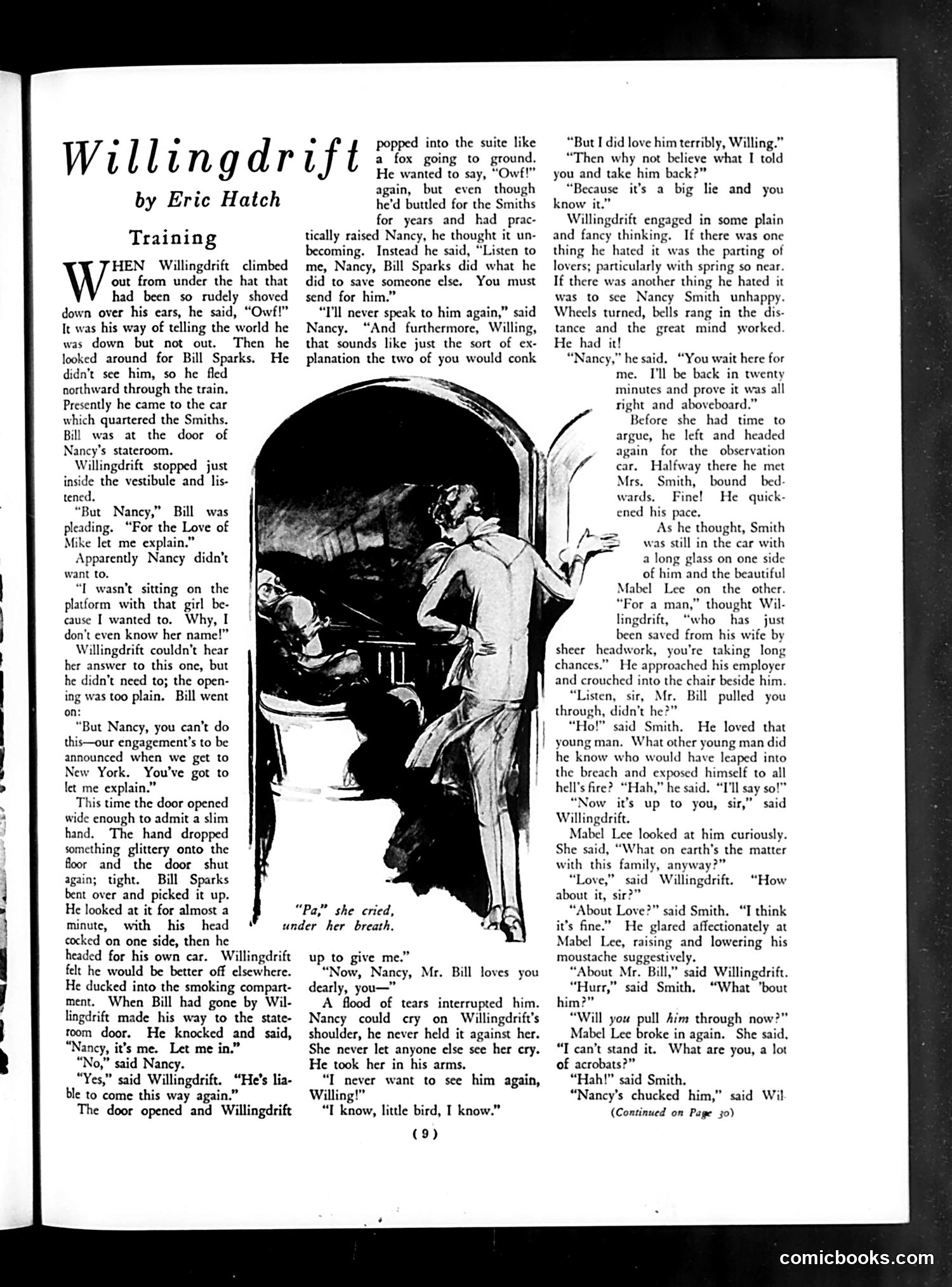
"Willingdrift" by Eric Hatch This page contains the beginning of a short story titled "Training," not a political cartoon. The narrative follows a character named Willingdrift, who climbs out from under a hat in a train car and encounters Bill Sparks and Nancy Smith. The accompanying illustration shows a dramatic scene in a train compartment where a woman (Nancy) cries out "Pa!" while a man attends to her. The story involves romantic tension and reconciliation—Willingdrift attempts to reunite the couple after they've separated. This appears to be mainstream fiction entertainment rather than political satire, typical of Life magazine's content mix during the early-to-mid twentieth century.
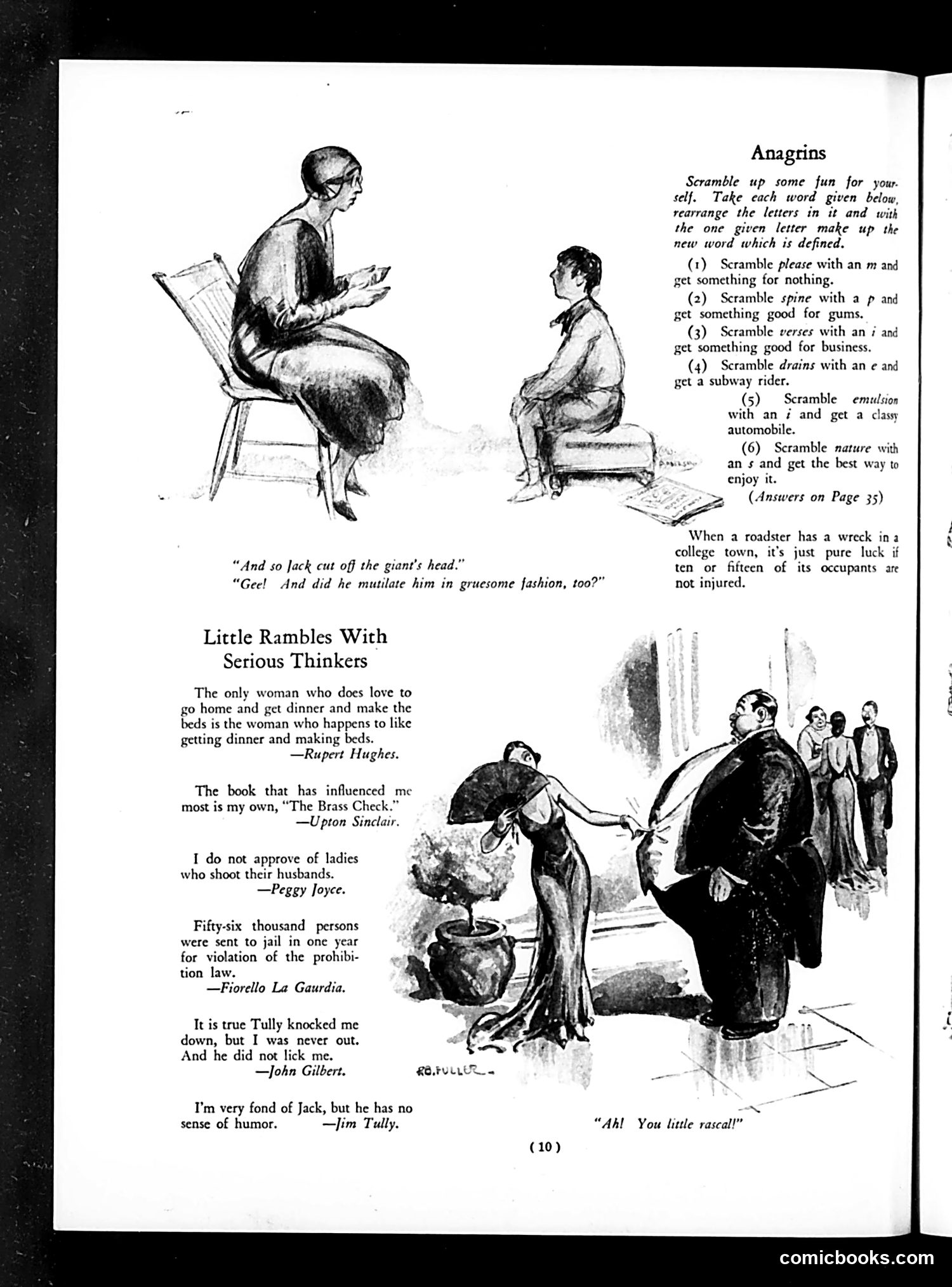
Page Analysis This page contains two distinct sections: Top section ("Anagrins"): A word-scramble puzzle where readers rearrange letters to form new words with humorous definitions (e.g., "please" with an M becomes something "for nothing"). Bottom section ("Little Rambles With Serious Thinkers"): A collection of brief, sardonic quotes attributed to named individuals (Rupert Hughes, Upton Sinclair, Peggy Joyce, etc.), each offering wry observations on domestic life, literature, law, and relationships. The accompanying cartoon illustrates one quote about someone named Jack and Tully, depicting what appears to be a domestic dispute or confrontation. The page's humor relies on cynicism about marriage, authority, and human nature—typical of *Life* magazine's satirical approach during the early 20th century.
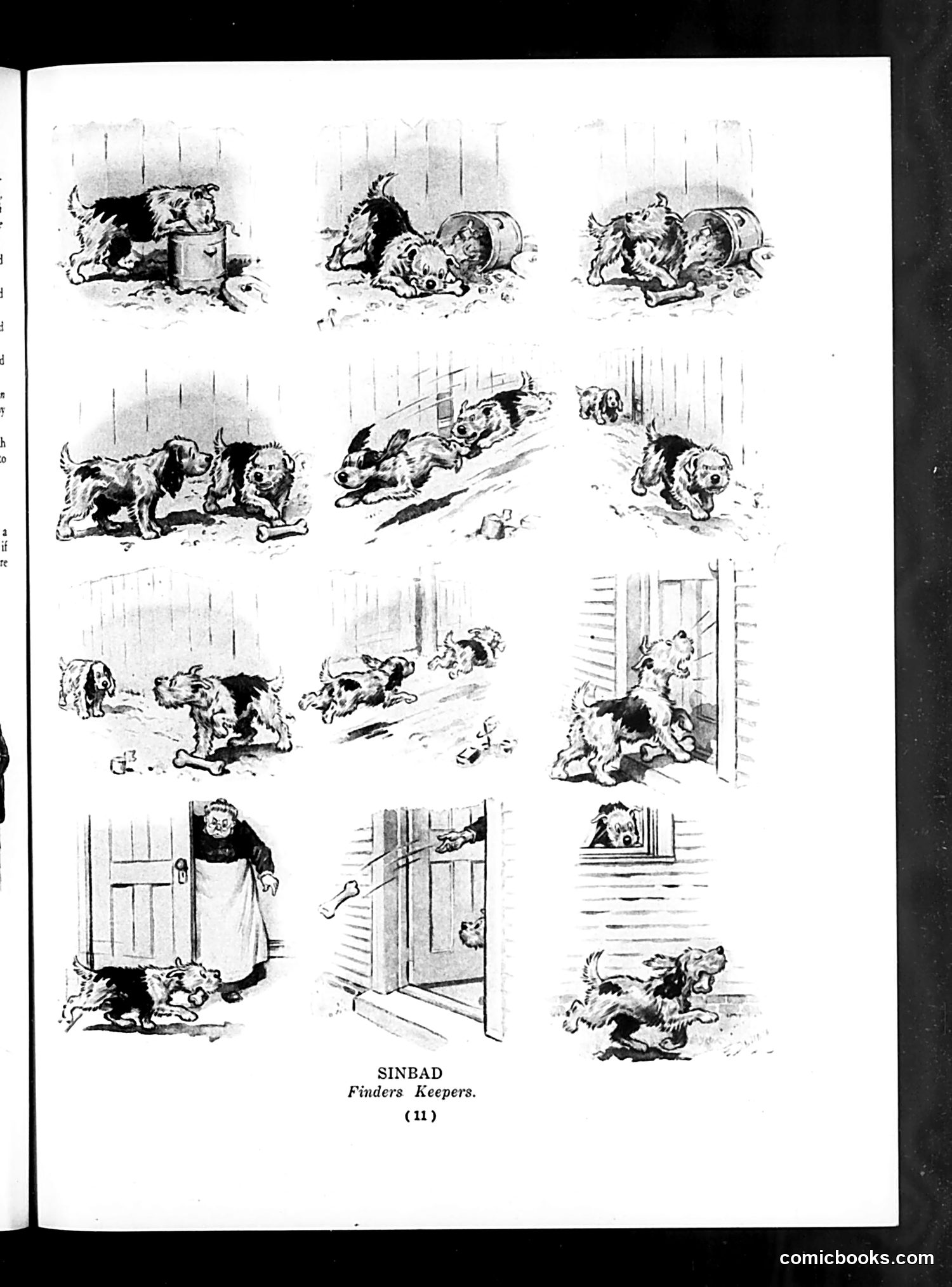
SINBAD: Finders Keepers This page presents a sequential comic strip titled "Sinbad" subtitled "Finders Keepers." The twelve panels depict various dogs engaged in mischievous activities involving barrels, buckets, and household items during rainfall. The narrative appears to follow dogs discovering or stealing objects—hence "Finders Keepers"—creating comedic chaos. The strip shows the animals' increasingly destructive antics: rolling barrels, dragging containers, chasing through yards, and ultimately confronting an elderly woman at her doorstep. The final panels suggest the dogs' misadventures result in consequences, likely the woman's retribution. This is straightforward slapstick humor typical of early 20th-century comic strips, relying on physical comedy rather than political or social satire. The joke depends on anthropomorphized animal behavior and visual gags.
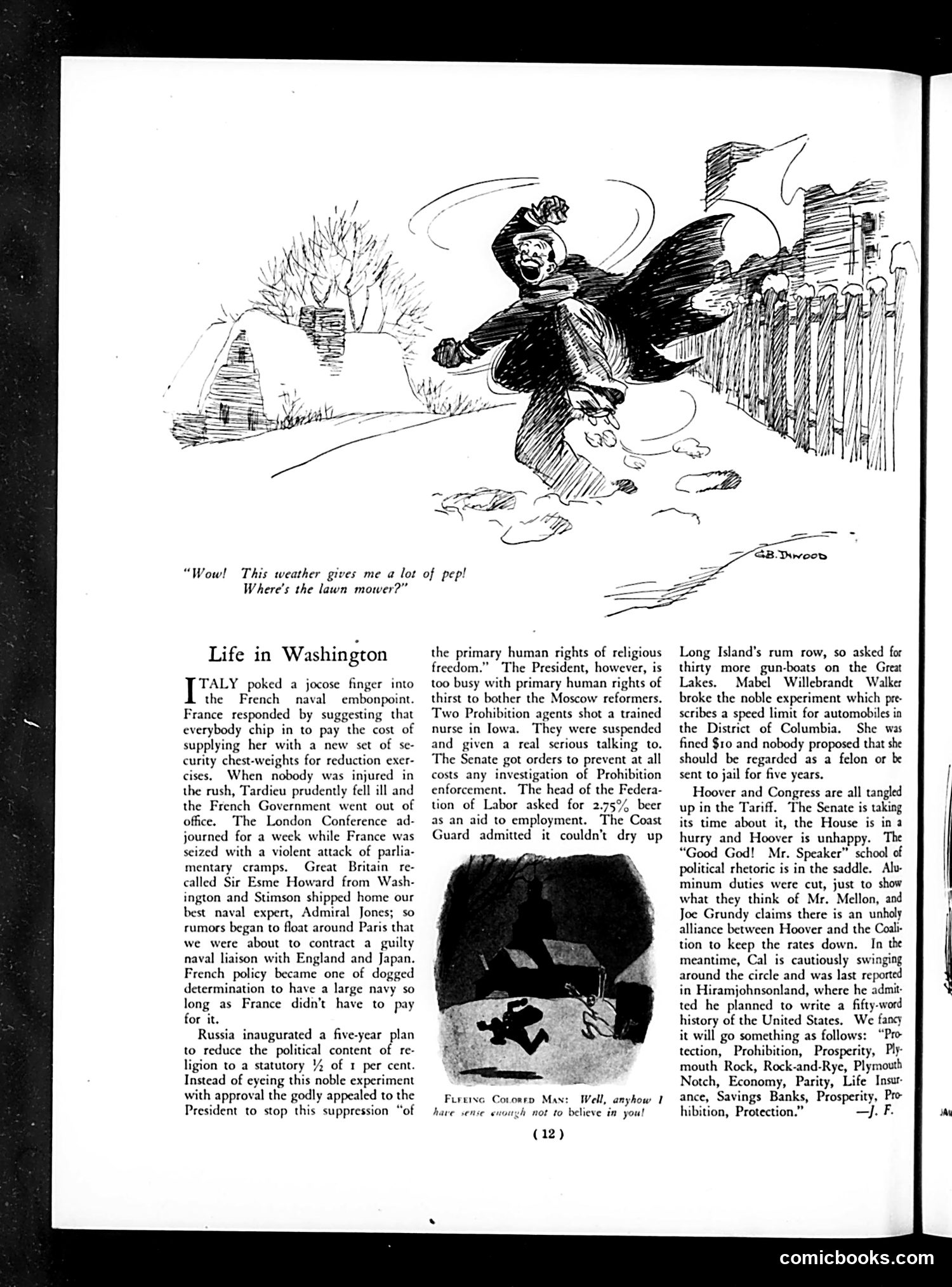
Political Cartoon Analysis The top cartoon depicts a figure in winter clothing being blown by wind near snow-covered buildings. The caption reads: "Wow! This weather gives me a lot of pep! Where's the lawn mower?" This is a joke about an absurdly mild winter—the character expects to need a lawn mower despite heavy snow, suggesting the weather is unusually warm or erratic. The accompanying article, "Life in Washington," discusses political conflicts during what appears to be the Prohibition era, mentioning tensions between Hoover and Congress over enforcement, labor disputes, and debates over government spending. The article satirizes Washington's political dysfunction and competing policy priorities of the period.
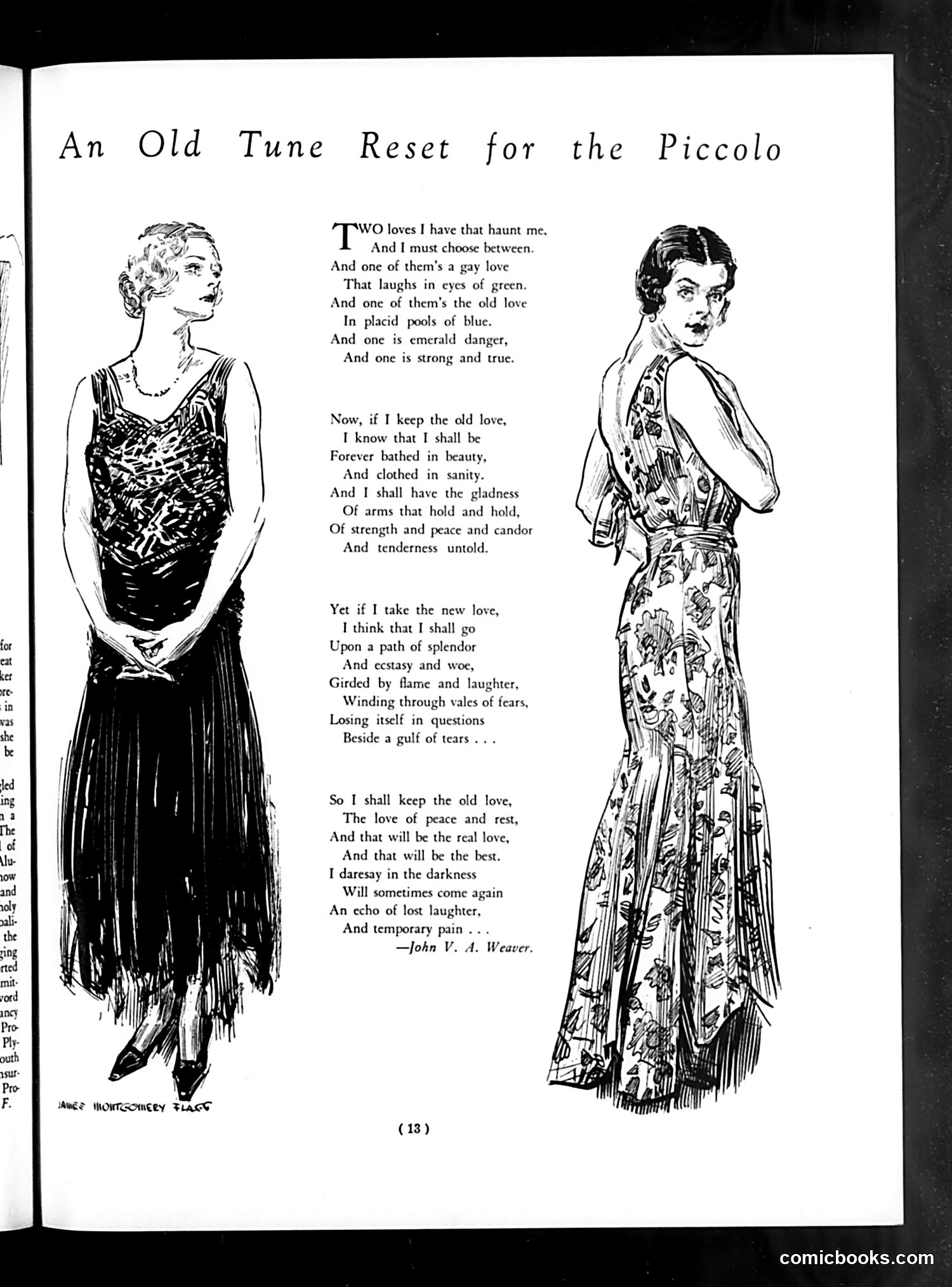
Analysis This page features a poem titled "An Old Tune Reset for the Piccolo" by John V. A. Weaver, accompanied by two fashion illustration sketches of women in 1920s-style dresses. The poem is a satirical love poem that uses musical metaphor. The speaker must choose between two loves—one described poetically ("gay love / That laughs in eyes of green") and another ("old love / In placid pools of blue"). The satirical point appears to be mocking romantic indecision and the flowery language of love poetry itself. The title's reference to "piccolo" (a small, high-pitched instrument) suggests the poem treats grand romantic sentiment as trivial or shrill. The fashion illustrations flank the text, typical of *Life* magazine's format mixing literary content with visual commentary on contemporary style and society. The overall effect creates ironic tension between serious romantic poetry and the magazine's focus on fashionable, modern femininity.
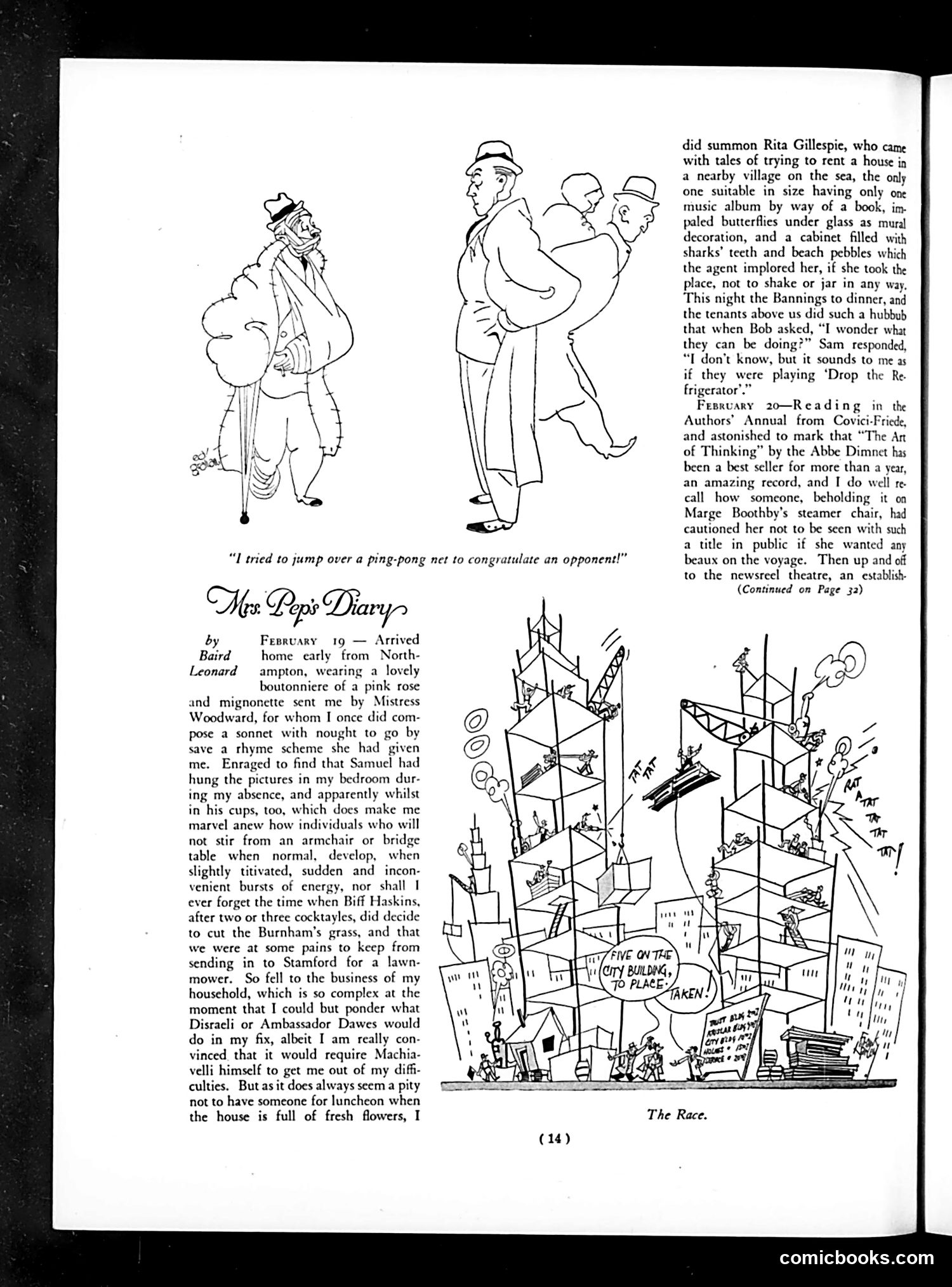
Analysis This page from *Life* magazine contains two satirical pieces: Top cartoon: Shows four men, one carrying a large bundle. The caption reads: "I tried to jump over a ping-pong net to congratulate an opponent!" This is a humorous reference to the early 20th-century craze for ping-pong, mocking the physical awkwardness and minor injuries that could result from enthusiastic play at social gatherings. "Mrs. Pep's Diary" by Baird Leonard: A comedic narrative about domestic life, recounting the author's frustrations with household management, guests, and her husband Samuel's behavior during entertaining. The accompanying illustration labeled "The Race" depicts a chaotic multi-story building scene, likely satirizing urban life or social climbing. Both pieces reflect early 20th-century middle-class leisure activities and domestic comedy.
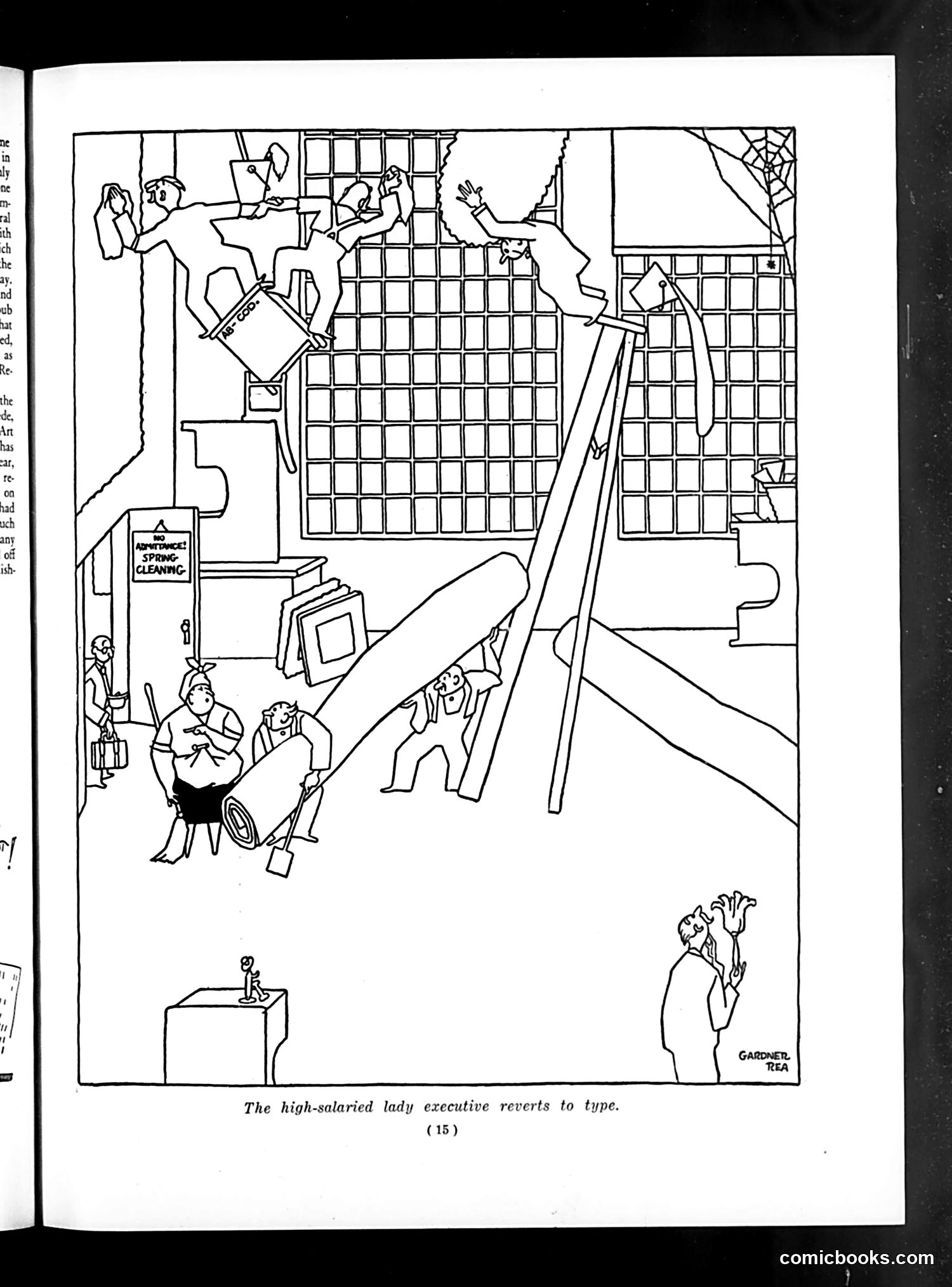
"The High-Salaried Lady Executive Reverts to Type" This cartoon satirizes the concept of women entering high-paying corporate positions during what appears to be the mid-20th century. The illustration shows a chaotic office scene where a female executive has abandoned her desk and professional duties to engage in manual labor—specifically operating construction equipment and tools alongside workers. The joke relies on the stereotype that despite earning high salaries and holding executive positions, professional women would ultimately abandon their roles to revert to more "traditional" or "natural" domestic/manual work. The title's word "reverts" suggests this is presented as an inevitable return to type rather than a choice. The cartoon mocks contemporary anxieties about women's integration into the professional workplace.
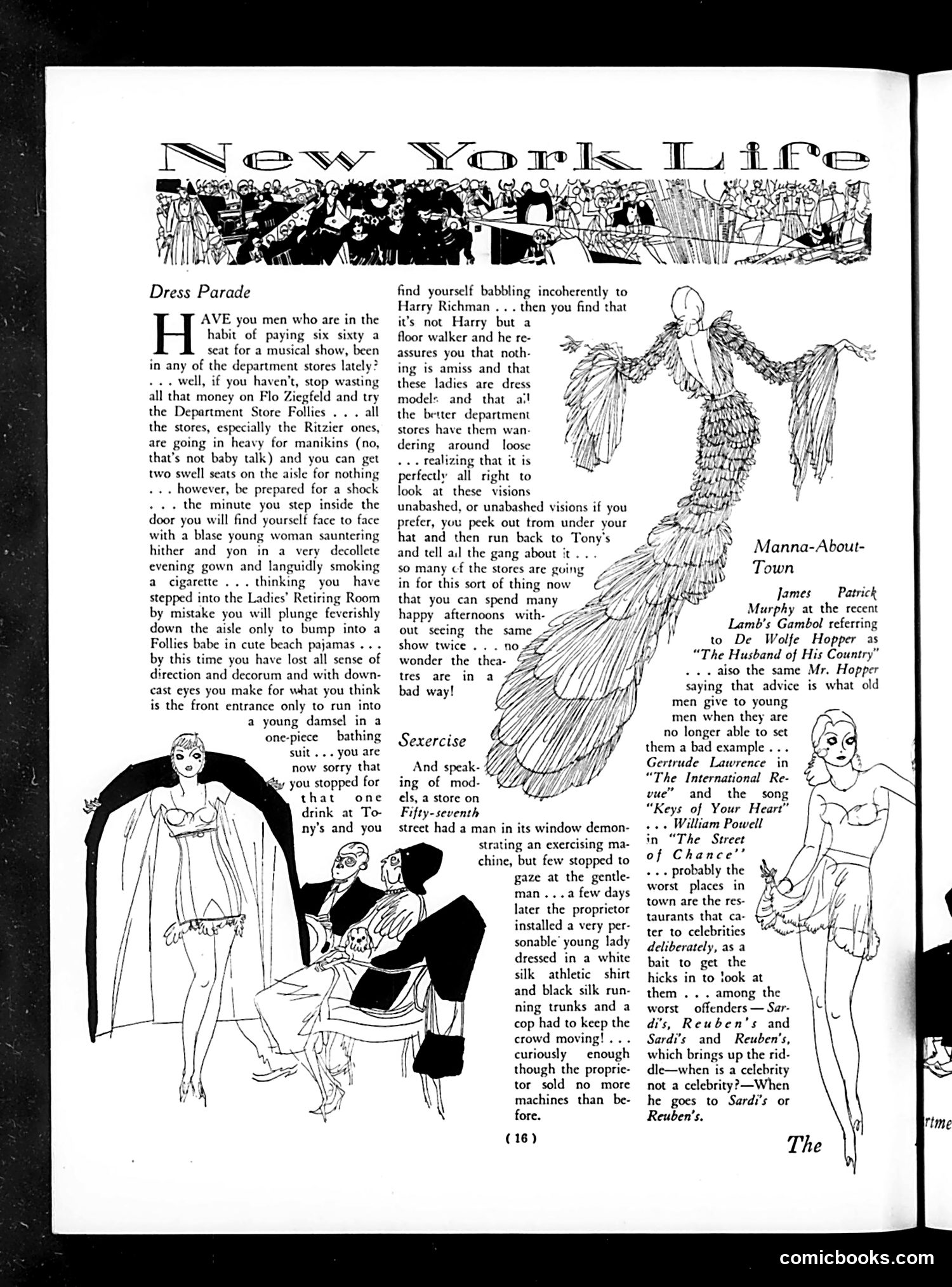
Analysis of "New York Life" Page This page satirizes Manhattan social life, particularly department store culture and celebrity dining. The "Dress Parade" section mocks men who repeatedly pay for musical theater tickets at expensive department stores like Flo Ziegfeld's and the Ritzier establishments, only to encounter the same "dress models" parading through these venues. The humor targets both the models' shameless self-display and men's predictable fascination with them. The "Manna-About-Town" section references Broadway shows and restaurants like Sardi's and Reuben's, noting that celebrities deliberately frequent these establishments to be seen. The satire critiques the performative nature of New York's elite social scene—where dining and theater-going serve as public display rather than genuine entertainment. The illustrations show fashionable women in period dress, emphasizing the visual spectacle central to the satire.
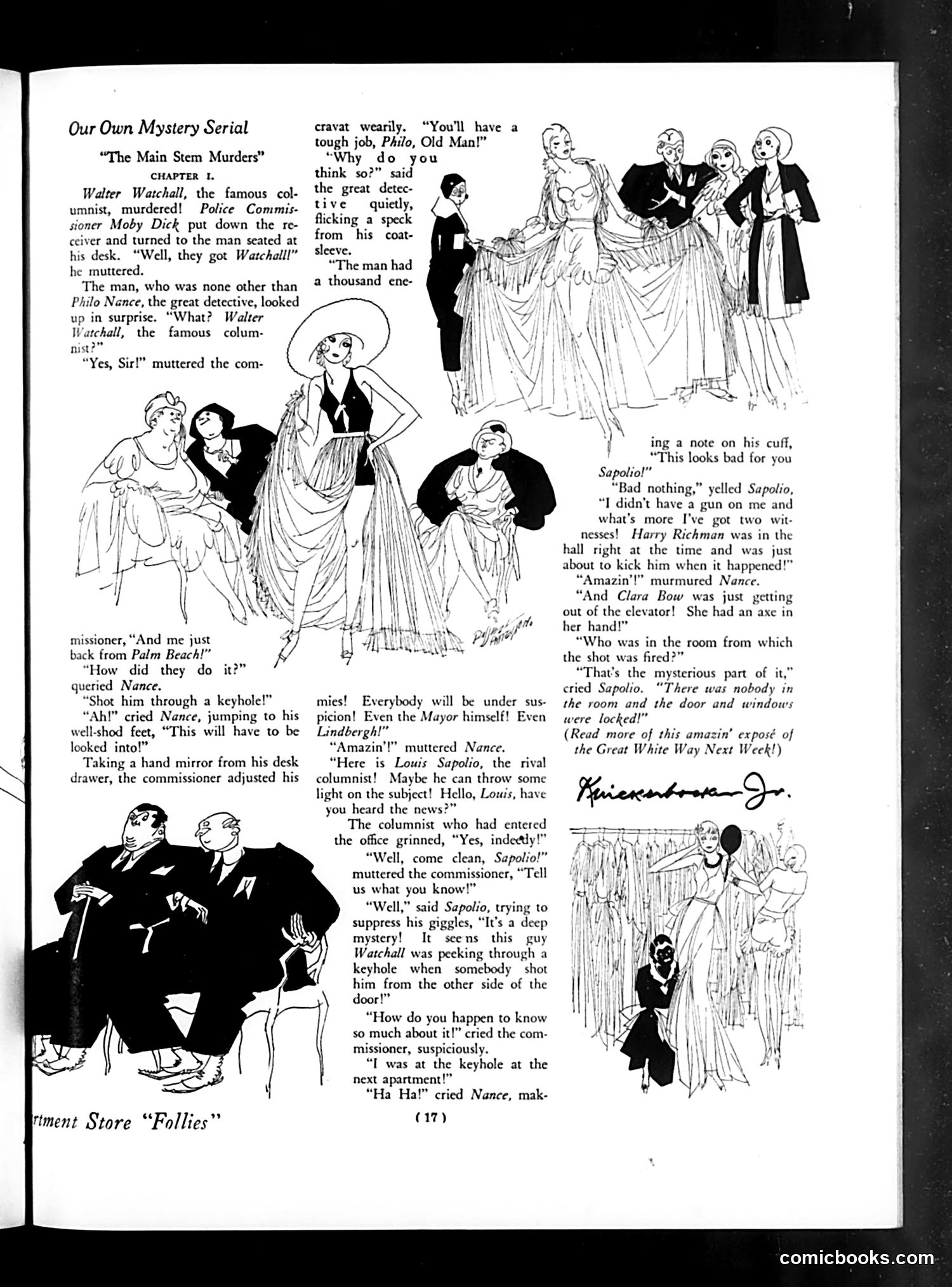
"The Main Stem Murders" - Life Magazine Mystery Serial This page presents the opening of a serialized mystery story in Life magazine. The narrative centers on Walter Watchall, described as a "famous columnist" and "great detective," who is mysteriously murdered by Police Commissioner Moby Dick. The story involves satirical characters with punning names: Sapolio (a rival columnist), Nance, Harry Richman, and Clara Bow. The plot mechanics parody detective fiction: a locked-room shooting mystery where Watchall was shot through a keyhole. The satire targets newspaper columnists and rivalries of the era—Watchall's murder by a police official suggests commentary on journalistic competition and authority figures. The absurdist humor and character names indicate this is comedic pastiche rather than serious mystery fiction. The page includes both text and cartoon illustrations typical of Life's format.
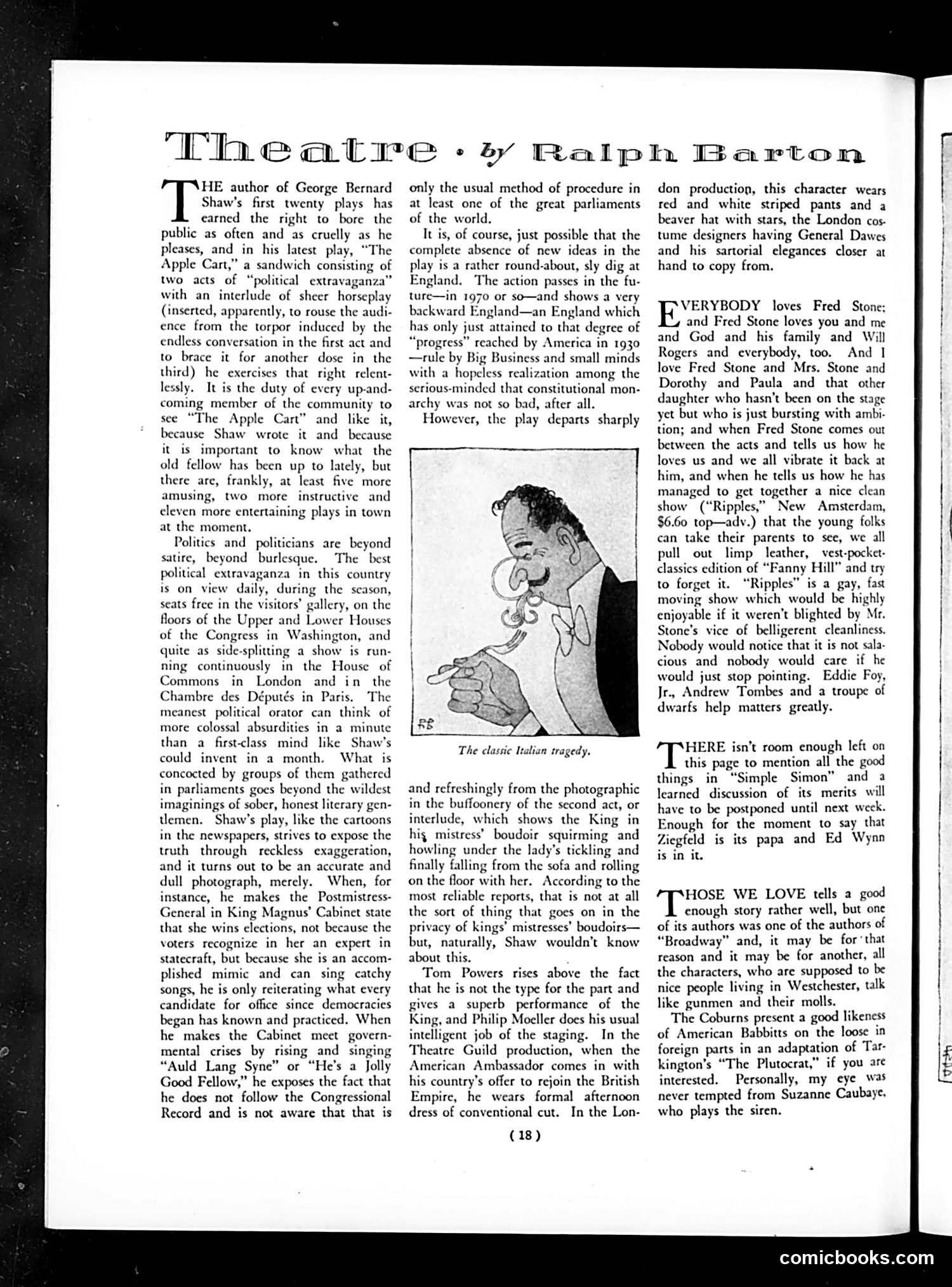
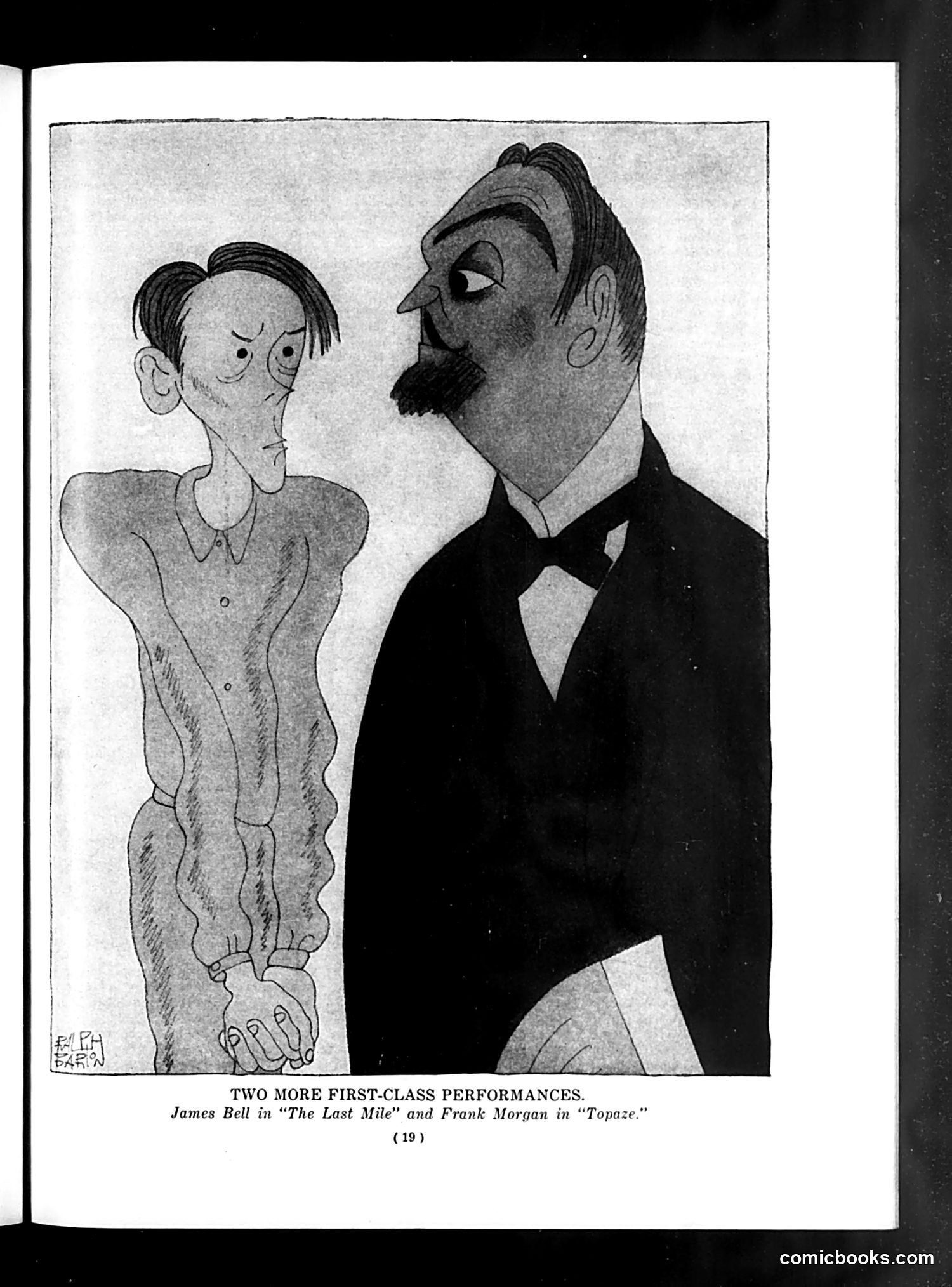
This page features caricatures of two actors in theatrical productions. The caption identifies them as James Bell in "The Last Mile" and Frank Morgan in "Topaze." The cartoon shows exaggerated caricature style typical of Life magazine's entertainment coverage. The left figure (Bell) is drawn with pronounced features and period clothing, while the right figure (Morgan) displays an elaborate beard and formal attire, emphasizing his theatrical persona. The page appears to be reviewing or celebrating these "first-class performances," using the visual caricatures as humorous commentary on the actors' stage work. This reflects Life's tradition of satirizing Broadway productions through artist caricature. Without additional context about these specific productions, the exact satirical point remains unclear, though the exaggerated facial features suggest mockery of the performances or actors themselves.
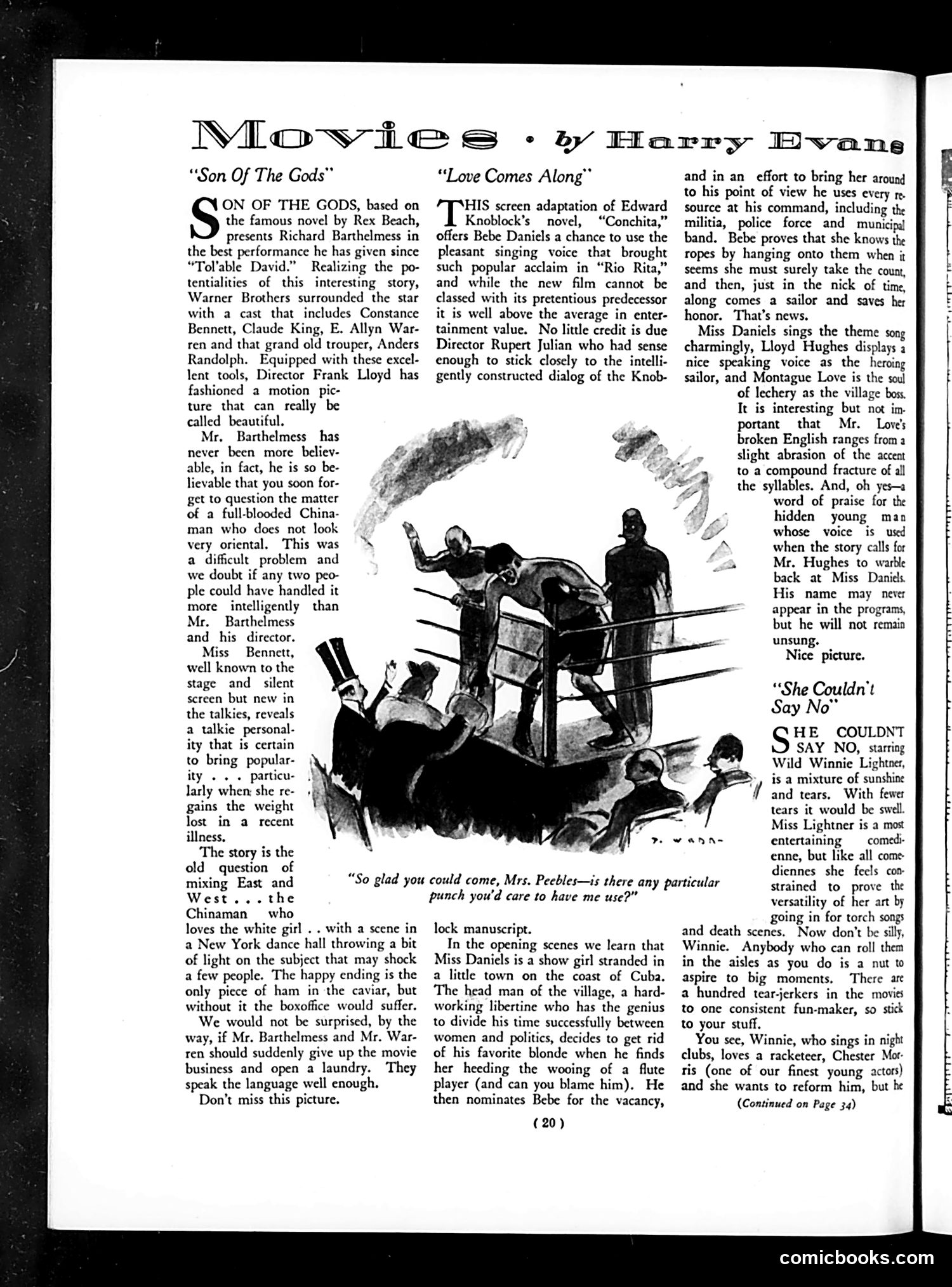
Analysis: "Movies" by Harry Evans This is a film review column from Life magazine, circa late 1920s. The page contains three movie reviews with no political satire; it's straightforward entertainment criticism. "Son of the Gods" reviews a Warner Brothers film starring Richard Barthelmess as a full-blooded Chinese man. The reviewer praises the film but notes the casting difficulty—Barthelmess doesn't look "very oriental." The column ends with a crude joke: the reviewer suggests Barthelmess and co-star Anders Randolph should "open a laundry" because they "speak the language well enough"—a racist stereotype equating Chinese immigrants with laundry work. "Love Comes Along" and "She Couldn't Say No" are straightforward reviews of other films featuring Bebe Daniels and Wild Winnie Lightner respectively. The column reflects period attitudes: casual racism in entertainment criticism was normalized in 1920s publications. The "laundry" quip would be considered offensive today but represents typical casual bigotry of the era.
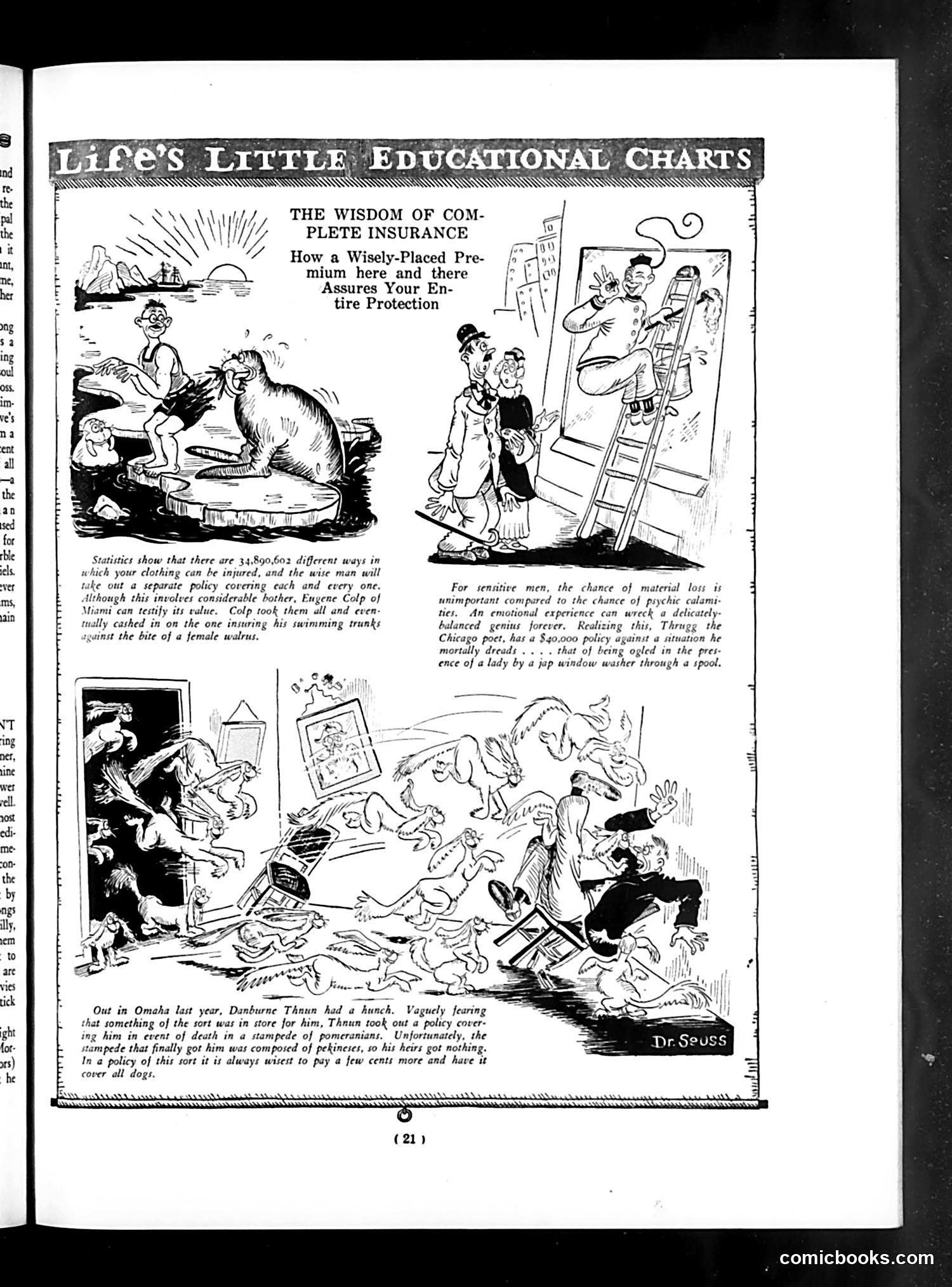
Explanation for Modern Readers This is a satirical piece by Dr. Seuss mocking the insurance industry's aggressive sales tactics and absurd policy proliferation. The humor works on multiple levels: The Satire: Insurance companies were selling increasingly specific, niche policies for improbable scenarios. Seuss exaggerates this to absurdity—policies for swimming trunks bitten by female walruses, or being ogled by a window washer while accompanied by a lady. The Point: The piece criticizes how insurance exploits people's anxieties (real and imagined) to sell unnecessary coverage. The cautionary tales of Eugene Colp and Danburne Thnun show the trap: Colp's oddly-specific policy pays off by pure chance, while Thnun's carefully-chosen pekinese stampede coverage fails when he's hit by a different dog breed—illustrating the futility of over-specialization. Visual Humor: The accompanying illustrations depict chaotic domestic disasters and absurd animal attacks, emphasizing the ridiculousness of over-insuring against unlikely events.
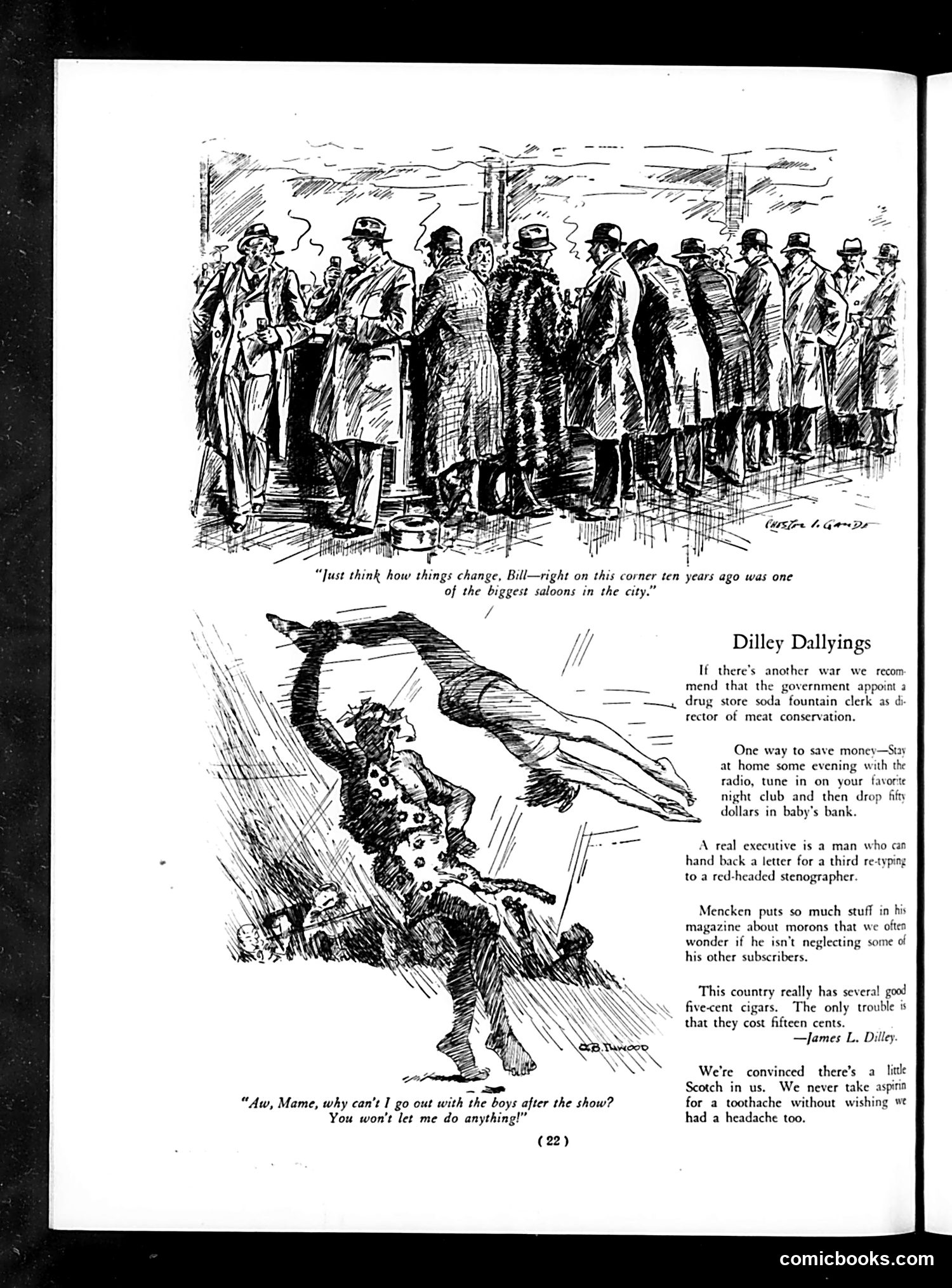
Analysis of This Life Magazine Page Top Cartoon: Shows men in coats and hats on a street corner, with one remarking that a major saloon once occupied this spot. This references Prohibition (1920-1933)—the legal ban on alcohol sales. The joke is nostalgic social commentary: a thriving saloon has vanished, replaced by... presumably nothing of note. The satire cuts both ways: mocking both those who miss the saloons and the Prohibition experiment itself. Bottom Cartoon: A woman restrains a man trying to leave after a show. The caption suggests she prevents him from going anywhere fun. This satirizes traditional gender dynamics and domestic control, depicting a wife as an overbearing restrictor of her husband's freedoms. "Dilley Dallyings" Section: Miscellaneous brief satirical observations, including jabs at government bureaucracy, H.L. Mencken's magazine (likely *The American Mercury*), cigar pricing, and marital/personal foibles. These are light social humor rather than political commentary. The page exemplifies Life magazine's role as a satirical publication targeting contemporary American social mores and institutions through both visual and written humor.
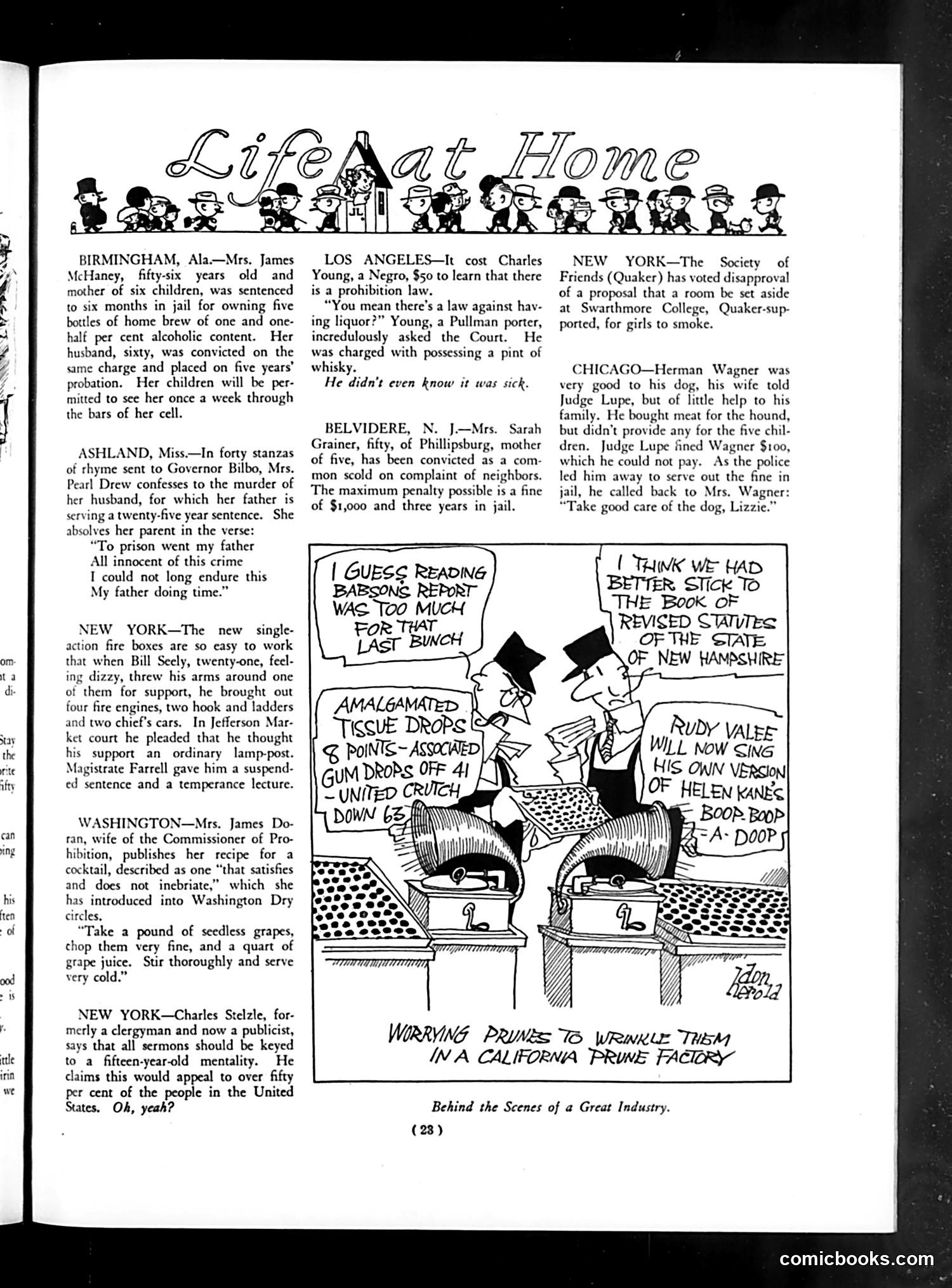
Life Magazine Satire: Prohibition Era Absurdities This page from *Life* magazine satirizes the contradictions and failures of Prohibition (1920-1933) through news briefs and a cartoon. The text items mock enforcement's arbitrary cruelty: a woman jailed for owning weak home brew while her husband gets probation; a man confused by fire-alarm boxes; the Prohibition Commissioner's wife publishing a "cocktail" recipe (claiming it doesn't intoxicate). The racist item about Charles Young, a Black Pullman porter, highlights discriminatory enforcement. The cartoon depicts two men discussing market reports while discussing prune prices and drops in stock values—the juxtaposition sarcastically suggests financial speculation uses the same language as discussing illegal alcohol ("drops," "points"). The caption "Worrying Prunes to Wrinkle Them in a California Prune Factory" is a double entendre, implying the men are actually discussing bootlegging under the guise of legitimate business. Overall, *Life* ridicules Prohibition's ineffectiveness, unequal justice, and widespread hypocrisy among elites.
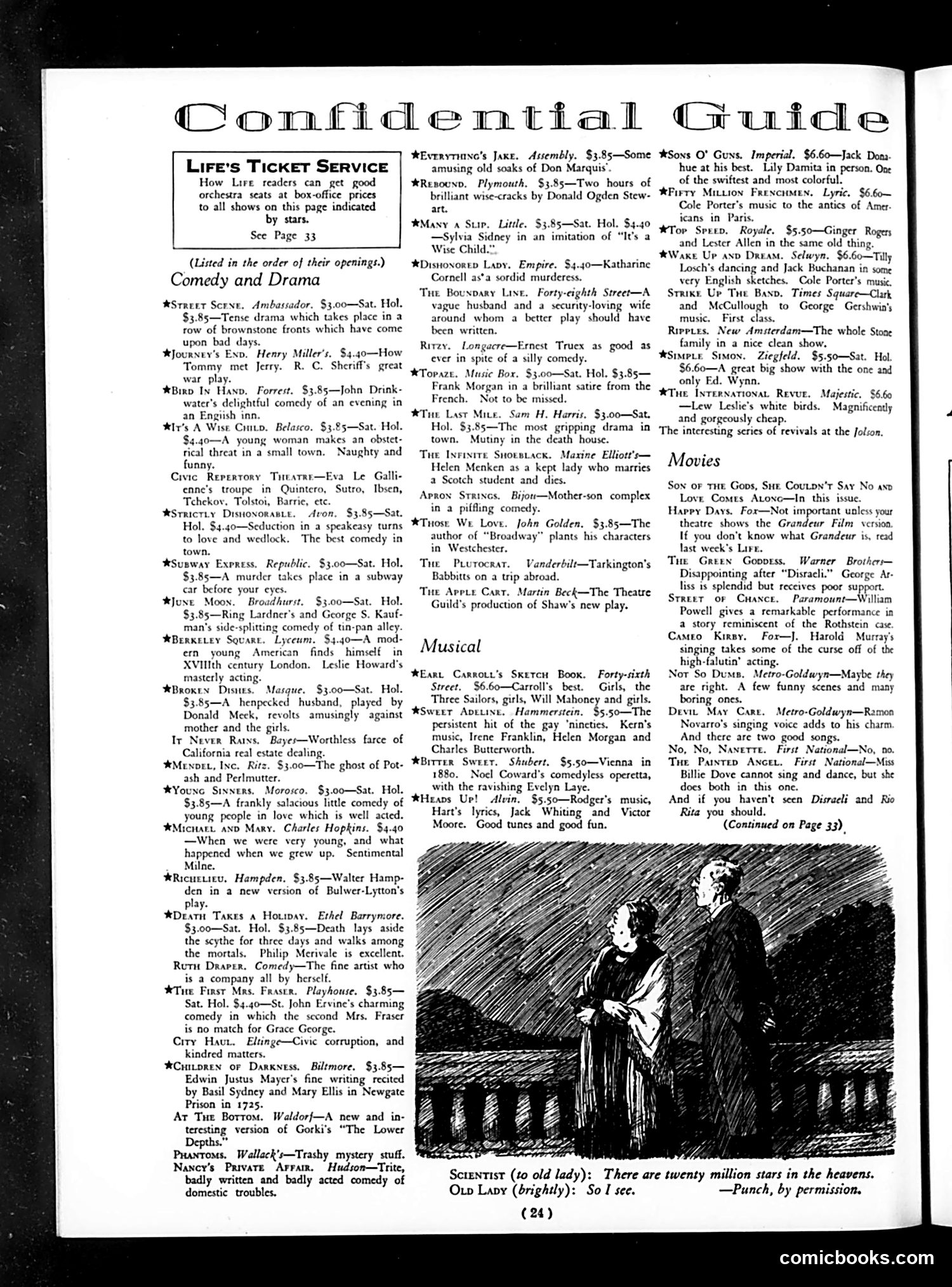
Explanation of This Page for Modern Readers This page is primarily a theater listing and review guide, not a political cartoon. It's a service feature from *Life* magazine (a 1920s satirical weekly) helping readers find good Broadway shows with discounted tickets through *Life*'s box office arrangement. The content lists comedies, dramas, and musicals with brief critical descriptions. The asterisks (*) mark shows offering the discount service. The small cartoon at bottom shows a scientist addressing an old lady, illustrating a joke: the scientist says "There are twenty million stars in the heavens," and the old lady replies (per the caption), "So I see" — implying she's making a witty, irreverent comment about theater performers ("stars") rather than understanding astronomy. This is essentially entertainment journalism and advertising rather than political satire — a snapshot of 1920s Broadway culture and consumer guidance for affluent magazine readers.
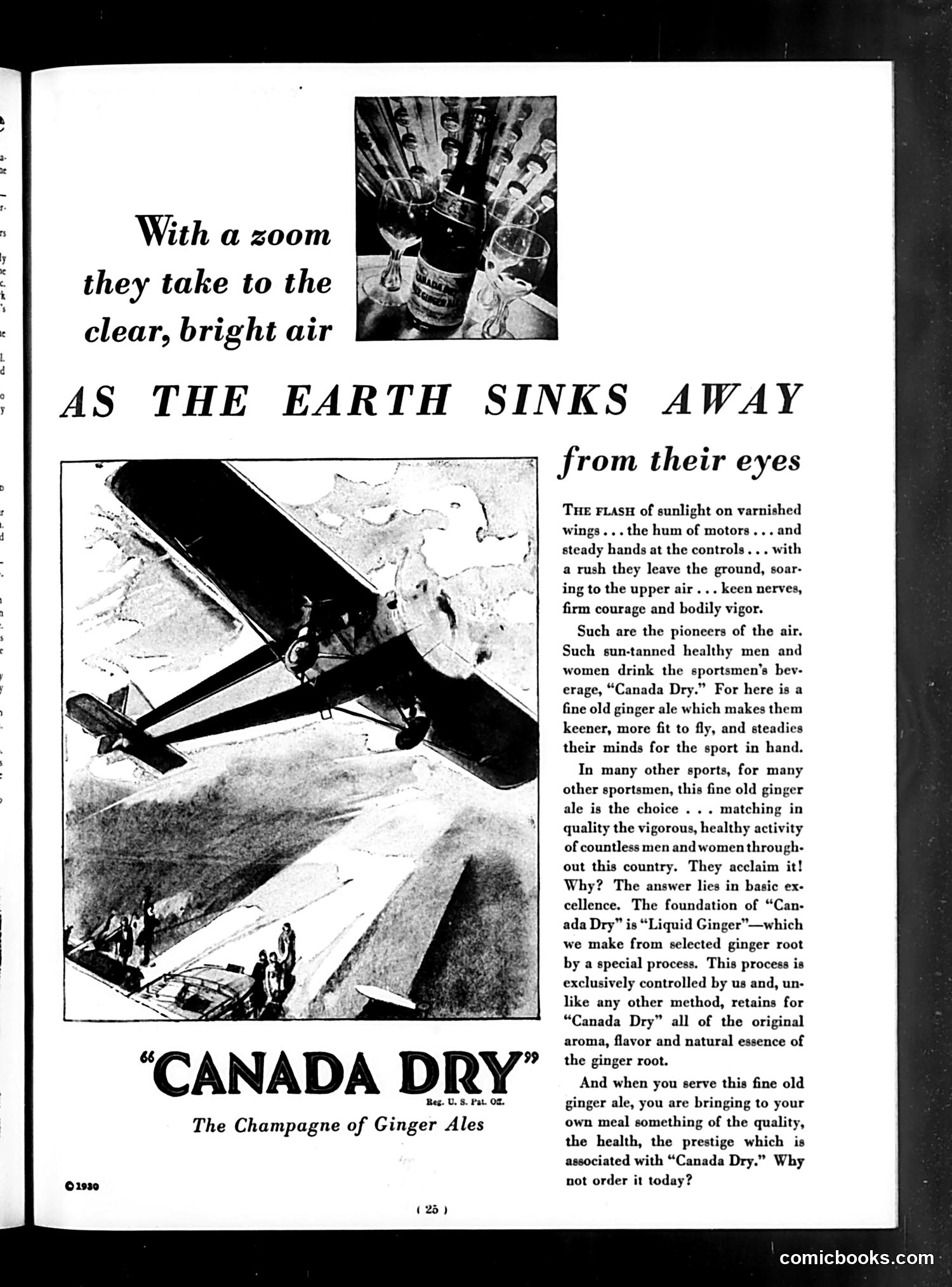
Analysis This is not a cartoon or satire, but rather a 1930 advertisement for Canada Dry ginger ale disguised as editorial content in Life magazine. The page uses aspirational imagery of early aviators—described as "pioneers of the air" with "keen nerves, firm courage and bodily vigor"—to associate Canada Dry with health, vigor, and modern achievement. The aircraft photograph and dramatic language about takeoff create an impression of prestige and vitality. The advertising copy argues that just as aviators represent peak physical condition, Canada Dry drinkers share that same quality. The tagline "The Champagne of Ginger Ales" elevates it beyond a soft drink. The text emphasizes the product's "Liquid Ginger" foundation and exclusive manufacturing process as proof of superiority. This represents early 20th-century advertising strategy: associating consumer products with lifestyle ideals and social status rather than focusing on functional benefits. The aviation theme capitalizes on the era's fascination with flight as the height of modern progress.
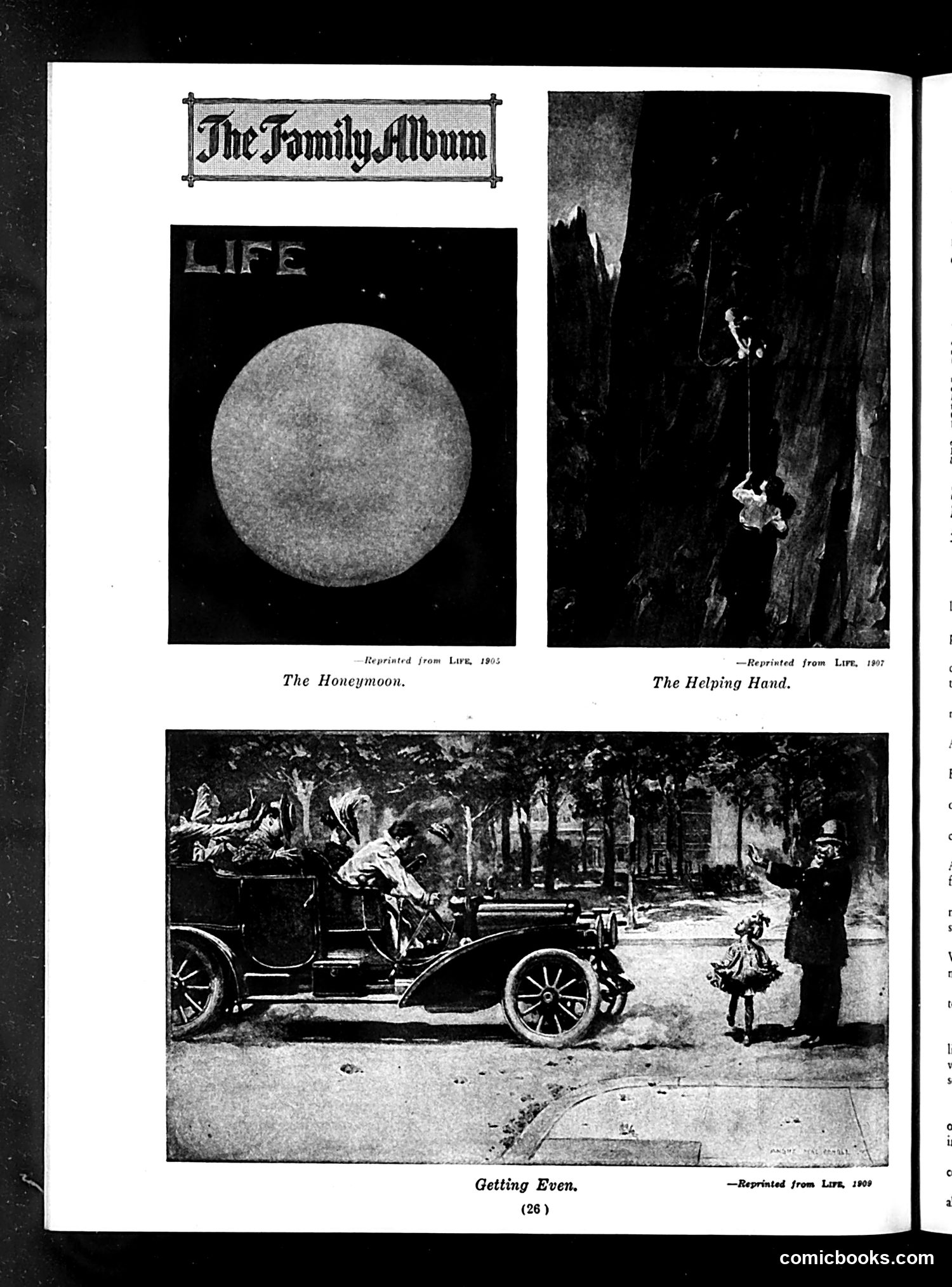
"The Family Album" Page Analysis This is a page of reprinted cartoons from *Life* magazine spanning 1905-1909, grouped under the theme "The Family Album." The three images appear to satirize marriage and domestic life: "The Honeymoon" (1905) shows a full moon—a visual pun on the romantic period. "The Helping Hand" (1907) depicts someone extending aid to another in what appears to be a precarious situation, likely commenting on marital support or obligation. "Getting Even" (1909) shows a domestic scene with an early automobile and figures in a park setting, apparently illustrating some form of marital revenge or retaliation. Together, these reprinted cartoons track the trajectory of marriage from romance through compromise to conflict—a common satirical subject in early-20th-century American humor magazines.
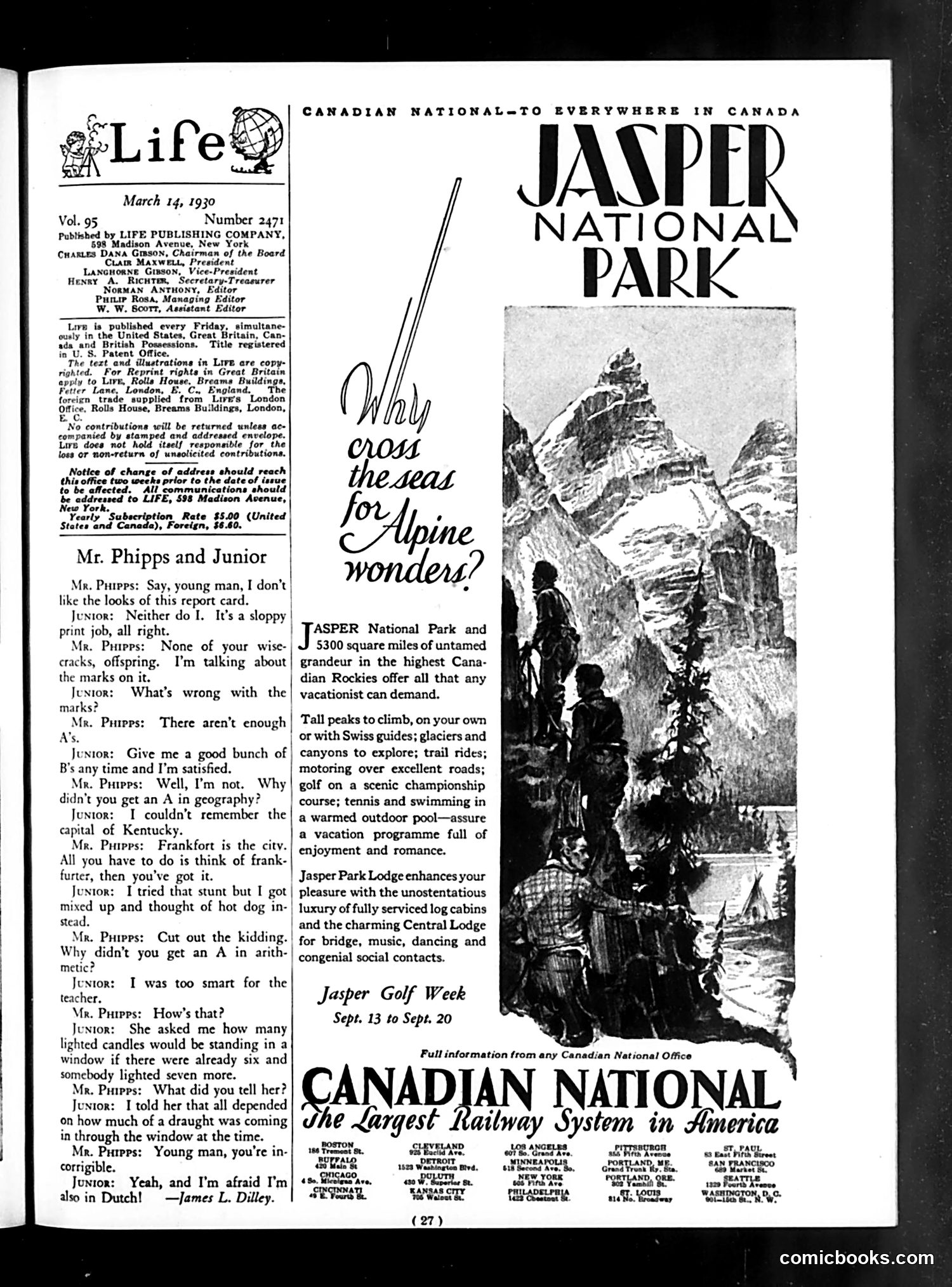
Analysis of Life Magazine, March 14, 1930 This page contains a humorous dialogue comic titled "Mr. Phipps and Junior" featuring a father questioning his son about a poor report card. The joke relies on the boy's literalist, smart-aleck answers: he can't remember Kentucky's capital (solved by thinking "frankfurter" → "Frankfort"), and he answers an arithmetic problem about candles by noting that a draft would blow them out—technically correct but missing the point of the math lesson. The satire targets a familiar generational conflict: the exasperated parent versus the clever but unhelpful child who uses logic to evade responsibility rather than improve academically. The humor appeals to parents recognizing their children's annoying reasoning tricks. The remainder of the page is advertising for Jasper National Park in the Canadian Rockies and Canadian National Railway—not satirical content.
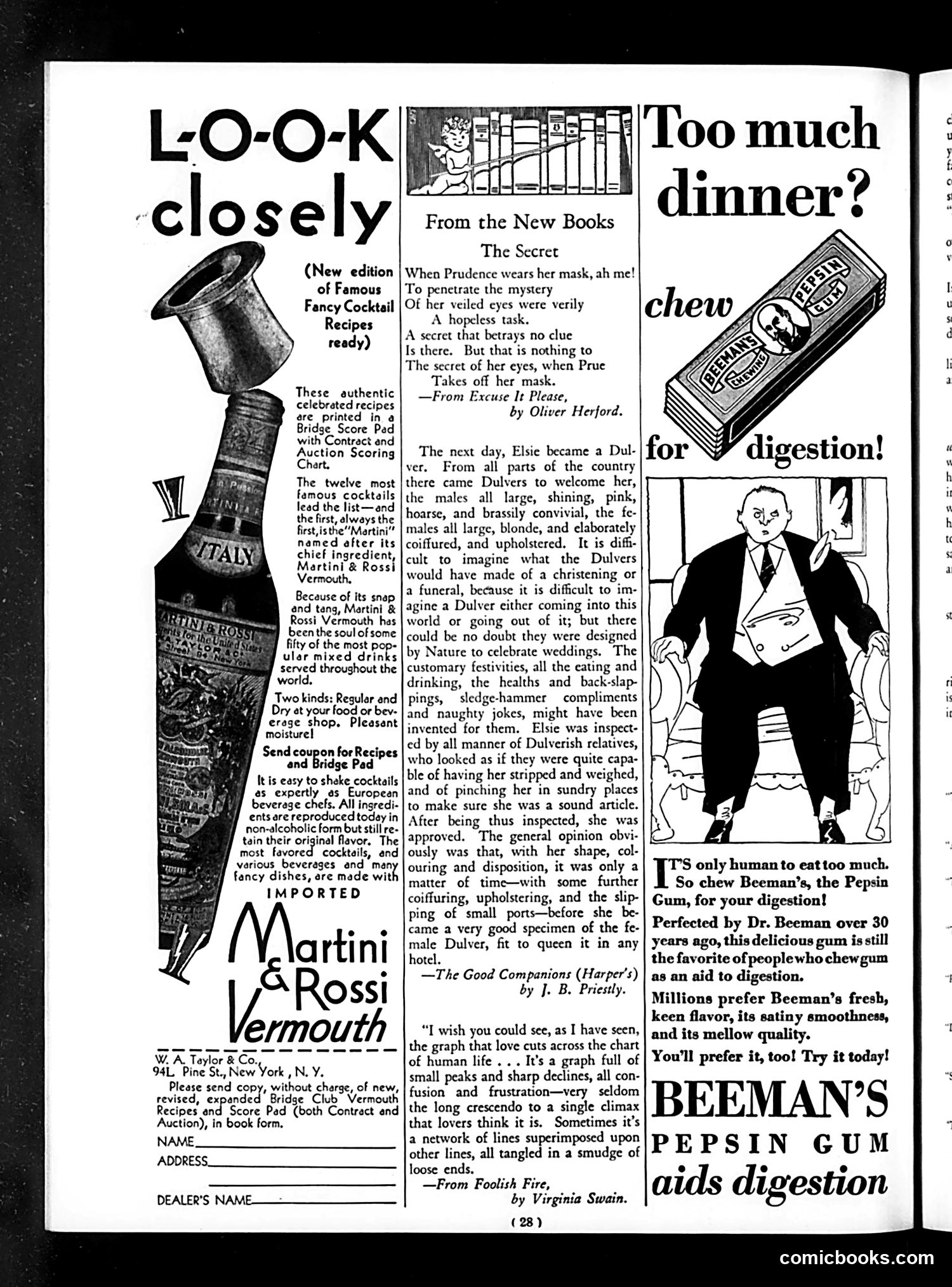
Page Analysis: Life Magazine Advertisement and Book Excerpts This page is primarily advertising, not satire or political commentary. It contains three distinct elements: Left side: A Martini & Rossi Vermouth advertisement emphasizing cocktail recipes and bridge-playing culture—reflecting 1920s-30s leisure activities among affluent Americans. Center: Literary excerpts from contemporary books, including works by Oliver Herford and J.B. Priestley, featuring romantic and social themes typical of period fiction. Right side: A Beeman's Pepsin Gum advertisement using a cartoon of an overstuffed diner to humorously pitch digestive relief. The cartoon's joke is straightforward: eating too much causes discomfort; chewing gum aids digestion—a common marketing claim of the era. Historical context: The page reflects Depression-era consumer culture, where even modest products like gum claimed pseudo-scientific health benefits. The emphasis on cocktails and bridge suggests target readership among middle-to-upper-class readers with leisure time. There is no political satire here—merely commercial messaging and literary promotion typical of Life's mixed-content format.
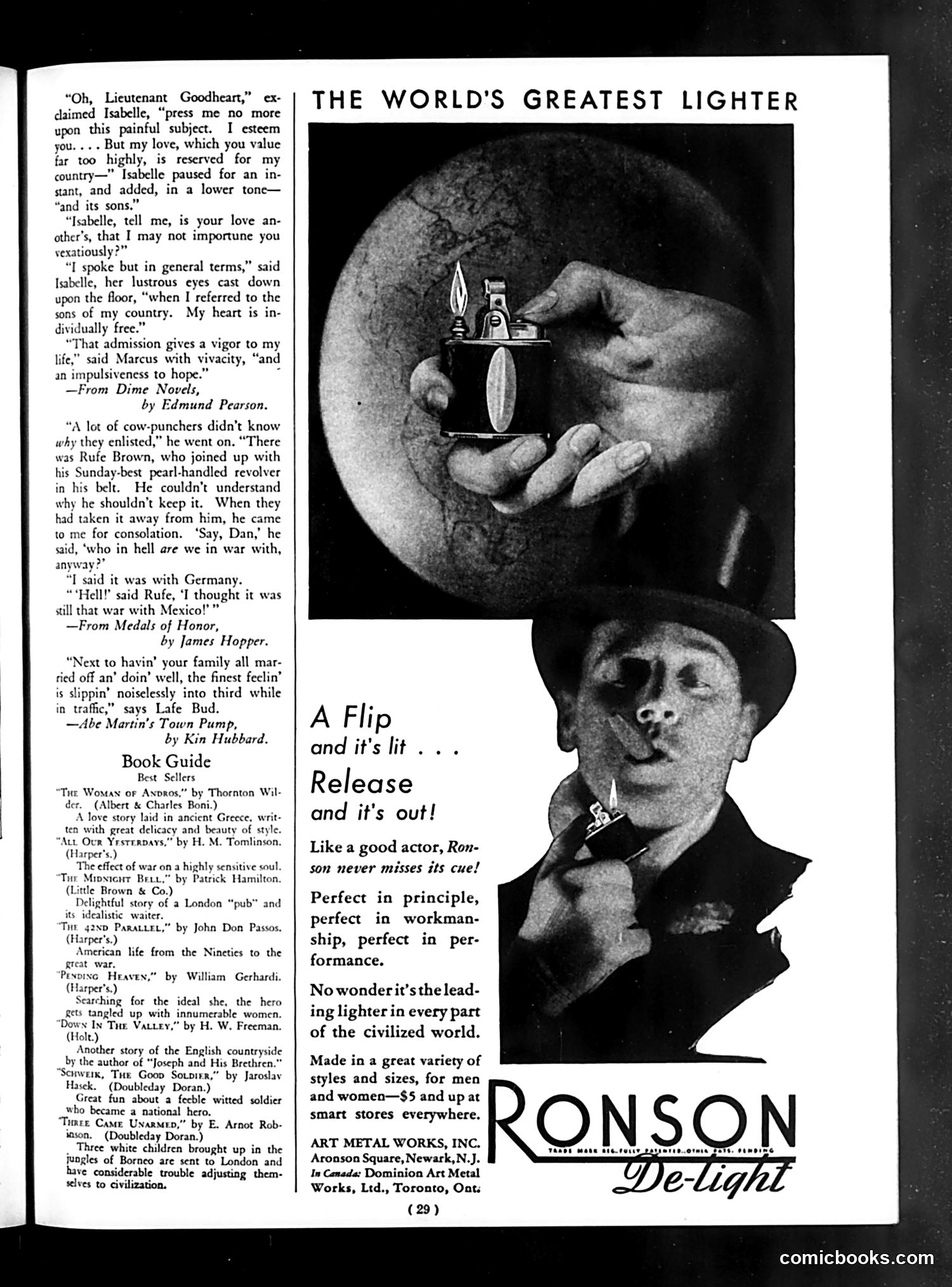
Analysis of This Life Magazine Page This is primarily a book review and advertising page from what appears to be the 1920s era. The left column features humorous literary excerpts mocking popular "dime novels" and sentimental fiction of the time—a common satirical target for *Life* magazine. The three quoted passages ridicule: 1. Overly melodramatic romantic dialogue ("reserved for my country") 2. The confusion of enlisted soldiers about America's wars (a cowpuncher thinking the current war is still with Mexico, not Germany) 3. Folksy, cod-philosophical wisdom The right side is a Ronson lighter advertisement claiming "The World's Greatest Lighter." The advertisement plays on the lighter's reliability using theatrical metaphor ("Like a good actor, Ronson never misses its cue"). The page's satire primarily targets sentimental literature and overwrought romance narratives popular in that era, which *Life* considered worthy of ridicule. The advertisement appears straightforward commercial content, not satirical.
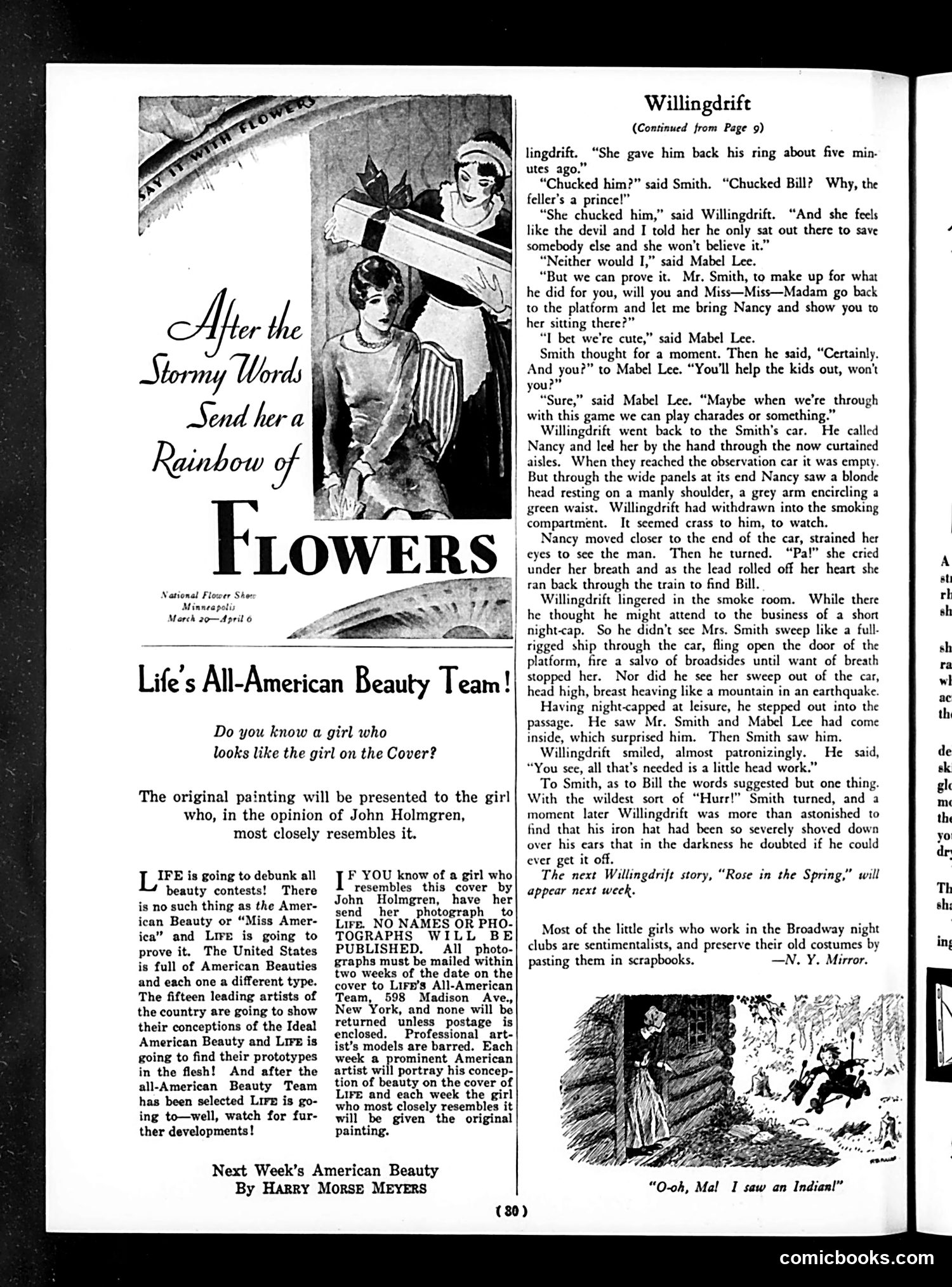
Analysis for Modern Readers This page contains two distinct sections: Left side: A *Life* magazine contest advertisement promoting their "All-American Beauty Team" concept. The magazine announces it will debunk the idea of a single ideal beauty standard by having 15 leading American artists each paint their own conception of beauty, then find real women matching those paintings. Readers are invited to submit photographs. This reflects 1920s progressive thinking—questioning whether one standardized "beauty" exists. Right side: The continuation of a serialized story called "Willingdrift," a romantic narrative about train passengers. The visible excerpt describes characters arranging to prove something to a woman named Nancy about a man named Bill. The plot involves misunderstandings and attempted reconciliation. The small illustration shows what appears to be a dramatic moment ("O-oh, Ma! I saw an Indian!"). The page represents typical *Life* magazine content mixing satirical commentary on American culture with serialized fiction for entertainment.
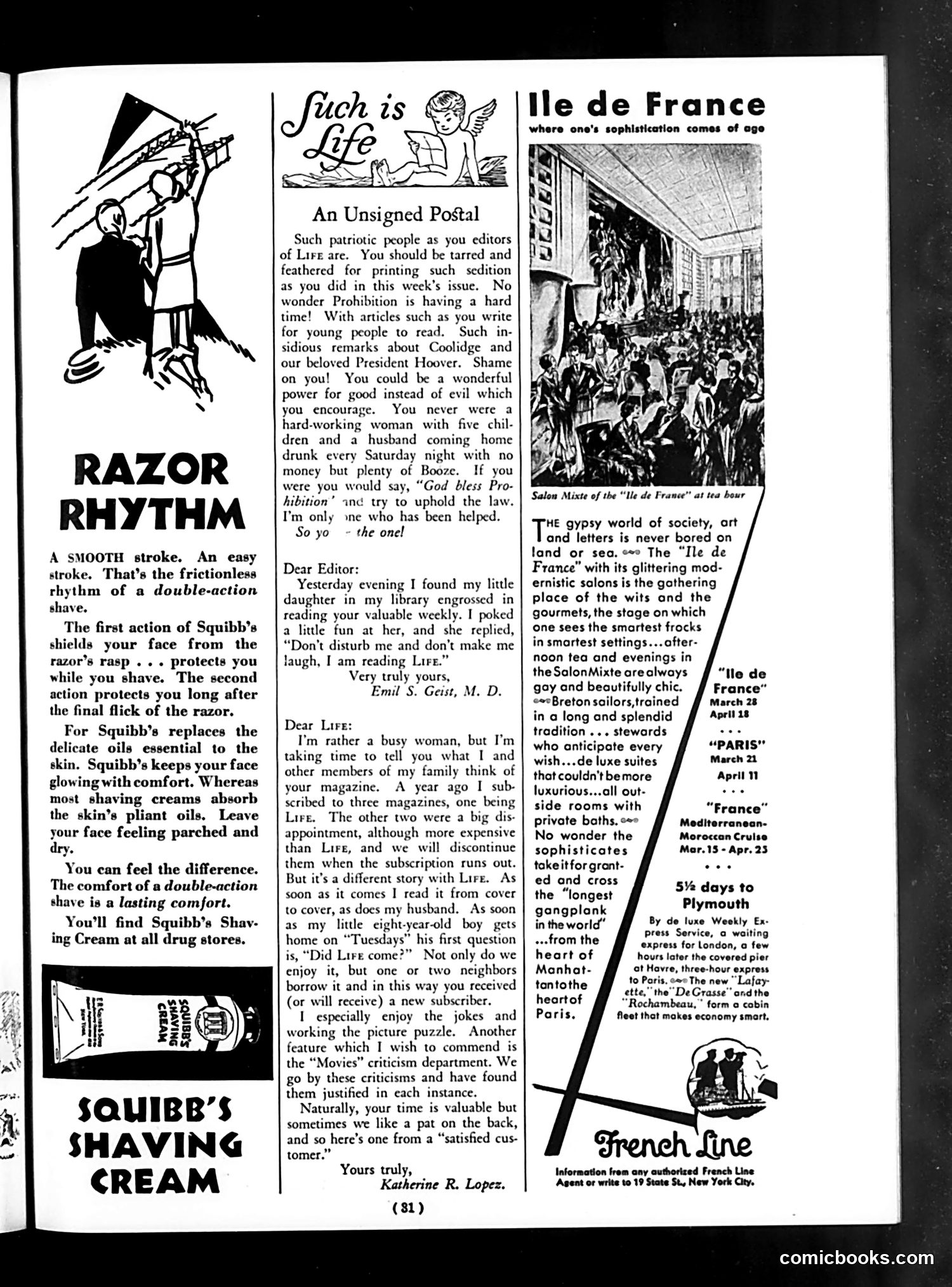
Page Analysis: Life Magazine Content This page combines advertisements with reader letters praising *Life* magazine itself. The "Razor Rhythm" cartoon (left) is a simple visual pun—a figure shaving with exaggerated motion lines, illustrating the rhythmic double-action of Squibb's shaving cream. "Such is Life" editorial cartoon (top center) depicts an angry unsigned letter-writer criticizing *Life's* editors as unpatriotic for publishing "sedition" about Prohibition and criticizing President Coolidge and Hoover. The writer—apparently a struggling working-class woman—defends Prohibition, contrasting her hardship (drunk husband, no money) with what she sees as *Life's* irreverent mockery. The three reader letters praise *Life* enthusiastically: one admires its humor and picture puzzles; another notes how her family anticipates each issue; a third emphasizes how neighbors borrow copies after reading. "Ile de France" advertisement (right) promotes a luxury ocean liner, emphasizing its sophisticated salons as gathering places for society's wittiest people—directly contrasting the working-class complaint in the unsigned letter above it, creating ironic juxtaposition about *Life's* audience.
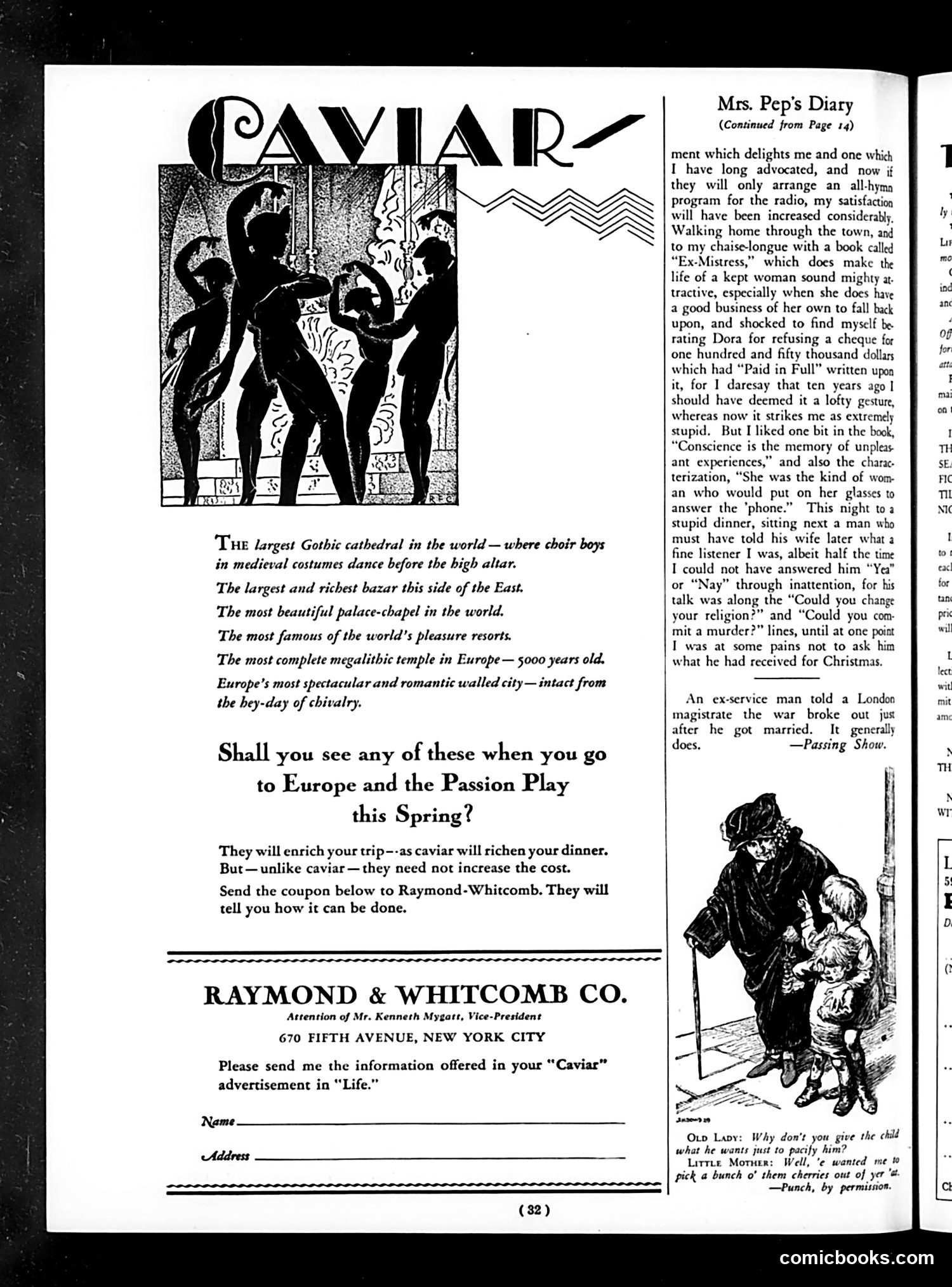
Analysis: Raymond & Whitcomb Travel Advertisement This page is primarily a travel advertisement for luxury European tours, with accompanying magazine content. The "Caviar" ad uses a clever metaphor: just as caviar enriches dinner, European attractions (Gothic cathedrals, the Passion Play, medieval cities) will enrich a trip—but unlike caviar, the tour company claims it won't cost extra. The woodcut illustration depicts figures in what appears to be a medieval or religious setting, likely representing the European attractions being advertised. The right side contains "Mrs. Pep's Diary," a gossipy social column about a woman's observations on infidelity, kept women, and tedious dinner conversation—reflecting upper-class preoccupations of the era. Below that are two humorous cartoons: one about a man enjoying a child's tantrum, another (from *Punch*) about stealing cherries. These are typical light satirical fare for *Life* magazine's entertainment content. The overall page reflects 1920s-30s affluent American leisure culture and the magazine's mix of travel promotion, society gossip, and gentle humor.
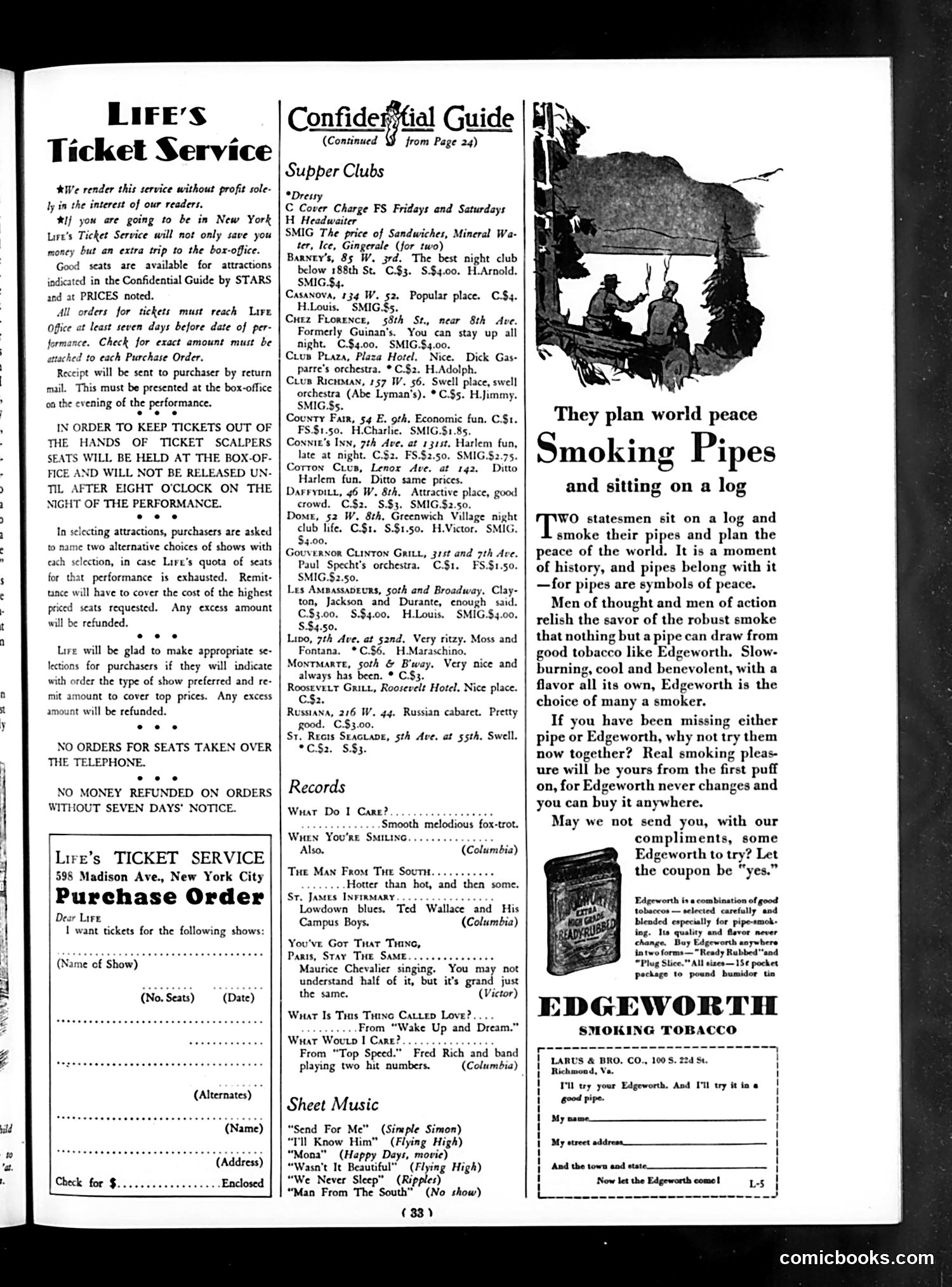
Life Magazine Page Analysis This page is primarily advertising and service content, not satire. The left side features Life's ticket service for New York theater and entertainment venues, with a purchase order form. The right side contains an Edgeworth Tobacco advertisement featuring an illustration of two men smoking pipes on a log. The copy explicitly links pipe smoking to peace-making: "They plan world peace / Smoking Pipes and sitting on a log." The ad suggests that smoking Edgeworth tobacco represents a gentlemanly, civilized activity associated with international cooperation and calm deliberation. This is likely post-World War I content (given Life's founding in 1883 and this style), when peace promotion was a significant cultural theme. The advertisement uses nostalgic, masculine imagery to market tobacco as conducive to civilized discourse and peaceful resolution of disputes—a common advertising trope of the era.
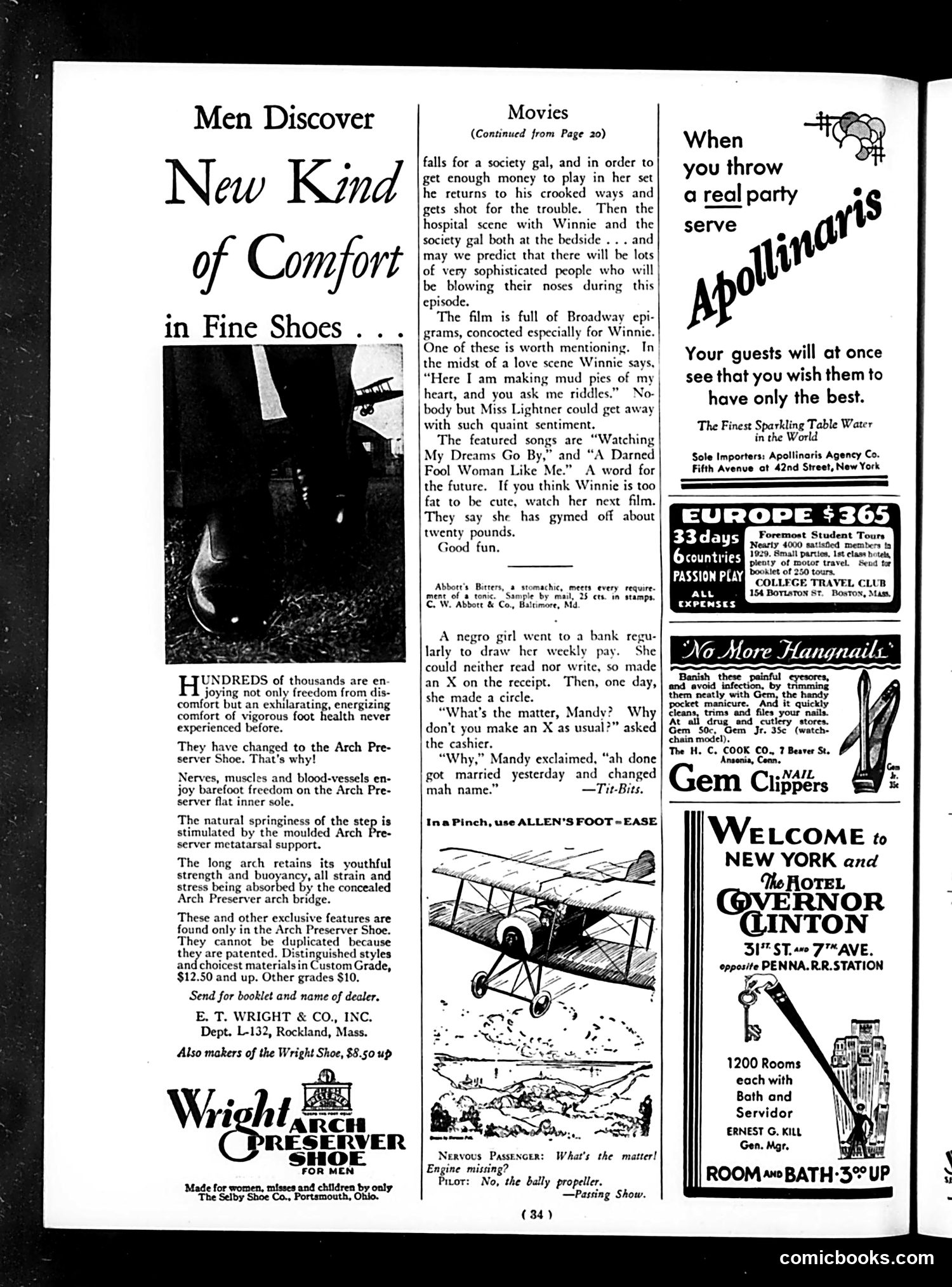
Page Analysis: Life Magazine Advertisement and Content This page is primarily advertising, with a small section of movie review and humor. The main content includes: 1. Arch Preserver Shoe advertisement (left): A shoe company promoting orthopedic footwear with "patented" arch support features, claiming to provide comfort and foot health. 2. Movie review (center): A brief critique of what appears to be a Winnie Lightner film, praising her comedic timing and featuring songs. The reviewer humorously suggests audiences will cry during sentimental scenes. 3. Racial humor (center): A "Tit-Bits" style joke about a Black woman who changes her signature from an X to a circle after marriage—offensive period stereotyping portraying illiteracy. 4. Various other ads: Apollinaris sparkling water, student tours to Europe, nail clippers, Allen's Foot-Ease, Hotel Governor Clinton, and other consumer products typical of 1920s advertising. The page reflects early 20th-century advertising sensibilities and unfortunately includes the casual racial stereotyping common to that era's publications.
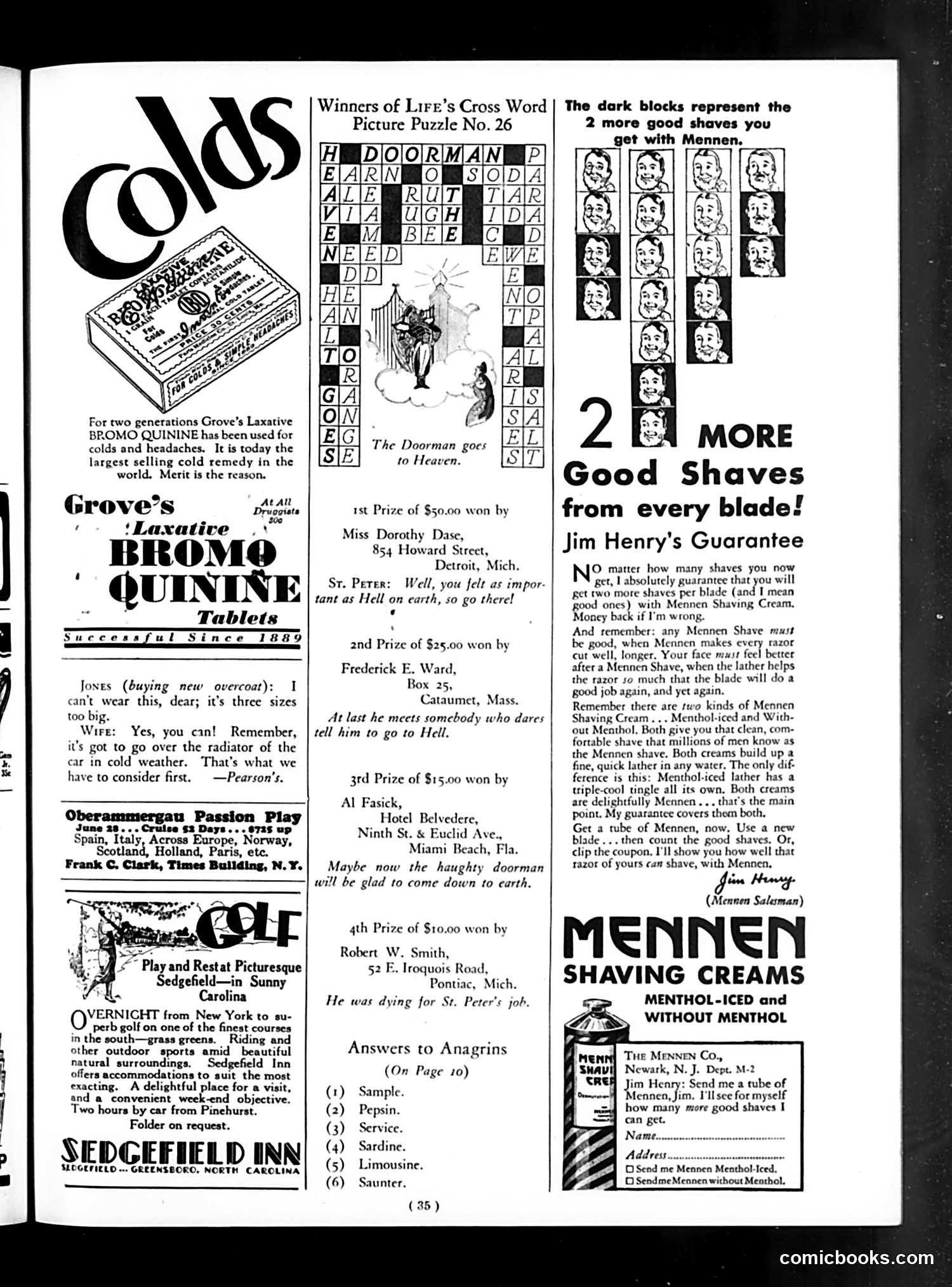
Analysis of Life Magazine Page Content This page is primarily advertising and puzzles rather than political satire. The main content includes: Crossword Puzzle Feature: A "Picture Puzzle No. 26" with a cartoon showing a doorman being told by St. Peter to "go to Hell"—a mild afterlife joke about a pompous doorman finally meeting someone who won't defer to him. The humor reflects early 20th-century class commentary: even in Heaven, social hierarchies are challenged. Domestic Humor Comic: A brief Jones/Wife dialogue about buying an oversized overcoat to fit over a car radiator in winter—reflecting practical concerns of 1920s car owners navigating cold weather with inadequate vehicle heating. Advertisements: Grove's Bromo Quinine (cold remedy), travel cruises, golf resort, and notably Mennen Shaving Cream with an endorsement by "Jim Henry" guaranteeing extra shaves per blade. The page captures period concerns: automobile ownership challenges, medicinal remedies, leisure travel, and grooming products—typical Life magazine content mixing light entertainment with consumer advertising.
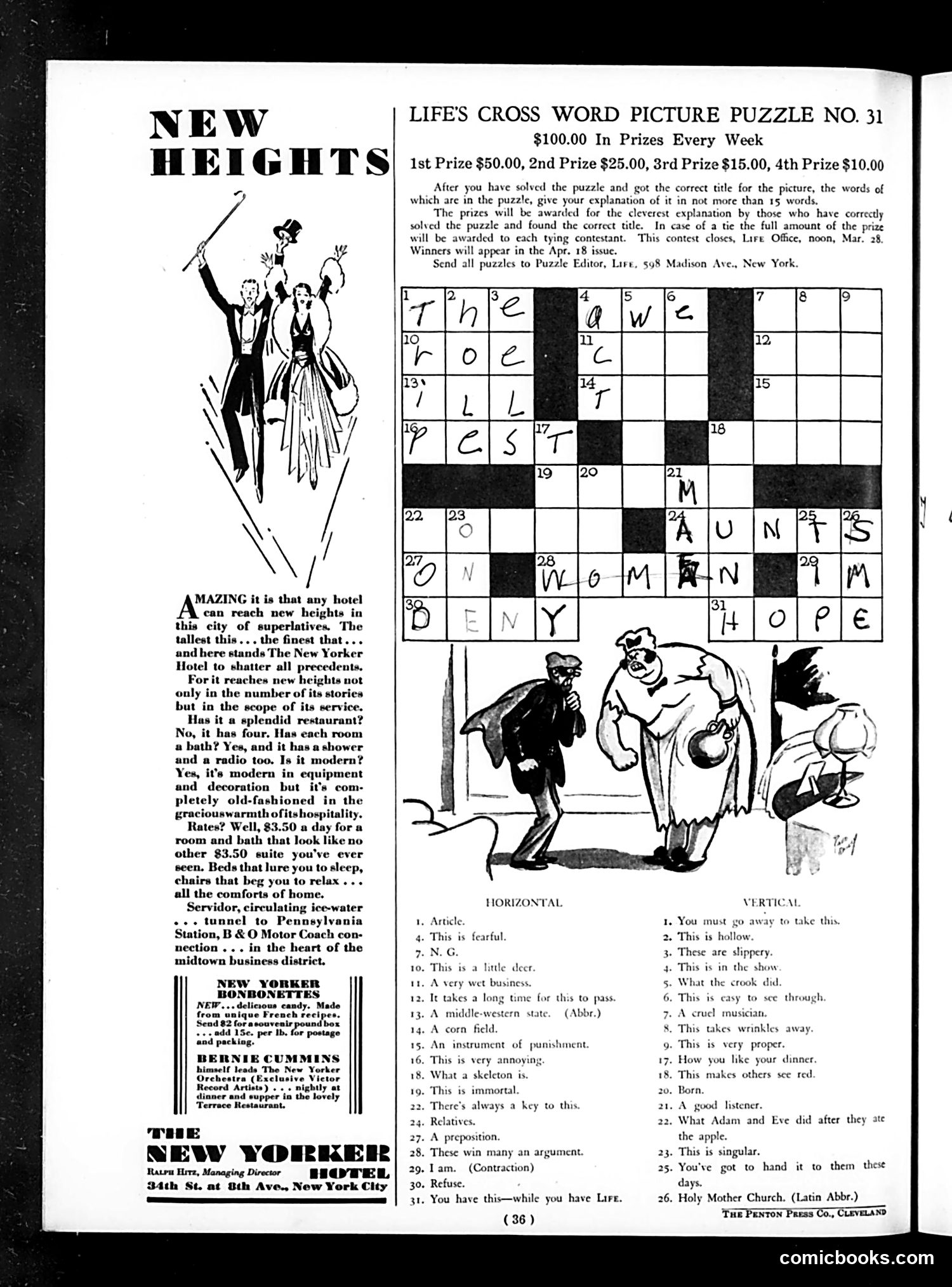
Life Magazine Puzzle Page (circa 1920s-30s) This page is primarily advertising and a crossword puzzle contest, not political satire. The main content is "Life's Cross Word Picture Puzzle No. 31," offering $100 in weekly prizes for solving a visual crossword and explaining it in 15 words or fewer. The cartoon accompanying the puzzle shows a bellhop being struck or knocked down by a large, rotund man—likely illustrating one of the puzzle's clues or the puzzle's solution itself. The page also contains advertisements for The New Yorker Hotel (emphasizing modern amenities like multiple restaurants, private baths, and radios at $3.50/day) and Bernie Cummins' orchestra performing at the hotel's Terrace Restaurant. There's also a brief ad for "New Yorker Bonbonettes" candy. The puzzle itself contains standard crossword clues with no apparent political commentary—they're straightforward definitions and wordplay ("You must go away to take this," "A corn field," etc.). This represents Life's mixed editorial-advertising format of the era.
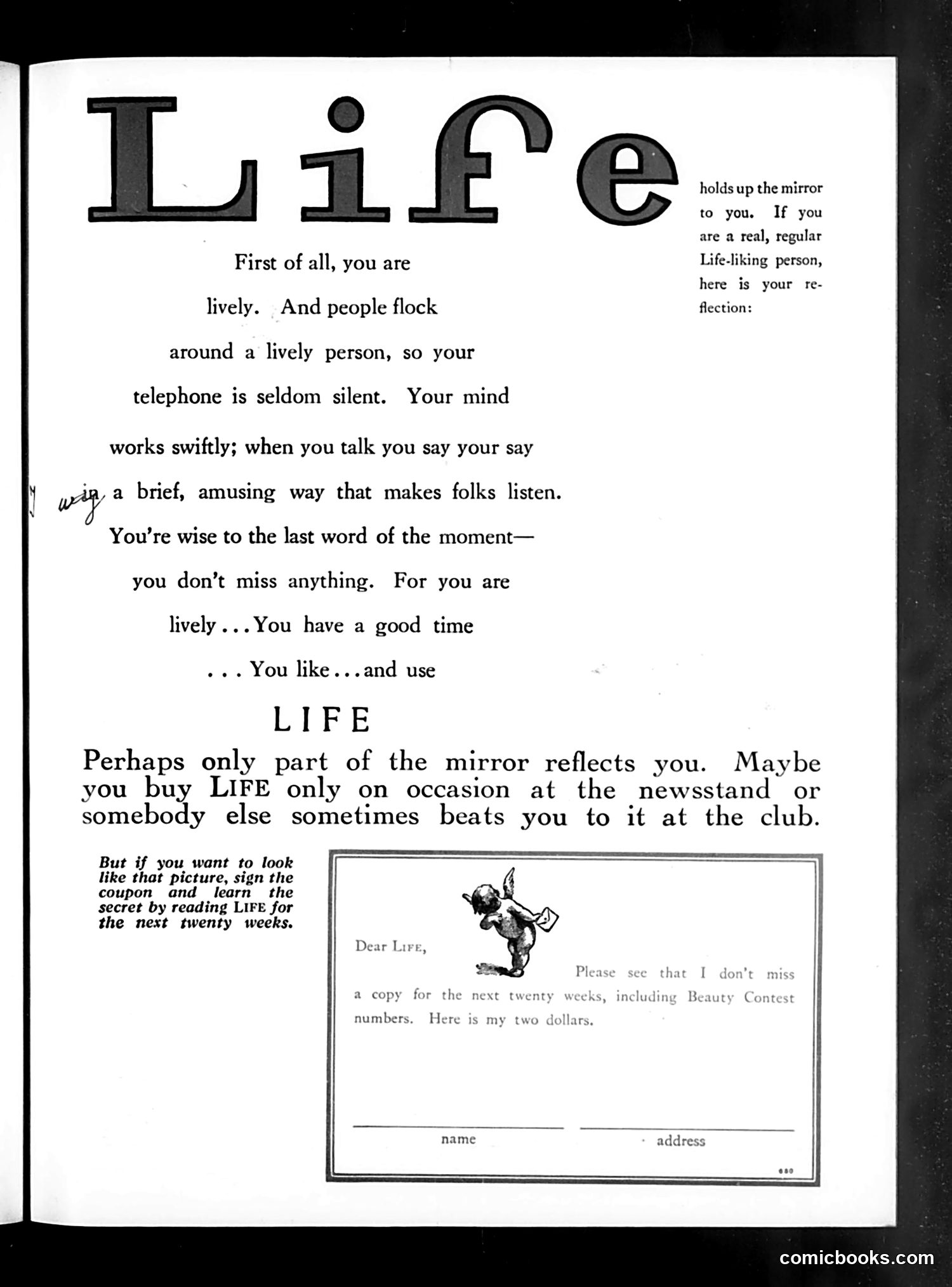
Analysis for Modern Readers This is a subscription advertisement for *Life* magazine (a satirical/humor publication), not a political cartoon. The "mirror" is metaphorical—the ad claims that *Life* reflects the personality of a lively, witty, socially connected person who stays current with trends. The satire is self-promotional and tongue-in-cheek: the magazine flatters potential subscribers by suggesting that reading *Life* makes you clever, popular, and always "wise to the last word of the moment." It gently mocks casual readers who only buy *Life* occasionally ("somebody else sometimes beats you to it at the club"), implying they're missing out on being truly fashionable. The coupon invites readers to subscribe for twenty weeks for two dollars, positioning *Life* as essential to maintaining a desirable social image. The overall tone is playfully ironic—the magazine knows it's using vanity as a sales hook, and the humor lies in that transparency.
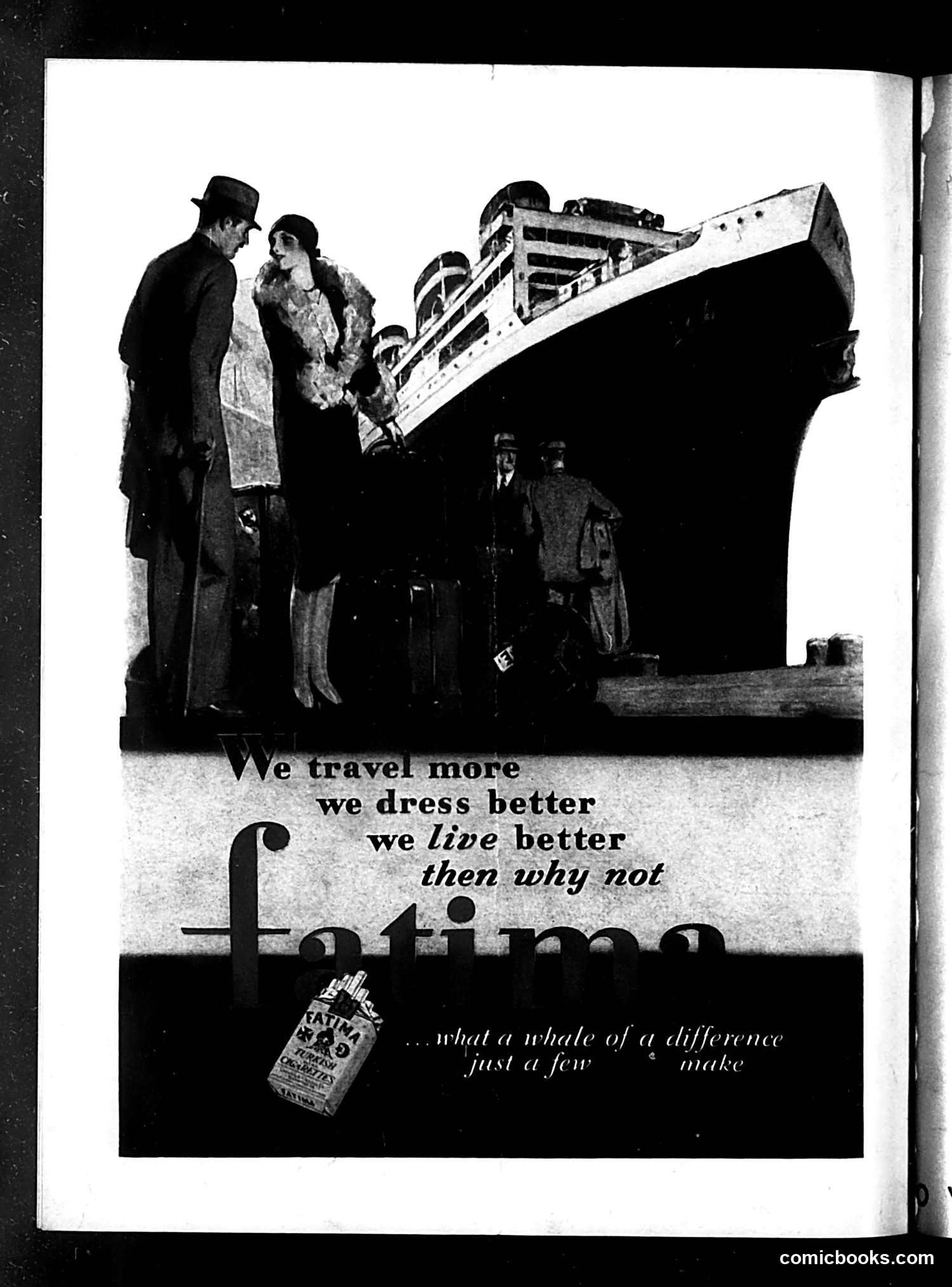
Analysis This is a product advertisement, not political satire. The ad promotes Fatima cigarettes (visible in the lower left corner of the image). The setting shows fashionably dressed passengers boarding an ocean liner—a luxury travel scenario common in 1920s advertising. The text uses a rhetorical argument: travelers experience more and dress better due to refined lifestyles, so they should naturally smoke better cigarettes too. The phrase "what a whale of a difference just a few make" suggests that choosing Fatima cigarettes—a small choice—dramatically improves one's experience, similar to how refined travel elevates one's life. This reflects early 20th-century advertising strategy: associating consumer products with aspirational lifestyles and social status to influence purchasing decisions.