life
Life — March 21, 1930
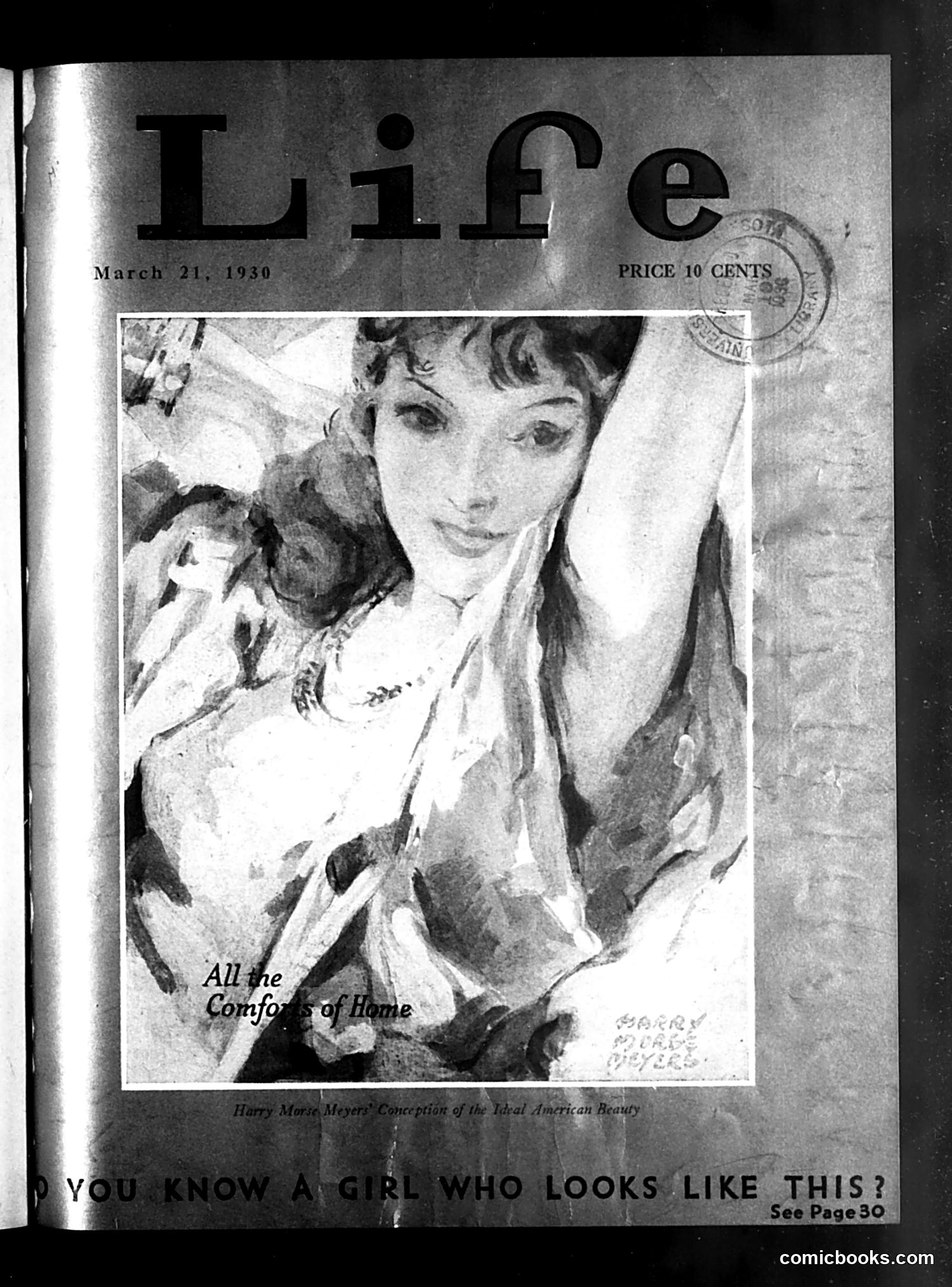
Analysis of Life Magazine Cover, March 21, 1930 This is a magazine cover, not a political cartoon. The image shows a woman holding a small dog, with the headline "All the Comforts of Home" and credit to "Harry Meyers Myers' Conception of the Ideal American Beauty." The cover features a portrait photograph or illustration representing an idealized American woman of the era, styled with 1930s fashions and hair. The tagline "YOU KNOW A GIRL WHO LOOKS LIKE THIS?" at the bottom appears designed to engage readers through recognition or aspiration. This reflects 1930s popular culture's emphasis on beauty standards and domesticity, with the dog symbolizing home and comfort. The ten-cent price indicates this was a mass-market publication aimed at general American audiences during the Great Depression era.
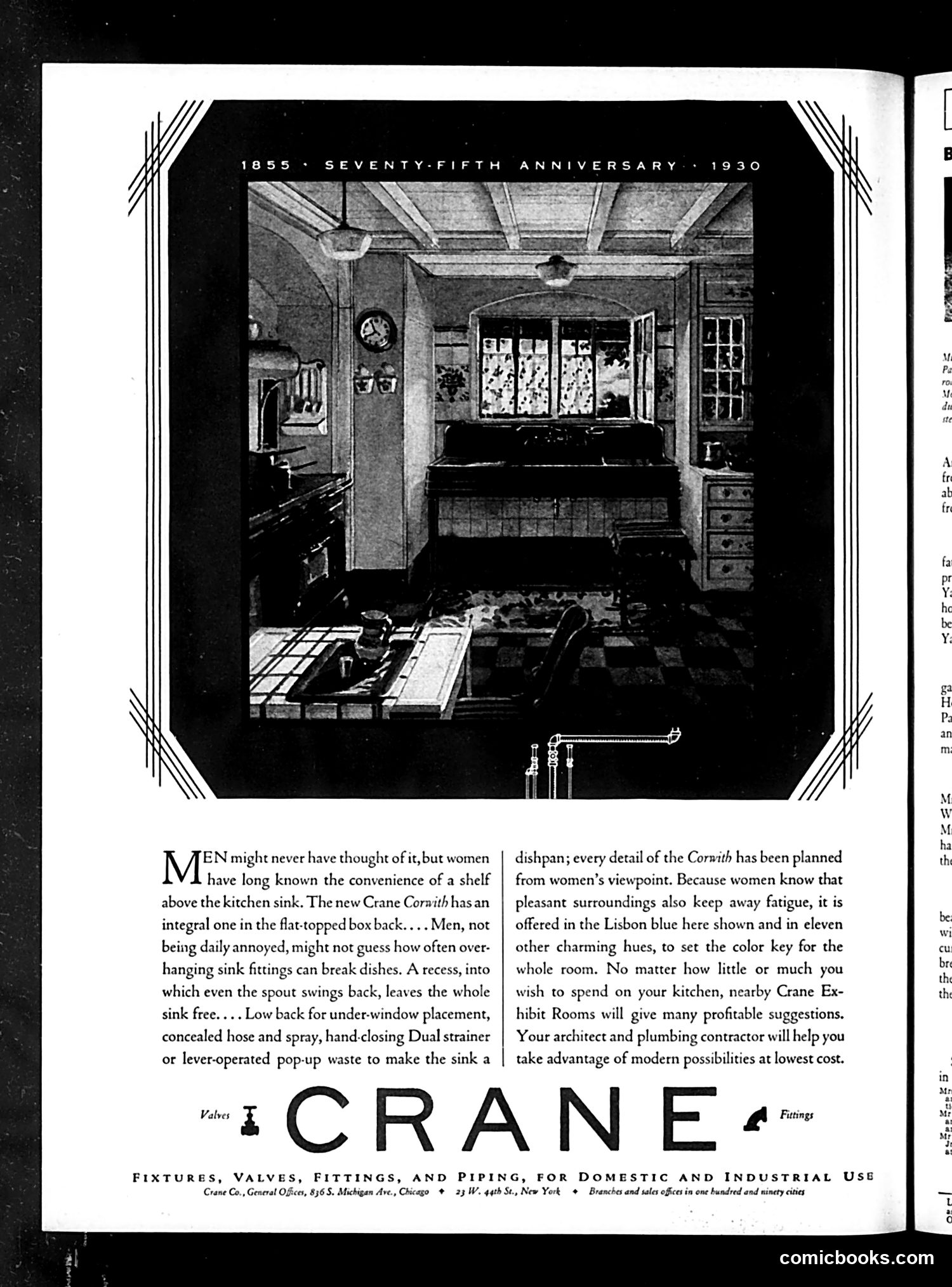
Analysis This is not a political cartoon or satirical content. It's a full-page advertisement for Crane plumbing fixtures, celebrating their 75th anniversary (1855-1930). The image shows a modernized 1930s kitchen with a sink, and the ad copy emphasizes the "Cornith" sink model's convenience features—particularly a shelf above the sink, which the text claims women have long desired. The advertisement appeals to female homemakers by noting that pleasant kitchen surroundings reduce fatigue, and promises that architects and plumbers can help integrate modern fixtures affordably. The text is marketing copy, not satire. It reflects 1930s assumptions about women's domestic roles while promoting Crane's products and design consultation services.
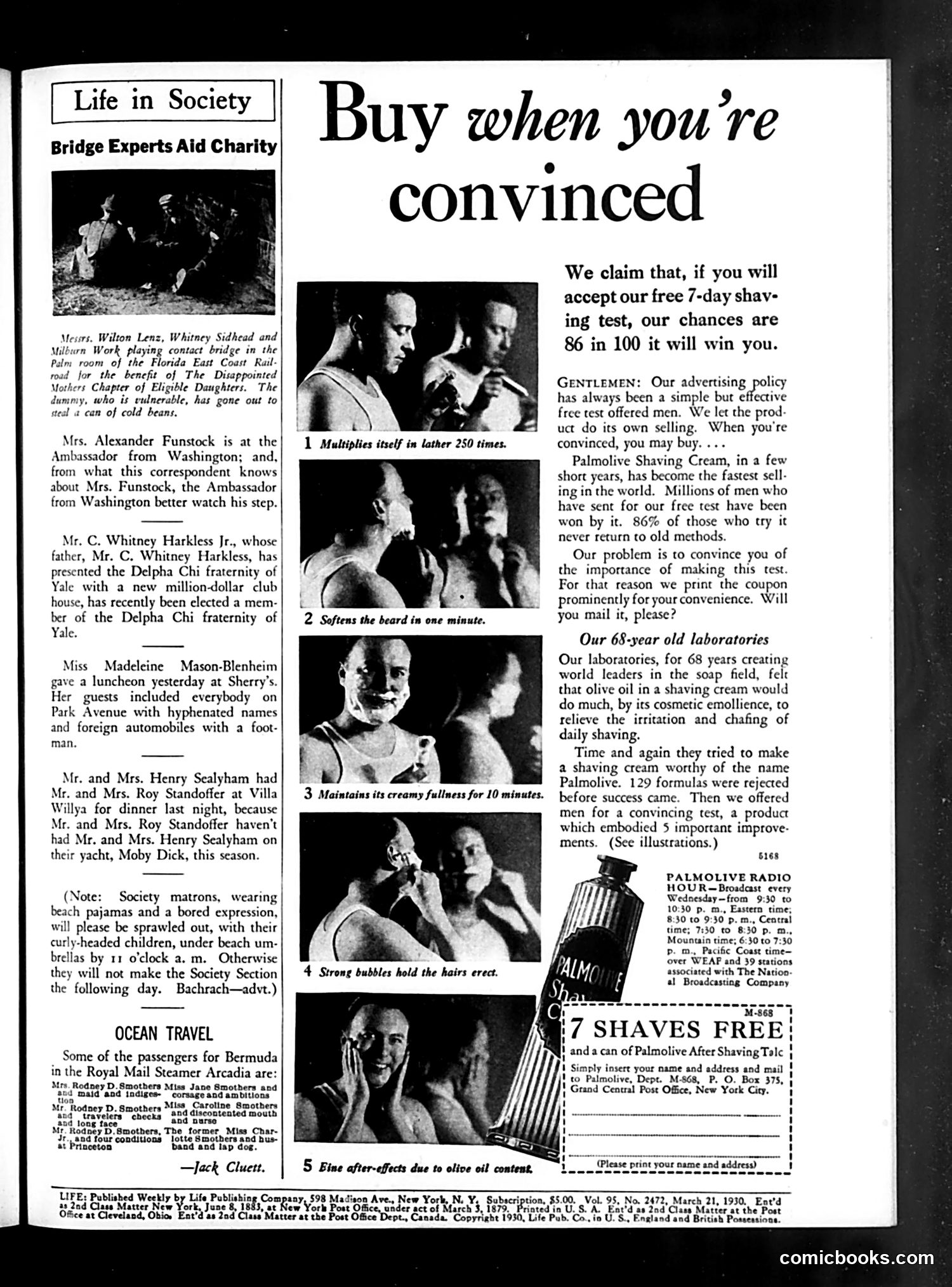
Palmolive Shaving Cream Advertisement This is primarily a commercial advertisement for Palmolive Shaving Cream, not satire. The page uses a "before-and-after" format showing five numbered photographs of a man's shaving process: (1) lathering, (2) softening the beard, (3) maintaining creaminess, (4) producing bubbles, and (5) demonstrating the final results. The ad's headline "Buy when you're convinced" reflects 1930s advertising strategy: offering a free 7-day shaving test to persuade skeptics. The accompanying text emphasizes the product's cosmetic superiority—olive oil prevents irritation—and claims 86% of test users became permanent customers. The "Life in Society" column on the left contains unrelated gossip about wealthy socialites and their activities, typical of Life magazine's satirical social commentary section.
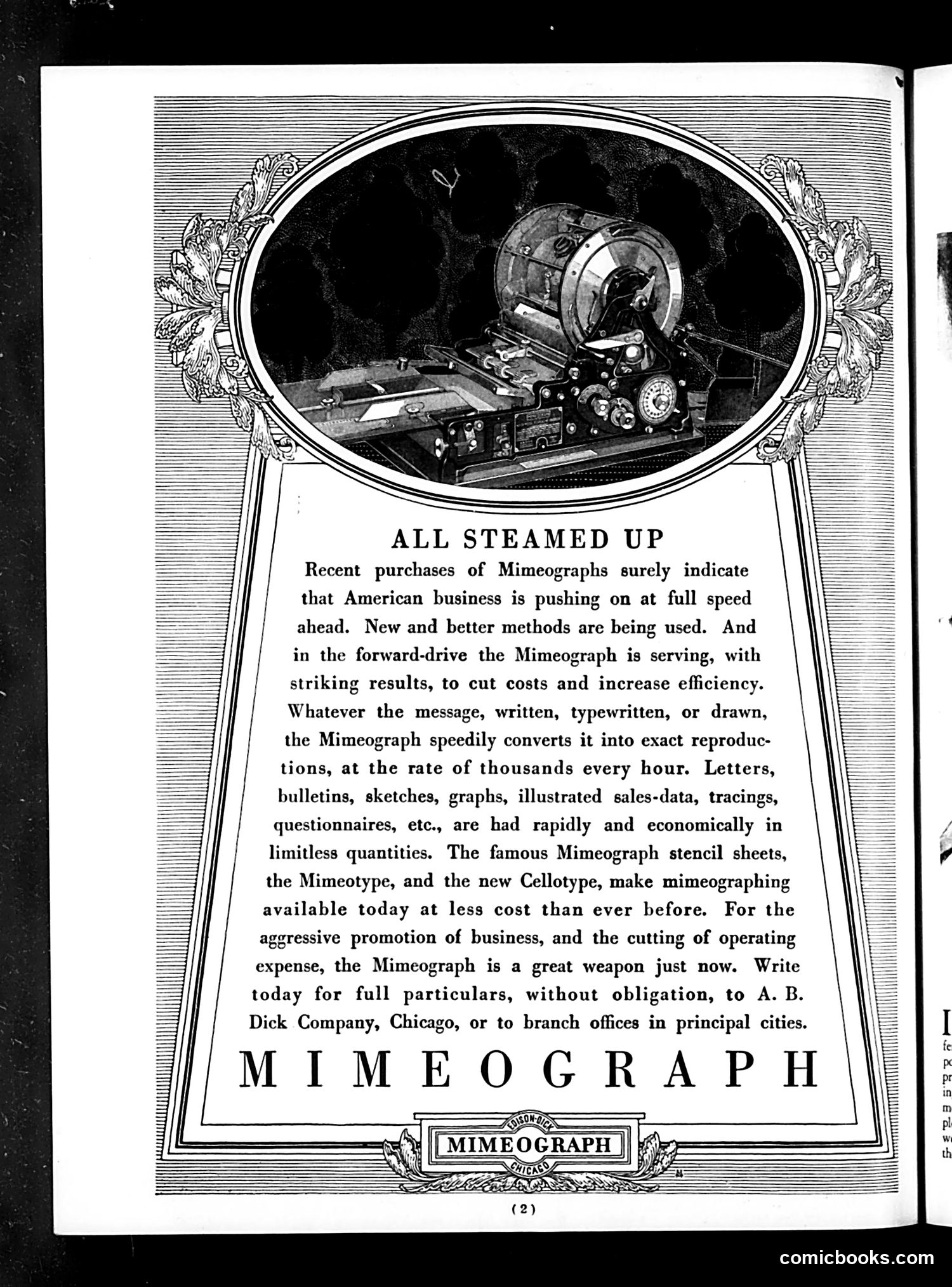
Analysis This is a full-page advertisement, not political satire or a cartoon. It promotes the Mimeograph machine by the A.B. Dick Company of Chicago. The ad's title "ALL STEAMED UP" uses a metaphor about American business "pushing on at full speed ahead." The image shows the mechanical mimeograph device itself. The text emphasizes how mimeographs rapidly reproduce documents—letters, bulletins, sketches, graphs—at low cost and high volume, making them valuable for business efficiency and cost-cutting. The ad targets early 20th-century businesses seeking modernization. It mentions specific products: "Mimeograph stencil sheets," "Mimeotype," and a new "Cellotype" process, positioning mimeography as cutting-edge technology for progressive companies. This is commercial promotion, not editorial content.
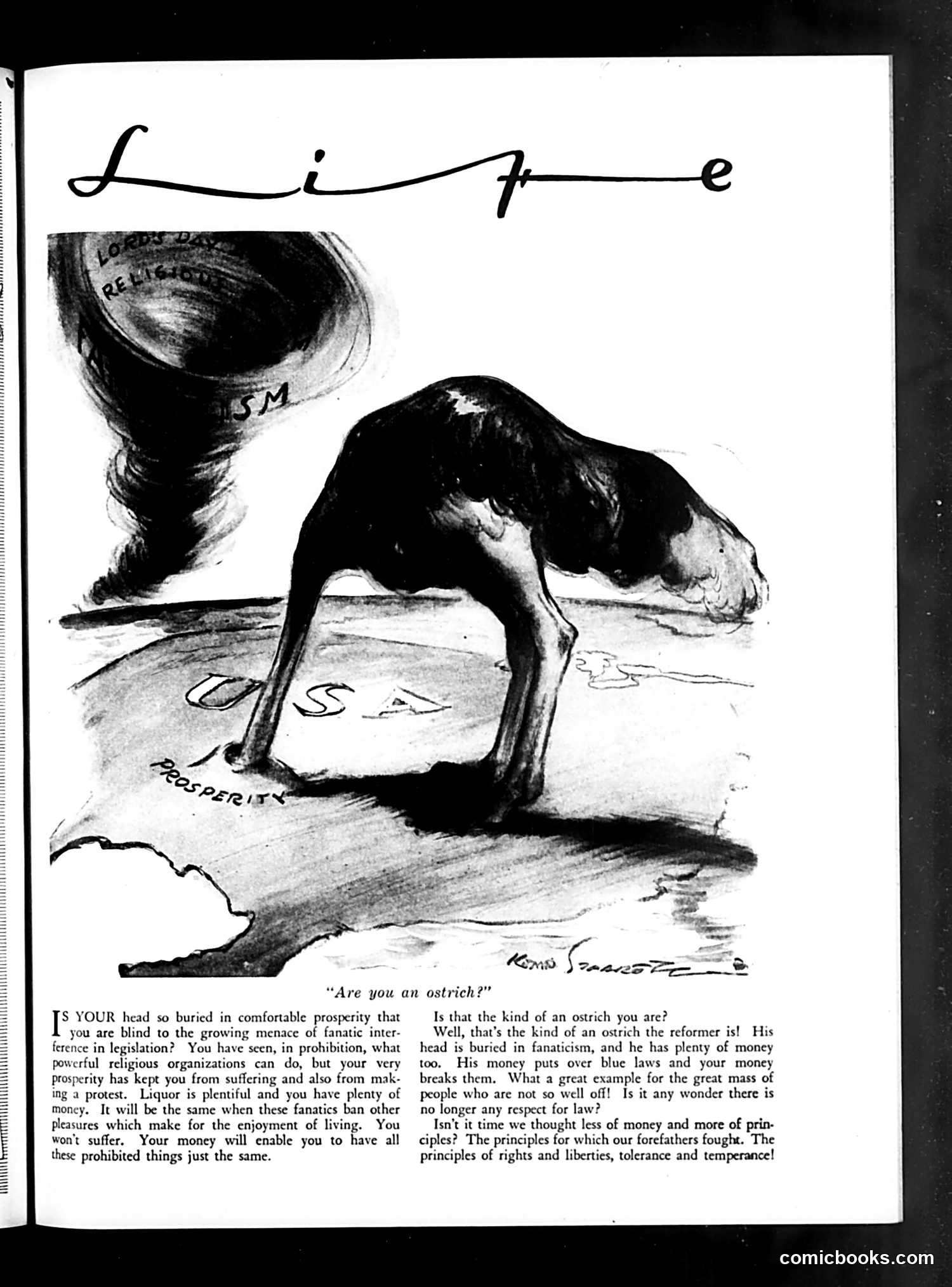
"Are You an Ostrich?" Political Cartoon Analysis This satirical cartoon depicts an ostrich with its head buried in sand, labeled "USA" with "PROSPERITY" written nearby. The accompanying text compares American prosperity to an ostrich's defensive posture—suggesting that wealth and comfort have made citizens indifferent to growing threats (likely religious fanaticism or political extremism, based on references to "fanatic interests" and "prohibition"). The satire argues that Americans' financial security blinds them to dangers, much as an ostrich supposedly ignores threats by burying its head. The text questions whether material comfort justifies abandoning principles like tolerance and liberty that "our forefathers fought" for, implying that 1920s prosperity enables complacency toward authoritarian movements or restrictive laws (possibly Prohibition era regulations).
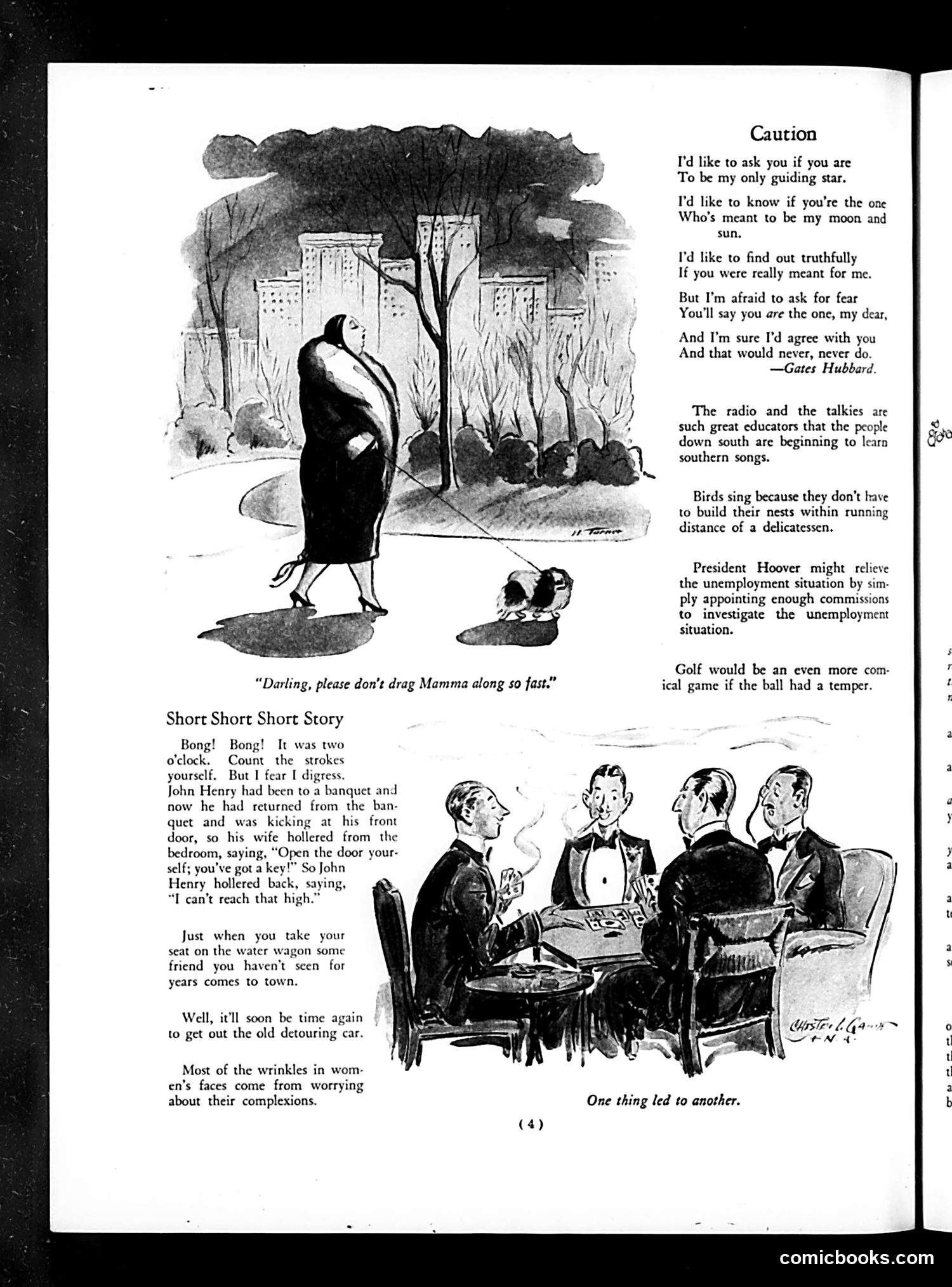
Explanation of Page Content This page contains satirical commentary and cartoons from *Life* magazine's editorial section. "Caution" poem by Gater Hubbard: A romantic poem questioning whether someone is meant to be the speaker's "guiding star," moon, and sun—expressing romantic uncertainty. The top cartoon depicts a woman walking a small dog in an urban setting, captioned "Darling, please don't drag Mamma along so fast." The satire mocks how women were sometimes portrayed as burdensome or slow-moving companions. "Short Short Short Story" presents humorous domestic anecdotes: a husband locked out after a banquet, friends visiting unexpectedly after years, and observations about automobile travel and women's wrinkles from worry. "One thing led to another" shows well-dressed men at a card game, illustrating how social situations escalate unexpectedly—likely commentary on gambling or social consequences.
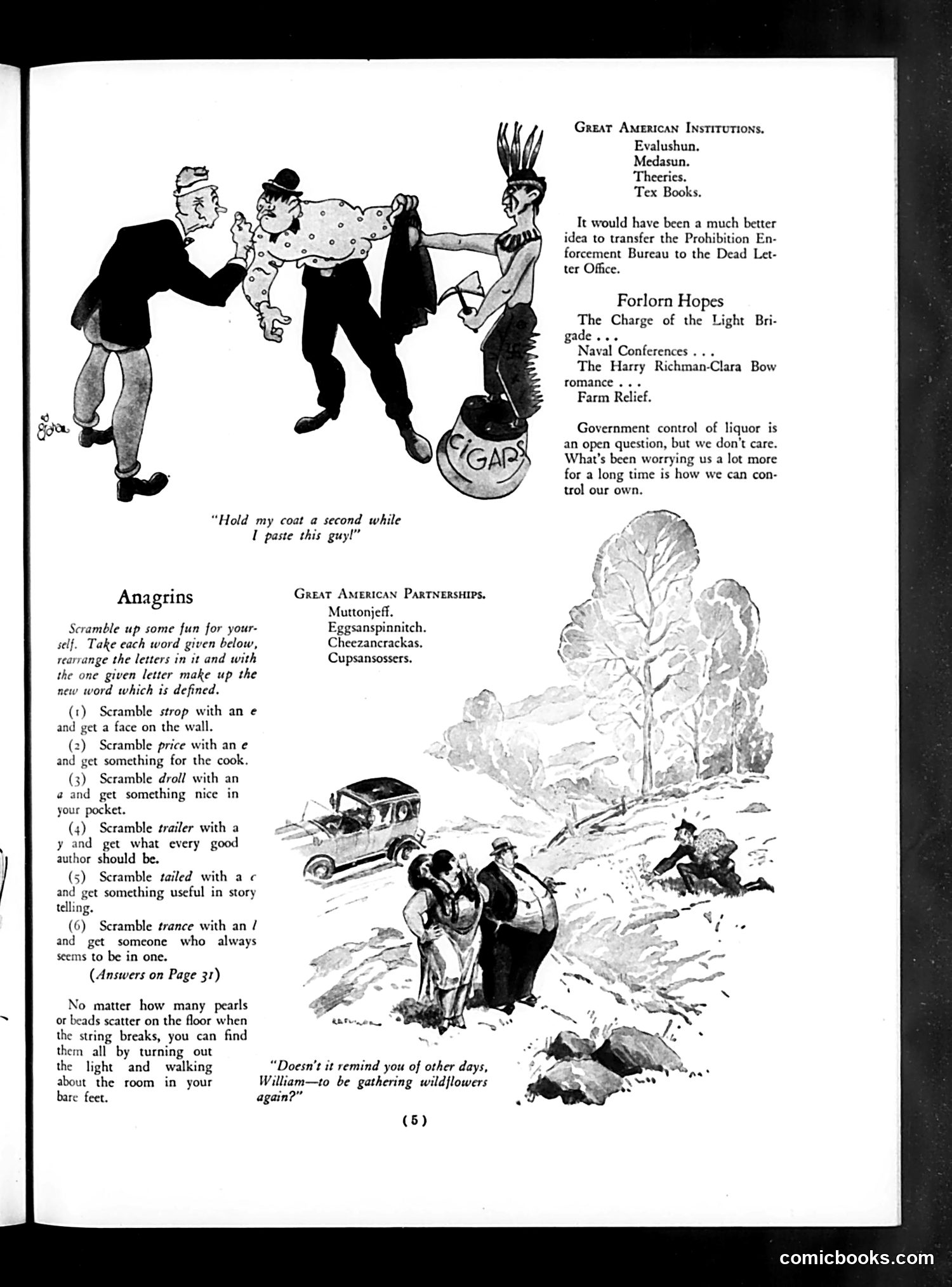
Political Cartoon Analysis The top cartoon depicts two men struggling to restrain a figure labeled "GAP" (the "Great American Public"). The caption reads: "Hold my coat a second while I paste this guy!" This satirizes public frustration during Prohibition enforcement. The two men appear to represent government officials or law enforcement attempting to control an unruly citizenry opposed to alcohol prohibition. The cartoon suggests the American public was angry and difficult to govern on this issue. The page also lists "Great American Institutions" (Prohibition enforcement, theories, textbooks) and "Great American Partnerships" (Native American tribe names, likely satirizing broken treaties or poor government relations). The lower illustration shows people in a rural landscape, referencing nostalgia for simpler times—contrasting with the chaos of modern Prohibition-era governance.
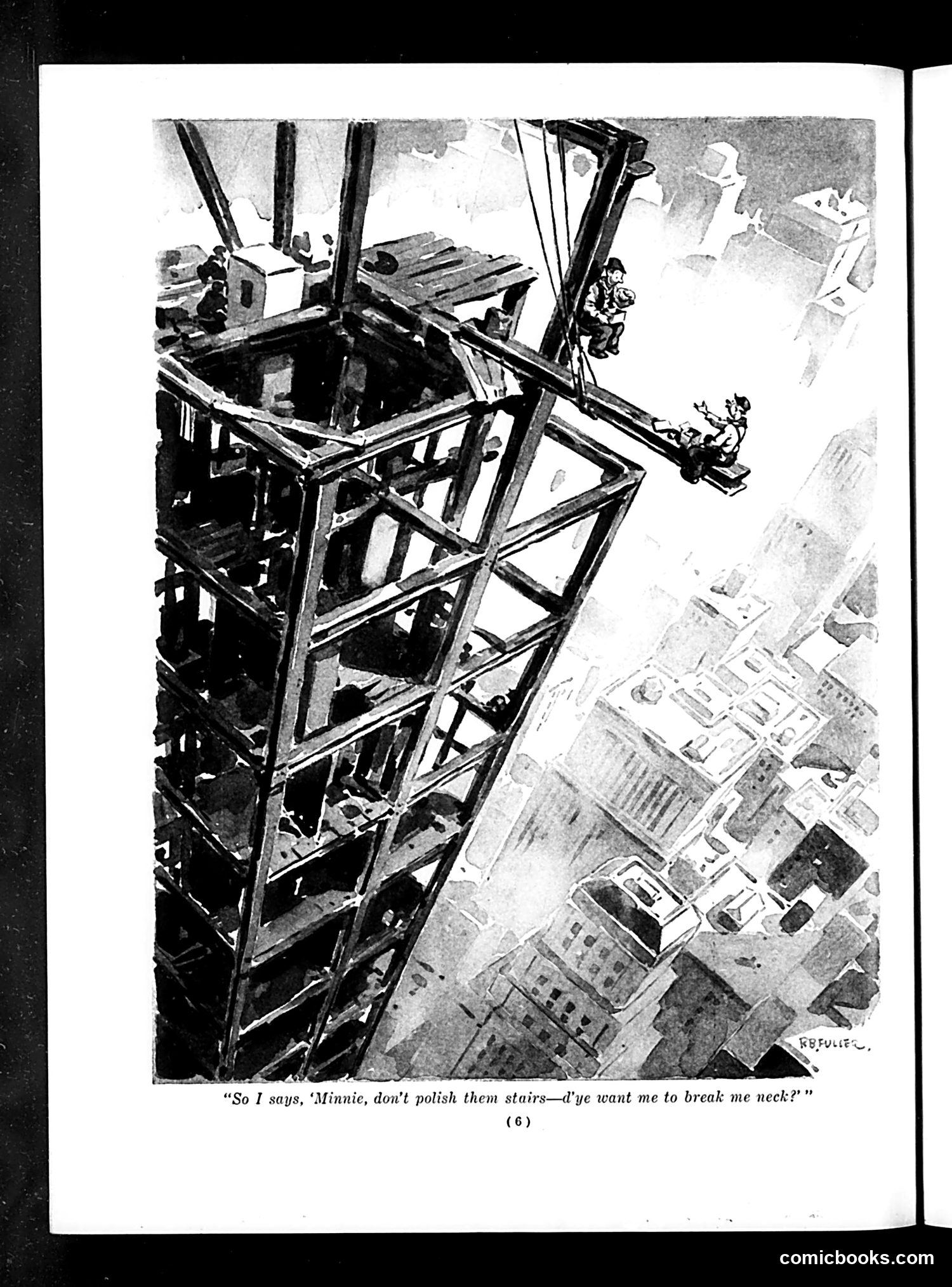
Analysis This is a single illustrated cartoon showing two figures perched dangerously high on a steel-frame building under construction, looking down at the cityscape far below. The caption reads: "So I says, 'Minnie, don't polish them stairs—d'ye want me to break me neck?'" The humor is a working-class domestic joke about a wife (Minnie) polishing stairs, creating a slipping hazard. The cartoon plays on the irony that a construction worker—whose job involves genuine peril at great heights—expresses greater concern about the trivial domestic risk of slipping on polished stairs at home. It's satire of masculine bravado: he'll risk his life at work but worries about minor household hazards. The comic appears to be commentary on working-class attitudes and priorities.
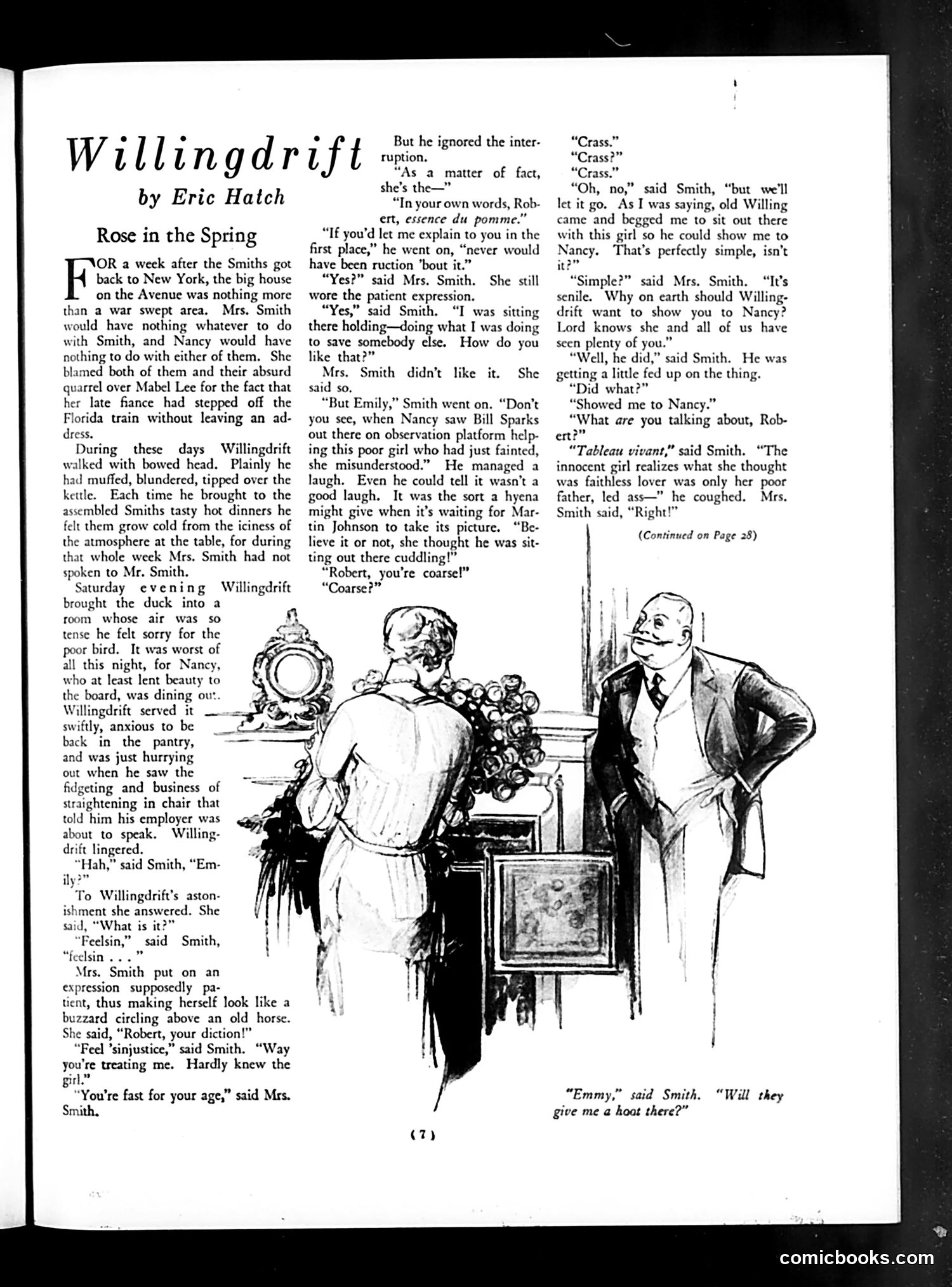
"Willingdrift" by Eric Hatch - Page Analysis This is a narrative fiction piece, not a political cartoon. The page shows a domestic comedy scene illustrated with a sketch of a man and woman in what appears to be a dining room or parlor. The story concerns Mr. and Mrs. Smith's marital tension: Mrs. Smith is upset that Mr. Willingdrift (likely her husband using a pseudonym or alias) brought his girlfriend Nancy to dinner without warning. The conflict involves questions of fidelity and propriety in upper-class domestic life. The illustration captures the awkward moment, with the caption referencing a "hoot" — suggesting physical comedy or embarrassment. This is humorous fiction about social embarrassment and infidelity rather than political satire.
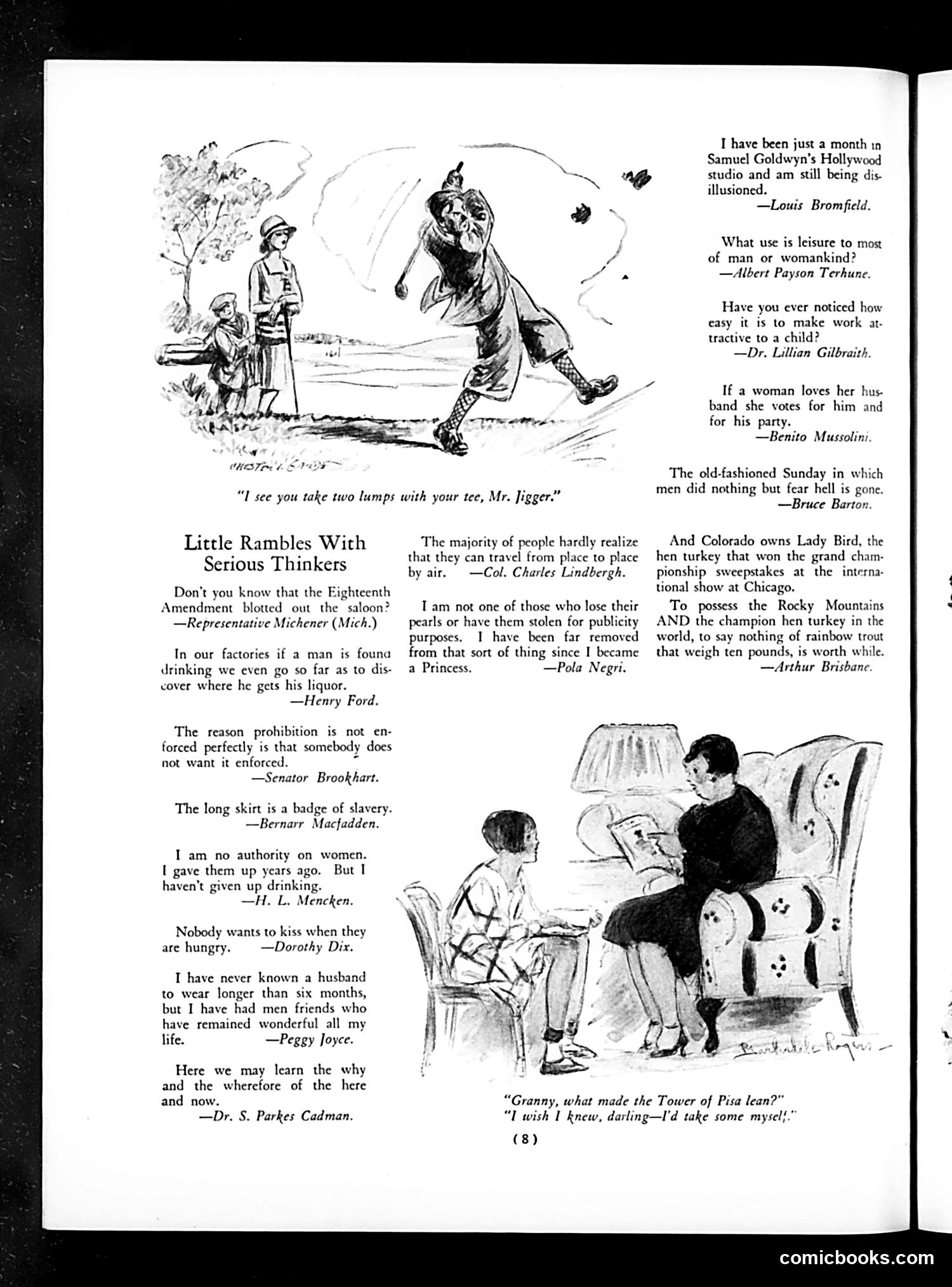
Analysis of Life Magazine Page 8 This page contains "Little Rambles With Serious Thinkers," a satirical column of short quotes attributed to famous figures (Lindbergh, Ford, Mussolini, etc.), paired with witty, often contradictory observations about contemporary life. The two cartoons illustrate selected quotes: Top cartoon: A man playing golf while two children watch. The caption "I see you take two lumps with your tee, Mr. Jigger" jokes about adding sugar to tea during the golf game—a humorous non-sequitur. Bottom cartoon: A grandmother and child examining a newspaper, asking about the Tower of Pisa's origin. The grandmother quips she'd "take some myself"—implying she'd steal it, a joke about theft or acquisitiveness. The overall page mocks both famous personalities' pronouncements and everyday domestic absurdities through humor and gentle social criticism.
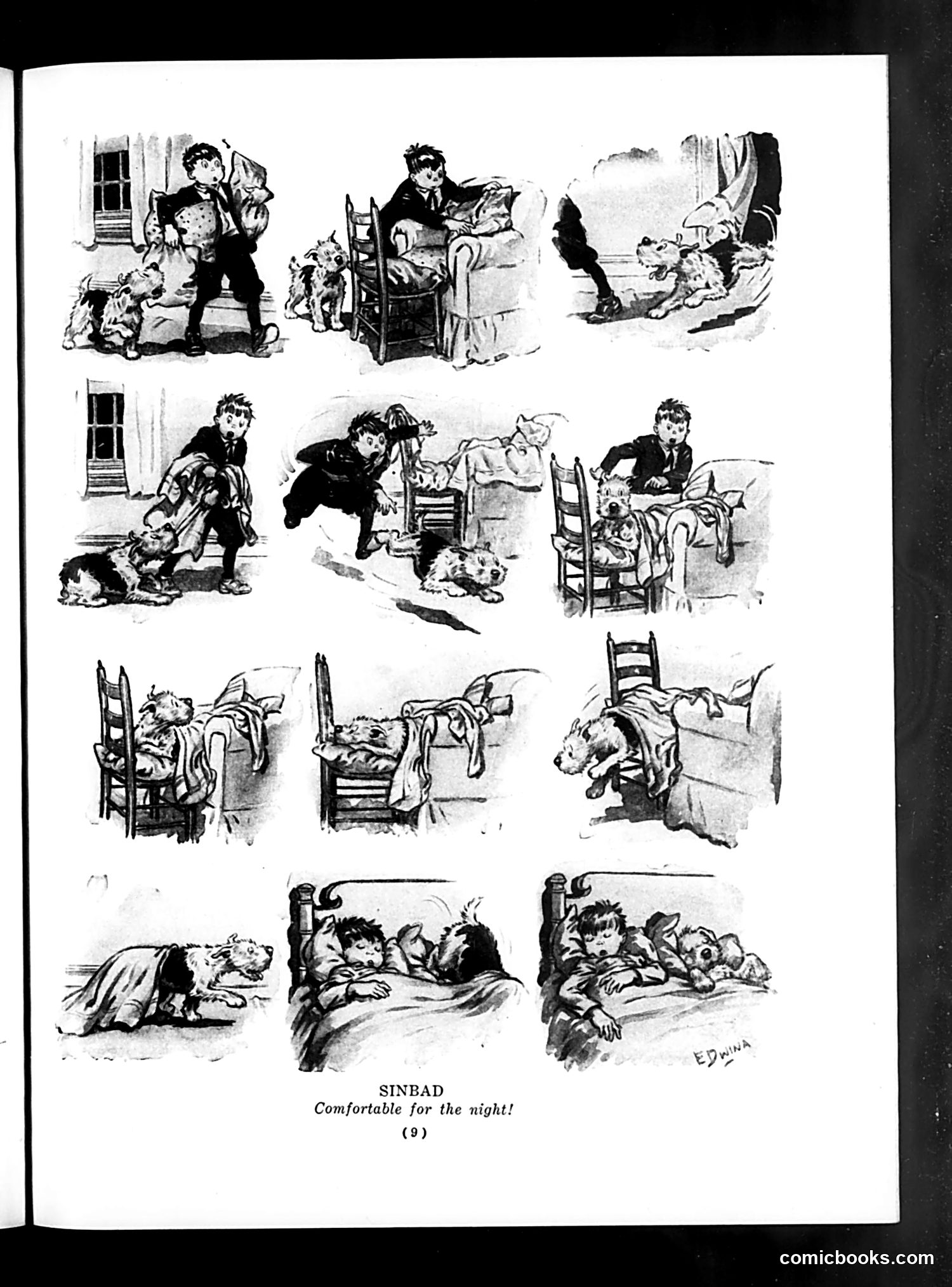
Analysis of "Sinbad: Comfortable for the Night" This is a sequential comic strip illustrated by E. D. Wina, depicting scenes from the Arabian Nights tale of Sinbad the Sailor. The narrative follows Sinbad through various nighttime adventures—encountering characters in domestic and exotic settings, interacting with animals (notably a dog), and ultimately settling into bed. The title "Comfortable for the night!" appears ironic, as the sequential panels suggest Sinbad's night is filled with disruption and chaos rather than comfort. The strip uses visual humor through Sinbad's exaggerated reactions and the crowded, tumultuous scenes. This represents Life magazine's use of classic literature for humorous adaptation—a common satirical approach of the era, transforming familiar stories into comedic visual narratives for entertainment purposes.
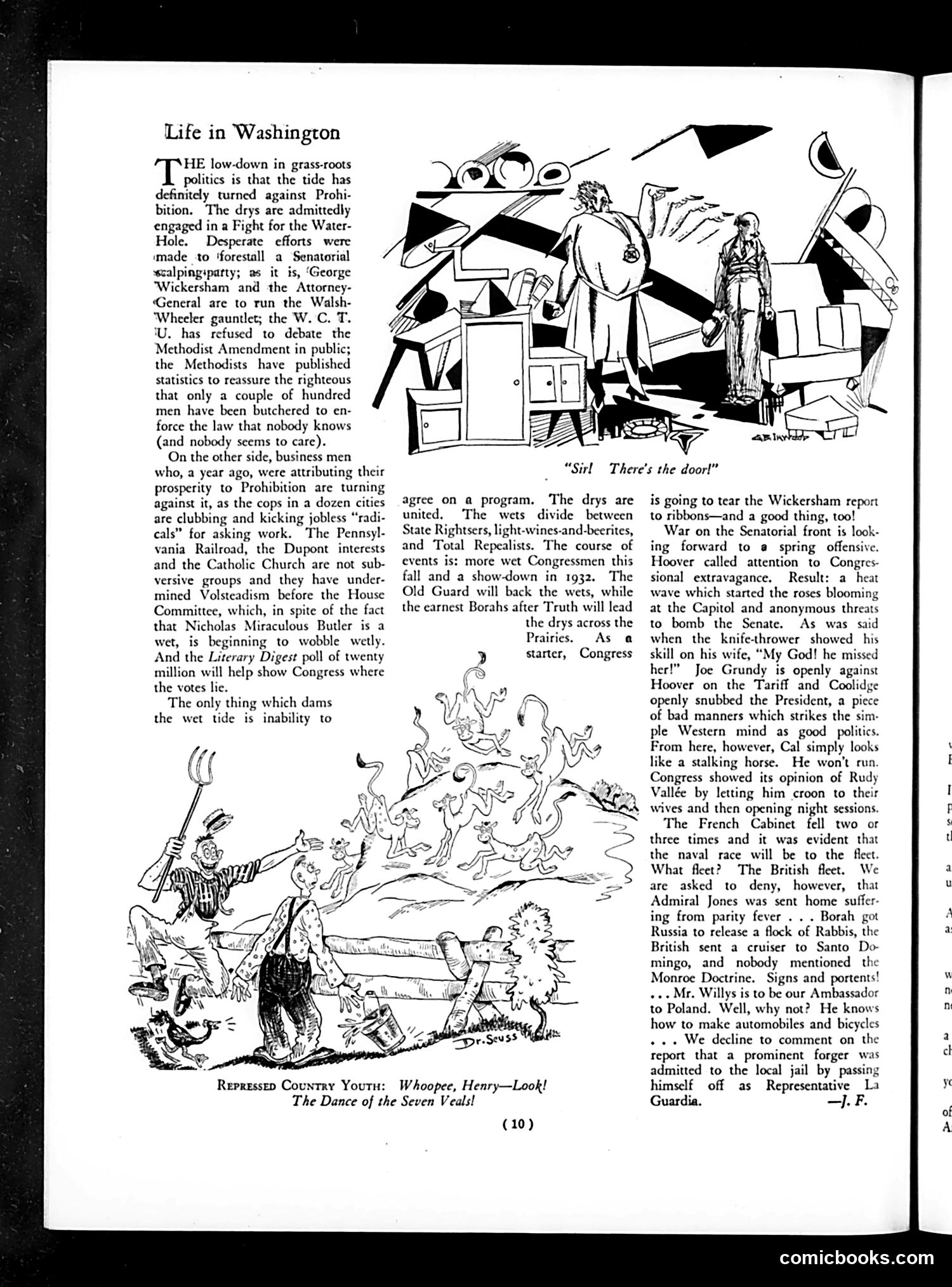
"Life in Washington" - Political Satire, circa 1932 This page satirizes Prohibition-era Washington politics. The top cartoon shows chaotic debate over the "Water-Hole" amendment, with figures labeled as prominent senators (Wickersham, Walsh-Wheeler) arguing over whether to repeal Prohibition. The text mocks their conflicting positions: some are "wets" (repeal supporters), others "drys" (Prohibition supporters). The lower cartoon by Dr. Seuss depicts "Repressed Country Youth: Whoopee, Henry—Look! The Dance of the Seven Veals!" — satirizing rural Americans' pent-up frustrations under Prohibition's restrictions. The right column continues political commentary on Congressional debates, mentioning figures like Hoover and discussing naval matters and international relations, presenting these debates as absurd theater rather than serious governance.
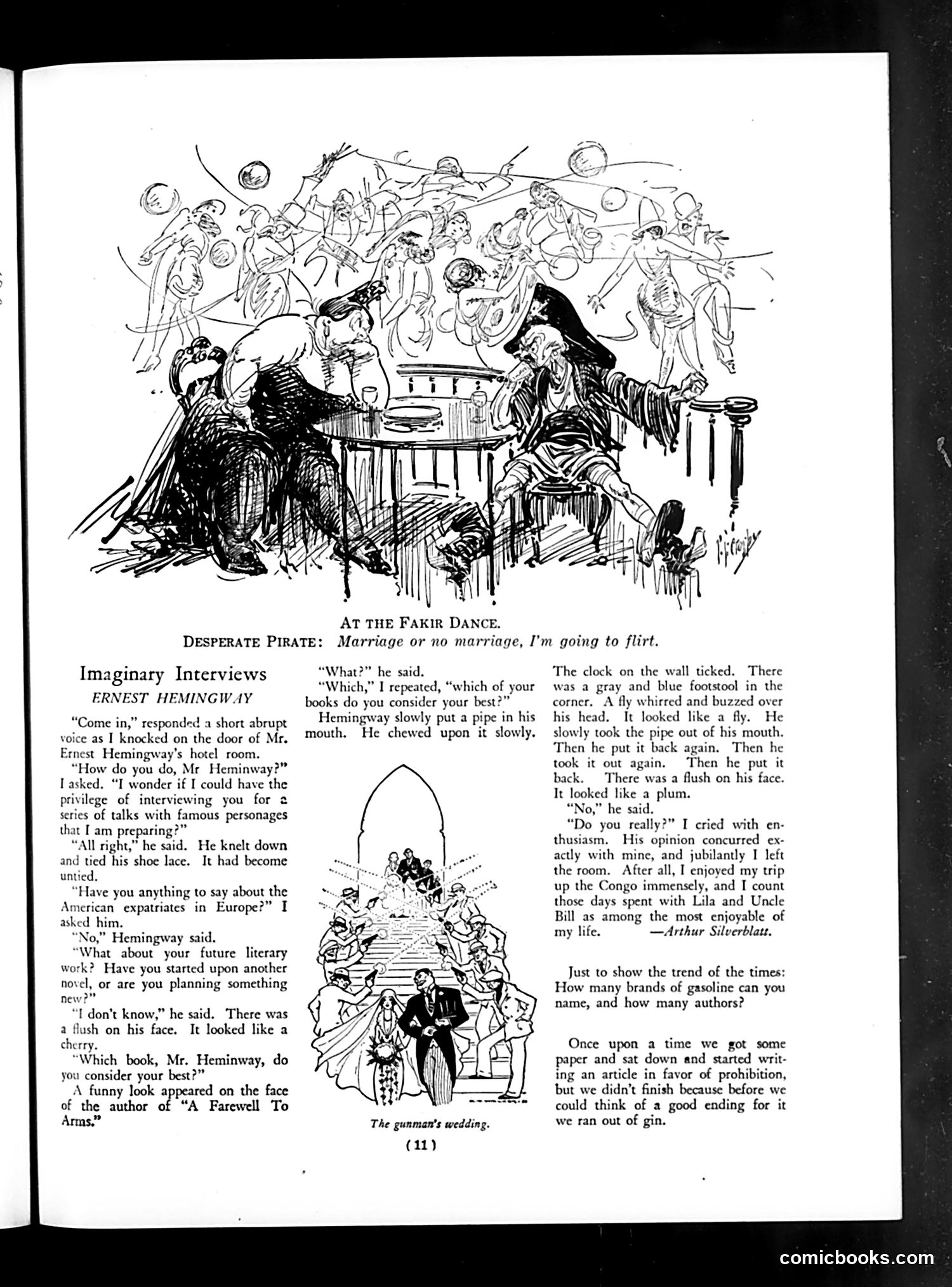
Analysis of This Life Magazine Page This page features "Imaginary Interviews" with Ernest Hemingway, the famous American author. The text presents a humorous fictional conversation where someone visits Hemingway's hotel room and asks about his literary work and future plans. The two accompanying cartoons illustrate the satirical tone: "At the Fakir Dance" shows a "Desperate Pirate" declaring "Marriage or no marriage, I'm going to flirt," while "The Gunman's Wedding" depicts a chaotic wedding scene with armed figures. The humor relies on Hemingway's reputation for adventure, masculinity, and drinking. The jokes about prohibition (referenced in the text about running out of gin) and the absurdist wedding cartoon reflect 1920s American culture and Hemingway's public persona as a hard-drinking, adventurous writer.
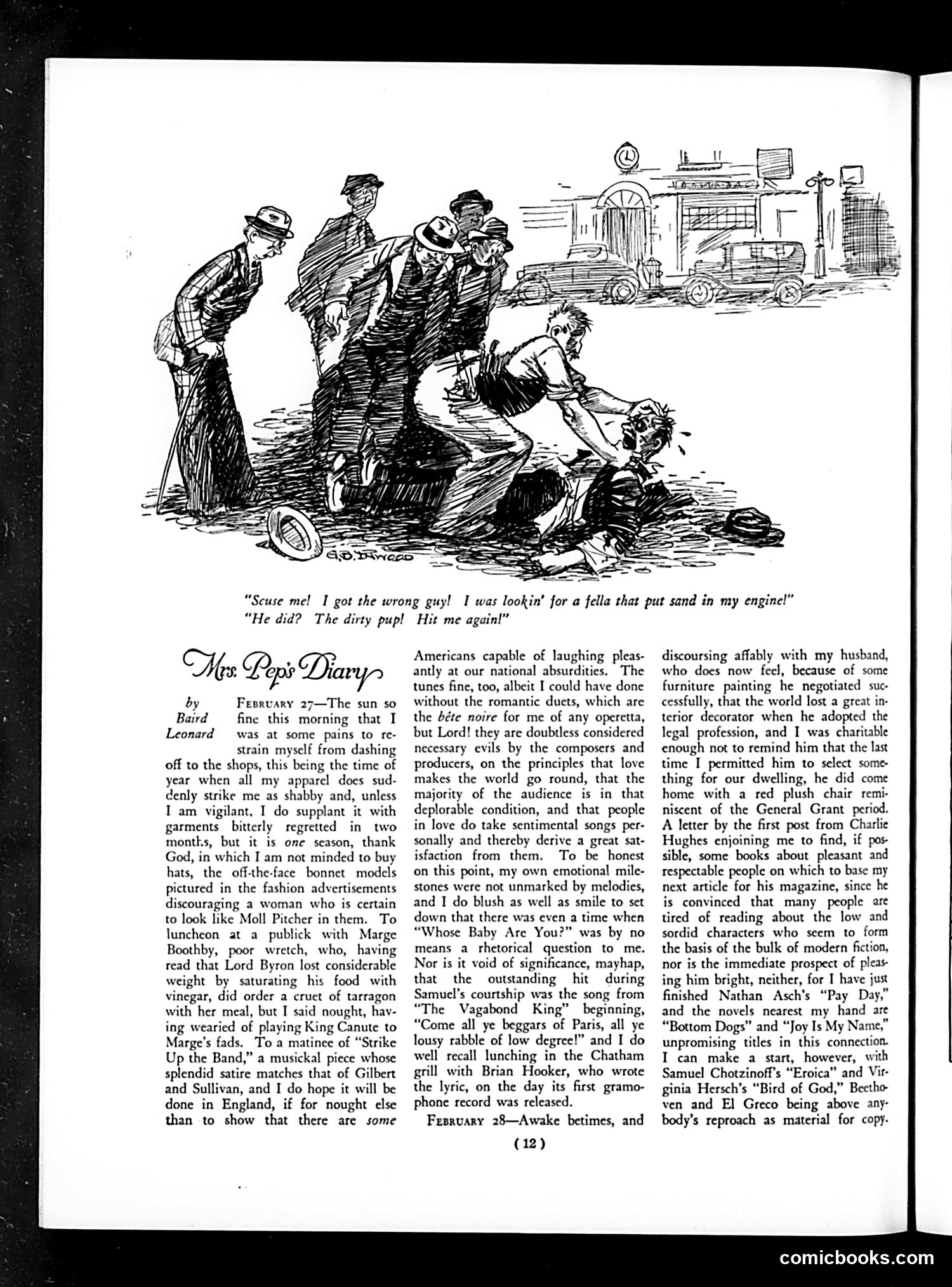
Analysis of "Mrs. Pep's Diary" Page This page contains a satirical diary column by Leonard rather than a political cartoon. The illustration depicts a slapstick scene where a man is being attacked/beaten by what appears to be a woman, while well-dressed onlookers observe. The caption references someone getting "the wrong guy" and mentions sand in an engine, suggesting a case of mistaken identity leading to violence. The diary text criticizes American popular taste, specifically mocking sentimental love songs in operettas and musicals. The author argues these melodramatic songs are artistically inferior and appeal to audiences with poor aesthetic judgment. Leonard names specific songs like "Whose Baby Are You?" as examples of this low-quality entertainment, comparing them unfavorably to Gilbert and Sullivan's work. The piece is fundamentally about cultural criticism rather than political satire.
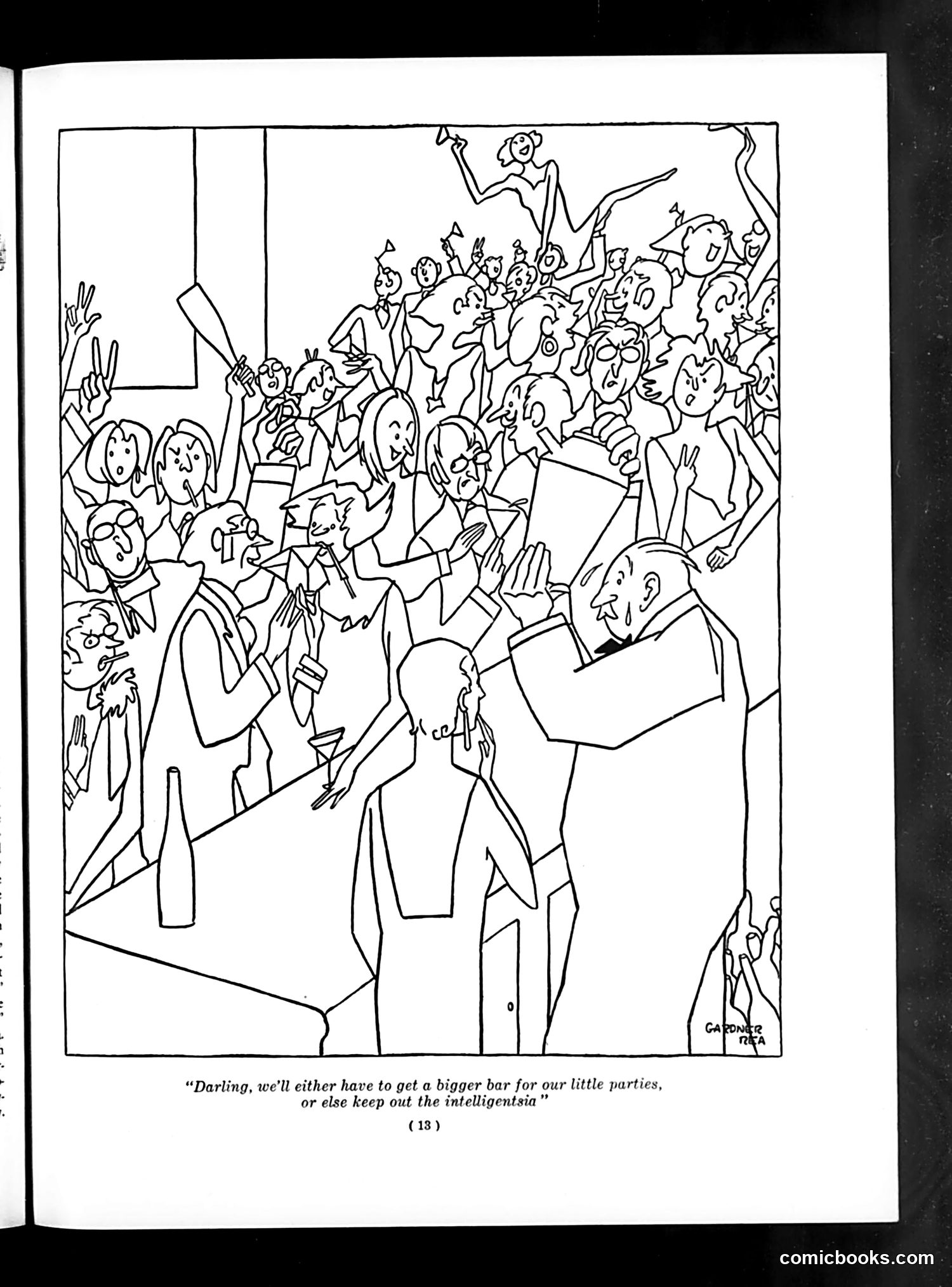
Cartoon Analysis This is a single-panel satirical cartoon showing a crowded indoor party or gathering. A man in formal attire addresses a woman, saying: "Darling, we'll either have to get a bigger bar for our little parties, or else keep out the intelligentsia." The joke plays on class anxiety and intellectual snobbery among wealthy socialites. The cartoon satirizes the paradox that upper-class hosts want to appear cultured and educated (hence inviting intellectuals to their "little parties"), yet the presence of intelligent people creates practical problems—specifically, they consume more alcohol. The cartoon mocks both the pretentious aspirations of the wealthy and the stereotype of intellectuals as heavy drinkers. It's a commentary on social climbing and the gap between desired image and practical reality among the elite.
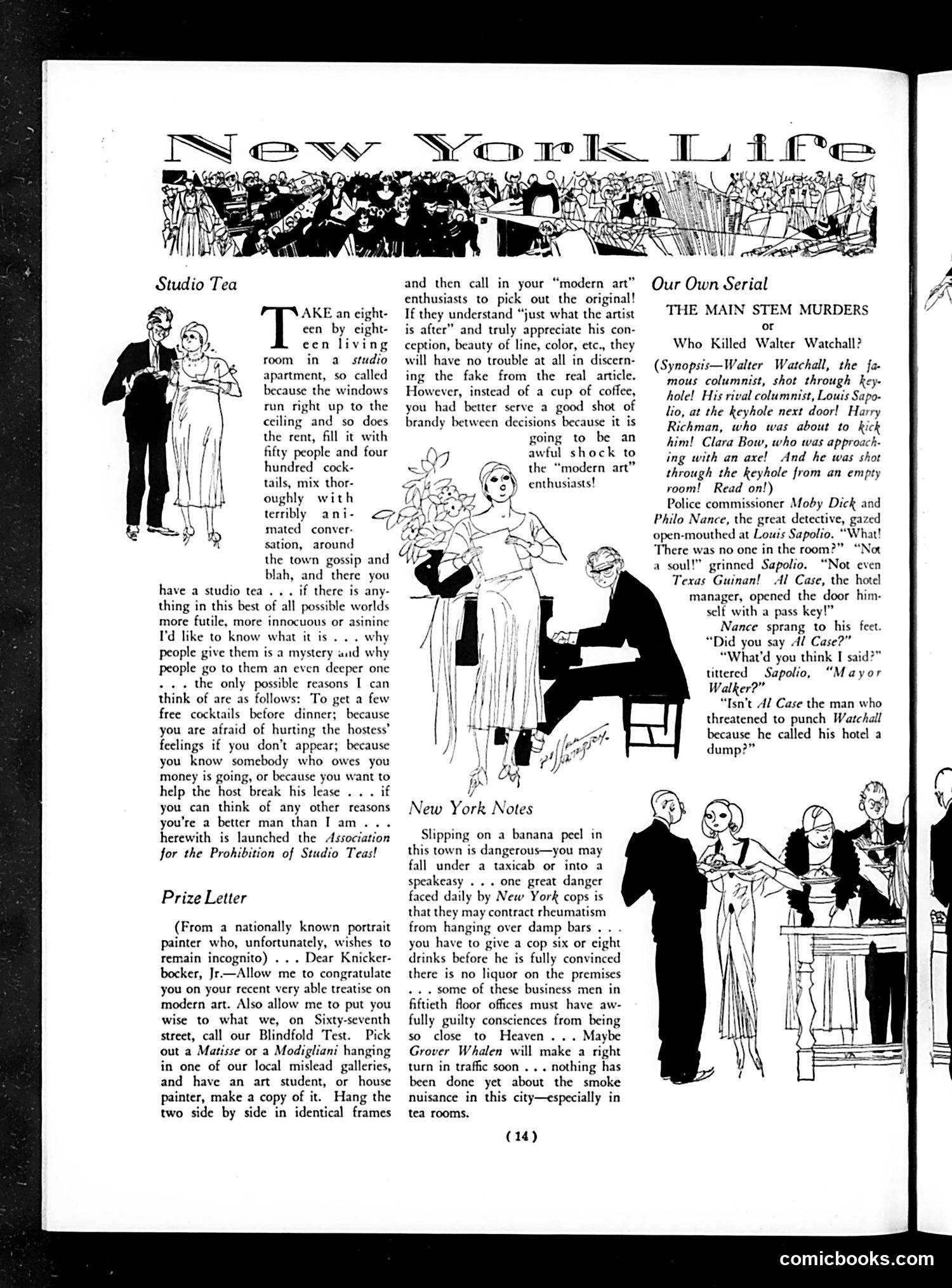
Studio Tea & Serial Fiction Commentary This page satirizes two aspects of 1920s New York society: "Studio Tea" mocks the pretension of hosting "studio teas"—small gatherings where aspiring sophisticates serve drinks in cramped apartments with high ceilings, claiming artistic legitimacy. The author humorously suggests people host these events to avoid appearing unsuccessful or to extract favors from social connections. The satire targets the performative nature of bohemian culture among the middle class. "Our Own Serial" begins a mystery narrative about columnist Walter Watchall's murder, featuring detective Moby Dick and Paolo Nance investigating. This parodies popular serialized detective fiction of the era. "New York Notes" contains brief observations about urban dangers (banana peels, speakeasies during Prohibition, corrupt police near bars). These are casual social commentaries on contemporary city life and problems.
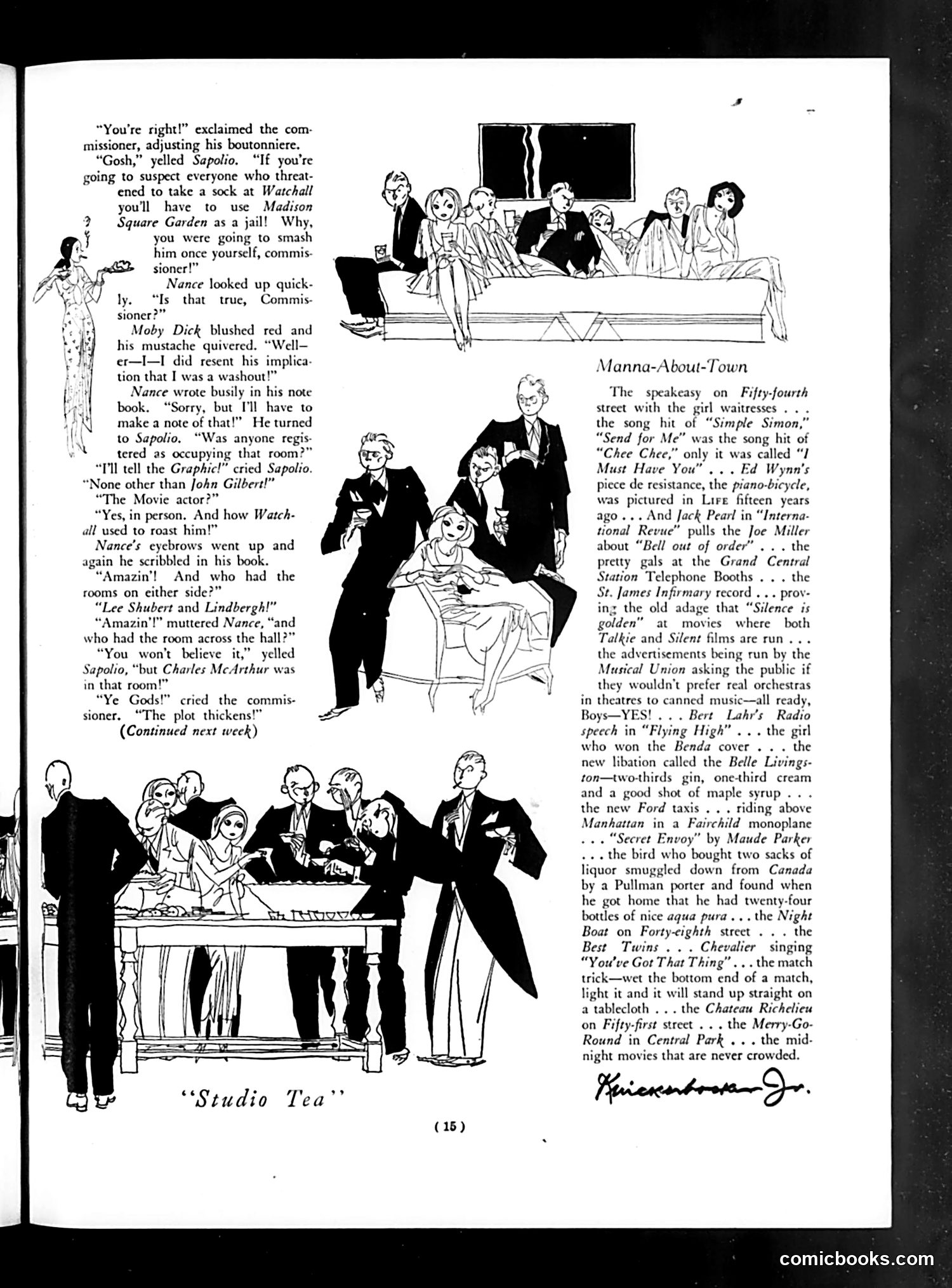
Explanation for Modern Readers This page from *Life* magazine contains two illustrations satirizing New York theater and entertainment scenes. The top cartoon "Manna-About-Town" is a gossip column illustrated with drawings of speakeasies, radio broadcasts, and musical performances. The lower cartoon "Studio Tea" depicts a social gathering of well-dressed figures at what appears to be a theatrical or artistic salon. The accompanying narrative dialogue suggests satire about theater personalities and their pretensions—characters like "Moby Dick" are mocked for their implicated scandals, while references to actors like John Gilbert and Charles McArthur anchor the jokes in contemporary celebrity gossip. The overall tone mocks theatrical affectation and the social hierarchies of 1920s-30s New York entertainment culture, using caricature and gossip to puncture performers' pretenses.
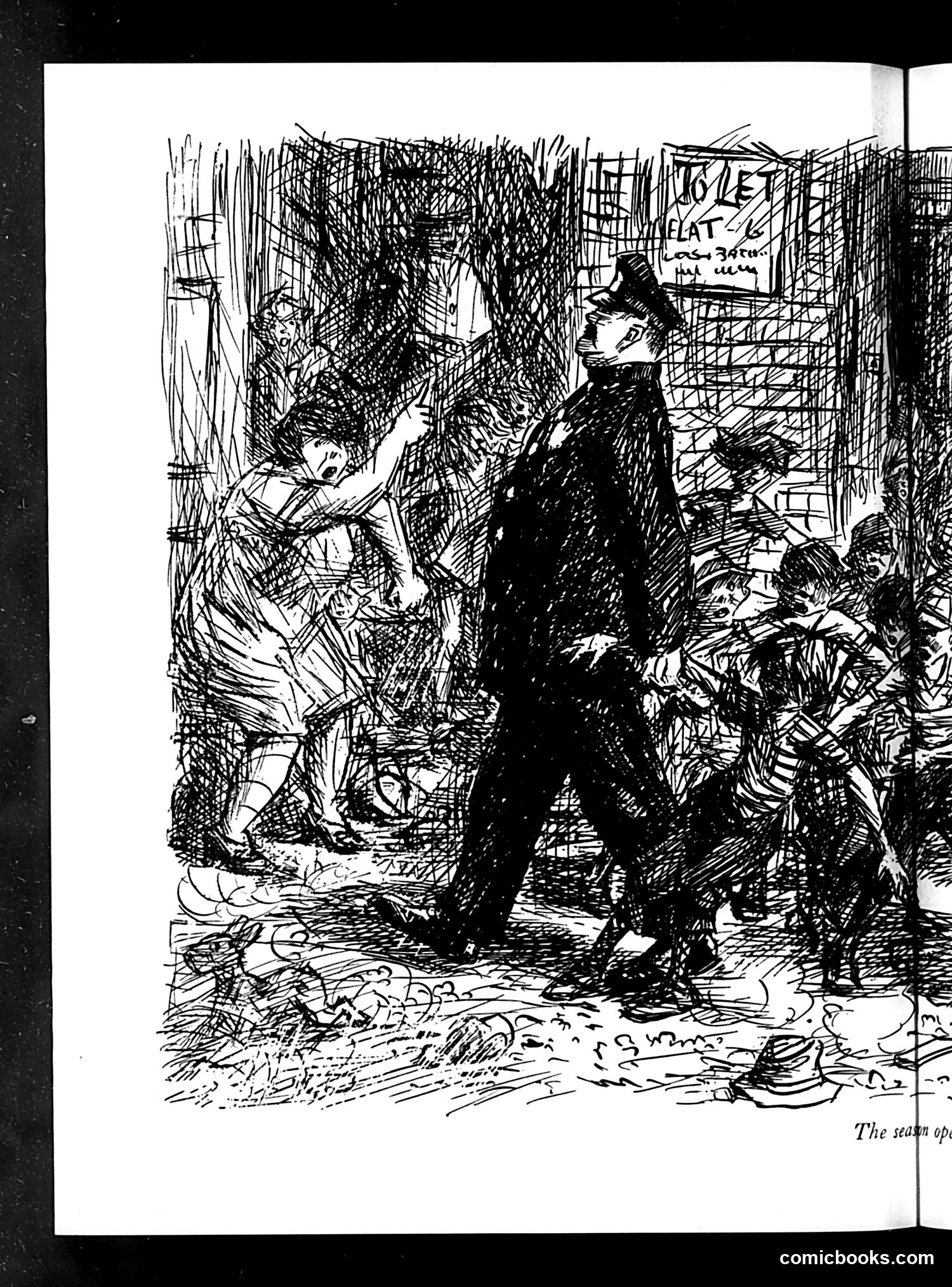
Analysis This sketch depicts a crowded urban street scene with a well-dressed man in dark clothing and a top hat standing centrally—appearing to be a figure of authority or wealth. He's surrounded by working-class people in what looks like a tenement or poor neighborhood setting, with dense cross-hatching suggesting cramped, squalid conditions. The satire likely critiques the contrast between wealthy classes and urban poverty, a common Life magazine theme addressing industrial-era social inequality. The gentleman's formal attire and composed stance amid the chaos emphasize class disconnect. The heavy, chaotic linework emphasizes the disorder and desperation of the poor surroundings. Without visible text identifying the central figure, I cannot definitively name him, though this appears to mock indifference to—or exploitation of—working-class struggles. The exact historical context remains unclear from this page alone.
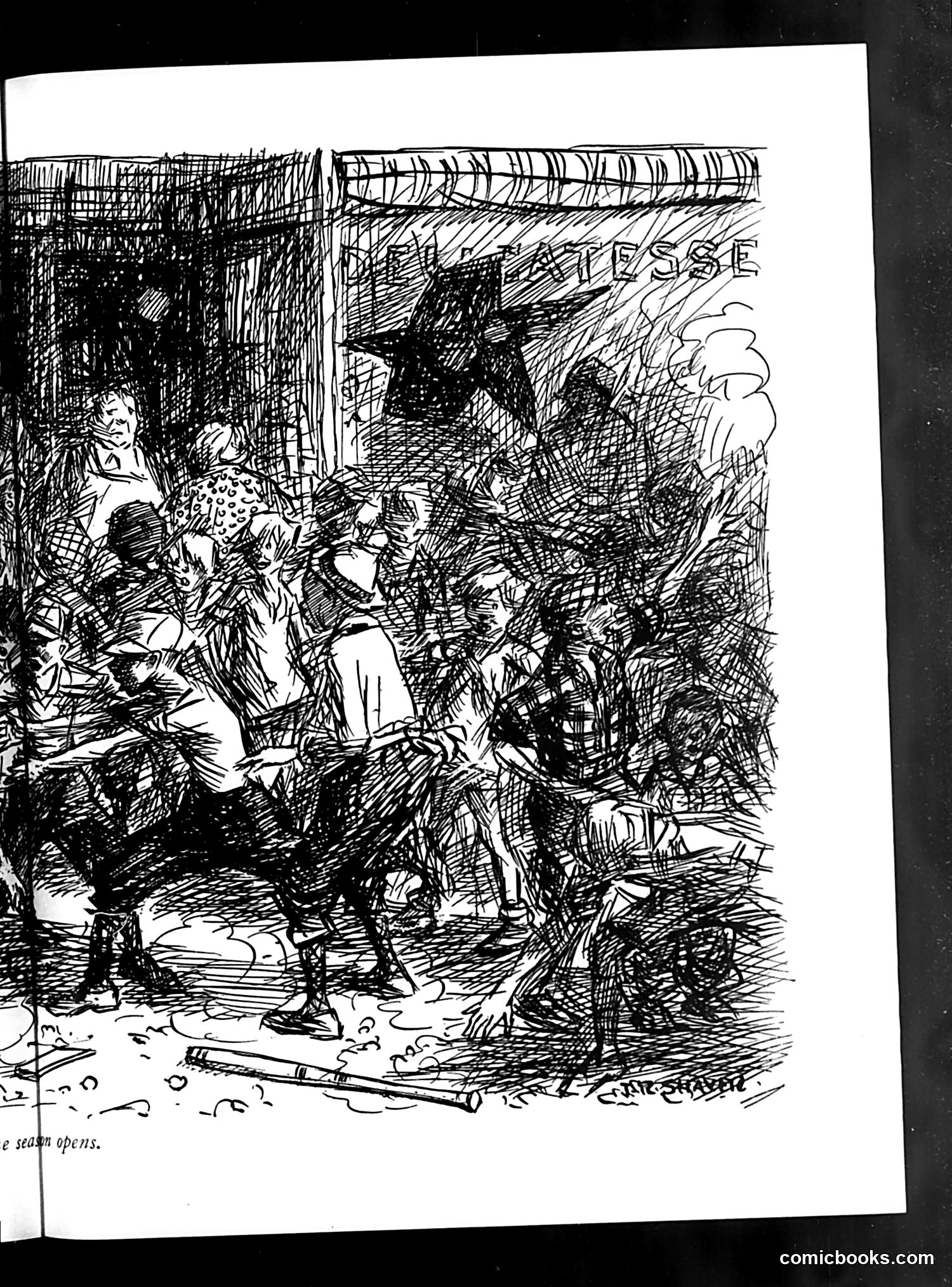
Analysis This is a satirical sketch depicting what appears to be a theatrical or circus scene from the late 19th or early 20th century. The drawing shows a crowded, chaotic interior space with multiple figures in period dress, heavy cross-hatching suggesting movement and confusion. The text fragment "season opens" at bottom left suggests this depicts opening night of a theatrical production or performance venue. The composition emphasizes the crowded, boisterous nature of the audience or performers. Without clearer text identifying specific figures or events, I cannot definitively identify which political figures or social commentary this targets. The style and subject matter appear typical of *Life* magazine's satirical commentary on contemporary entertainment or social gatherings, but the specific satire remains unclear from this image alone.
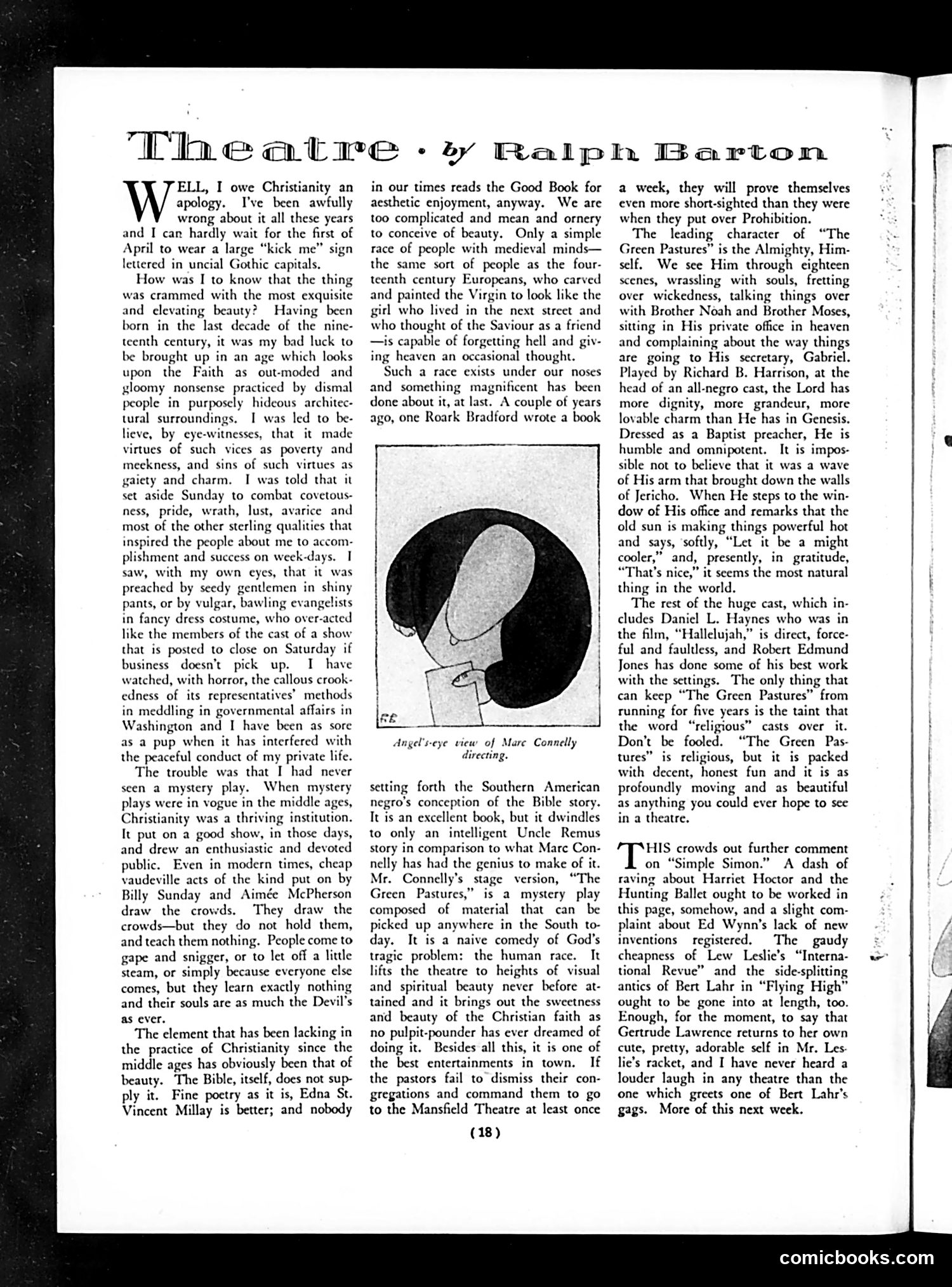
Analysis of "Theatre" by Ralph Barton This is a theater review column by Ralph Barton critiquing "The Green Pastures," a play about Biblical stories from a Southern African American perspective. The illustration shows an angel's-eye view of director Marc Connelly, depicted in profile within a circle—a symbolic representation suggesting divine perspective watching the theatrical production. Barton praises the play as genuinely moving and beautiful, arguing it successfully captures Christian faith's spiritual beauty in ways typical religious theater fails to achieve. He contrasts it favorably with overwrought, poorly-acted religious performances by "seedy gentlemen in shiny pants" and "bawling evangelists." The review criticizes Christianity's historical practice in architecture and governance while celebrating this specific theatrical achievement as redemptive art.
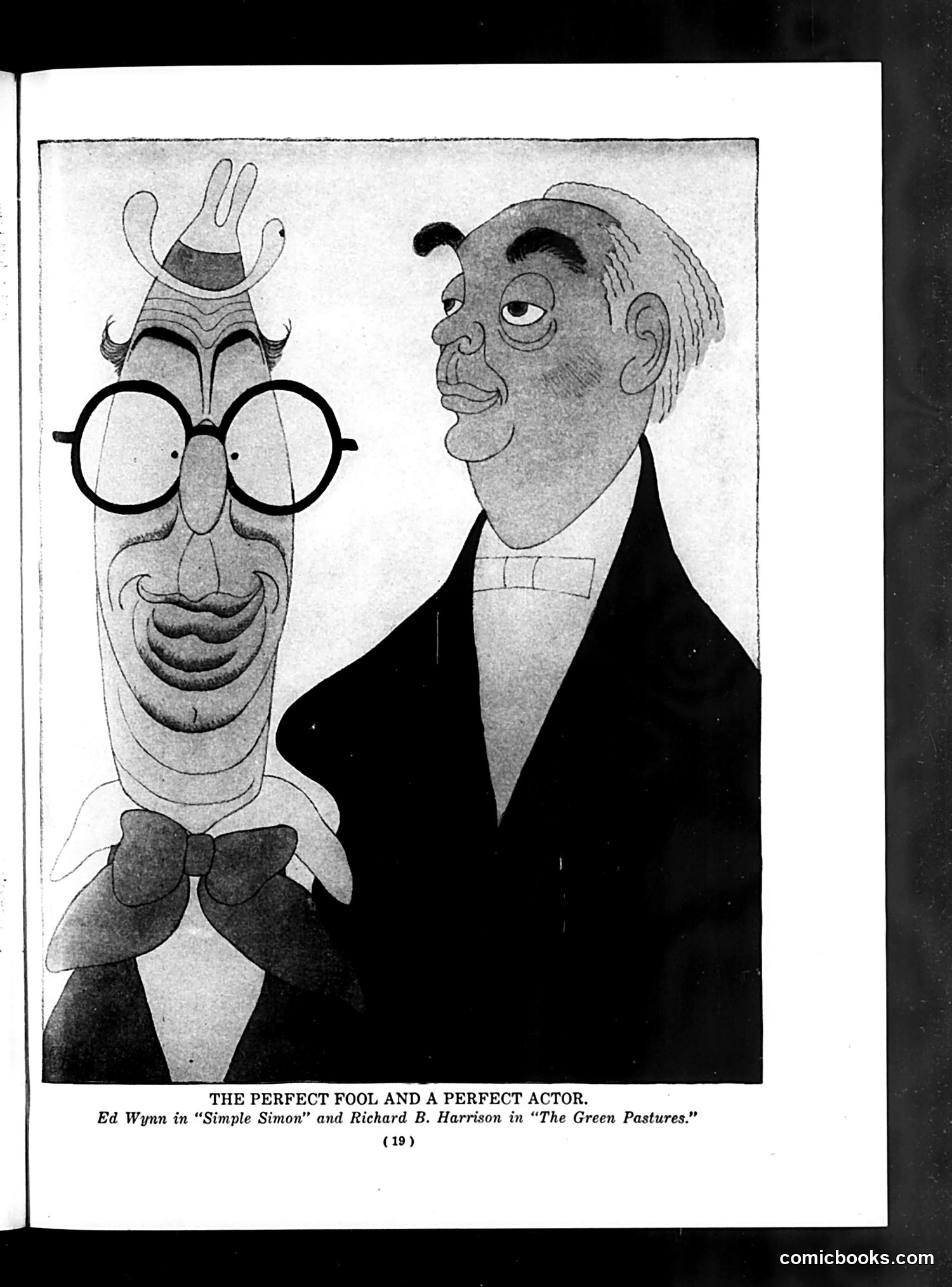
Analysis This page presents a caricature comparison of two theatrical performers. On the left is Ed Wynn in character as "Simple Simon"—depicted with exaggerated facial features, oversized round glasses, and elaborate headwear, emphasizing his comedic "fool" persona. On the right is Richard B. Harrison from "The Green Pastures," shown in formal attire. The caption's phrase "Perfect Fool and Perfect Actor" creates ironic contrast: Wynn excels at playing foolish comic characters, while Harrison is praised as a skilled dramatic actor. The juxtaposition satirizes theater conventions of the era, where comedians and serious actors occupied distinct hierarchies. This appears to celebrate both performers' mastery of their respective theatrical domains, despite the apparent opposites their roles represent.
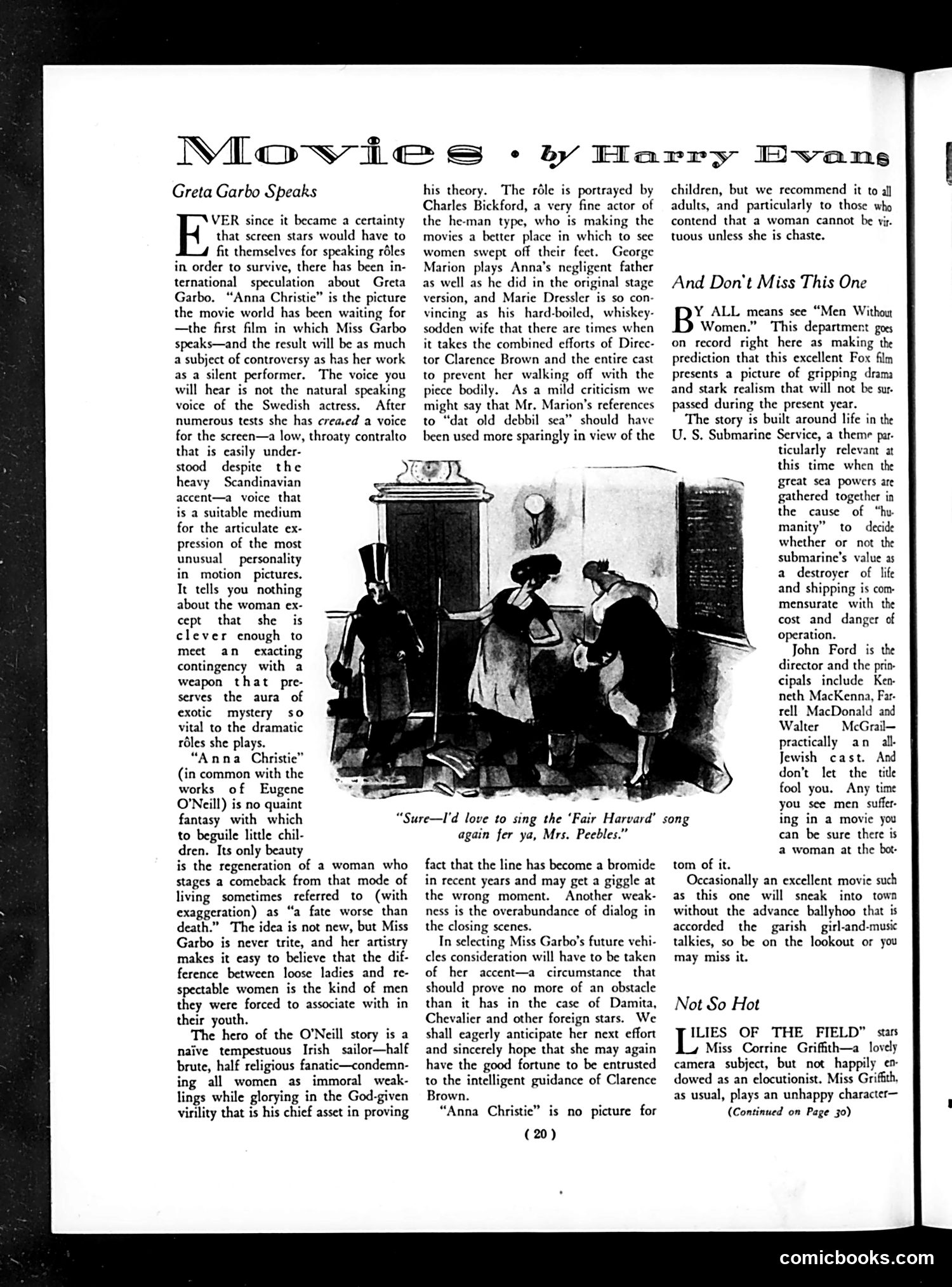
Analysis for Modern Readers This page reviews Greta Garbo's first talking picture, "Anna Christie" (1930). The key context: silent film stars faced extinction when "talkies" arrived, and Garbo's Swedish accent and voice quality were matters of intense international speculation. The cartoon shows a scene from the film—a woman in what appears to be a modest cabin setting with men, illustrating the plot about a woman's "comeback" from a disreputable past (the euphemistic "fate worse than death"). The review praises Garbo's solution: she deliberately created an artificial, low contralto voice that preserved her "exotic mystery" while remaining intelligible despite her accent. The critic argues this cleverness demonstrates she's more than a beautiful face. The social context: "Anna Christie" deals with a "fallen woman's" redemption—morally controversial material. The final sentence sardonically suggests the film appeals to those who believe women must be sexually "chaste" to be virtuous, implying the reviewer finds such attitudes outdated.
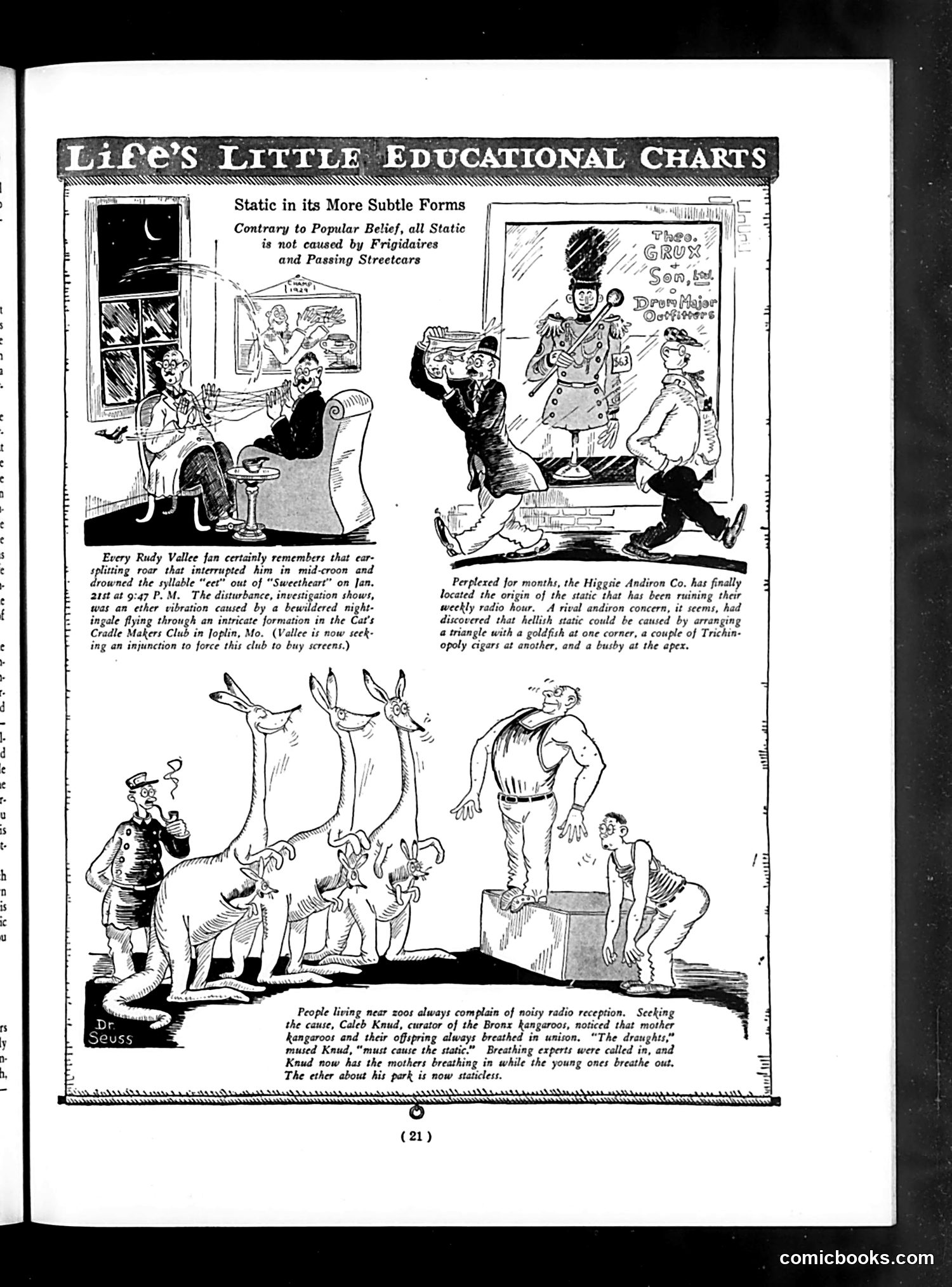
Life Magazine "Educational Charts" - Static Interference Satire This 1920s-30s satirical page mocks pseudo-scientific explanations for radio static—a common complaint as radio broadcasting became popular. The jokes: 1. Rudy Vallee reference: A famous crooner whose broadcast was supposedly interrupted by static caused by a nightingale flying through a formation at a "Cat's Cradle Makers Club" in Joplin, Missouri. The absurdity satirizes people blaming random causes for interference. 2. Andiron company: Radio static blamed on a competitor arranging a triangle with a goldfish, cigars, and "a bushy" (unclear what this object is)—nonsensical pseudo-science. 3. Zoo kangaroos: A zoo curator discovers mother and baby kangaroos breathing in unison causes static; the "solution" is making them breathe out of sync. This mocks absurd problem-solving logic. The cartoons mock both listeners' gullible acceptance of ridiculous explanations and supposed "experts" offering bizarre fixes to a technical problem they didn't understand. Dr. Seuss's signature style is visible in the character drawings.
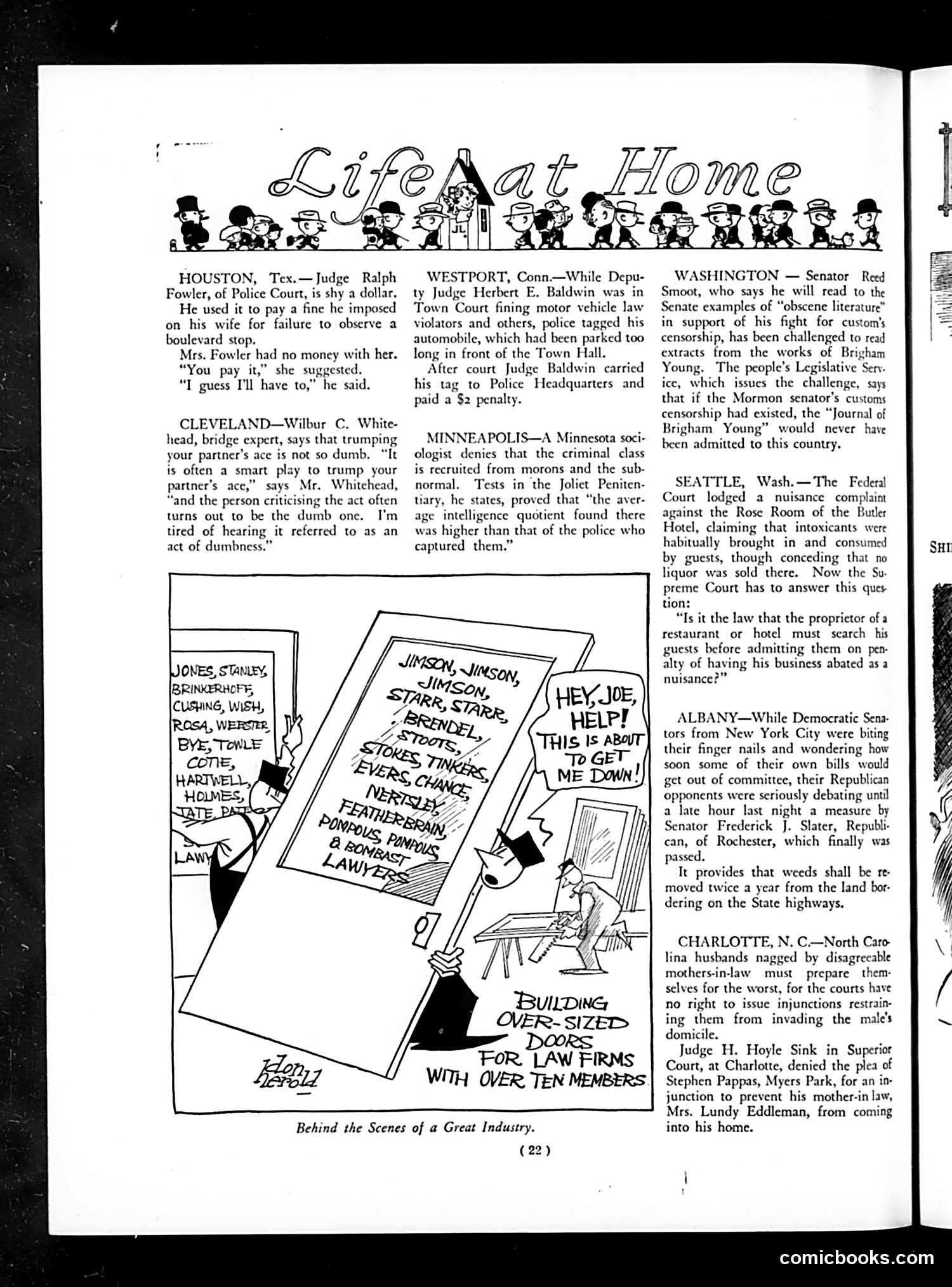
"Life at Home" Page Analysis This page collects humorous anecdotes from American courts and civic life, satirizing legal absurdity and institutional hypocrisy. The central cartoon mocks bloated law firms: a door so oversized it requires a man to help someone escape, labeled "Building over-sized doors for law firms with over ten members." It suggests lawyers are parasitic, requiring unnecessarily large offices and excessive staff. The surrounding brief items highlight legal irony: a judge fines his own wife; a deputy judge gets ticketed while in court; a sociologist claims prisoners are smarter than police; Senator Reed Smoot faces challenge reading Brigham Young's journals as "obscene" (ironic since Young founded Mormonism); courts must decide if hotels must search guests for contraband; and a North Carolina judge refuses to protect a husband from his mother-in-law. The cumulative effect mocks the law's inconsistent application and pretension—judges aren't exempt from rules, authorities aren't necessarily intelligent, and courts struggle with absurd modern questions. The humor targets institutional hypocrisy and legal overreach.
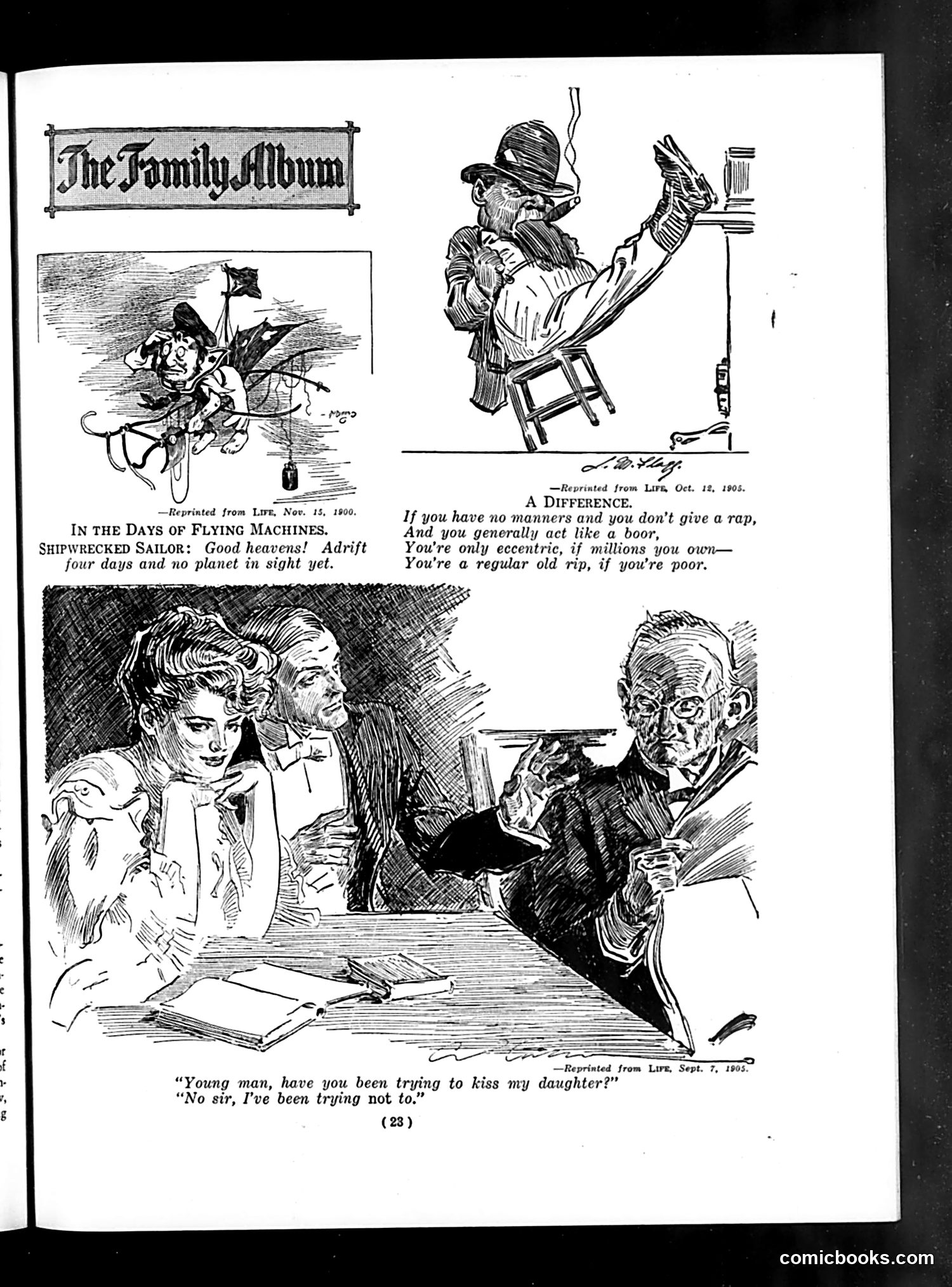
Explanation of "The Family Album" Page This page collects three satirical cartoons from *Life* magazine (circa 1900-1905): 1. "In the Days of Flying Machines" (top left): A shipwrecked sailor, stranded for four days, complains there's "no planet in sight"—absurdist humor playing on the era's excitement about aviation and space travel as if they were practical concerns. 2. "A Difference" (top right): Social satire on class hypocrisy. The verse contrasts wealthy and poor men: identical rude behavior is called "eccentric" if you're rich but "a regular old rip" (scoundrel) if poor. It critiques how society judges morality by wealth rather than character. 3. "Young man, have you been trying to kiss my daughter?" (bottom): A courtship comedy. The young suitor's response—"No sir, I've been trying *not* to"—is humorous because it admits he *wants* to kiss her, suggesting poorly restrained desire. It plays on Victorian courtship conventions and parental anxiety about male intentions.
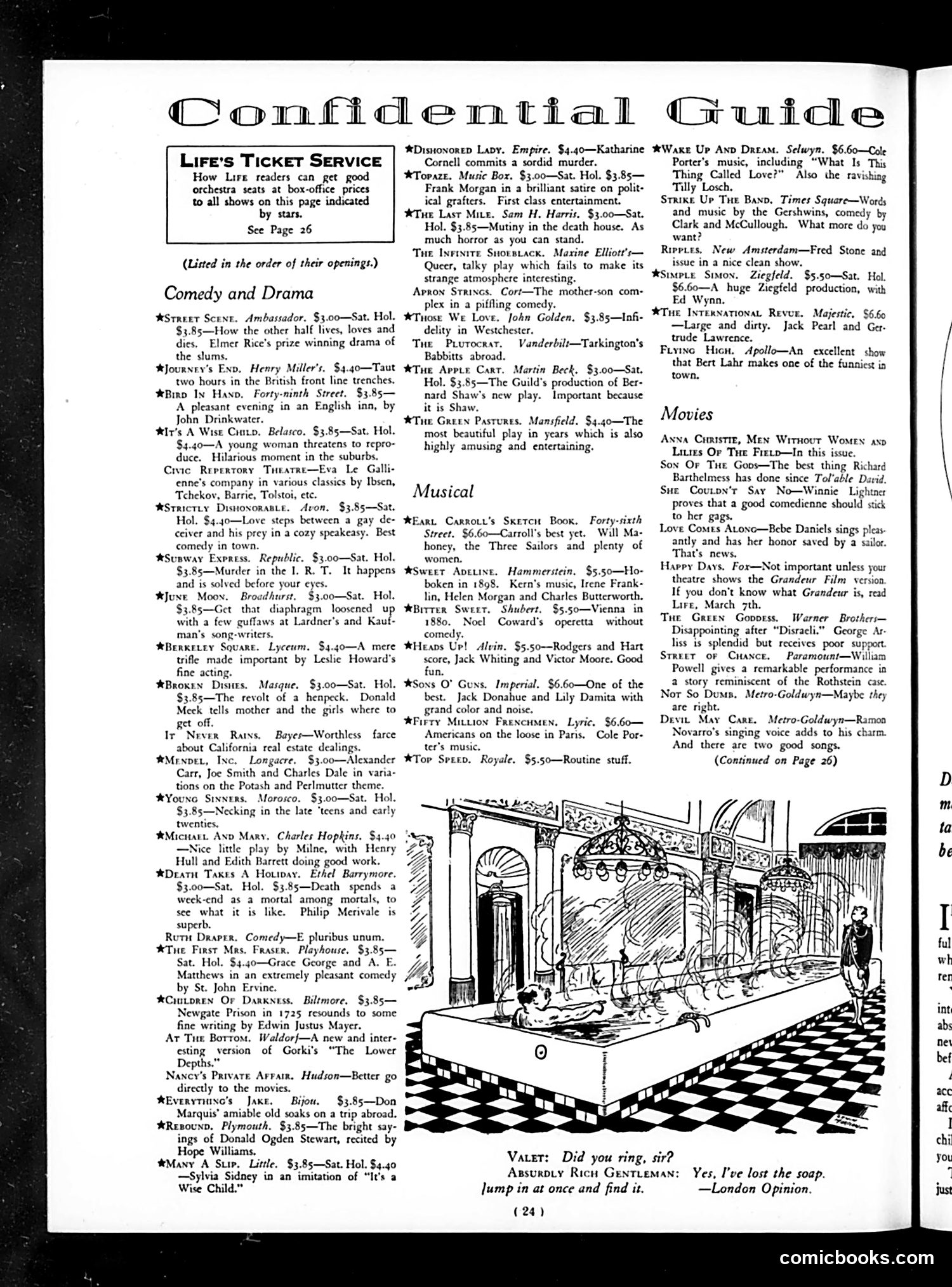
Analysis of "Confidential Guide" Page This is a theater listing and review page from Life magazine, functioning as a practical service guide rather than satirical content. The page provides Broadway show information with brief, irreverent plot summaries and ticket prices for 1920s productions. The humor lies in the *descriptions* themselves—Life's editors mock plays through witty, reductive synopses. For example, "It's a Wise City" is described as "A young woman threatens to reproduce. Hilarious moment in the suburbs," and "Nancy's Private Affair" receives the dismissal "Better go directly to the movies." The accompanying theatrical illustration shows an ornate stage set with a checkered floor and classical archway—typical 1920s Broadway design. The single joke at bottom features a valet asking a gentleman if he rang, with the gentleman's deadpan response about losing the soap, exemplifying period drawing-room comedy humor. This is primarily a service page with embedded satirical commentary on theatrical quality.
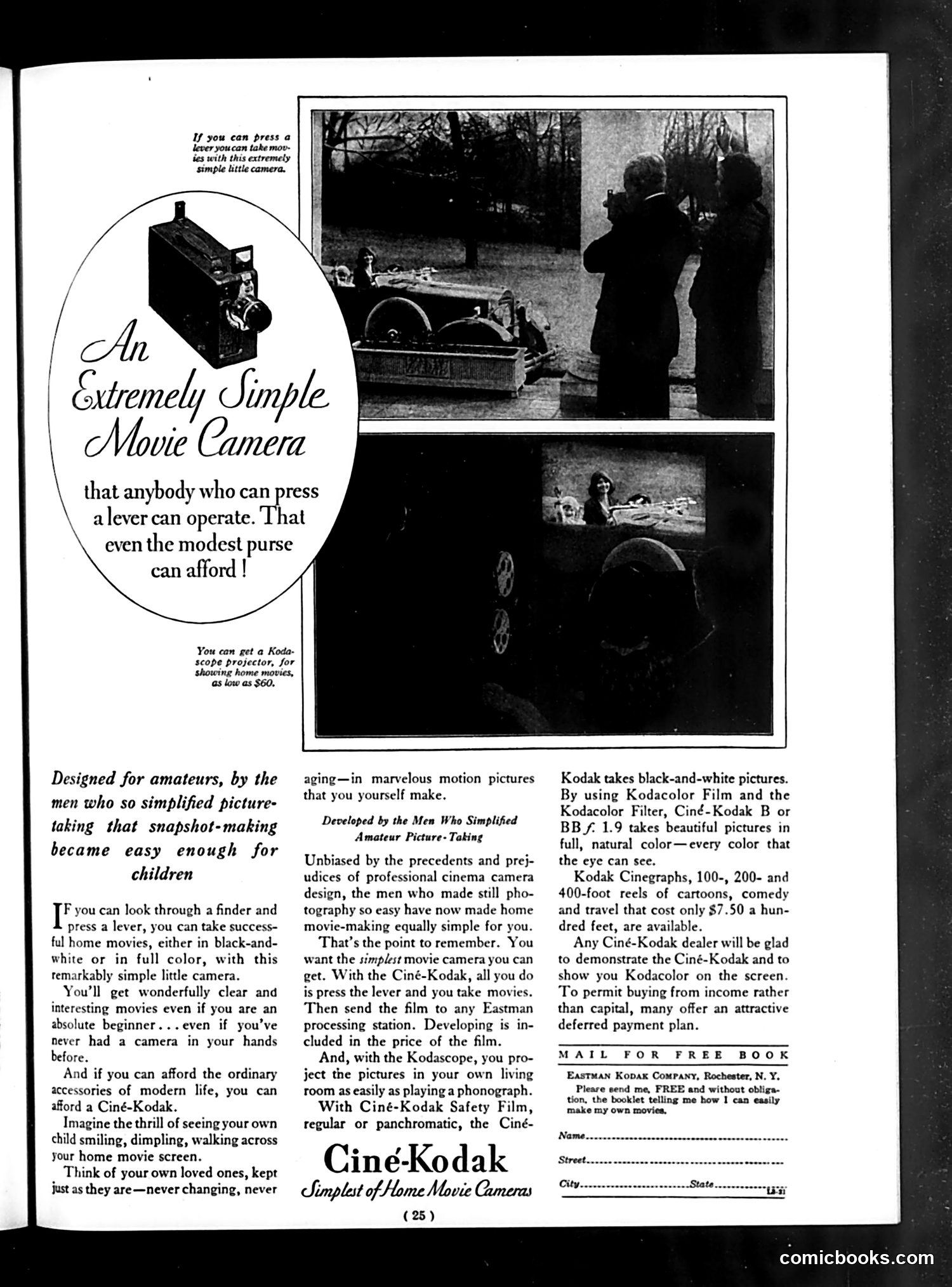
Ciné-Kodak Advertisement Analysis This is a product advertisement, not political satire. It promotes Kodak's home movie camera system to middle-class American consumers. The appeal: The ad emphasizes democratic accessibility—anyone (even children) can operate this camera by simply pressing a lever. This mirrors Kodak's earlier success making still photography "simple enough for children." Social context: The photographs show typical family scenes (people outdoors, children playing) that viewers could now capture themselves. The text promises to preserve loved ones "just as they are—never changing, never aging," appealing to nostalgia and family sentiment. The pitch: The camera, projector (Kodascope), and film processing are all affordable ("even the modest purse can afford"). Payment plans are available. This democratizes home moviemaking—previously expensive professional equipment is now consumer-friendly. The page contains no satire or political messaging; it's straightforward marketing positioning consumer technology as democratizing and emotionally meaningful.
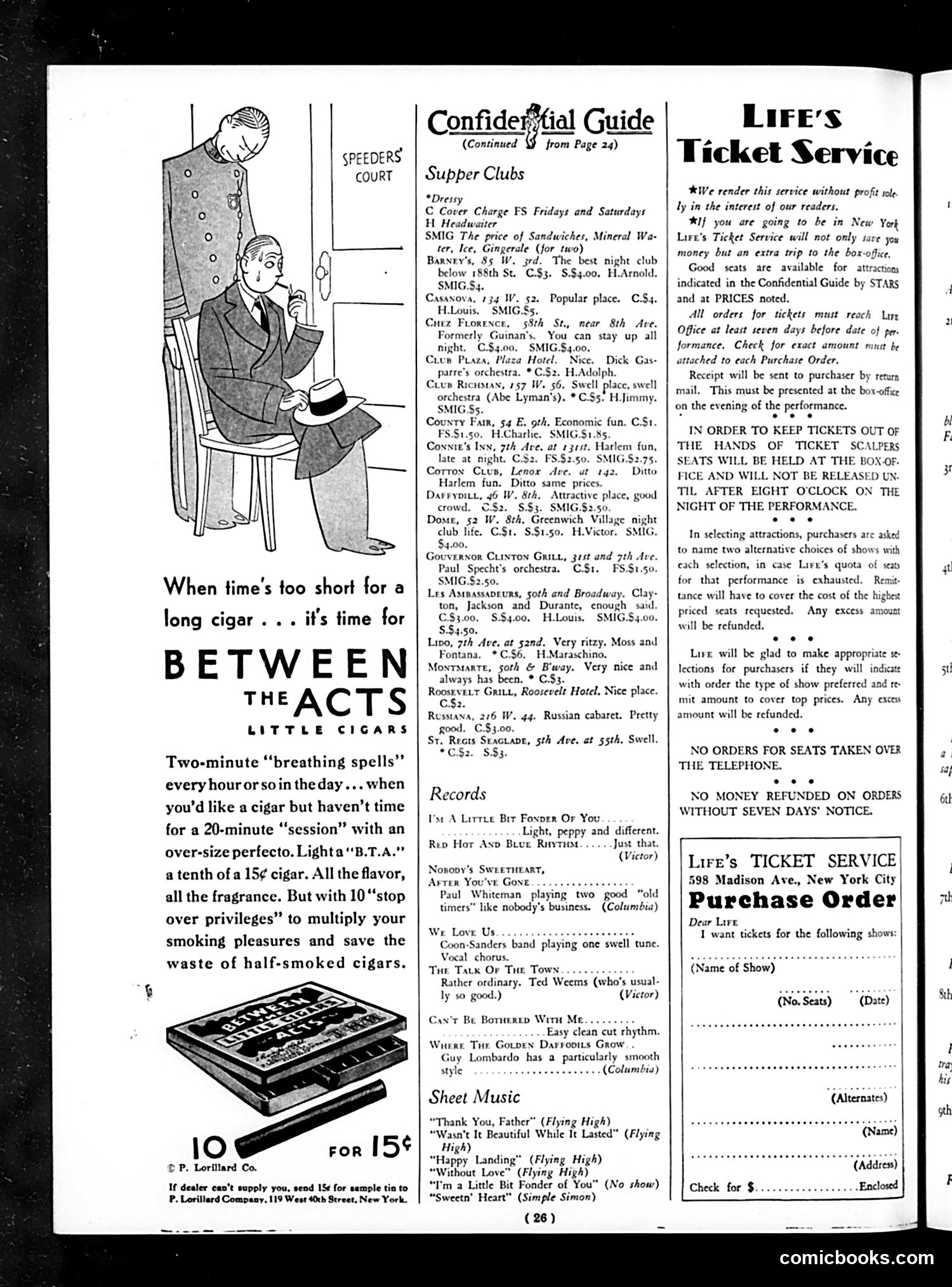
Analysis for Modern Readers This page is primarily advertising and service information from Life magazine's entertainment section (circa 1920s-30s). The main cartoon advertisement promotes "Between the Acts" little cigars—a product for busy people who lack time for full-length cigars. The visual joke shows two men in a "Speeders' Court," humorously linking rushed cigar-smoking to traffic violations, playing on the era's anxieties about modern speed and impatience. The rest of the page contains: - A "Confidential Guide" listing NYC nightclubs with cover charges, notable features, and performers (reflecting Prohibition-era speakeasy culture) - Record recommendations (jazz and popular music of the period) - Sheet music listings - Life magazine's ticket service order form The nightclub listings reference Jazz Age entertainment: performers like Paul Whiteman, Guy Lombardo, and entertainers Clayton, Jackson, and Durante. References to "Harlem fun" reflect the era's interest in African American entertainment venues. The satire is mild: the cartoon gently mocks modern impatience by equating cigar-smoking shortcuts to traffic court violations.
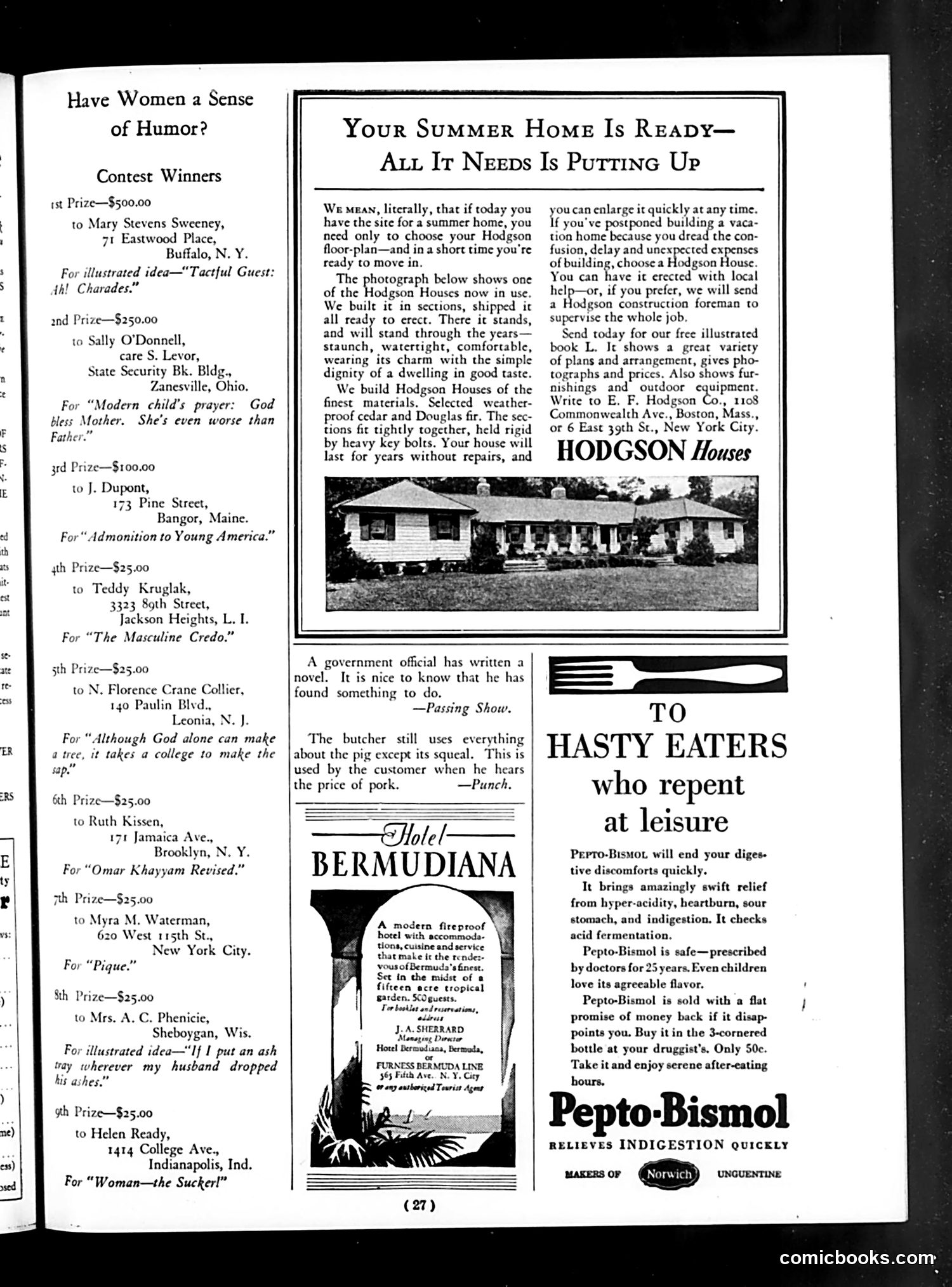
Life Magazine Page Analysis This page combines a humor contest results section with period advertisements, reflecting 1920s-30s American culture. The contest winners reveal contemporary gender attitudes. Titles like "Modern child's prayer: God bless Mother. She's even worse than Father" and "Woman—the Sucker!" suggest self-deprecating humor targeting women themselves. The page's headline—"Have Women a Sense of Humor?"—frames female humor as questionable, while the winning entries confirm stereotypes about mothers, wives, and female gullibility rather than challenging them. The advertisements (Hodgson Houses, Hotel Bermudiana, Pepto-Bismol) target middle-class consumers with promises of convenience and digestive relief—reflecting post-war consumer culture and modern anxiety about food and leisure. The small editorial jokes mock government bureaucrats and rising pork prices, typical of *Life's* satirical approach to contemporary issues. Overall, the page demonstrates how satire could reinforce rather than challenge social hierarchies, particularly regarding gender roles.
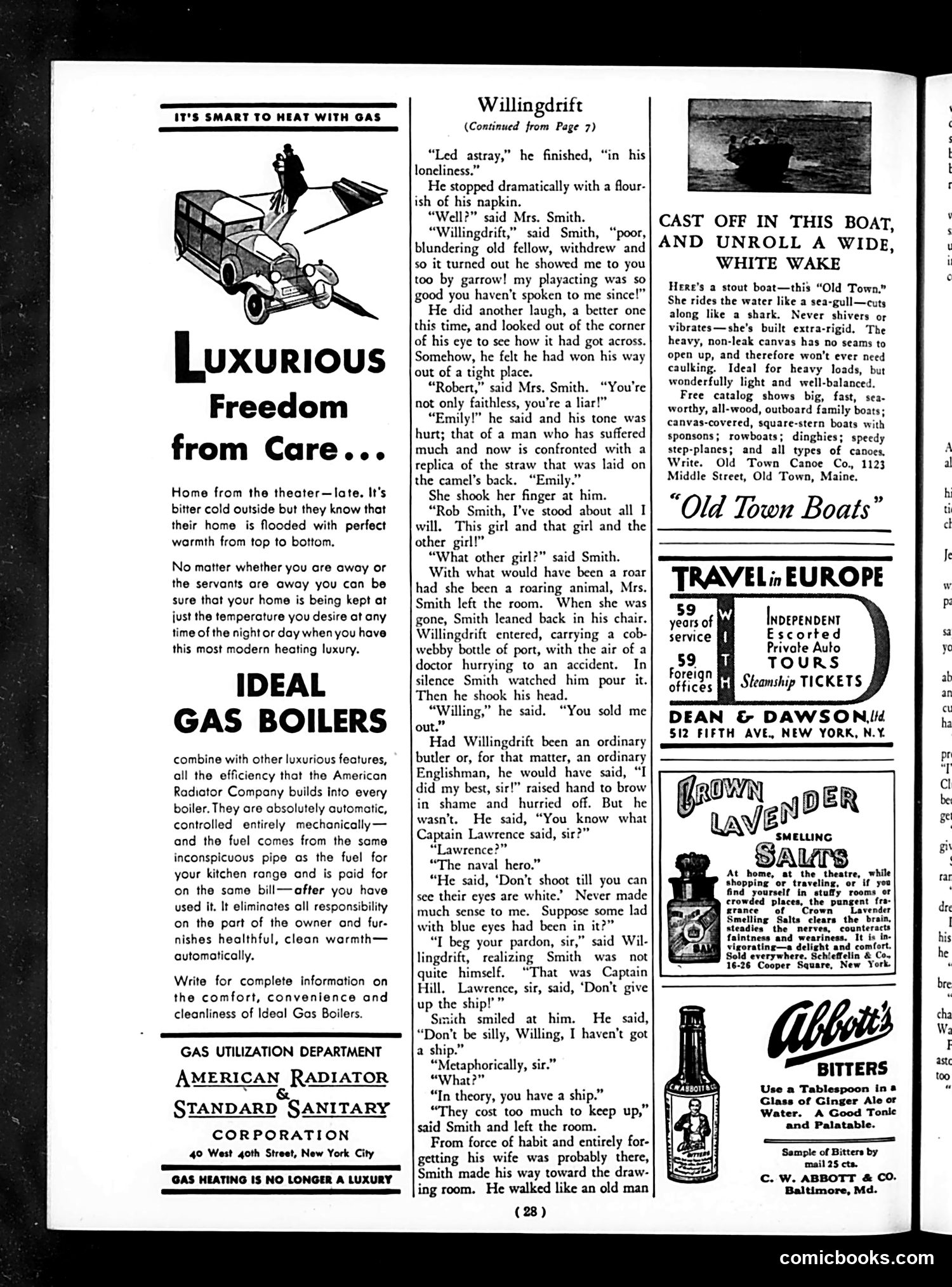
Analysis of This Life Magazine Page This page combines a gas heating advertisement with a serialized fiction story called "Willingdrift." The Advertisement (Left Side) An illustrated ad for Ideal Gas Boilers emphasizes the luxury of automatic home heating—depicting a couple returning home late from the theater to find their house perfectly warm. The pitch targets affluent homeowners seeking convenience and freedom from manual heating labor. The tagline "GAS HEATING IS NO LONGER A LUXURY" suggests gas heating was becoming accessible to the middle class, not just the wealthy. The Story (Center/Right) "Willingdrift" appears to be a serialized humorous domestic drama. The protagonist, Robert Smith, is caught in marital trouble after his wife Emily discovers his infidelities. His butler Willingdrift provides comic relief through earnest misunderstandings—confusing naval heroes (Captain Hill vs. Lawrence) and offering philosophical metaphors about ships. The butler's steadfast loyalty contrasts with Smith's moral failings, suggesting servant characters often possessed more integrity than their employers in early 20th-century satirical fiction.
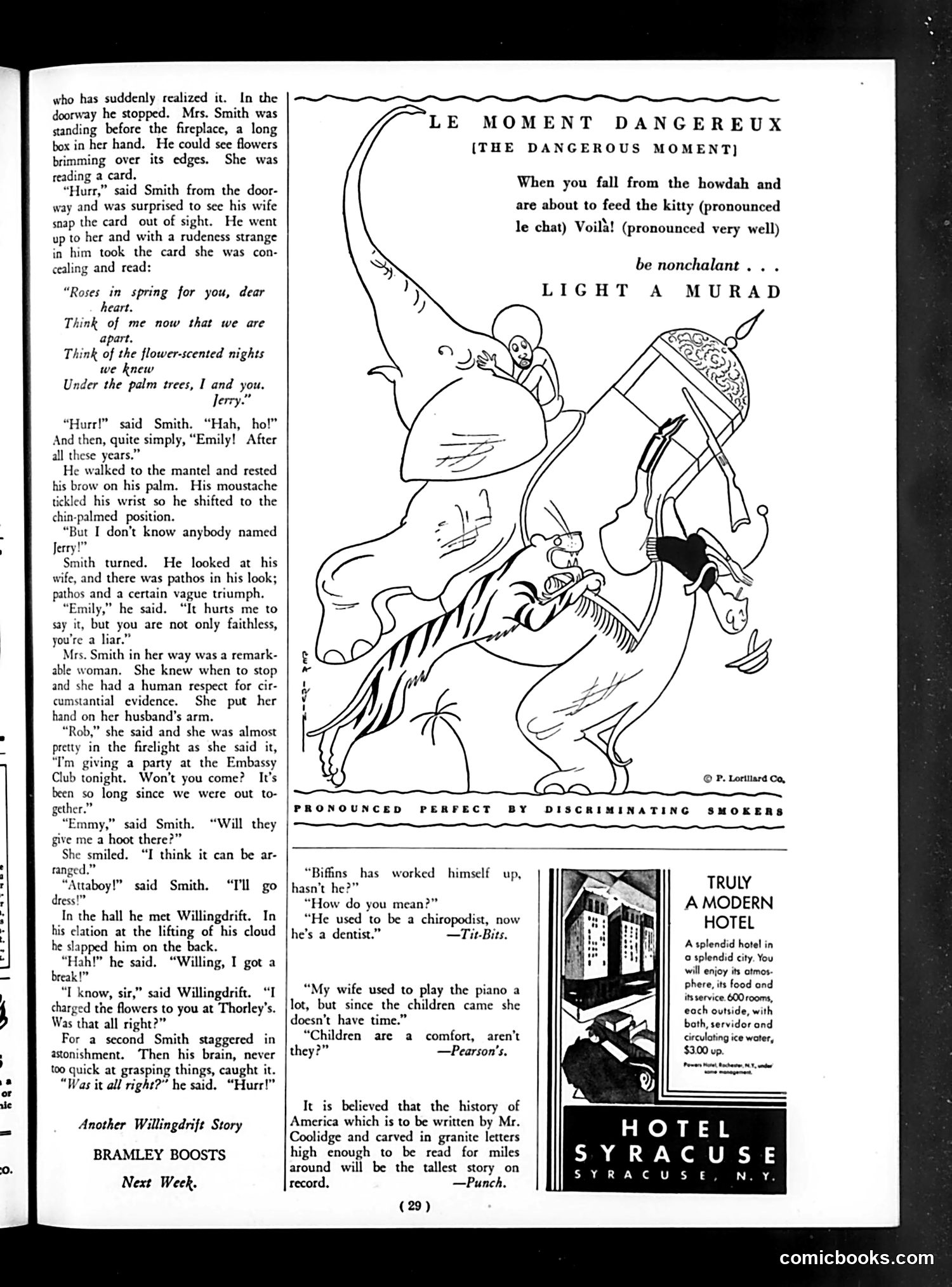
Content Analysis: Life Magazine Page This page contains a complete short story ("Another Willingdrift Story") about marital infidelity and misunderstanding. Mr. Smith discovers his wife received flowers signed "Jerry" from an unknown admirer. After confronting her about both unfaithfulness and lying, he's later relieved to learn his own servant Willingdrift sent the flowers—on Smith's own account at the florist. The joke: Smith's jealous suspicion was groundless; he inadvertently sent the romantic flowers himself and forgot. The page also features period advertisements (Hotel Syracuse, Murad cigarettes) and unrelated jokes about chiropodists becoming dentists and piano-playing wives. The cartoon "Le Moment Dangereux" depicts a humorous tiger attack scenario with French captions about maintaining composure—a lighthearted take on colonial adventure tropes common to 1920s audiences familiar with big-game hunting narratives.
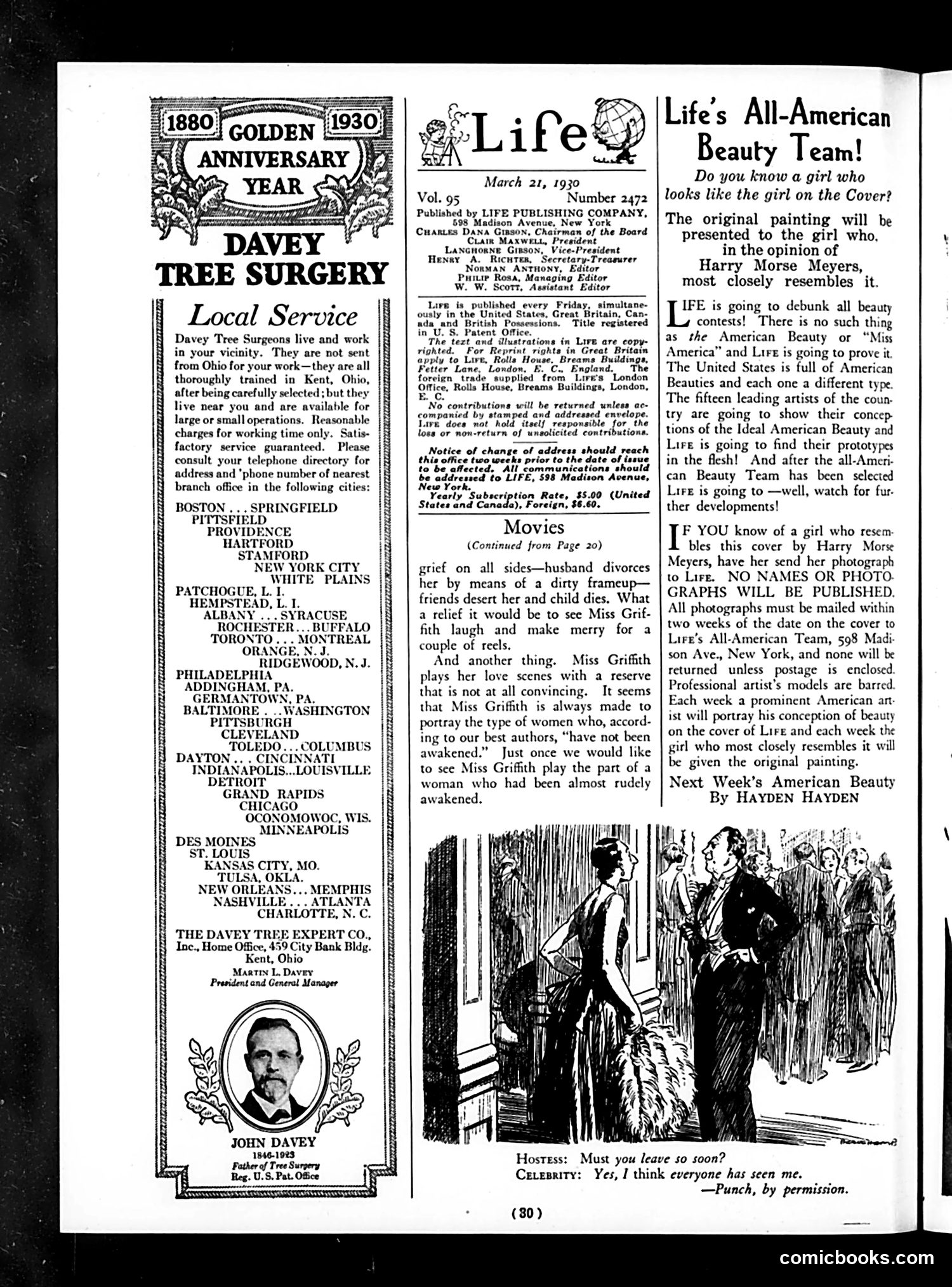
Analysis of Life Magazine, March 21, 1930 This page is primarily advertising and editorial content rather than a cartoon. The left side features a Davey Tree Surgery advertisement, emphasizing local service with branch offices nationwide—a major commercial concern of the era. The right side contains entertainment commentary on movies (reviewing actress Lillian Gish) and announces Life's "All-American Beauty Team" contest. This promotional campaign aims to debunk centralized beauty standards by having fifteen prominent artists depict different "ideal American beauties," then soliciting reader photographs to match these paintings. The satirical point appears subtle: rather than crowning one "Miss America," Life argues American beauty is diverse. This likely reflects 1930s cultural debate about beauty standards and commercialized femininity. The contest itself becomes the satire—while claiming to "debunk" beauty contests, Life launches exactly that.
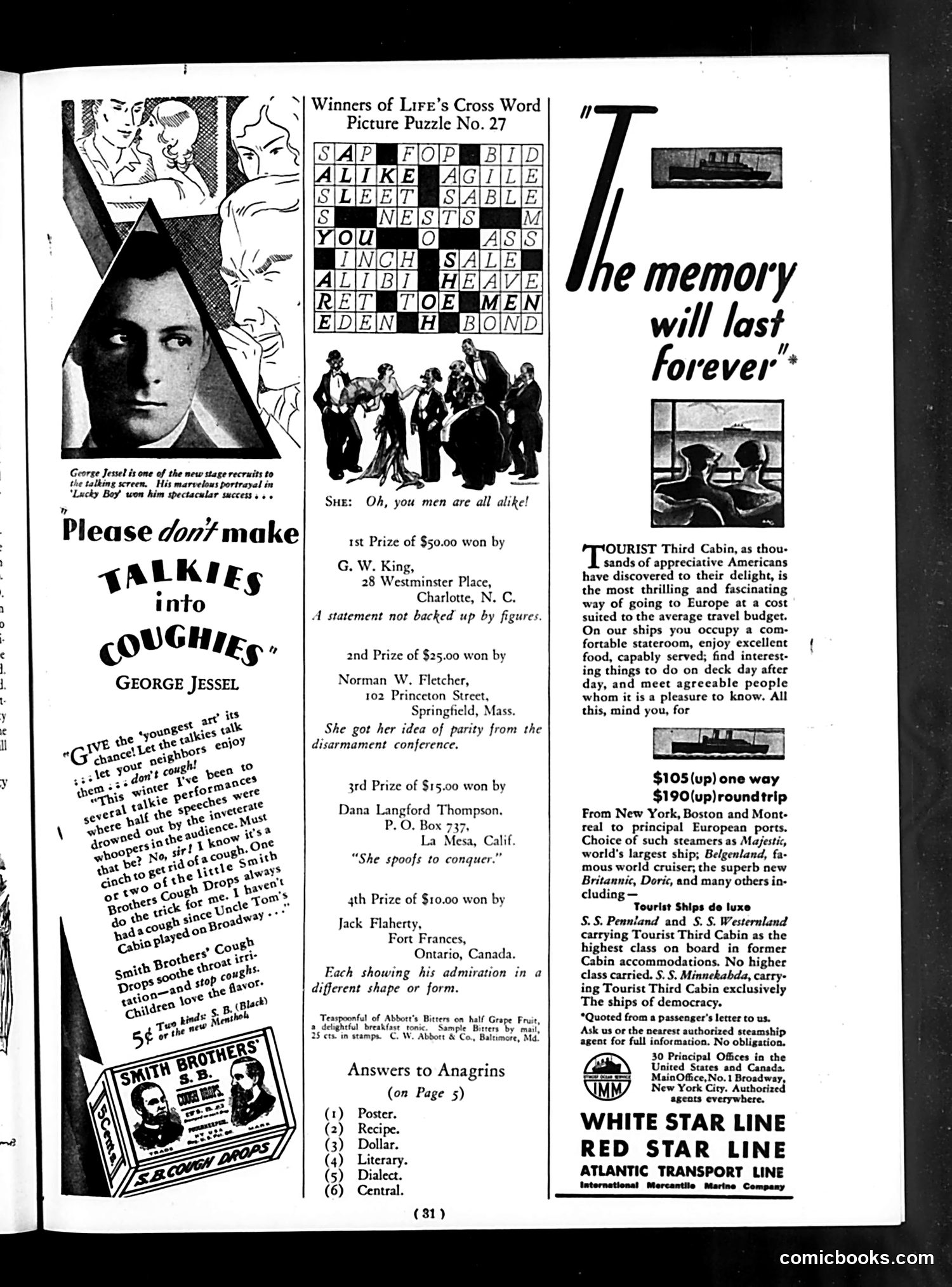
Explanation for Modern Readers This page combines a puzzle contest with advertisements. The main cartoon features George Jessel, a vaudeville performer newly appearing in talking pictures (early "talkies"). The joke satirizes the transition from silent to sound film: Jessel's character complains "Please don't make TALKIES into COUGHIES"—a pun suggesting that live audiences at movie theaters cough and disrupt dialogue-heavy films, unlike silent films where audience noise didn't matter. The crossword puzzle below shows a domestic scene with a woman saying "Oh, you men are all alike!"—typical 1920s gender-based humor. Prize winners submitted competing captions interpreting the scene differently. The page also advertises White Star Line, Red Star Line, and Atlantic Transport Line shipping companies, promoting affordable "Tourist Third Cabin" ocean travel to Europe—suggesting this was published during the prosperous 1920s when transatlantic travel became accessible to middle-class Americans.
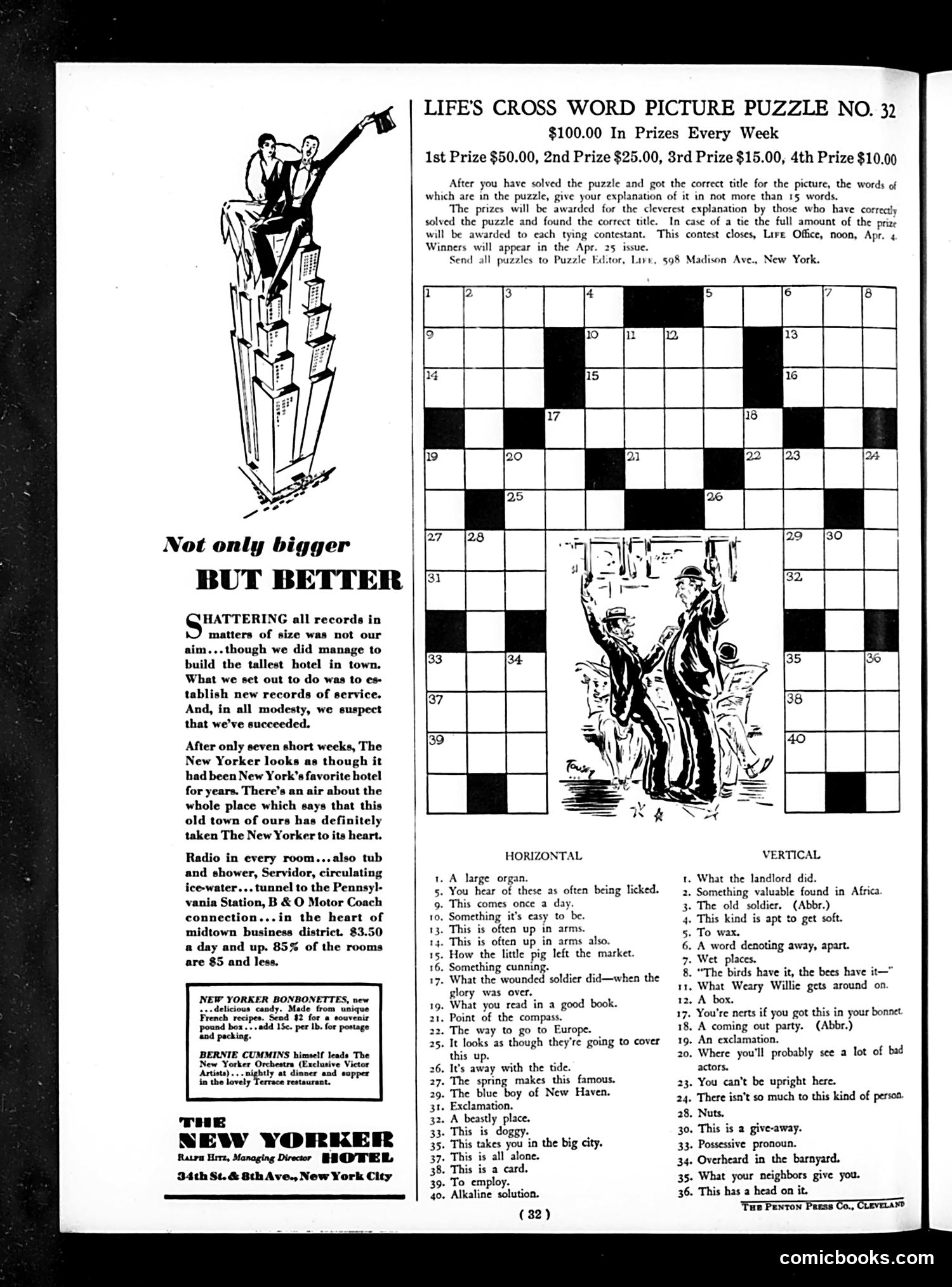
Life Magazine Crossword Puzzle Page Analysis This page is primarily a crossword puzzle contest, not political satire. The main content consists of: The Puzzle: A picture crossword with clues both horizontal and vertical. Solvers must identify the picture's title and explain it in 15 words to win prizes ($50 first place). The Advertisement: The bulk of the page advertises "The New Yorker" hotel in Manhattan (34th St. & 8th Ave.). The ad boasts of being the "tallest hotel in town" and emphasizes superior service—radio in every room, ice-water circulation, tunnel connection to Pennsylvania Station. It references Bernie Cummins' orchestra performing nightly. Historical Context: This appears to be from the 1920s-30s, when such puzzle contests were popular magazine features. The New Yorker Hotel was an actual luxury establishment that opened in 1930. There is no political cartoon or social satire present on this page—it's a commercial puzzle and hotel advertisement typical of Life magazine's mixed-content format of that era.
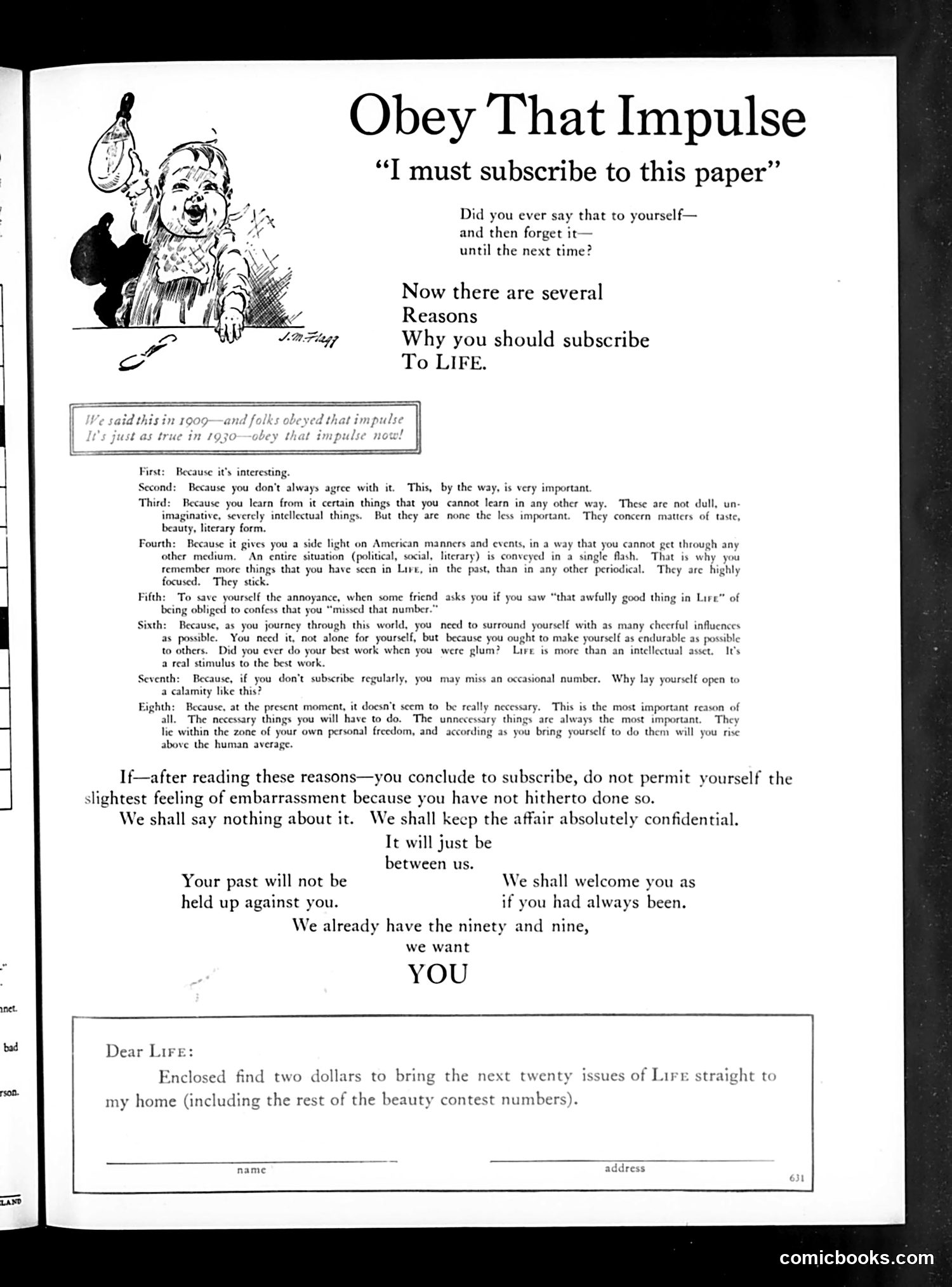
Analysis of "Obey That Impulse" This is a subscription advertisement for *Life* magazine (the satirical publication, not the later photo magazine). The cartoon shows a cheerful figure urging readers to follow their impulse to subscribe. The "eight reasons" pitch is self-aware satire: *Life* essentially admits its own non-necessity while arguing that's precisely why people *should* subscribe. The logic is playfully circular—unnecessary luxuries actually matter more than practical necessities because they represent personal freedom and taste. The tone is notably gentle and reassuring: the ad promises confidentiality ("between us"), won't judge late subscribers, and welcomes them as equals. This reflects 1930s marketing psychology—removing purchase barriers through friendly persuasion rather than hard-sell tactics. The reference to "beauty contest numbers" suggests *Life* ran popular beauty competitions that readers didn't want to miss. Overall, this is clever meta-advertising: a satirical magazine selling subscriptions by making fun of subscription pitches themselves.
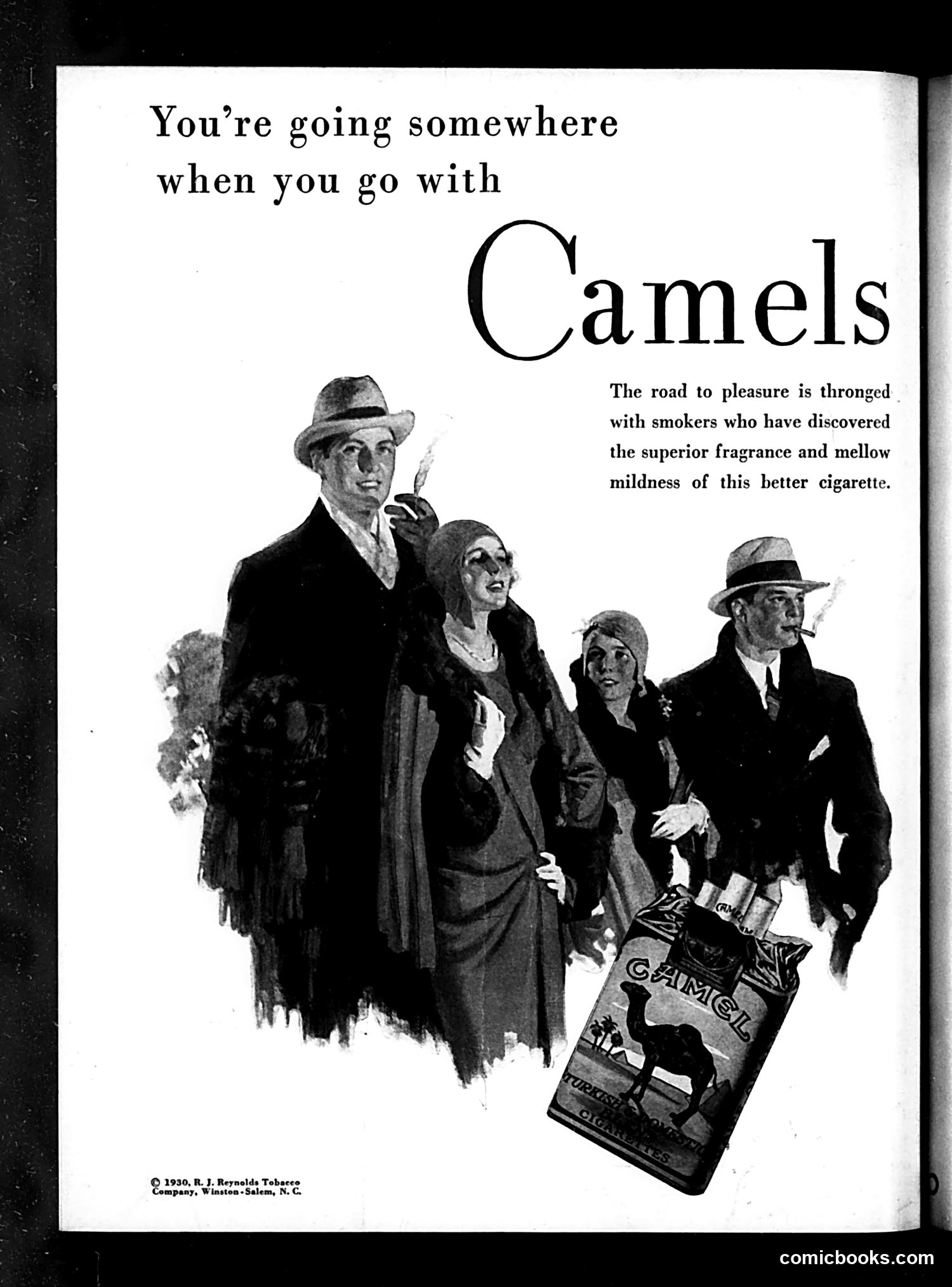
Analysis This is a Camel cigarette advertisement from 1930, not satire or political commentary. The ad uses aspirational imagery—four well-dressed, sophisticated-looking people in formal attire and hats—to suggest that smoking Camels elevates one's social status and lifestyle ("You're going somewhere when you go with Camels"). The advertisement claims superior taste through phrases like "superior fragrance and mellow mildness." This reflects early 20th-century advertising strategy: associating cigarette brands with wealth, refinement, and social mobility. For modern readers, this is striking for its unironic health claims and the casual normalization of smoking as a status symbol—marketing practices now heavily regulated or banned.