life
Life — March 28, 1930
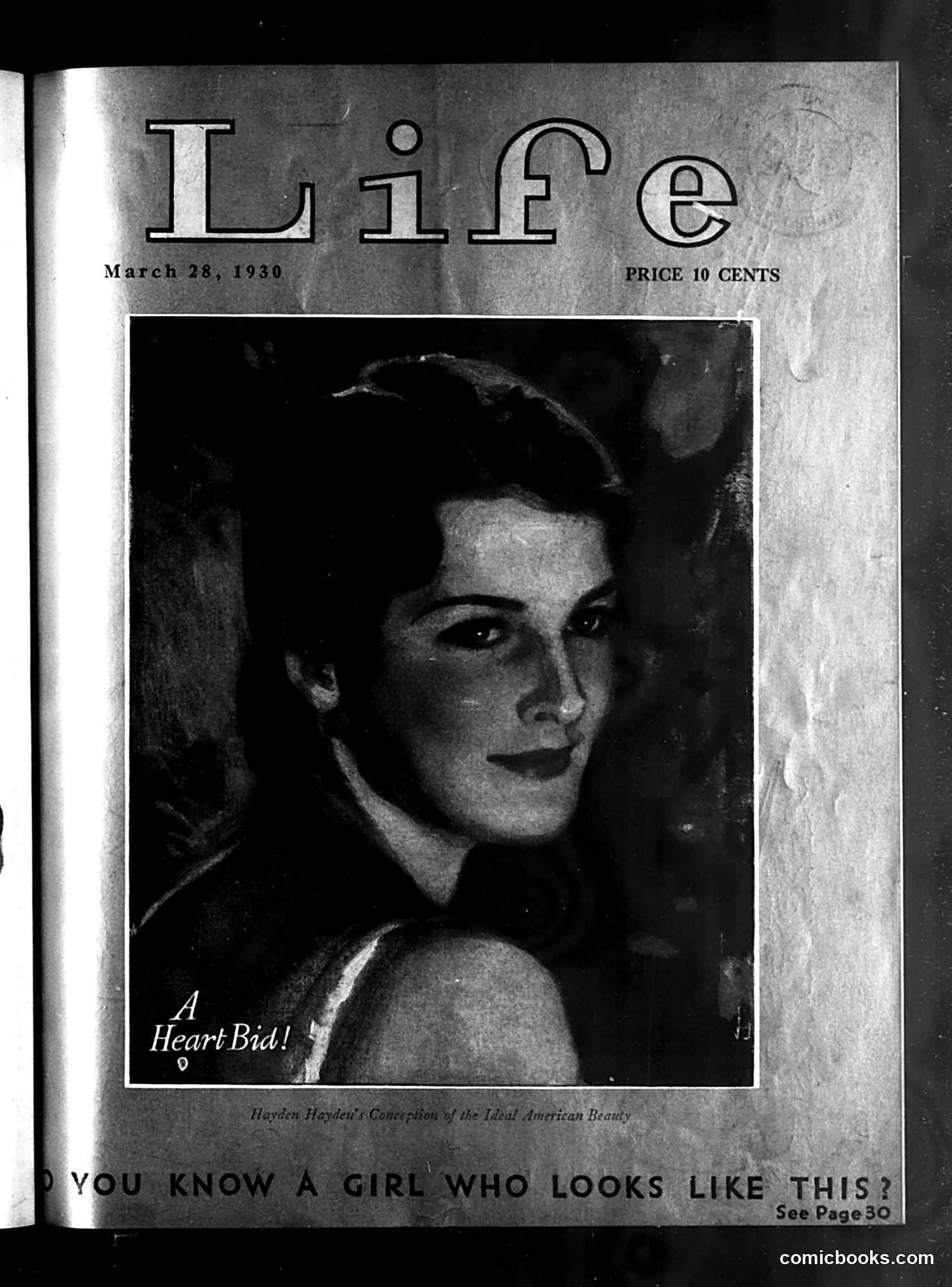
Life Magazine Cover Analysis - March 28, 1930 This is a magazine cover, not a political cartoon. It features a portrait photograph labeled "A Heartbird" with the caption "Hayden Hayden's Conception of the Ideal American Beauty." The cover appears to be advertising content about beauty standards, asking readers "DO YOU KNOW A GIRL WHO LOOKS LIKE THIS?" with a reference to "See Page 30." This reflects 1930s popular culture's obsession with defining and promoting idealized feminine beauty. The term "Heartbird" (likely a playful neologism) and the formal presentation suggest the magazine is promoting specific aesthetic standards to its readers. The price of 10 cents indicates this is a vintage publication aimed at a general American audience interested in lifestyle and entertainment content.
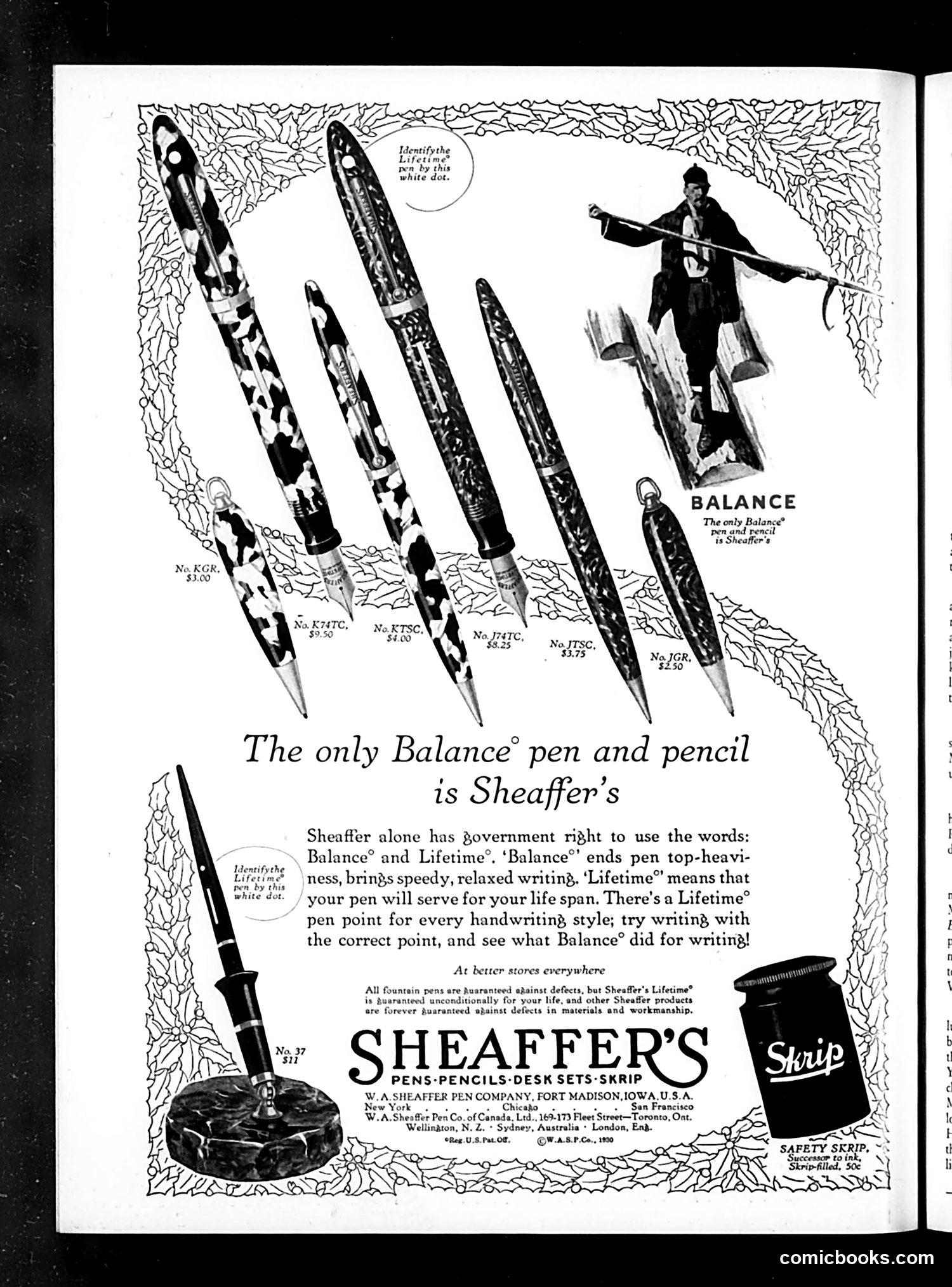
Advertisement Analysis This is a Sheaffer pen and pencil advertisement, not political satire. The page promotes Sheaffer's "Balance" line of writing instruments through product display. The illustration shows a man balancing on skis while holding a rifle, demonstrating the concept of "balance" through physical equilibrium. Six different pen and pencil models are displayed below, each labeled with product numbers and prices (ranging from $2.50 to $4.00). The ad emphasizes Sheaffer's exclusive government rights to the "Balance" and "Lifetime" brand names, claiming superior quality and lifetime durability guarantees. The skiing imagery is purely metaphorical—suggesting that balanced, quality writing instruments help users navigate life smoothly, much as balance helps a skier move effectively. This is commercial advertising, not editorial content.
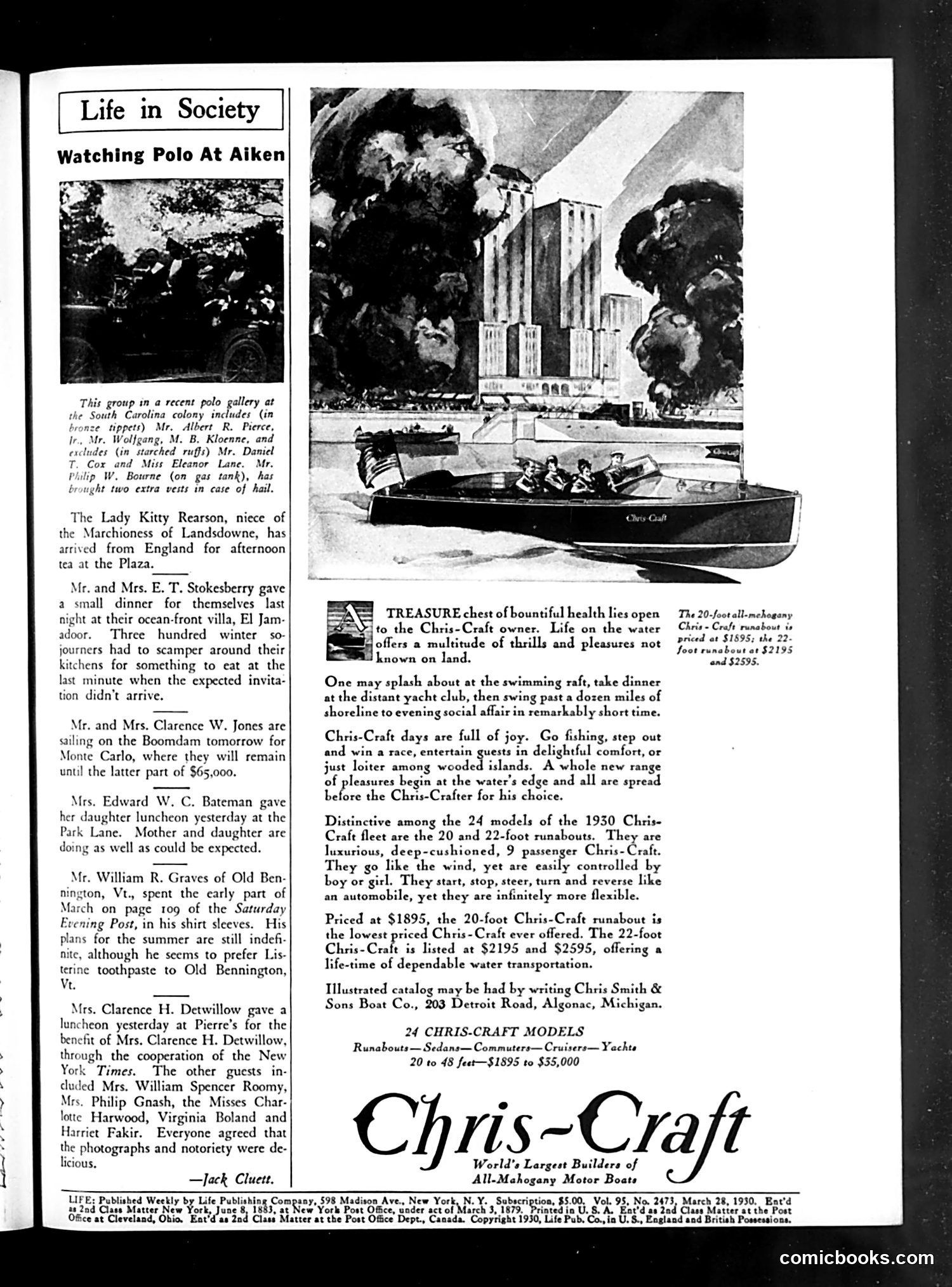
Life Magazine Page Analysis This page is primarily advertising and social reporting, not satire or political commentary. The left column contains "Life in Society" gossip items about wealthy socialites attending polo matches, dinners, and yachting events in locations like Aiken, South Carolina, and Monte Carlo. These brief notices document leisure activities of the upper class. The right side is a full-page advertisement for Chris-Craft boats, emphasizing luxury recreation. The ad copy promotes the pleasure and prestige of owning one of their 24 motorboat models, priced from $1,895 to $35,000. The page reflects 1930s upper-class leisure culture during the Depression era—it's aspirational material for wealthy readers. There is no political cartoon or satirical commentary; it's straightforward lifestyle journalism and commercial advertising.
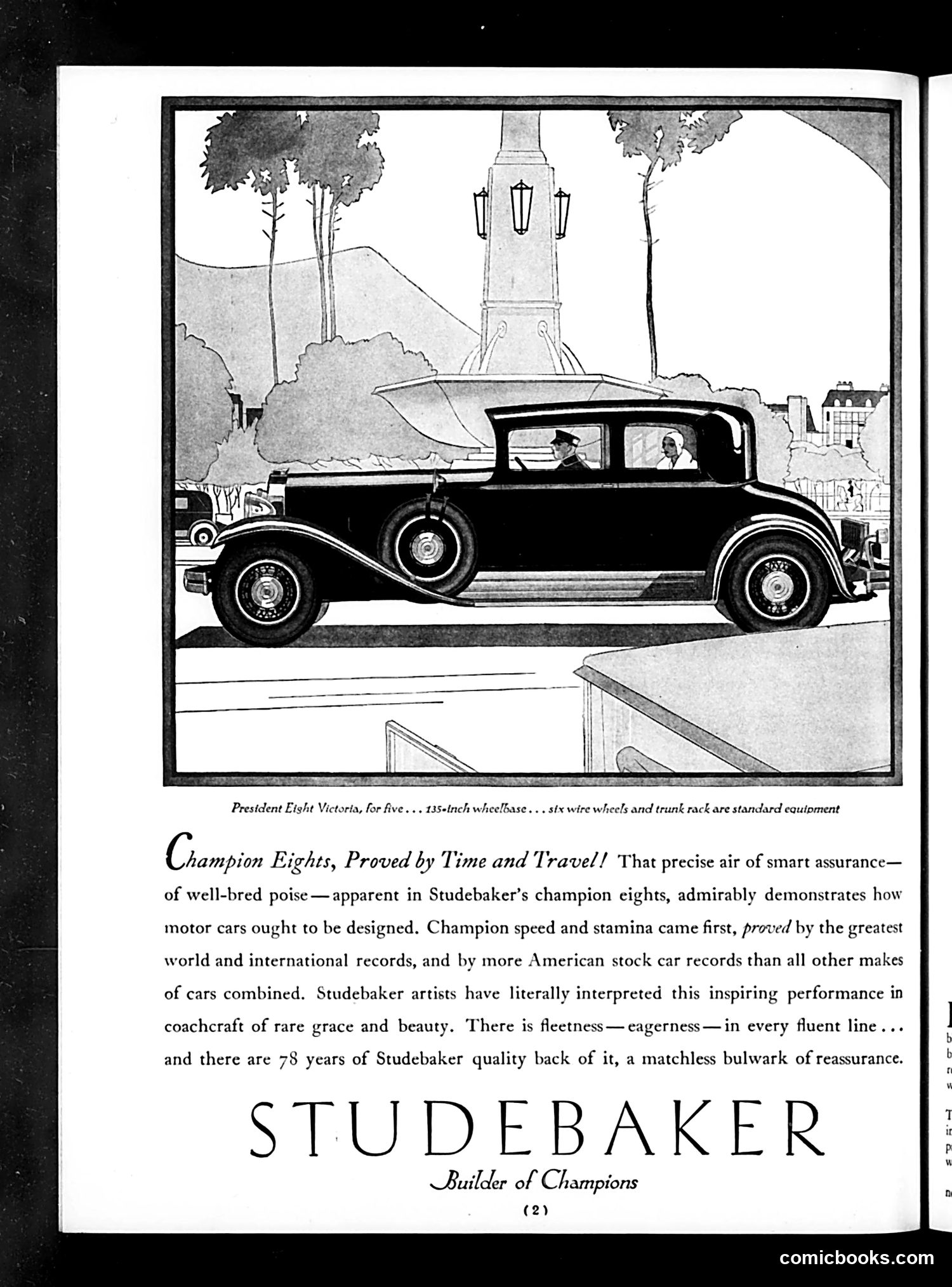
Analysis This is not a cartoon or satire—it's a straightforward advertisement for Studebaker automobiles, specifically the "President Eight Victoria" model. The image shows a luxury car from approximately the 1920s-30s era parked in front of a civic monument (appears to be a memorial or civic building). Two well-dressed figures sit in the vehicle. The advertising copy emphasizes Studebaker's racing pedigree and engineering quality, claiming 78 years of manufacturing tradition. The tagline "Builder of Champions" references the company's competitive racing record and accumulated "world and international records." This is product advertising targeting affluent buyers, not political commentary or satire. It appears in *Life* magazine's advertising section, using prestige and performance credentials to sell automobiles to wealthy consumers.
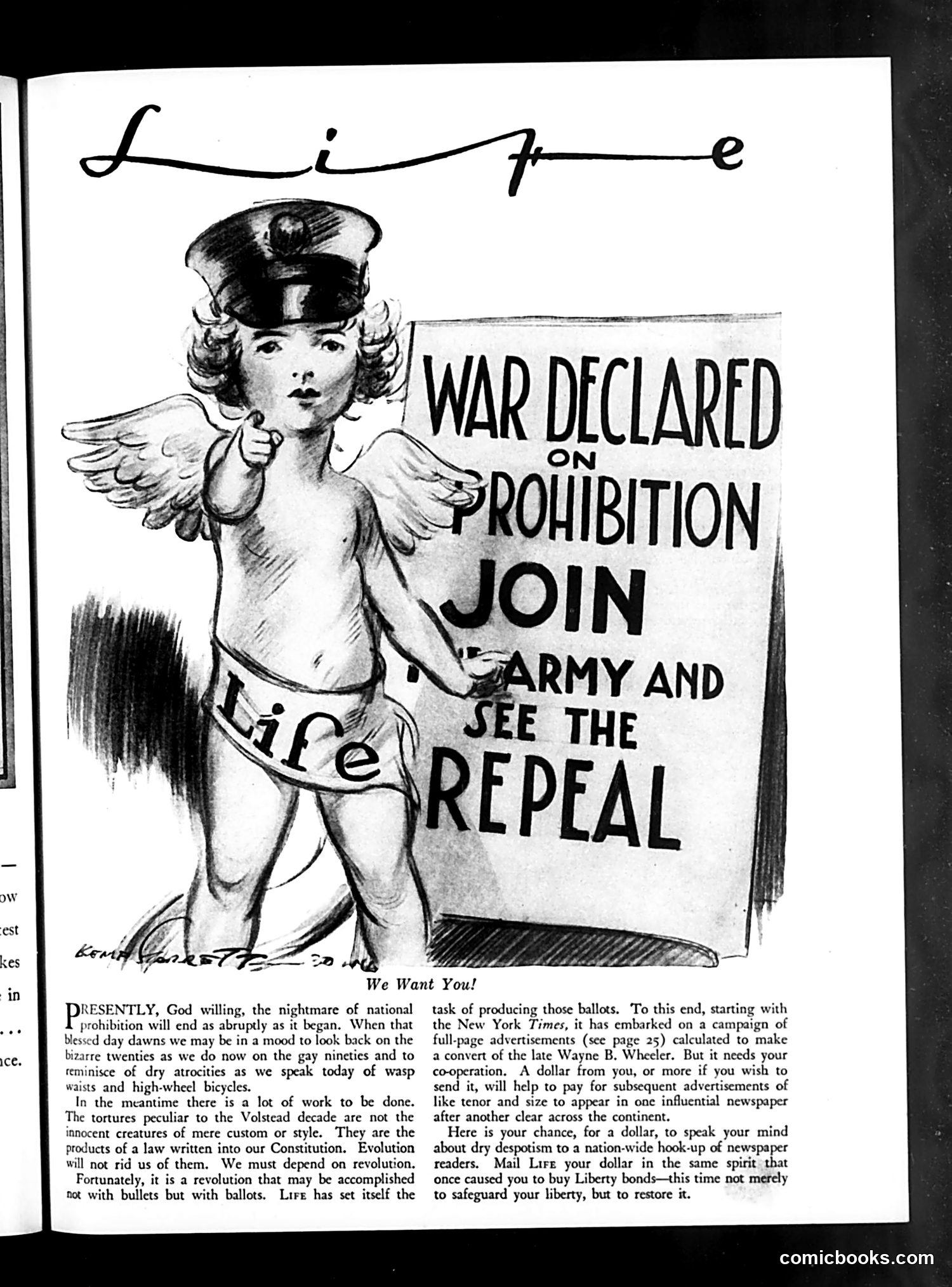
Political Satire on Prohibition's Repeal This *Life* magazine page uses an allegorical figure—a winged cherub labeled "Life" wearing a military cap—to advocate for ending Prohibition (the constitutional ban on alcohol, 1920-1933). The satire personifies Prohibition as an enemy requiring military action. The text declares "war" on Prohibition itself, calling readers to "join army and see the repeal"—inverting typical military recruitment rhetoric to promote alcohol legalization. The accompanying article criticizes Prohibition's failures, calling it a "nightmare of national prohibition" that produced "dry aristocrats," "wasps," and "high-wheeled bicycles." The piece argues Prohibition has become unenforceable and proposes using newspaper advertising campaigns to mobilize public opinion for repeal—essentially weaponizing media against the law itself.
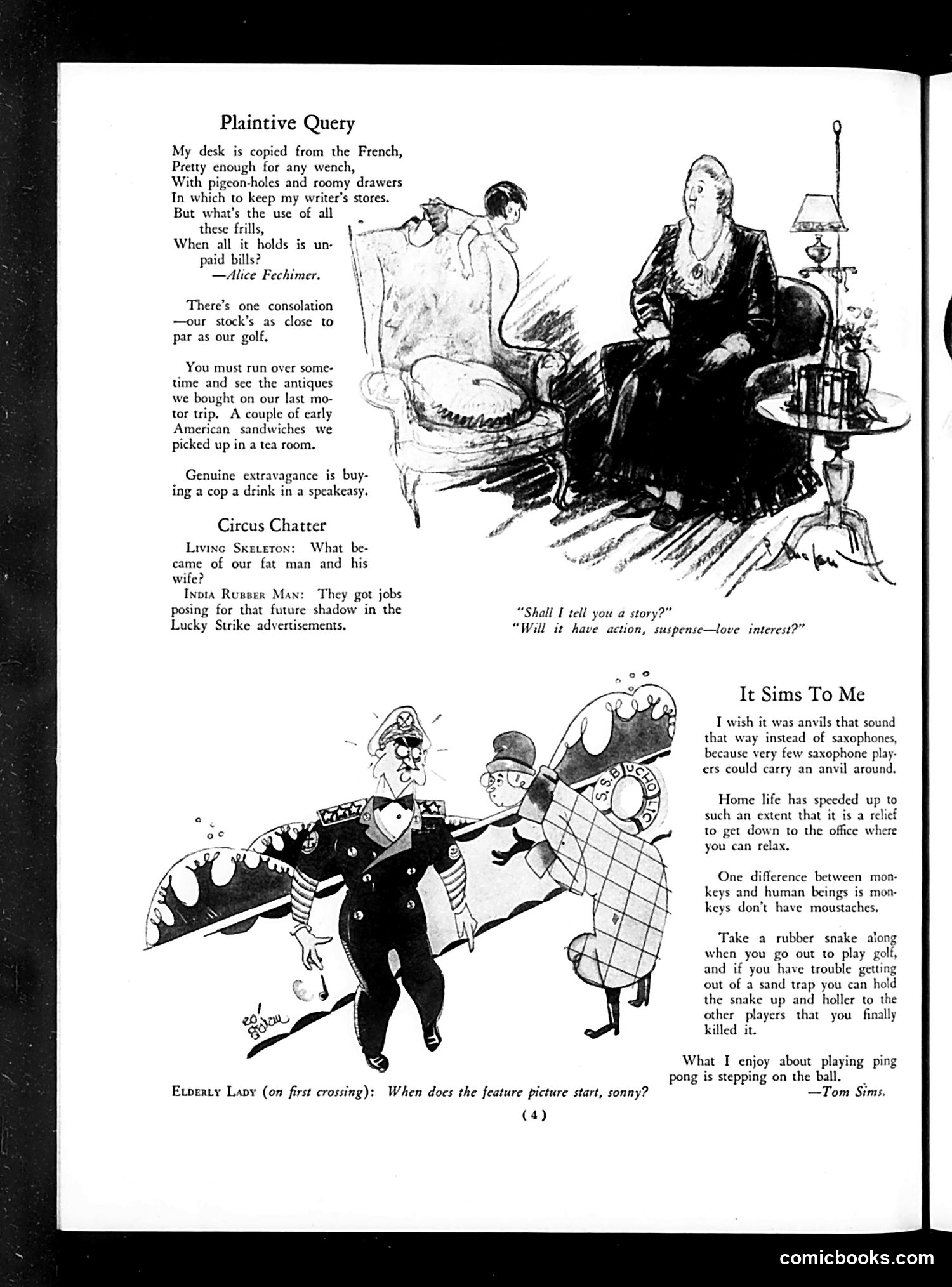
Analysis of Life Magazine Page This page contains three separate humorous pieces typical of early 20th-century Life magazine: 1. "Plaintive Query" (top): A poem by Alice Fchimer about a French-style desk cluttered with unpaid bills—satirizing the impracticality of decorative furniture over function. 2. "Circus Chatter" (middle): A brief joke about a fat man and his wife getting jobs posing for "Lucky Strike" cigarette advertisements, mocking advertising's use of ordinary people. 3. "It Sims To Me" (right): Tom Sims's humorous column complaining about modern life's pace, saxophones, and the superiority of office relaxation over home chaos—typical domestic humor of the era. The cartoons illustrate these pieces with ink sketches. The overall tone mocks consumer culture, advertising, and modern domestic life in gentle, satirical fashion.
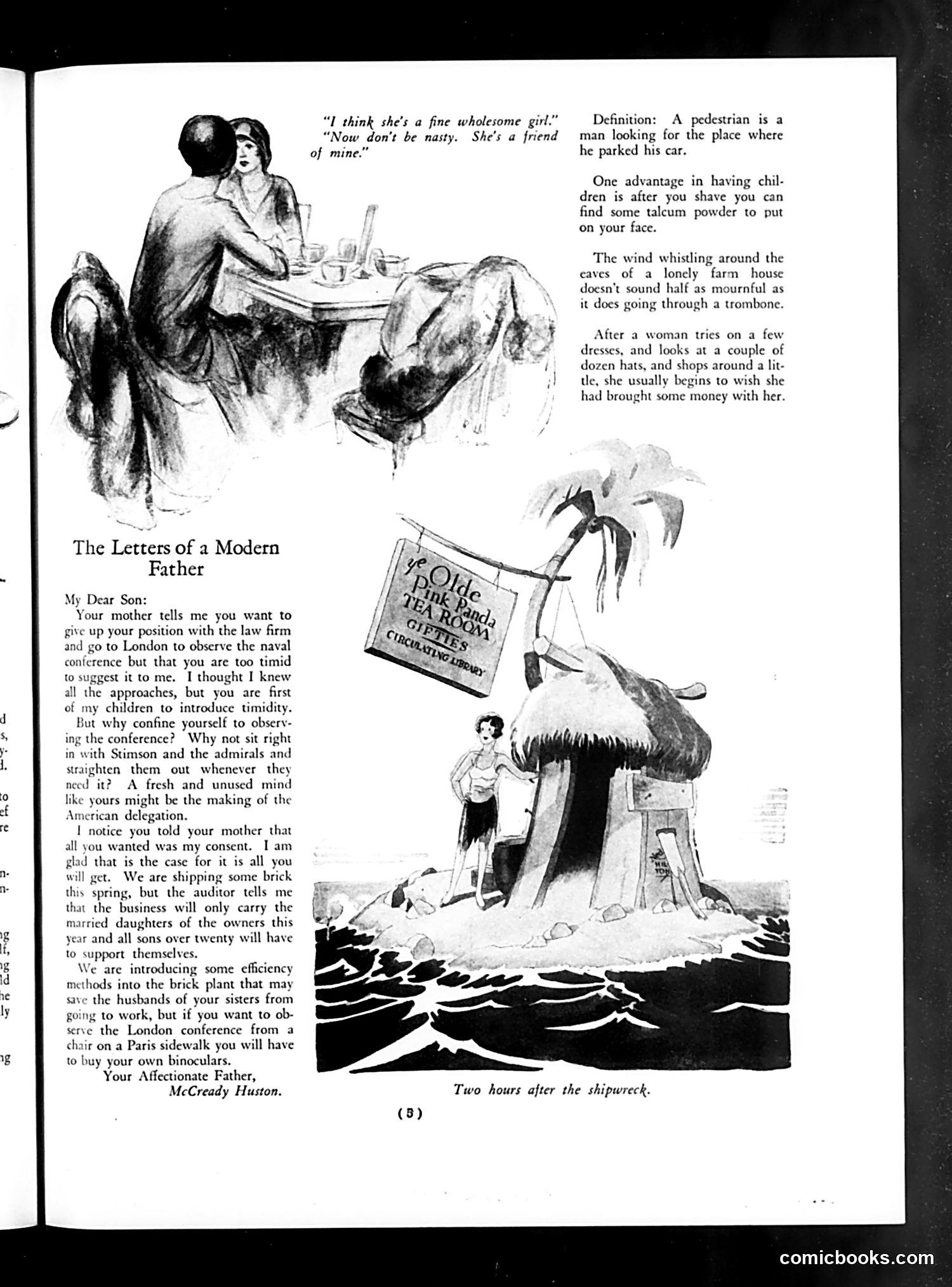
Explanation for Modern Readers This page combines humorous observations with a satirical letter. The top section offers witty definitions and social commentary—including a joke about a "pedestrian" as someone searching for where they parked their car, reflecting early automotive culture anxieties. "The Letters of a Modern Father" presents a father (McCready Huxton) advising his timid son to attend a naval conference in London rather than staying safe at home. The father encourages boldness and suggests his son observe important proceedings firsthand. The satire mocks both paternal pressure to succeed and the era's emphasis on masculine assertiveness. The illustration "Two hours after the shipwreck" shows a man clinging to a sinking structure labeled with a book or pamphlet title, likely satirizing impractical advice or false confidence in crisis situations—contrasting the father's bold recommendations with actual consequences.
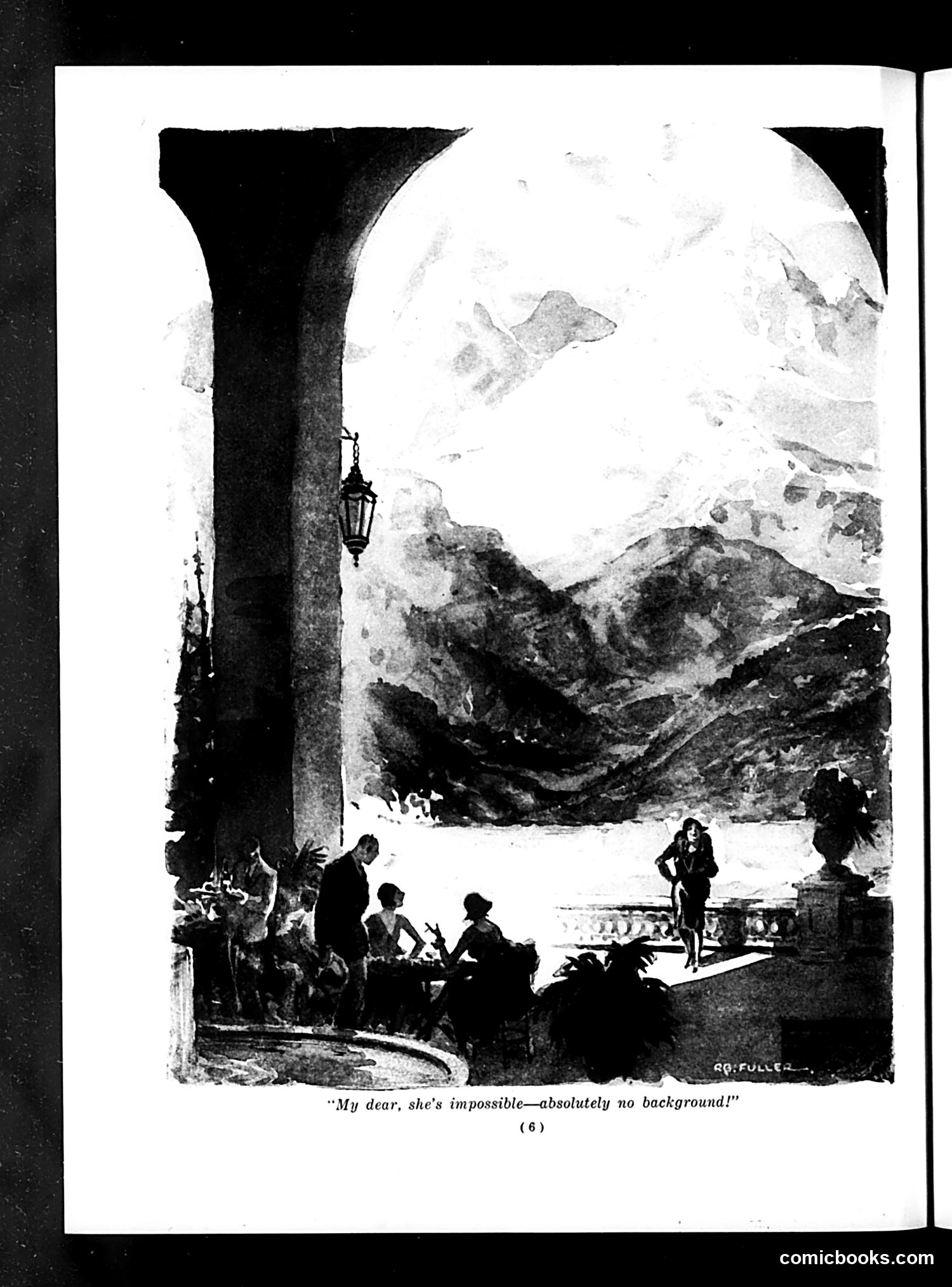
Analysis of Life Magazine Cartoon This cartoon depicts a social scene set in a mountainous resort or villa. A man gestures dismissively toward a woman, declaring "My dear, she's impossible—absolutely no background!" The satire targets early 20th-century upper-class social snobbery and the rigid class hierarchies of the era. The joke centers on the phrase "no background"—a euphemism wealthy society used to exclude people lacking aristocratic or wealthy family lineage. The woman's apparent lack of "proper" social pedigree makes her unacceptable to the elite circles, regardless of her other qualities. The mountainous backdrop and formal setting emphasize the exclusive social spaces where such gatekeeping occurred, mocking the pretentiousness of those who enforced these artificial class boundaries.
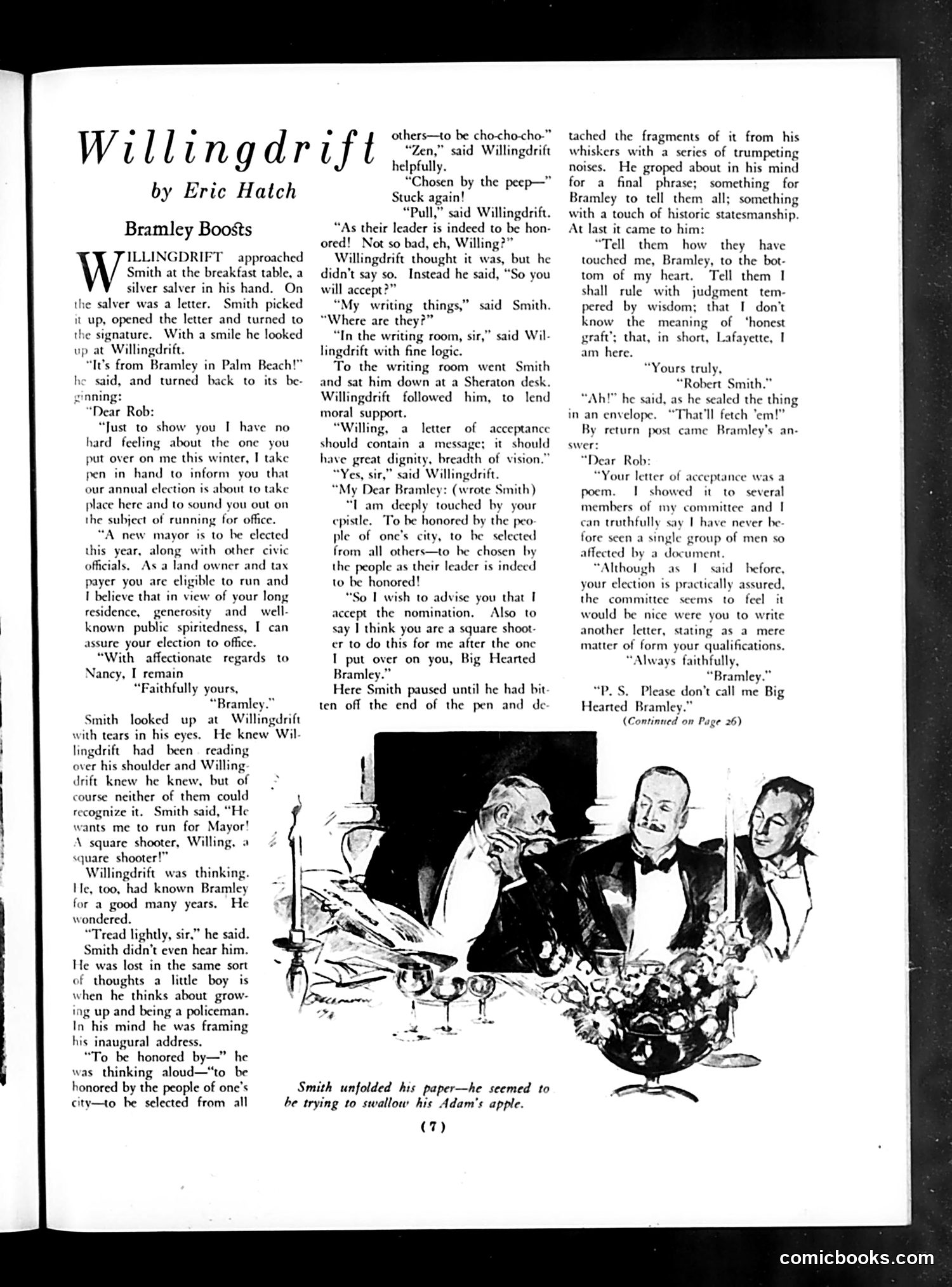
"Willingdrift" by Eric Hatch This is a short story titled "Bramley Boosts" about a character named Willingdrift who receives a letter offering him nomination for mayor. The illustration depicts a dinner scene where Smith (who wrote the nomination letter) appears to be choking or struggling with food while dining with other gentlemen. The satire likely mocks political ambition and the absurdity of unsolicited political nominations. Willingdrift's internal monologue reveals his vanity—he immediately imagines himself as an honored civic leader despite having done nothing to earn the position. The humorous caption notes Smith seems "trying to swallow his Adam's apple," suggesting the awkwardness or insincerity of the nomination process itself. This is social/political satire about how easily people are flattered by hollow recognition.
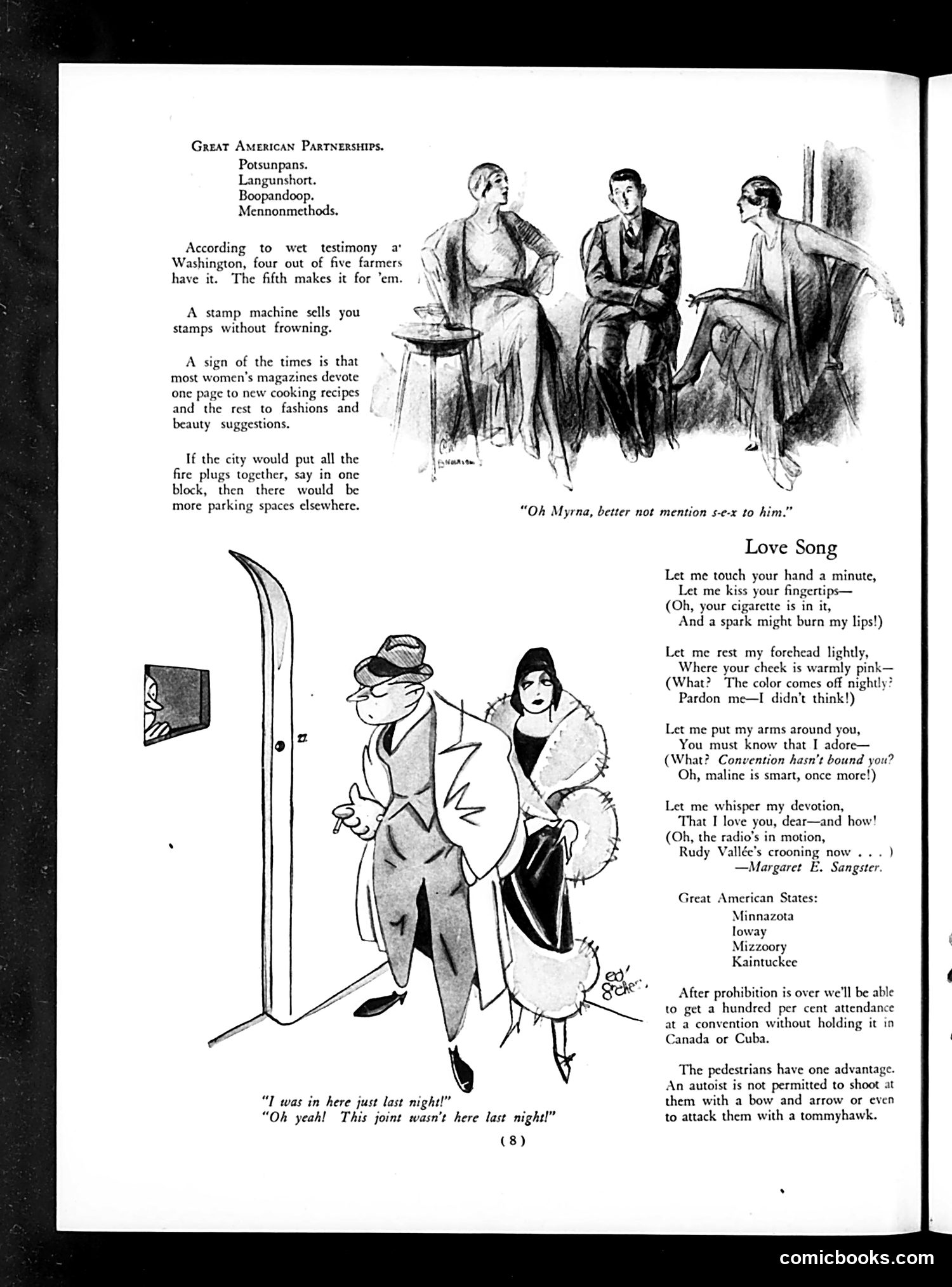
Analysis of Life Magazine Page This page contains satirical commentary on contemporary American life, circa early 20th century. Top cartoon ("Great American Partnerships"): Lists absurd pairings (Potsunpans, Languishort, Boopandoop, Mennonmethods)—nonsense terms mocking how Americans casually coin phrases. The sketch shows three people gossiping, with the caption "Oh Myrna, better not mention i-o-e-s to him," suggesting scandalous rumors being shared. Bottom cartoon depicts a couple leaving a nightclub ("It was in here just last night!" / "Oh yeah! This joint wasn't here last night!"), satirizing Prohibition-era speakeasies that constantly relocated to evade authorities. Right side contains a poem "Love Song" by Margaret E. Sangster, humorously romantic with parenthetical asides about cigarettes and radio crooning—poking fun at 1920s dating culture and commercialism. Brief quips about parking, conventions, and pedestrians complete the miscellaneous satirical content typical of Life magazine's format.
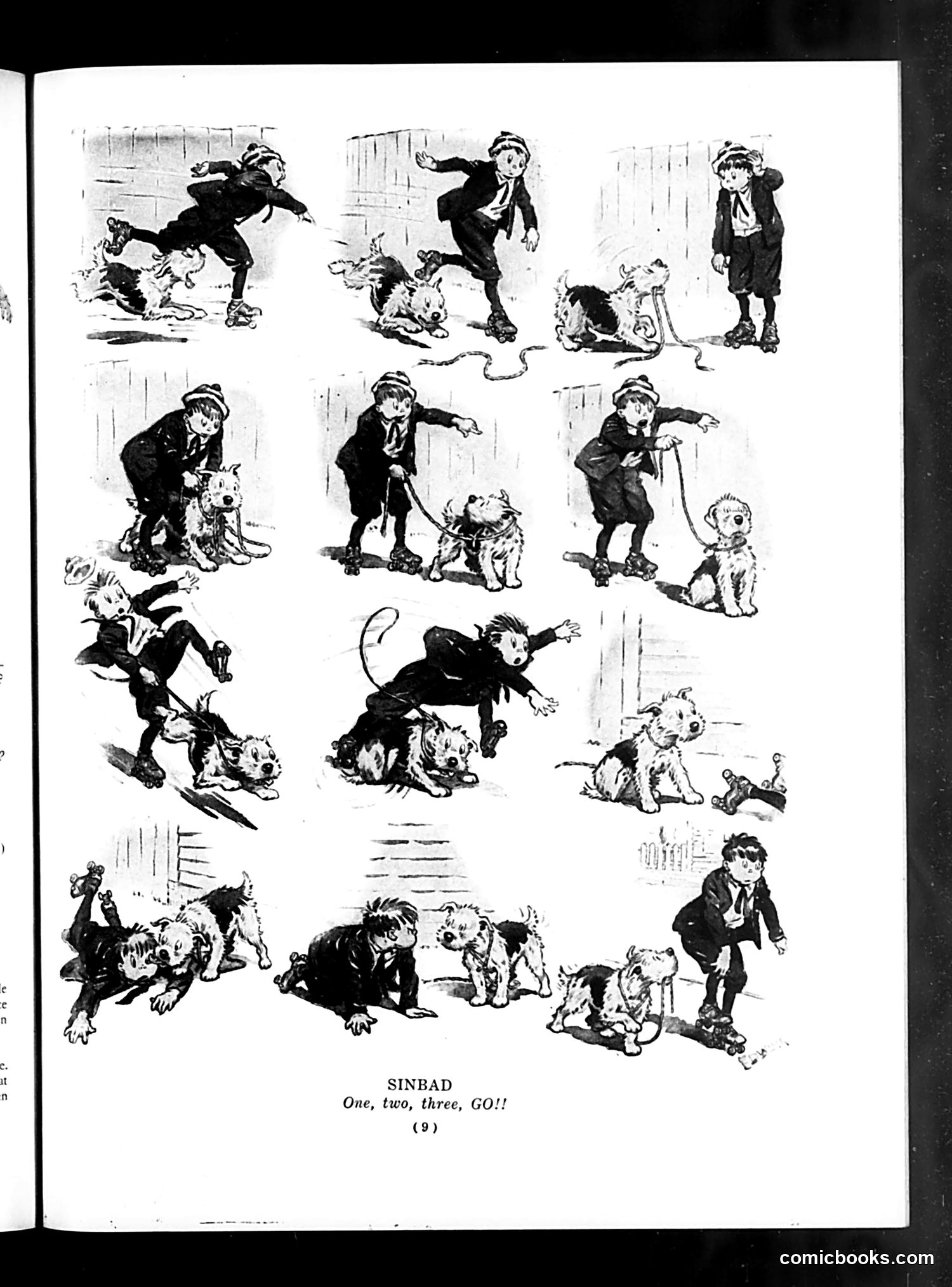
Analysis of "Sinbad: One, two, three, GO!!" This appears to be a humorous sequential illustration series depicting a child's street game, likely a chasing or tag game with dogs. The caption "One, two, three, GO!!" suggests children playing a traditional playground counting-out game to select who is "it." The comic shows various poses of children in formal clothing (suits, hats) engaged in energetic play with small dogs, creating comedic chaos. The repetitive sequence emphasizes the frenetic action and disorder of street play. The title "Sinbad" likely references the adventurous character, joking that ordinary children's games constitute their own adventures. The humor derives from the contrast between the children's formal dress and their wild, uncontrolled interactions with animals—a gentle satire on childhood exuberance overcoming social propriety.
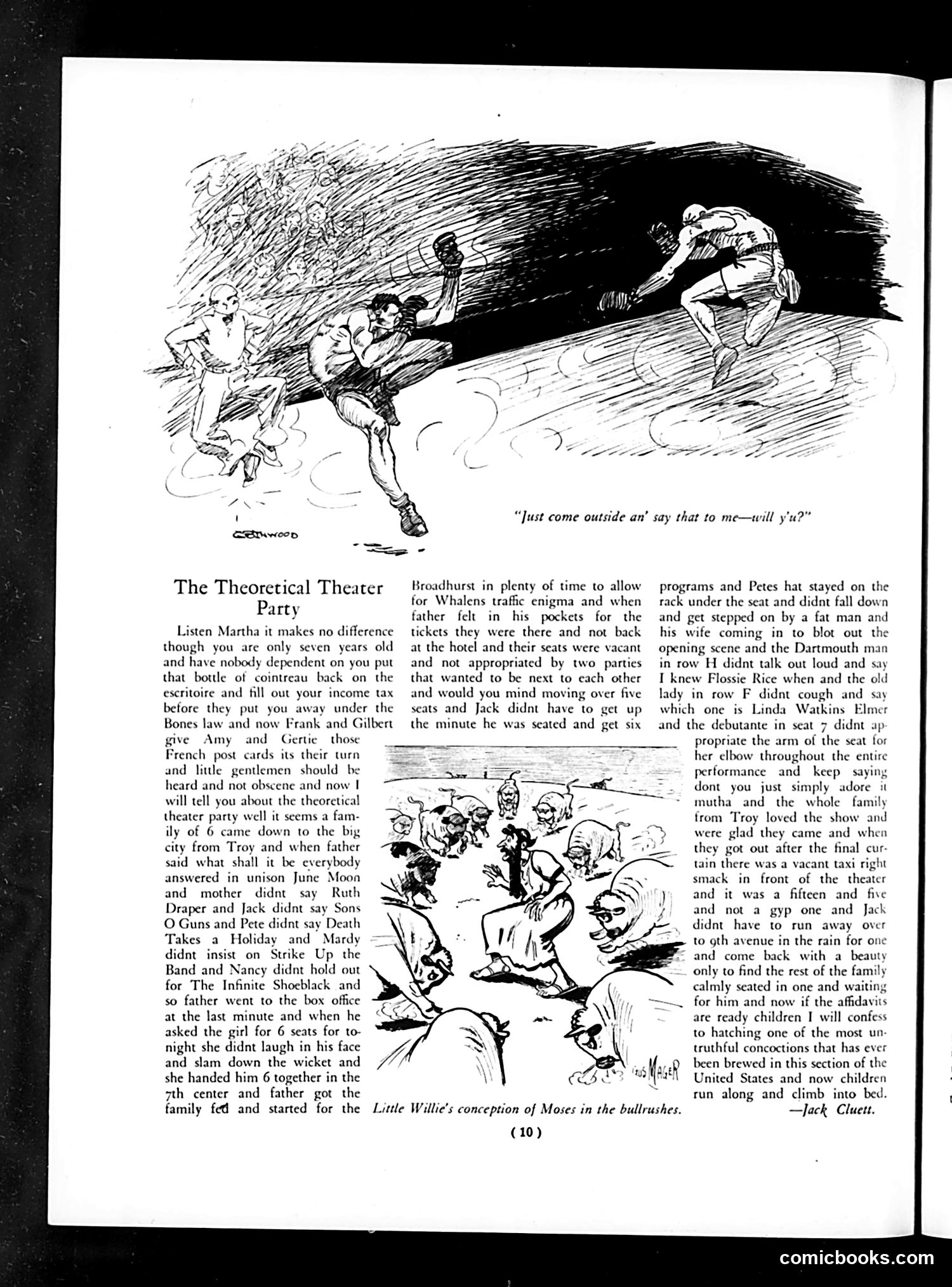
Analysis of "The Theoretical Theater Party" This is a humorous essay about a family theater outing that goes awry. The piece satirizes middle-class pretensions about "cultured" entertainment—the father insists on attending despite practical obstacles (traffic, seating issues, cost). The accompanying cartoons illustrate the chaos: children misbehaving during the performance, adults struggling with logistics, and the aftermath where the family ends up in an unplanned brawl outside the theater ("Just come outside an' say that to me—will y'u?"). The satire mocks the gap between aspirational middle-class values (attending serious theater) and messy reality (children fighting in the rain afterward). The title's emphasis on "Theoretical" suggests the planned evening exists only in theory while actual experience proves far less dignified.
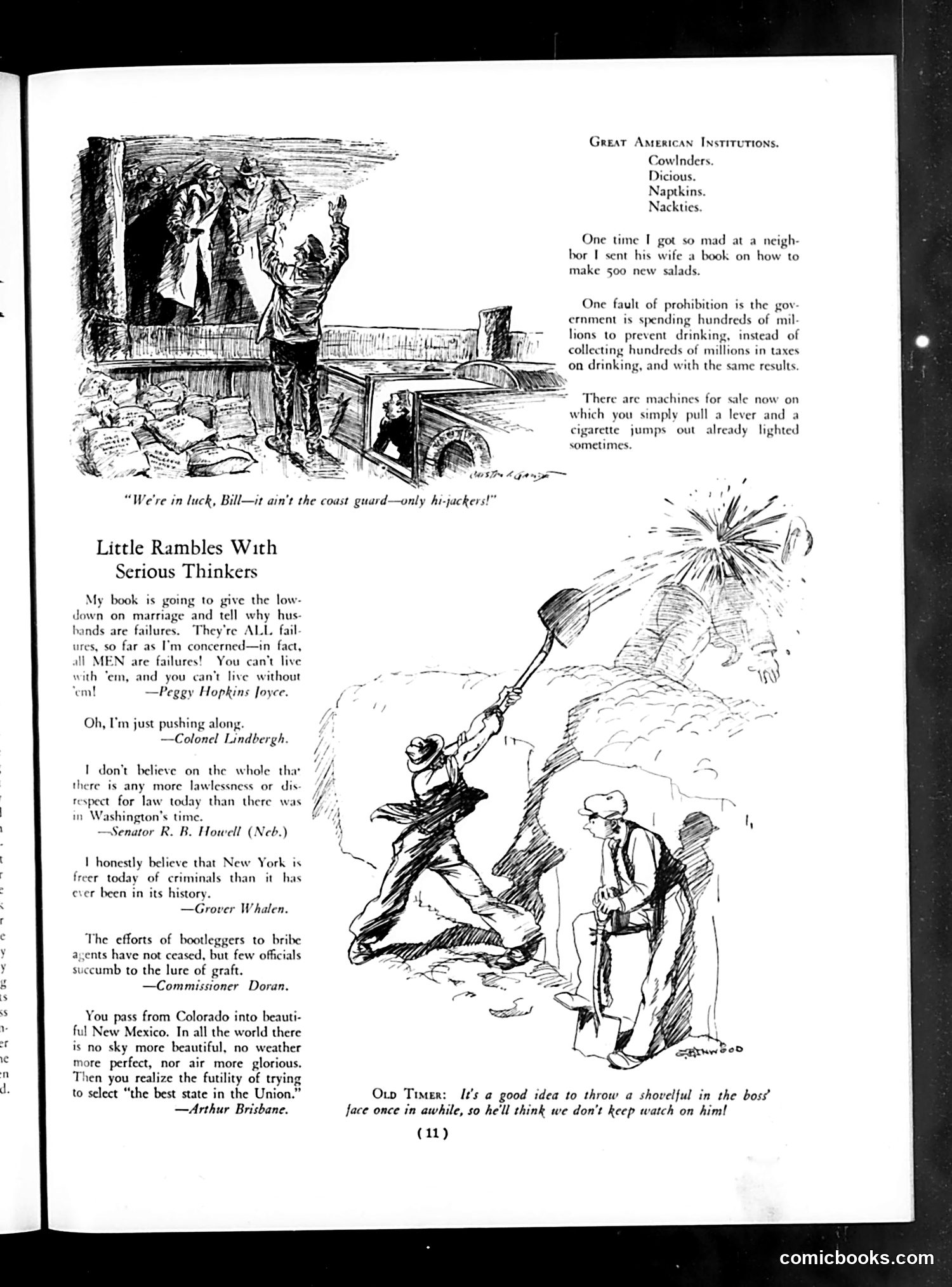
Content Analysis This page from *Life* magazine contains satirical commentary on American institutions and social issues. The top section, titled "Great American Institutions," humorously lists items like "Cowlinders, Dicious, Napkins, Nackties" (appears to be intentional misspellings for comedic effect). The left column features "Little Rambles With Serious Thinkers," presenting cynical quotes from public figures (Peggy Hopkins Joyce, Colonel Lindbergh, Senator R.B. Howell, Commissioner Doran, and Arthur Brisbane) on marriage failures, lawlessness, crime, and government corruption—suggesting these institutions are fundamentally broken. The right illustration depicts miners with dynamite, captioned as a joke about workplace safety and surveillance. Overall, the page satirizes American governance, law enforcement, and social institutions as ineffective or hypocritical.
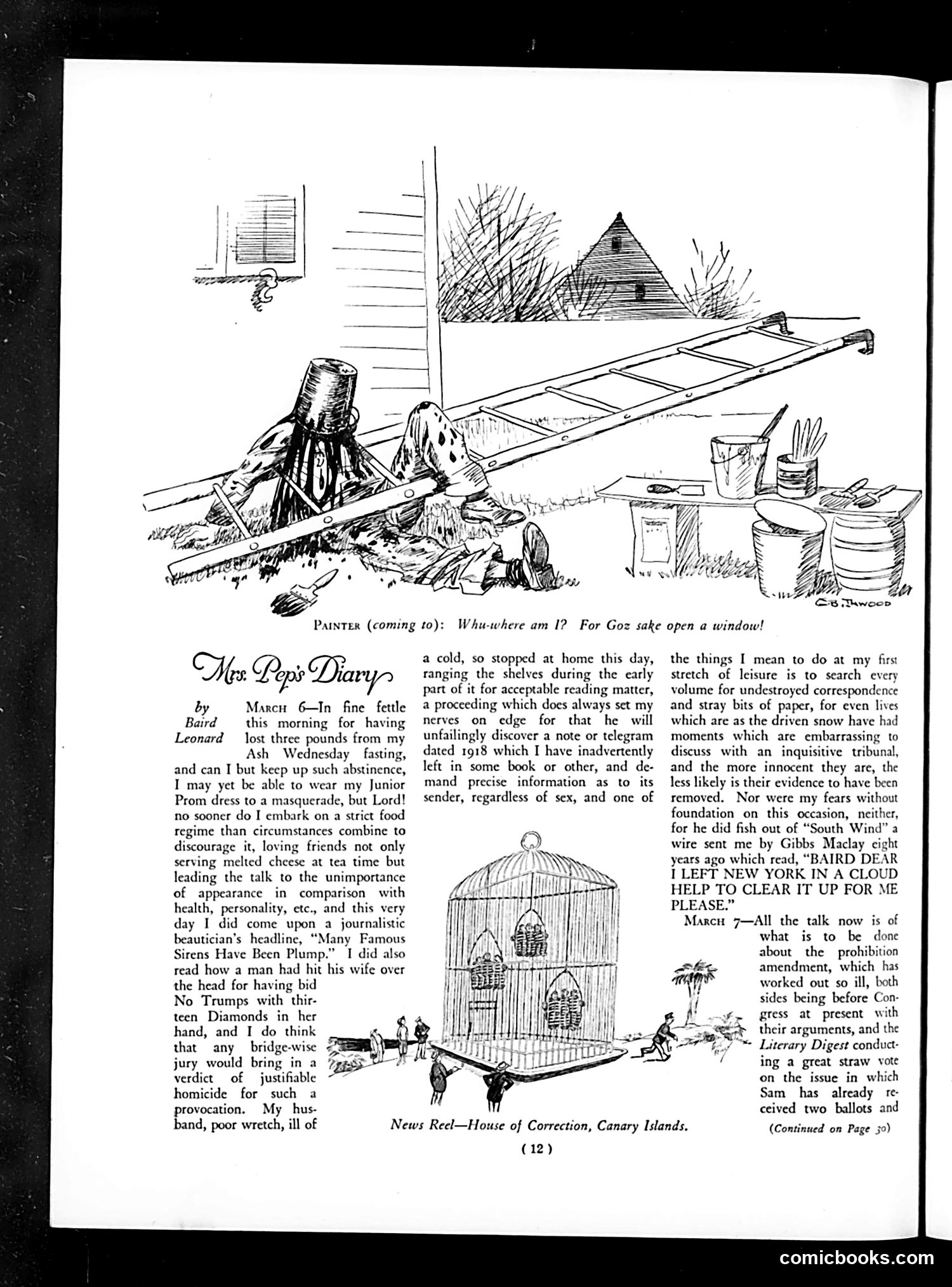
Analysis of "Mrs. Pep's Diary" Page This page features a diary entry by Leonard dated March 6-7, combining domestic humor with social commentary. The top cartoon depicts a painter asking "Whu-where am I? For Goz sake open a window!" — satirizing the smell of cheap paint fumes, a working-class domestic inconvenience. The accompanying illustrations show a woman managing household tasks (painting, organizing) and a whimsical "House of Correction" cage structure labeled for the Canary Islands. The diary text discusses fasting, prohibition amendment debates, and literary matters (referencing a telegram from Gibbs Maclay about a book title). The satire targets everyday domestic frustrations, particularly around prohibition enforcement and household management during this era of social reform.
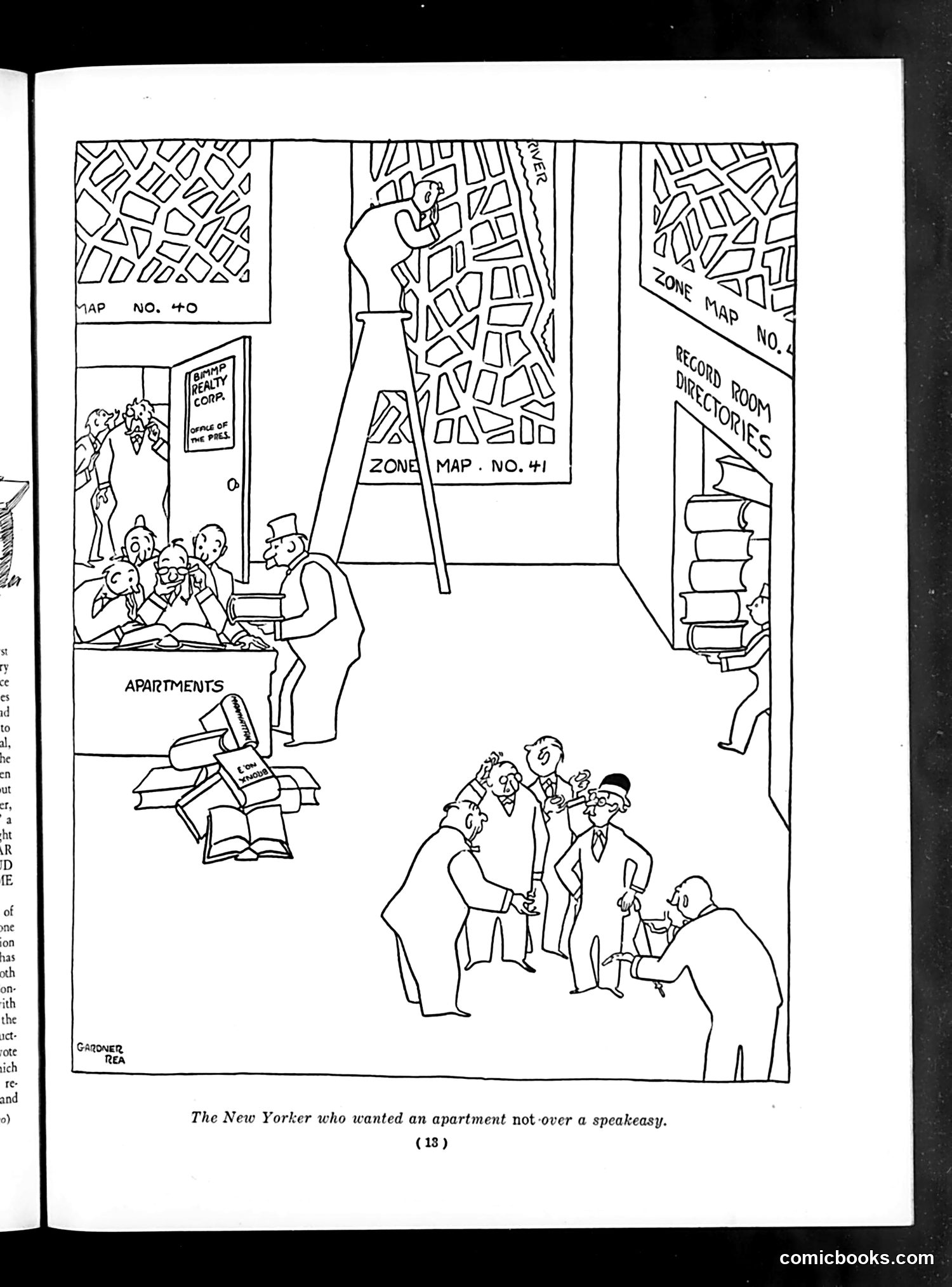
Cartoon Analysis: "The New Yorker who wanted an apartment not over a speakeasy" This single-panel cartoon satirizes 1920s urban housing challenges during Prohibition. The joke centers on an apartment hunter's complaint: they want a residence *not located above a speakeasy* (illegal alcohol establishment). The cartoon depicts the absurdity of this request in New York City, showing multiple zone maps and building directories. The exaggerated scene with men in hats conducting business suggests speakeasies were so ubiquitous in apartment buildings that finding housing above legitimate businesses was nearly impossible. The humor reflects actual Prohibition-era conditions (1920-1933) when speakeasies operated illegally throughout NYC, often hidden in residential buildings. The prospective tenant's straightforward, seemingly reasonable request highlights how normalized and widespread illegal alcohol operations had become in the urban landscape.
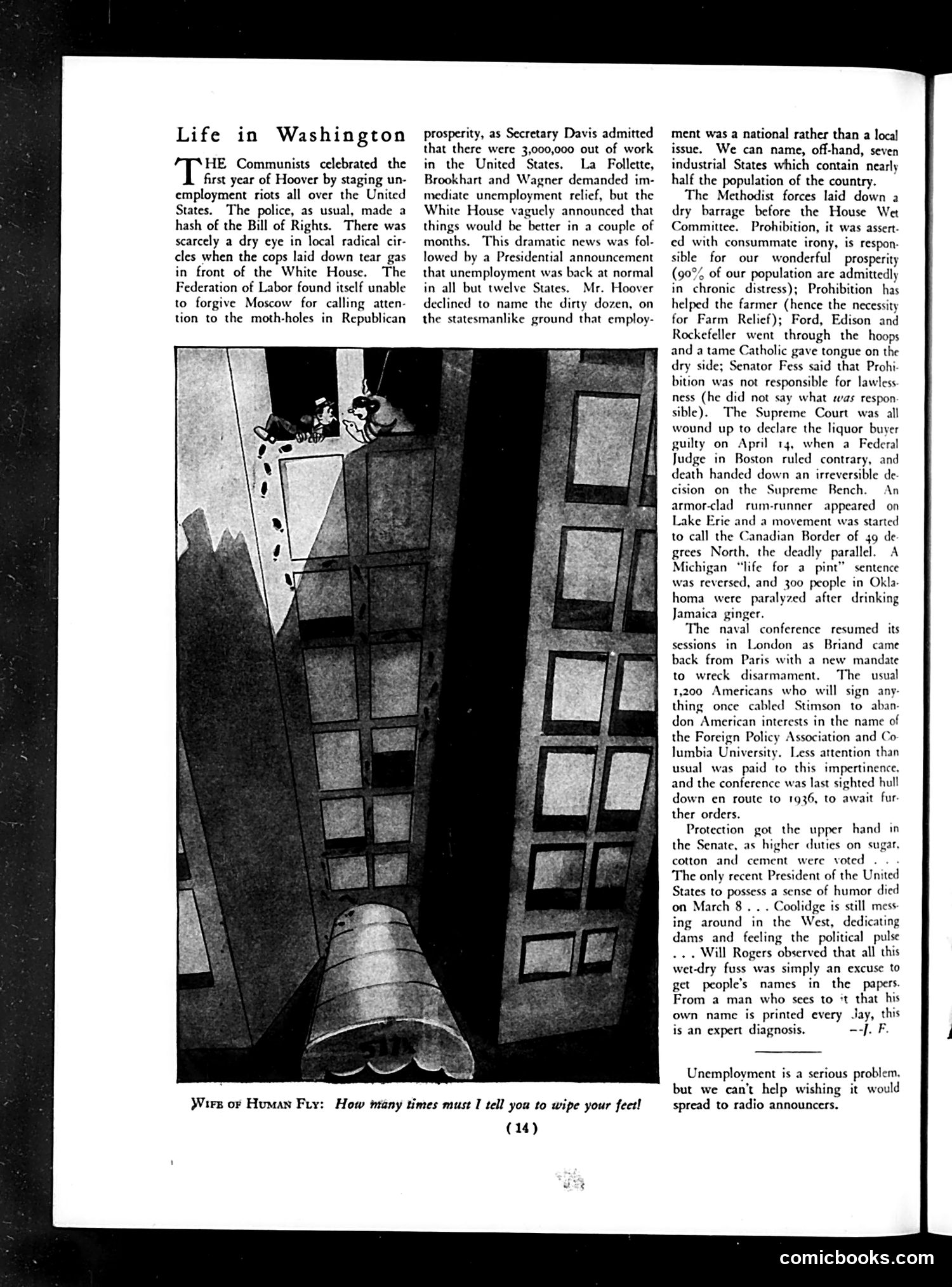
Analysis of "Wife of Human Fly" Cartoon This cartoon satirizes the famous "Human Fly" stunt performers of the early 20th century—daredevils who climbed skyscrapers and tall buildings. The image shows a figure climbing the exterior of a tall building, depicted from above looking down. The caption reads: "How many times must I tell you to wipe your feet!"—a darkly humorous domestic joke. Rather than celebrating the climber's death-defying feat, the cartoon reduces the dramatic stunt to an absurd domestic concern: the climber's wife merely worries about muddy footprints being tracked inside. The satire mocks both the Human Fly's reckless pursuit of fame and the mundane reality of married life, suggesting that no amount of spectacular achievement impresses a spouse concerned with household cleanliness.
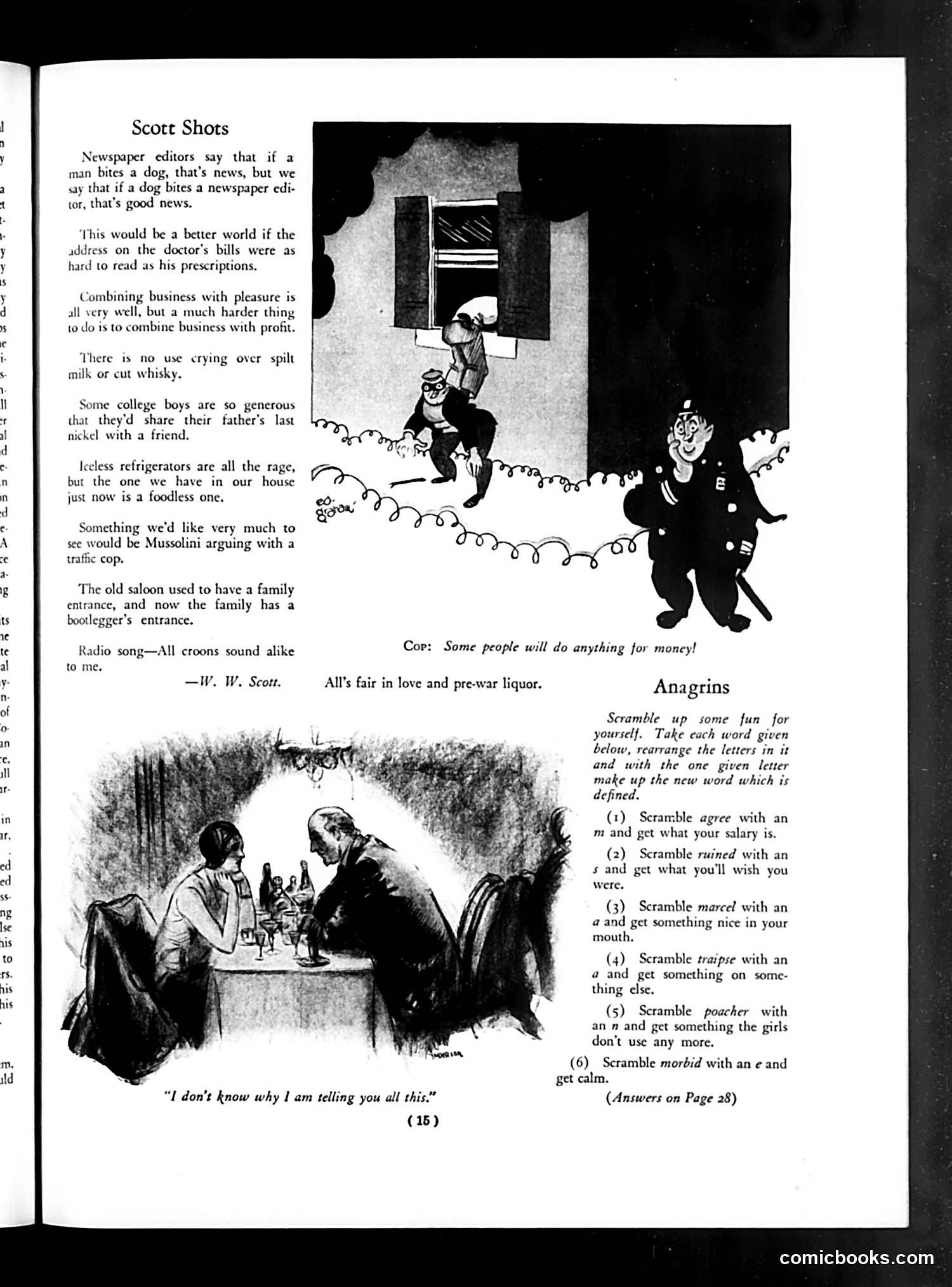
Analysis of This Life Magazine Page Top Cartoon ("Scott Shorts"): The upper cartoon depicts a cop catching someone stealing Christmas lights from a house. The caption reads "Some people will do anything for money!" This is a straightforward joke about petty theft during the holiday season—a timeless satirical comment on economic desperation or greed. Bottom Cartoon: Shows two figures at what appears to be a speakeasy or illegal bar (suggested by the bottles on the table). One says "I don't know why I am telling you all this." This likely references Prohibition-era drinking culture and the secretive nature of illegal alcohol consumption—people confessing over drinks they shouldn't legally have. "Anagrins" Section: A word puzzle game for readers.
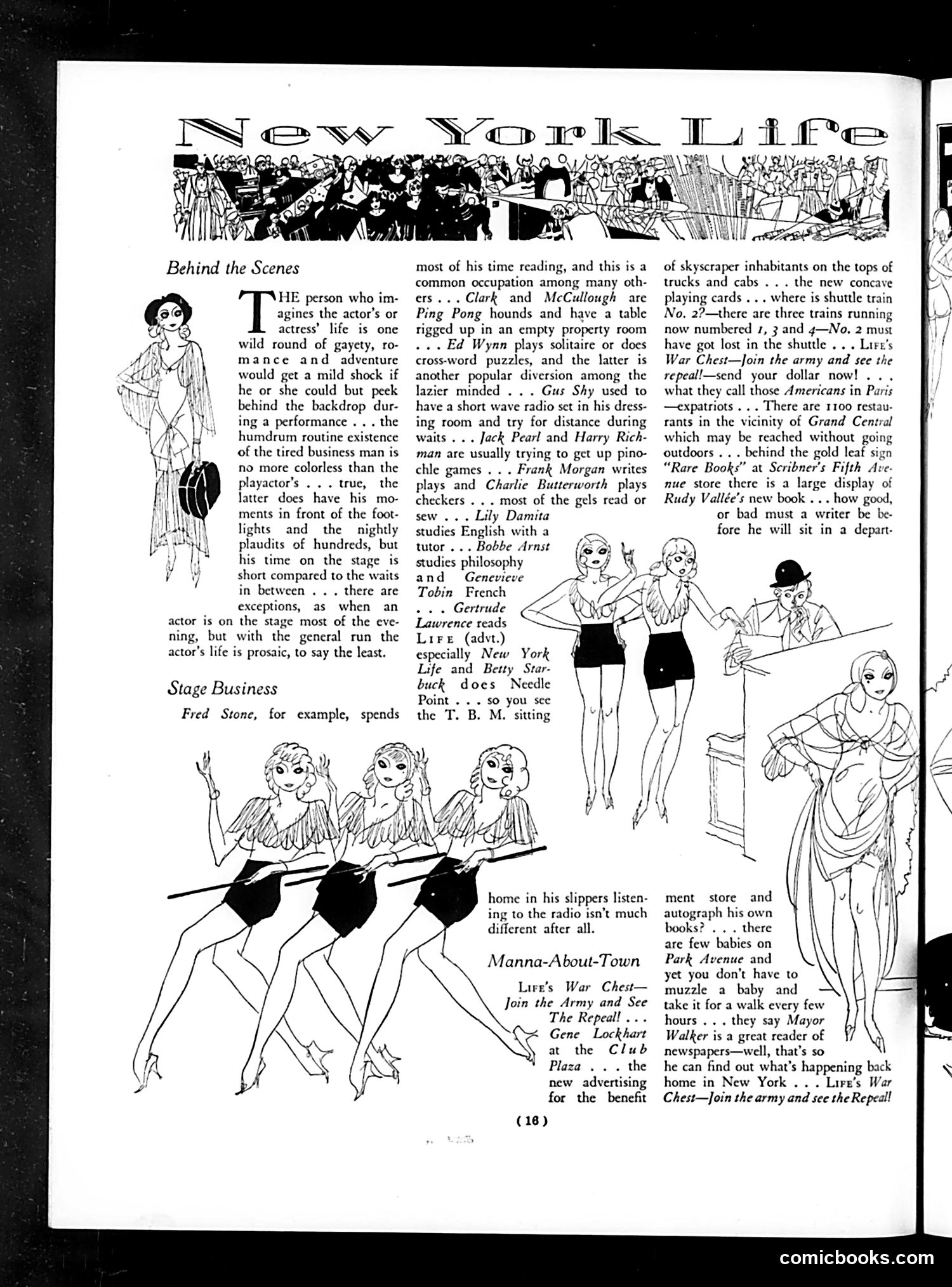
Explanation for Modern Readers This page from *Life* magazine features theatrical gossip and commentary. The "Behind the Scenes" section humorously describes actors' off-stage habits—some read, play solitaire, study languages, or listen to radio. The satire gently mocks the contrast between performers' public personas and private routines. The "Stage Business" cartoon depicts three chorus dancers in identical poses, likely satirizing the standardized, repetitive nature of chorus-line choreography and the interchangeability of chorus performers. The "Manna-About-Town" section references contemporary plays and entertainments, including *Life's War Cheat* and *Gene Lockhart at the Club Plaza*, while poking fun at New York city life, baby carriages, and Mayor Walker—typical *Life* magazine social commentary targeting urban Manhattan society.
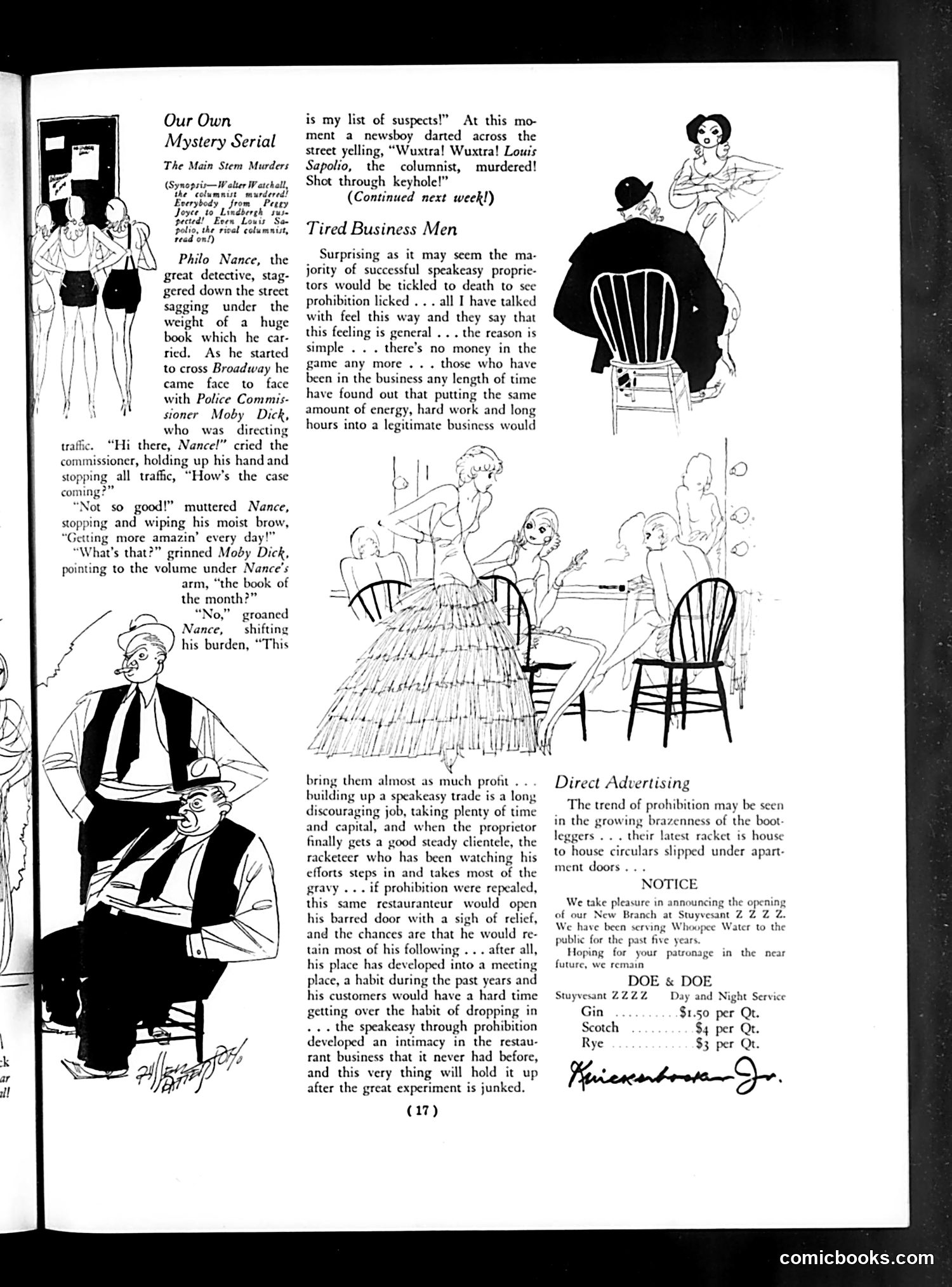
Page 17: Life Magazine - Prohibition-Era Satire This page contains two sections satirizing Prohibition (the ban on alcohol sales, 1920-1933): "Our Own Mystery Serial" - A serialized detective story parodying sensational crime fiction. Detective Philo Nance investigates a murder, with Police Commissioner Moby Dick mentioned. The setup mocks the overwrought style of popular mystery serials. "Tired Business Men" - The main satire criticizes speakeasy proprietors (illegal bar owners). It argues that bootleggers/speakeasy owners are tired of Prohibition because it offers no stable profit compared to legitimate business. The cartoon shows men at a speakeasy table. The piece suggests that if Prohibition ended, these proprietors would happily return to legal restaurant businesses they'd developed during the ban. A notice advertises a new branch opening with liquor prices listed, implying post-Prohibition commerce resuming.
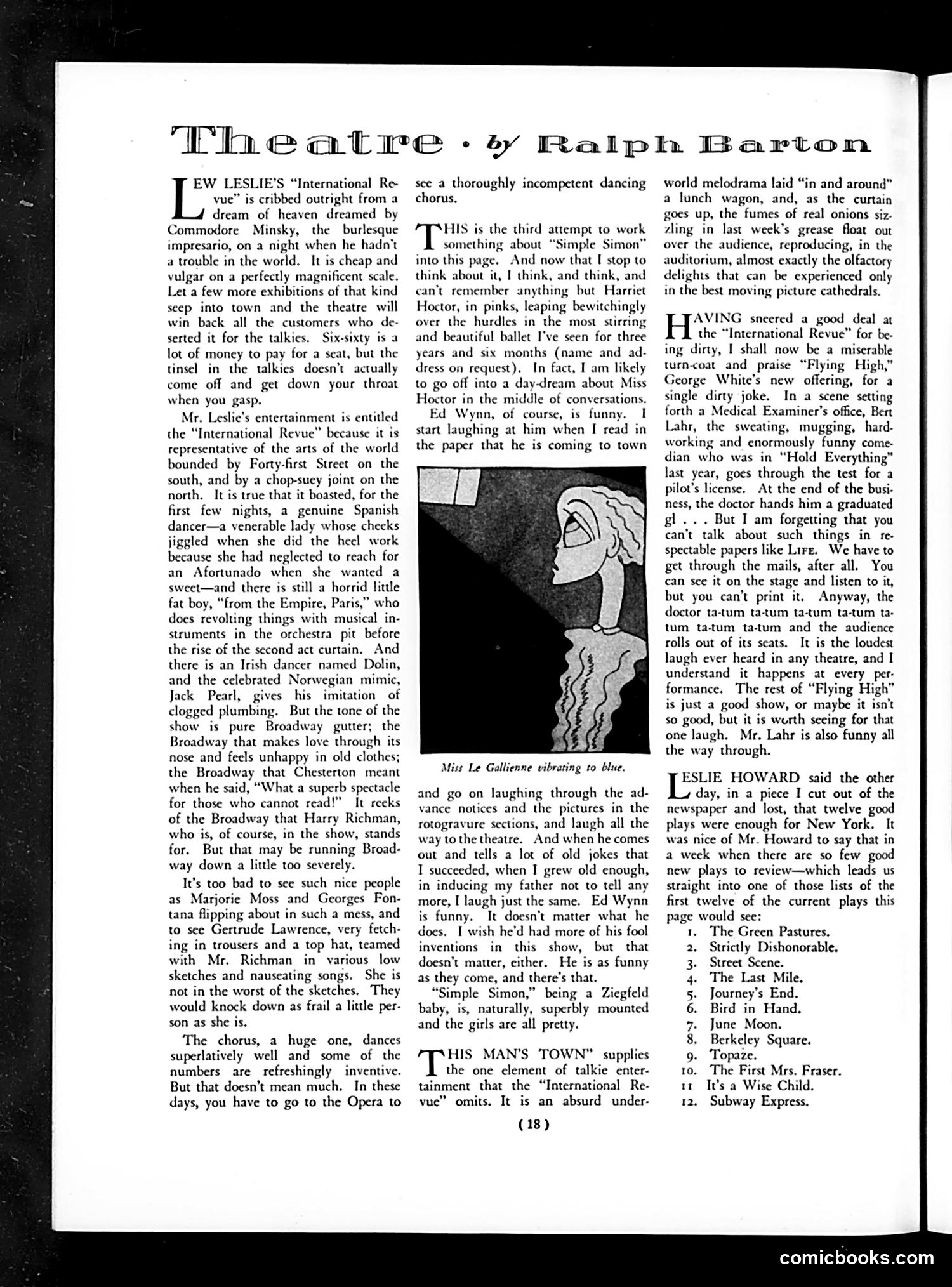
Theater Review: "International Revue" This is Ralph Barton's theater column reviewing "International Revue" at a New York venue. The column criticizes the show's entertainment value while praising specific performers like Harriet Hoctor (a dancer) and Ed Wynn. The cartoon illustration shows a performer in exaggerated, comedic posture—likely depicting one of the revue's acts being mocked. The caption reads "Miss Le Galienne vibrating to blue," suggesting the image caricatures a specific performer's dance style. Barton's main complaint is that the revue, despite featuring international acts and talent, lacks genuine entertainment substance. He praises individual comedians and dancers but dismisses the overall production as primarily "Broadway gutter"—superficial spectacle designed solely to make audiences laugh loudly rather than provide meaningful theatrical experience.
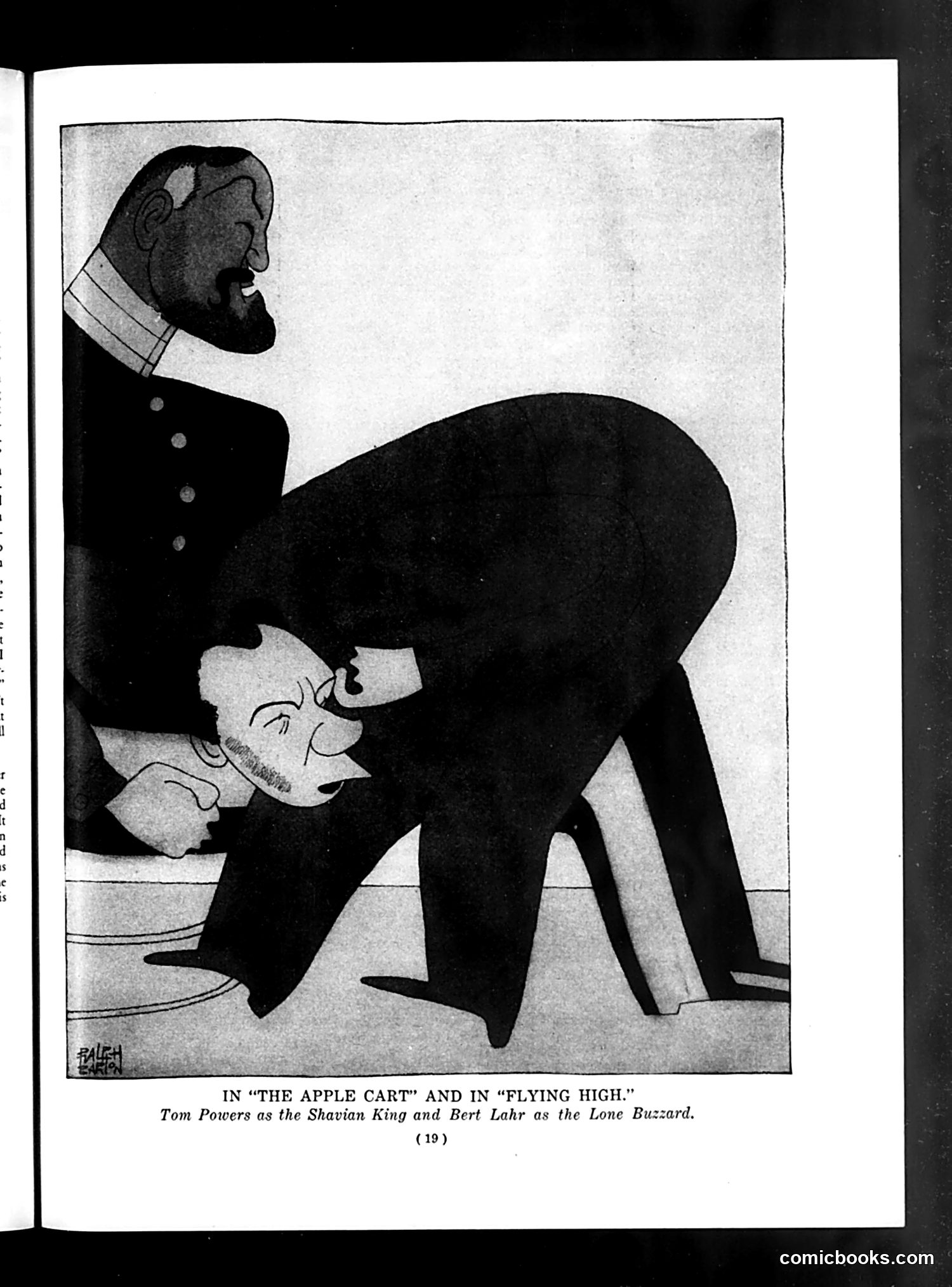
This page shows a theatrical illustration featuring actor Tom Powers in a role from "The Apple Cart" (a play by George Bernard Shaw) and actor Bert Lahr in "Flying High." The cartoon depicts a large figure in formal dress bending over a smaller caricatured figure. The image appears to be satirizing the physical comedy or slapstick elements of these theatrical productions. The exaggerated proportions and the smaller figure's distressed expression suggest humor derived from physical dominance or buffoonery typical of early 20th-century stage comedy. The page serves as promotional content for these theatrical productions, highlighting the comedic performances of both actors through caricature.
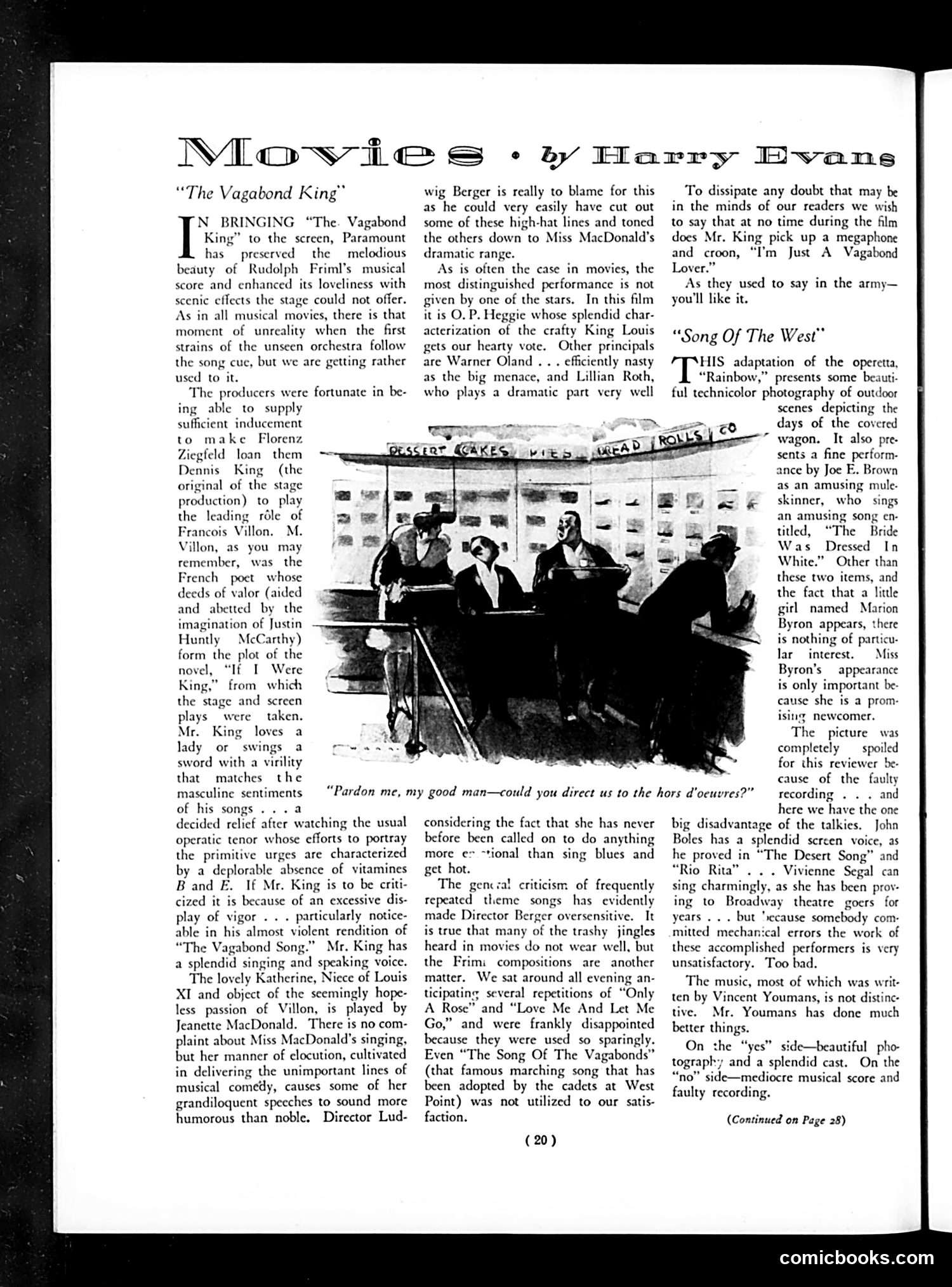
Movies by Harry Evans: Film Reviews This page contains two film reviews from Life magazine's movie column. The main review covers "The Vagabond King," a Paramount musical adaptation starring Dennis King and Jeanette MacDonald. Evans praises King's vigorous performance but criticizes MacDonald's diction as overly theatrical and grandiose for her role. He credits director Ludwig Berger with responsibility for her affected delivery. The reviewer particularly praises supporting actor O.P. Heggie's performance as King Louis. The caption accompanying a photograph makes a satirical joke about formal dinner etiquette—guests asking directions to "hors d'oeuvres" rather than addressing the scene's actual content. A secondary review of "Song of the West" begins, highlighting Joe E. Brown's comedic performance and praising the film's Technicolor cinematography of frontier landscapes.
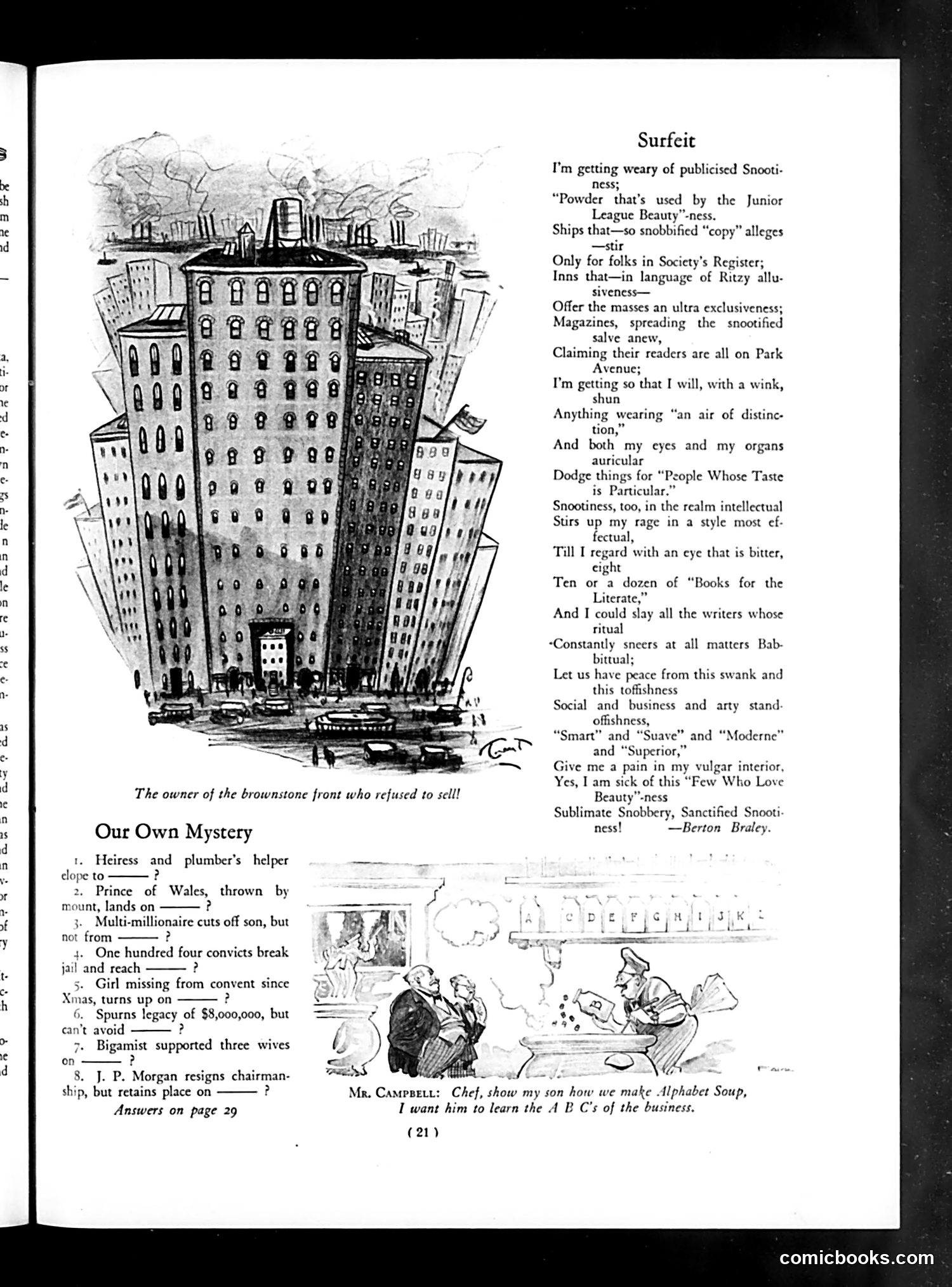
Analysis of Life Magazine Page "Surfeit" Poem (by Berton Braley): A satirical attack on the prevalence of snobbery in American advertising and media. The poet complains that magazines, products, and publications constantly emphasize exclusivity and upper-class status ("Park Avenue," "Society's Register," "Junior League") to sell to ordinary people. The satire targets both the fake pretentiousness marketed to consumers and the writers who perpetually sneer at "Babbitt" (middle-class) values. The author demands an end to this exhausting cultural affectation. "Our Own Mystery": A puzzle game listing eight absurd scenarios (heiress-plumber elopement, Prince of Wales accident, etc.) where readers must guess missing words—likely satirizing the melodramatic plot devices common in contemporary newspapers and pulp fiction. Bottom cartoon: Shows a father teaching his son "the A B C's of the business" via alphabet soup—a visual pun about basic business education, likely mocking oversimplified business instruction. The page overall satirizes American social pretension, media manipulation, and commercial hype circa the 1920s-30s.
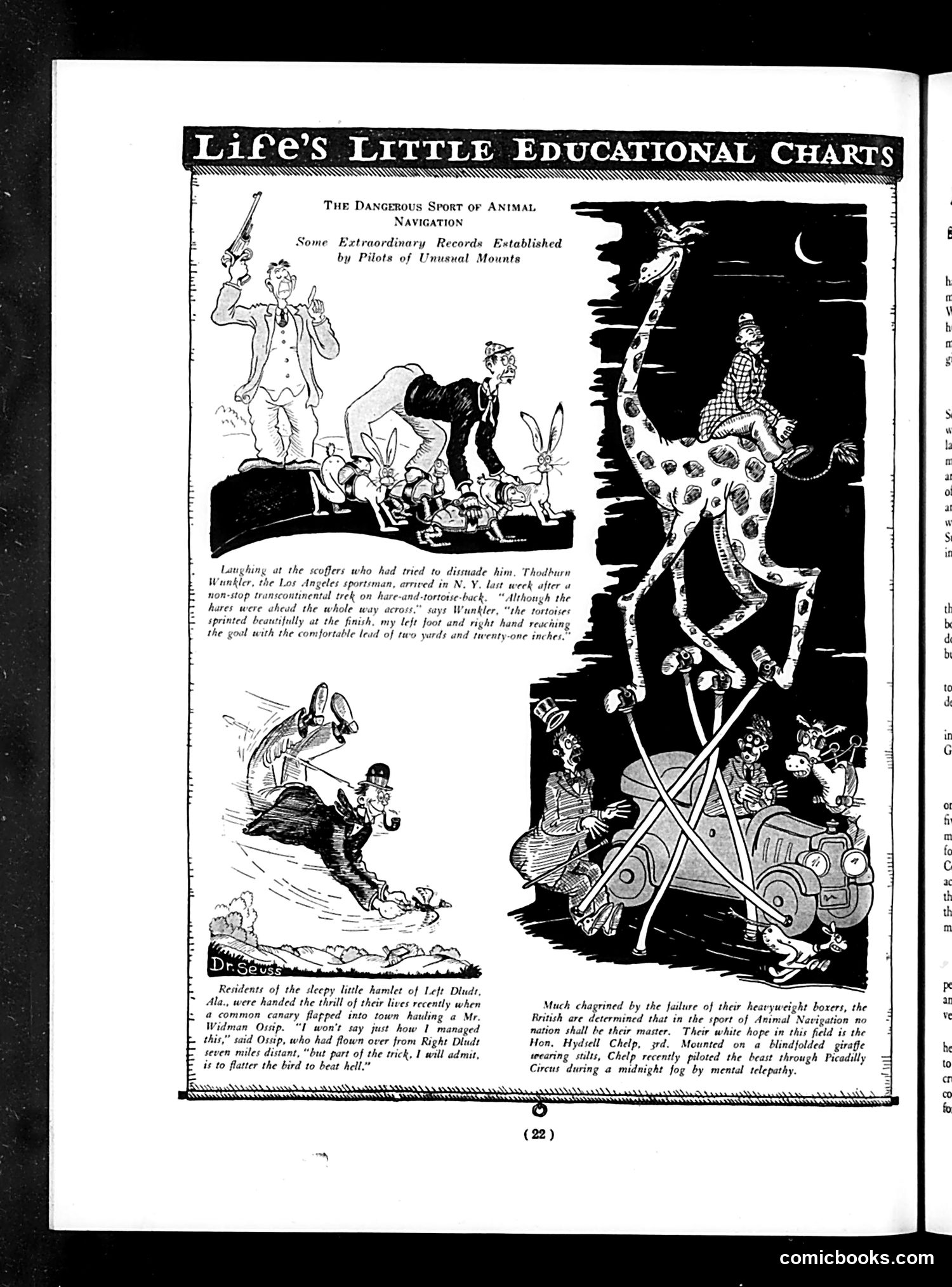
"Life's Little Educational Charts" - Animal Navigation Satire This is a humorous satirical piece mocking the era's obsession with speed records and extreme sports achievements. The "educational chart" format parodies how magazines presented factual accomplishments. The jokes present absurd "records" of people traveling via ridiculous animal mounts: a man crossing America on hares and tortoises, another flying on a canary, and a Brit navigating London on a blindfolded giraffe using "mental telepathy." The satire targets two things: (1) the period's mania for transportation records and stunts, and (2) jingoistic competition between nations—particularly America vs. Britain over sporting achievements. The British competitor is portrayed as increasingly desperate and ridiculous, suggesting mockery of British pride. The elaborate, deadpan descriptions and pseudo-scientific tone amplify the absurdity, making clear these are impossible fabrications meant to ridicule both record-seekers and the breathless media coverage they received.
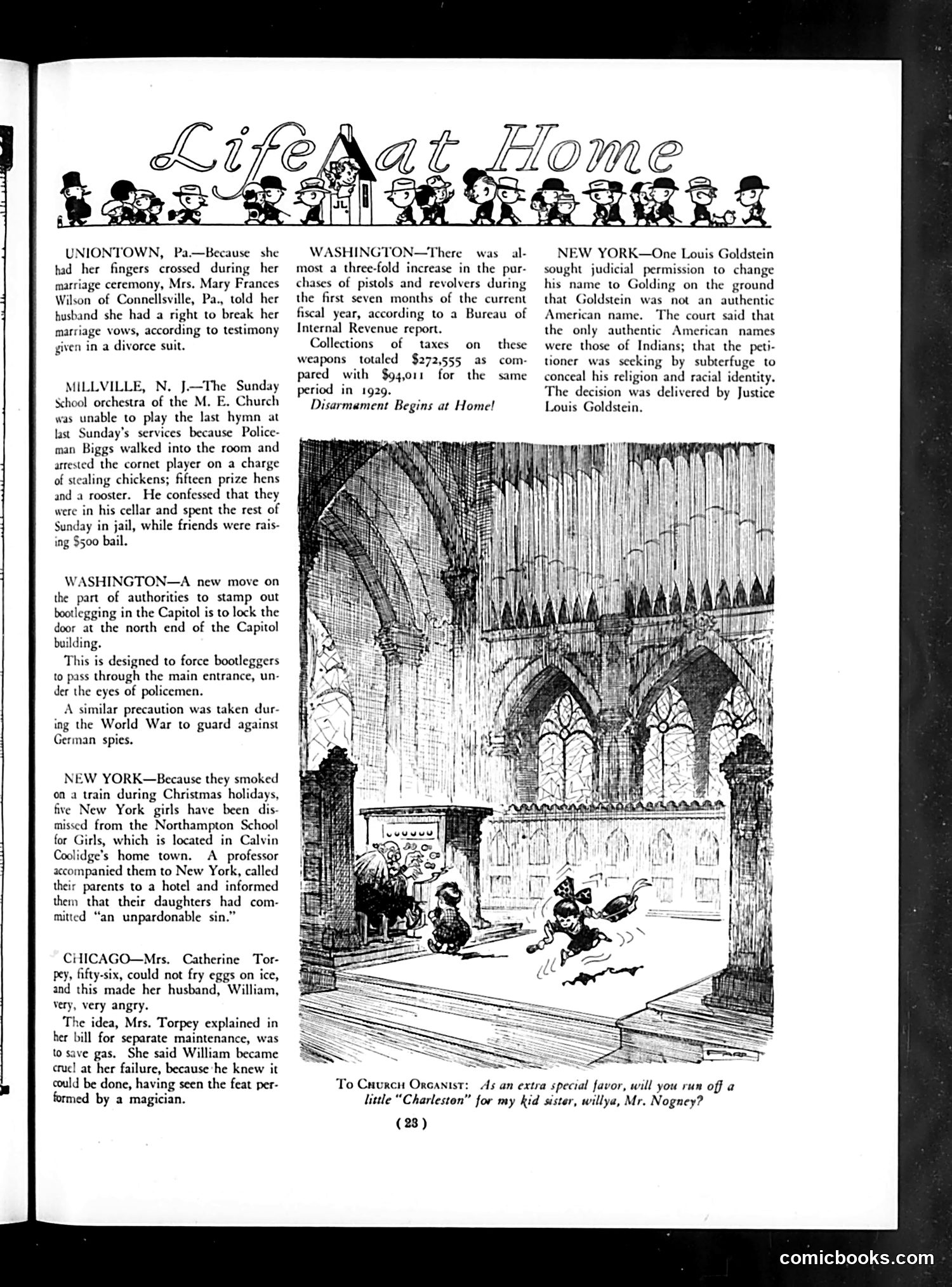
"Life at Home" Page Analysis This page from *Life* magazine collects humorous news briefs satirizing American domestic life and hypocrisy. The cartoon at bottom depicts a church organist being asked to play the "Charleston"—a wildly popular Jazz Age dance considered scandalous by religious institutions—highlighting the gap between strict morality and actual behavior. The news items mock various absurdities: a woman claiming crossed fingers invalidate her marriage vows; a cornet player arrested for stealing chickens during Sunday service; and most pointedly, "Disarmament Begins at Home!"—noting a threefold increase in pistol purchases while authorities supposedly crack down on bootlegging (illegal alcohol during Prohibition). The final story, where Justice Louis Goldstein denies a name-change petition from Louis Goldstein, directly satirizes hypocrisy about assimilation and ethnic/religious identity. Together, these pieces expose contradictions between stated American values (morality, law-and-order, religious propriety) and actual behavior during the Jazz Age and Prohibition era.
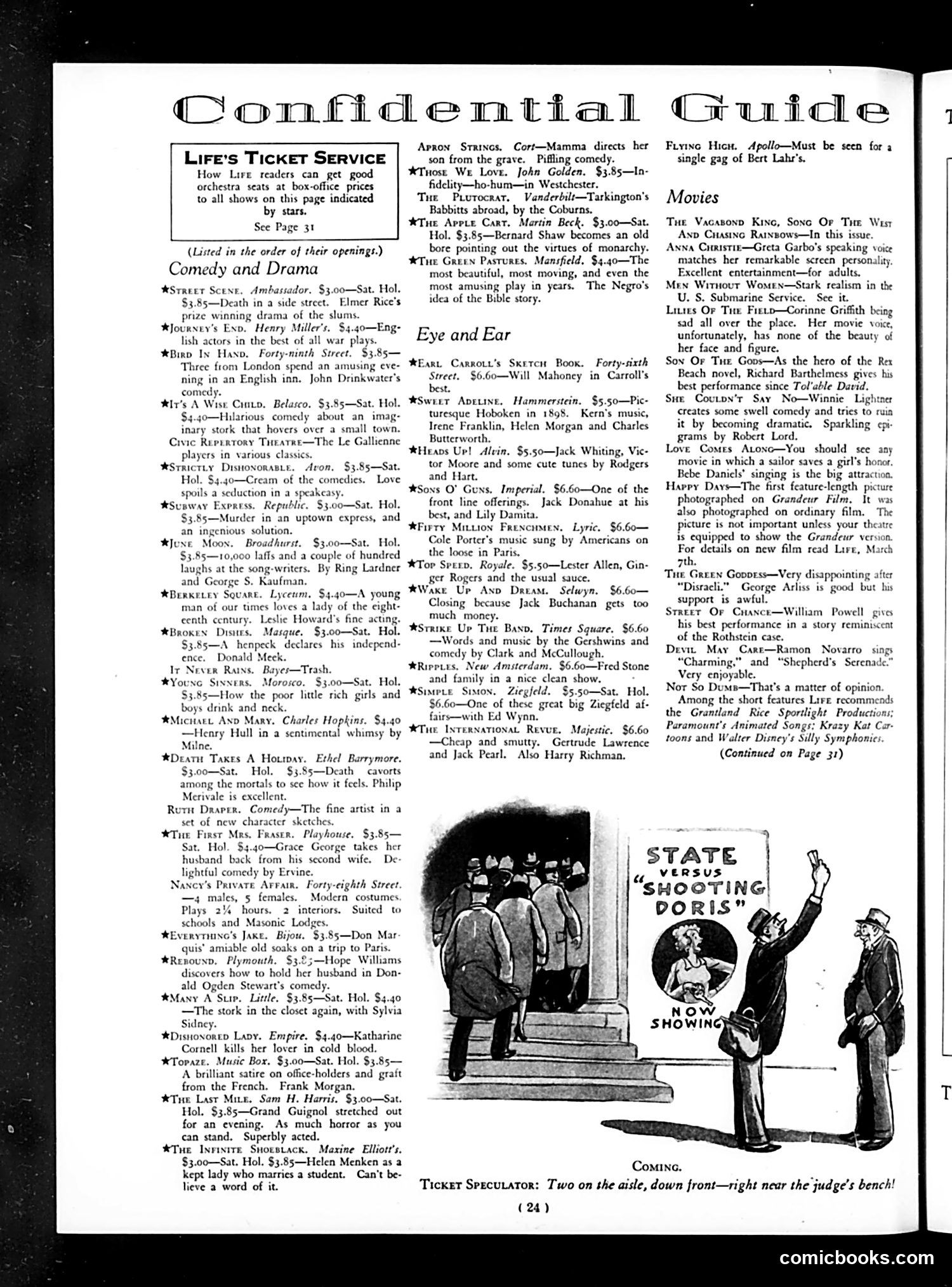
What This Page Shows This is a "Confidential Guide" to Broadway theater—a listing of current plays with prices and brief reviews. The page is primarily informational, offering Life magazine readers access to discounted theater tickets. The small cartoon at bottom right advertises an upcoming film, "State Versus Shooting Doris," showing two men in period costume (appearing to be from a silent comedy) gesturing toward a theater marquee. The caption reads: "Two on the aisle, down front—right near the judge's bench!" This is a joke: the theatrical phrase "two on the aisle" (desirable orchestra seats) is playfully reframed as a courtroom setting, with "judge's bench" suggesting the film involves legal proceedings or a trial scene. The reviews themselves employ casual, witty commentary typical of Life's satirical voice—dismissing some shows as "trash" or "piffle" while praising others like *The Green Pastures* as "the most beautiful, most moving" play.
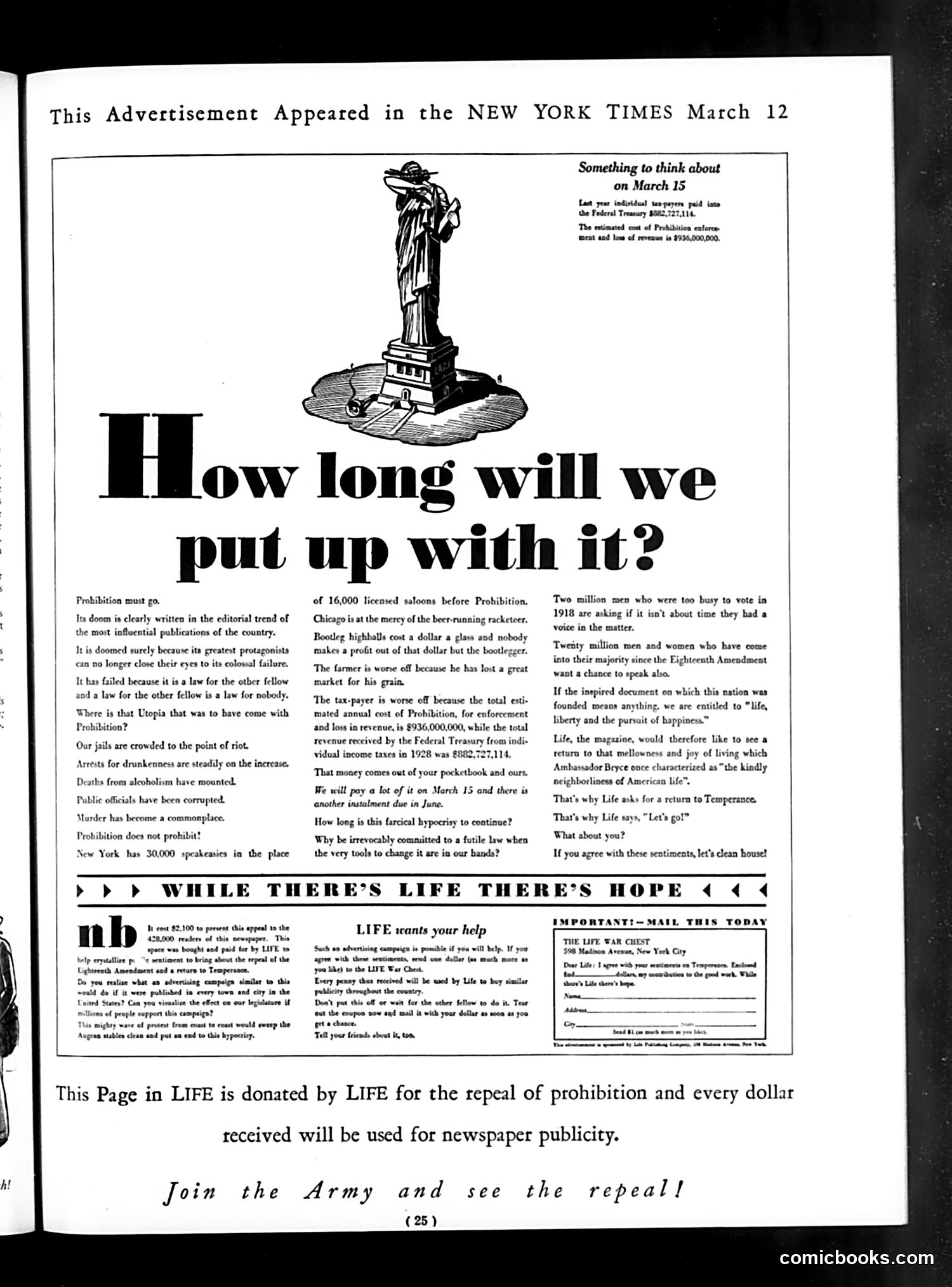
Analysis for Modern Readers This is a prohibition repeal advertisement from *Life* magazine (March 1932), appearing during the Great Depression. The Statue of Liberty symbolizes American ideals being violated. The Argument: The ad attacks Prohibition as a failed policy, listing concrete harms: 30,000 illegal speakeasies in New York, increased arrests and deaths from alcohol, police corruption, bootlegger violence, and lost tax revenue ($936 million annually in enforcement costs versus only $882 million in income tax collected). The Satire: The central irony is that Prohibition—meant to create a moral utopia—instead created the opposite: rampant lawlessness, organized crime, and hypocrisy. The phrase "While there's life there's hope" suggests American renewal requires repealing this failed law. Historical Context: This represents the final push before Prohibition's repeal in December 1933. The ad appeals to both practical concerns (economic waste, crime) and idealistic ones (liberty, pursuit of happiness), asking readers to donate to a media campaign fighting the amendment. The "temperance" mentioned at the end is misleading—*Life* seeks repeal entirely, not moderation.
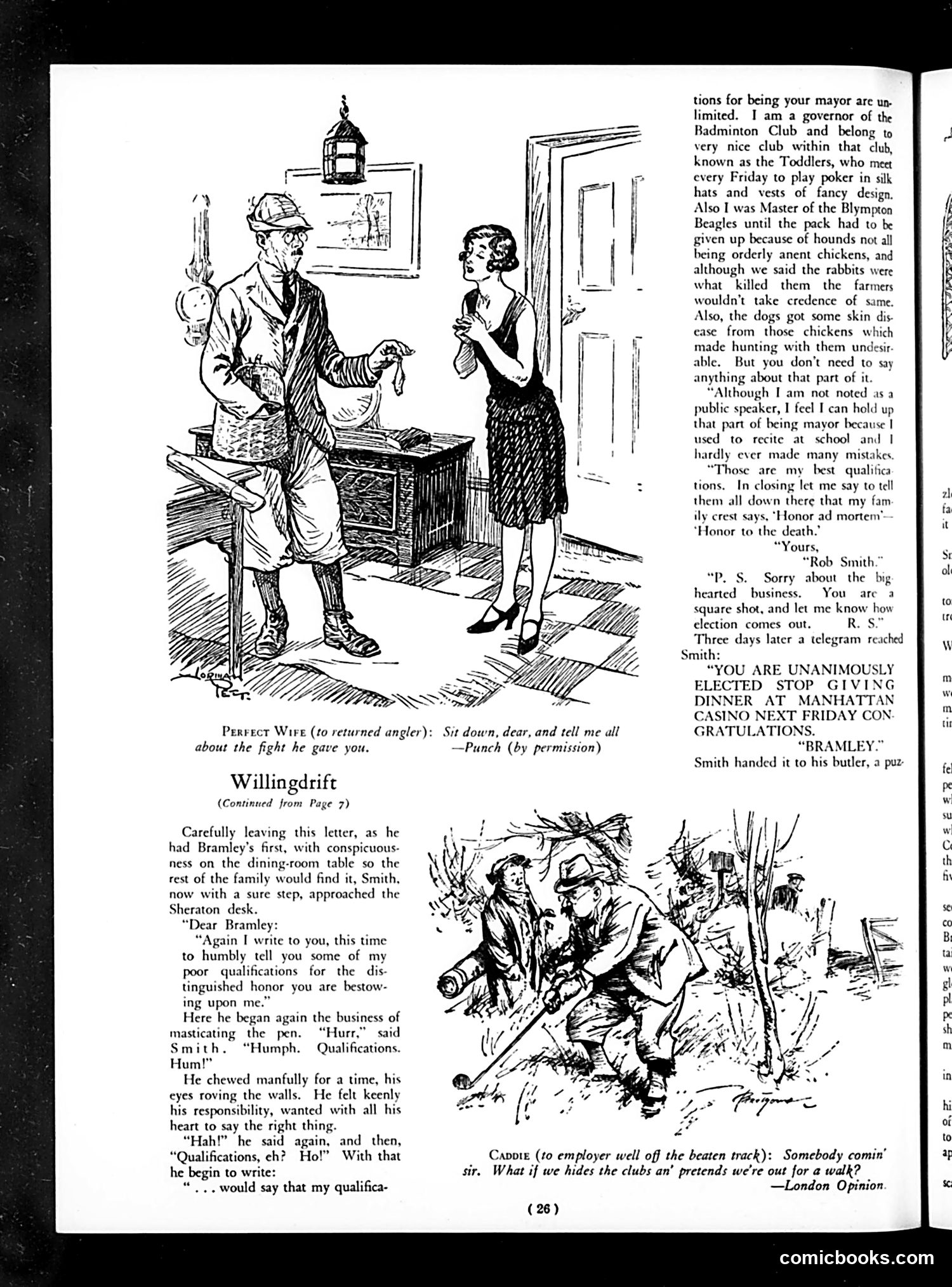
Explanation for Modern Readers This page contains a satirical story called "Willingdrift" about a man named Smith who writes a letter of qualifications to become mayor. The humor lies in Smith's absurd "credentials": he's a governor of a fancy club's poker group, was kicked out as master of a hunting beagle pack (because the dogs contracted disease from chickens), and claims public speaking ability solely because he "hardly ever made many mistakes" reciting at school. The satire mocks small-town ambition and the disconnect between genuine qualification and self-promotional bluffing. Smith's tepid resume—filled with embarrassing failures he tries to downplay—represents the mediocrity of local political candidates. The telegram granting his "unanimous" election undercuts the joke further: apparently, no one expected better. The cartoon at bottom shows two working-class men discussing hiding their golf clubs during a walk, extending the theme of keeping up appearances.
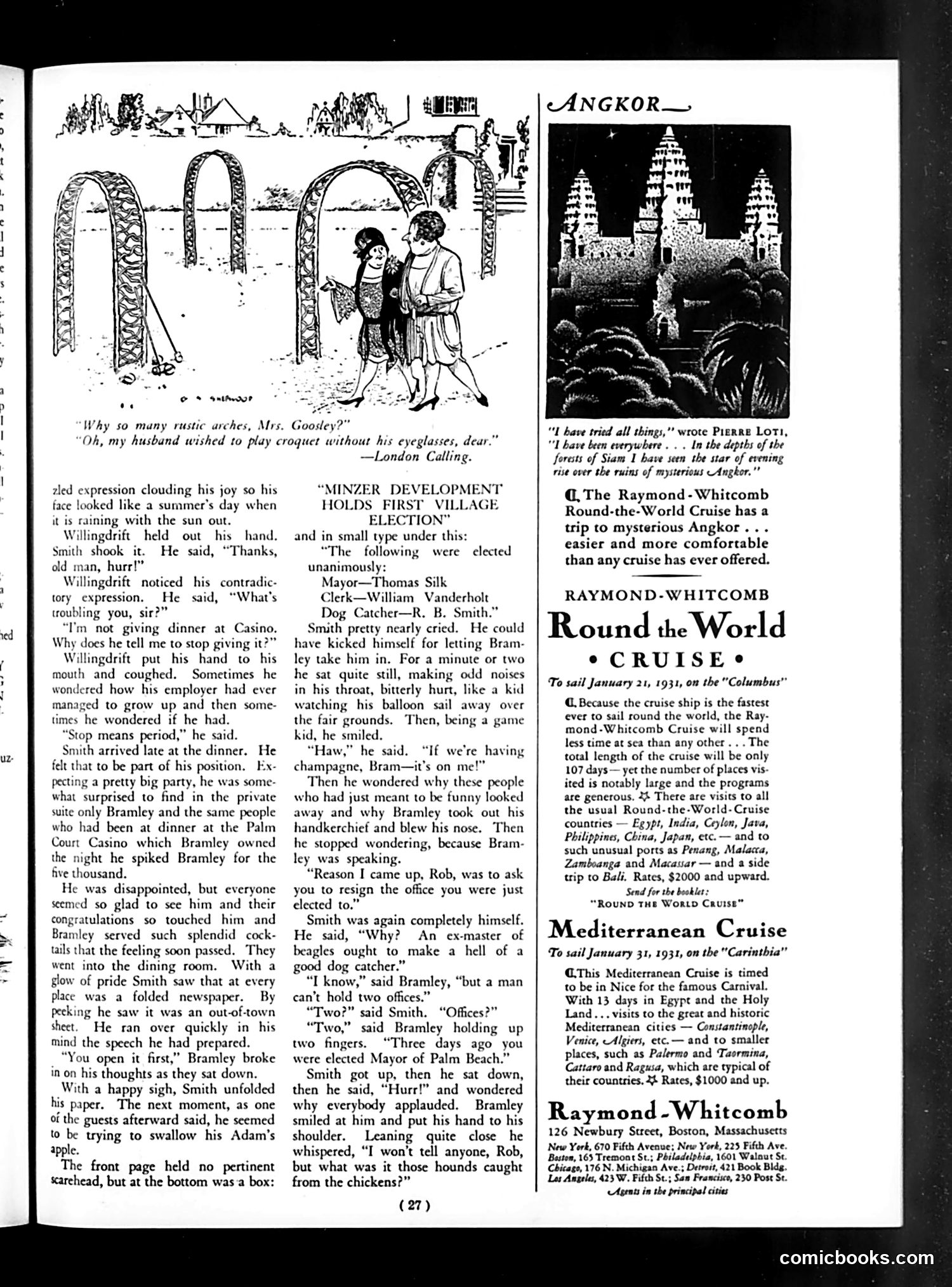
Political/Social Content Analysis The main cartoon (top left) depicts a domestic scene where a wife explains her husband's eccentric garden design: "Why so many rustic arches, Mrs. Goosley?" The punchline—he wanted to play croquet without eyeglasses—is a gentle joke about absent-mindedness and marital tolerance. The longer narrative below satirizes social climbing and embarrassment. A character named Smith is tricked into believing he's been elected Mayor of Palm Beach, when he's actually only been elected Dog Catcher. The satire targets his gullibility and vanity—his willingness to believe in sudden elevation to high office. His humiliation is compounded by his forced good humor about the prank, suggesting mockery of affected cheerfulness among the aspirational middle class. The page is largely advertising for Raymond-Whitcomb cruises and references to exotic locations (Angkor, Siam), which contextualizes the leisure-class world these stories inhabit.
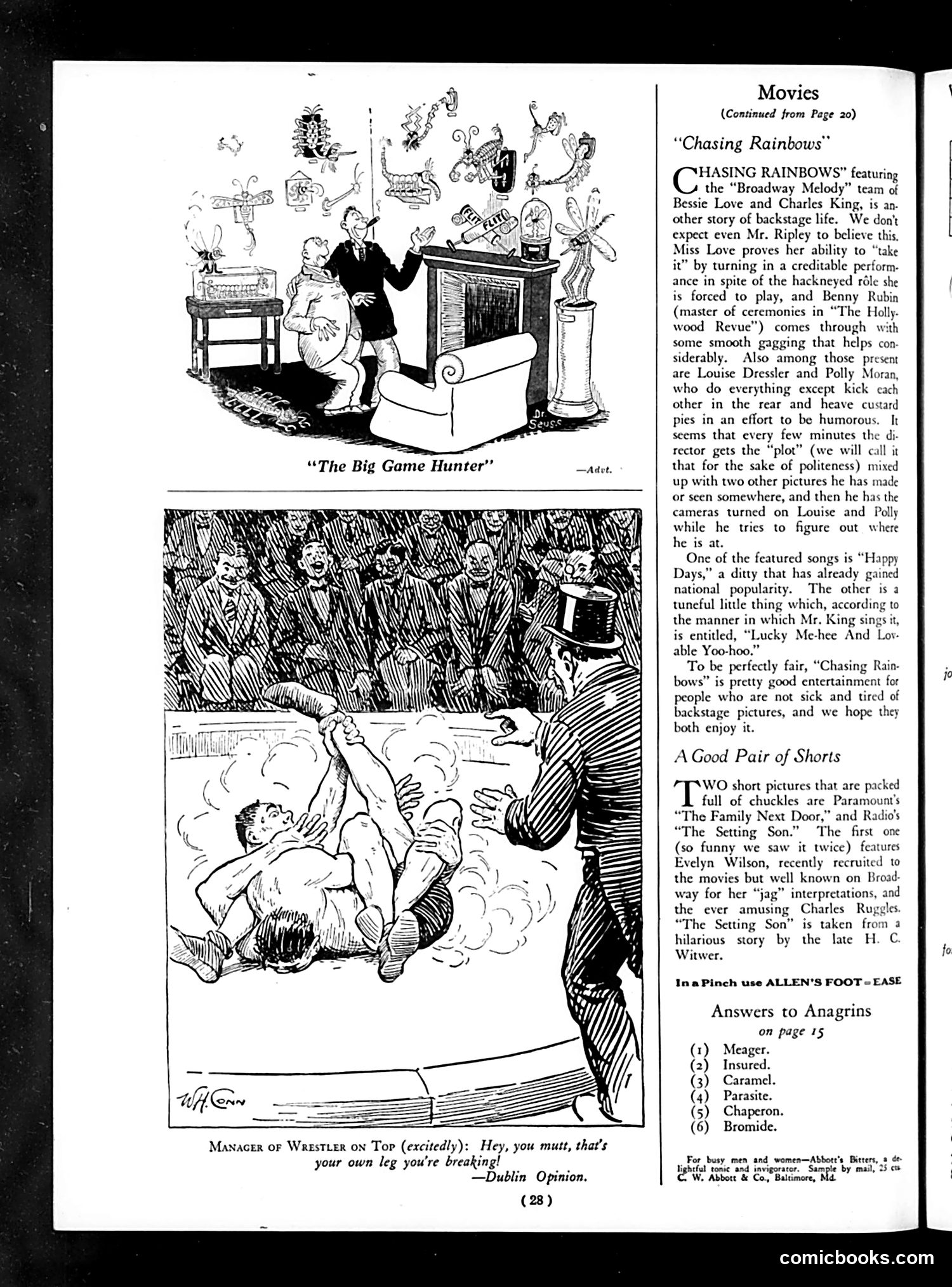
Explanation for Modern Readers This page contains two distinct elements: The Wrestling Cartoon (top left): A humorous illustration showing a wrestling manager excitedly telling a wrestler he's breaking his *own* leg during a match. The joke is physical slapstick comedy—the wrestler is so tangled up that he's injuring himself rather than his opponent. The caption credits it to "Dublin Opinion," suggesting Irish humor. The Movie Reviews (right side): Film criticism of early sound pictures, specifically reviewing "Chasing Rainbows" (a backstage musical featuring Bessie Love and Charles King) and two short comedies. The reviewer is gently mocking the film's thin plot and repetitive "backstage" genre while praising the performers' comedic timing. References to "Happy Days" and mentions of Evelyn Wilson (a Broadway performer) ground this in 1929-1930 cinema. The bottom section contains a word puzzle answer key and period advertising for foot powder and tonic—typical magazine filler of the era.
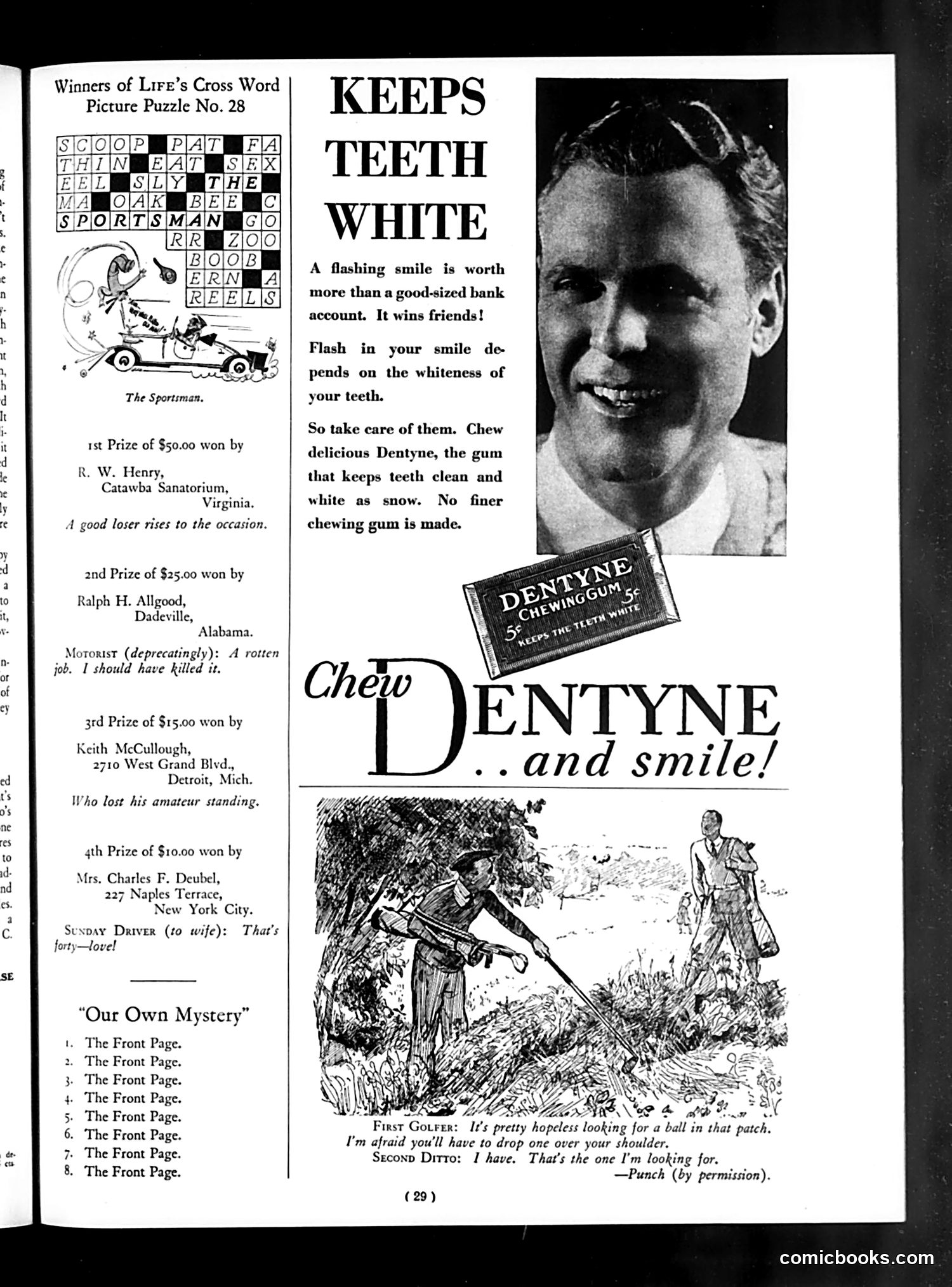
Content Analysis This page is primarily advertising for Dentyne chewing gum, with secondary contest/puzzle content. Main Advertisement ("Keeps Teeth White"): A full-page Dentyne ad features a smiling man and promotes the idea that a bright smile wins friends and is worth money. The copy emphasizes that tooth whiteness depends on proper care—achieved by chewing Dentyne gum. Contest Section (left): Life magazine published a crossword/picture puzzle (#28) called "The Sportsman," with prize winners listed. The tagline "A good loser rises to the occasion" suggests the puzzle's theme. Smaller Cartoons: Two brief jokes appear: one about a motorist regretting not hitting something (tone unclear without context), and a golf joke from Punch magazine where a golfer searches for a ball he deliberately dropped rather than the original lost ball—a humorous commentary on cheating or self-deception in sports. The page reflects early-20th-century magazine culture mixing advertising, reader contests, and humorous content.
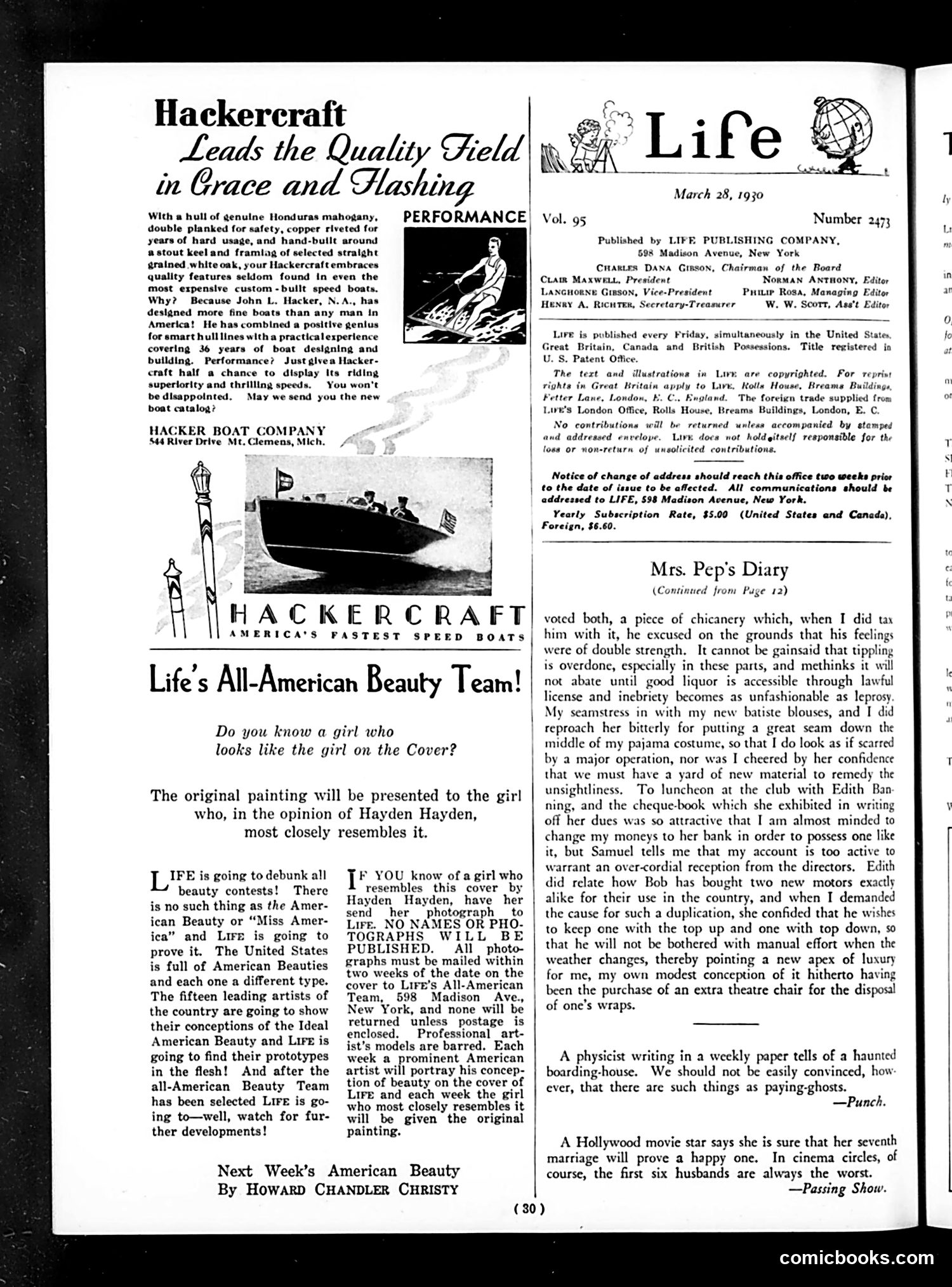
Analysis for Modern Readers This page is primarily advertising and editorial content rather than political cartoons. The main elements are: Hackercraft Advertisement: A boat company ad emphasizing luxury speed boats designed by John L. Hacker, featuring performance imagery. "Life's All-American Beauty Team": A contest announcement where Life magazine solicits photographs from women resembling cover art by prominent artist Hayden Hayden. Winners receive the original paintings. This reflects 1930s mass-media celebrity culture—the magazine is crowdsourcing beauty ideals while claiming to "debunk" formal beauty pageants, ironically reinforcing standardized feminine aesthetics through artist-defined prototypes. Mrs. Pep's Diary: A gossipy social column excerpt about wealthy social circles, marital infidelity, and drinking culture during Prohibition. The satire is gentle: Life positions itself as democratizing beauty while actually centralizing it through famous artists' visions. This captures how early 20th-century magazines created and marketed idealized femininity to mass audiences.
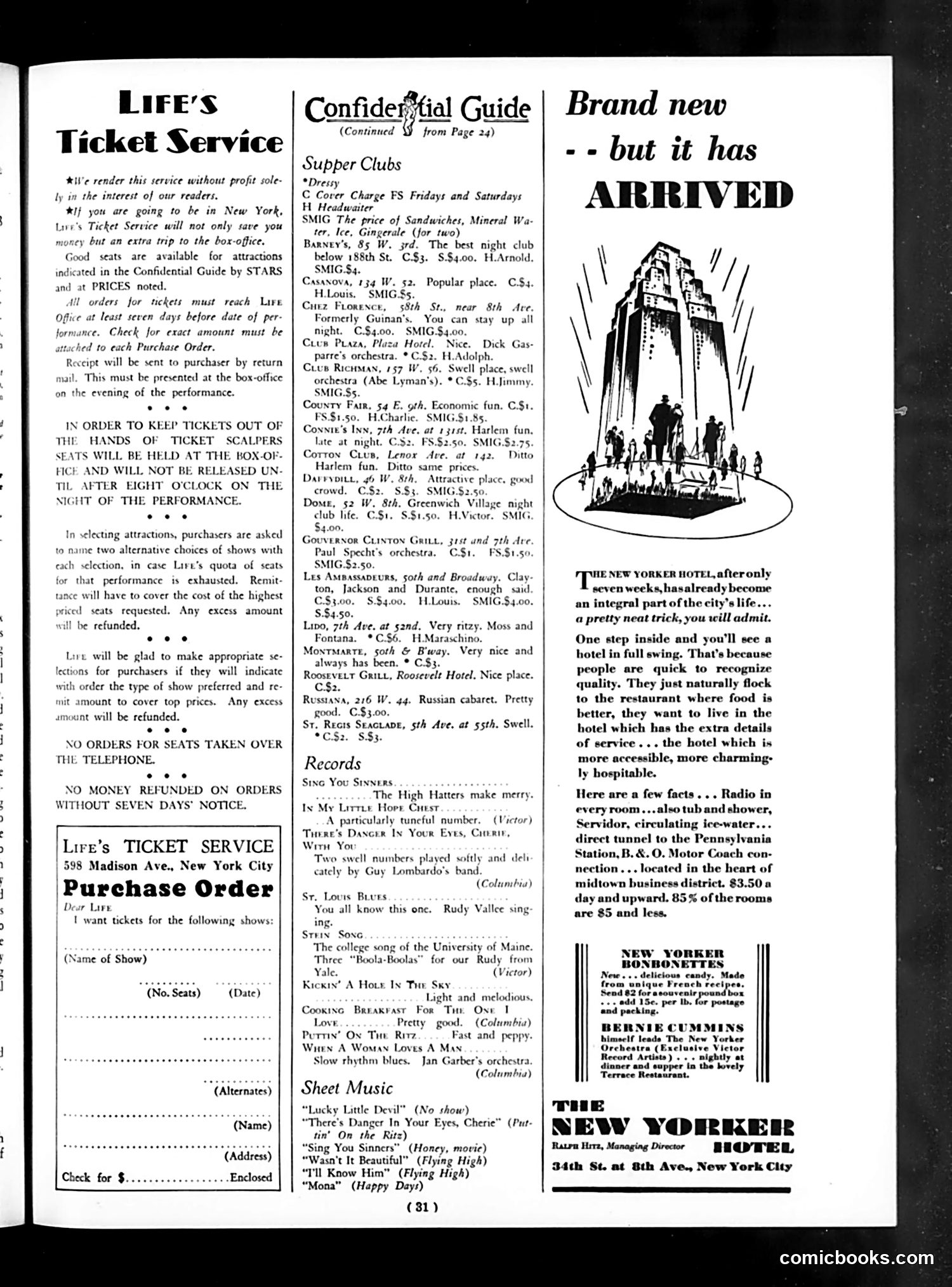
Analysis of This Life Magazine Page This page is primarily advertising and service content rather than satirical cartoons. The main feature is Life's Ticket Service—a legitimate reader service offering Broadway theater tickets without markup from their Madison Avenue office. The page includes ordering instructions, terms (seven days' notice required, no telephone orders, seats held until 8 PM), and a purchase order form. The right-side advertisement promotes the newly-opened New Yorker Hotel, emphasizing its modern amenities: radio in rooms, private shower, circulating ice water, and direct tunnel to Pennsylvania Station. The copy appeals to business travelers and tourists seeking quality accommodations at reasonable prices ($3.50+ daily). The center section lists 1920s-era supper clubs (Casanova, Cuz Florence, Cotton Club, etc.) with cover charges and headwaiter names—reflecting the Prohibition-era nightlife scene. Below are popular song records of the period, featuring artists like Rudy Vallee and Guy Lombardo's band. This is essentially a leisure and entertainment guide for affluent New York City readers, not political satire.
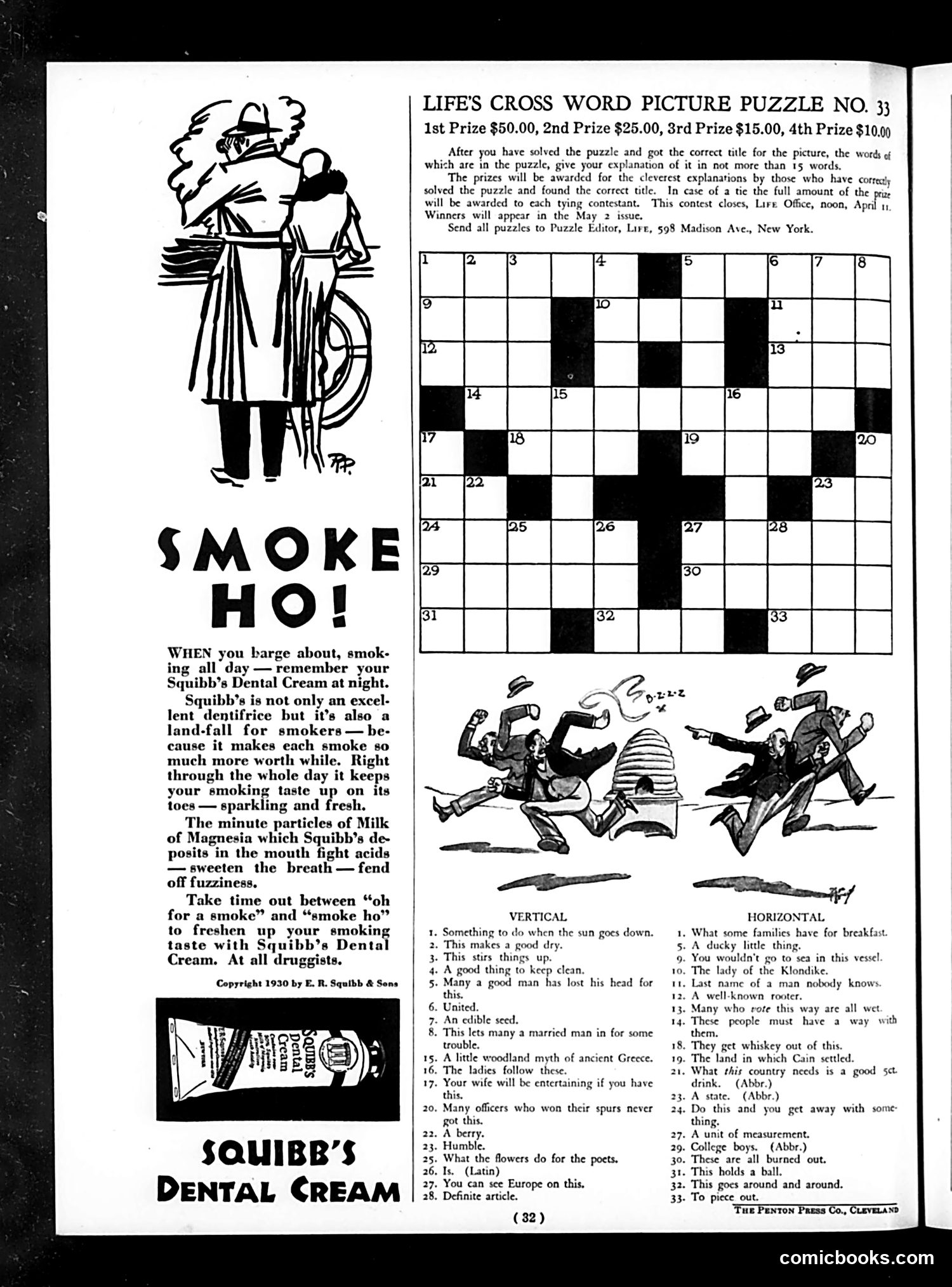
Life Magazine Puzzle Page Analysis This page combines a Squibb's Dental Cream advertisement with a crossword puzzle contest. The ad features a cartoon of a man smoking a pipe, humorously addressing smokers' concerns about dental hygiene. The pitch: use Squibb's toothpaste at night to offset daytime smoking. The language is playful—references to "barge about, smoking all day" and keeping one's "smoking taste up on its toes"—acknowledging smoking's ubiquity in 1930 while framing the product as a practical solution rather than urging quitting. The broader context: This reflects 1930s attitudes where smoking was normalized and unquestioned; advertisers simply worked around it. Dentrifice ads often targeted smokers as a specific market. The puzzle: A typical Life contest featuring a picture puzzle (unseen here) with clues in crossword form. Readers solved it and submitted clever explanations for cash prizes up to $50—substantial money during the Depression. The page exemplifies early 20th-century magazine advertising strategy: entertaining content (the puzzle) paired with product promotion.
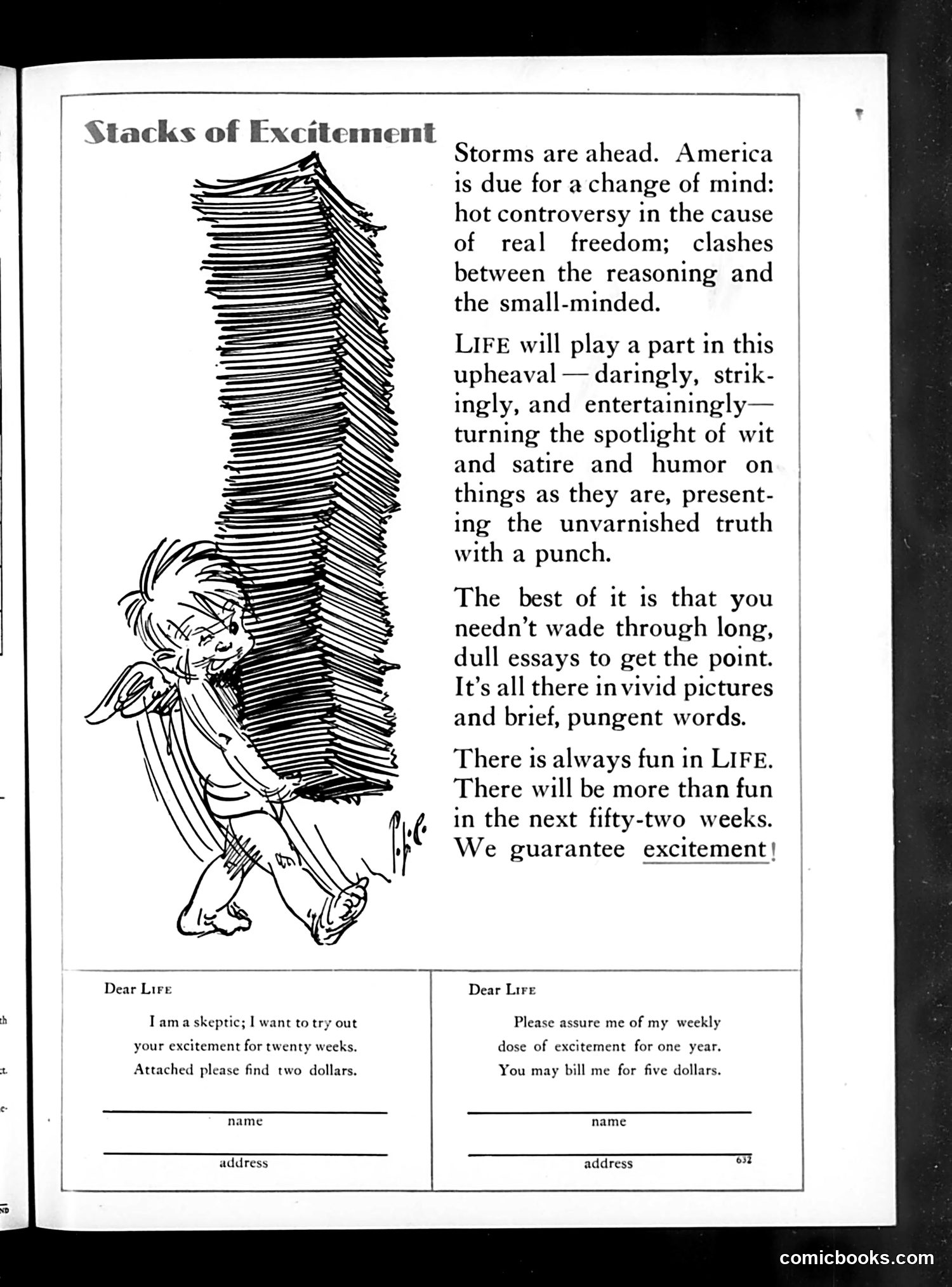
"Stacks of Excitement" - Life Magazine Promotional Page This is a self-promotional advertisement for Life magazine itself, not political satire. The cartoon shows a small figure struggling with an enormous stack of papers, visualizing the magazine's promise of content. The text announces Life's editorial mission: to address coming social upheaval through satire, wit, and visual humor rather than lengthy essays. Life positions itself as a vehicle for challenging conventional thinking and exposing truth about contemporary issues. The two subscription offers below allow readers to test or commit to the magazine—a 20-week trial for $2 or a full year subscription for $5. This was a direct-mail marketing approach, inviting skeptical readers to experience Life's promised "excitement" firsthand. The page reflects Life's brand identity as a magazine combining short, punchy commentary with illustrations—a format designed for modern readers seeking quick, accessible social commentary rather than dense editorial prose.
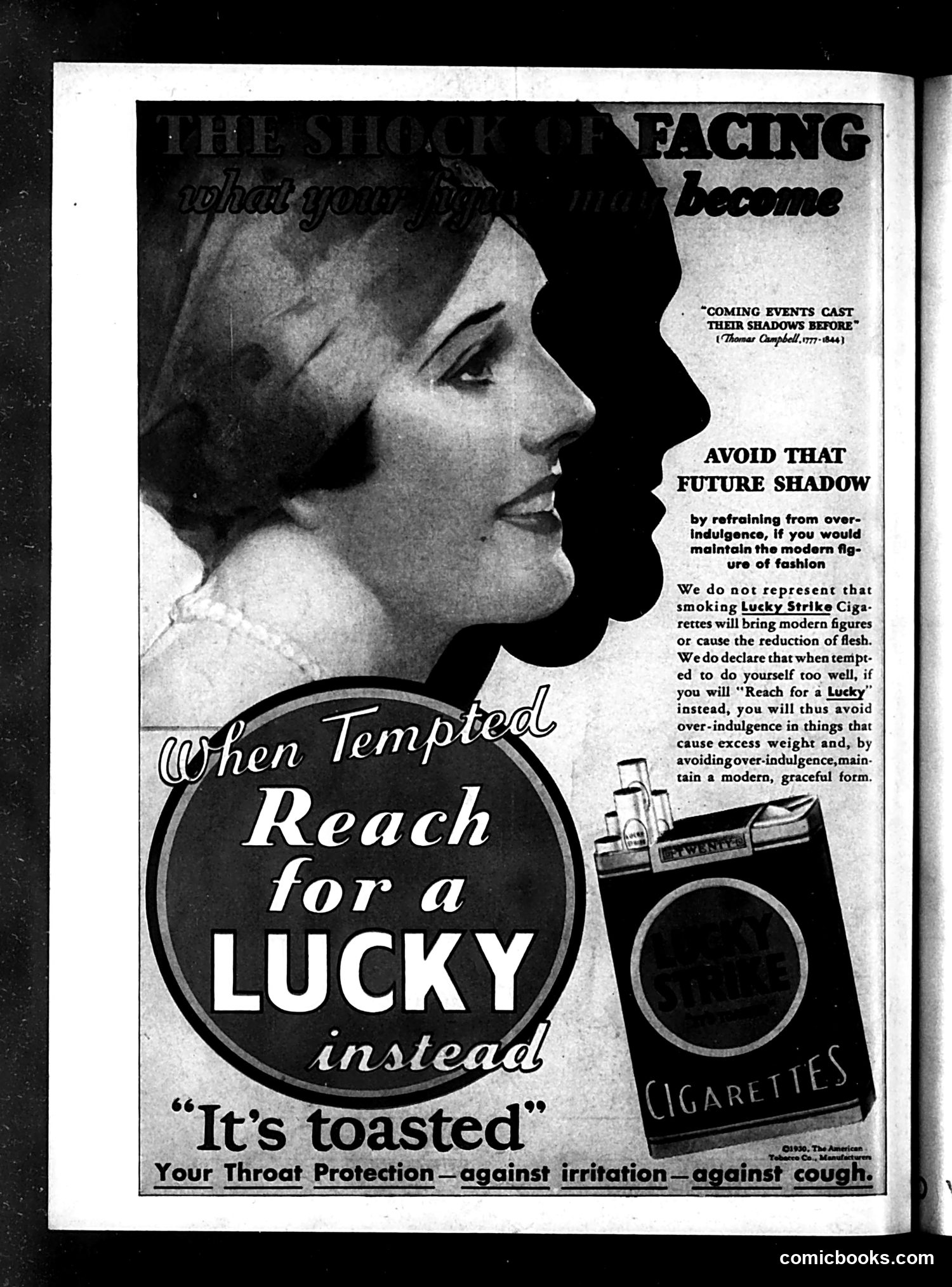
Lucky Strike Cigarette Advertisement Analysis This is a cigarette advertisement, not satire. It uses a visual warning about weight gain ("that future shadow") to market Lucky Strikes as an appetite suppressant alternative. The ad depicts a woman's profile with a darker silhouette suggesting an overweight future self—a cautionary image meant to appeal to female consumers concerned about maintaining fashionable slenderness. The text explicitly claims smoking Lucky Strikes helps avoid overeating and maintains "a modern, graceful form." Notably, the ad disclaims that smoking itself causes weight loss, but promotes cigarettes as a substitute for food indulgence. This exploited 1920s-30s anxieties about women's bodies and diet trends. The phrase "It's toasted" references Lucky Strike's manufacturing process, presented as protective for the throat. By modern standards, this advertisement is shocking for linking cigarettes to body image and weight control—practices now recognized as predatory marketing.